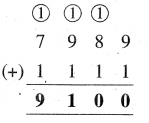
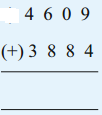
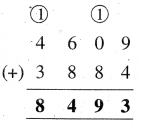
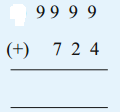
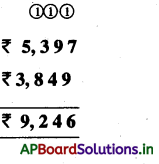
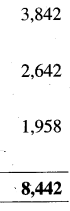
AP SSC 10th Class Maths Solutions Chapter 9 Tangents and Secants to a Circle Ex 9.3

AP State Board Syllabus AP SSC 10th Class Maths Textbook Solutions Chapter 9 Tangents and Secants to a Circle Ex 9.3 Textbook Questions and Answers.

AP State Syllabus SSC 10th Class Maths Solutions 9th Lesson Tangents and Secants to a Circle Exercise 9.3

10th Class Maths 9th Lesson Tangents and Secants to a Circle Ex 9.3 Textbook Questions and Answers

Question 1.
A chord of a circle of radius 10 cm. subtends a right angle at the centre. Find the area of the corresponding: (use π = 3.14)
i) Minor segment ii) Major segment
Answer:
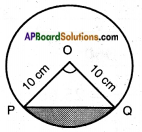
AP SSC 10th Class Maths Solutions Chapter 9 Tangents and Secants to a Circle Ex 9.3 1
Angle subtended by the chord = 90° Radius of the circle = 10 cm
Area of the minor segment = Area of the sector POQ – Area of △POQ
Area of the sector = \(\frac{x}{360}\) × πr2
\(\frac{90}{360}\) × 3.14 × 10 × 10 = 78.5
Area of the triangle = \(\frac{1}{2}\) × base × height
= \(\frac{1}{2}\) × 10 × 10 = 50
∴ Area of the minor segment = 78.5 – 50 = 28.5 cm2
Area of the major segment = Area of the circle – Area of the minor segment
= 3.14 × 10 × 10 – 28.5
= 314 – 28.5 cm2
= 285.5 cm2

AP SSC 10th Class Maths Solutions Chapter 9 Tangents and Secants to a Circle Ex 9.3

Question 2.
A chord of a circle of radius 12 cm. subtends an angle of 120° at the centre. Find the area of the corresponding minor segment of the circle.
(use π = 3.14 and √3 = 1.732)
Answer:
Radius of the circle r = 12 cm.
Area of the sector = \(\frac{x}{360}\) × πr2
Here, x = 120°
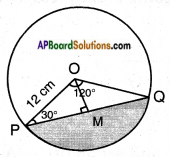
AP SSC 10th Class Maths Solutions Chapter 9 Tangents and Secants to a Circle Ex 9.3 2
\(\frac{120}{360}\) × 3.14 × 12 × 12 = 150.72
Drop a perpendicular from ‘O’ to the chord PQ.
△OPM = △OQM [∵ OP = OQ ∠P = ∠Q; angles opp. to equal sides OP & OQ; ∠OMP = ∠OMQ by A.A.S]
∴ △OPQ = △OPM + △OQM = 2 . △OPM
Area of △OPM = \(\frac{1}{2}\) × PM × OM
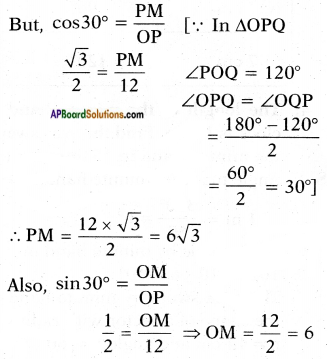
AP SSC 10th Class Maths Solutions Chapter 9 Tangents and Secants to a Circle Ex 9.3 3
= 18 × 1.732 = 31.176 cm
∴ △OPQ = 2 × 31.176 = 62.352 cm2
∴ Area of the minor segment
AP SSC 10th Class Maths Solutions Chapter 9 Tangents and Secants to a Circle Ex 9.3 15 = (Area of the sector) – (Area of the △OPQ)
= 150.72 – 62.352 = 88.368 cm2

Question 3.
A car has two wipers which do not overlap. Each wiper has a blade of length 25 cm. sweeping through an angle of 115°. Find the total area cleaned at each sweep of the blades. (use π = \(\frac{22}{7}\))
Answer:
Angle made by the each blade = 115°
Total area swept by two blades
= Area of the sector with radius 25 cm and angle 115°+ 115° = 230°
= Area of the sector = \(\frac{x}{360}\) × πr2
= \(\frac{230}{360}\) × \(\frac{22}{7}\) × 25 × 25
= 1254.96
≃  1255 cm2

AP SSC 10th Class Maths Solutions Chapter 9 Tangents and Secants to a Circle Ex 9.3

Question 4.
Find the area of the shaded region in figure, where ABCD is a square of side 10 cm. and semicircles are drawn with each side of the square as diameter (use π = 3.14).
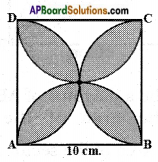
AP SSC 10th Class Maths Solutions Chapter 9 Tangents and Secants to a Circle Ex 9.3 5
Answer:
Let us mark the four unshaded regions as I, II, III and IV.
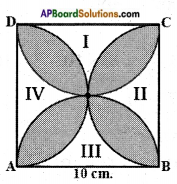
AP SSC 10th Class Maths Solutions Chapter 9 Tangents and Secants to a Circle Ex 9.3 6
Area of I + Area of II
= Area of ABCD – Areas of two semicircles with radius 5 cm
= 10 × 10 – 2 × \(\frac{1}{2}\) × π × 52
= 100 – 3.14 × 25
= 100 – 78.5 = 21.5 cm2
Similarly, Area of II + Area of IV = 21.5 cm2
So, area of the shaded region = Area of ABCD – Area of unshaded region
= 100 – 2 × 21.5 = 100 – 43 = 57 cm2

Question 5.
Find the area of the shaded region in figure, if ABCD is a square of side 7 cm. and APD and BPC are semicircles. (use π = \(\frac{22}{7}\))
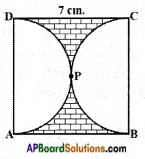
AP SSC 10th Class Maths Solutions Chapter 9 Tangents and Secants to a Circle Ex 9.3 7
Answer:
Given,
ABCD is a square of side 7 cm.
Area of the shaded region = Area of ABCD – Area of two semicircles with radius \(\frac{7}{2}\) = 3.5 cm
APD and BPC are semicircles.
= 7 × 7 – 2 × \(\frac{1}{2}\) × \(\frac{22}{7}\) × 3.5 × 3.5
= 49 – 38.5
= 10.5 cm2
∴ Area of shaded region = 10.5 cm

AP SSC 10th Class Maths Solutions Chapter 9 Tangents and Secants to a Circle Ex 9.3

Question 6.
In figure, OACB is a quadrant of a circle with centre O and radius 3.5 cm. If OD = 2 cm., find the area of the shaded region, (use π = \(\frac{22}{7}\)).
Answer:
Given, OACB is a quadrant of a Circle.
Radius = 3.5 cm; OD = 2 cm.
Area of the shaded region = Area of the sector – Area of △BOD
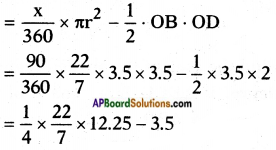
AP SSC 10th Class Maths Solutions Chapter 9 Tangents and Secants to a Circle Ex 9.3 9
= 9.625 – 3.5 = 6.125 cm2
∴ Area of shaded region = 6.125 cm2.

Question 7.
AB and CD are respectively arcs of two concentric circles of radii 21 cm. and 7 cm. with centre O (See figure). If ∠AOB = 30°, find the area of the shaded region. (use π = \(\frac{22}{7}\)).
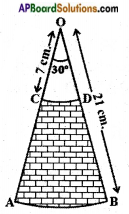
AP SSC 10th Class Maths Solutions Chapter 9 Tangents and Secants to a Circle Ex 9.3 10
Answer:
Given, AB and CD are the arcs of two concentric circles.
Radii of circles = 21 cm and 7 cm and ∠AOB = 30°
We know that,
Area of the sector = \(\frac{x}{360}\) × πr2
Area of the shaded region = Area of the OAB – Area of OCD
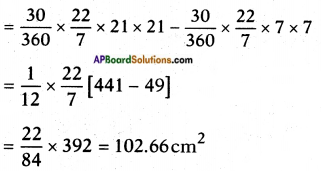
AP SSC 10th Class Maths Solutions Chapter 9 Tangents and Secants to a Circle Ex 9.3 11
∴ Area of shaded region = 102.66 cm2

AP SSC 10th Class Maths Solutions Chapter 9 Tangents and Secants to a Circle Ex 9.3

Question 8.
Calculate the area of the designed region in figure, common between the two quadrants of the circles of radius 10 cm each, {use π = 3.14)
Answer:
Mark two points P, Q on the either arcs.
Let BD be a diagonal of ABCD
Now the area of the segment
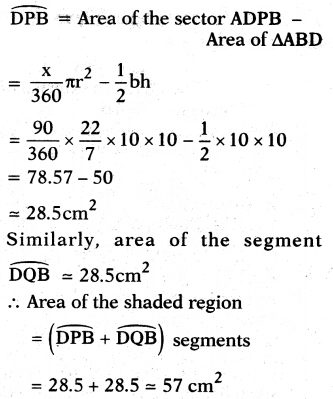
AP SSC 10th Class Maths Solutions Chapter 9 Tangents and Secants to a Circle Ex 9.3 14
= 28.5 + 28.5 = 57 cm2

Side of the square = 10 cm
Area of the square = side × side
= 10 × 10 = 100 cm2
Area of two sectors with centres A and C and radius 10 cm.
= 2 × \(\frac{\pi r^{2}}{360}\) × x = 2 × \(\frac{x}{360}\) × \(\frac{22}{7}\) × 10 × 10
= \(\frac{1100}{7}\)
= 157.14 cm2
∴ Designed area is common to both the sectors,
∴ Area of design = Area of both sectors – Area of square
= 157 – 100 = 57 cm2
(or)
\(\frac{1100}{7}\) – 100 = \(\frac{1100-700}{7}\)
= \(\frac{400}{7}\)
= 57.1 cm2
AP SSC 10th Class Maths Solutions Chapter 11 Trigonometry Ex 11.3

AP State Board Syllabus AP SSC 10th Class Maths Textbook Solutions Chapter 11 Trigonometry Ex 11.3 Textbook Questions and Answers.

AP State Syllabus SSC 10th Class Maths Solutions 11th Lesson Trigonometry Exercise 11.3

10th Class Maths 11th Lesson Trigonometry Ex 11.3 Textbook Questions and Answers

Question 1.
Evaluate:
i) \(\frac{\tan 36^{\circ}}{\cot 54^{\circ}}\)
Answer:
Given that \(\frac{\tan 36^{\circ}}{\cot 54^{\circ}}\)
= \(\frac{\tan 36^{\circ}}{\cot \left(90^{\circ}-36^{\circ}\right)}\) [∵ cot (90 – θ) = tan θ]
= \(\frac{\tan 36^{\circ}}{\tan 36^{\circ}}\)
= 1

ii) cos 12° – sin 78°
Answer:
Given that cos 12° – sin 78°
= cos 12° – sin(90° – 12°) [∵ sin (90 – θ) = cos θ]
= cos 12° – cos 12° = 0

AP SSC 10th Class Maths Solutions Chapter 11 Trigonometry Ex 11.3

iii) cosec 31° – sec 59°
Answer:
Given that cosec 31° – sec 59°
= cosec 31° – sec (90° – 31°) [∵ sec (90 – θ) = cosec θ]
= cosec 31° – cosec 31° = 0

iv) sin 15° sec 75°
Answer:
Given that sin 15° sec 75°
= sin 15° . sec (90° – 15°)
= sin 15° . cosec 15° [∵ sec (90 – θ) = cosec θ]
= sin 15° . \(\frac{1}{\sin 15^{\circ}}\) [∵ cosec θ = \(\frac{1}{\sin \theta}\)]
= 1

v) tan 26° tan 64°
Answer:
Given that tan 26° tan 64°
= tan 26° . tan (90° – 26°)
= tan 26° . cot 26° [∵ tan (90 – θ) = cot θ]
= tan 26° . \(\frac{1}{\tan 26^{\circ}}\) [∵ cot θ = \(\frac{1}{\tan \theta}\)]
= 1

Question 2.
Show that
i) tan 48° tan 16° tan 42° tan 74° = 1
Answer:
L.H.S. = tan 48° tan 16° tan 42° tan 74°
= tan 48°. tan 16° . tan(90° – 48°) . tan(90° – 16°)
= tan 48° . tan 16° . cot 48° . cot 16° [∵ tan (90 – θ) = cot θ]
= tan 48° . tan 16° . \(\frac{1}{\tan 48^{\circ}}\) . \(\frac{1}{\tan 16^{\circ}}\) [∵ cot θ = \(\frac{1}{\tan \theta}\)]
= 1 = R.H.S.
∴ L.H.S. = R.H.S.

ii) cos 36° cos 54° – sin 36° sin 54° = 0
Answer:
L.H.S. = cos 36° cos 54° – sin 36° sin54°
= cos (90° – 54°) . cos (90° – 36°) – sin 36° . sin 54° [∵ cos (90 – θ) = sin θ]
= sin 54° . sin 36° – sin 36° . sin 54°
= 0 = R.H.S.
∴ L.H.S. = R.H.S.

AP SSC 10th Class Maths Solutions Chapter 11 Trigonometry Ex 11.3

Question 3.
If tan 2A = cot (A – 18°), where 2A is an acute angle. Find the value of A.
Answer:
Given that tan 2A = cot (A – 18°)
⇒ cot (90° – 2A) = cot (A – 18°) [∵ tan θ = cot (90 – θ)]
⇒ 90° – 2A = A – 18°
⇒ 108° = 3A
⇒ A = \(\frac{108^{\circ}}{3}\) = 36°
Hence the value of A is 36°.

Question 4.
If tan A = cot B where A and B. are acute angles, prove that A + B = 90°.
Answer:
Given that tan A = cot B
⇒ cot (90° – A) = cot B [∵ tan θ = cot (90 – θ)]
⇒ 90° – A = B
⇒ A + B = 90°

Question 5.
If A, B and C are interior angles of a triangle ABC, then show that \(\tan \left(\frac{\mathbf{A}+\mathbf{B}}{2}\right)=\cot \frac{\mathbf{C}}{2}\)
Answer:
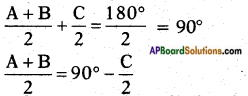
Given A, B and C are interior angles of right angle triangle ABC then A + B + C = 180°.
On dividing the above equation by ‘2’ on both sides, we get 180°
AP SSC 10th Class Maths Solutions Chapter 11 Trigonometry Ex 11.3 1
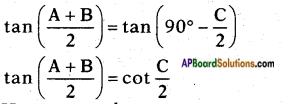
On taking tan ratio on both sides
AP SSC 10th Class Maths Solutions Chapter 11 Trigonometry Ex 11.3 2
Hence proved.

AP SSC 10th Class Maths Solutions Chapter 11 Trigonometry Ex 11.3

Question 6.
Express sin 75° + cos 65° in terms of trigonometric ratios of angles between 0° and 45°.
Answer:
We have sin 75° + cos 65°
= sin (90° – 15°) + cos (90° – 25°)
= cos 15° + sin 25° [∵ sin (90 – θ) = cos θ and cos (90 – θ) = sin θ]

AP SSC 10th Class Maths Solutions Chapter 11 Trigonometry Ex 11.2

AP State Board Syllabus AP SSC 10th Class Maths Textbook Solutions Chapter 11 Trigonometry Ex 11.2 Textbook Questions and Answers.

AP State Syllabus SSC 10th Class Maths Solutions 11th Lesson Trigonometry Exercise 11.2

10th Class Maths 11th Lesson Trigonometry Ex 11.2 Textbook Questions and Answers

Question 1.
Evaluate the following.
i) sin 45° + cos 45°
Answer:
sin 45° + cos 45°
= \(\frac{1}{\sqrt{2}}\) + \(\frac{1}{\sqrt{2}}\)
= \(\frac{1+1}{\sqrt{2}}\)
= \(\frac{2}{\sqrt{2}}\)
= \(\frac{\sqrt{2} \times \sqrt{2}}{\sqrt{2}}\)
= √2

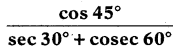
ii)
AP SSC 10th Class Maths Solutions Chapter 11 Trigonometry Ex 11.2 1
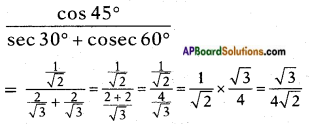
Answer:
AP SSC 10th Class Maths Solutions Chapter 11 Trigonometry Ex 11.2 2

AP SSC 10th Class Maths Solutions Chapter 11 Trigonometry Ex 11.2

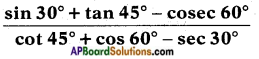
iii)
AP SSC 10th Class Maths Solutions Chapter 11 Trigonometry Ex 11.2 3
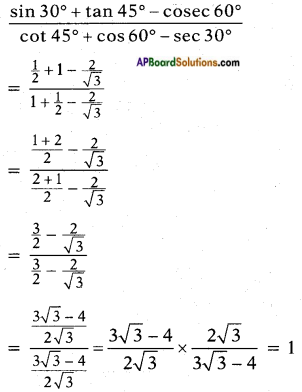
Answer:
AP SSC 10th Class Maths Solutions Chapter 11 Trigonometry Ex 11.2 4

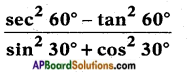
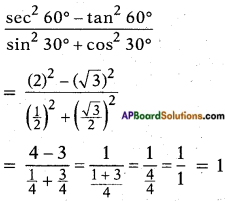
iv) 2 tan2 45° + cos2 30° – sin2 60°
Answer:
2 tan2 45° + cos2 30° – sin2 60°
= 2(1)2 + \(\left(\frac{\sqrt{3}}{2}\right)^{2}\) – \(\left(\frac{\sqrt{3}}{2}\right)^{2}\)
= \(\frac{2}{1}\) + \(\frac{3}{4}\) – \(\frac{3}{4}\)
= \(\frac{8+3-3}{4}\)
= \(\frac{8}{4}\)
= 2

AP SSC 10th Class Maths Solutions Chapter 11 Trigonometry Ex 11.2

v)
AP SSC 10th Class Maths Solutions Chapter 11 Trigonometry Ex 11.2 5
Answer:
AP SSC 10th Class Maths Solutions Chapter 11 Trigonometry Ex 11.2 6

Question 2.
Choose the right option and justify your choice.
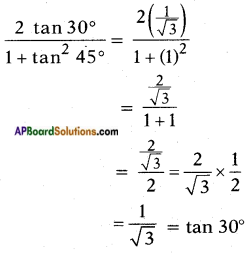
i) \(\frac{2 \tan 30^{\circ}}{1+\tan ^{2} 45^{\circ}}\)
a) sin 60°
b) cos 60°
c) tan 30°
d) sin 30°
Answer:
AP SSC 10th Class Maths Solutions Chapter 11 Trigonometry Ex 11.2 7

ii) \(\frac{1-\tan ^{2} 45^{\circ}}{1+\tan ^{2} 45^{\circ}}\)
a) tan 90°
b) 1
c) sin 45°
d) 0
Answer:
\(\frac{1-\tan ^{2} 45^{\circ}}{1+\tan ^{2} 45^{\circ}}\) = \(\frac{1-(1)^{2}}{1+(1)^{2}}\)
= \(\frac{0}{1+1}\) = \(\frac{0}{2}\) = 0

AP SSC 10th Class Maths Solutions Chapter 11 Trigonometry Ex 11.2

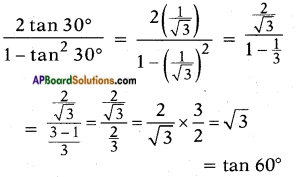
iii) \(\frac{2 \tan 30^{\circ}}{1-\tan ^{2} 30^{\circ}}\)
a) cos 60°
b) sin 60°
c) tan 60°
d) sin 30°
Answer:
AP SSC 10th Class Maths Solutions Chapter 11 Trigonometry Ex 11.2 8

Question 3.
Evaluate sin 60° cos 30° + sin 30° cos 60°. What is the value of sin (60° + 30°). What can you conclude?
Answer:
Take sin 60°.cos 30° + sin 30°.cos 60°
= \(\frac{\sqrt{3}}{2}\) . \(\frac{\sqrt{3}}{2}\) + \(\frac{1}{2}\) . \(\frac{1}{2}\)
= \(\frac{(\sqrt{3})^{2}}{4}\) + \(\frac{1}{4}\)
= \(\frac{3}{4}\) + \(\frac{1}{4}\)
= \(\frac{3+1}{4}\)
= \(\frac{4}{4}\) = 1 …… (1)
Now take sin (60° + 30°)
= sin 90° = 1 …….. (2)
From equations (1) and (2), I conclude that
sin (60°+30°) = sin 60° . cos 30° + sin 30° . cos 60°.
i.e., sin (A + B) = sin A . cos B + cos A . sin B

Question 4.
Is it right to say cos (60° + 30°) = cos 60° cos 30° – sin 60° sin 30° ?
Answer:
L.H.S. = cos (60° + 30°)
cos 90° = 0
R.H.S. = cos 60° . cos 30° – sin 60° . sin 30°.
= \(\frac{1}{2}\) . \(\frac{\sqrt{3}}{2}\) – \(\frac{\sqrt{3}}{2}\) . \(\frac{1}{2}\)
= \(\frac{\sqrt{3}}{4}\) – \(\frac{\sqrt{3}}{4}\) = 0
∴ L.H.S = R.H.S
Yes, it is right to say
cos (60°+30°) = cos 60° . cos 30° – sin 60° . sin 30°.
i.e., cos (A + B) = cos A . cos B – sin A . sin B

AP SSC 10th Class Maths Solutions Chapter 11 Trigonometry Ex 11.2

Question 5.
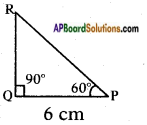
In right angle triangle △PQR, right angle is at Q and PQ = 6 cms, ∠RPQ = 60°. Determine the lengths of QR and PR.
Answer:
Given that △PQR is a right angled triangle, right angle is at Q and PQ = 6 cm, ∠RPQ = 60°.
AP SSC 10th Class Maths Solutions Chapter 11 Trigonometry Ex 11.2 9
tan 60° = \(\frac{\text { Opposite side to } \angle P}{\text { Adjacent side to } \angle P}\)
√3 = \(\frac{RQ}{6}\)
which gives RQ = 6√3 cm ……. (1)
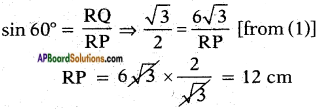
To find the length of the side RQ, we consider
AP SSC 10th Class Maths Solutions Chapter 11 Trigonometry Ex 11.2 10
∴ The length of QR is 6√3 and RP is 12 cm.

Question 6.
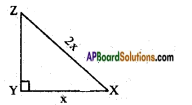
In △XYZ, right angle is at Y, YZ = x, and XY = 2x then determine ∠YXZ and ∠YZX.
Answer:
Note: In the problem take
YX = x, and XZ = 2x.
AP SSC 10th Class Maths Solutions Chapter 11 Trigonometry Ex 11.2 11
Given that △XYZ is a right angled triangle and right angle at Y, and YX = x and XZ = 2x.
By Pythagoras theorem
XZ2 = XY2 + YZ2
(2x)2 = (x)2 + YZ2
4x2 = x2 + YZ2
YZ2 = 4x2 – x2 = 3x2
YZ = \(\sqrt{3 x^{2}}\) = √3x
Now, from the △XYZ
tan X = \(\frac{XZ}{XY}\) = \(\frac{\sqrt{3} x}{x}\)
tan X = √3 = tan 60°
∴ Angle YXZ is 60°.
tan Z = \(\frac{XY}{YZ}\) = \(\frac{x}{\sqrt{3} x}\)
tan Z = \(\frac{1}{\sqrt{3}}\) = tan 30°
∴ Angle YZX is 30°.
Hence ∠YXZ and ∠YZX are 60° and 30°.

AP SSC 10th Class Maths Solutions Chapter 11 Trigonometry Ex 11.2

Question 7.
Is it right to say that
sin (A + B) = sin A + sin B? Justify your answer.
Answer:
Let A = 30° and B = 60°
L.H.S = sin (A + B)
= sin (30° + 60°) = sin 90° = 1
R.H.S = sin 30° + sin 60°
= \(\frac{1}{2}\) + \(\frac{\sqrt{3}}{2}\)
= \(\frac{\sqrt{3}+1}{2}\)
Hence L.H.S ≠ R.H.S
So, it is not right to say that sin (A + B) = sin A + sin B

AP SSC 10th Class Maths Solutions Chapter 7 Coordinate Geometry Ex 7.3

AP State Board Syllabus AP SSC 10th Class Maths Textbook Solutions Chapter 7 Coordinate Geometry Ex 7.3 Textbook Questions and Answers.

AP State Syllabus SSC 10th Class Maths Solutions 7th Lesson Coordinate Geometry Exercise 7.3

10th Class Maths 7th Lesson Coordinate Geometry Ex 7.3 Textbook Questions and Answers

Question 1.
Find the area of the triangle whose vertices are
i) (2, 3), (-1, 0), (2,-4)
Answer:
Given: A (2, 3), B (- 1, 0) and C (2, – 4) are the vertices of a △ABC.
Area of the triangle ABC = \(\frac{1}{2}\left|\mathrm{x}_{1}\left(\mathrm{y}_{2}-\mathrm{y}_{3}\right)+\mathrm{x}_{2}\left(\mathrm{y}_{3}-\mathrm{y}_{1}\right)+\mathrm{x}_{3}\left(\mathrm{y}_{1}-{\mathrm{y}}_{2}\right)\right|\)
= \(\frac{1}{2}|2(0+4)-1(-4-3)+2(3-0)|\)
= \(\frac{1}{2}|8+7+6|\)
= \(\frac{21}{2}\)
= 10\(\frac{1}{2}\) sq.units

ii) (-5, -1), (3, -5), (5, 2)
Answer:
Given: A (- 5, – 1), B (3, – 5) and C (5, 2) are the vertices of △ABC.
Area of the △ABC
= \(\frac{1}{2}\left|\mathrm{x}_{1}\left(\mathrm{y}_{2}-\mathrm{y}_{3}\right)+\mathrm{x}_{2}\left(\mathrm{y}_{3}-\mathrm{y}_{1}\right)+\mathrm{x}_{3}\left(\mathrm{y}_{1}-{\mathrm{y}}_{2}\right)\right|\)
= \(\frac{1}{2}|-5(-5-2)+3(2+1)+5(-1+5)|\)
= \(\frac{1}{2}|35+9+20|\)
= \(\frac{64}{2}\)
= 32 sq.units

AP SSC 10th Class Maths Solutions Chapter 7 Coordinate Geometry Ex 7.3

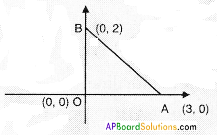
iii) (0, 0), (3, 0), (0, 2)
Answer:
Given: O (0, 0), A (3, 0) and B (0, 2) are the vertices of a triangle, △AOB.
Area of the △AOB
= \(\frac{1}{2}\left|\mathrm{x}_{1}\left(\mathrm{y}_{2}-\mathrm{y}_{3}\right)+\mathrm{x}_{2}\left(\mathrm{y}_{3}-\mathrm{y}_{1}\right)+\mathrm{x}_{3}\left(\mathrm{y}_{1}-{\mathrm{y}}_{2}\right)\right|\)
= \(\frac{1}{2}|0(0-2)+3(2-0)+0(0-0)|\)
= \(\frac{1}{2}|6|\)
= 3 sq.units

Or
AP SSC 10th Class Maths Solutions Chapter 7 Coordinate Geometry Ex 7.3 1
△AOB = \(\frac{1}{2}\) × OA × OB
= \(\frac{1}{2}\) × 3 × 2
= 3 sq.units

Question 2.
Find the value of ‘K’ for which the points are collinear.
i) (7, -2), (5, 1), (3, K)
Answer:
Given: A (7, – 2), B (5, 1) and C (3, K) are collinear.
∴ Area of △ABC = 0
But area of triangle
\(\frac{1}{2}\left|\mathrm{x}_{1}\left(\mathrm{y}_{2}-\mathrm{y}_{3}\right)+\mathrm{x}_{2}\left(\mathrm{y}_{3}-\mathrm{y}_{1}\right)+\mathrm{x}_{3}\left(\mathrm{y}_{1}-{\mathrm{y}}_{2}\right)\right|\)
⇒ \(\frac{1}{2} \mid 7(1-\mathrm{K})+5(\mathrm{~K}+2)+3(-2-1)\) = 0
⇒ \(|7-7 K+5 K+10-9|\) = 0
⇒ \(|-2 \mathrm{~K}+8|\) = 0
⇒ -2K + 8 = 0
⇒ -2K = -8
⇒ K = \(\frac{8}{2}\)
i.e., K = 4

ii) (8, 1), (K,-4), (2,-5)
Answer:
Given: A (8, 1), B(K, – 4) and C (2, – 5) are collinear.
∴ Area of △ABC = 0
⇒ \(\frac{1}{2}\left|\mathrm{x}_{1}\left(\mathrm{y}_{2}-\mathrm{y}_{3}\right)+\mathrm{x}_{2}\left(\mathrm{y}_{3}-\mathrm{y}_{1}\right)+\mathrm{x}_{3}\left(\mathrm{y}_{1}-{\mathrm{y}}_{2}\right)\right|\) = 0
⇒ \(\frac{1}{2}|8(-4+5)+\mathrm{K}(-5-1)+2(1+4)|\) = 0
⇒ \(|8-6 \mathrm{~K}+10|\) = 0
⇒ \(|18-6 \mathrm{~K}|\) = 0
⇒ 18 – 6K = 0
⇒ 6K = 18
⇒ K = \(\frac{18}{6}\)
i.e., K = 3

iii) (K,K), (2, 3), and (4,-1)
Answer:
A (K, K), B (2, 3) and C (4, – 1) are collinear.
∴ Area of △ABC = 0
⇒ \(\frac{1}{2}\left|\mathrm{x}_{1}\left(\mathrm{y}_{2}-\mathrm{y}_{3}\right)+\mathrm{x}_{2}\left(\mathrm{y}_{3}-\mathrm{y}_{1}\right)+\mathrm{x}_{3}\left(\mathrm{y}_{1}-{\mathrm{y}}_{2}\right)\right|\) = 0
⇒ \(\frac{1}{2}|\mathrm{~K}(3+1)+2(-1-\mathrm{K})+4(\mathrm{~K}-3)|\) = 0
⇒ \(|4K-2-2K+4K-12|\) = 0
⇒ \(|6 \mathrm{~K}-14|\) = 0
⇒ 6K – 14 = 0
⇒ 6K = 14
⇒ K = \(\frac{14}{6}\) = \(\frac{7}{3}\)
∴ K = \(\frac{7}{3}\)

AP SSC 10th Class Maths Solutions Chapter 7 Coordinate Geometry Ex 7.3

Question 3.
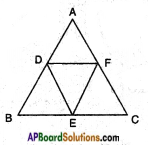
Find the area of the triangle formed by joining the mid-points of the sides of the triangle whose vertices are (0, -1), (2, 1) and (0, 3). Find the ratio of this area to the area of the given triangle.
Answer:
AP SSC 10th Class Maths Solutions Chapter 7 Coordinate Geometry Ex 7.3 2
Given: A (0, – 1), B (2, 1) and C (0, 3) are the vertices of △ABC.
Let D, E and F be the midpoints of the sides \(\overline{\mathrm{AB}}\), \(\overline{\mathrm{BC}}\) and \(\overline{\mathrm{AC}}\).
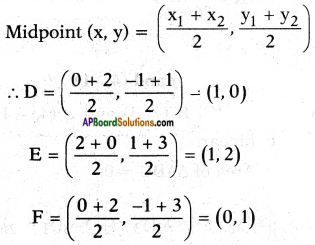
AP SSC 10th Class Maths Solutions Chapter 7 Coordinate Geometry Ex 7.3 3
Area of a triangle ABC =
\(\frac{1}{2}\left|\mathrm{x}_{1}\left(\mathrm{y}_{2}-\mathrm{y}_{3}\right)+\mathrm{x}_{2}\left(\mathrm{y}_{3}-\mathrm{y}_{1}\right)+\mathrm{x}_{3}\left(\mathrm{y}_{1}-{\mathrm{y}}_{2}\right)\right|\)
= \(\frac{1}{2}|0(1-3)+2(3+1)+0(-1-1)|\)
= \(\frac{1}{2}|8|\)
= 4 sq.units
Area of △DEF = \(\frac{1}{2}|1(2-1)+1(1-0)+0(0-2)|\)
= \(\frac{1}{2}|1+1|\)
= \(\frac{2}{2}\)
= 1 sq.units
Ratio of areas = △ABC : △DEF = 4 : 1.
△ADF ≅ △BED ≅ △DEF ≅ △CEF
∴ △ABC : △DEF = 4 : 1

Question 4.
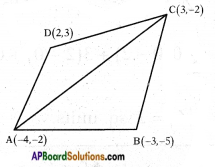
Find the area of the quadrilateral whose vertices taken inorder are (-4, -2), (-3, -5),(3, -2) and (2, 3).
Answer:
AP SSC 10th Class Maths Solutions Chapter 7 Coordinate Geometry Ex 7.3 4
Given: A (- 4, – 2), B (- 3, – 5), C (3, – 2) and D (2, 3) are the vertices of the quadrilateral ▱ ABCD.
Area of ▱ ABCD = △ABC + △ACD.
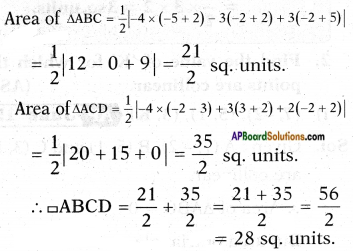
Area of a triangle =
\(\frac{1}{2}\left|\mathrm{x}_{1}\left(\mathrm{y}_{2}-\mathrm{y}_{3}\right)+\mathrm{x}_{2}\left(\mathrm{y}_{3}-\mathrm{y}_{1}\right)+\mathrm{x}_{3}\left(\mathrm{y}_{1}-{\mathrm{y}}_{2}\right)\right|\)
AP SSC 10th Class Maths Solutions Chapter 7 Coordinate Geometry Ex 7.3 5

AP SSC 10th Class Maths Solutions Chapter 7 Coordinate Geometry Ex 7.3

Question 5.
Find the area of the triangle formed by the points by using Heron’s formula.
i) (1, 1), (1, 4) and (5, 1)
ii) (2, 3), (-1,3) and (2, -1)
Answer:
i) (1, 1) (1, 4) and (5, 1)
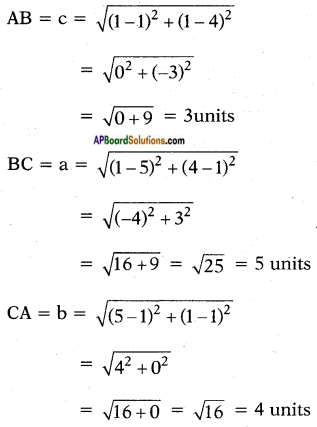
let A (1, 1) B(l, 4) and C(5, 1) are the vertices then length of sides can be calculated using the formula
\(\sqrt{\left(x_{2}-x_{1}\right)^{2}+\left(y_{2}-y_{1}\right)^{2}}\)
now
AP SSC 10th Class Maths Solutions Chapter 7 Coordinate Geometry Ex 7.3 6
now formula for area of triangle using Heron’s formula = △ = \(\sqrt{s(s-a)(s-b)(s-c)}\)
where s = \(\frac{a+b+c}{2}\)
∴ s = \(\frac{3+4+5}{2}\) = \(\frac{12}{2}\) = 6
∴ △ = \(\sqrt{6(6-5)(6-4)(6-3)}\)
= \(\sqrt{6 \times 1 \times 2 \times 3}\)
= \(\sqrt{6 \times 6}\)
= 6 sq. units
∴ area of given triangle = 6 sq units

ii) let the vertices of given triangle A (2, 3), B (-l, 3) and C (2, -1)
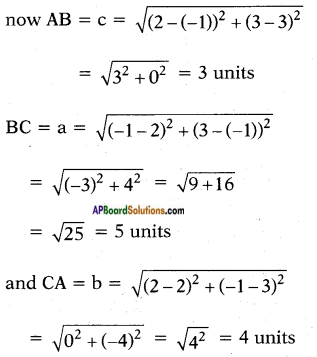
AP SSC 10th Class Maths Solutions Chapter 7 Coordinate Geometry Ex 7.3 7
∴ a = 5, b = 4, c = 3 units
now from using Heron’s formula area of triangle
= △ = \(\sqrt{s(s-a)(s-b)(s-c)}\)
where s = \(\frac{a+b+c}{2}\)
= \(\frac{5+4+3}{2}\)
= \(\frac{12}{2}\) = 6
∴ △ = \(\sqrt{6(6-5)(6-4)(6-3)}\)
= \(\sqrt{6 \times 1 \times 2 \times 3}\)
= \(\sqrt{6 \times 6}\)
= 6 sq. units
∴ area of given triangle = 6 sq units

AP SSC 10th Class Maths Solutions Chapter 11 Trigonometry Ex 11.1

AP State Board Syllabus AP SSC 10th Class Maths Textbook Solutions Chapter 11 Trigonometry Ex 11.1 Textbook Questions and Answers.

AP State Syllabus SSC 10th Class Maths Solutions 11th Lesson Trigonometry Exercise 11.1

10th Class Maths 11th Lesson Trigonometry Ex 11.1 Textbook Questions and Answers

Question 1.
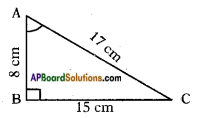
In right angle triangle ABC, 8 cm, 15 cm and 17 cm are the lengths of AB, BC and CA respectively. Then, find out sin A, cos A and tan A.
Answer:
Given that
△ABC is a right angle triangle and Lengths of AB, BC and CA are 8 cm, 15 cm and 17 cm respectively.
Among the given lengths CA is longest.
Hence CA is the hypotenuse in △ABC and its opposite vertex having right angle.
i.e., ∠B = 90°.
With reference to ∠A, we have opposite side = BC = 15 cm
adjacent side = AB = 8 cm
and hypotenuse = AC = 17
AP SSC 10th Class Maths Solutions Chapter 11 Trigonometry Ex 11.1 1
sin A = \(\frac{\text { Opposite side of } \angle \mathrm{A}}{\text { Hypotenuse }}\) = \(\frac{BC}{AC}\) = \(\frac{15}{17}\)
cos A = \(\frac{\text { Adjacent side of } \angle \mathrm{A}}{\text { Hypotenuse }}\) = \(\frac{AB}{AC}\) = \(\frac{8}{17}\)
tan A = \(\frac{\text { Opposite side of } \angle \mathrm{A}}{\text { Adjacent side of } \angle \mathrm{A}}\) = \(\frac{BC}{AB}\) = \(\frac{15}{8}\)
∴ sin A = \(\frac{15}{17}\);
cos A = \(\frac{8}{17}\)
tan A = \(\frac{15}{8}\)

AP SSC 10th Class Maths Solutions Chapter 11 Trigonometry Ex 11.1

Question 2.
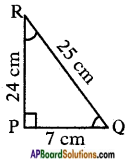
The sides of a right angle triangle PQR are PQ = 7 cm, QR = 25 cm and ∠P = 90° respectively. Then find, tan Q – tan R.
Answer:
AP SSC 10th Class Maths Solutions Chapter 11 Trigonometry Ex 11.1 2
Given that △PQR is a right angled triangle and PQ = 7 cm, QR = 25 cm.
By Pythagoras theorem QR2 = PQ2 + PR2
(25)2 = (7)2 + PR2
PR2 = (25)2 – (7)2 = 625 – 49 = 576
PR = √576 = 24 cm
tan Q = \(\frac{PR}{PQ}\) = \(\frac{24}{7}\);
tan R = \(\frac{PQ}{PR}\) = \(\frac{7}{24}\)
∴ tan Q – tan R = \(\frac{24}{7}\) – \(\frac{7}{24}\)
= \(\frac{(24)^{2}-(7)^{2}}{168}\)
= \(\frac{576-49}{168}\)
= \(\frac{527}{168}\)

Question 3.
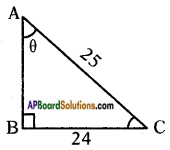
In a right angle triangle ABC with right angle at B, in which a = 24 units, b = 25 units and ∠BAC = θ. Then, find cos θ and tan θ.
Answer:
Given that ABC is a right angle triangle with right angle at B, and BC = a = 24 units, CA = b = 25 units and ∠BAC = θ.
AP SSC 10th Class Maths Solutions Chapter 11 Trigonometry Ex 11.1 3
By Pythagoras theorem
AC2 = AB2 + BC2
(25)2 = AB2 + (24)2
AB2 = 252 – 242 = 625 – 576
AB2 = 49
AB = √49 = 1
With reference to ∠BAC = θ, we have
Opposite side to θ = BC = 24 units.
Adjacent side to θ = AB = 7 units.
Hypotenuse = AC = 25 units.
Now
cos θ = \(\frac{\text { Adjacent side of } \theta}{\text { Hypotenuse }}\) = \(\frac{AB}{AC}\) = \(\frac{7}{25}\)
tan θ = \(\frac{\text { Opposite side of } \theta}{\text { Adjacent side of } \theta}\) = \(\frac{BC}{AB}\) = \(\frac{24}{7}\)
Hence cos θ = \(\frac{7}{25}\) and tan θ = \(\frac{24}{7}\)

AP SSC 10th Class Maths Solutions Chapter 11 Trigonometry Ex 11.1

Question 4.
If cos A = \(\frac{12}{13}\), then find sin A and tan A.
Answer:
From the identity
sin2 A + cos2 A = 1
⇒ sin2 A = 1 – cos2 A
= 1 – \(\left(\frac{12}{13}\right)^{2}\)
= 1 – \(\frac{144}{169}\)
= \(\frac{169-144}{169}\)
= \(\frac{25}{169}\)
∴ sin A = \(\sqrt{\frac{25}{169}}\) = \(\frac{5}{13}\)
AP SSC 10th Class Maths Solutions Chapter 11 Trigonometry Ex 11.1 4
∴ sin A = \(\frac{5}{13}\); tan A = \(\frac{5}{12}\)

Question 5.
If 3 tan A = 4, then find sin A and cos A.
Answer:
Given 3 tan A = 4
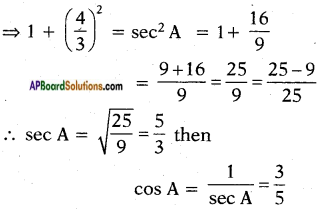
⇒ tan A = \(\frac{4}{3}\)
From the identify sec2 A – tan2 A = 1
⇒ 1 + tan2 A = sec2 A
AP SSC 10th Class Maths Solutions Chapter 11 Trigonometry Ex 11.1 5
If cos A = \(\frac{3}{5}\) then from
sin2 A + cos2 A = 1
We can write sin2A = 1 – cos2A
= 1 – \(\left(\frac{3}{5}\right)^{2}\)
= 1 – \(\frac{9}{25}\)
⇒ sin2 A = \(\frac{16}{25}\)
⇒ sin A = \(\frac{4}{5}\)
∴ sin A = \(\frac{4}{5}\); cos A = \(\frac{3}{5}\)

AP SSC 10th Class Maths Solutions Chapter 11 Trigonometry Ex 11.1

Question 6.
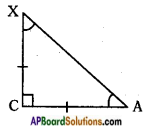
In △ABC and △XYZ, if ∠A and ∠X are acute angles such that cos A = cos X then show that ∠A = ∠X.
Answer:
AP SSC 10th Class Maths Solutions Chapter 11 Trigonometry Ex 11.1 6
In the given triangle, cos A = cos X
⇒ \(\frac{AC}{AX}\) = \(\frac{XC}{AX}\)
⇒ AC = XC
⇒ ∠A = ∠X (∵ Angles opposite to equal sides are also equal)

Question 7.
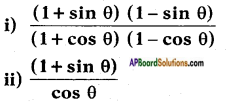
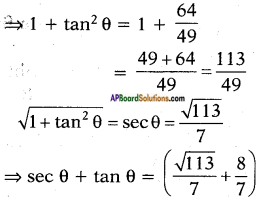
Given cot θ = \(\frac{7}{8}\), then evaluate
AP SSC 10th Class Maths Solutions Chapter 11 Trigonometry Ex 11.1 7
Answer:
AP SSC 10th Class Maths Solutions Chapter 11 Trigonometry Ex 11.1 8
cot2 θ = (cot θ)2
= \(\left(\frac{7}{8}\right)^{2}\) = \(\frac{49}{64}\) …… (1)
AP SSC 10th Class Maths Solutions Chapter 11 Trigonometry Ex 11.1 9
= sec θ + tan θ
So cot θ = \(\frac{7}{8}\)
⇒ tan θ = \(\frac{8}{7}\)
⇒ tan2 θ = \(\left(\frac{8}{7}\right)^{2}\) = \(\frac{64}{49}\)
From sec2 θ – tan2 θ = 1
⇒ 1 + tan2 θ = sec2 θ
AP SSC 10th Class Maths Solutions Chapter 11 Trigonometry Ex 11.1 9

AP SSC 10th Class Maths Solutions Chapter 11 Trigonometry Ex 11.1

Question 8.
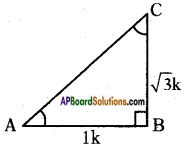
In a right angle triangle ABC, right angle is at B, if tan A = √3, then find the value of
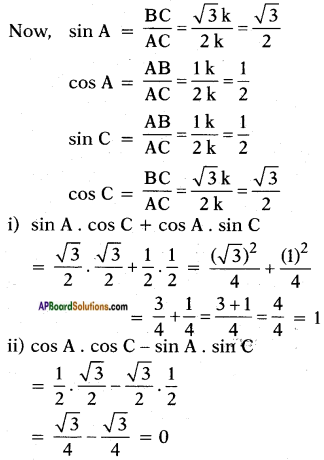
i) sin A cos C + cos A sin C
ii) cos A cos C – sin A sin C
Answer:
Given, tan A = \(\frac{\sqrt{3}}{1}\)
Hence \(\frac{\text { Opposite side }}{\text { Adjacent side }}=\frac{\sqrt{3}}{1}\)
Let opposite side = √3k and adjacent side = 1k
AP SSC 10th Class Maths Solutions Chapter 11 Trigonometry Ex 11.1 12a
In right angled △ABC,
AC2 = AB2 + BC2
(By Pythagoras theorem)
⇒ AC2 = (1k)2 + (√3k)2
⇒ AC2 = 1k2 + 3k2
⇒ AC2 = 4k2
∴ AC = \(\sqrt{4 k^{2}}\) = 2k
AP SSC 10th Class Maths Solutions Chapter 11 Trigonometry Ex 11.1 11

AP SSC 10th Class Maths Solutions Chapter 11 Trigonometry Ex 11.4

AP State Board Syllabus AP SSC 10th Class Maths Textbook Solutions Chapter 11 Trigonometry Ex 11.4 Textbook Questions and Answers.

AP State Syllabus SSC 10th Class Maths Solutions 11th Lesson Trigonometry Exercise 11.4

10th Class Maths 11th Lesson Trigonometry Ex 11.4 Textbook Questions and Answers

Question 1.
Evaluate the following:
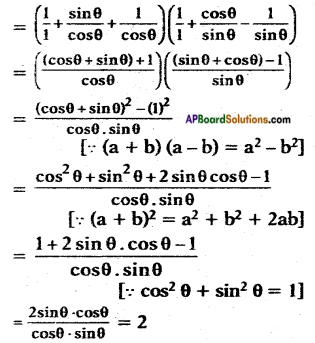
i) (1 + tan θ + sec θ) (1 + cot θ – cosec θ)
Answer:
Given (1 + tan θ + sec θ) (1 + cot θ – cosec θ)
AP SSC 10th Class Maths Solutions Chapter 11 Trigonometry Ex 11.4 1

ii) (sin θ + cos θ)2 + (sin θ – cos θ)2
Answer:
Given (sin θ + cos θ)2 + (sin θ – cos θ)2
= (sin2 θ + cos2 θ + 2 sin θ cos θ) + (sin2 θ + cos2 θ – 2 sin θ cos θ) [∵ (a + b)2 = a2 + b2 + 2ab
(a – b)2 = a2 + b2 – 2ab]
= 1 + 2 sin θ cos θ + 1 – 2 sin θ cos θ [∵ sin2 θ + cos2 θ = 1]
= 1 + 1
= 2

iii) (sec2 θ – 1) (cosec2 θ – 1)
Answer:
Given (sec2 θ – 1) (cosec2 θ – 1)
= tan2 θ × cot2 θ [∵ sec2 θ – tan2 θ = 1; cosec2 θ – cot2 θ = 1]
= tan2 θ × \(\frac{1}{\tan ^{2} \theta}\) = 1

AP SSC 10th Class Maths Solutions Chapter 11 Trigonometry Ex 11.4

Question 2.
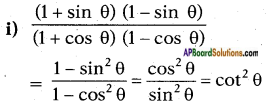
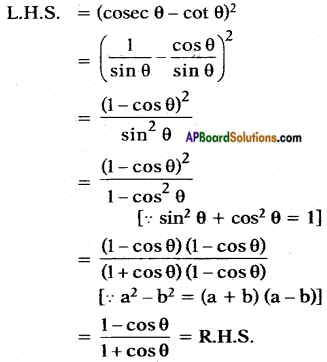
Show that (cosec θ – cot θ)2 = \(\frac{1-\cos \theta}{1+\cos \theta}\)
Answer:
AP SSC 10th Class Maths Solutions Chapter 11 Trigonometry Ex 11.4 2

Question 3.
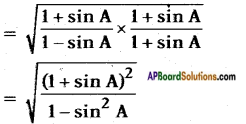
Show that \(\sqrt{\frac{1+\sin A}{1-\sin A}}\) = sec A + tan A
Answer:
Given that L.H.S. = \(\sqrt{\frac{1+\sin A}{1-\sin A}}\)
Rationalise the denominator, rational factor of 1 – sin A is 1 + sin A.
AP SSC 10th Class Maths Solutions Chapter 11 Trigonometry Ex 11.4 3
[∵ (a + b)(a + b) = (a + b)2]; (a – b)(a + b) = a2 — b2]
= \(\sqrt{\frac{(1+\sin A)^{2}}{\cos ^{2} A}}\)
= \(\frac{1+\sin A}{\cos A}\)
= \(\frac{1}{\cos A}+\frac{\sin A}{\cos A}\)
= sec A + tan A = R.H.S.

AP SSC 10th Class Maths Solutions Chapter 11 Trigonometry Ex 11.4

Question 4.
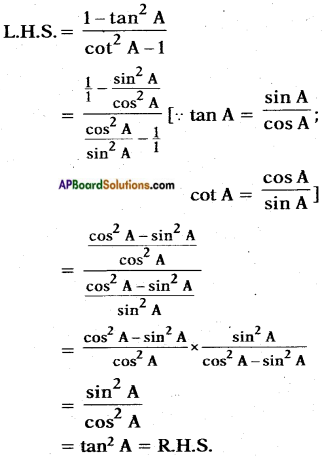
Show that \(\frac{1-\tan ^{2} A}{\cot ^{2} A-1}\) = tan2 A
Answer:
AP SSC 10th Class Maths Solutions Chapter 11 Trigonometry Ex 11.4 4

Question 5.
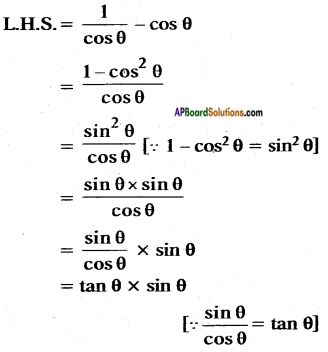
Show that \(\frac{1}{\cos \theta}\) – cos θ = tan θ – sin θ.
Answer:
AP SSC 10th Class Maths Solutions Chapter 11 Trigonometry Ex 11.4 5

AP SSC 10th Class Maths Solutions Chapter 11 Trigonometry Ex 11.4

Question 6.
Simplify sec A (1 – sin A) (sec A + tan A)
Answer:
L.H.S. = sec A (1 – sin A) (sec A + tan A)
= (sec A – sec A . sin A) (sec A + tan A)
= (sec A – \(\frac{1}{\cos A}\) . sin A) (sec A + tan A)
= (sec A – tan A) (sec A + tan A)
= sec2 A – tan2 A [∵ sec2 A – tan2 A = 1]
= 1

Question 7.
Prove that (sin A + cosec A)2 + (cos A + sec A)2 = 7 + tan2 A + cot2 A
Answer:
L.H.S. = (sin A + cosec A)2 + (cos A + sec A)2
= (sin2 A + cosec2 A + 2 sin A . cosec A) + (cos2 A – sec2 A + 2 cos A . sec A) [∵ (a + b)2 = a2 + b2 + 2ab]
= (sin2 A + cos2 A) + cosec2 A + 2 sin A . \(\frac{1}{\sin A}\) + sec2 A + 2 cos A . \(\frac{1}{\cos A}\)
[∵ \(\frac{1}{\sin A}\) = cosec A; \(\frac{1}{\cos A}\) = sec A]
= 1 +(1 + cot2 A) + 2 + (1 + tan2 A) + 2
[∵ sin2 A + cos2 A = 1; cosec2 A = 1 + cot2 A; sec2 A = 1 + tan2 A]
= 7 + tan2 A + cot2 A
= R.H.S.

Question 8.
Simplify (1 – cos θ) (1 + cos θ) (1 + cot2 θ)
Answer:
Given that
(1 – cos θ) (1 + cos θ) (1 + cot2 θ)
= (1 – cos2 θ) (1 + cot2 θ)
[∵ (a – b) (a + b) = a2 – b2]
= sin2 θ. cosec2 θ [∵ 1 – cos2 θ = sin2 θ; 1 + cot2 θ = cosec2 θ]
= sin2 θ . \(\frac{1}{\sin ^{2} \theta}\) [∵ cosec θ = \(\frac{1}{\sin \theta}\)]
= 1

AP SSC 10th Class Maths Solutions Chapter 11 Trigonometry Ex 11.4

Question 9.
If sec θ + tan θ = p, then what is the value of sec θ – tan θ?
Answer:
Given that sec θ + tan θ = p ,
We know that sec2 θ – tan2 θ = 1
sec2 θ – tan2 θ = (sec θ + tan θ) (sec θ – tan θ)
= p (sec θ – tan θ)
= 1 (from given)
⇒ sec θ – tan θ = \(\frac{1}{p}\)

Question 10.
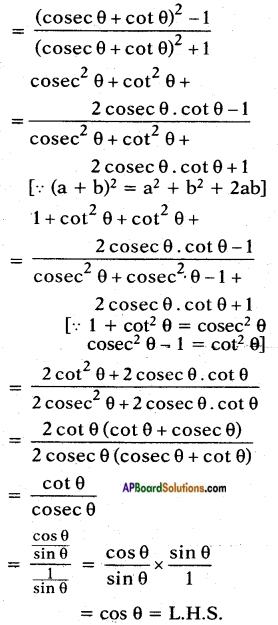
If cosec θ + cot θ = k, then prove that cos θ = \(\frac{k^{2}-1}{k^{2}+1}\)
Answer:
Method-I:
Given that cosec θ + cot θ = k
R.H.S. = \(\frac{k^{2}-1}{k^{2}+1}\)
AP SSC 10th Class Maths Solutions Chapter 11 Trigonometry Ex 11.4 6

AP SSC 10th Class Maths Solutions Chapter 11 Trigonometry Ex 11.4

Method – II:
Given that cosec θ + cot θ = k ……..(1)
We know that cosec2 θ – cot2 θ = 1
⇒ (cosec θ + cot θ) (cosec θ – cot θ) = 1 [∵ a2 – b2 = (a -b)(a + b)]
⇒ k (cosec θ – cot θ) = 1
⇒ (cosec θ – cot θ) = \(\frac{1}{k}\)
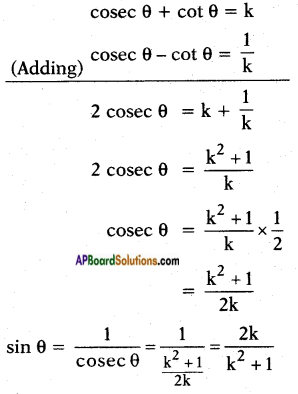
By solving (1) and (2)
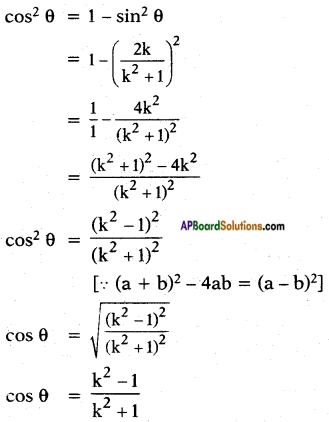
AP SSC 10th Class Maths Solutions Chapter 11 Trigonometry Ex 11.4 7
According to identity cos2 θ + sin2 θ = 1
AP SSC 10th Class Maths Solutions Chapter 11 Trigonometry Ex 11.4 8
Hence proved.

AP SSC 10th Class Maths Solutions Chapter 8 Similar Triangles Ex 8.1

AP State Board Syllabus AP SSC 10th Class Maths Textbook Solutions Chapter 8 Similar Triangles Ex 8.1 Textbook Questions and Answers.

AP State Syllabus SSC 10th Class Maths Solutions 8th Lesson Similar Triangles Exercise 8.1

10th Class Maths 8th Lesson Similar Triangles Ex 8.1 Textbook Questions and Answers

Question 1.
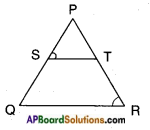
In △PQR, ST is a line such that \(\frac{PS}{SQ}\) = \(\frac{PT}{TR}\) and also ∠PST = ∠PRQ.
Prove that △PQR is an isosceles triangle.
Answer:
Given : In △PQR,
\(\frac{PS}{SQ}\) = \(\frac{PT}{TR}\) and ∠PST= ∠PRQ.
AP SSC 10th Class Maths Solutions Chapter 8 Similar Triangles Ex 8.1 1
R.T.P: △PQR is isosceles.
Proof: \(\frac{PS}{SQ}\) = \(\frac{PT}{TR}\)
Hence, ST || QR (Converse of Basic proportionality theorem)
∠PST = ∠PQR …….. (1)
(Corresponding angles for the lines ST || QR)
Also, ∠PST = ∠PRQ ……… (2) given
From (1) and (2),
∠PQR = ∠PRQ
i.e., PR = PQ
[∵ In a triangle sides opposite to equal angles are equal]
Hence, APQR is an isosceles triangle.

AP SSC 10th Class Maths Solutions Chapter 8 Similar Triangles Ex 8.1

Question 2.
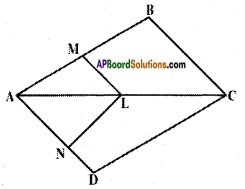
In the given figure, LM || CM and LN || CD. Prove that \(\frac{AM}{AB}\) = \(\frac{AN}{AD}\).
AP SSC 10th Class Maths Solutions Chapter 8 Similar Triangles Ex 8.1 2
Answer:
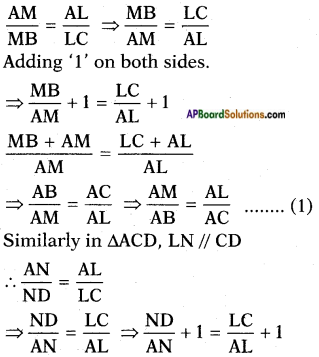
Given : LM || CB and LN || CD In △ABC, LM || BC (given) Hence,
AP SSC 10th Class Maths Solutions Chapter 8 Similar Triangles Ex 8.1 3
Adding ‘1’ on both sides.
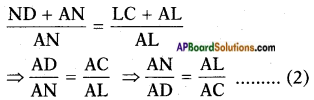
AP SSC 10th Class Maths Solutions Chapter 8 Similar Triangles Ex 8.1 4
From (1) and (2)
∴ \(\frac{AM}{AB}\) = \(\frac{AN}{AD}\).

Question 3.
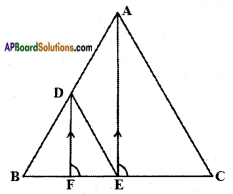
In the given figure, DE || AC and DF || AE. Prove that \(\frac{BF}{FE}\) = \(\frac{BE}{AC}\).
AP SSC 10th Class Maths Solutions Chapter 8 Similar Triangles Ex 8.1 5
Answer:
In △ABC, DE || AC
Hence \(\frac{BE}{EC}\) = \(\frac{BD}{DA}\) ………. (1)
[∵ A line drawn parallel to one side of a triangle divides the other two sides in the same ratio – Basic proportionality theorem]
Also in △ABE, DF || AE
Hence \(\frac{BF}{FE}\) = \(\frac{BD}{DA}\) ………. (2)
From (1) and (2), \(\frac{BF}{FE}\) = \(\frac{BE}{AC}\) Hence proved.

AP SSC 10th Class Maths Solutions Chapter 8 Similar Triangles Ex 8.1

Question 4.
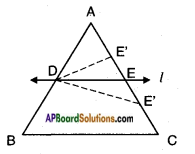
Prove that a line drawn through the mid-point of one side of a triangle parallel to another side bisects the third side (Using Basic proportionality theorem).
Answer:
AP SSC 10th Class Maths Solutions Chapter 8 Similar Triangles Ex 8.1 6
Given: In △ABC; D is the mid-point of AB.
A line ‘l’ through D, parallel to BC, meeting AC at E.
R.T.P: E is the midpoint of AC.
Proof:
DE || BC (Given)
then
\(\frac{AD}{DB}\) = \(\frac{AE}{EC}\)(From Basic Proportional theorem)
Also given ‘D’ is mid point of AB.
Then AD = DB.
⇒ \(\frac{AD}{DB}\) = \(\frac{DB}{DB}\) = \(\frac{AE}{EC}\) = 1
⇒ AE = EC
∴ ‘E’ is mid point of AC
∴ The line bisects the third side \(\overline{\mathrm{AC}}\).
Hence proved.

Question 5.
Prove that a line joining the mid points of any two sides of a triangle is parallel to the third side. (Using converse of Basic proportionality theorem)
Answer:
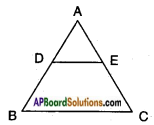
Given: △ABC, D is the midpoint of AB and E is the midpoint of AC.
R.T.P : DE || BC.
Proof:
AP SSC 10th Class Maths Solutions Chapter 8 Similar Triangles Ex 8.1 7
Since D is the midpoint of AB, we have AD = DB ⇒ \(\frac{AD}{DB}\) = 1 ……. (1)
also ‘E’ is the midpoint of AC, we have AE = EC ⇒ \(\frac{AE}{EC}\) = 1 ……. (2)
From (1) and (2)
\(\frac{AD}{DB}\) = \(\frac{AE}{EC}\)
If a line divides any two sides of a triangle in the same ratio then it is parallel to the third side.
∴ DE || BC by Basic proportionality theorem.
Hence proved.

AP SSC 10th Class Maths Solutions Chapter 8 Similar Triangles Ex 8.1

Question 6.
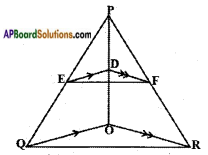
In the given figure, DE || OQ and DF || OR. Show that EF || QR.
AP SSC 10th Class Maths Solutions Chapter 8 Similar Triangles Ex 8.1 8
Answer:
Given: △PQR, DE || OQ; DF || OR
R.T.P: EF || QR
Proof:
In △POQ;
\(\frac{PE}{EQ}\) = \(\frac{PD}{DO}\) ……. (1)
[∵ ED || QO, Basic proportionality theorem]
In △POR; \(\frac{PF}{FR}\) = \(\frac{PD}{DO}\) ……. (2) [∵ DF || OR, Basic Proportionality Theorem]
From (1) and (2),
\(\frac{PE}{EQ}\) = \(\frac{PF}{FR}\)
Thus the line \(\overline{\mathrm{EF}}\) divides the two sides PQ and PR of △PQR in the same ratio.
Hence, EF || QR. [∵ Converse of Basic proportionality theorem]

Question 7.
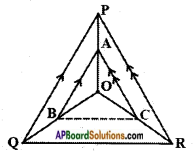
In the given figure A, B and C are points on OP, OQ and OR respec¬tively such that AB || PQ and AC || PR. Show that BC || QR.
AP SSC 10th Class Maths Solutions Chapter 8 Similar Triangles Ex 8.1 9
Answer:
Given:
In △PQR, AB || PQ; AC || PR
R.T.P : BC || QR
Proof: In △POQ; AB || PQ
\(\frac{OA}{AP}\) = \(\frac{OB}{BQ}\) ……… (1)
(∵ Basic Proportional theorem)
and in △OPR, Proof: In △POQ; AB || PQ
\(\frac{OA}{AP}\) = \(\frac{OC}{CR}\) ……… (2)
From (1) and (2), we can write
\(\frac{OB}{BQ}\) = \(\frac{OC}{CR}\)
Then consider above condition in △OQR then from (3) it is clear.
∴ BC || QR [∵ from converse of Basic Proportionality Theorem]
Hence proved.

AP SSC 10th Class Maths Solutions Chapter 8 Similar Triangles Ex 8.1

Question 8.
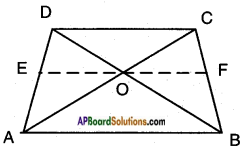
ABCD is a trapezium in which AB || DC and its diagonals intersect each other at point ‘O’. Show that\(\frac{AO}{BO}\) = \(\frac{CO}{DO}\).
Answer:
Given: In trapezium □ ABCD, AB || CD. Diagonals AC, BD intersect at O.
R.T.P: \(\frac{AO}{BO}\) = \(\frac{CO}{DO}\)
AP SSC 10th Class Maths Solutions Chapter 8 Similar Triangles Ex 8.1 10
Construction:
Draw a line EF passing through the point ‘O’ and parallel to CD and AB.
Proof: In △ACD, EO || CD
∴ \(\frac{AO}{CO}\) = \(\frac{AE}{DE}\) …….. (1)
[∵ line drawn parallel to one side of a triangle divides other two sides in the same ratio by Basic proportionality theorem]
In △ABD, EO || AB
Hence, \(\frac{DE}{AE}\) = \(\frac{DO}{BO}\)
[∵ Basic proportionality theorem]
\(\frac{BO}{DO}\) = \(\frac{AE}{ED}\) …….. (2) [∵ Invertendo]
From (1) and (2),
\(\frac{AO}{CO}\) = \(\frac{BO}{DO}\)
⇒ \(\frac{AO}{BO}\) = \(\frac{CO}{DO}\) [∵ Alternendo]

AP SSC 10th Class Maths Solutions Chapter 8 Similar Triangles Ex 8.1

Question 9.
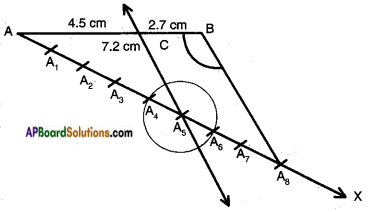
Draw a line segment of length 7.2 cm and divide it in the ratio 5 : 3. Measure the two parts.
Answer:
AP SSC 10th Class Maths Solutions Chapter 8 Similar Triangles Ex 8.1 11
Steps of construction:

  1. Draw a line segment \(\overline{\mathrm{AB}}\) of length 7.2 cm.
  2. Construct an acute angle ∠BAX at A.
  3. Mark off 5 + 3 = 8 equal parts (A1, A2, …., A8) on \(\stackrel{\leftrightarrow}{\mathrm{AX}}\) with same radius.
  4. Join A8 and B.
  5. Draw a line parallel to \(\stackrel{\leftrightarrow}{\mathrm{A}_{8} \mathrm{~B}}\) at A5 meeting AB at C.
  6. Now the point C divides AB in the ratio 5:3.
  7. Measure AC and BC. AC = 4.5 cm and BC = 2.7 cm.


AP SSC 10th Class Maths Solutions Chapter 9 Tangents and Secants to a Circle Ex 9.1

AP State Board Syllabus AP SSC 10th Class Maths Textbook Solutions Chapter 9 Tangents and Secants to a Circle Ex 9.1 Textbook Questions and Answers.

AP State Syllabus SSC 10th Class Maths Solutions 9th Lesson Tangents and Secants to a Circle Exercise 9.1

10th Class Maths 9th Lesson Tangents and Secants to a Circle Ex 9.1 Textbook Questions and Answers

Question 1.
Fill in the blanks.
i) A tangent to a circle intersects it in ——— point(s). (one)
ii) A line intersecting a circle in two points is called a ———. (secant)
iii) The number of tangents drawn at the end of the diameter is ———. (two)
iv) The common point of a tangent to a circle and the circle is called ———. (point of contact)
v) We can draw ——— tangents to a given circle. (infinite)

AP SSC 10th Class Maths Solutions Chapter 9 Tangents and Secants to a Circle Ex 9.1

Question 2.
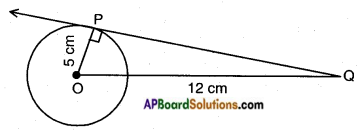
A tangent PQ at a point P of a circle of radius 5 cm meets a line through the centre O at a point Q so that OQ = 12 cm. Find length of PQ.
Answer:
Given: A circle with centre O and radius OP = 5 cm
\(\overline{\mathrm{PQ}}\) is a tangent and OQ = 12 cm
AP SSC 10th Class Maths Solutions Chapter 9 Tangents and Secants to a Circle Ex 9.1 1We know that ∠OPQ = 90°
Hence in △OPQ
OQ2 = OP2 + PQ2
[∵ hypotenuse2 = Adj. side2 + Opp. side2]
122 = 52 + PQ2
∴ PQ2 = 144 – 25 .
PQ2 = 119
PQ = √119

Question 3.
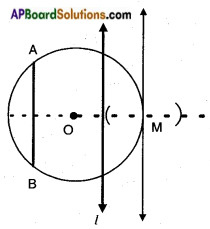
Draw a circle and two lines parallel to a given line such that one is a tangent and the other, a secant to the circle.
Answer:
AP SSC 10th Class Maths Solutions Chapter 9 Tangents and Secants to a Circle Ex 9.1 2Steps:

  1. Draw a circle with some radius.
  2. Draw a chord of the circle.
  3. Draw a line parallel to the chord intersecting the circle at two distinct points.
  4. This is secant of the circle (l).
  5. Draw another line parallel to the chord, just touching the circle at one point (M). This is a tangent of the circle.

AP SSC 10th Class Maths Solutions Chapter 9 Tangents and Secants to a Circle Ex 9.1

Question 4.
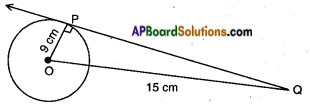
Calculate the length of tangent from a point 15 cm. away from the centre of a circle of radius 9 cm.
Answer:
AP SSC 10th Class Maths Solutions Chapter 9 Tangents and Secants to a Circle Ex 9.1 3Given: A circle with radius OP = 9 cm
A tangent PQ from a point Q at a distance of 15 cm from the centre, i.e., OQ =15 cm
Now in △POQ, ∠P = 90°
OP2 + PQ2 – OQ2
92 + PQ2 = 152
PQ2 = 152 – 92
PQ2 = 144
∴ PQ = √144 = 12 cm.
Hence the length of the tangent =12 cm.

Question 5.
Prove that the tangents to a circle at the end points of a diameter are parallel.
Answer:
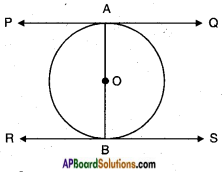
A circle with a diameter AB.
PQ is a tangent drawn at A and RS is a tangent drawn at B.
R.T.P: PQ || RS.
Proof: Let ‘O’ be the centre of the circle then OA is radius and PQ is a tangent.
∴ OA ⊥ PQ ……….(1)
[∵ a tangent drawn at the end point of the radius is perpendicular to the radius]
Similarly, OB ⊥ RS ……….(2)
[∵ a tangent drawn at the end point of the radius is perpendicular to the radius]
But, OA and OB are the parts of AB.
i.e., AB ⊥ PQ and AB ⊥ RS.
∴ PQ || RS.
AP SSC 10th Class Maths Solutions Chapter 9 Tangents and Secants to a Circle Ex 9.1 4O is the centre, PQ is a tangent drawn at A.
∠OAQ = 90°
Similarly, ∠OBS = 90°
∠OAQ + ∠OBS = 90° + 90° = 180°
∴ PQ || RS.
[∵ Sum of the consecutive interior angles is 180°, hence lines are parallel]

AP SSC 10th Class Maths Solutions Chapter 12 Applications of Trigonometry Ex 12.2

AP State Board Syllabus AP SSC 10th Class Maths Textbook Solutions Chapter 12 Applications of Trigonometry Ex 12.2 Textbook Questions and Answers.

AP State Syllabus SSC 10th Class Maths Solutions 12th Lesson Applications of Trigonometry Exercise 12.2

10th Class Maths 12th Lesson Applications of Trigonometry Ex 12.2 Textbook Questions and Answers

Question 1.
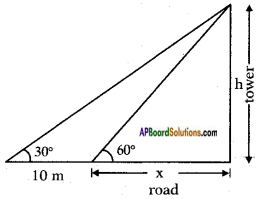
A TV tower stands vertically on the side of a road. From a point on the other side directly opposite to the tower, the angle of elevation of the top of tower is 60°. From another point 10 m away from this point, on the line joining this point to the foot of the tower, the angle of elevation of the top of the tower is 30°. Find the height of the tower and the width of the road.
Answer:
AP SSC 10th Class Maths Solutions Chapter 12 Applications of Trigonometry Ex 12.2 1
Let the height of the tower = h mts say
Width of the road be = x m.
Distance between two points of observation = 10 cm.
Angles of elevation from the two points = 60° and 30°.
From the figure
tan 60° = \(\frac{h}{x}\)
√3 = \(\frac{h}{x}\)
⇒ h = √3x …….(1)
Also tan 30° = \(\frac{h}{10+x}\)
⇒ \(\frac{1}{\sqrt{3}}\) = \(\frac{h}{10+x}\)
⇒ h = \(\frac{10+x}{\sqrt{3}}\) ………(2)
From equations (1) and (2) h
h = √3x = \(\frac{10+x}{\sqrt{3}}\)
∴ √3x = \(\frac{10+x}{\sqrt{3}}\)
√3 × √3x = 10 + x
⇒ 3x – x = 10
⇒ 2x = 10
⇒ x = \(\frac{10}{2}\) = 5m
∴ Width of the road = 5 m
Now Height of the tower = √3x = 5√3 m.

AP SSC 10th Class Maths Solutions Chapter 12 Applications of Trigonometry Ex 12.2

Question 2.
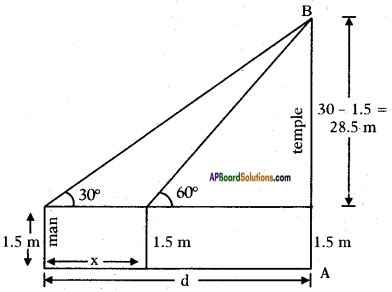
A 1.5 m tall boy is looking at the top of a temple which is 30 metre in height from a point at certain distance. The angle of elevation from his eye to the top of the crown of the temple increases from 30° to 60° as he walks towards the temple. Find the distance he walked towards the temple.
Answer:
AP SSC 10th Class Maths Solutions Chapter 12 Applications of Trigonometry Ex 12.2 2
Height of the temple = 30 m
Height of the man = 1.5 m
Initial distance between the man and temple = d m. say
Let the distance walked = x m.
From the figure
tan 30° = \(\frac{30-1.5}{d}\)
⇒ \(\frac{1}{\sqrt{3}}\) = \(\frac{28.5}{d}\)
∴ d = 28.5 × √3m ………(1)
Also tan 60° = \(\frac{28.5}{d-x}\)
⇒ √3 = \(\frac{28.5}{d-x}\)
⇒ √3(d-x) = 28.5
⇒ √3(28.5 × √3-x) = 28.5
⇒ 28.5 × 3 – √3x = 28.5
⇒ √3x = 3 × 28.5-28.5
⇒ √3x = 2 × 28.5 = 57
∴ x = \(\frac{57}{\sqrt{3}}=\frac{19 \times 3}{\sqrt{3}}\) = 19√3
= 19 × 1.732
= 32.908 m.
∴ Distance walked = 32.908 m.

Question 3.
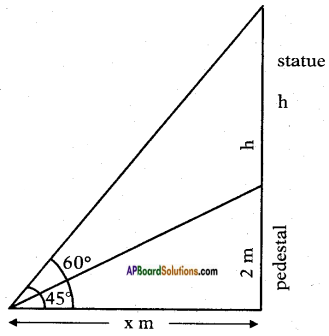
A statue stands on the top of a 2 m tall pedestal. From a point on the ground, the angle of elevation of the top of the statue is 60° and from the same point, the angle of elevation of the top of the pedestal is 45°. Find the height of the statue.
Answer:
AP SSC 10th Class Maths Solutions Chapter 12 Applications of Trigonometry Ex 12.2 3
Height of the pedestal = 2 m.
Let the height of the statue = h m. Angle of elevation of top of the statue = 60°.
Angle of elevation of top of the pedestal = 45°.
Let the distance between the point of observation and foot of the pedestal = x m.
From the figure
tan 45° = \(\frac{2}{x}\)
1 = \(\frac{2}{x}\)
∴ x = 2 m.
Also tan 60° = \(\frac{2+h}{x}\)
⇒ √3 = \(\frac{2+h}{x}\)
⇒ 2√3 = 2 + h
⇒ h = 2√3 – 2
= 2(√3-1)
= 2(1.732 – 1)
= 2 × 0.732
= 1.464 m.

AP SSC 10th Class Maths Solutions Chapter 12 Applications of Trigonometry Ex 12.2

Question 4.
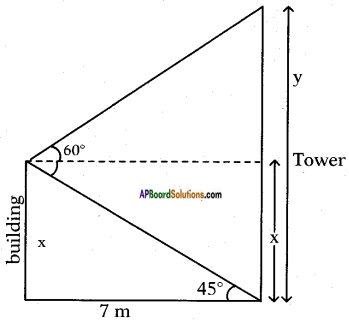
From the top of a building, the angle of elevation of the top of a cell tower is 60° and the angle of depression to its foot is 45°. If distance of the building from the tower is 7 m, then find the height of the tower.
Answer:
AP SSC 10th Class Maths Solutions Chapter 12 Applications of Trigonometry Ex 12.2 4
Angle of elevation of the top of the tower = 60°.
Angle of depression to the foot of the tower = 45°.
Distance between tower and building = 7 m.
Let the height of the building = x m and tower = y m.
From the figure
tan 45° = \(\frac{x}{7}\)
1 = \(\frac{x}{7}\)
∴ x = 7 m.
Also tan 60° = \(\frac{y-x}{7}\)
⇒ √3 = \(\frac{y-x}{7}\)
⇒ 7√3 = y – 7
∴ y = 7 + 7√3
= 7 (√3 + 1)
= 7(1.732 + 1)
= 2.732 × 7
= 19.124 m.

Question 5.
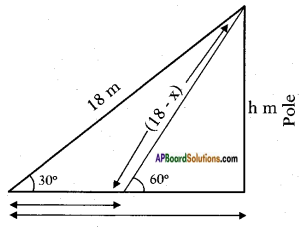
A wire of length 18 m had been tied with electric pole at an angle of eleva¬tion 30° with the ground. As it is covering a long distance, it was cut and tied at an angle of elevation 60° with the ground. How much length of the wire was cut ?
Answer:
AP SSC 10th Class Maths Solutions Chapter 12 Applications of Trigonometry Ex 12.2 5
Length of the wire = 18 m
Let the length of the wire removed = x
Height of the pole be = h
From the figure
sin 30° = \(\frac{h}{18}\)
⇒ \(\frac{1}{2}\) = \(\frac{h}{18}\)
⇒ h = \(\frac{18}{2}\) = 9 m
Also sin 60° = \(\frac{h}{18-x}\)
\(\frac{\sqrt{3}}{2}\) = \(\frac{9}{18-x}\)
√3(18-x) = 9 × 2
18√3 – √3x = 18
√3x = 18√3 – 18
√3x = 18(√3-1)
x = \(\frac{18(\sqrt{3}-1)}{\sqrt{3}}\)
= \(\frac{6 \times 3(\sqrt{3}-1)}{\sqrt{3}}\)
= 6√3(√3-1)
= 6(3-√3)
= 18 – 6√3
= 18 – 10.392
= 7.608 m.

AP SSC 10th Class Maths Solutions Chapter 12 Applications of Trigonometry Ex 12.2

Question 6.
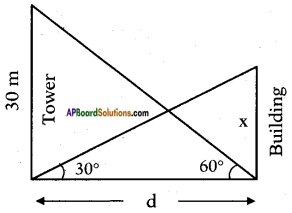
The angle of elevation of the top of a building from the foot of the tower is 30° and the angle of elevation of the top of the tower from the foot of the building is 60°. If the tower is 30 m high, find the height of the building.
Answer:
AP SSC 10th Class Maths Solutions Chapter 12 Applications of Trigonometry Ex 12.2 6
Height of the tower = 30 m
Angle of elevation of the top of the tower = 60°.
Angle of elevation of the top of the building = 30°.
Let the distance between the foot of the tower and foot of the building be d m and height of the building be x m.
From the figure
tan 60° = \(\frac{30}{d}\)
√3 = \(\frac{30}{d}\)
⇒ d = \(\frac{30}{\sqrt{3}}=\frac{10 \times 3}{\sqrt{3}}\) = 10√3m
Also tan 30° = \(\frac{x}{d}\)
⇒ \(\frac{1}{\sqrt{3}}=\frac{x}{10 \sqrt{3}}\)
⇒ x = \(\frac{10 \sqrt{3}}{\sqrt{3}}\) = 10 m
∴ Height of the building = 10 m

Question 7.
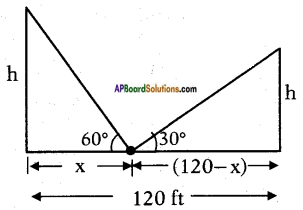
Two poles of equal heights are standing opposite to each other on either side of the road, which is 120 feet wide. From a point between them on the road, the angles of elevation of the top of the poles are 60° and 30° respectively. Find the height of the poles and the distances of the point from the poles.
Answer:
AP SSC 10th Class Maths Solutions Chapter 12 Applications of Trigonometry Ex 12.2 7
Width of the road = 120 f.
Angle of elevation of the top of the 1st tower = 60°.
Angle of elevation of the top of the 2 tower = 30°.
Let the distance of the point from the 1st pole = x.
Then the distance of the point from
the 2nd pole = 120 – x.
and height of each pole = h say.
From the figure
tan 60° = \(\frac{h}{x}\)
⇒ √3 = \(\frac{h}{x}\)
⇒ h = √3x ……..(1)
Also tan 30° = \(\frac{\mathrm{h}}{120-\mathrm{x}}\)
⇒ \(\frac{1}{\sqrt{3}}=\frac{\mathrm{h}}{120-\mathrm{x}}\)
⇒ h = \(\frac{120-x}{\sqrt{3}}\)
From (1) and (2)
√3x = \(\frac{120-x}{\sqrt{3}}\)
⇒ √3.√3x = 120-x
⇒ 3x = 120 – x
⇒ 3x + x = 120
⇒ 4x = 120
⇒ x = \(\frac{120}{4}\) = 30 ft
Now h = √3x = √3 × 30 = 1.732 x 30 = 51.960 feet
∴ Distances of the poles = 30 ft. and 120 – 30 fts = 90 ft.
Height of each pole = 51.96 ft.

AP SSC 10th Class Maths Solutions Chapter 12 Applications of Trigonometry Ex 12.2

Question 8.
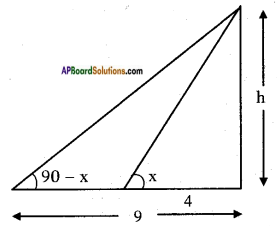
The angles of elevation of the top of a tower from two points at a distance of 4 m and 9 m, find the height of the tower from the base of the tower and in the same straight line with it are complementary.
Answer:
AP SSC 10th Class Maths Solutions Chapter 12 Applications of Trigonometry Ex 12.2 8
Let the height of the tower = h m.
Angles of elevation of the top of the tower from two points = x° and (90° – x)
From the figure
tan x = \(\frac{h}{4}\) ……. (1)
Also tan (90° – x) = \(\frac{h}{9}\)
⇒ cot x = \(\frac{h}{9}\)
⇒ \(\frac{1}{\tan x}\) = \(\frac{h}{9}\)
∴ tan x = \(\frac{9}{h}\) …….. (2)
From (1) and (2)
tan x = \(\frac{h}{4}\) = \(\frac{9}{h}\)
∴ \(\frac{h}{4}\) = \(\frac{9}{h}\)
h × h = 9 × 4
⇒ h2 = 36
⇒ h = 6 m

Question 9.
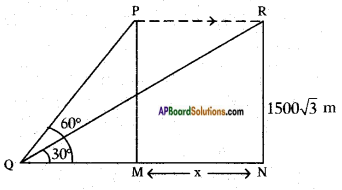
The angle of elevation of a jet plane from a point A on the ground is 60°. After 4 flight of 15 seconds, the angle of elevation changes to 30°. If the jet plane is flying at a constant height of 1500√3 meter, find the speed of the jet plane. (√3 = 1.732)
Answer:
AP SSC 10th Class Maths Solutions Chapter 12 Applications of Trigonometry Ex 12.2 9
Height of the plane from the ground PM = RN = 1500√3 m.
Angle of elevation are 30° and 60°.
From the figure
tan 60° = \(\frac{PM}{QM}\)
√3 = \(\frac{1500 \sqrt{3}}{\mathrm{QM}}\)
QM = \(\frac{1500 \sqrt{3}}{\sqrt{3}}\) = 1500 m
Also tan 30° = \(\frac{RN}{QN}\)
\(\frac{1}{\sqrt{3}}=\frac{1500 \sqrt{3}}{\mathrm{QM}+\mathrm{MN}}\)
QM + MN = 1500√3 × √3
1500 + MN = 1500 × 3
MN = 4500 – 1500
MN = 3000 mts.
∴ Distance travelled in 15 seconds = 3000 mts.
∴ Speed of the jet plane = \(\frac{\text { distance }}{\text { time }}=\frac{3000}{15}\) = 200 m/s
= 200 × \(\frac{18}{5}\) kmph
= 720 kmph
Speed = 200 m/sec. or 720 kmph.

AP SSC 10th Class Maths Textbook Solutions

AP Board 7th Class Maths Solutions Chapter 3 Simple Equations Ex 3.4

SCERT AP 7th Class Maths Solutions Pdf Chapter 3 Simple Equations Ex 3.4 Textbook Exercise Questions and Answers.

AP State Syllabus 7th Class Maths Solutions 3rd Lesson Simple Equations Exercise 3.4

Question 1.
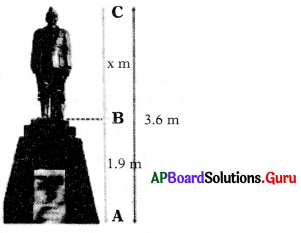
Find the height of the statue from the adjacent diagram.
AP Board 7th Class Maths Solutions Chapter 3 Simple Equations Ex 3.4 1
Answer:
From the given diagram
Height of the statue (BC) = x m
Height of the Pedastal (AB) = 1.9 m
Total Height (AC) = 3.6 m
BC + AB = 3.6 m
⇒ x + 1.9 m = 3.6 m
⇒ x + 1.9 – 1.9 = 3.6 – 1.9 (Subtract 1.9 on both sides)
⇒ x = 1.7 m
∴ Height of the statue = 1.7 m

AP Board 7th Class Maths Solutions Chapter 3 Simple Equations Ex 3.4

Question 2.
The sum of twice a number and 4 is 80, find the number.
Answer:
Let the number be x.
Twice the number = 2x
Sum of twice a number and 4 = 80
2x + 4 = 80
⇒ 2x + 4 – 4 = 80 – 4
(Subtract 4 on both sides)
⇒ 2x = 76
⇒ \(\frac{2 x}{2}\) = \(\frac{76}{2}\) (Divide by 2 on both sides)
⇒ x = 38
∴ Number = 38

Question 3.
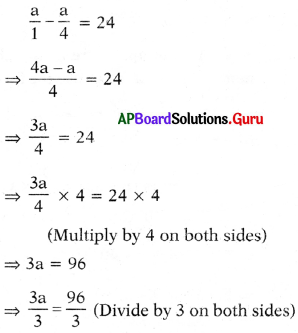
The difference between a number and one-fourth of itself is 24, find the number.
Answer:
Let the number be a.
One-fourth of a number = \(\frac{1}{4}\) of a = \(\frac{a}{4}\)
Difference of number and one-fourth of itself = 24
AP Board 7th Class Maths Solutions Chapter 3 Simple Equations Ex 3.4 2
⇒ a = 32
∴ The number a = 32

Question 4.
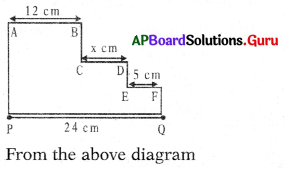
AP Board 7th Class Maths Solutions Chapter 3 Simple Equations Ex 3.4 3
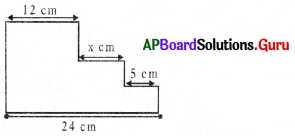
Find the value of x from the adjacent diagram.
Answer:
AP Board 7th Class Maths Solutions Chapter 3 Simple Equations Ex 3.4 4
From the above diagram
AB = 12 cm; CD = x cm
EF = 5 cm; PQ = 24 cm
We know,
AB + CD + EF = PQ
⇒ 12 + x + 5 = 24
⇒ x + 17 = 24
⇒ x + 17 – 17 = 24 – 17
(Subtract 17 on both sides)
⇒ x = 7 cm

AP Board 7th Class Maths Solutions Chapter 3 Simple Equations Ex 3.4

Question 5.
To convert temperature from Fahrenheit to Centigrade, we use the formula (F – 32) = \(\frac{9}{5}\) × C. If C = – 40° C, then find F.
Answer:
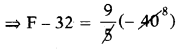
Given formula (F – 32) = \(\frac{9}{5}\) × C and C = – 40° C
AP Board 7th Class Maths Solutions Chapter 3 Simple Equations Ex 3.4 5
⇒ F – 32 = 9(- 8)
⇒ F – 32 = – 72
⇒ F – 32 + 32 = – 72 + 32 (Add 32 on both sides)
⇒ F = – 40° F
Therefore we conclude that
– 40° C = – 40° F.

Question 6.
Rahim has ₹x, from which he spends ₹6. If twice of the money left with him is ₹86, then find x.
Answer:
Rahim has money = ₹x
Money after spends ₹6 = x – 6
Twice the money left with Rahim
= 2(x – 6) = ₹86
⇒ – 2(x – 6) = 86
⇒ \(\frac{2(x-6)}{2}\) = \(\frac{86}{2}\) (Divide by 2 on both sides)
⇒ x – 6 = 43
⇒ x – 6 + 6 = 43 + 6 (Add 6 on both sides)
⇒ x = 49
Therefore money at Rahim = ₹49.

Question 7.
The difference between two numbers is 7. Six times the smaller plus the larger is 77. Find the numbers.
Answer:
Let the smaller number is x.
Larger number = x + 7
Six times the smaller = 6.x
Six times smaller plus the larger = 77
⇒ 6x + x + 7 = 77
⇒ 7x + 7 = 77
AP Board 7th Class Maths Solutions Chapter 3 Simple Equations Ex 3.4 6
⇒ 7x = 70
⇒ \(\frac{7 \mathrm{x}}{7}\) = \(\frac{70}{7}\) (Divide by 7 on both sides) ⇒x = 10
∴ Smaller number x = 10
Larger number = x + 7 = 10 + 7 = 17
∴ The numbers are 10 and 17.

AP Board 7th Class Maths Solutions Chapter 3 Simple Equations Ex 3.4

Question 8.
The sum of three consecutive even numbers is 54. Find the numbers.
Answer:
Let the three consecutive even numbers are 2x, 2(x +1), 2(x + 2).
Sum of three consecutive even numbers = 54
⇒ 2x + 2(x + 1) + 2(x + 2) = 54
⇒ 2x + 2x + 2 + 2x + 4 = 54
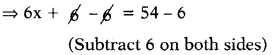
⇒ 6x + 6 = 54
AP Board 7th Class Maths Solutions Chapter 3 Simple Equations Ex 3.4 7
⇒ 6x = 48
⇒ \(\frac{6 x}{6}\) = \(\frac{48}{6}\) (Divide by 6 on both sides)
⇒ x = 8
Numbers are, 2x, 2(x + 1), 2(x + 2)
2(8), 2(8 + 1), 2(8 + 2)
∴ The numbers are 16, 18, 20.

Question 9.
In a class of 48 students, the number of girls is one third the number of boys. Find the number of girls and boys in the class.
Answer:
Let the number of boys = x
The number of girls = \(\frac{1}{3}\) of boys
= \(\frac{1}{3}\) of x = \(\frac{x}{3}\)
Boys + Girls = Total students
⇒ \(\frac{x}{1}+\frac{x}{3}\) = 48
⇒ \(\frac{3 x+x}{3}\) = 48
⇒ \(\frac{4 x}{3}\) = 48
⇒ \(\frac{4 x}{3}\) × 3 = 48 × 3
(Multiply by 3 on both sides)
⇒ 4x = 144
⇒ \(\frac{4 x}{4}\) = \(\frac{144}{4}\) (Divide by 4 on both sides)
⇒ x = 36
∴ Number of boys = 36
Number of girls = \(\frac{x}{3}\) = \(\frac{36}{3}\) = 12
Boys = 36 and girls = 12

AP Board 7th Class Maths Solutions Chapter 3 Simple Equations Ex 3.4

Question 10.
The present ages of Mary and Joseph are in the ratio 5 : 3. After 3 years sum of their ages will be 38. Find their present ages.
Answer:
Ratio of present ages of Mary and Joseph = 5:3 = 5x : 3x
After 3 years their ages
= 5x + 3 : 3x + 3
Sum of their ages = 38
⇒ 5x + 3 + 3x + 3 = 38
⇒ 8x + 6 = 38
⇒ 8x + 6 – 6 = 38 – 6 (Subtract 6 on both sides)
⇒ 8x = 32
⇒ \(\frac{8 x}{8}\) = \(\frac{32}{8}\)
⇒ x = 4
⇒ Ratio of present ages = 5x : 3x
= 5(4) : 3(4) = 20 : 12
Present ages of Mary and Joseph are 20 years and 12 years.

Question 11.
A sum of ₹500 is in the form of notes of denominations of ₹5 and ₹10. If the total number of notes is 90, then find the number of notes of each type.
AP Board 7th Class Maths Solutions Chapter 3 Simple Equations Ex 3.4 8
Answer:
Let, number of f5 notes = x
Given sum of number of ₹5 notes and ₹10 notes is 90.
So, number of ₹10 notes = 90 – x
Sum of ₹5 notes = ₹5 × x = 5x
Sum of ₹ 10 notes = ₹ 10 × (90 – x)
= 900 – 10x
⇒ 5x + 900 – 10x = 500
⇒ – 5x + 900 = 500
⇒ – 5x + 900 – 900 = 500 – 900 (Subtract 900 on both sides)
⇒ – 5x = – 400
⇒ \(\frac{-5 x}{-5}\) = \(\frac{-400}{-5}\)
(Divide by – 5 on both sides)
⇒ x = 80
∴ Number of ₹5 notes x = 80
Number of ₹10 notes
= 90 – x = 90 – 80 = 10.

AP Board 7th Class Maths Solutions Chapter 3 Simple Equations Ex 3.4

Question 12.
John and Ismail donated some money to the Relief Fund. The amount paid by Ismail is ₹85 more than twice that of John. If the total money paid by them is ₹4000, then find the amount of money donated by John.
Answer:
Let the amount donated by John = ₹x
The amount donated by Ismail is ₹85 more than twice of John.
So, the amount donated by Ismail = ₹(2x + 85)
Total amount = John amount + Ismail amount = ₹4000
⇒ x + 2x + 85 = 4000
⇒ 3x + 85 = 4000
⇒ 3x + 85 – 85 = 4000 – 85 (Subtract 85 on both sides)
⇒ 3x = 3915
⇒ \(\frac{3 x}{3}\) = \(\frac{3915}{3}\) (Divide by 3 on both sides)
⇒ x = 1305
∴ Money donated by John = x = ₹ 1305
∴ Money donated by Ismail = 2x + 85
= 2(1305) + 85
= ₹2695

Question 13.
Length of a rectangle is 4 m less than 3 times its breadth. If the perimeter of rectangle is 32 m. Then find its length and breadth.
Answer:
Let breadth of a rectangle (b) = a m
Length of rectangle (l) = 4 m less than 3 times of breadth
= (3 ∙ a – 4) m
Given perimeter = 2(l + b) = 32 m
⇒ 2[3a – 4 + a] = 32
⇒ 2[4a – 4] = 32
⇒ (8a – 8) = 32 (Distributive property)
⇒ 8a – 8 + 8 = 32 + 8 (Add 8 on both sides)
⇒ 8a = 40
⇒ \(\frac{8 \mathrm{a}}{8}\) = \(\frac{40}{8}\) (Divide by 8 on both sides) o o
⇒ a = 5
∴ breadth (b) = 5 m
length (l) = 3a – 4
= 3(5) – 4 = 15 – 4 = 11 m
∴ length = 11 m and breadth = 5 m.

AP Board 7th Class Maths Solutions Chapter 3 Simple Equations Ex 3.4

Question 14.
A bag contains some number of white balls, twice the number of white balls are blue balls, thrice the number of blue balls are the red balls. If the total number of balls in the bag are 27. Then calculate the number of balls of each colour present in the bag.
Answer:
Let the number of white balls = x
Number of blue balls = twice the number of white balls
= 2(x) = 2x
Number of red balls
= thrice the number of blue balls = 3(2x) = 6x
Total balls = White + Blue + Red = 27
⇒ x + 2x + 6x = 27
⇒ 9x = 27
⇒ \(\frac{9 x}{9}\) = \(\frac{27}{9}\) (Divide by 9 on both sides) 9 9 .
⇒ x = 3
Therefore white balls x = 3
Blue balls = 2x = 2(3) = 6
Red balls = 6x = 6(3) = 18

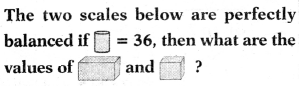
Question 15.
AP Board 7th Class Maths Solutions Chapter 3 Simple Equations Ex 3.4 9
Answer:
AP Board 7th Class Maths Solutions Chapter 3 Simple Equations Ex 3.4 10

AP Board 7th Class Maths Solutions Chapter 3 Simple Equations Ex 3.4

AP Board 7th Class Maths Solutions Chapter 3 Simple Equations Ex 3.4 11

AP SSC 10th Class Maths Solutions Chapter 9 Tangents and Secants to a Circle Ex 9.2

AP State Board Syllabus AP SSC 10th Class Maths Textbook Solutions Chapter 9 Tangents and Secants to a Circle Ex 9.2 Textbook Questions and Answers.

AP State Syllabus SSC 10th Class Maths Solutions 9th Lesson Tangents and Secants to a Circle Exercise 9.2

10th Class Maths 9th Lesson Tangents and Secants to a Circle Ex 9.2 Textbook Questions and Answers

Question 1.
Choose the correct answer and give justification for each.
(i) The angle between a tangent to a circle and the radius drawn at the point of contact is
a) 60°
b) 30°
c) 45°
d) 90°
Answer: [ d ]
If radius is not perpendicular to the tangent, the tangent must be a secant i.e., 90°.

AP SSC 10th Class Maths Solutions Chapter 9 Tangents and Secants to a Circle Ex 9.2

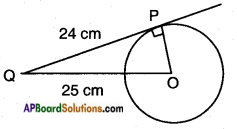
(ii) From a point Q, the length of the tangent to a circle is 24 cm. and the distance of Q from the centre is 25 cm. The radius of the circle is
a) 7 cm
b) 12 cm
c) 15 cm
d) 24.5 cm
Answer: [ a ]
AP SSC 10th Class Maths Solutions Chapter 9 Tangents and Secants to a Circle Ex 9.2 1
O – centre of the circle
OP – a circle radius = ?
OQ = 25 cm
PQ = 24 cm
OQ2 = OP2 + PQ2
[∵ hypotenuse2 = Adj. side2 + Opp. side2]
252 = OP2 + 242
OP2 = 625 – 576
OP2 = 49
OP = √49 = 7 cm.

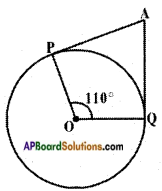
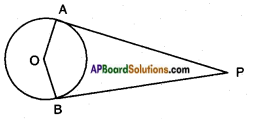
iii) If AP and AQ are the two tangents a circle with centre O, so that ∠POQ = 110°. Then ∠PAQ is equal to
AP SSC 10th Class Maths Solutions Chapter 9 Tangents and Secants to a Circle Ex 9.2 2
a) 60°
b) 70°
c) 80°
d) 90°
Answer: [ b ]
In □ OPAQ,
∠OPA = ∠OQA = 90°
∠POQ = 110°
∴ ∠O + ∠P + ∠A + ∠Q = 360°
⇒ 90° + 90° + 110° + ∠PAQ – 360°
⇒ ∠PAQ = 360° – 290° = 70°

AP SSC 10th Class Maths Solutions Chapter 9 Tangents and Secants to a Circle Ex 9.2

iv) If tangents PA and PB from a point P to a circle with centre O are inclined to each other at angle of 80°, then ∠POA is equal to
a) 50°
b) 60°
c) 70°
d) 80°
Answer: [None]
AP SSC 10th Class Maths Solutions Chapter 9 Tangents and Secants to a Circle Ex 9.2 3
If ∠APB = 80°
then ∠AOB = 180° – 80° = 100°
[∴ ∠A + ∠B = 90° + 90° = 180°]

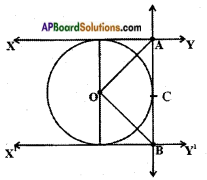
v) In the figure XY and XV are two parallel tangents to a circle with centre O and another tangent AB with point of contact C intersecting XY at A and XV at B then ∠AOB =
a) 80°
b) 100°
c) 90°
d) 60°
AP SSC 10th Class Maths Solutions Chapter 9 Tangents and Secants to a Circle Ex 9.2 4
Answer: [ c ]

Question 2.
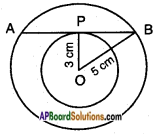
Two concentric circles of radii 5 cm and 3 cm are drawn. Find the length of the chord of the larger circle which touches the smaller circle.
Answer:
Given: Two circles of radii 3 cm and 5 cm with common centre.
AP SSC 10th Class Maths Solutions Chapter 9 Tangents and Secants to a Circle Ex 9.2 5
Let AB be a tangent to the inner/small circle and chord to the larger circle.
Let ‘P’ be the point of contact.
Construction: Join OP and OB.
In △OPB ;
∠OPB = 90°
[radius is perpendicular to the tangent]
OP = 3cm OB = 5 cm
Now, OB2 = OP2 + PB2
[hypotenuse2 = Adj. side2 + Opp. side2, Pythagoras theorem]
52 = 32 + PB2
PB2 = 25 – 9 = 16
∴ PB = √l6 = 4cm.
Now, AB = 2 × PB
[∵ The perpendicular drawn from the centre of the circle to a chord, bisects it]
AB = 2 × 4 = 8 cm.
∴ The length of the chord of the larger circle which touches the smaller circle is 8 cm.

AP SSC 10th Class Maths Solutions Chapter 9 Tangents and Secants to a Circle Ex 9.2

Question 3.
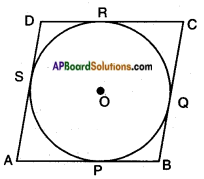
Prove that the parallelogram circumscribing a circle is a rhombus.
Answer:
AP SSC 10th Class Maths Solutions Chapter 9 Tangents and Secants to a Circle Ex 9.2 6
Given: A circle with centre ‘O’.
A parallelogram ABCD, circumscribing the given circle.
Let P, Q, R, S be the points of contact.
Required to prove: □ ABCD is a rhombus.
Proof: AP = AS …….. (1)
[∵ tangents drawn from an external point to a circle are equal]
BP = BQ ……. (2)
CR = CQ ……. (3)
DR = DS ……. (4)
Adding (1), (2), (3) and (4) we get
AP + BP + CR + DR = AS + BQ + CQ + DS
(AP + BP) + (CR + DR) = (AS + DS) + (BQ + CQ)
AB + DC = AD + BC
AB + AB = AD + AD
[∵ Opposite sides of a parallelogram are equal]
2AB = 2AD
AB = AD
Hence, AB = CD and AD = BC [∵ Opposite sides of a parallelogram]
∴ AB = BC = CD = AD
Thus □ ABCD is a rhombus (Q.E.D.)

Question 4.
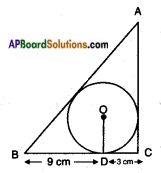
A triangle ABC is drawn to circumscribe a circle of radius 3 cm such that the segments BD and DC into which BC is divided by the point of contact D are of length 9 cm. and 3 cm. respectively (See below figure). Find the sides AB and AC.
AP SSC 10th Class Maths Solutions Chapter 9 Tangents and Secants to a Circle Ex 9.2 7
Answer:
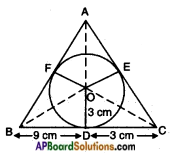
The given figure can also be drawn as
AP SSC 10th Class Maths Solutions Chapter 9 Tangents and Secants to a Circle Ex 9.2 8
Given: Let △ABC be the given triangle circumscribing the given circle with centre ‘O’ and radius 3 cm.
i.e., the circle touches the sides BC, CA and AB at D, E, F respectively.
It is given that BD = 9 cm
CD = 3 cm
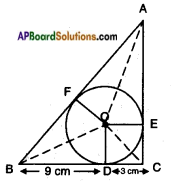
AP SSC 10th Class Maths Solutions Chapter 9 Tangents and Secants to a Circle Ex 9.2 9
∵ Lengths of two tangents drawn from an external point to a circle are equal.
∴ BF = BD = 9 cm
CD = CE = 3 cm
AF = AE = x cm say
∴ The sides of die triangle are
12 cm, (9 + x) cm, (3 + x) cm
Perimeter = 2S = 12 + 9 + x + 3 + x
⇒ 2S = 24 + 2x
or S = 12 + x
S – a = 12 + x – 12 = x
S – b = 12 + x – 3 – x = 9
S – c = 12 + x – 9 – x = 3
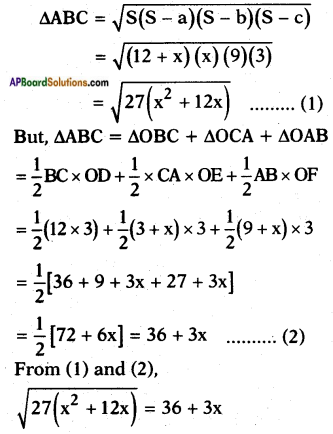
∴ Area of the triangle
AP SSC 10th Class Maths Solutions Chapter 9 Tangents and Secants to a Circle Ex 9.2 15
Squaring on both sides we get,
27 (x2 + 12x) = (36 + 3x)2
27x2 + 324x = 1296 + 9x2 + 216x
⇒ 18x2 + 108x- 1296 = 0
⇒ x2 + 6x – 72 = 0
⇒ x2 + 12x – 6x – 72 = 0
⇒ x (x + 12) – 6 (x + 12) = 0
⇒ (x – 6) (x + 12) = 0
⇒ x = 6 or – 12
But ‘x’ can’t be negative hence, x = 6
∴ AB = 9 + 6 = 15 cm
AC = 3 + 6 = 9 cm.

AP SSC 10th Class Maths Solutions Chapter 9 Tangents and Secants to a Circle Ex 9.2

Question 5.
Draw a circle of radius 6 cm. From a point 10 cm away from its centre, construct the pair of tangents to the circle and measure their lengths. Verify by using Pythagoras Theorem.
Answer:
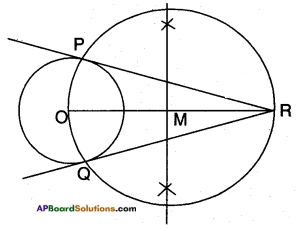
Steps of construction:

  1. Draw a circle with centre ‘O’ and radius 6 cm.
  2. Take a point P outside the circle such that OP =10 cm. Join OP.
  3. Draw the perpendicular bisector to OP which bisects it at M.
  4. Taking M as centre and PM or MO as radius draw a circle. Let the circle intersects the given circle at A and B.
  5. Join P to A and B.
  6. PA and PB are the required tan¬gents of lengths 8 cm each.

AP SSC 10th Class Maths Solutions Chapter 9 Tangents and Secants to a Circle Ex 9.2 10Proof: In △OAP
OA2 + AP2 = 62 + 82
= 36 + 64 = 100
OP2 = 102 = 100
∴ OA2 + AP2 = OP2
Hence AP is a tangent.
Similarly BP is a tangent.

Question 6.
Construct, a tangent to a circle of radius 4 cm from a point on the concentric circle of radius 6 cm and measure its length. Also verify the measurement by actual calculation.
Answer:
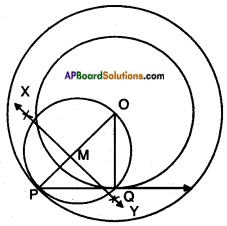
AP SSC 10th Class Maths Solutions Chapter 9 Tangents and Secants to a Circle Ex 9.2 11Steps of construction:

  1. Draw two concentric circles with centre ‘O’ and radii 4 cm and 6 cm.
  2. Take a point ‘P’ on larger circle and join O, P.
  3. Draw the perpendicular bisector of OP which intersects it at M.
  4. Taking M as centre and PM or MO as radius draw a circle which intersects smaller circle at Q.
  5. Join PQ, which is a tangent to the smaller circle.

AP SSC 10th Class Maths Solutions Chapter 9 Tangents and Secants to a Circle Ex 9.2

Question 7.
Draw a circle with the help of a bangle, take a point outside the circle. Con-struct the pair of tangents from this point to the circle measure them. Write conclusion.
Answer:
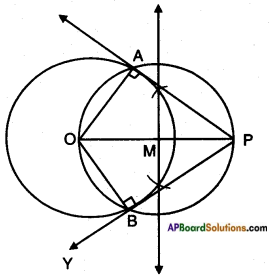
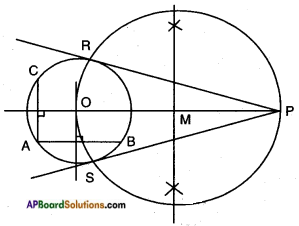
AP SSC 10th Class Maths Solutions Chapter 9 Tangents and Secants to a Circle Ex 9.2 12Steps of construction:

  1. Draw a circle with the help of a bangle.
  2. Draw two chords AB and AC. Perpendicular bisectors of AB and AC meets at ‘O’ which is the centre of the circle.
  3. Taking an outside point P, join OP.
  4. Let M be the midpoint of OP. Taking M as centre OM as radius, draw a circle which intersects the given circle at R and S. Join PR, PS which are the required tangents.

Conclusion: Tangents drawn from an external point to a circle are equal.

Question 8.
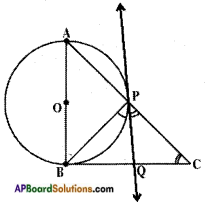
In a right triangle ABC, a circle with a side AB as diameter is drawn to intersect the hypotenuse AC in P. Prove that the tangent to the circle at P bisects the side BC.
AP SSC 10th Class Maths Solutions Chapter 9 Tangents and Secants to a Circle Ex 9.2 13Answer:
Let ABC be a right triangle right angled at P.
Consider a circle with diametere AB.
From the figure, the tangent to the circle at B meets BC in Q.
Now QB and QP are two tangents to the circle from the same point P.
QB = QP …….. (1)
Also, ∠QPC = ∠QCP
∴ PQ = QC (2)
From (1) and (2);
QB = QC Hence proved.

Question 9.
Draw a tangent to a given circle with center O from a point ‘R’ outside the circle. How many tangents can be drawn to the circle from that point? [Hint: The distance of two points to the point of contact is the same.
Answer:
Only two tangents can be drawn from a given point outside the circle.
AP SSC 10th Class Maths Solutions Chapter 9 Tangents and Secants to a Circle Ex 9.2 14

AP Board 4th Class Maths Solutions 3rd Lesson Addition

Andhra Pradesh AP Board 4th Class Maths Solutions 3rd Lesson Addition Textbook Exercise Questions and Answers.

AP State Syllabus 4th Class Maths Solutions Chapter 3 Addition

Play and Win :

AP Board 4th Class Maths Solutions 3rd Lesson Addition 1

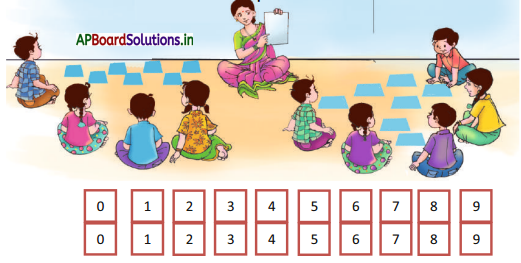
  • Divide the students into 2 groups.
  • Supply each group 2 sets of number cards from 0 to 9.
  • Each student will take one set.
  • Flip the cards to hide the numbers.
  • Jumble the cards to change the order.
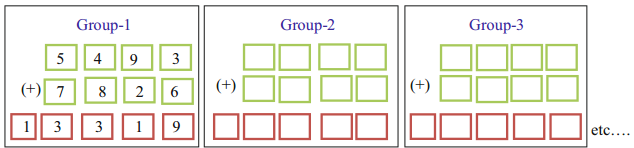
  • One student from the first group selects 4 cards from second set of numbers and makes another four digit number.
  • Then they add two numbers and write down the sum in the note book.
  • Every group does the same. .
  • The group which gets the largest sum will get 1 point.
  • After 10 rounds who got more points they will be declared as winners.
    AP Board 4th Class Maths Solutions 3rd Lesson Addition 2

Addition Machine:

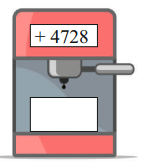
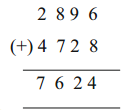
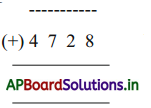
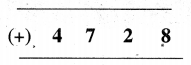
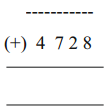
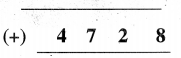
This is an Addition machine. It has a fixed 4-digit number 4,728. If you place any 4 digit number in the machine, it is added to 4728 and the sum if displayed on the screen. You should place a 4-digit number of your choice and find the number displayed by the machine.
AP Board 4th Class Maths Solutions 3rd Lesson Addition 3

AP Board 4th Class Maths Solutions 3rd Lesson Addition

Question 1.
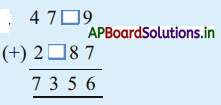
AP Board 4th Class Maths Solutions 3rd Lesson Addition 4

Question 2.
AP Board 4th Class Maths Solutions 3rd Lesson Addition 5
Answer:
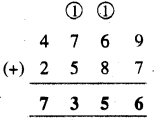
AP Board 4th Class Maths Solutions 3rd Lesson Addition 6

Question 3.
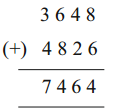
AP Board 4th Class Maths Solutions 3rd Lesson Addition 7
Answer:
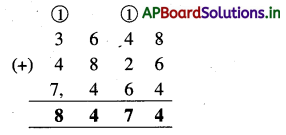
AP Board 4th Class Maths Solutions 3rd Lesson Addition 8

Question 4.
AP Board 4th Class Maths Solutions 3rd Lesson Addition 7
Answer:
AP Board 4th Class Maths Solutions 3rd Lesson Addition 8

AP Board 4th Class Maths Solutions 3rd Lesson Addition

Question 5.
AP Board 4th Class Maths Solutions 3rd Lesson Addition 7
Answer:
AP Board 4th Class Maths Solutions 3rd Lesson Addition 8

Textbook Page No. 34

Do this

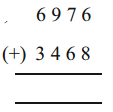
1. Add

a)
AP Board 4th Class Maths Solutions 3rd Lesson Addition 9
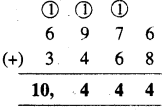
Answer:
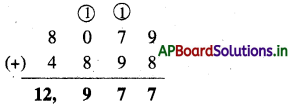
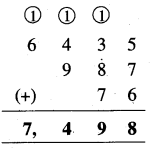
AP Board 4th Class Maths Solutions 3rd Lesson Addition 10

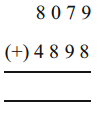
b)
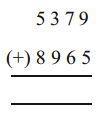
AP Board 4th Class Maths Solutions 3rd Lesson Addition 11
Answer:
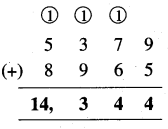
AP Board 4th Class Maths Solutions 3rd Lesson Addition 12

c)
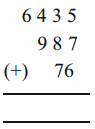
AP Board 4th Class Maths Solutions 3rd Lesson Addition 13
Answer:
AP Board 4th Class Maths Solutions 3rd Lesson Addition 14

AP Board 4th Class Maths Solutions 3rd Lesson Addition

d)
AP Board 4th Class Maths Solutions 3rd Lesson Addition 15
Answer:
AP Board 4th Class Maths Solutions 3rd Lesson Addition 16

Question 2.
Add 4789 and 2946
Answer:
AP Board 4th Class Maths Solutions 3rd Lesson Addition 17

Question 3.
Find 7645 + 5895
Answer:
AP Board 4th Class Maths Solutions 3rd Lesson Addition 18

Example – 2:

In another shop there are two types of bicycles namely gear bicycles and small bicycles.

Now you find out the two bicycles whose cost would be less than 10,000 and fill the table. The cost of each bicycle is given inboxes.
AP Board 4th Class Maths Solutions 3rd Lesson Addition 19
Answer:
AP Board 4th Class Maths Solutions 3rd Lesson Addition 20

Textbook Page No. 34

Do this

Question 1.
Estimate the sum in each case and tick (✓) on the correct box which is nearest to its sum.
AP Board 4th Class Maths Solutions 3rd Lesson Addition 21
Answer:
AP Board 4th Class Maths Solutions 3rd Lesson Addition 22

AP Board 4th Class Maths Solutions 3rd Lesson Addition

Question 2.
Estimate the sum.
AP Board 4th Class Maths Solutions 3rd Lesson Addition 23
There is a kids train. All the compartments have their numbers on them. Find the pairs of compartments whose sum is greater than 8000.
Answer:
(2536, 7326), (5329, 7326), (7326, 861), (2536, 6297), (5329, 4932), (5329, 3210), (5329, 6297), (1923, 7326), (1923, 6297), (7326, 4932), (7326, 3210), (7326, 6297), (7326, 2134) (4932, 3210), (4932, 6297), (3210, 6297), (6297, 2134),

Textbook Page No. 37

Do this

Question 1.
A water tank supplies drinking water to two villages. One village gets 3870 buckets of water. The other gets 5,295 buckets. How many buckets of water in total are supplied to both the villages ?
AP Board 4th Class Maths Solutions 3rd Lesson Addition 24
Solution:
Number of buckets supplied to first village = 3,870
Number of buckets supplied to second village = 5,295
Number of buckets supplied to
AP Board 4th Class Maths Solutions 3rd Lesson Addition 25
Totally = 9,165

AP Board 4th Class Maths Solutions 3rd Lesson Addition

Question 2.
On an independent day, 7,305 saplings wree planted in schools and 2859 saplings were planted in offices. How many saplings were planted in total ?
Solution:
Number of saplings planted in schools = 7,365
Number of saplings planted in Offices = 2,895
Number of saplings planted
AP Board 4th Class Maths Solutions 3rd Lesson Addition 26
Totally = 10,260

Textbook Page No. 38, 40

Try this

Make word problems for the following:

a) 6,854 + 3,521
Solution:
Latha had 6,854 bangles and Prasanna had 3,521 bangles. How many bangles were there in all ?

b) 5,340 + 3,564
Solution:
A fruit seller sold 5,340 apples and 3,564 oranges in a day.How many fruits did he sell?

AP Board 4th Class Maths Solutions 3rd Lesson Addition

c) 4,563 + 8,520
Solution:
Sirisha has 4,563 pencils and Sohan has 8,520 pencils. How many pencils are there altogether ?

1. Find the missing numerals.

a)
AP Board 4th Class Maths Solutions 3rd Lesson Addition 27
Answer:
AP Board 4th Class Maths Solutions 3rd Lesson Addition 28

b)
AP Board 4th Class Maths Solutions 3rd Lesson Addition 29
Answer:
AP Board 4th Class Maths Solutions 3rd Lesson Addition 30

2. Find the sum by suitable re-grouping.

a) 740 + 320 + 260 + 2,680
Solution:
We have to re-group the given in the following way.
= 740 + 260+ 320 + 2,680
= 1000 + 3,000
= 4,000

AP Board 4th Class Maths Solutions 3rd Lesson Addition

b) 5,986 + 2,976 + 14 + 24
Solution:
Re-group the given numbers.
= 5,986+ 14 + 2,976 + 24
= 6,000 + 3,000
= 9,000

c) 4,893 + 894 + 106 + 107
Solution:
Re-group the given numbers.
= 4,893 + 107 + 894 + 106
= 5,000 + 1,000
= 6,000

Exercise – 3.1

1. Add

a)
AP Board 4th Class Maths Solutions 3rd Lesson Addition 31
Answer:
AP Board 4th Class Maths Solutions 3rd Lesson Addition 32

AP Board 4th Class Maths Solutions 3rd Lesson Addition

b)
AP Board 4th Class Maths Solutions 3rd Lesson Addition 33
Answer:
AP Board 4th Class Maths Solutions 3rd Lesson Addition 34

c)
AP Board 4th Class Maths Solutions 3rd Lesson Addition 35
Answer:
AP Board 4th Class Maths Solutions 3rd Lesson Addition 36

AP Board 4th Class Maths Solutions 3rd Lesson Addition

d)
AP Board 4th Class Maths Solutions 3rd Lesson Addition 37
Answer:
AP Board 4th Class Maths Solutions 3rd Lesson Addition 38

2. Identify whether the following additions are correct or not. Justify your answer.

a)
AP Board 4th Class Maths Solutions 3rd Lesson Addition 39
Answer:
Given
AP Board 4th Class Maths Solutions 3rd Lesson Addition 39
is wrong
Justification
AP Board 4th Class Maths Solutions 3rd Lesson Addition 40

b)
AP Board 4th Class Maths Solutions 3rd Lesson Addition 41
Answer:
Given
AP Board 4th Class Maths Solutions 3rd Lesson Addition 41
is wrong
Justification
AP Board 4th Class Maths Solutions 3rd Lesson Addition 42

AP Board 4th Class Maths Solutions 3rd Lesson Addition

c)
AP Board 4th Class Maths Solutions 3rd Lesson Addition 43
Answer:
Given
AP Board 4th Class Maths Solutions 3rd Lesson Addition 43
is wrong
Justification
AP Board 4th Class Maths Solutions 3rd Lesson Addition 44

3. Write word problems for the following additions:

a) 3,268 + 5,634 = ?
Solution:
The balloon seller had 3,268 blue balloons and 5,634 red balloons. How many balloons did he have in all ?

AP Board 4th Class Maths Solutions 3rd Lesson Addition

b) 6,240 + 5,425 = ?
Solution:
A gift box has 6,240 chocolates and 5,425 lollipops. How many things are there in the box ?

4. Fill in the blanks.

a) 632 + 984 = 984 + _________
Solution:
632

b) 2,735 + __________ = 2,569 + 2,735
Solution:
2.569

Question 5.
A number exceeds 6897 by 5,478. What is that number?
Solution:
Sum of 6897 + 5478
∴ That number = 12,375

Question 6.
Veerayya sold maize for ₹ 5,397 and pearl millets for ₹ 3,849 in a village fair. How much amount did he get ?
Solution:
Selling price of maize = ₹ 5,397
Selling price of millets = ₹ 3,849
AP Board 4th Class Maths Solutions 3rd Lesson Addition 45
Total amount he got = ₹ 9,246

Question 7.
Madhav produced 3,985 watermelons in his field. Vijender produced 854 more than Madhava’s. What is the total number of watermelons produced by him?
Solution:
Watermelons produced by Madhav = 3,895
Vijendar produced 854 more than Madhav.
∴ Watermelons produced by Vijendar
= 3,985 + 854
= 4,839.

AP Board 4th Class Maths Solutions 3rd Lesson Addition

Question 8.
The number of visistors to Arasavalli temple on three consecutive days in Karthika masam is 3842, 2642 and 1,958 respectively. What is the total number of visitors during these days ?
Solution:
Number of visitors visited on First day = 3,842
Number of visitors visited on Second day = 2,642
Number of visitors visited on Third day = 1,958
AP Board 4th Class Maths Solutions 3rd Lesson Addition 46
Total number of visitors during these days = 8,442

Multiple Choice Questions

Question 1.
Nearest to thousand to the number 7,250 is
A) 7,000
B) 7,500
C) 8,000
D) 7,750
Answer:
A) 7,000

Question 2.
The sum of 1,984 + 2,020 to nearest thousand number
A) 2,000
B) 3,000
C) 4,000
D) 5,000
Answer:
C) 4,000

AP Board 4th Class Maths Solutions 3rd Lesson Addition

Question 3.
3,265 + 2,678 = ……………… + 3,265
A) 2,678
B) 3,265
C) 5,943
D) None
Answer:
A) 2,678

Question 4.
There are 2,475 girls and 3,950 boys in a school. How many students are there in all ?
A) 6,425
B) 6,000
C) 6,500
D) 7,000
Answer:
A) 6,425

Question 5.
Sum of 2,896 and 4,728
A) 4,267
B) 7,624
C) 6,724
D) 7,642
Answer:
B) 7,624