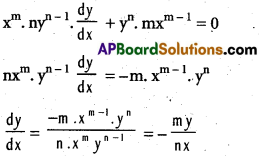
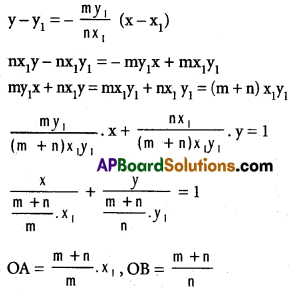
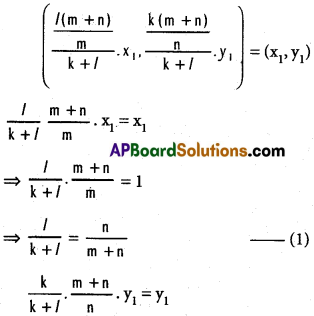
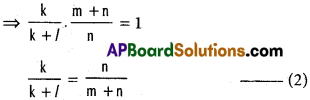
AP Inter 2nd Year Chemistry Study Material Chapter 2 Solutions

Andhra Pradesh BIEAP AP Inter 2nd Year Chemistry Study Material 2nd Lesson Solutions Textbook Questions and Answers.

AP Inter 2nd Year Chemistry Study Material 2nd Lesson Solutions

Very Short Answer Questions

Question 1.
Define the term solution.
Answer:
Solution: Solution is a homogeneous mixture of two (or) more components whose composition may be varied with certain limits.

Question 2.
Define molarity. [T.S. Mar.17] [Mar. 11]
Answer:
Molarity: The number of moles of solute dissolved in one litre of solution is called molarity.
Molarity (M) = \(\frac{\text { Moles of solute }}{\text { Volume (in litres) }}\)
M = \(\frac{\text { Weight }}{\text { Gram mol wt }} \times \frac{1000}{V(\mathrm{ml} l)}\)
Units: moles/litre.

AP Inter 2nd Year Chemistry Study Material Chapter 2 Solutions

Question 3.
Define molality [A.P. Mar. 15] [May 11]
Answer:
Molality: The number of moles of solute present in one kilogram of solvent is called molality.
Molality (M) = \(\frac{\text { Moles of solute }}{\text { Mass of solvent (kgs) }}\)
m = \(\frac{\text { Weight }}{\text { Gram mol wt }} \times \frac{1000}{\mathrm{G}(\mathrm{gms})}\)

Question 4.
Give an example of a solid solution in which the solute is solid.
Answer:
An example of a solid solution in which the solute is solid is copper dissolved in gold.

Question 5.
Define mole fraction. . [T.S. Mar. 18] [Mar. 14]
Answer:
Mole fraction: The ratio of number of moles of one component of the solution to the total number of moles of all the components of the solution is called mole fraction.
Mole fraction of solute Xs = \(\frac{\mathbf{n}_{\mathrm{S}}}{\mathbf{n}_{0}+\mathbf{n}_{\mathrm{s}}}\)
Mole fraction of solvent X0 = \(\frac{\mathbf{n}_{\mathrm{S}}}{\mathbf{n}_{0}+\mathbf{n}_{\mathrm{s}}}\)
[ns =number of moles of solute]
[n0 = number of moles of solvent]
It has no units.

Question 6.
Define mass percentage solution.
Answer:
The mass percentage of a component of a solution is defined as the
mass % = AP Inter 2nd Year Chemistry Study Material Chapter 2 Solutions 1 × 100

AP Inter 2nd Year Chemistry Study Material Chapter 2 Solutions

Question 7.
What is ppm of a solution ?
Answer:
ppm – parts per million : It is a convenient method of expressing concentration when a solute is present in trace quantities. Parts per million is defined as the
ppm = AP Inter 2nd Year Chemistry Study Material Chapter 2 Solutions 2 × 10⁶

Question 8.
What role do the molecular interactions play in a solution of alcohol and water ?
Answer:
In a solution of alcohol and water the molecular interactions present are hydrogen bondings. When these components are mixed then new hydrogen bonds develop between alcohol and water. The formed forces are weaker. Due to the decrease of magnitude of attractive forces, the solution shows positive deviation from Raoult’s law. This leads to increase of vapour pressure of solution and decrease in its boiling point.

Question 9.
State Raoult’s law. [A.P. & T.S. Mar. 18; 16; A.P. Mar. 17] [Mar. 14]
Answer:
Raoult’s law for volatile solute: For a solution of volatile liquids, the partial vapour pressure of each component of the solution is directly proportional to its mole fraction present in solution.

Raoult’s law for non-volatile solute : The relative lowering of vapour pressure of dilute solution containing non-volatile solute is equal to the mole fraction of solute.

Question 10.
State Henry’s law.
Answer:
At constant temperature, the solubility of a gas in a liquid is directly proportional to the partial pressure of the gas present above the surface of liquid. .
(Or)
The partial pressure of the gas in vapour phase is proportional to the mole fraction of the gas in the solution.
P = KH × x KH = Henry’s constant
P = Partial pressure
x = Mole fraction of gas

AP Inter 2nd Year Chemistry Study Material Chapter 2 Solutions

Question 11.
What is Ebullioscopic constant ?
Answer:
Ebullioscopic constant : The elevation of boiling point observed in one molal solution containing non-volatile solute is called Ebullioscopic constant (or) molal elevation constant.

Question 12.
What is Cryoscopic constant ?
Answer:
Cryoscopic constant : The depression in freezing point observed in one molal solution containing non-volatile solute is called cryoscopic constant (or) molal depression constant.

Question 13.
Define osmotic pressure. [A.P. Mar. 18; 16]
Answer:
Osmotic pressure : The pressure required to prevent the in flow of solvent molecules into the solution when these are. separated by semi-permeable membrane.

Question 14.
What are isotonic solutions ? [T.S. Mar. 19; 16; A.P. Mar. 17, 15]
Answer:
Isotonic solutions : Solutions having same osmotic pressure at a given temperature are called isotonic solutions.
e.g.: Blood is isotonic with 0.9% \(\left(\frac{\mathrm{W}}{\mathrm{V}}\right)\) NaCl [Saline]

Question 15.
Amongst the following compounds, identify which are insoluble, partially soluble and highly soluble in water, (i) phenol (ii) toluene (iii) formic acid (iv) ethylene glycol (v) chloroform (vi) pentanol.
Answer:

  1. Phenol is partially soluble in water.
  2. Toluene is insoluble in water.
  3. Formic acid is highly soluble in water.
  4. Ethylene glycol is highly soluble in water.
  5. Chloroform is insoluble in water.
  6. Pentanol is partially soluble in water.

AP Inter 2nd Year Chemistry Study Material Chapter 2 Solutions

Question 16.
Calculate the mass percentage of aspirin (C9H8O4) in acetonitrile (CH3CN) when 6.5 gm of C9H8O4 is dissolved in 450g of CH3CN.
Answer:
Given
The Mass of aspirin = 6.5 gms
Mass of acetonitrile = 450 gms
Mass of solution = 6.5 + 450
= 456.5 gms
Mass % = \(\frac{6.5}{456.5}\) × 100 = 1.424 %

Question 17.
Calculate the amount of benzoic acid (C6H5COOH) required for preparing 250 ml of 0.15 M solution in methanol.
Answer:
Given
Molarity = 0.15 M
Volume V = 250 ml
Molecular weight of benzoic acid (C6H5COOH) = 122
Molarity (M) = \(\frac{\text { Weight }}{\text { GMw }} \times \frac{1000}{V(\mathrm{~m} l)}\)
0.15 = \(\frac{\mathrm{W}}{122} \times \frac{1000}{250}\)
W = \(\frac{122 \times 0.15}{4}\) = 4.575 gms

Question 18.
The depression in freezing point of water observed for the same amount of acetic acid, dichloro-acetic acid and trichloro acetic acid increases in the order given above. Explain briefly.
Answer:
Given acids are CH3COOH, CHCl2COOH, CCl3 COOH.
The depression in freezing point of a solute in water depends upon the number of ions (or) particles in aqueous solution.
The given three acids are arranged in the order of their acidic strengths (increasing order)
CH3COOH < CHCl2COOH < CCl3COOH
Due to the presence of three chlorine atoms CCl3COOH is more acidic than CHCl2 COOH and followed by CH3COOH.
∴ The order of depression in freezing point is
CH3COOH < CHCl2COOH < CCl3COOH

AP Inter 2nd Year Chemistry Study Material Chapter 2 Solutions

Question 19.
What is Van’t Hoffs factor ‘i’ and how is it related to ‘a’ in the case of a binary electrolyte (1:1)?
Answer:
Van’t Hoffs factor (i) : “It is defined as the ratio of the observed value of colligative property to the theoretical value of colligative property”.
i = AP Inter 2nd Year Chemistry Study Material Chapter 2 Solutions 3

Solute dissociation or ionization process : If a solute on ionization gives ‘n’ ions and ‘a’ is degree of ionization at the given concentration, we will have [1 + (n – 1) α] particles.
(1 – α) ⇌ nα
Total 1 – α + nα = [1 + (n – 1) α]
∴ i = \(\frac{[1+(n-1) \alpha]}{1}\)
α = \(\frac{\mathrm{i}-1}{\mathrm{n}-1}\)
αionization = \(\frac{\mathrm{i}-1}{\mathrm{n}-1}\)
Solute association process :
If ‘n’A molecules combine to give An, we have
nA ⇌ An
If ‘α’ is degree of association at the given concentration.
1 – α = \(\frac{\alpha}{n}\)
= 1 – α + \(\frac{\alpha}{n}\)
i = \(\frac{1-\alpha+\frac{\alpha}{n}}{1}\)
(or) α = \(\frac{1-\mathrm{i}}{1-\frac{1}{n}}\)
α dissociation = \(\frac{1-\mathrm{i}}{1-\frac{1}{n}}\)

Question 20.
What is relative lowering of vapour pressure ? [A.P. Mar. 19]
Answer:
Relating lowering of vapour pressure: The ratio of lowering of vapour pressure of a solution containing non-volatile solute to the vapour pressure of pure solvent is called relative lowering of vapour pressure.
R.L.V.P. = \(\frac{\mathrm{P}_{0}-\mathrm{P}_{\mathrm{S}}}{\mathrm{P}_{0}}\)
P0 – PS = lowering of vapour pressure
P0 = Vapour pressure of pure solvent

AP Inter 2nd Year Chemistry Study Material Chapter 2 Solutions

Question 21.
Calculate the mole fraction of H2SO4 in a solution containing 98% H2SO4 by mass. [A.P. Mar. 17]
Answer:
Given a Solution containing – 98% H2SO4 by mass.
It means 98 gms of H2SO4 and 2 gms of H2O mixed to form a solution.
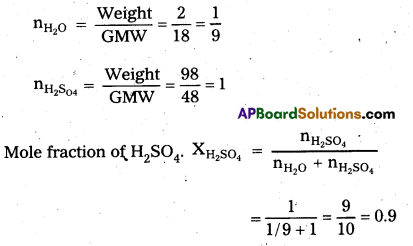
AP Inter 2nd Year Chemistry Study Material Chapter 2 Solutions 4

Short Answer Questions

Question 1.
How many types of solutions are formed? Give an example for each type of solution.
Answer:
Solutions are classified into three types on the basis of the solvent present in that solution.
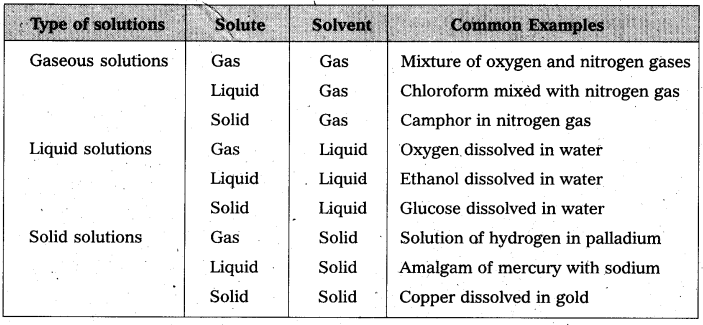
AP Inter 2nd Year Chemistry Study Material Chapter 2 Solutions 5

Question 2.
Define mass percentage, volume percentage and mass to volume percentage solutions.
Answer:
i) Mass percentage : The mass percentage of a component of a solution is defined as the
mass % = AP Inter 2nd Year Chemistry Study Material Chapter 2 Solutions 6 × 10

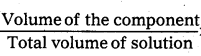
ii) Volume percentage \(\left(\frac{\mathbf{v}}{\mathbf{V}}\right)\) : It is defined as the volume % of a component
= AP Inter 2nd Year Chemistry Study Material Chapter 2 Solutions 7 × 100
iii) Mass to volume percentage \(\left(\frac{\mathbf{w}}{\mathbf{V}}\right)\) : It is defined as the mass of solute dissolved in 100 ml of the solution.
It is commonly used in medicine and pharmacy.

AP Inter 2nd Year Chemistry Study Material Chapter 2 Solutions

Question 3.
Concentrated nitric acid used in the laboratory work is 68% nitric acid by mass in aqueous solution. What should be the molarity of such a sample of the acid if the density of the solution is 1.504g mL-1?
Answer:
Given 68% HNO3 by mass that means
68gms mass of HNO3 present in 100 gms of solution.
Molecular weight of HNO3 = 63
Number of moles of HNO3 = \(\frac{\text { weight }}{\text { GMW }}=\frac{68}{63}\) = 1.079
Given density of the solution = 1.504 gm/ml
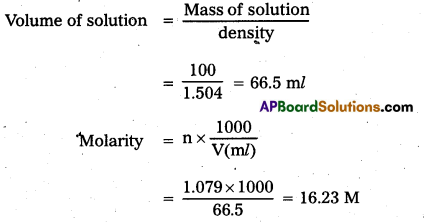
AP Inter 2nd Year Chemistry Study Material Chapter 2 Solutions 8

Question 4.
A solution of glucose in water is labelled as 10% w/w. What would be the molarity of the solution?
Answer:
Given 10% \(\left(\frac{\mathrm{W}}{\mathrm{w}}\right)\) glucose in water solution
Weight of glucose = 10 gms
GMW of glucose (C6H12O6) = 180
Weight of water = 100 – 10 = 90 gms.
Molarity (m) = \(\frac{\text { Weight }}{\text { GMW }} \times \frac{1000}{\text { W (gms) }}\)
= \(\frac{10}{180} \times \frac{1000}{90}\) = \(\frac{100}{18 \times 9}\)
= 0.617 moles / kg
Molarity = \(\frac{\text { Weight }}{\text { GMW }} \times \frac{1000}{V(\mathrm{~m} l)}\)
Weight of solution = 100 gms
Assuming that Density of solution = 1.2 gm/ml
Volume = \(\frac{100}{1.2}\) = 83.33 ml
Molarity (M) = \(\frac{10}{180} \times \frac{1000}{83.33}\) ml
= \(\frac{1000}{18 \times 83.33}\) = 0.67 M

Question 5.
A solution of sucrose in water is labelled as 20% w/w. What would be the mole fraction of each component in the solution ?
Answer:
20% \(\left(\frac{\mathrm{W}}{\mathrm{w}}\right)\) Sucrose in water solution means
20 gms of Sucrose and 80 gms of water.
Number of moles of sucrose (ns) = \(\frac{20}{342}\) = 0.0584
Number of moles of water (n0) = \(\frac{80}{18}\) = 4.444
Mole fraction of sucrose Xs = \(\frac{n_{s}}{n_{0}+n_{s}}\)
= \(\frac{0.0584}{4.444+0.0584}\) + \(\frac{0.0584}{4.50284}\) = 0.01296
Mole fraction of water X0 = \(\frac{n_{s}}{n_{0}+n_{s}}\) = \(\frac{4.444}{4.50284}\) = 0.9869
(Or)
Xs + X0 = 1
X0 = 1 – Xs = 1 – 0.01296 = 0987

AP Inter 2nd Year Chemistry Study Material Chapter 2 Solutions

Question 6.
How many ml of 0.1 M HCl is required to react completely with 1.0 g mixture of Na2CO3 and NaHCO3 containing equal-molar amounts of both?
Answer:
Given 1gm mixture of Na2CO3 and NaHCO3
Let the mass of Na2CO3 = a gms
Mass of NaHCO3 = (1 – a) gms
Number of moles of Na2CO3 = \(\frac{\mathrm{wt}}{\text { GMW }}=\frac{\mathrm{a}}{106}\)
Number of moles of NaHCO3 = \(\frac{\mathrm{wt}}{\mathrm{GMW}}=\frac{1-\mathrm{a}}{84}\)
Given that the mixture contains Equi molar amounts of Na2CO3 and NaHCO2
∴ \(\frac{a}{106}\) = \(\frac{1-a}{84}\)
84 a =106 – 106 a
190 a = 106
a = 0.558gms
∴ Weight of Na2CO3 = 0.558 gms
Weight of NaHCO3 = 1 – 0.558 = 0.442gms
Na2CO3 + 2 HCl → 2 NaCl + H2O + CO2
106 gms – 73 gms
0.558 g – ? \(\frac{73 \times 0.558}{106}\) = 0.384 gms
NaHCO3 + HCl → NaCl + H2O + CO2
84 gms — 36.5 gins
0.442gms — ?
= \(\frac{36.5 \times 0.442}{84}\) = 0.1928
∴ The weight of HC1 required = 0.384 + 0.192 = 0.576 gms
Molarity (M) = \(\frac{\mathrm{Wt}}{\text { GMWt }} \times \frac{1000}{\mathrm{~V}(\mathrm{~m} l)}\)
0.1 = \(\frac{0.576}{36.5} \times \frac{1000}{V}\)
V = \(\frac{0.576 \times 1000}{36.5 \times 0.1}=\frac{576}{3.65}\) = 157.80 ml

Question 7.
A solution is obtained by mixing 300g of 25% solution and 400g of 40% solution by mass. Calculate the mass percentage of the resulting solution.
Answer:
Given a solution is obtained by mixing 300 gms of 25% solution and 400 gms of 40% solution by mass.
Weight of solute in 1st solution = 300 × \(\frac{25}{100}\) = 75 gms
Weight of solute in 2nd solution = 400 × \(\frac{40}{100}\) = 160 gms
Total weight of solute = 75 + 160 = 235 gms
Total weight of solution = 300 + 400 = 700 gms
Mass % of solute in resulting solution = \(\frac{235}{700}\) × 100 = 33.5%

AP Inter 2nd Year Chemistry Study Material Chapter 2 Solutions

Question 8.
An antifreeze solution is prepared from 222.6g of ethylene glycol [(C2H6O2)] and 200g of water (solvent). Calculate the molality of the solution.
Solution:
Weight of Ethylene glycol = 222.6 gms .
G.mol wt =62
Weight of solvent = 200 gms
Molality (m) = \(\frac{\mathrm{Wt}}{\mathrm{GMWt}} \times \frac{1000}{\mathrm{a}(\mathrm{gms})}\)
= \(\frac{222.6}{62} \times \frac{1000}{200}=\frac{222.6}{62 \times 0.2}\) = 17.95 m
Molarity (M) = \(\frac{\mathrm{Wt}}{\mathrm{GMWt}} \times \frac{1000}{\mathrm{~V}(\mathrm{~m} l)}\)
= \(\frac{222.6}{62} \times \frac{1000}{394.2}\) = 9.1 M
Mass of solution = 200 + 222.6
= 422.6 gms
Volume = \(\frac{\text { Weight }}{\text { Density }}\) = \(\frac{422.6}{1.072}\) = 394.2 ml

Question 9.
Why do gases always tend to be less soluble in liquids as the temperature is raised?
Answer:
Gas dissolved in a liquid is an exothermic reaction (H <O).
According to Lechatelier’s principle,

  • If the reaction is exothermic the solubility of gas, decrease with increases in temperature.
  • So gases always tend to be less soluble in liquids to as the temperature is raised.

Question 10.
What is meant by positive deviations from Raoults law and how is the sign of ∆mix H related to positive deviation from Raoult’s law?
Answer:

  • When the vapour pressure of a solution is higher than the predicted value by Raoult’s law, it is called positive deviation.
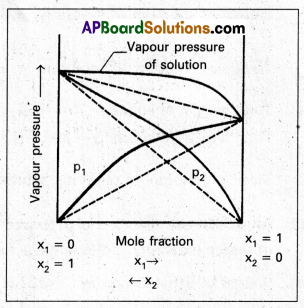
    AP Inter 2nd Year Chemistry Study Material Chapter 2 Solutions 9
  • In this case inter molecular interactions between solute and solvent particles (1 and 2) are weaker than those between solute and solvent particles (1 and 2) are weaker than those between solute and solute (1 – 1) and solvent – solvent (2 – 2)
  • Hence the molecules of 1 or 2 will escape more easily from the surface of solution than in their pure state.
    ∴ The vapour pressure of the solution will be higher.
  • The vapour pressure diagram showing positive deviation as follows.
    Eg. : Ethyl alcohol and water, Acetone and benzene.

AP Inter 2nd Year Chemistry Study Material Chapter 2 Solutions

Question 11.
What is meant by negative deviation from Raoult’s law and how is the sign of ∆mixH related to negative deviation from Raoult’s law?
Answer:

  • When the vapour pressure of a solution is lower than the predicted value by Raoult’s law, it is called negative deviation.
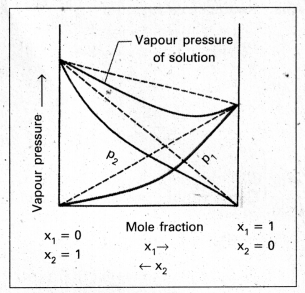
    AP Inter 2nd Year Chemistry Study Material Chapter 2 Solutions 10
  • In case of negative deviation the inter molecular attractive forces between 1 – 1 and 2 – 2 are weaker than those between 1 -2.
  • It leads to decrease in vapour pressure resulting in negative deviation.
  • The vapour pressure diagram showing negative deviation as follows.
  • Eg.: HNO3 and water, HCl and water.

Question 12.
The vapour pressure of water is 12.3 k Pa at 300 K. Calculate the vapour pressure of 1 molal solution of a non-volatile solute in it.
Answer:
Given molality of solution = 1 m
Vapour pressure of water P0 = 12.3 kPa
Number of moles of water = \(\frac{100}{18}\)
= 55.55 (n0)
Mole fraction of solute (Xs) = \(\frac{\mathrm{n}_{\mathrm{s}}}{\mathrm{n}_{0}+\mathrm{n}_{\mathrm{s}}}\)
= \(\frac{1}{55.55+1}\)
= \(\frac{1}{56.55}\) = 0.0177
Mole fraction of water (X0) = 1 – Xs
= 1 – 0.0177 = 0.9823
Vapour pressure of solution (Ps) = P0X0
= 12.3 × 0.9823 = 12.08 kPa

Question 13.
Calculate the mass of a non-volatile solute (molar mass 40g mol-1) which should be dissolved in 114g Octane to reduce its vapour pressure to 80%. [T.S. Mar. 16]
Answer:
Raoult’s law formula
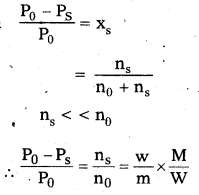
AP Inter 2nd Year Chemistry Study Material Chapter 2 Solutions 11
Given vapour pressure reduced to 80%, when non-volatile solute is dissolved in octane.
P0 = 1 atm
Ps = 0.8 atm
W = 114 gms
M = 114 gm/mole
w = ? ; m = 40
\(\frac{\mathrm{P}_{0}-\mathrm{P}_{\mathrm{s}}}{\mathrm{P}_{0}}=\frac{\mathrm{n}_{\mathrm{s}}}{\mathrm{n}_{0}}=\frac{\mathrm{w}}{\mathrm{m}} \times \frac{\mathrm{M}}{\mathrm{W}}\)
\(\frac{1-0.8}{1}=\frac{w}{40} \times \frac{114}{114}\)
w = 8 gms

AP Inter 2nd Year Chemistry Study Material Chapter 2 Solutions

Question 14.
A 5% solution (by mass) of cane sugar in water has freezing point of 271K. Calculate the freezing point of 5% glucose in water If freezing point of water is 273.15 K.
Answer:
Given 5% solution of cane sugar
w = 5gms; W = 95gms
m = 342; ∆Tf = 273.15 – 271 = 2.15
∆Tf = \(\frac{\mathrm{K}_{\mathrm{f}} \times \mathrm{w}}{\mathrm{m} \times \mathrm{W}}\)
2.15 =\(\frac{\mathrm{K}_{\mathrm{f}} \times 5}{342 \times 95}\) ……………… (1)
5% solution of glucose
w = 5gms; W = 95gms
m = 180, ∆Tf = ?
∆Tf = \(\frac{K_{f} \times 5}{180 \times 95}\) ………………… (2)
Dividing equation (2) by Equation (1)
\(\frac{\Delta \mathrm{T}_{\mathrm{f}}}{2.15}=\frac{\mathrm{K}_{\mathrm{f}} \times 5}{180 \times 95} \times \frac{342 \times 95}{\mathrm{~K}_{\mathrm{f}} \times 5}\)
∆Tf = \(\frac{342 \times 2.15}{180}\) = 4.085 K
∴ The freezing point temperature for 5% glucose solution
= 273.15 – 4.085 = 269.07 K

Question 15.
If the osmotic pressure of glucose solution is 1.52 bar at 300 K. What would be its concentration if R = 0.083L bar mol-1 K-1 ?
Answer:
π = CRT
R = 0.0836.bar. mole-1 K-1
T = 300 K
π = 1.52 bar
C = \(\frac{\pi}{\mathrm{RT}}=\frac{1.52}{0.083 \times 300}=\frac{1.52}{24.9}\) = 0.061 M

Question 16.
Vapour pressure of of water at 293K is 17.535 mm Hg. Calculate the vapour pressure of the solution at 293K when 25g of glucose is dissolved in 450g of water? [A.P. Mar.19]
Answer:
Raoult1s law formula
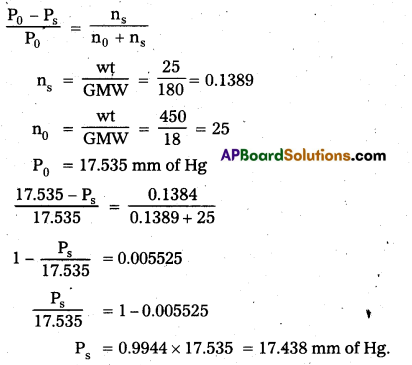
AP Inter 2nd Year Chemistry Study Material Chapter 2 Solutions 12

Question 17.
How is molar mass related to the elevation in boiling point of a solution?
Answer:
The expression for elevation of boiling point is
∆Tb = \(\frac{\mathrm{K}_{\mathrm{b}} \times 1000 \times \mathrm{w}}{\mathrm{m} \times \mathrm{w}}\) = Kb = molal elevation constant
w = Weight of solute
W = Weight of solvent
m = molar mass of solute
Molar mass of solute m = \(\frac{K_{\mathrm{b}} \times 1000 \times \mathrm{w}}{\Delta \mathrm{T}_{\mathrm{b}} \times \mathrm{w}}\)
∴ Molar mass of solute (m) and elevation of boiling point (∆Tb) are inversely related.

AP Inter 2nd Year Chemistry Study Material Chapter 2 Solutions

Question 18.
What is an ideal solution ?
Answer:
A solution of two or mote components which obeys Raoult’s law at all concentrations and at all temperatures is called ideal Solution. In ideal solution there should not be any association between solute and solvent, (i.e.) no chemical interaction between solute and solvent of solution.
Ex : The following mixtures form ideal solutions.

  • Benzene + Toluene
  • n – hexane + n – heptane
  • ethyl bromide + ethyl iodide

Question 19
What is relative lowering of vapour pressure ? How is it useful to determine the molar mass of a solute ? [T.S. Mar. 15]
Answer:
Raoult’s law for volatile solute: For a solution of volatile liquids, the partial vapour pressure of each component of the solution is directly proportional to its mole fraction present in solution.

Raoult’s law for non-volatile solute : The relative lowering of vapour pressure of dilute solution containing non-volatile solute is equal to the mole fraction of solute.

Relative lowering of vapour pressure \(\frac{\mathrm{P}_{0}-\mathrm{P}_{\mathrm{s}}}{\mathrm{P}_{0}}\) = Xs (mole fraction of solute)
\(\frac{\mathrm{P}_{0}-\mathrm{P}_{\mathrm{s}}}{\mathrm{P}_{0}}=\frac{\mathrm{n}_{\mathrm{s}}}{\mathrm{n}_{0}+\mathrm{n}_{\mathrm{s}}}\)
For very much dilute solutions ns < < < …………… n0
∴ \(\frac{\mathrm{P}_{0}-\mathrm{P}_{\mathrm{s}}}{\mathrm{P}_{0}}=\frac{\mathrm{n}_{\mathrm{s}}}{\mathrm{n}_{0}}=\frac{\mathrm{w}}{\mathrm{m}} \times \frac{\mathrm{M}}{\mathrm{W}}\)
W = Weight of solute
w = Weight of solvent
m = Molar mass of solute
M = Molar mass of solvent
Molar mass of solute m = \(\frac{W \times M}{W} \times \frac{P_{0}}{P_{0}-P_{s}}\)

Question 20.
How is molar mass related to the depression in freezing point of a solution ?
Answer:
The expression for depression in Freezing point is
∆Tf = \(\frac{\mathrm{K}_{\mathrm{f}} \times 1000 \times \mathrm{w}}{\mathrm{m} \times \mathrm{W}}\)
Kf = molal depression constant
W = Weight of solvent
w = Weight of solute
m = molar mass of solute
Molar mass of solute (m) = \(\frac{\mathrm{K}_{\mathrm{f}} \times 1000 \times \mathrm{w}}{\Delta \mathrm{T}_{\mathrm{f}} \times \mathrm{W}}\)
∴ Molar mass ôf solute (m) and depression in freezing point (∆Tf) are inversely related.

Long Answer Questions

Question 1.
An aqueous solution of 2% non volatile solute exerts a pressure of 1.004 bar at the normal boiling point of the solvent. What is the molecular mass of the solute ?
Answer:
Relative lowering of vapour pressure = \(\frac{\mathrm{P}_{0}-\mathrm{P}_{\mathrm{s}}}{\mathrm{P}_{0}}=\frac{\mathrm{n}_{\mathrm{s}}}{\mathrm{n}_{0}}\)
P0 = 1.013 bar, Ps = 1.004 bar
w = 2gms
W = 98gms
M = 18
m = ?
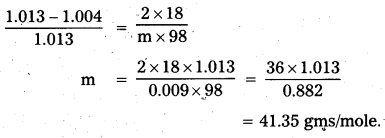
AP Inter 2nd Year Chemistry Study Material Chapter 2 Solutions 13

AP Inter 2nd Year Chemistry Study Material Chapter 2 Solutions

Question 2.
Heptane and Octane form an ideal solution. At 373 K the vapour pressure of the two liquid components are 105.2 kPa and 46.8 kPa respectively. What will be the vapour pressure of a mixture of 26.0 g heptane and 35g of octane?
Answer:
Number of moles of octane n0 = \(\frac{\text { Weight }}{\text { GMwt }}=\frac{35}{114}\) = 0.307
Number of moles of heptane ns = \(\frac{\text { Weight }}{\text { GMwt }}=\frac{26}{100}\) = 0.26
no 0.307
Mole fraction of octane X0 = \(\frac{\mathrm{n}_{0}}{\mathrm{n}_{0}+\mathrm{n}_{\mathrm{s}}}=\frac{0.307}{0.307+0.26}\) = 0.541
Mole fraction of heptane Xs = \(\frac{\mathrm{n}_{\mathrm{s}}}{\mathrm{n}_{0}+\mathrm{n}_{\mathrm{s}}}=\frac{0.26}{0.307+0.26}\) = 0.459
Given vapour pressure of heptane P1 = 105.2 kPa
vapour pressure of Octane P2 = 46.8 kPa
26 gms of heptane and 35 gms of octane are mixed.
In that mixture
The vapour pressure of heptane (P11) = P1 × Xs
= 105.2 × 0.459 = 48.28 kPa
The vapour pressure of Octane (P22) = P2 × X0
= 46.8 × 0.541
= 25.32 kPa
Total pressure of the mixture (P) = P11 + P22
= 25.32 + 48.28
= 73.6 kPa

Question 3.
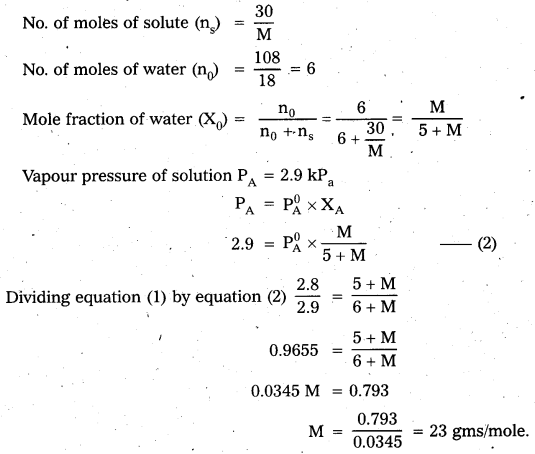
A solution containing 30g of non-volatile solute exactly in 90g of water has a vapour pressure of 2.8 kPa at 298 K. Further 18g of water is then added to the solution and the new vapour pressure becomes 2.9 kPa at 298 K. Calculate (i) The molar mass of the solute and (ii) Vapour pressure of water at 298 K.
Answer:
Calculation of molar mass of solute
Case – I:
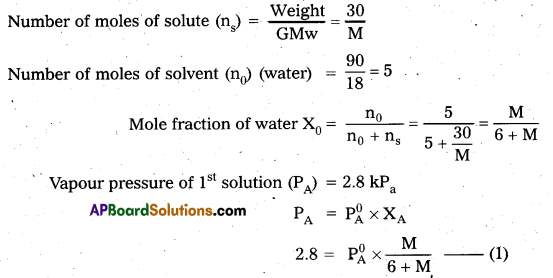
AP Inter 2nd Year Chemistry Study Material Chapter 2 Solutions 14
Case – II :
AP Inter 2nd Year Chemistry Study Material Chapter 2 Solutions 15
Calculation of vapour pressure of water :
According to Raoult’s law
PA = \(\mathrm{P}_{\mathrm{A}}^{0} \mathrm{X}_{\mathrm{A}}\)
2.8 = \(P_{A}^{0} \times \frac{M}{6+M}\)
M = 23
2.8 = \(\mathrm{P}_{\mathrm{A}}^{0} \times \frac{23}{6+23}\)
\(\mathrm{P}_{\mathrm{A}}^{0}=\frac{2.8 \times 29}{23}=\frac{81.2}{23}\) = 3.53 k.pa

Question 4.
Two elements A and B from compounds having formula AB2 and AB4. When dissolved in 20g of Benzene (C6H6), 1g of AB2 lowers the freezing point by 2.3 K whereas 1.0g of AB4 lowers it by 1.3 K. The molar depression constant for benzene is 5.1 K kg mol-1. Calculate atomic masses of A and B.
Answer:
Calculation of molecular masses of compounds AB2 and AB4
For AB2 compounds
m = \(\frac{\mathrm{K}_{\mathrm{f}} \times 1000 \times \mathrm{W}}{\Delta \mathrm{T}_{\mathrm{f}} \times \mathrm{W}}=\frac{5.1 \times 1000 \times 1}{2.3 \times 20}\) = 110.87 gms/mole
For AB4 compound
m = \(\frac{5.1 \times 1000 \times 1}{1: 3 \times 20}\) = 196.15 gms/mole
Calculation of the atomic masses of elements
Atomic mass of element A = x
Atomic mass of element B = y
Molecular mass of AB2 = x + 2y
Molecular mass of AB4 = x + 4y
a + 2b = 110.87 ……………….. (1)
a + 4b = 196.15 ………………. (2)
Equation (2) – Eqiation (1)
x + 4y – x – 2y
196.15 – 110.87
2y = 85.28
y = 42.64
x + 2y = 110.87
x + 85.28 = 110.87
x = 25.59
Atomic mass of element A = 25.59 u
B = 42.64 u

AP Inter 2nd Year Chemistry Study Material Chapter 2 Solutions

Question 5.
Calculate the depression in the freezing point of water when 10g of CH3CH2CHClCOOH is added to 250g of water. Ka = 1.4 × 10⁻³, Kf = 1.86 K kg mol-1.
Answer:
Calculation of degree of dissociation :
Mass of solute = 10 gms
Molar mass of solute (CH3 – CH2 – CH – Cl – COOH) = 122.5 g/mole
Molality = \(\frac{10}{122.5} \times \frac{1000}{250}\) = 0.326 m
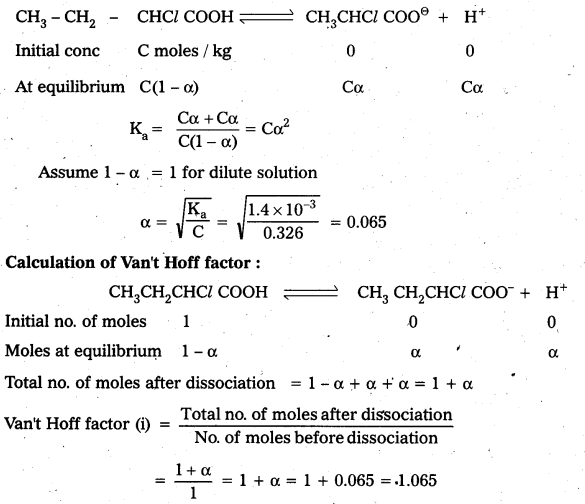
AP Inter 2nd Year Chemistry Study Material Chapter 2 Solutions 16
Calculation of depression in freezing point
∆Tf = i × Kf × m = 1.065 × 1.86 × 0.326 = 0.65 K

Question 6.
19.5g of CH2FCOOH is dissolved in 500g of water. The depression In freezing point of water observed is 1.0°C. Calculate the Van’t Hoff factor and dissociation constant of fluoroacetic acid.
Answer:
Calculation of Vant Hoff factor of acid:
∆Tf = 1°C
Kf = 1.86 K kg/mole-1
∆Tf = i Kf m
m = \(\frac{19.5}{78} \times \frac{1000}{500}\) = 0.5 m
i = \(\frac{1}{1.86 \times 0.5}\) = 1.0753
Calculation of degree of dissociation of the acid :
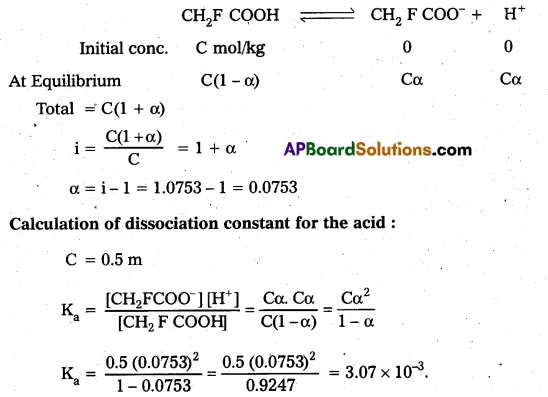
AP Inter 2nd Year Chemistry Study Material Chapter 2 Solutions 17

Question 7.
100 g of liquid A(molar mass 140g mol-1) was dissolved in 1000 g of liquid B(molar mass 180g mol-1). The vapour pressure of pure liquid B was found to be 500 torr. Calculate the vapour pressure of pure liquid A and its vapour pressure in the solution if the total vapour pressure of the solution is 475 torr.
Answer:
Calculation of vapour pressure of pure liquid A (\(\mathrm{P}_{\mathrm{A}}^{0}\))
Number of moles of liquid A
nA = \(\frac{\mathrm{w}}{\mathrm{m}}=\frac{100}{140}\) = 0.7143
Number of moles of liquid B
nB = \(\frac{\mathrm{w}}{\mathrm{m}}=\frac{1000}{180}\) = 5.5556
Mole fraction of A
XA = \(\frac{\mathrm{n}_{\mathrm{A}}}{\mathrm{n}_{\mathrm{A}}+\mathrm{n}_{\mathrm{B}}}=\frac{0.7143}{0.7143+5.5556}=\frac{0.7143}{6.2699}\)
= 0.1139
Mole fraction of B (XB) = 1 – 0.1139 = 0.8861
Vapour pressure of liquid (\(\mathrm{P}_{\mathrm{B}}^{0}\)) = 500 torr
Total vapour pressure of solution (P) = 475 torr
According to Raoult’s law
P = P\(\mathrm{P}_{\mathrm{A}}^{0}\) XA + P\(\mathrm{P}_{\mathrm{B}}^{0}\) XB
475 = P\(\mathrm{P}_{\mathrm{A}}^{0}\) (0.1139) + 500(0.8861)
475 = P\(\mathrm{P}_{\mathrm{A}}^{0}\) (0.1139) + 443.05
\(\mathrm{P}_{\mathrm{A}}^{0}\) = \(\frac{475-443.05}{0.1139}=\frac{31.95}{0.1139}\) = 280.5 torr
Calculation of vapour pressure of A in the solution (PA)
PA = P\(\mathrm{P}_{\mathrm{A}}^{0}\) XA = 280.5 × 0.1139
PA = 32 torr.

AP Inter 2nd Year Chemistry Study Material Chapter 2 Solutions

Question 8.
Determine the amount of CaCl2 (i = 2.47) dissolved in 2.5 litre of water such that its osmotic pressure is 0.75 atm at 27°C.
Answer:
Varit Hoffs equation
Osmotic pressure (π) = i CRT
i = 2.47 .
V = 2.5 lit
R = 0.0821 lit. atm.k-1. mol-1
T = 27 + 273 = 300 K
π = 0.75 atm
π = i(\(\frac{n_{B}}{V}\))RT
nB = \(\frac{\pi \mathrm{V}}{\mathrm{iRT}}=\frac{0.75 \times 2.5}{2.47 \times 0.0821 \times 300}\) = 0.0308
The amount of CaCl2 dissolved = nB × mB
= 0.0308 × 111 = 3.42 gms

Question 9.
Determine the osmotic pressure of a solution prepared by dissolving 25 mg of K2SO4 in two litre of water at 25°C assuming that it is completely dissociated.
Answer:
The amount of K2SO4 dissolved = 25 mg
Volume = 2 lit; T = 25°C = 298 K
Molecular weight of K2SO4 = 174 gms / mole

AP Inter 2nd Year Chemistry Study Material Chapter 2 Solutions 18
Total ions produced on dissociation = 3
i = 3
π = i CRT = \(\mathrm{i}\left(\frac{\mathrm{n}}{\mathrm{V}}\right) \mathrm{RT}=\mathrm{i}\left(\frac{\mathrm{w}}{\mathrm{m}}\right) \times \frac{\mathrm{RT}}{\mathrm{V}}\)
= \(\frac{3 \times 0.025 \times 0.0821 \times 298}{174 \times 2}\) = 5.27 × 10⁻³ atm.

AP Inter 2nd Year Chemistry Study Material Chapter 2 Solutions

Question 10.
Benzene and Toluene form ideal solution over the entire range of composition. The vapour pressure of pure benzene and toluene at 300 K are 50.71 mm of Hg and 32.06 mm of Hg respectively. Calculate the mole fraction of benzene in vapour phase if 80g of benzene is mixed with 100g of toluene.
Answer:
Molecular weight of benzene (C6H6) = 78
Molecular weight of Toluene (C7H8) = 92
nC6H6 = \(\frac{80}{78}\) = 1.026
nC7H8= \(\frac{100}{92}\) = 1.087
XC6H6 = \(\frac{1.026}{1.026+1.087}=\frac{1.026}{2.113}\) = 0.4855
XC7H8 = 1 – 0.4855 = 0.5145
According to Raoult’s law
Partial pressure of benzene in solution
PC6H6 = PC6H6 × XC6H6
= 50.71 × 0.4855 = 24.61 mm
Partial pressure of Toluene in solution
PGH8 = AP Inter 2nd Year Chemistry Study Material Chapter 2 Solutions 19 × XC7H8 = 32.06 × 0.5145 = 16.49 mm
Total vapour pressure of solution (P) = 24.61 + 16.49 = 41.1 mm
Mole fraction of benzene in vapour phase is
= \(\frac{\mathrm{X}_{\mathrm{C}_{6} \mathrm{H}_{6}} \times \mathrm{P}_{\mathrm{C}_{6} \mathrm{H}_{6}}^{0}}{\mathrm{P}_{\text {total }}}=\frac{0.4855 \times 50.71}{41.1}=\frac{24.61}{41.1}\) = 0.5987

Textual Examples

Question 1.
Calculate the mole fraction of ethylene glycol (C2H6O2) In a solution containing 20% of C2H6O2 by mass.
Solution:
Assume that we have 100g of solution (one can start with any amount of solution because the results obtained will be the same). Solution will contain 20g of ethylene glycol and 80g of water.
Molar mass of C2H6O2 = 12 × 2 + 1 × 6 + 16 × 2 = 62 g mol-1
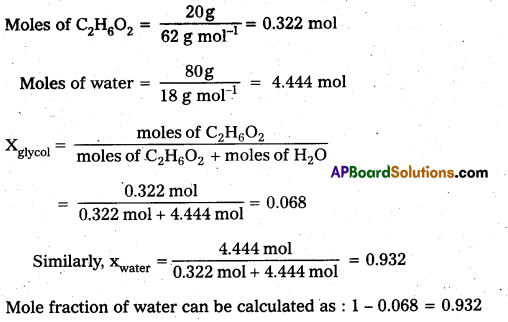
AP Inter 2nd Year Chemistry Study Material Chapter 2 Solutions 20

Question 2.
Calculate the molarity of a solution containing 5g of NaOH in 500 mL solution. [T.S Mar.17]
Solution:
Moles of NaOH = \(\frac{5 \mathrm{~g}}{40 \mathrm{~g} \mathrm{~mol}^{-1}}\) = 0.125 mol
Volume of the solution in litres = 450 mL / 1000 mL L-1
Using equation
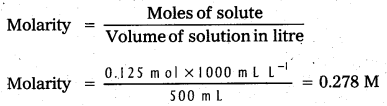
AP Inter 2nd Year Chemistry Study Material Chapter 2 Solutions 21
= 0.278 mol L-1 = 0.278 mol dm-3

Question 3.
Calculate molality of 2.5 of ethanoic acid (CH3COOH) In 75g of benzene. [T.S. Mar. 15]
Solution:
Molar mass of C2H4O2: 12 × 2 + 1 × 4 + 16 × 2 = 60g mol-1
Moles of C2H4O2 = \(\frac{2.5 \mathrm{~g}}{60 \mathrm{~g} \mathrm{~mol}^{-1}}\) = 0.0417 mol
Mass of benzene in kg = 75g/1000 g kg-1 = 75 × 10-3 kg
Molality of C2H4O2 = \(\frac{\text { Moles of } \mathrm{C}_{2} \mathrm{H}_{4} \mathrm{O}_{2}}{\mathrm{~kg} \text { of benzene }}=\frac{0.0417 \times \mathrm{mol} \times 1000 \mathrm{~g} \mathrm{~kg}^{-1}}{75 \mathrm{~g}}\)
= 0.556 mol kg-1

AP Inter 2nd Year Chemistry Study Material Chapter 2 Solutions

Question 4.
If N2 gas is bubbled through water at 293 K, how many mililmoles of N2 gas would dissolve in 1 litre of water ? Assume that N2 exerts a partial pressure of 0.987 bar. Given that Henrys law constant for N2 at 293 K is 76.48 k bar.
Solution:
The solubiity of gas is related to the mole fraction in aqueous solution.
The mole fraction of the gas in the solution is calculated by applying Henrys law. Thus:
x (nitrogen) = \(\frac{\mathrm{p} \text { (nitrogen) }}{\mathrm{K}_{\mathrm{H}}}=\frac{0.987 \mathrm{bar}}{76.480 \mathrm{bar}}\) = 1.29 × 10⁻⁵
As 1 Litre of water contains 55.5 mol of it, therefore if n represents number of moles of N2 in solution.
x(Nitrogen) = \(\frac{\mathrm{n} \mathrm{mol}}{\mathrm{n} \mathrm{mol}+55.5 \mathrm{~mol}}=\frac{\mathrm{n}}{55.5}\) = 1.29 × 10⁻⁵
(n in denominator is neglected as it is << 55.5)
Thus n = 1.29 × 10⁻⁵ 55.5 mol 7.16 × 10⁻⁴ mol
= \(\frac{7.16 \times 10^{-4} \mathrm{~mol} \times 1000 \mathrm{mmol}}{1 \mathrm{~mol}}\) = 0.716 m mol

Question 5.
Vapour pressure of chloroform (CHCl3) and dichloromethane (CH2Cl2) at 298 K are 200 mm Hg and 415 mm Hg respectively. (i) Calculate the vapour pressure of the solution prepared by mixing 25.5 g of CHCl3 and 40 g of CH2Cl2 at 298 K and (ii) mole fractions of each component in vapour phase.
Solution:
i) Molar mass of CH2Cl2 = 12 × 1 + 1 × 2 + 35.5 × 2 = 85 g mol-1
Molar mass of CHCl3 = 12 × 1 + 1 × 1 +35.5 × 3 = 119.5 g mol-1
Moles of CH2Cl2 = \(\frac{40 \mathrm{~g}}{85 \mathrm{~g} \mathrm{~mol}^{-1}}\) = 0.47 mol
Moles of CHCl3 = \(\frac{25.5 \mathrm{~g}}{119.5 \mathrm{~g} \mathrm{~mol}^{-1}}\) = 0.2 13 mol
Total number of moles = 0.47 + 0.2 13 = 0.683 mol
XCH2Cl2 = \(\frac{0.47 \mathrm{~mol}}{0.683 \mathrm{~mol}}\) = 0.688
XCHCl3 = 1.00 – 0.688 = 0.3 12
Using equation :
ptotal = \(\mathrm{p}_{1}^{0}+\left(\mathrm{p}_{2}^{0}-\mathrm{p}_{1}^{0}\right)\) x2 = 200 + (415 – 200) × 0.688
= 200 + 147.9 = 347.9mm Hg

ii) Using the relation, y1 = p1/ptotal we can calculate the mole fraction of the components in gas phase (y1)
PCH2Cl2 = 0.688 × 415 mm Hg = 285.5 mm Hg
PCHCl3 = 0.3 12 × 200 mm Hg = 62.4 mm Hg
yCH2Cl2 = 285.5 mm Hg/347.9 mm Hg = 0.82
yCHCl3 = 62.4 mm Hg/347.9 mm Hg = 0.18

Note : Since CH2Cl2 is a more volatile component than CHCl3, [\(\mathrm{p}_{\mathrm{CH}_{2} \mathrm{Cl}_{2}}^{0}\) = 415 mm Hg and
\(\mathrm{p}_{\mathrm{CHCl}_{3}}^{0}\) = 200 mm Hg] and the vapour phase is also richer in CH2Cl2 [yCH2Cl2 = 0.82 and yCHCl3 = 0.18], it may thus be concluded that at equilibrium, vapour phase will be always rich in the component which is more volatile.

AP Inter 2nd Year Chemistry Study Material Chapter 2 Solutions

Question 6.
The vapour pressure of pure benzene at a certain temperature is 0.850 bar. A non-volatile, non-electrolyte solid weighing 0.5g when added to 39.0 g of benzene (molar mass 78 g mol-1), vapour pressure of the solution, then, is 0.845 bar. What is the molar mass of the solid substance ? [A.P. Mar. 18; 16]
Solution:
The various quantities known to us are as follows.
\(\mathrm{p}_{1}^{0}\) = 0.850 bar
P = 0.845bar
M1 = 78 g mol-1
w2 = 0.5 g
w1 = 39 g
Substituting these values in equation \(\frac{\mathrm{P}^{0}-\mathrm{P}}{\mathrm{P}_{1}^{0}}=\frac{\mathrm{w}_{2} \times \mathrm{M}_{1}}{\mathrm{M}_{2} \times \mathrm{w}_{1}}\) we get
\(\frac{0.850 \mathrm{bar}-0.845 \mathrm{bar}}{0.850 \mathrm{bar}}=\frac{0.5 \mathrm{~g} \times 78 \mathrm{~g} \mathrm{~mol}^{-1}}{\mathrm{M}_{2} \times 39 \mathrm{~g}}\)
Therefore, M2 = 170 g mol-1.

Question 7.
18g of glucose, C6H12O6, is dissolved in 1 kg of water in a saucepan. At what temperature will water boil at 1.013 bar ? Kb for water is 0.52 K kg mol-1.
Solution:
Moles of glucose = 18g/180 g mol-1 = 0.1 mol
Number of kilograms of solvent = 1 kg
Thus molality of glucose solution = 0.1 mol kg-1
For water, change in boiling point
∆Tb = Kb × m = 0.52 K kg mol-1 × 0.1 mol kg-1 = 0.052 K .
Since water boils at 373.15 K at 1.013 bar pressure, therefore, the boiling point of solution will be 373.15 + 0.052 = 373.202 K.

Question 8.
The boiling point of benzene is 353.23 K. When 1.80 g of a non-volatile solute was dissolved in 90 g of benzene, the boiling point is raised to 354.11 K. Calculate the molar mass of the solute. Kb for benzene is 2.53 K kg mol-1.
Solution:
The elevation of (∆Tb) in.the boiling point = 354.11 K – 353.23 K. = 0.88 K
Substituting these values in expression we get, M2 = \(\frac{1000 \times \mathrm{w}_{2} \times \mathrm{K}_{\mathrm{b}}}{\Delta \mathrm{T}_{\mathrm{b}} \times \mathrm{w}_{1}}\)
M2 = \(\frac{2.53 \mathrm{~K} \mathrm{~kg} \mathrm{~mol}^{-1} \times 1.8 \mathrm{~g} \times 1000 \mathrm{~g} \mathrm{~kg}^{-1}}{0.88 \mathrm{~K} \times 90 \mathrm{~g}}\)
Therefore, molar mass of the solute, M2 = 58 g mol-1.

AP Inter 2nd Year Chemistry Study Material Chapter 2 Solutions

Question 9.
45 g of ethylene glycol (C2H6O2) is mixed with 600 g of water. Calculate (a) the freezing point depression and (b) the freezing point of the solution.
Solution:
Depression in freezing point is related to the molality, therefore, the molality of the solution with respect to ethylene glycol = \(\frac{\text { moles of ethylene glycol }}{\text { mass of water in kilogram }}\)
Moles of ethylene glycol = \(\frac{45 \mathrm{~g}}{62 \mathrm{~g} \mathrm{~mol}^{-1}}\) = 0.73 mol
Mass of water in kg = \(\frac{600 \mathrm{~g}}{1000 \mathrm{~g} \mathrm{~kg}^{-1}}\) = 0.6 kg
Hence molality of ethylene glycol = \(\frac{0.73 \mathrm{~mol}}{0.60 \mathrm{~kg}}\) = 1.2 mol kg-1
Therefore freezing point depression,
∆Tf = 1.86 K kg mol-1 × 1.2 mol kg-1 = 2.2 K
Freezing point of the aqueous solution 273.15 K – 2.2 K = 270.95 K

Question 10.
1.00 g of a non-electrolyte solute dissolved in 50g of benzene lowered the freezing point of benzene by 0.40 K. The freezing point depression constant of benzene is 5.12 K kg mol-1. Find the molar mass of the solute.
Solution:
Substituting the values of various terms involved in equation
M2 = \(\frac{\mathrm{K}_{\mathrm{f}} \times \mathrm{w}_{2} \times 1000}{\Delta \mathrm{T}_{\mathrm{f}} \times \mathrm{w}_{1}}\) we get
M2 = \(\frac{5.12 \mathrm{~K} \mathrm{~kg} \mathrm{~mol}^{-1} \times 1.00 \mathrm{~g} \times 1000 \mathrm{~g} \mathrm{~kg}^{-1}}{0.40 \times 50 \mathrm{~g}}\) = 256 g mol-1
Thus, molar mass of the solute = 256 g mol-1

Question 11.
200 cm3 of an aqueous solution of a protein contains 1.26 g of the protein. The osmotiç pressure of such a solution at 300 K is found to be 2.57 × 10⁻³ bar. Calculate the molar mass of the protein.
Solution:
The various quantities known to us are as follows : π = 2.57 × 10⁻³ bar.
V = 200 cm3 = 0.200 litre
T = 300K
R = 0.083 L bar mol-1 K-1
Substituting these values in equation,
we get M2 = \(\frac{w_{2} R T}{\pi V}\)
M2 = \(\frac{1.26 \mathrm{~g} \times 0.083 \mathrm{~L} \mathrm{bar} \mathrm{K}^{-1} \mathrm{~mol}^{-1} \times 300 \mathrm{~K}}{2.57 \times 10^{-3} \mathrm{bar} \times 0.200 \mathrm{~L}}\)
= 61.022 g mol-1

AP Inter 2nd Year Chemistry Study Material Chapter 2 Solutions

Question 12.
2 g of benzoic acid (C6H5COOH) dissolved in 25g of benzene shows a depression in freezing point equal to 1.62 K. Molal depression constant for benzene is 4.9 K kg mol-1. What is the percentage association of acid if it forms dimer in solution ?
Solution:
The given quantities are :
w2 = 2g; Kf = 4.9 K kg mol-1; w1 = 25 g
∆Tf = 1.62 K
Substituting these values, in equation, we get:
M2 = \(\frac{\mathrm{K}_{\mathrm{f}} \times \mathrm{w}_{2} \times 1000}{\Delta \mathrm{T}_{\mathrm{f}} \times \mathrm{w}_{1}}\)
M2 = \(\frac{4.9 \mathrm{~K} \mathrm{~kg} \mathrm{~mol}^{-1} \times 2 \mathrm{~g} \times 1000 \mathrm{~g} \mathrm{~kg}^{-1}}{25 \mathrm{~g} \times 1.62 \mathrm{~K}}\) = 241.98 g mol-1
Thus, experimental molar mass of benzoic acid in benzene is = 241.98 g mol-1
Now consider the following equilibrium for the acid :
2 C6H5COOH ⇌ (C6H5COOH)2
If x represents the degree of association of the solute then we would have (1 – x) mol of benzoic acid left in unassociated form and correspondingly \(\frac{x}{2}\) as associated moles of benzoic acid at equilibrium.
Therefore, total number of particles at equilibrium is :
1 – x + \(\frac{x}{2}\) = 1 – \(\frac{x}{2}\).
Thus, total number of moles of particles at equilibrium equals van’t Hoff factor i.
But i = \(\frac{\text { Normal molar mass }}{\text { Abnormal molar mass }}=\frac{122 \mathrm{~g} \mathrm{~mol}^{-1}}{241.98 \mathrm{~g} \mathrm{~mol}^{-1}}\)
or = \(\frac{x}{2}\) = 1 – \(\frac{122}{241.98}\) = 1 – 0.504 = 0.496
or x = 2 × 0.496 = 0.992
Therefore, degree of association of benzoic acid in benzene is 99.2%.

Question 13.
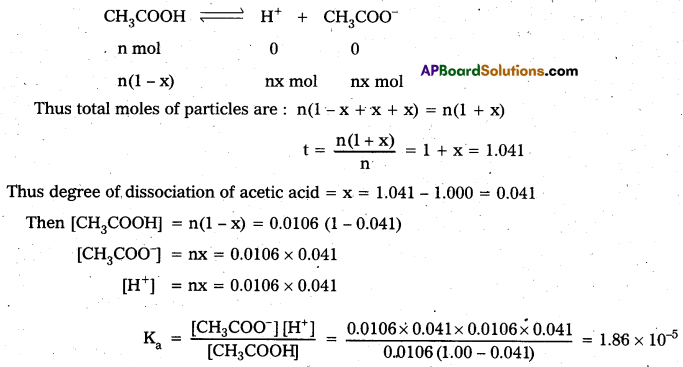
0.6 mL of acetic acid (CH3COOH), having density 1.06 g mL-1, is dissolved in 1 litre of water. The depression in freezing point observed for this strength of acid was 0.0205°C. Calculate the van’t Hoff factor and the dissociation constant of acid.
Answer:
Number of moles of acetic acid = \(\frac{0.6 \mathrm{~mL} \times 1.06 \mathrm{~g} \mathrm{~mL}^{-1}}{60 \mathrm{~g} \mathrm{~mol}^{-1}}\)
= 0.0106 mol = n
Molality = \(\frac{0.0106 \times \mathrm{mol}}{1000 \mathrm{~mL} \times 1 \mathrm{~g} \mathrm{~mL}^{-1}}\) = 0.0106 mol kg-1
Using equation ∆Tf = \(\frac{\mathrm{K}_{\mathrm{f}} \times \mathrm{w}_{2} \times 1000}{\mathrm{M}_{2} \times \mathrm{w}_{1}}\)
∆Tf = 1.86 K kg mol-1 × 0.0106 mol kg-1 = 0.0197 K
van’t Hoff factor (i) = \(\frac{\text { Observed freezing point }}{\text { Calculated freezing point }}=\frac{0.0205 \mathrm{~K}}{0.0197 \mathrm{~K}}\) = 1.041
Acetic acid is a weak electrolyte and will dissociate into two ions: acetate and hydrogen ions per molecule of acetic acid. If x is the degree of dissociation of acetic acid, then we would have n (1 — X) moles of undissociated acetic acid, mc moles of CH3COO and nx moles of H+ ions.
AP Inter 2nd Year Chemistry Study Material Chapter 2 Solutions 22

Intext Questions

Question 1.
Calculate the mass percentage of benzene (C6H6) and carbon tetrachlodie (CCl4) if 22g of benzene is dissolved in 122g of carbon tetrachioride.
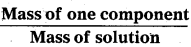
Then, calculate the mass percentage from the formula
Mass % = AP Inter 2nd Year Chemistry Study Material Chapter 2 Solutions 23 × 100
Solution:
Mass of benzene = 22g; Mass of CCl4 = 122g
Mass of solution = 22 + 122 = 144g
Mass % of benzene = \(\frac{22}{144}\) × 100 = 15.28%
Mass of CCl4 = 100 – 15.28 = 84.72%
Note: Mass percent of CCl4 can also be calculated by using the formula as:
Mass % of CCCl4 = \(\frac{122}{144}\) × 100 = 84.72%

AP Inter 2nd Year Chemistry Study Material Chapter 2 Solutions

Question 2.
Calculate the mole fraction of benzene in solution containing 30% by mass in carbon tetrachloride.
• Then calculate the mole fraction by using the formula
Mole fraction of a component = \(\frac{\text { Number of moles of the component }}{\text { Total number of moles of all components }}\)
xA = \(\frac{\mathbf{n}_{\mathbf{A}}}{\mathbf{n}_{\mathbf{A}}+\mathbf{n}_{\mathbf{B}}}\)
Solution:
For 100 g of the solution
Mass of benzene = 30 g
Mass of carbon tetrachioride = 100 – 30 = 70g
Molar mass of benzene (C6H6) (12 × 6) + (6 × 1) = 72 + 6 = 78 g mol-1
Moles of benzene, nC6H6 = \(\frac{\text { Mass }}{\text { Molar mass }}=\frac{30}{78}\) = 0385 mol
Molar mass of carbon tetrachioride (CCl4) = 12 + (35.5 × 4)
= 12 + 142.0 = 154 g mol-1
Moles of CCl4,nCCl4 = \(\frac{70 \mathrm{~g}}{\left(154 \mathrm{~mol}^{-1}\right)}\) = (154 mol-1)
Mole fraction of benzene, XC6H6 = \(\frac{\mathrm{n}_{\mathrm{C}_{6} \mathrm{H}_{6}}}{\mathrm{n}_{\mathrm{C}_{6} \mathrm{H}_{6}}+\mathrm{n}_{\mathrm{CC}_{4}}}=\frac{0.385 \mathrm{~mol}}{(0.385+0.454) \mathrm{mol}}\) = 0.459

Question 3.
Calculate the molarity of each of the following solution:
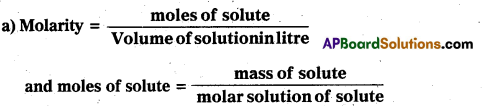
a) 30g of CO(NH3)2. 6H2O in 4.3 L of solution.
b) 30 mL of 0.5 MH2SO4 diluted to 500 mL.
AP Inter 2nd Year Chemistry Study Material Chapter 2 Solutions 24
So, first find molar mass by adding atomic masses of different elements, then find moles of solute and then molarity.
b)Use molarity equation for dilution.
M1V1
(Before dilution)
M2V2
(After dilution)
Solution:
a) Molar mass of CO(NO3)2. 6H2O = (58.7) + 2(14 + 48) + (6 × 18) g mol-1
= 58.7 + 124 + 108 = 290.7 = 291g mol-1
Mole of CO(NO3)2 6 H2O = \(\frac{30 \mathrm{~g}}{291 \mathrm{~g} \mathrm{~mol}^{-1}}\) = 0.103
Volume of solution = 4.3 L
Molarity (M) = \(\frac{0.103 \mathrm{~mol}}{4.3 \mathrm{~L}}\) = 0.024 mol L-1 = 0.024 M

b) Volume of undiluted H2SO4 solution (V1) = 30 mL
Molarity of undiluted H2SO4 solution (M1) = 0.5 M
Volume of diluted H2SO4 solution (V2) = 500 mL
We know that M1V1 = M2V2
∴ M2 = \(\frac{\mathrm{M}_{1} \mathrm{~V}_{1}}{\mathrm{~V}_{2}}=\frac{(0.5 \mathrm{M})(30 \mathrm{~mL})}{500 \mathrm{~mL}}\) = 0.03 M

Question 4.
Calculate the mass of urea (NH2CONH2) required in making 2.5 kg of 0.25 molar aqueous solution.
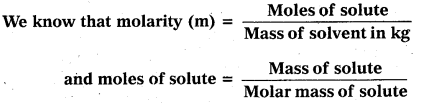
AP Inter 2nd Year Chemistry Study Material Chapter 2 Solutions 25
So, find the molar mass of solute by adding atomic masses of different element present in it and mass by using the formula,
Molality = AP Inter 2nd Year Chemistry Study Material Chapter 2 Solutions 26

Mass of solvent in kg
Solution:
Molality of the solution = 0.25 m = 0.25 mol kg-1
Molar mass of urea (NH2CONH2) = (14 × 2) + (1 × 4) + 12 + 16
= 60 g mol-1
Mass of solvent (water) = 2.5 kg
Molality = AP Inter 2nd Year Chemistry Study Material Chapter 2 Solutions 26
(0.25 mol kg-1) = \(\frac{\text { Mass of urea }}{\left(60 \mathrm{~g} \mathrm{~mol}^{-1}\right) \times(2.5 \mathrm{~kg})}\)
Mass of urea = (0.25 mol kg-1) × (60 g mol-1) × (2.5 kg) = 37.5 g

AP Inter 2nd Year Chemistry Study Material Chapter 2 Solutions

Question 5.
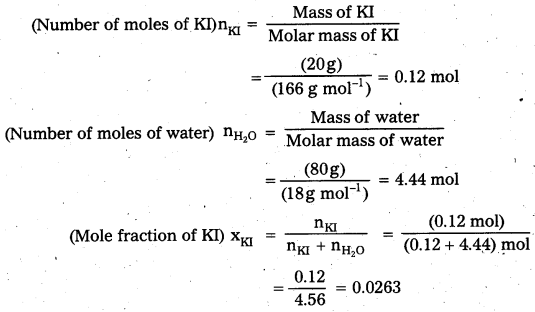
Calculate a) molality b) molarity and c) mole fraction of KI if the density of 20% (mass / mass) aqueous Kl is 1.202 g mL-1.
• As density and % by mass is given, so find the mass of solute and solvent (as x % solution contains x g solute in (100 – x) g solvent).
Find volume of the solution, by using,
Volume = \(\frac{\text { Mass }}{\text { Density }}\)
Recall the formulae of molality, molarity and mole fraction, to calculate them.
Molality = AP Inter 2nd Year Chemistry Study Material Chapter 2 Solutions 27
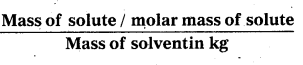
Solution:
a) Molality
Weight of KI in 100 g of water = 20 g
Weight of water in the solution = 100 – 20 = 80 g = 0.08 kg
Molar mass of KI = 39 + 127 = 166 g mol-1
Molarity of the solution (m) = \(\frac{\text { Number of moles of KI }}{\text { Mass of water in } \mathrm{kg}}\)
= \(\frac{(20 \mathrm{~g}) /\left(166 \mathrm{~g} \mathrm{~mol}^{-1}\right)}{(0.08 \mathrm{~kg})}\) = 1.506 mol kg-1 = 1.506 m

b) Molarity
Weight of the solution = 100 g
Density of the solution = 1.202g m-1
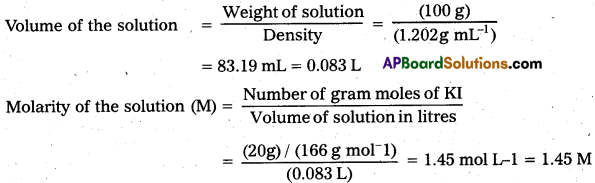
AP Inter 2nd Year Chemistry Study Material Chapter 2 Solutions 28

c) Mole fraction of KI
AP Inter 2nd Year Chemistry Study Material Chapter 2 Solutions 29

Question 6.
H2S, a toxic gas with rotten egg like smell, is used for the qualitative analysis. If the solubility of H2S in water at STP is 0.195m, calculate Henry’s law constant.
Solution:
a) Calculation of mole fraction of H2S 0.195 m means that 0.195 mole of H2S are dissolves in 1000 g of water.
Number of moles of water in 1000g, (nH2O) = \(\frac{(1000 \mathrm{~g})}{\left(18 \mathrm{~g} \mathrm{~mol}^{-1}\right)}\) = 55.55 mol
Mole fraction H2S (xH2S) = \(\frac{\mathrm{n}_{\mathrm{H}_{2} \mathrm{~s}}}{\mathrm{n}_{\mathrm{H}_{2} \mathrm{~s}}+\mathrm{n}_{\mathrm{H}_{2} \mathrm{O}}}\)
= \(\frac{(0.195 \mathrm{~mol})}{(0.195+55.55) \mathrm{mol}}=\frac{(0.195 \mathrm{~mol})}{(55.745 \mathrm{~mol})}\) = 0.0035

b) Calculation of Henry’s law constant:
According to Henry’s law
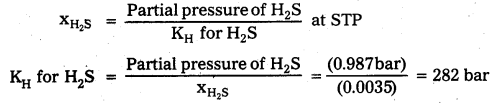
AP Inter 2nd Year Chemistry Study Material Chapter 2 Solutions 30

Question 7.
Henrys law constant for CO2 in water is 1.67 × 10⁸ Pa at 298 K. Calculate the quantity of CO2 in 500 mL of soda water when packed under 2.5 atm CO2 pressure at’298 K.
Solution:
Step I : Calculation of number of moles of CO2
According to Henrys law,
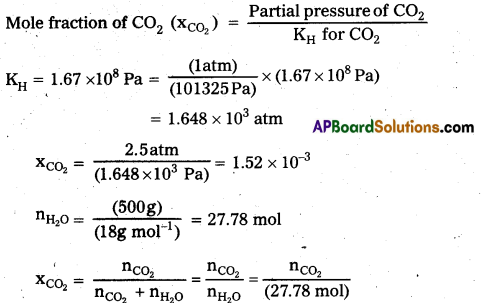
AP Inter 2nd Year Chemistry Study Material Chapter 2 Solutions 31
nCO2 = xCO2 × (27.78 mol) (1.52 10-3) × (27.78 mol) = 0.0422 mol
Note: nCO2 is considered negligible due to its little solubility in water.
Step II : Calculation of mass of dissolved CO2 in water
Mass of CO2 = No. of moles CO2 × Molar mass of CO2
= (0.0422 mol) × (44 g mol-1) = 1.857 g

AP Inter 2nd Year Chemistry Study Material Chapter 2 Solutions

Question 8.
The vapour pressure of pure liquids A and B are 450 and 700 mm Hg respectively, at 350 K. Find out the composition of the liquid mixture if total vapour pressure is 600 mm Hg. Also find the composition of the vapour phase.
. Apply Raoults law pT = \(\mathbf{p}_{\mathrm{A}}^{0} \mathbf{x}_{\mathrm{A}}+\mathbf{p}_{\mathrm{B}}^{0} \mathbf{x}_{\mathrm{B}}=\mathbf{p}_{\mathrm{B}}^{0} \mathbf{x}_{\mathrm{A}}+\mathbf{p}_{\mathrm{B}}^{0}\left(1-\mathbf{x}_{\mathrm{A}}\right)\) to calculate mole fraction of A(xA) and B(xB).
In vapour phase, partial pressure are used instead of number of moles.
Solution:
Step I: ComposItion In liquid phase
Vapour pressure of pure liquid A (\(p_{A}^{0}\)) = 450 mm
Vapour pressure of pure liquid B (\(p_{B}^{0}\)) = 700 mm
Total vapour pressure of the solution (p) = 600 mm
According to Raoult’s law,
p = \(\mathbf{p}_{\mathrm{A}}^{0} \mathbf{x}_{\mathrm{A}}+\mathbf{p}_{\mathrm{B}}^{0} \mathbf{x}_{\mathrm{B}}=\mathbf{p}_{\mathrm{B}}^{0} \mathbf{x}_{\mathrm{A}}+\mathbf{p}_{\mathrm{B}}^{0}\left(1-\mathbf{x}_{\mathrm{A}}\right)\)
(600 mm) = 450 mm × xA + 700 mm (1 – xA)
=700 mm + xA + (450 – 700)mm
= 700 – xA (250 mm)
xA = \(\frac{(600-700)}{-(250 \mathrm{~mm})}\) = 0.40
Mole fraction of A(xA) = 0.40
Molefraction of B(xB) = 1 – 0.40 = 0.60

Step II: Composition in vapour phase
PA = \(\mathrm{p}_{\mathrm{A}}^{0} \mathrm{x}_{\mathrm{A}}\) = (450 mm) × 0.40 = 180 mm
PB = \(\mathrm{p}_{\mathrm{B}}^{0} \mathrm{x}_{\mathrm{B}}\) = (700 mm) × 0.60 = 420 mm
Mole fraction of A in vapour phase = \(\frac{\mathrm{p}_{\mathrm{A}}}{\mathrm{p}_{\mathrm{A}}+\mathrm{p}_{\mathrm{B}}}\)
= \(\frac{(180) \mathrm{mm}}{(180+420) \mathrm{mm}}\) = 0.30
Mole fraction of B in vapour phase = \(\frac{\mathrm{p}_{\mathrm{B}}}{\mathrm{p}_{\mathrm{A}}+\mathrm{p}_{\mathrm{B}}}=\frac{(420) \mathrm{mm}}{(180+420) \mathrm{mm}}\) = 0.70

Question 9.
Vapour pressure of pure water at 298 K Is 23.8 mm Hg. 50g urea (NH2CONH2) is dissolved in 850 g of water. Calculate the vapour pressure of water for this solution and Its relative lowering.
Consider Raoult’s law and formula for relative lowering in vapour pressure,
\(\frac{\mathbf{p}_{\mathrm{A}}^{0}-\mathbf{p}_{\mathrm{s}}}{\mathbf{p}_{\mathrm{A}}^{0}}=\frac{\mathbf{n}_{\mathrm{B}}}{\mathbf{n}_{\mathrm{A}}}=\frac{\mathbf{W}_{\mathrm{B}}}{\mathbf{M}_{\mathrm{B}}} \times \frac{\mathbf{M}_{\mathrm{A}}}{\mathbf{W}_{\mathrm{A}}}\)
Where, \(\frac{\mathbf{p}_{\mathrm{A}}^{0}-\mathbf{p}_{\mathrm{s}}}{\mathbf{p}_{\mathrm{A}}^{0}}\) is called relative lowering in vapour pressure.
Solution:
Step I : Calculation of vapour pressure of water for this solution.
According to Raoult’s law,
\(\frac{\mathrm{p}_{\mathrm{A}}^{0}-\mathrm{p}_{\mathrm{s}}}{\mathrm{p}_{\mathrm{A}}^{0}}=\frac{\mathrm{n}_{\mathrm{B}}}{\mathrm{n}_{\mathrm{A}}}=\frac{\mathrm{W}_{\mathrm{B}} / \mathrm{M}_{\mathrm{B}}}{\mathrm{W}_{\mathrm{A}} / \mathrm{M}_{\mathrm{A}}}=\frac{\mathrm{W}_{\mathrm{B}}}{\mathrm{M}_{\mathrm{B}}} \times \frac{\mathrm{M}_{\mathrm{A}}}{\mathrm{W}_{\mathrm{A}}}\) ………………. (1)
(Pure water) \(\mathrm{p}_{\mathrm{A}}^{0}\) = 23.8 mm;
WB (urea) = 50 g; WA (water) = 850 g
MB (urea) = 60 g mol-1; MA (water) = 180 g mol-1
Placing the values in eq. (i)
\(\frac{\mathrm{p}_{\mathrm{A}}^{0}-\mathrm{p}_{\mathrm{s}}}{\mathrm{p}_{\mathrm{A}}^{0}}=\frac{(50 \mathrm{~g}) \times\left(18 \mathrm{~g} \mathrm{~mol}^{-1}\right)}{\left(60 \mathrm{~g} \mathrm{~mol}^{-1}\right) \times(850 \mathrm{~g})}=0.01762\)
\(\frac{23.8-\mathrm{p}_{\mathrm{s}}}{238}\) = 0.01762; 23.8 – ps = 0.4194
ps = 23.3806 ≈ 23.38 mm Hg

Step II : Calculation of relative lowering of vapour pressure
Relative lowering in vapour pressure = \(\frac{\mathrm{p}_{\mathrm{A}}^{0}-\mathrm{p}_{\mathrm{s}}}{\mathrm{p}_{\mathrm{A}}^{0}}=\frac{(23.8-23.38) \mathrm{mm}}{(23.8 \mathrm{~mm})}\) = 0.0176

AP Inter 2nd Year Chemistry Study Material Chapter 2 Solutions

Question 10.
Boiling point of water 750 mm Hg is 99.63°C. How much sucrose is to be added to 500 g of water such that it boils at 100°C.
[Kb for water is 0.52 K kg mol-1]
i) Since boiling point is changing, apply the formula for elevation In boiling point,
∆Tb = Kbm
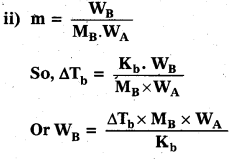
AP Inter 2nd Year Chemistry Study Material Chapter 2 Solutions 32
iii) Find ∆Tb as ∆Tb = Tb = Tb – \(T_{b}^{0}\)
Tb = Boiling point of solution
Tb = Boiling point of pure solvent
Solution:
Mass of water (WA) = 500 g = 0.5 kg
Elevation in boiling point (∆Tb) = 100°C – 99.63°C = 037°C = 0.37 K
Molal elevation constant (Kb) = 0.52 K kg mol-1
Molar mass sucrose C12H22O11
(MB) = (12 × 12) + (22 × 1) + (16 × 11)
= 342 g mol-1
WB = \(\frac{\mathrm{M}_{\mathrm{B}} \times \Delta \mathrm{T}_{\mathrm{B}} \times \mathrm{W}_{\mathrm{A}}}{\mathrm{K}_{\mathrm{b}}}\)
= \(\frac{\left(342 \mathrm{~g} \mathrm{~mol}^{-1}\right) \times(0.37 \mathrm{~K}) \times(0.5 \mathrm{~kg})}{\left(0.52 \mathrm{~K} \mathrm{~kg} \mathrm{~mol}^{-1}\right)}\) = 121.7 g

Question 11.
Calculate the mass of ascorbic acid (Vitamin C, C6H8O6) to be dissolved in 75g of acetic acid to lower its melting point by 1.5°C. Kf = 3.9 K kg mol-1.
. Since, lowering of melting point is given apply the formula for lowering of melting point, i.e.,
∆Tf = Kf.m
∆Tf = \(\frac{\mathbf{K}_{f} \cdot \mathbf{W}_{\mathbf{B}}}{\mathbf{M}_{\mathbf{B}} \times \mathbf{W}_{\mathbf{A}}}\) or WB = \(\frac{\Delta \mathbf{T}_{\mathrm{f}^{*}} \mathbf{M}_{\mathrm{B}} \cdot \mathbf{W}_{\mathrm{A}}}{\mathbf{K}_{\mathrm{f}}}\)
Solution:
Mass of ascorbic acid (WA) = 75 g = 0.075 kg
Depression in melting point (∆Tf) = 1.5° C = 1.5 K
Molar mass of ascorbic acid (MB) = (12 × 6) + (8 × 1) + (16 × 6) = 176 g mol-1
Molal depression constant (Kf) = 3.9 K kg mol-1
WB = \(\frac{\left(176 \mathrm{~g} \mathrm{~mol}^{-1}\right) \times(1.5 \mathrm{~K}) \times(0.075 \mathrm{~kg})}{\left(3.9 \mathrm{~K} \mathrm{~kg} \mathrm{~mol}^{-1}\right)}\) = 5.08 g

AP Inter 2nd Year Chemistry Study Material Chapter 2 Solutions

Question 12.
Calculate the osmotic pressure in Pascals exerted by a solution prepared by dissolving 1.0 g of polymer of molar mass 1,85,000 in 450 mL of water at 37°C.
Use the formula for osmotic pressure (π) = CRT and C = \(\frac{\mathbf{n}}{\mathbf{V}}\) and n = \(\frac{\mathbf{W}_{\mathbf{B}}}{\mathbf{M}_{\mathbf{B}}}\)
Solution:
Mass of polymer (WB) = 1.0 g
Molar mass of polymer (MB) = 185000 g mol-1
Volume of solution (V) = 450 mL = 0.450 L
Temperature (T) = 37 + 273 = 310 K
Solution constant (R) = 8.314 × 10³ Pa L K-1 mol-1
Osmotic pressure (π) = CRT
= \(\frac{\mathrm{W}_{\mathrm{B}} \times \mathrm{R} \times \mathrm{T}}{\mathrm{M}_{\mathrm{B}} \times \mathrm{V}}\)
π = \(\frac{(1.0 \mathrm{~g}) \times\left(8.314 \times 10^{3} \mathrm{~Pa} \mathrm{~L} \mathrm{~K}^{-1} \mathrm{~mol}^{-1}\right) \times(310 \mathrm{~K})}{\left(185000 \mathrm{~g} \mathrm{~mol}^{-1}\right) \times(0.450 \mathrm{~L})}\)
= 30.96 Pa
AP Inter 2nd Year Chemistry Study Material Chapter 1 Solid State

Andhra Pradesh BIEAP AP Inter 2nd Year Chemistry Study Material 1st Lesson Solid State Textbook Questions and Answers.

AP Inter 2nd Year Chemistry Study Material 1st Lesson Solid State

Very Short Answer Questions

Question 1.
Define the term amorphous.
Answer:
An amorphous (no form) solid is a compound which does not have an orderly arrangement of particles. In amorphous solids the constituent particles, atoms, molecules has short-range order only.
E.g.: Glass, rubber, plastics, etc.,

AP Inter 2nd Year Chemistry Study Material Chapter 1 Solid State

Question 2.
What makes a glass different from quartz?
Answer:

  • Glass is an amorphous solid in which the constituent particles have only short-range order.
  • Quartz is a crystalline form of silica in which constituent particles have long-range order.

Question 3.
Classify the following solids as ionic, metallic, molecular, covalent network or amorphous.
i) Si
ii) I2
iii) P4
iv) Rb
v) SiC
vi) LiBr
vii) Ammonium .Phosphate (NH4)3 PO4
viii) Plastic
ix) graphite
x) Tetra phosphorous decoxide
xi) brass
Answer:
i) Si – Covalent network solid
ii) I2 – Molecular solid with covalent bonds
iii) P4 – Molecular solid with covalent bonds ,
iv) Rb – Metallic solid
v) SiC – Giant molecular Network Solid with covalent bonds
vi) LiBr – Ionic solids
vii) Ammonium Phsophate (NH4)3 PO4 – Ionic Solids
viii) Plastic – Amorphous solid
ix) Graphite – Hexagonal network solid with covalent bonds (giant molecule)
x) Tetra phosphorous decoxide (P4O6) – Molecular solid with covalent bonds.
xi) Brass – Metallic solid

Question 4.
What is meant by the term coordination number ?
Answer:
The number of nearest neighbouring particles of a particle is defined as the co-ordination number.
(Or)
The number of nearest oppositely charged ions surrounding a particular ion is also called as co-ordination number.
E.g.: Co-ordination no. of Na+ in NaCl lattice is ‘6’.

Question 5.
What is the co-ordination number of atoms in a cubic close – pack structure ?
Answer:
The co-ordination number of atoms in a cubic close pack structure is ’12’.

AP Inter 2nd Year Chemistry Study Material Chapter 1 Solid State

Question 6.
What is the co-ordination number of atoms in a body – centered cubic structure ?
Answer:
The co-ordination number of atoms in a body – centered cubic structure is ‘8’.

Question 7.
Stability of a crystal is reflected in the magnitude of its melting point. Comment.
Answer:
Stability of a crystal is reflected in the magnitude of its melting point.
Explanation :

  • The stability of a crystal mainly depends upon the magnitude of forces of attraction between the constituent particles.
  • As the attractive forces between the constituent particles increases stability of the crystal aslo increases.
  • As the stability of crystal increases melting point of solid will be higher.

Question 8.
How are the intermolecular forces amonj the molecules affect the melting point ?
Answer:

  • As the intermolecular forces between constituent particles of solid increases, stability of the compound increases.
  • As the stability of crystal increases belting point of solid also increases (high).

Question 9.
How do you distinguish between hexagonal close – packing and cubic close – packing structures ?
Answer:
Hexagonal close packing : The spheres of the 3rd layer are exactly aligned with those of first layer. This pattern of spheres is repeated in alternate layers. Tetrahedral voids of the 2nd layer may be covered by the spheres of 3rd layer. This structure is called hexagonal close packed (hep) structure.
Cubic close packing : The spheres of 3rd layer cover the octahedral voids of 2nd layer. But the spheres of 4th layers are aligned with those of first layer. This structure is called cubic close packing.

AP Inter 2nd Year Chemistry Study Material Chapter 1 Solid State

Question 10.
How do you distinguish between crystal lattice and unit cell ?
Answer:
Crystal lattice : A regular arrangement of the constituent particles of a crystal in the three dimensional space is called crystal lattice.
Unit cell: The simple unit of crystal lattice which when repeated again and again gives the entire crystal of a given substance is called unit cell.

Question 11.
How many lattice points are there in one unit cell of face centered cubic lattice ?
Answer:
In face centered cubic unit cell.
The number of comer atoms per unit cell.
= 8 comer atoms × \(\frac{1}{8}\) atom per unit cell = 8 × \(\frac{1}{8}\) =1 atom
Number of face centered atoms per unit cell
= 6 face centered atoms × \(\frac{1}{2}\) atom per unit cell
= 6 × \(\frac{1}{8}\) = 3 atoms
∴ Total no. of lattice points = 1 + 3 = 4.

Question 12.
How many lattice points are there in one unit cell of face – centered tetragonal lattice ?
Answer:
In face centered tetragonal unit cell
Number of face centered atoms per unit cell
= 6 face centered atoms × \(\frac{1}{2}\) atom per unit cell
= 6 × \(\frac{1}{2}\) = 3 atoms
∴ Total no. of lattice points = 1 + 3 = 4.

AP Inter 2nd Year Chemistry Study Material Chapter 1 Solid State

Question 13.
How many lattice points are there in one unit cell of body centered cubic lattice ?
Answer:
In body – centered cubic unit cell
The number of comer atoms per unit cell
= 8 comers × \(\frac{1}{8}\) per comer atom
= 8 × \(\frac{1}{8}\) = 1 atom
Number of atoms at body center = 1 × 1 = 1 atom
∴ Total no. of lattice points = 1 + 1 = 2.

Question 14.
What is a semi conductor ?
Answer:
The solids which are having moderate conductivity between insulators and conductors are called semi conductors.
These have the conductivity range from 10-6 to 104 Ohm-1 m-1.
By doping process the conductivity of semi conductors increases.
E.g. : Si, Ge crystal.

Question 15.
What is Schottky defect ?
Answer:
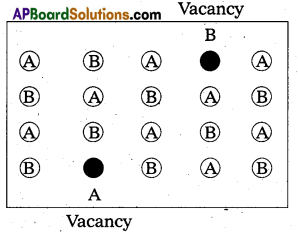
Schottky defect:

  1. It is a point defect in which an atom or ion is missing from its normal site in the lattice”.
  2.  In order to maintain electrical neutrality, the number of missing cations and anions are equal.
  3. This sort of defect occurs mainly in highly ionic compounds, where cationic and anionic sizes are similar.
    In such compounds the co-ordination number in high.
    Ex.: NaCl, CsCl etc.
  4. Illustration:
    AP Inter 2nd Year Chemistry Study Material Chapter 1 Solid State 1
  5. This defect decreases the density of the substance.

Question 16.
What is Frenkel defect ?
Answer:
Frenkel defect:

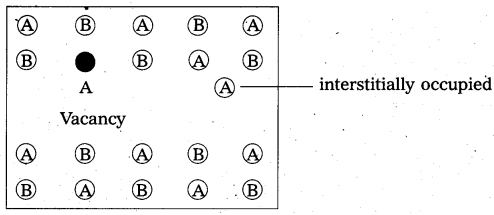
  1. “It is a point defect in which an atom or ion is shifted from its normal lattice position”. The ion or the atom now occupies an interstitial position in the lattice.
  2. This type of a defect is favoured by a large difference in sizes between the cation and anion. In these compounds co-ordination number is low.
    E.g.: Ag – halides, ZnS etc.
  3. Illustration:
    AP Inter 2nd Year Chemistry Study Material Chapter 1 Solid State 2
  4. Frenkel defect do not change the density of the solids significantly.

AP Inter 2nd Year Chemistry Study Material Chapter 1 Solid State

Question 17.
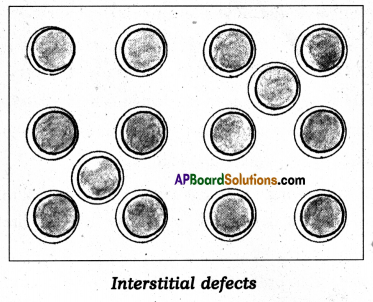
What is interstitial defect ?
Answer:

  • Some of the constituent particles of solid compound occupy an interstitial site, the crystal is said to have interstitial defect.
  • This defect shown by ionic solid, non-ionic solids which are maintaining electrical neutrality.
    AP Inter 2nd Year Chemistry Study Material Chapter 1 Solid State 3

Question 18.
What are f – centers ?
Answer:

  • f – centers are the anionic sites occupied by unpaired electrons.
  • These impart colour to cyrstals. This colour is due to the excitation of electrons when they absorb energy from the visible light.
  • f – centres are formed by heating alkyl halide with excess of alkali metal.
    E.g.: NaCl crystals heated in presence of Na – vapour yellow colour is produced due to f – centres.

Question 19.
Explain Ferromagnetism with suitable example.
Answer:
Ferromagnetic Substances : Some substances containing more number of unpaired electrons are very strongly attracted by the external magrietic field. In Ferromagnetic substances the Magnetic moments in individual atoms are all alligned in the same direction. Such substances are called Ferromagnetic Substances. In ferromagnetic substances the field strength B > > > H.
E.g. : Fe, Co and Ni.

AP Inter 2nd Year Chemistry Study Material Chapter 1 Solid State

Question 20.
Explain paramagnetism with suitable example.
Answer:
Paramagnetic Substances : If the magnetic lines of forces are drawn into the substance the field (B) in the substances is greater than the applied field (H) i.e., B > H. Such a substance is called paramagnetic substance. Paramagnetic substance moves from a weaker part of the field to a stronger part of the field. Paramagnetic substances are weakly attracted in a external Magnetic field. They exhibit paramagnetism due to the presence of unpaired electrons.
E.g. : Cr+3, Sc+2, K3 [Fe (CN)6].

Question 21.
Explain Ferrimagnetisms with suitable example.
Answer:
Ferrimagnetism is observed when the magnetic moments of the domains in the substance are aligned in parallel and anti parallel directions in unequal numbers.

  • These are weakly attracted by magnetic field as compared to ferromagnetic substances.
  • These lose ferrimagnetism on heating and becomes paramagnetic.

Question 22.
Explain Antiferromagnetism with suitable example.
Answer:
Substances like Mno showing anti-ferromagnetism having domain structure similar to ferromagnetic substance, but their domains are oppositely oriented and cancel out each others magnetic moment.

Question 23.
Why X – rays are needed to probe the crystal structure ?
Answer:
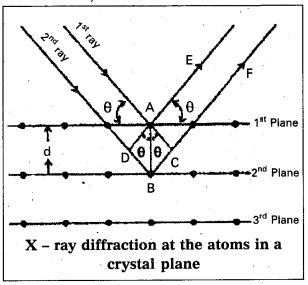
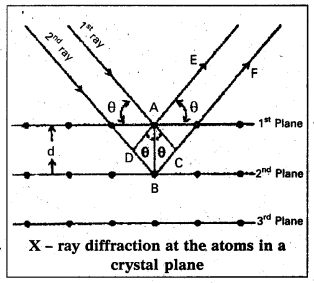
According to the principles of optics, the wavelength of light used to observe an object must be no greater than the twice the length of the object it self. It is impossible to see atom s using even the finest optical microscope. To see the atoms we must use light with a wavelength of approximately 10-10 m. X – rays are present with in this region of electromagnetic spectrum. So X – rays are used to probe crystal structure.

Short Answer Questions

Question 1.
Explain similarities and differences between metallic and ionic crystals.
Ans:
Similarities between ionic and metallic crystals :

  • Both ionic and metallic crystals have electrostatic force of attraction.
  • The bond present in ionic crystals and metallic crystals is non-directional.

Differences between ionic and metallic crystals :

Ionic Crystals

  1. In ionic crystals electrostatic force is in between oppositely charged ions.
  2. These are good conductors of electricity.
  3. Ionic bond in ionic crystals is strong.

Metallic Crystals

  1. In metallic crystals electrostatic force is in between the valency electrons.
  2. These are goods conductors of electricity  in solid state.
  3.  Metallic bond in metallic crystals is weak (or) strong.

AP Inter 2nd Year Chemistry Study Material Chapter 1 Solid State

Question 2.
Explain why ionic solids are hard and brittle.
Answer:
In ionic solids the formation of solid compound is due to the arrangements of cations and anions bound by strong coloumbic force i.e., electro static force. So ionic solids are hard and brittle in nature. These have high melting and boiling points.

Question 3.
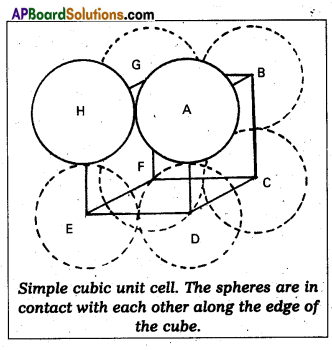
Calculate the efficiency of packing in case of a metal of simple cubic crystal.
Answer:
Packing efficiency in case of metal of simple cubic crystal:
AP Inter 2nd Year Chemistry Study Material Chapter 1 Solid State 4
The edge length of the cube
a = 2r. (r = radius of particle)
Volume of the cubic unit cell = a3 = (2r)3
= 8r3
∵ A simple cubic unit cell contains only one atom
The volume of space occupied = \(\frac{4}{3}\) πr3
∴ Packing efficiency
= \(\frac{\text { Volume of one atom }}{\text { Volume of cubic unit cell }}\) × 100
= \(\frac{4 / 3 \pi r^{3}}{8 r^{3}}\) × 100 = \(\frac{\pi}{6}\) × 100 = 52.36%.
Question 4.
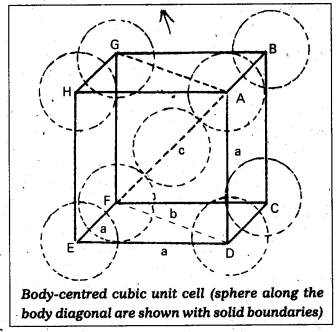
Calculate the efficiency of packing in case of a metal of body centered cubic crystal.
Answer:
Packing efficiency in case of a metal of body centred cubic crystal:
AP Inter 2nd Year Chemistry Study Material Chapter 1 Solid State 5
in B.C.C. Crystal
\(\sqrt{3}\)a = 4r
a = \(\frac{4 \mathrm{r}}{\sqrt{3}}\)
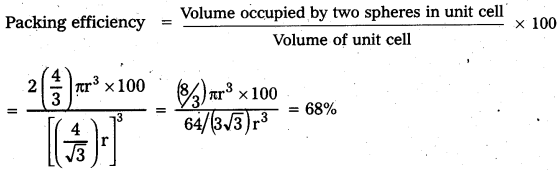
In this structure total no. of atoms is ‘2’ and their volume = 2 × (\(\frac{4}{3}\)) πr3
Volume of the cube = a3 = (\(\frac{4}{\sqrt{3}}\)r)3
AP Inter 2nd Year Chemistry Study Material Chapter 1 Solid State 6

AP Inter 2nd Year Chemistry Study Material Chapter 1 Solid State

Question 5.
Calculate the efficiency of the packing incase of face – centered cubic crystal.
Answer:
Packing efficiency of face centered cubic crystal:
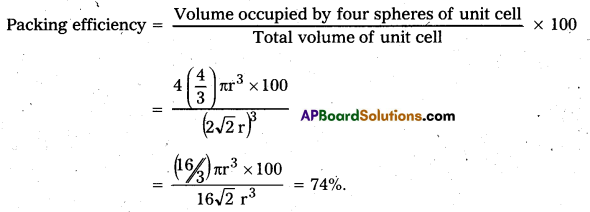
In fcc lattice assume that atoms are touching each other. Here unit cell edge length
a = 2\(\sqrt{2}\) r
Each unit cell as effectively four spheres.
Total volume of four spheres = 4 × (\(\frac{4}{3}\)) πr3
Volume of cube = a3 = (2\(\sqrt{2}\)r)3
AP Inter 2nd Year Chemistry Study Material Chapter 1 Solid State 7

Question 6.
A cubic solid is made of two elements P and Q. Atoms of Q are at the corners of the cube and P at the body – centre. What is the formula of the compound ? What are the coordination numbers of P and Q?
Answer:
The contribution of atoms Q present at 8 corners of the cube = \(\frac{1}{8}\) × 8 = 1
The contribution of atoms P present at the body centre = 1
Therefore ratio of P and Q = 1 : 1
So, the formula of the compound is PQ.
Co-ordination number of atoms P and Q = 8.

Question 7.
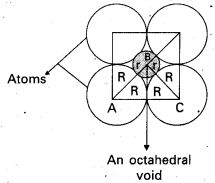
If the radius of the octahedral void is ‘r and radius of the atoms in close packing is ‘R’, derive relation between r and R.
Answer:
Derivation of relation between r and R:
Octahedral void is shown in the following diagram as a shaded circle.
AP Inter 2nd Year Chemistry Study Material Chapter 1 Solid State 8
∴ ∆ ABC is a right angled triangle.
∴ We apply pythagoras theorem.
AC2 = AB2 + BC2
(2R)2 = (R + r)2 + (R + r)2 = 2 (R + r)2
4R2 = 2 (R + r)2
2R2 = (R + r)2
(\(\sqrt{2}\) R)P = (R + r)2
\(\sqrt{2}\) R = R + r
r = \(\sqrt{2}\) R – R
r = (\(\sqrt{2}\) – 1)R
r = (1.414- 1) R
r = 0.414 R.

AP Inter 2nd Year Chemistry Study Material Chapter 1 Solid State

Question 8.
Describe the two main types of semiconductors and contrast their conduction mechanism. [A.P. Mar. 19]
Answer:
The solids which are having moderate conductivity between insulators and conductors are called semi conductors.
These have the conductivity range from 10-6 to 104 Ohm-1m-1.
By doping process the conductivity of semi conductors increases. E.g.: Si, Ge, crystal.
Semi conductors are Of two types. They are :
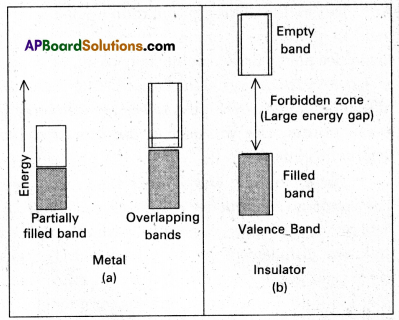
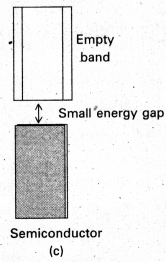
1. Intrinsic semi-conductors : In case of semi-conductors, the gap between the valence band and conduction band is small. Therefore, some electrons may jump to conduction band and show some conductivity. Electrical conductivity of semi-conductors increases with rise in “temperature”, since more electrons can jump to the conduction band. Substances like silicon and germanium show this type of behaviour and are called intrinsic semi-conductors.

2. Extrinsic semi – conductors : Their conductivity is due to the presence of impurities.
They are formed by “doping”. ,
Doping: Conductivity of semi-conductors is too low to be of pratical use. Their conductivity is increased by adding an appropriate amount of suitable impurity. This process is called “doping”.
Doping can be done with an impurity which is electron rich or electron deficient.

Extrinsic semi-conductors are of two types.
a) n-type semi-conductors : It is obtained by adding trace amount of V group element (P, As, Sb) to pure Si or Ge by doping.
When P, As, Sb (Or) Bi is added to Si or Ge some of the Si or Ge in the crystal are replaced by P or As atoms and four out of five electrons of P or As atom will be used for bonding with Si or Ge atoms while the fifth electron serve to conduct electricity.

b) p-type semi-conductors : It is obtained by doping with impurity atoms containing less electrons i.e., III group elements (B, Al, Ga or In).
When B or Al is added to pure Si or Ge some of the Si or Ge in the crystal are replaced by B or AZ atoms and four out of three electrons of B or Al atom will be used for bonding with “Si” or Ge atoms while the fourth valence electron is missing is called electron hole (or) electron vacancy. This vacancy on an atom in the structure migrates from one atom to another. Hence it facilitates the electrical conductivity.

Question 9.
Classify each of the following as either a p – type or a n – type semiconductor.
1. Ge doped with In
2. Si doped with B.
Answer:
Both (1) and (2) come under “p – type semiconductors”.
Reason: In both the cases dopants (i.e.,) Indium in case – (1) and Boron in case – (2) belong to III (or) 13th group. Si (or) Ge doped with III group element is known as p-type semi- conductor.
Explanation : Doping the silicon or germanium element with III or 13th group element like “B”, Al, Ga or “In” results in the substitution of some silicon atoms in its structure by the dopant. The dopant has only three valency electrons. The fourth valency electron is required. It is left as a vacant place on the atom. It is known as an ‘electron vacancy’ (or) a ‘hole’. The electron vacancy on ah atom in the structure migrates from one atom to another. Hence it facilitates the electrical conductivity. Si (or) Ge, doped with elements that create a hole in the structure, is known as p- type semi-conductor.

AP Inter 2nd Year Chemistry Study Material Chapter 1 Solid State

Question 10.
Analysis shows that nickel oxide has the formula Ni0.980, 1.00, what fractions of nickel exist as Ni2+ and Ni3+ ions ?
Answer:
In pure nickel oxide (NiO) the ratio of Ni and O atoms = 1 : 1
Let x be the no. of Ni (II) atoms replaced by Ni (III) atoms in the oxide
∴ Number of Ni (II) atoms present = 0.98 – x
Total charge on Ni atoms = charge on oxygen atom (∵ the oxide is neutral)
2 (0.98 – x) + 3x = 2
1.96 – 2x + 3x = 2
x = 2 – 1.96 = 0.04
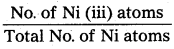
No. of Ni (iii) atoms
% of Ni (III) atoms in Nickel oxide = AP Inter 2nd Year Chemistry Study Material Chapter 1 Solid State 9 × 100
= \(\frac{0.04}{0.98}\) × 4.01%
% of Ni (II) atoms in nickel oxide = 100 – 4.01 = 95.99%
Question 11.
Gold (atomic radius = 0.144 nm) crystallizes in a face centered unit cell. What is the length of a side of the unit cell ?
Answer:
In a fee unit cell .
The edge length a = 2\(\sqrt{2}\) r
Given r = 0.144 nm
= 2 × 1.414 × 0.144 = 0.407 nm.

Question 12.
In terms of band theory, what is the difference between a conductor and an insulator ?
Answer:
In case of metals (conductors) the atomic orbitals forms molecular orbitals which are close in energy to each other as to form a band called valency band. If this band is partially filled (or) it overlaps with a higher energy unoccupied band called conduction band. Then electrons can flow easily under an applied electric field and the metal shows conductivity.
AP Inter 2nd Year Chemistry Study Material Chapter 1 Solid State 10
In case of insulators the gap between filled valence band and the next higher un occupied band is large, electrons cannot jump to it and such a substance has very small conductivity.

AP Inter 2nd Year Chemistry Study Material Chapter 1 Solid State

Question 13.
In terms of band theory, what is the difference between a conductor and a semiconductor?
Answer:
In case of metals (conductors) the atomic orbitals forms molecular orbitals which are close in energy to each other as to form a band called valency band. If this band is partially filled (or) it overlaps with a higher energy unoccupied band called conduction band. Then electrons can flow easily under an applied electric field and the metal shows conductivity.
AP Inter 2nd Year Chemistry Study Material Chapter 1 Solid State 11
In case of semi conductors, the gap between the valence band and conduction band is small. So some of electrons may jump to conduction band and show some conductivity.

Question 14.
If NaCl is doped with 1 × 10⁻³ mol percent of SrCl2, what is the concentration of cation vacancies ?
Answer:
The addition of SrCl2 to NaCl , each Sr+2 ion replaces two Na+ ions and occupies only one lattice point in place of Na+. Due to this one cation vacancy arised.
The number of moles of cation vacancies in 100 moles of NaCl = 1 × 10⁻³
The number of moles of cation vacancies in 1 moles NaCl = \(\frac{1 \times 10^{-3}}{100}\) = 10-5 mole
Total number of cation vacancies = 10-5 × 6.023 × 1023 = 6.023 × 10¹⁸.

Question 15.
Derive Bragg’s equation. [T.S. Mar. 19, 16, 15; A.P. Mar. 17, 16, 15] [Mar. 14]
Answer:
Derivation of Bragg’s equation : When X-rays are incident on the crystal or plane, they are diffracted from the lattice points (lattice points may be atoms or ions or molecules). In the crystal the lattice points are arranged in regular pattern. When the waves are diffracted from these points, the waves may be constructive or destructive interference.
AP Inter 2nd Year Chemistry Study Material Chapter 1 Solid State 12
The 1st and 2nd waves reach the crystal surface. They undergo constructive interference. Then from the figure 1st and 2nd rays are parallel waves. So, they travel the same distance till the wave form AD. The second crystal plane
ray travels more than the first by an extra distance (DB + BC) after crossing the grating for it to interfere with the first ray in a constructive manner. Then only they can be in the same phase with one another. If the two waves are to be in phase, the path difference between the two ways must be equal to the wavelength Q.) or integral multiple of it (nλ, where n = 1, 2, 3 )
(i.e.,) nλ = (DB + BC) [where n = order of diffraction]
DB = BC = d sin θ [θ = angle of incident beam,]
(DB + BC) = 2d sin θ [d = distance between the planes]
nλ = 2d sin θ
This relation is known as Bragg’s equation.

Long Answer Questions

Question 1.
How do you determine the atomic mass of an unknown metal If you know Its density and dimension of its unit cell? Explain.
Answer:
Let the, Atomic weight of crystalline substance = M
Avogadros number = N0
No. of atoms present per unit cell = Z
Density of unit cell or of the substance = ρ
Unit cell length = a
So, volume of the unit cell = a3 (= V)
∴ Then, mass corresponding to each lattice point = M/N0
∴ Mass of ‘Z lattice points = \(\frac{\mathrm{ZM}}{\mathrm{N}_{0}}\)
∴ Density (p) of unit cell = \(\frac{\text { mass }}{\text { volume }}=\frac{\frac{\mathrm{Z} \cdot \mathrm{M}}{\mathrm{N}_{0}}}{\mathrm{a}^{3}}=\frac{\mathrm{ZM}}{\mathrm{N}_{0} \mathrm{a}^{3}}\)
Atomic weight M = \(\frac{\rho \times \mathrm{a}^{3} \mathrm{~N}_{0}}{\mathrm{Z}}\)

AP Inter 2nd Year Chemistry Study Material Chapter 1 Solid State

Question 2.
Silver crystallizes in FCC lattice. If edge of the cell is 4.07 × 10⁻⁸ and density is 10.5 g. cm-3. Calculate the atomic mass of silver.
Answer:
Given data
d = 10.5 g/cm3
a = 4.07 × 10⁻⁸ cm
Z = 4 atoms
NA = 6.023 × 10²³
Formula M = \(\frac{\mathrm{d} \times \mathrm{a}^{3} \times \mathrm{N}_{\mathrm{A}}}{\mathrm{Z}}\)
= \(\frac{10.5 \times\left(4.07 \times 10^{-8}\right)^{3} \times 6.023 \times 10^{23}}{4}\)
= \(\frac{10.5 \cdot \times 67.767 \times 10^{-24} \times 6.023 \times 10^{23}}{4}\)
= 107.09 gm/mole.

Question 3.
Niobium crystallizes in body – centered cubic structure. If density is 8.55 g cm-3, calculate atomic radius of niobium using its atomic mass 93 U.
Answer:
Radius of unit cell in bcc structure = \(\frac{\sqrt{3}}{4}\) a
First we have to calculate edge length of unit cell ‘a’
Given Atomic mass of Niobium = 93 g/mole
No. of particles in bcc type unit cell (Z) = 2
mass of unit cell = \(\frac{\mathrm{ZM}}{\mathrm{N}_{\mathrm{A}}}=\frac{2 \times 93}{6.023 \times 10^{23}}\) = 30.89 × 10²³ gms
Given Density (d) = 8.55 gm/cm3
Volume of unit cell (a3) = \(\frac{\text { mass }}{\text { density }}=\frac{30.89 \times 10^{23}}{8.55}\)
= 36.16 × 10⁻²⁴ cm3.
Edge length of unit cell (a) = (36.13 × 10⁻²⁴)1/3
= 3.31 × 10⁻⁸ cm
radius of Unit cell (r) = \(\frac{\sqrt{3}}{4}\) a
= \(\frac{\sqrt{3} \times 3.31 \times 10^{-8}}{4}\)
= 1.43 × 10⁻⁸ cm = 143 pm.

Question 4.
Copper crystallizes into a FCC lattice with edge length 3.61 × 10⁻⁸ cm. Show that the calculated density is in agreement with its measured value of 8.92 g.cm-3.
Answer:
Density d = \(\frac{\mathrm{ZM}}{\mathrm{a}^{3} \times \mathrm{N}_{\mathrm{A}}}\)
Given edge length 3.61 × 10⁻⁸ cm
For FCC lattice of copper, Z = 4
Atomic mass of copper M = 63.5 gms/mole
d = \(\frac{4 \times 63.5}{\left(3.61 \times 10^{-8}\right)^{3} \times 6.023 \times 10^{23}}\)
= 8.97 g/cm3
The calculated value is approximately in agreement with the measured value 8.92 g/cm3.

AP Inter 2nd Year Chemistry Study Material Chapter 1 Solid State

Question 5.
Ferric oxide crystallizes in a hexagonal close – packed array of oxide ions with two of every three octahedral holes occupied by ferric ions. Derive the formula of ferric oxide.
Answer:
Given ferric oxide crystallises in a hexagonal close packed array of oxide ions with two out of every three octahedral,holes occupied by ferric ions.
In hexagonal close – packed arrangement there is one octahedral hole for each atom. If the number of oxide ions (O-2) per unit cell is one, then the number of Fe+3 ions = 2/ 3 × octahedral holes.
= 2/3 × 1 = 2/3
The formula of the compound = Fe2/3 O1 (or) Fe2 O3.

Question 6.
Aluminium crystallizes in a cubic close packed structure. Its metallic radius is 125 pm.
i) What is the length of the side of the unit cell.
ii) how many unit cells are there in 1.00 cm3 of aluminium.
Answer:
i) Given radius = 125 pm
For a fcc lattice unit cell r = \(\frac{a}{2 \sqrt{2}}\)
a = 2\(\sqrt{2}\) × r
= 2 × 1.414 × 125 = 353.5 pm
∴ Length of the side of the unit cell = 353.5 pm

ii) Volume of unit cell = a3 = (353.5 × 10⁻¹⁰ cm)3
= 442 × 10-25 cm3
Number of unit cell = \(\frac{1}{4.42 \times 10^{-25}}\)
= 2.26 × 10²² unit cells.

Question 7.
How do you obtain the diffraction pattern for a crystalline substance ?
Answer:
Diffraction of electromagnetic radiation takes place when a beam of light is scattered by an object containing regularly spaced lines (or) points. This scattering phenomenon can happen only if the spacing between the lines (of) points is comparable to the wave length of the radiation.

From the following figure diffraction is due to interface between two waves passing through the same region of space at the same time.
If the waves are in phase, peak to peak and trough to trough, the interference is constructive and the combined wave is increased intensity.

  • If the waves are out of phase, the interference is destructive interference and the wave is cancelled.
  • Constructive interference gives rise to intense spots observed on Laue’s photographic plate, while destructive interference causes the surrounding high) areas.
    AP Inter 2nd Year Chemistry Study Material Chapter 1 Solid State 13

Derivation of Bragg’s equation : When X-rays are incident on the crystal or plane, they are diffracted from the lattice points (lattice points may be atoms or ions or molecules). In the crystal the lattice points are arranged in regular pattern. When the waves are diffracted from these points, the waves may be constructive or destructive interference.
AP Inter 2nd Year Chemistry Study Material Chapter 1 Solid State 14
The 1st and 2nd waves reach the crystal surface. They undergo constructive interference. Then from the figure 1 and 2h1 rays are parallel waves. So, they travel the same distance till the wave front AD. The second ray travels more than the first by an extra distance (DB + BC) after crossing the grating for it to interfere with the first ray in a constructive manner. Then only they can be in the same phase with one another. If the two waves are to be in phase, the path difference between the two ways must be equal to the wavelength (λ) or integral multiple of it (nλ, where n = 1, 2, 3 )
(i.e.,) nλ = (DB + BC) [where n = order of diffraction]
DB = BC = d sin θ [θ = angle of incident beam,]
(DB + BC) = 2d sin θ [d = distance between the planes]
nλ = 2d sin θ
This relation is known as Bragg’s equation.

AP Inter 2nd Year Chemistry Study Material Chapter 1 Solid State

Textual Examples

Question 1.
A compound is formed by two elements X and Y. Atoms of the element Y (as anions) make ccp and those of the element X (as cations) occupy all the octahedral voids. What is the formula of the compound ?
Solution:
The ccp lattice is formed by the element Y. The number of octahedral voids generated would be equal to the number of atoms of Y present in it. Since all the octahedral voids are occupied by the atoms of X, their number would also be equal to that of the element Y. Thus, the atoms of elements X and Y are present in equal numbers or 1 : 1 ratio. Therefore, the formula of the compound is XY.

Question 2.
Atoms of element B form hep lattice and those of the element A occupy 2/3rd of tetrahedral voids. What is the formula of the compound formed by the elements A and B ?
Solution:
The number of tetrahedral voids formed is equal to twice the number of atoms of element B and only 2/3rd of these are occupied by the atoms of element A. Hence the ratio of the number of atoms of A and B is 2 × (2/3) : 1 or 4 : 3 and the formula of the compound is A4B3.

Question 3.
An element has a body-centred cubic (bcc) structure with a cell edge of 288 pm. The density of the element is 7.2 g/cm3. How many atoms are present in 208 g of the element ?
Solution:
Volume of the unit cell = (288 pm)3
= (288 × 10-12 m)3 = (288 × 10-10 cm)3 = 2.39 × 10⁻²³ cm3.
Volume of 208 g of the element
= \(\frac{\text { mass }}{\text { density }}=\frac{208 \mathrm{~g}}{7.2 \mathrm{~g} \mathrm{~cm}^{-3}}\) = 28.88 cm3
Number of unit cells in this volume
= \(\frac{28.88 \mathrm{~cm}^{3}}{2.39 \times 10^{-23} \mathrm{~cm}^{3} / \text { Unit cell }}\) = 12.08 × 10²³ unit cells
Since each bcc cubic unit cell contains 2 atoms, therefore, the total number of atoms in 208 g = 2 (atoms/unit cell) × 12.08 × 10²³ unit cells
= 24.16 × 10²³ atoms

AP Inter 2nd Year Chemistry Study Material Chapter 1 Solid State

Question 4.
X-ray diffraction studies show that copper crystallises in ah fee unit cell with cell edge of 3.608 x 10⁻⁸ cm. In a separate experiment, copper is determined to have a density of 8.92 g/cm3, calculate the atomic mass of copper.
Solution:
In case of fee lattice, number of atoms per unit cell, z = 4 atoms.
Therefore, M = \(\frac{\mathrm{dN}_{\mathrm{A}} \mathbf{a}^{3}}{z}\)
= \(\frac{8.92 \mathrm{~g} \mathrm{~cm}^{-3} \times 6.022 \times 10^{23} \text { atoms mol}^{-1} \times\left(3.608 \times 10^{-8} \mathrm{~cm}\right)^{3}}{4 \text { atoms }}\) = 63.1 g/mol
Atomic mass of copper = 63.1 u

Question 5.
Silver forms ccp lattice and X-ray studies of its ciystals show that the edge length of its unit cell is 408.6 pm. Calculate the density of silver (Atomic mass = 107.9 u).
Solution:
Since the lattice is ccp, the number of silver atoms per unit celll = z = 4
Molar mass of silver = 107.9 g mol-1 = 107.9 × 10⁻³ kg mol-1.
Edge length of unit cell = a = 408.6 pm = 408.6 × 10⁻¹² m
Density, d = \(\frac{\mathrm{z} \cdot \mathrm{M}}{\mathrm{a}^{3} \cdot \mathrm{N}_{\mathrm{A}}}\)
= \(\frac{4 \times\left(107.9 \times 10^{-3} \mathrm{~kg} \mathrm{~mol}^{-1}\right)}{\left(408.6 \times 10^{-12} \mathrm{~m}\right)^{3}\left(6.022 \times 10^{23} \mathrm{~mol}^{-1}\right)}\)
= 10.5 × 10³ kg m-3
= 10.5 g cm3.

Intext Questions

Question 1.
Why are solids rigid ?
Answer:
In solid state the constituent particles are not free to move. They can only oscillate about their mean positions due to strong attraction forces between the particles. That is why solids have a closely packed arrangement and rigid structure.

Question 2.
Why do solids have a definite volume ?
Answer:
The constituents particles in solids are bound to th.eir mean positions by strong forces of attraction. The interparticle distances remain unchanged even at increased or reduced pressure. Therefore, solids have a definite volume.

AP Inter 2nd Year Chemistry Study Material Chapter 1 Solid State

Question 3.
Classify the following as amorphous or crystalline solids : polyurethane, naphthalene, benzoic acid, teflon, potassium nitrate, cellophane, polyvinyl chloride, fibre glass, copper.
Answer:
Amorphous solids
Polyurethane
Naphthalene
Teflon
Cellophane
Polyvinyl chloride
Fibre glass

Crystalline solids
Benzoic acid
Potassium nitrate
Copper

Question 4.
Why is glass considered a supercooled liquid ?
Answer:
Liquids have the characteristic property i.e., the tendency to flow. Glass also shows this property, though it flows very slowly. Glass panes fixed to windows or doors of old buildings are invariably found to be slightly thicker at the bottom than the top. This is because the glass flows down very slowly and makes the bottom portion slightly thicker. Therefore, glass is considered as a supercooled liquid.

Question 5.
Refractive index of a solid is observed to have the same value along all directions. Comment on the nature of this solid. Would it show cleavage property ?
Answer:
A solid has same value of refractive index along all directions is isotropic and hence amorphous in nature. It would not show a clean cleavage when cut with a knife. Instead, it would break into pieces With irregular surface.

Question 6.
Classify the following solids in diff rent categories based on the nature of intermolecular forces operating in them :
Potassium sulphate, tin, benzene, urea, ammonia, water, zinc sulphide, graphite, rubidium, argon, silicon carbide.
Answer:
Ionic solids : Potassium sulphate, zinc sulphide (as they have iohic bonds).
Covalent solids : Graphite, silicon carbide (as they are covalent giant molecules).
Molecular solids : Benzene, urea, ammonia, water, argon (as they have covalent bond).
Metallic solids : Rubidium, tin (as these are metals).

AP Inter 2nd Year Chemistry Study Material Chapter 1 Solid State

Question 7.
Solid A’ is a very hard electrical insulator in solid as well as in molten state and melts at extremely high temperature. What type of solid is it ?
Answer:
Since, the solid ‘A’ is an insulator in solid as well as in molten state, it shows the absence of ions in it. Moreover it melts at extremly high temperature, so it is a giant molecule. These are the properties of covalent solids. So, it is a covalent solid.

Question 8.
Ionic solids conduct electricity in molten state but not in solid state. Explain.
Answer:
In ionic solids, electrical conductivity is due to the movement of ions. In solid state, ions cannot move and remain held together by strong electrostatic forces of attraction. Therefore, they behave as insulators.

Question 9.
What type of solids are electrical conductors, malleable and ductile ?
Answer:
Metallic solids.

Question 10.
Ire the significance of a ‘lattice point’.
Answer:
The lattice point denotes the position of a particular constituent (atom, ion or molecule) in a crystal lattice. The arrangement of the lattice points in space is responsible for the shape of a particular crystalline solid.

AP Inter 2nd Year Chemistry Study Material Chapter 1 Solid State

Question 11.
Name the parameters that characterise a unit cell.
Answer:
A unit cell is characterised by

  1. its dimensions along the three edges, a, b and c.
  2. angles between the edges, α (between b and c) β ( between a and c) and γ (between a and b).
    Thus, a unit cell is characterised by six parameters, a, b, c, α, β and γ.

Question 12.
Distinguish between
i) hexagonal and monoclinic unit cells.
ii) face-centered and end-centered unit cells.
Answer:
AP Inter 2nd Year Chemistry Study Material Chapter 1 Solid State 15
AP Inter 2nd Year Chemistry Study Material Chapter 1 Solid State 16

Question 13.
Explain how much portion of an atom located at

  1. Corner ?
  2. body-centre of a cubic unit cell is part of its neighbouring unit cell ?

Answer:

  1. A point lying at the corner of a unit cell is shared equally by eight unit cells and therefore,
  2. A body centred point belongs entirely to one unit cell since, it is not shared by any other unit cell.

Question 14.
What is the two dimensional coordination number of a molecule in square close packed layer ?
Answer:
Four (4),.as each atom is surrounded by four other atoms.

AP Inter 2nd Year Chemistry Study Material Chapter 1 Solid State

Question 15.
A compound forms hexagonal close-packed structure. What is the total number of voids in 0.5 mol of it ? How many of these are tetrahedral voids ?
Answer:
Total number of atoms (N) in a closed packed structure (0.5 mol)
= 0.5 × 6.022 × 1023 = 3.011 × 10²³
Number of octahedral voids = N = 3.011 × 10²³
Number of tetrahedral voids = 2N = 2 × 3.011 × 1023 = 6.022 × 10²³
Total number of voids = 3.011 × 10²³ + 6.022 × 1023
= 9.033 × 10²³

Question 16.
A compound is formed by two elements M and N. The element N forms ccp and atoms of M occupy \(\frac{1}{3}\) rd of tetrahedral voids. What is the formula of the compound ?
i) Find the number of tetrahedral voids as number of tetrahedral voids = 2 × number of atoms present in the lattice.
ii) Calculate the number of atoms (or ratio) of elements M and N as a chemical formula represents the number of atoms of different elements presents in a compound.
iii) Derive the’ formula.
Answer:
Suppose atoms of element N present in ccp = x
Then number of tetrahedral voids = 2x
Since, \(\frac{1}{3}\) rd of the tetrahedral voids are occupied by atoms of elements M.
Therefore, number of atoms of element M = \(\frac{1}{3}\) × 2x = \(\frac{2x}{3}\)
Ratio of M : N = \(\frac{2x}{3}\) : x = 2 : 3
Hence, formula of the compound = M2N3.

Question 17.
Which of the following lattices has the highest packing efficiency ?

  1. Simple cubic
  2. Body-centred cubic
  3. Hexagonal close-packed lattice

Packing efficiency in .

  1. Simple cubic lattice = 52.4%
  2. body-centred cubic lattice = 68%
  3. hexagonal close-packed lattice = 74%

Answer:
Hexagonal closed packed lattice has the highest packing efficiency (74%)

AP Inter 2nd Year Chemistry Study Material Chapter 1 Solid State

Question 18.
An element with molar mass 2.7 × 10⁻² kg mol-1 forms a cubic unit cell with edge length 405 pm. If its density is 2.7 × 10³ kg m-3 what is the nature of the cubic unit cell ?
Answer:
Density (d) = \(\frac{\mathrm{Z} \times \mathrm{M}}{\mathrm{a}^{3} \times \mathrm{N}_{\mathrm{A}}}\) so, Z = \(\frac{\mathrm{d} \times \mathrm{a}^{3} \times \mathrm{N}_{\mathrm{A}}}{\mathrm{M}}\)
Given, M = 2.7 × 10⁻² kg mol-1
a = 405 pm = 405 × 10-12 m = 4.05 × 10⁻¹⁰m
d = 2.7 × 10³ kgm-3
NA = 6.022 × 10²³ mol-1.
Hence.
Z = \(\frac{\left(2.7 \times 10^{3 .} \mathrm{kg} \mathrm{m}^{-3}\right)\left(4.05 \times 10^{-10} \mathrm{~m}\right)^{3} \times\left(6.022 \times 10^{23} \mathrm{~mol}^{-1}\right)}{\left(2.7 \times 10^{-2} \mathrm{~kg} \mathrm{~mol}^{-1}\right)}\)
= 3.99 = 4
Since, there are four atoms per unit cell, the cubic unit cell must be face – centred.

Question 19.
What type of defect can arise when a solid is heated ? physical property is affected by it and in what way ?
Answer:
When a solid is heated, a vacancy is created in the crystal. On heating, some of the lattice sites are vacant and the density of the solid decreases as the number of ions per unit volume decreases.

Question 20.
What type of stoichiometric defect is shown by

  1. ZnS
  2. AgBr

Answer:

  1. ZnS shows Frenkel defect because its ions have large difference in size.
  2. AgBr shows both Frenkel and Schottky defects.

Question 21.
Explain how vacancies are introduced in an ionic solid when a cation of higher valence is aded as an impurity in it ?
Answer:
When a cation of higher valence is added as an impurity to an ionic solid, some vacancies are created. This can be explained with the help of an example. When strontium, chloride (SrCl2) is added as an impurity to ionic solid sodium chloride (NaCl), two vacant sites are created by removal of one Na+ ion. One vacant site is replaced by Sr2+ ion but the other remains vacant. The reason is that the crystal as a whole is to remain electrically neutral. Note : [Cationic vacancies produced = No. of cations of higher valency × difference in ’ valencies of the original cation and cation of higher valency]

AP Inter 2nd Year Chemistry Study Material Chapter 1 Solid State

Question 22.
Ionic solids, which have anionic vacancies due to metal excess defect, develop colour. Explain with the help of a suitable example.
Answer:
We can explain the metal excess defect with the example of sodium chloride crystals. When NaCl crystals are heated in an atmosphere of sodium vapour, the Na atoms are deposited on the surface of the crystal. The Cl ions diffuse to the surface of the crystal and combine with Na atoms to give NaCZ. This happens by loss of electron by Na atoms to form Na+ ions. The released electrons occupy anionic sites by diffusing into the crystals. These electrons absorb energy from visible light and emit radiations corresponding to yellow colour. These electrons are called F-centres (from the German word Farbenzenter meaning colour centre).

Question 23.
A group 14 elements is to be converted into n-type semiconductor by doping it with a suitable impurity. To which group should this impurity belong ?
Answer:
n-type semiconductor means increase in conductivity due to presence of excess of electrons. Therefore, a 14 group element should be doped with a 15-group element Eg : arsenic or phosphorus.

Question 24.
What type of substances would make better permanent magnets, ferromagnetic or ferrimagnetic ? Justify your answer
Answer:
Ferromagnetic substances make better permanent magnets than ferrimagnetic substances. The metal ions of a ferromagenetic substance are grouped into small regions known as domains and these are randomly oriented. When a magnetic field is applied, all domains are oriented in the direction of the magnetic field. Now the ferromagnetic substance behaves as a magnet. When the applied magnetic field is removed, the magnetic character is retained. Thus, the ferromagnetic substance becomes a permanent magnet.
This property (of being permanently magnetised) is not found in ferrimagnetic substances. They lose their magnetic property on heating.

Inter 1st Year Maths 1B Applications of Derivatives Solutions Ex 10(h)

Practicing the Intermediate 1st Year Maths 1B Textbook Solutions Inter 1st Year Maths 1B Applications of Derivatives Solutions Exercise 10(h) will help students to clear their doubts quickly.

Intermediate 1st Year Maths 1B Applications of Derivatives Solutions Exercise 10(h)

I.

Question 1.
Find the points of local extrema (if any) and local extrema of the following functions each of whose domain is shown against the function.
i) f(x) – x², ∀ x ∈ R.
Solution:
f(x) = x²
f'(x) = 2x ⇒ f”(x) = 2
For maximum or minimum f'(x) = 0
2x = 0
x = 0
Now f”(x) = 2 > 0 ,
∴ f(x) has minimum at x = 0
Point of local minimum x = 0
Local minimum = 0.

ii) f(x) = sin x, [0, 4π)
Solution:
Given f(x) = sinx
⇒ f'(x) = cosx
⇒ f”(x) = -sinx
For max on min,
f'(x) = 0
cos x = 0
⇒ x = \(\frac{\pi}{2},\frac{3\pi}{2},\frac{5\pi}{2},\frac{7\pi}{2}\)

i) f”(\(\frac{\pi}{2}\)) = -sin\(\frac{\pi}{2}\) = -1 < 0
f(x) = sin \(\frac{\pi}{2}\) = 1
∴ Point of local maximum x = \(\frac{\pi}{2}\)
local maximum – 1

ii) f”(\(\frac{3\pi}{2}\)) = – sin \(\frac{3\pi}{2}\) = -1 > 0
f(x) = sin \(\frac{3\pi}{2}\) = -1
∴ Point of local minimum x = \(\frac{3\pi}{2}\)
local minimum x = -1

iii) f”(\(\frac{5\pi}{2}\)) = – sin \(\frac{5\pi}{2}\) = -1 > 0
f(x) = sin \(\frac{5\pi}{2}\) = 1
∴ Point of local maximum x = \(\frac{5\pi}{2}\)
local maximum = 1

iv) f”(\(\frac{7\pi}{2}\)) = – sin \(\frac{7\pi}{2}\) = -1 > 0
f(x) = sin \(\frac{7\pi}{2}\) = -1
∴ Point of local maximum x = \(\frac{7\pi}{2}\)
local maximum = 1

Inter 1st Year Maths 1B Applications of Derivatives Solutions Ex 10(h)

iii) f (x) = x³ – 6x² + 9x + 15 ∀ x ∈ R.
Solution:
f (x) = 3x² – 12x + 9 and f'(x) = 6x – 12
For maximum or minimum f(x) = 0
⇒ 3x² – 12x + 9 = 0
⇒ x² – 4x + 3 = 0
⇒ (x – 1) (x – 3) = 0
⇒ x = 1 or 3
Now f”(1) = 6(1) – 12 = – 6 < 0
∴ f(x) has maximum value at x = 1
Max. valueis f(1)= 1³ – 6(1)² + 9(1) + 15
= 1 – 6 + 9 + 15 = 19

f”(3) = 6(3) – 12 = 18 – 12 = 6 > 0
∴ f(x) has minimum value at x = 3
Min. value is f(3) = 33 – 6.32 + 9.3 + 15
= 27 – 54 + 27+ 15
= 15

iv) f(x) = \(\sqrt{1-x}\) ∀ x ∈ (0, 1)
Solution:
Inter 1st Year Maths 1B Applications of Derivatives Solutions Ex 10(h) 1
For max. or min. f'(x) = 0
Inter 1st Year Maths 1B Applications of Derivatives Solutions Ex 10(h) 2

v) f(x) = 1/x² + 2 ∀ x ∈ R
Solution:
Inter 1st Year Maths 1B Applications of Derivatives Solutions Ex 10(h) 3
∴ For maximum or minimum f (x) = 0
⇒ \(\frac{-2x}{(x^{2}+2)^{2}}\) = 0 ⇒ x = 0
f”(0) = \(\frac{2(0-2)}{(0+2^{3})}=\frac{-4}{8}=\frac{-1}{2}\) < 0
∴ f(x) has max. value at x = 0
Max. value is f(0) = \(\frac{1}{0+2}=\frac{1}{2}\)

vi) f(x) = x²- 3x ∀ x ∈ R
Solution:
f(x) = 3x² – 3 and f”(x) = 6x
∴ For maximum or minimum f(x) = 0
⇒ 3x² – 3 = 0
⇒ x² – 1 = 0
⇒ x = ± 1
Now f”(1) = 6(1) = 6 > 0
∴ f(x) has minimum at x = 1
Minimum value is f(1) = 1³ – 3(1) = -2
f”(-1) = 6(-1) = -6 < 0
∴ f(x) has maximum value at x = -1
Maximum value is f(-1) = (-1)³ – 3(-1)
= -1 + 3 = 2

vii) f(x) = (x -1) (x + 2)² ∀ x ∈ R
Solution:
f(x) = (x – 1) (x + 2)²
f(x) = (x – 1) 2(x + 2) + (x + 2)²
= 2(x – 1) (x + 2) + (x + 2)²
f”(x) = 2(x – 1) + 2(x + 2) + 2(x + 2)
= 2(3x + 3) = 6(x + 1)
∴ For maximum or minimum f'(x) = 0
2(x – 1) (x + 2) + (x + 2)² = 0
(x + 2) [2(x – 1) + (x + 2)] = 0
⇒ (x + 2) (3x) = 0
⇒ x = 0, x = -2
Now f”(0) = 6(0 + 1) = 6 > 0
∴ f(x) has min. value at x = 0
Min. value is f(0) = (0 – 1) (0 + 2)² = -4
f'(-2) = 6 (-2 + 1) = -6 < 0
∴ f(x) has max. value at x = -2
Max. value is f(-2) = (-2 -1) (-2 + 2)² = 0

viii) f(x) = \(\frac{x}{2}+\frac{2}{x}\) ∀ x ∈ (0, ∞)
Solution:
f'(x) = \(\frac{1}{2}-\frac{2}{x^{2}}\) and f”(x) = \(\frac{4}{x^{3}}\)
∴ For max. or min. f'(x) = 0
⇒ \(\frac{1}{2}-\frac{2}{x^{2}}\) = 0 ⇒ x² – 4 = 0 ⇒ x = ± 2
f”(2) = \(\frac{4}{2^{3}}\) = \(\frac{1}{2}\) > 0 (Since x > 0)
∴ f(x) has min. value at x = 2
Min. value is f(2) = \(\frac{2}{2}+\frac{2}{2}\) = 1 + 1 = 2.

ix) f(x) = – (x – 1)³ (x + 1)² ∀ x ∈ R
Solution:
f(x) = -(x – 1)³ (x + 1)² = (1 – x)³ (x + 1)²
f”(x) = (1 – x)³ 2(x + 1) + 3(1 – x)² (-1) (x + 1)²
= (1 – x)² (x + 1) {2(1 – x) – 3(x + 1)}
= (1 – x)² (x + 1) {2 – 2x – 3x – 3}
= (1 – x)² (x + 1) (-1 – 5x)
f”(x) = (1 – x)² (x + 1) (-5) + (1 – x)² (-1 – 5x) + (x + 1) (-1 -5x) 2(1 – x) (-1)
= -5 (1 -x)² (x+ 1) – (1 + 5x) (1 – x)² + (x + 1) (1 + 5x) 2(1 – x)
∴ For maximum or minimum f(x) = 0
(1 – x)² (x + 1) (-1 – 5x) = 0
⇒ x = ± 1 or -1/5
f”(1) = 0 – 0 + 0 ⇒ critical value at x = 0
f”(1 +1)² (-1) = 0 – (1 – 5) + 0 = 16 > 0
∴ f(x) has min. value at x = -1
Min. value = f(-1) = (1 + 1)³ (-1 + 1)² = 0
f”(- \(\frac{1}{5}\)) < o
⇒ f(x) has max. value at x = – \(\frac{1}{5}\)
Min. value is f (-\(\frac{1}{5}\)) = \(\frac{3456}{3125}\)

x) f(x) = x² e3x ∀ x ∈ R
Solution:
f'(x) = x² e3x .3 + e3x. 2x
For maximum or minimum f'(x) = 0
3x² e3x + 2e3x. x = 0
x² e3x (3x + 2) = 0
x = 0, x = \(\frac{-2}{3}\) and e = 0 is not possible
Now f”(x) = 3(x² e3x. 3 + e3x 2x)
+ e3x 2 + 2x e3x
f”(x) = 9x²e3x + 6x
e3x+ 2 e3x + 6xe3x
= 9x²e3x + 12xe3x + 2e3x
f”(0) = 2 > 0
∴ Point of local minimum = 0
local minimum = 0
f”(\(\frac{-2}{3}\)) = \(\frac{-2}{e^{2}}\) < 0
∴ point of local maximum = \(\frac{-2}{3}\)
local maximum = \(\frac{4}{9e^{2}}\)

Inter 1st Year Maths 1B Applications of Derivatives Solutions Ex 10(h)

Question 2.
Prove that the following functions do not have absoute maximum and absolute minimum.
i) ex in R
Solution:
f(x) = ex and f”(x) = ex
∴ For maxima or minima f'(x) = 0 ⇒ ex = 0
⇒ x value is not defined
Hence it has no maxima or minima.

ii) log x in (0, ∞)
Solution:
f(x) = \(\frac{1}{x}\) and f”(x) = – \(\frac{1}{x^{2}}\)
f (x) = 0 ⇒ x value is not defined
⇒ f(x) has no maxima or minima.

iii) x³ + x² + x + 1 in R
Solution:
f (x) = 3x² + 2x + 1 gives imaginary values.
⇒ It has no maximum or minimum values.

II.

Question 1.
Find the absolute maximum value and absoulte minimum value of the following functions on the domain specified against the function.
Solution:
f(x) = x³ on (-2, 2)
f(x) = 3x² and f'(x) – 6x
the value f(-2) = (-2)³ = – 8
Max Value f(2) = 2³ = 8

ii) f(x) = (x – 1)²+ 3 on [-3, 1]
Solution:
f(x) = 2(x – 1) and f'(x) = 2
Max. value f(-3) = (-3 – 1)² + 3 = 16 + 3 = 19
Min. value f(l) = 0 + 3 = 3

iii) f(x) = 2|x| on [-1, 6]
Solution:
f'(x) = \(\frac{2|x|}{x}\)
For max. or min., f'(x) = 0
\(\frac{2|x|}{x}\) = 0 ⇒ x = 0
f(0) = 0
f(-1) – 2|-1| = 2
f(6) = 2(6) = 12
Absolute minimum = 0
Absolute maximum = 12

iv) f(x) = sin x + cos x on [0, π]
Solution:
f'(x) cos x – sin x which exists at all x ∈ (0, π)
Now f'(x) = 0 ⇒ cos x – sin x = 0
⇒ tan x = 1
⇒ x = \(\frac{\pi}{4}\) ∈ (0, π)
Now f(0) = sin 0 + cos 0 = 1
f(\(\frac{\pi}{4}\)) = sin \(\frac{\pi}{4}\) + cos \(\frac{\pi}{4}\)
= \(\frac{1}{\sqrt{2}}+\frac{1}{\sqrt{2}}=\frac{2}{\sqrt{2}}=\sqrt{2}\)
f(π) = sin π + cos π = 0 – 1 = -1
∴ Minimum value : -1
Maximum value: √2

v) f(x) = x + sin 2x on [0, π]
Solution:
f(x) = x + sin 2x
f(x) = 1 + 2 cos 2x
f (x) = 0 ⇒ 2 cos 2x + 1 = 0
⇒ cos 2x = –\(\frac{1}{2}\) = cos \(\frac{2 \pi}{3}\)
⇒ 2x = \(\frac{2 \pi}{3}\)
⇒ x = \(\frac{\pi}{3}\) ∈ (0, 2π)
Now f(0) = 0 + sin 2(0) = 0
f(\(\frac{\pi}{3}\)) = \(\frac{\pi}{3}\) + sin 2.\(\frac{\pi}{3}\) = \(\frac{\pi}{3}+\frac{\sqrt{3}}{2}\)
f(2π) = 2π + sin 2. 2π = 2π + 0 = 2π
Minimum value = 0
Maximum value is = 2π

Question 2.
Use the first derivative test to find local extrema of f(x) = x³ – 12x on R.
Solution:
f(x) = x³ – 12x
f'(x) = 3x² – 12
f”(x) = 6x
For maximum or minimum, f'(x) = 0
3x² – 12 = 0
3x² = 12
x = ± 2
f”(2) = 12 > 0
Point of local minimum at x = 2
Local minimum = – 16
f”(-2) = -12 < 0
Point of local maximum at x = -1
Local maximum =16

Question 3.
Use the first derivative test to find local extrema of f(x) = x² – 6x + 8 on R.
Solution:
f(x) = x² – 6x + 8
f’(x) = 2x -6 ⇒ f”(x) = 2
For maximum or minimum f'(x) = 0
2x – 6 = 0
⇒ x = 3
f”(3) = 2 > 0
∴ Point of local minimum x = 3
Local minimum = -1

Inter 1st Year Maths 1B Applications of Derivatives Solutions Ex 10(h)

Question 4.
Use the second derivative test to find local extrema of the function
f(x) =x³ – 9x² – 48x + 72 on R.
Solution:
f(x) =x³ – 9x² – 48x + 72.
⇒ f'(x) = 3x² – 18x – 48
= 3(x – 8) (x + 2)
Thus the stationary point are – 2 & 8
f”(x) = 6x – 18 = 6(x – 3)
At x= 8, f”(8) = 30 > 0
∴ f (8) = (8)³ – 9(8)² – 48(8) + 72
= 512 – 576 – 384 + 72
= – 376
At x= -2, f”(-2) = – 30 < 0
f(-2) = (-2)³ – 9(-2)² – 48(-2)+72
= -8 – 36 + 96 + 72
= 124
Local minimum = -376
Local maximum = 124

Question 5.
Use the second derivative test to find local extrema of the function. f(x) = -x³ + 12x² – 5 on R.
Solution:
f(x) = -x³ + 12x² – 5
⇒ f'(x) = -3x² + 24x
= -3x(x – 8)
Thus the stationary point are 0, 8
f”(x) = – 6x + 24
At x= 0, f”(0) = 24 > 0.
f(0) = -5
At x= 8, f”(8) = -24 < 0
f(8) = -8³ + 12(8)² – 5
= -512 + 768 – 5 = 251
Local minimum = -5
Local maximum = 251

Question 6.
Find local maximum or local minimum of f(x) = -sin 2x – x defined on [-π/2, π/2].
Solution:
f(x) =-sin 2x – x
f'(x) = -2cos 2x – 1
f”(x) = 4 sin 2x
Thus the starting point are x = \(\frac{\pi}{3},\frac{-\pi}{3}\)
Inter 1st Year Maths 1B Applications of Derivatives Solutions Ex 10(h) 4
Local minimum = –\(\frac{\sqrt{3}}{2}-\frac{\pi}{3}\)
Local maximum = \(\frac{\sqrt{3}}{2}+\frac{\pi}{3}\)

Question 7.
Find the absolute maximum and absolute minimum of f (x) = 2x³ – 3x² – 36x + 2 on the interval [0, 5].
Solution:
f(x) = 2x³ – 3x² – 36x + 2
f(x) = 6x² – 6x – 36
f(x) = 12x – 6
for maxima or minima, f'(x) = 0
6x² – 6x – 36 = 0
x² – x – 6 = 0
x² -3x + 2x – 6 = 0
x(x – 3) + 2(x – 3) = 0
(x + 2) (x – 3) = 0
x = 3, -2
f”(3) = 30 > 0
f(x) has max/min value at x = 3
f(3) = 2(3)³ – 3(3)² – 36(3) + 2
= 54 – 27 – 108 + 2
= -79
Absolute minimum = – 79
Since 0 ≤ x ≤ 5
∴ f(0) = 0 – 0 – 0 + 2
= 2
∴ Absolute maximum = 2.

Inter 1st Year Maths 1B Applications of Derivatives Solutions Ex 10(h)

Question 8.
Find the absolute extremum of f(x) = 4x – \(\frac{x^{2}}{2}\) on [-2, \(\frac{9}{2}\)]
Solution:
f(x) = 4x – \(\frac{x^{2}}{2}\)
f'(x) =4 – x
f”(x) = – 1
for maxima or minima f'(x) = 0
4 – x = 0
x = 4
f”(4) = -1 < 0
∴ f has maximum value at x = 4
f(4) = 16 – \(\frac{16}{2}\) = 8
Since -2 ≤ x ≤ \(\frac{9}{2}\)
∴ f(-2) = -8 – \(\frac{4}{2}\)
= -8- 2 = -10
∴ Absolute minimum = -10
Absolute maximum = 8

Question 9.
Find the maximum profit that a company can make, if the profit function is given by P(x) = -41 + 72x – 18x²
Solution:
P(x) = – 41 + 72 x – 18x².
\(\frac{dp(x)}{dx}\) = 72 – 36x
for maxima or minima, \(\frac{dp}{dx}\) = 0
72 – 36x = 0
x = 2
\(\frac{d^{2}p}{dx^{2}}\) = -36 < 0
∴ The profit f(x) is maximum for x = 2
The maximum profit will be P(2) =
= -41 + 72(2) – 18(4)
= 31

Question 10.
The profit function P(x) of a company selling x items is given by P(x) = -x³ + 9x² – 15x – 13 where x represents thousands of units. Find the absolute maximum profits if the company can manufacture a maximum of 6000 units.
Solution:
P(x) = -x³ + 9x² – 15x – 13
\(\frac{dp(x)}{dx}\) = -3x² + 18x – 15
for maximum or minimum \(\frac{dp}{dx}\) = 0
-3x² + 18x – 15 = 0
x² – 6x + 5 = 0
x² – 5x – x + 5 = 0
x(x- 5) – 1(x- 5) = 0
(x – 1) (x – 5) = 0
x = 1, 5
P(1) = -1 + 9 – 15 – 13 = -10
P(5) = -125 + 225 – 75 – 13 = 12
∴ Maximum profit = 12.

III.

Question 1.
The profit function P(x) of a company selling x items per day is given by P(x) = (150 – x) x – 1000. Find the number of items that the company should manufacture to get maximum profit. Also find the maximum profit.
Solution:
Given that tbe profit function
P(x) = (150 – x)x -1000
for maximum or minimum \(\frac{dp}{dx}\) = 0
(150 – x(1) -x (-1) = 0
150 – 2x = 0
x = 75
Now \(\frac{d^{2}p}{dx^{2}}\) = -2 < 0
∴ The profit P(x) is maximum for x = 75
The company should sell 75 tems a day the maxma profit will be P (75) = 4625.

Question 2.
Find the absolute maximum and absolute minimum of f(x) = 8x³ + 81x² – 42x – 8 on [-8, 2].
Solution:
f(x) = 8x³ + 81x² – 42x – 8
f'(x) = 24x²+ 162x – 42
For maximum or minimum, f'(x) = 0
24x² + 162x – 42 = 0
4x² + 27x – 7 = 0
4x² + 28x – x – 7 = 0
4x(x + 7) – 1(x + 7) = 0
(x + 7) (4x – 1) = 0
x = – 7 or \(\frac{1}{4}\)

f(- 8) = 8(-8)³ + 81(-8)² – 42(-8) -8
= – 8(512) + 81(64) + 336 – 8
= -4096 + 5184 + 336 – 8
= 5520 – 4104
= 1416

f(2) = 8(2)³ + 81 (2)² – 42(2) – 8
= 64 + 324 – 84 – 8
= 296
Inter 1st Year Maths 1B Applications of Derivatives Solutions Ex 10(h) 5
f(-7) = 1246
Absolute maximum = 1416
Absolute minimum = \(\frac{-216}{16}\)

Question 3.
Find two positive integers whose sum is 16 and the sum of whose squares is minimum.
Solution:
Suppose x and y are the sum value
x + y =16
⇒ y = 16 – x
f(x) = x² + y² = x² + (16 – x)²
= x² + 256 + x² – 32x
f'(x) = 4x – 32
for maximum or minimum f'(x) = 0
⇒ 4x – 32 = 0
4x = 32 x = 8
f”(x) = 4 > 0
∴ f(x) is minimum when x = 8
y = 16 – x = 16 – 8 = 9
∴ Required number are 8, 8.

Inter 1st Year Maths 1B Applications of Derivatives Solutions Ex 10(h)

Question 4.
Find two positive integers x and y such that x + y = 60 and xy3 is maximum.
Solution:
x + y = 60 ⇒ y = 60 – x ………… (1)
Let p = xy³ = x(60 – x)³
\(\frac{dp}{dx}\) = x³(60 – x)²(-1) + (60-x)³
= -3x (60 – x)² + (60 – x)³
= (60 – x)² [-3x + 60 – x]
= (60 – x)² (60 – 4x) = 4(60 – x)² (15 – x)

\(\frac{d^{2}p}{dx^{2}}\) = 4[(60-x)² (-1) + (15-x) 2(60-x) (-1)]
= 4(60 – x) [-60 + x – 30 + 2x]
= 4(60 – x) (3x – 90)
= 12(60 – x) (x – 30)
For maximum or minimum \(\frac{dp}{dx}\) = 0
⇒ 4(60 – x)2 (15 -x) = 0
⇒ x = 60 or x = 15 ; x cannot be 60
∴ x = 15 ⇒ y = 60 – 15 = 45.
(\(\frac{d^{2}p}{dx^{2}}\))x = 15 = 12(60 – 15) (15 – 30) < 0
⇒ p is maximum
∴ Required numbers are 15, 45.

Question 5.
From a rectangular sheet of dimensions 30 cm x 80 cm four equal squares of side x cm are removed at the comers and the sides are then turned up so as to form an open rectangular box. Find the value of x, so that the volume of the box is the greatest?
Solution:
Length of the box = 80 – 2x = l
Breadth of the box = 30 – 2x = b
Inter 1st Year Maths 1B Applications of Derivatives Solutions Ex 10(h) 6
Height of the box = x = h
Volume = lbh = (80 – 2x) (30 – 2x). x
= x (2400 – 220 x + 4x²)
f(x) = 4x³ – 220 x² + 2400x
f'(x) = 12x² – 440x + 2400
= 4 [3x² – 110 x + 600]
f'(x) = 0
⇒ 3x² – 110 x +600 = 0
Inter 1st Year Maths 1B Applications of Derivatives Solutions Ex 10(h) 7
f(x) is maximum when x = \(\frac{20}{3}\)
Volume of the box is maximum when x = \(\frac{20}{3}\) cm

Question 6.
A window is in the shape of a rectangle surmounted by a semi-circle. If the peri-meter of the window is 20 feet, find the maximum area.
Solution:
Let length of the rectangle be 2x and breadth be y so that radius of the semi-circle is x.
Inter 1st Year Maths 1B Applications of Derivatives Solutions Ex 10(h) 8
Perimeter = 2x + 2y + π. x = 20
2y = 20 – 2x – πx.
y = 10 – x – \(\frac{\pi}{2}\). x
Area = 2xy + \(\frac{\pi}{2}\). x²
= 2x(10 – x – \(\frac{\pix}{2}\)) + \(\frac{\pi}{2}\)x²
= 20x – 2x² – πx² + \(\frac{\pi}{2}\) x²
f(x) = 20x – 2x² – \(\frac{\pi}{2}\) x²
f'(x) = 0 ⇒ 20 – 4x – πx = 0
(π + 4)x = 20
x = \(\frac{20}{\pi+4}\)
f”(x) = -4 – π < 0
f(x) is a maximum when x = \(\frac{20}{\pi+4}\)
Inter 1st Year Maths 1B Applications of Derivatives Solutions Ex 10(h) 9

Question 7.
If the curved surface of right circular a cylinder inscribed in a sphere of radius r is maximum, show that the height of the cylinder is √2r.
Solution:
Suppose r is the radius and h be the height of the cylinder.
Inter 1st Year Maths 1B Applications of Derivatives Solutions Ex 10(h) 10
From ∆OAB, OA² + AB² = OB²
r² + \(\frac{h^{2}}{4}\) = R² ; r² = R² – \(\frac{h^{2}}{4}\)
Curved surface area = 2πrh
Inter 1st Year Maths 1B Applications of Derivatives Solutions Ex 10(h) 11
f(h) is greatest when h = √2 R
i.e., Height of the cylinder = √2 R.

Inter 1st Year Maths 1B Applications of Derivatives Solutions Ex 10(h)

Question 8.
A wire of length l is cut into two parts which are bent respectively in the form of a square and a circle. What are the lengths of the pieces of the wire respe-ctively so that the sum of the areas is the least?
Solution:
Suppose x is the side of the square and r is the radius of the circle.
Inter 1st Year Maths 1B Applications of Derivatives Solutions Ex 10(h) 12
Given 4x + 2πr = l
4x = l – 2πr
r = \(\frac{1-2 \pi r}{4}\)
Sum of the area = x² + πr²
Inter 1st Year Maths 1B Applications of Derivatives Solutions Ex 10(h) 13
∴ f(r) is least when r = \(\frac{l}{ 2(\pi+4)}\)
Sum of the area is least when the wire is cut into pieces of length \(\frac{\pi l}{\pi+4}\) and \(\frac{4l}{\pi+4}\)

Inter 1st Year Maths 1B Applications of Derivatives Solutions Ex 10(g)

Practicing the Intermediate 1st Year Maths 1B Textbook Solutions Inter 1st Year Maths 1B Applications of Derivatives Solutions Exercise 10(g) will help students to clear their doubts quickly.

Intermediate 1st Year Maths 1B Applications of Derivatives Solutions Exercise 10(g)

I.

Question 1.
Without using the derivative, show that
i) The function f(x) = 3x + 7 is strictly increasing on R.
Solution:
Let x1, x2 ∈ R with x1 < x2
Then 3x1 < 3x2
Adding 7 on both sides
3x1 + 7 < 3x2 + 7
⇒ f(x1) < f(x2)
∴ x1 < x2 ⇒ f(x1) < f(x2) ∀ x1 x2 ∈ R
∴ The given function is strictly increasing on R

ii) The function f(x) = (\(\frac{1}{2}\))x is strictly decreasing on R.
Solution:
f(x) = (\(\frac{1}{2}\))x
Let x1, x2 ∈ R
Such that x1 < x2
⇒ (\(\frac{1}{2}\))x1 > (\(\frac{1}{2}\))x2
⇒ f(x1) > f(x2)
∴ f(x) is strictly decreasing on R.

iii) The function f(x) = e3x is strictly increasing on R.
Solution:
f(x) = e3x
Let x1, x2 ∈ R such that x1 < x2
We know that of a > b then ea > eb
Then e3x < e3x2
⇒ f(x1) < f(x2)
∴ f is strictly increasing on R.

iv) The function f(x) = 5. – 7x is strictly decreasing on R.
Solution:
f(x) = 5 – 7x
Let x1 x2 ∈ R
Such that x1 < x2
Then 7x1 < 7x2
-7x1 > -7x2
Adding 5 on bothsides
5 – 7x1 > 5 – 7x2
f(x1) > (x2)
∴ x1 < x2 ⇒ f(x1) > f(x2) V x1 x2 ∈ R.
The given function f is strictly decreasing on R.

Inter 1st Year Maths 1B Applications of Derivatives Solutions Ex 10(g)

Question 2.
Show that the function f(x) = sin x. Define on R is neither increasing nor decreasing on (0, π).
Solution:
f(x) = sin x
Since 0 < x < n
Consider 0 < x
f(0) < f(x)
sin 0 < sin x
0 < sin x ……….. (1)
Consider x < n
f(x) < f(π)
sin x < sin π 0 > sin x ………….. (2)
From (1) & (2); f(x) is neither increasing nor decreasing.

II.

Question 1.
Find the intervals in which the following functions are strictly increasing or strictly decreasing.
i) x² + 2x – 5
Solution:
Let f(x) = x² + 2x – 5
f'(x) = 2x + 2
f(x) is increasing if f'(x) > 0
⇒ 2x + 2 < 0 ⇒ x+ 1 > 0
x > -1
f(x) is increasing If x ∈ (-1, ∞)
f(x) is decreasing If f'(x) < 0
⇒ 2x + 2 < 0
⇒ x + 1 < 0
⇒ x < -1 f(x) is decreasing if x ∈ (-∞, -1).

ii) 6 – 9x – x².
Solution:
Let f(x) = 6 – 9x – x²
f'(x) = -9 – 2x
f(x) is increasing if f'(x) > 0
⇒ -9 -2x > 0
⇒ 2x + 9 < 0
x < \(\frac{-9}{2}\)
f(x) is increasing if x ∈ (-∞, \(\frac{-9}{2}\))
f(x) is decreasing if f'(x) < 0
⇒ 2x + 9 > 0
⇒ x > \(\frac{-9}{2}\)
f(x) is decreasing of x ∈ (\(\frac{-9}{2}\), ∞)

iii) (x + 1)³ (x – 1)³.
Solution:
Let f(x) = (x + 1)³ (x – 1)³
= (x² – 1)³
x6 – 1 – 3x4 + 3x ²
f'(x) = 6x5 – 12x³ + 6x
= 6(x5 – 2x³ + x)
= 6x(x4 – 2x² +1)
= 6x(x² – 1)²
f'(x) ≤ 0
⇒ 6x(x² – 1)² < 0
f(x) is decreasing when (-∞, -1) ∪ (-1, 0)
f'(x) > 0
f(x) is increasing when (0, 1) ∪ (1, ∞)

iv) x³(x – 2)²
Solution:
f'(x) = x³. 2(x – 2) + (x – 2)².3x²
= x² (x – 2) [2x + 3 (x- 2)]
= x² (x – 2) (2x + 3x – 6)
= x² (x – 2) (5x – 6) ∀ x ∈ R, x² ≥ 0
For increasing, f'(x) = 0
x²(x – 2) (5x – 6) > 0
x ∈ (-∞, \(\frac{6}{5}\)) ∪ (2, ∞)
For decreasing, f'(x) < 0
x²(x – 2) (5x – 6) < 0
x ∈ (\(\frac{6}{5}\), 2)

v) xex
Solution:
f'(x) = x . ex + ex. 1 = ex(x + 1)
ex is positive for all real values of x
f'(x)>0 ⇒ x + 1 > 6 ⇒ x > – 1
f(x) is increasing when x > – 1
f(x) < 0 ⇒ x + 1 < 0 ⇒ x < -1
f(x) is decreasing when x < – 1

vi) \(\sqrt{(25-4x^{2})}\)
Solution:
f(x) is real only when 25 – 4x² > 0
-(4x² – 25) > 0
-(2x + 5) (2x – 5) > 0
∴ x lies between –\(\frac{5}{2}\) and \(\frac{5}{2}\)
Domain of f = (-\(\frac{5}{2}\), \(\frac{5}{2}\))
f'(x) = \(\frac{1}{2 \sqrt{25-4 x^{2}}}\) (-8x)
= –\(\frac{4x}{\sqrt{25-4 x^{2}}}\)
f(x) is increasing when f'(x) > 0
⇒ \(\frac{-4x}{\sqrt{25-4 x^{2}}}\) > 0
i.e., x < o
f(x) is increasing when (-\(\frac{5}{2}\), 0)
f(x) is decreasing when f'(x) < 0
⇒ –\(\frac{4x}{\sqrt{25-4 x^{2}}}\) < 0
∴ x > 0
f(x) is decreasing when (0, \(\frac{5}{2}\)).

vii) ln (ln(x)); x > 1.
Solution:
f'(x) = –\(\frac{1}{lnx}•\frac{1}{x}\)
f(x) is decreasing when f'(x) > 0
\(\frac{1}{x.ln x}\) >0
⇒ x. In x > 0
ln x is real only when x > 0
∴ ln x < 0 = ln 1
i.e., x > 1
f(x) is increasing when x > 1 i.e., in (1, ∞)
f(x) is decreasing when f'(x) < 0 ⇒ ln x > 0 = ln 1
i.e., x < 1
f(x) is decreasing in (0, 1)

viii) x³ + 3x² – 6x + 12.
Solution:
f(x) = x³ + 3x² – 6x + 12
f(x) = 3x² + 6x – 6
= 3(x² + 2x – 2)
= 3((x + 1)² – 3)
= 3[(x + 1) + √3] [(x + 1) – √3]
= 3(x + (1 + √3) (x + (1 – √3 )
f (x) < 0
⇒ x = -(1+ √3 ) or -(1 – √3 )
x = -1 – √3 or √3 – 1
f(x) is decreasing in (-1 -√3 , √3 -1)
f (x) > 0
f(x) increasing when (-∞, -1 – √3 ) ∪ (√3 – 1, ∞)

Inter 1st Year Maths 1B Applications of Derivatives Solutions Ex 10(g)

Question 2.
Show that f(x) = cos²x is strictly increasing on (0, π/2).
Solution:
f(x) = cos² X
⇒ f(x) = 2 cos x (-sin x)
= -2 sin x cos x
= -sin 2x
Since 0 < x < \(\frac{\pi}{2}\)
⇒ 0 < 2x < π
Since ‘sin x’ is +ve between 0 and π
∴ f(x) is clearly -ve.
∴ f'(x) < 0
∴ f(x) is strictly decreasing.

Question 3.
Show that x + \(\frac{1}{x}\) is increasing on [1, ∞)
Solution:
Let f(x) = x + \(\frac{1}{x}\)
f'(x) = 1 – \(\frac{1}{x^{2}}\) = \(\frac{x^{2}-1}{x^{2}}\)
Since x ∈ [1, ∞) = \(\frac{x^{2}-1}{x^{2}}\) > 0
∴ f'(x) > 0
∴ f(x) is increasing.

Question 4.
Show that \(\frac{x}{1+x}\) < ln (1 + x) < x ∀ x > 0
Solution:
Let f(x) = ln(1 + x)- \(\frac{x}{1+x}\)
= ln(1 + x) – \(\frac{1+x-1}{1+x}\)
= ln(1 + x) – 1 + \(\frac{1}{1+x}\)
f'(x) = \(\frac{1}{1+x}\) – \(\frac{1}{(1+x)^{2}}\)
= \(\frac{1+x-1}{(1+x)^{2}}\)
= \(\frac{x}{(1+x)^{2}}\) > 0 since x > 0
f(x) is increasing when x > 0
∴ f(x) > f(0)
f(0) = ln 1 – \(\frac{0}{1+0}\) = 0 – 0 = 0
Since xe [1, ∞) =
ln (1 + x) – \(\frac{x}{1+x}\) > 0
⇒ ln (1 + x) > \(\frac{x}{1+x}\) ……… (1)
Let g(x) = x – ln (1 + x)
g'(x) = 1 – \(\frac{x}{1+x}=\frac{1+x-1}{1+x}\)
= \(\frac{x}{1+x}\) > 0 since x > 0
g(x) is increasing when x > 0
i.e., g(x) > g(0)
g(0) = 0 – ln (1) = 0 – 0 = 0
∴ x – ln (1 + x) > 0
x > ln(1 + x) ………….. (2)
From (1), (2) we get
\(\frac{x}{1+x}\) < ln (1 + x) < x ∀ x > 0

III.

Question 1.
Show that \(\frac{x}{1+x^{2}}\) < tan-1 x < x when x > 0.
Solution:
Let f(x) = tan-1 x – \(\frac{x}{1+x^{2}}\)
Inter 1st Year Maths 1B Applications of Derivatives Solutions Ex 10(g) 1
f(x) is increasing when x > 0
f(x) > f(0)
But f(0) = tan-1 0 – 0 = 0 – 0 = 0
i.e., f(x) > 0
Inter 1st Year Maths 1B Applications of Derivatives Solutions Ex 10(g) 2
g(x) is increasing when x > 0
g(x) > g(0)
g(0) = 0 – tan-1 0 = 0 – 0 = 0
∴ x – tan-1 x > 0
⇒ x > tan-1 x ………. (2)
From (1), (2) we get
\(\frac{x}{1+x^{2}}\) <tan-1 x< x for x > 0

Question 2.
Show that tan x > x for all (0, \(\frac{\pi}{2}\))
Solution:
Let f(x) = tan x – x
f'(x) = sec² x – 1 > 0 for every
x ∈ (0, \(\frac{\pi}{2}\))
f(x) is increasing for every x ∈ (0, \(\frac{\pi}{2}\))
i.e., f(x) > f(0)
f(0) = tan 0 – 0 = 0 – 0 = 0
∴ tan x – x > 0
⇒ tan x > x for every x ∈ (0, \(\frac{\pi}{2}\))

Inter 1st Year Maths 1B Applications of Derivatives Solutions Ex 10(g)

Question 3.
If x ∈ (0, \(\frac{\pi}{2}\)) then show that \(\frac{2x}{\pi}\) < sin x < x.
Solution:
Let f(x) = x – sin x
f(x) = 1- cos x > 0 for every x ∈ (0, \(\frac{\pi}{2}\))
f(x) is increasing for every x ∈ (0, \(\frac{\pi}{2}\))
⇒ f(x) > f(0)
f(0) = 0 – sin 0 = 0 – 0 = 0
∴ x – sin x > 0
⇒ x > sin x ………….. (1)
Let g(x) = sin x – \(\frac{2x}{\pi}\)
g'(x) = cos x – \(\frac{2}{\pi}\) > 0 for every x ∈ (0, \(\frac{\pi}{2}\))
g(x) is increasing in (0, \(\frac{\pi}{2}\))
g(x) > g(0)
g(0) = sin 0 – 0 = 0 – 0 = 0
∴ sin x – \(\frac{2x}{\pi}\) > 0
⇒ sin x > \(\frac{2x}{\pi}\) ………… (2)
From (1), (2) we get
\(\frac{2x}{\pi}\) < sin x < x for every x ∈ (0, \(\frac{\pi}{2}\))

Question 4.
If x e (0,1) then show that 2x < ln [latex]\frac{(1+x)}{(x-1)}[/latex] < 2x [1 + \(\frac{x^{2}}{2(1+x^{2})}\)] Solution:
Let f(x) = ln \(\frac{(1+x)}{1-x}\) – 2x
= ln (1 + x) – ln (1 – x) – 2x
Inter 1st Year Maths 1B Applications of Derivatives Solutions Ex 10(g) 3
f(x) is increasing ih (0, 1)
i.e., x > 0 ⇒ f(x) > f(0)
f(0) = ln 1 – 0 = 0 – 0 = 0
Inter 1st Year Maths 1B Applications of Derivatives Solutions Ex 10(g) 4
Inter 1st Year Maths 1B Applications of Derivatives Solutions Ex 10(g) 5
g(x) is increasing when x > 0
g(x) > g(0)
g(0) = 0 – ln 1 = 0 – 0 = 0
Inter 1st Year Maths 1B Applications of Derivatives Solutions Ex 10(g) 6
for x ∈ (0,1)

Question 5.
At what point the slopes of the tangents y = \(\frac{x^{3}}{6}-\frac{3x^{3}}{2}+\frac{11x}{2}\) + 12 increases?
Solution:
Equation of the curve is
y = \(\frac{x^{3}}{6}-\frac{3}{2}x^{2}+\frac{11x}{2}\) + 12
Inter 1st Year Maths 1B Applications of Derivatives Solutions Ex 10(g) 7
Slope = m = \(\frac{x^{2}}{c}-3x+\frac{11}{2}\)
\(\frac{dm}{dx}\) = \(\frac{2x}{2}\) -3 = x – 3
Slope increases ⇒ m > 0
x – 3 > 0
x > 3
The slope increases in (3, ∝)

Question 6.
Show that the functions ln \(\frac{(1+x)}{x}\) and \(\frac{x}{(1+x)ln(1+x)}\) are decrasing on (0, ∞).
Solution:
i)
Inter 1st Year Maths 1B Applications of Derivatives Solutions Ex 10(g) 8
Inter 1st Year Maths 1B Applications of Derivatives Solutions Ex 10(g) 9
∴ f(x) is decreasing for x ∈ (0, ∝)

ii) let f(x) = \(\frac{x}{(1+x)ln(1+x)}\)
Inter 1st Year Maths 1B Applications of Derivatives Solutions Ex 10(g) 10
∴ f(x) is decreasing for x ∈ (0, ∝)

Question 7.
Find the intervals in which the function f (x) = x3 – 3×2 + 4 is strictly increasing all x e R.
Solution:
f(x) = x³ – 3x² + 4
f'(x) = 3x² – 6x
f(x) is increasing if f'(x) > 0
3x² – 6x > 0
3x(x – 2) > 0
(x – 0)(x – 2) > 0
f(x) is increasing if x £ (-∞, 0) u (0, ∞)
f(x) is decreasing if f'(x) < 0
(x – 0) (x – 2) < 0
x ∈ (0, 2)

Inter 1st Year Maths 1B Applications of Derivatives Solutions Ex 10(g)

Question 8.
Find the intervals in which the function f(x) = sin4x + cos4x ∀ x ∈ [0, \(\frac{\pi}{2}\)] is increasing and decreasing.
Solution:
f(x) = sin4x + cos4x
f(x) = (sin²x)² + (cos²x)²
= (sin²x + cos²x)² – 2sin²x cos²x
= 1 – \(\frac{1}{2}\) sin² 2x
f'(x) = \(\frac{-1}{2}\) 2sin 2x. cos 2x(2)
= -2 sin 2x. cos 2x
= -sin 4x
Let 0 < x < \(\frac{\pi}{4}\)
∴ f(x) is decreasing if f'(x) < 0
⇒ -sinx < 0 ⇒ sinx > 0
∴ x ∈ (0, \(\frac{\pi}{4}\))
f(x) is increasing if f'(x) > 0
⇒ – sinx > 0
⇒ sinx < 0
∴ x ∈ (\(\frac{\pi}{4}\), \(\frac{\pi}{2}\))

Inter 1st Year Maths 1B Applications of Derivatives Solutions Ex 10(e)

Practicing the Intermediate 1st Year Maths 1B Textbook Solutions Inter 1st Year Maths 1B Applications of Derivatives Solutions Exercise 10(e) will help students to clear their doubts quickly.

Intermediate 1st Year Maths 1B Applications of Derivatives Solutions Exercise 10(e)

I.

Question 1.
At time t, the distance s of a particle moving in a straight line is given by s = -4t² + 2t. Find the average velocity between t = 2 sec and t = 8 sec.
Solution:
s = -4t² + 2t ds
v = \(\frac{ds}{dt}\) = -8t + 2 dt
Velocity at t = 2 is v = (\(\frac{ds}{dt}\))t=2
v = -16 + 2 = -14 units/sec.
Velocity at t = 8 is v = (\(\frac{ds}{dt}\))t=8
v = -64 + 2 = -62
Average velocity = \(\frac{-62-14}{2}\) = -38 units/sec.

Question 2.
If y = x4 then find the average rate of change of y between x = 2 and x = 4.
Solution:
y = x4 ⇒ \(\frac{dy}{dt}\) = 4x³
(\(\frac{dy}{dt}\))x=2 = 32
(\(\frac{dy}{dt}\))x=4 = 256
Average rate of change = \(\frac{256+32}{2}\) = 144.

Question 3.
A particle moving along a straight line has the relation s = t³ + 2t + 3, connecting the distance s describe by the particle in time t. Find the velocity and acceleration of the particle of t = 4 sec.
Solution:
s = t³ + 2t + 3
\(\frac{ds}{dt}\) = 3t² + 2, velocity v = \(\frac{ds}{dt}\) = 3t² + 2
Velocity at t = 4
⇒ (\(\frac{ds}{dt}\))t=4 = 48 + 2 = 50 units/sec
v = 3t² + 2
\(\frac{dv}{dt}\) = 6t ⇒ a = (\(\frac{dv}{dt}\))t=4 = 24 units/sec².

Inter 1st Year Maths 1B Applications of Derivatives Solutions Ex 10(e)

Question 4.
The distance – time formula for the motion of a particle along a straight line is s = t³ – 9t² + 24t – 18. Find when and where the velocity is zero.
Solution:
Given s = t³ – 9t² + 24t – 18
v = \(\frac{ds}{dt}\) = 3t² – 18t + 24
v = 0 ⇒ 3(t² – 6t + 8) = 0
∴ (t – 2) (t – 4) = 0
∴ t = 2 or 4
The velocity is zero after 2 and 4 seconds.

Case (i):
t = 2
s = t³ – 9t² + 24t – 18
= 8 – 36 + 48 – 18 = 56 – 54 = 2

Case (ii) :
t = 4 ; s = t³ – 9t² + 24t – 18
= 64 – 144 + 96 – 18
= 160 – 162 = -2
The particle is at a distance of 2 units from the starting point ‘O’ on either side.

Question 5.
The displacement s of a particle travelling in a straight line in t seconds is given by s = 45t + 11t² – t³. Find the time when the particle comes to rest.
Solution:
s = 45t + 11t² – t³
v = \(\frac{ds}{dt}\) = 45 + 22t – 3t²
If a particle becomes to rest
⇒ v = 0 ⇒ 45 + 22t – 3t² = 0
⇒ 3t² – 22t – 45 = 0
⇒ 3t² – 27t + 5t – 45 = 0
⇒ (3t + 5) (t – 9) = 0
∴ t = 9 or t = – \(\frac{5}{3}\)
∴ t = 9
∴ The particle becomes to rest at t = 9 seconds.

II.

Question 1.
The volume of a cube is increasing at the rate of 8 cm³/sec. How fast is the surface area increasing when the length of an edge is 12 cm?
Solution:
Suppose ‘a’ is the edge of the cube and v be the volume of the cube.
v = a³ ……………….. (1)
\(\frac{dv}{dt}\) = 8 cm³/sec.
a = 12 cm
Surface Area of cube. S = 6a²
\(\frac{ds}{dt}\) = 12a\(\frac{da}{dt}\) ………….. (2)
Inter 1st Year Maths 1B Applications of Derivatives Solutions Ex 10(e) 1

Question 2.
A stone is dropped into a quiet lake and ripples move in circles at the speed of 5 cm/sec. At the instant when the radius of circular ripple is 8 cm., how fast is the enclosed area increases?
Solution:
Suppose r is the value of the outer ripple and A be its area
Area of circle A = πr²
\(\frac{dA}{dt}\) = 2πr \(\frac{dr}{dt}\)
Given r = 8, \(\frac{dr}{dt}\) = 5
\(\frac{dA}{dt}\) = 2π (8) (5)
= 80π cm²/sec.

Inter 1st Year Maths 1B Applications of Derivatives Solutions Ex 10(e)

Question 3.
The radius of a circle is increasing at the rate of 0.7 cm/sec. What is the rate of increase of its circumference?
Solution:
\(\frac{dr}{dt}\) = 0.7 cm/sec
Circumference of a circle, c = 2πr
\(\frac{dc}{dt}\) = 2π \(\frac{dr}{dt}\)
= 2π(0.7)
= 1.4π cm/sec.

Question 4.
A balloon which always remains spherical on inflation is being inflated by pumping in 900 cubic centimeters of gas per second. Find the rate at which the radius of balloon increases when the radius in 15 cm.
Solution:
\(\frac{dv}{dt}\) = 900 c.c/sec
r = 15 cm
Volume of the sphere v = \(\frac{4}{3}\) πr³
Inter 1st Year Maths 1B Applications of Derivatives Solutions Ex 10(e) 2

Question 5.
The radius of an air bubble is increasing at the rate of \(\frac{1}{2}\) cm/sec. At what rate is the volume of the bubble increasing when the radius is 1 cm.?
Solution:
\(\frac{dr}{dt}=\frac{1}{2}\) cm/sec
radius r = 1 cm
Volume sphere v = \(\frac{4}{3}\) πr³
\(\frac{dv}{dt}\) = 4πr² \(\frac{dr}{dt}\)
= 4π(1)²\(\frac{1}{2}\)
= 2π cm³/sec.

Question 6.
Assume that an object is launched upward at 980 m/sec. Its position would be given by s = 4.9 t² + 980 t. Find the maximum height attained by the object.
Solution:
s = – 4.9 t² + 980 t
\(\frac{ds}{dt}\) = -9.8 t + 980
v = -9.8 t + 980
for max. height, v = 0
-9.8 t + 980 = 0
980 = 9.8 t
\(\frac{980}{9.8}\) = t
100 = t
s = -4.9(100)² +980(100)
s = -49000 + 98000

s = 49000 units.

Question 7.
Let a kind of bacteria grow in such a way that at time t sec. there are t(3/2) bacteria. Find the rate of growth at time t = 4 hours.
Solution:
Let g be the amount of growth of bacteria at t then g(t) = t3/2
The growth rate at time t is given by
g'(t) = \(\frac{3}{2}\)t1/2
given t = 4hr
g'(t) = \(\frac{3}{2}\) (4 × 60 × 60)1/2
= \(\frac{3}{2}\) (2 × 60) = 180

Inter 1st Year Maths 1B Applications of Derivatives Solutions Ex 10(e)

Question 8.
Suppose we have a rectangular aquarium with dimensions of length 8m, width 4 m and height 3 m. Suppose we are tilling the tank with water at the rate of 0.4 m³/sec. How fast is the height of water changing when the water level is 2.5 m?
Solution:
Length of aquarium l = 8 m
Width of aquarium b = 4 m
Height of aquarium h = 3
\(\frac{dv}{dt}\) = 0.4 m³/sec.
v = lbh
= 8(4)(3)
= 96
v = lbh
⇒ log v = log l + log b + log h
Inter 1st Year Maths 1B Applications of Derivatives Solutions Ex 10(e) 3
Note : Text book Ans. \(\frac{1}{80}\) will get when h = 3.

Question 9.
A container is in the shape of an inverted cone has height 8m and radius 6m at the top. If it is filled with water at the rate of 2m³/minute, how fast is the height of water changing when the level is 4m?
Solution:
Inter 1st Year Maths 1B Applications of Derivatives Solutions Ex 10(e) 4
h = 8m = OC
r = 6m = AB
\(\frac{dv}{dt}\) = 2 m³/minute
∆ OAB and OCD are similar angle then
\(\frac{CD}{AB}=\frac{OC}{OA}\)
\(\frac{r}{6}=\frac{h}{8}\)
r = h \(\frac{3}{4}\)
Volume of cone v = \(\frac{1}{3}\)πr²h
Inter 1st Year Maths 1B Applications of Derivatives Solutions Ex 10(e) 5

Question 10.
The total cost C(x) in rupees associated with the production of x units of an item is given by C(x) 0.007x³ – 0.003x² + 15x + 4000. Find the marginal cost when 17 units are produced.
Solution:
Let m represents the marginal cost, then
M = \(\frac{dc}{dx}\)
Hence
M = \(\frac{d}{dx}\)(0.007x³ – 0.003x² + 15x + 4000)
= (0.007) (3x²) – (0.003) (2x) + 15 /.
∴ The marginal cost at x = 17 is
(M)m=17 = (0.007) 867 – (0.003) (34) + 15
= 6.069-0.102+ 15
= 20.967.

Question 11.
The total revenue in rupees received from the sale of x units of a produce is given by R(x) = 13x² + 26x + 15. Find the marginal revenue when x = 7.
Solution:
Let m denotes the marginal revenue. Then
M = \(\frac{dR}{dx}\)
Similar R(x) = 13x² + 26x +15
∴ m = 26x + 26
The marginal revenue at x = 7
(M)x = 7 = 26(7) + 26
= 208.

Inter 1st Year Maths 1B Applications of Derivatives Solutions Ex 10(e)

Question 12.
A point P is moving on the curve y = 2x². The x co-ordinate of P is increasing at the rate of 4 units per second. Find the rate at which y co-ordinate is increasing when the point is (2, 8).
Solution:
Given y = 2x²
\(\frac{dy}{dx}\) = 4x. \(\frac{dx}{dt}\)
Given x = 2, \(\frac{dx}{dt}\) = 4.\(\frac{dy}{dt}\)
= 4(2).4 = 32
y co-ordinate is increasing at the rate of 32 units/sec.

Inter 1st Year Maths 1B Applications of Derivatives Solutions Ex 10(d)

Practicing the Intermediate 1st Year Maths 1B Textbook Solutions Inter 1st Year Maths 1B Applications of Derivatives Solutions Exercise 10(d) will help students to clear their doubts quickly.

Intermediate 1st Year Maths 1B Applications of Derivatives Solutions Exercise 10(d)

I. Find the angle between the curves given below.

Question 1.
x + y + 2 = 0 ; x² + y² – 10y = 0.
Solution:
x + y + 2 = 0 ⇒ x = -(y + 2)
x² + y² – 10y = 0
(y + 2)² + y² – 10y = 0
y² + 4y + 4 + y² – 10y = 0
2y² – 6y + 4 = 0
y² – 3y + 2 = 0
(y + 1) (y – 2) = 0
y = 1 or y – 2
x = – (y + 2)
y = 1 ⇒ x = -(1 + 2) = -3
y = 2 ⇒ x = -(2 + 2) = -4
The points of intersection are P(-3, 1) and Q(-4, 2), equation of the curve is
x² + y² – 10y = 0
Differentiating w.r.to x.
2x + 2y\(\frac{dy}{dx}\) – 10 \(\frac{dy}{dx}\) = 0
2\(\frac{dy}{dx}\)(y – 5) = -2x
\(\frac{dy}{dx}\) = –\(\frac{x}{y-5}\)
f'(x1) = –\(\frac{x}{y-5}\)
Equation of the line is x + y + 2 = 0
1 + \(\frac{dy}{dx}\) = 0 ⇒ \(\frac{dy}{dx}\) = -1
g'(x) = -1

Case (i):
At P(-3, 1), f'(x1) = \(\frac{3}{1-5}=-\frac{3}{4}\), g'(x1) = -1
Inter 1st Year Maths 1B Applications of Derivatives Solutions Ex 10(d) 1

Case (ii):
Inter 1st Year Maths 1B Applications of Derivatives Solutions Ex 10(d) 2

Question 2.
y² = 4x, x² + y² = 5.
Solution:
Eliminating y; we get x² + 4x = 5
x² + 4x – 5 = 0
(x – 1) (x + 5) = 0
x – 1 = 0 or x + 5 = 0
x = 1 or -5
Now y² = 4x
x = 1 ⇒ y² = 4
y = ±2
x = -5 ⇒ y is not real.
∴ Points of interstection of P(1, 2) and Q(1, -2) equation of the first curve is y² = 4x
2y.\(\frac{dy}{dx}\) = 4
\(\frac{dy}{dx}\) = \(\frac{4}{2y}\)
f(x) = \(\frac{2}{y}\)
Equation of the second curve is x² + y² = 5 dy
2x + 2y \(\frac{dy}{dx}\) = 0 dx
2.\(\frac{dy}{dx}\) = -2x
Inter 1st Year Maths 1B Applications of Derivatives Solutions Ex 10(d) 3

Inter 1st Year Maths 1B Applications of Derivatives Solutions Ex 10(d)

Question 3.
x² + 3y = 3 ; x² – y² + 25 = 0.
Solution:
x² = 3 – 3y; x² – y² + 25 = 0
3 – 3y – y² + 25 = 0
y² + 3y – 28 = 0
(y – 4) (y + 7) = 0
y – 4 = 0 (or) y + 7 = 0
y = 4 or – 7
x² = 3 – 3y
y = 4 ⇒ x² = 3 – 12 = – 9
⇒ x is not real
y = -7 ⇒ x² = 3 + 21 = 24
⇒ x = ± √24 = ± 2√6
Points of intersection are
P(2√6, -7), Q(-2√6, -7)
Equation of the first cur ve is x² + 3y = 3
3y = 3 – x²
3.\(\frac{dy}{dx}\) = -2x
\(\frac{dy}{dx}\) = –\(\frac{2x}{3}\) i.e, f'(x1) = –\(\frac{2x}{3}\)
Equation of the second curve is
x² – y² + 25 = 0
y² = x² + 25
2y.\(\frac{dy}{dx}\) = 2x ⇒ \(\frac{dy}{dx}=\frac{2x}{2y}=\frac{x}{y}\)
Inter 1st Year Maths 1B Applications of Derivatives Solutions Ex 10(d) 4
Inter 1st Year Maths 1B Applications of Derivatives Solutions Ex 10(d) 5

Question 4.
x² = 2(y + 1), y = \(\frac{8}{x^{2}+4}\).
Solution:
x² = 2(\(\frac{8}{x^{2}+4}\) + 1) = \(\frac{16+2x^{2}+8}{x^{2}+4}\)
x²(x² + 4) = 2x² + 24
x4 + 4x² – 2x² – 24 = 0
x4 + 2x² – 24 = 0
(x² + 6) (x² – 4) = 0
x² = -6 or x² = 4
x² = -6 ⇒ x is not real
x² = 4 ⇒ x = ±2
y = \(\frac{8}{x^{2}+4}=\frac{8}{4+4}=\frac{8}{8}\) = 1
∴ Points of intersection are P(2, 1) and Q(-2, 1)
Equation of the first curve is x² = 2(y + 1)
2x = 2.\(\frac{dy}{dx}\) ⇒ \(\frac{dy}{dx}\) = x
f'(x1) = x1
Equation of the second curve is y = \(\frac{8}{x^{2}+4}\)
Inter 1st Year Maths 1B Applications of Derivatives Solutions Ex 10(d) 6
∴ The given curves cut orthogonally
i.e., θ = \(\frac{\pi}{2}\)
At Q (-2, -1),f'(x1) = -2, g'(x1) = \(\frac{32}{64}=\frac{1}{2}\)
f'(x1) g'(x1) = -2 × \(\frac{1}{2}\) = -1
∴ The given curves cut orthogonally
⇒ θ = \(\frac{\pi}{2}\)

Inter 1st Year Maths 1B Applications of Derivatives Solutions Ex 10(d)

Question 5.
2y² – 9x = 0, 3x² + 4y = 0 (in the 4th quadrant).
Solution:
2y² – 9x = 0 ⇒ 9x = 2y²
x = \(\frac{2}{9}\)y²
3x² + 4y = 0
⇒ 3.\(\frac{4}{8}\) y4 + 4y = 0
\(\frac{4y^{2}+108y}{27}\) = 0
4y(y³ + 27) = 0
y = 0 or y³ = -27 ⇒ y = -3
9x = 2y² 2 × 9 ⇒ x = 2
Point of intersection (in 4th quadrant) is P(2, -3)
Equation of the first curve is 2y² = 9x
4y\(\frac{dy}{dx}\) = 9 ⇒ \(\frac{dy}{dx}=\frac{9}{4y}\)
f'(x1) = \(\frac{9}{4y}\)
At P(2, -3), f'(x1) = \(\frac{9}{-12}=-\frac{3}{4}\)
Equation of the second curve is
3x² + 4y = 0
4y = -3x²
4.\(\frac{dy}{dx}\) = -6x
Inter 1st Year Maths 1B Applications of Derivatives Solutions Ex 10(d) 7

Question 6.
y² = 8x, 4x² + y = 32
Solution:
4x² + 8x = 32 ⇒ x² + 2x = 8
x² + 2x – 8 = 0
(x – 2) (x + 4) = 0
x = 2 or -4
y² = 8x
x = -4 ⇒ y² is not real
x = 2 ⇒ y² = 16 ⇒ y = ±4
Point of intersection are P(2, 4), Q(2, -4)
Equation of the first curve is y² = 8x
2y.\(\frac{dy}{dx}\) = 8 ⇒ \(\frac{dy}{dx}=\frac{8}{2y}=\frac{4}{y}\)
f'(x1) = \(\frac{4}{y}\)
Equation of the second curve is
4x² + y² = 32
8x + 2y.\(\frac{dy}{dx}\) = 0
Inter 1st Year Maths 1B Applications of Derivatives Solutions Ex 10(d) 8

Question 7.
x²y = 4, y(x² + 4) = 8.
Solution:
x²y = 4 ⇒ x = \(\frac{4}{y}\)
y(x² + 4) = 8
y(\(\frac{4}{y}\) + 4y) = 8
y\(\frac{(4+4y)}{y}\) = 8
4y – 4 ⇒ y = 1
x² = 4 ⇒ x = ±2
Points of intersection are P(2, 1), Q(-2, 1)
x²y = 4 ⇒ y = \(\frac{4}{x^{2}}\)
\(\frac{dy}{dx}\) = –\(\frac{8}{x^{3}}\) ⇒ f'(x1) = –\(\frac{8}{x^{3}}\)
y(x² + 4) = 8 ⇒ y = \(\frac{8}{x^{2}+4}\)
Inter 1st Year Maths 1B Applications of Derivatives Solutions Ex 10(d) 9
Inter 1st Year Maths 1B Applications of Derivatives Solutions Ex 10(d) 10

Inter 1st Year Maths 1B Applications of Derivatives Solutions Ex 10(d)

Question 8.
Show that the curves 6x² – 5x + 2y = 0 and 4x² + 8y² = 3 touch each other at (\(\frac{1}{2}\), \(\frac{1}{2}\))
Solution:
Equation of the first curve is
6x² – 5x + 2y = 0
2y = 5x – 6x²
2.\(\frac{dy}{dx}\) = 5 – 12x
\(\frac{dy}{dx}=\frac{5-12x}{2}\)
Inter 1st Year Maths 1B Applications of Derivatives Solutions Ex 10(d) 11
Equation of the second curve is 4x² + 8y² = 3
Inter 1st Year Maths 1B Applications of Derivatives Solutions Ex 10(d) 12
∴ f'(x1) = g'(x1)
The given curves touch each other at P(\(\frac{1}{2}\), \(\frac{1}{2}\)).

Inter 1st Year Maths 1B Applications of Derivatives Solutions Ex 10(b)

Practicing the Intermediate 1st Year Maths 1B Textbook Solutions Inter 1st Year Maths 1B Applications of Derivatives Solutions Exercise 10(b) will help students to clear their doubts quickly.

Intermediate 1st Year Maths 1B Applications of Derivatives Solutions Exercise 10(b)

I.

Question 1.
Find the slope of the tangent to the curve
y = 3x4 – 4x at x = 4.
Solution:
Equation of the curve is y = 3x4 – 4x
\(\frac{dy}{dx}\) = 12x³ – 4 dx
At x = 4, slope of the tangent = 12 (4)³ – 4
= 12 × 64 – 4
= 768 – 4
= 764

Question 2.
Find the slope of the tangent to the curve
y = \(\frac{x-1}{x-2}\) x ≠ 2 at x = 10.
Solution:
Equation of the curve is
y = \(\frac{x-1}{x-2}\)
= \(\frac{x-2+1}{x-2}\)
= 1 + \(\frac{1}{x-2}\)
\(\frac{dy}{dx}\) = 0 + \(\frac{(-1)}{(x-2)^{2}}=\frac{1}{(x-2)^{2}}\)
At x = 10, slope of the tangent = \(\frac{1}{(10-2)^{2}}\)
= –\(\frac{1}{64}\)

Question 3.
Find the slope of the tangent to the curve y = x³ – x + 1 at the point whose x co-ordinate is 2.
Solution:
Equation of the curve is y = x³ – x + 1
\(\frac{dy}{dx}\) = 3x² – 1
x = 2
Slope of the tangent at (x – 2) is
3(2)² – 1 = 3 x 4 – 1
= 12 – 1 = 11

Inter 1st Year Maths 1B Applications of Derivatives Solutions Ex 10(b)

Question 4.
Find the slope of the tangent to the curve y = x³ – 3x + 2 at the point whose x co-ordinate is 3.
Solution:
Equation of the curve is y = x³ – 3x + 2
\(\frac{dy}{dx}\) = 3x² – 3
At x = 3, slope of the tangent = 3(3)² – 3
= 27 – 3 = 24

Question 5.
Find the slope of the normal to the curve
x = a cos³ θ, y = a sin³ θ at θ = \(\frac{\pi}{4}\).
Solution:
x = a cos³ θ
\(\frac{d x}{d \theta}\) = a(3 cos² θ) (-sin θ)
= -3a cos² θ. sin θ
y = sin³ θ
\(\frac{d y}{d \theta}\) = a (3 sin² θ) cos θ
= 3a sin² θ cos θ
Inter 1st Year Maths 1B Applications of Derivatives Solutions Ex 10(b) 1
At θ = \(\frac{\pi}{4}\), slope of the tangent = tan \(\frac{\pi}{4}\) = -1
Slope of the normal = – \(\frac{1}{m}\) = 1.

Question 6.
Find the slope of the normal to the curve
x = 1 – a sin θ, y = b cos θ at θ = \(\frac{\pi}{2}\).
Solution:
x = 1 – a sin θ
\(\frac{d x}{d \theta}\) = – a cos θ
y = b cos² θ dy
\(\frac{d y}{d \theta}\) = b(2 cos θ) (- sin θ) = -2b cos θ sin θ
Inter 1st Year Maths 1B Applications of Derivatives Solutions Ex 10(b) 2
\(\frac{2b}{a}\).sin θ
Slope of the normal = \(\frac{1}{m}=\frac{a}{2b \sin \theta}\)
At θ = \(\frac{\pi}{2}\), slope of the normal = \(\frac{-a}{2 b \sin \frac{\pi}{2}}\)
= \(\frac{-a}{2b.1}\)
= \(\frac{-a}{2b}\)

Question 7.
Find the points at which the tangent to the curve y = x3 – 3×2 – 9x + 7 is parallel to the x-axis.
Solution:
Equation of the curve is y = x³ – 3x² – 9x + 7
\(\frac{dy}{dx}\) = 3x² – 6x – 9 dx
The tangent is parallel to x-axis.
Slope of the tangent = 0
3x² – 6x – 9 = 0
x² – 2x – 3 = 0
(x – 3) (x + 1) = 0
x = 3 or -1
y = x³ – 3x² – 9x + 7
x = 3 ⇒ y = 27 – 27 – 27 + 7 = -20
x = -1, y = -1 – 3 + 9 + 7 = 12
The points required are (3, -20), (-1, 12).

Question 8.
Find a point on the curve y = (x – 2)² at which the tangent is parallel to the chord joining the points (2, 0) and (4, 4).
Solution:
Equation of the curve is y = (x – 2)²
\(\frac{dy}{dx}\) = 2(x – 2)
Slope of the chord joining A(2, 0) and B(4, 4)
= \(\frac{4-0}{4-2}=\frac{4}{2}\) = 2.
The tangent is parallel to the chord.
2(x – 2) = 2
x – 2 = 1
x = 3
y = (x – 2)² = (3 – 2)² = 1
The required point is P(3, 1).

Inter 1st Year Maths 1B Applications of Derivatives Solutions Ex 10(b)

Question 9.
Find the point on the curve
y = x³ – 11x + 5 at which the tangent is y = x – 11.
Solution:
Equation of the curve is y = x³ – 11x + 5
\(\frac{dy}{dx}\) = 3x² – 11
The tangent is y = x – 11
Slope of the tangent = 3x² – 11 = 1
3x² = 12
x² = 4
x = ±2

y = x – 11
x = 2 ⇒ y = 2 – 11 = -9
The points on the curve is P(2, -9).

Question 10.
Find the equations of all lines having slope 0 which are tangents to the curve y = \(\frac{1}{x^{2}-2x+3}\).
Solution:
Equation of the curve is y = \(\frac{1}{x^{2}-2x+3}\)
Inter 1st Year Maths 1B Applications of Derivatives Solutions Ex 10(b) 3
Given slope of the tangent = 0
Inter 1st Year Maths 1B Applications of Derivatives Solutions Ex 10(b) 4
Equation the point is P(1, \(\frac{1}{2}\))
Slope of the tangent = 0
Equation of the required tangent is
y – \(\frac{1}{2}\) = 0(x – 1)
⇒ 2y – 1 = 0

II.

Question 1.
Find the equations of tangent and normal to the following curves at the points indicated against.
i) y = x4 – 6x³ + 13x² – 10x + 5 at (0, 5).
Solution:
\(\frac{dy}{dx}\) = 4x³ – 18x² + 26x – 10
At x = 0,
Slope of the tangent = 0 – 0 + 0 -10 = -10
Equation of the tangent is y – 5 = -10(x – 0)
= -10x
10x + y – 5 = 0
Slope of the normal = – \(\frac{1}{m}=\frac{1}{10}\)
Equation of the normal is y – 5 = \(\frac{1}{10}\) (x – 0)
10y – 50 = x ⇒ x – 10y + 50 = 0

ii) y = x³ at (1, 1).
Solution:
\(\frac{dy}{dx}\) = 3x²
At (1, 1), slope of the tangent = 3 (1)² = 3
Equation of the tangent at P(1, 1) is
y – 1 = 3(x – 1)
= 3x – 3
3x – y – 2 = 0
Slope of the normal = – \(\frac{1}{m}=-\frac{1}{3}\)
Equation of the normal is y – 1 = \(-\frac{1}{3}\)(x – 1)
3y – 3 = -x + 1
x + 3y – 4 = 0

iii) y = x² at (0, 0).
Solution:
Equation of the curve is y = x²
\(\frac{dy}{dx}\) = 2x
At P(0, 0), slope of the tangent = 2.0 = 0
Equation of the tangent is y – 0 = 0 (x – 0)
⇒ y = 0
The normal is perpendicular to the tangent.
Equation of the normal is x = k.
The normal passes through (0, 0) ⇒ k = 0
Equation of the normal is x = 0.

iv) x = cos t, y = sin t at t = \(\frac{\pi}{4}\).
Solution:
\(\frac{dx}{dt}\) = -sin t, \(\frac{dy}{dt}\) = cos t
Inter 1st Year Maths 1B Applications of Derivatives Solutions Ex 10(b) 5
Equation of the tangent is
Inter 1st Year Maths 1B Applications of Derivatives Solutions Ex 10(b) 6
Slope of the normal = –\(\frac{1}{m}=\frac{-1}{-1}\) = 1
Equation of the normal is y \(\frac{1}{\sqrt{2}}\) = x – \(\frac{1}{\sqrt{2}}\)
i.e., x – y = 0

v) y = x² – 4x + 2 at (4, 2).
Solution:
Equation of the curve is y = x² – 4x + 2
\(\frac{dy}{dx}\) = 2x – 4
At P(4, 2), slope of the tangent =2.4 – 4
= 8 – 4 = 4
Equation of the tangent at P is
y – 2 = 4(x – 4)
= 4x – 16
4x – y – 14 = 0
Slope of the normal = –\(\frac{1}{m}=-\frac{1}{4}\)
Equation of the normal at P is
y – 2 = \(-\frac{1}{4}\) (x – 4)
⇒ 4y – 8 = -x + 4
⇒ x + 4y – 12 = 0

vi) y = \(-\frac{1}{1+x^{2}}\) at (0, 1)
Solution:
Equation of the curve is y = \(-\frac{1}{1+x^{2}}\)
\(\frac{dy}{dx}\) = \(-\frac{1}{(1+x^{2})^{2}}\)
At (0, 1), x = 0, slope of the tangent = 0
Equation of the tangent at P(0, 1) is
y – 1 = 0(x – 0)
y = 1
The normal is perpendicular to the tangent.
Equation of the normal can be taken at x = 10.
The normal passes through P(0, 1) ⇒ 0 = k
Equation of the normal at P is x = 0.

Inter 1st Year Maths 1B Applications of Derivatives Solutions Ex 10(b)

Question 2.
Find the equations of tangent and normal to the curve xy = 10 at (2, 5).
Solution:
Equation of the curve is xy = 10.
y = \(\frac{10}{x}\); \(\frac{dy}{dx}=\frac{10}{x^{2}}\)
At P(2, 5), f'(x1) = –\(\frac{10}{4}=-\frac{5}{2}\)
Equation of the tangent is
y – y1 = f'(x1) (x – x1)
y – 5 = – \(\frac{5}{2}\) (x – 2)
2y – 10 = -5x + 10
5x + 2y – 20 = 0
Equation of the normal is
y – y1 = \(\frac{1}{f'(x_{1})}\)(x – x1)
y – 5 = \(\frac{5}{2}\) (x – 2)
5y – 25 = 2x – 4
i.e., 2x – 5y + 21 = 0.

Question 3.
Find the equations of tangent and normal to the curve y = x³ + 4x² at (-1, 3).
Solution:
Equation of the curve is y = x³ + 4x²
\(\frac{dy}{dx}\) = 3x² + 8x
At P(-1, 3),
Slope of the tangent
= 3(-1)² + 8(-1)
= 3 – 8 = -5

Equation of the tangent at P(-1, 3) is
y – y1 = f'(x1) (x – x1)
y – 3 = -5(x + 1) = -5x – 5
5x + y + 2 = 0
Equation of the nonnal at P is
y – y1 = –\(\frac{1}{f'(x_{1})}\) (x – x1)
y – 3 = \(\frac{1}{5}\) (x + 1)
5y – 15 = x + 1
x – 5y + 16 = 0

Question 4.
If the slope of the tangent to the curve x² – 2xy + 4y = 0 at a point on it is –\(\frac{3}{2}\), then find the equations of tangent and normal at that point.
Solution:
Equation of the curve is
x² – 2xy + 4y = 0 ………… (1)
Differentiating w.r.to x
Inter 1st Year Maths 1B Applications of Derivatives Solutions Ex 10(b) 7
2x – 2y = -3x + 6; 5x – 2y = 6
2y = 5x – 6 ……. (2)
P(x, y) is a point on (1)
x² – x(5x – 6) + 2(5x – 6) = 0
x² – 5x² + 6x + 10x – 12 = 0
-4x² + 16x – 12 = 0
-4(x² – 4x + 3) = 0
x² + 4x + 3 = 0
(x – 1) (x – 3) = 0
x – 1 = 0 or x – 3 = 0
∴ x = 1 or x = 3

Case (i): x = 1
Substituting in (1)
1 – 2y + 4y = 0
2y = -1 ⇒ y = –\(\frac{1}{2}\)
The required point is P(1, –\(\frac{1}{2}\))
Equation of the tangent is
y + \(\frac{1}{2}\) = –\(\frac{3}{2}\)(x – 1)
\(\frac{2y+1}{2}=\frac{-3(x-1)}{2}\)
2y + 1 = -3x + 3
3x + 2y – 2 = 0
Equation of the normal isy + \(\frac{1}{2}=\frac{2}{3}\)(x – 1)
\(\frac{2y+1}{2}=\frac{2}{3}\) (x – 1)
6y + 3 = 4x – 4
4x – 6y – 7 = 0

Case (ii) : x = 3
Substituting in (1), 9 – 6y + 4y = 0
2y = 9 ⇒ y = \(\frac{9}{2}\)
∴ The required point is (3, \(\frac{9}{2}\))
Equation of the tangent is
y – \(\frac{9}{2}=-\frac{3}{2}\) (x – 3)
\(\frac{2y-9}{2}=\frac{-3(x-3)}{2}\)
2y – 9 = -3x + 9
3x + 2y- 18 = 0
Equation of the normal is y – \(\frac{9}{2}=\frac{2}{3}\) (x – 3)
\(\frac{2y-9}{2}=\frac{2(x-3)}{3}\)
6y – 27 = 4x – 12
i.e., 4x – 6y + 15 = 0.

Inter 1st Year Maths 1B Applications of Derivatives Solutions Ex 10(b)

Question 5.
If the slope of the tangent to the curve y = x log x at a point on it is \(\frac{3}{2}\), then find the equations of tangent and normal at that point.
Solution:
Equation of the curve is y = x log x
\(\frac{dy}{dx}\) = x. \(\frac{1}{x}\) + log x.1 = 1 + log x.
Given 1 + log x = \(\frac{3}{2}\)
loge x =\(\frac{1}{2}\) ⇒ x = e½ = √e
y = √e . log .√e = \(\frac{\sqrt{e}}{2}\)
The required point is P (√e, \(\frac{\sqrt{e}}{2}\))
Equation of the tangent is y \(\frac{\sqrt{e}}{2}=\frac{3}{2}\)(x – √e)
\(\frac{2 y-\sqrt{e}}{2}=\frac{3(x-\sqrt{e})}{2}\)
2y – √e = 3x – 3 √e
3x – 2y – 2√e = 0
Equation of the normal is
y – y1 = – \(\frac{1}{f'(x_{1})}\)(x – x1)
y – \(\frac{\sqrt{e}}{2}=-\frac{2}{3}\)(x – √e)
\(\frac{2 y-\sqrt{e}}{2}=-\frac{2}{3}\)(x – √e)
6y – 3√e = -4x + 4√e
i.e., 4x + 6y – 7√e =0

Question 6.
Find the tangent and normal to the curve y = 2e-x/3 at the point where the curve meets the Y-axis.
Solution:
Equation of the curve is y = 2e-x/3
Equation of Y-axis is x = 0
y = 2.e° = 2.1 = 2
Required point is P(0, 2)
\(\frac{dy}{dx}\) = 2(-\(\frac{1}{3}\)) . e-x/3
When x = 0, slope of the tangent = –\(\frac{2}{3}\) .e° = \(\frac{-2}{3}\)
Equation of the tangent at P is
y – y1 = f'(x1) (x – x1)
y – 2 = –\(\frac{2}{3}\) (x – 0)
3y – 6 = -2x
2x + 3y – 6 = 0
Equation of the normal is
y – y1 = –\(\frac{1}{f'(x_{1})}\) (x – x1
y – 2 = \(\frac{3}{2}\) (x – 0)
2y – 4 = 3x; 3x – 2y + 4 = 0

III.

Question 1.
Show that the tangent at P(x1, y1) on the curve √x + √y = √a is yy1 + xx1 = a½.
Solution:
Equation of the curve is √x + √y = √a
Differentiating w.r.to x
Inter 1st Year Maths 1B Applications of Derivatives Solutions Ex 10(b) 8
Slope of the tangent at P(x1 y1) = –\(\frac{\left(y_{1}\right)^{1 / 2}}{\left(x_{1}\right)^{1 / 2}}\)
Equation of the tangent at P is
Inter 1st Year Maths 1B Applications of Derivatives Solutions Ex 10(b) 9
= x1½ + y1½
x. x1 + y. y1 = a½
(P is a point on the curve)
Equation of the tangent at P is
y. y1 + x. x1 = a½

Inter 1st Year Maths 1B Applications of Derivatives Solutions Ex 10(b)

Question 2.
At what points on the curve x² – y² = 2, the slopes of the tangents are equal to 2?
Solution:
Equation of the curve is x² – y² = 2 ………. (1)
Differentiating w.r.to x
2x – 2y.\(\frac{dy}{dx}\) = 0 ⇒ \(\frac{dy}{dx}=\frac{x}{y}\)
Slope of the tangent = \(\frac{dy}{dx}\) = 2
∴ \(\frac{x}{y}\) = 2 ⇒ x = 2y
Substituting in (1), 4y² – y² = 2
3y² = 2
y ² = \(\frac{2}{3}\) ⇒ y = ± \(\sqrt{\frac{2}{3}}\)
x = 2y = ± 2 \(\sqrt{\frac{2}{3}}\)
∴ The required points are
Inter 1st Year Maths 1B Applications of Derivatives Solutions Ex 10(b) 10

Question 3.
Show that the curves x² + y² = 2 and 3x² + y² = 4x have a common tangent at the point (1, 1).
Solution:
Equation of the first curve is x² + y² = 2
Differentiating w.r.to x
Inter 1st Year Maths 1B Applications of Derivatives Solutions Ex 10(b) 11
At P (1, 1) slope of the tangent = \(\frac{-1}{1}\) = -1
Equation of the second curve is 3x² + y² = 4x.
Differentiating w.r.to x, 6x + 2y.\(\frac{dy}{dx}\) = 4
2y.\(\frac{dy}{dx}\) = 4 – 6x
\(\frac{dy}{dx}=\frac{4-6x}{2y}=\frac{2-3x}{y}\)
At P( 1, 1) slope of the tangent = \(\frac{2-3}{1}\) = –\(\frac{1}{1}\) = -1
The slope of the tangents to both the curves at P( 1, 1) are same and pass through the same point (1, 1)
∴ The given curves have a common tangent at P (1, 1)

Question 4.
At a point (x1, y1) on the curve x³ + y³ = 3axy, show that the tang;ent is
(x1² – ay1) x+ (y1² – ax1)y = ax1y1
Solution:
Equation of the curve is x³ + y³ = 3axy
Differentiating w. r. to x
Inter 1st Year Maths 1B Applications of Derivatives Solutions Ex 10(b) 12
Slope of the tangent P(x1, y1) = –\(\frac{\left(x_{1}^{2}-a y_{1}\right)}{\left(y_{1}^{2}-a x_{1}\right)}\)
Equation of the tangent at P(x1, y1) is
y(y – y1) = –\(\frac{\left(x_{1}^{2}-a y_{1}\right)}{\left(y_{1}^{2}-a x_{1}\right)}\)(x – x1)
y(y1² – ax1) – y1(y1² – ax1) = – x(x1² – ay1) + x1(x1² – ay1)
x1(x1² – ay1) + y1(y1² – ax1)
= x1(x1² – ay1) + y1(y1² – ax1)
= x1³ – ax1y1 + y1³ – ax1y1
= x1³ + y1³ – 2ax1y1
3ax1y1 – 2ax1y1 (P is a point on the curve)
= ax1y1

Question 5.
Show that the tangent at the point P (2, -2) on the curve y (1 – x) = x makes intercepts of equal length on the co-ordinate axes and the normal at P passes through the origin.
Solution:
Equation of the curve is
y (1 – x) = x
y = \(\frac{x}{1-x}\)
Differentiating w.r. to x
Inter 1st Year Maths 1B Applications of Derivatives Solutions Ex 10(b) 13
Equation of the tangent at P is
y + 2 = +(x – 2) = x – 2; x – y = 4
\(\frac{x}{4}-\frac{y}{4}\) ⇒ \(\frac{x}{4}-\frac{y}{(-4)}\) = 1
∴ a = 4, b = – 4
∴ The tangent makes equal intercepts on the co-ordinate axes but they are in opposite in sign. Equation of the normal at P is
y – y1 = \(\frac{1}{f'(x_{1})}\) (x – x1)
y + 2 = -(x – 2)= -x + 2
x + y = 0
There is no constant term in the equation.
∴ The normal at P(2, -2) passes through the origin.

Question 6.
If the tangent at any point on the curve x2/3 + y2/3 = a2/3 intersects the coordinate axes in A and B then show that length AB is a constant.
Inter 1st Year Maths 1B Applications of Derivatives Solutions Ex 10(b) 14
Solution:
Equation of the curve is
x2/3 + y2/3 = a2/3
Differentiating w.r. to x
Inter 1st Year Maths 1B Applications of Derivatives Solutions Ex 10(b) 15
Equation of the tangent at P (x1, y1) is
Inter 1st Year Maths 1B Applications of Derivatives Solutions Ex 10(b) 16
AB = a = constant.

Inter 1st Year Maths 1B Applications of Derivatives Solutions Ex 10(b)

Question 7.
If the tangent at any point P on the curve xm yn = am+n (mn ≠ 0) meets the co-ordinate axes in A, B, then show that AP: PB is a constant.
Inter 1st Year Maths 1B Applications of Derivatives Solutions Ex 10(b) 17
Solution:
Equation of the curve is xm.yn = am+n
Differentiating w.r. to x
Inter 1st Year Maths 1B Applications of Derivatives Solutions Ex 10(b) 18
Slope of the tangent at P(x1, y1) = –\(\frac{my_{1}}{nx_{1}}\)
Equation of the tangent at P is
Inter 1st Year Maths 1B Applications of Derivatives Solutions Ex 10(b) 19
Co-ordinates of A are [\(\frac{m+n}{m}\).x1, o] and B are [0, \(\frac{m+n}{m}\).y1]
Let P divide AB in the ratio k : l
Co-ordinates of P are
Inter 1st Year Maths 1B Applications of Derivatives Solutions Ex 10(b) 20
Inter 1st Year Maths 1B Applications of Derivatives Solutions Ex 10(b) 21
Dividing (1) by (2) \(\frac{l}{k}=\frac{m}{n}\) ⇒ \(\frac{k}{l}=\frac{n}{m}\)
∴ P divides AB in the ratio n : m
i.e., AP : PB = n : m = constant.

Inter 1st Year Maths 1B Applications of Derivatives Solutions Ex 10(a)

Practicing the Intermediate 1st Year Maths 1B Textbook Solutions Inter 1st Year Maths 1B Applications of Derivatives Solutions Exercise 10(a) will help students to clear their doubts quickly.

Intermediate 1st Year Maths 1B Applications of Derivatives Solutions Exercise 10(a)

I.

Question 1.
Find ∆y and dy for the following functions for the values of x and ∆x which are shown against each of the functions,
i) y = x² + 3x + 6, x = 10, ∆x = 0.01.
Solution:
∆y = f(x + ∆x) – f(x)
= f(10.01)-f(10)
= E(10.01)² + 3(10.01) + 6] – [10² + 3(10) + 6]
= 100.2001 +30.03 + 6 – 100 – 30 – 6
= 0.2001 + 0.03
= 0.2301
y = x² + 3x + 6
dy = (2x + 3) dx
= (2.10 + 3) (0.01) = 0.23

ii) y = ex + x, x = 5 and ∆x = 0.02
Solution:
∆y = f(x + ∆x) – f(x)
= f(5 + 0.02) – f(5)
= f(5.02) – f(5)
= (e5.02 + 5.02) – (e5 + 5)
= e5.02 – e5 + 0.02
= e5 (e0.02 – 1) + 0.02
dy = f'(x) ∆x = (ex + 1) ∆x
= (e5 + 1) (0.02)

iii) y = 5x² + 6x + 6, x = 2 and ∆x = 0.001
Solution:
∆y’= f(x + ∆x) – f(x)
= f(2 +0.001) – f(2)
= f(2.001) – f(2)
= (5(2.001)² + 6(2.001) + 6) – (5(2)² + 6(2) +6)
= 20.0200 + 12.0060 + 6 – 20 – 12 – 6
= 0.026005
dy = f'(x) ∆x = (10x + 6) ∆x
= (26) (0.001) = 0.0260.

iv) y = 2 \(\frac{1}{x+2}\) x = 8 and ∆x = 0.02
Solution:
f(x) = \(\frac{1}{x+2}=\frac{1}{10}\) = 0.1000
f(x + ∆x) = \(\frac{1}{x+\Delta x+2}=\frac{1}{10+0.02}=\frac{1}{10.02}\) = 0.0998
∆y = f(x + ∆x) – f(x)
= \(\frac{1}{x+\Delta x+2}-\frac{1}{1+x}=\frac{1}{10.02}=\frac{1}{10}\)
= 0.0998 003992 – 0.1000 = – 0.0001996
dy = f'(x) ∆x = \(\frac{-1}{1+x^{2}}\) ∆x
= \(\frac{-1}{100}\)(0.02) = -0.0002

v) y = cos (x), x = 60° and ∆x = 1°
Solution:
∆y = f(x + ∆x) – f(x)
= cos (x + ∆x) – cos x
= cos (60° + 1°) – cos 60°
= cos 61° – cos 60°
= 0.4848 – \(\frac{1}{2}\) = 0.4848 – 0.5 = – 0.0152
dy = f'(x) ∆x
= — sin x ∆x
= – sin 60°(1°) = \(\frac{-\sqrt{3}}{2}\) (0.0174)
= – (0.8660) (0.0174) = – 0.0151.

Inter 1st Year Maths 1B Applications of Derivatives Solutions Ex 10(a)

II.

Question 1.
Find the approximations of the following.
i) √82
Solution:
82 = 81 + 1 = 81(1 + \(\frac{1}{81}\))
∴ x = 81, ∆x = 1, f(x) = 77
dy = f'(x). ∆x = \(\frac{1}{2\sqrt{x}}\). ∆x = \(\frac{1}{2\sqrt{81}}\).1
= \(\frac{1}{18}\) = 0.0555
f(x + δx) – f(x) ≅ dy
f(x + δx) ≅ f(x) + dy
= √81 + 0.0555
= 9 + 0.0555
i.e., √82 = 9.0555 = 9.056

ii) \(\sqrt[3]{65}\)
Solution:
Let x = 64, ∆x = 1, f(x) = \(\sqrt[3]{x}\)
f'(x) = \(\frac{1}{3}\)x-2/3
f(x + ∆x) ≅ f(x) + f'(x)∆x
\(\sqrt[3]{65}\) ≅ \(\sqrt[3]{x}\) + \(\frac{1}{3}\)x-2/3 ∆x
≅ \(\sqrt[3]{65}+\frac{1}{3}\)(4)-2/3(I)
≅ 4 + \(\frac{1}{3}\)(\(\frac{1}{16}\))
≅ 4 + \(\frac{1}{48}\)
≅ \(\frac{192+1}{48}\)
≅ \(\frac{193}{48}\) ≅ 4.0208

iii) \(\sqrt{25.001}\)
Solution:
Letx = 25, ∆x- 0.001
f(x) = √x
dy = f'(x) ∆x
= \(\frac{1}{2\sqrt{x}}\) ∆x = \(\frac{1}{2\sqrt{25}}\) (0.001) = \(\frac{0.001}{10}\) = 0.0001
f(x + ∆x) ≅ f(x) + dy
≅ √25 + 0.0001
≅ 5.0001

iv) \(\sqrt[3]{7.8}\)
Solution:
Let x = 8, ∆x = -0.2, f(x) = \(\sqrt[3]{x}\)
dy = f'(x). ∆x
= \(\frac{1}{3}\)x-2/3. ∆x = \(\frac{1}{3x^{2/3}}\) . ∆x
dy = \(\frac{1}{3(8)^{2/3}}\)(-0.2)
= – \(\frac{1}{3}\)
\(=-\frac{0.2}{3 \times 4}=-\frac{0.2}{12}\)
f(x + δx) – (x) ≅ dy
f(x + δx) ≅ f(x) + dy
= \(\sqrt[3]{8}\) – 0.0166
= 2 – 0.0166
= 1.9834
∴ \(\sqrt[3]{7.8}\) = 1.9834

v) sin (62°)
Solution:
Let x = 60°, ∆x = 2°, f(x) = sin x
dy = f'(x) ∆x
= cosx ∆x
= cos 60° ∆x
= \(\frac{1}{2}\) (2°)
= \(\frac{1}{2}\) 2(0.0174) = 0.0174

f(x + ∆x) ≅ f(x) + dy
≅ sin 60° + 0.0174
≅ \(\frac{\sqrt{3}}{2}\) + 0.0174
≅ 0.8660 + 0.0174
≅ 0.8834

vi) cos (60° 5′)
Solution:
Let x = 60°, Ax = 5′ = \(\frac{5}{60}\)×\(\frac{\pi}{180}=\frac{\pi}{2160}\)
= 0.001453
f(x) = cos x
dy = f'(x) ∆x = – sin x ∆x
= – sin 60° (0.001453)
= \(\frac{-\sqrt{3}}{2}\) (0.001453)
= – 0.8660 (0.001453)
= -0.001258

f(x + ∆x) ≅ f(x) + dy
≅ cos x + dy
≅ cos 60° + 0.001258
≅ 0.5 – 0.001258
≅ 0.4987.

vii) \(\sqrt[4]{17}\)
Solution:
Let x – 16, ∆x = 1, f(x) = \(\sqrt[4]{x}\) = x¼
dy = f'(x) ∆x
= \(\frac{1}{4}\) x¼-1 ∆x
= \(\frac{1}{4}\) x-3/4 ∆x
= \(\frac{1}{4}\) (16)-3/4 (I)
= \(\frac{1}{32}\) = 0.0312

f(x + ∆x) ≅ f(x) + dy
≅ \(\sqrt[4]{x}\) + 0.0312
≅ 2 + 0.0312
≅ 2.0312

Inter 1st Year Maths 1B Applications of Derivatives Solutions Ex 10(a)

Question 2.
If the increase in the side of a square is 4% then find the approximate percentage of increase in the area of the square.
Solution:
Let x be the side and A be the area of square
A = x²
Inter 1st Year Maths 1B Applications of Derivatives Solutions Ex 10(a) 1

Question 3.
The radius of a sphere is measured as 14 cm. Later it was found that there is an error 0.02 cm in measuring the radius. Find the approximate error in surface of the sphere.
Solution:
Let s be the surface of the sphere
r’ = 14, ∆r = 0.02
s = 4πr²
∆s = 4π 2r ∆r
∆s = 8π (14) (0.02)
= 2.24π
= 2.24 (3.14)
= 7.0336.

Question 4.
The diameter of a sphere is measured to be 40 cm. If an error of 0.02 cm is made in it, then find approximate errors in volume and surface area of the sphere.
Solution:
Let v be the value of sphere
v = \(\frac{4}{3}\) πr³ = \(\frac{4 \pi}{3}\)[latex]\frac{d}{2}[/latex]³
= \(\frac{4 \pi}{3} \frac{d^{3}}{8}=\frac{\pi d^{3}}{6}\)
∆v = \(\frac{\pi}{6}\)3d² ∆d
= \(\frac{\pi}{2}\) (40)² (0.02)
= π(1600) (0.01)
= 16π.

Surface Area s = 4πr²
s = 4π [latex]\frac{d}{2}[/latex]²
s = 4π\(\frac{d^{2}}{4}\)
s = πd²
∆s = π2d ∆d
= π2d (40) (0.02)
= 1.6π.

Inter 1st Year Maths 1B Applications of Derivatives Solutions Ex 10(a)

Question 5.
The time t, of a complete oscillation of a simple pendulum of length l is given by t = \(2 \pi \sqrt{\frac{1}{g}}\) where g is gravitational constant. Find the approximate percen-tage of error in t when the percentage of error l is 1%.
Sol. Given t = \(2 \pi \sqrt{\frac{1}{g}}\)
log t = log 2π + \(\frac{1}{2}\) {(log l – log)}
Inter 1st Year Maths 1B Applications of Derivatives Solutions Ex 10(a) 2

Inter 2nd Year Maths 2B Parabola Important Questions

Students get through Maths 2B Important Questions Inter 2nd Year Maths 2B Parabola Important Questions which are most likely to be asked in the exam.

Intermediate 2nd Year Maths 2B Parabola Important Questions

Question 1.
Find the equation of the parabola whose focus is S (1, -7) and vertex is A(1, -2). [T.S. Mar. 15]
Solution:
Let S = (1, -7), A(1, -2)
h = 1, k = -2, a = -2 + 7 = 5
Axis of the parabola is parallel to y – axis
Equation of the parabola is
(x – h)2 = – 4a (y – k)
(x – 1)2 = – 20(y + 2)
x2 – 2x + 1, = – 20y – 40
⇒ x2 – 2x + 20y + 41 – 0.

Inter 2nd Year Maths 2B Parabola Important Questions

Question 2.
If the normal at the point t1 on the parabola y2 =, 4ax meets it again at point t2 then prove that t1t2 + t12 + 2 = 0. [May 07]
Solution:
Equation of normal is
y – y1 = \(\frac{-y_{1}}{2 a}\) (x – x1)
y – 2at1 = \(\frac{-2 a t_{1}}{2 a}\) (x – at12) ……………… (i)
Equation of the line (i) again meets parabola at (at22, 2at1)
∴ 2at2 – 2at1 = t1 (at22 – at12)
\(-\frac{2}{t_{1}}\) = t1 + t2 ⇒ -2 = t12 + t1t2
⇒ t12 + t1t2 + 2 = 0

Question 3.
Find the coordinates of the vertex and focus, and the equations of the directrix and axes of the y – x + 4y + 5 = 0. [Mar 05]
Solution:
y2 – x + 4y + 5 = 0 ⇒ (y – (-2))2 = (x – 1), comparing with (y – k)2 = 4a(x – h),we get (h, k) = (1, -2) and a = \(\frac{1}{4}\), coordinates of the vertex (h, k) = (1 ,-2)
coordinates of the focus (h + a, k) = (\(\frac{5}{4}\), -2)
Equation of the directrix x – h + a = 0
i.e., 4x – 3 = 0
Equation of the axis y – k = 0.
i.e., y + 2 = 0

Inter 2nd Year Maths 2B Parabola Important Questions

Question 4.
Find the coordinates of the points on the parabola y2 = 2x whose focal distance is \(\frac{5}{2}\). [A.P. Mar. 15, Mar. 13]
Solution:
Let P(x1, y1) be a point on the parabola
y2 = 2x whose focal distance is \(\frac{5}{2}\) then
y12 = 2x1 and x1 + a = \(\frac{5}{2}\)
⇒ x1 + \(\frac{1}{2}\) = \(\frac{5}{2}\) ⇒ x1 = 2
∴ y12 = 2(2) = 4 ⇒ y1 = ±2
∴ The required points are (2, 2) and (2, -2)

Question 5.
Find the value of k if the line 2y = 5x + k is a tangent to the parabola y2 = 6x. [T.S. Mar. 16]
Solution:
Given line is 2y = 5x + k
⇒ y = (\(\frac{5}{2}\))x + (\(\frac{k}{2}\))
Comparing y = (\(\frac{5}{2}\))x + (\(\frac{k}{2}\)) with y = mx + c
We get m = \(\frac{5}{2}\), c = \(\frac{k}{2}\)
y = (\(\frac{5}{2}\))x + \(\frac{k}{2}\) is a tangent to y2 = 6x
c = \(\frac{a}{m}\)
⇒ \(\frac{k}{2}=\frac{\left(\frac{3}{2}\right)}{\left(\frac{5}{2}\right)}\) ⇒ k = \(\frac{6}{5}\)

Question 6.
Show that the equations of common tangents to the circle x2 + y2 = 2a2 and the parabola y2 = 8ax are y = ± (x + 2a). [Mar. 06]
Solution:
The equation of tangent to parabola
y2 = 8ax is y = mx + \(\frac{2a}{m}\)
m2x – my + 2a = 0 ……………….. (1)
If (i) touches circle x2 + y2 = 2a2, then the length of perpendicular from its centre (0, 0) to (i) must be equal to the radius a\(\sqrt{2}\) of the circle.
\(\left|\frac{2 a}{\sqrt{m^{2}+m^{4}}}\right|=a \sqrt{2}\)
or 4 = 2 (m4 + m2)
m4 + m2 – 2 = 0
(m2 + 2) (m2 – 1) = 0 or m = ±1
Required tangents are
y = (1) x + \(\frac{2 a}{(1)}\), y = (-1) x + \(\frac{2 a}{(-1)}\)
y = ± (x + 2a)

Inter 2nd Year Maths 2B Parabola Important Questions

Question 7.
Find the co-ordinates of the point on the parabola y2 = 8x whose focal distance is 10. [T.S. Mar. 17] [A.P. Mar. 16; Mar. 14, 11]
Solution:
Equation of the parabola is
y2 = 8x
4a = 8 ⇒ a – 2
Inter 2nd Year Maths 2B Parabola Important Questions 1
Co-ordinates of the focus S are (2, 0) Suppose P(x, y) is the point on the parabola.
Given SP = 10 ⇒ SP2 = 100
(x – 2)2 + y2 = 100
But y2 = 8x
⇒ (x – 2)2 + 8x = 100
⇒ x2 – 4x + 4 + 8x – 100 = 0
⇒ x2 + 4x – 96 = 0 ⇒ (x + 12) (x – 8) = 0
x + 12 = 0 or x – 8 = 0
x = -12, or 8
Case (i) x = 8
y2 = 8.x = 8.8 = 64
y = ±8
Co-ordinates of the required points are (8, 8) and (8, -8)
Case (ii) x = -12
y2 = 8(-12) = -96 < 0
y is not real.

Question 8.
If (\(\frac{1}{2}\), 2) is one extermity of a focal chord of the parabola y2 = 8x. Find the co-ordinates of the other extremity. [May 06]
Solution:
A = (\(\frac{1}{2}\), 2); S = (2, 0)
B = (x1, y1) ⇒ (\(\frac{y_{1}^{2}}{8}\), y1)
ASB is a focal chord.
∴ Slopes of SA and BS are same.
Inter 2nd Year Maths 2B Parabola Important Questions 2
or 4y12 + 24y1 – 64 = 0
⇒ y12 + 6y1 – 16 = 0
⇒ (y1 + 8) (y, – 2) = 0
y1 = 2, 8
x1 = \(\frac{1}{2}\), 8; So (8, -8) other extremity.

Inter 2nd Year Maths 2B Parabola Important Questions

Question 9.
Show that the common tangent to the parabola y2 = 4ax and x2 = 4by is xa1/3 + yb1/3 + a2/3b2/3 = 0 [T.S. Mar. 17] [A.P. Mar. 16]
Solution:
The equations of the parabolas are
y2 = 4ax ………………. (1)
and x2 = 4by ……………… (2)
Equation of any tangent to (1) is of the form
y = mx + \(\frac{a}{m}\) …………….. (3)
If the line (3) is a tangent to (2) also, we must get only one point of intersection of (2) and (3).
Substituting the value of y from (3) in (2), we get x2 = 4b (mx + \(\frac{a}{m}\)) is 3x2 – 4bm2x – 4ab = 0 should have equal roots Therefore its discriminent must be zero. Hence
16b2m4 – 4m (-4ab) = 0
16b(bm4 + am) = 0
m(bm3 + a) = 0 But m ≠ 0
∴ m = – a1/3/b1/3 substituting in (3) the equation of the common tangent becomes
y = \(-\left(\frac{a}{b}\right)^{1 / 3} x+\frac{a}{\left(-\frac{a}{b}\right)^{1 / 3}}\) or
a1/3x + b1/3y + a2/3b2/3 = 0 .

Question 10.
Prove that the area of the triangle formed by the .tangents at (x1, y1), (x2, y2) and (x3, y3) to the parabola y2 = 4ax (a > 0) is \(\frac{1}{16a}\)|(y1 – y2) (y2 – y3) (y3 – y1)| sq. units. [T.S. Mar. 15]
Solution:
Let D(x1, y1) = (at12, 2at1),
E(x2, y2) = (at22, 2at2),
and F(x3, y3) = (at32, 2at3), be three points on the parabola
y2 = 4ax (a > 0).
The equation of the tangents at D, E and F are
t1y = x + at12 ……………… (1)
t2y = x + at22 ………………. (2)
t3y = x.+ at32 ………………. (3)
(1) – (2) ⇒ (t1 – t2) y = a(t1 – t2) (t1 + t2)
⇒ y = a(t1 + t2) substituting in (1)
we get x = at1t2.
∴ The point of intersection of the tangents at D and E is say P(at1t2, a(t1 + t2))
Similarly the points of intersection of tangent at E, F and at F, D are Q(at2t3, a(t2 + t3) and R(at3t1 a(t3 + t1)) respectively
Area of ∆PQR
Inter 2nd Year Maths 2B Parabola Important Questions 3
\(\frac{1}{16a}\) |2a(t1 – t2) 2a(t2 – t3) 2a(t3 – t1)|
\(\frac{1}{16a}\)|(y1 – y2) (y2 – y3) (y3 – y1)| sq. units.

Question 11.
Prove that the two parabolas y2 = 4ax and x2 = 4by intersect (other than the origin) at an angle of Tan-1 \(\left[\frac{3 a^{1 / 3} b^{1 / 3}}{2\left(a^{2 / 3}+b^{2 / 3}\right)}\right]\) [Mar. 14]
Solution:
Without loss of generality we assume a > 0 and b > 0.
Let P(x, y) be the point of intersection of the parabolas other than the origin. Then
y4 = 16a2x2
= 16a2(4by)
= 64a2by
∴ y[y3 – 64a2b] = 0
=> y3 – 64a2b = 0
=> y = (64a2b)1/3 [∵ y > 0]
= 4a2/3b1/3
Inter 2nd Year Maths 2B Parabola Important Questions 4
Also from y2 = 4ax, x = \(\frac{16 a^{4 / 3} b^{2 / 3}}{4 a}\)
= 4a1/3b2/3
∴ P = (4a1/3b2/3, 4a2/3b1/3)
Differentiating both sides of y2 4ax w.r.t ‘x’, we get
\(\frac{d y}{d x}=\frac{2 a}{y}\)
∴ \(\left[\frac{\mathrm{dy}}{\cdot \mathrm{dx}}\right]_{\mathrm{p}}=\frac{2 \mathrm{a}}{4 \mathrm{a}^{2 / 3} \mathrm{~b}^{1 / 3}}=\frac{1}{2}\left(\frac{\mathrm{a}}{\mathrm{b}}\right)^{1 / 3}\)
If m1 be the slope of the tangent at P to y2 = 4ax, then
m1 = \(\frac{1}{2}\left(\frac{a}{b}\right)^{1 / 3}\)
Similarly, we get m2 = \(2\left(\frac{a}{b}\right)^{1 / 3}\) where m2 is the slope of the tangent at P to x2 = 4by.
If θ is the acute angle between the tangents to the curves at P, then
tan θ = \(\left|\frac{m_{2}-m_{1}}{1+m_{1} m_{2}}\right|=\frac{3 a^{1 / 3} b^{1 / 3}}{2\left(a^{2 / 3}+b^{2 / 3}\right)}\)
so that θ = \(\tan ^{-1}\left[\frac{3 a^{1 / 3} b^{1 / 3}}{2\left(a^{2 / 3}+b^{2 / 3}\right)}\right]\)

Inter 2nd Year Maths 2B Parabola Important Questions

Question 12.
Find the coordinates of the vertex and focus, and the equations of the directrix and axes of the following parabolas.
(i) y2 = 16x
(ii) x2 = -4y
(iii) 3x2 – 9x + 5y – 2 = 0
(iv) y2 – x + 4y + 5 = 0 [Mar. 05]
Solution:
i) y2 = 16x, comparing with y2 = 4ax,
we get 4a = 16 ⇒ a = 4
The coordinates of the vertex = (0, 0)
The coordinates of the focus = (a, 0) = (4, 0)
Equation of the directrix: x + a = i.e., x + 4 = 0
Axis of the parabola y = 0

ii) x2 = -4y, comparing with x2 = -4ay,
we get 4a = 4 ⇒ a = 1
The coordinates of the vertex = (0, 0
The coordinates of the focus = (0, -a) = (0, 1)
The equation of the directrix y – a = 0
i.e., y – 1 = 0 .
Equation of the axis x = 0

iii) 3x2 – 9x + 5y – 2 = 0
3(x2 – 3x) = 2 – 5y
⇒ 3(x2 – 2x(\(\frac{3}{2}\)) + \(\frac{9}{4}\)) = 2 – 5y + \(\frac{27}{4}\)
(x – \(\frac{3}{2}\))2 = –\(\frac{5}{3}\) (y – \(\frac{7}{4}\)),
Comparing with (x – h)2 = -4a (y – k) we get
a = \(\frac{5}{12}\), h = \(\frac{3}{2}\), k = \(\frac{7}{4}\)
∴ Coordinates of the vertex = (h, k)
= (\(\frac{3}{2}\), \(\frac{7}{4 }\))
Coordinates of the focus = (h, k – a)
= (\(\frac{3}{2}\), \(\frac{7}{4}\) – \(\frac{5}{12}\)) = (\(\frac{3}{2}\), \(\frac{4}{3}\))
Equation of the directrix is y – k – a = 0
i.e., 6y – 13 = 0
Equation of the axis is x – h = 0
i.e., 2x – 3 = 0

iv) y2 – x + 4y + 5 = 0 ⇒ (y- (-2))2 = (x – 1),
comparing with (y – k)2 = 4a(x – h),we get
(h, k) = (1, -2) and a = \(\frac{1}{4}\), coordinates of the vertex (h, k) = (1 ,-2)
coordinates of the focus
(h + a, k) = (\(\frac{5}{4}\), -2)
Equation of the directrix x – h + a = 0
i.e., 4x – 3 = 0
Equation of the axis y – k = 0.
i.e., y + 2 = 0

Inter 2nd Year Maths 2B Parabola Important Questions

Question 13.
Find the equation of the parabola whose vertex is (3, -2) and focus is (3, 1).
Solution:
The abcissae of the vertex and focus are equal to 3. Hence the axis of the parabola is x = 3, a line parallel to y-axis, focus is above the vertex.
a = distance between focus and vertex = 3.
∴ Equation of the parabola
(x – 3)2 = 4(3) (y + 2)
i.e., (x – 3)2 = 12(y + 2).

Question 14.
Find the coordinates of the points on the parabola y2 = 2x whose focal distance is \(\frac{5}{2}\). [A.P. Mar. 15, Mar. 13]
Solution:
Let P(x1, y1) be a point on the parabola
y2 = 2x whose focal distance is \(\frac{5}{2}\) then
y12 = 2x1 and x1 + a = \(\frac{5}{2}\)
⇒ x1 + \(\frac{1}{2}\) = \(\frac{5}{2}\) ⇒ x1 = 2
∴ y12 = 2(2) = 4 ⇒ y1 = ±2
∴ The required points are (2, 2) and (2, -2)

Question 15.
Find the equation of the parabola passing through the points (-1, 2), (1, -1) and (2, 1) and having its axis parallel to the X-axis.
Solution:
Since the axis is parallel to x-axis the equation of the parabola is in the form of
x = -ly2 + my + n. .
Since the parabola passes through (-1, 2), we have
-1 = l( 2)2 + m(2) + n
⇒ 4l + 2m + n = – 1 ……………………. (1)
Similarly, since the parabola passes through (1,-1) and (2, 1) we have
l – m + n = 1 ……………… (2)
l + m + n = 2 ……………… (3)
Solving (1), (2) and (3)
we get l = –\(\frac{7}{6}\), m = \(\frac{1}{2}\) and n = \(\frac{8}{3}\).
Hence the equation of the parabola is
x = –\(\frac{7}{6}\) y2 + \(\frac{1}{2}\) y + \(\frac{8}{3}\) (or)
7y2 – 3y + 6x- 16 = 0.

Inter 2nd Year Maths 2B Parabola Important Questions

Question 16.
A double ordinate of the curve y2 = 4ax is of length 8a. Prove that the line from the vertex to its ends are at right angles.
Solution:
Let P = (at2, 2at) and P’ = (at2, -2at) be the ends of double ordinate PP’. Then
8a = PP’ = \(\sqrt{0+(4 a t)^{2}}\) = 4at ⇒ t = 2.
∴ P = (4a, 4a), P’= (4a, -4a) .
Slope of \(\overline{\mathrm{AP}}\) × slope of \(\overline{\mathrm{AP}^{\prime}}\)
= (\(\frac{4a}{4a}\))(-\(\frac{4a}{4a}\)) = -1
∴ ∠PAP’ = \(\frac{\pi}{2}\)

Question 17.
i) If the coordinates of the ends of a focal chord of the parabola y2 = 4ax are (x1, y1) and (x2, y2), then prove that x1x2 = a2, y1y2 = -4a2.
ii) For a focal chord PQ of the parabola y2 = 4ax, if SP = l and SQ = l’ then prove that \(\frac{1}{l}\) + \(\frac{1}{l}\) = \(\frac{1}{a}\).
Solution:
i) Let P(x1, y1) = (at12, 2at1) and Q(x2, y2) = (at22, 2at1) be two end points of a focal chord.
P, S, Q are collinear
Slope of \(\overline{\mathrm{PS}}\) = Slope of \(\overline{\mathrm{QS}}\)
\(\frac{2 a t_{1}}{a t_{1}^{2}-a}=\frac{2 a t_{2}}{a t_{2}^{2}-a}\)
t1t22 – t1 = t2t12 – t2
t1t2 (t2 – t1) + (t2 – t1) = 0
1 + t1t2 = 0 ⇒ t1t2 = -1 ………………… (1)
From (1) x1x2 = at12 at22 = a2(t2t1)2 = a2
y1y2 = 2at12at2 = 4a2(t2 t1) = -4a2

ii) Let P(at12, 2at1) and Q(at22, 2at1) be the extremities of a focal chord of the parabola, then t1t2 = -1 (from (1))
Inter 2nd Year Maths 2B Parabola Important Questions 5

Question 18.
If Q is the foot of the perpendicular from a point P on the parabola y2 = 8(x – 3) to its directrix. S is the focus of the parabola and if SPQ is an equilateral triangle then find the length of side of the triangle.
Solution:
Given parabola y2 = 8(x – 3) then
its vertex A = (3, 0) and focus = (5, 0)
[4a = 8 ⇒ a = 2] since PQS is an equilateral triangle
Inter 2nd Year Maths 2B Parabola Important Questions 6
Hence length of each side of triangle is ‘8’.

Inter 2nd Year Maths 2B Parabola Important Questions

Question 19.
The cable of a uniformely loaded suspension bridge hangs in the form of a parabola. The roadway which is horizontal and 72 mt. long is supported by vertical wires attached to the cable, the longest being 30 mts. and the shortest being 6 mts. Find the length of the supporting wire attached to the road-way 18 mts. from the middle.
Inter 2nd Year Maths 2B Parabola Important Questions 7
Solution:
Let AOB be the cable [0 is its lowest point and A, B are the highest points]. Let PRQ be the bridge suspended with PR = RQ = 36 mts. (see above Fig.).

PA = QB = 30 mts (longest vertical sup-porting wires)

OR = 6 mts (shortest vertical supporting wire) [the lowest point of the cable is up¬right the mid-point R of the bridge]

Therefore, PR = RQ = 36 mts. We take the origin of coordinates at 0, X-axis along the tangent at O to the cable and the Y-axis along \(\overleftrightarrow{\mathrm{RO}}\). The equation of the cable would, therefore, be x2 = 4ay for some a > 0. We get B = (36, 24) and 362 = 4a × 24.
Therefore, 4a = \(\frac{36 \times 36}{24}\) = 54 mts.
If RS = 18 mts. and SC is the vertical through S meeting the cable at C and the X-axis at D, then SC is the length of the supporting wire required. If SC = l mts, then
DC = (l – 6) mts. As such C = (18, l – 6).
Since C is on the cable, 182 = 4a (l – 6)
⇒ l – 6 = \(\frac{18^{2}}{4 a}\) = \(\frac{18 \times 18}{54}\) = 6
⇒ l = 12

Question 20.
Find the condition for the straight line lx + my + n = 0 to be a tangent to the parabola y2 = 4ax and find the co-ordinates of the point of contact.
Solution:
Let the line lx + my + n = 0 be a tangent to the parabola y2 = 4ax at (at2, 2at). Then the equation of the tangent at P(t) is x – yt + at2 = 0 then it represents the given line
lx + my + n = 0, then
Inter 2nd Year Maths 2B Parabola Important Questions 8

Inter 2nd Year Maths 2B Parabola Important Questions

Question 21.
Show that the straight line 7x + 6y = 13 is a tangent to the parabola y2 – 7x – 8y + 14 = 0 and find the point of contact.
Solution:
Equation of the given line is 7x + 6y = 13, equation of the given parabola is y2 – 7x – 8y + 14 = 0.
By eliminating x, we get the ordinates of the points of intersection of line and parabola adding the equations y2 – 2y + 1 = 0.
i.e., (y – 1 )2 = 0 ⇒ y = 1, 1.
∴ The given line is tangent to the given parabola.
If y = 1 then x = 1 hence the point of contact is (1, 1).

Question 22.
Prove that the normal chord at the point other than origin whose ordinate is equal to its abscissa subtends a right angle at the focus.
Solution:
Let the equation of the parabola be
y2 = 4ax and P(at2, 2at) be any point …………………. (1)
On the parabola for which the abscissa is equal to the ordinate.
i.e., at2 = 2at ⇒ t = 0
or t = 2. But t ≠ 0. Hence the point (4a, 4a) at which the normal is
y + 2x = 2a(2) + a(2)3 (or)
y = (12a – 2x) ………………….. (2)
Substituting the value of
y = 12a – 2x in (1) we get
(12a – 2x)2 = 4ax (or)
x2 – 13ax + 36a2 = (x – 4a) (x – 9a) = 0
⇒ x = 4a, 9a
corresponding values of y are 4a and -6a. Hence the other points of intersection of that normal at P(4a, 4a) to the given parabola is Q(9a, -6a), we have S(a, 0).
Slope of the \(\overline{\mathrm{SP}}\) = m1 = \(\frac{4a-0}{4a-a}\) = \(\frac{4}{3}\),
Slope of the \(\overline{\mathrm{SQ}}\) = m2 = \(\frac{-6a-0}{9a-a}\) = \(\frac{3}{4}\)
clearly m1m2 = -1, so that \(\overline{\mathrm{SP}}\) ⊥ \(\overline{\mathrm{SQ}}\)

Inter 2nd Year Maths 2B Parabola Important Questions

Question 23.
From an external point P, tangent are drawn to the parabola y2 = 4ax and these tangent make angles θ1, θ2 with its axis, such that tan θ1 + tan θ2 is constant b. then show that P lies on the line y = bx.
Solution:
Let the coordinates of P be (x1, y1) and the equation of the parabola y2 = 4ax. Any tangent to .the parabola is y = mx + \(\frac{a}{m}\), if this passes through (x1, y1) then
y1 = mx, + \(\frac{a}{m}\)
i.e., m2x1 – my1 + a = 0 ………………… (1)
Let the roots of (1) be m1, m21.
Then m1 + m2 = \(\frac{\mathrm{y}_{1}}{\mathrm{x}_{1}}\)
⇒ tan θ1 + tan θ2 = \(\frac{\mathrm{y}_{1}}{\mathrm{x}_{1}}\)
[∵ The tangents make angles θ1, θ2 with its axis (x – axis) then their slopes m1 = tan θ1 and m2 = tan θ2].
∴ b = \(\frac{\mathrm{y}_{1}}{\mathrm{x}_{1}}\) ⇒ y1 = bx1
∴ P(x1, y1) lies on the line y = bx.

Question 24.
Show that the common tangent to the parabola y2 = 4ax and x2 = 4by is xa1/3 + yb1/3 + a2/3b2/3 = 0. [A.P. Mar. 16]
Solution:
The equations of the parabolas are
y2 = 4ax ………………. (1)
and x2 = 4by …………………. (2)
Equation of any tangent to (1) is of the form
y = mx + \(\frac{a}{m}\)
If the line (3) is a tangent to'(2) also, we must get only one point of intersection of (2) and (3).
Substituting the value of y from (3) in (2),
we get x2 = 4b (mx + \(\frac{a}{m}\)) is mx2 – 4bm2x – 4ab = 0 should have equal roots therefore its discriminent must be zero. Hence
16b2m4 – 4m (-4ab) = 0
16b(bm4 + am) = 0
m(bm3 + a) = 0 But m ≠ 0
∴ m = – a1/3/b1/3 substituting in (3) the equation of the common tangent becomes
y = \(-\left(\frac{a}{b}\right)^{1 / 3} x+\frac{a}{\left(-\frac{a}{b}\right)^{1 / 3}}\) (or)
∴ a1/3 x + b1/3y + a2/3b2/3 = 0

Inter 2nd Year Maths 2B Parabola Important Questions

Question 25.
Prove that the area of the triangle formed ‘ by the tangents at (x1, y1), (x2, y2) and (x3, y3) to the parabola y2 = 4ax (a > 0) is \(\frac{1}{16a}\)|(y1 – y2) (y2 – y3) (y3 – y1)| sq. units. [T.S. Mar. 15]
Solution:
Let D(x1, y1) = (at12, 2at1)
E(x2, y2) = (at32, 2at2)
and F(x3, y3) = (at23, 2at3)
be three points on the parabola
y2 = 4ax (a > 0).
The equation of the tangents at D, E and F are
t1y = x + at12 ………………. (1)
t2y = x + at22 ………………. (2)
t3y = x + at32 ………………. (3)
(1) – (2) ⇒ (t1 – t2) y = a(t1 – t2) (t1 + t2)
⇒ y = a(t1 + t2) substituting in (1)
we get x = at1t2
∴ The point of intersection of the tangents at D and E is say P(at1t2, a(t1 + t2))
Similarly the points of intersection of tangent at E, F and at F, D are Q(at2t3, a(t2 + t3) and R(at3t1, a(t3 + t1)) respectively
Area of ∆PQR
Inter 2nd Year Maths 2B Parabola Important Questions 9
Inter 2nd Year Maths 2B Parabola Important Questions 10

Question 26.
Prove that the two parabolas y2 = 4ax and x2 = 4by intersect (other than the origin) at an angle of Tan-1 \(\left[\frac{3 a^{1 / 3} b^{1 / 3}}{2\left(a^{2 / 3}+b^{2 / 3}\right)}\right]\) [Mar. 14]
Solution:
Without loss of generality we assume a > 0 and b > 0.
Let P(x, y) be the point of intersection of the parabolas other than the origin. Then
y4 = 16a2x2
= 16a2(4by)
= 64a2by
∴ y[y3 – 64a2b] = 0
⇒ y3 – 64a2b = 0
⇒ y = (64a2b)1/3 [∵ y > 0]
= 4a2/3b1/3
Inter 2nd Year Maths 2B Parabola Important Questions 4
Also from y2 = 4ax, x = \(\frac{16 a^{4 / 3} b^{2 / 3}}{4 a}\)
= 4a1/3b2/3
∴ P = (4a1/3b2/3, 4a2/3b1/3)
Differentiating both sides of y2 4ax w.r.t ‘x’, we get
\(\frac{d y}{d x}=\frac{2 a}{y}\)
∴ \(\left[\frac{\mathrm{dy}}{\cdot \mathrm{dx}}\right]_{\mathrm{p}}=\frac{2 \mathrm{a}}{4 \mathrm{a}^{2 / 3} \mathrm{~b}^{1 / 3}}=\frac{1}{2}\left(\frac{\mathrm{a}}{\mathrm{b}}\right)^{1 / 3}\)
If m1 be the slope of the tangent at P to y2 = 4ax, then
m1 = \(\frac{1}{2}\left(\frac{a}{b}\right)^{1 / 3}\)
Similarly, we get m2 = \(2\left(\frac{a}{b}\right)^{1 / 3}\) where m2 is the slope of the tangent at P to x2 = 4by.
If θ is the acute angle between the tangents to the curves at P, then
tan θ = \(\left|\frac{m_{2}-m_{1}}{1+m_{1} m_{2}}\right|=\frac{3 a^{1 / 3} b^{1 / 3}}{2\left(a^{2 / 3}+b^{2 / 3}\right)}\)
so that θ = \(\tan ^{-1}\left[\frac{3 a^{1 / 3} b^{1 / 3}}{2\left(a^{2 / 3}+b^{2 / 3}\right)}\right]\)

Inter 2nd Year Maths 2B Parabola Important Questions

Question 27.
Prove that the orthocenter of the triangle formed by any three tangents to a parabola lies on the directrix of the parabola.
Solution:
Let y2 = 4ax be the parabola and
A = (at12, 2at1),
B = (at22, 2at2),
C = (at32, 2at3) be any three points on it.
Now we consider the triangle PQR formed by the tangents to the prabola at A, B, C
where P = (at1t2, a(t1 + t2)),
Q = (at2t3, a(t2 + t3)) and R = (at3t1, a(t3 + t1)).
Equation of \(\overleftrightarrow{\mathrm{QR}}\) (i.e., the tangent at C) is x – t3 y + at32 = 0.
Therefore, the attitude through P of triangle PQR is
t3x + y = at1t2t3 + a(t1 + t2) ………………….. (1)
Similarly, the attitude through Q is
t1x + y = at1t2t3 + a(t2 + t3) ………………….. (2)
Solving (1) and (2), we get (t3 – t1)
x’ = a(t1 – t3) i.e., x = – a.
Therefore, the orthocenter of the triangle PQR, with abscissa as -a, lies on the directrix of the parabola.

Inter 2nd Year Maths 2B Circle Important Questions

Students get through Maths 2B Important Questions Inter 2nd Year Maths 2B Circle Important Questions which are most likely to be asked in the exam.

Intermediate 2nd Year Maths 2B Circle Important Questions

Question 1.
If x2 + y2 + 2gx + 2fy – 12 = 0 represents a circle with centre (2, 3), find g, f and its radius. [Mar. 11]
Solution:
Circle is x2 + y2 + 2gx + 2fy – 12 = 0
C = (-g, -f) C = (2, 3)
∴ g = – 2, f = – 3, c = – 12
Radius = \(\sqrt{g^{2}+f^{2}-c}\)
= \(\sqrt{4+9+12}\) = 5 units

Inter 2nd Year Maths 2B Circle Important Questions

Question 2.
Obtain the parametric equation of x2 + y2 = 4 [Mar. 14]
Solution:
Equation of the circle is x2 + y2 = 4
C (0, 0), r = 2
Parametric equations are
x = – g + r cos θ = 2 cos θ
y = – b + r sin θ = 2 sin θ, 0 < θ < 2π

Question 3.
Obtain the parametric equation of (x – 3)2 + (y – 4)2 = 82 [A.P. Mar. 16; Mar. 11]
Solution:
Equation of the circle is (x – 3)2 + (y – 4)2 =82
Centre (3, 4), r = 8
Parametric equations are
x = 3 + 8 cos θ, y = 4 + 8 sin θ, 0 < θ < 2π

Question 4.
Find the power of the point P with respect to the circle S = 0 when
ii) P = (-1,1) and S ≡ x2 + y2 – 6x + 4y – 12
Solution:
Power of the point = S11
= 1 + 1 + 6 + 4 – 12 = 0

iii) P = (2, 3) and S ≡ x2 + y2 – 2x + 8y – 23
Power of the point = S11
= 4 + 9 – 4 + 24 – 23 = 10

iv) P = (2, 4) and S ≡ x2 + y2 – 4x – 6y – 12
Power of the point = 4 + 16 – 8 – 24 – 12
= -24.

Inter 2nd Year Maths 2B Circle Important Questions

Question 5.
If the length of the tangent from (5, 4) to the circle x2 + y2 + 2ky = 0 is 1 then find k. [Mar. 15; Mar. 01]
Solution:
= \(\sqrt{S_{11}}=\sqrt{(5)^{2}+(4)^{2}+8 k}\)
But length of tangent = 1
∴ 1 = \(\sqrt{25+16+8k}\)
Squaring both sides we get 1 = 41 + 8k
k = – 5 units.

Question 6.
Find the polar of (1, -2) with respect to x2 + y2 – 10x – 10y + 25 = 0 [T.S. Mar. 15]
Solution:
Equation of the circle is x2 + y2 – 10x – 10y + 25 = 0
Equation of the polar is S1 = 0
Polar of P(1,-2) is
x . 1 + y(-2) – 5(x + 1) – 5(y – 2) + 25 = 0
⇒ x – 2y – 5x – 5 – 5y + 10 + 25 = 0
⇒ -4x – 7y + 30 = 0
∴ 4x + 7y – 30 = 0

Question 7.
Find the value of k if the points (1, 3) and (2, k) are conjugate with respect to the circle x2 + y2 = 35. [T.S. Mar. 16]
Solution:
Equation of the circle is
x2 + y2 = 35
Polar of P(1, 3) is x. 1 + y. 3 = 35
x + 3y = 35
P(1, 3) and Q(2, k) are conjugate points
The polar of P passes through Q
2 + 3k = 35
3k = 33
k = 11

Question 8.
If the circle x2 + y2 – 4x + 6y + a = 0 has radius 4 then find a. [A.P. Mar. 16]
Solution:
Equation of the circle is
x2 + y2 – 4x + 6y + a = 0
2g = – 4, 2f = 6, c = a
g = -2, f = 3, c = a
radius = 4 ⇒ \(\sqrt{g^{2}+f^{2}-c}\) = 4
\(\sqrt{4+9-a}\) = 4
13 – a = 16
a = 13 – 16 = -3

Inter 2nd Year Maths 2B Circle Important Questions

Question 9.
Find the value of ‘a’ if 2x2 + ay2 – 3x + 2y – 1 =0 represents a circle and also find its radius.
Solution:
General equation of second degree
ax2 + 2hxy + by2 + 2gx + 2fy + c = 0
Represents a circle, when
a = b, h = 0, g2 + f2 – c ≥ 0
In 2x2 + ay2 – 3x + 2y – 1 = 0
a = 2, above equation represents circle.
x2 + y2 – \(\frac{3}{2}\) x + y – \(\frac{1}{2}\) = 0
2g = – \(\frac{3}{2}\); 2f = 1; c = – \(\frac{1}{2}\)
c = (-g, -f) = (\(\frac{+3}{4}\), \(\frac{-1}{2}\))
Radius = \(\sqrt{g^{2}+f^{2}-c}\) = \(\sqrt{\frac{9}{16}+\frac{1}{4}+\frac{1}{2}}\)
= \(\frac{\sqrt{21}}{4}\) units

Question 10.
If the abscissae of points A, B are the roots of the equation, x2 + 2ax – b2 = 0 and ordinates of A, B are root of y2 + 2py – q2 = 0, then find the equation of a circle for which \(\overline{\mathrm{AB}}\) is a diameter. [Mar. 14]
Solution:
Equation of the circle is
(x – x1) (x – x2) + (y – y1) (y – y2) = 0
x2 – x(x1 + x2) + x1x2 + y2 – y (y1 + y2) + y1y2 = 0
x1, x2 are roots of x2 + 2ax – b2 = 0
y1, y2 are roots of y2 + 2py – q2 = 0
x1 + x2 = – 2a
x1x2 = -b2

y1 + y2 = -2p
y1y2 = -q2
Equation of circle be
x2 – x (- 2a) – b2 + y2– y (- 2p) – q2 = 0
x2 + 2xa + y2 + 2py – b2 – q2 = 0

Question 11.
Find the equation of a circle which passes through (4, 1) (6, 5) and having the centre on 4x + 3y – 24 = 0 [A.P. Mar. 16; Mar. 14]
Solution:
Equation of circle be x2 + y2 + 2gx + 2fy + c = 0 passes through (4, 1) and (6, 5) then
42 + 12 + 2g(4) + 2f(1) + c = 0 ………….. (i)
62 + 52 + 2g(6) + 2f(5) + c = 0 ……………… (ii)
Centre lie on 4x + 3y – 24 = 0
∴ 4(-g) + 3 (-f) – 24 = 0
(ii) – (i) we get
44 + 4g + 8f = 0
Solving (iii) and (iv) we get
f = -4, g = -3, c = 15
∴ Required equation of circle is
x2 + y2 – 6x – 8y + 15 = 0

Inter 2nd Year Maths 2B Circle Important Questions

Question 12.
Find the equation of a circle which is concentric with x2 + y2 – 6x – 4y – 12 = 0 and passing through (- 2, 14). [Mar. 14]
Solution:
x2 + y2 – 6x – 4y – 12 = 0 …………… (i)
C = (- g, – f)
= (3, 2)
Equation of circle concentric with (i) be
(x – 3)2 + (y – 2)2 = r2
Passes through (-2, 14)
∴ (- 2 – 3)2 + (14 – 2)2 = r2
169 = r2
Required equation of circle be
(x – 3)2 + (y – 2)2 = 169
x2 + y2 – 6x – 4y – 156 = 0

Question 13.
Find the equation of the circle whose centre lies on the X-axis and passing through (- 2, 3) and (4, 5). [A.P. & T.S. Mar. 15]
Solution:
x2 + y2 + 2gx + 2fy + c = 0 ……………… (i)
(- 2, 3) and (4, 5) passes through (i)
4 + 9 – 4g + 6f + c = 0 ………………………. (ii)
16 + 25 + 8g + 10f + c = 0 …………………. (iii)
(iii) – (ii) we get
28 + 12g + 4f = 0
f + 3g = – 7
Centre lies on X – axis then f = 0
g = -, \(\frac{7}{3}\), f = 0, c = \(\frac{67}{3}\) -, we get by substituting g; f in equation (ii)
Required equation will be 3(x2 + y2) – 14x – 67 = 0

Question 14.
Find the equation of circle passing through (1, 2); (3, – 4); (5, – 6) three points.
Solution:
Equation of circle is
x2 + y2 + 2gx + 2fy + c = 0
1 + 4 + 2g + 4f + c = 0 …………………… (i)
9 + 16 + 6g – 8f + c = 0 …………………… (ii)
25 + 36 + 10g – 12f + c = 0 ………………… (iii)
Subtracting (ii) – (i) we get
20 + 4g – 12f = 0
(or) 5 + g – 3f = 0 ……………….. (iv)
Similarly (iii) – (ii) we get
36 + 4g – 4f = 0
(or) 9 + g – f = 0 ………………… (v)
Solving (v) and (iv) we get
f = -2, g = – 11, c = 25
Required equation of circle be x2 + y2 – 22x – 4y + 25 = 0

Question 15.
Find the length of the chord intercepted by the circle x2 + y2 – 8x – 2y – 8 = 0 on the line x + y + 1 = 0 [T.S. Mar. 16]
Solution:
Equation of the circle is x2 + y2 – 8x – 2y – 8 = 0
Centre is C(4, 1), r = \(\sqrt{16+1+8}\) = 5
Equation of the line is x + y + 1 = 0
P = distance from the centre = \(\frac{|4+1+1|}{\sqrt{1+1}}\)
= \(\frac{6}{\sqrt{2}}\) = 3\(\sqrt{2}\)
Length of the chord = 2\(\sqrt{r^{2}-p^{2}}\)
= 2\(\sqrt{25-18}\)
= 2\(\sqrt{7}\) units.

Inter 2nd Year Maths 2B Circle Important Questions

Question 16.
Find the pair of tangents drawn from (1, 3) to the circle x2 + y2 – 2x + 4y – 11 =0 and also find the angle between them. [T.S. Mar. 16]
Solution:
SS11 = S12
(x2 + y2 – 2x + 4y – 11) (1 + 9 – 2 + 12 – 11) = [x + 3y – 1 (x + 1) + 2 (y + 3) – 11]2
(x2 + y2 – 2x + 4y – 11) 9 = [5y – 6]2
9x2 + 9y2 – 18x + 36y – 99
= 25y2 + 36 – 60y
9x2 – 16y2 – 18x + 96y – 135 = 0
cos θ = \(\frac{|a+b|}{\sqrt{(a-b)^{2}+4 h^{2}}}\) = \(\frac{|9-16|}{\sqrt{(25)^{2}}}\)
= \(\frac{|-7|}{25}\) = \(\frac{7}{25}\) ⇒ θ = cos-1 (\(\frac{7}{25}\))

Question 17.
Find the value of k if the points (4, 2) and (k, -3) are conjugate points with respect to the circle x2 + y2 – 5x + 8y + 6 = 0. [T.S. Mar. 17]
Solution:
Equation of the circle is x2 + y2 – 5x + 8y + 6 = 0
Polar of P(4, 2) is
x . 4 + y . 2 – \(\frac{5}{2}\) (x + 4) + 4 (y + 2) + 6 = 0
8x + 4y – 5x – 20 + 8y + 16 + 12 = 0
3x + 12y + 8 = 0
P(4, 2), Q(k, -3) are conjugate points
Polar of P passes through Q
∴ 3k – 36 + 8 = 0
3k = 28 ⇒ k = \(\frac{28}{3}\)

Question 18.
If (2, 0), (0,1), (4, 5) and (0, c) are concyclic, and then find c. [A.P. & T.S. Mar. 15]
Solution:
x2 + y2 + 2gx + 2fy + c1 = 0
Satisfies (2, 0), (0, 1) (4, 5) we get
4 + 0 + 4g + c1 = 0 …………………. (i)
0 + 1 + 2g. 0 + 2f + c1 = 0 – (ii)
16 + 25 + 8g + 10f + c1 = -0 ……………. (iii)
(ii) – (i) we get
– 3 – 4g + 2f = 0
4g – 2f = – 3 ……………… (iv)
(ii) – (iii) we get
– 40 – 8g – 8f = 0 (or)
g + f = – 5 …………………… (v)
Solving(iv) and (v) we get
g = –\(\frac{13}{6}\), f = –\(\frac{17}{6}\)
Substituting g and f values in equation (i) we get
4 + 4 (-\(\frac{13}{6}\)) + c1 = 0
c1 = \(\frac{14}{3}\)
Now equation x2 + y2 – \(\frac{13}{3}\) x – \(\frac{17}{3}\) y + \(\frac{14}{3}\) = 0
Now circle passes through (0, c) then
c2 – \(\frac{17}{3}\) c + \(\frac{14}{3}\) = 0
3c2 – 17c + 14 = 0
⇒ (3c – 14) (c – 1) = 0
(or)
c = 1 or \(\frac{14}{3}\)

Inter 2nd Year Maths 2B Circle Important Questions

Question 19.
Find the length of the chord intercepted by the circle x2 + y2 – x + 3y – 22 = 0 on the line y = x – 3. [May 11; Mar. 13]
Solution:
Equation of the circle is
S ≡x2 + y2 – x + 3y – 22 = 0
Centre C(\(\frac{1}{2}\), –\(\frac{3}{2}\))
Inter 2nd Year Maths 2B Circle Important Questions 1

Question 20.
Find the equation of the circle with centre (-2, 3) cutting a chord length 2 units on 3x + 4y + 4 = 0 [Mar. 11]
Solution:
Equation of the line is 3x + 4y + 4 = 0
P = Length of the perpendicular .
Inter 2nd Year Maths 2B Circle Important Questions 2
Length of the chord = 2λ = 2 ⇒ λ = 1
If r is the radius of the circle then
r2 = 22 + 12 – 4 + 1 = 5
Centre of the circle is (-2, 3)
Equation of the circle is (x + 2)2 + (y – 3)2 = 5
x2 + 4x + 4 + y2 – 6y + 9 – 5 = 0
i.e., x2 + y2 + 4x – 6y + 8 = 0

Question 21.
Find the pole of 3x + 4y – 45 = 0 with respect to x2 + y2 – 6x – 8y + 5 = 0. [A.P. Mar. 16]
Solution:
Equation of polar is
xx1 + yy1 – 3(x + x1) – 4(y + y1) + 5 = 0
x(x1 – 3) + y(y1 – 4) – 3x1 – 4y1 + 5 = 0 …………………. (i)
Polar equation is same 3x + 4y – 45 = 0 ……………….. (ii)
Comparing (i) and (ii) we get
Inter 2nd Year Maths 2B Circle Important Questions 3

Inter 2nd Year Maths 2B Circle Important Questions

Question 22.
i) Show that the circles x2 + y2 – 6x – 2y + 1 = 0 ; x2 + y2 + 2x – 8y + 13 = 0 touch each other. Find the point of contact and the equation of common tangent at their point of contact. [A.P. Mar. 16; Mar. 11]
Solution:
Equations of the circles are
S1 ≡ x2 + y2 – 6x – 2y + 1 = 0
S2 ≡x2 + y2 + 2x – 8y + 13 = 0
Centres are A (3, 1), B(-1, 4)
r1 = \(\sqrt{9+1+1}\) = 3, r1 = \(\sqrt{1+16-13}\) = 2
AB = \(\sqrt{(3+1)^{2}+(1-4)^{2}}\) = \(\sqrt{16+9}\) = \(\sqrt{25}\) = 5
AB = 5 = 3 + 2 = r1 + r1
∴ The circles touch each other externally.
The point of contact P divides AB internally in the ratio r1 : r2 = 3 : 2
Co- ordinates of P are
\(\left(\frac{3(-1)+2.3}{5}, \frac{3.4+2.1}{5}\right)\) i.e., P\(\left(\frac{3}{5}, \frac{14}{5}\right)\)
Equation of the common tangent is S1 – S2 = 0
-8x + 6y – 12 = 0 (or) 4x – 3y + 6 = 0

ii) Show that x2 + y2 – 6x – 9y + 13 = 0, x2 + y2 – 2x – 16y = 0 touch each other. Find the point of contact and the equation of common tangent at their point of contact.
Solution:
Equations of the circles are
S1 ≡ x2 + y2 – 6x – 9y + 13 = 0
S2 ≡ x2 + y2 – 2x – 16y = 0
centres are A(3, \(\frac{9}{2}\)), B(1, 8)
r1 = \(\sqrt{9+\frac{81}{4}-13}\) = \(\frac{\sqrt{65}}{2}\), r2 = \(\sqrt{1+64}\)
= \(\sqrt{65}\)
AB = \(\sqrt{(3-1)^{2}+\left(\frac{9}{2}-8\right)^{2}}\) = \(\sqrt{4+\frac{49}{4}}\)
= \(\frac{\sqrt{65}}{2}\)
AB = |r1 – r2|
∴ The circles touch each other internally. The point of contact ‘P’ divides AB
externally in the ratio r1 : r2 = \(\frac{\sqrt{65}}{2}\) : \(\sqrt{65}\)
= 1 : 2 Co-ordinates of P are
\(\left(\frac{1(1)-2(3)}{1-2}, \frac{1(8)-2\left(\frac{9}{2}\right)}{1-2}=\left(\frac{-5}{-1}, \frac{-1}{-1}\right)\right.\) = (5, 1)
p = (5, 1)
∴ Equation of the common tangent is
S1 – S2 = 0
-4x + 7y + 13 = 0
4x – 7y – 13 = 0

Inter 2nd Year Maths 2B Circle Important Questions

Question 23.
Find the direct common tangents of the circles. [T.S. Mar. 15]
x2 + y2 + 22x – 4y – 100 = 0 and x2 + y2 – 22x + 4y + 100 = 0.
Solution:
C1 = (-11, 2)
C2 = (11, -2)
r1 = \(\sqrt{121+4+100}\) = 15
r2 = \(\sqrt{121+4-100}\) = 5
Let y = mx + c be tangent
mx – y + c = 0
⊥ from (-11, 2) to tangent = 15
⊥ from (11 ,-2) to tangent = 5
Inter 2nd Year Maths 2B Circle Important Questions 4
Squaring and cross multiplying
25 (1 + m2) = (11 m + 2 – 22m – 4)2
96m2 + 44m – 21 = 0
⇒ 96m2 + 72m – 28m – 21 = 0
m = \(\frac{7}{24}\), \(\frac{-3}{4}\)
c = \(\frac{25}{2}\)
y = – \(\frac{3}{4}\)x + \(\frac{25}{2}\)
4y + 3x = 50
c = -22m – 4
= -22(\(\frac{7}{24}\)) – 4
= \(\frac{-77-48}{12}\) =\(\frac{-125}{12}\)
y = \(\frac{7}{24}\) x – \(\frac{125}{12}\)
⇒ 24y = 7x – 250
⇒ 7x – 24y – 250 = 0

Question 24.
Find the transverse common tangents of the circles x2 + y2 – 4x – 10y + 28 = 0 and x2 + y2 + 4x-6y + 4 = 0 [A.P. Mar. 15; Mar. 14]
Solution:
C1 =(2, 5), C2 = (-2, 3)
r1 = \(\sqrt{4+25-28}\) = 1,
r2 = \(\sqrt{4+9-4}\) = 3
r1 + r2= 4
C1C2 = \(\sqrt{(2+2)^{2}+(5-3)^{2}}\)
= \(\sqrt{16+4}\) = \(\sqrt{20}\)
‘C’ divides C1C2 in the ratio 5 : 3
Inter 2nd Year Maths 2B Circle Important Questions 5
Equation of the pair transverse of the common tangents is
S12 = SS11
(x . 1 + \(\frac{9}{2}\)y – 2(x + 1) – 5(y + \(\frac{9}{2}\)) + 28)2 = [1 + \(\frac{81}{4}\) – 4 – 10 × \(\frac{9}{2}\) + 28]
= – (x2 + y2 – 4x – 10y + 28)
⇒ (-x – \(\frac{1}{2}\)y + \(\frac{7}{2}\))2
= \(\frac{1}{4}\) (x2 + y2 – 4x – 10y + 28)
(-2x – y + 7)2 = (x2 + y2 – 4x – 10y + 28)
4x2 + y2 + 4xy – 28x – 14y + 49 = x2 + y2 – 4x – 10y + 28
3x2 + 4xy – 24x – 4y + 21 = 0
(3x + 4y – 21); (x – 1) = 0
3x + 4y – 21 = 0; x – 1 = 0

Inter 2nd Year Maths 2B Circle Important Questions

Question 25.
Show that the circles x2 + y2 – 4x – 6y – 12 = 0 and x2 + y2 + 6x + 18y + 26 = 0 touch each other. Also find the point of contact and common tangent at this point of contact. [Mar. 13]
Solution:
Equations of the circles are
x2 + y2 – 4x – 6y – 12 = 0 and x2 + y2 + 6x + 18y + 26 = 0
Centres are C1(2, 3), C2 = (-3, -9)
r1 = \(\sqrt{4+9+12}\) = 5
r2 = \(\sqrt{9+81-26}\) = 8
C1C2 = \(\sqrt{(2+3)^{2}+(3+9)^{2}}\)
= \(\sqrt{25+144}\) = 13 = r1 + r2
∴ Circle touch externally .
Equation of common tangent is S1 – S2 = 0
-10x -,24y – .38 = 0
5x + 12y + 19 = 0
Inter 2nd Year Maths 2B Circle Important Questions 6

Question 26.
Find the equation of circle with centre (1, 4) and radius ‘5’.
Solution:
Here (h, k) = (1, 4) and r = 5.
∴ By the equation of the circle with centre at C (h, k) and radius r is
(x – h)2 + (y – k)2 = r2
(x – 1)2 + (y – 4)2 = 52
i.e., x2 + y2– 2x – 8y – 8 = 0

Question 27.
Find the centre and radius of the circle x2 + y2 + 2x – 4y – 4 = 0.
Solution:
2g = 2, 2f = -4, c = -4
g = 1, f = -2, c = -4
Centre (-g, -f) = (-1, 2)
radius = \(\sqrt{g^{2}+f^{2}-c}\) = \(\sqrt{1+4-(-4)}\) = 3

Question 28.
Find the centre and radius of the circle 3x2 + 3y2 – 6x + 4y – 4 = 0.
Solution:
Given equation is
3x2 + 3y2 – 6x + 4y – 4 = 0
Dividing with 3, we have
x2 + y2 – 2x + \(\frac{4}{3}\) y – \(\frac{4}{3}\) = 0
2g = -2, 2f = \(\frac{4}{3}\), c = –\(\frac{4}{3}\)
g = -1, f = \(\frac{2}{3}\), c = –\(\frac{4}{3}\)
Centre (-g, -f) = (1, \(\frac{-2}{3}\))
radius = \(\sqrt{g^{2}+f^{2}-c}\) = \(\sqrt{1+\frac{4}{9}+\frac{4}{3}}\)
= \(\sqrt{\frac{9+4+12}{9}}\) = \(\sqrt{\frac{25}{9}}\) = \(\frac{5}{3}\)

Inter 2nd Year Maths 2B Circle Important Questions

Question 29.
Find the equation of the circle whose centre is (-1, 2) and which passes through (5, 6).
Solution:
Let C(-1, 2) be the centre of the circle
Inter 2nd Year Maths 2B Circle Important Questions 7
Since P(5,6) is a point on the circle CP = r
CP2 = r2 ⇒ r2 = (-1 – 5)2 + (2 – 6)2
= 36 + 16 = 52
Equation of the circle is (x + 1)2 + (y – 2)2
= 52
x2 + 2x + 1 + y2 – 4y + 4 – 52 = 0
x2 + y2 + 2x – 4y – 47 = 0

Question 30.
Find the equation of the circle passing through (2, 3) and concentric with the circle x2 + y2 + 8x + 12y + 15 = 0.
Solution:
The required circle is concentric with the circle x2 + y2 + 8x + 12y + 15 = 0
∴ The equation of the required circle can be taken as
x2 + y2 + 8x + 12y + c = 0
Inter 2nd Year Maths 2B Circle Important Questions 8
This circle passes through P(2, 3)
∴ 4 + 9 + 16 + 36 + c = 0
c = – 65
Equation of the required circle is x2 + y2 + 8x + 12y – 65 = 0

Question 31.
From the point A(0, 3) on the circle x2 + 4x + (y – 3)2 = 0 a chord AB is drawn and extended to a point M such that AM = 2 AB. Find the equation of the locus of M.
Solution:
Let M = (x’, y’)
Given that AM = 2AB
Inter 2nd Year Maths 2B Circle Important Questions 9
AB + BM = AB + AB
⇒ BM = AB
B is the mid point of AM
Co- ordinates of B are \(\left(\frac{x^{\prime}}{2}-\frac{y^{\prime}+3}{2}\right)\)
B is a point on the circle
(\(\frac{x^{\prime}}{2}\))2 + 4(\(\frac{x^{\prime}}{2}\)) + (\(\frac{y^{\prime}+3}{2}\) – 3)2 = 0
\(\frac{x^{\prime 2}}{4}\) + 2x’ + \(\frac{y^{\prime 2}-6 y^{\prime}+9}{4}\) = 0
x’2 + 8x’ + y’2 – 6y’ + 9 = 0
Lotus of M(x’, y’) is x2 + y2 + 8x – 6y + 9 = 0, which is a circle.

Inter 2nd Year Maths 2B Circle Important Questions

Question 32.
If the circle x2 + y2 + ax + by – 12 = 0 has the centre at (2, 3) then find a, b and the radius of the circle.
Solution:
Equation of the circle is
x2 + y2 + ax + by – 12 = 0
Centre = (\(-\frac{a}{2}\), \(-\frac{b}{2}\)) = (2, 3)
\(-\frac{a}{2}\) = 2, \(-\frac{b}{2}\) = 3
a = – 4, b – -6
g = -2, f = -3, c = -12
radius = \(\sqrt{g^{2}+f^{2}-c}\) = \(\sqrt{4+9+12}\) = 5

Question 33.
If the circle x2 + y2 – 4x + 6y + a = 0 has radius 4 then find a. [A.P. Mar. 16]
Solution:
Equation of the circle is x2 + y2 – 4x + 6y + a = 0
2g = – 4, 2f = 6, c = a
g =-2, f = 3, c = a
radius = 4 ⇒ \(\sqrt{g^{2}+f^{2}-c}\) = 4
\(\sqrt{4+9-a}\) = 4
13 – a = 16
a = 13 – 16 = -3

Question 34.
Find the equation of the circle passing through (4, 1), (6, 5) and having the centre on the line 4x + y – 16 = 0.
Solution:
Let the equation of the required circle be x2 + y2 + 2gx + 2fy + c = 0 .
This circle passes through A(4, 1)
16 + 1+ 8g + 2f + c = 0
8g + 2f + c = -17 ………………. (1)
The circle passes through B(6, 5)
36 + 25 + 12g + 10f + c = 0
12g + 10f + c = -61 ……………… (2)
The centre (-g, -f) lies on 4x + y – 16 = 0
– 4g – f – 16 = 0
4g + f + 16 = 0 ……………….. (3)
(2) – (1) gives 4g + 8f = -44 ……………….. (4)
4g + f = -16 …………….. (3)
7f = -28
f = \(\frac{-28}{7}\) = -4
From(3) 4g – 4 = -16
4g = -12 ⇒ g = -3
From(1) 8(-3) + 2(-4) + c = -17
c = -17 + 24 + 8 = 15
Equation of the required circle is
x2 + y2 – 6x – 8y + 15 = 0

Question 35.
Suppose a point (x1, y1) satisfies x2 + y2+ 2gx + 2fy + c = 0 then show that it represents a circle whenever g, f and c are real.
Solution:
Comparing with the general equation of second degree co-efficient of x2 = coefficient of y2 and coefficient of xy = 0
The given equation represents a circle if g2 + f2 – c ≥ 0
(x1, y1) is a point on the given equation
x2 + y2 + 2gx + 2fy + c = 0, we have
x12 + y12 + 2gx1 + 2fy1 + c = 0
g2 + f2 – c = g2 + f2 + x12 + y12 + 2gx1 + 2fy1 = 0
= (x1 + g)2 + (y1 + f)2 ≥ 0
g, f and c are real
∴ The given equation represents a circle.

Inter 2nd Year Maths 2B Circle Important Questions

Question 36.
Find the equation of the circle whose extremities of a diameter are (1, 2) and (4, 5).
Solution:
Here (x1, y1) = (1, 2) and (x2, y2) = (4, 5)
Equation of the required circle is
(x – 1) (x – 4) + (y – 2) ( y – 5) = 0
x2 – 5x + 4 + y2 – 7y + 10 = 0
x2 + y2 – 5x – 7y + 14 = 0

Question 37.
Find the other end of the diameter of the circle x2 + y2 – 8x – 8y + 27 = 0 if one end of it is (2, 3).
Solution:
A = (2, 3) and AB is the diameter of the circle x2 + y2 – 8x – 8y + 27 = 0
Inter 2nd Year Maths 2B Circle Important Questions 10
Centre of the circle is C = (4, 4)
Suppose B(x, y) is the other end
C = mid point of AB = \(\left(\frac{2+x}{2}, \frac{3+y}{2}\right)\) = (4, 4)
\(\frac{2+x}{2}\) = 4
2 + x = 8
x = 6
\(\frac{3+y}{2}\) = 4
3 + y = 8
y = 5
The other end of the diameter is B(6, 5)

Question 38.
Find the equation of the circum – circle of the traingle formed by the line ax + by + c = 0 (abc ≠ 0) and the co-ordinate axes.
Solution:
Let the line ax + by + c = 0 cut X, Y axes at A and B respectively co-ordinates of O are (0, 0) A are
Inter 2nd Year Maths 2B Circle Important Questions 11
Suppose the equation of the required circle is x2 + y2 + 2gx + 2fy + c = 0
This circle passes through 0(0, 0)
∴ c = 0
This circle passes through A(-\(\frac{c}{a}\), 0)
\(\frac{c^{2}}{a^{2}}\) + 0 – 2\(\frac{\mathrm{gc}}{\mathrm{a}}\) = 0
2g . \(\frac{c}{a}\) = \(\frac{c^{2}}{a^{2}}\) ⇒ 2g = \(\frac{c}{a}\) ⇒ g = \(\frac{c}{2a}\)
The circle passes through B (0, –\(\frac{c}{b}\))
0 + \(\frac{c^{2}}{b^{2}}\) + 0 – 2g \(\frac{c}{b}\) = 0
2f\(\frac{c}{b}\) = \(\frac{c^{2}}{b^{2}}\) ⇒ 2g = \(\frac{c}{b}\) ⇒ f = \(\frac{c}{2b}\)
Equation of the circle, through O, A, B is
x2 + y2 + \(\frac{c}{a}\) x + \(\frac{c}{b}\) y = 0
ab(x2 + y2) + (bx + ay) = 0
This is the equation of the circum circle of ∆OAB

Inter 2nd Year Maths 2B Circle Important Questions

Question 39.
Find the equation of the circle which passes through the vertices of the triangle formed by L1 = x + y + 1 = 0; L2 = 3x + y- 5 = 0 and L3 = 2x + y – 5 = 0.
Solution:
Suppose L1, L2,: L2, L3 and L3, L1 intersect in A, B and C respectively.
Consider a curve whose equation is
k (x + y + 1) (3x + y – 5) + l(3x + y – 5) (2x + y – 5) + m(2x + y – 5) (x + y + 1) = 0 ………………. (1)
This equation represents a circle
i) Co-efficient of x2 = Co – efficient of y2
3k + 6l + 2m = k + l + m
2k + 5l + m = 0 ……………….. (2)
ii) Co-efficient of xy = 0
4k + 5l + 3m = 0 ……………….. (3).
Applying cross multiplication rule for (2) and (3) we get
Inter 2nd Year Maths 2B Circle Important Questions 12
Substituting in (1), equation of the required circle is
5(x + y + 1) (3x + y – 5) – 1 (3x + y – 5)
(2x + y – 5) – 5(2x + y – 5) (x + y + 1) = 0
i.e., x2 + y2 – 30x – 10y + 25 = 0

Question 40.
Find the centre of the circle passing through the points (0, 0), (2, 0)and (0, 2).
Solution:
Here (x1, y1) = (0, 0); (x2, y1) = (2, 0);
(x3, y3) = (0, 2)
c1 = -(x12 + y12) = 0
c2 = – (x22 + y22) = -(22 + 02) = -4
c3 = -(x32 + y32) = -(02 + 22) – 4
The centre of the circle passing through three non-collinear points P(x1, y1), Q(x2, y2) and R(x3, y3)
Inter 2nd Year Maths 2B Circle Important Questions 13
Thus the centre of the required circle is (1, 1)

Question 41.
Obtain the parametric equations of the circle x2 + y2 = 1.
Solution:
Equation of the circle is x2 + y2 = 1
Centre is (0, 0) radius = r = T
Inter 2nd Year Maths 2B Circle Important Questions 14
The circle having radius r is x = r cos θ,
y = sin θ where 0 < θ < 2π
The parametric equation of the circle
x2 + y2 = 1 and
x = 1 . cos θ = cos θ
y = 1 . sin θ = sin θ, θ < θ < 2π
Note: Every point on the circle can be expressed as (cos θ, sin θ)

Question 42.
Obtain the parametric equation of the circle represented by
x2 + y2 + 6x + 8y – 96 = 0.
Solution:
Centre (h, k) of the circle is (-3, -4)
radius = r = \(\sqrt{9+16+96}\) = \(\sqrt{121}\) = 11
Parametric equations are
x = h + r cos θ = -3 + 11 cos θ
y = k + r sin θ = -4 + 11 sin θ
where 0 < θ < 2π

Inter 2nd Year Maths 2B Circle Important Questions

Question 43.
Locate the position of the point (2, 4) with respect to the circle. x2 + y2 – 4x – 6y + 11 = 0.
Solution:
Here (x1, y1) = (2, 4) and
S ≡ x2 + y2 – 4x – 6y + 11
S11 = 4 + 16 – 8 – 24 + 11
= 31 – 32 = – 1 < 0
∴ The point (2, 4) lies inside the circle S = 0

Question 44.
Find the length of the tangent from (1, 3) to the circle x2 + y2 – 2x + 4y – 11 = 0.
Solution:
Here (x1, y1) = (1, 3) and
S = x2 + y2 – 2x + 4y – 11 = 0
P(x1, y1) to S = 0 is \(\sqrt{S_{11}}\)
Length of the tangent = \(\sqrt{S_{11}}\)
= \(\sqrt{1+9-2+12-11}\) = \(\sqrt{9}\) = 3

Question 45.
If a point P is moving such that the length of tangents drawn from P to
x2 + y2 – 2x + 4y – 20 = 0 ……………… (1)
and x2 + y2 – 2x – 8y + 1 = 0 ……………….. (2)
are in the ratio 2 : 1.
Then show that the equation of the locus of P is x2 + y2 – 2x – 12y + 8 = 0.
Solution:
Let P(x1, y1) be any point on the locus and \(\overline{\mathrm{PT}_{1}}\), \(\overline{\mathrm{PT}_{2}}\) be the lengths of tangents from P to the circles (1) and (2) respectively.
x2 + y2 – 2x + 4y – 20 = 0 and
x2 + y2 – 2x – 8y + 1 = 0
\(\frac{\overline{\mathrm{PT}_{1}}}{\overline{\mathrm{PT}_{2}}}=\frac{2}{1}\)
i.e., \(\sqrt{x_{1}^{2}+y_{1}^{2}-2 x_{1}+4 y_{1}-20}\)
= \(2 \sqrt{x_{1}^{2}+y_{1}^{2}-2 x_{1}-8 y_{1}+1}\)
3 (x12 + y12) – 6x1 – 36y1 + 24 = 0
Locus of P (x1, y1) is
x2 + y2 – 2x – 12y + 8 = 0

Inter 2nd Year Maths 2B Circle Important Questions

Question 46.
If S ≡ x2 + y2 + 2gx + 2fy + c = 0. represents a circle then show that the straight line lx + my + n = 0
i) touches the circle S = 0 if
(g2 + f2 – c) = \(\frac{(g l+m f-n)^{2}}{\left(l^{2}+m^{2}\right)}\)

ii) meets the circle S = 0 in two points if
g2 + f2 – c > \(\frac{(g l+m f-n)^{2}}{\left(l^{2}+m^{2}\right)}\)

iii) will not meet the circle if
g2 + f2 – c < \(\frac{(g l+m f-n)^{2}}{\left(l^{2}+m^{2}\right)}\)
Solution:
Let ‘c’ be the centre and ‘r’ be the radius of the circle S = 0
Then C = (-g, -f) and r = \(\sqrt{g^{2}+f^{2}-c}\)
i) The given straight line touches the circle
if r = \(\frac{|l(-\mathrm{g})+\mathrm{m}(-\mathrm{f})-\mathrm{n}|}{\sqrt{l^{2}+\mathrm{m}^{2}}}\)
\(\sqrt{g^{2}+f^{2}-c}\) = \(\frac{|-(l g+m f-n)|}{\sqrt{l^{2}+m^{2}}}\)
squaring on both sides, we get
g2 + f2 – c = \(\frac{(g l+m f-n)^{2}}{\left(l^{2}+m^{2}\right)}\)

ii) The given line lx + my + n = 0 meets the circle s = 0 in two points if
g2 + f2 – c > \(\frac{(g l+m f-n)^{2}}{\left(l^{2}+m^{2}\right)}\)

iii) The given line lx + my + n = 0 will not meet the circle s = 0 if
g2 + f2 – c < \(\frac{(g l+m f-n)^{2}}{\left(l^{2}+m^{2}\right)}\)

Question 47.
Find the length of the chord intercepted by the circle x2 + y2 + 8x – 4y – 16 = 0 on the line 3x – y + 4 = 0.
Solution:
The centre of the given circle c = (-4, 2) and radius r = \(\sqrt{16+4+16}\) = 6. Let the perpendicular distance from the centre to the line 3x-y + 4 = 0 be ‘d’ then
d = \(\frac{|3(-4)-2+4|}{\sqrt{3^{2}+(-1)^{2}}}\) = \(\frac{10}{\sqrt{10}}\) = \(\sqrt{10}\)
Length of the chord + \(\sqrt{r^{2}-d^{2}}\)
= 2\(\sqrt{6^{2}-(\sqrt{10})^{2}}\) = 2\(\sqrt{26}\)

Question 48.
Find the equation of tangents to x2 + y2 – 4x + 6y – 12 = 0 which are parallel to x + 2y- 8 = 0.
Solution:
Here g = -2, f = 3, r = \(\sqrt{4+9+12}\) = 5
and the slope of the required tangent is \(\frac{-1}{2}\)
The equations of tangents are
y + 3 = \(\frac{-1}{2}\) (x – 2) ± 5 \(\sqrt{1+\frac{1}{4}}\)
2(y + 3) = – x + 2 ± 5\(\sqrt{5}\)
x + 2y + (4 ± 5\(\sqrt{5}\)) = 0

Question 49.
Show that the circle S ≡ x2 + y2 + 2gx + 2fy + c = 0 touches the
i) X – axis if g2 = c
ii) Y – axis if f2 = c.
Solution:
i) We know that the intercept made by S = 0 on X – axis is 2\(\sqrt{g^{2}-c}\)
If the circle touches the X – axis then
22\(\sqrt{g^{2}-c}\) 0 ⇒ g2 = c

Inter 2nd Year Maths 2B Circle Important Questions

Question 50.
Find the equation of the tangent to x2 + y2 – 6x + 4y – 12 = 0 at (- 1, 1).
Solution:
Here (x1, y1) = (-1, 1) and
S ≡ x2 + y2 – 6x + 4y – 12 = 0
∴ The equation of the tangent is
x(-1) + y (1) – 3(x – 1) + 2(y + 1)- 12 = 0
The equation of the tangent at the point P(1, y1) to the circle
S ≡ x2 + y2 + 2gx + 2fy + c = 0 is S1 = 0
⇒ – x + y – 3x + 3 + 2y + 2 – 12 = 0
⇒ – 4x + 3y – 7 = 0
(or) 4x – 3y + 7 = 0

Question 51.
Find the equation of the tangent to x2 + y2 – 2x + 4y = 0 at (3, -1). Also find the equation of tangent parallel to it.
Solution:
Here (x1, y1) = (3, -1) and
S ≡ x2 + y2 – 2x + 4y = 0
The equation of the tangent at (3, -1) is
x (3) + y (-1) – (x + 3) + 2(y – 1) = 0
3x – y – x – 3 + 2y – 2 = 0
2x + y – 5 = 0
Slope of the tangent is m = -2, for the circle
g = -1, f = 2, c = 0
r = \(\sqrt{1+4-0}\) = \(\sqrt{5}\)
Equations of the tangents are
y = mx ± r \(\sqrt{1+m^{2}}\) is a tangent to the circle x2 + y2 = r2 and the slope of the tangent is m.
y + 2 = -2(x – 1) ± \(\sqrt{5} \sqrt{1+4}\)
y + 2 = -2x + 2 ± 5
2x 4- y = ± 5
The tangents are
2x + y + 5 = 0 and 2x + y – 5 = 0
The tangent parallel to the given tangent is 2x + y ± 5 = 0

Question 52.
If 4x – 3y + 7 = 0 is a tangent to the circle represented by x2 + y2 – 6x + 4y – 12 = 0, then find its point of contact.
Solution:
Let (x1, y1) be the point of contact
Equation of the tangent is
(x1 + g) x + (y1 + f) y + (gx1 + fy1 + c) = 0
We have \(\frac{x_{1}-3}{4}\) = \(\frac{y_{1}+2}{-3}\)
= \(\left(\frac{-3 x_{1}+2 y_{1}-12}{7}\right)\) ……………… (1)
From first and second equalities of (1), we get
3x1 + 4y1 = 1 ………………. (2)
Now by taking first and third equalities of (1), we get
19x1 – 8y1 = -27 ………………. (3)
Solving (2) and (3) we obtain
x1 = -1;, y1 = 1
Hence the point of contact is (-1, 1).

Inter 2nd Year Maths 2B Circle Important Questions

Question 53.
Find the equations of circles which touch 2x – 3y + 1 = 0 at (1, 1) and having radius \(\sqrt{13}\).
Solution:
The centres of the required circle lies on a line perpendicular to 2x – 3y + 1 =0 and passing through (1, 1)
Inter 2nd Year Maths 2B Circle Important Questions 15
The equation of the line of centre can be taken as
3x + 2y + k = 0
This line passes through (1, 1)
3 + 2 + k = 0 ⇒ k = -5
Equation of AB is 3x + 2y – 5 = 0
The centres A and B are situated on
3x + 2y – 5 = 0 at a distance \(\sqrt{13}\) from (1, 1).
The centres are given by
(x1 ± r cos θ, y1 ± r sin θ)
\(\left(1+\sqrt{13}\left(-\frac{2}{\sqrt{13}}\right) 1+\sqrt{13} \cdot \frac{3}{\sqrt{13}}\right)\) and
\(\left(1-\sqrt{13} \frac{(-2)}{\sqrt{13}}, 1-\sqrt{13} \cdot \frac{3}{\sqrt{13}}\right)\)
i.e., (1 -2, 1 +3) and (1 + 2, 1 – 3)
(-1, 4) and (3, -2)
Centre (3, -2), r = \(\sqrt{13}\)
Equation of the required circles are
(x + 1 )2 + (y – 4)2 = 13 and
(x – 3)2 + (y + 2)2 = 13
i.e., x2 + y2 + 2x – 8y + 4 = 0
and x2 + y2 – 6x + 4y = 0

Question 54.
Show that the line 5x + 12y – 4 = 0 touches the circle x2 + y2 – 6x + 4y + 12 = 0.
Solution:
Equation of the circle is
x2 + y2 – 6x + 4y + 12 = 0
Centre (3, -2), r = \(\sqrt{9+4-12}\) = 1 ……………….. (1)
The given line touches the circle if the perpendicular distance from the centre on the given line is equal to radius of the circle, d = perpendicular distance from (3, -2)
= \(\frac{|5(3)+12(-2)-4|}{\sqrt{25+144}}\)
= \(\frac{13}{13}\) = 1 = radius of the circle ………………… (2)
∴ The given line 5x + 12y – 4 = 0 touches the circle.

Question 55.
If the parametric values of two points A and B lying on the circle x2 + y2 – 6x + 4y – 12 = 0 are 30° and 60° respectively, then find the equation of the chord joining A and B.
Solution:
Here g = -3, f = -2; r = \(\sqrt{9+4-12}\) = 5
∴ The equation of the chord joining the points θ1 = 30°, θ2 = 60°
Equation of chord joining the point; (-g+ r cos θ1(-f + r sin θ1) where r is the radius of the circle; θ2 and (-g + r cos θ2, -f + r sin θ2) is (x + g) cos (\(\frac{\theta_{1}+\theta_{2}}{2}\)) + (y + f)
sin (\(\frac{\theta_{1}+\theta_{2}}{2}\)) = r cos (\(\frac{\theta_{1}+\theta_{2}}{2}\))
(\(\frac{\theta_{1}+\theta_{2}}{2}\)) = r cos \(\frac{\theta_{1}+\theta_{2}}{2}\)
(x – 3) cos [latex]\frac{60^{\circ}+30^{\circ}}{2}[/latex]
(y + 2) sin [latex]\frac{60^{\circ}+30^{\circ}}{2}[/latex]
= 5 cos [latex]\frac{60^{\circ}-30^{\circ}}{2}[/latex]
i.e., (x – 3) cos 45 ° + (y + 2) sin 45°
= 5 cos 15°
= \(\frac{(x-3)+(y+2)}{\sqrt{2}}=5\left[\frac{(\sqrt{3}+1)}{2 \sqrt{2}}\right]\)
i.e., 2x + 2y – (7 + 5\(\sqrt{3}\)) = 0.

Inter 2nd Year Maths 2B Circle Important Questions

Question 56.
Find the equation of the tangent at the point 30° (parametric value of θ) of the circle is x2 + y2 + 4x + 6y – 39 = 0.
Solution:
Equation of the circle is
x2 + y2 + 4x + 6y – 39 = 0
g = 2,f = 3, r = \(\sqrt{4+9+39}\) = \(\sqrt{52}\) = 2\(\sqrt{3}\)
θ = 30°
Equation of the tangent is
(x + g) cos 30° + (y + f) sin 30° = r
(x + 2) \(\frac{\sqrt{3}}{2}\) +(y + 3) \(\frac{1}{2}\) = 2713
\(\sqrt{3}\)x + 2\(\sqrt{3}\) + y + 3 = 4\(\sqrt{13}\)
\(\sqrt{3}\) x + y + (3 + 2\(\sqrt{3}\) – 4\(\sqrt{13}\)) = 0

Question 57.
Find the area of the triangle formed by the tangent at P(x1, y1) to the circle x2 + y2 = a2 with the co-ordinate axes where x1y1 ≠ 0.
Solution:
Equation of the circle is x2 + y2 = a2
Equation of the tangent at P(x1, y1) is xx1 + yy1 = a2 ……………… (1)
Inter 2nd Year Maths 2B Circle Important Questions 16
= \(\frac{a^{4}}{2\left|x_{1} y_{1}\right|}\)

Question 58.
Find the equation of the normal to the circle x2 + y2 – 4x – 6y + 11 = 0 at (3, 2). Also find the other point where the normal meets the circle.
Solution:
Let A(3, 2), C be the centre of given circle and the normal at A meet the circle at B(a, b). From the hypothesis, we have
2g = -4 i.e., g = -2
2f = -6 i.e., f = -3
x1 = 3 and y1 = 2
The equation of the normal at P(x1, y1) of the circle
S ≡ x2 + y2 + 2gx + 2fy + c = Q is
(x – x1) (y1 + f) – (y – y1) (x1 + g) = 0
The equation of normal at A(3, 2) is
(x – 3) (2 – 3) – (y – 2) (3 – 2) = 0
i.e., x + y – 5 = 0
The centre of the circle is the mid point of A and B. (Points of intersection of normal and circle).
\(\frac{a+3}{2}\) = 2 ⇒ a = 1
and \(\frac{b+2}{2}\) = 3 ⇒ b = 4
Hence the normal at (3, 2) meets the circle at (1, 4).

Question 59.
Find the area of the triangle formed by the normal at (3, -4) to the circle x2 + y2 – 22x – 4y + 25 = 0 with the co-ordinate axes.
Solution:
Here 2g = -22, 2f = – 4, g = -11, f = -2
x1 = 3, y1 = – 4
Equation of the normal at (3, -4) is
(x – x1) (y1 + f) – (y – y1) (x1 + g) = 0
(x – 3) (-4 – 2) – (y + 4) (3 – 11) = 0
3x + 4y – 25 = 0 ……………….. (1)
This line meets X-axis at A(\(\frac{25}{3}\), 0) and Y – axis at B(0, \(\frac{25}{4}\)) , ∆OAB = \(\frac{1}{2}\) |OA . OB|
= \(\frac{1}{2}\) |\(\frac{25}{3} \times-\left[\frac{25}{4}\right]\)| = \(\frac{625}{24}\)

Inter 2nd Year Maths 2B Circle Important Questions

Question 60.
Show that the line lx + my + n =0 is a normal to the circle S = 0 if and only if gl + mf = n.
Solution:
The straight line lx + my + n = 0 is normal to the circle
S = x2 + y2 + 2gx + 2fy + c = 0
⇒ If the centre (-g, -f) lies on
lx + my + n = 0
l (- g) + m(- f) + n = 0
gl + fm = n

Question 61.
Find the condition that the tangents drawn from the exterior point (g, f) to S ≡ x2 + y2 + 2gx + 2fy + c = 0 are perpendicular to each other.
Solution:
If the angle between the tangents drawn from P(x1, y1) to S = 0 is θ, then
tan (\(\frac{\theta}{2}\)) = \(\frac{\mathrm{r}}{\sqrt{\mathrm{S}_{11}}}\)
Equation of the circle is
x2 + y2 + 2gx + 2fy + c = 0
r = \(\sqrt{g^{2}+f^{2}-c}\)
S11 = g2 + f2 + 2g2 + 2f2 + c
= 3g2 + 3f2 + c
θ = 90° ⇒ tan \(\frac{\theta}{2}\) = tan 45 = \(\frac{\sqrt{g^{2}+f^{2}-c}}{\sqrt{3 g^{2}+3 f^{2}+c}}\)
1 = \(\frac{g^{2}+f^{2}-c}{3 g^{2}+3 f^{2}+c}\)
⇒ 3g2 + 3f2 + c = g2 + f2 – c
⇒ 2g2 + 2f2 + 2c = 0 ⇒ g2 + f2 + c = 0
This is the condition for the tangent drawn from (g, f) to the circle S = 0 are perpendicular.
Note : Here c < 0

Question 62.
If θ1, θ2 are the angles of inclination of tangents through a point P to the circle x2 + y2 = a2 then find the locus of P when cot θ1 + cot θ2 = k.
Solution:
Equation of the circle is x2 + y2 = a2
If m is the slope of the tangent, then the equation of tangent passing through P(x1, y1) can be taken as
y1 = mx1 ± a\(\sqrt{1+m^{2}}\)
(y1 – mx1)2 = a2 (1 + m2)
m2x12 + y12 – 2mx1y1 – a2 – a2m2 = 0
m2 (x12 – a2) – 2mx1y1 + (y12 – a2) = 0
Suppose m1 and m2 are the roots of this equation
m1 + m2 = tan θ1 + tan θ2 = \(\frac{2 x_{1} y_{1}}{x_{1}^{2}-a^{2}}\)
m1m2 – tan θ1 . tan θ1 = \(\frac{y_{1}^{2}-a^{2}}{x_{1}^{2}-a^{2}}\)
Given that cot θ1 + cot θ2 = k
⇒ \(\frac{1}{\tan \theta_{1}}+\frac{1}{\tan \theta_{2}}\) = k
⇒ \(\frac{\tan \theta_{1}+\tan \theta_{2}}{\tan \theta_{1} \cdot \tan \theta_{2}}\) = k
⇒ \(\frac{2 x_{1} y_{1}}{y_{1}^{2}-a^{2}}\) = k
2x1y1 = k (y12 – a2)
Locus of P(x1, y1) is 2xy = k(y2 – a2)
Also, conversely if P(x1, y1) satisfies the condition 2xy = k(y2 – a2) then it can be show that cot θ1 + cot θ2 = k
Thus the locus of P is 2xy = k(y2 – a2)

Inter 2nd Year Maths 2B Circle Important Questions

Question 63.
Find the chord of contact of (2, 5) with respect to the circle x2 + y2 – 5x + 4y – 2 = 0.
Solution:
Here (x1, y1) = (2, 5). By
S ≡ x2 + y2 + 2gx + 2fy + c = 0 then the equation of the chord of contact of P with respect to S = 0 is S1 =0, the required chord of contact is
xx1 + yy1 – \(\frac{5}{2}\) (x + x1) + 2(y + y1) – 2 = 0
Substituting x1 and y1 values, we get
x(2) + y(5) – \(\frac{5}{2}\) (x + 2) + 2(y + 5) – 2 = 0
i.e., x – 14y + 6 = 0.

Question 64.
If the chord of contact of a point P with respect to the circle x2 + y2 = a2 cut the circle at A and B such that, AÔB = 90° then show that P lies on the circle x2 + y2 = 2a2.
Solution:
Given circle x2 + y2 = a2 …………… (1)
Let P(x1, y1) be a point and let the chord of contact of it cut the circle in A and B such that AÔB = 90°. The equation of the chord of contact of P(x1, y1) with respect to (1) is
xx1 + yy1 – a2 = 0 ……………………. (2)
The equation of the pair of the lines \(\overleftrightarrow{\mathrm{OA}}\) and \(\overleftrightarrow{\mathrm{OB}}\) is.given by x2 + y2 – a2
\(\left(\frac{x x_{1}+y y_{1}}{a^{2}}\right)^{2}\) = 0
or a2 (x2 + y2)- (xx1 + yy1)2 = 0
or x2 (a2 – x12) – 2x1y1xy + y2 (a2 – y12) = 0 – (3)
Since AÔB = 90°, we have the coefficient of x2 in (3) + coefficient of y2 in (3) = 0
∴ a2 – x12 + a2 – y12 = 0
i.e., x12 + y12 = 2a2
Hence the point P(x1, y1) lies on the circle x2 + y2 = 2a2.

Question 65.
Find the equation of the polar of (2, 3) with respect to the circle x2 + y2 + 6x + 8y – 96 = 0.
Solution:
Here (x1, y1) = (2, 3) ⇒ x1 = 2, y1 = 3
Equation of the circle is
x2 + y2 + 6x + 8y – 96 = 0
Equation of the polar is S1 = 0
Polar of (2, 3) is x . 2 + y . 3 + 3(x + 2) + 4(y + 3) – 96 = 0
2x + 3y + 3x + 6 + 4y + 12 – 96 = 0
5x + 7y – 78 = 0

Question 66.
Find the pole of x + y + 2 = 0 with respect to the circle x2 + y2 – 4x + 6y – 12 = 0.
Solution:
Here lx + my + n = 0 is x + y + 2 = 0
l = 1, m = 1, n = 2
Equation of the circle is
S ≡ x2 + y2 – 4x + 6y – 12 = 0
2g = -4, 2f = 6, c = -12
g = -2, f = 3, c = -12
Inter 2nd Year Maths 2B Circle Important Questions 17
The pole of the given line x + y + 2 = 0 w.r.to the given circle (-23, -28)

Inter 2nd Year Maths 2B Circle Important Questions

Question 67.
Show that the poles of the tangents to the circle x2 + y2 = a2 with respect to the circle (x + a)2 + y2 = 2a2 lie on y2 + 4ax = 0.
Solution:
Equations of the given circles are
x2 + y2 = a2 …………………. (1)
and (x + a)2 + y2 = 2a2 ………………. (2)
Let P(x1, y1) be the pole of the tangent to the circle (1) with respect to circle (2).
The polar of P w.r.to circle (2) is
xx1 + yy1 + a(x + x1) – a2 = 0
x(x1 + a) + yy1 + (ax1 – a2) = 0
This is a tangent to circle (1)
∴ a = \(\frac{\left|0 .+0+a x_{1}-a^{2}\right|}{\sqrt{\left(\dot{x}_{1}+a\right)^{2}}+y_{1}^{2}}\)
a = \(\frac{a\left|x_{1}-a\right|}{\sqrt{\left(x_{1}+a\right)^{2}}+y_{1}^{2}}\)
Squaring and cross – multiplying
(x1 + a)2 + y12 = (x1 – a)2
(or) y12 + (x1 + a)2 – (x1 – a)2 = 0
i.e., y12 + 4ax1 = 0
The poles of the tangents to circle (1) w.r.to circle (2) lie on the curve y2 + 4ax = 0

Question 68.
Show that (4, -2) and (3, -6) are conjugate with respect to the circle x2 + y2 – 24 = 0.
Solution:
Here (x1, y1) = (4, -2) and (x2, y2) = (3, -6) and
S ≡ x2 + y2 – 24 = 0
Two points (x1, y1) and (x2, y2) are conjugate with respect to the circle S = 0 if S12 = 0;
In this case x1x2 + y1y2 – 24 = 0
S12 = 4.3 + (-2) (-6) – 24 .
= 12 + 12 – 24 = 0
∴ The given points are conjugate with respect to the given circle.

Question 69.
If (4, k) and (2, 3) are conjugate points with respect to the circle x2 + y2 = 17 then find k.
Solution:
Here (x1, y1) = (4, k) and (x2, y2) = (2, 3) and
S ≡ x2 + y2 – 17 = 0
The given points are conjugate ⇒ S12 = 0
x1x2 + y1y2 – 17 = 0
4.2 + k. 3 – 17 = 0
3k = 17 – 8 = 9
k = \(\frac{9}{3}\) = 3

Inter 2nd Year Maths 2B Circle Important Questions

Question 70.
Show that the lines 2x + 3y + 11 = 0 and 2x – 2y – 1 = 0 are conjugate with respect to the circle x2 + y2 + 4x + 6y – 12 = 0.
Solution:
Here l1 = 2, m1 = 3, n1 = 11
l2 = 2, m2 = -2, n2 = -1
and g = 2, f = 3, c = 12
r = \(\sqrt{9+4-12}\) = 1
We know that l1x + m1y + n1 = 0
l2x + m2y + n2 = 0 are conjugate with respect to S = 0
r2 (l1l2 + m1m2) = (l1g + m1f – n1) (l2g + m2f – n2)
r2 (l1l2 + m1m2) – 1(2.2 + 3(- 2)) = 4 – 6 = -2
(l1g + m1f – n1) (l2g + m2f – n2)
= (2.2 + 3.3-11) (2.2-2.3 + 11)
= 2(- 1) = -2 L.H.S. = R.H.S.
Condition for conjugate lines is satisfied
∴ Given lines are conjugate lines.

Question 71.
Show that the area of the triangle formed by the two tangents through P(xv to the circle S ≡ x2 + y2 + 2gx + 2fy + c = 0 and the chord of contact of P with respect to S = 0 is \(\frac{r\left(S_{11}\right)^{3 / 2}}{S_{11}+r^{2}}\) where r is the radius of the circle.
Solution:
PA and PB are two tangents from P to the circle S = 0
AB is the chord of contact
Inter 2nd Year Maths 2B Circle Important Questions 18
= \(S_{11} \cdot \frac{r}{\sqrt{S_{11}}} \cdot \frac{S_{11}}{S_{11}+r^{2}}\)
= \(\frac{r\left(S_{11}\right)^{3 / 2}}{S_{11}+r^{2}}\)

Question 72.
Find the mid point of the chord intercepted by
x2 + y2 – 2x – 10y + 1 = 0 ………………. (1)
on the line x – 2y + 7 = 0. ……………. (2)
Solution:
Let P(x1, y1) be the mid point of the chord AB
Equation of the chord is S1 = S11
xx1 + yy1 – 1 (x + x1) – 5(y + y1) + 1 = x12 + y12 – 2x1 – 10y1 + 1 .
x(x1 – 1) + y(y1 – 5) – (x12 + y12 – x1 – 5y1) = 0 ………………. (3)
Equation of the given line is x – 2y – 7 = 0
Comparing (1) and (2)
\(\frac{x_{1}-1}{1}=\frac{y_{1}-5}{-2}=\frac{x_{1}^{2}+y_{1}^{2}-x_{1}-5 y_{1}}{-7}\) = k (say)
x1 – 1 = k ⇒ x1 = k + 1
y1 – 5 = -2(k) ⇒ y1 = 5 – 2k
x12 + y12 – x1 – 5y1 = -7k
⇒ (k + 1)2 + (5 – 2k)2 – (k + 1) – 5(5 – 2k) + 7k = 0
⇒ k2 + 2k + 1 + 25 + 4k2 – 20k – k – 1 – 25 + 10k + 7k = 0
⇒ 5k2 – 2k = 0
⇒ k (5k — 2) = 0 ⇒ k = 0, \(\frac{2}{5}\)
k = 0 ⇒ (x1, y1) = (1, 5) and x – 2y + 7
= 1 – 10 + 7 ≠ 0
(1, 5) is not a point on the chord.
k = \(\frac{2}{5}\) (x1, y1) = \(\left(\frac{7}{5}, \frac{21}{5}\right)\)

Inter 2nd Year Maths 2B Circle Important Questions

Question 73.
Find the locus of mid-points of the chords of contact of x2 + y2 = a2 from the points lying on the line lx + my + n = 0.
Solution:
Let P = (x1, y1) be a point on the locus P is the mid point of the chord of the circle
x2 + y2 = a2
Equation of the chord is lx + my + n = 0 ……………… (1)
Equation of the circle is x2 + y2 = a2
Equation is the chord having (x1, y1) as mid point of S1 = S11
xx1 + yy1 = x12 + y12
xx1 + yy1 – (x12 + y12) = 0 ……………….. (2)
Pole of (2) with respect to the circle in
Inter 2nd Year Maths 2B Circle Important Questions 19
Locus of P(x1, y1) is n(x2 + y2) + a2(lx + my) = 0

Question 74.
Show that the four common tangents can be drawn for the circles given by
x2 + y2 – 14x + 6y + 33 = 0 …………… (1)
and x2 + y2 + 30x – 2y +1 = 0 ……………… (2)
and find the internal and external centres of similitude. [T.S. Mar. 19]
Solution:
Equations of the circles are
x2 + y2 – 14x + 6y + 33 = 0
and x2 + y2 + 30x – 2y + 1 = 0
Centres are A(7, -3), B(-15, 1)
r1 = \(\sqrt{49+9-33}\) = 5
r2 = \(\sqrt{225+1-1}\) = 15
AB = \(\sqrt{(7+15)^{2}+(-3-1)^{2}}\)
= \(\sqrt{484+16}\) = \(\sqrt{500}\) > r1 + r2
∴ Four common tangents can be drawn to the given circle
r1 : r2 = 5 : 15 = 1 : 3
Inter 2nd Year Maths 2B Circle Important Questions 20
Internal centre of similitude S’ divides AB in the ratio 1 : 3 internally
Co-ordinates of S’ are
\(\left(\frac{1 .(-15)+3.7}{1+3}, \frac{1.1+3(-3)}{1+3}\right)\)
= \(\left(\frac{6}{4}, \frac{1-9}{4}\right)\) = \(\left(\frac{3}{2},-2\right)\)
External centre of similitude S divides AB externally in the ratio 1 : 3
Co-ordinates of S are
\(\left(\frac{1(-15)+3(7)}{1-3}, \frac{1.1-3(-3)}{1-3}\right)\)
= \(\left(\frac{-15-21}{-2}, \frac{1+9}{-2}\right)\) = (18, -5)

Inter 2nd Year Maths 2B Circle Important Questions

Question 75.
Prove that the circles x2 + y2 – 8x – 6y + 21 = 0 and x2 + y2 – 2y – 15 = 0 have exactly two common tangents. Also find the point of intersection of those tangents.
Solution:
Let C1, C2 be the centres and r1, r2 be their radii.
Equation of the circles are
x2 + y2 – 8x – 6y + 21 = 0
and x2 + y2 – 2y – 15 = 0
C1(4, 3), C2(0, 1)
r1 = \(\sqrt{16+9-21}\) = 2, r2 = \(\sqrt{1+15}\) = 4
\(\overline{\mathrm{C}_{1} \mathrm{C}_{2}^{2}}\) = (4 – 0)2 + (3 – 1)2 = 16 + 4 = 20
C1C2 = 2\(\sqrt{5}\)
|r1 – r2| = |2 – 4| = 2, r1 + r2 = 2 + 4 = 6
|r1 – r2| < C1C2 < r1 + r2
Given circles intersect and have exactly two common tangents.
r1 : r2 = 2 : 4 = 1 : 2
The tangents intersect in external centre of similitude
Inter 2nd Year Maths 2B Circle Important Questions 21
Co-ordinates of S are
\(\left(\frac{1.0-2.4}{1-2}, \frac{1.0-2.3}{1-2}\right)\) = \(\left(\frac{-8}{-1}, \frac{-5}{-1}\right)\)
= (8, 5)

Question 76.
Show that the circles x2 + y2 – 4x – 6y – 12 = 0 and x2 + y2 + 6x + 18y + 26 = 0 touch each other. Also find the point of contact and common tangent at this point of contact. [Mar. 13]
Solution:
Equations of the circles are
x2 + y2 – 4x – 6y – 12 = 0 and x2 + y2 + 6x + 18y + 26 = 0
Centres are C1(2, 3), C2 = (-3, -9)
r1 = \(\sqrt{4+9+12}\) = 5
r2 = \(\sqrt{9+81-26}\) = 8
C1C2 = \(\sqrt{(2+3)^{2}+(3+9)^{2}}\)
= \(\sqrt{25+144}\) = 13 = r1 + r2
∴ Circle touch externally
Equation of common tangent is S1 – S2 = 0
-10x – 24y – 38 = 0
5x + 12y + 19 = 0
Inter 2nd Year Maths 2B Circle Important Questions 22

Inter 2nd Year Maths 2B Circle Important Questions

Question 77.
Show that the circles x2 + y2 – 4x – 6y – 12 = 0 and 5(x2 + y2) – 8x – 14y – 32 = 0 touch each other and find their point of contact.
Solution:
Equations of the circles are
x2 + y2 – 4x – 6y – 12 = 0
and x2 + y2 – \(\frac{8}{5}\) x – \(\frac{14}{5}\) y – \(\frac{32}{4}\) = 0
Centres are A(2, 3), B(\(\frac{4}{5}\), \(\frac{7}{5}\))
Inter 2nd Year Maths 2B Circle Important Questions 23
The circles touch internally
P divides AB externally the ratio 5 : 3
Inter 2nd Year Maths 2B Circle Important Questions 24

Question 78.
Find the equation of the pair of tangents from (10, 4) to the circle x2 + y2 = 25.
Solution:
(x1, y1) = (1o, 4)
Equation of the circle is x2 + y2 – 25 = 0
Equation of the pair of tangents is S12 = S . S11
(10x + 4y – 25)2 = (100 + 16 – 25)(x2 + y2 – 25)
100x2 + 16y2 + 625 + 80xy – 500x – 200y = 91x2 + 91y2 – 2275
9x2 + 80xy – 75y2 – 500x – 200y + 2900 = 0

Inter 2nd Year Maths 2B Circle Important Questions

Question 79.
Find the equation to all possible common tangents of the circles x2 + y2 – 2x – 6y + 6 = 0 and x2 + y2 = 1.
Solution:
Equations of the circles are
x2 + y2 – 2x – 6y + 6 = 0
and x2 + y2 = 1
Centres are A(1, 3), B(0, 0),
r1 = \(\sqrt{1+9-6}\) = 2
r2 = 1
External centre of similitude S divides AB externally in the ratio 2 : 1
Co-ordinates of S are
\(\left(\frac{2.0-1.1}{2-1}, \frac{2.0-1.3}{2-1}\right)\) = (-1, -3)
Equation to the pair of direct common tangents are
(x2 + y2 – 1) (1 + 9 – 1) = (x + 3y + 1)2
This can be expressed as
(y – 1) (4y + 3x – 5) = 0
Equations of direct common tangents are
y – 1 = 0 and 3x + 4y – 5 = 0
Internal centre of S’ divides AB internally in the ratio 2 : 1
Co-ordinates of S’ are
\(\left(\frac{2.0+1.1}{2+1}=\frac{2.0+1.3}{2+1}\right)\left(\frac{1}{3}, 1\right)\)
Equation to the pair of transverse common tangents are
(\(\frac{x}{3}\) +y – 1)2
= (\(\frac{1}{9}\) + 1 – 1) (x2 + y2 – 1)
This can be expressed as
(x + 1)(4x – 3y – 5) = 0
Equation of transverse common tangents are x + 1 = 0 and 4x – 3y – 5 = 0

Inter 2nd Year Maths 2B Differential Equations Formulas

Use these Inter 2nd Year Maths 2B Formulas PDF Chapter 8 Differential Equations to solve questions creatively.

Intermediate 2nd Year Maths 2B Differential Equations Formulas

→ An equation involving one dependent variable and its derivatives wIth respect to one or more independent variables is called a differential equation.

→ Order of a differential equation is the maximum of the orders of the derivatives.

→ Degree of a differential equation is the degree of the highest order derivative.

→ An equation involving one dependent variable, one or more independent variables, and the differential coefficients (derivatives) of the dependent variable with respect to independent variables is called a differential equation.

→ Order of a Differential Equation:
The order of the highest derivative involved in an ordinary differential equation is called the order of the differential equation.

Inter 2nd Year Maths 2B Differential Equations Formulas

→ Degree of a Differential Equation:
The degree of the highest derivative involved in an ordinary differential equation, when the equation has been expressed in the form of a polynomial in the highest derivative by eliminating radicals and fraction powers of the derivatives is called the degree of the differential equation.

Inter 2nd Year Maths 2B Definite Integrals Formulas

Use these Inter 2nd Year Maths 2B Formulas PDF Chapter 7 Definite Integrals to solve questions creatively.

Intermediate 2nd Year Maths 2B Definite Integrals Formulas

→ If f is a function integrable over an interval [a, b] and F is a primitive offon [a, b] then
\(\int_{a}^{b}\)f(x)dx = F(b) – F(a)

→ If a < b be real numbers and y = f(x) denote a curve in the plane as shown in figure. Then the definite integral \(\int_{a}^{b}\) f(x) dx is equal to the area of the region bounded by the curve y = f(x), the ordinates x = a, x = b and the portion of X-axis.
Inter 2nd Year Maths 2B Definite Integrals Formulas 1

→ \(\int_{a}^{b}\)f(x) dx = — \(\int_{b}^{a}\)f(x) dx

→ \(\int_{a}^{b}\) f(x) dx = \(\int_{a}^{c}\) f(x) dx + \(\int_{c}^{b}\)f(x) dx ; a < c < b

→ \(\int_{a}^{b}\)f[g(x)] g’ (x) dx = \(\int_{g(a)}^{g(b)}\)f(x)dx

→ \(\int_{0}^{a}\)f(x)dx = \(\int_{0}^{a}\)f(a-x)dx

→ \(\int_{0}^{2 a}\)f(x)dx =2\(\int_{0}^{a}\)f(x)dx , if f(2a-x) = f(x)
= 0, if f(2a – x) = -f(x)

Inter 2nd Year Maths 2B Definite Integrals Formulas

→ \(\int_{-a}^{a}\)f(x)dx = 2\(\int_{0}^{a}\)f(x)dx if f is even
= 0, if f is odd

→ Let f(x) be a function defined on [a, b]. If ∫ f(x)dx = F(x), then F(b) – F(a) is called the definite integral of f(x) over [a, b]. It is denoted by \(\int_{a}^{b}\) f(x)dx. The real number ‘a’ is called the lower limit and the real number ‘b’ is called the upper limit.
This is known as fundamental theorem of integral calculus.

Geometrical Interpretation of Definite Integral:
If f(x)>0 for all x in [a, b] then \(\int_{a}^{b}\) f (x)dx is numerically equal to the area bounded by the curve y =f(x), the x-axis and the lines x = a and x = b i.e., \(\int_{a}^{b}\) f (x) dx

Properties of Definite Integrals:

  • \(\int_{a}^{b}\)f (x)dx = \(\int_{a}^{b}\)f(t)dt i.e., definite integral is independent of its variable.
  • \(\int_{a}^{b}\)f(x) dx = – \(\int_{b}^{a}\)f(x) dx
  • \(\int_{a}^{b}\) f(x) dx = \(\int_{a}^{c}\) f(x) dx + \(\int_{c}^{b}\)f(x) dx ; a < c < b
  • \(\int_{a}^{b}\)f[g(x)] g’ (x) dx = \(\int_{g(a)}^{g(b)}\)f(x)dx
  • \(\int_{0}^{a}\)f(x)dx = \(\int_{0}^{a}\)f(a-x)dx
  • \(\int_{0}^{2 a}\)f(x)dx =2\(\int_{0}^{a}\)f(x)dx , if f(2a-x) = f(x)
    = 0, if f(2a – x) = -f(x)
  • \(\int_{-a}^{a}\)f(x)dx = 2\(\int_{0}^{a}\)f(x)dx if f is even
    = 0, if f is odd

Theorem:
If f(x) is an integrable function on [a, b] and g(x) is derivable on [a, b] then
\(\int_{a}^{b}\)(fog)(x)g'(x)dx = \(\int_{g(a)}^{g(b)}\)f(x) dx \(\int_{a}^{b}\)(fog)(x)g'(x)dx = \(\int_{g(a)}^{g(b)}\)f(x) dx

Areas Under Curves:
1. Let f be a continuous curve over [a, b]. If f(x) ≥ o in [a, b], then the area of the region bounded by y = f(x), x-axis and the lines x=a and x=b is given by \(\int_{a}^{b}\)f(x)dx.
Inter 2nd Year Maths 2B Definite Integrals Formulas 2

2. Let f be a continuous curve over [a, b]. If f (x) ≤ o in [a, b], then the area of the region bounded by y = f(x), x-axis and the lines x=a and x=b is given by –\(\int_{a}^{b}\) f (x)dx.
Inter 2nd Year Maths 2B Definite Integrals Formulas 3

3. Let f be a continuous curve over [a,b]. If f (x) ≥ o in [a, c] and f (x) ≤ o in [c, b] where a < c < b. Then the area of the region bounded by the curve y = f(x), the x-axis and the lines x=a and x=b is given by \(\int_{a}^{c}\)f (x )dx – \(\int_{c}^{b}\)f (x )dx
Inter 2nd Year Maths 2B Definite Integrals Formulas 4

4. Let f(x) and g(x) be two continuous functions over [a, b]. Then the area of the region bounded by the curves y = f (x), y = g (x) and the lines x = a, x=b is given by |\(\int_{a}^{b}\)f(x)dx – \(\int_{a}^{b}\)g(x)dx|
Inter 2nd Year Maths 2B Definite Integrals Formulas 5

Inter 2nd Year Maths 2B Definite Integrals Formulas

5. Let f(x) and g(x) be two continuous functions over [a, b] and c ∈ (a, b). If f (x) > g (x) in (a, c) and f (x) < g (x) in (c, b) then the area of the region bounded by the curves y = f(x) and y= g(x) and the lines x=a, x=b is given by |\(\int_{a}^{c}\)(f (x) – g (x ))dx| + |\(\int_{c}^{b}\)(g(x)-f (x))dx|
Inter 2nd Year Maths 2B Definite Integrals Formulas 6

6. let f(x) and g(x) be two continuous functions over [a, bi and these two curves are intersecting at X =x1 and x = x2 where x1, x 2, ∈ (a,b) then the area of the region bounded by the curves y= f(x) and y = g(x) and the lines x = x1, x = x2 is given by |\(\int_{x_{1}}^{x_{2}}\)(f(x) – g(x))dx|
Inter 2nd Year Maths 2B Definite Integrals Formulas 7

Note: The area of the region bounded by x =g(y) where g is non negative continuous function in [c, d], the y axis and the lines y = c and y = d is given by \(\int_{c}^{d}\)g(y)dy .
Inter 2nd Year Maths 2B Definite Integrals Formulas 8