AP 7th Class Science Important Questions 3rd Lesson Nutrition in Organisms

These AP 7th Class Science Important Questions 3rd Lesson Nutrition in Organisms will help students prepare well for the exams.

AP Board 7th Class Science 3rd Lesson Important Questions and Answers Nutrition in Organisms

Question 1.
Plants are also organisms. What is the food for them?
Answers:
Plants also need food like carbohydrates. But they prepare their own food.

Question 2.
How do plants get their food?
Answer:
Plants take carbon dioxide from air, water from soil, light energy from sun light and prepare their own food by using chlorophyll present in its green parts.

Question 3.
What is nutrition?
Answer:
The process of intake and utilization of food by organisms is called nutrition.

Question 4.
What are the different types of nutritions?
Answer:
Nutrition is of two types. 1) Autotrophic nutrition and 2) Heterotrophic nutrition

AP 7th Class Science Important Questions 3rd Lesson Nutrition in Organisms

Question 5.
What is autotrophic nutrition?
Answer:
The mode of nutrition in which organisms make food by themselves is called autotrophic nutrition.

Question 6.
What is heterotrophic nutrition?
Answer:
The mode of nutrition in which organisms depend on other organisms for food is called heterotrophic nutrition.

Question 7.
Do all plants Autotrophs?
Answer:
No, there are some heterotrophic plants like cuscuta.

Question 8.
What kind of nutrition is seen in mush rooms?
Answer:
Saprophytic nutrition is seen in mushrooms.

Question 9.
What kind of nutrition is seen in animals?
Answer:
Heterotrophic nutrition is seen; in animals.

AP 7th Class Science Important Questions 3rd Lesson Nutrition in Organisms

Question 10.
What is chlorophyll? Where is it present?
Answer:
Green coloured pigment present in plants is called Chlorophyll. It is present in the chloroplast of the plant cell.

Question 11.
What are the raw materials required for the preparation of food by green plants?
Answer:
Carbon dioxide, water, sunlight and chlorophyll.

Question 12.
Which gas is taken by plants during photosynthesis?
Answer:
Plants take carbon dioxide during photosynthesis.

Question 13.
Name the food material formed in plants.
Answer:
Glucose/ Carbohydrate is the food material formed in plants.

Question 14.
Where do photosynthesis happens in plants?
Answer:
Photosynthesis happens in the chloroplast of the green plants.

Question 15.
What is the role of chlorophyll in photosynthesis?
Answer:
Chlorophyll captures the energy of the sunlight. This energy is used to synthesise • food from carbon dioxide and water dhfihg photosynthesis.

Question 16.
Do the plants with red and brown coloured leaves perform Photosynthesis?
Answer:
Red and brown coloured leaves also have chlorophyll. The iiarge artidunt of ired, brown and other pigments mask the green colour So photosynthesis takes place in these leaves also.

AP 7th Class Science Important Questions 3rd Lesson Nutrition in Organisms

Question 17.
What is chlorophyll?
Answer:
The green parts of plant contain a colouring pigment called chlorophyll.

Question 18.
What are Stomata?
Answer:
Stomata are the small openings present on the lower surface of the leaf through which gaseous exchange takes place.

Question 19.
What is the food formed in the plants?
Answer:
Plants form sugars first during the photosynthesis. Later it is converted into starch and stored in the plant body.

Question 20.
What are micro nutrients?
Answer:
Nutrient elements required in minute quantities to the plants are called micro nutrients.

Question 21.
What is saprophytic nutrition?
Answer:
The mode of nutrition in which organisms take in nutrients in the form of solution from dead and decaying matter is called saprophytic nutrition.

Question 22.
Give examples for saprophytes.
Answer:
Certain microorganisms such as bacteria and fungi like mushrooms, bread mould are ‘ the examples for saprophytes.

Question 23.
How do saprophytes help us?
Answer:
Saprotrophs grow on the dead bodies, decompose them ancl mix them With the soil. Thus thay help us by cleaning the earth surface by removing the dead and decaying matter.

AP 7th Class Science Important Questions 3rd Lesson Nutrition in Organisms

Question 24.
Give one example for parasitic plant.
Answer:
Cuscuta/Dodder plant

Question 25.
Give one example for parasitic animal.
Answer:
Intestinal worms

Question 26.
Give one example for symbiotic nutrition.
Answer:
lichens.

Question 27.
What is a host in parasitism?
Answer:
Organism that provide food and shelter to the parasite is called host.

Question 28.
What is parasite?
Answer:
Parasite is an organism which grow on /in the body of another organism (host) and get food from it.

Question 29.
When do we observe National Deworming Day? What is its aim?
Answer:
Every year February 10 and August 10 are observed as the National Deworming Day (NDD). The day aims at eradicating intestinal worms among children in the age group of 1-19 years. On this day, Albendazole tablet (deworming drug) is administered to children.

Question 30.
DO we have any structures like vacuole in our body? Where do the food eaten by us go?
Answer:
We don’t have vacuole’ like structures in our body instead we have a long tubular digestive tract/ alimentary canal. The food eaten by us go in to this digestive system to get digest and absorb into the body.

AP 7th Class Science Important Questions 3rd Lesson Nutrition in Organisms

Question 31.
How many chambers are there in the stomach of ruminants? What are those?
Answer:
Ruminants have four chambers in stomach. They are rumen, reticulum, omasum and abomasum.

Question 32.
What is cud?
Answer:
Partially digested food in the rumen of grass eating animals is called cud.

Question 33.
What is rumination?
Answer:
The process of bringing back the cud in to the mouth in small lumps chews it again is called rumination.

Question 34.
What are ruminants?
Answer:
Grass eating animals that performs the rumination are called ruminants.

Question 35.
How do cellulose get digest in the ruminants?
Answer:
In ruminants,, the cellulose of the food is digested by the action of certain bacteria present in the rumen of grass eating animals.

Question 36.
What is enamel?
Answer:
Enamel is the outermost layer of teeth. It is the hardest material in the human body.

Question 37.
What is tooth decay?
Answer:
Damage of enamel on the tooth due to action of acids in the mouth is called tooth decay.

Question 38.
What are the major culprits of tooth decay?
Answer:
Chocolates, sweets, soft drinks and other sugar products are the major culprits of tooth decay.

Question 39.
Where do the process of digestion starts in our body?
Answer:
The process of digestion starts in the buccal cavity in our body.

Question 40.
Where do the process of digestion completes in our body?
Answer:
The process of digestion completes in small intestine.

AP 7th Class Science Important Questions 3rd Lesson Nutrition in Organisms

Question 41.
What absorbs the digested food from our digestive track?
Answer:
Finger-like out growths called villi present in the small intestine absorbs the digested food from our digestive track.

Question 42.
Through which part undigested food is sent out of our body?
Answer:
Undigested food is sent out of our body through the anus.

Question 43.
What are the common problems associated with the digestive track?
Answer:
The most common problems associated with the digestive tract are diarrhoea, constipation, irritable bowel syndrome, acidity, etc.

Question 44.
What do you understand from the given picture?
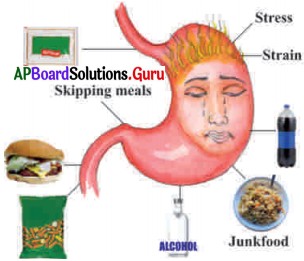
AP 7th Class Science Important Questions 3rd Lesson Nutrition in Organisms 1
Answer:
From the given picture, I understand that skipping meals, stress, strain, cool drinks, junk food, consumption of alcohol and tobacco products are not good for our health especially to our digestive system.

7th Class Science 3rd Lesson Nutrition in Organisms Short Questions and Answers

Question 1.
Why are leaves green in colour?
Answer:

  1. Leaves are green as they have chloroplasts.
  2. Chloroplasts are the special structures present only in plant cells and absent in animal cells.
  3. These chloroplasts consisting of a green coloured pigment called chlorophyll in them.
  4. This chlorophyll is responsible for all this greenery and play key role in preparation of food.

Question 2.
How can you confirm the occurrence of photosynthesis in a plant?
Answer:

  1. Glucose formed in photosynthesis is converted and stored in the form of starch.
  2. So, the presence of starch in leaves indicates the occurrence of photosynthesis.
  3. It can be confirmed by testing the leaf extract with Iodine solution.

Question 3.
Why leaves are called “food factories of plants”.?
Answer:

  1. Plants get carbon dioxide from air, water from soil, and energy from sunlight for synthesis of their food.
  2. The synthesis of food occurs in all green parts of plant body.
  3. These green parts contain a colouring pigment called Chlorophyll.
  4. It is more in leaves so leaves are called as “food factories of plants”.

Question 4.
Prepare a table comparing the method of our food preparation with that of plants.
Answer:

Preparation of Boiled RicePreparation of food by green plants
Raw materialRice, WaterCarbon dioxide, water
Source of energyFirci from stoveSunlight
Happens inVessel/ cookerChloroplast in green parts
Finally formsBoiled riceGlucose/Carbohydrates

Question 5.
How do the raw materials; required for photosynthesis reach the leaf?
Answer:

  1. Carbon dioxide required for photosynthesis enters into the leaf through the stomata.
  2. Water absorbed by the roots transported to the leaf through the stem.
  3. Leaf get sunlight when it exposed to the sun.
  4. Chlorophyll is present with the leaf.

AP 7th Class Science Important Questions 3rd Lesson Nutrition in Organisms

Question 6.
What is the importance off sunlight in photosynthesis?
Answer:

  1. Sun light is the source of energy in the process of photosynthesis.
  2. The solar energy is captured by the leaves and stored in the plant in the form of food.
  3. Thus, sun is the ultimate source of energy for all living organisms.

Question 7.
Write a short note on insectivorous plants.
Answer:

  1. There are some plants that eat insects.
  2. Being green in colour, they can manufacture their own food.
  3. But as they grow in areas deficient in nitrogen, they meet their nitrogen requirements from insects.
  4. Leaves of these plants are specially modified to trap insects.
  5. Nepenthes, droseras, Utricularia (bladderwort), Venus fly trap (Dionaea) are examples of some such insectivorous plants.
  6. These are also called as carnivorous plants.

Question 8.
Write a short note on saprophytic nutrition.
Answer:

  1. Some organisms grow on dead and decaying matter.
  2. They secrete digestive juices on it convert it into a solution and then absorb the nutrients from it.
  3. This mode of nutrition in which organisms take in nutrients in the form of solution from dead and decaying; matter is called saprophytic nutrition.
  4. Generally we see this saprophytic nutrition in certain microorganisms such as bacteria and fungi like mushrooms, bread mould etc.

Question 9.
Write a short note on symbiosis.
Answer:

  1. Some plants of the Dal family (legume plants) posses a type of bacteria growing on their roots in nodules.
  2. The bacteria fixes nitrogen for the plant while it gets shelter in the roots of these plants.
  3. Such an association is beneficial to both groups and called symbiosis.
  4. In organisms called lichens, a chlorophyll-containing partner, which is an algae, and a fungus live together.
  5. The fungus provides shelter, water and minerals to the alga and in return, the alga „ provides.

Question 10.
What is parasitism? Give examples.
Answer:

  1. Type of association between two organisms for food in which one organism get benefited and other is vitiated is called parasitism (Parasitic nutrition).
  2. The organism which is getting benefit is called parasite.
  3. Example for parasitic plant is Cuscuta.
  4. Example for parasitic animal is intestinal worm.

Question 11.
How does dodder plant get its food?
Answer:

  1. Plants like Cuscuta/ Dodder plant (Bangaru teega) take readymade food from the plant on which it is climbing. ,
  2. They develop special roots called haustoria, which penetrate into the tissues of the host plant and absorb food materials from them.
  3. This causes harm to the host plant gradually.
  4. This kind of nutrition is called parasitism.

Question 12.
How do animals take their food? Where do they digest it?
Answer:

  1. Animals obtain their food from other organisms.
  2. They take their food in the form of solid or liquid.
  3. They take the food into the body for digestion.
  4. Digestion occurs inside the body.

AP 7th Class Science Important Questions 3rd Lesson Nutrition in Organisms

Question 13.
What are the parts of human digestive system?
Answer:

  1. The digestive system consists of the alimentary canal and digestive glands.
  2. The total length of alimentary canal is about 9 meters.
  3. Its main parts are mouth, oral cavity/ buccal cavity, oesophagus, stomach, small intestine, large intestine, rectum and anus.
  4. The salivary glands, liver and pancreas are the digestive parts connected to the alimentary canal.

Question 14.
Write a short note on tooth decay?
Answer:

  1. Normally Bacteria present in our mouth are not harmful to us.
  2. If we do not clean our teeth and mouth after eating, many harmful bacteria begin to live and grow in it.
  3. These bacteria breakdown the sugars present from leftover food and release acids.
  4. These acids gradually damage teeth. This is called tooth decay.
  5. If it is not treated in time, it causes severe toothache and in extreme cases results in tooth loss.
  6. Chocolates, sweets, soft drinks and other sugar products are major causes of tooth decay.

Question 15.
How do bad habits effect our digestive system?
Answer:

  1. Bad habits like smoking, chewing of tobacco, drinking of alcohol effect our health adversely. .
  2. Drinking of alcohol can lead to liver diseases, digestive problems.
  3. It causes cancer of the mouth, throat, oesophagus arid liver.
  4. Consuming tobacco products, tobacco particles stick to teeth, gums, and skin of the mouth cavity which leads to swelling, injury, pain and also causes throat and intestine cancer.

Question 16.
How do vajrasana help our body?
Answer:

  1. Vajrasana increases flow of blood into our stomach area, thus improving our bowel movements and relieving constipation.
  2. It also keeps us to get rid of gas and acidity.

Question 17.
Draw the diagram of stomata and label the parts.
Answer:
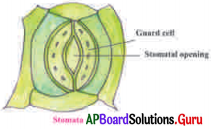
AP 7th Class Science Important Questions 3rd Lesson Nutrition in Organisms 2

Question 18.
Draw the diagram showing nutrition in amoeba.
Answer:
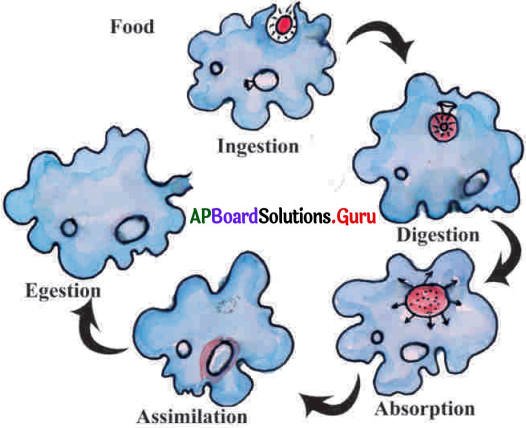
AP 7th Class Science Important Questions 3rd Lesson Nutrition in Organisms 3

Question 19.
Which habit should be practised for the health of teeth? Why?
Answer:
We should clean our teeth daily at least for twice. Once in the morning after we wakeup. This helps to remove the bacteria accumulated over night in our mouth. And second time before going to bed. This helps to remove any food particles remain in mouth. Otherwise these food particles increase the growth of bacteria and releasing of acids. So for the health of our teeth, we should brush our teeth at least for twice.

7th Class Science 3rd Lesson Nutrition in Organisms Long Questions and Answers

Question 1.
What is nutrition? Describe different types of nutritions.
Answer:
The process of intake and utilization of food by organisms is called nutrition. This is mainly of two types.

  1. Autotrophic nutrition
  2. Heterotrophic nutrition

1) Autotrophic nutrition :
The mode of nutrition in which organisms make food by themselves is called autotrophic nutrition. Ex: Green plants

2) Heterotrophic nutrition :
The mode of nutrition in which organisms depend on other organisms for food is called Heterotrophic nutrition. This is again of three types
i) Saprophytic nutrition:
The mode of nutrition in which organisms take in nutrients in the form of solution from dead and decaying matter is called saprophyticnutrition.
Ex: Certain microorganisms such as bacteria and fungi like mushrooms, bread mould etc.

ii) Parasitic Nutrition :
This type of association between two organisms for food in which one organism get benefited and other is vitiated is called parasitic nutrition.
Ex: Cuscuta, Intestinal worms

iii) Holozoic Nutrition :
Holozoic Nutrition is the mode of heterotrophic nutrition in which the food is taken in solid or liquid form from the outside and is digested inside the body.
Ex: Amoeba. Human beings

AP 7th Class Science Important Questions 3rd Lesson Nutrition in Organisms

Question 2.
What is holozoic nutrition? What are the steps involved in it?
Answer:
Holozoic Nutrition is the mode of heterotrophic nutrition in which the food is taken in solid or liquid form from the outside and is digested inside the body.

The steps involved in holozoic nutrition are

  1. Ingestion – Food is taken into the body.
  2. Digestion – Conversion of food into simple soluble forms.
  3. Absorption – Transfer of food to the blood.
  4. Assimilation – Absorbed food became the part of the body. .
  5. Egestion – Removal of waste products and undigested food from the body.

Question 3.
Describe the nutrition in amoeba.
Answer:

  1. Amoeba is a microscopic single-celled organism found in pond water.
  2. Amoeba has a cell membrane, a rounded, dense nucleus and many small bubble¬like vacuoles in its cytoplasm.
  3. Amoeba constantly changes its shape and position.
  4. It pushes out one. or more finger-like projections, called pseudopodia or false feet ‘ for movement and capture of food.
  5. Food vacuole forms around the captured food.
  6. Food get digested in it, absorbed into the cytoplasm and assimilates.
  7. Finally undigested food is sent out by opening this vacuole out at the body surface.

Question 4.
Is the nutrition in human beings holozoic? Justify your answer.
Answer:

  1. Yes, nutrition in human beings is holozoic nutrition.
  2. We take food in the form of solids or liquids.
  3. It get’s digested in the digestive system.
  4. Digested food is absorbed by the blood.
  5. Blood transports digested food to different parts of the body for assimilation.
  6. Undigested food will be ejected out of the body.
  7. So the nutrition in human beings is holozoic nutrition.

Question 5.
Explain the process of digestion in grass eating animals.
Answer:

  1. Grass eating animals have four chambers in stomach.
  2. They are rumen, reticulum, omasum and abomasum.
  3. They quickly swallow the grass and store it in a part of the stomach called rumen.
  4. In rumen, food gets partially digested and is called cud.
  5. But later the cud returns to the mouth in small lumps and animal chews it again.
  6. This process is called rumination and these animals are called ruminants.
  7. The grass is rich in cellulose, a type of carbohydrate.
  8. In ruminants, the cellulose of the food is digested by the action of certain bacteria present in the rumen of grass eating animals.

AP 7th Class Science Important Questions 3rd Lesson Nutrition in Organisms

Question 6.
Make a table showing types of teeth, their number and function in human beings.
Answer:

Type of teethNumber of teethFunction
1. Incisors8cut food
2. Canines4tear food
3. Premolars8crush food
4. Molars12grind food

Question 7.
Describe the functions of various parts of human digestive system.
Answer:
Different parts of human digestive system performs different functions as mentioned below.

  1. Mouth Food is taken into the body through it. It leads into Buccal Cavity.
  2. Buccal cavity contains tongue, teeth and secretions of Salivary glands. Carbohydrate digestion starts here.
  3. Pharynx is the common chamber for both digestive track and respiratory track. It leads into Oesophagus.
  4. Oesophagus is a muscular tubular structure that connects pharynx with Stomach.
  5. Stomach is a muscular sac like structure. Food is grinded well and mix with its juices. Proteins digestions tarts in the stomach. Hydrochloric acid in the stomach kills Bacteria in the food.
  6. Duodenum is the first part of the small intestine. Bile juice from liver, Pancreatic juice from pancreas enters into it and helps in digestion.
  7. Small intestine is about six metre long. Digestion of food is completed here with the help of its juices. Its inner wall have thousands of finger-like outgrowths called villi. They absorb the digested food. Blood transport it to all body parts for assimilation.
  8. Large Intestine absorbs water and minerals from the undigested food.
  9. Rectum storage point for undigested food.
  10. Anus – Fecal matter removed through it.

Question 8.
What is acidity? Mention the symptoms, causes and home remedies for acidity.
Answer:
Acidity:
It’s a common problem associated with digestive track caused due to excess acids in stomach.

Symptoms :
Burning sensation in chest, stomach and in throat;
sour taste in mouth;
upper abdominal discomfort;
post meal heaviness.

Causes : consuming spicy food;
stress;
unhealthy or irregular meals;
drinking too much alcohol.

Home remedies:
Consuming butter milk, coconut water, eating of herbs such as ajwain, tulsi leaves, saunf, jeera and pudina leaves, cloves, jaggery

AP Board 7th Class Science 3rd Lesson 1 Mark Bits Questions and Answers Nutrition in Organisms

I. Multiple Choice Questions

1. Carbohydrates digest first in
A) Buccal cavity
B) Stomach
C) Small intestine
D) Large intestine
Answer:
A) Buccal cavity

2. Proteins digestion starts in
A) Buccal cavity
B) Stomach
C) Small intestine
D) Large intestine
Answer:
B) Stomach

AP 7th Class Science Important Questions 3rd Lesson Nutrition in Organisms

3. Chocolates, sweets, soft drinks and other sugar products cause of
A) Acidity
B) Constipation
C) Tooth decay
D) Diarrhea
Answer:
C) Tooth decay

4. The process of intake and utilization of food by organisms is called ……
A) Digestion
B) Absorption
C) Nutrition
D) Excretion
Answer:
C) Nutrition

5. Nutrition in green plants is
A) Autotrophic
B) Saprophytic
C) Parasitic
D) Holozoic
Answer:
A) Autotrophic

6. This is not a requirement of photosynthesis
A) Oxygen
B) Carbon dioxide
C) light
D) water
Answer:
A) Oxygen

7. Product of photosynthesis
A) Oxygen
B) Water
C) Glucose
D) All the above
Answer:
D) All the above

8. Presence of starch in leaves indicates the occurrence of…..
A) Respiration
B) Photosynthesis
C) Digestion
D) Excreton
Answer:
B) Photosynthesis

9. This works as food factory of the plant
A) Stem
B) Leaf
C)Flower
D) Root
Answer:
B) Leaf

AP 7th Class Science Important Questions 3rd Lesson Nutrition in Organisms

10. Function of stomata is
A) Gaseous exchange
B) Transport of water
C) Food production
D) Digestion
Answer:
A) Gaseous exchange

11. Find the correct statement
i) Nepenthes is a insectivorous plant.
ii) It grow in phosphorous deficient soils.
A) both are correct
B) i only correct
C) ii only correct
D) both are wrong
Answer:
B) i only correct

12. Example for saprophyte
A) Amoeba
B) Utricularia
C) Cuscuta
D) Bread mould
Answer:
D) Bread mould

13. Chlorophyll-containing partner in the lichens is
A) Algae
B) Fungi
C) Bacteria
D) Amoeba
Answer:
A) Algae

14. Cuscuta absorbs its food from host through
A) Tap root
B) Fibrous root
C) Haustoria
D) prop roots
Answer:
C) Haustoria

15. National Deworming Day is observed on
A) February 10
B) August 10
C) Both A & B
D) December 10
Answer:
C) Both A & B

16. Albendazole tablet is a…
A) Antibiotic
B) Antiviral drug
C) Antifungal drug
D) Deworming drug
Answer:
D) Deworming drug

AP 7th Class Science Important Questions 3rd Lesson Nutrition in Organisms

17. Taking of food into the body is called…..
A) Ingestion
B) Digestion
C) Absorption
D) Egestion
Answer:
A) Ingestion

18. Conversion of food into simple soluble forms is called …
A) Ingestion
B) Digestion
C) Absorption
D) Egestion
Answer:
B) Digestion

19. Transfer of food to the blood is called …..
A) Ingestion
B) Digestion
C) Absorption
D) Egestion
Answer:
C) Absorption

20. Removal of waste products and undigested food from the body
A) Ingestion
B) Digestion
C) Absorption
D) Egestion
Answer:
D) Egestion

21. Amoeba collects its food with the help of
A) Pseudopodia
B) Nucleolus
C) Food vacuole
D) Cytoplasm
Answer:
A) Pseudopodia

22. This is not digestible in human being is …..
A) Starch
B) Protein
C) Fat
D) Cellulose
Answer:
D) Cellulose

23. Nutrition in human being is …
A) Autotrophic
B) Parasitic
C) Saprophytic
D) Holozoic
Answer:
D) Holozoic

24. The total length of alimentary canal is about
A) 3 meters
B) 6 meters
C) 9 meters
D) 12 meters
Answer:
C) 9 meters

25. Tofal number of teeth in the adult is
A) 8
B) 16
C) 20
D) 32
Answer:
D) 32

26. Teeth that help to cut the food….
A) incisors
B) canines
C) premolars
D) molars
Answer:
A) incisors

AP 7th Class Science Important Questions 3rd Lesson Nutrition in Organisms

27. Hardest part of the human body is
A) Bone
B) Teeth
C) Cartilage
D) Muscle
Answer:
B) Teeth

28. The major culprits of tooth decay ….
A) Chocolates
B) Sweets
C) Soft drinks
D) All the above
Answer:
D) All the above

29. Common chamber for both digestive track and respiratory track is
A) Pharynx
B) Duodenum
C) Esophagus
D) Buccal cavity
Answer:
A) Pharynx

30. The muscular tubular structure that connects pharynx with Stomach is
A) Buccal cavity
B) Oesophagus
C) Duodenum
D) Small intestine
Answer:
B) Oesophagus

31. Hydrochloricacid in the stomach kills Bacteria in the food.
A) Lactic acid
B) Sulphuric acid
C) Acetic acid
D) Hydrochloric acid
Answer:
D) Hydrochloric acid

32. Digestion of food completes in this part
A) Stomach
B) Duodenum
C) Small intestine
D) Large intestine
Answer:
C) Small intestine

33. Digested food absorbed in to blood through
A) Stomach
B) Duodenum
C) Villi
D) Large intestine
Answer:
C) Villi

34. Large intestine absorbs….
A) Water
B) Digested food
C) Minerals
D) A & C
Answer:
D) A & C

35. Reason for acidity…
A) Stress
B) Irregular meals
C) Drinking too much alcohol
D) All the above
Answer:
D) All the above

AP 7th Class Science Important Questions 3rd Lesson Nutrition in Organisms

36. The only asana that can be done on full stomach.
A) Padmaasan
B) Vajrasana
C) Bhujangasana
D) shirshaasana
Answer:
B) Vajrasana

II. Fill in the blanks

1. Liver produces …………… juice.
2. Expand NDD ……………
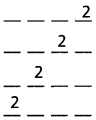
3. AP 7th Class Science Important Questions 3rd Lesson Nutrition in Organisms 4

4. The process of intake and utilization of food by organisms is called …………… .
5. The mqde of nutrition in which organisms make food by themselves is called …………… .
6. The mode of nutrition in which organisms depend on other organisms, for food is called …………… .
7. Green plants are …………… .
8. Humans and animals are directly or indirectly dependent on …………… for food.
9. …………… are the special structures present only in plant cells and absent in animal cells.
10. Chlorophyll is present in the …………… of plant cell.
11. …………… is the pigment responsible for the greenery of the plants.
12. The process-by which green plants make their own food from carbon dioxide and water by using light energy in the presence of chlorophyll is called …………… .
13. Glucose formed in photosynthesis is converted and stored in the form of …………… .
14. The presence of starch in leaves indicates the occurrence of …………… .
15. Occurrence of photosynthesis can be confirmed by testing the leaf extract with …………… solution.
16. …………… work as “food factories of plants”.
17. …………… captures the energy of the sunlight.
18. …………… is the source of energy in the process of photosynthesis.
19. …………… is the ultimate source of energy for all living organisms.
20. Gaseous exchange occurs in the leaves through …………… .
21. …………… is the gas required for photosynthesis.
22. …………… is the gas produced in photosynthesis.
23. Nutrients needed ip minute quantities are called …………… .
24. Insectivorous plants meet their requirements from insects.
25. Saprophytes grow on …………… .
26. The mode of nutrition in which organisms take in nutrients in the form of solution from dead and decaying matter is called …………… nutrition.
27. …………… play key role in cleaning,up the earth surface.
28. Chlorophyll-containing partner in lichen is
29. An association between two organisms for food in which one organism get benefited and other is vitiated is called ……………
30. The organism that get benefited in parasitism is …………… .
31. Organism on which parasite is growing is called …………… .
32. …………… is the mode of heterotrophic nutrition in which the food is taken in solid or liquid form from the outside and is digested inside the body.
33. Pseudopodia are food collecting, organs in …………… .
34. Humans cannot digest …………… .
35. The digestive system consists Of the …………… and …………… .
36. The total length Of alimentary canal is about …………… meters.
37. Teeth in the human beings are of …………… types.
38. …………… is the hardest part of the human body.
39. …………… is the only asana that can be done on full stomach.
40. Damage of teeth due to acids is called …………… .
41. Carbohydrate digestion starts in …………… .
42. …………… is the common chamber for both digestive track and respiratory track.
43. Proteins digestions starts in the …………… .
44. …………… in the stomach kills Bacteria in the food.
45. Inner wall of the small intestine have thousands of finger-like outgrowths called …………… .
46. Villi absorb the …………… .
47 …………… absorbs water and minerals from the undigested food.
48. …………… is the storage;point for undigested food.
49. Fecal matter removed through …………… .
Answer:

  1. bile
  2. National Deworming Day
  3. carbondioxide, oxygen
  4. nutrition
  5. autotrophic nutrition
  6. heterotrophic nutrition
  7. autotrophs
  8. plants
  9. Chloroplasts
  10. chloroplast
  11. Chlorophyll
  12. Photosynthesis
  13. starch.
  14. photosynthesis
  15. Iodine
  16. Leaves
  17. Chlorophyll
  18. Sunlight
  19. Sun
  20. stomata.
  21. Carbon dioxide
  22. Oxygen
  23. micronutrients
  24. nitrogen
  25. dead and decaying matter
  26. saprophytic
  27. Saprophytes
  28. algae
  29. parasitism.
  30. parasite
  31. host
  32. Holozofc Nutrition
  33. amoeba
  34. cellulose
  35. Tooth
  36. Vajrasana
  37. tooth decay
  38. buccal cavity
  39. Pharynx
  40. stomach
  41. Hydrochloric acid
  42. villi.
  43. digested food
  44. Large Intestine
  45. Rectum
  46. anus.

III. Match the following

1.

Group – AGroup – B
A) Ingestion1) Transfer of food to the blood.
B) Digestion2) Absorbed food became the part of the body
C) Absorption3) Preparing food inside the body
D) Assimilation4) Removal of undigested food from the body.
E) Egestion5) Conversion of food into simple soluble forms.
6) Food is taken into the body.

Answer:

Group – AGroup – B
A) Ingestion6) Food is taken into the body.
B) Digestion5) Conversion of food into simple soluble forms.
C) Absorption3) Preparing food inside the body
D) Assimilation2) Absorbed food became the part of the body
E) Egestion4) Removal of undigested food from the body.

2.

Group – AGroup – B
A) Autotrophs1) Mouth
B) Saprophytes2) Special roots
C) Parasite3) Chlorophyll
D) Holozoic4) Solution

Answer:

Group – AGroup – B
A) Autotrophs3) Chlorophyll
B) Saprophytes4) Solution
C) Parasite2) Special roots
D) Holozoic1) Mouth

3.

Group – AGroup – B
A) Buccal cavity1) Removes fecal matter
B) Stomach2) Absorbs water and minerals
C) Small intestine3) Starts carbohydrate digestion
D) Large intestine4) Preparing food inside the body.
E) Anus5) Starts protein digestion
6) Complete the digestion of food

Answer:

Group – AGroup – B
A) Buccal cavity3) Starts carbohydrate digestion
B) Stomach5) Starts protein digestion
C) Small intestine6) Complete the digestion of food
D) Large intestine2) Absorbs water and minerals
E) Anus1) Removes fecal matter

4.

Group – AGroup – B
A) Utricularia1) Ruminants
B) Venus fly trap2) Others
C) Cuscuta3) Bladderwort
D) Cows4) Nourishment
E) Trophos5) Dionaea
6) Dodder plant

Answer:

Group – AGroup – B
A) Utricularia3) Bladderwort
B) Venus fly trap5) Dionaea
C) Cuscuta6) Dodder plant
D) Cows1) Ruminants
E) Trophos4) Nourishment

Do You Know?

→ Forests are green in colour. Isn’t it? Infact they are green as they have many trees. Trees are green as they have leaves. Leaves are green as they have chloroplasts. Chloroplasts are the special structures present only in plant cells and absent in animal cells.These chloroplasts consists of a green coloured pigment called chlorophyll in them,. This chlorophyll is responsible for all this greenery and play key role in preparation of food. You will learn about all these in your higher classes.

→ There are some plants that eat insects. Being green in colour, they can manufacture their own food. But as they grow in areas deficient in Nitrogen, they meet their Nitrogen requirements from insects. Leaves of these plants are specially modified to trap insects. Nepenthes, (pitcher plant) Droseras, Utricularia (bladderwort), Dionaea (Venus fly trap) are examples of some such insectivorous plants. These are also called as carnivorous plants.

→ Some plants of the Dal family (legume plants) possess a type of bacteria growing on their roots in nodules. The bacteria fixes nitrogen for the plant while it gets shelter in the roots of these plants. Such an association is beneficial to both groups and is called Symbiosis.

In organisms called lichens (litmus paper is obtained from lichens), a chlorophyll-
containing partner, which is an algae and a fungus that live together. The fungus provides shelter, water, and minerals to the algae and in return, the algae provides food for the fungus.

→ Every year February 10 and August 10 is observed as National Deworming Day(NDD). The day aims at eradicating intestinal worms among children in the age group of 1-19 years. On this day. Albendazole tablet (deworming drug) is administered to children.

AP 7th Class Science Important Questions 3rd Lesson Nutrition in Organisms

Digestion In Grass Eating Animals

→ Have you observed cows, buffaloes and other grass eating animals chewing continuously even when they are not eating? They have four chambers in stomach. They are rumen, reticulum,omasum and abomasum. Actually they quickly swallow the grass and store it in a, part of the stomach called rumen. In rumen, food gets partially digested and is called cud. But later the cud returns to the mouth in small lumps and animal chews it again. This process is called rumination and these animals are called ruminants.

The, grass is rich in cellulose, a type of carbohydrate. In ruminants, the cellulose of the food is digested by the action of certain bacteria present in the rumen of grass eating animals. Many animals including humans cannot digest cellulose due to the absence of such bacteria.

→ Normally Bacteria present in our mouth are not harmful to us. If we do not clean our teeth and mouth after eating, many harmful bacteria begin to live and grow in it. These bacteria breakdown the sugars present from leftover food and release acids. These acids gradually damage teeth. This is called tooth decay. If it is not treated in time, it causes severe toothache and in extreme cases results in tooth loss. Chocolates, sweets, soft drinks and other sugar products are the major causes of tooth decay.

→ Vajrasana increases flow of blood into our stomach area, thus improving our bowel movements and relieving constipation. It also keeps us to get rid of gas and acidity. It is the only asana that can be done on full stomach.

AP 7th Class English Important Questions Unit 3 A Journey through the Hills and Valleys

These AP 7th Class English Important Questions 3rd Lesson A Journey through the Hills and Valleys will help students prepare well for the exams.

AP Board 7th Class English Unit 3 Important Questions and Answers A Journey through the Hills and Valleys

Reading Comprehension (Seen)

1. Read the following passage carefully.

It has been my longing since childhood to visit the Eastern Ghats. I’ve heard about the stunning beauty of the valleys, caves, tunnels, and the journey through ghat roads. The geographical magic of the Eastern Ghats and the frequent appearance of Lambasingi in both print and electronic media have always tempted me.

During the period from November to January, the hills with lushing greenery and blossoms welcome the visitors. The beauty of the valleys attracts even the movie makers.

I set off from Visakhapatnam along with my friends at 6 a.m. to catch the Kirandul Passenger, the only train from Visakhapatnam.to Berra Caves. Had 1 missed this mode of travel, I would have missed the most exciting moments of the train journey. And of course, there is a lot of scope to plan our journey on road hut it’s different. The first task that we had finished was taking breakfast after boarding the train. (A Journey through the Hills and Valleys)

Now, answer the following questions.
1. What was the longing wish of the speaker?
Answer:
To visit the Eastern Ghats

2. What were the things that tempted the author?
Answer:
The geographical magic of the Eastern Ghats and frequent appearance of lambasingi in both the print and electronic media

3. What was the attraction for the movie makers?
Answer:
The beauty of the valleys

4. What was the name of the train they caught?
Answer:
The Kirandul Passenger

5. What did they do after boarding the train?
Answer:
They took their breakfast.

AP 7th Class English Important Questions Unit 3 A Journey through the Hills and Valleys

2. Read the following passage carefully.

When the train was crossing the tunnels, we felt as if it were night because of the darkness for a few minutes even after the dawn. I could still remember the astounding experience in the longest tunnel among the 58 tunnels. Particularly the special coach called Vista dome coach, the air-conditioned tourist compartment with wide windows and LCD TV, .is a special attraction to this train journey After Chimidipalli station, just after a tunnel, a grand waterfall made us spellbound. I could not account all the water falls like this during the journey. The train reached Borra Caves by 9.40 a.m. We got down with our baggage. The train journey from Visakhapatnam to Borra Caves gave us an unforgettable experience which made us speechless. (A Journey through the Hills and Valleys)

Now, answer the following questions.
1. When did they feel as if it were night?
Answer:
When the train was crossing the tunnels

2. How many tunnels were there in their journey?
Answer:
58 tunnels

3. What is a Vista dome coach?
Answer:
It was the air-conditioned tourist compartment with wide windows and LCD TV.

4. Where did they see a grand waterfall?
Answer:
After Chimidipalli station, just after a tunnel

5. How was their journey to Borra Caves?
Answer:
It was an unforgettable experience.

3. Read the following passage carefully.

It was no exaggeration what t came to know about this God’s Architecture. At a height of 705 metres above the. sea level, made of Karstic limestone, manifested with magnificence, the Borra Caves are the largest caves in the country. While entering the caves everyone in our group enjoyed the echo of shouts of visitors. Unknowingly, we also shouted in excitement. You can understand the feelings of the boulders there. The chilled weather in the caves gave us a different experience. These caves are a good source of enjoyment and also experiential learning. Out of the caves, on either side of the road, the tribes sell their handicrafts made with bamboos, spices collected from forests and products of their farming, etc. to make their living. •

We had lunch at Borra Caves at 1 p.m. We had a very sumptuous lunch. Very special dishes of this agency area, which were differently cooked with local spices. (A Journey through the Hills and Valleys)

Now, answer the following questions.
1. What are the caves made of?
Answer:
They are made of Karstic limestone.

2. At what height were the caves located?
Answer:
At a height of 705 metres above the sea level

3. What did they enjoy while entering the caves?
Answer:
The echo of shouts of visitors

4. How was the weather in the caves?
Answer:
Chilly

5. What were the things sold by the tribes?
Answer:
Handicrafts made with bamboos, spices collected from forests and products of their farming, etc.

AP 7th Class English Important Questions Unit 3 A Journey through the Hills and Valleys

4. Read the following passage carefully.

We reached Araku Valley, the Andhra Ooty, and a monumental vacation spot in Andhra Pradesh. Wow! The aroma of coffee all over the surroundings certainly gets the exhausted minds energized. It was the Coffee Museum where one may be tempted to relish the taste of the coffee made with different aromas. Really, it’s the best beverage that I have ever had.

Here, we visited the Tribal Museum, the exhibition of many interesting things like the traditional art, handicrafts, ornaments and dresses used by the tribes, etc. It is an apt place for those who are enthusiastic to learn more about the culture and tradition of the local tribes. I was surprised to know the life style of tribal people. Kodus, a Primitive Tribal Group (PTG) use a different language which is a non-scripted dialect of Oriya. (A Journey through the Hills and Valleys)

Now, answer the following questions.
1. What is called the Andhra Ooty?
Answer:
Araku Valley

2. What is the beverage mentioned in the first paragraph?
Answer:
Coffee

3. What were the museums visited by the author?
Answer:
The Coffee Museum and the Tribal Museum

4. What was the apt place to learn more about the culture and tradition of the local tribes?
Answer:
The Tribal Museum

5. What was the thing that surprised the author?
Answer:
The lifestyle of the tribal people

5. Read the following passage carefully.

Lambasingi, the Kashmir of Andhra Pradesh, a small hamlet in Visakhapatnam district, is known for the snowfall with a record fall of 0°C and sometimes – 3°C temperatures particularly between November and January. It is also called ‘Korra Bayalu’ in their local language. Fenced by towering hills, tall green trees and surrounded by the mist, the area provides a perfect magical setting to enjoy winters. If anyone stays out in the open, one will be frozen.

Feeling the warmth of the sunrise at Lambasingi made an auspicious start of the day that lasts forever. After having breakfast, we visited Kondakarla Bird Sanctuary, one of the best places of visit. I was glad to see the strange visitors, the birds. I wonder how they survive in the intense cold weather. But their joy knew no bounds as they live in their natural habitat. (A Journey through the Hills and Valleys)

Now, answer the following questions.
1. What is Lambasingi called?
Answer:
The Kashmir of Andhra Pradesh or Korra Bayalu

2. What is Lambasingi known for?
Answer:
It is known for the.snowfall with a record fall of 0°C and sometimes – 3°C temperatures particularly between November and January.

3. What is the best seasbn to enjoy the weather of Lambasingi?
Answer:
Winter

4. What happens if anyone stays out in the open at Lambasingi?
Answer:
One will be frozen.

5. What was the nearby attraction to Lambasigi?
Answer:
Kondakarla Bird Sanctuary

AP 7th Class English Important Questions Unit 3 A Journey through the Hills and Valleys

6. Read the following passage carefully.

Gandikota, the magnificient piece of nature’s architecture, has come to be known as the Hidden Grand Canyon of India. The travelers who visit will be stunned by its beauty. It is located in Kadapa District of Andhra Pradesh. It resembles the Grand Canyon, Arizona, US. There are many astounding areas that are alluring to the visitors in and around Gandikota. ‘Gandi’ means ‘Canyon’ and ‘Kota’ means ‘Fort’. The village nearby this area is known to be Gandikota. ‘ ‘

The spectacular gorge formed by the Penna River that cuts through Erramala hills offers a beautiful view. A gorge is a narrow valley between hills or mountains, with steep rocky walls and a stream running through it. In fact, gorges are formed because of erosion of rock over a long period of time. (Gandikota – The Grand Canyon of India)

Now, answer the following questions.
1. What is Gandikota to be known as?
Answer:
The Hidden Grand Canyon of India

2. What makes the travelers stunned?
Answer:
The beauty of Gandikota

3. Where is Gandikota located?
Answer:
In Kadapa District

4. What is a gorge?
Answer:
A gorge is a narrow valley between hills or mountains, with steep rocky walls and a stream running through it.

5. How are gorges formed?
Answer:
Because of erosion of rock over a long period of time

7. Read the following passage carefully.

The Fort made of red stone has excellent palaces adorned with fine carvings. It is very exciting to walk along the fort’s wall and .spend a few moments by the serene river. A trip to this place is worth it, considering the fact that you can peep into history through the walls of Gandikota Fort, which narrates the tale of various civilizations that existed thousands of years ago.

The best time to visit this place is between September and February, as the weather ‘ during this time is comparatively pleasant. Summers are too hot and there will be significantly low water levels, the canyon seems less appealing. (Gandikota – The Grand Canyon of India)

Now, answer the following questions.
1. How is the fort made?
Answer:
It is made of excellent palaces adorned with fine carvings.

2. What is an exciting thing to do at the fort?
Answer:
Walking along the fort’s wall.

3. Which narrates the tale of various civilizations?
Answer:
The walls of Gandikota Fort

4. What is the best time to visit the fort?
Answer:
Between September and February

5. When does the fort Seem less appealing?
Answer:
In summer

Reading Comprehension (Unseen)

1. Read the following passage carefully.

Have you ever seen a UFO? A UFO is an Unidentified Flying Object, a strange object or light that people see in the sky. Many people believe that these strange lights are really spaceships from another planet.

For years people have seen and heard many odd things in the sky, blinking and glowing lights, flying objects shaped like saucers, and moving objects making strange noises. Some people have even taken pictures of these unusual sights.

Some of these UFOs are really aeroplanes, weather balloons or meteors. But many UFO reports are still a mystery.

Now, answer the following questions.
a) What do people believe about these strange lights?
Answer:
People believe that these strange lights are really spaceships from other planets.

b) What are these UFOs really?
Answer:
These UFOs are really aeroplanes, weather balloons or meteors.

Choose the correct answer from the choices given.
c) U.F.O stands for:
i) Unknown Flying Object
ii) Unidentified Flying Object
iii) Unseen Flying Object
Answer:
ii) Unidentified Flying Object

d) U.F.Os are believed to be spaceships from other
i) countries
ii) continents
iii) planets
Answer:
iii) planets

e) Which of the following statements is true?
i) UFOs are make-believe.
ii) Moving objects with blinking lights have to be UFOs
iii) People have seen moving objects making strange noises.
Answer:
i) UFOs are make-believe.

AP 7th Class English Important Questions Unit 3 A Journey through the Hills and Valleys

2. Read the following passage carefully.

Do you know about one of the most famous monsters in the world? The Loch Ness Monster is a large animal that some people believe lives in Loch Ness, a deep dark lake in Scotland. For many years, hundreds of people have reported seeing something strange in the lake. They have even given it the nick name “Nessie’.

Nessie is said to be about 30 feet long, with a long slender neck, one or two humps and flippers.

There are even pictures that have been taken of a large animal-like shape in the water. Scientists are still trying to solve the mystery of Nessie.

Now, answer the following questions.
a) Where do the Loch Ness Monsters live?
Answer:
Loch Ness Monsters are said to be lived in the Loch Ness lake in Scotland.

b) How is Nessie?
Answer:
Nessie is said to be about 30 feet long with a long slender neck, one or two humps and flippers.

Choose the correct answer from the choices given,
c) Actually the Loch Ness is the name of a
i) country.
i) city.
iii) lake.
Answer:
iii) lake.

d) Which of the following is a fact about Nessie?
i) Nessie has a long slender neck.
ii) Nessie has flippers.
iii) Nessie is a mystery.
Answer:
iii) Nessie is a mystery.

e) What was the Nickname given to Loch Ness Monster?
i) Nest
ii) Nestle
iii) Nessie
Answer:
iii) Nessie

Interpretation Of Non-Verbal Information

1. Read the following tree diagram carefully.
AP 7th Class English Important Questions Unit 3 A Journey through the Hills and Valleys 1

Now answer the following questions.
a) What does the above diagram show?
Answer:
The above diagram shows a tree diagram of musical instruments.

b) What are the three main categories of musical instruments?
Answer:
Three catagories : (1) Wind instruments, (2) Percussion instruments, (3) Stringed instruments.

Choose the correct answer from the choices given below.
c) Which of the following is a stringed instrument?
i) Harp
ii) Horn
iii) Tabla
Answer:
i) Harp

d) What type of musical instrument is Xylophone?
i) Percussion instrument
ii) Wind instrument
iii) Stringed instrument
Answer:
i) Percussion instrument

e) Which of the following statements is TRUE based on the information given?
i) All string instruments are a type of percussion instruments.
ii) Wood block is a wind instrument.
iii) Guitar and Violin are stringed instruments.
Answer:
iii) Guitar and Violin are stringed instruments.

AP 7th Class English Important Questions Unit 3 A Journey through the Hills and Valleys

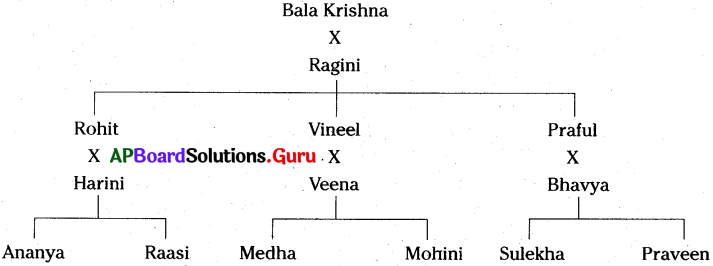
2. Study the family tree of Bala Krishna.
AP 7th Class English Important Questions Unit 3 A Journey through the Hills and Valleys 2

Now answer the following questions.
a) Who are the grandparents of Praveen?
Answer:
Balakrishna and Ragini

b) How many granddaughters does Bala Krishna have?
Answer:
Five granddaughters

Choose the correct answer from the choices given below.
c) Medha is the daughter of ……………..
i) Rohit
ii) Veena
iii) Bhavya
Answer:
ii) Veena

d) Praveen and Raasi are ……………
i) brothers
ii) cousins
iii) friends
Answer:
ii) cousins

e) Which of the following statements is TRUE based on the information given?
i) Rohit has two daughters.
ii) Ananya and Raasi are cousins.
iii)Rohit’s wife is Bhavya.
Answer:
i) Rohit has two daughters.

Vocabulary

Synonyms

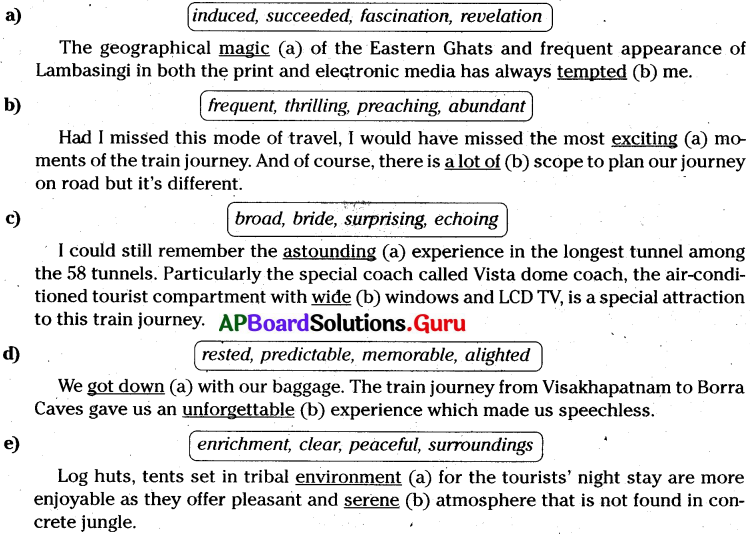
Choose the words with similar meanings (synonyms) from the list given to the words underlined.
AP 7th Class English Important Questions Unit 3 A Journey through the Hills and Valleys 3
AP 7th Class English Important Questions Unit 3 A Journey through the Hills and Valleys 4
Answer:
a) a) fascination, b) induced
b) a) thrilling, b) abundant
c) a) surprising, b) broad
d) a) alighted, b) memorable
e) a) surroundings, b) peaceful
e) a) advantage, b) panoramic

Antonyms

Write the opposites (antonyms) for the underlined words.
a) I could still remember (a) the astounding (b) experience in the longest tunnel among the 58 tunnels.
b) We got down (a) with our baggage. The train journey from Visakhapatnam to Borra Caves gave us an unforgettable (b) experience which made us speechless.
c) Log huts, tents set in tribal environment for the tourists’ night stay are more enjoyable (a) as they offer pleasant (b) and serene atmosphere that is not found in concrete jungles.
d) Here, we visited the Tribal Museum, the exhibition of many interesting (a) things like the traditional (b) art, handicrafts, ornaments and dresses used by the tribes, etc.
e) I feel proud (a) to visit this garden for its great history. This popular (b) botanical garden, built in 1942 in 26 acres, was the source of cultivating vegetables for the soldiers who fought in the World War II.
f) Lambasingi, the Kashmir of Andhra Pradesh, a small (a) hamlet in Visakhapatnam district, is known (b) for the snowfall with a record fall of 0°C and sometimes -3°C temperatures particularly between November and January.
Answer:
a) a) forget, b) unimpressive
b) a) board / got in, b) forgettable
c) a) unenjoyable, b) nasty
d) a) uninteresting, b) unconventional
e) a) sorry, b) unpopular
f) a) big, b) unfamiliar

Right Forms of the Words

Fill in the blanks with the right form of the words given in the brackets.

a) The _____ (a) (beauty / beautiful) of the valleys _____ (b) (attacts / attraction) even the movie makers.
b) It was no _____ (a) (exaggerate / exaggeration) what I came to know about this God’s _____ (b) (Architecture / Architect).
c) These caves are a good source of _____ (a) (enjoyment / enjoyed) and also _____ (b) (experientially / experiential) learning.
d) Here, we visited the Tribal Museum, the _____ (a) (exhibited / exhibition) of many interesting things like the _____ (b) (tradition / traditional) art, handicrafts, ornaments and dresses used by the tribes, etc.
e) This _____ (a) (popular1 / popularity) botanical garden, built in 1942 in 26 acres, was the source of _____ (b) (cultivate / cultivating) vegetables for the soldiers who fought in the the World War II.
f) Feeling the _____ (a) (warmly / warmth) of the sunrise of Lambasingi made an _____ (b) (auspicious / auspiciously) start of the day that lasts forever.
Answer:
a) a) beauty, b) attracts
b) a) exaggeration, b) Architecture
c) a) enjoyment, b) experiential
d) a) exhibition, b) traditional
e) a) popular, b) cultivating
f) a) warmth, b) auspicious

Spelling Test

Type – 1 : Vowel Clusters

Complete the following words using “ai, au, ea, ee, ei, eo, ia, ie, io, oa, oi, oo, ou, ua, ui or uo”.

a) aftern _ _ nb) sh _ _ tingc) pi _ _ sant
d) f _ _ nde) of c _ _ rsef) coff _ _
g) plantat _ _ nsh) betw _ _ ni) vacat _ _ n
j) surr _ _ ndingsk) cert _ _ nlyl) exh _ _ sted
m) mus _ _ mn) r _ _ llyo) exhibit _ _ n
p) tradit _ _ nalq) enthus _ _ ticr) p _ _ pie
s) lang _ _ get) d _ _ lectu) b _ _ n
v) s _ _ mw) picturesq _ _x) h _ _ rt
y) self _ _ sz) ind _ _ d

Answer:

a) afternoonb) shoutingc) pleasant
d) founde) of coursef) coffee
g) plantationsh) betweeni) vacation
j) surroundingsk) certainly1) exhausted
m) museumn) reallyo) exhibition
p) traditionalq) enthusiasticr) people
s) languaget) dialectu) boon
v) seemw) picturesquex) heart
y) selfiesz) indeed

Exercise – 2

a) f _ _ Stb) mov _ _ sc) f _ _ l
d) pr _ _ de) gr _ _ tf) b _ _ lt
g) s _ _ rceh) sold _ _ ri) f _ _ ght
j) tr _ _ ningk) tr _ _l) h _ _ se
m) f _ _ tn) ceremon _ _ lo) b _ _ t
p) gr _ _ nq) auspici _ _ sr) sanct _ _ ry
s) b _ _ ndt) p _ _ ceu) pi _ _ sure
v) adventur _ _ sw) destinat _ _ nx) b _ _ r
y) rem _ _ ningz) l _ _ k

Answer:

a) feastb) moviesc) feel
d) proude) greatf) built
g) sourceh) soldieri) fought
j) trainingk) tree1) house
m) feetn) ceremonialo) beat
p) greenq) auspiciousr) sanctuary
s) boundt) peaceu) pleasure
v) adventurousw) destinationx) bear
y) remainingz) look

Type – 2 : Suffixes

Complete the following words with the suitable suffixes given in the brackets.

a) During the period from November to January, the hills with lushing green ___ (ery / ary) and blossoms welcome the visit ___ (ers / ors).
b) The train journey from Visakhapatnam to Borra Caves gave us an unforgett ___ (eble/ able) experience which made us speech ___ (loss / less).
c) These caves are a good source of enjoy ___ (ment / mant) and also experien ___ (tial / cial) learning.
d) Log huts, tents set in tribal environ ___ (ment / mant) for the tourists’ night stay are more enjoy ___ (eble /able) as they offer pleasant and serene atmosphere that is not found in concrete jungles.
e) It is indeed, a wonder ___ (ful / full) feast for the eyes. Here, the rail ___ (way / weigh) track and the roadway seem to go parallel.
f) At night, there was an unforget ___ (teble / table) camp fire in which we all enjoyed Dhimsa, the local ceremon ___ (yal / ial) dance of the agency, performed by 12 to 16 women while men beating the drums.
Answer:
a) greenery, visitors
b) unforgettable, speechless
d) environment, enjoyable
f) unforgettable, ceremonial
c) enjoyment, experiential
e) wonderful, railway

Type – 3 : Wronalv Spelt Words

Identify the wrongly spelt word and write its correct spelling in the space provided.

a) exageration, valley, popular, entire
Answer:
exaggeration

b) pleasure, cultivating, magnifisense, frequent
Answer:
magnificence

c) aspicious, aspect, enjoyable, stunning
Answer:
auspicious

d) experience, parallel, sumptus, intense
Answer:
sumptuous

e) atraction, concrete, glance, amazing
Answer:
attraction

f) convert, unforgetable, trekking, compensating
Answer:
unforgettable

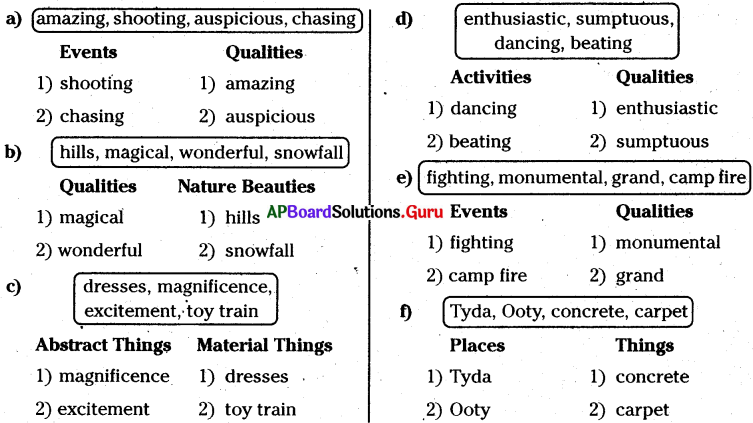
Classification of Words

Arrange the following words under the correct headings.
AP 7th Class English Important Questions Unit 3 A Journey through the Hills and Valleys 5

Choice of the Words

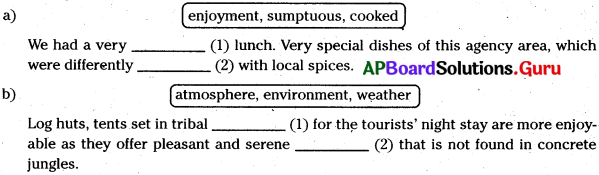
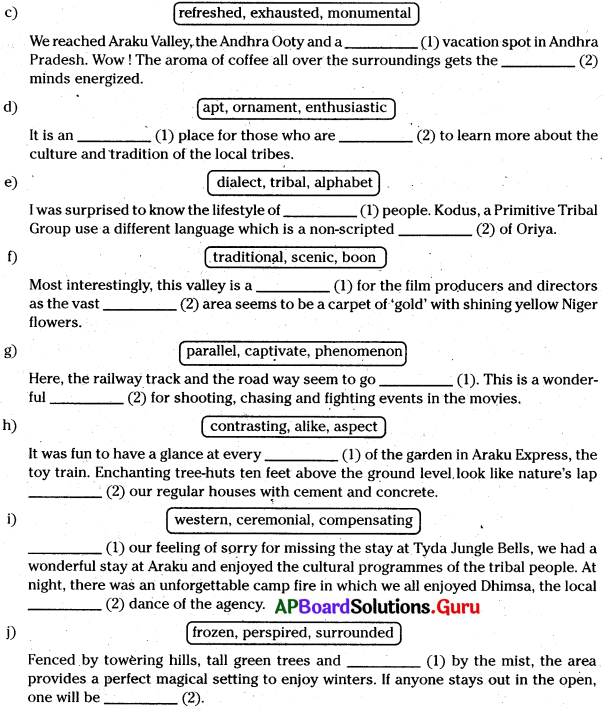
Fill in the blanks choosing the suitable words from those given in the box.
AP 7th Class English Important Questions Unit 3 A Journey through the Hills and Valleys 6 AP 7th Class English Important Questions Unit 3 A Journey through the Hills and Valleys 7
Answer:
a) 1) sumptuous, 2) cooked
b) 1) environment, 2) atmosphere
c) 1) monumental, 2) exhausted
d) 1) apt, 2) enthusiastic
e) 1) tribal, 2) dialect
f) 1) boon, 2) scenic
g) 1) parallel, 2) phenomenon
h) 1) aspect, 2) contrasting
i) 1) Compensating, 2) ceremonial
j) 1) surrounded, 2) frozen

Prefixes / Suffixes

Add appropriate prefixes / suffixes to the following roots to make new words.
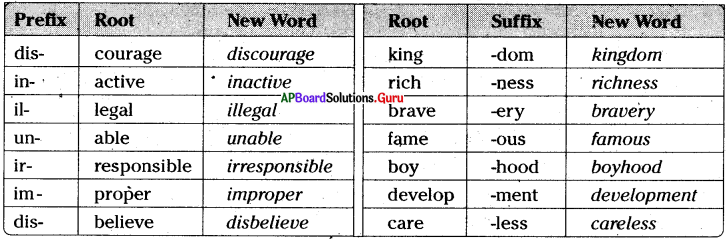
AP 7th Class English Important Questions Unit 3 A Journey through the Hills and Valleys 8

Grammar

I. Edit the following passage correcting the underlined parts.

1. Dolphins are very interesting animals. They, looks (a) like fish but they are not fish. Fish has (b) cold blood but dolphins have warm blood. Fish can live under water and (c) dolphins cannot. They can stay in (d) water for a long time.
Answer:
a) look b) have c) but d) under

2. An (a) Olympic Games are the great (b) celebrations of sport in the world. They are held once in four years. The Olympic Games began at (c) Olympia in 776 B.C. They took place from time to time till (d) 393 A.D.
Answer:
a) The b) greatest c) in d) until

3. Dhyanchand is (a) a very well-known hockey player. He was born at (b) 29 August 1905 in Allahabad. He studied in the (c) local secondary high school. In 1922, he joined a (d) British army as a sepoy.
Answer:
a) was b) on c) a d) the

4. Vikram Sarabhai was responsible to (a) the setting up of the Rocket Launching station or (b) Space Science and Technology Centre in (c) Thumba in Kerala. A (d) Rocket and Launching Ranger at Srihaj-i Kota in Andhra Pradesh was set up by Dr. Sarabhai only.
Answer:
a) for b) and c) at d) The

AP 7th Class English Important Questions Unit 3 A Journey through the Hills and Valleys

II. Complete the passage choosing the right words from those given below. Each blank is numbered and for each blank four choices are given. Choose the correct answer and write (A), (B), (Q or (D) in the blanks.

1. Have you ever ____ (1) people putting ____ (2) thumb impression on important documents? This is done mainly ____ (3) illiterate people ____ (4) they cannot put their signatures.
1) A) see B) sees C) seen D) seeing
2) A) its B) his C) their D) her
3) A) with . B) from C) by D) of
4) A) so B) because C) as D) since
Answer:
1) C 2) C 3) C 4) B

2. The finger prints ____ (1) the police to ____ (2) the thieves and criminals. ____ (3) ____ keep a record of the finger prints of thieves and criminals ____ (4)
to them.
1) A) helps B) help C) helped D) helping
2) A) identify B) identifying C) identified D) identifies
3) A) He B) She C) They D) It
4) A) knows B) know C) known D) knowing
Answer:
1) B 2) A 3) C 4)C

3. A cell phone is ____ (1) extremely sophisticated radio. ____ (2) cell phones ____ (3) can talk to anyone ____ (4) the planet from just about anywhere.
1)A) a B) an C) the D) any
2) A) By B) With C) From D) On
3) A) she B) he C)they D) you
4) A) on B) in C) over D) above
Answer:
1)B 2) B 3) D 4) A

4. Abdul is ____ (1) friend. One evening he ____ (2) home from school. He‘saw a boy ____ (3) in a tank. Suddenly he jumped ____ (4) the tank and saved the boy.
1) A) I B) my G) me D) mine
2) A) is returning B) returns C) was returning D) returned
3) A) drowns B) drowning C) drowned D) drown
4) A) in B) on C)into . D) over
Answer:
1) B 2) C 3) B D) C

III. Fill in the blanks with suitable prepositions given in the box.
AP 7th Class English Important Questions Unit 3 A Journey through the Hills and Valleys 9
1) There is a box ______ the table.
2) I will meet you ______ the evening.
3) He reached the place ______ 8.30 a.m.
4) Rahul went ______ a movie his friends.
5) The cat jumped ______ the well.
6) She hurried ______ the entrance to receive the guest.
7) His house is ______ the sea.
8) A number of colourful butterflies are flying ______ us.
9) We are living ______ the same roof.
10) They are going to travel the ______ world.
Answer:

  1. on
  2. in
  3. at
  4. to with
  5. into
  6. towards
  7. by
  8. above
  9. under
  10. around

IV. Fill in the blanks with suitable prepositions given in the box.
AP 7th Class English Important Questions Unit 3 A Journey through the Hills and Valleys 10
1) She is walking ______ the road slowly.
2) The Palk strait is located ______ India and Sri Lanka..
3) The Thames river flows ______ London.
4) She will conje to India ______ November.
5) Mr. Alexander has taught in this school ______ one year.
6) He put a paper weight ______ the papers.
7) She always holds an umbrella ______ her head.
8) There is a temple ______ our school.
9) It is easier to walk ______ the hill than go up.
10) I saw your friend ______ the park.
Answer:

  1. along
  2. between
  3. through
  4. in
  5. for
  6. on
  7. over
  8. beside
  9. down
  10. at

V. Write the other degrees of the following adjectives.

Positive DegreeComparative DegreeSuperlative Degree
smallsmallersmallest
safesafersafest
clevercleverercleverest
brightbrighterbrightest
hothotterhottest
beautifulmore beautifulmost beautiful
preciousmore preciousmost precious
hard-workingmore hard-workingmost hard-morking
muchmoremost
goodbetterbest
badworseworst
farfarther / furtherfarthest / furthest

VI. Read the following sentences. Label them with ‘P’ for Positive, ‘C’ for Comparative and ‘S’ for ‘Superlative’.

1. Rahul Dravid is one of the greatest batsmen in the world.
2. Alexander was the greatest soldier in the world.
3. India is one of the fastest developing countries in the world.
4. No other river in the world is as long as the Nile.
5. Hindi is one of the most popular languages in India.
6. Lara is not as great as Tendulkar.
7. Rekha is one of the most beautiful girls in the class.
8. Very few metals are as expensive as platinum.
9. Shimla is colder than all hill stations in the Himachal Pradesh.
10. Delhi is one of the most crowded cities of India. ‘
Answer:

  1. Superlative Degree
  2. Superlative Degree
  3. Superlative Degree
  4. Positive Degree
  5. Superlative Degree
  6. Positive Degree
  7. Superlative Degree
  8. Positive Degree
  9. Comparative Degree
  10. Superlative Degree

Creative Writing

1. Describe a journey with your family.
Answer:
Recently we planned a tour to Araku Valley. Dad said it’s a very pleasant and cool hill station that can be visited in summer. Charan and I were so excited and told our friends about our trip to Araku. Mom also said its a worthy sight seeing place.

We started early in the morning of Monday by a train to Vishakhapatnam. I enjoyed the climate and scenic beauty sitting by the window. Mom made some snacks and lunch for us to enjoy during the journey. We reached Vishakhapatnam in the after¬noon. We took rest in a hotel and went to see R.K. Beach in the evening. First time, to go near the heavy waters scared me a lot. But my father held our hands and gave the courage to go near the waters. We enjoyed a lot with the on and off movements of tides.

We took rest for the night and started for Araku early in the morning by train. The journey was pleasant and exciting as we passed through forests and tunnels. Children in the train shouted with joy. We reached Araku, hired a room and got fresh. We hired a taxi to see some old temples. Borra caves, tea and coffee plantations and beautiful gardens. We enjoyed the trip. The garden was beautiful with flower beds, bushes and decorated trees.

The trip was a memorable experience in my life.

2. One of your Mends wishes to visit the place you have visited recently. Write a letter to your Mend giving suggestions to help him make his/her Mp successful.
Answer:

5 – 23 – 13/B,
6/18 Brodipet,
GUNTUR.
6th June, 20xx.

My dear Sriram,

I am fine and pink in health. I hope the same with you there.

I would like to describe the place, Hyderabad which I have visited recently. Hyderabad is thexapital of Telangana. It is a big cosmopolitan city. People of different languages, cultures and traditions live harmoniously together. There are many places worth-seeing in Hyderabad. Some of them are -1) the Charminar 2) the Salarjung Museum 3) the Legislative Assembly 4) the Birla Mandir 5) Nehru Zoological Park 6) Planetarium 7) The Tank Bund 8) Rajiv International Airport 9) Ramoji Film City 10) Hussain Sagar and the Buddha Statue.

It is a lovely city. The clim’ate is fine. The Hussain Sagar joins the twin cities namely Hyderabad and Secunderabad. You should visit it soon.

Please convey my regards to your parents.

Yours lovingly,
Hanuman

Address on the envelope :
M. Sriram,
S/o Mr. M. Suryaprakash,
1-2-34 A,
Temple Street,
Kandukur.
Prakasam. (dt)

AP 7th Class English Important Questions Unit 3 A Journey through the Hills and Valleys

3. You have read that the author and his friends planned a tour to Araku Valley in the lesson, “A Journey through the Hills and Valleys”. He travelled by the Kirandul Passenger up to Borra Caves. The author and his friends enjoyed themselves the train journey. Their travel in Vista dome coach of Kirandul Passenger gave them memorable experience.

Now, describe the feelings of the author while he was travelling by the Kirandul Passenger along with his Mends.
Answer:
The author felt very happy when they planned to visit Araku Valley. He started from Visakhapatnam along with his friends and travelled by the Kirandul Passenger, the only train from Visakhapatnam to Borra Caves. As soon as he boarded the train, he started thinking. He thought, “What a wonderful occasion it is ! The travel in Vista dome coach with wide windows and LCD TV is really a special attraction to this train journey. The scenery of the hills with lushing greenery and blossoms is magnificent to watch. Oh, now, I think we are crossing the longest tunnel on our way. It gives me an astounding experience. Oh, here comes a grand waterfall which makes all the travellers spellbound. I can’t account all the waterfalls like this during the journey. The sheer beauty of the lushing greenery, various coloured blossoms, tunnels, waterfalls, valleys, ghat roads, etc. has taken my breath away. This train journey from Visakhapatnam to Borra Caves has given us an unforgettable experience and has made us speechless !”

4. Do you have any memorable day in your life ? Narrate about it in a paragraph.
Answer:
A DAY THAT I CAN’T FORGET
There are many unforgettable days in my life. Of these is the day when the result of my class VI examination was declared. I had done all my papers well. I expected a good result. But I had stood first in the entire district. I felt very very happy. My parents and other family members were very happy. All my friends and teachers came to congratualte me on this great success. Sweets were distributed in the colony. My father decided to send me to a very good school for further education. I can’t forget that day.

5. Recently you have spent a week in hills at your grandparents’ house.’You enjoyed your stay. Write a paragraph about 100 words describing the joy of living in the lap of nature.
Answer:
How I spent a week in hills
Last month I spent a week in hills in my grandparents’ house. My grandparents live in Rishikesh at the foothills of the great Himalayas. This year it was very hot in the plains. So I went to them. First, the weather was pleasant though days were hot. Sitting on the banks of holy Ganges in the background of lush green forest and hills gave us peace. We went to Chamoli for two days. There we enjoyed our stay. The nature looked fresh and pure. The distant hills and snow-covered tops added glory to natural beauty. We ate seasonal fruits and tasted local food to our fill. There was no tension or pressure of any kind. It was a blessing to be in the lap of nature.

6. Write a Biographical sketch of Mr. Ramnath Kovind, the President of India, using the information given below :
Birth : 1st October, 1945
Paraunk near Kanpur, Uttar Pradesh.
Parents : Sri Maiku Lal
Smt. Kalavathi
Education : School education in Kanpur – B. Com, LL.B, Kanpur University.
Spouse : Smt. Savitha
Positions held : * Advocate for Government of India at the Delhi High Court from 1977 to 1981.
* Junior Council for Government of India in Supreme Court from 1982 to 1984.
* Governor of Bihar from 2015 to 2017.
Parliamentary life : Member of Rajya Sabha from Uttar Pradesh from 1994 to 2000.
Assumed the office as President : 25th July, 2017
Answer:
Ramnath Kovind was born on 1st October, 1945 in Paraunk, near Kanpur, Uttar Pradesh. His parents were Sri Maikulal and Smt. Kalavathi. He completed his school education in Kanpur and obtained the degrees of B.Com and L.L.B from Kanpur University. He married Savitha. He was an advocate of Indian Government in the Delhi High Court from 1977 to 1981 and Indian Government Junior Council in the Supreme Court from 1982 to 1984. Before assuming charge of the office of the 14th President of India on July 25,2017, Kovind served as the 36th Governor of the state of Bihar from 2015 to 2017. He was elected as a member of Rajya Sabha from Uttar Pradesh from 1994 to 2000.

7. Write a story using the following hints.

Hints: Four bulls in a field – very good friends – lion feared to near them – thought of a plan – said bad words against friends – then bulls grazed separately – lion killed one after the other – united – strength.
Answer:
FOUR FOOLISH BULLS
Once there lived four bulls by the side of a forest. They were strong and sturdy. They were united. They grazed together. A lion, which lived in the forest, very much wished to make a feast of the bulls. The lion, did not dare to go near the bulls. He thought of a plan. He met each bull in turn and said bad words against the other bulls. The foolish bulls believed his words. They started grazing separately. The lion took advantage of the disunity of the bulls. He killed one after the other and ate all the four bulls.

Moral: Unity is strength, (or) United we stand, divided we fall.

AP 7th Class English Important Questions Unit 3 A Journey through the Hills and Valleys

8. Write a story using the following hints:
Hints : A king very fond of stories – man who tells a story that never ends to marry his daughter – a handsome young man begins his story – a little ant – nothing to eat – sees a big building – decides to take some rice from it – crawls inside – carries a grain of rice on back – crawls home – the young man goes on about little ant – king understands – marries off his daughter to him.
Answer:
THE CLEVER MAN’S ENDLESS STORY
Once there lived a king. He was very much fond of stories. He declared that he would give his daughter in marriage to the man who would tell him an endless story.

One day a clever and handsome young man came to the king.. He started telling an endless story. The story ran like this. “Once there was a little ant. It was hungry. It had nothing to eat. It saw a big building. It crawled inside it. There was a heap of rice. It carried a grain of rice on its back to its hole. It came back. Again it carried another grain of rice”.

The young man repeated the same story of the ant several times. The story seemed endless. The king got vexed. He understood the cleverness of the young man. He mar-ried off his daughter to him.

Moral: Your wisdom comes to your help, (or) Knowledge is power.

AP 7th Class Science Important Questions 2nd Lesson Nature of Substances

These AP 7th Class Science Important Questions 2nd Lesson Nature of Substances will help students prepare well for the exams.

AP Board 7th Class Science 2nd Lesson Important Questions and Answers Nature of Substances

Question 1.
From which language does the word ‘Acid’ derived?
Answer:
The word acid came from the Latin word ‘acere’ means sour.

Question 2.
Give some examples for substances containing acids.
Answer:
Tamarind, Lemon, Tomato, Apple, Curd, Raw mango etc.

Question 3.
What is the chemical name of vitamin C?
Answer:
The chemical name of vitamin C is Ascorbic acid.

Question 4.
Name some substance in which vitamin C is available.
Answer:
Vitamin C is available in citrus fruits and in amla (usiri).

AP 7th Class Science Important Questions 2nd Lesson Nature of Substances

Question 5.
What will happen when carbon dioxide is added to water?
Answer:
When carbon dioxide is added to water, it become carbonic acid/soda.

Question 6.
How are bases to touch?
Answer:
Bases are slippery to touch.

Question 7.
Which base is used to prepare bath soap?
Answer:
Bath soap is prepared using potassium hydroxide.

Question 8.
Which base is used to prepare detergent soap?
Answer:
Detergent soap for washing clothes is prepared using Sodium hydroxide.

Question 9.
What are the main components in the tooth paste?
Answer:
Main components in the tooth paste are calcium carbonate, aluminum hydroxide and sodium bi carbonate. All these chemicals are bases.

Question 10.
What are alkalis?
Answer:
Bases that can dissolve in water are called alkalis.

Question 11.
Give some examples for alkalis.
Answer:
Some examples of alkalis are sodium hydroxide, potassium hydroxide and calcium hydroxide.

AP 7th Class Science Important Questions 2nd Lesson Nature of Substances

Question 12.
What are neutral substances?
Answer:
The substance which is neither an acid nor a base is known as neutral substance.

Question 13.
Give examples for neutral substances.
Answer:
Distilled water, salt solution, sugar solution etc are example for neutral substances.

Question 14.
Who gave the most modern definition of acids and alkalis?
Answer:
Svante Arrhenius Swedish physical chemist gave the most modern definition of acids and alkalis.

Question 15.
What are indicators?
Answer:
Substances which are used to test acids or bases are called acid base indicators.

Question 16.
From what does litmus extracted?
Answer:
Litmus is extracted from lichens.

Question 17.
What are olfactory indicators?
Answer:
Substances which change their smell when mixed with acid or base are known as olfactory indicators. Ex: onion, vanilla and clove oil.

Question 18.
What happens when a metal piece is dropped in an acid?
Answer:
If you drop a metal piece in an acid it reacts with acid and releases hydrogen gas.

AP 7th Class Science Important Questions 2nd Lesson Nature of Substances

Question 19.
How can you test hydrogen gas?
Answer:
Hydrogen gas make the flair e to put off with a pop sound.So we can test it by introduc¬ing a incense stick into the mouth of the container having gas.

Question 20.
Why does balloon fill with hydrogen gas fly?
Answer:
Hydrogen gas has less weight than air. So balloon fill with hydrogen gas flies high.

Question 21.
How can you test carbon dioxide gas?
Answer:
Carbon dioxide gas put off the fire. So we can test it by introducing a lighting match stick into the mouth of the container having gas.

Question 22.
What is neutralization reaction?
Answer:
Reaction of an acid and a base is called neutralization reaction.

Question 23.
What are the substances formed in neutralization reaction?
Answer:
The substances formed in neutralization reaction are water and salt.

Question 24.
What do antacids contain?
Answer:
Antacids contain bases, eg: aluminum hydroxide, milk of magnesia.

Question 25.
Why do we get pain and itching, when an ant bites us?
Answer:
When an ant bites us, it injects formic acid into our skin. It causes pain and itching.

Question 26.
What is Acid rain?
Answer:
Rain water with slight acidic nature is called Acid rain.

AP 7th Class Science Important Questions 2nd Lesson Nature of Substances

Question 27.
All alkalis are bases but all bases are not alkalis. Give one example in support of this statement.
Answer:
Zinc hydroxide is a base but not an alkali. It doesn’t dissolve in water.

7th Class Science 2nd Lesson Nature of Substances Short Questions and Answers

Question 1.
Mention some food items containing acids and write the name of the acid present in them.
Answer:

Food itemAcid present
LemonCitric acid
TamarindTartaric acid
AppleMalic acid
TomatoOxalic acid
AmlaAscorbic acid

Question 2.
What are mineral acids? Give examples.
Answer:

  1. Some acids are prepared artificially from minerals which are extracted from the earth. Such acids are known as mineral acids or synthetic acids.
  2. Hydrochloric acid, sulphuric acid and nitric acids are examples for mineral acids.

Question 3.
Mention any four daily life situations where acids are being used.
Answer:

  1. Hydrochloric acid is used for bath room cleaning.
  2. Sulphuric acid is used in batteries.
  3. Soda water and cool drinks contain carbonic acids.
  4. Fatty acids are used in manufacturing of soaps.
  5. Citric acid, tartaric acid, acetic acid etc, are used in the preparation and preserva¬tion of some foods.

Question 4.
Mention any four daily life situations where bases are being used.
Answer:

  1. Bath soap is prepared using potassium hydroxide.
  2. Detergent soap for washing clothes is prepared using Sodium hydroxide.
  3. Aluminium hydroxide is used in the preparation of tooth paste.
  4. Aluminium hydroxide and milk of magnesia are used in preparation of antacids.
  5. Quick lime and Potassium hydroxide are used to treat acidic soils.

AP 7th Class Science Important Questions 2nd Lesson Nature of Substances

Question 5.
Is it possible to test all the acids and bases simply by tasting or touching them? Why?
Answer:

  1. No, It is not possible to test all the acids and bases simply by tasting or touching them.
  2. Some acids like hydrochloric acid, sulphuric acid, nitric acids and bases like so¬dium hydroxide, potassium hydroxide are very harmful and strong.
  3. We cannot test them by touch or taste.
  4. We should use indicators to test them.

Question 6.
How to prepare turmeric indicator?
Answer:

  1. Take a table spoon of turmeric powder in a plate.
  2. Add little water and make it into a paste.
  3. Take a white paper and apply the paste over it on both sides and let it dry.
  4. After drying, cut the paper into strips.
  5. Now turmeric paper strips are ready for use as indicator.

Question 7.
Do the turmeric strip act as a indicator? How?
Answer:

  1. Yes, turmeric strip act as a indicator.
  2. This is because turmeric is a natural indicator.
  3. The colour of turmeric strip will change into reddish brown in basic solutions.
  4. It remain yellow in acidic solutions.

Question 8.
How can you identify acids and bases using hibiscus indicator?
Answer:

  1. Hibiscus is a natural indicator that changes its colour in acids and bases.
  2. It changes its colour from violet to pink in acids.
  3. It changes its colour from violet to green in bases.
  4. Thus it can be used to identify acids and bases.

Question 9.
Mention the colours of different indicators in acidic and basic mediums.
Answer:

IndicatorIn acidIn base
1. Blue litmusRed
2. Red litmusBlue
3. Methyl orangeRedYellow
4. PhenolphthaleinPink
5. TurmericReddish brown
6. HibiscusPinkGreen

Question 10.
Magicians bring blood out of a lemon when they cut it with a knife. How is it pos-sible?
Answer:

  1. It is simply a science trick.
  2. Magician prepares a knife by applying an indicator like methyl orange or hibiscus solution on it.
  3. Then he cut the lemon before us.
  4. Due to the reaction the lemon juice (acid) turns red and we are made to believe that blood is coming out of the lemon.

AP 7th Class Science Important Questions 2nd Lesson Nature of Substances

Question 11.
Who introduced pH scale? How is it used?
Answer:

  1. pH scale was introduced by Sorensen.
  2. Strength of acid or base solution is measured in pH scale.
  3. The range of pH scale is from 0 to 14.
  4. pH of acids is less than 7, pH of bases is more than 7 and pH of neutral substance is 7.
  5. Strength of acids decreases from 0 to 7 and strength of bases increases from 7 to 14.

Question 12.
Classify the following in to strong acid, weak acid, strong base, weak base.
Hydrochloric acid, Acetic acid, oxalic acid, Sodium hydroxide, Sulphuric acid, Po-tassium Hydroxide, Nitric acid, Ammonium hydroxide,Citric acid.
Answer:
AP 7th Class Science Important Questions 2nd Lesson Nature of Substances 1

Question 13.
Pickles are not stored in aluminum or steel or copper vessels. Why?
Answer:

  1. Pickles contain acids.
  2. These acids react with metal containers and releases toxic substances.
  3. So, we should store them in metal containers.
  4. Generally, they are stored in ceramic or glass containers which do not react.

Question 14.
How can you prove carbon dioxide releases when acid reacts with calcium carbonate?
Answer:

  1. Take some crushed egg shells in a test tube and pour dilute sulphuric acid until the egg shells completely sink. Egg shell is made of calcium carbonate.
  2. We will observe that a gas being released.
  3. Bring a lighting match stick near the mouth of test tube.
  4. The gas that put off the lighting match stick indicating that the gas is carbon diox¬ide.
  5. This confirms that carbon dioxide releases when acid reacts with calcium carbon¬ate.

Question 15.
What is neutralization? Give examples for neutralization reaction from day-to-day life.
Answer:

  1. Neutralization is a chemical reaction where acid and base react with each other to form salt and water.
  2. The bases in the antacids neutralize gastric juice and give us relief from acidity.
  3. When an ant bites, it injects formic acid into the skin. It causes pain and itching. We can neutralize the acid by rubbing the paste of baking soda on the place of bite. Baking Soda is a base and it neutralizes the formic acid.
  4. When soil becomes too acidic, farmers neutralize it by adding basic substances like quick lime (sunnam), potassium hydroxide etc,.
  5. When soil becomes too basic they neutralize it with organic substances like com¬post which release acidic substances into the soil.

Question 16.
What is acid rain? How is it caused?
Answer:

  1. Rain water with slight acidic nature is called Acid rain.
  2. Air pollution is a major cause of acid rains.
  3. Fuels like coal and petroleum emissions have sulphur dioxide and nitrogen dioxide etc. which react with rain water droplets and form sulphuric acid and nitric acid.
  4. These acids come along with rain water to cause acid rain.

Question 17.
Bhasker said that some plants help us to find out the nature (pH)of the soil. Do you support his statement?
Answer:

  1. Yes, I support his statement.
  2. Hydrangea plants have different colours of flowers based on the pH of the soil.
  3. If the pH of the soil is below 5.5 it gives blue flowers.
  4. If the pH of the soil is below 6.5 it gives pink flowers.
  5. Thus, they helps us to find the nature (pH) of soil.

AP 7th Class Science Important Questions 2nd Lesson Nature of Substances

Question 18.
Why do Neem/ miswak/ kanuga sticks are used as chew sticks from olden days?
Answer:

  1. Neem, miswak, kanuga sticks are used as chew sticks (pandupulla) from olden days.
  2. Because they have basic substances.
  3. The bases in these sticks neutralizes the acids released by the bacteria in our mouth.
  4. Thus they protect our oral health.

Question 19.
Write some acids and there uses in our daily life in the form of a table.
Answer:

Name of the acidUses
Vinegar (Acetic acid)Preservation of pickles and other food substances
Citric acidFood preservation and in soft drinks
Nitric acid and sulphuric acidManufacture of chemical fertilizers, paints,  dyes etc.
Sulphuric acidAutomobile battery
Tannic acidProduction of ink and leather

Question 20.
Write some bases and their uses in our daily life in the form of a table.
Answer:

Name of the BaseUses
Calcium hydroxideneutralize the acidity of soil, white washing
Magnesium hydroxide (milk of magnesia)antacid and laxative
Ammonium hydroxide
Sodium hydroxide
windows cleaner, cleaning agent
manufacturing of paper, soaps and detergent
Potassium hydroxidemanufacturing of soaps and batteries

Question 21.
What is soap? How is it prepared?
Answer:

  1. Soap is a salt with basic nature.
  2. It is prepared by adding fatty acids like coconut oils to alkalis like Sodium hydroxide or Potassium hydroxide.
  3. Detergent soap used to wash cloths contains Sodium hydroxide.
  4. Bath soap contains Potassium hydroxide.

Question 22.
What are the precautions to be taken while handling chemicals?
Answer:

  1. Do not taste and smell. Do not let it fall on the body.
  2. Use a dropper while transferring acid from bottle.
  3. While adding water to make dilution, pour small quantities of acid slowly into water taken in a beaker.
  4. Use a holder to hold a test tube.
  5. Read the precautions given on the containers of substances.

AP 7th Class Science Important Questions 2nd Lesson Nature of Substances

Question 23.
What precautions should be taken if the body burns due to chemicals?
Answer:

  1. Start first aid immediately.
  2. Remove contaminated clothes from the person.
  3. Wash the affected area with plenty of water.
  4. Don’t pierce the blisters.
  5. Shift the person to hospital.

7th Class Science 2nd Lesson Nature of Substances Long Questions and Answers

Question 1.
Write the properties of Acids.
Answer:

  1. Acids are sour to taste.
  2. They turn blue litmus to red colour, methyl orange to red colour, hibiscus indicator to pink colour.
  3. They don’t change the colour of phenolphthalein and turmeric indicators.
  4. pH of acids is less than 7.
  5. Acids react with metals and release hydrogen gas.
  6. Acids react with calcium carbonate to release carbon dioxide.
  7. Acids react with base to form water and salt. This reaction is called neutralisation reaction.
  8. Hydrochloric acid, sulphuric acid and nitric acid are examples for acids.

Question 2.
Write the properties of Bases.
Answer:

  1. Bases are bitter to taste.
  2. They are slippery to touch.
  3. They turn red litmus to blue colour, methyl orange to yellow colour, phenolphtha- lein to pink and hibiscus indicator to green colour.
  4. They change the colour of turmeric indicator to reddish brown.
  5. pH of acids is more than 7.
  6. Bases like sodium hydroxide react with metals and releases hydrogen gas.
  7. Bases react with acid to form water and salt. This reaction is called neutralisation reaction.
  8. Sodium hydroxide, magnesium hydroxide, potassium hydroxide and calcium hy-droxide are examples for bases.

AP 7th Class Science Important Questions 2nd Lesson Nature of Substances

Question 3.
How can you demonstrate the neutralisation reaction in the laboratory?
Answer:
Aim: To demonstrate the neutralisation reaction.

What you need:
1) Conical flask, 2) Dropper, 3) Sodium hydroxide solution, 4) Hydro-chloric acid, 5) Phenolphthalein indicator

How to do:
Take sodium hydroxide solution in a conical flask and observe its colour. Now add 2-3 drops of phenolphthalein indicator to it. Now observe the colour. It is pink in colour. Using a dropper add dilute hydrochloric acid drop by drop to this solution, and stir gently.

What you see:
The pink colour of the solution disappears. On crystallisation water evaporates from this solution leaving the salt in the flask.

What you learn:
In this reaction acid and base reacts with each other to form salt and water. Such reactions are called neutralisation reactions.
Hydrochloric acid + sodium hydroxide → sodium chloride + water

Question 4.
Take the following solutions in to test tubes. Test them with a) red litmus, b) blue litmus, c) methyl orange and d) phenolphthalein indicators. Tabulate your results. 1)Dilute hydrochloric acid, 2) Sodium hydroxide, 3) Acetic acid, 4) Salt solution, 5) Sugar solution and 6) Soap water
Answer:
AP 7th Class Science Important Questions 2nd Lesson Nature of Substances 2

Question 5.
How can you prove that hydrogen gas releases when acid reacts with metals?
(or)
How can you produce hydrogen gas in the laboratory?
Answer:
Aim: Acid reacts with metals and produces hydrogen gas.

Materials required:
Conical flask, hydrochloric acid, zinc pieces, incense stick, match box.

Procedure:
Take 5g of zinc metal pieces in a conical flask. Pour 20 ml of dilute hydro-chloric acid into it. Now, observe what happens.

Observation:
The zinc pieces reacted with the hydrochloric acid and releases a gas. Test for hydrogen gas

Now, introduce a incense stick into mouth of the conical flask. The flame of burning stick will put off with a pop sound. This is a test for hydrogen gas. Hydrochloric acid reacts with zinc metal and forms zinc chloride, releases hydrogen gas. This reaction can be written as a word equation,
Zinc + hydrochloric acid → zinc chloride + hydrogen

Conclusion:
Hence, we can conclude that acids react with metals and release hydrogen gas.

AP Board 7th Class Science 2nd Lesson 1 Mark Bits Questions and Answers Nature of Substances

I. Multiple Choice Questions

1. Table salt contains
A) Sodium chloride
B) Sodium bicarbonate
C) Potassium chloride
D) Sodium hydroxide
Answer:
A) Sodium chloride

2. Baking soda contains
A) Sodium chloride
B) Sodium bicarbonate
C) Potassium chloride
D) Sodium hydroxide
Answer:
B) Sodium bicarbonate

3. Gastric juice means
A) Sulphuric acid
B) Citric acid
C) Antacid
D) Hydrochloric acid
Answer:
D) Hydrochloric acid

AP 7th Class Science Important Questions 2nd Lesson Nature of Substances

4. Sulphuric acid reacts with eggshell and releases
A) Carbondioxide
B) Hydrogen
C) Oxygen
D) None
Answer:
A) Carbondioxide

5. Substance/s formed in a neutralization reaction is/are
A) Water
B) Salt
C) A and B
D) Hydrogen
Answer:
C) A and B

6. Which of the following does not contain acid?
A) lemon
B) Bitter gourd
C) Amla
D) Tomato
Answer:
B) Bitter gourd

7. This acid is present in cool drinks
A) Sulphuric acid
B) Hydrochloric acid
C) Carbonic acid
D) Vinegar
Answer:
C) Carbonic acid

8. Bath soap is prepared using
A) Sodium hydroxide
B) Aluminum hydroxide
C) Calcium carbonate
D) Potassium hydroxide
Answer:
D) Potassium hydroxide

9. Olfactory indicator from the following
A) Hibiscus
B) Phenolphthalein
C) Clove oil
D) Methyl orange
Answer:
C) Clove oil

10. lichens are used in the preparation of
A) Litmus
B) Methyl blue
C) Phenolphthalein
D) Olfactory indicators
Answer:
A) Litmus

AP 7th Class Science Important Questions 2nd Lesson Nature of Substances

11. Phenolphthalein shows colour change with
A) Acids
B) Bases
C) both A & B
D) Neutral substances
Answer:
B) Bases

12. Which of the following is a strong acid?
A) Citric acid
B) Acetic acid
C) Sulphuric acid
D) Malic acid
Answer:
C) Sulphuric acid

13. This gas is lighter than air
A) Hydrogen
B) Nitrogen
C) Oxygen
D) Carbon dioxide
Answer:
A) Hydrogen

14. Product of neutralisation
A) Salt
B) Water
C) Both A & B
D) Acid
Answer:
C) Both A & B

15. Example for salt
A) Common salt
B) Antacid
C) Tooth paste
D) Clove oil
Answer:
A) Common salt

16. Acid produced in stomach
A) Sulphuric acid
B) Hydrochloric acid
C) Nitric acid
D) Carbonic acid
Answer:
B) Hydrochloric acid

17. This can be used to treat ant bite
A) Baking soda
B) Common salt
C) Vinegar
D) Turmeric
Answer:
A) Baking soda

18. pH of bases
A) 0-14
B) 7
C) more than 7
D) less than 7
Answer:
C) more than 7

19. This is responsible for acid rains
A) Sulphur dioxide
B) Nitrogen dioxide
C) Both A & B
D) Oxygen
Answer:
C) Both A & B

20. Flowers that change their colour according to the nature of soil
A) Hydrangea
B) Marigold
C) Hibiscus
D) Jasmine
Answer:
A) Hydrangea

II. Fill in the blanks.

1. Rain with slight ………….. nature is called acid rains.
2. Wash the affected burning area on skin with ………….. .
3. ………….. will be prepared by adding fatty acids to alkalis.
4. ………….. are used in making soaps.
5. ………….. are used to test the nature of substances.
6. ………….. acid is also called as Vitamin C.
7. ………….. acid is used for bath room cleaning.
8. ………….. acid is used in batteries.
9. Soda water and cool drinks contain ………….. acids.
10. Bases are ………….. to taste.
11. Bath soap is prepared using ………….. .
12. Detergent soap is prepared using
13. Bases that can dissolve in water are called ………….. .
14. The substance which is neither an acid nor a base is known as ………….. .
15. Purewater is a ………….. substance.
16. Substances which are used to test acids or bases are called ………….. .
17. Indicators obtained from natural sources are called as ………….. .
18. The most commonly used natural indicator is ………….. .
19. The colour of turmeric strip will change into ………….. in soap water.
20. Soda water turns into ………….. on adding hibiscus indicator.
21. Soap solutions turns ………….. on adding hibiscus indicator.
22. An indicator prepared from artificialsources is known as ………….. .
23. Methyl orange turns in acids and ………….. in bases.
24. Phenolphthalein turns ………….. in bases, but ………….. in acids.
25. Substances which change their smell when mixed with acid or base are known as ………….. .
26. ………….. is a mixture of different indicators and shows different colours in different solutions.
27. ………….. can show the strength of acid or alkaline substance.
28. Strength of acid or base solution is measured in ………….. scale.
29. pH of acids is ………….. .
30. pH of bases is ………….. .
31. pH of neutral substance is ………….. .
32. Natural acids are ………….. acids.
33. Acids react with metals and release gas.
34. Acids react with ………….. and release carbon dioxide gas.
35. Reaction of an acid and a base is called ………….. reaction.
36. The substances formed in neutralization reaction are ………….. and ………….. .
37. Antacids contain ………….. .
38. When an ant bites, it injects acid into the skin.
39. When soil becomes too acidic, farmers treat it by adding
40. When soil becomes too basic,farmers treat it with
41. Rain water with slight acidic nature is called
42. ………….. acid is used in the preservation of pickles and other food substances.
43. ………….. acid is used in the production of ink and leather.
44. Base used in windows cleaner is ………….. .
45. Magnesium hydroxide is used in ………….. and ………….. .
Answer:

  1. acidic
  2. plenty of water
  3. Soap
  4. Bases
  5. Indicators
  6. Ascorbic
  7. Hydrochloric
  8. Sulphuric
  9. carbonic
  10. bitter
  11. potassium hydroxide
  12. Sodium hydroxide
  13. alkalis
  14. neutral substance
  15. Neutral
  16. acid base indicators
  17. Natural indicators.
  18. litmus
  19. reddish brown
  20. pink
  21. green
  22. Synthetic indicator.
  23. red, yellow
  24. pink, does not change
  25. olfactoryin dicators.
  26. Universal indicatoris
  27.  Universal indicator
  28. pH
  29. less than 7
  30. more than 7
  31. 7
  32. weak
  33. hydrogengas.
  34. calcium carbonate
  35. neutralization reaction.
  36. water, salt
  37. bases.
  38. formic
  39. quick lime/ potassium hydroxide.
  40. compost.
  41. Acid rain.
  42. Acetic
  43. Tannic
  44. Ammonium hydroxide
  45. antacid and laxative

III. Match the following

1.

Group – AGroup – B
A) Blue litmus in acid1) Yellow
B) Methyl orange in base2) No change
C) Hibiscus in acid3) Red
D) Phenolphthalein in acid4) Brown
E) Turmeric in base

Answer:

Group – AGroup – B
A) Blue litmus in acid3) Red
B) Methyl orange in base1) Yellow
C) Hibiscus in acid5) Pink
D) Phenolphthalein in acid2) No change
E) Turmeric in base4) Brown

2.

Group – AGroup – B
A) Hydrangea plants1) Air pollution
B) Neem2) pH of the soil
C) pH scale3) Chew sticks
D) Nitric acid4) Manufacture of fertilizers
E) Acid rain5) Automobile battery
6) Sorensen

Answer:

Group – AGroup – B
A) Hydrangea plants2) pH of the soil
B) Neem3) Chew sticks
C) pH scale6) Sorensen
D) Nitric acid4) Manufacture of fertilizers
E) Acid rain1) Air pollution

3.

Group – AGroup – B
A) Antacid1) Formic acid
B) Ant2) Salt and water
C) Neutralisation3) Bases that can dissolve in water
D) Olfactory indicator4) Stomach
E) Alkalis5) Hibiscus
6) Clove oil

Answer:

Group – AGroup – B
A) Antacid4) Stomach
B) Ant1) Formic acid
C) Neutralisation2) Salt and water
D) Olfactory indicator6) Clove oil
E) Alkalis3) Bases that can dissolve in water

Do You Know?

Arrhenius
→ Svante Arrhenius Sweadish physical chemist gave the most modern definition of acids and alkalis. He got Noble prize in 1903 for his contribution in chemistry.

BLOOD IN LEMON…!
→ You might have seen the trick by magicians … blood coming out from a lemon when cut with a knife. This is made possible by applying an indicator like Methyl orange or hibiscus flower solution on the knife before cutting the lemon. The indicator reacts with lemon juice to give out red coloured juice. Next time you see such a trick reveal the secret.

→ Hydrangea plants have different colours of flowers based on the pH of the soil. If the pH of the soil is below 5.5 it gives blue flowers. If the pH of the soil is below 6.5 it gives pink flowers. This may helps us to find the nature of soil.

→ Neem, miswak, kanuga sticks are used as chew sticks (pandu pulla) from olden days.
Do you know why? Because they have basic substances. The bases in these sticks neutralizes the acids released by the bacteria in our mouth.

AP 7th Class Science Important Questions 2nd Lesson Nature of Substances

→ Soap is a salt with basic nature. It is prepared by adding fatty acids like cocohut oils to alkalis like Sodium hydroxide or Potassium hydroxide. Detergent soap is used to wash cloths contains Sodium hydroxide where as bath soap contains Potassium hydroxide. Zinc hydroxide is a. base but not an alkali. This is used in cosmetic products. All alkalis are bases but all bases are not alkalis. Discuss with your friends.

AP 7th Class Science Important Questions 1st Lesson Food for Health

These AP 7th Class Science Important Questions 1st Lesson Food for Health will help students prepare well for the exams.

AP Board 7th Class Science 1st Lesson Important Questions and Answers Food for Health

Question 1.
What is the objective of providing mid-day meals to the school children?
Answers:
The main objective of providing a mid-day meal is to provide nutritious food to the growing children.

Question 2.
Name the food items that are served in a mid-day meal?
Answer:
Rice, Tomato dal, boiled egg, chickpea, sambar, sweet Pongal, etc.

Question 3.
What are macro nutrients?
Answer:
Nutrients that are required in large quantities to our body are called “macro nutrients”. Carbohydrates, proteins and fats are the macronutrients.

Question 4.
Why do minerals and vitamins are called micro nutrients?
Answer:
Minerals and vitamins are required in very less quantities to our body. Hence they are called “micro nutrients”.

AP 7th Class Science Important Questions 1st Lesson Food for Health

Question 5.
Why do sports persons take glucose?
Answer:
Glucose is a type of carbohydrate that gives instant energy. For this instant energy, sports persons take glucose.

Question 6.
Give some examples for Carbohydrate rich food items.
Answer:
Rice, jowar, finger millet, maize and potato are some examples for carbohydrate rich food items.

Question 7.
In what form does the carbohydrates present in our foods?
Answer:
Carbohydrates are usually present m the form of starch and sugars in the food.

Question 8.
What is the importance of carbohydrates in our diet?
Answer:
Carbohydrates are important in our diet as they are main source of energy for the body. They are called energy giving rut rients.

Question 9.
What chemical is used to test the presence of starch?
Answer:
Iodine is used to test the presence of starch.

Question 10.
Which test will you suggest to confirm the presence of sugars?
Answer:
I will suggest “Benedict’s reagent test” to confirm the presence of sugars.

Question 11.
Sravya was lean, So the doctor suggested her to take milk, egg and pulses everyday. Can you guess why he did suggest so? Which components do they contain?
Answer:
Doctor suggested so because Sravya was lean and suffering from Protein deficiency. Milk, egg and pulses contain proteins.

Question 12.
What are body building nutrients? Why they are called so?
Answer:
Proteins are called body building nutrients. Because they are required for the formation of muscles and other body organs.

AP 7th Class Science Important Questions 1st Lesson Food for Health

Question 13.
Give some examples for protein rich foods.
Answer:
Meat, fish, eggs, milk, pulses, soya beans etc. are some of the protein rich foods.

Question 14.
Mention some traditional food items that are rich in proteins.
Answer:
Our traditional food items like pesarattlu, minapattlu, gaarelu, vada, punugulu, sunnundalu, idly etc., are rich in proteins.

Question 15.
Does all the food items contain carbohydrates? How can we confirm this?
Answer:
No. All the food items doesn’t contain carbohydrates. We can confirm this by conducting Iodine test.

Question 16.
What are organic foods?
Answer:
The food items made of fruits and vegetables grown under organic farming are called Organic foods.

Question 17.
Which components of food are called protective food. Why?
Answer:
Minerals and vitamins are called protective nutrients because they protect our body and give good health.

Question 18.
What may happen if sea-foods and iodized salt are not included m our diet?
Answer:
If sea-foods and iodized salt are not included in our diet, it may lead to Iodine deficiency and goitre disease.

AP 7th Class Science Important Questions 1st Lesson Food for Health

Question 19.
What measures are taken by the government to prevent anaemia among the chil-dren studying in class I – XII? ‘
Answer:
Weekly Iron Folic Acid Supplementation (WIFS) Scheme was launched in 2012 to pre-vent anaemia. Under this programme iron tablets (pink/ blue tablets) are given to children studying in class I – XII.

Question 20.
What food should be taken to prevent night blindness?
Answer:
Vitamin – A rich food such as carrot, moringa, milk products, liver oils etc, should be taken to prevent night blindness.

Question 21.
What happens due to deficiency of Vitamin K?
Answer:
Deficiency of Vitamin K leads to delay in clotting of blood.

Question 22.
What food materials will you suggest to a person suffering from scurvy?
Answer:
I will suggest to eat Vitamin C rich foods such as citrus fruits, papaya, moringa, sprouts.

Question 23.
Parveen thought that only sour fruits contain Vitamin C. Is it true?
Answer:
No, its not true. Sour fruits are rich in vitamin C but they are not the only source. Certain non-sour food materials such as papaya,moringa, sprouts are also contained vitamin C.

Question 24.
Ranga observed some fine strands or thread like structures in the boiled sweet potato. What are those? What is their importance in our digestive tract?
Answer:
Those are dietary fibres also known as roughage. They help in free bowel movement in the digestive tract and prevents constipation.

AP 7th Class Science Important Questions 1st Lesson Food for Health

Question 25.
Give examples of food items that have dietary fibers.
Answer:
Vegetables, leafy vegetables, tubers, fruits, sprouts are the main sources of roughage. Some food materials like orange, sweet potato are rich in fibres.

Question 26.
Mention the sources of roughage.
Answer:
Vegetables/leafy vegetables, tubers, fruits, sprouts are the main sources of roughage. Some food materials like orange, sweet potato are also rich in dietary fibres.

Question 27.
Give some examples for fat rich food items.
Answer:
Butter, Ghee, Almond oil, Cooking oil.

Question 27.
Do you think drinking water is the only way to provide water to our body?
Answer:
No, many food items like milk, fruits, vegetables etc. are rich in water. They also provide water to our body.

Question 28.
What happens if we take a diet that lacks some nutrients?
Answer:
If we take a diet that lacks some nutrients, it leads to deficiency diseases.

Question 29.
What is balanced diet?
Answer:
A diet that contains all the nutrients in required quantity is called balanced diet.

AP 7th Class Science Important Questions 1st Lesson Food for Health

Question 30.
Expand NIN.
Answer:
National Institute of Nutrition.

Question 31.
According to the ‘My plate of the day’ by NIN, which food materials should we take in large quantity?
Answer:
Vegetables should be taken in large quantity according to the ‘My plate of the day’ by NIN.

Question 32.
According to the ‘My plate of the day’ by NIN, which food materials should we take in less quantity?
Answer:
Oils arid fats Should be taken in less quantity according to the ‘My plate of the day’ by NIN.

Question 33.
What are deficiency diseases?
Answer:
Diseases caused by deficiency of certain nutrients are called deficiency diseases.

Question 34.
What happens if the proteins are inadequate in children’s diet for a long time?
Answer:
If the proteins are inadequate in children’s diet for a long time it causes a disease called Kwashiorkor.

Question 35.
What happens if the proteins and carbohydrates are not taken adequately for a long time?
Answer:
If the proteins and carbohydrates are not taken adequately for a long time it causes Marasmus disease.

Question 36.
What happens if we take food containing too much fats daily?
Answer:
If we take food containing too much fats daily, it leads to obesity. Obesity causes many health problems.

AP 7th Class Science Important Questions 1st Lesson Food for Health

Question 37.
What is organic farming?
Answer:
The method of farming using biofertilizers and biopesticides to keep the soil alive is called Organic farming.

7th Class Science 1st Lesson Food for Health Short Questions and Answers

Question 1.
Why different food items are being served in Mid-day meal? Is it only for taste?
Answer:

  1. Every food item is made up of one or more ingredients.
  2. Every ingredient has one or more nutrients / components.
  3. These nutrients give us energy, keep us healthy and helps in the growth and repair of our body
  4. So, different food items are being served in Mid-day meal. It is not only for taste.

Question 2.
Do you know about the nutrients present in chikki? Is it same as the nutrients present in egg? Discuss.
Answer:

  1. Chikki consisting of carbohydrates (Sugars), dietary fibres, vitamins and minerals.
  2. It is not same as the nutrients present in egg.
  3. Egg consisting of proteins and fats along with Vitamins and minerals.

Question 3.
What are the nutritive components of our food? How are they classified?
Answer:

  1. Carbohydrates, Proteins, Fats, Minerals and Vitamins are the nutritive components of our food.
  2. They are classified into macro and micro nutrients basing on the quantities they required to our body.
  3. Carbohydrates, proteins and fats are required in large quantities. Hence, they are called ‘Macro nutrients’.
  4. Minerals and vitamins are required in very less quantity. So, they are called ‘Micro-nutrients’.

Question 4.
Why do our body required proteins?
Answer:

  1. Proteins are required for the formation of muscles and other body organs.
  2. They regulate biochemical reactions in the body.
  3. Proteins repair and heal the wounds on the body.
  4. They help to build the immunity against diseases.

AP 7th Class Science Important Questions 1st Lesson Food for Health

Question 5.
Why do elders suggest us to take green leafy vegetables regularly?
Answer:

  1. Green leafy vegetables are rich source of vitamins and minerals.
  2. Vitamins and minerals are protective nutrients that protect our body and give good health.
  3. They also have dietary fibres which prevents constipation.
  4. To be healthy green leafy vegetables should be included in our food. So elders suggest us to take green leafy vegetables regularly.

Question 6.
What are the reasons for anaemia? How can it be prevented?
Answer:

  1. Anaemia is caused due to the deficiency of Iron.
  2. It can be prevented by including iron-rich food materials such as meat, dry fruits, green leafy vegetables etc. in our food.

Question 7.
Why do some students get vision problems? How can it be prevented?
Answer:

  1. One of the reasons for vision problems in students is Vitamin-A deficiency.
  2. Vitamin-A helps in the health of the eye, hair and skin.
  3. Its deficiency may lead to vision problems such as dry eyes, night blindness, cornea failure.
  4. This can be prevented by including vitamin-A rich foods such as carrot, moringa, milk products, liver oils etc. in our food.

Question 8.
What are vitamins? How they ewe classified?
Answer:

  1. Vitamins are micronutrients that protect our body and give good health.
  2. They are of two basic types
    i) Fat soluble vitamins: A, D, E, K.
    ii) Water soluble vitamins: C, B complex

Question 9.
Why are infants exposed to mild sunlight for a short time in the morning?
Answer:

  1. Exposure to the mild sunlight for a short time in the morning helps in the formation of vitamin D in the body.
  2. Vitamin D helps to maintain the health of bone and teeth.
  3. In infants it not only helps in formation of healthy bones and teeth but also prevents a disease called rickets.
  4. So in order to provide vitamin D to infants, they are exposed to mild sunlight for a short time in the morning.

Question 10.
How can we estimate the quantity of Vitamin C m different fruits?
Answer:

  1. Take the equal size slices of different fruits.
  2. Keep each slice on a separate Iodine paper.
  3. The fruit which made the iodine paper more discoloured contains more vitamin C,

Question 11.
Why it was advised to take Vitamin C in €owid-19 period. Discuss.
Answer:

  1. During the period of Covid-I9, our immune system play key rote in cope up with the situation.
  2. It fight with the coronavirus and protect us.
  3. Vitamin C helps to improve our immune system.
  4. As vitamin C is a immune booster, it was advised to take it in Covid -19 period.

AP 7th Class Science Important Questions 1st Lesson Food for Health

Question 12.
Is it good to eat fruits and vegetables along with their peels? Discuss.
Answer:

  1. Yes, in most of the cases it is good to eat fruits and vegetables along with their peel.
  2. Because peels of fruits and vegetables contain dietary fibres.
  3. They prevents constipation and keeps our digestive track healthy.
  4. But we should wash fruits and vegetables thoroughly with clean water before consuming.

Question 13.
How do the infants grow by taking only milk for few months?
Answer:

  1. Mother milk contains all nutrients necessary for the baby’s healthy physical development.
  2. It contains carbohydrates, fats and proteins, minerals, water and vitamins in their right proportions. So it is called whole food.
  3. Breast milk also contains factors that are important for protecting the infant against infection and inflammation, and contributing to healthy development of the immune system.
  4. Thus mothers’ milk is naturally adapted to meet your baby’s needs so they can grow by taking only milk for few months.

Question 14.
Rupa said that boiled tap water is better than packaged / bottled water. Do you support this statement? Why/ why not?
Answer:
I support this statement because.

  1. Bottled water is nothing but filtered water using reverse osmosis. This not only removes microbes but also all the minerals required for our body from water. If the tap water is boiled and filtered normally harmful microbes will be killed and removed but required minerals will not be removed. So it is better to drink boiled water than bottled water.
  2. Further the empty water bottle and packets also causes pollution to our environment.

Question 15.
What is constipation? What are the causes for this? How can be it prevented?
Answer:

  1. Constipation refers to bowel movements that are irregular.
  2. It is a very common gastrointestinal disorder experienced by most people at some time during their life.
  3. Constipation may be just due to a poor diet with insufficient fibre, poor fluid intake or a side effect of certain medication.
  4. It can be prevented by taking fibre rich food and required amount of water.

Question 16.
Who proposed and recommended ‘My plate for the day’? What is its purpose?
Answer:

  1. My plate for the day, is a diet plan showing the required quantities of food needed by our body.
  2. This is recommended by National Institute of Nutrition (NIN) Hyderabad to promote health, prevent hidden hunger and protect us from diseases.

AP 7th Class Science Important Questions 1st Lesson Food for Health

Question 17.
Some of our traditional foods are healthy. Support this statement with an example.
Answer:

  1. Sunnundalu, boorelu made at our house during the festive season are comes under the list of complete nutrient food.
  2. Black gram (protein), jaggery (carbs, iron), ghee (fats) and pressed into dows to make sunnundalu.
  3. Boiled chenadal is mixed with jaggery to make poornam. It is dipped in the mixture of black gram and rice flour and water. Now this balls of poornam are cooked in oil to make boorelu (poornalu)
  4. These help children to grow well as they have all the required nutrients.

7th Class Science 1st Lesson Food for Health Long Questions and Answers

Question 1.
Write a short notes on different components of food.
Answer:

  1. The major nutrients in our food are. carbohydrates, proteins, fats, vitamins and minerals.
  2. Carbohydrates, proteins and fats are required in large quantities. Hence, they are called Macronutrients.
  3. Minerals and Vitamins are required in very less quantity. So, they are called Micro-nutrients.
  4. Carbohydrates and fats mainly provide energy to our body.
  5. Proteins are needed for the growth and maintenance of our body.
  6. Minerals and Vitamins help in protecting our body against diseases.
  7. Food also contains dietary fibres and water.
  8. We may face some digestion problems like constipation due to inadequate fibres and water in the food.

Question 2.
Study the given table and answer the following questions.
AP 7th Class Science Important Questions 1st Lesson Food for Health 1
1. Which minerals are required to maintain strong bones and teeth?
2. How is iron useful to our body?
3. Why should we take iodized salt?
4. Mention the source of sodium and its importance.
Answer:

  1. Calcium and Phosphorus are required to maintain strong bones and teeth.
  2. Iron is useful for blood production and transfer of oxygen in our body
  3. We should take iodized salt to prevent iodine deficiency and Goitre disease.
  4. Common salt is the major source of sodium. Sodium helps to retain water needed in our body.

Question 3.
How can you confirm the presence of vitamin C in lemon?
Answer:
Aim: To confirm the presence of vitamin C in lemon.

What you need:
1) Lemon, 2) Iodine solution, 3) Piece of white paper, 4) Knife, 5) Dropper.

How to do:
Slice a citrus fruit. Place two or three drops of iodine solution on a piece of paper.

Keep the cut side of the slice on the paper. Leave it for 15 minutes and observe. If vitamin C is present, the portion of the paper under the slice will get discoloured.

What you see :
The colour of paper under the lemon slice (discoloured)

What you learn :
Vitamin C is in lemon. (present)

Question 4.
Study the given table and answer the following questions.
AP 7th Class Science Important Questions 1st Lesson Food for Health 2
1. What are the deficiency diseases caused due to deficiency of B complex vita mins?
2. Which vitamin is needed for the health of the nerves and blood cells?
3. What food materials will you suggest to a person suffering Tom scurvy?
4. Mention the deficiency diseases of vitamin A.
Answer:

  1. Beri beri, fits, pellagra, scaly skin, photophobia, loss oi memory are the deficiency diseases caused due to deficiency of B complex vitamins.
  2. Vitamin E is needed for the health of the nerves and blood cells.
  3. I will suggest him to eat vitamin C rich foods such as citrus fruits, papaya, moringa, sprouts etc.
  4. Dry eyes, night blindness, cornea failure the deficiency diseases of vitamin A.

Question 5.
Write a short notes on disadvantages of junk food.
Answer:

  1. Pizza, burgers, chips, fast foods, noodles, cool drinks etc. are junk foods.
  2. They consists of more fats and no fibres.
  3. They cannot he digested easily.
  4. Eating junk food on a regular basis damages our digestive system.
  5. Our body is being deprived of the other required nutrients.
  6. It leads to an increased risk of obesity and other health issues.

AP 7th Class Science Important Questions 1st Lesson Food for Health

Question 6.
Give reasons for the following.
A) Eating whole grains like maize, barley, ragi, bajra, wheat, etc. is healthy.
B) Removing fiber from wheat flour to make chapatis is unhealthy.
C) Drinking butter milk, lassi, sharbat, lemon water is healthy.
D) Eating white bread, buns and noodles daily is unhealthy.
E) Drinking tea/coffee immediately before or after eating food is unhealthy.
F) Consuming jaggery and chikki is healthy.
G) Eating sprouts is healthy.
H) Eating street food like samosa, chaat on regular basis is unhealthy.
I) Checking date of manufacture, date of expiry, MRP, etc.,while buying packaged food is healthy.
J) Eating fruits without washing them is unhealthy.
Answer:
A) Whole grains are nutritious and available locally. Grains like bajra and ragi are rich in calcium and iron. Unlike these, refined flour has very little to no nutrients and less fiber.

B) Fiber is important for digestive health and regular bowel movements. It is required for a healthy gut.

C) These locally available drinks are healthy and nutritious. Packaged cold drinks are high in sugar and do not have any nutrients. They also contain high amounts of acid, which is bad fpr the teeth and bones.

D) These are made of refined flour and hence have no micronutrients and fiber. Therefore,consumption of these in too much quantity regularly is not good for health.

E) One should not drink tea coffee before and after eating food at least for one hour as it impairs the absorption of iron in the body.

F) Jaggery and chikki are easily available locally. Jaggery is a good source %of iron. Chikki is rich in Vitamin A, protein, iron and calcium.

G) Sprouted grains and pulses have plenty of micronutrients and are a good source of energy and proteins. Taking sprouts daily will be good to meet the growth require-ments of children.

H) Street food like samosa, chowmein, momos, chaat, etc. could be prepared in the open and so are exposed to dirt, dust and insects and carry the risk of infections. Also this food is low in fiber, high in fat and sugar. Eating too much of it, an give rise to obesity and other diseases like diabetes.

I) No food item should be consumed after the expiry date as it is not fit for consump-tion. One should not pay more than the MRP. So it is essential to check these details.

J) Fruits and vegetables may contain bacteria and pesticides, therefore, should be washed before consumption. It is equally important to wipe all packages, tins, bottles before storing and consuming.

Question 7.
Healthy eating habits play a vital role in maintaining proper health. Certain eating habits are given in the following table, mention whether they are healthy or unhealthy.
Answer:

StatementHealthy/ Unhealthy/ not sure
Eating whole grains like maize, barley, ragi, bajra, wheat, etc.Healthy
Removing fiber from wheat flour to make chapatisUnhealthy
Drinking butter milk, lassi, sharbat, lemon waterHealthy
Eating white bread, buns and noodles dailyUnhealthy
Drinking tea/coffee immediately before or after eating foodUnhealthy
Consuming jaggery and chikkiHealthy
Eating sprouts Healthy Eating street food like samosa, chaat on regular basisUnhealthy
Checking date of manufacture, date of expiry, MRP, etc.
while buying packaged foodHealthy
Eating fruits without washing themUnhealthy

AP 7th Class Science Important Questions 1st Lesson Food for Health

Question 8.
Write about the 7 C’s prescribed by FSSAI to prevent foods contamination.
Answer:
Food hygiene is as important as healthy eating habits. To prevent foods contamination FSSAI prescribed seven food hygiene practices in the form of 7C’s. There are

  1. Check : Select food that is fresh.
  2. Clean : Wash and wipe all containers before storing food.
  3. Cover : Keep all food and drinking water covered in the storage area.
  4. Cross contamination avoided : Keep raw and cooked food apart.
  5. Cook : Cook food thoroughly and ensure it is freshly cooked.
  6. Cool/ Chill : Refrigerate or freeze meat, poultry, eggs and other perishables.
  7. Consume : Serve food in a clean environment and use clean utensils.

AP Board 7th Class Science 1st Lesson 1 Mark Bits Questions and Answers Food for Health

I. Multiple Choice Questions

1. Which of the following is good for health?
A) Sprouts
B) Packaged cool drinks
C) Junk foods
D) Above all
Answer:
A) Sprouts

2. Chikki (Chickpea) contains
A) Proteins
B) Iron
C) Calcium
D) Above all
Answer:
D) Above all

3. Street food have
A) rich in fibre
B) rich in fat
C) rich in minerals
D) above all
Answer:
B) rich in fat

4. Which water is better to drink?
A) Packaged drinking water
B) Tap water
C) Boiled water
D) Above all
Answer:
C) Boiled water

5. Ascorbic acid is called as
A) Vitamin A
B) Vitamin C
C) Vitamin K
D) Vitamin E
Answer:
B) Vitamin C

AP 7th Class Science Important Questions 1st Lesson Food for Health

6. This gives instant energy to the body.
A) Chicken
B) Egg
C) Glucose
D) Ghee
Answer:
C) Glucose

7. Which of the following is the main source of energy for our body?
A) carbohydrates
B) proteins
C) fats
D) vitamins
Answer:
A) carbohydrates

8. Identify the energy giving food.
A) carbohydrates
B) proteins
C) fats
D) A & C
Answer:
D) A & C

9. Identify the food item rich in carbohydrates.
A) Pulses
B) Groundnut
C) Potato
D) Almond
Answer:
C) Potato

10. Reagent used to test the presence of starch
A) Benedict’s reagent
B) Iodine
C) Copper sulphate solution
D) All the above
Answer:
B) Iodine

11. Starch turn in to this colour when it come in contact with iodine solution
A) Blue black
B) Violet
C) Pink
D) Reddish green
Answer:
A) Blue black

12. Which of the following food sample gives blue black colour with iodine solution?
A) Jowar
B) Rice
C) Maize
D) All the above
Answer:
D) All the above

13. Reagent used to test the presence of sugar
A) Benedict’s reagent
B) Iodine
C) Copper sulphate solution
D) Sodium hydroxide solution
Answer:
A) Benedict’s reagent

14. Which of the following are called body building nutrients?
A) carbohydrates
B) proteins
C) fats
D) A & C
Answer:
B) proteins

AP 7th Class Science Important Questions 1st Lesson Food for Health

15. Identify the functions of proteins from the following.
A) Helps in the formation of muscles and other body organs.
B) Regulate biochemical reactions in the body.
C) Repair and heal the wounds on the body.
D) All the above
Answer:
D) All the above

16. Find the odd one out.
A) Meet
B) Maize
C) Egg
D) Soya been
Answer:
B) Maize

17. Animal source of protein ….
A) Milk
B) Fish
C) Pulses
D) A & B
Answer:
D) A & B

18. What colour change will you observe when egg white reacts with 2% copper sulphate and 10% sodium hydroxide solutions
A) White to blue black
B) White to violet
C) White to pink
D) White to reddish green
Answer:
B) White to violet

19. Which of the following gives more energy when they are taken in equal quantities?
A) carbohydrates
B) proteins
C) fats
D) vitamins
Answer:
C) fats

20. Groundnuts paste turns white paper in to
A) Transparent
B) Translucent
C) Opaque
D) Violet colour
Answer:
B) Translucent

21. What tablets will you suggest to an anaemia patient?
A) Calcium
B) Iron
C) Vitamin D
D) Phosphorus
Answer:
B) Iron

22. Minerals and vitamins are called
A) Energy giving nutrients
B) Body building nutrients
C) Protective nutrients
D) Anutritive components
Answer:
C) Protective nutrients

AP 7th Class Science Important Questions 1st Lesson Food for Health

23. Mineral element responsible for strong bones and teeth
A) Calcium
B) Iron
C) Phosphorus
D) A & C
Answer:
D) A & C

24. Mineral element responsible for blood production and transfer of oxygen
A) Calcium
B) Iron
C) Phosphorus
D) Sodium
Answer:
B) Iron

25. Deficiency of this mineral causes Goitre disease.
A) Calcium
B) Iron
C) Iodine
D) Sodium
Answer:
C) Iodine

26. Milk, curd are rich in
A) Calcium
B) Iron
C) Iodine
D) Sodium
Answer:
A) Calcium

27. This mineral helps in retaining the water needed for our body.
A) Calcium
B) Iron
C) Phosphorus
D) Sodium
Answer:
D) Sodium

AP 7th Class Science Important Questions 1st Lesson Food for Health

28. Common salt is the major source for
A) Calcium
B) Sodium
C) Phosphorus
D) Iron
Answer:
B) Sodium

29. Iodized salt helps in preventing
A) Anaemia
B) Goitre
C) Night blindness
D) Scurvy
Answer:
B) Goitre

30. Which of the following is not a fat-soluble vitamin?
A) Vitamin – A
B) Vitamin – B
C) Vitamin – D
D) Vitamin – E
Answer:
B) Vitamin – B

31. Which of the following is a water-soluble vitamin?
A) Vitamin – A
B) Vitamin – K
C) Vitamin – E
D) Vitamin – C
Answer:
D) Vitamin – C

32. Deficiency of vitamin – A causes
A) Dry Eyes
B) Night blindness
C) Cornea failure
D) All the above
Answer:
D) All the above

33. Which of the following is not a deficiency disease of vitamin – B complex?
A) Beri-Beri
B) Scurvy
C) Fits
D) Pellagra
Answer:
B) Scurvy

AP 7th Class Science Important Questions 1st Lesson Food for Health

34. Deficiency of vitamin – D causes
A) Rickets
B) Scurvy
C) Night blindness
D) Fertility disorders
Answer:
A) Rickets

35. Scurvy caused due to the deficiency of
A) Vitamin – A
B) Vitamin – B
C) Vitamin – C
D) Vitamin – D
Answer:
C) Vitamin – C

36. Fertility disorders may be due to the deficiency of
A) Vitamin – A
B) Vitamin – B
C) Vitamin – D
D) Vitamin – E
Answer:
D) Vitamin – E

37. Somu is suffering from delay in blood clotting during injuries. What might be the reason?
A) Vitamin – A deficiency
B) Vitamin – K deficiency
C) Vitamin – D deficiency
D) Vitamin – E deficiency
Answer:
B) Vitamin – K deficiency

38. This vitamin is responsible for health of the bone and teeth.
A) Vitamin – A
B) Vitamin – B
C) Vitamin – C
D) Vitamin – D
Answer:
D) Vitamin – D

39. Function of vitamin A
A) Health of Nerves
B) Formation of RBC
C) Health of Bone and teeth
D) Health of eye, hair and skin
Answer:
D) Health of eye, hair and skin

AP 7th Class Science Important Questions 1st Lesson Food for Health

40. This vitamin is responsible for health of gums.
A) Vitamin – A
B) Vitamin – B
C) Vitamin – C
D) Vitamin – D
Answer:
C) Vitamin – C

41. Vitamin – E is responsible for
A) Health of Nerves
B) Formation of RBC
C) Health of Bone and teeth
D) Health of eye, hair and skin
Answer:
A) Health of Nerves

42. Citrus fruits are the rich source of this vitamin.
A) Vitamin – C
B) Vitamin – B
C) Vitamin – A
D) Vitamin – K
Answer:
A) Vitamin – C

43. Sunlight is required to form this vitamin in our body.
A) Vitamin – A
B) Vitamin – B
C) Vitamin – D
D) Vitamin – E
Answer:
C) Vitamin – D

44. Eating carrots can prevent
A) Rickets
B) Scurvy
C) Night blindness
D) Fertility disorders
Answer:
C) Night blindness

AP 7th Class Science Important Questions 1st Lesson Food for Health

45. This vitamin play an important role in increasing immunity.
A) Vitamin – A
B) Vitamin – C
C) Vitamin – D
D) Vitamin – K
Answer:
B) Vitamin – C

46. Which vitamin discolourises the iodine paper?
A) Vitamin – A
B) Vitamin – B
C) Vitamin – C
D) Vitamin – D
Answer:
C) Vitamin – C

47. Dietary fibres prevent
A) Rickets
B) Scurvy
C) Night blindness
D) Constipation
Answer:
D) Constipation

48. Anutritive component of our food is
A) carbohydrates
B) proteins
C) fats
D) water
Answer:
D) water

49. Weight of the water in our body is nearly
A) 2/3 of our body weight
B) 3/2 of our body weight
C) 1/5 of our body weight
D) 14 of our body weight
Answer:
A) 2/3 of our body weight

50. Function of water in our body
A) Maintains the temperature of our body
B) Helps in excretion of wastes
C) Helps in easy movement of the food in digestive track
D) All the above
Answer:
D) All the above

AP 7th Class Science Important Questions 1st Lesson Food for Health

51. Irregular bowel movements refer to
A) Rickets
B) Constipation
C) Night blindness
D) Scurvy
Answer:
B) Constipation

52. This may be the cause for constipation
A) poor diet with insufficient fibre
B) poor fluid intake
C) side effect of certain medication blindness
D) all the above
Answer:
D) all the above

53. Food component present more in Black gram
A) carbohydrates
B) proteins
C) fats
D) all the above
Answer:
B) proteins

54. Jaggery is a rich source of
A) Calcium
B) Iron
C) Iodine
D) Sodium
Answer:
B) Iron

55. National Institute of Nutrition (NIN) is located at
A) Delhi
B) Mumbai
C) Pune
D) Hyderabad
Answer:
D) Hyderabad

56. Inadequate proteins in children’s diet for a long-time cause
A) Marasmus
B) Constipation
C) Kwashiorkor
D) Obesity
Answer:
C) Kwashiorkor

57. Inadequate carbohydrates and proteins in children’s diet for a long-time cause
A) Marasmus
B) Constipation
C) Kwashiorkor
D) Obesity
Answer:
A) Marasmus

58. Taking food containing too much fat leads to
A) Marasmus
B) Constipation
C) Kwashiorkor
D) Obesity
Answer:
D) Obesity

59. Which of the following should be taken more in our diet?
A) Cereals
B) Pulses
C) Vegetables
D) Obesity
Answer:
C) Vegetables

60. Which of the following should be taken in very less quantity in our diet?
A) Cereals
B) pulses
C) Vegetables
D) Oils
Answer:
D) Oils

61. How much quantity of milk /curd should be taken every day?
A) 300 ml
B) 100 ml
C) 500 ml
D) 1000 ml
Answer:
A) 300 ml

62. Grains like bajra and ragi are rich in
A) Calcium
B) iron
C) Both A&B
D) Calcium
Answer:
C) Both A&B

AP 7th Class Science Important Questions 1st Lesson Food for Health

63. Which of the following is not a C from the 7 C’s prescribed by FSSAI?
A) Check
B) Clean
C) Control
D) Cover
Answer:
C) Control

II. Fill in the blanks.

1. Eating junk food on a regular basis damages our ………….. system.
2. Grains like bajra and ragi are rich in ………….. and ………….. .
3. Packaged cold drinks contain high amounts of ………….., which is bad for the teeth and bones.
4. Drinking of tea/ coffee less than one hour before and after eating food impairs the absorption of ………….. in the body.
5. Jaggery is a good source of ………….. .
6. Carbohydrates, proteins and fats are required in ………….. quantity. Hence, they are called ………….. .
7. Minerals and Vitamins are required in very ………….. quantity. So, they are called ………….. .
8. Carbohydrates and fats mainly provide ………….. to our body.
9. Sports persons take glucose as it gives ………….. .
10. Carbohydrates are usually present in the form of ………….. and ………….. in the food.
11. Presence of starch is confirmed by doing test.
12. Starch turns into in colour when it come in contact with Iodine solution.
13. ………….. test confirms the presence of sugars.
14. ………….. are needed for the growth and maintenance of our body.
15. ………….. are called body building nutrients.
16. repair and heal the wounds on the body.
17. Proteins turn into ………….. colour when they react with 2% copper sulphate solution and 10% sodium hydroxide solution.
18. Pulses are rich in ………….. .
19. ………….. give more energy when compared to the same amount of carbohydrates.
20. Fats turn the white paper ………….. .
21. ………….. and ………….. help in protecting our body against diseases.
22. ………….. and ………….. are required for strong bones and teeth.
23. ………….. is the mineral responsible for blood production and transfer of oxygen.
24. ………….. is the mineral required for the thyroid hormone secretions.
25. Sea foods are rich source of ………….. .
26. ………….. is the mineral that helps to retain water needed for the body.
27. Weekly Iron Folic Acid Supplementation Scheme was launched to prevent
28. Vitamins – A, D, E, K are ………….. soluble Vitamins.
29. Vitamins – C, B complex are ………….. soluble Vitamins.
30. Health of eye, hair and skin is maintained by the vitamin ………….. .
31. Dry eyes is caused due to the deficiency of the vitamin ………….. .
32. Pellagra is caused due to the deficiency of the vitamin ………….. .
33. Health of skin, teeth, gums and blood cells is maintained by the vitamin ………….. .
34. Eating Citrus fruits can prevent the diseases ………….. .
35. Sun light is required to form the vitamin in our body.
36. ………….. is the disease caused due to the deficiency of vitamin D.
37. Vitamin E is responsible for the health of ………….. .
38. Deficiency of Vitamin E causes ………….. .
39. Vitamin ………….. helps in the clotting of blood when we get wounded.
40. Vitamin ………….. plays an important role in increasing disease resistant or immunity.
41. ………….. paper gets discoloured with vitamin C.
42. The substances which made the iodine paper more discoloured contains more vitamin ………….. .
43. ………….. help in free bowel movement in the digestive tract and prevent the constipation.
44. Water constitutes nearly ………….. of our body weight.
45. ………….. refers to bowel movements that are irregular.
46. A diet that contains all the nutrients in required quantity is called ………….. .
47. NIN is located at ………….. .
48. According to ‘My plate for the day’ by NIN quantity of nuts and seeds recommended is ………….. .
49. Diseases caused by deficiency of certain nutrients are called ………….. .
50. Healthy eating habits and also play a key role in maintaining of health.
51. If the proteins are inadequate in children’s diet for a long time it causes ………….. .
52. If the proteins and carbohydrates are not taken adequately for a long time it causes ………….. .
53. If we take food containing too much fats daily, it leads to ………….. .
Answer:

  1. digestive
  2. Calcium and iron
  3. acid
  4. iron
  5. iron
  6. More, Macro nutrients
  7. Less micro nutrients
  8. energy
  9. instant energy
  10. Starch and sugars
  11. iodine
  12. black blue
  13. Benedict’s reagent
  14. Proteins
  15. Proteins
  16. Proteins
  17. violet
  18. Proteins
  19. fat
  20. translucent
  21. Minerals and Vitamins
  22. Calcium and Phosphate
  23. Iron
  24. Iodine
  25. Iodine
  26. Sodium
  27. Anemia
  28. Fat
  29. water
  30. A
  31. A
  32. B
  33. C
  34. scurvy
  35. D
  36. rickets
  37. nerves and blood cells
  38. Fertility disorders
  39. K
  40. C
  41. iodine
  42. C
  43. Dietary fibres / roughage
  44. 2/3
  45. Constipation
  46. balanced diet
  47. Hyderabad
  48. 30 gms/day
  49. Deficiency diseases
  50. hygiene
  51. Kwashiorkor
  52. Marasmus
  53. obesity

III. Match the following

1.

Group – AGroup – B
A) Vitamin A1) rickets
B) Vitamin B2) scurvy
C) Vitamin C3) delay in clotting of blood
D) Vitamin D4) beri beri
E) Vitamin K5) dry eyes

Answer:

Group – AGroup – B
A) Vitamin A5) dry eyes
B) Vitamin B4) beri beri
C) Vitamin C2) scurvy
D) Vitamin D1) rickets
E) Vitamin K3) delay in clotting of blood

2.

Group – AGroup – B
A) Micro-nutrient1) Calcium
B) Strong bones and teeth2) Iodine
C) Goitre3) Sodium
D) Retains water in body4) Carbohydrate
E) Macro-nutrient5) Vitamins
6) Iron

Answer:

Group – AGroup – B
A) Micro-nutrient5) Vitamins
B) Strong bones and teeth1) Calcium
C) Goitre2) Iodine
D) Retains water in body3) Sodium
E) Macro-nutrient4) Carbohydrate

3.

Group – AGroup – B
A) Scurvy1) B complex vitamin
B) Fertility disorders2) Vitamin K
C) Rickets3) Vitamin C
D) Delay in clotting of blood4) Vitamin D
E) Beri Beri5) Vitamin E
6) Vitamin A

Answer:

Group – AGroup – B
A) Scurvy3) Vitamin C
B) Fertility disorders5) Vitamin E
C) Rickets4) Vitamin D
D) Delay in clotting of blood2) Vitamin K
E) Beri Beri1) B complex vitamin

4.

Group – AGroup – B
A) Citrus fruits1) Calcium
B) Jaggery2) Iodine
C) Sea foods3) Proteins
D) Potato4) Carbohydrate
E) Egg white5) Vitamin C
6) Iron

Answer:

Group – AGroup – B
A) Citrus fruits5) Vitamin C
B) Jaggery6) Iron
C) Sea foods2) Iodine
D) Potato4) Carbohydrate
E) Egg white3) Proteins

Do You Know?

→ Weekly Iron Folic Acid Supplementation (W1FS) Scheme was launched in 2012 to prevent anaemia. Under this programme iron tablets (pink/ blue tablets) are given to children studying in classes I-XII. This service is delivered through school teachers. These tablets should be consumed after the main meal of the day otherwise side effects such as nausea may occur. Folic acid is a supplement and needs a food to mix with before entering the blood stream.

CONSTIPATION
→ It is a disorder condition resembling Vibandha described in Ayurveda. It refers to bowel movements that are irregular. It is a very common gastro-intestinal disorder experienced by most people at some time during their life. Constipation may be just due to a poor diet with insufficient fibre, poor fluid intake or a side effect of certain medication.

HEALTH AND HAPPINESS WITH TRADITIONAL FOODS
→ Sunnundalu, boorelu made at our house during the festive season are comes under the list of complete nutrient food. Have you seen the ingredients that your mother uses to make sunnundalu? Add black gram (protein), jaggery (carbs, iron), ghee(fats) and pressed into dough to make sunnundalu. Boiled chenadal is mixed with jaggery to make poornam. It is dipped in the mixture of black gram and rice flour and water.Now this balls of poornam are cooked in oil to make boorelu (poornalu). These help children to grow well. That is why these must be cooked and shared with everyone. Most of the eateries available at Sweet Stalls are not just whole foods, they are not just real nutrients. So eat homemade janthikalu, garelu, sunnundalu, laddus well.

→ Pizza, burgers, chips, fast foods, noodles, cool drinks etc., are junk foods. They consists of more fats and no fibres. They cannot be digested easily. Eating junk food on a regular basis damages our digestive system.Our body is being deprived of the other required nutrients. It leads to an increased risk of obesity and other health issues.

AP 7th Class Science Important Questions 1st Lesson Food for Health

ORGANIC FOODS
→ The method of farming using biofertilizers and biopesticides to keep the soil alive is called Organic farming. The food items made of fruits and vegetables grov under organic farming are called Organic foods. These are good for health. Now a days farmers and people are showing interest on organic farming and organic food items.

AP Board 7th Class Maths Solutions Chapter 11 Area of Plane Figures Review Exercise

SCERT AP 7th Class Maths Solutions Pdf Chapter 11 Area of Plane Figures Review Exercise Questions and Answers.

AP State Syllabus 7th Class Maths Solutions 11th Lesson Area of Plane Figures Review Exercise

Find the missing value in the following tables and fill by using the given hints:

(i)
AP Board 7th Class Maths Solutions Chapter 11 Area of Plane Figures Review Exercise 1
Answer:
AP Board 7th Class Maths Solutions Chapter 11 Area of Plane Figures Review Exercise 2

AP Board 7th Class Maths Solutions Chapter 11 Area of Plane Figures Review Exercise

(ii)
AP Board 7th Class Maths Solutions Chapter 11 Area of Plane Figures Review Exercise 3
Answer:
AP Board 7th Class Maths Solutions Chapter 11 Area of Plane Figures Review Exercise 4

(iii)
AP Board 7th Class Maths Solutions Chapter 11 Area of Plane Figures Review Exercise 5
Answer:
AP Board 7th Class Maths Solutions Chapter 11 Area of Plane Figures Review Exercise 6

AP Board 7th Class Maths Solutions Chapter 11 Area of Plane Figures Review Exercise

(iv)
AP Board 7th Class Maths Solutions Chapter 11 Area of Plane Figures Review Exercise 7
Answer:
AP Board 7th Class Maths Solutions Chapter 11 Area of Plane Figures Review Exercise 8

AP Board 6th Class Maths Solutions Chapter 1 Numbers All Around us Ex 1.3

AP State Syllabus AP Board 6th Class Maths Solutions Chapter 1 Numbers All Around us Ex 1.3 Textbook Questions and Answers.

AP State Syllabus 6th Class Maths Solutions 1st Lesson Numbers All Around us Exercise 1.3

Question 1.
Write each of the following numbers in digits by using International place value chart. Also write them in expanded form.
i) Nine million seven hundred thousand and six hundred five.
Answer:
9,700,605: 9,000,000 + 700,000 + 600 + 5

ii) Seven hundred million eight hundred seventy two thousand and four hundred seven.
Answer:
700,872,407: 700,000,000 + 800, 000 + 70,000 + 2000 + 400 + 7

AP Board 6th Class Maths Solutions Chapter 1 Numbers All Around us Ex 1.3

Question 2.
Rewrite each of the following numerals with proper commas in the International system of numeration and write the numbers in word form.
i) 717858
ii) 3250672
iii) 75623562
iv) 956237676
Answer:
i) 717,858: Seven hundred seventeen thousand eight hundred and fifty eight.
ii) 3,250,672: Three million two hundred fifty thousand six hundred and seventy two.
iii) 75,623,562: Seventy five million six hundred twenty three thousand five hundred and sixty two.
iv) 956,237,676: Nine hundred fifty six million two hundred thirty seven thousand six hundred and seventy six.

Question 3.
Write the following number names in both Indian and International systems.
i) 6756327
ii) 45607087
iii) 8560707236
Answer:
i) 6756327
Indian system:
67,56,327: Sixty seven lakh fifty six thousand three hundred and twenty seven.
International system:
6,756,327: Six million seven hundred fifty six thousand three hundred and twenty seven.

ii) 45607087 Indian system:
4,56,07,087: Four crores fifty six lakhs seven thousand eighty seven.
International system:
45,607,087: Forty five million six hundred seven thousand and eighty seven.

iii) 8560707236 Indian system:
856,07,07,236: Eight hundred fifty six crores seven lakh seven thousand two hundred and thirty six.
International system:
8,560,707,236: Eight billion five hundred sixty million seven hundred seven thousand two hundred and thirty six.

AP Board 6th Class Maths Solutions Chapter 1 Numbers All Around us Ex 1.3

Question 4.
Express the following numbers in other system.

S.No.IndianInternational
1.42,56,876
2.800,000,000
3.956,76,72,345
4.6,303,448,433

Answer:

S.No.IndianInternational
1.42,56,8764,256,876
2.80,00,00,000800,000,000
3.956,76,72,3459,567,672,345
4.630,34,48,4336,303,448,433

Question 5.
Write the following numbers in International system (Word Form).
i) Twenty Nine crore thirty five lakh forty six thousand seven hundred and fifty three.
Answer:
293,546,753
Word form: Two hundred ninety three million five hundred forty six thousand seven hundred and fifty three.

ii) Thousand crore ninety nine lakh and forty three.
Answer:
10,009,900,043
Word form: Ten billions nine million nine hundred thousand and forty three.

AP Board 6th Class Maths Solutions Chapter 1 Numbers All Around us Ex 1.3

Question 6.
Write following numbers in Indian system (Word Form).
i) Nine billion twenty four million fifty thousand and seventy two.
Answer:
902,40,50,072
Word form: Nine hundred two crores forty lakhs fifty thousand and seventy two.

ii) Seven hundred billions six millions four thousand seven hundred and five.
Answer:
70000,60,04,705
Word form: Seventy thousand crores sixty lakhs four thousand seven hundred and five.

AP SSC 10th Class Maths Solutions Chapter 1 Real Numbers Ex 1.1

AP State Board Syllabus AP SSC 10th Class Maths Textbook Solutions Chapter 1 Real Numbers Ex 1.1 Textbook Questions and Answers.

AP State Syllabus SSC 10th Class Maths Solutions 1st Lesson Real Numbers Exercise 1.1

10th Class Maths 1st Lesson Real Numbers Ex 1.1 Textbook Questions and Answers

Question 1.
Use Euclid’s division algorithm to find the HCF of
i) 900 and 270
Answer:
900 = 270 × 3 + 90
270 = 90 × 3 + 0
∴ HCF = 90

ii) 196 and 38220
Answer:
38220 = 196 × 195 + 0
∴ 196 is the HCF of 196 and 38220.

iii) 1651 and 2032
Answer:
2032 = 1651 × 1 + 381
1651 = 381 × 4 + 127
381 = 127 × 3 + 0
∴ HCF = 127

AP SSC 10th Class Maths Solutions Chapter 1 Real Numbers Ex 1.1

Question 2.
Use Euclid division lemma to show that any positive odd integer is of the form 6q + 1 or 6q + 3 or 6q + 5, where q is some integers.
Answer:
Let ‘a’ be an odd positive integer.
Let us now apply division algorithm with a and b = 6.
∵ 0 ≤ r < 6, the possible remainders are 0, 1, 2, 3, 4 and 5.
i.e., ’a’ can be 6q or 6q + 1 or 6q + 2 or 6q + 3 or 6q + 4 or 6q + 5, where q is the quotient.
But ‘a’ is taken as an odd number.
∴ a can’t be 6q or 6q + 2 or 6q + 4.
∴ Any odd integer is of the form 6q + 1, 6q + 3 or 6q + 5.

Question 3.
Use Euclid’s division lemma to show that the square of any positive integer is of the form 3p, 3p + 1.
Answer:
Let ‘a’ be the square of an integer.
Applying Euclid’s division lemma with a and b = 3
Since 0 ≤ r < 3, the possible remainders are 0, 1, and 2.
∴ a = 3q (or) 3q + 1 (or) 3q + 2
∴ Any square number is of the form 3q, 3q + 1 or 3q + 2, where q is the quotient.
(or)
Let ‘a’ be a positive integer
So it can be expressed as a = bq + r (from Euclideans lemma)
now consider b = 3 then possible values of ‘r’ are ‘0’ or ‘1’ or 2.
then a = 3q + 0 = 3q (or) 3q + 1 or 3q + 2 now square of given positive integer (a2) will be
Case – I: a2 – (3q)2 = 9q2=3(3q2) = 3p (p = 3q2)
Case-II: a2 = (3q + l)2 = 9q2 + 6q+ 1
= 3[3q2 + 2q] + 1 = 3p+l (Where p = 3q2 + 2q) or
Case – III: a2 = (3q + 2)2 = 9q2 + 12q + 4 = 9q2 + 12q + 3 + 1
= 3[3q2 + 4q + 1] + 1
= 3p + 1 (where ‘p’ = 3q2 + 4q + 1)
So from above cases 1, 2, 3 it is clear that square of a positive integer (a) is of the form 3p or 3p + 1
Hence proved.

AP SSC 10th Class Maths Solutions Chapter 1 Real Numbers Ex 1.1

Question 4.
Use Euclid’s division lemma to show that the cube of a positive integer is of the form 9m, 9m + 1 or 9m + 8.
(OR)
Show that the cube of any positive integer is of form 9m or 9m + 1 or 9m + 8, where m is an integer.
Answer:
Let ‘a’ be positive integer. Then from Euclidean lemma a = bq + r;
now consider b = 9 then 0 ≤ r < 9, it means remainder will be 0, or 1, 2, 3, 4, 5, 6, 7, or 8
So a = bq + r
⇒ a = 9q + r (for b = 9)
now cube of a = a3 + (9q + r)3
= (9q)3 + 3.(9q)3r + 3. 9q.r + r3
= 93q3 + 3.92(q2r) + 3.9(q.r) + r3
= 9[92.q3 + 3.9.q2r + 3.q.r] + r3
a3 = 9m + r3 (where ‘m’ = 92q3 + 3.9.q2r + 3.q.r)
if r = 0 ⇒ r3 = 0 then a3 = 9m + 0 = 9m
and for r = 1 ⇒ r3 = l3 then a3 = 9m + 1
and for r = 2 ⇒ r3 = 23 then a3 = 9m + 8
for r = 3 ⇒ r3, = 33 ⇒ a3 = 9m + 27 = 9(m) where m = (9m +3)
for r = 4 ⇒ r3 = 43 ⇒ a3 = 9m + 64 = (9m + 63) + 1 = 9m + 1
for r = 5 ⇒ r3 = 125 ⇒ a3 = 9m + 125 = (9m + 117) + 8 = 9m + 8
for r = 6 ⇒ r3 — 216 ⇒ a3 = 9m + 216 = 9m + 9(24) = 9m
for r = 7 ⇒ r3 = 243
⇒ a3 = 9m + 9(27) = 9m
for r = 8 ⇒ r3 = 512
⇒ a3 = 9m + 9(56) + 8 = 9m + 8
So from the above it is clear that a3 is either in the form of 9m or 9m + 1 or 9m + 8.
Hence proved.

AP SSC 10th Class Maths Solutions Chapter 1 Real Numbers Ex 1.1

Question 5.
Show that one and only one out of n, n + 2 or n + 4 is divisible by 3, where n is any positive integer.
(Or)
Show that one and only one out of a, a + 2 and a + 4 is divisible by 3 where ‘a’ is any positive integer.
Answer:
Let ‘n’ be any positive integer.
Then from Euclidean’s lemma n = bq + r (now consider b = 3)
⇒ n = 3q + r (here 0 ≤ r < 3) which means the possible values of ‘r’ = 0 or 1 or 2
Now consider r = 0 then ‘n’ = 3q (divisible by 3)
and n + 2 = 3q + 2 (not divisible by 3)
n + 4 = 3q + 4 (not divisible by 3)
Case – II: For r = 1
n = 3q + 1 (not divisible by 3)
n + 2 = 3q + 1 + 2 = 3q + 3 = 3(q + l) divisible by 3
n + 4 = 3q + 1 + 4 = 3q + 5 not divisible by 3
Case – III: For r = 2,
n = 3q + 2 not divisible by 3
n + 2 = 3q + 2 + 2 = 3q + 4, not divisible by 3
n + 4 = 3q + 2 + 4 = 3q + 6 = 3(q + 2) divisible by 3
So in all above three cases we observe, only one of either (n) or (n + 1) or (n + 4) is divisible by 3.
Hence proved.

Inter 2nd Year Maths 2A De Moivre’s Theorem Solutions Ex 2(b)

Practicing the Intermediate 2nd Year Maths 2A Textbook Solutions Inter 2nd Year Maths 2A De Moivre’s Theorem Solutions Exercise 2(b) will help students to clear their doubts quickly.

Intermediate 2nd Year Maths 2A De Moivre’s Theorem Solutions Exercise 2(b)

I. Find all the values of the following.

Question 1.
(i) (1 – i√3)1/3
Solution:
Inter 2nd Year Maths 2A De Moivre’s Theorem Solutions Ex 2(b) I Q1(i)

(ii) (-i)1/6
Solution:
Inter 2nd Year Maths 2A De Moivre’s Theorem Solutions Ex 2(b) I Q1(ii)
Inter 2nd Year Maths 2A De Moivre’s Theorem Solutions Ex 2(b) I Q1(ii).1

(iii) (1 + i)2/3
Solution:
Inter 2nd Year Maths 2A De Moivre’s Theorem Solutions Ex 2(b) I Q1(iii)

(iv) (-16)1/4
Solution:
Inter 2nd Year Maths 2A De Moivre’s Theorem Solutions Ex 2(b) I Q1(iv)

(v) (-32)1/5
Solution:
Inter 2nd Year Maths 2A De Moivre’s Theorem Solutions Ex 2(b) I Q1(v)

Question 2.
If A, B, C are angles of a triangle such that x = cis A, y = cis B, z = cis C, then find the value of xyz.
Solution:
∴ A, B, C are angles of a triangle
⇒ A + B + C = 180° ………..(1)
x = cis A, y = cis B, Z = cis C
xyz = cis (A + B + C)
= cos (A + B + C) + i sin (A + B + C)
= cos (180°) + i sin (180°)
= -1 + i(0)
= -1
∴ xyz = -1

Inter 2nd Year Maths 2A De Moivre’s Theorem Solutions Ex 2(b)

Question 3.
(i) If x = cis θ, then find the value of \(\left[x^{6}+\frac{1}{x^{6}}\right]\)
Solution:
∵ x = cos θ + i sin θ
⇒ x6 = (cos θ + i sin θ)6 = cos 6θ + i sin 6θ
⇒ \(\frac{1}{x^{6}}\) = cos 6θ – i sin 6θ
∴ \(x^{6}+\frac{1}{x^{6}}\) = 2 cos 6θ

(ii) Find the cube roots of 8.
Solution:
Let x3 = 8
⇒ x = 81/3
⇒ x = (23)1/3 (1)1/3
⇒ x = 2 (1)1/3
Since cube roots of unity are 1, ω, ω2
∴ The cube roots or 8 are 2, 2ω, 2ω2

Question 4.
If 1, ω, ω2 are the cube roots of unity, then prove that
(i) \(\frac{1}{2+\omega}-\frac{1}{1+2 \omega}=\frac{1}{1+\omega}\)
Solution:
ω is a cube root of unity.
1 + ω + ω2 = 0 and ω3 = 1
Inter 2nd Year Maths 2A De Moivre’s Theorem Solutions Ex 2(b) I Q4(i)

(ii) (2 – ω) (2 – ω2) (2 – ω10) (2 – ω11) = 49
Solution:
∵ 1, ω, ω2 are the cube roots of unity.
ω3 = 1 and 1 + ω + ω2 = 0
2 – ω10 = 2 – ω9 . ω
= 2 – (ω3)3 ω
= 2 – (1)3 ω
= 2 – ω
and 2 – ω11 = 2 – (ω3)3 . ω2
= 2 – (1)3 ω2
= 2 – ω2
(2 – ω) (2 – ω2) = 4 – 2ω – 2ω2 + ω3
= 4 – 2(ω + ω2) + 1
= 4 – 2(-1) + 1
= 4 + 2 + 1
= 7
∴ (2 – ω) (2 – ω2) (2 – ω10) (2 – ω11) = (2 – ω) (2 – ω2) (2 – ω) (2 – ω2)
= ((2 – ω) (2 – ω2))2
= 72
= 49

(iii) (x + y + z) (x + yω + zω2) (x + yω2 + zω) = x3 + y3 + z3 – 3xyz
Solution:
∵ 1, ω, ω2 are the cube roots of unity.
⇒ 1 + ω + ω2 = 0 and ω3 = 1
Now consider,
(x + yω + zω2) (x + yω2 + zω)
= x2 + xyω2 + zxω + xyω + y2ω3 + yzω2 + zxω2 + yzω4 + z2ω3
= x2 + y2 (1) + z2 (1) + xy (ω + ω2) + yz (ω4 + ω2) + zx (ω + ω2)
= x2 + y2 + z2 + xy (-1) + yz (ω + ω2) + zx (-1)
= x2 + y2 + z2 – xy – yz – zx ……….(1)
L.H.S = (x + y + z) (x + yω + zω2) (x + yω2 + zω)
= (x + y + z) (x2 + y2 + z2 – xy – yz – zx) [by (1)]
= x3 + y3 + z3 – 3xyz
= R.H.S

Inter 2nd Year Maths 2A De Moivre’s Theorem Solutions Ex 2(b)

Question 5.
Prove that -ω, and -ω2 are the roots of z2 – z + 1 =0, where ω and ω2 are the complex cube roots of unity.
Solution:
Since ω and ω2 are the complex cube roots of unity
∴ 1 + ω + ω2 = 0 and ω2 = 1
z2 – z + 1 = (-ω)2 – (-ω) + 1
= ω2 + ω + 1
= 0
∴ -ω is a root of the equation z2 – z + 1 = 0
z2 – z + 1 = (-ω2)2 – (-ω2) + 1
= ω4 + ω2 + 1
= ω3 . ω + ω2 + 1
= ω + ω2+ 1
= 0
∴ -ω2 is a root of the equation z2 – z + 1 = 0

Question 6.
If 1, ω, ω2 are the cube roots of unity, then find the values of the following.
(i) (a + b)3 + (aω + bω2)3 + (aω2 + bω)3
Solution:
Since 1, ω, ω2 are the cube roots of unity
∴ 1 + ω + ω2 = 0 and ω3 = 1
Now (a + b)3 = a3 + 3a2b + 3ab2 + b3 ……..(1)
(aω + bω2)3 = [ω(a + bω)]3
= ω3 (a + bω)3
= (1) (a + bω)3
= a3 + 3a2bω + 3ab2ω2 + b3ω3
= a3 + 3a2bω + 3ab2ω2 + b3 ……….(2)
∵ ω3 = 1
and (aω2 + bω)3 = [ω(aω + b)]3
= ω3 (aω + b)3
= (1) (aω + b)3
= a3ω3 + 3a22 + 3ab2ω + b3
= a3(1) + 3a22 + 3ab2ω + b3
∴ (aω2 + bω)3 = a3 + 3a22 + 3ab2ω + b3 ……….(3)
Adding (1), (2) and (3)
(a + b)3 + (aω + bω2)3 + (aω2 + bω)3 = 3a3 + 3a2b (1 + ω + ω2) + 3ab2 (1 + ω + ω2) + 3b3
= 3(a3 + b3) + 3a2b (0) + 3ab2 (0)
= 3(a3 + b3)
∴ (a + b)3 + (aω + bω2)3 + (aω2 + bω)3 = 3 (a3 + b3)

(ii) (a + 2b)2 + (aω2 + 2bω)2 + (aω + 2bω2)2
Solution:
(a + 2b)2 = a2 + 4ab + 4b2 ……….(1)
(aω2 + 2bω)2 = a2ω4 + 4abω3 + 4b2ω2
= a2ω3ω + 4ab (1) + 4b2ω2
= a2ω + 4ab + 4b2ω2 ………..(2)
and (aω + 2bω2)2 = a2ω2 + 4abω3 + 4b2ω4
= a2ω2 + 4ab (1) + 4b2ω3ω
= a2ω2 + 4ab + 4b2 (1) ω
∴ (aω + 2bω2)2 = a2ω2 + 4ab + 4b2ω ……….(3)
By Adding (1), (2) and (3)
(a + 2b)2 + (aω2 + 2bω)2 + (aω + 2bω2)2
= a2 (1 + ω + ω2) + 12ab + 4b2 (1 + ω + ω2)
= a2 (0) + 12ab + 4b2 (0)
= 12ab
∴ (a + 2b)2 + (aω2 + 2bω)2 + (aω + 2bω2)2 = 12ab

Inter 2nd Year Maths 2A De Moivre’s Theorem Solutions Ex 2(b)

(iii) (1 – ω + ω2)3
Solution:
(1 – ω + ω2)3 = (-ω – ω)3
= (-2ω)3
= -8ω3
= -8(1)
= -8 (∵ 1 + ω + ω2 = 0)

(iv) (1 – ω) (1 – ω2) (1 – ω4) (1 – ω8)
Solution:
1 – ω4 = 1 – (ω3) ω
= 1 – (1) ω
= 1 – ω
1 – ω8 = 1 – (ω3)2 ω2
= 1 – (1) ω2
= 1 – ω2
∴ (1 – ω) (1 – ω2) (1 – ω4)(1 – ω8) = (1 – ω) (1 – ω2) (1 – ω) (1 – ω2)
= [(1 – ω) (1 – ω2)]2
= (1 – ω – ω2 + ω3)2
= [1 – (ω + ω2) + 1] (∵ 1 + ω + ω2 = 0)
= [1 – (-1) + 1]2
= (3)2
= 9
∴ (1 – ω) (1 – ω2) (1 – ω4) (1 – ω8) = 9

(v) \(\left[\frac{a+b \omega+c \omega^{2}}{c+a \omega+b \omega^{2}}\right]+\left[\frac{a+b \omega+c \omega^{2}}{b+c \omega+a \omega^{2}}\right]\)
Solution:
∴ 1, ω, ω2 are the cube roots of unity
⇒ ω3 = 1 and 1 + ω + ω2 = 0 ………..(1)
Inter 2nd Year Maths 2A De Moivre’s Theorem Solutions Ex 2(b) I Q6(v)

(vi) (i + ω)3 + (1 + ω2)3
Solution:
(i + ω)3 + (1 + ω2)3 = (-ω2)3 +(-ω)3
= -ω6 – ω3
= -1 – 1
= -2
∴ (1 + ω)3 + (1 + ω2)3 = -2

(vii) (1 – ω + ω2)5 + (1 + ω – ω2)5
Solution:
(1 – ω + ω2)5 + (1 + ω – ω2)5 = (-ω – ω)5 + (-ω2 – ω2)5
= (-2ω)5 + (-2ω2)5
= -32ω5 – 32ω10
= -32(ω5 + ω10)
= -32(ω2 + ω)
= -32(-1)
= 32
∴ (1 – ω + ω2)5 + (1 + ω – ω2)5 = 32

II.

Question 1.
Solve the following equations.
(i) x4 – 1 = 0
Solution:
x4 – 1 = 0
⇒ x4 = 1
⇒ x4 = cos 0° + i sin 0°
⇒ x4 = cos 2kπ + i sin 2kπ
⇒ x = (cos 2kπ + i sin 2kπ)1/4
= cos \(\frac{k \pi}{2}\), k = 0, 1, 2, 3
i.e., cos 0° + i sin 0°, cos \(\frac{\pi}{2}\) + i sin \(\frac{\pi}{2}\), cos π + i sin π, cos \(\frac{3 \pi}{2}\) + i sin \(\frac{3 \pi}{2}\),
i.e., 1, i, -1, -i = ±1, ±i

(ii) x5 + 1 = 0
Solution:
x5 + 1 = 0
⇒ x5 = -1
⇒ x5 = cos π + i sin π
⇒ x5 = cos(2k + 1) π + i sin(2k + 1) π, k ∈ z
⇒ x = [cos(2k + 1) π + i sin(2k + 1) π]1/5
⇒ x = cis \(\frac{(2 k+1) \pi}{5}\), k = 0, 1, 2, 3, 4

(iii) x9 – x5 + x4 – 1 = 0
Solution:
x9 – x5 + x4 – 1 = 0
⇒ x5 (x4 – 1) + 1 (x4 – 1) = 0
⇒ (x4 – 1) (x5 + 1) = 0
⇒ x4 – 1 = 0
Solving the roots are ±1, ±i
(see the above problem)
x5 + 1 = 0
Solving the roots are cis \(\frac{(2 k+1) \pi}{5}\)
k = 0, 1, 2, 3, 4 (see the above problem)
∴ The roots of the given equation are ±1, ±i, cis (2k + 1) \(\frac{\pi}{5}\), k = 0, 1, 2, 3, 4
i.e., ±1, ±i, cis(\(\pm \frac{\pi}{5}\)), cis(\(\pm \frac{3 \pi}{5}\))

(iv) x4 + 1 = 0
Solution:
x4 + 1 = 0
⇒ x4 = -1
⇒ x4 = cos π + i sin π
∴ x4 = cos(2kπ + π) + i sin(2kπ + π),
∴ x = [cis(2k + 1)π]1/4
= cis(2k + 1) \(\frac{\pi}{4}\), where k = 0, 1, 2, 3
∴ x = \({cis} \frac{\pi}{4}, {cis}\left(\frac{3 \pi}{4}\right), {cis}\left(\frac{5 \pi}{4}\right)\) and \({cis}\left(\frac{7 \pi}{4}\right)\)
These four values of x are the solutions to the given equation.

Inter 2nd Year Maths 2A De Moivre’s Theorem Solutions Ex 2(b)

Question 2.
Find the common roots of x12 – 1 = 0 and x4 + x2 + 1 = 0
Solution:
Consider x12 – 1 = 0
⇒ x12 = 1
⇒ x12 = (cos 0 + i sin 0)
⇒ x12 = (cos 2kπ + i sin 2kπ), k is a positive integer
⇒ x = (cos 2kπ + i sin 2kπ)1/2
Inter 2nd Year Maths 2A De Moivre’s Theorem Solutions Ex 2(b) II Q2
Inter 2nd Year Maths 2A De Moivre’s Theorem Solutions Ex 2(b) II Q2.1

Question 3.
Find the number of 15th roots of unity, which are also the 25th roots of unity.
Solution:
The number of common roots = H.C.F of {15, 25} = 5

Question 4.
If the cube roots of unity are 1, ω, ω2, then find the roots of the equation (x – 1)3 + 8 = 0.
Solution:
Given (x – 1)3 + 8 = 0
⇒ (x – 1)3 = -8
⇒ (x – 1)3 = (-2)3 (1)3
⇒ (x – 1) = (-2) (1)1/3
⇒ x – 1 = -2, -2ω, -2ω2
⇒ x = 1 – 2, 1 – 2ω, 1 – 2ω2
⇒ x = -1, 1 – 2ω, 1 – 2ω2

Inter 2nd Year Maths 2A De Moivre’s Theorem Solutions Ex 2(b)

Question 5.
Find the product of all the values of (1 + i)4/5.
Solution:
Inter 2nd Year Maths 2A De Moivre’s Theorem Solutions Ex 2(b) II Q5

Question 6.
If z2 + z + 1 =0, where z is a complex number, prove that
\(\left(z+\frac{1}{z}\right)^{2}+\left(z^{2}+\frac{1}{z^{2}}\right)^{2}+\left(z^{3}+\frac{1}{z^{3}}\right)^{2}\) + \(\left(z^{4}+\frac{1}{z^{4}}\right)^{2}+\left(z^{5}+\frac{1}{z^{5}}\right)^{2}+\left(z^{6}+\frac{1}{z^{6}}\right)\) = 12
Solution:
Given z2 + z + 1 = 0
⇒ z = \(\frac{-1 \pm \sqrt{1-4.1 .1}}{2}\)
= \(\frac{-1 \pm i \sqrt{3}}{2}\)
= \(\frac{-1+i \sqrt{3}}{2}, \frac{-1-i \sqrt{3}}{2}\)
= ω, ω2
∴ 1 + ω + ω2 = 0 and ω3 = 1
If z = ω then
Inter 2nd Year Maths 2A De Moivre’s Theorem Solutions Ex 2(b) II Q6
= (ω + ω2)2 + (ω2 + ω)2 + (1 + 1)2 + (ω + ω2)2 + (ω2 + ω)2 + (1 + 1 )2
= (-1)2 + (-1)2 + 4 + (-1)2 + (-1)2 + 4
= 1 + 1 + 4 + 1 + 1 + 4
= 12
Similarly If z = ω2 then
\(\left(z+\frac{1}{z}\right)^{2}+\left(z^{2}+\frac{1}{z^{2}}\right)^{2}+\left(z^{3}+\frac{1}{z^{3}}\right)^{2}\) + \(\left(z^{4}+\frac{1}{z^{4}}\right)^{2}+\left(z^{5}+\frac{1}{z^{5}}\right)^{2}+\left(z^{6}+\frac{1}{z^{6}}\right)\) = 12

III.

Question 1.
If 1, α, α2, α3, ……., αn-1 be the nth roots of unity, then prove that 1p + αp + (α2)p + (α3)p + …… + (αn-p)2p = 0
= 0; if p ≠ kn
= n; if p ≠ kn, where p, k ∈ N
Solution:
nth roots of unity are 1, α, α2, ………., αn-1
Inter 2nd Year Maths 2A De Moivre’s Theorem Solutions Ex 2(b) III Q1
Inter 2nd Year Maths 2A De Moivre’s Theorem Solutions Ex 2(b) III Q1.1
∴ Each term of the series in (1) is 1
Hence the sum of the series 1 + αp + (α2)p + (α3)p + …….. + (αn-1)p
= 1 + 1 + 1 + ……… + 1 (n times)
= n(1)
= n

Inter 2nd Year Maths 2A De Moivre’s Theorem Solutions Ex 2(b)

Question 2.
Prove that the sum of 99th powers of the roots of the equation x7 – 1 = 0 is zero and hence deduce the roots of x6 + x5 + x4 + x3 + x2 + x + 1 = 0.
Solution:
Inter 2nd Year Maths 2A De Moivre’s Theorem Solutions Ex 2(b) III Q2
Inter 2nd Year Maths 2A De Moivre’s Theorem Solutions Ex 2(b) III Q2.1

Question 3.
If n is a positive integer, show that \((p+i q)^{1 / n}+(p-i q)^{1 / n}=2\left(p^{2}+q^{2}\right)^{1 / 2 n}\) . \(\cos \left(\frac{1}{n}, \tan \frac{q}{p}\right)\)
Solution:
Inter 2nd Year Maths 2A De Moivre’s Theorem Solutions Ex 2(b) III Q3
Inter 2nd Year Maths 2A De Moivre’s Theorem Solutions Ex 2(b) III Q3.1

Question 4.
Show that one value of \(\left(\frac{1+\sin \frac{\pi}{8}+i \cos \frac{\pi}{8}}{1+\sin \frac{\pi}{8}-i \cos \frac{\pi}{8}}\right)^{8 / 3}\) is -1.
Solution:
Inter 2nd Year Maths 2A De Moivre’s Theorem Solutions Ex 2(b) III Q4
Inter 2nd Year Maths 2A De Moivre’s Theorem Solutions Ex 2(b) III Q4.1

Inter 2nd Year Maths 2A De Moivre’s Theorem Solutions Ex 2(b)

Question 5.
Solve (x – 1)n = xn, n is a positive integer.
Solution:
Since x = 0 is not a solution of the given equation, it is equivalent to the equation \(\left(\frac{x-1}{x}\right)^{n}=1\)
Clearly \(\left(\frac{x-1}{x}\right)^{n}=1\)
⇒ \(\frac{x-1}{x}\) is an nth root of unity other than one.
Suppose that ω is an nth root of unity and ω ≠ 1.
Then, \(\frac{x-1}{x}\) = ω
⇒ x – 1 = xω
⇒ (1 – ω) x = 1
⇒ x = \(\frac{1}{1-\omega}\), (∵ ω ≠ 1) ……….(1)
Inter 2nd Year Maths 2A De Moivre’s Theorem Solutions Ex 2(b) III Q5
Inter 2nd Year Maths 2A De Moivre’s Theorem Solutions Ex 2(b) III Q5.1

Inter 2nd Year Maths 2A Quadratic Expressions Important Questions

Students get through Maths 2A Important Questions Inter 2nd Year Maths 2A Quadratic Expressions Important Questions which are most likely to be asked in the exam.

Intermediate 2nd Year Maths 2A Quadratic Expressions Important Questions

Question 1.
Form quadratic equation whose root 7 ± 2\(\sqrt{5}\) (Mar. ’11, ’05)
Solution:
α + β = 7 + 2\(\sqrt{5}\) + 7 – 2\(\sqrt{5}\) = 14
αβ = (7 + 2\(\sqrt{5}\)) (7 – 2\(\sqrt{5}\)) = 49 – 20 = 29
The required equation is
x2 – (α + β)x + αβ = 0
x2 – 14x + 29 = 0

Question 2.
Form quadratic equation whose root -3 ± 5i. (Mar. ’07)
Solution:
α + β = -3 + 5i – 3 – 51 = -6
αβ = (-3 + 5i)(-3 – 5i)
= 9 + 25 = 34
The required equation is
x2 – (α + β)x + αβ = 0
x2 + 6x + 34 = 0

Inter 2nd Year Maths 2A Quadratic Expressions Important Questions

Question 3.
For what values of x, 15 + 4x – 3x2 expressions are negative? (AP Mar. ’15)
Solution:
The roots of 15 + 4x – 3x2 = 0 are
\(\frac{-4 \pm \sqrt{16+180}}{-6}\) i.e., \(\frac{-5}{3}\), 3
∴ The expression 15 + 4x – 3x2 is negative if
x < \(\frac{-5}{3}\) or x > 31 ∵ a = -3 < 0

Question 4.
If α, β are the roots of the equation ax2 + bx + c = 0, find the value \(\frac{1}{\alpha^{2}}\) + \(\frac{1}{\beta^{2}}\) expressions in terms of a, b, c. (AP & TS Mar. ‘16, 08)
Solution:
Inter 2nd Year Maths 2A Quadratic Expressions Important Questions 27

Question 5.
Form quadratic equation whose root
\(\frac{p-q}{p+q}\), \(\frac{-p+q}{p-q}\), (p ≠ ±q) (Mar. ’06)
Solution:
α + β = \(\frac{p-q}{p+q}\) – \(\frac{p+q}{p-q}\)
Inter 2nd Year Maths 2A Quadratic Expressions Important Questions 28

Question 6.
Find the values of m for which the following equations have equal roots?
i) x2 – 15 – m(2x – 8) = 0. (AP Mar. ’17) (TS Mar. ’15 13)
Solution:
Given equation is x2 – 15 – m(2x – 8) = 0
x2 – 2mx + 8m – 15 = 0
a = 1, b = -2m, c = 8m – 15
b2 – 4ac = (-2m)2 – 4(1) (8m – 15)
= 4m2 – 32m + 60
= 4(m2 – 8m + 15)
= 4(m – 3)(m – 5)
Hint: If the equation ax2 + bx + c = 0 has equal roots then its discriminant is zero.
∵ The roots are equal b2 – 4ac = 0
⇒ 4(m – 3) (m – 5) = 0
⇒ m – 3 = 0 or m – 5 = 0
∴ m = 3 or 5

Inter 2nd Year Maths 2A Quadratic Expressions Important Questions

Question 7.
(m + 1)x2 + 2(m + 3)x + (m + 8) = 0.
Solution:
Given equation is
(m + 1)x2 + 2(m + 3)x + (m + 8) = 0
a = m + 1, b = 2(m + 3), c = m + 8
b2 – 4ac = (2(m + 3)]2 – 4(m + 1) (m + 8)]
= 4(m2 + 6m + 9) – 4(m2 + 8m + m + 8)
= 4m2 + 24m + 36 – 4m2 – 36 m – 32
= -12m + 4
= -4(3m – 1)
∵ The roots are equal ⇒ b2 – 4ac = 0
⇒ -4(3m – 1) = 0
⇒ 3m – 1 = 0
⇒ 3m = 1
∴ m = \(\frac{1}{3}\)

Question 8.
If x is real, prove that \(\frac{x}{x^{2}-5 x+9}\) lies between 1 and \(\frac{-1}{11}\). (Mar. ‘14, 13, ‘08, ‘02; May 11, ‘07)
Solution:
Let y = \(\frac{x}{x^{2}-5 x+9}\) ⇒ yx2 – 5yx + 9y = x
⇒ yx2 + (-5y – 1)x + 9y = 0
x ∈ R ⇒ (-5y – 1)2 – 4y(9y) ≥ 0
⇒ 25y2 + 1 + 10y – 36y2 ≥ 0
⇒ -11y2 + 10y + 1 ≥ 0 —— (1)
⇒ -11y2 + 10y + 1 = 0 ⇒ -11y2 + 11y – y + 1 = 0
⇒ 11y(-y + 1) + 1(-y + 1) = 0
⇒ (-y + 1)(11y + 1) = 0 ⇒ y = 1, \(\frac{-1}{11}\)
-11y2 + 10y + 1 ≥ 0
∴ y2 coeff is be, but the exp is ≥ 0 from (1)
⇒ \(\frac{-1}{11}\) ≤ y ≤ 1 ⇒ y lies between 1 and \(\frac{-1}{11}\)

Question 9.
Theorem : The roots of ax2 + bx + c = 0 are
Inter 2nd Year Maths 2A Quadratic Expressions Important Questions 29
(Mar. ’02)
Proof:
Given quadratic equation is ax2 + bx + c = 0
⇒ 4a(ax2 + bx + c) = 0
⇒ 4a2x2 + 4abx + 4ac = 0
⇒ (2ax)2 + 2(2ax) (b) + b2 – b2 + 4ac = 0
⇒ (2ax + b)2 = b2 – 4ac
Inter 2nd Year Maths 2A Quadratic Expressions Important Questions 30

Question 10.
Find the maximum value of the function \(\frac{x^{2}+14 x+9}{x^{2}+2 x+3}\) over R.
Solution:
Let y = \(\frac{x^{2}+14 x+9}{x^{2}+2 x+3}\)
⇒ yx2 + 2yx + 3y = x2 + 14x + 9
⇒ (y – 1)x2 + 2(y – 7)x + 3y – 9 = 0
Since x ∈ R, discriminant ≥ 0
⇒ [2(y – 7)]2 – 4(y – 1) (3y – 9) ≥ 0
⇒ 4[(y2 – 14y + 49) [(3y2 – 12y + 9)] ≥ 0
⇒ -2y2 – 2y + 40 ≥ 0
⇒ y2 + y – 20 ≤ 0
⇒ (y + 5) (y -4) ≤ 0
⇒ -5 ≤ y ≤ 4
⇒ y ∈ [-5, 4]
⇒ Maximum value of y = 4
∴ Maximum value of the function
\(\frac{x^{2}+14 x+9}{x^{2}+2 x+3}\) over R is 4.

Inter 2nd Year Maths 2A Quadratic Expressions Important Questions

Question 11.
If x2 – 6x + 5 = 0 and x2 – 12x + p = 0 have a common root, then find p. (TS Mar. ’17)
Solution:
Given x2 – 6x + 5 = 0, x2 – 12x + p = 0 have a common root.
If α is the common root then
α2 -6α + 5 = 0, α2 – 12α + p = 0
α2 – 6α + 5 = 0 ⇒ (α – 1) (α – 5) = 0
⇒ α = 1 or 5
If α = 1 then α2 – 12α + p = 0
⇒ 1 – 12 + p = 0 ⇒ p = 11
If α = 5 then α2 – 12α + p = 0
⇒ 25 – 60 + p = 0 ⇒ p = 35
∴ p = 11 or 35

Question 12.
If x1, x2 are the roots of the quadratic equation ax2 + bx + c = 0 and c ≠ 0, find the value of (ax1 + b)-2 + (ax2 + b)-2 in terms of a, b, c. (TS Mar. ’17)
Solution:
x1, x2 are the roots of the equation
ax2 + bx + c = 0
Inter 2nd Year Maths 2A Quadratic Expressions Important Questions 31
Inter 2nd Year Maths 2A Quadratic Expressions Important Questions 32

Question 13.
Prove that \(\frac{1}{3 x+1}\) + \(\frac{1}{x+1}\) – \(\frac{1}{(3 x+1)(x+1)}\) does not lie between 1 and 4, if x is real. (AP & TS Mar. ’16, AP Mar. 15, ’11) (AP Mar. ‘17)
Solution:
Inter 2nd Year Maths 2A Quadratic Expressions Important Questions 33
⇒ 3yx2 + 4yx + y = 4x + 1
⇒ 3yx2 + (4y – 4) x + (y – 1) = 0
x ∈ R ⇒ (4y – 4)2 – 4(3y)(y – 1) ≥ 0
⇒ 16y2 + 16 – 32y – 12y2 + 12y ≥ 0
⇒ 4y2 – 20y + 16 ≥ 0
4y2 – 20y + 16 = 0
⇒ y2 – 5y + 4 = 0
⇒ (y – 1)(y – 4) = 0
⇒ y = 1, 4
⇒ 4y2 – 20y + 16 ≥ 0.
⇒ y ≤ 1 or y ≥ 4
⇒ y does not lie between 1 and 4
Since y2 coeff is the and exp ≥ 0.

Question 14.
Solve the following equations: (T.S Mar. ‘15)
2x4 + x3 – 11x2 + x + 2 = 0
Solution:
Dividing by x2
Inter 2nd Year Maths 2A Quadratic Expressions Important Questions 34
Substituting in (1)
2(a2 – 2) + a – 11 = 0
⇒ 2a2 – 4 + a – 11 = 0
⇒ 2a2 + a – 15 = 0
⇒ (a + 3) (2a – 5) = 0
⇒ a + 3 = 0 or 2a – 5 = 0
a = -3 or 2a = 5 a = \(\frac{5}{2}\)

Case(i) : a = -3
x + \(\frac{1}{x}\) = -3
x2 + 1 = -3
x2 + 3x + 1 = 0
x = \(\frac{-3 \pm \sqrt{9-4}}{2}\) = \(\frac{-3 \pm \sqrt{5}}{2}\)

Case (ii) : a = \(\frac{5}{2}\)
x + \(\frac{1}{x}\) = \(\frac{5}{2}\)
⇒ \(\frac{x^{2}+1}{x}\) = \(\frac{5}{2}\)
⇒ 2x2 + 2 = 5x
⇒ 2x2 – 5x + 2 = 0
⇒ (2x – 1) (x – 2) = 0
⇒ 2x – 1 = 0 or x – 2 = 0
⇒ x = \(\frac{1}{2}\), 2
∴ The roots are \(\frac{1}{2}\), 2, \(\frac{-3 \pm \sqrt{5}}{2}\)

Inter 2nd Year Maths 2A Quadratic Expressions Important Questions

Question 15.
For what values of x, the following expressions are positive? (May ’11)
i) x2 – 5x + 6
Solution:
x2 – 5x + 6 = (x – 2) (x – 3)
Roots of x2 – 5x + 6 = 0 are 2, 3 which are real.
The expression x2 – 5x + 6 is positive if x < 2 or x > 3, ∴ a = 1 > 0.

ii) 3x2 + 4x + 4
Solution:
Here a = 3, b = 4, c = 4,
Δ = b2 – 4ac
= 16 – 48 = -32 < 0
∴ 3x2 + 4x + 4 is positive ∀ x ∈ R,
∵ a = 3 >0 and Δ < 0
Hint: ax2 + bx + c and ‘a’ have same sign ∀ x ∈ R, if Δ < 0

iii) 4x – 5x2 + 2
Solution:
Roots of 4x – 5x2 + 2 = 0 are
Inter 2nd Year Maths 2A Quadratic Expressions Important Questions 35

iv) x2 – 5x + 14
Solution:
Here a = 1, b = -5, c = 14,
Δ = b2 – 4ac
= 25 – 56 = -31 < 0
∴ Δ < 0 ∵ a = 1 > 0 and Δ < 0
⇒ x2 – 5x + 14 is positive ∀ x ∈ R.

Inter 2nd Year Maths 2A Quadratic Expressions Important Questions

Question 16.
Determine the range of the \(\frac{x^{2}+x+1}{x^{2}-x+1}\) expressions. (Mar ’04)
Solution:
Let y = \(\frac{x^{2}+x+1}{x^{2}-x+1}\)
⇒ x2y – xy + y = x2 + x + 1
⇒ x2y – xy + y – x2 – x – 1 = 0
⇒ x2(y – 1) – x(y + 1) + (y – 1) = 0
x is real ⇒ b2 – 4ac ≥ 0
⇒ (y + 1)2 – 4(y – 1)2 ≥ 0
⇒ (y + 1)2 – (2y – 2)2 ≥ 0
⇒ (y + 1 + 2y – 2)(y + 1 – 2y + 2) ≥ 0
⇒ (3y – 1)(-y + 3) ≥ 0
⇒ -(3y – 1) (y – 3) ≥ 0
a = coeff. of y2 = -3 < 0., But
The expression ≥ 0
⇒ y lies between \(\frac{1}{3}\) and 3
∴ The range of \(\frac{x^{2}+x+1}{x^{2}-x+1}\) is \(\left[\frac{1}{3}, 3\right]\)

Question 17.
Theorem : Let α, β be the real roots of ax2 + bx + c = 0 and α < β. Then
i) x ∈ R, α < x < β ⇒ ax2 + bx + c and ’a’ have opposite signs.
ii) x ∈ R, x < α or x > β ⇒ ax2 + bx + c and ‘a’ have the same sign. (Apr. ’96, ’93)
Proof:
α, β are the roots of ax2 + bx + c = 0
⇒ ax2 + bx + c = a(x – α) (x – β)
⇒ \(\frac{a x^{2}+b x+c}{a}\) = (x – α) (x – β)

i) Suppose x ∈ R, α < x < β
α < x < β ⇒ x – α > 0, x – β < 0
⇒ (x – α) (x – β) < 0
⇒ ax2 + bx + c, a have opposite signs.

ii) Suppose x ∈ R, x < α
x < α < 13
⇒ x – α < 0, x – β < 0 ⇒ (x – α) (x – β) > 0
⇒ \(\frac{a x^{2}+b x+c}{a}\) > 0
⇒ ax2 + bx + c and a have the same sign.
Suppose x ∈ R, x > β
x > β > α
⇒ x – α > 0, x – β > 0
⇒ (x – α)(x – β) > 0
⇒ \(\frac{a x^{2}+b x+c}{a}\) > 0
⇒ ax2 + bx + c and a have the same sign,
∴ x ∈ R, x < α or x > β
⇒ ax2 + bx + c and a have the same sign.

Question 18.
Theorem: Let f(x) = ax2 + bx + c be a quadratic function. (Apr. ‘01)
i) If a > 0 then f(x) has minimum value at x = \(\frac{-b}{2 a}\) and the minimum value = \(\frac{4 a c-b^{2}}{4 a}\)
ii) If a < 0 then f(x) has maximum value at x = \(\frac{-b}{2 a}\) and the maximum value \(\frac{4 a c-b^{2}}{4 a}\)
Proof:
ax2 + bx + c =
Inter 2nd Year Maths 2A Quadratic Expressions Important Questions 36
≤ \(\frac{4 a c-b^{2}}{4 a}\),
when a < 0
∴ If a < 0, then \(\frac{4 a c-b^{2}}{4 a}\) is the maximum fór f when x = \(\frac{-b}{2 a}\)
Second Proof : f(x) = ax2 + bx + c
⇒ f'(x) = 2ax + b
⇒ f”(x) = 2a
If f'(x) = 0, then 2ax + b = 0 and hence x = \(-\frac{b}{2 a}\)
If a > 0, then f”(x) > 0 and hence ‘f’ has minimum value at x = \(-\frac{b}{2 a}\).
Minimum of
Inter 2nd Year Maths 2A Quadratic Expressions Important Questions 37
If a < 0,
then f”(x) < 0 and hence ‘f’ has maximum value at x = \(-\frac{b}{2 a}\) maximum of
Inter 2nd Year Maths 2A Quadratic Expressions Important Questions 38

Question 19.
Theorem : The roots of ax2 + bx + c = 0 are \(\frac{-b \pm \sqrt{b^{2}-4 a c}}{2 a}\).
Proof:
Given quadratic equation is ax2 + bx + c = 0
⇒ 4a (ax2 + bx + c) = 0
⇒ 4a2x2 + 4abx + 4ac = 0
⇒ (2ax)2 + 2(2ax) (b) + b2 – b2 + 4ac = 0
⇒ (2ax + b)2 = b2 – 4ac
⇒ 2ax + b = ±\(\sqrt{b^{2}-4 a c}\)
⇒ 2ax = -b ± \(\sqrt{b^{2}-4 a c}\)
⇒ x = \(\frac{-b \pm \sqrt{b^{2}-4 a c}}{2 a}\)
The roots of ax2 + bx + c = 0 are
\(\frac{-b \pm \sqrt{b^{2}-4 a c}}{2 a}\)

Inter 2nd Year Maths 2A Quadratic Expressions Important Questions

Question 20.
Theorem : Let a, b, c ∈ R and a ≠ 0. Then the roots of ax2 + bx + c = 0 are non-real complex numbers if and only if ax2 + bx + c and a have the same sign for all x ∈ R.
Proof :
The condition for the equation
ax2 + bx + c = o to have non-real complex roots is b2 – 4ac < 0, i.e., 4ac – b2 > 0.
Inter 2nd Year Maths 2A Quadratic Expressions Important Questions 1
Hence 4ac – b2 > 0, so that b2 – 4ac < 0. Thus b2 – 4ac < 0 if and only if ax2 + bx + c and a have the same sign for all real x.

Question 21.
Theorem: If the roots of ax2 + bx + c = 0 are real and equal to α = \(\frac{-b}{2 a}\); then for α ≠ x ∈ R, ax2 + bx + c and ‘a’ have the same sign.
Proof:
The roots are equal ⇒ b2 – 4ac = 0
⇒ 4ac – b2 = 0
Inter 2nd Year Maths 2A Quadratic Expressions Important Questions 2
∴ For α ≠ x ∈ R, ax2 + bx + c and a have the same sign.

Question 22.
Theorem : Let α, β be the real roots of ax2 + bx + c = 0 and α < β. Then
i) x ∈ R, α < x < 13 ⇒ ax2 + bx + c and ’a’ have opposite signs.
ii) x ∈ R, x < α or x > β ⇒ ax2 + bx + c and ‘a’ have the same sign.
Proof.
α, β are the roots of ax2 + bx + c = 0
⇒ ax2 + bx + c = a(x – α)(x – β)
⇒ \(\frac{a x^{2}+b x+c}{a}\) = (x – α)(x – β)

i) Suppose x ∈ R, α < x < β
α 0, x – β < 0
⇒ (x – α)(x – β) < 0 ⇒ \(\frac{a x^{2}+b x+c}{a}\) < 0
⇒ ax2 + bx + c, a have opposite signs

ii) Suppose x ∈ R, x < α
x < α < β ⇒ x – α < 0, x – β < 0 ⇒ (x – α) (x – β) > 0 ⇒ \(\frac{a x^{2}+b x+c}{a}\) > 0
⇒ ax2 + bx + c and a have the same sign.
Suppose x ∈ R, x > 3
x > β > α ⇒ x – α > 0, x – β > 0
⇒ (x – α) (x – β) > 0
⇒ \(\frac{a x^{2}+b x+c}{a}\) > 0
⇒ ax2 + bx + c and a have the same sign,
x ∈ R, x < α or x > β
⇒ ax2 + bx + c and a have the same sign

Question 23.
Theorem : Let f(x) = ax2 + bx+ c be a quadratic function.
i) If a > 0 then f(x) has minimum value at x = \(\frac{-\mathbf{b}}{2 a}\) and the minimum value = \(\frac{4 a c-b^{2}}{4 a}\)
ii) If a < 0 then f(x) has maximum value at x = \(\frac{-\mathbf{b}}{2 a}\) and the maximum value = \(\frac{4 a c-b^{2}}{4 a}\) (Apr. ’01)
Proof.
ax2 + bx+ c =
Inter 2nd Year Maths 2A Quadratic Expressions Important Questions 3
Second Proof: f(x) = ax2 + bx + c
⇒ f'(x) = 2ax + b ⇒ f”(x) = 2a
If f'(x) = 0, then 2ax + b = 0 and hence x = \(-\frac{b}{2 a}\)
If a > 0, then f”(x) > 0 and hence ‘f’ has minimum value at x = \(-\frac{b}{2 a}\)
Minimum of
Inter 2nd Year Maths 2A Quadratic Expressions Important Questions 4
If a < 0 then f”(x) < 0 and hence ‘f’ has maximum value at x = –\(\frac{b}{2 a}\)
maximum of
Inter 2nd Year Maths 2A Quadratic Expressions Important Questions 5

Question 24.
Theorem : A necessary and sufficient condition for the quadratic equations
a1x2 + b1x + c1 = 0 and a2x2 + b2x + c2 = 0 to have a common root is (c1a2 – c2a1)2 = (a1b2 – a2b1) (b1c2 – b2c1).
Proof:
Necessity
Let α be a common root of the given equations.
Then a1α2 + b1α + c1 = 0 ——(1)
a2α2 + b2α + c2 = 0 —— (2)
On multiplying euqation (1) by a2, equation (2) by a1 and then subtracting the latter from the former, we get
Inter 2nd Year Maths 2A Quadratic Expressions Important Questions 6
On multiplying euqation (1) by b2, equation (2) by b1 and then subtracting the latter from the former, we get
α2 (a1b2 – a2b1) = b1c2 – b2c1 —— (4)
On squaring both sides of equation (3) and using (4) we obtain
Inter 2nd Year Maths 2A Quadratic Expressions Important Questions 7
Inter 2nd Year Maths 2A Quadratic Expressions Important Questions 8
Therefore the given equations have the same roots.

Case (ii): a1b2 – a2b1 ≠ 0
Inter 2nd Year Maths 2A Quadratic Expressions Important Questions 9
Similarly we can prove that a2α2 + b2α + c2 = 0
Thus α is a common root of the given equations.

Inter 2nd Year Maths 2A Quadratic Expressions Important Questions

Question 25.
Find the roots of the equation 3x2 + 2x – 5 = 0.
Solution:
The roots of the quadratic equation
ax2 + bx + c = 0 are \(\frac{-b \pm \sqrt{b^{2}-4 a c}}{2 a}\)
Here a = 3, b = 2 and c = -5.
Therefore the roots of the given equation are
Inter 2nd Year Maths 2A Quadratic Expressions Important Questions 10
Hence 1 and –[/latex]\frac{5}{3}[/latex] are the roots of the given equation.
Another method
We can also obtain these roots in thè following way.
3x2 + 2x – 5 = 3x2 + 5x – 3x – 5
= x(3x + 5) -1 (3x + 5)
= (x – 1) (3x + 5)
= 3(x – 1) \(\left(x+\frac{5}{3}\right)\)
Since 1 and –[/latex]\frac{5}{3}[/latex] are the zeros of 3x2 + 2x – 5, they are the roots of 3x2 + 2x – 5 = 0.

Question 26.
Find the roots of the equation 4x2 – 4x + 17 = 3x2 – 10x – 17.
Solution:
Given equation can be rewritten as x2 + 6x + 34 = 0. The roots of the quadratic equation
ax2 + bx + c = 0 are \(\frac{-b \pm \sqrt{b^{2}-4 a c}}{2 a}\)
Here a = 1, b = 6 and c = 34
Therefore the roots of the given equation are
Inter 2nd Year Maths 2A Quadratic Expressions Important Questions 11
Hence the roots of the given equation are -3 + 5i and -3 – 5i

Question 27.
Find the roots of the equation
\(\sqrt{3}\)x2 + 10x – 8\(\sqrt{3}\) = 0.
Solution:
Here a = \(\sqrt{3}\), b = 10, c = -8\(\sqrt{3}\)
Inter 2nd Year Maths 2A Quadratic Expressions Important Questions 12

Question 28.
Find the nature of the roots of 4x2 – 20x + 25 = 0
Solution:
Here a =4, b = -20, c = 25
Hence Δ = b2 – 4ac
= (-20)2 – 4(4) (25) = 0
Since Δ is zero and a, b, c are real, the roots of the given equation are real and equal.

Question 29.
Find the nature of the roots of 3x2 + 7x + 2 = 0
Solution:
Here a = 3, b = 7, c = 2
Hence Δ = b2 – 4ac
= 49 – 4(3) (2)
= 49 – 24
= 25 = (5)2 > 0
Since a, b, c are rational numbers and Δ = 52 is a perfect square and positive, the roots of the given equation are rational and unequal.

Question 30.
For what values of m, the equation x2 – 2(1 + 3m)x + 7(3 + 2m) = 0 will have equal roots?
Solution:
The given equation will have equal roots iff its discriminant is 0.
Here Δ = [(-2(1 + 3m)]2 – 4(1) [7 + (3 + 2m)]
= 4(1 + 9m2 + 6m) – 28(3 + 28m)
= 9m2 – 8m – 20
= (m – 2)(9m + 10)
Hence Δ = 0 ⇔ m = 2, \(\frac{-10}{9} .\)

Inter 2nd Year Maths 2A Quadratic Expressions Important Questions

Question 31.
If α and β are the roots of ax2 + bx + c = 0, find the value of α2 + β2 and α3 + β3 in terms of a, b, c.
Solution:
α, β are the roots of ax2 + bx + c = 0
Inter 2nd Year Maths 2A Quadratic Expressions Important Questions 13

Question 32.
Show that the roots of the equation x2 – 2px + p2 – q2 + 2qr – r2 = 0 are rational, given that p, q, r are rational.
Solution:
Here a = 1, b = -2p, c = p2 – q2 + 2qr – r2
∆ = b2 – 4ac
= (-2p)2 – 4(1) (p2 – q2 + 2qr – r2)
= 4p2 – 4p2 + 4q2 + 8qr + 4r2
= 4(q – r)2.
∵ p, q, r are rational, the coefficient of the given equation are rational and is a square of a rational number 2(q – r).
∴ The roots of the given equation are rational.

Question 33.
Form a quadratic equation whose roots are 2\(\sqrt{3}\) – 5 and -2\(\sqrt{3}\) – 5.
Solution:
Let α = 2\(\sqrt{3}\) – 5 and β = -2\(\sqrt{3}\) – 5
Then α + β = (2\(\sqrt{3}\) – 5) + (-2\(\sqrt{3}\) – 5) = -10
and αβ = (2\(\sqrt{3}\) – 5) + (-2\(\sqrt{5}\) – 5)
= (-5)2 – (-2\(\sqrt{3}\))2
= 25 – 4 × 3
= 13
The required quadratic equation is
x2 – (α + β)x + αβ = 0
⇒ x2 – (-10)x + 13 = 0
⇒ x2 + 10x + 13 = 0

Question 34.
Find the quadratic equation, the sum of whose roots is 1 and the sum of squares of the roots is 13.
Solution:
Let α, β be the roots of a required quadratic equation.
Then α + β = 1 and α2 + β2 = 13
Now αβ = \(\frac{1}{2}\)[(α + β)2 – (α2 + β2)]
= \(\frac{1}{2}\)[(1)2 – (13)]
Therefore x2 – (α + β)x + αβ = 0
⇒ x2 – (1)x + (-6) = 0
⇒ x2 – x – 6 = 0

Question 35.
Let α and β be the roots of the quadratic equation ax2 + bx + c = 0, c ≠ 0, then form the quadratic equation whose roots are \(\frac{1-\alpha}{\alpha}\) and \(\frac{1-\beta}{\beta}\).
Solution:
From the given equation
Inter 2nd Year Maths 2A Quadratic Expressions Important Questions 14
Inter 2nd Year Maths 2A Quadratic Expressions Important Questions 15

Question 36.
Solve x2/3 + x1/3 – 2 = 0
Solution:
(x1/3)2 + (x1/3) – 2 = 0
Let x1/3 = a, a2 + a – 2 = 0
⇒ (a +2)(a – 1) = 0 ⇒ a = 1, -2
Now, x1/3 = 1 ⇒ x = (1)3 = 1
x1/3 = -2 ⇒ x = (-2)3 = -8
∴ roots are 1, -8.

Question 37.
Solve 71 + x + 71 – x = 50 for real x.
Solution:
The given equation can be written as,
7.7x + \(\frac{7}{7^{x}}\) – 50 = 0
Let 7x = a
7a + \(\frac{7}{a}\) – 50 = 0
⇒ 7a2 + 7 – 50a = 0
⇒ 7a2 – 49a – a + 7 = 0
⇒ 7a(a – 7) – 1(a – 7) = 0
⇒ (a – 7)(7a – 1) = 0
∴ a = 7, \(\frac{1}{7}\)
Now, if a = 7 then 7x = 71 ⇒ x = 1
a = \(\frac{1}{7}\) then 7x = \(\frac{1}{7}\) = 7-1
x = -1
∴ x = -1, 1

Question 38.
Solve
Inter 2nd Year Maths 2A Quadratic Expressions Important Questions 16
Solution:
On taking \(\sqrt{\frac{x}{1-x}}\) = a
a + \(\frac{1}{a}\) = \(\frac{13}{6}\)
⇒ \(\frac{a^{2}+1}{a}\) = \(\frac{13}{6}\)
⇒ 6a2 + 6 = 13a
⇒ 6a2 – 13a + 6 = 0
⇒ 6a2 – 9a – 4a + 6 = 0
⇒ 3a(2a – 3) – 2(2a – 3) = 0
⇒ (2a – 3)(3a – 2) = 0
a = \(\frac{3}{2}\), a = \(\frac{2}{3}\)
If a = \(\frac{3}{2}\) then \(\sqrt{\frac{x}{1-x}}\) = \(\frac{3}{2}\)
⇒ \(\frac{x}{1-x}\) = \(\frac{9}{4}\)
⇒ 4x = 9 – 9x
⇒ 13x = 9
⇒ x = \(\frac{4}{13}\)
∴ x = \(\frac{9}{13}\), \(\frac{4}{13}\)

Inter 2nd Year Maths 2A Quadratic Expressions Important Questions

Question 39.
Find all number which exceed their square root by 12.
Solution:
Let the required number be ‘x’
given, x = \(\sqrt{x}\) + 12
⇒ x – 12= \(\sqrt{x}\)
Squaring on both sides
(x – 12)2 = (\(\sqrt{x}\))2
⇒ x2 – 24x + 144 = x
⇒ x2 – 25x + 144 = 0
⇒ (x – 9)(x – 16) = 0
⇒ x = 9, 16
But x = 9 does not satisfy the given condition
x = 16
∴ The required numbér = 16.

Question 40.
If x2 + 4ax + 3 = 0 and 2x2 + 3ax – 9 = 0 have a common root, then find the values
of a and the common root.
Solution:
The quadratic equations
Inter 2nd Year Maths 2A Quadratic Expressions Important Questions 17
Substitute in the above equation
[(3) (2) – (-9) (1)]2 = [(1) (3a) – (2) (4a)] [(4a) (-9) – (3a) (3)]
(15)2 = (-5a) (-45a)
⇒ 225 = 225a2 ⇒ a2 = 1 ⇒ a = ±1

Case (i) : If a = 1, the given equations become x2 + 4x + 3 = 0 and 2x2 + 3x – 9 = 0
⇒ (x + 1)(x + 3) = 0 and (2x + 3)(x + 3) = 0
⇒ x = 3, -1 and -3, \(\frac{3}{2}\)
In this case, the common root of the given equations is -3

Case (ii) : If a = -1, the given equations become x2 – 4x + 3 = 0 and 2x2 – 3x – 9 = 0
⇒ (x – 1) (x – 3) = 0 and (2x + 3) (x – 3) = 0
⇒ x = 1, 3 and x = 3, –\(\frac{3}{2}\)
In this case, the common root of the given equation is 3.

Question 41.
Prove that there is unique pair of consecutive positive odd integers such that the sum of their squares is. 290 and find it.
Solution:
The difference of two consecutive odd integers is 2.
So, we have to prove that there is a unique positive odd integer ‘x’ such that
x2 + (x + 2)2 = 290 —– (1)
x2 + (x + 2)2 = 290
⇒ x2 + x2 + 4x + 4 = 290
⇒ 2x2 + 4x – 286 = 0
⇒ x2 + 2x – 143 = 0
⇒ (x + 13) (x – 11) = 0
⇒ x = -13, 11
Hence 11 is the only positive odd integer satisfying equation (1).
∴ 11, 13 is the unique pair of integers which satisfies the given condition.

Question 42.
The cost of a piece of cable wire is Rs. 35/-, If the length of the piece of wire is 4 meters more and each meter costs, Rs. 1/— less, the cost would remain unchanged. What is the length of the wire?
Solution:
Let the length of the piece of the wire be ‘l’ meters and the cost of each meter be Rs. x.
given lx. = 35 —— (1)
and (l + 4) (x – 1) = 35
⇒ lx – l + 4x – 4 = 35
⇒ 35 – l + 4x – 4 = 35
⇒ 4x = l + 4
⇒ x = \(\frac{l+4}{4}\)
Substitute x in (1), we get l[latex]\frac{l+4}{4}[/latex] = 35
⇒ l2 + 4l = 140
⇒ l2 + 4l – 140 = 0
⇒ l2 + 14l – 10l – 140 = 0
⇒ l(l + 14) – 10(l + 14) = 0
⇒ (l – 10)(l + 14) = 0
⇒ l = -14, 10
Since length cannot be negative, l = 10
∴ The length of the piece of wire is 10 meters.

Question 43.
One fourth of a herd of goats was seen in the forest. Twice the square root of the number in the herd had gone up the hill and the remaining 15 goats were on the bank of the river. Find the total number of goats.
Solution:
Let the number of goats in the herd be ‘x’.
The number of goats seen in the forest = \(\frac{x}{4}\)
The number of goats gone upto the hill = \(2 \sqrt{x}\)
The number of goats on the bank of a river = 15
∴ \(\frac{x}{4}\) + 2\(\sqrt{x}\) + 15 = x
⇒ x + 8\(\sqrt{x}\) + 60 = 4x
⇒ 3x – 8\(\sqrt{x}\) – 60 = 0
Put \(\sqrt{x}\) = y
⇒ 3y2 – 8y – 60 = 0
⇒ 3y2 – 18y + 10y – 60 = 0
⇒ 3y(y – 6) + 10(y – 6) = 0
⇒ (3y + 10)(y – 6) = 0
⇒ y = 6, –\(\frac{10}{3}\)
Since y cannot be negative, y = 6
⇒ \(\sqrt{x}\) = 36
∴ x = 36
∴ Total number of goats = 36

Question 44.
In a cricket match Anil took one wicket less than twice the number of wickets taken by Ravi. If the product of the
number of wickets taken by them is 15, find the number of wickets taken by each of them.
Solution:
Let the number of wickets taken by Ravi be ‘x’ and the number of wickets taken by Anil is 2x – 1.
Given x(2x – 1) = 15
⇒ 2x2 – x – 15 = 0
⇒ 2x2 – 6x + 5x – 15 = 0
⇒ 2x(x – 3) + 5(x – 15) = 0
⇒ (x – 3)(2x + 5) = 0
⇒ x = 3, –\(\frac{5}{2}\)
Since the number of wickets be integer,
x = 3 and 2x – 1 = 2(3) – 1 = 5
∴ The number of wickets taken by Anil and Ravi are 5 and 3 respectively.

Question 45.
Some points on a plane are marked and they are connected pairwise by line segments. If the total number of line
segments formed is 10, find the number of marked points on the plane.
Solution:
Let the number of points marked on the plane be ’x’.
The total number of line segments actually formed is
Inter 2nd Year Maths 2A Quadratic Expressions Important Questions 18
Given \(\frac{x(x-1)}{2}\) = 10
⇒ x2 – x = 20
⇒ x2 – x – 20 = 0
⇒ (x – 5)(x + 4) = 0
Since x cannot be negatives x = 5
∴ The number of points marked on the plane is 5.

Question 46.
Suppose that the quadratic equations ax2 + bx + c = 0 and bx2 + cx + a = 0 have a common root. Then show that a3 + b3 + c3 = 3abc.
Solution:
Let α be the common root of the equations
Inter 2nd Year Maths 2A Quadratic Expressions Important Questions 19

Question 47.
For what values of x1 the expression x2 – 5x – 14 is positive?
Solution:
Since x2 – 5x – 14 = (x + 2) (x – 7), the roots of the equation -2 and 7
Here the coefficient of x2 is positive.
Hence x2 – 5x – 14 is positive when x < -2 or x > 7.

Question 48.
For what values ofx. the expression -6x2 + 2x3 is negative?
Solution:
-6x2 + 2x – 3 = 0 can be written as 6x2 – 2x + 3 = 0
Inter 2nd Year Maths 2A Quadratic Expressions Important Questions 20
∴ The roots of -6x2 + 2x – 3 = 0 are non-real complex numbers.
Hence coefficient of x2 is -6, which is negative.
∴ -6x2 + 2x – 3 < 0 for all x ∈ R.

Question 49.
Find the value of x at which the following expressions have maximum or minimum.

i) x2 + 5x + 6
Solution:
Here a = 1 > 0, the expression has minimum value at x = \(\frac{-b}{2 a}\)
= \(\frac{-5}{2(1)}\)
= \(\frac{-5}{2}\)

ii) 2x – x2 + 7
Solution:
Here a = -1 < 0, the expression has maximum value at x
= \(\frac{-b}{2 a}\)
= \(\frac{-2}{2 x-1}\) = 1

Question 50.
Find the maximum or minimum value of the quadratic expression
(i) 2x – 7 – 5x2
(ii) 3x2 + 2x + 17 (Mar. ’14)
Solution:
i) Compare the given equation with ax2 + bx + c, we get
a = -5, b = 2, c = -7
Here a = -5 < 0, the given expression has maximum value at x = \(\frac{-b}{2 a}\) = \(\frac{-2}{2(-5)}\)
= \(\frac{1}{5}\)
and maximum value = \(\frac{4 a c-b^{2}}{4 a}\)
= \(\frac{4(-5) \cdot(-7)-(?)^{2}}{4(-5)}\)
= \(\frac{140-4}{-20}\) = \(\frac{-34}{5}\)

(ii) Compare 3x2 + 2x + 11 with
ax2 + bx + c, we get a = 3, b = 2, c = 11
∵ a = 3 > 0, the given expression has minimum value at
Inter 2nd Year Maths 2A Quadratic Expressions Important Questions 21

Question 51.
Find the changes in the sign of 4x – 5x2 + 2 for x ∈ R and find the extreme value.
Solution:
The roots of 4x – 5x2 + 2 = 0
⇒ 5x2 – 4x – 2 = 0
roots are = \(\frac{2 \pm \sqrt{14}}{5}\)
∴ \(\frac{2-\sqrt{14}}{5}\) < x < \(\frac{2+\sqrt{14}}{5}\) the sign of 4x – 5x2 + 2 is positive.
x < \(\frac{2-\sqrt{14}}{5}\) or x > \(\frac{2+\sqrt{14}}{5}\), the sign of 4x – 5x2 + 2 is negative.
Since a = -5 < 0, then maximum value = \(\frac{4 a c-b^{2}}{4 a}\)
= \(\frac{4(-5)(2)-(4)^{2}}{4(-5)}\)
= \(\frac{-56}{-20}\) = \(\frac{14}{5}\)
Hence extreme value = \(\frac{14}{5}\)

Inter 2nd Year Maths 2A Quadratic Expressions Important Questions

Question 52.
Find the solution set of x2 + x – 12 ≤ 0 by both algebraic and graphical methods.
Solution:
Algebraic Method : We have x2 + x – 12 = (x + 4) (x – 3).
Hence -4 and 3 are the roots of the equation x2 + x – 12 = 0.
Since the coefficient of x2 in the quadratic expression x2 + x – 12 = 0 is positive, x2 + x – 12 is negative if -4 < x < 3 and positive if either x < -4 or x > 3.
Hence x2 + x – 12 ≤ 0 ⇔ -4 ≤ x ≤ 3.
Therefore the solution set is
{x ∈ R : -4 ≤ x ≤ 3}.
Graphical Method: Let y = f(x) = x2 + x – 12.
The values of y at some selected values of s are given in the following table:
Inter 2nd Year Maths 2A Quadratic Expressions Important Questions 22
The graph of the function y = f(x) is drawn using the above tabulated values. This is shown in Fig.
Inter 2nd Year Maths 2A Quadratic Expressions Important Questions 23
Therefore the graph of y = f(x) we observe that
y = x2 – x – 12 < 0 if f -4 ≤ x ≤ 3.
Hence the solution set is {x ∈ R : -4 ≤ x ≤ 3}.

Question 53.
Find the set of values of x for which the inequalities x2 – 3x – 10 < 0, 10x – x2 – 16
> 0 hold simultaneously.
Solution:
∵ x2 – 3x – 10 < 0
⇒ x2 – 5x + 2x – 10 < 0
⇒ x(x – 5) + 2(x – 5) < 0
⇒ (x – 5)(x + 2) < 0
∴ x2 coeff. is the and expression is <0
⇒ x ∈ (-2, 5) ——- (1)
Now 10x – x2 – 16 > 0
⇒ x2 – 10x + 16 < 0
⇒ (x – 2) (x – 8) < 0
∴ x2 coeff is the ana expression is < 0
⇒ x ∈ (2, 8) ——- (2)
Hence x2 – 3x – 10 < 0 and 10x – x2 – 16 > 0
⇔ x ∈ (-2, 5) ∩ (2, 8)
∴ The solution set is {x/x ∈ R : 2 < x < 5}

Question 54.
Solve the inequation \(\sqrt{x+2}\) > \(\sqrt{8-x^{2}}\).
Solution:
When a, b ∈ R and a ≥ 0, b ≥ 0 then \(\sqrt{a}\) > \(\sqrt{b}\) ⇔ a > b ≥ 0
∴ \(\sqrt{x+2}\) = \(\sqrt{8-x^{2}}\)
⇔ x + 2 > 8 – x2 ≥ 0 and x > -2, |x| < 2\(\sqrt{2}\)
We have (x + 2) > 8 – x2
⇔ x2 + x – 6 > 0
⇔ (x + 3)(x – 2) > 0
⇔ x ∈ (-∞, -3)(2, ∞) .
We have 8 – x2 ≥ 0
⇔ x2 ≤ 8 ⇔ |x| < 2 \(\sqrt{2}\) ⇔ x ∈ [-2 \(\sqrt{2}\), 2 \(\sqrt{2}\)] Also x + 2 > 0 ⇔ x > -2
Hence x + 2 > 8 – x2 ≥ 0
⇔ x ∈ ((-∞, -3) ∪ (2, ∞)) ∩ [-2 \(\sqrt{2}\), 2 \(\sqrt{2}\)] and x > -2
⇔ x ∈ (2, 2 \(\sqrt{2}\))
∴ The solution set is [x ∈ R : -2 < x ≤ 2 \(\sqrt{2}\)]

Question 55.
Solve the equation
\(\sqrt{(x-3)(2-x)}\) < \(\sqrt{4 x^{2}+12 x+11}\).
Solution:
The given inequation is equivalent to the following two inequalities.
(x – 3)(2 – x) ≥ 0 and
(x – 3)(2 – x) < 4x2 + 12x + 11
(x – 3)(2 – x) ≥ 0 ⇔ (x – 2)(x – 3) ≤ 0
⇔ 2 ≤ x ≤ 3
-x2 + 5x – 6 < 4x2 + 12x + 11
⇔ 5x2 + 7x + 17 > 0
The discriminant = b2 – 4ac = 49 – 340 < 0 ⇒ x ∈ R : a = 5 > 0 and expressive is the
Hence the solution set of the given inequation is {x ∈ R : 2 ≤ x ≤ 3}

Question 56.
Solve the inequation
Inter 2nd Year Maths 2A Quadratic Expressions Important Questions 24
Solution:
Inter 2nd Year Maths 2A Quadratic Expressions Important Questions 25
⇔ either 6 + x – x2 = 0, 2x + 5 ≠ 0 and x + 4 ≠ 0 or 6 + x – x2 > 0
and \(\frac{1}{2 x+5}\) ≥ \(\frac{1}{x+4}\)
We have 6 + x – x2 = -(x2 – x – 6)
= -(x + 2) (x – 3)
Hence 6 + x + x2 = 0 ⇔ x = -2 or x = 3
2x + 5 = 0 ⇔ x = –\(\frac{5}{2}\)
x + 4 = 0 ⇔ x = -4
∴ 6 + x – 2x2 > 0 ⇔ -2 < x < 3 x ∈ (-2, 3), 2x + 5 > -4 + 5 = 1 > 0 and x + 4 > -2 + 4 = 2 > 0
x + 4 > -2 + 4 = 2 > 0
x ∈ (-2, 3), \(\frac{1}{2 x+5}\) ≥ \(\frac{1}{x+4}\)
⇔ 2x + 5 ≤ x + 4,
2x + 5 ≤ x + 4 ⇔ x ≤ 1
Hence 6 + x – x2 > 0 and \(\frac{1}{2 x+5}\) ≥ \(\frac{1}{x+4}\)
⇔ -2 < x ≤ -1
∴ The solution set is {-2, 3} ∪ (-2, -1)
= [-2, -1] ∪ {3}

Question 57.
Find the maximum value of the function
\(\frac{x^{2}+14 x+9}{x^{2}+2 x+3}\) over R. (May ’05)
Solution:
Let y = \(\frac{x^{2}+14 x+9}{x^{2}+2 x+3}\)
⇒ yx2 + 2yx + 3y = x2 + 14x + 9
⇒ (y – 1)x2 + 2(y – 7)x + 3y – 9 = 0
Since x ∈ R, discriminant ≥ 0
⇒ [2(y – 7)2] – 4(y – 1) (3y – 9) ≥ 0
⇒ 4[(y2 – 14y + 49) [(3y2 – 12y + 9)] ≥ 0
⇒ -2y2 – 2y + 40 ≥ 0
⇒ y2 + y – 20 ≤ 0
⇒ (y + 5) (y – 4) ≤ 0
⇒ -5 ≤ y ≤ 4
⇒ y ∈ [-5, 4]
∴ Maximum value of y = 4
∴ Maximum value of the function
\(\frac{x^{2}+14 x+9}{x^{2}+2 x+3}\) over R is 4.

Question 58.
Show that none of the values of the function over \(\frac{x^{2}+34 x-71}{x^{2}+2 x-7}\) over R lies between 5 and 9. (Mar. 2005)
Solution:
Let y = \(\frac{x^{2}+34 x-7}{x^{2}+2 x-7}\)
⇒ x2 + 2x – 7 = x2 + 34x – 71
⇒ (y – 1)x2 + 2(y – 17)x + (-7y + 71) = 0
Since x ∈ R, discriminant ≥ 0
⇒ [2(y – 17)]2 – 4(y – 1)(-7y + 71)] ≥ 0
⇒ 4[(y2 – 34y + 289) – (-7y2 + 78y – 71)] ≥ 0
⇒ 8y2 – 112y + 360 ≥ 0
⇒ y2 – 14y + 45 ≥ 0
⇒ (y – 5) (y – 9) ≥ 0
⇒ y ≤ 5 or y ≥ 9
⇒ y does not lies between 5 and 9, since expression is ≥ 0 and y2 coeff is the
∴ None of the values of the function
\(\frac{x^{2}+34 x-7}{x^{2}+2 x-7}\) over R lies between 5 and 9.

Question 59.
Solve the inequation
\(\sqrt{x^{2}-3 x-10}\) > (8 – x)
Solution:
(i) \(\sqrt{x^{2}-3 x-10}\) > (8 – x)
⇒ x2 – 3x – 10 ≥ 0 and (i) (8 – x < 0)
or (ii) x2 – 3x – 10 > (8 – x)2 and (8 – x ≥ 0)
Now x2 – 3x – 10 = (x – 5) (x + 2)
Hence x2 – 3x – 10 ≥ 0
⇒ x ∈ (-∞, -2] ∪ [5, ∞)
8 – x < 0 ⇒ x ∈ (8, ∞)
∴ x2 – 3x – 10 ≥ 0 and 8 – x < 0
⇔ x ∈ (-∞, -2] ∪ [5, ∞) and x ∈ (8, ∞)
⇔ x ∈ (8, ∞)

(ii) x2 – 3x – 10 > (8 – x)2
⇔ x2 – 3x – 10 > 64 + x2 – 16x
⇔ 13x > 74
Inter 2nd Year Maths 2A Quadratic Expressions Important Questions 26

Inter 2nd Year Maths 2A Permutations and Combinations Solutions Ex 5(a)

Practicing the Intermediate 2nd Year Maths 2A Textbook Solutions Inter 2nd Year Maths 2A Permutations and Combinations Solutions Exercise 5(a) will help students to clear their doubts quickly.

Intermediate 2nd Year Maths 2A Permutations and Combinations Solutions Exercise 5(a)

I.

Question 1.
If nP3 = 1320, find n.
Solution:
Hint: nPr = \(\frac{n !}{(n-r) !}\) = n(n – 1)(n – 2)…….(n – r + 1)
nP3 = 1320
= 10 × 132
= 10 × 12 × 11
= 12 × 11 × 10
= 12P3
∴ n = 12

Question 2.
If nP7 = 42 . nP5, find n.
Solution:
nP7 = 42 . nP5
⇒ n(n – 1) (n – 2) (n – 3) (n – 4) (n – 5) (n – 6) = 42 . n(n – 1) (n – 2) (n – 3) (n – 4)
⇒ (n – 5) (n – 6) = 42
⇒ (n – 5) (n – 6) = 7 × 6
⇒ n – 5 = 7 or n – 6 = 6
⇒ n = 12

Inter 2nd Year Maths 2A Permutations and Combinations Solutions Ex 5(a)

Question 3.
If (n+1)P5 : nP6 = 2 : 7, find n.
Solution:
(n+1)P5 : nP6 = 2 : 7
⇒ \(\frac{(n+1)_{P_5}}{n_{P_6}}=\frac{2}{7}\)
⇒ \(\frac{(n+1) n(n-1)(n-2)(n-3)}{n(n-1)(n-2)(n-3)(n-4)(n-5)}=\frac{2}{7}\)
⇒ 7(n + 1) = 2(n – 4) (n – 5)
⇒ 7n + 7 = 2n2 – 18n + 40
⇒ 2n2 – 25n + 33 = 0
⇒ 2n2 – 22n – 3n + 33 = 0
⇒ 2n(n – 11) – 3(n – 11) = 0
⇒ (n – 11) (2n – 3) = 0
⇒ n = 11 or \(\frac{3}{2}\)
Since n is a positive integer
∴ n = 11

Question 4.
If 12P5 + 5 . 12P4 = 13Pr, find r.
Solution:
We have
(n-1)Pr + r . (n-1)P(r-1) = nPr and r ≤ n
12P5 + 5 . 12P4 = 13P5 = 13Pr (given)
⇒ r = 5

Question 5.
If 18P(r-1) : 17P(r-1) = 9 : 7, find r.
Solution:
18P(r-1) : 17P(r-1) = 9 : 7
Inter 2nd Year Maths 2A Permutations and Combinations Solutions Ex 5(a) I Q5
⇒ 18 × 7 = 9(19 – r)
⇒ 14 = 19 – r
⇒ r = 19 – 14 = 5

Inter 2nd Year Maths 2A Permutations and Combinations Solutions Ex 5(a)

Question 6.
A man has 4 sons and there are 5 schools within his reach. In how many ways can he admit his sons into the schools so that no two of them will be in the same school?
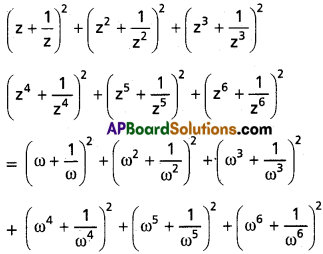
Solution:
The number of ways of admitting 4 sons into 5 schools if no two of them will be in the same school = 5P4
= 5 × 4 × 3 × 2
= 120

II.
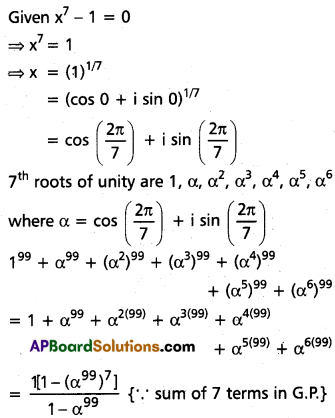
Question 1.
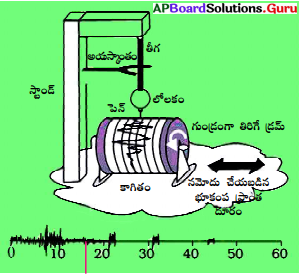
If there are 25 railway stations on a railway line, how many types of single second-class tickets must be printed, so as to enable a passenger to travel from one station to another?
Solution:
Number of stations on a railway line = 25
∴ The number of single second class tickets must be printed so as to enable a passenger to travel from one station to another = 25P2
= 25 × 24
= 600

Question 2.
In a class, there are 30 students. On New year’s day, every student posts a greeting card to all his/her classmates. Find the total number of greeting cards posted by them.
Solution:
The number of students in a class is 30.
∴ Total number of greeting cards posted by every student to all his/her classmates = 30P2
= 30 × 29
= 870

Inter 2nd Year Maths 2A Permutations and Combinations Solutions Ex 5(a)

Question 3.
Find the number of ways of arranging the letters of the word TRIANGLE so that the relative positions of the vowels and consonants are not disturbed.
Solution:
Vowels – A, E, I, O, U
In a given, word, the number of vowels is 3
number of consonants is 5
Inter 2nd Year Maths 2A Permutations and Combinations Solutions Ex 5(a) II Q3
Since the relative positions of the vowels and consonants are not disturbed,
the 3 vowels can be arranged in their relative positions in 3! ways and the 5 consonants can be arranged in their relative positions in 5! ways.
∴ The number of required arrangements = (3!) (5!)
= 6 × 120
= 720

Question 4.
Find the sum of all 4 digited numbers that can be formed using the digits 0, 2, 4, 7, 8 without repetition.
Solution:
First Method:
The number of 4 digited numbers formed by using the digits 0, 2, 4, 7, 8 without repetition = 5P44P3
= 120 – 24
= 96
Out of these 96 numbers,
4P33P2 numbers contain 2 in the units place
4P33P2 numbers contain 2 in the tens place
4P33P2 numbers contain 2 in the hundreds place
4P3 numbers contain 2 in the thousands place
Inter 2nd Year Maths 2A Permutations and Combinations Solutions Ex 5(a) II Q4
∴ The value obtained by adding 2 in all the numbers = (4P33P2) 2 + (4P33P2) 20 + (4P33P2) 200 + 4P3 × 2000
= 4P3 (2 + 20 + 200 + 2000) – 3P2 (2 + 20 + 200)
= 24 × (2222) – 6 × (222)
= 24 × 2 × 1111 – 6 × 2 × 111
Similarly, the value obtained by adding 4 is 24 × 4 × 1111 – 6 × 4 × 111
the value obtained by adding 7 is 24 × 7 × 1111 – 6 × 7 × 111
the value obtained by adding 8 is 24 × 8 × 1111 – 6 × 8 × 111
∴ The sum of all the numbers = (24 × 2 × 1111 – 6 × 2 × 111) + (24 × 4 × 1111 – 6 × 4 × 111) + (24 × 7 × 1111 – 6 × 7 × 111) + (24 × 8 × 1111 – 6 × 8 × 111)
= 24 × 1111 × (2 + 4 + 7 + 8) – 6 × 111 × (2 + 4 + 7 + 8)
= 26664 (21) – 666 (21)
= 21 (26664 – 666)
= 21 × 25998
= 545958

Second Method:
If Zero is one among the given n digits, then the sum of the r – digited numbers that can be formed using the given ‘n’ distinct digits (r ≤ n ≤ 9) is
(n-1)P(r-1) × sum of the digits × 111 …… 1 (r times) – (n-2)P(r-2) × Sum of the digits × 111 ……… 1 [(r – 1) times]
Hence n = 5, r = 4, digits are {0, 2, 4, 7, 8}
Hence the sum of all 4 digited numbers that can be formed using the digits {0, 2, 4, 7, 8} without repetition is
(5-1)P(4-1) × (0 + 2 + 4 + 7 + 8) × (1111) – (5-2)P(4-2) × (0 + 2 + 4 + 7 + 8) × (111)
= 4P3 (21) × 1111 – 3P2 (21) (111)
= 24 × 21 × 1111 – 6 (21) (111)
= 21 (26664) – 21 (666)
= 21 (26664 – 666)
= 21 (25998)
= 545958

Inter 2nd Year Maths 2A Permutations and Combinations Solutions Ex 5(a)

Question 5.
Find the number of numbers that are greater than 4000 which can be formed using the digits 0, 2, 4, 6, 8 without repetition.
Solution:
While forming any digit number With the given digits, zero cannot be filled in the first place.
We can fill the first place with the remaining 4 digits.
The remaining places can be filled with the remaining 4 digits.
All the numbers of 5 digits are greater than 4000.
In the 4-digit numbers, the number starting with 4 or 6 or 8 are greater than 4000.
The number of 4-digit numbers that begin with 4 or 6 or 8 = 3 × 4P3
= 3 × 24
= 72
The number of 5-digit numbers = 4 × 4!
= 4 × 24
= 96
∴ The number of numbers greater than 4000 is 72 + 96 = 168

Question 6.
Find the number of ways of arranging the letters of the word MONDAY so that no vowel occupies an even place.
Solution:
In the word MONDAY, there are two vowels, 4 consonants and three even places, three odd places.
Since no vowel occupies an even place, the two vowels can be filled in the three odd places in 3P2 ways.
The 4 consonants can be filled in the remaining 4 places in 4! ways.
∴ The number of required arrangements = 3P2 × 4!
= 6 × 24
= 144

Question 7.
Find the number of ways of arranging 5 different mathematics books, 4 different Physics books, and 3 different chemistry books such that the books of the same subject are together.
Solution:
The number of ways of arranging Mathematics, Physics, and Chemistry books are arranged 3! ways.
5 different Mathematics books are arranged themselves in 5! ways.
4 different Physics books are arranged themselves in 4! ways.
3 different Chemistry books are arranged themselves in 3! ways.
∴ The number of required arrangements = 3! × 5! × 4! × 3!
= 6 × 120 × 24 × 6
= 1,03,680

Inter 2nd Year Maths 2A Permutations and Combinations Solutions Ex 5(a)

III.

Question 1.
Find the number of 5-letter words that can be formed using the letters of the word CONSIDER. How many of them begin with “C”, how many of them end with ‘R’ and how many of them begin with “C” and end with “R”?
Solution:
Inter 2nd Year Maths 2A Permutations and Combinations Solutions Ex 5(a) III Q1
The number of 5 letter words that can be formed using the letters of the word CONSIDER = 8P5
= 8 × 7 × 6 × 5 × 4
= 6720
Inter 2nd Year Maths 2A Permutations and Combinations Solutions Ex 5(a) III Q1.1
The number of 5 letter words beginning with ‘C’ = 1 × 7P4
= 7 × 6 × 5 × 4
= 840
Inter 2nd Year Maths 2A Permutations and Combinations Solutions Ex 5(a) III Q1.2
The number of 5 letter words end with ‘R’ = 1 × 7P4 = 840
Inter 2nd Year Maths 2A Permutations and Combinations Solutions Ex 5(a) III Q1.3
The number of 5 letter words begins with ‘C’ and ends with ‘R’ = 1 × 1 × 6P3
= 6 × 5 × 4
= 120

Question 2.
Find the number of ways of seating 10 students A1, A2, ………, A10 in a row such that
(i) A1, A2, A3 sit together
(ii) A1, A2, A3 sit in a specified order
(iii) A1, A2, A3 sit together in a specified order
Solution:
A1, A2, A3, ……….., A10 are the ten students.
(i) Consider A1, A2, A3 as one unit and A4, A5, A6, A7, A8, A9, A10 as seven units.
These 8 units can be arranged in 8! ways.
The students A1, A2, A3 in one unit can be arranged among themselves in 3! ways.
∴ The number of ways seating 10 students in which A1, A2, A3 sit together = (8!) (3!)

(ii) To arrange A1, A2, A3 to sit in a specified order,
A1, A2, A3 can arrange in 10 positions in specific order in \(\frac{{ }^{10} P_3}{3 !}\) ways.
The remaining 7 people can be arranged in the remaining places in 7! ways.
∴ The number of ways of A1, A2, A3 sit in a specific order = \(\frac{10 !}{7 ! \times 3 !} \times 7 !\)
= \(\frac{10 !}{3 !}\)
= 10P7

(iii) To arrange A1, A2, A3 sit together in a specified order.
Consider A1, A2, A3 in that order as one unit.
Now there are 8 objects, they can be arranged in 8! ways.
∴ The number of ways of A1, A2, A3 sit together in specified order = 8! ways

Inter 2nd Year Maths 2A Permutations and Combinations Solutions Ex 5(a)

Question 3.
Find the number of ways in which 5 red balls, 4 black balls of different sizes can be arranged in a row so that
(i) no two balls of the same colour come together.
(ii) the balls of the same colour come together.
Solution:
No. of red balls = 5
No. of black balls = 4
(i) No. two balls of the same colour come together.
For the required arrangements first, we arrange 4 black balls it can be done in 4! ways.
Inter 2nd Year Maths 2A Permutations and Combinations Solutions Ex 5(a) III Q3
There are 5 places to arrange 5 red balls it can be done in 5! ways.
∴ The number of required arrangements = 4! 5!

(ii) The balls of the same colour come together.
For the required arrangements 4 black balls of different sizes can be considered as one object and 5 red balls can be considered as one object. These can be arranged in 2! ways.
The 4 black balls can be permuted among themselves in 4! ways.
The 5 red balls can be permuted among themselves in 5! ways.
∴ The no. of required arrangements = 2! 4! 5!

Question 4.
Find the number of 4-digit numbers that can be formed using the digits 1, 2, 5, 6, 7. How many of them are divisible by
(i) 2
(ii) 3
(iii) 4
(iv) 5
(v) 25
Solution:
The number of 4 digited numbers that can be formed using the digits 1, 2, 5, 6, 7 is 5P4 = 120.
(i) A number is divisible by 2 when its unit place must be filled with an even digit from among the given integers. This can be done in 2 ways.
Inter 2nd Year Maths 2A Permutations and Combinations Solutions Ex 5(a) III Q4
Now, the remaining 3 places can be filled with the remaining 4 digits in 4P3 = 4 × 3 × 2 = 24 ways.
∴ The number of 4 digited numbers divisible by 2 = 2 × 24 = 48

(ii) A number is divisible by 3 only when the sum of the digits in that number is a multiple of 3.
Sum of the given 5 digits = 1 + 2 + 5 + 6 + 7 = 21
The 4 digits such that their sum is a multiple of 3 from the given digits are 1, 2, 5, 7 (sum is 15)
They can be arranged in 4! ways and all these 4 digited numbers are divisible by 3.
∴ The number of 4 digited numbers divisible by 3 = 4! = 24

(iii) A number is divisible by 4 only when the last two places (tens and units places) of it are a multiple of 4.
Inter 2nd Year Maths 2A Permutations and Combinations Solutions Ex 5(a) III Q4.1
Hence the last two places should be filled with one of the following 12, 16, 52, 56, 72, 76.
Thus the last two places can be filled in 6 ways.
The remaining two places can be filled by the remaining 3 digits in 3P2 = 3 × 2 = 6 ways.
∴ The number of 4 digited numbers divisible by 4 = 6 × 6 = 36.

(iv) A number is divisible by 5 when its units place must be filled by 5 from the given integers 1, 2, 5, 6, 7. This can be done in one way.
Inter 2nd Year Maths 2A Permutations and Combinations Solutions Ex 5(a) III Q4.2
The remaining 3 places can be filled with the remaining 4 digits in 4P3 = 4 × 3 × 2 = 24 ways.
∴ The number of 4 digited numbers divisible by 5 = 1 × 24 = 24

(v) A number is divisible by 25 when its last two places are filled with either 25 or 75.
Inter 2nd Year Maths 2A Permutations and Combinations Solutions Ex 5(a) III Q4.3
Thus the last two places can be filled in 2 ways.
The remaining 2 places from the remaining 3 digits can be filled in 3P2 = 6 ways.
∴ The number of 4 digited numbers divisible by 25 = 2 × 6 = 12

Inter 2nd Year Maths 2A Permutations and Combinations Solutions Ex 5(a)

Question 5.
If the letters of the word MASTER are permuted in all possible ways and the words thus formed are arranged in the dictionary order, then find the ranks of the words
(i) REMAST
(ii) MASTER
Solution:
(i) The alphabetical order of the letters of the given word is A, E, M, R, S, T
The number of words beginning with A is 5! = 120
The number of words that begins with E is 5! = 120
The number of words begins with M is 5! = 120
The number of words beginning with RA is 4! = 24
The number of words beginning with REA is 3! = 6
The next word is REMAST
∴ Rank of the word REMAST = 3(120) + 24 + 6 + 1
= 360 + 31
= 391

(ii) The alphabetical order of the letters of the given word is A, E, M, R, S, T
The number of words beginning with A is 5! = 120
The number of words that begins with E is 5! = 120
The number of words beginning with MAE is 3! = 6
The number of words that begins with MAR is 3! = 6
The number of words beginning with MASE is 2! = 2
The number of words begins with MASR is 2! = 2
The next word is MASTER.
∴ Rank of the word MASTER = 2(120) + 2(6) + 2(2) + 1
= 240 + 12 + 4 + 1
= 257

Question 6.
If the letters of the word BRING are permuted in all possible ways and the words thus formed are arranged in the dictionary order, then find the 59th word.
Solution:
By using the letters of the word BRING in alphabetical order the 59th word must start with ‘I’.
Since the words start with B, G sum to 48.
i.e., Start with B = 4! = 24
Start with G = 4! = 24
Start with IB = 3! = 6
Start with IGB = 2! = 2
Start with IGN = 2! = 2
The next word is 59th = IGRBN

Inter 2nd Year Maths 2A Permutations and Combinations Solutions Ex 5(a)

Question 7.
Find the sum of all 4 digited numbers that can be formed using the digits 1, 2, 4, 5, 6 without repetition.
Solution:
The number of 4 digited numbers formed by using the digits 1, 2, 4, 5, 6 without repetition = 5P4 = 120
Out of these 120 numbers,
4P3 numbers contain 2 in the units place
4P3 numbers contain 2 in the tens place
4P3 numbers contain 2 in the hundreds place
4P3 numbers contain 2 in the thousands place
Inter 2nd Year Maths 2A Permutations and Combinations Solutions Ex 5(a) III Q7
∴ The value obtained by adding 2 in all the numbers = 4P3 × 2 + 4P3 × 20 + 4P3 × 200 + 4P3 × 2000
= 4P3 (2 + 20 + 200 + 2000)
= 4P3 (2222)
= 4P3 × 2 × 1111
Similarly, the value obtained by adding 1 is 4P3 × 1 × 1111
the value obtained by adding 4 is 4P3 × 4 × 1111
the value obtained by adding 5 is 4P3 × 5 × 1111
the value obtained by adding 6 is 4P3 × 6 × 1111
∴ The sum of all the numbers = 4P3 × 1 × 1111 + 4P3 × 2 × 1111 + 4P3 × 4 × 1111 + 4P3 × 5 × 1111 + 4P3 × 6 × 1111
= 4P3 (1111) (1 + 2 + 4 + 5 + 6)
= 24 (1111) (18)
= 4,79,952

Second Method:
The sum of the r-digited numbers that can be formed using the given ‘n’ distinct non-zero digits (r ≤ n ≤ 9) is (n-1)P(r-1) × sum of all digits × 111 …… 1 (r times)
Hence n = 5, r = 4, digits = {1, 2, 4, 5, 6}
The sum of all 4 digited numbers that can be formed using the digits 1, 2, 4, 5, 6 without repetition is (5-1)P(4-1) × (1 + 2 + 4 + 5 + 6) × (1111)
= 4P3 (18) (1111)
= 24 × 18 × 1111
= 4,79,952

Question 8.
There are 9 objects and 9 boxes. Out of 9 objects, 5 cannot fit in three small boxes. How many arrangements can be made such that each object can be put in one box only?
Solution:
No. of objects = 9
No. of boxes = 9
For the required arrangements, out of 9 objects, 5 cannot bit in three small boxes.
These five can be arranged in 6 boxes these can be done in 6P5 ways.
The remaining 4 objects can be arranged in the remaining 4 boxes it can be done in 4! ways.
∴ No. of required arrangements = 6P5 × 4! ways

Inter 1st Year Maths 1A Inverse Trigonometric Functions Formulas

Use these Inter 1st Year Maths 1A Formulas PDF Chapter 8 Inverse Trigonometric Functions to solve questions creatively.

Intermediate 1st Year Maths 1A Inverse Trigonometric Functions Formulas

→ If sin θ = x and θ ∈ \(\left[\frac{-\pi}{2}, \frac{\pi}{2}\right]\), then sin-1(x) = θ,

→ If cos θ x and θ ∈ [0, π], then cos-1(x) = θ

→ If tan θ = x and θ ∈ \(\left(\frac{-\pi}{2}, \frac{\pi}{2}\right)\). then tan-1 (y) = θ

→ If cot θ = x and θ ∈ (0, π), then cot-1(x) = θ.

→ If sec θ = x and θ ∈ [o, \(\frac{\pi}{2}\)) ∪ (\(\frac{\pi}{2}\), π] then sec-1x = θ.

→ If cosec θ = x and θ ∈ [-\(\frac{\pi}{2}\), 0) ∪ (o, \(\frac{\pi}{2}\)] then cosec-1x = θ.

→ If x ∈ [-1, 1] – {0}, then sin-1(x) = cosec-1\(\left(\frac{1}{x}\right)\)

Inter 1st Year Maths 1A Inverse Trigonometric Functions Formulas

→ If x ∈ [-1, 1] – {0}, then cos-1(x) = sec-1\(\left(\frac{1}{x}\right)\)

→ If x > 0, then tan-1(x) = cot-1\(\left(\frac{1}{x}\right)\) and
x < 0, then tan-1(x) = cot-1\(\left(\frac{1}{x}\right)\) – π

→ sin-1 x + cos-1x = \(\frac{\pi}{2}\) (|x| ≤ 1) i.e., – 1 ≤ x ≤ 1

→ tan-1x + cot-1x = \(\frac{\pi}{2}\), for any x ∈ R

→ sec-1x + cosec-1x = \(\frac{\pi}{2}\), if (-∞, – 1] ∪ [1, ∞)

Function y = f(x)Domain (x)Range (y)
(i) sinh-1 (x)[-1, 1]\( \left[\frac{-\pi}{2}, \frac{\pi}{2}\right] \)
(ii) cosh-1 (x)[1, 1][0, π]
(iii) tanh-1 (x)R\( \left(\frac{-\pi}{2}, \frac{\pi}{2}\right) \)
(iv) cot-1 (x)R(0, π)
(v) sec-1 (x)(-∞, -1] ∪ [1, ∞)[0, \( \frac{\pi}{2} \)) ∪ (\( \frac{\pi}{2} \), π]
(vi) cosec-1 (x)(-∞, -1] ∪ [1, ∞)[-\( \frac{\pi}{2} \), 0) ∪  (0, \( \frac{\pi}{2} \), π]

→ Principal values:
For sin-1x, tan-1x, cot-1x, cosec-1x, principal values lies between –\(\frac{\pi}{2}\) and \(\frac{\pi}{2}\)
For cos-1 x, sec-1 x, principal values lies between 0 and π.

→ tan-1x + tan-1y = tan-1\(\left(\frac{x+y}{1-x y}\right)\) if (xy < 1), x > 0, y > 0
= \(\frac{\pi}{2}\) if (xy = 1), x > 0, y > 0
= π +tan-1\(\), if (xy > 1), x > 0, y > 0

→ If x < 0, y < 0 then tan-1x + tan-1y = tan-1\(\left(\frac{x+y}{1-x y}\right)\) if xy > 1
= – \(\frac{\pi}{2}\), if xy < 1
= –\(\frac{\pi}{2}\), if xy = 1

→ If x, y ∈ [0, 1] and x2 + y2 ≤ 1, then sin-1 x + sin-1 y = sin-1\(\left(x \sqrt{1-y^{2}}+y \sqrt{1-x^{2}}\right)\)

→ If x, y ∈ [0, 1] and x2 + y2 > 1 then sin-1 x + sin-1 (y) = π – sin-1\(\left(x \sqrt{1-y^{2}}+y \sqrt{1-x^{2}}\right)\)

→ If x, y ∈ [0, 1], then sin-1 x + sin-1y) = cos-1(\(\sqrt{1-x^{2}} \sqrt{1-y^{2}}\) – xy)

→ If x, y ∈ [0, 1] then sin-1 y = sin-1(x\(\sqrt{1-y^{2}}\) – y\(\sqrt{1-x^{2}}\))

Inter 1st Year Maths 1A Inverse Trigonometric Functions Formulas

→ If x, y ∈ [0, 1], then cos-1 x + cos-1y = cos-1(\(\sqrt{1-x^{2}} \sqrt{1-y^{2}}\) + xy)

→ If x, y ∈ [0, 1] then cos-1 x + cos-1y = cos-1(xy – \(\sqrt{1-x^{2}} \sqrt{1-y^{2}}\))

→ If x, y ∈ [0, 1] and x2 + y2 ≥ 1 then cos-1x + cos-1y = sin-1(y\(\sqrt{1-x^{2}}\) + x\(\sqrt{1-y^{2}}\))

→ If 0 ≤ x ≤ y ≤ 1 then cos-1 x – cos-1y = cos-1(xy + \(\sqrt{1-x^{2}} \sqrt{1-y^{2}}\))

→ If x, y ∈ [0, 1], then cos-1 x – cos-1y = sin-1(y\(\sqrt{1-x^{2}}\) – x\(\sqrt{1-y^{2}}\))

→ If x ∈ [-1, 1]- {0}, then sin-1 (x) = cosec-1\(\left(\frac{1}{x}\right)\)

→ If x ∈ [-1, 1] – {0}, then cos-1(x) = sec-1\(\left(\frac{1}{x}\right)\)

→ If x > 0, then tan-1x = cot-1\(\left(\frac{1}{x}\right)\) and

→ If x < 0, then tan-1x = cot-1\(\left(\frac{1}{x}\right)\) – π

→ sin-1(-x) = -sin-1(x), if x ∈ [-1, 1]

→ cos-1(-x) = π – cos-1(x), if x ∈ [-1, 1]

→ tan-1(-x) = -tan-1 (x), for any x ∈ R

→ For any x ∈ R, cot-7 (-x) = π – cot-1(x)

→ If x ∈ [-∞, -1] ∪ [1, ∞) then

  • sec-1(-x) = π – sec-1(x)
  • cosec-1(-x) = -cosec-1(x)

Inter 1st Year Maths 1A Inverse Trigonometric Functions Formulas

→ If θ ∈ \(\left[-\frac{\pi}{2}, \frac{\pi}{2}\right]\), then sin-1(sin θ) = θ and if x ∈ [-1, 1], then sin(sin-1x) = x.

→ If θ ∈ [0, π], then cos-1(cos θ) = θ and if x ∈ [-1, 1], then cos (cos-1x) = x.

→ If θ ∈ \(\left(-\frac{\pi}{2}, \frac{\pi}{2}\right)\), then tan-1(tan θ) = θ and for any x ∈ R, then tan(tan-1x) = x

→ If θ ∈ (0, \(\frac{\pi}{2}\)) ∪ (\(\frac{\pi}{2}\), π) then cot-1(cot θ) = θ and for any x ∈ R, cot (cot-1x) = x.

→ If θ ∈ (0, \(\frac{\pi}{2}\)) ∪ (\(\frac{\pi}{2}\), π) then sec-1(sec θ) = θ and if x ∈ (-∞, -1] ∪ [1, ∞) then sec (sec-1x) = x.

→ If θ ∈ [-\(\frac{\pi}{2}\), 0) ∪ (0, \(\frac{\pi}{2}\)] then cosec-1 (cosec θ) = θ and if x ∈ (-∞, -1] ∪ [1, ∞), then cosec (cosec-1x) = x.

→ θ ∈ [0, π] sin-1(cos θ) = \(\frac{\pi}{2}\) – θ

→ θ ∈ \(\left[\frac{\pi}{2}, \frac{\pi}{2}\right]\) ⇒ cos-1(sin θ) = \(\frac{\pi}{2}\) – θ

→ θ ∈ \(\left(-\frac{\pi}{2}, \frac{\pi}{2}\right)\) ⇒ cot-1(tan θ) = \(\frac{\pi}{2}\) – θ

→ θ ∈ (0, π) ⇒ tan-1(cot θ) = \(\frac{\pi}{2}\) – θ

→ θ ∈ [-\(\frac{\pi}{2}\), 0) ∪ (0, \(\frac{\pi}{2}\)] ⇒ sec-1(cosec θ) = \(\frac{\pi}{2}\) – θ

→ θ ∈ [0, \(\frac{\pi}{2}\)) ∪ (\(\frac{\pi}{2}\), π] ⇒ cosec-1(sec θ) = \(\frac{\pi}{2}\) – θ

→ 0 ≤ x ≤ 1 ⇒ sin-1(x) = cos-1\(\left(\sqrt{1-x^{2}}\right)\) and

→ If -1 ≤ x < 0 ⇒ sin-1(x) = -cos-1\(\left(\sqrt{1-x^{2}}\right)\)

→ -1 < x < 1 ⇒ sin-1(x) = tan-1\(\left(\frac{x}{\sqrt{1-x^{2}}}\right)\)

Inter 1st Year Maths 1A Inverse Trigonometric Functions Formulas

→ -1 ≤ x < 0 ⇒ cos-1(x) = π – sin-1\(\left(\sqrt{1-x^{2}}\right)\) = π + tan-1\(\left(\frac{\sqrt{1-x^{2}}}{x}\right)\)

→ 0 ≤ x ≤ 7 ⇒ cos-1(x) = sin-1\(\left(\sqrt{1-x^{2}}\right)\) = tan-1\(\left(\frac{\sqrt{1-x^{2}}}{x}\right)\)

→ x > 0 ⇒ tan-1(x) = sin-1\(\left(\frac{x}{\sqrt{1+x^{2}}}\right)\) = cos-1\(\left(\frac{1}{\sqrt{1+x^{2}}}\right)\)

→ tan-1(x) + tan-1(y) + tan-1(z) = tan-1\(\left[\frac{x+y+z-x y z}{1-x y-y z-z x}\right]\), ifx, y, z have the same sign and xy + yz + zx < 1.

→ 2 sin-1(x) = sin-12x\(\sqrt{1-x^{2}}\), if x ≤ \(\frac{1}{\sqrt{2}}\)
= π – sin-12x\(\sqrt{1-x^{2}}\), if x > \(\frac{1}{\sqrt{2}}\)

→ 2 cos-1(x) = cos-1(2x2 – 1), if x ≥ \(\frac{1}{\sqrt{2}}\)
= π – cos-1(1 – 2x2), if x < \(\frac{1}{\sqrt{2}}\)

→ 2 tan-1(x) = tan-1\(\left(\frac{2 x}{1-x^{2}}\right)\), if |x| < 1
= π – tan-1\(\left(\frac{2 x}{1-x^{2}}\right)\), if |x| ≥ 1

Inter 1st Year Maths 1A Inverse Trigonometric Functions Formulas

→ 2tan-1(x) = sin-1\(\left(\frac{2 x}{1+x^{2}}\right)\), ∀ x ∈ R
= cos-1\(\left(\frac{1-x^{2}}{1+x^{2}}\right)\), if x ≥ 0
= -cos-1\(\left(\frac{1-x^{2}}{1+x^{2}}\right)\), if x < 0
= tan-1\(\left(\frac{2 x}{1-x^{2}}\right)\), ∀ x ∈ R

→ 3 sin-1(x) = sin-1(3x – 4x3) for 0 ≤ x < \(\frac{1}{2}\)
3 cos-1(x) = cos-1(4x3 – 3x) for \(\frac{\sqrt{3}}{2}\) ≤ x < 1
3 tan-1(x) = tan-1\(\left\{\frac{3 x-x^{3}}{1-3 x^{2}}\right\}\) for 0 ≤ x < \(\frac{1}{\sqrt{3}}\)

→ If sin θ = x, we write θ = sin-1x.

→ sin(sin-1x) = x, sin-1(sin θ) = θ if ‘θ‘ ∈ \(\left[-\frac{\pi}{2}, \frac{\pi}{2}\right]\)

→ cos(cos-1x)=x, cos-1(cos θ) = θ if θ ∈ [0, n]

→ tan (tan-1x) = x, tan-1(tan θ) = θ if θ ∈ \(\left(-\frac{\pi}{2}, \frac{\pi}{2}\right)\)

→ That value of sin-1x lying between – \(\frac{\pi}{2}\) and\(\frac{\pi}{2}\) is called the principal value of sin-1x.

→ That value of cos-1x lying between 0 and π is called the principal value of cos-1x.

→ That value of tan-1x lying between – \(\frac{\pi}{2}\) and \(\frac{\pi}{2}\) is called the principal value of tan-1x.

→ If -1 ≤ x ≤ 1, then

  • sin-1(- x) = – sin-1x
  • cos-1(-x) = π – cos-1x

→ If x ∈ R , then

  • tan-1(-x) = -tan-1x
  • cot-1(-x) = π – cot-1x

→ If x ≤ -1 or x ≥ 1, then

  • cosec-1(-x) = -cosec-1x
  • sec-1(-x) = π – sec-1x

→ cosec-1x = sin-1\(\frac{1}{x}\) (if x ≠ 0)

→ sec-1x = cos-1\(\frac{1}{x}\) (if x ≠ 0)

→ cot-1x = tan-1\(\frac{1}{x}\) (if x > 0)
= π + tan-1\(\frac{1}{x}\) (if x < 0)

→ sin-1x + cos-1x = π/2 ,

→ tan-1x + cot-1x = π/2,

→ sec-1x + cosec-1x = π/2.

→ If sin-1x + sin-1y = π/2, then x2 + y2 = 1.

→ sin(cos-1x) = \(\sqrt{1-x^{2}}\), cos(sin-1x) = \(\sqrt{1-x^{2}}\)

→ sin-1 = cos-1\(\sqrt{1-x^{2}}\) for 0 ≤ x ≤ 1
= -cos-1\(\sqrt{1-x^{2}}\) for – 1 ≤ x ≤ 0

AP 8th Class Physical Science Important Questions 11th Lesson కొన్ని సహజ దృగ్విషయాలు

These AP 8th Class Physical Science Important Questions 11th Lesson కొన్ని సహజ దృగ్విషయాలు will help students prepare well for the exams.

AP Board 8th Class Physical Science 11th Lesson Important Questions and Answers కొన్ని సహజ దృగ్విషయాలు

8th Class Physics 11th Lesson కొన్ని సహజ దృగ్విషయాలు 1 Mark Important Questions and Answers

ప్రశ్న 1.
భూకంపం ద్వారా విడుదలయ్యే విధ్వంస శక్తిని దేనితో కొలుస్తారు?
జవాబు:
భూకంపం ద్వారా విడుదలయ్యే విధ్వంస శక్తిని “భూకంప లేఖిని” లేదా “భ్రామక పరిమాణ స్కేలు’ ద్వారా కొలుస్తారు.

ప్రశ్న 2.
రెండు వస్తువులు ఒకే ఆవేశం కలిగి ఉంటే ఏం జరుగుతుంది? తెల్పండి.
జవాబు:
రెండు వస్తువులు ఒకే ఆవేశం కలిగి ఉంటే వాటి మధ్య వికర్షణ బలం ఉంటుంది.

ప్రశ్న 3.
రెండు వస్తువులు వేరు వేరు ఆవేశాలు కలిగి ఉంటే ఏం జరుగుతుందో తెల్పండి?
జవాబు:
రెండు వస్తువులు వేరు వేరు ఆవేశాలు కలిగి ఉంటే వాటి మధ్య ఆకర్షణ బలం ఉంటుంది.

ప్రశ్న 4.
వస్తువుకున్న ఆవేశాన్ని గుర్తించడానికి ఏ పరికరం ఉపయోగిస్తారు?
జవాబు:
ఒక వస్తువు ఆవేశాన్ని గుర్తించడానికి విద్యుదర్శినిని ఉపయోగిస్తారు.

ప్రశ్న 5.
సహజ దృగ్విషయాలు అని వేటిని అంటారు?
జవాబు:
వరదలు, తుపాన్లు, వడగండ్ల వర్షం, మెరుపులు, ఉరుములు, భూకంపాలు, సునామీలు మరియు అగ్ని పర్వతాలు పేలడం వంటివి సంభవించే వాటిని సహజ దృగ్విషయాలు అని అంటారు.

AP 8th Class Physical Science Important Questions 11th Lesson కొన్ని సహజ దృగ్విషయాలు

ప్రశ్న 6.
విద్యుత్ ఆవేశ బలాల సూత్రాలను రాయండి.
జవాబు:

  1. సజాతి ఆవేశాల మధ్య వికర్షణ బలాలు ఉంటాయి.
  2. విజాతి ఆవేశాల మధ్య ఆకర్షణ బలాలు ఉంటాయి.

ప్రశ్న 7.
ఆవేశం గల ఒక వస్తువును ఆవేశం లేని వస్తువు దగ్గరకు తీసుకొస్తే ఆకర్షణకు గురి అవుతుంది. ఎందుకు?
జవాబు:
ఆవేశం గల ఒక వస్తువును ఆవేశం లేని వస్తువు దగ్గరకు తీసుకు వస్తే ఆవేశం లేని వస్తువుపై, వ్యరేక ఆవేశం ప్రేరేపింపబడి అది ఆకర్షణకు గురవుతుంది.

ప్రశ్న 8.
ఒక వస్తువుపై ఆవేశం ఉన్నదో లేదో గుర్తించడానికి ఏ ధర్మం సరియైనది?
జవాబు:
ఒక వస్తువుపై ఆవేశం ఉన్నదో లేదో గుర్తించడానికి వికర్షణ ధర్మం సరియైనది.

ప్రశ్న 9.
భూకంప తరంగాలు అనగానేమి?
జవాబు:
భూ అంతర్భాగంలో కదలికలు భూ ఉపరితలంపై తరంగాలను ఉత్పత్తి చేస్తాయి. ఈ తరంగాలను భూకంప తరంగాలు అంటారు.

ప్రశ్న 10.
భూకంప తరంగాలను దేని ద్వారా గుర్తిస్తారు?
జవాబు:
భూకంప తరంగాలను భూకంప లేఖిని ద్వారా గుర్తిస్తారు.

ప్రశ్న 11.
ఉత్తర భారతదేశంలో భూకంప ప్రభావిత ప్రాంతాలు ఏవి?
జవాబు:
భారతదేశంలో కాశ్మీర్, పశ్చిమ మరియు మధ్య హిమాలయాలు, ఈశాన్య ప్రాంతాలు, కచ్ తీరం. రాజస్థాన్. గంగా పరీవాహక ప్రాంతాలు అత్యంత భూకంప ప్రభావిత ప్రాంతాలు.

ప్రశ్న 12.
భూమిలో ఎన్ని పొరలు ఉంటాయి? అవి ఏవి?
జవాబు:
భూమిలో ముఖ్యంగా మూడు పొరలు ఉంటాయి. అవి :

  1. భూపటలం
  2. ప్రావారం
  3. భూకేంద్రం.

భూకేంద్రంలో రెండు పొరలు ఉంటాయి. అవి :

  1. అంతర్ భూకేంద్రం,
  2. బాహ్య భూకేంద్రం

ప్రశ్న 13.
భూకంప ప్రభావిత ప్రాంతాలు అనగానేమి?
జవాబు:
భూమి లోపల గల పలకల కదలిక వల్ల కొన్ని ప్రాంతాలలో భూకంపాలు తరచుగా రావడానికి అవకాశం ఉంటుంది. భూ ఉపరితలంపై ఈ పలకలకు దరిదాపుల్లో ఉండే ఈ బలహీన ప్రాంతాలను సెస్మిక్ ప్రాంతాలు లేదా భూరు ప్రభావిత ప్రాంతాలు అంటారు.

ప్రశ్న 14.
తటిద్వాహకం అనగానేమి?
జవాబు:
పిడుగుల (మెరుపు) ల నుండి పెద్ద పెద్ద భవనాలను, కట్టడాలను రక్షించడానికి ఉపయోగించే దానిని తటిద్వాహకం అంటారు.

AP 8th Class Physical Science Important Questions 11th Lesson కొన్ని సహజ దృగ్విషయాలు

ప్రశ్న 15.
కాగితంతో రుద్దిన రబ్బరు బెలూనను చిన్న కాగితపు ముక్కల దగ్గరకు తీసుకువచ్చినపుడు నీవు గమనించిన కిషయాలు ఏమిటి?
జవాబు:

  1. రబ్బరు బెలూన్ కాగితం ముక్కలను ఆకర్షించును.
  2. రబ్బరు బెలూన్ కాగితం ముక్కలపై ప్రభావం చూపదు.

8th Class Physics 11th Lesson కొన్ని సహజ దృగ్విషయాలు 2 Marks Important Questions and Answers

ప్రశ్న 1.
ఏదైనా ఒక వస్తువును ఆవేశపరచడానికి మూడు పద్ధతులను రాయండి.
జవాబు:

  1. ఒక వస్తువును మరొక వస్తువుతో రాపిడికి గురిచేయడం వలన ఆవేశపరచవచ్చును.
  2. ఒక వస్తువును ఆవేశం గల వస్తువు దగ్గరకు తెచ్చినపుడు ఆ వస్తువులో ఆవేశం ప్రేరేపించడం వలన ఆవేశ పరచవచ్చును.
  3. ఒక వస్తువుకు, ఆవేశ వస్తువును తాకించడం వలన ఆవేశం గల వస్తువు నుండి ఆ వస్తువులోకి ఆవేశం బదిలీ అగుట వలన ఆవేశ పరచవచ్చును.

ప్రశ్న 2.
భ్రామక పరిమాణ స్కేలు గురించి కొన్ని ఉపయోగాలు రాయండి.
జవాబు:

  1. భ్రామక పరిమాణ స్కేలు భూకంప తీవ్రతను కొలుచుటకు ఉపయోగిస్తారు.
  2. భూకంపాలను భ్రామక పరిమాణ స్కేలు ద్వారా కచ్చితంగా నిర్ధారించవచ్చును.
  3. ఈ పద్ధతి రిక్టర్ స్కేలు పద్ధతి కంటే ఉన్నతమైనది.

ప్రశ్న 3.
భూకంపాలు ఏ విధంగా ఏర్పడతాయో తెల్పండి.
జవాబు:
భూమి ఉపరితలంలో ఒకే పొరగా లేదు. ఇది విడివిడి ముక్కలుగా ఉంటుంది. ఈ ముక్కలను పలకలు అంటారు. ఈ పలకలు నిరంతర చలనంలో ఉంటాయి. ఒక పలక మరొక పలకను ఢీకొన్నప్పుడు కాని, రెండింటి మధ్య రాపిడి జరిగినప్పుడు కాని భూ పటలంలో కదలికలు వస్తాయి.

భూ అంతర్భాగంలో జరిగే ఇటువంటి కదలికలు భూ ఉపరితలంలో భూకంపాలను ఏర్పరుస్తాయి.

AP 8th Class Physical Science Important Questions 11th Lesson కొన్ని సహజ దృగ్విషయాలు

ప్రశ్న 4.
ఒక వస్తువుపై ఆవేశము ఉన్నదో లేదో గుర్తించడానికి “ఆకర్షణ ధర్మం” సరైనది కాదు. ఎందుకో వివరించండి.
జవాబు:

  1. ఒక తటస్థ వస్తువును, ఆవేశ వస్తువు వద్దకు తీసుకొనివస్తే ఆకర్షిస్తుంది.
  2. ఒక ఆవేశ వస్తువును, దాని వ్యతిరేక ఆవేశ వస్తువు వద్దకు తీసుకొనివస్తే ఆకర్షిస్తుంది.
  3. ఒక వస్తువుపై ఆవేశం ఉన్నదో లేదో తెలుసుకొనుటకు ఆవేశం గల వస్తువు దగ్గరకు తీసుకొనివస్తే ఆకర్షించినట్లైతే ఆ వస్తువుపై తటస్థ ఆవేశం లేదా వ్యతిరేక ఆవేశం మాత్రమే ఉండాలి. కాని తటస్థ ఆవేశమా, వ్యతిరేక ఆవేశమా అని కచ్చితంగా చెప్పలేము. కాబట్టి “ఆకర్షణ ధర్మం” సరియైనది కాదు.

ప్రశ్న 5.
తటిద్వా హకం (Lightning conductor) అనగానేమి? ఇది భవనాలను ఎలా రక్షిస్తుంది?
జవాబు:

  1. పిడుగుల (మెరుపు)ల నుండి పెద్ద పెద్ద భవనాలను, కట్టడాలను రక్షించడానికి ఉపయోగించే దానిని తటిద్వాహకం అంటారు.
  2. భవనం కన్నా కొద్దిగా ఎత్తుగా ఉండే లోహపు కడ్డీని భవన నిర్మాణ సమయంలోనే గోడలో అమర్చుతారు.
  3. లోహపు కడ్డీ ఒక చివర గాలిలో ఉంటుంది. రెండవ చివరను భూమిలోకి పాతుతారు.
  4. భవనం కంటే లోహపుకడ్డీ ఎత్తులో ఉంటుంది కనుక అది మేఘాలకు దగ్గరగా ఉండటం వల్ల ఇది మొదట ఆవేశాన్ని స్వీకరిస్తుంది.
  5. ఇది మంచి విద్యుత్ వాహకం కనుక భవనానికి ఎటువంటి నష్టం జరగకుండా ఆవేశాన్ని భూమికి చేరవేస్తుంది.

ప్రశ్న 6.
భూకంపాలు ఏ విధంగా ఏర్పడుతాయో వివరించండి.
జవాబు:

  1. భూమి ఉపరితలంలో ఒకే పొరగా లేదు. ఇది విడివిడి ముక్కలుగా ఉంటుంది.
  2. ఈ ముక్కలను పలకలు అంటారు.
  3. ఈ పలకలు నిరంతర చలనంలో ఉంటాయి.
  4. ఒక పలక మరో పలకను ఢీకొన్నప్పుడు కాని, రెండింటి మధ్య రాపిడి జరిగినపుడు కాని భూ పటలంలో కదలికలు వస్తాయి.
  5. భూ అంతర్భాగంలో జరిగే ఇటువంటి కదలికలు భూ ఉపరితలంలో భూకంపాలను ఏర్పరుస్తాయి.

ప్రశ్న 7.
భ్రామక పరిమాణ స్కేలును వివరించండి.
జవాబు:

  1. భ్రామక పరిమాణ స్కేలు భూకంప తీవ్రతను కొలుచుటకు ఉపయోగిస్తారు.
  2. ఇది భూ ఉపరితలం వద్ద వచ్చే విస్తాపనంతో సంబంధం లేకుండా భూ అంతర్భాగంలో గల పలకల విస్తాపనంపై ఆధారపడి పనిచేస్తుంది.
  3. భూకంపాలను భ్రామక పరిమాణ స్కేలు ద్వారా కచ్చితంగా నిర్ధారించవచ్చును.
  4. ఈ పద్ధతి రిక్టర్ స్కేలు పద్ధతి కంటే ఉన్నతమైనది.

ప్రశ్న 8.
భూకంప ప్రమాద పటం ప్రకారం ఆంధ్రప్రదేశ్ లోని జోన్లను వివరించండి.
జవాబు:

  1. భూకంప ప్రమాద పటం ప్రకారం ఆంధ్రప్రదేశ్ లోని కొన్ని ప్రాంతాలు 2, 3 జోన్లలో ఉన్నాయి.
  2. ఆంధ్రప్రదేశ్ ఆగ్నేయ ప్రాంతంలోని చిత్తూరు, వై.ఎస్.ఆర్.కడప, నెల్లూరు మరియు కృష్ణా, గోదావరి మైదాన ప్రాంతాలు 3వ జోన్లో ఉన్నాయి.
  3. హైదరాబాద్ నగరం 2వ జోన్లో ఉన్నది.

8th Class Physics 11th Lesson కొన్ని సహజ దృగ్విషయాలు 4 Marks Important Questions and Answers

ప్రశ్న 1.
ఒక వస్తువు ప్రేరణ వలన ఆవేశపరచడానికి, ఆవేశం గల వాహకం ద్వారా ఆవేశపరచడానికి మధ్యగల భేదాలను రాయండి.
జవాబు:

ప్రేరణ వలన ఆవేశపరచడంఆవేశం గల వాహకం ద్వారా ఆవేశపరచడం
1) తటస్థ ఆవేశం గల వస్తువు వద్దకు ఆవేశం గల వస్తువును తీసుకొని వస్తే ప్రేరణ వలన తటస్థ ఆవేశం గల వస్తువుపై ఆవేశం ఏర్పడుతుంది.1) తటస్థ ఆవేశం గల వస్తువుకు ఆవేశం గల వస్తువును తాకించినపుడు (స్పర్శలో) తటస్థ ఆవేశం గల వస్తువుపై ఆవేశం ఏర్పడుతుంది.
2) ఇది తాత్కాలికమైనది.2) ఇది శాశ్వతమైనది.
3) తటస్థ ఆవేశ వస్తువుపై ఆవేశ పరచడానికి ఉపయోగించిన వస్తువు ఆవేశానికి వ్యతిరేకమైన ఆవేశం ఏర్పడుతుంది.3) తటస్థ ఆవేశం గల వస్తువుపై, ఆవేశపరచడానికి ఉపయోగించిన వస్తువు ఆవేశం ఏర్పడుతుంది.

ప్రశ్న 2.
మెరుపులు, ఉరుములు ఏ విధంగా ఏర్పడునో వివరించండి.
జవాబు:

  1. గాలిలో మేఘాలు ప్రయాణించేటప్పుడు గాలిలో కణాలతో ఘర్షణ వల్ల మేఘాలు ఆవేశపూరితం అవుతాయి.
  2. మేఘాల ఉపరితలాలు చాలా పెద్దవి కనుక ఈ ఉపరితలాలపై ఆవేశం చాలా ఎక్కువ మొత్తంలో నిలువ ఉంటుంది.
  3. ఒక ఆవేశపూరిత మేఘం దగ్గరగా మరొక మేఘం వచ్చినపుడు అది రెండవ మేఘంపై వ్యతిరేక ఆవేశాన్ని ప్రేరేపింపజేస్తుంది.
  4. ఈ మేఘాలపై గల ఆవేశం ఒక మేఘం నుండి మరొక మేఘం పైకి వెళ్ళడానికి ప్రయత్నిస్తుంది. కానీ మేఘాల మధ్య గాలి విద్యుత్ బంధకంగా పనిచేస్తుంది.
  5. మేఘాలపై అధిక మొత్తంలో పోగుపడిన ఆవేశాల బదిలీని గాలి విద్యుత్ బంధకం అయినప్పటికీ నిరోధించలేదు.
  6. అధిక ధన, ఋణ ఆవేశాలు గల మేఘాల మధ్య విద్యుత్ ఉత్సర్గం జరిగి పెద్ద ఎత్తున వెలుగుతో పాటు ధ్వని ఉత్పత్తి అవుతుంది.
  7. ఏర్పడే వెలుగును మెరుపు అని, వెలువడే ధ్వనిని ఉరుము అని అంటారు.

ప్రశ్న 3.
వివిధ రిక్టర్ స్కేలు అవధుల విలువలకు భూకంప ప్రభావం ఏ విధంగా ఉంటుందో రాయండి.
జవాబు:

రిక్టర్ స్కేలు అవధులుభూకంప ప్రభావం
3.5 కన్నా తక్కువభూకంప లేఖిని నమోదుచేస్తుంది. కానీ మనం గుర్తించలేం.
3.5 నుండి 5.4అప్పుడప్పుడు గుర్తించగలం, విధ్వంసం పెద్దగా ఉండదు.
5.5 నుండి 6.0భవనాలకు కొద్దిపాటి నష్టం జరుగుతుంది. నాణ్యతలేని నిర్మాణాలు ఎక్కువ దెబ్బతినే అవకాశం ఉంది.
6.1 నుండి 6.9100 కిలోమీటర్ల వైశాల్యంలో తీవ్రత ఉంటుంది.
7.0 నుండి 7.9పెద్ద భూకంపాలు. ఇవి జరిగినపుడు ఆస్తి మరియు ప్రాణ నష్టం అధికంగా జరుగుతుంది.
8 కన్నా ఎక్కువఅతి పెద్ద భూకంపాలు. వందల కిలోమీటర్ల వైశాల్యంలో ప్రభావం ఉంటుంది. తీవ్రమైన విధ్వంసం జరుగుతుంది.

ప్రశ్న 4.
తరచుగా భూకంపాలు వచ్చే ప్రాంతాలలో భవన నిర్మాణంలో మరియు భూకంప నష్ట తీవ్రతను తగ్గించుటకు తీసుకోవలసిన జాగ్రత్తలను రాయండి.
జవాబు:

  1. భవన నిర్మాణాల సలహాలకై ఇంజనీర్లను, ఆర్కిటెక్ట్ ను సంప్రదించాలి.
  2. భూకంపాలు ఎక్కువగా వచ్చే అవకాశం ఉన్న ప్రాంతాలలో మట్టి, కలప వినియోగించి నిర్మాణాలు చేయాలి.
  3. భవనాల పై భాగం తేలికగా ఉంటే అవి పడినపుడు నష్టం తక్కువగా ఉంటుంది.
  4. ఇంటి గోడలకు అల్మరాలను ఏర్పాటుచేయడం మంచిది. అవి త్వరగా పడిపోవు.
  5. గోడలకు వేలాడదీసిన వస్తువుల పట్ల జాగ్రత్తగా ఉండాలి. భూకంప సమయంలో అవి మీద పడే అవకాశం ఉంది.
  6. భూకంపాలు వచ్చిన సందర్భంలో అగ్నిప్రమాదాలు సంభవించే అవకాశం ఉంది. అందువల్ల విద్యుత్ పరికరాలు, తీగలు నాణ్యమైనవి వినియోగించాలి. పెద్ద భవనాలలో అగ్నిప్రమాద నిరోధక పరికరాలను ఏర్పాటు చేసుకోవాలి.

AP 8th Class Physical Science Important Questions 11th Lesson కొన్ని సహజ దృగ్విషయాలు

ప్రశ్న 5.
భారతదేశంలో గతంలో వచ్చిన భూకంపాలు ఎక్కడ వచ్చాయో వివరించండి.
జవాబు:

  1. డిసెంబరు 26, 2004లో వచ్చిన సునామి వలన అండమాన్ మరియు నికోబార్‌లో పెద్ద ఎత్తున ఆస్తి, ప్రాణ నష్టం జరిగింది.
  2. ఉత్తర కాశ్మీర్ లోని ఉరి, తంగదర్ పట్టణాలలో అక్టోబరు 8, 2005న సంభవించిన భూకంపం భారతదేశంలో అతి పెద్దది.
  3. జనవరి 26,2001లో గుజరాత్ లోని భుజ్ జిల్లాలో పెద్ద భూకంపం సంభవించింది. ఈ భూకంపం తీవ్రత 7.7 రిక్టరు స్కేలు నమోదు చేసింది.
  4. మే 22, 1997లో మధ్యప్రదేశ్ లోని జబల్ పూర్ లో భూకంపం వచ్చింది. భూకంప తీవ్రత 6గా రిక్టర్ స్కేలు నమోదు చేసింది.
  5. సెప్టెంబర్ 30, 1993లో మహారాష్ట్రలోని లాతూర్ (కిల్లరి) లో భూకంపం వచ్చింది.

ప్రశ్న 6.
భూకంప తీవ్రతను కొలిచే పరికరం యొక్క పటాన్ని గీయుము. ఇందులో ఉపయోగించే స్కేలు పేరు తెలుపుము.
జవాబు:
AP 8th Class Physical Science Important Questions 11th Lesson కొన్ని సహజ దృగ్విషయాలు 1
భూకంప తీవ్రతను కొలిచే పరికరంలో ఉపయోగించే స్కేలు : రిక్టర్ స్కేలు.

ప్రశ్న 7.
“భూకంపాల వలన వరదలు, కొండ చరియలు విరిగి పడటం మరియు సునామిలు రావడం వంటివి జరుగుతాయి. డిసెంబర్ 26, 2004 నాడు హిందూ మహాసముద్రంలో సునామి వచ్చింది. దీని వల్ల తూర్పు తీరప్రాంతం తీవ్ర ఆసి, ప్రాణ నష్టం సంభవించింది.” ఈ సమాచారం ఆధారంగా క్రింది ప్రశ్నలకు జవాబులు రాయండి.
1. సునామీ సంభవించడానికి కారణమేమి?
జవాబు:
భూకంపాలు

2. తీవ్ర సునామీ సంభవించినపుడు ఏమి జరుగుతుంది?
జవాబు:
భారీ వర్షాలు, వరదలు, ఆస్తి నష్టం, ప్రాణ నష్టం జరుగుతుంది.

3. భూకంపాన్ని గుర్తించుటకు ఉపయోగించే పరికరం ఏది? దానిలోని ప్రధాన భాగాలేవి?
జవాబు:
భూకంప లేఖిని (సిస్మో గ్రాఫ్) లేదా భూకంప దర్శిన్ని (సిస్మో స్కోప్)
ముఖ్య భాగాలు : గుండ్రంగా తిరిగే డ్రమ్, లోలకం, అయస్కాంతం, తీగ.

4. భూకంప తీవ్రతను సూచించు స్కేలు 8 దాటితే దాని ప్రభావం ఎలా ఉంటుంది?
జవాబు:
తీవ్ర నష్టం (100 కి.మీ.ల విస్తీర్ణంలో)

8th Class Physics 11th Lesson కొన్ని సహజ దృగ్విషయాలు 1 Mark Bits Questions and Answers

బహుళైచ్ఛిక ప్రశ్నలు

I. సరియగు జవాబును ఎంచుకోండి.

1. ఏ శాస్త్రవేత్త, ఏ సంవత్సరంలో వెంట్రుకలు బట్టలను ఆకర్షించటం మరియు ఆకాశంలో మెరుపులూ రెండూ ఒకే దృగ్విషయమని తెలియజేశాడు?
A) 1762 రూథర్ ఫర్డ్
B) 1752 బెంజిమన్ ఫ్రాంక్లిన్
C) 1772 ఫారడే
D) 1782 జాన్ డాల్టన్
జవాబు:
B) 1752 బెంజిమన్ ఫ్రాంక్లిన్

2. భూమిలోని పలకల కదలికల వలన లేదా ఢీకొనుట వలన …………. ఏర్పడును.
A) భూకంపాలు
B) అగ్నిపర్వతాల ప్రేలుడు
C) పిడుగుపాటు
D) ఉరుములు
జవాబు:
A) భూకంపాలు

3. భారతదేశంలో అతిపెద్ద భూకంపం ఇక్కడ సంభవించింది.
A) గుజరాత్ లోని భుజ్ జిల్లాలో
B) ఆంధ్రప్రదేశ్ లోని ఆదిలాబాద్ జిల్లాలో
C) ఉత్తర కాశ్మీర్ లోని ఉరితంగదర్ పట్టణాలలో
D) మధ్యప్రదేశ్ లోని ఉత్తర ప్రాంతంలో
జవాబు:
C) ఉత్తర కాశ్మీర్ లోని ఉరితంగదర్ పట్టణాలలో

AP 8th Class Physical Science Important Questions 11th Lesson కొన్ని సహజ దృగ్విషయాలు

4. ఆవేశం కలిగి ఉన్న వస్తువు నుండి భూమికి ఆవేశాలను బదిలీ చేసే ప్రక్రియను ……. అంటారు.
A) ఎర్తింగ్
B) మెరుపులు
C) ఉరుములు
D) ఏదీకాదు
జవాబు:
A) ఎర్తింగ్

5. భూకంప తీవ్రతను కొలవడానికి ఉపయోగించే ప్రమాణం
A) భూకంప స్కేలు
B) రిక్టరు స్కేలు
C) ఐరన్ స్కేలు
D) టేపు
జవాబు:
B) రిక్టరు స్కేలు

6. భూకంప తీవ్రతను కొలవడానికి ఉపయోగించే పరికరం ………….
A) భూకంపలేఖిని
B) రిక్టర్ స్కేలు
C) ఎర్తింగ్
D) పైవన్నీ
జవాబు:
A) భూకంపలేఖిని

7. ఈ కింది వానిలో సహజ దృగ్విషయం కానిది
A) భూకంపం
B) తుపాన్
C) ఉరుములు, మెరుపులు
D) ఎర్తింగ్
జవాబు:
D) ఎర్తింగ్

8. వస్తువులను ఒకదానితో మరొకటి రుద్దడం వలన ఏర్పడే ఆవేశాల సంఖ్య
A) 2
B) 1
C) 3
D) 4
జవాబు:
A) 2

9. సునామి అంటే అర్థం
A) భూకంపం
B) తుపాను
C) సముద్రం అడుగున భూకంపం
D) సముద్రం అడుగున అగ్నిపర్వతం పేలుట
జవాబు:
D) సముద్రం అడుగున అగ్నిపర్వతం పేలుట

10. భూమి నుండి ఉత్పత్తి అయ్యే తరంగాలను ……….. అంటారు.
A) భూకంప తరంగాలు
B) మైక్రో తరంగాలు
C) రేడియో తరంగాలు
D) X-తరంగాలు
జవాబు:
A) భూకంప తరంగాలు

11. ఆవేశపూరిత వస్తువు పరీక్షించడానికి ఉపయోగపడే ధర్మం
A) ఆకర్షణ
B) వికర్షణ
C) ఆకర్షణ మరియు వికర్షణ
D) ఏదీకాదు
జవాబు:
B) వికర్షణ

12. రెండు వస్తువులు ఒకదానితో మరొకటి రుద్దినపుడు ఆ వస్తువులపై ఏర్పడే ఆవేశాలు
A) సమానంగా ఉండే ఒకే రకమైన ఆవేశాలు
B) సమానంగా ఉండే వేరు వేరు ఆవేశాలు
C) అసమానంగా ఉండే ఒకే రకమైన ఆవేశాలు
D) అసమానంగా ఉండే వేరు వేరు ఆవేశాలు
జవాబు:
B) సమానంగా ఉండే వేరు వేరు ఆవేశాలు

13. రిక్టరు స్కేలు విలువ ……. గా ఉన్నప్పుడు భూకంప లేఖిని నమోదు చేస్తుంది కాని మనం గుర్తించలేము
A) 3.5 నుండి 5.4
B) 5. 5 నుండి 6.00
C) 3. 5 కన్నా తక్కువ
D) 8 కన్నా ఎక్కువ
జవాబు:
C) 3. 5 కన్నా తక్కువ

AP 8th Class Physical Science Important Questions 11th Lesson కొన్ని సహజ దృగ్విషయాలు

14. …………… వరకు రిక్టరు స్కేలు విలువ ఉంటే ఆస్తి మరియు ప్రాణనష్టం అధికంగా ఉంటుంది. దీనిని పెద్ద భూకంపాలు అంటారు.
A) 5. 5 నుండి 6.0
B) 6.1 నుండి 6.9
C) 7.0 నుండి 7.9
D) 3.5 నుండి 5.4
జవాబు:
C) 7.0 నుండి 7.9

15. ఒక వస్తువు ఆవేశపరచే పద్ధతులు ………
A) రాపిడి (రుద్దడం) వలన
B) ప్రేరణ వలన
C) వాహకం ద్వారా
D) పైవన్నీ
జవాబు:
D) పైవన్నీ

16. ఉరుములు, మెరుపులు వచ్చే సందర్భంలో సురక్షితమైన ప్రదేశం
A) తక్కువ ఎత్తుగల ఇల్లు
B) ఎత్తైన భవనం
C) పొడవైన చెట్టు
D) టాప్ లేని కారులో ప్రయాణించడం
జవాబు:
A) తక్కువ ఎత్తుగల ఇల్లు

17. ఉరుములు, మెరుపులు వచ్చే సందర్భంలో సురక్షితం కాని ప్రదేశం
A) తక్కువ ఎత్తుగల ఇల్లు
B) పొట్టి చెట్టు
C) ఎలక్ట్రికల్, టెలిఫోన్ స్తంభాల దగ్గర నిలబడటం
D) ఏదీకాదు
జవాబు:
C) ఎలక్ట్రికల్, టెలిఫోన్ స్తంభాల దగ్గర నిలబడటం

18. భూకంపం వచ్చినపుడు భూమి కంపించిన సమయాన్ని గుర్తించేది
A) భూకంపలేఖిని
B) భూకంప దర్శిని
C) భ్రామపరిమాణ స్కేలు
D) రిక్టర్ స్కేలు
జవాబు:
B) భూకంప దర్శిని

19. భూకంపాలను ……….. ద్వారా కచ్చితంగా నిర్ధారించవచ్చును.
A) రిక్టర్ స్కేలు
B) భ్రామక పరిమాణ స్కేలు
C) మీటరు స్కేలు
D) పైవన్నీ
జవాబు:
B) భ్రామక పరిమాణ స్కేలు

20. ఇంటి లోపల ఉన్నప్పుడు భూకంపం వచ్చిన సందర్భంలో రక్షించుకోవడం కోసం
A) పొడవైన వస్తువులను గట్టిగా పట్టుకోవడం
B) మంచంపై పడుకోవడం
C) బల్ల కిందకు వెళ్ళడం
D) పైవన్నీ
జవాబు:
C) బల్ల కిందకు వెళ్ళడం

21. సీమగుగ్గిలంను ఉన్నితో రుద్దిన తర్వాత అది వెంట్రుకలను ఆకర్షించునని గుర్తించిన వారు
A) సిక్కులు
B) యూరోపియన్లు
C) అమెరికన్లు
D) గ్రీకులు
జవాబు:
D) గ్రీకులు

AP 8th Class Physical Science Important Questions 11th Lesson కొన్ని సహజ దృగ్విషయాలు

22. విద్యుత్ ఆవేశాల లక్షణాల విషయంలో
A) ప్లాస్టిక్ స్కేలును తలపై రుద్దితే అది చిన్న చిన్న కాగితం ముక్కలను ఆకర్షించడం
B) పొడిజుట్టుతో ప్లాస్టిక్ స్కేలును రుద్దిన అది చిన్న చిన్న కాగితం ముక్కలను ఆకర్షించకుండుట
C) గాలితో నిండిన బెలూనను బట్టతో రుద్దిన అది కాగితం ముక్కలను ఆకర్షించుట
D) స్ట్రాను నునుపైన గోడకు గాని, బట్టలకు గాని అది కాగితం ముక్కలను ఆకర్షించుట
జవాబు:
B) పొడిజుట్టుతో ప్లాస్టిక్ స్కేలును రుద్దిన అది చిన్న చిన్న కాగితం ముక్కలను ఆకర్షించకుండుట

23. ఉన్ని గుడ్డతో రుద్దిన బెలూన్, ఉన్నిగుడ్డతో రుద్దిన మరో బెలూనన్ను …….
A) ఆకర్షించును
B) వికర్షించును
C) A మరియు B
D) ఏదీకాదు
జవాబు:
B) వికర్షించును

24. పాలిథిన్ కాగితంతో రుద్దిన రీఫిల్ అదే కాగితంతో రుద్దిన మరో రీఫిల్ ను ………..
A) ఆకర్షించును
B) వికర్షించును
C) A మరియు B
D) ఏదీకాదు
జవాబు:
B) వికర్షించును

25. ఉన్నిగుడ్డతో రుద్దిన బెలూన్, పాలిథిన్ కాగితంతో రుద్దిన రీఫిల్ ను ……….
A) ఆకర్షించును
B) వికర్షించును
C) A మరియు B
D) ఏదీకాదు
జవాబు:
A) ఆకర్షించును

26. విజాతి అయస్కాంతాల ధృవాలు
A) ఆకర్షించును
B) వికర్షించును
C) A మరియు B
D) ఏదీకాదు
జవాబు:
A) ఆకర్షించును

27. సజాతి అయస్కాంతాల ధృవాలు
A) ఆకర్షించును
B) వికర్షించును
C) A మరియు B
D) ఏదీకాదు
జవాబు:
B) వికర్షించును

28. ఒకే రకమైన రెండు ఆవేశాలు
A) ఆకర్షించును
B) వికర్షించును
C) A మరియు B
D) ఏదీకాదు
జవాబు:
B) వికర్షించును

29. విభిన్నాలైన రెండు ఆవేశాలు
A) ఆకర్షించును
B) వికర్షించును
C) A మరియు B
D) ఏదీకాదు
జవాబు:
A) ఆకర్షించును

30. వలయంలో విద్యుత్ ప్రవాహం …… కదలికను తెలుపును.
A) ఆవేశాల
B) ప్రోటానుల
C) న్యూట్రానుల
D) ఏదీకాదు
జవాబు:
A) ఆవేశాల

31. దీనినుపయోగించి వస్తువు ఆవేశాన్ని కల్గి ఉన్నది లేనిది తెలుసుకోవచ్చును
A) దిక్సూచి
B) థర్మోకోల్ బంతి
C) విద్యుదర్శిని
D) ఏదీకాదు
జవాబు:
C) విద్యుదర్శిని

32. వస్తువుపై గల ఆవేశాలు భూమికి బదిలీ అయ్యే పద్ధతిని ………. చేయటం అంటాము.
A) మెరుపు
B) ఉరుము
C) ఎర్తింగ్
D) ఆవేశము
జవాబు:
C) ఎర్తింగ్

AP 8th Class Physical Science Important Questions 11th Lesson కొన్ని సహజ దృగ్విషయాలు

33. గాలిలో మేఘాలు ప్రయాణించేటప్పుడు, గాలిలోని కణాలతో ఈ క్రింది ప్రక్రియ వలన ఆవేశపూరితం అవుతాయి.
A) బలం
B) శక్తి రుద్దిన
C) ఘర్షణ
D) స్థానభ్రంశం
జవాబు:
C) ఘర్షణ

34. ఒక ఆవేశపూరిత మేఘానికి దగ్గరగా మరొక మేఘం వచ్చినప్పుడు అది రెండవ మేఘంపై ……. ఆవేశాన్ని ప్రేరేపింపజేయును.
A) సమాన
B) వ్యతిరేక
C) తుల్య
D) ఏదీకాదు
జవాబు:
B) వ్యతిరేక

35. రెండు మేఘాల మధ్య గాలి …….. వాహకంగా పని చేయును.
A) అథమ విద్యుత్
B) ఉత్తమ విద్యుత్
C) మధ్యమ విద్యుత్
D) ఋణ విద్యుత్
జవాబు:
A) అథమ విద్యుత్

36. మెరుపులు ఏర్పడు ప్రక్రియను………….. అంటారు.
A) విద్యుత్ ఉత్సర్గం
B) విద్యుత్ ప్రవాహం
C) A మరియు B
D) ఏదీకాదు
జవాబు:
A) విద్యుత్ ఉత్సర్గం

37. కింది వాటిలో ఉరుములు, మెరుపులతో కూడిన వర్షం వచ్చు సందర్భంలో సురక్షితం కాని ప్రదేశం
A) టాప్ లేని వాహనాల్లో ప్రయాణించటం
B) ల్యాండ్ లైన్ ఫోన్లలో మాట్లాడడం
C) టి.వి., కంప్యూటర్ వంటి పరికరాలు వాడటం
D) పైవన్నియూ
జవాబు:
D) పైవన్నియూ

38. తటిద్వాహకాలను వీటి రక్షణ కొరకై భవనాల్లో అమర్చుతారు
A) పిడుగుల నుండి
B) భూకంపాల నుండి
C) తుపానుల నుండి
D) ఆవేశాల నుండి
జవాబు:
A) పిడుగుల నుండి

39. క్రింది వాటిలో సహజ దృగ్విషయాల విషయంలో విభిన్నమైనది
A) మెరుపులు, ఉరుములు
B) వరదలు, తుపానులు
C) భూకంపాలు
D) ఋతుపవనాలు
జవాబు:
D) ఋతుపవనాలు

40. భూ పొరలలో అన్నింటికన్నా పెద్దది
A) భూపటలం
B) భూప్రావారం
C) అంతర కోర్
D) బాహ్య కోర్
జవాబు:
A) భూపటలం

41. భుజ్, కాశ్మీర్‌లో వచ్చిన భూకంప తీవ్రత విలువ
A) < 6.5
B) < 7.5
C) > 7.5
D) > 6.5
జవాబు:
C) > 7.5

42. సెస్మిక్ తరంగాలను దీని ద్వారా గుర్తిస్తారు
A) థర్మామీటరు
B) భూకంపలేఖిని
C) విద్యుద్దర్శిని
D) ఉత్సర్గ నాళం
జవాబు:
B) భూకంపలేఖిని

AP 8th Class Physical Science Important Questions 11th Lesson కొన్ని సహజ దృగ్విషయాలు

43. ‘భూకంప తీవ్రతను కచ్చితంగా కొలుచు పరికరం
A) భూకంపలేఖిని
B) భ్రామక పరిమాణ స్కేలు
C) విద్యుద్దర్శిని
D) థర్మామీటరు
జవాబు:
B) భ్రామక పరిమాణ స్కేలు

44. భూకంప ప్రమాద పటం ప్రకారం ఆంధ్రప్రదేశ్ లోని 3వ జోన్ కి చెందు ప్రాంతము
A) కృష్ణా, గోదావరి మైదానం
B) కడప, చిత్తూరు
C) నెల్లూరు
D) అన్నియూ
జవాబు:
D) అన్నియూ

45. ఈ క్రింది వానిలో భూకంపాలు రాని ఖండం
A) అమెరికా
B) ఆసియా
C) ఆస్ట్రేలియా
D) ఏదీలేదు
జవాబు:
C) ఆస్ట్రేలియా

46. రిక్టర్ స్కేల్ ను కనుగొన్నవారు
A) ఛార్లెస్ లూయీస్
B) జేమ్స్ ఛార్లెస్
C) ఛార్లెస్ రిక్టర్
D) ఛార్లెస్ రెపో
జవాబు:
C) ఛార్లెస్ రిక్టర్

47. ఈ క్రింది భూకంప జోన్లో తీవ్ర ప్రమాదకరమైనది
A) 1వ జోన్
B) 3వ జోన్
C) 7వ జోన్
D) 5వ జోన్
జవాబు:
D) 5వ జోన్

48. సునామీల యొక్క వేగం సముద్ర అంతర్భాగంలో ………….. వద్ద ఏర్పడును.
A) 700
B) 600
C) 800
D) 900
జవాబు:
C) 800

49. సముద్రంలో ఏర్పడు భూకంపంకు గల పేరు
A) సునామీ
B) తుపాను
C) వాయుగుండం
D) భూకంపం
జవాబు:
A) సునామీ

AP 8th Class Physical Science Important Questions 11th Lesson కొన్ని సహజ దృగ్విషయాలు

50. ర్యాపిడ్ అనే సెట్ డిజాస్టర్‌కు ఉదాహరణ
A) సునామీ
B) తుపాను
C) వాయుగుండం
D) భూకంపం
జవాబు:
D) భూకంపం

51. మన దేశంలో భూకంప తీవ్రత జోన్-8 లోనికి చెందు ప్రాంతము
A) ఉత్తరప్రదేశ్
B) హిమాలయాల చుట్టూ ప్రాంతం
C) గుజరాత్
D) కాశ్మీర్
జవాబు:
B) హిమాలయాల చుట్టూ ప్రాంతం

52. భారతదేశ రాష్ట్రాల్లో తుపానులకు అధికంగా గురయ్యే రాష్ట్రం
A) ఒడిశా
B) అస్సోం
C) గుజరాత్
D) ఆంధ్రప్రదేశ్
జవాబు:
A) ఒడిశా

53. పశ్చిమ తీరంలో తుపాన్లకు గురయ్యే రాష్ట్రం
A) ఒడిశా
B) అస్సోం
C) గుజరాత్
D) ఆంధ్రప్రదేశ్
జవాబు:
C) గుజరాత్

54. బెలూన్ ప్లాస్టిక్ కాగితంతో రుద్ది, చిన్న కాగితం ముక్కల వద్దకు తెచ్చినప్పుడు ఏమి పరిశీలిస్తావు?
A) బెలూన్ కాగితం ముక్కలను ఆకర్షిస్తుంది.
B) బెలూన్ కాగితం ముక్కలను ఆకర్షించదు.
C) బెలూన్ పగిలిపోతుంది.
D) బెలూన్ పరిమాణంలో మార్పు వస్తుంది.
జవాబు:
A) బెలూన్ కాగితం ముక్కలను ఆకర్షిస్తుంది.

55. ప్లాస్టిక్ స్కేలును ప్లాస్టిక్ కాగితంతో రుద్ది చిన్న కాగితం ముక్కల వద్దకు తీసుకొని వస్తే అవి ఆకర్షించబడతాయి.
A) స్థావర విద్యుత్ బలం
B) అయస్కాంత బలం
C) గురుత్వాకర్షణ బలం
D) జ్వలన ఉష్ణోగ్రత
జవాబు:
A) స్థావర విద్యుత్ బలం

56. ఉరుములు, మెరుపులతో కూడిన వర్షం సంభవించునపుడు సురక్షిత ప్రదేశం
1) బహిరంగ ప్రదేశాలలో ప్రయాణించడం.
2) పొడవాటి వృక్షాల కింద నిలబడడం.
3) విద్యుత్ స్థంబాల వద్ద నిలబడడం.
4) కిటికీలు మూసిన కారులో కూర్చోవడం.
A) 1 మాత్రమే
B) 1 & 4
C) 2 & 3
D) 1 మాత్రమే
జవాబు:
A) 1 మాత్రమే

57. రేవతి ఒక రబ్బరు బెలూన్ ను ఉన్ని గుడ్డతోను, రీఫిలను పాలిథీన్ తోను రుద్దినది. తర్వాత బెలూనను రీఫిల్ వద్దకు తెచ్చినపుడు సరైన పరిశీలన
A) రీఫిల్ వికర్షించును
B) రీఫిల్ ఆకర్షించును
C) బెలూన్ మరియు రీఫిల మధ్య బలం పనిచేయదు.
D) చెప్పలేము.
జవాబు:
B) రీఫిల్ ఆకర్షించును

58. రెండు విద్యుదావేశం చెందిన వస్తువులను దగ్గరగా తెచ్చినపుడు అవి
A) ఆకర్షించుకోవచ్చు
B) వికర్షించుకోవచ్చు
C) ఆకర్షించుకోవచ్చు లేదా వికర్షించుకోవచ్చు
D) ఏ విధమైన ప్రభావం ఉండదు.
జవాబు:
C) ఆకర్షించుకోవచ్చు లేదా వికర్షించుకోవచ్చు

59. భూమి యొక్క బాహ్య పొరను కింది విధంగా చెప్తారు
A) భూపటలం (మాంటిల్)
B) బాహ్య కేంద్రం
C) భూప్రావరం (క్రస్ట్)
D) అంతర కేంద్రం
జవాబు:
A) భూపటలం (మాంటిల్)

60. భూకంపానికి కారణమైన భూమి యొక్క ఫలకము
A) భూపటలం
B) భూప్రావరం
C) భూఅంతర కేంద్రం
D) భూ బాహ్య కేంద్రం
జవాబు:
B) భూప్రావరం

AP 8th Class Physical Science Important Questions 11th Lesson కొన్ని సహజ దృగ్విషయాలు

61. కింది వానిలో ఏది సునామీకి కారణం కాదు?
A) సముద్రం అడుగున అతి పెద్ద కేంద్రక విస్పోటనం
B) భూకంపం
C) అగ్నిపర్వతం విస్పోటనం.
D) పిడుగు
జవాబు:
D) పిడుగు

62. రాజేష్ ఒక బెలూనను ఊది దాని చివర ముడివేశాడు. ఒక కాగితాన్ని చిన్న చిన్న ముక్కలుగా చేసి గచ్చు పై వేసాడు. తర్వాత బెలూనను ఒక చేతితో బాగా రుద్ది కాగితం ముక్కల వద్దకు తెచ్చాడు. అపుడు కాగితం ముక్కలను బెలూన్ ఆకర్షించింది. ఆ కృత్యం చేయడం వలన రాజేష్ క్రింది విషయాన్ని తెలుసుకున్నాడు.
i)స్పర్శాబలం పనిచేయాలంటే వస్తువులు ఒకదాని కొకటి తాకనవసరం లేదు.
ii) బెలూనను కాగితంతో రుద్దినపుడు దాని ఉపరితలం విద్యుదావేశం పోతుంది.
iii) క్షేత్రబలం పనిచేయాలంటే వస్తువులు ఒకదాని కొకటి తాకనవసరం లేదు.
A) ii మాత్రమే సరైనది
B) i మరియు ii మాత్రమే సరైనవి
C) ii మరియు iii మాత్రమే సరైనవి
D) i మాత్రమే సరైనది
జవాబు:
C) ii మరియు iii మాత్రమే సరైనవి

II. జతపరచుము.

Group – AGroup – B
1 భూకంపంA) భూకంపం సంభవించిన సమయాన్ని గుర్తించేది
2. సునామిB) భూకంప తీవ్రతను నిర్ధారిస్తుంది
3. రిక్టర్ స్కేలుC) భూకంప తరంగాలను లెక్కగట్టేది.
4. భూకంప లేఖినిD) భూమి కంపించడాన్ని
5. భూకంపదర్శినిE) సముద్రాల అడుగున భూకంపం రావడాన్ని

జవాబు:

Group – AGroup – B
1 భూకంపంD) భూమి కంపించడాన్ని
2. సునామిE) సముద్రాల అడుగున భూకంపం రావడాన్ని
3. రిక్టర్ స్కేలుB) భూకంప తీవ్రతను నిర్ధారిస్తుంది
4. భూకంప లేఖినిC) భూకంప తరంగాలను లెక్కగట్టేది.
5. భూకంపదర్శినిA) భూకంపం సంభవించిన సమయాన్ని గుర్తించేది

AP 8th Class Physical Science Important Questions 11th Lesson కొన్ని సహజ దృగ్విషయాలు

2)

Group – AGroup – B
1. సజాతి, ఆవేశాలుA) ఒక వస్తువుపై ఆవేశం ఉన్నదో లేదో తెలుసుకొనుటకు
2. విజాతి ఆవేశాలుB) వస్తువుపై గల ఆవేశాలను భూమికి చేర్చుట
3. ఎర్తింగ్C) ఉరుములు, పిడుగుల నుండి భవనాలను రక్షించడం
4. విద్యుదర్శినిD) ఆకర్పించుకొంటాయి
5. తటిద్వాహకంE) వికర్షించుకొంటాయి.

జవాబు:

Group – AGroup – B
1. సజాతి, ఆవేశాలుD) ఆకర్పించుకొంటాయి
2. విజాతి ఆవేశాలుE) వికర్షించుకొంటాయి.
3. ఎర్తింగ్B) వస్తువుపై గల ఆవేశాలను భూమికి చేర్చుట
4. విద్యుదర్శినిA) ఒక వస్తువుపై ఆవేశం ఉన్నదో లేదో తెలుసుకొనుటకు
5. తటిద్వాహకంC) ఉరుములు, పిడుగుల నుండి భవనాలను రక్షించడం