AP Board 8th Class Physical Science Solutions 1st Lesson బలం

SCERT AP Board 8th Class Physical Science Solutions 1st Lesson బలం Textbook Questions and Answers.

AP State Syllabus 8th Class Physical Science 1st Lesson Questions and Answers బలం

8th Class Physical Science 1st Lesson బలం Textbook Questions and Answers

అభ్యసనాన్ని మెరుగుపరుచుకోండి

ప్రశ్న 1.
బలం అంటే ఏమిటి? బలం వల్ల తీసుకురాగలిగే మార్పులేమిటి?
జవాబు:
వస్తువుల నిశ్చల స్థితినిగాని, సమవేగంతో ఋజుమార్గంలో పోయే స్థితినిగాని మార్చేదీ లేక మార్చడానికి ప్రయత్నించే దానిని బలం అంటారు. బలం సదిశరాశి. బలానికి ప్రమాణాలు MKS పద్ధతిలో న్యూటన్లు, CGS పద్ధతిలో డైన్లు.

బలం వల్ల తీసుకురాగలిగే మార్పులు :

  1. నిశ్చల స్థితిలో గల వస్తువును బల ప్రయోగం వలన గమనంలోనికి మార్చవచ్చును.
  2. గమనంలో ఉన్న వస్తువును బల ప్రయోగం వలన వడిని మార్చవచ్చును.
  3. గమనంలో ఉన్న వస్తువును బలప్రయోగం వలన నిశ్చల స్థితిలోకి మార్చవచ్చును.
  4. గమనంలో ఉన్న వస్తువును బలప్రయోగం వలన గమన దిశను మార్చవచ్చును.
  5. బల ప్రయోగం వలన వస్తువు యొక్క ఆకృతిని మార్చవచ్చును.
  6. బల ప్రయోగం వలన వస్తువు యొక్క పరిమాణాన్ని మార్చవచ్చును.

ప్రశ్న 2.
బలాన్ని ప్రయోగించడం ద్వారా జరిగే కింది సందర్భాలకు ఉదాహరణలు ఇవ్వండి. (AS1)
ఎ) వస్తువు వడిలో మార్పు బి) వస్తువు ఆకృతిలో మార్పు సి) వస్తువు కదిలే దిశలో మార్పు
జవాబు:
ఎ) వస్తువు వడిలో మార్పు :

  1. ఒక పిల్లవాడు రబ్బరు టైరును కర్రతో కొడుతూ ముందుకు పరిగెడుతున్నాడు.
  2. ఆ టైరు ఎక్కువ వడిగా వెళ్ళడానికి దానిని కర్రతో మళ్ళీ మళ్ళీ కొడుతూ (బలాన్ని ఇస్తూ) ఉన్నాడు. అనగా బలాన్ని పెంచితే వస్తువు వడి పెరుగుతుంది.

బి) వస్తువు ఆకృతిలో మార్పు :

  1. ఒక స్పాంజ్ డస్టర్‌ను బలం ప్రయోగించి పిండడం వలన ఆ స్పాంజ్ డస్టర్ యొక్క ఆకృతి మారును.
  2. రొట్టెలు తయారు చేయునప్పుడు పిండి ముద్దను రొట్టెలు తయారు చేయు కర్రతో బలం ప్రయోగించి పలుచని వృత్తాకార ఆకృతిలోకి మార్చినపుడు లేదా సాగదీసినపుడు పిండి ముద్దను కొద్దిగా మార్చవచ్చును.

సి) వస్తువు కదిలే దిశలో మార్పు :

  1. కేరమ్ కాయిన్ ను స్ట్రైకర్ తో కొట్టినప్పుడు కాయితో పాటు స్ట్రైకర్ కూడ దిశని మార్చుకుంటుంది.
  2. క్రికెట్ ఆటలో బౌలర్ వేసే బంతి యొక్క దిశను బ్యా ట్స్ మేన్ తన బ్యాట్ తో మార్చుతాడు.

AP Board 8th Class Physical Science Solutions 1st Lesson బలం

ప్రశ్న 3.
స్పర్శాబలం, క్షేత్రబలం మధ్యగల భేదాలను వివరించండి. (AS1)
(లేదా)
స్పర్శాబలం, క్షేత్రబలంతో ఏ విధంగా విభేదిస్తుంది?
జవాబు:

స్పర్శాబలంక్షేత్రబలం
1) రెండు వస్తువుల మధ్య ప్రత్యక్ష స్పర్శా సంబంధం ద్వారా పనిచేసే బలాలను స్పర్శా బలాలు అంటారు.1) రెండు వస్తువులు ఒక దానితో ఒకటి ప్రత్యక్ష స్పర్శలో లేకుండా వాటి మధ్య బలం ఉన్నట్లయితే అటువంటి బలాన్ని క్షేత్రబలం అంటారు.
2) కండర బలం, ఘర్షణ బలం, అభిలంబ బలం మరియు తన్యతా బలాలు స్పర్శా బలానికి ఉదాహరణలు.2) అయస్కాంత బలం, విద్యుత్ బలం మరియు గురుత్వాకర్షణ బలాలు క్షేత్ర బలానికి ఉదాహరణలు.
3) రెండు వస్తువుల మధ్య తాడనం వలన ఏర్పడుతుంది.3) రెండు వస్తువులు క్షేత్రంలో ఉన్నపుడు ఏర్పడును.
4) దీనిలో క్షేత్ర ప్రాంతం ఉండదు.4) దీనిలో క్షేత్రప్రాంతం ఉంటుంది.
5) స్పర్శాబలం చాలా వేగంగా పనిచేస్తుంది.5) క్షేత్రబలం కొద్ది నెమ్మదిగా పనిచేస్తుంది.
6) ఇది సదిశ రాశి.6) ఇది సదిశ క్షేత్రం.

ప్రశ్న 4.
స్పర్శాబలానికి, క్షేత్రబలానికి రెండేసి ఉదాహరణలు ఇవ్వండి. (AS1)
జవాబు:
స్పర్శాబలానికి ఉదాహరణలు :

  1. టూత్ పేస్ట్ ట్యూబ్ ను చేతి వేళ్ళతో నొక్కినపుడు టూత్ పేస్ట్ ట్యూబ్ నుండి టూత్ పేస్ట్ బయటకు రావడం.
  2. ఒక బంతిని నేలపై విసిరినపుడు కొంతదూరం వెళ్ళి ఆగిపోతుంది. నీరు, బంతి ఉపరితలాల మధ్య ఘర్షణ బలం స్పర్శాబలంగా పనిచేసింది.
  3. సైకిల్ తొక్కడం ఆపేస్తే క్రమంగా సైకిల్ వడి తగ్గిపోయి ఆగిపోతుంది. సైకిల్ టైర్లకు, నేలకు మధ్య ఘర్షణ బలం స్పర్శాబలంగా పనిచేసింది.

క్షేతబలానికి ఉదాహరణలు :

  1. రెండు అయస్కాంతాల మధ్య ఆకర్షణ లేదా వికర్షణ బలాలు.
  2. ఒక బెలూనను ఒక కాగితంతో బాగా రుద్ది కాగితం ముక్కల వద్దకు తీసుకువస్తే ఆ కాగితం ముక్కలను బెలూను ఆకర్షిస్తుంది.
  3. పైకి విసిరిన రాయి తిరిగి భూమి మీద పడడం.

ప్రశ్న 5.
కింద ఇవ్వబడ్డ వాక్యంలో తప్పును సరిదిద్ది రాయండి. (AS1)
“కారు నిశ్చల స్థితిలో ఉంది కాబట్టి దానిమీద ఎటువంటి బలాలు లేవు”
జవాబు:
“కారు నిశ్చల స్థితిలో ఉంది కాబట్టి దాని మీద పనిచేసే బలాల ఫలిత బలం శూన్యం”.

ప్రశ్న 6.
కోయడానికి ఉపయోగించే పరికరాల అంచులు పదునుగా ఉంటాయి. ఎందుకు? (AS1)
జవాబు:

  1. కోయడానికి ఉపయోగించే పరికరాల అంచులు పదునుగా ఉంటాయి.
  2. ఎందుకంటే పదును ఉన్నవైపు స్పర్శా వైశాల్యం తక్కువగా ఉంటుంది.
  3. బలాన్ని ప్రయోగించినపుడు పదునైన భాగం వైపు ఉపరితల వైశాల్యం తక్కువ కాబట్టి అధిక పీడనాన్ని కలుగచేస్తుంది. కాబట్టి సులభంగా కోయవచ్చును.

AP Board 8th Class Physical Science Solutions 1st Lesson బలం

ప్రశ్న 7.
“ఫలిత బలం వల్ల వస్తువుల గమన స్థితిలో మార్పు వస్తుంది” ఈ వాక్యం ద్వారా మీరు ఏం అర్థం చేసుకున్నారో వివరించండి. (AS1)
(లేదా)
ఫలిత బలం వస్తువులపై ప్రయోగించబడడం వల్ల వాటి యొక్క చలనస్థితి మారుతుంది. సరైన ఉదాహరణలతో వివరించండి.
జవాబు:

  1. ఒక వస్తువు పై పనిచేసే అన్ని బలాల బీజీయ మొత్తాన్ని ఫలిత బలం అంటారు.
  2. ఫలిత బలం శూన్యమైతే ఆ వస్తువు నిశ్చలస్థితిలో ఉంటుంది.
  3. ఫలిత బలం శూన్యం కాకుండా ఉంటే ఆ వస్తువు గమనంలో ఉంటుంది.
  4. ఫలిత బలం విలువ మారుతూ ఉంటే వస్తువు గమన స్థితిలో మార్పు వస్తుంది.

ప్రశ్న 8.
“ఒక బరువైన వస్తువుని, నీవు ఎంత బలంగా నెట్టినా అది కదలదు” దీనికి గల కారణాన్ని “ఫలిత బలం” అనే భావనతో వివరించండి. (AS1)
జవాబు:

  1. ఒక బరువైన వస్తువుని నీవు ఎంత బలంగా నెట్టినా అది కదలదు దీనికి గల కారణం దాని ఫలిత బలం శూన్యం అగుట.
  2. ఒక వస్తువులో కదలిక దాని ఫలిత బలంపై ఆధారపడి ఉంటుంది.
  3. ఫలిత బలం శూన్యం అయితే ఆ వస్తువు కదలదు.
  4. ఫలిత బలం శూన్యం కానట్లైతే ఆ వస్తువు కదులుతుంది.

ప్రశ్న 9.
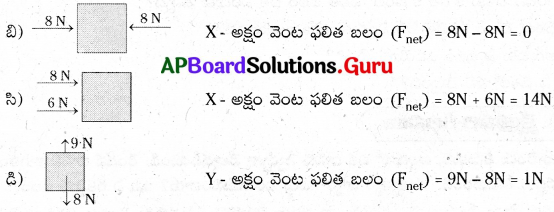
కింది పటాలలో ఫలిత బలాన్ని కనుక్కోండి. (AS5) (AS1)
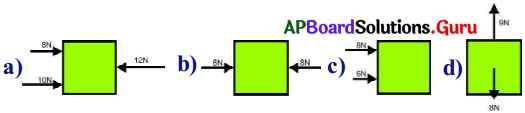
AP Board 8th Class Physical Science Solutions 1st Lesson బలం 1
జవాబు:
AP Board 8th Class Physical Science Solutions 1st Lesson బలం 2
AP Board 8th Class Physical Science Solutions 1st Lesson బలం 3

ప్రశ్న 10.
భూమి మీద ఘర్షణ లేదని ఊహించండి. ఏం జరుగుతుందో వివరించండి. (AS2)
జవాబు:

  1. ఘర్షణ బలం లేకపోతే మనం నడవలేము.
  2. వాహనాలు జారిపడి పోయే ప్రమాదం గలదు.
  3. పెన్నుతో పేపరుపై వ్రాయలేము.
  4. అగ్గిపుల్లతో అగ్గి పెట్టె పై రుద్ది మంటను పుట్టించలేము.
  5. నల్లబల్లపై చాక్ పీతో వ్రాయలేము.
  6. బల్లపై ఉంచిన వస్తువులు జారిపడతాయి.
  7. రాక్స్ లేదా అల్మారాలో ఉంచిన వస్తువులు జారిపడిపోతాయి.
  8. గుర్రపు మరియు ఎద్దుల బండ్లను నడుపలేము.
  9. మేకులను గోడలో మరియు చెక్కలో దింపలేము.
  10. ఆహారాన్ని నమలలేము.
  11. ఏ వస్తువుకు నిశ్చలస్థితి ఉండదు.
  12. భవనాలు నిర్మించలేము.

ప్రశ్న 11.
కార్తీక్ టి.వి.లో “వన్డే క్రికెట్ మ్యాచ్” చూస్తున్నాడు. ఆట భోజన విరామంలో క్రికెట్ పిచ్ పై రోలర్‌ను దొర్లించడం గమనించాడు. ఆ రోలర్ దొర్లేటప్పుడు దానిపై పనిచేసే వివిధ బలాలు, ఫలిత బలం గురించి అతను ఆలోచించాడు. ఫలితబలం పనిచేసే దిశ గురించి అతని మదిలో అనేక ప్రశ్నలు ఉత్పన్నమయ్యాయి. ఆ ప్రశ్నలేవో మీరు ఊహించగలరా? (AS2)
జవాబు:
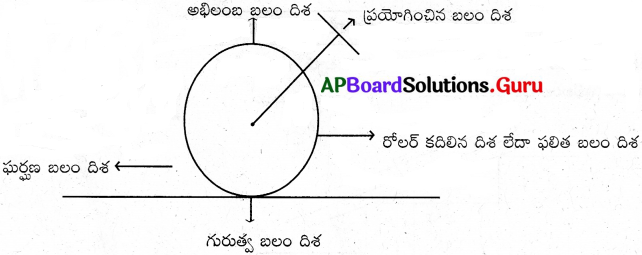
AP Board 8th Class Physical Science Solutions 1st Lesson బలం 4

  1. బలం ప్రయోగించిన దిశలో రోలర్ ఎందుకు కదలలేదు?
  2. బలం ప్రయోగించిన దిశలో ఫలిత బలం ఎందుకు లేదు?
  3. బలం ప్రయోగించిన దిశకు కొంత కోణంలో ఫలిత బలం దిశ ఎందుకు ఉన్నది?
  4. ఫలిత బలం దిశలో రోలర్ కదిలితే పిచ్ ఎందుకు చదును అయినది?
  5. పిచ్ చదును అగుటకు ఏ బలం ఉపయోగపడినది?
  6. ఘర్షణ బలం ఏ దిశలో పని చేస్తుంది?

AP Board 8th Class Physical Science Solutions 1st Lesson బలం

ప్రశ్న 12.
ఎ. ఒకే విధమైన స్త్రాలు రెండు తీసుకుని, అందులో ఒక దానిని స్వేచ్ఛగా వేలాడదీయండి. రెండవ దానిని కాగితంతో రుద్ది వేలాడదీసిన స్ట్రా వద్దకు తీసుకురండి. ఈ కృత్యం ద్వారా మీరు ఏం గమనించారు? ఇవి ఏ రకమైన బలం? (AS3)
జవాబు:

  1. కాగితంతో రుద్దిన స్ట్రాను స్వేచ్ఛగా వేలాడదీసిన స్ట్రా వద్దకు తీసుకొని వచ్చినపుడు మొదట ఆకర్షించుకున్నది. ఆ తర్వాత వికర్షించుకున్నది.
  2. కాగితంతో రుద్దిన స్ట్రా మరియు స్వేచ్ఛగా వేలాడదీసిన స్ట్రాల మధ్య వికర్షణ బలం, స్థావర విద్యుత్ బలం ఏర్పడ్డాయి.

బి. పొడి జుట్టుని దువ్వెనతో దువ్వి ఆ దువ్వెనను చిన్న చిన్న కాగితపు ముక్కల దగ్గరకు తీసుకురండి. ఏం గమనించారు? వివరించండి. (AS3)
జవాబు:

  1. పొడిజుట్టుని దువ్వెనతో దువ్వి ఆ దువ్వెనను చిన్న చిన్న కాగితపు ముక్కల దగ్గరకు తీసుకువస్తే అది కాగితం ముక్కలను ఆకర్షిస్తుంది.
  2. పొడి జుట్టు దువ్వెనతో దువ్వడం వలన ఘర్షణ బలం వల్ల స్థావర విద్యుత్ ఆవేశాలు ఏర్పడ్డాయి.
  3. దువ్వెనకు గల స్థావర విద్యుత్ ఆవేశాలు కాగితం ముక్కలను ఆకర్షిస్తుంది.

ప్రశ్న 13.
స్పర్శాబలాలను, క్షేత్రబలాలను వివరించే చిత్రాలను వార్తాపత్రికలు, అంతర్జాలం మొదలైన వాటి నుండి సేకరించి నోట్ బుక్ లో – అంటించి ప్రదర్శించండి. (AS4)
జవాబు:
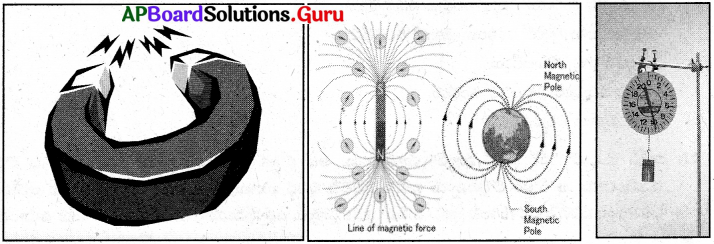
AP Board 8th Class Physical Science Solutions 1st Lesson బలం 5

ప్రశ్న 14.
పటంలో చూపిన విధంగా మెట్ల మీద ఒక కర్రని పెట్టారు . ఆ కర్ర మీద పనిచేసే అభిలంబ బలాలను గీయండి. (AS5)
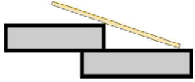
AP Board 8th Class Physical Science Solutions 1st Lesson బలం 6
జవాబు:
AP Board 8th Class Physical Science Solutions 1st Lesson బలం 7

ప్రశ్న 15.
చెట్టు ఊడని పట్టుకొని ఒక కోతి నిశ్చలంగా వేలాడుతూ ఉందనుకోండి. ఆ కోతిపై పనిచేసే బలాలు ఏవి? (AS7)
జవాబు:
కోతిపై పనిచేసే బలాలు :

  1. కోతిపై గురుత్వ బలం భూమి వైపు పనిచేస్తుంది.
  2. కోతి నుండి పైవైపు ఊడ తన్యతాబలం పనిచేస్తుంది.

ప్రశ్న 16.
నిశ్చలంగా ఉన్న ఒక బరువైన వస్తువును కదల్చాలంటే నువ్వు దానిపై కొంత బలాన్ని ప్రయోగించాలి. అయితే ఒకసారి కదిలిన తరువాత, దానిని అదే గమనస్థితిలో ఉంచడానికి కొద్ది బలం ప్రయోగిస్తున్నా సరిపోతుంది. ఎందుకు? (AS1)
జవాబు:

  1. నిశ్చలస్థితి గల ఒక బరువైన వస్తువును గమన స్థితిలోకి మార్చుతూ ఉంటే సైతిక ఘర్షణబలం వ్యతిరేకిస్తుంది.
  2. గమనంలో ఉన్న వస్తువును జారుడు ఘర్షణ బలం నిశ్చలస్థితిలోకి మారుస్తుంది.
  3. సైతిక ఘర్షణ బలం కంటే జారుడు ఘర్షణ బలం చాలా తక్కువగా ఉంటుంది.
  4. కాబట్టి వస్తువు ఒకసారి కదిలిన తరువాత, దానిని అదే గమన స్థితిలో ఉంచడానికి కొద్దిగా బలం (జారుడు ఘర్షణ బలానికి సరిపడు) ప్రయోగిస్తే సరిపోతుంది.

ప్రశ్న 17.
కింది రెండు సందర్భాలలో పీడనాన్ని ఎలా పెంచగలవు? (AS1)
ఎ) వైశ్యాలంలో మార్పు లేనపుడు బి) బలంలో మార్పు లేనపుడు
జవాబు:
ఎ) వైశాల్యంలో మార్పు లేనపుడు :

  1. వైశాల్యం మార్పు లేనపుడు పీడనాన్ని పెంచాలంటే దానిపై బలాన్ని పెంచాలి.
  2. పీడనం బలానికి అనులోమానుపాతంలో ఉంటుంది.

బి) బలంలో మార్పు లేనపుడు :

  1. బలం మార్పు లేనపుడు పీడనాన్ని పెంచాలంటే స్పర్శావైశాల్యాన్ని తగ్గించాలి.
  2. పీడనము, స్పర్శా వైశాల్యానికి విలోమానుపాతంలో ఉంటుంది.

AP Board 8th Class Physical Science Solutions 1st Lesson బలం

ప్రశ్న 18.
ఘర్షణని తగ్గించడానికి కొన్ని మార్గాలను సూచించి, వాటిని పరీక్షించడానికి ప్రయోగాన్ని రూపకల్పన చేసి నిర్వహించండి.
జవాబు:
ఘర్షణని తగ్గించడానికి కొన్ని మార్గాలు :

  1. ఘర్షణను తగ్గించడానికి స్పర్శించుకొనే తలాలను నునుపుగా ఉంచాలి.
  2. ఘర్షణను తగ్గించడానికి స్పర్శించుకొనే తలాలకు కందెనలను, నూనెలను పూయాలి.
  3. యంత్రాలలో, చక్రాలలో ఘర్షణను తగ్గించడానికి బాల్ బేరింగ్ ను ఉపయోగించాలి.

నునుపైన తలాలు ఘర్షణ బలాలు తగ్గిస్తాయి అని ప్రయోగపూర్వకంగా నిరూపించుట :
1) ఉద్దేశ్యము : నునుపైన తలంపై ఘర్షణ తక్కువగా ఉంటుంది.

2) పరికరాలు : 1) నునుపుగా ఉండే పొడవైన చెక్క, 2) గరుకుగా ఉండే పొడవైన చెక్క, 3) రెండు గోళీలు.

3) ప్రయోగము :

  1. నునుపైన మరియు గరుకుగా ఉండే చెక్కలను ఒకదాని ప్రక్కన ఒకటి క్షితిజ సమాంతరంగా అమర్చాలి.
  2. ఒక్కొక్క చెక్కపై ఒక్కొక్క గోళీని ఉంచి ఒకే బలంతో రెండింటిని కదల్చండి.
  3. ఏ గోళీ ఎక్కువ దూరం కదిలినదో కనుగొనండి.
  4. నునుపైన చెక్క తలంపై గోళీ ఎక్కువ దూరం కదిలినది. కావున నునుపైన తలంపై ఘర్షణ బలం తక్కువగా ఉండుట వలన గోళీ ఎక్కువ దూరం కదిలినది అని తెలుస్తుంది.
  5. గరుకైన చెక్క తలంపై గోళీ తక్కువ దూరం కదిలినది. కావున గరుకు తలంపై ఘర్షణ బలం ఎక్కువగా ఉన్నట్లు తెలుస్తుంది.

పై ప్రయోగము వలన నునుపైన తలాలు తక్కువ ఘర్షణ బలాన్ని కల్గిస్తాయి అని తెలుస్తుంది.

ప్రశ్న 19.
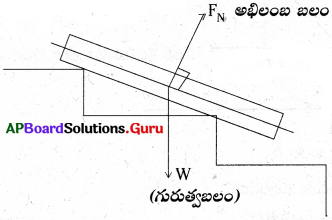
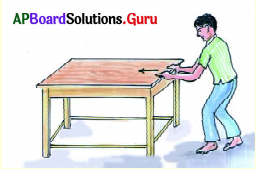
క్రింది పటం పరిశీలించండి. అందులో ఘర్షణ బలం, అభిలంబ బలం ఏ దిశలో పనిచేస్తాయో తెలపండి. (AS5)
AP Board 8th Class Physical Science Solutions 1st Lesson బలం 8
జవాబు:
AP Board 8th Class Physical Science Solutions 1st Lesson బలం 9

ప్రశ్న 20.
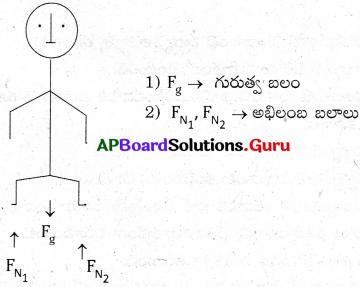
సమతలంపై స్థిరంగా నిలబడ్డ వ్యక్తిపై ఏయే బలాలు పని చేస్తుంటాయి? అతనిపై పనిచేసే బలాలన్నింటిని సూచించే స్వేచ్ఛావస్తుపటాన్ని (FBD) గీయండి. (AS5)
జవాబు:
AP Board 8th Class Physical Science Solutions 1st Lesson బలం 10

ప్రశ్న 21.
నిత్య జీవితంలో మనం వివిధ కృత్యాలు చేయడానికి ఉపయోగపడే ఘర్షణ యొక్క పాత్రని నీవు ఏ విధంగా అభినందిస్తావు?
జవాబు:

  1. నడవడం, పరుగెత్తడం అనే కృత్యాలలో ఘర్షణ బలం ఉపయోగపడుతుంది.
  2. వాహనాలు నడపడానికి ఘర్షణ బలం ఉపయోగపడుతుంది.
  3. మేకులను చెక్కలోకి మరియు గోడలోనికి దించడానికి ఘర్షణ బలం ఉపయోగపడుతుంది.
  4. గుర్రపు బండ్లు మరియు ఎడ్ల బండ్లు నడపడానికి ఘర్షణబలం ఉపయోగపడుతుంది.
  5. కాగితంపై పెన్నుతో వ్రాయడానికి ఘర్షణ బలం ఉపయోగపడుతుంది.
  6. బోర్డ్ పై చాపీ తో వ్రాయడానికి ఘర్షణ బలం ఉపయోగపడుతుంది.
  7. భవన నిర్మాణములో ఘర్షణ బలం ఉపయోగపడుతుంది.
  8. వస్తువులను చేతితో పట్టుకోవడంలో ఘర్షణ బలం ఉపయోగపడుతుంది.
  9. వడ్రంగి చెక్క తలాలను నునుపు చేయుటకు ఘర్షణ బలం ఉపయోగపడుతుంది.

నిత్య జీవితంలో మనం వివిధ పనులు చేయడానికి ఉపయోగపడే ఘర్షణ యొక్క పాత్రను ఎంతగానో అభినందించ వలసిన అవసరం ఉన్నది.

8th Class Physical Science 1st Lesson బలం Textbook InText Questions and Answers

ఆలోచించండి – చర్చించండి

8th Class Physical Science Textbook Page No. 5

ప్రశ్న 1.
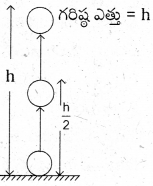
m ద్రవ్యరాశి గల క్రికెట్ బంతిని కొంత వేగంతో పైకి విసిరారనుకోండి. గాలి నిరోధాన్ని విస్మరిస్తే (ఎ) అది చేరుకునే గరిష్ఠ ఎత్తులో సగం ఎత్తు వద్ద (బి) గరిష్ఠ ఎత్తు వద్ద ఆ బంతిపై ఏ ఏ బలాలు పనిచేస్తుంటాయి?
జవాబు:
AP Board 8th Class Physical Science Solutions 1st Lesson బలం 11
(ఎ) గరిష్ఠ ఎత్తులో సగం ఎత్తు (h/2) వద్ద పనిచేసే బలాలు:

  1. గురుత్వ బలం (mg)
    విసిరిన బలంలో కొంత బలము.

(బి) గరిష్ఠ ఎత్తు (h) వద్ద పనిచేసే బలాలు:

  1. గురుత్వ బలం (mg)

8th Class Physical Science Textbook Page No. 6

ప్రశ్న 2.
ఒకే రంగు పూసిన రెండు లోహపు కడ్డీలు మీ వద్ద ఉన్నాయనుకోండి. అందులో ఒకటి ఉక్కుది, రెండవది అయస్కాంతం. అందులో ఏది అయస్కాంతమో, ఏది ఉక్కు కడ్డీయో మీరు ఏ విధంగా నిర్ణయిస్తారు? (నిబంధన : కడ్డీలను విరచరాదు)
జవాబు:
ఇనుప రజనును ఏ కడ్డీ ఆకర్షిస్తుందో ఆ కడ్డీ అయస్కాంతంగాను, ఇనుప రజనును ఆకర్షించని కడ్డీని ఉక్కు కడ్డీగా గుర్తించవచ్చును.

8th Class Physical Science Textbook Page No. 8

ప్రశ్న 3.
ఒక పుస్తకం బల్లపై నిశ్చలస్థితిలో ఉంది. ఆ పుస్తకంపై ఘర్షణ బలం పనిచేస్తున్నదా? లేదా? వివరించండి.
జవాబు:

  1. బల్లపై గల పుస్తకంపై ఘర్షణ బలం పనిచేస్తుంది.
  2. నిశ్చలస్థితిలో గల వస్తువులపై పనిచేసే ఘర్షణ బలాన్ని సైతిక ఘర్షణ బలం అంటారు.
  3. నిశ్చల స్థితిలో గల పుస్తకాన్ని చలన స్థితి పొందుటకు కావలసిన బలం కంటే తక్కువ బలం ప్రయోగించినపుడు పుస్తకం చలనంలో ఉండదు. కారణం ప్రయోగించిన బలాన్ని సైతిక ఘర్షణ బలం నిరోధిస్తుంది.

8th Class Physical Science Textbook Page No. 10

ప్రశ్న 4.
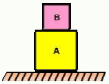
A మరియు B అనే వస్తువులతో కూడిన ఒక వ్యవస్థ ప్రక్క పటంలో చూపబడింది. A మరియు B వస్తువుల మీద ఏ ఏ బలాలు పనిచేస్తున్నాయో చెప్పండి.
AP Board 8th Class Physical Science Solutions 1st Lesson బలం 12
జవాబు:
A వస్తువుపై పనిచేసే బలాలు :

  1. గురుత్వ బలం
  2. అభిలంబ బలం
  3. B యొక్క భారం (B యొక్క గురుత్వబలం)

B వస్తువుపై పనిచేసే బలాలు :

  1. 1గురుత్వ బలం
  2. అభిలంబ బలం

AP Board 8th Class Physical Science Solutions 1st Lesson బలం

ప్రశ్న 5.
స్పర్శా బలాలను ఘర్షణ బలం, అభిలంబ బలం అని వేరుపరచి చూడాల్సిన అవసరం ఏమిటో రెండు కారణాలతో వివరించండి.
జవాబు:

  1. ఘర్షణ బలం, అభిలంబ బలాలు వేరువేరు దిశలలో పని చేయడం.
  2. ఘర్షణ బలం చలన దిశకు వ్యతిరేక దిశలో ఉండి, వస్తువు చలనాన్ని నిరోధిస్తుంది. కాని అభిలంబ బలాన్ని గురుత్వ బలం సమతుల్యం చేస్తుంది.

8th Class Physical Science Textbook Page No. 13

ప్రశ్న 6.
మీ స్నేహితునితో మోచేతి కుస్తీ (arm wrestling) ఆట ఆడండి. ఆటలో గెలుపుని ‘ఫలితబలం’ భావనతో వివరించండి. ఈ ఆట ఆడేటపుడు మీ మోచేతిపై పనిచేసే బలాల పేర్లు, వాటి దిశలను తెల్పండి. ఈ సన్నివేశానికి స్వేచ్ఛా వస్తుపటం (FBD) ను గీయడానికి ప్రయత్నించండి.
జవాబు:
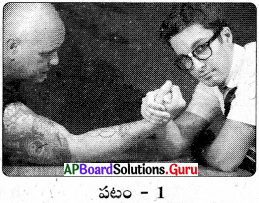
AP Board 8th Class Physical Science Solutions 1st Lesson బలం 13
పటం – 1 లో స్వేచ్చా వస్తుపటం FBD :

F1, F2 లు → అభిలంబ బలాలు
Fg → గురుత్వబలం
Fm1 → మొదటి వ్యక్తి కండర బలం
Fm2 → రెండవ వ్యక్తి కండర బలం
X – అక్షం వెంట ఫలితబలం Fnet = Fm2 – Fm1
X – అక్షం వెంట ఫలిత బలం = Fg – (F1+ F2)
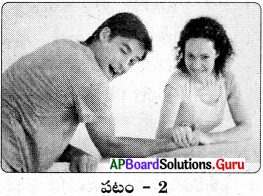
AP Board 8th Class Physical Science Solutions 1st Lesson బలం 14
పటం – 2 లో ఆటలో గెలుపును పొందిన భావనతో స్వేచ్ఛా వస్తుపటం

F1, F2 లు → అభిలంబ బలాలు
Fg → గురుత్వబలం
Fm1 → మొదటి వ్యక్తి కండర బలం
Fm2 → రెండవ వ్యక్తి కండర ,బలం
X – అక్షం వెంట ఫలిత బలం = (Fm1 + F1 + F2) – (Fg+ Fm1)

ప్రశ్న 7.
బలాలు ఏమి చేయగలవు?
జవాబు:

  1. నిశ్చలస్థితిలో గల వస్తువును గమన స్థితిలోకి మార్చగలవు.
  2. గమన స్థితిలో గల వస్తువుల వడిని పెంచగలవు.
  3. గమన స్థితిలో గల వస్తువుల వడిని తగ్గించగలవు.
  4. గమన స్థితిలో గల వస్తువులను నిశ్చలస్థితిలోకి మార్చగలవు.
  5. వస్తువుల ఆకృతిని మరియు ఆకారాన్ని మార్చగలవు.

8th Class Physical Science Textbook Page No. 16

ప్రశ్న 8.
పీడనానికి దిశ ఉంటుందా? వివరించండి.
జవాబు:

  1. పీడనం అదిశ రాశి. పీడనానికి పరిమాణం మాత్రమే ఉంటుంది. దిశ ఉండదు.
  2. మృదువైన పదార్థాలు మాత్రమే బలాన్ని ప్రయోగిస్తే పీడనాన్ని కలుగజేస్తాయి.
  3. దృఢమైన వస్తువులపై బలాన్ని ప్రయోగిస్తే బలం ప్రయోగించిన దిశలో వస్తువు కదులుతుంది.
  4. మృదువైన పదార్థాలపై బలాన్ని కలుగజేస్తే, ఆ పదార్థాలు అన్ని దిశలలో పీడనాన్ని కలుగజేస్తాయి.
    ఉదా : నీరు గల పాత్ర ; వాయువు గల వాయుపాత్ర మరియు గాలి గల బెలూను.

8th Class Physical Science Textbook Page No. 15

ప్రశ్న 9.
స్కూలు బ్యాగులు, షాపింగ్ బ్యాగులకు వెడల్పైన బెల్ట్ లు ఉండడానికి కారణమేమిటి?
జవాబు:
స్కూలు బ్యాగులు, షాపింగ్ బ్యాగులకు వెడల్పైన బెల్ట్ లు ఉండడానికి కారణము స్పర్శా బలం పెరిగి బల ప్రభావమును, పీడనమును తగ్గించుటకు.

ప్రశ్న 10.
అధిక బరువులు తీసుకువెళ్ళే లారీలకు ఎక్కువ సంఖ్యలో వెడల్పైన టైర్లు ఎందుకు ఉంటాయో తెల్పండి.
జవాబు:
అధిక బరువులు తీసుకువెళ్ళే లారీలకు ఎక్కువ సంఖ్యలో వెడల్పైన టైర్లు ఉంటాయి. ఎందుకంటే భూమిపైన పీడనమును తగ్గించుటకు.

పరికరాల జాబితా

స్ట్రా, డస్టరు, అయస్కాంతము, తాడు, టూత్ పేస్టు, మూతగల సీసా, కార్పెట్, గరుకు రోడ్డు, నున్నని గచ్చు, వివిధ దారాలు, సూది, థర్మోకోల్ బాల్స్, బెలూన్, కాగితపు ముక్కలు, డ్రాయింగ్ షీట్, టేబుల్, రబ్బరు బ్యాండ్, క్యారమ్ బోర్డు, స్పాంజ్, ప్లాస్టిక్ బాటిల్, అద్దము, పెన్సిల్, వాలుతలము, రూపాయి నాణెం, స్ప్రింగ్ త్రాసు, భారాలను తగిలించే కొక్కెం, భారాలు, దండాయస్కాంతం, ఇనుపరజను, పుట్ బాల్ (పెద్దబంతి), ప్లాస్టిక్ ట్రేలు, ఇటుకలు.

8th Class Physical Science 1st Lesson బలం Textbook Activities

కృత్యములు

కృత్యం -1

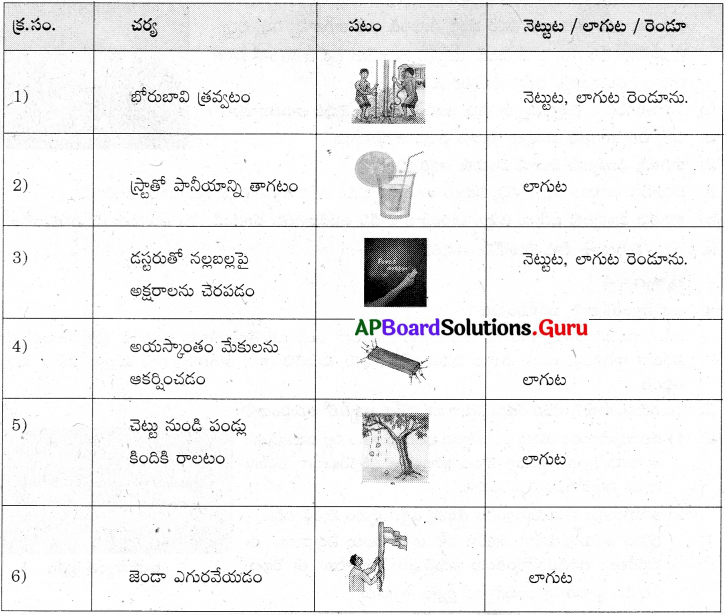
1. వివిధ పనులలో నెట్టడాన్ని, లాగడాన్ని గుర్తించడం :
ఈ క్రింది పట్టికలో వివిధ పనులు చేస్తున్న పటాలను పరిశీలించి నెట్టడాన్ని, లాగడాన్ని గుర్తించి పట్టికలో నమోదు చేయండి.
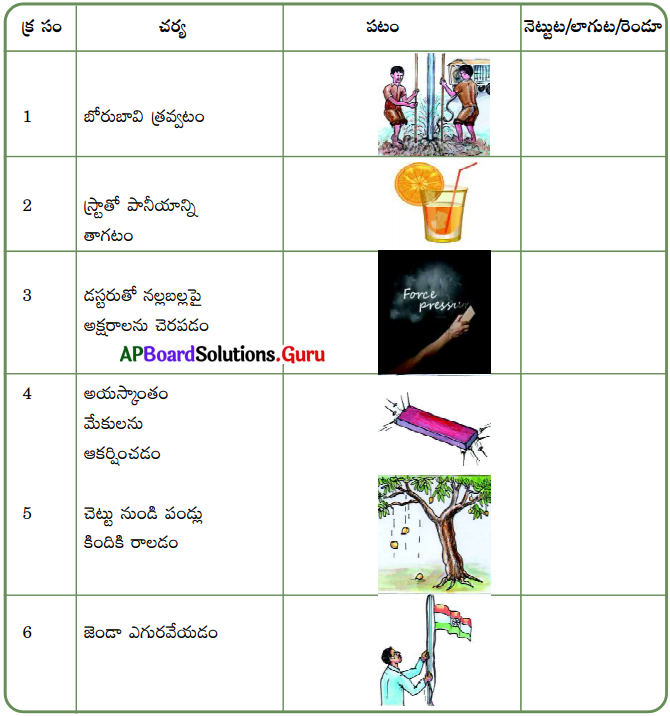
AP Board 8th Class Physical Science Solutions 1st Lesson బలం 15
జవాబు:
AP Board 8th Class Physical Science Solutions 1st Lesson బలం 16

కృత్యం – 2

2. అయస్కాంత బలాన్ని పరిశీలించుట :
ఒక సూదిని తీసుకోండి. ఒక దండయస్కాంతాన్ని తీసుకుని దానిపై ఒకే దిశలో అనేకసార్లు రుద్దండి. ఆ సూది అయస్కాంతంగా మారడం మీరు గమనించవచ్చు. దిక్సూచి సహాయంతో ఆ సూది యొక్క ఉత్తర, దక్షిణ ధృవాలను గుర్తించవచ్చు. దక్షిణ ధృవం ఉన్న వైపు ఒక చిన్న ఎరుపు బెండు బంతిని గుచ్చండి. ఉత్తర ధృవం వైపు ఒక తెల్ల బెండు బంతిని గుచ్చండి. ఇదే విధంగా ఇంకొక సూదిని తీసుకొని తయారుచేయండి. ఈ క్రింది విధంగా చేయండి.
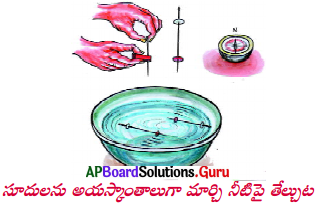
AP Board 8th Class Physical Science Solutions 1st Lesson బలం 17

ఎ) ఒకే రంగు బంతులు కలిగిన సూదుల చివరలు ఎదురెదురుగా ఉండేలా ఆ సూదులను నీటిలో ఉంచండి. ఏం జరుగుతుంది?
జవాబు:
ఒకే రంగు బంతులు కలిగిన సూదుల చివరలు వికర్షించుకోవటం గమనించవచ్చును.

బి) వేర్వేరు రంగు బంతులు కలిగిన సూదుల చివరలు ఎదురెదురుగా ఉండేలా నీటిలో వదలండి. ఏం జరిగింది?
జవాబు:
వేరువేరు రంగు బంతులు కలిగిన సూదుల చివరలు ఆకర్షించుకోవడం గమనించవచ్చును.

సి) ఆ సూదులు ఒకదానికొకటి ఆకర్షించుకొంటే లేదా వికర్షించుకొంటే ఆ బలాన్ని ఏమంటారు?
జవాబు:
రెండు అయస్కాంతాల మధ్య కంటికి కనిపించకుండా పనిచేసే ఆకర్షణ లేదా వికర్షణ బలాన్ని అయస్కాంత బలం అంటారు.

AP Board 8th Class Physical Science Solutions 1st Lesson బలం

కృత్యం – 3

3. స్థావర విద్యుత్ బలాలను పరిశీలించుట :

ఒక బెలూనను ఊది దాని చివర ముడి వేయండి. ఒక కాగితాన్ని చిన్న చిన్న ముక్కలుగా చేసి గచ్చుపై వేయండి. ఇప్పుడు బెలూనను ఒక కాగితంతో బాగా రుద్ది కాగితం ముక్కల వద్దకు తీసుకురండి.
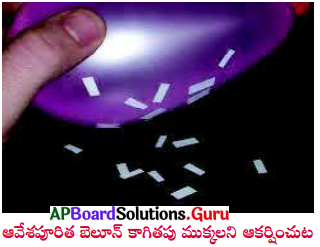
AP Board 8th Class Physical Science Solutions 1st Lesson బలం 18

ఎ) ఏం జరిగింది? చిన్న చిన్న కాగితపు ముక్కలు బెలూన్ వైపుకి లాగబడ్డాయా?
జవాబు:
చిన్న చిన్న కాగితపు ముక్కలు బెలూన్ వైపుకి లాగబడ్డాయి.

బి) కాగితపు ముక్కలను బెలూన్ ఎందుకు ఆకర్షించింది?
జవాబు:
బెలూనను రుద్దడం వల్ల దానిపై విద్యుత్ బలం ఏర్పడడం వలన కాగితం ముక్కలు ఆకర్షింపబడినవి.

సి) కాగితపు ముక్కలకు బదులు ఉప్పు, మిరియాల పొడిని ఉపయోగించి చూడండి. ఏం జరుగుతుందో గమనించండి.
జవాబు:
ఉప్పు, మిరియాల పొడి బెలూన్ చే ఆకర్షింపబడవు.

కృత్యం – 4

4. అయస్కాంత క్షేత్రాన్ని పరిశీలించుట :

ఒక దండయస్కాంతాన్ని టేబుల్ పై పెట్టి దానిపై మందంగా ఉండే ఒక తెల్లకాగితాన్ని ఉంచండి. ప్రక్క పటంలో చూపిన విధంగా కాగితంపై ఇనుప రజను వెదజల్లండి. ఇపుడు టేబుల్ ని గానీ, కాగితాన్ని గానీ మెల్లగా పెన్ / పెన్సిల్ తో తట్టండి.
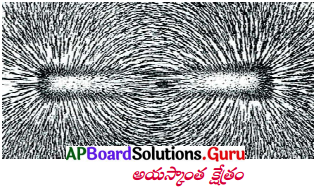
AP Board 8th Class Physical Science Solutions 1st Lesson బలం 19

ఎ) ఏం గమనించారు? ఇనుప రజను ఏదైనా ఒక ప్రత్యేక ఆకృతిలో అమరిందా?
జవాబు:

  1. దండయస్కాంతం యొక్క అయస్కాంత బలం ప్రభావం వల్ల ఇనుపరజను ఆ అయస్కాంతం చుట్టూ కొంత ప్రాంతంలో వక్రరేఖలుగా తమకు తాము సర్దుకోవడం గమనించాను.
  2. ఇనుపరజను దండయస్కాంతం యొక్క ఉత్తర ధృవం నుండి దక్షిణ , ధృవం వరకు వరుసగా వక్రరేఖ వలె అనేక రేఖలు ఏర్పడ్డాయి. ఈ వక్రరేఖలు దండయస్కాంతంకు ఇరువైపుల ఏర్పడ్డాయి. ఈ రేఖలు అయస్కాంత క్షేత్రం ఏర్పడిన ప్రాంతాన్ని అయస్కాంత క్షేత్రం అంటారు.

కృత్యం – 5

5. కండర బలాన్ని ఉపయోగించే సందర్భాల జాబితా తయారు చేయడం :

కండర బలాన్ని ఉపయోగించి పనిచేసే సందర్భాలను వ్రాయండి.

  1. సైకిల్ తొక్కడం
  2. ఈత కొట్టడం
  3. పరుగెత్తడం
  4. బరువులు మోయడం
  5. త్రవ్వడం
  6. స్ట్రాతో పానీయాన్ని తాగడం
  7. డస్టరుతో నల్లబల్లపై అక్షరాలను చెరపడం
  8. ఇల్లు ఊడ్చటం
  9. కొండరాళ్ళు కొట్టడం
  10. స్నానం చేయడం
  11. ఆటలు ఆడడం

కృత్యం – 6

6. పనిచేసేటప్పుడు ఏదేని కండరంలోని మార్పును పరిశీలించుట :
బంతిని విసిరినపుడు కండరంలోని మార్పును పరిశీలించి వ్రాయండి.
జవాబు:
బంతిని విసురుతున్నపుడు ఛాతి, భుజం ముందు భాగంలోని కండరాలు వ్యాకోచించి మన చేతిని ముందుకు లాగితే, భుజం వెనుక భాగంలోని కండరాలు సంకోచించి మన కదలికని నియంత్రిస్తాయి.

AP Board 8th Class Physical Science Solutions 1st Lesson బలం

కృత్యం – 7

7. వివిధ తలాలపై బంతి గమనాన్ని పరిశీలించుట :

కార్పెట్, గరుకుతలం, నున్నటి తలాలపై బంతి గమనాన్ని పరిశీలించి, బంతి గమనాన్ని ఏ తలం ఎక్కువగా నిరోధించునో, ఏ తలం తక్కువగా నిరోధించునో పరిశీలించి తెల్పండి.
జవాబు:

  1. కార్పెట్, గరుకు తలం మరియు నున్నటి తలాలపై ఒకే బలం ఉపయోగించి ఒక బంతిని కదిలేటట్లు చేసినాను.
  2. కార్పెట్ తలంపై బంతి తక్కువ దూరం ప్రయాణించినది.
  3. కార్పెట్ కంటె గరుకు తలంపై బంతి ఎక్కువ దూరం ప్రయాణించినది.
  4. కార్పెట్, గరుకు తలాల కంటె నున్నటి తలంపై బంతి ఎక్కువ దూరం ప్రయాణించింది.
  5. బంతి చలనాన్ని నిరోధించే క్రమము : కార్పెట్ తలం > గరుకుతలం > నున్నటి తలం
  6. బంతి కదిలిన దూరాల క్రమం : కార్పెట్ తలం – గరుకు తలం < నున్నటి తలం.

కృత్యం – 8

8. వాలుతలంపై వస్తువుల చలనాన్ని పరిశీలించుట :

ఒక ట్రేని తీసుకోండి. దానిమీద ఒక చివర అంచు దగ్గర చిన్న మంచు ముక్కను, ఎరేజర్ (రబ్బరు)ను మరియు ఒక రూపాయి బిళ్ళను ఒకే వరుసలో పెట్టండి. ఇపుడు ప్రక్క పటంలో చూపిన విధంగా ట్రేను అదే చివర పట్టుకొని నెమ్మదిగా పైకి ఎత్తి పరిశీలించండి.

ఈ క్రింది ప్రశ్నలకు జవాబులు వ్రాయండి.
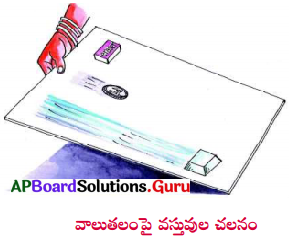
AP Board 8th Class Physical Science Solutions 1st Lesson బలం 20

ఎ) ఈ మూడు వస్తువులలో ఏది మొదట కిందికి జారడం ప్రారంభించింది?
జవాబు:
ఈ మూడు వస్తువులలో మొదట జారిన వస్తువు మంచు ముక్క.

బి) అన్ని వస్తువులకు ఒకే పరిమాణంలో ఘర్షణ పనిచేస్తుందా?
జవాబు:
అన్ని వస్తువులకు ఘర్షణ, పరిమాణం వేరువేరుగా ఉన్నాయి.

సి) ఏ వస్తువుపై ఘర్షణ బలం ఎక్కువ? ఏ వస్తువుపై ఘర్షణ బలం తక్కువ?
జవాబు:
ఎరేజరు ఘర్షణ బలం ఎక్కువ. మంచు ముక్కకు ఘర్షణ బలం తక్కువ.

డి) ఈ మూడు వస్తువుల ఘర్షణ బలాల క్రమాన్ని వ్రాయండి.
జవాబు:
ఈ మూడు వస్తువుల ఘర్షణ బలాల క్రమం : ఎరేజర్ > రూపాయి బిళ్ళ > మంచు ముక్క

ప్రయోగశాల కృత్యం
AP Board 8th Class Physical Science Solutions 1st Lesson బలం 21
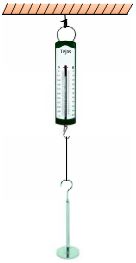
9. ఉద్దేశ్యం : దారం భరించగలిగే గరిష్ఠ బలాన్ని కనుగొనుట.
కావలసిన పరికరాలు : స్ప్రింగ్ త్రాసు, భారాలు, తేలిక దారాలు, భారాలు తగిలించే కొక్కెం (వెయిట్ హేంగర్)

నిర్వహణ పద్ధతి :
i) పరికరాలని పటంలో చూపిన విధంగా అమర్చండి.
ii) 50గ్రా.ల భారాన్ని వెయిట్ హేంగర్ కి వేలాడదీసి, స్ప్రింగ్ త్రాసులో రీడింగ్ గమనించండి.
iii) అలా దారం తెగిపోయేంత వరకు కొద్ది కొద్దిగా భారాలు పెంచుతూ స్ప్రింగ్ త్రాసులో రీడింగులు గమనిస్తూ ఉండండి.
iv) దారం తెగే దగ్గర రీడింగును గుర్తించండి.
v) వివిధ రకాల దారాలను ఉపయోగించి, అవి భరించగలిగే గరిష్టబలము యొక్క విలువలను క్రింది పట్టికలో నమోదు చేయండి.
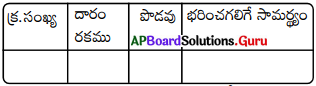
AP Board 8th Class Physical Science Solutions 1st Lesson బలం 22
vi) ఈ మొత్తం వ్యవస్థని (అమరికని) సీలింగ్ నుంచి వేరుపరచి, మరల దారానికి భారాన్ని తగిలించే కొక్కెంను అమర్చి హేంగర్ పై తక్కువ భారం ఉండేలా చూసుకుని, చేతితో నెమ్మదిగా పైకి లేపండి.
vii) అలా పైకి ఎత్తుతున్నప్పుడు స్ప్రింగ్ త్రాసు రీడింగును గమనించండి.

అలాగే మెల్లగా కిందికి దించుతూ స్ప్రింగ్ త్రాసు రీడింగును గమనించండి.

ఎ) పైకి ఎత్తేటప్పుడు, కిందికి దించేటప్పుడు మీరు గమనించిన స్ప్రింగ్ త్రాసు రీడింగులను బట్టి మీరు ఏం చెప్పగలరు?
జవాబు:
స్ప్రింగ్ త్రాసులోని రీడింగులను బట్టి వేరొక బల ప్రభావం ఈ వ్యవస్థపై ఉందని తెలుస్తోంది.

బి) ఒక్కసారిగా మొత్తం అమరికని వేగంగా పైకి లేపితే దారం తెగిపోయిందా?
జవాబు:
ఒక్కసారిగా మొత్తం అమరికని వేగంగా, పైకిలేపితే దారం ఒక్కొక్కసారి తెగవచ్చు లేదా తెగకపోవచ్చు.

కృత్యం – 9

10. టేబుల్ పై ఫలితబలం ప్రభావం :

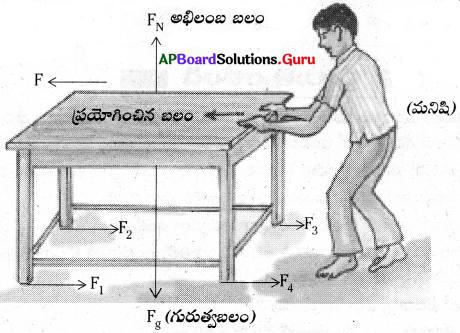
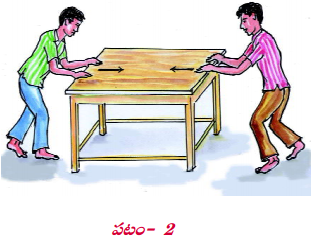
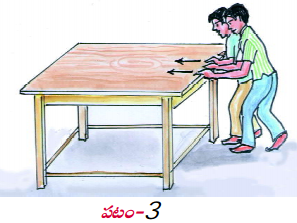
ఒక టేబుల్ ను ఇద్దరు విద్యార్థులు కింద పటంలో చూపిన విధంగా నెట్టుచున్నారు. ఆ పటాలను పరిశీలించి పటాల కింద గల ప్రశ్నలకు జవాబులు వ్రాయండి.
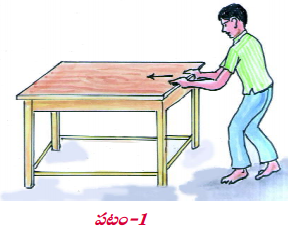
AP Board 8th Class Physical Science Solutions 1st Lesson బలం 23 AP Board 8th Class Physical Science Solutions 1st Lesson బలం 24 AP Board 8th Class Physical Science Solutions 1st Lesson బలం 25

ఎ) పటం -1 లో చూపిన విధంగా బరువైన టేబుల్ ను నెట్టడానికి ప్రయత్నించండి. కష్టంగా ఉంటుందా? సులభంగా ఉంటుందా?
జవాబు:
కష్టంగా ఉంటుంది.

బి) పటం – 3 లో టేబుల్ ఏ దిశలో కదిలింది?
జవాబు:
ఇద్దరు విద్యార్థుల బలం ప్రయోగించిన దిశలో కదిలింది.

సి) పటంలో – 3లో చూపిన విధంగా టేబుల్ ని ఇద్దరు విద్యార్థులు ఒకే వైపు నుండి నెట్టినారు. ఇపుడు సులభంగా ఉందా? ఉంటే ఏమిటి?
జవాబు:
సులభంగా కదిలింది. ఎందుకంటే ఇద్దరి బలాలు ఒకే దిశలో పనిచేయడం వల్ల, ఫలిత బలం పెరిగి ఆ టేబుల్ సులభంగా కదిలింది.

డి) పటం – 2లో చూపిన విధంగా విద్యార్థులు బలాన్ని ప్రయోగించినపుడు ఒకవేళ టేబులు కదలలేదు. ఎందుకు కదలలేదో వివరించండి.
జవాబు:
ఇద్దరు విద్యార్థులు రెండు వైపుల నుండి (వ్యతిరేక దిశలో) నెడుతున్నప్పుడు ఇద్దరి బలపరిమాణం సమానంగా ఉంటే ఫలితబలం శూన్యం అగును కాబట్టి,టేబులు కదలదు.

ఇ) పటం – 2 లో చూపిన విధంగా విద్యార్థులు బలాన్ని ప్రయోగించినపుడు ఒకవేళ టేబులు కదిలినది. ఎందుకు కదిలినదో వివరించండి. ఏ దిశలో కదులనో తెల్పుము.
జవాబు:
ఇద్దరు విద్యార్థులు రెండు వైపుల నుండి (వ్యతిరేక దిశలో) నెడుతున్నప్పుడు ఇద్దరి బలపరిమాణాలు సమానంగా లేకుంటే ఫలిత బలం శూన్యం కాదు కాబట్టి టేబులు కదులును. ఏ విద్యార్థి బలం పరిమాణం ఎక్కువ ఉన్నదో ఆ విద్యార్థి ప్రయోగించిన బలదిశలో టేబులు కదులుతుంది.

AP Board 8th Class Physical Science Solutions 1st Lesson బలం

కృత్యం – 10

11. చేతివేళ్ళపై సాగదీసిన రబ్బరుబ్యాండు ప్రభావం :

ఒక రబ్బరు బ్యాండుని తీసుకొని మీ చేతివేళ్ళతో సాగదీయండి. ఇలా సాగదీస్తున్నప్పుడు రబ్బరు బ్యాండు మీ వేళ్ళపై కలుగజేసే బలాన్ని మీరు అనుభవ పూర్వకంగా తెలుసుకుంటారు. ఇప్పుడు అలాంటిదే ఇంకొక రబ్బరు బ్యాండుని తీసుకుని, రెండింటిని కలిపి ఒకే పొడవుకి సాగదీయండి.
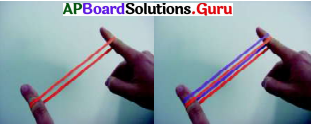
AP Board 8th Class Physical Science Solutions 1st Lesson బలం 26

ఎ) ఏం గమనించారు? ముందుకన్నా ఇప్పుడు మీ వేళ్ళపై కలుగజేయబడిన బలం అధికంగా ఉందా?
జవాబు:
ముందుకన్నా ఇప్పుడు వేళ్లపై కలుగజేయబడిన బలం అధికంగా ఉంది.

బి) ఇలాగే రబ్బరు బ్యాండ్ల సంఖ్య పెంచుతూ, అవి మీ వేళ్ళపై కలుగజేసే బలాన్ని పరిశీలించండి.
జవాబు:
రబ్బరు బ్యాండ్ల సంఖ్య పెరిగేకొలదీ అవి వేళ్ళపై కలుగజేసే బలం పెరుగుతుంది.

కృత్యం – 11

12. వస్తువు చలనదిశపై, స్థితిపై బల ప్రభావం : –
మీ పాఠశాలలో ఆటల పీరియడ్ నందు మైదానంలో ఫుట్ బాల్ ఆడినపుడు ఫుట్ బాల్ ను వివిధ రకాలుగా తన్నే ఉంటారు. ఫుట్ బాల్ ను తన్నినపుడు బాల్ గమనంలో జరిగే మార్పులను మీరు పరిశీలించిన వాటిని వ్రాయండి.
జవాబు:
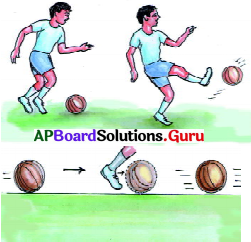
AP Board 8th Class Physical Science Solutions 1st Lesson బలం 27
నేను ఫుట్ బాల్ ఆట ఆడినపుడు బాల్ లో కనిపించిన మార్పులు

  1. ఫుట్ బాల్ ను తన్నినపుడు బలప్రయోగం వల్ల నిశ్చల స్థితిలోని బాల్ గమన స్థితిలోకి మారినది.
  2. గమనస్థితి గల బాల్ పై బలప్రయోగం వల్ల వడిని పెంచవచ్చును.
  3. గమనస్థితిలో గల బాల్ పై బల ప్రయోగం వల్ల వడిని తగ్గించవచ్చును.
  4. గమన స్థితిలో గల బాల్ పై బల ప్రయోగం వల్ల గమన దిశను మార్చవచ్చును.
  5. గమన స్థితిలో గల బాల్ ను బల ప్రయోగం వల్ల నిశ్చల స్థితికి తీసుకు రావచ్చును.

కృత్యం – 12

13. వస్తువు దిశని మార్చడంలో ఫలితబల ప్రభావం :

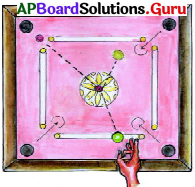
ఒక కేరమ్ బోర్డు కాయిన్ ను స్టైకర్ తో కొట్టండి. మీ స్నేహితులని కూడా అలాగే కొట్టమని చెప్పండి. మీరు కొట్టిన ప్రతీసారీ కాయిన్ ఒకే దిశలో కదులుతుందా? లేదా? ఎందుకు? ఈ ఆటలో మీరు పరిశీలించిన పరిశీలనలను వ్రాయండి.
AP Board 8th Class Physical Science Solutions 1st Lesson బలం 28
జవాబు:

  1. ప్రతి సందర్భంలో కాయిన్ కదిలే దిశ మారుతుంది.
  2. కేరమ్ కాయినను స్టెతో కొట్టినప్పుడు కాయితో పాటు స్ట్రైకర్ కూడా దిశని మార్చుకుంటుంది.
  3. కాయిన్ లేదా స్ట్రైకర్ దిశ మారుతుంది. ఎందుకంటే ఫలిత బలం దిశలో కాయిన్ లేదా స్ట్రైకర్ కదులుట వలన.

కేరమ్ బోర్డ్ ఆటలో పరిశీలించిన పరిశీలనలు :

  1. ఫలిత బలం నిశ్చల స్థితిలో ఉండే కాయిన్లను గమనస్థితిలోకి మారుస్తుంది.
  2. ఫలిత బలం గమనస్థితిలో ఉండే స్ట్రైకర్ ను నిశ్చల స్థితిలోకి మారుస్తుంది.
  3. ఫలిత బలం స్ట్రైకర్ వడిని, దిశను మారుస్తుంది.

AP Board 8th Class Physical Science Solutions 1st Lesson బలం

కృత్యం – 13

14. వస్తువు ఆకారంపై బలం ప్రభావం :

ఈ క్రింది పట్టిక మొదటి వరుసలో ఇచ్చిన వివిధ సందర్భాలు వస్తువుపై బలం ప్రయోగించడానికి ముందు, బలం ప్రయోగించిన తర్వాత వస్తువు యొక్క ఆకారంలో మార్పు గమనించండి. ఆయా వస్తువు ఆకృతి తాత్కాలికంగా మారిందో, శాశ్వతంగా మారిందో గుర్తించి పట్టికలో నింపండి. తాత్కాలిక మార్పును “T’ తో, శాశ్వత మార్పును ‘P’తో సూచించండి.
జవాబు:

బలం ప్రయోగించు సందర్భంఆకారంలో మార్పు (తాత్కాలికం (1), శాశ్వతం(P))
రబ్బరు బ్యాండును సాగదీయడంT
స్పాంజ్ ని పిండటంT
కాగితాన్ని చింపడంP
ప్లాస్టిక్ బాటిల్ ని / గ్లాసును నలిపివేయడంP
రొట్టె చేయడంP
అద్దాన్ని పగలగొట్టడంP

కృత్యం -14

15. స్పర్శాతల వైశాల్యాన్ని బట్టి బల ప్రభావంలో మార్పు :

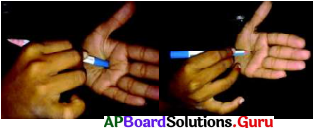
ఒక పెన్సిల్ ను తీసుకుని, పెన్సిల్ యొక్క వెనుకవైపు గుండ్రని చివరతో మీ అరచేతిపై నొక్కండి. తరవాత పెన్సిల్ యొక్క ముందువైపు అంటే మొనదేలి ఉన్న వైపు నుంచి మీ అరచేతిపై గుచ్చండి.
AP Board 8th Class Physical Science Solutions 1st Lesson బలం 29

ఈ రెండు సందర్భాలలో మీరు పొందిన అనుభూతిలో తేడా ఏమైనా ఉందా? ఎందుకు?
జవాబు:

  1. ఈ రెండు సందర్భాలలో మనము పొందే అనుభూతి తేడాగా ఉంటుంది. మొనదేలి ఉన్నవైపున గుచ్చుకొన్నట్లుగా ఉంటుంది. ఎందుకనగా పెన్సిల్ వెనకవైపు వైశాల్యము ఎక్కువ కనుక చేతిపై పీడనము తక్కువగా ఉంటుంది.
  2. పెన్సిల్ మొనదేలి ఉన్నవైపు వైశాల్యము తక్కువగా ఉంటుంది కనుక పీడనము ఎక్కువగా ఉంటుంది.

కృత్యం – 15

16. బలం ప్రభావాన్ని గుర్తించుట :

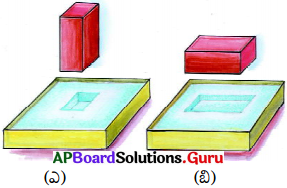
రెండు ట్రేలు తీసుకుని వాటిని పొడి సున్నంతో లేదా మెత్తని ఇసుకతో నింపండి. ఒకే ఆకారం, ఒకే ద్రవ్యరాశి గల రెండు ఇటుకలు తీసుకోండి. ప్రక్కపటంలో చూపిన విధంగా ఒక ఇటుకని మొదటి ట్రేలో నిలువుగా, రెండవ దానిని వేరొక ట్రేలో అడ్డంగా పెట్టండి. రెండు ఇటుకలు సున్నంలోకి ఒకే లోతుకి దిగాయా పరిశీలించి ఈ క్రింది ప్రశ్నలకు జవాబులు వ్రాయండి.
AP Board 8th Class Physical Science Solutions 1st Lesson బలం 30

ఎ) ఏ ట్రేలోని ఇటుక ఎక్కువ లోతు సున్నంలోకి దిగినది? కారణం ఏమిటి?
జవాబు:
మొదటి ట్రే (ఎ) లోని ఇటుక ఎక్కువ లోతు సున్నంలోకి దిగినది. కారణం, మొదటి ట్రేలో సున్నంపై తాకే నిలువుగా పెట్టిన ఇటుక యొక్క స్పర్శా వైశాల్యం తక్కువగా ఉండుట.

బి) ఏ ట్రేలోని ఇటుక తక్కువ లోతు సున్నంలోకి దిగినది? కారణం ఏమిటి?
జవాబు:
రెండవ ట్రే (బి) లోని ఇటుక తక్కువ లోతు సున్నంలోకి దిగినది. కారణం, రెండవ ట్రేలో సున్నంపై తాకే అడ్డంగా పెట్టిన ఇటుక యొక్క స్పర్శా వైశాల్యం ఎక్కువగా ఉండుట.

సి) ఈ కృత్యం వల్ల నీవు పరిశీలించినది ఏమిటి?
జవాబు:
ప్రయోగించిన బలం ఒకటే అయినప్పుడు తక్కువ స్పర్శా వైశాల్యం గల వస్తువు ఎక్కువ పీడనాన్ని కలుగజేస్తుంది.

AP SSC 10th Class Maths Solutions Chapter 1 Real Numbers Optional Exercise

AP State Board Syllabus AP SSC 10th Class Maths Textbook Solutions Chapter 1 Real Numbers Optional Exercise Textbook Questions and Answers.

AP State Syllabus SSC 10th Class Maths Solutions 1st Lesson Real Numbers Optional Exercise

10th Class Maths 1st Lesson Real Numbers Optional Exercise Textbook Questions and Answers

Question 1.
Can the number 6n, n being a natural number, end with the digit 5? Give reason.
Answer:
Given number = 6n ; n ∈ N
6n to be end in 5; it should be divisible by 5
6n = (2 × 3)n
The prime factors of 6n are 2 and 3.
It can’t end with the digit 5.

AP SSC 10th Class Maths Solutions Chapter 1 Real Numbers Optional Exercise

Question 2.
Is 7 × 5 × 3 × 2 + 3 a composite number? Justify your answer.
Answer:
Given:
7 × 5 × 3 × 2 + 3
= 3 (7 × 5 × 2 + 1)
= 3 × (70 + 1)
= 3 × 71
∴ The given number has two factors namely 3 and 71.
Hence it is a composite number.

Question 3.
Prove that (2√3 + √5 ) is an irrational number. Also check whether (2√3 + √5) (2√3 – √5) is rational or irrational.
Answer:
To prove:
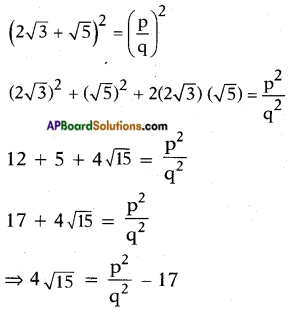
2√3 + √5 is an irrational number. On contrary, let us suppose that 2√3 + √5 be a rational number.
Then 2√3 + √5 = \(\frac{p}{q}\)
Squaring on both sides, we get
AP SSC 10th Class Maths Solutions Chapter 1 Real Numbers Optional Exercise 1
AP SSC 10th Class Maths Solutions Chapter 1 Real Numbers Optional Exercise 2
L.H.S = an irrational number.
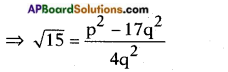
R.H.S = p, q being integers, \(\frac{p^{2}-17 q^{2}}{4 q^{2}}\) is a rational number.
This is a contradiction to the fact that √l5 is an irrational. This is due to our assumption that 2√3 + √5 is a rational. Hence our assumption is wrong and 2√3 + √5 is an irrational number. Also,
(2√3 + √5) (2√3 – √5)
= (2√3)2 – (√5)2
[∵ (a + b) (a – b) = a2 – b2]
= 4 × 3 – 5
= 12 – 5 = 7, a rational number.

AP SSC 10th Class Maths Solutions Chapter 1 Real Numbers Optional Exercise

Question 4.
If x2 + y2 = 6xy, prove that 2 log (x + y) = log x + log y + 3 log 2.
Answer:
Given: x2 + y2 = 6xy
x2 + y2 + 2xy = 6xy + 2xy
(x + y)2 = 8xy
Taking logarithms on both sides log (x + y)2 = log8xy
⇒ 2log(x + y)= log8 + logx + logy [∵ logxm = mlogx]
[∵ logxy = logx + logy]
= log23 + logx + logy
⇒ 2log(x + y) = logx + logy + 3log2

Question 5.
Find the number of digits in 42013, if log102 = 0.3010.
Answer:
Given:
log102 = 0.3010
42013 = (22)2013 = 24026
∴ log10 24026 = 4026 log102
[∵ log xm = m log x]
= 4026 × 0.3010 = 1211.826.
So 1211 + 1 = 1212
∴ 42013 has 1212 digits in its expansion.
(∵ characteristic 1211)

Inter 1st Year Maths 1A Trigonometric Ratios up to Transformations Solutions Ex 6(e)

Practicing the Intermediate 1st Year Maths 1A Textbook Solutions Inter 1st Year Maths 1A Trigonometric Ratios up to Transformations Solutions Exercise 6(e) will help students to clear their doubts quickly.

Intermediate 1st Year Maths 1A Trigonometric Ratios up to Transformations Solutions Exercise 6(e)

I.

Question 1.
Prove that sin 50° – sin70° + sin 10° = 0
Solution:
LHS = sin 50° – sin 70° + sin 10°
= 2 cos(\(\frac{50^{\circ}+70^{\circ}}{2}\)) . sin(\(\frac{50^{\circ}-70^{\circ}}{2}\)) + sin 10°
= 2 cos 60° . sin (-10°) + sin 10°
= 2(\(\frac{1}{2}\)) (-sin 10°) + sin 10°
= -sin 10° + sin 10°
= 0
= RHS
∴ sin 50° – sin 70° + sin 10° = 0

Inter 1st Year Maths 1A Trigonometric Ratios up to Transformations Solutions Ex 6(e)

Question 2.
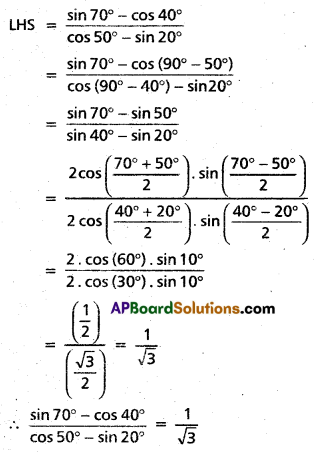
Prove that \(\frac{\sin 70^{\circ}-\cos 40^{\circ}}{\cos 50^{\circ}-\sin 20^{\circ}}=\frac{1}{\sqrt{3}}\)
Solution:
Inter 1st Year Maths 1A Trigonometric Ratios up to Transformations Solutions Ex 6(e) I Q2

Question 3.
Prove that cos 55° +cos 65° + cos 175° = 0
Solution:
LHS = cos 55° + cos 65° + cos 175°
= cos 65° + cos 55° + cos (180° – 5°)
= 2 cos(\(\frac{65^{\circ}+55^{\circ}}{2}\)) . cos(\(\frac{65^{\circ}-55^{\circ}}{2}\)) – cos 5°
= 2 cos (60°) . cos (5°) – cos 5°
= 2(\(\frac{1}{2}\)) cos 5° – cos 5°
= cos 5° – cos 5°
= 0
= RHS
∴ cos 55° + cos 65° + cos 175° = 0

Question 4.
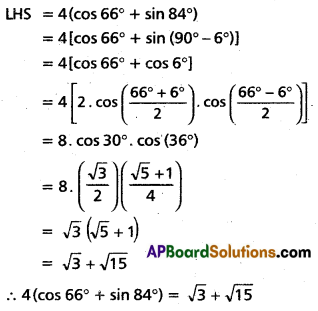
Prove that 4(cos 66° + sin 84°) = √3 + √15
Solution:
Inter 1st Year Maths 1A Trigonometric Ratios up to Transformations Solutions Ex 6(e) I Q4

Question 5.
Prove that cos 20° cos 40° – sin 5° sin 25° = \(\frac{\sqrt{3}+1}{4}\)
Solution:
cos 20° cos40° – sin 5° sin 25°
= \(\frac{1}{2}\) [2 cos 20° cos 40° – 2 sin 5° sin 25°]
= \(\frac{1}{2}\) [cos (20° + 40°) + cos (20° – 40°) – {cos (5° – 25°) – cos (5° + 25°)}]
= \(\frac{1}{2}\) [cos 60° + cos 20° – cos 20° + cos 30°]
= \(\frac{1}{2}\left[\frac{1}{2}+\frac{\sqrt{3}}{2}\right]\)
= \(\frac{\sqrt{3}+1}{4}\)
= RHS
∴ cos 20° cos 40° – sin 5° sin 25° = \(\frac{\sqrt{3}+1}{4}\)

Inter 1st Year Maths 1A Trigonometric Ratios up to Transformations Solutions Ex 6(e)

Question 6.
Prove that cos 48° . cos 12° = \(\frac{3+\sqrt{5}}{8}\)
Solution:
LHS = cos 48° . cos 12°
= \(\frac{1}{2}\) (2 cos 48°. cos 12°)
= \(\frac{1}{2}\) [cos (48° + 12°) + cos (48° – 12°)]
= \(\frac{1}{2}\) [cos 60° + cos 36°]
= \(\frac{1}{2}\left[\frac{1}{2}+\frac{\sqrt{5}+1}{4}\right]\)
= \(\frac{1}{2}\left[\frac{2+\sqrt{5}+1}{4}\right]\)
= \(\frac{3+\sqrt{5}}{8}\)
= RHS
∴ cos 48° . cos 12° = \(\frac{3+\sqrt{5}}{8}\)

II.

Question 1.
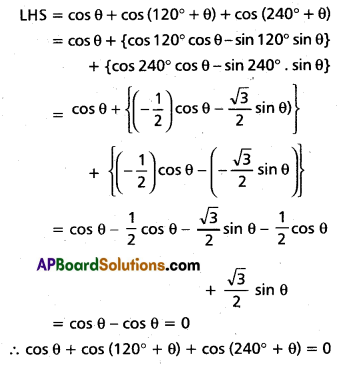
Prove that cos θ + cos[\(\frac{2 \pi}{3}\) + θ] + cos[\(\frac{4 \pi}{3}\) + θ] = 0
Solution:
Inter 1st Year Maths 1A Trigonometric Ratios up to Transformations Solutions Ex 6(e) II Q1

Question 2.
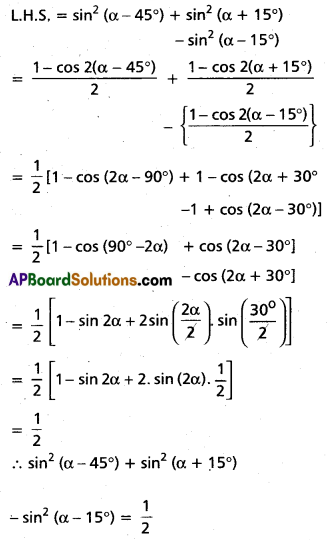
Prove that sin2(α – π/4) + sin2(α + π/2) – sin2(α – π/2) = \(\frac{1}{2}\)
Solution:
Inter 1st Year Maths 1A Trigonometric Ratios up to Transformations Solutions Ex 6(e) II Q2

Question 3.
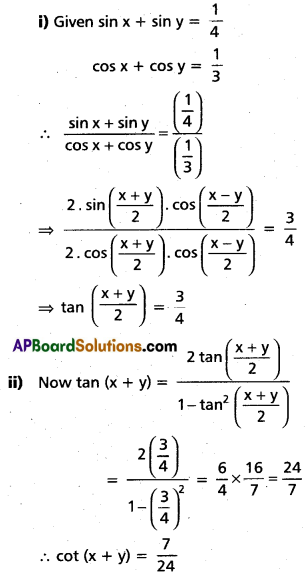
If sin x + sin y = \(\frac{1}{4}\) and cos x + cos y = \(\frac{1}{3}\), then show that
(i) \(\tan \left(\frac{x+y}{2}\right)=\frac{3}{4}\)
(ii) cot (x + y) = \(\frac{7}{24}\)
Solution:
Inter 1st Year Maths 1A Trigonometric Ratios up to Transformations Solutions Ex 6(e) II Q3

Question 4.
If neither [A – \(\frac{\pi}{12}\)] nor [A – \(\frac{5 \pi}{12}\)] is an integral multiple of π. Prove that cot(π/2 – A) + tan(π/12 + A) = \(\frac{4 \cos 2 A}{1-2 \sin 2 A}\)
Solution:
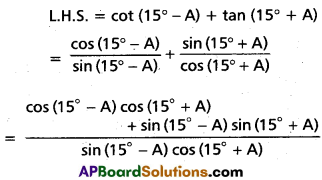
Inter 1st Year Maths 1A Trigonometric Ratios up to Transformations Solutions Ex 6(e) II Q4
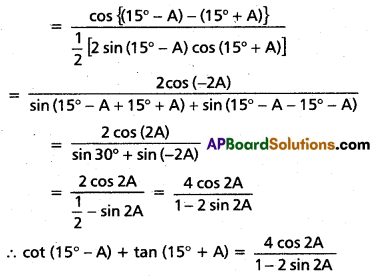
Inter 1st Year Maths 1A Trigonometric Ratios up to Transformations Solutions Ex 6(e) II Q4.1

Question 5.
Prove that 4 cos 12° cos 48° cos 72° = cos 36°.
Solution:
LHS = 4 cos 12° cas 48° cos 72°
= 2 cos 12° {2 cos 72° cos 48°}
= 2 cos 12° {cos (72° + 48°) + cos (72° – 48°)}
= 2 cos 12° {cos (120°) + cos 24°)
= 2 cos 12° {\(\frac{1}{2}\) + cos 24°}
= 2 cos 12° \(\left\{\frac{-1+2 \cos 24^{\circ}}{2}\right\}\)
= -cos 12° + 2 cos 24° cos 12°
= -cos 12° + {cos(24° + 12°) + cos (24° – 12°))
= -cos 12° + cos 36° + cos 12°
= cos 36°
= RHS
∴ 4 cos 12° cos 48° cos 72° = cos 36°

Inter 1st Year Maths 1A Trigonometric Ratios up to Transformations Solutions Ex 6(e)

Question 6.
Prove that sin 10° + sin 20° + sin 40° + sin 50° = sin 70° + sin 80°
Solution:
LH.S. = sin 10° + sin 20° + sin 40° + sin 50°
= (sin 50°+ sin 10°) + (sin 40° + sin 20°)
= 2 sin(\(\frac{50^{\circ}+10^{\circ}}{2}\)) . cos(\(\frac{50^{\circ}-10^{\circ}}{2}\)) + 2 sin(\(\frac{40^{\circ}+20^{\circ}}{2}\)) . cos(\(\frac{40^{\circ}-20^{\circ}}{2}\))
= 2 . sin (30°) . cos 20° + 2 sin 30° . cos 10°
= 2 sin 30° (cos 20° + cos 10°)
= 2(\(\frac{1}{2}\)) [cos(90° – 70°) + cos(90° – 80°)]
= sin 70° + sin 80°
= RHS
∴ sin 10° + sin 20° + sin 40° + sin 50° = sin 70° + sin 80°

III.

Question 1.
If cos x + cos y = \(\frac{4}{5}\) and cos x – cos y = \(\frac{2}{7}\) find the value of \(14 \tan \left(\frac{x-y}{2}\right)+5 \cot \left(\frac{x+y}{2}\right)\)
Solution:
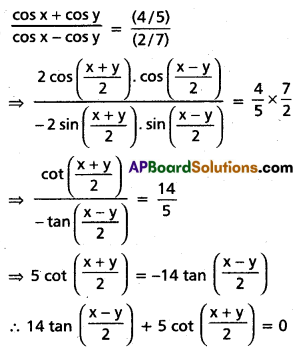
Inter 1st Year Maths 1A Trigonometric Ratios up to Transformations Solutions Ex 6(e) III Q1

Question 2.
If none of the denominators is zero, prove that
\(\left(\frac{\cos A+\cos B}{\sin A-\sin B}\right)^{n}+\left(\frac{\sin A+\sin B}{\cos A-\cos B}\right)^{n}\) = \(\begin{cases}2 \cot ^{n}\left(\frac{A-B}{2}\right), & \text { if } n \text { is even } \\ 0, & \text { if } n \text { is odd }\end{cases}\)
Solution:
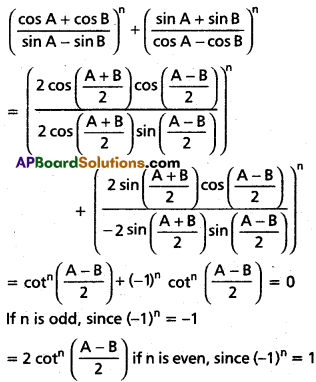
Inter 1st Year Maths 1A Trigonometric Ratios up to Transformations Solutions Ex 6(e) III Q2

Question 3.
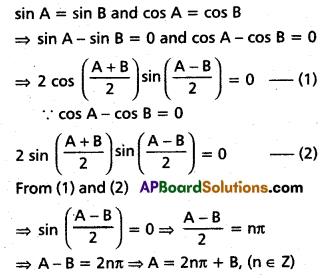
If sin A = sin B and cos A = cos B, then prove that A = 2nπ + B for some integer n.
Solution:
Inter 1st Year Maths 1A Trigonometric Ratios up to Transformations Solutions Ex 6(e) III Q3

Inter 1st Year Maths 1A Trigonometric Ratios up to Transformations Solutions Ex 6(e)

Question 4.
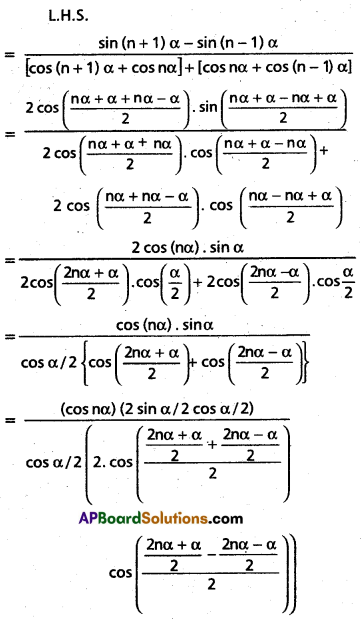
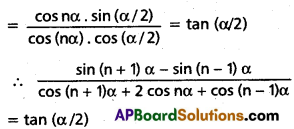
If cos nα ≠ 0 and cos \(\frac{\alpha}{2}\) ≠ 0. then show that \(\frac{\sin (n+1) \alpha-\sin (n-1) \alpha}{\cos (n+1) \alpha+2 \cos n \alpha+\cos (n-1) \alpha}\) = tan \(\frac{\alpha}{2}\)
Solution:
Inter 1st Year Maths 1A Trigonometric Ratios up to Transformations Solutions Ex 6(e) III Q4
Inter 1st Year Maths 1A Trigonometric Ratios up to Transformations Solutions Ex 6(e) III Q4.1

Question 5.
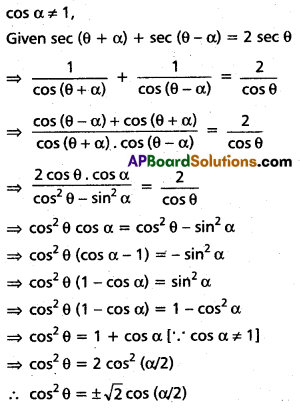
If sec (θ + α) + sec (θ – α) = 2 sec θ and cos α ≠ 1, then show that cos θ = ±√2 cos \(\frac{\alpha}{2}\).
Solution:
Inter 1st Year Maths 1A Trigonometric Ratios up to Transformations Solutions Ex 6(e) III Q5

Question 6.
If none of x, y, z is an odd multiple of \(\frac{\pi}{2}\) and if sin (y + z – x), sin (z + x – y), sin (x + y – z) are in A.P., then prove that tan x, tan y, tan z are also in A.P.
Solution:
sin (y + z – x), sin (z + x – y), sin (x + y – z) are in A.P.
⇒ sin (z + x – y) – sin (y + z – x) = sin (x + y – z) – sin (z + x – y)
⇒ 2 cos z sin (x – y) = 2 cos x sin (y – z)
⇒ cos z [sin x cos y – cos x sin y] = cos x [sin y cos z – cos y sin z]
Dividing with cos x cos y cos z, we get
\(\frac{\sin x}{\cos x}-\frac{\sin y}{\cos y}=\frac{\sin y}{\cos y}-\frac{\sin z}{\cos z}\)
⇒ tan x – tan y = tan y – tan z
⇒ tan x + tan z = 2 tan y
∴ tan x, tan y, tan z are in A.P.

Inter 1st Year Maths 1A Trigonometric Ratios up to Transformations Solutions Ex 6(e)

Question 7.
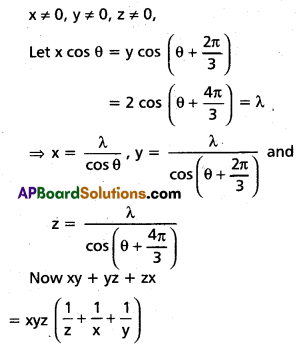
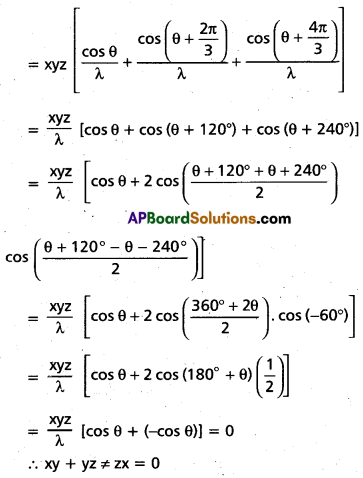
If x, y, z are non zero real numbers and if x cos θ = y cos (θ + \(\frac{2 \pi}{3}\)) = z cos (θ + \(\frac{2 \pi}{3}\)) for some θ ∈ R, then show that xy + yz + zx = 0.
Solution:
Inter 1st Year Maths 1A Trigonometric Ratios up to Transformations Solutions Ex 6(e) III Q7
Inter 1st Year Maths 1A Trigonometric Ratios up to Transformations Solutions Ex 6(e) III Q7.1

Question 8.
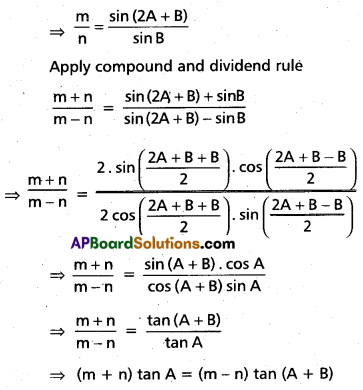
If neither A nor A + B is an odd multiple of \(\frac{\pi}{2}\) and if m sin B = n sin(2A + B), then prove that (m + n) tan A = (m – n) tan (A + B).
Solution:
Neither A nor (A + B) is an odd multiple of \(\frac{\pi}{2}\)
Given that m sin B = n sin (2A + B)
Inter 1st Year Maths 1A Trigonometric Ratios up to Transformations Solutions Ex 6(e) III Q8

Inter 1st Year Maths 1A Trigonometric Ratios up to Transformations Solutions Ex 6(e)

Question 9.
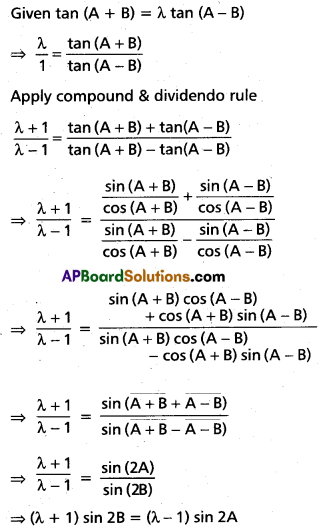
If tan (A + B) = λ tan (A – B), then show that (λ + 1) sin 2B = (λ – 1) sin 2A.
Solution:
Inter 1st Year Maths 1A Trigonometric Ratios up to Transformations Solutions Ex 6(e) III Q9

AP Board 7th Class Hindi Solutions 2nd Lesson होशियार कौआ

SCERT AP Board 7th Class Hindi Study Material 2nd Lesson होशियार कौआ Textbook Questions and Answers.

AP State Syllabus 7th Class Hindi 2nd Lesson Questions and Answers होशियार कौआ

7th Class Hindi 2nd Lesson होशियार कौआ Textbook Questions and Answers

सोचिए-बोलिए
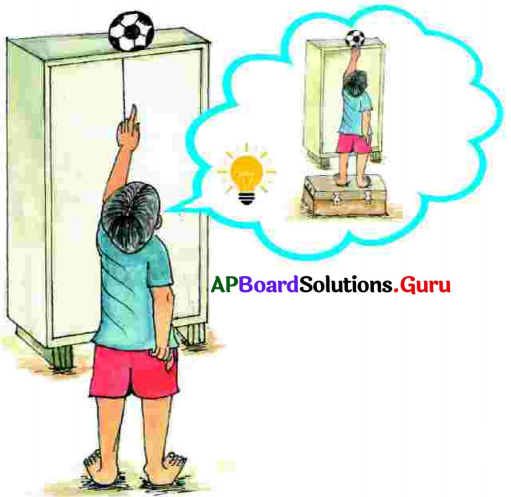
AP Board 7th Class Hindi Solutions 2nd Lesson होशियार कौआ 1

प्रश्न 1.
चित्र में क्या – क्या दिखाई दे रहे हैं? (చిత్రంలో ఏమేమి కన్పించుచున్నవి?)
उत्तर:
चित्र में एक बालक और एक अलमारी है। अलमारी के ऊपर एक गेंद है और बिजली का लट्ट दिखाई दे रहे हैं।
(చిత్రంలో ఒక బాలుడు మరియు ఒక అలమరా (బీరువా) ఉన్నాయి. అలమరాపై ఒక బంతి ఉంది మరియు ఒక బల్బు కనిపిస్తున్నవి.)

प्रश्न 2.
लड़का क्या कर रहा है? (బాలుడు ఏమి చేయుచున్నాడు?)
उत्तर:
लडका अलमारी पर रखे हुए गेंद को लेने का प्रयास कर रहा है। अलमारी ऊँची है। वह नीचा है। इसलिए वह उसे पकड नहीं सका। उसके मन में एक उपाय आया। वह एक संदूक लाकर उस पर खडे होकर गेंद को अलमारी की ऊपर से पाने की कोशिश कर रहा है।
(బాలుడు అలమారు (బీరువా) పైనున్న బంతిని తీసుకొనుటకు ప్రయత్నించుచుండెను. బీరువా ఎత్తైనది. అతడు పొట్టివాడు. అందువలన అతడు దానిని పట్టుకొనలేకపోవుచుండెను. అతని మనస్సులో ఒక ఉపాయం వచ్చెను. అతడు ఒక పెట్టెను తెచ్చి దానిపై నిలబడి బంతిని బీరువా పై నుండి తీసుకొను ప్రయత్నం చేయుచున్నాడు.)

Intext Questions Answers

प्रश्न 1.
लोमडी ने कौए से गाने के लिए क्यों कहा? (నక్క కాకితో పాట పాడమని ఎందుకు చెప్పెను?)
उत्तर:
कौए की चोंच में रोटी है । इसे देखकर लोमडी के मुँह में पानी भर आया। किसी न किसी प्रकार रोटी को लेना चाहा। लोमडी ने गाने के लिए इसलिए कहा कि यदि वह गायेगा तो उसके मुँह से रोटी नीचे गिर जाएगी।
(కాకి నోటిలో ఒక రొట్టె ఉన్నది. దానిని చూసి నక్క నోటిలో నీరు ఊరినది. నక్క ఏదో విధముగా కాకి నోటిలోని రొట్టెను తీసుకొనవలెనని అనుకున్నది. నక్క కాకితో పాడమని ఎందుకన్నదనగా కాకి పాడితే దాని నోటి నుండి రొట్టె క్రింద పడిపోతుంది. )

AP Board 7th Class Hindi Solutions 2nd Lesson होशियार कौआ

प्रश्न 2.
कौए ने रोटी को अपने पैरों के नीचे क्यों रख लिया? (కాకి రొట్టెను తన పాదముల క్రింద ఎందుకు ఉంచుకున్నది?)
उत्तर:
कौए ने रोटी को अपने पैरों के नीचे इसलिए रख लिया कि गाते समय उसके मुख से रोटी न गिरें।
(కాకి తన పాదముల క్రింద రొట్టెను ఎందువలన ఉంచుకున్నదనగా తను పాట పాడేటప్పుడు నోటి నుండి రొట్టె క్రింద పడకుండా ఉండుట కొరకు. )

Improve Your Learning

सुनिए-बोलिए

प्रश्न 1.
कुछ पक्षियों के नाम बताइए। ( కొన్ని పక్షుల పేర్లు చెప్పండి.)
उत्तर:
कौआ, तोता, कोयल, कबूतर, मोर और गैरय्या आदि कुछ पक्षियों के नाम हैं।
(కాకి, చిలుక, కోకిల, పావురము, నెమలి మరియు పిచ్చుక మొదలగునవి కొన్ని పక్షులు పేర్లు.)

प्रश्न 2.
लोमड़ी क्या पाना चाहती थी? (నక్క ఏమి పొందకోరుచున్నది?)
उत्तर:
लोमड़ी, कैए के मुँह से रोटी पाना चाहती थी।
(నక్క కాకి నోటిలోనున్న రొట్టెను పొందగోరుచున్నది.)

प्रश्न 3.
कौए ने लोमड़ी से कैसा व्यवहार किया? (కాకి నక్కతో ఎలా వ్యవహరించెను?)
उत्तर:
कौए ने लोमडी से सोच विचारकर विवेक और होशियारी से व्यवहार किया।
(కాకి నక్కతో బాగా ఆలోచించి వివేకంతో తెలివితో వ్యవహరించెను.)

पढ़िए

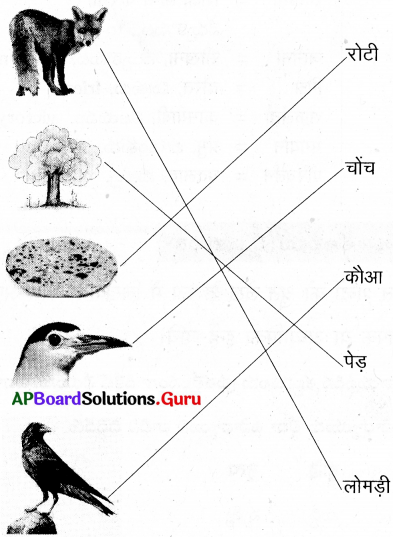
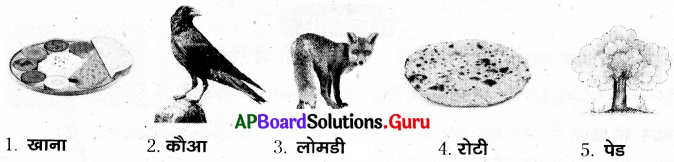
अ) चित्र से संबंधित शब्द जोड़िए।
AP Board 7th Class Hindi Solutions 2nd Lesson होशियार कौआ 2

आ) पाठ में वाक्यों के सही क्रम को पहचानकर क्रम संख्या कोष्ठक में लिखिए।

1. कौआ रोटी को निगल गया। [5]
2. लोमड़ी के मुँह में पानी भर आया। [ 1 ]
3. रोटी को अपने पैरों के नीचे रख लिया। [ 3 ]
4. मैं कामयाब नहीं हो सका। [ 4 ]
5. आपका गाना बहुत मधुर था। [ 2 ]

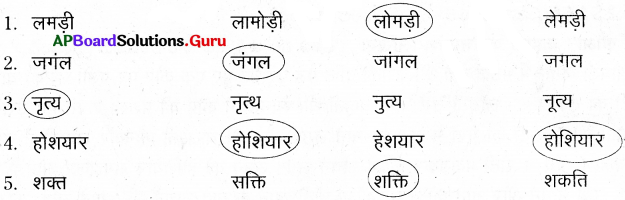
इ) सही वर्तनी वाले शब्दों पर गोला “O” बनाइए।

AP Board 7th Class Hindi Solutions 2nd Lesson होशियार कौआ 3

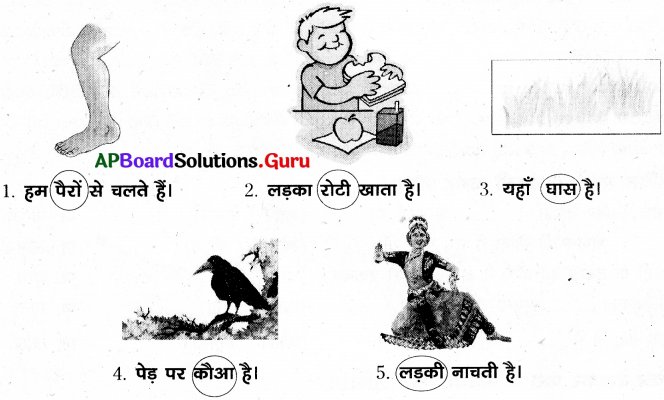
ई) नीचे दिए गए वाक्यों में चित्रों से संबंधित शब्दों पर गोला “O” बनाइए।

AP Board 7th Class Hindi Solutions 2nd Lesson होशियार कौआ 4

लिखिए

अ) नीचे दिये गये प्रश्नों के उत्तर छोटे – छोटे वाक्यों में लिखिए।
క్రింది ఇవ్వబడిన ప్రశ్నలకు సమాధానములు చిన్న – చిన్న వాక్యములలో ఇవ్వండి.

1. खाने की खोज में कौन घूम रहा था? (తిండి కోసం ఎవరు వెతుకుతూ తిరుగుచుండెను?)
उत्तर:
खाने की खोज में एक लोमडी घूम रही थी।
(తిండి కోసం ఒక నక్క వెతుకుతూ తిరుగుచుండెను.)

AP Board 7th Class Hindi Solutions 2nd Lesson होशियार कौआ

2. इस कहानी से क्या शिक्षा मिलती है? (ఈ కథ వలన మనకు ఏ ఉపదేశం లభించును?)
उत्तर:
इस कहानी से यह शिक्षा मिलती है कि – ” सोच विचार कर विवेक से काम करने पर व्यवहार में परिवर्तन आता है और बुद्धि का विकास होता है।
(ఈ కథ నుండి మనకు లభించు ఉపదేశం ఏమనగా .. “బాగా ఆలోచించి వివేకంతో పనిచేసినచో వ్యవహారంలో మార్పు వస్తుంది మరియు మన బుద్ధి వికసిస్తుంది. )

आ) नीचे दिये गये प्रश्न का उत्तर पाँच – छः वाक्यों में लिखिए।
క్రింది ఇవ్వబడిన ప్రశ్నకు సమాధానము 5- 6 వాక్యములలో వ్రాయండి

“होशियार कौआ” कहानी का सारांश लिखिए। (‘తెలివి గల కాకి’ కథ సారాంశమును వ్రాయండి.)
उत्तर:
एक भूखी लोमड़ी जंगल में भटक रही थी। उसकी दृष्टि पेड़ पर बैठे हुए एक कौए पर पड़ी। उसकी चोंच में एक रोटी का टुकड़ा था। लोमडी उसे पाना चाहती थी। लोमडी ने कौए की प्रशंसा करते हुए उससे गाने को कहा। कौआ रोटी को पैरों में दबाकर गाने लगा। कौए की चालाकी जानकर लोमड़ी ने उसे नाचने को कहा । चोंच में रोटी पकडकर कौआ नाचने लगा। अपने को होशियार समझकर लोमड़ी ने कौए से एक साथ नाचने और गाने को कहा। कौआ रोटी खाने के बाद नाचने और गाने लगा। कौआ लोमड़ी से भी चालाक था। लोमड़ी निराश होकर चली गयी।
(ఆకలిగొన్న ఒక నక్క అడవిలో తిరుగుచున్నది. దాని దృష్టి చెట్టుపై కూర్చున్న ఒక కాకిపై పడినది. దాని నోటిలో ఒక రొట్టె ముక్క ఉన్నది. నక్క దానిని పొందకోరెను. నక్క కాకిని పొగుడుతూ దానిని పాటపాడమనెను. కాకి రొట్టెను కాళ్ళ క్రింద అదిమి పెట్టుకుని పాట పాడుచుండెను. కాకి తెలివి తెలుసుకున్న నక్క దానిని నాట్యము చేయమనెను. అప్పుడు కాకి. రొట్టెను ముక్కుతో పట్టుకుని నాట్యము చేయసాగెను. తను తెలివి గలదానినని భావించి నక్క కాకితో ఒకేసారి పాట పాడుతూ నాట్యము చేయమనెను. కాకి రొట్టె తిని నాట్యము చేయుచు పాటపాడసాగెను. కాకి నక్క కంటే కూడా తెలివైనది. నక్క నిరాశతో వెళ్ళిపోయెను.)

इ) उचित शब्दों से खाली जगह भरिए।

1. लोमड़ी और कौआ ……….. में रहते थे। (शहर / जंगल)
उत्तर:
जंगल

2. ……… भोजन की खोज में घूम रही थी। (लोमड़ी / कौआ)
उत्तर:
लोमड़ी

3. रोटी के टुकडे को कौऐ ने अपनी … से पकडा। (चोंच / पंख)
उत्तर:
चोंच

4. मैं आपका …….. सुनना चाहती हूँ। (खाना / गाना)
उत्तर:
गाना

5. इस कहानी में ……….. होशियार निकला। (कौआ / लोमड़ी)
उत्तर:
कौआ

ई) चित्र देखकर पाठ से संबंधी शब्द लिखिए।
AP Board 7th Class Hindi Solutions 2nd Lesson होशियार कौआ 5

भाषांश

अ) अंत्याक्षरी विधि के अनुसार नीचे दिये गये शब्दों के आधार पर चार शब्द बनाइए।

1. कौआ – आम – मन – नल – लय

2. जंगल – ……………………………
उत्तर:
लगन – नभ – भवन – नाल

3. गाना – ………………………….
उत्तर:
नमक – कनक – कलम – मजा

4. होशियार – …………………………
उत्तर:
राग – गगन – नर – रात

5. पाँच – ……………………………….
उत्तर:
चावल – लदना – नाक – कान

AP Board 7th Class Hindi Solutions 2nd Lesson होशियार कौआ

आ) पर्यायवाची शब्द लिखिए।

मीठा – रसीला, पाँव – चरण, वन – कानन, तलाश-ढूँढना, बुद्धिमान – अकलमंद

1. पैर – पाँव – चरण

2. होशियार – …………., ……………..
उत्तर:
बुद्धिमान, अकलमंद

3. जंगल – …………., ……………..
उत्तर:
वन, कानन

4. मधुर – …………., ……………..
उत्तर:
मीठा, रसीला

5. खोज – …………., ……………..
उत्तर:
तलाश, ढूँढना

सृजनात्मकता

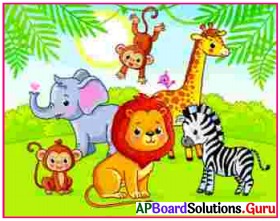
अ) चित्र देखकर शब्द लिखिए।
AP Board 7th Class Hindi Solutions 2nd Lesson होशियार कौआ 6
1. बंदर
उत्तर:
2. हाथी
3. चिड़िया
4. जिराफ़
5. शेर
6. जेबरा

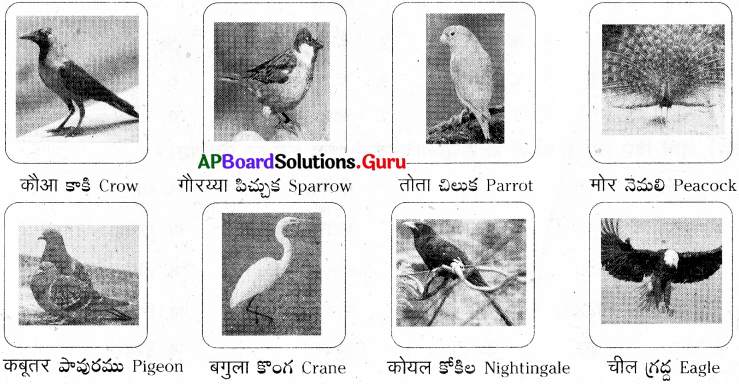
आ) परियोजना कार्य :

कुछ पक्षियों के चित्र संग्रहित करके उनके नाम लिखिए।
AP Board 7th Class Hindi Solutions 2nd Lesson होशियार कौआ 7

इ) अनुवाद कीजिए।

1. मैं पाठशाला जाता हूँ।
उत्तर:
నేను పాఠశాల(బడి)కి వెళతాను.

2. तुम्हारा नाम क्या है?
उत्तर:
నీ పేరు ఏమిటి?

3. मुझे हिंदी पसंद है।
उत्तर:
నాకు హిందీ ఇష్టము.

4. आप पाठ पढ़िए।
उत्तर:
తమరు పాఠం చదవండి.

5. मेरा भारत महान है।
उत्तर:
నా భారతదేశం గొప్పది.

व्याकरणांश

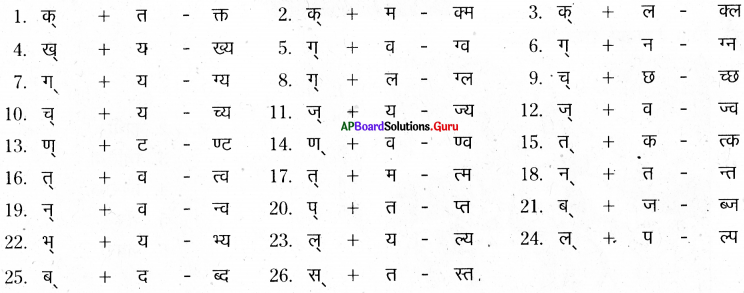
संयुक्ताक्षर

AP Board 7th Class Hindi Solutions 2nd Lesson होशियार कौआ 8

AP Board 7th Class Hindi Solutions 2nd Lesson होशियार कौआ

अ) सीखने के लिए और कुछ अभ्यास :

AP Board 7th Class Hindi Solutions 2nd Lesson होशियार कौआ 9

1. मृ = म् + ऋ
2. दृ = द् + ऋ
3. श्र = श् + र
4. ष्ट = ष् + ट
5. ग्न = ग् + न
6. स्त = स् + त

आ) नीचे दिए गए शब्दों में से संयुक्ताक्षरवाले शब्द चुनकर लिखिए।
AP Board 7th Class Hindi Solutions 2nd Lesson होशियार कौआ 10

अध्यापकों के लिए सूचना : ఉపాధ్యాయులకు సూచన :

होशियारी से संबंधित एक और रचना का बच्चों को परिचय दीजिए। (తెలివికి సంబంధించిన మరొక రచనను పిల్లలకు పరిచయం చేయండి.)
उत्तर:
होशियार लोमडी

एक बार एक सिंह गंभीर रूप से बीमार हो गया। वह जंगल के सभी जानवरों का राजा था। अतः जंगल के सभी जानवर झुंड बनाकर उसका हालचाल पूछने आए। केवल एक लोमडी नहीं आई।

यह भेडिये के लिए सुनहरा अवसर था। वह लोमडी का शत्रु था। भेडिया सिंह से बोला – हे महराज! आपकी प्रजा के दिल में आपके लिए इतना प्रेम है कि हर जानवर आपके स्वास्थ्य की कामना कर रहा है। किसी भी जानव ने प्रातःकाल से कुछ भी खाया – पिया नहीं है। मगर लोमडी ही एक ऐसी है जो कहीं नज़र नहीं आ रही है।

यह सुनकर सिंह बहुत क्रोधित हो गया। उसने लोमडी को बुलवा भेजा। लोमडी को सिंह के दरबार में हाजिर कर दिया गया। ”बदतमीज़ लोमडी !” सिंह गुस्से से गरजा – ”अपनी गैर हाज़िरी का कारण बयान करो।’ लोमडी ने भेडिया को तिरछी नजरों और कुटिलता से मुस्कराते देख लिया था। वह सारी बात समझ गई और बिना एक क्षण की भी देर किए बोली – “मालिक ऐसा नहीं है, मुझे आपकी बीमारी के बारे में पूरी सूचना है। मैं तो किसी ऐसे डॉक्टर की तलाश कर रही हूँ, जो आपको शीघ्र स्वस्थ कर दे और आपको दोबारा शक्तिशाली बना दे और मैं सचमुच एक ऐसे डॉक्टर से मिल चुकी हूँ, जिसने बताया है कि अगर आप शीघ्र स्वस्थ होना चाहते हैं तो एक भेडिया को मारकर उसकी गरम खाल अपने शरीर पर लपेट ले।

यह सुनते ही सिंह, भेडिये की ओर मुडा। भेडिया अपने जीवनदान के लिए सिंह से भीख माँगता लेकिन सिंह उस पर टूट पड़ा और उसे मार डाला।

नीति : ईर्ष्या की आग स्वयं को जला देती है।

पाठ का सारांश

एक भूखी लोमड़ी जंगल में भटक रही थी। उसकी दृष्टि पेड़ पर बैठे हुए एक कौए पर पड़ी। उसकी चोंच में एक रोटी का टुकड़ा था। लोमडी उसे पाना चाहती थी। लोमडी ने कौए की प्रशंसा करते हुए उससे गाने को कहा। कौआ रोटी को पैरों में दबाकर गाने लगा। कौए की चालाकी जानकर लोमड़ी ने उसे नाचने को कहा । चोंच में रोटी पकडकर कौआ नाचने लगा। अपने को होशियार समझकर लोमड़ी ने कौए से एक साथ नाचने और गाने को कहा। कौआ रोटी खाने के बाद नाचने और गाने लगा। कौआ लोमड़ी से भी चालाक था। लोमड़ी निराश होकर चली गयी।

పాఠ్య సారాంశం

ఆకలిగొన్న ఒక నక్క అడవిలో తిరుగుచున్నది. దాని దృష్టి చెట్టుపై కూర్చున్న ఒక కాకిపై పడినది. దాని నోటిలో ఒక రొట్టె ముక్క ఉన్నది. నక్క దానిని పొందకోరెను. నక్క కాకిని పొగుడుతూ దానిని పాటపాడమనెను. కాకి రొట్టెను కాళ్ళ క్రింద అదిమి పెట్టుకుని పాటపాడుచుండెను. కాకి తెలివి తెలుసుకున్న నక్క దానిని నాట్యము చేయమనెను. అప్పుడు కాకి రొట్టెను ముక్కుతో పట్టుకుని నాట్యము చేయసాగెను. తను తెలివిగలదని భావించి నక్క కాకితో ఒకేసారి పాట పాడుతూ నాట్యము చేయమనెను. కాకి రొట్టె తిని నాట్యము చేయుచు పాట పాడసాగెను. కాకి నక్క కంటే కూడా తెలివైనది. నక్క నిరాశతో వెళ్ళిపోయెను.

Summary

A hungry fox was roaming in a forest. A crow perched on the branch of a tree caught his attention. The crow had a piece of bread in his beak. The fox wanted to have it. He started praising the crow wanted him to sing a song. The crow put the piece of bread under his claws and started singing. Realising the cleverness of the crow, the fox wanted him to dance. Then the crow held the piece of bread in his beak and started dancing. The fox assumed the crow to be wise, wanted him to dance and sing at a time. The crow ate the piece of bread and sang while dancing. The crow was wiser than the fox. The fox was disappointed and went away.

व्याकरणांश (వ్యాకరణాంశాలు)

लिंग बदलिए (లింగములను మార్చండి)

दादा – दादी
भाई – बहन
कौआ – मादा कौआ
बूढ़ा – बूढ़ी
लोमडी – लोमडा
काका – काकी
मामा – मामी
चाचा – चाची
कवि – कवयित्री
बकरा – बकरी
मुर्गा – मुर्गी
गाय – बैल

AP Board 7th Class Hindi Solutions 2nd Lesson होशियार कौआ

वचन बदलिए (వచనములను మార్చండి)

समस्या – समस्याएँ
सफलता – सफलताएँ
कहानी – कहानियाँ
रोटी – रोटियाँ
पैर – पैर
टुकडा – टुकडे
पेड – पेड
मित्र – मित्र
मै – हम
यह – ये
वह – वे
प्रेरणा – प्रेरणाएँ

विलोम शब्द (వ్యతిరేక పదములు)

विवेक × अविवेक
सफलता × असफलता
होशियार × अकलमंद
बैठना × उठना
सुनना × बोलना
अच्छा × बुरा
एक × अनेक
पुरानी × नयी
नीचे × ऊँचे
कल्पित × यथार्थ
पकडना × छोडना
बड़ा × छोटा
हाँ × नहीं
मधुर × कडुआ
सफल × असफल/विफल
जन्म × मरण
विकास × अविकास
प्रशंसा × निंदा

AP Board 7th Class Hindi Solutions 2nd Lesson होशियार कौआ

शब्दार्थ (అర్థాలు) (Meanings)

जंगल = वन, అడవి, forest
शक्ति = ताकत, శక్తి, power
खोज = ढूँढना, వెదుకుట, search
भैया = भाई, సోదరుడు, brother
चुराना = चोरी करना, దొంగలించుట, snatch
पैर = पाँव, పాదములు, legs
मधुर = मीठा, తీయని, sweet
होशियार = बुद्धिमान, తెలివి గల, clever
घूमना = टहलना, తిరుగుట, walking
पेड़ = वृक्ष, చెట్టు, tree
पुराना = प्राचीन, పాత, old
गौर से = ध्यान से, జాగ్రత్తగా, carefully
दिमाग = मस्तिष्क, మెదడు, mind
छीनना = जबरदस्ती से ले लेना, లాగుకొనుట, snatch
सीखना = शिक्षा प्राप्त करना, నేర్చుకొనుట, to learn
जानना = सीखना, నేర్చుకొనుట, to learn
मित्र = दोस्त, మిత్రుడు, friend
सफ़लता = कामयाबी, విజయము, victory
भगवान = प्रभु, భగవంతుడు, The God
परिवर्तन = बदलाव, మార్పు, change

AP SSC 10th Class Maths Solutions Chapter 1 Real Numbers Ex 1.5

AP State Board Syllabus AP SSC 10th Class Maths Textbook Solutions Chapter 1 Real Numbers Ex 1.5 Textbook Questions and Answers.

AP State Syllabus SSC 10th Class Maths Solutions 1st Lesson Real Numbers Exercise 1.5

10th Class Maths 1st Lesson Real Numbers Ex 1.5 Textbook Questions and Answers

Question 1.
Determine the values of the following,
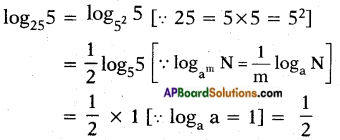
i) log255
Answer:
AP SSC 10th Class Maths Solutions Chapter 1 Real Numbers Ex 1.5 1

AP SSC 10th Class Maths Solutions Chapter 1 Real Numbers Ex 1.5

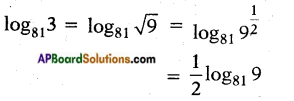
ii) log813
Answer:
AP SSC 10th Class Maths Solutions Chapter 1 Real Numbers Ex 1.5 2
AP SSC 10th Class Maths Solutions Chapter 1 Real Numbers Ex 1.5 3

iii) log2(\(\frac{1}{16}\))
Answer:
AP SSC 10th Class Maths Solutions Chapter 1 Real Numbers Ex 1.5 4

iv) log71
Answer:
log71 = log770 = 0 log77 = 0

AP SSC 10th Class Maths Solutions Chapter 1 Real Numbers Ex 1.5

v) logx√x
Answer:
AP SSC 10th Class Maths Solutions Chapter 1 Real Numbers Ex 1.5 5

vi) log2512
Answer:
log2512 = log229    [∵ 512 = 29]
= 9log22   [∵ log xm = m log x]
= 9 × 1    [∵ logaa = 1]
= 9

vii) log100.01
Answer:
AP SSC 10th Class Maths Solutions Chapter 1 Real Numbers Ex 1.5 6

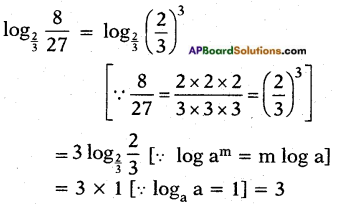
viii) \(\log _{\frac{2}{3}}\left(\frac{8}{27}\right)\)
Answer:
AP SSC 10th Class Maths Solutions Chapter 1 Real Numbers Ex 1.5 7

ix) \(2^{2+\log _{2} 3}\)
Answer:
\(2^{2+\log _{2} 3}\) = 22 . \(2^{\log _{2} 3}\)   [∵ am . an = am+n]
= 4 × 3 [∵ \(\log _{\mathrm{a}} \mathrm{N}\) = N]
= 12

AP SSC 10th Class Maths Solutions Chapter 1 Real Numbers Ex 1.5

Question 2.
Write the following expressions as log N and find their values.
i) log 2 + log 5
Answer:
log 2 + log 5
= log 2 × 5   [∵ log m + log n = log mn]
= log 10
= 1

ii) log2 16 – log2 2
Answer:
AP SSC 10th Class Maths Solutions Chapter 1 Real Numbers Ex 1.5 8

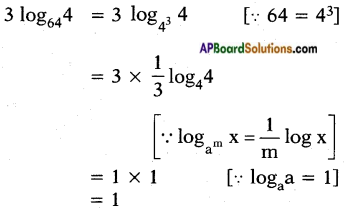
iii) 3 log644
Answer:
AP SSC 10th Class Maths Solutions Chapter 1 Real Numbers Ex 1.5 9

iv) 2 log 3 – 3 log 2
Answer:
2 log 3 – 3 log 2
= log 32 – log 23
= log 9 – log 8
= log \(\frac{9}{8}\)

v) log 10 + 2 log 3 – log 2
Answer:
log 10 + 2 log 3 – log 2
= log 10 + log 32 – log 2
= log 10 + log 9 – log 2    [∵ m log a = log am]
= log \(\frac{10 \times 9}{2}\)    [∵ log a + log b = log ab; log a – log b = log \(\frac{a}{b}\)]
= log 45

AP SSC 10th Class Maths Solutions Chapter 1 Real Numbers Ex 1.5

Question 3.
Evaluate each of the following in terms of x and y, if it is given x = log23 and y = log2 5.
i) log215
Answer:
log215 = log2 3 × 5
= log23 + log25   [∵ log mn = log m + log n]
= x + y

ii) log27.5
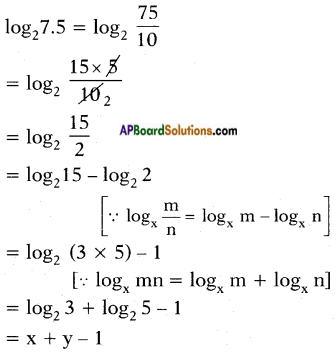
Answer:
AP SSC 10th Class Maths Solutions Chapter 1 Real Numbers Ex 1.5 10

iii) log260
Answer:
log260 = log222 × 3 × 5
= log222 + log23 + log25
= 2 log22 + x + y
= 2 + x + y

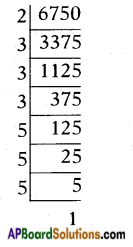
iv) log26750
Answer:
AP SSC 10th Class Maths Solutions Chapter 1 Real Numbers Ex 1.5 11
log26750
= log22 × 33 × 53
= log22 + log233 + log253
= 1 + 3 log23 + 3 log25
= 1 + 3x + 3y

AP SSC 10th Class Maths Solutions Chapter 1 Real Numbers Ex 1.5

Question 4.
Expand the following,
i) log 1000
Answer:
log 1000 = log 103
= 3 log 10
= 3 × 1
= 3

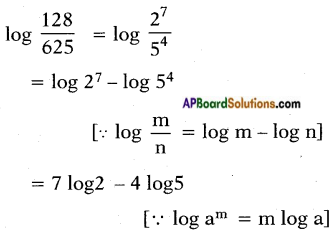
ii) \(\log \left[\frac{128}{625}\right]\)
Answer:
AP SSC 10th Class Maths Solutions Chapter 1 Real Numbers Ex 1.5 12

iii) log x2y3z4
Answer:
log x2y3z4 = logx2 + logy3 + logz4 [∵ log ab = log a + log b]
= 2 log x + 3 log y + 4 log z
[∵ log am = m log a]

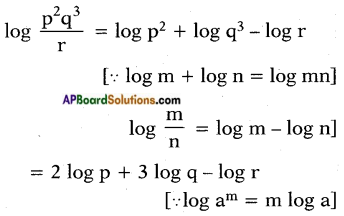
iv) \(\log \frac{\mathbf{p}^{2} \mathbf{q}^{3}}{\mathbf{r}}\)
Answer:
AP SSC 10th Class Maths Solutions Chapter 1 Real Numbers Ex 1.5 13

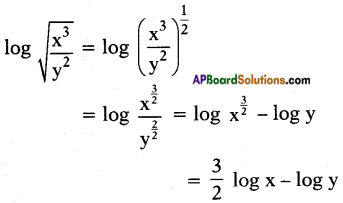
iv) \(\log \sqrt{\frac{x^{3}}{y^{2}}}\)
Answer:
AP SSC 10th Class Maths Solutions Chapter 1 Real Numbers Ex 1.5 14

AP SSC 10th Class Maths Solutions Chapter 1 Real Numbers Ex 1.5

Question 5.
If x2 + y2 = 25xy, then prove that 2 log (x + y) = 3log3 + logx + logy.
Answer:
Given: x2 + y2 = 25xy
We know that (x + y)2 = x2 + y2 + 2xy
= 25xy + 2xy    [∵ x2 + y2 = 25xy given]
(x + y)2 = 27xy
Taking ‘log’ on both sides
log (x + y)2 = log 27xy
2 log (x + y) = log 27 + log x + log y
= log 33 + log x + log y
⇒ 2 log (x + y) = 3log3 + log x + log y

Question 6.
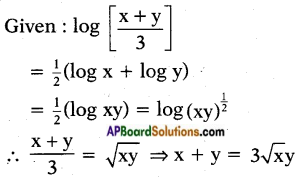
If \(\log \left(\frac{\mathbf{x}+\mathbf{y}}{3}\right)\) = \(\frac{1}{2}\) (log x + log y), then find the value of \(\frac{x}{y}+\frac{y}{x}\).
Answer:
AP SSC 10th Class Maths Solutions Chapter 1 Real Numbers Ex 1.5 15
(squaring on both sides)
⇒ (x + y)2 = (3√xy)2
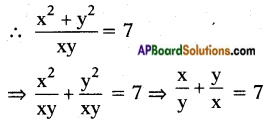
⇒ x2 + y2 + 2xy = 9xy
⇒ x2 + y2 = 9xy – 2xy = 7xy
AP SSC 10th Class Maths Solutions Chapter 1 Real Numbers Ex 1.5 16

Question 7.
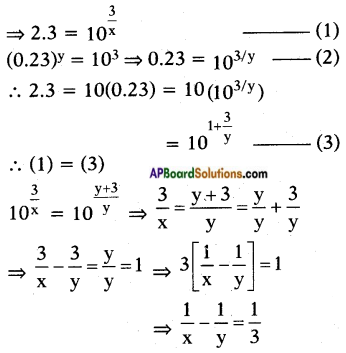
If (2.3)x = (0.23)y = 1000 then find the value of \(\frac{1}{x}-\frac{1}{y}\).
Answer:
Given (2.3)x = (0.23)y = 1000 = 103
AP SSC 10th Class Maths Solutions Chapter 1 Real Numbers Ex 1.5 17

AP SSC 10th Class Maths Solutions Chapter 1 Real Numbers Ex 1.5

Question 8.
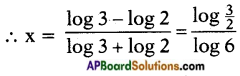
If 2x+1 = 31-x then find the value of x.
Answer:
Given: 2x+1 = 31-x
log 2x+1 = log 31-x
(x + 1) log 2 = (1 – x) log 3
x log 2 + log 2 = log 3 – x log 3
x log 2 + x log 3 = log 3 – log 2
x (log 3 + log 2) = log 3 – log 2
AP SSC 10th Class Maths Solutions Chapter 1 Real Numbers Ex 1.5 18

Question 9.
Is
i) log 2 is rational or irrational? Justify your answer.
Answer:
Let log102 = x
Then 10x = 2
But 2 can’t be written as 10x for any value of x
∴ log 2 is irrational.

ii) log 100 is rational or irrational? Justify your answer.
Answer:
Let log10100 = x
⇒ log10102 = x
⇒ 2 log1010 = x = 2
∴ log 100 is rational.
∴ log 100 = 2
Hence rational.

AP SSC 10th Class Maths Solutions Chapter 1 Real Numbers Ex 1.3

AP State Board Syllabus AP SSC 10th Class Maths Textbook Solutions Chapter 1 Real Numbers Ex 1.3 Textbook Questions and Answers.

AP State Syllabus SSC 10th Class Maths Solutions 1st Lesson Real Numbers Exercise 1.3

10th Class Maths 1st Lesson Real Numbers Ex 1.3 Textbook Questions

Question 1.
Write the following rational numbers in their decimal form and also state which are terminating and which have non-terminating repeating decimals.
i) \(\frac{3}{8}\)
ii) \(\frac{229}{400}\)
iii) 4\(\frac{1}{5}\)
iv) \(\frac{2}{11}\)
v) \(\frac{8}{125}\)
Answer:
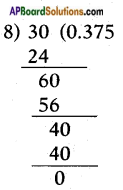
i) \(\frac{3}{8}\)
AP SSC 10th Class Maths Solutions Chapter 1 Real Numbers Ex 1.3 1
[!! Denominator 8 = 23, consists of only 2’s. Hence a terminating decimal.]
∴ \(\frac{3}{8}\) = 0.375 is a terminating decimal.

AP SSC 10th Class Maths Solutions Chapter 1 Real Numbers Ex 1.3

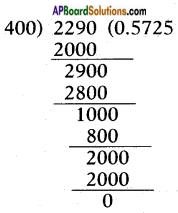
ii) \(\frac{229}{400}\)
AP SSC 10th Class Maths Solutions Chapter 1 Real Numbers Ex 1.3 2
[!! Denominator 400 = 24 × 52 = 2n × 5m. Hence a terminating decimal.]
∴ \(\frac{229}{400}\) = 0.5725 is a terminating decimal.

iii) 4\(\frac{1}{5}\)
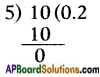
4\(\frac{1}{5}\) = 4 + \(\frac{1}{5}\)
AP SSC 10th Class Maths Solutions Chapter 1 Real Numbers Ex 1.3 3
[!! Denominator is 5. Hence a terminating decimal.]
∴ 4\(\frac{1}{5}\) = 4.2 is a terminating decimal.

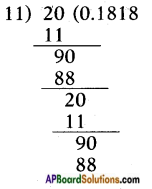
iv) \(\frac{2}{11}\)
AP SSC 10th Class Maths Solutions Chapter 1 Real Numbers Ex 1.3 4
[!! Denominator is not of the form 2m × 5n. Hence a non-terminating repeating decimal.]
∴ \(\frac{2}{11}\) = \(0 . \overline{18}\) is a non terminating, repeating decimal.

AP SSC 10th Class Maths Solutions Chapter 1 Real Numbers Ex 1.3

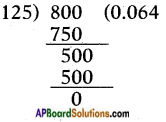
v) \(\frac{8}{125}\)
AP SSC 10th Class Maths Solutions Chapter 1 Real Numbers Ex 1.3 5
[!! Denominator 125 = 53. Hence a terminating decimal.]
∴ \(\frac{8}{125}\) = 0.064 is a terminating decimal.

Question 2.
Without performing division, state whether the following rational numbers will have a terminating decimal form or a non-terminating, repeating decimal form.
i) \(\frac{13}{3125}\)
ii) \(\frac{11}{12}\)
iii) \(\frac{64}{455}\)
iv) \(\frac{15}{1600}\)
v) \(\frac{29}{343}\)
vi) \(\frac{23}{2^{3} \cdot 5^{2}}\)
vii) \(\frac{129}{2^{2} \cdot 5^{7} \cdot 7^{5}}\)
viii) \(\frac{9}{15}\)
iX) \(\frac{36}{100}\)
X) \(\frac{77}{210}\)
Answer:
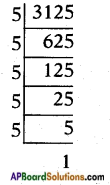
i) \(\frac{13}{3125}\)
Note: We check whether the denominator is of the form 2n . 5m or not? If yes, the rational number can be expressed as a terminating decimal. If not, it can’t be expressed as a terminating decimal.
AP SSC 10th Class Maths Solutions Chapter 1 Real Numbers Ex 1.3 6
[!! Denominator is of the form 2m × 5n. Hence a terminating decimal.]
3125 = 55
∴ \(\frac{13}{3125}\) is a terminating decimal.

ii) \(\frac{11}{12}\)
The denominator 12 is not a factor of 11. Moreover 12 = 22 × 3.
[!! Denominator is not of the form 2m × 5n.]
∴ \(\frac{11}{12}\) is a non terminating, repeating decimal.

AP SSC 10th Class Maths Solutions Chapter 1 Real Numbers Ex 1.3

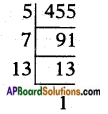
iii) \(\frac{64}{455}\)
AP SSC 10th Class Maths Solutions Chapter 1 Real Numbers Ex 1.3 7
[!! Denominator is not of the form 2m × 5n. Hence a non terminating decimal.]
∴ 455 = 5 × 7 × 13
Hence\(\frac{64}{455}\) is a non terminating, repeating decimal.

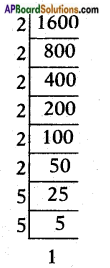
iv) \(\frac{15}{1600}\)
AP SSC 10th Class Maths Solutions Chapter 1 Real Numbers Ex 1.3 8
∴ 1600 = 26 × 52 [∵ The denominator is of the form 2n . 5m]
Hence \(\frac{15}{1600}\) is a terminating decimal.

v) \(\frac{29}{343}\)
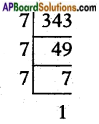
AP SSC 10th Class Maths Solutions Chapter 1 Real Numbers Ex 1.3 9
343 = 73 [Not of the form 2n . 5m]
∴ \(\frac{29}{343}\) is a non terminating, repeating decimal.

vi) \(\frac{23}{2^{3} \cdot 5^{2}}\)
\(\frac{23}{2^{3} \cdot 5^{2}}\) is a terminating decimal.
[∵ The denominator is of the form 2n . 5m]

vii) \(\frac{129}{2^{2} \cdot 5^{7} \cdot 7^{5}}\)
\(\frac{129}{2^{2} \cdot 5^{7} \cdot 7^{5}}\) is a non terminating, repeating decimal.

viii) \(\frac{9}{15}\)
\(\frac{9}{15}\) = \(\frac{3}{5}\)
Denominator is of the form 2n . 5m.
∴ \(\frac{9}{15}\) = \(\frac{3}{5}\) is a terminating decimal.

ix) \(\frac{36}{100}\)
100 = 22 × 52 is of the form 2n . 5m
Hence \(\frac{36}{100}\) is a terminating decimal.

AP SSC 10th Class Maths Solutions Chapter 1 Real Numbers Ex 1.3

x) \(\frac{77}{210}\)
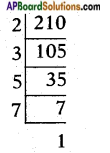
AP SSC 10th Class Maths Solutions Chapter 1 Real Numbers Ex 1.3 10
210 = 2 × 3 × 5 × 7 is not of the form 2n . 5m
Given fraction has a non-terminating, repeating decimal expansion.

Question 3.
Write the following rationals in decimal form using Theorem 1.4.
i) \(\frac{13}{25}\)
ii) \(\frac{15}{16}\)
iii) \(\frac{23}{2^{3} \cdot 5^{2}}\)
iv) \(\frac{7218}{3^{2} \cdot 5^{2}}\)
v) \(\frac{143}{110}\)
Answer:
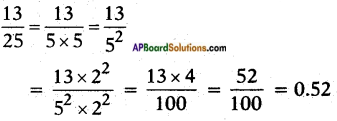
i) \(\frac{13}{25}\)
AP SSC 10th Class Maths Solutions Chapter 1 Real Numbers Ex 1.3 11

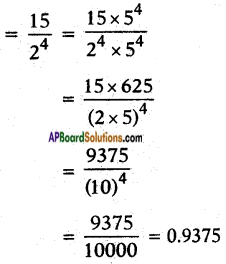
ii) \(\frac{15}{16}\)
\(\frac{15}{16}\) = \(\frac{15}{2 \times 2 \times 2 \times 2}\)
AP SSC 10th Class Maths Solutions Chapter 1 Real Numbers Ex 1.3 12

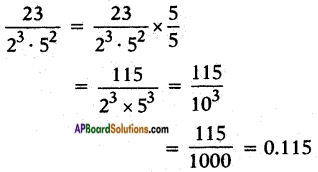
iii) \(\frac{23}{2^{3} \cdot 5^{2}}\)
AP SSC 10th Class Maths Solutions Chapter 1 Real Numbers Ex 1.3 13

AP SSC 10th Class Maths Solutions Chapter 1 Real Numbers Ex 1.3

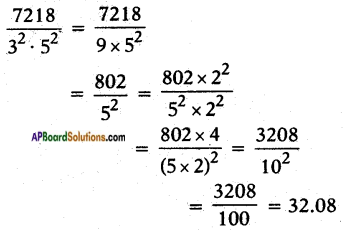
iv) \(\frac{7218}{3^{2} \cdot 5^{2}}\)
AP SSC 10th Class Maths Solutions Chapter 1 Real Numbers Ex 1.3 14

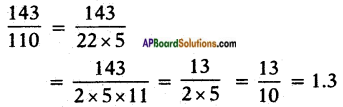
v) \(\frac{143}{110}\)
AP SSC 10th Class Maths Solutions Chapter 1 Real Numbers Ex 1.3 15

Question 4.
The decimal form of some real numbers are given below. In each case, decide whether the number is rational or not. If it is rational, and expressed in form p/q, what can you say about the prime factors of q?
i) 43.12345678?
ii) 0.120120012000120000 ……….
iii) \(43 . \overline{123456789}\)
Answer:
i) 43.123456789
The given decimal expansion is terminating. Hence it is a rational number and the denominator q is of the form 2n . 5m.

AP SSC 10th Class Maths Solutions Chapter 1 Real Numbers Ex 1.3

ii) 0.120120012000120000 …………
The given decimal expansion is neither terminating nor repeating.
Hence it is not a rational number. It represents an irrational number.

iii) \(43 . \overline{123456789}\)
The given real number is a repeating decimal with period 123456789. Hence it is a rational number.

AP SSC 10th Class Maths Solutions Chapter 1 Real Numbers Ex 1.4

AP State Board Syllabus AP SSC 10th Class Maths Textbook Solutions Chapter 1 Real Numbers Ex 1.4 Textbook Questions and Answers.

AP State Syllabus SSC 10th Class Maths Solutions 1st Lesson Real Numbers Exercise 1.4

10th Class Maths 1st Lesson Real Numbers Ex 1.4 Textbook Questions and Answers

Question 1.
Prove that the following are irrational,
i) \(\frac{1}{\sqrt{2}}\)
ii) √3 + √5
iii) 6 + √2
iv) √5
v) 3 + 2√5
Answer:
i) \(\frac{1}{\sqrt{2}}\)
On the contrary, suppose that is a \(\frac{1}{\sqrt{2}}\) rational number;
then \(\frac{1}{\sqrt{2}}\) is of the form where \(\frac{p}{q}\) and q are integers.
∴ \(\frac{1}{\sqrt{2}}\) = \(\frac{p}{q}\)
⇒ \(\frac{\sqrt{2}}{1}\) = \(\frac{q}{p}\)
(i.e.,) √2 is a rational number and it is a contradiction. This contradiction arised due to our supposition that \(\frac{1}{\sqrt{2}}\) is a rational number.
Hence \(\frac{1}{\sqrt{2}}\) is an irrational number.

AP SSC 10th Class Maths Solutions Chapter 1 Real Numbers Ex 1.4

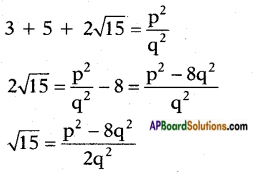
ii) Suppose √3 + √5 is not an irrational number.
Then √3 + √5 must be a rational number.
√3 + √5 = \(\frac{p}{q}\), q ≠ 0 and p, q ∈ Z
Squaring on both sides
AP SSC 10th Class Maths Solutions Chapter 1 Real Numbers Ex 1.4 1
but √15 is an irrational number.
\(\frac{p^{2}-8 q^{2}}{2 q^{2}}\) is a rational number
(p2 – 8q2, 2q2 ∈ Z, 2q2 ≠ 0)
but an irrational number can’t be equal to a rational number, so our supposition that √3 + √5 is not an irrational number is false.
∴ √3 + √5 is an irrational number.

iii) 6 + √2
To prove: 6 + √2 is an irrational number.
Let us suppose that 6 + √2 is a rational number.
∴ 6 + √2 = \(\frac{p}{q}\), q ≠ 0
⇒ √2 = \(\frac{p}{q}\) – 6
⇒ √2 = Difference of two rational numbers
⇒ √2 = rational number But this contradicts the fact that √2 is an irrational number.
∴ Our supposition is wrong.
Hence the given statement is true.
6 + √2 is an irrational number.

iv) √5
To prove: √5 is an irrational number.
On the contrary, let us assume that √5 is a rational number.
∴ √5 = \(\frac{p}{q}\), q ≠ 0
If p, q have a common factor, on cancelling the common factor let it be
reduces to \(\frac{a}{b}\) where a, b are co-primes.
Now √5 = \(\frac{a}{b}\), where HCF (a, b) = 1
Squaring on both sides we get
⇒ (√5)2 = \(\left(\frac{a}{b}\right)^{2}\)
⇒ 5 = \(\frac{\mathrm{a}^{2}}{\mathrm{~b}^{2}}\)
⇒ 5b2 = a2
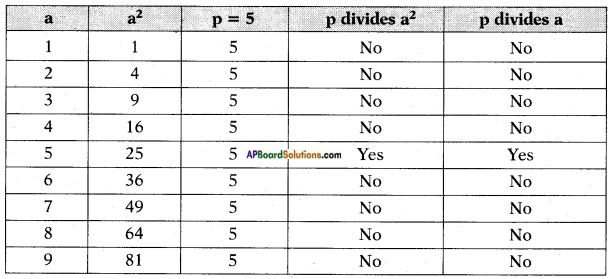
⇒ 5 divides a2 and thereby 5 divides 5
Now, take a = 5c
then, a2 = 25c2
i.e., 5b2 = 25c2
⇒ b2 = 5c2
⇒ 5 divides b2 and thereby b.
⇒ 5 divides both b and a.
This contradicts that a and b are co-primes.
This contradiction arised due to our assumption that √5 is a rational number.
Hence our assumption is wrong and the given statement is true, i.e., √5 is an irrational number,

AP SSC 10th Class Maths Solutions Chapter 1 Real Numbers Ex 1.4

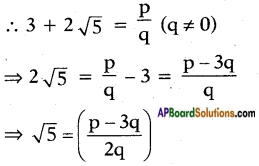
v) 3 + 2√5
To Prove: 3 + 2√5 is an irrational.
On the contrary, let us assume that 3 + 2√5 is a rational number.
AP SSC 10th Class Maths Solutions Chapter 1 Real Numbers Ex 1.4 2
Here p, q being integers we can say that \(\frac{p-3q}{2q}\) is a rational number.
This contradicts the fact that √5 is an irrational number. This is due to our assumption “3 + 2√5 is a rational number”.
Hence our assumption is wrong.
∴ 3 + 2√5 is an irrational number.

Question 2.
Prove that √p + √q is an irrational, where p, q are primes.
Answer:
Given that p, q are primes.
Hence fp and fq are irrationals.
[∵ p, q have no factors other than 1 ∵ they are primes.]
Now √p + √q = sum of two irrational numbers = an irrational number
Hence proved.

AP SSC 10th Class Maths Solutions Chapter 1 Real Numbers InText Questions

AP State Syllabus SSC 10th Class Maths Solutions 1st Lesson Real Numbers InText Questions

AP State Board Syllabus AP SSC 10th Class Maths Textbook Solutions Chapter 1 Real Numbers InText Questions and Answers.

10th Class Maths 1st Lesson Real Numbers InText Questions and Answers

Do this

Question 1.
Find q and r for the following pairs of positive integers a and b, satisfying a = bq + r. (Page No. 3)
i) a = 13, b = 3
Answer:
13 = 3 × 4 + 1
here q = 4 ; r = 1
ii) a = 8, b = 80
Answer:
Take a = 80, b = 8
80 = 8 × 10 + 0 here q = 10 ; r = 0
iii) a = 125, b = 5
Answer:
125 = 5 × 25 + 0
here q = 25 ; r = 0
iv) a = 132, b = 11
Answer:
132 = 11 × 12 + 0
here q = 12 ; r = 0

AP SSC 10th Class Maths Solutions Chapter 1 Real Numbers InText Questions

Question 2.
Find the HCF of the following by using Euclid division lemma,
i) 50 and 70 (Page No. 4)
Answer:
For given two positive integers a > b;
there exists unique pair of integers q and r satisfying a = bq + r; 0≤r<b.
∴ 70 = 50 × 1 + 20
Here a = 70, b = 50, q = 1, r = 20.
Now consider 50, 20
50 = 20 × 2 + 10
Here a = 50, b = 20, q = 2, r = 10.
Now taking 20 and 10.
20 = 10 × 2 + 0
Here the remainder is zero.
∴ 10 is the HCF of 70 and 50.

ii) 96 and 72
Answer:
96 = 72 × 1 + 24
72 = 24 × 3 + 0
∴ HCF = 24

iii) 300 and 550
Answer:
550 = 300 × 1 + 250
300 = 250 × 1 + 50
250 = 50 × 5 + 0
∴ HCF = 50

iv) 1860 and 2015
Answer:
2015 = 1860 × 1 + 155
1860 = 155 × 12 + 0
∴ HCF = 155

AP SSC 10th Class Maths Solutions Chapter 1 Real Numbers InText Questions

Think & Discuss

Question 1.
From the above questions in ‘DO THIS’, what is the nature of q and r? (Page No. 3)
Answer:
Given: a = bq + r
q > 0 and r lies in between 0 and b
i.e. q > 0 and 0 ≤ r < b

Question 2.
Can you find the HCF of 1.2 and 0.12? Justify your answer. (Page No. 4)
Answer:
Given: 1.2 and 0.12
we have 1.2 = \(\frac{12}{10}\) = \(\frac{120}{100}\)
0.12 = \(\frac{12}{100}\)
Now considering the numerators 12 and 120, their HCF is 12.
∴ HCF of 1.2 and 0.12 is \(\frac{12}{100}\) = 0.12
i.e., if x is a factor of y then x is the HCF of x and y.

Question 3.
If r = 0, then what is the relationship between a, b and q in a = bq + r of Euclid divison lemma? (Page No. 6)
Answer:
Given: r = 0 in a = bq + r then a = bq
i.e., b divides a completely.
i.e., b is a factor of a.

AP SSC 10th Class Maths Solutions Chapter 1 Real Numbers InText Questions

Do this

Question 1.
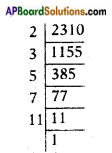
Express 2310 as a product of prime factors. Also see how your friends have factorized the number. Have they done it as you ? Verify your final product with your friend’s result. Try this for 3 or 4 more numbers. What do you conclude? (Page No. 7)
Answer:
Given: 2310
2310 = 2 × 1155
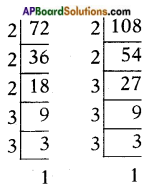
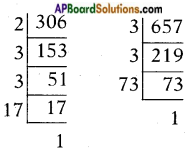
= 2 × 3 × 385
= 2 × 3 × 5 × 77
2310 = 2 × 3 × 5 × 7 × 11
AP SSC 10th Class Maths Chapter 1 Real Numbers InText Questions 1
We notice that this prime factorization is unique.
And also notice that prime factorization of any number is unique i.e., every composite number can be expressed as a product of primes and this factorization is unique.
E.g: 144 = 2 × 72
= 2 × 2 × 36
= 2 × 2 × 2 × 18
= 2 × 2 × 2 × 2 × 9
= 2 × 2 × 2 × 2 × 3 × 3
= 24 × 32
320 = 2 × 160
= 2 × 2 × 80
= 2 × 2 × 2 × 40
= 2 × 2 × 2 × 2 × 20
= 2 × 2 × 2 × 2 × 2 × 10
= 2 × 2 × 2 × 2 × 2 × 2 × 5
= 26 × 5
125 = 5 × 25
= 5 × 5 × 5
= 53

Question 2.
Find the HCF and LCM of the following given pairs of numbers by prime factorization, (Page No. 8)
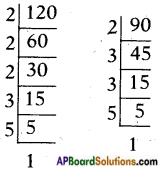
i) 120, 90
Answer:
We have 120 = 2 × 2 × 2 × 3 × 5
= 23 × 3 × 5
90 = 2 × 3 × 3 × 5
= 2 × 32 × 5
AP SSC 10th Class Maths Chapter 1 Real Numbers InText Questions 2
∴ HCF = 2 × 3 × 5 = 30
LCM = 2<sup>3</sup> × 3<sup>2</sup> × 5 = 360

ii) 50, 60
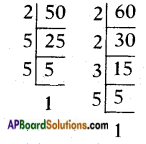
Answer:
We have
50 = 2 × 5 × 5 = 2 × 52
60 = 2 × 2 × 3 × 5 = 22 × 3 × 5
AP SSC 10th Class Maths Chapter 1 Real Numbers InText Questions 3
∴ HCF = 2 × 5 = 10
LCM = 22 × 3 × 52 = 300

iii) 37, 49
Answer:
We have
37 = 1 × 37
49 = 7 × 7 = 72
∴ HCF = 1
LCM = 37 × 72
Note: H.C.F. of two relatively prime numbers is 1 and LCM is equal to product of the numbers.

AP SSC 10th Class Maths Solutions Chapter 1 Real Numbers InText Questions

Try this

Question 1.
Show that 3n × 4m cannot end with the digit 0 or 5 for any natural numbers ‘n’ and’m’. (Page No. 8)
Answer:
Given number is 34 × 4m.
So the prime factors to it are 3 and 2 only.
I: but if a number want to be end with zero it should have 2 and 5 as its prime factors, but the given hasn’t ‘5’ as its prime factor.
So it cannot be end with zero.
II : now if a number went to be end with 5 it should have ‘5’ as its one of prime factors. But given 3n × 4m do not have 5 as a factor.
So it cannot be end with 5.
Hence proved.

Do this

Question 1.
Write the following terminating decimals in the form of p/q, q ≠ 0 and p, q are co-primes.
i) 15.265
ii) 0.1255
iii) 0.4
iv) 23.34
v) 1215.8
What can you conclude about the denominators through this process? (Page No. 10)
Answer:
i) 15.265
AP SSC 10th Class Maths Chapter 1 Real Numbers InText Questions 4
ii) 0.1255
AP SSC 10th Class Maths Chapter 1 Real Numbers InText Questions 5
iii) 0.4
0.4 = \(\frac{4}{10}\) = \(\frac{2}{5}\)
iv) 23.34
AP SSC 10th Class Maths Chapter 1 Real Numbers InText Questions 6
v) 1215.8
AP SSC 10th Class Maths Chapter 1 Real Numbers InText Questions 7
Two and five are the factors for the denominator.

AP SSC 10th Class Maths Solutions Chapter 1 Real Numbers InText Questions

Question 2.
Write the following rational numbers in the form of p/q, where q is of the form 2n.5m where n, m are non-negative integers and then write the numbers in their decimal form. (Page No. 11)
i) \(\frac{3}{4}\)
ii) \(\frac{7}{25}\)
iii) \(\frac{51}{64}\)
iv) \(\frac{14}{25}\)
v) \(\frac{80}{100}\)
Answer:
i) \(\frac{3}{4}\)
\(\frac{3}{4}\) = \(\frac{3}{2 \times 2}\) = \(\frac{3}{2^{2}}\)
AP SSC 10th Class Maths Chapter 1 Real Numbers InText Questions 8
Decimal form of \(\frac{3}{4}\) = 0.75

ii) \(\frac{7}{25}\)
\(\frac{7}{25}\) = \(\frac{7}{5 \times 5}\) = \(\frac{7}{5^{2}}\)
AP SSC 10th Class Maths Chapter 1 Real Numbers InText Questions 9
Decimal form of \(\frac{7}{25}\) = 0.28

iii) \(\frac{51}{64}\)
\(\frac{51}{64}\) = \(\frac{51}{2^{6}}\)
[∵ 64 = 2 × 32
= 22 × 16
= 23 × 8
= 24 × 4 = 25 × 2 = 26]
AP SSC 10th Class Maths Chapter 1 Real Numbers InText Questions 10
Decimal form of \(\frac{51}{64}\) = 0.796875

iv) \(\frac{14}{25}\)
AP SSC 10th Class Maths Chapter 1 Real Numbers InText Questions 11

v) \(\frac{80}{100}\)
\(\frac{80}{100}\) = \(\frac{80}{2^{2} \times 5^{2}}\) = \(\frac{80}{10^{2}}\) = 0.80

AP SSC 10th Class Maths Solutions Chapter 1 Real Numbers InText Questions

Question 3.
Write the following rational numbers as decimal form and find out the block of repeating digits in the quotient. (Page No. 11)
i) \(\frac{1}{3}\)
ii) \(\frac{2}{7}\)
iii) \(\frac{5}{11}\)
iv) \(\frac{10}{13}\)
Answer:
i) \(\frac{1}{3}\)
\(\frac{1}{3}\) = 0.3333…. = \(0 . \overline{3}\)
Block of digits, repeating in the quotient = period = 3.

ii) \(\frac{2}{7}\)
Decimal form of \(\frac{2}{7}\) = 0.285714….
Repeating part/period = 285714
∴ \(\frac{2}{7}\) = \(0 . \overline{285714}\)

iii) \(\frac{5}{11}\)
Period = 45
Decimal form of \(\frac{5}{11}\) = 0.454545.
= \(0 . \overline{45}\)

iv) \(\frac{10}{13}\)
Decimal form of \(\frac{10}{13}\) = 0.769230.
= \(0 . \overline{769230}\)
Period = 769230

Do this

Question 1.
Verify the statement proved above for p = 2, p = 5 and for a2 = 1, 4, 9, 25, 36, 49, 64 and 81. (Page No. 14)
Answer:
AP SSC 10th Class Maths Chapter 1 Real Numbers InText Questions 16
AP SSC 10th Class Maths Chapter 1 Real Numbers InText Questions 17
From the above we can conclude that if a prime number ‘p’ divides a2, then it also divides a.

AP SSC 10th Class Maths Solutions Chapter 1 Real Numbers InText Questions

Think and Discuss

Question 1.
Write the nature of y, a and x in y = ax. Can you determine the value of x for a given y? Justify your answer. (Page No. 17)
Answer:
y = ax here a ≠ 0
We can determine the value of ‘x’ for a given y.
for example y = 5, a = 2
We cannot express y = ax for y = 5, a = 2 and for y = 7, a = 3, we cannot express seven (7) as a power of 3.

Question 2.
You know that 21 = 2, 41 = 4, 81 = 8 and 101 = 10. What do you notice about the values of log2 2, log4 4, log8 8 and log10 10? What can you generalise from this?  (Page No. 18)
Answer:
From the graph log2 2 = log4 4 = log8 8 = log10 10 = 1
We conclude that loga a = 1 where a is a natural number.

Question 3.
Does log10 0 exist? (Page No. 18)
Answer:
No, log10 0 doesn’t exist, i.e ax ≠ 0 ∀ a, x ∈ N.

Question 4.
We know that, if 7 = 2x then x = log2 7. Then what is the value of \(2^{\log _{2} 7}\)? Justify your answer. Generalise the above by taking some more examples for \(\mathbf{a}^{\log _{\mathrm{a}} \mathbf{N}}\). (Page No. 21)
Answer:
We know that if 7 = 2x then x = log2 7
We want to find the value of \(2^{\log _{2} 7}\);
Now put log2 7 = x in the given
∴ \(2^{\log _{2} 7}\) = 2x = 7 (given)
∴ \(2^{\log _{2} 7}\) = 7
Thus \(\mathbf{a}^{\log _{\mathrm{a}} \mathbf{N}}\) = N

a) \(3^{\log _{3} 8}\)
Answer:
If x = \(3^{\log _{3} 8}\) then
log3 x = log3 8
⇒ x = 8

b) \(5^{\log _{5} 10}\)
Answer:
If y = \(5^{\log _{5} 10}\)
then log5 y = log5 10
⇒ y = 10

Do this

Question 1.
Write the powers to which the bases to be raised in the following.  (Page No. 18)
i) 64 = 2x
Answer:
64 = 2x
We know that
64 = 2 × 32
= 2 × 2 × 16
= 2 × 2 × 2 × 8
= 2 × 2 × 2 × 2 × 4
= 2 × 2 × 2 × 2 × 2 × 2
64 = 26
⇒ x = 6

AP SSC 10th Class Maths Solutions Chapter 1 Real Numbers InText Questions

ii) 100 = 5b
Answer:
Here also 100 cannot be written as any power of 5.
i.e., there exists no integer for b such that 5b = 100

iii) \(\frac{1}{81}\) = 3c
Answer:
We know that 81 = 3 x 27
= 3 × 3 × 9
= 3 × 3 × 3 × 3
= 34
∴ \(\frac{1}{81}\) = 3-4   [∵ a-m = \(\frac{1}{\mathrm{a}^{\mathrm{m}}}\)]
∴ c = – 4

iv) 100 = 10z
Answer:
100 = 102
z = 2

v) \(\frac{1}{256}\) = 4a
Answer:
We know that 256 = 4 × 64
= 4 × 4 × 16
= 4 × 4 × 4 × 4
∴ \(\frac{1}{256}\) = 4-4
∴ a = – 4

Question 2.
Express the logarithms of the following into sum of the logarithms.   (Page No. 19)
i) 35 × 46
Answer:
log xy = log x + log y
log1035 × 46 = log1035 + log1046

ii) 235 × 437
Answer:
log10235 × 437 = log10235 + log10437   [∵ log xy = log x + log y]

iii) 2437 × 3568
Answer:
log10 2437 × 3568 = log102437 + log103568   [∵ log xy = log x + log y]

Question 3.
Express the logarithms of the follow¬ing into difference of the logarithms.   (Page No. 20)
i) \(\frac{23}{34}\)
Answer:
log10 = \(\frac{23}{34}\) = log10 23 – log10 34
[∵ log \(\frac{x}{y}\) = log x – log y]

ii) \(\frac{373}{275}\)
Answer:
log10 = \(\frac{373}{275}\) = log10 373 – log10 275
[∵ log \(\frac{x}{y}\) = log x – log y]

iii) \(\frac{4525}{3734}\)
Answer:
log10 = \(\frac{4525}{3734}\) = log10 4525 – log10 3734
[∵ log \(\frac{x}{y}\) = log x – log y]

iv) \(\frac{5055}{3303}\)
Answer:
log10 = \(\frac{5055}{3303}\) = log10 5055 – log10 3303
[∵ log \(\frac{x}{y}\) = log x – log y]

AP SSC 10th Class Maths Solutions Chapter 1 Real Numbers InText Questions

Question 4.
By using the formula logaxn = n loga x, convert the following.   (Page No. 21)
i) log2 725
Answer:
log2 725 = 25 log2 7

ii) log5 850
Answer:
log5 850 = 50 log5 8 = 50 log5 23
= 3 × 50 log52 = 150 log52

iii) log 523
Answer:
log 523 = 23 log 5

iv) log 1024
Answer:
log 1024 = log 210 [∵ 1024 = 210]
= 10 log 2

Try this

Question 1.
Write the following relation in exponential form and find the values of respective variables.   (Page No. 18)
i) log232 = x
Answer:
log232 = x
⇒ log225 = x     [∵ 32 = 25]
⇒ 5 log22 = x     [∵ log am = m log a]
⇒ 5 × 1 = x      [∵ loga a = 1]
∴ x = 5

ii) log5625 = y
Answer:
log5625 = y
⇒ log54 = y    [∵ 625 = 54]
⇒ 4 log5 5 = y     [∵ log am = m log a]
⇒ 4 × 1 = y     [∵ loga a = 1]
∴ y = 4

AP SSC 10th Class Maths Solutions Chapter 1 Real Numbers InText Questions

iii) log1010000 = z
Answer:
log1010000 = z
=> log10104 = z     [∵ 10000 = 10 × 10 × 10 × 10 = 104]
=> 4 log1010 = z     [∵ log am = m log a]
=> 4 × 1 = z     [∵ loga a = 1]
∴ z = 4

iv) \(\log _{7} \frac{1}{343}\) = -a
Answer:
AP SSC 10th Class Maths Chapter 1 Real Numbers InText Questions 18

Question 2.
i) Find the value of log232. (Page No. 21)
Answer:
log2 32 = log2 25
[∵ 32 = 2 × 2 × 2 × 2 × 2 = 25]
= 5 log2 2 [∵ log am = m log a]
= 5 × 1 [∵ loga a = 1]
= 5

ii) Find the value of logc √c.
Answer:
AP SSC 10th Class Maths Chapter 1 Real Numbers InText Questions 19
= \(\frac{1}{2}\) × 1 [∵ loga a = 1]
= \(\frac{1}{2}\)

AP SSC 10th Class Maths Solutions Chapter 1 Real Numbers InText Questions

iii) Find the value of log100.001
Answer:
AP SSC 10th Class Maths Chapter 1 Real Numbers InText Questions 20

iv) Find the value of \(\log _{\frac{2}{3}} \frac{8}{27}\)
Answer:
AP SSC 10th Class Maths Chapter 1 Real Numbers InText Questions 21

AP Board 6th Class Maths Solutions Chapter 11 Perimeter and Area InText Questions

AP State Syllabus AP Board 6th Class Maths Solutions Chapter 11 Perimeter and Area InText Questions and Answers.

AP State Syllabus 6th Class Maths Solutions 11th Lesson Perimeter and Area InText Questions

AP Board 6th Class Maths Solutions Chapter 11 Perimeter and Area InText Questions

Check Your Progress (Pg.No. 147)

Question 1.
Find the perimeters of the given figures.
AP Board 6th Class Maths Solutions Chapter 11 Perimeter and Area InText Questions 1
In the above figures (I) and (ii), find the perimeter of ΔKLM, ΔKMN and □ KLMN.
(a) Compare the perimeters of ΔKLM and □ KLMN
Compare the perimeters of ΔKMN and □ KLMN.
What can you say? –
Solution:
i) In ΔKLM, given KL = 2cm; LM = 2.6 cm; MK = 3.8 cm
Perimeter of ΔKLM = KL + LM + MK
= 2 + 2.6 + 3.8
= 8.4 cm

AP Board 6th Class Maths Solutions Chapter 11 Perimeter and Area InText Questions

In ΔKMN, given KM = 3.8 cm; MN = 2cm; KN = 2.6 cm
Perimeter of ΔKMN = KM + MN + KN
= 3.8 + 2 + 2.6 = 8.4 cm

ii) In □ KLMN, given KL = 2cm, LM = 2.6cm, MN = 2cm and KN = 2.6 cm
Perimeter of □ KLMN = KL + LM + MN + KN = 2 + 2.6 + 2 + 2.6 = 9.2 cm

a) By comparing the perimeter of ΔKLM and □ KLMN
8.4 cm < 9.2 cm
∴ Perimeter of ΔKLM < Perimeter of □ KLMN
By comparing the perimeter of ΔKMN and □ KLMN
8.4 cm < 9.2 cm
∴ Perimeter of ΔKMN < Perimeter of □ KLMN.
By comparing the perimeters of triangle with quadrilateral ‘
Perimeter of the triangle is always less than the perimeter of quadrilateral.

Let’s Explore (Pg.No. 150)

Question 1.
If the radius of a circle is doubled, then, what is the change in its circumference?
Solution:
If the radius is r, then its circumference of the circle is 2πr.
If radius is doubled means r = 2r (new)
Write r = 2r in 2πr.
Then, the circumference = 2π x 2r
= 4πr = 2.27πr
Circumference is doubled.
So, if the radius of a circle is doubled, then the circumference is also doubled.

Question 2.
If the radius is halved, then, what is the change in its circumference?
Solution:
If the radius is r, then its circumference of the circle is 2πr.
If radius is halved means r = \(\frac{\mathbf{r}}{2}\) (new)
Write r = \(\frac{\mathbf{r}}{2}\) in 2πr.
Then, the circumference = 2π x \(\frac{r}{2}=\frac{1}{2}\). 2πr
Circumference is halved.
So if the radius of a circle is halved, then the circumference is also halved.

AP Board 6th Class Maths Solutions Chapter 11 Perimeter and Area InText Questions

Check Your Progress (Page No. 151)

Question 1.
Find the area of a square with side 16 cm.
Solution:
Given side of the square (s) = 16 cm
Area of the square A = s x s = 16 x 16 = 256 sq.cm

Question 2.
Length and breadth of a rectangle are 16 cm and 12 cm respectively. Find its area.
Solution:
Given length of the rectangle l = 16 cm
breadth of the rectangle b = 12 cm
Area of the rectangle A = l x b = 16 x 12 = 192 sq.cm

Let’s Think (Page No. 151)

Question 1.
Find the perimeter and area of a square of side 4 cm. Are these same? Give some examples to support your answer.
Solution:
AP Board 6th Class Maths Solutions Chapter 11 Perimeter and Area InText Questions 2

AP Board 6th Class Maths Solutions Chapter 11 Perimeter and Area InText Questions

From the above table,
If side is 4 cm, then only its perimeter and areas are equal.
In other cases perimeter and areas are not same.

AP 10th Class Social Important Questions Chapter 3 ఉత్పత్తి, ఉపాధి

These AP 10th Class Social Studies Important Questions 3rd Lesson ఉత్పత్తి, ఉపాధి will help students prepare well for the exams.

AP Board 10th Class Social 3rd Lesson Important Questions and Answers ఉత్పత్తి, ఉపాధి

10th Class Social 3rd Lesson ½ Mark Important Questions and Answers in Telugu Medium

1. ఉత్పత్తి అయిన అంత్య వస్తువుల, సేవల మార్కెటు విలువను ఏది నమోదు చేస్తుంది?
జవాబు:
స్థూల దేశీయోత్పత్తి (GDP),

2. మాధ్యమిక వస్తువు కానిది క్రింది వానిలో ఏది?
ఇడ్లీ, వడ్లు, ఊక, బియ్యం
జవాబు:
ఇడ్లీ.

3. భారతదేశంలో ఆర్థిక సం||రం అంటే?
జవాబు:
ఏప్రిల్ 1 నుండి మార్చి 31

4. భారతదేశంలో అత్యధిక జనాభాకు ఉపాధిని అందించే రంగం ఏది?
జవాబు:
వ్యవసాయం.

5. భారతదేశంలో అవ్యవస్థీకృత రంగంలో పనిచేస్తున్న వారి శాతము ఎంత?
జవాబు:
92%

6. 1972 నుండి స్థూల దేశీయోత్పత్తిలో ఏ రంగం యొక్క వాటా క్రమేణా తగ్గుతున్నది?
జవాబు:
వ్యవసాయం

AP 10th Class Social Important Questions Chapter 3 ఉత్పత్తి, ఉపాధి

7. ‘గనుల తవ్వకం’ ఏ రంగానికి చెందినది?
జవాబు:
ప్రాథమిక (వ్యవసాయ రంగం

8. మత్స్య పరిశ్రమ ఏ రంగానికి చెందినది?
జవాబు:
ప్రాథమిక (వ్యవసాయ) రంగం

9. అడవులు ఏ రంగానికి చెందినది?
జవాబు:
ప్రాథమిక (వ్యవసాయ) రంగం

10. ప్రకృతి ప్రధాన పాత్ర వహించే రంగం ఏది?
జవాబు:
ప్రాథమిక (వ్యవసాయ) రంగం

11.వస్తువులను నేరుగా తయారు చేయని రంగం ఏది?
జవాబు:
సేవా రంగం

12. క్రింది వానిలో అంతిమ వస్తువు కానిది ఏది?
కారు, నోటుబుక్, టి.వి., టైర్లు
జవాబు:
టైర్లు

13. క్రింది వానిలో మాధ్యమిక వస్తువు కానిది ఏది?
పెట్రోల్, మెటల్స్, కాగితపు గుజ్జు, కంప్యూటర్
జవాబు:
కంప్యూటరు

14. పూర్తి సామర్థ్యానికి తగినంతగా, తగినట్లుగా పని దొరకని స్థితిని ఏమంటారు?
జవాబు:
అల్ప ఉపాధి

15. గత 50 సం||రాలలో అభివృద్ధి చెందిన దేశాలలో ఏ రంగం నుండి ఏ రంగానికి ప్రాధాన్యత మారుతుంది?
జవాబు:
పారిశ్రామిక రంగం నుంచి సేవల రంగానికి

16. మొత్తం ఉత్పత్తిలో ఏ రంగం ప్రముఖ స్థానంలో ఉంది?
జవాబు:
సేవల రంగం

17. బ్యాంకులు, జీవిత భీమా, హోటళ్ళు, వ్యాపారం, రవాణా, ప్రసారాలు, ఆర్థిక, స్థిరాస్తి, ప్రజాసామాజిక, వ్యక్తిగత సేవలు ఏ రంగానికి చెందుతాయి?
జవాబు:
సేవల రంగం

18. కనబడని అల్ప ఉపాధిని ఏమంటారు?
జవాబు:
ప్రచ్ఛన్న నిరుద్యోగం.

19. వ్యవస్థీకృత, అవ్యవస్థీకృత రంగాలలో పనిచేస్తున్న వారి శాతం వరుసగా ఎంత?
జవాబు:
8%, 92%.

20. ఆర్ధిక వ్యవస్థను ప్రధానంగా ఎన్ని రంగాలుగా విభజించారు?
జవాబు:
3 రంగాలు.

21. GDP ని విస్తరింపుము.
జవాబు:
స్థూల దేశీయోత్పత్తి (గ్రాస్ డొమెస్టిక్ ప్రొడక్ట్)

22. ప్రస్తుతం అభివృద్ధి చెందిన దేశాలుగా పరిగణించ
జవాబు:
వ్యవసాయం

AP 10th Class Social Important Questions Chapter 3 ఉత్పత్తి, ఉపాధి

23. వ్యవసాయం, పరిశ్రమలు, సేవలు అనే మూడు రంగాల ఉత్పత్తి కలిపితే ఏమి వస్తుంది?
జవాబు:
స్థూల దేశీయోత్పత్తి

24. భారతదేశంలో ఇప్పటికి ఇదే ప్రధాన ఉపాధి రంగంగా ఉంది.
జవాబు:
వ్యవసాయం

25. దేశంలోని కార్మికులలో సగం కంటే ఎక్కువ మంది వ్యవసాయ రంగంలో ఉండి ………. వంతు ఉత్పత్తికి మాత్రమే దోహదం చేస్తున్నారు.
జవాబు:
1/6 వంతు

26. GDP లో …….. శాతం వాటా ఉన్న పారిశ్రామిక, సేవారంగాలు మొత్తం కార్మికులలో దాదాపు సగానికి మాత్రమే ఉపాధి కల్పిస్తున్నాయి.
జవాబు:
75%

27. ప్రచ్ఛన్న నిరుద్యోగుల్లోని వారు కొంత మంది వేరే పనికి వెళితే ఉత్పత్తిలో ఎలాంటి మార్పు వస్తుంది?
జవాబు:
మార్పు ఉండదు.

28. ఏ రంగంలోని ఉద్యోగాలు అందరూ కోరుకుంటారు?
జవాబు:
వ్యవస్థీకృత రంగం

29. భారతదేశంలోని గ్రామీణ ప్రాంతంలోని ఎంత శాతం కుటుంబాలు సన్న, చిన్న కారు రైతుల కిందికి వస్తాయి?
జవాబు:
80%

30. కేవలం 8% వ్యవస్థీకృత రంగంలో ఉన్న కార్మికులు మొత్తం వస్తువులు, సేవలలో ఎంత శాతం ఉత్పత్తికి దోహదం చేశారు?
జవాబు:
50%

31. ఉపాధి షరతులు ఉండి, నమ్మకంగా పని ఉండే ప్రదేశాలు లేదా వ్యాపారాలకు ఏ రంగంగా వ్యవహరిస్తారు?
జవాబు:
వ్యవస్థీకృత

32. అవ్యవస్థీకృత రంగంలోని కార్మికులలో సగం శాతం మంది ఎటువంటి ఉపాధి పొందుతున్నారు?
జవాబు:
స్వయం ఉపాధి

33. ఇతర వస్తువుల తయారీలో ఉపయోగించే వస్తువులను ఏమంటారు?
జవాబు:
మాధ్యమిక వస్తువులు

34. భారతదేశంలో ఇంతకు ముందు వ్యవసాయ క్షేత్రములో పనిచేసిన వాళ్లు ప్రస్తుతం వేటిలో ఎక్కువగా పని చేస్తున్నారు?
జవాబు:
కర్మాగారాలలో

35. 39 సం||రాల కాలంలో గణనీయంగా క్షీణించిన రంగం బడుతున్నా దేశం అభివృద్ధి తొలిదశల్లో ఏ రంగం ఏది? మరియు దాని అనుబంధ రంగాలు వాటి GDP పెరుగుదలకు అధికంగా దోహదం చేస్తాయి?
జవాబు:
వ్యవసాయ రంగం

36. 2011 జనాభా లెక్కల ప్రకారం 120 కోట్ల జనాభాలో పనిచేస్తున్న వారి సంఖ్య ఎంత?
జవాబు:
46 కోట్లు

37. నిర్ణీత సమయ ప్రకారం పనిచేయటం, సెలవు దినాలు ఉపయోగించుకోవటం ఏ రంగం లక్షణం?
జవాబు:
వ్యవస్థీకృత రంగం

38. క్రింది వారిలో అవ్యవస్థీకృత రంగ కార్మికులకు ఉదాహరణ కానిది రోజు వారీ కూలీలు, బజారులో అమ్మకాలు చేసే వాళ్లు, బరువులు మోసేవాళ్లు, ప్రభుత్వ కంపెనీలో ఉద్యోగి.
జవాబు:
ప్రభుత్వ కంపెనీ ఉద్యోగి.

39. క్రింది వానిని సరిగా జతపరచండి.
i) ప్రాథమిక రంగం ( ) a) అభద్రత
ii) ద్వితీయ రంగం ( ) b) సేవలు
iii) తృతీయ రంగం ( ) c) భద్రత
iv) వ్యవస్థీకృత రంగం ( ) d) పరిశ్రమలు
v) అవ్యవస్థీకృత రంగం ( ) e) వ్యవసాయం
జవాబు:
i-e, ii-d, iii-b, iv- c, v-a

40. క్రింది వానిని సరిగా జతపరచండి.
i) కొరియర్ బాయ్ ( ) a) సేవారంగం
ii) భవన నిర్మాణ ( ) b) అవ్యవస్థీకృత కార్మికుడురంగం
iii) ప్రభుత్వ ఉద్యోగి ( ) c) వ్యవస్థీకృతరంగం
iv) కారు ( ) d) మాధ్యమిక వస్తువు
v) టైర్లు ( ) e) అంత్య వస్తువు
జవాబు:
i – a, ii – b, iii – c, iv – e, v – d

41. సరియైన జతను ఎంచుకొని, రాయండి.
i) వ్యవస్థీకృత రంగంలో ఉపాధి ( ) a) 92%
ii) అవ్యవస్థీకృత రంగంలో ఉపాధి ( ) b) 8%
iii) వ్యవసాయ రంగంలో ఉపాధి ( ) c) 53%
iv) పరిశ్రమల రంగంలో ఉపాధి ( ) d) 22%
v) సేవల రంగంలో ఉపాధి ( ) e) 25%
జవాబు:
i – b, ii – a, iii – c, iv – d, v – e

42. 2009-10 సం||రంలో ఎంత శాతం గ్రామీణ కార్మికులు వ్యవసాయ రంగంలో ఉన్నారు?
జవాబు:
68%

AP 10th Class Social Important Questions Chapter 3 ఉత్పత్తి, ఉపాధి

43. 2009-10 సం||రంలో ఎంత శాతం గ్రామీణ కార్మికులు పారిశ్రామిక రంగంలో ఉన్నారు?
జవాబు:
17%

44. 2009-10 సం||రంలో ఎంత శాతం గ్రామీణ కార్మికులు సేవల రంగంలో ఉన్నారు?
జవాబు:
15%

45. 2009-10 సం||రంలో ఎంత శాతం మహిళా కార్మికులు వ్యవసాయ రంగంలో ఉన్నారు?
జవాబు:
69%

46. 2009-10 సం||రంలో ఎంత శాతం మహిళా కార్మికులు పారిశ్రామిక రంగంలో ఉన్నారు?
జవాబు:
16%

47. 2009-10 సం॥రంలో ఎంత శాతం మహిళా కార్మికులు సేవల రంగంలో ఉన్నారు?
జవాబు:
15%

48. 2009-10 సం||రంలో వ్యవసాయ రంగంలో ఎంత శాతం మంది ఉపాధి పొందుతున్నారు?
జవాబు:
53%

49. 2009-10 సం||రంలో పారిశ్రామిక రంగంలో ఎంత శాతం మంది ఉపాధి పొందుతున్నారు?
జవాబు:
22%

50. 2009-10 సం||రంలో సేవల రంగంలో ఎంత శాతం మంది ఉపాధి పొందుతున్నారు?
జవాబు:
25%

51. 2009-10 సం||రంలో GDPలో అత్యధిక వాటా ఏ పై వాక్యా లలో సరైనది ఏది? రంగం కలిగి ఉంది?
జవాబు:
సేవల రంగం

52. 2009-10 సం||రంలో GDPలో వ్యవసాయ రంగం వాటా ఎంత?
జవాబు:
17%

AP 10th Class Social Important Questions Chapter 3 ఉత్పత్తి, ఉపాధి

53. 2009-10 సం||రంలో GDPలో పారిశ్రామిక రంగం వాటా ఎంత?
జవాబు:
26%

54. 2011-12 ఆర్థిక సం||రంలో వ్యవసాయ రంగంలో పనిచేస్తున్న గ్రామీణ కార్మికుల శాతం ఎంత?
జవాబు:
67%

55. 2011-12 ఆర్థిక సం||రంలో పారిశ్రామిక రంగంలో పనిచేస్తున్న పట్టణ కార్మికుల శాతం ఎంత?
జవాబు:
31%

56. 2011-12 ఆర్థిక సం||రంలో సేవల రంగంలో పనిచేస్తున్న పట్టణ కార్మికుల శాతం ఎంత?
జవాబు:
60%

56. a) ప్రచ్ఛన్న నిరుద్యోగం ఎక్కువగా ఏ రంగంలో కన్పిస్తుంది?
జవాబు:
వ్యవసాయ రంగం

57. భారతదేశంలో సేవారంగమునకు సంబంధించిన వ్యాఖ్యల సత్యము.
జవాబు:
→ సేవారంగం అభివృద్ధి చెందుతుండగా ఆ రంగంలో అన్ని కార్యకలాపాలు కూడా సమానంగా అభివృద్ధి చెందుతున్నాయి.
→ సేవారంగం అభివృద్ధి చెందుతున్నప్పటికి ఆ రంగంలో అన్ని కార్యకలాపాలు సమానంగా అభివృద్ధి చెందడం లేదు.
→ సేవారంగం ఉన్నత విద్యావంతులకు మాత్రమే ఉపాధిని కల్పిస్తుంది.
→ GDPలో సేవారంగం యొక్క వాటా చాలా తక్కువగా ఉంది.
జవాబు:
సేవారంగం అభివృద్ధి చెందుతున్నప్పటికి ఆ రంగంలో అన్ని కార్యకలాపాలు సమానంగా అభివృద్ధి చెందడం లేదు.

58. క్రింది వాక్యాలను పరిగణించండి.
i) గత 50సం||రాలలో అభివృద్ధి చెందిన దేశాలలో పారిశ్రామిక రంగం నుంచి సేవల రంగానికి ప్రాధాన్యత మారుతోంది.
ii) అయితే మొత్తం ఉత్పత్తిలో సేవారంగం ప్రముఖ స్థానంలో ఉంది.
A) (i) మాత్రమే
B) (ii) మాత్రమే
C) (i) మరియు (ii)
D) రెండూ కావు
జవాబు:
C) (I) మరియు (ii)

59. క్రింది వాక్యాలను పరిగణించండి.
i) ఆదాయ స్థాయి ముఖ్యమైనప్పటికి అభివృద్ధిని సూచించటానికి ఇదొక్కటే సరిపోదు.
ii) మానవాభివృద్ధి నివేదిక విద్యాస్థాయి, అరోగ్యస్థితి కన్నా తలసరి ఆదాయానికి ఎక్కువ ప్రాధాన్యత
ఇచ్చింది.
– పై వాక్యా లలో సరైనది ఏది ?
A) (1) మాత్రమే B) (ii) మాత్రమే
C) (1) మరియు (ii) D) రెండూ కావు
జవాబు:
A (i) మాత్రమే.

60. శ్రీనివాస్ ప్రభుత్వ ఉద్యోగి అయితే అతనికి వర్తించని అంశం ఏది?
→ భవిష్య నిధి
→ జీతంతో కూడిన సెలవు
→ సక్రమ జీతం
→ పరిమితిలేని పనివేళలు
జవాబు:
పరిమితిలేని పనివేళలు

61. క్రింది వాక్యాలను పరిగణించండి.
i) వినియోగానికి సిద్ధంగా ఉన్న వస్తువును అంత్య వస్తువు అంటారు.
ii) GDP లో అంత్య వస్తువు, మాధ్యమిక వస్తువులను కలిపి లెక్కిస్తారు.
పై వాక్యా లలో సరైనది ఏది?
A) (1) మాత్రమే
B) (ii) మాత్రమే
C) (i) మరియు (ii)
D) రెండూ కావు
జవాబు:
A (i) మాత్రమే.

62. క్రింది కార్యకలాపాల్లో (వ్యవసాయం) ప్రాథమిక రంగానికి చెందనిది ఏది?
A) రఘుపతి గనిలో పనిచేసే కార్మికుడు
B) ఈశ్వరమ్మ చేపలు అమ్మే వ్యక్తి
C) శైలజ అటవి ఉత్పత్తులు అమ్ముతుంది.
D) లక్ష్మీ ఇంటి దగ్గరలోని ప్లాస్టిక్ కార్మాగారంలో పని చేస్తుంది.
జవాబు:
D) లక్ష్మీ ఇంటి దగ్గరలోని ప్లాస్టిక్ కార్మాగారంలో పని చేస్తుంది.

AP 10th Class Social Important Questions Chapter 3 ఉత్పత్తి, ఉపాధి

క్రింది వాక్యాలు పరిగణించండి.
63. i) పూర్తి సామర్థ్యానికి తగినట్లుగా పని ఉండటాన్ని అల్ప ఉపాధి అంటారు.
ii) కనపడని అల్ప ఉపాధిని ప్రచ్ఛన్న నిరుద్యోగం అంటారు.
పై వాక్యా లలో సరైనది ఏది?
A) (i) మాత్రమే
B) (ii) మాత్రమే
C) i) మరియు (ii)
D) రెండూ కావు
జవాబు:
C (i) మరియు (iii)

64. క్రింది వానిలో భిన్నంగా ఉన్న దానిని గుర్తించి, రాయండి.
పోస్టమ్యాన్, చెప్పులు కుట్టేవ్యక్తి, సైనికుడు, పోలీసు
జవాబు:
చెప్పులు కుట్టేవ్యక్తి

ఇవ్వబడిన పట్టికను పరిశీలించి క్రింది ప్రశ్నకు సమాధానము వ్రాయుము.
AP 10th Class Social Important Questions Chapter 3 ఉత్పత్తి, ఉపాధి 1

65. ఏ రంగంలో ఉత్పత్తి రెండింతలు పెరిగింది?
జవాబు:
పారిశ్రామిక రంగం

66. ఏ రంగం ఎక్కువ మందికి ఉపాధి కల్పిస్తుంది?
జవాబు:
వ్యవసాయ రంగం

ఇవ్వబడిన పట్టికను పరిశీలించి క్రింది ప్రశ్నకు సమాధానము వ్రాయుము.

రంగంవాటా (మొత్తం శాతం)
ఉపాధిస్తూల దేశీయోత్పత్తి
వ్యవస్థీకృత858
అవ్యవస్థీకృత9250
మొత్తం100100

67. ఏ రంగంలో ఉపాధి ఎక్కువగా ఉండి, ఉత్పత్తి తక్కువగా ఉంది?
జవాబు:
అవ్యవస్థీకృత రంగం

68. ఏ రంగంలో ఉపాధి తక్కువగా ఉంది, ఉత్పత్తి ఎక్కువగా ఉంది?
జవాబు:
వ్యవస్థీకృత రంగం.

ఇవ్వబడిన పట్టికను పరిశీలించి క్రింది ప్రశ్నకు సమాధానము వ్రాయుము.

రంగంనివాస స్థానం
గ్రామీణపట్టణ
వ్యవసాయ రంగం688
పారిశ్రామిక రంగం1734
సేవల రంగం1558
మొత్తం100100

69. గ్రామీణ ప్రాంతంలో ఎక్కువ మందికి ఉపాధి కల్పిస్తున్న రంగం ఏది?
జవాబు:
వ్యవసాయ రంగం

70. పట్టణ ప్రాంతంలో ఎక్కువ మంది ఏ రంగంలో పని చేస్తున్నాయి?
జవాబు:
సేవల రంగం

71. ప్రచ్ఛన్న నిరుద్యోగంలో ఉపాంత ఉత్పత్తి ఎంత?
జవాబు:
శూన్యం.

10th Class Social 3rd Lesson 1 Mark Important Questions and Answers in Telugu Medium

ప్రశ్న 1.
అవ్యవస్థీకృత రంగంలోని కార్మికుల పరిస్థితులను మెరుగుపరచడానికి కొన్ని సంస్కరణలను సూచించుము.
జవాబు:

  • వేతనం పెంచటం
  • ఉద్యోగ భద్రత కల్పించటం
  • ఎక్కువ పనికి ఎక్కువ వేతనం ఇవ్వటం
  • పనిచేసే ప్రదేశంలో సౌకర్యాలను మెరుగుపరచటం
  • వైద్య సదుపాయాలు కల్పించటం
  • అనారోగ్య సెలవులకు అవకాశాన్ని కల్పించటం

ప్రశ్న 2.
మాధ్యమిక వస్తువులకు ఉదాహరణలు రాయండి.
జవాబు:
1) వరిధాన్యం (వడ్లు),
ii) బియ్యం,
iii) దారం,
iv) రబ్బరు అందు చేతులు

AP 10th Class Social Important Questions Chapter 3 ఉత్పత్తి, ఉపాధి

ప్రశ్న 3.
అల్ప ఉపాధి అనగానేమి?
జవాబు:
కార్మికులకు తమ పూర్తి సామర్థ్యానికి తగినట్లుగా, తగినంతగా పని దొరకని స్థితిని “అల్ప ఉపాధి” అంటారు.

ప్రశ్న 4.
అల్ప ఉపాధికి ఒక ఉదాహరణ రాయండి.
జవాబు:
అల్ప ఉపాధికి ఉదాహరణలు :

  1. తమ సామర్థ్యం మేరకు పని దొరకకపోయినా పని చెయ్యడం అనేది వ్యవసాయ రంగంలో ఎక్కువగా ఉండటం.
  2. సేవా రంగం – రంగులు వెయ్యటం, నీటి పైపుల పని, మరమ్మతులు చెయ్యటం.

ప్రశ్న 5.
అవ్యవస్థీకృత రంగంలో ఏయే అంశాలు ఉంటాయి?
జవాబు:
అవ్యవస్థీకృత రంగంలో అంశాలు : తక్కువ వేతనం, ఉద్యోగ భద్రత లేకపోవడం, వైద్య, ఆరోగ్య సౌకర్యాల లేమి, ఆర్జిత సెలవులు లేకపోవడం, భవిష్య నిధి, బీమా వంటివిల ఏకపోవడం మొదలగునవి.

ప్రశ్న 6.
కింది ‘పై’ చార్టును పరిశీలించి ఇచ్చిన ప్రశ్నలకు సమాధానాలు రాయండి.
మూడు రంగాలలో ఉపాధి వాటా 2011-12
AP 10th Class Social Important Questions Chapter 3 ఉత్పత్తి, ఉపాధి 3
ఎ) అత్యల్ప ఉపాధి అవకాశాలను కల్పించే రంగం ఏది?
జవాబు:
అత్యల్ప ఉపాధి అవకాశాలను కల్పించే రంగం : పరిశ్రమలు.

బి) వ్యవసాయ రంగంలో అధిక ఉపాధికి రెండు కారణాలను పేర్కొనండి.
జవాబు:
వ్యవసాయ రంగంలో అధిక ఉపాధికి రెండు కారణాలు: –

  • పారిశ్రామిక, సేవారంగంలో తగినంత ఉపాధి కల్పించబడకపోవడం.
  • అక్షరాస్యతతో సంబంధం లేకుండా గ్రామీణ ప్రజలు వ్యవసాయంపై ఆధారపడటం.
  • ఎక్కువ పనులకు అవకాశం సులభంగా లభించడం.

ప్రశ్న 7.
అంతిమ వస్తువులకు రెండు ఉదాహరణలు ఇవ్వండి.
జవాబు:
అంతిమ వస్తువులకు ఉదాహరణలు : ఇడ్లీ, దోశ, కారు, కంప్యూటర్, నోటు పుస్తకము మొదలైనవి.

ప్రశ్న 8.
క్రింద పట్టికలో ఇవ్వబడిన సమాచారమును పరిశీలించి, ప్రశ్నలకు సమాధానాలు రాయండి.
పట్టిక : మూడు రంగాలలో ఉపాధి మరియు స్థూల దేశీయోత్పత్తి వాటా

రంగముఉపాధి (%)
2011-12
స్థూల దేశీయోత్పత్తి (%)
2011-12
వ్యవసాయం4916
పరిశ్రమలు2426
సేవలు2758

a) స్థూల దేశీయోత్పత్తిలో వ్యవసాయరంగం వాటా ఎంత?
జవాబు:
స్థూల దేశీయోత్పత్తిలో వ్యవసాయరంగం వాటా – 16%

b) స్థూల దేశీయోత్పత్తిలో ఎక్కువ వాటా కల్గి ఉన్నప్పటికీ, సేవా రంగంలో ఉపాధి తక్కువగా ఉండుటకు కారణం ఏమిటి?
జవాబు:
స్థూల దేశీయోత్పత్తిలో ఎక్కువ వాటా కల్గి ఉన్నప్పటికి సేవా రంగంలో ఉపాధి తక్కువగా ఉండుటకు కారణం

  • నైపుణ్యం లేకపోవడం.
  • ఉపాధి అవకాశాలు అందుబాటులో లేకపోవడం.

ప్రశ్న 9.
ఇవ్వబడిన పట్టికను పరిశీలించి క్రింది ప్రశ్నకు సమాధానము వ్రాయుము.

రంగంఉపాధి (%)
1972-732009-10
వ్యవసాయం74%53%
పరిశ్రమలు11%22%
సేవలు15%25%

ప్రశ్న : ఉపాధి కల్పన ఏ రంగంలో తగ్గుతున్నది?
జవాబు:
వ్యవసాయ రంగం

AP 10th Class Social Important Questions Chapter 3 ఉత్పత్తి, ఉపాధి

ప్రశ్న 10.
ప్రాథమిక రంగం అని దేనినంటారు?
జవాబు:
ఉత్పత్తి ప్రక్రియలో ప్రకృతి ప్రధాన పాత్ర వహించే వ్యవసాయం, మత్స్య పరిశ్రమ, అటవీ, గనులకు సంబంధించిన పనులు మొదలైనవి “ప్రాథమిక రంగం” అంటారు.

ప్రశ్న 11.
ద్వితీయ రంగం అనగానేమి?
జవాబు:
యంత్రాలు, పరికరాలు ఉపయోగించి వస్తువులు ఉత్పత్తి చేయడం, ఇతర పరిశ్రమలను “ద్వితీయ రంగం” అంటారు.

ప్రశ్న 12.
తృతీయ రంగంలోని అంశాలేవి?
జవాబు:
తృతీయ రంగంను “సేవా రంగం” అని కూడా అంటారు. వస్తువులను నేరుగా తయారుచేయకుండా వస్తువుల ఉత్పత్తికి, ప్రజలకు అవసరమైన సేవలు అందించే కార్యకలాపాలు.

ప్రశ్న 13.
స్థూల దేశీయోత్పత్తి అనగానేమి?
జవాబు:
ఒక సంవత్సర కాలంలో ఆర్థిక వ్యవస్థలో ఉత్పత్తి చేసిన అన్ని అంతిమ వస్తు, సేవల విలువే ‘స్థూల దేశీయోత్పత్తి” (GDP) అంటారు.

ప్రశ్న 14.
ఆర్థిక సంవత్సరమని ఏ నెల నుండి ఏ నెల దాకా అంటారు?
జవాబు:
ఏప్రిల్ నుండి (తర్వాతి) మార్చి వరకు.

ప్రశ్న 15.
ప్రచ్ఛన్న నిరుద్యోగం అనగానేమి?
జవాబు:
అందరూ పనిచేస్తున్నట్టు ఉంటుంది కానీ ఎవ్వరికీ తమ పూర్తి సామర్థ్యానికి తగినట్టుగా పని ఉండటం లేదు. ఈ రకమైన అల్ప ఉపాధి ఎవరికీ కనబడదు, అందుకే దానిని “ప్రచ్ఛన్న నిరుద్యోగం” అంటారు.

ప్రశ్న 16.
వ్యవస్థీకృతరంగం అనగానేమి?
జవాబు:
కొన్ని క్రమబద్ధ విధానాలు, ప్రక్రియలు ఉండి నిర్వచనీయమైన పద్ధతిలో ఉత్పత్తి, ఉపాధి కల్పనలున్న రంగంను “వ్యవస్థీకృత రంగం” అంటారు.
ఉదా :
భారీ పరిశ్రమలు.

ప్రశ్న 17.
అవ్యవస్థీకృత రంగం అనగానేమి? ఒక ఉదాహరణ నిమ్ము.
జవాబు:
ఉద్యోగాలలో కాని, జీతాలలో కాని ఒక నియత పద్ధతిలేని కార్మికులు, కర్షకులు ఉండే చిన్న చిన్న సంస్థలున్న రంగంను “అవ్యవస్థీకృత రంగం” అంటారు.
ఉదా :
చేనేత పరిశ్రమ, బీడీ పరిశ్రమ.

ప్రశ్న 18.
అంత్యవస్తువులు అని వేనినంటారు? ఉదాహరణనిమ్ము.
జవాబు:
వినియోగానికి సిద్ధంగా ఉన్న వస్తువులు.
ఉదా :
టీవీ, కారు, నోటు పుస్తకం.

ప్రశ్న 19.
మాధ్యమిక వస్తువులు అని వేనినంటారు? ఉదాహరణనిమ్ము.
జవాబు:
వినియోగ వస్తువుల తయారీలో ఉపయోగించే వస్తువులను “మాధ్యమిక వస్తువులు” అంటారు.
ఉదా : గోధుమపిండి (బిస్కట్ల తయారీ, రొట్టెల తయారీలో ఉపయోగిస్తారు.)

AP 10th Class Social Important Questions Chapter 3 ఉత్పత్తి, ఉపాధి

ప్రశ్న 20.
భారతదేశంలో వ్యవస్థీకృత రంగంలో, అవ్యవస్థీకృత రంగంలో ఎంత శాతం పనిచేస్తున్నారు?
జవాబు:
92% మంది అవ్యవస్థీకృత రంగంలోను, 8% మంది వ్యవస్థీకృత రంగంలోను పనిచేస్తున్నారు.

10th Class Social 3rd Lesson 2 Marks Important Questions and Answers in Telugu Medium

ప్రశ్న 1.
వ్యవస్థీకృత రంగము అవ్యవస్థీకృత రంగము కంటే ఏ విధంగా భిన్నమైనది?
జవాబు:

  1. ఉపాధి షరతులు ఉండి, నమ్మకంగా పని ఉండే ప్రదేశాలు లేదా వ్యాపారాలను వ్యవస్థీకృత రంగంగా వ్యవహరిస్తారు.
  2. ఉపాధి షరతులు ఏమీ లేకుండా ఉండే చిన్న చిన్న సంస్థలను అవ్యవస్థీకృత రంగం అంటారు. ఇవి ప్రభుత్వ నియంత్రణలో ఉండవు. నియమ నిబంధనలు ఉంటాయి. కానీ వీటిని అనుసరించరు.

కనుక వ్యవస్థీకృత రంగము అవ్యవస్థీకృత రంగము కంటే భిన్నమైనది అని చెప్పవచ్చును.

ప్రశ్న 2.
ఈ క్రింది పట్టిక పరిశీలించి, ప్రశ్నలకు సమాధానాలు రాయండి.
కింది పట్టిక భారతదేశంలో 1972-73 మరియు 2009-10 సంవత్సరాలలో వివిధ రంగాలలో ఉపాధి పొందిన వారి వివరాలను తెలుపుతుంది.
AP 10th Class Social Important Questions Chapter 3 ఉత్పత్తి, ఉపాధి 4
a) పై పట్టికలో నీవు గమనించిన ప్రధాన మార్పులేవి?
b) ఈ మార్పులకు గల కారణాలేవి?
జవాబు:
a)

  • వ్యవసాయ రంగంలో ఉపాధి అవకాశాలు 74% నుండి 530కి తగ్గిపోయాయి.
  • పారిశ్రామిక రంగంలో 11% నుండి 22% శాతంకు, అంటే దాదాపు రెట్టింపు.
  • సేవల రంగంలో 15% నుండి 25% శాతంకు ఉపాధి అవకాశాలు పెరిగాయి.

b) ఈ మార్పునకు కారణాలు:

  • విత్తనాల ధరలు పెరగడం, వర్షాలు తగ్గడం, విద్యుత్ కోతలు, మద్దతు ధర లభించకపోవడం మొదలైన కారణాల వలన వ్యవసాయం లాభసాటిగా లేకపోవడంతో ఈ రంగంలో క్షీణత ఏర్పడింది.
  • ప్రైవేట్ రంగం విస్తరించడంతో పరిశ్రమల స్థాపన పెరిగిపోయింది.
  • సమాచార, శాస్త్ర సాంకేతిక రంగాలలో పురోగతి వలన ఈ రంగాలు బాగా విస్తృతమైనాయి.
  • ఉత్పత్తి పెరగడం, మార్కెట్స్ పెరగడం, వ్యాపారం, వాణిజ్యం, రవాణా పెరగడం వలన సేవారంగంలో ఉపాధి పెరిగింది.

ప్రశ్న 3.
అవ్యవస్థీకృత రంగం కన్నా వ్యవస్థీకృత రంగం ఎందుకు మెరుగైనదో కారణాలు తెలియజేయండి.
జవాబు:

  1. ప్రభుత్వ నిబంధనలను వ్యవస్థీకృత రంగం అనుసరిస్తుంది. అవ్యవస్థీకృత రంగం అనుసరించదు.
  2. వ్యవస్థీకృత రంగంలో కార్మికులకు ఉద్యోగ భద్రత ఉంటుంది.
  3. వ్యవస్థీకృత రంగంలో కార్మికులు నిర్ధారిత గంటలు మాత్రమే పనిచేయాల్సి ఉంటుంది.
  4. జీతంతో కూడిన సెలవు, సెలవులలో వేతనం, భవిష్యనిధి, వైద్య సదుపాయాలు వంటి అనేక ఇతర ప్రయోజనాలు అవ్యవస్థీకృత రంగంలో ఉన్నాయి. ఇవి అవ్యవస్థీకృత రంగంలో పనిచేసేవారికి ఉండవు.
  5. పై కారణాల దృష్ట్యా అవ్యవస్థీకృత రంగం కంటే వ్యవస్థీకృత రంగం మెరుగైనది.

ప్రశ్న 4.
ఈ క్రింది పట్టిక ఆధారంగా బార్ గ్రాఫ్ తయారుచేయుము.

రంగంఉపాధి%
1972 – 732009 – 10
వ్యవసాయం7453
పరిశ్రమలు1122
సేవలు1525

జవాబు:
AP 10th Class Social Important Questions Chapter 3 ఉత్పత్తి, ఉపాధి 5
ఈ గ్రాఫ్ ప్రజలు ఏ రంగంలో ఎంత శాతం ఉపాధి పొందుతున్నారో తెలియజేస్తుంది.
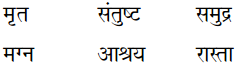
ప్రశ్న 5.
క్రింది ‘పై’ చార్ట్ ను పరిశీలించి, విశ్లేషిస్తూ రాయండి.
AP 10th Class Social Important Questions Chapter 3 ఉత్పత్తి, ఉపాధి 6
జవాబు:
పైన ఇవ్వబడిన గ్రాఫ్ వలన భారతదేశంలో ప్రజలు ఏ రంగంలో ఎంత శాతం మంది ఉపాధి పొందుతున్నారో తెలియజేయుచున్నది.

  1. వ్యవసాయ రంగంలో ఉపాధి పొందుతున్న వారి శాతం 49% మాత్రమే.
  2. పరిశ్రమల రంగంలో ఉపాధి పొందుతున్న వారి శాతం గణనీయంగా పెరుగుతూ 24%కి చేరుకున్నది.
  3. సేవల రంగంలో ఉపాధి పొందుతున్న వారి శాతం గణనీయంగా పరిశ్రమల రంగం కన్నా పెరుగుతూ వచ్చింది.
    దీనిని బట్టి భారతదేశం ఆర్థికంగా అభివృద్ధి చెందుచున్నదని చెప్పవచ్చును.

ప్రశ్న 6.
ఈ క్రింది పట్టికను పరిశీలించి, దిగువ నివ్వబడిన ప్రశ్నలకు సమాధానములు వ్రాయండి.
వ్యవస్థీకృత, అవ్యవస్థీకృత రంగాల పాత్ర

రంగంవాటా (మొత్తంలో శాతం)
ఉపాధిస్థూల దేశీయోత్పత్తి
వ్యవస్థీకృత850
అవ్యవస్థీకృత9250
మొత్తం100100

a) అవ్యవస్థీకృత రంగంలో ఉపాధి పొందుతున్న కార్మికుల శాతం ఎంత?
b) ఏ రంగంలో వారికి మంచి ఉద్యోగ భద్రత ఉంటుంది?
జవాబు:
a) 92%
b) వ్యవస్థీకృత రంగం

AP 10th Class Social Important Questions Chapter 3 ఉత్పత్తి, ఉపాధి

ప్రశ్న 7.
వ్యవస్థీకృత రంగంలో పనిచేసే కార్మికులకు కలుగు సౌకర్యాలను తెలుపుము.
జవాబు:

  1. ఉద్యోగ భద్రత
  2. నిర్ధారిత పనిగంటలు
  3. ఎక్కువ పనికి ఎక్కువ వేతనం
  4. జీతంతో కూడిన సెలవు
  5. సెలవులలో వేతనం
  6. భవిష్యనిధి
  7. వైద్య ప్రయోజనాలు
  8. పింఛను
  9. భద్రతతో కూడిన పనివాతావరణం

ప్రశ్న 8.
క్రింది ‘పై’ ను పరిశీలించి విశ్లేషించండి.
AP 10th Class Social Important Questions Chapter 3 ఉత్పత్తి, ఉపాధి 7
జవాబు:

  1. గ్రాఫ్ స్థూల దేశీయోత్పత్తిలో వివిధ రంగాల వాటాను తెలియచేస్తుంది.
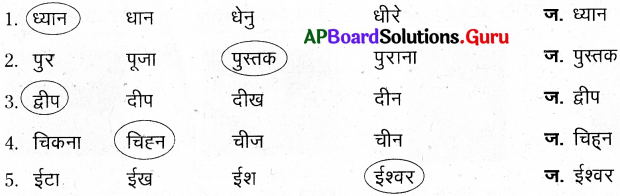
  2. A – వ్యవసాయం, B – పరిశ్రమలు, C – వ్యాపారం, హోటళ్ళు, రవాణా, ప్రసారాలు, D – ఆర్థిక, బీమా, స్థిరాస్తి, E – ప్రజా, సామాజిక, వ్యక్తిగత సేవలు గురించి తెలియచేస్తాయి.
  3. 1972-73లో అధిక ఉత్పత్తి వ్యవసాయ రంగం నుండి వచ్చింది. అత్యల్ప ఆదాయం ఆర్ధిక, భీమా, స్థిరాస్థి నుండి వచ్చింది.
  4. 2011-12కు వచ్చేప్పటికి ఇది మార్పు చెంది వ్యాపారం, హోటళ్ళు, రవాణా, ప్రసారాల ఉత్పత్తి పెరిగి వ్యవసాయ రంగం వాటా తగ్గిపోయింది. పరిశ్రమలు రెండుసార్లు రెండవ స్థానంలోనే ఉంది.
  5. సేవారంగంలో ఉత్పత్తి పెరిగినట్లయితే దేశం అభివృద్ధి చెందుతుంది. కాబట్టి దానిని పెంచేటట్లు చూడాలి.
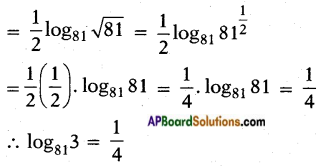
ప్రశ్న 9.
సంఘటిత రంగంలో పనిచేసే కార్మికులకు గల సౌకర్యాలేవి?
జవాబు:
సంఘటిత రంగంలో పనిచేసే కార్మికులకు గల సౌకర్యాలు:

  1. ఉద్యోగ భద్రత
  2. నిర్ణీత పనిగంటలు
  3. వేతనంతో కూడిన సెలవులు
  4. పని పరిసరాలలో భద్రత మొదలగునవి.

ప్రశ్న 10.
ప్రజలు అవ్యవస్థీకృత రంగంలో పనిచేయడానికి సాధారణంగా ఇష్టపడరు. ఎందువలన?
జవాబు:

  1. అవ్యవస్థీకృత రంగం చాలావరకు ప్రభుత్వ నియంత్రణలో ఉండదు.
  2. నియమ నిబంధనలు తరచు పాటించబడవు.
  3. ఉద్యోగాలు క్రమపద్ధతిలో ఉండవు.
  4. వేతనాలు తక్కువ.
  5. సెలవు పెట్టుకోవడం కష్టం.
  6. వేతనంతో కూడిన సెలవులు ఉండవు.
  7. ఉద్యోగ భద్రత ఉండదు.
  8. పని పరిస్థితులు సాధారణంగా బాగుండవు.
  9. పని ప్రదేశాలలో భద్రతా చర్యలు పాటించబడవు.
  10. ఆరోగ్య సమస్యలు తలెత్తుతుంటాయి.

ప్రశ్న 11.
గ్రామీణ ప్రాంతాలలో ఉపాధి అవకాశాలు పెరగటానికి మీరిచ్చే సూచనలు తెలపండి.
జవాబు:
గ్రామీణ ప్రాంతాలలో ఉపాధి అవకాశాలు పెరగటానికి సూచనలు :

  1. వ్యవసాయానికి ప్రభుత్వ మద్దతు అందించాలి.
  2. కుటీర పరిశ్రమలను ప్రోత్సహించాలి.
  3. గ్రామీణ ఉపాధి పథకాలను సమర్ధవంతంగా అమలు చేయాలి.

ప్రశ్న 12.
దిగువ నీయబడిన ‘పై’ చార్టులు పరిశీలించి, ప్రశ్నలకు సమాధానాలు రాయండి.
AP 10th Class Social Important Questions Chapter 3 ఉత్పత్తి, ఉపాధి 8
a) గణనీయ పురోగతి సాధించిన రంగమేది?
జవాబు:
సేవలు రంగం గణనీయ పురోగతిని సాధించింది.

b) స్థూల దేశీయోత్పత్తిలో వ్యవసాయ రంగం వాటా ఎందుకు తగ్గింది?
జవాబు:
వ్యవసాయ రంగంలో ఉత్పత్తి ఆశించినంతగా అభివృద్ధి చెందలేదు. అందువలన స్థూల దేశీయోత్పత్తిలో వ్యవసాయ రంగం వాటా తగ్గింది.

ప్రశ్న 13.
గ్రామీణ ప్రాంతాలలో ఉద్యోగ అవకాశాలు పెంచాల్సిన ఆవశ్యకత గురించి సంబంధిత అధికారికి లేఖ వ్రాయండి.
జవాబు:

జగిత్యాల్
16 ఏప్రియల్ 20xx.

To,
జిల్లా కలెక్టరుగారికి,
జగిత్యాల జిల్లా, జగిత్యాల.

గౌరవనీయులైన కలెక్టరుగారికి,
నేను జగిత్యాలలోని వాణి టాకీస్ రోడ్డులో నివాసముంటున్నాను. ఈ మధ్యకాలంలో మా ప్రాంతంలో జనాభా విపరీతంగా పెరిగిపోతున్నారు. కారణం, చుట్టు ప్రక్కల గ్రామీణ జనాభా జగిత్యాలకు వలస రావడం జరుగుతుంది. వారి గ్రామాలలో ఉపాధి అవకాశాలు లేకపోవడం వలన వలసలు ఎక్కువగా ఉన్నాయి.
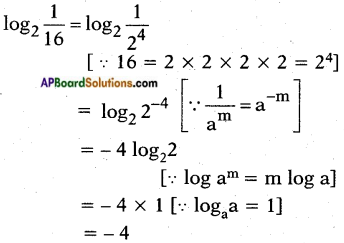
ఎక్కువ మంది వలస రావడం వలన ఇక్కడ త్రాగు నీటి సమస్య మురికి వాడలు పెరగడం, కాలుష్యం పెరుగుతుంది. ఇక్కడ దొరికే అన్ని రకాల వస్తువుల ధరలు కూడా బాగా పెరిగాయి.
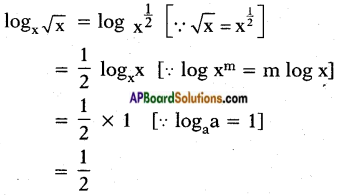
కావున నా విన్నపం ఏమిటంటే గ్రామీణ ప్రాంతాలలో కూడా కొన్ని పరిశ్రమలను, ప్రభుత్వ, ప్రయివేటు కార్యాలయాలను ఏర్పాటు చేస్తు అక్కడి ప్రజలకు ఉపాధి లభించడంతోపాటు రోడ్డు మార్గాలు అభివృద్ధి చెందుతాయి. వలసలను నివారించవచ్చు. గ్రామాలు కూడా అభివృద్ధి చెంది మన జిల్లా ఇంకా బాగా అభివృద్ధి చెందుతుంది.
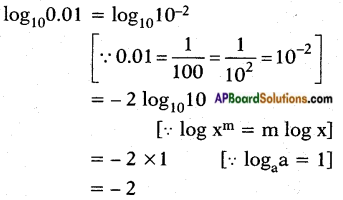
ఇట్లు
మీ విశ్వాసపాత్రుడు

To,
జిల్లా కలెక్టరుగారికి,
జగిత్యాల జిల్లా, జగిత్యాల,
పిన్ : 505327.

ప్రశ్న 14.
క్రింది వాటిలో వేరుగా ఉన్నదానిని గుర్తించండి. కారణం తెల్పండి.
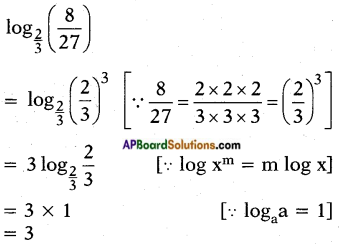
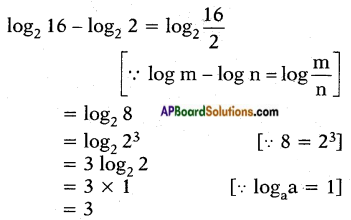
పోస్ట్ మ్యాన్, చేపలు పట్టే వ్యక్తి, సైనికుడు, పోలీస్ కానిస్టేబుల్
జవాబు:

  1. ఇచ్చిన వానిలో వేరుగా ఉన్నది. – చేపలు పట్టే వ్యక్తి. కారణం :
  2. మిగిలిన మూడు పోస్ట్ మ్యాన్, సైనికుడు, పోలీస్ కానిస్టేబుల్’ సేవా రంగానికి చెందినవి. అలాగే వ్యవస్థీకృత రంగానికి చెందినవి.

ప్రశ్న 15.
క్రింద ఇచ్చిన చార్టులను పరిశీలించి క్రింది ప్రశ్నలకు సరియైన సమాధానములిమ్ము.
‘పై’ చార్టు : స్థూల దేశీయోత్పత్తిలో వివిధ రంగాల వాటా
AP 10th Class Social Important Questions Chapter 3 ఉత్పత్తి, ఉపాధి 2
1) 1972-73 నుండి 2009-10 నాటికి GDPలో వ్యవసాయ రంగం వాటా పెరిగిందా, తగ్గిందా? ఎంత మేర?
జవాబు:
వ్యవసాయ రంగం వాటా (GDP) తగ్గింది, 43%-26% = 17% మేర తగ్గింది.

2) 2009-10 నాటికి GDPలో మొత్తం సేవల రంగం విలువ ఎంత శాతం వాటా కలిగి ఉంది?
జవాబు:
27% + 17% + 13% = 57% వాటా కలిగి ఉంది.

3) స్థూల దేశీయోత్పత్తిలో పరిశ్రమ రంగం వాటా 1972-73 నుండి 2009-10 నాటికి ఎంత మేర పెరిగింది?
జవాబు:
26% – 22% = 4% మేర పెరిగింది.

4) సేవా రంగంలోని ఏ సేవలు ఎక్కువ వృద్ధి చెందినాయి?
జవాబు:
వ్యాపారం, సూటళ్లు, రవాణా, ప్రసారాలు.

5) 37 సం||రాల కాలంలో వివిధ రంగాల వాటా మార్పుల గురించి ఏమి గమనించావు?
జవాబు:
37 సం||రాల కాలంలో వ్యవసాయ రంగం వాటా గణనీయంగా క్షీణించింది. పారిశ్రామిక రంగం వాటా కొంచెం పెరిగింది. సేవా కార్యకలాపాల్లోని మూడింట రెండు రంగాలలో గణనీయమైన వృద్ధి ఉంది.

ప్రశ్న 16.
పట్టిక : వ్యవస్థీకృత, అవ్యవస్థీకృత రంగాల పాత్రలు

రంగంవాటా (మొత్తంలో శాతం)
ఉపాధిస్థూల దేశీయోత్పత్తి
వ్యవస్థీకృత850
అవ్యవస్థీకృత9250
మొత్తం100100

పైన ఇవ్వబడిన పట్టిక ఆధారంగా క్రింది ప్రశ్నలకు సరియైన సమాధానములిమ్ము.
1) వ్యవస్థీకృత రంగంలో ఎంత శాతం మంది ఉపాధి పొందుతున్నారు?
జవాబు:
8% మంది.

2) అవ్యవస్థీకృత రంగంలో ఎంత శాతం మంది ఉపాధి పొందుతున్నారు?
జవాబు:
92% మంది

3) స్థూల దేశీయోత్పత్తిలో వ్యవస్థీకృత రంగం వాటా ఎంత శాతం ఉంది?
జవాబు:
50%

4) స్థూల దేశీయోత్పత్తిలో అవ్యవస్థీకృత రంగం వాటా ఎంత శాతం ఉంది?
జవాబు:
50%

5) పై గణాంకాల ఆధారంగా ఏమి అర్థం అవుతున్నది?
జవాబు:
కేవలం 8 శాతం కార్మికులు భద్రతతో కూడిన మంచి ఉద్యోగం ఉండి, మొత్తం వస్తువులు, సేవల్లో 50% ఉత్పత్తికి దోహదం చేశారు.

10th Class Social 3rd Lesson 4 Marks Important Questions and Answers in Telugu Medium

ప్రశ్న 1.
స్థూల దేశీయోత్పత్తిని ఎలా లెక్కిస్తారు ? ఉదాహరణలతో వ్రాయండి.
(లేదా)
స్థూల జాతీయోత్పత్తి అనగానేమి? స్థూల జాతీయోత్పత్తిని ఎలా అంచనా వేస్తారు?
జవాబు:

  1. దేశ ఆదాయాన్ని లెక్కకట్టడంలో దేశంలో ఉత్పత్తి అయిన మొత్తం వస్తువులు, సేవల విలువను తీసుకుంటే దానిని ‘స్థూల దేశీయోత్పత్తి (జాతీయోత్పత్తి) అంటాం.
  2. వ్యవసాయ, పరిశ్రమ, సేవా రంగాలలో ఆర్థిక కార్యకలాపాలు చేపట్టే ప్రజలు పెద్దమొత్తంలో ఉత్పత్తిచేసే వస్తువుల / సేవల విలువే ఇది.
  3. ఆర్థికవేత్తలు ఉత్పత్తి అయిన వస్తువుల / సేవల సంఖ్య కాకుండా ఆయా వస్తువుల, సేవల విలువలు జోడిస్తారు.
  4. మాధ్యమిక వస్తువుల విలువలు కూడకుండా అంతిమ విలువలే లెక్కించే పద్ధతిలో స్థూల దేశీయోత్పత్తి లెక్కించవచ్చు.
    ఉదా|| Kg రూ. 25 చొప్పున 100 Kg వడ్లు కొని మిల్లర్ కిలో రూ. 40 చొప్పున 80 Kg బియ్యం , కిలో రూ. 20 చొప్పున 20 Kg ఊక అమ్మడం. అవి కొన్న హోటల్ యజమాని ఇడ్లీ, దోశలతో రూ. 5000 సంపాదించడం.
    ఈ ప్రక్రియలో మొత్తం అంతిమ విలువ రూ. 5000.
  5. ప్రతి దశలో జోడించబడిన అదనపు విలువ మాత్రమే లెక్కించే మరో పద్ధతి స్థూల దేశీయోత్పత్తికి కలదు.
    AP 10th Class Social Important Questions Chapter 3 ఉత్పత్తి, ఉపాధి 9

ప్రశ్న 2.
వ్యవస్థీకృత రంగం, అవ్యవస్థీకృత రంగంలో పనిచేస్తున్న కార్మికుల మధ్య భేదాలు తెల్పుము.జవాబు:
జవాబు:

వ్యవస్థీకృత రంగంఅవ్యవస్థీకృత రంగం
1) ప్రభుత్వ నియమ నిబంధనలను ఈ రంగంలోని సంస్థలు అనుసరిస్తాయి1) ఈ రంగంలోని సంస్థలు ప్రభుత్వ నియంత్రణలో ఉండవు.
2) ఈ రంగంలోని కార్మికులకు ఉద్యోగ భద్రత ఉంటుంది.2) ఉద్యోగ భద్రత ఉండదు.
3) ఆర్జిత సెలవులు, అనారోగ్య సెలవులు ఉంటాయి.3) అలాంటివి ఉండవు.
4) వేతనాలు జీవనానికి సరిపడేంత ఉంటాయి.4) వేతనాలు తక్కువగా ఉంటాయి.
5) భవిష్య నిధి, ఆరోగ్య బీమా లాంటి సౌకర్యాలు, ఉంటాయి.5) భవిష్యనిధి, బీమాలాంటివి ఉండవు.
6) ప్రభుత్వ సంస్థలు, భారీతరహా పరిశ్రమలు మొదలైన వాటిల్లోని ఉద్యోగులు వ్యవస్థీకృత రంగం.6) చిన్న సంస్థలు, స్వయం ఉపాధి మొదలయిన వాటిల్లో ఉద్యోగులు అవ్యవస్థీకృత రంగం.
7) ఈ రంగంలో ఉద్యోగాలను అందరూ కోరుకుంటారు.7) ఈ రంగంలో తప్పక ఉద్యోగాలు చేస్తుంటారు.

ప్రశ్న 3.
ఈ రోజుల్లో ఆర్థిక వ్యవస్థలోని ఏ రంగములో ఉద్యోగావకాశాలు పెరుగుతున్నాయి ? కారణాలు తెల్పండి.
జవాబు:

  • ఈ రోజుల్లో ఆర్థిక వ్యవస్థలోని ద్వితీయ, తృతీయ రంగాలలో ఉపాధి ఎక్కువ అయింది.
  • గత 50 సంవత్సరాలుగా స్థూల దేశీయోత్పత్తిలోని వివిధ రంగాల వాటాలో వచ్చినంత మార్పు ఉపాధిలో రాలేదు. అయినప్పటికిని ద్వితీయ, తృతీయ రంగాలలో ఉపాధి మెరుగయ్యింది.

కారణాలు:

  1. ప్రణాళికాబద్ధ చర్యలు, ప్రభుత్వ చొచొరవ మొదలైన వాటితో పరిశ్రమలు అధికంగా స్థాపించబడటం వలన.
  2. స్వదేశీ, విదేశీ సాంకేతిక పరిజ్ఞానం అందిపుచ్చుకోవటం (పెంచుకోవటం) వలన.
  3. విద్యావకాశాలు మెరుగవ్వటం.
  4. ప్రపంచీకరణ వలన బహుళజాతి సంస్థలు ప్రవేశించటం వలన పరిశ్రమలు, సేవారంగం అభివృద్ధి చెందటం.
  5. అన్ని రకాల రవాణా సౌకర్యాలు మెరుగుపడటం.
  6. మేధోవలసలు పెరగడం.
  7. పొదుపు చర్యల వలన, ప్రపంచీకరణ కారణంగా స్వదేశీ, విదేశీ పెట్టుబడుల లభ్యత పెరగడం.
  8. శాస్త్ర, సాంకేతిక రంగాలలో నైపుణ్యాలను పెంపొందించే జాతీయ, అంతర్జాతీయ ప్రమాణాలతో కూడిన శిక్షణా సంస్థలు పెరగటం వలన.

AP 10th Class Social Important Questions Chapter 3 ఉత్పత్తి, ఉపాధి

ప్రశ్న 4.
మీ ప్రాంతంలో ఉపాధి అవకాశాలు కల్పించడానికి తీసుకోవలసిన చర్యలను సూచించండి.
జవాబు:
మా ప్రాంతంలో ఉపాధి అవకాశాలు కల్పించడానికి తీసుకోవలసిన చర్యలు :

  1. వ్యవసాయేతర ఉత్పత్తి కార్యకలాపాలను ప్రోత్సహించాలి.
  2. పాడి పరిశ్రమను అభివృద్ధి చేయడం.
  3. స్థానిక చేతివృత్తులను ప్రోత్సహించడం.
  4. బ్యాంకు రుణాల ద్వారా స్వయం ఉపాధి అవకాశాలను కల్పించడం.
    ఉదా : పిండిమర, కిరాణాషాపు, హోటల్ మొ||నవి.
  5. స్వీట్ల తయారీ, పచ్చళ్ళ తయారీ మొదలగు వాటిని ప్రోత్సహించి దగ్గరలోని మార్కెట్లకు తరలించేలా రవాణా వ్యవస్థను ఏర్పాటు చేయడం.
  6. ప్రభుత్వ సహాయంతో కుట్టుమిషన్ల పంపిణీ.
  7. కూరగాయల ప్రొసెసింగ్ పరిశ్రమ, పట్టుపురుగుల పెంపకం మరియు తేనె సేకరించి దగ్గరలోని మార్కెట్లలో అమ్మడం.

ప్రశ్న 5.
అవ్యవస్థీకృత రంగ కార్మికుల పరిస్థితులను మెరుగుపరచడానికి నీవు చేసే సూచనలేవి?
జవాబు:
అవ్యవస్థీకృత రంగ కార్మికుల పరిస్థితులను మెరుగుపరచడానికి సూచనలు :

  1. వేతనాల పెరుగుదల,
  2. సక్రమంగా వేతనాలు ఇవ్వడం,
  3. అదనపు పనికి అదనపు వేతనం,
  4. ఆర్జిత సెలవులు,
  5. పనిచేసే చోట అనుకూల సౌకర్యాలు కల్పించడం,
  6. పదవీ విరమణ ప్రయోజనాలు,
  7. ఉద్యో గ భద్రత,
  8. వైద్య, ఆరోగ్య సౌకర్యాలు.

ప్రశ్న 6.
“సేవారంగం అభివృద్ధి చెందినా ఆ రంగంలో అన్ని కార్యకలాపాలు సమానంగా పెరగటం లేదు. భారతదేశంలో సేవారంగంలో అనేక రకాల వ్యక్తులు ఉపాధి పొందుతున్నారు. ఒకవైపున బాగా చదువుకున్న, నైపుణ్యాలున్న వ్యక్తులకు ఉపాధి ఇచ్చే కొద్దిపాటి సేవలు ఉన్నాయి. ఇంకోవైపున చిన్న చిన్న దుకాణాలు నడిపేవాళ్ళు, మరమ్మతులు చేసేవాళ్ళు, రవాణా సేవలు అందించే వాళ్ళు పెద్ద సంఖ్యలో ఉన్నారు. వాళ్ళ జీవనం అతికష్టం మీద సాగుతుంది, అయినా మరోదారి లేక ఈ సేవలలో కొనసాగుతున్నారు.”

ప్రశ్న : “సేవారంగంలో పనిచేసే వారందరి జీవన పరిస్తితులు ఒకేలా లేవు.” వ్యాఖ్యానించండి.
జవాబు:

  1. సేవా రంగమునకు సంబంధించి వ్యవస్థీకృత రంగంలో పనిచేస్తున్న నైపుణ్యం గల కార్మికులు మెరుగైన వేతనాలు పొందుతున్నారు. కానీ వీరి సంఖ్య పరిమితంగా ఉంది.
  2. మరోవైపున అవ్యవస్థీకృత రంగంలోనే పనిచేస్తున్న అసంఖ్యాకమైన కార్మికులు కనీస వేతనాలు సైతం పొందలేక దుర్భరమైన పరిస్థితులలో జీవిస్తున్నారు.
  3. స్వయం ఉపాధి పొందుతున్నవారు, దుకాణదారులు, వలస కార్మికులు మొదలగు వారికి స్థిర ఉపాధి, మెరుగైన పని పరిస్థితులు, ఇతర సదుపాయాలు ఉండవు.
  4. నైపుణ్యాల లేమి వల్ల, ఉపాధి అవకాశాల కొరత వల్ల, ప్రత్యామ్నాయ అవకాశాలు లేకపోవడం వల్ల తప్పనిసరియై ఆయా వృత్తులలోనే కొనసాగుతున్నారు.
  5. ఈ విధమైన పరిస్థితులను పరిగణనలోకి తీసుకొని ప్రభుత్వాలు సరైన విధానాలు రూపొందించి సేవారంగంలో సంతులిత అభివృద్ధికి కృషి చేయాలి.

AP 10th Class Social Important Questions Chapter 3 ఉత్పత్తి, ఉపాధి

ప్రశ్న 7.
“అభివృద్ధి చెందిన దేశాలలో గత 50 సం||లుగా జరుగుతున్న పరిణామాలలో అభివృద్ధి పారిశ్రామిక రంగం నుండి సేవా రంగానికి మారడం ఒకటి. మొత్తం ఉత్పత్తిలో సేవారంగం వాటా పెరగడంతో దాని ప్రాముఖ్యత పెరిగింది. పనిచేసే వాళ్ళలో ఎక్కువ మంది సేవారంగంలో ఉపాధి పొందుతున్నారు. ఉత్పాదక కార్యకలాపాలలో అధిక భాగం ఇప్పుడు వస్తువుల ఉత్పత్తి కాకుండా సేవలు అందించడంలో ఉన్నాయి. అన్ని అభివృద్ధి చెందిన దేశాలలో ఇదే తీరు కనపడుతుంది.
ప్రశ్న: భారతదేశంలో కూడా ఇలాగే జరుగుతోందా? లేక భిన్నంగా ఉందా? మీ అభిప్రాయాన్ని వివరించండి.
జవాబు:

  1. ఆర్థిక రంగాల ప్రాధాన్యతా క్రమం భారతదేశంలో కూడా కొంతవరకూ అభివృద్ధి చెందిన దేశాల వలెనే ఉన్నది.
  2. కానీ కొన్ని ప్రధానమైన తేడాలు కూడా ఉన్నాయి.
  3. భారతదేశంలో కూడా ఇటీవల కాలంలో సేవారంగం చాలా ప్రాముఖ్యతను సంతరించుకుంటున్నది.
  4. కానీ, ఈనాటికీ దేశంలో అత్యధికులకు ఉపాధిని కల్పిస్తున్నది వ్యవసాయ రంగమే.

ప్రశ్న 8.
క్రింది పేరాగ్రాఫ్ ను చదివి, వ్యాఖ్యానించుము.
గత 50 సంవత్సరాలలో అభివృద్ధి చెందిన దేశాలలో పారిశ్రామిక రంగం నుంచి సేవల రంగానికి ప్రాధాన్యత మారుతోంది. మొత్తం ఉత్పత్తిలో సేవారంగం ప్రముఖ స్థానంలో ఉంది. పని చేసేవాళ్ళల్లో కూడా ఇప్పుడు ఎక్కువ మంది సేవల రంగంలో ఉపాధి పొందుతున్నారు. ఉత్పాదక కార్యకలాపాలలో అధిక భాగం ఇప్పుడు వస్తువుల ఉత్పత్తి కాకుండా సేవలు అందించడంలో ఉన్నాయి.
జవాబు:
పైన పేరాగ్రాను కనుక పరిశీలించినట్లయితే అభివృద్ధి చెందిన దేశాలలో పనిచేసే వారిలో ఎక్కువ మంది పారిశ్రామిక రంగం నుండి సేవల రంగానికి వలస వెళ్ళడం జరుగుతుంది. ఆర్థిక వ్యవస్థలో కూడా సేవా రంగం ప్రముఖపాత్రను పోషిస్తుంది అని గమనించవచ్చు. పనిచేసేవారు కూడా ఎక్కువ మంది సేవా రంగంలో ఉపాధి పొందుతున్నారు. ఉత్పాదక కార్యకలాపాలలో అధిక భాగం ఇప్పుడు వస్తువుల ఉత్పత్తి కాకుండా సేవలు అందించడంలో ఉన్నాయి అని చెప్పవచ్చు.
ఆర్థిక వ్యవస్థలో మూడు రంగాలు ఉన్నాయి. అవి వ్యవసాయ, పారిశ్రామిక మరియు సేవల రంగాలు. అభివృద్ధి చెందుతున్న దేశాలలో ఎక్కువ శాతం ప్రజలు వ్యవసాయ రంగం మీద మరియు అభివృద్ధి చెందిన దేశాలలో ఎక్కువ శాతం ప్రజలు పారిశ్రామిక రంగంలో ఉపాధి పొందడం మనం గమనిస్తున్నాం. కాని ఈ మధ్య కాలంలో అభివృద్ధి చెందిన మరియు చెందుతున్న దేశాలలో ప్రజలు పారిశ్రామిక రంగం నుండి సేవా రంగమునకు ఉపాధి కోసం తరలి వెళ్ళడం మనం గమనిస్తున్నాం. కారణం ఏమిటంటే వ్యవసాయ మరియు పారిశ్రామిక రంగాలలో ఉన్న భౌతిక శ్రమ సేవా రంగంలో లేకపోవడమే. కంప్యూటర్, లాప్టాప్లు వచ్చిన తరువాత ప్రజలు ఇంటి వద్ద కూర్చుని కూడా వారి సేవలను ఇవ్వడం జరుగుతుంది. అంతేకాకుండా సేవా రంగంలో GDP శాతం ఎక్కువగా ఉండటం మనం గమనించవచ్చు. ప్రజలకు ఆదాయం కూడా ఎక్కువగా ఉంది.
దేశ, విదేశాలలో సేవా రంగానికి ఎక్కువ ప్రాముఖ్యం ఉండటంతో మన ప్రజలు ఇతర దేశాలపట్ల ఎక్కువ ఆకర్షితులవు తున్నారు. ఈ రంగంలో ఉపాధితోపాటు భద్రత, గౌరవం కూడా లభిస్తున్నాయి. మొత్తం మీద సేవా రంగం దేశ ఆర్థికాభివృద్ధిలో తన వంతు పాత్రను పోషిస్తోంది.
ప్రశ్న 9.
A) దిగువ నీయబడిన సమాచారం ఆధారంగా మీ పరిశీలనను వ్రాయండి.
పట్టిక : భారతదేశంలో పరిశ్రమలవారీగా కార్మికుల వివరాలు నివాస స్థానం స్త్రీ, పురుషులు
AP 10th Class Social Important Questions Chapter 3 ఉత్పత్తి, ఉపాధి 10
జవాబు:

  1. గ్రామీణ కార్మికులలో ఎక్కువమంది వ్యవసాయరంగంలో ఉపాధి పొందుతున్నారు.
  2. పట్టణ ప్రాంత కార్మికులలో ఎక్కువమంది సేవారంగంలో ఉపాధి పొందుతున్నారు.
  3. వ్యవసాయ కార్మికులలో అత్యధికులు స్త్రీలు.
  4. సేవారంగంలో మహిళా కార్మికుల సంఖ్య తక్కువగా ఉన్నది.
  5. మొత్తం మీద అత్యధిక శాతం మందికి ఉపాధిని కల్పిస్తున్నది వ్యవసాయ రంగము.
  6. మొత్తం మీద అతి తక్కువ మందికి ఉపాధి కల్పిస్తున్నది పారిశ్రామిక రంగము.

ప్రశ్న 10.
క్రింది సమాచారాన్ని ఒక కమ్మీ రేఖాచిత్రం (బార్ గ్రాఫ్) లో చూపి, విశ్లేషించండి.
వివిధ రంగాలు – ఉపాధి (2009-10)

రంగంఉపాధి (శాతంలో)
వ్యవసాయం53%
పరిశ్రమలు22%
సేవలు25%

జవాబు:
AP 10th Class Social Important Questions Chapter 3 ఉత్పత్తి, ఉపాధి 11
విశ్లేషణ :

  1. 2009-10లో అత్యధిక మందికి ఉపాధి కల్పిస్తున్న రంగం – వ్యవసాయం.
  2. ఉపాధికల్పనలో సేవారంగం రెండవ స్థానంలో కలదు.
  3. అతి తక్కువ మందికి ఉపాధి కల్పిస్తున్నది పారిశ్రామిక రంగం.

ప్రశ్న 11.
వ్యవస్థీకృత రంగంలో ఉద్యోగాలను అందరూ కోరుకుంటారు. కానీ ఈ రంగంలోని ఉపాధి అవకాశాలు చాలా నిదానంగా పెరుగుతున్నాయి. ఫలితంగా, అధిక శాతం కార్మికులకు చాలా తక్కువ వేతనానికి అవ్యవస్థీకృత ఉద్యోగాలు తప్పించి మరో దారి లేదు.
ప్రశ్న : అవ్యవస్థీకృత రంగం కన్నా వ్యవస్థీకృత రంగం మెరుగైనది అనుకుంటున్నారా? మీ అభిప్రాయం తెలుపండి.
జవాబు:
వ్యవస్థీకృతరంగం మెరుగైనది – అభిప్రాయం :

  1. అవును. అవ్యవస్థీకృత రంగం కంటే వ్యవస్థీకృత రంగం మెరుగైనదని భావిస్తాను.
  2. వ్యవస్థీకృతరంగంలో క్రమబద్ధమైన ఉపాధి షరతులు ఉండి నమ్మకంగా పని ఉంటుంది.
  3. ప్రభుత్వ నియమ నిబంధనలు పాటించబడతాయి.
  4. ఈ రంగంలో కార్మికులకు ఉద్యోగ భద్రత ఉంటుంది.
  5. వారు నిర్ధారిత పనిగంటలు మాత్రమే పనిచేస్తారు.
  6. వారికి జీతంతో కూడిన సెలవు, సెలవులలో వేతనం, భవిష్యనిధి వంటి ప్రయోజనాలు ఉంటాయి.

AP 10th Class Social Important Questions Chapter 3 ఉత్పత్తి, ఉపాధి

ప్రశ్న 12.
నేటి కాలంలో అవ్యవస్థీకృత రంగంలో పనిచేసేవారు ఎదుర్కొంటున్న సమస్యలను వివరించుము.
జవాబు:
నేటి కాలంలో అవ్యవస్థీకృత రంగంలో పనిచేసేవారు ఎదుర్కొంటున్న సమస్యలు

  1. జీతాలు తక్కువగా ఉంటాయి.
  2. ఉద్యోగ భద్రత ఉండదు.
  3. ఎక్కువ పనికి ఎక్కువ వేతనం ఉండదు.
  4. ఆర్జిత సెలవులు ఉండవు
  5. సాధారణ సెలవులు ఉండవు
  6. అనారోగ్యపు సెలవులు ఉండవు.
  7. వైద్య సౌకర్యాలు ఉండవు.
  8. భవిష్యనిధి, ఆరోగ్య బీమా లాంటి సౌకర్యాలు ఉండవు,

ప్రశ్న 13.
దిగువ ఇచ్చిన గ్రాఫ్ ను పరిశీలించి, విశ్లేషించండి. .
గ్రాఫ్ : మూడు రంగాల వాటా – ఉపాధి మరియు స్థూల దేశీయోత్పత్తి 2015-16
AP 10th Class Social Important Questions Chapter 3 ఉత్పత్తి, ఉపాధి 12
జవాబు:
పైన ఇవ్వబడిన గ్రాఫ్ వలన భారతదేశంలో ప్రజలు ఏ రంగంలో ఎంత శాతంమంది ఉపాధి పొందుతున్నారో తెలియజేయుచున్నది.

  1. ఉపాధి వాటాలో వ్యవసాయ రంగం 47% ఉన్నప్పటికి, స్థూల దేశీయ ఉత్పత్తిలో 19% మాత్రమే ఉంది.
  2. కాని సేవల ఉపాధి వాటా 31% మాత్రమే ఉన్నప్పటికి, స్థూల దేశీయోత్పత్తిలో 53% గా అగ్రగణ్యంలో ఉంది.
  3. పరిశ్రమల వాటాలలో ఉపాధి వాటాకు, స్థూల దేశీయోత్పత్తి వాటాకు పెద్దగా భేదం లేదు.
  4. సేవల రంగంలో స్థూల దేశీయోత్పత్తి వాటా అన్ని రంగాల కంటే ఎక్కువగా ఉన్నది.
    దీనిని బట్టి భారతదేశం ఆర్థికంగా అభివృద్ధి చెందుచున్నదని చెప్పవచ్చును.

ప్రశ్న 14.
దిగువ గ్రాఫ్ లను పరిశీలించి మీ విశ్లేషణను రాయండి.
AP 10th Class Social Important Questions Chapter 3 ఉత్పత్తి, ఉపాధి 13
జవాబు:

  1. పైన ఇవ్వబడిన గ్రాఫ్ వలన 2009-10 లో భారతదేశంలో ప్రజలు ఏ రంగంలో ఎంత శాతం మంది ఉపాధి పొందుతున్నారో, ఏ రంగం నుండి ఎంత (GDP) (వాటా) నో తెలుసుకోవచ్చు.
  2. ఉపాధి వాటాలో వ్యవసాయ రంగం 53% ఉన్నప్పటికీ, స్థూల దేశీయోత్పత్తిలో 17% మాత్రమే ఉంది.
  3. కాని సేవల ఉపాధి వాటా 25% మాత్రమే ఉన్నప్పటికీ, స్థూల దేశీయోత్పత్తిలో 57% గా అగ్రగణ్యంలో ఉంది.
  4. పరిశ్రమల వాటాలలో ఉపాధి వాటాకు (22%), స్తూల దేశీయోత్పత్తి వాటాకు (26%) పెద్దగా భేదం లేదు.
  5. సేవల రంగంలో స్థూల దేశీయోత్పత్తి వాటా అన్ని రంగాల కంటే ఎక్కువగా ఉన్నది.
  6. దీనిని బట్టి భారతదేశం ఆర్థికంగా అభివృద్ధి చెందుచున్నదని చెప్పవచ్చును.

ప్రశ్న 15.
ఆర్థికవ్యవస్థలోని వివిధ రంగాల గురించి వివరించుము.
జవాబు:
ఆర్థికవ్యవస్థలోని రంగాలు : ఈ పనులను ప్రధానంగా మూడు రంగాలుగా విభజిస్తారు.

  1. ఉత్పత్తి ప్రక్రియలో ప్రకృతి ప్రధాన పాత్ర వహించే వ్యవసాయం, మత్స్య పరిశ్రమ, అటవీ, గనులకు సంబంధించిన పనులు.
  2. యంత్రాలు, పరికరాలు ఉపయోగించి వస్తువులు ఉత్పత్తి చేయడం, ఇతర పరిశ్రమలు.
  3. వస్తువులను నేరుగా తయారుచేయకుండా వస్తువుల ఉత్పత్తికి, ప్రజలకు అవసరమైన సేవలు అందించే కార్యకలాపాలు.

ప్రశ్న 16.
సేవలలోని వివిధ రకాల గురించి ఉదాహరణలతో వివరించుము.
AP 10th Class Social Important Questions Chapter 3 ఉత్పత్తి, ఉపాధి 14
జవాబు:
AP 10th Class Social Important Questions Chapter 3 ఉత్పత్తి, ఉపాధి 15

ప్రశ్న 17.
1972-73, 2009-10 మధ్య ఉత్పత్తి, ఉపాధిలో వచ్చిన మార్పుల గురించి చర్చించుము.
జవాబు:

  1. ఈ కాలంలో పారిశ్రామిక ఉత్పత్తి తొమ్మిది రెట్లు పెరిగింది, కానీ పారిశ్రామిక ఉపాధి మూడు రెట్లు మాత్రమే పెరిగింది.
  2. సేవల రంగంలోనూ ఇదే పరిస్థితి. సేవా రంగంలో ఉత్పత్తి 14 రెట్లు పెరిగింది కానీ ఉపాధి మాత్రం 5 రెట్లు పెరిగింది.
  3. దీని ఫలితంగా దేశంలోని కార్మికులలో సగం కంటే ఎక్కువమంది వ్యవసాయ రంగంలో ఉండి ఆరింట ఒక వంతు ఉత్పత్తికి మాత్రమే దోహదం చేస్తున్నారు.
  4. దీనికి విరుద్ధంగా స్థూల దేశీయోత్పత్తిలో 75 శాతం వాటా ఉన్న పారిశ్రామిక, సేవా రంగాలు మొత్తం కార్మికులలో దాదాపు సగానికి మాత్రమే ఉపాధి కల్పిస్తున్నాయి.
  5. 37 సంవత్సరాల కాలంలో వ్యవసాయ రంగం వాటా గణనీయంగా క్షీణించింది.
  6. స్థూల దేశీయోత్పత్తిలో పారిశ్రామిక రంగం ఉత్పత్తి వాటా కొంచెం పెరిగింది.
  7. ఇందుకు విరుద్ధంగా సేవా కార్యకలాపాలలోని మూడింట రెండు రంగాలలో గణనీయమైన వృద్ధి ఉంది.

ప్రశ్న 18.
రక్షణ అవసరమైన అవ్యవస్థీకృత కార్మికులు ఎవరు? రక్షణ ఎందుకవసరం?
జవాబు:

  1. గ్రామీణ ప్రాంతాలలో వీళ్లు భూమిలేని వ్యవసాయ కూలీలు, సన్న, చిన్నకారు రైతులు, కౌలుదారులు, చేనేత, కమ్మరం, వడ్రంగం, కంసాలి వంటి చేతివృత్తుల వాళ్లు.
  2. భారతదేశంలోని గ్రామీణ ప్రాంతంలోని 80 శాతం కుటుంబాలు సన్న, చిన్నకారు రైతుల కిందకు వస్తాయి.
  3. ఇటువంటి రైతులకు సకాలంలో విత్తనాలు, వ్యవసాయ ఉత్పాదకాలు, రుణసదుపాయాలు, నిల్వ సౌకర్యాలు, విక్రయ కేంద్రాలు వంటి వాటి ద్వారా మద్దతు అందించాలి.
  4. వ్యవసాయ కూలీలకు కనీస కూలీ, తగినంత పని అందాలి.
  5. పట్టణ ప్రాంతాలలో చిన్నతరహా పరిశ్రమలు, భవన నిర్మాణ, వ్యాపారం, రవాణా వంటి వాటిలో రోజువారీ కూలీలు, బజారులో అమ్మకాలు చేసే వాళ్లు, బరువులు మోసేవాళ్లు, చిత్తుకాగితాలు ఏరేవాళ్లు, బట్టలు కుట్టేవాళ్లు అవ్యవస్థీకృత రంగ కార్మికులు అవుతారు.
  6. ముడి సరుకుల కొనుగోలుకు, ఉత్పత్తులు అమ్ముకోటానికి చిన్నతరహా పరిశ్రమలకు కూడా ప్రభుత్వ మద్దతు కావాలి.
  7. పట్టణ, గ్రామీణ ప్రాంతాలలోని రోజువారీ కూలీలకు రక్షణ కావాలి.
  8. షెడ్యూల్ కులాలు, తెగలు, వెనకబడిన తరగతులకు చెందిన అధికశాతం కార్మికులు అవ్యవస్థీకృత రంగంలో ఉన్నారు.
  9. ఈ వర్గాలకు చెందిన మహిళల పరిస్థితి మరింత దారుణంగా ఉంటుంది. పని సరిగా దొరకకపోవటం, తక్కువ వేతనం ఉండటమే కాకుండా ఈ కార్మికులు సామాజిక వివక్షతకు కూడా లోనౌతారు.
  10. కాబట్టి ఆర్థిక, సామాజిక అభివృద్ధికి అవ్యవస్థీకృత రంగ కార్మికులకు రక్షణ, మధతు అవసరం.

ప్రశ్న 19.
పట్టిక : భారతదేశంలో పరిశ్రమల వారీగా కార్మికుల వివరాలు, 2009-2010 (%)
AP 10th Class Social Important Questions Chapter 3 ఉత్పత్తి, ఉపాధి 10
పట్టికని జాగ్రత్తగా అధ్యయనం చేసి కింది ప్రశ్నలకు సమాధానాలు ఇవ్వండి.
1. ఏ రంగంలో స్త్రీలు అధికంగా పాల్గొంటున్నారు?
2. కార్మికులు తక్కువగా ఉన్న రంగం ఏది? ఎందుకు?
3. సేవా రంగంలో ఉపాధి పొందుతున్న వారిలో ఎక్కువమంది ఎక్కడ నివాసం ఉంటున్నారు?
4. పారిశ్రామిక రంగంలో స్త్రీలు తక్కువగా ఉండడానికి కారణమేంటి?
జవాబు:

  1. వ్యవసాయ రంగంలో స్త్రీలు అధికంగా పాల్గొంటున్నారు.
  2. కార్మికులు తక్కువగా ఉన్న రంగం పారిశ్రామిక రంగం. కారణం దేశం పారిశ్రామికంగా బాగా అభివృద్ధి చెందకపోవడం.
  3. సేవారంగంలో ఉపాధి పొందుతున్న వారు అధికంగా పట్టణాలలో నివాసం ఉంటున్నారు.
  4. పారిశ్రామిక రంగంలో స్త్రీలు తక్కువగా ఉండటానికి కారణాలు : పనిగంటలు షిఫులుగా ఉండటం మరియు శారీరక శ్రమతో కూడిన పనులు చాలా ఉండటం.

AP SSC 10th Class Maths Solutions Chapter 1 Real Numbers Ex 1.2

AP State Board Syllabus AP SSC 10th Class Maths Textbook Solutions Chapter 1 Real Numbers Ex 1.2 Textbook Questions and Answers.

AP State Syllabus SSC 10th Class Maths Solutions 1st Lesson Real Numbers Exercise 1.2

10th Class Maths 1st Lesson Real Numbers Ex 1.2 Textbook Questions and Answers

Question 1.
Express each of the following numbers as a product of its prime factors.
i) 140
ii) 156
iii) 3825
iv) 5005
v) 7429
Answer:
i) 140
AP SSC 10th Class Maths Solutions Chapter 1 Real Numbers Ex 1.2 1
∴ 140 = 2 × 2 × 5 × 7 = 22 × 5 × 7

AP SSC 10th Class Maths Solutions Chapter 1 Real Numbers Ex 1.2

ii) 156
AP SSC 10th Class Maths Solutions Chapter 1 Real Numbers Ex 1.2 2
∴ 156 = 2 × 2 × 3 × 13 = 22 × 3 × 13

iii) 3825
AP SSC 10th Class Maths Solutions Chapter 1 Real Numbers Ex 1.2 3
∴ 3825 = 3 × 3 × 5 × 5 × 17 = 32 × 52 × 17

iv) 5005
AP SSC 10th Class Maths Solutions Chapter 1 Real Numbers Ex 1.2 4
∴ 5005 = 5 × 7 × 11 × 13

v) 7429
AP SSC 10th Class Maths Solutions Chapter 1 Real Numbers Ex 1.2 5
∴ 7429 = 17 × 19 × 23

AP SSC 10th Class Maths Solutions Chapter 1 Real Numbers Ex 1.2

Question 2.
Find the L.C.M and H.C.F of the following integers by the prime factorization method.
i) 12, 15 and 21
ii) 17, 23 and 29
iii) 8, 9 and 25
iv) 72 and 108
v) 306 and 657
Answer:
i) 12, 15 and 21
12 = 2 × 2 × 3 = 22 × 3
15 = 3 × 5
21 = 3 × 7
L.C.M = 22 × 3 × 5 × 7 = 420
H.C.F = 3

ii) 17, 23 and 29
The given numbers 17, 23 and 29 are all primes.
L.C.M = their product
= 17 × 23 × 29 = 11339
∴ H.C.F = 1

iii) 8, 9 and 25
8 = 2 × 2 × 2 = 23
9 = 3 × 3 = 32
25 = 5 × 5 = 52
L.C.M = 23 × 32 × 52 = 1800
(or)
8, 9 and 25 are relatively prime, therefore L.C.M is equal to their product,
(i.e.,) L.C.M = 8 × 9 × 25 = 1800
H.C.F = 1

iv) 72 and 108
AP SSC 10th Class Maths Solutions Chapter 1 Real Numbers Ex 1.2 6
72 = 23 × 32
108 = 22 × 33
L.C.M = 23 × 33 = 8 × 27 = 216
H.C.F = 22 × 32 = 4 × 9 = 36

AP SSC 10th Class Maths Solutions Chapter 1 Real Numbers Ex 1.2

v) 306 and 657
AP SSC 10th Class Maths Solutions Chapter 1 Real Numbers Ex 1.2 7
306 = 2 × 32 × 17
657 = 32 × 73
L.C.M = 2 × 32 × 17 × 73 = 22338
H.C.F = 32 = 9

Question 3.
Check whether 6n can end with the digit ‘0’ for any natural number n.
Answer:
Given number = 6n = (2 × 3)n
The prime factors here are 2 and 3 only.
To be end with 0; 6n should have a prime factor 5 and also 2.
So, 6n can’t end with zero.

Question 4.
Explain why 7 × 11 × 13 + 13 and 7 × 6 × 5 × 4 × 3 × 2 × 1 + 5 are composite numbers.
Answer:
Given numbers are 7 × 11 × 13
7 × 6 × 5 × 4 × 3 × 2 × 1 + 5
⇒ 13(7 × 11 + 1) and
5(7 × 6 × 4 × 3 × 2 × 1 + 1)
⇒ 13 K and 5 L, where K = 78 and L = 7 × 6 × 4 × 3 × 2 × 1 + 1 = 1009
As the given numbers can be written as product of two numbers, they are composite.

Question 5.
How will you show that (17 × 11 × 2) + (17 × 11 × 5) is a composite number? Explain.
Answer:
(17 × 11 × 2) + (17 × 11 × 5)
= (17 × 11) (2 + 5)
= (17 × 11) (7)
= 187 × 7
Now the given expression is written as a product of two integers and hence it is a composite number.

AP SSC 10th Class Maths Solutions Chapter 1 Real Numbers Ex 1.2

Question 6.
What is the last digit of 6100?
Answer: We know that
61 = 6
62 = 36
63 = 216
64 = 1296
65 = 7776
We see that 6n for any positive integer n ends is 6.
i.e., unit digit is always 6.
∴ Unit digit of 6100 is 6.

AP 7th Class Science Important Questions 5th Lesson Motion and Time

These AP 7th Class Science Important Questions 5th Lesson Motion and Time will help students prepare well for the exams.

AP Board 7th Class Science 5th Lesson Important Questions and Answers Motion and Time

Question 1.
When can you say that an object is in motion?
Answer:
An object is said to be in motion if it changes its position with respect to its surroundings.

Question 2.
When can you say that an object is at rest?
Answer:
An object is said to be at rest if there’ is no change in its position with respect to its surroundings.

Question 3.
What is distance?
Answer:
The total length of the path travelled by an object between two places is called distance.

Question 4.
What are the units for distance?
Answer:
The basic unit of distance is centimeter (cm). S.I units of distance is metre. But kilometre is used to measure large distances.

Question 5.
What is displacement?
Answer:
The change in position of an object is called displacement. It is the shortest distance between the starting and final positions.

AP 7th Class Science Important Questions 5th Lesson Motion and Time

Question 6.
What is time?
Answer:
The measurable period between two incidents (events) is called time.

Question 7.
What are the units of time?
Answer:
The basic unit of time is second (s). Larger units of time are minutes (min) and hours (h).

Question 8.
How do we measure or estimate time?
Answer:
We can measure or estimate time using clocks or watches.

Question 9.
What is translator motion? Give examples.
Answer:
If all points of a moving object move through the same distance in same direction, then the motion is said to be translatory motion. Ex: Coconut falling from a tree, movement of lift, car travelling on a straight road etc.

Question 10.
What is rotatory motion? Give examples.
Answer:
If all the parts of a moving body follow a curved path with respect to a fixed centre or axis of rotation, it is said to be in rotatory motion.
Ex: motion of merry-go-round, top, fan

Question 11.
What is axis of rotation?
Answer:
The imaginary line passing through the fixed centre around which the parts of the objects move in a curved path during rotatory motion is called axis of rotation.

Question 12.
What is circulatory motion?
Answer:
Circular motion is a special type of rotatory motion, where the distance between’the object and the axis of rotation remains fixed.

AP 7th Class Science Important Questions 5th Lesson Motion and Time

Question 13.
How does the see – saw move? What kind of motion is this?
Answer:
See-saw moves in up and down direction with a fixed point. This type of motion is called oscillatory motion or vibratory motion.

Question 14.
How does the needle of swing machine moves? What type of motion is this?
Answer:
Needle of swing machine moves in up and down direction with a fixed point. This type of motion is called oscillatory motion or vibratory motion.

Question 15.
What is oscillatory motion? Give examples.
Answer:
The ‘to and fro’ motion of an object about a fixed point that always following the same path is called oscillatory or vibratory motion.
Ex: motions in swing, strings of veena, needle of sewing machine etc.,

Question 16.
What is uniform motion?
Answer:
If a body covers equal distances in equal intervals of time, it is said to be in uniform motion.

Question 17.
What is non-uniform motion?
Answer:
If a body covers unequal distances in equal intervals of time, it is said to be in nonuniform motion.

Question 18.
What is speed?
Answer:
Speed of an object can be defined as the distance travelled by it in a unit time.

Question 19.
What are the units for speed?
Answer:
Units of speed is meter per second (m/s) or kilometre per hour (Km/h).
1 Km / h = 5/18 m/s

AP 7th Class Science Important Questions 5th Lesson Motion and Time

Question 20.
Which components are taken on which axis in a distance-time graph?
Answer:
Distance is usually plotted along Y-axis or the vertical axis, while time is usually plotted along X-axis or the horizontal axis.

Question 21.
What can we find from the distance-time graph?
Answer:
From the distance-time graph, we can find the speed of object.

Question 22.
Which Indian organization working for launching of rockets?
Answer:
Indian Space Research Organization (1SRO) is working for launching of rockets in our country.

Question 23.
Expand ISRO.
Answer:
Indian Space Research Organization.

Question 24.
Where do the rockets are launched from?
Answer:
Rockets are being launched from Rocket launching stations such as Satish Dhawan Space Centre (SDSC – SHAR)

Question 25.
What is INSAT? For what purpose does ISRO maintaining it?
Answer:
INSAT (Indian National Satellite System) is one of the largest communication satellites being maintained by ISRO. It is being maintained by ISRO for fast and reliable communication.

Question 26.
What is the satellite being maintained by ISRO for earth observation?
Answer:
Remote sensing IRS satellite is being maintained by ISRO for earth observation.

Question 27.
What is the world record created by ISRO?
Answer:
On 15th February 2017, ISRO launched 104 satellites in a single rocket, it is a world record.

Question 28.
Expand SDSC.
Answer:
Satish Dhawan Space Centre

Question 29.
Expand SHAR.
Answer:
Sriharikota High Altitude Range

Question 30.
Where do SDSC- SHAR located?
Answer:
Satish Dhawan Space Centre (SDSC – SHAR) is located in Sriharikota, SPSR Nellore district of Andhra Pradesh. It is the Spaceport of India.

AP 7th Class Science Important Questions 5th Lesson Motion and Time

Question 31.
What are artificial satellites?
Answer:
An artificial satellite is a man made object, launched to revolve around the earth.

7th Class Science 5th Lesson Motion and Time Short Questions and Answers

Question 1.
How do you decide whether any object is in motion or at rest?
Answer:

  1. We can decide whether any object is in motion or at rest by observing its position with respect to its surroundings.
  2. If an object is not changing its position with respect to the surroundings then we can say that the object is in rest.
  3. We can say an object is in motion when it is changing its position with respect to the surroundings.

Question 2.
Write the differences between distance and displacement.
Answer:

DistanceDisplacement
1. The total length of the path travelled by an object between two places is called distance.1. It is the shortest distance between the starting and final positions of a moving object.
2. It depends upon the path. It changes according to the path taken.2. It does not depend upon the path and it only depends upon the initial and final position of the body.
3. It can be measured along the path. No matter whether it’s a straight or a non-straight path.3. It can only be measured along a straight path no matter what the path followed by object.
4. To calculate it, the direction is not considered. So it does not depend on direction4. To calculate it, the direction is taken into consideration. So it depend on direction.
5. Its value never become Zero.5. Its value may become Zero.
6. Its value is always more than or equal to the value of displacement.6. Its value is always less than or equal to the value of distance.

Question 3.
How are stop watches useful to us?
Answer:

  1. We use stop clocks in the laboratory to measure time taken for completion of chemical reactions, time taken by the pendulum for one oscillation etc.
  2. Apart from this, they also help us to measure the time in races and games very accurately even to the extent of fraction of seconds.
  3. Now-a-days, we use electronic clocks, digital clocks, and stop clocks in mobile phones to measure time.
  4. Stop clocks are used to measure shorter time intervals between two events accurately.

Question 4.
What is translatory motion? Explain different types of translatory motions?
Answer:

  1. If all points of a moving object move through the same distance in same direction, then the motion is said to be translatory motion.
  2. Translatory motions are of two types. 1) Rectilinear motion and 2) Curvilinear motion.
  3. If a body in translatory motion moves along a straight line then the motion is called rectilinear motion. Light rays from the sun moves in straight line path. Hence, the motion of light rays is rectilinear motion.
  4. If a body in translatory motion move along a curved path then the motion is called cur vilinear motion. The movement of body of snake is in curvilinear motion.

AP 7th Class Science Important Questions 5th Lesson Motion and Time

5. How the units for time are related to one another?
Answer:
Units for time are related to one another in the following way
AP 7th Class Science Important Questions 5th Lesson Motion and Time 1

Question 6.
What is rotatory motion? Explain with a example.
Answer:

  1. If all the parts of a moving body follow a curved path with respect to a fixed centre or axis of rotation, it is said to be in rotatory motion.
  2. Let us understand the rotatory motion of merry-go-round.
  3. While it is moving, persons sitting on hanging chairs like toys move in a curved path around a fixed centre.
  4. The imaginary line passing through the fixed centre is called axis of rotation.
  5. All the parts of the objects move in a curved path with respect to this fixed centre or a fixed axis. This type of motion is known as Rotatory Motion.

Question 7.
Which similarity do you find in strings of veena and needle of sewing machine?
Answer:

  1. The strings of veena and needle of sewing machine are moving in ‘to and fro’ motion or back and forth motion.
  2. The direction of motion of the objects changes alternatively along the same path about a fixed point.
  3. Hence, we can say that they are in oscillatory motion or vibratory motion.

Question 8.
Write the differences between uniform and non-uniform motions.
Answer:

Uniform motionNon-uniform motion
1. If a body covers equal distances in equal intervals of time, it is said to be in uniform motion.1. If a body covers unequal distances in equal intervals of time, it is said to be in non-uniform motion.
2. Speed at all points of time is equal.
Ex: Movement of minutes hand in a wallclock
2. Speed changes from time to time.
Ex: Movement of butterfly in the garden

Question 9.
Do you find any relation between distance and time?
Answer:

  1. The relation between distance and time can be understand in terms of speed.
  2. The distance travelled by an object in a unit time is called as speed.
  3. If an object takes less time to cover more distance, the speed will be more.
  4. If an object takes more time to cover less distance, the speed will be less.

Question 10.
What is average speed? How to calculate the average speed?
Answer:

  1. Average speed is the ratio of total distance covered and total time taken by the body to cover the distance.
  2. It can be calculated using the formula…
    Average speed = Total distance travelled /Total time taken to travel

Question 11.
How does a rocket move?
Answer:

  1. If you let the air out of an inflated balloon, the air comes out of balloon in one direction and the balloon moves on the opposite direction with the same speed.
  2. Rockets also works in the same way, exhaust gases coming out of the engine’s nozzle at the high speed push the rocket forward.Thus the rocket moves.

Question 12.
What are the major rocket systems used to send the satellites by ISRO?
Answer:
The major rocket systems used to send the satellites by ISRO are:

  1. SLV (Satellite Launch Vehicle),
  2. ASLV (Augmented Satellite Launch Vehicle),
  3. PSLV (Polar Satellite Launch Vehicle),
  4. GSLV (Geosynchronous Satellite Launch Vehicle) and GSLV Mark III

Question 13.
What are rockets? Why are they used?
Answer:

  1. Rockets are devices thal: produce force or push needed to move an object forward.
  2. Rockets are used to launch space crafts and satellites.
  3. They are also used to shoot missiles.

AP 7th Class Science Important Questions 5th Lesson Motion and Time

Question 14.
Is there any similarity between movements of rocket cracker and real rocket?
Answer:

  1. Motion of the actual rocket is similar to motion of the rocket cracker.
  2. When rocket cracker fired, exhaust gases coming out of it push the rocket cracker forward.
  3. Similarly when fuel in real rocket ignited, exhaust gases coming out of the engine’s nozzle at the high speed push the rocket forward.

Question 15.
What are artificial satellites? Mention different types of satellites.
Answer:

  1. An artificial satellite is a manmade object, launched to revolve around the earth.
  2. The size, altitude and design of a satellite depends on its purpose.
  3. Navigation satellites, communication satellites, weather satellites, earth observa- . tion satellites, astronomical satellites, Space stations are different types of artificial satellites.

Question16.
How do scientists prepare weather report in advance?
Answer:

  1. Scientists can prepare weather report in advance with the help of artificial satellites.
  2. They study the earth’s atmosphere with the help of artificial satellites.
  3. They analyse the data provided by the satellites to estimate the components of weather such as rainfall, temperature, Humidity etc.
  4. They can observe the occurrence of cyclones, and their movement very keenly with the help of photographs and other data provided by satellites.
  5. Thus they can prepare weather reports in advance.

7th Class Science 5th Lesson Motion and Time Long Questions and Answers

Question 1.
What is motion? Explain different types of motions?
Answer:

  1. Motion is a state of an object in which it is changing its position with respect to its surroundings.
  2. Motion is of three types: 1. Translatory motion 2. Rotatory motion 3. Oscillatory motion.
  3. If all points of a moving object move through the same distance in same direction, then the motion is said to be translatory motion.
    Ex : Coconut falling from a tree, movement of lift, car travelling on a straight road etc.
  4. Translatory motion is again of two types, i) rectilinear motion and ii) curvilinear motion.
  5. If a body in translatory motion moves along a straight line then the motion is called rectilinear motion.
    Ex: Light rays from the sun ‘
  6. If a body in translatory motion move along a curved path then the motion is called curvilinear motion.
    Ex: The movement of snake body
  7. If all the parts of a moving body follow a curved path with respect to a fixed centre or axis of rotation, it is said to be in rotatory motion. Ex: motion of merry-go-round, top, fan
  8. The ‘to and fro’ motion of an object about a fixed point that always following the same path is called oscillatory or vibratory motion.
    Ex: motions in swing, strings of veena, needle of sewing machine etc.,.

Question 2.
How do our ancestors used to estimate time?
Answer:

  1. Like minutes and hours, week, fortnight, month, season, Ayana are also units for measuring time. _
  2. Sundial, sand clock, water clock etc., are used primitively to measure the time.
  3. Our ancestors noticed that many events in nature repeat themselves after definite intervals of time.
  4. The time between one sunrise and the next was called a day.
  5. Similarly, a month was measured from one new moon to the next.
  6. A year was fixed as the time taken by the earth to complete one revolution around the sun.
  7. A mean solar day contains 24 hours.

Question 3.
Explain uniform and non-uniform motions with example.
Answer:

  1. “If a body covers equal distances in equal intervals of time, it is said to be in uniform motion.”
    “If a body covers unequal distances in equal intervals of time, it is said to be in non-uniform motion.”
  2. Observe the movement of hands in a wall clock and the movement of a butterfly in a garden.
  3. Measure the angle between two successive positions of the minute hand in a wall clock.
  4. You can observe that the change in its position is same for every minute.
  5. But in the case of the butterfly, the change in its position is not constant while it is . flying from one flower to another in the garden.
  6. We understand that the minutes hand in wall clock covers equal distances in equal intervals of time and the butterfly covers unequal distances in equal intervals of time.
  7. Hence we can say that the minutes hand in a wall clock has uniform motion and the butterfly has non-uniform motion.

AP 7th Class Science Important Questions 5th Lesson Motion and Time

Question 4.
Write a short note on Indian Space Research Organization (1SRO).
Answer:

  1. With the visionary of Dr. Vikram Sarabhai, Indian Space Research Organization, formed in 1969.
  2. Dr. K Sivan is the present chairman of ISRO.
  3. Throughout the years, ISRO has upheld its mission of bringing space technology to the service of the common man.
  4. In the process it has become one of the six largest space agencies in the world.
  5. ISRO maintains one of the largest communication satellites INSAT and remote sens-ing IRS satellites for fast and reliable communication and earth observation.
  6. SLV (Satellite Launch Vehicle), ASLV (Augmented Satellite Launch Vehicle), PSLV (Polar Satellite Launch Vehicle), GSLV (Geosynchronous Satellite Launch Vehicle), GSLV Mark III are the major rocket systems used to send the satellites by ISRO.
  7. On 18th June 2016 ISRO launched 20 satellites in a single vehicle.
  8. On 15th February 2017 ISRO launched 104 satellites in a single rocket, it is a world record.

Question 5.
Write a short notes on Satish Dhawan Space Centre (SDSC) – SHAR.
Answer:

  1. The Space Centre, which was popularly known as SHAR (Sriharikota High Altitude Range) was renamed as Satish Dhawan Space Centre SHAR on September 5, 2002, in the memory of Prof. Satish Dhawan, former Chairman of ISRO.
  2. It is an island of technological excellence where in nature co-exists with the techno-crats.
  3. Satish Dhawan Space Centre (SDSC – SHAR) is located in Sriharikota, SPSR Nellore, district of Andhra Pradesh.
  4. It is the Spaceport of India. It is one of the main centers of Indian Space Research Organization (ISRO), Department of Space (DOS), Government of India.
  5. This Centre provides world class launch base infrastructure for different launch
    vehicle/ satellite missions for remote sensing, communication, navigation & scientific purposes.
  6. It is one among the best-known names of the Spaceports of the world today.

Question 6.
What is artificial satellite? Write some applications of satellite in our daily life.
Answer:
An artificial satellite is a man made object, launched to revolve around the Earth.
There are several applications of satellites in our daily life. Among them some important are…

  1. Communication – the geostationary satellites are used for communication purposes like long distance telephone calls, interrnet and television broadcasting etc.
  2. Collecting information about space and planets.
  3. Collection of information about natural resources of earth.
  4. Weather forecasting.
  5. In GPS (Global Positioning System).
  6. Used to transport instruments and passengers to the space to perform experiments.

Question 7.
Here some working of objects are given. Put tick mark (✓) in the table which are applicable.
Answer:
AP 7th Class Science Important Questions 5th Lesson Motion and Time 2

AP Board 7th Class Science 5th Lesson 1 Mark Bits Questions and Answers Motion and Time

I. Multiple Choice Questions

1. The number of satellites launched in a single rocket and created a world record by ISRO.
A) 20
B) 104
C) 99
D) 100
Answer:
B) 104

2. SDSC – SHAR is located in
A) Chittoor
B) Nellore
C) Ananthapur
D) Guntur
Answer:
B) Nellore

AP 7th Class Science Important Questions 5th Lesson Motion and Time

3. The use of Rocket
A) to launch a space cratt
B) to launch a satellite
C) to shoot a missile
D) all
Answer:
D) all

4. The man made object around the earth is
A) Moon
B) Artificial satellite
C) Comet
D) Meteor
Answer:
B) Artificial satellite

5. An object is said to be in motion if……….
A) it changes its position with respect to its surroundings.
B) it does not changes its position with respect to its surroundings.
C) it changes the position of its particles with in the object.
D) till the above
Answer:
A) it changes its position with respect to its surroundings.

AP 7th Class Science Important Questions 5th Lesson Motion and Time

6. Force is required
A) to change the object from rest into motion
B) to change its direction
C) to change from motion to rest
D) all the above
Answer:
D) all the above

7. The total length of the path travelled by an object between two places is called….
A) Displacement
B) Speed
C) Distance
D) Track
Answer:
C) Distance

8. S.I units of distance is
A) Centimeter
B) Metre
C) Kilometre
D) Miles
Answer:
B) Metre

9. Hie shortest distance between two places along the straight-line path is called…
A) Displacement
B) Speed
C) Distance
D) Track
Answer:
A) Displacement

10. The basic unit of time is.
A) Minute
B) Second
C) Hour
D) All the above
Answer:
B) Second

11. Find the correct statement
i) 365 days is a year
ii) 100 year is a decade
A) both are correct
B) i only correct
C) ii only correct
D) both are wrong
Answer:
B) i only correct

AP 7th Class Science Important Questions 5th Lesson Motion and Time

12. These are used to measure shorter time intervals between two events accurately.
A) Wall clock
B) Sand clock
C) Stop clocks
D) Water clock
Answer:
C) Stop clocks

13. The time taken by the earth to complete one revolution around the sun.
A) Day
B) Month
C) Year
D) Hour
Answer:
C) Year

14. A mean solar day contains
A) 24 days
B) Year
C) 24 minutes
D) 24 hours
Answer:
D) 24 hours

15. If all points of a moving object move through the same distance in same direction, then the motion is said to be.
A) Translator motion
B) Rotatory motion
C) Oscillatory motion
D) All the above
Answer:
A) Translator motion

16. Find the odd one
A) coconut falling from a tree
B) movement of lift
C) motion of light rays
D) movement of body of snake
Answer:
D) movement of body of snake

17. If all the parts of a moving body follow a curved path with respect to a fixed centre or axis of rotation, it is said to be in …..
A) Translatory motion
B) Rotatory motion
C) Oscillatory motion
D) All the above
Answer:
B) Rotatory motion

18. Which of the following is not in rotatory motion?
A) Fan
B) Top
C) Cycle chain
D) Cycle wheel
Answer:
C) Cycle chain

19. Motion of cycle tyre
A) Translatory motion
B) Rotatory motion
C) Oscillatory motion
D) A & B
Answer:
C) Oscillatory motion

20. Sewing machine wheel :Rotatory motion :: Sewing machine needle : ?
A) Translatory motion
B) Rotatory motion
C) Oscillatory motion
D) All the above
Answer:
C) Oscillatory motion

21. The ’to and fro’ motion of an object about a fixed point that always following the samepath is called
A) Translatory motion
B) Rotatory motion
C) Circulatory motion
D) Oscillatory motion
Answer:
D) Oscillatory motion

AP 7th Class Science Important Questions 5th Lesson Motion and Time

22. In this motion, the direction of motion of the objects changes alternatively along the same path about a fixed point.
A) Translatory motion
B) Rotatory motion
C) Oscillatory motion
D) None of these
Answer:
C) Oscillatory motion

23. Uniform motion : Minute hand in a wall clock:: Non uniform motion: ?
A) Movement of butterfly
B) Revolution of Earth
C) A train going at a steady speed
D) The blades of a fan
Answer:
A) Movement of butterfly

24. What we need to know to decide whether{he motion is slow or fast?
A) distance covered
B) time taken
C) direction of motion
D) A & B
Answer:
A) distance covered

25. Odometer shows……
A) Speed of the vehicle
B) Distance travelled by the vehicle
C) Direction of the vehicle
D) A & B
Answer:
B) Distance travelled by the vehicle

26. The Speedometer shows
A) Speed of the vehicle
B) distance travelled by the vehicle
C) Direction of the vehicle
D) A & B
Answer:
A) Speed of the vehicle

27. The Speedometer shows the speed in……
A) m/s
B) km/s
C) m/h
D) km/h
Answer:
D) km/h

28. At a particular instant of time, we can find speed of a vehicle using
A) Odometer
B) Barometer
C) Speedometer
D) Both A & C
Answer:
C) Speedometer

29. 1 Km/h = ?
A) 5/60 m/s
B) 5/18 m/s
C) 60/5 m/s
D) 18/5 m/s
Answer:
B) 5/18 m/s

AP 7th Class Science Important Questions 5th Lesson Motion and Time

30. Satish Dhawan Space Centre (SDSC – SHAR) is located in this district
A) SPSR Nellore
B) Guntur
C) Chittoor
D) East godavari
Answer:
A) SPSR Nellore

II. Fill in the blanks

1. The ……………… by an object in a given interval of time can helps to decide whether it is faster or slower.
2. ……………… of an object can be defined as the distance travelled by it in a unit time.
3. Present chairman of iSRO ……………… .
4. ……………… are the devices that produce force or push to move an object forward into the space.
5. The movement of rocket is in a ……………… motion.
6. The movement of artificial satellites is in ……………… motion.
7. An object is said to be in ……………… if it changes its position with respect to its surroundings.
8. An object is said to be at ……………… if there is no change in its position with respect to its surroundings.
9. ……………… makes an object to move or tendio move.
10. The total length of the path travelled by an object between two places is called ……………… .
11. The basic unit of distance is ……………… .
12. S.I units of distance is ……………… .
13. The length of the straight-line path which is the shortest distance between two places is called ……………… .
14. The measurable period between two incidents is called ……………… .
15. The basic unit’of time is ……………… .
16. 1 minute = ……………… seconds
17. 10 years : 1 ………………
18. ……………… arA the most common time measuring devices.
19. ……………… are used to measure shorter time intervals between two events accurately.
20. The time between one new moon to the next is ……………… .
21. If all points of a moving object move through the same distance in same direction, then the motion is said to be ……………… .
22. If a body in translatory motion moves along a straight line then the motion is called ……………… .
23. If a body in translatory motion move along a curved path then the motion is called ……………… .
24. The motion of light rays is ……………… .
25. The movement of body of snake is in ……………… motion.
26. If all the parts of a moving body follow a curved path with respect to a fixed centre or axis of rotation, it is said to be in ……………… .
27. The imaginary line passing through the fixed centre is called ……………… .
28. ……………… is a special type of rotatory motidn, where the distance between the object and the axis of rotation remains fixed.
29. The to and fro’ motion of an object about a fixed point that always following the same path is called ……………… .
30. If a body covers equal distances in equal intervals of time, it is said to be in ……………… .
31. If a body covers unequal distances in equal intervals of time, it is said to be in ……………… .
32. The distance travelled by an object in a unit time is called ……………… .
33. ……………… shows the distance travelled by a vehicle.
34. At a particular instant of time, we can find speed of a vehicle using ……………… .
35. 1 Km / h = ……………… m/s
36. In a distance time graph, distance is usually plotted along ……………… axis, while time is usually plotted along
37. If the distance-time graph is a straight line, it indicates that the object is moving with ……………… .
38. From the distance-time graph we can find the ……………… of object.
39. Indian Space Research Organization, formed in ……………… .
40. ISRO maintains ……………… satellite for fast and reliable communication.
41. ISRO maintains remote sensing IRS satellites for ……………… .
42. On 18th June 2016 ISRO launched ……………… satellites in a single vehicle.
43. On 15th February 2017 ISRO launched ……………… satellites in a single rocket.
44. Satish Dhawan Space Centre (SDSC – SHAR) is located in ……………… .
Answer:

  1. distance travelled
  2. Speed
  3. K. Sivan
  4. Rockets
  5. translatory
  6. rotatory
  7. motion
  8. rest
  9. Force
  10. distance
  11. centimeter
  12. metre
  13. displacement
  14. time.
  15. second
  16. 60
  17. decade
  18. Clocks /watches
  19. Stop clocks
  20. month
  21. translatory motion
  22. rectilinear motion
  23. curvilinear motion.
  24. rectilinear motion
  25. curvilinear
  26. rotatory motion.
  27. axis of rotation motion
  28. Circular motion
  29. oscillatory or vibratory
  30. uniform motion
  31. non-uniform motion
  32. Speed
  33. Odometer
  34. speedometer
  35. 5/18
  36. Y-axis or the vertical, X-axis or the horizontal
  37. a constant speed
  38. speed
  39. 1969
  40. INSAT
  41. earth observation
  42. 20
  43. 104
  44. Sriharikota

III. Match the following

1.

Group – AGroup – B
A) Tree1) Oscillatory motion
B) Butterfly2) Curvilinear motion chine
C) Needle of a sewing ma3) Rotatory motion
D) Light ray4) Rectilinear motion
E) Wheel of a machine5) Rest

Answer:

Group – AGroup – B
A) Tree5) Rest
B) Butterfly2) Curvilinear motion chine
C) Needle of a sewing ma1) Oscillatory motion
D) Light ray4) Rectilinear motion
E) Wheel of a machine3) Rotatory motion

2.

Group – AGroup – B
A) Force1) The total length of the path travelled
B) Distance2) The distance travelled by an object in a  unit time.
C) Displacement3) Cause of Motion
D) Time4) Motion in a fixed path
E) Speed5) The length of the straight-line path.
6) The measurable period between two incidents.

Answer:

Group – AGroup – B
A) Force3) Cause of Motion
B) Distance1) The total length of the path travelled
C) Displacement5) The length of the straight-line path.
D) Time6) The measurable period between two incidents.
E) Speed2) The distance travelled by an object in a  unit time.

3.

Group – AGroup – B
A) Curvilinear motion1) Motion of strings of veena
B) Non-uniform motion2) Motion of a snake
C) Oscillatory motion3) Motion of light ray
D) Rotatory motion4) Movement of minutes hand in a clock
E) Rectilinear motion5) Directional motion
6) Motion of butterfly in a graden

Answer:

Group – AGroup – B
A) Curvilinear motion2) Motion of a snake
B) Non-uniform motion6) Motion of butterfly in a graden
C) Oscillatory motion1) Motion of strings of veena
D) Rotatory motion4) Movement of minutes hand in a clock
E) Rectilinear motion3) Motion of light ray

4.

Group – AGroup – B
A) Speedometer1) Meters/Second
B) Odometer2) Direction of the vehicle
C) Speed3) Distance travelled
D) Time4) Centimetres
E) Distance5) Speed of a vehicle
6) Seconds

Answer:

Group – AGroup – B
A) Speedometer5) Speed of a vehicle
B) Odometer3) Distance travelled
C) Speed1) Meters/Second
D) Time6) Seconds
E) Distance4) Centimetres

Do You Know?

→ Like minutes and hours; week, fortnight, month, season, Ayana are also units for measuring time. Sun dial, sand clock, water clock etc., are used primitively to measure the time. Our ancestors noticed that many events in nature repeat themselves after definite Intervals of time. The time between one sunrise and the. next was called a day. Similarly, a month was measured from one new moon to the next. A year was fixed as the time taken by the earth to complete one revolution around the sun. A mean solar day contains 24 hours.

AP 7th Class Science Important Questions 5th Lesson Motion and Time

→ Circular motion is a special type of rotatory motion, where the distance between the object and the axis of rotation remains fixed.