AP Board 10th Class Social Studies Notes Chapter 14 The World Between Wars 1900-1950 Part 2

Students can go through AP State Board 10th Class Social Studies Notes Chapter 14 The World Between Wars 1900-1950 Part 2 to understand and remember the concept easily.

AP State Board Syllabus 10th Class Social Studies Notes Chapter 14 The World Between Wars 1900-1950 Part 2

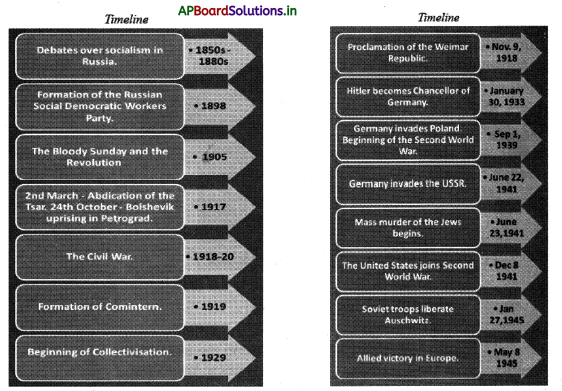
→ The livelihood of most Russians was derived from agriculture and control over the land was the basic cause for the struggle between peasants and landlords.

→ On March 8th, 1917, around 10,000 women of the capital, St. Petersburg took procession demanding ‘Peace and Bread’. Many others joined them and Tsar abdicated the throne. It is called the “March Revolution”.

→ The Soviets under. Bolshevik leadership seized power and put an end to war and redistributed land and nationalized all factories, banks, etc. It is called November Revolution.

→ Gradually the Union of Soviet Socialist Republics (the USSR) was formed by 1924. After the death of Bolshevik leader, Lenin in 1924 Stalin used his undisputed power to build the economy of Russia.

→ Introduced Five Year Plans in 1928 and pursued twin policy of rapid industrialization and collectivization of agriculture.

→ An extended schooling system was developed and full employment for all citizens and improvement of their standard of living substantially.

→ The USSR prided itself in escaping the impact of the Great Depression.

→ It has enormous centralization of power in the hands of the communist party and its leaders and denied ordinary democratic liberties to the citizens and done away with the opposition.

→ The USSR inspired people all over the world who were committed to the ideals of equality and national liberation.

→ Many others were also horrified by the elimination of opposition and denial of multiparty democracy and freedom in the USSR.

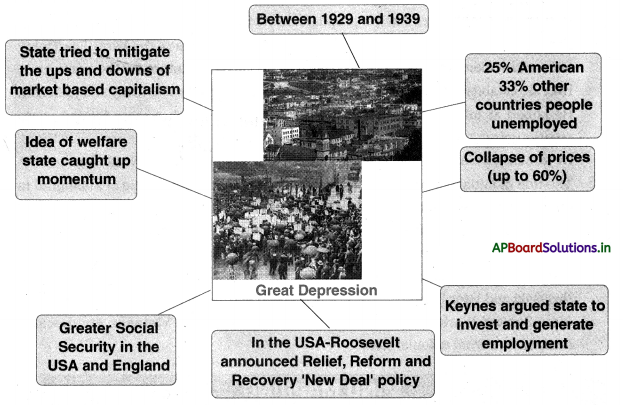
→ The Great Depression began around the end of 1929 and lasted almost till 1939.

→ In America, as many as 25% of people and nearly 33% in many other countries were unemployed.

AP Board Solutions AP Board 10th Class Social Studies Notes Chapter 14 The World Between Wars 1900-1950 Part 2

→ JM Keynes argued that the state should invest funds and generate employment to revive the economy.

→ The President of the US, Franklin Roosevelt announced the ‘New Deal’ which promised Relief (to the victims of depression), Reform (of financial institutions), and Recovery (ensure economy).

→ The USA gave Germany loans in 1928 and its economy stabilized.

→ But as America was affected by Depression, the German economy was the worst hit by the Depression.

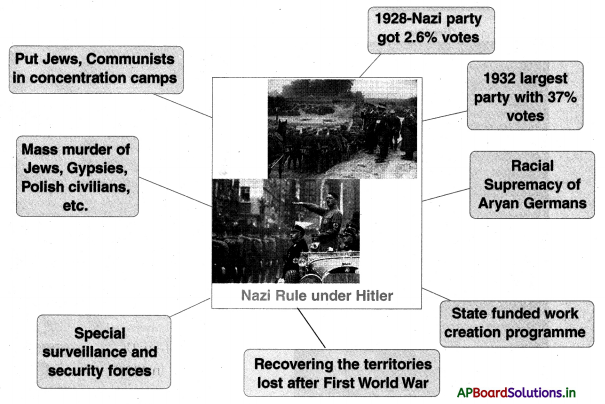
→ In such a situation, Nazi Party’s propaganda stirred hopes of a better future.

→ Hitler promised to build a strong nation, undo the injustice of the Versailles Treaty and employment for those looking for work, and a secure future for the youth.

→ His rule established complete control over the economy, media, army, and judiciary.

→ He aimed at full production and full employment through a state-funded work-creation program.

→ He attacked Poland in 1939 which led to the breakout of the Second World War.

→ The tide of initial victories of Germany was turned back after the Battle of Stalingrad in early 1943 when German forces were defeated.

→ Hitler and his close associates committed suicide and Germany was divided into the German Democratic Republic (GDR) and the Federal Republic of Germany (FRG).

→ Second World War ended with America dropping atom bombs on Hiroshima and Nagasaki and later United Nations Organisation was formed.

→ After the Second World War countries like India, Indonesia, Vietnam, etc. became independent from colonial rule.

→ Socialism: Economic system based on government control over the means of production, distribution, and exchange and operated for the welfare of people

→ Communism: Belief that of private ownership of land, factories, railways, banks, etc. should be replaced by public ownership

→ Revolution: The fundamental political change, overthrowing a government/ruler and substitute with other

→ Centralization: Giving the political power of a country to a group of people of power in one particular place

→ Bolshevik: A Russian Communist Party founded by Vladimir Lenin

AP Board Solutions AP Board 10th Class Social Studies Notes Chapter 14 The World Between Wars 1900-1950 Part 2

→ Collectivization: Joining of several private farms, etc. together so that they are controlled by the government/community

→ Relief-Reform-Recovery: Roosevelt, the then President of the US announced the New Deal’ which promised Relief to the victims of depression Reform of financial institutions and steps to ensure economic Recovery by undertaking large public works.

→ Welfare state: A system by which government undertakes prime responsibility for the economic and social well-being of the population

→ Indoctrination: ForcIng somebody to accept a particular belief or set of beliefs and not allowing them to consider any others

→ Propaganda: Ideas that may be false but are used in order to gain support for a political leader/party

→ Racial Supremacy: Belief that some races are superior to the others

→ Tsar: Title of the pre-1917 rulers of Russia Russian Emperor

→ Feudalism: A social system in Europe in which people were given land and protection by a nobleman (Feudal Lord) and people had to work hard and fight for him.

→ Autocrat: A ruler with unrestricted authority

→ Bureaucracy: Too complicated system of official rules where a large number of officials are not elected.

→ Provisional: Government arranged for the present time only and likely government to be changed in the future

→ Aristocrat: A person belonging to the noble class (the best by birth)

→ liberals: People believing ¡n freedom from government restrictions on trade and liberty and holding with the constitutional rule

→ Soviets: The councils into which people began to organize themselves

→ Civil war: Internal war in a country

→ Collective farms: Pool of all the land iñ the village along with tools, machines, and animals

→ Great depression: A worldwide economic decline triggered by a decline in demand and fall in prices

→ Pauperization: Becoming a very poor person

→ Capitalism: Economic system based on private ownership of means of production, distribution, and exchange and operated for profits

→ Great depression: A worldwide economic decline triggered by a decline in demand and fall in prices

AP Board Solutions AP Board 10th Class Social Studies Notes Chapter 14 The World Between Wars 1900-1950 Part 2

→ Pauperization: Becoming a very poor person

→ Capitalism: EconomIc system based on private ownership of means of production, distribution, and exchange and operated for profits

→ Concentration: Prison camps set up by the Nazis to contain those whose Camps oppose the Nazi regime

→ Enabling Act: Hitler was given all powers to sideline parliament and rule by decree

→ Gestapo: Secret State Police in Germany during Nazi regime
AP Board 10th Class Social Studies Notes Chapter 14 The World Between Wars 1900-1950 Part 2 1
AP Board 10th Class Social Studies Notes Chapter 14 The World Between Wars 1900-1950 Part 2 2
AP Board 10th Class Social Studies Notes Chapter 14 The World Between Wars 1900-1950 Part 2 3

AP Board 10th Class Social Studies Notes Chapter 21 Social Movements in Our Times

Students can go through AP State Board 10th Class Social Studies Notes Chapter 21 Social Movements in Our Times to understand and remember the concept easily.

AP State Board Syllabus 10th Class Social Studies Notes Chapter 21 Social Movements in Our Times

→ From 1950, an era of economic growth and prosperity for most of the countries was started.

→ Likewise from 1950 tensions were grown in many countries and sections of societies that had long been denied equal rights.

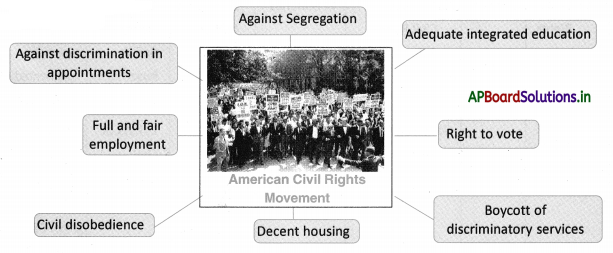
→ The American Civil Rights Movement fought for equal treatment of Afro – Americans against permitting segregation.

→ They boycotted discriminatory services like buses and schools.

→ They violated discriminatory laws peacefully.

→ On 28th August 1963, they conducted Washington March.

→ They demanded the passing of the bill, decent housing, the right to vote, and adequate integrated education.

→ Malcolm X and others were of the view that blacks needed a separate nation.

→ The USSR and other countries of Eastern Europe governments were constantly under fear of conspiracies to destabilize them and kept close control over all activities of people.

AP Board Solutions AP Board 10th Class Social Studies Notes Chapter 21 Social Movements in Our Times

→ The 1970s and 1980s saw a new kind of movement – the movement against war and nuclear arms.

→ Thousands of scientists and intellectuals from across the world campaigned for abolishing all nuclear weapons and insisted that the USA and the USSR come to an agreement to end the Arms Race.

→ There was large-scale human destruction in Vietnam when the USA and France fought with her.

→ A treaty was signed in 1991 called Strategic Arms Reduction Treaty (START) and removed 80% of all strategic nuclear weapons then in existence by 2001.

→ During the last phase of the USSR, a major accident took place in its nuclear plant in Chernobyl which caused the death of a large number of its workers.

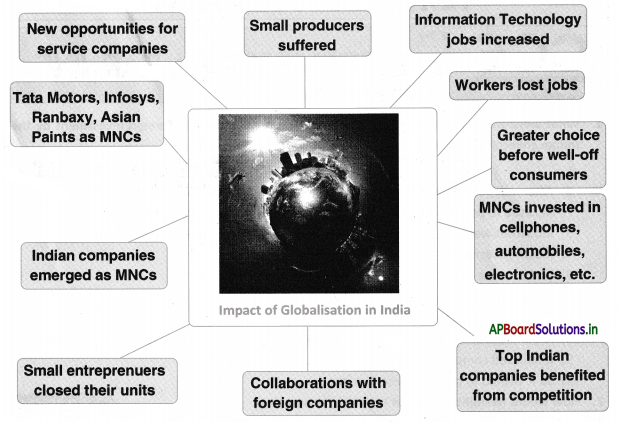
→ Worldwide economic and political changes since the 1990s, which go by the name of ‘Globalisation’ or ‘Neo-liberalism’ have deeply impacted the lives of the underprivileged and poor.

→ Greenpeace has taken up the impact of climate change across many countries.

→ The worst industrial disaster in the world, claiming thousands of lives and many more suffering to date was happened in Bhopal in 1984.

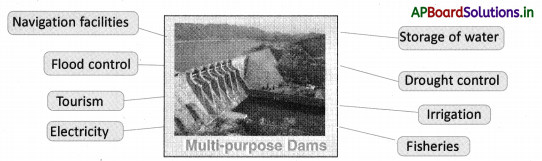
→ In the beginning, people were awestruck by the dams, the huge amounts of water it could store, the vast tracts it could irrigate, the amount of electricity it could generate, the floods and droughts it could prevent.

→ Later people began to question even the dam constructed if it accounted for all the expenditure and all the losses incurred in terms of forests and fields and villages

→ Narmada Bachao Andolan that organized people’s movement in the Narmada Valley against the dam.

→ There were anti-arrack movements in combined Andhra Pradesh and the movement of Manipuri women against special powers of the armed forces, which were aimed at social justice and human rights.

AP Board Solutions AP Board 10th Class Social Studies Notes Chapter 21 Social Movements in Our Times

→ Civil Rights: The equality of status between groups and races.

→ Civil disobedience ‘: The refusal to obey laws, pay taxes, etc.

→ Segregation: Keep one thing away from the other.

→ Destabilize: To make a system, country or government, etc. become less firmly established or successful.

→ AntIwar: The section of a society which does not support the war.:

→ Draft age: The period during which Black Americans awaited the Implementation of the Civil Rights Act.

→ Weaponlsatlon: Making things set for the use of weapons.

→ RehabilitatIon: HelpIng the people to restore normalcy after they are affected by the way

→ CompensatIon: Money that is given to. winning side by the lost side as they had hurt it.

→ AntI – arrack: The movement led by women belonged to the poorest Movement, a section of society in Andhra Pradesh to ban toddy and arrack and later complete prohibition.

→ Democratic: Controlled by representatives who are elected by the people of the country.

→ Participatory: Taking part in an activity ‘or event.

→ Fascism: The Ideology of Benito Mussolini, which encouraged militarism and extreme nationalism and opposed democracy and liberalism in Italy.

→ Liberalism: PolitIcal views favoring progress, reform, and Individual freedom.

→ National Liberation: Movement run to free a country from the control of the Movement other.

AP Board Solutions AP Board 10th Class Social Studies Notes Chapter 21 Social Movements in Our Times

→ Score: A group of twenty.

→ Nazism: The Ideology of Adolf Hitler, which encouraged building armed forces, regaining territories lost and against communism, hatred towards Jews In Germany.

→ Laotians The people of Laos.

→ Napalm bombs: Petrol/gas bombs.

→ Cold War: The state of military tension and diplomatic and political hostility between the USA and the USSR.

→ Globalization: DIfferent economies around the world are becoming connected.

→ SustaInable: Development which Is environmentally sustainable over-development long time and also just for all people.

→ Green peace: Movement to ensure the ability of the earth to nurture life In movement all Its dIversity

→ SSP: SardarSarovar Project.

→ Multipurpose dams: The river valley projects which serve the main functions like the supply of Irrigation water, generation of power, control of floods, development navigation, and fishery are generally described as multipurpose dams.

→ Environmental: Movements for protection of the natural environment and movement sustainability of It.

AP Board Solutions AP Board 10th Class Social Studies Notes Chapter 21 Social Movements in Our Times

→ Movements of Women: Movements taken up by women against unequal treatment for equal rights and opportunities, personal safety, and Justice.

→ Movement of Women: Movement of Manipur women against the misuse Manipurl of Armed Forces Special Power Act by Indian Parliament In Manipur after Its merger agreement.
AP Board 10th Class Social Studies Notes Chapter 21 Social Movements in Our Times 1
AP Board 10th Class Social Studies Notes Chapter 21 Social Movements in Our Times 2

AP Board 10th Class Social Studies Notes Chapter 10 Globalisation

Students can go through AP State Board 10th Class Social Studies Notes Chapter 10 Globalisation to understand and remember the concept easily.

AP State Board Syllabus 10th Class Social Studies Notes Chapter 10 Globalisation

→ Globalization is the process of rapid integration or interconnection between countries.

→ It is a major change that occurred across the globe in the late 20th century

→ It has political, cultural as well as economic dimensions.

→ It has three implications like the flow of trade in goods and services, flow of labour, (migration of people in search of employment), and flow of capital for short-term or long-term investments over long distances.

→ Globalization is not merely about the market, in fact, ideas are also being shared and expanded.

→ Multi-National Company is not only selling its finished products globally but more importantly, the goods and services are provided globally

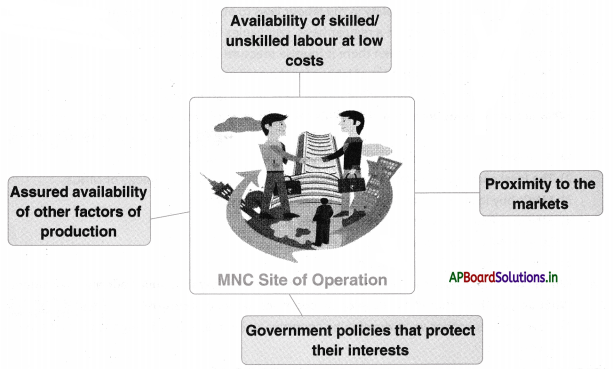
→ The criteria for selecting a site for operations of MNCs are proximity to the markets, availability of skilled and unskilled labour at low costs, assured availability of other factors of production, government policies that protect their interests,

→ Foreign trade results in connecting the markets or integration of markets in different countries.

→ The flow of capital, people, technology is supposed to have created a borderless world

→ Rapid improvement in technology has been one major factor that has stimulated the globalization process.

→ The Indian government, after independence, had put barriers to foreign trade and foreign investment.

→ Around 1991, the government decided that the time had come for Indian producers to compete with producers around the globe

AP Board Solutions AP Board 10th Class Social Studies Notes Chapter 10 Globalisation

→ Removing barriers or restrictions set by the government is known as liberalization

→ World Trade Organisation with 150 member countries aimed at liberalization of International trade. (164 members as of 29th July 2016)

→ Globalization has benefited well-off consumers and also producers with skill, education, and wealth.

→ Thousands of small producers and workers have seen their employment and worker’s rights erode.

→ MNCs: Multi-National Company is a company that owns or controls production In more than oñe nation

→ Nation-State: An independent country, especil1y wheñ thought of as consisting of a single large group of people all sharing the same language, traditions, and history

→ Technology: (The study, and knowledge of) the practical, especially industrial, use of scientific discoveries

→ Foreign Investment: The money that MNCs spent to buy assets such as land, building, machines, and other equipment

→ Foreign trade: The foreign trade of a country consists of both exports and imports of goods and services

AP Board Solutions AP Board 10th Class Social Studies Notes Chapter 10 Globalisation

→ Liberalization: Removing the trade barriers or restrictions set by the government

→ Globalization: The process of rapid integration or Interconnection between countries
AP Board 10th Class Social Studies Notes Chapter 10 Globalisation 1
AP Board 10th Class Social Studies Notes Chapter 10 Globalisation 2

AP Board 10th Class Social Studies Notes Chapter 13 The World Between Wars 1900-1950 Part 1

Students can go through AP State Board 10th Class Social Studies Notes Chapter 13 The World Between Wars 1900-1950 Part 1 to understand and remember the concept easily.

AP State Board Syllabus 10th Class Social Studies Notes Chapter 13 The World Between Wars 1900-1950 Part 1

→ The world was divided into the ‘West1, experiencing economic growth, and the ’Rest’, colonially exploited by the West.

→ The 20th century was a period of great expectations, experiments, and dangerous developments.

→ The 1st World War broke out in 1914 and ended in 1918; Second World War was from 1939 to 1945.

→ World War 1 had claimed 10 million men in battle.

→ In World War II, 22-25 million military deaths, 40-52 million civilian deaths occurred,

→ Two main power blocks emerged – the Centre and the Entente or Allies

→ Every World War is triggered by some immediate provocations and some long-term cause.

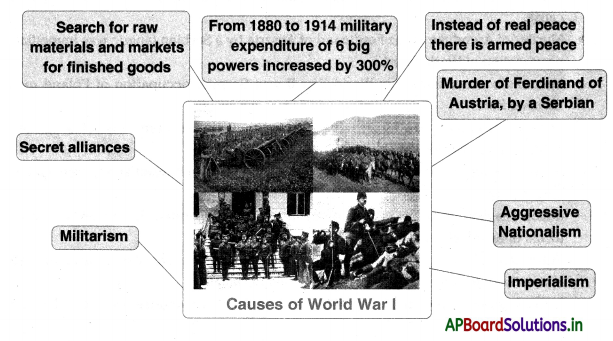
→ The Murder of Archduke Franz Ferdinand of Austria by a Serbian fanatic was an immediate provocation of World War I.

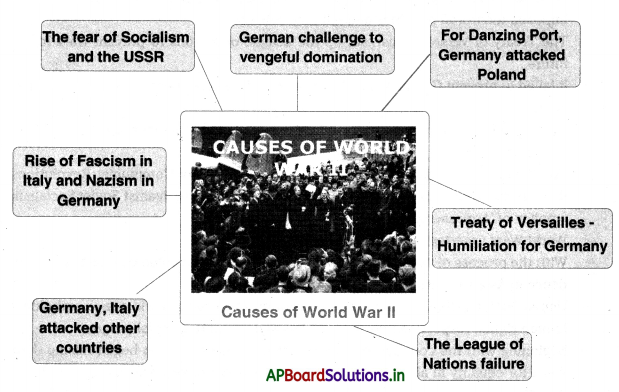
→ The immediate provocation for World War II was the German occupation of Poland over Danzing Port.

→ Long-term causes are aggressive nationalism, imperialism, secret alliances, militarism for World War I.

→ Aggressive nationalism is the ideology of having pride in oneself and hatred against neighbors.

→ Italian Fascism from 1923 and the National Socialism of German Nazis were the other forms of aggressive nationalism.

AP Board Solutions AP Board 10th Class Social Studies Notes Chapter 13 The World Between Wars 1900-1950 Part 1

→ European countries needed markets for their products and access to raw materials – paved the way for colonization that is called Imperialism.

→ Instead of real peace, the secret alliances created an atmosphere of fear and armed peace in Europe.

→ Militarism is the belief that military might is the best way to ensure security and war is a good way to solve problems.

→ To weaken Germany, the Treaty of Versailles, after completion of the First World War, imposed territorial penalties and military cuts on it.

→ The Treaty of Versailles also set up the League of Nations to prevent wars in the future.

→ It failed to prevent Germany and Italy from violating agreements and attacking other countries.

→ Germany under Hitler avenged the injustice meted out to them through the Treaty of Versailles.

→ The Western capitalist countries feared the repetition of Communist Revolutions like Russia in their countries, made Hitler act as a buffer against Soviet Socialism-policy of Appeasement of Hitler’.

→ World Wars asserted democratic principles.

→ With the process of decolonization, after World War II, the colonies rose to independence in Asia and Africa are more than a hundred.

→ United Nations Organisation was formed based on preserving world peace, upholding human rights, respecting international law, and promoting social progress

→ Beginning with the confidence of being breadwinners, women began raising their voices for equality in all walks of life. Getting the right to vote was a big step in that direction.

→ Industrial capitalism: Free trade (1813-60) West European countries, tasted industrial revolution, made Asian and African countries as colonies and used as chief exporters of raw material and market for manufactured goods

AP Board Solutions AP Board 10th Class Social Studies Notes Chapter 13 The World Between Wars 1900-1950 Part 1

→ Alliances: Groups of countries, political parties, or people who have agreed to work together because of shared interests or alms

→ Aggressive: The ideology of having pride In oneself and hatred against nationalism neighbors

→ Militarism: The ideology that the military might is the best way to ensure security and war is a good way to solve problems

→ Easclsm: The Ideology of Mussolini, encouraged militarism and extreme nationalism

→ Imperialism: The practice of extending state’s rule over other territories, colonizing them

→ Great depression: A great decline In trade and general prosperity worldwide (1929-39)

→ Holocaust: The killing of millions of Jews by the Nazis In the 1930s and 1940s.

→ Nazis: The workers of the National Socialist Party (Nazi) of Germany, under Hitler

→ Power block: A country with great military strength and a lot of influence in world affairs

→ Nation-state: The independent sovereign nation inhabited by people of that state only, as opposed to several nationalities

→ Diplomatic alliance: Forming a group in connection with managing relations between countries

→ Colonization: Industrialized state making territories as colonies using as markets for their products and cheap suppliers of raw materials

AP Board Solutions AP Board 10th Class Social Studies Notes Chapter 13 The World Between Wars 1900-1950 Part 1

→ Diktat: An order given, that people must obey

→ Decolonization: Granting of independence to a colony = freeing from colonial status
AP Board 10th Class Social Studies Notes Chapter 13 The World Between Wars 1900-1950 Part 1 1
AP Board 10th Class Social Studies Notes Chapter 13 The World Between Wars 1900-1950 Part 1 2

AP Board 6th Class Science Notes Chapter 3 Animals and their Food

Students can go through AP State Board 6th Class Science Notes Chapter 3 Animals and their Food to understand and remember the concept easily.

AP State Board Syllabus 6th Class Science Notes Chapter 3 Animals and their Food

→ Different types of animals that live in our surroundings have their own food habits. (Way of taking in food and type of food taken)

→ Sucking, licking, pecking, chewing, peeling, swallowing are all the ways by which animals take in their food.

→ Plants and animals are the main sources of food in our surroundings.

→ Each animal has its own style of getting food. They track down, collected, grab or hunt and then use various parts of their body to take food into the mouth finally.

→ To locate the food most animals use a wide range of senses – Smell, sight, hearing, taste, and touch.

→ Different parts may be used to take the same type of food.

→ Beaks of different birds are used to eat different types of food.

→ Leeches stick onto the skin and suck the blood of cattle as well as humans.

→ Frog gets its food by its sticky tongue.

→ Animals are divided into three types on the basis of their food. They are herbivores, carnivores and omnivores.

→ Dogs eat food by using their sharp teeth and tongue.

→ Wild animals like lions, tigers have strong legs to run, sharp claws to catch and sharp teeth to tear flesh.

AP Board Solutions AP Board 6th Class Science Notes Chapter 3 Animals and their Food

→ The food chain is the connection between the animals on the basis of their food habits.

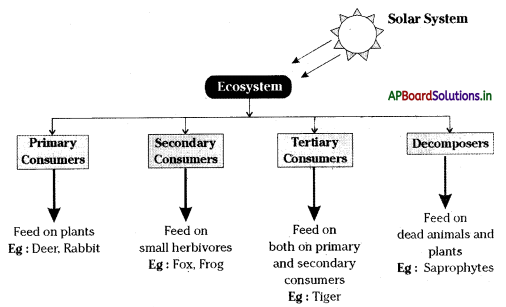
→ The food chain consists of feeding levels known as producers, primary consumers, secondary consumers, and tertiary consumers.

→ Any living thing that uses the energy of the sun to make its own food is a producer.

→ All animals are consumers because they do not make their own food.

→ The food chain describes how organisms get energy and nutrients by eating other organisms.

→ The food chain explains the interdependence of diverse organisms in nature.

→ The decomposers help in the cycling of materials between producers, consumers, and soil.

→ Several food chains in an ecosystem are interconnected to form a food web.

→ Many animals live in colonies. Ex: Elephants, ants, honey bees.

→ The ant colony consists of workers, soldiers, female and male ants.

AP Board Solutions AP Board 6th Class Science Notes Chapter 3 Animals and their Food

→ Food habit: The way a person or group eats.

→ Carnivore: Carnivores are animals that only eat animals. Ex: Wolf, Tiger, Lion.

→ Herbivores: Herbivores are animals that only eat plants. Ex: Cow, Deer.

→ OmnIvores: Omnivores are animals that eat both plants and animals. Ex: Crow, Hen, Man.

→ Rumination: To bring back swallowed food into the mouth. Ex Cow, Buffalo, Camel.

→ Food chaIn: A food chain shows the feeding relationship between different organisms in a particular habitat.

→ Producers: Producers are organisms that make their own food. Ex Green plants.

→ Consumers: The organisms that eat other organisms for food are called “Consumers”. Ex Deer, Tiger, Lion.

→ Decomposers: Decomposers are an organism thät breakdown dead or decaying organisms’: Micro-Organisms (Bacteria, Fungi)

→ Food Web: A food web is the natural interconnection of food chains and a graphical representation of what eats what is in a habitat.

AP Board Solutions AP Board 6th Class Science Notes Chapter 3 Animals and their Food

→ Pet animals: An animal that you keep in your home to give you company or pleasure. Ex: Dog, cat, etc.

→ TrackIng: The act or the process of following something or source one.

→ Beak: The hard-pointed part of a bird’s mouth.

→ Reptiles: The vertebrates (having vertebral column) that crawl or move on their belly or on short legs. Ex: Snake, Lizard.

→ Natural scavenger: An organism or animal that feeds on waste, dead organic matter. They keep their surroundings clean in this manner. Ex: Crow, Vultures, Fungi, Microorganisms.

→ Wild animals: Wild animal Is an animal that is not tame: and lives on its own. Ex: Crow, Wolf, Squirrel.

→ RearIng: To take care and support up to maturity is called rearing.

→ Journal: The organisms that are active mainly in the daytime. Ex: Cow, Sheep, Goat, Hen, Man

→ Nocturnal: The organisms that are active mainly in the nighttime. Ex: Owl, Bat, Lizard.

→ PestIcides: A pesticide Is a chemical or other substance that is used to kill or prevent pests. Ex: Glycol

→ Insecticides: Insecticides are substances used to kill insects. Ex: Malathion, Pyrethrum.

AP Board Solutions AP Board 6th Class Science Notes Chapter 3 Animals and their Food

→ Colony: A group of organisms of the same type living or growing together.

→ Primary Consumers: A primary consumer is an organism that feeds on producers for energy. Ex: Deer, Cow, Goat.

→ Secondary consumers: A secondary consumer is an organism that feeds on primary consumers for energy. Ex: Hen, Wolf, Fox, Fish.

→ Tertiary Consumers: A tertiary consumer is an organism that feeds on secondary consumers for energy. Ex: Tiger, Lion

→ Pond skater: A small insect that floats on the water surface.

→ Pest: An organism that may cause illness and damages the food crops.

→ Nectar: A sugar fluid secreted within the flowers.

→ RumInants: The animals that bring up food from their stomach and chew it again. Ex Cow, Camel.

→ Hunting: Chasing and killing of wild animals by other wild animals for food. Ex Tiger, Lion.

AP Board Solutions AP Board 6th Class Science Notes Chapter 3 Animals and their Food

→ Ecosystem: It is an area of living organisms along with the non-living components of their environment.

→ Aphids: The insect which feeds on plant juices.
AP Board 6th Class Science Notes Chapter 3 Animals and their Food 1
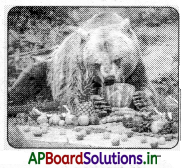
→ Frugivorous Animals
These animals feed mostly on raw fruits, succulent fruits-like vegetables, roots, shoots, nuts, and seeds. Frugivore can be any type of herbivore or omnivore where the fruit is a preferred food type. Because approximately 20% of all mammalian herbivores eat fruit, frugivory is common among mammals
AP Board 6th Class Science Notes Chapter 3 Animals and their Food 2
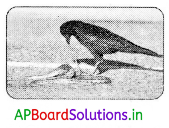
→ Natural Scavengers
Crows and vultures that live in our surroundings usually eat waste, rotten food material, dead animals, etc. They keep our surroundings clean in this manner.
AP Board 6th Class Science Notes Chapter 3 Animals and their Food 3
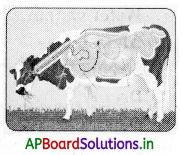
→ Ruminants
Animals like cows, buffalo, camels, etc., chew food very quickly, swallow and store it in a part of their stomach. After some time they take food material back from the stomach to the mouth and chew it again. This process is called rumination. These animals are called ruminants.
AP Board 6th Class Science Notes Chapter 3 Animals and their Food 4

AP Board 6th Class Science Notes Chapter 7 Let us Measure

Students can go through AP State Board 6th Class Science Notes Chapter 7 Let us Measure to understand and remember the concept easily.

AP State Board Syllabus 6th Class Science Notes Chapter 7 Let us Measure

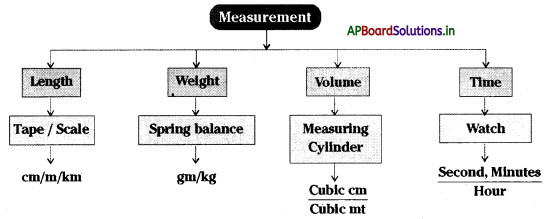
→ Foot space, hand space, cubit are conventional methods to measure the lengths.

→ The standard unit of length is Meter.

→ The smallest unit of length is centimeter/millimeter (cm/mm) and the larger unit of length is Meter / Kilometer (m/km).

→ The measurement of the extent of plane surface occupied by an object is Area.

→ A square centimeter (cm2) is a standard unit to measure the area of a surface.

→ Volume is a measurement of the extent of space occupied by an object.

→ The volume of solids is measured in cubic meters, cubic centimeters.

→ The volume of liquids is measured in liters or milliliters.

→ We need standard instruments to measure lengths accurately.

AP Board Solutions AP Board 6th Class Science Notes Chapter 7 Let us Measure

→ The area is a measure of the extent of the plane surface occupied by an object.

→ France made a certain length of rod made of special material of platinum-iridium called a meter.

→ The original scale is preserved in the museum of France.

→ In our daily life, we use different types of measurements like plain type roll type centimeter scale of different sizes made up of wood iron, and plastic.

→ While measuring the length of objects the zero point of scale should be consisting the starting of an object

→ The perimeter of the bucket and perimeters of Kadai is examples of curved surfaces

→ For measuring the volume of liquids in laboratories like milk and oil etc., they use measuring cylinders

→ The volume of the box is = Length × Breadth × Height

→ Measure:‘ The unit used to know the size and weight of an object

→ The standard unit of area: A level of quality

→ Volume: The extent of space occupied by a body

AP Board Solutions AP Board 6th Class Science Notes Chapter 7 Let us Measure

→ Regular Surface: A systematic area whose length and breadth can easily measure

→ Irregular Surface: An unsystematic, changeable area whose length and breadth cannot easily measure

→ Rectangular body: A plane figure with four straight sides and four right angles. with opposite sides are parallel and of equal length.

→ Measuring cylinder: A long hollow tube which is using to measure the volume of liquids and solids

→ Graph Paper: A paper with equal designs and used to measure the area of irregular surface bodies

→ Yard: The distance between nose and tip of the middle fingers

→ Area: The surface occupied by an object

→ Handspan: The gap between thumb line and little finger

→ Cubit: The length between elbow and tip of the middle finger

→ Tarragona: A famous rural game in ÆP. gilildanda (karrabilla)

→ Feet: 12 inches of length in feet

AP Board Solutions AP Board 6th Class Science Notes Chapter 7 Let us Measure

→ Scale: The universal unit to measure length and width

→ Meter: 100 cm length is a meter
AP Board 6th Class Science Notes Chapter 7 Let us Measure 1
→ “Live and Let Live”:
You must have noticed that the volumes of liquids are written ¡ri ml while those of solids are written in cm3. Do you know the relation between these two units? The two units are related as follows: 1 ml = 1 cm3

AP Board 6th Class Science Notes Chapter 10 Basic Electric Circuits

Students can go through AP State Board 6th Class Science Notes Chapter 10 Basic Electric Circuits to understand and remember the concept easily.

AP State Board Syllabus 6th Class Science Notes Chapter 10 Basic Electric Circuits

→ The cell is the source of electrical energy in a torchlight.

→ The cell has two terminals, (+) and (-).

→ Do not connect the two terminals of a cell with a single wire.

→ The bulb consists of a filament that gives light and two terminals.

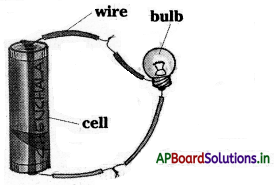
→ A circuit consists of a cell (power source), a bulb, and connecting wires.

→ An electric circuit provides a complete path for electricity to flow between the cell and the bulb.

→ Electricity requires a closed path for it to flow.

→ A switch helps us to allow or break the flow of electricity in a circuit.

→ The flow of electricity in a circuit is called a current.

→ A torchlight consists of a cell, a bulb, and a switch.

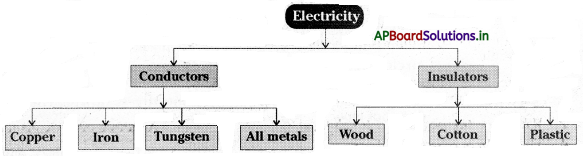
→ Substances that allow the flow of electricity are known as conductors of electricity.

AP Board Solutions AP Board 6th Class Science Notes Chapter 10 Basic Electric Circuits

→ Substances that do not allow the flow of electricity are known as insulators.

→ The electric bulb was invented by Thomas Alva Edison.

→ Electricity: The flow of electrons is known as electricity.

→ Cell: Cell is the source of energy. An electric cell is a sort of container that produces electricity from the chemical stored inside it.

→ Bulb: An electric bulb is a device that produces light when electricity is passed through its terminals. There are different types of bulbs.

→ Fused bulb: A bulb is said to be fused if the filament gets broken. The fused bulb does not glow.

→ Terminals: The terminal is a point of connection for closing an electric circuit, Cell has two terminals ‘+’ and ‘-‘. The bulb also has two terminals ‘+‘ and ‘-‘.

→ Filament: The metal resistance wire inside a bulb that transfers electrical energy to light.

→ Switch: A device for making and breaking the connection in an electric circuit.

→ Circuit: An electrical circuit is a path in which electrons from a current source flow.

→ Conductor: The material which permits (allow) the electric current to pass through it.

→ Insulator: The material which resists the current to flow through them.

→ Tungsten: A type of metal used for making filaments.

AP Board Solutions AP Board 6th Class Science Notes Chapter 10 Basic Electric Circuits

→ LED bulb: LED stands for the light-emitting diode. It is an energy efficiency bulb.

→ Electric shock: A reflex response to the passage of electric current through the body.
AP Board 6th Class Science Notes Chapter 10 Basic Electric Circuits 1
AP Board 6th Class Science Notes Chapter 10 Basic Electric Circuits 2

AP Board 6th Class Science Notes Chapter 6 Fun with Magnets

Students can go through AP State Board 6th Class Science Notes Chapter 6 Fun with Magnets to understand and remember the concept easily.

AP State Board Syllabus 6th Class Science Notes Chapter 6 Fun with Magnets

→ Lodestone is a natural magnet.

→ Man-made magnets are of different shapes i.e. bar magnets, horseshoe magnets, ring-type magnets, Disc magnets, cylindrical, etc.

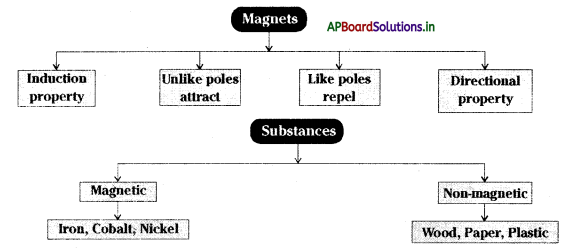
→ The materials that are attracted by magnets are called magnetic materials. Ex: Iron, Steel, Cobalt, etc.

→ The materials that are not attracted by magnets are called non-magnetic materials. Ex: Glass, Wood, paper, etc,

→ A bar magnet always has two ends whose attracting capacity is more than the other parts of it. The poles of the magnet lie at these ends.

→ Each magnet has two magnetic poles: North and South.

→ Like Poles (N-N, S-S) repel each other and unlike poles (N-S, S-N) attract each other.

→ A freely suspended magnet always aligns in the North-South direction.

→ The directional property of magnets is used to make a magnetic compass.

→ The magnetic compass is an instrument that is used to find directions.

AP Board Solutions AP Board 6th Class Science Notes Chapter 6 Fun with Magnets

→ The magnetic property possessed by a magnetic substance due to the presence of a magnet near to it is called magnetic induction.

→ Magnets lose their properties if they are heated or dropped from a height or hit with a hammer or placed near cell phones, computers, DVDs.

→ Improper storage can also cause magnets to lose their properties.

→ We use various equipment with magnets in our day-to-day life such as Speakers, electric motors, door locks, pin holders, magnetic cranes-etc.

→ Electromagnetic trains work on the principle of electromagnetic levitation.

→ Magnet: any material capable of attracting iron and producing a magnetic field outside itself.

→ Magnetic materials: the materials that are attracted by magnets are called magnetic materials.

→ Non-magnetic materials: the materials that are not attracted by magnets are called non-magnetic materials.

→ North pole: End part of the freely suspended magnet that points towards north.

→ South pole: End part of the freely suspended magnet that points towards the south.

→ Magnetic compass: A compass that is used with a magnetized needle is called a magnetic compass.

→ Like poles: Same poles of two magnets, either N – N or S – S. They repel each other.

→ Unlike poles: Different poles of two magnets, either N – S or S – N. They attract each other.

→ AttractIon: a force by which things are pulled towards each other

→ Repulsion: a force under the influence of which objects tend to move away from each other

AP Board Solutions AP Board 6th Class Science Notes Chapter 6 Fun with Magnets

→ Magnetic induction: the process by which an object or material is magnetized by an external magnetic field.

→ Magnetic levitation: magnetic levitation is a method by which an object is suspended with no support other than magnetic fields.

→ Poles: each of the two opposite points on the surface of a magnet at which magnetic forces are strongest.
AP Board 6th Class Science Notes Chapter 6 Fun with Magnets 1

AP Board 6th Class Science Notes Chapter 9 Organisms and Habitat

Students can go through AP State Board 6th Class Science Notes Chapter 9 Organisms and Habitat to understand and remember the concept easily.

AP State Board Syllabus 6th Class Science Notes Chapter 9 Organisms and Habitat

→ There are living and non – living things around us.

→ Living things possess characteristics like growth, breathing, excretion, movement, response, and stimuli and giving birth to young ones.

→ Plants are also living things but can’t move like animals.

→ Our body produces different waste materials, sending these wastes out of the body is called excretion.

→ The organisms which lay eggs are oviparous and which give birth to young ones are called viviparous.

→ We can’t see microorganisms with our naked eyes. They can see only with a microscope.

→ The dead things are an intermediate stage between living and non-living things.

→ Seed is also a living thing but it does not have all characteristics of the living world.

→ Different organisms live in different places but many of them live in the same place.

→ The organisms usually stay in the places where most of their needs are met.

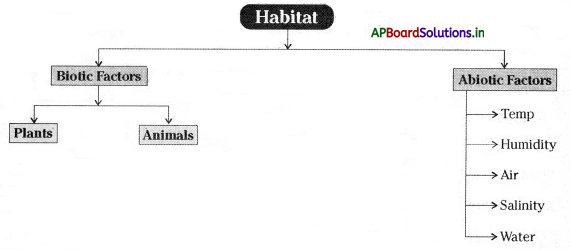
→ A habitat is a dwelling place for plants and animals that gives them optimum conditions for life.

→ Tree, pond, and house are some examples of habitat.

→ Temperature, moisture, air, water, food, shelter are the components of a habitat.

AP Board Solutions AP Board 6th Class Science Notes Chapter 9 Organisms and Habitat

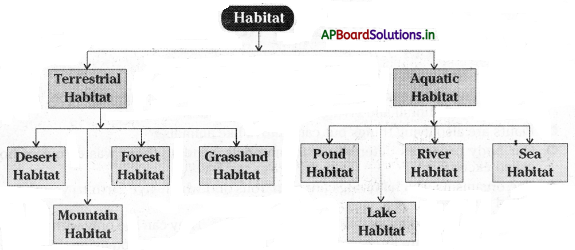
→ All the habitats may be broadly grouped into terrestrial and aquatic.

→ Habitats show the diversity of nature.

→ Birds often change habitat in search of better living conditions. For example, some birds change habitat before laying eggs.

→ We must not destroy habitats of other organisms to satisfy our needs, rather, we must try to protect them.

→ living thIngs: Things that have life

→ Non-living things: Things do not have life

→ Growth: Increasing in size

→ Breathing: Taking air into the body and sending out

→ Excretion: Removal of wastes from the body

→ Stimulus: Showing response to the reaction

→ Response: Reaction to stimulus

→ Micro-Organisms: The small organisms which cannot be seen with the naked eye

→ Microscope: An Instrument using for observing microorganisms

→ Habitat: The dwelling place of living things

→ Terrestrial habitat: Land living plants and animals

→ Aquatic habitat: Plants and animals which are living in the water

→ Orchard: Garden

→ Mangrove: Marshy soils on seashores

AP Board Solutions AP Board 6th Class Science Notes Chapter 9 Organisms and Habitat

→ Locomotion: Movement of the body

→ Nutrition: Taking of food for health & growth

→ Adaptation: Changes in organisms to suit a new situation

→ DwellIng: LivIng place of organisms

→ Optimum: Possible options

→ Community: A group of the people
AP Board 6th Class Science Notes Chapter 9 Organisms and Habitat 1
AP Board 6th Class Science Notes Chapter 9 Organisms and Habitat 2
→ Live and Let Live”
Animals are partners in our habitat. They also have a right to live. We people are encroaching on their habitats. If we cut a tree, birds that live on it lose their nests and fall in danger. We often see dogs, cows, monkeys suffering from a lack of food and shelter. Some voluntary organizations work for animal rights and protection. We have to provide food and protect them. We should take it as our responsibility.

→ Cactus, Acacia, Aloe vera plants do not need much water. They are called Desert plants. We can see camels frequently in the desert. Desert plants and animals are suited to dry conditions and vast temperature differences. Different characteristics in the desert make up desert habitats.

AP Board Solutions AP Board 6th Class Science Notes Chapter 9 Organisms and Habitat

→ Different kinds of birds come from long distances to the Kolleru and Pulicat lakes of our State. During the months of October to March, pelican birds appear on those lakes. Generally, we can see birds flying over long distances to find suitable conditions to reproduce. Animals like turtles and fish also move from place to place. Some kinds of turtles move away from the coasts of West Bengal and Odisha to the coasts of Visakhapatnam.

→ Have you heard about the Pulasa fish? Gather information about them. How and why do they change their habitat in some seasons.

AP Board 6th Class Social Studies Notes Chapter 11 Indian Culture, Languages and Religions

Students can go through AP State Board 6th Class Social Studies Notes Chapter 11 Indian Culture, Languages and Religions to understand and remember the concept easily.

AP State Board Syllabus 6th Class Social Studies Notes Chapter 11 Indian Culture, Languages and Religions

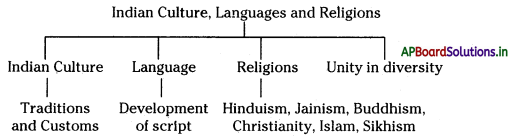
→ India has the greatest and unique heritage and culture. India is a combination of several customs and traditions.

→ Culture is a continuous process that we inherit from past generations to create future generations. It is a precious possession and a unique asset.

→ Culture is a way .of life of the people living in a society. The essential core of culture lies in the traditional ideas transmitted within a group.

→ Unity in diversity is one major feature of Indian culture which makes it unique. Indian culture is composite and dynamic.

→ The culture of India is very ancient. It began about 5,000 years ago. Indians made significant advances in yoga, architecture, mathematics, astronomy, and medicine.

→ Language is a medium of communication. Man is the only living being on the earth who uses language. There is a close relationship between languages and culture.

→ Earlier people wrote on clothes, leaves, barks, etc. in the olden days. They used pens to write on the dried leaves. Initially, they drew pictures and symbols. Gradually the script developed.

→ Religion is a spiritual belief. It teaches a set of practices to live an enriched life.

→ The Vedas were carried from one generation to another through oral teaching.

→ The Indian sub-continent is the birthplace of a number of famous religions; namely Hinduism, Buddhism, Jainism, Sikhism, etc.

→ Hinduism is the world’s oldest religion. It is a way of life and also called ‘Sanatana dharma. It is based on the principles of universal truth. Ganesh Chaturthi, Dusserah, Diwali, etc., are some festivals celebrated by the Hindus. Tirumala in the Chittoor district located in Seshachalam hills is one of the prominent temples of the Hindus.

→ Mahavira was the famous Tirthankara in Jainism. Jain’s holy books are Triratnas. Gomateshwara Temple situated at Shravanabelagola in Karnataka is a historical Jain temple. Gomateshwara’s stature height is 57 feet. It is known as Bahubali. Bahubali was the first Tirthankara.

→ Gautama Buddha was the founder of Buddhism. The Great Stupa at Sanchi is one of the most important Buddhist monuments. It was built in the third century BCE by the emperor Ashoka. It is counted among the best conserved ancient Stupas of central India.

→ Christianity is the most widely practiced religion in the world. The Bible is the holy book in the world. The Roman Catholic Church is the famous church in the world. The Pope is the head of the Roman Catholic Church. Vatican City is the smallest country in the world.

AP Board Solutions AP Board 6th Class Social Studies Notes Chapter 11 Indian Culture, Languages and Religions

→ Mohammad is considered a prophet or messenger of Allah. The Kaaba is a building at the center of the Great Mosque of Mecca (Saudi Arabia). Mecca is the holiest city for Muslims. Muslim devotees attempt a hajj (pilgrimage) to Mecca at least once in their lifetime if they can afford to do so.

→ Guru Nan$k was the founder of Sikhism. The Golden Temple located in the city of Amritsar, Punjab is known as the holiest Gurudwara and the most important pilgrimage site of Sikhs.

→ India is a land of diversities. The diversity is visible in the spheres of religion, language, creed, culture, lifestyle, dressing sense, faith in God, rituals of worship, eating different kinds of food, etc. Many kings of emperors like Chandragupta, Ashoka, Gauthamiputra Satakarni, Samudragupta, Akbar, etc. tried to unify the country politically.

→ Indians respect the great saints and philosophers who were born in all parts of the country like Mahavira, Buddha, Nanak, Kabir, Nizamuddin Auliya, Shaik Salim Chisti, Rabindranath Tagore, Dr. Radha Krishnan, etc.

→ People celebrate their festivals like Holi, Diwali, Eid, Christmas, Good Friday, Mahavir Jayanti, Buddha Jayanti, etc. very peacefully without disturbing other religious people.

→ The concept which is implying unity among people with diverse cultures and religions is known as “Unity in Diversity”.

→ Religion: the belief in God.

→ Worshipping: showing devotion to God.

→ Subcontinent: the southern peninsula of Asia, situated on the Indian Plate.

→ Language: a medium in which a person communicates his thoughts to others.

→ Script: the symbolic representation of the language.

→ Tirthankara: a spiritual teacher of the Dharma in Jainism.

→ Non-violence: the practice of being harmless.

→ Triratna’s: the Dharma, the Sangha, the Buddha ¡n Buddhism.

AP Board Solutions AP Board 6th Class Social Studies Notes Chapter 11 Indian Culture, Languages and Religions

→ Enlightenment: the highest spiritual state.

→ Bodhi Vriksha: peepal tree.

→ Tripitikas: the sacred books of Buddhism.

→ Nirvana: a place of perfect peace and happiness, like heaven.

→ Eightfold Path: Buddhist practices leading to the liberation of row samsara.

→ Upanishads: a series of Hindu sacred written works.

→ Prophet: One who preaches God’s message.

→ Islam: “Submission to God”.

→ Muslim: one who surrenders to God”.

→ Scripts: Writings.
AP Board 6th Class Social Studies Notes Chapter 11 Indian Culture, Languages and Religions 1

AP Board 6th Class Science Notes Chapter 1 The Food we Need

Students can go through AP State Board 6th Class Science Notes Chapter 1 The Food we Need to understand and remember the concept easily.

AP State Board Syllabus 6th Class Science Notes Chapter 1 The Food we Need

→ We eat a variety of food in our day to day life.

→ For cooking food, we need different types of ingredients.

→ We take food for our health and energy.

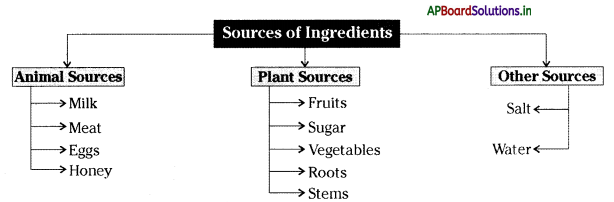
→ We get food ingredients from plants, animals and other sources.

→ We use different parts of plants like stems, roots, leaves, fruits and flowers as food.

→ We get grains, vegetables and fruits from plants.

→ We get food ingredients like milk, meat, egg, etc. from animals.

→ Some of the food ingredients like water and salt are obtained from other sources.

→ The taste of food is based on its ingredients, method of preparation.

→ Boiling, steaming, fermentation, roasting are some of the methods of preparing food.

→ Food preservation is the process of treating and handling food to stop and slow down spoilage.

→ Spoiled food causes diarrhoea, vomiting etc.

→ We use preservatives to preserve food for some time.

→ Salt, oil, chilli powder, honey and sugar syrup used as a preservative to preserve the food.

AP Board Solutions AP Board 6th Class Science Notes Chapter 1 The Food we Need

→ Some chemicals such as Benzoates, Nitrates, Sulphates are also used as preservatives.

→ Eating the food material after the expiry date may spoil our health.

→ Homemade food is always good, healthy and hygienic.

→ IngredIents: The materials that are required to prepare the food.

→ Sources: A place, person, or thing from which something originates or can be obtained.

→ PreservatIon: The process f keeping the food safe from being spoilt.

→ Spices: Aroniatic Vegetable substancés are used to flavour the food. Ex: Pepper, cloves, cumin

→ Boiling: Boiling is the action of heating a liquid until it becomes a vapour.

→ Steaming: Steaming is a method of cooking using steam.

→ Fermentation: A process in which an agent causes an organic substance to break down into a simpler substance.

→ Recipe: A list of materials used for preparing dishes.

AP Board Solutions AP Board 6th Class Science Notes Chapter 1 The Food we Need

→ Menu chart: A list of the dishes served at a meal.

→ World Food Day: l6th October is celebrated as World Food Day.

→ Asafoetida: Asafoetida is an ingredient that is used in the preparation of dal, sambar along with other spices like turmeric.

→ Cereals: A grain used for food. Ex: rice, wheat, maize.

→ PuIses: PuIses are the dried seeds of the legume plants. Ex: Beans.

→ Roasting: To cook food in an oven or over a fire.

→ Carving: Making of different types of designs and decorations with vegetables and fruits.

→ Germs: The smallest organisms that cause diseases to humans and other living organisms.

→ Diarrhoea: Three or more Loose motions per day caused by bacteria.

→ Pollution: The water, the air is contaminated with harmful substances.

→ Preservatives: A substance or a chemical that prevents things from spoiling.

→ Syrup: Syrup is a sweet liquid made with sugar and water.

AP Board Solutions AP Board 6th Class Science Notes Chapter 1 The Food we Need

→ Expiry date: It indicates the maximum period to use the food item.

→ Junk food: Packaged food that is unhealthy and has low nutritional values.

→ Hygiene: Maintaining cleanliness that helps to maintain health and prevent the spread of diseases.
AP Board 6th Class Science Notes Chapter 1 The Food we Need 1
→ World Food Day – October 16: World Food Day is celebrated every year across the world on 16th October. It’s an annual celebration in honour of the founding date of the F.A.O [Food and Agriculture Organization] launched by the United Nations in the year 1945. The aim of the celebration of this day is to promote worldwide awareness and action for those who suffer from hunger and for the need to ensure food security and nutritious diets for all. World food day adopts a different theme each year.
AP Board 6th Class Science Notes Chapter 1 The Food we Need 2

→ According to the UNDP [United Nations Development Programme] up to 40% of the food produced in INDIA is wasted.
According to the FAO [Food and Agriculture Organisation] report in “The state of food security and nutrition in the World, 2018” report, 195.9 million people are undernourished in INDIA.

→ “INDIAN SPICES”:
Spices are aromatic parts of tropical plants traditionally used to add flavour to the food. Spices come from the bark roots of certain plants, leaves, flowers or stems of plants primarily used for flavouring, colouring or preserving food. Spices are included in a variety of Indian dishes: cardamom, black pepper, curry leaves, fenugreek, fennel, ajwain, bay leaves, cumin, coriander seeds, turmeric, cloves, ginger, nutmeg and cinnamon.
AP Board 6th Class Science Notes Chapter 1 The Food we Need 3

AP Board Solutions AP Board 6th Class Science Notes Chapter 1 The Food we Need

→ Some people make different types of designs and decorations with vegetables and fruits. This is called vegetable carving.
AP Board 6th Class Science Notes Chapter 1 The Food we Need 4
→ Say NO to Junk Food
A Pizza, Burgers, Chips, Fried Fast Food, Noodles, Samosa, French Fries etc., are junk foods. Eating junk food causes obesity, digestion issues and loss, of appetite. It may cause drowsiness and are harmful to health.

AP Board 6th Class Social Studies Notes Chapter 10 Local Self-Government

Students can go through AP State Board 6th Class Social Studies Notes Chapter 10 Local Self-Government to understand and remember the concept easily.

AP State Board Syllabus 6th Class Social Studies Notes Chapter 10 Local Self-Government

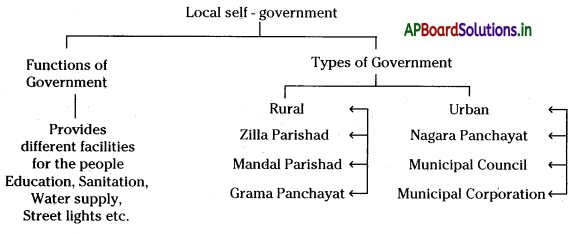
→ Local self-government in India refers to governmental jurisdictions below the level of the state.

→ Andhra Pradesh Panchayat Raj Act 1994 established three-tier local self-governments in rural areas. They are Grama Panchayat at the village level, Mandal Praja Parishad at the Mandal level, and Zilla Praja Parishad at the District level.

→ The ‘Grama sabha’ is the general body at the village level. It consists of all the voters in a village. It is presided over by the President / Sarpanch of the village.

→ Grama Panchayat is formed with Sarpanch and Ward Members. It is formed through elections. It is presided over by the President or Sarpanch of the village.

→ A village is usually divided into wards and each ward elects one member to the village panchayat, called ‘ward member’. A person who is twenty-one years age or above can contest the election.’

→ Panchayat functions as representative institutions of all people in the rural and tribal areas.

→ Ward members and the Sarpanch will be elected in elections. The person who gets the maximum votes is declared to be elected. Sarpanch is the head of the gram panchayat and he implements all the decisions of the panchayat and looks after the day-to-day functions of the panchayat.

→ Sarpanch and ward members elect one of the ward members as the deputy or up a Sarpanch through the indirect election. The UpaSarpanch acts in the absence of the Sarpanch.

→ The system of Grama Sachivalayam was started on October 2nd, 2019 in our state. There are eleven Village Secretariat functionaries (employees) in every Grama Sachivalayam.

→ About 20-40 Gram Panchayats come under a Maifdal Parishad. All the Mandal Parishad in the district come under the Zilla Parishad. The members of the Mandal Parishad are elected directly by the voters. Some members of Mandal Parishad are nominated The MPTCs elect one member among them as Mandal President and one as vice president through the indirect election.

AP Board Solutions AP Board 6th Class Social Studies Notes Chapter 10 Local Self-Government

→ The Zilla Parishad members are elected from Zilla Parishad by voters directly. Some members of Zilla Parishad are nominated. The ZPTCs elect one member among them as Zilla Parishad Chairman and one as vice-chairman through the indirect election. The Zilla Parishad and the Mandal Parishad coordinate the activities of the Panchayats in the district and the Mandal, approve their plans, and allocate the funds.

→ Nagar Panchayat has a committee consisting of a chairman with ward councilors. The councilors or ward members are chosen by direct election from electoral wards in the Nagar Panchayat.

→ The municipality has a Municipal council with elected members who are known as “councilors” and nominated members. The ward councilors are elected directly every five years. These councilors and the other members of the council together choose the Municipal Chairman indirectly.

→ Municipal Corporation consists of elected members known as “Corporators” and nominated members. These Corporators and the other members of the Corporation together choose the Mayor of Municipal Corporation indirectly.

→ Local self-government: Governmental jurisdictions below the level of the state.

→ Grama Sabha: General body in a Grama Panchayat.

→ Grama/Ward Sachivalayam: The system, to provide all government services to the people in their locality.

→ Village functionaries: The employees in the Grama Sachivalayam.

→ Public Amenities: The facilities provided by the government.

→ Municipal Council: The governing body in a municipality

AP Board Solutions AP Board 6th Class Social Studies Notes Chapter 10 Local Self-Government

→ Municipal Corporation: The governing body in a municipal corporation.

→ Councilor: Ward representative in Municipal council.

→ Corporate: Ward representative in Municipal Corporation.
AP Board 6th Class Social Studies Notes Chapter 10 Local Self-Government 1