AP Board 7th Class Social Studies Notes Chapter 5 Europe

Students can go through AP State Board 7th Class Social Studies Notes Chapter 5 Europe to understand and remember the concept easily.

AP State Board Syllabus 7th Class Social Studies Notes Chapter 5 Europe

→ Industrial Revolution took place first in Europe.

→ The Mediterranean sea separates Europe from North of the Africa.

→ Asia and Europe are one continuous landmass. This landmass is therefore called Eurasia. & Europe has several high snow-covered mountains.

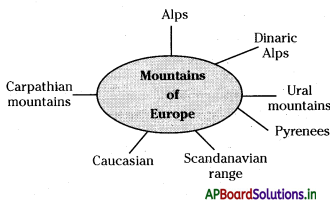
→ The Alps, the most important mountain ranges of Europe, are covered with snow all year round.

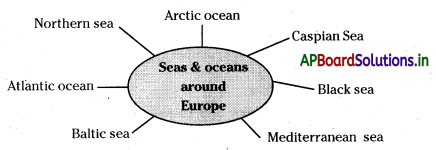
→ The Caucasian Mountains, which lie between the Caspian Sea and the Black Sea, form the southern boundary of Europe.

→ There are no large plateaus in Europe.

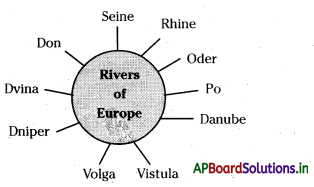
→ European rivers are used not only for irrigating the fields but also as major waterways; & The sea coast of Europe is very jagged.

→ Landmasses that are surrounded by the sea on three sides and connected to the mainland on the fourth side are called peninsulas’.

→ The Landmass which is surrounded by water on all sides is called an Island.

→ Bays and gulfs are parts of the sea enclosed by land on three sides.

AP Board Solutions AP Board 7th Class Social Studies Notes Chapter 5 Europe

→ Deep gulfs or bays are preferred for building harbors as large ships can be anchored in them. & Europe has a cooler climate than ours.

→ The waters in the oceans are not static.

→ The warm currents are very good for fish breeding as they contain ample food materials for the fish.

→ The lands along the Mediterranean Sea have a distinct climate called the ‘Mediterranean climate’. & Most European countries including France have four main seasons. They are winter, spring, summer, and autumn.

→ Summer is the season of agriculture in Europe. Crops mature in this season.

→ In European countries, cultivation is possible only for 6 to 7months.

→ European plains and river valleys are very fertile.

→ Wheat is the main crop of European plains.

→ From very ancient times, the people of Europe have been trading with India and other countries of Asia like Indonesia and China.

→ About five hundred years ago, the West European sailors and traders began to search for new routes to India. The industrial revolution as you know started in England around 1750.

→ Peninsula: Landmass that is surrounded by the sea on three sides and is connected to the mainland on the fourth side is called Peninsula. E.g.: Norway and Sweden.

→ Island: A piece of land that is completely surrounded by water is called an Island. E.g.: Great Britain.

AP Board Solutions AP Board 7th Class Social Studies Notes Chapter 5 Europe

→ Bay: Bays and gulfs are parts of the sea enclosed by land on three sides. In a bay the land curves inwards and the mouth of the bay ¡s usually wide as in the Bay of Bengal.

→ Currents: Movements of water in a particular direction.

→ Gulf: A gulf is a narrow inlet of the sea and has a narrow mouth. E.g.: The entire Baltic sea is a large gulf.

→ Climate: The regular pattern of weather conditions of a particular place (country/continent).

→ Dikes (Dykes): A long thick wall that is built to stop water flooding onto a low area of land, especially from the sea or a channel that carries water away from the land.

→ Westerlies Wiñds blow all the year-round from the Atlantic Ocean towards Europe. Since they blow from the west. These winds are called Westerlies.

→ Ocean currents: The voters in the oceans are not static. They keep flowing’ from one place to another along the continents. These are the ocean currents.

→ Mediterranean climate: The lands along the Mediterranean sea have a distinct climate called the ‘Mediterranean climate’.
AP Board 7th Class Social Studies Notes Chapter 5 Europe 1
AP Board 7th Class Social Studies Notes Chapter 5 Europe 2
AP Board 7th Class Social Studies Notes Chapter 5 Europe 3

AP Board 8th Class Biology Notes Chapter 9 Production and Management of Food From Animals

Students can go through AP State Board 8th Class Biology Notes Chapter 9 Production and Management of Food From Animals to understand and remember the concept easily.

AP State Board Syllabus 8th Class Biology Notes Chapter 9 Production and Management of Food From Animals

→ Since long ago, man has used animals not only for obtaining food but also for agriculture.

→ People living in rural areas used to domesticate animals like cows, buffaloes, bullocks, goats, sheep, pigs, hens, etc.

→ Bulls are mainly reared for use in plowing.

→ Taking care of animal health is also an important task in animal husbandry.

→ Viral and bacterial diseases also affect milk production.

→ Veterinary doctors provide treatment and health care for cattle.

→ Our government treats producing milk as an industry.

→ Haryana, Jaferabad, Nagapuri are the traditional varieties of cows that give a good quantity of milk.

→ According to the Economical and Statistical Survey of India 2011, about 40 to 60 lakh liters of milk are produced every day in our state.

→ Care should be taken while buying cattle for milk production.

→ Biogas production also is a useful product in animal husbandry.

AP Board Solutions AP Board 8th Class Biology Notes Chapter 9 Production and Management of Food From Animals

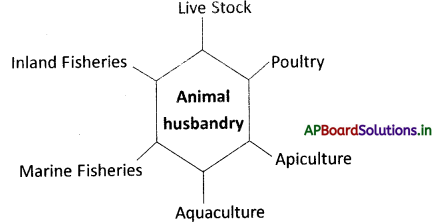
→ Production and rearing of hens on a large scale are generally called poultry.

→ The culture of honey bees is called Apiculture.

→ The bee wax and bee venom are other products in Apiculture.

→ Fish constitute important and plentiful sources of high-quality animal protein.

→ The egg is the chief nutritious food that is easily available for all.

→ Our government provides opportunities to improve animal food production to fulfill the food requirements of a growing population.

→ Animal husbandry: Providing food, shelter, protection, and breeding of animals is called Animal husbandry.

→ Livestock: The term represents cows, bulls, and buffaloes.

→ Jersy, Holstein: Jersy (England) and Holstein (Denmark) are the foreign varieties. They give 25 liters of milk per day.

→ Pasteurization: In this process, milk is heated at a temperature (62°) for a definite period of time (30 minutes) and cooled at 10CC.

→ Biogas: The dung obtained from cattle is mixed with bacteria and ¡s used for the production.

AP Board Solutions AP Board 8th Class Biology Notes Chapter 9 Production and Management of Food From Animals

→ Poultry: Production and rearing of hens on a large scale for eggs and chicken.

→ Hatching: Placing the egg under a broody hen to produce chicken is hatching.

→ Incubator: An apparatus for hatching eggs.

→ Apiculture: The culture of honey bees is called apiculture.

→ Honey bee hive: A construction of six-sided wax compartments made by bees to store honey and eggs.

→ Honey wax: Besides honey wax produced by the honey bees is known as bee wax or honey wax used ¡n the production of cosmetics, shoe polish, candles, and leather industry.

→ Queen bee: Only one Queen bee in a colony. The function is to lay eggs. (800 – 1200 per day)

→ Drone: Drones are the male members of the honey bee colony. Their main duty is participating in mating.

→ Aquaculture: Cultivating fish and prawns in water on a large scale.

→ Marine fisheries: India’s marine fisheries sources include 7500 km of coastal line and deep seas beyond it. Popular marine fish varieties include Mackerel, Tuna, Sardines, and Mumbai duck.

→ Inland fisheries: In such a system, a combination of five or six fish species is used in a single fish pond. These species are selected so that they do not compete for food among them and have different types of food habits.

AP Board Solutions AP Board 8th Class Biology Notes Chapter 9 Production and Management of Food From Animals

→ Breeding: Mate and then produce young.

→ Food processing: Preservation of food items through the processing of sun-drying semi-drying, salting and drying, pickling, and pit curing.
AP Board 8th Class Biology Notes Chapter 9 Production and Management of Food From Animals 1

→ Milk is the secretion of the mammary glands in animals. During the period following at least 72 hours after calving or until the milk is colostrum free, milk appears as white opaque fluid, in which fat is present as emulsion, protein, and some other minerals, vitamin A, D, and E are 80 to 90% of water. Nowadays cattle rearers and dairy farmers use hormone injections to get a high quantity of milk. These hormones settle down in our body to cause various diseases like early reaching of puberty. Chemicals used in chilling centers to preserve milk also cause damage to our health.

→ In Odisha traditional livestock – Chilka buffaloes are reared. They take care to avoid cross-breeding with Murra. They graze during night times in the brackish water of Chilka lake. They return home in the morning give milk without any extra feed. This milk

AP Board 8th Class Biology Notes Chapter 9 Production and Management of Food From Animals 2
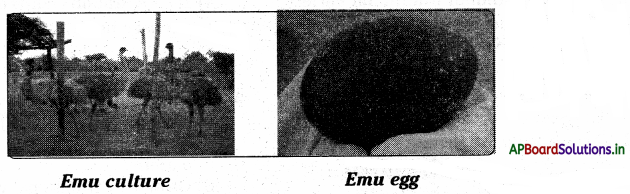
→ Emu is a flightless bird from Australia. It is the second-largest bird in the world after Ostrich. This amazing bird weighs nearly 50 kg. and run at 40 miles per hour. Emu farming is also a commercial practice like a hen. Recently farmers of Adilabad, Medak, Nalgonda, and some other districts of Andhra Pradesh, started Emu farming. Meat, chicks, skin leather, oil, feathers eggs are the main products in the Emu culture. Its meat and eggs are costly. The Emu market is not so good at present in our state.

AP Board Solutions AP Board 8th Class Biology Notes Chapter 9 Production and Management of Food From Animals

→ Honey has probably been associated with man since very early days. The first proof of this association is evident from the rock paintings made by primitive man thousands of years ago. The man knows about the art of beekeeping in the regions of early civilization. The Egyptians were well acquainted with bee husbandry 4000 years ago as they practiced migratory beekeeping. The Rigveda, probably written between 3000 B.C. and 2000 B.C, contains many references to bees and honey. They named honey as a divine food.

→ Seaweeds constitute an important marine resource and are found along the Rocky intertidal and sub-tidal regions of the coasts of India. The Sunderbans, the Chilka lake, the deltas of Godavari and Krishna, Gulf of Mannar, Palk Bay, Gujarat coast, and around Lakshadweep, Andaman, and Nicobar Island are areas rich in seaweeds. They are used for human consumption, as cattle and poultry feed, as manure, and for industrial purposes as the sources of Phyco colloids like Agar-agar.
AP Board 8th Class Biology Notes Chapter 9 Production and Management of Food From Animals 3

→ Rudolf Carl Virchow:
Rudolf Carl Virchow (13 October 1821 – 5 September 1902) was a German doctor, anthropologist, pathologist, prehistorian, biologist and politician, known for his advancement of public health, Referred to as “the father of modern pathology”, he is considered one of the founders of social medicine. He stated that the cell was the basic unit of the body.

In 1861, he was elected a foreign member of the RoyalSwedishAcademy of sciences. In 1892, he was awarded the Copley Medal. Among his most famous students was anthropologist Franz Boas, who became a professor at Columbia University. The society for MedicalAnthropology gives an annual award in Virchow’s name the Rudo if Virchow Award.

AP Board 7th Class Social Studies Notes Chapter 4 Oceans and Fishing

Students can go through AP State Board 7th Class Social Studies Notes Chapter 4 Oceans and Fishing to understand and remember the concept easily.

AP State Board Syllabus 7th Class Social Studies Notes Chapter 4 Oceans and Fishing

→ The earth is known as a watery planet as it is the only planet containing water in abundance. & It is estimated that about 71% of the earth’s surface is occupied by seas and oceans.

→ An extension of saline water on earth is called the sea.

→ Large sea areas are called oceans.

→ Oceans are huge bodies of water generally separated by continents.

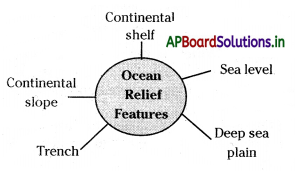
→ The floor of the ocean is just like the surface of the earth.

→ The bottom of the sea is not a flat surface.lt consists of hills, mountains, plateaus, plains, trenches, etc.

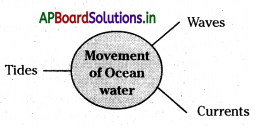
→ The waters of the oceans are never still.

→ Ocean waters have three kinds of movements. They are:

  1. Waves,
  2. Currents,
  3. Tides. & Streams that flow constantly in a definite direction on the surface of the ocean are called ocean currents.

→ The ocean currents are of two types – the warm currents and the cold currents.

→ Tides are the rhythmic rise and fall in the level of the water in the oceans every day.

AP Board Solutions AP Board 7th Class Social Studies Notes Chapter 4 Oceans and Fishing

→ Tides do not rise to the same height every day.

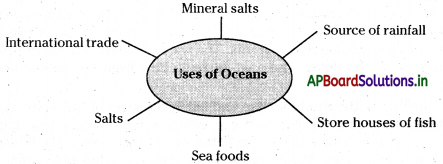
→ Ocean water is always saline. It contains Several mineral salts dissolved in it.

→ The oceans are the main source of rainfall.

→ Oceans are storehouses of fish and other seafood.

→ They are the main source of salts.

→ Oceans provide natural highways for international trade.

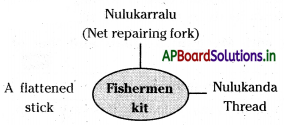
→ The fishermen have a special tool kit for repairing the nets which consist of Nulukarralu Nulukanda and a flattened stick that determines the net ring size.

→ The village soil is mainly loamy and rice is the principal crop grown on it.

→ A large number of people of Bhavanapadu worship Gangamma, Gowri, and Shiva

→ Tool kit: The fishermen have a special tool kit for repairing the nets which consist of Nulukarralu (net repairing fork) N.ilukanda (thread) and a flattened stick that determines the net ring size.

→ Kannulu: Nets are of different types based on different sizes of the Kannulu, (Rings) and layers of the net.

→ Burra Katha: There is an open stage where the Burra Katha is performed There are three members on the stage One among them tells a story, others follow him by imitating It is a famous technique

→ Mechanical Boat: Compared to the Karrateppa there is far more risk of life in Marapadava (Mechanicál boat) because it goes far into the sea.

AP Board Solutions AP Board 7th Class Social Studies Notes Chapter 4 Oceans and Fishing

→ Salinity: Containing salt or salts.

→ Waves: When the water on the surface of the ocean rises and falls they are called waves.

→ Currents: In the oceans, water is found to move from one part to another in big streams.

→ Tides: Tides are the rhythmic rise and fall of the water in the oceans every day

→ Warm currents: The warm currents flow from the equatorial region towards the poles

→ Cold current: The cold currents flow from the poles towards the equatorial regions.

→ Karrateppa: It is a country-made boat which goes up to 5 km into the sea and brings small catches of fish.

→ Marapadava: It goes far into the sea and it is difficult to swim over to shore in times of trouble.
AP Board 7th Class Social Studies Notes Chapter 4 Oceans and Fishing 1
AP Board 7th Class Social Studies Notes Chapter 4 Oceans and Fishing 2
AP Board 7th Class Social Studies Notes Chapter 4 Oceans and Fishing 3
AP Board 7th Class Social Studies Notes Chapter 4 Oceans and Fishing 4
AP Board 7th Class Social Studies Notes Chapter 4 Oceans and Fishing 5

AP Board 7th Class Social Studies Notes Chapter 3 Tanks and Ground Water

Students can go through AP State Board 7th Class Social Studies Notes Chapter 3 Tanks and Ground Water to understand and remember the concept easily.

AP State Board Syllabus 7th Class Social Studies Notes Chapter 3 Tanks and Ground Water

→ The Kakatiya and Vijayanagara kings and Nayaks built a large number of tanks in Telangana and Rayalaseema. This enabled the extension of agriculture into these areas.

→ The tanks were usually built by building a strong wall of stones and mud across a small stream in such a way that with a wall on just one side a large lake could be formed.

→ The tanks helped the people not only in giving them and their animals drinking water but also in irrigating their fields in such a way that even in drought years they could raise at least some crops.

→ Most important thing is that the tanks helped to prevent the run-off of rainwater and the erosion of topsoils.

→ During the last twenty or thirty years, the tanks have been neglected and have been allowed to break down.

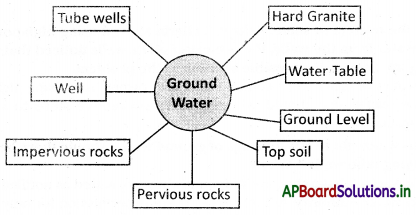
→ Rocks that have cracks or pores in them and can contain water are called previous rocks. & Rocks like granite, Kadapa limestone, are very compact and do not have pores in them.

→ Water cannot enter into them. These are called impervious rocks.

→ The layer of water which accumulates under the ground among rocks is called an aquifer.

→ The level of groundwater, which is also called the water table.

→ Most of the rocks under the soil in Andhra Pradesh consist of granites, which are hard and impervious.

AP Board Solutions AP Board 7th Class Social Studies Notes Chapter 3 Tanks and Ground Water

→ If we draw more water than what percolates down, the groundwater will decrease over time.

→ Vegetation like trees, grasses, and bunds are used to enhance groundwater.

→ Groundwater is usually mixed with many minerals.

→ Many times water Is polluted due to the excessive use of fertilizers, pesticides, or poor drainage.

→ Groundwater like the rivers is the common resource of all people and not just of those who have landed over aquifers.

→ Those who own land over aquifers tend to over-use the water, which decreases the water table for all neighboring people.

→ Today’s generation has received water from the past as a sacred asset. We should give it to the future generation just as we received it.

→ Previous rocks Rocks which have cracks or pores (minute holes) in them and can contain water are caLled pervious rocks

→ Impervious rocks: Some rocks like granite, Kadapa limestone, are very compact and do not have pores in them. Water cannot enter into them. Groundwater usually accumulates above such rocks Since the water can’t go beneath them, these are caLled impervious rocks

→ Vegetation: The vegetation means trees and grasses and buns etc.

→ Aquifers: The layer of water which accumulates under the ground among rocks is an aquifer.

→ Megalithic age: The stone boulders are known as megaliths. These were arranged by people and were used to mark burial sites.

AP Board Solutions AP Board 7th Class Social Studies Notes Chapter 3 Tanks and Ground Water

→ Water table: The level below which the ground is saturated with water.

→ Tanks: The tanks were usually built by building a strong wall of stones and mud across a small stream in such a way that with a wall on just one side a large lake could be formed.

→ Groundwater: Rainwater that goes down into the soil accumulates below the ground in the gaps between rocks, pebbles, sand, etc. This is the groundwater.

→ Minerals: The minerals like Sodium, Fluoride, Chloride, Iron, Nitrate, etc., come from the rocks and soils underneath
AP Board 7th Class Social Studies Notes Chapter 3 Tanks and Ground Water 1

AP Board 7th Class Social Studies Notes Chapter 2 Rain and Rivers

Students can go through AP State Board 7th Class Social Studies Notes Chapter 2 Rain and Rivers to understand and remember the concept easily.

AP State Board Syllabus 7th Class Social Studies Notes Chapter 2 Rain and Rivers

→ All life on the earth is very crucially dependent upon water.

→ As you know over 71% of the earth’s surface is covered with water.

→ We depend upon water for growing crops. But we do not get water uniformly over the year.

→ After the unbearable heat of April, May and June, comes the rainy season, which lasts for a few months.

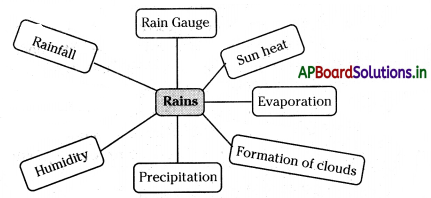
→ Water in the cloth or in the plate becomes water vapour and mixes with the air through a process called ‘evaporation’.

→ There are several water bodies on the earth’s surface – oceans, rivers, lakes etc.

→ There is constant evaporation of water from these water bodies.

→ Formation of clouds and Rain: When water vapour rises with hot air and reaches high up in the sky, it gets cooled. This is because it gets cooler as we rise above the surface of the earth. With the cooling, water vapour is transformed into tiny water droplets. Change of water into vapour is known as evaporation.

→ The process of water evaporating from the seas, forming clouds in the sky, coming down like rain. Different forms of condensation of water vapour are known as precipitation.

AP Board Solutions AP Board 7th Class Social Studies Notes Chapter 2 Rain and Rivers

→ The amount of invisible water vapour present in the atmosphere is known as humidity. The winds come all the way from the Arabian Sea and the Bay of Bengal and they transport the rain clouds. They are called ‘Monsoon winds’. They are also called ‘south-west monsoon winds’ as they blow from that direction. These winds blow only in the summer.

→ There are two arms of the monsoon winds: one blows from the Arabian Sea and the other from the Bay of Bengal.

→ The southwest monsoon, however, brings much rain to the Telangana districts as the winds again rise over the Eastern Ghasts.

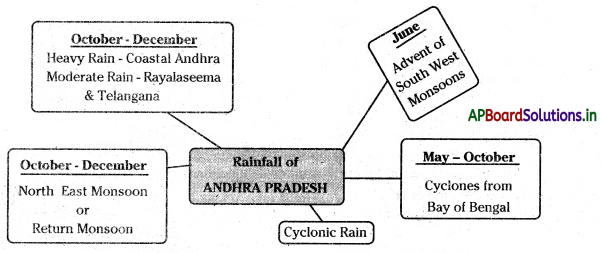
→ In the months from May to October, cyclones form in the Bay of Bengal causing widespread rains in coastal and inland Andhra Pradesh.

→ Rain caused by whirling storms is called cyclonic rain.

→ The cyclones are formed in the sea due to intense heating up in summer.

→ An instrument by which the rainfall is measured is known as ‘rain gauge.

→ The amount of rainfall for a unit area is measured in centimetres.

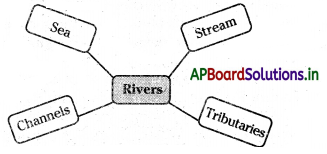
→ Rivers or streams which join a larger river are called ‘tributaries’.

→ Rivers like the Krishna and the Godavari start from the Western Ghats, which receive heavy rains.

→ The treeless bed is called the floodplain of the river.

→ Vegetation covers on land obstruct the runoff rainwater and slow down the speed of its flow. Vegetation reduces the erosion of soil by rainwater.

AP Board Solutions AP Board 7th Class Social Studies Notes Chapter 2 Rain and Rivers

→ If the surface of the land is covered with vegetation, then soil erosion is greatly reduced. The worst cyclone hit the state in November 1977.

→ Recently in 2018 Titles cyclone created huge destruction in North coastal Andhra, Srikakulam.

→ Cyclones and floods are seasonal phenomena.

→ Rivers and Tributaries: A river is usually in the form of a thin stream. As it flows further it gets bigger and broader. This happens because many small streams join it as the stream flows. Rivers or streams which join a large river are called tributaries

→ Condensation: Drops of water that form on a cold surface when warm water vapour becomes cool.

→ Annual rainfall: In the months from May to October cyclones form in the Bay of Bengal causing widespread rains in coastal and inland Andhra Pradesh.

→ Flood plain: Every year when it rains heavily, the river trough is filled with water allowing no permanent trees or plants to grow there. This treeless bed is called the flood – plain of the river.

→ Cyclone: A violent tropical storm in which strong winds move in a circle.

→ Monsoon: The rainy season.

→ Hail: ice pieces of frozen vapour falling in showers.

→ Famine: Scarcity of anything.

→ Slums: An area of the city that is very poor ànd where the houses are dirty and in bad condition

→ Vegetation: Plants ¡n general especially the plants that are found in a particular area or environment

AP Board Solutions AP Board 7th Class Social Studies Notes Chapter 2 Rain and Rivers

→ Western Ghats: The Western flank of the Deccan plateau ¡s guarded by the Western Ghats.

→ Eastern Ghats: The Eastern ghats are much less strongly marked than the Western Ghats. They are from the Eastern boundary of the Deccan Plateau.

→ Drought: Famine; a condition where there ¡s no rainfall.
AP Board 7th Class Social Studies Notes Chapter 2 Rain and Rivers 1
AP Board 7th Class Social Studies Notes Chapter 2 Rain and Rivers 2
AP Board 7th Class Social Studies Notes Chapter 2 Rain and Rivers 3

AP Board 10th Class Social Studies Notes Chapter 18 Independent India (The First 30 years – 1947-77)

Students can go through AP State Board 10th Class Social Studies Notes Chapter 18 Independent India (The First 30 years – 1947-77) to understand and remember the concept easily.

AP State Board Syllabus 10th Class Social Studies Notes Chapter 18 Independent India (The First 30 years – 1947-77)

→ In the early years of independence many challenges like leadership, maintenance of unity and integrity were there.

→ There were also other challenges like social and economic transformation and to ensure the successful working erf democratic system.

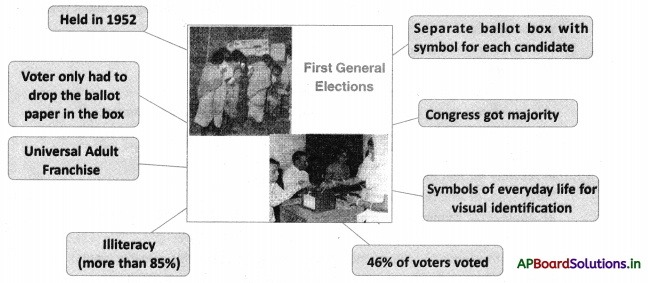
→ India adopted Universal Adult Franchise at one go.

→ The first elections were difficult as most people did not know how to read and write.

→ Election Commission used the symbols from daily life for visual identification.

→ In Independent India’s first three general elections in 1952, 1957 and 1962, the Indian National Confess won reducing other participants to almost nothing.

→ Among the first challenges the new nation laced was the demand for the reorganisation of states on the basis erf language.

→ In August 1953 the States Reorganisation Commission was appointed with Fazl Ali, K.M.Panikkar and Hridaynath Kunzru on the basis of linguistic principle.

→ It created 14 States and 6 Union territories.

→ planning Commission was set up to dissolve the divisions of caste and religion, community and region and other disruptive tendencies.

AP Board Solutions AP Board 10th Class Social Studies Notes Chapter 18 Independent India (The First 30 years – 1947-77)

→ The First Five Year Plan focussed on agriculture.

→ Nehru favoured land reforms, agricultural cooperatives and local self-government for development.

→ India, Indonesia, Egypt together built a policy of not joining either of the power camp named the Non-Alignment Movement.

→ Official Languages Act passed in 1963 made Hindi imposed in all states.

→ The DMK believed that act to be an attempt to foist Hindi on the rest of the country and they began a state-wide protest.

→ The shift of a price-incentive and technocratic strategy between the years 1964 – 67 is called the “Green Revolution”.

→ 1967 elections show the big transition in India where many regional parties came to power.

→ It propounded India is moving towards a multiparty system.

→ Immediately after the victory in the 1971 Bangladesh war, Indira Gandhi used the popular slogan ‘Garibi Hatao’.

→ Raised oil prices inflation, scarcity of food and unemployment gave Congress government the public resentment.

→ Opposition united under Jaya Prakash Narayan formed JP Movement.

→ As the JP movement gaining strength the government imposed an emergency.

→ An important achievement of this period (1947-77) was the establishment of stable democracy.

→ States Reorganisation: Commission set up to address the issue of formation of states on the basis of linguistic principle

AP Board Solutions AP Board 10th Class Social Studies Notes Chapter 18 Independent India (The First 30 years – 1947-77)

→ One-party dominance: In Independent India’s first three general elections trie Indian National Congress won reducing other participants to almost nothing. It only established governments in states and at the centre also. There was no party to challenge Congress. This period was known as one-party dominance.

→ Emergency: Something dangerous or serious, such as an accident, which happens suddenly or unexpectedly and needs immediate action in order to avoid harmful results.

→ Reg4nal movements: The movement by the people of a region to preserve 2nd promote the language, customs, culture, economy and the way of life of that region.

→ Nationalisation : (of a government) The act of taking control of a business or industry.

→ Universal Adult: Every person, who is a citizen of India and completes 18 Franchise years of age can become a voter irrespective of religion, race, caste, gender, etc.

→ Congress system: The Congress party formed government at the centre and in many states in the first three general elections. This inaugurated what some observers called the Congress system.

→ Multi-party system A country that allows many political parties to exist and vie for power and serve the democracy.

→ Linguistic States: The states which were formed on the basis of the language that their people speak.

→ Planning Commission: It was set up in 1950 to oversee coordinated developmental planning.

→ Election Commission.: An autonomous body that conducts elec Lions to the Parliament and state legislatures in a free and fair manner.

→ Zamindari system: The system wherein Zamindar collected land revenue, on behalf of Mughal emperors and received a share of collected revenue.

AP Board Solutions AP Board 10th Class Social Studies Notes Chapter 18 Independent India (The First 30 years – 1947-77)

→ Tenancy reforms: Reforms aimed at fixing rent on land, collecting it from the tenant farmers and defining them.

→ Land ceilings Central government set a limit to the size of landholding and redistributing the excess land to the poor.

→ Land reforms: Reforms aimed at farmérs to pay land tax direction to government, abolishing zamindari system and redistributing the land, etc.

→ Cold War: A war of tension caused by the two rival alliances and the USSR

→ Non – Aligned Movement: A foreign po&y which Is aimed to keep aloof from and USSR power blocs and serve the cause of world peace.

→ Panchsheel policy: An agreement between India and China made respect territorial Integrity and sovereignty of nations and practise peaceful coexistence.

→ Anti-Hindi agitations: A statewide campaign by DMK In Tamil Nadu against the imposition of Hindi as the official language for the country

→ Green revolution: Use of high yielding varieties (seeds) for the increase of crop production and better water management

→ Left of the centre group: This group in a party or government usually supports state control and nationalisation and socialism.

→ Regional parties: The parties which secure at least 4% of valid votes In a state In general elections either to Lok Sabha or Vidhana

→ Liberation movement: Movement organised for independence or formation of new

→ Tenant farmers: The peasants who cultivated the lands of landlords are called tenant cultivators (or farmers).

AP Board Solutions AP Board 10th Class Social Studies Notes Chapter 18 Independent India (The First 30 years – 1947-77)

→ Comptroller and Auditor – General: A person in charge of the accounts of the Union and of the States.
AP Board 10th Class Social Studies Notes Chapter 18 Independent India (The First 30 years – 1947-77) 1

AP Board 10th Class Social Studies Notes Chapter 19 Emerging Political Trends 1977 to 2000

Students can go through AP State Board 10th Class Social Studies Notes Chapter 19 Emerging Political Trends 1977 to 2000 to understand and remember the concept easily.

AP State Board Syllabus 10th Class Social Studies Notes Chapter 19 Emerging Political Trends 1977 to 2000

→ The period between 1975 to 1985 was a testing time for Indian Democracy.

→ When the 1977 elections were announced, Indira released all political prisoners and removed censorship on freedom of movement, campaigns, and meetings.

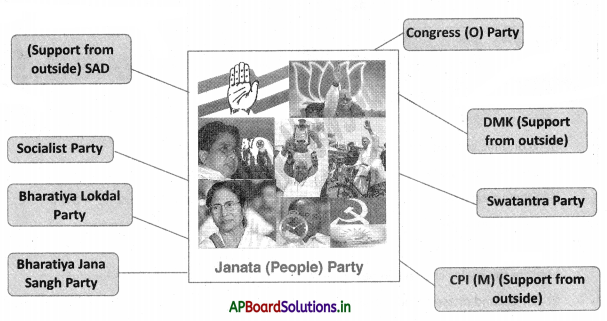
→ All opposition parties merged to form Janata Party.

→ Janata Party became victorious and dismissed nine state governments that enjoyed a majority belonged to Congress.

→ The factional struggle in Janata Party soon culminated in the fall of the government within three years.

→ The Congress returned to power in 1980 and paid back Janata Party by dismissing nine non-Congress state governments.

→ There were different strands of the demands for autonomy in Andhra Pradesh, Assam, and Punjab.

→ The frequent change of Chief Ministers by the central Congress leadership made people believe they are not respected.

→ Popular film actor N.T. Ramarao set up Telugu Desam Party on the plank of the honor and self-respect of the Telugu-speaking people and swept the 1982 elections.

→ The Assamese-speaking people faced difficulties with the officialdom of Bengalis and the flooding of Bangladeshis.

→ In the 1970s, a social movement came out under the leadership of the All Assam Students Union (AASU).

AP Board Solutions AP Board 10th Class Social Studies Notes Chapter 19 Emerging Political Trends 1977 to 2000

→ There were talks between agitations and the central government for 3 years and reached an agreement.

→ When elections were conducted Assam Gana Parishad, an offshoot of AASU came to power.

→ In Punjab also there is agitation stating their state was ignored, more powers to states through a constitutional amendment, greater decentralization as their demands.

→ Bhindranwale, leader of militant Sikhs preached separatism and a special state Khalistan was demanded.

→ They occupied Golden Temple and the army vacated them.

→ A fallout of all this was the assassination of Indira.

→ Late Rajiv made an agreement with Langowali of Sikh SAD.

→ Rajiv liberalized system, hoped the participation of the masses, brought the telecom revolution.

→ Communalism sprang during this time through the demolition of Babri Masjid and try to build Ram Temple at Ayodhya.

→ This was the beginning of successful coalitions at the center.

→ Mandal Commission provided for Other Backward Class reservations and globalization are of this period.

→ Regional aspiratIons: Regions agitating for separate statehood, local parties In power, greater shares in revenue and waters, etc., more decentralization.

AP Board Solutions AP Board 10th Class Social Studies Notes Chapter 19 Emerging Political Trends 1977 to 2000

→ Coalition: A government formed by two or more political parties governments working together.

→ Communalism: A strong sense of religious belonging that leads to extreme behavior or violence to others.

→ Majority: The amount by which the greater number of votes is cast, as In an election, exceéds the total number of remaining votes.

→ Minority: A group or party having fewer than a controlling number of votes.

→ Single party A democratic country where all the elections were won over democracy by a single political party decimating all others.

→ Outsiders : (In this context) The Assamese people called the Bengalis, migrators from Bangladesh, mostly Muslims.

→ Ethnic cleansing : (here) FoiIble eviction of minthïty tribal communities by even outright mass killing In man parts of Assam.

→ Telecom revolution: (In India) Speeding up and’ spreading the network of telephonic communication In India using satellite technology.

→ Policy paralysis: In coalitions, the leading party could not Implement a policy for fear of withdrawal of support by partners.

→ Inclusive development: Making the scheduled cutes, scheduled tribes, and backward classes and minorities as a part of the process of development.

→ Mandal Commission: A committee chaired by B.P. Mandai recommended reservations for Other Backward Cluses In government employment and educational facilities.

→ Rath Yatra: In 1990, LK. Advani, the leader of BiP led ‘Rath Yatra’ from Somnath to Ayodhya, In support of Rani Temple at Ayodhya.

AP Board Solutions AP Board 10th Class Social Studies Notes Chapter 19 Emerging Political Trends 1977 to 2000

→ Liberalization: Cuts in subsidies, expenditure on public services reducIng restriction foreign Investment in India and taxes on import of foreign goods; openIng many sectors to private Investors.

→ Majority government: The set up of government by a political party that got more than 5% of seats.

→ Minority government: Coalition government where the strength of the leading party is below 50% IndivIdually but the coalition has a majority.

→ LTTE: Liberation Tigers of Tamil Eelam, a Tamil separatist group of Sri Lanka.
AP Board 10th Class Social Studies Notes Chapter 19 Emerging Political Trends 1977 to 2000 1

AP Board 10th Class Social Studies Notes Chapter 20 Post – War World and India

Students can go through AP State Board 10th Class Social Studies Notes Chapter 20 Post – War World and India to understand and remember the concept easily.

AP State Board Syllabus 10th Class Social Studies Notes Chapter 20 Post – War World and India

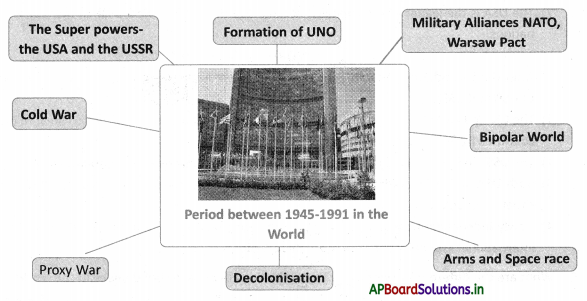
→ Three of the most important processes that took place after the Second World War are the establishment of the United Nations, the Cold War, and Decolonisation.

→ At the time of its establishment UN had a membership of 54 countries and today (2014) there are 193 countries.

→ It was started with twin objectives of ensuring lasting peace and human development.

→ It works through six different organs.

→ Security Council, an organ of the UN, has 5 permanent membership countries with Veto (made invalid or rejected) power.

→ For more than fifty years after World War II, Cold War was fought between the USA and the USSR.

→ The destruction was of third world countries, which fought under the influence of the two blocks.

→ The superpowers formed alliances and expanded their influence to gain access to resources like oil and minerals.

→ Both the USSR and the USA spent huge amounts of money to conduct research into weapons and space. ,

→ People of all countries lived in constant fear of war.

→ The Bandung conference represented by 29 nations from Africa and Asia paved the way for the Non-Aligned Movement.

→ By 2012, its membership is 120 countries with 17 Observers.

AP Board Solutions AP Board 10th Class Social Studies Notes Chapter 20 Post – War World and India

→ West Asian or the Middle East conflicts have the bone of contention Israel, a newly formed Jews state.

→ The reforms introduced by Mikhail Gorbachev in Russia, ‘the Glasnost’ and ‘Perestroika’ resulted in disbanding of USSR in 1991.

→ India made a Panchsheel agreement with China in 1954 but the latter made a surprise attack on India in 1962.

→ Later full diplomatic relations were restored only in 1976.

→ The bone of contention for Indo-Pak relations is Kashmir.

→ Pakistan waged many wars with India over Kashmir.

→ India made a 25-year peace treaty with Bangladesh in 1972, after its liberation.

→ Since times immemorial, India and Sri Lanka have had cultural, ethnic, and economic relations.

→ Military alliances: Formation of groups in connection with armed forces

→ Proxy war: The USA and the USSR are not fighting directly, they support two opposing sides in the countries of their sphere of influence and there is a physical war

→ Arms race: Countries spending huge amounts of money to conduct research into weapons and building arsenals of devastating arms.

AP Board Solutions AP Board 10th Class Social Studies Notes Chapter 20 Post – War World and India

→ Unipolar: The world led by one superpower In the military, economic supremacy, and ideology.

→ Bipolar: The world is divided between two superpowers for military, economic supremacies, and Ideological conflict.

→ Decolonization: Granting of independence to a colony = freeing It from colonial states

→ Peace: A situation or a period of time in which there is no war or violence in a country, area, or in the world.

→ Veto: Make invalid or reject = A provision given to five permanent members of the security council in UNO (China, France, the UK, the USSR, and the USA) through which any decision taken by the council can be vetoed by the Intervention of even any one of these countries.

→ Ethnic conflict: The tight of people of a particular race with another race and to have control over it.

→ Panchsheel: FIve principles of peaceful coexistence, India made an agreement with Panchsheel with China in 1954. Principles are like mutual non-aggression, equality, and mutual benefit, mutual non-Interference in each- others’ internal affairs, etc.

→ Great Depression: A great decline in trade and general prosperity worldwide (1929-39)

→ Cold War: The intense tension between the US and the USSR (during 1945-1991) of propaganda and words, in absence of real fighting.

→ Dictatorship: The rule which is not effectively restricted by a constitution, laws and recognized opposition, etc.

→ Imperialism: The practice of extending a state’s rule over other territories, colonizing them.

→ Capitalism: Economic system based on private ownership of means of production, distribution, and exchange and operated for profits.

→ Communism: Belief that private ownership of land, factories, railways, banks, etc. should be replaced by public ownership.

→ Autonomy: The freedom for a country to govern itself independently.

AP Board Solutions AP Board 10th Class Social Studies Notes Chapter 20 Post – War World and India

→ Moderation: The quality of being moderate (reasonable) and not being extreme.

→ Third world: The countries emerging from colonial.

→ DomInation: Rest of the world from 2 blocks, USA and USSR.

→ Strategic alliances: Formation of groups In connection with getting an advantage In war or other military situations.

→ Flashpoints: Situations where violence starts and cannot be controlled.

→ Nationalism: The desire by a group of people who share the same race, culture, language, etc. to form an independent country.

→ Secularism: The belief that religion shall not be involved in administration (or) government’s non-interference in religion.
AP Board 10th Class Social Studies Notes Chapter 20 Post – War World and India 1

AP Board 10th Class Social Studies Notes Chapter 9 Rampur: A Village Economy

Students can go through AP State Board 10th Class Social Studies Notes Chapter 9 Rampur: A Village Economy to understand and remember the concept easily.

AP State Board Syllabus 10th Class Social Studies Notes Chapter 9 Rampur: A Village Economy

→ In villages across India farming is the main production activity.

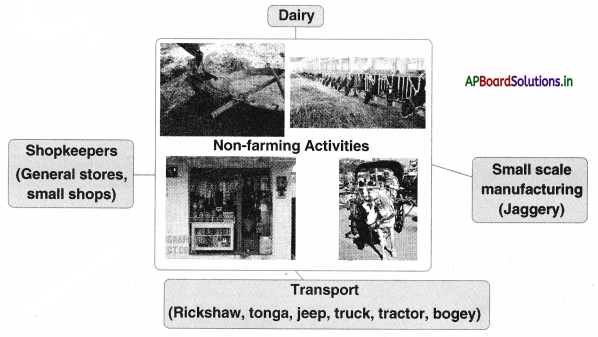
→ Non-farm activities include small manufacturing, transport, shopkeeping, etc.

→ The land is the most crucial factor necessary for farm production.

→ In Rampur, three crops are grown every year

→ They are two main crops, Jowar and Bajra are one and what is the other; the third crop is the potato.

→ They have got a well-developed irrigation system.

→ The use of natural resources has not always been judicious.

→ In Rampur, about l/3rd of the population, i.e., 150 families are landless. About 240 families cultivate small plots of land less than 2 hectares in size and the remaining families are medium and large farmers.

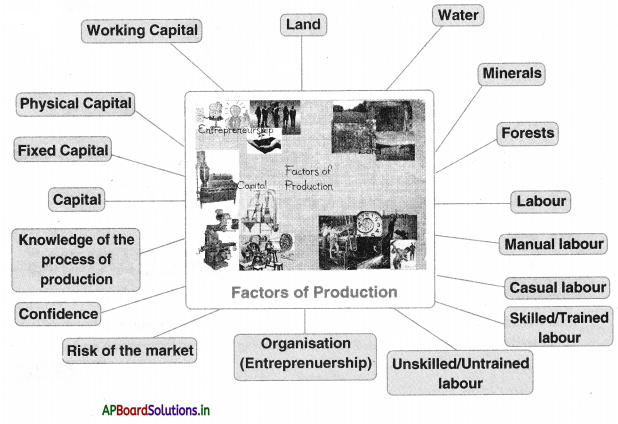
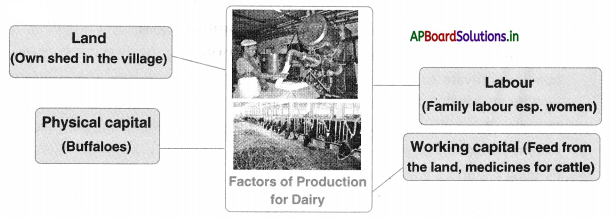
→ Every production is organised by people or entrepreneurs combining the elements of land, labour and physical capital. These are known as factors of production

→ Farming requires a great deal of hard work.

AP Board Solutions AP Board 10th Class Social Studies Notes Chapter 9 Rampur: A Village Economy

→ Small farmers along with their families mostly cultivate their own fields.

→ There is wide variation in the duration of employment and in wages.

→ Most small farmers have to borrow money to arrange for the working capital.

→ The medium and large farmers generally have their own savings from farming.

→ Small farmers keep a substantial share of production for their own family needs.

→ The medium and large farmers usually supply the surplus to Market Yard

→ Only 25% of the people working in Rampur are engaged in activities other than agriculture.

→ They are like dairy farming, small scale manufacturing, shopkeepers and transport.

→ Factors of production: Land, labour, physical capital, working capital and entrepreneurs cause the production of goods or services are called Factors of Production

→ Land: An area of ground, especially when used for a particular purpose such as farming or building; A necessary factor for Production.

→ Labour: Workers especially people who do practical work with their hands

→ Working capital: The requirement of raw material and money which are used up in the production cycle

→ Fixed capital: Physical Capital = Tools, machines and buildings, which are not used up or consumed immediately in the production process

AP Board Solutions AP Board 10th Class Social Studies Notes Chapter 9 Rampur: A Village Economy

→ Surplus: More than is needed

→ Farm activities: The works done in agricultural fields to produce goods

→ Non-farm activities: The production activities other than agriculture, like transport, shop-keeping, etc.

→ Multiple cropping: To grow more than one crop on the same piece of land

→ Water table: The level of groundwater

→ Wages: Remuneration for labour

→ MNREGA: Mahatma Gandhi National Rural Employment Guarantee Act

→ Modem farming method: Involves high yielding variety seeds, assured irrigation, fertilizers and pesticides.

→ Trade: Exchange of goods

→ Production activity: The work wherein a good or service is produced

→ Natural resources: Resources available from nature like land, water and minerals, etc.

→ Skilled workers: Highly educated and trained workers

→ Unskilled workers: Not educated and non-trained workers

→ Farm labourers: Those who do not have a right over the crops grown on the land but are paid wages

AP Board Solutions AP Board 10th Class Social Studies Notes Chapter 9 Rampur: A Village Economy

→ Inputs for: Farm instruments, seeds, fertilisers, pesticides and payments cultivation to labourers, etc.
AP Board 10th Class Social Studies Notes Chapter 9 Rampur A Village Economy 1
AP Board 10th Class Social Studies Notes Chapter 9 Rampur A Village Economy 2
AP Board 10th Class Social Studies Notes Chapter 9 Rampur A Village Economy 3

AP Board 10th Class Social Studies Notes Chapter 11 Food Security

Students can go through AP State Board 10th Class Social Studies Notes Chapter 11 Food Security to understand and remember the concept easily.

AP State Board Syllabus 10th Class Social Studies Notes Chapter 11 Food Security

→ In pre-independent India, famines-situations of extreme scarcity of food were common causes of large-scale starvation deaths.

→ Ration shops where people go and buy foodgrains at subsidized prices, mid-day meals that many of you have been eating, Anganwadis where young children are taken care of, including meals during the day are some ways through which government today ensures food security.

→ Producing a sufficient amount of foodgrains is an important requirement of food security.

→ Per person (per capita) availability of foodgrains in the country should be sufficient and also increased over the years.

→ There is a change in consumption pattern with people demanding more fruits, vegetables, milk, meat, poultry, and fisheries.

→ Over the years, although there has been increasing in the production of other food items, it is not sufficient to meet the minimum dietary requirements.

→ The decline in the level of per capita availability of foodgrains is something to be worried about for India’s food security.

→ It is not sufficient to produce food grains and other items. Everyone should be able to buy them for consumption.

→ 80% of people in rural areas in India consume food that is below the calorie standard.

→ Ration shops are important means for people to access foodgrains in India.

AP Board Solutions AP Board 10th Class Social Studies Notes Chapter 11 Food Security

→ The Indian government came out with a new law in 2013 called the National Food Security Act to legalize people’s Right to Food.

→ It applies to approximately 2/3rd of the population of India. Every person of low-income families is entitled to 5 kilograms of foodgrains per month at subsidized rates.

→ About 14 crore children studying in schools eat mid-day meals today. This is the largest school feeding program in the world.

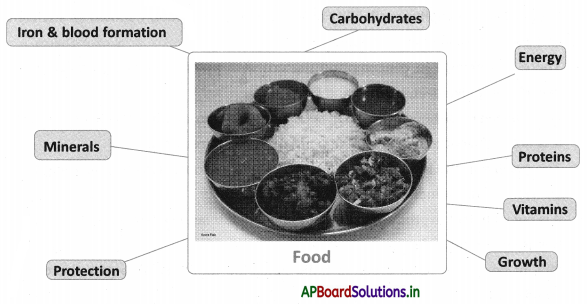
→ Food is required by the body for all its functions-for energy, growth, and the capacity to remain healthy and fight illness.

→ A survey conducted by the National Institute of Nutrition, Hyderabad (NIN) across many states in the country confirms the overall alarming status of nutrition in the country.

→ Over a long period of time, 35% to 45% of people are consuming less food than they should.

→ The issue of food security needs careful thinking and efforts in all of the above directions.

→ Production: The process of making or growing goods to be sold.

→ Availability: BeIng able to be obtained or used, usefulness

→ Access: The method or possibility of approaching a place or person or the right to use something

→ NutrItion: The substances that you take Into your body as food and the way that they influence your health.

→ Buffer stock: The stock of food grains (wheat & rice) procured and maintained by the government through the Food Corporation of India (FCI).

→ Hunger: The feeling you have when you need to eat.

AP Board Solutions AP Board 10th Class Social Studies Notes Chapter 11 Food Security

→ Public Distribution System (PÐS): The system of ration shops distributing foodgrains and, other essential items is known as the Public Distribution System.

→ Ration shops/Fair price shops: The shops where the government provides subsidized prices for food items and fuel for identified families, based on the ration cards.

→ Subsidy prices: To keep the prices low arid In the reach of common people, the government reduces the price by paying Itself the remaining amount.

→ Food Security: The promise of the government to see to produce food grains sufficient for the population of the entire country and make everyone buy Them for consumption.

→ Crop rotation: ChangIng the crop that Is grown on an area of land in order to protect the soil.

→ Water harvesting: The act of gathering water either from rains or from other sources like streams, canals, etc.

→ Crop diversIfication: ChangIng of the crops so that there is a great variety of crops.

→ Agricultural diversification; The careful planning which PnMdes the farmers to take up food crops and non-food crop and dairying together as a greater variety In agriculture.

→ Per capita availability of food grains: The total foodgrains produced In the country summed up with net Imports and subtracted the change In stocks with government divided by the population during the year.

→ Access to food: The ability of each person to buy the food for consumption.

→ UnIversal PDS system: The states following the system in which the low-cost food grains would be available to all.

→ Minimum Support Price: The pre-announced price of the crop, by the government, at which It buys the surplus production from farmers.

AP Board Solutions AP Board 10th Class Social Studies Notes Chapter 11 Food Security

→ Non-governmental organizations: The organizations that were not run by the government, but the public in key issues related to people and the environment.

→ Nutrition Status: The nutrition status of children and adults judges whether the food actually consumed by them Is adequate or not or excess.

→ Underweight: Being less in weight is decided by the nutritionists as per their age and height.
AP Board 10th Class Social Studies Notes Chapter 11 Food Security 1

AP Board 10th Class Physical Science Notes Chapter 2 Acids, Bases and Salts

Students can go through AP State Board 10th Class Physical Science Notes Chapter 2 Acids, Bases and Salts to understand and remember the concept easily.

AP State Board Syllabus 10th Class Physical Science Notes Chapter 2 Acids, Bases and Salts

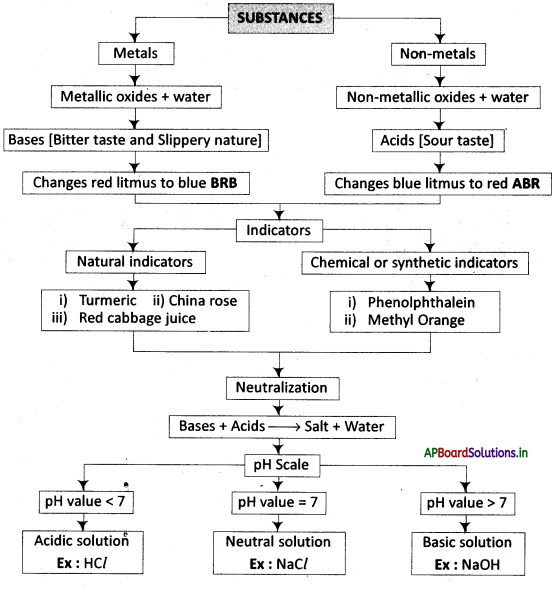
→ Any substance that has a sour taste and turns blue litmus to red is called an ‘acid’.

→ Any substance that has a bitter taste and soapy in nature that turns red litmus to blue is called a base.

→ We use natural and chemical indicators to test for acids and bases.

→ Acid-base indicators are dyes or mixtures of dyes that are used to indicate the presence of acids and bases.

→ When acids and bases react with each other, their respective salts and water are formed. This chemical reaction is called neutralization.

→ The acidic nature of a substance is due to the formation of H+ (aq) ions in the solution. The formation of OH (aq) ions in the solution are responsible for the basic nature of a substance.

→ Some substances whose odour changes in acidic or basic media are called Olfactory indicators.

→ When a base reacts with a metal with the evolution of hydrogen gas, a salt is formed.

→ When an acid reacts with a metal carbonate or metal hydrogen carbonate gives the corresponding salt, carbon dioxide gas and water.

→ Metallic oxides react with acids to give salt and water. Metallic oxides are basic in nature.

→ Non-metallic oxides are acidic in nature.

→ Acidic and basic solutions in water conduct electricity because they produce hydrogen ions and hydroxide ions respectively.

→ Acid solutions have ions and the electric current is carried through the movement of ions in the solution.

→ In glucose and alcohol ions are absent.

→ Dissolving bases in water produces hydroxide (OH) ions.

AP Board Solutions AP Board 10th Class Physical Science Notes Chapter 2 Acids, Bases and Salts

→ Bases that are soluble in water are called alkalis.

→ The process of dissolving an acid or a base in water is an exothermic process.

→ Mixing an acid or base with water results in dilution.

→ Strong acids are completely ionized whereas weak acids are partially Ionized.

→ Strong bases release more OH ions in water, whereas weak bases release fewer OH ions in water.

→ The strength of an acid or an alkali can be tested by using a scale called the pH scale (0-14) which gives the measure of hydrogen ion concentration in a solution.

→ A neutral solution has a pH of 7, while an acidic solution has a pH less than 7 and a basic solution has a pH of more than 7.

→ A mixture of several indicators is called a Universal indicator.

→ pH scale ¡s used for measuring hydrogen ion concentration in a solution.

→ Living beings carry out their metabolic activities within an optimal pH range.

→ Our body works within the pH range of 7.0 to 7.8.

→ When the pH of rainwater is less than 5.6, it is called acid rain.

→ Mixing concentrated acids or bases with water is a highly exothermic process.

→ Acids and bases neutralize each other to form corresponding salts and water.

→ The water of crystallization is the fixed number of water molecules chemically attached to each formula unit of salt in its crystalline form.

→ Antacids are the mild bases used to control the stomach pain caused due to indigestion.

→ Magnesium hydroxide is known as the ‘milk of magnesia’.

→ Tooth decay starts when the H of the mouth is lower than 5.5.

→ The atmosphere of Venus is made ¿p of thick white and yellowish clouds of sulphuric acid.

→ Salts are electrically neutral.

→ Beds of rock salts are formed when seas of bygone ages dried up.

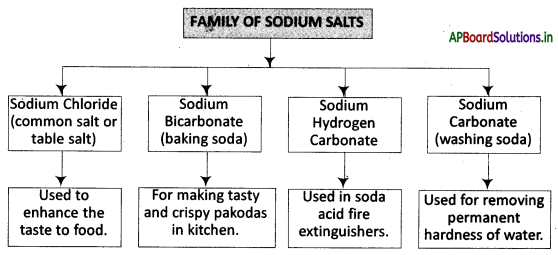
→ Sodium hydrogen carbonate is used in soda acid fire extinguishers.

→ Washing soda is used in the manufacture of borax.

→ Salts have various uses in everyday life and in industries.

→ Plaster of Paris (CaSO4, 6H20) is used for making toys, materials for decoration and for making surfaces smooth.

→ Indicator: A special substance that gives different colours in acidic, and basic media.

AP Board Solutions AP Board 10th Class Physical Science Notes Chapter 2 Acids, Bases and Salts

→ Acid: ‘Acid’ is a word derived from the Latin word ‘Acidus’. It means sour. Usually, we call any substance that has a sour taste.

→ Base: The substance that has a bitter taste and is slippery to touch.

→ Red Litmus: A red coloured indicator used to test the presence of basic nature in a substance.

→ Blue Litmus: A blue coloured indicator used to test the presence of acidic nature in a substance.

→ Phenolphthalein and Methyl Orange: The synthetic (chemical) indicators to find the presence of acids and bases.

→ Salts: A substance that is formed as a result of the neutralization reaction between an acid and a base.

→ Neutralization: When acids and bases react, salt and water are formed. This chemical reaction is known as neutralization.

→ Guard tube: A drying tube used in experiments.

→ Hydronium ion: H3O+ ion.

→ Alkali: A base that is soluble in water is called alkali.

→ Strong acid: Acid that gives more H30+ ions (They are ionized completely).

AP Board Solutions AP Board 10th Class Physical Science Notes Chapter 2 Acids, Bases and Salts

→ Strong Base: Base that gives more OH ions in water.

→ Universal indicator: It is a mixture of several indicators.

→ pH Scale: A scale for measuring hydrogen ion concentration in a solution. pH = – log10 (H+)

→ Potenz: A scale for measuring hydrogen ion concentration in a solution is called the pH scale. The ‘P’s in pH stands for Potenz. In German ‘Potenz’ is power.

→ Antacids: A mild base used to get rid of pain and irritation caused due to indigestion of food.

→ Tooth decay: Corrosion of tooth due to the degradation of sugar and food particles remaining in the mouth.

→ Family of Salts: Salts having the same positive or negative radicals belong to a family called a family of salts.

→ Common Salt or Table Salt: Sodium Chloride Salt (NaCl).

→ Bleaching Powder: The action of chlorine on dry slaked lime.

→ Baking Soda: Sodium bicarbonate salt is used in the kitchen for making tasty and crispy pakoras.

→ Washing Soda: Sodium carbonate salt is used in washing clothes, etc.

→ Hydrated Salt: Salt which contains water.

→ The water of crystallization: It is the fixed number of water molecules chemically attached to each formula unit of salt in its crystalline form.

→ Plaster of Paris: On heating gypsum at 373 K it loses water molecules and becomes Calcium Sulphate hemihydrate called Plaster of Paris.

→ Olfactory indicators: The substances whose odour changes in acidic or basic media.

→ Litmus solution: A natural indicator extracted from certain lichens.

→ Lichen: Rock Moss.

→ Endothermic reaction: A chemical reaction in which heat is absorbed.

→ Exothermic reaction: A chemical reaction in which heat is evolved.

→ Aqueous Solution: The solution in which the solvent is water.

→ The concentration of a Solution: The amount of solute present per unit volume or per unit mass of the solution.

→ Weak acids: Acids that give fewer (less) H3O+ ions (They are not ionized completely).

→ Weak bases: Bases that give fewer (less) OH ions in water.

AP Board Solutions AP Board 10th Class Physical Science Notes Chapter 2 Acids, Bases and Salts

→ Saturated solution: The solution in which the amount of solute dissolved is equal to solubility.

→ Unsaturated solution: The solution in which solute is less than the solvent.

→ Supersaturated solutIon: The solution in which the solute dissolved is more than its solubility.

→ Acid rain: When the pH of rainwater is less than 5.6, it is called acid rain.

→ Rock Salt: Deposits of seawater (solid salt) are changed to large brown crystals called Rock salt.

→ Dry slaked lime: Ca (OH)2 (i.e.,) Calcium Hydroxide.

→ Brine solution: An aqueous solution of common salt.

→ Anode: A positive electrode.

→ Cathode: A negative electrode.

→ Quick lime: CaO (Calcium Oxide).
AP Board 10th Class Physical Science Notes Chapter 2 Acids, Bases and Salts Notes 1
AP Board 10th Class Physical Science Notes Chapter 2 Acids, Bases and Salts Notes 2

AP Board Solutions AP Board 10th Class Physical Science Notes Chapter 2 Acids, Bases and Salts

→ Achara Nagarjuna (AD 931):

  • Acharya Nagarjuna was born In AD 931 in Gujarat (India). He was an alchemist.
  • He knew an artel transmuting base metals to look like gold.
  • He was a metallurgist and chemist. He was very famous for his book Rasevada’ Which deals with Mercury compounds.
  • He discussed the extraction of costly Metairie gold, alive; etc. In bis wrItings.

→ JFW Adolf Von Baeyer (1835 – 1917):

  • Johann Friedrich Wilhelm Adoli Von Baeyer was born on October 31, 1835 In Berlin (Germany).
  • He was interested In chemical experiments. He found a new double salt of copper.
  • He studied Methyl Chloride, Uric acid, Indigo, etc.
  • He discovered Indole.
  • His ‘Baeyer strain theory of the Carbon iingW Is very famous.
  • He received the Nobel Prize In 1905.
AP Board 10th Class Social Studies Notes Chapter 22 Citizens and the Governments

Students can go through AP State Board 10th Class Social Studies Notes Chapter 22 Citizens and the Governments to understand and remember the concept easily.

AP State Board Syllabus 10th Class Social Studies Notes Chapter 22 Citizens and the Governments

→ Right to Information Act, 2005 was passed by the Central Government.

→ The act was passed as a result of people’s mobilization as well as in recognition of the provisions in the Constitution that provide Rights to citizens.

→ In any democratic system, governments are responsible and accountable to the people.

→ Disseminating information that is generated in the government department to any citizen who may be interested, now becomes the responsibility of all governments.

→ Every government functions on the basis of certain rules and regulations.

→ Public Information Officers and appellate authorities in the same department are responsible to implement this act.

→ These all are functioning under State Public Information Commissioner and Central Public Information Commissioner.

→ Suppose both the PIO and APIO refuse to give information, then one can go to State Public Information Commissioner or Central Public Information Commissioner.

→ In case some PIOs refuse to give information such officers can be penalized on the orders of SPIC or CPIC.

AP Board Solutions AP Board 10th Class Social Studies Notes Chapter 22 Citizens and the Governments

→ The Act identifies public authorities who are expected to follow various RTI Acts as
(a) the institution created under the Constitution
(b) made under the laws of Parliament or State Legislatures
(c) created through a notification or order of the appropriate governments.

→ The law permits the governments not to disclose certain information that could affect the sovereignty and integrity of India etc.

→ Most of the armed forces and security agencies are outside the purview ap Information Commissions.

→ Any citizen can approach any department of the government and ask for any information, need not explain why he needed it.

→ Individual who is collecting the information can remain anonymous.

→ Transparency of information can help to contain corruption and hold governments accountable to individual citizens also.

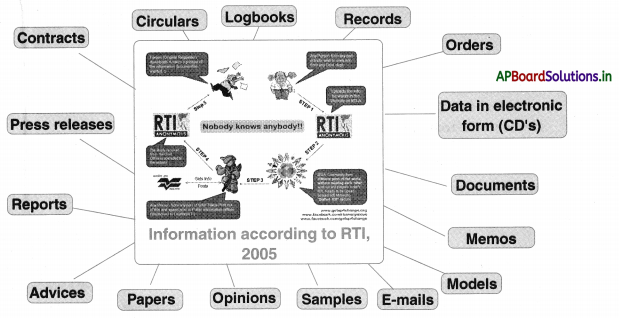
→ Information: Material in any form like records, documents, etc. data in any form like electronic, etc., and matters related to any private body which can be assessed by public authority.

→ Appellate Authority: An authority where people can appeal If information is not provided by Public Information Officers.

→ Record: A written account kept for future use.

AP Board Solutions AP Board 10th Class Social Studies Notes Chapter 22 Citizens and the Governments

→ Pudic authority: An institution or organization which has the power over the affairs of common people which Is vested in them through the constitution.

→ Transparency: Quality that makes things easy to understand and allows to see there is no corruption.

→ Legal Service: The help or service offered In matters of law.

→ Lok Adalat: People’s court = It Is an Act to constitute legal services authorities to provide free and competent legal services to the weaker sections of the society

→ Domestic violence: Violence between the members of the same family, usually children, and women are the sufferers.

→ Civil cases: Cases Involving personal legal matters and not criminal, like marriage, divorce, partition, sale deeds, land disputes, etc.

→ Juvenile home: A home for the culprits of offenses who are young people and not adults (above 18 years of age is adult).

→ Autonomous: Able to govern itself or control Its own affairs (a country, a region, or an organization)

AP Board Solutions AP Board 10th Class Social Studies Notes Chapter 22 Citizens and the Governments

→ Prima fade: At first sight (based on what seems to be the truth when first seen or heard)
AP Board 10th Class Social Studies Notes Chapter 22 Citizens and the Governments 1