AP Board 8th Class Physical Science Notes Chapter 6 Sound

Students can go through AP State Board 8th Class Physical Science Notes Chapter 6 Sound to understand and remember the concept easily.

AP State Board Syllabus 8th Class Physical Science Notes Chapter 6 Sound

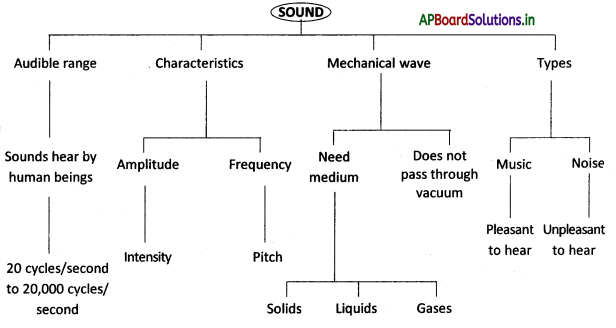
→ The vibrating body produces sound.

→ Human beings are able to produce sound with the help of vocal cords.

→ Sound travel through solids, liquids, and gases.

→ The material through which sound travels is called a medium.

→ Sound cannot travel through a vacuum.

→ The vibration of the eardrum caused by the sound produced by a vibrating body gives us a sense of hearing.

→ The loudness or feebleness of a sound is determined by the amplitude of vibration.

→ The intensity of sound is measured in decibels (dB).

→ Pitch or shrillness are determined by frequency.

→ The number of vibrations per second is called frequency.

→ Normal sounds consist of mixed frequencies.

→ The hearing limit of sounds by human beings is called audible range.

AP Board Solutions AP Board 8th Class Physical Science Notes Chapter 6 Sound

→ Sounds pleasant to listen to are called music and unpleasant to listen to are called noise.

→ Excessive or unwanted sounds lead to noise pollution. It may cause health problems for human beings.

→ Attempts should be made to minimize noise pollution.

→ Plantation on the roadside and elsewhere can reduce noise pollution.

→ Vibration: The to ánd fr motion of o body from Its mean position is known as vibration

→ Vocal cords: The two muscular ligaments at the end of the windpipe called vocal cords

→ Medium: The substance which allows the passage of sound is called medium

→ Vacuum: Condition of no medium or without medium

→ Eardrum: The thin membrane at the end of the auditory canal.

→ Loudness: Loudness or softness of sound depends on upoñ’omplitude. Loud sounds are having greater amplitude

→ Feeble: Sounds of low amplitude

→ Amplitude: The maximum displacement of the vibrating body from ¡ts mean position is coiled amplitude.

→ Decibel: Decibel is the unit for measuring the intensity of sound

AP Board Solutions AP Board 8th Class Physical Science Notes Chapter 6 Sound

→ Pitch (Shnllness): The shrillness of a sound known as pitch (or) Sound of higher frequency produce shrillness

→ Frequency: The number of vibrations per second is called frequency.

→ Noise: The sounds which are not pleasant to hear are coiled noises.

→ Music: The sounds which pleasant to hear are called music.

→ Audible range: The hearing limit of sounds by human beings ¡s called audible range.
AP Board 8th Class Physical Science Notes Chapter 6 Sound 1
→ Alexarnkr Graham Bell (1847 – 1922):

  • He was an eminent scientist, inventor, engineer, and innovator who is credited with inventing the first practical telephone.
  • Bell’s other inventions are including groundbreaking work in optical telecommunications, hydrofoils, and aeronautics.
  • In 1888, Bell became one of the founding members of the National Geographic Society.

AP Board 8th Class Physical Science Notes Chapter 10 Reflection of Light at Plane Surfaces

Students can go through AP State Board 8th Class Physical Science Notes Chapter 10 Reflection of Light at Plane Surfaces to understand and remember the concept easily.

AP State Board Syllabus 8th Class Physical Science Notes Chapter 10 Reflection of Light at Plane Surfaces

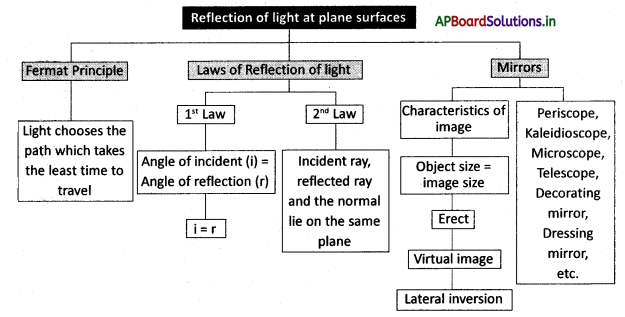
→ If In the reflection of the light angle of the incident (i), angle of reflection (r) are always equal.

→ Incident ray reflected ray and normal lie in the same plane. This plane is called the plane of reflection.

→ The image formed by the plane mirror is virtually erect and the same size as the object.

→ The object distance and image distance are the same in the case of the plane mirrors.

→ The image of an object in-plane mirror appears to be smaller when compared to its object because the angle of vision made by the image is smaller than that of the angle of vision made by the object.

→ In the plane mirror, the image is laterally inverted.

→ Fermat Principle: Light selects th€’path which takes the least time to travel.

→ Reflection: The bouncing back of the light is called reflection.

→ Incident ray: The ray which is incident on a surface is catted incident ray

→ Related ray The rd which ¡s reflected from the surface is called reflected ray

→Normal: The line perpendicular tå the surface is catted normal

AP Board Solutions AP Board 8th Class Physical Science Notes Chapter 10 Reflection of Light at Plane Surfaces

→ The angle of incidence: The angÍe between the incident ray and normal is called angle (∠i) of incidence

→ The angle of reflection: The angle between normal and reflected ray is called angle (∠r) of reflection

→ Plane of reflection: The plane in which the incident ray, reflected ray, and a normal lie is called the plane of reflection.

→ Lateral inversion: The image of an object reverses its direction on reflection is a lateral inversion (This means that objects that are on the right side, appear on the left side in the mirror.)

→ Object distance (u): The distance between object and mirror is &illed object distance.

→ Image distance (v): The distance between image and mirror is called image distance.

→ Virtual image: Virtual image ¡s the image formed due to diverging of light rays.
OR
The image formed due to the extension of rays in the backward direction.

→ Real image: The image formed due to the converging of light rays is real.

AP Board Solutions AP Board 8th Class Physical Science Notes Chapter 10 Reflection of Light at Plane Surfaces

→ Plane mirror: A plane mirror is that which has a planar reflective surface.

→ Ray diagram: A diagram showing the paths of selected rays through an optical system.
AP Board 8th Class Physical Science Notes Chapter 10 Reflection of Light at Plane Surfaces 1
→ Pierre de Fermat (17 August 1601 -12 January 1665):

  • A French Lawyer at the Parliament of Toulouse, France, and an amateur mathematician.
  • He made notable contributions to analytical geometry, probability, and optics.
  • He proposed his principle on the light which states that light selects the path which takes the least time to travel. This principle was famous as the Fermat principle.

AP Board 9th Class Social Studies Notes Chapter 2 The Natural Realms of the Earth

Students can go through AP State Board 9th Class Social Studies Notes Chapter 2 The Natural Realms of the Earth to understand and remember the concept easily.

AP State Board Syllabus 9th Class Social Studies Notes Chapter 2 The Natural Realms of the Earth

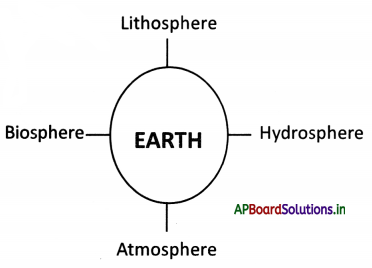
→ There are four natural realms of the Earth.
They are (a) Lithosphere,
(b) Hydrosphere,
(c) Atmosphere, and
(d) Biosphere.

→ The solid crust or the hard top part of the earth which is made up of rocks and minerals and covered with a thick layer of soil is called the lithosphere.

→ The realm of water which comprises various sources of water and different types of water bodies is called the hydrosphere.

→ The thin layer of air that surrounds the earth is the atmosphere.

→ The realm of life including bacteria is called the biosphere.

→ The primary divisions of the earth’s crust are oceans and continents. These are called first-order landforms.

→ The landforms like mountains, plains, and plateau are called second-order landforms.

→ All the continents and even the oceans are actually situated on a massive base of rocks called ‘plates’.

→ The plates are constantly being pushed very slowly. This movement of plates is called plate tectonics. This process causes earthquakes, etc.

→ Mid-ocean ridges or ranges are formed by lava rising up from the mantle and these create a new ocean floor.

→ The plates move and push. The incoming plate dips under the stable plate.

→ The Himalayas mountains were formed by the process of Indian plate pushing into the Eurasian plate.

AP Board Solutions AP Board 9th Class Social Studies Notes Chapter 2 The Natural Realms of the Earth

→ Many of the plate boundaries are characterized by volcanic eruptions and earthquakes.

→ The lava that pours out on the surface from volcanoes and fissures form the extrusive landforms. This occurred many times on the Deccan and led to the formation of the Deccan plateau.

→ The constructive and destructive forces of water and air give rise to the great diversity of landforms.

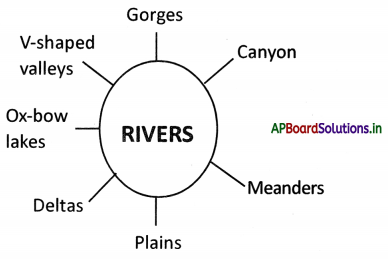
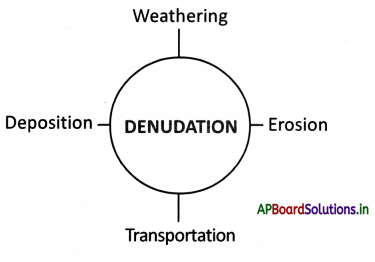
→ Processes like weathering, erosion, transportation, and deposition are largely responsible for the formation of carved mountains, valleys, deltas, and sand dunes, etc.

→ As it descends the steep slopes the river flows swiftly exerting a great force, cuts the mountains vertically, and forms V-shaped valleys.

→ The swift flow and force of the river lead to the formation of gorges and canyons.

→ When the river is in flood it cuts the soil and when it is not in flood it deposits silt This is how the Ganga plain or Krishna, Godavari plains were made.

→ As a result of the deposition the river changes its course and cuts new path, changes its course constantly, and forms meander and ox-bow lakes subsequently.

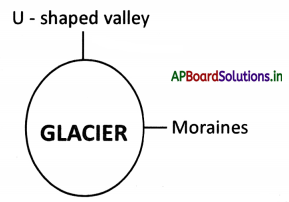
→ Glaciers through their processes of plucking and abrasion create U-shaped valleys.

AP Board Solutions AP Board 9th Class Social Studies Notes Chapter 2 The Natural Realms of the Earth

→ The erosion and deposition of sea waves give rise to coastal landforms such as ‘sea arches, stacks, capes, and bays.’

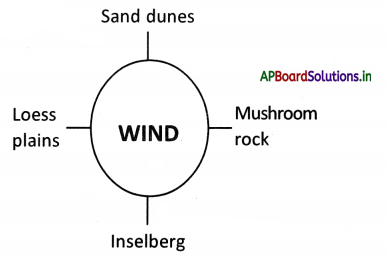
→ The wind is the dominant agent in hot deserts. In deserts, the wind action creates a number of erosional and depositional features such as sand dunes, mushroom rock, Inselberg.

→ Loess is the fine dust bloom beyond the desert limit and is deposited on the neighboring lands.

→ The plains formed by the deposition of loess are called Loess Plains.

→ Plate tectonics: The movement of the massive bases of rocks, i.e. plates is called plate tectonics.

→ Igneous rocks: The hard rocks formed after the cooling of the molten material from volcanoes.

→ Sedimentary rocks: The debris is transported by rivers to the sea, where layer after layer is accumulated in the bottom and over time get transformed into sedimentary rocks.

→ Loess plains: The plains formed by the deposition of loess are called Loess plains.

→ ‘U’ shaped valley: The valley formed through the processes of plucking and abrasion by glaciers is called U shaped valley.

→ Lithosphere: The solid crust or the hard top part of the Earth.

→ Hydrosphere: The realm of water that comprises various sources of water and different types of water bodies like rivers, lakes, seas, and oceans, etc.

→ Atmosphere: The thin layer of air that surrounds the earth is the Atmosphere.

→ Biosphere: The realm of life including bacteria.

→ First-order landforms: The primary division of the earth’s crust into oceans and continents.

AP Board Solutions AP Board 9th Class Social Studies Notes Chapter 2 The Natural Realms of the Earth

→ Second-order Landforms: Landforms like mountains, plains, and plateaus are called ‘second-order landforms’.

→ Seafloor spreading: The mid-ocean ridges or ranges formed by lava rise up from the mantle. This fresh crust slowly pushes the plate away which is called seafloor spreading.

→ Intrusive landforms: When a volcano erupts some part of the lava may cool under the surface and become rocks. These are called intrusive landforms.

→ Extrusive landforms: When a volcano is erupted some part of lava pours on the earth’s surface or pours out of fissures on the earth’s surface and forms rocks which are called extrusive landforms.

→ Third-order Landforms: The shaping of the landforms such as valleys, deltas, sand dunes, etc. by wind and water are called third-order landforms.

→ Erosion cycle (or) Geomorphic cycle: A process through which mountains, plateaus, and plains keep on changing is called the Erosion cycle (or) Geomorphic cycle.

→ Volcanoes: Volcanoes are places on the earth’s surface where molten material from the mantle erupts onto the Earth’s surface.

→ Weathering: The process by which the rocks are weakened and broken is called ‘weathering’.

→ Erosion: The active wearing away of the earth’s surface by the moving agents such as water and wind is called erosion.

→ Gorge: A narrow valley with very steep slopes that are cut of hard rocks by the rivers is called a Gorge.

→ Canyon: A narrow chasm with steep, cliff walls cut into the earth by running water.

→ Meanders: Gentle turns like a snake made by the river in its flood plain are called meanders.

→ Glacier: Slow-moving of mass of ice is called Glacier.

→ Canyon: A narrow chasm with steep, cliff walls cut into the earth by running water.

→ Meanders: Gentle turns like a snake made by the river in its flood plain are called meanders.

→ Glacier: Slow-moving of mass of ice is called Glacier.

→ Plucking: Lifting pieces of rock and transporting them by glaciers is called plucking.

→ Sand Dunes: The unstable hills of sand formed due to weathering and persistent wind action are called sand dunes.

AP Board Solutions AP Board 9th Class Social Studies Notes Chapter 2 The Natural Realms of the Earth

→ Inselberg: The isolated residual hills rising abruptly from the ground are called inselberg or Island Mountain.

→ Loess: The fertile deposits of fine dust beyond the desert limit is called Loess.
AP Board 9th Class Social Studies Notes Chapter 2 The Natural Realms of the Earth 1
AP Board 9th Class Social Studies Notes Chapter 2 The Natural Realms of the Earth 2
AP Board 9th Class Social Studies Notes Chapter 2 The Natural Realms of the Earth 3
AP Board 9th Class Social Studies Notes Chapter 2 The Natural Realms of the Earth 4
AP Board 9th Class Social Studies Notes Chapter 2 The Natural Realms of the Earth 5

→ Tectonics comes from the Greek word – ‘tekton’ meaning carpenter or builder. It is related ! to the Sanskrit word ‘takshan’ again meaning carpenter.

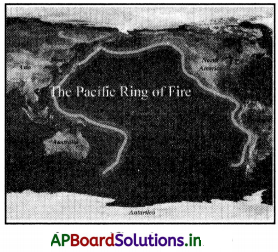
→ The Pacific Ring of Fire:
For many decades, geologists noted the high number of earthquakes and volcanic activity occurring around the ‘Pacific Rim’ — the edge of the Pacific Ocean basin. About three-quarters of all active volcanoes in the world lie within the Pacific Rim. The theory of plate tectonics provided the explanation for this pattern. Plate boundaries are found all the way around the Pacific basin. It is along these plate boundaries that many volcanoes and earthquakes occur, giving it the name ‘The Pacific Ring of Fire.
AP Board 9th Class Social Studies Notes Chapter 2 The Natural Realms of the Earth 6
The Pacific Ring of Fire

→ The biggest Canyon in the world is on the river Colorado. The Grand Canyon in the USA is 466 km in length. Its depth is 1.6 km and its width is 188m to 29km.

  • The highest waterfall in the world is Angel falls – its height is 979 m, on river Charan, in Venezuela.
  • The second highest waterfall in the world is Tugela falls – its height is 947 m – on river Tugela, in South Africa.
  • The highest waterfall in India is Jog fall (or) Jerosoppa – height is 253 m – on river Sharavathi, in Karnataka.

→ The largest delta in the world is Sunderbans. It is formed at the mouths of rivers Ganga and Brahmaputra. The rivers Krishna and Godavari together make two large deltas in Andhra Pradesh.

→ Mushroom Rock: Winds erode the lower section of the rocks more than the upper part. Therefore such rocks have narrower bottoms and wider tops. They look like mushrooms. So it is called mushroom rocks.

AP Board 9th Class Social Studies Notes Chapter 2 The Natural Realms of the Earth 7
Mushroom Rock

→ Inselberg: The isolated residual hills rising abruptly from the ground are called inselberg or Island Mountain. They are characterized by their very steep slopes and rather rounded tops.
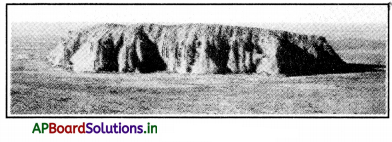
AP Board 9th Class Social Studies Notes Chapter 2 The Natural Realms of the Earth 8
Inselberg

AP Board 8th Class Physical Science Notes Chapter 8 Combustion, Fuels and Flame

Students can go through AP State Board 8th Class Physical Science Notes Chapter 8 Combustion, Fuels and Flame to understand and remember the concept easily.

AP State Board Syllabus 8th Class Physical Science Notes Chapter 8 Combustion, Fuels and Flame

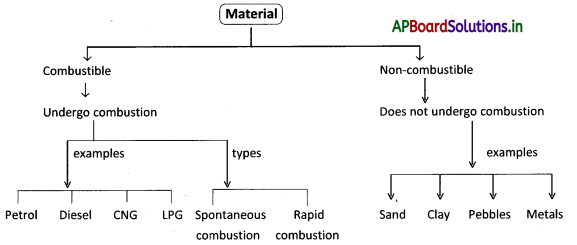
→ Burning material in the presence of air (oxygen) is called combustion

→ The substances which burn in the air are called combustible

→ Oxygen or air is needed for combustion to take place

→ During the process of combustion, heat and light are given out.

→ The lowest temperature at which a substance catches fire is called its ignition temperature.

→ Inflammable substances have very low ignition temperature,

→ The type of combustion in which material suddenly burns into flames without the application of any apparent cause is called spontaneous combustion

→ The type of combustion in which material burns rapidly and produces heat and light is called rapid combustion.

→ The amount of heat energy produced on complete combustion of 1 kg of fuel is called the calorific value of that fuel.

→ In the blue zone of the candle flame vaporized wax burns completely due to a good supply of oxygen.

AP Board Solutions AP Board 8th Class Physical Science Notes Chapter 8 Combustion, Fuels and Flame

→ Combustion: Burning o material in the presence of air (oxygen) is called combustion.

→ Combustible and Non – combustible materials: The materials which burn when brought near a flame ore are called combustible materials. The materials which do not burn are called non-combustible materials.

→ Ignition temperature: The lowest temperature at which a substance catches fire is called ignition temperature.

→ Inflammable material: The material which has a very low ignition temperature easily catches fire called an inflammable material.

→ Spontaneous combustion: The type of combustion in which material suddenly burns into flames without application of any apparent cause is called spontaneous combustion.

→ Rapid combustion: The type of combustion in which material burns rapidly and produces heat and light is called rapid combustion.

→ Explosion: The reaction ¡n which there is the liberation of heat, light, sound, and a large amount of gas is called an explosion.

→ Fuels: The materials which burn when brought near a flame producing heat and light are called fuels.

AP Board Solutions AP Board 8th Class Physical Science Notes Chapter 8 Combustion, Fuels and Flame

→ Calorific value: The amount of heat energy produced on complete combustion of 1 kg of fuel is called the calorific value of that fuel.
AP Board 8th Class Physical Science Notes Chapter 8 Combustion, Fuels and Flame 1
→ Joseph Priestly (1733 – 1804):

  • Joseph Priestly was an English philosopher and chemist
  • He was the first person to prepare artificially by heating mercuric oxide.
  • He also prepared carbon dioxide and nitrous oxide in the laboratory.

AP Board 8th Class Physical Science Notes Chapter 7 Coal and Petroleum

Students can go through AP State Board 8th Class Physical Science Notes Chapter 7 Coal and Petroleum to understand and remember the concept easily.

AP State Board Syllabus 8th Class Physical Science Notes Chapter 7 Coal and Petroleum

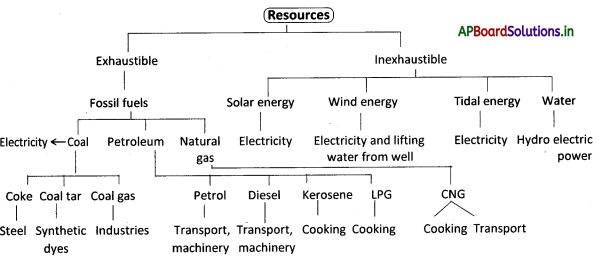
→ Natural resources can be classified into exhaustible and inexhaustible resources.

→ Fossil fuels are formed from the dead remains of living organisms under the earth over millions of years.

→ Coal, petroleum, and natural gas are fossil fuels.

→ Coke, coal tar, and coal gas are the products of coal.

→ Petroleum is formed from the remains of tiny organisms called plankton.

→ Petroleum gas, petrol, diesel, kerosene, paraffin wax, lubricating oil are obtained by refining petroleum.

→ Natural gas is found sometimes along with petroleum and sometimes without petroleum.

→ The useful substances which are obtained from petroleum and natural gas are called petrochemicals.

→ Excess use of fossil fuels causes air pollution, greenhouse effect, global warming, and many health problems.

→ Fossil fuels resources are very limited. We should think of alternatives.

→ Advanced science and technology have changed our lives.

→ Natural resources: The resources obtained from nature are called natural resources.

AP Board Solutions AP Board 8th Class Physical Science Notes Chapter 7 Coal and Petroleum

→ Exhaustible Resources: The resources which are limited in nature and can be exhausted by human activities are called exhaustible resources.

→ Inexhaustible resources: The resources which are unlimited ¡n nature and not likely to be exhausted by human activities are called inexhaustible resources.

→ Petroleum: Petroleum ¡s o complex mixture mainly consists of hydrocarbons.

→ Fractional distillation: It is one type of distillation in which fractionating columns are used to separate a mixture of compounds.

→ Natural gas: Natural gas ¡s a very important fossil fuel.

→ CNG: Natural gas is stored under high pressure is called compressed natural gas.

→ Coke: It is a tough, porous, black in color and purest form of carbon substance.

→ Coal gas: The gas obtained during the processing of coal to get a coke.

→ Coal tar: It is a black colored thick liquid with an unpleasant smell

→ Carbonization: Theslowprocessofconvertion of dead vegetation into coal is called carbonization.

→ Plankton: The tiny organisms found in the bottom of seas and oceans.

AP Board Solutions AP Board 8th Class Physical Science Notes Chapter 7 Coal and Petroleum

→ Fossil fuels: The fuels formed from the dead remains of living organisms are called fossil fuels.

→ Petrochemicals: The substances obtained from petroleum and natural gas are coiled petrochemicals.

→ Petroleum refinery: The process of separating the various constituents fractions of petroleum is petroleum refinery.
AP Board 8th Class Physical Science Notes Chapter 7 Coal and Petroleum 1
→ Michael Faraday (1791 – 1867):

  • He was an English scientist who contributed to the fields of electromagnetism and electrochemistry.
  • His discoveries include those ûf electromagnetic induction, diamagnetism, and electrolysis.
  • As a chemist, Faraday discovered benzene, investigated the clathrate hydrate of chlorine, invented an early form of a bunsen burner.

AP 7th Class Science Notes 11th Lesson Fibres and Fabrics

Students can go through AP Board 7th Class Science Notes 11th Lesson Fibres and Fabrics to understand and remember the concept easily.

AP Board 7th Class Science Notes 11th Lesson Fibres and Fabrics

→ Fibres are derived from plants, animals as well as chemicals.

→ Silk is derived from Silkmoth.

→ Wool is derived from animals like sheep, goat, yak and camel.

→ Marino sheep is the world famous breed for wool rearing.

→ Sheep is the main source of wool production in Andhra Pradesh.

→ Angora goat is the world wide famous breed for wool.

→ Rearing or farming of sheep is a branch of animal husbandry in India.

→ Fleece is used to make wool.

AP 7th Class Science Notes 11th Lesson Fibres and Fabrics

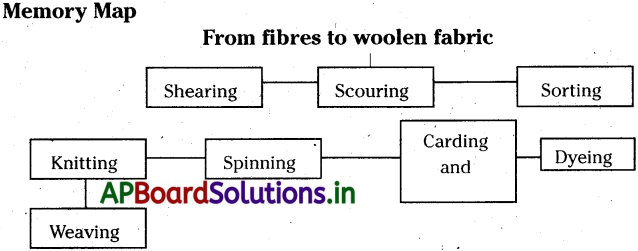
→ There are 6 stages in processing fibres into wool.

→ They are shearing, scouring, sorting, dyeing, carding, combing and spinning.

→ Removing fleece of animal along with the outer thin layer of skin is called shearing.

→ The process of separating the fleece of animal into sections based on its quality is known as sorting.

→ The process of wrapping the fleece between the two surfaces to make the fibre into a fluffy roll is called carding.

→ Process of winding together the fibres to form a yarn is called Spinning.

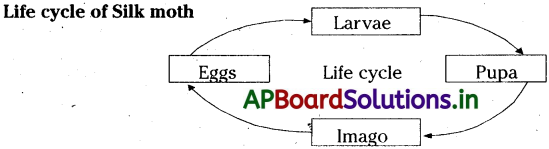
→ Larvae and caterpillars are called silkworms.

→ The capsule like structure is known as cocoon (pattukaaya).

→ Rearing of silkworms for obtaining silk is known as Sericulture.

→ Andhra Pradesh stands in second place in the production of silk in the country.

→ The process of killing larvae inside the cocoon by putting them in steam is called stifling.

→ The process of extracting threads from cocoon is called Reeling.

→ The Scientific name of the Silk moth that yields silk is known as Bombyx mori.

→ The silk obtained from bombyx mori is called Mulberry silk.

→ Animal fibres burn slowly but not continuously when compared to plant fibres. Animal fibres dissolve in Chlorine based bleach.

AP 7th Class Science Notes 11th Lesson Fibres and Fabrics

→ Keratin is the major protein present in wool.

→ Silk fibres are made of protein are called fibroin.

→ Artificial fibres or synthetic fibers are made of chemicals obtained from wood pulp or petroleum.

→ Examples for artificial fibres are Acrylic, Rayon, Nylon, Polyester etc.

→ Except Rayon, remaining artificial fibres are made of chemicals, their productions causes environmental pollution.

→ Clothes made of animal fibres (wool, silk) should be stored carefully preventing the attack of insects.

→ The process of removal of shrinkage from silk clothes is called Rolling.

→ Mohair : The wool derived from Angora goat.

→ Shearing : Removing fleece of animals along with the outer thin layer of skin is called shearing.

→ Scouring : To remove dirt or grease from (cloth or fibres) by means of a detergent.

→ Sorting : The process of separating the fleece of animal into sections based on its quality is known as sorting.

→ Dyeing : To colour (a material), especially by soaking in a colouring solution.

→ Combing : The pulling of fleece through the metal teeth of a combing machine is called combing.

→ Carding : The process of wrapping the fleece between the two surfaces to make the fibre into a fluffy roll is called carding.

→ Spinning : The process of winding together the fibres to form a yarn is called spinning.

→ Knitting : The process of making woolen garment is known as knitting.

→ Cocoon : The capsule like structure formed by silk worm is known as cocoon (pattukaaya).

→ Sericulture : Raising silkworms in order to obtain raw silk.

→ Reeling : The process of extracting threads from cocoon is called Reeling.

→ Bleach : To remove the colour from, as by means of chemical agents or sunlight.

→ Keratin : Major protein present in wool.

AP 7th Class Science Notes 11th Lesson Fibres and Fabrics

→ Fibroin : Protein present in the silk fibres is fibroin.

→ Acrylic : Artificial fibre prepared from a synthetic fibre acrylic used to make sweaters and shawls.

→ Nylon : First fully synthetic fibre made in 1931, from coal and water. It is strong, elastic and light weight.

→ Polyester : It is used to make shirts, sarees and other dresses. It- doesn’t get wrinkled easily.

→ Synthetic fabrics : The artificial fibres made from wood pulp or petroleum.

→ Recycle : The process of waste products to regain materials for human use.

→ Wrinkles : Formation of foldings in animal fibres (wool and silk) due to poor maintenance.

1.
AP 7th Class Science Notes 11th Lesson Fibres and Fabrics 1

2.
AP 7th Class Science Notes 11th Lesson Fibres and Fabrics 2

AP Board 8th Class Biology Notes Chapter 2 Cell: The Basic Unit of Life

Students can go through AP State Board 8th Class Biology Notes Chapter 2 Cell: The Basic Unit of Life to understand and remember the concept easily.

AP State Board Syllabus 8th Class Biology Notes Chapter 2 Cell: The Basic Unit of Life

→ All living organisms are made of cells.

→ Cells were first observed by Robert Hooke in 1665.

→ Antonie Van Leeuwenhoek was the first to see living bodies under the microscope which he had constructed himself.

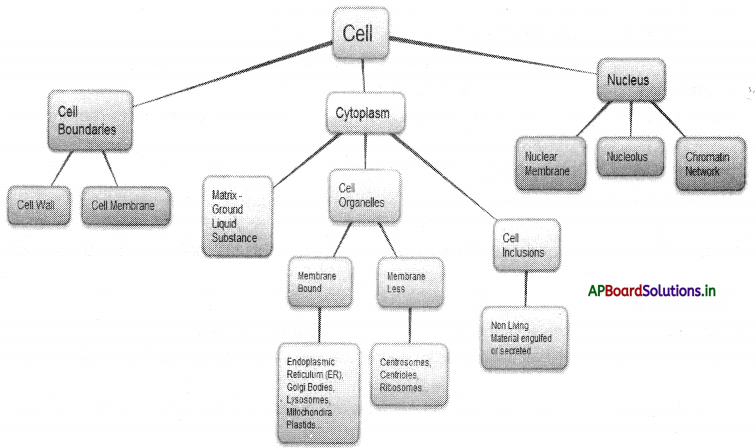
→ The cell has 3 main parts:

  1. The Cell membrane,
  2. Cytoplasm,
  3. Nucleus.

→ Robert Brown discovered the nucleus in the orchid leaf.

→ Plant cells differ from those of animals in having an additional layer around the cell membrane termed cell wall.

→ The cell wall gives strength and rigidity to plants.

→ Cell exhibits a variety of shapes and sizes and numbers.

→ Single-celled animals are called unicellular organisms.

→ More than one cell is called a multicellular organism.

→ Basic functions in multi-cellular organisms are carried out by a variety of cells.

→ Cell: The smallest biological unit capable of carrying out all of the fundamental activities of life. The basic unit of structure and function of any living thing.

AP Board Solutions AP Board 8th Class Biology Notes Chapter 2 Cell: The Basic Unit of Life

→ Cell membrane: The thin, flexible layer that surrounds a cell and which controls all that enters and leaves the cell.

→ Cell Wall: Cells, the outermost non-living cellulose layer that surrounds the entire cell, including the cell membrane.

→ Cytoplasm: That part of a cell’s protoplasm that lies outside of its nucleus.

→ Nucleus: A spherical structure present at the center of the cell.

→ Unicellular: An organism composed of just one cell.

→ Multicellular: Organism formed by more than one cell.

→ Organ: All organisms are made of smaller particles called organs.

→ Organelles: The small functional structures of the cell.

→ Pseudopodia: False feet or the structures formed by the unicellular organisms to capture food or for locomotion.

→ Staining: Obtain color to the cells

→ Magnification: Expanding the size of the structure

→ Focusing: To visualize the object by light

→ Centriole: In animal cells, a structure outside the nucleus organizes the spindle fibers during cell reproduction.

AP Board Solutions AP Board 8th Class Biology Notes Chapter 2 Cell: The Basic Unit of Life

→ Contractile Vacuoles: Large sacs found ¡n the cells of certain protozoans that remove the water that has accumulated inside the cell by pumping it to the outside of the cell.

→ Food Vacuoles: The sacs where food particles are digested that are found in the cytoplasm of protozoan cells.

→ Micrometer: Hundred part of millimeter 1/100 mm

→ Nanometer: Thousand part of micrometer 1/1000 (urn)

→ Heterogeneous: Different state of features in a group

→ Teeming: Occupying the full of container

→ Stomata: Tiny pores on leaves

→ Contractile vacuole: A sac-like cell organelle that pumps fluid in a cyclic manner
AP Board 8th Class Biology Notes Chapter 2 Cell The Basic Unit of Life 1

→ Antonie Van Leeuwenhoek (1632-1723) in 1674 was the first human to see living bodies like bacteria, yeast, protozoa, Red Blood cells, and the teeming life in a drop of water. He prepared several types of magnifying glasses and used his lenses to study both living and non-living things using under a microscope.

→ Robert Brown (1773 – 1858):

  • Robert Brown was born in 1773. He made a significant contribution to our understanding of cells.
  • He was the first person to observe the “Nucleus” in the epidermis of orchid leaves.
  • He died in 1858.

AP Board 6th Class Science Notes Chapter 2 Knowing About Plants

Students can go through AP State Board 6th Class Science Notes Chapter 2 Knowing About Plants to understand and remember the concept easily.

AP State Board Syllabus 6th Class Science Notes Chapter 2 Knowing About Plants

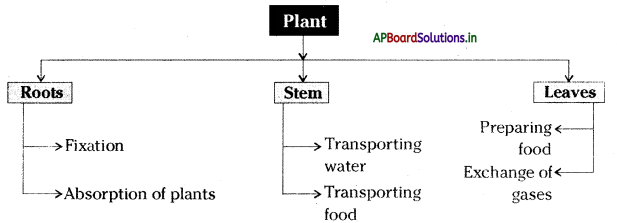
→ The important parts of a plant are roots, stem and leaves.

→ The Taproot system and fibrous root system are two types of root systems seen in plants.

→ Dicot plants have tap root systems whereas Monocot plants have a fibrous root system. Roots help to fix the plant to the soil, absorbs water and minerals.

→ In some plant’s roots give additional support to the plants whereas fibrous roots, help to store the food.

→ The shoot system consists of stems, leaves, flowers, and fruits.

→ The stem transports water and minerals from roots to upper plant parts and food from leaves to other parts.

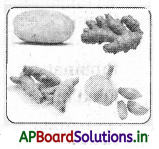
→ Potato, turmeric, garlic, ginger and sugarcane store food material in the stem.

→ Leaf base, petiole and lamina are parts of a leaf.

→ Reticulate and parallel venation are found in leaves.

→ The plants with taproot systems have leaves with reticulate venation and plants with fibrous roots have parallel venation.

→ Leaves are involved in preparing food. They also help in the exchange of gases and transpiration.

AP Board Solutions AP Board 6th Class Science Notes Chapter 2 Knowing About Plants

→ The flower has colourful parts to attract the insects for pollination.

→ We grow plants for colourful flowers which give beauty to nature.

→ Taproot: Large, central and dominant root from which other roots arise laterally.

→ Fibrous roots: A cluster of thin and uniform roots arising from the seed during germination.

→ Monocots: The plants which contain only one seed leaf within the seed.

→ Dicots: The plants which contain two seed leaves within the seed.

→ Node: Part of the stem, where the leaf and other parts arise.

→ Terminal bud: The bud is located at the tip of the stern.

→ Auxiliary bud: The bud or shoot at the axil of a leaf.

→ Leaf: a flattened structure of higher plants, typically green and blade-like structure.

→ Petiole: A stalk-like structure that joins a leaf to a stem.

→ Reticulate venation: The veins present in the dicot leaves are arranged web-like all over the lamina.

→ Parallel venation: The veins present in the monocot leaves are arranged parallel to each other.

→ Stomata: Small pores in the leaf lamina.

→ TranspiratIon: Process of releasing water in the brain of vapour by leaves.

AP Board Solutions AP Board 6th Class Science Notes Chapter 2 Knowing About Plants

→ Photosynthesis: The food preparation process in plants.

→ Lateral roots: The smaller roots arise from the taproot.

→ Seed leaves: The first leaves emerging from the seed during germination.

→ Cotyledon: Seed leaf within the seed.

→ Tuberous roots: The roots which store food materials.

→ Shoot system: The aerial part of the plant body above the ground.

→ Stem: Main axis of the shoot system.

→ Internode: The part of the stem between two successive nodes.

→ Lamina: The flat green portion of the leaf.

→ Veins: Prominent lines appear on the Leaf lamina.

→ Midrib: The long vein that is present in the middle of the lamina.

→ Veinlets: The even finer divisions of veins in the leaf.

→ Venation: The arrangement of veins in the lamina.

→ Mangroves: The trees that grow in coastal saltwater.

→ flower: The sexual part of a plant

AP Board Solutions AP Board 6th Class Science Notes Chapter 2 Knowing About Plants

→ Petals: Colourful parts in a flower

→ Pollination: The transfer of pollen from flower to flower or with ¡n the flower.

→ Aerial roots: In some plants, the roots grow above the ground.
AP Board 6th Class Science Notes Chapter 2 Knowing About Plants 1

→ Modification of Roots:
Some plants store food in their roots and stems. Some plants like radish, carrot, beetroot store food materials in their roots. These roots bulge out and are called tuberous roots. Can you give some examples?
AP Board 6th Class Science Notes Chapter 2 Knowing About Plants 2

→ Modification of STEM:
Some plants like potato, turmeric, garlic, ginger and sugarcane store food material in the stem due to which the stem bulges in size. Generally, we think that these are all tubers or roots. Actually, they are modified stems.
AP Board 6th Class Science Notes Chapter 2 Knowing About Plants 3

→ Pottikkalu:
A Pottikkalu is a traditional food of Konaseema of Godavari districts. Leaves of jack fruit tree are used in its preparation. They make cups with these leaves and fill them with batter made of black gram and rice Rava/idly Rava. These cups are steamed to get Pottikkalu. They can be taken with any chutney like that of idly. They are healthy and delicious with jack fruit flavour.
AP Board 6th Class Science Notes Chapter 2 Knowing About Plants 4

AP Board 7th Class Social Studies Notes Chapter 1 Reading Maps of Different Kinds

Students can go through AP State Board 7th Class Social Studies Notes Chapter 1 Reading Maps of Different Kinds to understand and remember the concept easily.

AP State Board Syllabus 7th Class Social Studies Notes Chapter 1 Reading Maps of Different Kinds

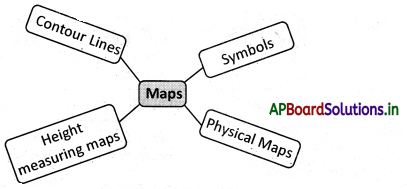
→ We use symbols to show any physical object on the map.

→ If we are asked to show Delhi on the India map, we will mark a point (●) and label it as Delhi.

→ All physical objects are shown on the map with the help of a point, line, or area symbol.

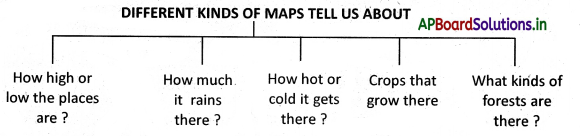
→ Physical maps show the variety of landforms (plains, mountains, plateaus, etc.) and depict the height of places.

→ One way in which we can show heights on maps is through the use of color.

→ All heights on the land are calculated from the seal level.

→ Heights are shown in different shades of colors.

→ A contour is a line joining the places with equal heights.

→ The distance between two contour lines will depend upon the landscape.

→ If the land has a steep climb then the contour lines will be near to each other.

→ Maps help us to understand the nature of the terrain, where the mountains are, where the valleys are, etc.

AP Board Solutions AP Board 7th Class Social Studies Notes Chapter 1 Reading Maps of Different Kinds

→ Maps showing heights are very essential when roads or dams have to be constructed.

→ Over a period, scientists observed the high and low levels of the sea and they have come to one calculated average level, which is known as Mean Sea Level (M.S.L.)

→ Map: A map is a representation or a drawing of the total or a part of the earth’s surface drawn on the surface according to a scale.

→ Symbols: A sign, shape, or object which is used to represent something else.

→ Contour line: A contour is a line joining the places with equal heights.

→ Physical Maps: Maps showing natural features of the earth such as mountains, plateaus, plains, rivers, and oceans.

→ Scale: Scale is the ratio between an actual distance on the ground and the distance shown on the map.

→ Plan: It is a drawing of a small area on a large scale.

→ Corrections: There are four cardinal points – North, South, East, and West.

→ Sketch: Imaginary or rough drawing drawn without scale.

→ Political Maps: Maps showing cities, towns and villages and different countries and states of the world with their boundaries.

AP Board Solutions AP Board 7th Class Social Studies Notes Chapter 1 Reading Maps of Different Kinds

→ Thematic Maps: Maps representing a particular topic or theme.

→ Escarpment: An area of high ground from an area of lower ground is called escarpment.
AP Board 7th Class Social Studies Notes Chapter 1 Reading Maps of Different Kinds 1
AP Board 7th Class Social Studies Notes Chapter 1 Reading Maps of Different Kinds 2

AP Board 7th Class Science Notes Chapter 16 Forest: Our Life

Students can go through AP State Board 7th Class Science Notes Chapter 16 Forest: Our Life to understand and remember the concept easily.

AP State Board Syllabus 7th Class Science Notes Chapter 16 Forest: Our Life

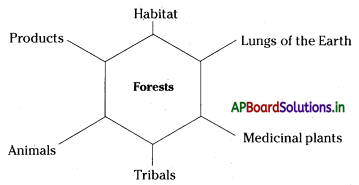
→ Forests provide habitat to wildlife.

→ Forests help in causing rain.

→ They keep the surroundings clean.

→ Forests are an important source of timber, fuelwood, cane, resins, lac, oils, fruits, nuts, honey, etc.

→ Forests serve as the lungs of our earth.

→ Besides animals and plants, forests have been a home of people as well from ancient times.

→ People usually live in places in the forest where water is available.

→ We obtain various things and materials from the forest.

→ A forest is a good habitat for many plants and animals.

→ Forest helps in binding soil and protecting it from erosion.

AP Board Solutions AP Board 7th Class Science Notes Chapter 16 Forest: Our Life

→ People living in forests depend on its products for their livelihood.

→ Social forestry could help overcome deforestation.

→Destroying forests poses threat to the life of animals and plants living there as well as our own survival.

→ Orchard: A collection of fruit trees.

→ Plantation: Planting trees

→ Timber: Wood for buildings growing trees.

→ Firewood: Wood for fuel.

→ Soil erosion: Removal of topsoil by wind, water, or any other means.

→ Bunds: Constructs made to retain soil moisture

→ Deforestation: Cutting the forests

AP Board Solutions AP Board 7th Class Science Notes Chapter 16 Forest: Our Life

→ Tribe: A group of people, often of related families, who live together, sharing the same languages, culture, and history.
AP Board 7th Class Science Notes Chapter 16 Forest Our Life 1
→ In 1730 AD about 350 Bishonois led by Amrita Devi sacrificed their lives to protect sacred green Kejari trees by hugging them when a king Wanted to cut those trees later this was led to the Chipko movement in history. Thereafter this practice has been carrying forwárd by people like Sunder Lai Bahuguna.

→ Savante Arrhenius:
Arrhenius was born in the year 1859. A Swedish chemist is well known for his theory of Acids and Bases. According to him, an acid is a substance that produces W ions in an aqueous solution where a base is a substance that produces OH ions in an aqueous solution. He died in 1927.

AP Board 7th Class Science Notes Chapter 15 Soil: Our Life

Students can go through AP State Board 7th Class Science Notes Chapter 15 Soil: Our Life to understand and remember the concept easily.

AP State Board Syllabus 7th Class Science Notes Chapter 15 Soil: Our Life

→ The soil supports all plants, animals, and microorganisms.

→ Almost all the things in our surroundings directly or indirectly depend on soil.

→ Soil is also an essential component of our lives.

→ Most of our daily life activities are closely related to soil.

→ We use soil for various purposes.

→ Soil is good habitat.

→ We depend on soil for agriculture, construction purposes, making utensils, toys, etc Making pots by using soil is called pottery.

→ If the proportion of large-sized particles is more, we call the soil sandy.

→ If the proportion of fine particles is more the soil is clay.

→ If large and fine particles are present in equal proportions, the soil is called loam.

→ Water passing down through the soil particles is called percolation.

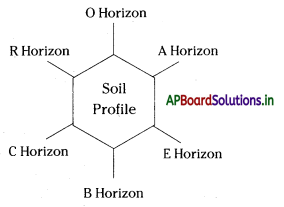
→ Soil is made up of distinct horizontal layers.

AP Board Solutions AP Board 7th Class Science Notes Chapter 15 Soil: Our Life

→ Soil is formed slowly as rock erodes into tiny pieces near the earth’s surface.

→ During heavy winds, we observe that the surface soil particles are carried away by air. It is very important to preserve the fertility of the soil.

→ Soil is a mixture of rock particles and humus.

→ Clay, loam, and sand are types of soil.

→ The amount of water that passes through gives us a percolation rate. It is highest in the sandy soil and least in the clayey soil.

→ The water holding capacity of a soil depends on soil type.

→ Clay and loam are suitable for growing in sandy loam or black soil.

→ The soil profile is a section through different layers of the soil.

→ Removal of topsoil by wind, water, or any other means is known as soil erosion.

→ Clay: a type of soil that can be easy to roll into a ball or ring and not cracked

→ Humus: rich dark organic material in the soil.

→ Loamy: a medium-textured soil containing a mixture of large and small mineral particles. (rich soil)

→ Sandy: very fine loose fragment of crushed rock.

→ Percolation: filtér, especially through small holes.

→ Water retention: water holding capacity.

→ Soil profile: a form of soil.

→ Soil fertility: production of vegetation in soil.

→ Soil erosion: removal of topsoil by wind, water, or any other means.

AP Board Solutions AP Board 7th Class Science Notes Chapter 15 Soil: Our Life

→ Crop rotatIon: a plant cultivated on a large scale for its produce.
AP Board 7th Class Science Notes Chapter 15 Soil Our Life 1
→ Making pots by using soil is called a pottery. This is an ancient creative occupation. During the Harappan civilization, different varieties of designer pots and clay utensils were used. Pottery is a cottage industry in our country. Potters make pots by using clay soil on a pottery wheel.

→ Soil Formation: Soil is formed slowly as a rock (the parent material) erodes into tiny pieces near the Earth’s surface. Organic matter decays and mixes with inorganic material (rock particles, minerals, and water) to form soil. These days farmers test the soil in the field using soil technologies in order to grow suitable crops in the fields. Engineers also test the soil profile before constructing multi-storeyed buildings, bridges, and dams.

→ Soil Science:
Soil science is the study of soil as a natural resource on the surface of the Earth. This includes Soil formation, Classification, and mapping, physical-chemical- biological and fertility properties of soil.

Sometimes terms that refer to branches of soil such as pedology and edaphology are used as if Syno with soil science. The study of the formation, chemistry, more and classification of soil is called pedology’. The study of ii of soil on organisms, especially on plants is called edaphology.
AP Board 7th Class Science Notes Chapter 15 Soil Our Life 2
The diversity of names associated with this discipline is related to the various associations concerned. Indeed engineers, agronomists, chemists, geologists, physical geographers, ecologists, biologists, microbiologists, silviculturists, archeologists all contribute to further knowledge of soil and the advancement of soil science.

AP Board 7th Class Science Notes Chapter 14 Water – Too Little To Waste

Students can go through AP State Board 7th Class Science Notes Chapter 14 Water – Too Little To Waste to understand and remember the concept easily.

AP State Board Syllabus 7th Class Science Notes Chapter 14 Water – Too Little To Waste

→ We are not aware of the need to preserve freshwater.

→ Water resources are not being increased along with the population and their needs.

→ Sewage is a liquid waste.

→ The impurities in water are called contaminants.

→ Nitrates, Phosphates, metals… etc are the inorganic impurities in water.

→ Air is pumped into clarified water to help aerobic bacteria to grow.

→ Aeration causes organisms that break down waste to grow faster thus it leads to what is called a ‘Biological process’.

→ We can conserve water by adopting certain good practices.

→ Only one percent of all water resources is available freshwater.

→ The available resource of fresh water is getting depleted at a very fast pace due to different human activities.

→ Wastewater is generated at homes, industries, etc. by different human activities.

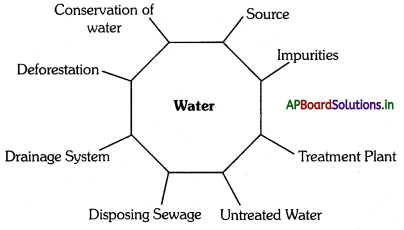
→ All the wastewater released by homes, industries, hospitals, offices, and other users is collectively called Sewage.

→ Sewage is a liquid waste. Most of it is water, which has dissolved and suspended impurities, disease-causing bacteria, and other microbes.

AP Board Solutions AP Board 7th Class Science Notes Chapter 14 Water – Too Little To Waste

→ Sewage water contains inorganic, organic, and bacterial as well as other microbial contaminants.

→ Wastewater is treated in treatment plants.

→ Physical, chemical, and biological processes are involved in the treatment of wastewater at the treatment plants.

→ Chlorine kills harmful disease-causing organisms present in wastewater.

→ Aeration allows the growth of microbes that break down wastes.

→ Different types of drainage systems are open, closed, and underground.

→ Septic tanks also help in wastewater disposal.

→ Water should be treated before being released to water bodies.

→ Water must be conserved by individual efforts as well as through efforts made by the community.

→ Sewage: Liquid waste drained from houses, etc. for disposal

→ Wastewater: Water not useful for drinking

→ Contaminants: Pollutants

AP Board Solutions AP Board 7th Class Science Notes Chapter 14 Water – Too Little To Waste

→ Septic tank: A type of tank used in houses for human excreta.

→ Drainage s3stem: Arrangement made to carry out wastewater and other material from homes.

→ Percolation tank: The tank which is used for filtration.

→ Contour trenches: An outline, especially of something curved ditch.

→ Bar screen: Rags, sUcks, cans, plastic packets, etc. removes from the waste wat€

→ Grit: Particles of stone or lending, relentless

→ Check dam: A type of dam constructed across a minor channel.

→ Rockfill dam: To conserve water to revive the forest area

→ Activated sludge: Cleaned sludge
AP Board 7th Class Science Notes Chapter 14 Water – Too Little To Waste 1
→ On World Water Day, that is 22 March 2005, the period 2005-2015 was declared as the International Decade for action on “Water for Life”.

AP Board Solutions AP Board 7th Class Science Notes Chapter 14 Water – Too Little To Waste

→ Homi Jehangir Bhabha:
Bhabha was born on October 30, 1909, in a wealthy Paris family. Even as a child he was interested in science. In fact, he studied the special theory of relativity in his 16th year. By that time nobody could understand that theory clearly. Jawaharlal Nehru wanted to make India self-sufficient in science and technology and he gave Bhabha a free hand to do what he wanted.

In 1948 the Atomic Energy Commission was set up and Bhabha made its Chairman. He was a man of refined taste and this way very evident whether it was the. choice of design for the building of the Tata Institute of Fundamental Research or the site for the Ooty radio telescope.

He died in a plane crash at the age of 57. In 1967 the Atomic Energy Establishment, Trombay, was renamed the Bhabha Atomic Research Centre as a tribute to his dedication and work.