AP Inter 1st Year Chemistry Study Material Chapter 3 Chemical Bonding and Molecular Structure

Andhra Pradesh BIEAP AP Inter 1st Year Chemistry Study Material 3rd Lesson Chemical Bonding and Molecular Structure Textbook Questions and Answers.

AP Inter 1st Year Chemistry Study Material 3rd Lesson Chemical Bonding and Molecular Structure

Very Short Answer Questions

Question 1.
What is Octet rule?
Answer:
Every atom must possess 8 electrons in its outermost energy level for its stability. Atoms combine in two ways to get octets either by transfer of electrons (or) by mutual sharing of electrons. They can attain ns2 np6 configuration.
The tendency of an atom to achieve eight electrons in its outermost shell is known as the octet rule.

Question 2.
Write Lewis dot structures for S and S2-.
Answer:

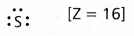
  • Lewis dot structure for ‘s’ is
    AP Inter 1st Year Chemistry Study Material Chapter 3 Chemical Bonding and Molecular Structure 1
    Electronic configuration — 1s2 2s2 2p6 3s2 3p4
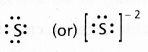
  • Lewis dot structure for s-2 is
    AP Inter 1st Year Chemistry Study Material Chapter 3 Chemical Bonding and Molecular Structure 2
    Electronic configuration of s-2 is 1s2 2s2 2p6 3s2 3p6

AP Inter 1st Year Chemistry Study Material Chapter 3 Chemical Bonding and Molecular Structure

Question 3.
Write the possible resonance structures for SO3.
Answer:
The resonance structures of SO3 as follows
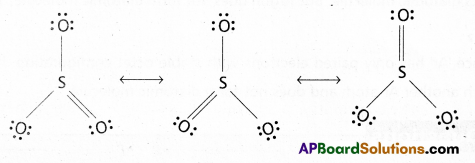
AP Inter 1st Year Chemistry Study Material Chapter 3 Chemical Bonding and Molecular Structure 3

Question 4.
Predict the change, if any, in hybridization of Al atom in the following reaction
AlCl3 + Cl → \(\mathrm{AlCl}_4^{-}\).
Answer:
In AlCl3 Aluminium undergoes sp2 hybridisation
In \(\mathrm{AlCl}_4^{-}\) Aluminium undergoes sp3 hybridisation
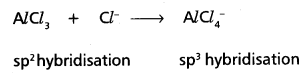
AP Inter 1st Year Chemistry Study Material Chapter 3 Chemical Bonding and Molecular Structure 4

Question 5.
Which of the two ions Ca2+ or Zn2+ is more stable and why ?
Answer:

  • Ca+2 has electronic configuration 1s22s22p63s23p6. This configuration is noble gas (or) inert gas configuration.
  • Zn+2 has electonic configuration 1s22s22p63s23p64s03d10. This configuration is psuedo inert gas configuration.
    ∴ Ca+2 is more stable than Zn+2 ion.

Question 6.
Cl ion is more stable than Cl atom—Why ?
Answer:
The electronic configurations of Cl and Cl is :
Cl = 1s2 2s2 2p6 3s2 3p5
Cl = 1s2 2s2 2p6 3s2 3p6.
This electronic configuration clearly shows that chlorine atom has 7 electrons in the outermost orbit. Whereas chloride has a stable octet electronic configuration (3s2 3p6). After gaining one electron, chloride ion attains the electronic configuration of Argon. Hence chloride ion has greater stability than chlorine atom.

Question 7.
Why argon does not form Ar2 molecule ?
Answer:
Ar2 represents diatomic molecule. But Argon does not form diatomic molecule. So it cannot represented as ‘Ar2‘.
Reason : Since Ar’ has only paired electrons with stable octet configuration. It cannot share its electrons with another Ar atom and does not form diatomic molecule.

Question 8.
What is the best possible arrangement of four bond pairs in the valence shell of an atom to minimise repulsions ?
Answer:
The best possible arrangement of four bond pairs in the valency shell of an atom to minimise repulsions is Tetrahedral. (Bond angle 109°.28′)
Eg. : Methane (CH4).

Question 9.
If A and B are two different atoms when does AB molecule become Covalent ?
Answer:

  1. If the difference in electronegativity values between A and B is less than 1.7, then covalent compound formation is possible (according to Allred – Rochow scale).
  2. If A and B are sharing one or more electron pairs mutually then AB will be a covalent compound.

AP Inter 1st Year Chemistry Study Material Chapter 3 Chemical Bonding and Molecular Structure

Question 10.
What is meant by localized orbitals?
Answer:
The molecular orbital with bonded electron cloud localised between the two nuclei of bonded atoms is called localized orbital, (or) The orbitals which are involved in bond formation are called localized orbitals.

Question 11.
How many Sigma and Pi bonds are present in
(a) C2H2 and
(b) C2H44?
Answer:
a) C2H2
H – C ≡ C – H
C2H2 contains 3 – sigma bonds and 2 – pi bonds.

b) C2H4
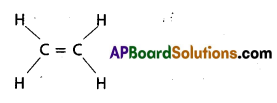
AP Inter 1st Year Chemistry Study Material Chapter 3 Chemical Bonding and Molecular Structure 5
C2H4 contains 5 – sigma bonds and 1-pi bond.

Question 12.
Is there any change in the hybridization of Boron and Nitrogen atoms as a result of the following reaction? BF3 + NH3 → F3BNH3
Answer:
a) Ammonia – Boron trifluoride formation (H3N → BF3):
Ammonia molecule contains Nitrogen atom with a lone pair of electrons (in sp3 orbital). BF3 has ‘B’ atom with an incomplete octet (with a vacant Pz orbital). Therefore, nitrogen of ammonia donates its lone pair to Boron and thus forms coordinate covalent bond. During this bond formation, the sp3 orbital of nitrogen having a lone pair overlaps the vacant ‘p’ orbital of Boron. The equation corresponding to the reaction is written as follows :

AP Inter 1st Year Chemistry Study Material Chapter 3 Chemical Bonding and Molecular Structure 6

b) Change in hybridised states N and B during [H3N → BF3] formation :
Boron in BF3 undergoes (sp2 hybridization with one vacant unhybrid ‘p’ orbital. This orbital also undergoes) hybridization in presence of NH3 so that the hybridised state of ‘B’ changes from sp2 to sp3. This vacant hybrid orbital is bonded to NH3 through dative bond. During this process there is no change in the hybridized state of Nitrogen in NH3.

AP Inter 1st Year Chemistry Study Material Chapter 3 Chemical Bonding and Molecular Structure 7

Question 13.
Give reasons for the following.
a) Why H2O Boiling point is more than H2S
b) Why H2O Boiling point is more than HF
Answer:
a) H2O has high boiling point than H2S
Reason:
In H2O inter molecular hydrogen bonding is present where as in case of H2S such bonding is absent.

b) H2O has high boiling point than HF
Reason:
In H2O and H2S inter molecular hydrogen bonding is present but in H2O the no. of hydrogen bonds are more than in HF.

AP Inter 1st Year Chemistry Study Material Chapter 3 Chemical Bonding and Molecular Structure

Short Answer Questions

Question 1.
Explain Kossel-Lewis approach to Chemical bonding.
Answer:
Kossel – Lewis Theory : This theory was also called as electronic theory of valency (or) chemical bond theory.
Postulates of Kossel – Lewis Theory : Kossel explained the formation of electrovalent bond while Lewis explained the formation of covalent bond. Their explanation of valency is mainly based on the inertness of noble gases.

Postulates:

  • The chemical inertness of noble gases is due to the presence of octet structure. Octet rule was stated as follows “An atom must possess eight electrons in the outermost energy level for its stability”.
  • Even though ‘He’ has only two electrons in the valency shell, it is highly stable and chemically inert.
  • Elements other than zero group are chemically reactive because of having less than 8 electrons in their outer most shells.
  • Every atom try to acquire the Eight electron configuration (octet) in its outer most shell. This can be possible by losing (or) sharing (or) gaining electrons.
  • According to Lewis the valency electrons are represented by dots. These are called Lewis symbols.

    AP Inter 1st Year Chemistry Study Material Chapter 3 Chemical Bonding and Molecular Structure 8
  • Lewis dot structures can be used to calculate the group valency of the element.
    Eg:
    AP Inter 1st Year Chemistry Study Material Chapter 3 Chemical Bonding and Molecular Structure 9 has four electrons.
    ∴ Valency of ‘c’ is ‘4’.

Question 2.
Write the general properties of Ionic Compounds.
Answer:

  1. Physical state : Due to close packing of ions, ionic compounds are crystalline solids.
  2. Melting and Boiling points : In ionic crystals the oppositely charged ions are bound by strong electrostatic force of attraction. To overcome these attractive force between ions, more thermal energy is required. Hence the melting and boiling points of ionic compounds are high.
  3. Solubility : Ionic compounds are soluble in polar solvents like water, liquid ammonia etc., but are insoluble in non – polar solvents like benzene, carbon disulphide etc.,
  4. Reactivity: Reactions between ionic compounds in aqueous solution are very fast due to strong attraction among ions.
    e.g. : When AgNO3 solution is added to NaCl solution, a white precipitate of AgCl is formed.

    AP Inter 1st Year Chemistry Study Material Chapter 3 Chemical Bonding and Molecular Structure 10
  5. Isomerism : Ionic bond is non-directional.
    So ionic compounds cannot exhibit isomerism.
  6. Electrical conductivity : Ionic substances conduct electricity in molten state and in aqueous solution. The ionic compounds are, therefore, electrolytes.

AP Inter 1st Year Chemistry Study Material Chapter 3 Chemical Bonding and Molecular Structure

Question 3.
State Fajan’s rules and give suitable examples.
Answer:
Fajan’s rules:

  1. Ionic nature of the bond increases with increase in the size of cation, e.g.: The ionic nature increases in the order
    Li+ < Na+ < K+ < Rb < Cs+
  2. The formation of ionic bond is favoured with the decrease of the size of anion.
    e.g.: CaF2 is more ionic than CaI2.
  3. If the charge on cation (or) anion (or) both is less, then they can form ionic bonds, e.g.: The ionic nature increases in the order
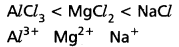
    AP Inter 1st Year Chemistry Study Material Chapter 3 Chemical Bonding and Molecular Structure 11
  4. Cations with inert gas configurations form ionic compounds while those cations with pseudo inert gas configurations favour covalent bond formation.
    e.g.: Na+ in Na+Cl has an inert gas configuration. So Na+Cl is ionic. But CuCl is more covalent because Cu+ has not acquired inert gas configuration in this compound, instead it has acquired pseudo inert gas configuration.
  5. The cation with inert gas configuration is more stable, e.g.: Ca2+ is more stable than Zn2+ ion.
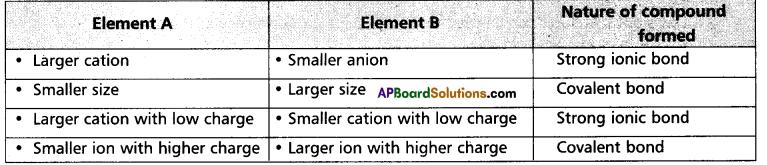
  6. AP Inter 1st Year Chemistry Study Material Chapter 3 Chemical Bonding and Molecular Structure 12

Question 4.
What is Octet rule ? Briefly explain its significance and limitations.
Answer:
Octet rule: Every atom must possess 8 electrons in its outermost energy level for its stability. Atoms combine in two ways to get octet either by transfer of electrons (or) by mutual sharing of electrons. They can attain ns2 np6 configuration.
e.g.:

  1. Na loose one electron to get Ne configuration by possessing 8 electrons.
    Na : 1 s2 2s2 2p6 3s1 and Na+ : 1 s2 2s2 2p6.
  2. ‘Cl’ atom take one electron to get “Ar” configuration. Cl : 1s2 2s2 2p6 3s2 3p6.
    Here Na+ and Cl ions obey octet rule.
  3. In H2O molecule oxygen obey octet rule.

It is therefore, concluded that s2p6 configuration in the outer energy level constitutes a structure of maximum stability and therefore, of minimum energy.

The atoms of all elements when enter into chemical combination try to attain noble gas configuration (i.e.,) they try to attain 8 electrons in their outermost energy level which is of maximum stability and hence of minimum energy.
The tendency of an atoms to achieve eight electrons in their outermost shell is known as OCTET RULE.

Octet rule was the basis of electronic theory of valency.

Limitations : There are 3 types of exceptions to the octet rule. These are mentional below.

  • Central atoms containing incomplete octet.
    Eg : BeH2, BCl3 etc.,
  • Molecules containing odd number of electrons.
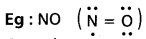
    AP Inter 1st Year Chemistry Study Material Chapter 3 Chemical Bonding and Molecular Structure 13
  • Central atoms possessing more than 8 electrons which istermed as expanded octet.
    Eg : SF6, H2SO4 etc.,
  • This theory does not explained about shape of molecules.
  • This theory does not explained about the formation of noble gas compounds like XeF2, XeOF2 etc.,

Question 5.
Write the resonance structures for NO2 and \(\mathrm{NO}_3^{-}\)
Answer:
Resonance structure of NO2
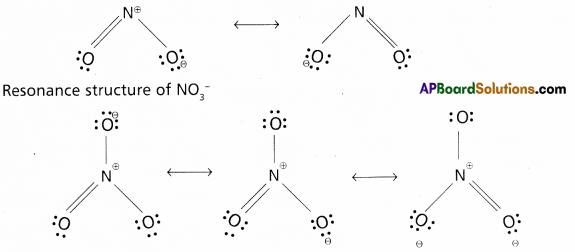
AP Inter 1st Year Chemistry Study Material Chapter 3 Chemical Bonding and Molecular Structure 14

Question 6.
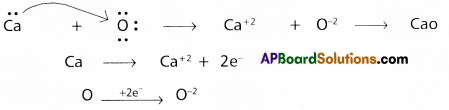
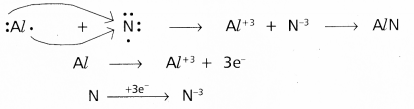
Use Lewis symbols to show electron transfer between the following pairs of atoms to form cations and anions:
(a) K and S
(b) Ca and O
(c) Al and N.
Answer:
a) Between the atoms K and S
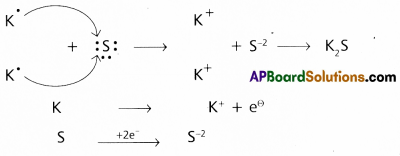
AP Inter 1st Year Chemistry Study Material Chapter 3 Chemical Bonding and Molecular Structure 15
b) Between Ca and O
AP Inter 1st Year Chemistry Study Material Chapter 3 Chemical Bonding and Molecular Structure 16
c) Between Al and N
AP Inter 1st Year Chemistry Study Material Chapter 3 Chemical Bonding and Molecular Structure 17

Question 7.
Explain why H2O has dipole moment while CO2 does not have.
Answer:

  • H2O molecule is a polar molecule and it has un symmetrical structure i.e. Angular (or) V – shape
  • CO2 molecule is non polar and it is linear molecule.
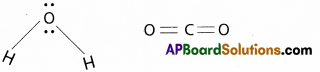
    AP Inter 1st Year Chemistry Study Material Chapter 3 Chemical Bonding and Molecular Structure 18
  • SO H2O has dipolemoment (μ = 1 ,835D) and CO2 does not have dipolemoment (μ = 0)

Question 8.
Define Dipole moment. Write its applications.
Answer:
Dipole moment : The product of magnitude of the charge and the distance between the two poles (bond length) is called dipole moment.

  • Dipole moment μ = q × d
    q = charge
    d = bond length
  • Units : Debye (D), 1 Debye = 3.34 × 10⁻³⁰ coulombs metres.

Applications : –

  • Dipole moment is used to calculate the percentage of ionic character in a molecule.
  • It is used to know the shape of the molecule.
  • Symmetry (symmetrical (or) non symmetrical) of the molecule can be known by dipole moment.

AP Inter 1st Year Chemistry Study Material Chapter 3 Chemical Bonding and Molecular Structure

Question 9.
Explain why BeF2 molecule has zero dipole moment although the Be-F bonds are polar.
Answer:

  • Even though Be-F bonds in BeF2 are polar, the dipole moment of BeF2 molecule is zero. Because BeF2 has linear shape.

    AP Inter 1st Year Chemistry Study Material Chapter 3 Chemical Bonding and Molecular Structure 19
  • Flere the vectrorial sum of the dipole moment of two Be-F bonds is zero. Hence dipole moment
    (μ) = 0.

Question 10.
Explain the structure of CH4 molecule.
Answer:
Formation of Methane molecule :

  1. The central atom of methane is carbon.
  2. The electronic configuration of carbon in ground state is AP Inter 1st Year Chemistry Study Material Chapter 3 Chemical Bonding and Molecular Structure 20 and on excitation it is AP Inter 1st Year Chemistry Study Material Chapter 3 Chemical Bonding and Molecular Structure 21 During excitation the 2s pair splits and the electron jumps into the adjacent vacant 2pz orbital.
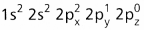
  3. The AP Inter 1st Year Chemistry Study Material Chapter 3 Chemical Bonding and Molecular Structure 22 undergo sp3 hybridisation giving four equivalent sp3 hybridised orbitals.
  4. Each sp3 hybrid orbital overlaps with the 1s orbitals of hydrogen forming \(\sigma_{s p^3-s}\) bond.
  5. In case of methane four \(\sigma_{s p^3-s}\) bonds are formed. The bonds are directed towards the four corners of a regular tetrahedron. The shape of methane molecule is tetrahedral with a bond angle 109°28’.
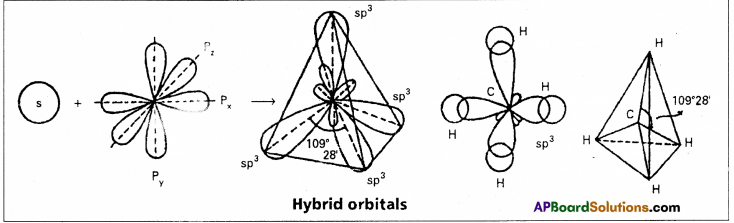
    AP Inter 1st Year Chemistry Study Material Chapter 3 Chemical Bonding and Molecular Structure 23

Question 11.
Explain Polar Covalent bond with a suitable example.
Answer:
The covalent bond which is formed by the mutual sharing of electron pairs between two dissimilar atoms is called polar covalent bond.

  • Dissimilar atoms means two atoms having different electronegativity values (or) atoms of different elements.
    Eg : HF, HCl, H2O, CO2 etc.,
    Formation of HCl :

    AP Inter 1st Year Chemistry Study Material Chapter 3 Chemical Bonding and Molecular Structure 24
  • In the above example H and Cl are two atoms of different elements having different electro negativities.
  • These two atoms (H, Cl) mutually share the electron pairs and form the polar covalent bond.

Question 12.
Explain the shape and bond angle In BCl3 molecule in terms of Valence Bond Theory.
Answer:
Boron trichloride molecule formation :

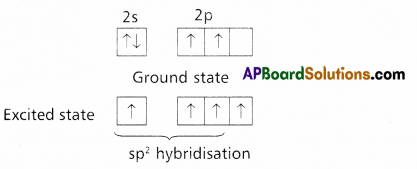
  1. The electronic configuration of ‘B’ in the ground state is AP Inter 1st Year Chemistry Study Material Chapter 3 Chemical Bonding and Molecular Structure 25
  2. On excitation the configuration is AP Inter 1st Year Chemistry Study Material Chapter 3 Chemical Bonding and Molecular Structure 26 Now there are three half filled orbitals are available for hybridisation.
  3. Now sp2 hybridisation takes place at boron atom giving three sp2 hybrid orbitals.
  4. Each of them with one unpaired electron forms a ‘σ’ bond with one chlorine atom. The overlapping is σsp2 – p (Cl atom has the unpaired electron in 2pz orbital). In boron trichloride there are three ‘σ’ bonds.
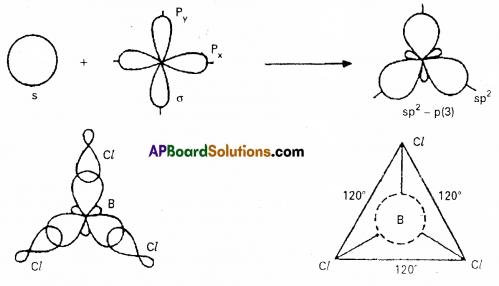
    AP Inter 1st Year Chemistry Study Material Chapter 3 Chemical Bonding and Molecular Structure 27

Question 13.
What are σ and π bonds ? Specify the differences between them.
Answer:
Definition of σ bond : “σ – bond is along the internuclear axis. It has a cylindrical symmetry”.
Definition of π bond : “A covalent bond formed by a sidewise overlap of ‘p’ orbitals of atoms that are already bonded through a σ – bond, and in which the electron clouds are present above and below the internuclear axis is known as π – bond”.

Sigma bond (σ)

  1. A ‘σ’ bond is formed by the axial overlap of two half filled orbitals belonging to the valence shells of the two combining atoms.
  2. The ‘σ’ bonding electron cloud is symmetric about the inter-nuclear axis.
  3. It is strong bond since the extent of overlap is much.
  4. It allows free rotation of atoms or groups about the bond.
  5. It can exist independently.
  6. It determines the shape of the molecule.
  7. There can be only one ‘σ’ bond between two atoms.
  8. Hybrid orbitaIs form only ‘σ’ bonds.

Pi — bond (π)

  1. A π-bond is formed by the lateral overlap of orbitals.
  2. The π-bonding electron cloud lies above and below the flame of the internuclear axis.
  3. It is a weaker than ‘σ’ bond, since the extent of overlap is less.
  4. π-bond restricts such free rotation.
  5. It is formed only after a ‘σ’ bond is formed.
  6. It does not determine the shape of the molecule.
  7. There can be one or two π-bonds between the atoms.
  8. Hybrid orbitals cannot form π-bonds.

AP Inter 1st Year Chemistry Study Material Chapter 3 Chemical Bonding and Molecular Structure

Question 14.
Even though nitrogen in ammonia is in sp3 hybridization, the bond angle deviate from 109°28. Explain.
Answer:
In NH3 molecule the central nitrogen atom shares its ‘3’ unpaired electrons with three hydrogen atoms to form 3σ bonds. Hence NH3 molecule contains one lone pair, three bond pairs.
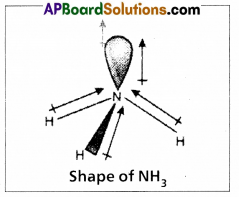
AP Inter 1st Year Chemistry Study Material Chapter 3 Chemical Bonding and Molecular Structure 28
a) Because of the repulsion between the lone pair and the bond pairs the angle reduces to 107°.
b) According to VSEPR theory the geometry of the molecule is pyramidal with bond angle 107°.

Question 15.
Show how a double and triple bond are formed between carbon atoms in
(a) C2H4 and
(b) C2H2 respectively.
Answer:
Formation of double bond between the carbon atoms of C2H4 : –
C – Ground state electronic configuration 1s2 2s2 2p2
AP Inter 1st Year Chemistry Study Material Chapter 3 Chemical Bonding and Molecular Structure 29

  •  In ethylene two carbons undergo sp2 hybridisation.
  • One of sp2 hybrid orbital of carbon overlaps with sp2 hybrid orbital of another carbon atom to form C – C sigma bond.
  • The two other sp2 hybrid orbitals of each carbon overlap with ‘s’ orbital of hydrogen atoms to form C – H bonds.

The unhybridised orbital of one carbon atom overlap side wisely with the similar orbital to form weak π bond.
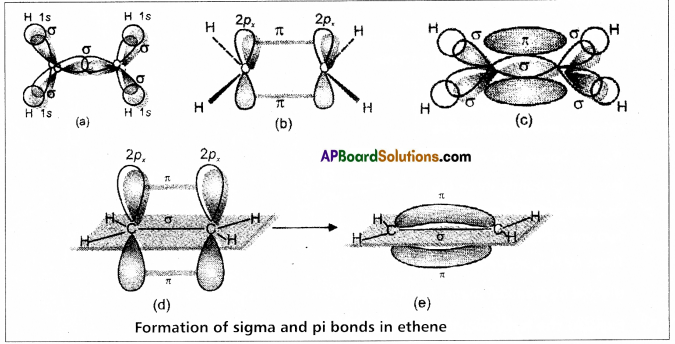
AP Inter 1st Year Chemistry Study Material Chapter 3 Chemical Bonding and Molecular Structure 30
Formation of triple bond between the carbon atoms of C2H2 : –
C – Ground state electronic configuration 1s2 2s2 2p2
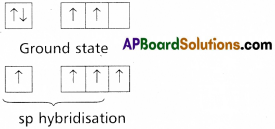
AP Inter 1st Year Chemistry Study Material Chapter 3 Chemical Bonding and Molecular Structure 31

  • In acetylene two carbons undergoes sp hybridisation.
  • One of sp hybrid orbital of carbon overlaps with sp hybrid orbital of another carbon atom to form C – C sigma bond.
  • another sp hybrid orbitals of each carbon overlap with s orbital of hydrogen atoms to form C – H bonds.
  • The un hybridised orbitals of two carbon atom overlap side wisely to form two weak π bonds.
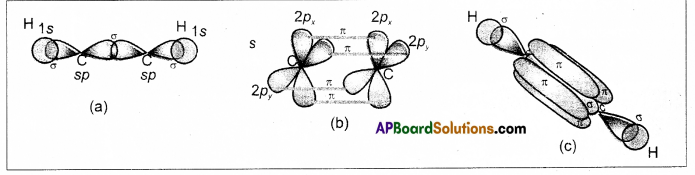
    AP Inter 1st Year Chemistry Study Material Chapter 3 Chemical Bonding and Molecular Structure 32

Question 16.
Explain the hybridization involved in PCl5 molecule. (T.S. Mar. ’16, ’15)
Answer:
1) In PCl5 the electron configuration of phosphorus is

AP Inter 1st Year Chemistry Study Material Chapter 3 Chemical Bonding and Molecular Structure 33

2) Phosphorus undergoes sp3d – hybridisation by intermixing of one s-orbital [3s], three p – orbitals [3px, 3py, 3pz] and one d – orbital.
These five hybrid orbitals overlap. The pz orbitals of chlorine atoms forming five \(\sigma_{s p^3 d-s}\) bonds. Out of these five p – Cl bonds three are coplanar and the remaining two are in the axial position. There by PCl5 acquires the trigonal bipyramidal shape. The molecule contains two bond angles 90° and 120°.
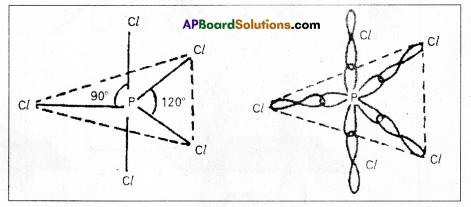
AP Inter 1st Year Chemistry Study Material Chapter 3 Chemical Bonding and Molecular Structure 34

Question 17.
Explain the hybridization involved in SF6 molecule.
Answer:
In this hybridisation one ‘s’ orbital, three ‘p’ orbitals and two ‘d’ orbitals of the excited atom combine to form six equivalent sp3d2 hybrid orbitals.
e.g. : SF6
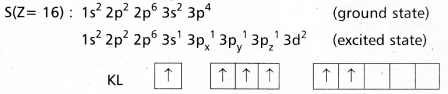
AP Inter 1st Year Chemistry Study Material Chapter 3 Chemical Bonding and Molecular Structure 35
These six sp3 d2 hybrid orbitals overlap six 2pz orbitals of fluorine atoms to form six \(\sigma_{s p^3 d^2}\) bonds. The directions of the bonds give an octa-hedral shape to the molecule. The bond angle is 90° or 180° & 90°.
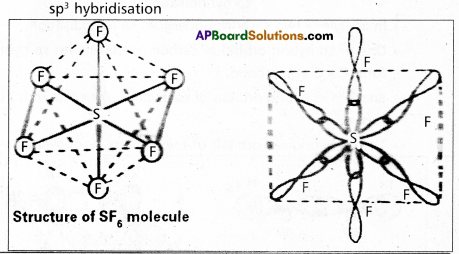
AP Inter 1st Year Chemistry Study Material Chapter 3 Chemical Bonding and Molecular Structure 36

AP Inter 1st Year Chemistry Study Material Chapter 3 Chemical Bonding and Molecular Structure

Question 18.
Explain the formation of Coordinate Covalent bond with one example.
Answer:
Co-ordinate covalent bond (dative bond) is a special type of covalent bond. It is proposed by Sidgwick. It is formed by the sharing of electrons between two atoms in which both the electrons of the shared electron pair are contributed by one atom and the other atom nearly participates in sharing.

The bond is represented as (“→”) an arrow starting from the donar atom and directed towards the acceptor atom.

Examples :
1) Ammonia – Boron trifluoride H3N : → BF3
Ammonia combines with boron trifluoride to give ammonium boron trifluoride.
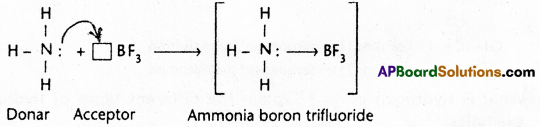
AP Inter 1st Year Chemistry Study Material Chapter 3 Chemical Bonding and Molecular Structure 37
In ammonia nitrogen has a complete octet and also it has a lone pair of electrons. In BF3 the boron atom has a total of six electrons after sharing with fluorine. Nitrogen donates the electron pair to boron to form a co-ordinate covalent bond between ammonia and boron trifluoride.

2) Ammonium ion (\(\mathrm{NH}_4^{+}\))
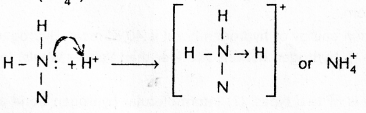
AP Inter 1st Year Chemistry Study Material Chapter 3 Chemical Bonding and Molecular Structure 38

3) Hydronium ion (\(\mathrm{H}_3 \mathrm{O}^{+}\))
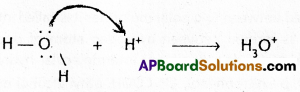
AP Inter 1st Year Chemistry Study Material Chapter 3 Chemical Bonding and Molecular Structure 39

Properties of co-ordinate covalent bond :

  1. The bond do not ionise in water.
  2. The compounds are generally soluble in organic solvents and are sparingly soluble in water.
  3. These compounds exhibit space isomerism because the bond is rigid and directional.
  4. The bond is semipolar in nature – so their volatility lies in between covalent and ionic bonds.

Question 19.
Which hybrid orbitals are used by Carbon atoms in the following molecules?
(a) CH3 -CH3
(b) CH3 – CH = CH2
(c) CH3 – CH2 – OH
(d) CH3 – CHO
Answer:
a) CH3 -CH3 (ethane)
The two carbons of ethane undergo sp3 hybridisation.
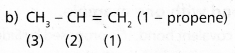
AP Inter 1st Year Chemistry Study Material Chapter 3 Chemical Bonding and Molecular Structure 40
Carbon – (1) – undergoes sp2 hyrbidisation
Carbon – (2) – undergoes sp2 hyrbidisation
Carbon – (3) – undergoes sp3 hyrbidisation
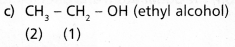
AP Inter 1st Year Chemistry Study Material Chapter 3 Chemical Bonding and Molecular Structure 41
Carbon (1) and (2) both undergo ‘sp3‘ hybridisation.
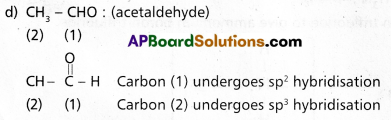
AP Inter 1st Year Chemistry Study Material Chapter 3 Chemical Bonding and Molecular Structure 42

Question 20.
What is Hydrogen bond ? Explain the different types of Hydrogen bonds with examples. (A.P., T.S. Mar. ’16)
Answer:
Hydrogen bond is a weak electrostatic bond formed between partially positive charged hydrogen atom and an highly electronegative atom of the same molecule or another molecule.

Hydrogen bond is formed when the Hydrogen is bonded to small, highly electronegative atoms like F, O and N. A partial positive charge will be on hydrogen atom and partial negative charge on the electronegative atom.

The bond dissociation energy of hydrogen bond is 40 KJ/mole. Hydrogen bond is represented with dotted lines (—–). Hydrogen bond is stronger than Vander Waals’ forces and weaker than covalent bond.
Hydrogen bonding is of two types.

(1) Intermolecular hydrogen bond and
(2) Intramolecular hydrogen bond.

1) Intermolecular hydrogen bond :
If the hydrogen bond is formed between two polar molecules it is called intermolecular hydrogen bond, i.e., the hydrogen bond is formed between hydrogen atom of one molecule and highly electronegative atom of another molecule is known as intermolecular hydrogen bond.
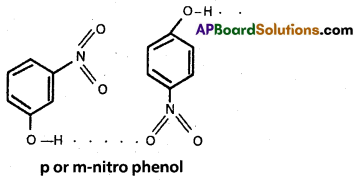
Ex. : Water (H2O) ; HF : NH3 ; p – nitrophenol, CH3COOH, ethyl alcohol etc.

AP Inter 1st Year Chemistry Study Material Chapter 3 Chemical Bonding and Molecular Structure 43
Water molecule forms oi. associated molecule through intermolecular hydrogen bond. Due to molecular association water possess high boiling point.

AP Inter 1st Year Chemistry Study Material Chapter 3 Chemical Bonding and Molecular Structure 44

m or p – nitrophenol :
AP Inter 1st Year Chemistry Study Material Chapter 3 Chemical Bonding and Molecular Structure 45

2) Intramolecular hydrogen bond:
If the hydrogen bond is formed within the molecule it is known as intramolecular hydrogen bond.
Ex. : o – nitrophenol; o – hydroxy benzaldehyde.
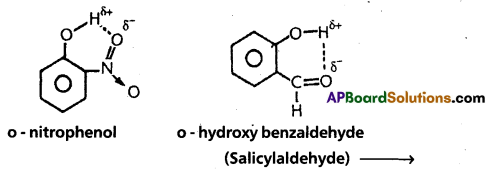
AP Inter 1st Year Chemistry Study Material Chapter 3 Chemical Bonding and Molecular Structure 46

Abnormal behaviour due to hydrogen bond:

  1. The physical state of substance may alter. They have high melting and boiling points.
  2. Ammonia has higher boiling point than HCl eventhough nitrogen and chlorine have same electronegativity values (3.0). Ammonia forms an associated molecule through intermolecular hydrogen bond.
  3. p – hydroxy benzaldehyde have higher boiling point than o- hydroxy benzaldehyde. This is due to intermolecular hydrogen bonding in para isomer.
  4. Ethyl alcohol is highly soluble in water due to association and co-association through intermolecular hydrogen bonding.

AP Inter 1st Year Chemistry Study Material Chapter 3 Chemical Bonding and Molecular Structure

Question 21.
Explain the formation of H2 molecule on the basis of Valence Bond theory.
Answer:
Postulates of valency bond theory:

  1. Covalent bond is formed by the overlap of an half filled atomic orbital of one atom with an half filled atomic orbital of the other atom involved in the bond formation.
  2. The electrons in these two orbitals involved in the overlap shall have opposite spins.
  3. Greater the overlap stronger the bond formed.
  4. The bonds are formed mostly in the direction in which the electron clouds are concentrated.
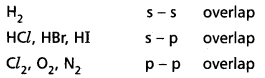
    AP Inter 1st Year Chemistry Study Material Chapter 3 Chemical Bonding and Molecular Structure 47

Formation of H2 molecule:
Hydrogen molecule is formed due to overlaping of s – s orbitals. When two Hydrogen atoms come together, is orbitals of the Hydrogen atoms overlap to form a strong ‘σ” bond. This is σs-s’
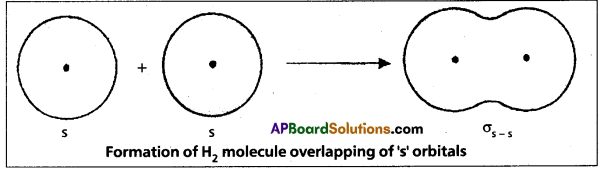
AP Inter 1st Year Chemistry Study Material Chapter 3 Chemical Bonding and Molecular Structure 48

Question 22.
Using Molecular Orbital Theory explain why the B2 molecule is paramagnetic ?
Answer:
Boron electronic configuration is – 1s2 2s2 2p1
The molecular orbital energy level sequence for B2 is

AP Inter 1st Year Chemistry Study Material Chapter 3 Chemical Bonding and Molecular Structure 49

  • Bond order = \(\frac{6-4}{2}\) = \(\frac{2}{2}\) = 1
  • In the above sequence unpaired electrons are present.
  • Presence of unpaired electrons leads to paramagnetic nature.
    ∴ B2 molecule is paramagnetic.

Question 23.
Write the important conditions necessary for linear combination of atomic orbitals.
Answer:

  1. The molecular orbitals are formed when the atomic orbitals combine linearly (i.e.,) when the atoms approach each other. The no. of molecular orbitals resulting are equal to the no.of atomic orbitals combining.
  2. Only such atomic orbitals which are of similar energies and symmetry with respect to the inter nuclear axis combine to form molecular orbitals.
  3. The total no. of molecular orbitals produced will be numerically equal to the no. of combining orbitals.
  4. The order of energies of bonding, anti bonding and non bonding orbitals can be written as bonding orbitals < non bonding orbitals < anti – bonding orbitals.

Question 24.
What is meant by the term Bond order? Calculate the bond orders in the following
(a) N2
(b) O2
(c) \(\mathrm{O}_2^{+}\) and
(d) \(\mathrm{O}_2^{-}\)
Answer:
Bond order : The half of the difference between the no.of bonding electrons and anti bonding electrons is known as bond order. ’
a) N2 : Molecular orbital energy level sequence.

AP Inter 1st Year Chemistry Study Material Chapter 3 Chemical Bonding and Molecular Structure 50
→ Bond Order = \(\frac{10-4}{2}\) = \(\frac{6}{2}\) = 3

b) O2 : Molecular orbital energy level sequence.
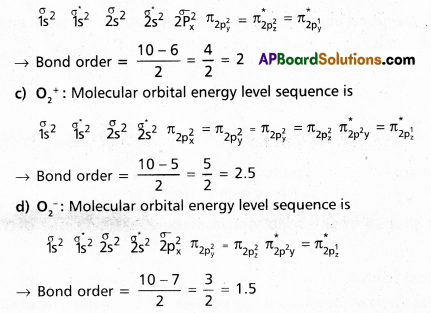
AP Inter 1st Year Chemistry Study Material Chapter 3 Chemical Bonding and Molecular Structure 51

AP Inter 1st Year Chemistry Study Material Chapter 3 Chemical Bonding and Molecular Structure

Question 25.
Of BF3 and NF3, dipole moment is observed for NF3 and not for BF3. Why ?
Answer:
Of BF3 and NF3 dipole moment is observed for NF3 and not for BF3.
Reasons:

  • BF3 molecule is non polar and is a symmetrical molecule. Symmetrical molecules have zero dipole moment.
  • NF3 molecule is polar and it is a unsymmetrical molecule so it has dipole moment.
  • BF3 molecule has trigonal planar structure.
    NF3 molecule has pyramidal shape.
  • NF3 has dipole moment µ = 0.8 × 10⁻³⁰ coloumb × meter.
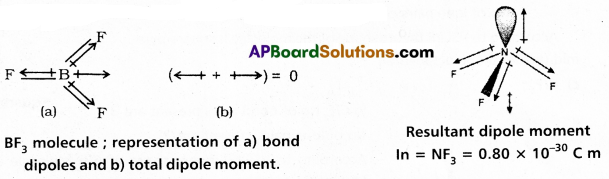
    AP Inter 1st Year Chemistry Study Material Chapter 3 Chemical Bonding and Molecular Structure 52

Question 26.
Eventhough both NH3 and NF3 are Pyramidal, NH3 has a higher dipole moment compared to NF3. Why? (A.P. Mar.’16)
Answer:

  • Both NH3 and NF3 molecules have pyramidal shape and in two molecules N atom has lone pair of electrons.
  • Even though fluorine has more electronegativity than nitrogen the dipole moment of NH3 is greater than that of NF3
    µ (NH3) = 4.9 × 10⁻³⁰ coloumbs × meter.
    µ (NF3) = 0.8 × 10⁻³⁰ coloumbs × meter.
  • In case of NH3 the orbital dipole due to lone pair is in the same direction as the resultant dipole moment of N – H bonds.

Where as in case of NF3 the orbital dipole is in the direction opposite to the resultant dipole
moment of the three N – F bonds.
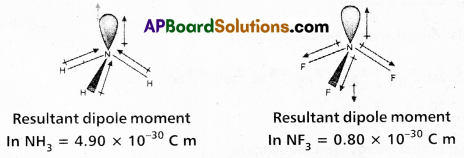
AP Inter 1st Year Chemistry Study Material Chapter 3 Chemical Bonding and Molecular Structure 53

Question 27.
How do you predict the shapes of the following molecules making use of VSEPR Theory ?
(a) XeF4
(b) BrF5
(c) ClF3 and
(d) IC\(l_4^{-}\)
Answer:
According to VSEPR theory the shape of the molecule can be predicted by counting no.of electron pairs (bond pairs, lone pairs) around the central atom.
a) XeF4:
In XeF4 No.of bond pairs present are ‘4’.
No.of lone pairs present are ‘2’.
According to VSEPR theory shape of molecule is square planar (Actual shape octahedral).
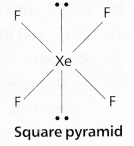
AP Inter 1st Year Chemistry Study Material Chapter 3 Chemical Bonding and Molecular Structure 54

b) BrF5 :
In BrF5 No.of bond pairs present are ‘5’
No.of lone pairs present are ‘1’
According to VSEPR theory shape of the molecule is square pyramid (actual shape octahedral)
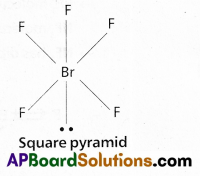
AP Inter 1st Year Chemistry Study Material Chapter 3 Chemical Bonding and Molecular Structure 55
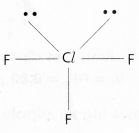
c) ClF3:
AP Inter 1st Year Chemistry Study Material Chapter 3 Chemical Bonding and Molecular Structure 56
In ClF3 No.of bond pairs present are ‘3’
No.of lone pairs present are ‘2’
According to VSEPR Theory shape of ClF3 Molecule is T – shape (Actual shape TBP)

d) IC\(l_4^{-}\):
In IC\(l_4^{-}\) No.of bond pairs present are ‘4’
No.of lone pairs present are ‘2’
According to VSEPR Theory shape of ICl\(l_4^{-}\) is square planar
(Actual shape octahedral)
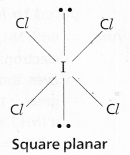
AP Inter 1st Year Chemistry Study Material Chapter 3 Chemical Bonding and Molecular Structure 57

Long Answer Questions

Question 1.
Explain the formation of Ionic Bond with a suitable example.
Answer:
The electrostatic force that binds the oppositely charged ions which are formed by the transfer of electrons from one atom with low ionization potential to the other with high electron affinity is called ionic bond or electrovalent bond.
It is formed when the electronegativity difference between the two atoms is more tha 1.7.
Example :
Formation of sodium chloride in terms of orbital concept:
1) Na (Z = 11). The electronic configuration is 1s2 2s2 2p6 3s1.
This can be expressed as
AP Inter 1st Year Chemistry Study Material Chapter 3 Chemical Bonding and Molecular Structure 58

2) Cl (Z = 17). The electronic configuration is = 1s2 2s2 2p6 3s2 3p5
This can be expressed as
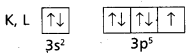
AP Inter 1st Year Chemistry Study Material Chapter 3 Chemical Bonding and Molecular Structure 59

3) The configurations after the transfer of electrons forming ions can be expressed as:
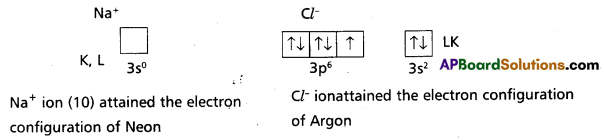
AP Inter 1st Year Chemistry Study Material Chapter 3 Chemical Bonding and Molecular Structure 60
In the formation of sodium chloride the 3s electron of sodium atom is transferred to the 3p2 orbital of chlorine atom. The Na+ ion and Cl ion so formed are now bound by strong coulombic electrostatic forces of attraction forming sodium chloride.

AP Inter 1st Year Chemistry Study Material Chapter 3 Chemical Bonding and Molecular Structure

Question 2.
Explain the factors favourable for the formation of Ionic Compounds.
Answer:
Factors favour the ionic bond formation:
a) Cation formation:

  1. Lower ionization energy: Lower ionization energy of an atom greater is the ease of formation of cation
    e.g. : The ionization energy of sodium is 117.9 kcal/mole and that of potassium is 100 kcal/mole So K+ ion can readily form than Na+ ion.
  2. Large size of the atom : Large atoms can easily lose the valence electrons. If the size large, the distance between the nucleus and the valence electrons is more and so the force of attraction is less. Therefore the electron can be removed easily from the atom forming cation.
  3. Ion with lower charge: Small magnitude of charge favours the formation of ions easily.
    e.g. : The ease of ion formation increases in the order Na+ > Mg2+ > Al3+.
  4. Cations with inert gas configuration : Ion possessing electronic configuration similar to zero group elements are more stable than those ions which do not have such configuration.
    eg.: Ca2+ (2, 8, 8) is more stable than Zn2+ (2, 8, 18) because the former has inert gas
    configuration.

b) Anion formation:

  1. High electron affinity: If the electron affinity of an element is high its anion can be easily formed.
    e.g.: Cl + e → Cl
  2. Smaller size of atom : Smaller the size of the atom lesser is the distance between the nucleus and the valence orbit. Hence the nuclear attraction on incoming electron is more. So the anion is readily formed.
  3. Lower charge : Ions with lower charge are more readily formed than those with higher charge.
    e.g.: Cl > O 2- > N3-
  4. The ions with inert gas electronic configuration are more readily formed than others with the same charge. .
    c) If the two bonded atoms differ by more than 1.70 in their EN values, the bond between them is ionic in nature.

Question 3.
Draw Lewis Structures for the following molecules.
(a) H2S
(b) SiCl4
(c) BeF2
(d) HCOOH
Answer:
Lewis structures:
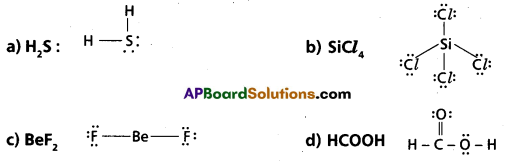
AP Inter 1st Year Chemistry Study Material Chapter 3 Chemical Bonding and Molecular Structure 61

Question 4.
Write notes on
(a) Bond Angle
(b) Bond Enthalpy
(c) Bond length and
(d) Bond order.
Answer:
a) Bond angle : The angle between the orbitals containing bonding electron pairs around the central atom in a molecule (or) complex ion is known as Bond angle.

  • it is expressed in degrees.
  • It is determined experimentally by spectroscopic methods.
    Eg: In H2O (H — 0 — H) bond angle is 104.5° .

b) Bond Enthalpy : The amount of energy required to break one mole of bonds of a particular type between two atoms in a gaseous state is known as Bond Enthalpy.
Units: KJ/Mole.
Eg: H – H bond enthalpy in hydrogen is 435.8 KJ/mole
H2(g) → H(g) + H(g) ∆H = 435.8 KJ/mole

  • In case of poly atomic molecules average bond enthalpy is used.

    AP Inter 1st Year Chemistry Study Material Chapter 3 Chemical Bonding and Molecular Structure 62

c) Bond length : The distance between the nuclei of the atoms in a molecule is known as bond length.

  • Bond length is equal to the sum of the covalent radii of the two atoms that are bonded.
  • Units of Bond length A° (or) cm (or) m (or) pm
  • As the number of bonds between two atoms increases the bond length decrease.
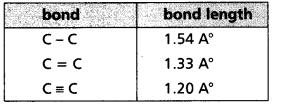
    AP Inter 1st Year Chemistry Study Material Chapter 3 Chemical Bonding and Molecular Structure 63

d) Bond Order:
According to Lewis the bond order is given by the number of bonds between the two atoms in a covalent molecule.
Eg: Bond order of N2 – 3
Bond order of O2 – 2
Bond order of H2 – 1

  • In case of Iso electronic species and ions bond orders are same.
  • Bond order is useful in predecting stabilities of molecules.
  • Bond order increases bond enthalpy increases and Bond length decreases.

AP Inter 1st Year Chemistry Study Material Chapter 3 Chemical Bonding and Molecular Structure

Question 5.
Give an account of VSEPR Theory and its applications.
Answer:
VSEPR theory was proposed by Sidgwick and Powell and later extended by Gillespie and Nyholm. It was developed by Ronald and Nyholm.
This theory explains the shapes of simple molecules having electron pairs bonded or non-bonded. The repulsions among the electron pairs present in the valence shell of the central atom decides the shape of the molecules.

According to this theory :

a) The shape of the molecule is determined by repulsions between all of the electron pairs present in the valency shell of central atom.
b) The electron pairs orient in space so as to have minimum repulsions among them.
c) The magnitude of repulsions between bonding pairs of electrons depends on the electronegativity difference between the central atom and the other atoms.
d) The order of repulsions between various electron pairs is lone pair – lone pair > lone pair – bond pair > bond pair – bond pair.
e) The repulsive forces between different bonds is of the order triple bond > double bond > single bond.
f) The shapes of molecules can be predicted as.
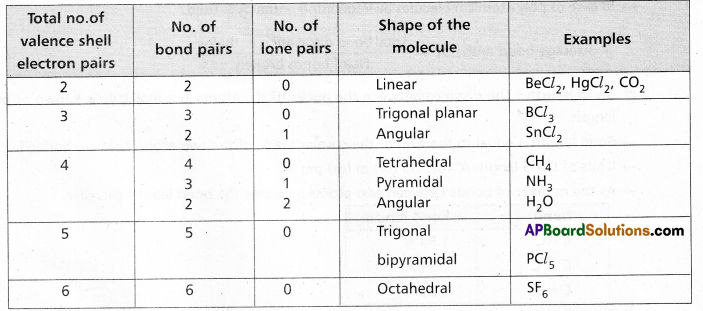
AP Inter 1st Year Chemistry Study Material Chapter 3 Chemical Bonding and Molecular Structure 64
In NH3 molecule the central nitrogen atom shares its ‘3’ unpaired electrons with three hydrogen atoms to form 3σ bonds. Hence NH3 molecule contains one lone pair, three bond pairs.
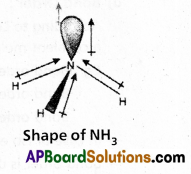
AP Inter 1st Year Chemistry Study Material Chapter 3 Chemical Bonding and Molecular Structure 65
a) Because of the repulsion between the lone pair and the bond pairs the angle reduces to 107°.
b) According to VSEPR theory the geometry of the molecule is pyramidal with bond angle 107°.

Question 6.
How do you explain the geometry of the molecules on the basis of Valence bond Theory ?
Answer:
Postulates of valency bond theory :

  1. Covalent bond is formed by the overlap of an half filled atomic orbital of one atom with an half filled atomic orbital of the other atom involved in the bond formation.
  2. The electrons in these two orbitals involved in the overlap shall have opposite spins.
  3. Greater the overlap stronger the bond formed.
  4. The bonds are formed mostly in the direction in which the electron clouds are concentrated.
    AP Inter 1st Year Chemistry Study Material Chapter 3 Chemical Bonding and Molecular Structure 66

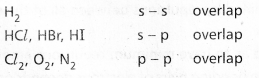
Formation of H2 molecule :
Hydrogen molecule is formed due to overlapping of s – s orbitals. When two Hydrogen atoms come together, 1s orbitals of the Hydrogen atoms overlap to form a strong “σ” bond. This is σs-s.
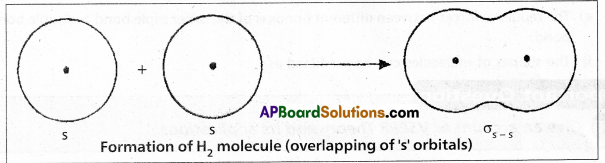
AP Inter 1st Year Chemistry Study Material Chapter 3 Chemical Bonding and Molecular Structure 67
Formation of Cl2 molecule :
The electronic configuration of Chlorine atom is AP Inter 1st Year Chemistry Study Material Chapter 3 Chemical Bonding and Molecular Structure 68 It has one half filled 3pz orbital. The pz orbital of one chlorine atom overlaps the pz orbital of the other chlorine atom and the two electrons of opposite spins pair up to form covalent bond. As the overlap along the internuclear axis is maximum a strong bond is formed. The bond is formed due to \(\sigma_{p-p}\) overlap.

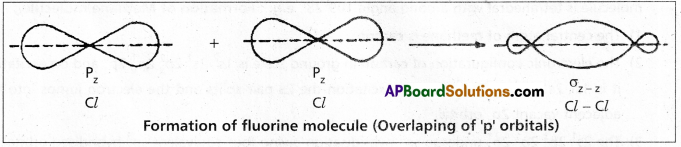
AP Inter 1st Year Chemistry Study Material Chapter 3 Chemical Bonding and Molecular Structure 69

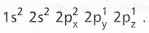
Formation of O2 molecule:
The electronic configuration of oxygen atom is AP Inter 1st Year Chemistry Study Material Chapter 3 Chemical Bonding and Molecular Structure 70 It has two half filled 2p orbitals i.e., 2py and 2pz.
The py orbital of one atom overlaps the py orbital of the second atom to form a ‘σ’ bond \(\sigma_{p_y}-p_y\).
The pz orbital in the two atoms will be at right angles to the internuclear axis. These two can have lateral overlap. The electron density of the bonded pair is distributed in two banana like regions lying on either side of the internuclear axis. Thus the oxygen molecule has a double bond. The molecule has one σp – p and one πp – p between the two atoms.
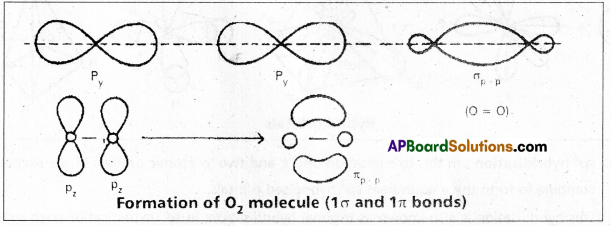
AP Inter 1st Year Chemistry Study Material Chapter 3 Chemical Bonding and Molecular Structure 71

Question 7.
‘What do you understand by Hybridisation? Explain different types of hybridization involving s and p orbitals. (Mar. ’13)
Answer:
Hybridisation is defined as the process of mixing of atomic orbitals of nearly equal energy of an atom to give the same number of new set of orbitals of equal energy and shapes.
Depending on the number and nature of orbitals involving hybridisation it is classified into different types. If ‘s’ and ‘p’ atomic orbitals are involved three types are possible namely sp3, sp2 and sp.

1. sp3 hybridisation : In this hybridisation one’s and three ‘p’ atomic orbitals of the excited atom combine to form four equivalent sp3 hybridised orbitals.
This hybridisation is known as tetrahedral or tetragonal hybridisation.

Each sp3 hybridised orbital possess 25% ‘s’ nature and 75% of ‘p’ nature. The shape of the molecule is tetrahedral with a bond angle 109°28′, e.g. : Formation of Methane molecule :

  1. The central atom of methane is carbon.
  2. The electronic configuration of carbon in ground state is AP Inter 1st Year Chemistry Study Material Chapter 3 Chemical Bonding and Molecular Structure 72 and on excitation it is AP Inter 1st Year Chemistry Study Material Chapter 3 Chemical Bonding and Molecular Structure 73 During excitation the 2s pair splits and the electron jumps into the adjacent vacant 2pz orbital.
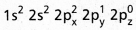
  3. The AP Inter 1st Year Chemistry Study Material Chapter 3 Chemical Bonding and Molecular Structure 74 undergo sp3 hybridisation giving four equivalent sp3 hybridised orbitals.
  4. Each sp3 hybrid orbital overlaps with the 1s orbitals of hydrogen forming \(\sigma_{s p^3-s}\) bond.
  5. In case of methane four \(\sigma_{s p^3}-s\) bonds are formed. The bonds are directed towards the four corners of a regular tetrahedron. The shape of methane molecule is tetrahedral with a bond angle 109°28′.
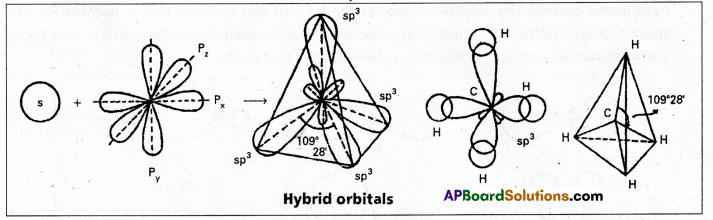
    AP Inter 1st Year Chemistry Study Material Chapter 3 Chemical Bonding and Molecular Structure 75

2. sp2 hybridisation : In this hybridisation one ‘s’ and two p’ atomic orbitals of the excited atom
combine to form three equivalent sp2 hybridised orbitals.
This hybridisation is also known as trigorial hybridisation. In sp2 hybridisation each sp2 hybrid orbital has 33.33% ‘s’ nature and 66.66% ‘p’ nature. The shape of the molecule is trigonal with a bond angle 120°.
E.g.: Boron trichioride molecule formation:

  1. The electronic configuration of ‘B’ in the ground state is AP Inter 1st Year Chemistry Study Material Chapter 3 Chemical Bonding and Molecular Structure 76
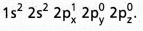
  2. On excitation the configuration is AP Inter 1st Year Chemistry Study Material Chapter 3 Chemical Bonding and Molecular Structure 77 Now there are three half filled orbitals are available for hybridisation.
  3. Now sp2 hybridisation takes place at boron atom giving three sp2 hybrid orbitals.
  4. Each of them with one unpaired electron forms ‘σ’ bond with one chlorine atom. The overlapping is \(\sigma_{s p^2-p}\) (Cl atom has the unpaired electron in 2Pz orbital). In boron trichloride there are three ‘σ’ bonds.
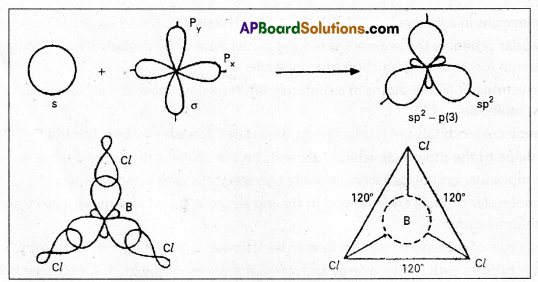
    AP Inter 1st Year Chemistry Study Material Chapter 3 Chemical Bonding and Molecular Structure 78

3. sp hybridisation : In this hybridisation one ‘s and one ‘p’ atomic orbitals of the excited atom combine to form two equivalent sp hybridised orbitals.
This hybridisation is also known as diagonal hybridisation. In sp hybridisation each sp hybrid orbital has 50% ‘s’ character and 50% ‘p’ character. The shape of the molecule is linear or diagonal with a bond angle 180°.
Ex. : Beryllium chloride molecule formation:

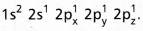
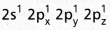
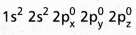
  1. Be atom has AP Inter 1st Year Chemistry Study Material Chapter 3 Chemical Bonding and Molecular Structure 79 electronic configuration.
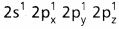
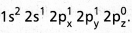
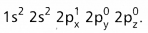
  2. In ground state it has no half filled orbitais. On excitation the configuration becomes \(1 s^2 2 s^1 2 P_x^1\)\(2 p_y^0 2 p_z^0\).
  3. Now sp hybridisation takes place at beryllium atom giving two sp hybrid orbitais. Each of them with one unpaired electron forms a ‘σ’ bond with one chlorine atom.
  4. The overlaping is σsp-p (Cl atom has the unpaired electron in 2pz orbital). In beryllium chloride there are two ‘σ’ bonds.
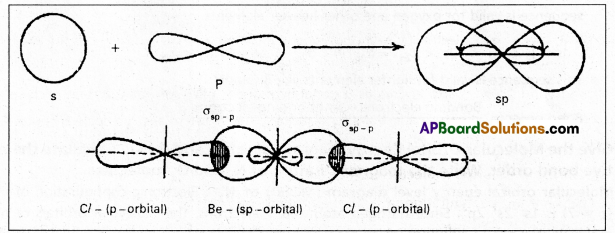
    AP Inter 1st Year Chemistry Study Material Chapter 3 Chemical Bonding and Molecular Structure 80

AP Inter 1st Year Chemistry Study Material Chapter 3 Chemical Bonding and Molecular Structure

Question 8.
Write the salient features of Molecular Orbital Theory.
Answer:
Molecular orbital theory:
Hund and Mulliken.

  1. Theory was proposed by
  2. Atomic orbitals (AO) of the bonded atoms combine loose their identity to form molecular orbitals (MO).
  3. The electrons in a molecule reside in molecular orbitals.
  4. Molecular orbital is the region around the nuclei where the probability of finding electon is maximum (or) the wave function of a molecule.
  5. The electrons of all the atoms in a molecule are revolving under the influence of all the nuclei in the molecule.
  6. The molecular orbitals are formed when the atomic orbitals combine linearly.
  7. The shape of the molecular orbitals depends on the shape of the atomic orbitals.
  8. Each molecular orbital can accommodate two electrons with opposite spins.
  9. The molecular orbitals are arranged in the increasing order of energy, and electrons are filled in the same order.
  10. Hund’s rule of maximum multiplicity is to be followed while filling molecular orbitals.
  11. Atomic orbitals with similar energy and symmetry can combine to give molecular orbitals.
  12. Molecular orbitals with energy lower than A.O are known as bonding molecular orbital; while those with higher energy are known as anti bonding molecular orbitals. Those which are not involved in combination are called non bonding orbitals.

    AP Inter 1st Year Chemistry Study Material Chapter 3 Chemical Bonding and Molecular Structure 81
  13. The order of energies of molecular orbital is : bonding < nonbonding < antibonding molecular orbitals.
  14. The bonding orbitals are designated a σ and π.
  15. The antibonding orbitals are designated σ* and π*.

Filling of electrons into molecular orbitals :
The sequence of energy levels of molecular orbitals is given by

AP Inter 1st Year Chemistry Study Material Chapter 3 Chemical Bonding and Molecular Structure 82
sequence is valid for oxygen and other heavier elements.

AP Inter 1st Year Chemistry Study Material Chapter 3 Chemical Bonding and Molecular Structure 83
This sequence is valid for lighter elements like B.CandN.

AP Inter 1st Year Chemistry Study Material Chapter 3 Chemical Bonding and Molecular Structure 84

Question 9.
Give the Molecular Orbital Energy diagram of
(a) N2 and
(b) O2. Calculate the respec- five bond order. Write the magnetic nature of N2 and O2 molecules.
Answer:
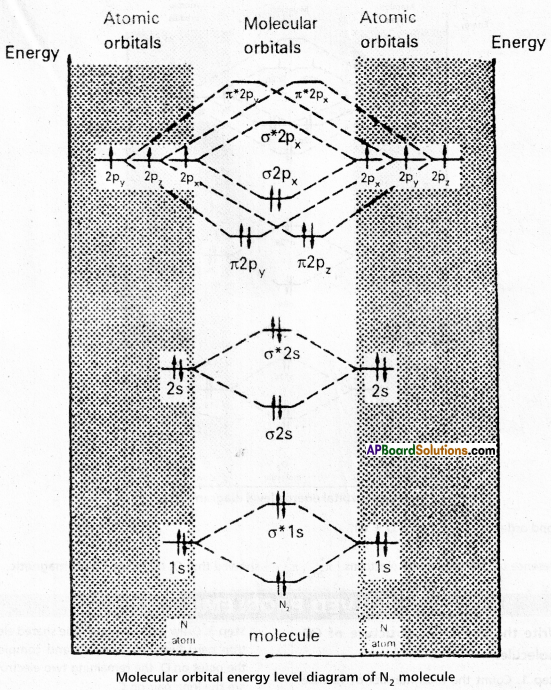
Molecular orbital energy level diagram (MOED) of ‘N2‘ ; Electronic configuration of nitrogen (z = 7) is 1s2 2s2 2p3. Since nitrogen atom has 7 electrons, the molecular orbitals of nitrogen molecule (N2) has 14 electrons which are distributed as below :

AP Inter 1st Year Chemistry Study Material Chapter 3 Chemical Bonding and Molecular Structure 85

AP Inter 1st Year Chemistry Study Material Chapter 3 Chemical Bonding and Molecular Structure 86

  • Bond order = \(\frac{8-2}{2}\) = 3 ( N ≡ N)
  • Absence of unpaired electrons showed that N2 molecule is diamagnetic.

MOED of O2:
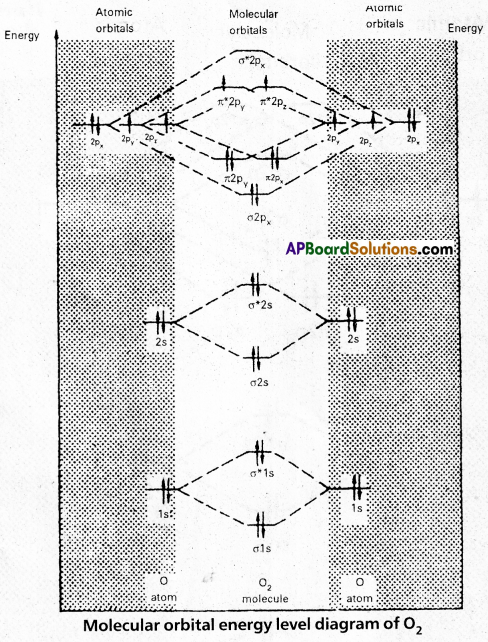
Electronic configuration of Oxygen (Z = 8) is 1s2 2s2 2p4. Since Oxygen atom has 8 electrons, the molecular orbitais of Oxygen molecule (O2) has 16 electrons, which are distributed as below:

AP Inter 1st Year Chemistry Study Material Chapter 3 Chemical Bonding and Molecular Structure 87

AP Inter 1st Year Chemistry Study Material Chapter 3 Chemical Bonding and Molecular Structure 88

  • Bond order = \(\frac{10-6}{2}\) = 2 (O = O)
  • Presence of two unpaired 6 electrons \(\left(\pi_{2 p_y^1}^{\star}, \pi_{2 p_z^1}^{\star}\right)\) showed that O2 molecule is paramagnetic.

Solved Problems

Question 1.
Write the Lewis dot structure of CO molecule.
Solution:
Step 1. Count the total number of valence electrons of carbon and oxygen atoms. The outer (valence) shell configurations of carbon and oxygen atoms are: 2s2 2p2 and 2s2 2p4, respectively. The valence electrons available are 4 + 6 = 10.

Step 2. The skeletal structure of CO is written as: C O

Step 3. Draw a single bond (one shared electron pair) between C and O and complete the octet on O, the remaining two electrons are the lone pair on C.

AP Inter 1st Year Chemistry Study Material Chapter 3 Chemical Bonding and Molecular Structure 89
This does not complete the octet on carbon and hence we have to resort to multiple bonding (in this case a triple bond) between C and O atoms. This satisfies the octet rule condition for both atoms.

AP Inter 1st Year Chemistry Study Material Chapter 3 Chemical Bonding and Molecular Structure 90

Question 2.
Write the Lewis structure of the nitrite ion, \(\mathrm{NO}_2^{-}\).
Solution:
Step 1. Count the total number of valence electrons of the nitrogen atom, the oxygen atoms and the additional one negative charge (equal to one electron).
N(2s2 2p3), O (2s2 2p4)
5 + (2 × 6) + 1 = 18 electrons

Step 2. The skeletal structure of \(\mathrm{NO}_2^{-}\) is written as: O N O

Step 3. Draw a single bond (one shared electron pair) between the nitrogen and each of the oxygen atoms completing the octets on oxygen atoms. This, however, does not complete the octet on nitrogen if the remaining two electrons constitute lone pair on it.
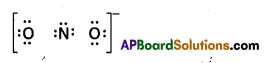
AP Inter 1st Year Chemistry Study Material Chapter 3 Chemical Bonding and Molecular Structure 91

Hence we have to resort to multiple bonding between nitrogen and one of the oxygen atoms (in this case a double bond). This leads to the following Lewis dot structures.

AP Inter 1st Year Chemistry Study Material Chapter 3 Chemical Bonding and Molecular Structure 92

AP Inter 1st Year Chemistry Study Material Chapter 3 Chemical Bonding and Molecular Structure

Question 3.
Explain the structure of \(\mathrm{CO}_3^{2-}\) ion interms of resonance.
Solution:
The single Lewis structure based on the presence of two single bonds and one double bond between carbon and oxygen atoms is inadequate to represent the molecule accurately as it represents unequal bonds. According to the experimental findings, all carbon to oxygen bonds in CCO2 are equivalent.

Therefore the carbonate ion is best described as a resonance hybrid of the canonical forms I, II, and III shown below.
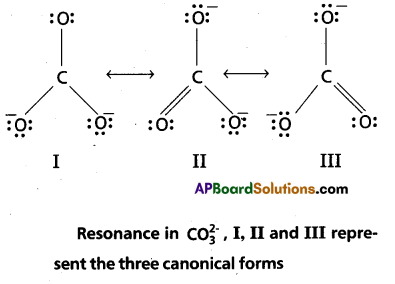
AP Inter 1st Year Chemistry Study Material Chapter 3 Chemical Bonding and Molecular Structure 93

Question 4.
Explain the structure of CO2 molecule.
Solution:
The experimentally determined carbon to oxygen bond length in CO2 is 115 pm. The lengths of a normal carbon to oxygen double bond (C = O) and carbon to oxygen triple bond(C ≡ O) are 121 pm and 110 pm respectively. The carbon-oxygen bond lengths in CO2 (115 pm) lie between the values for C = O and C ≡ O. Obviously, a single Lewis structure cannot depict this position and it becomes necessary to write more than one Lewis structures and to consider that the structure of CO2 is best described as a hybrid of the canonical or resonance forms I, II and III.
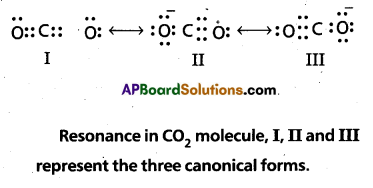
AP Inter 1st Year Chemistry Study Material Chapter 3 Chemical Bonding and Molecular Structure 94

Additional Problems

Question 1.
The experimental dipole moment of HCl is 1.03D and its bond length (distance) is 1.27Å. Calculate the % of ionic character of HCl.
Answer:
Calculated dipole moment = q × d
= 4.8 × 10-10 × 1.27 × 10-8 cm
= 6.09 Debye
% of ionic character = \(\frac{\mu_{\text {ods }}}{\mu_{\text {calc }}}\) × 100
= \(\frac{1.03}{6.09}\) × 100
= 16.9%

Question 2.
The dipole moment of H2S is 0.95D. Find the bond moment if the bond angle is 97° (Cos 48.5° = 0.662).
Answer:
\(\mu_{\text {obs }}\) = 2 (bond moment) \(\left(\cos \frac{\theta}{2}\right)\)
0.95 = 2 (bond moment) (Cos 48.5°)
0.95 = 2 × bond moment × 0.662
Bond moment = \(\frac{0.95}{2 \times 0.662}\) = 0.72D
AP Inter 1st Year Chemistry Study Material Chapter 1 Atomic Structure

Andhra Pradesh BIEAP AP Inter 1st Year Chemistry Study Material 1st Lesson Atomic Structure Textbook Questions and Answers.

AP Inter 1st Year Chemistry Study Material 1st Lesson Atomic Structure

Very Short Answer Questions

Question 1.
What is the charge, mass and charge to mass ratio of an electron ?
Answer:

  • Charge of an electron = – 1.602 × 10⁻¹⁹ coloumbs (or) -4.8 × 10⁻¹⁹ esu
  • Mass of an electron = 9.1 × 10⁻²⁸ gms
  • Charge to mass ratio of an electron \(\left(\frac{\mathrm{e}}{\mathrm{m}}\right)\) i.e., specific charge = 1.758 × 10¹¹ coloumbs/kg

Question 2.
Calculate the charge of one mole of electrons.
Answer:
One electron has charge – 1.602 × 10⁻¹⁹ coloumbs.
One mole of electrons has charge -6.023 × 1023 × 1.602 × 10-19
= 9.648846 × 104 = 96488.5 coloumbs.

AP Inter 1st Year Chemistry Study Material Chapter 1 Atomic Structure

Question 3.
Calculate the mass of one mole of electrons.
Answer:
Mass of electron = 9.1 × 10⁻³¹ kg (or) 9.1 × 10⁻²⁸ gms.
One mole of electrons has mass 6.023 × 1023 × 9.1 × 10-31 = 54.8 × 10-8 = 5.48 × 10⁻⁷ kg.

Question 4.
Calculate the mass of one mole of protons. ”
Answer:
One proton has mass 1.672 × 10⁻²⁷ kg
One mole protons has mass 6.023 × 1023 × 1.672 × 10-27
= 10.0704 × 10-4
= 1.00704 × 10⁻³ kg.

Question 5.
Calculate the mass of one mole of neutrons.
Answer:
One neutron has mass 1.675 × 10⁻²⁷ kg
One mole neutrons has mass 6.023 × 1023 × 1.675 × 10-27
= 10.088 × 10-4
= 1.0088 × 10⁻³ kg.

Question 6.
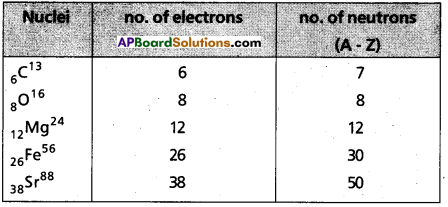
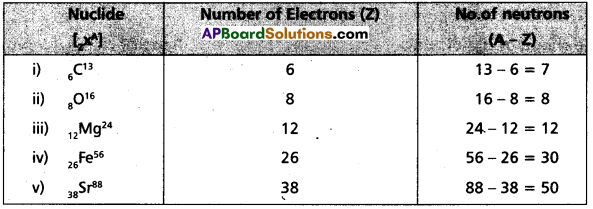
How many neutrons and electrons are present in the nuclei of 6C13, 8O16, 12Mg24, 26Fe56 and 38Sr88.
Answer:
AP Inter 1st Year Chemistry Study Material Chapter 1 Atomic Structure 1

AP Inter 1st Year Chemistry Study Material Chapter 1 Atomic Structure

Question 7.
What is a black body ?
Answer:
The body which is perfect absorber and emmiter of all type of radiations incident on it is called a black body.

Question 8.
Which part of electromagnetic spectrum does Balmer series belong?
Answer:
Balmer series (n = 2) belongs to visible region of electromagnetic spectrum.

Question 9.
What is an atomic orbital?
Answer:
In an atom, the region around the nucleus where the probability of finding the electron is maximum is known as atomic orbital.

  • From the value of magnitude of square of wave function (|\(\psi^2\)|) this region can be predicted.

Question 10.
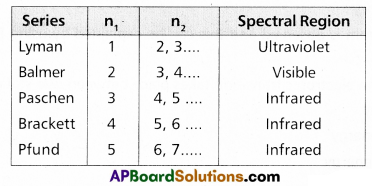
When an electron is transferred in hydrogen atom from n = 4 orbit to n=5 orbit to which spectral series does this belong?
Answer:

  • By the absorption of energy electron jumps from n = 4 orbit to n = 5 orbit.
  • The electron present in n = 5 orbit emitts energy and return to n = 4 orbit. Hence the spectral lines series obtained in Brackett series (IR region)

Question 11.
How many “p” electrons are present in sulphur atom?
Answer:
Sulphur has electronic configuration – 1s2 2s2 2p6 3s2 3p4
∴ Sulphur has 10 ‘p’ electrons.

Question 12.
What are the values of principal quantum number (n) and azimuthal quantum number (l) for a 3d electron?
Answer:
For a 3d – electron principal quantum number (n) = 3 and
Azimuthal quantum number (l) = 2.

AP Inter 1st Year Chemistry Study Material Chapter 1 Atomic Structure

Question 13.
What is the complete symbol for the atom with the given atomic number (Z) and atomic mass (A)?
I) Z = 4, A = 9 ;
II) Z = 17, A = 35 ;
III) Z = 92, A = 233.
Answer:
I) Z = 4, A = 9 Complete symbol is 4Be9
II) Z = 17, A = 35 Complete symbol is 17Cl35
III) Z = 92, A = 233 complete symbol is 92U233.

Question 14.
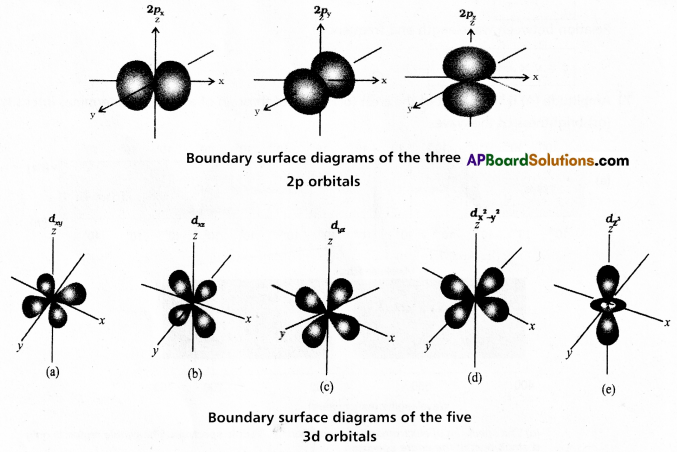
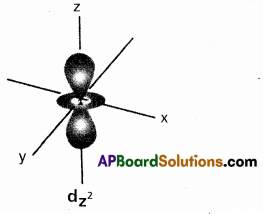
Draw the shape of \(\mathrm{d}_{\mathrm{z}^2}\) orbital.
Answer:
AP Inter 1st Year Chemistry Study Material Chapter 1 Atomic Structure 2

Question 15.
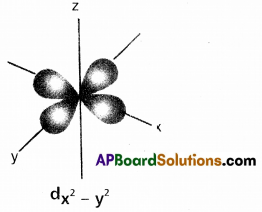
Draw the shape of dx2 – y2 orbital.
Answer:
AP Inter 1st Year Chemistry Study Material Chapter 1 Atomic Structure 3

AP Inter 1st Year Chemistry Study Material Chapter 1 Atomic Structure

Question 16.
What is the frequency of radiation of wavelength 600nm?
Answer:
Formula:
\(v=\frac{c}{\lambda}\)
= \(\frac{3 \times 10^8}{6 \times 10^{-7}}\)
= \(\frac{1}{2} \times 10^{15}\)
= 0.5 × 1015 = 5 × 10¹⁴ sec-1
λ = 600 nm
= 600 × 10-9 m
= 6 × 10⁻⁷ m
C = 3 × 10⁸ m/sec.

Question 17.
What is Zeeman effect?
Answer:
The splitting up of spectral lines in presence of strong external magnetic field is called as Zeeman effect.

Question 18.
What is Stark effect?
Answer:
The splitting of spectral lines in presence of strong electric field is called as Stark effect.

Question 19.
To which element does the following electronic configuration correspond?
I) 1s22s2 2p63s23p1
II) 1s22s22p63s23p6
III) 1s22s22p5
IV) 1s22s22p2.
Answer:
I) 1s22s2 2p6 3s2 3p1 (Atomic no. (Z) = 13) – Aluminium.
II) 1 s22s22p63s23p6(Atomic no. (Z) = 18) – Argon.
III) 1s22s22p5 (Atomic no. (Z) = 9) – Fluorine.
IV) 1s22s22p2 (Atomic no. (Z) = 6) – Carbon.

Question 20.
Electrons are emitted with zero velocity from a metal surface when it is exposed to radiation of wavelength 4000 A. What is the threshold frequency (\(v_0\))?
Answer:
Formula:
hv = hv0 + \(\frac{1}{2} m v^2\)
hv = hv0 + \(\frac{1}{2} m(0)^2\)
hv = hv0
λ = 4000 A
= 4 × 103 × 10-10 = 4 × 10⁻⁷ m.
V = 0
C = 3 × 10⁸ m/sec.
⇒ v = v0
∴ v = \(\frac{\mathrm{C}}{\lambda}\) = \(\frac{3 \times 10^8}{4 \times 10^{-7}}\) = \(\frac{3}{4}\) × 1015
= 0.75 × 1015
= 7.5 × 10¹⁴ sec-1

Question 21.
Explain Pauli’s exclusion principle.
Answer:
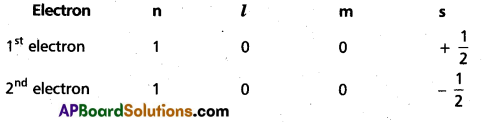
Pauli’s exclusion principle:
According to this principle
“No two electrons in an atom can have the same set of four quantum numbers”. This can also be stated as “only two electrons may exist in the same orbital and these electrons must have opposite spins”.

This means that the two electrons can have the same value of three quantum numbers n, l and ml but have the opposite spin quantum number Ex : Consider ‘K’ shell of the atom having two electrons AP Inter 1st Year Chemistry Study Material Chapter 1 Atomic Structure 4
AP Inter 1st Year Chemistry Study Material Chapter 1 Atomic Structure 5

Question 22.
What is Aufbaus principle ?
Answer:
Aufbau’s principle:
This principle states
“In the ground state of the atoms, the orbitals are filled in order of their increasing energies”. In other words electrons first occupy the lowest energy orbital available to them and enter into higher energy orbitals only after the lower energy orbitals are filled.
The order in which the orbitals are filled as follows :
1s < 2s < 2p < 3s < 3p < 4s < 3d < 4p < 5s < 4d < 5p < 4f < 5d < 6p < 7s

AP Inter 1st Year Chemistry Study Material Chapter 1 Atomic Structure

Question 23.
What is Hund’s rule ?
Answer:
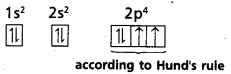
Hund’s rule: This rule deals with the filling of electrons in degenerate orbitals. It states “Pairing of electrons in the orbitals belonging to the same subshell (p, d or f) does not take place until each orbital belonging to that subshell has got one electron each (i.e.,) all the orbitals are singly occupied”.
Since there are three ’p’, five ‘d’ and seven ‘f’ orbitals, therefore the pairing of electrons will start in the p, d and f orbitals with the entry of 4th, 6th and 8th electrons respectively.
Ex : ‘8O’ electronic configuration is
AP Inter 1st Year Chemistry Study Material Chapter 1 Atomic Structure 6

Question 24.
Explain Heisenberg’s uncertainty principle.
Answer:
Heisenberg uncertainty principle : “Simultaneous and exact determination of the position and momentum of a sub-atomic particle, like electron moving with high speed is impossible.”
If Δx and Δp represents the uncertainties in the position and momentum respectively. Then according to Heisenberg
Δx. Δp ≥ \(\frac{\mathrm{h}}{4 \pi}\) ——- (1)

The product of uncertainties in position (Δx) and momentum (Δp) of an electron cannot be less than \(\frac{h}{4 \pi}\). It can be equal or greater than \(\frac{h}{4 \pi}\).
Since momentum = mass x velocity, the equation (1) can be written as
Δx × m (Δv) ≥ \(\frac{\mathrm{h}}{4 \pi}\) = Δx × Δv ≥ \(\frac{\mathrm{h}}{4 \pi \mathrm{m}}\)
If the position is determined accurately Δx = 0 and Δv = ∝. That means the inaccuracy in measuring the velocity is ∝. If velocity is determined accurately Δv = 0 and Δx = ∝.

Question 25.
What is the wavelength of an electron moving with a velocity of 2.0 × 10⁷m/s ?
Answer:
Formulae:
λ = \(\frac{h}{m v}\)
= \(\frac{6.625 \times 10^{-34}}{9.1 \times 10^{-31} \times 2 \times 10^7}\)
= 0.3640 × 10-34 × 10+24
= 0.3640 × 10¹⁰ m
= 0.3640 A
h = 6.625 × 10⁻³⁴ J.Sec
m = 9.1 × 10⁻³¹ kg
V = 2.0 × 10⁷ m/sec.

Question 26.
An atomic orbital has n = 2, what are the possible values of l and ml?
Answer:
For n = 2, l values are 0, 1
For l = 0 → ml = 0
For l = 1 → ml = -1, 0, +1.

AP Inter 1st Year Chemistry Study Material Chapter 1 Atomic Structure

Question 27.
Which of the following orbitals are possible? 2s, 1p, 3f, 2p.
Answer:
2s, 2p orbitals are possible among 2s, 1p, 3f, 2p and 1 p, 3f orbitals are not possible.

Question 28.
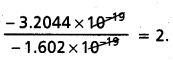
The static electric charge on the oil drop is – 3.2044 × 10⁻¹⁹ C. How many electrons are present on it?
Answer:
Given static electric charge on oil drop = – 3.2044 × 10⁻¹⁹ C
Charge of electron = – 1.602 × 10⁻¹⁹ C.
Number of electrons present =
AP Inter 1st Year Chemistry Study Material Chapter 1 Atomic Structure 7

Question 29.
Arrange the following type of radiation in increasing order of frequency:
(a) X – rays
(b) visible radiation
(c) microwave radiation and
(d) radiation from radio waves.
Answer:
Increasing order of frequency of given radiations is
Radio waves < Micro waves < Visible radiation < X – rays.

Question 30.
How many electrons in an atom may have n = 4 and ms = +1/2 ?
Answer:
For n = 4 → l values are 0, 1, 2, 3
l = 0 → s contains 1 electron with ms = + 1/2
l = 1 → p contains 3 electron with ms = + 1/2
l = 2 → d contains 5 electron with ms = + 1/2
l = 3 → f contains 7 electron with ms = + 1/2
∴ Total no.of electrons with ms = +1/2 for n = 4
= 1 + 3 + 5 + 7 = 16.

AP Inter 1st Year Chemistry Study Material Chapter 1 Atomic Structure

Question 31.
How many sub-shells are associated with n = 5 ?
Answer:
For n = 5
l values are 0, 1, 2, 3, 4
l = 0 → s – orbital
l = 1 → p — orbital
l = 2 → d – orbital
l = 3 → f – orbital
l = 4 → g — orbital
→ Five subshells are associated with n = 5.

Question 32.
Explain the particle nature of electromagnetic radiation.
Answer:

  • According to earlier days concepts light was supposed to be made of particles. This assumption was made by Newton in his corpuscular theory. He called the particles as corpuscales.
  • The particle nature of light explains the black body radiations and photo electric effect satisfactorily.
  • The particle nature of light could not satisfactorily explains the phenomenon of diffraction and Interferance.

Question 33.
Explain the significance of Heisenberg’s Uncertainty principle.
Answer:
Significance of Uncertainty Principle:

  1. This principle rules out the existence of definite paths or trajectories of electrons and other similar particles.
  2. This principle is significant only for motion of microscopic objects, and is negligible for that of macroscopic objects.
  3. In dealing with milligram size or heavier objects, the associated uncertainties are hardly of any real consequence.

Question 34.
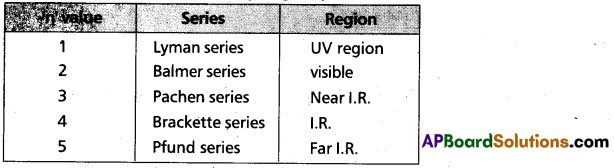
What series of lines are observed in hydrogen spectra?
Answer:
The series of lines observed in hydrogen spectra are
AP Inter 1st Year Chemistry Study Material Chapter 1 Atomic Structure 8

Additional Answer Questions

Question 35.
How many newtrons and electrons are present in the nuclei of \({ }_6 C^{13}\), \({ }_8 \mathrm{O}^{16}\), \({ }_{12} \mathrm{Mg}^{24}\), \({ }_{26} \mathrm{Fe}^{56}\), \({ }_{38} \mathrm{Sr}^{88}\)
Answer:
AP Inter 1st Year Chemistry Study Material Chapter 1 Atomic Structure 9

Additional Problems

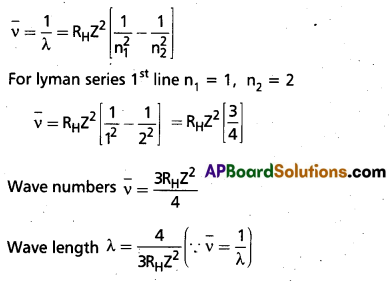
Question 36.
Calculate the wave no. and wave length of first line of lyman series.
Answer:
AP Inter 1st Year Chemistry Study Material Chapter 1 Atomic Structure 10

AP Inter 1st Year Chemistry Study Material Chapter 1 Atomic Structure

Question 37.
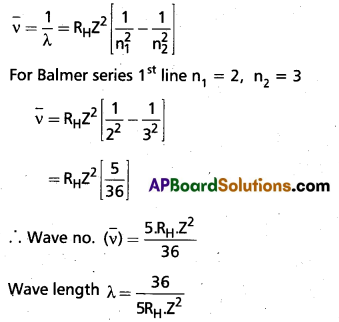
Calculate the wave no. of and wave length of first line of Balmer series.
Answer:
AP Inter 1st Year Chemistry Study Material Chapter 1 Atomic Structure 11

Short Answer Questions

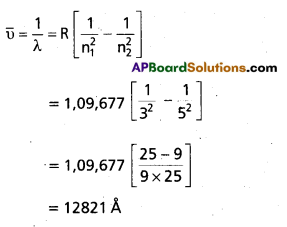
Question 38.
What is the wavelength of light emitted when the electron in a hydrogen atom undergoes transition from an energy level with n = 5 to an energy level with n = 3 ?
Answer:
Formulae:
AP Inter 1st Year Chemistry Study Material Chapter 1 Atomic Structure 12
R = 1,09,677 cm-1
n1 = 3
n2 = 5.
\(\bar{v}\) = 7799.25 cm-1
λ = \(\frac{1}{\bar{v}}\) = \(\frac{1}{7799.25}\) = 1.2821 × 10⁻⁴ cm

Question 39.
An atom of an element contains 29 electrons and 35 neutrons. Deduce

  1. the number of protons and
  2. the electronic configuration of the element.

Answer:
Given no.of electrons ’29’, ∴ Z = 29

  1. So, no.of protons = 29
  2. Electronic configuration of the element (Z = 29)
    = 1s22s22p23s23p64s13d10 [anamalous electronic configuration]

Question 40.
Explain giving reasons, which of the following sets of quantum numbers are not possible.
a) n = 0, l = 0, ml = 0, ms = +\(\frac{1}{2}\)
b) n = 1, l = 0, ml = 0, ms = –\(\frac{1}{2}\)
c) n = 1, l = 1, ml = 0, ms = +\(\frac{1}{2}\)
d) n = 2, l = 1, ml = 0, ms = +\(\frac{1}{2}\)
e) n = 3, l = 3, ml = – 3, ms = +\(\frac{1}{2}\)
f) n = 3, l = 1, ml = 0, ms = +\(\frac{1}{2}\)
Answer:
Following set of quantum numbers are not possible.
a) n = 0, l = 0, ml = 0, ms = +\(\frac{1}{2}\)
Reason:
‘n’ is principal quantum number, whose values are from 1 to n. The value of ‘n’ never equal to zero. But given n = 0.

c) n = 1, l = 1, ml = 0, ms = +\(\frac{1}{2}\)
Reason:
Values of ‘l’ are from 0 to (n – 1).
If n = 1 then the value of ‘l’ is zero not equal to ‘1’.

e) n = 3, l = 3, ml = – 3, ms = +\(\frac{1}{2}\)
Reason:
If n = 3, possible values of ‘l’ are 0, 1, 2, but not equal to ‘3’.

Question 41.
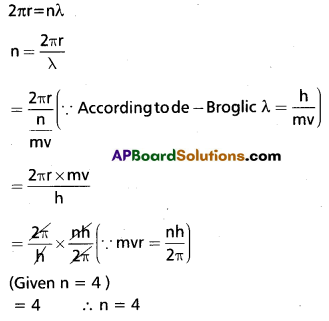
Show that the circumference of the Bohr orbit for the hydrogen atom is an integral multiple of the de Broglie wavelength associated with the electron revolving around the orbit.
Answer:
Consider the Bohr’s angular momentum equation.
mvr = \(\frac{\mathrm{nh}}{2 \pi}\)
i.e The angular momentum of an electron is integral multiple of ‘\(\frac{\mathbf{h}}{2 \pi}\)‘
mvr = \(\frac{\mathrm{nh}}{2 \pi}\)
2πr = \(\frac{\mathrm{nh}}{\mathrm{mv}}\)
According to de-Broglie’s wavelength λ = \(\frac{h}{m v}\)
2πr = \(n\left(\frac{h}{m v}\right)\)
2πr = nλ.
Thus the circumference of the Bohr orbit is integral multiple of de-Broglie’s wave length.

Question 42.
The longest wavelength doublet absorption transition is observed at 589.0 and 589.6 nm. Calculate the frequency of each transition and energy difference between two excited states.
Answer:
Given largest wave length doublet absorption transition is observed at 589.0 and 589.6 nm.
∴ \(v_1=\frac{c}{\lambda_1}\)
= \(\frac{3 \times 10^8}{589 \times 10^{-9}}\) = 0.005093 × 10+7
= 5.093 × 10¹⁴ sec-1
λ1 = 589 × 10-9 m
∴ \(v_2=\frac{c}{\lambda_2}\)
= \(\frac{3 \times 10^8}{589.6 \times 10^{-9}}\)
= 0.005088 × 1017
= 5.088 × 10¹⁴ sec-1
λ1 = 5.089 × 10⁻⁹ m
Energy difference between two states = h[\(v_1\) – h\(v_2\)]
= h[\(v_1\) – \(v_2\)]
= 6.625 × 10⁻³⁴[5.093 × 10⁻¹⁴ – 5.088 × 10¹⁴]
= 6.625 × 10-34 × 0.005 × 1014
= 0.0331 × 10⁻²⁰ J.

AP Inter 1st Year Chemistry Study Material Chapter 1 Atomic Structure

Question 43.
What are the main features of quantum mechanical model of an atom?
Answer:
Important features of quantum mechanical model of atom:

  1. The energy of electrons in an atom is quantized (it can only have certain specific values).
  2. The existence of quantized electronic energý levels is a direct result of the wave like properties at electrons and are allowed solution at Schrodinger wave equation.
  3. All the information about the electron in an atom is contained in its orbital wave function ‘Ψ’ and quantum mechanics makes it possible to extract this information from “Ψ’.
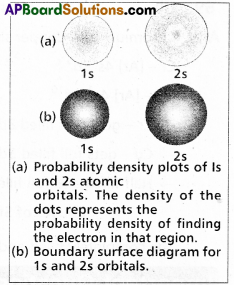
  4. The path of the electron can never be determined accurately. Therefore, we find only the probability of the electron at different points in space, around an atom.
  5. The probability of finding an electroñat a point within an atom is proportional to the square of the orbital wave function i.e., \(|\Psi|^2\) at that point. \(|\Psi|^2\) is known as probability density and is always positive. From the value of \(|\Psi|^2\) at different points with in the atom, it is possible to predict the region around the nucleus where electron will most probably be found.

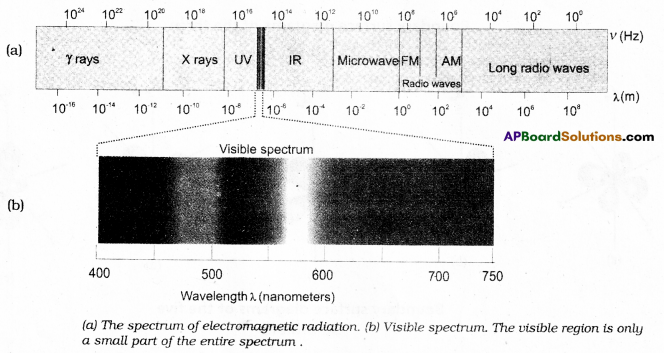
Question 44.
What is a nodal plane? How many nodal planes are possible for 2p – and 3d – orbitals?
Answer:
The plane at which the probability of finding the electron is zero is called as nodal plane.

  • For 2p orbitaIs one nodal plane is possible for each ‘p’ orbital.
  • For 3d orbitais two nodal planes are possible for each ‘d’ orbital.

Question 45.
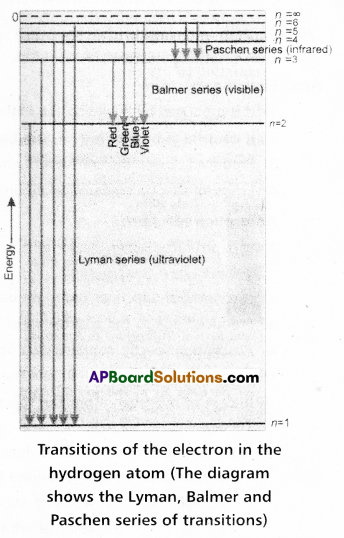
The Lyman series occurs between 91.2 nm and 121.6 nm, the Balmer series occurs between 364.7 nm and 656.5 nm and the Paschen series occurs between 820.6 nm and 1876 nm. Identify the spectral regions to which these wavelengths correspond?
Answer:
In electromagnetic spectrum,
a) 91.2 – 121.6 nm (Lyman senes) corresponds to u.v. region.
b) 364.7 – 656.5 nm (Balmer series) corresponds to visible region.
c) 820.6 – 1876 nm (Paschen series) corresponds to I.R. region.

AP Inter 1st Year Chemistry Study Material Chapter 1 Atomic Structure

Question 46.
How are the quantum numbers n, l, ml, for hydrogen atom obtained?
Answer:
Electronic configuration of hydrogen is 1s1
For ns1
Principal quantum no. (n) = 1
Azimuthal quantum no. (l) = 0
Magnetic quantum no. (ml) = 0
and Spin quantum no. (ms) = + 1/2

Question 47.
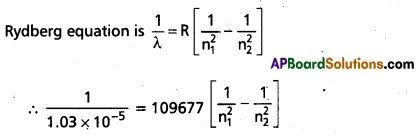
A line in Lyman series of hydrogen atom has a wavelength of 1.03 × 10⁻⁷ m. What is the initial energy level of the electron?
Answer:
Given λ= 1.03 × 10⁻⁷ m = 1.03 × 10⁻⁵ cm
n2 = 1 (for Lyman series)
We have, R = 109677 cm-1
AP Inter 1st Year Chemistry Study Material Chapter 1 Atomic Structure 13
⇒ n2 = 3 (i.e.,) original energy level of electron is 3.

Question 48.
If the position of the electron is measured within an accuracy of ±0.002 nm. Calculate the uncertainty in the momentum of the electron.
Answer:
Formulae:
Δx × Δp = \(\frac{h}{4 \pi}\)
Δp = \(\frac{h}{\Delta x \times 4 \pi}\)
= \(\frac{6.625 \times 10^{-34}}{4 \times 3.14 \times 2 \times 10^{-12}}\)
= 0.2637 × 10-22
= 2.637 × 10⁻²³ J/m.
Δx = 0.002 nm
= 2 × 10-3 × 109 m
= 2 × 10-12 m
h = 6.625 × 10⁻³⁴ J.sec.
∴ Uncertainity in momentum of electron = 2.637 × 10⁻²³ J/m.

Question 49.
If the velocity of the electron is 1.6 × 10⁶ m/s-1. Calculate de Brogue wavelength associated with this electron.
Answer:
Formulae:
λ = \(\frac{\mathrm{h}}{\mathrm{mv}}\)
= \(\frac{6.625 \times 10^{-34}}{9.1 \times 10^{-31} \times 1.6 \times 10^6}\)
= 0.455 × 10⁻⁹ m
= 0.455 nm.
v = 1.6 × 10⁶ m/sec
h = 6.625 × 10⁻³⁴ J.sec
m = 9.1 × 10⁻³¹ Kg.

AP Inter 1st Year Chemistry Study Material Chapter 1 Atomic Structure

Question 50.
Explain the difference between emission and absorption spectra. (A.P. Mar. ‘15)
Answer:
Emission spectrum

  1. It is produced by analysing the radiant energy emitted by an excited substance.
  2. It consists of bright lines on dark back ground.
  3. Produced due to the emission of energy by electrons.
  4. Emission spectra contains bright ineson dark back ground.

Absorption spectrum

  1. It is produced when white light is passed through a substance and the transmitted light is analysed by a spectrograph.
  2. It consists of dark lines on bright background.
  3. Produced due to the adsorption of energy by electrons.
  4. Absorption spectra contains dark lines on bright back ground.

Question 51.
The quantum numbers of electrons are given below. Arrange them in order of increasing energies.
a) n = 4, l = 2, ml = -2, ms = +\(\frac{1}{2}\)
b) n = 3, l = 2, ml = -1, ms = –\(\frac{1}{2}\)
c) n = 4, l = 1, ml = 0, ms = +\(\frac{1}{2}\)
d) n = 3, l = 1, ml = -1, ms = –\(\frac{1}{2}\)
Answer:
a) n = 4, l = 2, → 4d
b) n = 3, l = 2, → 3d
c) n = 4, l = 1, → 4p
d) n = 3, l = 1, → 3p
∴ 3p < 3d < 4p < 4d
According (n + l) values
Hence d < b < c < a is order of increasing energy.

AP Inter 1st Year Chemistry Study Material Chapter 1 Atomic Structure

Question 52.
The work function for Cesium atom is 1.9 eV. Calculate the threshold frequency of the radiation. If the Cesium element is irradiated with a wavelength of 500 nm, calculate the kinetic energy of the ejected photoelectron?
Answer:
Case-I
Photo electric effect equation is
hv = hv0 + 1/2 mv2
w = hv0
AP Inter 1st Year Chemistry Study Material Chapter 1 Atomic Structure 14
Case-II
Photo electric effect equation is
E = \(\frac{\mathrm{hc}}{\lambda}\)
= \(\frac{6.625 \times 10^{-34} \times 3 \times 10^8}{5 \times 10^{-7}}\)
= \(\frac{19.878 \times 10^{-26}}{5 \times 10^{-7}}\)
= 3.9756 × 10⁻¹⁹ J.

Given work function hv0 = 1.9 ev
= 1.9 × 1.602 × 10-19J.

Kinetic Energy (KE) = \(\frac{1}{2} m v^2\)
From Photo electric effect
\(\frac{1}{2} m v^2\) = hv – hv0
K.E. = 3.9756 × 10-19 × 1.602 × 10-19
= 3.9756 × 10⁻¹⁹ – 3.0438 × 10-19 = 0.9318 × 10-19 = 9.318 × 10⁻²⁰J.

Question 53.
Calculate the wavelength for the emission transition if it starts from the orbit having radius 1.3225 nm and ends at 211.6 pm. Name the series to which this transition belongs and the region of the spectrum.
Answer:
Given the radius of orbit from which it started = 1.35225 × 10⁻⁹ m = 1 3.225Å
In general radius of orbit = 0.529 × n2Å
n2 = \(\frac{13.225}{0.529}\) = 25
n2 = 25 ⇒ n = 5
Given that the
Radius of orbit at which the transition ended = 211.6 pm
= 211.6 × 10⁻¹²m
= 2.116A
Similarly as above
n2 = \(\frac{2.116}{0.529}\) = 4
n2 = 4 ⇒ n = 2
∴ transition takes place from n = 5 to n = 2 level
∴ spectral lines are obtained in Balmer series (visible region)

Question 54.
Explain the difference between orbit and orbital.
Answer:
Orbit

  1. A circular path which is present around the nucleus in which electrons revolve is called as orbit.
  2. Orbits are circular and are non directional paths.
  3. The maximum no.of electrons in any orbit is given by the formula 2n2 (n = orbit number).

Orbital

  1. The 3 – dimension space where the probability of finding the electron is maximum around the nucleus is called as orbital.
  2. These have definite shape and these are directional except’s orbital.
  3. Each orbital can occupy a maximum of two electrons.

AP Inter 1st Year Chemistry Study Material Chapter 1 Atomic Structure

Question 55.
Explain photoelectric effect.
Answer:
The ejection of electrons from a metal surface, when the radiations of suitable frequency strikes the metal surface is called photoelectric effect.

Explanation using Einstein’s quantum theory:

1) To explain photoelectric effect, Einstein utilised Quantum theory.
2) When a photon strikes metal surface, it uses some part of its energy to eject the electron from the metal atom. The remaining part of the total energy is given to the ejected electrons in the form of kinetic energy.
Hence we can write hv = W + KE ⇒ hv = hv0 + \(\frac{1}{2} m_e v^2\)
where hv = energy of photon,
v0 = Threshold frequency,
me = mass of electron
W = energy required to overcome the attractive forces on the electron in the metal (work function)
KE = kinetic energy of ejected electron,
V = Velocity of ejected electron.

3) If a photon of sufficient energy struck the metal surface and could eject the electron. But if a photon has insufficient energy, it cannot eject the electron from the metal.
eg. : A photon of violet light [high frequency] can eject the electrons from the surface of potassium but a photon of red light [low frequency] cannot eject the electrons.

Question 56.
Explain Rutherford’s nuclear model of an atom. What are its drawbacks?
Answer:
Rutherford’s Planetary model: Rutherford drew some conclusions regarding the structure of atom.

  1. Most of the space in the atom is empty (as most of the α – particles passed through the foil undeflected).
  2. A few — positive charges were deflected. The deflection must be due to enormous repulsive force showing that the positive charge of the atom is not spread throughout the atom as Thomson predicted. The positive charge is concentrated in a very small volume. Which is responsible for the deflection of α — particles.

On the basis of the above observations. Rutherford proposed the nuclear model. According to his model.

  1. The positive charge in the atom is concentrated in the small dense portion, called the NUCLEUS.
  2. The nucleus is surrounded by the electrons that move around it in circular paths called the ORBITS. Thus Rutherford’s model resembles the solar system.
  3. Electrons and the nucleus are held together by electrostatic forces of attraction.

Drawbacks of Rutherford model:

1. Rutherford’s atomic model of an atom is like a small scale solar system. This similarity suggests that electrons should move around the nucleus in well defined orbits. However, when a body is moving, it undergoes acceleration. According to electromagnetic theory, charged particles, when accelerated, should emit radiation. Therefore, an electron in an orbit will emit radiation, thus the orbit will continue to shrink. But this does not happen. Thus Rutherford’s model cannot explain the stability of the atom.

2. If we assume that electrons as stationary around the nucleus, the electrostatic attraction between the nucleus and the electrons would pull the electrons towards the nucleus to form a miniature version of Thomson’s model.

3. Rutherford model does not explain the electronic structure of the atom i.e., how the electrons are distributed around the nucleus and what are the energies of these electrons.
Before studying further developments that lead to the formulation of various atomic models, it is necessary to study about light and its nature.

Question 57.
Explain briefly the Planck’s quantum theory.
Answer:
The postulates. of Planck’s quantum theory are
a) The emission of radiation is due to vibrations of charged particles (electrons) in the body.
b) The emission is not continuous but in discrete packets of energy called quanta. This emitted radiation propagates in the form of waves.
c) The energy (E) associated with each quantum for a particular radiation of frequency V is given by E = hv, Here ‘h’ is Planck’s constant.
d) A body can emit or absorb either one quantum (hv) of energy or some whole number multiple of it. Thus energy can be emitted or absorbed as hv, 2hv, 3hv etc., but not fractional values. This is called quantisation of energy.
e) The emitted radiant energy is propagated in the form of waves.
f) Values of Planck’s constant in various units:
h = 6.6256 × 10⁻²⁷ erg.sec (or) g cm2s-1
= 6.6256 × 10⁻³⁴J.s (or) kg m2s-1 = 1.58 × 10⁻³⁴ cal.s.
Success of Planck’s quantum theory: This theory successfully explains the black body radiations. A black body is a perfect absorber and also a perfect radiator of radiations.

AP Inter 1st Year Chemistry Study Material Chapter 1 Atomic Structure

Question 58.
What are the postulates of Bohr’s model of hydrogen atom? Discuss the importance of this model to explain various series of line spectra In hydrogen atom. (T.S. Mar. ‘16)(A.P. Mar.’15. ‘13)
Answer:
Niels Bohr quantitatively gave the general features of hydrogen atom structure and it’s spectrum. His theory is used to evaluate several points in the atomic structure and spectra.
The postulates of Bohr atomic model for hydrogen as follows

Postulates : –

  • The electron in the hydrogen atom can revolve around the nucleus in a circular path of fixed radius and energy. These paths are called orbits (or) stationary states. These circular orbits are concentric (having same center) around the nucleus.
  • The energy of an electron in the orbit does not change with time.
  • When an electron moves from lower stationary state to higher stationary state absorption of energy takes place.
  • When an electron moves from higher stationary state to lower stationary state emission of energy takes place.
  • When an electronic transition takes place between two stationary states that differ in energy by ΔE is given by
    ΔE = E2 – E1 = hv
    ∴ The frequency of radiation absorbed (or) emitted v = \(\frac{E_2-E_1}{h}\) E1 and E2 are energies of lower, higher energy states respectively.
  • The angular momentum of an electron is given by mvr = \(\frac{\mathrm{nh}}{2 \pi}\)
    An electron revolve only in the orbits for which it’s angular momentum is integral multiple of \(\frac{\mathrm{h}}{2 \pi}\)

Line spectra of hydrogen, Bohr’s Theory:

  • In case of hydrogen atom line spectrum is observed and this can be explained by using Bohr’s Theory.
  • According to Bohr’s postulate when an electronic transition takes place between two stationary states that differ in energy is given by
    AP Inter 1st Year Chemistry Study Material Chapter 1 Atomic Structure 15
    AP Inter 1st Year Chemistry Study Material Chapter 1 Atomic Structure 16
  • In case of absorption spectrum nf > ni → energy is absorbed (+ve) energy is absorbed (+Ve)

AP Inter 1st Year Chemistry Study Material Chapter 1 Atomic Structure 17

  • In case of emission spectrum ni > nf → energy is emitted (- Ve)
  • Each spectral line in absorption (or) emission spectrum associated to the particular transition in hydrogen atom
  • In case of large no.of hydrogen atoms large no.of transitions possible they rsults in large no.of spectral lines.
    The series of lines observed in hydrogen spectra are
    AP Inter 1st Year Chemistry Study Material Chapter 1 Atomic Structure 18

Question 59.
Explain the success of Bohr’s theory for hydrogen atom.
Answer:
Succes of Bohrs Theory for hydrogen atom:

  • Bohr’s theory gave the information about the principal quantum number. Principal quantum number represents the stationary states. (n = 1, 2, 3 integral numbers)
  • Bohr’s theory gave the information about the radius of the stationary states (or) orbits.
    r = 0.529 × n2 A (or)
    r = 52.9 × n2 pm
    \(\left[r=\frac{n^2 h^2}{4 \pi^2 m e^2}\right]\) (for hydrogenation)
  • This theory gave the information about the energy of the electron of particular stationary state.
    En = -RH \(\left[\frac{1}{n^2}\right]\)n = 1, 2, 3,……
    RH = Ryd berg constant
    = 1,09,677 cm-1.
  • This theory explained the line spectra of hydrogenation.
  • This theory can also be applicable to the ions containing only one electron. Eg. : He+, Li+2, Be+3….
  • This theory can also gave information about velocity of electrons moving in the orbits.

Question 60.
What are the consequences that lead to the development of quantum mechanical model of an atom?
Answer:
Consequences that lead to development of quantum mechanical model of an atom are as follows.

  • Clàssical mechanics successfully explained the motion of macro scopic objects.
    Eg: Falling stone, Planets etc.,.
  • Classical mechanics failed to explain the motion of microscopic objects like electrons, atoms, molecules etc.
  • Classical mechanics ignores the concept of dual behaviour of matter and especially for sub atomic particles
    Quantum mechanics:
    The Branch of science deals with the dual behaviour of matter is called quantum mechanics.
  • This deals with the motions of microscopic objects like electron.

Important features of quantum mechanical model of atom:

  1. The energy of electrons in an atom is quantized (it can only have certain specific values).
  2. The existence of quantized electronic energy levels is a direct result of the wave like properties at electrons and are allowed solution at schrodinger wave equations.
  3. All the information about the electron in an atom is contained in its orbital wave function ‘\(\Psi^{\prime}\) and quantum mechanics makes it possible to extract this information from ‘\(\Psi^{\prime}\).
  4. The path of the electron can never be determined accurately. Therefore, we find only the probability of the electron at different points in space, around an atom.
  5. The probability of finding an electron at a point within an atom is proportional to the square of the orbital wave function i.e., \(|\Psi|^2\) at that point. \(|\Psi|^2\) is known as probability density and is always positive. From the value of \(|\Psi|^2\) at different points with in the atom, it is possible to
    predict the region around the nucleus where electron will most probably be found.

AP Inter 1st Year Chemistry Study Material Chapter 1 Atomic Structure

Question 61.
Explain the salient features of quantum mechanical model of an atom.
Answer:
Important features of quantum mechanical model of atom:

  1. The energy of electrons in an atom is quantized (it can only have certain specific values).
  2. The existence of quantized electronic energy levels is a direct result of the wave like properties at electrons and are allowed solution at schrodinger wave equations.
  3. All the information about the electron in an atom is contained in its orbital wave function ‘\(\Psi^{\prime \prime}\) and quantum mechanics makes it possible to extract this information from \(\Psi^{\prime \prime}\).
  4. The path of the electron can never be determined accurately. Therefore, we find only the probability of the electron at different points in space, around an atom.
  5. The probability of finding an electron at a point within an atom is proportional to the square of the
    orbital wave function i.e., \(|\Psi|^2\) at that point. \(|\Psi|^2\) is known as probability density and is always positive. From the value of \(|\Psi|^2\) at different points with in the atom, it is possible to predict the region around the nucleus where electron will most probably be found.

Question 62.
What are the limitations of Bohr’s model of an atom?
Answer:
Limitations:

  1. Spectra of multielectron atoms: Bohr’s theory could explain the spectra of Hydrogen and single electron species like He+, Li2+, Be3+, but it fails to explain the spectra of multielectron atoms.
  2. Fine structure: It fails to explain this fine structure of Hydrogen atom.
  3. Splitting up of spectral lines : The theory fails to explain Zeeman effect and Stark effect.
    The splitting up of spectral lines when an atom is subjected to strong magnetic field is called Zeeman effect.
    The splitting up of spectral lines when an atom is subjected to strong electric field is called Stark effect.
  4. Flat model: Bohr’s theory gives a flat model of the orbits. Bohr’s theory predicts definite orbits for electrons considering them as particles. But according to de Brogue electron has both wave nature and particle nature. Bohr’s theory cannot explain this dual role.
  5. It fails to support the uncertainty principle proposed by Heisenberg.
  6. It could not explain the ability of atoms to form molecules by chemical bonds.

Question 63.
What are the evidences in favour of dual behaviour of electron?
Answer:

  • The particle nature of light explains the phenomenon of blackbody radiations and photo electric effect but it could not explain about wave nature of light.
  • Wave nature of light explains the phenomenon of interference and diffraction.
  • So, light has dual nature i.e it behaves as a wave (or) as a stream of particles.
  • According to de-Broglie, light has dual behaviour i.e both particle and wave nature.
    de-Broglies gave the following relationship
    λ = \(\frac{\mathrm{h}}{\mathrm{mv}}\) = \(\frac{h}{p}\)
    λ = wave length
    P = momentum
  • Heisen bergs uncertainty principle also a consequence of dual behaviour of matter and radiation.
    Statement :— It is impossible to determine simultaneously, the exact momentum and exact position of a small particle like lectron.
    Δx × Δp ≥ \(\frac{h}{4 \pi}\)
    Δx = uncertainty in position
    Δp = uncertainty in momentum

AP Inter 1st Year Chemistry Study Material Chapter 1 Atomic Structure

Question 64.
How are the quantum numbers n, l and ml, arrived at? Explain the significance of these quantum numbers. (A.P. Mar. ‘16)(T.S. Mar. ‘15, ‘14)
Answer:

  • In general a large no.of orbitals are possible in an atom.
  • These orbitaIs are distinguished by their size, shape and orientation.
  • An orbital of smaller size means there is more chance to find electron near the nucleus.
  • Atomic orbitals are precisely distinguished by quantum numbers. Each orbital is designated by three major quantum numbers.

1) Principal quantum number (n)
2) Azimuthal quantum number (l)
3) Magnetic quantum number (m)

1) Principal quantum number : The principal quantum number was introduced by Neils Bohr. It reveals the size of the atom (main energy levels). With increase in the value of ‘n’ the distance between the nucleus and the orbit also increases.
It is denoted by the letter ‘n’. It can have any simple integer value 1, 2, 3, ……. but not zero. These are also termed as K, L, M, N etc.
The radius and energy of an orbit can be determined basing on ”n” value.
The radius of nth orbit is rn = \(\frac{n^2 h^2}{4 \pi^2 m e^2}\)
The energy of nth orbet is En = \(\frac{-2 \pi^2 m e^4}{n^2 h^2}\)

2) Azimuthal quantum number: It was proposed by Sommerfeld. it is also known as angular momentum quantum number or subsidiary quantum number.
it indicates the shapes of orbitals. It is denoted by ‘l’. The values of ‘l’ depend on the values of ‘n’, ‘l’ has values ranging from ‘0 to (n – 1) i.e.. l = 0, 1, 2,….. (n – 1). The maximum number of electrons present in the subshells s, p, d, f are 2, 6, 10, 14 respectively.
AP Inter 1st Year Chemistry Study Material Chapter 1 Atomic Structure 19
AP Inter 1st Year Chemistry Study Material Chapter 1 Atomic Structure 20

3) Magnetic quantum number: It was proposed by Lande. It shows the orientation of the orbitals in space. ‘p’ — orbital has three orientations. The orbital oriented along the x-axis is called px orbital, along the y-axis is called py -orbital and along the z-axis is called pz orbital. In a similar way d – orbital has five orientations. They are dxy, dyz, dzx, dx2 – y2 and dz2. It is denoted by ‘m’. Its values depends on azimuthal quantum number, ‘m’ can have all the integral values from -l to +l including zero. The total number of ‘m’ values are (2l + 1).
AP Inter 1st Year Chemistry Study Material Chapter 1 Atomic Structure 21

Question 65.
Explain the dual behaviour of matter. Discuss its significance to microscopic particles like electrons.
Answer:

  • The particle nature of light explains the phenomenon of blackbody radiations and photo electric effect but it couldnot explain about wave nature of light.
  • Wave nature of light explains the phenomenon of interference and diffraction.
  • So, light has dual nature i.e it behaves as a wave (or) as a stream of particles.
  • According to de-Broglie light has dual behaviour i.e both particle and wave nature.
    de-Broglies gave the following relationship
    λ = \(\frac{\mathrm{h}}{\mathrm{mv}}\) = \(\frac{h}{p}\)
    λ = wavelength
    P = momentum
  • Heisen bergs uncertainty principle also a consequence of dual behaviour of matter and radiation.
    Statement :— It is impossible to determine simultaneously, the exact momentum and exact position of a small particle like electron.
    Δx × Δp ≥ \(\frac{h}{4 \pi}\) = uncertainty in position
    Δx = uncertainty in position
    Δp = uncertainty in momentum

Significance of Uncertainty Principle:

  1. This principle rules out the existence of definite paths or trajectories of electrons and other similar
    particles.
  2. This principle is significant only for motion of microscopic objects and is negligible for that of macroscopic objects.
  3. In dealing with milligram size or heavier objects, the associated uncertainties are hardly of any real consequence.

Question 66.
What are various ranges of electromagnetic radiation ? Explain the characteristics of electromagnetic radiation.
(or)
Explain diagrammatically the boundary surfaces for three 2p orbitais and five 3d
Answer:
Electromagnetic radiation : When electrically charged particle is accelerated alternating electric and magnetic fields are produced and transmitted. These fields are transmitted in the form of waves called electromagnetic waves or electromagnetic radiation.

Important Characteristics of a wave:

1) These are produced by oscillating charged particles in a body.
2) These radiations can pass through vacuum also. So medium for transmission is not required.
3) Velocity (c) : It is defined as the linear distance travelled by the wave in one second.
Units : cm sec-1 (or) m see-1
All kinds of electromagnetic waves have the same velocity.
(3 × 10⁸ m sec-1 or 3 × 1010 cm sec-1)

4) Wavelength (λ) : It is defined as the distance between any two successive crests or troughs of wavez.
Units:A ; m ; cm ; nm or pm 1 A° = 10-10 m
1 nm = 10-9 m = 10-7 cm
1 pm = 10-12m.
AP Inter 1st Year Chemistry Study Material Chapter 1 Atomic Structure 22
5) Frequency (v): It is defined as the number of waves passing through a point in one second.
Units: Hertz (Hz); cycles sec-1 or sec-1.
v = \(\frac{c}{\lambda}\)

6) Wave number (\(\bar{v}\)): It is defined as the number of waves present in one unit length. It is equal
to the reciprocal of the wavelength.
\(\bar{v}=\frac{1}{\lambda}=\frac{v}{c}\)
Relation between wavelength and frequency :
c = v × λ ⇒ v = \(\frac{c}{\lambda}\)

7) Amplitude (A) is the height of the crest (or) depth of through of a wave, It determines intensity (or) brightness of the wave.
AP Inter 1st Year Chemistry Study Material Chapter 1 Atomic Structure 23

Question 67.
Define atomic orbital. Explain the shapes of s, p and d orbitals with the help of diagrams.
Answer:
Atomic orbital : A three dimensional space around the nucleus in an atom. Where the probability of finding an electron is maximum (i.e.,) \(\Psi^2\) is maximum is called an atomic orbital.

Shapes of orbitals:

a) s – orbital : Boundary surface diagram for ‘s’ orbital is spherical in shape, ‘s – orbitals are spherically symmetric (i.e.,) the probability of finding the electron at a given distance is equal in all directions.
AP Inter 1st Year Chemistry Study Material Chapter 1 Atomic Structure 24
b) p – orbitals : p – orbital consists of two sections called lobes that are either side of the plane that passes through the nucleus. The size, shape and energy of the three orbitals are identical. They differ only in the orientation. These are mutually perpendicular to each other and oriented along x, y and z axes. Each p-orbital is of dumb-bell shape.

c) d – orbitals: Five d-orbitals are designated as dxy, dyz, dzx, dx2 – y2 and dz2. The shapes of first four d – orbitals are similar to each other of double dumb-bell whereas that of the fifth one ddz2 is different from others, but all five d-orbitals are equivalent in energy.
AP Inter 1st Year Chemistry Study Material Chapter 1 Atomic Structure 25

Question 68.
Illustrate the reasons for the stability of completely filled and half filled subshells.
Answer:
Chromium and Copper shows anamalous electronic configurations
Cr – [Ar] 4s1 3d5
Cu – [Ar] 41 3d10

  • Cr — gets half filled 3d— shell electronic configuration.
  • Cu — gets full filled 3d— shell electronic configuration.
  • Half filled and full filled subshells are more stable than others.
    Causes of Stability of Completely filled and Half filled Sub-shells
    The completely filled and half filled sub-shells are stable due to the following reasons :

1. Symmetrical distribution of electrons : It is well known that symmetry leads to stability. The completely filled or half filled subshells have symmetrical distribution of electrons in them and are therefore more stable. Electrons in the same subshell (here 3d) have equal energy but different spatial distribution, Consequently, their shielding of one another is relatively small and the electrons are more strongly attracted by the nucleus.
AP Inter 1st Year Chemistry Study Material Chapter 1 Atomic Structure 26
AP Inter 1st Year Chemistry Study Material Chapter 1 Atomic Structure 27
2. Exchange Energy: The stabilizing effect arises whenever two or more electrons with the same spin are present in the degenerate orbitals of a subshell. These electrons tend to exchange their positions and the energy released due to this exchange is called exchange energy. The number of exchanges that can take place is maximum when the subshell is either half filled or completely filled.
As a result the exchange energy is maximum and so is the stability.
AP Inter 1st Year Chemistry Study Material Chapter 1 Atomic Structure 28
The extra stability of half-filled and completely filled subshell is due to:

  1. relatively small shielding,
  2. smaller coulombic repulsion energy and
  3. larger exchange energy.

Question 69.
Explain emission and absorption spectra. Discuss the general description of line spectra in hydrogen atom.
Answer:
Emission spectrum:

  1. It is produced by analysing the radiant energy emitted by an excited substance.
  2. It consists of bright lines on dark background.
  3. Produced due to the emission of energy by electrons.
  4. Emission spectra contains bright lines on dark background.

Absorption spectrum:

  1. It is produced when white light is passed through a substance and the transmitted light is analysed by a spectrograph.
  2. It consists of dark lines on bright background.
  3. Produced due to the adsorption of energy by electrons.
  4. Absorption spectra contains dark lines on bright background.
    Line spectra of Hydrogen — Bohrs Theory:

    • In case of hydrogen atom line spectrum is observed and this can be explained by using Bohr’s Theory.
    • According to Bohrs postulate when an electronic transition takes place between two stationary states that differ in energy is given by
      ΔE = Ef – Ei
      Ef = final orbit energy
      Ei = initial orbit energy

AP Inter 1st Year Chemistry Study Material Chapter 1 Atomic Structure 29
In terms of wave numbers
AP Inter 1st Year Chemistry Study Material Chapter 1 Atomic Structure 30
AP Inter 1st Year Chemistry Study Material Chapter 1 Atomic Structure 31

  • In case of absorption spectrum nf > ni → energy is absorbed (+ Ve)
  • In case of emission spectrum ni > nf → energy is emitted (- Ve)
  • Each spectral line in absorption (or) emission spectrum associated to the particular transition in hydrogen atom
  • In case of large no.of hydrogen atoms large no.of transitions possible they results in large no.of spectral lines.

The Spectral Lines for Atomic Hydrogen
AP Inter 1st Year Chemistry Study Material Chapter 1 Atomic Structure 32

Solved Problems

Question 1.
Calculate the num Notons, neutrons and electrons species?
Solution:
In this case, \({ }_{35}^{80} \mathrm{Br}\), Z = 35, 80, species is neutral
Number of protons = number of electrons = Z = 35
Number of neutrons = 80 – 35 = 45, Mass number (A) = number of protons (Z) + number of neutrons (n).

Question 2.
The number of electrons, protons and neutrons in a species are equal to 18, 16 and 16 respectively. Assign the proper symbol to the species.
Solution:
The atomic number is equal to number of protons =16. The element is sulphur (S).
Atomic mass number = number of protons + number of neutrons = 16 + 16 = 32
Species is not neutral as the number of protons is not equal to electrons. It is anion (negatively charged) with charge equal to excess electrons = 18 – 16 = 2.
Symbol is \(\frac{32}{16} \mathrm{~s}^{2-}\)
Note: Before using the notation AP Inter 1st Year Chemistry Study Material Chapter 1 Atomic Structure 33 find out whether the speclés is a neutral atom, acation or an anion, If it is a neutral atom, Atomic number (Z) = number of protons in the nucleus of an atom = number of electrons in a neutral atom is valid, i.e., number of protons = number of electrons = atomic number. If the species is an ion, determine whether the number of protons are larger (cation, positive ion) or smaller (anion, negative ion) than the number of electrons. Number of neutrons is always given by A-Z, whether the species is neutral or ion.
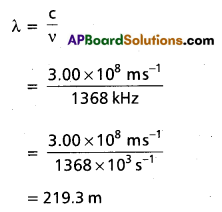
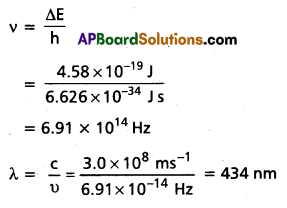
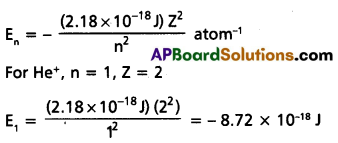
Question 3.
The Vividh Bharati station of All India Radio, Delhi, broadcasts on a frequency of 1,368 kHz (kilo hertz). Calculate the wavelength of the electro-magnetic radiation emitted by transmitter. Which part of the electromagnetic specturm does it belong to?
Solution:
The wavelength, λ, is equal to c/v. where c is the speed of electromagnetic radiation in vacuum and v is the frequency. Substituting the given values, we have
AP Inter 1st Year Chemistry Study Material Chapter 1 Atomic Structure 34

Question 4.
The wavelength range of the visible spectrum extends from violet (400 nm) to red (750 nm). Express these wave
lengths in frequencies (Hz). (1 nm = 10-9 m).
Solution:
Using c = v λ frequency of violet light.
V = \(\frac{\mathrm{c}}{\mathrm{v}}=\frac{3.00 \times 10^8 \mathrm{~ms}^{-1}}{400 \times 10^{-9} \mathrm{~m}}\)
= 7.50 × 10¹⁴ Hz
Frequency of red light
v = \(\frac{c}{v}=\frac{3.00 \times 10^8 \mathrm{~ms}^{-1}}{750 \times 10^{-9} \mathrm{~m}}\) = 4.00 × 10¹⁴ Hz
The range of visible spectrum is from
4.0 × 10¹⁴ to 7.5 × 10¹⁴Hz in terms of frequency units.

Question 5.
Calculate
(a) wave number and
(b) frequency of yellow radiation having wavelength 5000 A.
Solution:
(a) Calculation of wavenumber \((\bar{v})\)
λ = 5800 A = 5800 × 10-8 cm
= 5800 × 10-10m
\((\bar{v})\) = \(\frac{1}{\lambda}=\frac{1}{5800 \times 10^{-10} \mathrm{~m}}\)
= 1.724 × 10⁶m-1
= 1.724 × 104 cm-1

Question 6.
Calculate energy of one mole of photons of radiation whose frequency is 5 × 10¹⁴ Hz.
Solution:
Energy (E) of one photon is given by the expression
E = hv .
h = 6.626 × 10⁻³⁴ J s
v = 5 × 10¹⁴ s-1 (given)
E = (6.626 × 10⁻³⁴J s) × (5 × 10¹⁴ s-1)
= 3.313 × 10⁻¹⁹ J
Energy of one mole of photons
= (3.313 × 10⁻¹⁹J) × (6.022 × 10²³ mol-1)
= 199.51 kJ mol-1.

Question 7.
A 100 watt bulb emits monochromatic light of wavelength 400 nm. Calculate the number of photons emitted per second by the bulb.
Solution:
Power of the bulb = 100 watt
= 100 J s-1
Energy of one photon E = hv = hc/λ.
= \(\frac{6.626 \times 10^{-34} \mathrm{Js} \times 3 \times 10^8 \mathrm{~m} \mathrm{~s}^{-1}}{400 \times 10^{-19} \mathrm{~m}}\)
= 4.969 × 10⁻¹⁹J
Number of photons emitted
\(\frac{100 \mathrm{~J} \mathrm{~s}^{-1}}{4.969 \times 10^{-19} \mathrm{~J}}\) = 2.012 × 10²⁰ s-1

Question 8.
When electromagnetic radiation of wavelength 300 nm falls on the surface of sodium, electrons are emitted with a kinetic energy of 1.68 × 10⁵ J mol-1. What is the minimum energy needed to remove an electron from sodium? What is the maximum wavelength that will cause a photoelectron to be emitted?
Solution:
The energy (E) of a 300 nm photon is given by
hv = hc/λ.
= \(\frac{6.626 \times 10^{-34} \mathrm{Js} \times 3.0 \times 10^8 \mathrm{~m} \mathrm{~s}^{-1}}{300 \times 10^{-9} \mathrm{~m}}\)
= 6.626 × 10⁻¹⁹ J
The energy of one mole of photons
= 6.626 × 10-19 J × 6.022 × 1023 mol-1
= 3.99 × 10⁵ mol-1
The minimum energy needed to remove one mole of electrons from sodium
= (3.99 – 1.68) 105 J mol-1
= 2.31 × 10⁵ J mol-1
The minimum energy for one electron
= \(\frac{2.31 \times 10^5 \mathrm{~J} \mathrm{~mol}^{-1}}{6.022 \times 10^{23} \text { elelctrons } \mathrm{mol}^{-1}}\)
= 3.84 × 10⁻¹⁹J
This corresponds to the wavelength
∴ λ = \(\frac{\mathrm{hc}}{\mathrm{E}}\)
= \(\frac{6.626 \times 10^{-34} \mathrm{~J} \mathrm{~s} \times 3.0 \times 10^8 \mathrm{~m} \mathrm{~s}^{-1}}{3.84 \times 10^{-9} \mathrm{~J}}\)
= 517 nm
(This corresponds to green light)

Question 9.
The threshold frequency v0 for a metal is 7.0 × 10¹⁴ s-1. Calculate the kinetic energy of an electron emitted when radiation of frequency v = 1.0 × 10¹⁵ s-1 hits the metal.
Solution:
According to Einstein’s equation
Kinetic energy = 1/2 mev2 = h(v – v0)
= (6.626 × 10⁻³⁴ J s)
(1.0 × 10¹⁵ s-1 – 7.0 × 10¹⁴ s-1)
= (6.626 × 10⁻³⁴ J s)
(10.0 × 10¹⁴s-1 – 7.0 × 10¹⁴s-1)
= (6.626 × 10⁻³⁴ J s)
(3.0 × 10¹⁴s-1) = 1.988 × 10⁻¹⁹ J

Question 10.
What are the frequency and wave-length of a photon emitted during a transition from n = 5 state to the n = 2 state in the hydrogen atom?
Solution:
Since n1 = 5 and nf = 2, this transition gives rise to a spectral line in the visible region of the Balmer series. From ΔE = \(\mathrm{R}_{\mathrm{H}}\left(\frac{1}{\mathrm{n}_i^2}-\frac{1}{\mathrm{n}_{\mathrm{f}}^2}\right)\)
= 2.18 × 10⁻¹⁸J\(\left(\frac{1}{n_i^2}-\frac{1}{n_f^2}\right)\)
ΔE = 2.18 × 10⁻¹⁸J\(\left(\frac{1}{5^2}-\frac{1}{2^2}\right)\)
= -4.58 × 10⁻¹⁹ J.
It is an emission energy.
The frequency of the photon (taking energy in terms of magnitude) is given by
AP Inter 1st Year Chemistry Study Material Chapter 1 Atomic Structure 35

Question 11.
Calculate the energy associated with the first orbit of He+. What is the radius this orbit?
Solution:
AP Inter 1st Year Chemistry Study Material Chapter 1 Atomic Structure 36
The radius of the orbit is given by
AP Inter 1st Year Chemistry Study Material Chapter 1 Atomic Structure 37

Question 12.
What will be the wavelength of a ball of mass 0.1 kg moving with a velocity of 10 m s-1?
Solution:
According to de Brogue λ = \(\frac{h}{m V}=\frac{h}{p}\)
λ = \(\frac{\mathrm{h}}{\mathrm{mv}}\) = \(\frac{\left(6.626 \times 10^{-34} \mathrm{Js}\right)}{(0.1 \mathrm{~kg})\left(10 \mathrm{~m} \mathrm{~s}^{-1}\right)}\)
= 6.626 × 10⁻³⁴m (J = kg m2 s-2)

Question 13.
The mass of an electron is 9.1 × 10⁻³¹ kg. If its K.E. is 3.0 × 10⁻²⁵ J, calculate its wavelength.
Solution:
AP Inter 1st Year Chemistry Study Material Chapter 1 Atomic Structure 38

Question 14.
Calculate the mass of a photon with wavelength 3.6 A.
Solution:
λ = 3.6 A = 36 × 10-10 m
Velocity of photon = velocity of light
m = \(\frac{\mathrm{h}}{\lambda v}=\frac{6.626 \times 10^{-34} \mathrm{Js}}{\left(3.6 \times 10^{-10} \mathrm{~m}\right)\left(3 \times 10^8 \mathrm{~m} \mathrm{~s}^{-1}\right)}\)
= 6.135 × 10⁻²⁹kg

Question 15.
A microscope using suitable photons is employed to locate an electron in an atom within a distance of 0.1 A. What
is the uncertainty involved in the measurement of its velocity?
Solution:
∆x ∆p = \(\frac{h}{4 \pi}\) or ∆x m∆v = \(\frac{h}{4 \pi}\)
∆v = \(\frac{h}{4 \pi \Delta x m}\)
∆v = \(\frac{6.626 \times 10^{-34} \mathrm{Js}}{4 \times 3.14 \times 0.1 \times 10^{-10} \mathrm{~m} \times 9.1 \times 10^{31} \mathrm{kc}}\)
= 0.579 × 10⁷ m s-1 (1 J = 1 kg m2 s-2)
= 5.79 × 10⁶ ms-1

Question 16.
A golf ball has a mass of 40g and a speed of 45 m/s. If the speed can be measured within accuracy of 2%, calculate the uncertainty in the position.
Solution:
The uncertainty in the speed is 2%, i.e.,
4 × \(\frac{2}{100}\) = 0.9 ms-1
Using the λ = \(\frac{\mathrm{h}}{\mathrm{mv}}=\frac{\mathrm{h}}{\mathrm{p}}\)
Δx = \(\frac{h}{4 \pi m \Delta v}\)
= \(\frac{6.626 \times 10^{-34} \mathrm{Js}}{4 \times 3.14 \times 40 \mathrm{~g} \times 10^{-3} \mathrm{~kg} \mathrm{~g}^{-1}\left(0.9 \mathrm{~ms}^{-1}\right)}\)
= 1.46 × 10⁻³³ m
This is nearly \(\sim\) 1018 times smaller than the diameter of a typical atomic nucleus. As mentioned earlier for large particles, the uncertainty principle sets no meaningful limit to the precision of measurements.

Question 17.
What is the total number of orbitals associated with the principal quantum number n = 3?
Solution:
For n = 3, the possible values of 1 are 0, 1 and 2. Thus there is one 3s orbital (n = 3, l = 0 and ml = 0); there are three 3p orbitals
(n = 3, 1 = 1 and ml = -1, 0, +1); there are five 3d orbitais (n = 3, l = 2 and ml = -2, -1, 0, +1, +2).
Therefore, the total number of orbitals is 1 + 3 + 5 = 9
The same value can also be obtained by using the relation; number of orbitals = n2,
i.e. 32 = 9

Question 18.
Using s, p, d, f notations, describe the orbital with the following quantum numbers
(a) n = 2, l = 1,
(b) n = 4, l = 0,
(c) n = 5, l = 3,
(d) n = 3, l = 2
Solution:
AP Inter 1st Year Chemistry Study Material Chapter 1 Atomic Structure 39

Question 19.
Calculate its wave length of 1st line in Balmer series of hydrogen spectrum.
Solution:
Ryd berg’s equation \(\bar{v}\) = \(\frac{1}{\lambda}\) = \(\mathrm{R}_{\mathrm{H}}\left[\frac{1}{\mathrm{n}_1^2}-\frac{1}{\mathrm{n}_2^2}\right]\)
For the 1st line of Balmer series
n1 = 2, n2 = 3
R = 1,09,677 cm-1
\(\bar{v}\) = \(\frac{1}{\lambda}\) = 1,09,677\(\left[\frac{1}{2^2}-\frac{1}{3^2}\right]\)
= 1,09,677 × \(\frac{5}{36}\)
Wave no. \((\bar{v})\) = 15232.9 cm-1
Wave length λ = \(\frac{1}{\bar{v}}\) = \(\frac{1}{15232.9}\) = 6.5 × 10⁻⁵ cm-1

Question 20.
Calculate the shortest wave length in lyman series of hydrogen spectrum (RH = 1,09,677 cm-1).
Solution:
To calculate shortest wave length
AP Inter 1st Year Chemistry Study Material Chapter 1 Atomic Structure 40

Question 21.
What is the maximum no.of emission lines when the excited electron of a ‘H’ atom in n =6 drops to ground state.
Solution:
The no. of spectral lines found when an electron return from nth orbit to ground state.
= \(\frac{n(n-1)}{2}\) = \(\frac{6(6-1))}{2}\) = \(\frac{30}{2}\) = 15

Question 22.
Calculate the longest wavelength transition in the paschen series of He+.
Solution:
AP Inter 1st Year Chemistry Study Material Chapter 1 Atomic Structure 41

Question 23.
The no. of waves in the forth Bohr’s orbit of hydrogen is
a) 3
b) 4
c) 9
d) 12
Solution:
AP Inter 1st Year Chemistry Study Material Chapter 1 Atomic Structure 42

Question 24.
It the speed of the electron in 1st Bohr’s orbit of hydrogen is x, then the speed of the electron in the 3rd orbit of hydrogen is
Solution:
Given
Velocity of electron in 1st Bohr’s orbit of hydrogen = x
Velocity of electron in 3rd Bohr’s orbit of hydrogen = \(\frac{x}{n}\) = \(\frac{x}{3}\)

Question 25.
The ratio of radii of the fifth orbits of He+ and Li+2 will be
a) 2 : 3
b) 3 : 2
c) 4 : 1
d) 5 : 3
Solution:
Z2(li)=3
Z1 (He) = 2
\(\frac{r_1}{r_2}\) = \(\frac{Z_2}{Z_1}\) = \(\frac{3}{2}\) = 3 : 2

Question 26.
What is the lowest value of ‘n’ that allows ‘g’ orbitals to exist ?
Solution:
The lowest value of ‘n that allows ‘g’ orbitals to exist is ‘5’.

Question 27.
What is the orbital angular momentum of a d-electron
Solution:
Orbital angular momentum = \(\sqrt{l(l+1)} \frac{\mathrm{h}}{2 \pi}\)
For a d electron l = 2
= \(\sqrt{2(2+1)} \frac{h}{2 \lambda}\)
= \(\frac{\sqrt{6 h}}{2 \lambda}\)

Question 28.
What is the total spin and magnetic moment of an atom with atomic number 7’?
Solution:
Z = 7 (Nitrogen)
Electronic configuration is 1s2 2s2 2p3 (in ground state)
AP Inter 1st Year Chemistry Study Material Chapter 1 Atomic Structure 43

Question 29.
The quantum number of electrons are given below. Arrange in order of increasing energies.
AP Inter 1st Year Chemistry Study Material Chapter 1 Atomic Structure 44
Solution:
a) 4d
b) 3d
c) 4p
d) 3d
e) 3p
f) 4p
∴ Increasing order of energy
e < b = d < c = f < a

Question 30.
If the value of n + l = 7 then what should be the increasing order of energy of the possible subshells.
Solution:
Given
n + l = 7
AP Inter 1st Year Chemistry Study Material Chapter 1 Atomic Structure 45
∴ The increasing order of energy
4f < 5d < 6p < 7s
(According Aufbau principle)

Question 31.
Which of the following sets of quantum number is not permitted?
a) n = 3, l = 3, m = +1, s = +\(\frac{1}{2}\)
b) n = 3, l = 3, m = +2, s = –\(\frac{1}{2}\)
c) n = 3, l = 1, m = +2, s = –\(\frac{1}{2}\)
d) n = 3, l = 0, m = 0, s = +\(\frac{1}{2}\)
Solution:
Only d is permitted i.e., 3s1
In a, b n = l but n always > l
in c m = + 2 is not permitted
Because l = 1,’m’ has -1, 0, +1 values only.

Question 32.
Ground state electronic configuration of nitrogenators can be represented as
AP Inter 1st Year Chemistry Study Material Chapter 1 Atomic Structure 46
Solution:
(a) and (d) are correct representations.

Question 33.
Which of the following is possible
a) 3f
b) 4d
c) 2d
d) 3p
Solution:
4d and 3p are possible.

AP Inter 2nd Year Chemistry Important Questions Chapter 6(b) Group-16 Elements

Students get through AP Inter 2nd Year Chemistry Important Questions Lesson 6(b) Group-16 Elements which are most likely to be asked in the exam.

AP Inter 2nd Year Chemistry Important Questions Lesson 6(b) Group-16 Elements

Very Short Answer Questions

question 1.
Write any two compounds, in which oxygen shows an oxidation state different from -2. Give the oxidation states of oxygen in them.
Answer:
OF2 and O2 F2 are two compounds in which oxygen shows an oxidation state different from -2.

  • In OF2 the oxidation state of oxygen is +2.
  • In O2F2 the oxidation state of oxygen is +1.

Question 2.
Why H2O a liquid while H2S Is a gas? ( IPE May – 2014)
Answer:
H2O is liquid due to the presence of intermolecular hydrogen bonding. While H2S is gas because it is not having such type of bonding.

AP Inter 2nd Year Chemistry Important Questions Chapter 6(b) Group-16 Elements

Question 3.
H2O is neutral while H2S is acidic — explain.
Answer:
H2O is neutral while H2S is acidic.
Reason: The O-H bond dissociation enthalpy is greater than the S — H bond dissociation enthalpy.

Question 4.
Explain the structures of SF4 and SF6.
Answer:
Structure of SF4:

  • In SF4 ‘S’ undergoes sp3d hybridisation.
  • It has trigonal bipyramidal structure in which one of the equitorial positions is occupied by a lone pair of electrons. This geometry is also known as see – saw geometry.
    Structure of SF6:
  • In SF6, ‘S’ undergoes sp3d2 hybridisation,
  • It has octahedral structure.

Question 5.
Give one example each for
a) a neutral oxide
b) a peroxide
c) a super oxide
Answer:
a) CO, N2O are neutral oxides.
b) Na2O2, BaO2 are peroxides.
c) KO2, RhO2 are super oxides.

AP Inter 2nd Year Chemistry Important Questions Chapter 6(b) Group-16 Elements

Question 6.
What is tailing of mercury? How is it removed? (IPE Mar – 2015 (TS))
Answer:
Mercury loses it’s lustreness, meniscus and consequently sticks to the walls of glass vessel when it reacts with ozone. This phenomenon is called tailing of mercury
2Hg + O3 → Hg2O + O2
It is removed by shaking it with water which dissolves Hg2O.

Question 7.
How does ozone react with Ethylene?
Answer:
Ethylene reacts with ozone to form Ethylene ozonoid followed by the hydrolysis to form formaldehyde.
AP Inter 2nd Year Chemistry Important Questions Chapter 6(b) Group-16 Elements 1

Question 8.
Which form of sulphur shows paramagnetism?
Answer:
In vapour state sulphur partly exists as S2 molecule which has two unpaired electrons in the antibonding π (π*)orbitals like O2. Hence it exhibits paramagnetism.

Question 9.
Why are group — 16 elements called chalçogens ?
Answer:
Chalcogens means mineral forming (or) ore forming elements. Most of elements exist in earth crust as oxides, sulphides, selinides, telurids etc. So Group – 16 elements are called as chalcogens.

Question 10.
Write any two uses each for O3 and H2SO4.
Answer:
Uses of O3:

  • Ozone is used in sterilisation of water.
  • Ozone is used in manufacture of artificial silk and camphor etc.
  • Ozone is used to identify unsaturation in carbon compounds.

Uses of H2SO4:

  • H2SO4 is used in the manufacture of fertilisers.
  • H2SO4 is used in petrol refining.
  • H2SO4 is used in detergent industry.

AP Inter 2nd Year Chemistry Important Questions Chapter 6(b) Group-16 Elements

Short Answer Questions

Question 1.
Write a. short note on the allotropy of sulphur.
Answer:
The important allotropes of sulphur are
a) yellow rhombic (α. sulphur).
b) Monoclinic (β – sulphur).

The stable from is α-sulphur (at room temperature).
Rhombic sulphur (α – Sulphur):

  • Colour : Yellow.
  • Melting point : 3858K.
  • Specific gravity: 2.06.
  • It is insoluble in water and partially soluble in alcohol, benzene etc., and readily soluble in CS2.

Monoclinic sulphur (β – Sulphur):

  • Melting point: 392K
  • Specific gravity: 1.98.
  • It is soluble in Cs2.
  • Rhombic sulphur transforms to monoclinic sulphur by heating above 369K. This temperature is called transition temperature.

Question 2.
Which is used for drying ammonia?
Answer:
For drying ammonia quick lime (CaO) is used.

  • For drying ammonia conc. H2SO4 , P4O10 and anhydrous CaCl2 cannot be used because they react with ammonia and forms (NH4)2SO4, (NH4)3PO4 and CaCl2. 8NH3

AP Inter 2nd Year Chemistry Important Questions Chapter 6(b) Group-16 Elements 2

Question 3.
Explain the conditions favourable for the formation of SO3 from SO2 in the contact process of H2SO4.
Answer:
Le Chatlier’s principle — Application to produce SO3:
The oxidation of SO2 to SO3 in the presence of a catalyst is a reversible reaction. The thermochemical equation for the conversion is written as
AP Inter 2nd Year Chemistry Important Questions Chapter 6(b) Group-16 Elements 3

The equation reveals the following points:

  1. 3 volumes of the reactants convert into 2 volumes of SO3. i.e., a decrease of volume accompanies the reaction.
  2. the reaction is an exothermic change.
  3. the catalyst may be present to increase the SO3 yields.

According to Le Chattier’s principle,

i. a decrêase in volume of the system is favoured at high pressures. But in practice only about 2 bar pressure is used. The reason for not using high pressures is acid resisting towers which can withstand high pressures cannot be built.

ii. exothermic changes are favoured at low temperatures. It is not always convenient in the industry to work at low temperatures. In such situations an optimum temperature is maintained. At this temperature considerable amounts of the product are obtained, in the manufacture of H2SO4, the optimum temperature suitable for the conversion of SO2 into SO3 is experimentally found to be 720K.

iii. The rate of formation of SO3 is enhanced by the use of a catalyst. (V2O5 (or) Pt – asbestos).
Favourable Conditions:
Temperature: 720K
Pressure :2 bar
Catalyst : V2O5 (or) platinized asbestos.

Question 4.
Which oxide of sulphur can act as both oxidizing and reducing agent? Give one example each.
Answer:
Sulphur dioxide (SO2) acts as both oxidising as well as reducing agent.
SO2 as Oxidising agent:
Sodium sulphide oxidises to hypo with SO2.
2Na2S + 3SO2 → 2Na2S2O3 + S
SO2 as Reducing agent:
SO2 reduces Fe+3 ions to Fe+2 ions.
2Fe+3 + SO2 + 2H2O → 2Fe2+ + \(\mathrm{SO}_4^{-2}\) + 4H+

AP Inter 2nd Year Chemistry Important Questions Chapter 6(b) Group-16 Elements

Long Answer Questions

Question 1.
Explain in detail the manufacture of sulphuric acid by contact process. ( IPE 2016 (TS))
Answer:
Manufacture of H2SO4 by contact process:
Manufacturing of H2SO4 involves three main steps.

Step-I:
SO2 production : The required SO2 for this process is obtained by burning S(or) Iron
pyrites in oxygen.
S + O2 → SO2
4FeS2 + 15O2 → 2Fe2O3 + 8SO3

Step—2
SO3 formation: SO2 is oxidised in presence of catalyst with atmospheric air to form SO3.
AP Inter 2nd Year Chemistry Important Questions Chapter 6(b) Group-16 Elements 4
Le Chatliers principle — Application to produce SO3 ;
The oxidation of SO2 to SO3 in the presence of a catalyst is a reversible reaction. The
thermochemical equation for the conversion is written as
AP Inter 2nd Year Chemistry Important Questions Chapter 6(b) Group-16 Elements 5

The equation reveals the following points:

  1. 3 volumes of the reactants convert into 2 volumes of SO3. i.e., a decrease of volume accompanies the reaction.
  2. The reaction is an exothermic change.
  3. The catalyst may be present to increase the SO3 yields.

According to Le Chatlier’s principle,

  1. a decrease in volume of the system is favoured at high pressures. But in practice only about 2 bar pressure is used. The reason for not using high pressures is acid resisting towers which can withstand high pressures cannot be built.
  2. exothermic changes are favoured at low temperatures. It is not always convenient in the industry to work at low temperatures. in such situations an optimum temperature is maintained. At this temperature considerable amounts of the product are obtained. In the manufacture of H2SO4, the optimum temperature suitable for the conversion of SO2 into SO3 is experimentally found to be 720K.
  3. The rate of formation of SO3 is enhanced by the use of a catalyst. (V2 O5 (or) Pt – asbestos).
    Favourable Conditions:
    Temperature: 720K :
    Pressure : 2 bar
    Catalyst : V2O5 (or) platinized asbestos.
    AP Inter 2nd Year Chemistry Important Questions Chapter 6(b) Group-16 Elements 6

Step-3

  • Formation of H2SO4: SO3 formed in the above step absorbed in 98% H2SO4 to get oleum (H2S2O7). This oleum is diluted to get desired concentration of H2SO4.
    SO3 + H2SO4 → H2S2O7
    H2S2O7 + H2O → H2SO4

AP Inter 2nd Year Chemistry Important Questions Chapter 6(b) Group-16 Elements

Question 2.
How is ozone prepared from oxygen? Explain its reaction with
a) C2H4
b) KI
c) Hg
d) PbS. (T.S. & A.P. Mar. ’17) (A.P.Mar. ’16) (Mar. ’14)
Answer:
Preparation of Ozone:
A slow dry stream of oxygen under silent electric discharge to form ozone (about 10%). The product obtained is known as ozonised oxygen.
3O2 → 2O3 ΔH° = 142kJ/mole .

  • The formation of ozone is an endothermic reaction.
  • It is necessary to use silent electric discharge in the preparation of O3 to prevent its decomposition

a) Reaction with C2H4 : Ethylene reacts with ozone to form Ethylene ozonoid followed by the hydrolysis to for formaldehyde.
AP Inter 2nd Year Chemistry Important Questions Chapter 6(b) Group-16 Elements 7
b) Reaction with KI : Moist KI is oxidised to Iodine in presence of ozone.
2KI + H2O + O3 → 2KOH + I2 + O2
c) Reaction with Hg: Mercury loses it’s lustreness, meniscus and consequently sticks to the walls of glass vessel when it reacts with ozone. This phenomenon is called tailing of mercury.
2Hg + O3 → Hg2O + O2
It is removed by shaking it with water which dissolves Hg2O.
d) Reaction with PbS : Black lead sulphide oxidised to white lead sulphate in presence of ozone.
PbS + 4O3 → PbSO4 + 4O2.

Question 3.
Write the structures of oxoacids of sulphur. (IPE 2016 (TS))
Answer:
Oxoacids of sulphur: Sulphur forms a number of oxoacids such as H2SO3. H2S2O3, H2S2O4, H2S2O5, H2S2O6 (x = 2 to 5), H2SO4, H2S2O7, H2SO5, H2S2O8.
AP Inter 2nd Year Chemistry Important Questions Chapter 6(b) Group-16 Elements 8

Question 4.
Write any two oxidation and any two reduction properties of ozone with equations.
Answer:
Oxidation properties:

  1. Ozone oxidises moist potassium idodide and liberates I2.
    2KI + H2O + O3 → 2KOH + I2 + O2
  2. Ozone oxidises black lead sulphide to white lead sulphate. PbS + 4O3 → PbSO4 + 4O2

Reduction properties:

  1. Ozone reduces H2O2 to H2O.        H2O2 + O3 → H2O + 2O2
  2. Ozone reduces Ag2O to Ag.         Ag2O + O3 → 2Ag + 2O2

AP Inter 2nd Year Chemistry Important Questions Chapter 5 General Principles of Metallurgy

Students get through AP Inter 2nd Year Chemistry Important Questions 5th Lesson General Principles of Metallurgy which are most likely to be asked in the exam.

AP Inter 2nd Year Chemistry Important Questions 5th Lesson General Principles of Metallurgy

Very Short Answer Questions

Question 1.
What is the role of depressant in froth floatation?
Answer:
By using depressants in froth floatation process, it is possible to separate a mixture of two sulphide ores.
Eg: In the ore containing ZnS and PbS, the depressant used is NaCN. It prevents ZnS from coming to the froth but allows PbS to come with the froth.

Question 2.
Explain “poling”. (AP Mar. ’16, ’15; IPE ’16, 15 (AP))
Answer:
When the metals are having the metal oxides as impurities this method is employed. The impure metal is. melted and is then covered by carbon powder. Then it is stirred with green wood poles. The reducing gases formed from the green wood and the carbon, reduce the oxides to the metal.
Eg : Cu & Sn metals are refined by this method.

AP Inter 2nd Year Chemistry Important Questions Chapter 5 General Principles of Metallurgy

Question 3.
Decribe a method for the refining of nickel.
Answer:
Mond’s process:

  • In Mond’s process, nickel is heated in a stream of carbon monoxide forming a volatile complex, nickel tetra carbonyl.
    AP Inter 2nd Year Chemistry Important Questions Chapter 5 General Principles of Metallurgy 1
  • Nickel tetra carbonyl is strongly heated to decompose and gives the pure Nickel.
    AP Inter 2nd Year Chemistry Important Questions Chapter 5 General Principles of Metallurgy 2

Question 4.
What is the role of cryolite in the metallurgy of aluminium ? (IPE 2015 (TS), BMP, 2016 (TS))
Answer:
By adding the cryolite to the pure Alumina, the melting point of pure Alumina is lowered (which is very high 2324K) and electrical conductivity of pure alumina is increased.

Question 5.
Give the composition of the following alloys (IPE ’16, ’14 (TS)) (AP & TS Mar. ’17)
a) Brass
b) Bronze
c) German Silver
Answer:
a) Composition of Brass : 60 – 80% Cu, 20 – 40% Zn
b) Composition of Bronze : 75 – 90% Cu, 10 – 25% Sn
c) Composition of German silver : 50 – 60% Cu, 10 – 30% Ni, 20 – 30% Zn.

AP Inter 2nd Year Chemistry Important Questions Chapter 5 General Principles of Metallurgy

Question 6.
What is matte ? Give its composition.
Answer:
During the extraction of ’Cu’ from copper pyrites the product of the blast furnace consists mostly of Cu2S and a little of FeS. This product is known as “Matte”. It is collected from the outlet at the bottom of the furnace.

Question 7.
What is flux ? Give an example.
Answer:
Flux : An outside substance added to. ore to lower its melting point is known as flux.

  • Flux combines with gangue and forms easily fusible slag.
    gangue + flux → slag
    AP Inter 2nd Year Chemistry Important Questions Chapter 5 General Principles of Metallurgy 3

Question 8.
How is aluminium useful in the extraction of chromium and manganese from their oxides ?
Answer:

  • ‘Al’ is used as reducing agent.
  • By Alumino thermite process Cr, Mn are extracted from their oxides.
  • The reactions are highly exothermic.

Cr2O3 + 2Al → 2Cr + Al2O3
3Mn3O4 + 8Al → 4Al2O3 + 9Mn

AP Inter 2nd Year Chemistry Important Questions Chapter 5 General Principles of Metallurgy

Question 9.
What is a mineral ?
Answer:
The chemical compound from which a metal can be extracted is called a mineral. Bauxite, crayolite are the minerals of aluminium.

Question 10.
What is an ore ?
Answer:
An ore is a mineral from which the metal can be extracted easily and economically. Bauxite is the ore of aluminium.

Question 11.
What is a ore. Give the ores of Al, Zn, Fe, Cu.
Answer:
The mineral from which metal can be extracted economically is called ore.
Aluminium ores : Bauxite = Al2 O3. 2H2O; Cryolite = Na3Al F6
Zinc ores : Zinc blende = Zns; Calamine = ZnCO3
Copper ores : Cuprite: CuO; Copper pyrites = Cu2S
Iron ores : Haematite = Fe2O3 Magnetite = Fe3O4

Question 12.
What is the role of SiO2 in the extraction of copper.
Answer:
In the extraction of copper SiO2 acts as flux. It combines with FeO and removes as slag.
FeO + SiO2 (flux) → FeSiO3 (Slag)

Short Answer Questions

Question 1.
Outline the principles of refining of metals by the following methods.
(a) Zone refining
(b) Electrolytic refining
(c) Poling
(d) Vapour phase refining.
Answer:
a) Zone refining :

  • Zone refining is based on the principle that the impurities are more soluble in the melt than in the solid state of the metal.
  • A circular mobile heater is fixed at one end of a rod of impure metal.
  • The molten zone moves along with the heater moves forward the pure metal crystallises out of the melt and the impurities pass into the adjacent molten zone.

AP Inter 2nd Year Chemistry Important Questions Chapter 5 General Principles of Metallurgy 4

  • The above process is repeated several times and the heater is moved in the same direction form one end to the other end. At one end impurities get concentrated. This end is cut off.
  • This method is very useful for producing semiconductor grade metals of very high purity.
    Eg : Ge, Si, B, Ga etc…

b) Electrolytic refining: This process is used for less reactive metals like Cu, Ag, AZ, Au etc.

  • In this process anode is made by impure metal and a thin strip of pure metal acts as cathode.
  • On electrolysis metal dissolves from anode and pure metal gets deposited at cathode.

AP Inter 2nd Year Chemistry Important Questions Chapter 5 General Principles of Metallurgy 5
Impurities settle down below anode in the form of anode mud.

c) Poling : When the metals are having the metal oxides as impurities this method is employed. The impure metal is melted and is then covered by carbon powder. Then it is stirred with green wood poles. The reducing gases formed from the green wood and the carbon, reduce the oxides to the metal. Eg : Cu & Sn metals are refined by this method.

d) Vapour phase refining: In this method the metal is converted into its volatile compound and coll Ted. It is then decomposed to give pure metal.

  1. The metal should form a volatile compound with an available reagent.
  2. The volatile compound should be easily decomposable. So the recovery is easy.
    E.g : Mond’s process :

    • In Mond’s process, nickel is heated in a stream of carbon monoxide forming a volatile complex, nickel tetra carbonyl,
      AP Inter 2nd Year Chemistry Important Questions Chapter 5 General Principles of Metallurgy 6
    • Nickel tetra carbonyl is strongly heated to decompose and gives the pure Nickel.
      AP Inter 2nd Year Chemistry Important Questions Chapter 5 General Principles of Metallurgy 7

AP Inter 2nd Year Chemistry Important Questions Chapter 5 General Principles of Metallurgy

Question 2.
Explain the purification of sulphide ore by froth floatation method. (Mar ’15) (A.P. Mar. ’17)
Answer:
Froth floatation method :

  • This method is used to concentrate sulphide ores.
  • In this process a suspension of the powdered ore is made with water.
  • A rotating paddle is used to agitate the suspension and air is blown into the suspension in presence of an oil.
  • Froth is formed as a result of blown of air, which carries the mineral particles.
    AP Inter 2nd Year Chemistry Important Questions Chapter 5 General Principles of Metallurgy 8
  • To the above slurry froth collectors and stabilizers are added.
  • Collectors like pine oil enhance non-wettability of the mineral particles.
  • Froth stabilizers like cresol stabilize the froth.
  • The mineral particles wet by oil and gangue particles wet by water.
  • The broth is light and is skimmed off. The ore particles are then obtained from the froth. By using depressants in froth floatation process, it is possible to separate a mixture of two suplhide ores. Eg: In the ore containing ZnS and PbS, the depressant used is NaCN. It prevents ZnS from coming to the froth but allows PbS to come with the froth.

Question 3.
What is Ellingham diagram ? What information can be known from this in the reduction of oxides ?
Answer:
The graphical representation of Gibbs energy which provides a sound basis for considering the choice of reducing agent in the reduction of oxides. This graphical representation is known as Ellingham diagram.
This diagram helps us in predicting the feasibility of thermal reduction of an ore.
AP Inter 2nd Year Chemistry Important Questions Chapter 5 General Principles of Metallurgy 9

  • The Criterion of feasibility of a reaction is that at a given temperature, Gibbs energy of the reaction must be negative.
  • Ellingham diagram normally consists plots of ΔG° vs T for formation of oxides of elements.
  • The graph indicates whether a reaction is possible or not, i.e., the tendency of reduction with a reducing agent is indicated.
  • The reducing agent forms its oxide when the metal oxide is reduced. The role of reducing agent is to make the sum of ΔG° values of the two reactions negative.
  • Out of C and CO, Carbon monoxide (CO) is a better reducing agent at 673K.
  • At 983K (or) above coke(C) is better reducing agent.
  • The above observations are from Ellingham diagram.
    Zinc is not extracted from zinc oxide through reduction by using CO.

Explanation :
2Zn + O2 → 2ZnO, ΔG° = -650 kJ
2CO + O2 → 2CO2, ΔG° = -450 kJ
2ZnO + 2CO → 2Zn, 2CO2, ΔG° = 200 kJ
ΔG° = Positive indicates that the reaction is not feasible.
The above fact is explained on the basis of Ellingham diagram.

AP Inter 2nd Year Chemistry Important Questions Chapter 5 General Principles of Metallurgy

Question 4.
Give examples to differentiate roasting and calcination. (IPE ’14, B.M.P. 2016) (A.P. & T.S. Mar. ’16, ’15)
Answer:
Roasting: Removal of the volatile components of a mineral by heating mineral either alone (or) mixed with some other substances to a high temperature in the presence of air is called Roasting.

  • It is applied to the sulphide ores.
  • SO2 gas is producted along with metal oxide.
    AP Inter 2nd Year Chemistry Important Questions Chapter 5 General Principles of Metallurgy 10

Calcination: Removed of the volatile components of a mineral by heating in the absence of air is called calcination.

  • It is applied to carbonates and bicarbonates.
  • CO2 gas is produced along with metal oxide.

AP Inter 2nd Year Chemistry Important Questions Chapter 5 General Principles of Metallurgy 11

Question 5.
How is copper extracted from copper pyrites ?
Answer:
Extraction of copper from copper pyrites :
Copper pyrite is the main source of copper metal. Various steps involved in the extraction of copper are discussed below.

Step -I:

Concentration of ore by froth floatation process :
The ore is first crushed in ball mills. The finely divided ore is suspended in water. A little pine oil is added and the mixture is vigorously’ agitated by a current of air. The froth formed carries the ore particles almost completely. The gangue sinks to the bottom of the tank. The froth is separated and about 95% concentrated ore is obtained.

Step -II:

Roasting : To remove the volatile impurities like As (or) Sb, the ore is roasted in a free supply of air. A mixture of sulphides of copper and iron are obtained and these are partially oxidised to respective oxides.
Cu2S. Fe2S3 + O2 → Cu2S + 2FeS + SO2
2Cu2S + 3O2 → 2Cu2O + 2SO2
2FeS + 3O2 → 2FeO + 2SO2

Step -III: .

The roasted ore is mixed with a little coke and sand (Silica) and smelted in a blast furnace and fused. A blast of air, necessary for the combustion of coke, is blown through the tuyeres present at the base of the furnace.’ The oxidation of the sulphides of copper and iron will be completed further. A slag of iron silicate is formed according to the reactions given below :
AP Inter 2nd Year Chemistry Important Questions Chapter 5 General Principles of Metallurgy 12

Step -IV :

After smelting the copper ore in blast furnace, the product of the blast furnace consists mostly of Cu2S and a little of ferrous sulphide. This product is known as “Matte.” It is collected from the outlet at the bottom of the furnace. After then the following processes are carried out for getting the pure copper.

Bessemerization : The matte is charged into a Bessemer converter. A bessemer converter is a pear-shaped furnace. It is made of steel plates. The furnace is given a basic lining with lime or magnesium oxide (obtained from dolomite or magnesite). The converter is held in position by trunnions and can be tilted in any position. A hot blast of air and sand is blown through the tuyeres present near the bottom. Molten metal, the product in the furnace, collects at the bottom of the converter.

Reactions that took place in blast furnace go to completion. Almost all of iron is eliminated slag. Cuprous oxide combines with cuprous sulphide and forms Cu metal.
2Cu2O + Cu2S → 6Cu + SO2
The molten metal is cooled in sand moulds. SO2 escapes. The impure copper metal is known as ‘Blister copper” and is about 98% pure.
AP Inter 2nd Year Chemistry Important Questions Chapter 5 General Principles of Metallurgy 13

Step -V:

Refining: The Blister copper is purified by electrolysis. The impure copper metal is made into plates. They are
suspended into lead — lined tanks containing Copper (II) Sulphate solution. Thin plates of pure copper serve as
cathode. The cathode plates are coated with graphite. On electrolysis, pure copper is deposited at the cathode. The
copper obtained is almost 100% pure Cu.

AP Inter 2nd Year Chemistry Important Questions Chapter 5 General Principles of Metallurgy

Question 6.
Explain the process of leacing of aluminium from bauxite.
Answer:
Extraction of Aluminium from Bauxite:
For the purpose of extraction of Al, Bauxite is the best source.
Purification of Bauxite: Bauxite containing Fe2O3 as impurity is known as Red Bauxite.
Bauxite containing SiO2 as impurity is known as White Bauxite and can be purified by “Set-peck’s Process. Red Bauxite is purified by Bayer’s process and Hall’s process.

Bayer’s Process: Red bauxite is roasted and digested in concentrated NaOH at 423 K. Bauxite dissolves in NaOH to form sodium meta aluminate while impurity Fe2O3 does not dissolve which can be removed by filtration.
Al2O3.2H2O + 2NaOH → 2NaAlO2 + 3H2O
The solution which contains sodium meta aluminate is diluted and crystals of Al(OH)3, are added which serves as seeding orgent. Sodium meta aluminate undergoes hydrolysis to precipitate Al(OH)3.
2NaAlO2 + 4H2O → 2NaOH + 2Al(OH)3
Al(OH)3 is filtered and ignited at 1200°C to get anhydrous alumina.
AP Inter 2nd Year Chemistry Important Questions Chapter 5 General Principles of Metallurgy 14
Halls’ Process: Red Bauxite is fused with sodium carbonate to form sodium meta aluminate
which is extracted with water. The impurity Fe2O3 is filtered out.
Al2O3 + Na2CO3 → 2NaAlO2 + CO2
Into the solution of sodium meta aluminate, CO2 gas is passed to precipitate Al(OH)3.
AP Inter 2nd Year Chemistry Important Questions Chapter 5 General Principles of Metallurgy 15
The precipitated Al(OH)3 is ignited at 1200°C to get anhydrous alumina.
2Al(OH)3 → Al2O3 + 3H2O

Serpeck’s Process: Powdered bauxite is mixed with coke and heated to 2075 K in a current of nitrogen gas. Aluminium Nitride is formed while SiO2 is reduced to Si which escapes out.
AP Inter 2nd Year Chemistry Important Questions Chapter 5 General Principles of Metallurgy 16
Aluminium nitride is hydrolysed to get aluminium hydroxide which on ignition gives anhydrous alumina.
AP Inter 2nd Year Chemistry Important Questions Chapter 5 General Principles of Metallurgy 17
Electrolytic Reduction of Alumina: Pure Alumina (Al2O3) is a bad conductor of electricity and it has high melting point (2050°C). So it cannot be electrolysed. Alumina is electrolysed by dissolving in fused cryolite to increase the conductivity and small amount of Fluorspar is added to reduce its melting point. Thus the electrolyte is a fused mixture of Alumina, Cryolite and Fluorspar.
AP Inter 2nd Year Chemistry Important Questions Chapter 5 General Principles of Metallurgy 18
Electrolysis is carried out in an iron tank lined inside with graphite (carbon) which functions as cathode. A number of carbon rods (or) copper rods suspended in the electrolyte functions as anode.

An electric current of 100 amperes at 6 to 7 volts is passed through the electrolyte. Heat produced by the current keeps the mass in fused state at 1175 to 1225K. The following reactions take place in the electrolytic cell under these conditions.
Na3AlF6 → 3NaF + AlF3
Cryolite
4AlF3 → 4Al3+ + 12F
At cathode : 4Al3+ + 12e → 4Al
At anode : 12F → 6F2 + 12e
F2 formed at the anode reacts with alumina and forms Aluminium fluoride.
2Al2O3 + 6F2 → 4AlF3 + 3O2
Aluminium, produced at the cathode, sinks to the bottom of the cell. It is removed from time to time through topping hole.

Purification of Aluminium: (Hoope’s Process)

The impurities present are Si, Cu, Mn etc.,
The electrolytic cell used for refining of aluminium consists of iron tank lined inside with
carbon. This acts as anode. The tank contains three layers of fused masses. The bottom layer
contains impure aluminium. Middle layer contains mixture of AlF3, NaF and BaF2 saturated with Al2O3. Top layer contains pure aluminium and graphite rods kept in it act as cathode.
AP Inter 2nd Year Chemistry Important Questions Chapter 5 General Principles of Metallurgy 19
On passing current aluminium ions from the middle layer are discharged at the cathode as pure aluminium. Equivalent amount of aluminium from the bottom layer passes into middle layer.

Question 7.
Explain the reactions occuring in the blast furnace in the extraction of iron.
Answer:
In the Blast furnace, reduction of iron oxides takes place in different temperature ranges. Hot air is blown from the bottom of the furnace and coke is burnt to give temperature upto about 2200K in the lower portion itself, The burning of coke therfore supplies most of the heat required in the process. The CO and heat moves to upper part of the furnace. In upper part, the temperature is lower and the iron oxides (Fe2O3 and Fe3O4) coming from the top are reduced in steps to FeO. Thus, the reduction reactions taking place in the lower temperature range and in the higher temperature range, depend on the points of corresponding intersections in the ΔrGθ vs T plots. These reactions can be summarised as follows:
AP Inter 2nd Year Chemistry Important Questions Chapter 5 General Principles of Metallurgy 20

At 500 — 800 K (lower temperature range in the blast furnace)
3 Fe2O3 + CO → 2 Fe3O4 + CO2
Fe3O4 + 4CO → 3 Fe + 4 CO2.
Fe2O3 + CO → 2 FeO + CO2
At 900- 1500 K (higher temperature range in the blast furnace)
C + CO2 → 2 CO
FeO + CO → Fe + CO2
Lime stone is also decomposed to CaO which removes silicate impurity of the ore as CaSiO3 slag. The slag is in molten state and separåtes out from iron.

The iron obtained from blast furnace contains about 4% carbon and many impurities in smaller amount (e.g., S, P, Si, Mn). This is known as pig iron. Cast iron is different from and is made by melting pig iron with scrap iron and coke using hot air blast. It has slightly lower carbon content (about 3%) and is extremely hard and brittle.
Fe2O3 + 3 C → 2 Fe + 3 CO

AP Inter 2nd Year Chemistry Important Questions Chapter 4 Surface Chemistry

Students get through AP Inter 2nd Year Chemistry Important Questions 4th Lesson Surface Chemistry which are most likely to be asked in the exam.

AP Inter 2nd Year Chemistry Important Questions 4th Lesson Surface Chemistry

Very Short Answer Questions

Question 1.
What is adsorption ? Give one example.
Answer:
Adsorption : The accumulation (or) concentration of a substance on the surface rather than in the bulk of solid (or) liquid is known as adsorption.
Eg : Adsorption of gases like O2, H2, Cl2 etc., on charcoal.

Question 2.
What is absorption ? Give one example.
Answer:
Absorption : The uniform distribution of a substance through out the bulk of the solid substance is known as absorption.
Eg : Chalk stick dipped in ink.

AP Inter 2nd Year Chemistry Important Questions Chapter 4 Surface Chemistry

Question 3.
What is desorption ?
Answer:
Desorption : The process of removing an adsorbed substance from a surface on which it is adsorbed is called desorption.

Question 4.
What is sorption ? (or) What is the name given to the phenomenon when both absorption and adsorption take place together ?
Answer:
The process in which both adsorption and absorption takes place simultaneously is called sorption.

Question 5.
Give any two applications of adsorption.
Answer:
Applications of adsorption :
a) Separation of inert gases : Different noble gases adsorb at different temperatures on coconut charcoal. By this principle (adsorptipn) mixture of noble gas is separated by adsorption on coconut charcoal.

b) Gas masks : Gas mask is a device which consists of activated charcoal (or) mixture of adsorbents is used by coal miners to adsorb poisonous gases during breathing.

Question 6.
What is an adsorption isotherm ? Write the equation of Freundlich adsorption isotherm.
Answer:
Adsorption Isotherm : The variation in the amount of gas adsorbed by the adsorbent with pressure at constant temperature can be expressed by means of a curve known as adsorption isotherm.

  • Freundlich adsorption isotherm equation is \(\frac{\mathrm{x}}{\mathrm{m}}\) = k. P1/n
    x = mass of the gas adsorbed
    m = mass of the adsorbent
    P, k and n are constants.

AP Inter 2nd Year Chemistry Important Questions Chapter 4 Surface Chemistry

Question 7.
Define “promoters” and “poisons” in the phenomenon of catalysis. ‘
Answer:
Promoters: The substances which enhance the activity of catalyst are known as promoters.
Poisons : The substances which decrease the activity of a catalyst are known as poisons.

Question 8.
What is homogeneous catalysis ? How is it different from heterogeneous catalysis ?
Answer:
Homogeneous Catalysis : The catalysis in which reactants and catalyst are in same phase is called Homogeneous catalysis.

  • In case of heterogeneous catalysis, catalyst and reactants are present in different phases where as in case of homogeneous catalysis catalyst and reactants are present in same phase.

Question 9.
What are enzymes ? What is their role in human body ?
Answer:
Enzymes are complex nitrogenous organic compounds which are produced by living plants and animals.

  • These act as specific catalysts in biological reactions.
  • These catalyse the numerous reactions that occur in the bodies of animals and plants to maintain the life process.

Question 10.
Name any two enzyme catalyzed reactions. Give the reactions.
Answer:
1) Inversion of Cane Sugar :
AP Inter 2nd Year Chemistry Important Questions Chapter 4 Surface Chemistry 12

2) Decomposition of urea into ammonia and CO2 :
AP Inter 2nd Year Chemistry Important Questions Chapter 4 Surface Chemistry 13

AP Inter 2nd Year Chemistry Important Questions Chapter 4 Surface Chemistry

Question 11.
What is critical micelle concentration (CMC) and kraft temperature (Tk) ?
Answer:
The formation of micelles takes place only above a particular temperature called Kraft temperature (Tk) and above a particular concentration called Critical micelle concentration (CMC).

Question 12.
What is Peptization ?
Answer:
Peptization : The process of converting a precipitate into colloidal sol by shaking it with the dispersion medium in the presence of a small amount of electrolyte is called Peptization.

Question 13.
What is Brownian movement.
Answer:
Brownian movement: This is a kinetic property of colloidal solution.
AP Inter 2nd Year Chemistry Important Questions Chapter 4 Surface Chemistry 14
When a colloidal solution is examined by ultramicroscope, the colloidal particles are seemed to be moving in a rapid zig-zag motion.
This rapid motion of colloidal particles is called Brownian movement.
This motion is due to unequal bombardment of colloidal particles by molecules of dispersion medium. Smaller the colloidal particles the more rapid is the Brownian movement.

Question 14.
What is Tyndall effect ?
Answer:
Tyndall effect : When light enters a colloidal solution, it is scattered by the large sized colloidal dispersed phase particles. Therefore when light passes through a solution we will be able to see the path of the light as a luminous beam. This is called Tyndall effect.

This is an optical property exhibited by colloidal solution. This phenomenon is clearly seen with a microscope placed at right angles to the path of light. Colloidal particles become self luminous due to absorption of light. A true solution does not show Tyndall effect.

Question 15.
What is electrokinetic potential or zeta potential ?
Answer:
In a colloidal sol the charges of opposite signs on the fixed and diffused parts of the double layer results in a difference in potential between these layers. The potential difference between the fixed layer and the diffused layer of opposite charge is called electro kinetic potential (or) zeta potential.

Question 16.
What is electrophoresis ?
Answer:
When electric potential is applied across two platinum electrodes dipping in a colloidal solution, the colloidal particles move towards one or the other electrode. The movement of colloidal particles under an applied emf is called “electrophoresis”.

AP Inter 2nd Year Chemistry Important Questions Chapter 4 Surface Chemistry

Question 17.
What is coagulation ?
Answer:
The stability of the lyophilic sols is due to the presence of charge on the colloidal particles. If this charge is neutralised the particles will come nearer to each other to form aggregates (or coagulate) and settle down under the force of gravity. This process of settling downward colloidal particles is called coagulation (or) flocculation (or) precipitation.

Question 18.
State Hardy – Schulze rule.
Answer:
Greater the valence of the coagulating ion added, the greater is its power to cause coagulation. This is known as Hardy-Schulze rule.

Question 19.
What is protective colloid ?
Answer:
Lyophilic colloids used for the prevention of coagulation of lyophobic colloids are called protective colloids.

  • Lyophilic colloids protect the lyophobic colloids. .

Question 20.
What is an emulsion ? Give two examples. (AP Mar. 17)
Answer:
Emulsion : The colloidal system in which a dispersion of finely divided droplets of a liquid in another liquid medium is called emulsion. Eg : Milk, Vanishing cream, Cold cream.

AP Inter 2nd Year Chemistry Important Questions Chapter 4 Surface Chemistry

Question 21.
What is an emulsifying agent ?
Answer:
Emulsifying agent: The third substance which is added in small amounts to an emulsion to stabilize the emulsion is called emulsifying agent.

Question 22.
Name any two applications of colloidal solutions.
Answer:
Applications of colloidal solutions :
Rubber: Plant latex is a colloidal solution of rubber particles which are negatively charged. Rubber is obtained from latex by coagulation.
Industrial Products: Paints, inks, synthetic plastics, rubber, graphite, lubricants, cement, etc., are all colloidal in nature.

Question 23.
Define the terms adsorbate and adsorbent.
Answer:
The substance which is adsorbed is called adsorbate. The substance on whose surface the adsorption takes place is called adsorbent.

Question 24.
What is Gold number ?
Answer:
The number of milligrams of a protective colloid required to prevent the coagulation of 10ml Gold sol when 1 ml of 10% NaCl solution is added is called Gold number.

Short Answer Questions

Question 1.
What are different types of adsorption ? Give any four differences between characteristics of these different types. (IPE Mar & May 2015 (AP), (TS), 2016 (TS))
Answer:
Adsorption process is divided into two types.

  1. Physisorption
  2. Chemisorption.

Distinguishing characteristics of Physisorption and Chemisorption are given in the following table:

Physisorption

  1. This process is weak, due to Vander Waals forces.
  2. The process is reversible.
  3. This is a quick process i.e., takes place quickly.
  4. The process decreases with increase of temperature.
  5. This is a multilayered process.
  6. The process depends mainly on the nature of the adsorbent.

Chemisorption

  1. This process is strong, due to chemical forces.
  2. The process is irreversible.
  3. This is a slow process.
  4. The process increases with increase of temperature.
  5. This is a unilayered process.
  6. The process depends both on the nature of adsorbent and adsorbate.

AP Inter 2nd Year Chemistry Important Questions Chapter 4 Surface Chemistry

Question 2.
What is catalysis ? How is catalysis classified? Give two examples for each type of catalysis. (IPE 2015 (AP), 14, BMP. 2016 (AP))
Answer:
Catalysis : A substance which alters the rate of a chemical reaction without itšelf being consumed in the process, is called a catalyst.
The action of catalyst in altering the rate of a chemical reaction is called catalysis
Types of catalysis : Catalysis is classified into two týpes as
a) Homogeneous catalysis and
b) Heterogeneous catalysis.

Homogeneous catalysis: The catalytic process in which the catalyst is present in the same phase as that of reactants, is known as homogeneous catalysis.
AP Inter 2nd Year Chemistry Important Questions Chapter 4 Surface Chemistry 20
Heterogeneous catalysis : The catalytic process in which the catalyst is present in a phase different from that of the reàctants is known as heterogeneous catalysis.
AP Inter 2nd Year Chemistry Important Questions Chapter 4 Surface Chemistry 21

Question 3.
How can the constants k and n of the Freundlich adsorption equation be calculatéd?
Answer:
Freundlich adsorption isotherm equation is
\(\frac{x}{m}\) = k. P1/n ⇒ x/m = Extent of adsorption ⇒ P = Pressure
k and n are constants which depend on the nature of the adsorbent and the gas at a particular temperature.
Applying logarithm to the above equation
log \(\frac{x}{m}\) = log k + \(\frac{1}{n}\) log P.
AP Inter 2nd Year Chemistry Important Questions Chapter 4 Surface Chemistry 22

  • A graph is plotted taking log \(\frac{x}{m}\) on y – axis and log P on x – axis. If the graph is a straight line then Freundlich isotherm is valid.
  • The slope of the straight line gives \(\frac{1}{n}\) value.
  • The intercept on the y-axis gives value of log k.
  • \(\frac{1}{n}\) has values between 0 and 1.
    When \(\frac{1}{n}\) = 0, \(\frac{x}{m}\) = constant, the adsorption is independent of pressure.
    \(\frac{1}{n}\) = 1, \(\frac{x}{m}\) = kP i.e., \(\frac{x}{m}\) ∝ p.

Question 4.
How are colloids classified on thé basis of interaction between dispersed phase and dispersion medium?
Answer:
Lyophilic colloid : The colloidal solution in which the dispersed phase has great affinity to the dispersion medium is called a Lyophilic colloid or Lyophilic solution.
Ex: Starch solution.

The starch paste when dissolved in hot water, with stirring, the starch solution is formed. The starch particles (dispersed phase) has great affinity to water molecules (dispersion medium). So starch solution is a lyophilic solution or lyophilic colloid.

Lyophobic colloid : The colloidal solution in which there exists not much affinity between the dispersed phase and dispersion medium, it is called a Lyophobic colloid or Lyophobic solution.
Ex: Gold solution.

Gold rods are placed in water containing alkali. Electric arc is applied between gold rods. The gold particles dissolves in water, to give gold solution.
Gold particles (dispersed phase) have not much affinity towards water (dispersion medium). So this is a Lyophobic solution or Lyophobic colloid.

AP Inter 2nd Year Chemistry Important Questions Chapter 4 Surface Chemistry

Question 5.
Explain any 2 methods for the preparation of colloids.
Answer:
Method – 1: Bredig’s arc Method : This process consists of dispersion and condensation colloids of Gold, Platinum, Silver arc prepared by this method. In this method an electric arc is struck between the electrodes of the metal immersed in the dispersion medium. The heat produced vapourises the metal which then condensed to colloidal size.

Method – 2 : Colloids can be prepared by chemical reactions like double decomposition, oxidation, reduction and hydrolysis.
Double decomposition : As2O3 + 3H2S → AS2S3 (sol) + 3H2O
Oxidation : SO2 + 2H2S → 3S(sol) + 2H2O
Reduction : 2 AuCl3 + 3 HCHO + 3 H2O → 2 Au (sol) + 3HCOOH + 6HCl
Hydrolysis : FeCl3 + 3H2O → Fe (OH)3 (sol) + 3HCl

Question 6.
Discuss the use of colloids in
i) Purification of drinking water
ii) Tanning
iii) Medicines.
Answer:
i) Purification of drinking water: The water obtained from natural sources often contains suspended impurities. Alum is added to such water to coagulate the suspended impurities and make water fit for drinking purposes.

ii) Tanning : Animal skins are colloidal in nature. When a skin, which has positively charged particles, is soaked in tannin, which contains negatively charged colloidal particles, mutual coagulation takes place. This results in the hardening of skin (leather). This process is termed as tanning. Chromium salts are also used in place of tannin.

iii) Medicines : Most of the medicines are colloidal in nature. For example argyrol is a silver sol used as an eye lotion. Colloidal antimony is used in curing kalaazar. Colloidal gold is used as intramuscular injection. Milk of magnesia an emulsion, is used for stomach disorders. Colloidal medicines are more effective because they have large surface area and are therefore easily assimilated.

Question 7.
What do you mean by activity and selectivity of catalysts?
Answer:
Activity:
The ability of a catalyst in increasing the rate of reaction is defined as activity of catalyst.

  • The activity of a catalyst depends upon the strength of chemisorption to a large extent.
  • The reactants must get adsorbed reasonably strongly onto the catalyst to become reactive.
    Eg: The catalystic activity increases from Group – 5 to Group – 11 for hydrogenation reactions.
    The maximum activity being shown by 7 – 9 group metals.
    AP Inter 2nd Year Chemistry Important Questions Chapter 4 Surface Chemistry 23

Selectivity:
The selectivity of a catalyst is its ability to direct a reacti6n to form specific products. The following reactions indicate the selectivity of heterogeneous catalysis.

  • Starting with H2 and CO, and using different catalysts, we get different products,
    AP Inter 2nd Year Chemistry Important Questions Chapter 4 Surface Chemistry 24

The action of a catalyst is highly sélective in nature. A substance which acts as a catalyst in one reaction may fail to catalyse another reaction.

AP Inter 2nd Year Chemistry Important Questions Chapter 4 Surface Chemistry

Question 8.
What are emulsions? How are they classified? Describe the applications of emulsion. ( AP Mar. 2017; IPE 2016 (TS))
Answer:
Emulsion : The colloidal system in which a dispersion of finely divided droplets of a liquid in another liquid medium is called emulsion.
Ex: Milk.
In Milk, the droplets of liquid fat are dispersed in water. This is an example for oil in water type emulsion.
Classification of emulsions: Emulsions are classified into two classes. These are
a) Oil in Water (O/W) and
b) Water in Oil (W/O), (O = Oil; W = Water).

These emulsions are classified as such depending on which is dispersed phase and which is dispersion medium.

a) Oil in Water (O/W) type emulsions : In this type of emulsions, the dispersed phase is oil and the dispersion medium is water.
Ex: Milk, liquid, fat (oil) in water.
Vanishing cream; fat in water.

b) Water In Oil (W/O) type emulsions : In this type of emulsions, the dispersed phase is water and the dispersion medium is oil.
Ex : Stiff greases : water in lubrication oils
Cod liver oil : water in cod liver oil

Applications of Emulsions : Emulsions are useful

  • In the digestion of fats in intestines.
  • In washing processes of clothes and crockery.
  • In the preparation of lotions, creams, ointments in pharmaceutical and cosmetics.
  • In the extraction of metals (froth floatation).
  • In the conversion of cream into butter by churning.
  • To break oil and water emulsions in oil wells.
  • In the preparation of oily type of drugs for easy adsorption to the body.

Question 9.
What is adsorption? Explain different types of adsorptions with suitable examples.
Answer:
The process of concentration of molecules of a gas (or) liquid on the surface of another substance is called adsorption. Adsorption is of two types,
(a) Physical adsorption
(b) Chemical adsorption.

a) Physical adsorption: It is also called Vander waals adsorption. A very weak Vander forces of attraction exists between adsorbate and adsorbent. It is multi layered and non-selective.
Ex: Adsorption of inert gases on activated coconut charcoal.

b) Chemical adsorption: It is also called chemisorption. A very strong chemical forces of attraction exists between adsorbate and adsorbent. It is mono-layered and highly selective.
Ex: Adsorption of H2 gas on nickel surface.

AP Inter 2nd Year Chemistry Important Questions Chapter 3(b) Chemical Kinetics

Students get through AP Inter 2nd Year Chemistry Important Questions Lesson 3(b) Chemical Kinetics which are most likely to be asked in the exam.

AP Inter 2nd Year Chemistry Important Questions Lesson 3(b) Chemical Kinetics

Very Short Answer Questions

Question 1.
What is Rate of a reaction ?
Solution:
Rate of reaction : The rate [speed or velocity] of a reaction is the change in concentration of reactants or products per unit time.
Rate = \(\frac{\Delta x}{\Delta t}\) Where, Δx is the change in concentration, At is the time interval.
The rate of reaction is always positive and it decreases as the reaction proceeds.
For the reaction, R → P, rate may be expressed as
AP Inter 2nd Year Chemistry Important Questions Chapter 3(b) Chemical Kinetics 1

Question 2.
What is Rate equation (or) Rate expression (or) Rate Law ?
Answer:
Rate equation or Rate expression or Rate Law is the mathematical expression in which aA + bB → cC + dD reaction rate is given in terms of molar concentration of reactants. Where a, b, e and d are the stoichiometric coefficients of reactants and products.
The rate expression for this reaction is Rate ∝ [A]x [B]y
Exponents x and y may or may not equal to stiochiometric coefficients a and b.
Rate = K [A]x [B]y Where K is proportionality constant called rate constant.

AP Inter 2nd Year Chemistry Important Questions Chapter 3(b) Chemical Kinetics

Question 3.
Write the differences between Order and Molecularity of a reaction. (IPE 2014, BIE) (A.P. Mar. ’18)
Solution:
Differences between Order and Molecularity of a reaction :

Order of reaction

  1. Order is the sum of powers of concentration terms of reactants in the rate law.
    aA + bB → cC + dD Rate = K [A]x [B]y
    x + y is the total order of the reaction. x and y may or may not be equal to a and b respectively.
    Ex : 2H2O2 → 2H2O + O2 is an example for first order reaction.
  2. It is determined by experiment.
  3. It may be zero, positive, fractional 0, 1, 2, 1.5 etc.,

Molecularity of reaction

i) Molecularity is the no. of reacting species taking part in an elementary reaction.
Ex:
i) NH4NO2 → N2 + 2H2O
(Unimolecular)
Ex : ii) 2HI → H2 + I2 (Bimolecular)
Ex: iii) 2NO + O2 → 2NO2 (Trimolecular)

ii) It is determined by reaction mechanism.

iii) It cant be zero, fractional or negative. It is always a whole number.

AP Inter 2nd Year Chemistry Important Questions Chapter 3(b) Chemical Kinetics

Question 4.
The rate constant of a first order reaction (K) is 5.5 × 10⁻¹⁴ sec-1. Find the half life. (IPE 2015(AP))
Solution:
Half life for a first order reaction is, t1/2 = \(\frac{0.693}{\mathrm{~K}}\)
t1/2 = \(\frac{0.693}{5.5 \times 10^{-14} \mathrm{~S}^{-1}}\) = 1.26 × 10¹³S

Question 5.
What is Zero Order reaction ?
Solution:
Zero Order reaction: The rate of reaction is independent of the concentration of reactants.
For the reaction R → P, Rate = –\(\frac{\mathrm{d}[\mathrm{R}]}{\mathrm{dt}}\) = k[R]
[R] – Concentration of reactant
K – First order rate constant
Ex:
1) Decomposition of NH3 on hot Pt surface ; AP Inter 2nd Year Chemistry Important Questions Chapter 3(b) Chemical Kinetics 3
2) Decomposition of HI on Gold surface is a zero order reaction AP Inter 2nd Year Chemistry Important Questions Chapter 3(b) Chemical Kinetics 4

Question 6.
What is First Order reaction ? Give example. (IPE 2014)
Solution:
First Order reaction: The rate of reaction which depends only on one concentration term.
For the reaction R → P, Rate = \(-\frac{d[R]}{d t}\) = k[R]
[R] – Concentration of reactant
K – First order rate constant
Ex:

  1. Decomposition of N2O5 N2O5 (g) → 2NO2(g) + 1/2 O2 (g)
  2. Decomposition of N2O N2O(g) → N2(g) + 1/2 O2(g).

Question 7.
What are pseudo first order reactions ? Give one example.
Answer:
First order reactions whose molecularity is more than one are called pseudo first order reactions.
AP Inter 2nd Year Chemistry Important Questions Chapter 3(b) Chemical Kinetics 5
Order = 1
molecularity = 2

Question 8.
What is Half life of a reaction ?
Solution:
Half life of a reaction: The time in which the concentration of a reactant is reduced to one half of its initial concentration is called half life period. It is represented by t1/2.
t1/2 of nth order reaction is given by t1/2 ∝ [R0]1-n
Where R0 is initial concentration
t1/2 = \(\frac{\left[R_{0}\right]}{2 k}\) for a zero order reaction; t1/2 = \(\frac{0.693}{k}\) for first order reaction

AP Inter 2nd Year Chemistry Important Questions Chapter 3(b) Chemical Kinetics

Question 9.
Define the speed or rate of a reaction.
Answer:
The change in the concentration of a réactant (or) product in unit time is called speed or rate of a reaction.
(or)
The decrease in the concentration of a reactant (or) increase in the concentration of product per unit time.

Question 10.
Define Order of a reaction. Illustrate your answer with an example. (IPE 2015; T.S. Mar. ’15)
Answer:
Order of a reaction : The sum of the powers of the concentration terms of the reactants present in the rate equation is called order of a reaction.

  • Order of a reaction can be 0, 1, 2, 3 and even a fraction.

Eg:

  1. N2O5 → N2O4 + \(\frac{1}{2}\)O2
    rate ∝ [N2O5]
    ∴ It is a first order reaction.
  2. 2N2 → 2N2 + O2
    rate ∝ [N2O]2
    ∴ It is 2nd first order reaction.

Question 11.
What are elementary reactions?
Answer:
The reactions taking place in one step are called elementary reactions.

Question 12.
Give two examples for zero Order reactions.
Answer:
Examples for zero order reactions
AP Inter 2nd Year Chemistry Important Questions Chapter 3(b) Chemical Kinetics 6

Question 13.
Write the integrated equation for a first order reaction in terms of [R], [R0] and ‘t’.
Answer:
[R] = Concentration of reaction after time T
[R0] = Initial concentrations of reactant
∴ k = \(\frac{2.303}{t}\)log\(\frac{\left[R_0\right]}{[R]}\)
This is the integrated equation for a first order reaction

AP Inter 2nd Year Chemistry Important Questions Chapter 3(b) Chemical Kinetics

Question 14.
Give two examples for gaseous first order reactions.
Answer:
The following are the examples for gaseous first order reactions
AP Inter 2nd Year Chemistry Important Questions Chapter 3(b) Chemical Kinetics 7

Question 15.
What is a second order reaction? Give one example.
Solution:
Second order reaction : The reactions in which the rate of reaction depends on changing concentration of two substances is called second order reaction.
Ex : Alkaline hydrolysis of ester.

Question 16.
A reaction has a half – life of 10 minutes. Calculate the rate constant for the first order reaction. (IPE 2016 (TS)
Solution:
In case of first order reaction t1/2 = \(\frac{0.693}{k}\)
∴ k = \(\frac{0.693}{\mathrm{t}_{1 / 2}}\) = \(\frac{0.693}{10}\) = 0.0693 min-1

Question 17.
In a first order reaction, the concentration of the reactant is reduced from 0.6 mol/L to 0.2 mol/L in 5 min. Calculate the rate constant (k).
Solution:
a = 0.6mol L-1; a – x = 0.2 mol L-1; t = 5 min.
Since it is a first order reaction.
k = \(\frac{2.303}{\mathrm{t}}\) log10 \(\frac{a}{(a-x)}\)
k = \(\frac{2.303}{t}\) log \(\frac{0.6}{0.2}\) = 0.2197 min-1

Short Answer Questions

Question 1.
Define and explain the order of a reaction. How is it obtained experimentally ?
Answer:
Order of a reaction : The sum of the powers of the concentration terms of the reactants present in the rate equation is called order of a reaction.

  • Order of a reaction can be 0, 1, 2, 3, and even a fraction.

Eg:

1) N2O5 → N2O4 + \(\frac{1}{2}\)O2
rate ∝ [N2O5]
∴ It is a first Order reaction.

2) 2N2 → 2N2 + O2
rate ∝ [N2O]2
∴ It is 2nd order reaction

  • Order of a reaction can be determined experimentally.

Half-Time (t1/2) method: The time required for the initial concentration (a) of the reactant to become half its value (a/2) during the progress of the reaction is called half-time (t1/2) of the reaction.
A general expression for the half life, (t1/2) is given by
t1/2 ∝ \(\frac{1}{a^{n-1}}\)

Therefore, for a given reaction two halftime values (t’1/2 and t”1/2) with initial concentrations a’ and a” respectively are determined experimentally and the order is established from the equation.
\(\left(\frac{\mathrm{t}_{1 / 2}^{\prime}}{\mathrm{t}_{1 / 2}^{\prime}}\right)\) = \(\left(\frac{a^n}{a^{\prime}}\right)^{n-1}\)
Where ‘n’ is the order of the reaction.

AP Inter 2nd Year Chemistry Important Questions Chapter 3(b) Chemical Kinetics

Question 2.
Describe the salient features of the collision theory of reaction rates of bimolecular reactions.
Answer:
Collision theory of reaction rate bimolecular reactions salient features.

  • The reaction molecules are assumed to be hard spheres.
  • The reaction is postulated to occur when molecules collide with each other.
  • The number of collisions per second per unit volume of the reaction mixture is known as collision frequency (Z).
  • For a bimolecular elementary reaction.

A + B → products
Rate = ZAB. e-Ea/RT ; ZAB = collision frequency.

  • All collisions do not lead to product formation.
  • The collisions with sufficient kinetic energy (Threshold energy) are responsible for product formation. These are called as effective collisions.
  • To account for effective collisions a factor p called to probability factor or steric factor is introduced.
    Rate = P ZAB. e-Ea/RT

Question 3.
What is “moleculartiy” of a reaction ? How is it different from the ‘order’ of a reaction ? Name one bimolecular and one trimolecular gaseous reactions.
Answer:
The number of reacting species (atoms, ions or molecules) taking parts in an elementary reaction, which must colloid simultaneously to bring about a chemical reaction is called molecularity of a reaction.
NH4NO2 → N2 + 2H2O (Unimolecular)
2HI → H2 + I2 (Bimolecular)
2NO + O2 → 2NO2 (Trimolecular)

  • Molecularity has only integer values (1, 2, 3, ….)
  • It has non zero, non fraction values while order has zero, 1, 2, 3, ….. and fractional values.
  • It is determined by reaction mechanism, order is determined experimentally.

Question 4.
What is half-life (t1/2) of a reaction ? Derive the equations for the ‘half-life’ value of zero and first order reactions.
Answer:
The time required for the initial concentration of the reactants to become half of it’s value during the progress of the reaction is called half life (t1/2) of reaction.
Eg : The radio active of C-14 is exponential with a half life of 5730 years.
Half life of zero order reaction :
AP Inter 2nd Year Chemistry Important Questions Chapter 3(b) Chemical Kinetics 8

AP Inter 2nd Year Chemistry Important Questions Chapter 3(b) Chemical Kinetics

Question 5.
Explain the terms
a) Activation energy (Ea)
b) Collision frequency (Z)
c) Probability factor (P) with respect to Arrhenius equation.
Answer:
a) Activation Energy: The energy required to form an intermediate called activated complex (C) during a chemical reaction is called activation energy.
AP Inter 2nd Year Chemistry Important Questions Chapter 3(b) Chemical Kinetics 9

b) Collision frequency: The number of collisions per second per unit volume of the reaction mixture is called collision frequency (Z). For a bimolecular elementary reactions
A + B → products

c) Probability factor (P) with respect to Arrhenius equation : To account for effective collisions a factor p called to probability factor or steric factor is introduced.
AP Inter 2nd Year Chemistry Important Questions Chapter 3(b) Chemical Kinetics 10

Question 6.
Explain the factors influencing rate of reaction. (IPE 2015 (TS))
Solution:
Factors affecting rate of a reaction: The rate of a chemical reaction depends on the following.

i) Concentration of reactants : The rate of a chemical reaction is directly proportional to the concentration of the reactants. As the concentration of reactants increases the number of molecules increase, collisions between molecules increases as a result number of fruitful collisions increases, hence rate of reaction increases.

ii) Nature of reactants : Reactions between ionic compounds are fast when compared to reactions between the covalent compounds. In case of ionic reactions only exchange of ions takes place, hence the reactions between ionic compounds in solutions are very fast. In case of covalent molecules breaking and formation of bonds involved hence the reactions between covalent molecules are very slow.

iii) Temperature : As temperature increases, the rate of reaction increases. For every 10°C rise of temperature the rate of reaction is almost doubled. At high temperatures maximum number of molecules are activated. The collisions between activated molecules are fruitful, hence the rate of reaction increases.

iv) Catalyst: In the presence of catalyst also the rate of reaction increases. Catalyst takes the reaction in a new path having low activation energy.

Question 7.
Show that in the case of first order reaction, the time required for 99.9% completion of the reaction is 10 times that required for 50% completion. (log 2 = 0.3010)
Solution:
Initial concentration, a = 100; Half life period, t1/2 = 0.693/K
Concentration after time ‘t’ = a – x = 100 – 99.9 = 0.1
For first order reaction, K = \(\frac{2.303}{t}\)log\(\frac{a}{(a-x)}\)
AP Inter 2nd Year Chemistry Important Questions Chapter 3(b) Chemical Kinetics 11

AP Inter 2nd Year Chemistry Important Questions Chapter 3(b) Chemical Kinetics

Question 8.
Derive an integrated rate equation for a first order reaction.
Answer:
In first order reactions rate depends on only one concentration term.
R → P
Rate = k[R]; \(\frac{\mathrm{d}[\mathrm{R}]}{\mathrm{dt}}\) = -k. dt
Integration on both sides
ln[R] = -kt + I ——- (1)
I = Integration constant
At t = 0, [R] = [R0] ⇒ ln[R0] = I
Substituting I = ln [R] in the above equation (1)
lñ [R] = -kt + ln[R0]
ln \(\frac{[\mathrm{R}]}{\left[\mathrm{R}_0\right]}\) =-kt . ——— (2)
k = \(\frac{1}{\mathrm{t}} \ln \frac{\left[\mathrm{R}_0\right]}{[\mathrm{R}]}\)
Taking antilog on both sides of eq. (2)
R = [Ro]. e-kt
This is first order rate equation.

AP Inter 2nd Year Chemistry Important Questions Chapter 3(a) Electro Chemistry

Students get through AP Inter 2nd Year Chemistry Important Questions Lesson 3(a) Electro Chemistry which are most likely to be asked in the exam.

AP Inter 2nd Year Chemistry Important Questions Lesson 3(a) Electro Chemistry

Very Short Answer Questions

Question 1.
What is a galvanic cell or a voltaic cell ? Give one example.
Answer:
Galvanic cell: A device which converts chemical energy into electrical energy by the use of spontaneous redox reaction is called Galvanic cell (or) voltaic cell.
Eg.: Daniell cell.

Question 2.
What is standard hydrogen electrode ?
Answer:
The electrode whose potential is known as standard electrode (or) standard hydrogen electrode.
To determine the potential of a single electrode experimentally it combine with standard hydrogen electrode and the EMF of cell so constructed is measured with potentiometer.

AP Inter 2nd Year Chemistry Important Questions Chapter 3(a) Electro Chemistry

Question 3.
What is Nernst equation ? Write the equation for an electrode with electrode reaction
Mn+ (aq) + ne \(\rightleftharpoons\) M(s).
Answer:
The electrode potential at any concentration measured with respect to standard hydrogen electrode is represented by Nernst equation.
Nernst equation is
AP Inter 2nd Year Chemistry Important Questions Chapter 3(a) Electro Chemistry 1
Here, E(Mn+/M) = Electrode potential
E0(Mn+/M) = Standard electrode potential
R = gas constant = 8.3 14 J/k.mole
F = Faraday = 96487 c/mole
T = temperature .
[Mn+] = concentration of species Mn+

Question 4.
How is E0 cell related mathematically to the equilibrium constant Kc of the cell reaction?
Answer:
Relation between E0 cell and equilibrium constant Kc of the cell reaction
\(E_{\text {cell }}^0\) = \(\frac{2.303 \mathrm{RT}}{\mathrm{nF}} \log \mathrm{K}_{\mathrm{c}}\)
n = number of electrons involved
F = Faraday = 96500 C mol-1
T = Temperature
R = gas constant

Question 5.
How is Gibbs energy (G) related to the cell emf (E) mathematically ?
Answer:
Relation between Gibb’s energy (G) and emf (E) mathematically
ΔG° = – nFE(cell)
ΔG = change in Gibb’s energy
n = number of electrons involved
F = Faraday = 96500 C mol-1

AP Inter 2nd Year Chemistry Important Questions Chapter 3(a) Electro Chemistry

Question 6.
Define conductivity of a material. Give its SI units.
Answer:
The reciprocal of specific resistance (or) resistivity is called conductivity. It is represented by (K)
(Or)
The conductance of one unit cube of a conductor is also called conductivity.
SI units : ohm-1 m-1 (or) Sm-1 S = Siemen

Question 7.
What is cell constant of a conductivity cell ?
Answer:
Cell constant:
AP Inter 2nd Year Chemistry Important Questions Chapter 3(a) Electro Chemistry 2
The cell constant of a conductivity cell is the product of resistance and specific conductance.

Question 8.
State Faraday’s second law of electrolysis.
Answer:
The amounts of different substances liberated when the same quantity of electricity is passed through the electrolytic solution are proportional to their chemical equivalent weights.
m ∝ E

Question 9.
State Kohlrausch’s law of independent migration of ions.
Answer:
Kohlrausch’s law of independent migration of ions : The limiting molar conductivity of the electrolytes can be represented as the sum of the individual contributions of the anion and the cation of the electrolytes.
\(\lambda_{m(A B)}^0\) = \(\lambda_{\mathrm{A}^{+}}^0\) + \(\lambda_{\mathrm{B}^{-}}^0\)
\(\lambda_m^0\) = Limiting molar conductivity
\(\lambda_{\mathrm{A}^{+}}^0\) = Limiting molar conductivity of cation ‘
\(\lambda_{\mathrm{B}^{-}}^0\) = Limiting molar conductivity of anion

Question 10.
State Faraday’s first law of electrolysis.
Answer:
The amount of chemical reaction which occurs at any electrode during electrolysis is proportional to the quantity of current passing through the electrolyte.
(Or)
The mass of the substance deposited at an electrode during the electrolysis of electrolyte is directly proportional to quantity of electricity passed through it.
m ∝ Q; m ∝ c × t
m = ect; m = \(\frac{\text { Ect }}{96,500}\)
e = electrochemical equivalent
t = time in seconds
c = Current in amperes
E = Chemical equivalent

Question 11.
What is a primary battery? Give one example. (AP Mar. ’17)
Answer:
The batteries which after their use over a period of time, becomes dead and the cell reaction is completed and this cannot be reused again are called primary batteries.
Eg: Leclanche cell, dry cell.

AP Inter 2nd Year Chemistry Important Questions Chapter 3(a) Electro Chemistry

Question 12.
Give one example for a secondary battery. Give the cell reaction.
Answer:
Lead storage battery is an example of secondary battery.
The cell reactions when the battery is in use are
AP Inter 2nd Year Chemistry Important Questions Chapter 3(a) Electro Chemistry 3

Question 13.
What is metallic corrosion? Give one example. (TS Mar. 2017, IPE ‘15 (AP))
Answer:
Metallic corrosion : The natural tendency of conversion of a metal into its mineral compound form on interaction with the environment is known as metallic corrosion.
Eg:

  1. Iron converts itself into its oxide.
    [Rusting] (Fe2O3)
  2. Silver converts itself into it’s sulphate
    [tarnishing] [Ag2S]

Question 14.
Define electrochemical equivalènt (e.c.e).
Answer:
The weight of the substance deposited or liberated when one ampere of current is passed for 1 second (1 coloumb) is called electrochemical equivalent (e.c.e).

Question 15.
A solution of CuSO4 is electrolysed for 10 minutes with a current of 1.5 amperes. What is the mass of copper deposited at the cathode? (IPE 2015 (AP), 14)
Solution:
t =600 s charge = current × time = 1.5A × 600 s = 900 C
According to the reaction:
AP Inter 2nd Year Chemistry Important Questions Chapter 3(a) Electro Chemistry 4
We require 2F or 2 × 96487 C to deposit 1 mol or 63 g of Cu.

Question 16.
Can you store copper sulphate solutions in a zinc pot ?
Solution:
No, zinc pot cannot store copper sulphate solutions because the standard electrode potential (E0) value of zinc is less than that of copper. So, zinc is stronger reducing agent than copper.
AP Inter 2nd Year Chemistry Important Questions Chapter 3(a) Electro Chemistry 5
So, zinc will loss electrons to Cu2+ ions and redox reaction will occur as follows.
AP Inter 2nd Year Chemistry Important Questions Chapter 3(a) Electro Chemistry 6

AP Inter 2nd Year Chemistry Important Questions Chapter 3(a) Electro Chemistry

Question 17.
Write the cell reaction taking place in the cell, Cu(s) / Cu2+ (aq) //Ag+ (aq) / Ag (s).
Answer:
Cu(s)/Cu+2(aq)//Ag+(aq)/Ag
In the above notation copper electrode acts as anode and silver electrode acts as cathode.
AP Inter 2nd Year Chemistry Important Questions Chapter 3(a) Electro Chemistry 7

Question 18.
Write the Nernst equation for the EMF of the cell
AP Inter 2nd Year Chemistry Important Questions Chapter 3(a) Electro Chemistry 8
Answer:
AP Inter 2nd Year Chemistry Important Questions Chapter 3(a) Electro Chemistry 9

Question 19.
Write the cell reaction for which
AP Inter 2nd Year Chemistry Important Questions Chapter 3(a) Electro Chemistry 10
Answer:
AP Inter 2nd Year Chemistry Important Questions Chapter 3(a) Electro Chemistry 11

Short Answer Questions

Question 1.
What are galvanic cells ? Explain the working of a galvanic cell with a neat sketch taking Daniell cell as example.
Answer:
Galvanic cell: A device which converts chemical energy into electrical energy by the use of spontaneous redox reaction is called Galvanic cell (or) voltaic cell. Eg : Daniell cell.

Daniell cell: It is a special type of galvanic cell. It contains two half cells in the same vessel. The vessel is divided into two chambers. Left chamber is filled with ZnSO4 (aq) solution and Zn – rod is dipped into it. Right chamber is filled with aq. CuSO4 solution and a copper rod is dipped into it. Process diaphragm acts as Salt bridge. The two half cell’s are connected to external battery.
AP Inter 2nd Year Chemistry Important Questions Chapter 3(a) Electro Chemistry 12
Cell reactions :
Ion Zn/ZnSO4 half cell, oxidation reaction occurs.
Zn → Zn2+ + 2e
Ion Cu/CuSO4 half cell, reduction reaction occurs.
Cu+2 + 2e → Cu
The net cell reaction is
Zn + Cu+2 \(\rightleftharpoons\) Zn+2 + Cu
Cell is represented as Zn / Zn+2 || Cu2+ / Cu

AP Inter 2nd Year Chemistry Important Questions Chapter 3(a) Electro Chemistry

Question 2.
Give the construction and working of a standard hydrogen electrode with a neat diagram.
Answer:
To determine the potential of a single electrode experimentally, it is combined with a standard hydrogen electrode (electrode whose potential is known) and the EMF of the cell so constructed is measured with a potentiometer. Standard Hydrogen Electrode is constructed and is used as standard electrode or reference electrode. Standard Hydrogen Electrode (SHE) or Normal Hydrogen Electrode (NHE).

Pure hydrogen gas is bubbled into a solution of 1M HCl along a platinum electrode coated with platinum block. A platinum block electrode placed in the solution at atmospheric pressure.

Generally the electrode is fitted into the tube. The tube will have two circular small holes. This tube is immersed in the acid solution such that one half of the circular hole is exposed to air and another half in the solution.
AP Inter 2nd Year Chemistry Important Questions Chapter 3(a) Electro Chemistry 13
The following equilibrium exists at the electrode.
\(\frac{1}{2} \mathrm{H}_{2(\mathrm{~g})}\left(1_{\mathrm{atm}}\right) \rightleftharpoons \mathrm{H}_{(\mathrm{aq})}^{+}(\mathrm{M})+\mathrm{e}^{-}\)

Question 3.
State and explain Kohlrausch’s law of independent migration of ions. (IPF. 2015, BMP, 2016 (TS)
Answer:
Kohlrausch’s law of independent migration of ions : The limiting molar conductivity of the electrolytes can be represented as the sum of the individual contributions of the anion and the cation of the electrolytes.
\(\lambda_{\mathrm{m}(\mathrm{AB})}^0=\lambda_{\mathrm{A}^{+}}^0+\lambda_{\mathrm{B}^{-}}^0\)
\(\lambda_{\mathrm{m}}^0\) = Limiting molar conductivity
\(\lambda_{\mathrm{A}^{+}}^0\) = Limiting molar conductivity of cation
\(\lambda_{\mathrm{B}^{-}}^0\) = Limiting molar conductivity of anion,

Applications :

  1. Kohlrausch’s law is used in the calculation of the limiting molar conductivity of weak electrolytes.
    AP Inter 2nd Year Chemistry Important Questions Chapter 3(a) Electro Chemistry 14
  2. This law is used in the calculation of degree of dissociation of a weak electrolyté.
  3. This law is used in the calculation of solubility of sparingly soluble salts like AgCl, BaSO4 etc.

AP Inter 2nd Year Chemistry Important Questions Chapter 3(a) Electro Chemistry

Question 4.
What is electrolysis? Give Faraday’s first law of electrolysis. (IPE 2014)
Answer:
Electrolysis : The decomposition of a chemical compound in the molten state or in the solution state into its constituent elements under the influence of an applied EMF is called electrolysis.
The amount of chemical reaction which occurs at any electrode during electrolysis is proportional to the quantity of current passing through the electrolyte.
(Or)
The mass of the substance deposited at an electrode during the electrolysis of electrolyte is directly proportional to quantity of electricity passed through it.
AP Inter 2nd Year Chemistry Important Questions Chapter 3(a) Electro Chemistry 15
e = electrochemical equivalent
t = time in seconds
c = Current in amperes
E = Chemical equivalent

Question 5.
Calculate the emf of the cell at 25°C Cr | Cr3+ (0.1 M) || Fe2+ (0.01M)| Fe, given that
AP Inter 2nd Year Chemistry Important Questions Chapter 3(a) Electro Chemistry 16
Answer:
Given cell is
AP Inter 2nd Year Chemistry Important Questions Chapter 3(a) Electro Chemistry 17
AP Inter 2nd Year Chemistry Important Questions Chapter 3(a) Electro Chemistry 18

Question 6.
Determine the values of Kc for the following reaction.
AP Inter 2nd Year Chemistry Important Questions Chapter 3(a) Electro Chemistry 19
Solution:
AP Inter 2nd Year Chemistry Important Questions Chapter 3(a) Electro Chemistry 20

Question 7.
If a current of 0.5 ampere flows through a metallic wire for 2h, then how many electrons would flow through the wire ?
Solution:
Quantity of charge (Q) passed = Current (C) × Time (t)
= (0.5 A) × (2 × 60 × 60 s)
= (3600) Ampere sec = 3600 C
Number of electrons flowing through the wire on passing charge of one Faraday (96500 C) = 6.022 × 10²³
Number of electrons flowing through the wire on passing a charge of 3600 C
= \(\frac{6.022 \times 10^{23} \times(3600 \mathrm{C})}{(96500 \mathrm{C})}\)
= 2.246 × 10²²
Number of electrons = 2.246 × 10²²

AP Inter 2nd Year Chemistry Important Questions Chapter 3(a) Electro Chemistry

Question 8.
Define emf. Calculate the emf of the following galvanic cell:
AP Inter 2nd Year Chemistry Important Questions Chapter 3(a) Electro Chemistry 21
Solution:
EMF : The difference in electrode potentials between reduction potential of cathode and reduction potential of anode is called emf.
emf = reduction potential of cathode – reduction potential of anode
emf = + 0.34 – (-0.76) ⇒ + 0.34 + 0.76 = 1.1V

Question 9.
Write Nernst equation for a metal and non metal eletrode.
Solution:
For a metal electrode M : M+n (aq) + ne → M(s)
AP Inter 2nd Year Chemistry Important Questions Chapter 3(a) Electro Chemistry 22

AP Inter 2nd Year Chemistry Important Questions Chapter 2 Solutions

Students get through AP Inter 2nd Year Chemistry Important Questions 2nd Lesson Solutions which are most likely to be asked in the exam.

AP Inter 2nd Year Chemistry Important Questions 2nd Lesson Solutions

Very Short Answer Questions

Question 1.
Define molarity. [AP IPE ’15] [TS Mar. ’17 ’11]
Answer:
Molarity: The number of moles of solute dissolved in one litre of solution is called molarity.
AP Inter 2nd Year Chemistry Important Questions Chapter 2 Solutions 1
Units : moles / kg.

Question 2.
Define molality. [AP IPE 2015, May ’11]
Answer:
Molality : The number of moles of solute present in one kilogram of solvent is called molality.
AP Inter 2nd Year Chemistry Important Questions Chapter 2 Solutions 2
Units : moles / kg.

AP Inter 2nd Year Chemistry Important Questions Chapter 2 Solutions

Question 3.
Define mole fraction. (AP IPE 2015, Mar. ’14)
Answer:
Mole fraction : The ratio of number of moles of the one component of the solution to the total number of moles of all the components of the solution is called mole fraction.
Mole fraction of solute Xs = \(\frac{n_{\mathrm{s}}}{\mathbf{n}_0+\mathrm{n}_{\mathrm{s}}}\)
Mole fraction of solvent X0 = \(\frac{\mathrm{n}_{\mathrm{s}}}{\mathrm{n}_0+\mathrm{n}_{\mathrm{s}}}\)
[ns = number of moles of solute
n0 = number of moles of solvent]
→ It has no units.

Question 4.
State Raoult’s law. (AP Mar. ’17, ’14 IPE ‘16, 14 (AP, TS)
Answer:
Raoult’s law for volatile solute: For a solution of volatile liquids, the partial vapour pressure of each component of the solution is directly proportional to its mole fraction present in solution.
Raoults law for non-válatlle solute : The relative lowering of vapour pressure of dilute solution containing non-volatile solute is equal to the mole fraction of solute.

Question 5.
State Henrýs law. (TS IPE ’16)
Answer:
At constant temperature, the solubility of a gas in a liquid -is directly proportional to the partial pressure of the gas present above the surface of liquid.
The partial pressure of the gas in vapour phase is proportional to the mole fraction of the gas in the solution.
P = KH × X
KH = Henry’s constant
P = Partial pressure
X = Mole fraction of gas

AP Inter 2nd Year Chemistry Important Questions Chapter 2 Solutions

Question 6.
What is Ebullioscopic constant ?
Answer:
Ebullioscopic constant : The elevation of boiling point observed in one molal solution containing non-volatile solute is called Ebullioscopic constant (or) molal elevation constant.

Question 7.
What are isotonic solutions ?
Ans. Isotonic solutions : Solutions having same osmotic pressure at a given temperature are called isotonic solutions.
e.g.: Blood is isotonic with 0.9% (\(\frac{\mathrm{W}}{\mathrm{V}}\)) NaCl [Saline]

Question 8.
What is Cryoscopic constant?
Answer:
Cryoscopic constant : The depression in freezing point observed in one molal solution containing non-volatile solute is called cryoscopic constant (or) molal depression constant.

Question 9.
Define osmosis and osmotic pressure. (IPE 15, (AP) ‘16 (TS), (AP))
Answer:
Osmosis : The spontaneous flow of solvent particles from a solution of lower concentration in to higher concentration through semi permeable membrane is called osmosis.

Osmotic pressure : The pressure required to prevent the flow of solvent particles from pure
solvent into solution through semipermeable membrane is called osmotic pressure.
π = (nRT) / V Here π = Osmotic pressure; V = Volume of solution;
n = No. of moles of solute; R = Universal gas constant: T = Absolute temperature

Question 10.
What is Van’t Hoff’s factor ‘i’ and how is it related to ‘α’ in the case of a binary electrolyte (1:1)?
Answer:
Van’t Hoff’s factor (i): ‘It is defined as the ratio of the observed value of colligative property to the theóretical value of colligative property”.
AP Inter 2nd Year Chemistry Important Questions Chapter 2 Solutions 3
Solute dissociation or ionization process: If a solute on ionization gives ‘n ions and ‘α’ is degree of ionization at the given concentration, we will have [1 + (n – 1) α] particles.
(1 – α) \(\rightleftharpoons\) nα
Total 1 – α + nα = [1 + (n – 1)α]
∴ i = \(\frac{[1+(n-1) \alpha]}{1}\)
α = \(\frac{\mathrm{i}-1}{\mathrm{n}-1}\)
αionization = \(\frac{\mathrm{i}-1}{\mathrm{n}-1}\)
Solute association process:
If ‘n’A molecules combine to give A, we have
nA \(\rightleftharpoons\) An
If ‘α’ is degree of association at the given concentration.
AP Inter 2nd Year Chemistry Important Questions Chapter 2 Solutions 4

AP Inter 2nd Year Chemistry Important Questions Chapter 2 Solutions

Question 11.
What is relative lowering of vapour pressure? [IPE ’16, (TS)]
Answer:
Relating lowering of vapour pressure : The ratio of lowering of vapour pressure of a solution containing non-volatile solute to the vapour pressure of pure solvent is called relative lowering of vapour pressure.
R.L.V.P. = \(\frac{\mathrm{P}_0-\mathrm{P}_{\mathrm{S}}}{\mathrm{P}_0}\)
P0 – PS = lowering of vapour pressure
Po = Vapour pressure of pure solvent

Question 12.
What is vapour pressure of a liquid?
Answer:
The pressure exerted by vapour over liquid when it is in equilibrium with the liquid is called vapour pressure.

Question 13.
What is elevation of boiling point? (IPE 16, (TS) )
Answer:
The boiling point of a solution containing non-volatile solute is higher than the boiling point of pure solvent. The difference in boiling points between solution and pure solvent is called elevation of boiling point.

Question 14.
What is depression of freezing point?
Answer:
The freezing point of a solution containing non-volatile solute is always lower than the freëzing point of puré solvent. The difference in freezing points between solution and pure solvent is called depression of freezing point.

Question 15.
Calculate the amount of benzoic acid (C6H5COOH) required for preparing 250 ml of
0.15 M solution in methanol.
Answer:
Given
Molarity = 0.15 M
Volume V = 250 ml
Molecular weight of benzoic acid (C6H5COOH) = 122
Molarity (M) = \(\frac{\text { Weight }}{\mathrm{GMw}} \times \frac{1000}{\mathrm{~V}(\mathrm{~m} l)}\)
0.15 = \(\frac{\mathrm{W}}{122} \times \frac{1000}{250}\)
W = \(\frac{122 \times 0.15}{4}\) = 4.575 gms.

Question 16.
Calculate the mole fraction of H2SO4 in a solution containing 98% H2SO4 by mass. (T.S. Mar. ’18; A.P Mar. ‘17, IPE ‘15, (AP))
Answer:
Given a solution containing – 98% H2SO4 by mass.
It means 98 gms of H2SO4 and 2 gms of H2O mixed to form a solution.
AP Inter 2nd Year Chemistry Important Questions Chapter 2 Solutions 5

AP Inter 2nd Year Chemistry Important Questions Chapter 2 Solutions

Question 17.
Calculate the molarity of a solution containing 5g of NaOH in 450 ml solution. (T.S. Mar. ’19, ’17 )
Solution:
Moles of NaOH = \(\frac{5 \mathrm{~g}}{40 \mathrm{~g} \mathrm{~mol}^{-1}}\) = 0.125 mol
Volume of the solution in litres = 450 mL / 1000 mL L-1
Using equation
AP Inter 2nd Year Chemistry Important Questions Chapter 2 Solutions 6

Question 18.
200 cm3 of an aqueous solution of a protein contains 1.26 g of the protein. The osmotic pressure of such a solution at 300 K is found to be 2.57 × 10⁻³ bar. Calculate the molar masš of the protein.
Sólution:
The various quantities known to us are as follows : π = 2.57 × 10⁻³ bar.
V = 200 cm3 = 0.200 litre
T = 300 K
R = 0.083 L bar moL-1 K-1
Substituting these values in equation,
we get M2 = \(\frac{\mathrm{w}_2 \mathrm{RT}}{\pi \mathrm{V}}\)
M2 = \(\frac{1.26 \mathrm{~g} \times 0.083 \mathrm{~L} \mathrm{bar} \mathrm{K}^{-1} \mathrm{~mol}^{-1} \times 300 \mathrm{~K}}{2.57 \times 10^{-3} \mathrm{bar} \times 0.200 \mathrm{~L}}\)
= 61.022 g mol-1

Question 19.
Calculate the molality of 10g of glucose in 90g of water.
Answer:
AP Inter 2nd Year Chemistry Important Questions Chapter 2 Solutions 7

Question 20.
Calculate the mass percentage of benzene (C6H6) and carbon tetrachloride (Ccl4) if 22g of benzene is dissolved in 122g of carbon tetrachloride.
• Then, calculate the mass percentage from the formula
AP Inter 2nd Year Chemistry Important Questions Chapter 2 Solutions 8
Solution:
Mass of benzene = 22g; Mass of CCl4 = 122g
Mass of solution = 22 + 122 = 144g
Mass % of benzene = \(\frac{22}{144}\) × 100 = 15.28%
Mass of CCl4 = 100 – 15.28 = 84.72%
Note: Mass percent of CCl4 can also be calculated by using the formula as:
Mass % of CCl4 = \(\frac{122}{144}\) × 100 = 84.72%

AP Inter 2nd Year Chemistry Important Questions Chapter 2 Solutions

Question 21.
What are colligative properties? Give their names.
Answer:
The properties of a solution which depend on number of solute particles but not on the nature are called colligative properties.
Names:

  1. Lowering of vapour pressure
  2. Elevation of boiling point.
  3. Depression of freezing point.
  4. Osmotic pressure.

Question 22.
Calculate the weight of Glucose required to prepare 500 ml of 0.1 M solution. (IPE ‘16, (TS))
Answer:
Molarity = 0.1; Molecular weight of glucose = 180; Volume of solution = 500 ml
AP Inter 2nd Year Chemistry Important Questions Chapter 2 Solutions 9

Short Answer Questions

Question 1.
What is an ideal solution?
Answer:
A solution of two or more components which obeys Raoult’s law at all concentrations and at all temperatures is called ideal solution. In ideal solution there should not be any association between solute and solvent, (Le.) no chemical interaction between solute and solvent of solution.

Ex : The following mixtures form ideal solutions.

  • Benzene + Toluéne ‘
  • n – hexane + n – heptane
  • ethyl bromide + ethyl iodide

Question 2.
What is relative lowering of vapour pressure? How is it useful to determine the molar mass of a solute?
Answer:
Raoult’s law for volatile solute: For a solution of volatile liquids, the partial vapour pressure of each component of the solution is directly proportional to its mole fraction present in solution.
Raoult’s law for non-volatile solute : The relative lowering of vapour pressure of dilute solution containing non-volatile solute is equal to the mole fraction of solute.

Relative lowering of vapour pressure \(\frac{\mathrm{P}_0-\mathrm{P}_{\mathrm{s}}}{\mathrm{P}_0}\) = Xs (mole fraction of solute)
\(\frac{\mathrm{P}_0-\mathrm{P}_{\mathrm{s}}}{\mathrm{P}_0}\) = \(\frac{\mathbf{n}_{\mathrm{s}}}{\mathrm{n}_0+\mathrm{n}_{\mathrm{s}}}\)
For very much dilute solutions ns < < < ….. n0
∴ \(\frac{\mathrm{P}_0-\mathrm{P}_{\mathrm{s}}}{\mathrm{P}_0}\) = \(\frac{\mathrm{n}_{\mathrm{s}}}{\mathrm{n}_0}\) = \(\frac{\mathrm{w}}{\mathrm{m}}\) × \(\frac{\mathrm{M}}{\mathrm{W}}\)
W = Weight of solute
m = Molar mass of solute
w = Weight of solvent
M = Molar mass of solvent
Molar mass of solute m = \(\frac{w \times M}{W} \times \frac{P_0}{P_0-P_5}\)

AP Inter 2nd Year Chemistry Important Questions Chapter 2 Solutions

Question 3.
The vapour pressure of a solution containing non volatile solute Is less than the vapour pressure of pure of solvent. Give reason.
Answer:
In pure solvent the surface is occupied by solvent molecules only. Number of molecules evapoarating will be more, hence vapour pressure is more. In case of solution the surface is occupied by both solute and solvent molecules. The number of molecules evaporating will be less in case of solution containing non volatile solute. Hence the vapour pressure of solution containing non volatile solute is less than the vapour pressure of pure solvent.

Question 4.
An antifreeze solution is prepared from 222.6g of ethylene glycol [(C2H6O2)] and 200g of water (solvent). Calculate the molality of the solution.
Solution:
Weight of Ethylene glycol = 222.6 gms
G.mol wt = 62
AP Inter 2nd Year Chemistry Important Questions Chapter 2 Solutions 10

Question 5.
Vapour pressure of water at 293K is 17.535 mm Hg. Calculate the vapour pressure of the solution at 293K when 25g of glucose is dissolved in 450g of water? (BMP)
Answer:
Raoult’s law formula
AP Inter 2nd Year Chemistry Important Questions Chapter 2 Solutions 11

Question 6.
The vapour pressure of pure benzene at a certain temperature is 0.850 bar. A non-volatile, non-electrolyte solid weighing 0.5g when added to 39.0 g of benzene (molar mass 78 g mol-1). Vapour pressure-of the solution, then, is 0.845 bar. What is the molar mass of the solid substance? (IPE 2016 (AP))
Solution:
The various quantities known to us are as follows.
\(\mathrm{p}_1^0\) = 0.850 bar
P = 0.845bar
M1 = 78 g mol-1
w2 = 0.5 g
w1 = 39 g
Substituting these values in equation \(\frac{\mathrm{P}^0-\mathrm{P}}{\mathrm{P}_1^0}\) = \(\frac{\mathrm{w}_2 \times \mathrm{M}_1}{\mathrm{M}_2 \times \mathrm{w}_1}\) we get
AP Inter 2nd Year Chemistry Important Questions Chapter 2 Solutions 12
Therefore, M2 = 170 g mol-1

AP Inter 2nd Year Chemistry Important Questions Chapter 2 Solutions

Question 7.
Vapour pressure of pure water at 298 K is 23.8 mm Hg. 50g urea (NH2CONH2) is dissolved in 850 g of water. Calculate the vapour pressure of water for this solution and its relative lowering.
• Consider Raoults law and formula for relative lowering in vapour pressure,
\(\frac{\mathbf{p}_{\mathbf{A}}^0-\mathbf{p}_{\mathrm{s}}}{\mathbf{p}_{\mathbf{A}}^0}\) = \(\frac{\mathbf{n}_{\mathbf{B}}}{\mathbf{n}_{\mathbf{A}}}\) = \(\frac{\mathbf{W}_{\mathrm{B}}}{\mathbf{M}_{\mathrm{B}}}\) × \frac{\mathbf{M}_{\mathbf{A}}}{\mathbf{W}_{\mathbf{A}}}\(\)
Where, \(\frac{\mathbf{p}_{\mathrm{A}}^0-\mathbf{p}_{\mathrm{s}}}{\mathbf{p}_{\mathrm{A}}^0}\) is called relative lowering in vapour pressure.
Solution:

Step 1: Calculation of vapour pressure of water for this solution.
According to Raoult’s law,
AP Inter 2nd Year Chemistry Important Questions Chapter 2 Solutions 13
(Pure water) \(\mathrm{p}_{\mathrm{A}}^0\) = 23.8 mm; .
WB (urea) = 50 g; WA (water) = 850 g
MB (urea) = 60 g mol-1; MA (water) = 180 g mol-1
Placing the values in eq. (i)
AP Inter 2nd Year Chemistry Important Questions Chapter 2 Solutions 14
Step II: Calculation of relative lowering of vapour pressure
Relative lowering in vapour pressure = \(\frac{\mathrm{p}_{\mathrm{A}}^0-\mathrm{p}_{\mathrm{s}}}{\mathrm{p}_{\mathrm{A}}^0}\) = \(\frac{(23.8-23.38) \mathrm{mm}}{(23.8 \mathrm{~mm})}\) = 0.0176

Question 8.
A solution of sucrose in water is labelled as 20% w/W. What would be the mole fraction of each component in the solution? (IPE ‘2014)
Answer:
20% \(\frac{w}{W}\) Sucrose in water solution means
20 gms of Sucrose and 80 gms of water.
Number of moles of sucrose (ns) = \(\frac{20}{342}\) = 0.0584
Number of moles of water (n0) = \(\frac{80}{18}\) = 4.444
Mole fraction of sucrose Xs = \(\frac{n_s}{n_0+n_s}\)
= \(\frac{0.0584}{4.444+0.0584}\) = \(\frac{0.0584}{4.50284}\) = 0.01296
Mole fraction of water Xo = \(\frac{\mathbf{n}_0}{\mathrm{n}_0+\mathrm{n}_{\mathrm{s}}}\) = \(\frac{4.444}{4.50284}\) = 0.9869
Xs + X0 = 1
X0 = 1 – Xs = 1 – 0.01296 = 0.987

Question 9.
Calculate the vapour pressure of a solution containing 9g of glucose in 162g of water at 293K. The vapour pressure of water of 293K is 17.535mm Hg. (IPE ‘15, ’14, BOARD MODEL PAPER)
Solution:
Weight of solute (w) = 9g; Weight of solvent (W) = 162g
Molecular weight of solute (mw) = 180; molecular weight of solvent Mw = 18
Vapour pressure of pure solvent = 17.535 vapour pressure of solution Ps = ?
\(\frac{P_0-P_3}{P_0}\) = \(\frac{W}{m w} \times \frac{M W}{W}\)
⇒ \(\frac{17.535-P_s}{17.535}\) = \(\frac{9}{180} \times \frac{18}{162}\)
17.535 – Ps = 17.535 × \(\frac{9}{180}\) × \(\frac{18}{162}\)
⇒ 17.535 – Ps = 0.0972
∴ Ps = 17.535 – 0.0972 = 17.4378 mm

AP Inter 2nd Year Chemistry Important Questions Chapter 1 Solid State

Students get through AP Inter 2nd Year Chemistry Important Questions 1st Lesson Solid State which are most likely to be asked in the exam.

AP Inter 2nd Year Chemistry Important Questions 1st Lesson Solid State

Very Short Answer Questions

Question 1.
What is meant by the term coordination number ?
Answer:
The number of nearest neighbouring particles of a particle is defined as the co-ordination number.
(Or)
The number of nearest oppositely charged ions surrounding a particular ion is also called as co-ordination number.
E.g.: Co-ordination no. of Na+ in NaCl lattice is ‘6’.

Question 2.
What is the co-ordination number of atoms in a cubic close – pack structure ?
Answer:
The co-ordination number of atoms in a cubic close pack structure is ’12’.

AP Inter 2nd Year Chemistry Important Questions Chapter 1 Solid State

Question 3.
What is the co-ordination number of atoms in a body – centered cubic structure ?
Answer:
The co-ordination number of atoms in a body – centered cubic structure is ‘8’.

Question 4.
How do you distinguish between crystal lattice and unit cell ? [Board Model Paper]
Answer:
Crystal lattice : A regular arrangement of the constituent particles of a crystal in the three dimensional space is called crystal lattice.
Unit cell: The simple unit of crystal lattice which when repeated again and again gives the entire crystal of a given substance is called unit cell.

Question 5.
What is Schottky defect ? [A.P. IPE 2015]
Answer:
Schottky defect:

  1. “It is a point defect in which an atom or ion is missing from its normal site in the lattice”.
  2. In order to maintain electrical neutrality, the number of missing cations and anions are equal.
  3. This sort of defect occurs mainly in highly ionic compounds, where cationic and anionic sizes are similar.
    In such compounds the co-ordination number is high.
    Ex.: NaCl, CsCl etc.
  4. Illustration :
    AP Inter 2nd Year Chemistry Important Questions Chapter 1 Solid State 17
  5. This defect decreases the density of the substance.

Question 6.
What is Frenkel defect ? [A.P. IPE 2015]
Answer:
Frenkel defect:

  1. “It is a point defect in which an atom or ion is shifted from its normal lattice position”. The ion or the atom now occupies an interstitial position in the lattice.
  2. This type of a defect is favoured by a large difference in sizes between the cation and anion. In these compounds co-ordination number is low.
    E.g.: Ag – halides, ZnS etc.
  3. Illustration :
    AP Inter 2nd Year Chemistry Important Questions Chapter 1 Solid State 18
  4. Frenkel defect do not change the density of the solids significantly.

AP Inter 2nd Year Chemistry Important Questions Chapter 1 Solid State

Question 7.
What are f – centers ?
Answer:

  • f – centers are the anionic sites occupied by unpaired electrons.
  • These import colour to crystals. This colour is due to the excitation of electrons when they absorb energy from the visible light.
  • f – centres are formed by heating alkyl halide with excess of alkali metal.
    E.g. : NaCl crystals heated in presence of Na – vapour, yellow colour is produced due to f – centres.

Question 8.
Why X – rays are needed to probe the crystal structure ?
Answer:
According to the principles of optics, the wavelength of light used to observe an object must be no greater than the twice the length of the object itself. It is impossible to see atom s using even the finest optical microscope. To see the atoms we must use light with a wavelength of approximately 10-10 m. X – rays are present with in this region of electromagnetic spectrum. So X – rays are used to probe crystal structure.

Question 9.
Explain Ferromagnetism with suitable example.
Answer:
Ferromagnetic Substances : Some substances containing more number of unpaired electrons are very strongly attracted by the external magnetic field. In Ferromagnetic substances the magnetic moments in individual atoms are all alligned in the same direction. Such substances are called Ferromagnetic Substances. In ferromagnetic substances the field strength B > > > H.
E.g.: Fe, Co and Ni.

Question 10.
Explain Ferrimagnetisms with suitable example.
Answer:
Ferrimagnetism is observed when the magnetic moments of the domains in the substance are aligned in parallel and anti parallel directions in unequal numbers.

  • These are weakly attracted by magnetic field as compared to ferromagnetic substances.
  • These lose ferrimagnetism on heating and becomes paramagnetic.

Question 11.
Explain Antiferromagnetism with suitable example.
Answer:
Substances like Mno showing anti-ferromagnetism having domain structure similar to ferromagnetic substance, but their domains are oppositely oriented and cancel out each others magnetic moment.

AP Inter 2nd Year Chemistry Important Questions Chapter 1 Solid State

Question 12.
What are Tetrahedral voids ?
Answer:
The second layer spheres over the first layer arrangement, the spheres of second layer are placed in the depressions of the first layer. All the triangle voids of the first layer are covered by the spheres of second layer. These are called ‘Tetrahedral voids’.

Question 13.
What are Octahedral voids ?
Answer:
The triangular voids in the second layer are above the triangular voids in the first layer. Such voids are surrounded by six spheres and are called ‘Octahedral voids’.

Question 14.
What are n-type semiconductors ?
Answer:
Silicon and Germanium belong to IVA group and have four valence electrons. When these elements are doped with VA group like P or As which have 5 valence electrons some of lattice sites of Si are replaced by VA group element. Each VA group element forms four bonds with four Si atoms and fifth electron is extra and becomes delocalised. These delocalised electrons increase the conductivity. The increase in conductivity is due to negatively charged electrons. Hence it is called n – type semi conductor.

Question 15.
What are p-type semi conductors ?
Answer:
Silicon and Germaium when doped with IIIA group elements like B or Al which have only 3 valence electrons. These electrons are bonded to three silicon atoms and fourth valence electron place is vacant. It is called hole. Under the influence of electric field, electrons move towards positive electrode through holes. Hence this type of semi-conductors are called p – type semi conductors.

Question 16.
How many lattice points are there in one unit cell of face – centered tetragonal lattice ?
Answer:
In face centered’tetragonal unit cell
Number of face centered atoms per unit cell
= 6 face centered atoms × \(\frac{1}{2}\) atom per unit cell
6 × \(\frac{1}{2}\) = 3 atoms
∴ Total no. of lattice points = 1 + 3 = 4.

AP Inter 2nd Year Chemistry Important Questions Chapter 1 Solid State

Question 17.
How many lattice points are there in one unit cell of body centered cubic lattice ?
Answer:
In body – centered cubic unit cell
The number of comer atoms per unit cell
= 8 comers × \(\frac{1}{8}\) per corner atom
= 8 × \(\frac{1}{8}\) = 1 atom
Number of atoms at body center = 1 × 1 = 1 atom
∴ Total no. of lattice points = 1 + 1 = 2.

Short Answer Questions

Question 1.
Calculate the efficiency of packing in case of a metal of simple cubic crystal.
Answer:
Packing efficiency in case of metal of simple cubic crystal:
AP Inter 2nd Year Chemistry Important Questions Chapter 1 Solid State 4
The edge length of the cube
a = 2r. (r = radius of particle)
Volume of the cubic unit cell = a3 = (2r)3
= 8r3
∵ A simple cubic unit cell contains only one atom
The volume of space occupied = \(\frac{4}{3}\) πr3
∴ Packing efficiency
= \(\frac{\text { Volume of one atom }}{\text { Volume of cubic unit cell }}\) × 100
= \(\frac{4 / 3 \pi r^{3}}{8 r^{3}}\) × 100 = \(\frac{\pi}{6}\) × 100 = 52.36%.

Question 2.
Calculate the efficiency of packing in case of a metal of body centered cubic crystal.
Answer:
Packing efficiency in case of a metal of body centred cubic crystal:
AP Inter 2nd Year Chemistry Important Questions Chapter 1 Solid State 5
in B.C.C. Crystal
\(\sqrt{3}\)a = 4r
a = \(\frac{4 \mathrm{r}}{\sqrt{3}}\)
In this structure total no. of atoms is ‘2’ and their volume = 2 × (\(\frac{4}{3}\)) πr3
Volume of the cube = a3 = (\(\frac{4}{\sqrt{3}}\)r)3
AP Inter 2nd Year Chemistry Important Questions Chapter 1 Solid State 6

AP Inter 2nd Year Chemistry Important Questions Chapter 1 Solid State

Question 3.
Describe the two main types of semiconductors and contrast their conduction mechanism.
Answer:
The solids which are having moderate conductivity between insulators and conductors are called semi conductors.

  • These have the conductivity range from 10-6 to 104 Ohm-1m-1.
  • By doping process the conductivity of semi conductors increases.
    E.g.: Si, Ge, crystal.

Semi conductors are of two types. They are :
1. Intrinsic semi-conductors : In case of semi-conductors, the gap between the valence band and conduction band is small. Therefore, some electrons may jump to conduction band and show some conductivity. Electrical conductivity of semi-conductors increases with rise in “temperature”, since more electrons can jump to the conduction band. Substances like silicon and germanium show this type of behaviour and are called intrinsic semi-conductors.

2. Extrinsic semi – conductors : Their conductivity is due to the presence of impurities. They are formed by “doping”.
Doping: Conductivity of semi-conductors is too low to be of pratical use. Their conductivity is increased by adding an appropriate amount of suitable impurity. This process is called “doping”.
Doping can be done with an impurity which is electron rich or electron deficient.

Extrinsic semi-conductors are of two types.
a) n-type semi-conductors : It is obtained by adding trace amount of V group element (P, As, Sb) to pure Si or Ge by doping.
When P, As, Sb (or) Bi is added to Si or Ge, some of the Si or Ge in the crystal are replaced by P or As atoms and four out of five electrons of P or As atom will be used for bonding with Si or Ge atoms while the fifth electron serve to conduct electricity.

b) p-type semi-conductors : It is obtained by doping with impurity atoms containing less electrons i.e., Ill group elements (B, Ai, Ga or In).
When B or AZ is added to pure Si or Ge, some of the Si or Ge in the crystal are replaced by B or AZ atoms and four out of three electrons of. B or AZ atom will be used for bonding with “Si” or Ge atoms while the fourth valence electron is missing is called electron hole (or) electron vacancy. This vacancy on an atom in the structure migrates from one atom to another. Hence it facilitates the electrical conductivity.

AP Inter 2nd Year Chemistry Important Questions Chapter 1 Solid State

Question 4.
Derive Bragg’s equation. [A.P. & T.S. Mar. 17, 16; IPE Mar & May 15]
Answer:
Derivation of Bragg’s equation: When X-rays are incident on the crystal or plane, they are diffracted from the lattice points (lattice points may be atoms or ions or molecules). In the crystal the lattice points are arranged in regular pattern. When the waves are diffracted from these points, the waves may be constructive or destructive interference.
AP Inter 2nd Year Chemistry Important Questions Chapter 1 Solid State 14
The 1st and 2nd waves reach the crystal surface. They undergo constructive interference. Then from the figure 1st and 2nd rays are parallel waves. So, they travel the same distance till the wave form AD. The second ray travels more than the first by an extra distance (DB + BC) after crossing the grating for it to interfere with the first ray in a constructive manner. Then only they can be in the same phase with one another. If the two waves are to be in phase, the path difference between the two ways must be equal to the wavelength (X) or integral multiple of it (nλ, where n = 1, 2, 3, ………..)
(i.e.,) nλ = (DB + BC) [where n = order of diffraction]
DB = BC = d sin θ [θ = angle of incident beam,]
(DB + BC) = 2d sin θ [d = distance between the planes]
nλ = 2d sin θ
This relation is known as Bragg’s equation.

AP Inter 2nd Year Chemistry Study Material Chapter 13 Organic Compounds Containing Nitrogen

Andhra Pradesh BIEAP AP Inter 2nd Year Chemistry Study Material 13th Lesson Organic Compounds Containing Nitrogen Textbook Questions and Answers.

AP Inter 2nd Year Chemistry Study Material 13th Lesson Organic Compounds Containing Nitrogen

Very Short Answer Questions

Question 1.
Write the IUPAC names of the following compounds and classify them into primary, secondary, and tertiary amines.
i) (CH3)3CHNH2
ii) CH3 (CH2)2 NH2
iii) (CH3CH2)2 NCH3
Answer:
i) (CH3)3CHNH2 :
Inter 2nd Year Chemistry Study Material Chapter 13 Organic Compounds Containing Nitrogen 1
IUPAC name : 2 – methyl 2 – propananine ^ – NH
It is a 1° – amine

ii) CH3 (CH2)2 NH2:
Inter 2nd Year Chemistry Study Material Chapter 13 Organic Compounds Containing Nitrogen 2
IUPAC name : 1 – Propananine
It is a 1° – amine

iii) (CH3CH2)2 NCH3
Inter 2nd Year Chemistry Study Material Chapter 13 Organic Compounds Containing Nitrogen 3
IUPAC name : N – Elthyl N – Methyl Ethanamine
It is a 3° – amine

Inter 2nd Year Chemistry Study Material Chapter 13 Organic Compounds Containing Nitrogen

Question 2.
Explain why ethylamine is more soluble in water, whereas aniline is not soluble.
Answer:
Elthyl amine is more soluble in water due to the presence of hydrogen bonding. Where are in case of aniline due to presence of bulky hydrocarbon part, the extent of hydrogen bonding is less and it is not soluble in water.

Question 3.
Why aniline does not undergo Friedel – Crafts reaction ?
Answer:
Aniline is a lewis base and AlCl3 is a Lewis acid. In Friedal Craft’s reaction both of these combined to form a complex
Inter 2nd Year Chemistry Study Material Chapter 13 Organic Compounds Containing Nitrogen 4
Lewis box Lewisacid Due to formation of complex the electrophilic substitution tendency decreases in aniline and it does not undergo these reaction.

Question 4.
Gabriel Phthalimide synthesis exclusively forms primary amines only. Explain.
Answer:
Gabriel Phthalinide synthesis exclusively forms primary amines only.
Reason : In this reaction primary amines are formed without the traces of 2° (or) 3° amines.

Question 5.
Arrange the following bases in decreasing order of pKb values. C2H5NH2, C6H5NHCH3, (C2H5)2 NH and C6H5NH2.
Answer:
The decreasing order of pKb values.of gives amines is
C6H5NH2 > C6H5NHCH3 > C2H5NH2 > (C2H5)2NH

Inter 2nd Year Chemistry Study Material Chapter 13 Organic Compounds Containing Nitrogen

Question 6.
Arrange the following bases in increasing order their basic strength. Aniline. P – nitroaniline and P – toluidine.
Answer:
The increasing order of basic strength of given compounds is
Inter 2nd Year Chemistry Study Material Chapter 13 Organic Compounds Containing Nitrogen 5

Question 7.
Write equations for carbylamine reaction of any one aliphatic amine. [A.P.& T.S. Mar. 16]
Answer:
When Ethyl amine (1° – amine) reacts with chloro form in presence of alkali to form ethyl isocyanide.
CH3 – CH2 – NH2 + CHCl3 + 3KOH Inter 2nd Year Chemistry Study Material Chapter 13 Organic Compounds Containing Nitrogen 6 CH3 – CH2 – NC + 3KCl + 3H2O

Question 8.
Give structures of A, B and C in the following reactions.
Inter 2nd Year Chemistry Study Material Chapter 13 Organic Compounds Containing Nitrogen 7
Answer:
Inter 2nd Year Chemistry Study Material Chapter 13 Organic Compounds Containing Nitrogen 8
A – Phenyl Cyanide B – Benzoic acid C – Benzamide

Question 9.
Accomplish the following conversions. [Mar. 14]
i) Benzoic acid to benzamide
ii) Aniline to P – bromoaniline.
Answer:
Conversion of benzoic acid to benzamide
Inter 2nd Year Chemistry Study Material Chapter 13 Organic Compounds Containing Nitrogen 9

ii) Conversion of Aniline to P – bromo aniline
Inter 2nd Year Chemistry Study Material Chapter 13 Organic Compounds Containing Nitrogen 10

Question 10.
Why cannot aromatic primary amines be prepared by Gabriel phthalimide synthesis?
Answer:
Aromatic 1° – amines cannot be prepared by Gabriel phthalinide synthesis beczause aryl halides do not undergo nucleophilic substitution with the an ion formed by phthalinide.

Inter 2nd Year Chemistry Study Material Chapter 13 Organic Compounds Containing Nitrogen

Short Answer Questions

Question 1.
Write the IUPAC names of the following compounds.
i) CH3CH2NHCH2CH2CH3
ii) PhCH2CN
Inter 2nd Year Chemistry Study Material Chapter 13 Organic Compounds Containing Nitrogen 11
Answer:
i) CH3CH2NHCH2CH2CH3
N – Ethyl 1 – Propanamine

ii) PhCH2CN
Phenyl Ethane nitrile (Benzyl cyanide)

Inter 2nd Year Chemistry Study Material Chapter 13 Organic Compounds Containing Nitrogen 12

Question 2.
Give one chemical test to distinguish between the following pairs of compounds.
i) Methylamine and dimethylamine
ii) Aniline and N.Methylaniline .
iii) Ethylamine and aniline
Answer:
i) Methyl amine (1° – amine) and dimethyl amine (2° – amine) are distinguished by iso cyanide test (or) Carbylamine (est. Methyl amine responds to carbylamine reaction to produce methyl isocyanide where as dimethyl amine does not respond to the iso cyanide test
Inter 2nd Year Chemistry Study Material Chapter 13 Organic Compounds Containing Nitrogen 13
ii) Aniline (1° – amine) and N.methyl (2° – amine) aniline are distinguished, by carbylamine test (or) isocyanide test. Aniline responds to carbyl amine test to give foul smelling phenyl iso cyanide where as N – methyl aniline does not responds to carbyl amine Test.
Inter 2nd Year Chemistry Study Material Chapter 13 Organic Compounds Containing Nitrogen 13
iii) Ethyl amine (1° – aliphafic amine) and aniline (1° – aromatic amine) are distinguished by Diazotisation reaction. Aniline under go diazotisation reaction to form benzene diazonium salt where as ethyl amine form highly unstable alkyl diazonium salt
Inter 2nd Year Chemistry Study Material Chapter 13 Organic Compounds Containing Nitrogen 15

Inter 2nd Year Chemistry Study Material Chapter 13 Organic Compounds Containing Nitrogen

Question 3.
Account for the following :

  1. pKb of aniline is more then of methylamine.
  2. Reduction of alkylcyanide forms primary amine whereas alkyl isocyanide forms secondary amine.

Answer:

  1. In aniline there exist conjugation between the electron pair on nitrogen and benzene ring and is less available for protonation than in nethyl amine.
    ∴ pKb value of aniline is more than that of methylamine and aniline is less basic.
  2. The reduction of alkyl cyanides forms 1°- amines. In alkyl cyanides alkyl group is attached to carbon atom of cyanide, Where as in alkyl iso cyanides alkyl group is attached to nitrogen atom of isocyanide. So reduction of alkyl isocyanide forms 2°- amines.
    Inter 2nd Year Chemistry Study Material Chapter 13 Organic Compounds Containing Nitrogen 16

Question 4.
How do you prepare the following ?
i) N, N-Dimethyl proponamine from ammonia
ii) Propanamine from chloroethane
Answer:
i) Preparation of N, N – Di nethyl propanamine from ammonia : Chloro propane reacts with ammonia followed by the reaction of methylchloride to form N, N – Di methyl propananine.
Inter 2nd Year Chemistry Study Material Chapter 13 Organic Compounds Containing Nitrogen 17

ii) Preparation of propanamine from chloroethane : Chloro ethane reacts with KCN followed by the reduction forms propanamine
Inter 2nd Year Chemistry Study Material Chapter 13 Organic Compounds Containing Nitrogen 18

Question 5.
Compare the basicity of the following in gaseous and in a queous state and arrange them in increasing order of basicity.
Answer:
Givein compounds CH3NH2, (CH3)2NH, (CH3)3N and NH3.
In the above compounds methly substituted ammonium ion gets stabilised due to dispersal of the positive charge by the +1 effect of the methyl group. Hence methyl amines are stronger bases than ammonia. Basic nature of amines increase with increase of methyl groups. This trend is followed in gaseous phase.
(CH3)3 N > (CH3)2 NH > CH3 NH2 > NH3
In the aqueous phase the substituted ammonium cations get stabilised not only by electron releasing effect of the alkyl group but also by solvation with water molecules. Due to steric hinderance the basic strength of methyl amines in the aqueous state changed as follows
(CH3)2 NH > CH3 NH2 > (CH3)3 N > NH3

Inter 2nd Year Chemistry Study Material Chapter 13 Organic Compounds Containing Nitrogen

Question 6.
How do you carryout the following conversions?
i) N – Ethylamine to N, N – Diethyl propanamine
ii) Aniline to Benzene suiphonamide
Answer:
Conversion of
i) N – Ethyl amine to N, N – Diethyl propanamine Ethyl amine reacts with ethyl chloride and propyl chloride to from N N – Di ethyl propanamine.
Inter 2nd Year Chemistry Study Material Chapter 13 Organic Compounds Containing Nitrogen 19
ii) Conversion of Aniline to Benzene sulphonamide : Aniline reacts with benzene sulphonyl chloride to form N – Phenyl benzene suiphonamide.
C6H5NH2 + C6H5SO2Cl → C6H5NHSO2 C6H5 + HCl Phenyl benzene sulphonamide

Question 7.
Explain with a suitable example how benzene sulphonylchioride can distinguish primary secondary and tertiary amines.
Answer:
Benzene suiphonyl chloride is called Hinsbergs reagent. This is used to distinguish the 1°, 2°,. 3° – amines.
— with le – amine: Benzene suiphonyl chloride reacts with 1° amine and produce N – Alkyl benzene sulphonamide which is soluble in alkali.
Inter 2nd Year Chemistry Study Material Chapter 13 Organic Compounds Containing Nitrogen 20
—, with 2° – amine: Benzene suiphonyl chloride reacts with 2° – amine and produce N, N – DiaLkyl benzene sulphonamide which is insoluble in alkali
Inter 2nd Year Chemistry Study Material Chapter 13 Organic Compounds Containing Nitrogen 21
—, with 3° – amine : Benzene sulphonyl chloride does not react with benzene sulphonyl chloride.

Question 8.
Write the reactions of
i) aromatic and
ii) aliphatic primaiy amines with nitrous acid.
Answer:
i) Reaction of aromatic 1° – amine with nitrous acid : Aromatic 1° – amine react with , nitrous acid at low temperature (0 – 5°C) to form diazonium salts.
Inter 2nd Year Chemistry Study Material Chapter 13 Organic Compounds Containing Nitrogen 22
ii) Reaction of Aliphatic 1° – amine with nitrous acid : Aliphatic 1° – amine react with nitrous acid to form highly unstable diazonium salts which gives nitrogen gas and alcohols after decomposition.
Inter 2nd Year Chemistry Study Material Chapter 13 Organic Compounds Containing Nitrogen 23

Question 9.
Explain why amines are less acidic than alcohols of comaparable molecular masses.
Answer:
Amines are less acidic than alcohols of comparable molecular massey
Explaination : In alcohols the O – H bond is more polar than N – H bond of amines. Hence Amines releates H+ ion with more difficulty as compared to alcohol.

Inter 2nd Year Chemistry Study Material Chapter 13 Organic Compounds Containing Nitrogen

Question 10.
How do you prepare Ethyl cyanide and Ethyl isocyanide from a common alkylhalide ?
Answer:
Preparation of ethyl cyanide : Ethyl chloride reacts with aq. Ethanolic KCN to form Ethyl cyanide as a major product
Inter 2nd Year Chemistry Study Material Chapter 13 Organic Compounds Containing Nitrogen 24
Preparation of Ethyl isocyanide : Ethyl chloride reacts with aq. Ethanolic AgCN to form Ethyl iso cyanide as a major product
Inter 2nd Year Chemistry Study Material Chapter 13 Organic Compounds Containing Nitrogen 25

Long Answer Questions

Question 1.
An aromatic compound A’ on treatment with aqueous ammonia and heating forms compound B which on heating with Br2 and KQH forms compound ‘C’ of molecular formula C6H7N. Write the structures and IUPAC names of compounds A, B and C.
Answer:
Given that an aromatic compound A on treatment with aq. NH3 and heating forms compound ‘B’. Which on heating with Br2 and KOH forms compound ‘C’ of molecular formula C6H7N.
1. From the above information ‘B is amide and ‘C’ is amine
2. Molecular formula of ‘C’ is C6H7N, So ‘C’ is Amiine (C6H5NH2)
3. Compound A on treatment with aq. NH3 forms B.
So ‘A’ is Benzoic acid (C6H5 – COOH)
and B’ is Benzamide (C6H5 – CONH2)
Inter 2nd Year Chemistry Study Material Chapter 13 Organic Compounds Containing Nitrogen 26

Question 2.
Complete the following conversions.
i) CH3NC + HgO → ?
ii) ? 2H2O → CH3NH2 + HCOOH
Inter 2nd Year Chemistry Study Material Chapter 13 Organic Compounds Containing Nitrogen 27
Answer:
Inter 2nd Year Chemistry Study Material Chapter 13 Organic Compounds Containing Nitrogen 28
Inter 2nd Year Chemistry Study Material Chapter 13 Organic Compounds Containing Nitrogen 29

Question 3.
i) Write the structures of different isomeric amines corresponding to the molecular formula C9H13N.
ii) What reducing agents can bring out reduction of nitrobenzene?
iii) Write the product formed when benzyl chloride is reacted with ammonia followed by treatment with methyl and ethyl chlorides. Write the product
Answer:
i) Given compound molecular formula C9H13N
The structures of different isomeric amines corresponding to the above formula C9H13N
Inter 2nd Year Chemistry Study Material Chapter 13 Organic Compounds Containing Nitrogen 30
ii) The reducing agents that bring out the reduction of nitro benzene are :

  1. H2/Pd (or) Pt (or) Ni [Ethanol]
  2. Sn + HCl (or) Fe + HCl
  3. Li AlH4
  4. Zn + alc.KOH
  5. Zn + NH4Cl

Inter 2nd Year Chemistry Study Material Chapter 13 Organic Compounds Containing Nitrogen

iii) a) Benzyl chloride reacts with ammonia to form benzyl amine followed by the reaction with methyl chloride forms N, N – Dimethyl phenyl methanamine
Inter 2nd Year Chemistry Study Material Chapter 13 Organic Compounds Containing Nitrogen 31

b) Benzyl chloride reacts with ammonia to form benzyl amine followed by the reaction with Ethyl chloride form
Inter 2nd Year Chemistry Study Material Chapter 13 Organic Compounds Containing Nitrogen 32

Question 4.
i) Identify the amide and cyanide which on reduction with appropriate reducing agent gives n – butylamlne.
ii) Write the mechanism of Hoffmann bromamide reaction.
Answer:
i) a) Propyl cyanide on reduction gives n – Butylamine
Inter 2nd Year Chemistry Study Material Chapter 13 Organic Compounds Containing Nitrogen 33
ii) Hoffmann bromamide reaction : It is a simple way of converting an amide to an amine having one carbon atom less than the starting amide. The reaction is a rearrangement which is brought about by bromide in presence of alkali. It is believed to proceed through the steps shown below.
Inter 2nd Year Chemistry Study Material Chapter 13 Organic Compounds Containing Nitrogen 34
Inter 2nd Year Chemistry Study Material Chapter 13 Organic Compounds Containing Nitrogen 35

Question 5.
How do you make the following convertions ?
i) Chlorophenylmethane to phenylacetic acid
ii) Chlorophenylmethane to 2 – phenylethanamine.
Answer:
Inter 2nd Year Chemistry Study Material Chapter 13 Organic Compounds Containing Nitrogen 36

Inter 2nd Year Chemistry Study Material Chapter 13 Organic Compounds Containing Nitrogen

Question 6.
Identify the starting amide which gives p – methyl aniline on reaction with bromine and sodium hydroxide and write all the steps involved in the reaction. .
Answer:
P – methyl Acetanilide reacts with bromine and sodium hydroxide to form P – methyl aniline.
Inter 2nd Year Chemistry Study Material Chapter 13 Organic Compounds Containing Nitrogen 37
Inter 2nd Year Chemistry Study Material Chapter 13 Organic Compounds Containing Nitrogen 38

Question 7.
Explain why the order of basicity for methyl amine, N, N – dimethyl amine and N, N, N – tnmethyl amine changes in gasous and a aqueous medium.
Answer:
Given compounds
CH3NH2, (CH3)2NH, (CH3)3N and NH3
In the above compounds methyl substituted, ammonium ion gets stabilised due to dispersal of the positive charge by the + 1 effect of the methyl group. Hence methyl amines are stronger bases than ammonia. Basic nature of amines increase with in increase of methyl groups. This trend is followed in gaseous phase.
(CH3)3 N> (CH3)2 NH > CH3NH2 > NH3.
In the aqueous phase the substituted ammonium cations get stabilised not only by electron releasing effect of the alkyl group but; also by solvation with water molecules. Due to sterichindrance the basic strength of methyl amines in the aqueous state changed as follows
(CH3)2 NH > CH3 NH2> (CH3)3 N > NH3

Inter 2nd Year Chemistry Study Material Chapter 13 Organic Compounds Containing Nitrogen

Question 8.
Write the equations involved in the reaction of Nitrous acid with Ethylamine and aniline.
Answer:
Reaction of Ethylamine with nitrous acid : Ethyl amine reacts with nitrous acid to form highly unstable diazonium salt which gives nitrogeñ gas and Ethyl alcohol after decomposition.
Inter 2nd Year Chemistry Study Material Chapter 13 Organic Compounds Containing Nitrogen 39
Reaction of Aniline with nitrous acid : Aniline reacts with nitrous acid at low temperatures (0- 5°C) to form diazomum salts. (Benzene diazonium salt)
Inter 2nd Year Chemistry Study Material Chapter 13 Organic Compounds Containing Nitrogen 40

Question 9.
Explain with equations how methylamine, N, N – dimethylamine and N, N, N – trimethylamine react with benzenesulphonyl chloride and how this reaction Is useful to separate these amines.
Answer:
Benzene suiphonyl chloride is called Hinsbergs reagent. This is used to distinguish the 1°, 2°, 3° – amines.
-. with 1°- amine : Benzene sulphonyl chloride reacts with 1°-. amine and produce N – Alkyl benzene sulphonamide which is soluble in alkali.
Inter 2nd Year Chemistry Study Material Chapter 13 Organic Compounds Containing Nitrogen 41
.- with 2° – amine: Benzene sulphonyl chloride reacts with 2° – amine and produce N, N – Dialkyl benzene sulphonamide which is insoluble in alkali
Inter 2nd Year Chemistry Study Material Chapter 13 Organic Compounds Containing Nitrogen 42
—, with 3° – amine: Benzene sulphonyl chloride does not react with benzene sulphonyl chloride.

Question 10.
Explain why aniline In strong acidic medium gives a mixture of Nitro anilines and what steps need to be taken to prepare selectively p – nitro aniline.
Answer:
In strong acidic medium anime under go nitration to form mixture of nitro animes. In strongly acidic medium aniline is protonated to form the anilinium ion which is metadirecting. So besides the ortho and para derivatives meta derivative also formed.
Inter 2nd Year Chemistry Study Material Chapter 13 Organic Compounds Containing Nitrogen 43
By protecting – NH2 group by acetylation reaction with acetic an hydride the nitration reaction can be controlled and the – P – nitro derivative can be formed as major product.
Inter 2nd Year Chemistry Study Material Chapter 13 Organic Compounds Containing Nitrogen 44

Question 11.
i) Account for the stability of aromatic diazoniun ions when compared to aliphatic diazonium ions.
ii) Write the equations showing the conversion of aniline diazoniumchloride to
a) chlorobenzene, b) Iodobenzene and c) Bromobenzene
Answer:
i) —> Aliphatic diazonium salts which are formed from 1° – aliphatic amines are highly unstable and liberate nitrogen gas and alcohols.
—> Aromatic diazonium salts formed from 1° – aromatic amines are stable for a short time in solution at low temperatures (0 – 5°C). The stability of arene diazonium ion is explained on the basis of resonance.
Inter 2nd Year Chemistry Study Material Chapter 13 Organic Compounds Containing Nitrogen 45
ii) a) Conversion of aniline diazonium chloride to chloro benzene
C6H5N2+ Inter 2nd Year Chemistry Study Material Chapter 13 Organic Compounds Containing Nitrogen 46 C6H5Cl + N2
b) Conversion of aniline diazonium chloride to Iodo benzene
C6H5N2+Cl + KI → C6H5I + N2 + KCl
c) Conversion of aniline diazonium chloride to Bromo benzene
C6H5N2+Cl Inter 2nd Year Chemistry Study Material Chapter 13 Organic Compounds Containing Nitrogen 47 C6H5Br + N2

Inter 2nd Year Chemistry Study Material Chapter 13 Organic Compounds Containing Nitrogen

Question 12.
Complete the following conversions : Aniline to
i) Fluorobenzene
ii) Cyanobenzene
iii) Benzene and
iv) Phenol
Answer:
i) Aniline to Fluorobenzene
Inter 2nd Year Chemistry Study Material Chapter 13 Organic Compounds Containing Nitrogen 48
ii) Aniline to cyano benzene
Inter 2nd Year Chemistry Study Material Chapter 13 Organic Compounds Containing Nitrogen 49
iii) Aniline to Benzene
Inter 2nd Year Chemistry Study Material Chapter 13 Organic Compounds Containing Nitrogen 50
iv) Aniline to phenol
Inter 2nd Year Chemistry Study Material Chapter 13 Organic Compounds Containing Nitrogen 51

Question 13.
Explain the following name reactions: [A.P. Mar. 18]
i) Sandmeyer reaction
ii) Gatterman reaction
Answer:
i) Sandmeyer reaction: Formation of chioro benzene, Brono benzene (or) cyano benzene from benzene diazonium salts with reagents Cu2Cl2/HCl, Cu2Br2/HBr, CuCN/KCN is called sandmayers reaction.
Inter 2nd Year Chemistry Study Material Chapter 13 Organic Compounds Containing Nitrogen 52
ii) Gatterman reaction : Formation of chloro benzene, Bromobenzene from benzene diazonium salts with reagents Cu/HCl, Cu/HBr is referred as gatterman reaction.
Inter 2nd Year Chemistry Study Material Chapter 13 Organic Compounds Containing Nitrogen 53

Question 14.
Write the steps involved in the coupling of Benzene diazoniumchloride with aniline and phenol.
Answer:
Benzene diazonium chloride reacts with phenol in which the phenol molecule at its para position is coupled with the diazonium salt to form P-hydroxyazobenzene. This type of reactionsis known as coupling reactions. Similarly the reaction of diazonium salt with aniline yields P – amino azobenzene.
Inter 2nd Year Chemistry Study Material Chapter 13 Organic Compounds Containing Nitrogen 54

Question 15.
Write the equations involved in the conversion of acetamide and propanaldehydeoxime to methyl cyanide and ethyl cyanide respectively.
Answer:
Inter 2nd Year Chemistry Study Material Chapter 13 Organic Compounds Containing Nitrogen 55

Textual Examples

Question 1.
Write chemical equations for the following reactions:
i) Reaction of ethanolic NH3 with C2H5Cl.
ii) Ammonolysis of benzyl chloride and reaction of amine so formed with two moles of CH2Cl.
Solution:
Inter 2nd Year Chemistry Study Material Chapter 13 Organic Compounds Containing Nitrogen 56

Question 2.
Write chemical equations for the following Conversions:
i) CH3 – CH2 – Cl into CH3 – CH2 – CH2 – NH2
ii) C6H5 – CH2 – Cl into C6H5 – CH2 – CH2 – NH2
Solution:
Inter 2nd Year Chemistry Study Material Chapter 13 Organic Compounds Containing Nitrogen 57

Inter 2nd Year Chemistry Study Material Chapter 13 Organic Compounds Containing Nitrogen

Question 3.
Write structures and IUPAC names of
i) the amide which gives propanamine by Hoffmann bromarnide reaction.
ii) the amine produced by the Hoffmann degradation of benzamide.
Solution:
i) Propanamine contains three carbons. Hence, the amide molecule must contain four carbon atoms. Structure and IUPAC name of the starting amide with four carbon atoms are given below:
Inter 2nd Year Chemistry Study Material Chapter 13 Organic Compounds Containing Nitrogen 58
ii) Benzamide is an aromatic amide containing seven carbon atoms. Hence, the amine formed from benzamide is aromatic primary amine containing six carbon atoms.
Inter 2nd Year Chemistry Study Material Chapter 13 Organic Compounds Containing Nitrogen 59

Question 4.
Arrange the following in decreasing order of their basic strength:
C6H5NH2, C2H5NH2, (C2H5)2 NH, NH3. [T.S. Mar.’19]
Solution:
The decreasing order of basic strength of the above amines and ammonia follows the following order:
(C2H5)2NH > C2H5NH2 > NH3 C6H5NH2
Amines also react with benzoyl chloride (C6H5COCl). This reaction is known as benzoylation.
CH3NH2 + C6H5COCl → CH3NHCOC6H5 + HCl
Methanamine Benzoyl chloride N – Methylbenzamide
What do you think is the product of the reaction of amines with carboxylic acids ? They form salts with amines at room temperature.

Inter 2nd Year Chemistry Study Material Chapter 13 Organic Compounds Containing Nitrogen

Question 5.
How will you convert 4 nitrotoluene to 2 – bromobenzoic acid?
Solution:
Inter 2nd Year Chemistry Study Material Chapter 13 Organic Compounds Containing Nitrogen 60

Intext Questions

Question 1.
Classify the following amines as primary, secondary or tertiary.
Inter 2nd Year Chemistry Study Material Chapter 13 Organic Compounds Containing Nitrogen 61
iii) (C2H5)2CHNH2
iv) (C2H5)2NH
Solution:
i) Primary
ii) Tertiary
iii) Primary
iv) Secondary.

Question 2.
i) Write the structures of different isomeric amines corresponding to the molecular – formula, C4H11N.
ii) Write IUPAC names of all the isomers.
iii) What type of isomerism is exhibited by different pairs of amines ?
Solution:
i) and ii) Eight isomers of C4H11N are :
Inter 2nd Year Chemistry Study Material Chapter 13 Organic Compounds Containing Nitrogen 62
Inter 2nd Year Chemistry Study Material Chapter 13 Organic Compounds Containing Nitrogen 63
Inter 2nd Year Chemistry Study Material Chapter 13 Organic Compounds Containing Nitrogen 64

Inter 2nd Year Chemistry Study Material Chapter 13 Organic Compounds Containing Nitrogen

iii) Isomerism exhibited by different amines are:
a) Chain isomers : i.e., have different carbon chains (a) and (b), (c) and (d).
b) Position isomers : i.e., functional group occupy different positions, (b) and (c), (b) and (d), (a) and (d).
e) Metamers: i.e., different alkyl groups are attached to the same functional group, (e) and (0, (g) and (e).
d) Functional isomers : i.e., have different functional groups. All the three categories (1°, 2° and 3°) of amines are the functional isomers of each other.

Question 3.
How will you convert
i) benzene into aniline ?
ii) benzene into N, N-dimethylaniline ?
iii) Cl-(CH2)4-Cl into hexan-1, 6-diamine ?
Solution:
i) Benzene into aniline:
Inter 2nd Year Chemistry Study Material Chapter 13 Organic Compounds Containing Nitrogen 65
ii) benzene into N, N-dimethylaniline
Inter 2nd Year Chemistry Study Material Chapter 13 Organic Compounds Containing Nitrogen 66
iii) Cl-(CH2)4-Cl into hexan-1, 6-diamine
Inter 2nd Year Chemistry Study Material Chapter 13 Organic Compounds Containing Nitrogen 67

Question 4.
Arrange the following in increasing order of their basic strength.
i) C2H5NH2, C6H5NH2, NH3, C6H5CH2NH2 and (C2H5)2NH
ii) C2H5NH2, (C2H5)2NH, (C2H5)3N, C6H5NH2
iii) CH3NH2, (CH3)2NH, (CH3)3N, C6H5NH2, C6H5CH2NH2
Solution:
i) C2H5NH2 < NH3 < C6H5CH2NH2 < C6H5NH2 < (C2H5)2NH
ii) C6H5NH2 < C2H5NH2 < (C2H5)3N < (C2H5)2NH
iii) C6H5NH2 < C6H5CH2NH2 < (CH3)3N< CH3NH2 < (CH3)2NH

Inter 2nd Year Chemistry Study Material Chapter 13 Organic Compounds Containing Nitrogen

Question 5.
Complete the following acid-base reactions and name the products.
i) CH3CH2CH2NH2 + HCl →
ii) (C2H5)3N + HCl →
Solution:
Inter 2nd Year Chemistry Study Material Chapter 13 Organic Compounds Containing Nitrogen 68

Question 6.
Write reactions of the final alkylation product of aniline with excess of methyl iodide in the presence of sodium carbonate solution.
Solution:
Hofmann’s ammonolysis reaction: In the presence of excess methyl iodide, aniline (primary amine) forms quartemary ammonium salt.
Inter 2nd Year Chemistry Study Material Chapter 13 Organic Compounds Containing Nitrogen 69
Inter 2nd Year Chemistry Study Material Chapter 13 Organic Compounds Containing Nitrogen 70

Question 7.
Write the chemical reaction of aniline with benzoyl chloride and write the name of the product obtained.
Solution:
Inter 2nd Year Chemistry Study Material Chapter 13 Organic Compounds Containing Nitrogen 71

Inter 2nd Year Chemistry Study Material Chapter 13 Organic Compounds Containing Nitrogen

Question 8.
Write the structures of different isomers corresponding to the molecular formula C3H9N. ‘ Write IUPAC names of the isomers which will liberate nitrogen gas on treatment with nitrous acid.
Solution:
C3H9N has four isomers :
Inter 2nd Year Chemistry Study Material Chapter 13 Organic Compounds Containing Nitrogen 72

Question 9.
Convert :
(i) 3-methyl aniline into 3-nitrotoluene.
(ii) anline into 1, 3, 5-tribromobenzene.
Solution:
i) 3-methyl aniline into 3-nitrotoluene.
Inter 2nd Year Chemistry Study Material Chapter 13 Organic Compounds Containing Nitrogen 73
(ii) Anline into 1, 3, 5-tribromobenzene.
Inter 2nd Year Chemistry Study Material Chapter 13 Organic Compounds Containing Nitrogen 74

AP Inter 2nd Year Chemistry Study Material Chapter 12(b) Aldehydes, Ketones, and Carboxylic Acids

Andhra Pradesh BIEAP AP Inter 2nd Year Chemistry Study Material Lesson 12(b) Aldehydes, Ketones, and Carboxylic Acids Textbook Questions and Answers.

AP Inter 2nd Year Chemistry Study Material Lesson 12(b) Aldehydes, Ketones, and Carboxylic Acids

Very Short Answer Questions

Question 1.
Arrange the following compounds in increasing order of their property indicated.

  1. Acetaldehyde, Acetone, Methyl t. butyl ketone reactivity towards HCN.
  2. Floroacetic acid, monochloroacetic acid, Acetic acid and Dichloroacetic acid (acid strength)

Answer:

  1. Due to the presence of groups around the carbonyl group the reactivity of a compound depends on the steric hindrance.
    Greater the steric hindrance, less will be the reactivity of the compound. Reactivity towards HCN is in the following order.
    Methyl tertiary butyl ketone < Acetone < Acetaldehyde
  2. Acid strength of given compounds is Dichloro acetic acid > fluoro acetic acid > chloro acetic acid > acetic acid.

AP Inter 2nd Year Chemistry Study Material Chapter 12(b) Aldehydes, Ketones, and Carboxylic Acids

Question 2.
Write the reaction showing a-halogenation of carboxylic acid and give its name.
Answer:
Carboxylic acids having a-hydrogens are halogenated at the a-position on treatment with chlorine or bromine in presence of small amount of red phosphorous to give a-halo carboxylic acids.
This reaction is named as Hell-volhard – Zelinsky (HvZ) reactions
AP Inter 2nd Year Chemistry Study Material Chapter 12(b) Aldehydes, Ketones, and Carboxylic Acids 1

Question 3.
Although phenoxide ion has more number of resonating structures thancarboxylate ion carboxylic acid is a stronger acid than phenol. Why ?
Answer:

  • Phenoxide ion has non-equivalent resonance structures in which the negative charge is at the less electronegative carbon atom.
  • The negative charge is delocalised over two electronegative oxygen atoms in carboxylate ion whereas in phenoxide ion the negative charge less effectively delocalised over one oxygen atom and less electronegative carbon atoms.
    AP Inter 2nd Year Chemistry Study Material Chapter 12(b) Aldehydes, Ketones, and Carboxylic Acids 2

Question 4.
How do you distinguish acetophenone and benzophenone?
Answer:
On idoform test Acetophenone gives positive, where as benzophenone (C6H5COC6H5) does not
AP Inter 2nd Year Chemistry Study Material Chapter 12(b) Aldehydes, Ketones, and Carboxylic Acids 3

Question 5.
Explain the position of electrophilic substitution In benzolc acid.
Answer:
Benzoic acid undergo electrophilic substitution reactions in which carboxyl group acts as a deactivating and meta dirécting group.
AP Inter 2nd Year Chemistry Study Material Chapter 12(b) Aldehydes, Ketones, and Carboxylic Acids 4

AP Inter 2nd Year Chemistry Study Material Chapter 12(b) Aldehydes, Ketones, and Carboxylic Acids

Question 6.
Write equations showing the conversion of
i) Acetic acid to Acetyl chloride
ii) Benzoic acid to Benzamide
Answer:
i) acetic acid reacts with PCl3 (or) PCl5 (or) SOCl6 to form acetyl chloride
AP Inter 2nd Year Chemistry Study Material Chapter 12(b) Aldehydes, Ketones, and Carboxylic Acids 5
ii) Benzoic acid reacts with ammonia to form benzamide
AP Inter 2nd Year Chemistry Study Material Chapter 12(b) Aldehydes, Ketones, and Carboxylic Acids 6

Question 7.
An organic acid with molecular formula C8H8O2 on decarboxylation forms Toluene. Identify the organic acid.
Answer:
The organic acid is phenyl acetic acid
AP Inter 2nd Year Chemistry Study Material Chapter 12(b) Aldehydes, Ketones, and Carboxylic Acids 7

Question 8.
List the reagents needed to reduce carboxylic acid to alcohol.
Answer:
The Reagents required to reduce carboxylic acid to alcohol are

  1. LiAlH4/Ether (or) B2H6
  2. H4O+

Question 9.
Write the mechanism of esterification.
Answer:
Mechanism of esterification of carboxylic acids : The esterification of carboxylic acids with alcohols is a kind of nucleophilic acyl substitution. Protonation of the carbonyl oxygen activates the carbonyl group towards nucleophilic addition of the alcohol. Proton transfer in the tetrahedral intermediate converts the hydroxyl group into – +OH2 group, which, being a better leaving group, is eliminated as neutral water molecule. The protonated ester so formed finally loses a proton to give the ester.
AP Inter 2nd Year Chemistry Study Material Chapter 12(b) Aldehydes, Ketones, and Carboxylic Acids 8

AP Inter 2nd Year Chemistry Study Material Chapter 12(b) Aldehydes, Ketones, and Carboxylic Acids

Question 10.
Compare the acidic strength of acetic acid, Chloroacetic acid, benzoic acid and Phenol. [Mar. 14]
Answer:
Benzoic acid (C6H5COOH) > Chloro acetic acid (ClCH2COOH) > Acetic acid (CH3COOH) > Phenol (C6H5OH)

Short Answer Questions

Question 1.
Write the equations of any aldehyde with Fehlings reagent.
Answer:
Fehling’s reagent is mixture of two solutions Fehling’s A and Fehlings B.
Fehling’s A – aq. CuSO4 solution
Fehling’s B – Sodium potassium tartarate (Rochelle salt)
Acetaldehyde reacts with Fehlings .eagent and gives a redbrown ppt.
Reaction:
CH3 – CHO + 2CU+2 + 5OH → RCOO + CU2O + 3H3O (Red – brown ppt)

Question 2.
What is Tollens reagent? Explain Its reaction with Aldehydes.
Answer:
Tollens Reagent : Freshly prepared ammonicai silver nitrate solution is called Tollens reagent.

On warming an aldehyde with Tollens reagent a bright silver mirror is produced due to formation of silver metal.
R – CHO + 2 [Ag(NH3)2]+ + 3OH → RCOO + 2Ag + 2H2O + 4NH3

Question 3.
Write the oxidation products of : Acetaldehyc, Acetone and Acetophenone.
Answer:
a) Acetaldehyde under goes oxidation to foim acetic acid.
AP Inter 2nd Year Chemistry Study Material Chapter 12(b) Aldehydes, Ketones, and Carboxylic Acids 9
b) Acetone undergoes oxidation to form acetic acid
AP Inter 2nd Year Chemistry Study Material Chapter 12(b) Aldehydes, Ketones, and Carboxylic Acids 10
c) Acetophenone undergoes oxidation to form benzoicacid and chloroform
AP Inter 2nd Year Chemistry Study Material Chapter 12(b) Aldehydes, Ketones, and Carboxylic Acids 11

Question 4.
Explain why Aldehydes and ketones undergoes nucleophilic addition while alkenes undergoes electrophilic addition though both are unsaturated compounds.
Answer:
The carbon – oxygen double bond in carbonyl compounds is polarised due to higher electronegativity of oxygen relative to carbon. Hence the carbonyl carbon is an electrophilic and carboxyl oxygen is a nucleophilic centre. So aldehydes, ketones undergoes nucleophilic addition reaction.
AP Inter 2nd Year Chemistry Study Material Chapter 12(b) Aldehydes, Ketones, and Carboxylic Acids 12
Alkenes contain AP Inter 2nd Year Chemistry Study Material Chapter 12(b) Aldehydes, Ketones, and Carboxylic Acids 13 which is a source of electron density so electrophiles add no to C = C to give addition products. Hence alkenes undergo electrophilic addition reaction.

AP Inter 2nd Year Chemistry Study Material Chapter 12(b) Aldehydes, Ketones, and Carboxylic Acids

Question 5.
Write the IUPAC names of the following:
i) CH3CH2CH(Br) CH3COOH
ii) Ph. CH3COCH3COOH
iii) CH3.CH (CH3) CH2COOC2H5
Answer:
AP Inter 2nd Year Chemistry Study Material Chapter 12(b) Aldehydes, Ketones, and Carboxylic Acids 14

Question 6.
Arrange the following In the increasing order of their acidic strength:
Benzolc acid, 4 – Methoxybenzoic acid, 4 – Nitrobenzoic acid and 4 – Methylbenzoic acid.
Answer:
Electron donating group (-OCH3) decreases the acidic strength where as electron withdrawing group (NO2) increases the same.
Increases order of acidic strength is:
4-Methoxy benzoic acid < benzoic acid < 4-nitrobenzoic acid < 3, 4-dinitro benzoic acid.

Question 7.
DescrIbe the following: .
i) Cross aldol condensation
ii) Decarboxylation
Answer:
i) Cross Aldol Condensation : When aldol condensation ¡s earned out between two different aldehydes and (or) ketones, it is called cross aldol condensation.

If both the reactants contain α-hydrogen atoms, it gives a mixture of four products.
AP Inter 2nd Year Chemistry Study Material Chapter 12(b) Aldehydes, Ketones, and Carboxylic Acids 15
Ketones can also be used as one component in the cross aldol reactions
AP Inter 2nd Year Chemistry Study Material Chapter 12(b) Aldehydes, Ketones, and Carboxylic Acids 16
ii) Decarboxylatlon : Carboxylic acids lose carbon dioxide molecule to produce hydrocarbons on heating their sodium salts with sodalizne (a mixutre of NaOH & CaO in ratio 3 : 1)
.-, This reaction is called decarboxylation
AP Inter 2nd Year Chemistry Study Material Chapter 12(b) Aldehydes, Ketones, and Carboxylic Acids 17

AP Inter 2nd Year Chemistry Study Material Chapter 12(b) Aldehydes, Ketones, and Carboxylic Acids

Question 8.
ExplaIn the role of electron withdrawing and electron releasing groups on the acidity of carboxylic acids.
Answer:

  • Electron with drawing groups increase the acidity of carboxylic acids by stabilising the conjugate base through decocalisation of the negative charge by inductive effect.
  • Electron donating groups decreases the äcidity of carboxylic acids by destabilising the conjugate base.
    AP Inter 2nd Year Chemistry Study Material Chapter 12(b) Aldehydes, Ketones, and Carboxylic Acids 18
    Eg : Cl is a electron with drawing group acidic strength order in case of chloro acetic acids
    CCl3COOH > CHCl2COOH > CH2ClCOOH > CH3COOH

Question 9.
Draw the structures of the following derivatives:
i) Acetaldehyde dimethyl acetal
ii) The ethylene ketal of hexan-3-one
iii) The methyl hemiacetal of formaldehyde.
Answer:
The structures of following are
i) Acetaldehyde dimethyl acetal
AP Inter 2nd Year Chemistry Study Material Chapter 12(b) Aldehydes, Ketones, and Carboxylic Acids 19
ii) Ethylene Ketal of hexan-3-one
AP Inter 2nd Year Chemistry Study Material Chapter 12(b) Aldehydes, Ketones, and Carboxylic Acids 20
iii) Methyl hemiacetal of formaldehyde
AP Inter 2nd Year Chemistry Study Material Chapter 12(b) Aldehydes, Ketones, and Carboxylic Acids 21

AP Inter 2nd Year Chemistry Study Material Chapter 12(b) Aldehydes, Ketones, and Carboxylic Acids

Question 10.
An organic compound contains 69.77% carbon, 11.63% hydrogen and rest oxygen. The molecular mass of the compound is 86. It doesnot reduce Tollens’ reagent but forms sodium hydrogensulphite adduct and gives +ve iodoform test. On vigorous oxidation forms ethanoic and propanoic acids. Write the possible structure of the compound.
Answer:
Step : 1 To determine the molecular formula of the compound.
AP Inter 2nd Year Chemistry Study Material Chapter 12(b) Aldehydes, Ketones, and Carboxylic Acids 22
Emperical formula of the given compound = C5H10O
Molecular formula = n × (emperical formula)
Where n = \(\frac{\text { Molecular mass of the compound }}{\text { Emperical formula mass of compound }}\)
Given, molecular mass = 86
Emperical formula mass of C5H10O = (12 × 5) + (10 × 1) + 16 = 60 + 10 + 16 = 86
n = \(\frac{86}{86}\) = 1
Molecular formula = 1 × (C5H10O)
∴ Molecular formula = C5H10O

Long Answer Questions

Question 1.
Explain the following terms. Give an example of the reaction in each case. [A.P. Mar. 18]
i) Cyanohydrin
ii) Acetal
iii) Semicarbazone
iv) Aldol
v) Hemiacetal
vi) Oxime
Answer:
i) Cyanohydrin
Aldehydes and ketones react withk hydrogen cyanide (HCN) forms addition products called (or) known as cyanohydrins.
AP Inter 2nd Year Chemistry Study Material Chapter 12(b) Aldehydes, Ketones, and Carboxylic Acids 23

ii) Acetal
In the presence of dry HCl gas, an aldehyde reacts with two equivalents of a monohydric alchol forms gem-dialkoxy compounds are known as acetals.
—> In acetal two alkoxy groups are present on the terminal C-atom.
AP Inter 2nd Year Chemistry Study Material Chapter 12(b) Aldehydes, Ketones, and Carboxylic Acids 24

iii) Semicarbazone
Aldehydes/ketones react with semicarbazide forms certain compounds called as senilcarbazones.
For example:
AP Inter 2nd Year Chemistry Study Material Chapter 12(b) Aldehydes, Ketones, and Carboxylic Acids 25

iv) Aldol
When an aldehyde ((or) ketone) having at least one a-hydrogen atom undergo a reaction in the presence of dilute alkali as catalyst to form aldol (or) β- hydroxy aldehydes ((or) ketals in case of ketones), the reaction is called aldol condensation.
For example:
AP Inter 2nd Year Chemistry Study Material Chapter 12(b) Aldehydes, Ketones, and Carboxylic Acids 26

v) Hemiacetat : In the presence of dry HCl gas an aldehyde reacts with one molecule of a monohydric alcohol forms gem-alkoxy alcohols. These are known as hemiacetals.
For example:
AP Inter 2nd Year Chemistry Study Material Chapter 12(b) Aldehydes, Ketones, and Carboxylic Acids 27

vi) Oxime: In weak acidic medium, an aldehyde ketone reacts with hydroxylamine forms products which are known as oxims.
AP Inter 2nd Year Chemistry Study Material Chapter 12(b) Aldehydes, Ketones, and Carboxylic Acids 28

Question 2.
Name the following compounds according to IUPAC system of nomenclature:
i) CH3CH(CH3)CH2CH2CHO
ii) CH3CH2COCH (C2H5)CH2CH2Cl
iii) CH3CH = CHCHO
iv) CH3COCH2COCH3
Answer:
IUPAC names of following
AP Inter 2nd Year Chemistry Study Material Chapter 12(b) Aldehydes, Ketones, and Carboxylic Acids 29
AP Inter 2nd Year Chemistry Study Material Chapter 12(b) Aldehydes, Ketones, and Carboxylic Acids 30

AP Inter 2nd Year Chemistry Study Material Chapter 12(b) Aldehydes, Ketones, and Carboxylic Acids

Question 3.
Draw the structures of the following compounds.
i) 3-Methylbutanal
ii) p-Nitropropiophenone
iii) p-Metylbenzaldehyde
iv) 3-Bromo-4-phenylpentanoic acid
Answer:
i) 3 – Methyl butanal
AP Inter 2nd Year Chemistry Study Material Chapter 12(b) Aldehydes, Ketones, and Carboxylic Acids 31
ii) p-Nitropropiophenone
AP Inter 2nd Year Chemistry Study Material Chapter 12(b) Aldehydes, Ketones, and Carboxylic Acids 32

Question 4.
Write the IUPAC names of the following ketones and Aldehydes. Wherever possible, give also common names.
i) CH3CO(CH2)4 CH3
ii) CH3CH2CHBrCH2CH (CH3)CHO
iii) CH3(CH2)5CHO
iv) PhCH = CHCHO
v) AP Inter 2nd Year Chemistry Study Material Chapter 12(b) Aldehydes, Ketones, and Carboxylic Acids 33
vi) PhCOPh
Answer:
i) CH3CO(CH2)4 CH3
AP Inter 2nd Year Chemistry Study Material Chapter 12(b) Aldehydes, Ketones, and Carboxylic Acids 34
IUPAC Name: Heptan-2-one
Common Name: Methnyl n-pentyl ketone

ii) CH3CH2CHBrCH2CH (CH3)CHO
AP Inter 2nd Year Chemistry Study Material Chapter 12(b) Aldehydes, Ketones, and Carboxylic Acids 35
IUPAC Name : 4 – bromo – 2 – methyl hexanal
Common Name : γ – bromo – α – methyl caproaldehyde

iii) CH3(CH2)5CHO
AP Inter 2nd Year Chemistry Study Material Chapter 12(b) Aldehydes, Ketones, and Carboxylic Acids 36
IUPAC Name: Heptanal
Common Name i n – heptyi aldehyde

iv) Ph – CH =CH – CHO
AP Inter 2nd Year Chemistry Study Material Chapter 12(b) Aldehydes, Ketones, and Carboxylic Acids 37
IUPAC Name : 3 – Phenyl Prop-2-en-1-al
Common Name: β – phenyl acrolein

v) AP Inter 2nd Year Chemistry Study Material Chapter 12(b) Aldehydes, Ketones, and Carboxylic Acids 33
IUPAC Name: Cyclopentane Carbaldehyde

vi) PhCOPh
AP Inter 2nd Year Chemistry Study Material Chapter 12(b) Aldehydes, Ketones, and Carboxylic Acids 38
IUPAC Name : Diphenyl methanone
Common Name : Benzophenone

AP Inter 2nd Year Chemistry Study Material Chapter 12(b) Aldehydes, Ketones, and Carboxylic Acids

Question 5.
Draw the structures of the following derivatives.
i) The 2, 4 – dinitrophenylhydrazone of benzaldehyde
ii) Cyclopropanone oxime
iii) Acetaldehyde hemiacetal
iv) The Semicarbazone of cyclobutanone
Answer:
i) The 2, 4 – dinitro phenyl hydrazone of benzaldehyde :
AP Inter 2nd Year Chemistry Study Material Chapter 12(b) Aldehydes, Ketones, and Carboxylic Acids 39
ii) Cyclopropanone oxime
AP Inter 2nd Year Chemistry Study Material Chapter 12(b) Aldehydes, Ketones, and Carboxylic Acids 40
iii) Acetaldehyde hemiacetal
AP Inter 2nd Year Chemistry Study Material Chapter 12(b) Aldehydes, Ketones, and Carboxylic Acids 41
iv) The Semicarbazone of cyclobutanone
AP Inter 2nd Year Chemistry Study Material Chapter 12(b) Aldehydes, Ketones, and Carboxylic Acids 42

Question 6.
Predict the products formed when Cyclohexanecarbaldehyde reacts with following reagents.
i) PhMgBr and then H3O+
ii) Tollens reagent
iii) Semicarbazide and weak acid
iv) Zinc amalgam and dilute HCl
Answer:
The products are formed when cyclohexane carbaldehyde reacts with following.
i) Ph MgBr and the H3O+
AP Inter 2nd Year Chemistry Study Material Chapter 12(b) Aldehydes, Ketones, and Carboxylic Acids 43
ii) Tollens reagent
AP Inter 2nd Year Chemistry Study Material Chapter 12(b) Aldehydes, Ketones, and Carboxylic Acids 44
iii) Semicarbazide and weak acid
AP Inter 2nd Year Chemistry Study Material Chapter 12(b) Aldehydes, Ketones, and Carboxylic Acids 45
iv) Zinc amalgam and dilute HCl
AP Inter 2nd Year Chemistry Study Material Chapter 12(b) Aldehydes, Ketones, and Carboxylic Acids 46

AP Inter 2nd Year Chemistry Study Material Chapter 12(b) Aldehydes, Ketones, and Carboxylic Acids

Question 7.
Which of the following compounds would Undergo aldol condensation ? Write the structures of the products expected.
i) 2-Methylpentanal
ii) 1-Phenylpropanone
iii) Phenyl acetaldehyde
iv) 2,2 – Dimethylbutanal
Answer:
Compounds having one (or) more a-H atoms undergo aedol condensation.
So from above only first three compounds having α-H atoms. Therefore they undergo aldol condensation. They are namely

  1. 2-methyl Pentanal
  2. 1 – Phenyl propanone
  3. Phenyl acetaldehyde

i) 2 – Methyl Pentanal
AP Inter 2nd Year Chemistry Study Material Chapter 12(b) Aldehydes, Ketones, and Carboxylic Acids 47
AP Inter 2nd Year Chemistry Study Material Chapter 12(b) Aldehydes, Ketones, and Carboxylic Acids 48
ii) 1 – Phenyl propanone
AP Inter 2nd Year Chemistry Study Material Chapter 12(b) Aldehydes, Ketones, and Carboxylic Acids 49
iii) Phenyl acetaldehyde
AP Inter 2nd Year Chemistry Study Material Chapter 12(b) Aldehydes, Ketones, and Carboxylic Acids 50

Question 8.
An organic compound A(C9H10O) forms 2, 4-DNP derivative, reduces Tollens’ reagent and undergoes Cannizaro reaction. On vigorous oxidation it gives 1, 2-benzene dicarboxylic acid. Identify the compound.
Answer:

  • The compouhd having molecular formula C9H10O forms a 2, 4 – DNP derivative and reduces Tollen’s reagent. So it is an aldehyde.
  • It undergoes cannizaro reaction, so the aldehyde group should be directly attached to the benzene ring.
  • On vigorous oxidation it gives 1,2- benzene dicarboxylic acid, so it should be an ortho substituted benzaldehyde. For molecular formula C9H10O, the possibility is only O-ethyl benzaldehyde.
  • The equations for all reactions are given below.
    AP Inter 2nd Year Chemistry Study Material Chapter 12(b) Aldehydes, Ketones, and Carboxylic Acids 51
    AP Inter 2nd Year Chemistry Study Material Chapter 12(b) Aldehydes, Ketones, and Carboxylic Acids 52

Question 9.
How do you distinguish the following pairs of compounds ?
i) Propanal and propanone
ii) Acetophenone and benzophenone
iii) Phenol and benzoic acid
iv) Pentan-2-one and Pentan-3-one
Answer:
i) Propanal and Propanone
On idoform test propanone responds, but absence of CH3CO – group in propanal (CH3CH2CHO) it does not respond.
AP Inter 2nd Year Chemistry Study Material Chapter 12(b) Aldehydes, Ketones, and Carboxylic Acids 53

ii) Acetophenone and benzophenone
Acetophenone gives positive idoform test whereas benzophenone (C6H5COC6H5) does not
AP Inter 2nd Year Chemistry Study Material Chapter 12(b) Aldehydes, Ketones, and Carboxylic Acids 54

iii) Phenol and benzoic acid
Benzoic acid reacts with sodium bicarbonate to produce effervescences of carbon dioxide where as phenol (C6H5OH) does not
AP Inter 2nd Year Chemistry Study Material Chapter 12(b) Aldehydes, Ketones, and Carboxylic Acids 55

iv) Pentan-2-one and Pentan – 3 – One
On idoform test Pentan – 2 – One-responds whereas Pentan – 3 – one (C2H5 COC2H5) does not
AP Inter 2nd Year Chemistry Study Material Chapter 12(b) Aldehydes, Ketones, and Carboxylic Acids 56

AP Inter 2nd Year Chemistry Study Material Chapter 12(b) Aldehydes, Ketones, and Carboxylic Acids

Question 10.
How are the following conversions carried in not more than two steps ?
i) Ethanol to 3-hydroxybutanal
ii) Bromobenzene to 1-Phenylethanol
iii) Benzaldehyde to ± Hydroxyphenylacetic acid
iv) Benzaldehyde to benzophenone
Answer:
i) Ethanol to 3-hydroxybutanal
AP Inter 2nd Year Chemistry Study Material Chapter 12(b) Aldehydes, Ketones, and Carboxylic Acids 57
iv) Benzaldehyde to benzophenone
AP Inter 2nd Year Chemistry Study Material Chapter 12(b) Aldehydes, Ketones, and Carboxylic Acids 58

Question 11.
Describe the following. [A.P. & T.S. Mar. 19, 16] [A.P. Mar. 18]
i) Acetylation
ii) Cannizaro reaction
iii) Cross aldol condensation
iv) Decarboxylation
Answer:
i) Acetylation : When active hydrogen atom of alcohol, phenol (or) an amine is replaced by acetyl (CH3CO) group to form corresponding ester (or) amide, the reaction is known as acetylation.

Reagents used are acid chloride (or) acid anhydride in presence of a base like pyridine (or) dimethylaniline.
For example :
AP Inter 2nd Year Chemistry Study Material Chapter 12(b) Aldehydes, Ketones, and Carboxylic Acids 59

ii) Cannizaro reaction: On treating with concentrated alkali, aldehydes which do not have any α – hydrogen atom, undergo self oxidation and reduction (disproportionation) reaction.
This reaction is called cannizaro reaction.

As a result, one molecule of aldehyde is reduced to alcohol while another is oxidised to carboxylic acid salt.
For example:
AP Inter 2nd Year Chemistry Study Material Chapter 12(b) Aldehydes, Ketones, and Carboxylic Acids 60

iii) Cross aldol condensation: When aldol condensation is carried out between two different aldehydes and (or) ketones, it is called cross aldol condensation.

If both the reactants contain a – hydrogen atoms, it gives a mixture of four products.
AP Inter 2nd Year Chemistry Study Material Chapter 12(b) Aldehydes, Ketones, and Carboxylic Acids 61
Ketones can also be used as one component in the cross aldol reactions
AP Inter 2nd Year Chemistry Study Material Chapter 12(b) Aldehydes, Ketones, and Carboxylic Acids 62

iv) Decarboxylation
Carboxylic acids lose carbon dioxide molecule to produce hydrocarbons on heating their sodium salts with sodalime (a mixutre of NaOH & CaO in ratio 3: 1). This reaction is called decarboxylation.
AP Inter 2nd Year Chemistry Study Material Chapter 12(b) Aldehydes, Ketones, and Carboxylic Acids 63

AP Inter 2nd Year Chemistry Study Material Chapter 12(b) Aldehydes, Ketones, and Carboxylic Acids

Question 12.
Complete each synthesis by giving the missing starting material, reagent or product.
AP Inter 2nd Year Chemistry Study Material Chapter 12(b) Aldehydes, Ketones, and Carboxylic Acids 64
Answer:
AP Inter 2nd Year Chemistry Study Material Chapter 12(b) Aldehydes, Ketones, and Carboxylic Acids 65
AP Inter 2nd Year Chemistry Study Material Chapter 12(b) Aldehydes, Ketones, and Carboxylic Acids 66

Question 13.
Explain how methyl ketones are distinguished from other ketones. Write the equations showing it.
Answer:
Oxidation of methyl ketones by haloform reactIon : Aldehydes and ketones having at least one methyl group linked to the carbonyl carbon atom (methyl ketones) are oxidisedby sodium hypohalite to sodium salts of corresponding carboxylic acids having one carbon atom less than that of carbonyl compound. The methyl group is converted to haloform. This oxidation does not affect a carbon-carbon double bond, If present in the molecule. lodoform reaction with sodium hypoiodite is also used for detection of CH3CO group or CH3CH(OH) group which produces CH3CO group on oxidation.
AP Inter 2nd Year Chemistry Study Material Chapter 12(b) Aldehydes, Ketones, and Carboxylic Acids 67

AP Inter 2nd Year Chemistry Study Material Chapter 12(b) Aldehydes, Ketones, and Carboxylic Acids

Question 14.
Write the equations showing the conversion of the following along with reagents.
i) 1-phenyipropane to Benzoic acid
ii) Benzamide to Benzoic acid
iii) Ethyl butanoate to Butanoic acid.
Answer:
i)
AP Inter 2nd Year Chemistry Study Material Chapter 12(b) Aldehydes, Ketones, and Carboxylic Acids 68
AP Inter 2nd Year Chemistry Study Material Chapter 12(b) Aldehydes, Ketones, and Carboxylic Acids 69

Question 15.
Write the products and reagents needed for the below given conversions
i) 3-Nitrobromobenzene to 3-Nitrobenzoic acid
ii) 4-Methyl’acetophenone to Benzene- 1-4-dicarboxylic acid
Answer:
i) 3-Nitrobromobenzene to 3-Nitrobenzoic acid:
AP Inter 2nd Year Chemistry Study Material Chapter 12(b) Aldehydes, Ketones, and Carboxylic Acids 70
ii) 4-Methyl’acetophenone to Benzene- 1-4-dicarboxylic acid
AP Inter 2nd Year Chemistry Study Material Chapter 12(b) Aldehydes, Ketones, and Carboxylic Acids 71

Textual Examples

Question 1.
Give names of the reagents ot bring about the following transformations:

  1. Hexan – 1 – ol to hexanal
  2. Cyclohexanol to cyclohexanone
  3. p – Fluorotoluene to p – fluorobenzaldehyde
  4. Ethanenitrile to ethanal
  5. Allyl alcohol to propanal
  6. But-2-ene to ethanal

Solution:

  1. C5H5NH+ CrO3Cl (PCC)
  2. K2Cr2O7 in acidic medium
  3. CrO3 in the presence of acetic anhydride/1. CrO2Cl25 2. HOH
  4. (Diisobutyl) aluminiinn hydride (DIBAL-H)
  5. PCC
  6. O3/H2O-Zn dust

Question 2.
Arrange the following compounds in the increasing order of their boiling points:
CH3CH2CH2CHO, CH3CH2CH2CH2OH, H5C2-O-C2H5, CH3CH2CH2CH2CH3
Solution:
The molecular masses of these compounds are in the range of 72 to 74. Since only butan-1- ol molecules are associated due to extensive intermolecular hydrogen bonding, therefore, the boiling point of butan-l-ol would be the highest. Butanal is more polar than ethoxyethane. Therefore, the intermolecular dipole-dipole attraction is stronger in the former. n-Pentane molecules have only weak vander Waals forces. Hence increasing order of boiling points of the given compounds is as follows :
CH3CH2CH2CH2CH3 < H5C2-O-C2H5 < CH3CH2CH2CHO < CH3CH2CH2CH2OH

AP Inter 2nd Year Chemistry Study Material Chapter 12(b) Aldehydes, Ketones, and Carboxylic Acids

Question 3.
Would you expect benzaldehyde to be more reactive or less reactive in nucleophilic addition reactions than propanal ? Explain your answer.
Solution:
The carbon atom of the carbonyl group of benzaldehyde is less electrophilic them carbon . atom of the carbonyl group present in propanal. The polarity of the carbonyl group is reduced in benzaldehyde due to resonance as shown below and hence it is less reactive than propanal.
AP Inter 2nd Year Chemistry Study Material Chapter 12(b) Aldehydes, Ketones, and Carboxylic Acids 72

Question 4.
An organic compound (A) with molecular formula C8H8O forms an orange-red precipitate with 2,4 – DNP reagent and gives yellow precipitate on heating with iodine in the presence of sodium hydroxide. It neither reduces Tollens or Fehlings reagent, nor does it decolourise bromine water or Baeyer’s reagent. On drastic oxidation with chromic acid, it gives a carboxylic acid (B) having molecular formula C7H6O2. Identify the compounds (A) and (B) and explain the reactions involved.
Solution:
(A) forms 2, 4 – DNP derivative. Therefore, it is an aldehyde or a ketone. Since it does not reduce Tollens or Fehling’s reagent, (A) must be a ketone. (A) responds to iodoform test. Therefore, it should be a methyl ketone. The molecular formula of (A) indicates high degree of unsaturation, yet it does not decolourise bromine water or Baeyers reagent. This indicates the presence of unsaturation due to an aromatic, ring.

Compound (B), being an oxidation product of a ketone should be a carboxylic acid. The molecular formula of (B) indicates that it should be benzoic acid and compound (A) should, therefore, be a monosubstituted aromatic methyl ketone. The molecular formula of (A) indicates that it should be phenyl methyl ketone (acetophenone). Reactions are as follows:
AP Inter 2nd Year Chemistry Study Material Chapter 12(b) Aldehydes, Ketones, and Carboxylic Acids 73

AP Inter 2nd Year Chemistry Study Material Chapter 12(b) Aldehydes, Ketones, and Carboxylic Acids

Question 5.
Write chemical reactions to affect the following transformations :
i) Butan-1-ol to butanoic acid
ii) Benzyl alcohol to phenylethanoic acid
iii) 3-Nitrobromobenzene to 3-nitrobenzoic acid
iv) 4 – Methylacetophenone to benzene – 1, 4 – dicarboxylic acid
v) Cyclohexene to hexane-1, 6 – dioic acid
vi) Butanal to butanoic acid.
Solution:
AP Inter 2nd Year Chemistry Study Material Chapter 12(b) Aldehydes, Ketones, and Carboxylic Acids 74
AP Inter 2nd Year Chemistry Study Material Chapter 12(b) Aldehydes, Ketones, and Carboxylic Acids 75
AP Inter 2nd Year Chemistry Study Material Chapter 12(b) Aldehydes, Ketones, and Carboxylic Acids 76

Intext Questions

Question 1.
Classify the following as primary, secondary and tertiary alcohols:
AP Inter 2nd Year Chemistry Study Material Chapter 12(b) Aldehydes, Ketones, and Carboxylic Acids 77
AP Inter 2nd Year Chemistry Study Material Chapter 12(b) Aldehydes, Ketones, and Carboxylic Acids 78
Answer:
Primary alcohols (1), (ii), (iii)
Secondary alcohols (iv) and (v)
Tertiary alcohols (vi)

Question 2.
Identify allylic alcohols In the above examples.
Answer:
Allylic alcohols (ii) and (vi)

Question 3.
Name of the following compounds according to IUPAC system.
AP Inter 2nd Year Chemistry Study Material Chapter 12(b) Aldehydes, Ketones, and Carboxylic Acids 79
Solution:
i) 3-Chloromethyl – 2 isopropylpentan – 1 – ol
ii) 2, 5 – Dimethylhexane – 1, 3 – diol
iii) 3 – Bromocyclohexanol
iv) Hex- 1 -en-3-ol
v) 2-Bromo~3-methylbut-2-en-1-ol

AP Inter 2nd Year Chemistry Study Material Chapter 12(b) Aldehydes, Ketones, and Carboxylic Acids

Question 4.
Show how are the following alcohols prepared by the reaction of a suitable Grignard reagent on methanal ?
AP Inter 2nd Year Chemistry Study Material Chapter 12(b) Aldehydes, Ketones, and Carboxylic Acids 80
Solution:
AP Inter 2nd Year Chemistry Study Material Chapter 12(b) Aldehydes, Ketones, and Carboxylic Acids 81

Question 5.
Write the structures of the products of the following reactions :
AP Inter 2nd Year Chemistry Study Material Chapter 12(b) Aldehydes, Ketones, and Carboxylic Acids 82
Solution:
AP Inter 2nd Year Chemistry Study Material Chapter 12(b) Aldehydes, Ketones, and Carboxylic Acids 83

Question 6.
Predict the major product of acid catalysed dehydration of
i) 1 – methylcyclohexanol and
ii) butan – 1 – ol
Solution:
i) 1 – Methylcyclohexene
ii) A mixture of but-1-ene and but-2-ene. But-1-ene is the major product formed due to rearrangement to give secondary carbocation.

Question 7.
Write the reactions of Williamson synthesis of 2-ethyoxy-3-methylpentane starting from ethanol and 3-methylpentan-2-ol.
Solution:
AP Inter 2nd Year Chemistry Study Material Chapter 12(b) Aldehydes, Ketones, and Carboxylic Acids 84

AP Inter 2nd Year Chemistry Study Material Chapter 12(b) Aldehydes, Ketones, and Carboxylic Acids

Question 8.
Which of the following Is an appropriate set of reactants for the preparation of 1 – methoxy-4-nltrobenzene?
AP Inter 2nd Year Chemistry Study Material Chapter 12(b) Aldehydes, Ketones, and Carboxylic Acids 85
Solution:
ii)

Question 9.
Predict the products of the following reactions:
AP Inter 2nd Year Chemistry Study Material Chapter 12(b) Aldehydes, Ketones, and Carboxylic Acids 86
Solution:
AP Inter 2nd Year Chemistry Study Material Chapter 12(b) Aldehydes, Ketones, and Carboxylic Acids 87

Question 10.
Write the structures of the following compounds.
i) α-Methoxypropionaldehyde
ii) 3- Hydroxybutanal
iii) 2-Hydroxycyclopentane carbaldehyde
iv) 4-Oxopentanal
v) Di-Sec. butyl ketone
vi) 4 – Fluoroacetophenone
Solution:
AP Inter 2nd Year Chemistry Study Material Chapter 12(b) Aldehydes, Ketones, and Carboxylic Acids 88

Question 11.
Write the structures of products of the following reactions;
AP Inter 2nd Year Chemistry Study Material Chapter 12(b) Aldehydes, Ketones, and Carboxylic Acids 89
Solution:
AP Inter 2nd Year Chemistry Study Material Chapter 12(b) Aldehydes, Ketones, and Carboxylic Acids 90

Question 12.
Arrange the following compounds in increasing order of their boiling points.
CH3CHO, CH3CH2OH, CH2OCH3, CH3CH2CH3
Solution:
CH3CH2CH3 < CH3OCH3 < CH3CHO < CH3CH2OH

Question 13.
Arrange the following compounds in increasing order of their reactivity in nucleophilic addition reactions.

  1. Ethanal, Porpanal, Propanone, Butanone.
  2. Benzaldehyde, p – Toualdehyde, p – Nitrobenzaldehyde, Acetophenone.

Solution:

  1. Butanone < Propanone < Propanal < Ethanal
  2. Acetophenone < p – Touladehyde, Benzaldehyde < p – Nitgrobenzaldehyde.
    Hint: Consider steric effect and electronic effect.

AP Inter 2nd Year Chemistry Study Material Chapter 12(b) Aldehydes, Ketones, and Carboxylic Acids

Question 14.
Predict the products of the following reactions :
AP Inter 2nd Year Chemistry Study Material Chapter 12(b) Aldehydes, Ketones, and Carboxylic Acids 91
AP Inter 2nd Year Chemistry Study Material Chapter 12(b) Aldehydes, Ketones, and Carboxylic Acids 92
Solution:
AP Inter 2nd Year Chemistry Study Material Chapter 12(b) Aldehydes, Ketones, and Carboxylic Acids 93

Question 15.
Give the IUPAC names of the following compounds:
i) Ph CH2CH2COOH
ii) (CH3)2C = CHCOOH
AP Inter 2nd Year Chemistry Study Material Chapter 12(b) Aldehydes, Ketones, and Carboxylic Acids 94
Solution:
i) 3-Phenylpropanoic acid
ii) 3 – Mehtylbut-2-enoic acid
iii) 2-Metylcyclopentanecarboxylicacid
iv) 2, 4, 6 – Trinitrobenzoic acid

Question 16.
Show how each of the following compounds can be converted to benzoic acid.
i) Ethylbenzene
ii) Acetophenone
iii) Bromobenzene
iv) Phenylethene (Styrene)
Solution:
AP Inter 2nd Year Chemistry Study Material Chapter 12(b) Aldehydes, Ketones, and Carboxylic Acids 95
AP Inter 2nd Year Chemistry Study Material Chapter 12(b) Aldehydes, Ketones, and Carboxylic Acids 96+

AP Inter 2nd Year Chemistry Study Material Chapter 12(b) Aldehydes, Ketones, and Carboxylic Acids

Question 17.
Which acid of each pair shown here would you expect to be stronger?
i) CH3CO2H or CH2FCO2H
ii) CH2FCO2H or CH2ClCO2H
iii) CH2FCH2CH2CO2H or CH3CHFCH2CO2H
AP Inter 2nd Year Chemistry Study Material Chapter 12(b) Aldehydes, Ketones, and Carboxylic Acids 97
Solution:
i) CH3COOH
ii) CH2FCOOH
iii) CH3CHFCH2COOH
iv) AP Inter 2nd Year Chemistry Study Material Chapter 12(b) Aldehydes, Ketones, and Carboxylic Acids 98

AP Inter 2nd Year Chemistry Study Material Chapter 11 Haloalkanes And Haloarenes

Andhra Pradesh BIEAP AP Inter 2nd Year Chemistry Study Material 11th Lesson Haloalkanes And Haloarenes Textbook Questions and Answers.

AP Inter 2nd Year Chemistry Study Material 11th Lesson Haloalkanes And Haloarenes

Very Short Answer Questions

Question 1.
Write the structures of the following compounds.
i) 2-chloro-3-methylpentane,
ii) 1-Bromo-4-sec-butyl-2-methylbenzene.
Answer:
i) 2-chloro-3-methylpentane
Structure :
AP Inter 2nd Year Chemistry Study Material Chapter 11 Haloalkanes And Haloarenes 1

ii) 1-Bromo-4-sec-butyl-2-methylbenzene.
Structure :
AP Inter 2nd Year Chemistry Study Material Chapter 11 Haloalkanes And Haloarenes 2

AP Inter 2nd Year Chemistry Study Material Chapter 11 Haloalkanes And Haloarenes

Question 2.
Which one of the following has highest dipole moment ?
i) CH2Cl2
ii) CHCl3
iii) CCl4
Answer:
CH2Cl2 has high dipole moment (μ = 1.62 D) among the three alkyl halides.
Reason: The total of two C – Cl dipole moments is reinforced by the total of two C-H bonds.
CCl4 has zero dipole pioment. CHCl3 has 1.03 D dipole moment due to presence of C-H bond.

Question 3.
What are ambident nucleophiles ?
Answer:
Ambident nucleophiles: The nucleophiles which are able to attack at two (or) more different sites are called ambident nucleophiles.
Eg.: Alkyl halides react with AgCN to form alkyl cyanide and isocyanides.
AP Inter 2nd Year Chemistry Study Material Chapter 11 Haloalkanes And Haloarenes 3

Question 4.
Write the isomers of the compound having molecular formula C4H9Br.
Answer:
Compound having molecular formula C4H9Br has five isomers.
AP Inter 2nd Year Chemistry Study Material Chapter 11 Haloalkanes And Haloarenes 4

AP Inter 2nd Year Chemistry Study Material Chapter 11 Haloalkanes And Haloarenes

Question 5.
Which compound in each of the following pairs will react faster in SN2 reaction with -OH?
(i) CH3Br or CH3I
(ii) (CH3)3CCl or CH3Cl
Answer:
i) CH3 – I reacts faster in SN2 – reaction with OH than CH3 – Br.
Reason: The bond dissociation enthalpy of C -1 bond (234 KJ/mole) is less than that of (-Br bond (293 KJ/mole).

ii) CH3 – Cl reacts faster in SN2-reaction with -OH than-(CH3)3C-Cl.
Reason: The order of reactivity of alkyl halides in SN2-reactions is l°-alkyl halide > 2°- alkyl halide > 3°-alkyl halide.
Due to high steric hindrance in 3°-alkyl halide i.e., (CH3C – Cl. It is less reactive towards SN2-reaction, whereas in case of CH3-Cl (1°-alkyl halide) less steric hindrance observed. So, it is high reactive towards SN2-reactions.

Question 6.
Explain why the alkyl halides though polar are immiscible with water.
Answer:
Alkyl halides are polar but these do not dissolve in water i.e., immiscible in water.
Reason : Among water molecules strong inter molecular hydrogen bonding is present. This hydrogen bond is difficult to be broken by alkyl halides.

Question 7.
Out of C6H5CH2Cl and C6H5CHClC6H5, which is more easily hydrolysed aqueous KOH ?
Answer:
Out of C6H5CH2Cl and C6H5CHClC6H5 the 2nd one i.e., C6H5CHClC6H5 gets hydrolysed more easily than C6H5CHCl.

This can be explained by considering SNI reaction mechanism. In case of SNI reactions reactivity depends upon the stability of carbo cations.
C6H5CHClC6H5 forms more stable carbo cation than C6H5CH2Cl.
AP Inter 2nd Year Chemistry Study Material Chapter 11 Haloalkanes And Haloarenes 5

AP Inter 2nd Year Chemistry Study Material Chapter 11 Haloalkanes And Haloarenes

Question 8.
Treatment of alkyl halides with aq.KOH leads to the formation of alcohols, while in presence of alc.KOH what products are formed ?
Answer:

  • Treatment of alkyl halides with aq. KOH leads to the formation of alcohols. Here Nucleo- phillic substitution reaction takes place.
    Eg.: C2H5Cl + aq.KOH → C2H5OH + KCl
  • Treatment of alkyl halides with alc.KOH leads to the formation of alkenes. Here elimination reaction takes place.
    E.g.: C2H5Cl + alc. KOH → C2H4 + KCl + H2O

Question 9.
What is the stereochemical result of SN1 and SN2 reactions ? [T.S. Mar. 17]
Answer:

  • The stereochemical result of SN1 reaction is reacemisation product.
  • The stereochemical result of N2 reaction is inversion product.

Question 10.
What type of isomerism is exhibited by O, m and p-chlorobenzenes ?
Answer:
o, m and p-chloro benzenes exhibits position isomerism.
AP Inter 2nd Year Chemistry Study Material Chapter 11 Haloalkanes And Haloarenes 6
These are positional isomers.

AP Inter 2nd Year Chemistry Study Material Chapter 11 Haloalkanes And Haloarenes

Question 11.
What are Enantiomers? [T.S. Mar. 19]
Answer:
Enantiomers : The stereo isomers relatëd to each other as non-superimposable mirror images are called enantiomers.

  • These have identical physical properties like melting point, boiling points refractive index etc.
  • They differ in rotation of plane polarised right.

Short Answer Questions

Questions 1.
Give the IUPAC names of the following compounds.
i) CH3CH(Cl)CH(I)CH3
ii) ClCH2CH = CHCH2Br
iii) (CCl3)3CCl
iv) CH3C(p-Cl-C6H4)2CH(Br)CH3
Answer:
AP Inter 2nd Year Chemistry Study Material Chapter 11 Haloalkanes And Haloarenes 7
AP Inter 2nd Year Chemistry Study Material Chapter 11 Haloalkanes And Haloarenes 8

AP Inter 2nd Year Chemistry Study Material Chapter 11 Haloalkanes And Haloarenes

Question 2.
Write the structures of the following organic halides.
i) 1-Bromo-4-sec-butyl-2-methylbenzene,
ii) 2-Chioro- 1 -phenylbutane
iii) p-bromochlorobenzene l
iv) 4-t-butyl-3-iodoheptane.
Answer:
i) 1-Bromo-4-sec-butyl-2-methylbenzene.
Structure:
AP Inter 2nd Year Chemistry Study Material Chapter 11 Haloalkanes And Haloarenes 9

ii) 2-chloro- 1-phenylbutane.
Structure:
AP Inter 2nd Year Chemistry Study Material Chapter 11 Haloalkanes And Haloarenes 10

iii) p-bromo chlorobenzene Br
Structure:
AP Inter 2nd Year Chemistry Study Material Chapter 11 Haloalkanes And Haloarenes 11

iv) 4-t-butyl-3-iodoheptane
Structure:
AP Inter 2nd Year Chemistry Study Material Chapter 11 Haloalkanes And Haloarenes 12

Question 3.
A hydrocarbon C5H10 does not react with chlorine in dark but gives a single monochloro- compound C5H9Cl in bright sunlight. Identitfy the hydrocarbon.
Answer:

  • The given compound molecular formula C5H10. It represents general formula CnH2n. It may be an alkene (or) cyclo alkane.
  • Given that the alkene does not react with Cl2 in dark condition it is not an alkene, so it is a cyclo alkene.
    AP Inter 2nd Year Chemistry Study Material Chapter 11 Haloalkanes And Haloarenes 13

Question 4.
Which compound in each of the following pairs will react faster in. SN2 reaction with -OH ? [A.P. Mar. 19]
i) CH3Br or CH3I
ii) (CH3)3CO or CH3Cl .
Answer:

  1. Among CH3Br and CH3I, CH3 – I reacts faster in SN2 reaction with OH because bond dissociation energy of C – I is less than the bond dissociation energy of C – Br.
  2. Among CH3Cl and (CH3)3CCl, CH3 – Cl reacts faster in SN2 reaction with OH because (CH3)3CCl has high steric hindrance than CH3Cl.

AP Inter 2nd Year Chemistry Study Material Chapter 11 Haloalkanes And Haloarenes

Question 5.
Predict the alkenes that would be formed in the following reactions and identify the major alkene.
AP Inter 2nd Year Chemistry Study Material Chapter 11 Haloalkanes And Haloarenes 14
Answer:
AP Inter 2nd Year Chemistry Study Material Chapter 11 Haloalkanes And Haloarenes 15

Question 6.
How will you carry out the following conversions ?
i) Ethane to bromomethene
ii) Toluene to benzyl alcohol
Answer:
i) Conversion of Ethane to Bromo Ethane.
AP Inter 2nd Year Chemistry Study Material Chapter 11 Haloalkanes And Haloarenes 16
ii) Conversion of toluene to benzyl alcohol:
AP Inter 2nd Year Chemistry Study Material Chapter 11 Haloalkanes And Haloarenes 17

Question 7.
Explain why the dipole moment of chlorobenzene Is lower than that of cyclohexyichloride.
Answer:
The dipole moment of chloro benzene is lower than that of cylo hexyl chloride.
Explanation:

  • The polarity of C – Cl bond in chiorobenzene is less than the polarity of C — Cl bond in cyclo hexyl chloride.
  • The above fact is due to the sp2 hybridisation of ‘C’ atom in chiorobenzene where as in cyclo hexyl chloride ‘C’ atoms hybridisation is sp3 – hybridisation.
    AP Inter 2nd Year Chemistry Study Material Chapter 11 Haloalkanes And Haloarenes 18

AP Inter 2nd Year Chemistry Study Material Chapter 11 Haloalkanes And Haloarenes

Question 8.
Write the mechanism of the following reaction.
AP Inter 2nd Year Chemistry Study Material Chapter 11 Haloalkanes And Haloarenes 19
Answer:
Given reaction is
AP Inter 2nd Year Chemistry Study Material Chapter 11 Haloalkanes And Haloarenes 20
CN ion is an ambident nucleophile. It has the tendency to attack through C-atom (or) through N-atom. Attack through C-atom results cyanide product and attack through N- atom results isocyanide. But in presence of polar solvent KCN ionises and forms cyanide as major product.
AP Inter 2nd Year Chemistry Study Material Chapter 11 Haloalkanes And Haloarenes 21

Long Answer Questions

Question 1.
Name the following halides according to IUPAC system and classify them as primary, secondary, tertiary, vinyl or aryl halides,
i) CH3CH(CH3)CH(Br)CH3
ii) CH3C(Cl)(C3H5)CH2CH3
iii) m-ClCH2C6H4CH2C(CH3)3
iv) O-Br-C6H4CH(CH3)CH2CH3
Answer:
AP Inter 2nd Year Chemistry Study Material Chapter 11 Haloalkanes And Haloarenes 22
AP Inter 2nd Year Chemistry Study Material Chapter 11 Haloalkanes And Haloarenes 23
AP Inter 2nd Year Chemistry Study Material Chapter 11 Haloalkanes And Haloarenes 24

AP Inter 2nd Year Chemistry Study Material Chapter 11 Haloalkanes And Haloarenes

Question 2.
Write the structures of the following organic halogen compounds.
i) 2-Bromo-3-methylhexane
ii) 2-(2-chlorophenyl)-1-iodooctane
iii) 4-tertiary-butyl-3-iodo benzene
iv) 1-Bromo-4-sec-butyl-2-methylbenzene.
Ans:
i) 2-Bromo-3-methyl hexane
Structure:
AP Inter 2nd Year Chemistry Study Material Chapter 11 Haloalkanes And Haloarenes 25

ii) 2-(2-chloro phenyl) 1-iodo octane
Structure:
AP Inter 2nd Year Chemistry Study Material Chapter 11 Haloalkanes And Haloarenes 26

iii) 4-tertiary-butyl-3-iodo benzene
Structure:
AP Inter 2nd Year Chemistry Study Material Chapter 11 Haloalkanes And Haloarenes 27

iv) 1 -Bromo-4-sec-butyl-2 -methyl benzene
Structure:
AP Inter 2nd Year Chemistry Study Material Chapter 11 Haloalkanes And Haloarenes 28

Question 3.
Discuss the physical properties of haloalkanes.
Answer:
Physical properties of halo alkanes:

  1. Pure alkyl halides are colourless, Bromides and iodides exhibits colour when exposed to light.
  2. Most of volatile halogen compounds have sweet smell.
  3. Lower members of alkyl halides are gases and higher members are liquids (or) solids.
  4. The boiling points of chlorides, bromides and iodides are higher than those of hydrocarbons.
  5. The boiling points of alkyl halides decrease as follows RI > RBr > RCl > RF.
  6. In case of isomeric halo alkanes boiling points decrease with increase in branching.
  7. The density of halo alkane, increase with increase in no. of carbon atoms, halogen atoms and atomic mass of the halogen atoms.
  8. Halo alkanes, have theTendency to dissolve in organic solvents and are very slightly soluble in water.

AP Inter 2nd Year Chemistry Study Material Chapter 11 Haloalkanes And Haloarenes

Question 4.
Explain the mechanism of Nucleophilic bimolecular substitution (SN2) reaction with one example. [T.S. Mar. 16] [Mar. 14]
Answer:
Nucleophilic Bimolecular substitution Reaction SN2:

  1. The nucleophilic substitution reaction in which rate depends upon concentration of both reactants is called SN2 reaction.
  2. It follows 2nd order kinetics. So it is called bimolecular reaction.
    Eg.: Methyl chloride reacts with hydroxide ion and forms methanol and chloride ion.

  3. Here the rate of reaction depends upon the concentration of two reactants.
    AP Inter 2nd Year Chemistry Study Material Chapter 11 Haloalkanes And Haloarenes 29
  4. In the above mechanism the configuration of carbon atom under attack inverts in much the same way as an umbrella is turned inside out when caught in a strong wind. This process is called inversion of configuration.
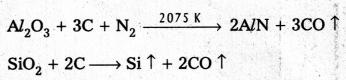
  5. In transition state the carbon atom is simultaneously bonded to the incoming nucleophile and out going group. It is very unstable.
  6. The order of reactivity for SN2 reactions follows : 1°-alkyl halides > 2°-alkyl halides > 3°-alkyl halides.

Question 5.
Explain why allylic and benzylic halides are more reactive towards SN1 substitution while 1-halo and 2-halobutanes preferentially undergoes SN2 substitution.
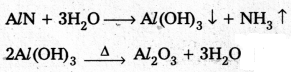
Answer:
1) Allylic and benzylic halides show high reactivity towards the SN1 reaction.
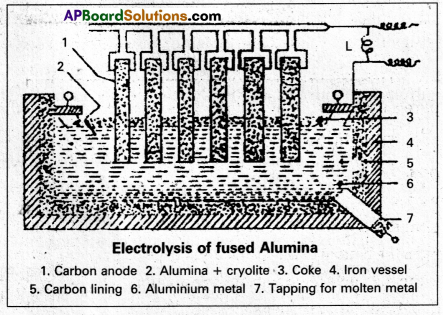
Reason: The carbocation thus formed gets stabilised through resonance phenomenon as shown below.
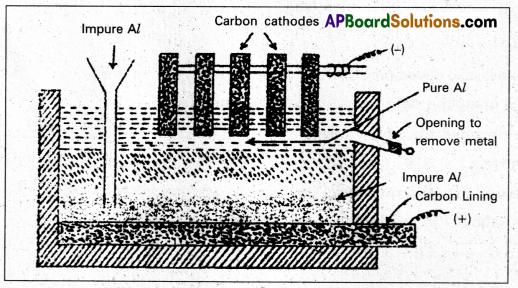
AP Inter 2nd Year Chemistry Study Material Chapter 11 Haloalkanes And Haloarenes 30

2) 1-halo and 2-halo butanes preferentially under goes SN2 substitute.
Reason : SN2 reactions involve transition state formation. Higher the steric hindrance lesser the stability of transition state. The given 1-halo and 2-halo butanes have less steric hindrance so these are preferentially undergo SN2 reaction.
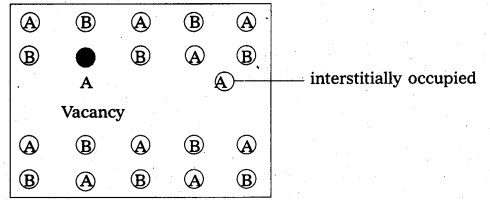
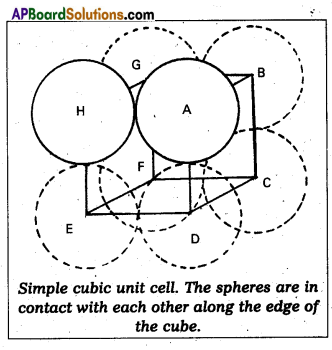
AP Inter 2nd Year Chemistry Study Material Chapter 11 Haloalkanes And Haloarenes

Question 6.
Describe the stereo chemical effect on the hydrolysis of 2-bromobutane.
Answer:
When S-2-Bromobutane is allowed to undergo hydrolysis R-2-butanol is formed with the – OH group occupying the position opposite to what bromide had occupied. This is an example of SN2 – reaction. SN2 reactions of optically active halides are accompanied by inversion of configuration.
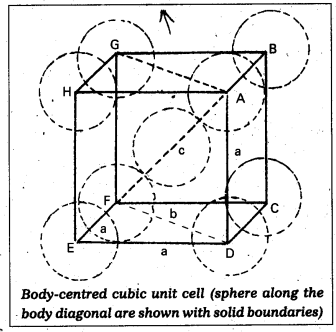
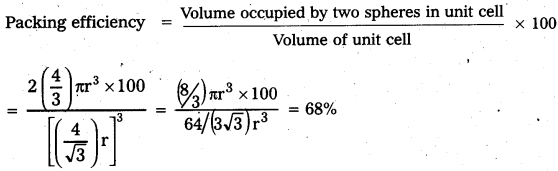
AP Inter 2nd Year Chemistry Study Material Chapter 11 Haloalkanes And Haloarenes 31

Question 7.
What is the criteria for optical activity. Give two examples of chiral molecules.
Answer:
Optical activity: The property of rotating the plane polarized light by a chemical substance is called optical activity.

  • If the plane polarised light rotates in clock wise direction then it is dextro rotatory [(+) (or) d-forms].
  • If the plane polarised light rotates in anti-clock wise direction then it is laevo rotatory [(-) or /-form].

Crieteria for optical activity:

  1. Chirality (or) dissymmetry is the necessary and sufficient condition for a molecule to show optical activity.
    Chirality : The objects which are non-superimposable on their mirror images are said to be chiral and this property is known as chirality.
  2. Asymmetry (absence of symmetry) of the molecule is responsible for the optical activity of organic compounds.
    Examples of chiral molecules :

    1. 2-Butanol
    2. 2-Chlorobutane
    3. 2-Bromopropanoic acid.

AP Inter 2nd Year Chemistry Study Material Chapter 11 Haloalkanes And Haloarenes

Question 8.
Define the following:    [A.P. Mar. 16]
i) Racemic mixture
ii) Retention of configuration
iii) Enantiomers.
Answer:
i) Racemic mixture: Equal portions of Enantiomers combined to form an optically inactive mixture. This mixture is called racemic mixture.

  1. Here rotation due to one isomer will be exactly cancelled by the rotation of due to other isomer.
  2. The process of conversion of enantiomer into a racemic mixture is called as racemisation.
    AP Inter 2nd Year Chemistry Study Material Chapter 11 Haloalkanes And Haloarenes 32

ii) Retention of configuration: The preservation of the integrity of the spatial arrangement of bonds to an asymmetric centre during a chemical reaction (or) transformation is called Retention of configuration.
General Eg : Conversion of XCabc chemical species into YCabc.
AP Inter 2nd Year Chemistry Study Material Chapter 11 Haloalkanes And Haloarenes 33
Eg : (-) 2 – Methyl 1 – butanol conversion into (+) 1 – chloro 2. Methyl butane

iii) Enantiomers : The stereo isomers related to each other as non-superimposable mirror images are called enantiomers.

  • These have identical physical properties like melting point, boiling points refractive index etc.
  • They differ in rotation of plane polarised light.

Question 9.
Write the mechanism of dehydrohalogenation of 2-bromobutane.
Answer:
Dehydrohalogenation of 2 – Bromobutane: 2 – Bromobutane reacts with alc.KOH to form 2 – Butene as major product.
AP Inter 2nd Year Chemistry Study Material Chapter 11 Haloalkanes And Haloarenes 34
Mechanism:

  • 2 – Bromobutane heated with alc.KOH elemination of hydrogen atom from β – carbon and bromine atom from α – carbon takes place. This is called β – Elimination.
    AP Inter 2nd Year Chemistry Study Material Chapter 11 Haloalkanes And Haloarenes 35
  • 2 – Butene is major product formed according to saytzev’s rule. “In dehydrohalogenation reactions the preferred product is that alkene which has the greater no. of alkyl groups attached to double bonded carbon atoms”.

AP Inter 2nd Year Chemistry Study Material Chapter 11 Haloalkanes And Haloarenes

Question 10.
Explain the Grignard reagents preparation and application with suitable example.
Answer:
Alkyl magnesium halides are generally called as Grignard reagenty.
Preparation: These are prepared by the treatment of alkyl halides with magnesium metal in presence of dry ether.
AP Inter 2nd Year Chemistry Study Material Chapter 11 Haloalkanes And Haloarenes 36

Applications:
Grignard reagents have wide applications in the synthesis of large no. of organic compounds.

  1. Preparation of alkanes :
    Grignard reagents reacts with alcohols and forces alkanes.
    AP Inter 2nd Year Chemistry Study Material Chapter 11 Haloalkanes And Haloarenes 37
  2. Preparation of alcohols : Ethylalcohol is obtained by the action of Methyl magnesium bromide on formal dehyde followed by the hydrolysis.
    AP Inter 2nd Year Chemistry Study Material Chapter 11 Haloalkanes And Haloarenes 38
  3. Preparation of carboxylicacids:
    Grignard reagent on carboxylation followed by the hydrolysis to form carboxylic acids.
    AP Inter 2nd Year Chemistry Study Material Chapter 11 Haloalkanes And Haloarenes 39

Question 11.
A primary alkyl halide C4H9Br(A) reacted with alcoholic KOH to give compound B. B on reaction with HBr yields C which is an isomer of A. When A is reacted with sodium metal forms D, C8H8 which is different from the compound formed when n-butylbromide is reacted with sodium. Give the structural formulae of A-D and write equations for all the reactions.
Answer:
Given 1° – alkyl halide molecular formula C4H9Br
Two isomers possible with molecular formula C4H9Br (i- alkyl halides)
AP Inter 2nd Year Chemistry Study Material Chapter 11 Haloalkanes And Haloarenes 40
Given that compound ‘A’ when reacted with Na does not forms the same product produced by n — Butyl bromide.
∴ isomer I cannot be ‘A’.
AP Inter 2nd Year Chemistry Study Material Chapter 11 Haloalkanes And Haloarenes 41
AP Inter 2nd Year Chemistry Study Material Chapter 11 Haloalkanes And Haloarenes 42

AP Inter 2nd Year Chemistry Study Material Chapter 11 Haloalkanes And Haloarenes

Question 12.
Account for the following statements:
i) Aryihalides are extremely less reactive towards Nucleophilic substitution reactions.
ii) p-Nitrochlorobenzene and o, p-dinitrochlorobenzene undergo Nucleophilic substitution readily compared to chlorobenzene.
Answer:
i) Aryl halides are extremely less reactive towards nucleophilic substitution reactions due to following reasons.

  • In aryl halides ‘C’ undergoes SP2 hybridised and it has greater S – character ånd electro negativity So the C – X bond length is shorter.
  • In aryl halides resonance effect plays an important role.
    The electron pairs on halogen atom are in conjugation with it π – electrons of the ring.
    AP Inter 2nd Year Chemistry Study Material Chapter 11 Haloalkanes And Haloarenes 43
    In the above C – Br bond acquires apartial double bond nature due to resonance. This bond cleavage is difficult.
  • The phenyl cation formed in aryl halides is not stabilised by resonance.

ii) p – nitrochlorobenzene and o, p – dinitro chlorobenzene undergo nucleophillic substitution reachily compared to chlorobenzene due to the following reasons.

  • Due to presence of – NO2 group which is an electron with drawing group at ’O’ and ‘P’ – positions in the ring makes the bond breaking easy.
  • As the number of NO2 groups increases reactivity of aryl halide also increases. This can be evidended by the following reactions.
    AP Inter 2nd Year Chemistry Study Material Chapter 11 Haloalkanes And Haloarenes 44
    AP Inter 2nd Year Chemistry Study Material Chapter 11 Haloalkanes And Haloarenes 45

Question 13.
Explain how the following conversions are carried out:
i) Propene to Propanol
ii) Ethanol to but-1-yne
iii) 1-Bromopropane to 2-Bromopropane
iv) Aniline to Chlorobenzene.
Answer:
i) Propene to propanol
AP Inter 2nd Year Chemistry Study Material Chapter 11 Haloalkanes And Haloarenes 46
iv) Aniline to chlorobenzene
AP Inter 2nd Year Chemistry Study Material Chapter 11 Haloalkanes And Haloarenes 47

AP Inter 2nd Year Chemistry Study Material Chapter 11 Haloalkanes And Haloarenes

Question 14.
What happens when
i) n-butylchloride is treated with alc.KOH.
ii) Bromobenzene is treated with Mg in presence of dry ether.
iii)Methylbromide is treated with sodium in presence of dry ether.
Answer:
i) n-Butylchloride + treated with alc.KOH undergo dehydro halogenation and forms 1-Butene.
CH3 – CH2 – CH2 – CH2 – Cl + alc. KOH → CH3 – CH2 – CH = CH2 + kCl + H2O
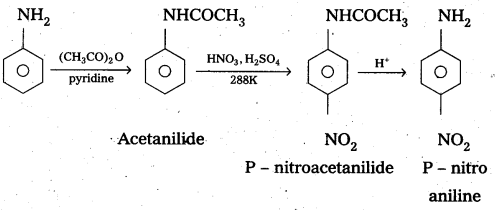
ii) Bromobenzene is treated with Mg in presence of dry ether forms phenyl magnesium bromide a Grignard reagent.
AP Inter 2nd Year Chemistry Study Material Chapter 11 Haloalkanes And Haloarenes 48

iii) Methyibromide is treated with sodium in presence of dry ether forms ethane (wurtz reaction)
AP Inter 2nd Year Chemistry Study Material Chapter 11 Haloalkanes And Haloarenes 49

Question 15.
Write the reactions showing the major and minor products when chlorobenzene is reacted with CH3Cl and CH3COCl in presence of AlCl3.
Answer:
i) Friedel crafts alkylation : When chiorobenzene is treated with CH3Cl to form 1 – Chloro – 4 – Methyl benzene (major) and 1 – Chloro 2 – Methylbenzene (minor).
AP Inter 2nd Year Chemistry Study Material Chapter 11 Haloalkanes And Haloarenes 50

ii) Friedel Craft’s acylation: Chlorobenzene reacts with CH3COCl in presence of Anhydrous AlCl3 to form 2 – Chloro actophenone, (Minor) and 4 – Chloro acetophenone (major).
AP Inter 2nd Year Chemistry Study Material Chapter 11 Haloalkanes And Haloarenes 51

Textual Examples

Question 1.
Draw the structures of all the eight structural isomers that have the molecular formula C5H11Br. Name each isomer according to IUPAC system and classify them as primary, secondary or tertiary bromide.
Solution:
CH3CH2CH2CH2CH2Br      1-Bromopentane (1°)
CH3CH2CH2CH(Br)CH3      2-Bromopentane (2°)
CH3CH2CH(Br)CH2CH3       3-Bromopentane (2°)
(CH3)2CHCH2CH2Br            1-Bromo-3-methylbutane (1°)
(CH3)2CHCHBrCH3              2-Bromo-3-methylbutane (2°)
(CH3)2CBrCH2CH3               2-Bromo-2-methylbutane (3°)
CH3CH2CH (CH3) CH2Br     1-Bromo-2-methylbutane (1°)
(CH3)3CCH2Br                      1-Bromo-2, 2-dimethyipropane (1°)

AP Inter 2nd Year Chemistry Study Material Chapter 11 Haloalkanes And Haloarenes

Question 2.
Write IUPAC names of the following:
AP Inter 2nd Year Chemistry Study Material Chapter 11 Haloalkanes And Haloarenes 52
Solution:

  1. 4-Bromopent-2-ene
  2. 3-Bromo-2-methylbut-l-ene
  3. 4-Bromo-3-methylpent-2-ene
  4. 1-Bromo-2-methylbut-2-ene
  5. 1-Bromobut-2-ene
  6. 3-Bromo-2-methylpropene

Question 3.
Identify all the possible monochloro structural isomers expected to be formed on free radical monochlorination of (CH3)2CHCH2CH3.
Solution:
In the given molecule, there are four different types of hydrogen atoms. Replacement of these hydrogen atoms will give the following.
(CH3)2CHCH2CH2Cl
(CH3)2CHCH(Cl)CH3
(CH3)2C(Cl)CH2CH3
CH3CH(CH2Cl)CH2CH3

Question 4.
Write the products of the following reactions
AP Inter 2nd Year Chemistry Study Material Chapter 11 Haloalkanes And Haloarenes 53
Solution:
AP Inter 2nd Year Chemistry Study Material Chapter 11 Haloalkanes And Haloarenes 54

AP Inter 2nd Year Chemistry Study Material Chapter 11 Haloalkanes And Haloarenes

Question 5.
Haloakanes react with KCN to form alkyl cyanides as main product while AgCN forms isocyanides as the chief product. Explain.
Solution:
KCN is predominantly ionic and provides cyanide ions in solution. Although both carbon and nitrogen atoms are in a position to donate electron pairs, the attack takes place mainly through carbon atom and not through nitrogen atom since C-C bond is more stable than C-N bond. However, AgCN is mainly covalent in nature and nitrogen is free to donate electron pair forming isocyanide as the main product.

Question 6.
In the following of halogen compounds, which would undergo SN2 reaction faster ?
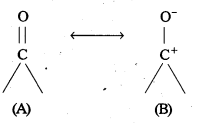
AP Inter 2nd Year Chemistry Study Material Chapter 11 Haloalkanes And Haloarenes 55
Solution:
AP Inter 2nd Year Chemistry Study Material Chapter 11 Haloalkanes And Haloarenes 56 It is primary halide and therefore undergoes SN2 reaction faster.
AP Inter 2nd Year Chemistry Study Material Chapter 11 Haloalkanes And Haloarenes 57 As iodine is a better leaving group because of its large size, it will be released at a faster rate in the presence of incoming nucleophile.

Question 7.
Predict the order of reactivity of the following compounds in SN1 and SN2 reactions.
i) The four isomeric bromobutanes
ii) C6H5CH2Br, C6H5CH(C6H5)Br, C6H5CH(CH3)Br, C6H5C(CH3)(C6H5)Br
Solution:
i) CH3CH2CH2CH2Br < (CH3)2CHCH2Br < CH3CH2CH(Br)CH3 < (CH3)3CBr (SN1)
CH3CH2CH2CH2Br > (CH3)2CHCH2Br > CH3CH2CH(Br)CH3 > (CH3)3CBr (SN2)
Of the two primary bromides, the carbocation intermediate derived from (CH3)2CHCH2Br is more stable than that derived from CH3CH2CH2CH2Br because of greater electron donating inductive effect of (CH3)2CH-group. Therefore, (CH3)2CHCH2Br is more reactive than CH3CH2CH2Br in SN1 reactions. CH3CH2CH(Br)CH3 is a secondary bromide and (CH3)3 CBr is a tertiary bromide. Hence the above order is followed in SN1. The reactivity in SN2 reactions follows the reverse order as the steric hinderance around the electrophilic carbon increases in that order.

ii) C6H5C(CH3)(C6H5) Br > C6H5CH(C6H5)Br > C6H5CH(CH3)Br > C6H5CH2Br (SN1)
C6H5C(CH3) (C6H5) Br < C6H5CH(C6H5)Br < C6H5CH(CH3)Br < C6H5CH2Br (SN2)
Of the two secondary bromides, the carbocation intermediate obtained from C6H5CH(C6H5)Br is more stable than obtained from C6H5CH(CH3)Br because it is stabilised by two phenyl groups due to resonance. Therefore, the former bromide is more reactive than the latter in SN1 reactions. A phenyl group is bulkier than a methyl group. Therefore, C6H5CH(C6H5)Br is less reactive than C6H5CH(CH3)Br in SN2 reactions.

AP Inter 2nd Year Chemistry Study Material Chapter 11 Haloalkanes And Haloarenes

Question 8.
Identify chiral molecules in each of the following pair of compounds. (Wedge and Dash representations according to Inter 1 yr., fig. 13.1).
AP Inter 2nd Year Chemistry Study Material Chapter 11 Haloalkanes And Haloarenes 58
Solution:
AP Inter 2nd Year Chemistry Study Material Chapter 11 Haloalkanes And Haloarenes 59

Question 9.
Although chlorine is an electron withdrawing group, yet it is ortho-, para-directing in electrophilic aromatic substitution reactions. Why ?
Solution:
Chlorine withdraws electrons through inductive effect and releases electrons through resonance. Through inductive effect, chlorine destabilises the intermediate carbocation formed during the electrophilic substitution.
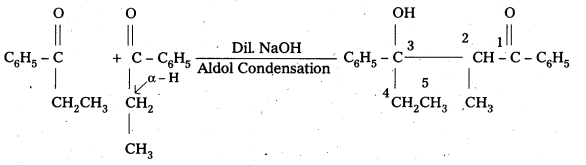
AP Inter 2nd Year Chemistry Study Material Chapter 11 Haloalkanes And Haloarenes 60
Through resonance, halogen tends to stabilise the carbocation and the effect is more pronounced at ortho-and para-positions. The inductive effect is stronger than resonance and causes net electron withdrawl and thus causes net deactivation. The resonance effect tends to oppose the inductive effect for the attack at ortho-and para-positions and hence makes the deactivation less for ortho-and para-attack. Reactivity is thus controlled by the stronger inductive effect and orientation is controlled by resonance effect.
AP Inter 2nd Year Chemistry Study Material Chapter 11 Haloalkanes And Haloarenes

Intext Questions

Question 1.
Write structures of the following compounds:
i) 2-Chloro-3-methylpentane
ii) 1-Chloro-4-ethylcyclohexane
iii) 4-tert. Butyl-3-iodoheptane
iv) 1, 4-Dibromobut-2-ene
v) 1-Bromo-4-sec. butyl-2-methylbenzene.
Answer:
AP Inter 2nd Year Chemistry Study Material Chapter 11 Haloalkanes And Haloarenes 61

Question 2.
Why is sulphuric acid not used during the reaction of alcohols with KI ?
Answer:
H2SO4 cannot be used along with KI in the conversion of an alcohol to an alkyl iodide as it converts KI to corresponding acid, HI which is then oxidised by it to I2.

Question 3.
Write structures of different dihalogen derivatives of propane.
Answer:

  1. ClCH2CH2CH2Cl
  2. ClCH2 CHClCH3
  3. Cl2CHCH2 CH3
  4. CH3CCl2 CH3

AP Inter 2nd Year Chemistry Study Material Chapter 11 Haloalkanes And Haloarenes

Question 4.
Among the isomeric alkanes of molecular formula C5H12, identify the one that on photo¬chemical chlorination yields.
i) A single monochloride,
ii) Three isomeric monochlorides,
iii) Four isomeric monochlorides.
Answer:
i)
AP Inter 2nd Year Chemistry Study Material Chapter 11 Haloalkanes And Haloarenes 62
All the hydrogen atoms are equivalent and replacement of any hydrogen will give the same product.

ii) CaH3CbH2CcH2CbH2CaH3
The equivalent hydrogens are grouped as a, b and c. The replacement of equivalent hydrogens will give the same product.

iii)
AP Inter 2nd Year Chemistry Study Material Chapter 11 Haloalkanes And Haloarenes 63
Similarly the equivalent hydrogens are grouped as a, b, c and d. Thus, four isomeric products are possible.

Question 5.
Draw the structures of major monohalo products in each of the following reactions.
AP Inter 2nd Year Chemistry Study Material Chapter 11 Haloalkanes And Haloarenes 64
Answer:
AP Inter 2nd Year Chemistry Study Material Chapter 11 Haloalkanes And Haloarenes 65

AP Inter 2nd Year Chemistry Study Material Chapter 11 Haloalkanes And Haloarenes

Question 6.
Arrange each set of compounds in order of increasing boiling points.

  1. Bromomethane, Bromoform, Chloromethane, Dibromomethane.
  2. 1 – Chloropropane, Isopropyl chloride, 1 – Chlorobutane.

Answer:

  1. Chloromethane, Bromomethane, Dibromomethane, Bromoform. Boiling point increases with increase in molecular mass.
  2. Isoporpylchloride, 1 – Chloropropane, 1 – Chlorobutane. Isopropylchloride being branched has lower b.p. than 1 – Chloropropane.

Question 7.
Which alkyl halide from the following pairs would you expect to react more rapidly by an SN2 mechanism ? Explain your answer.
AP Inter 2nd Year Chemistry Study Material Chapter 11 Haloalkanes And Haloarenes 66
Answer:
i) CH3CH2CH2CH2Br Being primary halide, there won’t be any steric hindrance.

ii)
AP Inter 2nd Year Chemistry Study Material Chapter 11 Haloalkanes And Haloarenes 67
Secondary halide reacts faster than tertiary halide.

iii)
AP Inter 2nd Year Chemistry Study Material Chapter 11 Haloalkanes And Haloarenes 68
The presence of methyl group closer to the halide group will increase the steric hindrance and decrease the rate.

Question 8.
In the following pairs of halogen compounds, which compound undergoes faster SN1 reaction?
AP Inter 2nd Year Chemistry Study Material Chapter 11 Haloalkanes And Haloarenes 69
Answer:
i) AP Inter 2nd Year Chemistry Study Material Chapter 11 Haloalkanes And Haloarenes 70 Tertiary halide reacts faster than secondary halide because of the greater stability of tert-carbocation.
ii) AP Inter 2nd Year Chemistry Study Material Chapter 11 Haloalkanes And Haloarenes 71 Because of greater stability of secondary carbocation than primary.

AP Inter 2nd Year Chemistry Study Material Chapter 11 Haloalkanes And Haloarenes

Question 9.
Identify A, B, C, D, E, R and R1 in the following:
AP Inter 2nd Year Chemistry Study Material Chapter 11 Haloalkanes And Haloarenes 72
Answer:
AP Inter 2nd Year Chemistry Study Material Chapter 11 Haloalkanes And Haloarenes 73