AP 7th Class English Important Questions Unit 6 The Why – Why Girl

These AP 7th Class English Important Questions 6th Lesson The Why – Why Girl will help students prepare well for the exams.

AP Board 7th Class English Unit 6 Important Questions and Answers The Why – Why Girl

Reading Comprehension (Seen)

1. Read the following passage carefully.

“But why ?”
The question came from a small girl, about ten years old. She was chasing a large snake. I ran after her. grabbed her plait and held her back, shouting. “No, Moyna,
don’t!”

“Why shouldn’t I ?” she asked,
“It’s not a grass snake nor a rat snake, it’s a cobra, “I replied.
“Why shouldn’t I catch a cobra ?”
“Why should you ?”
“We eat snakes, you know,” Moyna said. “The head you chop off, the skin you sell, the meat you cook.”

“Yes, but don’t do it this time” I said.
“I will, 1 will.”
“No, child !”
“But why?”

I dragged Moyna back to the Samithi office, where I worked. Her mother, Khiri, was there, weaving a basket. The Samithi was a place where people could come to learn, read and write, or simply sing and dance together. (The Why – Why Girl)
Now, answer the following questions.
1. What was Moyna running after?
Answer:
She is running after a cobra.

2. Who grabbed Moyna’s plait?
Answer:
The author / The speaker / The narrator

3. Where did the narrator work?
Answer:
At the Samithi office

4. Why do people come to the Samithi office?
Answer:
The Samithi was a place where people could come to learn to read and write, or simply sing and dance together.

5. Who was the mother of Moyna?
Answer:
Khiri

AP 7th Class English Important Questions Unit 6 The Why – Why Girl

2. Read the following passage carefully.

“Come,” I said to Moyna. “Come and rest for a little while.”
“Why?”
“Aren’t you tired?” I asked. Moyna shook her head vigorously.
“Who will bring the goats home and collect firewood, fetch water and lay traps for the birds?” came the questions, one after another.
“Moyna, don’t forget to thank the Babu for the rice he sent us,” said Khiri.

“Why should I? Moyna said. “Don’t I sweep the cowshed and do a thousand jobs for him? Does he ever thank me? Why should I?” saying this, Moyna ran off. Khiri sighed and shook her head. “Never seen a child like this. AH she keeps saying is ‘why’. No wonder the postman calls her why – why girl!” (The Why – Why Girl)
Now, answer the following questions.
1. Who will bring the Babu’s goats home?
Answer:
Moyna

2. Why does Moyna not like to take rest?
Answer:
Because she has much work to do.

3. Who gave the rice to Moyna’s family?
Answer:
Babu

4. Who did not thank Moyna?
Answer:
Babu

5. How was Moyna called?
The why-why Girl

3. Read the following passage carefully.

Moyna was a Shabar. The Shabars were a poor tribal group, and they owned no land. But nobody complained. Only Moyria’s questions went on and on.
“Why do I have to walk so far to the river to fetch water? Why do we live in a leaf hut? Why can’t we eat rice twice a day?” Moyna tended the goats of the village landlords or Babus, but she was neither humble nor grateful. She did her work and came home in the evening.

“Why should I eat their leftovers ?” She would ask,

“I will cook delicious meal with green leaves and rice and crabs and chilli powder and eat with my family.”

The Sabars did not usually send their daughters to work. But Moyna’s mother had a bad leg and so couldn’t walk properly. Her father had gone off to faraway Jamshedpur in search of work and her brother, Goro, went to the forest every day to collect fire-wood. (The Why-Why Girl)
Now, answer the following questions.
1. Who are the Sabars?
Answer:
The Sabars were a poor and landless tribal group.

2. What is the difference between Moyna and other Sabars?
Answer:
Other Sabars ftever complain but Moytla asks endless questions.

3. What is the problem with Moyna’s mother?
Answer:
She had a bad leg.

4. Why did Moyna!s father leave the village?
Answer:
For work

5. Who is Goro?
Answer:
Moyna’s brother

4. Read the following passage carefully.

One night she asked me, “Why do you read books before you go to sleep?”

“Because books have the answers to your whys!” I replied. And for once, Moyna was silent. She tidied the room, watered the flowering tree and fed fish to the mon-goose. Then she came up to me and said, “I will learn to read and find the answers to my questions.” When Moyna grazed the goats, she told the other children all that she had learned from me.

“Many stars are bigger than the sun. But they live far away so they look small. The sun is nearer, so it looks bigger. The fish do not speak like us. They have a fish lan-guage, which is silent. The earth is round, did you know that ?” (The Why – Why Girl)
Now, answer the following questions.
1. Why does the speaker read books?
Answer:
To know the answers to the questions.

2. What was Moyna’s wish?
Answer:
She wants to read and find the answers to her questions.

3. Who learnt all the things to Moyna?
Answer:
The narrator

4. Why do big starts appear smaller than the sun?
Answer:
Because they are far away.

5. What does the narrator do before she goes to sleep?
Answer:
She reads books.

AP 7th Class English Important Questions Unit 6 The Why – Why Girl

5. Read the following passage carefully.

“Who’s stopping you?”
“But there’s no class !”
“School is over for the day,” Malati pointed out.
“Why?”
“Because, Moyna, I take the class from 9 to 11 in the morning,” said Malati.

Moyna stamped her foot and said, “Why can’t you change the hours? I have to graze the goats in the morning. I. can come only after 11. If you don’t teach me, how will I learn? I will tell the old lady” – me! – “that none of us, goatherds and cowherds, can come if the hours are not changed.” Then she saw me and fled with her goat.

I went to Moyna’s house in the evening. Nestling close to the kitchen fire, Moyna was telling her little sister and elder brother, “You cut one tree and plant another two. You wash your hands before you eat, do you know why? You’ll get stomach pain if you don’t. You know nothing – do you know why? Because you don’t attend the classes at the Samithi.” Who do you think was the first girl to be admitted to the village primary school?
Moyna. (The Why – Why Girl)
Now, answer the following questions.
1. Who is Malati?
Answer:
The Samithi teacher

2. What should we do before we eat?
Answer:
We should wash our hands.

3. What should one do to know all the things?
Answer:
One should go to Samithi.

4. Who was the first student of the primary school?
Answer:
Moyna

5. Why can’t Moyna come to school in the morning?
Answer:
She has to graze the goats in the morning.

6. Read the following lines carefully.

If you can’t be a pine on the top of the hill, .
Be a scrub in the valley – but be The best little scrub by the side of the rill;
Be a bush if you can’t be a tree. (Be The Best of Whatever You Are)
Now, answer the following questions:
1. Where is the pine?
Answer:
On the top of the hill

2. Where is the scrub?
Answer:
In the valley

3. It is better to be ………………. if we can’t be a tree.
(a) a brush (b) a valley (c) a hill
Answer:
(a) a brush

4. What is the poet’s tone in these lines?
Answer:
Optimism

5. What figure of speech is used in the line ‘ If you can’t be a pine on the top of the hill, Be a scrub in the valley”?
Answer:
The figure of speech used in this line is antithesis. Antithesis is the figure of speech that conveys two opposite thoughts brought together. Pine is a tall tree while a scrub is comparatively very small.

7. Read the following lines carefully.

If you can’t be a bush be a bit of the grass,
And some highway happier make;

If you can’t be a muskie then just be a bass
But the liveliest bass in the lake! (Be The Best of Whatever You Are)
Now, answer the following questions.
1. How should we be if we can’t be a bush?
Answer:
We should be a bit of the grass.

2. Which makes the highway happier?
Answer:
Grass

3. Which word in these lines refer to ‘a big fish’?
Answer:
Muskie

4. Which is important?
(a) a bush
(b) a bit of grass
(c) both
Answer:
(c) both

5. What figure of speech is used in ‘And some highway happier make’?
Answer:
The figure of speech used in this line is alliteration.

Alliteration is the repetition of a consonant sound in the beginning of consecutive words. In the given line the words ‘ highway, happier’ are alliterative with the repetition in the consonant sound of the phoneme/h/.

AP 7th Class English Important Questions Unit 6 The Why – Why Girl

8. Read the following lines carefully.

We can’t all be captains, we’ve got to be crew,
There’s something for all of us here,
There’s big work to do, and there’s lesser to do,
And the task you must do is the near. (Be The Best of Whatever You Are)
Now, answer the following questions.
1. What should we be if we can’t be a captain?
Answer:
We should be a crew.

2. What is the tone of the poet?
Answer:
Optimism

3. What is the rhyme scheme you find in this stanza?
Answer:
abab

4. What is the message of the poem?
Answer:
One should try to do one’s best with whatever one is.

5. Which word in the poem means the same as ‘piece of work’?
Answer:
Task

9. Read the following lines carefully.

If you can’t be a highway then just be a trail,
If you can’t be the sun be a star;
It isn’t by size that you win or you fail
Be the best of whatever you are! (Be The Best of Whatever You Are)
Now, answer the following questions.
1. What should be our attitude towards our work?
Answer:
Whatever we do, we should do it whole-heartedly.

2. What can one be when one can’t be the sun?
Answer:
One can be a star.

3. What are the two contrasting things mentioned the first two lines?
Answer:
A highway and a trail

4. What decides the winning?
Answer:
The best quality of work

5. What is the tone of the poet?
Answer:
Optimism

Reading Comprehension (Unseen)

1. Read the following passage carefully.

A visit to an exhibition is a novel experience. An exhibition which I visited recently was very interesting. It was one of the largest exhibitions ever held. Being a Sunday there were many visitors that made it difficult to walk.

Men, women, and children in their colourful and best dresses were there. At the booking counter there were long queues. I bought tickets and entered the exhibition grounds. Our parents and I enjoyed the exhibition for a long time. The grounds were tastefully decorated. There were stalls and pavilion of ministries, companies, and states.

There were hundreds of exhibits for the domestic use. By the time we came out of the German pavilion, we were very tired. We went to a coffee shop and had hot coffee. My mother bought a shawl. There was a village complex with many village singers, jugglers, and folk artists. The puppet show was very amusing.
Now answer the following questions
a) What is necessary to visit the exhibition?
Answer:
An entrance ticket

b) Who is a juggler?
Answer:
One who does magic is a juggler.

Choose the correct answer from the choices given.
c) When is it difficult to go around in exhibition?
i) Sunday
ii) Tuesday
iii) Working day
Answer:
i) Sunday

d) What was very entertaining for the author?
i) Stalls
ii) Coffee shop
iii) Puppet show
Answer:
iii) Puppet show

e) What did the writer’s family do when they were tired?
i) They sat down and relaxed.
ii) They went to a coffee shop and had coffee.
iii) They bought toys and shawl
iv) They went home.
Answer:
ii) They went to a coffee shop and had coffee.

2. Read the following passage carefully.

Sally jumped up as soon as she saw the surgeon come out of the operating room. She said : “How is my little boy? Is he going to be alright? When can I see him? The surgeon said, “I’m sorry. We did all we could, but your boy didn’t make it”. Sally said, “Why do little children get cancer? Doesn’t God care anymore? Where were you, God, when my son needed you?”

The surgeon asked, “Would you like some time alone with your son? One of the nurses will be out in a few minutes, before he’s transported to the university”.

Sally asked the nurse to stay with her while she said goodbye to son. She ran her fingers through his curly hair. “Would you like a lock of his hair?” the nurse said. She cut a lock of the boy’s hair and gave it to Sally in a plastic bag. Sally said, “It was Jimmy’s idea to donate his body to the university for study. He said it might help somebody else,” she continued, “My Jimmy had a heart of gold. Always thinking of someone else. Always wanting to help others if he could”.
Now answer the following questions.
a) Who was admitted in the hospital?
Answer:
Sally’s son

b) What was the boy suffering from?
Answer:
Cancer

Choose the correct answer from the choices given.
c) Where will the boy be taken after the surgery?
i) to his home
ii) to hospital
iii) to university
iv) to a clinic
Answer:
iii) to university

d) What did the nurse offer Sally as a token of memory?
i) a gold win
ii) a big chest of clothes
iii) the boy’s clothes
iv) a lock of hair of the boy
Answer:
iv) a lock of hair of the boy

e) Why was the boy taken to the university?
i) to be operated
ii) to get good treatment
iii) to be helpful for the study of others
iv) to help the doctors
Answer:
iii) to be helpful for the study of others

Interpretation of Non-Verbal Information

1. The following table tells us about the population details of five villages.
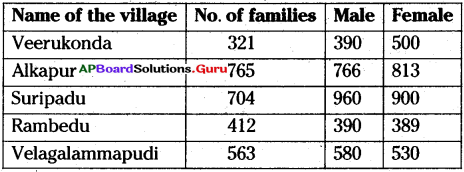
AP 7th Class English Important Questions Unit 6 The Why – Why Girl 1
Now answer the following questions.
a) What information can we get from the above table?
Answer:
Population details of five villages

b) Which village has the highest number of total population?
Answer:
Suripadu

Choose the correct answer from the choices given below.
c) Which village is in the second place in female population?
i) Veerukonda
ii) Alkapur
iii) Suripadu
Answer:
ii) Alkapur

d) The two villages with the same number of male population are ………
i) Velagalammapudi and Suripadu
ii) Rambedu and Suripadu
iii) Veerukonda and Rambedu
Answer:
iii) Veerukonda and Rambedu

e) Which of the following statements is true with reference to the information given above?
i) The number of males and females in Rambedu is almost equal.
ii) The number of females is higher than the number of males in Velagalammapudi.
iii) Alkapur has the lowest number of families.
Answer:
i) The number of males and females in Rambedu is almost equal.

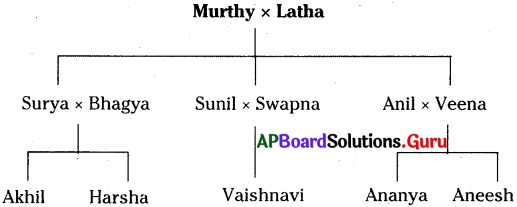
2. Study the following tree diagram carefully.
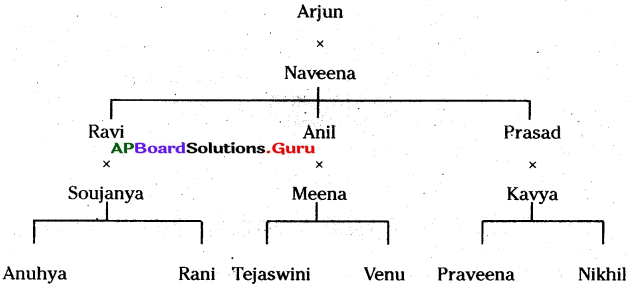
AP 7th Class English Important Questions Unit 6 The Why – Why Girl 2
Now answer the following questions.
a) Who is Meena’s mother-in-law?
Answer:
Naveena

b) How many granddaughters does Arjun have?
Answer:
Four

Choose the correct answer from the choices given below.
c) Praveena is the daughter of………….
i) Meena
ii) Ravi
iii) Kavya
Answer:
iii) Kavya

d) Venu and Nikhil are ………
i) brothers
ii) cousins
iii) friends
Answer:
ii) cousins

e) Which of the following statements is true with reference to the information given above?
i) Anil has two daughters.
ii) Anuhya and Rani are sisters.
iii) Kavya is Ravi’s wife.
Answer:
ii) Anuhya and Rani are sisters.

Vocabulary

Synonyms

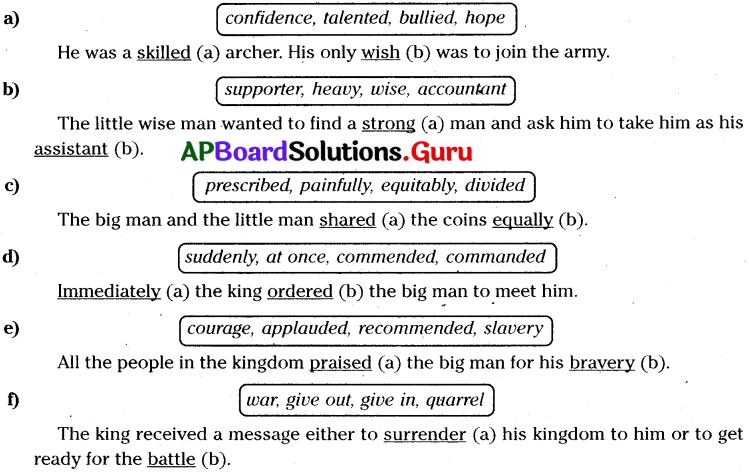
Choose the words with similar meanings (synonyms) from the list given to the words underlined.
AP 7th Class English Important Questions Unit 6 The Why – Why Girl 3
Answer:
a) a) exhausted, b) strenuously
b) a) stubborn, b) yield
c) a) remained, b)announced
d) a) maketired, h) tend
e) a) Settling, b) chop
f) a) commanding, b) idle

Antonyms

Write the opposites (antonyms) for the underlined words.
a) The question (a) came from a small girl, about ten years old. She was chasing (b) a large snake.
b) “Moyna, don’t forget (a) to thank the Babu for the rice he sent (b) us,” said Khiri.
c) Moyna tended the goats of the village landlords or Babus, but she was neither humble (a) nor grateful (b).
d) When I returned (a) to the village a year later (b), the first thing I heard was Moyna’s voice.
e) If you pass by, you’re sure (a) to hear an impatient (b), demanding voice – “Don’t be lazy. Ask me questions.”.
f) “Don’t be lazy (a). Ask me questions. Ask me why mosquitoes should be destroyed, why the pole star is always (b) in the north sky.”
Answer:
a) a) answer, b) escaping
b) a) remember, b) received
c) a) proud, b) ungrateful
d) a) left, b) earlier
e) a) unsure, b) patient
f) a) industrious, b) never

Right Forms of the Words

Fill in the blanks with the right form of the words given in the brackets.

a) “Aren’t you tired ?” I asked. Moyna shook her head _____ (a) (vigorous / vigorously. “Who will bring the goats home and _____ (b) (collection/collect) firewood, fetch water and lay traps for the birds?” came the questions, one after another.
b) “But she is very, _____ (a) (obstinate / obstinately),” Khiri _____ (b) (retortion/retorted).
c) Moyna tended the goats of the village landlords or Babus, but she was neither _____ (a) (humble / humbly) nor _____ (b) (gratefulness / grateful).
d) “The good snakes I _____ (a) (caught / catch) and give to mother. She makes _____ (b) (love / lovely) snake curry.
e) Moyna was _____ (a) (silence / silent). She tidied the room, watered the flowering tree and fed fish to the mongoose. Then she came up to me and said, “I will _____ (b) (learnt/learn) to read and find the answers to my questions.”
f) If you pass by, you are _____ (a) (sure / surely) to hear her _____ (b) (impatient / impatience), demanding voice, “Don’t be lazy. Ask me questions.”
Answer:
a) p) vigorously, b) collect
b) a) obstinate, b) retorted
c) a) humble, b) grateful
d) a) catch, b) lovely
e) a) silent, b)learn
f) a) sure, b) impatient

Spelling Test

Type — 1 : Vowel Clusters

Complete the following words using “ai, au, ea, ee, ei, eo, la, ie, io, oi, oo, ou, ua, ue or ui”.

a) I ran after her, grabbed her pl _ _ t and held her back, sh _ _ ting. “No, Moyna, don’t!”
b) Moyna sh _ _ k her head vigor _ _ sly.
c) The Shabars were a p _ _ r tribal gr _ _ p.
d) And she came, with one change of clothes and a baby mong _ _ se. “It _ _ ts very little and chases away the bad snakes.” “The good.snakes I catch and give to mother.”
e) The _ _ rth is r _ _ nd, did you know that?
f) If you don’t t _ _ ch me, how will I l _ _ rn?
Answer:
a) plait, shouting
b) shook, vigorously
c) poor, group
d) mongoose, eats
e) earth, round
f) teach, learn

AP 7th Class English Important Questions Unit 6 The Why – Why Girl

Type – 2 : Suffixes

Complete the following words with the suitable suffixes given in the brackets.

a) “Aren’t you tire__ (d / ed)?” I asked. Moyna shook her head vigorous__ (ly /My).
b) Moyna tended the goats of the village land__ (a) (lords / lards) or Babus, but she was neither humble nor grate__ (b) (ful / full).
c) “She makes love__ (lly / ly) snake curry. I’ll bring some for you” said Moyna. Our Samithi teach__ (er / or), Malati, said to me, “She’ll exhaust you with her whys !”
d) Many stars are bigg__ (or / er) than the sun. But they live far away, so they look small. The sun is near__ (er / or).
e) When I return__ (ed / d)“to the village a year later, the first thing I heard was Moyna’s voice. “Why is the school closed?” she challenged Malati as she entered the Samithi’s school, dragg__ (ed / irig) along a bleating goat.
f) If you pass by, you’re sure to hear an impati__ (ent/ant), demanding voice, “Don’t be lazy. Ask me questions. Ask me why mosquitoes should be destroy__ (d / ed), Why the pole star is always in the north sky.”
Answer:
a) tired, vigorously
b) landlords, grateful
c) lovely, teacher
d) bigger, nearer
e) returned, dragging
f) impatient, destroyed

Type – 3 : Wrongly Spelt Words

Identify the wrongly spelt word and write its correct spelling in the space provided.
a) grass, stamped, learn, thousend
Answer:
thousand

b) tribel, chop, river, study
Answer:
tribal

c) office, employer, graze, mosquiteos
Answer:
mosquitoes

d) search, primery, forest, simply
Answer:
primary

e) fetch, mongoose, lovly, hour
Answer:
lovely

Classification of Words

Arrange the following words under the correct headings.
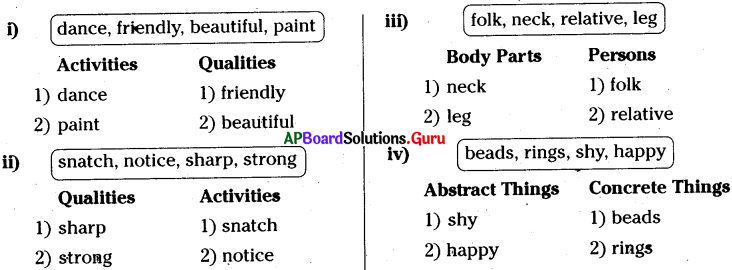
AP 7th Class English Important Questions Unit 6 The Why – Why Girl 4

Choice of the Words

Fill in the blanks choosing the suitable words from those given in the box.
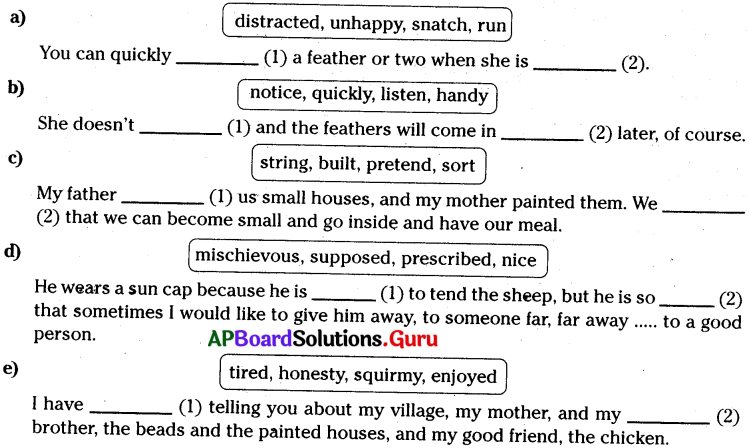
AP 7th Class English Important Questions Unit 6 The Why – Why Girl 5

Answer:
a) 1) dragged, 2) weaving
b) 1) obstinate, 2) retorted
c) 1) delicious, 2) send
d) 1) chases, 2) lovely
e) 1) exhaust, 2) graze
f) 1) stamped, 2) change

Homophones

Fill in the blanks with suitable words using the homophones given in the brackets.

1. Did the ____ win the race? (hair, hare)
2. Farida has gone to visit her ____ . (son, sun)
3. You sound a little ____ . (horse, hoarse)
4. The flu left him ____ . (week, weak)
5. It is rude to ____ at DeoDle.(stare, stair)
6. Can I have a ____ of cake, nlease. (peace, piece)
7. This ____ is interesting. (storey, story)
8. Don’t ____ your valuable time. (waste, waist)
9. I ____ his mobile number. (no, know)
10. Thev like to watch that ____ . (cereal, serial)
Answer:

  1. hare
  2. son
  3. hoarse
  4. weak
  5. stare
  6. piece
  7. story
  8. waste
  9. know
  10. serial

Phrasal Verbs

Fill in the blanks with suitable phrasal verbs given in the box.
AP 7th Class English Important Questions Unit 6 The Why – Why Girl 7

1) Rajkumar ______ his friend admiringly.
2) He ______ his wet boots and sat by the fire.
3) Nandakishore wanted to ______ some business in the city.
4) Kaushik ______ on the sofa and soon fell asleep.
5) She usually ______ at 5 o’clock.
6) Caterpillars ______ butterflies.
Answer:

  1. looked at
  2. took off
  3. set up
  4. lay down
  5. gets up
  6. change into

Grammar

I. Edit the following passage correcting the underlined parts.

1. Abudl Kalam is (a) born on 15th October, 1931 in (b) Rameswaram in Tamil Nadu. She (c) graduated in aeronautical engineering from an (d) Madras Indian Institute of Technology.
Answer:
a) was b) at c) He d) the

2. On one fine sunny day, Akbar and Birbal were taking an (a) leisurely walk in the palace gardens. Immediately (b) Akbar thought of testing Birbal’s wits by asking her (c) a tricky question. The Emperor asked Birbal, “How much (d) crows are there in our kingdom?”
Answer:
a) a b) Suddenly c) him d) How many

3. Born in the sixth century B.C., Susrutha was a descendant of a (a) Vedic sage Viswamitra. He learnt surgery but (b) medicine at the feet of Divodasa Dhanvantari in tier (c) hermitage at Varanasi. Later, he becomes (d) an authority in not only surgery but also in other branches of medicine.
Answer:
a) tHe b) and c) his d) became

4. Snakes are a (a) most specialized group of reptiles. Much (b) species of snakes are find (c) all over the world. Some of they (d) are poisonous and some are not poisonous.
Answer:
a) the b) Many c) f6und d) them

AP 7th Class English Important Questions Unit 6 The Why – Why Girl

II. Complete the passage choosing the right words from those given below. Each blank is numbered and for each blank four choices are given. Choose the correct answer and write (A), (B), (Q or (D) in the. blanks.

1. Pandavas were the five powerful and skilled sons ………. (1) Pandu, the king of Hastinapur and his two wives Kunti and Madri: Hastinapur is ………. (2) with the current modern Indian state of Haryana, South of New Delhi. ………. (3) Pandavas are the central characters in the most applauded epic, the Mahabharata. They were famously involved in the Kurukshetra war with ………. (4) cousins, Kauravas.
1) A) of B) in C) at D) with
2) A) equate B) equates C) will equate D) equated
3) A) The B) A C) An D) This
4) A) our B) their C) my D) his
Answer:
1) A 2) D 3) A 4) B

2. Anacondas are a group ………. (1) large snakes. ………. (2) are found in tropical South America. The green anaconda is ………. (3) largest snake in the world. It can reach a length of 30 feet and ………. (4) up to 550 Pounds.
1) A) on B) with C) of D) to
2) A) We B) They C) She D) It
3) A) the B) an C) this D) a
4) A) weighed B) weight C) will weigh D) weigh
Answer:
1) C 2) B 3) A 4) D

3. Ramzan is one of ………. (1) most important festivals for Muslims. This festival ………. (2) the end of the holy month Ramzan. The month of Ramzan is considered ………. (3) a gift from God and is related ………. (4) mercy and forgiveness.
1) A) a B) the C) an D) this
2) A) marking B) marked C) marks D) mark
3) A) since B) but C) and D) as
4) A) to B) for C) by D) into
Answer:
1) B 2) C 3) D 4) A.

4. A long time ago there ………. (1) a monkey who lived in a rose-apple tree by the side of a river. He lived alone, ………. (2) was very happy. One day, a crocodile came out ………. (3) the river. He swam up to the tree and told ………. (4) monkey that he had travelled a long distance and was in search of food as he was very hungry.
1) A) were B) are C) is D) was
2) A) if B) but G) since D) as soon as
3) A) of B) into C) in D) to
4) A) a B) an C) the D) those
Answer:
1) D 2) B 3) A 4) C

III. Rearrange the words and make meaningful ‘wh’ questions.

a) classes / will / when / begin / our
Answer:
When will our classes begin?

b) going / where / you / are
Answer:
Where are you going?

c) teacher / your / who / favourite / is
Answer:
Who is your favourite teacher?

d) brothers / many / you / how / have?
Answer:
How many brothers have you?

e) come / did / you / why / yesterday / not
Answer:
Why did you not come yesterday?

IV. Read the following statements and frame suitable ‘wh’ questions.

a) This is my father’s car.
Answer:
Whose car is this?

b) Yesterday, I met my friend.
Answer:
Whom did you meet yesterday?

c) This film is very nice.
Answer:
How is this film?

d) She will come tomorrow.
Answer:
When will she come?

e) Viswanathan Anand won the game.
Answer:
Who won the game?

AP 7th Class English Important Questions Unit 6 The Why – Why Girl

V. Complete the following sentences using apprpriate clause.

1) If you work hard, ______. (get success)
2) If you tease the dog, ______. (bite you)
3) If you go to bed early, ______ . (be healthy)
4) ______ you’ll catch the bus. (walk fast)
5) ______ they will also respect you. (give respect to others)
Answer:

  1. you will get success
  2. it will bite you
  3. you will be healthy
  4. If you walk fast
  5. If you give respect to others,….

VI. Interchange the ‘if clause’ and the ‘main clause’ in the above sentences and write them down.
Answer:

  1. You will get success if you work hard.
  2. The dog will bite you if you tease it.
  3. You will be healthy if you go to bed early.
  4. You will catch the bus if you walk fast.
  5. Others will also respect you if you give respect to them.

Creative Writing

1. In the lesson “The Why – Why Girl”, you have learnt that Moyna exhausted others with her ‘whys’. One day she met Malati, their Samithi teacher and asked her why she shouldn’t study too.
Now, write a possible conversation based on the above context.
Answer:
Moyna : Good morning, teacher.
Malati : Good morning, Moyna.
Malati : Why have you come to me?
Moyna : Why is school closed? Why shouldn’t I study too?
Malati : Who’s is stopping you, girl? School is over for the day.
Malati : You know, Moyna, I take the class from 9 to 11 in the morning.
Moyna : Why can’t you change the hours, madam?
Malati : Why should I change the hours, Moyna?
Moyna : I have to graze Babu’s goats in the morning. I can only come after eleven.
Malati : No, I won’t change my time.
Moyna : If you don’t teach, how will I learn?
Moyna : If you don’t change the hours, none of us, goatherds, and cowherds can come.
Malati : O.K., girl. I will change the hours. You can come after eleven.
Moyna : Thank you, madam.
Malati : It’s O.K., girl.

2. In the. lesson “The Why – Why Girl”, you have learnt that Moyna grew up and started teaching at the Samithi school. When she was a girl, she was interested in asking questions others. She almost all exhausted others with her ‘whys’. When she became teacher, she expected a number of questions from the students. She even encouraged them to ask her questions. She asked them not to be lazy.

Imagine that you were Moyna and write a diary entry expressing your feelings at the end of the day on which you have attended the school for the first time as a – teacher.
Answer:

Monday, 10th August, 20xx
8:30 p.m.Dear Diary,
Oh, God ! I am really grateful to you. Finally, my long lasting wish has been fulfilled. It’s all because of your grace. From my childhood onwards, everyone has referred me as ‘why-why’ girl. That ‘why – why’ girl has become a teacher today ! My questioning nature has brought me to today’s position. But, in the morning class, the children did not ask me questions. They were all lazy in that period. Why didn’t they ask me the questions such as, “Why should mosquitoes be destroyed ?”, “Why is the pole star always in the north sky ?” etc. Then only they will shine, they will have a bright future. From tomorrow onwards, I shall make them learn the art of questioning. If one doesn’t question, one doesn’t find anything and one doesn’t achieve anything.Moyna

3. Mother’s Day is celebrated on May 9th. Prepare a script for speech on the role of a mother in a family on the occasion of Mother’s Day.
Answer:
Honorable judges and dear students,

Today, I, Abhilash of Class VII, stand before you to speak on the role of a mother in a family. With Mother’s Day that is celebrated on May 9th, round the corner, I thought of reflecting on the role of a mother and importance in a child’s life.

A mother is like the nucleus around whom everyone else orbits in a family. And the word multitasking was probably coined for a mother, and if not certainly had her in mind 1 After all a mother provides the required structure and balance to the household, lacking which the world would seem chaotic and confusing. She is the one person who. ensures that life functions in an orderly way, right from breakfast, lunch, dinner being served at the table, to clothes being ironed and kept in the cupboard, to the kitchen always being stocked up with food, the beds perfectly made, the bills paid, the list is infinite. However more importantly, a mother brings balance to the family mentally and emotionally.

Needless to say she plays a pivotal role in what a child is tomorrow. A mother is the one person who is responsible for a child’s wholesome development and takes charge of it. Clearly a mother journey is perhaps one of the toughest. There is a saying that the God created mother in his place to look after the family. We should agree to this and be thankful to mother. Showing gratitude is the only tribute that we can give to a mother.

Thank you one and all for giving me this opportunity.

AP 7th Class English Important Questions Unit 6 The Why – Why Girl

4. The locality in which you live is not cleaned properly by the Municipal workers. Heaps of garbage are found everywhere. Foul smell is coming out of it. You sense the danger of spreading diseases.

Write a letter to the Municipal Commissioner about the insanitary conditions.
Answer:

4th February, 20xx.

From
Regd. No. x x x x,
Government College Road,
Bhimavaram.

To
The Municipal Commissioner,
Bhimavaram Municipality.

Sir,
I regret to bring the following to your notice for necessary action.

Our town is suffering a lot due to the negligence of the Municipal helath workers. The sweepers are not regular to their duties. Once in a week they come in a casual way. There are piles of garbage at every corner emitting foul smell.

Some roads have pot-holes and ditches. Water gets stagnated. Recently a girl fell into a ditch. Thank God, a cyclist saw it and saved her. If the same state of affairs continue, I am afraid that diseases may spread. All these things lead to health hazard.
May I request you to take steps in this regard ? You know sir, public health should be the priority of the Municipality.

Thanking you Sir,

Yours faithfully,
xxxxxxxx.

5. Write a story using the hints provided

Hints : Small village – a boy and a mother – poor – collected wood from forest – cut down small trees – one day – a big bird from a tree – don’t cut down this tree – my house – boy agreed – bird pleased – come before sunrise with a bag – next morning – hold on to my tail – flew up – in the sky -to a distant valley – full of gold – filled the bag – flew back – boy and mother rich – happy.
Answer:
The Kindness of a Bird
Once there# lived a boy and his mother in a small village. They were very poor and earned their livelihood by collecting wood from forest. The boy used to cut down small trees.

One day he began to cut a big tree. A bird from the tree pleaded not to cut down the tree because it was her house. The boy agreed.

The bird was pleased and asked the boy to come before sunrise with a bag the next morning. He did as the bird said. The bird asked the boy to hold on to her tail. The boy held her tail tightly and the bird flew up in the sky to a distant valley which was full of gold. The boy filled the bag with gold. Then they flew back. The boy and his mother became rich. They lived happily.

AP 7th Class English Important Questions Unit 6 The Why – Why Girl

6. Write a story using the following hints.

Hints: A crow – thirsty – no Water around – flies around – searches for water – finds water in a pot- water at the bottom – can not reach – thinks of a plan – looks around – found small stones – drops small stones into the pot – water comes up – drinks feels happy – flies away.
Answer:
A Clever Crow

Once upon a time there was a crow. It was clever. It lived on the branch of a tree in. a forest. One day it was very thirsty as it was a hot summer. There was no water around. So it thought to go to the villages around in search of water. It reached a near by village and began to search for water. It searched many places for water. At last it found some water in a pot near a hut. It felt happy on seeing the water in the pot.

But it became very difficult for the crow to reach as the water was at the bottom of the pot. It tried very hard but it could not get the water. So it was disappointed. It looked around and found a heap of small stones. On seeing the heap of stones, there came a thought of bringing the water in the pot from the bottom to the top. It dropped the small stones one by one into the pot. The water came up. The crow drank the water and quenched its thirst. It felt happy and flew away.

Moral: Where there is a will, there is a way.

AP 7th Class English Important Questions Unit 4 The Brave Little Bowman

These AP 7th Class English Important Questions 4th Lesson The Brave Little Bowman will help students prepare well for the exams.

AP Board 7th Class English Unit 4 Important Questions and Answers The Brave Little Bowman

Reading Comprehension (Seen)

1. Read the following passage carefully.

Once there lived a little wise man with a crooked back. He was a skilled archer. His only wish was to join the army. He thought that the king might not give him the job because of his crooked back. The little wise man wanted to find a strong man and ask him to take him as his assistant. Then the king would take both of them. He went in search of a big man.

One day he saw a big man digging a ditch.

The Little Man : You are a big and strong man. Why are you digging ditches? Can’t you find some other work?
The Big Man : I don’t know any other work, and I have to earn my living.
The Little Man : Don’t do this work anymore. Come with me. We will go to the king and ask for a job in the army for you.
The Big Man : I can’t do that. I am not a skilled warrior and can’t fight.
The Little Man : Don’t worry about that. Just go to the King, ask for a job in the army, and introduce me as your assistant.
The Big Man : But, how cap, a little man like you assist me?
(The Brave Little Bowman)

Now, answer the following questions. ,
1. What was the disadvantage that the little man had?
Answer:
He was short and had a crooked back.

2. What was the little man good at?
Answer:
He was good at archery.

3. What was the little man in search of?
Answer:
A big man

4. What was the big man doing when the little man approached him?
Answer:
The big man was digging ditches.

5. How would the little man be introduced?
Answer:
As an assistant of the big man

AP 7th Class English Important Questions Unit 4 The Brave Little Bowman

2. Read the following passage carefully.

They went to the palace gates. The big man sent a word to the king that there was a skilled bowman at the gate. The king sent for the big man.

The King : What do you want? Why did you come here?
The Big Man : My greetings to you, your Majesty. I want to join your army.
The King : Who is this little man?
The Big Man : He is my assistant, your Majesty. I want you to take him too along with me.
The King : I will take the both of you and give a thousand silver coins a month.
The Big Man : Thank you very much, your Highness! We will serve you to the best of our abilities.
(The Brave Little Bowman)

Now, answer the following questions.
1. What was the word sent by the big man to the king?
Answer:
That there was a skilled bowman at the gate

2. What were the phrases used by the big man to address the king?
Answer:
Your Majesty! and Your Highness!

3. Who was introduced as the assistant?
Answer:
The little man

4. How much did the king offer them a month?
Answer:
A thousand silver coins

5. Who joined the big man and the little man in the army?
Answer:
The king

3. Read the following passage carefully.

One day, the King was informed that a wild elephant was creating panic among the people: running up and down the road, tossing people in the air, causing injuries and in some cases death to the people. Immediately the king ordered the big man fo meet him. The big man reported to the king.
The King : Have you heard about the wild elephant?
The Big Man : Yes, your Majesty!
The King : Go and kill the wild elephant and put the people’s fears to rest.
The Big Man : Certainly, your Highness!
The big man and the little man went to look out for the wild elephant. The little man shot the elephant and killed it and they reported it to the king.
The Big Man : I have killed the wild elephant, your Majesty.
The King : Bravo! You have once again proved that you are a very brave man. I am happy to have you in my army. Take your reward. (The Brave Little Bowman)

Now, answer the following questions.
1. What was informed to the king?
Answer:
That a wild elephant was creating panic among the people

2. Who ordered to kill the elephant?
Answer:
The king

3. What was the king’s order to the big man?
Answer:
To kill the wild elephant and put the people’s fears to rest

4. Who killed the elephant?
Answer:
The little man

5. Whom did the king praise?
Answer:
The big man

AP 7th Class English Important Questions Unit 4 The Brave Little Bowman

4. Read the following passage carefully.

The war elephant went out of the city and entered the battlefield. Then at the sound of the first drum beat, the big man shook with fear.
The Little Man : Hang in there. You need not be afraid. If you fall off now, you will be killed.
The Big Man slipped off the elephant’s back, and ran back to the city.
The Big Man : I don’t want this job. I don’t want your money either. I can do any job as long as I live.
The Little man : Oh! what a coward he is! though big and strong! However, this is a blessing in disguise. I will fight for the king and prove that I am , better than the big man, though I don’t have a big and strong body.

The little bowman drove the war elephant into the fight. The army broke into the enemy king’s camp. The little man’s army drove the enemy out of their kingdom and won the battle. The king heard about the little bowman. The people called him ‘The Brave Little Bowman.’ The king made him the chief of the army and gave him rich gifts. The big man was ashamed of himself and went back to his work of digging ditches. As per the saying, ‘better late than never’, the little man received the much-deserved honour at last. (The Brave Little Bowman)

Now, answer the following questions.
1. Where did the war elephant enter?
Answer:
The battlefield

2. What did the big man do in the battlefield?
Answer:
He slipped off the elephant’s back and ran back to the city.

3. How is it a blessing in disguise?
Answer:
Though he had to fight the battle, it was a great opportunity for him to prove his skill.

4. Who won the battle?
Answer:
The little man’s army

5. What did the people call the little man?
Answer:
The Brave Little Bowman

5. Read the following lines carefully.

Over hill, over dale,
Thorough bush, thorough brier,
Over park, over pale,
Thorough flood, thorough fire!
I do wander everywhere,
Swifter than the moon’s sphere;
And I serve the Fairy Queen,
To dew her orbs upon the green; (A Fairy Song)

Now, answer the following questions.
1. Who is the speaker of these lines?
Answer:
A fairy

2. What is the poetic device used in the fourth and the sixth line?
Answer:
Hyperbole

3. Who moves faster, the moon or the speaker?
Answer:
The speaker

4. Who does the speaker serve?
Answer:
The Fairy Queen

5. How is the speaker serving her / him?
Answer:
By dropping dewdrops upon the green.

AP 7th Class English Important Questions Unit 4 The Brave Little Bowman

6. Read the following lines carefully.

The cowslips tall her pensioners be;
In their gold coats spots you see;
Those be rubies, fairy favours;
In those freckles live their savours;
1 must go seek some dewdrops here,
And hang a pearl in every cowslip’s ear. (A Fairy Song)

Now, answer the following questions.
1. What are the cowslips?
Answer:
Yellow flowers

2. What are the spots on the cowslips compared with?
Answer:
The spots on the cowslips are compared with rubies.

3. What is figure of speech used in the line ‘And hang a pearl in every cowslip’s ear.’?
Answer:
Personification

4. How do the spots look like?
Answer:
Like rubies

5. What are the ‘gold coats’ referred to?
Answer:
The yellow petals of the flowers

Reading Comprehension (Unseen)

1. Read the following passage.
After the war, our church was in a very bad condition. So we decided to build a new one on the top of a hill just outside the town. We used many different kinds of materials. We built the walls of stone and glass, the heavy doors of wood and metal. From the top of the church there was a wonderful view. You can see the entire town and countryside for miles around. People from all parts of the country visit the church every day. It is such an interesting building. ‘

Now, answer the following questions.
a) What was the condition of the church after the war?
Answer:
The church was in a very bad condition after the war.

b) Where did the people want to build the church?
Answer:
on the top of the hill

Choose the correct answer from the choices given.
c) The walls of the new church were made of?
i) wood and glass
ii) wood and metal
iii) stone and glass
Answer:
iii) stone and glass

d) The doors were made of…….
i) metal and wood
ii) cement and bricks
iii) glass and marble
Answer:
i) metal and wood

e) Choose the correct statement from the following.
i) The new church was built in a town.
ii) The new church was an interesting building.
iii) The new church had no walls and doors.
Answer:
ii) The new church was an interesting building.

AP 7th Class English Important Questions Unit 4 The Brave Little Bowman

2. Read the following passage.

Penny-wise Monkey
Once upon a time, there lived the king of a big and affluent country. The king was quite fond of travelling. Usually, he didn’t like to visit his own country; instead he went to other countries. One day, he assembled his army to move out for a holiday to some distant country. The king and his soldiers walked for the whole morning in the forest. After this, they went into the camp to take some rest.

The horses were also tired, so they were fed with peas. One of the monkeys, who lived in the forest, was keeping a track of the things done by the king’s men from a distance. When he saw peas offered to the horses, he jumped down from the tree at once to get some of them. He quickly gobbled some peas, also filled his mouth and hands with them. Then, he went up the tree and sat down to eat the peas.

As and when, he sat there to eat peas; one pea fell from his hand to the ground. The greedy monkey dropped all the peas he had in his hands and ran down to look for the lost pea at once. Unluckily, he could not find that one pea. He climbed up the ‘tree again and sat at rest. He was looking very sad. He said to himself, “To get one pea, 1 threw away what I had”.

The king was watching the monkey from the camp and said to himself, “I would not be like this stupid monkey, who lost much to gain a little. I will go back to my own country and enjoy what I have”. Thus, the king and his army marched back to their own country.
Now, answer the following questions.
a) Why did the king want to visit other countries?
Answer:
because he was quite fond of travelling.

b) What did the monkey see?
Answer:
The monkey saw peas being offered to the horses.

Choose the correct answer from the choices given.
c) The monkey gobbled the peas in a particular way.
From this, we know that ………..
i) the monkey was kind
ii) the monkey was greedy
iii) the monkey wanted just enough to eat
Answer:
ii) the monkey was greedy

d) Another possible title to the story is ………..
i) The Horses and the Monkey
ii) The Wise Monkey
iii) Penny-wise and Pound-foolish
Answer:
iii) Penny-wise and Pound-foolish

e) Choose the correct statement from the following.
i) The king learnt that it is foolish to lose more to gain little.
ii) The king learnt that it is good to take risk in life.
iii) The king learnt that without pain there cannot be any gain.
Answer:
i) The king learnt that it is foolish to lose more to gain little

Interpretation Of Non-Verbal Information

1. Read the following table showing Endocrine glands, hormones they release and their functions.

Endocrine glandHormoneFunctions of Hormone
Pituitarygrowth hormoneStimulates growth and DNA synthesis
Pancreasinsulin glucagonStimulates glucose uptake in all cells; breaks down glycogen into glucose.
ThyroidthryoxinStimulates metabolism and heart rate.
AdrenaladrenalinStimulates heart rate and blood pressure.
Parathyroidparathyroid harmoneStimulates calcium ion release in bones

Now, answer the following questions.
a) What does the table show?
Answer:
The table shows endocrine glands, hormones they secrete and their functions.

b) Which gland stimulates glucose uptake in all cells?
Answer:
Pancreas stimulates glucose uptake in all cells.

Choose the correct answer:
c) Which of the following glands stimulates heart rate and blood pressure?
i) pituitary
ii) parathyroid
iii) adrenal
Answer:
iii) adrenal

d) Which of the following glands releases growth hormone?
i) pancreas
ii) parathyroid
iii) pituitary
Answer:
iii) pituitary

e) Which of the following glands stimulates metabolism and heart rate?
i) pituitary
ii) thyroid
iii) adrenal
Answer:
ii) thyroid

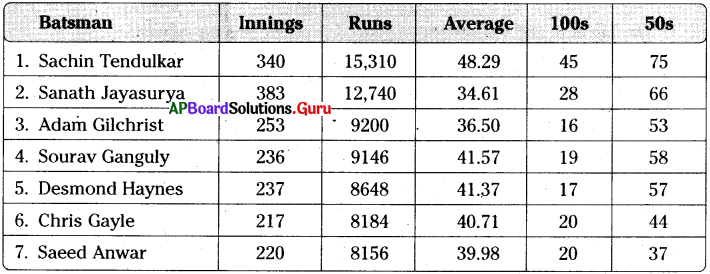
2. Study the following table :

Openers with more than 8000 runs in One Day Internationals (ODIs)
AP 7th Class English Important Questions Unit 4 The Brave Little Bowman 1

Now, answer the following questions.
a) What does the table show?
Answer:
The table shows the openers with more than 8000 runs in One Day Internationals.

b) Who was the highest scorer as an opener in ODIs?
Answer:
Sachin Tendulkar was the highest scorer in ODIs as an opener.

Choose the correct answer:
c) How many centuries were scored by Sachin as an opener?
i) 75
ii) 28
iii) 45
Answer:
iii) 45

d) Who was the second highest scorer as an opener?
i) Adam Gilchrist
ii) Sanath Jayasurya
iii) Sourav Ganguly
Answer:
ii) Sanath Jayasurya

e) The average of which two openers is almost equal?
i) Desmond Haynes and Chris Gayle
ii) Sourav Ganguly and Desmond Haynes
iii) Chris Gayle and Saeed Anwar
Answer:
ii) Sourav Ganguly and Desmond Haynes

Vocabulary

Synonyms

Choose the words with similar meanings (synonyms) from the list given to the words underlined.
AP 7th Class English Important Questions Unit 4 The Brave Little Bowman 2
Answer:
a) a) talented, b) hope
b) a) heavy, b) supporter
c) a) divided, b) equitably
d) a) At once, b) commanded
e) a) applauded, b) courage
f) a) give in, b) war

Antonyms

Write the opposites (antonyms) for the underlined words.
a) He was a skilled (a) archer. His only wish was to join (b) the army.
b) The Big Man : Thank you very much, your Highness ! We will serve (a) you to the best of our abilities (b).
c) Immediately (a) the king ordered (b) the big man to meet him.
d) A few days later (a), as a bolt from the blue for the big man, the kingdom was attacked (b) by an enemy.
e) The Big Man : Today is my last (a) day in this world. I am definitely (b) going to die.
f) I will fight (a) for the king and prove that I am better (b) than the big man, though I don’t have a big and strong body.
Answer:
a) a) unskilled, b) leave
b) a) neglect, b) inabilities
c) a) Eventually, b) obeyed
d) a) earlier, b) defended
e) a) first, b) doubtfully
f) a) yield, b) worse

Right Forms of the Words

Fill in the blanks with the right form of the words given in the brackets.

a) Once there lived a little _____ (a).(wisely / wise) man with a crooked back. He was a skilled _____ (b) (archery / archer).
b) I will do the work _____ (a) (assigned / assignment) to you and we will divide the pay _____ (b) (equally / equal).
c) They joined the army and were _____ (a) (happy / happily). One day the king sent for the big man and told him that there was a tiger in the forest who was _____ (b) (kill/ killing) people.
d) All the people in the _____ (a) (king / kingdom) praised the big man for his _____ (b) (brave / bravery).
e) The king _____ (a) (received / reception) a message either to surrender his kingdom to him or to get _____ (b) (ready / readily) for the battle.
f) As per the saying, ‘better late than never’, the little man _____ (a) (receive / received) the much deserved _____ (b) (honour / honourable).
Answer:
a) a) wise, b) archer
b) a) assigned, b) equally
c) a) happy, b) killing
d) a) kingdom, b) bravery
e) a) received, b)ready
f) a) received, b) honour

Spelling Test

Type – 1 : Vowel Clusters

Complete the following words using “ai, au, ea, ee, ei, eo, eu, ia, ie, io, oi, oo, ou, ua, ue or ui”.
a) He th _ _ ght that the king might not give him the job bec _ _ se of his crooked back.
b) Then the king w _ _ Id take both of them. He went in s _ _ rch of a big man.
c) The Big Man : My gr _ _ tings to you, your Majesty. I want to join y _ _ r army.
d) Immed _ _ tely the king ordered the big man to m _ _ t him.
e) The king rec _ _ ved a message either to surrender his kingdom to him or to get r _ _ dy for the battle.
f) The p _ _ ple called him ‘The Brave Little Bowman’. The king made him the ch _ _ f of the army and gave him rich gifts.
Answer:
a) thought, because
b) would, search
c) greetings, your
d) Immediately, meet
e) received, ready
f) people, chief

AP 7th Class English Important Questions Unit 4 The Brave Little Bowman

Type – 2 : Suffixes

Complete the following words with the suitable suffixes given in the brackets.

a) He was a skilled arch __(er /ery). His only wish was to join the army. He thought that the king might not give him the job because of his crook __(d /ed) back.
b) The little wise man want __(d / ed) to find a strong man and ask him to take him as his assist __(ant / ent).
c) The Big Man : Thank you very much, your High __(nes / ness)! We will serve you to the best of our abilit __(yes / ies).
d) All the people in the king __(dom / dome) praised the big man for his brav __(ary /ery).
Answer:
a) archer, crooked
b) wanted, assistant
c) Highness, abilities
d) kingdom, bravery

Type – 3 : Wronalv Spelt Words

Identify the wrongly spelt word and write its correct spelling in the space provided.

a) messege, report, country, archer
Answer:
message

b) palace, asistant, equally, shoot
Answer:
assistant

c) earn, thousand, battle, apreciate
Answer:
appreciate

d) worry, happy, imediatly, blessing
Answer:
immediately

e) praise, cheif, ashamed, shoulder
Answer:
chief

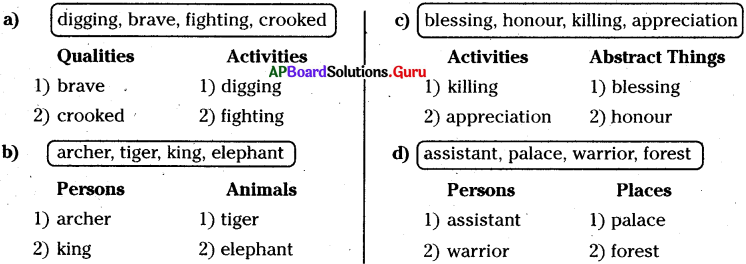
Classification of Words

Arrange the following words under the correct headings.
AP 7th Class English Important Questions Unit 4 The Brave Little Bowman 3

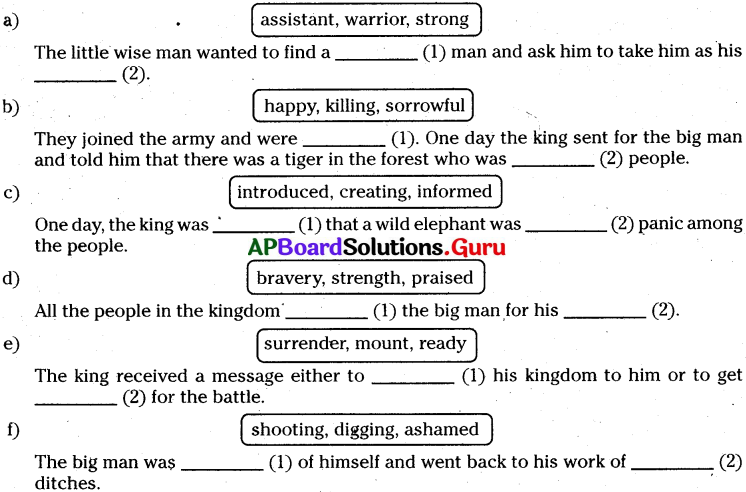
Choice of the Words

Fill in the blanks choosing the suitable words from those given in the box.
AP 7th Class English Important Questions Unit 4 The Brave Little Bowman 4
Answer:
a) 1) strong, 2) assistant
b) 1) happy, 2) killing
c) 1) informed, 2) creating
d) 1) praised, 2) bravery
e) 1) surrender, 2) ready
f) 1) ashamed, 2) digging

Verb Forms

Read the table given below and fill in the blank with the correct forms of the verbs. Write ‘Regular’ or ‘Irregular’ in the third column.

Present TensePast TenseRegular or Irregular
1. buyboughtIrregular
2. cleancleanedRegular
3. closeclosedRegular
4. dancedancedRegular
5. taketookIrregular
6. eatateIrregular
7. thinkthoughtIrregular
8. flyflewIrregular
9. writewroteIrregular
10. dodidIrregular

Grammar

I. Edit the following passage correcting the underlined parts.

1. Speech is a great blessing, and (a) it can also be an (b) great – curse, for it helped (c) us to make our intentions and desires knowing (d) to our friends.
Answer:
a) but b) a c) helps d) known

2. Once upon a time there lived a king in central India. He is (a) handsome and (b) very vain. He looked after (c) himself constantly in mirrors, in pools of water even in other people’s eyes when they spoke to him.
“I am the handsomest (d) king on earth,” he said to his courtiers.
Answer:
a) was b) but c) at d) most handsome

3. The green cells of leaves are wonderful little laboratories, there (a) all the starch in the world is produced. Since starch forms a (b) important part of the food of men and animals, their life depend (c) on the work done by the green cells of plants. Thus trees are such great friends to (d) man.
Answer:
a) where b) an c) depends d) of

4. Deforestation in a (a) Himalayas have become (b) major ecological problem. Its results are felt not only in the hill regions and (c) hundreds of miles downstream in the Ganges plain, who (d) feeds and waters about one-third of India’s 840 million people.
Answer:
a) the b) has become c) but d) which

AP 7th Class English Important Questions Unit 4 The Brave Little Bowman

II. Complete the passage choosing the right words from those given below. Each blank is numbered and for each blank four choices are given. Choose the correct answer and write (A), (B), (Q or (D) in the blanks.

1. A.P.J. Abdul Kalam ………….. (1) born in ………….. (2) middle-class Tamil family in the island town ………….. (3) Rameswaram. He was a short boy with rather ordinary looks ………….. (4) his parents were tall and handsome. His father was neither highly educated nor very rich.
1) A) is B) was C) being D) were
2) A) one B) the C) a D) an
3) A) of B) near C) by D) off
4) A) and B) if C) though D) but
Answer:
1) B 2) C 3) A 4) D

2. Ramesh ………….. (1) Mohan went ………….. (2) the cinema on Saturday ………….. (3) was a long queue. It was a cold evening and they ………….. (4) to stand in the queue for nearly an hour.
1) A) or B) and C) but D) so
2) A) to B) for C) by D) into
3) A) Their B) There C) They D) The
4) A) have B) had C) has D) will have
Answer:
1) B 2) A 3) B 4) B

3. Lai Bahadur Shastri ………….. (1) born on 2nd October, 1904 ………….. (2) Mogul Sarai ………….. (3) Varanasi. His father was below two years of age ………….. (4) ordinary teacher and died when he was below two years of age.
1) A) is B) was C) are D) were
2) A) at B) in C) from D) on
3) A) of B) from C) in D) at
4) A) the B) an C) a D) one
Answer:
1) B 2) A 3) C 4) B

4. One day a Brahmin was walking ………….. (1) a forest ………….. (2) suddenly he ………….. (3) someone crying out for help. He ………….. (4) in the direction of the sound and came upon a well that was dried up.
1) A) by B)through C) in D) from
2) A) or B)through C) when D) but
3) A) heard B) hear C) hears D) hearing
4) A) go B) went C) goes D) going
Answer:
1) B 2) C 3) A 4) B

III. Fill in the blanks with the verb in Simple Future Tense.

1) Our exams ______ (postpone) because of the second wave Corona.
2) I ______ (meet) you this evening.
3) I don’t think she ______ (accept) your proposal.
4) I ______ (tell) you about it later.
5) I ______ (write) to you as early as possible.
6) Next week, we ______ (buy) a new car.
7) This shop ______ (close) by 8 p.m. today.
8) She ______ (come) to the party.
9) I think, they ______ (lose) their match against Australia.
10) Tomorrow, my father ______ (take) us to circus.
Answer:

  1. will be posponed
  2. will meet
  3. will accept
  4. will tell
  5. shall write
  6. shall buy
  7. will be closed
  8. will come
  9. will lose
  10. will take

IV. Fill in the blanks with the verb in Simple Future Tense.

1) My father _____ (be) in Guntur tomorrow.
2) I _____ (see) you on Sunday.
3) They _____ (sell) their house.
4) I _____ (do) it for you.
5) I _____ (go) to school tomorrow.
6) _____ you _____ (ring) the bell?
7) I am angry, I _____ (beat) you if you continue to argue with me.
8) They _____ (play) a match in the next month.
9) I _____ (have) my lunch at 2 p.m. this afternoon.
10) I am thirsty, I _____ (drink) a bottle of lemonade.
Answer:

  1. will be
  2. will see
  3. will sell
  4. shall do
  5. will go
  6. will, ring
  7. shall beat
  8. will play
  9. shall have
  10. will drink

V. Write negative sentences for the given positive sentences.

1) I will see you tomorrow.
2) Tonight, we will go to the cinema.
3) I shall display my product at the exhibition which is going to be held in Vijayawada.
4) I shall attend the programme.
5) He will join us in the webex meeting.
6) They will play a match tomorrow.
7) They will get married in August.
8) It will rain soon.
9) Sushma will be in 8th class by this time, next year.
10) She will dance with me.
Answer:

  1. I won’t see you tomorrow.
  2. Tonight, we won’t go to the cinema.
  3. I shan’t display my product at the exhibition which is going to be held in Vijayawada.
  4. I shan’t attend the programme.
  5. He won’t join us in the webex meeting.
  6. They won’t play a match tomorrow.
  7. They won’t get married in August.
  8. It won’t rain soon.
  9. Sushma won’t be in 8th class by this time, next year.
  10. She won’t dance with me.

Creative Writing

1. You have read the lesson “The Brave Little Bowman”. You have come to know about the little man’s crooked back though he was a skilled archer. His wish was to join the army. But, he couldn’t get a job in the army because of his crooked back.
Now, describe the feelings of the little bowman about his crooked back and how he could get a job in the army.
Answer:
The little man was very wise. He was a skilled archer too. But he was unhappy with his crooked back. His strong desire was to join the army. But he knew that he would be refused to join the army because of his crooked back. He thought, “How unlucky fellow I am! Though I am a skilled archer 1 could not fulfil my wish. Oh, God! Why did you give me this crooked back? What can I do now? Shall I go to the king and request him to take me into his army? No, it is not good. He should not give me the job because of my crooked back.

Oh, God! Please show me a way to join the army. If I don’t get a job in the army, my life is futile. What will happen if I assist a strong man? Why can’t I use a strong man to join the army? Yes, it is a good idea! I must find out a strong man and ask him to take me as his assistant. Then we will go to the king and he will give jobs to both of us in the army. Thank God! You have given me a right idea. Now, I am hopeful of fulfilling my wish.”

AP 7th Class English Important Questions Unit 4 The Brave Little Bowman

2. You have learnt that the little bowman was made the chief of the army by the king. The king and all the people came to know about his abilities. The little man’s joy knew no bounds when he was made the chief of the army.
Imagine that you are the little bowman and make a diary entry describing the feelings of the little bowman after he was made the chief of the army.
Answer:

15th November, 20xx
Friday
7:30 p.m.
Dear Diary,Today is a very good day. It is really an unforgettable day in my life. Finally, I have fulfilled my long-lasting wish. Thank God! You only have given me this chance. It’s all because of that big man. What a coward he is! Though big and strong, he is timid. However, his leaving the battlefield is a blessing in disguise for me. Though I don’t have a big body, I have fought for the kingdom and proved that I am better than the big man. The king has made me the chief of the army and given me a number of rich gifts. It is a great honour for me. I am very happy. Oh, God! I am grateful to you. I shall do my level best as the chief of the army. I shall discharge all my duties upto the king’s entire satisfaction I can’t believe my eyes. Today is a memorable day for me.The Little Bowman

3. Write about an act of bravery that you or your family member or any one of your friends may have shown at some stage in your life.
Answer:
An act of my bravery

My father runs a jewellery shop. The shop is open on all days. But it is closed on Sundays.

One Sunday evening. 1 was returning home after playing cricket with my friends. I was coming on my bicycle. On my way home, when 1 came to my father s shop, I found #my father’s shop was kept open. I was surprised to see it open as it was a Sunday. I got down my bicycle and put it behind a tree and stood there silently to see what was going to happen. A few minutes later, I saw two thieves coming from the shop with a bag of jewellery and keeping it in their car, kept outside the shop. They later, went again into the shop to bring some more.

At once, without any hesitation, I ran towards the car and took out the air from all the tyres. Then I rode on my bicycle to the nearby police station and informed the police about the theft.

The police took me in their jeep and came to the spot. Seeing the police, the thieves began to run. But the police chased them and caught hold of them. All our jewellery was kept back in the shop and then it was locked.

The police congratulated me on my act of bravery. All my friends and neighbours praised me for my bravery. I felt happy as 1 had saved our property.

4. You know that Dr. B.R. Ambedkar was a social reformer and a politician. He was the chairman of the drafting committee of the Indian Constitution. Now write a brief biographical sketch using the facts given below.
Birth : 14 April, 1891
Place of Birth : Mhow in Central Provinces (currently Madhya Pradesh)
Parents : Ramji Maloji Sakpal (father) and Bhimabai Murbadkar Sakpal (mother)
Wife : Ramabai Ambedkar
Education : Elphinstone High School, University of Bombay, Columbia University, London School of Economics
Associations : Samata Sainik Dal, Independent Labour Party. Scheduled Castes Federation
Political Ideology : Right winged; Equalism
Religious Beliefs : A Hindu by birth; a Buddhist 1956 onwards
Books written : Essays on Untouchables and Untouchability, The Annihilation of Caste, Waiting for a Visa
Death : 6, December, 1956
Answer:
Dr. B.R. Ambedkar was a social reformer and a politician. He was the chairman of the drafting committee of the Indian Constitution. He was born on 14 April, 1891 in Mhow in Central Provinces (currently Madhya Pradesh). His parents were Ramji Maloji Sakpal (father) and Bhimabai Murbadkar Sakpal (mother). Ramabai Ambedkar was his wife. He had his schooling from Elphinstone High School. He took his university education from University of Bombay, Columbia University and London School of Economics.

He worked for the organizations of Samaita Sainik Dal, Independent Labour Party and Scheduled Castes Federation. He was right winged. He fought for equal rights for all people. He was a Hindu by birth and turned a Buddhistl956 onwards. He wrote ‘Es¬says on Untouchables’, ‘Untouchability’, ‘The Annihilation of Caste’ and ‘Waiting for a Visa’ describing the problems of the untouchables in society. He passed away on 6th December 1956.

5. Write a story using the following hints.

Hints : Woodcutter – cutting tree – on river bank – axe slips – falls into water – woodcutter sad – river god appears from water – offers golden axe – woodcutter refuses – god offers silver axe – woodcutter refuses- god offers iron-own axe – woodcutter happy – accepts axe – god very pleased- honest woodcutter – gives all three axes.
Answer:
Title : AN HONEST WOODCUTTER
Once upon a time there was a woodcutter. The woodcutter lived in a village with his family. Though he was poor, he was honest. He had to earn money by selling firewood. He used to cut trees on the nearby river bank.

One day he went to the nearby river bank and started cutting a tree. Unfortunately while he was cutting the tree, his iron axe slipped and fell into water. The woodcutter felt sad as he lost his iron axe. Moreover it would be difficult for him to buy a new axe. He prayed to god for help. Immediately the river god came out of the water and appeared before him. The river god asked the woodcutter what his problem was. The woodcutter told the god that his axe slipped and fell into the river water. He requested the god to bring his axe back. The god took pity on him and disappeared. He brought a golden axe instead of the iron axe and offered it to the woodcutter. But the woodcutter refused to take the golden axe offered by the river god as it was not his own axe. Then the river god disappeared again and came out of water with a silver axe. The god offered him to take the silver axe. But the woodcutter refused the silver axe also, as it was not his own axe.

The river god disappeared once again and came out of water with the woodcutter’s own iron axe. He offered it to the woodcutter. The woodcutter was happy on seeing his own iron axe and accepted to take the iron axe. The river god was pleased with the . honesty of the woodcutter. He gave all the three axes to him and disappeared. The woodcutter went home happily.

Moral: Honesty will be rewarded.

AP 7th Class English Important Questions Unit 4 The Brave Little Bowman

6. Write a story using the hints provided :

Hints : Small village – a boy and a mother – poor – collected wood from forest – cut down small trees – one day – a big bird from a tree – don’t cut down this tree – my house – boy agreed – bird pleased – come before sunrise with a bag – next morning – hold on to my tail – flew up – in the sky – to a distant valley – full of gold – filled the bag – flew back – boy and mother rich – happy.
Answer:
The Kindness of a Bird
Once there lived a boy and his mother in a small village. They were very poor and earned their livelihood by collecting wood from forest. The boy used to cut down small trees.

One day he began to cut a big tree. A bird from the tree pleaded not to cut down the tree because it was her house. The boy agreed.

The bird was pleased and asked the boy to come before sunrise with a bag the next morning. He did as the bird said. The.bird asked the boy to hold on to her tail. The boy held her tail tightly and the bird flew up in the sky to a distant valley which was full of gold. The boy filled the bag with gold. Then they flew back. The boy and his mother became rich. They lived happily.

AP 7th Class English Important Questions Unit 2 The Turning Point

These AP 7th Class English Important Questions 2nd Lesson The Turning Point will help students prepare well for the exams.

AP Board 7th Class English Unit 2 Important Questions and Answers The Turning Point

Reading Comprehension (Seen)

1. Read the following passage carefully.

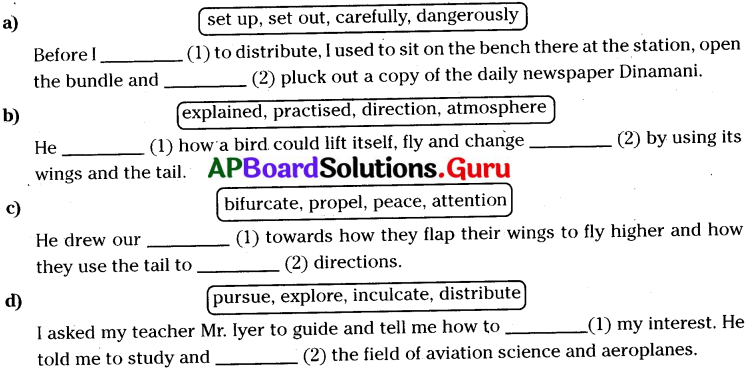
I was in class V when the Second World War, the largest conflict in human history, was at its peak- Because of the war all the resources were scarce and the prices were not affordable. So, 1 had to take up my first job as a newspaper boy My task was to pick up a bundle of Tamil Newspapers and to deliver them to some local offices, some tea stalls, and occasionally a few homes. Before I set out to distribute, I used to sit on the bench there at the station, open the bundle, and carefully pluck out a copy of the daily newspaper Dinamani. The first page always caught my attention as it was usually filled with photos of fighter aircraft and stories of the Second World War. The German air force called Luftwaffe was sending hundreds of planes and bombers to attack the city and the British Royal Air Force had to deploy their full air force to defend their motherland. The stories would be about brave pilots from both the sides, and how they manoeuvred their aircraft and bombers. As a young boy I used to love the stories of the pilots and their planes. I was curious about planes. I wanted to be a pilot myself. (The Turning Point)

Now, answer the following questions.
1. What was the class that Kalam was in at the time of the Second World War?
Answers:
In class V

2. What made the resources scarce?
Answers:
The Second World War

3. What was his first job?
Answers:
He worked as a newspaper boy.

4. What was the news that was published on the first page of the newspaper?
Answers:
The photos of fighter aircrafts and stories of the Second World War

5. What made the speaker want to become a pilot?
Answer:
The stories of the pilots and their planes in the Second World War

AP 7th Class English Important Questions Unit 2 The Turning Point

2. Read the following passage carefully.

My curiosity grew in science because of a very special teacher when I was a ten-year-old boy in Class V. This was indeed a life-changing event. My science teacher’s name was Shri Siva Subramania Iyer. One day the topic of discussion in our class of sixty-five was ‘how birds fly? He drew a sketch of a bird with a tail, wings, feathers, and head on the board and explained how a bird flew. He explained how a bird could lift elf, fly and change direction by using its wings and the tail. He asked us whether we understood.

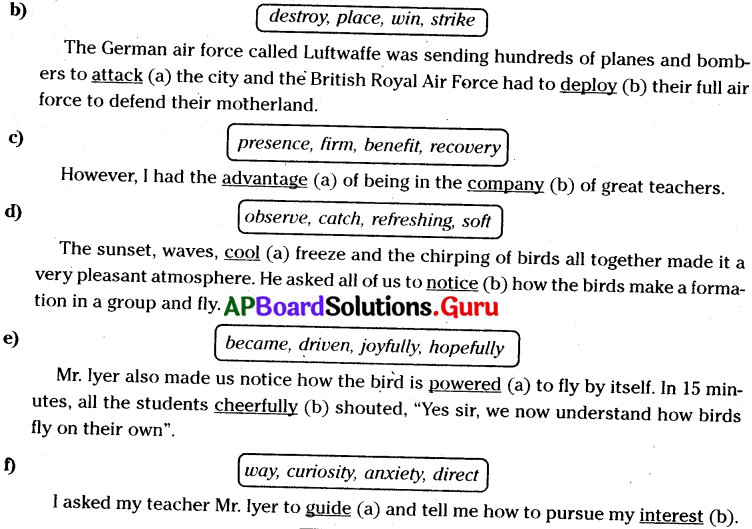
We gave a gloomy reply – no. Mr. Iyer did not get upset. That evening he took all of us to the seashore. The sunset, waves, cool breeze, and the chirping of birds all together made it a very pleasant atmosphere. He asked all of us to notice how the birds make a formation in a group and fly. He also told us to notice the shape of the formation made by the birds while flew. He drew our attention towards how they flap their wings to fly higher and how they use the tail to propel directions. Mr. Iyer also made us notice how the bird is powered to fly by itself. In 15 minutes, all the students cheerfully shouted “yes sir, we now understand how birds fly on their own.” (The Turning Point)

Now, answer the following questions.
1. What was the speaker curious for?
Answer:
Science

2. What was the topic of discussion in the class?
Answer:
How birds fly

3. What did the teacher explain?
Answer:
The flight or flying of the bird

4. What did the teacher do to make his students understand the topic well?
Answer:
He took his students to the seashore and showed them how the birds really fly.

5. How was the atmosphere at the seashore?
Answer:
It was very pleasant.

3. Read the following passage carefully.

The flight principle got imprinted in my mind and I decided that in the future I will study subjects related to flight. However, as a little boy I needed guidance to pursue this field. I asked my teacher Mr. Iyer to guide and tell me how to pursue my interest. He told me to study and explore the field of aviation science and aeroplanes.

Whatever I had learnt that day changed my life. 1 was inspired to have an aim. Later I realized how important it was to study Physics. I chose Physics. I opted for Aeronautical Engineering at the Indian Institute of Technology, Madras. Then, I became an Aeronautical Engineer and a space technologist. Mr. Iyer’s class had transformed my life which led me to make a profession out of my passion. Aeronautics, or the science of flight, was special to me. My career began in this field. (The Turning Point)

Now, answer the following questions.
1. What was imprinted in the speaker’s mind?
Answer:
The flight principle

2. What decision did the speaker take to do in future?
Answer:
He wanted to study subjects related to flight.

3. Who guided the speaker to pursue his interest?
Answer:
Mr. Siva Subramania Iyer, his science teacher

4. What did the speaker study at IIT, Madras?
Answer:
Aeronautical Engineering

5. How did the speaker start his career?
Answer:
He started his career as an aeronautical scientist.

AP 7th Class English Important Questions Unit 2 The Turning Point

4. Read the following lines carefully.

This is my prayer to thee, My Lord – strike, strike at the root of penury in my heart.
Give me the strength lightly to bear my joys and sorrows.
Give me the strength to make my love fruitful in service.
Give me the strength never to disown the poor or bend my knees before insolent might.
Give me the strength to raise my mind high above daily trifles.
And give me the strength to surrender my strength to thy will with love. (Give Me Strength)
Now, answer the following questions.

1. Who is praying to whom?
Answer:
The post is playing to God

2. What does the poet pray for?
Answer:
For strength to bear his joys end sorrows

3. What does the poet want the Lord to strike?
Answer:
The root of penury in his hear

4. Who are not to be disowned?
Answer:
The poor

5. What is ‘thy will’ according to the poet?
Answer:
To serve human beings

Reading Comprehension (Unseen)

1. Read the following passage carefully.

Up the river Hudson in North America are the Catskill mountains. They are not so high as the Himalayas in India. In a certain village at the foot of these mountains there lived long ago a man called Rip Van Winkle. He was simple and good natured. A very kind neighbour and a great favourite of all the good wives in the neighbourhood. The women took his side and put the blame on Dam Van Winkle. .

The children of the village too would shout with joy whenever they saw him. He made play things for them. He told them fairy tales. So they liked him.

Now, answer the following questions.
a) Why did children like Rip Van Winkle?
Answer:
Rip Van Winkle used to make play things for children. He told them fairy tales. So children liked Rip Van Winkle very much.

b) What kind of man was Rip Van Winkle?
Answer:
Rip Van Winkle was simple and good natured. He was a very kind neighbour and a great favourite of all the women and children in the village.

Choose the correct answer from the choices given.
c) Where are the Catskill mountains?
i) In South America
ii) In Africa
iii) In North America
Answer:
iii) In North America

d) Where did Rip Van Winkle live?
i) On the top of Catskill mountains
ii) In a village at the foot of the Catskill mountains
iii) In a city in North America
Answer:
ii) In a village at the foot of the Catskill mountains

e) Who liked Rip Van Winkle very much?
i) All the wives in the neighbourhood
ii) All the husbands in the neighbourhood
iii)All the friends in the village
Answer:
i) All the wives in the neighbourhood

AP 7th Class English Important Questions Unit 2 The Turning Point

2. Read the following passage carefully.

In the American War of Independence, a Corporal and a party of soldiers were ordered to raise a heavy beam for a battery that was being repaired. There were too few men for the work, but the Corporal, full of his dignity did nothing but stand by and shout orders, presently an officer, not in uniform rode up. “Hallo,” he said to Corporal, ‘why don’t you lend your men a hand to get that beam up?” “Don’t you know that I am a Corporal ?” was the reply, “Are you ?” said the officer, who then got down from his horse and joined the men. He worked till the sweat streamed down his face. When the beam had been raised and put to its place, he turned to the Corporal and bade him a low bow, “Good day Mr. Corporal. Next time when you have too few men for this kind of work, send for the Commander in Chief and I shall be happy to help you again.”

It was George Washington himself.

Now, answer the following questions.
a) Why did the officer get down from the horse?
Answer:
The officer got down from his horse to help the men in their work.

b) Who was the person that helped the men and the Corporal?
Answer:
The person that helped the man and the Corporal was none other than the President of America, George Washington.

Choose the correct answer from the choices given.
c) What was to be raised?
i) A battery
ii) A cannon
iii) A beam
Answer:
iii) A beam

d) Who was the person that was having dignity?
i) The Corporal
ii) The Soldier
iii) The President
Answer:
i) The Corporal

e) What did the Corporal have?
i) Very few men
ii) Many ment
iii) A lot of soldiers
Answer:
i) Very few men

Interpretation Of Non-Verbal Information

1. In the table given below the data is given about different age groups in different employment sectors.

Read the table and answer the following questions :
AP 7th Class English Important Questions Unit 2 The Turning Point 1
Now answer the following questions.
a) What does the above table show?
b) In which sector are very small member of people working?
c) In which sector are maximum number of people working?
d) In which sector are maximum number of young people working?
e) In which sector are maximum number of old people working?
Answer:
a) The above table shows people of different age groups working under different employment sectors.
b) In accountancy very small number of people are working.
c) In manufacturing sector maximum number of people are working.
d) In retail sector maximum number of young people are working.
e) In manufacturing sector maximum number of old people are working.

2. Study the table given below and observe the changing patterns of unemployment in some advanced countries.
AP 7th Class English Important Questions Unit 2 The Turning Point 2
Now answer the following questions.
a) How many countries are compared in the given table?
b) What period does the table represent?
c) Which country has the least unemployment rate in 2005?
d) Which country has a decrease of nearly 6% in unemployment rate between 2000 and 2006?
e) In the case of every country we can notice that (Choose the correct answer.)
i) The unemployment rate is steadily increasing.
ii) The unemployment rate is steadily decreasing.
iii) The unemployment rate is fluctuating, i.e. sometimes it rises and sometimes it falls.
f) Which year recorded the highest unemployment rate for many countries?
g) Which country recorded the least fluctuations in the unemployment rate?
Answer:
a) Eight countries are compared in the given table.
b) The table represents the period 2000 – 2006.
c) Japan has the least unemployment rate in 2005.
d) Spain has a decrease of nearly 6% in unemployment rate between 2000 and 2006.
e) iii
f) 2003
g) Germany

Vocabulary

Synonyms
Choose the words with similar meanings (synonyms) from the list given to the words underlined.
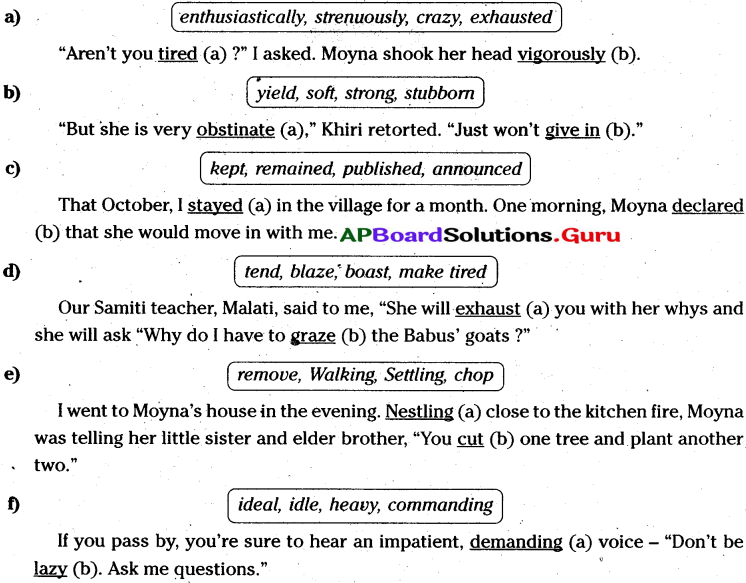
AP 7th Class English Important Questions Unit 2 The Turning Point 3
AP 7th Class English Important Questions Unit 2 The Turning Point 4
Answer:
a) a) hand over, b) sometimes
b) a) strike, b) place
c) a) benefit, b) presence
d) a) refreshing, b) observe
e) a) driven, b) joyfully
f) a) direct, b) curiosity

Antonyms

Write the opposites (antonyms) for the underlined words.

a) Because of the war all the resources were scarce (a) and the prices were not affordable (b).
b) Before I set out to distribute (a), I used to sit on the bench there at the station, open (b) the bundle and carefully pluck out a copy of the daily newspaper Dinamani.
c) The stories would be about brave (a) pilots from both the sides, and how they maneuvered their aircraft and bombers. As a young (b) boy, I used to love the stories of the pilots and their planes.
d) My curiosity (a) grew in science because of a very special (b) teacher when I was a ten-year-old boy in class V.
e) The sunset (a), waves, cool breeze, and the chirping of birds all together made it a very pleasant (b) atmosphere.
f) Mr. Iyer also made us notice how the bird is powered (a) to fly by itself. In 15 minutes, all the students cheerfully (b) shouted, “Yes sir, we now understand how birds fly on their own.”
Answer:
a) a) abundant / plentiful, b) unaffordable
b) a) collect, b) close
c) a) timid, b) old
d) a) disinterest, b) ordinary
e) a) sunrise, b) unpleasant
0 a) exhausted, b) sorrowfully

Right Forms of the Words

Fill in the blanks with the right form of the words given in the brackets.

a) I was in class V when the Second World War, the ____ (a) (larger / largest) conflict in human history, was at its peak. Because of the war all the resources were ____ (b) (scarce / scarcity) and the prices were not affordable.
b) The German air force called Luftwaffe was ____ (a) (sending / send) hundreds of planes and bombers to attack the city and the British Royal Air Force had to ____ (b) (deploy / deployment) their full air force to defend their motherland.
c) As a young boy, I used to ____ (a) (love / lover) the stories of the pilots and their planes. I was ____ (b) (curiosity / curious) about planes.
d) My ____ (a) (curious / curiosity) grew in science because of a very ____ (b) (special / speciality) teacher when I was a ten-year-old boy in class V.
e) The sunset, waves, cool breeze and the chirping of birds all together made it a very ____ (a) (pleasant / pleasantly) atmosphere. He asked all of us to notice how the birds make a ____ (b) (formed / formation) in a group and fly.
f) Mr. Iyer’s class had ____ (a) (transformation / transformed) my life which ____ (b) (led / leader) me to make a profession out of my passion.
Answer:
a) a) largest, b) scarce
b) a) sending, b) deploy
c) a) love, b) curious
d) a) curiosity, b) special
e) a) pleasant, b) formation
f) a) transformed, b) led

AP 7th Class English Important Questions Unit 2 The Turning Point

Spelling Test

Type – 1 : Vowel Clusters

Complete the following words using “ae, ai, au, ea, ee, ei, eo, eu, ia, ie, io, oa, oo, ou, ua, ue or ui”.

a) The first page always c _ _ ght my attent _ _ n as it was usually filled with the photos of fighter aircrafts and stories of the Second World War.
b) As a y _ _ ng boy, I used to love the stories of the piiots and their planes. I was cur _ _ us about planes.
c) My curiosity grew in science bee _ _ se of a very special t _ _ cher when 1 was a ten-year-old boy in class V.
d) He asked us whether we underst _ _ d. We gave a gl _ _ my reply – no.
e) The sunset, waves, c _ _ i breeze and the chirping of birds all together made it a very pi _ _ sant atmosphere.
f) Whatever I had l _ _ rnt that day changed my life. I was Inspired to have an _ _ m.
Answer:
a) caught, attention
b) young, curious
c) because, teacher
d) understood, gloomy
e) cool, pleasant
f) learnt, aim

Type – 2 : Suffixes

Complete the following words with the suitable suffixes given in the brackets.

a) The first page always caught my attent ___ (ion / ian) as it was usual ___ (liy / ly) filled with the photos of figher aircrafts and stories of the Second World War.
b) My curio ___ (city / sity) grew in science because of a very special teach ___ (er / or) when 1 was a ten-year-old boy in class V.
c) He explained how a bird could lift itself, fly and change direct ___ (ion/ian) by using its wings and the tail. He asked us whether we understood. We gave a gloom ___ (y / ey) reply – no.
d) He drew our attention towards how they flap their wings to fly high ___ (est /er) and how they use the tail to propel direct ___ (ions / ians).
e) I opted for aero ___ (nautic / nautical) engineering at the Indian Institute of Technology, Madras. Then, I became a space techolog ___ (yist / ist).
Answer:
a) attention, usually
b) curiosity, teacher
c) direction, gloomy
d) higher, directions
e) aeronautical, technologist

Type – 3 . Wronalv Spelt Words

Identify the wrongly spelt word and write its correct spelling in the space provided.
a) canflict, seashore, direction, realize
Answer:
conflict

b) resorce, discussion, chirp, career
Answer:
resource

c) important, field, plesant, deliver
Answer:
pleasant

d) technology, interest, ocassionally explain
Answer:
occasionally

e) caught, discuss, skech, flight
Answer:
sketch

Classification of Words

Arrange the following words under the correct headings.
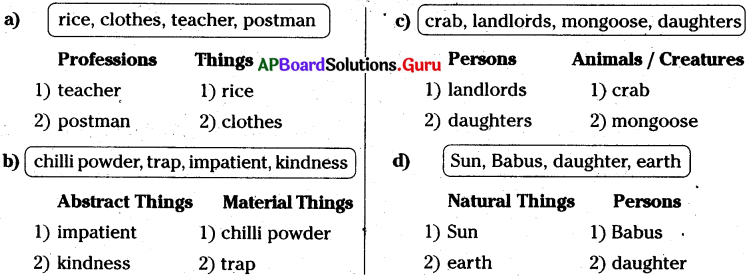
AP 7th Class English Important Questions Unit 2 The Turning Point 5

Choice of the Words

Fill in the blanks choosing the suitable words from those given in the box.
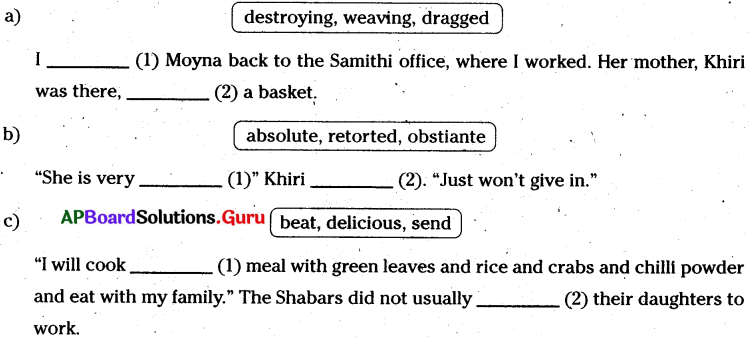
AP 7th Class English Important Questions Unit 2 The Turning Point 6
Answer:
a) 1) set out, 2) carefully
b) 1) explained, 2) direction
c) 1) attention, 2) propel
d) 1) pursue, 2) explore

Compound Adjectives

1. Fill in the blanks to complete the given paragraph using the compound adjectives given in the box.
long-sleeved high-heeled open-mouthed sweet-looking well-dressed odd-looking part-time

Mrs. Das has a __(1)__ job in a clothes shop. Yesterday, an __(2)__ woman walked into the shop. She was wearing __(3)__ shoes. A __(4)__ dog was with her. “I want a __(5)__ shirt for my dog, please,” she said. “For your dog?” asked Mrs.Das, __(6)__ in surprise. “Yes,” replied the woman. “I want him to be __(7)__ for my next party.”
Answer:
1) part-time,
2) odd-looking,
3) high-heeled,
4) sweet-looking,
5) long-sleeved,
6) open-mouthed,
7) well-dressed.

2. Match the following words in Set – A with Set – B to make compound adjectives and write them in the space given.

Set – ASet – BCompound Adjective
1. coldA) lastingcold-blooded
2. fourB) bloodedfour-day
3. wellC) daywell-read
4. fiveD) readfive-star
5. longE) starlong-lasting

Grammar

I. Edit the following passage correcting the underlined parts.

1. Tigers lives (a) in different parts of Asia and Siberia. The tiger or (b) the lion are the biggest animals in the cat family. An (c) male tiger is about 10 feet long. Their (d) coat is yellow and black.
Answer:
a) live, b) and, c) A, d) Its

2. Around the earth there was (a) atmosphere who (b) is like a rind round the (c) fruit. It is made up of oxygen, nitrogen, water vapour or (d) a number of other gases.
Answer:
a) is, b) which, c) a, d) and

3. In a village there lived a boy and his mother. There (a) are (b) very poor. The boy collected wood in (c) the forest and sold it. He cuts (d) down small trees also.
Answer:
a) They, b) were, c) from, d) cut

4. The Banyan tree is possibly a (a) biggest and friendliest of all our trees. We did (b) not see many banyan trees in our cities nowadays. This (c) trees require plenty of space for (d) spread themselves.
Answer:
a) the, d) do, c) These, d) to

AP 7th Class English Important Questions Unit 2 The Turning Point

II. Complete the passage choosing the right words from those given below. Each blank is numbered and for each blank four choices are given. Choose the correct answer and write (A), (B), (Q) or (P) in the blanks.

1. Every Sunday Daniel and his family ____(1) to the beach. They live far ____(2) the beach. ____(3) once a week the family gets into the car and Daniel’s father for hours ____(4) they reach the beach.
1) A) goes B) went C) go D) going
2) A) away B) from C) to D) of
3) A) And B) But C) Or D) Yet
4) A) till B) to C) until D) up to
Answer:
1) C 2) B 3) B 4) C

2. Mahatma Gandhi freed India from ____(1) British Empire. He did not ____(2) the British ____(3) guns ____(4) he loved all people.
1) A) a B) an C) the D) some
2) A) fight B)fought C) fighted D) fighting
3) A) from B) by C) with D) ou
4) A) so B) because C) why D) for
A. 1) C 2) A 3) C 4) B

3. Of all ____(1) creatures, butterflies are perhaps ____(2) most beautiful. Thev have such briehtlv ____(3) wings. If vou look at the wings ____(4) a magnifying glass, you will see that they are covered by tiny scales.
1) A) fly B) flying C) flew D) flown
2) A) a B) an C) the D) some
3) A) colour B) colours C) coloured D) colouring
4) A) from B) in C) into D)through
Answer:
1) B 2) C 3) C 4) D

4. Atmosphere makes ____(1) earth a planet of life. It ____(2) us with the air to breathe, protects ____(3) from dangerous solar ravs ____(4) saves us from the extremes of heat and cold.
1) A) a B) an C) the D) that
2) A) supply B) supplies C) supplied D) supplying
3) A) we B) us C) our D) ours
4) A) but B) and C) or D) yet
Answer:
1) C 2) B 3) B 4) B

III. Write the past forms of the words given below.
AP 7th Class English Important Questions Unit 2 The Turning Point 7
Answer:
1) belonged
2) grew
3) explained
4) directed
5) understood
6) made
7) shouted
8) decided
9) told
10) opted

IV. Fill in the blanks with past form of the verb given in brackets.

1) He _____ (go) home very late last night.
2) I _____ (meet) her two years ago.
3) They _____ (buy) a new flat last month.
4) Columbus _____ (discover) America.
5) The teacher _____ (appreciate) the students.
Answer:

  1. went
  2. met
  3. bought
  4. discovered
  5. appreciated

AP 7th Class English Important Questions Unit 2 The Turning Point

V. Fill in the blanks with suitable adverbs of time given iii the box.

1) She has _____ finished training.
2) Have you _____ been to Agra?
3) I have lived in Guntur _____ 2015.
4) He has loved in Chennai _____ a long time.
5) Subhash hasn’t arrived _____ .
6) What time does the film start? It has _____ started.
Answer:

  1. just
  2. ever
  3. since
  4. for
  5. yet
  6. already

Creative Writing

1. In Kalam’s autobiography “The Turning Point”, you have learnt that Kalam worked as a newspaper boy while he was studying in class V. You know that those were the days of the Second World War. Kalam used to sit on the bench there at the station and read the stories of war. Kalam was very enthusiastic about those stories. One day he read the war story of the previous day. Then, he distributed the daily newspaper and went to school. That evening, he started to write a diary.
Imagine that you were Kalam and attempt a diary entry.
Answer:
Friday, 10th September 2021
7:30 p.m.

Dear Diary,
In the morning, the photos I saw are really magnificent. They are the photos of war between Britain and Germany. How attractive they are ! The first page of the daily newspaper Dinamani is totally filled with the photos of fighter aircrafts and stories of the Second World War. The German Air Force is sending hundreds of planes and bombers to attack the city and the British Royal Air Force is deploying their full force to defend their motherland. 1 like those stories of brave pilots from both the sides, and how they manoeuvre their aircrafts and bombers. I love the stories of the pilots and their planes. I am really curious about planes. I love the profession of a pilot. I too shall become a pilot myself. I shall operate the planes. But my family is a poor one where nobody is a literate. What can I do ? Yes, I shall take the guidance from our teachers. That’s all for now! I’m really tired and I am going to sleep.
Kalam

2. In the lesson The Turning Point’ you have learnt that the science teacher Mr. Siva Subramania Iyer took the students of class V to the seashore and taught them how birds fly on their own. The flight priniciple got imprinted in Kalam’s mind and he decided that in the future he would study subjects related to flight. He met Mr. Iyer to seek his guidance.

Now, write a possible conversation between Mr. Iyer and Kalam on the above context.
Answer:
Kalam : Good morning, Sir!
Mr. Iyer : Good morning. What brings you here, Kalam?
Kalam : Sir, yesterday you taught us how birds fly. I now understand how they fly on their own.
Mr. Iyer : Very good.
Kalam : Sir, the flight principle got imprinted in my mind and so I decided
Mr. Iyer : Why do you hesitate, boy? You can express your feelings with me freely.
Kalam : I decided that in the future I will study subjects related to flight.
Mr. Iyer : Oh, very nice to hear.
Kalam : Sir, I need your guidance to pursue my interest.
Mr. Iyer : Certainly, I’ll guide you. If you work hard, you’ll achieve your aim.
Kalam : Thank you very much, sir.

3. Use the following information and write a bio-sketch of Dr. Kalam.
Dr. Avul Pakir Jainulabdeen Abdul Kalam
Birth : 15th October 1931 at Rameswaram in Tamil Nadu
Died on : 27th July 2015
Parents : Ashiamma (mother), Jainulabdeen (father)
Education : Schooling at Rameswaram
Childhood friends : Ramanadha Sastry, Aravindan and Sivaprakasan
Alma Matter : St. Joseph’s College, Tiruchirapalli
Madras Institute of Technology
Profession : Professor, author, aerospace scientist
Presidency : 11th President of India on 25th July 2002
Achievements : Evolution of ISRO’s launch vehicle programme, operationalisation of AGNI, PRITHVI missiles
Literary pursuits : Four of his books
– Wings of Fire
– India 2020 – A Vision for the New Millennium
– My Journey
– Ignited Minds
Honours : Honorary doctorate from 30 universities
Awards : Padma Bhushan (1981)
Padma Vibhushan (1990)
Bharat Ratna (1997)
Answer:
Dr. Avul Pakir Jainulabdeen Abdul Kalarn

Abdul Kalam was the 11th President of India. He was born on 15th October 1931 at Rameswaram in Tamil Nadu. His mother was Ashiamma and father Jainulabdeen. He did his schooling at Rameswaram. His childhood friends are Ramanadha Sastry, Aravindan and Sivaprakasan.

He studied at St. Joseph’s College in Tiruchirapalli and completed his professional course at Madras Institute of Technology. He stepped into the shoes of many professions such as a professor, author, and an aerospace scientist.

He was elected as 11th President of India on 25th July 2002. He played a key role in the evolution of ISRO’s launch vehicle programme and in the operationalisation of AGNI, PRITHVI missiles.

The four important literary pursuits of Kalam are Wings of Fire, India 2020 – A Vision for the New Millennium, My Journey and Ignited Minds. He was honoured with a honorary doctorate from 30 universities. He got awards like Padma Bhushan in 1981 and Padma Vibhushan in 1990. He also got the most prestigious award Bharat Ratna in 1997. He passed away on 27th July 2015.

AP 7th Class English Important Questions Unit 2 The Turning Point

4. Write a letter to your father requesting him to allow you to go on an educational tour with your Mends.
Answer:

12-25, Ashok Nagar
Mangalagiri.

15 June, 20xx

My dear father
I am safe here and I hope that you are also safe there. I am studying well and I got 90% of marks in the last monthly tests and I hope that I can get more than 90% in the coming exams.

I am very happy to inform you that our school is arranging an educational tour to visit Mysore and surrounding places. We will visit Brundavan gardens, some industries and educational institutes there. It is a two day programme. Our school teachers will also accompany us. All our friends are going on the trip. I am also interested to go on the tour for which 1 require Rs. 3,000/- for expenses.

Hence, I request you to kindly allow me to go on the tour along with my friends and teachers and send the amount as early as possible. 1 am waiting for your reply. Convey my profound regards to Mummy and best wishes to my brother and sister.

With love
Yours lovingly
Aditya

Address on the Envelope :
To
P. Krishnamurthy
17-761/A
Nehru Nagar
Madanapalli
Chittoor dist.

5. Write a story using the following hints :

Hints : A crow – find a peice of meat – take the piece of meat fly – about to eat – a cunning fox – sees piece of meat – wants to take it – fox says – crow has a sweet voice – to sing a song – vexed with his repeated requests – put the piece of meat – under his leg says – that he has already read the story – get away from there.
Answer:
One day a crow found a piece of meat somewhere. The crow took the piece of the meat in its beak and flew off to a tree nearby. As it was about to eat the meat, a cunning fox came there. The fox saw the piece of the meat. Somehow he wanted to take it away from the crow. Then the fox said that the crow had a sweet voice. He asked the crow to sing a song for him. He repeatedly requested the crow for a song. Having been vexed with his repeated requests, the crow put the piece of the meat under his claw and asked the fox to get away from there. He told the fox that he had already read the story of stupid crow and cunning fox.

AP 7th Class English Important Questions Unit 2 The Turning Point

6. Write a story using the following hints.

Hints : An old farmer – five sons – lazy and selfish – quarrelled one another – old man worried about – his good words – sons did not care – asked servants – bring a bundle of sticks – sons asked to break – but none – bundle loosened – single stick – broken easily – sons understood – unity is strength.
Answer:
The Farmer and His Five Sons
Once there was an old farmer. He had five sons. The sons were lazy and selfish. They always quarrelled with one another. The old man was worried about his sons’ future. He tried to mend their behaviour by saying a few good words. But the sons did not care arid they did not change their ways. So, the old man wanted to teach his sons a lesson and he asked his servants to bring a bundle of sticks. He called his sons and asked them to break the bundle one after another. But they could not break the bundle as it was not an easy task. Then the old man loosened the bundle and gave them a stick each. They could break the sticks easily. Thus the old man tried to make them understand the value of unity like a bundle of sticks. The sons understood the value of unity and they started to believe that unity is strength.
Moral: Unity is strength.

AP 7th Class English Important Questions Unit 1 Painted House, Friendly Chicken and Me

These AP 7th Class English Important Questions 1st Lesson Painted House, Friendly Chicken and Me will help students prepare well for the exams.

AP Board 7th Class English Unit 1 Important Questions and Answers Painted House, Friendly Chicken and Me

Reading Comprehension (Seen)

1. Read the following passage carefully.

I am Thandi, an Ndebele girl in South Africa. I am eight years old, and my best friend is a chicken. You may laugh at that, but when I tell my friend secrets, she can talk all she wants but no one can understand her except another chicken, of course.

My chicken listens to my stories; she has other uses too. If you play with her and take her mind off what’s going on, you can quickly – very quickly snatch a feather or two when she is distracted. She doesn’t notice, and the feathers will come in handy later, of course. (Painted House, Friendly Chicken and Me)

Now, answer the following questions.
1. Who is Thandi?
Answer:
A tribal girl / a Ndebele girl in South Africa

2. Thandi treats her chicken as ……………
A) a beast
B) a friend
C) an animal
Answer:
B) a friend

3. Who can understand her chicken better?
Answer:
Another chicken.

4. Why should we take her mind off?
Answer:
To snatch a feather or two / to make her distracted (inattentive)

5. Choose the meaning of ‘come in handy’.
A) as many as you want
B) to be useful or helpful
C) handful of feathers
Answer:
B) to be useful or helpful

2. Read the following passage carefully.

I have two hopes. One is my name, Thandi, which means hope in my language. All children are a hope for their families and many Ndebele girls are named Hope. If you like, you can call yourself Hope, too, in secret, of course. Especially, if you are a boy, of course. The other hope I have is that at the end of this book I can say “Good-bye friend,” not “Good-bye stranger-friend.”

I don’t know why, but Ndebele people do not call anything beautiful. Even that the best thing is described as good. All Ndebele women paint their houses and I want you to know, stranger-friend, no one’s house is as good,as my mother’s. She has started to teach me to paint good, very good designs. (Painted House, Friendly Chicken and Me)

Now, answer the following questions.
1. What are the two hopes as mentioned by the speaker?
Answer:
One is her name, Thandi, which means hope in her language and the second one is she can say ‘Good-bye friend’, not ‘Good-bye stranger-friend’.

2. How are many Ndebele girls named?
A) Friend
B) Hope
C) Thandi
Answer:
B) Hope

3. What do Ndebele people call beautiful?
A) They call their houses beautiful.
B) They call everything beautiful.
C) They do not call anything beautiful.
Answer:
C) They do not call anything beautiful.

4. ‘Especially, if you are a boy, of course.’ What does this sentence indicate?
A) To be born as a boy is a fortunate thing in South Africa.
B) Only boys are born in South Africa.
C) Boys like to be called Hope.
Answer:
A) To be born as a boy is a fortunate thing in South Africa.

5. Whose house is . better than all other houses?
Answer:
The house of the speaker’s mother

AP 7th Class English Important Questions Unit 1 Painted House, Friendly Chicken and Me

3. Read the following passage carefully.

When I am taller, I shall have a house so good people will stop in front of my walls and smile, and even laugh out loud.

You should have strong eyes to paint well, and your hand must not shake like a leaf on a tree, for you must fill a chicken’s feather with paint and draw a line as straight as a spear.

You must have the pattern inside your head, even before you dip the feather into the paint. Your hand must be steady to make the patterns sharp, the walls are high, and your legs must be strong. Sometimes my mother and her sisters sit by the fire in winter, or in summer under shade trees, and they make good things with beads. They tell stories as they sort and string and sew. My mother lets me watch her and very soon I shall be making the amaphotho (a beaded apron) and the ghabi (the fringed lion flap), and they will be so good that when 1 dance, the stars will dance with me.
(Painted House, Friendly Chicken and Me)

Now, answer the following questions.
1. What kind of house does the speaker want to have?
Answer:
A very good house where people will stop in front of its walls and smile, and even laugh out loud.

2. Those days paintings are done using…………
A) the leaves of a tree
B) The fingers of a hand
C) The feathers of a chicken
Answer:
C) The feathers of a chicken

3. ‘The strong eyes’ in this passage refers to
A) Big eyes
B) Wide eyes
C) Perfect eyesight
Answer:
C) Perfect eyesight

4. What do the women use to make good things?
Answer:
Beads

5. What appears to be stars while the speaker dances?
Answer:
Beads on her dress appear to be stars.

4. Read the following passage carefully.

My father built us small houses, and my mother painted them. We pretend that we can become small and go inside and have our meal. In my village, the children play with penny whistles and bicycles. Some are so shy that they try to lose themselves in their mothers’ blankets, and some just sit back deep inside themselves and look out at the world.

When my friends and I go to school, we wear the uniforms father bought in the towrl, but when we come home, we start jumping and laughing because we can take off those dry, dull clothes and put on our beads again and look very good.
(Painted House, Friendly Chicken and Me)

Now, answer the following questions.
1. The purpose of the small houses built by her father is
A) to play
B) to sell them
C) to exhibit them
Answer:
A) to play

2. What are the play things of her village as mentioned by the speaker?
Answer:
Penny whistles and bicycles

3. ……..some just sit back deep inside themselves and look out at the world.’ What does this part of the sentence express?
A) The mothers’ care
B) Fear of children
C) Fear of mothers
Answer:
B) Fear of children

4. What do they wear when they go to school?
Answer:
Uniforms

5. Pick out the phrasal verb that means ‘wear’.
Answer:
Put on

AP 7th Class English Important Questions Unit 1 Painted House, Friendly Chicken and Me

5. Read the following passage carefully.

Sometimes 1 go to the city with my mother and sisters and aunts in a wagon pulled by four mules. The women wear their best blankets and best neck rings and very good leg rings, of course. 1 am always happy to see the city people stare at my mother and relatives because the city folk have nothing so good as the Ndebele women. All their houses are in one sad colour and the women I see have no beads at all. I feel sorry for them and 1 give them a good smile. It must help because they laugh.

I wonder, if little brothers in your village are as mischievous as my little brother?

He wears a sun cap because he is supposed to tend the sheep, but he is so mischievous that sometimes 1 would like to give him away, to someone far, far away to a good person. (Painted House, Friendly Chicken and Me)

Now, answer the following questions.
1. Who does the speaker go with to the city?
Answer:
With her mother, sisters and aunts

2. What do the women wear when they go to the city?
Answer:
They wear their best blankets, best neck rings and very good leg rings.

3. What makes the speaker happy when she visits the city?
Answer:
The city folk staring at her mother and relatives

4. What kind of a boy is her little brother?
Answer:
He is mischievous.

5. What is her little brother supposed to do?
Answer:
To tend the sheep

6. Read the following passage carefully.

He tries to get into everybody’s business, and even wants to make a chicken his best friend. He will never succeed mainly because you have to know how to speak to animals. My brother can’t help shouting and of course the chicken runs away.

Now, about my very friend – the chicken – she runs from me only when she is on her own errands, but when she is’free, I take her in my arms and whisper something in her language. I can’t tell you because you are not a chicken.

I have enjoyed telling you about my village, my mother, and my squirmy brother, the beads and the painted houses, and my good friend, the chicken. You may call me friend, and I would like to call you friend. If we ever meet, I will let you hold my chicken. She will keep your secrets safe. You know why, of course. (Painted House, Friendly Chicken and Me)

Now, answer the following questions.
1. What makes the shouting of her brother do?
Answer:
It makes the chicken run away.

2. The speaker does not like to reveal the things she told her chicken. Why?
Answer:
The speaker says that as we are not chickens, we cannot understand. So she does not like to tell us.

3. What did the speaker enjoy?
Answer:
Telling us about her village, her mother, and her squirmy brother, the beads and painted houses, and her good friend, the chicken.

4. How did the speaker become a friend to the readers at the end of the lesson?
Answer:
Because she was introduced through this lesson and became familiar to us.

5. When can we hold her chicken?
Answer:
When we ever meet the speaker, we are allowed to hold her chicken.

AP 7th Class English Important Questions Unit 1 Painted House, Friendly Chicken and Me

7. Read the following passage.

Tom was a young, imaginative and mischievous twelve-year old boy. Tom’s mother had passed away. He was living with his Aunt Polly on the banks of the river Mississippi. She loved him as much as she loved her sister. The aunt knew that “If you spare the rod, you will spoil the child”, (Tom Paints the Fence)
Now, answer the following questions.
1. What kind of a boy was Tom Sawyer?
Answer:
Tom Sawyer was a young, imaginative and mischievous boy.

2. Who was he living with?
Answer:
He was living with his Aunt Polly.

3. Why was he living with her/him?
Answer:
He was living with her because his mother had passed away.

4. Where were they living?
Answer:
They were living on the banks of the river Mississippi.

5. What did the aunt know?
Answer:
The aunt knew that “If you spare the rod, you will spoil the child”.

8. Read the following passage.

Saturday morning came; it was a bright day. The hill behind the village was cov¬ered with summer green. Tom appeared on the pavement with a bucket of whitewash and a long-handled brush. He surveyed the fence, thirty yards of broad fence and nine feet high. Life to him seemed hollow, and existence but a burden.
(Tom Paints the Fence)

Now, answer the following questions.
1. How was the day?
Answer:
The day was bright.

2. What was the hill covered with?
Answer:
The hill was covered with summer green.

3. Where did Tom appear?
Answer:
Tom appeared on the pavement with a bucket of whitewash and a long-handled brush.

4. Why did he appear there?
Answer:
He appeared there to paint the fence.

5. Why did he survey the fence?
Answer:
He surveyed the fence to know the area of the fence, he was going to paint.

9. Read the following passage.

There came Ben Rogers, the very boy, of all boys, whose ridicule he had been dreading. Ben was eating an apple and seemed to be in high spirits. Tom went on whitewashing and paid no attention to Ben. Ben said, “Hello! You’ve got to work even on a holiday?” Tom replied, “I do not consider this as work because it gives me pleasure.” (Tom Paints the Fence)

Now, answer the following questions.
1. Who would ridicule Tom according to him?
Answer:
Ben Rogers would ridicule him.

2. Who was Ben Rogers?
Answer:
Ben Rogers was one of Toy’s mates.

3. What was Ben doing when he met Tom?
Answer:
Ben was eating an apple. When he met Tom.

4. What did Tom do on seeing Ben?
Answer:
On seeing Ben, Tom went on whitewashing and paid no attention to Ben.

5. What did Ben ask Tom? What was Tom’s reply?
Answer:
Ben asked Tom why he had got to work even on a holiday. Tom replied that he did not consider that as work because that work gave him pleasure.

AP 7th Class English Important Questions Unit 1 Painted House, Friendly Chicken and Me

10. Read the following passage.

He went on painting the fence just.like an artist. Ben was watching all that and he was getting more and more interested. At last Ben asked Tom, “Tom, let me white-wash a little.” Tom answered negatively saying, “My Aunt is very particular about this fence and everybody cannot paint the whole of it right way.” Ben was getting very eager and asked Tom. “Tom, I’ll be very careful, now let me try. I’ll give you half of my apple.” (Tom Paints the Fence)

Now, answer the following questions.
1. What does the word ‘he’ refer to in the sentence, “He went on painting ……….. ”?
Answer:
Tom Sawyer

2. Why do you think Ben was getting more and more interested?
Answer:
Tom was painting the fence just like an artist. When Ben was watching all that, he was getting more and more interested.

3. What did Ben request Tom?
Answer:
Ben requested Tom to let him to paint.

4. “ ……….. everybody cannot paint the whole of it right way” – What does ‘it’ refer to here?
Answer:
‘It’ refers to the fence.

5. What was offered by Ben to Tom if Ben was allowed to paint?
Answer:
Ben offered half an apple to Tom if he was allowed to paint. .

11. Read the following passage.

Poor Ben was sweating and was working under the sun for a long time. When Ben was tired, Tom gave the brush to Billy who gave him his kite in return. When Billy was tired, Johnny Miller gave his pair of marbles to Tom and took the brush. Tom was really in wealth at the end of the day. Everybody paid him a prize to get a chance to whitewash the fence. (Tom Paints the Fence)

Now, answer the following questions.
1. What was Ben doing?
Answer:
Ben was painting the fence.

2. Why was Ben sweating?
Answer:
Ben was sweating because he was working under the sun for a long time.

3. What did Tom get from Billy?
Answer:
Tom got a kite from Billy.

4. What happened when Billy was tired?
Answer:
When Billy was tired, Johnny Miller gave his pair of marbles to Tom and took the brush.

5. How did Tom become wealthy?
Answer:
Tom became wealthy with the things he had got from Ben, Billy and Johnny Miller.

12. Read the following passage.

They came to laugh at Tom but he made them work. The whole fence was nicely whitewashed with three coats of paint within afternoon.

When Aunt Polly saw the fence, she said in surprise, “Oh! Tom, you can work when you want to, only you hardly ever want to.” She took him home and gave him the best apple she had and allowed him to go and play. (Tom Paints the Fence)

Now, answer the following questions.
1. Why did they come to laugh at Tom?
Answer:
They came to laugh at Tom because he was working even on a holiday while others were passing their time happily.

2. What did Tom do with them?
Answer:
Tom made them paint the whole fence.

3. Who whitewashed the whole fence?
Answer:
Ben, Billy and Johnny Miller whitewashed the whole fence.

4. Why was Aunt Polly surprised?
Answer:
Aunt Polly was surprised to see the whole fence was whitewashed neatly by Tom.

5. What did Aunt Polly offer Tom?
Answer:
Aunt Polly offered Tom the best apple.

READING COMPREHENSION (Unseen)

1. Read the following passage carefully.

Every day I walk a half-mile from my home to the tramcar lines in the morning, and from the lines to my home in the evening. The walk is pleasant. The road on either side is flanked by red and green-roofed bungalows, green lawns and gardens. The exercise is good for me and now and then I learn something from a little incident. One morning, about half-way between my front gate and the tram track, I noticed two little boys one was four years old perhaps, the other five. Playing in the garden of one of the more modest cottages. The bigger of the two was a sturdy youngster, very dark, with a mat of coarse hair on his head and coal black eyes. He was definitely a little Jamaican – a strong little Jamaican. The other little fellow was smaller but also sturdy – he was white with hazel eyes and light-brown hair. Both were dressed in blue shirts and kaki pants : they wore no shoes and their feet were muddy. They were not conscious of my standing there.

Now, answer the following questions.
a) He was definitely a Jamaican. How could the writer guess it?
Answer:
His dark colour and the mat of coarse hair on his head made the writer guess that he was a little Jamaican.

b) What is the exercise for the writer?
Answer:
A half a mile walk from home to the tramcar lines in the morning and from tramcar lines to the home in the evening was an exercise for the writer.

Choose the correct answer from the choices given.
c) How was the cottage where the boys were playing?
i) beautiful
ii) modest
iii) modern
iv) ugly x
Answer:
ii) modest

d) What are there on either side of the road?
i) green lawns and gardens
ii) red and green-roofed bungalows
iii) i and ii
iv) big cottages with tiled roofs
Answer:
ii) red and green-roofed bungalows

e) How old was the black boy?
i) six years
ii) four years
iii) five years
iv) eight years
Answer:
iii) five years

AP 7th Class English Important Questions Unit 1 Painted House, Friendly Chicken and Me

2. Read the following passage carefully.

Of all the weapons of destruction invented by science till today, the most destructive one is the Atom bomb. Scientists have succeeded in making this after years of research. These researches first started in Germany about the beginning of the Second World War. The German scientists were afterwards engaged by America, and a big laboratory covering several square miles was set up in that country. Constant researches were carried on in America very secretly and in 1944, the scientists succeeded in making the Atom bomb. During that time the Second World War was al-most coming to an end. Germany was defeated. But the small country, Japan, was still waging the war against the mighty forces of England, France and Russi-‘ and America was forced to enter the war. An Atom bomb was flown from America to Japan, and was dropped on a city, in 1945, called Hiroshima, where a Japanese army was stationed. It was a great populous city. The bomb not only killed the whole army but also levelled all the houses to the ground and nothing was left but heaps of de¬bris. Even many people living far away received severe burns by the rays that came out of the bursting bomb.

Now, answer the following questions.
a) Why was the Atom bomb dropped on Hiroshima?
Answer:
to defeat Japan

b) What was the achievement of the scientists in 1944?
Answer:
The Atom bomb was invented.

Choose the correct answer from the choices given.
c) W[ho invented the Atom bomb?
i) The American scientists
ii) The German scientists
iii) The Russian scientists
iv) The French scientists
Answer:
i) The American scientists

d) Where was a big laboratory set up?
i) In America
ii) In Germany
iii) In France
iv) In Japan
Answer:
i) In America

e) When was the Atom bomb dropped on Hiroshima?
i) in 1944
ii) in 1945
iii) At the beginning of the Second World War
iv) in 1946
Answer:
ii) in 1945

Interpretation Of Non-Verbal Information

1. Read the following information of Murthy’s family.
AP 7th Class English Important Questions Unit 1 Painted House, Friendly Chicken and Me 1

Now answer the following questions.
a) Who is Latha?
Answer:
Latha is the wife of Murthy.

b) How many grandchildren does Murthy have?
Answer:
Murthy has five grandchildren.

Choose the correct answer from the choices given.
c) Akhil is the son of
i) Veena
ii) Swapna
iii) Bhagya
Answer:
iii) Bhagya

d) Aneesh and Ananya are:
i) cousins
ii) brother and sister
iii) wife and husband
Answer:
ii) brother and sister

e) Which of the following is true with reference to the information given above?
i) Surya has one daughter.
ii) Swapna and Veena are sisters.
iii) There are 13 members in the family.
Answer:
iii) There are 13 members in the family.

2. Study the following table given below. The table shows the average life span of some animals and birds.

Name of the animal / birdAverage life span in years
1. Asian Elephant80
2. African Elephant70
3. Dog20
4. Eagle60
5. Turtle125
6. Human beings78
7. Humming Bird8
8. Queen bee5

Now answer the following questions.
a) Which animal has the highest life span?
Answer:
Turtle has the highest life span.

b) What is the average life span of human beings?
Answer:
78 years

Choose the correct answer from the choices given.
c) The creatures which have less than 10 years of life span are
i) Dog and eagle
ii) Asian elephant and African elephant
iii) Humming bird and queen bee
Answer:
iii) Humming bird and queen bee

d) The life span of an eagle is ………. years.
i) 70
ii) 80
iii) 60
Answer:
iii) 60

e) Which of the following statement is true as per the data?
i) Human beings have less life span than that of the African elephant.
ii) The life span of the eagle is higher than that of the Asian elephant.
iii) The only animal which has more than a hundred years of life span is the turtle.
Answer:
iii) The only animal which has more than a hundred years of life span is the turtle.

Vocabulary

Synonyms
Choose the words with similar meanings (synonyms) from the list given to the words underlined.AP 7th Class English Important Questions Unit 1 Painted House, Friendly Chicken and Me 2 AP 7th Class English Important Questions Unit 1 Painted House, Friendly Chicken and Me 3

Answer:
a) a) recognize b) after
b) a) conclusion, b) unknown person
c) a) design, b) plunge
d) a) arrange, b) stitch
e) a) made b) act
f) a) Occasionally, b) carriage

AP 7th Class English Important Questions Unit 1 Painted House, Friendly Chicken and Me

Antonyms

Write the opposites (antonyms) for the underlined words.

a) The other hope I have is that at the end (a) of this book I can say “God-bye friend,” not “Good-bye stranger (b) – friend.”
b) When I am taller (a), 1 shall have a house so good people will stop in front of my walls and smile, and even laugh out loud (b).
c) Your hand must be steady (a) to make the patterns sharp (b), the walls are high, and your legs must be strong.
d) He wears a sun cap because he is supposed to tend the sheep, but he is so mischievous (a) that sometimes I would like to give him away, to someone far, far away to a good (b) person.
e) He tries to get into everybody’s business, and even wants to make a chicken his best friend (a). He will never succeed (b) mainly because you have to know how to speak to animals.
f) If we ever (a) meet, I will let you hold my chicken. She will keep your secrets safe (b).
Answer:
a) a) beginning, b) familiar person
b) a) shorter, b) silently
c) a) unsteady, b) blunt
d) a) well behaved, b) bad
e) a) foe/enemy, b) fail
f) a) never, b) unsafe

Right Forms of the Words

Fill in the blanks with the right form of the words given in the brackets.
a) All children are a ________ (a) (hopeful / hope) for their families and many Ndebele girls are ________ (b) (name / named) Hope.
b) I don’t know why, but Ndebele people don’t call anything ________ (a) (beautiful / beautifully). Even that the best thing is ________ (b) (describe / described) as good.
c) Your hand must be ________ (a) (steady / steadily) to make the patterns ________ (b) (sharp / sharply), the walls are high, and your legs must be strong.
d) Some are so shy that they ________ (a) (try / trial) to lose themselves in their moth-ers’ blankets, and some just sit back ________ (b) (depth / deep) inside themselves and look out at the world.
e) I ________ (a) (wonder / wonderful), if little brothers in your village are as ________ (b) (mischievous / mischievously) as my little brother?
f) I have enjoyed ________ (a) (telling / told) you about my village, my mother, and my ________ (b) (squirmy / squirm) brother, the beads and the painted houses, and my good friend, the chicken.
Answer:
a) a) hope, b) named
b) a) beautiful, b) described
c) a) steady, b) sharp
d) a) try, b) deep
e) a) wonder, b) mischievous
f) a) telling, b) squirmy

Spelling Test

Type – 1 : Vowel Clusters

Complete the following words using “ai, au, ea, ee, ei, eo, ia, ie, io, oi, oo, ou, ua or ui”.

a) If you play with her and take her mind off what’s g _ _ ng on, you can quickly – very quickly – snatch a f _ _ ther or two when she is distracted.
b) All Ndebele women p _ _ nt their h _ _ ses.
c) You must fill a chicken’s feather with paint and draw a line as str _ _ ght as a sp _ _ r.
d) My mother lets me watch her and very s _ _ n I shall be making the beaded apron and the fringed l _ _ n flap.
e) When my friends and I go to sch _ _ l, we w _ _ r the uniforms.
f) He will never succ _ _ d mainly because you have to know how to sp _ _ k to animals.
Answer:
a) going, feather
b) paint, houses
c) straight, spear
d) soon, lion
e) school, wear
f) succeed, speak

AP 7th Class English Important Questions Unit 1 Painted House, Friendly Chicken and Me

Type – 2 ; Suffixes

Complete the following words with the suitable suffixes given in the brackets.

a) One is my name, Thandi, which means hope in my langu ___ (age / ege). All childr ___ (en / an) are a hope for their families and many Ndebele girls are named Hope.
b) If you like, you can call your ___ (self/selves) Hope, too, in secret, of course. Especial ___ (ly / lly), if you are a boy, of course.
c) They tell stor ___ (yes / ies) as they sort and string and sew. My mother lets me watch her and very soon I shall be mak ___ (eing / ing) the am photo and the ghabi, and they will be so good that when 1 dance, the stars will dance with me.
d) In my village, the childr ___ (an / en) play with penny whistles and bicycles. Some are so shy that they try to lose them ___ (self/selves) in their mothers’ blankets.
Answer:
a) language, children
b) yourself, Especially
c) stories, making
d) children, themselves

Type – 3 : Wrongly Spelt Words

Identify the wrongly spelt word and write its correct spelling in the space provided.
a) squirmy, laugh, beautiful, patern
Answer:
pattern

b) fronts smile, uoiffrm, chicken
Answer:
uniform

c) because, feather, natechievaus, snatch
Answer:
mischievous

d) business, succeed, string, stedy
Answer:
steady

e) speak, shout, destracted, sort
Answer:
distracted

Classification of Words

Arrange the following words under the correct headings.
AP 7th Class English Important Questions Unit 1 Painted House, Friendly Chicken and Me 4

Choice of the Words

Fill in the blanks choosing the suitable words from those given in the box.
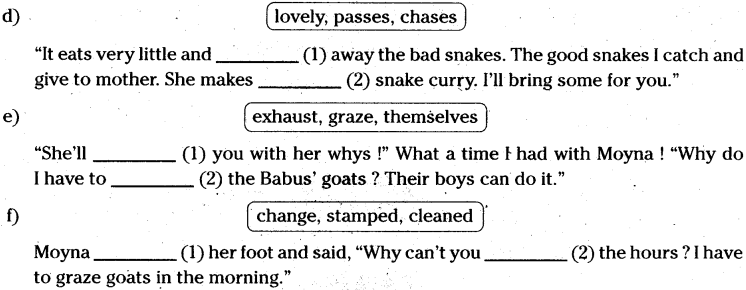
AP 7th Class English Important Questions Unit 1 Painted House, Friendly Chicken and Me 5

Answer:
a) 1) snatch, 2) distracted
b) 1) notice, 2) handy
c) 1) built, 2) pretend
d) 1) supposed, 2) mischievous
e) 1) enjoyed, 2) squirmy

Grammar

I. Read the following passage and correct the underlined parts. Rewrite foe corrected parts in the space provided.

1. Plants have many uses to (a) man. They supplies (b) us with food and shelter, with fuel and chemicals. People or (c) animals need to breathe oxygen to live. Plants take in the carbon dioxide what (d) people and animals breathe out.
Answer:
a) for
b) supply
c) and
d) that

2. Eskimos live in houses called Igloos. A (a) igloo is made with (b) large square pieces of ice. Arid (c) the igloo itself is not square. It look (d) like half of a big white ball standing on a white filed of ice.
Answer:
a) An
b) erf
c) But
d) looks

3. A (a) famous Indian mathematician, Srinivasa Ramanujan, was born in 1987 in a poor family in (b) Erode in Tamil Nadu. At a very young age, Ramanujan showed a (c) un-usual grasp of mathematics. It was (d) strange but true that he did not see his first mathematics book till he was sixteen.
Answer:
a) The
b) at
c) an
d) is

4. Mount Everest is a (a) highest peak in the world. It was (b) 8848 metres high. It is named on (c) Everest. Edmand Hillary and Sherpa Tenzing sets (d) foot on the top of the peak on 29th May 1953.
Answer:
a) the
b) is
c) after
d) set

AP 7th Class English Important Questions Unit 1 Painted House, Friendly Chicken and Me

II. Complete the passage choosing the right words from those given below. Each blank in numbered and for each blank four choices are given. Choose the correct answer and write (A), (B), (C) or (D) in the blanks.

1. Life in a big oasis ___ (1) extremely busy. There is ___ (2) busy market in the oasis ___ (3) the people from the neighbouring desert bring ___ (4) animals to exchange for the goods of the oasis.
1) A) is B) was C) are D) were
2) A) the B) a C) an D) some
3) A) but B) and C) or D) yet
4) A) her B) his C) our D) their
Answer:
1) A 2) B 3) B 4) D

2. ___ (1) Earth rotates around itself and also revolves round the Sun. To ___ (2) itself, it ___ (3) one day and to revolve round the Sun. It takes 365.25 days. The earth revolves round the Sun ___ (4) an elliptic orbit.
1) A) An B) A C) The D) That
2) A) rotating B) rotate C) rotates D) rotated
3) A) take B) took C) takes D) taking
4) A) on B) of C) in D) by
Answer:
1) C 2) B 3) C 4) C

3. The Banvan trees ___ (1) aerial roots ___ (2) is its branches. ___ (3) to the ground, take root again and send more branches ___ (4) their own.
1) A) has B) had ‘ C) have D) having
2) A) which B) that C) who D) whom
3) A) drops B) dropped C) drop D) dropping
4) A) of B) on C) in . D) at
Answer:
1) C 2) B 3) C 4) B

4. Lizards are closelv related ___ (1) snakes. Like snakes, ___ (2) are cold-blooded reptiles ___ (3) scaly skins. Unlike snakes their long bodies are usuallv divided into the three distinct parts : head, trunk ___ (4) tail.
1) A) with B) for C) to D) from
2) A) we B) they C) she D) he
3) A) of B) with C) for D) in
4) A) and B) or C) but D) yet
Answer:
1) C 2) B 3) B 4) A

III. Write the full forms for the contractions given below.

a) won’t : _______
b) isn’t : _______
c) might’ve : _______
d) we’ve : _______
e) doesn’t : _______
f) they’re : _______
g) he’d : _______
h) she’ll : _______
i) hadn’t : _______
j) that’s : _______
Answer:
a) will not
b) is not
c) might have
d) we have
e) does not
f) they are
g) he had / he would
h) she will / she shall
i) had not
j) that is / that has

Complete each sentence with the possessive forms of the noun given in the brackets.

a) When will you go to my _______ house? (aunt)
b) We are playing with _______ toys. (Tom)
c) I heard a _______ howl, last night. (wolf)
d) This is _______ lanch box. (kamala)
e) _______ face mask is blue. (Vinay)
Answer:
a) aunt’s
b) Tom’s
c) wolf’s
d) Kamala’s
e).Vinay’s

AP 7th Class English Important Questions Unit 1 Painted House, Friendly Chicken and Me

V. Fill in the blanks with the present perfect form of the verb.

a) He _______ (not / meet) his friend.
b) I _______ (learn) to swim.
c) _______ (ever / you / be) to London ?
d) She _______ (consult) an ophthalmologist.
e) Millions of people _______ (suffer) from Corona.
f) has not met
i) has consulted
g) have learnt
h) Have you ever been
j) have suffered

Creative Writing

1. Thandi, the narrator, sometimes goes to the city along with her mother and sisters and aunts in a wagon pulled by four mules. Then, she happens to see the city folk who stare at her mother and relatives interestingly.
“Now, describe the feelings of Thandi when she sees the city women.
Answer:
Thandi goes to the city along with her mother, her sisters and aunts in a wagon pulled by four mules. She sees the city women who don’t possess beaded things. Her thoughts are as follows. “What a pity! I am really very happy to see the city women stare at my mother, sisters and aunts. My mother, sisters and aunts have best blankets, best neck rings and best leg rings. But the city women have nothing so good as our women. All their houses are in one sad colour and they have no beads. I feel sorry for them and 1 give them a good smile. It must help because they laugh. I shall give them beaded aprons and beaded fringed lion flaps made by me. I think they will be very happy.”

2. Write a letter to your Mend inviting him/her to your village to spend summer holidays.
Answer:

H.No. : 242/7B,
Komaravallipadu.
20.03.20xx.

Dear Shashank,

I am safe here and I hope the same with you. I am studying well and I hope the same with you.

Now, I would like to invite you to come to my village in summer vacation and spend at least a week in my village. Ours is a family of six members – grandparents, my parents, me and my younger sister. My grandparents are very friendly and looking after our fields and cattle. My father is a high school teacher. My mother is a housewife. She takes care of us very much. My sister studies in class V in our village.

Ours is a very beautiful village. There are a lot of places worth watching in our village. Beautiful green fields, ancient Lord Shiva’s temple and running streams and some others are worth watching. My mother will prepare delicious dishes for us.

We are looking forward to seeing you. Convey my regards to your parents and my best wishes to your little sister.

Awaiting your arrival ……

Yours lovingly,
xxxx

Address on the Envelope :
To
C. Shashank,
S/o C. Ravi Prakash,
D. No. 18 – 208,
Nagaram Town
Keesara Mandal,
Hyderabad.
PIN: 500 001.

3. The marriage of your elder sister is going to be held on 25th July 20xx at Vasavi Kalyana Mandapam, in Nellore. The bridegroom is an engineer. He is not taking any dowry. Write a letter to your Mend inviting him to the marriage.
Answer:

Nellore.
10.7.20xx.

Dear Ravi,

I hope that you are in good health and you are going along nicely in your studies. Here I’m very glad to inform you that my elder sister’s marriage is going to be held on 25th July 20xx at Vasavi Kalyana Mandapam, Nellore. The bridegroom is an engineer. He is working in B.D.L., Hyderabad. Theirs is a nice family. They seem to be friendly and dignified people. One thing I want to mention here that they are not taking any , dowry and they did not demand any greedy gifts. I shall be very glad to see at you and your family at the function. Please inform your parents about the same and tell them that my parents will be pleased if they attend the function. My father wants to call your father and mother and invite them on phone. I have already posted the invitation on your father’s name. I shall be very glad if you come two days before and help me in preparations.

Convey my regards to your parents and my best wishes to your little brother. Hoping that you will come, I remain.

Yours lovingly,
xxxxxx

Address on the Envelope :
To
P. Ravi Kumar,
S/o P. Surya Narayana,
H.No : 1 – 20 – 22/A,
Malladivari Street,
Gandhinagar,
Vijayawada.

AP 7th Class English Important Questions Unit 1 Painted House, Friendly Chicken and Me

4. Write a story using the following hints.

Hints: An old tiger – weak – unable to catch its prey – thinks of a plan – wants to draw his prey closer – showing a golden bangle – bait – a poor man – comes – the other side of the river – about to drink water – hears someone calls – sees the tiger – afraid – tries to run away – tiger’s call – great scholar – changed – sorry for sins – now a pious – accept the golden ring – poor man – sees the golden bangle – becomes greedy – greediness overcomes – fear – goes close to tiger – to accept the ring – tiger spring up – kill – eat.
Answer:
Once there was on old tiger. He was week. He was unable to catch his prey. So he thought of a plan. He wanted to draw his prey closer to him by showing the golden bangle as a bait

One day a poor man came that way. He was on the other side of the river. When he was about to drink water, he heard someone calling him. He looked up and saw the tiger on the other side of the river. At first the poor man was afraid. He tried to run away from there. At the same time he heard the tiger’s call again “Oh! great scholar, I don’t harm you. I am now a changed one. I am sorry for my sins. I am now a pious man ! Please accept golden ring and help me to recede my sins.”
When the poor man saw the golden bangle, he became greedy. His greediness overcame his fear. He believed the tiger’s words. So he went close to the tiger to accept the golden ring. At once the tiger sprang upon him, killed him and ate him.
This story tells us “Greediness brings us misery”.

5. Write a story using the following hints.

Hints: Two cats – quarrel – a cake – claim – the cake belongs to him – keeps on quarrel – not know – go to a monkey – known for his wisdom – to share the cake – cuts the cake – two equal parts – make them equal – eats a small piece – becomes smaller – monkey – eats the second piece – becomes smaller – repeats the same trick – eats up – cats go away – disappointed.
Answer:
One day two cats were quarrelling over a cake. They both claimed that the cake be-longed to him. They kept on quarrelling for a long time. But they did not know what to do. Then they went to a monkey. The monkey was noted for his wisdom. They asked him to share the cake between themselves. The monkey intentionally cut the cake into two unequal parts. To make them equal the monkey ate a small piece of the bigger piece. Now that piece became smaller. Then the monkey ate the second piece. Then it became smaller. Thus the monkey repeated the same trick several times and ate up aU the cake. Then the two cats went away disappointed.

AP 7th Class English Important Questions Unit 1 Painted House, Friendly Chicken and Me

6. In the lesson ‘Painted House, Friendly Chicken and Me’, you have learnt that Thandi sometimes goes to the city along with the members of her family. One day she went to the city along with her mother, sisters and aunts and returned to the village.
Imagine you are Thandi and describe your feelings about city people, houses, etc. in the form of a diary entry.
Answer:
24th July, 2021,
9.00 pm.
Dear Diary,

Today I went to the city with my mother, sisters and aunts in a wagon pulled by four mules. I enjoyed the journey a lot. Visiting the city with the members of my family gives me immense joy. There are tall buildings and wide roads in the city. All the houses there are in one sad colour. But our painted houses are very beautiful to look at. There I found no much greenery either. Here, our village and the surroundings have rich greenery with number of trees. The city people stared at my mother and relatives because the city folk have nothing so good as the Ndebele women. I am always happy to see the city people stare at us. The Ndebele women wear best blankets, best neck rings and very good leg rings, of course. But the city women have no beads at all. I feel sorry for them and I give them a good smile. Next time when I go to the city, I shall give them beaded aprons and beaded fringed lion flaps made by me. I think they will be very happy then.

Thandi

AP Board 10th Class Maths Solutions Chapter 6 శ్రేఢులు Exercise 6.3

SCERT AP 10th Class Maths Textbook Solutions Chapter 6 శ్రేఢులు Exercise 6.3 Textbook Exercise Questions and Answers.

AP State Syllabus 10th Class Maths Solutions 6th Lesson శ్రేఢులు Exercise 6.3

ప్రశ్న 1.
క్రింది అంకశ్రేఢులలో పేర్కొన్న పదాల మొత్తాలను ‘ కనుగొనుము.
(i) 2, 1, 12, ……… 10 పదాలు.
సాధన.
ఇచ్చిన A.P : 2, 7, 12, …….. 10 పదాలు.
a = 2; d = a2 – a1 = 7 – 2 = 5; n = 10
Sn = \(\frac{n}{2}\) (2a + (n – 1)d]
S10 = \(\frac{10}{2}\) [2 × 2 + (10 – 1) 5]
= 5 [4 + 45] = 5 × 49 = 245
∴ S10 = 245.

(ii) – 37, – 33, – 29, ………….., 12 పదాలు
సాదన.
ఇచ్చిన A.P : – 37, – 33, – 29, …………, 12 పదాలు .
a = – 37; d = a2 – a1
= (- 33) – (- 37)
= – 33 + 37 = 4, n = 12
Sn = \(\frac{n}{2}\) [2a + (n – 1)d]
S12 = \(\frac{12}{2}\) [2 × (- 37) + (12 – 1)4]
= 6[- 74 + 11 × 4]
= 6[- 74 + 44] = 6 (- 30) = – 180
∴ S12 = – 180.

AP Board 10th Class Maths Solutions 6th Lesson శ్రేఢులు Exercise 6.3

(iii) 0.6, 1.7, 2.8, …………… 100 పదాలు.
సాదన.
ఇచ్చిన A.P : 0.6, 1.7, 2.8, ….. 100 పదాలు.
a = 0.6, d = a2 – a1 = 1.7 – 0.6 = 1.1, n = 100
Sn = \(\frac{n}{2}\) (2a + (n – 1)d]
S100 = \(\frac{100}{2}\) [2 × 0.6 + (100 – 1) × 1.1]
= 50 [1.2 + 99 × 1.1]
= 50[1.2 + 108.9]
= 50 × 110.1 = 5505
∴ S100 = 5505.

(iv) \(\frac{1}{15}\), \(\frac{1}{12}\), \(\frac{1}{10}\), ………….., 11 పదాలు.
సాధన.
ఇచ్చిన A.P: \(\frac{1}{15}\), \(\frac{1}{12}\), \(\frac{1}{10}\), ………….., 11 పదాలు.
a = \(\frac{1}{15}\);
d = \(\frac{1}{12}\) – \(\frac{1}{15}\)
= \(\frac{5-4}{60}=\frac{1}{60}\)
n = 11
Sn = \(\frac{n}{2}\)[2a + (n – 1)d]
S11 = \(\frac{11}{2}\) [2 × \(\frac{1}{15}\) + (11 – 1) × \(\frac{1}{60}\)]

= \(\frac{11}{2}\left[\frac{2}{15}+\frac{10}{60}\right]\)

= \(\frac{11}{2}\left[\frac{2}{15}+\frac{1}{6}\right]\)

= \(\frac{11}{2}\left[\frac{4+5}{30}\right]\)

= \(\frac{11}{2} \times \frac{9}{30}=\frac{33}{20}\)
∴ S11 = \(\frac{33}{20}\).

AP Board 10th Class Maths Solutions 6th Lesson శ్రేఢులు Exercise 6.3

ప్రశ్న 2.
క్రింది వాని మొత్తాలను కనుగొనుము.
(i) 7 + 10\(\frac{1}{2}\) + 14 + ……….. + 84
సాధన.
ఇచ్చిన A.P : 7, 10\(\frac{1}{2}\), 14, ………. 84
∴ a = 7; d = a2 – a1 = 10\(\frac{1}{2}\) – 7 = 3\(\frac{1}{2}\)
d = 7\(\frac{1}{2}\); an = 84
an = a + (n – 1) d = 84
= 7 + (n – 1)(\(\frac{7}{2}\)) = 84
⇒ (n – 1) × \(\frac{7}{2}\) = 84 – 7
⇒ (n – 1) \(\frac{7}{2}\) = 77
⇒ n – 1 = 77 × \(\frac{7}{2}\)
⇒ n – 1 = 22
⇒ n = 22 + 1 = 23
Sn = \(\frac{n}{2}\) [a + an]
S23 = \(\frac{23}{2}\) [7 + 84]
= \(\frac{23}{2}\) (91)
= \(\frac{2093}{2}\) = 1046 \(\frac{1}{2}\)
∴ S23 = 1046\(\frac{1}{2}\)

(లేదా)

Sn = [2a + (n – 1)d]
S23 = \(\frac{23}{2}\) [2(7) + (23 – 1) \(\frac{7}{2}\)]
S23 = \(\frac{23}{2}\) [14 + 22 × \(\frac{7}{2}\)]
= \(\frac{23}{2}\) [14 + 77]
= \(\frac{23}{2}\) (91)
= \(\frac{2093}{2}\)
∴ S23 = 1046 \(\frac{1}{2}\).

AP Board 10th Class Maths Solutions 6th Lesson శ్రేఢులు Exercise 6.3

(ii) 34 + 32 + 30 + … + 10
సాధన.
ఇచ్చిన A.P : 34, 32, 30, ………, 10
a = 34; d = a2 – a1 = 32 – 34 = – 2,
an = 10
an = a + (n – 1) d = 10 :
⇒ 34 + (n – 1) (- 2) = 10
⇒ 34 – 2n + 2 = 10
⇒ – 2n = 10 – 36 = – 26
⇒ 2n = 26
n = \(\frac{26}{2}\) = 13
Sn = \(\frac{n}{2}\) [a + an]
S13 = \(\frac{13}{2}\) [34 +10] = \(\frac{13}{2}\) × 44
∴ S13 = 286.

(లేదా)

Sn = \(\frac{n}{2}\) [2a + (n – 1)]
= \(\frac{13}{2}\) [2(34) + (13 – 1) (- 2)]
= \(\frac{13}{2}\) [68 – 24)
= \(\frac{13}{2}\) × 44 = 286
∴ S13 = 286.

(iii) – 5 + (- 8) + (- 11) + ……….. + (- 230)
సాధన.
ఇచ్చిన A.P:
(5) + (- 8) + (- 11) + ………….. + (- 230)
a = – 5,
d = a2 – a1 = (- 8) – (- 5). = – 8 + 5 = – 3,
an = – 230
an = a + (n – 1) d = – 230
(- 5) + (n – 1) × (- 3) = – 230
– 5 – 3n + 3 = – 230
– 3n = – 230 + 2
– 3n = – 228
⇒ 3n = 228
n = \(\frac{228}{3}\) = 76
Sn = \(\frac{n}{2}\) [(- 5) + (- 230)]
∴ S1 = 35 × (- 235) = – 8930
(లేదా)
Sn = \(\frac{n}{2}\) [2a + (n – 1]d]
S76 = \(\frac{76}{2}\) [2(- 5) + 75(- 3)]
= 38 [- 10 – 225]
= 38 × (- 235)
∴ S76 = – 8930.

AP Board 10th Class Maths Solutions 6th Lesson శ్రేఢులు Exercise 6.3

ప్రశ్న 3.
ఒక అంకశ్రేణిలో
(i) a = 5, d = 3, an = 50 అయిన n మరియు Sn లను కనుగొనుము.
సాధన.
a = 5; d = 3; an = 50
an = a + (n – 1) 4 = 50
⇒ 5+ (n – 1) 3 = 50
⇒ 5 + 3n – 3 = 50
⇒ 3n = 50 – 2 = 48
⇒ n = \(\frac{48}{3}\) = 16.
Sn = \(\frac{n}{2}\) [a + an]
S16 = \(\frac{16}{2}\) [5 + 50] = 8 × 55
∴ S16 = 440.

(ii) a = 7, a13 = 35 అయిన d ని మరియు S13 ను కనుగొనుము.
సాధన.
a = 7, an = 35
a13 = a + 12d = 35
⇒ 12d = 35 – 7 = 28
⇒ d = \(\frac{28}{12}\) = \(\frac{7}{3}\)
Sn = \(\frac{n}{2}\) [a + an]
S13 = \(\frac{13}{2}\) [7 + 35]
= \(\frac{13}{2}\) × 42 = 13 × 21 = 273
∴ S13 = 273.

AP Board 10th Class Maths Solutions 6th Lesson శ్రేఢులు Exercise 6.3

(iii) a12 = 37, d = 3 అయిన a ను మరియు S12 ను కనుగొనుము.
సాధన.
a12 = 37, d = 3
a12 = a + 11d = 37
a + 11 (3) = 37
a + 33 = 37 ⇒ a = 37 – 33 = 4
Sn = \(\frac{n}{2}\) [a + an ]
S12 = \(\frac{12}{2}\) [4 + 37] = 6 × 41 = 246
∴ S12 = 246.

(iv) a3 = 15, S10 = 125 అయిన d మరియు a10 లను కనుగొనుము.
సాధన.
a3 = 15, S10 = 125
a3 = a + 2d = 15 …………. (1)
S10 = \(\frac{10}{2}\) [2a + (10 – 1)d] = 125
= 2a + 9d = \(\frac{125}{2}\)
2a + 9d = 25 ……………….(2)

AP Board 10th Class Maths Solutions Chapter 6 శ్రేఢులు Exercise 6.3 1

d = -1 ను (1) లో రాయగా,
a + 2(- 1) = 15
a = 15 + 2 = 17
a10 = a + 9d = 17 + 9 (- 1)
= 17 – 9 = 8
∴ d = – 1 మరియు a10 = 8.

AP Board 10th Class Maths Solutions 6th Lesson శ్రేఢులు Exercise 6.3

(v) a = 2, d = 8, Sn = 90 అయిన n మరియు an లను కనుగొనుము.
సాధన.
a = 2; d = 8, Sn = 90
Sn = \(\frac{n}{2}\) [2a + (n – 1)d] = 90
\(\frac{n}{2}\) [2(2) + (n – 1) 8] = 90
n [4 + 8n – 8] = 90 × 2 = 180
8n2 – 4n – 180 = 0
4[2n2 – n -45] = 0
2n2 – n – 45 = 0
2n2 – 10n + 9n – 45 = 0 (∵ 2 × – 45 = – 90)
2n [n – 5] + 9 [n – 5] = 0
(n – 5) (2n + 9) = 0
∴ n – 5 = 0 లేదా 2n + 9 = 0
పదాల సంఖ్య ఎల్లప్పుడు ఒక సహజసంఖ్య.
∴ n – 5 = 0 ⇒ n = 5
∴ a5, = a + 4d = 2 + 4(8)
= 2 + 32 = 34
∴ n = 5 మరియు a5 = 34.

(లేదా)

S5 = \(\frac{5}{2}\) [2 + a5] = 90 [∵ Sn = (a + an)]
= 2 + a5 = 90 × \(\frac{2}{5}\) = 36
a5 = 36 – 2 = 34 .

AP Board 10th Class Maths Solutions 6th Lesson శ్రేఢులు Exercise 6.3

(vi) an = 4, d = 2, Sn = – 14, అయిన n మరియు a లను కనుగొనుము.
సాధన.
a = 4, d = 2, Sn = – 14
an = a + (n – 1) d = 4
= a + (n – 1) (2) = 4.
∴ a + 2n = 4 + 2 = 6
a = 6 – 2n, ………… (1)
Sn = \(\frac{n}{2}\) [2a + (n – 1) d] = – 14
\(\frac{n}{2}\) [2a + (n – 1) (2)] = – 14
\(\frac{n}{2}\) × 2[a + n – 1) = – 14
n [6 – 2n + n – 1] = – 14 [(1) నుండి]
n [5 – n] = – 14
5n – n2 = – 14
n2 – 5n = 14
⇒ n2 – 5n – 14 = 0
n2 – 7n + 2n – 14 = 0 (∵ 1 × (- 14) = – 14)
n (n – 7) + 2 (n – 7) = 0
(n – 7) (n + 2) = 0
పదాల సంఖ్య n ఎల్లప్పుడు ఒక సహజ సంఖ్య.
∴ n – 7 = 0
n = 7
n = 7 ను (1) లో ప్రతిక్షేపించగా,
a = 6 – 2 (7) = 6 – 14 = – 8
∴ n = 7, a = – 8.

AP Board 10th Class Maths Solutions 6th Lesson శ్రేఢులు Exercise 6.3

(vii) l = 28, S = 144 మరియు పదాల సంఖ్య 9 అయిన a విలువ కనుగొనుము.
సాధన.
l = an = 28, S = 144 మరియు n = 9.
[∵ A.P. లో చివరి పదాన్ని l తో సూచిస్తారు]
Sn = \(\frac{n}{2}\) [a + an] = 144
\(\frac{9}{2}\) [a + 28] = 144
a + 28 = 144 × 2
a + 28 = 32
a = 32 – 28 = 4
∴ a = 4.

ప్రశ్న 4.
ఒక అంకశ్రేణిలో మొదటి, చివరి పదాలు వరుసగా 17 మరియు 350. సామాన్య భేదం 9 అయిన శ్రేణిలోని పదాల సంఖ్యను, పదాల మొత్తమును కనుగొనుము.
సాధన.
ఒక అంకశ్రేఢిలో మొదటి పదం a = 17
చివరి పదం an = 350
సామాన్యభేదం d = 9
an = a + (n – 1) 4 = 350
17 + (n – 1) 9 = 350
17 + 9n – 9 = 350
9n + 8 = 350
9n = 350 – 8 = 342
n = \(\frac{342}{9}\) = 38
∴ n = 38.
ఇప్పుడు Sn = \(\frac{n}{2}\) [a + an]
S38 = \(\frac{38}{2}\) [17 + 350] = 19 × 367
S38= 6973
∴ పదాల సంఖ్య n = 38
38 పదాల మొత్తం S38 = 6973.

AP Board 10th Class Maths Solutions 6th Lesson శ్రేఢులు Exercise 6.3

ప్రశ్న 5.
ఒక అంకశ్రేణిలో 2వ, 3వ పదాలు వరుసగా 14 మరియు 18 అయిన 51 పదాల మొత్తమును కనుగొనుము.
సాధన.
ఒక అంకశ్రేణిలో
2వ పదం a2 = a + 4 = 14 ………… (1)
3వ పదం a3 = a + 2d = 18 …………..(2)
పదాల సంఖ్య = 51
d = a2 – a1 = 18 – 14 = 4
d ను (1) లో రాయగా
a + 4 = 14 = a = 14 – 4 = 10
a = 10, d = 4, n = 51 అయిన
Sn = \(\frac{n}{2}\) [2a + (n – 1)d]
S51 = \(\frac{51}{2}\) [2 × 10 + (51 – 1) × 4) |
= \(\frac{51}{2}\) [20 + 50 × 4]
= \(\frac{51}{2}\) × (20 + 200)
= \(\frac{51}{2}\) × 220
= 51 × 110 = 5610
∴ 51 పదాల మొత్తం Sn = 5610.

AP Board 10th Class Maths Solutions 6th Lesson శ్రేఢులు Exercise 6.3

ప్రశ్న 6.
ఒక అంకశ్రేఢిలో మొదటి 7 పదాల మొత్తము 49 మరియు 17 పదాల మొత్తము 289 అయిన మొదటి n పదాల మొత్తమును కనుగొనుము.
సాధన.
S7 = 49 మరియు S17 = 289
Sn = \(\frac{n}{2}\) [2a + (n – 1)d]
S7 = \(\frac{7}{2}\) [2a + (7 – 1)d] = 49 .
= \(\frac{7}{2}\) [2a + 6d] = 49
2a + 6d = 49 × \(\frac{2}{7}\) = 14
∴ 2a + 6d = 14 ………. (1)
అలాగే S17 = \(\frac{17}{2}\) [2a + 16d] = 289
2a + 16d = 289 × \(\frac{2}{27}\) = 34
∴ 2a + 16d = 34 ………. (2)

AP Board 10th Class Maths Solutions Chapter 6 శ్రేఢులు Exercise 6.3 2

d = 2 ను (1) లో ప్రతిక్షేపించగా,
2a + 6(2) = 14
2a = 14 – 12 = 2
∴ a = \(\frac{2}{2}\) = 1
a = 1, d = 2 అయిన Sn
Sn = \(\frac{n}{2}\) [2 (1) + (n – 1) 2]
= \(\frac{n}{2}\) [2 + 2n – 2]
= \(\frac{n}{2}\) × 2n
Sn = n2
[Shortcut:-
Sn = 49 = 72
Sn = 289 = 172
Sn = n2
∴ మొదటి n పదాల మొత్తం Sn = n2.

AP Board 10th Class Maths Solutions 6th Lesson శ్రేఢులు Exercise 6.3

ప్రశ్న 7.
an క్రింది విధంగా నిర్వచించబడితే a1, a2, ………., an, అంకశ్రేణి అవుతుందని చూపండి. మరియు మొదటి 15 పదాల మొతమును కనుగొనండి.
(i) an = 3 + 4n
(ii) an = 9 – 5n
సాధన.
(i) an = 3 + 4n
a1 = 3 + 4(1) = 7
a2 = 3 + 4(2) = 3 + 8 = 11
a3 = 3 + 4(3) = 3 + 12 = 15
a4 = 3 + 4 (4) = 3 + 16 = 19
…………………………………………………………..
………………………………………………………….
a1, a2, a3, …………… = 7, 11, 15, 19, ……………
d = a2 – a1 = 11 – 7 = 4
d = a3 – a2 = 15 – 11 = 4
d = a4 – a3 = 19 – 15 = 4
అన్ని సందర్భాలలోను , సమానము. కావున a1, a2, a3, a4, ….., an అంకశ్రేణి అవుతుంది.
15 పదాల మొత్తం a = 7, d = 4, n = 15
S15 = \(\frac{15}{2}\) [2x 7 + (15 – 1) 4]
[∵ Sn = \(\frac{n}{2}\) [2a + (n – 1) d]]
= \(\frac{15}{2}\) (14 + 14 × 4]
= \(\frac{15}{2}\) [70]
= 15 × 35 = 525
∴ 15 పదాల మొత్తం S15 = 525.

AP Board 10th Class Maths Solutions 6th Lesson శ్రేఢులు Exercise 6.3

(ii) an = 9 – 5n
సాధన.
a1 = 9 – 5 × 1= 9 – 5 = 4
a2 = 9 – 5 × 2 = 9 – 10 = – 1
a3 = 9 – 5 × 3 = 9 – 15 = – 6
a4 = 9 – 5 × 4 = 9-20 = – 11
………………………………..
a1, a2, a3, a4 ………….. = 4, – 1, – 6, – 11, ……………
d = a2 – a1 = – 1 – 4 = – 5
d = a3 – a2 = – 6 – (- 1) = – 6 + 1 = – 5
d = a4 – a3 = – 11 -(- 6) = – 11 + 6 = – 5
………………………………………………..
………………………………………………..
అన్ని సందర్భాలలోను d సమానము. కావున a1, a2, a3, a4, …………… an అంకశ్రేఢి అవుతుంది.
15 పదాల మొత్తం a = 4, d = – 5, n = 15
S15 = 15 [2(4) + (15 – 1) (- 5)]
= 15 [8 + 14 (- 5)]
= \(\frac{15}{2}\) × – 62 = 15 × – 31 = – 465
∴ 15 పదాల మొత్తం S15 = 465.

ప్రశ్న 8.
ఒక అంకశ్రేణిలో మొదటి n పదాల మొత్తము 4n – na అయిన మొదటి పదం ఎంత ? (S, విలువే మొదటి పదము అవుతుందని గుర్తుకు తెచ్చుకోండి) మొదటి రెండు పదాల మొత్తం ఎంత ? రెండవ పదము ఎంత ? అదేవిధంగా 8వ పదమును, 10వ పదమును మరియు nవ పదమును కనుగొనుము.
సాధన.
మొదటి పద్దతి : 2
ఒక అంకశ్రేణిలో n పదాల మొత్తం Sn = 4n – na
మొదటిపదం a1 = S1 = 4 (1) – (1)2 = 3
మొదటి రెండు పదాల మొత్తం S2 = 4 (2) – (2)2
= 8 – 4 = 4
రెండవ పదం a2 = S2 – S1 = 4 – 3 = 1
మొదటి మూడు పదాల మొత్తం S3 = 4 x (3) – (3)2
= 12 – 9 = 3
మూడవ పదం a3 = S3 – S2 = 3 – 4 = – 1
మొదటి తొమ్మిది పదాల మొత్తం S9 = 4(9) – 92
= 36 – 81 = – 45
మొదటి పది పదాల మొత్తం S10 = 4(10) – 102
= 40 – 100 = – 60
పదవ పదము = a10 = S10 – S9
= – 60 – (- 45)
= – 60 + 45 = – 15
(n – 1) పదాల మొత్తం Sn – 1
= 4 (n – 1) – (n – 1)2
= 4n – 4 – (n2 – 2n + 1)
= 4n – 4 – n2 + 2n -1
Sn – 1 = 6n – n2 – 5
n పదాల మొత్తం Sn = 4n – n2
∴ n వ పదం an = Sn – Sn – 1
= (4n – n2) – (6n – n2 – 5) ..
= 4n -n2 – 6n + n2 + 5
an = 5 – 2n.

AP Board 10th Class Maths Solutions 6th Lesson శ్రేఢులు Exercise 6.3

రెండవ పద్ధతి :
అంకశ్రేణి n పదాల మొత్తం Sn = 4n – n2
మొదటి పదం a1 = S1 = 4(1) – (1)22
= 4 – 1 = 3
మొదటి రెండు పదాల మొత్తం S2 = 4(2) – (2)2
=8 – 4 = 4
రెండవ పదం a2 = S2 – S1 = 4 – 3 = 1
∴ సామాన్యభేదం d = a2 – a1 = 1 – 3 = – 2
∴ మూడవపదం a3 = a2 + d = 1 + (- 2) = – 1
పదవపదం a10 = a + 9d = 3 + 9 (- 2)
= 3 – 18 = – 15
n వ పదము an = a + (n- 1) d
= 3 + (n – 1) (- 2)
= 3 – 2n + 2
an = 5 – 2n

మూడవ పద్ధతి :
అంకశ్రేణిలో Sn = 4n – n2
nవ పదం an = Sn – Sn – 1 అవుతుంది.
Sn – 1 = 4 (n – 1) – (n – 1)
= 4n -4 – (n2 – 2n + 1)
= 4n – 4 – n2 + 2n – 1
Sn – 1 = 6n – n2 – 5
an = Sn – Sn – 1
= (4n – n2) – (6n – n2 – 5)
= 4n – n2 – 6n + n2 + 5
an = 5 – 2n
∴ మొదటి పదం a1 = 5 – 2(1) = 3
మొదటి రెండు పదాల మొత్తం S2 = 4(2) – 22
= 8 – 4 = 4
a2 = 5 – 2(2) = 5 – 4 = 1
a3 = 5 – 2(3) = 5 – 6 = – 1
an = 5 – 2(10) = 5 – 20 = – 15
nవ పదం an = 5 – 2n.

AP Board 10th Class Maths Solutions 6th Lesson శ్రేఢులు Exercise 6.3

ప్రశ్న 9.
6చే భాగించబడే మొదటి 40 ధనపూర్ణ సంఖ్యల మొత్తమును కనుగొనుము.
సాధన.
6 చే భాగింపబడే మొదటి 40 ధనపూర్ణ సంఖ్యల జాబితా 6, 12, 18, 24, …….. 40 పదాలు .
ఈ జాబితా అంకశ్రేణిలో కలదు.
a = 6, d = a2 – a1 = 12 – 6 = 6, n = 40
Sn = \(\frac{n}{2}\) [2a + (n – 1)d]
S40 = \(\frac{40}{2}\) [2(6) + (40 – 1) (6)]
= 20 [12 + 39 × 6]
= 20 [12 + 234] = 20 × 246
S40 = 4920.
6చే భాగింపబడే మొదటి 40 ధనపూర్ణ సంఖ్యల, మొత్తం S40 = 4920.

ప్రశ్న 10.
ఒక పాఠశాలలో విద్యావిషయక సంబంధిత విషయాలలో అత్యున్నత ప్రతిభ కనపరిచిన వారికి మొత్తం 700 రూపాయలకు 7 బహుమతులు ఇవ్వాలని భావించారు. ప్రతి బహుమతి విలువ దాని ముందున్న దానికి ₹ 20 తక్కువ అయిన ప్రతి బహుమతి విలువను కనుగొనుము.
సాధన.
బహుమతులను a1, a2, a3, a4, a5, a6, a7, ………………. అనుకొనుము.
ప్రతి బహుమతి దాని ముందున్న బహుమతికన్నా ₹ 20 తక్కువ.
కావున, a1, a2, a3, a4, ….., a7 లు Sn A.P. లో ఉంటాయి.
∴ సామాన్యభేదం d = a2 – a1 = – 20
(∵ a1 కన్నా a2, 20 తక్కువగా ఉంటుంది.)
లెక్క ప్రకారం బహుమతుల మొత్తం S7 = 700 .
S7 = \(\frac{7}{2}\) [2a + (7 – 1) (- 20)] = 700
[2a + 6 (- 20)] = 700 × \(\frac{2}{7}\)
2a – 120 = 200
2a = 200 + 120 = 320
a = \(\frac{320}{2}\) = 160
∴ బహుమతుల విలువ a = a1 = 160
a2 = 160 – 20 = 140
a3 = 140 – 20 = 120
a4 = 120 – 20 = 100
a5 = 100 – 20 = 80
a6 = 80 – 20 = 60
a7 = 60-20 = 40.

AP Board 10th Class Maths Solutions 6th Lesson శ్రేఢులు Exercise 6.3

ప్రశ్న 11.
ఒక పాఠశాల ఆవరణలో పర్యావరణ పరిరక్షణకు విద్యార్థులు చెట్లు నాటాలని భావించారు. ప్రతి సెక్షను విద్యార్థులు వారు చదువుతున్న తరగతి సంఖ్యకు సమానమైన చెట్లను అనగా 1వ తరగతి చదువుచున్న ఒక సెక్షన్ విద్యార్థులు 1 చెట్టును, రెండవ తరగతి చదువుచున్న ఒక సెక్షన్ విద్యార్థులు 2 చెట్లను నాటాలని ఈ విధంగా 12వ తరగతి వరకూ చేయాలని నిర్ణయించుకున్నారు. అయితే ప్రతి తరగతిలో మూడు సెక్షన్లు ఉన్న మొత్తం నాటిన చెట్లు ఎన్ని?
సాధన.

AP Board 10th Class Maths Solutions Chapter 6 శ్రేఢులు Exercise 6.3 3

మూడు సెక్షన్ల విద్యార్థులు నాటే చెట్ల సంఖ్య జాబితా 3, 6, 9, 12, ………….. 33, 36.
ఇది A.P లో కలదు.
12 తరగతులలోని మూడు సెక్షన్ల విద్యార్థులు నాటిన మొత్తం చెట్లు = 3 + 6, + 9 +:12 + …. + 36
a = 3, 4 = 6 – 3 = 3, n = 12
∴ S12 = \(\frac{12}{2}\) [3 + 36]
[∵ Sn = \(\frac{n}{2}\) [a +1]].
= 6 × 39.
S12 = 234
∴ ప్రతి తరగతిలోని మూడు సెక్షన్ల విద్యార్థులు నాటిన మొత్తం చెట్లు = 234.

రెండవ పద్ధతి :
ప్రతి తరగతిలోని ఒక సెక్షన్ విద్యార్థులు నాటిన చెట్ల సంఖ్య జాబితా 1, 2, 3, 4, 5, 6, ………… 11. 12 ఇది A.P లో కలదు.
ప్రతి తరగతిలోని ఒక సెక్షన్ విద్యార్థులు నాటిన మొత్తం చెట్లు = 1 + 2 + 3 + ………….. + 11 + 12
a = 1, d = 1, n = 12 S12 = \(\frac{12}{2}\) [1 + 12]
= 6 × 13 = 78 [∵ Sn = \(\frac{n}{2}\) [a + an]]
ప్రతి తరగతిలోని ఒక సెక్షన్ విద్యార్థులు నాటిన మొత్తం చెట్లు = 78
ప్రతి తరగతిలోని మూడు సెక్షన్ల విద్యార్థులు నాటిన మొత్తం చెట్లు = 78 × 3 = 234.

AP Board 10th Class Maths Solutions 6th Lesson శ్రేఢులు Exercise 6.3

ప్రశ్న 12.
అర్ధ వృత్తాలచే ఒక సర్పిలాకారము తయారుచేయబడింది. పటంలో చూపిన విధంగా అర్ధవృత్తాల కేంద్రాలు A వద్ద ప్రారంభించబడి A, Bల మధ్య మారుతూ వున్నాయి. అనగా మొదటి అర్ధవృత్త కేంద్రము A, రెండవ అర్ధవృత్త కేంద్రము B, మూడవ అర్ధవృత్త కేంద్రము A …… మరియు అర్ధవృత్తాల వ్యాసార్ధాలు వరుసగా 0.5 సెం.మీ., 1.0 సెం.మీ, 1.5 సెం.మీ, 20 సెం.మీ, … ఈ విధంగా మొత్తం 18 అర్ధవృత్తాలు వున్న సర్పిలం మొత్తం పొడవు ఎంత ? (x = 4) (సూచన : వరుస అర్ధవృత్తాల పొడవులు l1, l2, l3, l4 . . . మరియు వీని కేంద్రాలు వరుసగా A, B, A, B……..]

AP Board 10th Class Maths Solutions Chapter 6 శ్రేఢులు Exercise 6.3 4

సాధన.
వరుస అర్ధవృత్తాల పొడవులు l1, l2, l3, l4, ……. మరియు వీటి కేంద్రాలు A, B, A, B
అర్ధవృత్తాల వ్యాసార్ధాలు వరుసగా 0, 5 సెం.మీ., 1 సెం.మీ., 1, 5 సెం.మీ., 2 సెం.మీ…
l1 = π(0.5) = 0.5π (∵ అర్ధవృత్త చాపం పొడవు l = πr)
l2 = π(1) = π
l3 = π(1.5) = 1.5π
l4 = π(2) = 2π
……………………
…………………………
l1, l2, l3, l4, ……. లు A.P. లో కలవు.
13 అర్ధవృత్తాలు గల సర్పిలం మొత్తం పొడవు l1, l2, l3, l4, …………..l13
0.5π + π + 1.5π + ……….. + 13 పదాలు ……… (1)
a = 0.5π, d = 0.57 మరియు n = 13
Sn = \(\frac{n}{2}\) [2a + (n – 1)d]
S13 = \(\frac{13}{2}\) [2(0.5π) + ( 13 – 1) (0.5π)]
= \(\frac{13}{2}\) [π + 6π] = 13 × 7π
= \(\frac{13}{2}\) × 7 × \(\frac{22}{7}\) = 13 × 11
S13 = 143 సెం.మీ.
∴ 13 అర్ధవృత్తాలున్న సర్పిలం మొత్తం పొడవు = 143 సెం.మీ.

(లేదా)
(1) ⇒ π (0.5 + 1 + 1.5 + 2 + ……… + 13 పదాలు )
S13 = π [\(\frac{13}{2}\) (2 (0.5) + (13 – 1) (0.5)]
= π [\(\frac{13}{2}\) (1 + 6)]
= \(\frac{22}{7}\) × \(\frac{13}{2}\) × 7 = 11 × 13
S13 = 143 సెం.మీ.


ప్రశ్న 13.
200 చెక్క మొద్దులను క్రింది పటంలో చూపిన విధంగా అమర్చారు. అన్నింటి కంటే క్రింద వున్న వరుసలో 20 చెక్క మొద్దులను, దానిపై 19 మొద్దులను, దాని పైన 18 మొద్దులను ….. అమర్చిన మొత్తం 200 మొద్దులను అమర్చుటకు ఎన్ని వరుసలు కావాలి ? అన్నింటికంటే పైన వున్న వరుసలో ఎన్ని చెక్క మొద్దులు కలవు ?

AP Board 10th Class Maths Solutions Chapter 6 శ్రేఢులు Exercise 6.3 5

సాధన.
క్రింది నుండి ప్రతి వరుసలోను గల చెక్క మొద్దుల సంఖ్య జాబితా 20, 19, 18, 17, ……. ఇది A. P. లో కలదు.
a = 20, d = a2 – a1 = 19 – 20 = -1
మొత్తం చెక్క మొద్దుల సంఖ్య Sn = 200
Sn = \(\frac{n}{2}\) [2a + (n – 1) d] = 200
\(\frac{n}{2}\) [2(20) + (n – 1) (- 1)] = 200
\(\frac{n}{2}\) [40 – n+1] = 200
\(\frac{n}{2}\) [41 – n] = 200
41n – n2 = 400
⇒41n – n2 – 400 = 0
⇒ n2 – 41n + 400 = 0
⇒ n2 – 25n – 16n + 400 = 0 ( 1 × 400 = 400)

AP Board 10th Class Maths Solutions Chapter 6 శ్రేఢులు Exercise 6.3 6

⇒ n (n – 25) – 16 (n – 25) = 0.
⇒ (n – 25) (n – 16) = 0
∴ n – 25 = 0 లేదా n – 16 = 0
n = 25 లేదా n = 16
n = 25 అసాధ్యము. కావున n = 16
(20, 19, 18, ……. జాబితాలో 25వ పదం రుణసంఖ్య అవుతుంది.)
అనగా ’20, 19, 18, …… శ్రేణిలో 16 పదాలుంటాయి. కావున 200 మొద్దులను అమర్చుటకు 16 వరుసలు కావాలి.
పై వరుసలోని మొద్దుల సంఖ్య = a16 = a + 15d = 20 + 15(- 1) = 20 – 15 = 5
∴ పై వరుసలోని మొద్దుల సంఖ్య = 5. – A.P. 10వ తరగతి జీ గణితశాస్త్రం

ప్రశ్న 14.
బంతి మరియు బకెట్ ఆటలో, ప్రారంభంలో ఒక బకెట్ దానికి 5మీ. దూరంలో ఒక బంతి ఉంచబడినవి. మొత్తం 10 బంతులలో మిగిలిన బంతులు ఒకదానికొకటి 3మీ. దూరంలో పటంలో చూపిన విధంగా అమర్చబడినవి. ఆటలో పాల్గొనే వ్యక్తి మొదట బకెట్ వద్ద నుంచి బయలుదేరి మొదటి బంతివద్దకు పోయి దానిని తీసుకొని వెనుకకు వచ్చి ‘బకెట్లో వేయాలి. తరువాత తిరిగి బకెట్ నుంచి బయలుదేరి రెండవ బంతి వద్దకు పోయి దానిని తీసుకొని వచ్చి బకెట్లో వేయాలి. ఈ విధంగా అన్ని బంతులను బకెట్లో వేయవలెనన్న ఆ వ్యక్తి పరిగెత్తవలసిన మొత్తం దూరం ఎంత ? (సూచన : మొదటి, రెండవ బంతులను తీసుకొని రావడానికి ఆట ఆడే వ్యక్తి పరిగెత్తవలసిన దూరము వరుసగా 2 × 5 + 2 × (5 + 3)]

AP Board 10th Class Maths Solutions Chapter 6 శ్రేఢులు Exercise 6.3 7

సాధన.

AP Board 10th Class Maths Solutions Chapter 6 శ్రేఢులు Exercise 6.3 8

ప్రతి బంతి తీసుకురావడానికి వ్యక్తి ప్రయాణించిన దూరాల జాబితా 10, 16, 22, 28, …………….. 10 పదాలు.
ఇది A.P. లో కలదు.
a = 10; 4 = 16 – 10 = 6, n = 10.
∴ వ్యక్తి పరుగెత్తిన మొత్తం దూరం 10 + 16 + 22 + 28 + ……….. + 10 పదాలు.
Sn = \(\frac{n}{2}\) [2a + (n – 1)d]
S10 = \(\frac{10}{2}\) [2 × 10 + (10 – 1) × 6] = 5[20 + 54] = 5 × 74
S10 = 370
∴ వ్యక్తి పరుగెత్తిన మొత్తం దూరం = 370 మీ.

AP Board 10th Class Maths Solutions Chapter 6 శ్రేఢులు Exercise 6.2

SCERT AP 10th Class Maths Textbook Solutions Chapter 6 శ్రేఢులు Exercise 6.2 Textbook Exercise Questions and Answers.

AP State Syllabus 10th Class Maths Solutions 6th Lesson శ్రేఢులు Exercise 6.2

ప్రశ్న 1.
మొదటి పదము a, సామాన్య భేదము d, nవ పదము a, అయిన క్రింది పట్టికను పూరింపుము. – AS,, AS,,

AP Board 10th Class Maths Solutions Chapter 6 శ్రేఢులు Exercise 6.2 1

AP Board 10th Class Maths Solutions Chapter 6 శ్రేఢులు Exercise 6.2 2

సాధన.

AP Board 10th Class Maths Solutions Chapter 6 శ్రేఢులు Exercise 6.2 3

AP Board 10th Class Maths Solutions 6th Lesson శ్రేఢులు Exercise 6.2

ప్రశ్న 2.
కింది వానిని కనుగొనుము.
(i) 10, 7, 4, …… అంకశ్రేణిలో 30వ పదము.
సాధన.
ఇచ్చిన A.P. = 10, 7, 4, …………….
a1 = 10;
d = a2 – a1 = 7 – 10 = – 3,
n= 30
an = a + (n – 1)
a30 = 10 + (30 – 1) (- 3)
= 10 + 29 (- 3)
= 10 – 87 = – 77
∴ a30 = – 77.

(ii) – 3, \(-\frac{1}{2}\), – 2, ………….. అంకశ్రేణిలో 11వ పదము.
సాధన.
ఇచ్చిన A.P. = – 3, \(-\frac{1}{2}\), – 2, …………..
a = – 3; d = a2 – a1 = 3 – 3)
= \(-\frac{1}{2}\) + 3 = 2\(\frac{1}{2}\) = \(\frac{5}{2}\)
n = 11
∴ an = a + (n – 1) d
a11 = – 3 + (11 – 1) (\(\frac{5}{2}\))
= – 3 + 10(\(\frac{5}{2}\))
= – 3 + 25 = 22
∴ a11 = 22.

AP Board 10th Class Maths Solutions 6th Lesson శ్రేఢులు Exercise 6.2

ప్రశ్న 3.
క్రింది వానిని కనుగొనుము.
(i) a1 = 2; a3 = 26, అయిన a2 ను కనుగొనుము.
సాధన.
మొదటి పద్ధతి :
a1 = a = 2
a3 = 26
an = a + (n – 1) d
a3 = 2 + (3 – 1) 4
= 2d= 26 – 2 = 24
d = \(\frac{24}{2}\) = 12
∴ a2 = a + d = 2 + 12 = 14.

రెండవ పద్ధతి :
a1, a2, a3 లు A.P. లో కలవు అనుకొనుము.
లెక్క ప్రకారం a1 = 2, a3 = 26
∴ 2, a2, 26 లు A.P. లో కలవు.
a2 – 2 = 26 – a2
∴ a2 + a2 = 26 + 2
2a2 = 28
∴ a2 = \(\frac{28}{2}\) = 14.

మూడవ పద్ధతి :
a, b, c లు A.P. లో ఉంటే b = \(\frac{a+c}{2}\)
2, a2, 26 లు A.P. లో కలవు.
∴ a2 = \(\frac{2+26}{2}\) = \(\frac{28}{2}\) = 14.

AP Board 10th Class Maths Solutions 6th Lesson శ్రేఢులు Exercise 6.2

(ii) a2 = 13; a4 = 3 అయిన a1, a3 లను కనుగొనుము.
సాధన.
మొదటి పద్ధతి :
a2 = a + d = 13 …….. (1)
a4 = a + 3d = 3 …….. (2)
(1), (2) సమీకరణములు సాధించగా,

AP Board 10th Class Maths Solutions Chapter 6 శ్రేఢులు Exercise 6.2 4

⇒ d = \(-\frac{10}{2}\) = – 5
a1 = a2 – d = 13 – (-5) = 13 + 5 = 18
a3 = a2 + d = 13 + (- 5) = 8
∴ a1 = 18 మరియు a3 = 8.

రెండవ పద్ధతి :
a1, a2, a3, a4 లు A.P. లో కలవు అనుకొనుము.
లెక్క ప్రకారము a2 = 13, a4 = 3
∴ a1, 13, a3, 3 లు A.P. లో కలవు
∴ 13 – a1 = a3 – 13 ……. (1) మరియు
a3 – 13 = 3 – a3 ……….. (2)
(2) ⇒ 2a3 = 16
a3 = \(\frac{16}{2}\) = 8
a3 = 8 ని (1) లో రాయగా,
13 – a1 = 8 – 13
– a1 = – 5 – 13 = – 18
∴ a1 = 18
∴ a1 = 18 మరియు a3 = 8.

మూడవ పద్ధతి :
a1, 13, a3, 3 లు A.P. లో కలవు.
∴ 13, a3, 3 లు A.P. లో మూడు వరుస పదాలు.
∴ a3 = \(\frac{13+3}{2}=\frac{16}{2}\) = 8
[a, b, c లు A.P. లో ఉంటే b = \(\frac{a+c}{2}\))
∴ సామాన్య భేదం d = a3 – a2 = 8 – 13 = – 5
∴ a1 = a2 – d = 13 – (- 5) = 13 + 5 = 18.
∴ a1 = 18 మరియు a3 = 8.

AP Board 10th Class Maths Solutions 6th Lesson శ్రేఢులు Exercise 6.2

(iii) a1 = 5, a4 = 91/2 అయిన a2, a3 లను కనుగొనుము.
సాధన.
a1 = a = 5.
an = a + (n – 1) d
a4 = 5 + 3d = 9\(\frac{1}{2}\) = \(\frac{19}{2}\)
3d = \(\frac{19}{2}\) – 5 = \(\frac{19-10}{2}\) = \(\frac{9}{2}\)
∴ d = \(\frac{9}{2} \times \frac{1}{3}=\frac{3}{2}\)
∴ a2 = a + d
= 5 + \(\frac{3}{2}\) = \(\frac{13}{2}\)
a3 = a2 + d
= \(\frac{13}{2}\) + \(\frac{3}{2}\) = \(\frac{16}{2}\) = 8

(iv) a1 = – 4; a6 = 6, అయిన a2, a3, a4, a5 లను కనుగొనుము. .
సాధన.
మొదటి పద్ధతి :
a1 = a = – 4
a6 = a + 5d = 6
(- 4) + 5d = 6
⇒ 5d = 6 + 4 = 10
⇒ d = \(\frac{10}{5}\) = 2
∴ a2 = – 4 + 2 = – 2
a3 = – 2 + 2 = 0
a4 = 0 + 2 = 2
a5 = 2 + 2 = 4

రెండవ పద్దతి :
ఒక అంకశ్రేణిలో nవ పదం an, mవ పదం am అయిన సామాన్యభేదం
d = \(\frac{a_{m}-a_{n}}{m-n}\)
a1 = – 4, a6 = 6, n = 1; m = 6
d = \(\frac{6-(-4)}{6-1}=\frac{10}{5}\) = 2
∴ a2 = a1 + d = – 4 + 2 = – 2
a3 = – 2 + 2 = 0
a4 = 0 + 2 = 2
a5 = 2 + 2 = 4.

AP Board 10th Class Maths Solutions 6th Lesson శ్రేఢులు Exercise 6.2

(v) a2 = 38; a6 = – 22, అయిన a1, a3, a4, a5 లను కనుగొనుము.
సాధన.
a2 = a + d = 38 ……………. (1)
a6 = a + 5d = -22 …………… (2)
(2) – (1)

AP Board 10th Class Maths Solutions Chapter 6 శ్రేఢులు Exercise 6.2 5

∴ a1 = a2 – d = 38 – (- 15) = 38 + 15 = 53
a3 = a2 + 4 = 38 + (-15) = 23
a4 = 23 + (- 15) = 8
a5 = 8 + (- 15) = – 7.

AP Board 10th Class Maths Solutions 6th Lesson శ్రేఢులు Exercise 6.2

ప్రశ్న 4.
3, 8, 13, 18, … అంకశ్రేణిలో ఎన్నవ పదము 78 అవుతుంది ?
సాధన.
ఇచ్చిన అంకశ్రేణి : 3, 8, 13, 18, ……. 78 –
a = 3; d = a2 – a1 = 8 – 3 = 5,
an = 78
an = a + (n – 1) 4 = 78 .
⇒ 3 + (n – 1) (5) = 78
⇒ 3 + 5n – 5 = 78
⇒ 5n – 2 = 78
⇒ 5n = 78 + 2 = 80
⇒ n = \(\frac{80}{5}\) = 16
∴ 16 వ పదము 78 అవుతుంది.

ప్రశ్న 5.
క్రింద ఇవ్వబడిన అంకశ్రేఢులలోని పదాల సంఖ్యను కనుగొనుము.
(i) 7, 13, 19, . . . , 205
సాధన.
మొదటి పద్దతి :
ఇచ్చిన A.P : 7, 13, 19, …………, 205
a = 7; d = a2 – a1 = 13 – 7 = 6,
an = 205
an = a + (n – 1) d = 205
7 + (n – 1) 6 = 205
7 + 6n – 6 = 205
6n + 1 = 205
6n = 205 – 1 = 204
⇒ n = \(\frac{204}{6}\) = 34
ఇచ్చిన A.P లో 34 పదాలు ఉంటాయి.

రెండవ పద్ధతి:
d = \(\frac{a_{m}-a_{n}}{m-n}=\frac{a_{n}-a_{m}}{n-m}\)
a1 = 7, an = 1, am = 205 అనుకొనుము.
d = 13 – 7 = 6
6 = \(\frac{205-7}{n-1}\)
⇒ n – 1 = \(\frac{198}{6}\) = 33
∴ n = 33 + 1 = 34.

AP Board 10th Class Maths Solutions 6th Lesson శ్రేఢులు Exercise 6.2

(ii) 18, 15\(\frac{1}{2}\), 13, ………, – 47
సాధన. మొదటి పద్ధతి : –
ఇచ్చిన A.P: 18, 15\(\frac{1}{2}\), 1.3 ………….. – 47
a = 18, d = a2 – a1
= 15\(\frac{1}{2}\) – 18
= – 2\(\frac{1}{2}\) = – \(\frac{5}{2}\)
an = – 47
an = a + (n – 1) d = – 47
= 18 + (n – 1) × (- \(\frac{5}{2}\)) = – 47
(n – 1) (- \(\frac{5}{2}\)) = – 47 – 18 = – 65
\(\frac{-5 n+5}{2}\) = – 65
– 5n + 5 = – 130
– 5n = – 130 – 5 = – 135
5n = 135
⇒ n = \(\frac{135}{5}\) = 27
ఇచ్చిన A.P లో 27 పదాలు ఉంటాయి.

రెండవ పద్ధతి :
am = 18, d = 35; an = – 47
d = \(\frac{a_{n}-a_{m}}{n-m}\)

⇒ \(\frac{-5}{2}=\frac{-47-18}{n-1}\)

⇒ \(\frac{-5}{2}=\frac{-65}{n-1}\)

⇒ \(\frac{5}{2}=\frac{65}{n-1}\)
n – 1 = 65 × \(\frac{2}{5}\)
∴ n = 26 + 1 = 27.

AP Board 10th Class Maths Solutions 6th Lesson శ్రేఢులు Exercise 6.2

ప్రశ్న 6.
11, 8, 5, 2… అంకశ్రేణిలో ‘- 150’ ఒక పదంగా ఉంటుందో లేదో పరిశీలించుము కనుగొనుము.
సాధన.
ఇచ్చిన అంకశ్రేణి 11, 8, 5, 2, …… లో n వ పదం – 150 అనుకుందాము.
అప్పుడు, a = 11, d = a2 – a1 = 8 – 11 = – 3 మరియు an = – 150
an = a + (n – 1) d = – 150
⇒ 11 + (n – 1)X (- 3) = – 150
⇒ 11 – 3n + 3 = – 150
⇒ – 3n = – 150 – 14
⇒ – 3n = – 164
⇒ 3n = 164
⇒ n = \(\frac{164}{3}\) ………… (2)
అంకశ్రేణిలోని పదాల సంఖ్య n ఎల్లప్పుడూ ఒక సహజ సంఖ్య.
కాని n = \(\frac{164}{3}\) సహజసంఖ్య కాదు.
కావున 11, 8, 5, 2, ……. అంకశ్రేణిలో – 150 ఒక పదంగా ఉండదు.

ప్రశ్న 7.
ఒక అంకశ్రేణిలో 11వ పదము 38 మరియు 16వ పదము 78 అయిన 31వ పదమును కనుగొనుము.
సాధన.
a11 = 38 మరియు a16 = 73, a31 = ?
::. an = a + (n – 1) d
a11 = a + 10d = 38 …………. (1)
a16 = a + 15d = 73 ,
(2) – (1)

AP Board 10th Class Maths Solutions Chapter 6 శ్రేఢులు Exercise 6.2 6

d = 7 ను (1) లో రా యగా,
a + 70 = 38
⇒ a = 38 – 70 = – 32
31వ పదం a31 = a + 30d
= – 32 + 30 (7)
= – 32 + 210 = 178
∴ 31వ పదం an = 178.

AP Board 10th Class Maths Solutions 6th Lesson శ్రేఢులు Exercise 6.2

ప్రశ్న 8.
ఒక అంకశ్రేఢిలో 3వ, 9వ పదాలు వరుసగా 4, – 8 అయిన ఎన్నవ పదము ” (సున్న) అవుతుంది ?
సాధన.
ఒక A.P లో 3వ పదం
a3 = a + 2d = 4 ……….(1)
9వ పదం a9 = a + 8d = – 8 …………(2)
(2) – (1) ⇒

AP Board 10th Class Maths Solutions Chapter 6 శ్రేఢులు Exercise 6.2 7

⇒ d = \(\frac{12}{6}\) = – 2
⇒ d = – 2 …………. (3)
∴ 4వ పదం a4 = a3 + d = 4 + (- 2) = 2
a5 = a4 + d = 2 + (- 2) = 0
∴ 5వ పదం సున్న (0) అవుతుంది.

(లేదా)

(3) ⇒ d = – 2 ను (1) లో రాయగా,
a + 2(- 2) = 4
⇒ a – 4 = 4
⇒ a = 8
an = 0 అయ్యేటట్లు n విలువ కనుగొనాలి.
an = a + (n – 1) d = 0
8 + (n – 1) (- 2) = 0
8 – 2n + 2 = 0
10 = 2n
⇒ \(\frac{10}{2}\) = 5
∴ n = 5
కావున 5వ పదం ‘0’ (సున్న) అవుతుంది.

AP Board 10th Class Maths Solutions 6th Lesson శ్రేఢులు Exercise 6.2

ప్రశ్న 9.
ఒక అంకశ్రేణిలో 17వ పదము 10వ పదం కంటే 7 ఎక్కువ. అయిన సామాన్య భేదం ఎంత ?
సాధన.
ఒక A.P లో 17వ పదం a17 = a + 16d
10వ పదం a10 = a + 9d
లెక్క ప్రకారం, a17 = a10 + 7
a + 16d = (a + 9d) + 7
a + 16d – a – 9d = 7
7d = 7
⇒ d = \(\frac{7}{7}\) = 1
∴ సామాన్యభేదం d = 1. .

ప్రశ్న 10.
రెండు అంకశ్రేఢుల సామాన్య భేదం సమానము. వాని 100వ పదాల మధ్య భేదం 100 అయిన వాని 1000వ పదాల మధ్య భేదమెంత ?
సాధన.
మొదటి అంకశ్రేణి మొదటి పదం = a
రెండవ అంకశ్రేణి మొదటి పదం = b
రెండు శ్రేఢుల యొక్క సామాన్యభేదం = d అనుకొనుము.
మొదటిశ్రేఢి 100వ పదం a100 = a + 99d
రెండవశ్రేణి 100వ పదం b100 = b + 99d
లెక్కప్రకారం, a100 – b100 = 100
(a + 99d) – (b + 99d) = 100
a – b = 100 ………….. (1)
ఇప్పుడు,
మొదటిశ్రేఢి 1000వ పదం a1000 = a + 999d
రెండవశ్రేణి’ 1000వ పదం b10000 = b + 999d
a1000 – b1000 = (a + 999d) – (b + 999d)
= a – b = 100 ((1) నుండి)
∴ 1000వ పదాల మధ్య తేడా 100.

AP Board 10th Class Maths Solutions 6th Lesson శ్రేఢులు Exercise 6.2

ప్రశ్న 11.
7 చే భాగించబడే మూడంకెల సంఖ్యలు ఎన్ని కలవు?
సాధన.
మొదటి పద్దతి’:
7 చే భాగింపబడే మూడంకెల సంఖ్యల జాబితా 105, 112, 119, 126, …………., 994 ఈ జాబితా అంకశ్రేణి అవుతుంది.
a = 105; d = a2 – a1 = 112 – 105 = 7;
an = 994
∴ an = a + (n – 1) d = 994
= 105 + (n – 1) 7 = 994
105 + 7n – 7 = 994
7n + 98 = 994
7n = 994 – 98 = 896
n = \(\frac{896}{7}\) = 128
∴ 7 చే భాగింపబడే మూడంకెల సంఖ్యలు 128 కలవు.

రెండవ పద్దతి :
d = \(\frac{a_{n}-a_{m}}{n-m}\)
a1 = 105, an = 994, d = 7, m = 1
7 = \(\frac{994-105}{n-1}=\frac{896}{n-1}\)
n – 1 = \(\frac{889}{7}\) = 127
∴ n = 127 +1 = 128.

ప్రశ్న 12.
10 మరియు 250 ల మధ్య గల 4 యొక్క గుణిజాల సంఖ్యను కనుగొనుము.
సాధన.
10 మరియు 250 ల మధ్య గల 4 యొక్క గుణిజాల జాబితా 12, 16, 20, ……… 248.
ఈ జాబితా A.P లో కలదు.
∴ a = 12, d = a2 – a1 = 16 – 12 = 4,
an = 248
an = a + (n – 1) d = 248 .
= 12 + (n- 1) 4 = 248
= 12 + 4n – 4 = 248
4n = 248 – 8 = 240
n = \(\frac{240}{4}\) = 60
∴ 10 మరియు 250 ల మధ్యగల 4 యొక్క గుణిజాల సంఖ్య = 60.

AP Board 10th Class Maths Solutions 6th Lesson శ్రేఢులు Exercise 6.2

ప్రశ్న 13.
63, 65, 67, …. మరియు 3, 10, 17, ….. అంకశ్రేఢుల nవ పదాలు సమానము అయిన n విలువను కనుగొనుము.
సాధన.
మొదటి A.P = 63, 65, 67, ……………..
a = 63, d = a2 – a1 = 65 – 63 = 2
∴ nవ పదం an = a + (n-1) d
= 63 + (n – 1) 2
= 63 + 2n – 2
nవ పదం an = 2n + 61 ………….. (1)
రెండవ A.P. = 3, 10, 17, ……………….
a = 3, d = a2 – a1 = 10 – 3 = 7
nవ పదం an = 3 + (n -1 ) 7
= 3 + 7n – 7
nవ పదం an = 7n – 4 ………… (2)
కాని లెక్క ప్రకారం రెండు అంకశ్రేఢుల పదాలు సమానము.
∴ 7n – 4 = 2n + 61
7n – 2n = 61 + 4
5n = 65
n = \(\frac{65}{5}\) = 13
∴ n = 13.

ప్రశ్న 14.
3వ పదము 167; 7వ పదము, 5వ పదము కంటే 12 ఎక్కువగా గల ఒక అంకశ్రేఢిని కనుగొనుము.
సాధన.
A.P లో 3వ పదం a3 = a + 2d = 16 ….. (1)
5వ పదం a5 = a + 4d
7వ పదం a7 = a + 6d
లెక్క ప్రకారం 7వ పదము, 5వ పదము కంటే 12 ఎక్కువ.
a + 6d = (a + 4d) + 12
a + 6d – a – 4d = 12
2d = 12 ⇒ d = \(\frac{12}{2}\) = 6
d = 6 ను (1) లో ప్రతిక్షేపించగా,
a + 2(6) = 16
a + 12 = 16
a = 16 – 12 = 4
a = 4 మరియు d = 6
∴ అంకశ్రేణి 4, 10, 16, 22, …………….

AP Board 10th Class Maths Solutions 6th Lesson శ్రేఢులు Exercise 6.2

ప్రశ్న 15.
3, 8, 13, ….., 253 అంకశ్రేణి యొక్క చివరి నుంచి 20వ పదమును కనుగొనుము.
సాధన.
మొదటి పద్దతి :
ఇచ్చిన A.P = 3, 8, 13, ………., 253
ఇక్కడ a = 3, d = a2 – a1 = 8 – 3 = 5,
⇒an = 253
⇒ an = a + (n – 1) 4 = 253.
⇒ 3 + (n- 1) 5 = 253
⇒ 3 + 5n – 5 = 253
⇒ 5n = 253 + 2 = 255
⇒ n = \(\frac{255}{5}\) = 51
ఇచ్చిన A.P లో 51 పదాలు కలవు.
∴ చివరి నుండి 20వ పదం, మొదటి నుండి (51 – 20) + 1 = 32వ పదం అవుతుంది.
∴ 32వ పదం a32 = 3 + (32 – 1) (5)
= 3 + 31 (5)
a32 = 3 + 155 = 158
చివరి నుండి 20వ పదం = 158

2వ పద్దతి :
ఇచ్చిన A.P = 3, 8, 13, ….., 253
ఇక్కడ d = a2 – a1 = 8 – 3 = 5
ఇచ్చిన శ్రేణిని త్రిప్పి రాయగా వచ్చే 20వ పదమే ఇచ్చిన శ్రేఢి యొక్క చివరి నుండి 20వ పదం అవుతుంది. 253, 248, 243, ………., 13, 8, 3
ఈ శ్రేణిలో a = 253, d = a2 – a1
= 248 – 253 = – 5
an = 3
an = a + (n – 1) d = 3
253 + (n – 1) (- 5) = 3
253 – 5n + 5 = 3
258 – 5n = 3
– 5n = 3 – 258 = – 255
5n = 255
⇒ n = \(\frac{255}{5}\) = 51
∴ 20వ పదం a20 = 253 + (20 – 1) (- 5)
= 253 – 95
an = 158
∴ 3, 8, 13, …………. 253 అంకశ్రేఢి యొక్క చివరి నుండి 20వ పదము = 158.

ప్రశ్న 16.
ఒక అంకశ్రేణిలో 4వ మరియు 8వ పదాల మొత్తము 24 మరియు 6వ, 10వ పదాల మొత్తము 44 అయిన మొదటి మూడు పదాలను కనుగొనుము.
సాధన.
A.P లో 4వ పదం = a + 3d
8వ పదం = a + 7d
లెక్క ప్రకారం 4వ, 8వ పదాల ,మొత్తం = 24
(a + 3d) + (a + 7d) = 24
= 2a + 10d = 24
2 (a + 5d) = 24
a + 5d = \(\frac{24}{2}\) = 12
∴ a + 5d = 12 ………….. (1)
ఇలాగే, 6వ పదం = a + 5d
10వ పదం = a + 9d
6వ మరియు 10వ పదాల మొత్తం 44
(a + 5d) + (a + 9d) = 44
2a + 140 = 44
2 (a + 7d) = 44
a + 7d = \(\frac{44}{2}\) = 22
a + 7d = 22 ………… (2)
(2) – (1)

AP Board 10th Class Maths Solutions Chapter 6 శ్రేఢులు Exercise 6.2 8

d = \(\frac{10}{2}\) = 5
∴ d = 2
d = 5ను (1) లో ప్రతిక్షేపించగా,
a + 5(5) = 12 ⇒ a = 12 – 25 = – 13
∴ కావలసిన అంకశ్రేణిలోని మొదటి మూడు పదాలు
మొదటి పదం a1 = a = – 13
రెండవ పదం a2 = – 13 + 5 = – 8
మూడవ పదం a3 = 3 – 8 + 5 = – 3

ప్రశ్న 17.
సుబ్బారావు 1995వ సం||లో నెలకు ₹ 5000 జీతంతో ఉద్యోగంలో చేరాడు. అతని జీతము సం||మునకు ₹ 200 పెరిగిన అతని జీతము ఏ సం||ములో ₹ 7000 అవుతుంది ?
సాధన.

AP Board 10th Class Maths Solutions Chapter 6 శ్రేఢులు Exercise 6.2 9

జీతం యొక్క జాబితా
5000, 5200, 5400, 5600, ………….
ఈ జాబితా A.P లో కలదు.
∴ a = 5000, d = a2 – a1 = 5200 – 5000 = 200
an = 7000
an = a + (n – 1) 4 = 7000
= 5000 + (n – 1) 200 = 7000
= 5000 + 200 n – 200 = 7000
200 n = 7000 – 4800 = 2200
∴ n = \(\frac{2200}{200}\) = 11.
జాబితాలో 7000 11వ పదం అవుతుంది.
అనగా ,సుబ్బారావు ఉద్యోగంలో చేరినప్పటి నుండి 11వ సం||లో అతని జీతం ₹ 7000 అవుతుంది. (1995ను కూడా కలుపుకోవాలి)
∴ 2005 వ సం||లో సుబ్బారావు జీతం ₹ 7000 అవుతుంది.

AP Board 10th Class Maths Solutions Chapter 6 శ్రేఢులు Exercise 6.1

SCERT AP 10th Class Maths Textbook Solutions Chapter 6 శ్రేఢులు Exercise 6.1 Textbook Exercise Questions and Answers.

AP State Syllabus 10th Class Maths Solutions 6th Lesson శ్రేఢులు Exercise 6.1

ప్రశ్న 1.
ఈ క్రింది సంఘటనలలో ఏ సంఘటనలో ఏర్పడే సంఖ్యల జాబితా అంకశ్రేఢి అవుతుంది ? ఎందుకు ?
(i) ఒక టాక్సీకి మొదటి గంట ప్రయాణానికి ₹ 20 చొప్పున తరువాత ప్రతి గంటకు ₹ 8 చొప్పున చెల్లించవలసి ఉన్న ప్రతి కిలోమీటరుకు చెల్లించవలసిన సొమ్ము.
(ఇచ్చిన సమస్య స్పష్టంగా లేదు. టాక్సీ అద్దె గంటలకు ఇవ్వబడినది. కాని చెల్లించాల్సిన సొమ్మును కిలో మీటరుకు ఇవ్వడం జరిగినది).
సరైన సమస్య : ఒక టాక్సీ మొదటి కిలోమీటరు ప్రయాణానికి ₹ 20 లు చొప్పున తరువాత ప్రతి కిలోమీటరుకు ₹8 లు చొప్పున చెల్లించవలసి వున్న ప్రతి కిలోమీటరుకు చెల్లించవలసిన సొమ్ము.
సాధన.

AP Board 10th Class Maths Solutions Chapter 6 శ్రేఢులు Exercise 6.1 1

సంఖ్యల జాబితా : 20, 28, 36, 44, 52, 60

సామాన్యభేదము

AP Board 10th Class Maths Solutions Chapter 6 శ్రేఢులు Exercise 6.1 2

ప్రతి సందర్భంలోను సామాన్యభేదం సమానము. కావున ఏర్పడే సంఖ్యల జాబితా ఒక అంకశ్రేణి (A.P.) అవుతుంది.

AP Board 10th Class Maths Solutions 6th Lesson శ్రేఢులు Exercise 6.1

(ii) ఒక వాక్యూమ్ పంపు సిలిండరులో ఉండే గాలి నుంచి 1/4 వంతు తీసివేయును. అయిన ప్రతిసారీ సిలెండరులో మిగిలి వుండే గాలి పరిమాణము.
సాధన.
సిలెండరులో గల గాలి పరిమాణము = 1 అనుకొందాం.

AP Board 10th Class Maths Solutions Chapter 6 శ్రేఢులు Exercise 6.1 3

సంఖ్యల జాబితా 1, \(\frac{3}{4}\), \(\frac{9}{16}\), \(\frac{27}{64}\), …………..

సామాన్యభేదం d = a2 – a1 = \(\frac{3}{4}\) – 1
= \(\frac{3-4}{4}=-\frac{1}{4}\)

= a3 – a2 = \(\frac{9}{16}\) – \(\frac{3}{4}\)
= \(\frac{9-12}{16}=\frac{-3}{16}\)
అన్ని సందర్భాలలో సామాన్యభేదం సమానంగా లేదు. కావున ఈ జాబితా అంకశ్రేణి కాదు.

(iii) ఒక బావిని తవ్వడానికి మొదట మీటరుకు ₹ 150 వంతున ఆపై ప్రతి మీటరుకు ₹ 50 వంతున చెల్లించాలి. అయిన ప్రతి మీటరుకు చెల్లించవలసిన సొమ్ము.
సాధన.

AP Board 10th Class Maths Solutions Chapter 6 శ్రేఢులు Exercise 6.1 4

సంఖ్యల జాబితా 150, 200, 250, 300, 350,

సామాన్యభేదం

AP Board 10th Class Maths Solutions Chapter 6 శ్రేఢులు Exercise 6.1 5

అన్ని సందర్భాలలోను సామాన్య భేదం సమానము. కావున ఈ సంఖ్యల జాబితా అంకశ్రేఢి (A.P.) అవుతుంది.

AP Board 10th Class Maths Solutions 6th Lesson శ్రేఢులు Exercise 6.1

(iv) ఒక బ్యాంకులో ₹ 10000 లను సంవత్సరానికి 8 శాతం చక్రవడ్డీ ప్రకారం పొదుపు చేసిన ప్రతి సంవత్సరము చివరలో ఖాతాలో ఉండే సొమ్ము.
సాధన.
ప్రారంభంలో ఖాతాలో గల సొమ్ము (P) = ₹10,000 వడ్డీరేటు (R) = 8%.

AP Board 10th Class Maths Solutions Chapter 6 శ్రేఢులు Exercise 6.1 6

సంఖ్యల జాబితా 10,000, 10,800, 11,664, 12597.12, …………….
సామాన్యభేదం d = a2 – a1 = 10,800 – 10,000 = 800
a3 – a2 = 11,664 – 10,800 = 864
a4 – a3 = 12,597.12 – 11,664 = 933.12
అన్ని సందర్భాలలోనూ సామాన్య భేదం సమానంగా లేదు. కావున ఈ జాబితా అంకశ్రేణి కాదు.

AP Board 10th Class Maths Solutions 6th Lesson శ్రేఢులు Exercise 6.1

ప్రశ్న 2.
అంకశ్రేఢుల యొక్క మొదటి పదము a మరియు సామాన్యభేదం d. విలువలు క్రింద ఇవ్వబడినవి. అయిన శ్రేణిలోని మొదటి నాలుగు పదాలను కనుగొనుము.
(i) a = 10, d = 10
సాధన.
మొదటి పదం a1 = a = 10
రెండవ పదం a2 = 10 + 10 = 20
మూడవ పదం a3 = 20 + 10 = 30
నాల్గవ పదం a4 = 30 + 10 = 40

(ii) a = – 2, d = 0
సాధన.
మొదటి పదం a1 = a = – 2
రెండవ పదం a2 = – 2 + 0 = – 2
మూడవ పదం a3 = – 2 + 0 = – 2
నాల్గవ పదం a4 = – 2 + 0 = – 2

(iii) a = 4, d = – 3
సాధన.
మొదటి పదం a1 = a = 4
రెండవ పదం a2 = 4 + (- 3) = 1
మూడవ పదం a3 = 1 + (- 3) = – 2
నాల్గవ పదం a4 = – 2 + (- 3) = – 5

AP Board 10th Class Maths Solutions 6th Lesson శ్రేఢులు Exercise 6.1

(iv) a = – 1, d = 1/2
సాధన.
మొదటి పదం a1 = a = – 1
రెండవ పదం a2 = – 1 + \(\frac{1}{2}\) = \(-\frac{1}{2}\)
మూడవ పదం a3 = – \(\frac{1}{2}\) + \(\frac{1}{2}\) = 0
నాల్గవ పదం a4 = 0 + \(\frac{1}{2}\) = \(\frac{1}{2}\)

(v) a = – 1.25, d = – 0.25
సాధన.
మొదటి పదం a1 = a = – 1.25
రెండవ పదం a2 = – 1.25 + (- 0.25) = – 1.50
మూడవ పదం a3 = (- 1.50) + (- 0.25) = – 1.75
నాల్గవ పదం a4 = (- 1.75) + (- 0.25) = – 2.00 = – 2

AP Board 10th Class Maths Solutions 6th Lesson శ్రేఢులు Exercise 6.1

ప్రశ్న 3.
క్రింద ఇవ్వబడిన అంకశ్రేఢులకు మొదటి పదమును, సామాన్య భేదంను కనుగొనుము.
(i) 3, 1, -1, -3, . . .
సాధన.
మొదటి పదం a = 3
సామాన్యభేదం d = a2 – a1 = 1 – 3 = – 2
[∵ d = ak+1 – ak]

(ii) – 5, – 1, 3, 7,…
సాధన.
మొదటి పదం a = – 5
సామాన్య భేదం d = a2 – a1 = (- 1) – (- 5)
= – 1 + 5 = 4.

(iii) \(\frac{1}{3}\), \(\frac{5}{3}\), \(\frac{9}{3}\), \(\frac{13}{3}\), …………
సాధన.
మొదటి పదం a = \(\frac{1}{3}\)
సామాన్యభేదం d = a2 – a1
= \(\frac{5}{3}\) – \(\frac{1}{3}\)
= \(\frac{4}{3}\)

(iv) 0.6, 1.7, 2.8, 3.9, ………….
సాధన.
మొదటి పదం a = 0.6
సామాన్యభేదం d = a2 – a1
= 1.7 – 0.6 = 1.1.

AP Board 10th Class Maths Solutions 6th Lesson శ్రేఢులు Exercise 6.1

ప్రశ్న 4.
క్రింది జాబితాలలో ఏవి అంకశ్రేఢులు ? ఒకవేళ అంకశ్రేణి అయిన సామాన్య భేదం dను, తరువాత వచ్చే మూడు పదాలను కనుగొనుము.
(i) 2, 4, 8, 16, ……….
సాధన.
a2 – a1 = 4 – 2 = 2
a3 – a2 = 8 – 4 = 4
a4 – a3 = 16 – 8 = 8
…………………………………..
ప్రతి సందర్భంలోనూ సామాన్యభేదం సమానంగా లేదు. కావున ఈ జాబితా అంకశ్రేణి కాదు.

(ii) 2, \(\frac{5}{2}\), 3, \(\frac{7}{2}\), …………………..
సాధన.
a2 – a1 = \(\frac{5}{2}\) – 2
= \(\frac{5-4}{2}=\frac{1}{2}\)

a3 – a2 = 3 – \(\frac{5}{2}\)
= \(\frac{6-5}{2}=\frac{1}{2}\)

a4 – a3 = \(\frac{7}{2}\) – 3
= \(\frac{7-6}{2}=\frac{1}{2}\)
…………………………………………………………………………………
సామాన్యభేదం ప్రతి సందర్భంలోను సమానం. కావున ఈ జాబితా, అంకశ్రేడి (A. P.) అవుతుంది.
సామాన్యభేదం d = \(\frac{1}{2}\)
∴ తరువాత వచ్చే మూడు పదాలు
\(\frac{7}{2}+\frac{1}{2}\) = \(\frac{1}{2}\) = 4

4 + \(\frac{1}{2}\) = \(\frac{8+1}{2}=\frac{9}{2}\)

\(\frac{9}{2}+\frac{1}{2}\) = \(\frac{10}{2}\) = 5

AP Board 10th Class Maths Solutions 6th Lesson శ్రేఢులు Exercise 6.1

(iii) – 1.2, – 3.2, – 5.2, – 7.2, ………….
సాధన.
a2 – a1 = (- 3.2) – (- 1.2) = – 3.2 + 1.2 = – 2
a3 – a2 = (- 5.2) – (- 3.2) = – 5.2 + 3.2 = -2
a4 – a3 = (- 7.2) – (- 5.2) = – 7.2 + 5.2 = – 2
సామాన్యభేదం అన్ని సందర్భాలలో సమానము.
కావున ఈ జాబితా అంకశ్రేఢి (A. P.) అవుతుంది.
సామాన్య భేదం d = – 2
∴ తరువాత వచ్చే మూడు పదాలు
– 7.2 + (- 2) = – 9.2
(- 9.2) + (- 2) = – 11.2
– 11.2 + (-2) = – 13.2.

(iv) – 10, – 6, – 2, 2, …………..
సాధన.
a2 – a1 = – 6 – (- 10) = – 6 + 10 = 4
a3 – a2 = – 2 -(- 6) = – 2 + 6 = 4
a4 – a3 = 2 – (-2) = 2 + 2 = 4
ప్రతి సందర్భంలోనూ సామాన్యభేదం సమానము.
కావున ఈ జాబితా అంకశ్రేణి (A.P) అవుతుంది.
సామాన్యభేదం d = 4
∴ తరువాత వచ్చే మూడు పదాలు
2 + 4 = 6
6 + 4 = 10
10 + 4 = 14.

AP Board 10th Class Maths Solutions 6th Lesson శ్రేఢులు Exercise 6.1

(v) 3, 3 + √2, 3 + 2√2, 3 + 3√2 ……….
సాధన.
a2 – a1 = 3 + √2 – 3 = √2
a3 – a2 = 3 + 2√2 – (3 + √2)
= 3 + 2√2 – 3 – √2 = √2
a4 – a3 = 3 + 2√2 – (3 – 2√2)
= 3 + 3√2 – 3 – 2√2 = √2
…………………………………..
ప్రతి సందర్భంలోనూ సామాన్యభేదం సమానము. కావున ఈ జాబితా అంకశ్రేణి (A.P) అవుతుంది. సామాన్యభేదం
d = √2
∴ తరువాత వచ్చే మూడు పదాలు
– 3 + 3√2 + √2 = 3 + 4√2
3 + 4√2 + √2 = 3 + 5√2
3 + 5√2 +√2 = 3 + 6√2.

(vi) 0.2, 0.22, 0.222, 0.2222, ………………
సాధన.
a2 – a1 = 0.22 – 0.2 = 0.02
a3 – a2 = 0.222 – 0.22 = 0.002
a4 – a3 = 0.2222 – 0.222 = 0.0002
ప్రతి సందర్భంలోను ak + 1 – ak సమానము కాదు.
కావున ఈ జాబితా ఒక అంకశ్రేణి (A.P) ని సూచించదు.

AP Board 10th Class Maths Solutions 6th Lesson శ్రేఢులు Exercise 6.1

(vii) 0, – 4, – 8, – 12, ……….
సాధన.
a2 – a1 = – 4 – 0 = – 4
a3 – a2 = – 8 – (- 4) = – 8 + 4 = -4
a4 – a3 = – 12 – (- 8) = – 12 + 8 = – 4
………………………………………………………………………..
…………………………………………………………………………
ప్రతి సందర్భంలోను ak + 1 – ak, సమానము,
కావున ఈ జాబితా ఒక అంకశ్రేణి (A.P.) అవుతుంది.
సామాన్యభేదం d = – 4
∴ తరువాత వచ్చే మూడు పదాలు
– 12 + (- 4) = – 16
– 16 + (- 4) = – 20
– 20 + (- 4) = – 24.

(viii) \(-\frac{1}{2}\), \(-\frac{1}{2}\), \(-\frac{1}{2}\), \(-\frac{1}{2}\), …………
సాధన.
a2 – a1 = \(-\frac{1}{2}\) – (\(-\frac{1}{2}\)) = 0
a3 – a2 = 0
a4 – a3 = 0
……………………………………………………….
ప్రతి సందర్భంలోను ak+1 – ak, సమానము.
కావున ఈ జాబితా ఒక అంకశ్రేణి (A.P.) అవుతుంది.
సామాన్యభేదం d = 0
∴ తరువాత వచ్చే మూడు మాసాలు \(-\frac{1}{2}\), \(-\frac{1}{2}\), \(-\frac{1}{2}\), …………

AP Board 10th Class Maths Solutions 6th Lesson శ్రేఢులు Exercise 6.1

(ix) 1, 3, 9, 27, ……………..
సాధన.
a2 – a1 = 3 – 1 = 2
a3 – a2 = 9 – 3 = 6
a4 – a3 = 27 – 9 = 18
………………………………………………….
ప్రతి సందర్భంలోను ak + 1 – ak, సమానము కాదు.
కావున ఈ జాబితా ఒక అంకశ్రేణి (A.P.) కాదు.

(x) a, 2a, 3a, 4a, ……………….
సాధన.
a2 – a1 = 2a – a = a
a3 – a2 = 3a-2a = a
a4 – a3 = 4a – 3a = a
……………………………………………………………..
ప్రతి సందర్భంలోను ak + 1 – ak సమానము.
కావున ఈ జాబితా ఒక అంకశ్రేఢి (A.P.) అవుతుంది. సామాన్యభేదం d = a
∴ తరువాత వచ్చే మూడు పదాలు 5a, 6a, 7a.

AP Board 10th Class Maths Solutions 6th Lesson శ్రేఢులు Exercise 6.1

(xi) a, a2, a3, a4 ………..
సాధన.
a2 – a1 = a2 – a = a (a – 1)
a3 – a2 = a3 – a2 = a2 (a – 1)
a4 – a3 = a4 – a3 = a3 (a – 1)
……………………………………………………………….
ప్రతి సందర్భంలోను ak + 1 – ak సమానము కాదు.
కావున ఈ జాబితా ఒక అంకశ్రేణిని (A.P.) కాదు.

(xii) √2, √8, √18, √32, ……………….
సాధన.
మొదటి పద్ధతి :
a2 – a1 = √8 – √2 = 2√2 – √2 = √2
a3 – a2 = √18 – √8 = 3√2 – 2√2 = √2
[∵ √8 = √4 × √2 = 2√2
√18 = √9 × √2 = 3√2
√32 = √16 × √2 = 4√2]
a4 – a3 = √32 – √18 = 4√2 – 3√2 = √2
………………………………………………………
∵ ప్రతి సందర్భంలోను ak + 1 – ak సమానము. కావున ఈ జాబితా ఒక అంకశ్రేఢి (A. P.) అవుతుంది.
సామాన్యభేదం d = √2
∴ తరువాత మూడు పదాలు √32 + √2 = 4√2
= 5√2 = \(\sqrt{25 \times 2}\) = √50
√50 + √2 = 5√2 + √2
= 6√2 = \(\sqrt{36 \times 2}\) = √72
√72 + √2 = 6√2 + √2
= 7√2 = \(\sqrt{49 \times 2}\) = √98.

రెండవ పద్ధతి :
ఇచ్చిన జాబితా √2, √8, √18, √32, …………….
= √2, 2√2, 3√2, 4√2 …………….
√8 = \(\sqrt{4 \times 2}\) = 2√2
√18 = \(\sqrt{9 \times 2}\) = 3√2
√32 = \(\sqrt{16 \times 2}\) = 4√2
∴ a2 – a1 = 2√2 – √2 = √2
a3 – a2 = 3√2 – 2√2 = √2
a4 – a3 = 4√2 – 3√2 = √2
అన్ని సందర్భాలలోను ak + 1 – ak సమానము.
కావున ఈ జాబితా ఒక అంకశ్రేణి (A.P.) అవుతుంది.
సామాన్యభేదం d = √2
తరువాత మూడు పదాలు 4√2 + √2 = 5√2 = \(\sqrt{25 \times 2}\) =√50
5√2 + √2 = 6√2 = \(\sqrt{36 \times 2}\)2 = √72
6√2 + √2 = 7√2 = \(\sqrt{49 \times 2}\) =√98 .

(xiii) √3, √6, √9, √12, ………….
సాధన.
a2 – a1 = √6 – √3 = √3(√2 – 1)
a3 – a2 = √9 – √6 = √3(3√3 – √2)
a4 – a3 = √12 – √9 = √3(2 – 3√3)
అన్ని సందర్భాలలోను ak + 1 – ak సమానము కాదు.
కావున ఈ జాబితా ఒక అంకశ్రేఢి (A. P.) కాదు.

AP Board 10th Class Maths Solutions Chapter 5 వర్గ సమీకరణాలు InText Questions

SCERT AP 10th Class Maths Textbook Solutions Chapter 5 వర్గ సమీకరణాలు InText Questions Textbook Exercise Questions and Answers.

AP State Syllabus 10th Class Maths Solutions 5th Lesson వర్గ సమీకరణాలు InText Questions

ప్రయత్నించండి:

ప్రశ్న 1.
క్రింది సమీకరణాలు వర్గ సమీకరణాలో, కాదో తెలపండి. (పేజీ నెం. 102)
(i) x2 – 6x – 4 = 0
సాధన.
x2 – 6x – 4 = 0
అవును. ఇది వర్గ సమీకరణమే.

(ii) x3 – 6x2 + 2x – 1 = 0
సాధన.
x2 – 6x2 + 2x – 1 = 0
కాదు. ఇది వర్గ సమీకరణము కాదు. ఎందుకనగా దీని పరిమాణము 3.

(iii) 7x = 2x2
సాధన.
7x = 2x2 అవును. ఇది వర్గ సమీకరణమే.

AP Board 10th Class Maths Solutions 5th Lesson వర్గ సమీకరణాలు InText Questions

(iv) x2 + \(\frac{1}{x^{2}}\) = 2
సాధన.
x2 + \(\frac{1}{x^{2}}\) = 2
⇒ \(\) = 2
⇒ x4 – 2x2 + 1 = 0
కాదు. ఇది వర్గ సమీకరణము కాదు. ఎందుకనగా పరిమాణము 4.

v) (2x + 1) (3x + 1) = b(x – 1) (x – 2)
సాధన. (2x + 1) (3x + 1) = b(x – 1) (x – 2)
కాదు. ఇది వర్గ సమీకరణము కాదు. ఎందుకనగా
ఇరువైపులా x- గుణకము

(vi) 3y2 = 192.
సాధన.
3y2 = 192
అవును. ఇది వర్గ సమీకరణమే.

AP Board 10th Class Maths Solutions 5th Lesson వర్గ సమీకరణాలు InText Questions

ప్రయత్నించండి:

ప్రశ్న 1.
1 మరియు \(\frac{3}{2}\) లు 2x2 – 5x + 3 = 0 యొక్క మూలాలవుతాయేమో సరిచూడండి. (పేజీ నెం. 107)
సాధన.
ఇచ్చిన సమీకరణం 2x2 – 5x + 3 = 0
x = 1 ⇒ 2(1)2 – 5(1) + 3 = 0.
2 – 5 + 3 = 0
5 – 5 = 0
0 = 0.
x = \(\frac{3}{2}\) ⇒ 2 (\(\frac{3}{2}\))2 – 5 (\(\frac{3}{2}\)) + 3 = 0
⇒ 2(\(\frac{9}{4}\)) – \(\frac{15}{2}\) + 3 = 0
⇒ \(\frac{9-15+6}{2}\) = 0
⇒ \(\frac{0}{2}\) = 0
⇒ 0 = 0
∴ x = 1 మరియు x = \(\frac{3}{2}\) వర్గ సమీకరణాన్ని తృప్తి పరుస్తున్నాయి. కావున మూలాలు అవుతాయి.

AP Board 10th Class Maths Solutions 5th Lesson వర్గ సమీకరణాలు InText Questions

ఇవి చేయండి:

ప్రశ్న 1.
వర్గమును పూర్తి చేయుట ద్వారా క్రింది వర్గ సమీకరణాలను సాధించుము. (పేజీ నెం. 113)
(i) x2 – 10x + 9 = 0
సాధన.
x2 – 10x + 9 = 0.
x2 – 10x = – 9
x2 – 2.x.5 = – 9
x2 – 2.x.5 + 52 = – 9 + 52
(ఇరువైపులా 52 కలుపగా)
(x – 5)2 = – 9 + 25
[∵ a2 – 2ab + b2 = (a – b)2]
(x – 5)2 = 16
∴ x – 5 = √16 = ± 4
x – 5 = 4 లేదా x – 5 = – 4
x = 4 + 5 = 9 లేదా x = – 4 + 5 = 1
x = 9 లేదా 1.

AP Board 10th Class Maths Solutions 5th Lesson వర్గ సమీకరణాలు InText Questions

(ii) x2 – 5x + 5 = 0
సాధన.
x2 – 5x + 5 = 0
x2 – 5x = – 5
x2 – 2.x.\(\frac{5}{2}\) + (\(\frac{5}{2}\))2 = – 5 + (\(\frac{5}{2}\))2
(ఇరువైపులా (\(\frac{5}{2}\))2 ను కలుపగా)

AP State Syllabus 10th Class Maths Solutions 5th Lesson వర్గ సమీకరణాలు InText Questions 7

(iii) x2 + 7x – 630
సాధన.
x2 + 7x – 6 = 0
x2 + 7x = 6
x2 + 2. \(\frac{1}{2}\).x.7 = 6
x2 + 2.x.\(\frac{7}{2}\) + (\(\frac{7}{2}\))2 = 6 + (\(\frac{7}{2}\))2
(ఇరువైపులా (\(\frac{7}{2}\))2 ను కలుపగా,

AP State Syllabus 10th Class Maths Solutions 5th Lesson వర్గ సమీకరణాలు InText Questions 8

AP Board 10th Class Maths Solutions 5th Lesson వర్గ సమీకరణాలు InText Questions

అలోచించి, చర్చించి, రాయండి:

ప్రశ్న 1.
ఒక వర్గ సమీకరణమును సాధించుటకు పై మూడు పద్ధతులలో నీవు ఏ పద్ధతిని ఉపయోగిస్తావు ? (పేజీ నెం. 115)
సాధన.
సందర్భాన్ని బట్టి వర్గ సమీకరణ సాధనకు ఇచ్చిన మూడు పద్ధతులలో ఏదో ఒక దానిని ఎన్నుకొంటాను.
సందర్భం -1:
వర్గ సమీకరణం ax2 + bx + c = 0 లోని మధ్య పదంలోని x గుణకం b ని p + q = b మరియు p × q = a × c గా రాయగలిగినప్పుడు కారణాంక పద్ధతిని ఎన్నుకొంటాను.

సందర్భం – 2:
వర్గ సమీకరణం ax2 + bx + c = 0 కచ్చిత వర్గంగా రాయగల సందర్భంలో వర్గం పూర్తి చేయు పద్ధతిని ఎన్నుకొంటాను.

సందర్భం – 3:
పై రెండు సందర్భాలు సాధ్యం కానప్పుడు లేదా ఎలాంటి వర్గ సమీకరణాన్ని సాధించే సందర్భంలోనైనా వర్గ సూత్ర పద్ధతిని ఎన్నుకొంటాను.

AP Board 10th Class Maths Solutions 5th Lesson వర్గ సమీకరణాలు InText Questions

ప్రయత్నించండి:

ప్రశ్న 1.
ఒక వర్గ సమీకరణమును సాధించటానికి ముందు దాని యొక్క విచక్షణిని కనుగొనటం వల్ల కలిగే లాభం ఏమిటో వివరించండి. దీని విలువ ఎందుకు ముఖ్యమైనది ? (పేజీ నెం. 122)
సాధన.ఒక వర్గ సమీకరణమును సాధించుటానికి ముందు దాని యొక్క విచక్షణి (D = b2 – 4ac) ని కనుగొనటం వలన ఆ వర్గ సమీకరణం యొక్క మూలాలు వాస్తవాలా, కాదా నిర్ణయించగలము. అలాగే మూలాలు వాస్తవాలైతే సమానాలా, విభిన్నాలా అని తెలుసుకొనగలము.

ఈ విచక్షణి విలువ ఆధారంగా ఇచ్చిన సమస్యల సాధన సందర్భంలో వాస్తవ మూలాలు లేనిచో సమస్యకు వాస్తవ సాధనలు లేవని నిర్ణయిస్తాము.
విచక్షణి D = b2 – 4ac విలువపై వర్గ సమీకరణం యొక్క మూలాలు ఆధారపడి ఉంటాయి. కావున దీని విలువ వర్గ సమీకరణ సాధనలో చాలా ముఖ్యమైనది.

ప్రశ్న 2.
మూడు వేరువేరు .వర్గ సమీకరణాలను తయారు చేయుము. అందులో ఒకటి రెండు వేరువేరు వాస్తవ మూలాలను, మరియొకటి రెండు సమాన వాస్తవ మూలాలను, ఇంకొకటి వాస్తవ మూలాలను కలిగిలేని విధంగా ఉండాలి. (పేజీ నెం. 122)
సాధన.
(1) x2 + 2x – 3 = 0,
b2 – 4ac = 22 – 4.1. (- 3)
= 4 + 12 = 16 > 0 .

(2) x2 + 2x + 1 = 0 .
b2 – 4ac = 22 – 4 (1) (1) = 4 – 4 = 0

(3) x2 + 2x + 3 = 0
b2 – 4ac = 22 – 4 (3) (1)
= 4 – 12 = – 8 < 0
(1) మూలాలు వాస్తవాలు, విభిన్నాలు.
(2) మూలాలు వాస్తవాలు, సమానాలు.
(3) మూలాలు సంకీర్ణాలు.

AP Board 10th Class Maths Solutions 5th Lesson వర్గ సమీకరణాలు InText Questions

ఉదాహరణలు :

ప్రశ్న 1.
రాణి వద్ద ఒక చతురస్రాకారపు లోహపు రేకు గలదు పటంలో చూపిన విధంగా దీని నాలుగు మూలం నుంచి 9 సెం.మీ. భుజంగల చతురస్రాలను తొలగించి మిగిలిన భాగంతో ఒక మూతలేని పెట్టెను తయారుచేసింది ఇలా తయారైన పెట్టె యొక్క ఘనపరిమాణము 144 ఘ. సెం.మీ. అయిన మొదట తీసుకున్న లోహపు రేకు యొక్క భుజం పొడవును కనుగొనగలమా ? (పేజీ నెం. 101)
సాధన.
చతురస్రాకారపు లోహపు రేకు భుజం పొడవు x సెం.మీ. అనుకొనిన తయారుచేయబడిన పెట్టె యొక కొలతలు 9 సెం.మీ. × (x – 18) సెం.మీ. × (x – 18) సెం.మీ.
పెట్టె యొక్క ఘనపరిమాణము 144 సెం.మీ
కనుక 9 (x – 18) (x – 18) = 144
(x – 18)2 = 16
x2 – 36x + 308 = 0

AP State Syllabus 10th Class Maths Solutions 5th Lesson వర్గ సమీకరణాలు InText Questions 1

అనగా పై సమీకరణమును తృప్తిపరచే ‘x’ విలువే మొదట తీసుకున్న లోహపు రేకు యొక్క భుజం అవుతుంది.

AP Board 10th Class Maths Solutions 5th Lesson వర్గ సమీకరణాలు InText Questions

ప్రశ్న 2.
క్రింది వానికి సరియగు సమీకరణాలను రాయుము కనుగొనుము. (పేజీ నెం. 103)
(i) రాజు మరియు రాజేందర్ ఇద్దరి వద్ద కలిపి 45 గోళీలు కలవు. అయితే ఇద్దరూ చెరి 5 గోళీలను పోగొట్టుకున్నారు. ఇద్దరి వద్ద మిగిలిన గోళీల సంఖ్య యొక్క లబ్దము 124 అయిన ఇద్దరి వద్ద మొదట వున్న గోళీల సంఖ్యను కనుగొనుటకు అవసరమయ్యే సమీకరణమును కనుగొనుము/ రాయుము.
(ii) ఒక లంబకోణ త్రిభుజము యొక్క కర్ణము 25 సెం.మీ. మిగిలిన రెండు భుజాల పొడవుల భేదము 5 సెం.మీ. అని ఇవ్వబడింది. అయిన మిగిలిన రెండు భుజాల పొడవులను కనుగొనుటకు అవసరమయ్యే సమీకరణమును రాయుము.
సాధన.
1) రాజు వద్ద గల గోళీల సంఖ్య ‘x’ అనుకొనిన రాజేందర్ వద్ద గల గోళీల సంఖ్య = 45 – x
5 గోళీలను పొగొట్టుకున్న తరువాత రాజు వద్ద వుండే గోళీల సంఖ్య = x – 5
అదే విధంగా రాజేందర్ వద్ద వుండే గోళీల సంఖ్య = (45 – x) – 5 = 40 – x
∴ ఇద్దరి వద్ద మిగిలిన గోళీల సంఖ్య యొక్క లబ్దం = 124
(x – 5) (40 – x) = 124
40x – x2 – 200 + 5x = 124
– x2 + 45x – 200 – 124 = 0
– x2 + 45x – 324 = 0
∴ x2 – 45x + 324 = 0 (∵’ ఇరువైపులా ‘- 1’ చే గుణించగా)
అనగా x2 – 45x + 324 = 0 సమీకరణాన్ని గోళీల సంఖ్యను ఇస్తుంది.
కావలసిన గణిత సమీకరణం x2 – 45x + 324 = 0

(ii) చిన్న భుజము యొక్క పొడవును x సెం.మీ. అనుకొనిన పెద్ద భుజం పొడవు = (x + 5) సెం.మీ.
ఇవ్వబడిన కర్ణము యొక్క పొడవు = 25 సెం.మీ.
లంబకోణ త్రిభుజములో (భుజము)2 + (భుజము)2 = (కర్ణము)2
x2 + (x + 5)2 = (25)2
x2 + x2 + 10x + 25 = 625
2x2 + 10x – 600 = 0 .
2(x2 + 5x – 300) = 0
∴ x2 + 5x – 300 = 0 పై సమీకరణంను సాధించుట ద్వారా పొందే x విలువ ఆధారంగా లంబకోణ త్రిభుజంలోని మిగిలిన రెండు భుజాల పొడవులను గణించవచ్చు.

AP Board 10th Class Maths Solutions 5th Lesson వర్గ సమీకరణాలు InText Questions

ప్రశ్న 3.
క్రిందివి వర్గ సమీకరణాలేమో పరిశీలించండి.
(i) (x – 2)2 + 1 = 2x – 3
(ii) x(x + 1) + 8 = (x + 2) (x – 2)
(iii) x(2x + 3) = x2+1 0
(iv) (x + 2)3 = x3 – 4 (పేజీ నెం. 104)
సాధన.
(i) (x – 2)2 + 1 = 2x – 3
(x2 – 4x + 4) + 1 = 2x – 3.
[∵ (a – b)2 = a2 – 2ab + b2]
x2 – 4x + 5 = 2x – 3
x2 – 6x + 8 = 0
ఇది ax2 + bx + c = 0 రూపంలో కలదు. కనుక ఇది ఒక వర్గ సమీకరణం.

(ii) x(x + 1) + 8 = (x + 2) (x – 2) .
[∵ (a + b) (a – b) = a2 – b2]
x2 + x + 8 = x2 – 4
x2 + x + 8 – x2 + 4 = 0
∴ x + 12 = 0
దీని పరిమాణం 1. ఇది ax2 + bx + c = 0 రూపంలో లేదు. కావున ఇది వర్గ సమీకరణం కాదు.

(iii) x (2x + 3) = x2 + 1
2x2 + 3x = x2 + 1
2x2 + 3x – x2 – 1 = 0
x2 + 3x – 1 = 0
ఇది ax2 + bx + c = 0 రూపంలో కలదు. కనుక ఇది. ఒక వర్గ సమీకరణం.

(iv) (x + 2)3 = x3 – 4.
x3 + 6x2 + 12x + 8 = x3 – 4
x3 + 6x2 + 12x + 8 – x3 + 4 = 0
∴ 6x2 + 12x + 12 = 0
ఇది ax2 + bx + c = 0 రూపంలో కలదు. కనుక ఇది ఒక వర్గ సమీకరణం.

AP Board 10th Class Maths Solutions 5th Lesson వర్గ సమీకరణాలు InText Questions

ప్రశ్న 4.
కారణాంక పద్దతిని 2x2 – 5x + 3 = 0 యొక్క మూలాలను కనుగొనుము. (పేజీ నెం. 107)
సాధన.
ఇచ్చిన వర్గ సమీకరణం 2x2 – 5x + 3 = 0

AP State Syllabus 10th Class Maths Solutions 5th Lesson వర్గ సమీకరణాలు InText Questions 2

2x2 – 2x – 3x + 3 = 0
2x (x – 1) – 3(x – 1) = 0
(x – 1) (2x – 3) = 0
x – 1 = 0
x = 1
2x – 3 = 0
2x = 3
x = \(\frac{3}{2}\)

ఇచ్చిన వర్గ ‘సమీకరణం యొక్క మూలాలు = 1 మరియు \(\frac{3}{2}\).

ప్రశ్న 5.
x – \(\frac{1}{3 x}\) = \(\frac{1}{6}\) వర్గ సమీకరణం యొక్క మూలాలను కనుగొనుము. (పేజీ నెం. 107)
సాధన.
ఇచ్చిన సమీకరణము x – \(\frac{1}{3 x}\) = \(\frac{1}{6}\)
⇒ \(\frac{3 x^{2}-1}{3 x}=\frac{1}{6}\) (అడ్డ గుణకారం చేయగా)

AP State Syllabus 10th Class Maths Solutions 5th Lesson వర్గ సమీకరణాలు InText Questions 3

⇒ 6(3x2 – 1) = 1 × 3x
⇒ 18x2 – 3x – 6 = 0
⇒ 3(6x2 – x – 2) = 0
∴ 6x2 – x – 2 = 0
⇒ 6x2 – 4x + 3x – 2 = 0
⇒ 2x(3x – 2) + 1(3x – 2) = 0
⇒ (3x – 2) (2x + 1) = 0
3x – 2 = 0
3x = 2
x = \(\frac{2}{3}\)
2x + 1 = 0. . . – –
2x = – 1
x = \(-\frac{1}{2}\)
∴ 6x2 – x – 2 = 0 యొక్క మూలాలు \(\frac{2}{3}\) మరియు \(-\frac{1}{2}\).

AP Board 10th Class Maths Solutions 5th Lesson వర్గ సమీకరణాలు InText Questions

ప్రశ్న 6.
శీర్షిక 5,1 లో చర్చించిన సమస్యలోని ప్రేక్షకుల కొరకు వదిలిన ఖాళీ స్థలము యొక్క వెడల్పును కనుగొనుము. (పేజీ నెం. 108)
చర్చించిన సమస్య :
కస్పా పురపాలక పాఠశాల క్రీడల కమిటీ పాఠశాల ఆవరణలో 29మీ. × 16మీ. కొలతలతో ఒక ఖో-ఖో కోర్టును నిర్మించాలని భావించింది. ఇందుకుగాను వారికి 558 చ.మీ. వైశాల్యం గల ఒక దీర్ఘ చతురస్రాకార స్థలం అందుబాటులో ఉంది. అందువల్ల వారు ఖో-ఖో కోర్టు చుట్టూ ప్రేక్షకుల కొరకు కొంత ఖాళీ స్థలమును కూడా వదలాలని భావించారు. అయితే వదిలే ఖాళీ స్థలము యొక్క వెడల్పు కోర్టు చుట్టూ ఒకే విధంగా వుండేటట్లు వదిలితే దాని వెడల్పు ఎంత వుండాలి ?
సాధన.
శీర్షికలో 5.1 చర్చించిన సమస్యలోని ప్రేక్షకుల కొరకు వదిలిన ఖాళీ స్థలము యొక్క వెడల్పు x మీ. అనుకొనిన అది 2x2 + 45x – 47 = 0 ను తృప్తిపరిచే ఒక విలువ. కారణాంక పద్ధతిని ఈ సమీకరణంనకు అనువర్తింపచేసిన
2x2 – 2x + 47x – 47 = 0
2x (x – 1) + 47 (x – 1) = 0
i.e., (x – 1) (2x + 47) = 0
అనగా x = 1 మరియు x = \(-\frac{47}{2}\), లు 2x2 – 2x + 47x – 47 = 0 యొక్క మూలాలు.
అయితే x అనేది ప్రేక్షకుల కొరకు వదిలిన ఖాళీ స్థలము యొక్క వెడల్పు కనుక దీని విలువ ఋణాత్మకం కాజాలదు.
∴ ఖాళీ స్థలం యొక్క వెడల్పు = x = 1 మీ.

AP Board 10th Class Maths Solutions 5th Lesson వర్గ సమీకరణాలు InText Questions

ప్రశ్న 7.
వర్గమును పూర్తి చేయుట ద్వారా వర్గ సమీకరణమును – సాధించే పద్ధతి ద్వారా 5x2 – 6x – 2 = 0 ను సాధించుము. (పేజీ నెం. 112)
సాధన.
ఇచ్చిన వర్గ సమీకరణము 5x2 – 6x – 2 = 0
⇒ x2 – \(\frac{6}{5}\)x – \(\frac{2}{5}\) = 0 (ఇరువైపులా 5 చే భాగించగా)
⇒ x2 – 2.\(\frac{1}{2}\) x.\(\frac{6}{5}\) = \(\frac{2}{5}\)
(ఇరువైపులా (3)2 ను కలుపగా)
x2 – 2.\(\frac{3}{5}\) + (\(\frac{3}{5}\))2 = \(\frac{2}{5}\) + (\(\frac{3}{5}\))2
(x – \(\frac{3}{2}\) )2 = \(\frac{2}{5}+\frac{9}{25}\)
[∵ a2 – 2ab + b2 = (a – b)2]
x – \(\frac{3}{5}\) = \(\pm \sqrt{\frac{19}{25}}=\frac{\pm \sqrt{19}}{5}\)

∴ x = \(\frac{3}{5}+\frac{\sqrt{19}}{5}\) లేదా x = \(\frac{3}{5}-\frac{\sqrt{19}}{5}\)

x = \(\frac{3+\sqrt{19}}{5}\) లేదా x = \(\frac{3-\sqrt{19}}{5}\)

ప్రశ్న 8.
4x2 + 3x + 5 = 0 ను వర్గమును పూర్తి చేయుట ద్వారా సాధించుము.(పేజీ నెం. 112)
సాధన.
4x2 + 3x + 5 = 0 (ఇరువైపులా 4 చే భాగించగా)

AP State Syllabus 10th Class Maths Solutions 5th Lesson వర్గ సమీకరణాలు InText Questions 4

ఒక వాస్తవ సంఖ్య యొక్క వర్గం ఎల్లప్పుడు ఋణాత్మకం కాదు. కావున x యొక్క ఏ వాస్తవ విలువ పై సమీకరణాన్ని తృప్తి పరచదు. కనుక ఇచ్చిన సమీకరణానికి వాస్తవ మూలాలు లేవు.

AP Board 10th Class Maths Solutions 5th Lesson వర్గ సమీకరణాలు InText Questions

ప్రశ్న 9.
అభ్యాసము 5.1 లోని 2(i) వ ప్రశ్నను పై సూత్రమును 1 ఉపయోగించి సాధించుము. (పేజీ నెం. 114)
సాధన.
దీర్ఘ చతురస్రాకార స్థలం యొక్క వెడల్పు ‘x’ మీ.
అనుకొనిన దాని పొడవు = (2x + 1) మీ.
లెక్క ప్రకారం దాని వైశాల్యము 528 చ.మీ.
∴ x(2x + 1) = 528
2x2 + x – 528 = 0.
ఇది ax2 + bx + c = 0రూపంలో కలదు.
ఇచ్చట a = 2, b = 1, c = – 528.
వర్గ సూత్రం x = \(\frac{-b \pm \sqrt{b^{2}-4 a c}}{2 a}\)

= \(\frac{-1 \pm \sqrt{(1)^{2}-4(2)(-528)}}{2.2}\)

= \(\frac{-1 \pm \sqrt{1+4224}}{4}=\frac{-1 \pm \sqrt{4225}}{4}\)

x = \(\frac{-1 \pm 65}{4}\)

∴ x = \(\frac{-1+65}{4}=\frac{64}{4}\) = 16

x = \(\frac{-1-65}{4}=\frac{-66}{4}=\frac{-33}{2}\)

దీర్ఘ చతురస్రం యొక్క కొలతలు రుణాత్మకం కాదు.
కావున వెడల్పు x = 16 మరియు
పొడవు = 2x + 1
= 2(16) + 1 = 32 + 1 = 33 మీ.

సరిచూచుట :
దీర్ఘ చతురస్ర వైశాల్యం = 16 × 33 = 528 చ.మీ.

AP Board 10th Class Maths Solutions 5th Lesson వర్గ సమీకరణాలు InText Questions

ప్రశ్న 10.
రెండు వరుసధన బేసిసంఖ్యల మొత్తము 290 అయిన ఆ సంఖ్యలను కనుగొనుము. (పేజీ నెం. 115)
సాధన.
మొదటి బేసి సంఖ్య = ‘x’ అనుకొనిన
రెండవ బేసి సంఖ్య (x + 2)
రెండు వరుస ధన బేసి సంఖ్యల వర్గాల మొత్తం 290.
∴ x2 + (x + 2)2 = 290
x2 + x2 + 4x + 4 = 290
2x2 + 4x + 4 – 290 = 0
2x2 + 4x – 286 = 0
2(x2 + 2x – 143) = 0
∴ x2 + 2x – 143 = 0 (∵ 2 ≠ 0)
వర్గ సూత్రం ప్రకారం
x = \(\frac{-b \pm \sqrt{b^{2}-4 a c}}{2 a}\)

x = \(\frac{-2 \pm \sqrt{4-4(1)(-143)}}{2(1)}\)

= \(\frac{-2 \pm \sqrt{4+572}}{2}\)

= \(\frac{-2 \pm \sqrt{576}}{2}=\frac{-2 \pm 24}{2}\)

∴ x = \(\frac{-2+24}{2}\) లేదా x = \(\frac{-2-24}{2}\)

x = \(\frac{22}{2}\) = 11 లేదా x = \(-\frac{26}{2}\) = – 13
కాని x ఒక ధన బేసి సంఖ్య. ∴ x = 11
రెండవ బేసి సంఖ్య = x + 2 = 11 + 2 = 13

సరిచూసుకోవడం :
112 + 132 = 121 + 169 = 290.

AP Board 10th Class Maths Solutions 5th Lesson వర్గ సమీకరణాలు InText Questions

ప్రశ్న 11.
ఒక దీర్ఘ చతురస్రాకార పార్కు తయారుచేయ బడుతుంది. దీని వెడల్పు, పొడవు కంటే 3 మీ. తక్కువ. దీని వైశాల్యము, దీని వెడల్పుకు సమానమైన భూమి మరియు 12 మీ. ఎత్తు గల ఒక సమద్విబహు త్రిభుజ వైశాల్యం కంటే 4 చ.మీ. ఎక్కువ. అయిన దీర్ఘ చతురస్రాకార పార్కు యొక్క పొడవు, వెడల్పులను కనుగొనుము. (పేజీ నెం. 116)
సాధన.
దీర్ఘ చతురస్రాకార పార్కు పొడవు = x మీ. అనుకొనిన
వెడల్పు పొడవు కన్నా 3 మీ . తక్కువ.
వెడల్పు = (x – 3) మీ.”
∴ దీర్ఘ చతురస్ర వైశాల్యము = x(x – 3) చ.యూ.
త్రిభుజ భూమి = x – 3; త్రిభుజ ఎత్తు = 12 మీ.
త్రిభుజ వైశాల్యము = \(\frac{1}{2}\) × భూమి × ఎత్తు
= \(\frac{1}{2}\) × (x – 3) × 12 = 6 (x – 3)

AP State Syllabus 10th Class Maths Solutions 5th Lesson వర్గ సమీకరణాలు InText Questions 5

కాని లెక్క ప్రకారం దీర్ఘ చతురస్ర వైశాల్యం త్రిభుజ ∴వైశాల్యము కన్నా 4 యూనిట్లు ఎక్కువ.
∴ x(x – 3) = 6 (x – 3) + 4
x2 – 3x = 6x – 18 + 4
x2 – 3x – 6x + 18 – 4 = 0
x – 9x + 14 = 0
వర్గ సూత్రం నుండి x = \(\frac{-(-9) \pm \sqrt{(-9)^{2}-4 \cdot(1)(14)}}{2 \cdot(1)}\)

= \(\frac{9 \pm \sqrt{81-56}}{2}\)

x = \(\frac{9 \pm \sqrt{25}}{2}=\frac{9 \pm 5}{2}\)

x = \(\frac{9+5}{2}=\frac{14}{2}\) = 7 లేదా x = \(\frac{9-5}{2}=\frac{4}{2}\) = 2
పొడవు x = 7 మీ. అయిన వెడల్పు = x – 3 = 7 – 3 = 4 మీ.
పొడవు x = 2 మీ. అయిన వెడల్పు x – 3 = 2 – 3 = – 1 మీ.
ఇది సాధ్యం కాదు కాబట్టి
∴. దీర్ఘ చతురస్ర కొలతలు పొడవు = 7 మీ.
వెడల్పు = 4 మీ.

సరిచూచుట :
దీర్ఘ చతురస్ర వైశాల్యం = 7 × 4 = 28 చ.మీ.
త్రిభుజ వైశాల్యము = \(\frac{1}{2}\) × 4 × 12 = 24 చ.మీ.

AP Board 10th Class Maths Solutions 5th Lesson వర్గ సమీకరణాలు InText Questions

ప్రశ్న 12.
క్రింది వర్గ సమీకరణాలకు మూలాలు వుంటే వానిని సూత్రము ద్వారా కనుగొనుము. (పేజీ నెం. 116)
(i) x2 + 4x + 5 = 0
(ii) 2x2 – 2√2x + 1 = 0
సాధన.
(i) x2 + 4x + 5 = 0,
-ఇక్కడ a = 1, b = 4, c = 5
b2 – 4ac = (4)2 – 4(1)(5)
= 16 – 20 = – 4 < 0
b2 – 4ac < 0 కావున వాస్తవ మూలాలు లేవు.

(ii) 2x2 – 2√2 x + 1 = 0
ఇక్కడ a = 2, b = 2/2 , c = 1.
b2 – 4ac = (-2√2)2 – 4.2.1 .
= 8 – 8 = 0
b2 – 4ac = 0 కావున మూలాలు వాస్తవాలు మరియు సమానాలు.
మూలాలు x = \(\frac{-b \pm \sqrt{b^{2}-4 a c}}{2 a}\)

= \(\frac{-(-2 \sqrt{2}) \pm \sqrt{0}}{2(2)}\)

= \(\frac{2 \sqrt{2}}{4}=\frac{\sqrt{2}}{2}=\frac{1}{\sqrt{2}}\)
∴ మూలాలు \(\frac{1}{\sqrt{2}}\), \(\frac{1}{\sqrt{2}}\)

AP Board 10th Class Maths Solutions 5th Lesson వర్గ సమీకరణాలు InText Questions

ప్రశ్న 13.
క్రింది సమీకరణాల మూలాలను కనుగొనుము.

(i) x + \(\frac{1}{x}\) = 3, x ≠ 0
(ii) \(\frac{1}{x}\) – \(\frac{1}{x-2}\) = 3, x ≠ 0, 2.
సాధన.
(i) x + \(\frac{1}{x}\) = 3
⇒ \(\frac{x^{2}+1}{x}\) = 3
∴ x2 + 1 = 3x
x2 – 3x + 1 = 0
ఇక్కడ a = 1, b = – 3, c = 1
b2 – 4ac = (- 3)2 – 4(1) (1)
= 9 -4 = 5 > 0
మూలాలు వాస్తవాలు.

మూలాలు x = \(\frac{-b \pm \sqrt{b^{2}-4 a c}}{2 a}\)

= \(\frac{-(-3) \pm \sqrt{5}}{2(1)}=\frac{3 \pm \sqrt{5}}{2}\)

∴ మూలాలు \(\frac{3+\sqrt{5}}{2}\) మరియు \(\frac{3-\sqrt{5}}{2}\)

(ii) \(\frac{1}{x}\) – \(\frac{1}{x-2}\) = 3, x ≠ 0, 2

⇒ \(\frac{(x-2)-x}{x(x-2)}\) = 3

⇒ \(\frac{x-2-x}{x^{2}-2 x}\) = 3

⇒ \(\frac{-2}{x^{2}-2 x}\) = 3
⇒ 3(x2 – 2x) = – 2
3x2 – 6x + 2 = 0
ఇక్కడ a = 3, b = – 6, c = 2.
b2 – 4ac = (- 6)2 – 4(3) (2)
= 36 – 24 = 12 > 0
మూలాలు వాస్తవాలు.
x = \(\frac{-(-6) \pm \sqrt{12}}{2(3)}\)

= \(\frac{6 \pm \sqrt{12}}{6}=\frac{6 \pm 2 \sqrt{3}}{6}\)
[∵ \(\sqrt{12}=\sqrt{4 \times 3}=2 \sqrt{3}\)]

= \(\frac{2(3 \pm \sqrt{3})}{6}\)

= \(\frac{3 \pm \sqrt{3}}{3}\)

∴ మూలాలు = \(\frac{3+\sqrt{3}}{3}\) మరియి \(\frac{3-\sqrt{3}}{3}\).

AP Board 10th Class Maths Solutions 5th Lesson వర్గ సమీకరణాలు InText Questions

ప్రశ్న 14.
నిశ్చల నీటిలో ఒక మోటారు బోటు యొక్క వేగము గంటకు 18 కి.మీ. నీటి ప్రవాహమునకు ఎదురుగా 24 కి.మీ. ప్రయాణించుటకు పట్టే కాలము, తిరిగి బయలుదేరిన స్థానమునకు వచ్చుటకు పట్టే కాలం కంటే 1 గంట ఎక్కువ. అయిన నీటి వేగమెంత ? (పేజీ నెం. 18)
సాధన.
నిశ్చల నీటిలో బోటు వేగము = 18 కి.మీ./గం.
నీటి ప్రవాహ వేగము = x కి. మీ./గం. అనుకొందాం.
నీటి ప్రవాహానికి ఎదురుగా బోటు వేగం = (18 – x) కి.మీ./గం.
తిరుగు ప్రయాణంలో (ప్రవాహ దిశలో) బోటు వేగం = (18 + x) కి.మీ./గం.
నీటి ప్రవాహానికి ఎదురుగా 24 కి.మీ. పోవుటకు పట్టే కాలం = AP State Syllabus 10th Class Maths Solutions 5th Lesson వర్గ సమీకరణాలు InText Questions 6
తిరుగు ప్రయాణానికి (ప్రవాహ దిశలో) పట్టే కాలం = \(\)
లెక్క ప్రకారం
\(\frac{24}{18-x}=\frac{24}{18+x}+1\)

⇒ \(\frac{24}{18-x}-\frac{24}{18+x}\) = 1

\(\frac{24(18+x)-24(18-x)}{(18-x)(18+x)}\) = 1

24 × 18 + 24x – 24 × 18 + 24x = (18 – x) (18 + x)
48x = 182 – x2
∴ x2 + 48x – 324 = 0
ఇక్కడ a = 1, b = 48, c = – 324
b2 – 4ac = 482 – 4(1)(- 324)
= 2304 + 1296 = 3600
వర్గ సూత్రం నుండి x = \(\frac{-b \pm \sqrt{b^{2}-4 a c}}{2 a}\)

= \(\frac{-48 \pm \sqrt{3600}}{2(1)}\)

= \(\frac{-48 \pm 60}{2}\)

మూలాలు x = \(\frac{-48+60}{2}=\frac{12}{2}\) = 6

x = \(\frac{-48-60}{2}=\frac{-108}{2}\) = – 54
ప్రవాహ వేగం ఋణాత్మకం కాదు కావున x = 6.
∴ నీటి ప్రవాహము యొక్క వేగము = 6 కి.మీ/గం.

AP Board 10th Class Maths Solutions 5th Lesson వర్గ సమీకరణాలు InText Questions

ప్రశ్న 15.
2x2 – 4x + 3 = 0 యొక్క విచక్షణిని కనుగొని తద్వారా మూలాల స్వభావమును చర్చించుము. (పేజీ నెం. 121)
సాధన.
2x2న – 4x + 3 = 0
ఇక్కడ a = 2, b = – 4, c = 3. విచక్షణి b2 – 4ac = (- 4)2 – (4 × 2 × 3) .
= 16.- 24 = – 8 < 0.
ఇచ్చిన సమీకరణం వాస్తవ మూలాలను కలిగి వుండదు.

ప్రశ్న 16.
18 సెం.మీ. వ్యాసం గల ఒక వృత్తాకార పార్కు సరిహద్దు మీద ఒక స్తంభమును ఏర్పాటు చేయాలని అనుకున్నారు. పార్కు యొక్క సరిహద్దు మీద ఎదురెదురుగా అనగా ఒక వ్యాసం యొక్క చివరి బిందువుల వద్ద ఏర్పాటు చేయబడిన A మరియు B అనే రెండు గేట్ల నుంచి ఈ స్తంభము వరకూ గల దూరాల భేదము 7 మీ. వుండునట్లు స్తంభమును ఏర్పాటు చేయగలమా ? ఒకవేళ చేయగలిగితే రెండు గేట్ల నుంచి ఈ స్తంభం ఎంత దూరంలో ఉంటుంది ? (పేజీ నెం. 121)
సాధన.
క్రింది పటంలో A మరియు B లు రెండు గేట్లు మరియు ఏర్పాటు చేయవలసిన స్తంభము P అనుకొందాము.

AP State Syllabus 10th Class Maths Solutions 5th Lesson వర్గ సమీకరణాలు InText Questions 9

B గేటు నుండి P కి గల దూరం = x మీ అనుకుందాం.
BP = x మీ.
AP = (x + 7) మీ.
[∵ AP, BPల మధ్య భేదము 7 మీ.]
AB = 13 మీ.
(లెక్క ప్రకారం AB వ్యాసం = 13 మీ.)
∆ ABP లో ∠P = 90°. [∵ అర్థ వృత్తంలోని కోణము]
పైథాగరస్ సిద్ధాంతము ప్రకారము –
AP2 + BP2 = AB2
(x + 7)2 + x22 = 132
x2 + 14x + 49 + x2 = 169
2x2 + 14x + 49 + x2 – 169 = 0
2x2 + 141 – 120 = 0
2(x2 +7x – 60) = 0
x2 + 7x – 60 = 0 ను తృప్తి పరిచే x విలువ B గేటు నుండి P కు గల దూరం అవుతుంది.
కావున x2 + 7x – 60 = 0 కు వాస్తవ మూలాలు. ఉన్నప్పుడే స్తంభం ఏర్పాటు చేయగలము.
∴ విచక్షణి b2 – 4ac = 72 – 4 (1) (- 60)
= 49 + 240
= 289 > 0.
వర్గ సమీకరణంకు రెండు విభిన్న వాస్తవ మూలాలు ఉంటాయి. కాబట్టి స్తంభాన్ని ఇచ్చిన షరతులకు అనుగుణంగా ఏర్పాటు చేయగలము.
వర్గ సూత్రం నుంచి x =\(\frac{-b \pm \sqrt{b^{2}-4 a c}}{2 a}\)

x = \(\frac{-7 \pm \sqrt{289}}{2(1)}=\frac{-7 \pm 17}{2}\)

∴ x = \(\frac{-7+17}{2}=\frac{10}{2}\) = 5 లేదా

x = \(\frac{-7-17}{2}=\frac{-24}{2}\) = – 12

దూరము రుణాత్మకం కాదు.
కావున x = 5.
∴ B నుంచి స్తంభమునకు దూరం x = 5 మీ.
A నుంచి P స్తంభమునకు దూరం. x + 7 = 5 + 7 = 12 మీ.

AP Board 10th Class Maths Solutions 5th Lesson వర్గ సమీకరణాలు InText Questions

ప్రశ్న 17.
3x2 – 2x + \(\frac{1}{3}\) = 0 యొక్క విచక్షణిని కనుగొనుము. తద్వారా మూలాల స్వభావమును తెలుపుము. ఒకవేళ మూలాలు వాస్తవ సంఖ్యలైతే వానిని కనుగొనుము.
సాధన.
ఇచ్చట a = 3, b = – 2 మరియు c = \(\frac{1}{3}\)
విచక్షణి b2 – 4ac = (- 2)2 – 4 × 3 × \(\frac{1}{3}\)
= 4 – 4 = 0.
ఇచ్చిన వర్గ సమీకరణంకు రెండు సమాన వాస్తవ మూలాలు వుంటాయి.
అవి \(\frac{-b}{2 a}\), \(\frac{-b}{2 a}\)

⇒ \(\frac{2}{6}\), \(\frac{2}{6}\)

⇒ \(\frac{1}{3}\), \(\frac{1}{3}\).

AP Board 10th Class Maths Solutions Chapter 5 వర్గ సమీకరణాలు Optional Exercise

SCERT AP 10th Class Maths Textbook Solutions Chapter 5 వర్గ సమీకరణాలు Optional Exercise Textbook Exercise Questions and Answers.

AP State Syllabus 10th Class Maths Solutions 5th Lesson వర్గ సమీకరణాలు Optional Exercise

ప్రశ్న 1.
ఒక తలంలో కొన్ని బిందువులు గుర్తించబడినవి. ప్రతి బిందువు మిగిలిన అన్ని బిందువులతో రేఖండాలచే కలుపబడింది. ఈ విధంగా చేయటం వల్ల మొత్తం 10 రేఖాఖండాలు ఏర్పడితే మొత్తం బిందువులు ఎన్ని ? (గమనిక: సమస్యలో ఏ మూడు బిందువులు సరేఖీయాలు కాని కొన్ని బిందువులు గుర్తించబడ్డాయి. అని ఇవ్వాలి.)
సాధన.
ఏ మూడు బిందువులు సరేఖీయాలు కాని n బిందువులలో ప్రతి బిందువును మిగిలిన అన్ని బిందువులతో కలుపగా ఏర్పడే రేఖాఖండాల సంఖ్య = \(\frac{1}{2}\) n(n – 1)
కాని లెక్క ప్రకారం రేఖా ఖండాల సంఖ్య = 10

AP State Syllabus 10th Class Maths Solutions 5th Lesson వర్గ సమీకరణాలు Optional Exercise 1

\(\frac{1}{2}\) n(n – 1) = 10
n(n – 1) = 20
n2 – n – 20 = 0
n2 – 5n + 4n – 20 = 0
n(n – 5) + 4(n – 5) = 0
(n – 5) (n + 4) = 0
n – 5 = 0 లేదా n + 4 = 0
n = 5 లేదా n = – 4
బిందువుల సంఖ్య రుణాత్మకం కాదు కావున n = 5
∴ బిందువుల సంఖ్య n = 5
సరిచూచుట :

AP State Syllabus 10th Class Maths Solutions 5th Lesson వర్గ సమీకరణాలు Optional Exercise 2

A, B, C, D, E లు ఏ మూడు సరేఖీయాలు కొని 5 బిందువులు వీటితో ఏర్పడే రేఖాఖండాలు AB, BC, CD, DE, EA, AC, AD, BE, BD, CE మొత్తం 10 రేఖాఖండాలు కలవు.

AP Board 10th Class Maths Solutions 5th Lesson వర్గ సమీకరణాలు Optional Exercise

ప్రశ్న 2.
ఒక రెండంకెల సంఖ్యలో అంకెల లబ్ధం &. ఈ సంఖ్యకు – . 18 కలిపిన వచ్చే సంఖ్య మొదటి సంఖ్యలోని అంకెలను తారుమారు చేయగా వచ్చే సంఖ్య ఒక్కటే. అయిన మొదటి సంఖ్యను కనుగొనుము.
సాధన.
ఒకట్ల స్థానంలోని అంకె = x
పదుల స్థానంలోని అంకె = y అనుకొందాం.

AP State Syllabus 10th Class Maths Solutions 5th Lesson వర్గ సమీకరణాలు Optional Exercise 3

లెక్క ప్రకారం అంకెల లబ్ధం = 8
∴ xy = 8
⇒ y = \(\frac{8}{x}\) ………… (1)
మరియు సంఖ్యకు 18 కలిపిన వచ్చే సంఖ్య = ఆ సంఖ్యలోని అంకెలను తారుమారు చేయగా వచ్చే సంఖ్య
(10y + x) + 18 = 10x + y
10y + x + 18 – 10x – y = 0
9y – 9x + 18 = 0
9(y – x + 2) = 0
∴ y – x + 2 = 0 లో (1)ని ప్రతిక్షేపించగా

AP State Syllabus 10th Class Maths Solutions 5th Lesson వర్గ సమీకరణాలు Optional Exercise 4

\(\frac{8}{x}\) – x + 2 = 0

\(\frac{8-x^{2}+2 x}{x}\) = 0
8 – x2 + 2x = 0
⇒ x2 – 2x – 8 = 0
x2 – 4x + 2x – 8 = 0
x(x – 4) + 2 (x – 4) = 0
(x – 4) (x + 2) = 0
x – 4 = 0
x = 4
x + 2 = 0
x = – 2
సంఖ్యలోని అంకె రుణాత్మకం కాదు. ఒకట్ల స్థానం x = 4 –
పదుల స్థానం y = \(\frac{8}{4}\) = 2 (∵ (1) నుండి)
∴ కావలసిన సంఖ్య = 24.

సరిచూచుట :
24 + 18 = 42 .

AP Board 10th Class Maths Solutions 5th Lesson వర్గ సమీకరణాలు Optional Exercise

ప్రశ్న 3.
8 మీ. పొడవు వున్న తీగను రెండు ముక్కలుగా కత్తిరించారు. ప్రతి ముక్కను తిరిగి ఒక చతురస్రాకారంగా వంచారు. ఇలా ఏర్పడిన రెండు చతురస్రాల వైశాల్యాల మొత్తం 2 చ.మీ. కావలెనన్న ప్రతి ముక్క పొడవు ఎంత వుండాలి ?
[x + y = 8, \(\left(\frac{x}{4}\right)^{2}+\left(\frac{y}{4}\right)^{2}\) = 2
⇒ \(\left(\frac{x}{4}\right)^{2}+\left(\frac{8-x}{4}\right)^{2}\) = 2]
సాధన.

AP State Syllabus 10th Class Maths Solutions 5th Lesson వర్గ సమీకరణాలు Optional Exercise 5

మొదటి ముక్క పొడవు = x మీ.
రెండవ ముక్క పొడవు = y మీ. అనుకొనుము.
x + y = 8
y = 8 – x ……… (1)
ప్రతి ముక్కను ఒక చతురస్రంగా వంచిన మొదటి ముక్క యొక్క చతురస్ర చుట్టుకొలత = x మీ
భుజము = \(\frac{x}{4}\) మీ.
వైశాల్యం = (\(\frac{x}{4}\))2 చ.మీ.
రెండవ ముక్క యొక్క చతురస్ర చుట్టుకొలత = y మీ.
భుజము = \(\frac{y}{4}\) మీ.
వైశాల్యం = (\(\frac{x}{4}\))2 = \(\frac{(8-x)^{2}}{4}\) (∵ (1) నుండి)
కాని లెక్క ప్రకారం వైశాల్యం మొత్తం = 2 చ.మీ.
\(\left(\frac{x}{4}\right)^{2}+\left(\frac{8-x}{4}\right)^{2}\) = 2

\(\frac{x^{2}}{16}+\frac{(8-x)^{2}}{16}\) = 2

\(\frac{x^{2}+64-16 x+x^{2}}{16}\) = 2
2x2 – 16x + 64 = 32
2x2 – 16x + 64 – 32 = 0
2x2 – 16x + 32 = 0
2(x2 – 8x + 16) = 0
x2 – 8x + 16 = 0
x2 – 2. x . 4 + 42 = 0.
(x – 4)2 = 0
ఈ సందర్భంలో మూలాలు సమానము.
x – 4 = 0
x = 4
∴ మొదటి ముక్క పొడవు x = 4 మీ.
రెండవ ముక్క పొడవు y = 8 – 4 = 4 మీ. [∵ (1) నుండి]

సరిచూచుట :
చతురస్ర భుజాలు 1 మీ. మరియు 1 మీ. వైశాల్యా ల మొత్తం 12 + 12 = 1 + 1 = 2 చ.మీ.

AP Board 10th Class Maths Solutions 5th Lesson వర్గ సమీకరణాలు Optional Exercise

ప్రశ్న 4.
వినయ్ మరియు ప్రవీళ్లు కలసి ఒక ఇంటికి రంగులు వేసే పనిని 6 రోజులలో పూర్తి చేయగలరు. వినయ్ ఒక్కడే ఆ పనిని ప్రవీణ్ కంటే 5 రోజులు ముందుగా పూర్తి చేయగలడు. అయిన వినయ్ ఒక్కడే ఆ పనిని ఎన్ని రోజులలో పూర్తి చేయగలడు ?
సాధన.
ప్రవీణ్ ఒక్కడే ఆ పనిని పూర్తి చేయుటకు పట్టే కాలం = x రోజులు అనుకొనుము.
వినయ్ ఒక్కడే ఆ పనిని పూర్తి చేయుటకు పట్టే కాలం = (x – 5) రోజులు.
ప్రవీణ్ ఒక్కడే ఒక రోజులో చేసే పని = \(\frac{1}{x-5}\)
వినయ్ ఒక్కడే ఒక రోజులో చేసే పని = \(\frac{1}{6}\)
లెక్క ప్రకారం ప్రవీణ్ మరియు వినయ్ లు కలసి ఒక రోజులో చేసే పని = \(\frac{1}{6}\)
\(\frac{1}{x}+\frac{1}{x-5}=\frac{1}{6}\)

\(\frac{(x-5)+x}{x(x-5)}=\frac{1}{6}\) \(\frac{2 x-5}{x^{2}-5 x}=\frac{1}{6}\)

∴ x2 – 5x = 6(2x – 5)
x2 – 5x = 12x – 30
x2 – 5x – 12x + 30 = 0
x2 – 17x + 30 = 0

AP State Syllabus 10th Class Maths Solutions 5th Lesson వర్గ సమీకరణాలు Optional Exercise 6

x2 – 15x – 2x + 30 = 0
x(x – 15) – 2(x – 15) = 0
(x – 15) (x – 2) = 0.
x – 15 = 0 లేదా x – 2 = 0
x = 15 లేదా x = 2
x = 15 అయిన x – 5 = 10
x = 2 ⇒ x – 5 = – 3
రోజుల సంఖ్య ఋణాత్మకం కాదు. కావున x ≠ 2.
వినయ్ ఒక్కడే ఆ పనిని పూర్తి చేయుటకు పట్టే కాలం x – 5 = 10 రోజులు

సరిచూచుట :
వినయ్ మరియు ప్రవీలు కలసి ఒక రోజులో చేసే పని = \(\frac{1}{10}+\frac{1}{15}=\frac{3+2}{30}=\frac{5}{30}=\frac{1}{6}\)
∴ ఇద్దరూ కలసి ఆ పనిని 6 రోజులలో పూర్తి చేస్తారు.

AP Board 10th Class Maths Solutions 5th Lesson వర్గ సమీకరణాలు Optional Exercise

ప్రశ్న 5.
ఒక వర్గ సమీకరణం యొక్క మూలాలు మొత్తం : అని చూపుము.
సాధన.
ax2 + bx + c = 0 వర్గ సమీకరణం యొక్క మూలాలు α, β అనుకొందాం.
వర్గ సూత్రం నుంచి
x = \(\frac{-b \pm \sqrt{b^{2}-4 a c}}{2 a}\)
మూలాలు α = \(\frac{-b+\sqrt{b^{2}-4 a c}}{2 a}\) మరియు β = \(\frac{-b-\sqrt{b^{2}-4 a c}}{2 a}\)

మూలాల మొత్తం

AP State Syllabus 10th Class Maths Solutions 5th Lesson వర్గ సమీకరణాలు Optional Exercise 7

మూలాల మొత్తం α + β = \(-\frac{b}{a}\)
∴ ax2 + bx + c = 0 వర్గ సమీకరణ మూలాల మొత్తం = \(-\frac{b}{a}\).

AP Board 10th Class Maths Solutions 5th Lesson వర్గ సమీకరణాలు Optional Exercise

ప్రశ్న 6.
ఒక వర్గ సమీకరణం యొక్క మూల చూపుము.
సాధన.
వర్గ సమీకరణం ax2 + bx + c = 0 మూలాలు
α = \(\frac{-b+\sqrt{b^{2}-4 a c}}{2 a}\) మరియు β = \(\frac{-b-\sqrt{b^{2}-4 a c}}{2 a}\)
మూలాల లబ్దం

AP State Syllabus 10th Class Maths Solutions 5th Lesson వర్గ సమీకరణాలు Optional Exercise 8

AP State Syllabus 10th Class Maths Solutions 5th Lesson వర్గ సమీకరణాలు Optional Exercise 9

మూలాల లబ్ధం αβ = \(\frac{c}{a}\)
∴ ax2 + bx + c = 0 వర్గ సమీకరణ మూలాల లబ్ధం = \(\frac{c}{a}\)

AP Board 10th Class Maths Solutions 5th Lesson వర్గ సమీకరణాలు Optional Exercise

ప్రశ్న 7.
ఒక భిన్నములో హారము, లవము యొక్క రెట్టింపు కంటే ఒకటి ఎక్కువ. ఆ భిన్నము మరియు దాని వుత్రమాల మొత్తము 2\(\frac{16}{21}\) అయిన ఆ భిన్నమును కనుగొనుము.
సాధన.
లవము = x అనుకొనిన
హారము = 2x + 1 (∵ హారము, లవము యొక్క రెట్టింపు కంటే ఒకటి ఎక్కువ)
భిన్నము = \(\frac{x}{2 x+1}\)
భిన్నము యొక్క వ్యుత్తమము = \(\frac{2 x+1}{x}\)
లెక్క ప్రకారం భిన్నము మరియు దాని వ్యుత్ర్కమాల మొత్తం = 2\(\frac{16}{21}\) = \(\frac{58}{21}\)

\(\frac{x}{2 x+1}+\frac{2 x+1}{x}=\frac{58}{21}\) \(\frac{x^{2}+(2 x+1)^{2}}{(2 x+1) x}=\frac{58}{21}\) \(\frac{x^{2}+4 x^{2}+4 x+1}{2 x^{2}+x}=\frac{58}{21}\)

58 (2x2 + x) = 21 (5x2 + 4x + 1) (అడ్డగుణకారం చేయగా)
116x2 + 58 x = 105x2 + 84x + 21
116x2 + 58 x – 105x2 – 84x – 21 = 0
11x2 – 26x – 21 = 0 …………… (1)
a = 11, b = – 26, c = -21
b2 – 4ac = (- 26)2 – 4 (11) (- 21)
= 676 + 924 = 1600
∴ వర్గ సూత్రం x = \(\frac{-b \pm \sqrt{b^{2}-4 a c}}{2 a}\)

x = \(\frac{-(-26) \pm \sqrt{1600}}{2(11)}=\frac{26 \pm 40}{22}\)

x = \(\frac{26+40}{22}=\frac{66}{22}=3\) లేదా

x = \(\frac{26-40}{22}=\frac{-14}{22}=\frac{-7}{11}\)
భిన్నం యొక్క లవ, హారాలు పూర్ణ సంఖ్యలు. కావున
∴ x = 3.
లవము x = 3
హారము 2x + 1 = 7
కావలసిన భిన్నము = \(\frac{3}{7}\)

సరిచూచుట :
భిన్నము. + వ్యుత్రమం = \(\frac{3}{7}+\frac{7}{3}=\frac{9+49}{21}=\frac{58}{21}=2 \frac{16}{21}\)

(లేదా)

(1) ⇒ 11x2 – 26x – 21 = 0

AP State Syllabus 10th Class Maths Solutions 5th Lesson వర్గ సమీకరణాలు Optional Exercise 10

11x2 – 33x + 7x – 21 = 0
11x (x – 3) + 7 (x – 3) = 0
(x – 3) (11x + 7) = 0
11 x (- 21) = – 231

AP State Syllabus 10th Class Maths Solutions 5th Lesson వర్గ సమీకరణాలు Optional Exercise 11

3 × 7 × 11 = 231
x – 3 = 0
x = 3
11x + 7 = 0
11x = – 7
x = \(\frac{-7}{11}\)
భిన్నం యొక్క లవ, హారాలు మళ్ళీ భిన్నాలు కాదు. కావున
x = 3
లవము x = 3
హారము 2x + 1 =7
∴ కావలసిన భిన్నము = \(\frac{3}{7}\)

AP Board 10th Class Maths Solutions 5th Lesson వర్గ సమీకరణాలు Optional Exercise

ప్రశ్న 8.
29.4 మీ. ఎత్తుగల భవనం పైభాగం నుంచి 24.5 మీ/ – సేక. శాలి వేగుతో ఒక బంతి పైవైపుకు విసిరి వేయబడింది. ‘1 సెకనుల తరువాత భూమట్టం నుండి బంతి యొక్క ఎత్తు H = 29.4 + 24.5 t – 4.9 t2 అయితే ఆ బంతి భూమిని ఎన్ని సెకనుల తరువాత . తాకుతుంది ?
సాధన.

AP State Syllabus 10th Class Maths Solutions 5th Lesson వర్గ సమీకరణాలు Optional Exercise 12

తొలివేగం ‘U’ = 24.5
భూమట్టం నుండి బంతి యొక్క ఎత్తు H = 29.4 + 24.5 t- 4.9 t2
బంతి భూమట్టాన్ని, ‘t’ సెకనులలో చేరింది. అనగా భూమట్టం నుండి ఎత్తు H = 0
కనుక 29.4 + 24.5t – 4.9t2 = 0 = H
⇒ 4.9 t2 – 24.5t – 29.4 = 0
⇒ 4.9 [t2 – 5t – 6] = 0
∴ t2 – 5t – 6 = 0
⇒ t2 – 6t + 1 – 6 = 0
⇒ t(t – 6) + 1(t – 6) = 0
(t- 6) (t + 1) = 0
⇒ t – 6 = 0
∴ t = 6
లేదా t + 1 = 0 ⇒ t = – 1 కాని ‘t’ ఋణాత్మకం కాదు.
కనుక t = 6
∴ బంతి భూమిని తాకిన కాలము = t = 6 సెకనులు.

AP Board 10th Class Maths Solutions Chapter 5 వర్గ సమీకరణాలు Exercise 5.4

SCERT AP 10th Class Maths Textbook Solutions Chapter 5 వర్గ సమీకరణాలు Exercise 5.4 Textbook Exercise Questions and Answers.

AP State Syllabus 10th Class Maths Solutions 5th Lesson వర్గ సమీకరణాలు Exercise 5.4

ప్రశ్న 1.
క్రింది సమీకరణాల మూలాల స్వభావమును తెలుపుము. ఒకవేళ వాస్తవ మూలాలు ఉంటే కనుగొనుము.

(i) 2x2 – 3x + 5 = 0
సాధన.
2x2 – 3x + 5 = 0
ఇక్కడ a = 2, b = – 3, c = 5
విచక్షణి b2 – 4ac = (- 3)2 – 4(2) (5)
= 9 – 40
= – 31 < 0.
ఇచ్చిన వర్గ సమీకరణ మూలాలు, వాస్తవ సంఖ్యలు కావు, సంకీర్ణ సంఖ్యలు అవుతాయి.

AP Board 10th Class Maths Solutions 5th Lesson వర్గ సమీకరణాలు Exercise 5.4

(ii) 3x2 – 4√3x + 4 = 0
సాధన.
3x2 – 4√3 x + 4 = 0 .
a = 3, b = – 4/3, c = 4
విచక్షణి b2 – 4ac = (- 4√3)2 – 4(3) (4) = 48 – 48 = 0
కావున ఇచ్చిన వర్గ సమీకరణ మూలాలు వాస్తవాలు మరియు సమానాలు. –
∴ మూలాలు x = \(\frac{-b}{2 a}\), \(\frac{-b}{2 a}\)
x = \(\frac{-(-4 \sqrt{3})}{2(3)}=\frac{4 \sqrt{3}}{6}=\frac{2 \sqrt{3}}{3}=\frac{2}{\sqrt{3}}\)
మూలాలు \(\frac{2}{\sqrt{3}}\) మరియు \(\frac{2}{\sqrt{3}}\).

(iii) 2x2 – 6x + 3 = 0
సాధన.
2x2 – 6x + 3 = 0
ఇక్కడ a = 2, b = – 6, c = 3
విచక్షణి b2 – 4ac = (- 6)2 – 4(2) (3)
= 36 -24 = 12 > 0.
కావున మూలాలు రెండు విభిన్న వాస్తవ సంఖ్యలు.
∴ వర్గ సూత్రం నుండి
మూలాలు x = \(\frac{-b \pm \sqrt{b^{2}-4 a c}}{2 a}\)

= \(\frac{-(-6) \pm \sqrt{12}}{2(2)}\)

= \(\frac{6 \pm \sqrt{12}}{4}\)

= \(\frac{6 \pm 2 \sqrt{3}}{4}=\frac{2(3 \pm \sqrt{3})}{2}\)
∴ మూలాలు \(\frac{3+\sqrt{3}}{2}\) మరియు \(\frac{3-\sqrt{3}}{2}\).

AP Board 10th Class Maths Solutions 5th Lesson వర్గ సమీకరణాలు Exercise 5.4

ప్రశ్న 2.
క్రింది వర్గ సమీకరణాలలో రెండు సమాన వాస్తవ మూలాలు వుంటే k విలువను కనుగొనుము.
(i) 2x2 + kx + 3 = 0 –
సాధన.
2x2 + kx + 3 = 0 వర్గ సమీకరణానికి రెండు సమాన వాస్తవ మూలాలు ఉంటే
విచక్షణి b2 – 4ac = 0
a = 2, b = k, c = 3
b2 – 4ac = (k)2 – 4(2) (3) = 0
k2 – 24 = 0
k2 = 24
k = \(\sqrt{24}\) = ± 2√6
\(\sqrt{24}=\sqrt{4 \times 6}=\sqrt{2} \times \sqrt{6}\) = ± 2√6.

AP Board 10th Class Maths Solutions 5th Lesson వర్గ సమీకరణాలు Exercise 5.4

(ii) kx (x – 2) + 6 = 0
సాధన.
kx (x – 2) + 6 = 0
kx2 – 2kx + 6 = 0
ఇక్కడ a = k, b = – 2k, c = 6
వర్గ సమీకరణం రెండు సమాన వాస్తవ మూలాలను కలిగి ఉంటే
విచక్షణి b2 – 4ac = 0
(- 2k)2 – 4(k) (6) = 0
4k2 – 24k = 0
4k(k – 6) = 0
4k = 0
⇒ k = 0
k – 6 = 0 =
⇒ k = 6.
k = 0 అయితే kx(x – 2) + 6 = 0 వర్గ – సమీకరణాన్ని సూచించదు. కావున k ≠ 0.
∴ k = 6.

AP Board 10th Class Maths Solutions 5th Lesson వర్గ సమీకరణాలు Exercise 5.4

ప్రశ్న 3.
మామిడి పండ్లను నిల్వచేయుటకు 800 చ.మీ. వైశాల్యం వుంటూ, పొడవు వెడల్పు కంటే రెండు రెట్లు ఉండే విధంగా ఒక దీర్ఘ చతురస్రాకార స్థలమును ఏర్పాటు చేయగలమా ? చేయగలిగితే దాని పొడవు, వెడల్పులను కనుగొనుము.
సాధన.
దీర్ఘ చతురస్రాకార స్థలం వెడల్పు = x మీ.
వెడల్పు = 21 మీ. అనుకొనుము.
(∵ లెక్క ప్రకారం పొడవు వెడల్పుకు 2 రెట్లు)

AP State Syllabus 10th Class Maths Solutions 5th Lesson వర్గ సమీకరణాలు Exercise 5.4 1

కాని లెక్క ప్రకారం దీర్ఘ చతురస్రాకార స్థలం వైశాల్యం = 800 చ.మీ.
2x . x = 800
2x2 = 800
x2 = 400 ………… (1)
x = 400 = ± 20.
x విలువ వాస్తవ సంఖ్య అవుతున్నది. కావున దీర్ఘ చతురస్రాకార స్థలం ఏర్పాటు చేయగలము.
మరియు వెడల్పు × రుణాత్మకం కాదు. కావున
వెడల్పు x = 20 మీ.
∴ పొడవు 2x = 40 మీ.
(లేదా)
(1) ⇒ x2 = 400
⇒ x2 – 400 = 0
ఇది వర్గ సమీకరణాన్ని సూచిస్తుంది. మరియు దీనిని తృప్తిపరిచే X విలువ దీర్ఘ చతురస్రాకార స్థల వెడల్పు అవుతుంది.
a = 1, b = 0, c = – 400
విచక్షణి b2 – 4ac = (0)2 – 4(1) (- 400) = 1600-> 0
∴ మూలాలు విభిన్న వాస్తవ సంఖ్యలు.
కావున దీర్ఘ చతురస్రాకార స్థలాన్ని ఏర్పాటు చేయవచ్చును. వర్గ సూత్రం నుంచి మూలాలు
x = \(\frac{-b \pm \sqrt{b^{2}-4 a c}}{2 a}\)

x = \(\frac{(0) \pm \sqrt{1600}}{2(1)}=\frac{\pm 40}{2}\)

x = \(\frac{40}{2}\) = 20 లేదా x = \(\frac{-40}{2}\) = – 20

వెడల్పు రుణాత్మకం కాదు. కావున x = 20
పొడవు x = 20 మీ.
వెడల్పు 2x = 40 మీ.

AP Board 10th Class Maths Solutions 5th Lesson వర్గ సమీకరణాలు Exercise 5.4

ప్రశ్న 4.
ఇద్దరి మిత్రుల వయస్సుల మొత్తం 20 సం||లు. నాలుగు సంవత్సరాల క్రితం వారి వయస్సుల లబ్దం 48. ఇది సాధ్యమేనా ? ఒకవేళ సాధ్యమైతే వారి వయస్సులను కనుగొనుము.
సాధన.
ఇద్దరి మిత్రులలో : మొదటి వ్యక్తి వయస్సు = x సం||లు అనుకొందాం.

AP State Syllabus 10th Class Maths Solutions 5th Lesson వర్గ సమీకరణాలు Exercise 5.4 2

లెక్క ప్రకారం .4 సం||ల క్రితం వారి వయస్సుల లబ్ధం = 48
(x – 4) (16 – x) = 480
16x – x2 – 64 + 4x = 48
x2 – 20x + 112 = 0.
పై వర్గ సమీకరణాన్ని తృప్తి పరిచే x విలువ మొదటి వ్యక్తి వయస్సు అవుతుంది. ఇది వాస్తవం అవుతుందో, కాదో చూద్దాం
a = 1, b = – 20, c = 112
విచక్షణి b – 4ac = (- 20) – 4(1) (112).
= 400 – 448 = – 48 < 0
కావున ఈ వర్గ సమీకరణ మూలాలు వాస్తవాలు కాదు. అందువలన ఇచ్చిన షరతులకు అనుగుణంగా వారి వయస్సులు ఉండుట అసాధ్యము.

AP Board 10th Class Maths Solutions 5th Lesson వర్గ సమీకరణాలు Exercise 5.4

ప్రశ్న 5.
చుట్టుకొలత 80మీ., వైశాల్యము 400 చ.మీ ఉండునట్లు ఒక దీర్ఘచతురస్రాకార పార్కును తయారు చేయగలమా? చేయగలిగితే దాని పొడవు, వెడల్పులను కనుగొనుము.
సాధన.
దీర్ఘ చతురస్రాకార పార్కు పొడవు = x మీ. ; వెడల్పు = y మీ. అనుకొనుము.

AP State Syllabus 10th Class Maths Solutions 5th Lesson వర్గ సమీకరణాలు Exercise 5.4 3

లెక్క ప్రకారం దీర్ఘచతురస్రాకార పార్కు చుట్టుకొలత = 80 మీ.
∴ 2(x +.y) = 80
⇒ x + y = 40
y= 40 – x ………… (1)
మరియు వైశాల్యము = 400 చ.మీ.
∴ x. y = 400 లో (1) ని ప్రతిక్షేపించగా
x(40 -x) = 400
40x – x2 = 400 –
– x2 + 40x – 400 = 0
⇒ x2 – 40x + 400 = 0.
పై వర్గ సమీకరణాన్ని తృప్తి పరిచే x విలువ దీర్ఘ చతురస్ర పొడవు అవుతుంది. ఇది వాస్తవం అవుతుందో, కాదో చూద్దాం
a = 1, b = – 40, c = 400
విచక్షణి b2 – 4ac = (- 40)2 – 4(1) (400)
= 1600 – 1600= 0
మూలాలు వాస్తవాలు మరియు సమానాలు.
∴ x = \(\frac{-b}{2 a}=\frac{-(-40)}{2(1)}=\frac{40}{2}\)
∴ పొడవు x = 20 మీ.
∴ వెడల్పు y = 40 – 20 = 20 మీ. ((1) నుండి)
∴ పార్కు చతురస్రాకారంలో ఉంటుంది.

AP Board 10th Class Maths Solutions Chapter 5 వర్గ సమీకరణాలు Exercise 5.3

SCERT AP 10th Class Maths Textbook Solutions Chapter 5 వర్గ సమీకరణాలు Exercise 5.3 Textbook Exercise Questions and Answers.

AP State Syllabus 10th Class Maths Solutions 5th Lesson వర్గ సమీకరణాలు Exercise 5.3

ప్రశ్న 1.
క్రింది సమీకరణాలకు మూలాలు వుండే వానిని వర్గంను పూర్తి చేయుట ద్వారా కనుగొనుము.

(i) 2x2 + x – 4 = 0
సాధన.
\(\frac{2 x^{2}}{2}+\frac{x}{2}-\frac{4}{2}=\frac{0}{2}\) (ఇరువైపులా (1) కలుపగా)
x2 + \(\frac{x}{2}\) – 2 = 0
x2 + \(\frac{x}{2}\) = 2
x2 + 2.\(\frac{1}{2}\).\(\frac{x}{2}\) = 2
[∵ \(\frac{x}{2}\) = 2.\(\frac{1}{2}\).\(\frac{x}{2}\)]
x2 + 2.x.\(\frac{1}{4}\) + (\(\frac{1}{4}\))2 = 2 + (\(\frac{1}{4}\))2
(x + \(\frac{1}{4}\))2 = 2 + \(\frac{1}{16}\) = \(\frac{32+1}{16}\)
(x + \(\frac{1}{4}\))2 = \(\frac{33}{16}\)
⇒ x + \(\frac{1}{4}\) = \(\sqrt{\frac{33}{16}}=\pm \frac{\sqrt{33}}{4}\)
మూలాలు x = – \(\frac{1}{4}\) + \(\frac{\sqrt{33}}{4}\)
లేదా x = – \(\frac{1}{4}\) – \(\frac{\sqrt{33}}{4}\)
x = \(\frac{-1+\sqrt{33}}{4}\) లేదా x = \(\frac{-1-\sqrt{33}}{4}\)

AP Board 10th Class Maths Solutions 5th Lesson వర్గ సమీకరణాలు Exercise 5.3

(ii) 4x2 + 4√3x + 3 = 0
సాధన.
4x2 + 4√3 x+ 3 = 0
x2 + \(\frac{4 \sqrt{3} x}{4}\) + \(\frac{3}{4}\) = \(\frac{0}{4}\)
(ఇరువైపులా 4 తో భాగించగా)
x2 + √3x = – \(\frac{3}{4}\)
x2 + 2.\(\frac{1}{2}\).√3x = – \(\frac{3}{4}\)
x2 + 2.x.\(\frac{\sqrt{3}}{2}\) + \(\left(\frac{\sqrt{3}}{2}\right)^{2}=\frac{-3}{4}+\left(\frac{\sqrt{3}}{2}\right)^{2}\)
ఇరువైపులా \(\left(\frac{\sqrt{3}}{2}\right)^{2}\) కలుపగా

\(\left(x+\frac{\sqrt{3}}{2}\right)^{2}=\frac{-3}{4}+\frac{3}{4}\)

\(\left(x+\frac{\sqrt{3}}{2}\right)^{2}\) = 0

∴ x + \(\frac{\sqrt{3}}{2}\) = 0
⇒ x = – \(\frac{\sqrt{3}}{2}\)
ఈ సందర్భంలో మూలాలు సమానము.
∴ మూలాలు – \(\frac{\sqrt{3}}{2}\), – \(\frac{\sqrt{3}}{2}\).

2వ పద్దతి :
4x2 + 4 √3x + 3 = 0
(2x)2 + 2 . 2x . √3 + (√3)2 = 0
a2 + 2ab + b2 = (a + b)2
∴ (2x + √3)2 = 0
ఈ సందర్భంలో మూలాలు సమానము.
2x + √3 = 0
2x = – √3
⇒ x = – \(\frac{\sqrt{3}}{2}\)
∴ మూలాలు – \(\frac{\sqrt{3}}{2}\), – \(\frac{\sqrt{3}}{2}\).

AP Board 10th Class Maths Solutions 5th Lesson వర్గ సమీకరణాలు Exercise 5.3

(iii) 5x2 – 7x – 6 = 0
సాధన.
5x2 – 7x – 6 = 0
ఇరువైపులా 5 తో భాగించగా
x2 – \(\frac{7}{5}\) x – \(\frac{6}{5}\) = 0
x2 – \(\frac{7}{5}\) x = \(\frac{6}{5}\)
x2 – 2 . \(\frac{1}{2}\) . \(\frac{7}{5}\)x = \(\frac{6}{5}\)
x2 – 2.x.\(\frac{7}{10}\) + (\(\frac{7}{10}\))2 = \(\frac{6}{5}+\left(\frac{7}{10}\right)^{2}\)
ఇరువైపులా (\(\frac{7}{10}\))2 కలుపగా

AP State Syllabus 10th Class Maths Solutions 5th Lesson వర్గ సమీకరణాలు Exercise 5.3 1

∴ మూలాలు 2 లేదా – \(\frac{3}{5}\)

AP Board 10th Class Maths Solutions 5th Lesson వర్గ సమీకరణాలు Exercise 5.3

(iv) x2 + 5 = 6x
సాధన.
x2 + 5 = – 6x
x2 + 6x + 5 = 0
x2 + 6x = -5
x2 + 2.\(\frac{1}{2}\).6x = – 5
∴ ఇరువైపులా (3)2 ను కలుపగా
x2 + 2.x.3 + 32 = – 5 + 32
(x + 3)2 = 4
x + 3 = √4 = ± 2
x + 3 = 2
x + 3 = – 2
x = 2 – 3
x = -1
x = – 2 – 3
x = – 5
మూలాలు – 1 మరియు – 5.

AP Board 10th Class Maths Solutions 5th Lesson వర్గ సమీకరణాలు Exercise 5.3

ప్రశ్న 2.
సూత్రమును ఉపయోగించి 1వ ప్రశ్నలోని సమీకరణాల మూలాలను కనుగొనుము.
(i) 2x2 + x – 4 = 0
సాధన.
2x2 + x – 4 = 0,
a = 2, b = 1, c = – 4
b2 – 4ac = (1)2 – 4 (2) (- 4)
= 1 + 32 = 33
వర్గ సూత్రం x = – \(\frac{-b \pm \sqrt{b^{2}-4 a c}}{2 a}\)
= \(\frac{-1 \pm \sqrt{33}}{2(2)}\)
= \(\frac{-1 \pm \sqrt{33}}{4}\)
∴ x = \(\frac{-1+\sqrt{33}}{4}\) లేదా \(\frac{-1-\sqrt{33}}{4}\)
∴ మూలాలు \(\frac{-1+\sqrt{33}}{4}\) మరియు \(\frac{-1-\sqrt{33}}{4}\)

(ii) 4x2 + 4√3x + 3 = 0
సాధన.
4x2 + 4√3 x + 3 = 0
a = a, b = 4√3, c = 3
b2 – 4ac = (4√3)2 – 4 (4) (3)
= 48 – 48 = 0
ఈ సందర్భంలో మూలాలు సమానాలు. వర్గ సూత్రం నుండి ,
x = – \(\frac{-b \pm \sqrt{b^{2}-4 a c}}{2 a}\)
= \(\frac{-4 \sqrt{3} \pm \sqrt{0}}{2(4)}\)
= \(\frac{-\sqrt{3}}{2}\)
∴ మూలాలు \(\frac{-\sqrt{3}}{2}\), మరియు \(\frac{-\sqrt{3}}{2}\).

AP Board 10th Class Maths Solutions 5th Lesson వర్గ సమీకరణాలు Exercise 5.3

(iii) 5x2 – 7x – 6 = 0
సాధన.
5x2 – 7x – 6 = 0
a = 5, b = – 7, c = – 6
b2 – 4ac = (- 7)2 – 4 (5) (- 6)
= 49 + 120 = 169
వర్గ సూత్రం

AP State Syllabus 10th Class Maths Solutions 5th Lesson వర్గ సమీకరణాలు Exercise 5.3 2

∴ మూలాలు 2 మరియు \(-\frac{3}{5}\)

(iv) x2 + 5 = – 6x
సాధన.
x2 + 5 = – 6x
x2 + 6x + 5 = 0
a = 1; b = 6; c = 5
b2 – 4ac = (6)2 – 4 (1) (5)
= 36 – 20 = 16
వర్గ సూత్రం x = – \(\frac{-b \pm \sqrt{b^{2}-4 a c}}{2 a}\)

= \(\frac{-6 \pm \sqrt{16}}{2(1)}=\frac{-6 \pm 4}{2}\)

∴ x = \(\frac{-6+4}{2}=\frac{-2}{2}\) = – 1 లేదా
x = \(\frac{-6-4}{2}=\frac{-10}{2}\) = – 5
∴ మూలాలు – 1 మరియు – 5.

AP Board 10th Class Maths Solutions 5th Lesson వర్గ సమీకరణాలు Exercise 5.3

ప్రశ్న 3.
క్రింది సమీకరణాల మూలాలను కనుగొనుము.
(i) x – \(\frac{1}{x}\) = 3, x ≠ 0
సాధన.
x – \(\frac{1}{x}\) = 3
\frac{x^{2}-1}{x}\(\) = 3
x2 – 1 = 3x
x2 – 3x – 1 = 0
a = 1, b = – 3, c = –
b2 – 4ac = (- 3)2 – 4 (1) (- 1)
= 9 + 4 = 13
వర్గ సూత్రం
x = \(\frac{-b \pm \sqrt{b^{2}-4 a c}}{2 a}\)

= \(\frac{-(-3) \pm \sqrt{13}}{2(1)}=\frac{3 \pm \sqrt{13}}{2}\)

x = \(\frac{3+\sqrt{13}}{2}\) లేదా x = \(\frac{3-\sqrt{13}}{2}\)

∴ మూలాలు \(\frac{3+\sqrt{13}}{2}\) మరియు \(\frac{3-\sqrt{13}}{2}\)

(ii) \(\frac{1}{x+4}-\frac{1}{x-7}=\frac{11}{30}\), x ≠ – 4, 7
సాధన.

AP State Syllabus 10th Class Maths Solutions 5th Lesson వర్గ సమీకరణాలు Exercise 5.3 3

అడ్డగుణకారం చేయగా
(x + 4) (x – 7) = – 30
– x2 – 7x + 4x – 28 = – 30
x2 – 3x – 28 + 30 = 0
x2 – 3x + 2 = 0
a = 1, b = – 3, c = 2
b2 – 4ac = (- 3)2 – 4 (1) (2)
= 9 – 8 = 1
వర్గ సూత్రం
x = \(\frac{-b \pm \sqrt{b^{2}-4 a c}}{2 a}\)

= \(\frac{-(-3) \pm \sqrt{1}}{2(1)}=\frac{3 \pm 1}{2}\)

∴ x = \(\frac{3+1}{2}=\frac{4}{2}\) = 2 లేదా \(\frac{3-1}{2}=\frac{2}{2}\) = 1

∴ మూలాలు 2 మరియు 1.
గమనిక :
సమీకరణం (1) ని కారణాంక. విభజన పద్దతితో కూడా సాధించవచ్చును.

AP State Syllabus 10th Class Maths Solutions 5th Lesson వర్గ సమీకరణాలు Exercise 5.3 4

x2 = 2
x2 – 3x + 2 = 0
x2 – 2x – x + 2 = 0
x(x – 2) – 1 (x – 2) = 0
(x – 2) (x – 1) = 0
x – 2 = 0
x = 2
x – 1 = 0.
x = 1
x = 2 లేదా 1.

AP Board 10th Class Maths Solutions 5th Lesson వర్గ సమీకరణాలు Exercise 5.3

ప్రశ్న 4.
3 సం||ల క్రితము రహమాన్ వయస్సు యొక్క వ్యుత్రమము, 5 సం||ల తరువాత అతని వయస్సు యొక్క వ్యుత్తమముల మొత్తము , అయిన అతని – – ప్రస్తుత వయస్సు ఎంత ?
సాధన.
రహమాన్ ప్రస్తుత వయస్సు = x సం||లు అనుకొందాం.

AP State Syllabus 10th Class Maths Solutions 5th Lesson వర్గ సమీకరణాలు Exercise 5.3 5

లెక్క ప్రకారం \(\frac{1}{x-3}+\frac{1}{x+5}=\frac{1}{3}\)

\(\frac{(x+5)+(x-3)}{(x-3)(x+5)}=\frac{1}{3}\) \(\frac{2 x+2}{(x-3)(x+5)}=\frac{1}{3}\)

అడ్డగుణకారం చేయగా
(x – 3) (x + 5) = 3 (2x + 2)
x2 + 5x – 3x – 15 = 6x + 6
x2 + 2x – 15 – 6x – 6 = 0
x2 – 4x – 21 = 0
ఇక్కడ a = 1, b = – 4, c = – 21
b2 – 4ac = (- 4)2 – 4 (1) (- 21)
= 16 + 84 = 100
వర్గ సూత్రం .. .
x = \(\frac{-b \pm \sqrt{b^{2}-4 a c}}{2 a}\)

= \(\frac{-(-4) \pm \sqrt{100}}{2(1)}\)

= \(\frac{4 \pm 10}{2}\)

x = \(\frac{4+10}{2}=\frac{14}{2}\) = 7 లేదా

x = \(\frac{4-10}{2}=\frac{-6}{2}\) = – 3.

వయస్సు రుణాత్మకం కాదు.
∴ x = 7. అనగా రహమాన్ ప్రస్తుత వయస్సు = 7 సం||.

సరిచూచుట :
3 సం|| క్రితం రహమాన్ వయస్సు = 7 – 3 = 4 ప్యమం
వ్యుత్కమం = \(\frac{1}{4}\)
5 సం|| తర్వాత రహమాన్ వయస్సు = 7 + 5 = 12
ద్యుతమం = \(\frac{1}{12}\)
వృత్కమాల మొత్తం = \(\frac{1}{4}\) + \(\frac{1}{12}\)
= \(\frac{3+1}{12}=\frac{4}{12}=\frac{1}{3}\)

AP Board 10th Class Maths Solutions 5th Lesson వర్గ సమీకరణాలు Exercise 5.3

ప్రశ్న 5.
మౌళికకు గణితములో మరియు ఇంగ్లీషులో వచ్చిన మార్కుల మొత్తము 30. ఆమెకు ఒకవేళ గణితంలో 2 మార్కులు ఎక్కువగా, ఇంగ్లీషులో 3 మార్కులు తక్కువగా వచ్చి వుంటే ఆ’ రెండింటి యొక్క లబ్ధము 210 అయివుండేది. అయిన ఆమెకు రెండు సబ్జెక్టులలో వచ్చిన మార్కులను కనుగొనుము.
సాధన.
మౌళికకు గణితంలో వచ్చిన మార్కులు = x అనుకొనిన
ఇంగ్లీషులో వచ్చిన మార్కులు = 30 – x (∵ గణితం మరియు ఇంగ్లీషులలో వచ్చిన మార్కుల మొత్తం 30)
ఒకవేళ గణితంలో రెండు మార్కులు ఎక్కువగా వచ్చినచో వచ్చే మార్కులు = x + 2 .
ఇంగ్లీషులో మూడు మార్కులు తక్కువగా వచ్చినచో వచ్చే మార్కులు = (30 – x) – 3 = 27 – x.
లెక్క ప్రకారం పై రెండు మార్కుల లబ్దం = 210
∴ (x + 2) (27 – x) = 210
27 x – x2 + 54 – 2x = 210
– x2 + 25x + 54 – 210 = 0
– x2 + 25x – 156 = 0
x2 – 25x + 156 = 0
(∵ – 1 తో ఇరువైపులా గుణించగా)
ఇక్కడ a = 1, b = – 25, c = 156
b2 – 4ac = (- 25)2 – 4 (1) (156)
= 625 – 624 = 1
వర్గ సూత్రం x = \(\frac{-b \pm \sqrt{b^{2}-4 a c}}{2 a}\)

= \(\frac{-(-25) \pm \sqrt{1}}{2(1)}=\frac{25 \pm 1}{2}\)

x = \(\frac{25+1}{2}=\frac{26}{2}\) లేదా x = \(\frac{25-1}{2}=\frac{24}{2}\) = 12
x = 13 అయిన గణితంలో మార్కులు = 13
ఇంగ్లీషులో మార్కులు = 30 – 13 = 17

సరిచూచుట :
(13 + 2) (17 – 3) = 15 × 14 = 210
x = 12 అయిన
గణితంలో మార్కులు = 12
ఇంగ్లీషులో మార్కులు = 30 – 12 = 18

సరిచూచుట (12 + 2) (18 – 3)
= 14 × 15 = 210

AP Board 10th Class Maths Solutions 5th Lesson వర్గ సమీకరణాలు Exercise 5.3

ప్రశ్న 6.
ఒక దీర్ఘ చతురస్రాకార స్థలము యొక్క కర్ణము దాని వెడల్పు కంటే 60 మీ. ఎక్కువ. మరియు పొడవు, వెడల్పు కంటే 30 మీ. ఎక్కువ. అయిన దీర్ఘ చతురస్రాకార స్థలము యొక్క కొలతలను కనుగొనుము.
సాధన.
దీర్ఘ చతురస్ర వెడల్పు = x మీ. అనుకొనుము. ‘
కర్ణము = (x + 60) మీ.
పొడవు = (x + 30) మీ. అవుతాయి.
∆ ABC లంబకోణ త్రిభుజము

AP State Syllabus 10th Class Maths Solutions 5th Lesson వర్గ సమీకరణాలు Exercise 5.3 6

∴ పైథాగరస్ సిద్ధాంతము ప్రక రం
AB2 + BC2 = AC2
(x + 30)2 + x2 = (x + 60)2
x2 + 60x + 900 + x2 = x2 + 120x + 3600
2x2 + 60x + 900 – x2 – 120x – 3600 = 0
x2 – 60x – 2700 = 0 ఇక్కడ a = 1, b = – 60, c = – 2700
b2 – 4ac = (- 60)2 – 4 (1) (- 2700)
= 3600 + 10800 = 14400
వర్గ సూత్రం x = \(\frac{-b \pm \sqrt{b^{2}-4 a c}}{2 a}\)

= \(\frac{-(-60) \pm \sqrt{14400}}{2(1)}=\frac{60 \pm 120}{2}\)

∴ x = \(\frac{60+120}{2}=\frac{180}{2}\) = 90 లేదా

x = \(\frac{60-120}{2}=\frac{-60}{2}\) = – 30

దీర్ఘ చతురస్ర వెడల్పు ఋణాత్మకం కాదు.
కావున x = 90.
దీర్ఘ చతురస్ర వెడల్పు x = 90 మీ.
దీర్ఘ చతురస్ర పొడవు (x + 30) = 120 మీ.
కర్ణం (x + 60) = 150 మీ.

సరిచూచుట :
AB2 + BC2 = (120)2 + (90)2
= 14400 + 8100
= 22500 = AC2.

AP Board 10th Class Maths Solutions 5th Lesson వర్గ సమీకరణాలు Exercise 5.3

ప్రశ్న 7.
రెండు సంఖ్యల వర్గాల భేదము 180. చిన్న సంఖ్య యొక్క వర్గము, పెద్దదానికి 8 రెట్లు అయిన ఆ సంఖ్యలను కనుగొనుము.
సాధన.
పెద్ద సంఖ్య = x
చిన్న సంఖ్య = y అనుకొందాం.
రెండు సంఖ్యల వర్గాల భేదము 180.
x2 – y2 = 180 …………. (1)
మరియు చిన్న సంఖ్య యొక్క వర్గము పెద్ద సంఖ్యకు 8 రెట్లు
y2 = 8x ……….. (2)
(2) ను (1)లో ప్రతిక్షేపించగా
x2 – 8x = 180
⇒ x2 – 8x – 180 = 0
ఇక్కడ a = 1, b = – 8, c = – 180
b2 – 4ac = (- 8)2 – 4 (1) (- 180)
= 64 + 720 = 784
వర్గ సూత్రం x = \(\frac{-b \pm \sqrt{b^{2}-4 a c}}{2 a}\)

x = \(\frac{-(-8) \pm \sqrt{784}}{2(1)}=\frac{8 \pm 28}{2}\)

x = \(\frac{8+28}{2}=\frac{36}{2}\) =18 లేదా x = \(\frac{8-28}{2}=\frac{-20}{2}\) = – 10
x = 18 అయిన
y2 = 8 x 18 = 144
y = \(\sqrt(144)\) = ± 12
y = 12 లేదా – 12
x = – 10 అయిన
y2 = 8 (- 10) = – 80
కాని ఇది అసాధ్యము (వర్గం రుణాత్మకం కాదు)
పెద్ద సంఖ్య 18
చిన్న సంఖ్య 12 లేదా – 12

సరిచూచుట :
18, 12 అయిన వర్గాల తేడా
182 – 122 = 324 – 144 = 180
18, – 12 అయిన వర్గాల తేడా
182 – (-12)2 = 324 – 144 = 180.

AP Board 10th Class Maths Solutions 5th Lesson వర్గ సమీకరణాలు Exercise 5.3

ప్రశ్న 8.
ఒక రైలు 360 కి.మీ. దూరమును ఏకరీతి వేగముతో ప్రయాణించును. దీని వేగము గంటకు 5 కి.మీ. పెరిగిన అదే దూరమును ప్రయాణించుటకు పట్టు కాలము 1 గంట తగ్గును. అయిన రైలు వేగమును కనుగొనుము.
సాధన.
రైలు వేగము = x కి.మీ./గం. అనుకొందాం.
రైలు ప్రయాణించే దూరం = 360 కి.మీ. –
దూరం 360 రైలు ప్రయాణానికి పట్టే కాలం = AP State Syllabus 10th Class Maths Solutions 5th Lesson వర్గ సమీకరణాలు Exercise 5.3 7
రైలు వేగము గంటకు 5 కి.మీ. పెరిగినప్పుడు రైలు వేగం = (x + 5) కి.మీ./గం.
360 ఇప్పుడు రైలు ప్రయాణానికి పట్టే కాలం = \(\frac{360}{x+5}\) గం.
లెక్క ప్రకారం \(\frac{360}{x}-\frac{360}{x+5}\) = 1

360 \(\left(\frac{1}{x}-\frac{1}{x+5}\right)\) = 1

360 \(\left(\frac{x+5-x}{x(x+5)}\right)\) = 1

\(\frac{5}{x^{2}+5 x}=\frac{1}{360}\)

x2 + 5x = 360×5
x2 + 5x = 1800
∴ x2 + 5x – 1800 = 0
ఇక్కడ a = 1, b = 5, c = – 1800
b2 – 4ac = 52 – 4 (1) (- 1800)
= 25 + 7200 = 7225
వర్గ సూత్రం x = \(\frac{-b \pm \sqrt{b^{2}-4 a c}}{2 a}\)

x = \(\frac{-5 \pm \sqrt{7225}}{2(1)}=\frac{-5 \pm 85}{2}\)

∴ x = \(\frac{-5+85}{2}=\frac{80}{2}\)= 40 లేదా

x = \(\frac{-5-85}{2}=\frac{-90}{2}\) = 45
రైలు వేగం రుణాత్మకం కాదు. కావున x = 40
∴ రైలు వేగం = 40 కి.మీ./గం.

సరిచూచుట :
40 కి.మీ/గం. వేగంతో 360 కి.మీ ప్రయాణానికి పట్టే కాలం = \(\frac{360}{40}\) = 9 గం.
(40 + 5) = 45 కి.మీ/గం.
వేగంతో 360 కి.మీ ప్రయాణానికి పట్టే కాలం = \(\frac{360}{45}\) = 8 గం.

AP Board 10th Class Maths Solutions 5th Lesson వర్గ సమీకరణాలు Exercise 5.3

ప్రశ్న 9.
రెండు కుళాయిలు కలిసి ఒక నీళ్ల ట్యాంకును 9\(\frac{3}{8}\) గం||లలో నింపును. ఎక్కువ వ్యాసమున్న కుళాయి ఒక్కటే, తక్కువ వ్యాసమున్న కుళాయి నింపే సమయమునకు 10 గం|| తక్కువ సమయంలో నింపును. అయితే ఒక్కొక్క కుళాయి విడివిడిగా ట్యాంకును నింపుటకు పట్టే కాలమును కనుగొనుము.
సాధన.
తక్కువ వ్యాసమున్న కుళాయి నీళ్ళ ట్యాంకును నింపుటకు పట్టే కాలం = x గం|| అనుకొంటే
తక్కువ వ్యాసమున్న కుళాయి 1 గంటలో నింపే భాగం = \(\frac{1}{x}\)
ఎక్కువ వ్యాసమున్న కుళాయి ట్యాంకు నింపేందుకు పట్టే కాలం = (x – 10) గం||
ఎక్కువ వ్యాసమున్న కుళాయి 1 గంటలో నింపే భాగం = \(\frac{1}{x-10}\)
రెండు కుళాయిలు కలిసి 1 గంటలో నింపే భాగం = \(\frac{1}{x}\) – \(\frac{1}{x-10}\)
లెక్క ప్రకారం రెండు కుళాయిలు కలిసి నీళ్ళ ట్యాంకును నింపుటకు పట్టే కాలం = 9\(\frac{3}{8}\) గం. = \(\frac{75}{8}\) గం.
రెండు కుళాయిలు కలసి 1 ‘గంటలో నింపే భాగం = \(\frac{1}{\frac{75}{8}}=\frac{8}{75}\)
కావున \(\frac{1}{x}+\frac{1}{x-10}=\frac{8}{75}\)

\(\frac{x-10+x}{x(x-10)}=\frac{8}{75}\)

\(\frac{2 x-10}{x(x-10)}=\frac{8}{75}\)
అడ్డగుణకారం చేయగా
8x (x – 10) = 75 (2x – 10)
8x2 – 80x = 150x – 750
8x2 – 80x – 150 x + 750 = 0
8x2 – 230x + 750 = 0
ఇక్కడ a = 8, b = – 230, c = 750
b2 – 4ac = (- 230)2 – 4 (8) (750)
= 52900 – 24000 = 28900
వర్గ సూత్రం x = \(\frac{-b \pm \sqrt{b^{2}-4 a c}}{2 a}\)

x = \(\frac{-(-230) \pm \sqrt{28900}}{2(8)}\)

28900 = 289 × 100
= 17 × 17 × 10 × 10
= (17 × 10)2
= (170)2
= \(\frac{230 \pm 170}{16}\)
x = \(\frac{230+170}{16}=\frac{400}{16}\) = 25 లేదా
x = \(\frac{230-170}{16}=\frac{60}{16}=3 \frac{3}{4}\)
x = 25 అయిన x – 10 = 25 – 10 = 15
∴ తక్కువ వ్యాసమున్న కుళాయి నీళ్ళట్యాంకు నింపుటకు పట్టే కాలం = 25 గం.
ఎక్కువ వ్యాసమున్న కుళాయి నీళ్ళట్యాంకు నింపుటకు పట్టే కాలం = 15 గం.
x = 3\(\frac{3}{4}\)
x – 10 = 3\(\frac{3}{4}\) – 10
ఇది రుణాత్మకం. ఇది అసాధ్యము.

సరిచూచుట :
రెండు కుళాయిలు కలిసి తొట్టిని 1 గంటలో నింపే భాగం = \(\frac{1}{25}+\frac{1}{15}=\frac{3+5}{75}=\frac{8}{75}\)
రెండు కుళాయిలు ట్యాంకును నింపుటకు పట్టే కాలం = \(\frac{75}{8}\) గం. = \(\frac{3}{8}\) గం.

AP Board 10th Class Maths Solutions 5th Lesson వర్గ సమీకరణాలు Exercise 5.3

ప్రశ్న 10.
మైసూరు, బెంగళూరు మధ్య 132 కి.మీ. దూరమును ప్రయాణించుటకు ఒక ఎక్స్ ప్రెస్ రైలు, ప్యాసింజర్ రైలు కంటే 1 గంట సమయము తక్కువ తీసుకొంటుంది. (మధ్యలో ఆగే సమయాలను లెక్కలోకి తీసుకోలేదు) ఎక్స్ ప్రెస్ రైలు సగటు వేగము, ప్యాసింజర్ రైలు వేగం కంటే 11కి.మీ/గ్రంట ఎక్కువ అయిన రెండు రైళ్ల వేగాలను కనుగొనుము.
సాధన.
ప్యాసింజర్ రైలు సగటు వేగం = x కి.మీ/గం.
అనుకొంటే ఎక్స్ ప్రెస్ రైలు సగటు వేగం = (x + 11) కి.మీ./గం.
మైసూర్, బెంగళూరుల మధ్య దూరం = 132 కి.మీ.
మైసూర్, బెంగళూరుల మధ్య ప్రయాణానికి ప్యాసింజర్ రైలుకు పట్టే కాలం = \(\frac{132}{x}\) గం.
132 ఎక్స్ ప్రెస్ రైలుకు పట్టే కాలం = \(\frac{132}{x+11}\) గం.
లెక్క ప్రకారం ఎక్స్ ప్రెస్ రైలు, ప్యాసింజర్ రైలుకన్నా 1 గం. సమయం తక్కువ తీసుకుంటుంది.
\(\frac{132}{x+11}=\frac{132}{x}-1\)

\(\frac{132}{x+11}-\frac{132}{x}\) = – 1

\(\frac{132 x-132(x+11)}{x(x+11)}\) = – 1

132x – 132x – 1452 = -x (x + 11)
– 1452 = – x2 – 11 x
– x2 + 11 x – 1452 = 0
ఇక్కడ a = 1, b = 11, c = – 1452
∴ b2 – 4ac = (11)2 – 4 (1) (- 1452)
= 121 – 5808 = 5929
వర్గ సూత్రం x = \(\frac{-b \pm \sqrt{b^{2}-4 a c}}{2 a}\)

x = \(\frac{-11 \pm \sqrt{5929}}{2(1)}\)

x = \(\frac{-11 \pm 77}{2}\)

AP State Syllabus 10th Class Maths Solutions 5th Lesson వర్గ సమీకరణాలు Exercise 5.3 8

5929 = 11 × 11 × 7 × 7
= (11 × 7)2 = (77)2
∴ x = \(\frac{-11+77}{2}=\frac{66}{2}\) = 33 లేదా

x = \(\frac{-11-77}{2}=\frac{-88}{2}\) = – 44

రైలు వేగము రుణాత్మకం కాదు. కావున x = 33.
∴ ప్యాసింజర్ రైలు వేగం x = 33 కి.మీ./గం.
ఎక్స్ ప్రెస్ రైలు వేగం = (x + 11)
= 33 + 11 = 44 కి.మీ./గం.

సరిచూచుట :
ప్యాసింజర్ రైలు ప్రయాణ కాలం = \(\frac{132}{33}\) = 4 గం.
ఎక్స్ ప్రెస్ రైలు ప్రయాణ కాలం = \(\frac{132}{44}\) = 3 గం.

AP Board 10th Class Maths Solutions 5th Lesson వర్గ సమీకరణాలు Exercise 5.3

ప్రశ్న 11.
రెండు చతురస్రాల వైశాల్యాల మొత్తం 468 చ.మీ వాని చుట్టుకొలతల భేదము 24 మీ. అయిన ఆ రెండు చతురస్రాల భుజాలను కనుగొనుము.
సాధన.
రెండు చతురస్రాల యొక్క భుజాలు వరుసగా x మీ., y మీ అనుకొందాం.
వైశాల్యం = y2
చుట్టుకొలత = 4y
వైశాల్యం = x2
చుట్టుకొలత = 4x
లెక్క ప్రకారం,
రెండు చతురస్రాల వైశాల్యాలు మొత్తం = 468 చ.మీ.
x2 + y2 = 468 ……….. (1)
మరియు వాటి చుట్టుకొలతల భేదం = 24 మీ.
4x – 4y = 24
4(x – y) = 24
x – y = \(\frac{24}{4}\) = 6.
x – 6 = y ను (1)లో ప్రతిక్షేపించగా
x2 + (x – 6)2 = 468
x2 + x2 – 12x + 36 = 468
2x2 – 12x + 36 – 468 = 0
2x2 – 12x – 432 = 0
ఇక్కడ a = 2, b = – 12, c = – 432
b2 – 4ac = (- 12)2 – 4 (2) (-432)
= 144 + 3456 = 3600
వర్గ సూత్రం x = \(\frac{-b \pm \sqrt{b^{2}-4 a c}}{2 a}\)

x = \(\frac{-(-12) \pm \sqrt{3600}}{2(2)}\)

x = \(\frac{12 \pm 60}{4}\)

x = \(\frac{12+60}{4}=\frac{72}{4}\) లేదా

x = \(\frac{12-60}{4}=\frac{-48}{4}\)
చతురస్ర భుజం కొలత ఋణాత్మకం కాదు. కావున x = 18 ,
18 – 6 = y
y = 12
రెండు చతురస్రాల భుజాలు 18 మీ. మరియు 12మీ.

సరిచూచుట :
రెండు చతురస్రాల వైశాల్యాల భేదం = 182 – 122
= 324 – 144 = 180.

AP Board 10th Class Maths Solutions 5th Lesson వర్గ సమీకరణాలు Exercise 5.3

ప్రశ్న 12.
‘n’ భుజాలు గల ఒక బహుభుజిలోని కర్ణాల సంఖ్య \(\frac{1}{2}\) n (n – 3). అయితే 65 కర్ణాలు గల బహుభుజి యొక్క భుజాల సంఖ్య ఎంత ? 50 కర్ణాలు గల బహుభుజి వ్యవస్థితమౌతుందా ?
సాధన.
n భుజాలు గల బహుభుజిలోని కర్ణాల సంఖ్య = \(\frac{1}{2}\) n(n – 3)
లెక్క ప్రకారం బహుభుజి యొక్క కర్ణాల సంఖ్య = 65
∴ \(\frac{1}{2}\) n (n – 3) = 65
n2 – 3n = 130
n2 – 3n – 130 = 0
ఇది n లో వర్గ సమీకరణము.
a = 1, b = – 3, c = – 130
∴ b2 – 4ac = (- 3)2 – 4 (1) (-130)
= 9 + 520 = 529
వర్గ సూత్రం n = \(\frac{-b \pm \sqrt{b^{2}-4 a c}}{2 a}\)

n = \(\frac{-(-3) \pm \sqrt{529}}{2(1)}=\frac{3 \pm 23}{2}\)

n = \(\frac{3+23}{2}=\frac{26}{2}\) = 13

n = \(\frac{3-23}{2}=\frac{-20}{2}\) = – 10
భుజాల సంఖ్య రుణాత్మకం కాదు. కావున
∴ n = 13
∴ కర్ణాల సంఖ్య 65 గల బహుభుజి యొక్క భుజాల సంఖ్య n = 13

(ii) కర్ణాల సంఖ్య 50 అయితే
\(\frac{1}{2}\) n (n – 3) = 50
n (n – 3) = 100
n2 – 31 – 100 = 0
ఇది n లో వర్గ సమీకరణము ……….. (1)
a = 1, b = – 3, c = – 100
b2 – 4ac = (- 3)2 – 4 (1) (- 100)
= 9 + 400 = 409
వర్గ సూత్రం n = \(\frac{-b \pm \sqrt{b^{2}-4 a c}}{2 a}\)
n = \(\frac{-(-3) \pm \sqrt{409}}{2(1)}=\frac{3 \pm \sqrt{409}}{2}\)
409 ఖచ్చిత వర్గ సంఖ్య కాదు. అనగా దీని వర్గమూలం పూర్ణసంఖ్య కాదు. కావున n విలువ పూర్ణ సంఖ్య కాదు.
కావున కర్ణాల సంఖ్య 50 గా గల బహుభుజి వ్యవస్థితం కాదు.

2వ పద్ధతి :
\(\frac{1}{2}\) n (n – 3) = 50
∴ n2 – 3n = 100
n2 – 3n – 100 = 0
a = 1, b = – 3, c = – 100
b2 – 4ac = (- 3)2 – 4 (1) (- 100)
= 9 + 400 = 409

b2 – 4ac > 0 మరియు ఖచ్ఛిత వర్గ సంఖ్య కాదు. కావున వర్గ సమీకరణ మూలాలు వాస్తవాలై కరణీయ సంఖ్యలు అవుతాయి. అంటే n విలువ కరణీయ సంఖ్య అవుతుంది. కాని బహుభుజి భుజాల సంఖ్య ఎల్లప్పుడు 3 కన్నా పెద్దదైన సహజ సంఖ్య. కావున కర్ణాల సంఖ్య 50 గా గల బహుభుజి వ్యవస్థితం కాదు.

AP Board 10th Class Maths Solutions Chapter 5 వర్గ సమీకరణాలు Exercise 5.2

SCERT AP 10th Class Maths Textbook Solutions Chapter 5 వర్గ సమీకరణాలు Exercise 5.2 Textbook Exercise Questions and Answers.

AP State Syllabus 10th Class Maths Solutions 5th Lesson వర్గ సమీకరణాలు Exercise 5.2

ప్రశ్న 1.
కారణాంక పద్ధతిన క్రింది వర్గ సమీకరణాల మూలాలను కనుగొనుము.
(i) x2 – 3x – 10 = 0
సాధన.
x2 – 3x – 10 = 0

AP State Syllabus 10th Class Maths Solutions 5th Lesson వర్గ సమీకరణాలు Exercise 5.2 1

x2 – 5x + 2x – 10 = 0
x (x – 5) + 2(x – 5) = 0
(x – 5) (x + 2) = 0
x – 5 = 0
x = 5
x + 2 = 0
x = – 2.
∴ మూలాలు 5 మరియు – 2.

AP Board 10th Class Maths Solutions 5th Lesson వర్గ సమీకరణాలు Exercise 5.2

(ii) 2x22 + x – 6 = 0
సాధన.
2x2 + x – 6 = 0

AP State Syllabus 10th Class Maths Solutions 5th Lesson వర్గ సమీకరణాలు Exercise 5.2 2

2x2 – 3x + 4x – 6 = 0
x (2x – 3) + 2(2x – 3) = 0
(2x – 3) (x + 2) = 0
2x – 3 = 0
2x = 3
x + 2 = 0
x = – 2
∴ మూలాలు , మరియు – 2.

(iii) √2x2 + 7x + 5√2 = 0
సాధన.
√2 x2 + 7x + 5√2 = 0

AP State Syllabus 10th Class Maths Solutions 5th Lesson వర్గ సమీకరణాలు Exercise 5.2 3

√2 x2 + 5x + 2x + 5√2 = 0
x(√2 x + 5) + √2 (√2 x + 5) = 0
(√2 x + 5) (x + √2) = 0
√2x + 5 = 0
√2x = – 5
x = \(\frac{-5}{\sqrt{2}}\)

x + √2 = 0
x = – √2
∴ మూలాలు \(\frac{-5}{\sqrt{2}}\), మరియు – √2.

AP Board 10th Class Maths Solutions 5th Lesson వర్గ సమీకరణాలు Exercise 5.2

(iv) 2x2 – x + \(\frac{1}{8}\) = 0
సాధన.
2x2 – x + \(\frac{1}{8}\) = 0

AP State Syllabus 10th Class Maths Solutions 5th Lesson వర్గ సమీకరణాలు Exercise 5.2 4

\(\frac{16 x^{2}-8 x+1}{8}\) = 0
∴ 16x2 – 4x + 4x + 1 = 0
4x(4x – 1) – 1(4x – 1) = 0.
(4x – 1)(4x – 1) = 0
4x – 1 = 0
4x = 1
x = \(\frac{1}{4}\)

4x – 1 = 0
4x = 1
x = \(\frac{1}{4}\)

∴ మూలాలు \(\frac{1}{4}\), మరియు \(\frac{1}{4}\)

(v) 100x2 – 20x + 1 = 0
సాధన.
100x2 – 20x + 1 = 0

AP State Syllabus 10th Class Maths Solutions 5th Lesson వర్గ సమీకరణాలు Exercise 5.2 5

100x2 – 10x – 10x + 1 = 0
10x(10x – 1) – 1(10x – 1) = 0
(10x – 1) (10x – 1) = 0
(10x – 1)2 = 0
10x – 1 = 0
10x = 1
x = \(\frac{1}{10}\) ఈ సందర్భంలో మూలాలు సమానం.
∴ మూలాలు \(\frac{1}{10}\), \(\frac{1}{10}\).

AP Board 10th Class Maths Solutions 5th Lesson వర్గ సమీకరణాలు Exercise 5.2

(vi) x(x + 4) = 12
సాధన.
x(x + 4) = 12

AP State Syllabus 10th Class Maths Solutions 5th Lesson వర్గ సమీకరణాలు Exercise 5.2 6

x2 + 4x = 12
x2 + 4x – 12 = 0
x2 – 2x + 6x – 12 = 0
x(x – 2) + 6(x – 2) = 0
(x – 2) (x + 6) = 0
x – 2 = 0
x = 2

x + 6 = 0
x = – 6
∴ మూలాలు 2 మరియు – 6.

(vii) 3x2 – 5x + 2 = 0
సాధన.
3×2 – 5x + 2 = 0

AP State Syllabus 10th Class Maths Solutions 5th Lesson వర్గ సమీకరణాలు Exercise 5.2 7

3x2 – 2x – 3x + 2 = 0
x (3x – 2) – 1(3x – 2) = 0
(3x – 2) (x – 1) = 0
3x – 2 = 0
3x = 2
x = \(\frac{2}{3}\)

x – 1 = 0
x = 1
∴ మూలాలు \(\frac{2}{3}\), మరియు 1.

AP Board 10th Class Maths Solutions 5th Lesson వర్గ సమీకరణాలు Exercise 5.2

(viii) x – \(\frac{3}{x}\) = 2
సాధన.
x – \(\frac{3}{x}\) = 2

AP State Syllabus 10th Class Maths Solutions 5th Lesson వర్గ సమీకరణాలు Exercise 5.2 8

\(\frac{x^{2}-3}{x}\) = 2
x2 – 3 = 2x
x2 – 2x – 3 = 0
x2 – 3x + x – 3 = 0 –
x (x – 3) + 1(5 – 3) = 0.
(x – 3) (x + 1) = 0
x – 3 = 0
x = 3
x + 1 = 0
x = – 1
∴ మూలాలు 3 మరియు – 1.

(ix) 3(x – 4)2 – 5(x – 4) = 12
సాధన.
3(x – 4)2 – 5(x – 4) = 12
x – 4 = t అనుకొంటే

AP State Syllabus 10th Class Maths Solutions 5th Lesson వర్గ సమీకరణాలు Exercise 5.2 9

3t2 – 5t = 12.
3t2 – 5t – 12 = 0
3t2 – 9t + 4t – 12 = 0.
3t (t – 3) + 4(t – 3) = 0
(t – 3) (3t + 4) = 0
t – 3 = 0
t = 3
3t + 4 = 0
3 t = – 4
3 t = \(\frac{-4}{3}\)
కాని x – 4 = t
x – 4 = 3
x = 3 + 4 = 7
x – 4 = \(\frac{-4}{3}\)
x = \(\frac{-4}{3}\) + 4
x = \(\frac{-4+12}{3}\)
x = \(\frac{8}{3}\)
∴ మూలాలు 7 మరియు \(\frac{8}{3}\).

AP Board 10th Class Maths Solutions 5th Lesson వర్గ సమీకరణాలు Exercise 5.2

ప్రశ్న 2.
మొత్తము 27, లబ్ధము 182 అయ్యే విధంగా రెండు సంఖ్యలను – కనుగొనుము.
సాధన.
ఒక సంఖ్య = x అనుకొందాం.
రెండవ సంఖ్య = 27 – x
(∵ రెండు సంఖ్యల మొత్తం 27)
లెక్క ప్రకారం రెండు సంఖ్యల లబ్దం = 182

AP State Syllabus 10th Class Maths Solutions 5th Lesson వర్గ సమీకరణాలు Exercise 5.2 10

x(27 – x) = 182
27x – x2 = 182
– x2 + 27x – 182 = 0
x2 – 27x + 182 = 0
x2 – 13x – 14x + 182 = 0
x(x – 13) – 14(x – 13) = 0
(x – 13) (x – 14) = 0
x – 13 = 0
x = 13
x – 14 = 0
x = 14
ఒక సంఖ్య x = 13 అయిన రెండవ సంఖ్య = 27 – x = 27 – 13 = 14
ఒక సంఖ్య x = 14 అయిన రెండవ సంఖ్య = 27 – x = 27 – 14 = 13
∴ కావలసిన సంఖ్యలు 13, 14

సరిచూసుకోవడం :
13 × 14 = 182

AP Board 10th Class Maths Solutions 5th Lesson వర్గ సమీకరణాలు Exercise 5.2

ప్రశ్న 3.
రెండు వరుస ధన పూర్ణ సంఖ్యల వర్గాల మొత్తము 613 అయిన ఆ సంఖ్యలను కనుగొనుము.
సాధన.
మొదటి సంఖ్య = x అనుకొందాం.
రెండవ సంఖ్య = x + 1
(∵ రెండు సంఖ్యలు వరుస ధనపూర్ణ సంఖ్యలు)
రెండు వరుస ధనపూర్ణ సంఖ్యల వర్గాల మొత్తం = 613
x2 + (x + 1)2 = 613

AP State Syllabus 10th Class Maths Solutions 5th Lesson వర్గ సమీకరణాలు Exercise 5.2 11

x2 + x2 + 2x + 1 = 613
2x2 +2x + 1 – 613 = 0
2x2 + 2x – 612 = 0
2(x2 + x – 306) = 0
x2 + x – 306 = 0
x2 – 17x + 18x – 306 = 0
x(x – 17) + 18(x – 17) = 0
(x – 17) (x + 18) = 0
x – 17 = 0
x = 17
x + 18 = 0
x = – 18
∴ x = – 18 ధనపూర్ణ సంఖ్య కాదు.
∴ x = 17 ధనపూర్ణ సంఖ్య
మొదటి సంఖ్య x = 17 .
రెండవ సంఖ్య = x + 1 = 17 + 1 = 18

సరిచూసుకోవడం :
172 + 182 = 289 + 324 = 613.

AP Board 10th Class Maths Solutions 5th Lesson వర్గ సమీకరణాలు Exercise 5.2

ప్రశ్న 4.
ఒక లంబకోణ త్రిభుజం యొక్క ఎత్తు దాని భూమి కంటే 7 సెం.మీ. తక్కువ. కర్ణము పొడవు 13 సెం.మీ. అయిన మిగిలిన రెండు భుజాలను కనుగొనుము.
సాధన.
ఒక లంబకోణ త్రిభుజం యొక్క భూమి = x సెం.మీ. . అనుకొనుము.
ఎత్తు = (x – 7) సెం.మీ.

AP State Syllabus 10th Class Maths Solutions 5th Lesson వర్గ సమీకరణాలు Exercise 5.2 12

పైథాగరస్ సిద్ధాంతం ప్రకారం భుజము 2 + భుజము 2 = కర్ణము?
x2 + (x – 7)2 = 132
x2 + x2 – 14x + 49 = 169
2x2 – 14x + 49 – 169 = 0
2x2 – 14x – 120 = 0
2(x2 – 7x – 60) = 0
x2 – 7x – 60 = 0

AP State Syllabus 10th Class Maths Solutions 5th Lesson వర్గ సమీకరణాలు Exercise 5.2 13

x2 – 12x + 5x – 60 = 0
(x – 12) + 5(x – 12) = 0
(x – 12) (x + 5) = 0
x – 12 = 0
x = 12
x + 5 = 0
x = – 5 త్రిభుజ భుజం కొలత రుణాత్మకం కాదు.
కావున x = 12 భూమి = 12 సెం.మీ.
ఎత్తు = x – 7 = 12 – 7 = 5 సెం.మీ.

సరిచూచుట :
భూమి 2 + ఎత్తు = 122 + 52
= 144 + 25 = 169
= (13)2 = కర్ణం2.

AP Board 10th Class Maths Solutions 5th Lesson వర్గ సమీకరణాలు Exercise 5.2

ప్రశ్న 5.
ఒక కుటీర పరిశ్రమలో ప్రతిరోజు ఒక నియమిత సంఖ్యలో వస్తువులను తయారు చేస్తారు. ఒక రోజు తయారైన ఒక్కొక్క వస్తువు ఖరీదు (రూపాయిలలో) ఆ రోజు తయారైన వస్తువుల సంఖ్యకు రెట్టింపు కంటే -3 ఎక్కువ. ఆ రోజు తయారైన మొత్తం వస్తువుల ఖరీదు ₹ 90 అయిన ఆ రోజు తయారైన మొత్తం వస్తువుల సంఖ్య మరియు ఒక్కొక్క వస్తువు ఖరీదును కనుగొనుము.
సాధన.
ఒక రోజు తయారైన వస్తువుల సంఖ్య = x అనుకొందాం.
ఆ రోజు తయారైన ఒక్కొక్క వస్తువు ఖరీదు = 2x + 3
(∵ ఆ రోజు తయారైన వస్తువుల సంఖ్యకు రెట్టింపు కంటే 3 ఎక్కువ).
ఆ రోజు తయారైన మొత్తం వస్తువుల ఖరీదు = ₹ 90
x(2x + 3) = 90
2x2 + 3x = 90

AP State Syllabus 10th Class Maths Solutions 5th Lesson వర్గ సమీకరణాలు Exercise 5.2 14

2x2 + 3x – 90 = 0.
2x2 – 12x + 15x – 90 = 0
2x (x – 6) + 15 (x – 6) = 0
(x – 6) (2x + 15) = 0
2x + 15 = 0
2x = – 15
x = \(\frac{-15}{2}\)
x – 6 = 0
x = 6
వస్తువుల సంఖ్య రుణాత్మకం కాదు.
కావున ఒక రోజు తయారైన వస్తువుల సంఖ్య = 6
ఆ రోజు తయారైన ఒక్కొక్క వస్తువు ఖరీదు = 2 × (6) + 3 = 12 + 3 = ₹ 15

సరిచూచుకోవడం :
మొత్తం ఖరీదు 6 × 15 = 90

AP Board 10th Class Maths Solutions 5th Lesson వర్గ సమీకరణాలు Exercise 5.2

ప్రశ్న 6.
ఒక దీర్ఘచతురస్రము యొక్క చుట్టుకొలత 28 మీ. మరియు దాని వైశాల్యం 40 చ.మీ. అయిన దీర్ఘచతురస్రము యొక్క కొలతలను కనుగొనుము.
సాధన.
దీర్ఘచతురస్ర పొడవు = x మీ.
దీర్ఘచతురస్ర వెడల్పు = y మీ. అనుకొనుము.

AP State Syllabus 10th Class Maths Solutions 5th Lesson వర్గ సమీకరణాలు Exercise 5.2 15

లెక్క ప్రకారం దీర్ఘచతురస్రం యొక్క చుట్టుకొలత = 28 మీ.
2 (x + y) = 28
⇒ x + y = \(\frac{28}{2}\) = 14
⇒ y = 14 – x …………. (1)
మరియు దీర్ఘచతురస్ర వైశాల్యం = 40 చ.మీ.
x . y = 40 ………… (2)
(1) & (2) ల నుండి
x (14 – x) = 40
14x – x2 = 40
– x2 + 14x – 40 = 0
x2 – 14x + 40 = 0
x2 – 10x – 4x + 40 = 0
x(x – 10) – 4(x – 10) = 0
(x – 10) (x – 4) = 0
x – 10 = 0
x = 10
x – 4 = 0
x = 4
పొడవు x = 10 మీ. అయితే ఈ వెడల్పు 14 – x = 14 -10 = 4 మీ.
పొడవు 4 మీ. అయితే వెడల్పు 14 – 4 = 10 మీ.
∴ దీర్ఘచతురస్ర కొలతలు 10 మరియు 4.

AP Board 10th Class Maths Solutions 5th Lesson వర్గ సమీకరణాలు Exercise 5.2

ప్రశ్న 7.
ఒక త్రిభుజము యొక్క భూమి, దాని ఎత్తు కంటే 4 సెం.మీ. ఎక్కువ. ఈ త్రిభుజ వైశాల్యము 48 చ.సెం.మీ. అయిన దాని భూమిని, ఎత్తును కనుగొనుము.
సాధన.
త్రిభుజము యొక్క ఎత్తు = x సెం.మీ. అనుకొనిన
భూమి = (x + 4) సెం.మీ.
లెక్క ప్రకారం త్రిభుజం యొక్క వైశాల్యము = 48 చ.సెం.మీ.
\(\frac{1}{2}\) × భూమి × ఎత్తు = 48
\(\frac{1}{2}\) × (x + 4) x = 48
\(\frac{1}{2}\) × (x2 + 4x) = 48

AP State Syllabus 10th Class Maths Solutions 5th Lesson వర్గ సమీకరణాలు Exercise 5.2 16

x2 + 4x = 96
x2 + 4x-96 = 0
x2 – 8x + 12x – 96 = 0
x(x – 8) + 12(x – 8) = 0
(x – 8) (x + 12) = 0
x – 8 = 0
x = 8
x + 12 = 0
x= – 12
త్రిభుజం యొక్క ఎత్తు రుణాత్మకం కాదు.
కావున x = 8.
∴ త్రిభుజం యొక్క ఎత్తు x = 8 సెం.మీ.

సరిచూచుకోవడం :
భూమి x + 4 = 8 + 4 = 12 సెం.మీ.
త్రిభుజ వైశాల్యం = \(\frac{1}{2}\) × 8 × 12 = 48 చ.సెం.మీ.

AP Board 10th Class Maths Solutions 5th Lesson వర్గ సమీకరణాలు Exercise 5.2

ప్రశ్న 8.
రెండు రైళ్లు ఒక స్టేషన్ నుంచి ఒకే సమయంలో ఒకటి పడమరకు, మరియొకటి ఉత్తరం వైపుకు బయలుదేరును. మొదటి రైలు, రెండవ రైలు కంటే 5 కి.మీ./గంట ఎక్కువ వేగంతో ప్రయాణిస్తుంది. అవి బయలుదేరిన రెండు గంటల తరువాత ఒకదానికొకటి 50 కి.మీ. దూరంలో వున్న ఒక్కొక్క రైలు సగటు వేగం ఎంత ?
సాధన.
రెండవ రైలు వేగం = x కి.మీ./గం. అనుకొనిన ,
మొదటి రైలు వేగం = (x + 5) కి.మీ/గం.
రెండు రైళ్ళు B వద్ద బయలుదేరాయి అనుకొంటే
దూరం = కాలం × వేగం
2 గంటలలో మొదటి రైలు ప్రయాణించిన దూరం BC = 2(x + 5) = 2x + 10
రెండవ రైలు ప్రయాణించిన దూరం BA = 2x

AP State Syllabus 10th Class Maths Solutions 5th Lesson వర్గ సమీకరణాలు Exercise 5.2 17

ABC లంబకోణ త్రిభుజము AB2 + BC2 = AC (∵ పైథాగరస్ సిద్ధాంతం ప్రకారం) ,
(2x)2 + (2x + 10)2 = 502
4x2 + (2x)2 + 2.2x. 10 + 102 = 2500
4x2 + 4x2 + 40x + 100 = 2500
8x2 + 40x + 100 – 2500 = 0
8x2 + 40x – 2400 = 0
8(x2 + 5x – 300) = 0
x2 + 5x – 300 = 0

AP State Syllabus 10th Class Maths Solutions 5th Lesson వర్గ సమీకరణాలు Exercise 5.2 18

x2 – 15x + 20x – 300 = 0
x(x – 15) + 20(x – 15) = 0
(x – 15) (x + 20) = 0
x – 15 = 0
x = 15
x + 20 = 0
x = – 20
వేగము రుణాత్మకం కాదు. కావున x = 15.
∴ రెండవ రైలు వేగం x = 15 కి.మీ/గం.
మొదటి రైలు వేగం x + 5 = 15 + 5 = 20 కి.మీ/గం.

AP Board 10th Class Maths Solutions 5th Lesson వర్గ సమీకరణాలు Exercise 5.2

ప్రశ్న 9.
60 మంది విద్యార్థులు గల తరగతిలో ప్రతి అబ్బాయి, అమ్మాయిల సంఖ్యకు సమానమైన సొమ్మును, ప్రతి అమ్మాయి అబ్బాయిల సంఖ్యకు సమానమైన సొమ్మును చందాగా ఇచ్చారు. మొత్తం వసూలైన సొమ్ము ₹ 1600 అయిన తరగతిలో ఎంత మంది అబ్బాయిలు గలరు ?
సాధన.
తరగతిలోని అబ్బాయిల సంఖ్య = x
అనుకొనిన అమ్మాయిల సంఖ్య = 60 – x
(∵ తరగతిలో విద్యార్థులు 60 మంది)
తరగతిలోని ప్రతి అబ్బాయి చెల్లించే చందా = x (60 – x)
అబ్బాయిల చందా = x (60 – x) = 60x – x2
తరగతిలోని ప్రతి అమ్మాయి చెల్లించే చందా = x
అమ్మా యిల చందా = (60 – x)x = 60x – x2
మొత్తం వసూలైన సొమ్ము = ₹ 1600.
అబ్బాయిల చందా + అమ్మాయిల చందా= 1600.
60x – x2 + 60x – x2 = 1600
120x – 2x2 = 1600

AP State Syllabus 10th Class Maths Solutions 5th Lesson వర్గ సమీకరణాలు Exercise 5.2 19

– 2x2 + 120x – 1600 = 0
– 2(x2 – 60x + 800) = 0
∴ x2 – 60x + 800 = 0
x2 – 20x – 40x + 800 = 0
x(x – 20) – 40 (x – 20) = 0
(x – 20) (x – 40) = 0
x – 20 = 0
x = 20.
x – 40 = 0
x = 40
తరగతిలోని అబ్బాయిల సంఖ్య x = 20 లేదా 40.
తరగతిలోని అమ్మాయిల సంఖ్య x = 40 లేదా 20.

AP Board 10th Class Maths Solutions 5th Lesson వర్గ సమీకరణాలు Exercise 5.2

ప్రశ్న 10.
గంటకు 3 కి.మీ వేగంతో ప్రయాణిస్తున్న ఒక నదిలో ఒక మోటారు బోటు 24 కి.మీ. దూరము ప్రయాణించి తిరిగి బయలుదేరిన స్థానానికి రావడానికి పట్టిన కాలం 6 గంటలైన బోటు స్థిరవేగంతో ప్రయాణించినదని భావించి దాని వేగమును కనుగొనుము.
సాధన.
నది ప్రవాహ వేగం = 3 కి.మీ./గం.
నిలకడ నీటిలో పడవ వేగం = x కి.మీ/గం. అనుకొనుము.
ప్రవాహ దిశలో పడవ వేగం = (x + 3) కి.మీ/గం||
24 కి.మీ ప్రయాణించుటకు పటుకాలం = దూరం/వేగం = 24/x + 3 గం.
ప్రవాహ దిశకు ఎదురుగా పడవ వేగం = (x – 3) కి.మీ/గం.
24 కి.మీ. ప్రయాణించుటకు పట్టు కాలం = \(\frac{24}{x-3}\) కి.మీ/గం.
మొత్తం ప్రయాణ కాలము = 6గం.
∴ \(\frac{24}{x+3}+\frac{24}{x-3}\) = 6

\(\frac{24(x-3)+24(x+3)}{(x+3)(x-3)}\) = 6

\(\frac{24 x-72+24 x+72}{x^{2}-9}\) = 6

\(\frac{48 x}{x^{2}-9}\) = 48x

6(x2 – 9) = 48x
6x2 – 54 = 48x
6x2 – 48x – 54 = 0

AP State Syllabus 10th Class Maths Solutions 5th Lesson వర్గ సమీకరణాలు Exercise 5.2 20

6x2 – 54x + 6x – 54 = 0
6x (x – 9) + 6(x – 9) = 0
(x – 9) (6x + 6) = 0
x – 9 = 0
6x + 6 = 0
6x = – 6
x = \(\frac{-6}{6}\)
x = – 1
పడవ వేగం రుణాత్మకం కాదు, కావున x = 9.
∴ నిలకడ నీటిలో పడవ వేగం x = 9 కి.మీ./గం.

సరిచూసుకోవడం :
ప్రవాహ దిశలో ప్రయాణ కాలం = \(\frac{24}{9+3}=\frac{24}{12}\) = 2 గం.
= \(\frac{24}{9-3}=\frac{24}{6}\) = 4 గం.
మొత్తం ప్రయాణ కాలం = 2 + 4 = 6 గం.