AP Board 7th Class Science Notes Chapter 13 Seed Dispersal

Students can go through AP State Board 7th Class Science Notes Chapter 13 Seed Dispersal to understand and remember the concept easily.

AP State Board Syllabus 7th Class Science Notes Chapter 13 Seed Dispersal

→ After fertilization ovary develops as fruit.

→ Ovules develop into seeds.

→ When seeds germinate they give birth to new plants.

→ To avoid competition with the mother plant for air, water, and minerals, plants disperse their seeds to different distances.

→ Seeds of caltrops have light and hairy structures at one end.

→ Seeds that are dispersed through the air are usually light and are either very small or are light with wings on them.

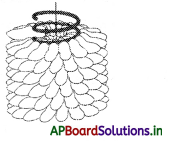
→ In plants like maple, seeds have wing-like outgrowths.

→ The seeds adapted to float on water are usually light.

→ The entire coconut fruit floats on water and moves from one place to another.

→ Some seeds are sticky and get stuck to the beaks of birds and in course of flight they fall down at distant places.

→ People transfer seeds from one place to another.

→ A mustard plant produces more than 10,000 seeds in its lifetime.

AP Board Solutions AP Board 7th Class Science Notes Chapter 13 Seed Dispersal

→ Seeds are carried from one place to another so that they get suitable conditions to grow, this is called the dispersal of seeds.

→ Seed dispersal is essential for the survival of plants.

→ Seeds are of different shapes and sizes and structures on them that help in dispersal.

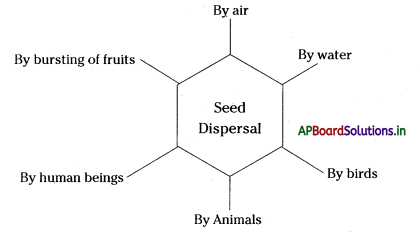
→ Seeds are dispersed by wind, water, birds, and animals.

→ Dispersal: Disband, separate.

→ Bursting: Break suddenly and violently apart.

→ Mechanism: A part of the machinery.

→ Fleshy fruit: The fruit has a rich plump which is thought and soft. ex: Mango

→ Germinate: Begin or cause to.

→ Survival: Continue to live or exist.

→ Condition: State of affairs, situation.

AP Board Solutions AP Board 7th Class Science Notes Chapter 13 Seed Dispersal

→ Excretion: Expel waste matter from the body.

→ Capsule: A small container with medicine inside which you swallow

→ Notice: Attention, heed, note.
AP Board 7th Class Science Notes Chapter 13 Seed Dispersal 1
→ A mustard plant produces more than 10.000 seeds in its lifetime. If all the seeds germinate to grow into adult plants, think how many seeds would be produced. If this happens for a period of six years the entire globe will be covered with mustard plants!

→ Archimedes:

  • Archimedes, the father of modern mathematics lived during 287-212 B.C There is no school for the boy who does not know the story of Aim’discovery of the Principle of Displacement.
  • Archimedes’ military inventions were spectacular. He devised cranes and multiplies which would enable a single man to lift the enemy’s vessels out of water.
  • He was so absorbed in Geometry that he died unaware of a Roman soldier who ran his sword through him.

AP Board 7th Class Science Notes Chapter 12 Reproduction in Plants

Students can go through AP State Board 7th Class Science Notes Chapter 12 Reproduction in Plants to understand and remember the concept easily.

AP State Board Syllabus 7th Class Science Notes Chapter 12 Reproduction in Plants

→ Thalamus is the seat on which the parts of the flower are present.

→ Above the thalamus, there is a green tube-like structure called the calyx.

→ Androecium and Gynoecium are the male and female parts of flowers.

→ A sunflower is actually a bunch of flowers.

→ The small flowers in the bunch are called ‘florets’.

→ A flower that has four or more whorls is called a complete flower.

→ A flower in which any of these four whorls is missing is an incomplete flower.

→ A flower that has either stamens or pistils is called a unisexual flower.

→ A flower that has both stamens and pistil is a bisexual flower.

→ The process of pollen grains reaching the stigma from another is known as pollination.

→ The flower consists of four parts. Sepal, Petal, Stamen and Pistil.

AP Board Solutions AP Board 7th Class Science Notes Chapter 12 Reproduction in Plants

→ Based on the presence and absence of floral parts flowers are two types. Complete flower and Incomplete flower.

→ Based on the presence of both or single sexual parts flowers are of two types. Bisexual flowers and Unisexual flowers.

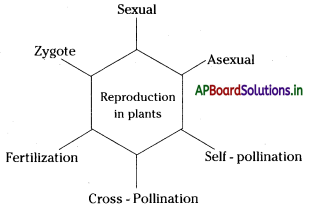
→ Transfer of pollen grains from another to stigma is known as pollination. Flowers can be self-pollinated or cross-pollinated.

→ The fusion of male and female parts to form a zygote is called Fertilization.

→ On the basis of parts involved, reproduction in plants is of two types, sexual reproduction, and asexual reproduction.

→ The production of offspring from the zygote is called sexual reproduction.

→ The formation of new plants without sexual reproduction is Asexual reproduction.

→ Cutting: Notch, gash dividing into pieces.

→ Androecium: Male reproductive organ.

→ Gynoecium: Female reproductive organ.

→ Thalamus: Swollen head on the stalk of a flower.

→ Corolla: Attractive organ in a flower.

→ Calyx: Protective organ in a flower.

AP Board Solutions AP Board 7th Class Science Notes Chapter 12 Reproduction in Plants

→ Stamen: The male organ of flowers that furnishes the pollen or fecundating dust.

→ Pistil: The seed-bearing organ of a flower.

→ Anther: Part of a flower’s stamen containing pollen.

→ Filament: Thread, fiber.

→ Budding: The production of buds on plants (Undeveloped flower).

→ Zygote: The diploid cell resulting from the union of a haploid spermatozoon and ovum.

→ Vegetative Propagation: Production of a new plant from vegetative parts of a plant.

→ Spore: Minute reproductive body of some plants.

→ Pollination: Transfer of pollen grains from another to stigma.

→ FertilizatIon: Make fertile, enrich.
AP Board 7th Class Science Notes Chapter 12 Reproduction in Plants 1
→ Birds and insects are the natural agents of pollination. Nowadays farmers use pesticides to control pests on crops. The enormous use of pesticides kills insects also. It affects pollination. Crop yield becomes reduced particularly in sunflower crops. The rate of pollination is reduced because of the lack of insects in the fields. Think! How we destroy our beautiful nature.

AP Board Solutions AP Board 7th Class Science Notes Chapter 12 Reproduction in Plants

→ Alexander Fleming a Scottish scientist, discovered that a certain kind of mold (Penicillium) produces a substance, named after the mold, called Penicillin, which can destroy many kinds of disease-causing bacteria. Penicillin came to be known as an antibiotic and saved the lives of many soldiers in World War II.

→ Johannes Kepler:
Johannes Kepler was a student and associate of Tycho, but he was a contrast to the latter. While Tyclio was rich, robust, noble, passionate, and an inquisitive mechanical and experimental genius, Kepler was in penury, sickly, and a poor experimenter.

Tycho was an average in Mathematics, his disciple was an expert in the subject Kepler was a man of indomitable perseverance and overcame all his deficiencies and misfortunes to attain a high rank among the scientific men.

AP Board 8th Class Biology Notes Chapter 8 Production and Management of Food From Plants

Students can go through AP State Board 8th Class Biology Notes Chapter 8 Production and Management of Food From Plants to understand and remember the concept easily.

AP State Board Syllabus 8th Class Biology Notes Chapter 8 Production and Management of Food From Plants

→ The plants which are grown in large numbers to get useful products are known as Crops.

→ The process of yielding crops is called Agriculture.

→ For some crops like Jowar, red gram takes a minimum of 180 days or more for harvesting. Such crops are called Long term crops.

→ Some crops like green gram, black gram take 100 days for harvesting and are called Short term crops.

→ The crops grown in the rainy season are termed Kharif.

→ The crops that are grown only in winter are called Rabi.

→ Rice is the prime, most essential, and important staple food crop and also called global grain.

→ Rice was cultivated in the late Mesolithic period (9000 – 8000 B.C.) and in the Harappan civilization (2300 BC).

→ The paddy growing field is divided into so many plots (Kayyalu or Madulu).

→ In general, farmers start agricultural work before the monsoon reaches (May, June months).

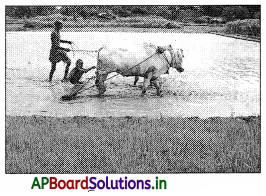
→ Before growing crops plowing the soil properly is necessary. The wooden plow is used for plowing.

AP Board Solutions AP Board 8th Class Biology Notes Chapter 8 Production and Management of Food From Plants

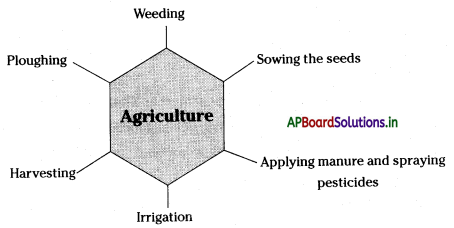
→ Agricultural practices are preparing the soil sowing of seeds, applying manure, irrigation, weeding, crop harvesting, and storage.

→ The selection of seeds is an important step in Agriculture.

→ National seed Development Corporation of India preserves and promotes different varieties of seeds.

→ Generally, farmers medicating seeds before making them germinate.

→ Nowadays farmers use the sophisticated seed drill used with the help of tractors.

→ Paddy planter is useful for farmers who cultivate paddy in large areas.

→ Wheat, Paddy, and sugarcane are generally affected by fungal diseases.

→ A farmer used a pesticide Dithane M-45 and Eldrige.

→ Manure is two types

  1. Natural
  2. Artificial.

→ Generally, farmers should use fertilizers keeping in view with the nature of the soil and the crops he wants to grow.

→ Paddy requires a high quantity of water.

→ Nowadays pumps are commonly used for lifting water, diesel, biogas, electricity is used to run these pumps.

→ Crop: The plants which are grown in large numbers to get useful products are known as crops.

→ Agriculture: The process of yielding crops ¡s called Agriculture.

→ Crop production: The production of crops.

→ Long-term crops: Some crops like Jowar, red gram takes a minimum of 180 days are called long-term crops.

→ Short-term crops: Some crops like green gram, black gram takes 100 days for harvest are called short term crops.

AP Board Solutions AP Board 8th Class Biology Notes Chapter 8 Production and Management of Food From Plants

→ Kharif season: The crops grown in the rainy season are termed as Kharif season.

→ Rabi season: The crops that are grown only in the winter season.

→ Night duration: Duration of night.

→ Global grain: Rice is the prime, most essential, and important staple food also called global grain.

→ Plowing: Before growing crops plowing the soil is necessary which makes the soil loose.

→ Plots: Small piece of land. The form land ¡s made blocks or plots which is easier to leveling the form land and water for the crop.

→ Leveling: After plowing the fields have a lot of ups and downs. So leveler is are used to level the soil.

→ Sowing: Planting seeds %n the soiL

→ Selection: Before sowing farmers select healthy seeds which give healthy crops.

→ Seed crisis: Sometimes the rate of germination of the seeds Is not up to the mark. Sometimes never germinate. At sometimes they grow Into plants, but they are sterile.

→ Sprouting: When seeds are soaking in the water they germinate and produce the shoot.

→ Seed dispersal: The method of spreading seeds away from the parent plant for better germination.

→ Broadcasting: The method of dispersing the seeds by sprinkling.

→ Seed drill: It is an instrument used to sow seeds in the soil.

→ Nursery plot: Farmers develop seeds beds to grow paddy plantlets (Naru) in a plot, which needs to have their roots constantly submerged in water. They are to be uprooted and transplanted throughout the field (neatly).

AP Board Solutions AP Board 8th Class Biology Notes Chapter 8 Production and Management of Food From Plants

→ Manure: The nutrients that enrich the fertility of the soil for the proper growth of plants.

→ PesticIdes: To control or kill the pests like grasshoppers and aphids, which damage crops and grains farmers use pesticides.

→ Paddy planter: It is easy to maintain proper distance sowing the seedlings. It is time-saving, ¡t is useful for farmers who cultivate paddy.

→ Biofertilizers: This is formed by decomposing plant and animal wastes. This is also called Natural Manure.

→ Chemical fertilizers: The manure which are prepared ¡n factories by using chemicals and is also called artificial manure.

→ Irrigation: The process of watering crop plants ¡n the field is known as irrigation.

→ Furrow irrigation: In this method of irrigation, the water is allowed to enter the field through channels, or furrows are made between two rows of crops.

→ Basin irrigation: The field is just filled with water as in the case of paddy.

→ Sprinklers: A modern device of watering plants.

→ Drip irrigation: When the availability of water is poor the water is made to reach the plants drop by drop.

→ Weeding: Removal of undesirable plants (weeds) which grow along with crop plants.

→ Weedicides: When crops are fully grown and may not be suitable for uprooting weeds, farmers use weedicides like 2-4 D’chloro phenoxy acetic acid to control or kill the weeds.

→ Harvesting: Collecting grains from the crop by cutting the matured plant is called harvesting.

AP Board Solutions AP Board 8th Class Biology Notes Chapter 8 Production and Management of Food From Plants

→ Threshing: The dry plant’s stocks are beaten on a hard surface to remove the grain.

→ Winnowing: In winnowing the grains are poured out of a basket or tray held high up the wind blows the chaff, dust, and lighter seeds aside, while the heavy grains collect below.

→ Cold storage units: Here the vegetables, fruits, tamarind, chilies, and other products that are usually damaged and decolored within a short time.

→ Godowns: The place where the storage of dry grains to protect them from pests and microorganisms.
AP Board 8th Class Biology Notes Chapter 8 Production and Management of Food From Plants 1

→ The name Oryza for paddy- which was named by Linnaeus. Thousands of varieties of paddy are available throughout the world. Oryza sativa is cultivated in Asia. Oryza glaberrima is cultivated in Africa. Oryza Glumaepatuia is cultivated in America. In our state, we have hundreds of varieties of paddy. Molagolukulu is the traditional good variety that is grown in coastal areas of Nellore. Amrita Sari, Bangaru Teega, Kolleti Kusuma, Potti Basangi, Sona Masuri are some of our traditional varieties.

→ In 1960 Rachael Carson wrote a book called ‘silent spring’ in which she pointed out the dangers of pesticides. Pesticides get into the bodies of microscopic plants and animals in the soil and water. When these plants and animals are eaten by fish the pesticides get into their bodies. Even if the fish are not seriously poisoned with each successive meal pesticides buildup inside their bodies.

A bird that eats these fish might get a concentrated lethal dose. DDT also accumulates in the eggshells weakening them and making the shells break before hatching. There are just two out of the numerous ways that pesticides are eaten, passed down the food chain, and accumulate in the bodies of higher animals including human beings causing sickness and sometimes death. Think, how dangerous the pesticides are…!

AP Board Solutions AP Board 8th Class Biology Notes Chapter 8 Production and Management of Food From Plants

→ Paddy requires a high quantity of water. That is why paddy is grown in areas where plenty of water is available. Because of marketing and supporting prices, paddy is grown all over the country irrespective of water availability. For this farmers dig bore wells and use groundwater wherever water is not sufficient. There is a need to shift to those crops which require less water. In some areas, recently farmers grow fish in paddy growing fields.

→ To meet the food requirement of the growing population there should be an increase in the cultivated land. But nowadays parts of the agricultural land in rural areas remain uncultivated land because of the non-availability of seeds, power, water supply, market problems. Farmers thinking that agriculture is a non-profitable task.
AP Board 8th Class Biology Notes Chapter 8 Production and Management of Food From Plants 2
Actually, agriculture is the flesh and blood of our country. So the young generation should develop more passion towards agriculture which would be the only beneficial profession in near future.

→ Antonie Philips Van Leeuwenhoek
Antonie Philips van Leeuwenhoek was born (October24,1637-August 26, 1723) was a Dutch tradesman and scientist from Delft, Netherlands. He was commonly known as “the father of microbiology” and considered to be the first microbiologist. He is best known for his work on the improvement of microscopes, he was the first to observe and describe single-celled organisms, which he originally referred to as animalcules and which are now referred to as microorganisms. He was also the first to record microscopic observations of muscle fibers, bacteria, spermatozoa, and blood flow in capillaries. Leeuwenhoek made more than 500 optical lenses. He also created at least 25 microscopes, of different types, of which only nine survive. His microscopes were made of silver or copper fir cones, holding hand-made lenses. Those who have survived are capable of magnification up to 275 times. His scientific research was of remarkably high quality.

AP Board 8th Class Biology Notes Chapter 7 Different Ecosystems

Students can go through AP State Board 8th Class Biology Notes Chapter 7 Different Ecosystems to understand and remember the concept easily.

AP State Board Syllabus 8th Class Biology Notes Chapter 7 Different Ecosystems

→ The word ecosystem was first used in 1935 by A.G. Tansley a British Botanist and Ecologist.

→ Nature works as a system in which organisms and their communities are influenced by many non-living environmental factors.

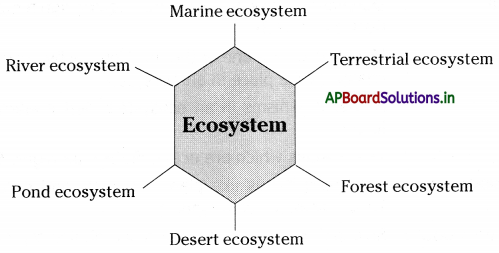
→ An ecosystem can be defined as a functional unit of nature, where living organisms interact among themselves and also with the surrounding physical environment.

→ Living things like plants, animals and microorganisms are known as biotic components of the ecosystem.

→ Soil, water, sunlight etc. are called abiotic components of the ecosystem.

→ There is a feeding relationship between plants and animals.

→ There is an interdependence between plants and animals for space, reproduction, shelter etc.

→ Scientists describe the way energy moves through the ecosystem, they use the term food chains.

→ Several plants, algae use sunlight to make their food and are called producers.

→ Consumers eat other living things and get their energy from them.

→ Decomposers feed on the wastes of plants and animals after they die. They retain nutrients to the soil for the plants to use as the cycle begin again.

→ Mangroves are one of the most productive ecosystems on earth, deriving nourishment from terrestrial fresh water and tidal saltwater.

→ A living community cannot live in isolation.

AP Board Solutions AP Board 8th Class Biology Notes Chapter 7 Different Ecosystems

→ The existence of the living world depends upon the flow of energy and the circulation of materials through the ecosystem.

→ A food chain consists of four steps – the producers – primary consumers, secondary consumers, tertiary consumers.

→ The energy accumulated by plants in an ecosystem is called Primary production.

→ The total energy produced during photosynthesis is the Gross Primary production.

→ Only a small part of the energy is fixed in the form of chemical potential energy in the protoplasm.

→ Habitat: Habitat is the Natural living place of an organism or a group of organisms. Land and water are the major habitats.

→ Ecosystem: An ecosystem is a Natural unit and has both abiotic and biotic components which interact and influence each other.

→ Food web: A food web consists of several interlinked food chains and each organism in a food web will be a member of more than one food chain.

→ Producers: Plants are the only organisms capable of carrying out photosynthesis and producing food for all living organisms in any ecosystem. For this reason, plants are called producers.

→ Consumers: The organisms which consume the food produced by plants are called consumers. Ex: Animals.

→ Decomposers: Some of the organisms, obtain their nutritional requirements by decomposing the dead bodies of both producers and consumers of the ecosystem are called Decomposers. Ex: Bacteria, Fungi.

AP Board Solutions AP Board 8th Class Biology Notes Chapter 7 Different Ecosystems

→ Rodents: Rodents are herbivorous or omnivorous mammals with one pair of chisel-line incisor teeth projecting from each jaw at the front of the mouth and specialized for continuous gnawing. Ex: rat, squirrel etc.

→ Flora and Fauna: All the plants of a particular place and all the animals that live wild in a particular area is called flora and fauna.

→ Thermophile: Describing microorganisms that require high temperatures around 60°C for growth.

→ Mangroves: Mangroves are one of the most productive ecosystems and the changes take place in an ecosystem.

→ Energy flow: All the organisms in an ecosystem derive energy from food to live.

→ Nocturnals: The animals which are active during the night. Ex: bat.

→ Biotic components: The living things like plants, animals and microorganisms are known as biotic components.

AP Board Solutions AP Board 8th Class Biology Notes Chapter 7 Different Ecosystems

→ Abiotic components: Soil, water, sunlight etc. are called abiotic components.
AP Board 8th Class Biology Notes Chapter 7 Different Ecosystems 1

→ In Ecosystem, we study the changes occurring in the habitat like organisms moving away from the habitat or entering the habitat.

It is said that there are more microorganisms in the sea than there are stars in the universe. The world’s oceans host 32 of the 34 known phyla on earth and ocean be¬tween 5,00,000 and 10 million marine species. Species diversity is as high as 1000 per square metre in the Indo-Pacific Ocean and new oceanic species are continuously being discovered.

→ Sir Isaac Newton:
Sir Isaac Newton (25 December 1642 – 20 March 1727) was an English Physicist and Mathematician who was widely regarded as one of the most influential scientists of all time and as a key figure in the scientific revolution. His book Philosophic Naturalis Principia Mathematica (“Mathematical Principles of Natural Philosophy”). First published

Newton Principia formulated the laws of motion and universal gravitation that dominated scientists. View of the physical universe for the next three centuries. It also demonstrated that the motion of objects on the Earth and that of celestial bodies could be described by the same principles. By deriving Kepler’s laws of planetary motion from his mathematical description of gravity, Newton removed the last doubts about the validity of the heliocentric model of the cosmos.

Newton built the first practical reflecting telescope and developed a theory of colour based on the observation that a prism decomposes white light into the many colours of the visible spectrum.

AP Board 8th Class Biology Notes Chapter 6 Biodiversity and its Conservation

Students can go through AP State Board 8th Class Biology Notes Chapter 6 Biodiversity and its Conservation to understand and remember the concept easily.

AP State Board Syllabus 8th Class Biology Notes Chapter 6 Biodiversity and its Conservation

→ Many kinds of plants and animal varieties exist in the world.

→ There is no monogamy or uniqueness in the structure and functions of nature even at the micro-level also.

→ When animals vanish forever from the earth, the species has become extinct.

→ The organisms whose species might be wiped off from the earth in near future are called endangered species.

→ The book published by IUWC that contains the details of Endangered and Extinct species is called RED DATA Book.

→ Natural calamities like floods, earthquakes, forest fires or human intervention wipe out diverse forms in an area.

→ Plants or animal species found restricted to a particular area of the country are called Endemic species.

→ Diversity is not only in plants and animals, but also great diversity in food crops.

→ The number of insects is decreasing due to the spraying of pesticides.

→ The government of India has taken initiative to conserve wildlife by making National Parks and sanctuaries to conserve the forest.

AP Board Solutions AP Board 8th Class Biology Notes Chapter 6 Biodiversity and its Conservation

→ At present, there are 27 tiger reserves in our country.

→ Conservation of Biodiversity is an important issue to protect our nature for future generations.

→ The birds which move from one region to another for food and shelter are called migratory birds.

→ To make a ton of paper 17 trees have to be cut down.

→ Biosphere reserve: The part of the earth occupied by living organisms – keep for future use. Forests are Biosphere reserves.

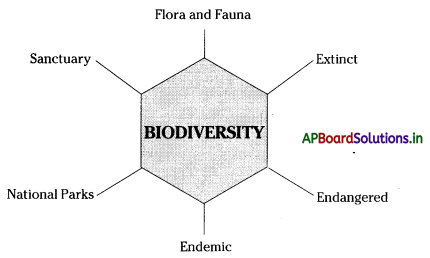
→ Biodiversity: The term Biodiversity is commonly used to describe the variety and variability of living organisms.

→ Endemic species: Plants or animals species found restricted to a particular area of a country are called Endemic species.

→ Flora and Fauna: There are long sources in nature – these are plants and animals otherwise known as Flora (plants) and Fauna (animals).

→ Deforestation: Cutting down forests for human use is called deforestation.

→ Endangered species: The organisms whose number have declined rapidly and the species might be wiped off from the earth in near future are called Endangered species.

AP Board Solutions AP Board 8th Class Biology Notes Chapter 6 Biodiversity and its Conservation

→ Extinct species: When animals vanish forever from the earth is said that the species has become Extinct.

→ Red Data Book : (W.W.F.) World Wild Life Federation or the (I.U.W.C.) International Union For Wild Life Conservation published a book containing the details of endangered and threatened species of Flora and Fauna called Red Data Book or Red Ust Book.

→ National Park: The place where Wildlife is protected in the natural environment is National Parks. Ex: Corbett National Park – Gauhati.

→ Sanctuary: A sanctuary is a pl2ce where conservation of birds in their natural habitat. Ex: Palak Sanctuary – Adilabad.

→ Migration: The birds which don’t have permanent nestlings, join into small flocks and move from one region to other for food and shelter (nestling) called Migration. Ex: Siberian Cranes.

→ Invasive: Involving the introduction of instruments or other objects into the body.

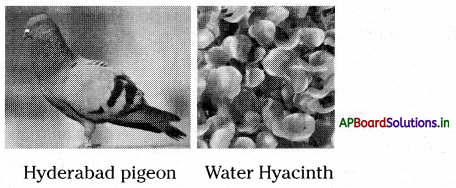
→ Allen Spades: Non-native species – IntroducIng a species that does not belong to the particular habitat. In Hyderabad Invasion of pigeons (a non-native species) lead to decrease crows.

→ Conservation: Preservation of the natural environment
AP Board 8th Class Biology Notes Chapter 6 Biodiversity and its Conservation 1
→ According to noted ecologist E.O. Wilson, every year nearly 10,000 species or 27 species per day become extinct throughout the world. If this trend of extinction continues, the very existence of man will be affected.

→ India shows a good number of endemic species. About 62% of the worlds’ amphibians and 50% of lizards are endemic to the Western Ghats of India.

AP Board Solutions AP Board 8th Class Biology Notes Chapter 6 Biodiversity and its Conservation

→ Invasive Alien Species (IAS)?
When alien species (non-native species) are introduced or invades, it spreads outside the natural habitats and threatens biodiversity. Even transport of few species to a new environment becomes invasive. Their negative impacts on food, security, plant, animal, and human health can be extensive and substantial, eg. The Spanish flag plant of the forests and the water hyacinth of lakes are most notorious for invasions. In cities like Hyderabad invasion of pigeons (a non-native species) lead to a decrease in crows. Nowadays a city like Hyderabad lacks these natural scavengers.
AP Board 8th Class Biology Notes Chapter 6 Biodiversity and its Conservation 2

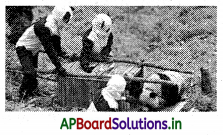
→ Some endangered animals are brought from the wild area and raised in the zoo and released into the wild area again. Here some conservationists disguised as pandas feed the animal before leaving it into the wild. It gives a natural feeling of being fed by mother and living between the pandas. This can survive without human care.
AP Board 8th Class Biology Notes Chapter 6 Biodiversity and its Conservation 3

→ Louis Pasteur
French chemist and microbiologist Louis Pasteur was born on December 27, 1822, in Dole, located in the Jura region of France. He was skilled at drawing and painting. He earned his Bachelor of Arts degree (1840) Bachelor of Science degree (1842) and a doctorate (1847) at the Ecole Normale in Paris.

He demonstrated that bacteria were responsible for souring wine, beer, and even milk. He then invented a process where bacteria could be removed by boiling and then cooling liquids. This process is known as pasteurization.

Pasteur’s first vaccine discovery was in 1879, with a disease called chicken cholera. Pasteur went on to extend his germ theory to develop causes and vaccinations for diseases such as anthrax, cholera, TB, and Smallpox. In 1882, he decided to focus his efforts on the problem of rabies. On July 6, 1885, Pasteur vaccinated Joseph Meister, a 9 – year old boy who had been bitten by a rabid dog.

This began an international fundraising campaign to build the Pasteur Institute in Paris, which was inaugurated on November 14, 1888. He died on September 28, 1895.

AP Board 8th Class Biology Notes Chapter 5 Attaining the Age of Adolescence

Students can go through AP State Board 8th Class Biology Notes Chapter 5 Attaining the Age of Adolescence to understand and remember the concept easily.

AP State Board Syllabus 8th Class Biology Notes Chapter 5 Attaining the Age of Adolescence

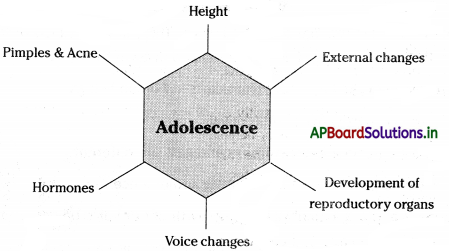
→ We see changes in the age of 10 – 19 years. This period is called “Adolescence”. During this period changes are observed and outside the body.

→ Growth is one of the important characters of human beings.

→ Initially, the girls grow faster than boys.

→ Changes occurring in adolescent boys and girls are different.

→ Generally, a change in voice is seen during adolescence.

→ The Adam’s apple is actually a partial growth of our voice box or larynx.

→ Many Adolescent boys and girls get pimples on the face, because of increased activity of sweat and sebaceous glands.

→ At this age, male sex organs like the Testes and penis develop completely.

→ In girls, the ovary enlarges and eggs begin to mature.

→ The sex organs by which children are identified as boys or girls at birth represent primary sexual characters.

→ Reproduction is most important for the continuation of the human race.

→ The first menstrual cycle begins at adolescence and is termed as ‘menarche’. Stoppage of menstruation is termed ‘menopause’.

→ If menstruation remains irregular for over a year there is a need to consult a doctor (gynecologist)

→ Marriage is a social and cultural practice to produce the next generation in our country.

→ Child marriage is a social evil.

→ The legal age for marriage is 18 years for girls and 21 years for boys.

→ Adolescent queries must never go unanswered.

→ Endocrine glands help in the regulation of the functioning of the human body.

AP Board Solutions AP Board 8th Class Biology Notes Chapter 5 Attaining the Age of Adolescence

→ The secretions of endocrine glands are known as hormones.

→ It is more essential to be careful about health and hygiene.

→ Adolescence: It is a transitional stage of physical and psychological human development during the period between childhood and adulthood.

→ Teenage: Person aged between lo and 19 years.

→ Larynx: It is a part of the human respiratory system. It is generally called the ‘voice box It has vocal cords that vibrate during expiration and produce sounds.

→ Adam’s apple: It is a partial growth of our voice box or larynx. The adam’s apple is formed due to elongation of the thyroid cartilage which protrudes out in front of the neck. This is caused mainly by some male hormones during adolescence.

→ Maturity: Adolescents become capable of reproduction when their testes and ovaries begin to produce gametes. This is called maturity, mostly in between 11 – 15 years.

→ Sweat glands: They are present in the dermis of the skin. They absorb the excess salts and water from the blood vessels and send them outside of the skin as sweat.

→ Sebaceous glands: They are present in the dermis layer of the skin. They produce oil-like substances like sebum. It helps the skin to become dry.

→ Secondary sexual characters: At the age of Adolescence, breasts begin to develop in girls whereas, in boys, facial hair, mustaches, and beards begin to grow. They are called secondary sexual characters.

→ Menstruation cycle: The cycle of changes that takes place in the female reproductive system ¡s called the menstrual cycle. It occurs once in 28 to 30 days.

→ Menarche: The first menstrual cycle begins at adolescence and is termed as ‘menarche’. It is a sign of starting the release of ova in female reproductive life.

AP Board Solutions AP Board 8th Class Biology Notes Chapter 5 Attaining the Age of Adolescence

→ Menopause: At 45 to 50 years of age, the menstrual cycle stops stoppage of menstruation is termed as ‘menopause’.

→ Pregnancy: After the fertilization of male and female gametes the fertilized egg is formed. This is received by the uterus and this results in pregnancy.

→ Endocrine glands: The glands which help in the regulation of the functioning of the human body are called endocrine glands. They release chemical substances called hormones.

→ Hormones: They are chemical substances released by endocrine glands.

→ Testosterone: The male hormone released by the testes.

→ Estrogen: It is a female hormone produced by the ovaries.
AP Board 8th Class Biology Notes Chapter 5 Attaining the Age of Adolescence 1

→ Consuming tobacco (gutkha, cigarettes, cigar, beedi, khaini) damages the internal organs of the body. The number of addicted people at the age of 15 or below is 57.57 lakhs (68%) in Andhra Pradesh. When they reach 30 years of age their internal organ system becomes damaged, and this leads to several problems and sometimes, may cause death also. It is a dangerous trend in our country. So you should be aware of healthy habits.

→ Charles Robert Darwin:
Charles Robert Darwin (12 February 1809 – 19 April 1882) was an English naturalist. He established that all species of life have descendent over time from w.ctorc, and proposed the scientific theory that his branching pattern of Evolution resulted from u process that he called Natural selection, in which the struggle for existence has a similar effect to the artificial selection involved ¡n selective breeding.

Darwin published his theory of evolution with compelling evidence in his 1859 book on the origin of species, overcoming scientific rejection of earlier concepts of transmutation of species.

AP Board 8th Class Biology Notes Chapter 4 Reproduction in Animals

Students can go through AP State Board 8th Class Biology Notes Chapter 4 Reproduction in Animals to understand and remember the concept easily.

AP State Board Syllabus 8th Class Biology Notes Chapter 4 Reproduction in Animals

→ Animals that lay eggs are called oviparous. E.g. Hen, Duck, Crow, Pigeon

→ Animals that lay eggs do not have epidermal hair or external ears.

→ Animals that give birth to their offspring are called viviparous. These animals have epidermal hair on their skin and external ears.

→ The Asexual Reproduction takes place in Hydra is by Budding.

→ Reproduction without the fusion of gametes is called Asexual Reproduction.

→ The Asexual Reproduction in which an animal reproduces by dividing into two individuals is called Binary Fission.

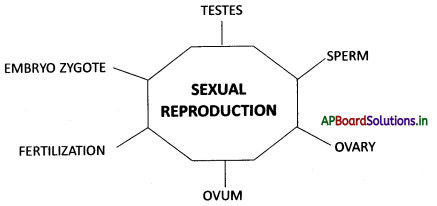
→ Sexual Reproduction is the fusion of the male reproductive cell with the female reproductive cell.

→ A zygote is formed by the fusion of the female reproductive cell or ovum and the male reproductive cell or sperm.

→ The male reproductive system includes a pair of Tests, two seminal ducts and a Penis. % Female reproductive system contains a pair of ovaries, oviducts (also called fallopian tubes) and uterus.

→ The fusion of the male game (sperm) and the female game (ovum) is called fertilization. This results in the formation of fertilized egg or zygote.

AP Board Solutions AP Board 8th Class Biology Notes Chapter 4 Reproduction in Animals

→ The embryo continues to develop in the uterus.

→ The period (about 270 – 280 days) a baby is born is called the gestation period.

→ From the 3rd month of pregnancy, the embryo is called the foetus.

→ Fertilization that takes place inside the body of the female is called Internal fertilization. E.g.: Human beings, animals.

→ Fertilization that takes place outside the female body is called External Fertilization. E.g. Fish, frogs, Starfish, etc.

→ The marked changes that take place during the development of tadpole larva to adult are called metamorphosis.

→ The animals which carry both male and female reproductive organs are called ‘Bisexual animals’ also called Hermaphrodites.

→ Cloning is the production of an exact copy of a cell, any other living part, or a complete organism.

→ Reproduction: The ability of an organism (plant or animal) to produce a new generation of individuals of the same species is called Reproduction.

→ Budding: Hydra, a microscopic organism reproduces asexually. Buds are formed on the body surface. These buds separated from the hydra and develop into a new individual. This type of asexual reproduction is called Budding.

→ Uterus: It ¡s a part of the female reproductive system. This is a strong muscular sac, where the embryo develops into a baby.

AP Board Solutions AP Board 8th Class Biology Notes Chapter 4 Reproduction in Animals

→ External fertilization: The process of fertilization that occurs outside of an organism is called external fertilization.

→ Pregnancy: The period from zygote to the fully developed foetus is called pregnancy.

→ Zygote: Fertilization results in the formation of a zygote.

→ Binary fission: A type of asexual reproduction in which an animal reproduces by dividing into two individuals is called Binary Fission.

→ Ovary: A part of ovaries lie inside the abdomen in the hip region of the female body, one on each side of the uterus.

→ Internal fertilization: Fertilization that takes place inside the body of the female animal is called internal fertilization.

→ Embryo: The zygote divides repeatedly to give rise to a ball of cells. These cells develop into different tissues and organs in the body. This developing structure is termed an embryo.

→ Testes: The male reproductive organs include a pair of testes which are egç shaped and produces the male gametes called sperms.

→ Epidermal hairs: The hair that grows on the skin (outer layer of the skin) is called epidermal hairs.

→ Foetus: From 3 months (12 weeks) of pregnancy the embryo is called a foetus.

→ Oviparous: The animals which lay eggs are called oviparous. E.g. Hen, Frog.

→ Sperms: Testes produce millions of male gametes called sperms or male gametes.

→ Fertilization: The fusion of male (sperm) garnet and female (ova) garnet is called fertilization.

AP Board Solutions AP Board 8th Class Biology Notes Chapter 4 Reproduction in Animals

→ Bisexual animals: Some animals carry both male and female reproductive organs. Such animals are called bisexual animals also called hermaphrodites.

→ Viviparous: The animals which give birth to young ones are called viviparous.

→ Ova: The ovary produces female gametes called ova or egg. Ova is a single cell surrounded by an outer covering and a nucleus floating in the cytoplasm.

→ Asexual reproduction: New individuals are formed without the fusion of gametes. This process is called Asexual reproduction.

→ Sexual reproduction: New individuals are formed with the fusion of male and female gametes. This process is called sexual reproduction.

→ Metamorphosis: Transformation of the larva into an adult through drastic changes is called metamorphosis.

→ Offsprings: Mother gives birth to the new individuals (baby) after fertilization is called offsprings.
AP Board 8th Class Biology Notes Chapter 4 Reproduction in Animals 1
→ Test tube babies:
You might have heard that in some women oviducts are blocked. These women are unable to bear babies because sperm cannot reach the eggs for fertilization. In such cases, doctors collect freshly released eggs and sperms and keep them together for few hours for IVF or in vitro fertilization (fertilization outside the body). In case fertilization occurs, the zygote is allowed to develop for about a week and then it is placed in the mother’s uterus. Complete development takes place in the uterus and the baby is born like any other baby. Babies born through this technique are called test-tube babies. This term is actually misleading because babies cannot grow in test tubes.

→ Some animals like earthworms are neither male nor female. They carry both male and female reproductive organs. Such animals are called “bisexual animals” (also called hermaphrodite).

→ A.P.J. Abdul Kalam:
Avul Pakir Jainulabdeen Abdul Kalam (born 15th October 1931 – died 27th July 2015) usually referred to as Dr A.P.J.Abdul Kalam is an Indian administrator, who served as the 11th President of India from 2002 to 2007. Kalam was born and raised in Rameswaram, Tamil Nadu, studied Physics at St. Joseph’s College, Tiruchirapalli and Aerospace Engineering at the Madras Institute of Technology, Chennai.

Before his term as President, he worked as an aerospace engineer with Defence Research and Development and Indian Space Research organisation. Kalam is popularly known as the Missile Man of India for his work on the development of ballistic missiles and launch vehicle technology. He played a pivotal organisational, technical and political role in India’s Pokhran-II nuclear tests in 1998, the first since the original nuclear test by India in 1974. Some scientific experts have however called Kalam a man with no authority over nuclear physics but who just carried on the works of Homi J.Bhabha and Vikram Sarabhai

Kalam was elected the President of India in 2002, defeating Lakshmi Sahagal and was supported by both the Indian National Congress and the Bharatiya Janatha Party, the major political parties of India. He is currently a visiting professor at the Indian Institute of Management Ahmedabad and Indian Institute of Management Indore, Chancellor of the Indian Institute of space science and Technology, Thiruvananthapuram, a professor of Aerospace Engineering at Anna University (Chennai).

Kalam advocated plans to develop India into a developed nation by 2020 in his book India 2020. He has received several prestigious awards including the Bharata Ratna, Indies highest civilian honour. He launched his mission for the youth of the nation in 2011 called the what can I give movement with a central theme to defeat corruption in India.

A.RJ. Abdul Kalam’s 79th birthday was recognised as World Student’s Day by United Nations. He has also received honorary doctorates from 40 universities. The Government of India has honoured him with the Padma Bhushan in 1981and the Padma Vibhushan in 1990 for his work with ISRO and DRDO.

AP Board 6th Class Social Studies Notes Chapter 12 Towards Equality

Students can go through AP State Board 6th Class Social Studies Notes Chapter 12 Towards Equality to understand and remember the concept easily.

AP State Board Syllabus 6th Class Social Studies Notes Chapter 12 Towards Equality

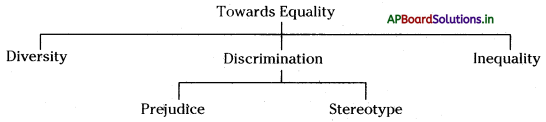
→ We can observe the differences among the people around us are called diversity.

→ All their diversities are influenced both by the geography and history of the place where we live

→ India is a country of many diversities.

→ We speak different languages, have various types of food,-celebrate different festivals, and practice different religions.

→ Ar People began to live in their new places, causes intermixing of cultures, regions become diverse.

→ People feel safe and secure with people who look, talk, dress, and think like them.

→ Prejudice means to judge other people negatively or see them as inferior.

→ We can be prejudices about people’s religious beliefs, the color of their skin, the region they come from, the clothes they wear, etc.

→ In general, our prejudices about others are so strong that we don’t want to form friendships with them and we may in ways that hurt them.

AP Board Solutions AP Board 6th Class Social Studies Notes Chapter 12 Towards Equality

→ People of other religions may be discriminated against by treating them as inferior or by criticizing their customs or practices.

→ Their customs are practices.

→ There are eight religions in the world and all of them are practiced in India.

→ Activities like cleaning, washing, cutting hair picking garbage, etc. are seen less value, and people who do this work are seen as dirty or impure.

→ This belief is an important aspect of the caste system.

→ Those who placed themselves at the top called themselves upper caste and considered. themselves as superior.

→ Those who were places at the bottom were seen as unworthy and called ’untouchables’.

→ The upper caste acted in ways that did hot give the so, called untouchables’ the same right as they enjoyed which is called caste discrimination,

→ Dalit means those who have been ‘broken’ which is used to show how social prejudices and discrimination have broken the Dalit people.

→ The government refers to this group of people as Scheduled Castes (S.C.)

→ The people who fought for the rights of oppressed caste are likewise ’Jyothibai Phule, Potti Sree Ramulu. Vennelakanti Raghaviah, Gora Saraswathi, etc.

→ All human beings are born free and casual and both men and women have equal social, political, and economical rights.

→ Savitribai Phule is regarded as the first female teacher in India.

→ She played an important role in fighting for the rights of women in India during British rule.

→ Savitribai Phule is regarded as the ’Mother of Indian Feminism’.

→ Racial discrimination is discrimination against individuals on the basis of their skin color or racial or ethnic origin.

→ Inequality threatens long-term social and economic development. It also causes social unrest.

AP Board Solutions AP Board 6th Class Social Studies Notes Chapter 12 Towards Equality

→ In the early 19th century, debates and discussions took place reached out to the public and they caused part of the social change.

→ The prominent reformers of India are Raja Ram Mohan Roy, Iswara Chandra Vidyasagar, Swamy Dayananda Saraswathi, Kandukuri Veeresalingam Pantulu, and Pandita Ramabai.

→ In the second half of the 19th century, many movements began against caste discrimination and demanded social equality and justice.

→ The reformers who fought against caste discrimination in this period are Sri Narayana Guru, Dr. B.R. Ambedkar, C.V. Ramaswamy Naiker, Jyothiba Phule, and Savitribai Phule.

→ People who fought against British rule also fought against discrimination to unite people.

→ The practice of Safi was banned in 1829.

→ Dr. Anandibai Joshi was the first Indian female doctor. She acquired a Doctor of Medicine in 1886.

→ Dr. Nelson Mandela, after 27 years in prison, achieved independence for South Africa.

→ He led the fight for human rights around the world.

→ He is known as the Gandhi of South Africa.

→ Importance has been given to achieve equality in the Indian Constitution.

→ Untouchability was abolished by Law. All the people got equal importance.

→ The government tries to achieve equality both through the law and through the welfare- programs.

→ Dr. A.P.J. Abdul Kalam was the 11th President of India. Impact of so many problems in his life he reached his goal.

→ Mariyappan Thangavelu is an Indian Paralympic high jumper.

→ Sipdhutai showed that for a committed individual nothing is impossible.

AP Board Solutions AP Board 6th Class Social Studies Notes Chapter 12 Towards Equality

→ In spite of poverty, child marriage, gender discrimination, and being abandoned by her family, yet nothing stopped Sindhutai to achieve her goals.

→ Gender Equality: both men and women should receive equal treatment.

→ Untouchability: It is a practice where some lower caste people are kept at a distance.

→ Apartheid: discrimination on grounds of race.

→ Sustainable development: is the development that meets the needs of the present without compromising the ability of future generations to meet their needs.

→ Discrimination: the unjust or prejudiciál treatment of different categories of people, especially on the grounds of race age, sex, or other characteristics.

→ Orthodox: traditional

→ Wrestle: engage in deep thought, consideration, or debate.
AP Board 6th Class Social Studies Notes Chapter 12 Towards Equality 1

AP Board 8th Class Biology Notes Chapter 3 Story of Microorganisms 2

Students can go through AP State Board 8th Class Biology Notes Chapter 3 Story of Microorganisms 2 to understand and remember the concept easily.

AP State Board Syllabus 8th Class Biology Notes Chapter 3 Story of Microorganisms 2

→ Some microorganisms are useful and some microorganisms are harmful.

→ Microbes are useful in home, industry, cleaning the environment.

→ Soil microbes degrade organic wastes into useful nutrients. This helps plants in their growth and development.

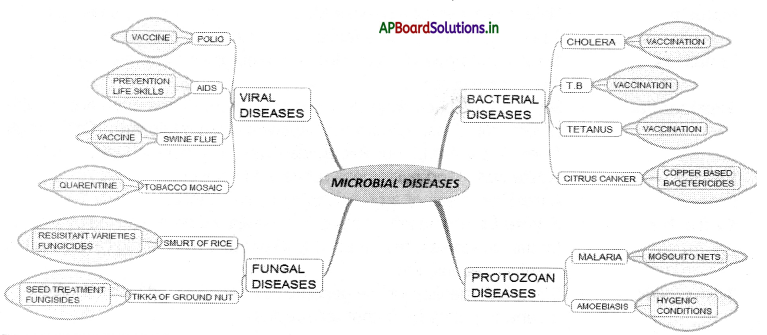
→ Some microorganisms cause diseases in humans, plants, and other animals.

→ Some insects and animals act as vectors of microbes.

→ Some microbes release toxins in improperly preserved food, which causes food poisoning.

→ Pasteurization helps in milk preservation.

→ The bacteria ‘rhizobium’ present in root nodules of leguminous plants fixes atmo¬spheric Nitrogen.

→ Microorganisms are useful to human beings in a number of ways.

→ Lactic acid bacteria help in the curdling of milk.

→ The ripening of cheese is due to bacteria.

→ Some bacteria help the plants by providing them with nitrates that are obtained by fixing atmospheric nitrogen.

→ Fermentation, for the production of alcohol, is due to yeasts.

→ Antibiotics are obtained from certain fungi like penicillium.

AP Board Solutions AP Board 8th Class Biology Notes Chapter 3 Story of Microorganisms 2

→ Lactobacilli Plus: Gram-positive facultative anaerobic or microaerophilic rod-shaped bacteria. Most of its members convert lactose and other sugars to lactic acid.

→ Penicillium: Penidiilum ¡s a genus of ascomycetous fungi of major importance in the natural environment as well as food and drug production. Members of the genus produce penicillin, a molecule that is used as an antibiotic, which kills or stops the growth of certain kinds of bacteria inside the body.

→ Fermentation: The anaerobic conversion of sugar to carbon dioxide and alcohol by yeast.

→ Sterilization: The act of making an organism barren or infertile (unable to reproduce).

→ Vaccination: An antigenic preparation used to stimulate the production of antibodies and provide immunity against a disease.

→ Bacillus: Bacillus Thuringiensis (or Bt) is a Gram-positive, Coldwell bacterium, Thuringiensis commonly used as a biological pesticide; alternatively, the toxin may be extracted and used as a pesticide.

→ Pathogens vectors: Any agent that is capable of causing a disease ¡s called a pathogen. A vector is any agent (person, animal, or microorganism) that carries and transmits an infectious pathogen into another living organism.

→ Pasteurization: Partial sterilization of foods at a temperature that destroys harmful microorganisms without major changes in the chemistry of the food.

→ Symbiosis: Symbiosis “together” and “living” is close and often long-term interaction between two or more different biological species.

AP Board Solutions AP Board 8th Class Biology Notes Chapter 3 Story of Microorganisms 2

→ Vaccine: An antigenic preparation used to stimulate the production of antibodies and provide immunity against a disease.

→ Smallpox: Smallpox is a disease caused by a poxvirus that is transmitted from person to person that causes high fever, characteristic rash, and may kill about one-third of infected.

→ Aids: AIDS (Acquired Immuno Deficiency Syndrome) is the final stage of HIV disease, which causes severe damage to the immune system.

→ Amoebiasis: Infection by a disease-causing amoeba. Amoebic dysentery.

→ Anthrax: An infectious, usually fatal disease of warm-blooded animals, especially of cattle and sheep, caused by the bacterium Bacillus anthracis.

→ Antibiotics: Substances that killed bacteria were generally named antibiotics.

→ Antibodies: Substances that fight against disease-causing organisms.

→ Botulism: Clostridium botulinum is a bacterium that is widely responsible for causing food poisoning. The disease is known as Botulism.

→ Chickenpox: Chickenpox is a highly Infectious disease characterized by a fever and rash.

→ Communicable diseases: Diseases that spread through from infected people to healthy ones.

→ Conjunctivitis: Conjunctivitis is swelling (inflammation) or infection of the membrane lining the eyelids (conjunctiva).

AP Board Solutions AP Board 8th Class Biology Notes Chapter 3 Story of Microorganisms 2

→ Decompose: Broken down of organic matter physically and chemically by bacterial or fungal action or rot.

→ Garbage: Waste of vegetables, fruits, food, and other domestic materials.

→ Germ theory: The theory that all contagious diseases are caused by microorganisms.

→ Leguminous: Plants belonging to pulses like red gram, green gram, etc.

→ Malaria: Malaria is a parasitic disease that involves high fevers, shaking chills, flu-like symptoms, and anemia. Transmitted by a mosquito.

→ Molasses: Thick, dark brown, uncrystallized juice obtained from raw sugar during the refining process.

→ Septicemia: Septicemia is bacteria in the blood (bacteremia) that often occurs with severe infections. Symptoms: Septicemia can begin with: Chills; High fever; Rapid breathing; Rapid heart rate. The person looks very ill.

→ Sewage: Wastewater and excrement conveyed in sewers.

→ Smear: A mark or streak of a greasy or sticky substance.

→ Swine flu: Swine flu (swine influenza) is a respiratory disease caused by viruses (influenza viruses) that infect the respiratory tract of pigs and result in nasal secretions, etc.

→ Transgenic: Being an organism whose genome has been altered by the transfer of a gene or genes from another species.

→ Breed: Transgen/cm/ce;transgen/cp/ants. (Genome = The complete set of the genetic material of an organism).

→ Tuberculosis: It is a contagious bacterial infection that involves the lungs, but may spread to other organs.

AP Board Solutions AP Board 8th Class Biology Notes Chapter 3 Story of Microorganisms 2

→ Typhoid: Typhoid fever is an acute illness associated with fever that is most often caused by the Salmonella typhi bacteria.
AP Board 8th Class Biology Notes Chapter 3 Story of Microorganisms 2 1

→ We must use antibiotics prescribed by a qualified doctor. If you use antibiotics with¬out consulting a qualified doctor it may harm you. The unnecessary use of antibiotics affects blood cells that fight infections. Sometimes they may kill useful bacteria too in our intestine and this increases the resistance towards antibiotics. Excess use of antibiotics weakens the body.

→ Inventor of Aureomycin: This is the picture of Dr. Yellapreggada Subba Rao. He was born in the West Godavari district of Andhra Pradesh state, India. He discovered Aureomycin i.e. tetracycline which cures a number of bacterial diseases like Typhoid, Plague, Tuberculosis, etc. 11 mm

→ Dr. Jonas Salk discovered the vaccine for Polio in 1952. He wanted to distribute it freely to everyone. So he never patented his polio vaccine. Dr. Albert Sabin discovered the oral polio vaccine in 1957.

→ What is Bt?
Bt means Bacillus Thuringiensis is the name of a bacterium. It produces a toxin that kills pests on plants or crops. The bacterium is used as bio-pesticide. In transgenic crop plants, this toxin-producing gene was separated from the bacterium and transferred into the crop plants. So this can protect it from pests. For example B.t. cotton.

→ Dr. Ronald Ross discovered that female Anopheles mosquitoes are carriers of the causative Microorganism (parasite) for Malaria. For this discovery, Dr. Ronald Ross got Nobel Prize in 1902. He discovered it in Secunderabad. For the full story of the discovery of Ross. Refer to the annexure for more details.

→ Clostridium botulinum is a bacterium that is widely responsible for causing food poisoning. The disease is known as botulism. Vomiting and diarrhea are the symptoms of food poisoning. it may lead to death.

AP Board Solutions AP Board 8th Class Biology Notes Chapter 3 Story of Microorganisms 2

→ Dr. Ronald Ross:
Ronald Ross was born on May 13, 1857, as the son of Sir C.C.G. Ross, a General in the English army. He commenced the study of medicine at St. Bartholomew’s Hospital in London in 1875; entered the Indian Medical Service in 1881. He commenced the study of malaria in 1892. In 1894 he determined to make an experimental investigation in India of the hypothesis ofLaveran and Manson that mosquitoes are connected with the propagation of the disease. After two and a half years’ failure, Ross succeeded in demonstrating the life-cycle of the parasites of malaria in mosquitoes, thus establishing the hypothesis ofLaveran and Manson.

Malaria’S Conqueror and the mosquito he defeated are affectionately caricatured in a 1908 carton published by a newspaper in the British colony of Mauritius. The colony’s hero was Sir Ronald Ross, A British Army surgeon, who had proved nine years earlier that malaria was transmitted by the bite of the Anopheles mosquito, and not by malaria (Italian for “bad air”). Where malaria had spread with increasing ferocity for 40 years, Ross ordered that the mosquito-breeding swamps drain, and thus halted the epidemic.

AP Board 8th Class Physical Science Notes Chapter 5 Metals and Non-Metals

Students can go through AP State Board 8th Class Physical Science Notes Chapter 5 Metals and Non-Metals to understand and remember the concept easily.

AP State Board Syllabus 8th Class Physical Science Notes Chapter 5 Metals and Non-Metals

→ The material which show brightness on the surface and reflect the light are called lustrous and which do not shine are called non-lustrous material.

→ The property of materials by which they can be beaten into thin sheets is called malleability.

→ The property of drawing material to make fine wires is called ductility.

→ The ability of materials to produce a particular sound when it is dropped on the hard surface is called sonorous.

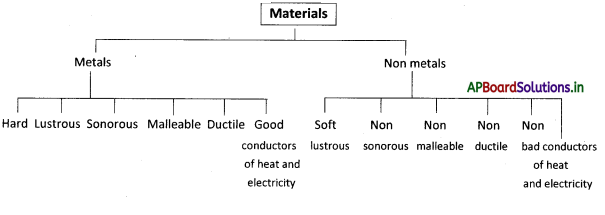
→ Metals often possess all of the following properties. They are lustrous, hard, malleable, ductile, good conductors of heat and electricity, and sonorous.
E.g.: Copper, magnesium, aluminum, iron, zinc, etc.

→ If Most of the metals exist in a solid-state except mercury which exists in a liquid state.

→ Some metals react with the components of air in a different manner with different rates and different conditions.

→ Gold and platinum are metals that do not react with air.

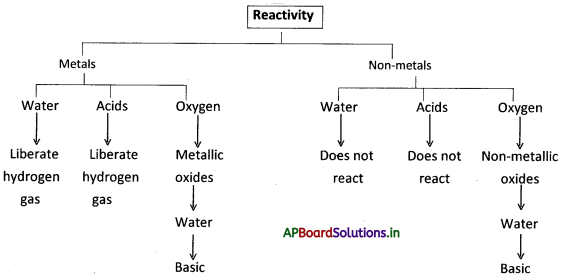
→ Metals react with acids and liberate hydrogen gas.

→ Non-metals do not react with water and acids.

AP Board Solutions AP Board 8th Class Physical Science Notes Chapter 5 Metals and Non-Metals

→ Metals can displace each other according to their reactivity.

→ On burning metals react with oxygen to produce metal oxides which are basic in nature.

→ On burning non-metals react with oxygen to produce non-metal oxides which are acidic in nature.

→ Metals and non-metals are used widely in everyday life.

→ Metals: The material which is hard, lustrous, malleable, ductile, good conductors of heat and electricity and are sonorous are called metals.

→ Non-metals: The material which are soft, non-lustrous, non-malleable, non-ductile, bad conductors of heat and electricity, and ore non-sonorous are called non-metals.

→ Lustrous: The material which shows brightness on the surface and reflects the light is called lustrous.

→ Sonority: The property of producing particular sound materials.

→ Malleability: The property by which metals can be flattered into thin sheets is called malleability

→ Ductility: The property by which metals càn be drawn into fine fires is called ductility.

→ Good conductors of heat and electricity: The material which easily allows the passage of electricity and heat through them are called good conductors of heat and electricity.

→ Oxides of metals and non-metals: When we burn metals or non-metals in the presence of oxygen they form metallic oxides or non-metallic oxides.

AP Board Solutions AP Board 8th Class Physical Science Notes Chapter 5 Metals and Non-Metals

→ Displacement reaction: The reaction ¡n which a more reactive element displaces a less reactive element from its compound in an aqueous solution.

→ Sonorous: The ability of materials to produce a particular sound when ¡t ¡s dropped on the hard surface is called sonorous.
AP Board 8th Class Physical Science Notes Chapter 5 Metals and Non-Metals 1
AP Board 8th Class Physical Science Notes Chapter 5 Metals and Non-Metals 2

→ James Smithson Tennant (1761 – 1815):

  • This is the man who discovered iridium back in 1804.
  • Eminent Cambridge professor in chemistry who first isolated osmium and iridium from native platinum deposits.
  • He also identifIes pro of diamond and charcoaL
  • The mineral tennantite was named after him.

AP Board 8th Class Physical Science Notes Chapter 4 Synthetic Fibres and Plastics

Students can go through AP State Board 8th Class Physical Science Notes Chapter 4 Synthetic Fibres and Plastics to understand and remember the concept easily.

AP State Board Syllabus 8th Class Physical Science Notes Chapter 4 Synthetic Fibres and Plastics

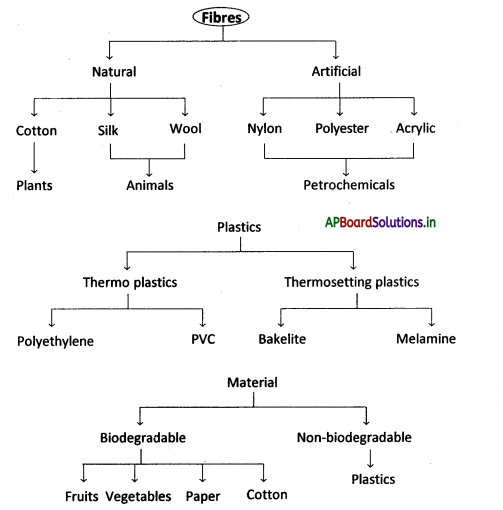
→ Synthetic fibres and plastics are made of large units called polymers.

→ Polymers are made up of many smaller units.

→ Natural fibres are obtained from plants and animals.

→ Artificial fibres are obtained by chemical processing by petrochemicals.

→ Synthetic fibres find uses ranging from many household articles like ropes, buckets, furniture, containers.

→ Depending upon the type of chemicals used for manufacture there are different synthetic fibres.

→ Commonly used synthetic fibres are rayon, nylon, polyester and acrylic.

→ Rayon is artificial silk made of cellulose fibre.

→ Nylon is made artificially by using raw materials like coal, water and air.

→ Polyester is a synthetic fibre.

→ Acrylic is artificial wool made from coal, air, water, oil and limestone.

→ The different types of fibres differ from one another in their strength, water-absorbing capacity, nature of burning, cost and durability.

→ Synthetic fibres and plastics enveloped our life.

→ The waste created by plastics is not environmentally friendly.

→ On burning plastics release poisonous gases.

→ Plastics take years to decompose. This is because of their non – biodegradable nature.

AP Board Solutions AP Board 8th Class Physical Science Notes Chapter 4 Synthetic Fibres and Plastics

→ Enjoy the good qualities of synthetic fibres and plastics and reduce the indis¬criminate use of plastics to minimize environmental hazards.

→ Synthetic fibres find uses ranging from household articles to healthcare.

→ Synthetic fibres blend with natural and artificial fibres

→ Acrylic: Acrylic ¡s artificial wool made from coal, air, water, oil and limestone.

→ Synthetic fibre: Artificiàl fibres are also called synthetic fibre.

→ Bakelite: Bakelite is a thermosetting plastic that is a poor conductor of heat and electricity so ¡t is used for making handles of various utensils.

→ Biodegradable: A material which is easily decomposed by natural processes ¡s called biodegradable.

→ Blend: Any synthetic can be combined with two or more other fibres ¡s called blend.

→ Acrylic: Acrylic is artificial wool made from coal, air, water, oil and limestone.

→ Synthetic fibre: Artificial fibres are also called synthetic fibre.

→ Bakelite: Bakelite is a thermosetting plastic that is a poor conductor of heat and electricity so ¡t is used for making handles óf various utensils.

→ Biodegradable: A material that is easily decomposed by natural processes is called biodegradable.

→ Blend: Any synthetic can be combined with Iwo or more other fibres is called blend.

→ Cellulose: The source material obtained from wood pulp is called cellulose.

→ Incinerators: The instruments used for burning plastic.

AP Board Solutions AP Board 8th Class Physical Science Notes Chapter 4 Synthetic Fibres and Plastics

→ Melamine: It is a thermosetting plastic used for making utensils and groceries.

→ Natural fibres: The fibres which aré made from plants and animals.

→ Non-biodegradable: A material that is not decomposed by natural processes is called non-biodegradable material.

→ Nylon: The polymer is made of chemical units called polyamides

→ Petrochemicals: The chemiçals obtained from petroleum are called petrochemicals.

→ Plastics: Plastics are polymers having linear chains or cross-linked chains.

→ Polymer: Many small, identical units combine to form a large unit called a polymer.

→ Polyamide: Polyamides are polymers made with monomers like hexamethylene diamine and adipic acid.

→ Polythene: Polymer made of small monomers called ethene.

→ Polyester: Polyester is a polymer formed by reacting dicarboxylic acid with a dihydric alcohol

→ Rayon: The artificial fibre obtained from wood pulp

→ Recycling: Recycling is a process to convert broken plastic material into new plastic products

→ Spinneret:‘ Metal ploteš with’ very very tiny holes.

→ Terracotta: The artificial fibre obtained from polymer to make a cloth It s a mixture of terylene and cotton

→ Terylene: The artificial fibre obtained from polymer to make a cloth. Terylene ¡s most popular polyester.

→ Terriwool: Terriwool is an artificial fibre made from polymer It is a mixture of terylene and wool

→ TerriThermoplostcs ‘b”: The plastics which will be deformed easily on heating and can be bent

AP Board Solutions AP Board 8th Class Physical Science Notes Chapter 4 Synthetic Fibres and Plastics

→ Thermosetting plastic: The plastics which moulded once can’t be softened by heating are called thermosetting plastics.

→ Universal recycling symbol: In a recycling icon if the number that identifies the polymer is omitted then the symbol is called the universal recycling symbol

→ Artificial fibre: The fibre obtained artificially from petrochemicals are called artificial fibres.

→ Silkworm: The insect which produces silk
AP Board 8th Class Physical Science Notes Chapter 4 Synthetic Fibres and Plastics 1
→ Eugen Baumann (1846 – 1896):

  • Polyvinyl chloride was first created by Eugen Baumann.
  • He identified the source for aromatic compounds in urine being the aromatic amino acids such as tyrosine.
  • He influenced organ o sulphur chemistry by the synthesis

AP Board 8th Class Biology Notes Chapter 3 Story of Microorganisms 1

Students can go through AP State Board 8th Class Biology Notes Chapter 3 Story of Microorganisms 1 to understand and remember the concept easily.

AP State Board Syllabus 8th Class Biology Notes Chapter 3 Story of Microorganisms 1

→ Microorganisms are very minute living things. We cannot see them with our naked eyes.

→ Microorganisms are present everywhere in our surroundings.

→ They live in water, air, soil, and even in ice-cold climates to hot springs.

→ We can see microorganisms with the help of a Microscope.

→ Antonie van Leuwenhoek invented a powerful single lens microscope.

→ Antonie van Leuwenhoek observed small moving organisms under his microscope are called “animalcules”.

→ Animalcules are also named bacteria.

→ Microbes are present everywhere in our surroundings.

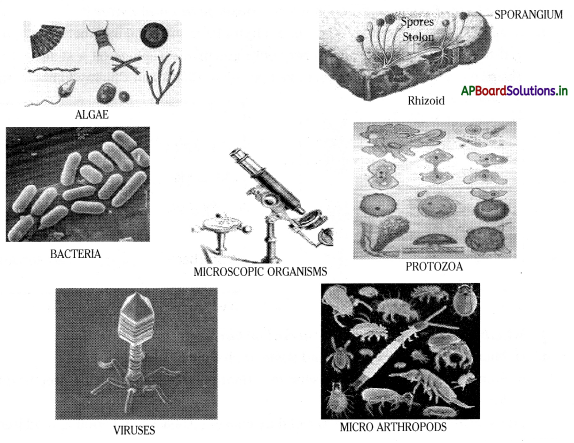
→ Bacteria, Fungi, Protozoa, and Algae are major groups of microorganisms. Which lie between living and non-living organisms. They can reproduce only in host living cells.

→ Thiomargarito Nomibiensis is the world’s largest bacteria.

AP Board Solutions AP Board 8th Class Biology Notes Chapter 3 Story of Microorganisms 1

→ Algae like Chara, spirogyra, etc., are macroscopic.

→ Micro arthropods are found on our skin, eyelids, beddings, rugs, etc.

→ Viruses are special types of microorganisms, which lie between living and non-living organisms. They can reproduce only in host living cells.

→ Microorganism: An organism that can be seen only with the help of a microscope and that typically consists of only a single cell.

→ Microscope: An instrument that makes very small objects able to be seen magnifying them greatly.

→ Microbiology: Study of microbes.

→ Bacteria: Organisms not able to be seen except under a microscope, found in rotting matter in the air, in soil, and in living bodies.

→ Fungi: A single-celled or multi-celled organism without chlorophyll that reproduces by spores and lives by absorbing nutrients from organic matter.

→ Protozoa: Any of a large group of single-celled, usually microscopic, eukaryotic organisms such as amoebas, ciliates, flagellates, and sporozoans.

→ Algae: A large group of simple non-flowering plants containing chlorophyll but lacking true stems, roots, leaves, and vascular tissue.

→ Micro Arthropods: Micro arthropod is an invertebrate microscopic animal having an exoskeleton (external skeleton), a segmented body, and jointed appendages.

AP Board Solutions AP Board 8th Class Biology Notes Chapter 3 Story of Microorganisms 1

→ Virus: A virus is the smallest infectious agent that can replicate only inside the living cells of an organism.

→ Discovery: Be find, find out about show, reveal.

→ Invention: The creation of something new, origination.

→ Staining: A dye used to color organic tissue so as to make the structure visible for microscopic examination.

→ Typhoid: Typhoid fever ¡s an acute illness associated with fever that ¡s most often caused by the Salmonella typhi bacteria.

→ Bread Mold: A dense cottony growth of fungus of Rhizopus on bread and other foods.

→ Hay: Grass that has been mown and dried for use as fodder.

→ Decoction: Extracting the flavor or desired substances by boiling.

→ Decompose: Broken down of organic matter physically and chemically by bacterial or fungal action or rot.

→ Scabies: To scratch; Scabies is an easily spread skin disease caused by a very small species of mite.

→ Symptoms: Itching, especially at night; Rashes, especially between the fingers; Sores (abrasions) on the skin from scratching and digging.

→ Polio: Poliomyelitis (Polio) is a viral disease that can affect nerves and can lead to partial or full paralysis.

→ Swine flu: Swine flu (swine influenza) is a respiratory disease caused by viruses (influenza viruses) that infect the respiratory tract of pigs and result in nasal secretions.

→ Conjunctivitis: Conjunctivitis is swelling (inflammation) or infection of the membrane lining the eyelids (conjunctiva).

→ Smallpox: Smallpox is a disease caused by a poxvirus that is transmitted from person to person that causes high fever, characteristic rash, and may kill about one-third of infected.

AP Board Solutions AP Board 8th Class Biology Notes Chapter 3 Story of Microorganisms 1

→ Chickenpox: Chickenpox ¡s a highly infectious disease characterized by a fever and rash.

→ AIDS: AIDS (acquired immunodeficiency syndrome) is the final stage of HIV disease, which causes severe damage to the immune system.

→ Marshy lands: A tract of soft wet land, commonly covered partially or wholly with water.

→ Tuberculosis: It is a contagious bacterial infection that involves the lungs, but may spread to other organs.

→ Septicemia: Septicemia is bacteria in the blood (bacteremia) that often occurs with severe infections.

→ Symptoms: Septicemia can begin with: Chills; High fever; Rapid breathing; Rapid heart rate, the person looks very ill.

→ Malaria: Malaria is a parasitic disease that involves high fevers, shaking chills, flu-like symptoms, and anemia. Transmitted by a mosquito.

→ Amebiasis: Infection by a disease-causing amoeba. Amoebic dysentery.

→ Smear: A mark or streak of a greasy or sticky substance.
AP Board 8th Class Biology Notes Chapter 3 Story of Microorganisms 1 1

→ There are several bacteria growing on our skin. Many of the disease-causing ones live in some symbiotic relations with other Bacteria. There are different kinds of bacteria in our intestine which are useful for indigestion. Bacteria are found everywhere in lacks in soil, water, air, etc. (Recently two types of bacteria in 1997 Heide N. Schulz discovered. The biggest bacteria Thiomargarita Namibiensis found in coastal waters of Namibia (0.75 mm), which can be seen with the unaided eye).

→ Micro arthropods:
Some microarthropods are very important for the soil. They help in increasing soil fertility by decomposing the biomass through digestion which converts the big¬ger compounds into smaller compounds. These are to be found on our skin, eyelids, beddings, rugs, etc.

Some microarthropods cause diseases like scabies e.g.: scabies mites. Actually, these are not microorganisms like bacteria, but they are minute arthropods and also called joint-legged organisms.

AP Board Solutions AP Board 8th Class Biology Notes Chapter 3 Story of Microorganisms 1

→ Soil is highly rich in microorganisms such a bacteria, fungi, protozoa, microarthropods. The top eight inches of the soil of a one-acre area may contain as much as five and a half tons of fungi and bacteria. This is very much useful for growing crops. But excess use of pesticides kills these micro-organisms. We can see them through a mi¬croscope or by growing them in different media.

→ Viruses are an interesting type of microorganisms. They behave like non – living things when they are outside of a living cell. But they behave like living organisms when they are inside host living cells and reproduce just like bacteria, plants, or animals.
AP Board 8th Class Biology Notes Chapter 3 Story of Microorganisms 1 2
Electron Microscopic view of some Viruses

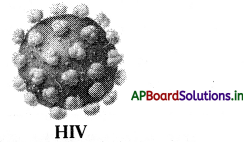
→ They can only be seen through a very powerful electron microscope. Diseases like polio, swine flu, conjunctivitis, smallpox, chickenpox, and AIDS are caused by viruses.
AP Board 8th Class Biology Notes Chapter 3 Story of Microorganisms 1 3

→ Bacterial Staining?
Bacteria are very small/ tiny micro-organisms. We must stain before seeing Bacteria under a Microscope. Smear bacteria on a slide and slightly heat the slide. Then put drops of crystal violet on the slide. After 30 to 60 seconds gently wash the slide. Dry the slide and now watch the slide under the microscope in 25 X or 40 X.

→ Dr. Yellapreggada Subba Rao:
Dr. Yellapreggada Subba Rao was born in the West Goda vañ district of Andhra Pradesh state in India. He was a renowned biochemist arid received several awards for his contributions to the field of medicine. He developed methods for the production of several drugs such as folic acid, tetracycline, and anti-cancer drugs. Tetracycline is used in curing the plague. Dr. Y Subba Roo was considered the Wizard of the wonder drugs.