AP Inter 1st Year Commerce Study Material Chapter 4 Joint Hindu Family Business & Co-op Society

Andhra Pradesh BIEAP AP Inter 1st Year Commerce Study Material 4th Lesson Joint Hindu Family Business & Co-op Society Textbook Questions and Answers.

AP Inter 1st Year Commerce Study Material 4th Lesson Joint Hindu Family Business & Co-op Society

Essay Answer Questions

Question 1.
What is Joint Hindu Family Business and discuss its main features? [May 17 – T.S.]
Answer:
Joint Hindu Family Business is a form of business, which is owned and managed by the members of a Joint Hindu Family. It is also known as a Hindu undivided family business. It is a unique Indian business institution, governed by the provisions of Hindu law. It is managed by the head of the family, known as Karta. The other members are called ‘Co-parceners’. All of them have equal ownership right over the properties of the business.

The membership of the JHF is acquired by virtue of birth in the same family. There is no restriction for minors to become members of the business. The Joint Hindu Family Business is governed by two Hindu laws. They are

  1. Dayabhaga
  2. Mitakshara

Features :
The important features of the Joint Hindu Family Business are as under.

1) Formation :
In JHF business there must be at least two members in the family, having some ancestral property. It is not created by an agreement but by operation of law.

2) Legal Status :
The Joint Hindu Family business is a jointly owned business. It is governed by the Hindu Succession Act, 1956.

3) Membership:
Outsiders are not allowed as members in the JHF. Only the members of undivided family acquire coparcenership rights by birth.

4) Profit Sharing :
Profits are distributed among coparceners in the JHF equally.

5) Management :
JHF is managed by the eldest male member of the family called Karta.

6) Liability:
The liability of Karta alone is unlimited while liability of other coparceners is limited to their share or interest in the coparcenary.

7) Continuity :
Death of any coparceners does not affect the continuity of business. Even on the death of the Karta, it continues to exist as the eldest of the coparceners takes position of Karta. However, JHF business can be dissolved either through mutual agreement or by partition suit in the court.

Question 2.
Define the Cooperative Society. Explain its features.
Answer:
The term ’cooperation’ is derived from the Latin word ’co-operari’. The word ‘Co’ means ’with’ and ’operari’ means ’to work’. Thus, the term cooperation means working together. So, those who want to work together with some common economic objective can form a society, which is termed as Cooperative Society.

Cooperative Society – Definition : “A society which has its objectives for the promotion of economic interests of its members in accordance with cooperative principles.” – The Indian Cooperative Societies Act 1912, Section – (4).

Features:
1) Voluntary association :
In cooperative society the membership is voluntary. Anybody having a common interest is free to join a cooperative society.

2) Number of members :
A minimum of 10 members are required to form a cooperative society. In case of multi-state cooperative societies, the minimum number of members should be 50 from each state in case the members are individuals. However, after the formation of the society, the member may specify the maximum number of members.

3) Separate legal entity :
A cooperative society is based on the service motive of its members. Its main objective is to provide service to the members and not to maximize profit.

4) Limited liability :
The liability of the members of the cooperative society is restricted to the extent of shares subscribed by them.

5) Capital :
The capital of the cooperative society is contributed by its members. Since the members’ contribution is very limited, it often depends on the loan from government, and apex cooperative institutions or on the grants and assistance from state and central government.

6) Service motive :
The primary objective of all cooperative societies is to provide services to its members.

7) Equal voting rights:
In a cooperative society, the principle of one man one vote is adopted.

8) Democractic management:
The management of a cooperative society is based on democratic lines. The members of the society elect directors to conduct and control the business.

9) Distribution of surplus :
After giving a limited dividend to the members of the society, the surplus is distributed in the form of bonus, keeping aside a certain percentage as reserve and for general welfare of the society.

10) Registration of the society :
In India, cooperative societies are reistered under the Cooperative Society Act 1912 or under the State Cooperative Societies Act. The Multi-state Cooperative Societies are registered under the Multi-state Cooperative Societies Act 2002. Once registered, the society becomes a separate legal entity and attains certain characteristics.

AP Inter 1st Year Commerce Study Material Chapter 4 Joint Hindu Family Business & Co-op Society

Question 3.
A cooperative form of organisation is a method of ‘Self Help’ – Discuss.
Answer:
The term ‘cooperation’ is derived from the Latin word ‘co-operari’. The word ‘Co’ means ‘with’ and ‘operari’ means ‘to work’. Thus, the term cooperation means working together. So, those who want to work together with some common economic objective can form a society, which is termed as ‘Cooperative Society’.

Cooperative Society is a voluntary association of persons who work together to promote their economic interests. It works on the principle of slef-help and mutual help. The primary objective is to provide support to the members. The motto of a cooperative society is “Each for all and all for each”. People come forward as a group, pool their individual resources, utilise them in the best possible manner and derive some common benefits out of it.

The primary objective of all cooperative societies is to provide services to its members. The membership is open to all those haying a common economic interest. Any person can become a member irrespective of his/her caste, creed, religion, colour, sex, etc. Cooperative societies are started not for profit but for service. The members are provided with goods at cheaper rates. Financial help is also given to members at concessional rates. A feeling of cooperation is created among members. So, a cooperative form of organisation is a method of “self help through mutual help”.

Question 4.
State the advantages and disadvantages of Hindu undivided family business organisation.
Answer:
Joint Hindu Family Business in the form of business which is owned and managed by the members of a Joint Hindu Family. It is also known as Hindu undivided family business.

JHF – Advantages:
1) Continuity :
It is not dissolved by the death or insanity of a coparcener.

2) Centralized and efficient management:
The management of Joint Hindu Family firm is vested in the hands of Karta only. This results in the unity of command and disciplined management.

3) No limit to membership:
It can have any number of members unlike other organisations. The members of the family become members only by birth. So there is no limit to membership.

4) Better credit:
This form of business firm is having better credit worthiness than the sole trader.

5) Limited liability :
The liability of the members is limited. But the liability of Kartha is unlimited.

JHF – Disadvantages:
1) Lack of direct relationship :
Karta alone looks after the business of the firm. But benefits are shared by all the coparceners. Thus incentive to Karta for efficient and painstaking management may be lacking.

2) Limited managerial ability :
For expansion and growth of the business in Joint Hindu Undivided Family, the managment and control of the business becomes difficult, as the Kartha alone has to manage.

3) Limited resources :
The resources of a Joint Hindu Family are limited as compared with the patnership and joint stock company.

AP Inter 1st Year Commerce Study Material Chapter 4 Joint Hindu Family Business & Co-op Society

Question 5.
Discuss the merits and demerits of cooperative form of organization.
Answer:
Cooperative Societies – Merits:
1) Simple Formation :
It is easy and simple to form a cooperative society. There is no need to comply with a number of legal formalities as in the case of a joint stock company. Cooperative society can be formed with minimum 10 members. The procedure for registration is very simple.

2) Democractic management:
Every member has only one vote irrespective of the number of shares held by him. Meeting are well attended and voting by proxy is not allowed. As such the management of the society is democratic.

3) Voluntary service :
The members serve the society voluntarily. Hence the management expenses are minimized. “Self help#through mutual help” is the main principle.

4) Low operating cost :
The administrative expenses of a cooperative society are usually low. Many members provide administrative services honorarily.

5) Limited liability :
The liability of the members, is limited to the extent of the value of their shares.

6) Perpetual existence :
A cooperative enterprise is not effected by the retirement, death, or insanity by any .member. It has continuous existence.

7) State patronage :
The government is helping cooperative organisation to their r success. A number of concessions and tax relief are given by the government for encouraging society form of organization.

8) Aim of mutual prosperity :
Cooperatives function on the principle of “Each for all . and all for each” with the aim of mutual prosperity.

Cooperative Societies – Demerits :
1) Limited financial resources :
Restriction on divided and the principle of “one member, one vote” discourage rich people from joining the society. Due to shortage of funds, there is limited scope for expansion and growth.

2) Lack of unity among members:
Many cooperatives fail because of constant group rivalry and quarrels among members.

3) Non-transferability of shares :
A member cannot transfer his shares freely but he can be allowed to withdraw his capital.

4) Political interference :
Government nominates members to the managing commit¬tees. Every government tries to send their own party members to these societies.

Short Answer Questions

Question 1.
Briefly explain the different types of cooperative societies.
Answer:
The main object of cooperative society is rendering services to its members. The members associate together on the basis of equity. They contribute capital to the business on democratic lines. Every person has one vote irrespective of the capital contributed by him. They undertake reasonable risk.

Types of Cooperative societies :
According to services rendered, cooperatives may be classified into the following categories.

  1. Consumers’ cooperative societies
  2. Producers’ cooperative societies
  3. Marketing cooperative societies
  4. Housing cooperative societies
  5. Farming cooperative societies
  6. Credit cooperative societies

1) Consumers’ cooperative societies :
A consumers cooperative society is set up to ensure a steady supply of essential goods of standard quality at fair prices.

2) Producers’ cooperative societies :
These societies are formed to protect the interest of small producers and artisans by making available items of their need for production, like raw materials, tools and equipments, etc.

3) Marketing cooperative societies :
Small producers form together as marketing cooperative societies to solve the marketing problems of their products.

4) Housing cooperative societies :
The housing cooperative societies are formed to provide residential accommodation to their members either on ownership basis or at fair rents. Housing cooperative buys land and constructs flats which are allotted to members.

5) Farming cooperative societies:
These societies are formed by the small farmers to get the benefit of large scale farming.

6) Credit cooperative societies :
There societies are started by persons who are in need of credit. They accept deposits from the members and grant them loans at reasonable rate of interest.

Very Short Answer Questions

Question 1.
Karta
Answer:
The business of a Joint Hindu Family is managed by the senior most male member of the family Who is known as Karta. The Karta has only the legal right to enter into contracts on behalf of the family business. Other members cannot question the decisions taken by the Karta.

AP Inter 1st Year Commerce Study Material Chapter 4 Joint Hindu Family Business & Co-op Society

Question 2.
Coparcener
Answer:
In a Joint Hindu Family business, the members of a Hindu Joint Family own the business jointly. Only the male members of the family up to three successive genera¬tions become members by virtue of their birth. They are called “Coparceners”.

Question 3.
Dayabhaga
Answer:
This school of Hindu law prevails only in West Bengal, Assam states. According to this law, if the deceased male coparcener has not left behind a male issue his widow (or in her absence daughter) will become a coparcener.

Question 4.
Mitakshara
Answer:
This school of HUF prevails in entire India except in West Bengal and Assam. Family members of male line and their wives, unmarried daughters are its members. By birth in the family, he gets the right on existing property. By birth a member gets a share in common propety, it continues till his death. In this way shares in the property get fluctuated in accordance with number of coparceners.

Question 5.
What do you mean by Cooperative Society?
Answer:
Cooperative society is a voluntary association of persons who work together to promote their economic interest. It works on the principle of self-help and mutual help. The primary objective is to provide support to the members. The motto of a cooperative society is “Each for all and all for each”.

Question 6.
Consumers’ cooperative societies
Answer:
Consumers’ cooperative societies are set up to ensure a steady supply of essential goods of standard quality at reasonable rates.
Eg : Vijay Krishna super markets.

Question 7.
Producers’cooperative societies
Answer:
These societies are formed to protect the interest of small producers and artisans by making available items of their need for production, like raw material, tools and equipments, etc.

Question 8.
Credit cooperative societies
Answer:
These societies are started by persons who are in need of credit. They accept deposits from the members and grant them loans at reasonable rate of interest.

Question 9.
Housing cooperative societies
Answer:
The housing cooperative societies are formed to provide residential accommodation to their members either on ownership basis or at fair rents. Housing cooperative buys land and constructs flats which are allotted to members.

AP Inter 1st Year Commerce Study Material Chapter 4 Joint Hindu Family Business & Co-op Society

Question 10.
Farming cooperative societies
Answer:
These societies are formed by the small farmers to get the benefit of large scale farming.

Question 11.
Marketing cooperative societies
Answer:
Small produces form together as marketing cooperative societies to solve the marketing problems of their products.

AP Inter 2nd Year Physics Important Questions Chapter 8 Magnetism and Matter

Students get through AP Inter 2nd Year Physics Important Questions 8th Lesson Magnetism and Matter which are most likely to be asked in the exam.

AP Inter 2nd Year Physics Important Questions 8th Lesson Magnetism and Matter

Very Short Answer Questions

Question 1.
A magnetic dipole placed in a magnetic field experiences a net force. What can you say about the nature of the magnetic field?
Answer:
The nature of the magnetic field is uniform, magnetic dipole (bar magnet) experiences a net force (or torque).

Question 2.
Do you find two magnetic field lines intersecting? Why?
Answer:
Two magnetic field lines never intersect. If they intersect, at the point of intersection the field can have two directions. This is impossible. So, two field lines never intersect.

AP Inter 2nd Year Physics Important Questions Chapter 8 Magnetism and Matter

Question 3.
What happens to the compass needles at the Earth’s poles? [T.S. Mar. 17; IPE 2014]
Answer:
At the Earth poles, the magnetic field lines are converging or diverging, vertically so that the horizontal component is negligible. Hence, the compass needle can point in any direction.

Question 4.
What do you understand by the ‘magnetisation’ of a sample ? Give its SI unit. [IPE 2016 (AP)]
Answer:
Magnetisation (M) of a sample is equal to its net magnetic moment per unit volume.
Magnetisation, M = \(\frac{m_{n e t}}{V}\), SI unit of magnetisation is Am-1.

Question 5.
What is the magnetic moment associated with a solenoid ? [IPE 2016 (TS)]
Answer:
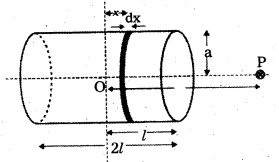
The magnitude of magnetic moment of the solenoid is, M = n × 2l × i × πa2
where, ‘n’ is number of turns, ‘2l’ is length of the solenoid, ‘i’ is current passing through coil, and ‘a’ is area of cross section of solenoid.

Question 6.
What are the units of magnetic moment, magnetic induction and magnetic field ? [IPE 2016 (AP), (TS)]
Answer:
The unit of magnetic moment (M) is ampere-meter2 (Am2).
The unit of magnetic induction (B) is tesla (T) or N/A-m.
The unit of magnetic field (B) is tesla.

AP Inter 2nd Year Physics Important Questions Chapter 8 Magnetism and Matter

Question 7.
Magnetic lines form continuous closed loops. Why ? [T.S. 2017; IPE 2016(AP)]
Answer:
Magnetic lines are imaginary lines. Within the magnet, they move from south pole to north pole and outside the magnet they move from north pole to south pole. Hence, magnetic lines form continuous closed loops.

Question 8.
Define magnetic declination. [IPE 2016 (TS)]
Answer:
Magnetic declination at a place is the angle between magnetic meridian and geographic meridian at that place.

Question 9.
Define magnetic inclination or angle of dip. [A.P. Mar. 17; A.P. & T.S. 2015 (TS), 14]
Answer:
Magnetic inclination at a place is the angle between direction of total strength of earth’s magnetic field and horizontal line in magnetic meridian.

Question 10.
Classify the following materials with regard to magnetism: Manganese, Cobalt, Nickel, Bismuth, Oxygen, Copper. [T.S. 2015, 2016 (TS); A.P. Mar. 17]
Answer:
Manganese …………. Paramagnetic
Cobalt ………….. Ferromagnetic
Nickel …………….. Ferromagnetic
Bismuth ……………. Diamagnetic
Oxygen ………………. Paramagnetic
Copper …………………. Diamagnetic

AP Inter 2nd Year Physics Important Questions Chapter 8 Magnetism and Matter

Question 11.
The force between two magnet poles separated by a distance ‘d’ in air is ‘F’. At what distance between them does the force become doubled ?
Answer:
Force between two magnetic poles, F1 = F;
Distance between two magnetic poles, d1 = d
Force between two magnetic poles increased by double F2 = 2F
Distance between two magnetic poles, d2 = ?
From Coulombs law, F1d12 = F2 d22
Fd2 = 2 F d22
⇒ d22 = \(\frac{\mathrm{d}^2}{2}\)
d2 = \(\frac{\mathrm{d}}{\sqrt{2}}\)

Question 12.
If B is the magnetic field produced at the centre of a circular coil of one turn of length L carrying current I then what is the magnetic field at the centre of the same coil which is made into 10 turns ?
Answer:
For first circular coil; B1 = B, n1 = 1; I1 = I; a1 = \(\frac{\mathrm{L}}{2 \pi}\)
For second circular coil, B2 = ? n2 = 10; I2 = I; a2 = \(\frac{\mathrm{L}}{2 \pi}\)
As B = \(\frac{\mu_0 \mathrm{n} \mathrm{Ia}^2}{2 \mathrm{r}}\), B ∝ n.
\(\frac{\mathrm{B}_2}{\mathrm{~B}_1}=\frac{\mathrm{n}_2}{\mathrm{n}_1}\)
\(\frac{\mathrm{B}_2}{\mathrm{~B}}=\frac{10}{1}\)
∴ B2 = 10 B

Question 13.
If the number of turns of a solenoid is doubled, keeping the other factors constant, how does the magnetic field at the axis of the solenoid change ?
Answer:
B1 = B (say); n1 = n; n2 = 2n; B2 = ?
Magnetic field at the centre of a solenoid is given by B = \(\frac{\mu_0 \mathrm{nI} \mathrm{a}^2(2 l)}{2 \mathrm{r}^3}\)
As I, a2, 2l and r are constants, B ∝ n
⇒ \(\frac{\mathrm{B}_2}{\mathrm{~B}_1}=\frac{\mathrm{n}_2}{\mathrm{n}_1} \Rightarrow \frac{\mathrm{B}_2}{\mathrm{~B}}=\frac{2 \mathrm{n}}{\mathrm{n}}\)
∴ B2 = 2B

AP Inter 2nd Year Physics Important Questions Chapter 8 Magnetism and Matter

Question 14.
A closely wound solenoid of 800 turns and area of cross section 2.5 × 10⁻⁴ m2 carries a current of 3.0A. Explain the sense in which the solenoid acts like a bar magnet. What is its associated magnetic moment ?
Answer:
Here n = 800, a = 2.5 × 10⁻⁴ m2, I = 3.0 A
A magnetic field develop along the axis of the solenoid. Therefore the current carrying solenoid behaves like a bar magnet
m = N IA = 800 × 3.0 × 2.5 × 10-4
= 0.6 Am2 along the axis of solenoid.

Short Answer Questions

Question 1.
Compare the properties of para, dia and ferromagnetic substances.
Answer:
Diamagnetic substances
a) When these materials placed in a magnetic field, they are magnetised feebly in the opposite direction to the applied external field.
b) When a rod of diamagnetic material is suspended freely in a uniform magnetic field, it comes to rest in the perpe-ndicular direction to the magnetic field.
c) When they are kept in a non-uniform magnetic field, they move from the region of greater field strength to the region of less field strength.
d) The relative permeability is less than 1. μr < 1 and negative.
e) The susceptibility (χ) is low and negative.
E.g.: Copper, Silver, Water, Gold, Antimony, Bismuth, Mercury, Quartz Diamond etc.

Paramagnetic substances
a) When these materials placed in a magnetic field, they are magnetised feebly in the direction of the applied magnetic field.
b) When a rod of paramagnetic material is suspended freely in a uniform magnetic field, it comes to rest in the direction of the applied magnetic field.
c) When they are kept in a non-uniform magnetic field„they move from the region of less field strength to the region of greater field strength.
d) The relative permeability is greater than 1. μr > 1 and positive.
e) The susceptibility (χ) is small and positive.
E.g.: Aluminium, Magnesium, Tungsten, Platinum, Mang-anese, liquid oxygen, Ferric chloride, Cupric chloride etc.

Ferromagnetic substances
a) When these materials placed in a magnetic field,they are magnetised strongly in the direction of the applied external field.
b) When a rod of ferromagnetic material is suspended freely in a uniform magnetic field, it comes to rest in the direction of the applied magnetic field.
c) When they are kept in a non-uniform magnetic field they move from the regions of lesser (magnetic field) strength to the regions of stronger (magnetic field) strength.
d) The relative permeability is much greater than 1. μr >> 1 and positive.
e) The susceptibility (χ) is high and positive.
E.g.: Iron, Cobalt, Nickel, Gadolinium and their alloys.

AP Inter 2nd Year Physics Important Questions Chapter 8 Magnetism and Matter

Question 2.
Explain the elements of the Earth’s magnetic field and draw a sketch showing the relationship between the vertical component, horizontal component and angle of dip.
Answer:
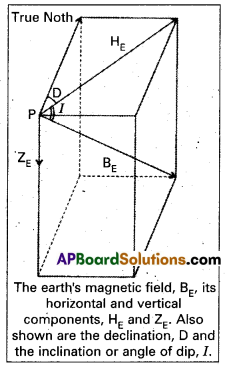
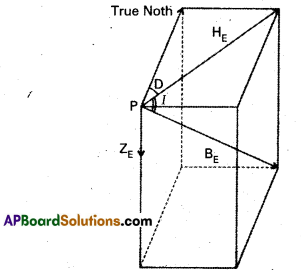
The magnetic field of the earth at a point on its surface can be specified by the declination D, the angle of dip or the inclination I and the horizontal component of the earth’s field HE. These are known as the elements of the earth’s magnetic field.
AP Inter 2nd Year Physics Important Questions Chapter 8 Magnetism and Matter 1
Explanation:

  1. The total magnetic field at P can be resolved into a horizontal component HE and a vertical component ZE.
  2. The angle that BE makes with HE is the angle of dip, I.
  3. Representing the vertical component by ZE, we have
    ZE= BE Sin I
    HE = BE Cos I
    Which gives Tan I = \(\frac{\mathrm{Z}_{\mathrm{E}}}{\mathrm{H}_{\mathrm{E}}}\)

Question 3.
Define magnetic susceptibility of a material. Name two elements one having positive susceptibility and other having negative susceptibility.
Answer:

  1. Susceptibility: When a material is placed in a magnetic field, the ratio of the intensity of magnetization acquired by it to the intensity of the applied magnetic field is called its susceptibility.
    Suspectibility χ = \(\frac{\text { Intensity of magnetisation, } \mathrm{I}}{\text { Applied magnetic field, } \mathrm{H}}\)
  2. The susceptibility of a material represents its ability to get magnetism.
  3. Susceptibility is a dimension less quantity.
  4. Relation between μr and χ :
    a) Suppose that material is placed in a magnetic field of intensity H. Let I be the intensity of magnetisation acquired by it.
    b) Then the magnetic induction within the material is
    B = μ0H + μ0I ⇒ \(\frac{\mathrm{B}}{\mathrm{H}}\) = μ0[1 + \(\frac{\mathrm{I}}{\mathrm{H}}\)]
    ⇒ μ = μ0[1 + χ] ⇒ \(\frac{\mu}{\mu_0}\) = 1 + χ
    ∴ μr = 1 + χ [∵μr = \(\frac{\mu}{\mu_0}\)]
  5. Negative susceptibility (χ) of diamagnetic elements are Bismuth (-1.66 × 10⁻⁵) and copper (-9.8 × 10⁻⁶).
  6. Positive susceptibility of paramagnetic elements are Aluminium (2.3 × 10⁻⁵) and oxygen at STP (2.1 × 10⁻⁶).
  7. Large and positive susceptibility of Ferromagnetic elements are Cobalt and Nickel.

AP Inter 2nd Year Physics Important Questions Chapter 8 Magnetism and Matter

Question 4.
Derive an expression for magnetic field induction on the equatorial line of a barmagnet. [Board Model Paper]
Answer:
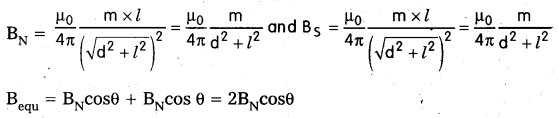
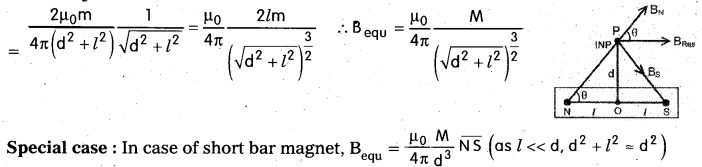
At a point on equatorial line: Let us consider a point ‘P’ at a distance ‘d’ on the equatorial line from the centre of a bar magnet.
AP Inter 2nd Year Physics Important Questions Chapter 8 Magnetism and Matter 2
AP Inter 2nd Year Physics Important Questions Chapter 8 Magnetism and Matter 3

Qeustion 5.
What do you understand by “hysteresis” ? How does this propertry influence the choice of materials used in different appliances where electromagnets are used ?
Answer:

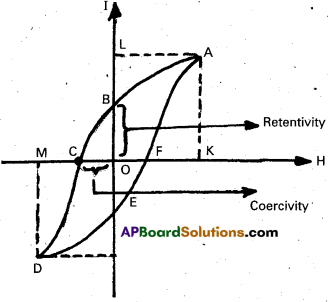
  1. Cycle of magnetisation : When a ferromagnetic specimen is slowly magnetised, the intensity of magnetisation varies with magnetic field through a cycle is called cycle of magnetisation.
  2. Hysterisis : The lagging of intensity of magnetisation (I) and magnetic induction (B) behind magnetic field intensity (H) when a magnetic specimen is subjected to a cycle of magnetisation is called hysterisis.
  3. Retentivity : The value of I for which H = 0 is called retentivity or residual magnetism.
  4. Coercivity: The value of magnetising force required to reduce I is zero in reverse direction of H is called coercive force or coercivity.
  5. Hysterisis curve : The curve represents the relation between B or I of a ferromagnetic material with magnetising force or magnetic intensity H is known as Hysterisis curve.
  6. Explanation of hysterisis loop or curve :
    a) In fig, a closed curve ABCDEFA in H – I plane, called hysteris loop is shown in fig.
    AP Inter 2nd Year Physics Important Questions Chapter 8 Magnetism and Matter 4
    b) When ferromagnetic specimen is slowly magnetised, I increases with H.
    c) Part OA of the curve shows that I increases with H.
    d) At point A, the value I becomes constant is called saturation value.
    e) At B, I has some value while H is zero.
    f) In fig. BO represents retentivity. and OC represents coercivity.
  7. Uses : The properties of hysterisis curve, i.e., saturation, retentivity, coercivity and hysterisis loss help us to choose the material for specific purpose.
    1. Permanent magnets : A permanent magnet should have both large retentivity and large coercivity. Permanent magnets are used in galvanometers, voltmeres, ammeters, etc.
    2. An electromagnet core : The electromagnet core material should have maximum induction field B even with small fields H, low hysterisis loss and high initial permeability.
    3. Transformer cores, Dynamocore, Chokes, Telephone diaphragms: The core material should have high initial permeability, low hysterisis loss and high specific resistance to reduce eddy currents. Soft iron is the best suited material.

AP Inter 2nd Year Physics Important Questions Chapter 8 Magnetism and Matter

Question 6.
Prove that a bar magnet and a solenoid produce similar fields.
Answer:
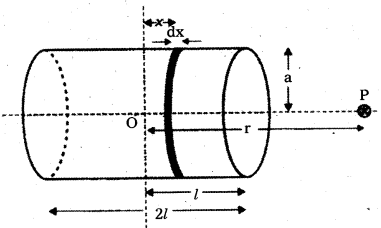
Bar magnet produce similar field of Solenoid :

  1. We know that the current loop acts as a magnetic dipole. According to Ampere’s all magnetic phenomena can be explained in terms of circulating currents.
  2. Cutting a bar magnet is like a solenoid. We get two similar solenoids with weaker magnetic properties.
  3. The magnetic field lines remain continuous, emerging from one face of solenoid and entering into other face of solenoid.
  4. If we were to move a small compass needle in the neighbourhood of a bar magnet and a current carrying solenoid, we would find that the deflections of the needle are similar in both cases as shown in diagrams.
    AP Inter 2nd Year Physics Important Questions Chapter 8 Magnetism and Matter 5
    AP Inter 2nd Year Physics Important Questions Chapter 8 Magnetism and Matter 6
    The axial field of a finite solenoid in order to demonstrate its similarity to that of a bar magnet
  5. The magnetic field at point P due to bar magnet in the form of solenoid is B = \(\frac{\mu_0}{4 \pi} \cdot \frac{2 m}{r^3}\)
  6. The total magnetic field, at a point P due to solenoid is given by
    B = \(\frac{\mu_0 \mathrm{n} \mathrm{I}}{2} \frac{\mathrm{a}^2}{\mathrm{r}^3}(2 l)=\frac{\mu_0}{4 \pi} \frac{2 \mathrm{n}(2 l) \mathrm{I} \pi \mathrm{a}^2}{\mathrm{r}^3}\)
  7. The magnitude of the magnetic moment of the solenoid is, m = n(2l) I (πa2).
    ∴ B = \(\frac{\mu_0}{4 \pi} \frac{2 \mathrm{~m}}{\mathrm{r}^3}\)
  8. Therefore, magnetic moment of a bar magnet is equal to magnetic moment of an equivalent solenoid that produces the same magnetic field.

Question 7.
A small magnetic needle is set into oscillations in a magnetic field B obtain an expression for the time period of oscillation.
Answer:
Expression for time period of oscillation :

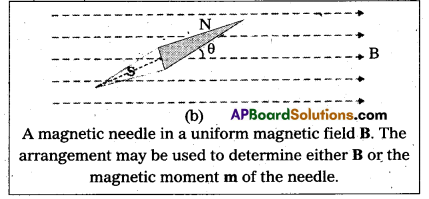
  1. A small compass needle (magnetic dipole) of known magnetic moment m and moment of Inertia i is placing in uniform magnetic field B and allowing it to oscillate in the magnetic field.
  2. This arrangement is shown in Figure.
  3. The torque on the needle is τ = m × B
  4. In magnitude τ = mB sin θ.
    Here τ is restoring torque and θ is the angle between m and B.
  5. Therefore, in equilibrium i \(\frac{\mathrm{d}^2 \theta}{\mathrm{dt}^2}\) = – mB sinθ. Negative sign with mB sin0 implies that restoring torque is in opposition to deflecting torque.
    AP Inter 2nd Year Physics Important Questions Chapter 8 Magnetism and Matter 7
  6. For small values of o in radians, we approximate sinθ ≃ θ and get \(i \frac{\mathrm{d}^2 \theta}{\mathrm{dt}^2}\) ≃ – mBθ
    \(\frac{\mathrm{d}^2 \theta}{\mathrm{dt}^2} \approx \frac{-\mathrm{mB}}{\mathcal{j}} \theta\) …………….. (1)
    This represents a simple harmonic motion. .
  7. From defination of simple harmonic motion, we have \(\frac{\mathrm{d}^2 \theta}{\mathrm{dt}^2}\) = – ω2θ …………… (2)
    From equation (I) and (II), we get ⇒ ω2 = \(\frac{\mathrm{mB}}{\mathcal{J}}\)
    ∴ ω = \(\sqrt{\frac{\mathrm{mB}}{\mathcal{J}}}\)
  8. Therefore, the time period is T = \(=\frac{2 \pi}{\omega}=2 \pi \sqrt{\frac{\mathcal{J}}{\mathrm{mB}}}\)

AP Inter 2nd Year Physics Important Questions Chapter 8 Magnetism and Matter

Qeustion 8.
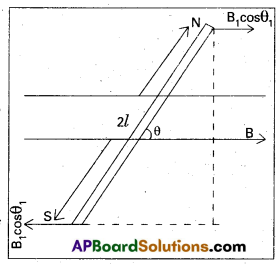
A bar magnet, held horizontally, is set into angular oscillations in the Earth’s magnetic field. It has time periods T1 and T2 at two places, where the angles of dip are θ1 and θ2 respectively. Deduce an expression for the ratio of the resultant magnetic fields at the two places.
Answer:

  1. Suppose, the resultant magnetic fields is to be compared at two places A and B.
  2. A barmagnet, held horizontally at A and which is set into angular oscillations in the Earth’s magnetic field.
  3. Let time period of a bar magnet at place A’ is T1 and angular displacement or angle of dip is θ1.
  4. As the bar magnet is free to rotate horizontally, it does nqt remain vertical component (B1 sin θ1). It can have only horizontal component (B1 cosθ1).
  5. The time period of a bar magnet in uniform magnetic field is given by T = 2π \(\sqrt{\frac{\mathrm{I}}{\mathrm{mB}_{\mathrm{H}}}}\)
    AP Inter 2nd Year Physics Important Questions Chapter 8 Magnetism and Matter 8
  6. Now, in this case T = T1 and BH = B1Cosθ1
  7. Therefore time period of a bar magnet at place ‘A’ is given by
    T1 = 2π \(\sqrt{\frac{\mathrm{I}}{\mathrm{mB}_1 \cos \theta_1}}\) …………… (1) Where I is moment of Inertia of a barmagnet and m is magnitude of magnetic moment.
  8. Similarly, the same bar magnet is placed at B and which is set into angular oscillations in the earth’s magnetic field.
  9. Let time period of a bar magnet at place B is T2 and angle of dip is θ2.
  10. Since horizontal component of earths field at B is BH = B2 cos θ2, time period,
    T2 = 2π \(\sqrt{\frac{\mathrm{I}}{\mathrm{mB}_2 \cos \theta_2}}\) ………………… (2)
  11. Dividing equation (1) by equation (2), we get \(\frac{T_1}{T_2}=\sqrt{\frac{\mathrm{mB}_2 \cos \theta_2}{\mathrm{mB}_1 \cos \theta_1}}\)
    Squaring on both sides, we have \(\frac{\mathrm{T}_1^2}{\mathrm{~T}_2^2}=\frac{\mathrm{B}_2 \cos \theta_2}{\mathrm{~B}_1 \cos \theta_1}\)
  12. But B1 = μ0H1, and B2 = μ0H2
    \(\frac{\mathrm{T}_1^2}{\mathrm{~T}_2^2}=\frac{\mu_0 \mathrm{H}_2 \cos \theta_2}{\mu_0 \mathrm{H}_1 \cos \theta_1} \)
  13. Therefore, \(\frac{\mathrm{H}_1}{\mathrm{H}_2}=\frac{\mathrm{T}_2^2 \cos \theta_2}{\mathrm{~T}_1^2 \cos \theta_1}\)
  14. By knowing T1, T2 and θ1, θ2 at different places A and B, we can find the ratio of resultant magnetic fields.

AP Inter 2nd Year Physics Important Questions Chapter 8 Magnetism and Matter

Question 9.
Obtain Gauss’ Law for magnetism and explain it.
Answer:
Gauss law for Magnetism :

  1. According to Gauss’s law for magnetism, the net magnetic flux (ΦB) through any closed surface is always zero.
  2. The law implies that the no. of magnetic field lines leaving any closed surface is always equal to the number of magnetic field lines entering it.
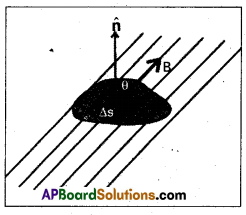
  3. Suppose a closed surface S is held in a uniform magnetic field B. Consider a small vector area element ∆S of this surface as shown in figure.
  4. Magnetic flux through this area element is defined as ∆ΦB = B. ∆S. Then the net flux ΦB, is,
    ΦB = \(\sum_{\text {all }} \Delta \phi_B=\sum_{\text {all }} \text { B. } \Delta \mathrm{S}=0\)
  5. If the area elements are really small, we can rewrite this equation as
    ΦB = \(\oint\)B.ds = 0 …………………. (I)
    AP Inter 2nd Year Physics Important Questions Chapter 8 Magnetism and Matter 9
  6. Comparing this equation with Gauss’s law of electrostatics i.e., electric flux through a closed surface S is given by
    ΦE = \(\oint \text { E. } \Delta S=\frac{q}{\varepsilon_0}\) …………….. (II) Where q is the electric charge enclosed by the surface.
  7. In an electric dipole were enclosed by the surface equal and opposite charges in the dipole add upto zero. Therefore, ΦE would be zero.
  8. The fact that ΦB = 0 indicates that the simplest magnetic element is a dipole or current loop.
  9. The isolated magnetic poles, called magnetic monopoles are not known to exist.
  10. All magnetic phenomena can be explained interms of an arrangement of magnetic dipoles and /or current loops.
  11. Thus corresponding to equation (II) of Gauss’s theorem in electrostatics, we can visualize equation (I) as
    ΦE = \(\int_S\) B . dS = μ0 (m) + μ0 (-m) = 0 where m is strength of N-pole and -m is strength of
    S – pole of same magnet.
  12. The net magnetic flux through any closed surface is zero.

Question 10.
What are ferromagnetic materials ? Give examples. What happens to a ferromagnetic material at curie temperature ? [IPE 2015 (TS)]
Answer:
Ferro magnetic substances : (a) These are strongly attracted by magnet, (b) Susceptibility is large, positive and temperature dependent, (c) Relative permeability, μr > > 1 (d) Atoms have permanent dipole moments which are organised in domains. Ex: Iron, Cobalt, Nickel

Curie temperature : The temperature above which a ferro magnetic substance changes in to para magnetic substance changes in to para magnetic substance is called curie temperature.

Problems

Question 1.
A coil of 20 turns has an area of 800 mm2 and carries a current of 0.5A. If it is placed in a magnetic field of intensity 0.3T with its plane parallel to the field, what is the torque that it experiences ? ,
Answer:
n = 20; A = 800 mm2 = 800 × 10-6 m2; i = 0.5A; B = 0.3T; θ = 0°.
When the plane parallel to the field,
T = Bin A cos θ = 0.3 × 0.5 × 20 × 800× 10-6 × cos 0°
∴ τ = 2.4 10-3 Nm

AP Inter 2nd Year Physics Important Questions Chapter 8 Magnetism and Matter

Question 2.
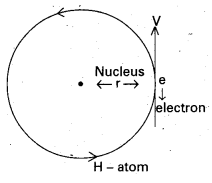
In the Bohr atom model the electrons move around the nucleus in circular orbits. Obtain an expression the magnetic moment (p) of the electron in a Hydrogen atom in terms of its angular momentum L.
Answer:
Consider an electron of charge e, moves with constant speed v in a circular orbit of radius ‘r’ in Hydrogen atom as shown in fig.
AP Inter 2nd Year Physics Important Questions Chapter 8 Magnetism and Matter 10
The current constitute by revolving electron in circular motion around a nucleus, I = \(\).
Time period of orbiting electron, T = \(\frac{2 \pi \mathrm{r}}{\mathrm{v}}\) ⇒ I = \(\frac{e}{\frac{2 \pi r}{v}}=\frac{e v}{2 \pi r}\)
orbital magnetic moment, μ = IA = I (πr2)
⇒ μ = \(\frac{\mathrm{ev}}{2 \pi \mathrm{r}}\) (πr2) = \(\frac{\mathrm{evr}}{2}\)
μ = \(\frac{\mathrm{e}}{2 \mathrm{~m}}\) (mvr) [∵ Multiplying and dividing with ‘m’ on right side]
∴μ = \(\frac{\mathrm{e}}{2 \mathrm{~m}}\) L where L = mvr = angular momentum.

Qeustion 3.
A bar magnet of length 0.1m and with a magnetic moment of 5Am2 is placed in a uniform a magnetic field of intensity 0.4T, with its axis making an angle of 60° with the field. What is the torque on the magnet ?
Answer:
Given, 2l = 0.1m; m = 5A – m2; B = 0.4T; θ = 60°.
Torque, T = mB sin θ = 5 × 0.4 × sin 60° = 2 × \(\frac{\sqrt{3}}{2}\)
∴ T = 1.732 N – m

Question 4.
A solenoid of length 22.5 cm has a total of 900 turns and carries a current of 0.8 A. What is the magnetising field H near the centre and far away from the ends of the solenoid ?
Answer:
l = 22.5 cm = 22.5 × 10⁻² m = \(\frac{45}{2}\) × 10-2m
N = 900; I = 0.8A; H = ?
H = \(\frac{\mathrm{NI}}{l}=\frac{900 \times 0.8}{\left(\frac{45}{2}\right) \times 10^{-2}}\)
H = \(\frac{900}{45}\) × 0.8 × 102 × 2
∴ H = 3200 Am-1

AP Inter 2nd Year Physics Important Questions Chapter 8 Magnetism and Matter

Qeustion 5.
The horizontal component of the earth’s magnetic field at a certain place is 2.6 × 10⁻⁵T and the angle of dip is 60°. What is the magnetic field of the earth at this location ?
Answer:
Given HE = 2.6 × 10⁻⁵T;
D (or) δ = 60°
BE = \(\frac{\mathrm{H}_{\mathrm{E}}}{\cos \mathrm{D}}=\frac{2.6 \times 10^{-5}}{\cos 60^{\circ}}=\frac{2.6 \times 10^{-5}}{(1 / 2)}\) = 5.2 × 10⁻⁵ T
∴ BE = 5.2 × 10⁻⁵ T

Question 6.
In the magnetic meridian of a certain place, the horizontal component of the earth’s magnetic field is 0.26 G and the dip angle is 60°. What is the magnetic field of the earth at this location ?
Solution:
It is given that HE = 0.26 G. From Fig., we have
AP Inter 2nd Year Physics Important Questions Chapter 8 Magnetism and Matter 11
The earth’s magnetic field, BE, its horizontal and vertical components. HE and ZE. Also shown are the declination, D and the inclination or angle of dip, I.
cos 60° = \(\frac{\mathrm{H}_{\mathrm{E}}}{\mathrm{B}_{\mathrm{E}}}\)
BE = \(\frac{\mathrm{H}_{\mathrm{E}}}{\cos 60^{\circ}}\)
= \(\frac{0.26}{(1 / 2)}\) = 0.52 G

Qeustion 7.
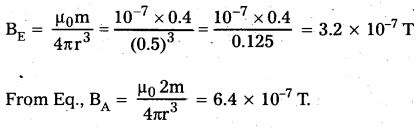
What is the magnitude of the equatorial and axial fields due to a bar magnet of length 8.0 cm at a distance of 50 cm from its mid-point ? The magnetic moment of the bar magnet is 0.40 A m2.
Solution:
From Eq.
AP Inter 2nd Year Physics Important Questions Chapter 8 Magnetism and Matter 12

AP Inter 2nd Year Physics Important Questions Chapter 8 Magnetism and Matter

Question 8.
The earth’s magnetic field at the equator is approximately 0.4 G. Estimate the earth’s dipole moment. .
Solution:
The equatorial magnetic field is,
We are given that BE ~ 0.4 G = 4 × 10⁻⁵ T. For r, we take the radius of the earth 6.4 × 10⁶ m.
Hence,
m = \(\frac{4 \times 10^{-5} \times\left(6.4 \times 10^6\right)^3}{\mu_0 / 4 \pi}\) = 4 × 102 × (6.4 × 106)3 (μ0/4π = 10-7)
= 1.05 × 10²³ A m2
This is close to the value 8 × 10²² A m2 quoted in geomagnetic texts.

Textual Examples

Question 1.
In Fig, the magnetic needle has magnetic moment 6.7 × 10⁻² Am2 and moment of inertia i = 7.5 × 10⁻⁶ kg m2. It performs 10 complete oscillations in 6.70 s. What is the magnitude of the magnetic field ?
Solution:
The time period of oscillation is, :
T = \(\frac{6.70}{10}\) = 0.67 s
AP Inter 2nd Year Physics Important Questions Chapter 8 Magnetism and Matter 13
The axial field of a finite solenoid in order to demonstrate its similarity to that of a bar magnet.
From Eq. B = AP Inter 2nd Year Physics Important Questions Chapter 8 Magnetism and Matter 14
= \(\frac{4 \times(3.14)^2 \times 7.5 \times 10^{-6}}{6.7 \times 10^{-2} \times(.067)^2}\)
= 0.01 T

Question 2.
A short bar magnet placed with its axis at 30° with an external field of 800 G experiences a torque of 0.016 Nm.
(a) What is the magnetic moment of the magnet ?
(b) What is the work done in moving it from its most stable to most unstable position ?
(c) The bar magnet is replaced by a solenoid of cross-sectional area 2 × 10⁻⁴ m2 and 1000 turns, but of the same magnetic moment. Determine the current flowing through the solenoid.
Solution:
a) From Eq., τ = m B sin θ, θ = 30°, hence sin θ = 1/2.
Thus, 0.016 = m × (800 × 10-4 T) × (1/2)
m = 160 × 2/800 =0.40 Am2

b) From Eq . Um = -m. B, the most stable position is θ = 0° and the most unstable position is q = 180°. Work done is given by
W = Um (θ = 180°) – Um (θ = 0°)
= 2 m B = 2 × 0.40 × 800 × 10-4 = 0.064 J

c) From Eq., ms = NIA. From part (a), ms = 0.40 Am2
0.40 = 1000 × I × 2 × 10⁻⁴
I = 0.40 × 10⁴/(1000 × 2) = 2A

AP Inter 2nd Year Physics Important Questions Chapter 8 Magnetism and Matter

Question 3.
a) What happens if a bar magnet is cut into two pieces :
(i) transverse to its length,
(ii) along its length ?
b) A magnetised needle in a uniform magnetic field experiences a torque but no net force. An iron nail near a bar magnet, however, experiences a force of attraction in addition to a torque. Why ?
c) Must every magnetic configuration have a north pole and a south pole ? What about the field due to a toroid ?
d) Two identical looking iron bars A and B are given, one of which is definitely known to be magnetised. (We do not know which one.) How would one ascertain whether or not both are magnetised ? If only one is magnetised how does one ascertain which one ? (Use nothing else but the bars A and B].
Solution:
a) In either case, one gets two magnets, each with a north and south pole.

b) No force if the field is uniform. The iron nail experiences a non-uniform field due to the bar magnet. There is induced magnetic moment in the nail, therefore, it experiences both force and torque. Then net force is attractive because the induced south pole (say) in the nail is closer to the north pole of magnet than induced north pole.

c) Not necessarily. True only if the source of the field has a net nonzero magnetic moment. This is not so for a toroid or even for a straight infinite conductor.

d) Try to bring different ends of the bars closer. A repulsive force in some situation establishes that both are magnetised. If it is always attractive, then one of them is not magnetised. In a bar magnet the intensity of the magnetic field is the strongest at the two ends (poles) and weakest at the central region. This fact may be used to determine whether A or B is the magnet. In this case, to see which one of the two bars is magnet, pick up one, (say, A) and lower one of its end first one of the ends of the other (say, B) and then on the middle of B. If you notice that in the middle of B, A experiences no force, then B is magnetised. If you do not notice any change from the end to the middle of B, then A is magnetised.

Question 4.
What is the magnitude of the equatorial and axial fields due to a bar magnet of length 8.0 cm at a distance of 50 cm from its mid-point ? The magnetic moment of the bar magnet is 0.40 A m2, the same as in Example – 2.
Solution:
From Eq.
AP Inter 2nd Year Physics Important Questions Chapter 8 Magnetism and Matter 12

AP Inter 2nd Year Physics Important Questions Chapter 8 Magnetism and Matter

Question 5.
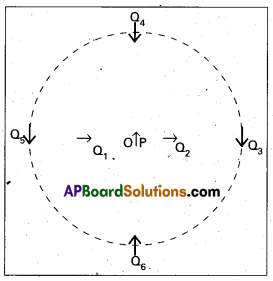
Figure shows a small magnetised needle P placed at a point O. The arrow shows the direction of its magnetic moment. The other arrows show different positions (and orientations of the magnetic moment) of another identical magnetised needle Q.
AP Inter 2nd Year Physics Important Questions Chapter 8 Magnetism and Matter 15
a) In which configuration the system is not in equilibrium ?
b) In which configuration is the system in (i) stable, and (ii) unstable equilibrium ?
c) Which configuration corresponds to the lowest potential energy among all the configurations shown ?
Solution:
Potential energy of the configuration arises due to the potential energy of one dipole (say, Q) in the magnetic field due to other (P). Use the result that the field due to P is given by the expression. *
BP = –\(\frac{\mu_0}{4 \pi} \frac{\mathrm{m}_{\mathrm{p}}}{\mathrm{r}^3}\) (on the normal bisector)
BP = \(\frac{\mu_0 2}{4 \pi} \frac{\mathrm{m}_{\mathrm{p}}}{\mathrm{r}^3}\) (on axis)
where mp is the magnetic moment of the dipole P.
Equilibrium is stable when mQ is parallel to BP, and unstable when it is anti-parallel to BP. For instance for the configuration Q3 for which Q is along the perpendicular bisector of the dipole P, the magnetic moment of Q is parallel to the magnetic field at the position 3. Hence Q3 is stable. Thus,
a) PQ1 and PQ2
b) (i) PQ3, PQ6 (stable); (ii) PQ5, PQ4 (unstable)
c) PQ6.

Question 6.
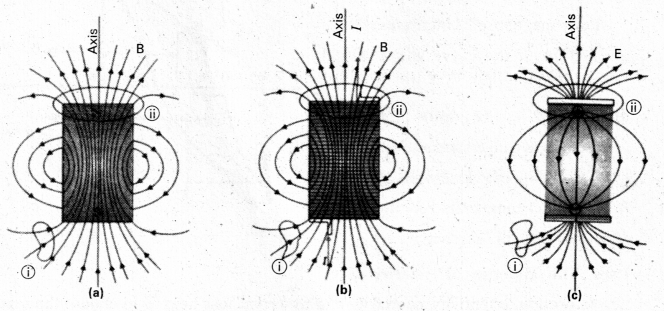
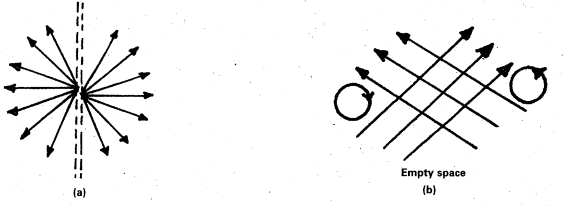
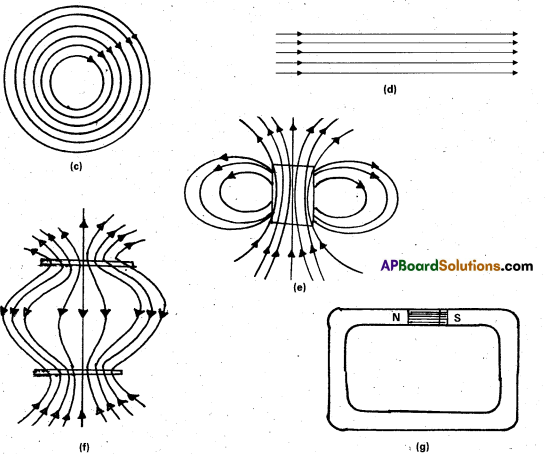
Many of the diagrams given in Fig. show magnetic field lines (thick lines in the figure) wrongly. Point out what is wrong with them. Some of them may describe electrostatic field lines correctly. Point out which ones.
AP Inter 2nd Year Physics Important Questions Chapter 8 Magnetism and Matter 16
Solution:
AP Inter 2nd Year Physics Important Questions Chapter 8 Magnetism and Matter 17
a) Wrong: Magnetic field lines can never emanate from a point, as shown in figure. Over any closed surface, the net flux of B must always be zero, i.e., pictorially as many field lines should seem to enter the surface as the number of lines leaving it. The field lines shown, in fact, represent electric field of a long positively charged wire. The correct magnetic field lines are circling the straight conductor.

b) Wrong: Magnetic field lines (like electric lines) can never cross each other, because otherwise the direction of field at the point of intersection is ambiguous. There is further error in the figure. Magnetostatic field lines can never form closed loops around empty space. A closed loop of static magnetic field line must enclose a region across which a current is passing. By contrast, electrostatic field lines can never form closed loops, neither in empty space, nor when the loop encloses charges.

c) Right: Magnetic lines are completely confined within a toroid: Nothing wrong here in field lines forming closed loops, since each loop encloses a region across which a current passes. Note, for clarity of figure, only a few field lines within the toroid have been shown. Actually, the entire region enclosed by the windings contains magnetic field.,

d) Wrong: Field lines due to a solenoid at its ends and outside cannot be so completely straight and confined; such a thing violates Ampere’s law. The lines should curve out at both ends, and meet eventually to form closed loops.

e) Right: These are field lines outside and inside a bar magnet. Note carefully the direction of field lines inside. Not all field lines emanate out of a north pole (or converge into a south pole). Around both the N-pole, and the S-pole, the next flux of the field is zero.

f) Wrong: These field lines cannot possibly represent a magnetic field. Look at the upper region. All the field lines seem to emanate out of the shaded plate. The net flux through a surface surrounding the shaded plate is not zero. This is impossible for a magnetic field. The given field lines, in fact, show the electrostatic field lines around a positively charged upper plate and a negatively charged lower plate. The difference between Fig. [(e) and (f)] should be carefully grasped.

g) Wrong: Magnetic field lines between two pole pieces cannot be precisely straight at the ends. Some fringing of lines is inevitable. Otherwise, Ampere’s law is violated. This is also true for electric field lines.

AP Inter 2nd Year Physics Important Questions Chapter 8 Magnetism and Matter

Question 7.
a) Magnetic field lines show the direction (at every point) along which a small magnetised needle aligns (at the point). Do the magnetic field line’s also represent the lines of force on a moving charged particle at every point ?
b) Magnetic field lines can be entirely confined within the core of a toroid, but not within a straight solenoid. Why ?
c) If magnetic monopoles existed, how would the Gauss’s law of magnetism be modified ?
d) Does a bar magnet exert a torque on itself due to its own field ? Does one element of a current – carrying wire exert a force on another element of the same wire ?
e) Magnetic field arises due to charges in motion. Can a system have magnetic moments even though its net charge is zero ?
Solution:
a) No. The magnetic force is always normal to B (remember magnetic force = qv × B). It is misleading to call magnetic field lines as lines of force.

b) If field lines were entirely confined between two ends of a straight solenoid, the flux through the cross-section at each end would be non-zero. But the flux of field B through any closed surface must always be zero. For a toroid, this difficulty is absent because it has no ‘ends’.

c) Gauss’s law of magnetism states that the flux of,B thrugh any closed surface is always
zero \(\int_s B \cdot d s\) = o.
If monopoles existed, the right hand side would be equal to the monopole (magnetic charge) qm enclosed by S. [Analogous to Gauss’s law of electrostatics, \(\int_s B \cdot d s\) = μ0qm
where qm is the (monopole) magnetic charge enclosed by S.]

d) No. There is no force or torque on an element due to the field produced by that element itself. But there is a force (or torque) on an element of the same wire. (For the special case of a straight wire, this force is zero).

e) Yes. The average of the cahrge in the system may be zero. Yet, the mean of the magnetic moments due to various current loops may not be zero. We will come across such examples in connection with paramagnetic material where atoms have net dipole moment through their net charge is zero.

Question 8.
The earth’s magnetic field at the equator is approximately 0.4 G. Estimate the earth’s dipole moment.
Solution:
The equatorial magnetic field is,
BE = \(\frac{\mu_0 \mathrm{~m}}{4 \pi \mathrm{r}^3}\)
We are given that BE ~ 0.4 G = 4 × 10⁻⁵ T. For r, we take the radius of the earth 6.4 × 10⁶ m. Hence,
m = \(\frac{4 \times 10^{-5} \times\left(6.4 \times 10^6\right)^3}{\mu_0 / 4 \pi}\) = 4 × 102 × (6.4 × 106)3 (μ0/4π = 10-7)
= 1.05 × 10²³ A m2
This is close to the value 8 × 10²² A m2 quoted in geomagnetic texts.

AP Inter 2nd Year Physics Important Questions Chapter 8 Magnetism and Matter

Question 9.
In the magnetic meridian of a certain place, the horizontal component of the earth’s magnetic field is 0.26 G and the dip angle is 60°. What is the magnetic field of the earth at this location ?
Solution:
It is given that HE = 0.26 G. From Fig., we have
AP Inter 2nd Year Physics Important Questions Chapter 8 Magnetism and Matter 11
The earth’s magnetic field, BE, its horizontal and vertical components. HE and ZE. Also shown are the declination, D and the inclination or angle of dip, I.
cos 60° = \(\frac{\mathrm{H}_{\mathrm{E}}}{\mathrm{B}_{\mathrm{E}}}\)
BE = \(\frac{\mathrm{H}_{\mathrm{E}}}{\cos 60^{\circ}}\)
= \(\frac{0.26}{(1 / 2)}\) = 0.52 G

Question 10.
A solenoid has a core of a material with relative permeability 400. The windings of the solenoid are insulated from the core and carry a current of 2A. If the number of turns is 1000 per metre, calculate (a) H, (b) M, (c) B and (d) the magnetising current Im.
Solution:
a) The field H is dependent of the material of the core, and is
H = nI = 1000 × 2.0 = 2 × 10³ A/m

b) The magnetic field B is given by
B = μrμ0H
= 400 × 4π × 10-7 (N/A3) × 2 × 103 (A/m) = 1.0 T

c) Magnetisation is given by
M = (B – μ0 H)/μ0
= (μrμ0H – μ0H)/μ0 = (μr – 1) H = 399 × H ≃ 8 × 10⁵ A/m

d) The magnetising current IM is the additional current that needs to be passed through the windings of the solenoid in the absence of the core which would give a B value as in the presence of the core. Thus B = μrn0 (I + IM). Using I = 2A, B = 1 T, we get IM = 794A.

AP Inter 2nd Year Physics Important Questions Chapter 8 Magnetism and Matter

Question 11.
A domain in ferromagnetic iron is in the form of a cube of side length 1 μm. Estimate the number of iron atoms in the domain and the maximum possible dipole moment and magnetisation of the domain. The molecular mass of iron is 55 g/mole and its density is 7.9 g/cm3. Assume that each iron atom has a dipole moment of 9.27 × 10⁻²⁴ A m3.
Solution:
The volume of the cubic domain is
V = (10-6 m)3 = 10-18 m3 = 10-12 cm3
Its mass is volume × density = 7.9 g cm-3 × 10-12 cm3 = 7.9 × 10⁻¹² g
It is given that Afagadro number (6.023 × 10²³) of iron atoms have a mass of 55g. Hence,the number of atoms in the domain is
N = \(\frac{7.9 \times 10^{-12} \times 6.023 \times 10^{23}}{55}\)
= 8.65 × 10¹⁰ atoms
The maximum possible dipole moment mmax is achieved for the (unrealistic) case when all the atomic moments are perfectly aligned. Thus,
mmax = (8.65 × 1010) × (9-27 × 10-24)
= 8.0 × 10⁻¹³ Am2
The consequent magnetisation is
Mmax = mmax/DomainVolume :
= 8.0 × 10⁻¹³ Am2/10-18 m3
= 8.0 × 10⁵ Am-1.

AP Board 7th Class Hindi Solutions 4th Lesson हम नन्हें बच्चे

SCERT AP Board 7th Class Hindi Study Material 4th Lesson हम नन्हें बच्चे Textbook Questions and Answers.

AP State Syllabus 7th Class Hindi 4th Lesson Questions and Answers हम नन्हें बच्चे

7th Class Hindi 4th Lesson हम नन्हें बच्चे Textbook Questions and Answers

सोचिए-बोलिए
AP Board 7th Class Hindi Solutions 4th Lesson हम नन्हें बच्चे 1

प्रश्न 1.
चित्र में क्या-क्या दिखाई दे रहे हैं? (చిత్రంలో ఏమేమి కన్పించుచున్నావి?)
उत्तर:
चित्र में भारत देश के कुछ सैनिक हैं। भारत देश का तिरंगा झंडा एक सैनिक के हाथ में है। सैनिकों के हाथों में बंदूक और सैनिक हिम से ढके पहाड़ों पर खड़े हुए हैं। वे कुछ नारा लगा रहे हैं।
(చిత్రంలో భారతదేశ సైనికులు కొంతమంది ఉన్నారు. భారతదేశ జాతీయ పతాకం మూడు రంగుల జెండా ఒక సైనికుని చేతిలో ఉన్నది. సైనికుల చేతుల్లో తుపాకులు ఉన్నాయి. మరియు సైనికులు మంచు కొండలపై నిలుచుని ఉన్నారు. వారు ఏదేని నినాదం చేస్తున్నారు.)

AP Board 7th Class Hindi Solutions 4th Lesson हम नन्हें बच्चे

प्रश्न 2.
सैनिक क्या कर रहे हैं? (సైనికులు ఏమి చేయుచున్నారు?)
उत्तर:
सैनिक मातृभूमि की रक्षा कर रहे हैं।
(సైనికులు మాతృభూమిని రక్షిస్తున్నారు.)

कविता

1. हम नन्हें – नन्हें बच्चे हैं, మేము చిన్న చిన్న పిల్లలం.
नादान, उमर के कच्चे हैं, అమాయకులం, తక్కువ వయస్సు ఉన్నవాళ్ళం,
पर अपनी धुन के सच्चे हैं। కానీ మా సంకల్పానికి నిజమైన వారము.
जननी की जय-जय गाएँगे, జన్మభూమికి జయజయలు పాడుతాం,
भारत की ध्वजा फहराएँगे। భారతదేశ పతాకం ఎగురవేస్తాం.

2. अपना पथ कभी न छोडेंगे, మా దారిని ఎప్పుడూ విడవం,
अपना प्रण कभी न तोड़ेंगे, మా ప్రతిభ ఎప్పటికీ వదలం,
हिम्मत से नाता जोड़ेंगे, ధైర్యంతో బంధుత్వం కలుపుతాం,
हम हिमगिरि पर चढ़ जाएँगे, మేము హిమాలయాలను ఎక్కుతాం,
भारत की ध्वजा फहराएँगे। భారతదేశ జెండాను ఎగురవేస్తాం.

3. हम भय से कभी न डोलेंगे, మేము భయంతో ఎప్పుడూ ఊగిసలాడం,
अपनी ताकत को तोलेंगे, మా శక్తిని నిరూపిస్తాం,
जननी की जय – जय बोलेंगे। జన్మభూమికి జయజయలు పలుకుతాం,
अपना सिर भेंट चढ़ाएँगे, మా ‘తలను’ కానుకగా అర్పిస్తాం,
भारत की ध्वजा फहराएंगे। భారతదేశ జాతీయ జెండాను ఎగురవేస్తాం.

POEM

1. हम नन्हें – नन्हें बच्चे हैं, We are children,
नादान, उमर के कच्चे हैं, We are innocent, we are kids,
पर अपनी धुन के सच्चे हैं। But we are true to our will.
जननी की जय-जय गाएँगे, We sing songs of praise of the motherland,
भारत की ध्वजा फहराएँगे। We hoist the Indian flag.

2. अपना पथ कभी न छोडेंगे, We never leave our path,
अपना प्रण कभी न तोड़ेंगे, We never forsake our talent,
हिम्मत से नाता जोड़ेंगे, We establish relationship with courage,
हम हिमगिरि पर चढ़ जाएँगे, We climb the Himalayas,
भारत की ध्वजा फहराएँगे We hoist the Indian flag.

3. हम भय से कभी न डोलेंगे, We never oscillate with fear,
अपनी ताकत को तोलेंगे, We prove our power,
जननी की जय – जय बोलेंगे। We sing songs of praise of the motherland,
अपना सिर भेंट चढ़ाएँगे, We offer our head as a gift,
भारत की ध्वजा फहराएंगे। We hoist the Indian flag.

Intext Questions & Answers

प्रश्न 1.
बच्चों में कौन – कौन से गुण होते हैं? (పిల్లలలో ఎలాంటి గుణాలు ఉంటాయి?)
उत्तर:
बच्चे नादान होते हैं, उमर के कच्चे होते हैं। छोटे – छोटे होते हैं। और धुन के सच्चे होते हैं।
(పిల్లలు అమాయకంగా ఉంటారు. తక్కువ వయస్సు కలవారై ఉంటారు. చిన్న చిన్న వారై ఉంటారు మరియు నిజమైన సంకల్పం కలిగినవారై ఉంటారు.)

प्रश्न 2.
शहीद किसे कहते हैं? (శహీద్ అని ఎవరిని అంటారు?)
उत्तर:
देश के लिए जो अपने प्राणों को खो देते हैं उन्हें शहीद कहते हैं।
(దేశం కొరకు తమ ప్రాణాలను ఎవరైతే అర్పిస్తారో వారిని శహీద్ అని అందురు. )

Improve Your Learning

सुनिए-बोलिए

प्रश्न 1.
बच्चे कैसे होते हैं? (పిల్లలు ఎలా ఉంటారు?)
उत्तर:
बच्चे नन्हें, नादान और उमर के कच्चे होते हैं।
(పిల్లలు చిన్నవారు, అమాయకులు, వయస్సులో చిన్నవారుగను ఉందురు.)

AP Board 7th Class Hindi Solutions 4th Lesson हम नन्हें बच्चे

प्रश्न 2.
बच्चे क्या तोडना नहीं चाहते हैं? (పిల్లలు దేనిని తప్పకుడదని కోరుకుంటున్నారు?)
उत्तर:
बच्चे अपना प्रण तोडना नहीं चाहते हैं।
(పిల్లలు తమ ప్రతిన తప్పకూడదని కోరుకొనుచుండిరి.)

प्रश्न 3.
बच्चे क्या फहराना चाहते हैं? (పిల్లలు దేనిని ఎగురవేయాలని కోరుచుండిరి?)
उत्तर:
बच्चे भारत ध्वजा (झंडे) को फहराना चाहते हैं।
(పిల్లలు భారతదేశ పతాకం (జెండాను) ఎగురవేయాలని కోరుచుండిరి.)

पढ़िए

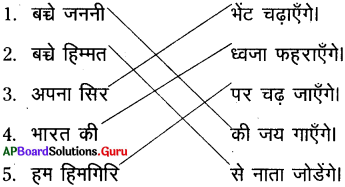
अ) जोड़ी बनाइए।
AP Board 7th Class Hindi Solutions 4th Lesson हम नन्हें बच्चे 2

1. बच्चे जननीकी जय गाएँगे।
2. बच्चे हिम्मतसे नाता जोडेंगे।
3. अपना सिरभेंट चढ़ाएँगे।
4. भारत कीध्वजा फहराएंगे।
5. हम हिमगिरिपर चढ़ जाएँगे।

आ) पाठ में वाक्यों के सही क्रम को पहचानकर क्रम संख्या कोष्ठक में लिखिए।

1. हम भय से कभी न डोलेंगे। [ 3 ]
2. जननी की जय – जय गाएँगे। [ 4 ]
3. अपना सिर भेंट चढ़ाएँगे। [ 5 ]
4. नादान, उमर के कच्चे हैं। [ 1 ]
5. अपना प्रण कभी न तोड़ेंगे। [ 2 ]

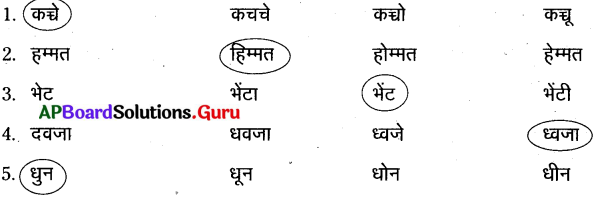
इ) सही वर्तनी वाले शब्दों पर गोला “O” बनाइए।

AP Board 7th Class Hindi Solutions 4th Lesson हम नन्हें बच्चे 3

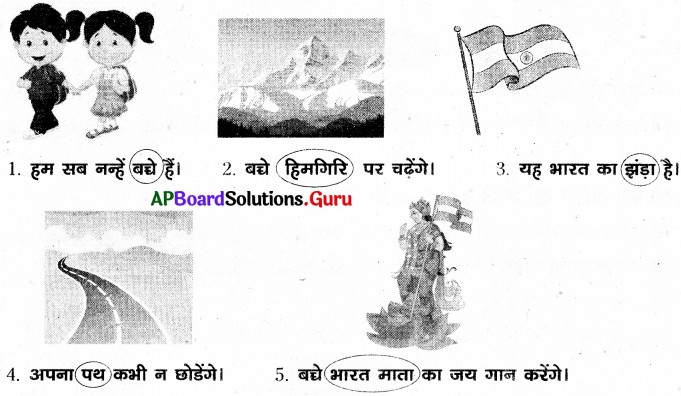
ई) चित्रों से संबंधित शब्दों पर गोला “O” बनाइए।

AP Board 7th Class Hindi Solutions 4th Lesson हम नन्हें बच्चे 4

लिखिए

अ) नीचे दिये गये प्रश्नों के उत्तर छोटे – छोटे वाक्यों में लिखिए।
క్రింది ఇవ్వబడిన ప్రశ్నలకు సమాధానములు చిన్న – చిన్న వాక్యములలో ఇవ్వండి.)

1. बच्चे अपनी धुन के कैसे हैं? (పిల్లలు తమ సంకల్పములో ఎటువంటివారు?)
उत्तर:
बच्चे अपनी धुन के सच्चे हैं।
(పిల్లలు తమ సంకల్పములో నిజమైనవారు.)

2. बच्चे किससे नाता जोड़ना चाहते हैं? (పిల్లలు ఎవరితో బంధుత్వం కలుపకోరుచున్నారు?)
उत्तर:
बच्चे हिम्मत से नाता जोडना चाहते हैं।
(పిల్లలు ధైర్యముతో బంధుత్వం కలుపకోరుచున్నారు.)

AP Board 7th Class Hindi Solutions 4th Lesson हम नन्हें बच्चे

3. भारत की शान कब बढ़ेगी?(భారతదేశ ప్రతిష్ఠ ఎప్పుడు పెరుగును?)
उत्तर:
बच्चे धैर्य से रहकर ताकत दिखाकर देश की रक्षा में अपने प्राणों को अर्पण करने पर भारत की शान बढेगी।
(పిల్లలు ధైర్యముతో నుండి తమ శక్తిని చూపించి దేశ రక్షణలో తమ ప్రాణాలను అర్పించిన భారతదేశ ప్రతిష్ఠ పెరుగును.)

आ) नीचे दिये गये प्रश्न का उत्तर पाँच – छह वाक्यों में लिखिए।
(క్రింది ఇవ్వబడిన ప్రశ్నకు సమాధానము చిన్న – చిన్న వాక్యములలో ఇవ్వండి.)

→ “हम नन्हें बच्चे” – कविता का सारांश लिखिए। (‘మేము చిన్న పిల్లలం’ కవిత సారాంశమును వ్రాయండి.)
उत्तर:
कवि कहते हैं कि – हम छोटे बच्चे हैं। हम नादान हैं। हम कम उम्र के हैं। हम सच बोलते हैं। हम भारतमाता की जय गाते हैं। हम भारत का झंडा फहराते हैं। हम अच्छे रास्ते पर चलते हैं। हम अपना वादा नहीं तोड़ते हैं। हम धैर्य से रहते हैं। हम कभी नहीं डरते हैं। जरूरत पड़ने पर हम अपनी ताकत
दिखाते हैं।
(మేము చిన్న పిల్లలం. మేము అమాయకులం. మేము తక్కువ వయస్సు కలవాళ్ళం. మేము నిజము మాట్లాడతాము. మేము భారతమాతకు జయగీతం పాడతాం. మేము భారతదేశ జెండా ఎగురువేస్తాం. మేము మంచి దారిలో నడుస్తాం. మేము ప్రతిజ్ఞను విడనాడం. మేము ధైర్యంతో ఉంటాం. మేము ఎప్పటికీ భయపడం. అవసరం వచ్చినప్పుడు మేము మా శక్తిని ప్రదర్శిస్తాము.)

इ) उचित शब्दों से खाली जगह भरिए।

1. बच्चे नादान उम्र के कच्चे होते हैं। (कच्चे / सच्चे)
उत्तर:
कच्चे

2. वे अपना ……… कभी न तोडेंगे। (प्रण | वन)
उत्तर:
प्रण

3. सब मिलकर भारत की …….. उड़ाएँगे। (ध्वजा / धुन)
उत्तर:
ध्वजा

4. बच्चे …….. से नाता जोड़ेंगे। (हिम्मत / हिमगिरि)
उत्तर:
हिम्मत

5. बालक अपनी …… को तोलेंगे। (ताकत / उमर)
उत्तर:
ताकत

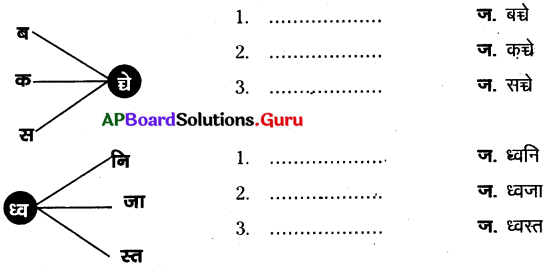
ई) संकेतों के आधार पर शब्द बनाइए।
AP Board 7th Class Hindi Solutions 4th Lesson हम नन्हें बच्चे 5

उ) वर्ण विच्छेद कीजिए।

1. बच्चे : ब् + अ + च् + च् + ए
2. नन्हें : …………………………
उत्तर:
न् + अ + न् + इ + एं

3. धुन : …………………………
उत्तर:
ध् + उ + न् + अ

4. ध्वजा : …………………………
उत्तर:
ध् + व् + अ + ज् + आ

5. ताकत : …………………………
उत्तर:
त् + आ + क् + अ + त् + अ

भाषांश

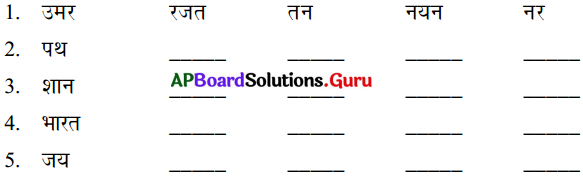
अ) अंत्याक्षरी विधि के अनुसार नीचे दिये गये शब्दों के आधार पर चार शब्द बनाइए।

AP Board 7th Class Hindi Solutions 4th Lesson हम नन्हें बच्चे 6
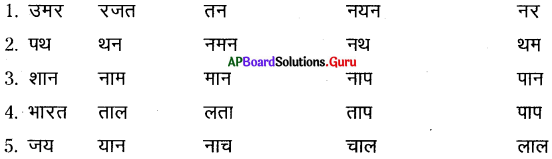
उत्तर:
AP Board 7th Class Hindi Solutions 4th Lesson हम नन्हें बच्चे 7

आ) पर्यायवाची शब्द लिखिए।
1. रास्ता : राह, पथ
2. ताकत : …………………………………
3. जननी : …………………………………
4. प्रण : …………………………………
5. ध्वजा : …………………………………
उत्तर:
1. रास्ता : राह, पथ
2. ताकत : शक्ति, बल
3. जननी : माँ, माता
4. प्रण : प्रतिज्ञा, संकल्प
5. ध्वजा : झंडा, पताका

सृजनात्मकता

अ) चित्र देखकर दो शब्द लिखिए।
AP Board 7th Class Hindi Solutions 4th Lesson हम नन्हें बच्चे 8
उत्तर:
मोर, पंख

आ) परियोजना कार्य :

→ देशभक्ति से संबंधित दो नारे लिखकर कक्षा में दिखाइए।
(దేశభక్తికి సంబంధించిన రెండు నినాదములు వ్రాసి తరగతిలో చూపించండి.)
उत्तर:
1. “भारत माता की जय।”
2. “जय हिंद”।
3. “जन गण – मन अधिनायक जय है’।

इ) अनुवाद कीजिए।

1. झंडा राष्ट्र की शान है।
उत्तर:
झंडा राष्ट्र की शान है। జెండా దేశ ప్రతిష్ఠ.

2. मैं भारत का नागरिक हूँ।
उत्तर:
मैं भारत का नागरिक हूँ। నేను భారతదేశ పౌరుడను.

3. हिमालय ऊँचा पर्वत है।
उत्तर:
हिमालय ऊँचा पर्वत है। హిమాలయము ఎత్తైన పర్వతము.

4. बच्चे खेलना पसंद करते हैं।
उत्तर:
बच्चे खेलना पसंद करते हैं। పిల్లలు ఆడడం ఇష్టపడెదరు.

5. हम सब गीत गाते हैं।
उत्तर:
हम सब गीत गाते हैं। మేమందరము పాటలు పాడుతాము.

AP Board 7th Class Hindi Solutions 4th Lesson हम नन्हें बच्चे

व्याकरणांश

अ) नीचे दिये गये संकेतों के आधार पर शब्द लिखिए।
उत्तर:
प्रताप, प्रयोग, प्रकाश
सूर्य, आर्य, कार्य

आ) नीचे दिए गए वाक्यों में से “रेफ” शब्दों के नीचे रेखांकित कीजिए।

1. हमारे झंडे के बीच में अशोक चक्र है।
उत्तर:
हमारे झंडे के बीच में अशोक चक्र है।

2. सुरेश ड्रामा देखने गया।
उत्तर:
सुरेश ड्रामा देखने गया।

3. सूर्य की किरणें तेज़ होती हैं।
उत्तर:
सूर्य की किरणें तेज़ होती हैं।

4. चंद्र को चाँद भी कहते है।
उत्तर:
चंद्र को चाँद भी कहते हैं।

5. कर्ण को दान कर्ण कहते हैं।
उत्तर:
कर्ण को दान कर्ण कहते हैं।

अध्यापकों के लिए सूचना : ఉపాధ్యాయులకు సూచన :

→ सोहनलाल द्विवेदी जी के द्वारा लिखित देशभक्ति से संबंधित कविता को गाकर सुनाइए।
(సోహలాల్ ద్వివేదీ గారి ద్వారా రచించబడిన దేశభక్తికి సంబంధించిన కవిత పాడి వినిపించండి.)
उत्तर:
(मेरा देश)

ऊँचा खड़ा हिमालय आकाश चूमता है।
नीचे पखार पग तल, नित सिंधू झूमता है
गंगा पवित्र यमुना, नदियाँ लहर रही हैं।
पल – पल नई छटाएँ पग – पग छहर रही हैं।

वह पुण्य भूमि मेरी
वह जन्म भूमि मेरी
वह स्वर्ण भूमि मेरी
वह मात्रु भूमि मेरी

झरने अनेक झरते, जिसकी पहाड़ियों में
चिड़ियाँ चहक रही है, हो मस्त झाड़ियों में
अमराइयाँ घनी हैं, कोयल पुकारती है।
बहती मलय पवन है, तन – मन सँवारती है।

वह धर्म भूमि मेरी
वह कर्म भूमि मेरी,
वह जन्म भूमि मेरी
वह मात्रु भूमि मेरी।

जन्म जहाँ ये रघुपति, जन्मी जहाँ थी सीता,
श्रीकृष्ण ने सुनाई वंशी पुनीत गीता,
गौतम ने जन्म लेकर, जिसका सुयश बढ़ाया
जग को दया दिखाई, जग को दिया दिखाया।

वह युद्ध भूमि मेरी
वह बुद्ध भूमि मेरी
वह जन्म भूमि मेरी
वह मात्रुभूमि मेरी। – सोहनलाल द्विवेदी

AP Board 7th Class Hindi Solutions 4th Lesson हम नन्हें बच्चे

पाठ का सारांश

कवि कहते हैं कि – हम छोटे बच्चे हैं। हम नादान हैं। हम कम उम्र के हैं। हम सच बोलते हैं। हम भारतमाता की जय गाते हैं। हम भारत का झंडा फहराते हैं। हम अच्छे रास्ते पर चलते हैं। हम अपना वादा नहीं तोड़ते हैं। हम धेर्य से रहते हैं। हम कभी नहीं डरते हैं। ज़रूरत पड़ने पर हम अपनी ताकत दिखाते हैं।

పాఠ్య సారాంతం

మేము చిన్న పిల్లలం. మేము అమాయకులం. మేము తక్కువ వయస్సు కలవాళ్ళం. మేము నిజము మాట్లాడతాము. మేము భారతమాతకు జయగీతం పాడతాం. మేము భారతదేశ జెండా ఎగురవేస్తాం. మేము మంచి దారిలో నడుస్తాం. మేము ప్రతిజ్ఞను విడనాడం. మేము ధైర్యంతో ఉంటాం. మేము ఎప్పటికీ భయపడం. అవసరం వచ్చినప్పుడు మేము మా శక్తిని ప్రదర్శిస్తాము.

Summary

We are children. We are innocent. We are youngers. We speak truth. We sing songs of praise for the Mother India. We hoist the Indian flag. We follow the good path. We do not break the vow. We will be courageous. We will ever be fearless. In times of needs we will show our power.

व्याकरणांश (వ్యాకరణాంశాలు)

लिंग बदलिए (లింగములను మార్చండి)

बच्चा – बच्ची
सेवक – सेविका
नर्तक – नर्तकी
नायक – नायकी
युवक – युवती
माँ – बाप
सिंह – सिंहनी
ऋषि – ऋषि पत्नी
सखा – सखी

वचन बदलिए (వచనములను మార్చండి)

जवान – जवान
कर्तव्य – कर्तव्य
कविताएँ – कविता
बच्चा – बच्चे
जननी – जननी
पथ – पथ

AP Board 7th Class Hindi Solutions 4th Lesson हम नन्हें बच्चे

विलोम शब्द (వ్యతిరేక పదములు)

रक्षा × नाश
देश × विदेश
जय × अपजय/पराजय
छोडना × पकडना
भय × निर्भय
छोटे × बड़े
अच्छे × बुरे
डर × निडर
धैर्य × अधैर्य

शब्दार्थ (అర్థాలు) (Meanings)

उम्र = आयु, వయస్సు, age
धुन = लगन, లీనమగుట, determined
ताकत = शक्ति, శక్తి, strength, power
नाता = संबंध, సంబంధము, relationship
पथ = मार्ग, దారి, way
शान = प्रतिष्ठा, వైభవం, grandeur
प्रण = वादा, ప్రతిజ్ఞ, vow
हिम्मत = धैर्य, ధైర్యము, couarge
ध्वजा = झंडा, జెండా, flag.
नन्हें = छोटे, చిన్న, small
नादान = नासमझ, ఏమీ తెలియని, senseless
जननी = माँ, తల్లి, mother
हिमगिरि = हिमालय पहाड, హిమాలయ పర్వతములు, Himalayas
भय = डर, భయము, fear
सिर = सर, తల, head
भेंट = उपहार, కానుక, gift

AP Board 7th Class Hindi Solutions 4th Lesson हम नन्हें बच्चे

श्रुत लेख : శ్రుతలేఖనము : Dietations

अध्यापक या अध्यापिका निम्न लिखित शब्दों को श्रुत लेख के रूप में लिखवायें। छात्र अपनी – अपनी नोट पुस्तकों में लिखेंगे। अध्यापक या अध्यापिका इन्हें जाँचे।
ఉపాధ్యాయుడు లేదా ఉపాధ్యాయిని క్రింద వ్రాయబడిన శబ్దములను శ్రుతలేఖనంగా డిట్ చేయును. విద్యార్థులు వారి వారి నోట్ పుస్తకాలలో వ్రాసెదరు. ఉపాధ్యాయుడు లేదా ఉపాధ్యాయిని వాటిని దిద్దెదరు.

AP Inter 1st Year Physics Study Material Chapter 4 సమతలంలో చలనం

Andhra Pradesh BIEAP AP Inter 1st Year Physics Study Material 4th Lesson సమతలంలో చలనం Textbook Questions and Answers.

AP Inter 1st Year Physics Study Material 4th Lesson సమతలంలో చలనం

అతిస్వల్ప సమాధాన ప్రశ్నలు

ప్రశ్న 1.
ఒక సదిశ నిలువు అంశం దాని క్షితిజ సమాంతర అంశానికి సమానం. ఆ సదిశ x అక్షంతో చేసే కోణం ఎంత ?
జవాబు:
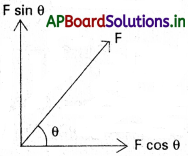
AP Inter 1st Year Physics Study Material Chapter 4 సమతలంలో చలనం 1
క్షితిజ సమాంతర అంశము = క్షితిజ లంబ అంశము
F cos θ = F sin θ
Tan θ = 1
θ = Tan-1 (1) = 45°

ప్రశ్న 2.
ఒక సదిశ V క్షితిజ సమాంతరంతో e కోణం చేస్తుంది. ఆ సదిశను e కోణం భ్రమణం చెందించడమైంది. ఈ భ్రమణం సదిశ V లో మార్పు తెస్తుందా?
జవాబు:
అవును, ఇది సదిశను మారుస్తుంది.

ప్రశ్న 3.
3 ప్రమాణాలు, 5 ప్రమాణాల పరిమాణం ఉన్న రెండు బలాలు ఒకదానితో ఒకటి 60° కోణంలో పనిచేస్తున్నాయి. వాటి ఫలిత పరిమాణం ఎంత?
జవాబు:
P = 3 = 3 యూనిట్లు, Q = 5 యూనిట్లు, Q = 60°
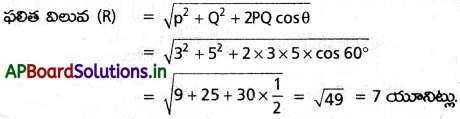
AP Inter 1st Year Physics Study Material Chapter 4 సమతలంలో చలనం 2

ప్రశ్న 4.
A = \(\overrightarrow{i} + \overrightarrow{j}\) ఈ సదిశ x – అక్షంతో చేసే కోణం ఎంత? [Mar. ’14, ’13]
జవాబు:
A = \(\overrightarrow{i}+\overrightarrow{j}\)
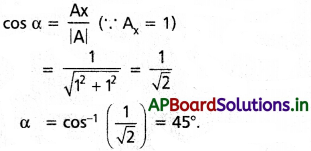
AP Inter 1st Year Physics Study Material Chapter 4 సమతలంలో చలనం 3

ప్రశ్న 5.
7 యూనిట్లు, 24 యూనిట్లు పరిమాణం ఉన్న రెండు లంబ సదిశలు సంయోగం చెందినట్లైతే ఫలిత సదిశ పరిమాణం ఎంత?
జవాబు:
θ = 90°, P = 7 యూనిట్లు, Q = 24 యూనిట్లు

AP Inter 1st Year Physics Study Material Chapter 4 సమతలంలో చలనం 4

AP Inter 1st Year Physics Study Material Chapter 4 సమతలంలో చలనం

ప్రశ్న 6.
P = 2i + 4j + 14k, Q = 4i + 4j + 10k అయితే P + Q పరిమాణం కనుక్కోండి.
జవాబు:
P = 2i + 4j + 14k, Q = 4i + 4j + 10k,
\(\overrightarrow{P}+\overrightarrow{Q}\) = 2i + 4j + 14k + 4i + 4j + 10k.
= 6i + 8j + 24k

AP Inter 1st Year Physics Study Material Chapter 4 సమతలంలో చలనం 5

ప్రశ్న 7.
శూన్య పరిమాణం కలిగిన సదిశకు శూన్యం కాని అంశాలు ఉంటాయా?
జవాబు:
లేదు. సున్నా పరిమాణం గల ఒక సదిశ శూన్యేతర అంశాలను కలిగి ఉండదు.

ప్రశ్న 8.
ప్రక్షేపకం యొక్క ప్రక్షేప పథం అగ్రభాగంలో దాని త్వరణం ఎంత?
జవాబు:
ప్రక్షేపకం యొక్క పథంలో గరిష్ఠ బిందువు వద్ద త్వరణం నిట్టనిలువుగా క్రిందకు ఉంటుంది.

ప్రశ్న 9.
రెండు అసమ పరిమాణం ఉన్న సదిశల సంకలన మొత్తం శూన్య సదిశను ఇవ్వగలదా? మూడు అసమాన సదిశలు కలిసి శూన్య సదిశను ఇవ్వగలవా?
జవాబు:

  1. లేదు. అసమ పరిమాణంగల రెండు సదిశల మొత్తం శూన్య సదిశకాదు.
  2. అవుతుంది. త్రిభుజ నియమం ప్రకారం సమతాస్థితిలో మూడు అసమ సదిశల మొత్తం శూన్యమవుతుంది.

స్వల్ప సమాధాన ప్రశ్నలు

ప్రశ్న 1.
సదిశల సమాంతర చతుర్భుజ నియమాన్ని పేర్కొనండి. ఫలిత సదిశ పరిమాణం, దిశలకు సమీకరణం రాబట్టండి. [Mar. 14, ’13]
జవాబు:
సమాంతర చతుర్భుజ నియమం :
రెండు సదిశలు పరిమాణంలోను, దిశలోను ఒక బిందువు నుండి గీసిన సమాంతర చతుర్భుజం యొక్క రెండు ఆసన్న భుజాలను సూచిస్తే, వాటి ఫలిత సదిశ పరిమాణంలోను, దిశలోను అదే బిందువు గుండా పోయే కర్ణాన్ని సూచిస్తుంది.
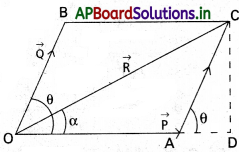
AP Inter 1st Year Physics Study Material Chapter 4 సమతలంలో చలనం 6

వివరణ :
రెండు బల సదిశలు \(\overrightarrow{P}\) మరియు \(\overrightarrow{Q}\) లు ౦బిందువు వద్ద పనిచేస్తున్నాయి. రెండు బలాల మధ్య కోణం θ. OA = \(\overrightarrow{P}\) మరియు OB = \(\overrightarrow{Q}\) అనుకొనుము. OACB సమాంతర చతుర్భుజంను పూర్తిచేయాలి. O మరియు C బిందువులను కలపాలి. ఇప్పుడు OC = \(\overrightarrow{R}\)

ఫలిత పరిమాణం :
పటంలో \(\overrightarrow{OA}= \overrightarrow{P},\overrightarrow{OB}=\overrightarrow{Q},\overrightarrow{OC}=\overrightarrow{R}\)
COD త్రిభుజం నుండి OC² = OD² + CD²
OC² = (OA + AD)² + CD² (∵ OD = OA + AD)
OC² = OA² + AD² + 20A . AD + CD²
OC² = OA² + AC² + 20A . AD …………. (1)
CAD త్రిభుజం నుండి, AD² + CD²
∆le CAD cos θ = \(\frac{AD}{AC}\)
AD = AC cos θ …………. (2)
∴ R² = P² + Q² + 2PQ cos θ
R = \(\sqrt{P^2+Q^2 +2PQ cos \theta}\) …………. (2)

ఫలితదిశ :
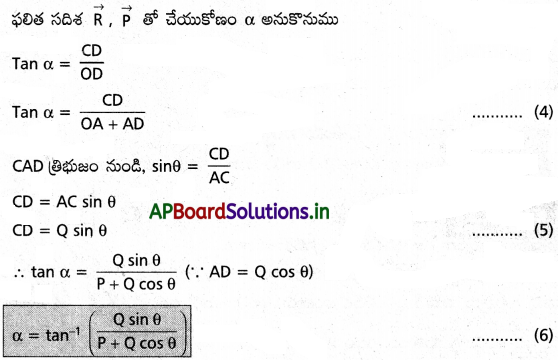
AP Inter 1st Year Physics Study Material Chapter 4 సమతలంలో చలనం 7

ప్రశ్న 2.
సాపేక్ష చలనం అంటే ఏమిటి? వివరించండి.
జవాబు:
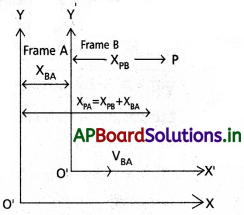
AP Inter 1st Year Physics Study Material Chapter 4 సమతలంలో చలనం 8
సాపేక్షవేగం :
ఒక వస్తువు యొక్క వేగాన్ని రెండవ వస్తువు దృష్ట్యా చెప్పటాన్ని సాపేక్ష వేగం అంటారు.

ప్రక్కపటంలో చూపినట్లు అంతరాళంలో Pఒక ఘటన అనుకొనుము. A మరియు B అనే పరిశీలకులు తమతమ నిరూపక వ్యవస్థల మూల బిందువుకు ఆపాదించుకున్నారనుకొనుము.

A పరంగా B పరిశీలకుడు VBA స్థిరవేగంతో చలిస్తున్నాడనుకొనుము. ఇప్పుడు A పరంగా P ఘటన స్థాన కొలతను B పరంగా P ఘటన స్థానకొలతను అను సంధానం చేశామనుకొనుము.

Pను పరిశీలించేసమయమునకు Bనిర్దేశిక వ్యవస్థ పరంగా ప్రయాణించిన దూరం = XBA

ఘటన Pజరిగిన స్థానాల మధ్య సంబంధం
XPA = XPB + XBA → (1)

A పరంగా P యొక్క స్థానము = Bపరంగా P యొక్క స్థానం + Aపరంగా B యొక్క స్థానం అదే విధంగా సమీకరణం (1)ని ఇలా కూడా వ్రాయవచ్చు.
VPA = VPB + VBA → (2)
Aపరంగా Pయొక్క వేగం = Bపరంగా Pయొక్క వేగం + Aపరంగా B యొక్క వేగం

AP Inter 1st Year Physics Study Material Chapter 4 సమతలంలో చలనం

ప్రశ్న 3.
కనిష్ఠ కాలంలో నదిని దాటడానికి నావ నది నీటితో కొంత కోణం చేస్తూ ప్రయాణం చేయాలని చూపండి.
జవాబు:
AP Inter 1st Year Physics Study Material Chapter 4 సమతలంలో చలనం 9
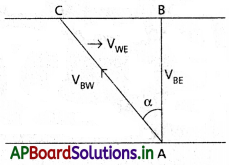
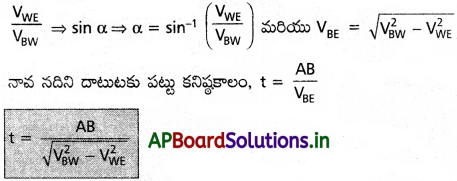
నావ నది ఒడ్డున గల Aనుండి, ఆవలి ఒడ్డున ఉన్న బిందువు Bవైపు AB మార్గంలో ప్రయాణిస్తున్నది అనుకొనుము. ఫలితవేగము V ge దిశ AB వైపు ఉంటుంది.

VBW వేగంతో నావ కదిలితే ఎదురుగా ఉన్న Bబిందువును చేరడానికి, AB తో α కోణం చేయునట్లుగా ప్రవాహానికి ఎదురుగా ప్రయాణించాలి. ఇక్కడ VBW నీటి పరంగా పడవవేగం.
AP Inter 1st Year Physics Study Material Chapter 4 సమతలంలో చలనం 10

ప్రశ్న 4.
ప్రమాణ సదిశ, శూన్య సదిశ, స్థానాంతర సదిశలను నిర్వచించండి.
జవాబు:
AP Inter 1st Year Physics Study Material Chapter 4 సమతలంలో చలనం 11
ప్రమాణ సదిశ :
ఒక సదిశ యొక్క పరిమాణము ఏకాంకమైతే దానిని ఏకాంక సదిశ అంటారు.

AP Inter 1st Year Physics Study Material Chapter 4 సమతలంలో చలనం 12

శూన్య సదిశ :
పరిమాణము శూన్యంగా గల సదిశను శూన్యసదిశ అంటారు.

స్థాన సదిశ :
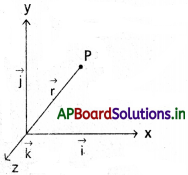
ఒక నిర్ధేశ చట్రం యొక్క మూల బిందువు నుండి కణస్థానం వద్దకు గీసిన స్థాన సదిశతో ఒక కణస్థానాన్ని గుర్తిస్తారు. దానినే స్థాన సదిశ అంటారు. అంతరాళంలో ఒక కణంను గుర్తించడానికి ఇది ఉపయోగపడుతుంది. కణం P యొక్క స్థాన సదిశను \(\overrightarrow{OP}\) గా వ్రాస్తారు.

AP Inter 1st Year Physics Study Material Chapter 4 సమతలంలో చలనం 13

ప్రశ్న 5.
AP Inter 1st Year Physics Study Material Chapter 4 సమతలంలో చలనం 14ల మధ్య కోణం 90° అని చూపండి.
జవాబు:
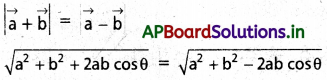
AP Inter 1st Year Physics Study Material Chapter 4 సమతలంలో చలనం 15
2ab cos θ = – 2ab cos θ
4ab cos θ
cos θ = 0 4ab ≠ 0
∴ θ = 90°
కాబట్టి \(\overrightarrow{a}\) మరియు \(\overrightarrow{b}\) మధ్యకోణం 90°.

ప్రశ్న 6.
క్షితిజ సమాంతర దిశకు కొంత కోణం చేస్తూ విసిరిన వస్తువు (ప్రక్షిప్త) పథం పరావలయం అని చూపండి. [May ’13]
జవాబు:
AP Inter 1st Year Physics Study Material Chapter 4 సమతలంలో చలనం 16
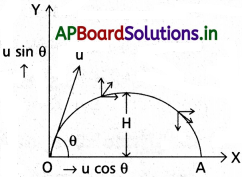
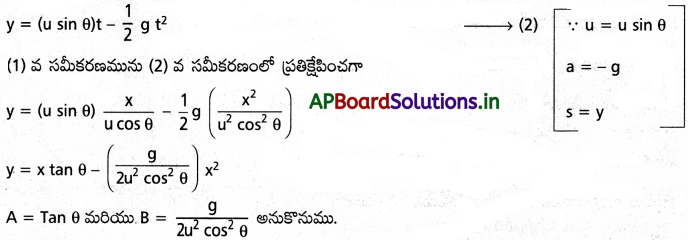
ఒక వస్తువును క్షితిజ సమాంతరంతో రికోణం చేయునట్లుగా u తొలివేగంతో ప్రక్షిప్తం చేశామనుకొనుము. వస్తువు క్షితిజ సమాంతరం దిశ త్వరణానికి లోను కాదు. ప్రక్షేపకం వేగాన్ని రెండు అంశాలుగా విభజించవచ్చు. (i) క్షితిజ సమాంతర అంశము u cos θ (ii) క్షితిజ లంబ అంశము u sin θ. క్షితిజ సమాంతర అంశము చలనం అంతటా స్థిరంగా ఉంటుంది. కేవలం క్షితిజ లంబ అంశం u sin θ గురుత్వ త్వరణం వలన మారుతుంది.
tకాలంలో OX దిశలో ప్రయాణించిన దూరం
x = u cos θ × t
t = \(\frac{x}{u \cos \theta}\) → (1)
t కాలంలో OY దిశలో ప్రయాణించిన దూరం
AP Inter 1st Year Physics Study Material Chapter 4 సమతలంలో చలనం 17
Y = Ax – Bx² ఇక్కడ A, B లు స్థిరాంకాలు
ఈ సమీకరణం పరావలయాన్ని సూచిస్తుంది.
∴ ప్రక్షేపకం యొక్క పథం· కూడా పరావలయం అవుతుంది.

ప్రశ్న 7.
సగటు వేగం, తాక్షణిక వేగం పదాలను వివరించండి. ఈ రెండు ఎప్పుడు సమానం అవుతాయి?
జవాబు:
సగటువేగం :
స్థానభ్రంశం (∆x) కు, కాల అవధి At కు గల నిష్పత్తిని సగటువేగం అంటారు.
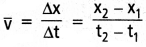
AP Inter 1st Year Physics Study Material Chapter 4 సమతలంలో చలనం 18
తొలి మరియు తుది స్థానాల మధ్య కణం అనుసరించే మార్గంపై సగటువేగం ఆధారపడదు. ఇది ఫలితచలనాన్ని ఇస్తుంది.

తాక్షణిక వేగం :
ఒక నిర్ధిష్ట కాలం వద్ద కణం వేగాన్ని తాక్షణిక వేగం అంటారు.
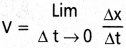
AP Inter 1st Year Physics Study Material Chapter 4 సమతలంలో చలనం 19
సరళరేఖా చలనంలో తాక్షణిక వేగం ధనాత్మకం (లేదా) ఋణాత్మకం కావచ్చు.
ఏకరీతి చలనంలో వస్తువు యొక్క తాక్షణిక వేగం, సగటు వేగానికి సమానం.

ప్రశ్న 8.
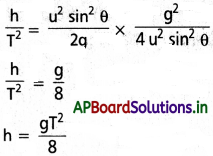
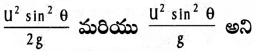
ఒక ప్రక్షేపకం యొక్క గరిష్లోన్నతి మరియు వ్యాప్తులు వరుసగా
AP Inter 1st Year Physics Study Material Chapter 4 సమతలంలో చలనం 20
చూపండి. ఇక్కడ వాడిన పదాలను సాధారణంగా ఉపయోగించే అర్థంలోనే వాడాం. [Mar. ’14]
జవాబు:
గరిష్తోన్నతి :
ప్రక్షేపకం క్షితిజలంబదిశలో, లంబాంశవేగము శూన్యం అయ్యేవరకు ప్రయాణించిన దూరాన్ని గరిష్టోన్నతి అంటారు.
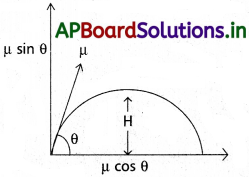
AP Inter 1st Year Physics Study Material Chapter 4 సమతలంలో చలనం 21
తొలి వేగం (u) = u sin θ
దూరం (s) = H = గరిషోన్నతి
త్వరణం (a) – g
v² – u² = 2as ను ఉపయోగించి
0 – u² sin² θ = – 2gH
∴ H = \(\frac{u^2 \sin ^2 \theta}{2 g}\)

క్షితిజ సమాంతరవ్యాప్తి (R)
క్షితిజ సమాంతరదిశలో పలాయన కాలంలో ప్రక్షేపకం ప్రయాణించిన దూరాన్ని క్షితిజ సమాంతర వ్యాప్తి అంటారు.
వ్యాప్తి (R) = క్షితిజ సమాంతర వేగం × ప్రయాణ కాలం
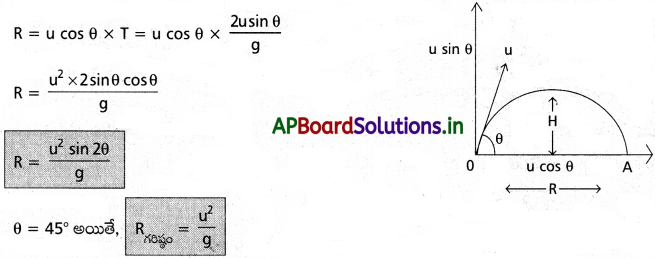
AP Inter 1st Year Physics Study Material Chapter 4 సమతలంలో చలనం 22

ప్రశ్న 9.
ఒక నిర్దేశ చట్రంలో వస్తువు ప్రక్షిప్త పథం పరావలయం అయితే, ఈ నిర్దేశ చట్రంతో సాపేక్షంగా స్థిరవేగంతో కదులుతున్నా మరొక నిర్దేశ చట్రంలో కూడా వస్తువు పథం పరావలయ ఆకృతిలో ఉంటుందా? ఒకవేళ ప్రక్షేపక పథం పరావలయం కాకపోతే అది ఏ ఆకృతిలో ఉంటుంది?
జవాబు:
కాదు. సమవేగంలో ఉన్న బస్సునుండి ఒకరాయిని బయటకు విసిరామనుకోండి. వెలుపల ఫుట్పాట్పై నిలబడి ఉన్న వ్యక్తి ఆరాయి పరావలయ పథంలో కనిపిస్తుంది. కాని అదే బస్సులో ఉన్న వ్యక్తికి అది సరళరేఖామార్గంలో కనిపిస్తుంది. కాబట్టి వేరు వేరు నిర్దేశిక చట్రాల పరంగా వస్తువు యొక్క పథం వేరువేరుగా ఉంటుంది.

AP Inter 1st Year Physics Study Material Chapter 4 సమతలంలో చలనం

ప్రశ్న 10.
నిశ్చల స్థితిలో ఉన్న వస్తువుపై 2i + j – k న్యూటన్ల బలం పనిచేస్తుంది. 20 సెకనుల చివర వస్తువు వేగం 4i + 2j + 2k ms-1 అయితే ఆ వస్తువు ద్రవ్యరాశి ఎంత?
జవాబు:
F = (2i + j – k) N
t = 20 sec, u = 0
v = (4i + 2j – 2k) m/s
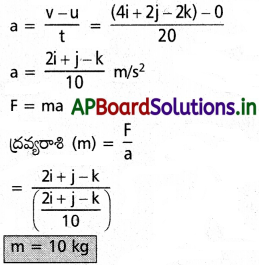
AP Inter 1st Year Physics Study Material Chapter 4 సమతలంలో చలనం 23

లెక్కలు (Problems)

ప్రశ్న 1.
ఓడ B కి ఓడ A పశ్చిమదిశలో 10km దూరంలో ఉంది. ఓడ A నేరుగా ఉత్తర దిక్కువైపు 30 km/h వడితో వెళుతుంటే, ఓడ B ఉత్తర దిశతో పడమరవైపు 60° కోణం చేస్తూ 20 km/ h వడితో వెళుతుంది.
i) ఓడ Aకి సాపేక్షంగా ఓడ B వేగ పరిమాణాన్ని, దిశను కనుక్కోండి.
ii) రెండింటి మద్య అత్యంత సమీపదూరం (closest approach) ఎంత?
సాధన:
i) VA = 30 kmph, VB = 20 kmph, θ = 60°
B నౌక యొక్క సాపేక్ష వేగం A నౌక పరంగా,
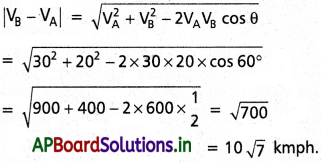
AP Inter 1st Year Physics Study Material Chapter 4 సమతలంలో చలనం 24

ii) నౌక A మరియు B మధ్య దూరం = 10 km.
B నౌక పరంగా A నౌక ఉత్తరం వైపు ప్రయాణిస్తోంది. రెండింటి మధ్య దగ్గర దూరం BD = AB sin 45°
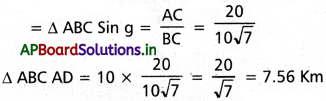
AP Inter 1st Year Physics Study Material Chapter 4 సమతలంలో చలనం 25

ప్రశ్న 2.
ప్రక్షేపక కోణం α వ్యాప్తి R, గరిష్ఠ ఎత్తు h ప్రయాణ కాలం T అయితే (a) tan α = 4h/R,
(b) h = gT²/8 అని చూపండి.
సాధన:
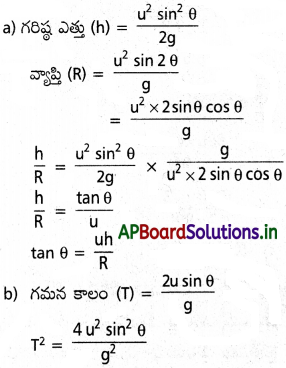
AP Inter 1st Year Physics Study Material Chapter 4 సమతలంలో చలనం 26
AP Inter 1st Year Physics Study Material Chapter 4 సమతలంలో చలనం 27

ప్రశ్న 3.
క్షితిజ సమాంతరంతో 60° కోణం చేస్తూ 800 m/sతొలి వేగంతో ఒక ప్రక్షేపకాన్ని పేల్చారు.
i) భూమికి తాకే ముందు ప్రక్షేపకం ప్రయాణ కాలం కనుక్కోండి.
ii) అది భూమిని తాకే ముందు ప్రయాణించిన దూరాన్ని (వ్యాప్తి) కనుక్కోండి.
iii) గరిష్ఠ ఎత్తుకు చేరుకోడానికి పట్టే ప్రయాణ కాలాన్ని కనుక్కోండి.
సాధన:
θ = 60°, u = 800m/s
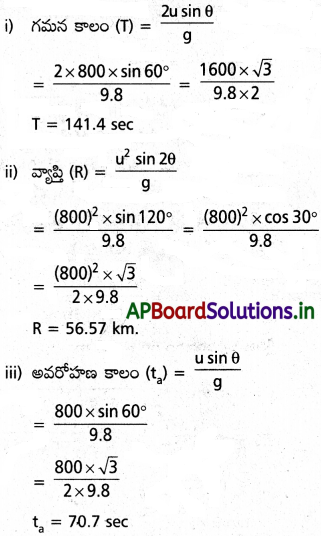
AP Inter 1st Year Physics Study Material Chapter 4 సమతలంలో చలనం 28

ప్రశ్న 4.
భూమికి ఏటవాలుగా ప్రక్షిప్తం చేసిన కణం తన పథంలో గరిష్ఠ బిందువు దగ్గర ఉన్నప్పుడు ప్రక్షేపణ బిందువు దృష్ట్యా దాని స్థాన సదిశ పరిమాణం అది చేరుకొనే గరిష్ఠ ఎత్తుకు √2 రెట్లు ఉన్నట్లయితే ప్రక్షేపక కోణం tan-1 (2) అని చూపండి.
సాధన:
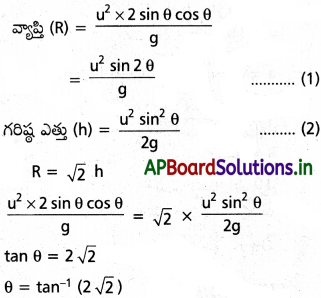
AP Inter 1st Year Physics Study Material Chapter 4 సమతలంలో చలనం 29

ప్రశ్న 5.
భూమికి 20m ఎత్తున ఉన్న శిఖరంపై నుంచి వస్తువును క్షితిజ సమాంతరానికి 30° కోణంతో 30 m/s. తొలివేగంతో ప్రయోగించారు. భూమిపై దిగే ముందు క్షితిజ సమాంతరంగా వస్తువు ఎంత దూరం ప్రయాణిస్తుంది ? (g = 10 m/s²)
సాధన:
h = 20m, θ = 30° u = 30m/s
g = 10m/s²
h = – (u sin θ) t + \(\frac{1}{2}\) gt²
20 = – 30 sin 30° × t + \(\frac{1}{2}\) × 10 × t²
20 = -30 × \(\frac{1}{2}\) × t + \(\frac{1}{2}\) × 10 × t²
4 = – 3t + t²
t² – 3t – 4 = 0
(t – 4) (t + 1) = 0
t = 4 sec (లేదా) t = – 1 sec
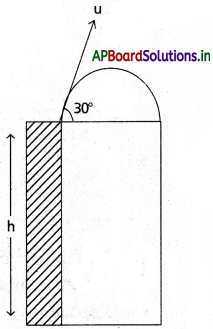
AP Inter 1st Year Physics Study Material Chapter 4 సమతలంలో చలనం 30
∴ వ్యాప్తి (R) = ucos θ × t
30 cos 30° × 4
= 30 × \(\frac{\sqrt{3}}{2}\) × 4
R = 60 √3 m

ప్రశ్న 6.
నేలపై 0 బిందువును మూల బిందువుగా తీసుకోవడమైంది. ఒక వస్తువు ముందు ఈశాన్య (North-East) దిశలో 102 m స్థానభ్రంశాన్ని, m ఆ తరువాత ఉత్తర దిశలో 10 m, పిమ్మట 10 √2 m వాయువ్య దిశలో పొందింది. మూల బిందువు నుంచి అది ఎంత దూరంలో ఉంది?
సాధన:
OB =10 √2 m, BC = 10m.
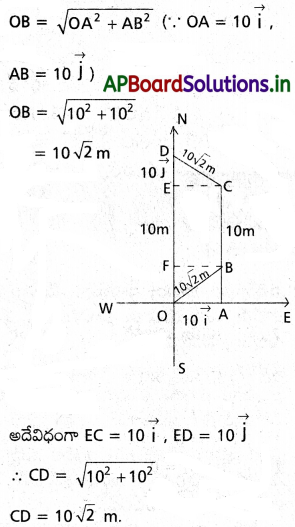
AP Inter 1st Year Physics Study Material Chapter 4 సమతలంలో చలనం 31
∴ మొత్తం స్థానభ్రంశం (OD) = |OF| + |FE| + |ED|
OD = 10 + 10+ 10
OD = 30m

AP Inter 1st Year Physics Study Material Chapter 4 సమతలంలో చలనం

ప్రశ్న 7.
భూమిపై ఒక బిందువు నుంచి తొలివేగం u, తో కణాన్ని క్షితిజ సమాంతర వ్యాప్తి గరిష్ఠం అయ్యే విధంగా ప్రక్షిప్తం చేశారు. దాని ఆరోహణక్రమంలో (ascent) ఉండే సగటు వేగం పరిమాణాన్ని కనుక్కోండి.
సాధన:
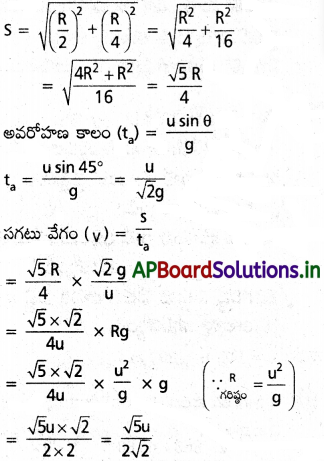
AP Inter 1st Year Physics Study Material Chapter 4 సమతలంలో చలనం 32

ప్రశ్న 8.
భూమిపై నుంచి ఒక కణాన్ని కొంత తొలి వేగంతో క్షితిజ సమాంతరానికి 45° కోణంతో ప్రక్షిప్తం చేశారు. అది క్షితిజ సమాంతరంగా 10m దూరం ప్రయాణించేంతలో, భూమి నుంచి 7.5 m ఎత్తుకు చేరుతుంది. ప్రక్షేపకం తొలి వడి ఎంత? (g = 10m/s²)
సాధన:
θ = 45°, g = 10 m/s²
క్షితిజ సమాంతర దూరం (x) = 10m.
క్షితిజ లంబదూరం (y) 7.5 m.
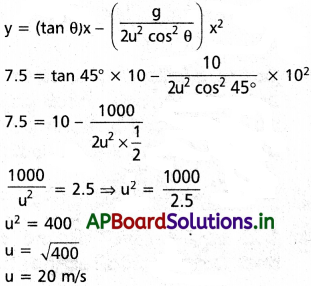
AP Inter 1st Year Physics Study Material Chapter 4 సమతలంలో చలనం 33

ప్రశ్న 9.
దక్షిణ దిశ నుంచి 5 ms-1 వేగంతో గాలి వీస్తుంది. ఒక సైకిల్ తొక్కే వ్యక్తికి అది 5ms-1. వేగంతో తూర్పు దిశ నుంచి వీస్తుందనిపిస్తుంది. సైకిల్ తొక్కే వ్యక్తి ఈశాన్య దిశలో 5√2 ms-1 వేగంతో ప్రయాణిస్తున్నాడని చూపించండి.
సాధన:
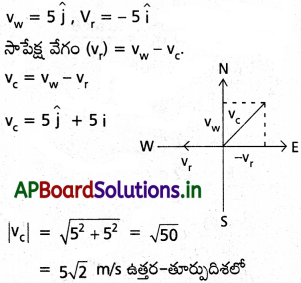
AP Inter 1st Year Physics Study Material Chapter 4 సమతలంలో చలనం 34

ప్రశ్న 10.
4 m/s తో నడుస్తున్న మనిషి వాన బిందువులు ఏటవాలుగా తన ముఖంపై 4 m/s వడితోనిట్టనిలువుతో 30°కోణం చేస్తూ పడుతున్నాయని గమనించాడు. వాన బిందువు వాస్తవ వడి 4 m/s అని చూపండి.
సాధన:
వ్యక్తి యొక్క వేగం (vp) = 4 m/s,
v = 4 m/s, θ = 30°
సాపేక్ష వేగం (v) = vr – vp
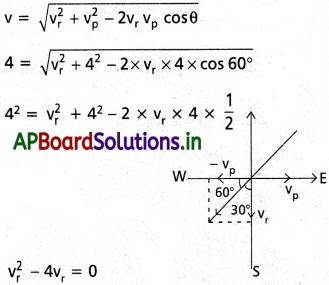
AP Inter 1st Year Physics Study Material Chapter 4 సమతలంలో చలనం 35
వర్షపు చినుకు వేగం (vr) = 4m/s.

అదనపు లెక్కలు (Additional Problems)

ప్రశ్న 1.
క్రింద ఇచ్చిన రాశులు సదిశలా లేదా అదిశలా తెలపండి. ఘనపరిమాణం, ద్రవ్యరాశి, వడి, త్వరణం, సాంద్రత, మోల్ల సంఖ్య, వేగం, కోణీయ పౌనఃపున్యం, స్థానభ్రంశం, కోణీయ వేగం.
జవాబు:
అదిశ రాశులు :
ఘనపరిమాణం, ద్రవ్యరాశి, వడి, సాంద్రత, మోల్స్ సంఖ్య, కోణీయ పౌనఃపున్యం

సదిశ రాశులు :
త్వరణం, వేగం, స్థానభ్రంశం, కోణీయ వేగం

ప్రశ్న 2.
క్రింద ఇచ్చిన జాబితాలో రెండు అదిశరాశులను ఎంపిక చేయండి. బలం, కోణీయ ద్రవ్యవేగం, పని, విద్యుత్ ప్రవాహం, రేఖీయ ద్రవ్యవేగం, విద్యుత్ క్షేత్రం, సగటు వేగం, అయస్కాంత భ్రామకం, సాపేక్ష వేగం.
జవాబు:
పని మరియు విద్యుత్ ప్రవాహం ఆదిశ రాశులు

ప్రశ్న 3.
క్రింద ఇచ్చిన జాబితాలో సదిశరాశి ఉన్నది. దానిని ఎంపిక చేయండి. ఉష్ణోగ్రత, పీడనం, ప్రచోదనం, కాలం, సామర్థ్యం, మొత్తం పథం పొడవు, శక్తి గురుత్వ పొటెన్షియల్ ఘర్షణ గుణకం, విద్యుదావేశం.
జవాబు:
ప్రచోదనం = బలం × కాలం = ద్రవ్య వేగంలో మార్పు. ద్రవ్యవేగం మరియు బలం సదిశ రాశులు కావున ప్రబోదనం కూడా సదిశరాశి.

ప్రశ్న 4.
క్రింద ఇచ్చిన సదిశ, అదిశ రాశుల మధ్య జరిగే బీజగణిత పరిక్రియలు అర్థవంతమైనవో, కావో కారణాలతో వివరించండి.
a) ఏవైనా రెండు అదిశల సంకలనం,
b) ఒకే మితులు ఉన్న అదిశను సదిశకు సంకలనం చేయడం,
c) ఏదైనా సదిశను ‘ఏదైనా అదిశతో గుణించడం,
d) ఏవైనా రెండు అదిశలను గుణించడం,
e) ఏవైనా రెండు సదిశలను సంకలనం చేయడం,
f) ఒక సదిశ అంశాన్ని అదే సదిశకు సంకలనం చేయడం.
జవాబు:
a) కాదు, ఒకే మితులు గల అదిశలు కూడబడినవి.
b) కాదు, అదిశను, సదిశలో కూడరాదు.
c) అవును. త్వరణం \(\overrightarrow{A}\) ను ద్రవ్యరాశి m తో గుణించగా, బలం \(\overrightarrow{F}\) = m \(\overrightarrow{A}\) ఇది అర్థవంతమైన సమీకరణం.
d) అవును, సామర్థ్యం Pని కాలం t తో గుణించగా, పని = Pt ఇది కూడా అర్థవంతమైనది.
e) కాదు. కారణం రెండు సదిశలు ఒకే మితులు కలవి కూడబడినది.
f) అవును, కారణం రెండు సదిశలు ఒకే మితులు కలవు.

ప్రశ్న 5.
క్రింద ఇచ్చిన ప్రవచనాలను జాగ్రత్తగా చదివి కారణాలతో అవి తప్పా లేదా ఒప్పా తెలియ చేయండి.
a) సదిశ పరిమాణం ఎప్పుడూ అదిశే, b) సదిశ ప్రతీ అంశం ఎప్పుడూ అదితే, c) మొత్తం పథకం పొడవు ఎప్పుడూ కణం స్థానభ్రంశ సదిశ పరిమాణానికి సమానం, d) కణం సగటు వడి (మొత్తం పథ దూరాన్ని ఆ పథాన్ని పూర్తి చేయడానికి పట్టే కాలంతో భాగించగా వచ్చే రాశి) అదే కాలవ్యవధిలో కణం సగటు వేగం పరిమాణం కంటే ఎక్కువ లేదా సమానంగా ఉంటుంది. e) ఒకే తలంలో లేని మూడు సదిశలు కలిసి ఎప్పుడూ శూన్య సదిశను ఇవ్వలేవు.
జవాబు:
a) ఒప్పు : కారణం పరిమాణం స్వచ్ఛమైన సంఖ్య
b) తప్పు : సదిశ ప్రతి అంశము సదిశ
c) ఒప్పు : కణం సరళ రేఖా మార్గంలో ఒకేదిశలో చలిస్తోన్నప్పుడు మాత్రమే, కాకపోతే తప్పు.
d) ఒప్పు : మొత్తం పధం పొడవు, స్థాన భ్రంశంకన్నా ఎక్కువ లేదా సమానం.
e) ఒప్పు : తిభుజం యొక్క మూడు భుజాలను ఒకే దిశలో చూడలేదు.

AP Inter 1st Year Physics Study Material Chapter 4 సమతలంలో చలనం

ప్రశ్న 6.
రేఖాచిత్ర పట పద్ధతి లేదా ఇతర పద్ధతిలో క్రింద ఇచ్చిన సదిశా అసమానతలను రుజువు చేయండి.
(a) |a + b| ≤ |a| + |b| (b) |a + b| ≥ ||a|-|b||
(c) la – b|< |a! + |b| (d) |a – b| 2 ||a| – |b||
ఏ సందర్భంలో సమానత గుర్తు వర్తిస్తుంది?
జవాబు:
\(\overrightarrow{A}\) మరియు \(\overrightarrow{B}\) సదిశలు, సమాంతర చతుర్భుజం యొక్క \(\overrightarrow{OP}\) మరియు \(\overrightarrow{OQ}\) భుజాలను సూచిస్తున్నాయి.
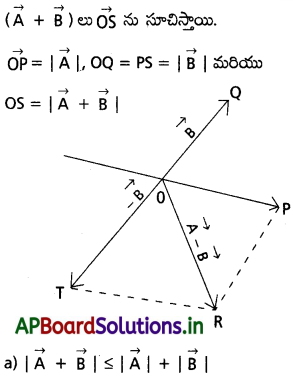
AP Inter 1st Year Physics Study Material Chapter 4 సమతలంలో చలనం 36

త్రిభుజం యొక్క ఒక భుజం పొడవు, మిగిలిన రెండు భుజాల పొడవులకన్నా మొత్తం కన్నా తక్కువ. AOPS, నుండి OS < OP + PS (లేదా) OS < OP + OQ
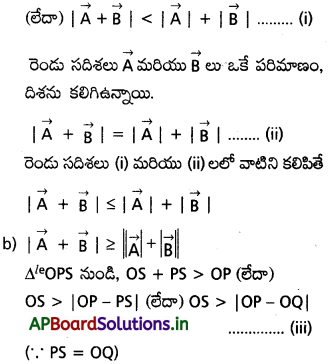
AP Inter 1st Year Physics Study Material Chapter 4 సమతలంలో చలనం 39

(OP – OQ) పరిమాణంను తీసుకోవాలి. కారణం
L.H.S ఎల్లప్పుడూ ధనాత్మకం కాని R.H.S రుణాత్మకం OP < PS

(iii) నుండి
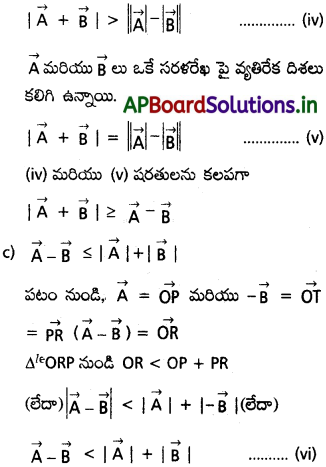
AP Inter 1st Year Physics Study Material Chapter 4 సమతలంలో చలనం 40
రెండు సదిశలు ఒకే సరళరేఖపై పనిచేస్తున్నాయి. కాని వేరు వేరు దిశలు
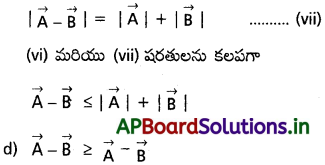
AP Inter 1st Year Physics Study Material Chapter 4 సమతలంలో చలనం 41

∆leOPR నుండి, OR + PR > OP (లేదా) OR > |OP – PR| (లేదా) OR > |OP – OT| ………. (viii)
(OP – OT) ధనాత్మకం, R.H.S. రుణాత్మకం, OP < OT
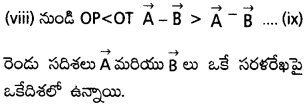
AP Inter 1st Year Physics Study Material Chapter 4 సమతలంలో చలనం 42
AP Inter 1st Year Physics Study Material Chapter 4 సమతలంలో చలనం 43

ప్రశ్న 7.
a + b + c + d = 0 అని ఇచ్చారు. కింది ప్రవచనాలలో ఏది సరియైనది?
a) a, b, c, d లలో ప్రతీది శూన్య సదిశ.
b) (a + c) పరిమాణం (b + d) పరిమాణానికి సమానం.
c) సదిశ a పరిమాణం ఎప్పుడూ b, c, d e మొత్తం పరిమాణం కంటే అధికం కాదు.
d) a, d లు ఏక రేఖీయాలు (not collinear) కానప్పుడు b + c, a, d ఉండే తలంలోనే ఉండాలి. అవి ఏక రేఖీయాలు అయితే a, d లకు రేఖీయంగా ఉండాలి.
జవాబు:
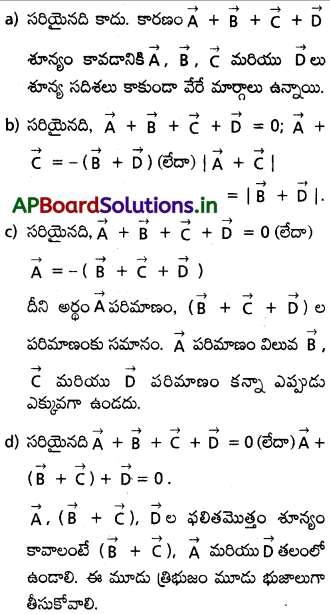
AP Inter 1st Year Physics Study Material Chapter 4 సమతలంలో చలనం 44

ప్రశ్న 8.
ముగ్గురు బాలికలు 200 m వృత్తాకార మంచు ఆటస్థలంలో ఆటస్థలం అంచు వెంబడి ఉన్న P బిందువు నుంచి స్కేటింగ్ చేసుకుంటూ బయలుదేరి pకి వ్యాసీయంగా (diametrically) ఎదురుగా ఉన్న Q బిందువు వద్దకు వేరు వేరు మార్గాలలో పటంలో చూపిన విధంగా చేరుకొన్నారు. ప్రతి ఒక్కరి స్థానభ్రంశం సదిశ పరిమాణం ఎంత ?. ఇది ఏ బాలిక తీసుకొన్న మార్గం పొడవుకు సమానం?
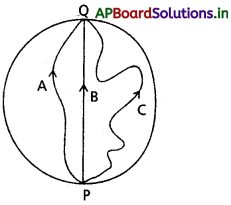
AP Inter 1st Year Physics Study Material Chapter 4 సమతలంలో చలనం 45
జవాబు:
ప్రతి బాలిక స్థానభ్రంశం = \(\overrightarrow{PQ}\)
ప్రతి బాలిక స్థానభ్రంశం యొక్క పరిమాణం = PQ
= గ్రౌండ్ యొక్క వ్యాసం = 2 × 200 = 400m
B బాలిక యొక్క స్థానభ్రంశం, పథం పొడవుకు సమానం.

AP Inter 1st Year Physics Study Material Chapter 4 సమతలంలో చలనం

ప్రశ్న 9.
1 km వ్యాసార్థం ఉన్న పార్క్ కేంద్రం 0 నుంచి సైకిల్పై బయలుదేరిన ఒక వ్యక్తి వృత్త అంచు Pకి చేరుకుని, వృత్త పరిధిపై సైకిల్ తొక్కుతూ తిరిగి వృత్త కేంద్రాన్ని పటంలో చూపిన OQ రేఖ వెంబడి చేరుకొన్నాడు. పూర్తి తిరుగు ప్రయాణానికి 10 నిమిషాలు తీసుకొంటే (a) ఫలిత స్థానభ్రంశం ఎంత? (b) సగటు వేగం, (c) సైకిల్ తొక్కే వ్యక్తి సగటు వడి ఎంత?
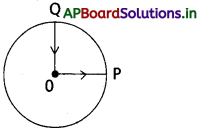
AP Inter 1st Year Physics Study Material Chapter 4 సమతలంలో చలనం 46
జవాబు:
a) ఇక్కడ ఫలిత స్థాన భ్రంశం = 0
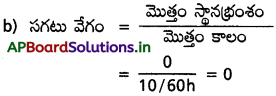
AP Inter 1st Year Physics Study Material Chapter 4 సమతలంలో చలనం 47
AP Inter 1st Year Physics Study Material Chapter 4 సమతలంలో చలనం 48

ప్రశ్న 10.
ఒక ఖాళీ ఆటస్థలంలో మోటారు సైకిల్ నడుపుతున్న వ్యక్తి ప్రతి 500m లకు అతనికి ఎడమవైపు 60° కోణంలో ఉన్న మలుపు మార్గాన్ని అనుసరిస్తున్నాడు. అతను ఉన్న మలుపు నుంచి ప్రారంభించి మోటారిస్ట్ మూడవ, ఆరవ, ఎనిమిదవ మలుపుల వద్ద అతని స్థానభ్రంశం ఎంతో చెప్పండీ? ప్రతీ సందర్భంలోనూ మోటారిస్ట్ పూర్తిచేసిన మొత్తం పథ దూరాన్ని, స్థానభ్రంశం పరిమాణంతో పోల్చండి.
జవాబు:
ఇక్కడ మార్గం షట్కోణాకారము ABCDEF పొడవు 500m. ఒక మోటారిస్ట్ Aవద్ద బయల్దేరితే

మూడవ మలుపు :
D వద్ద స్థానభ్రంశం = \(\overrightarrow{AD}\)
ఈ స్థానభ్రంశం పరిమాణం = 500 + 500 = 1000 m
A నుండి D వరకు మొత్తం పథం పొడవు = AB + BC + CD = 500 + 500 + 500 = 1500m.

ఆరవ మలుపు :
A వద్ద స్థానభ్రంశం శూన్య సదిశ. మొత్తం పథం పొడవు = AB + BC + CD + DE + EF + FA 6 × 500 3000 m.
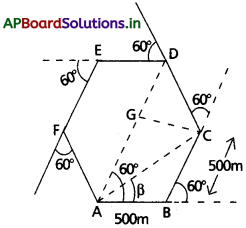
AP Inter 1st Year Physics Study Material Chapter 4 సమతలంలో చలనం 49

ఎనిమిదవ మలుపు :
C వద్ద, స్థానభ్రంశం = \(\overrightarrow{AC}\)
ఇది ABCG సమాంతర చతుర్భుజం యొక్క కర్ణంను సూచిస్తుంది. |\(\overrightarrow{AC}\)|
మొత్తం పథం పొడవు = 8 × 500 = 4000 m.
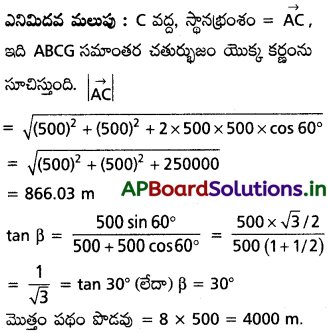
AP Inter 1st Year Physics Study Material Chapter 4 సమతలంలో చలనం 50

ప్రశ్న 11.
కొత్తగా పట్టణానికి వచ్చిన ప్రయాణీకుడు స్టేషన్ నుంచి నేరుగా ఉన్న రోడ్డుపై 10 km దూరంలో ఉండే హోటల్కు చేరుకోవాలనుకున్నాడు. మోసగాడు అయిన ఒక టాక్సీ కారుడ్రైవరు అతనిని మెలికల మార్గాల గుండా తిప్పుతూ 23 km దూరాన్ని 28 నిమిషాలపాటు తిప్పి హోటలు తీసుకొనివచ్చాడు. అయితే
(a) టాక్సీ సగటు వడ్డి ఎంత?
(b) సగటు వేగం పరిమాణం ఎంత?
(c) ఈ రెండూ సమానమేనా?
జవాబు:
ఇక్కడ మొత్తం పథం పొడవు S = 23 km,
స్థానభ్రంశం = 10 km,
కాలం t = 28 నిమిషాలు = 28/60h
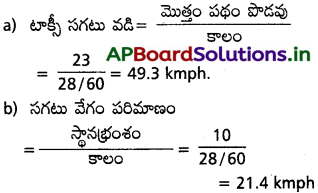
AP Inter 1st Year Physics Study Material Chapter 4 సమతలంలో చలనం 51

కాబట్టి సగటు వడి, సగటు వేగం సమానం కావు. ఇవి సమానం కావాలంటే టాక్సీ సరళరేఖా మార్గంలో ప్రయాణించాలి.

ప్రశ్న 12.
30 ms-1 వడితో వర్షం నిట్టనిలువుగా పడుతోంది. ఒక మహిళ 10 ms-1 వడితో ఉత్తరం నుంచి దక్షిణ దిశకు సైకిల్ను తొక్కుతోంది. ఏ దిశలో ఆమె గొడుగును పట్టుకోవాలి?
జవాబు:
పటంలో వర్షం OA దిశలో 300 ms-1 వేగంతో పడుతోంది.
ఒక మహిళ OS దిశలో 10 ms-1 వేగంతో పోతుంది.
OA = 30 ms-1, OB = 10ms-1.
ఆమె వర్షంలో తడవకుండా ఉండటానికి గొడుగును తెరిచిపట్టుకుంది. ఇప్పుడు మహిళతో పోల్చితే వర్షం సాపేక్షవేగం,
OADC సమాంతర చతుర్భుజం యొక్క కర్ణం OD అవుతుంది.
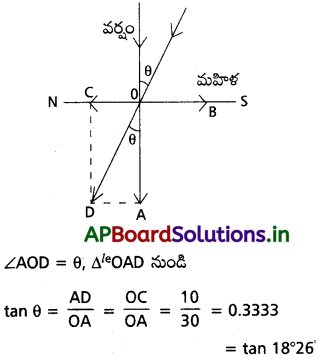
AP Inter 1st Year Physics Study Material Chapter 4 సమతలంలో చలనం 52
β = 18°26′ క్షితిజ లంబంతో ముందుకుపోవు దిశలో

ప్రశ్న 13.
నిలకడగా ఉన్న నీటిలో ఒక వ్యక్తి 4.0 km/h వడితో ఈదగలడు. 1.0 km వెడల్పు ఉండి 3.0 km/h సమవడితో ప్రవహిస్తున్న నదిని ప్రవాహ దిశకు లంబంగా ఈదుతూ ఎంత కాలంలో దాటగలడు? రెండో ఒడ్డుకు చేరేటప్పటికి అతడు నదిలో ఎంత కిందకు ప్రయాణిస్తాడు?
జవాబు:
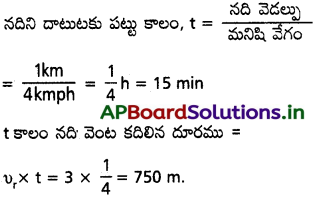
AP Inter 1st Year Physics Study Material Chapter 4 సమతలంలో చలనం 53

ప్రశ్న 14.
ఒక నౌకాశ్రయంలో గాలి 72 km/h వడితో వీస్తుంది. నౌకాశ్రయంలో ఆగి ఉన్న నావపై ఎగురుతున్న జెండా ఈశాన్య దిశలో రెపరెప లాడుతోంది. నావ ఉత్తర దిక్కుకు 51 km/h వడితో కదలడం ప్రారంభిస్తే జెండా ఏ దిశలో ఉంటుంది?
జవాబు:
ఓడరేవులో పడవ పై ఉన్న జెండా ఉత్తర-తూర్పు దిశలలో రెపరెపలాడుతోంది. దీని అర్థం గాలిదిశ ఉత్తర- తూర్పుదిశలో ఉంది. పడవ బయల్దేరితే జెండా, పడవ పరంగా గాలి సాపేక్ష వేగం దిశలో ఊగుతోంది. \(\overrightarrow{υ}_{wt}\) అనునది పడవ పరంగా గాలి వేగం మరియు β అనునది
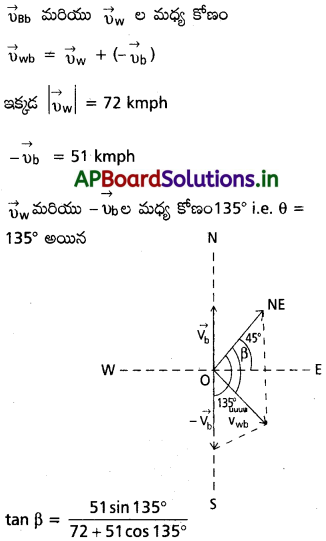
AP Inter 1st Year Physics Study Material Chapter 4 సమతలంలో చలనం 54
AP Inter 1st Year Physics Study Material Chapter 4 సమతలంలో చలనం 55
తూర్పు దిశలో కోణం = 45.1° – 45° = 0.1°
దీని అర్థం జెండా దాదాపు తూర్పు దిశలో ఎగురుతోంది.

AP Inter 1st Year Physics Study Material Chapter 4 సమతలంలో చలనం

ప్రశ్న 15.
పెద్ద హాలు లోకప్పు 25m ఎత్తు ఉంది. 40 ms-1 వడితో విసిరిన బంతి హాలు లోకప్పును తాకకుండా వెళ్ళే గరిష్ఠ క్షితిజ సమాంతర దూరం ఎంత?
జవాబు:
ఇక్కడ u = 40 ms-1, H = 25 m; R = ?
గరిష్ట ఎత్తు = 25 m, θ అనునది క్షితిజ సమాంతరంతో ప్రక్షిప్త కోణం
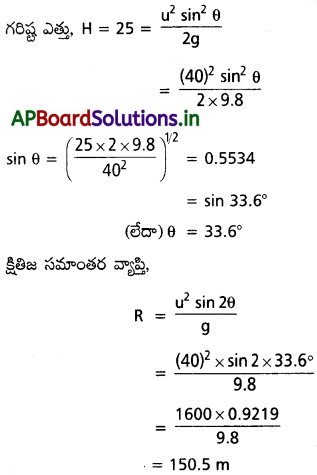
AP Inter 1st Year Physics Study Material Chapter 4 సమతలంలో చలనం 56

ప్రశ్న 16.
ఒక క్రికెటర్ బంతిని గరిష్ఠంగా 100m దూరం విసరగలడు. అదే బంతిని భూమికి ఎంత ఎత్తు వరకు అతడు విసరగలడు?
జవాబు:
బంతిని U వేగంతో ప్రక్షిప్తం చేశామనుకోండి. θ = 45° కోణంతో విసిరితే బంతి గరిష్ట వ్యాప్తిని పొందుతుంది.
Rmax = u²/g
ఇక్కడ u²/g = 100m ……………… (i)
బంతి చలనాన్ని క్షితిజ లంబ దిశలో పరిశీలిస్తే, భూమిని కేంద్రంగా క్షితిజ లంబదిశను ధన Y-అక్షం దిశగా తీసుకుంటే
uy = u, ay = – g y = 0, y0 = 0, t = ?, y = ?
υy = uy + ayt
∴ 0 = u + (−g)t (లేదా) t = u/g
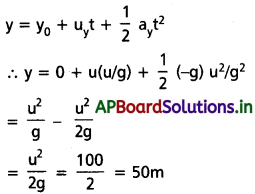
AP Inter 1st Year Physics Study Material Chapter 4 సమతలంలో చలనం 57

ప్రశ్న 17.
80 cm పొడవు ఉన్న తాడుకు ఒక కొన వద్ద రాయిని కట్టి స్థిర వడితో క్షితిజ సమాంతర వృత్తంలో తిప్పారు. రాయి 255 లలో 14 భ్రమణాలు చేస్తే, రాయి త్వరణం పరిమాణం, దిశను కనుక్కోండి.
జవాబు:
ఇక్కడ r = 80 cm = 0.8 m ; υ = 14/255-1
∴ ω = 2πυ
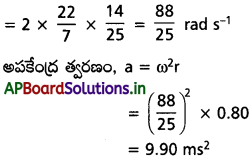
AP Inter 1st Year Physics Study Material Chapter 4 సమతలంలో చలనం 58
అపకేంద్ర త్వరణం దిశ, తాడు వెంబడి వృత్తాకార పథం కేంద్రం వైపు ఉంటుంది.

ప్రశ్న 18.
ఒక విమానం స్థిర వడి 900 km/h తో 1.00km వ్యాసార్థం ఉన్న క్షితిజ సమాంతర వలయాన్ని పూర్తిచేసింది. దాని అభికేంద్ర త్వరణాన్ని గురుత్వ త్వరణంతో పోల్చండి.
జవాబు:
ఇక్కడ r = 1 km = 1000 m; υ = 900 kmph
= 900 × 1000 m × (60 × 60)-1
= 250 m/s
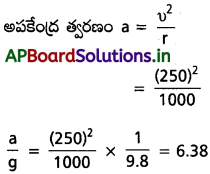
AP Inter 1st Year Physics Study Material Chapter 4 సమతలంలో చలనం 59

ప్రశ్న 19.
కింది ప్రవచనాలను జాగ్రత్తగా చదివి తప్పొప్పుల కారణాలను ఇవ్వండి.
a) వృత్తాకార చలనంలో ఉన్న కణం ఫలిత త్వరణం ఎప్పుడూ వ్యాసార్థం వెంబడి వృత్త కేంద్రంవైపు ఉంటుంది.
b) ఏదైనా బిందవు వద్ద కణం వేగ సదిశ ఆ బిందువు వద్ద పథం స్పర్శరేఖ వెంబడి ఉంటుంది.
c) ఏకరీతి వృత్తాకార చలనంలో ఒక పూర్తి భ్రమణంలో కణం సగటు త్వరణం ఒక శూన్య సదిశ.
జవాబు:
a) తప్పు; ఏకరీతి వృత్తాకార చలనంలో మాత్రమే కణం యొక్క ఫలిత త్వరణం కేంద్రం వైపు ఉంటుంది.

b) ఒప్పు ; వృత్తాకార మార్గాన్ని వదిలినప్పుడు, కణం స్పర్శ రేఖ దిశలో చలిస్తుంది.

c) ఒప్పు ; ఏకరీతి వృత్తాకార చలనంలో కణం యొక్క త్వరణం దిశ, దాని కేంద్రం వైపు ఉంటుంది. కాలం మారినా ఇది స్థిరంగా ఉంటుంది. అన్ని సదిశల ఫలిత విలువ శూన్య సదిశ.

AP Inter 1st Year Physics Study Material Chapter 4 సమతలంలో చలనం

ప్రశ్న 20.
ఒక కణం స్థానం క్రింది విధంగా ఉంది. r = 3.0 t \(\hat{\mathbf{I}}\) – 2.0t² \(\hat{\mathbf{j}}\) + 4.0 \(\hat{\mathbf{k}}\) m ఇక్కడ t (కాలం) సెకనులో, ప్రమాణాలు మీటర్లలో ఉండే విధంగా ఇతర గుణకాల ప్రమాణాలు ఉన్నాయి. (a) కణం యొక్క v, a లను కనుక్కోండి, (b) t = 2.0 s వద్ద కణం వేగం పరిమాణం, దిశ ఏమిటి?
జవాబు:
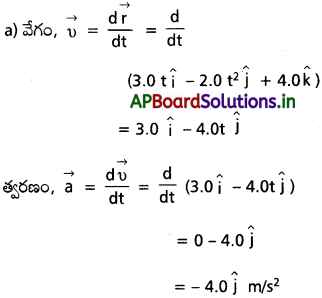
AP Inter 1st Year Physics Study Material Chapter 4 సమతలంలో చలనం 60
AP Inter 1st Year Physics Study Material Chapter 4 సమతలంలో చలనం 61
θ = 69.5° x-అక్షం క్రింద.

ప్రశ్న 21.
మూల బిందువు t = 0 వద్ద మొదలైన కణం 10.0 \(\hat{\mathbf{j}}\) m/s వేగంతో (8.0 \(\hat{\mathbf{i}}\) + 2.0\(\hat{\mathbf{j}}\)) ms-2 స్థిర త్వరణంతో x – y తలంపై కదులుతోంది. (a) ఏ కాలం దగ్గర కణం X -నిరూపకం 16 m అవుతుంది? అదే సమయం వద్దy-నిరూపకం ఎంత? (b) ఇదే సమయం దగ్గర కణం వడ్డి ఎంత?
జవాబు:
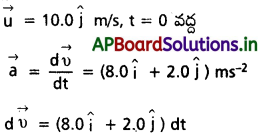
AP Inter 1st Year Physics Study Material Chapter 4 సమతలంలో చలనం 62
0 నుండి t అవధుల మధ్య వేగం u నుండి υ కి మారినది. దీనిని సమాకలనం చేయగా,
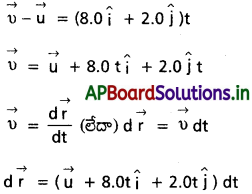
AP Inter 1st Year Physics Study Material Chapter 4 సమతలంలో చలనం 63
0 నుండి t అవధుల మధ్య స్థానభ్రంశం O నుండి r అయిన, సమాకలనం చేయగా
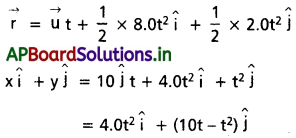
AP Inter 1st Year Physics Study Material Chapter 4 సమతలంలో చలనం 64
AP Inter 1st Year Physics Study Material Chapter 4 సమతలంలో చలనం 65

ప్రశ్న 22.
AP Inter 1st Year Physics Study Material Chapter 4 సమతలంలో చలనం 66

జవాబు:
మొదటి పద్ధతి :

AP Inter 1st Year Physics Study Material Chapter 4 సమతలంలో చలనం 67
AP Inter 1st Year Physics Study Material Chapter 4 సమతలంలో చలనం 68
AP Inter 1st Year Physics Study Material Chapter 4 సమతలంలో చలనం 69
AP Inter 1st Year Physics Study Material Chapter 4 సమతలంలో చలనం 70
AP Inter 1st Year Physics Study Material Chapter 4 సమతలంలో చలనం 71

ప్రశ్న 23.
అంతరాళంలో ఏదైనా యాదృచ్ఛిక చలనానికి కింద ఇచ్చిన ఏ సంబంధాలు ఒప్పు?
a) vaverage = (1/2) (v (t1) + v(t2))
b) vaverage = [r (t2) – r(t1)] / (t2 – t1)
c) v(t) = v(0) + a t
d) r (t) = r (0) + v(0) t + (1/2) a t²
e) aaverage = [v (t2) – v (t1)] / (t2 – t1)
(ఇక్కడ ‘average’ పదం t1 నుంచి t2 మధ్య ఉన్న కాలవ్యవధిలో ఆయా రాశుల సగటు విలువను తెలియచేస్తుంది.)
జవాబు:
(b) మరియు (e) సంబంధాలు సరియైనవి. (a), (c) మరియు (d) సంబంధాలు సరియైనవి కాదు, కారణం కేవలం ఏకరీతి త్వరణం.

AP Inter 1st Year Physics Study Material Chapter 4 సమతలంలో చలనం

ప్రశ్న 24.
కింది ప్రవచనాలను జాగ్రత్తగా చదివి కారణాలు, ఉదాహరణలలో తప్పొప్పులను వివరించండి. అదిశ రాశి అనేది
a) ఇచ్చిన ప్రక్రియలో నిత్యత్వమయ్యేది (conserved).
b) ఎప్పుడూ రుణ విలువలను తీసుకోదు.
c) మితులు ఉండవు.
d) అంతరాళంలో ఒక బిందువు నుంచి మరొక బిందువుకు దాని విలువ మారదు.
e) పరిశీలకులు వివిధ దిగ్విన్యాసాలతో కూడిన అక్షాలలో ఉన్నా దాని విలువ ఒకే విధంగా ఉంటుంది.
జవాబు:
a) తప్పు; అస్థితిస్థాపక అభిఘాతాలలో శక్తి నిత్యత్వం కాదు.

b) తప్పు; కారణం ఉష్ణోగ్రత రుణాత్మకం.

c) తప్పు; కారణం సాంద్రతకు మితులు కలవు.

d) తప్పు; అంతరాళంలో గురుత్వ స్థితిజశక్తి బిందువు, బిందువుకు మారును.

e) ఒప్పు; అదిశరాశి విలువ అక్షాలపై ఆధారపడి మారదు.

ప్రశ్న 25.
భూమికి 3400 m ఎత్తున ఒక విమానం ఎగురుతోంది. భూమిపై ఉన్న పరిశీలన బిందువు వద్ద ఆ విమానం 10.0 s కాల వ్యవధిలో 30° కోణం చేస్తే దాని వడి ఎంత?
జవాబు:
పటంలో ౦ పరిశీలన బిందువు. A మరియు B లు విమానం స్థానాలు. ∠AOB = 30°, AB పై OC లంబాన్ని గీయాలి. ఇక్కడ OC = 3400m. ∠AOC = ∠COB = 15°. విమానం A నుండి B పోవుటకు పట్టుకాలం 10sec.
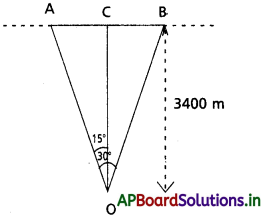
AP Inter 1st Year Physics Study Material Chapter 4 సమతలంలో చలనం 72
త్రిభుజం AOC నుండి, AC = OC tan 15°
= 3400 × 0.2679 = 910.86m
AC + CB = AC + AC = 2AC
= 2 × 910.86 m
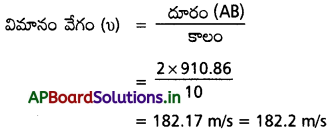
AP Inter 1st Year Physics Study Material Chapter 4 సమతలంలో చలనం 73

ప్రశ్న 26.
ఒక సదిశకు పరిమాణం, దిశ ఉన్నాయి. దానికి అంతరాళంలో స్థానం ఉంటుందా? అది కాలంతో మారుతుందా? అంతరాళంలో వివిధ స్థానాల దగ్గర ఉన్న రెండు సమాన సదిశలు a, b లు సర్వసమాన భౌతిక ప్రభావాలను చూపించవలసిన ఆవశ్యకత ఉందా? మీ సమాధానానికి మద్దతుగా ఉదాహరణల్విండి.
జవాబు:
i) అంతరాళంలో సదిశకు సాధారణంగా ఖచ్చితమైన స్థానం ఉండదు. అందుకు కారణం అంతరాళంలో దిశ మరియు పరిమాణం మారదు. కాబట్టి సదిశ ప్రభావితం కాదు. మొత్తం మీద, స్థాన సదిశ అంతరాళంలో ఒక ఖచ్చితమైన స్థానంలో ఉంటుంది.

ii) సదిశ కాలంతో మారుతుంది. ఉదా : త్వరణం చెందే కణం వేగ సదిశ కాలంతో మారుతుంది.

iii) అంతరాళంలో రెండు సమాన సదిశలు ఒకే భౌతిక ప్రభావాలను కలిగి ఉండవు. ఉదా : రెండు సమాన బలాలు వస్తువు యొక్క రెండు వేరు వేరు బిందువుల వద్ద పనిచేస్తే ఆ వస్తువు భ్రమణం చెందుతుంది.

ప్రశ్న 27.
ఒక సదిశకు పరిమాణం, దిశ ఉన్నాయి. అంటే దిశ, పరిమాణం ఉన్న ప్రతీది సదిశ కావలసిన ఆవశ్యకత ఉందా? వస్తువు భ్రమణాన్ని దాని భ్రమణాక్షం దిశ, భ్రమణ కోణంతో వ్యక్త పరచవచ్చు. అంటే ప్రతి భ్రమణం సదిశ అవుతుందా?
జవాబు:
లేదు. కొన్ని భౌతిక రాశులకు పరిమాణం మరియు దిశ రెండూ ఉంటాయి, కాని అవి సదిశలు కావు. సదిశ సంకలన నియమాలను పాటించవు. అక్షం పరంగా వస్తువు పరిమిత భ్రమణం చెందితే, ఇది సదిశా సంకలన నియమాలను పాటించదు. వస్తువు స్వల్ప భ్రమణం చెందితే, అది సదిశ అవుతుంది. ఇది సదిశా సంకలన నియమాలను పాటిస్తుంది.

ప్రశ్న 28.
క్రింది వాటితో సదిశలను జతచేయవచ్చా? వివరించండి.
(a) ఉచ్చు (loop) ఆకారంలో వంచిన తీగ పొడవు (b) ఒక తల వైశాల్యం (c) గోళం.
జవాబు:
a) తీగను వృత్తాకారంగా వంచితే, సదిశను పొడవుకు సహచర్యం చేయలేము.

b) సమతల వైశాల్యానికి సదిశను సహచర్యం చేయ వచ్చు. దీనిని వైశాల్య సదిశ అంటారు. దీని దిశను తలానికి లంబంగా బయటకు గీస్తారు.

c) గోళం యొక్క ఘనపరిమాణానికి సదిశను సహచర్యం చేయలేము. గోళం యొక్క వైశాల్యానికి సదిశను తెలపవచ్చు.

ప్రశ్న 29.
క్షితిజ సమాంతరానికి 30° కోణంతో పేల్చిన బుల్లెట్ 3.0 km దూరంలో భూమిని తాకింది. దాని ప్రక్షేపణ కోణాన్ని సరిచేసి 5.0km దూరంలో ఉన్న లక్ష్యాన్ని గురికొట్టవచ్చని ఎవరైనా ఆశించవచ్చా? వడి స్థిరం అని, గాలి నిరోధాన్ని ఉపేక్షించడమైంది అని అనుకోండి.
జవాబు:
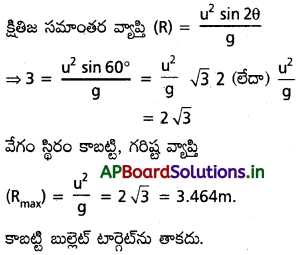
AP Inter 1st Year Physics Study Material Chapter 4 సమతలంలో చలనం 74

ప్రశ్న 30.
క్షితిజ సమాంతరంగా 1.5 km ఎత్తులో 720 km/h వడితో ఎగురుతున్న విమానం సరిగ్గా విమాన విధ్వంసక శతఘ్ని పై నుంచి వెళ్ళింది. నిట్టనిలువుతో ఏ కోణం చేస్తూ శతఘ్నిని వడి 600 ms-1 ఉండే విధంగా పేల్చితే గుండు విమానాన్ని ఢీకొడుతుంది? శతఘ్ని నుంచి వచ్చే గుండు విమానాన్ని తాకకూడదు అంటే పైలెట్ విమానాన్ని ఎంత కనిష్ఠ ఎత్తు నుంచి తీసుకువెళ్ళాలి? (g = 10ms గా తీసుకోండి).
జవాబు:
పటంలో తుపాకి స్థానం, A అనునది విమానం స్థానం,
విమానం వేగం υ = \(\frac{720\times1000}{60\times60}\) = 200m/s
తూటా వేగం (u) = 600 m/s
t కాలం తర్వాత తూటా B వద్ద విమానంను తాకింది అనుకొనుము.
θ అనునది క్షితిజ లంబంతో కోణం t కాలంలో తూటా ప్రయాణించిన క్షితిజ సమాంతర దూరం, విమానం ప్రయాణించిన దూరానికి సమానం.
ux × t = υt (లేదా) u sin θ t = υt
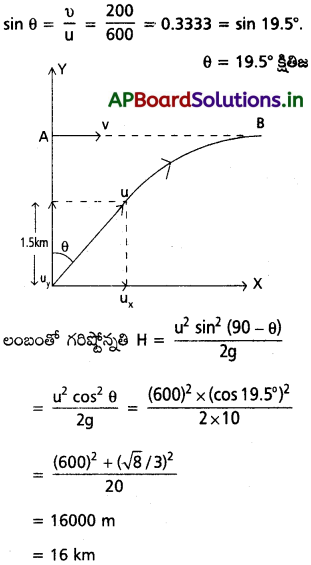
AP Inter 1st Year Physics Study Material Chapter 4 సమతలంలో చలనం 75

ప్రశ్న 31.
ఒక సైక్లిస్ట్ 27 km/h వడితో తొక్కుతున్నాడు. 80m వృత్తాకార వ్యాసార్థం ఉన్న వంపు ఉన్న రోడ్డును సమీపించినప్పుడు స్థిరమైన రేటుతో తన వడిని ప్రతీ సెకనుకు 0.50 m/s తగ్గేలా బ్రేకులు వేశాడు. వృత్తాకార వంపులో సైక్లిస్ట్ ఫలిత త్వరణం పరిమాణం, దిశ ఏమిటి?
జవాబు:
ఇక్కడ υ = 27 kmph = 27 × 1000 x
(60 × 60)-1 = 7.5 ms-1, r = 80m
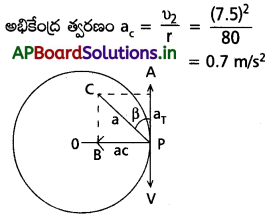
AP Inter 1st Year Physics Study Material Chapter 4 సమతలంలో చలనం 76
ఒక సైక్లిస్ట్ P వద్ద బ్రేకు వేస్తే, స్పర్శరేఖ త్వరణం aT
స్పర్శరేఖ వెంబడి త్వరణం, aT = 0.5 m/s
రెండు త్వరణాల మధ్యకోణం, 90°
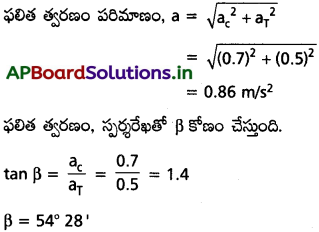
AP Inter 1st Year Physics Study Material Chapter 4 సమతలంలో చలనం 77

AP Inter 1st Year Physics Study Material Chapter 4 సమతలంలో చలనం

ప్రశ్న 32.
a) ప్రక్షేపక వస్తువు వేగం x- అక్షానికి మధ్య ఉండే కోణాన్ని కాలం (t) ప్రమేయంగా కింది విధంగా రాయవచ్చని నిరూపించండి.
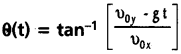
AP Inter 1st Year Physics Study Material Chapter 4 సమతలంలో చలనం 78
b) మూల బిందువు నుంచి ప్రయోగించిన ప్రక్షేపకం ప్రక్షేపణ కోణం కింది విధంగా ఉంటుందని నిరూపించండి.
θ 0 = tan-1(\(\frac{4h_{m}}{R}\))
పై సమీకరణంలో ఉపయోగించిన సంకేతాలు తమ తమ అర్థాలను కలిగి ఉన్నాయి.
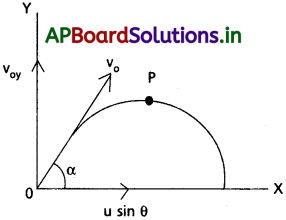
AP Inter 1st Year Physics Study Material Chapter 4 సమతలంలో చలనం 79
జవాబు:
a) బిందువు వద్ద OX మరియు OY దిశలలో ప్రక్షేపకం తొలివేగం అంశాలు υox మరియు υoy అనుకొనుము. ప్రక్షేపకం t కాలంలో నుండి P కి వెళ్ళినది అనుకొనుము. క్షితిజ సమాంతర మరియు క్షితిజ లంబ దిశలలో P వద్ద ప్రక్షేపకం వేగాలు υx, υy అనుకొనుము.

υy = υoy − gt మరియు υx = υox

ఫలితవేగం \(\overrightarrow{υ}\) క్షితిజ సమాంతర దిశతో చేయు కోణం θ అనుకొనుము.
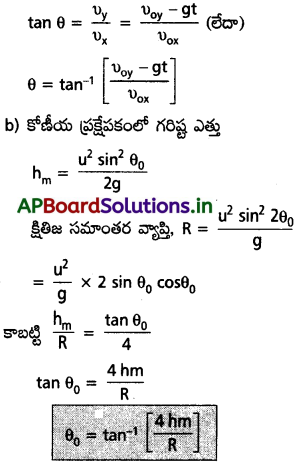
AP Inter 1st Year Physics Study Material Chapter 4 సమతలంలో చలనం 80

సాధించిన సమస్యలు (Solved Problems)

ప్రశ్న 1.
35 ms-1 వడితో వాన నిట్టనిలువుగా పడుతోంది. కొంతసేపటి తరువాత 12 ms-1 వడితో గాలి తూర్పు నుంచి పడమర దిశగా వీచడం ప్రారంభించింది. బస్టాప్లో వేచి ఉన్న బాలుడు మీద వాన పడకూడదు అంటే గొడుగును ఏ దిశలో పట్టుకోవాలి?
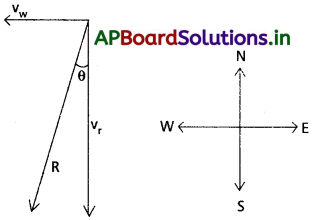
AP Inter 1st Year Physics Study Material Chapter 4 సమతలంలో చలనం 81
జవాబు:
పటంలో వాన, గాలి వేగ సదిశలను వరసగా vr, vw లతో సమస్యలో ఇచ్చిన దిశలో చూపించడమైంది. సదిశల సంకలన నియమం ద్వారా vr, vw ల ఫలిత సదిశ R పటంలో చూపిన విధంగా ఉంటుంది. R పరిమాణాన్ని కింది విధంగా లెక్కించవచ్చు.

AP Inter 1st Year Physics Study Material Chapter 4 సమతలంలో చలనం 82
నిట్టనిలువుతో ఫలిత సదిశ R చేసే కోణం θ ను కింది విధంగా రాయవచ్చు.
tan θ = \(\frac{v_w}{v_r}=\frac{12}{35}\) = 0.343
లేదా, θ = tan-1(0.343) = 19°
కాబట్టి, నిట్టనిలువు తలంలో తూర్పుదిశకు 19° చేసే విధంగా గొడుగు పట్టుకొని నిలబడాలి.

ప్రశ్న 2.
సదిశలు A, B ల ఫలిత సదిశ పరిమాణం, దిశను ఆ సదిశల పరిమాణం, వాటి మధ్య కోణం θ లలో వ్యక్తపరచండి.
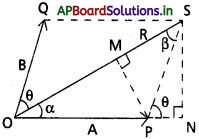
AP Inter 1st Year Physics Study Material Chapter 4 సమతలంలో చలనం 83
జవాబు:
OP, OQ రేఖలు రెండు సదిశలు A, B లను వాటి మధ్య కోణం θ తో సూచిస్తున్నాయనుకొందాం. సమాంతర చతుర్భుజ సదిశా సంకలన పద్ధతి ప్రకారం OS ఫలిత సదిశ R ను ఇస్తుంది.
R = A + B
SN, OP కి గీచిన లంబరేఖ, అలాగే OS పైకి గీచిన లంబరేఖ PM.
పటం నుంచి
OS² = ON² + SN²
కానీ ON = OP + PN = A + B cos θ
SN B sin θ
OS² = (A + B cos θ)² + (B sin θ)²
లేదా R² = A² + B² + 2AB cos θ

AP Inter 1st Year Physics Study Material Chapter 4 సమతలంలో చలనం 84
∆ OSN నుంచి SN = OS sin α = R sin α ∆ PSN
నుంచి SN = PS sin θ = B sin θ
కాబట్టి, R sin α = B sin θ
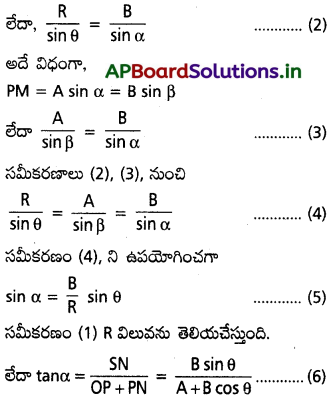
AP Inter 1st Year Physics Study Material Chapter 4 సమతలంలో చలనం 85

సమీకరణం(1) ఫలిత సదిశ పరిమాణాన్ని, సమీకరణాలు. (5), (6) లు దాని దిశను ఇస్తాయి. సమీకరణం (1) ని కొసైన్ల న్యాయం (Law of cosines) అని, సమీకరణం (4) ని సైన్ల న్యాయం (Law of sines) అంటారు.

AP Inter 1st Year Physics Study Material Chapter 4 సమతలంలో చలనం

ప్రశ్న 3.
ఒక మోటారు బోటు ఉత్తర దిశవైపు 25 km/h వేగంతో దూసుకుపోతోంది. అక్కడ నీటి సాధన. v(t) ప్రవాహం 10 km/h వేగం కలిగి దక్షిణం దిశతో 60° కోణం చేస్తూ తూర్పువైపుకు ఉంది. బోటు ఫలిత వేగాన్ని కనుక్కోండి.
జవాబు:
మోటారు బోటు వేగాన్ని vb తో, నీటి ప్రవాహ వేగాన్ని vc తో సమస్యలో ఇచ్చిన దిశలలో పటంలో చూపించడ మైంది. సమాంతర చతుర్భుజ సంకలన నియమం ప్రకారం ఫలిత సదిశ దిశ పటంలో చూపించిన విధంగా ఉంటుంది. కొసైన్ల న్యాయం ప్రకారం R పరిమాణాన్ని కింది విధంగా రాబట్టవచ్చు.
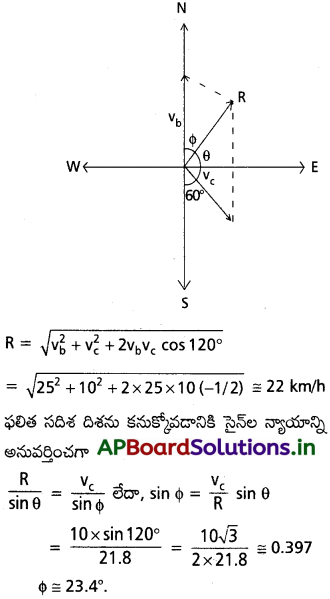
AP Inter 1st Year Physics Study Material Chapter 4 సమతలంలో చలనం 86

ప్రశ్న 4.
ఒక కణం స్థానాన్ని 3.ot\(\hat{\mathbf{i}}\) + 2.ot² \(\hat{\mathbf{j}}\) + 5.0\(\hat{\mathbf{k}}\) సూచిస్తుంది. ఇక్కడ t సెకనులలో, మీటర్లలో ఉండే విధంగా గుణకాలు సరైన ప్రమాణాలను కలిగి ఉన్నాయి. కణం యొక్క (a) v(t), a(t) లను కనుక్కోండి. (b) t = 1.0 s వద్ద v(t) పరిమాణం, దిశను కనుక్కోండి.
జవాబు:
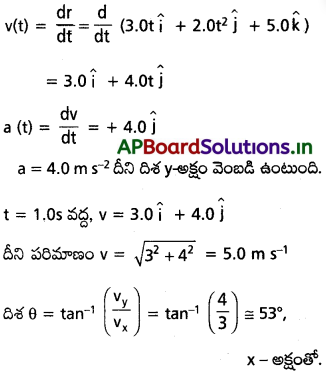
AP Inter 1st Year Physics Study Material Chapter 4 సమతలంలో చలనం 87

ప్రశ్న 5.
కాలం t = 0 వద్ద మూల బిందువు దగ్గర నుంచి బయలుదేరిన కణం 5.0\(\hat{\mathbf{i}}\)m/s వేగంతో x-y తలంలో ప్రయోగించిన బలం వల్ల స్థిర త్వరణం (3.0\(\hat{\mathbf{i}}\) + 2.0\(\hat{\mathbf{j}}\) ) m/s² పొంది చలిస్తుంది. x – నిరూపకం 84m అయినప్పుడు కణం y– నిరూపకం ఎంత? ఈ కాలం వద్ద కణం వడి ఎంత?
జవాబు:
కణం స్థానాన్ని కింది విధంగా రాయవచ్చు.
r(t) = vot + \(\frac{1}{2}\) at²
= 5.0\(\hat{\mathbf{i}}\) +(1/2) (3.0\(\hat{\mathbf{i}}\) +2.0\(\hat{\mathbf{j}}\)) t²
(5.0t + 1.5t²) \(\hat{\mathbf{i}}\) + 1.0t² \(\hat{\mathbf{i}}\)
కాబట్టి, x(t) = 5.0t + 1.5 t²
y (t) = + 1.0t²
x(t) = 84m గా ఇచ్చారు. అప్పుడు t = ?
5.0 t + 1.5 t² = 84 ⇒ t = 6 s
t = 6 s అయినప్పుడు, y = 1.0 (6)² = 36.0 m
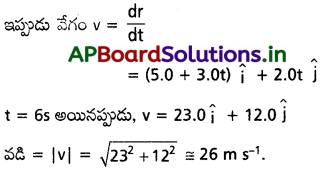
AP Inter 1st Year Physics Study Material Chapter 4 సమతలంలో చలనం 88

ప్రశ్న 6.
వాన నిట్టనిలువుగా 35 ms-1. వడితో పడుతోంది. ఒక మహిళ 12ms-1 వేగంతో తూర్పు నుంచి పశ్చిమ దిశలో సైకిల్పై వెళుతుంది. ఆమె ఏ దిశలో గొడుగును పట్టుకోవాలి?
జవాబు:
పటంలో vr వాన వేగాన్ని vb, మహిళ తొక్కుతున్న సైకిల్ వేగాన్ని సూచిస్తాయి. ఈ రెండు వేగాలు కూడా భూమి దృష్ట్యానే. మహిళ సైకిల్ తొక్కుతుంది. కాబట్టి, ఆమె దృష్ట్యా
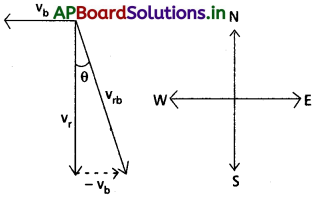
AP Inter 1st Year Physics Study Material Chapter 4 సమతలంలో చలనం 89

వాన వేగం, అంటే సైకిల్ వేగానికి సాపేక్షంగా వాన వేగం అని అర్థం. అంటే vrb = vr – Vb.
ఈ సాపేక్ష వేగం సదిశ పటంలో చూపినట్లు నిట్టనిలువుతో θ కోణం చేస్తుంది.
tan θ = \(\frac{v_b}{v_r}=\frac{12}{35}\) = 0.343
లేదా θ ≅ 19°
అంటే మహిళ పడమర దిశలో నిట్టనిలువుతో 19° కోణం చేస్తూ గొడుగును పట్టుకోవాలి.

AP Inter 1st Year Physics Study Material Chapter 4 సమతలంలో చలనం

ప్రశ్న 7.
గెలీలియో (Galileo) తన పుస్తకం Two new sciences లో ఈ విధంగా రాశాడు 45° ఇరు వైపులా సమానస్థాయిలో ఎక్కువ లేదా తక్కువ ఉన్నత అంశాల వ్యాప్తి సమానం. దీన్ని నిరూపించండి.
జవాబు:
తొలివేగం v0 తో θ0 కోణంతో ప్రక్షిప్తం చేసిన వస్తువు వ్యాప్తి
R = \(\frac{v_0^2 \sin 2 \theta_0}{g}\)

కోణాలు (45° + α), (45° – α), లకు θ0 విలువ వరసగా (90° + 2α), (90° – 2α) అవుతుంది. sin (90° + 2α), sin (90° – 2α), ల విలువలు సమానం. ఆ విలువ cos 2α కు సమానం కాబట్టి ఉన్నతాంశాలు (elevations) 45° కోణానికి (సమాన స్థాయి α తో) ఎక్కువ లేదా తక్కువ అయినా వ్యాప్తులు సమానంగా ఉంటాయి.

ప్రశ్న 8.
భూమికి 490 m ఎత్తున ఉన్న శిఖరం పై నుంచి ఒక పర్వతారోహకుడు రాయిని 15ms-1 తొలి వేగంతో క్షితిజ సమాంతరంగా విసిరాడు. గాలి నిరోధాన్ని ఉపేక్షించి, రాయి నేలను తాకేందుకు పట్టే కాలాన్ని, అది నేలను తాకే వేగాన్ని కనుక్కోండి. (g = 9.8m s-2 గా తీసుకోండి).
జవాబు:
శిఖర శీర్షాన్ని మూల బిందువుగా తీసుకొని x, y – అక్షాలను ఊహించండి. రాయిని t = 0 s వద్ద విసిరాడు అనుకొందాం. తొలి వేగం దిశలో ధన x అక్షం దిశ, నిట్టనిలువు ఊర్ధ్వ దిశలో ధన y అక్షం దిశ ఉందను కొందాం. x−, y– చలన అంశాలను స్వతంత్ర అంశాలుగా పరిగణించవచ్చు. ఇప్పుడు చలన సమీకరణాలు :
x (t) = x0 + υ0xt
y (t) = y0 + υ0y t + (1/2) ay t²
ఇక్కడ, x0 = y0 = 0, υ0y = 0, ay = -g = -9.8ms-2,
υ0x = 15 ms-1.
y(t) = – 490 m అయినప్పుడు రాయి నేలను తాకుతుంది.
– 490 m = – (1/2) (9.8) t².
సాధించగా, t = 10 s
వేగాంశాలు υx = υ0x,
υy = υ0y – g t
రాయి నేలను తాకే సందర్భంలో :
υ0x = 15 m s-1
υ0y= 0 – 9.8 × 10 = – 98 ms-1
కాబట్టి, నేలను రాయి తాకే వడి

AP Inter 1st Year Physics Study Material Chapter 4 సమతలంలో చలనం 90

ప్రశ్న 9.
క్షితిజ సమాంతరంతో 30° కోణం చేస్తూ ఒక క్రికెట్ బంతిని 28 m s-1 వేగంతో విసిరారు. కింది వాటిని లెక్కించండి. (a) గరిష్ఠ ఎత్తు, (b) బంతి తిరిగి అదే స్థాయికి రావడానికి పట్టే కాలం, (c) బంతి విసిరిన స్థానం నుంచి బంతి తిరిగి అదే స్థాయికి చేరిన స్థానానికి మధ్య దూరం.
జవాబు:
a) గరిష్ఠ ఎత్తు
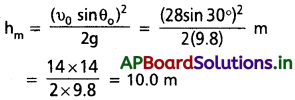
AP Inter 1st Year Physics Study Material Chapter 4 సమతలంలో చలనం 91
b) బంతి తిరిగి అదే స్థాయికి రావడానికి పట్టిన కాలం
Tf = (2υ0sin θ0)/g = (2 × 28 × sin30°)/9.8 = 28 / 9.8 s = 2.9 s
బంతి విసిరిన స్థానం నుంచి తిరిగి అదే స్థాయికి చేరిన స్థానానికి మధ్య దూరం

AP Inter 1st Year Physics Study Material Chapter 4 సమతలంలో చలనం 92

AP Inter 1st Year Physics Study Material Chapter 4 సమతలంలో చలనం

ప్రశ్న 10.
12 cm వ్యాసార్ధం ఉన్న వృత్తాకార గాడి (circular groove) లో ఇరుక్కొన్న కీటకం 100 s కాలంలో నిలకడగా 7 పరిభ్రమణాలు పూర్తి చేసింది. (a) కీటకం కోణీయ వడి; రేఖీయ వడి ఎంత? (b)త్వరణం సదిశ స్థిర సదిశేనా? దాని పరిమాణం ఎంత?
జవాబు:
ఏకరీతి వృత్తాకార చలనానికి ఇది ఒక ఉదాహరణ.
ఇక్కడ R = 12 cm. కోణీయ వడి దాని ఇలా రాయవచ్చు.
ω = 2π/T = 2π × 7/100 = 0.44 rad/s
రేఖీయ వడి υ :
υ = ωR = 0.44-1 × 12 cm = 5.3 cm s-1

వేగ సదిశ υ వృత్తంపై ప్రతీ బిందువు వద్ద స్పర్శరేఖ దిశలో ఉంటుంది. త్వరణం వృత్తకేంద్రం వైపు ఉంటుంది. ఇక్కడ త్వరణం దిశ నిరంతరం మారుతుంది. కాబట్టి స్థిర సదిశ కాదు. త్వరణం పరిమాణం మాత్రం స్థిరం.
a = ω²R = (0.44 s-1)² (12 cm)
= 2.3 cm s-2

AP Board 7th Class Maths Solutions Chapter 6 Simple Equations Unit Exercise

SCERT AP 7th Class Maths Solutions Pdf Chapter 6 Simple Equations Unit Exercise Questions and Answers.

AP State Syllabus 7th Class Maths Solutions 6th Lesson Simple Equations Unit Exercise

Question 1.
Runs made by two batsmen in 3 matches are given below.
Kohli: 49, 98, 72
Rohit: 64, 45, 83, then find the average of runs scored by Kohli and Rohit. Whose average is higher?
Answer:
Given runs made by Kohli: 49, 98, 72.
Average runs of Kohli = \(\frac{\text { Sum of the observations }}{\text { Number of observations }}\) = \(\frac{49+98+72}{3}\) = \(\frac{219}{3}\) = 73
Runs made by Rohit: 64, 45, 83.
Average runs of = \(\frac{64+45+83}{3}\)
= \(\frac{192}{3}\)= 64
73 > 64.
Kohli average is higher than Rohit.

Question 2.
Find mode of 38, 42, 35, 37, 45, 50, 32, 43, 43, 40, 36, 38, 43, 36 and 47. Verify whether it is Unimodal or Bimodal data.
Answer:
Given data : 38, 42, 35, 37, 45, 50, 32, 43, 43, 40, 36, 38, 43, 38, 47.
Arrange the given observations in ascending order.
AP Board 7th Class Maths Solutions Chapter 6 Data Handling Unit Exercise 1
As 38 and 43 occurs most frequently than other observations in the data.
∴ Mode = 38 and 43.
So, given data is Bimodal data.

Question 3.
The temperature in different places are 0, – 5, 7, 10, 13, – 1 and 41 in degree Celsius. Find the Median. If another observation, ‘4°C’ is added to the given data, is there any change in value of Median ? Explain.
Answer:
Given data : 0, – 5′, 7, 10, 13, – 1, 41.
Arrange the given observations in ascending order.
AP Board 7th Class Maths Solutions Chapter 6 Data Handling Unit Exercise 3
In seven observations the fourth observation 7 is the middle most value.
∴ Median = 7 .
If 4°C is added to the given data,
0, – 5, 7, 10, 13, – 1, 41 and 4.
Arrange the given observations in ascending order.
AP Board 7th Class Maths Solutions Chapter 6 Data Handling Unit Exercise 2
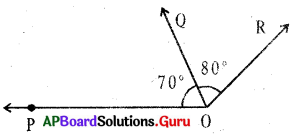
In eight observations the fourth and fifth observations 4 and 7 are the middle most values in the data.
Median = Average of the two middle most values.
= \(\frac{4+7}{2}\) = \(\frac{11}{2}\) = 5.5
So, if we added a new observation, then the median also changed (decreased). Median is decreased from 7 to 5.5.

Question 4.
If the range of observation 7x, 5x, 3x, 2x, x (x > 0) is 12, then find value of ‘x’ and express all the observations in numerical form.
Answer:
Given data.: 7x, 5x, 3x, 2x, x (x > 0) and Range = 12.
Maximum value = 7x; Minimum value = x
Range = Maximum value – Minimum value
= 7x – x – 12
⇒ 6x = 12 ⇒ \(\frac{6 x}{6}\) = \(\frac{12}{6}\)
∴ x = 12

Question 5.
Birth and death rates of different states in 2015 are given below. Approximately draw a double bar graph for the given data.
AP Board 7th Class Maths Solutions Chapter 6 Data Handling Unit Exercise 4
Answer:
AP Board 7th Class Maths Solutions Chapter 6 Data Handling Unit Exercise 5

Question 6.
The following data relates to the cost of construction of a house.
AP Board 7th Class Maths Solutions Chapter 6 Data Handling Unit Exercise 6
Draw a Pie diagram to represent the above data.
Answer:
The angle of each sector will depend on the ratio between the number of students each item and total expenditure (%).
Angle of sector = \(\frac{\text { Value of the item }}{\text { Sum of the value of all items }}\) × 360°

AP Board 7th Class Maths Solutions Chapter 6 Data Handling Unit Exercise 7

Steps of construction:
AP Board 7th Class Maths Solutions Chapter 6 Data Handling Unit Exercise 8

  1. Draw a circle with any convenient radius and mark it’s centre as ‘O’.
  2. Mark a point A, somewhere on the circumference and join OA.
  3. Construct ∠AOB = 108° to represent angle of the sector of Cement.
  4. Construct ∠BOC = 36° to represent angle of the sector of Steel.
  5. Construct ∠COD = 36° to represent angle of the sector of Bricks.
  6. Construct ∠DOE = 54° to represent angle of the sector of Timber.
  7. Construct ∠EOF = 72° to represent angle of the sector of Labour.
  8. Now ∠FOA = 54° to represent angle of the sector of Miscellaneous.

AP Board 7th Class Maths Solutions Chapter 6 Data Handling Ex 6.4

SCERT AP 7th Class Maths Solutions Pdf Chapter 6 Data Handling Ex 6.4 Textbook Exercise Questions and Answers.

AP State Syllabus 7th Class Maths Solutions 6th Lesson Data Handling Ex 6.4

Question 1.
In the adjacent Double bar graph, the number of students of a class is shown according to the academic year.
Answer the following questions on the basis of this Double bar graph,
AP Board 7th Class Maths Solutions Chapter 6 Data Handling Ex 6.4 1

(i) In which academic year, number of girls wrere more than number of boys in the school ?
Answer:
In the year 2016-17 number of girls were more than number of boys in the school.

AP Board 7th Class Maths Solutions Chapter 6 Data Handling Ex 6.4

(ii) In which academic year, number of both girls and boys in the school were equal ?
Answer:
In the year 2015-16 number of bot.fi’ girls and boys in the school were equal.

(iii) What was the total number of students in the school in the academic year 2013-14 ?
Answer:
In the academic year 2013-14
Number of boys = 70
Number of girls = 50 .
AP Board 7th Class Maths Solutions Chapter 6 Data Handling Ex 6.4 2
Total = 120
Total number of students in the school in the academic year 2013-14 is 120.

Question 2.
The marks in Mathematics and Science of five students of class 7 are given in the table. Exhibit these by the vertical double bar graph by given information.
AP Board 7th Class Maths Solutions Chapter 6 Data Handling Ex 6.4 3
Answer:
AP Board 7th Class Maths Solutions Chapter 6 Data Handling Ex 6.4 4

AP Board 7th Class Maths Solutions Chapter 6 Data Handling Ex 6.4

Question 3.
The adjacent Pie chart gives the expenditure on various items during a month for a family. In the figure angles made by each sector at the center are given then answer the following : i) If the expenditure on rent is ?3000, then how much amount they saved ?
AP Board 7th Class Maths Solutions Chapter 6 Data Handling Ex 6.4 5
Answer:
Angle of sector on Rent = 90°
Angle of sector on Savings = 90°
Angle of sectors are equal. So, their amounts are also equal. Expenditure on rent is ₹3000.

(ii) On which item the expenditure is minimum ?
Answer:
Smallest angle of sector on Education is the item of expenditure is minimum.
So, expenditure on education is minimum.

(iii) On which item the expenditure is maximum ?
Answer:
Largest angle of sector on Food is the item of expenditure is maximum.
So, expenditure on food is maximum.

AP Board 7th Class Maths Solutions Chapter 6 Data Handling Ex 6.4

Question 4.
The following data shows the number of students opting different subjects in college.
AP Board 7th Class Maths Solutions Chapter 6 Data Handling Ex 6.4 6
Construct a Pie diagram to represent the above data.
Answer:
The angle of each sector will depend on the ratio between the number of students each subject and total number of students.
Angle of sector = \(\frac{\text { Value of the item }}{\text { Sum of the values of all items }}\) × 360°

AP Board 7th Class Maths Solutions Chapter 6 Data Handling Ex 6.4 7

Steps of construction:

AP Board 7th Class Maths Solutions Chapter 6 Data Handling Ex 6.4 8

  1. Draw a circle with any convenient radius and mark it’s centre as ‘O’.
  2. Mark a point A, somewhere on the circumference and join OA.
  3. Construct ∠AOB = 90° to represent angle of the sector of Botany.
  4. Construct ∠BOC = 120° to represent angle of the sector of Mathematics.
  5. Construct ∠COD = 40° to represent angle of the sector of Physics.
  6. Construct ∠DOE = 60° to represent angle of the sector of Chemistry.
  7. Construct ∠EOF = 20° to represent angle of the sector of Economics.
  8. Now ∠FOA = 30° to represent angle of the sector of Commerce.

AP Board 7th Class Maths Solutions Chapter 6 Data Handling Ex 6.3

SCERT AP 7th Class Maths Solutions Pdf Chapter 6 Data Handling Ex 6.3 Textbook Exercise Questions and Answers.

AP State Syllabus 7th Class Maths Solutions 6th Lesson Data Handling Ex 6.3

Question 1.
Find the Median of the following:
(i) 7, 3, 15, 0, 1, 71, 19, 4, 17.
Answer:
Given data: 7, 3, 15. 0, 1, 71, 19, 4, 17.
Arrange the given observations in ascending order.
AP Board 7th Class Maths Solutions Chapter 6 Data Handling Ex 6.3 1
In nine observations the fifth observation 7 is the middle most value.
∴ Median = 7

AP Board 7th Class Maths Solutions Chapter 6 Data Handling Ex 6.3

(ii) 12, 23, 11, 18, 15, 20, 86, 27.
Answer:
Given data : 12, 23, 11, 18, 15, 20, 86, 27.
Arrange the given observations in ascending order:
AP Board 7th Class Maths Solutions Chapter 6 Data Handling Ex 6.3 2
In eight observations the 4th and 5th observations are 18 and 20.
Here, we have two middle most values 18 and 20.
Median = Average of the two middle most values.
= \(\frac{18+20}{2}\) = \(\frac{38}{2}\) = 19
∴ Median of the data = 19.

Question 2.
The number of pages in text books of different subjects are 421, 175, 128, 117, 150, 145, 147 and 113 find median of given data.
Answer:
Given data : 421, 175, 128, 117, 150, 145, 147, 113
Arrange the given observations in ascending order
AP Board 7th Class Maths Solutions Chapter 6 Data Handling Ex 6.3 3
In eight observations the 4th and 5th observations are 145 and 147.
Here, we have two middle most values 145 and 147.
Median = Average of the two middle most values
= \(\frac{145+147}{2}\) = \(\frac{292}{2}\) = 146
∴ Median of the data = 146.

Question 3.
The weekly sales of motor bikes in a showroom for the past 14 weeks are 10, 6, 8, 3, 5, 6, 4, 7, 12, 13, 16, 10, 4 and 7. Find the Median of the data.
Answer:
Given data: 10, 6, 8, 3, 5, 6, 4, 7, 12, 13, 16, 10, 4, 7
Arrange the given observations in ascending order.
AP Board 7th Class Maths Solutions Chapter 6 Data Handling Ex 6.3 4
In fourteen observations the 7th and 8th observations are 7 and 7.
Here we have two middle most values 7 and 7.
Median = Average of the two middle most values
= \(\frac{7+7}{2}\) = \(\frac{14}{2}\) = 7
∴ Median of the data = 7

AP Board 7th Class Maths Solutions Chapter 6 Data Handling Ex 6.3

Question 4.
Find the Median of 0.3, 0.25, 0.32, 0.147, 0.19, 0.2 and 7.1.
Answer:
Given data: 0.3, 0.25, 0.32, 0.147, 0.19, 0.2, 7.1.
Arrange the given observations in ascending order.
AP Board 7th Class Maths Solutions Chapter 6 Data Handling Ex 6.3 5
In seven observations the 4th observation 0.25 is the middle most value.
∴ Median. = 0.25

Question 5.
If the Median of observations 2x, 3x, 4x, 5x, 6x, (x > 0) is 28, then find the value of ‘x’.
Answer:
Given data : 2x, 3x, 4x, 5x, 6x and median is 28.
Data is arranged in the ascending order
AP Board 7th Class Maths Solutions Chapter 6 Data Handling Ex 6.3 6
In five observations the third observation 4x is the middle most value. .
∴ Median – 4x = 28
⇒ \(\frac{4 x}{4}\) = \(\frac{28}{4}\) = 7
∴ x = 7

AP Board 7th Class Maths Solutions Chapter 5 Triangles InText Questions

SCERT AP 7th Class Maths Solutions Pdf Chapter 5 Triangles InText Questions and Answers.

AP State Syllabus 7th Class Maths Solutions 5th Lesson Triangles InText Questions

Check Your Progress [Page No. 92]

Question 1.
Classify the following triangles according to the length of their sides:
AP Board 7th Class Maths Solutions Chapter 5 Triangles InText Questions 1
Answer:
AP Board 7th Class Maths Solutions Chapter 5 Triangles InText Questions 2

[Page No. 93]

Question 2.
Classify the following triangles according to the measure of their angles.
AP Board 7th Class Maths Solutions Chapter 5 Triangles InText Questions 3
Answer:
AP Board 7th Class Maths Solutions Chapter 5 Triangles InText Questions 4

Let’s Think [Page No. 97]

Question 1.
Can you find a triangle in which each angle is less than 60°?
Answer:
Sum of angles in a triangle is 180°.
If each angle is less than 60°, then the sum of angles of a triangle is < 180°. So, triangle cannot form. So, we cannot find a triangle in which each angle is less than 60°.

AP Board 7th Class Maths Solutions Chapter 5 Triangles InText Questions

Check Your Progress [Page No. 99]

Question 1.
Find the value of ‘x’ in the given figure.
AP Board 7th Class Maths Solutions Chapter 5 Triangles InText Questions 5
Answer:
In the given figure,
∠HAC = ∠TAE = a (∵ Vertically opposite angles)
In ∆AHC,
we know, ∠H + ∠C + ∠HAC 180°
⇒ 60° + 80° + a = 180°
⇒ 140° + a – 140° = 180°- 140° … a = 40°.
∴ ∠HAC = ∠TAE = a = 40°

In ∆ATE, we know,
∠T + ∠TAE + ∠E = 180°
⇒ x + a + 70° = 180°
⇒ x + 40° + 70° = 180°
⇒ x + 110°- 110° = 180°- 110°
∴ x = 70°

Let’s Do Activity [Page No. 101]

Question 1.
Measure the length of the sides of ∆ABC and fill the following table.
AP Board 7th Class Maths Solutions Chapter 5 Triangles InText Questions 6
Answer:
AP Board 7th Class Maths Solutions Chapter 5 Triangles InText Questions 7
From the above table, we can conclude that the sum of the lengths of any two sides of a triangle is greater than the length of the third side.

Question 2.
Take the same measurements of the previous activity and note the results as given below.
Answer:
AP Board 7th Class Maths Solutions Chapter 5 Triangles InText Questions 8
From the above table we can conclude that the difference of the lengths of any two sides of a triangle is less than the length of the third side.

Question 3.
AP Board 7th Class Maths Solutions Chapter 5 Triangles InText Questions 9
Fill the following table as per measurements given in the above triangles:
AP Board 7th Class Maths Solutions Chapter 5 Triangles InText Questions 10
What do you observe from the last four columns in above table ?

  • In any triangle the opposite side to the biggest angle is bigger than the other two sides.
  • In any triangle the opposite side to the smallest angle is smaller than the other two sides.

Answer:
AP Board 7th Class Maths Solutions Chapter 5 Triangles InText Questions 11

Let’s Think [Page No. 102]

Question 1.
What are the measurements of angles of an equilateral triangle?
Answer:
AP Board 7th Class Maths Solutions Chapter 5 Triangles InText Questions 12
In ∆ADI
AD = DI – AI = 6 cm (All angles are equal)
∠A = ∠D = ∠I = 60° (All angles are equal)
So, in an equilateral triangle,

All Sides are equal in length. Each angle is equal to 60°.

AP Board 7th Class Maths Solutions Chapter 5 Triangles InText Questions

Puzzle Time [Page No. 104]

Question 1.
Find the interior angles of all triangles by using given dues.
AP Board 7th Class Maths Solutions Chapter 5 Triangles InText Questions 13
Answer:
AP Board 7th Class Maths Solutions Chapter 5 Triangles InText Questions 14
Hints:
Each angle in an equilateral triangle is 60°.
Straight angle = 180°
In an isosceles triangle, two angles are equal.
In a scalene triangle all angles are unequal.
Right angle = 90°.
Obtuse angle > 90°.

Examples:

Question 1.
In a triangle, two angles are 43° and 57°. Find the third angle.
Answer:
Given two angles of a triangle are 43° and 57°.
Sum of these two angles = 43° + 57° = 100°
In a triangle the sum of the interior angles is 180°.
∴ Third angle = 180° – 100° = 80°

Question 2.
Find the value of ‘x’ in the following triangles :
AP Board 7th Class Maths Solutions Chapter 5 Triangles InText Questions 15
Answer:
From the figure
∠A + ∠B + ∠C = 180° (v Sum of three angles in triangle is 180°)
⇒ 65° + 60° + x = 180°
⇒ 125° + x = 180°
∴ x =180°- 125° = 55°

AP Board 7th Class Maths Solutions Chapter 5 Triangles InText Questions 16
Answer:
From the figure
∠P + ∠Q + ∠R = 180°
x + x + 80° = 180°
⇒ 2x + 80° = 180°
⇒ 2x = 180°-80°
⇒ 2x = 100°
⇒ x = \(\frac{100^{\circ}}{2}\) = 50°
∴ x = 50°

AP Board 7th Class Maths Solutions Chapter 5 Triangles InText Questions 17
Answer:
From the figure
∠X + ∠Y + ∠Z – 180°
⇒ x + 90° + 42° = 180°
⇒ x + 132° = 180°
⇒ x = 180°- 132°
∴ x = 48°

Question 3.
Find the values of x and y in the given triangle.
AP Board 7th Class Maths Solutions Chapter 5 Triangles InText Questions 18
Answer:
In the ∆ABC
∠ACD + ∠ACB = 180° (linear pair of angles)
110° + y = 180°
⇒ y = 180°- 110°
∴ y = 70° ……………….(i)

∠BAC + ∠ACB + ∠CBA = 180°
⇒ x + y + 60° = 180°
⇒ x + 70° + 60° = 180° (From (i))
⇒ x + 130° = 180°
∴ x = 50°

AP Board 7th Class Maths Solutions Chapter 5 Triangles InText Questions

Question 4.
In a right angled triangle one acute angle is 44°, then find the other acute angle.
Answer:
We know that, sum of the two acute angles in a right angled triangle is 90°.
Given that, in the right angled tri-angle one of the acute angles = 44°
Other acute angle in right angled triangle = 90° – 44° = 46°

Question 5.
The angles of a triangle are (x + 10)°, (x – 20)° and (x + 40)°. Find the value of x and the measure of the angles.
Answer:
Given that the angles of the triangle are
(x + 10)°, (x – 20)° and (x + 40)°
(x + 10)° + (x – 20)° + (x + 40)° = 180°
⇒ x + 10° + x – 20° + x + 40° = 180°
⇒ 3x + 30° = 180°
⇒ 3x – 180° – 30°
⇒ 3x = 150°
⇒ x = \(\frac{150^{\circ}}{3}\) = 50°

The angles are,
x + 10° = 50° + 10° = 60°
x – 20° = 50° – 20° = 30°
x + 40° = 50° + 40° = 90°
∴ Measure of the angles are 60°, 30° and 90°.

Question 6.
In the ∆ABC, exterior angle at ∠C = 105° and ∠A=65°. Find the other interior opposite angle.
Answer:
Given that, exterior angle at ∠C = 105°.
One of the interior opposite angle ∠A = 65°.

The other interior opposite angle is ∠B .
∠A + ∠B =105°(∵ Exterior angle property of a triangle)
65° + ∠B = 105°
⇒ ∠B = 105° – 65° = 40°

Question 7.
Find the exterior angle of the given triangle.
Answer:
AP Board 7th Class Maths Solutions Chapter 5 Triangles InText Questions 19
From the figure, ∠P = 30°, ∠Q = 35°
Exterior angle at R = ∠P + ∠Q (∵ Exterior angle property of a triangle)
= 30° + 35° = 65°

AP Board 7th Class Maths Solutions Chapter 5 Triangles InText Questions

Question 8.
Find the values of ‘x’ and ‘y’ in the following figure.
AP Board 7th Class Maths Solutions Chapter 5 Triangles InText Questions 20
Answer:
∠LMN + 110° = 180° (Linear pair angles)
∠LNM = 180° -110° = 70°
∠LMN = ∠LNM (Angles opposite to equal sides)
y = 70°
⇒ x + y – 110° (Exterior angle property)
⇒ x + 70° = 110°
∴ x = 110°-70° – 40°

AP Board 7th Class Maths Solutions Chapter 5 Triangles Unit Exercise

SCERT AP 7th Class Maths Solutions Pdf Chapter 5 Triangles Unit Exercise Questions and Answers.

AP State Syllabus 7th Class Maths Solutions 5th Lesson Triangles Unit Exercise

Question 1.
How many right angles exist in a triangle?
Answer:
Only one right angle can exist in a triangle.

Question 2.
Which is the longest side in ∆XYZ having a right angle at ‘Z’?
Answer:
AP Board 7th Class Maths Solutions Chapter 5 Triangles Unit Exercise 1
In ∆XYZ, z = 90°
In triangle, the side opposite to the largest angle is longest side. .
So, XY is the longest side in ∆XYZ.

AP Board 7th Class Maths Solutions Chapter 5 Triangles Unit Exercise

Question 3.
Is the sum of any two angles of a tri-angle always greater than the third angle? Give examples to justify your answer.
Answer:
AP Board 7th Class Maths Solutions Chapter 5 Triangles Unit Exercise 2
In ∆ADI, ∠A = 70°, ∠D = 50°, ∠I = 60°
∠A + ∠D = 70° + 50° =120° > 60° ∴ ∠A + ∠D > ∠I.
∠D + ∠I = 50° + 60° = 110° > 70° ∴ ∠D + ∠I > ∠A.
∠A + ∠I = 70° + 60° = 130° > 50° ∴ ∠A + ∠I > ∠D.
Yes, sum of any two angles of a triangle always greater than the third angle.

Question 4.
Choose any three measures from the following to make three different triangular wooden frames.
11 m, 9 m, 3 m, 7 m and 5 m.
Answer:
We know that in a triangle sum of any two sides is greater than the third side.
(i) 3m, 7m, 5m
(ii) 3m, 9m, 11m
(iii) 3m, 7m, 9m

Question 5.
Write any two possible measurements to be suitable for the following triangles.
(i) Right angled triangle.
Answer:
AP Board 7th Class Maths Solutions Chapter 5 Triangles Unit Exercise 3
In ∆SRI,
∠S = 40°, ∠R = 90°, ∠I = 50°
SR = 4 cm, RI = 3 cm and SI = 5 cm

(ii) Obtuse angled triangle.
Answer:
AP Board 7th Class Maths Solutions Chapter 5 Triangles Unit Exercise 4
In ∆MDI, .
∠A = 200, ∠D = 1200, ∠I = 40°
AD = 4 cm, DI = 5 cm and AI = 7cm

(iii) Acute angled triangle.
Answer:
AP Board 7th Class Maths Solutions Chapter 5 Triangles Unit Exercise 5
In ∆KIS,
∠K = 50°, ∠I – 60°, ∠S = 70°
KI = 4 cm, IS = 6 cm, KS = 8 cm

AP Board 7th Class Maths Solutions Chapter 5 Triangles Unit Exercise

Question 6.
Find the value of ‘x’ and ‘y’ in the adjacent figure.
AP Board 7th Class Maths Solutions Chapter 5 Triangles Unit Exercise 6
Answer:
In ∆ACL, AC = CL
So, ∆ACL is an isosceles triangle.

In isosceles triangle, the angles which are opposite to equal sides are also equal.
So, ∠A = ∠L = x°
∠C = 56° (Vertically opposite angle)

In ∆ACL,
we know ∠A + ∠C + ∠L = 180°
⇒ x + 56° + x = 180°
⇒ 2x + 56° – 56° = 180° – 56°
⇒ 2x =124°
⇒ \(\frac{2 x}{2}=\frac{124^{\circ}}{2}\)
∴ x = 62°
Exterior angle at A = ∠C + ∠L
⇒ y = 56 + 62
⇒ y = 118°

Question 7.
In ∆ABC, ∠A is four times to ∠B and ∠C is five times to ∠B. Find the three angles.
Answer:
AP Board 7th Class Maths Solutions Chapter 5 Triangles Unit Exercise 7
In ∆ABC, let ∠B = x°
then ∠A 4 times of ∠B = 4x°
∠C = 5 times of ∠B = 5x°

In ∆ABC, we know
∠A + ∠B + ∠C = 180°
⇒ 4x + x + 5x = 180°
⇒ 10x = 180°

x = 18°
∠B = 18°,
∠A = 4x° = 4 × 18° = 72°,
∠C = 5x° = 5 × 18° = 90°
∴ Three angles are 18°, 72° and 90°.

AP Board 7th Class Maths Solutions Chapter 5 Triangles Unit Exercise

Question 8.
Ladder was faced to a wall, One end of the ladder was making 70° with the floor. Find the angle of the other end of the ladder with the wall.
Answer:
AP Board 7th Class Maths Solutions Chapter 5 Triangles Unit Exercise 8
Let A be the one end of the ladder.
C is other end of the ladder.
B is the foot of the wall.

So, ∆ABC is formed.
In ∆ABC, ∠A = 70°, ∠B = 90°

We know, in ∆ABC,
∠A + ∠B + ∠C = 180° ‘
70° + 90° + ∠C = 180°
160° + ∠C = 180°
160° + ∠C – 160° = 180° – 160°
∠C = 20°
So, angle of the other end of the ladder is 20°.

Question 9.
Write the possible measurements of angles in the following table. One example is given for you.
Answer:
AP Board 7th Class Maths Solutions Chapter 5 Triangles Unit Exercise 9

AP Board 7th Class Maths Solutions Chapter 5 Triangles Ex 5.4

SCERT AP 7th Class Maths Solutions Pdf Chapter 5 Triangles Ex 5.4 Textbook Exercise Questions and Answers.

AP State Syllabus 7th Class Maths Solutions 5th Lesson Triangles Exercise 5.4

Question 1.
Two sides of a triangle are 5cm and 4cm respectively. Write any three possible measurements that suit the third side.
Answer:
Given two sides of a triangle are 5 cm and 4 cm.
We know that, in triangle sum of lengths of any two sides is always greater than the third side, and in the triangle difference of lengths of any two sides is always less than the third side.
So, 5 cm, 4 cm, 2 cm
5 cm, 4 cm, 3 cm
5 cm, 4 cm, 4 cm
5 cm, 4 cm, 5 cm
5 cm, 4 cm, 6 cm
5 cm, 4 cm, 7 cm
Measurements that suit for third side are 2 cm, 3 cm, 4 cm, 5 cm, 6 cm, 7 cm.

Question 2.
The lengths of line segments are 3 cm, 5 cm, 6 cm and 9 cm.
(i) From the above measurements which group of the line segments can form a triangle.
Answer:
3 cm, 5 cm, 6 cm and 5 cm, 6 cm, 9 cm groups form triangle.
Because, sum of any two sides is greater than the third side in this group.

(ii) Which group of line segments cannot form a triangle, give the reason?
Answer:
We know that, sum of the lengths of any two sides is always greater than the third side.
3 cm, 6 cm, 9 cm does not form a triangle.
Because sum of 3 cm and 6 cm is not greater than 9 cm.

AP Board 7th Class Maths Solutions Chapter 5 Triangles Exercise 5.4

Question 3.
Find the value of ‘x’ in the following triangles :
AP Board 7th Class Maths Solutions Chapter 5 Triangles Ex 5.4 1
Answer:
Given, in ∆PEN, PE = 4 cm, PN = 4 cm ∠E = 65°, ∠N = x°
Two sides are equal in length.
So, ∆PEN is an isosceles triangle.

In isosceles triangle, the angles which are opposite to equal sides are also equal.
So, ∠N = ∠E
∴ x = 65°

AP Board 7th Class Maths Solutions Chapter 5 Triangles Ex 5.4 2
Answer:
Given, in ∆BGA,
∠B = 56°, ∠G = x, ∠A = 56° and BG = x cm, GA = 4.3 cm
We know that, sum of angles of a triangle is 180°.
In ∆BGA, ∠B + ∠G + ∠A = 180°
⇒ 56° + x + 56° = 180°
⇒ 112° + x = 180° :
⇒ 112° + x – 112° =180°- 112°
∴ x = 68°

Two angles are equal in ∆BGA.
So, ∆BGA is an isosceles triangle.
In isosceles triangle the sides which are opposite to equal angles are also equal.
So, BG = GA
∴ x = 4.3 cm

Question 4.
∆ABC is an isosceles triangle in which AB = AC. If ∠A = 80°, then find ∠B and ∠C.
Answer:
AP Board 7th Class Maths Solutions Chapter 5 Triangles Ex 5.4 3
In isosceles triangle the angles which are opposite to equal sides are also equal.
So, ∠B = ∠C = x°
In ∆ABC, we know
∠A + ∠B + ∠C — 180°
⇒ 80° + x + x = 180°
⇒ 80° + 2x – 80° = 180° – 80°
⇒ 2x = 100°
⇒ \(\frac{2 x}{2}=\frac{100^{\circ}}{2}\)
∴ x = 50°
∴ ∠B = ∠C = 50°

AP Board 7th Class Maths Solutions Chapter 5 Triangles Exercise 5.4

Question 5.
Find the values of ‘x’ in each of the below triangles.
AP Board 7th Class Maths Solutions Chapter 5 Triangles Ex 5.4 4
Answer:
In ∆PQR, PQ = QR and ∠P = 53°
∆PQR is an isosceles triangle.

In isosceles triangle, the angles which are opposite to equal sides are also equal.
So, ∠P = ∠R = 53°
In ∆PQR, we know
∠P + ∠Q + ∠R = 180°
⇒ 53° + x + 53° = 180°
⇒ 106° + x = 180°
⇒ 106° + x- 106° = 180°- 106°
∴ x = 74°

AP Board 7th Class Maths Solutions Chapter 5 Triangles Ex 5.4 5
Answer:
In ∆LMN, LM = LN and exterior angle at L = 110° .
∆LMN is an isosceles triangle.
In isosceles triangle, the angles which are opposite to equal sides are also equal.

So, ∠M = ∠N = x° .
We know that an exterior angle of a triangle is equal to the sum of its opposite interior angles.
Exterior angle at
L = ∠M + ∠N = 110°
⇒ x + x = 110°
⇒ 2x = 110°
⇒ \(\frac{2 x}{2}=\frac{110}{2}\)
∴ x = 55°

Question 6.
Which of the following statements are true in the following diagram.
AP Board 7th Class Maths Solutions Chapter 5 Triangles Ex 5.4 6
(i) OY < OT
Answer:
AP Board 7th Class Maths Solutions Chapter 5 Triangles Ex 5.4 7
In ∆TOY, ∠T + ∠O + ∠Y = 180°
⇒ ∠T + 90° + 50° = 180°
⇒ ∠T + 140° = 180°
⇒ ∠T + 140°- 140° = 180° – 140°
∴ ∠T – 40°
We know that side opposite to the largest angle is longest.
OY< OT – True

(ii) TY < TO
Answer:
TY < TO False

(iii) ∠Y < ∠T
Answer:
∠Y < ∠T
50° < 40° – False

(iv) TY < OY
Answer:
TY < OY – False

AP Board 7th Class Maths Solutions Chapter 5 Triangles Ex 5.3

SCERT AP 7th Class Maths Solutions Pdf Chapter 5 Triangles Ex 5.3 Textbook Exercise Questions and Answers.

AP State Syllabus 7th Class Maths Solutions 5th Lesson Triangles Exercise 5.3

Question 1.
Write the exterior angles of ∆XYZ.
AP Board 7th Class Maths Solutions Chapter 5 Triangles Ex 5.3 1
Answer:
Exterior angles of ∆XYZ are ∠PXY, ∠ZYQ and ∠XZR.
Exterior angle of X is ∠PXY. Exterior angle of Y is ∠QYZ.
Exterior angle of Z is ∠XZR.

AP Board 7th Class Maths Solutions Chapter 5 Triangles Exercise 5.3

Question 2.
Find the exterior angles in each of the following triangles :
AP Board 7th Class Maths Solutions Chapter 5 Triangles Ex 5.3 2
Answer:
From the figure
∠A = 60°, ∠B = 73°
Exterior angle of a triangle is equal to the sum of its opposite interior angles.

Exterior angle at
C = ∠A + ∠B
= 600 + 730
= 133°

AP Board 7th Class Maths Solutions Chapter 5 Triangles Ex 5.3 3
Answer:
From the figure,
∠D = 90°, ∠E = 30°
Exterior angle of a triangle is equal to the sum of its opposite interior angles.
Exterior angle at
F = ∠D + ∠E
= 90° +.30°
= 120°

Question 3.
Find the value of ‘x’ in the following figures.
AP Board 7th Class Maths Solutions Chapter 5 Triangles Ex 5.3 4
Answer:
From the figure, ∠A = 35°, ∠B = x° and exterior angle at C = 70°
Exterior angle of a triangle is equal to the sum of its opposite interior angles. Exterior anjpNtt
C = ∠A + ∠B = 70°
⇒ 35° + x= 70°
⇒ 35° + x – 35° = 70° – 35°
∴ x = 35°

AP Board 7th Class Maths Solutions Chapter 5 Triangles Ex 5.3 5
Answer:
From the figure, ∠P = 4x, ∠Q = 3x and exterior angle at R = 119°
Exterior angle of a triangle is equal to the sum of its opposite interior angles.
Exterior angle at R = ∠P + ∠Q = 119°
⇒ 4x + 3x = 119°
⇒ 7x = 119°
⇒ \(\frac{7 x}{7}=\frac{119^{\circ}}{7}\)
∴ x = 17°

AP Board 7th Class Maths Solutions Chapter 5 Triangles Exercise 5.3

Question 4.
If the exterior angle of a triangle is 110° and it’s interior opposite angles are x° and (x + 10)°, then find the value of ‘x’.
Answer:
Given interior opposite angles are x° and (x + 10)°.
Exterior angle =110° .
Exterior angle of a triangle is equal to the sum of its opposite interior angles.
x + x + 10° = 110°
⇒ 2x + 10°- 10° = 110°- 10°
⇒ 2x = 100°
⇒ \(\frac{2 x}{2}=\frac{100^{\circ}}{2}\)
∴ x = 50°

Question 5.
Find the values of V and ‘y’ in each of the following figures.
AP Board 7th Class Maths Solutions Chapter 5 Triangles Ex 5.3 6
Answer:
From the figure, ∠A = 40°, ∠B = 60°, ∠D = 45°
Exterior angle at C = x°
Exterior angle at E = y°

Exterior angle of a triangle is equal to the sum of its opposite interior angles.
Exterior angle at C = ∠A + ∠B
x = 40° + 60°
∴ x = 100°

Exterior angle at E = ∠C + ∠D
y = x + 45°
y = 100° + 45°
∴ y = 145°

AP Board 7th Class Maths Solutions Chapter 5 Triangles Ex 5.3 7
Answer:
From the figure, ∠M = y, ∠N = 70°
Exterior angle at M = x°
Exterior angle at L = 120°

Exterior angle of a triangle is equal to the sum of its opposite interior angles.
Exterior angle at L = ∠M + ∠N = 120°
⇒ y + 70° = 120°
⇒ y + 70 – 70 = 120 – 70
∴ y = 50°

∠QLN + ∠MLN = 180° (linear pair of angles)
120° + ∠MLN = 180°
120° + ∠MLN – 120° = 180°- 120°
∠MLN = 60°
∴ ∠L = 60°

Exterior angle at M = ∠L + ∠N
x = 60° + 70° = 130°
∴ x = 130°
∴ x = 130° and y = 50°

AP Board 7th Class Maths Solutions Chapter 4 Lines and Angles Unit Exercise

SCERT AP 7th Class Maths Solutions Pdf Chapter 4 Lines and Angles Unit Exercise Questions and Answers.

AP State Syllabus 7th Class Maths Solutions 4th Lesson Lines and Angles Unit Exercise

Question 1.
Find the complementary, supplementary and conjugate angle of 36°.
Answer:
Complementary angle of 36° is 90° – 36° – 54°
Supplementary angle of 36° is 180° – 36° = 144°
Conjugate angle of 36° is 360° – 36° = 324°

Question 2.
Observe the figure and write any 4 pairs of adjacent angles.
AP Board 7th Class Maths Solutions Chapter Chapter 4 Lines and Angles Unit Exercise 1
Answer:
Adjacent angle of ∠AOB is ∠BOC.
Adjacent angle of ∠BOC is ∠COD.
Adjacent angle of ∠COD is ∠DOE.
Adjacent angle of ∠DOE is ∠EOF.

Question 3.
In the given figure the lines l and m intersect at O. Find x.
AP Board 7th Class Maths Solutions Chapter Chapter 4 Lines and Angles Unit Exercise 2
Answer:
Given l and m intersecting at O.
x° + 40° = 120° (vertically opposite angles)
x + 40° – 40°= 120° – 40°
∴ x = 80°

AP Board 7th Class Maths Solutions Chapter 4 Lines and Angles Unit Exercise

Question 4.
In the given figure \(\overline{\mathbf{A E}}\) is a straight line. If the ratio of angles ∠1, ∠2, ∠3, ∠4 in the given figure is 1:2 :3 : 4, then find the angles.
AP Board 7th Class Maths Solutions Chapter Chapter 4 Lines and Angles Unit Exercise 3
Answer:
Given \(\overline{\mathbf{A E}}\) is a straight line.
Ratio of angles ∠1, ∠2, ∠3, ∠4 is 1 : 2 : 3 : 4 that is 1x: 2x: 3x: 4x

The sum of the angles at a point on the same side of the line is 180°
∠1 + ∠2 + ∠3 + ∠4 = 180°
⇒ 1x + 2x + 3x + 4x = 180°
⇒ 10x = 180
⇒ \(\frac{10 x}{10}=\frac{180}{10}\)
∴ x = 18°
2x = 2 × 18° = 36°
3x = 3 × 18° = 54°
4x = 4 × 18° = 72°
Therefore the angles are 18°, 36°, 54°, 72°.

Question 5.
Write any two examples for linear pair of angles in your surroundings.
Answer:
Electric pole, Tree/Pen stand, etc.

Question 6.
Mani said, “Two obtuse angles can form a pair of conjugate angles.” Do you agree? Justify your answer.
Answer:
Obtuse angle is always less than 180°. Sum of two obtuse angles is less than 360°.
So, I do not agree, that two obtuse angles cannot form a pair of conjugate angles.

Question 7.
Draw a pair of adjacent angles which are not supplementary to each other.
Answer:
(i)
AP Board 7th Class Maths Solutions Chapter Chapter 4 Lines and Angles Unit Exercise 4
∠AOB and ∠BOC are adjacent angles.
∠AOB + ∠BOC = 50° + 60°
= 110° ≠ 180°

∠AOB and ∠BOC are not supplementary.
(ii)
AP Board 7th Class Maths Solutions Chapter Chapter 4 Lines and Angles Unit Exercise 5
∠POQ and ∠QOR are adjacent angles.
∠POQ + ∠QOR = 70° + 80°
= 150° ≠ 180°
∠POQ and ∠QOR are not supplementary.

Question 8.
In the figure, if l ∥ m, t is a transversal. Find ∠1 and ∠2.
AP Board 7th Class Maths Solutions Chapter Chapter 4 Lines and Angles Unit Exercise 6
Answer:
Given l ∥ m and t is a transversal.
∠1 = 110° (vertically opposite angles)
∠1 + ∠2 = 180° (co-interior angles are supplementary)
110° + ∠2 = 180°
110° + ∠2 – 110° = 180° – 110°
∠2 – 70°
∠1 = 110° and ∠2 = 70°

AP Board 7th Class Maths Solutions Chapter 4 Lines and Angles Unit Exercise

Question 9.
A line p intersects two lines l and m at two distinct points. Observe the figure and fill in the blanks :
AP Board 7th Class Maths Solutions Chapter Chapter 4 Lines and Angles Unit Exercise 7
(i) The line ‘p’ is known as ________, ________
(ii) ∠1 and ∠5 is a pair of ________ angles.
(iii) ∠4 and ∠6 is a pair of ________ angles.
(iv) ∠3 and ∠6 is a pair of ________ angles.
Answer:
(i) transversal line,
(ii) corresponding
(iii) alternate interior
(iv) co-interior

Question 10.
In the given figure \(\overrightarrow{\mathbf{C F}} \| \overrightarrow{\mathbf{B D}}, \overrightarrow{\mathbf{B E}}\) is transversal. ∠CAE = 135°, then find ∠ABD
AP Board 7th Class Maths Solutions Chapter Chapter 4 Lines and Angles Unit Exercise 8
Answer:
Given \(\overrightarrow{\mathrm{CF}} \| \overrightarrow{\mathrm{BD}}\) and \(\overrightarrow{\mathrm{BE}}\) is transversal, ∠CAE — 135°
∠BAF = ∠CAE = 135° (vertically opposite angles)
∴ ∠BAF = 135°
∠BAF + ∠ABD = 180° (co-interior angles are supplementary)
135° + ∠ABD = 180°
135° + ∠ABD – 135° =180°- 135°
∴ ∠ABD = 45°