AP Inter 2nd Year Chemistry Important Questions Chapter 13 Organic Compounds Containing Nitrogen

Students get through AP Inter 2nd Year Chemistry Important Questions 13th Lesson Organic Compounds Containing Nitrogen which are most likely to be asked in the exam.

AP Inter 2nd Year Chemistry Important Questions 13th Lesson Organic Compounds Containing Nitrogen

Very Short Answer Questions

Question 1.
Gabriel Phthalimide synthesis exclusively forms primary amines only. Explain.
Answer:
Gabriel Phthalimide synthesis exclusively forms primary amines only.
Reason: In this reaction primary amines are formed without the traces of 2° (or) 3° amines.

Questions 2.
Write equations for carbylamine reaction of any one aliphatic amine.
Answer:
When Ethyl amine (1° – amine) reacts with chloroform in presence of alkali to form ethyl isocyanide.
CH3 – CH2 – NH2 + CHCl3 + 3KOH A AP Inter 2nd Year Chemistry Important Questions Chapter 13 Organic Compounds Containing Nitrogen 1 CH3 – CH2 – NC + 3KCl + 3H2O

AP Inter 2nd Year Chemistry Important Questions Chapter 13 Organic Compounds Containing Nitrogen

Question 3.
Why aniline does not undergo Friedel — Crafts reaction?
Answer:
Aniline is a lewis base and AlCl3 is a Lewis acid. In Friedel.Craft’s reaction both of these combined to form a complex.

AP Inter 2nd Year Chemistry Important Questions Chapter 13 Organic Compounds Containing Nitrogen 2
Due to formation of complex the electrophilic substitution tendency decreases in aniline and it does not undergo this reaction.

Question 4.
Give structures of A, B and C in the following reactIons. [T.S. Mar. 17] [A.P. & T.S. Mar. 16]
AP Inter 2nd Year Chemistry Important Questions Chapter 13 Organic Compounds Containing Nitrogen 3
Answer:
AP Inter 2nd Year Chemistry Important Questions Chapter 13 Organic Compounds Containing Nitrogen 4
A – Phenyl Cyanide B – Benzoic acid C – Benzarnide

Question 5.
Why cannot aromatic primary amines be prepared by Gabriel phthalimide synthesis?
Answer:
Aromatic 1° – amines cannot be prepared by Gabriel phthalinide synthesis because aryl halides do not undergo nucleophilic substitution with an ion formed by phthalinide.

Question 6.
Accomplish the following conversions. [Mar. 14]
i) Benzolc acid to benzamide
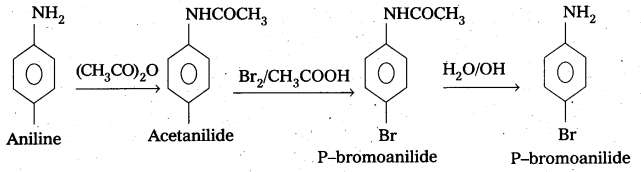
ii) Aniline to p – bromoanlline.
Ans:
Conversion of benzoic acid to benzamide
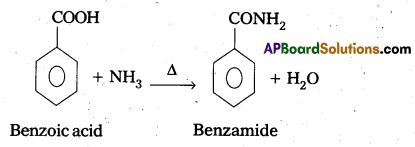
AP Inter 2nd Year Chemistry Important Questions Chapter 13 Organic Compounds Containing Nitrogen 5
ii) Conversion of Aniline to p – bromoanlline.
AP Inter 2nd Year Chemistry Important Questions Chapter 13 Organic Compounds Containing Nitrogen 6

Question 7.
How are Amines prepared by Hoffmann bromamide degradation method.
Answer:
Hoffmann bromamide degradation method: In this method amides are directly converted into amines. When amides are treated with Br5 in NaOH gives amine.

AP Inter 2nd Year Chemistry Important Questions Chapter 13 Organic Compounds Containing Nitrogen 7

AP Inter 2nd Year Chemistry Important Questions Chapter 13 Organic Compounds Containing Nitrogen

Question 8.
What is Diazotisation reaction ? Give equation. [IPE 16, 14 (T.S.)]
Answer:
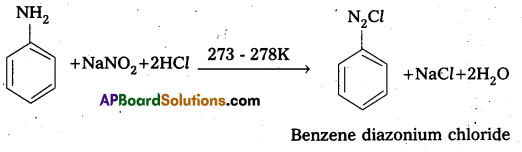
Diazotisation reaction: Aromatic primary amines react with nitrous acid at low temperatures to form diazonium salts.
AP Inter 2nd Year Chemistry Important Questions Chapter 13 Organic Compounds Containing Nitrogen 8

Question 9.
What is sulphonation ? Give equation.
Answer:
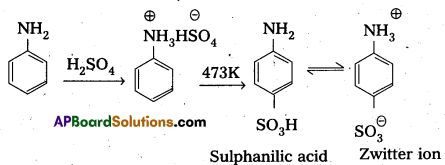
Sulphonation : Aniline reacts with cone H2SO4 and forms anilinium hydrogen sulphate which on heating gives P – amino benzene sulphonic acid (sulphanilic acid) which exists as Zwitter ion.
AP Inter 2nd Year Chemistry Important Questions Chapter 13 Organic Compounds Containing Nitrogen 9
Aniline does not undergo Friedel crafts reactiondue to salt formation with AlCl3.

Question 10.
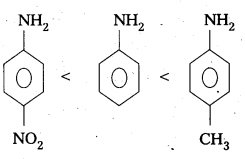
Arrange the following bases in increasing order of their basic strength. Aniline, P – nitroaniline and P – toluidine.
Answer:
The increasing order of basic strength of given compounds is
P – nitroaniline < aniline < P – toluidine
AP Inter 2nd Year Chemistry Important Questions Chapter 13 Organic Compounds Containing Nitrogen 10

AP Inter 2nd Year Chemistry Important Questions Chapter 13 Organic Compounds Containing Nitrogen

Question 11.
How is benz ene diazonium chloride prepared? Give equation.
Answer:
Preparation: Benzene diazomum chloride is prepared by the reaction of aniline with nitrous acid at 273 – 278K. The conversion of primary aromatic amine into diazonium chloride is called Diazotisation.
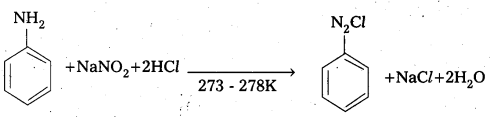
AP Inter 2nd Year Chemistry Important Questions Chapter 13 Organic Compounds Containing Nitrogen 11

Question 12.
Arrange the following bases in decreasing order of pHb, values. C2H5NH2, C6H5NHCH3, (C2H5)2 NH and C6H5NH2.
Answer:
The decreasing order of pKb values of given amines is
C6H5NH2 > C6H5NHCH3 > C6H5NH2 > (C2H5)2 NH

Question 13.
What is a coupling reaction ? Give equation. .
Answer:
Coupling reactions : The azoproducts obtained when diazonium slats react with aromatic compounds have extended conjugated system through N = N. This reaction is called coupling reaction and the prodocuts formed are coloured.
a) Reaction with Phenol

AP Inter 2nd Year Chemistry Important Questions Chapter 13 Organic Compounds Containing Nitrogen 12

Question 14.
How do you convert aniline to parabromo aniline. [IPE 2014]
Answer:
Aniline is first acylated to give acetaniiyde which on bromination gives parabromo derivative. This bromo derivative on hydrolysis gives parabromo aniline.
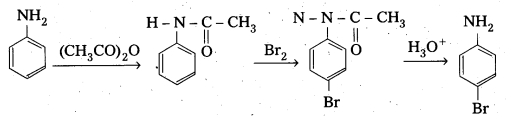
AP Inter 2nd Year Chemistry Important Questions Chapter 13 Organic Compounds Containing Nitrogen 13

Question 15.
How is Aniline prepared. [IPE 2016 (TS)]
Answer:
Aniline is prepared by reduction of nitro benzene in acid medium.
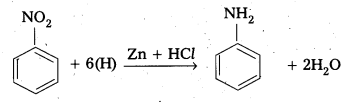
AP Inter 2nd Year Chemistry Important Questions Chapter 13 Organic Compounds Containing Nitrogen 14

AP Inter 2nd Year Chemistry Important Questions Chapter 13 Organic Compounds Containing Nitrogen

Question 16.
Explain why ethylamine is more soluble in water where as aniline is not soluble.
Answer:
Ethyl amine is a primary amine, due to intermolecular hydrogen bonding with water molecules it is soluble in water. Though Aniline has – NH2 group, due to hydrophobic aryl group it is not soluble in water.

Short Answer Questions

Question 1.
Explain with a suitable example how benzene sulphonylchloride can distinguish primary, secondary and tertiary amines.
Answer:
Benzene sulphonyl chloride is called Hinsberg’s reagent. This is used to distinguish the 1°, 2°, 3° – amines.

  • with 1° – amine : Benzene sulphonyl chloride reacts with 1° – amine and produce N – Alkyl benzene sulphonamide which is soluble in alkali.
  • with 2° – amine : Benzene sulphonyl chloride reacts with 2° – amine and produce N, N – Dialkyl benzene sulphonamide which is insoluble in alkali.

    AP Inter 2nd Year Chemistry Important Questions Chapter 13 Organic Compounds Containing Nitrogen 15
  • with 2° – amine: Benzene suiphonyl chloride reacts with 2° – amine and produce N, N – Dialkyl benzene sulphonamide which is insoluble in alkali.

    AP Inter 2nd Year Chemistry Important Questions Chapter 13 Organic Compounds Containing Nitrogen 16
  • with 3° – amine : Benzene sulphonyl chloride does not react with benzene sulphonyl chloride.

Question 2.
How do you prepare Ethyl cyanide and Ethyl isocyanide from a common alkylhalide ? [IPE 2014]
Answer:
Preparation of ethyl cyanide : Ethyl chloride reacts with aq. Ethanolic KCN to form Ethyl cyanide as a major product.

AP Inter 2nd Year Chemistry Important Questions Chapter 13 Organic Compounds Containing Nitrogen 17
Preparation of Ethyl isocyanide : Ethyl chloride reacts with aq. Ethanolic AgCN to form Ethyl iso cyanide as a major product.

AP Inter 2nd Year Chemistry Important Questions Chapter 13 Organic Compounds Containing Nitrogen 18

Question 3.
How do you distinguish cyanides and isocyanides by hydrolysis and reducation.
Answer:
i) Hydrolysis : Cyanides on hydrolysis give carboxylic acids and ammmonia where as isocynanides on hydrolysis give primary amines and formic acid:

AP Inter 2nd Year Chemistry Important Questions Chapter 13 Organic Compounds Containing Nitrogen 19
ii) Reduction: Reducation of nitriles give primary amines where as reduction of isocyanides yield secondary amines.
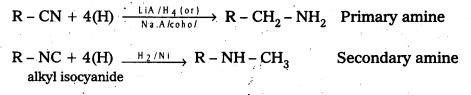
AP Inter 2nd Year Chemistry Important Questions Chapter 13 Organic Compounds Containing Nitrogen 20

AP Inter 2nd Year Chemistry Important Questions Chapter 13 Organic Compounds Containing Nitrogen

Question 4.
How do you carryout the following conversions? .
i) N – Ethylamine to N, N – Diethyl propanamine
ii) Aniline to Benzene suiphonamide
Answer:
Conversion of
i) N – Ethyl amine to N, N – Diethyl propanamine : Ethyl amine reads with ethyl chloride and propyl chloride to from N, N – Di ethyl propanamine.
AP Inter 2nd Year Chemistry Important Questions Chapter 13 Organic Compounds Containing Nitrogen 21

ii) Conversion of Aniline to Benzene sulphonamide : Aniline reacts with benzene sulphonyl chloride to form N – Phenyl benzene sulphonamide.

AP Inter 2nd Year Chemistry Important Questions Chapter 13 Organic Compounds Containing Nitrogen 22

Question 5.
Explain the basic character of different Amines.
Answer:
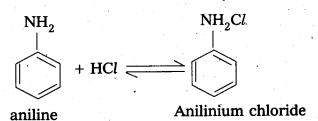
Basic Character of Amines : Aniline reacts with acid and form salts.
AP Inter 2nd Year Chemistry Important Questions Chapter 13 Organic Compounds Containing Nitrogen 23
Structure qnd Basicity : Alkyl amines are more basic than ammonia. The alkyl group pushes the electrons towards nitrogen by + I effect. Thus line pair of electrons on nitrogen are more available for sharing with the proton of acid. Hence the basic nature of alkylamines increases with increase in number of alkyl groups. Thus in gaseous phase the basicity order of amines is in the order 36 amine > 2° amine >1° amine > ammonia.

In the aqueous phase the substituted ammonium cations get stabilised by +1 effect and also by solvation with water molecules. Greater the size of the ion, lesser will be the solvation and less stabilised is the ion. The order of stability is.
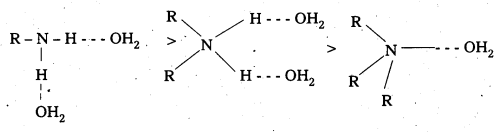
AP Inter 2nd Year Chemistry Important Questions Chapter 13 Organic Compounds Containing Nitrogen 24
Greater the stability of the ammonium cation, stronger is the basic nature of amine. The order of basicity of aliphatic amines is primary > secondary > tertiary. The – CH3 group Creates less steric hindrance to hydrogen bortding than C2H5 group, thus the change of alkyl group changes the basic strength. The basic strength of methyl substituted and ethly substituted amines in aqueous soltuion is in the order.
(C2H5)2 NH > (C2H5)3 N > C2H5 – NH2 > NH3
(CH3 NH)2 > CH3 – NH2 > (CH3)3N >NH3
Aromatic amines are less basic than ammonia. The lone pair of electrons on nitrogen is in conjugation with benzene ring.

AP Inter 2nd Year Chemistry Important Questions Chapter 13 Organic Compounds Containing Nitrogen

Question 6.
Write two methods each for the preparation of alkyl cyanide and alkyl isocyanide.
Answer:
Preparation
a) From Alkyl Halides : Alkyl halides with ethanolic potassium cyanide gives cyanides where as with silver cyanide gives alkyl isocyanide.
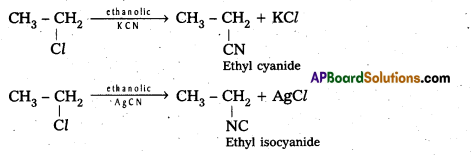
AP Inter 2nd Year Chemistry Important Questions Chapter 13 Organic Compounds Containing Nitrogen 25
b) From amides and aldoximes : The dehydration of amides (or) oximes with dehydrating agents like P2O5 (or) with benzene suiphonyl chloride yeild cyanides.
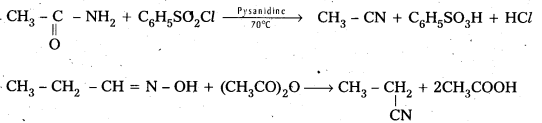
AP Inter 2nd Year Chemistry Important Questions Chapter 13 Organic Compounds Containing Nitrogen 26
c) Isocyanides from amines: (Carbyl amine reaction)
AP Inter 2nd Year Chemistry Important Questions Chapter 13 Organic Compounds Containing Nitrogen 27

AP Inter 2nd Year Chemistry Important Questions Chapter 13 Organic Compounds Containing Nitrogen

Question 7.
Give one chemical test to distinguish between the following pairs of compounds.
i) Methylamine and dimethylamine
ii) Aniline and N.Methylanhline
iii) Ethylamine and aniline
Answer:
i) Methyl amine (1° – amine) and dimethyl amine (2° – amine) are distinguished by iso cyanide test (or) Carbylamine test. Methyl amine responds to carbylamine reaction to produce methyl isocyanide where as dimethyl amine does not respond to the iso cyanide test.

AP Inter 2nd Year Chemistry Important Questions Chapter 13 Organic Compounds Containing Nitrogen 28
ii) Anjiine (1° – amine) and N.methyl (2° – amine) aniline are distinguished by carbylamine test (or) isocyanide test. Aniline responds to carbyl amine test to give foul smelling phenyl iso cyanide where as N – methyl aniline does not responds to carbyl amine Test.

AP Inter 2nd Year Chemistry Important Questions Chapter 13 Organic Compounds Containing Nitrogen 29
iü) Ethyl amine (1° – aliphatic amine) and aniline (1° – aromatic amine) are distinguished by Diazotisation reaction. Aniline undergo diazotisafion reaction to form benzene diazonium salt where as ethyl amine form highly unstable alkyl diazonium salt.

AP Inter 2nd Year Chemistry Important Questions Chapter 13 Organic Compounds Containing Nitrogen 30

Long Answer Questions

Question 1.
Explain the following name reactions: [T.S. Mar. 17] [IPE -2015, B.M.P 2016 (TS), (AP)]
i) Sandmeyer reaction
ii) Gatterman reaction
Answer:
i) Sandmeyer reaction: Formation of chiorobenzene, Bromo benzene (or) cyano benzene from benzene diazonium salts with reagents Cu2Cl2/HCl, Cu2Br2/HBr, CuCN/KCN is called sandmyeres reaction.
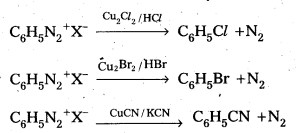
AP Inter 2nd Year Chemistry Important Questions Chapter 13 Organic Compounds Containing Nitrogen 31
ii) Gatterman reaction : Formation of chioro benzene, Bromobenzene from benzene diazonium salts with reagents Cu/HCl, Cu/HBr is referred as gatterman reaction.
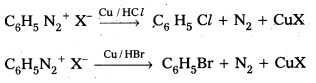
AP Inter 2nd Year Chemistry Important Questions Chapter 13 Organic Compounds Containing Nitrogen 32

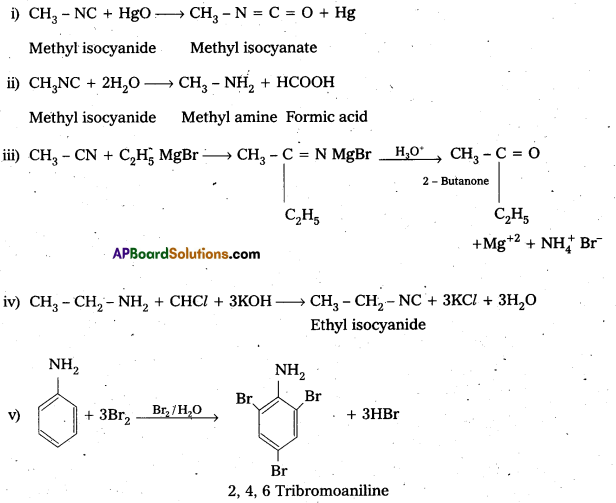
Question 2.
Complete the following conversions.
i) CH3NC + HgO →
ii) ? + 2H2O → CH2NH2 + HCOOH
iii) CH3CN + C2H5MgBr → ? AP Inter 2nd Year Chemistry Important Questions Chapter 13 Organic Compounds Containing Nitrogen 33
iv) CH3CH2NH2 + CHCl3 + KOH AP Inter 2nd Year Chemistry Important Questions Chapter 13 Organic Compounds Containing Nitrogen 34
v) AP Inter 2nd Year Chemistry Important Questions Chapter 13 Organic Compounds Containing Nitrogen 35
Answer:
AP Inter 2nd Year Chemistry Important Questions Chapter 13 Organic Compounds Containing Nitrogen 36

AP Inter 2nd Year Chemistry Important Questions Chapter 13 Organic Compounds Containing Nitrogen

Question 3.
Explain why aniline in strong acidic medium gives a mixture Of Nitro anilines and what steps need to be taken to prepare selectively P – nitro aniline.
Answer:
In strong acidic medium anline undergo nitration to form mixture of nitro anilines. In strongly acidic medium aniline is protonated to form the anilinium ion which is metadirecting. So besides the ortho and para derivatives meta derivative also formed. .
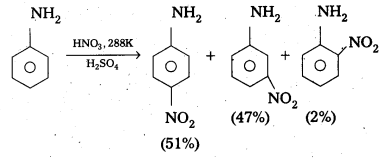
AP Inter 2nd Year Chemistry Important Questions Chapter 13 Organic Compounds Containing Nitrogen 37
By protecting – NH2 group by acetylation reaction with acetic anhydride the nitration reaction can be controlled and the – P nitro derivative can be formed as major product.
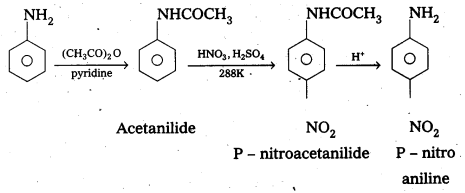
AP Inter 2nd Year Chemistry Important Questions Chapter 13 Organic Compounds Containing Nitrogen 38

Question 4.
Complete the following conversions : Aniline to
i) Fluorobenzene
ii) Cyanobenzene
iii) Benzene and
iv) Phenol
Answer:
i) Aniline to Fluorobenzene
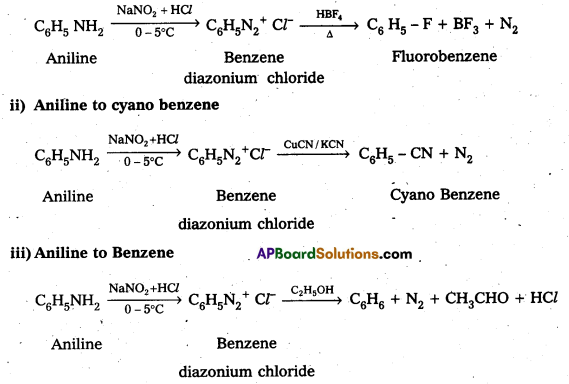
AP Inter 2nd Year Chemistry Important Questions Chapter 13 Organic Compounds Containing Nitrogen 39
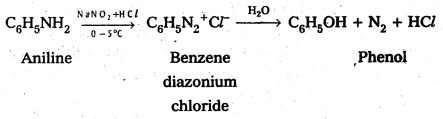
iv) Aniline to phenol
AP Inter 2nd Year Chemistry Important Questions Chapter 13 Organic Compounds Containing Nitrogen 40

AP Inter 2nd Year Chemistry Important Questions Chapter 13 Organic Compounds Containing Nitrogen

Question 5.
i) Account for the stability of aromatic diazonium ions when compared to aliphatic diazonium ions.
ii) Write the equations showing the conversion of aniline diazoniumchloride to
a) chlorobenzene,
b) Iodobenzene and
c) Bromobenzene
Answer:
i) Aliphatic diazonium salts which are formed from 1° -aliphatic amines are highly unstable and liberate nitrogen gas and alcohols.

Aromatic diazonium salts formed from 1° – aromatic amines are stable for a short time in solution at low temperatures (0 – 5°C). The stability of arene diazonium ion is explained on the basis of resonance.
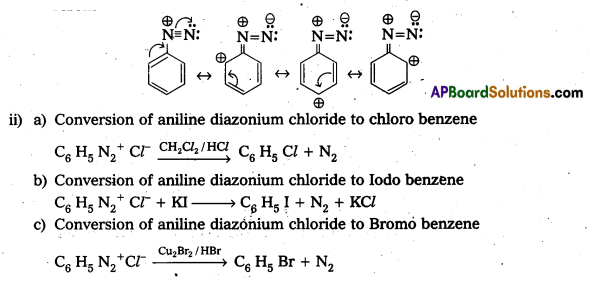
AP Inter 2nd Year Chemistry Important Questions Chapter 13 Organic Compounds Containing Nitrogen 41

Question 6.
Write the steps involved in the coupling of Benzene diazonium chloride with aniline and phenol.
Answer:
Benzene diazonium chloride reacts with phenol in which the phenol molecule at its para position is coupled with the diazonium salt to form P-hydroxyazobenzene. This type of reactions is known as coupling reactions. Similarly the reaction o£ diazonium salt with aniline yields P – amino azobenzene.
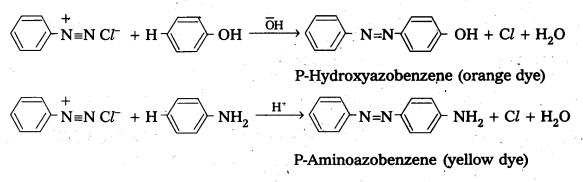
AP Inter 2nd Year Chemistry Important Questions Chapter 13 Organic Compounds Containing Nitrogen 42

AP Board 5th Class Telugu Solutions 7th Lesson పద్యరత్నాలు

Andhra Pradesh AP Board 5th Class Telugu Solutions 7th Lesson పద్యరత్నాలు Textbook Exercise Questions and Answers.

AP State Syllabus 5th Class Telugu Solutions Chapter 7 పద్యరత్నాలు

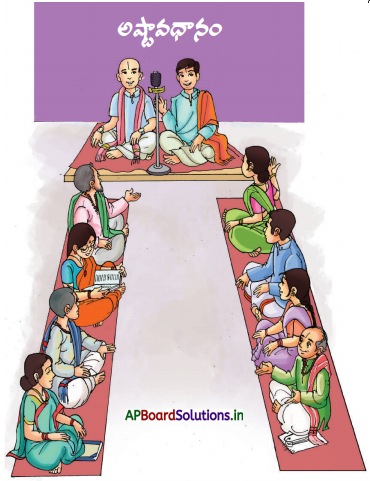
చిత్రం చూడండి.. ఆలోచించి మాట్లాడండి.

AP Board 5th Class Telugu Solutions 7th Lesson పద్యరత్నాలు 1
ప్రశ్నలకు జవాబులు చెప్పండి. అష్టావధానం

ప్రశ్న 1.
చిత్రంలో ఏం జరుగుతున్నది? ఎవరెవరు ఉన్నారు? వారు ఏం చేస్తున్నారు?
జవాబు:
చిత్రంలో అష్టావధానం జరుగుతున్నది. మైకు ముందు ఇద్దరు అవధానులున్నారు. వారికి ఎదురుగా కుడి ప్రక్కన నలుగురు, ఎడమ ప్రక్కన నలుగురు (ఇద్దరు పురుషులు, ఇద్దరు స్త్రీలు) పృచ్ఛకులు కూర్చుని ఉన్నారు. వారు ఆ ఇద్దరు అవధానులను ప్రశ్నలు అడుగుతున్నారు. ఆ ప్రశ్నలకు అవధానులు జవాబులు పద్యాల రూపంలో చమత్కారంగా ఆశు వుగా చెప్తున్నారు.

ప్రశ్న 2.
మీకు తెలిసిన ఏవైనా పద్యాలు పాడండి!
జవాబు:
ఏదైనా ఒక చక్కని నీతి పద్యం భావయుక్తంగా, రాగయుక్తంగా ఉపాధ్యాయులు ముందుగా పాడి, తరువాత మరొక పద్యం విద్యార్థుల చేత పాడించాలి.

AP Board 5th Class Telugu Solutions 7th Lesson పద్యరత్నాలు

ప్రశ్న 3.
మీరు ఇలాంటి కార్యక్రమాలు ఎక్కడైనా చూశారా? చూసినప్పుడు మీకు ఏమనిపిస్తుంది.
జవాబు:
మేము ఇలాంటి కార్యక్రమాలు చూశాము. శతవధానము చూశాము. అందులో – 100 మంది ప్రచ్ఛకులు ఉన్నారు. అవధానిగారు ఆ వందమంది అడిగే ప్రశ్నలకు – ఆశువుగా చమత్కారంగా పద్యరూపంలో సమాధానం చెప్పారు. చాలా ఆశ్చర్యం కలిగింది. అన్ని ప్రశ్నలు – పద్యాల రూపంలో ఎలా గుర్తు పెట్టుకున్నారా! అని ముక్కు మీద వేలు వేసుకున్నాం. అవధాని గారి ధారణ శక్తి చాలా గొప్పదని అందరూ పొగుడుతుంటే ఔననిపించింది.

ఈ అవధానం అనేది కేవలం మన తెలుగులో మాత్రమే కలదని, మరే భాషలోను ఈ అవధానం లేదని, అవధానిగారి ప్రక్కన ఉన్న సంచాలకులు చెప్పగానే ఎంతో ఆనందం కలిగింది. నేను కూడా ఈ అవధానం ఎలాగైనా నేర్చుకొని అందులో పాల్గోవాలపించింది. వారితో కలిసి ఒక్క పద్యమైనా పాడాలనిపించింది.

ఇవి చేయండి

వినడం – ఆలోచించి మాట్లాడటం

ప్రశ్న 1.
పద్యాలను రాగయుక్తంగా పాడండి.
జవాబు:
ఈ పద్యరత్నాలు’ అనే పాఠంలోని పద్యాలను విద్యార్ధులచే చక్కగా భావయుక్తంగా, రాగయుక్తంగా పాడించాలి. ముందుగా ఉపాధ్యాయులు ఆచరించి, అటు పై విద్యార్ధులచే ఆచరింప చేయాలి.

ప్రశ్న 2.
మీకు తెలిసిన కొన్ని నీతి పద్యాలు చెప్పండి!
జవాబు:
అ) సదౌష్టియె సిరియెసగును
సదౌష్టియె కీర్తి పెంచు, సంతుష్టిని, నా
సదౌష్టియె ఒన గూర్చును
సదౌష్టియె పాపములను చరచు కుమారా!

భావం :
మంచివారితో మాట్లాడడం వల్ల, స్నేహం చేయడం వలన సంపద పెరుగుతుంది. పేరు ప్రతిష్ఠలు వస్తాయి. సంతృప్తి కలుగుతుంది. పాపాలు కూడా తొలగిపోతాయి.

AP Board 5th Class Telugu Solutions 7th Lesson పద్యరత్నాలు

ఆ) ఇనుడు వెలుగు నిచ్చు ఘనుఁడు వర్షము నిచ్చు,
గాలి వీచు చెట్లు పూలు పూచు
సాధు పుంగవులకు సహజ లక్షణమిది
లలిత సుగుణ జాల! తెలుగు బాల!

భావం :
సూర్యుడు వెలుగు నిస్తాడు. మేఘాలు వర్షాన్ని ఇస్తాయి. గాలి వీస్తుంది. చెట్లు పూలు పూస్తాయి. గొప్పవారికి ఇలాంటి లక్షణాలు సహజంగా ఉంటాయి.

ప్రశ్న 3.
చదువు లేకపోతే ఏమవుతుంది ?
జవాబు:
చదువు లేకపోతే – ఏది మంచి? ఏది చెడు తెలుసుకోగలిగే వివేకం ఉండదు. సంస్కారం కోల్పోతాం. మాట్లాడే విధానం, పని సాధించే తీరు తెలుసుకోలేము. ఎదుగుదల, అభివృద్ధి సజావుగా సాగదు. ఎప్పటికీ ప్రతి విషయంలో ఇంకొకరి మీద ఆధారపడాల్సి ఉంటుంది. కనుక అందరం చక్కగా చదువుకోవాలి.

చదవడం – వ్యక్తి పరచడం

అ) కింది భావాలకు సరియైన పద్య పాదాలు రాయండి.

ప్రశ్న 1.
మేఘం నీటితో నిండి ఉన్నప్పుడే వర్షిస్తుంది.
జవాబు:
నింగి వ్రేలుచు నమృత మొసంగు మేఘడు (9వ పద్యం)

ప్రశ్న 2.
మేలు చేసి పొమ్మ నుటే పెద్ద శిక్ష.
జవాబు:
పొసగ మేలు చేసి పొమ్మనుటే చాలు (3వ పద్యం)

ప్రశ్న 3.
విద్యకు పునాది నీతి.
జవాబు:
నీతియె మూలము విద్యకు (7వ పద్యం)

AP Board 5th Class Telugu Solutions 7th Lesson పద్యరత్నాలు

ప్రశ్న 4.
సత్యం పాపాలు తొలగిస్తుంది.
జవాబు:
సత్యమొకటి పాప సంహారమును జేయు (5వ పద్యం)

ప్రశ్న 5.
ప్రశ్నించడం వల్లనే సమాజంలో మనకు విలువ పెరుగుతుంది.
జవాబు:
ప్రశ్నతోడ పెరుగు ప్రాభవమ్ము (2వ పద్యం)

ఆ) కింది పేరా చదివి ఖాళీలు పూరించండి.

ముక్తకం, అంటే ఒక పద్యం పూర్తి. అర్థాన్ని తనకు తానే ఇస్తూ ఇతర పద్యాలతో సంబంధం లేకుండా స్వయం సంపూర్ణంగా వినిపించేది. తెలుగులో ముక్తక రచనకు ‘శతక, చాటు’ పద్యాలను ఉదాహరణగా చెప్పవచ్చు. వేములవాడ భీమకవి, శ్రీనాథుడు, తెనాలి రామకృష్ణుడు ‘చాటు’ పద్య రచనలో చాలా ప్రసిద్ధులు, ముక్తకం ఒక పద్య ప్రక్రియ. శతకంలో కూడ ముక్తక లక్షణం ఉంటుంది.

స్వీయరచన

ప్రశ్న 1.
మనం ప్రశ్నలు ఎందుకు వేస్తాం?
జవాబు:
జ్ఞానం పెంచుకోవడానికి – అసలు విషయం తెలుసుకుని విలువలు పెంచుకోవడానికి, ప్రగతి సాధించడానికి ప్రశ్నలు వేస్తాం.

ప్రశ్న 2.
ఒక గ్రామంలో ఎవరెవరు ఉండడం అవసరమని పద్యంలో చెప్పారు?
జవాబు:
అవసరానికి అప్పిచ్చేవాడు, వైద్యుడు, ఎల్లప్పుడూ ప్రవహించే నది, మంచి చెడ్డలు చెప్పే బ్రాహ్మణుడు (పండితుడు) మొదలైనవారు గ్రామంలో ఉండడం అవసరమని పద్యంలో చెప్పారు.

AP Board 5th Class Telugu Solutions 7th Lesson పద్యరత్నాలు

ప్రశ్న 3.
ఉపకారం చేసేవారికి ఎలాంటి సహజగుణాలు ఉంటాయి?
జవాబు:
కోరకుండానే చెట్లు పండ్లనిస్తాయి. మేఘాలు అమృతం వంటి వర్షాన్నిస్తున్నాయి. నిండైన సంపదలచేత పండితులు ఆహంకారం పొందకుండా జ్ఞానాన్ని అందిస్తున్నారు. ఈ లోకంలో ఉపకారం చేసేవారికి ఈ విధమైన సహజ లక్షణాలుంటాయి.

ప్రశ్న 4.
శత్రువు విషయంలో మనం ఎలా ప్రవర్తించాలి ?
జవాబు:
చంపదగిన శత్రువు చేతికి చిక్కినా – కీడు చేయకుండా ఏదేనా ఉపకారం చేసి పంపాలి. శత్రువు విషయంలో ఇదే మనం విధించే నిజమైన శిక్ష.

సృజనాత్మకత

ప్రశ్న 1.
నీకు తెలిసిన పద్యభావం ఆధారంగా చిన్న కధను రాయండి.
జవాబు:
భావం :
ఓ వేమా! చంపదగిన శత్రువు చేతికి చిక్కినా వాడికి కీడు చేయరాదు. తిరిగి ఏదైనా ఉపకారం చేసి పంపిస్తే అదే నిజమైన శిక్ష.

పై భావానికి కథ :
రామాపురం అనే గ్రామంలో కాముడు, సోముడు, అనే ఇద్దరు మిత్రులు కలిసి వ్యాపారం చేస్తుండేవారు. వ్యాపారం చక్కగా లాభాలతో సాగుతోంది. వచ్చిన లాభాలు ఇద్దరు సమంగా పంచుకునేవారు. ఒకసారి సోముడు తన కుటుంబంతో కలసి తీర్థయాత్రలకు వెళ్తూ…. తన దగ్గరున్న నగలు, ధనము, విలువైన వస్తువులు కాముడికిచ్చి “ఇవి నీ దగెరుంచుయాత్రనుండి తిరిగి వచ్చాక తీసుకుంటాను. గ్రామంలో దొంగల భయం ఉంది కదా!” అందుకని చెప్పి యాత్రకు వెళ్ళాడు. కొన్ని రోజులు గడిచాయి.

AP Board 5th Class Telugu Solutions 7th Lesson పద్యరత్నాలు

సోముడు తిరిగి వచ్చి మిత్రుడు కాముడుని కలసి తన సొమ్మును ఇవ్వమని కోరాడు. ఆ మాటలకు కాముడు కంటినీరు కారుస్తూ…సొమ్మును దొంగలెత్తికెళ్ళారని – నీ ధనంతో పాటు నావికూడా పోయినాయని అబద్దం అడాడు. ఆ మాటలు నమ్మి సోముడు బాధతో అక్కడ నుండి వెళ్ళిపోయాడు. కొన్నాళ్ళకు నిజంగా దొంగలు పడి కాముడి ఇల్లు మొత్తం దోచుకెళ్ళారు. తను చేసిన తప్పు తెలిసి కన్నీరు పెడుతూ సోముడిని కలిసి గోడు వెళ్ళబోసాడు.

మిత్రుడి బాధ చూడలేక సోముడు తన దగ్గరున్న కొంత ధనం చేతికిచ్చి మళ్ళీ వ్యాపారం మొదలు పెట్టి, నేను నీకు తోడుంటాను. అని ధైర్యం చెప్పి పంపాడు. కాముడిలో పశ్చాత్తాపం మొదలైంది. మిత్రుడి మనసు ఎంత గొప్పదో తెలుసుకుని తనకు తానే సిగ్గుపడ్డాడు.

ప్రశంస

మీ తరగతి గదిలో ఎవరు బాగా పద్యాలు పాడతారు? వారిని నీవు ఎలా ప్రశంసిస్తావు?
జవాబు:
మా తరగతి గదిలో అందరూ తెలుగు చక్కగా చదువుతారు. అందులోను తెలుగు పద్యాలు చక్కగా చదువుతారు. పాడతారు. మా గురువుగారు మాకు అలా నేర్పించారు. ఐతే మా అందరిలో సౌమ్య మరీ చక్కగా, రాగయుక్తంగా, అందంగా వినసొంపుగా చదువుతుంది.

సౌమ్య పద్యం పాడుతుంటే, తరగతి గది చీమచిటుక్కు మనకుండా, నిశ్శబ్దంగా ఉంటుంది. వింటుంది, మేమందరం చెవులు రిక్కించి’ మరీ వింటాము. ప్రతి ఒక్కరం సౌమ్యలా పద్యం పాడాలని ప్రతిరోజు నేర్చుకుంటాం. ఎక్కడెక్కడా ఆపుతుంది – ఎక్కడెక్కడ పదవిభాగం చెస్తోంది. ఎక్కడ దీర్ఘాలు తీస్తోంది, ఎక్కడ కుదిస్తోంది. బాగా పరిశీలించమని మా తెలుగు గురువులు మాతో చెప్పారు.

సౌమ్య పద్యం పాడాక మాకు చలా ఆనందంగా ఉంటుంది. క్రిందటి సంవత్సరం నవంబరు 14 సందర్భంగా జిల్లా స్థాయిలో పద్యగాన పోటీలలో ఆమెకే ప్రధమ బహుమతి లభించింది. మేము కూడా చాలా ఆనందించాము. త్వరలో మేము కూడా అదే విధంగా పద్యగానం చేస్తాము.

భాషాంశాలు

(ఆ) కింది వాక్యాలు చదవండి.

సాధారణంగా భాషలో పదజాలాన్ని ……….

  1. పురుషులను బోధించే పదాలు – పుంలింగం
  2. స్త్రీలను బోధించే పదాలు – స్త్రీ లింగం
  3. ఇతరులను బోధించే పదాలు – నపుంసక లింగం అంటారు. (పక్షులు, జంతువులు, జడాలు)

AP Board 5th Class Telugu Solutions 7th Lesson పద్యరత్నాలు

కొన్ని భాషల్లో అర్ధంతో సంబంధం లేకుండా “పద స్వరూపాన్ని” బట్టి లింగం ఉంటుంది.
కొన్ని భాషల్లో అర్ధాన్ని బట్టి లింగం ఉంటుంది.

తెలుగులో మాత్రం అర్ధాల ప్రమాణం :

  1. తెలుగు వ్యాకరణంలో ఈ విభాగాన్ని ‘లింగం’ అనుకుండా “వాచకం” అంటారు.
  2. పురుషులను బోధించే పదాలు ” మహత్తులు”
  3. తక్కినవి ” అమహతులు”
  4. వాక్య నిర్మాణంలో స్త్రీలను బోధించే పదాలు ” ఏకవచనంలో – అమహత్తుతోను” బహువచనంలో – మహత్తుతోనూ” చేరతాయి.

ఉదా : అతను వచ్చాడు – అది/ఆమె వచ్చింది [ ఏకవచనం ]:
వాళ్ళు [ స్త్రీలు/పురుషులు ; స్త్రీ పురుషులు ] వచ్చారు.
అవి వచ్చా యి.

అందువల్ల స్త్రీలను బోధించే పదాలను విడిగా చెప్పాలంటే వాటిని “మహతీ వాచకాలు” అంటారు.

(ఆ) కింది పురుషవాచక పదాలకు స్త్రీ వాచక పదాలు రాయండి.

1. ఉపాధ్యాయుడు : ఉదా: ఉపాధ్యాయిని/ఉపాధ్యాయురాలు
AP Board 5th Class Telugu Solutions 7th Lesson పద్యరత్నాలు 2
2. నటుడు = నటి
3. గాయకుడు = గాయని/ గాయకీ
4. కళాకారుడు = కళాకారిణి
5. సైనికుడు = సైనికి/ సైనికురాలు

ధారణ చేద్దాం

ఉ॥ – మాటలచేత దేవతలు మన్నన జేసి వరంబు లిత్తు. రా
మాటలచేత భూపతులు మన్నన జేసి ధనంబు నిత్తు, రా
మాటలచేత మానినులు మన్నన జేసి మనంబు లిత్తు. రా…
మాటలు నేర్వకున్న మరి మానము హూనము కాదె యేరికన్

AP Board 5th Class Telugu Solutions 7th Lesson పద్యరత్నాలు

భావం :
మాట మంచిదైతే దేవతలు వరాలు ఇస్తారు. ఆ మాటలు రాజులకు నచ్చితే బహుమతులిస్తారు. ఆ మాటలలోని మాధుర్యాన్ని స్త్రీలు ఇష్టపడతారు. ఆ మాటలు సరిలేనప్పుడు ఎవరికైనా గౌరవం పోతుంది.
– భర్తహరి సుభాషితం
జవాబు:
విద్యార్థి పద్యాన్ని – భావాన్ని పద విభాగంతో చదవటం నేర్చుకుని, భావయుక్తంగా, అర్థవంతంగా ధారణ చేయాలి. అందుకు ఉపాధ్యాయులు సహకరించాలి. అందులోని నీతిని, విషయాన్ని వంటపట్టించుకోవాలి.

పదాలు – అర్థాలు

ఎడతెగక = అడ్డులేకుండా
ఉపకర్త = ఉపకారం చేసేవాడు
ద్విజుడు = బ్రహ్మణుడు
ఒరులు = ఇతరులు
అప్రియము = ఇష్టముకానిది
పొసగ = తగినట్లుగ
మనమునకు = మనస్సుకు
చిక్కెనేని = దొరికితే
పరాయణము = అభీష్టం
కీడు = హాని
పరమధర్మము = గొప్పధర్మం
పరిణితి = మార్పు
వాక్కు = మాట
సంశయించు = సందేహించు
అజ్ఞుడు = తెలివి తక్కువవాడు
ప్రాభవం = గొప్పతనం
సత్ = మంచి
గురుత = గొప్పతనం, బరువు
ఆర్యులు = పూజ్యులు
నింగి = ఆకాశం

AP Board 5th Class Telugu Solutions 7th Lesson పద్యరత్నాలు

కుచ్చితము = కపటము
వ్రేలుచు = వేలాడుతూ
మెండుగా = ఎక్కువగా
అమృతం = తియ్యని, వాన, నీరు
బుధులు = పండితులు
కోవిదుడు = విద్వాంసుడు
ఉద్ధతులుగారు = గర్వపడరు
మేఘుడు = మేఘం
నియత = నియమముగల
పెన్నిధి = గొప్పదైన నిధి
నిర్ణాయకమున్ = నిర్ణయించేది
సమృద్ధి = ఎక్కవగలిగి ఉండడం

చదువు – అర్థం చేసుకో – ఆనందించు. పరీక్షల కోసం కాదు.

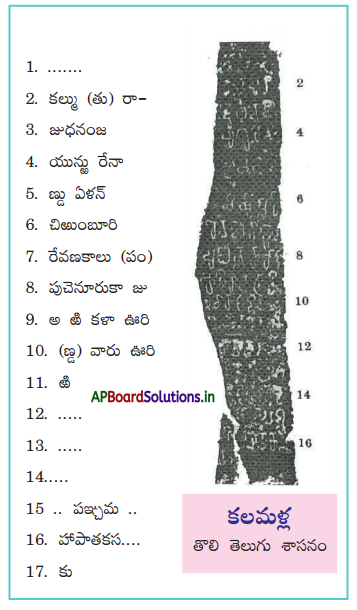
కలమళ్ల శాసనం

పూర్వకాలంలో రాజులు శసనాలు వేసేవారు. శసనం రాజాజ్ఞను తెల్పుతుంది. శాసనాలు వాటిలోని విషయాన్ని బట్టి మూడు రకాలుగా ఉంటాయి. ఎక్కువభాగం ఇవి , దానశాసనాలు. కొన్ని ప్రశస్తి శాసనాలు మరికొన్ని ధర్మలిపి శాసనాలు.

దానశాసనాలంటే రాజులు, రాజ్యాధికారులు, సామంతులు మొదలైనవారు అలయాలకు, బ్రహ్మణులకు, మఠాలకు, విద్యాసంస్థలకు చేసిన దానాలను తెల్పేవి. ప్రశస్తి శాసనాలంటే రాజు విజయాలను ప్రశంసించేవి. ధర్మలిపి శాసనాలు మతపరమైన నియమాలను తేల్పేవి.
AP Board 5th Class Telugu Solutions 7th Lesson పద్యరత్నాలు 3
ఆంధ్రదేశంలో లభించే శాసనాలు కొన్ని విలలపై చెక్కినవి. మరికొన్ని రాగిరేకుల పై , చెక్కినవి. ఆంధ్ర దేశం క్రీస్తుపూర్వం నుండే శాసనాలు లభిస్తున్నాయి. మొదటి శాసనాలు ప్రాకృత భాషలో ఉన్నాయి. తర్వాత సంస్కృత ప్రాకృతి ఆ మిశ్రంగానూ, ఆ తర్వాత సంస్కృతం లోనూ శాసనాలు వచ్చాయి. ఈ శాసనాలలో ఊళ్ల పేర్లు, వ్యక్తుల పేర్లు – తెలుగులో కనిపిస్తాయి.

మొత్తం తెలుగులోనే మొదటిసారి శాసనాలు వేసినవారు రేనాటి చోళులు, రేనాడు అంటే ఇప్పటి వై.ఎస్.అర్. కడప జిల్లా ప్రాంతం. రేనాటి చోళరాజు ఎరికల్ ముతురాజు ధనుంజయుడు కలమళ్ల గ్రామంలో వేసిన శాసనం ఇది. శాసనంలో ని పదాలన్నింటికీ మనకు ఇంకా స్పష్టమైన అర్ధాలు తెలియపు. ఇది దాన శాసనం. ఈ దానాన్ని పాడుచేసిన వారికి పంచమహాపాతకాలు కలుగుతాయని ! శాపవాక్యంతో శాసనం ముగిసింది.

AP Board 5th Class Telugu Solutions 7th Lesson పద్యరత్నాలు

నాటి తెలుగు భాష ఎలావుందో, లిపి ఎలా వుందో, శాసనమెలా ఉంటుందో మీరు తెలుసుకోవడానికి ఇదొక ఉదాహరణ.
(తొలి తెలుగు దివ్వె – తెలుగు మూలాల అధ్యయన సంఘం వారి సౌజన్యంతో)

AP 7th Class Social Important Questions 13th Lesson Women Change the World

These AP 7th Class Social Important Questions 13th Lesson Women Change the World will help students prepare well for the exams.

AP Board 7th Class Social 13th Lesson Important Questions and Answers Women Change the World

Question 1.
When did International Women’s Day is celebrated?
Answer:
On 8th March, International Women’s Day is celebrated.

Question 2.
Who was the first Indian woman Scientist to receive the Padma Shri Award?
Answer:
Janaki Ammal Edavalath Kakkar.

Question 3.
Who were the first two female graduates in India?
Answer:
Kadambari Ganguly and Chandramuki Basu.

Question 4.
Who was the Indian American astronaut?
Answer:
Kalpana Chawla an Indian – American astronaut.

AP 7th Class Social Important Questions 13th Lesson Women Change the World

Question 5.
Who was the first Indian women enter into space?
Answer:
Kalpana Chawla was the first Indian woman to enter space.

Question 6.
How did Kalpana Chawla died?
Answer:
Kalpana Chawla died due to failure of the STS -107 Mission in the atmosphere on Febru¬ary 1st, 2003.

Question 7.
Mention the Award of Kalpana Chawl.
Answer:
U.S. Government awarded her the Congressional Space Medal of Honor and the NASA Distinguished Service Medal.

Question 8.
Who is the first visually challenged IAS officer in India?
Answer:
Pranjal Patil of Maharashtra.

Question 9.
Who is the highest run – scorer in Women’s International Cricket?
Answer:
Mithali Raj is the only woman highest run – scorer in Women’s International Cricket.

Question 10.
Which martial arts was developed by Burce Lee?
Answer:
Bruce Lee developed the Jeet Kune DO – art.

Question 11.
Who is Vandana Shiva?
Answer:
Vandana Shiva is an environmentalist and environmental rights activist.

Question 12.
Which organization was founded by Vandana Shiva?
Answer:
Research Foundation for Science, Technology and Ecology.

Question 13.
From which person Laxmi Agarwai receive the award?
Answer:
Laxmi Agarwai received a 2014 International Women of Courage Award by US first lady Michelle Obama.

Question 14.
Who worked as a rocket Scientist in ISRO?
Answer:
Nandini Harinath is a rocket Scientist at ISRO.

AP 7th Class Social Important Questions 13th Lesson Women Change the World

Question 15.
Who organised awareness programms on Forests and Environmental Protection?
Answer:
Archana Soreng.

AP Board 7th Class Social 13th Lesson 1 Mark Bits Questions and Answers Women Change the World

I. Multiple Choice Questions

1. In 2004 – 05 …….. % of working women in India are engaged in agricultural works.
A) 82
B) 83.6
C) 84
D) 85%
Answer:
B) 83.6

2. It plays a major role in getting rid of stereotypes. What is it?
A) Marriage
B) Migration
C) Education
D) None of the above
Answer:
C) Education

3. The Andhra Pradesh government banned arrack in
A) 1993
B) 1994
C) 1996
D)1997
Answer:
A) 1993

4. Who was the first South Asian Woman Physician to graduate in Western Medicine ?[
A) Sujata Rao
B) Seema Rao
C) Kadambari Ganguly
D) Kalpana Chawia
Answer:
C) Kadambari Ganguly

5. This award received by Janaki Ammal
A) Nobel Prize
B) Padma Shri
C) Arjun
D) Padma Vibhushan
Answer:
B) Padma Shri

AP 7th Class Social Important Questions 13th Lesson Women Change the World

6. The Indian – American astronaut
A) Sunitha Williams
B) Girija Shankar
C) Kalpana Chawia
D) Sumathi Rao
Answer:
C) Kalpana Chawia

7. Kalpana Chawia was died due to failure of
A) SS -11
B) SS -12
C) SS -13
D) STS-107
Answer:
D) STS-107

8. Who cross 7,000 run mark in women’s ODIs?
A) Mithali Raj
B) Mandhana
C) Shafaliverma
D) Jhulan Goswami
Answer:
A) Mithali Raj

9. Mithali Raj received Award.
A) Arjun
B) Khelratna
C) Padmasri
D) All the above
Answer:
B) Khelratna

10. First visually challenged IAS officer
A) Mithili
B) Pranjal Patil
C) Sailaja Mehata
D) Kadambari Ganguly
Answer:
B) Pranjal Patil

11. First woman Commando trainer.
A) Seema Rao
B) Sulochana
C) Mithali Raj
D) Pranjal Patil
Answer:
A) Seema Rao

12. Rajkumari Devi honored with ………… award
A) Arjun
B) Khelratna
C) Padma Shri
D) Nobel
Answer:
C) Padma Shri

13. Vandana Shiva received the ………… award in 1993.
A) Sydney peace prize
B) Right Livelihood
C) Khelratna
D) Women of encourage
Answer:
A) Sydney peace prize

14. A Rocket Scientist at the ISRO
A) Vandana
B) Archana
C) Nandini Harinath
D) Laxmi Agarwal
Answer:
C) Nandini Harinath

15. Archana Soreng, a tribal girl from
A) Andhra Pradesh
B) Odisha
C) Bihar
D) Punjab
Answer:
B) Odisha

AP 7th Class Social Important Questions 13th Lesson Women Change the World

16. Archana Soreng related to
A) Sports
B) Music
C) Science
D) Environment
Answer:
C) Science

II. Fill in the Blanks

1. Archana Soreng holds a master’s Degree from ……………. .
2. Nandini Harinath has served on the ……………. .
3. NABARD stands for ……………. .
4. Addala Suryakala is from ……………. .
5. Laxmi Agarwal is an ……………. survivor.
6. Vandana Shiva received ……………. prize in 2010.
7. Vandana Shiva conducts research on ……………. .
8. Kalpana Chawla died on ……………. .
9. NASA stands for ……………. .
10. ……………. served as a lecturer and principal at Betune College.
11. Women in Andhra Pradesh started ……………. movement.
12. Government provides many facilities for ……………. .
13. ……………. is even more severe in illiterate families.
14. ……………. have high place in Indian culture.
15. ……………. plays a vital role in the Development of the country.
Answer:

  1. Tata Institute of Social Sciences
  2. Mars Orbiter Mission Mangalyan
  3. National Bank for Agriculture and fcural Development
  4. Srikakulam District
  5. Acid attack
  6. Sydney Peace
  7. Environmental and Social Issues
  8. February 7, 2003
  9. National Aeronautics and Space
  10. Chandramukhi Basu
  11. Anti – arrack 14. Women
  12. Girls Education
  13. Discrimination
  14. Women

III. Match the following
1.

Group-AGroup-B
1. Laxmi AgarwalA) Women’s Education
2. Chandra Mukhi BasuB) Michelle Obama
3. Kalpana ChawlaC) Lady Sachin
4. Mithali RajD) Sub Collector
5. Pranjal PatilE) NASA

Answer:

Group-AGroup-B
1. Laxmi AgarwalB) Michelle Obama
2. Chandra Mukhi BasuA) Women’s Education
3. Kalpana ChawlaE) NASA
4. Mithali RajC) Lady Sachin
5. Pranjal PatilD) Sub Collector

2.

Group-AGroup-B
1. Seema RaoA) Anandpur Jyothi
2. Kadambari GangulyB) Light weight modern utensils
3. Janaki AmmalC) Bengal cultural Revolution
4. Addala SuryakalaD) Botanical Survey of India
5. Rajkumari DeviE) Trained in Jeet Kune DO

Answer:

Group-AGroup-B
1. Seema RaoE) Trained in Jeet Kune DO
2. Kadambari GangulyC) Bengal cultural Revolution
3. Janaki AmmalD) Botanical Survey of India
4. Addala SuryakalaB) Light weight modern utensils
5. Rajkumari DeviA) Anandpur Jyothi

Do You Know?

7th Class Social Textbook Page No. 86

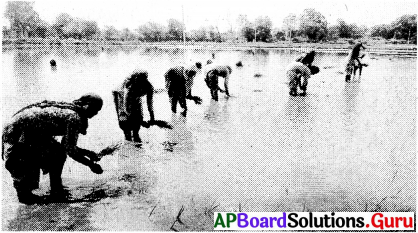
83.6 percent of working women in India are engaged in agricultural work. Their work includes planting, weeding, harvesting and threshing. Yet, when we think of a farmer we only think of a man.

Source: NSS 61st Round (2004-05).
AP 7th Class Social Important Questions 13th Lesson Women Change the World 1

7th Class Social Textbook Page No. 89

Jyothiba Phule and Savithribai Phule.

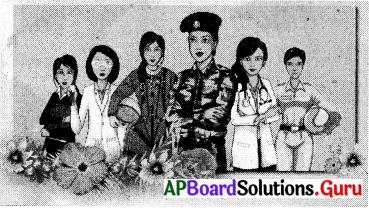
On 8th March, International women’s day is celebrated.
AP 7th Class Social Important Questions 13th Lesson Women Change the World 2

AP 7th Class Social Important Questions 12th Lesson Markets Around Us

These AP 7th Class Social Important Questions 12th Lesson Markets Around Us will help students prepare well for the exams.

AP Board 7th Class Social 12th Lesson Important Questions and Answers Markets Around Us

7th Class Social 12th Lesson 2 Marks Important Questions and Answers

Question 1.
What are the important sources of income?
Answer:
Salaries, wages, profits, rents, shares, dividends, etc.

Question 2.
Define physical markets.
Answer:
A physical market is a place where buyers can physically meet the sellers and purchase the desired items from them.

Question 3.
Define Local Market.
Answer:
When competition between a purchaser and a seller is localized and limited to a specific area is called a local market.

Question 4.
Define Regional Markets.
Answer:
These markets cover a wider area than local markets depending upon the availability of the goods in a particular region or even a group of states or districts.

AP 7th Class Social Important Questions 12th Lesson Markets Around Us

Question 5.
Define National Market.
Answer:
This is a market in which the trade for the goods and services takes place in a nation as a whole. ,

Question 6.
Define International Market.
Answer:
Trading of goods and services among different countries is known as the international Market.

Question 7.
What is meamt by weekly markets?
Answer:
In some areas markets are held on a particular day of the week. These are called weekly markets.

Question 8.
Define Rythu Bazar.
Answer:
Marginal and small scale farmers can directly sell the vegetables directly to the consumers and can get a good price for their products.

Question 9.
What is meant by Shopping Malls?
Answer:
In the Urban and Semi-urban areas, large multistoried air-conditioned buildings with shops on different floors are known as shopping malls.

Question 10.
Define Shopping Complex.
Answer:
Many shops are found in one compound in Urban areas, known as shopping complex.

Question 11.
What is meant by E – Market?
Answer:
Online platform that connect buyers and sellers through internet.

AP 7th Class Social Important Questions 12th Lesson Markets Around Us

12. Define a consumer?
Answer:
A consumer is a person who buys goods or services for his personal use.

7th Class Social 12th Lesson 42 Marks Important Questions and Answers

Question 1.
Explain the types of physical markets based on the Geographical location.
Answer:
A physical market is a place where buyers can physically meet the sellers and purchase the desired items from them.

On the basis of geographical location classified as physical markets are

  1. Local Markets.
  2. Regional Markets
  3. National Markets
  4. International Markets

Question 2.
Explain the types of physical markets based on nature.
Answer:
On the basis of nature, physical markets are classified as :

  1. Neighbourhood Markets.
  2. Weekly Markets.
  3. Shopping Malls.

7th Class Social 12th Lesson 8 Marks Important Questions and Answers

Question 1.
What are Consumer Rights?
Answer:
Consumer Rights:

  1. The right to be protected against the marketing of goods, products or services which are hazardous to life and property.
  2. The right to be informed about the quality, quantity, potency, purity, standard and price of goods, products or services, as the case may be, so as to protect the consumer against unfair trade practices.
  3. The right to be assured, wherever possible, access to a variety of goods, products or services at competitive prices.
  4. The right to be heard and to be assured that consumers interests will receive due consideration at appropriate fora.
  5. The right to seek redressal against unfair trade practice or restrictive trade practices or unscrupulous exploitation of consumers.
  6. The right to consumer awareness.

AP Board 7th Class Social 12th Lesson 1 Mark Bits Questions and Answers Markets Around Us

I. Multiple Choice Questions

1. One of the important source of income is
A) Salaries
B) Rents
C) Interest
D) All the above
Answer:
D) All the above

2. Return for moneylender
A) Profit
B) Rent
C) Interest
D) None
Answer:
C) Interest

AP 7th Class Social Important Questions 12th Lesson Markets Around Us

3. Return for land
A) Rent
B) Profit
C) Interest
D) None
Answer:
A) Rent

4. Return for entrepreneur
A) Interest
B) Profit/loss
C) Rent
D) None
Answer:
B) Profit/loss

5. Unorganised sector workers get
A) wages
B) profits
C) rents
D)none
Answer:
A) wages

6. Organised sector workers get
A) profits
B) wages
C) salaries
D)rents
Answer:
C) salaries

7. Goods available from neighbour markets
A) gold
B) silver
C) sugar
D) none
Answer:
C) sugar

8. Credit cards are issued by
A) banks
B) money lenders
C) government
D) none
Answer:
A) banks

9. Goods available from weekly markets
A) vegetables
B) grains
C) forest products
D) all the above
Answer:
D) all the above

10. Rythu Bazar’s were started in
A) 1998
B) 2000
C) 1999
D) 2001
Answer:
C) 1999

11. We find floating markets in
A) Srinagar
B) Delhi
C) Agra
D) Mumbaj
Answer:
A) Srinagar

12. Tourists of various nations enjoy the shopping in
A) Chilaka Lake
B) Kolleru Lake
C) Dal Lake
D) None
Answer:
C) Dal Lake

13. Consumer Protection Act as approved in
A) 2018
B) 2019
C) 2020
D) 2015
Answer:
B) 2019

AP 7th Class Social Important Questions 12th Lesson Markets Around Us

14. National consumer’s day is observed every year in
A) 24th December
B) 24th January
C) 24th March
D) 24th July.
Answer:
A) 24th December

II. Intext – Bits – Fill in the Blanks

1. Income comes from ……………… sources.
2. Agricultural labour works in ……………. sector.
3. Business people get ……………. .
4. Money lenders get ……………. .
5. Land and property owners get ……………. .
6. There are many shops that sell goods in our ……………. .
7. Credit cards are issued by ……………. .
8. The things in weekly markets are available at ……………. .
9. In urban and semi-urban areas ……………. are there.
10. Rythu Bazars are started in ……………. .
11. Many shops are found in one compound in urban areas known as ……………. .
12. We find floating market in ……………. .
13. Vegetable trade takes place through boats from 5 am to 7 am in the most picturesque ……………. of Srinagar.
14. Vegetable boats in local language are called ……………. .
15. On ……………. Consumer Protection Act was approved.
16. NCDRC was set up in ……………. .
17. NCDRC head office is in ……………. .
18. Every year ……………. is observed as National Consumer Day in India.
Answer:

  1. dilferent
  2. unorganised
  3. profits’Ioses
  4. Interest
  5. Rent
  6. Neighbourhood
  7. Banks
  8. Cheaper rates
  9. Shopping malls
  10. 1999
  11. Shopping complex
  12. Srinagar, Jammu &. Kashmir
  13. Dal Lake
  14. Shikaras
  15. 9th August, 2019
  16. 1988
  17. New Delhi
  18. 24th December

III. Match the following :

1.

Group-AGroup-B
1. LabourA) Profit
2. LandB) Rent
3. Money lenderC) Wages
4. Business manD) Interest

Answer:

Group-AGroup-B
1. LabourC) Wages
2. LandB) Rent
3. Money lenderD) Interest
4. Business manA) Profit

2.

Group-AGroup-B
1. Weekly MarketA) branded
2. e-commerceB) forest products
3. International marketC) online shopping
4. Shopping mallsD) petroleum

Answer:

Group-AGroup-B
1. Weekly MarketB) forest products
2. e-commerceC) online shopping
3. International marketD) petroleum
4. Shopping mallsA) branded

3.

Group-AGroup-B
1. 2019A) Rythu Bazar
2. 1988B) Consumer Protection
3. 1999C) NCDRC

Answer:

Group-AGroup-B
1. 2019B) Consumer Protection
2. 1988C) NCDRC
3. 1999A) Rythu Bazar

Do You Know?

7th Class Social Textbook Page No. 74

CREDIT CARD :
A card issued by financial institutions which lets you borrow funds from a pre-approved limit to pay for your purchases.

7th Class Social Textbook Page No. 77
AP 7th Class Social Important Questions 12th Lesson Markets Around Us 1
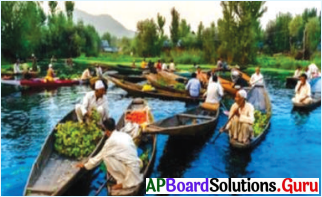
Floating Market in Srinagar, Jammu and Kashmir. In the most picturesque Dal Lake of Srinagar every day from 5 am to 7 am vegetable trade takes place through boats.

These boats are called ‘Shikara’ in local language. Besides vegetables, wood carvings, saffron and other local goods also available on these Shikaras. Tourists of various nations enjoy the shopping in Dal Lake.

7th Class Social Textbook Page No. 79

AP 7th Class Social Important Questions 12th Lesson Markets Around Us 2
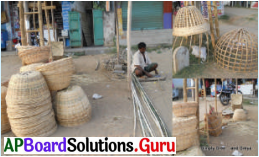
Cottage industry is a production system that relies on producing goods or parts of goods, by craftsmen at home or small workshops, by individuals, small teams or family units instead of large factories.

7th Class Social Textbook Page No. 81

  • National Consumer Disputes Redressal Commission (NCDRC) was setup in 1988 under the Consumer Protection Act 1986. Its head office is in New Delhi.
  • Consumer help line number : National Toll-Free Number 1800-114000 or 14404.
  • Every year 24th December is observed as National Consumer Day in India.

AP 7th Class Social Important Questions 11th Lesson Road Safety Education

These AP 7th Class Social Important Questions 11th Lesson Road Safety Education will help students prepare well for the exams.

AP Board 7th Class Social 11th Lesson Important Questions and Answers Road Safety Education

7th Class Social 11th Lesson 2 Marks Important Questions and Answers

Question 1.
Why it is compulsory to have a driving licence?
Answer:
No person should drive a motor vehicle unless he/she holds driving license.

To drive vehicle is an offence without license, it is against law. So, it is compulsory to have a driving license.

Question 2.
What is the main reason for heavy increase of vehicular traffic?
Answer:
Increase of population, industrialisation, urbanisation, and globalisation.

Question 3.
What is the responsibility of every road user?
Answer:
To follow traffic rules.

Question 4.
What is traffic education?
Answer:
Traffic education is the education which describes the traffic rules and regulations in a clear and simple way.

AP 7th Class Social Important Questions 11th Lesson Road Safety Education

Question 5.
What is required for free flow of traffic?
Answer:
Systematic regulations.

Question 6.
Define Road safety.
Answer:
Road Safety: Road safety refers to the safety of road users including pedestrains, cyclists, motorists other passengers in the usage of road.

Question 7.
When did we organise road safety week?
Answer:
We organise road safety week every year in the month of January.

8. Mention the traffic signs.
Answer:
Traffic signs can be divided into two types :

  1. Manual traffic sighs.
  2. Electronic signs.

Question 9.
Define the following.
Footpath, Road divider, Zebra Crossing
Answer:
1) Footpath :
It is laid on either side of the road for the use of pedestrains.

2) Road divider :
The road is divided into two halves for separating the two directions of the traffic on the same road.

3) Zebra Crossing :
Zebra crossing is the place where the pedestrains cross the road Sufely.

AP 7th Class Social Important Questions 11th Lesson Road Safety Education

Question 10.
What are the distracters while driving?
Answer:
Talking over the mobile phone or texting message or engaging in any activities attention diverted from driving.

7th Class Social 11th Lesson 4 Marks Important Questions and Answers

Question 1.
How can media promote road safety among the public?
Answer:
Mass media and journals could play a key role to raise awareness on road safety.
In particular, they can disseminate preventive messages and promote safe behaviours, increase peoples knowledge and understanding of the gravity of the problem and advocate for safer roads and systems.

Question 2.
What are the rules followed by motor cyclists?
Answer:

  1. Must hold a valid driving license and required documents.
  2. Wearing a helmet is compulsory both for the rider and the pillion rider.
  3. Pillion rider should not disturb the rider.

Question 3.
Explain the road marking signs.
Answer:
There are three road marking signs :
1) Footpath :

  1. It is laid on either side of the road for the use of pedestrains.
  2. It is built with a width of about 2 mts.
  3. Road divider: The road is divided into two halves for separating the two directions of the traffic on the same road.

3) Zebra crossings:

  1. Zebra crossing is the place where the pedestrians cross the road safely.
  2. These are laid at places where traffic is heavy.

Question 4.
Explain about Electronic Traffic Signs.
Answer:
A traffic light, traffic signal or a signal post is a signatory device positioned at a road intersection to indicate when it is safe to drive through.

  1. Red indicates – Stop before the line.
  2. Orange indicates – get ready to go.
  3. Green indicates – move the vehicle.

Question 5.
What are the causes for road accidents in rural areas?
Answer:
Causes for road accidents in rural areas :

  1. Leaving animals like buffaloes, goats, sheeps etc., on roads.
  2. Using tractors with cage wheels.
  3. Heavy vehicles like proclainer cause potholes on roads.
  4. Piling up of grass, dumping of garbage on road sides and corners.
  5. Traffic caused by village fairs and markets.
  6. Drying piles of grains in the roads.

Question 6.
What are the causes of road accidents?
Answer:

  1. Overspeed and reckless driving.
  2. Drunk and drive
  3. Distractions of the driver
  4. Signal jumping.
  5. Avoiding safety measures like wearing seat belts and helmets.
  6. Non-adherence to lane driving and overtaking in a wrong manner.

7th Class Social 11th Lesson 8 Marks Important Questions and Answers

Question 1.
What are the causes of road accidents in urban areas?
Answer:

  1. Overspeed and reckless driving.
  2. Drunk and drive.
  3. Using mobile phone while driving.
  4. Distractions of the driver.
  5. Signal jumping.
  6. Avoiding safety measures like wearing seat belts and helmets.
  7. Non-adherence to lane driving and overtaking in a wrong manner.

AP 7th Class Social Important Questions 11th Lesson Road Safety Education

Question 2.
How can we reduce road accidents?
Answer:
Important ways to avoid accidents.

  1. Drive in the prescribed speed limits on the various roads.
  2. Always wear helmets, seat belts and other safety equipments before driving a cycle, motor cycle/vehicle.
  3. Do not drink and drive.
  4. Never use mobile phones or ear phones while driving.
  5. Know the traffic signs, signals, lights and traffic safety rules before you hit the road.
  6. Do not drive for long hours in a stretch.
    Have a proper breaks after every 2 hours of continuous driving.

Question 3.
What are the rules followed by pedestrains?
Answer:

  1. Walk on the footpath.
  2. If the footpath is not available and the road is narrow, walk on the right side of the road watching the oncoming traffic.
  3. Must use reflective clothing at night while walking on the road.
  4. Always carry a torch while on road at night time.
  5. Cross the road at zebra crossing.
  6. While crossing the road first look on to your right when it is a clear move to the centre then look to your left finding it Safe cross the road.
  7. Don’t use the mobile while walking on the road or crossing the road.

Question 4.
What are the precautions to be followed while riding a bicycle?
Answer:
Safe Cycling:

  1. Ride close to the road in single file. If there is a cycle track, use it.
  2. A cyclist should ride close the the kerb on the left and be careful about drainage pits that may in some case be without a cover.
  3. Try to avoid s road with heavy traffic.
  4. Always keep safe lateral distance from heavy vehicles as the wind turbulence created by them may throw a cyclist out of balance.
  5. Do not fide at high speed especially on wet roads.
  6. Before you start, stop or trun, use hand signals to indicate your intentions. And only if safe, move on.
  7. Follow traffic signals at all junctions. Don’t cross when the signal is red, slow down at intersections.
  8. Look out for vehicles at intersections. Look behind and cross only when there is enough gap.
  9. Have a reflector or light while riding at night.
  10. Most importantly, learn perfectly all signs and signals and obey them faithfully when you use your cycle.

Question 5.
What are the precautions for safety travelling?
Answer:
Safety Travelling:

  1. Don’t try to get in or out of a moving auto, car, bus.
  2. Always get down from the left side onto the footpath.
  3. Never disturb the driver.
  4. Don’t travel in an overcrowded auto, bus etc.
  5. See that the doors of a vehicle are properly locked.
  6. Never put your head or hand out of the window.
  7. Put on your seat belt while travelling in a car.
  8. Always stand in a queue while waiting for the bus stand on footpath and not on the road. We should not push each other to get a place on the bus.
  9. After getting down from the bus, wait till the bus leaves.
  10. Walk across from a safe point. Remember not to miss the kerb drill.
  11. Never board or get down from a moving bus.

AP Board 7th Class Social 11th Lesson 1 Mark Bits Questions and Answers Road Safety Education

I. Multiple Choice Questions

1. Road users are increased due to
A) Money
B) Offices
C) growth of population
D) None of the above
Answer:
C) growth of population

2. Percentage of people effected by accidents between 25-35 age group is
A) 22%
B) 26%
C) 22%
D) 30%
Answer:
B) 26%

AP 7th Class Social Important Questions 11th Lesson Road Safety Education

3. Road safety week is organised every year in the month of
A) February
B) January
C) May
D) June
Answer:
B) January

4. Who regulates the flow of traffic?
A) Police
B) Teacher
C) Traffic Police
D) Collector
Answer:
C) Traffic Police

5. When the red traffic light is on, the vehicle should stop
A) In the cross walk
B) In the intersection
C) Outside the stop line
D) Stop before the line
Answer:
D) Stop before the line

6. AP 7th Class Social Important Questions 11th Lesson Road Safety Education 1
A) A mandatory sign
B) A cautionary sign
C) An informationary sign
D) All of the above
Answer:
A) A mandatory sign

7. We should not enter where we see ………….. sign.
A) Mandatory
B) No entry
C) Cautionary
D) Information
Answer:
B) No entry

8. Parking at ………… are the main cause for traffic jam.
A) Zebra crossing
B) No parking
C) Footpath
D) None of the above
Answer:
B) No parking

9. Temporary licence is valid upto …………… months.
A) 5
B) 4
C) 6
D) 8
Answer:
C) 6

10. Age limit for transport vehicle is …………… years.
A) 20
B) 18
C) 21
D) 25
Answer:
D) 25

AP 7th Class Social Important Questions 11th Lesson Road Safety Education

11. Temporary licence is called as ……………
A) Trial
B) Learner’s licence
C) Pre-Learner
D) None of the above
Answer:
B) Learner’s licence

12. After learner’s license, the permanent license will provide with the days of …………………
A) 20-50
B) 30-60
C) 30-180
D) 100-200
Answer:
C) 30-180

13. It is an offence to drive a vehicle without ………………
A) Driving license
B) Aadhar card
C) Petrol
D) Pollution checking
Answer:
A) Driving license

14. Always carry a ………. while walking at night time.
A) Signal
B) Stick
C) Torch
D) Water
Answer:
C) Torch

15. Two-wheeler vehicle rider should were a ………….. for safe journey.
A) Helmet
B) Seat belt
C) Shoes
D) Sweater
Answer:
A) Helmet

16. Drunken drivers should pay penality in the ……………
A) Court
B) Police station
C) RTA office
D) None of the above
Answer:
A) Court

17. One of the road safety slogan is
A) Small family – Happy family
B) Live and let live
C) Word is the weapon
D) None of the above
Answer:
B) Live and let live

18. Learner’s license provide for a period of
A) 1 year
B) 1 month
C) 2 months
D) 6 months
Answer:
D) 6 months

AP 7th Class Social Important Questions 11th Lesson Road Safety Education

19. The main reason for traffic jam is
A) Animals
B) Birds
C) illiterates
D) Not following the rules and regulations
Answer:
D) Not following the rules and regulations

II. Intext – Bits – Fill in the Blanks

1. The …………………… created rapid changes in the usage of roads.
2. Road users are increased due to the …………………… .
3. Road safety week is organised by …………………… .
4. Manual traffic signs include ……………………, …………………… .
5. …………………… regulate the flow of traffic.
6. Follow traffic signals at the …………………… .
7. …………………… is the place where the pedestrains cross the road safety.
8. Walk on the …………………… .
9. Drunk and drive is an …………………… .
10. Age limit for driving of motor vehicle …………………… .
Answer:

  1. invention of wheel
  2. growth of population
  3. Ministry of Road Transport and Highways in India
  4. Mandatory signs, Information signs, Cautionary signs
  5. Traffic police
  6. Junction
  7. Zebra crossing
  8. Footpath
  9. offence
  10. 18 years

III. Match the following

1.

Group-AGroup-B
1. Traffic policeA) 25 years
2. Drive a vehicleB) control the traffic
3. Motor vehicleC) 18 years
4. Transport vehicleD) driving license

Answer:

Group-AGroup-B
1. Traffic policeB) control the traffic
2. Drive a vehicleD) driving license
3. Motor vehicleC) 18 years
4. Transport vehicleA) 25 years

Do You Know?

7th Class Social Textbook Page No. 60

Trauma care : The immediate medical care at a medical establishment to road crash victims with major and minor injuries.

Finit Aid: The intial medical support given to the victims of accidents before reaching I the hospital for better medical care.

7th Class Social Textbook Page No. 61

AP 7th Class Social Important Questions 11th Lesson Road Safety Education 2
Breath analyser :
A device used to identify the alcoholic dr

AP 7th Class Social Important Questions 11th Lesson Road Safety Education 3
Speed gun camera :
A device that measure the speed of the vehicle during the violation of orad safety rules.

7th Class Social Textbook Page No. 62

AP 7th Class Social Important Questions 11th Lesson Road Safety Education 4
Road Safety Week :
Road safety week is organized every’ year in the month of January by the Ministry of Road Transport and Highways in India. A variety of programmes related to road safety are organized to educate people on road safety driving rules and cautions and to reduce road accidents casualties.

AP 7th Class Social Important Questions 11th Lesson Road Safety Education

7th Class Social Textbook Page No. 67

Road Safety Club :
Road safety Club was formally launched in January 2010 at first in Delhi. The motto behind formation of Road Safety Club is to actively engage schools and to ensure their participation in various road safety activities.

Establish a road safety club in your school. Discuss what events are organized by this club.

  • Minimum age limit for driving of motor vehicle is 18 years.
  • Minimum age limit to drive transport vehicles is 25 years.

AP 7th Class Social Important Questions 10th Lesson State Government

These AP 7th Class Social Important Questions 10th Lesson State Government will help students prepare well for the exams.

AP Board 7th Class Social 10th Lesson Important Questions and Answers State Government

7th Class Social 10th Lesson 2 Marks Important Questions and Answers

Question 1.
How many organs are there in the government? What are they?
Answer:
There are three organs in the government. They are:

  1. Legislature
  2. Executive
  3. Judiciary.

Question 2.
What is a state legislature?
Answer:
The Governor, Legislative Assembly and Le gislative Council are together called a State Legislature.

Question 3.
What is the primary function of the state legislature?
Answer:
The primary function of the state legislature is to enact laws.

Question 4.
Who appoints the Governor of a state?
Answer:
The President of India appoints the Governor of a State.

AP 7th Class Social Important Questions 10th Lesson State Government

Question 5.
Which is the lower house of the state legislature?
Answer:
Legislative Assembly is the lower house of the state legislature.

Question 6.
How many states are there in India?
Answer:
There are 28 States of India.

Question 7.
How many Assembly Constituencies are there in Andhra Pradesh?
Answer:
175 Assembly Constituencies are there in Andhra Pradesh.

Question 8.
Who takes up responsibility to conduct the elections?
Answer:
Election Commission takes up responsibility to conduct the elections.

Question 9.
What is meant by Universal Adult Franchise?
Answer:
Universal Adult Frachise means : Every Indian to get the Right to Vote at the age of 18 years without discrimination.

Question 10.
Who is an MLA?
Answer:
After counting votes, the candidate who gets the majority of the votes is declared as MLA of that constituency.

Question 11.
Who appoints the Chief Minister?
Answer:
Governor appoints the Chief Minister.

Question 12.
Which is the upper house of the state legislature?
Answer:
Legislative Council or Vidhana Parishat is the upper house of the state legislature.

Question 13.
Who is the Constitutional head of the state?
Answer:
Governor is the Constitutional head of the state.

Question 14.
Who allots the different portfolios to the cabinet?
Answer:
The Chief Minister allots different portfolios to the members of the cabinet.

AP 7th Class Social Important Questions 10th Lesson State Government

Question 15.
Which is the highest court at the state?
Answer:
The High Court is the highest court at the state level.

Question 16.
Which is the highest court in India?
Answer:
The Supreme Court is the highest court in India.

Question 17.
Who appoints the Chief Justice of India?
Answer:
The President of India appoints the Chief Justice of India.

Question 18.
What is the tenure of Chief Justice of High Court?
Answer:
Chief Justice of High Court holds the office until he completes the age of 62 years.

Question 19.
How many judges are there in the state High court?
Answer:
The present number of judges in the High Court of Andhra Pradesh is 37 (Permanent-28, Additional – 9).

Question 20.
What is the purpose of Lok Adalat’s?
Answer:
The purpose of Lok Adalat’s is to settle disputes through conciliation and compromise.

Question 22.
Into how many lists the powers are divided?
Answer:
The powers are divided into three lists.

  1. The Union list.
  2. The State list.
  3. The Concurrent list.

Question 23.
Who makes the laws on state list?
Answer:
The state government makes laws on the state list.

Question 24.
What is meant by gazette?
Answer:
An announcement in an official gazette.

(OR)

The Gazette of India is a public journal and an authorised legal document of the Government of India, published weekly by the Department of Publication, Ministry of Housing and Urban Affairs.

Question 24.
Who is the head of the district?
Answer:
The District Collector is the head of the district.

Question 25.
Who is the First-class Magistrate at district level?
Answer:
The Collector acts as a first-class magistrate at district level.

AP 7th Class Social Important Questions 10th Lesson State Government

Question 26.
Who is the First-class Magistrate at Mandal level?
Answer:
Tahsildar acts as a first class magistrate at Mandal level.

Question 27.
What is Fourth Estate?
Answer:
Media is the Fourth Estate.

7th Class Social 10th Lesson 4 Marks Important Questions and Answers

Question 1.
Write about the Functions of Governor.
Answer:
Functions of Governor:

  1. Invites the leader of majority party to form the government.
  2. Administers the oath of loyalty to the constitution and secrecy.
  3. Summons the sessions of legislative houses and also announces their prorogue.
  4. Appoints the Judges of all the courts that work under the High Court.
  5. Informs the President about the functioning of the State Government.

Question 2.
Write about the composition of Legislative Council?
Answer:
The composition of Legislative council:

  1. 1/3rd of the members are elected by the Legislative Assembly.
  2. 1/3rd of the members are elected by the Local Authorities.
  3. 1/12th of the members are elected by the Graduates Constituency.
  4. 1/12th of the members are elected by the Teachers Constituency.
  5. 1/6th of the members are nominated by Governor of the State.

Question 3.
Who becomes a Chief Minister? What is his / her role in a state?
Answer:

  1. Chief Minister is the leader of the ruling party.
  2. He / She is elected out of the total members of the party gaining majority in the general election.
  3. He / She is responsible for every action of the government.
  4. He / She also coordinates between the govenment at the centre and the state.

Question 4.
Explain the Qualifications of Judges of High Court.
Answer:
A person who is to be appointed as a judge of a High court must possess the following qualifications, \

  1. He must be citizen of India.
  2. He should have ten years of experience as a Judge or
  3. He should be a practising advocate for a period often years in the High court.

Question 5.
What are the functions of Governor?
Answer:
Functions of Governor :

  1. Invites the leader of the majority party to form the Government.
  2. Administers the oath of loyalty to the constitution and secrecy
  3. Summons the sessions of legislative houses and also announces their prorogue.
  4. Appoints the Judges of all the courts that work under the High Court.
  5. Informs the President about the functioning of the State Government.

7th Class Social 10th Lesson 8 Marks Important Questions and Answers

Question 1.
Write about the powers and functions of Chief Minister.
Answer:
Powers & Functions of Chief Minister:

  1. The Chief Minister is the chief administrator of the state.
  2. All major decisions of the state government are taken under his leadership.
  3. The Council of Ministers is formed by the advice of the Chief Minister.
  4. The Governor appoints the other ministers.
  5. The Chief Minister supervises the activities of different ministries and advises and coordinates the activities of different ministers.
  6. He plays an important role in making policies of the state government.
  7. His voice is final in the decisions of the state government.
  8. He has to ensure that the government policies would favour the public interest.

Question 2.
Write about the powers and functions of High Court.
Answer:

  1. High Court is the highest court in the state.
  2. Hich Court have the power of Judicial review.
  3. High Court has the power to hear a case in the first instance as an original court.
  4. It enjoys many powers like :
    a) Original Jurisdiction
    b) Writ Jurisdiction
    c) Appellate Jurisdiction
    d) Supervisory Jurisdiction
    e) A Court of Record
    f) Power of Judicial Review.

AP 7th Class Social Important Questions 10th Lesson State Government

Question 3.
Write about District Level Judiciary.
Answer:
1) The district Judiciary Department consists of district and divisional courts.
2) Division courts administer justice at the divisional level and district court at the district level.

3) District Court:
i) The Court at the district level is known as the District Court.
ii) The district court has a Chief District Judge and some other Judeges.
iii) The main function is prosecute and finalise various cases in the district level.
iv) The judgement of Divisional Court may be appealed in the District Court.

4) Subordinate Courts :
i) Subordinate courts at district level and lower level have almost similar structure all over the counrty.
ii) They deal with civil and criminal cases and administer the code of CPC (Civil Procedure Code) and the code of CrPC (Criminal Procedure Code).

AP Board 7th Class Social 10th Lesson 1 Mark Bits Questions and Answers State Government

I. Multiple Choice Questions

1. In India we have the government at
A) two levels
B) four levels
C) six levels
D) one levels
Answer:
A) two levels

2. The primary function of the stage legislature is
A) to enact laws
B) removal of government
C) appoints the government
D) none of the above
Answer:
A) to enact laws

3. Who nominates the governor?
A) The Chief Minister
B) The President of India
C) The Prime Minister
D) The Speaker
Answer:
B) The President of India

4. The tenure of Governor is
A) 6 years
B) 7 years
C) 5 years
D) 4 years
Answer:
C) 5 years

AP 7th Class Social Important Questions 10th Lesson State Government

5. The number of Assembly Constituencies in Andhra Pradesh.
A) 185
B) 294
C) 175
D) 115
Answer:
C) 175

6. The tenure of Assembly is
A) 4 years
B) 6 years
C) 3 years
D) 5 years
Answer:
D) 5 years

7. The upper house of the state legislature is called
A) Vidhan Sabha
B) Vidhan Parishad
C) Lok Sabha
D) Rajya Sabha
Answer:
B) Vidhan Parishad

8. The tenure of the members of Legislative Council is
A) 7 years
B) 5 years
C) 6 years
D) 4 years
Answer:
C) 6 years

9. Who is the real executive head of the state?
A) Chief Minister
B) Governor
C) Speaker
D) Collector
Answer:
B) Governor

10. Who is the head of the state?
A) The President
B) The Chief Minister
C) The Prime Minister
D) The Speaker
Answer:
A) The President

11. Who is the head of the Government?
A) The Governor
B) The Council of Ministers
C) The Chief Minister
D) The Collector
Answer:
C) The Chief Minister

12. The present number of Judges in Andhra Pradesh High Court.
A) 37
B) 33
C) 29
D) 9
Answer:
A) 37

AP 7th Class Social Important Questions 10th Lesson State Government

13. The tenure of Chief Justice of Supreme Court is _______
A) 65 years
B) 62 years
C) 59 years
D) 70 years
Answer:
A) 65 years

II. Intext – Bits – Fill in the Blanks

1. One example of Social Media : ……………………….
2. One example of Electronic Media : ……………………….
3. One example of Print Media : ……………………….
4. The court at the district level is known as the ……………………….. .
5. ………………………. is the First Class Magistrate at Mandal level.
6. The District Collector is the head of the ………………………. .
7. ………………………. is the First Class Magistrate at the District level.
8. Lok Adalats are ………………………. .
9. Laws are enacted by ………………………. .
10. ………………………. appoints the Chief Justice of High Court.
11. ………………………. is the highest judicial organ at the state level.
12. Judiciary is one of the ………………………. organs of state government.
13. The Chief Minister allots different ………………………. to the members of the cabinet.
14. FIR : ……………………….
15. DSP : ……………………….
16. ………………………. is the Constitutional head of a state’.
17. The Legislative Council is a ………………………. .
18. MLA : ……………………….
19. UPSC : ……………………….
20. CPC : ……………………….
21. CRPC : ……………………….
22. MLC : ……………………….
Answer:

  1. Facebook, Twitter, WhalsApp, etc.
  2. T. V. & Radio
  3. Newspapers, Magazines.
  4. The District Court
  5. Tahsildar
  6. district administration
  7. The District Collector
  8. People’s courts
  9. legislature
  10. The President of India
  11. The High Court
  12. Three
  13. Portfolios
  14. First Information Report
  15. Deputy Superintendent of Polite
  16. Governor
  17. Permanent body
  18. Member of Legislative Assembly
  19. Uniorj Public Service Commission
  20. Civil Procedure Code
  21. Criminal Procedure Code
  22. Member of Legislative Council

III. Match the following :

1. Group – A Group – B 1. Governor [ ] A) Vidhana Parishat 2. Chief Minister [ ] B) Vidhana Sabha 3. Chairman [ ] C) Head of the State 4. Speaker [ ] D) Head of the Government
Answer:

2. Group – A 1. Article 171 2. Disha App 3. Article 163(1) 4. Article 158 (3) Group – B [ ] A) Women Safety [ ] B) Aid and Advise the Governor [ ] C) bicameral houses [ ] D) Governor for 2 or more states
Answer:

Do You Know?

7th Class Social Textbook Page No. 46

A coalition government is a form of government in which political parties co-operate to form a government. It is an alliance formed by two or more parties with common goals. The usual reason for such an arrangement is that no single party has achieved an absolute majority after an election.

7th Class Social Textbook Page No. 47

Article 171(1) provides that the total number of members in the Legislative Council of a state shall not exceed one-third of the total number of members in the Legislative Assembly of that State.

AP 7th Class Social Important Questions 10th Lesson State Government

7th Class Social Textbook Page No. 49

According to Article 163(1), there shall be Council of Ministers with the CM as the head to aid and advise the Governor in the exercise of his functions.

7th Class Social Textbook Page No. 50

Court of record :
All the decisions and decrees issued by the High Court are printed and are kept as a record for future references by the court as well as by the lawers, if such a need arises.
AP 7th Class Social Important Questions 10th Lesson State Government 1

AP 7th Class Social Important Questions 4th Lesson Delhi Sultanate

These AP 7th Class Social Important Questions 4th Lesson Delhi Sultanate will help students prepare well for the exams.

AP Board 7th Class Social 4th Lesson Important Questions and Answers Delhi Sultanate

Question 1.
What is History?
Answer:
History is considered as the record of past factual events.

Question 2.
Why do we study history?
Answer:
We have to study history as it reveals how the people lived in that society, their rules and regulations, cultures and traditions in a chronological order i.e., from past to present.

Question 3.
What are the sources of history?
Answer:
The sources of history are classified into two categories.
They are :

  1. Archeological sources and
  2. Literary sources.

AP 7th Class Social Important Questions 4th Lesson Delhi Sultanate

Question 4.
Examples of Archeological sources.
Answer:
Coins, inscriptions, monuments, rock edicts etc.

Question 5.
Examples of Literary sources.
Answer:
Epics, poems, books etc.

Question 6.
Into how many periods Indian history divided?
Answer:
Indian history was divided into 3 parts ;

  1. Ancient history – up to 8th century C.E.
  2. Medieval history – 8th to 18th century C.E.
  3. Modern history – From 18th century C.E onwards….

Question 7.
Who is the first and last woman ruler of Delhi Sultanate?
Answer:
Razia Sultana

Question 8.
When did Prudhviraj Chauhan was defeated?
Answer:
Prudhvi Raj Chauhan was defeated by Md. Ghori in 1192 A.D.

Question 9.
What is the another name of Slave dynasty?
Answer:
Mamluk.

Question 10.
Who was the founder of Slave dynasty?
Answer:
Qutbuddin Aibak.

Question 11.
Who started the construction of Qutub Minar?
Answer:
Qutubuddin Aibak.

AP 7th Class Social Important Questions 4th Lesson Delhi Sultanate

Question 12.
Who completed the construction of Qutub Minar?
Answer:
Iltutmish.

Question 13.
When did Timur invaded India?
Answer:
1398 AD

Question 14.
Who introduced market reforms?
Answer:
Alauddin Khilji

Question 15.
Who was the famour leader of Mongols?
Answer:
Chengiz Khan.

Question 16.
Who is known as mad-man in Indian history?
Answer:
Muhammad-Bin-Tughlaq

Question 17.
Who introduced copper coins?
Answer:
Muhammad-Bin-Tughlaq.

Question 18.
Who was the founder of Sayyid Dynasty?
Answer:
KhizrKhan.

Question 19.
Who was the founder of Lodi Dynasty?
Answer:
Bahalul Lodi.

Question 20.
Who was supreme in all aspects of administration?
Answer:
The Sultan was supreme in all aspects of administration.

Question 21.
Who introduced Bandagan System?
Answer:
Iltutmish.

AP 7th Class Social Important Questions 4th Lesson Delhi Sultanate

Question 22.
Who were the famour scholars of Sultanate period?
Answer:
Alberuni, Amir Khusrav, Zia-ud-din-Barani.

AP Board 7th Class Social 4th Lesson 1 Mark Bits Questions and Answers Delhi Sultanate

I. Multiple Choice Questions

1. History means
A) Present events
B) Future events
C) Past events
D) None of the above
Answer:
C) Past events

2. Who was the founder of slave dynasty?
A) Aibak
B) Iltutmish
C) Sultana
D) Balban
Answer:
A) Aibak

3. Who was the founder of Khilji dynasty?
A) Alauddin Khilji
B) Mubarak Khilji
C) Jalaluddin Khilji
D) None of the above
Answer:
C) Jalaluddin Khilji

4. Who was the founder of Tughlaq dynasty?
A) Ghiyasuddin Tughlaq
B) Md Bin Tughlaq
C) Firoz shah Tughlaq
D) None of the above
Answer:
A) Ghiyasuddin Tughlaq

5. Who is the last ruler of Lodi dynasty?
A) Bahlul Lodi
B) Ibrahim Lodi
C) Kizar Khan
D) Nonfe of the above
Answer:
B) Ibrahim Lodi

6. Slave dynasty was established in
A) 1191 CE
B) 1206 CE
C) 1311 CE
D) 1208 CE
Answer:
B) 1206 CE

AP 7th Class Social Important Questions 4th Lesson Delhi Sultanate

7. The Slave dynasty came to an end during reign of
A) Razia Sultana
B) Qaiqubad
C) Balban
D) Iltutmish
Answer:
B) Qaiqubad

8. The first and last Muslim woman ruler
A) Razia Sultana
B) Rani Rudrama devi
C) Jhansi lakshmi bhai
D) None of the above
Answer:
A) Razia Sultana

9. The administrative period of Razia Sultana
A) 1100 to 1135 CE
B) 1200 to 1210 CE
C) 1236 to 1239 CE
D) 1249 to 1261 CE
Answer:
C) 1236 to 1239 CE

10. Jalaluddin Khilji was assassinated by
A) Md-Bin-Tughluq
B) Balban
C) Alauddin Khilji
D) Timur
Answer:
C) Alauddin Khilji

11. Who is the commander of Allauddin Khilji?
A) MalikKafur
B) Firoz Shan
C) Timur
D) Mubarak Shah
Answer:
A) MalikKafur

12. Alauddin Khilji was died in
A) 1306 CE
B) 1311 CE
C) 1316 CE
D) 1526 CE
Answer:
C) 1316 CE

13. Market reforms were introduced by
A) Ghiyasuddin Tughlaq
B) Jalaluddin Khilji
C) Allauddin Khilji
D) Timur
Answer:
C) Allauddin Khilji

14. Mongol empire was established in
A) 1202 CE
B) 1206 CE
C) 1210 CE
D) 1215 CE
Answer:
B) 1206 CE

AP 7th Class Social Important Questions 4th Lesson Delhi Sultanate

15. Who united the Mongols?
A) Chengiz Khan
B) Fazullah Khan
C) Mahammad Bin Tughlaq
D) Firoz Shah Tughlaq
Answer:
A) Chengiz Khan

16. He was proficient in philosophy, maths, astronomy etc., who is he?
A) Balban
B) Raziya Sultana
C) Muhammad Bin Tughlaq
D) Chengiz Khan
Answer:
C) Muhammad Bin Tughlaq

17. Muhammad Bin Tughlaq changed the capital from Delhi to
A) Devagiri
B) Patna
C) Amaravathi
D) Vijayanagar
Answer:
A) Devagiri

18. Who is the last ruler of Sayyid Dynasty?
A) KhizarKhan
B) AlamShah
C) Mubarak Shah
D) Muhammad Shah
Answer:
B) AlamShah

19. Timur invaded India in
A) 1206 CE
B) 1191 CE
C) 1398 CE
D) 1456 CE
Answer:
C) 1398 CE

20. Delhi Sultanate was divided into
A) Iqtas
B) States
C) Districts
D) Countries
Answer:
A) Iqtas

21. The tillers had to pay of their produce as land revenue
A) 1/4th
B) 1/3rd
C) 1/5th
D) 1/6th
Answer:
B) 1/3rd

22. Tanka means
A) Diamond
B) Platinum
C) Gold
D) Silver
Answer:
D) Silver

23. Jital means
A) Gold
B) Silver
C) Copper
D) Brass
Answer:
C) Copper

24. Tarikh Al – Hind was written by
A) Alberuni
B) Amir Khusrav
C) Abul Fazal
D) Surdas
Answer:
A) Alberuni

25. Tuti – e – Hind was written by
A) Abul Fazal
B) Amir Khusrav
C) Timur
D) Barani
Answer:
B) Amir Khusrav

AP 7th Class Social Important Questions 4th Lesson Delhi Sultanate

26. The First battle of Panipat was brokeout in
A) 1509 AD
B) 1526 AD
C) 1545 AD
D) 1551 AD
Answer:
B) 1526 AD

II. Intext – Bits – Fill in the Blanks

1. Tomar Rajputs built …………… and made it capital of their kingdom.
2. The Turkish invasions of India in the early …………… century.
3. Muhammad Ghori defeated Prithviraj Chauhan at Tarain …………… in C.E.
4. The Slave dynasty was established by …………… .
5. …………… was his (Qutbuddin Aibak) capital.
6. Iltutmish was succeeded by his daughter …………… .
7. …………… was the only woman ruler of Delhi Sultantate.
8. …………… was the founder of Khilji dynasty.
9. Jalaluddin Khilji was assasinated by …………… .
10. Allauddin Khilji recruited and organised a …………… .
11. Mangols conducted several invasions into India from …………… to …………… .
12. Mahammad bin Tughlaq and Firozshah Tughlaq were …………… rulers.
13. ……………, the ruler of Central Asia.
14. Muhammad bin Tughluq changed the capital from Delhi to …………… .
15. …………… the last ruler of Lodi dynasty.
16. Delhi Sultanate was divided into …………… .
17. The governors of Iqtas were called …………… .
18. Rank of Muqti was not …………… .
19. The Muslim Community had two branches, foreign and …………… .
20. …………… was the main occupation.
21. Qutub Minar was built in the premises of …………… .
22. Alai Darwaja was built by …………… .
23. The Timurs invasion in …………… CE.
Answer:

  1. Dhillika (or) Dhillikapura
  2. 11th
  3. 1192
  4. Qutubuddin
  5. Lahore
  6. Razia Sultana
  7. Raziya Sultana
  8. Jalaluddin Khilji
  9. Alauddin Khilji
  10. Standing Army
  11. 1221 CEto 1368 CE
  12. Prominent
  13. Timur
  14. Devagiri
  15. Ibrahim Lodi
  16. Iqtas (provinces)
  17. Muqtis
  18. hereditary
  19. local
  20. Agriculture
  21. Quwwat-ul-Islam Masjid
  22. Alauddin Khilji
  23. 1398 CE

III. Match the following

1.

Group-AGroup-B
1. BalbanA) Sayyid Dynasty
2. Alauddin KhiljiB) Slave Dynasty
3. Firuz Shah TughlaqC) Lodi Dynasty
4. KhizarKhanD) Khilji Dynasty
5. BahlulLodiE) Tughlaq Dynasty

Answer:

Group-AGroup-B
1. BalbanB) Slave Dynasty
2. Alauddin KhiljiD) Khilji Dynasty
3. Firuz Shah TughlaqE) Tughlaq Dynasty
4. KhizarKhanA) Sayyid Dynasty
5. BahlulLodiC) Lodi Dynasty

2.

Group-AGroup-B
1. Qutub MinarA) The Parrot of India
2. Alai DarwajaB) Muhammad Ghazini
3. AlberuniC) Qutubuddin Aibaq
4. Amir KhusravD) Alauddin Khilji

Answer:

Group-AGroup-B
1. Qutub MinarC) Qutubuddin Aibaq
2. Alai DarwajaD) Alauddin Khilji
3. AlberuniB) Muhammad Ghazini
4. Amir KhusravA) The Parrot of India

3.

Group-AGroup-B
1. 1526A) Panipat
2. 1398B) Timur
3. JitalC) Copper Coin
4. AlberuniD) Ghazini
5. Amir KhusruE) The Parrot of India

Answer:

Group-AGroup-B
1. 1526A) Panipat
2. 1398B) Timur
3. JitalC) Copper Coin
4. AlberuniD) Ghazini
5. Amir KhusruE) The Parrot of India

Do You Know?

7th Class Social Textbook Page No. 50

Periods in Indian History
Ancient History : Up to 8th Century C.E.
Medieval History : 8th to 18th Century C.E.
Modern History : 18th Century C.E. onwards

7th Class Social Textbook Page No. 52

Mamluk means Owned slave.

7th Class Social Textbook Page No. 53

Mongolians :
Mongolia was ruled over by several Nomads during the ancient times. Chengiz Khan united the Mongols and established the Mongol Empire in the year 1206 C.E. During the rule of Delhi Sultans, Mangols conducted several invasions into India from 1221 to 1368 C.E.

7th Class Social Textbook Page No. 55

AP 7th Class Social Important Questions 4th Lesson Delhi Sultanate 1
1398 A.D. – Timur invaded India and captured Delhi during the Tuglakan rule. It was a barbarous attack. Total country was plundered in the grip of terror Many constructions were destroyed. He plundered the wealth from India. It took nearly a century to reshape Delhi. These paved a way to Babur’s invasion on India and establishment of Mughal rule.

Chihalgani :
The administrative support system initiative by Iltutmish with the help of Turkish nobles. This was known as Turkan-I-Chahalagani or Chalisa. This helped to supress his opponent nobles.

7th Class Social Textbook Page No. 57

AP 7th Class Social Important Questions 4th Lesson Delhi Sultanate 2

7th Class Social Textbook Page No. 58

AP 7th Class Social Important Questions Chapter 4 ఢిల్లీ సుల్తానులు 5
Alberuni, an Arabic and Persian scholar was patronized by Muhammad Ghazini. He learnt Sanskrit and translated some of its works into Arabic. He was impressed by the Upanishads and the Bhagavad-Gita. Tarikh Al-Hind (History of India) was written by him.

AP 7th Class Social Important Questions Chapter 4 ఢిల్లీ సుల్తానులు 6
Amir Khusrau was a Persian poet and a great singer. He wrote many couplets and he was known as ‘Tuti-e-Hind’ (The Parrot of India).

AP 7th Class Social Important Questions 3rd Lesson Learning Through Maps

These AP 7th Class Social Important Questions 3rd Lesson Learning Through Maps will help students prepare well for the exams.

AP Board 7th Class Social 3rd Lesson Important Questions and Answers Learning Through Maps

Question 1.
What are the uses of maps?
Answer:
Maps make our travel easier and more accurate in guiding us towards the destination. They help us to know the details of a place.

Question 2.
Who discovered America?
Answer:
Amerigo Vespucci discovered America.

Question 3.
Who discovered sea route to India?
Answer:
Vosco da gama discovered sea route to India in 1498 A.D.

AP 7th Class Social Important Questions 3rd Lesson Learning Through Maps

Question 4.
Define map.
Answer:
A map is a symbolic representation of selected characteristics of a place, usually drawn on a flat surface.

Question 5.
What do you mean by the term the scale of the map?
Answer:
The scale of the map is the ratio between the actual distance on the ground and the distance shown on the map. Ex : 1 cm : 10 kms.

Question 6.
Mention the types of scales.
Answer:

  1. Statement scale
  2. Graphical scale
  3. Representation function

Question 7.
What is conventional symbol?
Answer:
The various features shown on a map as symbols are represented by conventional signs or symbols used by the Survey of India.

Question 8.
Define Patterns.
Answer:
Patterns are special provisions used in the map to describe the variable information of a particular theme.

Question 9.
How are latitudes and longitudes useful in the map?
Answer:
They are also useful to guess the climate and local time of a place as a part of map reading. These provide the basic information in identifying the location of a place.

Question 10.
Classification of maps based on ………….
Answer:
Scale, theme and content in the map.

Question 11.
What are cardinal directions?
Answer:
North, East, West, South are four major directions. They are called cardinal directions.

AP 7th Class Social Important Questions 3rd Lesson Learning Through Maps

Question 12.
What are intermediate directions?
Answer:

  1. North – East
  2. North – West
  3. South – East
  4. South – West are the intermediate directions.

Question 13.
What are the elements of map?
Answer:

  1. Title
  2. Directions
  3. Scale
  4. Conventional symbols
  5. Colours
  6. Patterns

Question 14.
Name different types of maps.
Answer:

  1. Political Maps
  2. Physical maps ,
  3. Thematic map and
  4. Historical Maps

Question 15.
What does a political map shows?
Answer:
A political map shows the administrative units, neighbouring countries, boundaries, capitals etc.

Question 16.
What does a physical map show?
Answer:
A physical map shows the information about the physical features of a place like mountain ranges, hills, plateaus, plains, rivers, deserts, lakes, high lands etc.

Question 17.
What are Contour lines?
Answer:
The imaginary lines that connect the places of equal heights are known as Contour lines.

Question 18.
What are thematic maps?
Answer:
Maps that are prepared for a special purpose or on the theme are called thematic maps.

Question 19.
What are Historical maps?
Answer:
The map that shows historical details are known as historical maps.

AP 7th Class Social Important Questions 3rd Lesson Learning Through Maps

Question 20.
How many states and union territories are there in India?
Answer:
There are 28 states and 8 union territories.

AP Board 7th Class Social 3rd Lesson 1 Mark Bits Questions and Answers Learning Through Maps

I. Multiple Choice Questions

1. Who discovered America?
A) Amerigo Vespucci
b) Vasco da Gama
C) Alexander
D) Copernicus
Answer:
A) Amerigo Vespucci

2. Who discovered sea route to India?
A) Columbus
B) Magellan
C) Vasco da Gama
D) Amerigo vespucci
Answer:
C) Vasco da Gama

3. The first person who voyaged across the globe
A) Columbus
B) Magellan
C) Al ldrisi
D)None
Answer:
B) Magellan

4. In which year Vasco da Gama discovered sea route to India.
A) 1500 B.C
B) 1490 A.D.
C) 1498 A.D
D)1498 B.C
Answer:
C) 1498 A.D

5. Who used clay tablets as maps?
A) Indians
B) Americans
C) Sumerians, Babylonians
D) Portuguese
Answer:
C) Sumerians, Babylonians

AP 7th Class Social Important Questions 3rd Lesson Learning Through Maps

6. Who introduced latitudes 8t longitudes into map making?
A) The French
B) The Portuguese
C) The British
D) The Greeks
Answer:
D) The Greeks

7. Who introduced “Projection” method in map making?
A) Ptolemy
B) Herodotus
C) Gerardus Mercator
D) Hecataeus
Answer:
C) Gerardus Mercator

8. Who prepare the maps arranging from West to East?
A) The Greeks
B) The Portuguese
C) The French
D) The British
Answer:
A) The Greeks

9. Map makers are called ….
A) Stenographers
B) Cartographers
C) Photographers
D) Choreographers
Answer:
B) Cartographers

10. The area of India is …………..
A) 2.4 million sq.km
B) 3.4 million sq.km
C) 3.28 million sq.km
D) 4.5 million sq.km
Answer:
C) 3.28 million sq.km

AP 7th Class Social Important Questions 3rd Lesson Learning Through Maps

11. The Latitude extent of India is
A) 8°4′ to 37°6′ N
B) 9°5′ to 45°7′ N
C) 10°4‘ to 15°7′ N
D) 12°4’to 15°6’n
Answer:
A) 8°4′ to 37°6′ N

12. The longitude extent of India is
A) 68°7′ to 97°25′ E
B) 84°9′ to 95° 9′ E
C) 77° to 84° E
D) 80° to 84° E
Answer:
A) 68°7′ to 97°25′ E

13. According to area, India occupies place in the world.
A) 1st place
B) 2nd
C) 3rd
D) 7th
Answer:
D) 7th

14. The dark grey colour shows
A) MSL
B) Plains
C) Mountains
D) Plateaus
Answer:
C) Mountains

15. The blue shade shows
A) Waterbodies
B) Plains
C) Mountains
D) None
Answer:
A) Waterbodies

16. As per Height Green shade shows
A) Plateaus
B) Seas
C) Mountains
D) Plains
Answer:
D) Plains

17. ……. is a line joining the places with …………. equal heights.
A) Plain
B) Contour line
C) Hill
D) Plateau
Answer:
B) Contour line

18. Find the odd one out.
A) Title
B) Verbal scale
C) Linear scale
D) RF
Answer:
A) Title

19. AP 7th Class Social Important Questions 3rd Lesson Learning Through Maps 1 this is the conventional symbol of a

A) mile stone
B) mountain peak
C) well
D) church
Answer:
B) mountain peak

20. As per Height, Green colour is used for
A) mountains
B) plateaus
C) plains
D) valleys
Answer:
C) plains

AP 7th Class Social Important Questions 3rd Lesson Learning Through Maps

21. ‘……’ this comes under
A) Title
B) scale
C) symbol
D) District boundaries
Answer:
D) District boundaries

22. Population map comes under this category
A) Thematic map
B) Political map
C) Historical map
D) Physical map
Answer:
A) Thematic map

23. India is the largest country in the world.
A) 2nd
B) 4th
C) 6th
D) 7th
Answer:
D) 7th

24. Grid is the network of …………..
A) Latitudes
B) Longitudes
C) Both A & B
D) A Only
Answer:
C) Both A & B

25. The show capped mountains in Himalayas are colored with
A) white
B) yellow
C) blue
D) orange
Answer:
A) white

26. Contour lines are used to illustrate the …………… of a place.
A) topography
B) soil
C) vegetation
D) climate
Answer:
A) topography

AP 7th Class Social Important Questions 3rd Lesson Learning Through Maps

27. The map that shows the ruling area of Delhi Sultanate is known as
A) historical map
B) thematic map
C) political map
D) both B & C
Answer:
A) historical map

II. Fill in the Blanks

1. …………… and ……………. had a great contribution in map making.
2. ……………. and ……………. used clay tablets as maps.
3. ……………., ……………., ……………. prepared maps from arranging the places from West to East.
4. Greeks applied the concept of ……………. and ……………. in map making.
5. The efforts of ……………. were remarkable and widely used by Cartographers.
6. ……………. of the map says about the theme or subject of the map.
7. Map makers use ……………. to show their location in a map.
8. AP 7th Class Social Important Questions 3rd Lesson Learning Through Maps 2 this is the symbol of ……………. .

9. AP 7th Class Social Important Questions 3rd Lesson Learning Through Maps 3 this is the symbol of ……………. .

10. Yellow colour represents ……………. .
11. Orange colour represents ……………. .
12. Dark Green represents ……………. .
13. Light green colour represents ……………. .
14. White colour represents ……………. .
15. AP 7th Class Social Important Questions 3rd Lesson Learning Through Maps 4 These symbols are used for ……………. .
16. Maps are classified on the basis of ……………., …………….
17. India is the ……………. largest country in the world.
18. ……………. runs half way through the country.
19. The imaginary lines that connect the places of equal heights are known as …………….
20. India has ……………. states and ……………. union territories.
21. ……………. make our travel easier and accurate.
22. ……………. discovered America.
23. ……………. found sea route to India.
24. ……………. was the first person who voyaged across the globe.
25. ……………. collected information from the sailors and travelers in map making.
26. The Sumerians, Babylonians used ……………. tablets as maps.
27. The Greek map makers prepared maps from arranging the places from ……………. to ……………. .
28. ……………. applied the concept of latitudes and longitudes in map mapping.
29. Gerardus Mercator introduced a method called ……………. that brought a great change in map-making.
30. ……………. was the famous person and rendered his valuable services to the cartography.
Answer:
1. Sailors and travellers
2. Sumerians and Babylonians
3. Anaximander, Hacataeus, Herodotus
4. Latitudes and Longitudes
5. Ptolemy
6. Title
7. Symbols
8. Grave Yard
9. Mountain Peak
10. Plateaus
11. Height
12. Forest
13. Grass lands
14. Places where minerals are available.
15. particular concepts
16. Scale, theme and content
17. 7<sup>th</sup>
18. Tropic of Cancer
19. Contour Lines
20. 28 and 8
21. Maps
22. Columbus
23. Vasco Da Gama
24. Magellan
25. Cartographers
26. clay
27. West, East
28. Greeks
29. projection
30. Ptolemy

III. Matrch the following

1.

Group-AGroup-B
1. Orange colourA) Water Bodies
2. Green colourB) Roads
3. Blue colourC) Heights
4. AP 7th Class Social Important Questions 3rd Lesson Learning Through Maps 5 This is the symbol ofD) Plains
E) Wells

Answer:

Group-AGroup-B
1. Orange colourC) Heights
2. Green colourD) Plains
3. Blue colourA) Water Bodies
4. AP 7th Class Social Important Questions 3rd Lesson Learning Through Maps 5 This is the symbol ofE) Wells

2.

Group-AGroup-B
1. Political mapA) States, districts
2. Physical mapB) Inscriptions
3. Thematic mapC) Population
4. Historical mapD) Mountains

Answer:

Group-AGroup-B
1. Political mapA) States, districts
2. Physical mapD) Mountains
3. Thematic mapC) Population
4. Historical mapB) Inscriptions

3.

Group-AGroup-B
1. Physical mapA) India, rivers
2. Political mapB) India, states
3. Thematic mapC) India, population density
4. Historical mapD) Asoka Empire

Answer:

Group-AGroup-B
1. Physical mapA) India, rivers
2. Political mapB) India, states
3. Thematic mapC) India, population density
4. Historical mapD) Asoka Empire

4.

Group-AGroup-B
1. TitleA) Index
2. ColumbusB) America
3. Vasco Da GamaC) India
4. MagellanD) World
5. HerodotusE) Map maker

Answer:

Group-AGroup-B
1. TitleA) Index
2. ColumbusB) America
3. Vasco Da GamaC) India
4. MagellanD) World
5. HerodotusE) Map maker

Do You Know

7th Class Social Textbook Page No. 37

Mean Sea Level :
As the sea level across the Globe is more or less equal, the scientists observed the concept of Mean Sea Level. That means the average of’the sea level is the same. To measure the elevation of a place MSL is.taken as the base line.

7th Class Social Textbook Page No. 40

Grid :
It is the network of latitudes and longitudes. It helps to know the exact location of a place on the Globe. To read the information in a grid, latitude is observed first and then longitude.

7th Class Social Textbook Page No. 45

Topographical maps :
These maps show the detailed information of a place like relief, topography, agricultural lands, soils, rivers, settlements etc. These are prepared by using the conventional symbols and with detailed information.

AP 7th Class Social Important Questions 3rd Lesson Learning Through Maps

7th Class Social Textbook Page No. 46

Projection :
Projection means showing the shape and direcions of continents of spherical globe on to plain surface but with distractions of the shape and directions. The method of Projection was introduced by the Dutch Cartographer Gerardus Mercator.

AP 7th Class Social Important Questions 2nd Lesson Forests

These AP 7th Class Social Important Questions 2nd Lesson Forests will help students prepare well for the exams.

AP Board 7th Class Social 2nd Lesson Important Questions and Answers Forests

Question 1.
How many climatic regions are there in the world?
Answer:
There are seven climatic regions in the world.

Question 2.
Write the names of climatic regions.
Answer:

  1. Equatorial climatic region
  2. The Savanna
  3. Desert Region
  4. Mediterranean climate
  5. Steppe climate
  6. Taiga
  7. Tundra Climate

Question 3.
Define the following terms : i) Flora ii) Fauna
Answer:
i) The term flora is used to denote plants of a particular region or period,
ii) The term fauna is used to denote the species of animals

Question 4.
Where are the Mangrove tidal forests found?
Answer:
The Mangrove tidal forests are found in the areas of coasts influenced by tides.

AP 7th Class Social Important Questions 2nd Lesson Forests

Question 5.
When do trees of the tropical deciduous forests shed their leaves?
Answer:
Trees of these forests shed their leaves in dry summer.

Question 6.
Name some of the commercially valuable trees that grow in the tropical deciduous forests.
Answer:
Teak, Sal, Bamboo, Rosewood, Sandalwood, etc.

Question 7.
Which type of vegetation grows in Thorny forests?
Answer:
Cactus, Acacia and thorny bushes grow in Thorny forests.

Question 8.
Give the location of Evergreen forests.
Answer:
The Evergreen forests are found in heavy rainfall areas of Western ghats, North Eastern states and Himalayan region.

Question 9.
What are the common animals found in the Montane forests?
Answer:
The common animals found in the Montane forests are Musk deer, Snow leopard, Wild sheep, etc.

Question 10.
Mention the wild life found in the Deciduous forests.
Answer:
The common animals found here are Deers, Hares, Elephants, Tigers, Leopards, Peacocks, etc. .

Question 11.
Define forest.
Answer:
A forest is a piece of land with many trees.

Question 12.
Write any tw« features of Tundra region.
Answer:

  1. Extremely coid climate
  2. Low biotic diversity

AP 7th Class Social Important Questions 2nd Lesson Forests

Question 13.
What does Taiga mean?
Answer:
A moist subarctic forest dominated by conifers.

Question 14.
How many types of forests are there in Andhra Pradesh?
Answer:
Forests in Andhra Pradesh are mainly divided into four types.

  1. Moist deciduous forests
  2. Dry deciduous forests
  3. Shrub forests
  4. Tidal forests

Question 15.
Where are the moist deciduous forests found in Andhra Pradesh?
Answer:
These forests spread over the agency areas of Srikakulam, Visakhapatnam and East Godavari.

Question 16.
What are the important trees in dry deciduous forests of Andhra Pradesh?
Answer:
Maddi, Teak, Billu, Egisa, Neem and Red Sandal trees, etc.

Question 17.
Where are the shrub forests found in Andhra Pradesh?
Answer:
These forests grown in YSR Kadapa, Kurnool, Anantapur and Chittoor districts.

Question 18.
Which are the important tribes of Andhra Pradesh?
Answer:
Bondo, Chenchus, Konda Reddies, Konda Savaras, etc.

Question 19.
In which year forest department was established by British govt, in India?
Answer:
Forest department was established by the British in 1864.

Question 20.
Define deforestation.
Answer:
Clearing of forests over a wide area is called deforestation.

Question 21.
Define social forestry.
Answer:
Social forestry is the managerpent and protection of forests and afforestation in barren and deforested lands, for the purpose of helping environment social and rural development.

AP 7th Class Social Important Questions 2nd Lesson Forests

Question 22.
Write the climate regions and type of Natural vegetation in them.
Answer:
The impact of climate on natural vegetation of the following regions.

Climatic regionsType of Natural vegetation
1. Equatorial regionsDense forests with tall trees.
2. SavannasThe areas are turned from dense forests to wide grasslands.
3. Desert RegionsVery less trees with thick barks and small leaves or no leaves at all.
4. Mediterranean climateBroad leaf evergreen trees are found here.
5. Steppe climateThe natural vegetation is grass and scrub
6. TaigaEvergreen coniferous forest.
7. Tundra ClimateNot support for the growth of trees.

AP Board 7th Class Social 2nd Lesson 1 Mark Bits Questions and Answers Forests

I. Multiple Choice Questions

1. There are ……………. climatic regions in the world.
A) 1
B) 4
C) 7
D) 5
Answer:
C) 7

2. Equatorial region dense forest is called as
A) Savannas
B) Selvas
C) Downs
D) Pampas
Answer:
B) Selvas

3. The tribals of Amazon basin
A) Pigmies
B) Gypsies
C) Red Indians
D) Bantus
Answer:
C) Red Indians

4. Which is the largest desert in the world?
A) Kalahari
B)Thar
C) Gobi
D) Sahara
Answer:
D) Sahara

5. What is the most important commercial activity in Taiga region?
A) Fur trading
B) Grass trading
C) Bark trading
D) Meat trading
Answer:
A) Fur trading

6. Forests are divided into …………….. types based on climate, rainfall and types of soils
A) 4
B) 6
C) 5
D) 3
Answer:
C) 5

7. Evergreen forests are located in
A) Himalayan Region
B) Peninsular plateau region
C) Coastal areas
D) All the above
Answer:
A) Himalayan Region

AP 7th Class Social Important Questions 2nd Lesson Forests

8. Lion – tailed macaques are in
A) Deciduous forest
B) Evergreen forest
C) Mangrove forest
D) Desert forest
Answer:
B) Evergreen forest

9. Sandal wood trees are in
A) Thorny forests
B) Montane forests
C) Deciduous forests
D) Evergreen forests
Answer:
C) Deciduous forests

10. Sundarbans are in
A) West Bengal
B) Goa
C) Uttar Pradesh
D) Haryana
Answer:
A) West Bengal

11. These are known as Swamp forests
A) Mangrove forests
B) Thorny forests
C) Deciduous forests
D) Montane forests
Answer:
A) Mangrove forests

12. Bramha Jamudu, Naga Jamudu are in
A) Montane forests
B) Thorn forests
C) Deciduous forest
D) Evergreen forests
Answer:
B) Thorn forests

13. Musk deer and Snow leopards are common in
A) Plateau region
B) Plain region
C) Desert region
D) Himalayan region
Answer:
D) Himalayan region

14. In which year National Forest Policy Act implemented?
A) 1988
B) 1980
C) 1952
D) 1956
Answer:
C) 1952

15. Which state has largest forest cover in India?
A) Andhra Pradesh
B) Jarkhand
C) Chhattisgarh
D) Madhya Pradesh
Answer:
D) Madhya Pradesh

AP 7th Class Social Important Questions 2nd Lesson Forests

16. Which state has lowest forest cover in India?
A) Punjab
B) Goa
C) Haryana
D) Asom
Answer:
C) Haryana

17. The area of India is
A) 3.28 m.sq
B) 2.38 m. sq
C) 4.05 m.sq
D) 5.37 m.sq
Answer:
C) Haryana

18. Which district has highest forest cover in Andhra Pradesh?
A) Krishna
B) Y.S.R. Kadapa
C) Nellore
D) Prakasam
Answer:
B) Y.S.R. Kadapa

19. Which district has lowest forest cover in Andhra Pradesh?
A) Krishna
B) Guntur
C) Kurnool
D) Anantapur
Answer:
A) Krishna

20. Which is the largest forest in Andhra Pradesh?
A) Seshachalam
B) Simhachalam
C) Nallamala
D) Yerramalla
Answer:
C) Nallamala

21. The coastal length of Andhra Pradesh is
A) 974 km
B) 1000 km
C) 978 km
D) 872 km
Answer:
A) 974 km

AP 7th Class Social Important Questions 2nd Lesson Forests

22. Forest department was established by British in
A) 1988
B) 1888
C) 1864
D) 1852
Answer:
C) 1864

23. How much % of forest area is required to maintain ecological balance ?
A) 20%
B) 33%
C) 28%
D) 53%
Answer:
B) 33%

24. Where is Royal Bengal Tigers found?
A) Mangrove forests
B) Montane forests
C) Thorn forests
D) Tropical evergreen forests
Answer:
A) Mangrove forests

AP 7th Class Social Important Questions 2nd Lesson Forests

25. Deciduous Forests grow in areas with rainfall between
A) 100 cm to 200 cm
B) 75 cm and 200 cm
C) 150 cm to 300 cm
D) 80 cm to 120 cm
Answer:
B) 75 cm and 200 cm

II. Intext – Bits – Fill in the Blanks

1. The equatorial forest is located between …………. and ……………. of equator.
2. The rainfall of Tropical climatic region is ……………..

3. Pigmies in ……………. basin.
4. The Savanna grasslands are located between ……………. and …………… of equator.

5. The livelihood of the Savanna grasslands people is ………………..

6. Natural vegetation of Sahara desert has ……………….

7. Olive, cork-oak trees are grown in ………….
8. Extensive agriculture is practiced in ……………… region.
9. The Tundra region stretch between and …………… and ……………… regions.
10. People of Tundra Climate are depending on ……………. for their food.
11. The temperature, rainfall, soil are the main factors determine the type of ……………. in an area.
12. Mahogany, ebony are in ………….. forests.
13. Rosewood, Sandalwood and Neem are in forests.
14. Total area under forest and tree cover in India is ………….. sq. km.
15. Andhra Pradesh has a forest cover area of ………….. sq.km.
16. The most important tree in Seshachalam forest is …………… .
17. Chenchu tribals are in …………. forest.
18. DST stands for …………….
19. OTFD stands for …………….
20. Forest Rights Act was passed in ……………… year.
21. Forest Conservation Act was passed in ……………
22. National Forest Policy was announced in …………….
23. Deforestation is the …………….. of trees in a large area.
24. Forest department was established by British in ……………
25. Mongoose, Eagle, are in ……………. forests of Andhra Pradesh.
26. Tumma, Balusu, Regu are found in …………… forests of Andhra Pradesh.
Answer:

  1. 5° and 10° North and South Latitudes
  2. 150 cm
  3. Congo
  4. 10° to 20° North and South Latitudes
  5. Cattle grazing
  6. Thick barks and small leaves or no leaves
  7. Mediterranean climate
  8. Steppe climate
  9. The Arctic and Polar
  10. fauna
  11. vegetation
  12. Evergreen
  13. Deciduous
  14. 8,07,276 sq.km
  15. 37,392 sq.km
  16. Red Sandalwood
  17. Nallamala
  18. Forest Dwelling Scheduled Tribes
  19. Other Traditional Forest Dwellers
  20. 2006
  21. 1980
  22. 1952
  23. Cutting
  24. 1864
  25. Tidal
  26. Shrub

III. Match the following

1.

Group-AGroup-B
1. YSR KadapaA) Shrub forests
2. East GodavariB) Deodar
3. SrikakulamC) Vegi, Egisa
4. Himalayan RegionD) Jittegi & Sal

Answer:

Group-AGroup-B
1. YSR KadapaA) Shrub forests
2. East GodavariC) Vegi, Egisa
3. SrikakulamD) Jittegi & Sal
4. Himalayan RegionB) Deodar

2.

Group-AGroup-B
1. 5° to 10° N & SA) The Savannas
2. 10° to 20° N & SB) Taiga
3. 20° to 30° N & SC) Tundras
4. 55° to 70° N & SD) Desert region
5. PolesE) Equatorial

Answer:

Group-AGroup-B
1. 5° to 10° N & SE) Equatorial
2. 10° to 20° N & SA) The Savannas
3. 20° to 30° N & SD) Desert region
4. 55° to 70° N & SB) Taiga
5. PolesC) Tundras

3. Andhra Pradesh.

Group-AGroup-B
1. Forest coverA) Krishna
2. Coastal lineB) YSR kadapa
3. Highest forest coverC) 22-94%
4. Lowest forest coverD) Visakhapatnam
5. Highest density of forest coverE) 974 kms.

Answer:

Group-AGroup-B
1. Forest coverC) 22-94%
2. Coastal lineE) 974 kms.
3. Highest forest coverB) YSR kadapa
4. Lowest forest coverA) Krishna
5. Highest density of forest coverD) Visakhapatnam

Do You Know?

7th Class Social Textbook Page No. 21

→ For administrative convenience, the Government of India divided forests into three types. They are:

  1. Reserved forests.
  2. Protected forests.
  3. Unclassified forests.

1. Reserved forests :
These are the forests where the activities like hunting, grazing etc. are prohibited and the rights of this land are reserved with the government.

2. Protected forests :
They are intended to protect certain species of flora and fauna. Excessive damage is not allowed here.

3. Unclassified forests :
No restrictions on collection of forest products for livelihood and grazing of cattle in these forests.

7th Class Social Textbook Page No. 23

According to Indian State Forest Report (ISFR) 2019.

Total area under forest and tree cover in India is 807,276 sq. km. That is 24.56% of the total area. In the global position of forest area, India ranks at 10.

7th Class Social Textbook Page No. 26

Red sandalwood is one of the rare species grown in Seshachalam forest in the districts of Kadapa and Chittoor. It has a prominent place in the economy in terms of production.

AP 7th Class Social Important Questions 2nd Lesson Forests 1
Kalivikodi that lives in Sree Lankamaleswara abhayaranyam in Kadapa district has been notified as the rarest species by IUCN (International Union for Conservation of Nature and natural resources).

7th Class Social Textbook Page No. 27

Chenchus are an aboriginal tribe whose traditional way of life is based on hunting and gathering. They speak the Chenchu language. We can see them in the Nallamala forest.
AP 7th Class Social Important Questions 2nd Lesson Forests 2

The British, who ruled India before independence, enacted two laws in 1864 and 1878 to establish the Forest Department and hand over control over the forests. The laws restricted the traditional/customary rights of the tribals and forest users by classifying forests as ‘reserved’ and ‘protected’ forests. Reserved forests were forests in which no one could enter. ‘Protected’ forests could be used by people; they could take head-loads of wood and, small forest produces for their own use and could graze their cattle.

But, here too, there were many restrictions over cutting trees, grazing more than the limit set by the Forest Department, etc. The national forest policy 1988 declared that the primary task should be to associate the tribal people in the protection, regeneration, and development of forests.

Now the Govt, of Andhra Pradesh has started Eco-tourism, an initiative-taking tips for the creation of new community-based Eco system centres and strengthening the existing eco-tourism centres by involving local tribes in Andhra Pradesh.

7th Class Social Textbook Page No. 29

YearAct / Incident
1894The Forest Law
1950Forest Festival
1952National Forest Policy
1980Forest Conservation Act
2006Forest Rights Act

AP 7th Class Social Important Questions 1st Lesson The Universe and The Earth

These AP 7th Class Social Important Questions 1st Lesson The Universe and The Earth will help students prepare well for the exams.

AP Board 7th Class Social 1st Lesson Important Questions and Answers The Universe and The Earth

Question 1.
Define Universe.
Answer:
The Universe is a vast space that contains many unimaginable elements.

Question 2.
What is Astronomy?
Answer:
The science that studies the Universe is called Astronomy.

Question 3.
What is another name for astronomy in the Russian Language?
Answer:
Astronomy is called Cosmology in the Russian language.

Question 4.
Who discovered the telescope?
Answer:
Galileo discovered a telescope.

AP 7th Class Social Important Questions 1st Lesson The Universe and The Earth

Question 5.
The word Universe is derived from
Answer:
The word Universe is originated from the Latin word “Universum” which means all matter and all space.

Question 6.
Who is an Astronomer?
Answer:
An astronomer is a scientist who studies the stars, planets, and other natural objects in space.

Question 7.
What is Big Bang Theory?
Answer:
The Big Bang is how astronomers explain the way the universe began.

It is the idea that the Universe began as just a single point, then expanded and stretched to grow as large as it is right now – and it is still stretching.

Question 8.
According to Astronomers, how many galaxies are there in the Universe?
Answer:
At least 125 billion Galaxies are there in the Universe.

Question 9.
What is Light year?
Answer:
A light year is a unit of distance.

Question 10.
What is Solar system?
Answer:
The Sun, the Moon, the Eight planets, Satellites, Comets, Asteroids and Meteoroids are joined together known as Solar system.

Question 11.
Mention the theories about the origin of the Solar system.
Answer:
There are many theories about the origin of the Solar system.

Some of them are :

  1. Geocentric theory
  2. Heliocentric theory.

AP 7th Class Social Important Questions 1st Lesson The Universe and The Earth

Question 12.
What is Environment?
Answer:
An environment is a natural system that works with all living and non-living things including plants, animals and micro-organisms in an area.

Question 13.
What is Natural environment?
Answer:
The Natural environment is comprising of land, water, air, living organisms like plants and animals.

Question 14.
What are the components of Environment?
Answer:
Natural, Human and Manmade are the components of Environment.

Question 15.
What are the layers of the Earth?
Answer:
The Earth consists of three layers.
They are named as follows :

  1. Crust
  2. Mantle
  3. Core.

Question 16.
Define Hydrosphere.
Answer:
All the water bodies present on the Earth’s surface are collectively known as Hydrosphere.

Question 17.
Which is known as Watery Planet?
Answer:
The Earth is known as Watery planet.

Question 18.
When do we celebrate “World Water Day”?
Answer:
We celebrate World Water Day every year on March 22nd.

Question 19.
Define Atmosphere.
Answer:
The thick envelop of air surrounding the Earth is called Atmosphere.

AP 7th Class Social Important Questions 1st Lesson The Universe and The Earth

Question 20.
When do we celebrate World Ozone Day?
Answer:
We celebrate World Ozone Day on September 16th every year.

Question 21.
In to how many layers the atmosphere is divided?
Answer:
The atmosphere is usually divided into five layers.

They are Troposhere, Stratosphere, Mesosphere, Thermosphere and Exosphere.

Question 22.
Define Biosphere.
Answer:
Biosphere is an environment where animals, microorganisms, Humans and plants live together.

Question 23.
What is meant by Human environment?
Answer:
Our surroundings which are formed with human beings are called Human environment.

Question 24.
What is meant by Man-made environment?
Answer:
Oursurroundings which are made by the human beings are called Man-made environment.

Question 25.
What is Pollution?
Answer:
Addition of various impurities to the environment is pollution.

Question 26.
What are the factors of Pollution?
Answer:
Ash, salt particles, smoke, acid rain, fuel consumption, industrial dust, CFC, etc.

Question 27.
What is a Disaster?
Answer:
Disaster is a serious disruption that occurs in the short or long term, causing extensive human, physical, economic or environmental damage that exceeds the ability of the affected community to use its own resources.

Question 28.
Mention the types of disasters.
Answer:

  1. Natural Disaster.
  2. Man-made Disaster.

Question 29.
Define Disaster Management.
Answer:
Disaster management is the continuous and comprehensive process of planning managing and implementing necessary or useful measures to prevent any risk or threat.

AP Board 7th Class Social 1st Lesson 1 Mark Bits Questions and Answers The Universe and The Earth

I. Multiple Choice Questions

1. Which is the third planet in the Solar system?
A) Earth
B) Mars
C) Jupiter
D) Venus
Answer:
A) Earth

2. Telescope was invented by
A) Copernicus
B) Thomas More
C) Galileo
D) Ptolemy
Answer:
C) Galileo

3. Big Bang Theory was proposed by
A) Galileo
B) Georges Lemaitre
C) Aryabhatta
D) Ptolemy
Answer:
B) Georges Lemaitre

AP 7th Class Social Important Questions 1st Lesson The Universe and The Earth

4. The distance from one edge of the Galaxy to the other is ………… light years.
A) 1 lakh
B) 1 lakh 50
C) 1 lakh 35
D) 1 lakh 20
Answer:
D) 1 lakh 20

5. The solid part of the Earth is called …………
A) Biosphere
B) Lithosphere
C) Hydrosphere
D) Atmosphere
Answer:
B) Lithosphere

6. World Earth Day is celebrated on …………….
A) 22nd April
B) 24th April
C) 23rd June
D) 21st June
Answer:
A) 22nd April

7. About 2/3rd of the Earth’s surface is covered by
A) Lithosphere
B) Hydrosphere
C) Atmosphere
D) Biosphere
Answer:
B) Hydrosphere

8. The word “Biosphere” originates from the …………… word ‘Bios’
A) Greek
B) Latin
C) English
D) Spanish
Answer:
B) Hydrosphere

9. Which is the third layer of the interior of the Earth?
i) Mantle
ii) Inner core
iii) Outer core
iv) Crust
A) (i)
B) (ii)
C) (i) & (ii)
D) (iv)
Answer:
C) (i) & (ii)

10. The number of planets in the solar system is
A) 5
B) 7
C) 8
D) 9
Answer:
C) 8

11. Astronomy is the study of the …………..
A) Universe
B) Aeronauts
C) Technology
D) All the above
Answer:
A) Universe

AP 7th Class Social Important Questions 1st Lesson The Universe and The Earth

12. Find the odd one out
A) Asteroids
B) Jupiter
C) Comets
D) Satellites
Answer:
B) Jupiter

13. Geocentric Theory was proposed by
A) Varahamihira
B) Aryabhata
C) Brahmagupta
D) Ptolemy
Answer:
D) Ptolemy

14. Copernicus proposed this theory
A) Heliocentric
B) Geocentric
C) Bing Bang
D) All the above
Answer:
A) Heliocentric

15. The Solar System is located in this galaxy
A) Andromeda
B) The Milkway
C) Cygnus A
D) Virgo A
Answer:
B) The Milkway

16. The Hydrosphere on the Earth is
A) 77%
B) 99%
C) 71%
D) 98%
Answer:
C) 71%

17. This is the loss due to the natural disasters
A) Loss of life
B) Property damage
C) Environmental damage
D) All the above.
Answer:
D) All the above.

18. A drought is a situation of prolonged shortage of …………
A) Water supply
B) Money flow
C) Both A and B
D) None
Answer:
A) Water supply

19. This is not a way to conserve natural resource …………..
A) Increasing the use of natural gas
B) Alternatives to non-renewable resources
C) Increasing the use of bio-fuels
D) None of the above
Answer:
A) Increasing the use of natural gas

AP 7th Class Social Important Questions 1st Lesson The Universe and The Earth

20. This is one of the cause of water pollution ………………
A) Bio-fertilizers
B) Plantations
C) Industrial effluents
D) All the above
Answer:
C) Industrial effluents

21. Air pollution causes
A) Global warming
B) Acid rains
C) Respiratory health problems
D) All the above
Answer:
D) All the above

22. The environment where microorganisms live
A) Biosphere
B) Exosphere
C) Stratosphere
D) Ionosphere
Answer:
A) Biosphere

23. Arrange the following from top to bottom
1. Troposphere
2. Stratosphere
3. Mesosphere
4. Exosphere
A) 2-1-3-4
B) 1-2-3-4
C) 4-3-2-1
D) 3-2-4-1
Answer:
B) 1-2-3-4

24. The percentage of water useful to us
A) 10%
B) 21%
C) 1%
D) 99%
Answer:
C) 1%

25. The crust is in this layer
A) Troposphere
B) Mesosphere
C) Stratosphere
D) Exosphere
Answer:
A) Troposphere

AP 7th Class Social Important Questions 1st Lesson The Universe and The Earth

26. The word ‘spharia’ is derived from this language
A) French
B) Greek
C) Latin
D) English
Answer:
B) Greek

II. Intext – Bits – Fill in the Blanks

1. The Science that studies the Universe is called ……………..
2. Scientific research in astronomy began with the Italian astronomer named …………….. .
3. The Big Bang Theory was first proposed by a Belgian astronomer named …………….. .
4. The word Universe is originated from the Latin word …………….. .
5. The Universe is expanding about …………….. km per second.
6. ………….. is a unit of distance.
7. Light moves at a velocity of above …………….. km per second.
8. According to Astronomers, at least billion Galaxies are there in the Universe.
9. …………….. is made up of the Sun and the eight Planets.
10. Scientists estimated that our Solar System was formed about …………….. years ago.
11. Geocentric theory Was proposed by an Egyptian astronomer named …………….. .
12. Heliocentric theory was proposed by the Polish astronomer named …………….. .
13. Every year we celebrate …………….. as ‘World Environment Day’.
14. The solid part of the Earth is called …………….. .
15. ‘World Earth Day’ is celebrated on …………….. .
16. ‘World Water Day’ is celebrated on …………….. .
17. All the water bodies present on the Earth’s surface are collectively known as …………….. .
18. The thick envelope of air surrounding the Earth is called …………….. .
19. ‘World Ozone Day’is celebrated on …………….. .
20. The atmosphere is a mixture of several …………….. .
21. Our surroundings which are formed with human beings are called …………….. .
22. Our surroundings which are made by the human beings are Called …………….. .
23. The Nigrogen % in the atmosphere is …………….. .
24. …………….. % of oxygen is in the atmosphere.
25. For the first time, disaster management was defined as a development issue in the …………………..
26. …………….. is a situation of prolonged shortage of water supply, whether surface water or ground water.
27. One examp’e for man-made-environment …………….. .
28. …………….. helps the plants in the photosynthesis process.
29. The atmosphere is usually divided into …………….. layers.
30. The 99% of water is in the form of …………….. .
31. The third layer …………….. is the interior of the earth.
32. The topmost layer of the earth is …………….. .
33. Nicolaus copernicus is a …………….. astronomer.
34. Ptolemy is a …………….. astronomer.
35. Georges Lemaitre is a …………….. astronomer.
Answer:

  1. Astronomy
  2. Galileo
  3. Georges Lemaitre
  4. Universum
  5. 70 kms
  6. A light – year
  7. 3,00,000
  8. 125
  9. Solar System
  10. 4.6 billion
  11. Ptolemy
  12. Nicolaus Copernicus
  13. On June 5th
  14. Lithosphere
  15. April 22nd
  16. March 22nd
  17. Hydrosphere
  18. Atmosphere
  19. September 16th
  20. gases
  21. Human environment
  22. Man-made environment.
  23. 78%
  24. 21%
  25. Tenth Five year plan
  26. Drought
  27. Parks
  28. Carbondioxide
  29. 5
  30. ice, saline water
  31. Core
  32. Crust
  33. Polish Astronomer
  34. Egyptian Astronomer
  35. Belgian

III. Match the following
1.

Group-AGroup-B
1. Big Bang TheoryA) Nicolaus Copernicus
2. Geo Centric TheoryB) Georges Lemaitre
3. Helio Centric TheoryC) Ptolemy

Answer:

Group-AGroup-B
1. Big Bang TheoryB) Georges Lemaitre
2. Geo Centric TheoryC) Ptolemy
3. Helio Centric TheoryA) Nicolaus Copernicus

2.

Group-AGroup-B
1. World Environment DayA) April 22 nd
2. World Earth DayB) September 16 th
3. World Water DayC) June 5th
4. World Ozone DayD) March 22nd

Answer:

Group-AGroup-B
1. World Environment DayC) June 5 th
2. World Earth DayA) April 22 nd
3. World Water DayD) March 22nd
4. World Ozone DayB) September 16 th

3.

Group-AGroup-B
1. LithosA) Water
2. AtmosB) Land
3. HydroC) Life
4. BiosD) Living and Non-living organisms
5. EnvironmentE) Vapour

Answer:

Group-AGroup-B
1. LithosB) Land
2. AtmosE) Vapour
3. HydroA) Water
4. BiosC) Life
5. EnvironmentD) Living and Non-living organisms

4.

Group-AGroup-B
1. OxygenA) 78%
2. NitrogenB) 0.03%
3. ArgonC) 21%
4. Carbon dioxideD) 0.93%
5. All othersE) 0.04%

Answer:

Group-AGroup-B
1. OxygenC) 21%
2. NitrogenA) 78%
3. ArgonD) 0.93%
4. Carbon dioxideB) 0.03%
5. All othersE) 0.04%

AP Board 7th Class Maths Solutions Chapter 12 Symmetry InText Questions

SCERT AP 7th Class Maths Solutions Pdf Chapter 12 Symmetry InText Questions and Answers.

AP State Syllabus 7th Class Maths Solutions 12th Lesson Symmetry InText Questions

[Page No. 99]

Look at the following picture and speak about what you have noticed regarding symmetry in the picture.
AP AP Board 7th Class Maths Solutions 12 Symmetry InText Questions 17th Class Maths Solutions 12 Symmetry InText Questions 1
Question 1.
What do you observe in this picture?
Ducks have symmetry.
Wall paintings have symmetry.
Butterfly has symmetry.
Clock tower and gaint wheels have symmetry.

Question 2.
Can you name the different shapes in picture?
Answer:
Hexagon, Circle, Rectangle, etc.

Question 3.
Which figures are looking attractive and beautiful? Why?
Answer:
Flooring, Gate arch and wall painting are beautiful as they have lines of symmetry.

AP Board 7th Class Maths Solutions Chapter 12 Symmetry InText Questions

Question 4.
Which figures are in symmetry?
Answer:
Ducks, wall paintings, gaint wheel and the clock tower have symmetry.

Question 5.
Can you draw line(s) of symmetry for them?
Answer:
Yes.

[Page No. 100]

Look at the following figures. If we fold them exactly to their equal halves, one half of each figure exactly coincides with other half.
AP Board 7th Class Maths Solutions 12 Symmetry InText Questions 2
Question 1.
What do we call such figures?
Answer:
Symmetric figures or shapes.

Question 2.
What do we call the line along which we fold the figures so that, one half coincides with the other?
Answer:
Line of symmetry.

Let’s Explore [Page No.102]

Question 1.
Find relation between the number of sides of regular polygon and its lines of symmetry.
Answer:
AP Board 7th Class Maths Solutions 12 Symmetry InText Questions 3
From the above table, we conclude that the number of sides of a regular polygon is equal to its number of lines of symmetry.

AP Board 7th Class Maths Solutions Chapter 12 Symmetry InText Questions

Question 2.
How many lines of symmetry can be drawn to a circle?
Answer:
Number of lines of symmetry can be drawn to a circle are infinite.

Let’s Think [Page No. 103]

Question 1.
Draw any three shapes basing on below sentences :
(i) no line of symmetry
Answer:
AP Board 7th Class Maths Solutions 12 Symmetry InText Questions 4

(ii) one line of symmetry
Answer:
AP Board 7th Class Maths Solutions 12 Symmetry InText Questions 5

(iii) two lines of symmetry
Answer:
AP Board 7th Class Maths Solutions 12 Symmetry InText Questions 6

(iv) three lines of symmetry
Answer:
AP Board 7th Class Maths Solutions 12 Symmetry InText Questions 7

Check Your Progress [Page No. 105]

Find whether the following letters of the English alphabet have rotational symmetry or not. If yes, find the point of rotational symmetry (approximately), and also order of rotational symmetry.
AP Board 7th Class Maths Solutions 12 Symmetry InText Questions 8
Answer:
AP Board 7th Class Maths Solutions 12 Symmetry InText Questions 9

Check Your Progress [Page No. 107]

Look at the following pictures and write their angle of symmetry and order of symmetry.
AP Board 7th Class Maths Solutions 12 Symmetry InText Questions 10
Answer:
(i) Spinner: Angle of symmetry = 120°
Order of symmetry = 3

(ii) Gaint wheel : Angle of symmetry = 60°
Order of symmetry = 6

AP Board 7th Class Maths Solutions Chapter 12 Symmetry InText Questions

[Page No. 108]

Tesselations: The majority of the objects what we use in daily life have atleast one type of symmetry. Most of the machine made products are symmetric.

Observe these patterns :
AP Board 7th Class Maths Solutions 12 Symmetry InText Questions 11
(i) Where do you see these?
Answer:
We see these patterns in floor designs and fabric painting etc.

(ii) How these patterns are formed? Are they symmetric as whole?
Does the basic figure which is used to form the tessellations symmetric?
Answer:
You can observe that only some patterns have symmetry as a whole as in fig(i) and (ii), through the basic figures/unit figures are symmetric. Observe the fig(iii). You may notice that the two shapes can observe as ‘Basic or unit figures’ which is square or hexagon used to draw tessellation.

Usually, these patterns are formed by arranging congruent figures side by side in all the directions to spread upon an area without any overlaps or gaps. This is called tessellation. This enhances the beauty of the diagrams.

Let’s Explore [Page No. 109]

Fill the following with different colours to get beautiful tessellation patterns.
AP Board 7th Class Maths Solutions 12 Symmetry InText Questions 12
Answer:
Not needed.
Student should colour it on his own.

Let’s Explore [Page No. 109]

Construct a square having side 3cm. Draw all possible lines of symmetry. (Steps of construction is not necessary)
Answer:
AP Board 7th Class Maths Solutions 12 Symmetry InText Questions 13

  1. Let ▢ABCD be the square with side 3 cm.
  2. AC, BD, LM and PQ are lines of symmetry.

Examples:

Question 1.
If an equilateral triangle ABC is rotated through 360° about the point of rotation ‘P’ (i.e., point of intersection of angle bisectors), it attains the original form three times upon rotation through 120°, 240° and 360° as shown below.
Answer:
AP Board 7th Class Maths Solutions 12 Symmetry InText Questions 14
Clearly, the above figure possesses a rotational symmetry of order 3.

AP Board 7th Class Maths Solutions Chapter 12 Symmetry InText Questions

Question 2.
While rotating the following figure through 360° about the point ‘O’ (mid-point of BC), it attains the original form twice (upon rotation through 180° and 360°) as shown below.
Answer:
AP Board 7th Class Maths Solutions 12 Symmetry InText Questions 15
Clearly, the above given figure possesses a rotational symmetiy of order 2.

Question 3.
Check whether the letter ‘S’ has point symmetry.
AP Board 7th Class Maths Solutions 12 Symmetry InText Questions 16
Answer:
Yes, it has a point symmetry.
Because, in the given figure, we have
i) Every part of the letter has a matching part are at the same distance from the central point.
ii) The part of the alphabet and its matching part are in the opposite direction.

[Page No- 111]

The image of an object as seen in a mirror is known as mirror image./In mirror image of an object, right side of the object appears at left side and vice versa. There are some objects whose mirror images are identical to the objects. For example, 11 capital English alphabets whose mirror images remain unchanged. They are A, H, I, M, O, T, U, V, W, X and Y.

Mirror Images of English Alphabets and some numbers :
AP Board 7th Class Maths Solutions 12 Symmetry InText Questions 17

Practice Questions [Page No. 112]

Choose the correct mirror image of the given words.

Question 1.
LATERAL
AP Board 7th Class Maths Solutions 12 Symmetry InText Questions 18
Answer:
(b)

Question 2.
QUANTITATIVE
AP Board 7th Class Maths Solutions 12 Symmetry InText Questions 19
Answer:
(d)

Question 3.
JUDGEMENT
AP Board 7th Class Maths Solutions 12 Symmetry InText Questions 20
Answer:
(c)

AP Board 7th Class Maths Solutions Chapter 12 Symmetry InText Questions

Question 4.
EMANATE
AP Board 7th Class Maths Solutions 12 Symmetry InText Questions 21
Answer:
(b)

Question 5.
KALINGA261B
AP Board 7th Class Maths Solutions 12 Symmetry InText Questions 22
Answer:
(d)

Question 6.
COLONIAL
AP Board 7th Class Maths Solutions 12 Symmetry InText Questions 23
Answer:
(d)

Question 7.
BR4AQ16HI
AP Board 7th Class Maths Solutions 12 Symmetry InText Questions 24
Answer:
(a)

Question 8.
R4E3N2U
AP Board 7th Class Maths Solutions 12 Symmetry InText Questions 25
Answer:
(c)

Question 9.
DL3N469F
AP Board 7th Class Maths Solutions 12 Symmetry InText Questions 26
Answer:
(b)

Question 40.
MIRROR
AP Board 7th Class Maths Solutions 12 Symmetry InText Questions 27
Answer:
(d)

Water images [Page No. 112]

The reflection of an object as seen in water is known , as water image. The upper part of the object seen downward and vice-versa. There a re some objects whose water images are identical to the objects. For example, 9 cap ital English alphabets given below, whose water images remain unchanged. They ar e B, C, D, E, H, I, K, O and X.
AP Board 7th Class Maths Solutions 12 Symmetry InText Questions 28

AP Board 7th Class Maths Solutions Chapter 12 Symmetry InText Questions

Practice Questions [Page No. 113]

Choose the correct water image of the given words.

Question 1.
KICK
AP Board 7th Class Maths Solutions 12 Symmetry InText Questions 29
Answer:
(d)

Question 2.
UPKAR
AP Board 7th Class Maths Solutions 12 Symmetry InText Questions 30
Answer:
(a)

Question 3.
KID
AP Board 7th Class Maths Solutions 12 Symmetry InText Questions 31
Answer:
(b)

Question 4.
SUBHAM
AP Board 7th Class Maths Solutions 12 Symmetry InText Questions 32
Answer:
(c)

Question 5.
CHIDE
AP Board 7th Class Maths Solutions 12 Symmetry InText Questions 33
Answer:
(d)

Question 6.
HIKE
AP Board 7th Class Maths Solutions 12 Symmetry InText Questions 34
Answer:
(a)

Question 7.
COT5E
AP Board 7th Class Maths Solutions 12 Symmetry InText Questions 35
Answer:
(a)

AP Board 7th Class Maths Solutions Chapter 12 Symmetry InText Questions

Question 8.
ab45CD67
AP Board 7th Class Maths Solutions 12 Symmetry InText Questions 36
Answer:
(b)

Question 9.
abc
AP Board 7th Class Maths Solutions 12 Symmetry InText Questions 37
Answer:
(a)

Question 10.
01234
AP Board 7th Class Maths Solutions 12 Symmetry InText Questions 38
Answer:
(a)

Mirror image of the clock [Page No. 114]

1. A clock is a device provided with three hands an hour hand, minute hand and second hand.
Hours hand also known as short hand and minutes hand is also known as long hand.
AP Board 7th Class Maths Solutions 12 Symmetry InText Questions 39

2. The face of the clock is divided into 12 equal divisions.
The angular space between any two consecutive divisions has further divided into five more divisions.
AP Board 7th Class Maths Solutions 12 Symmetry InText Questions 40
Let us observe the following images of a clocks and their mirror images :
Case I: To find the time in the mirror image subtract the actual time from 11 hours 60 minutes.
AP Board 7th Class Maths Solutions 12 Symmetry InText Questions 41
Example 1:
If actual time in clock is 9 hours 30 minutes then, what is’the time shown in mirror?
Answer:
11 hrs 60 min – 09 hrs 30 min – 2 hrs 30 min

AP Board 7th Class Maths Solutions Chapter 12 Symmetry InText Questions

Example 2 :
If actual time in clock is 7 hours, then what is the time shown in mirror?
Answer:
11 hrs 60 min – 07 hrs 00 min = 4 hrs 60 min = 5 hrs (1 hour — 60 minutes)

Case II : If the time in clock is between 12 hrs and 01 hr then to find the time in the mirror image subtract the actual time from 23 hr 60 min.
Example :
If actual time in clock is 12 hours T5 minutes, then what is the time shown in mirror?
Answer:
23 hrs 60 min — 12 hrs 15 min =11 hrs 45 min

Practice Questions [Page No. 114]

Choose the correct mirror image of the given words.

Question 1.
If actual time in dock is 06 hours 10 minutes, then what is the time shown in mirror?
(a) 3 hr:s 50 min
(b) 4 hrs 50 min
(c) 5 hrs 50 min
(d) 6 hrs 50 min
Answer:
(c) 5 hrs 50 min

Question 2.
If actual time in clock is 03 hours 54 minutes, then what is the time shown in mirror?
(a) 8 hrs 06 min
(b) 9 hrs 06 min
(c) 8 hrs 54 min
(d) 9 hrs 54 min
Answer:
(a) 8 hrs 06 min

Question 3.
If actual time in clock is 08 hours 26 minutes, then what is the time shown in mirror?
(a) 6 hrs 34 min
(b) 3 hrs 34 min
(c) 1 hr 34 min
(d) 3 hrs 36 min
Answer:
(b) 3 hrs 34 min

AP Board 7th Class Maths Solutions Chapter 12 Symmetry InText Questions

Question 4.
If actual! time in clock is 4 hours, then what is the time shown in mirror?
(a) 7 hrs
(b) 7 hrs 30 min
(c) 8 hrs
(d) 8 hrs 30 min
Answer:
(c) 8 hrs

Question 5.
If actual time in dock is 10’o clock, then what is the time shown in mirror?
(a) 2 hrs
(b) 3 hrs
(c) 4 hrs
(d) 5 hrs
Answer:
(a) 2 hrs

Question 6.
If the time shown in mirror is 10 hours 05 minutes, then what is the actual time in clock?
(a) 1 hrs 55 min
(b) 1 hrs 35 min
(c) 1 hrs 25 min
(d) 12 hrs 15 min
Answer:
(a) 1 hrs 55 min

Question 7.
If the time shown in mirror is 02 hours 47 minutes, then what is the actual time on the clock?
(a) 6 hrs 13 min
(b) 7 hrs 13 min
(c) 8 hrs 13 min
(d) 9 hrs 13 min
Answer:
(d) 9 hrs 13 min

Question 8.
If actual time in clock is 11 hours 45 minutes, then what is the time shown in the mirror?
(a) 1 hrs 15 min
(b) 3 hrs 15 min
(c) 6 hrs 15 min
(d) 12 hrs 15 min
Answer:
(d) 12 hrs 15 min

Question 9.
If actual time in clock is 12 hours 45 minutes, then what is the time shown in the mirror?
(a) 9 hrs 15 min
(b) 10 hrs 15 min
(c) 11 hrs 15 min
(d) 12 hrs 15 min
Answer:
(c) 11 hrs 15 min

AP Board 7th Class Maths Solutions Chapter 12 Symmetry InText Questions

Question 10.
If actual time in clock is 12 hours 12 minutes, then what is the time shown in mirror?
(a) 11 hrs 42 min
(b) 11 hrs 48 min
(c) 10 hrs 48 min
(d) 12 hrs 42 min
Answer:
(b) 11 hrs 48 min

AP Board 1st Class English Solutions Lesson 8.1 Days of the Week

Andhra Pradesh AP Board 1st Class English Solutions Lesson 8.1 Days of the Week Textbook Exercise Questions and Answers.

AP State Syllabus 1st Class English Solutions Chapter 8.1 Days of the Week

Textbook Page No. 107

1. Warm-up Time

Ask children to look at the picture and answer the following questions orally.
AP Board 1st Class English Solutions Lesson 8.1 Days of the Week 1
Look at the picture! Teddy bear loves to eat different fruits in the seven days of the week.
AP Board 1st Class English Solutions Lesson 8.1 Days of the Week 2
Question 1.
What do you see in the picture ?
Answer:
Different fruits that teddy bear eats in the 7 days of the week.

Question 2.
How many days are there?
Answer:
there are 7 days.

Question 3.
What does the Teddy eat on day 2?
Answer:
Teddy eat banana on day 2.

Question 4.
Does the Teddy eat mango on day 1?
Answer:
Yes, Teddy eat mango on day 1.

AP Board 1st Class English Solutions Lesson 8.1 Days of the Week

Question 5.
On which day does the Teddy at grapes?
Answer:
On day 6 Teddy eats grapes.

Question 6.
What does the Teddy eat on day 6?
Answer:
Teddy eat grapes on day 6.

Question 7.
What might be the reason that Teddy eats more fruits on day 7?
Answer:
Because at caught be Sunday.

Question 8.
What do you eat daily?
Answer:
Fruits, Vegetables, Roti, Egg

Question 9.
What do you eat on holidays?
Answer:
Specials prepared by my mother.

AP Board 1st Class English Solutions Lesson 8.1 Days of the Week

Question 10.
When do you have holidays?
Answer:
Summer holidays festivals and Sundays.

Textbook Page No. 108

2. Rhyme Time

Recite the poem with appropriate actions and gestures. Encourage children to repeat the poem after you. ask them to answer the questions given below.
AP Board 1st Class English Solutions Lesson 8.1 Days of the Week 3
There are seven days,
There are seven days in a week.
There are seven days,
There are seven days in a week.
Sunday, Monday,
Tuesday, Wednesday,
Thursday, Friday, Saturday!

Question 1.
What is today ?
Answer:
Today is Sunday.

Question 2.
What are the days in the page ?
Answer:
They are the days of the week.

AP Board 1st Class English Solutions Lesson 8.1 Days of the Week

Question 3.
How many days are there in a week ?
Answer:
There are 7 days in the week.

Question 4.
Name the days of the week.
Answer:
Sunday, Monday, Tuesday, Wednesday, Thursday, Friday, Saturday.

Question 5.
Which day comes after Monday?
Answer:
Tuesday comes after Monday.

Question 6.
Which day comes before Friday?
Answer:
Thursday comes before Friday.

AP Board 1st Class English Solutions Lesson 8.1 Days of the Week

Question 7.
On which day is holiday for school?
Answer:
Sunday is holiday for school.

Textbook Page No. 109

3. Action Time

Activity – 1
Read the days aloud. Now ask children to repeat them after you.
AP Board 1st Class English Solutions Lesson 8.1 Days of the Week 4
Answer:
Student Activity

4. Circle Time

Activity – 1
Speak aloud the sentences by pointing the day. And encourage children to speak “Today is….”
AP Board 1st Class English Solutions Lesson 8.1 Days of the Week 5

  1. Today is Sunday.
  2. Today is Monday.
  3. Today is Tuesday.
  4. Today is Wednesday.
  5. Today is Thursday.
  6. Today is Friday.
  7. Today is Saturday.

Answer:
Student Activity

AP Board 1st Class English Solutions Lesson 8.1 Days of the Week

Textbook Page No. 110

5. Fun Time

Activity – 1
Write the alphabet the tracing along.
AP Board 1st Class English Solutions Lesson 8.1 Days of the Week 6

AP Board 1st Class English Solutions Lesson 8.1 Days of the Week

AP Board 1st Class English Solutions Lesson 8.1 Days of the Week 7
Answer:
Student Activity

Textbook Page No. 111

6. Practice Time

The fun gang

We read, listen and enjoy

  • Make the flash cards of the sight words.
  • Make the students read the cards.
  • Make them repeat the sentences given below the pictures after you.

AP Board 1st Class English Solutions Lesson 8.1 Days of the Week 8
Sight words
the
with
and
a
they
all
had
on
this
Answer:
Student Activity

THE SAINTLY TIGER

Show the following pictures and encourage the students to frame the story.
AP Board 1st Class English Solutions Lesson 8.1 Days of the Week 9
Answer:
Once, an old tiger lived in a forest. He was unable to hunt animals any more. He was old and weak. It was very difficult for him to get prey. “I have to find some trick. Otherwise I will have to die”.

The tiger thought and thought. He got an idea, he began saying, “I am very old. I have become a vegetarian,” “I will not hunt any more” and soon.

These words spread in the forest. Innocent animals came to the tiger and paid respects. The tiger pounced on the animals when they came to him.

AP Board 1st Class English Solutions Lesson 8.1 Days of the Week

A fox came to know of the tiger’s words. He began to think, “Can a tiger become a saint?”. He wanted to find out the truth.

The fox came to the tiger’s cave. He observed the fort prints of animals. All the fort points were only going towards the cave, there are not foot points on the way back.”

The fox said, “The tiger is a cheat. Don’t go to the cave. The tiger had to starts to death.