AP 7th Class Social Important Questions 9th Lesson Indian Constitution – An Introduction

These AP 7th Class Social Important Questions 9th Lesson Indian Constitution – An Introduction will help students prepare well for the exams.

AP Board 7th Class Social 9th Lesson Important Questions and Answers Indian Constitution – An Introduction

7th Class Social 9th Lesson 2 Marks Important Questions and Answers

Question 1.
In which year Government of India Act was made?
Answer:
Government of India Act was made in 1935.”

Question 2.
Which Act is called as Government of India Act?
Answer:
1935 Act is called as Government of India Act.

Question 3.
When did Indian National Congress was established?
Answer:
Indian National Congress was established in 1885.

Question 4.
Who was the founder of INC?
Answer:
A.O. Hume was the founder of INC.

AP 7th Class Social Important Questions 9th Lesson Indian Constitution – An Introduction

Question 5.
Who was elected for second time as a President of India?
Answer:
Dr. Babu Rajendra Prasad was elected for second time as a President of India.

Question 6.
At the beginning how many articles, parts and schedules are there in Indian Constitution?
Answer:
In Indian constitution there are 395 Articles, 22 Parts, 8 Schedules.

Question 7.
When was our Constitution adopted?
Answer:
Our Constitution was adopted on 26th November, 1949.

Question 8.
When did our Constitution came into force?
Answer:
Our Constitution came into force on 26th January, 1950.

Question 9.
Who is known as Father of the Indian Constitution?
Answer:
Dr. B.R. Ambedkar is known as Father of the Indian Constitution.

Question 10.
Who is known as “Father of the Nation”?
Answer:
Mahatma Gandhi is known as “Father of the Nation”.

Question 11.
How many years time taken for the preparation of our Constitution?
Answer:
Time taken for the preparation of our Constitution 2 years, 11 months, 18 days.

Question 12.
What is meant by Preamble?
Answer:

  1. Preamble is an introductory part of our constitution.
  2. It is the basic structure of our constitution.
  3. Preamble means Preface or Forword.

AP 7th Class Social Important Questions 9th Lesson Indian Constitution – An Introduction

Question 13.
Who address the inaugural session of the Constituent Assembly?
Answer:
Pandit Jawahar Lai Nehru address the inaugural session of the Constituent Assembly.

Question 14.
Which words were added to the Preamble through the 42nd Amendment?
Answer:
Socialist, Secular are the words added to the Preamble in 1976 through the 42nd Amendment.

Question 15.
Define Article.
Answer:
An Article refers to a specific rule or principle on a specific aspect in the constitution.

Question 16.
Define a Part.
Answer:
A Part refers to a set of articles relating to one concept.

Question 17.
Define a Schedule.
Answer:
A Schedule refers to additional information or details not mentioned in the Articles.

Question 18.
What is meant by Liberty?
Answer:
Liberty means freedom to all.

Question 19.
What is meant by Equality?
Answer:
All are equal before law. The government should ensure equal opportunities for all.

Question 20.
Define Fraternity.
Answer:
Fraternity means brotherhood.

Question 21.
In which part of our Constitution, Fundamental Rights and duties are mentioned.
Answer:
Fundamental Right – Part – III.
Fundamental Duties – Part – IVA.

Question 22.
Define Directive Principles.
Answer:
Directive Principles are the guidelines of our Constitution.

Question 23.
Define Constitution.
Answer:
Constitution is a set of rules and regulations which are followed by people and government.

7th Class Social 9th Lesson 4 Marks Important Questions and Answers

Question 1.
Why do we celebrate 26th January as Republic Day?
Answer:
India began to be governed according to the provisions of the constitution from 26th January 1950. The Indian Republic came into existence from this day.

Therefore 26th January is celebrated as Republic Day.

Question 2.
What is Right to education? And explain it.
Answer:

  1. The Right to education means that the state should maRe adequate provision to educate its citizens, between the ages 6 and 14.
  2. The 86th amendment of the constitution that was passed in 2002 added Article 21A which ensures education as a Fundamental Right as a port the Right to Freedom.

AP 7th Class Social Important Questions 9th Lesson Indian Constitution – An Introduction

Question 3.
What is Preamble? Why is it important?
Answer:
The preamble is an introduction of the things to come. The preamble to our constitution summarises its aims and objectives. The preamble express a great deal of meaning in a few words.

The preamble indicates the nature and ideals of the state and also the ultimate source of our constitution.

Question 4.
Is India a sovereign country ! Explain.
Answer:
The preamble declares India a sovereign state. This means that India is completely free from external control and is the master of her destiny.

No outside power can interfere in the internal affairs of the country.

Question 5.
State the basic features of Socialist state.
Answer:
Socialism means providing equal opportunities to all in order to bridge the gap between the rich and the poor.

There is a fair distribution of country’s wealth among all sections of the people.

Question 6.
Write about Dr. BR. Ambedkar.
Answer:

  1. Dr. Ambedkar was born in 14th April, 1891 in Mhow Army Cantonment in Central Provinces (Madhya Pradesh)
  2. He was the Chairman of Drafting Committee.
  3. He worked for the welfare of the depressed and poor.
  4. He was appointed as the First Law Minister of Independent India in 1947.

Question 7.
Define the following words.
Sovereignty, Socialism, Secularism, Democracy and Republic
Answer:
Supreme power : The complete power to take decisions on external and internal matters.

Socialism : Minimising social, economic and political inequalities in society.

Secularism: The state has no official religion.

Democracy : Rule by the people.

Republic : Head of the Nation is an elected person.

7th Class Social 9th Lesson 8 Marks Important Questions and Answers

Question 1.
Mention the salient features of the Indian Constitution.
Answer:
The Constitution of India is a very dynamic creation of our law makers. It comprises of many salient features.

  1. Written constitution.
  2. Lengthiest constitution.
  3. Democratic form of government.
  4. Sovereignty of the people.
  5. The parliamentary form of government.
  6. Fundamental Rights.
  7. Fundamental Duties.
  8. Directive Principle of State Policy.
  9. Single citizenship
  10. Rigid and Flexible constitution

Question 2.
What are the main ideals contained in the preamble to the Constitution of India?
Answer:
We, the people of India having solemnly resolved to Constitute India into a SOVEREIGN SOCIALIST SECULAR DEMOCRATIC REPUBLIC and to secure to all its citizers.

Justice, social, economic and political liberty of thought, expression, belief, faith and worship.

EQUALITY of status and of opportunity; and to promote among them all.

Fraternity assuring the dignity of the individual and the unity and integrity of the Nation.

AP 7th Class Social Important Questions 9th Lesson Indian Constitution – An Introduction

Question 3.
State the basic features of Secular state.
Answer:
A Secular state in one which :

  1. Does not have an official or state religion.
  2. Does not discriminate against anybody on grounds of religion.
  3. Does not favour or promote any particular religion.
  4. Guarantees the freedom of every individual to profess, practise and propagate his or her own religion.

AP Board 7th Class Social 9th Lesson 1 Mark Bits Questions and Answers Indian Constitution – An Introduction

I. Multiple Choice Questions

1. Government of India Act made in
A) 1935
B) 1937
C) 1940
D) 1918
Answer:
A) 1935

2. Election to Constituent Assembly was held in
A) August, 1946
B) June, 1946
C) July, 1946
D) December, 1946
Answer:
C) July, 1946

3. How many members were elected from Provinces?
A) 292
B) 293
C) 294
D) 295
Answer:
A) 292

4. How many members were nominated from Princely States?
A) 90
B) 93
C) 94
D) 95
Answer:
B) 93

5. Total members of Indian Constituent Assembly are ……………
A) 140
B) 150
C) 299
D) 389
Answer:
D) 389

AP 7th Class Social Important Questions 9th Lesson Indian Constitution – An Introduction

6. How many Scheduled Caste people are there in Constituent Assembly?
A) 14
B) 16
C) 26
D) 25
Answer:
C) 26

7. How many women members are there in Constituent Assembly?
A) 9
B) 10
C) 11
D) 12
Answer:
A) 9

8. Who is the First President of India?
A) Dr. B.R. Ambedkar
B) M.K. Gandhi
C) Jawahar Lai Nehru
D) Dr. Babu Rajendra Prasad
Answer:
D) Dr. Babu Rajendra Prasad

9. Who is the chairman of Drafting Committee?
A) Dr. B.R. Ambedkar
B) Dr. Babu Rajendra Prasad
C) Smt. Sarojini Naidu
D) K.M. Munshi
Answer:
A) Dr. B.R. Ambedkar

10. Our Constitution was adopted on
A) 27th November, 1949
B) 26th November, 1949
C) 26th December, 1949
D) 26th January, 1949
Answer:
B) 26th November, 1949

11. Our Constitution came into force on
A) 26th January, 1950
B) 28th January, 1949
C) 26th February, 1950
D) 26th August, 1950
Answer:
A) 26th January, 1950

12. Who is known as “Father of the Indian Constitution”?
A) M.K. Gandhi
B) Jawahar Lai Nehru
C) Dr. B.R. Ambedkar
D) Dr. Babu Rajendra Prasad
Answer:
C) Dr. B.R. Ambedkar

AP 7th Class Social Important Questions 9th Lesson Indian Constitution – An Introduction

13. Who was the first Law Minister of India?
A) Nehru
B) Patel
C) Gancfhiji
D) Ambedkar
Answer:
D) Ambedkar

14. Constitution Day is celebrated every year on
A) 26th November
B) 26th January
C) 26th February
D) 26th December
Answer:
A) 26th November

15. Constitution Day was officially started in
A) 2021
B) 2020
C) 2016
D) 2015
Answer:
D) 2015

16. Preamble is known as
A) a book
B) a story
C) an introduction to the Constitution
D) None
Answer:
C) an introduction to the Constitution

17. Fraternity means
A) Brotherhood
B) Rule of law
C) Freedom
D) Equality
Answer:
A) Brotherhood

18. Right to Property was deleted from the list of Fundamental Rights in
A) 1972
B) 1976
C) 1978
D) 1979
Answer:
C) 1978

19. 86th Amendment was passed in
A) 2002
B) 2003
C) 2004
D) 2005
Answer:
A) 2002

20. RTI Act was enacted in
A) 2005
B) 2002
C) 2006
D) 2007
Answer:
A) 2005

AP 7th Class Social Important Questions 9th Lesson Indian Constitution – An Introduction

21. 42nd Amendment was made in
A) 1974
B) 1976
C) 1978
D)1980
Answer:
B) 1976

II. Intext – Bits – Fill in the Blanks

1. In the year …………… a committee was Constituted by all parties to draft the Constitution for India.
2. …………. acted as the Chairman of this committee.
3. The committee submitted its report in the year …………. .
4. The report was known as …………. .
5. It (Nehru Report) was the …………. .
6. Historically, in …………. the INC made a demand for a Constituent Assembly.
7. Indian National Congress was established in …………. .
8. Cabinet Mission Plan came to India in …………. .
9. Four members were elected from …………. .
10. Drafting Committee was setup on …………. .
11. Draft Constitution was prepared and submitted to the Constituent Assembly in …………. .
12. Dr. B.R. Ambedkar was popularly known as …………. .
13. Dr. Ambedkar was born on …………. .
14. Pandit Jawahar Lai Nehru addressing the inaugural session of the Constituent Assembly on …………. .
15. Rights are …………. of persons.
16. At present there are …………. Fundamental Rights.
17. Fundamental Rights are mentioned from Article …………. .
18. Fundamental Rights are in …………. of Indian Constitution.
19. Fundamental Duties are in …………. of Indian Constitution.
20. The Fundamental Rights are directly protected by …………. .
21. Right to Information Act was enacted by …………. .
22. Our Parliament recognized education as a Fundamental Right as a part of the …………. .
23. The Right of Children to Free and Compulsory Education Act was enacted in …………. .
24. RTE Act was came into force on …………. .
25. The Fundamental duties were set out in Article …………. .
26. The founder of Indian National Congress was …………. .
27. 44th Amendment was made in …………. .
28. 42nd Constitution Amendment was called a …………. .
29. Preamble means …………. .
Answer:

  1. 1928
  2. Motilal Nehru
  3. 1929
  4. Nehru Report
  5. First Constitutional Document
  6. 1934
  7. 188
  8. 1946
  9. Delhi, Ajmer Mcwad, Koorg and British Baluchistan
  10. 29th August 1947
  11. 1948
  12. Baba Saheb Ambedkar
  13. 14th April, 1891
  14. 13-12-1946
  15. reasonable claims
  16. Six
  17. 14 to 32
  18. Part-3
  19. Part – 4A
  20. Supreme Court and High Courts
  21. the Parliament of India in 2005
  22. Right to Freedom
  23. 2009
  24. April 1st, 2010
  25. 51 A
  26. A.O. Hume
  27. 1978
  28. mini constitution
  29. Preface or Foreword

III. Match the following
1.

Group-AGroup-B
1. Dr. B.R. AmbedkarA) Inaugural Session
2. Dr. Babu Rajendra PrasadB) First President of INC
3. W.C. BenerjeeC) President of Constituent Assembly
4. Jawahar Lai NehruD) Chairman of Drafting Commitee

Answer:

Group-AGroup-B
1. Dr. B.R. AmbedkarD) Chairman of Drafting Commitee
2. Dr. Babu Rajendra PrasadC) President of Constituent Assembly
3. W.C. BenerjeeB) First President of INC
4. Jawahar Lai NehruA) Inaugural Session

2.

Group-AGroup-B
1. RTIA) 1976
2. 42nd AmendmentB) 2005
3. 86th AmendmentC) 2002
4. 44th AmendmentD) 1978

Answer:

Group-AGroup-B
1. RTIB) 2005
2. 42nd AmendmentA) 1976
3. 86th AmendmentC) 2002
4. 44th AmendmentD) 1978

Do You Know?

7th Class Social Textbook Page No. 29

The Cabinet Mission came to India in 1946 aiming to discuss the transfer of powers from the British government to the Indian leadership, with the aim of preserving India’s unity and granting its independence. And also, recommended forming a constituent assembly. The mission had lord Pethick Lawrence, Sir Stafford Cripps, and A.V. Alexander as its members.

7th Class Social Textbook Page No. 32

The Constitution Day :
Constitution Day (Samvidhari Divas) is celebrated in India on 26th November every year to commemorate the adoption of the Constitution of India on 26th November 1949 by the Constituent Assembly.

The Constituent Assembly took 2 years, 11 months, 18 days for the preparation of our Constitution.
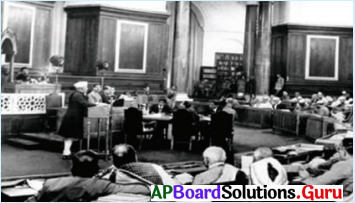
AP 7th Class Social Important Questions 9th Lesson Indian Constitution – An Introduction 1
Pandit Jawaharlal Nehru addressing the Inaugural session of the Constituent Assembly on 13.12.1946

On that day he proposed “objective resolution” which is the base to the preamble of Indian Constitution.

An Article refers to a specific rule or principle on a specific aspect in the constitution.

A Part refers to a set (group) of articles relating to one concept.

A Schedule refers to additional information or details not mentioned in the articles.

The words ‘Socialist’, ‘Secular’ were added to the Preamble in 1976 through the 42nd amendment.

AP 7th Class Social Important Questions 9th Lesson Indian Constitution – An Introduction

7th Class Social Textbook Page No. 36

Our country has also signed the resolutions passed at the UNO Conference to Protect the Rights of the Child. Thus, our country is also committed to the protection of the rights of the child. The major child rights are listed below.

  1. The right to survival.
  2. The right to protection
  3. The right to development
  4. The right to participation
AP 7th Class Social Important Questions 8th Lesson Bhakthi – Sufi

These AP 7th Class Social Important Questions 8th Lesson Bhakthi – Sufi will help students prepare well for the exams.

AP Board 7th Class Social 8th Lesson Important Questions and Answers Bhakthi – Sufi

7th Class Social 8th Lesson Bhakthi – Sufi 2 Marks Important Questions and Answers

Question 1.
What is Bhakti?
Answer:
Bhakti means a path of loving devotion to a particular deity.

Question 2.
What is the main characteristic of the Bhakti Movement?
Answer:
Universal Brotherhood and equality of all in the society.

Question 3.
When did Bhakti movement became popular in all religions?
Answer:
In the medieval period the path of Bhakti became more popular in all religions.

Question 4.
Who started the Bhakti Movement?
Answer:
Bhakti movement was started by Adi Shankaracharya.

AP 7th Class Social Important Questions 8th Lesson Bhakthi – Sufi

Question 5.
Who lead the Bhakti movement in North India?
Answer:
Ramananda, Kabir, Ravidas, Surdas, Mira Bai, etc.

Question 6.
Who spread the Bhakti movement in Tamilnadu?
Answer:
Alwars and Nayanars spread Bhakti movement in South India, mainly in’Tamilnadu.

Question 7.
Write a few words about Shankaracharya.
Answer:

  1. Shankaracharya was born in Kaladi of Kerala.
  2. He became a saint at the age of 5.
  3. He preached Advaita Philosophy.
  4. He established four Shakthi Peethas in all the four corners of India.

Question 8.
Names of Shakthi Peethas.
Answer:

  1. Badri in the North.
  2. Srungeri in the South.
  3. Puri in the East and
  4. Dwaraka in the West.

Question 9.
Name the works of Shankaracharya.
Answer:
Shankaracharya wrote Viveka Chudamani, Soundaryalahari, Sivanandalahari, Atmabodha, etc.

Question 10.
Define Dwaita Philosophy.
Answer:
According to Dwaita Philosophy, the world is not an illusion but a reality. Brahman, Atman and matter are unique in nature.

Question 11.
What is the idealogy of Vajlabhacharya?
Answer:
Vallabhacharya idealogy is known as Suddhadvaita.

Question 12.
What was the Cardial quote of Sant Ravi Das?
Answer:
Santa Ravi Das cardial quote was “Hari is in all and all in Hari”.

Question 13.
Who was the founder of Sikh religion?
Answer:
Guru Nanak was the founder of Sikh religion.

AP 7th Class Social Important Questions 8th Lesson Bhakthi – Sufi

Question 14.
Write about the teachings of Guru Nanak.
Answer:
The most famous teaching attributed to Guru Nanak are :

  1. There is only one God.
  2. That all human beings can have direct access to God.
  3. He taught that everyone is equal, regardless of caste or gender.

Question 15.
Write about Molla.
Answer:

  1. Molla is also called Mollamamba.
  2. She is a Telugu poet.
  3. She wrote Ramayana in Telugu.

Question 16.
Write a few words about Annamayya.
Answer:

  1. Tallapaka Annamacharya came from Tallapaka village of Kadapa district.
  2. He is known as Padakavita pithamaha.
  3. He wrote 32,000 Keerthanas in praise of lord Venkateswara.

Question 17.
Define Sufi movement.
Answer:

  1. The Sufi movement was a socio-religious movement in Islam.
  2. The Sufis emphasised on an egalitarian society based on universal love.

Question 18.
What is the impact of Sufi movement?
Answer:

  1. Sufi’s travelled all over the country to reach the poor and rural communities.
  2. They preached in the local languages.
  3. They lived a modest simple life.

7th Class Social 8th Lesson Bhakthi – Sufi 4 Marks Important Questions and Answers

Question 1.
Explain about Saguna and Nirguna Bhakthi.
Answer:

  1. The gunas are a key concept in nearly all schools of Hindu philosophy.
  2. These three gunas are called: Sattva (goodness, calmness, harmonious), Rajas (passion, activity, movement) and Tamas (ignorance, inertia, laziness).
  3. All of these three gunas are present in everyone and everything.
  4. Attributing these gunas to the God is Saguna Bhakthi.
  5. Worshipping the god without these Gunas is Nirguna Bhakthi.

Question 2.
What is the impact of the Bhakti Movement on the Medieval Indian society?
Answer:

  1. The most important social impact of the Bhakti movement was that the followers of the Bhakti movement rejected caste discrimination.
  2. This movement encouraged religious tolerance.
  3. The bhakti saints preached religous tolerance and monotheism.
  4. A spiral of harmony developed among different sections of the society.
  5. It tried to develop humanitarian attitude.

AP 7th Class Social Important Questions 8th Lesson Bhakthi – Sufi

Question 3.
What are the salient features of Sufism?
Answer:
The salient features of Sufism :

  1. There is only one God. All are children of God.
  2. To love a fellow human being is to love God.
  3. Devotional music is one of the ways to reach the presence of God.
  4. Sufi believes WahdatTul-Wujud which means worship for a single God.

7th Class Social 8th Lesson Bhakthi – Sufi 8 Marks Important Questions and Answers

Question 1.
Appreciate Sufi movement.
Answer:
Sufi Movement:
The Sufi movement was a socio-religious movement in Islam. The Sufis emphasised on an egalitarian society based on universal love. The word Sufi is derived from an Arabic word Saf. Saf means purity / clean. The Sufi saints were always in meditation and they led a simple life. They wore woollen clothes.

The salient features of Sufisim :

  1. There is only one God. All are children of God.
  2. To love ones fellow men is to love God.
  3. Devotional music is one of the ways to move nearer to God.
  4. Sufi believes Wahdat-ul-Wujud means worship for a single God.

Question 2.
Why Hindus worship many forms of God while there is only one form of God in Islamism?
Answer:

  1. Hindus worship many Gods. But all the Gods are not human beings, they are energies.
  2. The common man cannot understand or pray the immortal forms. So the rishis of Hinduism gave names to certain energies and physical shape.
  3. Later due to lack of knowledge the energies are forgotten by the common people and the physical forms and names only recorded in their minds.
  4. It also can be said that these energies are in subtle form in human bodies.

So Hindus worship many forms of God. But they also have only one Universal Supreme Being, PARAMATMA.

AP 7th Class Social Important Questions 8th Lesson Bhakthi – Sufi

Question 3.
What are the inferences from the poetry of Bhakti and Sufi saints about the existing social order ?
Answer:
Inferences from the Poetry of Bhakti and Sufi saints about the existing social order:

  1. Bhakti movement and Sufi movement influenced the life style, cultural practices and traditions of people.
  2. The saints and their followers resented caste, religious inequalities that prevailed in society.
  3. Dignity of labour enhanced the recognition of the people in Agriculture, Handloom, Art crafts etc.
  4. Inspiration of Bhakti movement lead to the formation of new kingdoms.
    1) Vijayanagara kingdom was established with the inspiration of Swami Vidyaranya.
    2) The Maratha kingdom by Shivaji with the inspiration of Samardha Ramadas.
  5. Bhakti movement enhanced the essence of local languages. The saints of Bhakti movement composed songs and poems to attract common man easily. This enhanced the literature in regional languages.
    Ex : Writings of Akkamahadevi, Meera Bhajans, Tiruppavai of Godadevi.
  6. The sufi saints propagated the principles of monotheism (belief in one God) simple way of worship and protested superstitions.
  7. Sufi saints propagated their principles in poems and songs. Music has great prominence in praising God. Ex : Quwwali.
  8. Simplicity, disciplined life dedication towards Islam etc. Attracted the society towards Sufism.

AP Board 7th Class Social 8th Lesson 1 Mark Bits Questions and Answers Bhakthi – Sufi

I. Multiple Choice Questions

1. The Bhakti Movement reached its prominence in _______ century.
A) 5th
B) 6th
C) 7th
D) 8th
Answer:
D) 8th

2. Saguna Bhakti means ___________ .
A) Worshipping god with form
B) Worship of the divine as formless
C) A & B both
D) None
Answer:
A) Worshipping god with form

3. Nirguna Bhakti means ________ .
A) Worshipping god with form
B) Worship of the divine as formless
C) A & B both
D) None
Answer:
B) Worship of the divine as formless

AP 7th Class Social Important Questions 8th Lesson Bhakthi – Sufi

4. The Bhakti movement was started by _________ .
A) Adi Shankaracharya
B) Ramanujacharya
C) Madhwacharya
D) Nimbarka
Answer:
A) Adi Shankaracharya

5. Alwars and Nayanars spread Bhakti movement in _________ .
A) Andhra Pradesh
B) West Bengal
C) Odisa
D) Tamilnadu
Answer:
D) Tamilnadu

6. Tukaram, Namdev, Samartha Ramadas belongs to _________ .
A) Assom
B) Punjab
C) Maharashtra
D) Kerala
Answer:
C) Maharashtra

7. Alwars were ______ saints
A) Sufi
B) Vaishnava
C) Saiva
D) All the above
Answer:
B) Vaishnava

8. Nayanars were ______ saints.
A) Saiva
B) Vaishnava
C) A & B both
D) None
Answer:
A) Saiva

9. Which of the following saint belongs North India?
A) Mira Bai
B) Shankardev
C) Basaveswara
D) Tukaram
Answer:
A) Mira Bai

10. Sankaracharya was born in ______ .
A) Perumbudur
B) Kaladi
C) Palani
D) Ooty
Answer:
B) Kaladi

11. Shankaracharva preached _______ .
A) Advaita
B) Dvaita
C) Visisthadvaita
D) Dvaita-Dvaita
Answer:
A) Advaita

12. Who established Shakthi Peethas?
A) Ramanuja
B) Madhwa
C) Shankaracharya
D) Basaveswara
Answer:
C) Shankaracharya

AP 7th Class Social Important Questions 8th Lesson Bhakthi – Sufi

13. Shankaracharva attained nirvana at the age of ______ .
A) 12
B) 60
C) 32
D) 50
Answer:
C) 32

14. Ramanuiacharva was born in ______ .
A) Kaladi
B) Sri Perumbudur
C) Prayag
D) Chittor
Answer:
B) Sri Perumbudur

15. Ramanuja preached ______ .
A) Vishishtadwaita
B) Dwaita
C) Adwaita
D) All the above
Answer:
A) Vishishtadwaita

16. Madhwacharva promoted ______ philosophy.
A) Advaita
B) Dvaita
C) Vishishtadvaita
D) All the above
Answer:
B) Dvaita

17. He hailed from a Telugu family
A) Basaveswara
B) Ramananda
C) Vallabhacharya
D) Ramanuja
Answer:
C) Vallabhacharya

18. Who popularised the Veerasaivism?
A) Basaveswara
B) Ramananda
C) Molla
D) Shankaracharya
Answer:
A) Basaveswara

19. Basaveswara’s famous quote was
A) God is one
B) All men are equal. There is no caste or sub-caste
C) Unity of god
D) All the above
Answer:
B) All men are equal. There is no caste or sub-caste

20. Ramananda was born at
A) Kaladi
B) Prayag
C) Sri Perumbudur
D) Odisa
Answer:
B) Prayag

AP 7th Class Social Important Questions 8th Lesson Bhakthi – Sufi

21. Kabir was brought up by a Muslim weaver named
A) Niru
B) Guru
C) Siru
D) None
Answer:
A) Niru

22. Kabir became a disciple of
A) Ramanuja
B) Ramanand
C) Adi Shankara
D) Vallabhacharya
Answer:
B) Ramanand

23. Sant Ravidas lived at
A) Banares
B) Prayag
C) Chittod
D) Kaladi
Answer:
A) Banares

24. Mira Bai became a devotee of
A) Sri Krishna
B) Rama
C) Hanuma
D) All the above
Answer:
A) Sri Krishna

25. Guru Nanak was born at
A) Lahore
B) Talwandi
C) Prayag
D) Banares
Answer:
B) Talwandi

26. Guru Nanak followers were known as :
A) Buddhists
B) Jains
C) Sikhs
D) Sufis
Answer:
C) Sikhs

27. Namdev was a devotee of
A) Nanak
B) Kabir
C) Ramanuja
D) Vithoba of Pandharpur
Answer:
D) Vithoba of Pandharpur

28. Jnaneswar used ______ to convey his thoughts.
A) Sanskrit
B) Marathi
C) Hindi
D) Telugu
Answer:
B) Marathi

29. Molla wrote Ramayana in ______ language.
A) Telugu
B) Sanskrit
C) Hindi
D) Marathi
Answer:
A) Telugu

AP 7th Class Social Important Questions 8th Lesson Bhakthi – Sufi

30. ______ was a great Sufi saint of India.
A) Khwaja-Pir-Mohammad
B) Nizam-Ud-Din-Auliya
C) Khwaja Moinuddin Chishti
D) Shaikh Niamat Ullah
Answer:
C) Khwaja Moinuddin Chishti

II. Intext – Bits – Fill in the Blanks

1. Bhakti means …………….. devotion to a particular deity.
2. Saguna bhakti means …………….. .
3. Nirguna Bhakti means …………….. .
4. Bhakti movement was started by …………….. .
5. Basaveswara isfrom …………….. .
6. Ramananda is from …………….. .
7. Guru Nanak Dev isfrom …………….. .
8. Shankaradev is from …………….. .
9. Shankaracharya became a saint at the age of …………….. .
10. Shankaracharya was considered the greatest reformer of …………….. .
11. Ramanujacharya was a philosopher and …………….. .
12. Ramanujacharya was born in …………….. year.
13. Ramanujacharya wrote a commentary on the Brahma Sutras popularly known as …………….. .
14. Madhwacharya was born on the west coast of …………….. .
15. Vallabhacharya idealogy is known as …………….. .
16. Vallabhas teachings are also known as …………….. .
17. Basaveswara literary works are named …………….. .
18. The credit forthe spread of N/aishnava religion in Northern India goes to …………….. .
19. Ramananda adopted …………….. to spread his teachings.
20. Kabir advocated …………….. .
21. Sant Ravidas cardial quote was …………….. .
22. …………….. was another important woman saint of the medieval times.
23. Chaitanya Mahaprabhu is also known as …………….. .
24. Shankara deva is the saint of …………….. .
25. Guru Nanak was born in …………….. year.
26. Namdev was born in a …………….. family.
27. Jnaneswar wrote his commentary on the Bhagawadgita called …………….. .
28. Molla is also called …………….. .
29. Tallapaka Annamacharya is popularly known as …………….. .
30. Annamayya is known as ……………..
31. The sufi movement was a …………….. movement fn Islam.
32. The word Sufi is derived from an Arabic word …………….. .
33. Khwaja Moinuddin Chishti was born in …………….. .
34. Moinuddin Chishti Dargah is located at …………….. in India.
35. Farid-ud-din Ganj-i-Shakar is known as …………….. .
36. ‘Saf means …………….. .
Answer:

  1. a path of loving
  2. Worshipping God with form
  3. Worshipping God without form
  4. Adi Shankaracharya
  5. Karnataka
  6. North India
  7. Talwandi near Lahore
  8. Assom
  9. 5
  10. Sanatana Dharma
  11. Social reformer
  12. 1017CE
  13. Sri Bhasya
  14. Karnataka
  15. Suddhadvaita
  16. Pushlimarga or the Path of Grace
  17. Vachanas
  18. Ramananda
  19. Hindi
  20. All are equal before God
  21. Hari is in all and all in Hari
  22. Mira Bai
  23. Sri Gauranga
  24. Assam
  25. 1469 AD
  26. Tailor
  27. Bhagavat Deepika
  28. Mollamamba
  29. Annamayya
  30. Padakavitha Pithamaha
  31. Socio-religious
  32. Sal
  33. 1143 AD
  34. Ajmer in Rajasthan
  35. Baba Farid
  36. Purity/clean

III. Match the following
1.

Group-AGroup-B
1. SankaracharyaA) Visishtadvaita
2. RamanujacharyaB) Pushtimarga
3. MadhwacharyaC) All men are equal
4. VallabhacharyaD) Dvaita
5. BasaveswaraE) Advaita

Answer:

Group-AGroup-B
1. SankaracharyaE) Advaita
2. RamanujacharyaA) Visishtadvaita
3. MadhwacharyaD) Dvaita
4. VallabhacharyaB) Pushtimarga
5. BasaveswaraC) All men are equal

2.

Group-AGroup-B
1. Mira BaiA) Sankeerthanas
2. MollaB) Fraternity of men
3. AnnamayyaC) Sri Krishna
4. Guru NanakD) Telugu

Answer:

Group-AGroup-B
1. Mira BaiC) Sri Krishna
2. MollaD) Telugu
3. AnnamayyaA) Sankeerthanas
4. Guru NanakB) Fraternity of men

3.

Group-AGroup-B
1. NamdevA) Sufi saint
2. JnaneswarB) Seistan in Persia
3. Moinuddin ChishtiC) Bhagavat Deepika
4. Baba FaridD) Vithoba of Pandharpur

Answer:

Group-AGroup-B
1. NamdevD) Vithoba of Pandharpur
2. JnaneswarC) Bhagavat Deepika
3. Moinuddin ChishtiB) Seistan in Persia
4. Baba FaridA) Sufi saint

Do You Know?

7th Class Social Textbook Page No. 18

The two types of bhakti are Saguna Bhakti and Nirguna Bhakti. Saguna Bhakti means worshipping God with form, Nirguna Bhakti means worshipping God without form.

7th Class Social Textbook Page No. 20

The Brahma Suthras is a Sanskrit text. Attributed to the sages Badarayana or Vyasa. It is also known as Vedanta Sutra.

AP 7th Class Social Important Questions 8th Lesson Bhakthi – Sufi

7th Class Social Textbook Page No. 24

Moinuddin Chishti Dargah is located at Ajmer. Rajasthan in India. The shrine has the grave of the revered saint, Moinuddin Chishti.

AP 7th Class Social Important Questions 7th Lesson Mughal Empire

These AP 7th Class Social Important Questions 7th Lesson Mughal Empire will help students prepare well for the exams.

AP Board 7th Class Social 7th Lesson Important Questions and Answers Mughal Empire

7th Class Social 7th Lesson 2 Marks Important Questions and Answers

Question 1.
Who was the founder of the Mughal Kingdom?
Answer:
Babur.

Question 2.
Who was the father of Akbar?
Answer:
Humayun.

Question 3.
Who was the father of Aurangazeb?
Answer:
Shah Jahan.

Question 4.
When was the Mughal empire founded?
Answer:
In 1526 C.E.

AP 7th Class Social Important Questions 7th Lesson Mughal Empire

Question 5.
Who introduced guns and cannons into the Indian warfare?
Answer:
Babur.

Question 6.
During whose reign the war of succession took place?
Answer:
During Shah Jahan’s reign.

Question 7.
Who started Din-l-llahi religion?
Answer:
Akbar.

Question 8.
Which Mughal emperor spent most of his life in exile?
Answer:
Humayun.

Question 9.
What are the contemporary kingdoms to Mughals?
Answer:
The contemporary kingdoms during Mughals were Afghans, Rajputs, Marathas and Bahamans.

Question 10.
Name the kingdoms of South, that were annexed by Aurangazeb.
Answer:
Golkonda and Bijapur.

Question 11.
Where did Akbar conduct his religious discussions?
Answer:
Fatehpur Sikri.

AP 7th Class Social Important Questions 7th Lesson Mughal Empire

Question 12.
What were the capital cities of Mughals?
Answer:
Delhi, Agra and Fatehpur Sikri.

Question 13.
Where did the war take place between Babur and Ibrahim Lodi?
Answer:
Panipat.

Question 14.
Who built Taj Mahal?
Answer:
Shah Jahan built Taj Majal.

Question 15.
Who had become the Mughal emperor in early age?
Answer:
Akbar became a emperor of Mughal empire at early age.

Question 16.
Name the first Mughal ruler who practiced the idea of “universal peace”.
Answer:
Akbar.

Question 17.
Who was the first Mughal emperor defeated by other kings?
Answer:
Humayun.

Question 18.
Which native rulers joined the Mughals voluntarily?
Answer:
The Rajputs joined the Mughals voluntarily.

Question 19.
Which Rajput kingdom resisted the Mughals?
Answer:
The Sisodiya Rajputs of Chittoor refused to accept Mughal authority for a long time.

Question 20.
How did the Rajputs maintain relationship with the Mughals?
Answer:
The Mughals married princess of many of the local rulers as a mark of friendship.

Question 21.
Who introduced Mansabdari system?
Answer:
Akbar introduced the Mansabdari system in his military policy.

Question 22.
Who abolished taxes on Hindus?
Answer:
Akbar abolished Jijya tax and pilgrim tax on Hindus.

Question 23.
Write about Shivaji.
Answer:

  1. Shivaji was great warrior and just ruler who consolidated the Maratha kingdom.
  2. He practiced religious tolerance, protected Muslim women, Mosques and Tombs.

Question 24.
Names of Mysore provinces were occupied by Shivaji?
Answer:
Jinji & Velluru.

AP 7th Class Social Important Questions 7th Lesson Mughal Empire

Question 25.
Who assisted Shivaji in administration?
Answer:
There were eight ministers called ‘Ashta Pradhans’ to assist Shivaji in administration.

7th Class Social 7th Lesson 4 Marks Important Questions and Answers

Question 1.
Appreciate the Mansabdari system.
Answer:

  1. Akbar introduced the Mansabdari system in his military policy. The term mansabdar refers to an individual who holds a mansab, meaning a position or rank.
  2. It was a grading system used by the Mughals to fix Rank, Salary and Military responsibilities. Each mansabdar consist of 10 to 10,000 soldiers.

Question 2.
Describe the structure of the Taj Mahal.
Answer:

  1. The Taj Mahal is a white marble mausoleum located in Agra, Uttar Pradesh, India. It was built by Mughal Emperor Shah Jahan in memory of his wife, Mumtaz.
  2. Taj Mahal is regarded as the finest example of the Mughal architecture and is considered as one of the Seven Wonders of the World.
  3. The Taj Mahal is widely recognized as ‘The jewel of Mughal art in India and one of the universally admired masterpieces of the world’s heritage’.

Question 3.
Write about the contemporary kingdoms during the Mughal rule.
Answer:

  1. The contemporary rulers during Mughals were Afghans, Rajputs, Marathas, and Bahaman kings. They opposed Mughal rulers and fought with them.
  2. In course of time most of these rulers could not completely succeed in defeating the Mughals.
  3. But the Maratha ruler Shivaji could resist the expansion of Mughals and established an independent kingdom.

Question 4.
Briefly tell about Babar.
Answer:
Babur (1526 -1530 CE):

  1. Babur was the founder of the Mughal empire.
  2. He was a great genius at devising war tactics.
  3. He also conquered Delhi and Agra after the first battle of Panipat.
  4. He was one of the greatest poet in Turkish literature and nature lover.
  5. Babur died in 1530 C.E.

Question 5.
Write Akbar’s administration about his vast empire.
Answer:

  1. Akbar introduced a number of administrative reforms.
  2. He divided his vast empire into several “Subas” and appointed a “subedar” for each suba.
  3. “Suba” was the term for a province in the Mughal Empire.
  4. Akbar divided his kingdom into 15 Subas.
  5. Subas were divided into “Sarkars”.
  6. These Sarkars were divided into “Paraganas”.
  7. The same pattern was followed by all other Mughal emperors.

Question 6.
What are the relations of Mughals with other rulers?
Answer:

  1. The Mughals campaigned and fought against rulers who did not obey them.
  2. As a part of their diplomacy, Mughals maintained relations with Rajputs by marrying their daughters.
  3. They offered them better position in their court.
  4. The Sisodiyas did not accept Mughal authority.
  5. The good relations with Rajputs, Sikhs and other rulers began during Akbar’s time.
  6. These relations deteriorate during Shajahan’s time and became worse during the reign of Aurangzeb.
  7. There were revolts in all parts of the empire during his reign.
  8. The empire declined very quickly after the death of Aurangzeb.

AP 7th Class Social Important Questions 7th Lesson Mughal Empire

Question 7.
What is the religion status during Mughal’s period?
Answer:

  1. Mughals are Sunni Muslims.
  2. Among them Akbar showed religious tolerance.
  3. He abolished “Jizya tax” and “Pilgrim tax” levied on the Hindus.
  4. Akbar allowed religious ceremonies of people to be celebrated openly.
  5. The majority of the people in the society were the Hindus.
  6. The society in those days consist of not only Hindus and Muslims but also of the Buddhists, the Jains, the Sikhs and the Parsis.
  7. Aurangzeb also appointed clergymen named Mutawasibs to observe the moral life of the people as per Sharia or Islamic principles.

Question 8.
Write about road system during Mughal’s period.
Answer:

  1. The Mughals were responsible for building an extensive road system.
  2. The Empire had an extensive road network built by a public works department set up by the Mughals.
  3. It designed, constructed and maintained roads, linking towns and cities across the empire.
  4. This was one of the reasons for the expansion of trade.

Question 9.
Write about the coinage system during Mughal’s period.
Answer:
Coinage :

  1. The Mughals were creation of uniform currency and unification of the country.
  2. The Mughals adopted and standardized the Rupee(silver) and Dam (copper) currencies.
  3. These are introduced by the Sur emperor Sher Shah Sur during his brief rule.
  4. The Dam was initially the most common coin in Akbar’s time.

Question 10.
What is agriculture position during Mughals1 period?
Answer:

  1. Indian Agricultural production increased under the Mughal Empire.
  2. A variety of crops were grown, including food crops such as wheat, rice, and barley and cash crops such as cotton, indigo and opium.
  3. Indian cultivators began to grow extensively the commercial crops maize and Tobacco.
  4. The important source of income was the revenue from agricultural tax.

Question 11.
What is Zabt? Write about it.
Answer:

  1. A remarkable feature of the Mughal system under Akbar was his revenue administration.
  2. He developed that largely under the supervision of his famed Revenue Minister Raja Todar Mai.
  3. It took two decades for Akbar to develop and implement a revenue system that would benefit both the State and the Farmer.
  4. In 1580 C.E. he obtained the previouslO years’ focal revenue statistics, detailed productivity and price fluctuations.
  5. He averaged the produce of different crops and their prices.
  6. It ranged from one-third to one-half of production value and was payable in “dams”. This system was called zabt.

7th Class Social 7th Lesson 8 Marks Important Questions and Answers

Question 1.
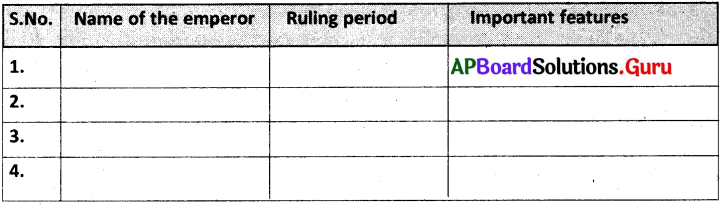
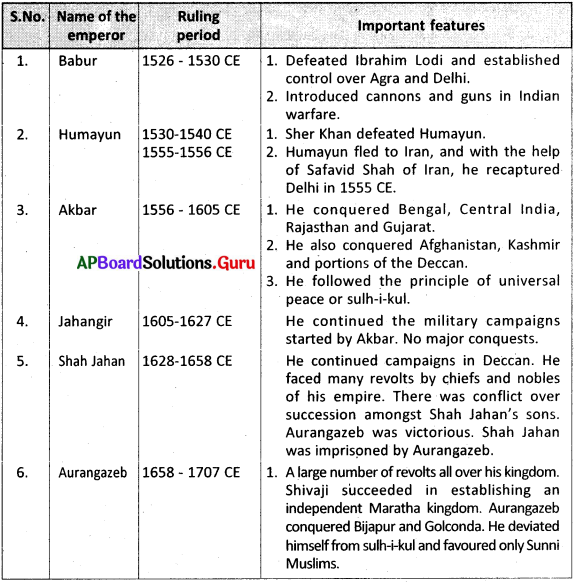
Write about the particulars of Mughal emperors with their ruling period and important features in the tabular form.
AP 7th Class Social Important Questions 7th Lesson Mughal Empire 1
Answer:
AP 7th Class Social Important Questions 7th Lesson Mughal Empire 2

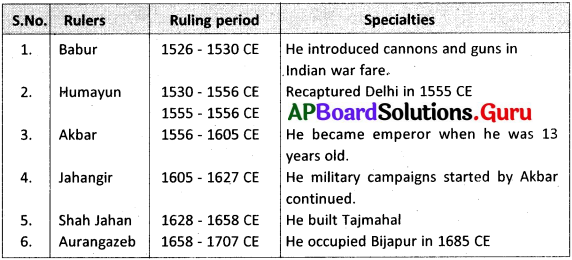
2. Observe the table and answer the following questions.
AP 7th Class Social Important Questions 7th Lesson Mughal Empire 3
Questions :
a) Who was the founder of Mughal dynasty?
Answer:
Babur was the founder of Mughal dynasty.

b) Who built Tajmahal?
Answer:
Shahjahan built the Tajmahal.

c) Who had become the Moghul emperor in early age?
Answer:
Akbar became an emperor of Mughal empire at early age.

d) Which Mughal Emperor ruled longest period?
Answer:
Aurangzeb and Akbar both are ruled nearly longest period.

Question 3.
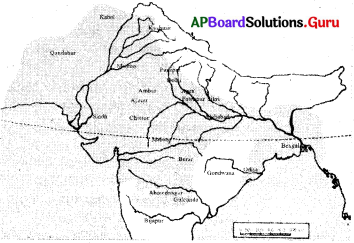
Study the given map :
AP 7th Class Social Important Questions 7th Lesson Mughal Empire 4
Now answer the following questions.
a. Whose empire does this map show?
Answer:
The map shows the empire of Akbar.

b. What were the places that were annexed by Akbar in the north-west region?
Answer:
Qandahar and Kabul.

c. Identify the important battle place which has its own significance in the history of the Mughals.
Answer:
Panipat.

d. Name the kingdom annexed by Akbar in south India.
Answer:
Ahmednagar.

e. Name the kingdoms of South that were annexed by Aurangazeb.
Answer:
Golkonda and Bijapur.

f. Where did Akbar conduct his religious discussions?
Answer:
Fatehpur Sikri.

g. What was the capital city of the Mughals?
Answer:
Delhi.

AP 7th Class Social Important Questions 7th Lesson Mughal Empire

Question 4.
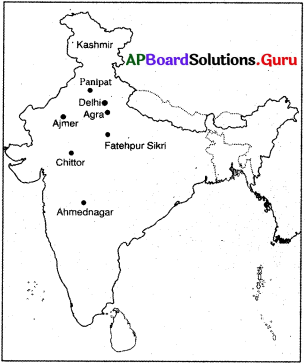
Locate the following on the map of India.
1. Delhi
2. Agra
3. Panipat
4. Fatehpur Sikri
5. Ahmednagar
6. Ajmer
7. Chittor
8. Kashmir
AP 7th Class Social Important Questions 7th Lesson Mughal Empire 5

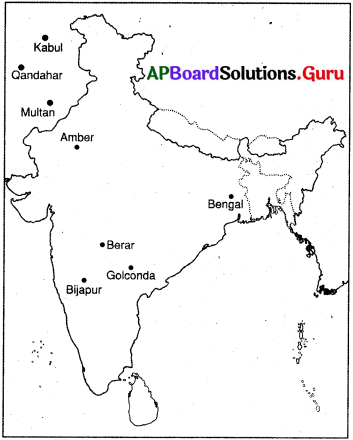
Question 5.
Locate the following on the map given below.
1. Kabul
2. Qandahar
3. Multan
4. Bijapur
5. Golkonda
6. Bengal
7. Berar
8. Amber
AP 7th Class Social Important Questions 7th Lesson Mughal Empire 6

Question 6.
Appreciate Shivaji and his administration.
Answer:

  1. At the age of 19, Shivaji captured Torana Durga, which was under the control of Mahammad Adilshah of Bijapur.
  2. After this, he won Raigarh, Simhagarh, Pratapgarh etc., one by one. Enraged by this the Sultan of Bijapur sent his general Afzal Khan to suppress Shivaji.
  3. Afzal Khan wanted to kill Shivaji deceitfully. So he invited Shivaji under the pretext of reconciliation. Expecting this, Shivaji killed Afzal Khan with ‘Vyaghra Nakha’ (Tiger’s claw), a weapon that he had with him.
  4. On learning these advancements of Shivaji, Aurangzeb sent his general Shaista Khan to Deccan province to curb him down. But clever Shivaji was able to defeat Shaista Khan.
  5. This maddened Aurangazeb. So he sent a huge army under the leadership of Raja Jayasimha. Jayashimha defeated Shivaji and captured a few Maratha forts.
  6. At the end Jayasimha invited Shivaji to come to have treaty with Aurangzeb. Aurangzeb arrested Shivaji on his arrival and kept him in the prison of Agra.
  7. But Shivaji cleverly escaped from jail and reached his capital. After that, he won all the forts that he had lost to the Mughals. He attacked Surat and ransacked heavy wealth from there.

AP Board 7th Class Social 7th Lesson 1 Mark Bits Questions and Answers Mughal Empire

I. Multiple Choice Questions

1. This fort was built by Shah Jahan
A) Rayagarh
B) Pratapgarh
C) Red Fort
D) Fort of Kondapalli
Answer:
C) Red Fort

2. Who was the founder of Mughal Empire?
A) Akbar
B) Babur
C) Ibrahim Lodi
D) Qutubuddin Ibaq.
Answer:
B) Babur

3. Who built Taj Mahal?
A) Akbar
B) Babur
C) Shah Jahan
D) Aurangzeb
Answer:
C) Shah Jahan

4. When did Babur become the ruler of Delhi?
A) 1526 CE
B) 1523 CE
C) 1504 CE
D) 1530 CE
Answer:
A) 1526 CE

5. Who was the Sultan of Delhi, when Babur captured it?
A) Seconder Lodi
B) Ibrahim Lodi
C) Dahir
D) Gazni Muhammad
Answer:
B) Ibrahim Lodi

6. Babur occupied Delhi after the battle of
A) Panipat-I
B) Panipat-II
C) Panipat — III
D) Wandwash
Answer:
A) Panipat-I

7. The death of Babur in
A) 1530 CE
B) 1536 CE
C) 1565 CE
D) 1526 CE
Answer:
A) 1530 CE

8. The word “Mughal” comes from
A) Mangal
B) Mongol
C) Mangale
D) Mangala
Answer:
B) Mongol

9. The son of Babur
A) Akbar
B) Aurangzeb
C) Shah Jahan
D) Humayun
Answer:
D) Humayun

10. Humayun died in
A) 1550 CE
B) 1556 CE
C) 1540 CE
D) 1545 CE
Answer:
B) 1556 CE

11. Sher Shah was an
A) Afghan
B) Indian
C) Italian
D) Indonesian
Answer:
A) Afghan

12. Sher Shah defeated the
A) Babar
B) Humayun
C) Akbar
D) Jahangir
Answer:
B) Humayun

13. Sher Shah belongs to dynasty.
A) Sur
B) Sunni
C) Khan’s
D) None of the above
Answer:
A) Sur

AP 7th Class Social Important Questions 7th Lesson Mughal Empire

14. Sher Shah was died in
A) 1545 CE
B) 1555 CE
C) 1556 CE
D) 1550 CE
Answer:
A) 1545 CE

15. Who was the youngest to become a Mughal ruler?
A) Humayun
B) Akbar
C) Aurangazeb
D) Shah Jahan
Answer:
B) Akbar

16. When did Humayun recapture Delhi from Sher Khan?
A) 1530 CE
B) 1555 CE
C) 1556 CE
D) 1540 CE
Answer:
B) 1555 CE

17. Akbar defeated Hemu in the battle of
A) Panipat-I
B) Panipat – II
C) Panipat – III
D) None of the above
Answer:
B) Panipat – II

18. The guardian of Akbar
A) Babar
B) Sher Shah
C) Bairam Khan
D) Humayun
Answer:
C) Bairam Khan

19. The title of Salim was
A) Shah Jahan
B) Jahangir
C) Bahadur Shah
D) Aurangzeb
Answer:
B) Jahangir

20. Shah Jahan was the son of
A) Humayun
B) Sher Shah
C) Jahangir
D) Aurangzeb
Answer:
C) Jahangir

21. Aurangzeb conquered Bijapur in
A) 1600 CE
B) 1685 CE
C) 1656 CE
D) 1658 CE
Answer:
B) 1685 CE

AP 7th Class Social Important Questions 7th Lesson Mughal Empire

22. Aurangzeb conquered Golkonda in
A) 1687 CE
B) 1685 CE
C) 1656 CE
D)1658 CE
Answer:
A) 1687 CE

23. Mughals are Muslims.
A) Sunni
B) Sur
C) Shia
D) Khan
Answer:
A) Sunni

24. He abolished Jizya tax and pilgrim tax
A) Akbar
B) ShahJahan
C) Babur
D) Aurangzeb
Answer:
A) Akbar

25. Akbar announced the new religion Din-l-llahi in
A) 1575 CE
B) 1582 CE
C) 1585 CE
D) 1590 CE
Answer:
B) 1582 CE

26. Zabat means
A) confiscation of property of a farmer who could not pay his taxes.
B) Maintenance of cavalry by rriansabdars.
C) The revenue system of Mughals.
D) The religious tradition of Muslims.
Answer:
C) The revenue system of Mughals.

27. Raja Todar Mai was the revenue minister of
A) Sher Shah
B) Akbar
C) Shah Jahan
D) Aurapgzeb
Answer:
B) Akbar

28. The Dam coin is in time.
A) Babar
B) Akbar
C) Humayun
D) Jahangir
Answer:
B) Akbar

29. Fateh means
A) Kingdom
B) Victorious
C) Looser
D) Emperor
Answer:
B) Victorious

30. Buland Darwaza was built by
A) Babar
B) Jahangir
C) Akbar
D) Shivaji
Answer:
C) Akbar

31. The Taj Mahal is at
A) Delhi
B) Simla
C) Agra
D) Patna
Answer:
C) Agra

32. Ramacharita Manas was written by
A) Ramadas
B) Kabirdas
C) Tulasidas
D) Akbar
Answer:
C) Tulasidas

33. Mughal miniature painting belongs to
A) Babar
B) Akbar
C) Jahangir
D) Khurram
Answer:
C) Jahangir

34. Shivaji was born in
A) Shivaneri fort
B) Raigarh fort
C) Pratapgarh fort
D) Red fort
Answer:
A) Shivaneri fort

AP 7th Class Social Important Questions 7th Lesson Mughal Empire

35. Who established the Maratha Kingdom?
A) Balaji Viswanath
B) Shambhaji
C) Shivaji
D) Baji Rao
Answer:
C) Shivaji

36. The Guru of Shivaji
A) Bairam Khan
B) Dadaji Khondadev
C) Ramadas
D) Tulasidas
Answer:
B) Dadaji Khondadev

37. Shivaji killed Afzal Khan with
A) Tiger’s claw
B) Lion’s claw
C) With knife
D) With bombs
Answer:
A) Tiger’s claw

38. The year of first Panipat war
A) 1526 AD
B) 1530 AD
C) 1527 AD
D) 1535 AD
Answer:
A) 1526 AD

39. The year of Second Panipat War
A) 1550 CE
B) 1556 CE
C) 1560 CE
D) 1561 CE
Answer:
B) 1556 CE

40. The Iranian emperor that helped Humayun
A) Dara-Shukoh
B) SherShah
C) Akbar
D) Safavid Shah
Answer:
D) Safavid Shah

41. Humayun re-occupied Delhi in
A) 1520 CE
B) 1526 CE
C) 1530 CE
D) 1555 CE
Answer:
D) 1555 CE

AP 7th Class Social Important Questions 7th Lesson Mughal Empire

42. The Mughal rule was expanded in Deccan region by
A) Babur
B) Akbar
C) Humayun
D) Shah Jahan
Answer:
B) Akbar

II. Intext – Bits – Fill in the Blanks

1. Red Fort was built by ………………. .
2. Red Fort is in ………………. .
3. Once the Red Fort was the residence of ………………. .
4. Babar occupied Delhi and Agra after the ………………. .
5. Babar was related to ………………. from his father’s side and to Chengiz Khan’s dynasty from his ………………. .
6. The word “Mughal” comes from ………………. .
7. Sher Khan, defeated Humayun at ………………. and ………………. .
8. Sher Shah was an ………………. Leader.
9. Sher Shah died in an ………………. in 1545 AD
10. Akbar was just ………………. years old when his father was passed away.
11. Akbar defeated Hemu with the help of ………………. .
12. Akbar died in ………………. .
13. ………………. was a close associate of emperor Akbar.
14. Jahangir came under the influence of ………………. .
15. Shah Jahan was the son of ………………. .
16. Shah Jahan’s period was much known for the construction of ………………. .
17. ………………. was imprisoned for rest of his life in Agra.
18. Aurangazeb was a younger son of ………………. .
19. Aurangazeb did not show ………………. to other religions.
20. The Mughals had a ………………. administration.
21. Akbar divided his vast empire into several ………………. .
22. ………………. was appointed to each subha.
23. Subas were divided into ………………. .
24. Sarkars were divided into ………………. .
25. Akbar introduced the ………………. system in his military policy.
26. Mughalsare ………………. Muslims.
27. Akbar showed ………………. tolerance.
28. Akbar built Ibadat Khana at ………………. .
29. Din-l-llahi means ………………. .
30. Only ………………. people joined in Din-l-lllahi.
31. The ………………. industry developed in the Mughal empire.
32. Buland Darwaza as a ………………. .
33. Panch Mahal is in ………………. .
34. Taj Mahal is one of ………………. wonder’s of the world.
35. ………………. language was the dominant and official language of Mughal empire.
36. Abdul Fazal wrote ………………. .
37. Dhara Shukoh translated ………………. and ………………. into Persian language.
38. Aurangazeb ………………. all programmes of music.
39. The most famous singers of Akbar’s court are ………………. and ………………. .
40. Shivaji’s father was ………………. .
41. Shivaji’s mother was ………………. .
42. ………………. and ………………. taught Shivaji the lessons of warfare.
43. At the age of 19, Shivaji captured ………………. .
44. In Raigarh Shivaji was conferred with the title ………………. .
45. In Shivaji’s court eight ministers called ………………. .
46. The Prime Minister was called ………………. .
Answer:

  1. Shah Jahan
  2. Agra
  3. Mughal Emperors
  4. defeating Ibrahim Lodi – Panipat – I
  5. Timur, mother side
  6. Mongol
  7. Chausa and Kanauj
  8. Afghan
  9. Explosion
  10. 13
  11. Bairam Khan
  12. 1605 CE
  13. Raja Birbal
  14. Mcharunnisa (Nurjahan)
  15. Jahangir
  16. buildings
  17. Shah Jahan
  18. Shah Jahan
  19. tolerance
  20. Centralised
  21. Subhas
  22. Subedar
  23. Sarkars
  24. Paraganas
  25. Mansabdari
  26. Sunni
  27. religious
  28. Fatehpur Sikri
  29. Peace with all
  30. 18
  31. Textile
  32. Victory arch
  33. Fatehpur Sikri
  34. 7
  35. Persian
  36. Ain-I-Akbari and Akbar Nama
  37. Bhagavat Gita and Mahabharata
  38. Prohibited
  39. Tansen and Bajbahadur
  40. Shaji Bhonsle
  41. Jijabai
  42. Dadaji Khondadev and Tanaji Malasure
  43. Torana Durga
  44. Chhatrapati
  45. Ashta Pradhans
  46. Peshwa

III. Match the following

1.

Group-AGroup-B
1. ChhatrapatiA) World conqueror
2. SalimB) Jahangir
3. MeharunnisaC) Shivaji
4. JahangirD) Nurjahan

Answer:

Group-AGroup-B
1. ChhatrapatiC) Shivaji
2. SalimB) Jahangir
3. MeharunnisaD) Nurjahan
4. JahangirA) World conqueror

2.

Group-AGroup-B
1. 1526 CEA) Panipat War-I
2. 1556 CEB) Golkonda
3. 1685 CEC) Bijapur
4. 1687 CED) Panipat War-II

Answer:

Group-AGroup-B
1. 1526 CEA) Panipat War-I
2. 1556 CED) Panipat War-II
3. 1685 CEC) Bijapur
4. 1687 CEB) Golkonda

Do You Know?

7th Class Social Textbook Page No. 4

Babur was related to Timur from his father’s side and to Ghengis Khan’s dynasty from his mother side. The Mughals (descendants of Mongols) preferred to call themselves, the Chaghatayids, after Chengiz’s second son, Chaghatay.

The Word “Mughal” comes from “Mongol”.

7th Class Social Textbook Page No. 5

Birbal :
Raja Birbal was a close associate of emperor Akbar. Birbal was a great singer and poet in the court of Akbar. Akbar was highly influenced by him.

Rani Chand Bibi of Ahmednagar was the woman who fought bravely and opposed Akbar.

7th Class Social Textbook Page No. 7

Jizya Tax :
The Jizya tax is a tax paid by non-Muslims to Muslim rulers for practicing their religion and obtaining exemptions from joining the Army. This tax was first introduced by Qutb-ud-din Aibak, the founder of the Slave dynasty.

Pilgrim Tax :
A tax imposed on Hindus by the Muslim emperors for undertaking a journey to a religious are sacred place.

7th Class Social Textbook Page No. 8

Akbar, in 1575 CE built a meeting house of worship called Ibadat Khana at Fatehpur Sikri. In 1582 CE he proclaimed a new religion called Din-I-Ilahi. Literally meaning “Peace with all”, Universal Peace or absolute peace. As applied by Akbar, it described a peaceful and harmonious relationship among different religions. Only 18 people joined this religion. This remained a court religion.

AP 7th Class Social Important Questions 7th Lesson Mughal Empire

7th Class Social Textbook Page No. 14

Ashtapradhans :
Ashtapradhan was a system of a ministerial delegation in Maratha . empire. The council is credited with having implemented good governance practices in the Maratha heartland.

  1. Peshwa : Prime Minister – General administration of the empire.
  2. Amatya : Finance Minister – Managing accounts of the empire.
  3. Sacheev : Secretary – Preparing royal edicts.
  4. Waqia-i-Navis : Home Minster – managing internal affairs especially intellige- nee and espionage.
  5. Senapati : Commander – in – chief, managing the forces and defence of the empire.
  6. Sumant: Foreign Minister – to manage relationships with other sovereigns.
  7. Nyayadhish : Chief Justice – dispensing justice on civil and criminal matters.
  8. Panditrao : High priest – managing internal religious matters.

AP 7th Class Social Important Questions 6th Lesson Vijayanagara Empire

These AP 7th Class Social Important Questions 6th Lesson Vijayanagara Empire will help students prepare well for the exams.

AP Board 7th Class Social 6th Lesson Important Questions and Answers Vijayanagara Empire

Question 1.
When was the Vijayanagara Kingdom founded?
Answer:
1336 CE

Question 2.
Who were the founders of the Vijayanagara Kingdom?
Answer:
Hari Hara Raya and Bukka Raya.

Question 3.
Who was the last Vijayanagara Ruler?
Answer:
Venkatapathi Raya – II

AP 7th Class Social Important Questions 6th Lesson Vijayanagara Empire

Question 4.
Name the rulers who belonged the Sangama dynasty.
Answer:
Hari Hara Raya, Bu’kka Raya, Hari Hara Raya – II, Devaraya – II.

Question 5.
Name the rulers who belonged to Saluva dynasty.
Answer:
Saluva Narasimha Raya, Immadi Narasimha Raya.

Question 6.
Name the rulers who belonged to Thuluva dynasty.
Answer:
Sri Krishna Devaraya, Atchutarayalu etc.

Question 7.
Name the rulers of Araveedu Dynasty.
Answer:
Aliya Rama Raya, Venkatapati Raya – II etc.

Question 8.
Where was Vijayanagara kingdom located?
Answer:
The Vijayanagara kingdom was located on the banks of Tungabhadra river in Karnataka.

Question 9.
What was the capital of Bahamani Kingdom?
Answer:
Capital of Bahamani kingdom was Gulbarga.

Question 10.
Into how many smaller kingdoms did the Bahamani kingdom broke up? What are they?
Answer:
Bahamani Kingdom broke up into five kingdoms. Ahmednagar, Bivar, Bidar, Bijapur and Golkonda were the five kingdoms.

AP 7th Class Social Important Questions 6th Lesson Vijayanagara Empire

Question 11.
Mention the names of eight great poets of Sri Krishna pevaraya Court.
Answer:

  1. Allasani Peddana,
  2. Nandi Timmana,
  3. Madayagaari Mallana,
  4. Dhurjati,
  5. Ayyala Raju Ramabhadrudu,
  6. Pingali Surana
  7. Rama Raja Bhushana and
  8. Tenali Rama Krishna

Question 12.
Name the Moroccan Traveller who visited Vijayanagara Kingdom and whose period?
Answer:
Ibn Battuta – Hari Hara – I period.

Question 13.
Name the Italian traveller who visited Vijayanagara Kingdom and whose period?
Answer:
Nicolo Conti – Devaraya II – period.

Question 14.
Name the Persian traveller who visited Vijayanagara Kingdom and whose period?
Answer:
Abdul Razzaq – Devaraya – II.

Question 15.
Name the Portuguese travellers, who visited Vijayanagara Kingdom and whose period?
Answer:
Duarte Barbosa and Domingo Paes – Sri Krishna Devaraya.

Question 16.
Name the Portuguese traveller, who visited Vijayanagara Kingdom and whose period?
Answer:
Fernao Nuniz – Atchuta Deva Raya.

Question 17.
Name of the countries with whom Vijayanagara rulers maintained commercial contacts.
Answer:
Arabia, Persia, South Africa, Portugal, Burma, Malaya and China.

AP 7th Class Social Important Questions 6th Lesson Vijayanagara Empire

Question 18.
When did the battle of Rakkasi Tangadi took place and what is the another name of the battle?
Answer:
The battle of Rakkasi Tangadi took place in the year 1565 CE.

The another name is battle of Tallikota.

Question 19.
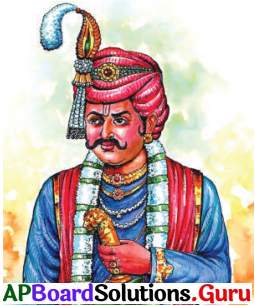
Write about Sri Krishna Devaraya.
Answer:
AP 7th Class Social Important Questions 6th Lesson Vijayanagara Empire 1

  1. Sri Krishna Deva Raya rule, which was marked by victories, wealth, and prosperity, was a high point in the history of the Vijayanagara Empire.
  2. Apart from being a renowned warrior and an able administrator, he was also an excellent writer, and a patron of arts and culture.
  3. In his reign, Vijayanagara was not only militarily and politically powerful, but was also a thriving center for learning and arts.
  4. It was where all the writers, poets, artistes, and sculptors flocked to produce some of the finest works ever.
  5. While his reign is described often as the Golden Age of Telugu Literature, equal patronage was also given to Kannada, Tamil, and Sanskrit authors and writers.
  6. Krishna Deva Raya himself was a polyglot, fluent in Telugu, Kannada, Sanskrit, and Tulu.
  7. He was praised as “Narasimha Krishna Deva Raya” hearing whose name the Turks quivered and elephants ran away, by one of his poets Mukku Timanna.

Question 20.
Collect a song from old telugu movies on the constructions of the the Vijayanagara Empire and Sri Krishna Deva Raya.
Answer:

అహో ఆంధ్రభోజా శ్రీకృష్ణదేవరాయా
విజయనగర సామ్రాజ్య నిర్మాణ తేజోవిరాజా
ఈ శిధిలాలలో చిరంజీవివైనావయా
శిలలపై శిల్పాలు చెక్కినారు
మనవాళ్ళు సృష్టికే అందాలు తెచ్చినారు
శిలలపై శిల్పాలు చెక్కినారు

కనుచూపు కరువైన వారికైనా
కనిపించి కనువిందు కలిగించు రీతిగా
శిలలపై శిల్పాలు చెక్కినారు

ఒక వైపు ఉర్రూతలూపు కవనాలు
ఒక ప్రక్క ఉరికించు యుద్ధభేరీలు
ఒక చెంప శృంగారమొలుకు నాట్యాలు
నవరసాలొలికించు నగరానికొచ్చాము
కనులు లేవని నీవు కలత పడవలదు

కనులు లేవని నీవు కలత పడవలదు నా కనులు నీవిగా చేసికొని చూడు
శిలలపై శిల్పాలు చెక్కినారు మనవాళ్ళు సృష్టికే అందాలు తెచ్చినారు
శిలలపై శిల్పాలు చెక్కినారు
ఏకశిల రథముపై లోకేశు వడిలోన ఓరచూపులదేవి ఊరేగి రాగా
రాతి స్థంభాలకే చేతనత్వము కలిగి సరిగమా పదనిసా స్వరములే పాడగా
కొంగుముడి వేసుకొని క్రొత్త దంపతులు
కొంగుముడి వేసుకొని క్రొత్త దంపతులు కొడుకు పుట్టాలనీ కోరుకున్నారనీ
శిలలపై శిల్పాలు చెక్కినారు మనవాళ్ళు సృష్టికే అందాలు తెచ్చినారు
శిలలపై శిల్పాలు చెక్కినారు

రాజులే పోయినా రాజ్యాలు కూలినా
కాలాలు మారినా గాడ్పులే వీచినా
మనుజులే దనుజులై మట్టిపాల్టేసినా
ఆ ఆ ఆ ఆ చెదరనీ కదలనీ శిల్పాల వలెనే నీవు నా
హృదయాన నిత్యమై సత్యమై
నిలిచివుందువు చెలీ నిజము నా జాబిలీ.

Question 21.
Get the story behind the selection of place of the Vijayanagara empire and discuss in the class.
Answer:
Once, during a hunt, Harlhara saw a big rabbit and sent his hunting dog after it. However, the rabbits chased the dog and escaped. While returning from the hunt, Harihara saw a holyman, and narrated the strange incident to him. The holyman was Vidyaranya. The two men went to the place where the rabbit chased the dog. Vidyaranya told him that the place was sacred, and advised him to establish the capital of his new kingdom there.

Question 22.
What do you know about Amaranayakas?
Answer:
A) AMARA NAYAKAS were those who exercised power in the Empire were military chiefs who usually control forts and had armed supporters.

B) These chiefs often move from one area toanotherand in many cases were accompanied by persants looking for fertile land on which they could settle. These chiefs were known as Nayakas.

C) The Amaranayaka system was a major political innovation of Vijayanagara empire.The Amaranayakas form military commandars who are given territories to be governed by the Raya.

Question 23.
Write the four important dynasties of Vijayanagara empire in a tabular form.
Answer:

Dynasty NamePeriodFamous Kings
1) Sangama Dynasty1336-1485 ADHaihara Raya -1 (1336-1357 AD)
Bukka Raya -1 (1357-1377 AD)
Harihararaya – II (1377-1404 AD)
Devaraya – II (1426-1446 AD)
2) Saluva Dynasty1485-1505 ADSaluva Narasimharava (1485-1491 AD)
3) Thuluva Dynasty1505- 1570 ADSrikrishna Devaraya (1509-1529 AD)
Atchutarayalu (1529-1542 AD)
4) Aravedu Dynasty1570- 1646 ADAliya Rama Raya (1543-1565 AD)
Venkatapati Raya-ll (1585- 1614 AD)

AP 7th Class Social Important Questions 6th Lesson Vijayanagara Empire

Question 24.
Write the names of Astadiggajas and their writing books in a tabular form.
Answer:

Name of the PoetName of the Book
1. Allsani PeddanaManu Charita, Harikatha saram.
2. Nandi TimmanaParijathapaharanam.
3. Madayagaari MallanaRajasekhara Charitham.
4. DhurjatiSree Kaalahasthisvara Mahathyam.
5. Ayyalaraju RamabhadruduSakala neethi saara sangraham.
6. Pingali SuranaRaghava pandaveeyam.
7. Ramaraja BhushanaVasu charitra.
8. Tenali RamakrishnaPandu ranga mahatyam.

AP Board 7th Class Social 6th Lesson 1 Mark Bits Questions and Answers Vijayanagara Empire

I. Multiple Choice Questions

1. The Ruling period of Vijayanagara empire
A) 1465 -1565 CE
B) 1206 -1806 CE
C) 1336 -1646 CE
D) 1191-1206 CE
Answer:
C) 1336 -1646 CE

2. The capital of Vijayanagara Kingdom
A) Bangalore
B) Hampi
C) Vijayawada
D) Guntur
Answer:
B) Hampi

3. The city of Vijayanagara was located on the banks of the river …………..
A) Krishna
B) Godavari
C) Tungabhadra
D) Kaveri
Answer:
C) Tungabhadra

4. The kingdom of Vijayanagara was founded in the year ……………..
A) 1336 CE
B) 1339 CE
C) 1347 CE
D) 1346 CE
Answer:
A) 1336 CE

5. The sage with whose blessings Hari Hara and Bukka founded the Vijayanagara kingdom was …………..
A) Vidyaranya
B)Vidyanadha
C) Ramanuja
D) Vijayaranya
Answer:
A) Vidyaranya

6. The capital of Bahamani kingdom was
A) Prussia
B) Egypt
C) Bijapur
D) Gulbarga
Answer:
D) Gulbarga

AP 7th Class Social Important Questions 6th Lesson Vijayanagara Empire

7. ‘Ashtadiggajas’ – eight poets adorned the court of ………….
A) Saluva Narasimha
B) Devaraya – II
C) Krishna Devaraya
D) Aliya Rama Raya
Answer:
C) Krishna Devaraya

8. Who destroyed the Madurai Sultans?
A) Bukkaraya – I
B) Hari Hara Raya
C) Devaraya
D) Kumara Kampana Raya
Answer:
A) Bukkaraya – I

9. The region between Krishna and Tungabhadra rivers
A) Raichur Doab
B) Vengi Doab
C) Godavari Delta
D) None
Answer:
A) Raichur Doab

10. The greatest ruler of Sanga dynasty was
A) Virupaksha Raya
B) Maalikarjuna Raya
C) Devaraya – II
D) Aliya Rama Raya
Answer:
C) Devaraya – II

11. Who is the founder of Saluva dynasty?
A) Narasimha Raya
B) Rama Raya
C) Devaraya II
D) Virupaksharya II
Answer:
A) Narasimha Raya

AP 7th Class Social Important Questions 6th Lesson Vijayanagara Empire

12. Sri Krishna Devarya belongs to
A) Sangama dynasty
B) Tuluva dynasty
C) Saluva dynasty
D) Aravedu dynasty
Answer:
B) Tuluva dynasty

13. The founder of Tuluva dynasty
A) Narasimha
B) Narasa Nayaka
C) Venkatapati Raya
D) Bukkaraya
Answer:
B) Narasa Nayaka

14. The wise minister of Sri Krishna Devaraya was
A) Timmarusu
B) Tikkana
C) Tenali Ramakrishna
D) Dhoorjati
Answer:
A) Timmarusu

15. Sri Krishna Devarya was known as
A) Praudha Devaraya
B) Andhra Bhoja
C) Andhra Kavita Pitamaha
D) Andhra Ratna
Answer:
B) Andhra Bhoja

16. Who said “Desa Bhasalandu Telugu Lessa”
A) Rama Raya
B) Hari Hara Raya
C) Sri Krishna Devaraya
D) Narasimha Raya
Answer:
C) Sri Krishna Devaraya

17. Who was called Andhra Kavita Pitamaha?
A) Durjati
B) Tenali Rama Krishna
C) Allasani Peddanna
D) Pingali Surana
Answer:
C) Allasani Peddanna

18. Jambavathi Kalyanam was written by
A) Allasani Peddana
B) Tenali Rama Krishna
C) Pingali Surana
D) Sri Krishna Devaraya
Answer:
D) Sri Krishna Devaraya

AP 7th Class Social Important Questions 6th Lesson Vijayanagara Empire

19. Nagalapuram city was constructed by
A) Devaraya II
B) Sri Krishna Devaraya
C) Atchutarayalu
D) Ramaraya
Answer:
B) Sri Krishna Devaraya

20. Land revenue of Vijayanagara empire
A) 1/6th
B) 1/5th
C) 1/3rd
D) 1/5th
Answer:
A) 1/6th

21. Top-grade officers of the army are
A) Nayaks
B) Palegars
C) Both A & B
D) None
Answer:
C) Both A & B

22. The famous music of Vijayanagara empire
A) Carnatic
B) Hindustani
C) Indolam
D) None
Answer:
A) Carnatic

23. The famous work of Swamy Vidyaranya
A) Usha Parinayam
B) Sangeetha Sarwaswam
C) Mahanataka Sudhanidhi
D) None
Answer:
B) Sangeetha Sarwaswam

24. Who introduced Bharata Natyam?
A) Bharata Muni
B) Siddendra Yogi
C) Narayana
D) None
Answer:
A) Bharata Muni

25. Kuchipudi dance was introduced by
A) Yamini Krishna Murthy
B) Siddendra Yogi
C) Bharata Muni
D) Narayana Yogi
Answer:
B) Siddendra Yogi

26. The Reddy kingdom was established in South India by .
A) Raghuveera
B) Prolaya Vema Reddy
C) Komaragiri Reddy
D) Pedakomati Vema Reddy
Answer:
B) Prolaya Vema Reddy

27. Errapragada was a poet in the court of
A) Komaragiri Reddy
B) Pedakomati Vema Reddy
C) Prolaya Vema Reddy
D)Raghuveera Reddy
Answer:
C) Prolaya Vema Reddy

28. The Bahmani Kingdom was founded in
A) 1336 AD
B) 1339 AD
C) 1340 AD
D) 1347 AD
Answer:
D) 1347 AD

AP 7th Class Social Important Questions 6th Lesson Vijayanagara Empire

29. Errapragada honoured with the title.
A) Andhra Kavita Pitamaha
B) Andhra Bhoja
C) Prabandha Parameswara
D) Yasobhushana
Answer:
C) Prabandha Parameswara

II. Intext – Bits – Fill in the Blanks

1. Mari Hara Raya and Bukka Raya brothers of the …………….. dynasty.
2. The capital of Vijayanagara was Hampi in the present state of …………….. .
3. The struggle between Vijayanagara and Sultanate of Madurai lasted for …………….. decades.
4. Deva Raya II was known as …………….. .
5. Saluva Narasimha Raya was succeeded by his son …………….. .
6. The ruling period of Sri Krishna Devaraya is …………….. .
7. Sri Krishna Devaraya mainted friendly relations with …………….. and …………….. .
8. Amuktamalyada was written by …………….. .
9. The mother of Sri Krishna Devaraya was …………….. .
10. The fourth and last dynasty of Vijayanagara empire was …………….. .
11. The governor of Mandala was called …………….. .
12. …………….. is the wife of Kumara Kampana.
13. …………….. and …………….. were famous Telugu poets of Viajayanagara period.
14. …………….. was the general practice.
15. Polygamy was prevalent among the ……………..
16. …………….. mines were located in Kurnool and Anantapur district.
17. The sculptures on the pillars were carved with …………….. features.
18. …………….. was the most common animal found in the pillars.
19. The city of Vijayanagara was destroyed by …………….. kings.
20. The last ruler of Vijayanagara kingdom was …………….. .
21. The time period of Reddy kingdom from …………….. .
22. The intial capital of Reddy kingdom was …………….. .
23. During Reddy kingdom sea trade was carried through the port of …………….. .
24. Alauddin Bahman Shah also known as …………….. .
25. Ahmadali Shah shifted the capital from Gulbarga to …………….. .
26. Muhmud Gawan was a …………….. .
27. Muhammad Shah-III died in …………….. .
28. After the death of Sri Krishna Devaraya …………….. and …………….. succeeded the throne.
29. Krishna Devaraya himself was a scholar in …………….. and …………….. .
Answer:

  1. Sangama
  2. Karnataka
  3. four
  4. Proudha Devarya
  5. Immadi Narasimha Raya
  6. 1509- 1526 C.E.
  7. Portuguese, Arab trades
  8. Sri Krishna. Devaraya
  9. Nagalamba
  10. Araveedu Dynasty
  11. Mandaleswara
  12. Ganga devi
  13. Tallapaka Timmakka and Atukuri Molla
  14. Monogamy
  15. royal families
  16. Diamond
  17. distinctive
  18. Horse
  19. Muslim
  20. Sri Ranga III
  21. 1325 – 1448 A.D.
  22. Addanki
  23. Motupalli
  24. Hasan Gangu
  25. Bidar
  26. Persian Merchant
  27. 1482 CE
  28. Achutadevaraya and Venkata Raya
  29. Sanskrit and Telugu

III. Match the following

1.

Group-AGroup-B
1. ErrapragadaA) Hari Hara -I
2. Domingo PaesB) Devaraya II
3. Ibn BattutaC) Reddy Kings
4. Nicolo ContiD) Sri Krishna Devaraya

Answer:

Group-AGroup-B
1. ErrapragadaC) Reddy Kings
2. Domingo PaesD) Sri Krishna Devaraya
3. Ibn BattutaA) Hari Hara -I
4. Nicolo ContiB) Devaraya II

2.

Group-AGroup-B
1. GangadeviA) Telugu poet
2. Tallapaka TimmakkaB) Wife of Sri Krishna Devaraya
3. NagalambaC) Wife of Kumara Kampana
4. TirumalambaD) Mother of Sri Krishna Devaraya

Answer:

Group-AGroup-B
1. GangadeviC) Wife of Kumara Kampana
2. Tallapaka TimmakkaA) Telugu poet
3. NagalambaD) Mother of Sri Krishna Devaraya
4. TirumalambaB) Wife of Sri Krishna Devaraya

3.

Group-AGroup-B
1. Araveedu DynastyA) Panduranga Mahatyam
2. Ashta DiggajasB) Persian Traveller
3. Tenali Rama KrishnaC) Reddy kingdom
4. Abdul RazzaqD) Venkatapati Raya-ll
5. Vinukonda and NagarjunaE) Sri Krishna Devaraya

Answer:

Group-AGroup-B
1. Araveedu DynastyD) Venkatapati Raya-ll
2. Ashta DiggajasE) Sri Krishna Devaraya
3. Tenali Rama KrishnaA) Panduranga Mahatyam
4. Abdul RazzaqB) Persian Traveller
5. Vinukonda and NagarjunaC) Reddy kingdom

Do You Know?

7th Class Social Textbook Page No. 78

The Ruins at Hampi were brought into light in 1805 by an engineer and antiquarian named Colonal Collin Mackenzie. He was the employee of the English East India company and also the first Surveyor General of India

7th Class Social Textbook Page No. 81

NAME OF THE POETNAME OF THE BOOK
1. Allsani PeddanaManu Charita, Harikatha saram.
2. Nandi TimmanaParij athapaharanam
3. Madayagaari MallanaRajasekhara Charitham
4. DhurjatiSree Kaalahasthisvara Mahathyam.
5. Ayyalaraju RamabhadruduSakala neethi saara sangraham.
6. Pingali SuranaRaghava pandaveevam
7. Ramaraja BhushanaVasu charitra.
8. Tenali RamakrishnaPandu ranga mahatyam

7th Class Social Textbook Page No. 82

Elephants are slow moving but powerful in attack during wars.

Animals played a crucial part of the war effort. Horses, donkeys, mules and camels carried food, water, ammunition and medical supplies to men at the front, and dogs and pigeons carried messages. Canaries were used to detect poisonous gas, and cats and dogs were trained to hunt rats in the trenches.

AP 7th Class Social Important Questions 6th Lesson Vijayanagara Empire

7th Class Social Textbook Page No. 83

List of Foreign Travelers who visited during Vijayanagar Dynasty

Name of the VisitorDuring whose period
1. Ibn Battuta – Moroccan TravellerHarihara – I
2. Nicolo Conti, Italian travellerDevaraya-II
3. Abdul Razzaq, Persian travellerDevaraya-II
4. Duarte Barbosa, Portuguese travellerSri Krishnadevaraya
5. Domingo Paes, Portuguese travellerSri KrishnadevaRaya
6. Fernao Nuniz, Portuguese travellerAchuta Deva Raya

AP 7th Class Social Important Questions 5th Lesson Kakatiya Kingdom

These AP 7th Class Social Important Questions 5th Lesson Kakatiya Kingdom will help students prepare well for the exams.

AP Board 7th Class Social 5th Lesson Important Questions and Answers Kakatiya Kingdom

Question 1.
Who built Kala Toranam?
Answer:
Kakatiya Kings.

Question 2.
Where did they built Kakatiya Kalatoranam?
Answer:
At Warangal.

Question 3.
What is the title of Ganapathi Deva?
Answer:
Mahamandaleswara.

Question 4.
What is the time period of Rudra Deva?
Answer:
1158-1195 CE

AP 7th Class Social Important Questions 5th Lesson Kakatiya Kingdom

Question 5.
When did capital shifted?
Answer:
During Rudradeva’s rule the capital was shifted from Hanumakonda to Orugallu.

Question 6.
Which temple is in Hanumakonda?
Answer:
Thousand pillared temple. ,

Question 7.
What are the names of the dynasties emerged in South India during medieval period?
Answer:
The Chalukyas of Kalyani, the Yadavas, the Kakatiyas, the Hoyasalas and the Pandyas.

Question 8.
Who was the founder of Chalukyas of Kalyani and what is their capital?
Answer:
Tailapa II was the founder of Western Chalukyas. Basava Kalyani is their capital.

Question 9.
Who wrote Vikramankadeva Charitra?
Answer:
Bilhana wrote Vikramankadeva Charitra.

Question 10.
What are the religions patronised by Western Chalukyas?
Answer:
The Western Chalukyas patronised Hinduism, Jainism and Veera Saivism.

Question 11.
How did Yadavas last their kingdom?
Answer:
Yadavas last their kingdom due to the invasions of the Delhi Sultans.

Question 12.
Name the temples which are built by Pandyas.
Answer:
Srirangam, Chidambaram, Rameswaram etc., were built by Pandyas.

AP 7th Class Social Important Questions 5th Lesson Kakatiya Kingdom

Question 13.
Define Historian.
Answer:
A person who studies and writes about the past.

Question 14.
Define Archaeodogist.
Answer:
A person who studies about the remains of buildings, sculpture, inscriptions and excavations.

Question 15.
Which regions are called as Thrilinga Desa?
Answer:
Kaleswaram, Srisailam, Draksharamam are joined together called Thrilinga Desa.

Question 16.
What is the present and ancient name of Orugallu?
Answer:
Present name of Orugallu is Warangal and Ancient name was Ekasilanagaram.

Question 17.
Name the famous inscriptions of Kakatiyas.
Answer:

  1. Hanumakonda inscription.
  2. Motupalli inscription.

Question 18.
What is Rachapolam?
Answer:
Rachapolam means land under the control of king during the reign of Kakatiyas.

Question 19.
What is Veiipolam?
Answer:
The land which is having irrigation facilities.

Question 20.
Define Artha Seeri.
Answer:
The government land which is cultivated by farmers on rent basis.

AP 7th Class Social Important Questions 5th Lesson Kakatiya Kingdom

Question 21.
Names of tanks which are used for agriculture.
Answer:
Pakala, Lakkavaram, Ghanapuram etc.

Question 22.
What is the work of Karanam in Kakatiya’s period?
Answer:
The main work of Karanam is to maintain village records officially.

Question 23.
Who is Reddi?
Answer:
Reddi is a village headman.

Question 24.
Who is Talari?
Answer:
Talari is a village police man.

Question 25.
Name the taxes which are imposed by Kakatiyas.
Answer:
House tax – lllari, tax on forest products – Pullari, trade tax, tax on flock – Addapattu Sunkam and profession tax on Artisans etc. Upakrithi, Appanam, Darisanam were taxes paid directly to King.

Question 26.
Name of the religions which are very popular during Kakatiya’s period.
Answer:
Saivism and Veerasaivism.

Question 27.
Name the important poets of Kakatiya’s period.
Answer:
Palkuriki Somarratha, Vidhyanatha, Jayapa Senani, Vallabha Raya etc.

Question 28.
What are the three Thrilinga places?
Answer:
Thrilinga places : Kaleswaram (Telangana), Srisailam (Rayalaseema), Draksharamam (Coastal Andhra). ‘ ‘

Question 29.
Who changed the capital from Hanumakonda?
Answer:
Rudradeva, the Kakatiya king built a new capital called Orugallu. After that, they changed their capital from Hanumakonda to Orugallu.

AP 7th Class Social Important Questions 5th Lesson Kakatiya Kingdom

Question 30.
Appreciate Prolaraju-ll (1115 -1157 CE).
Answer:
The reign of the Prola II, was a land mark in the history of the Kakatiyas. He was the son of Betha Raja II. He threw off the lordship of the Chalukyas and carved out for himself an independent kingdom. It grew into a powerful kingdom under his successors embracing the whole of the Andhra region. He started independent rule from Hanumakonda.

Question 31.
What do you know about Ganapathi Deva (1199 -1262 AD)?
Answer:

  1. Though Ganapati Deva began his rule under unfavourable circumstances, his reign was destined to become one of the most brilliant epochs in the history of Andhra.
  2. He united all Telugu speaking people. He had a title Mahamandaleswara.
  3. He built up an extensive empire stretching from the Godavari region upto Chengalpattu and from Yelagandal up to the sea.
  4. He invaded the coastal region and captured Vijayawada and the island of Diviseema.
  5. He issued the Motupalli inscription. According to that inscription, he enunciated the principles of taxation, foreign trade and imposition of taxes on various goods.
  6. He took measures for improving Trade and Agriculture. He constructed reservoirs and dug tanks for irrigation.
  7. Large amount of forest land was brought under cultivation. Ganapathideva encouraged temple construction and literary works.
  8. He strengthened his relations with neighbouring kingdoms by arranging matrimonial alliances.

Question 32.
Describe the End of the Kakatiya Dynasty.
Answer:

  1. During Prataparudra’s time Delhi Sultans invaded the Kakatiya kingdom many times. Kakatiya kingdom was finally occupied by Delhi Sultans when Ulghu Khan invaded it in 1323 C.E.
  2. Prataprudra was taken as prisioner. Unable to bear the humiliation, Prataprudra committed suicide. Thus, the glory of the Kakatiya dynasty came to an end.
  3. After the decline of this kingdom, many small kingdoms like Addanki, Kondaveedu, Rajahmundry, Kandukuru etc., emerged in coastal Andhra.

Question 33.
Observe the given below table and answer the following questions.

Kakatiya RulerRuling PeriodImportance
Prola II1115-1157 CEThe first independent ruler of the Kakatiyas.
Rudra Deva1158-1195 CEConstructed Rudreswara temple at Hanumakonda
Maha Dev1195-1199 CEDied while besieging the Yadava capital Devagiri
Ganapathi Deva1199-1262 CEThis period is called the Golden era.
Rudrama Devi1262- 1289 CEOne and only woman ruler of Kakatiya Dynasty
Pratapa Rudra1289-1323 CEThe last ruler of the Kakatiya dynasty

Questions :
1. Who is the brave women ruler in Kakatiya Dynasty?
Answer:
Rani Rudrama Devi.

2. What was the contribution of Rudra Deva?
Answer:
Rudra Deva constructed Rudreswara temple at Hanumakonda.

3. Who ruled longest period in Kakatiyas?
Answer:
Ganapathi Deva ruled longest period in Kakatiyas.

4. Who was the last king in Kakatiya dynasty?
Answer:
Pratapa Rudra was the last king in Kakatiya dynasty.

AP Board 7th Class Social 5th Lesson 1 Mark Bits Questions and Answers Kakatiya Kingdom

I. Multiple Choice Questions

1. How many kingdoms were emerged in South India during medieval period?
A) one
B) two
C) five
D) four
Answer:
C) five

2. These five kingdoms faced invasions from
A) Mughals
B) Rajputs
C) Delhi Sultans
D) Mongols
Answer:
C) Delhi Sultans

3. Who was the founder of Western Chalukyas?
A) Prola -I
B) Prola-II
C) Tailapa – II
D) Gundaya
Answer:
C) Tailapa – II

4. The capital of Western Chalukyas
A) Warangal
B) Dwara Samudra
C) Madurai
D) Basava Kalyani (Badami)
Answer:
D) Basava Kalyani (Badami)

5. The capital of Eastern Chalukyas
A) Badami
B) Vatapi
C) Vengi
D) Kondaveedu
Answer:
C) Vengi

AP 7th Class Social Important Questions 5th Lesson Kakatiya Kingdom

6. Vikramankadeva charitra was written by
A) Kalhana
B) Bilhana
C) Ranna
D) Jayapa
Answer:
B) Bilhana

7. Educational institutions of Western Chalukyas
A) Academis
B) Madarsas
C) Ghatikas
D) None
Answer:
C) Ghatikas

8. Who was the founder of Yadava dynasty?
A) Singhana
B) Billama
C) Mallana
D)None
Answer:
B) Billama

9. The capital of Yadavas _________
A) Dwara Samudra
B) Vengi
C) Orugallu
D) Devagiri
Answer:
D) Devagiri

10. The capital of Hoyasalas
A) Dwara Samudra
B) Devagiri
C) Hanumakonda
D) Delhi
Answer:
A) Dwara Samudra

11. Who is the last ruier of Hoyasalas?
A) Prola I
B) Singhana
C) Ballala IV
D)Ranna
Answer:
C) Ballala IV

AP 7th Class Social Important Questions 5th Lesson Kakatiya Kingdom

12. Who propagated Dwaita philosophy?
A) Ramanuja
B) Madhvacharya
C) Gowthama
D) Mahaveera
Answer:
B) Madhvacharya

13. Who propagated Visishta Dwaita philosophy?
A) Madhvacharya
B) Ramanujacharaya
C) Siddhartha
D) Asoka
Answer:
B) Ramanujacharaya

14. The capital city of Pandyas is
A) Vengi
B) Badami
C) Madurai
D) Delhi
Answer:
C) Madurai

15. Srirangam, Chidambaram, Rameswaram were built by
A) Chalukyas
B) Cholas
C) Hoyasalas
D) Pandyas
Answer:
D) Pandyas

16. Which dynasty united entire Andhra area politically?
A) Sangama
B) Chola
C) Kakatiya
D) Chera dynasty
Answer:
C) Kakatiya

17. Kakatiyas worshipped goddess
A) Kali
B) Kakati
C) Mahankali
D) Shakti
Answer:
B) Kakati

18. Who built a new capital Orugallu?
A) Ganapathi Deva
B) Rudra Deva
C) Pratapa Rudra
D) Prola
Answer:
B) Rudra Deva

19. What is the present name of Orugallu?
A) Warangal
B) Ekashilanagaram
C) Kodada
D) Suryapuram
Answer:
A) Warangal

AP 7th Class Social Important Questions 5th Lesson Kakatiya Kingdom

20. What is the ancient name of Orugallu?
A) Kakatipuram
B) Ekashilanagaram
C) Srisailam
D) Kondaveedu
Answer:
B) Ekashilanagaram

21. Thousand pillar temple was built by
A) Ganapathi Deva
B) Rudra Deva
C) Rudrama Devi
D) Bhallala
Answer:
B) Rudra Deva

22. The period of Rudrama Devi is
A) 1115 -1157 CE
B) 1195 – 1199 CE
C) 1262 – 1289 CE
D) 1289 – 1323 CE
Answer:
C) 1262 – 1289 CE

23. An European traveller visited Rudrama Devi’s Court, who is he?
A) Abdul Razak
B) Morco Polo
C) Nicholo Konti
D) Megasthanese
Answer:
B) Morco Polo

24. Who is the village headman in Kakatiya’s period?
A) Kapu
B) Choudary
C) Reddi
D) Raju
Answer:
C) Reddi

25. Who is the village police man during Kakatiya’s period?
A) Reddi
B) Talari
C) Raju
D) Soldier
Answer:
B) Talari

AP 7th Class Social Important Questions 5th Lesson Kakatiya Kingdom

26. Tax on House
A) Pullari
B) lllari
C) Addapattu Sunkam
D) None
Answer:
B) lllari

27. Tax on Forest products
A) lllar
B) Pullari
C) Artha Seeri
D) None of the above
Answer:
B) Pullari

28. The famous dance during the Kakatiya’s period
A) Perini Natyam
B) Kathakali
C) Odissy
D) Bharata Natyam
Answer:
A) Perini Natyam

29. Who get Padma Sri award for Perini Natyam?
A) Nataraja Rama Krishna
B) Yamini Rama Krishna
C) Rukmini Devi
D) Sonai Mansingh
Answer:
A) Nataraja Rama Krishna

AP 7th Class Social Important Questions 5th Lesson Kakatiya Kingdom

30. Who wrote Kreedabhiramam in Telugu?
A) Jayapa
B) Vidhyanath
C) Vallabha Raya
D) Nannechoda
Answer:
C) Vallabha Raya

II. Intext – Bits – Fill in the Blanks

1. ……………. and ……………. temples were glorious constructions of the Kakatiya dynasty.
2. Thousand pillar temple is locally called ……………. .
3. The thousand pillar temple is also called ……………. .
4. ……………. and ……………. were very popular religious sects during Kakatiya period.
5. The deity in Ramappa temple is ……………. .
6. Ramappa temple was built with ……………. .
7. The statues of Ramappa temple were made of ……………. .
8. The statue of ……………. here is very splendid.
9. Some of the pillars of the temple produce ……………. .
10. Nrutyaratnavali written by ……………. .
11. Thousand pillared temple, Ramappa temple are recognised by the ……………. as world heritage centres.
12. During Pratapa Rudra’s time ……………. invaded the Kakatiya kingdom many times.
13. Musunuri Kapaya Nayaka came to the throne after his brother ……………. .
14. Prolaya Verna Reddi and Prolaya Nayaka had joined efforts to drive ……………. out from their area.
15. Chalukyas of Kalyani patronised ……………. and ……………. .
16. ……………. was famous Kannada poet.
17. Western Chalukyas established educational institutions called ……………. .
18. Yadavas ruled the present ……………. and ……………. areas.
19. ……………. was the famous king among the Yadavas.
20. Yadavas kingdom extended from the river Narmada to ……………. .
21. Yadavas last their kingdom due to invasions of ……………. .
22. Sanskrit and ……………. languages were patronised by Hoyasalas.
23. Dwaita of ……………. .
24. Visishtadwaita of ……………. .
25. Kula Sekhar of the Pandya dynasty made a successful expedition upto ……………. .
26. ……………. Venetian traveller visited Kula Sekhar’s court.
27. Pandyas followed the administrative pattern of the ……………. .
28. Pandyas patronised Saivism and ……………. .
29. Early Kakatiyas served as a feudatories to ……………. and ……………. .
30. The Kakatiya kingdom emerged after the fall of the ……………. .
31. Kakatiyas contribution is remarkable to ……………. literature.
32. Kakatiya dynasty was founded by ……………. .
33. Rudra deva built a new capital ……………. .
34. Tikkana’s first poetic work is ……………. .
35. Prola II was the son of ……………. .
36. Rudra Deva’s achievements were mentioned in ……………. inscription.
37. Rudra Deva wrote a book ……………. in Sanskrit.
38. Rudra Deva was succeeded by his brother ……………. .
39. Ganapathi Deva had a title ……………. .
40. Ganapathi Deva captured Vijayawada and the island of ……………. .
41. Ganapathi Deva issued the ……………. inscription.
42. Rudrama Devi came to the throne in ……………. CE.
43. Rudrama Devi completed the construction of the fort ……………. .
44. Rudrama Devi patronised ……………. .
45. Rudrama Devi married ……………. .
46. There were nearly ……………. in the Pratapa Rudra’s reign.
47. House tax called ……………. .
48. Tax on forest products called ……………. .
49. Kakatiyas collected profession tax from ……………. .
50. Tax imposed on flock was called ……………. .
Answer:

  1. Thousand Pillar and Ramappa
  2. Veyi Sthambhala Gudi
  3. Rudreswara Temple
  4. Saivism and Veerasaivism
  5. Ramalingeswara Swamy
  6. brick
  7. black granite stone
  8. Nandi
  9. Saptaswaras
  10. Jayapa
  11. UNESCO
  12. Delhi Sultans
  13. Prolaya Nayaka
  14. Muslim rule
  15. Sanskrit and Kannada
  16. Ranna
  17. Ghatikas
  18. Ahmednagar and Nasik
  19. Singhana
  20. Shimoga
  21. Delhi Sultans
  22. Kannada
  23. Madwacharya
  24. Ramanuja
  25. Ceylon
  26. Marcopolo
  27. Cholas
  28. Vaishnavism
  29. Rashtrakutas and the Western Chalukyas
  30. Western Chalukyas
  31. Telugu
  32. Gundyana
  33. Omgallu
  34. Srimadandhra Mahabharatham
  35. Betha Raju II
  36. Hanumakonda
  37. Neetisara
  38. Mahadeva
  39. Mahamandaleswara
  40. Diviseema
  41. Motupalli
  42. 1262 CE
  43. Orugallu
  44. architecture
  45. Virabhadra
  46. 72 Nayankaras
  47. Illari
  48. Pullari
  49. artisans
  50. Addapattu Sunkam

III. Match the following
1.

Group-AGroup-B
1. Ganapathi DevaA) Built Orugallu
2. BhillamaB) Last ruler of Kakatiyas
3. Rudra DevaC) Yadavas
4. Rudrama DeviD) Only Woman ruler
5. Pratapa RudraE) Maha mandaleswara

Answer:

Group-AGroup-B
1. Ganapathi DevaE) Maha mandaleswara
2. BhillamaC) Yadavas
3. Rudra DevaA) Built Orugallu
4. Rudrama DeviD) Only Woman ruler
5. Pratapa RudraB) Last ruler of Kakatiyas

2.

Group-AGroup-B
1. KaranamA) Village Officials
2. ReddiB) Village Records
3. TalariC) Village Headman
4. AyagarsD) Village Policeman

Answer:

Group-AGroup-B
1. KaranamB) Village Records
2. ReddiC) Village Headman
3. TalariD) Village Policeman
4. AyagarsA) Village Officials

3.

Group-AGroup-B
1. Prola-IIA) 1115-1157 CE
2. Rudra DevaB) 1158-1195 CE
3. MahadevC) 1195-1199 CE
4. GanapathidevD) 1199-1262 CE
5. RudramadeviE) 1262-1289 CE
6. Pratapa rudraF) 1289-1323 CE

Answer:

Group-AGroup-B
1. Prola-IIA) 1115-1157 CE
2. Rudra DevaB) 1158-1195 CE
3. MahadevC) 1195-1199 CE
4. GanapathidevD) 1199-1262 CE
5. RudramadeviE) 1262-1289 CE
6. Pratapa rudraF) 1289-1323 CE

4.

Group-AGroup-B
1. HoyasalasA) Madhurai
2. PandyasB) Andhra Rajas
3. KakatiyasC) Maha Mandaleswara
4. Ganapati devaD) The Village police man
5. TalariE) Dwarasamudra

Answer:

Group-AGroup-B
1. HoyasalasE) Dwarasamudra
2. PandyasA) Madhurai
3. KakatiyasB) Andhra Rajas
4. Ganapati devaC) Maha Mandaleswara
5. TalariD) The Village police man

Do You Know?

7th Class Social Textbook Page No- 64

Historian :
A person who studies and writes about the past.

Archaeologist :
A Person who studies about the remains of buildings, sculptui inscriptions and excavations.

7th Class Social Textbook Page No. 65

How does the name “Kakatiya” originate?

Some historians are of the opinion that the word Kakatiya comes as they worshipped the deity ‘‘Kakati’’ another form of Durga devi. Some others say the word Kakatiya has come as they are the protectors of the fort Kakati. Some more historians say that Kakatiyas belong to Kakatipura a place once ruled by Cholas.

Thrilinga places: Kaleswaram (Telangana), Srisailam (Rayalaseema), Draksharamam (Coastal Andhra).

Present name of Orugallu is Warangal and its ancient name was Ekasilanagaram.

7th Class Social Textbook Page No. 67

The Sanskrit word Annapakshi referred to a mythical bird SWAN and its image was kept on both sides on the top of the Kakatiya Kalathomam.

7th Class Social Textbook Page No. 68

Other names of Rudrama Devi were Rudramambha, Rudradeva Maharaja.

Bollinayaka Inscription :
In the year 1270 CE on the occasion of Sankranti, Bollinayaka the guardian of the gate for Kakatiya Rudradeva Maharaja gave ten measures of land to the temple servants of God Kalyana Keshava of Karanja village in his own Nayankaramu for the merit of his master Rudra deva Maharaja.

7th Class Social Textbook Page No. 69

Land divisions in Kakatiya period
RACHA POLAM – Government land.
VELIPOLAM (Velichenu) – The land having Irrigation facilities.
THOTAPOLAM (Thota Bhumi) – Land related to plants.

AP 7th Class Social Important Questions 5th Lesson Kakatiya Kingdom

7th Class Social Textbook Page No. 70

DARISANAM, APPANAM, UPAKRUTHI were the taxes paid to the king directly.

Perini Natyam :
It was the famous dance during the Kakatiya period. This was performed at the time of warfare. It motivates soldiers and gives inspiration to them to participate in wars actively and bravely. Nataraja Ramakrishna who got Padmasri award was very famous in Perininatyam.

7th Class Social Textbook Page No. 71

Thousand pillared temple, Ramappa teirfple are recognized by the UNESCO as world heritage centres.

AP Board 7th Class Social Solutions 13th Lesson Women Change the World

SCERT AP 7th Class Social Study Material Pdf 13th Lesson Women Change the World Textbook Questions and Answers.

AP State Syllabus 7th Class Social 13th Lesson Questions and Answers Women Change the World

7th Class Social 13th Lesson Women Change the World Textbook Questions and Answers

Review of Your Previous Knowledge
AP Board 7th Class Social Solutions 13th Lesson Women Change the World 1

Observe the given pictures and respond to the following questions.

Question 1.
What do you observe in the above picture? Have you ever seen this?
Answer:
A women is ploughing the land in the above picture. Yes, I have seen this in our village.

Question 2.
Do you support the notion that women have the same abilities as men? Explain.
Answer:
Yes. I support that women have the same abilities as men. Men and women have the same relative muscular strength.

Improve Your Learning

I. Answer the following questions.

Question 1.
In this lesson you learnt about some inspiring women. Write about the accomplishments of any two women you know.
Answer:
PT USHA :
USHA became the first Indian women to reach the final of an Olympic Event. She is the youngest Indian Sprinter, at 16, to compete in the Olympics at the 1980 Moscow games and won the first medal of the 1982 Asian Games in track and field.

She received the Arjuna Award and Padma Shri Award.

Bachendri Pal:
Indian Mountaineer who in 1984 became the first Indian woman to reach the summit of Mount Everest.

She was received the Padma Shri Award in 1984,

AP Board 7th Class Social Solutions 13th Lesson Women Change the World

Question 2.
“The stereotypes that men can do anything and woman can only do certain things is an impediment to women’s progress.” Comment.
Answer:
The above statement is not correct. At present stereotype between men and women has been disappearing.

Today women also equally paid and treated along with the men.

If opportunities are provide women can do far better than men in various spheres.
Ex : Sunitha Williams, Smt Indira Gandhi.

Question 3.
Support the notion that woman have the equal capabilities as men by two examples.
Answer:

  1. Enjoy Equal access to education and the opportunity to develop personal ambitions, interests and talents.
  2. Sports : Women also equally participated and achieve their targets.
  3. IAS officers etc.
  4. Administration at home or outside.

Question 4.
Mention the issues you think that we need to fight for women.
Answer:
Issues of women, we need to fight

  1. Domestic violence
  2. Equal pay for equal work
  3. Marital law
  4. Welfare policies and education etc.

Question 5.
“Poor girls drop out of school because they are not interested in getting education.” Can you justify this statement?
Answer:
The above statement is not true. There are several reasons behind it.

  1. In many parts of the country, especially in rural and poor areas, there are neither proper schools nor teachers who teach them on a regular basis. ,
  2. There is no transport facility.
  3. Many families are very poor.
  4. They are unable to bear the cost of educating all their children.
  5. In such a situation boys get preference and girls are forced to stay indoor.

Question 6.
Write some slogans that emphasize the importance of women’s equality.
Answer:
Slogan on the importance of women’s equality.

  1. A woman’s place is in the house and in the senate.
  2. Dignity, respect and justice for all.
  3. Equality for all.
  4. Rise of the women = rise of the nation.
  5. The future is female.
  6. Women holdup half the sky.

AP Board 7th Class Social Solutions 13th Lesson Women Change the World

Question 7.
Write about the purpose of ‘Beti Bachao Beti Padhao’ campaign.
Answer:
The main purpose of Beti Bachao Beti Padhao campaign is to save the girl child, educate the girl child.

The main aim of Government of India is to generate awareness and improve the efficiency of welfare services intended for girls in India.

The scheme was launched with an initial funding of 100 crore rupees.

It was launched by our Prime Minister Shri Narendra Modi on 22nd January 2015.

AP Board 7th Class Social Solutions 13th Lesson Women Change the World

Question 8.
Prepare some slogans on Women Empowerment.
Answer:
Best women empowerment slogans.

  1. Pink doesn’t mean weak.
  2. Make our voices heard.
  3. Our consent is important.
  4. We are more than someone’s something.
  5. Humans first.
  6. Education not discrimination.

II. Choose the correct answer.

1. The percentage of working women are engaged in agricultural work as per NSS 61st round (2004-05)
a) 89.6
b) 91.7
c) 83.6
d) 65.2
Answer:
c) 83.6

2. ‘Beti Bachao Beti Padhao’ campaign was launched in this year.
a) 2012
b)2013
c) 2014
d)2015
Answer:
d)2015

3. “International Women’s day” was celebrated on.
a) 15th March
b) 7th April
c) 8th March
d) 11th July
Answer:
c) 8th March

4. The first woman scientist to receive the Padma Shri award was
a) Janaki Ammal
b) Nandini Harinadh
c) Kadambari Ganguli
d) Anna Marii
Answer:
a) Janaki Ammal

5. The state that banned arrack as a result of the Women’s movement in 1993.
A) Tamil Nadu
b) Andhra Pradesh
c) Gujarat
d) Kerala
Answer:
b) Andhra Pradesh

III. Match the following.

Group-AGroup-B
1) Mithali Raja) Environmentalist
2) Vandana Shivab) Commando Trainer
3) Seema Raoc) Cricketer
4) Pranjal Patild) Scientist
5) Nandini Harinathe) I.A.S. Officer

Answer:

Group-AGroup-B
1) Mithali Rajc) Cricketer
2) Vandana Shivaa) Environmentalist
3) Seema Raob) Commando Trainer
4) Pranjal Patile) I.A.S. Officer
5) Nandini Harinathd) Scientist

7th Class Social 13th Lesson Women Change the World InText Questions and Answers

7th Class Social Textbook Page No. 85

Question 1.
Who perform what?
In your area who is doing the below mentioned professions.

ProfessionsWomenMen
Police✓✓
Doctor✓✓
Shop keeper✓✓
Farmer✓✓
Scientist✓✓
Driver✓✓

From the above table, what is your observation?
Answer:
According to the above table, women can also achieve success in every profession, if opportunities are given to her.

7th Class Social Textbook Page No. 88

Question 2.
Gather information about the women in your area who have broken the stereotypes and achieved success. Discuss in your classroom.
Answer:
Mahatma poojary as Kabaddi queen she broke the stereotypes and achieve success in the Kabaddi game. And she make her village and country proud. Her team won 12 gold medals for India.

AP Board 7th Class Social Solutions 13th Lesson Women Change the World

Question 3.
Read the poem ‘Anadha1 written by Sri Gurram Jashva.
Answer:

7th Class Social Textbook Page No. 89

Question 4.
Discuss the reasons why girls dropout of school in your village.
Answer:
The following factors responsible

  1. Wage work by childen.
  2. Household chores.
  3. Sibling case responsibility
  4. Collecting minor forest products
  5. Grazing cattle etc.
  6. Migration of families
  7. Highcost of education etc.

The present study was undertaken to know the various reasons of school dropouts amongst girls in various areas.

Think & Respond

7th Class Social Textbook Page No. 85

Question 1.
Are the women in your area able to exercise their rights equally with men?
Answer:
Yes, women in our area are able to exercise their rights equally with men.

7th Class Social Textbook Page No. 86

Question 2.
Which of the above tasks do you think men can only do?
Answer:
No, there is no profession that only men can do.

Women can also achieve success in every profession.

Question 3.
Which of the above tasks do you think women can only do?
Answer:
No, there is no profession separate that only can women do.
Men and women are equal in all professions.

Question 4.
Is it fair to assume that women cannot do what men do? Why?
Answer:
No, women can do everything that men can.

If opportunity and support and equal treatment is given to women they can also achieve their goals.

Ex : Seema Rao is the country’s first won Commando trainer. She has trained over 15,000 soldiers in close-quarter battles.

7th Class Social Textbook Page No. 87

Question 5.
What can be done to overcome these challenges in the family and the community?
Answer:

  1. We should be create awareness about the importance of women in the community.
  2. Should provide education and employment opportunities to women.
  3. Men and women should be counselled regarding gender bias.

7th Class Social Textbook Page No. 89

Question 6.
How women’s rights movements have contributed to the realization of women’s rights?
Answer:
Women have struggled for equality and against oppression for centuries and also some battles have been partly won

Such as the right to vote and equal access to education. Here are some examples :

1. Examples :
During French Revolution form very beginning onwards women revolt for right to vote and equality along with men.

2. North America :
Women’s movement for to go to school.

3. Women’s movements for equitable pay with men.

In the above movements women were successuful to gain right to vote, equality, education fields etc.

So women’s right movements helpful to development of women.

Explore

7th Class Social Textbook Page No. 89

Question 1.
Find out about the ‘Beti Bachao Beti Padhao’ campaign.
Answer:
The key elements of the scheme include Enforcement of PC & PNDT Act, national wide awareness and advocacy campaign and multi – sectoral action in selecting 100 districts in first phase.

There is a strong emphasis on mindset change through training, sansitization, awareness raising and community mobilisation on ground.

Since the launch of Beti Bachao – Beti Padhao, the multi-sectoral District Action Plans have been operationalized in almost all states.

The initiative has received great response.

Observe the below situations:

7th Class Social Textbook Page No. 86

SITUATION -1:
Dussehra holidays were given. Dharani asked her mother to go to Grand-mother’s village “I don’t know, ask dad”, said mother. Dharani asked her father. “The girl should not go,alone.
Go with your younger brother” said father.
1. What does the above scene convey?
Answer:
Above scene conveys that a girl could not take her own decision.

2. Is the notion that girls cannot travel alone justifiable?
Answer:
No, it is not.

SITUATION -2 :

Rangayya and Rajamma work as construction workers.
Rangayya is given Rs. 500 per day but Rajamma is given only Rs. 300.
1. Is it fair for women to be paid less than men for equal work? Why?
Answer:
No, it is not fair for women to be paid less than men for equal work.
Because both men and women are doing the same work. So the difference in payment is not acceptable.

SITUATION – 3 :

Vinay passed with good marks in tenth class. He told his father that he would join Hotel management course. “That is a course for girls. Why do you choose it? Join course that can be useful to become Engineer or Doctor” Father said.
1. Is it fair to divide the courses taken by female and the courses taken by male? Is there a difference in education on the basis of gender?
Answer:
No. It is not. There is no differene in education on the basis of gender.

AP Board 7th Class Social Solutions 13th Lesson Women Change the World

SITUATION – 4 :

Bhavana and Sailaja passed 10th class Bhavana told her parents that she would study well to become a collector. They admitted Bhavana in a reputed college. Sailaja also said the same to her parents. But her parents said that the higher education for women was unnecessary and they would marry her.

1. What do you think is the reason for the differences in the way parents think?
Answer:
Many be because of their financial status.

2. Why the girl was not supported to continue her studies?
Answer:
Because her parents might think that it is a waste of money to spend on girls education. Due to lack of awareness about the importance of girls education.

Project Work

Question 1.
Prepare a scrap book with prominent women personalities and their achievements.
Answer:

AP 7th Class Telugu Important Questions 3rd Lesson చిన్ని శిశువు

These AP 7th Class Telugu Important Questions 3rd Lesson చిన్ని శిశువు will help students prepare well for the exams.

AP Board 7th Class Telugu 3rd Lesson Important Questions and Answers చిన్ని శిశువు

I. అవగాహన – ప్రతిస్పందన

పరిచిత గేయాలు

కింది గేయాల్ని చదివి, ప్రశ్నలకు జవాబులు రాయండి.

1. తోయంపు గురులతోడ దూగేటి శిరసు, చింత
కాయల వంటి జడల గముల తోడ
మ్రోయుచున్న కనకపు మువ్వల పాదాలతోడ
పాయక యశోదవెంట పాటాడు శిశువూ!
ప్రశ్నలు – జవాబులు :
అ) ‘పాయక’ అంటే అర్థం ఏమిటి?
జవాబు:
విడువక

ఆ) ‘కనకం’ పర్యాయపదాలు ఏవి?
జవాబు:
బంగారం, స్వర్ణం

ఇ) ‘యశోద’ ఎవరి తల్లి?
జవాబు:
శ్రీకృష్ణుని (పాఠం ప్రకారం)

ఈ) ‘శిశువు’ వ్యుత్పత్తి ఏమిటి?
జవాబు:
ఎక్కువకాలం నిద్రించునది.

2. ముద్దుల వ్రేళ్ళతోడ మొరవంక యుంగరాల
నిద్దపుం జేతుల పైడి బొద్దుల తోడ
అద్దపుం జెక్కులతోడ అప్ప లప్ప లని నంత
గద్దించి యశోదమేను కౌగిలించు శిశువూ!
ప్రశ్నలు – జవాబులు:
అ) ‘ముద్దు’ దీని ప్రకృతి పదం ఏమిటి?
జవాబు:
ముద్రా / ముద్ర

ఆ) ‘నిద్దపుంజేతులు’ పదాన్ని విడదీయండి.
జవాబు:
నిద్దము + చేతులు

ఇ) ‘అద్దపుం జెక్కులు’ పదానికి విగ్రహవాక్యం ఏమిటి?
జవాబు:
అద్దము వంటి చెక్కులు

ఈ) ‘గద్దించు’ నానార్థాలు ఏమిటి?
జవాబు:
అరచు, మందలించు

AP 7th Class Telugu Important Questions 3rd Lesson చిన్ని శిశువు

3. బలుపైన పొట్టమీది పాలచారలతోడ
నులివేడి వెన్న దిన్న నోరి తోడ
చెలగి నేడిదె వచ్చి శ్రీ వేంకటాద్రిపై
నిలిచి లోకములెల్ల నిలిపిన శిశువూ!
ప్రశ్నలు – జవాబులు :
అ) ‘శిశువు’ తాగిన పదార్థం ఏమిటి?
జవాబు:
పాలు

ఆ) ‘నులివేడి’ అంటే అర్థం ఏమిటి?
జవాబు:
కొంచెం వేడి

ఇ) ‘నేడిదె’ పదాన్ని విడదీయండి.
జవాబు:
నేడు + ఇదే

ఈ) లోకాలను కాపాడు ఆ స్వామి ఎక్కడ నిలిచాడు?
జవాబు:
లోకాలను కాపాడే ఆ స్వామి వేంకటాద్రిపై నిలిచాడు.

అపరిచిత పద్యా లు

కింది అపరిచిత పద్యాలను చదివి, ప్రశ్నలకు జవాబులు రాయండి.

1. ఎప్పటికెయ్యది ప్రస్తుత
మప్పటి కామాటలాడి యన్యుల మనముల్
నొప్పింపక తానొవ్వక
తప్పించుక తిరుగువాడే ధన్యుడు సుమతీ!
ప్రశ్నలు – జవాబులు :
అ) ‘సుమతీ’ అంటే అర్థం ఏమిటి?
జవాబు:
మంచిబుద్ధి కలవాడు

ఆ) ‘ధన్యుడు’ అంటే అర్థం ఏమిటి?
జవాబు:
పుణ్యవంతుడు / వివేకవంతుడు

ఇ) ‘మాటలాడి’ పదాన్ని విడదీయండి.
జవాబు:
మాటలు + ఆడి

ఈ) ఈ పద్యానికి శీర్షిక (పేరు) రాయండి.
జవాబు:
ధన్యుడు

2. తల్లిదండ్రి మీద దయలేని పుత్రుండు
పుట్టనేమి వాడు గిట్టనేమి
పుట్టలోని చెదలు పుట్టదా? గిట్టదా?
విశ్వదాభిరామ వినుర వేమ!
ప్రశ్నలు – జవాబులు :
అ) ‘తల్లిదండ్రులు’ ఏ సమాసం?
జవాబు:
ద్వంద్వ సమాసం

ఆ) తల్లిదండ్రుల మీద దయలేని పుత్రుణ్ణి వేమన దేనితో పోల్చాడు?
జవాబు:
పుట్టలోని చెదలతో పోల్చాడు

ఇ) వేమన శతకంలోని మకుటం ఏమిటి?
జవాబు:
విశ్వదాభిరామ వినురవేమ

ఈ) ‘పుట్టు’కు వ్యతిరేక పదం రాయండి.
జవాబు:
గిట్టు

3. కోకిలమ్మ చేసికొన్న పుణ్యంబేమి!
కాకి చేసికొన్న కర్మమేమి!
మధుర భాషణమున మర్యాద ప్రాప్తించు
లలిత సుగుణజాల తెలుగుబాల!
ప్రశ్నలు – జవాబులు :
అ) పై పద్యం ఏ శతకంలోనిది?
జవాబు:
తెలుగుబాల శతకం

ఆ) పై పద్యం రాసినదెవరు?
జవాబు:
జంధ్యాల పాపయ్యశాస్త్రి

ఇ) మర్యాద దేని ద్వారా వస్తుంది?
జవాబు:
మధుర భాషణము వల్ల మర్యాద వస్తుంది.

ఈ) ఈ పద్యంలోని పక్షుల పేర్లు ఏమిటి?
జవాబు:
కోకిలమ్మ, కాకి

AP 7th Class Telugu Important Questions 3rd Lesson చిన్ని శిశువు

4. కన్నతల్లి దండ్రి కలహించి విడిపోవ
ప్రేమ లేక పెరుగు పిల్లలిపుడు
నేరగాండలోన జేరు చుండిరి సుమా!
పగ, మనస్సులో న రగులు చుండ.
ప్రశ్నలు – జవాబులు :
అ) తల్లిదండ్రుల ప్రేమ దూరమైన పిల్లలు ఎలా మారుతున్నారు?
జవాబు:
నేరచరితులుగా

ఆ) ఎవరు కలహించి విడిపోతున్నారు?
జవాబు:
తల్లి, తండ్రి

ఇ) నేరగాళ్ళగా మారిన పిల్లల మనసులో ఏమి రగులుతుంటుంది?
జవాబు:
పగ

ఈ) తల్లిదండ్రులు ఎలా ఉంటే మీకిష్టం?
జవాబు:
ప్రేమగా

5. కష్టపెట్టబోకు కన్న తల్లి మనసు
నష్టపెట్టబోకు నాన్న పనులు
తల్లిదండ్రులన్న దైవ సన్నిభులురా
లలితసుగుణజాల తెలుగుబాల.
ప్రశ్నలు – జవాబులు :
అ) ఎవరి మనసు కష్టపెట్టరాదు?
జవాబు:
కన్నతల్లి మనసు

ఆ) దైవ సన్నిభులు ఎవరు?
జవాబు:
తల్లిదండ్రులు

ఇ) ఎవరి పనులు నష్టపెట్టరాదు?
జవాబు:
నాన్న పనులు

ఈ) పై పద్యం ఆధారంగా ఒక ప్రశ్న తయారుచేయండి.
జవాబు:
ఈ పద్యములో గల మకుటం ఏది?

II. వ్యక్తీకరణ – సృజనాత్మకత

అ) కింది ప్రశ్నలకు నాలుగైదు వాక్యాలలో జవాబులు రాయండి.

ప్రశ్న 1.
ఎటువంటి కృష్ణుడు వేంకటేశ్వర స్వామిగా వెలిశాడు?
జవాబు:
పొట్టమీద పాలచారలతో ఉన్న కృష్ణుడు శ్రీ వేంకటేశ్వర స్వామిగా వెలిశాడు. కొసరి కొసరి తిన్న వెన్న నోటితో వెలిశాడు. సర్వ లోకాలనూ కాపాడడానికి వెలిశాడు.

AP 7th Class Telugu Important Questions 3rd Lesson చిన్ని శిశువు

ప్రశ్న 2.
శ్రీ కృష్ణుడు తన తల్లినెందుకు కౌగిలించుకొనేవాడు?
జవాబు:
చిన్నపిల్లలు సాధారణంగా తల్లిని వదిలి ఉండరు. ఉండలేరు. తల్లి పాడే పాటలు, చెప్పే కబుర్లు, ఆడించే ఆటలు పిల్లలకు చాలా ఇష్టం. అందుకే చిన్ని కృష్ణుని కూడా తోటివారు ఆటలకు పిలిస్తే వెళ్లేవాడుకాదు. వారిని గదమాయించేసేవాడు. తల్లిని కౌగిలించుకొనేవాడు. ఆమె దగ్గరే ఉండేవాడు.

ఆ) కింది ప్రశ్నలకు 8 నుండి 10 వాక్యాలలో జవాబులు రాయండి.

ప్రశ్న 1.
“చిన్ని శిశువు” పాఠంలోని చిన్ని శిశువు గురించి మీకేం తెలిసింది?
జవాబు:
చిన్ని శిశువు శ్రీకృష్ణుడు. ఆయన జడలు చింతకాయలులా ఉన్నాయి. ఆయన బంగారు మువ్వల గజ్జెలు ధరించాడు. వంకీ ఉంగరాలు ధరించాడు. చేతులకు బంగారు. మురుగులు ధరించాడు. వీటన్నింటినీ బట్టి ఆయన చాలా డబ్బు గలవారి గారాలబిడ్డ అని తెలిసింది. పొట్టమీద పాలచారలున్నాయి. వెన్న తిన్న నోరును బట్టి ఆయనకు వెన్న, పాలు ఇష్టమని తెలిసింది. ఆయన శ్రీ వేంకటేశ్వర స్వామిగా వెలిశాడు. అన్ని లోకాలను రక్షిస్తున్నాడంటే ఆయన దేవుడని తెలిసింది.

ప్రశ్న 2.
శ్రీకృష్ణుని గురించి మీకు తెలిసినవి వ్రాయండి.
జవాబు:
శ్రీకృష్ణుడు’ దేవకీదేవి, వసుదేవుల బిడ్డ. ఆయన జైలులో జన్మించాడు. ఆయన పుట్టగానే యశోద పక్కలోకి చేర్చాడు వసుదేవుడు. అందుచేత యశోద దగ్గర పెరిగాడు. చాలా అల్లరి చేసేవాడు. చుట్టుప్రక్కల ఇళ్లలో పాలు, పెరుగు, వెన్న దొంగిలించి తాగే సేవాడు. తన స్నేహితులకు పెట్టేసేవాడు. ఇంటికి ఎవరైనా గొడవకు వచ్చి యశోదకు చెబితే ఆమె చీర కొంగుచుట్టుకొని వెనక దాక్కొనేవాడు. అమాయకత్వం నటించేవాడు. నల్లగా ఉండేవాడు.

III. భాషాంశాలు

పర్యాయపదాలు

శిశువు = బిడ్డ, చంటిపాప
కురులు = వెంట్రుకలు, రోమములు
చేతులు = కరములు, హస్తములు
చెక్కులు = చెక్కిళ్లు, కపోలము
నోరు = వాయి, మూతి
జడ = జట, వేణి
మువ్వ = మంజీరము, శింజిని
నిద్దము = సొగసు, అందము
మేను = శరీరం, దేహం
పాలు = క్షీరము, దుగ్ధము
లోకము = జగము, జగతి
చూచుట = కనుట, వీక్షించుట
శిరసు = తల, మస్తకము
అద్దము = ముకురము, దర్పణము
వెన్న – నవనీతము, వెన్నపూస
గములు = గుంపులు, సమూహాలు
కనకం = బంగారం, పైడి
ఉంగరం = అంగుళీయకము, బటువు
గద్దించి = అదలించి, గదమాయించి
పొట్ట = కడుపు, ఉదరము
అద్రి = పర్వతము, కొండ

AP 7th Class Telugu Important Questions 3rd Lesson చిన్ని శిశువు

ప్రకృతులు – వికృతులు

శిశువు – నిసుగు
అంబ – అమ్మ
శిరసు – సిరసు
తింత్రిణి, చించా – చింత
జట – జడ
ముద్ర -ముద్దు
శ్రీ – సిరి
అబ్దము – అద్దము
కృష్ణుడు – కన్నడు

వ్యతిరేకపదాలు

చిన్న × పెద్ద
చూడము × చూస్తాము
పాయక × పాసి
వచ్చి × వెళ్లి
పైన × క్రింద

సంధులు : (ఉత్వసంధి)

చూడము + అమ్మా = చూడమమ్మా
తూగు + ఏటి = తూగేటి
పాఱు + ఆడు = పాఱాడు
బలుపు + ఐన = బలుపైన
నేడు + ఇది = నేడిదె
లోకములు + ఎల్ల = లోకములెల్ల

యడాగమం:
అమ్మయిటువంటి = అమ్మ + ఇటువంటి
మొరవంకయుంగరాల . = మొరవంక + ఉంగరాల

సంధులు : ఈ క్రింది పదాలను కలిపి రాయండి.

1. అమ్మ + ఇటువంటి = అమ్మయిటువంటి.
2. మొరవంక + ఉంగరాల = మొరవంకయుంగరాల
3. కట్టిన + అట్లు = కట్టినయట్లు
4. మా + ఊరు = మయూరు
5. మీ + ఇంట = మీయింట

విభక్తులు : ఈ క్రింది ఖాళీలను సరైన విభక్తి ప్రత్యయాలతో పూరించండి.

1. సింహము ……………… పిల్ల (యొక్క)
2. అడవి ………………… జంతువులుంటాయి. (లో)
3. నలుగురి …………………. మంచిగా ఉండాలి. (తో)
4. పెద్దల ………………. గౌరవించాలి. (ను)
5. మా ఊరి ……………….. బస్సు వచ్చింది. (కి)
6. అతని ………………. నేనేమీ అనలేదు. (ని)
7. వాళ్ల …………………… గొడవ వద్దు. (తో)
8. కృష్ణు …………………. దైవం. (డు)
9. వన ……………….. లో మొక్కలున్నాయి. (ము)
10. మంచి ………………. మారుపేరుగా ఉండాలి. (కి)

AP 7th Class Telugu Important Questions 3rd Lesson చిన్ని శిశువు

ఖాళీలు : క్రింది ఖాళీలను సరైన వ్యతిరేక పదాలతో పూరించండి.

1. చిన్న …………… లేకుండా ఏది పడితే అది మాట్లాడకూడదు. (పెద్ద)
2. చెడును చూడము. మంచిని …………… (చూస్తాము)
3. మంచిని పాయక నేర్చుకోవాలి. చెడును ………………. బ్రతకాలి. (పాసి)
4. బడికి వచ్చి చదవకుండా ……………. పోతే ప్రయోజనం లేదు. (వెళ్లి)
5. పైన, ……………… చూసుకొని నడవాలి. (క్రింద)

IV. బహుళైచ్ఛిక ప్రశ్నలు

1. భాషాంశాలు

అర్థాలు : ఈ క్రింది వాక్యాలలో గీత గీసిన పదాలకు అర్థాలు గుర్తించండి.

1. మంచిని ఎన్నడు విడువకు.
a) ఎప్పుడు
b) అప్పుడు
c) ఇప్పుడు
d) నిన్న
జవాబు:
a) ఎప్పుడు

2. వృద్ధులకు కురులు తెల్లబడతాయి.
a) శరీరాలు
b) అరచేతులు
c) అరికాళ్లు
d) వెంట్రుకలు
జవాబు:
d) వెంట్రుకలు

3. ఏనుగుల గములు ఊళ్లలోకి వచ్చేస్తున్నాయి.
a) అరుపులు
b) గుంపులు
c) ఘీంకారాలు
d) ఆటలు
జవాబు:
b) గుంపులు

4. కనకము ధర రోజురోజుకూ పెరుగుతోంది.
a) వెండి
b) భూమి
c) బంగారం
d) పెట్రోలు
జవాబు:
c) బంగారం

5. గురువును పాయక జ్ఞానం సంపాదించాలి.
a) సేవించి
b) విడువక
c) బెదిరింపక
d) గౌరవించి
జవాబు:
b) విడువక

6. ఎవరి పిల్లలు వారికి నిద్దముగా కనబడతారు.
a) అందము
b) బుద్ది
c) తెలివి
d) ఆరోగ్యం
జవాబు:
a) అందము

7. శివుడు అద్రి మీద శయనించును.
a) శివలింగం
b) పానపట్టు
c) శ్మశానం
d) కొండ
జవాబు:
d) కొండ

8. మేను ను శుభ్రంగా తోముతూ స్నానం చేయాలి.
a) సబ్బు
b) శరీరం
c) బట్టలు
d) గిన్నె
జవాబు:
b) శరీరం

9. చంటి పిల్లలకు బొద్దులు చేయిస్తారు.
a) దుద్దులు
b) ఉంగరాలు
c) మురుగులు
d) మొలతాళ్లు
జవాబు:
c) మురుగులు

AP 7th Class Telugu Important Questions 3rd Lesson చిన్ని శిశువు

10. పిల్లలను గద్దించి ఐనా చదివించాలి.
a) అదలించి
b) కొట్టి
c) తిట్టి
d) నించోపెట్టి
జవాబు:
a) అదలించి

పర్యాయపదాలు : ఈ క్రింది వాక్యాలలో గీత గీసిన పదాలకు పర్యాయపదాలు గుర్తించండి.

11. వెన్న తినడం అందరికీ ఇష్టమే.
a) నెయ్యి
b) మీగడ
c) నవనీతం, వెన్నపూస
d) నెయ్యి, ఘృతం
జవాబు:
c) నవనీతం, వెన్నపూస

12. జడలో పూలు పెట్టుకోవాలి.
a) జడ్జ, జడము
b) తల, శిరసు
c) జడత, పూలజడ
d) వేణి, జట
జవాబు:
a) జడ్జ, జడము

13. కనకంతో ఆభరణాలు చేయించుకొంటారు.
a) బంగారం, పైడి
b) ఇత్తడి, పుత్తడి
c) రజతం, వెండి
d) డబ్బు, ధనం
జవాబు:
a) బంగారం, పైడి

14. హనుమ మేను పెంచి సీతమ్మను ఓదార్చాడు.
a) కాయం, ఖాయం
b) శరీరం, దేహం
c) బలం, శక్తి
d) భక్తి, నమ్మకం
జవాబు:
b) శరీరం, దేహం

15. పిల్లలు పాలు ఎక్కువ త్రాగాలి.
a) ఉదకం, నీరు
b) పరమాన్నం, క్షీరాన్నం
c) క్షీరము, దుగ్ధం
d) టీ, కాఫీ
జవాబు:
c) క్షీరము, దుగ్ధం

AP 7th Class Telugu Important Questions 3rd Lesson చిన్ని శిశువు

ప్రకృతి-వికృతులు : ఈ క్రింది వాక్యాలలో గీత గీసిన పదాలకు ప్రకృతి-వికృతులను గుర్తించండి.

16. నిసుగు కు ఏడ్వడానికి విసుగు ఉండదు.
a) నలుసు
b) శిశువు
c) శిష్యుడు
d) చంటిబిడ్డ
జవాబు:
b) శిశువు

17. అంబను మించిన దైవం లేదు.
a) అమ్మ
b) పార్వతీదేవి
c) స్త్రీ
d) అమ్మవారు
జవాబు:
a) అమ్మ

18. సిరసున తలపాగా బాగుంది.
a) తల
b) మస్తకం
c) శిరసు
d) శీర్షము
జవాబు:
c) శిరసు

19. తింత్రిణీ ఫలము బాగుంటుంది.
a) చింత
b) చింతపండు
c) చించా
d) నిమ్మ
జవాబు:
a) చింత

20. చంటిపిల్లల నెక్కువగా ముద్దు పెట్టుకోకూడదు.
a) ముగ్ధ
b) ముద్ర
c) ముదర
d) పట్టుకోవడం
జవాబు:
b) ముద్ర

21. అద్దములో ముఖం చూసుకొంటాం.
a) ఆబ్దికం
b) శతాబ్దం
c) సహస్రాబ్దం
d) అబ్దం
జవాబు:
d) అబ్దం

22. సిరి గలవారు కొద్దిమందే ఉంటారు.
a) శ్రీ
b) డబ్బు
c) డబ్బు
d) సంపద
జవాబు:
a) శ్రీ

23. కన్నడు అల్లరి ఎక్కువ చేశాడు.
a) దొంగ
b) దొంగవాడు
c) కృష్ణుడు
d) శ్రీకృష్ణుడు
జవాబు:
c) కృష్ణుడు

2. వ్యాకరణాంశాలు

ఈ క్రింది ఖాళీలలో సరైన విభక్తి ప్రత్యయాన్ని గుర్తించండి.

24. రాముని ……… రావణుడు యుద్ధం చేశాడు.
a) చేత
b) ని
c) తో
d) చే
జవాబు:
c) తో

AP 7th Class Telugu Important Questions 3rd Lesson చిన్ని శిశువు

25. చిన్ని కృష్ణు ………. అన్నమయ్య వర్ణించాడు.
a) ని
b) ను
c) చేత
d) తో
జవాబు:
a) ని

26. అన్నమయ్య ………. ఎంత చెప్పినా తక్కువే.
a) ను
b) ని
c) తో
d) గురించి
జవాబు:
d) గురించి

27. కృష్ణు ………. వెన్నదొంగ.
a) ని
b) డు
c) చేత
d) తో
జవాబు:
b) డు

28. బాణం ………… కొట్టాడు .
a) ను
b) తో
c) గూర్చి
d) వలన
జవాబు:
b) తో

29. వృక్షముల ……….. కొట్టరాదు.
a) తో
b) వలన
c) యొక్క
d) ను
జవాబు:
d) ను

30. నల్ల ………. రంగు గలవాడు కృష్ణుడు.
a) ని
b) న
c) తో
d) యొక్క
జవాబు:
a) ని

31. పాము ………. కరవబడ్డాడు.
a) యొక్క
b) ను
c) చేత
d) ని
జవాబు:
c) చేత

32. తెలివి ……… పనులు చేయాలి.
a) ని
b) తో
c) చేత
d) ను
జవాబు:
b) తో

33. పాఠము ………. చదవాలి.
a) గూర్చి
b) తో
c) ని
d) ను
జవాబు:
d) ను

AP 7th Class Telugu Important Questions 3rd Lesson చిన్ని శిశువు

సమాసాలు: సరైన సమాస పదాలను, విగ్రహవాక్యాలను గుర్తించి వ్రాయండి.

34. చిన్నిశిశువు – విగ్రహవాక్యం గుర్తించండి.
a) చిన్ని యొక్క శిశువు
b) చిన్నియును, శిశువును
c) చిన్నదైన శిశువు
d) చిన్నితో శిశువు
జవాబు:
c) చిన్నదైన శిశువు

35. మా పాఠము విగ్రహవాక్యం గుర్తించండి.
a) మాదైన పాఠము
b) మా యొక్క పాఠము
c) పాఠము మాది
d) మా కొఱకు పాఠము
జవాబు:
b) మా యొక్క పాఠము

36. తల్లియును తండ్రియును – సమాసపదం గుర్తించండి.
a) తల్లితండ్రి
b) తల్లేతండ్రి
c) తండ్రితల్లి
d) తల్లిదండ్రులు
జవాబు:
d) తల్లిదండ్రులు

37. పనస అను పేరు గల కాయ – సమాసపదం గుర్తించండి.
a) పనసకాయ
b) కాయపనస
c) పనసనుకోయ
d)కాయైనపనస
జవాబు:
a) పనసకాయ

38. తల్లి ప్రేమ – విగ్రహవాక్యం గుర్తించండి.
a) తల్లికి ప్రేమ
b) తల్లియే ప్రేమ
c) తల్లి యొక్క ప్రేమ
d) తల్లిపైన ప్రేమ
జవాబు:
c) తల్లి యొక్క ప్రేమ

39. జడల యొక్క గములు – సమాసపదం గుర్తించండి.
a) జడలనెడి గములు
b) జడలగములు
c) గములనెడిజడలు
d) జలలేగములు
జవాబు:
b) జడలగములు

40. బాలుడైన కృష్ణుడు – సమాసపదం గుర్తించండి.
a) బాలకృష్ణుడు
b) కృష్ణబాలుడు
c) బాల్యకృష్ణ
d) బాలకృష్ణ
జవాబు:
a) బాలకృష్ణుడు

41. కనకపు మువ్వలు – విగ్రహవాక్యం గుర్తించండి.
a) కనకము యొక్క మువ్వలు
b) మువ్వలైన కనకము
c) కనకమైన మువ్వలు
d) కనకముతో మువ్వలు
జవాబు:
d) కనకముతో మువ్వలు

AP 7th Class Telugu Important Questions 3rd Lesson చిన్ని శిశువు

42. చల్లగాలి – విగ్రహవాక్యం గుర్తించండి.
a) చల్లనైన గాలి
b) గాలి యొక్క చల్లదనం
c) చలి పెంచే గాలి
d) గాలి వలన చలి
జవాబు:
a) చల్లనైన గాలి

43. పెద్దదైన ప్రశ్న – సమాసపదం గుర్తించండి.
a) పెద్దగా ప్రశ్న
b) ప్రశ్న పెద్దది
c) పెద్ద ప్రశ్న
d) ప్రశ్నే పెద్దది
జవాబు:
c) పెద్ద ప్రశ్న

సంధులు : క్రింది వానిని కోరిన విధంగా గుర్తించండి.

44. మాయూరు – సంధి విడదీసిన రూపం గుర్తించండి.
a) మా + ఊరు
b) మా + యూరు
c) మాయు + ఊరు
d) మాయ + యూరు
జవాబు:
a) మా + ఊరు

45. అక్కడ + ఉన్న – సంధి కలిసిన రూపం గుర్తించండి.
a) అక్కడున్న
b) అక్కడయున్న
c) అక్కడ ఉన్న
d) అకజొన్న
జవాబు:
a) అక్కడున్న

46. అమ్మమ్మ – సంధి విడదీసిన రూపం గుర్తించండి.
a) అమ్మా + అమ్మ
b) మ్మ + మ్మ
c) అమ్మ + అమ్మ
d) అమ్మ + మ్మ
జవాబు:
c) అమ్మ + అమ్మ

47. ఎవరు + అది – సంధి కలిసిన రూపం గుర్తించండి.
a) ఎవరిది
b) ఎవరది
c) అదెవరు
d) ఎవరిదో
జవాబు:
b) ఎవరది

48. అదేమిటి – సంధి విడదీసిన రూపం గుర్తించండి.
a) అది + ఏమిటి
b) అదేమి + టి
c) అదు + ఏమిటి
d) అది + ఏమిటి
జవాబు:
d) అది + ఏమిటి

49. రామాలయం – సంధి విడదీసిన రూపం గుర్తించండి.
a) రామా + ఆలయం
b) రామ + ఆలయం
c) రామా + లయం
d) రాం + ఆలయం
జవాబు:
b) రామ + ఆలయం

50. శత + అబ్ది – సంధి కలిసిన రూపం గుర్తించండి.
a) శతయబ్ది
b) శతంఅబ్ది
c) శతాబ్ది
d) శతమ
జవాబు:
c) శతాబ్ది

51. నన్నోడెనా? – దీని సంధి పేరు గుర్తించండి.
a) అత్వసంధి
b) ఉత్వసంధి
c) సవర్ణదీర్ఘ సంధి
d) యడాగమం
జవాబు:
b) ఉత్వసంధి

52. క్రిందివానిలో ఉత్వసంధి ఉదాహరణ గుర్తించండి.
a) రాకున్నది
b) చీకాకు
c) మీకున్నది
d) పాకేది
జవాబు:
c) మీకున్నది

AP 7th Class Telugu Important Questions 3rd Lesson చిన్ని శిశువు

53. మీరందరూ – సంధి విడదీసిన రూపం గుర్తించండి.
a) మీర + అందరూ
b) మీరంద + రూ
c) మీరె + అందరూ
d) మీరు + అందరూ
జవాబు:
d) మీరు + అందరూ

నేనివి చేయగలనా?

1. చిన్ని శిశువు గేయాన్ని భావయుక్తంగా, రాగయుక్తంగా పాడగలను. [ ఔను / కాదు ]
2. కీర్తనలోని భావాలను, సొంత మాటలలో చెప్పగలను. [ ఔను / కాదు ]
3. కీర్తనలోని పదాలను సొంతవాక్యాలలో ఉపయోగించగలను. [ ఔను / కాదు ]
4. చిన్నపిల్లల చేష్టలను గురించి రాయగలను. [ ఔను / కాదు ]

చదవండి – ఆనందించండి

సత్యవ్రతం “నారాయణ ! నారాయణ ! అని ఉచ్చరిస్తుంటావు. ఎవరీ నారాయణుడు ? ఎక్కడ ఉంటాడు ? అతని గుణాలు ఏమిటి ? ఏమి చేయగలడు వాడు” అని హిరణ్యకశిపుడు తన పుత్రుణ్ణి అడిగాడు. ‘తండ్రీ ! నారాయణుడంటే ఈశ్వరుడు, సృష్టికర్త, సర్వశక్తిమంతుడు అన్నాడు ప్రహ్లాదుడు. ‘చాలించు నీ ప్రలాపం’ తండ్రికి కోపం వచ్చింది. ‘లేదు తండ్రీ ! ఇది సత్యం. ఆయన సర్వ వ్యాపకుడు, సర్వజ్ఞుడు, సర్వశక్తి మంతుడు’.

“నేనే సర్వశక్తిమంతుణ్ణి మూర్బుడా ! నేనే ఈశ్వరుణ్ణి. నారాయణ, నారాయణ అనే జపం మాని ఇకనుండి నీవు నీ నామాన్ని జపించాలి. నీవు నా నామాన్ని జపించాలి. తెలిసిందా !! ‘లేదు…. మీరు నాకు తండ్రి…., పూజ్యులు’ కాని నేను మీ నామాన్ని జపించలేను. మిమ్మల్ని తండ్రిగా గౌరవించగలను’ అన్నాడు ప్రహ్లాదుడు.

రాజైన హిరణ్యకశిపుడు ప్రహ్లాదుణ్ణి కష్టాలకు లోనుచేసి చంపవలసినదిగా మంత్రిగారిని ఆదేశించాడు. ప్రహ్లాదుణ్ణి సముద్రంలో ముంచారు. కొండపై నుండి క్రిందకు త్రోశారు. కాని ప్రహ్లాదునికి ఏమీ కాలేదు. హాలికాదేవి ప్రహ్లాదుని తీసుకొని అగ్నిలో దూకింది. ఆమె అగ్నిలో దూకి భస్మం అయింది. కాని ప్రహ్లాదుడు క్షేమంగా ఉన్నాడు. చివరికి మళ్లీ ప్రహ్లాదునికి నచ్చచెప్పాలని ప్రయత్నించారు. కాని అతను అంగీకరించలేదు. అతని నోటి నుండి కేవలం ‘నారాయణ ! నారాయణ ! అనే మాటలు మాత్రమే వస్తున్నాయి. అప్పుడు హిరణ్యకశిపుడు ‘ఈ స్థంభంలో నారాయుణ్ణి చూపించగలవా ?” అని ప్రహ్లాదుణ్ణి ప్రశ్నించాడు.

‘తండ్రీ ! నారాయణుడు ఇందు గలడు, అందు లేడు అనే సందేహం వద్దు. అంతటా వ్యాపించి ఉంటాడు’ అని చెప్పాడు. వెంటనే హిరణ్యకశిపుడు తన గదతో ఆ స్థంభాన్ని గట్టిగా కొట్టాడు. అందులో నుండి నృసింహస్వామి ప్రత్యక్షమైనాడు. ఆయన ప్రహ్లాదుని తండ్రియైన హిరణ్యకశిపుని వధించాడు. భక్తుడైన ప్రహ్లాదుణ్ణి ఆశీర్వదించి వరం ఇచ్చాడు. ‘నీవు తేజశ్శాలివి అవుతావు, మహాత్ముడివి అవుతావు. విద్వాంసుడవు అవుతావు’ ఇలా చెప్పి ఆయన అంతర్థానమైనాడు. ప్రహ్లాదుడు ధన్యుడు. అతని హరిభక్తి ధన్యం.

ఆంధ్రుడై జన్మించుట ఆంధ్ర భాష మాట్లాడుట ఎన్నో జన్మల తపఃఫలం – అప్పయ్య దీక్షితులు

AP Board 7th Class Social Solutions Chapter 13 ప్రపంచ పరివర్తనలో మహిళలు

SCERT AP 7th Class Social Study Material Pdf 13th Lesson ప్రపంచ పరివర్తనలో మహిళలు Textbook Questions and Answers.

AP State Syllabus 7th Class Social Solutions 13th Lesson ప్రపంచ పరివర్తనలో మహిళలు

7th Class Social 13th Lesson ప్రపంచ పరివర్తనలో మహిళలు Textbook Questions and Answers

కింది తరగతులలోని విషయ పునశ్చరణకి

AP Board 7th Class Social Solutions Chapter 13 ప్రపంచ పరివర్తనలో మహిళలు 1
ప్రశ్న 1.
పై చిత్రంలో మీరు ఏమి గమనించారు? మీరు ఎప్పుడైనా ఇటువంటి దృశ్యాన్ని చూశారా?
జవాబు:
పై చిత్రంలో ఒక మహిళ వ్యవసాయం (చేనును దున్నటం) చేయటం గమనించాను. ఇలాంటి దృశ్యాన్ని మా ప్రాంతంలో తరచుగా చూస్తుంటాను.

ప్రశ్న 2.
పురుషులతో సమానమైన సామర్థ్యాలు మహిళలకు ఉన్నాయనే భావనను మీరు సమర్థిస్తారా? వివరించండి.
జవాబు:
పురుషులతో సమానమైన సామర్థ్యాలు మహిళలకు ఉన్నాయనే భావనను నేను సమర్థిస్తాను.

  1. పురుషులతో సమానంగా అన్ని రంగాలలో స్త్రీలు రాణిస్తున్నారు.
  2. పురుషులకు ధీటుగా వారి శక్తి, సామర్థ్యాలు ప్రదర్శిస్తున్నారు.
  3. మహిళలు తక్కువ సామర్థ్యం కల్గి ఉంటారనేది ఒక మూస ఆలోచన మాత్రమే అని చెబుతూ అన్ని వృత్తులలో మహిళలు రాణిస్తున్నారు.

Improve your learning (మీ అభ్యసనాన్ని మెరుగుపడుచుకోండి)

I. క్రింది ప్రశ్నలకు సమాధానాలు వ్రాయండి.

ప్రశ్న 1.
ఈ పాఠంలో కొంతమంది స్పూర్తిదాయక మహిళల గురించి తెలుసుకున్నారు. మీకు తెలిసిన ఎవరైనా ఇద్దరు మహిళలు, వారు సాధించిన విజయాల గురించి వ్రాయుము.
జవాబు:
1) వైద్య విద్య కోసం ఆస్తులు అమ్మడానికైనా సిద్ధమయ్యే వాళ్లు ఎందరో ! మోనిక ఇందుకు భిన్నంగా ఆలోచించింది. తొలి ప్రయత్నంలోనే కామన్ ఎంట్రన్స్ టెస్ట్ లో 200వ ర్యాంకు సాధించింది. బంధువులు, కుటుంబ సభ్యులు ‘మంచి ర్యాంకు….. మెడికల్ సీటు పక్కా’ అంటూ పొగడ్తలతో ముంచేశారు. కానీ మోనిక సమాధానం విన్నాక అందరూ ఆశ్చర్యపోయారు. తనకి వైద్య విద్య కన్నా వ్యవసాయమే ఇష్టమని. ఆ కోర్సునే ఎంచుకుంటానని చెప్పింది. అప్పటి తన నిర్ణయం సరైందే అని తాజాగా మోనిక సాధించిన విజయాలే నిరూపించాయి. బెంగళూరులో మంగళవారం నిర్వహించిన బెంగళూరు వ్యవసాయ విశ్వవిద్యాలయం 55వ స్నాతకోత్సవంలో 10 స్వర్ణ పతకాలు అందుకుంది.

సేవ చేయాలనే తపన ఉంటే ఏ రంగమైనా ఒకటేనని చెబుతోంది మోనిక. కర్ణాటకలోని తుమకూరు జిల్లా మధుగిరి ఆమె సొంత ఊరు. అక్కడ సరైన సదుపాయం లేక దగ్గర్లోని మూడబిదరిలోని ఆళ్వాస్ పీయూ కళాశాలలో చేరింది. అప్పుడే తనకి తన సొంత ఊర్లోనే కాక, చదువుకుంటున్న చోట కూడా రైతులు ఎదుర్కొంటున్న కష్టాలు తెలిశాయి. రైతు కష్టానికి తగిన ఆదాయం పొందలేకపోవడంపై అధ్యయనాలు చేపట్టింది. వ్యవసాయ కుటుంబంలో పుట్టిన మోనిక తండ్రి సాగులో లాభం రాదని ఉపాధ్యాయ వృత్తిని చేపట్టారు. కానీ మోనిక మాత్రం వ్యవసాయంలోనే విజయం సాధించాలని నిర్ణయించుకుంది. ఎప్పుడు ఊరు వెళ్లినా… తాతయ్య, చిన్నాన్న, పెదనాన్నలనడిగి పంటల బాగోగులు, మార్కెట్ పరిస్థితుల్ని ఆరా తీసేది. సాగుపై మమకారంతో మండ్య వ్యవసాయ కళాశాలలో చేరి నాలుగేళ్ల అగ్రి బీఎస్సీని 91.10 సీజీపీఏతో పూర్తి చేసింది. ప్రస్తుతం అసోంలో ఎమ్ఎస్ఎస్సీ చేస్తోంది. మారుతున్న జీవనశైలికి అనుగుణంగా రైతులు తమ పంటల్లో వైవిధ్యత పాటించాలి. ఈ రంగంలో సమస్యల్ని అధ్యయనం చేసి పరిష్కారాలు చూపడం, రైతన్నల జీవితాల్లో వెలుగులు నింపడమే నా లక్ష్యం ‘ అని అంటోంది మోనిక.

2) రక్షణ శాఖ ఆధ్వర్యంలో డీఆర్‌డీవో జాతీయ స్థాయిలో డేర్ టు డ్రీమ్ 2.ఓ-2020 కార్యక్రమానికి దేశవ్యాప్తంగా 1965 మంది యువ శాస్త్రవేత్తలు ఆలోచనలను పంపగా స్టార్టప్ విభాగంలో 15, వ్యక్తిగత విభాగంలో 20 మంది చొప్పున ఎంపిక చేశారు. తెలుగు రాష్ట్రాల నుంచి చిత్తూరు జిల్లా కేజీ కుప్పంకు చెందిన డాక్టర్ శిరీష ఒకరే ఎంపికయ్యారు. మద్రాసు యూనివర్సిటీ నుంచి ఎలక్ట్రానిక్స్ అండ్ కమ్యూనికేషన్ ఇంజనీరింగ్, జేఎన్టీయూ, హైదరాబాద్ నుంచి ఎంఈ, కేఎల్ యూ నుంచి పీహెడీ చేశారు. ప్రస్తుతం హైదరాబాద్ ఎంవీఎస్ఆర్ ఇంజనీరింగ్ కాలేజ్ లో అసిస్టెంట్ ప్రొఫెసర్. భర్త దగ్గుబాటి వంశీకృష్ణ స్కూల్ డైరెక్టర్ శిరీష ప్రొఫెసర్ కేఎస్ఆర్ మూర్తి ఆధ్వర్యంలో మరో ముగ్గురితో కలిసి బృందంగా ఎనిమిదేళ్లుగా రక్షణ సంబంధిత ప్రాజెక్టులపై పని చేస్తున్నారు. తను రాసిన పలు పరిశోధన పత్రాలు అంతర్జాతీయ జర్నల్స్ లో ప్రచురితమయ్యాయి. డేర్ టూ డ్రీమ్ పోటీల్లో భాగంగా మూడు అంచెల వడపోత తర్వాత వ్యక్తిగత విభాగంలో శిరీష ఎంపికయ్యారు. ఇటీవల కేంద్ర రక్షణ శాఖ మంత్రి రాజ్ నాథ్ సింగ్ చేతుల మీదుగా అబ్దుల్ కలాం ఆత్మనిర్బర్ పురస్కారం అందుకున్నారు. ‘రక్షణ శాఖలో ఎయిర్ క్రాఫ్ట్ ఇంజిన్ మానిటరింగ్ పై పరిశోధన చాలా క్లిష్టం. పైగా ఖర్చుతో కూడుకున్నది. ఎయిర్ క్రాఫ్ట్ చాలా వేగంగా ప్రయాణిస్తుంది. ఈ క్రమంలో ఇంజిన్ లోపాలు తలెత్తుతుంటాయి. దీనిపై ఆధారపడే ఇతర భాగాల పనితీరు ఉంటుంది. మేము కనిపెట్టిన విధానంతో ఇంజిన్ పనితీరు, కండిషన్ పైలట్ కు ఎప్పటికప్పుడు తెలుస్తుంది. భవిష్యత్తులో ఈ ప్రాజెక్టుపై మరింత పరిశోధన చేయాలన్నది నా లక్ష్యం’ అంటున్నారు శిరీష.

AP Board 7th Class Social Solutions Chapter 13 ప్రపంచ పరివర్తనలో మహిళలు

ప్రశ్న 2.
“పురుషులు ఏ పనినైనా చేయగలరు, స్త్రీలు కొన్ని పనులు మాత్రమే చేయగలరు అనే మూస ఆలోచన స్త్రీల పురోగతికి ప్రతిబంధకంగా ఉన్నది”. వ్యాఖ్యానించుము.
జవాబు:

  1. నిజమే, పురుషులు ఏ పనైనా చేయగలరు. స్త్రీలు కొన్ని పనులు మాత్రమే చేయగలరు అనే మూస (సంప్రదాయ) ఆలోచనల పరంపరే స్త్రీల పురోగతికి ప్రతిబంధకంగా ఉంది.
  2. నేటి సమాజంలో మహిళలు సాధిస్తున్న విజయాలు, ఈ ఆలోచనలకు చరమ గీతికలుగా భావించవచ్చు.
  3. నేటి ఆధునిక సమాజంలో స్త్రీలు లేని రంగం ఒకటి కూడా లేదు అంటే అతిశయోక్తి కాదాయే. విద్య, వైద్యం, రక్షణ, పోలీస్, రైల్వే, బ్యాంకింగ్, క్రీడలు, వాణిజ్యం, రాజకీయం ఒకటి ఏమిటి అన్ని రంగాలలో పురుషులతో సమానంగా రాణిస్తున్నారు.
  4. కావున సంప్రదాయపు, మూస ఆలోచనల్లోంచి సమాజము కూడా బయటపడినపుడు స్త్రీ పురోగతి సాధ్యమవుతుంది.
  5. ఈ మూస ధోరణుల నుండి విముక్తి పొందడంలో విద్య ప్రధాన పాత్ర పోషిస్తుంది.

ప్రశ్న 3.
మహిళలు పురుషులతో సమానమైన శక్తి సామర్థ్యాలు కలిగి ఉన్నారు. అను భావనను రెండు ఉదాహరణల ద్వారా సమర్థించుము.
జవాబు:

  1. మహిళలు పురుషులతో సమానమైన శక్తి సామర్థ్యాలు కలిగి ఉన్నారు అనుటలో సందేహం లేదు.
  2. మహిళలు, పురుషులతో సమానంగా అన్ని రకాల ఉద్యోగాలు, వృత్తులు చేయగలుగుతున్నారు. ఉదాహరణ పైలెట్లుగా, సైన్యంలో కమాండర్లుగా రైల్వేలో కో పైలట్లుగా, సాఫ్ట్వేర్, శాస్త్రవేత్తలుగా, వాణిజ్యవేత్తలుగా, పారిశ్రామికవేత్తలుగా ఎదిగారు, ఎదుగుతున్నారు. వీటితో పాటు ఇంటి పనులు సైతం చాలా చాకచక్యంగా నిర్వహిస్తున్నారు.
  3. శారీరక దృఢత్వంలోను పురుషులతో సమానంగా వివిధ క్రీడలలో రాణిస్తున్నారు. ఉదా : కరణం మల్లీశ్వరీ వెయిట్ లిఫ్టింగ్ ఛాంపియన్ మరియు స్వర్ణ పతకం సాధించింది. అలాగే గీతా పోగట్ కుస్తీ పోటీల్లో మొదటిగా భారతదేశానికి స్వర్ణపతకం అందించింది.

ప్రశ్న 4.
మహిళల కోసం ఏయే అంశాలలో ఉద్యమించవలసిన అవసరం ఉంది అని నీవు భావిస్తున్నావు?
జవాబు:
నేను మహిళల కోసం క్రింది అంశాలలో ఉద్యమించవలసిన అవసరం ఉందని భావిస్తున్నాను.

  1. మహిళా సాధికారత (ఆర్ధిక మరియు రాజకీయ సాధికారత).
  2. చట్టసభల్లో మహిళలకు రిజర్వేషన్లు కల్పించుటకు (ఇది రాజకీయ సాధికారతకు నిదర్శనం)
  3. అత్యాచార నిందితులకు, కఠిన (మరణ శిక్షలు అమలుచేయడంపై.
  4. లైంగిక వేధింపులకు పాల్పడేవారిని కఠినంగా శిక్షించే చట్టాలు చేయటంపై.
  5. బాలికల, మహిళల అక్రమ రవాణాకు కఠినంగా శిక్షించే చట్టాలు చేయటం మొ||న వాటికై ఉద్యమించాల్సి ఉంది.

ప్రశ్న 5.
“పేద అమ్మాయిలు చదవడం ఇష్టం లేకపోవడం వలన చదువు మానేస్తారు”. ఈ ప్రకటనను సమర్థిస్తారా?
జవాబు:
“సమర్థించను, పేద అమ్మాయిలు చదవడం ఇష్టం లేకపోవటం వలన చదువు మానివేయడం లేదు, దానికి ఇతర కారణాలు కలవు. అవి :

  1. పేదరికం, ఆర్థిక స్తోమత లేకపోవడం.
  2. తల్లిదండ్రుల నిరక్షరాస్యత.
  3. తల్లిదండ్రుల మూఢ నమ్మకాలు, విశ్వాసాలు.
  4. తల్లిదండ్రుల పేదరికం.
  5. ఇంటి దగ్గర పనులు చేయించడం.
  6. ఇంటి దగ్గర సోదర, సోదరీమణుల పోషణ అమ్మాయికి అప్పగించడం మొ||వి.

ప్రశ్న 6.
మహిళల సమానత్వము ప్రాముఖ్యతను తెలిపే కొన్ని నినాదాలను వ్రాయుము.
జవాబు:

  1. మహిళ సమానత్వము గౌరవించడం పురుషుడి సంపన్నత్వము.
  2. మహిళా (లింగ) సమానత్వము – ఇది ప్రతి ఒక్కరి బాధ్యత.
  3. దేశ అభివృద్ధికి చిహ్నం – లింగ సమానత్వం,
  4. మహిళా సమానత్వము లేనిదే – నిజమైన స్వేచ్ఛ లేదు.
  5. మహిళా సమానత్వము అంటే సాంఘిక సమానత్వమునకు చిహ్నం.
  6. మహిళ నీలో సగం, నింగిలో సగం. జనాభాలో సగం అందుకే మీతో సమానం.

AP Board 7th Class Social Solutions Chapter 13 ప్రపంచ పరివర్తనలో మహిళలు

ప్రశ్న 7.
“బేటీ బచావో బేటీ పఢావో” ప్రచారం యొక్క ఉద్దేశ్యం ఏమిటో వ్రాయుము.
జవాబు:
“బేటీ బచావో బేటీ పఢావో” ప్రచారం యొక్క ఉద్దేశ్యం:

  1. బాలిక జననం వేడుక కావాలి, ఆమె చదువుకు ఆటంకం లేకుండుట.
  2. బాలికల రక్షణ మరియు జీవనమునకు భరోసా కల్పించుట.
  3. బాలికల విద్య, భాగస్వామ్యంకై భరోసా కల్పించుట, (హామినిచ్చుట)
  4. లింగ వివక్షతను రూపుమాపుట.

ప్రశ్న 8.
మహిళా సాధికారతపై కొన్ని నినాదాలను తయారుచేయండి.
జవాబు:

  1. మహిళా సాధికారత – అది జాతి సాధికారత.
  2. మహిళల స్వేచ్ఛ – సామాజిక స్వేచ్ఛకు సంకేతం.
  3. మహిళలకు సాధికారత కల్పించడం – సామాజిక అభివృద్ధికి చిహ్నం.
  4. మహిళ – దేశ భవిత, దానిని అపాయంలోకి నెట్టకండి.
  5. మహిళలకు సాధికారత కల్పించండి – లింగ అసమానతను తొలగించండి.
  6. స్త్రీని శక్తివంతం చేయండి – తద్వారా దేశం శక్తివంతం అవుతుంది.

II. సరైన సమాధానాన్ని ఎన్నుకోండి.

1 ఎన్.ఎస్.ఎస్ 61వ రౌండ్ (2004-2005) ప్రకారం భారతదేశంలో వ్యవసాయ పనిలో నిమగ్నమైన శ్రామిక మహిళల శాతం.
ఎ) 89.6
బి) 91.7
సి) 83.6
డి) 65.2
జవాబు:
సి) 83.6

2. “బేటీ బచావో బేటీ పఢావో” కార్యక్రమం ఈ సంవత్సరంలో ప్రారంభమైంది.
ఎ) 2012
బి) 2013
సి) 2014
డి) 2015
జవాబు:
డి) 2015

3. అంతర్జాతీయ మహిళా దినోత్సవంను మనం ఈ తేదీన జరుపుకుంటాం.
ఎ) మార్చి 15
బి) ఏప్రిల్ 7
సి) మార్చి 8
డి) జులై 11
జవాబు:
సి) మార్చి 8

4. పద్మశ్రీ అవార్డు పొందిన మొట్టమొదటి మహిళా శాస్త్రవేత్త.
ఎ) జానకీ అమ్మాళ్
బి) నందిని హరినాథ్
సి) కాదంబరి గంగూలీ
డి) అన్నా మణి
జవాబు:
ఎ) జానకీ అమ్మాళ్

5. మహిళల ఉద్యమ ఫలితంగా 1993వ సంవత్సరంలో సారాను నిషేధించిన రాష్ట్రం.
ఎ) తమిళనాడు
బి) ఆంధ్రప్రదేశ్
సి) గుజరాత్
డి) కేరళ
జవాబు:
బి) ఆంధ్రప్రదేశ్

III. జతవరుచుము.

గ్రూప్ -ఎగ్రూప్ -బి
1. మిథాలీ రాజ్ఎ) పర్యావరణవేత్త
2. వందనా శివబి) కమాండో ట్రైనర్
3. సీమారావ్సి) క్రికెటర్
4. ప్రాంజల్ పాటిల్డి) శాస్త్రవేత్త
5. నందిని హరినాథ్ఇ ) ఐ.ఏ.ఎస్ అధికారిణి

జవాబు:

గ్రూప్ -ఎగ్రూప్ -బి
1. మిథాలీ రాజ్సి) క్రికెటర్
2. వందనా శివఎ) పర్యావరణవేత్త
3. సీమారావ్బి) కమాండో ట్రైనర్
4. ప్రాంజల్ పాటిల్ఇ ) ఐ.ఏ.ఎస్ అధికారిణి
5. నందిని హరినాథ్డి) శాస్త్రవేత్త

7th Class Social Studies 13th Lesson ప్రపంచ పరివర్తనలో మహిళలు InText Questions and Answers

7th Class Social Textbook Page No.171

ప్రశ్న 1.
ఎవరు ఏ పనులు చేస్తారు?
మీ ప్రాంతంలో క్రింద ఇవ్వబడిన పనులను ఎవరు నిర్వహిస్తారు ? వృత్తులు
మహిళలు పురుషులు వైద్యం అంగడి నిర్వాహకుడు వ్యవసాయం శాస్త్రవేత్త డ్రైవర్
ప్రశ్న : పై పట్టిక నుండి మీరు ఏమి గమనించారు?
జవాబు:
పై పట్టికలో నేను గమనించిన అంశాలు :

  1. పైన ఇవ్వబడిన పనులు అన్నీ మహిళలు, పురుషులు నిర్వహిస్తున్నారు.
  2. మహిళలు ఏ విషయంలోను పురుషుల కంటే తక్కువ కాదని గమనించాను.
  3. డ్రైవర్ వృత్తి మా ప్రాంతంలో చేయడం లేదు కాని మిగతా ఇతర పట్టణాలలో, ప్రాంతాల్లో నిర్వహిస్తున్నారని గమనించాను.
  4. మహిళలు, పురుషులు సమాన నైపుణ్యాలు కల్గి ఉంటారని గమనించాను.

7th Class Social Textbook Page No. 177

ప్రశ్న 2.
మీ ప్రాంతంలో మూస పద్ధతులను విచ్చిన్నం చేసి విజయం సాధించిన మహిళల గురించి సమాచారాన్ని సేకరించండి. మీ తరగతి గదిలో చర్చించండి.
జవాబు:
మా ప్రాంతంలో ఈశ్వరమ్మ అనే ఆమెకు ఇద్దరు పిల్లలు. ఒక మగపిల్లాడు, ఒక ఆడపిల్ల. అయితే ఈమెకు చిన్నతనంలోనే అంటే 36 సం||ల వయస్సులోనే భర్త మరణించాడు. ఆమె ఏనాడూ బయటికి వచ్చి ఏ పనీ చేసింది లేదు. కాని భర్త మరణంతో ఆమె బ్రతుకు పోరాటాన్ని ఒక చిన్న టిఫిన్ సెంటర్లో ప్రారంభించింది. ఆమె తన ఇద్దరి పిల్లల చదువుకు ఏ మాత్రం ఆటంకం కలుగనీయలేదు. సమాజంలో బాగా బ్రతికిన ఆమె అలా చితికిపోవటం బాధాకరం అయితే చుట్టుప్రక్కల వాళ్ళు, బంధువులు ఆమె ఆర్థిక పరిస్థితిని చూసి ఆదుకోవాల్సింది పోయి ఆడిపోసుకుంటున్నారు. కొంత మంది హేళనగా మాట్లాడేవారు. అయినా ఆమె వీటన్నింటిని ఎదుర్కొని తన కుమారుడిని బ్యాంక్ అధికారిగా, కుమార్తెను టీచర్ గా తీర్చిదిద్దింది. నిజంగా ‘ ఆమెను గురించి మా పెద్దలు చెబుతుంటే నాకు ఎంతో స్ఫుర్తిదాయకంగా ఉంది.

AP Board 7th Class Social Solutions Chapter 13 ప్రపంచ పరివర్తనలో మహిళలు

ప్రశ్న 3.
శ్రీ గుఱ్ఱం జాషువా రచించిన ‘అనాథ’ పద్యంను చదవండి.
జవాబు:
విద్యార్థులు స్వయంగా చదవగలరు.

7th Class Social Textbook Page No. 179

ప్రశ్న 4.
మీ గ్రామంలో బాలికలు బడి మానేయడానికి గల కారణాలను చర్చించండి.
జవాబు:
మా గ్రామంలో బాలికలు బడి మానేయడానికి గల కారణాలు :

  1. పేదరికం, తల్లిదండ్రుల ఆర్ధిక స్తోమత.
  2. బాల్య వివాహాలు
  3. ఇంటి దగ్గర చిన్న పిల్లలను చూసే బాధ్యత అప్పగించటం.
  4. తల్లిదండ్రులలో ఎవరో ఒకరు మరణించటం.
  5. అభద్రతా భావం
  6. సమాజంలోని మూఢనమ్మకాలు / విశ్వాసాలు మరియు మూస ధోరణులు

ఆలోచించండి & ప్రతిస్పందించండి

7th Class Social Textbook Page No. 171

ప్రశ్న 1.
మీ పరిసరాలలోని మహిళలు పురుషులతో సమానంగా తమ హక్కులను వినియోగించుకోగలుగుతున్నారా?
జవాబు:
మా పరిసరాలలోని మహిళలు కొంతమంది మాత్రం పురుషులతో సమానంగా తమ హక్కులను వినియోగించు కోగలుగుతున్నారు. ఈ తరం మహిళలు దీనిలో ముందంజలో ఉన్నారు. పాత తరం మహిళలు సంప్రదాయాలు, కట్టుబాట్లు మొ||న వలయంలోనే చిక్కుకొని తమ హక్కులను కొన్నింటిని కోల్పోతున్నారు.

7th Class Social Textbook Page No. 173

ప్రశ్న 2.
పైన పేర్కొన్న పనులలో ఏవి పురుషులు మాత్రమే చేయగలరని మీరు అనుకుంటున్నారు?
జవాబు:
పైన పేర్కొన్న పనులలో ఏవీ కూడా పురుషులు మాత్రమే చేయగలరని నేను అనుకోవడం లేదు, మహిళలు కూడా చేయగలరు.

ప్రశ్న 3.
పైన పేర్కొన్న పనులలో ఏవి మహిళలు మాత్రమే చేయగలరని మీరు అనుకుంటున్నారు?
జవాబు:
పైన పేర్కొన్న పనులలో ఏవీ కూడా మహిళలు మాత్రమే చేయగలరని నేను అనుకోవడం లేదు, పురుషులు కూడా చేయగలరు.

ప్రశ్న 4.
పురుషులు చేసే పనులు మహిళలు చేయలేరని అనుకోవడం సమంజసమా? ఎందుకు?
జవాబు:
పురుషులు చేసే పనులు మహిళలు చేయలేరని అనుకోవడం సమంజసం కాదు. ఎందుకంటే, పనిలో నైపుణ్యం, (తెలివితేటలు) శక్తి సామర్థ్యాలు మొ||వి లింగం ఆధారంగా ఉండవు. అవి అందరికి సమానంగానే ఉంటాయి.

7th Class Social Textbook Page No. 175

ప్రశ్న 5.
కుటుంబంలో, సమాజంలో ఎదురవుతున్న ఈ సవాళ్లను అధిగమించడానికి ఏమి చేయాలి?
జవాబు:
కుటుంబంలో, సమాజంలో ఎదురవుతున్న ఈ మూస ధోరణులు / సవాళ్ళను అధిగమించడానికి

  1. మహిళలు/బాలికలు విద్యావంతులు కావాలి.
  2. మహిళలు ఆర్ధిక మరియు రాజకీయ సాధికారత సాధించాలి.
  3. మహిళలు ఆర్థిక స్వేచ్ఛను కల్గి ఉండాలి. దానికిగాను ఉద్యోగ, ఉపాధులను పొందాలి.
  4. మహిళలు స్వయం శక్తులు / పోషకులు అవ్వాలి ఇతరులపై ఆధారపడకూడదు.
  5. మహిళలు తాము బలహీనులమని భావించకూడదు. బలవంతులమని దృఢంగా నమ్మాలి.
  6. మహిళలు అబలలు కాదని సబలలని నిరూపించాలి. ఆత్మవిశ్వాసంతో ముందుకు నడవాలి/నడపాలి.

7th Class Social Textbook Page No. 179

ప్రశ్న 6.
మహిళా హక్కుల ఉద్యమాలు మహిళా హక్కుల సాధనకు ఎలా దోహదపడ్డాయి?
జవాబు:
మహిళలు మరియు బాలికలకు చదువుకునే మరియు పాఠశాలకు వెళ్లే హక్కు ఉంది. ఇతర అంశాలు ఐన హింస మరియు ఆరోగ్యం వంటి రంగాలలో న్యాయపరమైన సంస్కరణలు జరిగి, మహిళలు మరియు బాలికల పరిస్థితి మెరుగుపడింది. ఈ మార్పులు అనుకోకుండా జరిగినవి కావు. ఈ మార్పులను తీసుకురావడానికి మహిళలు వ్యక్తిగతంగా మరియు సమష్టిగా పోరాటం చేశారు. ఈ పోరాటాన్నే మహిళా ఉద్యమం అంటారు.

ఉదాహరణకు ఆంధ్రప్రదేశ్ లో మహిళలు చేసిన సారా వ్యతిరేక ఉద్యమ ఫలితంగా 1993వ సంవత్సరంలో ప్రభుత్వం సారాను నిషేధించింది.

ఆడపిల్లల ఆత్మ గౌరవం కోసం జరిగిన ఉద్యమాల ఫలితంగా పాఠశాలలో ఆడపిల్లలకు ప్రత్యేకంగా మరుగుదొడ్లు , ఏర్పాటు చేయడమే కాకుండా ప్రతి ఇంటా మరుగుదొడ్లు నిర్మించడం జరిగింది.

అన్వేషించండి

7th Class Social Textbook Page No. 179

ప్రశ్న 1.
2015 లో ప్రారంభించిన ‘బేటీ బచావో బేటీ పఢావో’ ప్రచారం గురించి తెలుసుకోండి.
జవాబు:

  1. ‘ఆడపిల్లను రక్షించు – ఆడపిల్లను చదివించు’ పథకాన్ని 2015, జనవరి 22లో హర్యానాలో ఆడపిల్లలను రక్షించే ఉద్దేశ్యంతో ప్రధానమంత్రి ప్రారంభించారు.
  2. మహిళా, బాల వికాస మంత్రిత్వశాఖ ఈ చట్టాన్ని తయారుచేసి, దానిని పర్యవేక్షిస్తుంది.

ముఖ్య లక్ష్యాలు :

  1. ఆడపిల్లల సంఖ్య తక్కువగా ఉన్న 100 జిల్లాల్లో బాలికల సంఖ్య పెరిగే విధంగా చూడటం. (CSR లో వ్యత్యాసం తగ్గించడం)
  2. 5 సం||లలోపు సంభవించే శిశుమరణాల రేటు 8% నుండి 5% నికి తగ్గించడం.
  3. బాలికలకు పౌష్టికాహారం అందించడం.
  4. ప్రతి తరగతిలోను బాలికల సంఖ్య పెరిగేలా చూడటం, బాలికల విద్యను ప్రోత్సహించడం.
  5. ఆడపిల్లల్ని లైంగిక వేధింపుల నుండి రక్షించే విధానాలు రూపొందించడం.
  6. భ్రూణ హత్యలను అరికట్టేలా ప్రజలను చైతన్యపరచడం.

AP Board 7th Class Social Solutions Chapter 13 ప్రపంచ పరివర్తనలో మహిళలు

ప్రాజెక్ట్ పని

ప్రశ్న 1.
ప్రముఖ మహిళలు మరియు వారి విజయాలతో ఒక ప్ పుస్తకమును తయారుచేయండి.
జవాబు:
విద్యార్థులు స్వయంగా చేయగలరు. క్రింది ఉదాహరణ ఆధారంగా
సాహిత్య రంగం:
1. సుసన్నా అరుంధతీ రాయ్ – రచయిత – సంఘాన్ని చైతన్యం చేసే వ్యక్తి :
మొట్టమొదటిసారిగా తన రచన ‘ది గాడ్ ఆఫ్ స్మాల్ థింగ్స్, అనే పుస్తకానికి 1997లో బ్రిటన్ వారిచ్చే ‘బుకర్ ప్రైజ్’ను గెలుచుకున్న భారతీయ మహిళ. 24.11. 1961లో బెంగాల్ లో జన్మించి కేరళ, కొట్టాయంలోని ‘అయమానమ్’ గ్రామంలో పెరిగింది. ఆమె చాలామందికి స్ఫూర్తి ప్రదాత. చిన్నతనం నుండి బాలికగా, స్త్రీగా ఎన్నో ఇబ్బందులను, అడ్డంకులను అధిగమించి ఈ స్థాయికి చేరింది. పేదలు, అణగారిన వర్గాల తరపున గొంతెత్తి ‘అధికారం’తో మాట్లాడాలంటే ఈమెకి ఈమే సాటి. 2004లో ఈమె సిడ్నీ శాంతి బహుమతిని కూడా గెలుచుకుంది.

విద్యారంగం :
2. శకుంతలాదేవి : మానవ కంప్యూటర్ – గణితంలో ఎంత కష్టమైన సమస్యనైనా ఎటువంటి యంత్ర సహాయం లేకుండానే సాధించగలిగేటటువంటి అసమాన ప్రతిభ కలిగిన స్త్రీ. 1939లో కర్ణాటకలోని బెంగుళూరులో జన్మించింది. చాలా దేశాలు ఈవిడ ప్రతిభను ప్రదర్శించడానికి తమ దేశాలకు ఆహ్వానించాయి. 1995లో గిన్నిస్ బుక్ ఆఫ్ వరల్డ్ రికార్డ్స్ లో ఈమె పేరును 26వ పేజీలో లిఖించారు.

AP Board 7th Class Social Solutions Chapter 12 మన పరిసరాలలో ఉన్న మార్కెట్లు

SCERT AP 7th Class Social Study Material Pdf 12th Lesson మన పరిసరాలలో ఉన్న మార్కెట్లు Textbook Questions and Answers.

AP State Syllabus 7th Class Social Solutions 12th Lesson మన పరిసరాలలో ఉన్న మార్కెట్లు

7th Class Social 12th Lesson మన పరిసరాలలో ఉన్న మార్కెట్లు Textbook Questions and Answers

కింది తరగతులలోని విషయ పునశ్చరణకి

AP Board 7th Class Social Solutions Chapter 12 మన పరిసరాలలో ఉన్న మార్కెట్లు 1
ప్రశ్న 1.
పై చిత్రాలు ఏమి తెలియజేస్తున్నాయి?
జవాబు:
మొదటి చిత్రంలో నిత్యావసర సరుకులు అమ్ముతున్న కిరణా వ్యాపారి, రెండవ చిత్రంలో పండ్లు, కూరగాయలు (దొరికే) అమ్మే మార్కెట్ ను తెలియజేస్తున్నాయి.

ప్రశ్న 2.
అక్కడ ప్రజలు ఎందుకు గుమిగూడారు?
జవాబు:
అక్కడ ప్రజలు కూరగాయలు, పండ్లు కొనుగోలు కొరకు గుమిగూడారు.

ప్రశ్న 3.
అక్కడ ఎలాంటి వస్తువులు విక్రయించబడుతున్నాయి?
జవాబు:
అక్కడ నిత్యావసర సరుకులైన పప్పులు, బియ్యం, ఇతర ధాన్యాలు, పండ్లు, పంచదార మరియు సుగంధ ద్రవ్యాలు విక్రయించబడుతున్నాయి. రెండవ చిత్రంలో అరటి, ‘మ, బత్తాయి వంటి పండ్లు, సొరకాయ, వంకాయ, బెండకాయ, దొండకాయ, క్యాబేజి, బీరకాయ లాంటి కూరగాయలు అమ్ముతున్నారు.

Improve your learning (మీ అభ్యసనాన్ని మెరుగుపడుచుకోండి)

I. క్రింది ప్రశ్నలకు జవాబులివ్వండి.

ప్రశ్న 1.
మార్కెట్ అనగానేమి? వివిధ రకాల మార్కెట్ల గురించి సంక్షిప్తంగా వివరించండి.
జవాబు:
మార్కెట్ :
రద్దీగా ఉండే వ్యక్తులు, వివిధ రకాల వస్తువులు, పండ్లు, కూరగాయలు మరియు ఆ వస్తువులను కొనుగోలు చేసే వినియోగదారులు మరియు వాటిని విక్రయించే దుకాణాలు ఉండే ప్రాంతం.

మార్కెట్లు-రకాలు :
పని చేసే విధానం ఆధారంగా మార్కెట్లను రెండు రకాలుగా విభజిస్తారు. అవి 1. భౌతిక మార్కెట్లు, 2. ఈ-మార్కెట్లు.

భౌతిక మార్కెట్లు :
భౌతిక మార్కెట్ అనేది కొనుగోలుదారులు, అమ్మకందారులను, భౌతికంగా కలిసి వారికి అవసరమైన వస్తువులను కొనుగోలు చేసే ప్రాంతం.
ఉదా : షాపింగ్ మాల్స్, డిపార్ట్ మెంటల్ స్టోర్స్, రిటైల్ స్టోర్స్, భౌతిక మార్కెట్లను క్రింది విధంగా వర్గీకరించవచ్చు.

భౌగోళిక ఉనికి ఆధారంగా స్థానిక మార్కెట్లు :
కొనుగోలుదారులు మరియు అమ్మకందారులు స్థానికంగా వస్తువులు ఉత్పత్తి అయ్యే ఒక నిర్ణీత ప్రాంతానికి పరిమితమైతే వాటిని స్థానిక మార్కెట్లు
అంటారు.

ప్రాంతీయ మార్కెట్లు :
స్థానిక మార్కెట్ల కంటే ఎక్కువ విస్తృతిని కలిగి ఉండి ఆయా ప్రాంతాలలో లేదా రాష్ట్రాల సముదాయంలో మాత్రమే లభించే వస్తువులను కల్గి ఉండే మార్కెట్లు.

జాతీయ మార్కెట్లు :
జాతీయ మార్కెట్ అనునది దేశంలోని అన్ని ప్రాంతాలలో వస్తువులు మరియు సేవల కోసం వర్తకం జరిగే మార్కెట్. ఉదాహరణకు తీరప్రాంత రాష్ట్రాలలో లభించే చేపలను దేశవ్యాప్తంగా అమ్మడం.

అంతర్జాతీయ మార్కెట్లు :
వివిధ దేశాల మధ్య జరిగే వస్తువులు మరియు సేవల వ్యాపారాన్ని అంతర్జాతీయ మార్కెట్ అంటారు.

AP Board 7th Class Social Solutions Chapter 12 మన పరిసరాలలో ఉన్న మార్కెట్లు

ప్రశ్న 2.
“వారాంతపు సంతలు క్రమంగా అంతరిస్తున్నాయి”. ఈ వ్యాఖ్యను అంగీకరిస్తారా? అలా అయితే కారణాలు చెప్పండి.
జవాబు:
“వారాంతపు సంతలు క్రమంగా అంతరిస్తున్నాయి” ఈ వ్యాఖ్యను అంగీకరిస్తున్నాను.

కారణాలు :

  1. అందరూ ఎక్కువగా ఒకే రకమైన వస్తువులు అమ్మటం ద్వారా ‘పోటీ’ ఎక్కువగా ఉంటుంది.
  2. ధరలు అధికంగా అన్పించటం వల్ల వేరే ప్రాంతానికి తరలి వెళుతున్నారు.
  3. పెరిగిపోతున్న అవసరాలు, ఫ్యాషన్లు వారాంతపు మార్కెట్లు తీర్చలేకపోవుట.
  4. ఆధునిక సమాజంలో కొత్తగా వెలుస్తున్న షాపింగ్ మాల్స్, సూపర్ మార్కెట్ల పోటీని తట్టుకోలేకపోవటం మొదలైన కారణాలు.

ప్రశ్న 3.
“పండుగ రోజులలో అమ్మకాలు పెరుగుతాయి” దీనిని మీరు అంగీకరిస్తారా? మీ సమాధానాన్ని సమర్థించండి.
జవాబు:
పండుగ రోజులలో అమ్మకాలు పెరుగుతాయి. దీనిని నేను అంగీకరిస్తాను. కారణం

  1. పండుగ అంటే అందరు కచ్చితంగా కొనుగోలు చేస్తారు.
  2. పండుగలకి డిస్కౌంటులు ప్రకటించడంతో కొనుగోళ్ళు కూడ పెరుగుతాయి.
  3. పండుగ అంటే సామాన్య ప్రజానీకం కూడా ఎంతో కొంత కొనుగోలు చేస్తారు.
  4. భారతీయ సాంప్రదాయంలో పండుగలకు కొంత ప్రత్యేకత ఉంటుంది. దాని వలన సదరు పండుగ జరుపు కునేవారు వస్తువులు / వస్త్రాలు కొనుగోలు చేస్తారు.

ప్రశ్న 4.
వారాంతపు మార్కెట్లో లభించే వస్తువుల జాబితా తయారు చేసి పొరుగు మార్కెట్లలో లభించే వస్తువులతో పోల్చండి.
జవాబు:

  1. వారాంతపు మార్కెట్లో లభించే వస్తువుల జాబితా :
    కూరగాయలు, పండ్లు, వస్త్రాలు, మాంసం, చేపలు, కోళ్ళు, ఎండుచేపలు, చేతితో తయారుచేసిన పనిముట్లు, చెప్పులు, గేదెలు, మేకలు, గొర్రెలు, సౌందర్య లేపనాలు, ఎండు మిర్చి, పసుపు, కారం మరియు అటవీ ఉత్పత్తులు.
  2. పొరుగు మార్కెట్లలో లభించే వస్తువులు చాలా వరకు వారాంతపు మార్కెట్లలో లభిస్తాయి.
  3. వారాంతపు మార్కెట్లలో ఎక్కువగా చేతితో తయారుచేసినవి (హ్యాండిక్రాఫ్స్) లభిస్తాయి.
  4. వారాంతపు మార్కెట్లలో ‘ప్రముఖ బ్రాండ్ల ఉత్పత్తులు దొరకవు. మన పొరుగు మార్కెట్లో అన్ని బ్రాండ్లు దొరుకుతాయి.
  5. నాణ్యత విషయంలో పొరుగు మార్కెట్లలో దొరికే వస్తువులు చెప్పుకోదగినవి.

ప్రశ్న 5.
వినియోగదారుల రక్షణ చట్టం – 2019 యొక్క లక్ష్యం ఏమిటి?
జవాబు:
వినియోగదారుల రక్షణ చట్టం 2019:

  1. వినియోగదారుల రక్షణ చట్టం ఆగష్టు 9, 2019న ఆమోదించబడింది.
  2. ఈ డిజిటల్ యుగంలో వినియోగదారుల వివాదాలను సకాలంలో మరియు సమర్ధవంతంగా నిర్వహించడం మరియు పరిష్కరించడం లక్ష్యంగా పెట్టుకుంది.
  3. ఈ చట్టం ‘వినియోగదారుడు’ అనే భావనను విస్తృతం చేసింది.
  4. ఈ చట్టం ‘వినియోగదారుల’ భావనను విస్తృతం చేసింది. ఇది ఆన్లైన్ లేదా ఆన్లైన్ లావాదేవీలు, ఎలక్ట్రానిక్ మార్గాలు, టెలీ షాపింగ్, ప్రత్యక్ష అమ్మకం లేదా బహుళస్థాయి మార్కెటింగ్ ద్వారా ఏవైనా వస్తువులను కొనుగోలు చేసే వ్యక్తిగా వినియోగదారుని నిర్వచిస్తుంది.

ప్రశ్న 6.
ఏవైనా మూడు వినియోగదారుల హక్కులు రాయండి.
జవాబు:
వినియోగదారుల హక్కులు :

  1. వినియోగదారుల ప్రాణ మరియు ఆస్తులకు నష్టాన్ని కలిగించే ప్రమాదకరమైన ఉత్పత్తులు లేదా మార్కెటింగ్ కి వ్యతిరేకంగా రక్షణ పొందే హక్కు.
  2. అన్యాయమైన వాణిజ్య పద్ధతుల నుండి వినియోగదారుని రక్షించడానికి, వస్తువుల, ఉత్పత్తుల లేదా సేవల యొక్క నాణ్యత, పరిమాణం, శక్తి, స్వచ్ఛత, ప్రామాణికత మరియు ధరల గురించి తెలియజేసే హక్కు.
  3. వివిధ రకాల వస్తువులు, ఉత్పత్తులు, సేవలను సాధ్యమైనంత వరకు పోటీ ధరలకు పొందగలం అనే భరోసా కల్పించే హక్కు
  4. అన్యాయమైన వాణిజ్య పద్దతులు లేదా నిర్బంధిత వాణిజ్య పద్దతులు లేదా వినియోగదారులు అసాంఘిక దోపిడీకి గురికావడానికి వ్యతిరేకంగా పరిష్కారం కోరుకునే హక్కు
  5. “వినియోగదారులు అవగాహన” పొందే హక్కు.

ప్రశ్న 7.
ప్రసాద్ తన రెండు గేదెల పాలను అమ్ముతూ జీవనం సాగిస్తున్నాడు. దానిని వ్యాపారం అనవచ్చా? అలా అయితే, అతని వ్యాపారాన్ని పెద్ద ఎత్తున విస్తరించడానికి మీరు ఏమి సలహా ఇస్తారు?
జవాబు:
అనవచ్చు, పాల వ్యాపారం అని పిలవవచ్చు. అతని వ్యాపారం పెద్ద ఎత్తున విస్తరించటానికి క్రింది సలహాలు ఇస్తాను.

  1. తన ఖాతా ఉన్న బ్యాంకు సంప్రదించి వ్యాపార విస్తరణకు ఋణం గ్రహించవలెను.
  2. బ్యాంక్ లోను ద్వారా రెండు గేదెల నుంచి 20 గేదెలకు పెంచాలి.
  3. పెద్ద షెడ్డు నిర్మించుకొని, ఇద్దరు ముగ్గురు పనివాళ్ళను సహాయంగా పెట్టుకోవాలి.
  4. పెరిగిన పాల ఉత్పత్తికి తగినట్లుగా పాలు పోయించుకునే ఖాతాలను పెంచుకోవాలి.

AP Board 7th Class Social Solutions Chapter 12 మన పరిసరాలలో ఉన్న మార్కెట్లు

II. సరి అయిన సమాధానాన్ని ఎన్నుకోండి.

1. ఒక వ్యక్తి ఒక జాతీయ బ్యాంక్ లో కొంత మొత్తాన్ని ఫిక్స్ డ్ డిపాజిట్ చేశాడు. దానిపై అతనికి ప్రతి నెల కొంత ఆదాయం వస్తుంది. ఈ ఆదాయాన్ని ఏమంటారు?
ఎ) జీతం
బి) అద్దె
సి) వడ్డీ
డి) కమీషన్
జవాబు:
సి) వడ్డీ

2. క్రింది ఇవ్వబడిన మార్కెట్లలో, దేనిలో వస్తువులు చౌకగా లభిస్తాయి?
ఎ) షాపింగ్ మాల్
బి) వారాంతపు సంత
సి) ఈ-మార్కెట్
డి) పరిసరాలలోని మార్కెట్
జవాబు:
బి) వారాంతపు సంత

3. క్రింది వానిలో అంతర్జాతీయ మార్కెట్ కలిగి ఉన్న వస్తువులు ఏవి?
ఎ) బంగారం
బి) ఆభరణాలు
సి) పెట్రోలియం
డి) పైవన్నీ
జవాబు:
డి) పైవన్నీ

4. పెద్ద మొత్తంలో వస్తువులను కొనుగోలు చేసేవారిని క్రింది విధంగా పిలుస్తారు.
ఎ) టోకు వర్తకుడు
బి) చిల్లర వర్తకుడు
సి) వ్యాపారి
డి) ఎవరూ కాదు
జవాబు:
ఎ) టోకు వర్తకుడు

5. ఆన్ లైన్ షాపింగ్ కి మనం చెల్లింపులు క్రింది ఏ పద్ధతిలో చేయవచ్చు?
ఎ) నెట్ బ్యాంకింగ్
బి) క్రెడిట్ కార్డ్
సి) డెబిట్ కార్డ్
డి) ఇవన్నీ
జవాబు:
డి) ఇవన్నీ

III. జతవరుచుము.

గ్రూప్ -ఎగ్రూప్ – బి
1. ఇంటర్నెట్ బ్యాంకింగ్ఎ) షాపింగ్ మాల్స్
2. అంతర్జాతీయ మార్కెట్బి) నిర్మాత
3. రైతుసి) పెట్రోలియం
4.  బహుళజాతి కంపెనీలుడి) డిజిటల్ చెల్లింపులు
ఈ) చిల్లర వర్తకుడు

జవాబు:

గ్రూప్ -ఎగ్రూప్ – బి
1. ఇంటర్నెట్ బ్యాంకింగ్డి) డిజిటల్ చెల్లింపులు
2. అంతర్జాతీయ మార్కెట్సి) పెట్రోలియం
3. రైతుబి) నిర్మా త
4.  బహుళజాతి కంపెనీలుఎ) షాపింగ్ మాల్స్

IV. ఖాళీలను పూరించండి.

1. ………………… భూమికి లభించే ప్రతిఫలం. (అద్దె)
2. వస్తువులు మరియు సేవలు కొనుగోలు చేసే వ్యక్తిని ……………….. అంటారు. (కొనుగోలుదారుడు)
3. అంతిమంగా వినియోగదారులకి వస్తువులను అమ్మే వ్యక్తిని ……………. అంటారు. (చిల్లర వర్తకుడు)
4. జాతీయ వినియోగదారుల దినోత్సవంను ……………….. రోజున జరుపుకుంటాం. (డిసెంబరు 24)

7th Class Social Studies 12th Lesson మన పరిసరాలలో ఉన్న మార్కెట్లు InText Questions and Answers

7th Class Social Textbook Page No.153

ప్రశ్న 1.
వివిధ షాపింగ్ మాల్స్ యొక్క చిత్రాలు సేకరించి, మీ తరగతి గదిలో ప్రదర్శించండి.
జవాబు:
AP Board 7th Class Social Solutions Chapter 12 మన పరిసరాలలో ఉన్న మార్కెట్లు 3

7th Class Social Textbook Page No. 155

ప్రశ్న 2.
షాపింగ్ మాల్స్ మరియు షాపింగ్ కాంప్లెక్స్ మధ్య భేదాలు గుర్తించండి.

షాపింగ్ మాల్స్షాపింగ్ కాంప్లెక్స్‌లు
1. బహుళ అంతస్తుల భవనంలో దుకాణాలు ఉంటాయి.1. ఒకే ప్రాంగణంలో అన్ని రకాల అనేక వస్తువులను విక్రయించే దుకాణాలుంటాయి.
2. ఎయిర్ కండీషన్ సౌకర్యం కల్గి ఉంటుంది.2. కొన్ని దుకాణాలకు ఏసి ఉండవచ్చును.
3. బ్రాండెడ్ & నాన్ బ్రాండెడ్ వస్తువులు ఉంటాయి.3. బ్రాండెడ్, నాన్ బ్రాండెడ్’ ఉంటాయి.
4. ధరలు కొంచెం ఎక్కువగా ఉంటాయి.4. ధరలు మరీ అంత ఎక్కువగా ఉండవు.
5. షాపింగ్ మాల్ మొత్తం ఒకే యజమాని నిర్వహిస్తాడు.5. వివిధ షాపులకు వివిధ యజమానులుంటారు.

7th Class Social Textbook Page No. 159

ప్రశ్న 3.
ఏదైనా హోల్ సేల్ దుకాణాన్ని సందర్శించి, వివిధ వస్తువుల ధరలను సేకరించి వాటిని ఏదైనా రిటైల్ దుకాణం ధరలతో పోల్చండి.
జవాబు:
విద్యార్థులు స్వయంగా చేయగలరు.
క్రింద ఇచ్చిన ఉదాహరణ ఆధారంగా
AP Board 7th Class Social Solutions Chapter 12 మన పరిసరాలలో ఉన్న మార్కెట్లు 4

ప్రశ్న 4.
వ్యవసాయ క్షేత్రాల నుండి లభించే ఉత్పత్తుల జాబితాను తయారు చేయండి. వాటిని నిల్వ వుండేవి మరియు త్వరగా పాడైపోయేవిగా వాటిని వర్గీకరించి వ్రాయండి.
జవాబు:
వ్యవసాయ ఉత్పత్తులు :

త్వరగా పాడైపోయేవినిల్వ వుండేవి
1. కాయగూరలు (కూరగాయలు)1. ఎండు మిర్చి
2. ఆకుకూరలు2. పొగాకు
3. నిమ్మకాయలు3. పత్తి
4. వివిధ రకాల పండ్లు4. సుగంధ ద్రవ్యాలు
5. డ్రైఫ్రూట్స్
(జీడిపప్పు, బాదం, ఎండుద్రాక్ష మొదలైనవి)
6. వివిధ రకాల పప్పులు
(కందిపప్పు, మినప, పెసర, శనగపప్పు మొదలైనవి)

ప్రశ్న 5.
మీ ప్రాంతంలో స్థానికంగా సాగుచేయబడిన లేదా తయారు చేయబడిన వస్తువుల జాబితాను తయారు చేయండి.
జవాబు:

  1. పత్తి,
  2. పొగాకు,
  3. ఎండు మిర్చి,
  4. క్రేన్ వక్కపొడి,
  5. జూట్,
  6. చేనేత వస్త్రాలు

7th Class Social Textbook Page No. 161

ప్రశ్న 6.
ఒక వస్తువుల జాబితాను తయారు చేసి, వాటిని ఆర్థిక వస్తువులు మరియు ఉచిత వస్తువులుగా వర్గీకరించండి.
జవాబు:
ఉచిత వస్తువులు :
నీరు, గాలి, కొండ ప్రాంతాలలో వారికి రాళ్ళు, నదీతీర ప్రాంతం వారికి ఇసుక మొ|| ప్రకృతి ప్రసాదించేవి ఉచిత వస్తువులు.

ఆర్ధిక వస్తువులు :
(మనం డబ్బులు చెల్లించి కొనుగోలు చేసే వువులను ఆర్ధిక వస్తువులంటారు) బియ్యం, పప్పులు, కూరగాయలు, పండ్లు, వంట పాత్రలు, భవన నిర్మాణ సామగ్రి, మందులు, కూల్ డ్రింక్స్, ఔషధాలు, పుస్తకాలు, పెన్లు, కంప్యూటర్స్, ఫోన్లు, టి.వి.లు, ఫ్రిడ్జ్, మిక్సీ, గైండర్స్, బట్టలు, బ్యాగ్, షూస్, చెప్పులు, దుప్పట్లు, కళ్ళజోడు, సైకిల్, బైక్ మొదలైనవి.

AP Board 7th Class Social Solutions Chapter 12 మన పరిసరాలలో ఉన్న మార్కెట్లు

ప్రశ్న 7.
వివిధ రంగాలలోని వృత్తుల గురించి సమాచారాన్ని సేకరించండి.
జవాబు:
ప్రజలు తమ జీవనోపాధి కోసం వివిధ రకాల వృత్తులు చేపడతారు.
ఈ వృత్తులను ప్రధానంగా మూడు రంగాలుగా విభజిస్తారు. అవి

  1. ఉత్పత్తి ప్రక్రియలో ప్రకృతి ప్రధాన పాత్ర వహించే వ్యవసాయం, మత్స్య పరిశ్రమ, అటఖీ, పౌల్టీ, గనులు, ఉద్యానవన, పశుసంవర్ధక శాఖ మొదలైన వాటికి సంబంధించిన పనులు.
  2. యంత్రాలు, పరికరాలు ఉపయోగించి వస్తువులు ఉత్పత్తి చేయడం. కుటీర, చిన్నతరహా, మధ్యతరహా, భారీ పరిశ్రమల్లో పనిచేయువారు.
  3. సేవారంగం : వ్యాపారం, వాణిజ్యం, హోటళ్ళు, రవాణా, ప్రసార మాధ్యమాలు, పోస్టల్, కొరియర్, ఆర్థిక, బీమా, స్థిరాస్తి, బ్యాంకింగ్, సాఫ్ట్వేర్, ప్రజా, సామాజిక సేవలు, రక్షణ, భద్రత, ప్రభుత్వపాలన, విద్య, వైద్యం, గ్రంథాలయాలు, దస్తావేజుల నిర్వహణ, మ్యూజియం, రైల్వేలు, ఓడరేవులు, విమానయానం, రోడ్డు రవాణా మరియు ఉపగ్రహ సేవలు, సెల్‌ఫోన్ మొదలైనవి.

ఆలోచించండి & ప్రతిస్పందించండి

7th Class Social Textbook Page No. 143 & 145

ప్రశ్న 1.
కమల ఆమె కుమారుడు బాలు ఆదివారం ఉదయం మార్కెట్‌కు వెళ్లారు. బాలు అక్కడ రకరకాల పండ్లు, కూరగాయలు గమనించాడు. అతను పండ్లు మరియు కూరగాయల దుకాణాలతో పాటు కిరాణా మరియు ఫ్యాన్సీ దుకాణాలను కూడా గమనించాడు. బాలు క్రికెట్ బ్యాట్ కొనుగోలు చేశాడు. బాలు వాళ్ళ అమ్మగారు, మార్కెట్ నుండి కొన్ని పండ్లు మరియు కూరగాయలు కొనుగోలు చేసింది. ఇంతలో బాలు మామిడికాయలు కావాలని పండ్ల అమ్మకందారుడిని అడగ్గా మామిడిపండ్లు వేసవిలో మాత్రమే దొరుకుతాయని, ఇప్పుడు చలికాలం కావడంతో అవి దొరకవని సమాధానమిచ్చాడు. బాలు తన తల్లిని క్రికెట్ బ్యాట్ కావాలని అడిగాడు, దానితో ఆమె బ్యాట్ కొనుగోలు చేసింది. చివరకు తాము కొనుగోలు చేసిన వస్తువులతో మార్కెట్ ను వదిలి వెళ్లారు.
పై పేరా చదివి ప్రశ్నలకు సమాధానాలు వ్రాయండి.
1. మార్కెట్లో బాలు ఏమి గమనించాడు?
జవాబు:
బాలు మార్కెట్లో రకరకాల పండ్లు, కూరగాయల దుకాణాలతో పాటు కిరాణా మరియు ఫ్యాన్సీ దుకాణాలను గమనించాడు.

2. బాలు వాళ్ల అమ్మ మరియు బాలు మార్కెట్లో ఏమి కొనుగోలు చేశారు?
జవాబు:
బాలు వాళ్ళ అమ్మగారు, మార్కెట్ నుండి కొన్ని పండ్లు మరియు కూరగాయలు కొనుగోలు చేసింది. బాలు క్రికెట్ బ్యాట్ కొనుగోలు చేశాడు.

3. మీ పట్టణం / గ్రామంలోని మార్కెట్ గురించి వ్రాయండి.
జవాబు:
మా పట్టణంలోని మార్కెట్లో కూరగాయలు, పూలు మరియు వివిధ రకాల పండ్లను అమ్ముతారు. చాలా తక్కువగా కిరాణా దుకాణాలున్నాయి. కొన్ని ప్రాంతాలలో ‘రైతు బజార్లు’న్నాయి.

7th Class Social Textbook Page No. 145

ప్రశ్న 2.
AP Board 7th Class Social Solutions Chapter 12 మన పరిసరాలలో ఉన్న మార్కెట్లు 5
పై చిత్రాలను గమనించి క్రింది ప్రశ్నలకు జవాబులు ఇవ్వండి :
ఎ) మొదటి చిత్రంలో ఏ దుకాణం ఉంది?
బి) మొదటి చిత్రంలోని వ్యక్తులు ఏమి చేస్తున్నారు?
సి) రెండవ చిత్రంలో మీరు ఏమి గమనించారు?
డి) జనరల్ స్టోర్ అల్మారాలలోని వస్తువులను పేర్కొనండి.
జవాబు:
ఎ) మొదటి చిత్రంలోని దుకాణం వస్త్ర దుకాణం.
బి) మొదటి చిత్రంలో వ్యక్తులు కొందరు బట్టలను అమ్ముతున్నారు. కొందరు వారికి కావలసిన బట్టలను ఎంచుకొని కొనుక్కొంటున్నారు.
సి) రెండవ చిత్రంలో జనరల్ స్టోర్‌ను గమనించాను.
డి) జనరల్ స్టోర్ అల్మారాలోని వస్తువులు :
బిస్కెట్ ప్యాకెట్లు, కురురే, లేస్, సబ్బులు, షాంపూలు, పప్పుండలు వంటి తినుబండారాలు, పెన్నుల బాప్లు, సిగరెట్ బార్లు, అగ్గిపెట్టెలు.

7th Class Social Textbook Page No. 147

ప్రశ్న 3.
జాతీయ మరియు అంతర్జాతీయ మార్కెట్ల మధ్య వ్యత్యాసాలు పేర్కొనండి.
జవాబు:

  1. దేశంలోని అన్ని ప్రాంతాలలో వస్తువులు మరియు సేవల కోసం వర్తకం జరిగే మార్కెట్.
  2. వివిధ దేశాల మధ్య జరిగే వస్తువులు మరియు సేవల వ్యాపారాన్ని అంతర్జాతీయ మార్కెట్ అంటారు.
    ఉదా : ఆభరణాలు, పెట్రోలియం, ఔషధాలు.

ప్రశ్న 4.
స్థానిక మార్కెట్ల యొక్క ప్రాధాన్యత ఏమిటి?
జవాబు:
స్థానిక మార్కెట్ల యొక్క ముఖ్యమైన ప్రాధాన్యత ఇవి ఎక్కువగా అందుబాటులో (స్థానికంగా) ఉంటాయి. స్థానికంగా వస్తువులు ఒక నిర్ణీత ప్రాంతానికే పరిమితమై ఉంటాయి. ఎక్కువ మంది ప్రజలకు దగ్గరలో ఉంటాయి.

AP Board 7th Class Social Solutions Chapter 12 మన పరిసరాలలో ఉన్న మార్కెట్లు

ప్రశ్న 5.
మీ స్థానిక మార్కెట్లో లభించే కొన్ని సుగంధ ద్రవ్యాలను పేర్కొనండి.
జవాబు:
మా స్థానిక మార్కెట్లో లభించే సుగంధ ద్రవ్యాలు :
శొంఠి, నువ్వులు, మిరియాలు, గసగసాలు, దాల్చిన చెక్క, లవంగాలు, పసుపుకొమ్ములు, యాలకులు, మరాఠి మొగ్గ, జాజికాయ, జాపత్రి, వాము, ఇంగువ, సోంపు, జీలకర్ర, మెంతులు, బార్లీ, వెల్లుల్లి, అల్లం, ధనియాలు మొదలైనవి.

7th Class Social Textbook Page No. 149

ప్రశ్న 6.
మీ పరిసరాలలో మీరు ఏ రకమైన దుకాణాలను గమనించారు? ఆ దుకాణాల నుండి మీరు ఏయే వస్తువులు కొనుగోలు చేస్తారు?
జవాబు:
మా పొరుగున ఒక చిల్లర దుకాణం కలదు. దాని నుండి మేము బియ్యం, గోధుమలు (పిండి), పప్పులు, పుస్తకాలు, సబ్బులు, పేస్టులు, నూనెలు, పౌడర్లు మరియు ఇంటిలోకి అవసరమైన వెచ్చాలు కొనుగోలు చేస్తాము.

ప్రశ్న 7.
డిజిటల్ చెల్లింపు అనగానేమి?
జవాబు:
ఏదైనా ఒక వస్తువు కొనుగోలు చేయుటకు ద్రవ్యం / కరెన్సీని వాడకుండా ఏదైనా ఎలక్ట్రానిక్ పద్దతిలో చెల్లింపులు, లావాదేవీలు చేసినట్లయితే దానిని డిజిటల్ చెల్లింపు అనవచ్చు.
ఉదా : మొబైల్ యాప్స్, బ్యాంక్ కార్డు మొ||

7th Class Social Textbook Page No. 151

ప్రశ్న 8.
రైతు బజారు వల్ల ప్రయోజనాలు ఏమిటి?
జవాబు:

  1. రైతు బజార్ల వల్ల రైతులకు మరియు వినియోగదారులకి ఇద్దరికి లాభదాయకంగా ఉంటుంది.
  2. రైతులు నేరుగా తమ ఉత్పత్తులను వినియోగదారులకి అమ్మటం వలన రైతులు మంచి ధరను పొందగలుగుతారు.
  3. అలాగే వినియోగదారులు నేరుగా రైతుల దగ్గర నుండి ఉత్పత్తులు కొనుగోలు చేయటం వలన తక్కువ (సరసమైన) ధరకు పొందగలుగుతున్నారు.
  4. రైతులు నేరుగా అమ్మటం వలన ‘తాజా’ మరియు నాణ్యమైన ఉత్పత్తులు అందించగలుగుతారు. వినియోగదారులకు ఇది కూడా ప్రయోజనకారే.

ప్రశ్న 9.
వస్తువుల ధరలు పొరుగు మార్కెట్లు మరియు షాపింగ్ మాల్స్ కంటే వారాంతపు సంతలలో చౌకగా ఉంటాయి. ఎందుకు?
జవాబు:

  1. వారాంతపు మార్కెట్లు సంప్రదాయ మార్కెట్లు. సాధారణంగా, ఈ మార్కెట్లు గ్రామీణ ప్రాంతాల్లో కనిపిస్తాయి.
  2. ప్రతి వారం ఒక నిర్దిష్ట రోజున ఈ మార్కెట్లు ఉదయాన్నే ఏర్పాటు చేయబడి సాయంత్రం మూసివేయబడతాయి.
  3. వారాంతపు మార్కెట్లో వివిధ రకాల వస్తువులను కొనుగోలు చేయవచ్చు.
  4. నిర్వహణ ఖర్చులు తక్కువగా ఉన్నందున ఈ వారాంతపు మార్కెట్లు సాధారణ మార్కెట్ ధరల కంటే తక్కువ ధరలకు వస్తువులను విక్రయించగలుగుతాయి.
  5. వారాంతపు మార్కెట్ చుట్టూ నివసించే ప్రజలు ఈ మార్కెట్ల నుండి తమకు అవసరమైన అన్ని వస్తువులను కొనుగోలు చేస్తారు.
  6. ఫలితంగా, ఈ మార్కెట్లు చాలామందికి ప్రత్యక్షంగా లేదా పరోక్షంగా ఉపాధి అవకాశాలను అందిస్తున్నాయి.

7th Class Social Textbook Page No. 153

ప్రశ్న 10.
సంజు మరియు మను ఒక షాపింగ్ మాలను సందర్శించారు. అది వారు ఇప్పటివరకు సందర్శించిన అత్యంత ఉత్తేజకరమైన మరియు మనోహరమైన ప్రదేశం. అక్కడ తిరుగుతున్న ప్రజలను చూసి వారిద్దరూ ఆశ్చర్యపోయారు. వారు బ్యాటరీతో పనిచేసే కార్లు మరియు బైక్ పై తిరుగుతూ ఆడుకున్నారు. వారు కొంత నగదు చెల్లించి మాల్ అంతటా ఉత్సాహంగా తిరిగారు తరువాత వారి చూపులు రుచికరమైన మరియు విభిన్నమైన వంటకాలపై పడ్డాయి. వారు కాటన్ క్యాండీలు, మిల్క్ షేక్స్ మరియు ఐస్ క్రీంల రుచిని ఆస్వాదించారు. వీటన్నింటికీ వారు డబ్బు చెల్లించారు.

వారు కొత్త బట్టలు, బూట్లు, టోపీలు మరియు బెల్టులను కొన్నారు. వారు చాలా సాఫ్ట్ టాయ్స్ కూడా కొన్నారు. వారు మాల్ లో చాలా సంతృప్తిగా గడిపారు.
పై సన్నివేశం ఆధారంగా క్రింది ప్రశ్నలకు జవాబులు ఇవ్వండి.
1. సంజు మరియు మను మాల్ లో సంతోషంగా గడపడానికి డబ్బు చెల్లించారు. ఎందుకు?
జవాబు:
సంజు మరియు మను మాల్ లో బ్యాటరీతో పనిచేసే కార్లు మరియు బైక్ పై తిరుగుతూ ఆడుకున్నారు. వాటిని వాడుకున్నందుకు డబ్బు చెల్లించారు.

2. సంజు మరియు మను సందర్శించిన మాల్ లో లాగా, అన్ని షాపింగ్ మాల్స్ ఆకర్షణీయమైన ఏర్పాట్లు ఎందుకు చేస్తాయి?
జవాబు:
వినియోగదారులను ఆకర్షించటానికి.

3. సంజు మరియు మనులు కొనుగోలు చేసిన వస్తువుల జాబితాను తయారు చేయండి.
జవాబు:
సంజు మరియు మనులు కొనుగోలు చేసిన వస్తువుల జాబితా : కాటన్ క్యాండీలు, మిల్స్ షేక్స్ మరియు ఐస్ క్రీంలు వంటి తినుబండారాలు, కొత్త బట్టలు, బూట్లు, టోపీలు మరియు బట్టలను, సాఫ్ట్ టాయ్స్ ను కొనుగోలు చేసారు.

ప్రశ్న 11.
బహుళజాతి కంపెనీలు నిర్వహించే షాపింగ్ మాల్స్ రిటైల్ వ్యాపారంపై ఎలాంటి ప్రభావం చూపుతాయని మీరు అనుకుంటున్నారు?
జవాబు:
బహుళజాతి కంపెనీలు నిర్వహించే షాపింగ్ మాల్స్ వల్ల రిటైల్ వ్యాపారం దాదాపు కుదేలయిపోతుంది. కొన్ని సందర్భాలలో రిటైల్ షాపులు మూతపడతాయి కూడా.

7th Class Social Textbook Page No. 157

ప్రశ్న 12.
ఆన్లైన్ మార్కెట్ ద్వారా వస్తువులను ఎలా కొనుగోలు చేస్తావు?
జవాబు:
మనకు కావలసిన వస్తువులను ప్రముఖ ఆన్లైన్ మాధ్యమం అమెజాన్, ఫ్లిప్ కార్ట్ మొదలైన వానిలో ఆర్డర్ (మొబైల్ ఫోన్, ఇంటర్నెట్ కంప్యూటర్ ద్వారా) ఇచ్చి, సదరు వస్తువు యొక్క ధరను క్రెడిట్ / డెబిట్/నెట్ బాంకింగ్ / యూపిఐ ద్వారా కాని చెల్లించి, మన ఇంటి అడ్రసను ఇచ్చినట్లయితే, సదరు E-Commerce , కంపెనీ వారు మనం ఆర్డర్ ఇచ్చిన వస్తువును నిర్దిష్ట పని దినాలలో మని ఇంటికి చేర్చును.

AP Board 7th Class Social Solutions Chapter 12 మన పరిసరాలలో ఉన్న మార్కెట్లు

ప్రశ్న 13.
ఆన్లైన్ షాపింగ్ యొక్క ప్రయోజనాలు మరియు ప్రతికూలతలు వ్రాయండి.
జవాబు:
ఆన్ లైన్ షాపింగ్ యొక్క ప్రయోజనాలు :

  1. మనం ఇంటి దగ్గర ఉండే సరుకులు కొనుగోలు చేయవచ్చు.
  2. విభిన్నమైన వస్తువులలో (వెరైటీస్) ఎంపిక చేసుకోవచ్చు (వివిధ బ్రాండెడ్ వస్తువులు).
  3. మన ఇంటి దగ్గరకే సరుకులు డెలివరీ చేయబడును.
  4. నాణ్యతా ప్రమాణాలు గల వస్తువులు దొరుకును.
  5. డబ్బులు భౌతికంగా అవసరం లేదు. ఆన్లైన్లోనే చెల్లించవచ్చు (వివిధ రకాల డిజిటల్ మార్గాల ద్వారా).
  6. కొన్ని సందర్భాలలో తక్కువ ధరకే వస్తువులు దొరుకును.

ఆన్ లైన్ షాపింగ్ యొక్క నష్టాలు :

  1. స్థానిక, చిన్న వ్యాపారులపై ప్రభావం చూపుతాయి.
  2. నకిలి E-Commerce వెబ్ సైట్ల వల్ల చాలా నష్టం జరగవచ్చు.
  3. ఆన్లైన్ నేరాలకు అవకాశం కలదు.
  4. వస్తువులు మనం ఆన్లైన్లో చూసినట్లుగా ఉండకపోవచ్చు (వస్త్రాలు మొదలైనవి).
  5. న్యాయ సంబంధమైన విషయాల్లో ఇబ్బంది కల్గవచ్చు.
  6. దీనికి కచ్చితంగా ఇంటర్నెట్ సదుపాయం మరియు ఫోన్ గాని కంప్యూటర్ గాని కావాలి.

ప్రశ్న 14.
ఆన్లైన్ షాపింగ్ కి చెల్లింపులు ఎలా చేస్తావు?
జవాబు:
ఆన్ లైన్ షాపింగ్ కి డబ్బులు క్రింది విధంగా చేయవచ్చును.

  1. క్రెడిట్ కార్డు
  2. డెబిట్ కార్డు
  3. నెట్ బ్యాంకింగ్
  4. UPI (Phone pay, Google pay, Amazon pay etc.)
  5. కొన్ని రకాల గిఫ్ట్ కార్డ్స్ ద్వారా

ప్రశ్న 15.
“ఆన్లైన్ కొనుగోళ్ళు స్థానిక వ్యాపారులపై ప్రభావం చూపుతాయి” ఈ ప్రకటనను అంగీకరిస్తారా? వ్యతిరేకిస్తారా? కారణాలు రాయండి.
జవాబు:
ఆన్లైన్ కొనుగోళ్ళు స్థానిక వ్యాపారులపై ప్రభావం చూపుతాయి అనడానికి నేను అంగీకరిస్తాను. కారణం :

  1.  ఆన్ లైన్ లో అన్ని రకాల ఉత్పత్తులు దొరుకుతాయి. అన్ని బ్రాండ్లు దొరుకుతాయి.
  2. ఇంట్లోంచి బయటకు వెళ్ళకుండానే ఆర్డర్ చేయవచ్చు.
  3. డబ్బుల (చిల్లర) సమస్య ఉండదు. ఆన్ లైన్ లో చెల్లించవచ్చు.

7th Class Social Textbook Page No. 159

ప్రశ్న 16.
AP Board 7th Class Social Solutions Chapter 12 మన పరిసరాలలో ఉన్న మార్కెట్లు 6
పై బాలో ఇచ్చిన సమాచారం ఆధారంగా క్రింది ప్రశ్నలకు జవాబులు వ్రాయండి.
ఎ) ఒక చిల్లర వర్తకుడు తన దుకాణానికి కావాల్సిన వస్తువులు ఏ విధంగా పొందుతాడు?
బి) వస్తువుల పంపిణీలో టోకు వర్తకుడు ఎందుకు ముఖ్యమని మీరు అనుకుంటున్నారు?
జవాబు:
ఎ) చిల్లర వర్తకుడు తన దుకాణానికి కావల్సిన వస్తువులను ‘టోకు వర్తకుడు’ లేదా ‘పంపిణీదారుడు’ నుంచి పొందుతాడు.
బి) వస్తువుల పంపిణీలో టోకు వర్తకుడు ముఖ్యమైనవాడు ఎందుకంటే, ఉత్పత్తిదారునికి, చిల్లర వర్తకునికి మధ్య అనుసంధానకర్తగా ఉంటాడు. ఉత్పత్తిదారుడు ఉత్పత్తి చేసిన వస్తువులను మార్కెటింగ్ చేయాలంటే టోకు వర్తకునిది కీలక పాత్ర.

ప్రశ్న 17.
“కుటీర పరిశ్రమలు గ్రామీణ నిరుద్యోగులకు వరం వంటివి.” చర్చించండి.
జవాబు:

  1. కుటీర పరిశ్రమలు గ్రామీణ నిరుద్యోగులకు వరం లాంటివి. ఇవి తక్కువ పెట్టుబడితో ప్రారంభించవచ్చును.
  2. వీటి ఉత్పత్తి స్థానికంగా డిమాండ్ ఉన్నదే కాబట్టి మార్కెటింగ్ సులభం.
  3. కుటీర పరిశ్రమలకు ప్రభుత్వ ప్రోత్సాహం లభిస్తుంది. వీటి ఉత్పత్తులకు మార్కెటింగ్ సౌకర్యం కల్పిస్తుంది.
  4. ఎక్కువ మంది శ్రామికులతో పని లేదు, ఇంట్లోని వారంతా కలిసి చేసుకోవచ్చు. ముఖ్యంగా మహిళలకు పని కల్పించవచ్చు.
  5. ముఖ్యంగా ఉద్యోగం కోసం ఒకరిని అడగనక్కర్లేదు. స్వంతంగా మనమే పరిశ్రమ ప్రారంభించవచ్చు.

ప్రశ్న 18.
మీ ప్రాంతంలో ఏవైనా కుటీర పరిశ్రమలు ఉన్నాయా?
జవాబు:
ఉన్నాయి. మా ప్రాంతంలోని కుటీర పరిశ్రమలు :

  1. చేనేత వస్త్రం తయారీ
  2. స్టీల్ పాత్రల తయారీ
  3. బిస్కట్ల తయారీ
  4. బుట్టల అల్లిక
  5. లేన్ల అల్లిక
  6. మగ్గం వర్క్ (డైయింగ్ వర్క్)
  7. పిండి వంటల తయారీ (స్వగృహ ఫుడ్స్)
  8. జామ్ తయారీ
  9. ఇటుకల తయారీ
  10. హలోబ్రిక్స్ తయారీ
  11. సిమెంట్ పైపుల తయారీ
  12. అగరు బత్తీల తయారీ
  13. విస్తరాకుల తయారీ
  14. కొవ్వొత్తుల తయారీ
  15. కుండల తయారీ మొదలైనవి.

7th Class Social Textbook Page No. 161

ప్రశ్న 19.
మీ కుటుంబం యొక్క ఆదాయ వనరు ఏది?
జవాబు:
వ్యవసాయం

AP Board 7th Class Social Solutions Chapter 12 మన పరిసరాలలో ఉన్న మార్కెట్లు

ప్రశ్న 20.
ఒక రైతు తన కుటుంబ అవసరాల కోసం డబ్బు ఎలా సంపాదిస్తాడు?
జవాబు:
రైతు తన పొలంలో (రకరకాల) పంటలను వేసి, వాటిని సంరక్షించి, పంట దిగుబడిని మార్కెట్లో అమ్మి డబ్బు సంపాదిస్తాడు.

7th Class Social Textbook Page No. 163

ప్రశ్న 21.
వినియోగదారుల రక్షణ చట్టాల ఉపయోగం ఏమిటి?
జవాబు:
వినియోగదారుల రక్షణ చట్టాల వలన ఉపయోగాలు :

  1. వినియోగదారుని డబ్బుకు మరియు వస్తువుల నాణ్యత ప్రమాణాలకు రక్షణ/భద్రత కల్పిస్తాయి.
  2. వినియోగదారుని సార్వభౌమాధికారానికి ఈ చట్టం రక్షణ కల్పిస్తుంది.
  3. సత్వర, సులభ మరియు చౌకగా రక్షణ / న్యాయం పొందవచ్చును.
  4. వివిధ రకాలైన అమ్మకందార్ల మోసాల నుంచి వినియోగదారునికి రక్షణ కల్పిస్తాయి.

అన్వేషించండి

7th Class Social Textbook Page No. 149

ప్రశ్న 1.
వివిధ రకాల ఎలక్ట్రానిక్ చెల్లింపుల గురించి మీ ఉపాధ్యాయుని అడగండి.
జవాబు:
ఎలక్ట్రానిక్ చెల్లింపులు:

  1. నెట్ బ్యాంకింగ్
  2. UPI (United Payment Interface)
  3. బ్యాంక్ కార్డ్పు (Debit & Credit cards)
  4. మొబైల్ వ్యాలెట్స్
  5. మొబైల్ బ్యాంకింగ్
  6. AEPS (Aadhaar Enabled Payment System)
  7. డిజిటల్ పేమెంట్ యాప్స్ మొదలైనవి.

7th Class Social Textbook Page No. 155

ప్రశ్న 2.
తేలియాడే మార్కెట్లను గురించి మరింత సమాచారాన్ని సేకరించి మీ తరగతి గదిలో చర్చించండి.
జవాబు:
శ్రీనగర్, జమ్మూ కాశ్మీర్‌లో తేలియాడే మార్కెట్ :
శ్రీనగర్ లోని అత్యంత సుందరమైన దాల్ సరస్సులో ప్రతిరోజు ఉదయం 5 గంటల నుండి 7 గంటల వరకు కూరగాయల వ్యాపారం పడవల ద్వారా జరుగుతుంది. ఈ పడవలను స్థానిక భాషలో ‘షికారా’ అంటారు. కూరగాయలతోపాటు చెక్కబొమ్మలు, కుంకుమ పువ్వు మరియు ఇతర స్థానిక వస్తువులు కూడా ఈ షికారాల్లో లభిస్తాయి. వివిధ దేశాల పర్యాటకులు ఈ దాల్ సరస్సులో షాపింగ్ చేయడాన్ని ఆనందిస్తారు.

ప్రశ్న 3.
కోవిడ్ 19 మహమ్మారి సమయంలో, చాలా మంది ప్రజలు ఆన్లైన్లో వస్తువులను కొనుగోలు చేశారు. దీనికి గల కారణాలను మీ స్నేహితునితో చర్చించండి.
జవాబు:
కోవిడ్-19 మహమ్మారి సమయంలో ఆన్లైన్లో వస్తువులు కొనుగోలుకు కారణం :

  1. ఆన్లైన్లో అయితే మిగతా వ్యక్తులతో ప్రత్యక్ష సంబంధం ఉండదు.
  2. ఆన్లైన్లో అయితే చాలా సురక్షితంగా ఉంటుంది.
  3. బయట లాక్ డౌన్ విధించి ఉండటం.
  4. బయటకు వెళ్ళే గుంపుల్లో కలవాల్సిన పని, భౌతికదూరంతో పని ఉండదు.
  5. ఒకరు తాకిన వస్తువులు మరొకరు తాకాల్సిన అవసరం ఉండదు.

ప్రాజెక్ట్ పని

ప్రశ్న 1.
వివిధ ఈ-కామర్స లను సందర్శించి, కింది వస్తువుల ధరలను సేకరించి, వాటిని ఒకదానితో ఒకటి పోల్చండి.
అ) ల్యాప్టాప్ ఆ) సెల్యులార్ ఫోన్ ఇ జీన్స్ ప్యాంట్స్ ఈ) పెన్నులు ఉ) బొమ్మలు
జవాబు:
విద్యార్థులు స్వయంగా చేయగలరు. క్రింది ఉదాహరణల ఆధారంగా.
AP Board 7th Class Social Solutions Chapter 12 మన పరిసరాలలో ఉన్న మార్కెట్లు 2

ప్రశ్న 2.
వారాంతపు మార్కెట్ ని సందర్శించి, సమాచారాన్ని సేకరించి అక్కడ లభించే వస్తువుల జాబితాను తయారు చేయండి.
జవాబు:
వారాంతపు మార్కెట్లోని వస్తువులు :

  1. వివిధ రకాల పండ్లు,
  2. వివిధ రకాల కూరగాయలు,
  3. వివిధ రకాల దుస్తులు,
  4. వివిధ రకాల చెప్పులు, బూట్లు,
  5. వివిధ రకాల పప్పుధాన్యాలు,
  6. వివిధ రకాల ఆహారధాన్యాలు,
  7. వివిధ రకాల బుట్టలు, తట్టలు,
  8. వివిధ రకాల బొమ్మలు,
  9. వివిధ రకాల వంటపాత్రలు, సామగ్రి,
  10. వివిధ రకాల వ్యవసాయ పరికరాలు,
  11. వివిధ రకాల తినుబండారాలు (స్వీట్స్, కారా మొదలైనవి),
  12. వివిధ రకాల ప్లాస్టిక్ సామాన్లు,
  13. వివిధ రకాల మట్టి పాత్రలు,
  14. గొడుగులు, చాపలు, దుప్పట్లు,
  15. వివిధ రకాలైన హస్తకళా వస్తువులు,
  16. వివిధ రకాల సుగంధ ద్రవ్యాలు,
  17. వివిధ రకాల సౌందర్య లేపనాలు,
  18. వివిధ రకాల ఔషధాలు (ఆయుర్వేదం)
  19. తేనె, మాంసం.

AP Board 7th Class Social Solutions Chapter 12 మన పరిసరాలలో ఉన్న మార్కెట్లు

ప్రశ్న 3.
ఏదైనా షాపింగ్ మాల్ ని సందర్శించి, మీ అనుభవాన్ని క్లుప్తంగా వ్రాయండి.
జవాబు:
విద్యార్థి స్వయంగా సందర్శించగలరు. ఉదాహరణ

నేను గత ఆదివారం మా తల్లిదండ్రులతో కలిసి మా పట్టణంలోని పెద్ద షాపింగ్ మాల్ కి వెళ్ళాను. అక్కడ అన్ని రకాల వస్తువులు ఉన్నాయి. కిరాణా సరుకులు, స్టేషనరీ, కాస్మటిక్స్. బేకరీ, కిచెన్, వస్త్రాలు, ఎలక్ట్రానిక్స్, కూరగాయలు, పండ్లు, మాంసం, నూనెలు, సుగంధ ద్రవ్యాలు, చాక్లెట్స్, షాంపూలు, సబ్బులు మొ||న వస్తు విభాగాలు కలవు. మేము ఆ షాపు అంతా కలియ చూడటానికి దాదాపు 3 గం||ల సమయం పట్టింది. మధ్యలో బేకరీలో పిజ్జా తిన్నాము) మా ఇంటి అవసరాలకు కావల్సిన వస్తువులన్నీ కొనుగోలు చేసి చివరిగా బిల్ కౌంటర్‌లో బిల్లు చెల్లించి, వస్తువులు తనిఖీ చేయించుకుని చివరిగా బయటపడ్డాము.

AP Board 7th Class Social Solutions Chapter 11 రహదారి భద్రత

SCERT AP 7th Class Social Study Material Pdf 11th Lesson రహదారి భద్రత Textbook Questions and Answers.

AP State Syllabus 7th Class Social Solutions 11th Lesson రహదారి భద్రత

7th Class Social 11th Lesson రహదారి భద్రత Textbook Questions and Answers

Improve your learning (మీ అభ్యసనాన్ని మెరుగుపడుచుకోండి)

I. క్రింది ప్రశ్నలకు సమాధానం రాయండి.

ప్రశ్న 1.
రోడ్డు ప్రమాదాల నివారణపై అవగాహన కల్పించే నినాదాలు తయారుచేయండి.
జవాబు:

  1. ట్రాఫిక్ నియమాలు – ప్రాణాలను రక్షించే సాధనాలు.
  2. ఈరోజు హెచ్చరిక – రేపటి జీవితానికి పునాది.
  3. వేగంగా నడపటం – మృత్యువుకు దగ్గరవటం.
  4. సురక్షితంగా నడుపు – ప్రాణాలు కాపాడు.
  5. ఆగండి, చూడండి, వినండి – అప్పుడు రోడ్డు దాటండి.
  6. Speed thrills but kills.
  7. నిదానమే – ప్రధానం
  8. నిదానంగా నడపండి – సురక్షితంగా గమ్యం చేరండి.
  9. అతివేగం – అనర్థం, ప్రమాదకరం.

ప్రశ్న 2.
మీరు ఒక ట్రాఫిక్ ఆఫీసర్ అయితే, స్కూల్ విద్యార్థులు సురక్షితంగా పాఠశాలకు చేరుకోవడానికి మీరు ఏమి చర్యలు సూచిస్తారు?
జవాబు:
నేనే ట్రాఫిక్ ఆఫీసర్ అయితే, స్కూల్ విద్యార్థులు సురక్షితంగా పాఠశాలకు చేరుకోవడానికి తీసుకునే చర్యలు :

  1. స్కూలు విద్యార్ధులకు ట్రాఫిక్ నిబంధనలపై అవగాహన కల్పించటం.
  2. ట్రాఫిక్ నిబంధనలు అతిక్రమించినచో కౌన్సిలింగ్ ఇవ్వటం.
  3. జీబ్రా క్రాసింగ్ వద్దనే రోడ్డు దాటేటట్లు చూడటం.
  4. ఎదురుగా, ఎడమ, కుడి వైపుల గమనించి రోడ్డు దాటడం వంటి చర్యలను సూచిస్తాను.

AP Board 7th Class Social Solutions Chapter 11 రహదారి భద్రత

ప్రశ్న 3.
రహదార్లను ఉపయోగిస్తున్నప్పుడు మీరు ఏ ట్రాఫిక్ నియమాలను పాటించాలి?
జవాబు:
రహదార్లను దాటేటప్పుడు మనం పాటించవలసిన నియమ నిబంధనలు :

  1. రహదారులపై నడిచేటపుడు ఎల్లప్పుడు ఫుట్ పాత్ లను వినియోగించడం వలన పాదచారులు రోడ్డు అంచుల నుండి దూరంగా ఉండటం తద్వారా ఏదైనా వాహనం ఢీకొట్టి వెళ్ళే ప్రమాదాన్ని నివారించవచ్చు.
  2. ఎదురుగా వాహనాలు వచ్చే విధంగా ఉన్న రోడ్డు వైపున పూర్తిగా చివరి అంచున నడవడం వలన పొరపాటున జరగబోయే ప్రమాదాల నుండి తప్పించుకునే అవకాశం ఉంటుంది.
  3. తెరిచి వున్న డ్రైనేజీ కాలువలు, గుంతలు, పండ్లు మరియు కూరగాయల తొక్కల వంటి వాటిని గుల.
  4. వేగంగా వెళ్లే వాహనాల వలన ప్రమాదం ఉంటుంది కాబట్టి, రహదారులపై ఆడుకోకూడదు. ఇతరులకు అసౌకర్యం కలగవచ్చు కాబట్టి ఫుట్ పాత్ లపై ఆడుకోరాదు.
  5. అపరిచితుల వాహనాలు ఎక్కకూడదు. కిడ్నాప్ కు గురికావడం, గాయపరచబడడం వంటి రూపాల్లో ఇది మీకు ప్రమాదకరం కావచ్చు.
  6. జీబ్రా క్రాసింగ్ వద్ద మాత్రమే రోడ్డు దాటాలి. జీబ్రా క్రాసింగ్ లేని సమయాల్లో రెండు వైపుల రోడ్డు కనిపించే విధంగా ఉన్న సురక్షిత ప్రదేశం వద్ద రోడ్డు దాటాలి. ప్రమాదకర మలుపు వద్ద రోడ్డు దాటకూడదు.
  7. రైల్వే ట్రాక్ పై ఎప్పుడూ నడవరాదు. ఎల్లప్పుడూ ఓవర్ బ్రిడ్జిలను ఉపయోగించాలి. ఒకవేళ ఓవర్ బ్రిడ్జి లేకపోయినట్లయితే గేటు తెరుచుకునే వరకు ఎదురుచూసి గేటు దాటాలి.

సైక్లిస్టుల కోసం నియమాలు :

  1. రోడ్డుకు ఒకవైపున అంచు వెంబడి సైకిల్ నడపండి. సైకిల్ ట్రాక్ ఉంటే తప్పనిసరిగా ఉపయోగించండి.
  2. సైకిల్ నడిపేవారు రోడ్డుకు ఎడమవైపున ఫుట్ పాత కు దగ్గరగా ఉండేట్టు చూడటంతో పాటు కాలువలు, మూసి వుంచని డ్రైనేజి గుంతలను గమనించుకుంటూ జాగ్రత్తగా ప్రయాణం చేయాలి.
  3. ఎక్కువగా రద్దీ ఉన్న మార్గాలను వదిలేయాలి.
  4. రహదారులపై భారీ వాహనాలకు తగిన దూరంలో ప్రయాణించాలి. లేనిచో ఆ వాహనాల వేగం వలన కలిగే పీడనం వలన సైకిల్ నడిపేవారు సమతుల్యతను కోల్పోయే ప్రమాదం ఉంటుంది.
  5. వేగంగా సైకిల్ నడపరాదు. ప్రత్యేకించి రహదారులు తడిగా ఉన్నపుడు అస్సలు వేగంగా ఉండరాదు.
  6. ప్రయాణం మొదలు పెట్టేముందు, ఆగడం, మలుపు తీసుకోవడం వంటి సమయాల్లో చేతి సంజ్ఞలు ఇవ్వడం ద్వారా మీ కదలికలు ఇతరులకు తెలియజేయాలి. సురక్షితంగా ఉన్నప్పుడు మాత్రమే ముందుకు కదలాలి.
  7. రహదారి కూడళ్ళలో ఉన్న ట్రాఫిక్ సిగ్నల్స్ ని తప్పనిసరిగా పాటించాలి. ఎరుపు రంగు సిగ్నల్ ని దాటి వెళ్ళరాదు. రహదారులు కలిసేచోట సైకిలను నిదానంగా నడపాలి.
  8. కూడళ్ళు, రహదారులు కలిసేచోట వాహనాల కదలికలను గమనిస్తూ తగిన అవకాశం ఉన్నపుడు మాత్రమే రోడ్డును దాటాలి.
  9. రాత్రిపూట ప్రయాణంలో లైట్ లేదా రిఫ్లెక్టర్ ఉండేట్లు చూసుకోవాలి.
  10. అన్ని రహదారుల సంజ్ఞల గురించి అవగాహన కలిగి ఉండటం, రోడ్డుపై ప్రయాణించే సమయంలో నియమాలను తప్పనిసరిగా ఆచరించడం వంటివి అత్యంత ముఖ్యమైన అంశాలు.

సురక్షిత ప్రయాణం :

  1. కదులుతున్న ఆటో, కారు, బస్సు నుండి ఎక్కడం / దిగడం చేయకూడదు.
  2. ఎల్లప్పుడు ఎడమ వైపున ఫుట్ పాత్ పైకి దిగేలా చూసుకోవాలి.
  3. వాహన చోదకుని ఏకాగ్రతకు ఆటంకం కలిగించకూడదు.
  4. పరిమితికి మించి ఎక్కువ మంది ఉన్న ఆటో, బస్సులలో ప్రయాణం చేయరాదు.
  5. వాహనానికి ఉన్న అన్ని డోలు సరిగా వేసి ఉన్నది లేనిది గమనించాలి.
  6. చేతులు / తల కిటికి నుండి బయట పెట్టరాదు.
  7. ప్రయాణ సమయంలో తప్పనిసరిగా సీటు బెల్టు ధరించాలి.
  8. బస్సు కోసం వేచి వున్న సమయంలో ఎల్లపుడు క్యూలో నిలబడాలి. రోడ్డుపై కాకుండా ఫుట్ పాత్ లపై మాత్రమే నిలబడాలి. బస్సులో సీటు పొందడం కొరకు ఒకరినొకరు తోసుకోకూడదు.
  9. బస్సు దిగిన వెంటనే అది దాటుకుని వెళ్ళే వరకు వేచి వుండి తరువాత కదలాలి.
  10. సురక్షిత ప్రదేశం వద్దనే రోడ్డు దాటాలి. కెర్చ్ డ్రిల్ (సురక్షితంగా రహదారి దాటడానికి చిన్నారులకు ఇచ్చే శిక్షణ)ను తప్పనిసరిగా తీసుకోవడం మర్చిపోవద్దు.
  11. కదులుతున్న బస్సును ఎక్కడం లేదా దిగడం వంటివి చేయరాదు.

ప్రశ్న 4.
ట్రాఫిక్ పోలీసు యొక్క విధులు ఏవి?
జవాబు:

  1. రహదారి వినియోగంపై ప్రజలకు అవగాహన కల్పించటం.
  2. రహదారీ రద్దీని క్రమబద్ధీకరించటం.
  3. ప్రమాదాలు జరగకుండా నిరంతరం ప్రజలను అప్రమత్తం చేయటం.
  4. క్షత్రగాత్రులకు అత్యవసర సహాయాన్ని అందించటం.
  5. రహదారి నియమాలను ఉల్లంఘించిన వారికి జరిమానా విధించటం.

AP Board 7th Class Social Solutions Chapter 11 రహదారి భద్రత

ప్రశ్న 5.
రహదారి పమాదాలను నివారించడానికి సూచనలు ఇవ్వండి.
జవాబు:
రహదారి ప్రమాదాల నివారణకు సూచనలు :

  1. రోడ్డు వినియోగదారులందరికి కచ్చితంగా రహదారి భద్రతా నియమాలపై అవగాహన కల్పించాలి.
  2. వాహనాలను అతివేగంగా మరియు నిర్లక్ష్యంగా నడపకూడదు.
  3. మద్యం సేవించి వాహనాలను నడపకూడదు.
  4. సీట్ బెల్ట్ మరియు హెల్మెట్లు ధరించి వాహనాలను నడపాలి.
  5. ముఖ్యంగా వాహనం నడుపునపుడు సెల్ ఫోన్ వాడకం నిషేధించాలి.
  6. వాహనాలను ఓవర్ టేక్ చేసేటపుడు అప్రమత్తంగా ఉండాలి.
  7. ట్రాఫిక్ సిగ్నల్స్ ని కచ్చితంగా అనుసరించాలి.

II. సరియైన సమాధానాలను ఎంచుకోండి.

1. ఈ క్రింది వాటిలో వాహనాలు ఆగడానికి సూచించే రంగు ఏది?
ఎ) ఆరెంజ్
బి) ఆకుపచ్చ
సి) ఎరుపు
డి) పసుపు
జవాబు:
సి) ఎరుపు

2. భిన్నమైనది ఏది?
ఎ) ఫుట్ పాత్
బి) వంతెన
సి) డివైడర్
డి) జీబ్రా క్రాసింగ్
జవాబు:
బి) వంతెన

3. రహదారి భద్రతకు అడ్డంకి ఏది?
ఎ) పాదచారులు ఫుట్ పాత్ ను ఉపయోగించడం
బి) ట్రాఫిక్ సంకేతాలు అనుసరించడం
సి) పాదచారులు జీబ్రా క్రాసింగ్ వద్ద రోడ్డు దాటడం
డి) ఏదీ కాదు
జవాబు:
డి) ఏదీ కాదు

III. జతపరుచుము.

గ్రూప్ – ఎగ్రూప్ -బి
1. ఫుట్పాత్ఎ) రహదారిపై గల సంకేతాలు
2. ఎరుపు రంగు లైట్బి) ముందుకు వెళ్ళుటకు సిద్ధం
3. ఆకుపచ్చ రంగు లైట్సి) పాదచారులు
4. ఆరంజ్ రంగు లైట్డి) వాహనం ముందుకు వెళ్ళడం
5. రహదారి డివైడర్ఇ) గీత ముందు ఆగటం

జవాబు:

గ్రూప్ – ఎగ్రూప్ -బి
1. ఫుట్పాత్సి) పాదచారులు
2. ఎరుపు రంగు లైట్ఇ) గీత ముందు ఆగటం
3. ఆకుపచ్చ రంగు లైట్డి) వాహనం ముందుకు వెళ్ళడం
4. ఆరంజ్ రంగు లైట్బి) ముందుకు వెళ్ళుటకు సిద్ధం
5. రహదారి డివైడర్ఎ) రహదారిపై గల సంకేతాలు

7th Class Social Studies 11th Lesson రహదారి భద్రత InText Questions and Answers

7th Class Social Textbook Page No.115

ప్రశ్న 1.
క్రింద ఇచ్చిన చిత్రాలను పరిశీలించి, వాటిలో ప్రమాదాలకు దారితీసే చిత్రాలను టిక్ (✓) మా తో సూచించండి.
జవాబు:
AP Board 7th Class Social Solutions Chapter 11 రహదారి భద్రత 1

7th Class Social Textbook Page No.127

ప్రశ్న 2.
ట్రాఫిక్ పోలీసులను కలిసి రోడ్డు నియమాలు గురించి చర్చించండి.
జవాబు:
రోడ్డు నియమాలు :

  1. ట్రాఫిక్ సిగ్నలను కచ్చితంగా పాటించాలి.
  2. లైసెన్స్ లేకుండా వాహనం నడపరాదు.
  3. జీబ్రా క్రాసింగ్ వద్దనే రోడ్డును దాటాలి.
  4. పాదచారులు ఫుట్పలను వినియోగించాలి.
  5. పరిమితికి మించి వాహనంలో ఎక్కువ మంది ప్రయాణం చేయరాదు.
  6. ద్విచక్ర వాహనాలను నడిపేటపుడు హెల్మెట్ విధిగా ధరించాలి.
  7. నాలుగు చక్రాల వాహనాలను నడిపేటపుడు సీట్ బెల్ట్ పెట్టుకోవాలి.
  8. రోడ్డు చిహ్నాలను అనుసరించాలి.
  9. మద్యం తాగి వాహనాలు నడపరాదు.
  10. పరిమితికి మించి వేగంగా వాహనం నడపరాదు.
  11. సెల్ ఫోన్ ఉపయోగిస్తూ వాహనం నడపరాదు.

AP Board 7th Class Social Solutions Chapter 11 రహదారి భద్రత

7th Class Social Textbook Page No.135

ప్రశ్న 3.
రహదారి భద్రతపై ప్రజలకు అవగాహన కల్పించడానికి ప్లకార్డులను పట్టుకొని మీ గ్రామంలో / పట్టణంలో ర్యాలీ చేయండి.
జవాబు:
AP Board 7th Class Social Solutions Chapter 11 రహదారి భద్రత 2
విద్యార్థులు పై ప్లకార్డులను ఉపయోగించుకోగలరు.

7th Class Social Textbook Page No.137

ప్రశ్న 4.
రహదారిని ఉపయోగిస్తున్నప్పుడు చేయదగినవి మరియు చేయకూడని వాటితో నింపండి.
జవాబు:

చేయదగినవిచేయకూడనివి
1. నెమ్మదిగా, రోడ్డుకు ఇరువైపులా చూస్తూ రోడ్డును దాటాలి. లేదా జీబ్రా క్రాసింగ్ వద్ద దాటాలి.1. రోడ్డు ఎక్కడ పడితే అక్కడ దాటకూడదు.
2. పరధ్యానం, కబుర్లాడుతూ వెళ్ళరాదు.2. సరైన డ్రైవింగ్ లైసెన్స్ కల్గి ఉండాలి.
3. హెల్మెట్ లేకుండా ప్రయాణించరాదు.3. హెల్మెట్ ధరించాలి.
4. మద్యం సేవించి వాహనం నడపరాదు.4. కారు సీట్ బెల్ట్ ధరించాలి.
5. వేగంగా, నిర్లక్ష్యంగా వాహనం నడపరాదు.5. ట్రాఫిక్ సిగ్నల్స్ పాటించాలి.
6. ట్రాఫిక్ నియమాలను ఉల్లంఘించరాదు.

ఆలోచించండి & ప్రతిస్పందించండి

7th Class Social Textbook Page No.115

ప్రశ్న 1.
పట్టణీకరణ వలన ట్రాఫిక్ సమస్య పెరిగిందని నీవు ఎలా చెప్పగలవు?
జవాబు:

  1. పట్టణ జనాభా పెరుగుదల (పట్టణీకరణ) వలన ట్రాఫిక్ సమస్య చాలా పెరిగిందని చెప్పవచ్చు.
  2. పట్టణంలో వివిధ వృత్తులు చేయువారు తమ కార్యస్థానాలకు చేరుటకు వివిధ వాహనాలు వినియోగించటం.
  3. పట్టణీకరణలలోని పారిశ్రామికీకరణ కూడా ట్రాఫిక్ సమస్యకు కారణం. పరిశ్రమల నుండి జరుగు రవాణా ట్రాఫిక్ సమస్యకు కారణం.
  4. పట్టణ జనాభా సహజంగా కొనుగోలు శక్తి కలవారై ఉండి, వాహనాల కొనుగోలు పెరిగి, వాడకం పెరిగింది.
  5. పట్టణాలలో వాహన దుకాణదారులు వాహనాల కొనుగోలును ప్రోత్సహించటం.
  6. పట్టణ జనాభా చేయు ఉద్యోగాలకు సమయానికి చేరుకోవాలనే ఆరాటం.

7th Class Social Textbook Page No.121

ప్రశ్న 2.
రహదారి ప్రమాదాలకు ఇతర కారణాలను గుర్తించండి.
జవాబు:
రోడ్డు ప్రమాదాలకు కారణాలు :

  1. రోడ్డు ప్రమాదాలకు అతిముఖ్య కారణం వాహనం వేగంగా నడపటం.
  2. వాహనం నడపడంలో నిర్లక్ష్యం.
  3. మత్తు పానీయాలు సేవించి వాహనం నడపడం.
  4. రోడ్డు సిగ్నల్స్ ని అతిక్రమించి వాహనం నడపడం.
  5. ఓవర్ లోడింగ్ మరియు ఓవర్ టేకింగ్ వలన.
  6. వాహనం నడిపే సమయం, రోడ్డు దాటే సమయంలో సెల్‌ఫోన్‌ను ఉపయోగించటం.
  7. సీట్ బెల్ట్, హెల్మెట్ మొ||నవి సక్రమంగా వాడకపోవటం.
  8. డ్రైవర్ యొక్క పరధ్యానం లేక కబుర్లు చెప్పటం మరియు విశ్రాంతి లేకుండా డ్రైవింగ్ చేయడం.
  9. రోడ్డు సంకేతాలను పట్టించుకోకపోవటం.
  10. రహదారులపై గేదెలు, మేకలు, గొర్రెలు వంటి జంతువులను యథేచ్ఛగా వదిలివేయుట.
  11. దమ్ము చక్రాలతో ట్రాక్టర్లను నడుపుట.
  12. ప్రొక్లెనర్ వంటి భారీ వాహనాల వినియోగం వలన ఏర్పడే గుంటలు.

AP Board 7th Class Social Solutions Chapter 11 రహదారి భద్రత

ప్రశ్న 3.
ఒక వ్యక్తి రహదారి ప్రమాదానికి గురైతే, అతని/ఆమె కుటుంబం ఎలా ఇబ్బంది పడుతుంది?
జవాబు:
ఒక వ్యక్తి రోడ్డు ప్రమాదానికి గురైతే అతని / ఆమె కుటుంబం చాలా తల్లడిల్లిపోతుంది. వారి బాధ వర్ణనాతీతం. వారి కుటుంబం దాదాపుగా ఒంటరి అయ్యే అవకాశాలు ఎక్కువగా ఉంటాయి. అదే వారు ఇంటి ఆదాయ వనరు అయితే వారికి ఆర్థికపరమైన సమస్యలు కూడా చుట్టుకుంటాయి. పెద్దవారయితే ఇంటి పెద్దని / యజమానిని కోల్పోతే ఆ కుటుంబం దాదాపుగా అనాథ లాగా మారుతుంది.

ప్రశ్న 4.
ఎవరైనా ప్రమాదానికి గురైతే నీవు ఎలా స్పందిస్తావు?
జవాబు:
నా కళ్ల ఎదుట ఎవరైనా ప్రమాదానికి గురైతే ముందుగా ప్రమాద తీవ్రతని బట్టి అంబులెన్స్ (108)కి ఫోన్ చేస్తాను. ఈలోగా – ప్రథమ చికిత్స ఏమైనా అందించవచ్చేమో చూసి అందిస్తాను. అలాగే ప్రమాదానికి గురైన వ్యక్తి యొక్క కుటుంబ సభ్యులకు ఈ విషయంను తెలియజేస్తాను.

ప్రశ్న 5.
ఎక్కువ శాతం యువత ప్రమాదాలలో చనిపోతే ఆ దేశ ఆర్థిక వ్యవస్థపై ఎటువంటి ప్రభావం పడుతుందో చర్చించండి.
జవాబు:

  1. ఎక్కువ శాతం రోడ్డు ప్రమాదాలకు గురవుతున్నవారు యువతే.
  2. యువత ఇలా ప్రమాదాలలో చనిపోతే దేశ ఆర్థిక వ్యవస్థపై దుష్ప్రభావం కలిగిస్తుంది.
  3. యువత అంటే శ్రామిక జనాభా, అత్యధిక ఉత్పత్తి సామర్థ్యం కల్గి ఉంటారు. GDP అభివృద్ధిలో కీలక పాత్ర పోషిస్తారు. వారిని కోల్పోతే దేశాభివృద్ధి కుంటుపడుతుందనుటలో సందేహం లేదు.
  4. కుటుంబాలకు కూడా ఆధారం కోల్పోయి, పేదరికంలోకి నెట్టబడతారు. జీవనాధారం కోల్పోతారు.
  5. అలాగే వారిపై పెట్టిన విద్య, ఆహారం మొదలైన ఖర్చులు నష్టపోయినట్లే.

7th Class Social Textbook Page No.135

ప్రశ్న 6.
ఈ రోజుల్లో ట్రాఫిక్ వేగంగా పెరుగుతోంది. దీనికి పరిష్కారాలు తెలపండి.
జవాబు:

  1. వాహనాల వినియోగం తగ్గించాలి. అవకాశం ఉన్నప్పుడు కాలి నడక, సైకిల్ ను వినియోగించాలి.
  2. విశాలమైన రహదారుల నిర్మాణం చేపట్టాలి. ట్రాఫిక్ ను దారి మళ్ళించాలి.
  3. సరి, బేసి పద్ధతులలో వాహనాల వాడకానికి అనుమతినివ్వాలి.
  4. వాహనాలపై భారీగా పన్ను విధించాలి.
  5. ట్రాఫిక్ సమస్యలు, రద్దీ, గందరగోళం గురించి ప్రజల్లో అవగాహన కల్పించాలి.

ప్రశ్న 7.
ఎవరైనా ట్రాఫిక్ సిగ్నల్స్ పాటించకపోతే ఏమి జరుగుతుంది?
జవాబు:

  1. ట్రాఫిక్ సిగ్నల్స్ పాటించకపోతే ఆ వ్యక్తి ప్రమాదానికి గురికావచ్చు. అతనితో పాటు ప్రక్కవారు ప్రమాదానికి గురి కావచ్చు.
  2. ట్రాఫిక్ జామ్ / గందరగోళంలు ఏర్పడవచ్చు.

AP Board 7th Class Social Solutions Chapter 11 రహదారి భద్రత

ప్రశ్న 8.
మీ పాఠశాల పరిసరాలలో ఎటువంటి రహదారి చిహ్నాలు ఉండాలి?
జవాబు:
మా పాఠశాల పరిసరాలలో క్రింది రహదార్ చిహ్నాలు ఉండాలి :

  1. హారన్ నిషేధం అనే తప్పనిసరి చిహ్నం.
  2. పాఠశాల ప్రాంతం అనే హెచ్చరిక గుర్తు.
  3. పాదచారుల దారి అనే హెచ్చరిక గుర్తు.

అన్వేషించండి

7th Class Social Textbook Page No.125

ప్రశ్న 1.
మీ ఉపాధ్యాయుని సహాయంతో మిగిలిన సంకేతాలను ఆర్టీఏ కార్యాలయం/ట్రాఫిక్ పోలీసుల నుండి సేకరించండి. తరగతి గదిలో వాటి గురించి చర్చించండి. లేదా సందర్శించండి.
జవాబు:
మోటారు వాహనాలు నిషేధం
ఎడమకు తిరుగుము
సైక్లింగ్ నిషేధం
కలుపు
కుడివైపుకు తిరుగుము

ప్రాజెక్ట్ పని

ప్రశ్న 1.
ఇంటి నుండి పాఠశాలకు వెళ్ళేటప్పుడు, పాఠశాల నుండి ఇంటికి వచ్చేటప్పుడు రోడ్డు మీద ఏమేమి జాగ్రత్తలు పాటించాలో తెలుపుతూ మీ మిత్రునికి ఒక లేఖ రాయండి.
జవాబు:

తేది XXX XX
గుంటూరు.ప్రియమైన మిత్రుడు రఘుపతి సాయికి,నేను ఇక్కడ క్షేమమే. నువ్వు క్షేమమేనని తలుస్తున్నాను. నేటి రోజుల్లో రోడ్డు ప్రమాదాలు బాగా పెరిగిపోతున్నాయి. కనుక నీవు ఈ క్రింది జాగ్రత్తలు పాఠశాల నుండి ఇంటికి, ఇంటి నుండి పాఠశాలకు వెళ్ళేపుడు పాటించగలవని ఆశిస్తున్నాను.

  1. రోడ్డు పూర్తి ఎడమ వైపునే నడవాలి. అవకాశం వుంటే ఫుట్ పాత్ వినియోగించగలవు.
  2. తెరిచి ఉన్న డ్రైనేజీ కాలువలు, గుంతలు, పండ్ల తొక్కలు లాంటి వాటిని గమనిస్తూ నడవాలి.
  3. రహదారులపై ఆడుకోవటం, కబుర్లు చెబుతూ నడవటం లాంటివి చేయరాదు.
  4. జీబ్రా క్రాసింగ్ వద్దనే రోడ్డును దాటాలి. డివైడర్స్ ఎక్కరాదు.
  5. రైల్వే ట్రాక్స్ దగ్గర చాలా అప్రమత్తంగా ఉండాలి.
  6. అపరిచితుల వాహనాలు ఎక్కరాదు. (కిడ్నాప్ కు గురికావచ్చు)
  7. కూడళ్ళు రహదారులు కలిసే చోట వాహనాల కదలికలను చూసుకుని నిదానంగా వెళ్ళాలి.
  8. నీవు ఆటో గాని, బస్సు గాని ఎక్కితే చేతులు తల బయటికి పెట్టవద్దు.
  9. క్యూలో నిలబడే బస్సు ఎక్కాని. బస్సులో కూడా తోపులాట కూడదు.
  10. కదులుతున్న బస్సు, ఆటోలు ఎక్కవద్దు.

ఇట్లు,
నీ ప్రియ మిత్రుడు,
శ్రీనివాస్.

AP Board 7th Class Social Solutions Chapter 10 రాష్ట్ర ప్రభుత్వం

SCERT AP 7th Class Social Study Material Pdf 10th Lesson రాష్ట్ర ప్రభుత్వం Textbook Questions and Answers.

AP State Syllabus 7th Class Social Solutions 10th Lesson రాష్ట్ర ప్రభుత్వం

7th Class Social 10th Lesson రాష్ట్ర ప్రభుత్వం Textbook Questions and Answers

కింది తరగతులలోని విషయ పునశ్చరణ

AP Board 7th Class Social Solutions Chapter 10 రాష్ట్ర ప్రభుత్వం 1
పటాన్ని పరిశీలించి ఇవ్వబడిన ప్రశ్నలకు జవాబులు రాయండి.

ప్రశ్న 1.
చిత్రంలో నీవేమి గమనించావు?
జవాబు:
చిత్రంలో ప్రభుత్వం ద్వారా కట్టించబడిన ఇళ్ళు ఒకే మాదిరిగా ఉన్న ఇళ్లు, సౌర దీపాలు, మంచినీటి రిజర్వాయరు, ప్రభుత్వ పాఠశాల, వీధులను శుభ్రం చేస్తున్న పారిశుద్ధ్య సిబ్బంది, పిల్లల వినోదానికి ఉద్యానవనం గమనించాను.

ప్రశ్న 2.
చిత్రంలో ఏ ప్రజా సౌకర్యాలను గమనిస్తున్నావు?
జవాబు:
విద్యుత్, పారిశుద్ధ్య, విద్య, వినోద, మంచినీటి సౌకర్యాలను గమనించాను.

ప్రశ్న 3.
ఈ ప్రజా సౌకర్యాలను ఎవరు కల్పిస్తారు?
జవాబు:
రాష్ట్ర ప్రభుత్వం ఈ సౌకర్యాలను కల్పిస్తుంది.

AP Board 7th Class Social Solutions Chapter 10 రాష్ట్ర ప్రభుత్వం

ప్రశ్న 4.
ప్రభుత్వం అంటే ఏమిటి?
జవాబు:
ప్రభుత్వమనేది రాజ్యం యొక్క ఒక లక్షణం. ఒక చట్టపరమైన నిర్మితి లేదా వ్యవస్థ.

Improve your learning (మీ అభ్యసనాన్ని మెరుగుపడుచుకోండి)

I. క్రింది ప్రశ్నలకు సమాధానం రాయండి.

ప్రశ్న 1.
స్థానిక ప్రభుత్వానికి మరియు రాష్ట్ర ప్రభుత్వానికి మధ్య భేదాలను వ్రాయండి.
జవాబు:

  1. రాష్ట్ర ప్రభుత్వమునకు అధికారాలు రాజ్యాంగబద్దంగా, (రాజ్యాంగంలో) పొందుపరచబడ్డాయి. స్థానిక ప్రభుత్వాలకు అధికారాలు రాష్ట్ర ప్రభుత్వాలు దత్తత చేస్తాయి.
  2. రాష్ట్ర ప్రభుత్వము రాష్ట్రం అంతటికి వర్తించే చట్టాలు చేస్తాయి. స్థానిక ప్రభుత్వాలు అలా చేయలేవు, వాని పరిధి చాలా తక్కువ.
  3. రాష్ట్ర ప్రభుత్వాలు కొత్త చట్టాలు చేయగలవు. స్థానిక ప్రభుత్వాలు చేయలేవు.

ప్రశ్న 2.
నియోజక వర్గం అంటే ఏమిటి?
జవాబు:
అక్కడ నివసిస్తున్న ఓటర్లు అందరూ (బృందం) చట్ట సభలకు తమ ప్రతినిధులను ఎన్నుకునే ఒక నిర్దిష్ట ప్రాంతంను నియోజక వర్గం అంటారు.

ప్రశ్న 3.
ఎమ్మెల్యేగా ఎన్నికైన వ్యక్తి, ముఖ్యమంత్రి ఎలా అవుతారు? వివరించండి.
జవాబు:
సాధారణ ఎన్నికల తరువాత, మెజారిటీ పార్టీ లేక సంకీర్ణ పార్టీల నాయకుణ్ణి ప్రభుత్వాన్ని ఏర్పాటు చేయమని గవర్నరు ఆహ్వానిస్తారు. గవర్నరు ముఖ్యమంత్రిచే ప్రమాణ స్వీకారం చేయిస్తారు. అంతేకాక, ముఖ్యమంత్రి సలహా మేరకు మంత్రిమండలితో కూడా ప్రమాణ స్వీకారం చేయిస్తారు. ఆ విధంగా ప్రభుత్వం ఏర్పాటవుతుంది.

ప్రశ్న 4.
ముఖ్యమంత్రి మరియు ఇతర మంత్రులను ఎవరు నియమిస్తారు?
జవాబు:
ముఖ్యమంత్రిని మరియు ముఖ్యమంత్రి సలహా మేరకు మంత్రి మండలిని గవర్నర్ నియమిస్తారు.

ప్రశ్న 5.
మీరు శాసనసభ సభ్యుడి MLAగా ఎన్నికైనట్లయితే, మీ నియోజక వర్గం కోసం మీరు ఏమి చేస్తారు?
జవాబు:
నేను శాసనసభ సభ్యుడిగా ఎన్నికైనట్లయితే, మా నియోజక వర్గ ప్రజల కోసం క్రింది పనులు చేస్తాను.

  1. చట్టసభకు కచ్చితంగా హాజరవుతాను. మా నియోజక వర్గ సమస్యలను అక్కడ చర్చిస్తాను.
  2. అందరికి అన్ని ప్రాంతాలకు త్రాగునీరు అందేలా చేస్తాను.
  3. అందరికి అన్ని ప్రాంతాలకు ప్రభుత్వ పథకాలు సక్రమంగా అందేలా చూస్తాను.
  4. నియోజకవర్గంలోని అన్ని ప్రాంతాలలో రోడ్ల నిర్మాణం, నిర్వహణ చేస్తాను.
  5. నియోజకవర్గంలోని అన్ని ప్రాంతాలలో మురుగునీటి కాల్వల నిర్మాణం, నిర్వహణ చేస్తాను.
  6. నియోజకవర్గంలోని ప్రజలందరికీ రేషన్, పించను అందేలా చూస్తాను.
  7. ప్రభుత్వం చేసిన చట్టాలను సక్రమంగా అమలయ్యేలా చూస్తాను.
  8. శాంతి భద్రతలు కాపాడేలా చూస్తాను, ప్రాంత అభివృద్ధికి పాటుపడతాను.

AP Board 7th Class Social Solutions Chapter 10 రాష్ట్ర ప్రభుత్వం

ప్రశ్న 6.
బిల్లును గవర్నర్ ఆమోదించకపోతే ఏమి జరుగుతుంది?
జవాబు:
రాష్ట్ర ఉభయ సభలైన శాసన సభ మరియు శాసన మండలిలో ఒక బిల్లు మెజారిటీ సభ్యుల యొక్క ఆమోదం పొంది గవర్నర్ ఆమోదానికి చేరితే, సదరు బిల్లు ఆర్థిక బిల్లు కాకపోతే గవర్నర్ దానిని పునఃపరిశీలనకుగాను చట్ట సభలకు పంపవచ్చును. తరువాత చట్ట సభలు మరల ఆమోదించి గవర్నర్ ఆమోదానికి పంపితే ఈసారి కచ్చితంగా గవర్నరు ఆమోదించి తీరాలి. భారత రాజ్యాంగంలోని ఆర్టికల్ 200 దీని గురించి వివరిస్తుంది.

ప్రశ్న 7.
రాష్ట్ర ప్రభుత్వంలోని విభాగాల పేర్లు రాయండి.
జవాబు:
రాష్ట్ర ప్రభుత్వంలోని కొన్ని విభాగాల పేర్లు :

1. డిపార్ట్ మెంట్ ఆఫ్ స్కూల్ ఎడ్యుకేషన్31. డిపార్ట్ మెంట్ ఆఫ్ క్రైమ్ ఇన్వెస్టిగేషన్
2. డిపార్ట్ మెంట్ ఆఫ్ టెక్నికల్ ఎడ్యుకేషన్32. డిపార్ట్మెంట్ ఆఫ్ ఫోరెన్సిక్ సైన్స్ లేబరేటరీ
3. డిపార్ట్ మెంట్ ఆఫ్ హయ్యర్ ఎడ్యుకేషన్33. డిపార్ట్ మెంట్ ఆఫ్ హౌసింగ్
4. డిపార్ట్మెంట్ ఆఫ్ మైన్స్ & జియాలజి34. డిపార్ట్మెంట్ ఆఫ్ హ్యాండ్లూమ్ & టెక్స్ టైల్స్
5. డిపార్ట్మెంట్ ఆఫ్ టూరిజం35. డిపార్ట్మెంట్ ఆఫ్ ఇరిగేషన్ & కమాండ్ ఏరియా డెవలెప్ మెంట్
6. డిపార్ట్మెంట్ ఆఫ్ వుమెన్స్ డెవలప్మెంట్ & చైల్డ్ వెల్ఫేర్36. డిపార్ట్మెంట్ ఆఫ్ లేబర్, ఎంప్లాయిమెంట్ & డెవలెప్ మెంట్
7. డిపార్ట్ మెంట్ ఆఫ్ రిజిస్ట్రేషన్స్ & స్టాంప్స్37. డిపార్ట్ మెంట్ ఆఫ్ లా
8. డిపార్ట్మెంట్ ఆఫ్ యానిమల్ హజ్బండరీ, డెయిరీ డెవలెప్మెంట్38. డిపార్ట్ మెంట్ ఆఫ్ మున్సిపల్ అడ్మినిస్ట్రేషన్ & అర్బన్ డెవలప్మెంట్
9. డిపార్ట్మెంట్ ఆఫ్ ఇండస్ట్రీస్39. డిపార్ట్మెంట్ ఆఫ్ ప్లానింగ్
10. డిపార్ట్ మెంట్ ఆఫ్ ఫిషరీస్40. డిపార్ట్ మెంట్ ఆఫ్ పబ్లిక్ ఎంటర్ ప్రైజెస్
11. డిపార్ట్మెంట్ ఆఫ్ హార్టీ కల్చర్41. డిపార్ట్మెంట్ ఆఫ్ పంచాయతీ రాజ్ & రూరల్ డెవలప్మెంట్
12. డిపార్ట్ మెంట్ ఆఫ్ ట్రైబల్ వెల్ఫేర్42. డిపార్ట్ మెంట్ ఆఫ్ రెవెన్యూస్
13. డిపార్ట్ మెంట్ ఆఫ్ డ్రగ్స్ కంట్రోల్ అడ్మినిస్ట్రేషన్43. డిపార్ట్ మెంట్ ఆఫ్ రోడ్ & బిల్డింగ్స్
14. డిపార్ట్ మెంట్ ఆఫ్ ఎన్విరాన్మెంట్ ప్రొటెక్షన్44. డిపార్ట్ మెంట్ ఆఫ్ యూనివర్సిటీస్
15. డిపార్ట్ మెంట్ ఆఫ్ సోషల్ వెల్ఫేర్45. డిపార్ట్ మెంట్ ఆఫ్ బ్యాక్ వర్డ్ క్లాసెస్ వెల్ఫేర్
16. డిపార్ట్ మెంట్ ఆఫ్ అగ్రికల్చర్ కోఆపరేషన్46. ఆంధ్రప్రదేశ్ పబ్లిక్ సర్వీస్ కమీషన్
17. డిపార్ట్ మెంట్ ఆఫ్ మార్కెటింగ్47. ఆంధ్రప్రదేశ్ స్టేట్ ఎలక్షన్ కమీషన్
18. డిపార్ట్ మెంట్ ఆఫ్ సెరికల్చర్48. ఆంధ్రప్రదేశ్ విజిలెన్స్ కమీషన్
19. డిపార్ట్ మెంట్ ఆఫ్ సివిల్ సప్లైస్49. ఆంధ్రప్రదేశ్ మైనారిటీస్ కమీషన్
20. డిపార్ట్ మెంట్ ఆఫ్ ఇంటర్మీడియట్ ఎడ్యుకేషన్50. ఆంధ్రప్రదేశ్ హ్యూమన్ రైట్స్ కమీషన్
21. డిపార్ట్ మెంట్ ఆఫ్ అడల్ట్ ఎడ్యుకేషన్51. ఆంధ్రప్రదేశ్ వుమెన్ కమీషన్
22. డిపార్ట్ మెంట్ ఆఫ్ ఫైనాన్స్52. ఆంధ్రప్రదేశ్ కమీషన్ ఫర్ SC & STS
23. డిపార్ట్ మెంట్ ఆఫ్ ట్రెజరీస్ & అకౌంట్స్53. ఆంధ్రప్రదేశ్ ఇన్ఫర్మేషన్ కమీషన్
24. డిపార్ట్మెంట్ ఆఫ్ స్టేట్ ఆడిట్54. ఆంధ్రప్రదేశ్ కోఆపరేటివ్ బ్యాంక్ (APCOB)
25. డిపార్ట్ మెంట్ ఆఫ్ జనరల్ అడ్మినిస్ట్రేషన్55. ఆంధ్రప్రదేశ్ మైక్రో ఇరిగేషన్ ప్రాజెక్ట్
26. డిపార్ట్ మెంట్ ఆఫ్ విజిలెన్స్ & ఎన్ఫోర్స్మెంట్56. ఆంధ్రప్రదేశ్ స్టేట్ ఆగ్రో ఇండస్ట్రీస్ డెవలప్మెంట్ కార్పోరేషన్
27. డిపార్ట్ మెంట్ ఆఫ్ ఇన్ఫర్మేషన్ & పబ్లిక్ రిలేషన్స్57. ఆంధ్రప్రదేశ్ స్టేట్ వేర్ హౌసింగ్ కార్పొరేషన్
28. డిపార్ట్ మెంట్ ఆఫ్ ప్రోటోకాల్58. ఆంధ్రప్రదేశ్ స్టేట్ కోఆపరేటివ్ రూరల్ ఇరిగేషన్ ఫ్యాక్టరీస్
29. డిపార్ట్మెంట్ ఆఫ్ పబ్లిక్ హెల్త్ & ఫ్యామిలీ వెల్ఫేర్59. ఆంధ్రప్రదేశ్ TRANSCO
30. డిపార్ట్మెంట్ ఆఫ్ హోమ్60. ఆంధ్రప్రదేశ్ GENCO

ప్రశ్న 8.
లోక్ అదాలత్ గురించి రాయండి.
జవాబు:
ప్రజా న్యాయస్థానం (లోక్ అదాలత్) :

  1. ఇది ప్రత్యామ్నాయ వివాద పరిష్కార యంత్రాంగాలలో ఒకటి.
  2. ఇది న్యాయస్థానంలో లేదా ప్రీ-లిటిగేషన్ స్థితిలో పెండింగ్ లో ఉన్న వివాదాలు / కేసులు స్నేహపూర్వకంగా పరిష్కరించుకునే / రాజీపడే వేదిక.
  3. లోక్ అదాలతకు, లీగల్ సర్వీస్ అథారిటీస్ యాక్ట్ – 1987 ప్రకారం చట్టబద్ధమైన హోదా ఇవ్వబడింది.
  4. సివిల్ కేసులు, వివాహ సంబంధ కేసులు నురియు చిన్న నేరాలకు సంబంధించిన కేసులను ప్రధానంగా లోక్ అదాలత్ కు సూచిస్తారు.

ప్రశ్న 9.
జిల్లా కలెక్టర్ విధులను ఒక పట్టిక రూపంలో వ్రాయండి.
జవాబు:
రెవెన్యూ పాలన

  1. భూమి శిస్తు వసూలు.
    రెవెన్యూ రికార్డుల నిర్వహణ పర్యవేక్షణ.
  2. వ్యవసాయ గణాంక సేకరణ.
  3. బంజరు భూముల విస్తీర్ణం అంచనా,
  4. పబ్లిక్ ఎస్టేట్స్ నిర్వహణ మొదలైన రెవెన్యూ కార్యకలాపాల పర్యవేక్షణ.

మెజిస్త్రీయల్ అధికారాలు

  1. అల్లర్లు సంభవించినపుడు నిషేధాజ్ఞల విధింపు.
  2. సబార్డినేట్ కోర్టులపై పర్యవేక్షణ.
  3. పోలీసు స్టేషన్ల తనిఖీ.
  4. ఖైదీలకు కనీస సదుపాయాల కల్పన.
  5. కార్మిక సమస్యల పరిష్కారం.
  6. వార్తాపత్రికల ప్రారంభానికి అనుమతివ్వడం.
  7. పేలుడు పదార్థాల తయారీకి, పెట్రోలు బంకులు, సినిమా హాళ్ళ నిర్మాణానికి NOC జారీ చేయుట మొదలైనవి.

ఎన్నికల పర్యవేక్షణ అధికారం

  1. జిల్లా స్థాయిలో ముఖ్య ఎన్నికల రిటర్నింగ్ అధికారిగా వ్యవహరిస్తాడు.
  2. ఓటర్ల జాబితా తయారీ, సవరణ, తుది జాబితా ప్రకటన మొ|| విధుల పర్యవేక్షణ.
  3. రిటర్నింగ్ అధికారుల నియామకం.
  4. జిల్లా సహకార బ్యాంకులు, పాల కేంద్రాలు, నీటి వినియోగ సంఘాలు మొదలైన సంస్థల్లో ఎన్నికల నిర్వహణ.
  5. ఎన్నికలు నిష్పక్షపాతంగా, పారదర్శకంగా జరిగేలా పర్యవేక్షణ చేయుట.

ప్రకృతి ఉపద్రవాలను

  1. తుఫానులు, వరదలు, భూకంపాలు, కరువు వంటి ప్రకృతి విపత్తులు ఎదుర్కోవడం సంభవించినపుడు కలెక్టర్ కీలక పాత్ర పోషిస్తాడు. (డిజాస్టర్ మేనేజ్ మెంట్)
  2. ఉపశమన, సహాయక చర్యలు చేపడతాడు. అభివృద్ధి కార్యక్రమాల అమలు
  3. వివిధ అధికారుల మధ్య సమన్వయ కార్యకర్తగా వ్యవహరిస్తారు.
  4. జిల్లాలో కేంద్ర-రాష్ట్ర ప్రభుత్వాల అభివృద్ధి కార్యక్రమాలను అమలు చేస్తాడు.
  5. వివిధ ప్రభుత్వ రంగ సంస్థల నిర్వాహకులతో సమీక్షించి ప్రభుత్వ లక్ష్యాలను సాధించేలా చేయడం.
  6. జిల్లాలో నిరుద్యోగులకు స్వయం ఉపాధి అవకాశాలు లభించేటట్లు చూస్తాడు.

జనాభా లెక్కలు

  1. కలెక్టరు జిల్లా స్థాయిలో ముఖ్య జనాభా లెక్కల అధికారిగా వ్యవహరిస్తాడు.
  2. జిల్లాలో జనాభా లెక్కల సేకరణకు చర్యలు తీసుకొంటాడు.
  3. అలాగే జిల్లాలో పాడి గేదెలు, పెంపుడు జంతువులు, ఫల వృక్షాలకు సంబంధించిన సమాచారాన్ని సేకరించేందుకు ఏర్పాట్లు చేస్తారు.

వివిధ పథకాలకు అధ్యక్షులు

  1. కుటుంబ సంక్షేమం, మహిళల సాధికారత, గ్రామీణాభివృద్ధి, నీటి యాజమాన్యం పథకాలు సక్రమంగా అమలయ్యేలా చూస్తారు.
  2. MGNREGA అమలుకు కృషి.
  3. SSA, DRDA మొదలగు పథకాలు అమలు.

స్థానిక సంస్థల పర్యవేక్షణ

  1. జిల్లాలోని స్థానిక సంస్థల సమావేశాలకు కలెక్టరు పదవీరిత్యా సభ్యుడిగా, శాశ్వత ఆహ్వానితుడి హోదాలో పాల్గొంటాడు.
  2. జిల్లా పరిషత్తు సమావేశాలను ఏర్పాటు చేస్తాడు.
  3. ఆయా సంస్థలకు ప్రత్యేక అధికారి (Special Officer) గా వ్యవహరిస్తాడు.

ఇతర అధికారాలు

  1. మాజీ సైనికోద్యోగుల సంక్షేమానికి సమీక్ష జరపడం.
  2. నీటి పారుదల వసతుల కల్పన.
  3. ట్రెజరీలపై పర్యవేక్షణ.
  4. కేంద్ర ప్రభుత్వ శాఖల విధుల మధ్య సంధానకర్తగా వ్యవహరించడం.
  5. నిత్యావసర వస్తువుల సక్రమ సరఫరా.
  6. శాంతిభద్రతలపై పర్యవేక్షణ.
  7. ముఖ్య ప్రోటోకాల్ అధికారిగా వ్యవహరించడం.
  8. జిల్లాలోని అన్ని జిల్లా సంస్థల అధికారులపై పర్యవేక్షణ.

AP Board 7th Class Social Solutions Chapter 10 రాష్ట్ర ప్రభుత్వం

ప్రశ్న 10.
శాసన సభ నియోజకవర్గాలను ఆంధ్రప్రదేశ్ పటంలో గుర్తించండి.
జవాబు:
AP Board 7th Class Social Solutions Chapter 10 రాష్ట్ర ప్రభుత్వం 2

ప్రశ్న 11.
జిల్లా అభివృద్ధిలో, జిల్లా కలెక్టర్ పాత్రను ప్రశంసించండి.
జవాబు:
జిల్లా కలెక్టర్, జిల్లా పరిపాలనకు అధిపతి. కేంద్ర ప్రభుత్వం వీరిని యూనియన్ పబ్లిక్ సర్వీస్ కమీషన్ ద్వారా ఎంపిక చేసి, రాష్ట్రాలకు కేటాయిస్తుంది. రెవెన్యూ (భూ రికార్డులు, మరియు రెవెన్యూ పరిపాలనకు సంబంధించిన అన్ని విషయాలను జిల్లా కలెక్టర్ నిర్వహిస్తారు), శాంతిభద్రతల నిర్వహణ మరియు సామాజిక సామరస్యాన్ని కొనసాగించడం, స్థానిక ప్రభుత్వాలు, వ్యవసాయం, విపత్తు నిర్వహణ (విపత్తుల సమయంలో తక్షణ చర్యలు తీసుకోవడం మరియు నష్టాన్ని నివారించడం లేక తగ్గించడం), మరియు ఎన్నికల విధులు (జిల్లాలో ఎన్నికలు నిర్వహించడం) మొదలగు వాటిని, జిల్లాలో వివిధ విభాగాల బాధ్యతను ఆయన తీసుకోవాలి.

ప్రశ్న 12.
ప్రజా ప్రతినిధులను ఎన్నుకోవలసిన అవసరం ఏమిటి? చర్చించండి.
జవాబు:

  1. నేటి ఆధునిక దేశాలన్నీ దాదాపు ప్రజాస్వామ్య దేశాలే, అవి కూడా ప్రాతినిధ్య ప్రజాస్వామ్య దేశాలే.
  2. జనాభా ఎక్కువగా ఉన్న ఇలాంటి దేశాలలో ప్రత్యక్ష ప్రజాస్వామ్యం అమలు అసాధ్యం. కనుక ప్రాతినిధ్య ప్రజాస్వామ్యమే అమల్లో ఉంది.
  3. ప్రాతినిధ్య ప్రజాస్వామ్యంలో ఎన్నికలు చాలా కీలకం. తమ పాలకులను ఎన్నుకొనుట బాధ్యతాయుత పౌర లక్షణం.
  4. ప్రజలందరూ పాలనలో ప్రత్యక్షంగా భాగస్వామ్యం అవ్వలేరు కనుక తమ ప్రతినిధులను ఎన్నుకొని పాలనలో పరోక్ష భాగస్వామ్యులవుతారు.

II. సరియైన సమాధానాన్ని ఎంచుకోండి.

1. రాష్ట్ర ప్రభుత్వం అనగా
ఎ) రాష్ట్రంలోని ప్రభుత్వ విభాగాలు
బి) శాసన సభ
సి) శాసన మండలి
డి) పైవన్నీ
జవాబు:
డి) పైవన్నీ

2. భారతదేశంలో రాష్ట్రాలు ఎన్ని?
ఎ) 29
బి) 28
సి) 27
డి) 30
జవాబు:
బి) 28

3. రాష్ట్ర ప్రభుత్వంలో వాస్తవ అధికారాలు ఎవరి చేతులలో ఉంటాయి?
ఎ) స్పీకర్
బి) గవర్నర్
సి) ముఖ్యమంత్రి
డి) పై వారందరూ
జవాబు:
సి) ముఖ్యమంత్రి

4. క్రింది వారిలో ముఖ్యమంత్రి ఎవరు?
ఎ) ప్రతిపక్ష పార్టీ నాయకుడు
బి) మెజారిటీ పార్టీ నాయకుడు
సి) విధానసభ సభ్యుడు
డి) స్పీకర్
జవాబు:
బి) మెజారిటీ పార్టీ నాయకుడు

III. జతపరచండి.

1. ముఖ్యమంత్రి (iv) i) శాసనసభ 2. గవర్నర్ ( iii ) ii) శాసనమండలి 3. ఎమ్.ఎల్.ఎ (i) iii) రాష్ట్రాధినేత 4. ఎమ్.ఎల్.సి (ii) iv) ప్రభుత్వా ధినేత 5. కలెక్టర్ ( v) v) జిల్లా మేజిస్ట్రేట్
జవాబు:

IV.1 దిగువనీయబడిన అంశాలను ఆయా శాఖల వారీగా వేరు చేసి తగిన శీర్షిక క్రింద వ్రాయండి.
స్పీకర్, న్యాయమూర్తి, మంత్రి, శాసనసభ సభ్యుడు, న్యాయవాది, ప్రధాన న్యాయమూర్తి

న్యాయశాఖశాసన నిర్మాణ శాఖ

జవాబు:

న్యాయశాఖశాసన నిర్మాణ శాఖ
ప్రధాన న్యాయమూర్తి
న్యాయమూర్తి
న్యాయవాది
స్పీకర్
మంత్రి
శాసనసభ సభ్యుడు

IV. 2 దిగువనీయబడిన అంశాలను ఆయా అంశాల వారీగా వేరు చేసి తగిన శీర్షిక క్రింద వ్రాయండి. 175 మంది సభ్యులు, శాసన సభ సభ్యులు, స్పీకర్, 58 మంది సభ్యులు, 5 సంవత్సరాలు, శాసన మండలి సభ్యులు, 6 సంవత్సరాలు, ఛైర్మన్

అంశంశాసన సభశాసన మండలి
పదవీ కాలం
సభ్యుల సంఖ్య
అధ్యక్షత వహిస్తారు
ప్రజా ప్రతినిధి

జవాబు:

అంశంశాసన సభశాసన మండలి
పదవీ కాలం5 సం||లు6 సం||లు
సభ్యుల సంఖ్య17558
అధ్యక్షత వహిస్తారుస్పీకర్చైర్మన్
ప్రజా ప్రతినిధిశాసనసభ సభ్యులు (MLA)శాసన మండలి సభ్యులు (MLC)

7th Class Social Studies 10th Lesson రాష్ట్ర ప్రభుత్వం InText Questions and Answers

7th Class Social Textbook Page No.89

ప్రశ్న 1.
ఇప్పటి వరకు ఆంధ్రప్రదేశ్ గవర్నర్ గా పనిచేసిన వారి జాబితా తయారుచేయండి.
జవాబు:
ఆంధ్రప్రదేశ్ గవర్నర్ గా పనిచేసిన వారి జాబితా :

1. శ్రీ సి.ఎమ్. త్రివేది1953-1957
2. శ్రీ భీమ్ సేన్ సచార్1957-1962
3. జనరల్ శ్రీ ఎస్.ఎమ్. శ్రీనగేష్1962-1964
4. శ్రీ పి.ఎ. తనూ పిళ్ళె1964-1968
5. శ్రీ భాండూబాయ్ కసాంజి దేశాయ్1968-1975
6. శ్రీ జస్టిస్ ఎస్. ఓబుల్ రెడ్డి1975-1976
7. శ్రీ మోహన్ లాల్ సుఖడియా1976-1976
8. శ్రీ ఆర్.డి. భండారి1976-1977
9. శ్రీ జస్టిస్ బి.జె. దివాన్1977-1977
10. శ్రీమతి శారదా ముఖర్జీ1977-1978
11. శ్రీ కె.సి. అబ్రహామ్1978-1983
12. శ్రీ రామ లాల్1983-1984
13. డా|| శంకర్‌దయాళ్ శర్మ1984-1985
14. శ్రీమతి కుమ్బున్ మనిష్ జోషి1985-1990
15. శ్రీ కిషన్ కాంత్1990-1997
16. శ్రీ జి. రామానుజన్1997-1997
17. డా|| సి. రంగరాజన్1977-2003
18. శ్రీ సుర్జీత్ సింగ్ బర్నాలా2003-2004
19. శ్రీ సుశీల్ కుమార్ షిండే2004-2006
20. శ్రీ రామేశ్వర్ ఠాకూర్2006-2007
21. శ్రీ నారాయణ్ దత్ తివారి2007-2009
22. శ్రీ ఈ.ఎస్.ఎల్. నరసింహన్2009-2019
23. బిశ్వభూషణ్ హరిచందన్2019

7th Class Social Textbook Page No.91

ప్రశ్న 2.
మీ స్థానిక నియోజకవర్గ శాసనసభ్యున్ని ఇంటర్వ్యూ చేయండి.
జవాబు:
మా నియోజక వర్గం ప్రత్తిపాడు. మా నియోజక వర్గం శాసన సభ్యులు గౌ|| మేకతోటి సుచరిత గారు.
నేను : నమస్కారం MLA గారు.

MLA : నమస్కారం బాబు.

నేను : మేడమ్ మన నియోజక వర్గంలో ఏమేమి అభివృద్ధి పనులు జరుగుతున్నాయి?

MLA : మన నగరంలో రోడ్ల మరమ్మతు, పాఠశాలల పునర్నిర్మాణం (MBNN), మరమ్మతుల నిర్వహణ, నగరంలో ప్రధాన రోడ్లను జాతీయ రహదారికి అనుసంధానించే ప్రక్రియలో భాగంగా రోడ్లను వైడెన్ చేయడం, అన్ని కాలనీలకు త్రాగునీటి సౌకర్యం కల్పించటం మొదలైనవి.

నేను : చాలా మంచి కార్యక్రమాలు చేస్తున్నారు మేడమ్, అలాగే ప్రభుత్వ పథకాలు అన్నీ లబ్దిదారులకు సక్రమంగా చేరటానికి ఏ విధమైన చర్యలు తీసుకున్నారు.

MLA : BPL దిగువన ఉన్న వారందరికి పారదర్శకంగా ప్రభుత్వ పథకాలు అందేలా చూస్తున్నాం……
(ఈ విధంగా విద్యార్థులు తమ MLA ని ఇంటర్వ్యూ చేయండి)

AP Board 7th Class Social Solutions Chapter 10 రాష్ట్ర ప్రభుత్వం

7th Class Social Textbook Page No.93

ప్రశ్న 3.
మీ జిల్లాలోని నియోజక వర్గాల జాబితా తయారు చేయండి.
జవాబు:
మాది గుంటూరు జిల్లా, నియోజక వర్గాల జాబితా :

  1. పెదకూరపాడు,
  2. తాడికొండ,
  3. మంగళగిరి,
  4. పొన్నూరు,
  5. వేమూరు,
  6. రేపల్లె,
  7. తెనాలి,
  8. బాపట్ల,
  9. ప్రత్తిపాడు,
  10. గుంటూరు వెస్ట్,
  11. గుంటూరు ఈస్ట్,
  12. నర్సరావుపేట,
  13. చిలకలూరిపేట,
  14. సత్తెనపల్లి,
  15. వినుకొండ,
  16. గురజాల,
  17. మాచర్ల

ప్రశ్న 4.
మీ తల్లిదండ్రుల ఓటరు గుర్తింపు కార్డును పరిశీలించి, నీ అన్ని వివరాలతో నమూనా ఓటరు కార్డును తయారు చేయండి.
జవాబు:
AP Board 7th Class Social Solutions Chapter 10 రాష్ట్ర ప్రభుత్వం 3

7th Class Social Textbook Page No.97

ప్రశ్న 5.
మహిళల భద్రతకు సంబంధించిన చట్టాల యొక్క జాబితాను తయారుచేయండి.
జవాబు:
మహిళల భద్రతకు సంబంధించిన చట్టాలు:

  1. అక్రమ రవాణా నిరోధక చట్టం (1956) సవరణ 2006
  2. వరకట్న వేధింపుల చట్టం – 1961
  3. గృహ హింస నుండి మహిళా రక్షణ చట్టం – 2005
  4. బాల్య వివాహాల నిషేధ చట్టం – 2006
  5. నిర్భయ చట్టం – 2013
  6. లైంగిక వేధింపుల నిరోధక చట్టం – 2013
  7. ముస్లిం మహిళల (వివాహంపై హక్కుల పరిరక్షణ) చట్టం (ట్రిపుల్ తలాక్) – 2019.

7th Class Social Textbook Page No.99

ప్రశ్న 6.
ముఖ్యమంత్రిని వాస్తవ, రాష్ట్ర ప్రభుత్వాధినేత అని ఎందుకు అంటారు? తరగతిలో చర్చించండి మరియు కారణాల జాబితా తయారుచేయండి.
జవాబు:
ముఖ్యమంత్రిని వాస్తవ, రాష్ట్ర ప్రభుత్వాధినేత అనటానికి కారణాలు :

  1. ఎన్నికలలో (అత్యధిక) మెజారిటీ ప్రజల ఆదరణ పొందిన నాయకుడు ముఖ్యమంత్రిగా ఉండటం.
  2. రాజ్యాంగ గవర్నర్ నామమాత్రపు అధికారిగా, ముఖ్యమంత్రి వాస్తవ అధికారిగా రూపకల్పన చేయటం.
  3. మనది పార్లమెంటరీ వ్యవస్థ (కేంద్ర స్థాయిలో) అలాగే రాష్ట్రంలో శాసనసభలో మెజారిటీ సీట్లు సాధించిన వారు తమలో ఒకరిని ముఖ్యమంత్రిగా ఎన్నుకోవటం జరుగుతుంది.

ఆలోచించండి ప్రతిస్పందించండి

7th Class Social Textbook Page No.89

ప్రశ్న 1.
ప్రస్తుతం మన రాష్ట్ర గవర్నర్ ఎవరు?
జవాబు:
విశ్వభూషణ్ హరిచందన్.

7th Class Social Textbook Page No.91

ప్రశ్న 2.
మీ శాసనసభ నియోజక వర్గం నుండి మీరు పోటీ చేసినట్లయితే, మీ ఎన్నికల మ్యానిఫెస్టో ఏవిధంగా ఉంటుంది?
జవాబు:
నా ఎన్నికల మ్యానిఫెస్టో :

  1. రైతులందరికి పంట వేసుకోవడానికి వడ్డీరహిత రుణాలు, కొంత పెట్టుబడి ఉచితం.
  2. కార్మికులందరికి ఉచిత నివాసాలు.
  3. త్రాగునీటి సమస్య (ఏ కాలంలోను) లేకుండా చేయటం.
  4. నిరుద్యోగులందరికి స్వయం ఉపాధి ఏర్పాటు, ఆసక్తి కల వారికి ఉద్యోగ పోటీ పరీక్షలకు ఉచిత శిక్షణ.
  5. నియోజక వర్గంలో రోడ్ల నిర్మాణం, నిర్వహణ చేపట్టుట.
  6. నియోజక వర్గంలో సాగు నీటి కాల్వల నిర్మాణం నిర్వహణ చేపట్టుట మొదలైనవి.
  7. ప్రజలందరికి ఉచిత విద్య, వైద్యం అందుబాటులోకి తేవటం.

7th Class Social Textbook Page No.95

ప్రశ్న 3.
ఎ) మీ అసెంబ్లీ నియోజకవర్గం ఏది?
జవాబు:
ప్రత్తిపాడు.

బి) మీ నియోజక వర్గ ప్రస్తుత శాసనసభ సభ్యుని పేరేమిటి?
జవాబు:
ఉదాహరణకి :

  1. మా నియోజక వర్గం ప్రత్తిపాడు.
  2. మా నియోజక వర్గం శాసన సభ్యులు గౌ|| మేకతోటి సుచరితగారు.

7th Class Social Textbook Page No.97

ప్రశ్న 4.
ఏదైనా ఒక సభ బిల్లును ఆమోదించకపోతే ఏం జరుగుతుంది?
జవాబు:
వివిధ సందర్భాలలో ఒక సభ బిల్లును ఆమోదించకపోతే జరుగు పరిణామాలు.
సందర్భం 1 – ద్విసభా విధానంలో శాసనసభలో బిల్లు ఆమోదింపబడి, శాసన మండలిలో బిల్లు ఆమోదించక పునఃపరిశీలనకు పంపితే మరల శాసనసభ సవరించి తిప్పి పంపుతుంది. అప్పుడు కూడా ఎగువ సభ ఆమోదించకపోతే ప్రతిస్తంభన ఏర్పడుతుంది.

సందర్భం 2 – శాసన సభలోనే బిల్లు ఆమోదం పొందకపోతే, అంటే బిల్లు వీగిపోతే ప్రభుత్వం పడిపోయే అవకాశం కలదు. (అది ప్రభుత్వ బిల్లు అయితే) ప్రయివేటు బిల్లు వీగిపోయినా ఏమీ కాదు.

AP Board 7th Class Social Solutions Chapter 10 రాష్ట్ర ప్రభుత్వం

7th Class Social Textbook Page No.99

ప్రశ్న 5.
మీకు మంత్రి పదవి పొందే అవకాశం వస్తే, మీకు ఏ శాఖ ఎక్కువ ఇష్టం ? మీరు ఏయే విధానాలను అమలు చేస్తారు?
జవాబు:
నాకు మంత్రి పదవి పొందే అవకాశం వస్తే నేను ‘విద్యాశాఖ’ను ఇష్టపడతాను.

  1. ఉచిత విద్యా విధానం అమలుచేస్తాను.
  2. ఉచిత పుస్తకాల పంపిణీ, స్కాలర్షిన్లను అందిస్తాను.
  3. భావితరాలకు బంగారు బాట వేసేది విద్యే.
  4. స్వయం ఉపాధి అవకాశాలు కల్పించేటటువంటి విద్యా విధానాలు అమలుచేస్తాను.

అన్వేషించండి

7th Class Social Textbook Page No.87

ప్రశ్న 1.
సమాఖ్యవ్యవస్థ గురించి మరింత సమాచారాన్ని మీ ఉపాధ్యాయుని ద్వారా తెలుసుకోండి.
జవాబు:
ప్రభుత్వాధికారాలు కేంద్ర, రాష్ట్రాల మధ్య రాజ్యాంగబద్ధంగా పంపిణీ అయితే దానిని సమాఖ్య వ్యవస్థ అనవచ్చు.

సమాఖ్య లక్షణాలు:
1) రెండు స్థాయిలలో ప్రభుత్వాలు :
కేంద్ర, రాష్ట్ర స్థాయిలలో సర్వసత్తాకమైన వేర్వేరు ప్రభుత్వాలుంటాయి.

2) అధికార విభజన :
కేంద్ర, రాష్ట్ర ప్రభుత్వాల మధ్య అధికారాల విభజన ఉంటుంది. జాతీయ ప్రాధాన్యం ఉన్న దేశ రక్షణ, విదేశీ వ్యవహారాలు, తంతి తపాలా, రవాణా మొదలైనవి కేంద్ర ప్రభుత్వ అధీనంలో ఉంటాయి.

3) లిఖిత రాజ్యాంగం :
సమాఖ్య వ్యవస్థలో కేంద్ర, రాష్ట్ర ప్రభుత్వాల వ్యవస్థలను నిర్ణయించి, నిర్దేశించేది లిఖిత రాజ్యాంగమే.

4) దృఢ రాజ్యాంగం :
కేంద్ర ప్రభుత్వం కాని, రాష్ట్ర ప్రభుత్వం కాని ఏకపక్షంగా రాజ్యాంగాన్ని మార్చలేవు.

5) రాజ్యాంగ ఆధిక్యత :
సమాఖ్య వ్యవస్థలో రాజ్యాంగమే అత్యున్నతమైన శాసనం. రాజ్యాంగం వీధించే పరిమితులకు లోబడి కేంద్ర, రాష్ట్ర ప్రభుత్వాలు అధికారాలను చెలాయిస్తాయి.

6) స్వతంత్ర న్యాయశాఖ :
కేంద్ర, రాష్ట్ర ప్రభుత్వాల మధ్య వచ్చే వివాదాలను పరిష్కరించి, సమాఖ్యను సరిగ్గా నడిపించడానికి, రాజ్యాంగం ఆధిక్యాన్ని పరిరక్షించడానికి స్వతంత్ర ప్రతిపత్తి, సర్వాధికారాలు ఉన్న ఒక ఉన్నత న్యాయవ్యవస్థ ఉంటుంది.

7) ద్వంద్వ పౌరసత్వం :
సమాఖ్య రాజ్యాల్లో పౌరులకు రెండు పౌరసత్వాలు ఉంటాయి. అవి
1) వారి రాష్ట్ర పౌరసత్వం,
2) దేశ పౌరసత్వం. కాని భారతదేశంలో ఏక పౌరసత్వం మాత్రమే ఉంది. అదే దేశ పౌరసత్వం.

7th Class Social Textbook Page No.93

ప్రశ్న 2.
రహస్య ఓటింగ్ విధానం గురించి తెలుసుకోండి.
జవాబు:

  1. ఎన్నికల ప్రక్రియలో రహస్య ఓటింగ్ విధానం అత్యంత ప్రాధాన్యత కల్గిన అంశం. ఓటరు తన ఓటు హక్కును రహస్యంగా (ఎవ్వరు చూడకుండునట్లుగా) వినియోగించుకోవటమే రహస్య ఓటింగ్.
  2. ఓటర్లు తమ ఓటు హక్కును స్వేచ్ఛాపూరిత, భయరహిత వాతావరణంలో జరగటానికి ఈ రహస్య ఓటింగ్ సహాయపడుతుంది.
  3. అలాగే ఓటర్లు ప్రలోభ పడకుండా, ధైర్యంగా తమ ఓటు హక్కు వినియోగించుకోవటానికి ఇది సహకరిస్తుంది.
  4. ఎన్నికల సందర్భంలో ఓటరు తన ఓటు హక్కును రహస్యంగా వినియోగించుకునేట్లు ఎన్నికల అధికారులు ఏర్పాటు చేస్తారు. ఇలాంటి సందర్భాలలోనే ఓటరు ఎవ్వరికి భయపడకుండా తన ఓటును తనకు నచ్చిన వారికి వేసుకుంటాడు.

7th Class Social Textbook Page No.95

ప్రశ్న 3.
ఆంధ్రప్రదేశ్ శాసన మండలి సభ్యుల సంఖ్య గురించి తెలుసుకోండి.
జవాబు:
ఆంధ్రప్రదేశ్ శాసన మండలి సభ్యుల సంఖ్య – 58.

AP Board 7th Class Social Solutions Chapter 10 రాష్ట్ర ప్రభుత్వం

7th Class Social Textbook Page No.103

ప్రశ్న 4.
జిల్లా కలెక్టర్ మేజిస్టీరియల్ అధికారాల గురించి తెలుసుకోండి.
జవాబు:
జిల్లా కలెక్టర్ మెజిస్టీరియల్ అధికారాలు :

  1. అల్లర్లు సంభవించినపుడు నిషేధాజ్ఞల విధింపు.
  2. సబార్డినేట్ కోర్టులపై పర్యవేక్షణ.
  3. పోలీసు స్టేషన్ల తనిఖీ.
  4. ఖైదీలకు కనీస సదుపాయాల కల్పన.
  5. కార్మిక సమస్యల పరిష్కారం.
  6. వార్తా పత్రికల ప్రారంభానికి అనుమతివ్వడం.
  7. పేలుడు పదార్థాల తయారీకి, పెట్రోలు బంకులు, సినిమా హాళ్ళ నిర్మాణానికి NOC జారీ చేయుట మొదలైనవి.

AP Board 7th Class Social Solutions Chapter 9 భారత రాజ్యాంగం – పరిచయం

SCERT AP 7th Class Social Study Material Pdf 9th Lesson భారత రాజ్యాంగం – పరిచయం Textbook Questions and Answers.

AP State Syllabus 7th Class Social Solutions 9th Lesson భారత రాజ్యాంగం – పరిచయం

7th Class Social 9th Lesson భారత రాజ్యాంగం – పరిచయం Textbook Questions and Answers

Improve your learning (మీ అభ్యసనాన్ని మెరుగుపడుచుకోండి)

I. ఈ క్రింది ప్రశ్నలకు సమాధానాలు రాయండి.

ప్రశ్న 1.
ఒక ప్రజాస్వామ్య దేశానికి రాజ్యాంగం ఎందుకు అవసరం?
జవాబు:

  1. ఉదయం పాఠశాలకు వచ్చినప్పటి నుండి సాయంత్రం పాఠశాలను విడిచి వెళ్లేవరకు పాఠశాలలో జరిగే వివిధ కార్యక్రమాలు అనగా అసెంబ్లీ, వివిధ పాఠ్యాంశాల బోధనాభ్యసన కార్యక్రమాలు, క్రీడలు మొదలైనవన్నీ కూడా ఒక క్రమ పద్ధతిలో నిర్వహించబడతాయి.
  2. ఇవన్నీ కూడా మన ప్రధానోపాధ్యాయులు, ఉపాధ్యాయులు, విద్యార్థులు కలిసి రూపొందించుకున్న ఒక కాలక్రమ పట్టిక ప్రకారం జరుగుతున్నాయి. ఎలాంటి నియమ నిబంధనలు లేకుండా పాఠశాలను నిర్వహించడమనేది కష్టం అనేది మనందరికీ తెలుసు.
  3. అదే విధంగా ఒక దేశాన్ని పరిపాలించాలంటే ఆ దేశాధినేత, ప్రభుత్వం, చట్టసభలు, న్యాయస్థానాలు మొదలగు అంశాలతో కూడిన ఒక రాజ్యాంగాన్ని రూపొందించుకోవాల్సి ఉంటుంది.
  4. అందులోని అంశాల ఆధారంగా సక్రమ పరిపాలనను ప్రజలకు అందించడానికి అవకాశం కలుగుతుంది.

AP Board 7th Class Social Solutions Chapter 9 భారత రాజ్యాంగం – పరిచయం

ప్రశ్న 2.
భారత రాజ్యాంగంలోని ప్రాథమిక హక్కులు ఎన్ని? అవి ఏవి?
జవాబు:
భారత రాజ్యాంగ ఆవిర్భావ సమయంలో, మనకు ఏడు ప్రాథమిక హక్కులు ఉండేవి. కాని, 1978వ సంవత్సరంలో 44వ సవరణ ద్వారా ప్రాథమిక హక్కుల జాబితా నుండి ఆస్తి హక్కు తొలగించబడింది. కనుక ప్రాథమిక హక్కులు ఆరు అవి:

ప్రాథమిక హక్కులు

ప్రాథమిక హక్కువివరణ
1) సమానత్వపు హక్కు
(ప్రకరణ 14-18)
భారత రాజ్యాంగం సమానత్వపు హక్కుకు హామీ ఇస్తుంది. ఇది చట్టం యొక్క సమాన రక్షణ, సామాజిక సమానత్వం, ఉపాధి మరియు విద్యలో సమాన అవకాశాలు, అంటరానితనం రద్దు మరియు బిరుదులు రద్దు అనే అంశాలను కలిగి ఉంది.
2) స్వేచ్ఛా హక్కు
(ప్రకరణ 19-22)
స్వేచ్ఛా హక్కు ఈ క్రింది ఆరు రకాలైన స్వేచ్ఛలకు హామీ ఇస్తుంది : వాక్ మరియు భావ ప్రకటనా స్వేచ్ఛ, ఆయుధాలు లేకుండా శాంతియుతంగా సమావేశమయ్యే స్వేచ్ఛ, సంఘాలు లేదా వ్యవస్థలుగా ఏర్పడటానికి స్వేచ్ఛ, సంచరించడానికి స్వేచ్ఛ, భారతదేశంలోని ఏ ప్రాంతంలోనైనా నివసించడానికి మరియు స్థిరపడటానికి స్వేచ్ఛ, ఏదైనా వృత్తిని చేపట్టడానికి స్వేచ్ఛ మరియు జీవించే హక్కు.
3) పీడనాన్ని నిరోధించే హక్కు
(ప్రకరణ 23-24)
ఈ హక్కు కింద, అన్ని రకాల “వెట్టిచాకిరి నిషేధించబడింది”. ఇది బాలకార్మిక వ్యవస్థను కూడా నిషేధిస్తుంది. “14 సంవత్సరాల కంటే తక్కువ వయస్సు
ఉన్న పిల్లలను ఏదేని కర్మాగారంలో లేదా గనులలో పని చేయించరాదు. ఏ ఇతర ప్రమాదకర ఉపాధిలో నియమించరాదు”. అని రాజ్యాంగం చెబుతోంది.
4) మత స్వాతంత్ర్యపు హక్కు
(ప్రకరణ 25-28)
వ్యక్తులు అందరూ తమ మనస్సాక్షిని అనుసరించడానికి మరియు ఏ మతాన్ని అయినా ఆచరించే స్వేచ్ఛను కలిగి ఉంటారు. మన దేశంలో హిందూ మతం, ఇస్లాం మతం, క్రైస్తవ మతం, సిక్కు మతం, బౌద్ధ మతం, జైన మతం వంటి అనేక మతాలు ఉన్నప్పటికీ రాజ్యా నికి అధికార మతం లేదు. మత వ్యవహారాలలో ప్రభుత్వం తటస్థంగా ఉంటుంది. కాబట్టి మన దేశాన్ని లౌకిక రాజ్యంగా పిలుస్తారు.
5) విద్యా సాంస్కృతికపు హక్కు
(ప్రకరణ 29-30)
రాజ్యాంగం ప్రకారం, మైనారిటీలందరు, మత ప్రాతిపదికన లేదా భాషా ప్రాతిపదికన, తమకు నచ్చిన విద్యా సంస్థలను స్థాపించడానికి, నిర్వహించు కోవడానికి హక్కు ఉంది. వారు తమ సంస్కృతిని పరిరక్షించుకునే హక్కు కలిగి ఉంటారు.
6) రాజ్యాంగ పరిహారపు హక్కు
(ప్రకరణ – 32)
ఈ హక్కు సుప్రీం కోర్టు మరియు హైకోర్టుల ద్వారా అన్ని ప్రాథమిక హక్కులను పరిరక్షిస్తుంది.

ప్రశ్న 3.
ప్రాథమిక హక్కుల ఉల్లంఘనకు ఉదాహరణలు ఇవ్వండి.
జవాబు:
ప్రాథమిక హక్కుల ఉల్లంఘనకు ఉదాహరణ :

  1. ఒక వ్యక్తిని కారణం తెలపకుండా నిర్బంధంలోకి తీసుకోవడం.
  2. ఒక వ్యక్తి బిరుదులు తన పేరు ముందు గాని, చివర గాని పెట్టుకోవడం.
  3. 14 సంవత్సరాల లోపు పిల్లలచే పని చేయించడం.
  4. ఒక వ్యక్తి తనకు ఆసక్తి గల మతాన్ని అనుసరించకుండా అడ్డుకోవటం,
  5. అంటరానితనంను ప్రోత్సహించడం.
  6. కుల ప్రాతిపదికన వ్యక్తులకు వేరే ప్రాంతాల్లో నివాసం ఏర్పాటు.
  7. ప్రభుత్వాలను సహేతుకంగా విమర్శించినను నిర్బంధించటం.
  8. శాంతియుతంగా సమావేశమవ్వడానికి అనుమతినివ్వకపోవటం.
  9. తనకు నచ్చిన వ్యాపారం, వృత్తిని చేసుకోకుండా అడ్డుకోవటం.

ప్రశ్న 4.
ప్రాథమిక విధులు దేశభక్తిని ఎలా పెంచుతాయి?
జవాబు:
ప్రాథమిక విధులలో రాజ్యాంగానికి బద్దుడై ఉండుట, జాతీయ పతాకమును, జాతీయ గీతమును గౌరవించుట, దేశమును రక్షించుట మరియు కోరినపుడు జాతికి సేవ చేయుట. దేశ సమగ్రతను సమైక్యతను కాపాడుట. స్వాతంత్ర్య పోరాట ఆదర్శాలను అనుసరించుట మొదలైన విధులు పాటించుట వలన దేశభక్తి కచ్చితంగా పెరుగుతుంది. ఎప్పుడైతే పై విధులను సక్రమంగా అనుసరిస్తారో అప్పుడు వారిలో దేశభక్తి పెరుగుతుందనుటలో సందేహం లేదు.

AP Board 7th Class Social Solutions Chapter 9 భారత రాజ్యాంగం – పరిచయం

ప్రశ్న 5.
భారత రాజ్యాంగ తయారీలో డా॥బి.ఆర్. అంబేద్కర్ పాత్రను అభినందించండి.
జవాబు:

  1. డా|| బి.ఆర్. అంబేద్కరను “భారత రాజ్యాంగ పిత” గా అభివర్ణిస్తారు.
  2. స్వతంత్ర భారతదేశపు ముసాయిదా రాజ్యాంగాన్ని రూపొందించడానికి బాధ్యత వహించారు.
  3. 1947లో స్వతంత్ర భారతదేశపు మొట్టమొదటి న్యాయశాఖా మంత్రిగా నియమించబడ్డారు.
  4. డా|| భీమ్ రావ్ రామ్ జీ అంబేద్కర్‌ను, బాబా సాహెబ్ అంబేద్కర్ అని కూడ పిలుస్తారు.
  5. వీరు న్యాయ శాస్త్రవేత్త. సామాజిక సంస్కర్త మరియు రాజకీయవేత్త.
  6. భీమ్ రావ్ అంబేద్కర్ భీమా బాయి మరియు రాంజీ దంపతులకు 14 ఏప్రిల్, 1891న సెంట్రల్ ప్రావిన్సెస్ (మధ్యప్రదేశ్) లోని మౌ ఆర్మీ కంటోన్మెంట్లో జన్మించారు.
  7. అంబేద్కర్ తండ్రి బ్రిటిష్ వారి భారత సైన్యంలో సుబేదార్‌గా పనిచేసి 1894 లో పదవీ విరమణ చేసిన తరువాత, కుటుంబంతో సెంట్రల్ ప్రావిన్సెస్లోని సతారాకు వెళ్లారు.
  8. తన బాల్యంలో అంబేద్కర్ అనేక సవాళ్ళను ఎదుర్కొన్నాడు. అవి తదుపరి జీవితంలో ఆయన రచనలను, సిద్ధాంతాలను ప్రభావితం చేసాయి.
  9. అంబేద్కర్ తన జీవితంలో ఎక్కువ భాగం రాజకీయ స్రవంతి వెలుపల పనిచేశారు. ముఖ్యంగా పేదలు మరియు అణగారిన వర్గాల సంక్షేమం కోసం పనిచేశారు.

ప్రశ్న 6.
మన రాజ్యాంగంలోని ప్రాథమిక విధులను పేర్కొనండి.
జవాబు:

  1. రాజ్యాంగానికి బద్దుడై ఉండుట, జాతీయ పతాకమును, జాతీయ గీతాన్ని గౌరవించుట.
  2. భారత సార్వభౌమత్వం, ఐక్యత, అఖండతను సమర్ధించుట, సంరక్షించుట.
  3. సామరస్యాన్ని, సోదర భావాన్ని పెంపొందించుట.
  4. సహజ పర్యావరణాన్ని కాపాడి, అభివృద్ధిపరుచుట.
  5. ప్రజల ఆస్తిని సంరక్షించుట, హింసను విడనాడుట.
  6. విద్యావకాశాలను కల్పించుట.
  7. స్వాతంత్ర్య పోరాట ఆదర్శాలను అనుసరించుట.
  8. దేశమును రక్షించుట మరియు కోరినపుడు జాతికి సేవ చేయుట.
  9. సుసంపన్నమైన మన సంస్కృతిని వారసత్వాన్ని రక్షించుట.
  10. శాస్త్రీయ దృక్పథాన్ని, మానవతావాదాన్ని పెంపొందించుట.
  11. అభ్యున్నతి కోసం కృషి చేయడం.

ప్రశ్న 7.
“భారతదేశం సార్వభౌమాధికారం గల దేశం” వ్యాఖ్యానించుము.
జవాబు:

  1. బాహ్య మరియు అంతర్గత విషయాలపై నిర్ణయాలు తీసుకునే పూర్తి అధికారాన్ని సార్వభౌమాధికారం అంటారు.
  2. భారతదేశంపై ఏ ఇతర దేశం / సమాజం పెత్తనం లేదు. భారతదేశంలో బాహ్య, అంతర్గత విషయాల నిర్ణయాలు దేశ ప్రజలే తీసుకోగలరు (ప్రజాప్రతినిధులే).
  3. భారతదేశం బ్రిటిషు వారి వలస పాలన నుండి విముక్తి పొందినప్పటి నుండి సర్వసత్తాక అధికారం కల్గిన దేశంగా రూపొందింది.

ప్రశ్న 8.
మంచి పౌరునికి ఉండవలసిన లక్షణాలు వ్రాయండి.
జవాబు:
ఒక వ్యక్తిగాని, సమాజం గాని అభివృద్ధిని సాధించాలంటే విలువలు అనేవి అత్యంత ఆవశ్యకమైనవి. ముఖ్యంగా ప్రజాస్వామ్యం విజయవంతం కావడానికి ఇవి మరింత అవసరం. నీతి, నిజాయితీ, నిబద్ధత, పారదర్శకత, జవాబుదారీతనం, చిత్తశుద్ధి మొదలగు విలువలను పౌరులు కలిగి ఉన్నప్పుడు సమాజం అన్ని విధాలుగా ప్రగతి పధంలో పయనిస్తుంది.

బాధ్యతాయుతమైన పౌరులుగా భారత రాజ్యాంగం ప్రసాదించిన హక్కులను అనుభవిస్తూ, వ్యక్తిగత ప్రగతిని సాధిస్తూనే సమాజ శ్రేయస్సు కొరకు పౌర విధులను కూడా సక్రమంగా నిర్వర్తించాలి. మన దేశానికి స్వాతంత్ర్యం సంపాదించి పెట్టిన జాతీయ నాయకుల యొక్క దేశ భక్తిని ఆదర్శంగా తీసుకొని అన్ని సందర్భాలలో అదే స్ఫూర్తితో పనిచేయాలి. స్వీయ క్రమశిక్షణ కలిగి ఉండటంతో పాటుగా, పాఠ్యేతర కార్యకలాపాలు నిర్వహించేటప్పుడు క్రమశిక్షణ పాటించాలి. క్రీడా మైదానంలో ఆటలు ఆడేటప్పుడు, క్రీడా స్ఫూర్తితో మెలిగి, గెలుపు ఓటములనేవి ఆటలో భాగంగా భావించాలి.

వివిధ ఆచార సాంప్రదాయాలు గల మన దేశంలో తోటి వారి పట్ల సహనం, సోదర భావం కలిగి ఉండి వారి అభిప్రాయాలను గౌరవిస్తూ, మనం ఇతరుల నుండి ఏమి ఆశిస్తున్నామో, అలాగే ఇతరుల విషయాలలో కూడా మర్యాదపూర్వకంగా నడచుకోవాలి.

అదే విధంగా రాజ్యాంగం పట్ల గౌరవాన్ని, విధేయతను కనబరుస్తూ, విలువలను పాటిస్తూ, ఉత్తమ పౌరులుగా మెలిగినప్పుడు మన రాజ్యాంగ నిర్మాతల యొక్క ఆశయాలు, లక్ష్యాలు నెరవేరుతాయి.

AP Board 7th Class Social Solutions Chapter 9 భారత రాజ్యాంగం – పరిచయం

II. బహుళైచ్ఛిక ప్రశ్నలకు సమాధానాలు రాయుము.

1. రాజ్యాంగ సభ చైర్మన్
ఎ) డా. బి. ఆర్. అంబేద్కర్
బి) జవహర్ లాల్ నెహ్రూ
సి) మహాత్మా గాంధీ
డి) డాక్టర్ బాబు రాజేంద్రప్రసాద్
జవాబు:
డి) డాక్టర్ బాబు రాజేంద్రప్రసాద్

2. కింది వాటిలో భిన్నమైనది ఏది?
ఎ) స్వేచ్ఛ
బి) అసమానత
సి) న్యాయం
డి) సౌభ్రాతృత్వం
జవాబు:
బి) అసమానత

3. మన రాజ్యాంగంలో విద్యాహక్కు గురించి ఏ నిబంధన చెబుతోంది?
ఎ) 19
బి) 20-ఎ
సి) 21
డి) 21-ఎ
జవాబు:
డి) 21-ఎ

4. క్రింది వాటిలో ప్రాథమిక హక్కుల ఉల్లంఘన ఏది?
ఎ) చట్టం ముందు అందరూ సమానులే.
బి) టీ షాపులో 14 ఏళ్ల లోపు బాలుడు పని చేయుట.
సి) ఒక వ్యక్తికి ఏ మతాన్ని అయినా అనుసరించే హక్కు ఉంది.
డి) అన్నీ
జవాబు:
బి) టీ షాపులో 14 ఏళ్ల లోపు బాలుడు పని చేయుట.

5. మన రాజ్యాంగంలోని ప్రాథమిక విధుల గురించి ఏ నిబంధన తెలియచేస్తుంది?
ఎ) 51
బి) 51-ఎ
సి) 21
డి) 21-ఎ
జవాబు:
బి) 51

6. భారత రాజ్యాంగం యొక్క “లక్ష్యాల తీర్మానం” ను ఎవరు ప్రతిపాదించారు?
ఎ) డా|| బి.ఆర్ అంబేద్కర్
బి) సర్దార్ వల్లభాయ్ పటేల్
సి) జవహర్‌లాల్ నెహ్రూ
డి) హెచ్.సి. ముఖర్జీ
జవాబు:
సి) జవహర్‌లాల్ నెహ్రూ

III. జతవరుచుము.

గ్రూప్ – A గ్రూప్ – B 1. 42వ రాజ్యాంగ సవరణ (ఇ) ఎ) ప్రాథమిక హక్కులు 2. 44వ రాజ్యాంగ సవరణ ( సి ) బి) ప్రాథమిక విధులు 3. ,86వ రాజ్యాంగ సవరణ (డి) సి) ఆస్తి హక్కు తొలగింపు 4. 3వ భాగం (ఎ) డి) విద్యా హక్కు 5. భాగం – IVA ( బి , ఇ) పీఠికలో సామ్యవాదం, లౌకిక పదాలు చేర్చడం.

పద బంధము

ఇచ్చిన సూచనల ఆధారంగా, రాజ్యాంగ పీఠిక నుండి తీసుకోబడిన పదాలతో పదకోశం పూరించండి.
AP Board 7th Class Social Solutions Chapter 9 భారత రాజ్యాంగం – పరిచయం 1
నిలువు :
1. పౌరులందరి నైతిక బాధ్యతలు (3)
3. రాజ్యాంగ లక్ష్యాలను తెలియపరిచేది (4)
6. ప్రజల చేత ఏర్పడిన ప్రభుత్వం (4)

అడ్డం :
2. వ్యక్తుల సహేతుకమైన వాదనలు (3)
4. ప్రభుత్వం ఏ మతానికి అనుకూలం కాదు (6)
5. దేశాధినేత ప్రజలచే ఎన్నుకోబడతారు (4)
7. ప్రజలందరూ సోదరభావంతో కలిసిమెలిసి జీవించడం (5)
జవాబు:
AP Board 7th Class Social Solutions Chapter 9 భారత రాజ్యాంగం – పరిచయం 2

7th Class Social Studies 9th Lesson భారత రాజ్యాంగం – పరిచయం InText Questions and Answers

7th Class Social Textbook Page No.63

ప్రశ్న 1.
రాజ్యాంగ సభ సభ్యులలో ఎవరైనా నలుగురు ప్రముఖులను గుర్తించండి మరియు వారి గురించి సంక్షిప్తంగా వ్రాయండి.
జవాబు:
AP Board 7th Class Social Solutions Chapter 9 భారత రాజ్యాంగం – పరిచయం 4
1. డా|| బి.ఆర్.అంబేద్కర్ :
డా॥ భీమ్ రావు రామ్ జీ అంబేద్కర్‌ను, బాబాసాహెబ్ అంబేద్కర్ అని కూడా పిలుస్తారు. వీరు న్యాయ శాస్త్రవేత్త, సామాజిక సంస్కర్త మరియు రాజకీయవేత్త, భీమ్ రావు అంబేద్కర్ భీమా బాయి మరియు రాంజీ దంపతులకు 14 ఏప్రిల్, 1891న సెంట్రల్ ప్రావిన్సెస్ (మధ్యప్రదేశ్) లోని మౌ ఆర్మీ కంటోన్మెంట్లో జన్మించారు. అంబేద్కర్ తండ్రి బ్రిటీష్ వారి భారత సైన్యంలో సుబేదార్‌గా పనిచేసి 1894లో పదవీ విరమణ చేసిన తరువాత, కుటుంబంతో సెంట్రల్ ప్రావిన్సెస్లోని సతారాకు వెళ్ళారు. తన బాల్యంలో అంబేద్కర్ అనేక సవాళ్ళను ఎదుర్కొన్నారు. అవి తదుపరి జీవితంలో ఆయన రచనలను, సిద్ధాంతాలను ప్రభావితం చేశాయి. ఆయన “భారత రాజ్యాంగ పిత”గా పరిగణించబడ్డారు. స్వతంత్ర భారతదేశం కోసం ముసాయిదా రాజ్యాంగాన్ని సిద్ధం చేసే బాధ్యత ఆయనపై ఉండింది. ఆయన 1947లో భారతదేశపు న్యాయశాఖా మంత్రిగా నియమించబడ్డారు. అంబేద్కర్ తన జీవితంలో ఎక్కువ భాగం ప్రధాన రాజకీయ స్రవంతి వెలుపల పనిచేశారు. ముఖ్యంగా పేదలు మరియు అణగారిన వర్గాల సంక్షేమం కోసం పనిచేశారు.

AP Board 7th Class Social Solutions Chapter 9 భారత రాజ్యాంగం – పరిచయం 5
2. డా॥ బాబు రాజేంద్రప్రసాద్ :
వీరు రాజ్యాంగ సభ అధ్యక్షునిగా పనిచేశారు. ఆ తరువాత, 1950, జనవరి 24న . రాజ్యాంగ సభ చివరి సమావేశంలో స్వతంత్ర భారతదేశ మొదటి రాష్ట్రపతిగా ఎన్నికయ్యారు. రెండోసారి రాష్ట్రపతిగా ఎన్నికైన ఏకైక వ్యక్తి డా|| బాబూ రాజేంద్రప్రసాద్ (1950 – 1962)

AP Board 7th Class Social Solutions Chapter 9 భారత రాజ్యాంగం – పరిచయం 6
3. సర్దార్ వల్లభాయ్ పటేల్ :
వీరు గుజరాత్ లో అక్టోబర్ 31, 1875న జన్మించారు. భారతదేశానికి మొదటి ఉప ప్రధానిగా పనిచేసారు. ఈయన ఒక న్యాయవాది. దేశ స్వాతంత్ర్యం కోసం పోరాడిన ప్రముఖ యోధుడు. స్వాతంత్ర్యానంతరం భారతదేశంలోని అనేక చిన్న చిన్న సంస్థానాలను (దాదాపు 566) ఏకం చేసిన ‘ఉక్కు మనిషి’ రాజ్యాంగ పరిషత్ సభలో ‘ప్రాథమిక హక్కుల’ సంఘానికి అధ్యక్షుడిగా వ్యవహరించారు. భారతదేశపు బిస్మార్క్ గా ఉక్కు మనిషిగా పేరుగాంచిన పటేల్ 1950, డిశంబరు 15న మరణించారు.

AP Board 7th Class Social Solutions Chapter 9 భారత రాజ్యాంగం – పరిచయం 7
4. జవహర్‌లాల్ నెహ్రూ :
వీరు నవంబరు 14, 1889న ఉత్తరప్రదేశ్ లోని అహ్మదాబాద్ లో జన్మించారు. వలసవాద వ్యతిరేక జాతీయోద్యమంలో పాల్గొన్నారు. ప్రముఖ నాయకుడు, 1947లో భారతదేశానికి స్వాతంత్ర్యం వచ్చిన తర్వాత దేశ ప్రధానిగా పనిచేసారు. భారత జాతీయ కాంగ్రెస్లో ప్రముఖ పాత్ర పోషించారు. భారత రాజ్యాంగ పరిషత్ లో కేంద్ర రాష్ట్రాల కమిటీ, కేంద్ర అధికారాల కమిటీకి అధ్యక్షులుగా వ్యవహరించారు. 1964, మే 27న
మరణించారు.

7th Class Social Textbook Page No.77

ప్రశ్న 2.
క్రింద ఇవ్వబడిన ప్రకటనలలో ప్రాథమిక హక్కులేవో మరియు ప్రాథమిక విధులేవో గుర్తించి, సరియైన గడలో టిక్ మార్క్ ఉంచండి.
జవాబు:
AP Board 7th Class Social Solutions Chapter 9 భారత రాజ్యాంగం – పరిచయం 8

7th Class Social Textbook Page No.79

ప్రశ్న 3.
మన జీవితంలో సమానత్వం మరియు సౌభ్రాతృత్వం సాధనపై ఒక నాటికను తయారుచేసి తరగతి గదిలో ప్రదర్శించండి.
జవాబు:
విద్యార్థులు నాటికను స్వయంగా తరగతి గదిలో ప్రదర్శించగలరు.

ఆలోచించండి – ప్రతిస్పందించండి

7th Class Social Textbook Page No.57

ప్రశ్న 1.
బ్రిటిషు ప్రభుత్వం చేసిన చట్టాలను మన జాతీయ నాయకులు ఎందుకు వ్యతిరేకించారు?
జవాబు:
బ్రిటిషు ప్రభుత్వం చేసిన చట్టాలను మన జాతీయ నాయకులు ఎందుకు వ్యతిరేకించారంటే,

  1. ఈ చట్టాలు భారతీయులకు అధికారం ఇచ్చినట్లుగానే ఉంటూ అసలు (పూర్తి) అధికారం బ్రిటిషు వారి చేతిలోనే ఉండేలా ఉంటాయి. ఉదా : రాష్ట్రాల శాసన సభలలో అనధికార సభ్యుల మెజారిటీని అనుమతించడం (1909 చట్టం ).
  2. విభజించు – పాలించు విధానమును ఈ చట్టాల ద్వారా అమలు చేసారు. ఉదా : 1909 చట్టంలో (హిందూ) ముస్లింలకు ప్రత్యేక నియోజక వర్గాలు కేటాయించడం.
  3. ఈ చట్టాలన్ని పరిమిత ఓటు హక్కు మాత్రమే ప్రతిపాదించాయి. భారతీయ పౌరులందరికీ ఓటు హక్కు లేదు.
  4. గవర్నర్ జనరలకు విశేషాధికారం కల్పించి, మన ప్రతినిధులకు, మంత్రులకు నామమాత్రపు అధికారం ఇవ్వటం.
  5. ద్వంద్వ పాలనలో భాగంగా ప్రాధాన్యత లేని, ఆర్థికపరంగా లాభం కాని శాఖలను భారతీయులకు ఇవ్వటం మొదలైనవి.

7th Class Social Textbook Page No.59

ప్రశ్న 2.
భారతదేశానికి ప్రత్యేక రాజ్యాంగాన్ని భారత జాతీయ కాంగ్రెస్ ఎందుకు డిమాండ్ చేసింది? దీని వెనుక గల కారణాలు ఏమిటి?
జవాబు:
భారతదేశానికి ప్రత్యేక రాజ్యాంగాన్ని INC డిమాండ్ చేయటానికి కారణం :

  1. క్విట్ ఇండియా ఉద్యమం : క్రిప్స్ (1942) ప్రతిపాదనలు విఫలమవ్వటంతో ఈ ఉద్యమంను చేపట్టారు. మొదటిసారిగా రాజ్యాంగ పరిషత్తుకు సంబంధించి బ్రిటిషు ప్రభుత్వం అధికారికంగా ప్రకటన చేసింది. అలాగే డొమీనియన్ స్టేటస్ గురించి చర్చ వచ్చినది.
  2. మంత్రిత్రయ రాయబారం : 1946లో పార్లమెంట్‌లో భారతదేశానికి అధికార బదిలీకి సంబంధించిన ప్రకటన “అట్లే’ చేసారు. భారత పాలనకై రాజ్యాంగాన్ని రూపొందించేందుకు రాజ్యాంగ పరిషత్తు ఏర్పాటు చేయాలని ప్రకటించారు.
  3. భారతదేశానికి ప్రత్యేక రాజ్యాంగం లేకపోతే భారతదేశ పాలన అంతా కూడా బ్రిటిషు పార్లమెంటు చేసే చట్టాల ద్వారా సాగుతుంది.
  4. భారత ప్రభుత్వ చట్టాలు (బ్రిటన్ పార్లమెంట్ చేసేవి) భారతీయుల శ్రేయస్సు దృష్టిలో ఉంచుకొని కాకుండా బ్రిటనకు లాభం చేకూర్చే విధంగా ఉండేవి.

AP Board 7th Class Social Solutions Chapter 9 భారత రాజ్యాంగం – పరిచయం

ప్రశ్న 3.
‘సార్వజనీన వయోజన ఓటు హక్కు’ అనగానేమి?
జవాబు:
జాతి, కులం, మతం, లింగం, విద్య, ఆర్థిక స్థితి, వర్గం ప్రాంతం వంటి ఏ అంశాలతో సంబంధం లేకుండా ఎలాంటి వివక్ష లేకుండా నిర్ణీత వయసు కలిగిన వయోజనులందరకూ ఓటుహక్కును కల్పించటాన్ని సార్వజనీన వయోజన ఓటుహక్కు అంటారు.

7th Class Social Textbook Page No.63

ప్రశ్న 4.
రాజ్యాంగ పరిషత్ లో కేవలం 9 మంది మహిళా సభ్యులు మాత్రమే ఉన్నారు. ఎక్కువ మంది మహిళా సభ్యులు ఉండి ఉంటే బాగుండేదని మీరు అనుకుంటున్నారా? ఎందుకు?
జవాబు:
అవును. రాజ్యాంగ పరిషత్ లో ఎక్కువ మంది (కనీసం సగం మంది మహిళా సభ్యులు ఉండి ఉంటే బాగుండేది అనుకుంటున్నాను. ఎందుకంటే, భారతదేశ జనాభాలో దాదాపు సగం మంది మహిళా జనాభా కలరు. కావున వారి యొక్క ప్రాతినిధ్యం ఎంతో అవసరం. మహిళా సమస్యలు మహిళలు మాత్రమే బాగా అర్థం చేసుకోగలరు.

7th Class Social Textbook Page No.65

ప్రశ్న 5.
మన రాజ్యాంగాన్ని 1949, నవంబర్ 26న రాజ్యాంగ సభ ఆమోదించింది. కాని ఇది 1950, జనవరి 26న ఎందుకు ఆలస్యంగా అమల్లోకి వచ్చింది? మీ ఉపాధ్యాయుని సహాయంతో కారణం తెలుసుకోండి.
జవాబు:
భారత జాతీయ కాంగ్రెసు 1929 డిసెంబరులో చారిత్రాత్మక ‘పూర్ణ స్వరాజ్’ తీర్మానాన్ని లాహోర్ సమావేశంలో ఆమోదించింది. 1930, జనవరి 26న భారతీయులను స్వాతంత్ర్య దినోత్సవం జరుపుకోవాలని కాంగ్రెస్ పార్టీ కోరింది. అలా ప్రతి సంవత్సరం జనవరి 26న స్వాతంత్ర్య దినోత్సవం జరుపుకుంటూ వచ్చారు. మనకు స్వాతంత్ర్యం 1947, ఆగస్టు 15న ఇవ్వడం జరిగింది. అందువలన చారిత్రాత్మకమైన రోజుని మర్చిపోకుండా ఉండేందుకు రాజ్యాంగంను 1950, జనవరి 26న అమలుచేసారు.

ప్రశ్న 6.
మనం జనవరి 26న గణతంత్ర దినోత్సవాన్ని ఎందుకు జరుపుకుంటాము?
జవాబు:
భారత రాజ్యాంగం 1950, జనవరి 26 నుంచి అమల్లోకి వచ్చినందుకు, అనగా భారతదేశాధినేత బ్రిటన్ రాజు లేదా రాణి లాగా వంశపారంపర్యంగా కాకుండా ప్రజల చేత ఎన్నుకోబడతాడు. అందుకని జనవరి 26న గణతంత్ర దినోత్సవం జరుపుకుంటాము.

7th Class Social Textbook Page No.67

ప్రశ్న 7.
మన రాజ్యాంగ పీఠికను చాలా జాగ్రత్తగా చదవండి మరియు ఈ క్రింది ప్రశ్నలకు సమాధానాలు ఇవ్వండి.
AP Board 7th Class Social Solutions Chapter 9 భారత రాజ్యాంగం – పరిచయం 9
ఎ) మన రాజ్యాంగ పీఠిక ‘భారతదేశ ప్రజలమైన మేము’తో ప్రారంభమవుతుంది. దీని అర్థం ఏమిటి?
బి) పీఠికలో ఇవ్వబడిన తేదీని గుర్తించి దాని ప్రాముఖ్యతను రాయండి.
సి) పిరిక రాజ్యాంగంలో భాగమా? కాదా? మీ ఉపాధ్యాయుని సహాయంతో తెలుసుకోవటానికి ప్రయత్నించండి.
జవాబు:
ఎ) “భారత ప్రజలమైన మేము” అనే భావన రాజ్యాంగానికి ప్రజలే ఆధారమని తెల్పుతుంది. రాజ్యాంగాన్ని చర్చించి, శాసనం చేసుకుని, మాకు మేము సమర్పించుకుంటున్నాము అనే భావన రాజ్యాంగ పరిషత్తు దేశ – ప్రజలందరికి ప్రాతినిధ్యము వహించిందని తెలియజేస్తుంది. దీనిలో ప్రజాస్వామ్య భావన ఇమిడి ఉంది.
బి) పీఠికలో తేది : 1949 సంవత్సరం, నవంబరు 26. దీని ప్రాముఖ్యత భారత రాజ్యాంగాన్ని రాజ్యాంగ పరిషత్తు ఆమోదించిన రోజు.
సి) ‘పీఠిక’ రాజ్యాంగంలో భాగమే. అయితే సుప్రీం కోర్టు ఈ అంశంపై భిన్న తీర్పులను వెలువరించింది.

7th Class Social Textbook Page No.69

ప్రశ్న 8.
భారతదేశాన్ని గణతంత్ర రాజ్యం అని ఎందుకు పిలుస్తారు?
జవాబు:
భారత దేశాధినేత, రాష్ట్రపతి ప్రజల చేత ఎన్నుకోబడటం వలన మన దేశాన్ని గణతంత్ర రాజ్యం అని పిలుస్తారు.

ప్రశ్న 9.
భారతదేశాన్ని లౌకిక దేశం అని మీరు ఎలా చెప్పగలరు?
జవాబు:
భారతదేశం లౌకిక దేశం. భారతదేశ ప్రభుత్వం ఏ మతాన్నీ ప్రోత్సహించదు, ఆటంకపరచదు అంటే ప్రజలకు మత స్వేచ్ఛ కలదు. ప్రభుత్వం కూడా మతం విషయంలో తటస్థంగా ఉంటుంది. కనుక భారతదేశంను లౌకిక దేశం అని చెప్పగలను.

7th Class Social Textbook Page No.73

ప్రశ్న 10.
ఆస్తి హక్కు ప్రాథమిక హక్కుల నుండి తొలగించబడింది. ఎందుకు?
జవాబు:
ఆస్తి హక్కు థమిక హక్కుల నుండి తొలగించడానికి కారణం

  1. భారతదేశం ‘సామ్యవాదం’ అంటే సమ సమాజ స్థాపన అను ఆశయాన్ని 1976లో 42వ రాజ్యాంగ సవరణ ద్వారా రూపొందించుకుంది.
  2. సామ్యవాదంలో సాధ్యమైనంత వరకు సంపద కొద్దిమంది వ్యక్తుల చేతుల్లో కేంద్రీకరించబడకుండా, ప్రజలందరు ఆర్థిక సమానత్వాన్ని అందిపుచ్చుకోవటానికి అవసరమైన తోడ్పాటును కలిగించడం జరుగుతుంది.
  3. సమసమాజ స్థాపనకై ధనిక, పేద అంతరాలను తగ్గించుటకై అందరికీ సమాన అవకాశాలు కల్పించుటకై 1978లో 44వ రాజ్యాంగ సవరణ ద్వారా ఆస్తి హక్కును ప్రాథమిక హక్కుల నుండి తొలగించారు.
  4. ఆస్తిహక్కును ప్రాథమిక హక్కుల జాబితా నుండి తొలగించడానికి గల కారణాలు సహేతుకమైనవేనని నా అభిప్రాయం.

AP Board 7th Class Social Solutions Chapter 9 భారత రాజ్యాంగం – పరిచయం

ప్రశ్న 11.
మనకు స్వేచ్ఛా హక్కు ఎందుకు అవసరం?
జవాబు:
స్వేచ్ఛా హక్కు ఎందుకు అవసరం అంటే

  1. “స్వేచ్ఛగా జన్మించిన మానవుడు సర్వత్రా సంకెళ్ళతో బంధింపబడి ఉన్నాడు”, ఆ సంకెళ్ళను తొలగించడానికి స్వేచ్చ అవసరం.
  2. స్వేచ్ఛా హక్కు ప్రజాస్వామ్యానికి ఊపిరి లాంటిది, ప్రజాస్వామ్యం విజయవంతం అవ్వాలంటే స్వేచ్ఛాహక్కు అవసరం.
  3. పౌరులకు (వ్యక్తి) జీవించే హక్కును కల్పించేది స్వేచ్ఛా హక్కు.
  4. అనేక రకాల వేధింపులు, అత్యాచారాలు, అవినీతి నుండి రక్షణ కల్పించటానికి స్వేచ్ఛా హక్కు అవసరం.

ప్రశ్న 12.
బాలల అభివృద్ధికి “పీడనాన్ని నిరోధించే హక్కు” ఏ విధంగా దోహదపడుతుంది?
జవాబు:
బాలల అభివృద్ధికి “పీడనాన్ని నిరోధించే హక్కు’ క్రింది విధంగా దోహదపడుతుంది.

  1. వెట్టిచాకిరి నుంచి విముక్తి కల్పించింది.
  2. ప్రమాదకర కర్మాగారాలలో కఠినమైన పని నుండి పిల్లలకు రక్షణనిస్తుంది.
  3. కఠినమైన గనులలో కష్టమైన పని నుండి పిల్లలకు రక్షణనిస్తుంది.
  4. బాలల సర్వతోముఖాభివృద్ధికి తోడ్పడుతుంది.
  5. బాల కార్మిక వ్యవస్థ నుండి బాలలను బంధ విముక్తులను చేస్తుంది.

ప్రశ్న 13.
ప్రభుత్వ పరిపాలనలో సమాచార హక్కుఎలా పారదర్శకతను కలిగిస్తుందో తెలుసుకోవడానికి ప్రయత్నించండి.
జవాబు:

  1. సమాచార హక్కు చట్టం ప్రకారం, ప్రతి పౌరునికి ప్రభుత్వం నుండి ఏదైనా సమాచారం తీసుకోవడానికి అధికారం కల్పిస్తుంది.
  2. ఈ చట్టం ప్రతి ప్రభుత్వ కార్యాలయంలో పౌర సమాచార అధికారి, సహాయ సమాచార అధికారి, అప్పిలేట్ అధికారులను కల్పించింది. వీరు పౌరులు అడిగిన సమాచారంనకు బాధ్యులు.
  3. ఈ విధంగా ప్రభుత్వం సమాచారం అంతా ప్రజలకు తెలుస్తుంది. అవినీతి, నిబంధనలకు విరుద్ధమైన చర్యలు, చట్ట వ్యతిరేక చర్యలను ఈ సమాచారం ద్వారా తెలుసుకోవచ్చు.
  4. ప్రభుత్వ వ్యవస్థ పెద్దది. చాలా సంక్లిష్టమయినది. దీని గురించి సరైన సమాచారం ఉంటేనే అవినీతి నిరోధానికి అవకాశం ఉంటుంది.

ప్రశ్న 14.
మీ పరిసరాలలో ఏదైనా ప్రాథమిక హక్కుల ఉల్లంఘనను మీరు చూశారా? చూసి ఉంటే కొన్ని ఉదాహరణలు చెప్పండి.
జవాబు:
ప్రాథమిక హక్కుల ఉల్లంఘనకు ఉదాహరణ:

  1. ఒక వ్యక్తిని కారణం తెలపకుండా నిర్బంధంలోకి తీసుకోవడం.
  2. ఒక వ్యక్తి బిరుదులు తన పేరు ముందు గాని, చివర గాని పెట్టుకోవడం.
  3. 14 సంవత్సరాల లోపు పిల్లలచే పని చేయించడం.
  4. ఒక వ్యక్తి తన ఆసక్తి గల మతాన్ని అనుసరించకుండా అడ్డుకోవటం.
  5. అంటరానితనంను ప్రోత్సహించడం.
  6. కుల ప్రాతిపదికన వ్యక్తులకు వేరే ప్రాంతాల్లో నివాసం ఏర్పాటు.
  7. ప్రభుత్వాలను సహేతుకంగా విమర్శించినను నిర్బంధించటం.
  8. శాంతియుతంగా సమావేశమవ్వడానికి అనుమతినివ్వకపోవటం.
  9. తనకు నచ్చిన వ్యాపారం, వృత్తిని చేసుకోకుండా అడ్డుకోవటం.

7th Class Social Textbook Page No.75

ప్రశ్న 15.
మీ పాఠశాలలో మీరు అనుభవించిన హక్కులు మరియు ఆచరించిన విధులు ఏమిటి?
జవాబు:
మా పాఠశాలలో నేను అనుభవించిన హక్కులు :

  1. ఉచితంగా ప్రాథమిక విద్యను పొందటం (విద్యా హక్కు).
  2. స్వేచ్ఛగా ఆడుకోవటం, పాడుకోవటం (స్వేచ్ఛా హక్కు).
  3. అందరితో సమానంగా ఉండటం, అవకాశం పొందటం (సమానత్వ హక్కు).
  4. కావలసిన సమాచారంను పొందటం (సమాచార హక్కు).
  5. మంచి పోషకాహారం పొందటం (జీవించే హక్కు).
  6. విద్యార్థి క్లబ్ లను / సంఘాలను ఏర్పాటు చేసుకోవటం (స్వేచ్ఛా హక్కు) మొదలైన ఎన్నో హక్కులు పొందుతున్నాను.

మా పాఠశాలలో నేను ఆచరించిన విధులు :

  1. రోజు అసెంబ్లీలో జాతీయ గీతంను పాడటం, గౌరవ వందనం సమర్పించటం.
  2. తోటి విద్యార్థులందరితో సోదర భావంతో మెలగటం.
  3. పాఠశాల తోటను, చెట్లను సంరక్షిస్తూ పర్యావరణ హితానికి తోడ్పడటం.
  4. NCC, NSS లో నా సేవలు అందించటం.
  5. పాఠశాల బల్లలు, కుర్చీలు ఇతర సామగ్రిని భద్రంగా ఉంచటం.
  6. క్రమశిక్షణతో మెలగటం.

AP Board 7th Class Social Solutions Chapter 9 భారత రాజ్యాంగం – పరిచయం

ప్రశ్న 16.
“హక్కులు మరియు విధులు ఒకే నాణేనికి రెండు వైపుల లాంటివి.” చర్చించండి.
జవాబు:

  1. ప్రాథమిక హక్కులు మరియు విధులు ఒక దానిపైనొకటి ఆధారపడి ఉన్నాయి.
  2. హక్కులు వ్యక్తిగత అభివృద్ధికి తోడ్పడితే, ఇతరుల అభివృద్ధికి విధులు తోడ్పడతాయి.
  3. మనం హక్కులు పొందాలంటే కచ్చితంగా విధులు/బాధ్యతలను పాటించాలి.
  4. విధులను మనం చక్కగా అనుసరిస్తే ఇతరులు హక్కులు కూడా అంత చక్కగా అందిస్తారు.
  5. విధులు లేని హక్కులు అసంపూర్ణము. హక్కులు లేని విధులు అర్థరహితము.
  6. హక్కులను దబాయించి అడగాలంటే, విధులు పాటించి తీరాలి.

7th Class Social Textbook Page No.79

ప్రశ్న 17.
బాధ్యతాయుతమైన పౌరుడిగా మీరు ఎలాంటి కార్యకలాపాలు నిర్వహించగలరు?
జవాబు:

  1. బాధ్యతాయుతమైన పౌరసత్వం సంఘంలో లేదా సమాజంలో మంచి పౌరులుగా ఉండటం. బాధ్యతాయుతమైన పౌరుడిగా ఉండటం.
  2. నిజాయితీకి, నైతికతకు విలువనివ్వటం, మా మాటలు చేతల ద్వారా తెలియజేయటం.
  3. చట్టాలను గౌరవించటం, జవాబుదారీతనం కల్గి ఉండటం.
  4. దేశం పట్ల భక్తి, జాతీయతా భావాన్ని కల్గి ఉండటం.
  5. స్వీయ క్రమశిక్షణతో, ఇతరులతో మర్యాదగా మెలుగుతూ, ఇతర జాతులు, మతాల పట్ల సహనంతో మెలగటం.

అన్వేషించండి

7th Class Social Textbook Page No.57

ప్రశ్న 1.
అంతర్జాలాన్ని లేదా లైబ్రరీని సందర్శించడం ద్వారా, భారతదేశాన్ని పాలించడం కోసం బ్రిటిష్ పార్లమెంట్ చేసిన ఇతర చట్టాల గూర్చి ఒక జాబితాను తయారు చేయండి. (అవసరమైతే మీ ఉపాధ్యాయుని సహాయం తీసుకోండి)
జవాబు:
బ్రిటిషు పార్లమెంట్ చేసిన చట్టాలు :

  1. భారత రాజ్యాంగ చట్టం – 1858
  2. భారత కౌన్సిల్ చట్టం – 1861
  3. భారత కౌన్సిల్ చట్టం – 1892
  4. భారత కౌన్సిల్ చట్టం – 1909 (మింటో – మార్లే సంస్కరణలు)
  5. భారత ప్రభుత్వ చట్టం – 1919 (మాంటేగు – ఛైమ్స్ ఫర్డ్ సంస్కరణలు)
  6. భారత ప్రభుత్వ చట్టం – 1935

7th Class Social Textbook Page No.65

ప్రశ్న 2.
మీ పాఠ్యాంశంలో రాజ్యాంగ పీఠిక ఎందుకు ముద్రించబడి ఉందో మీకు తెలుసా ? అది ఎక్కడ ఉందో గుర్తించి చదవండి.
జవాబు:
రాజ్యాంగ పీఠిక పాఠ్య పుస్తకం యొక్క ఉద్దేశ్యాలు, లక్ష్యాలను తెలియజేయడానికి ముద్రించబడి ఉంది. రాజ్యాంగ పీఠిక రాజ్యాంగ విలువల్ని ప్రతిబింబిస్తుంది. భారతదేశ ప్రజలు దేశంపై ఉంచుకున్న ఆశయాలు, ఆకాంక్షలు, అక్షర రూపంలో ఉన్నాయి. పీఠికలో పేర్కొన్న విలువలన్ని రాజ్యాంగంలో వ్యక్తీకరించబడ్డాయి.

ప్రాజెక్టు పని

ప్రశ్న 1.
రాజ్యాంగ సభలోని ప్రముఖుల యొక్క చిత్రాలను సేకరించి, ఒక ఆల్బమ్ ను తయారు చేయండి.
జవాబు:
AP Board 7th Class Social Solutions Chapter 9 భారత రాజ్యాంగం – పరిచయం 3

ప్రశ్న 2.
మీ పాఠశాలలో రాజ్యాంగ దినోత్సవాన్ని ఎలా జరుపుకున్నారో ఒక నివేదికను సిద్ధం చేయండి.
జవాబు:
మా పాఠశాలలో నవంబరు 26వ తేదీన రాజ్యాంగ దినోత్సవాన్ని ప్రధానోపాధ్యాయులు, సాంఘికశాస్త్రం మరియు ఇతర ఉపాధ్యాయులు ఘనంగా జరిపారు. ముఖ్య అతిధిగా పూర్వ విద్యార్థి ప్రముఖ లాయర్‌ను ఆహ్వానించారు. రాజ్యాంగ దినోత్సవ వేడుకలలో భాగంగా సాంఘిక శాస్త్ర ఉపాధ్యాయులు రాజ్యాంగ పరిషత్ ఎన్నికలు, నిర్మాణం, చరిత్ర పరిణామ క్రమం, ముఖ్యమైన రాజ్యాంగ అంశాలు ప్రస్తావించారు. తరువాత ముఖ్య అతిధిగా విచ్చేసిన లాయర్ గారు రాజ్యాంగంలోని వివిధ చట్టాల ఆర్టికల్స్, హక్కుల గురించి విపులంగా చర్చించారు. అలాగే రాజ్యాంగ సవరణ విధానం, జరిగిన సవరణల గురించి ఇలా ఎన్నో ముఖ్య విషయాలను తెలియజేసారు. చివరిగా రాజ్యాంగ ప్రతిజ్ఞతో ముగించారు.