AP Board 8th Class Social Studies Solutions Chapter 15 Law and Justice: A Case Study

SCERT AP Board 8th Class Social Solutions 15th Lesson Law and Justice: A Case Study Textbook Questions and Answers.

AP State Syllabus 8th Class Social Studies Solutions 15th Lesson Law and Justice: A Case Study

8th Class Social Studies 15th Lesson Law and Justice: A Case Study Textbook Questions and Answers

Improve your learning

Question 1.
Correct the false statements.

  1. An F.I.R. is filed in the court.
  2. Being arrested by the police is equal to being punished.
  3. A bail is given on the basis of sureties.
  4. Supreme Court is the apex court in the country.

Answer:

  1. The account of the crime should be entered in the Station House Register on the basis of the FIR.
  2. Being arrested by the police means inquiry started.
  3. Correct.
  4. Correct.

AP Board 8th Class Social Studies Solutions Chapter 15 Law and Justice: A Case Study

Question 2.
Describe in a table what happened in Ravi’s case from its first hearing and session court.

Role of witnessPunishment givenRequirement of Ravi’s presence

Answer:

Role of witnessPunishment givenRequirement of Ravi’s presence
Magistrate CourtSome withnesses are taken for one day.4 years imprisonmentcompulsory
Sessions Courtneed not attend1 year imprisonmentshould attend once
High Courtneed not attend1 year imprisonmentneed not attend.

Question 3.
In the context of the differences between a criminal and a civil case, write a sentence each about (a) punishment and jail; (b) government lawyers; (c) filing FIR.
Answer:

SubjectCriminalCivil
Punishment and jailIn case of criminal disputes people are often punished with a jail term.In civil cases they may not be sent to jail.
Government lawyersHe/She must conduct the prosecution on behalf of the state.They play no role.
Filing FIRFIR should be recorded in the concerned Police Station.No FIR is filed.

AP Board 8th Class Social Studies Solutions Chapter 15 Law and Justice: A Case Study

Question 4.
Can the Session’s or District court change the decision of a High Court? Why?
Answer:
No. The decision of a High Court cannot be changed by the Session’s court or District court. These two are lower level courts to High Court.

Question 5.
If someone is not satisfied with the decision of a Session’s Court or a High court, what can be alone.
(Or)
If she/he is dissatisfied with the decision of High Court, what can be done?
Answer:
If someone is not satisfied with the decision of a Session’s court, he/she can appeal to the High Court.
If she/he is dissatisfied with the decision of High Court, she/he can appeal to the Supreme Court.

Question 6.
What are the differences between the role of the S.H.O. and the magistrate?
Answer:
S.H.O is the officer at P.S. level. Magistrate is still higher level.
S.l. should present the arrested person before the Magistrate before 24 hours.

Question 7.
In your view, what should have been the verdict in Ravi’s case?
Answer:
I appreciate the judgement in Ravi’s case. It would be better if it would have been completed earlier.

AP Board 8th Class Social Studies Solutions Chapter 15 Law and Justice: A Case Study

Question 8.
A person confessed his crime at the police station and the police locked him in jail for 6 months. Is this the correct procedure? Explain your answer.
Answer:
This is not the correct procedure. He should be handed over to the court for further prosecution. The judiciary decides if the accused person is guilty or not and what punishment is to be given.

Question 9.
Can you identify different roles of the Executive and Judiciary given in this chapter?
Answer:
The police comes under the Executive. They register cases and conduct enquiry in the initial stage. Trials, evidences of witnesses, judgement all these are the duties of Judiciary.
These will not interfere in each other’s matter.

Project

In a town called Peace Land, the supporters of the Fiesta football team learnt that the supporters of the Jubilee football team in the city about 40 km away have damaged the ground on which the final between both teams was to be held the following day. A crowd of Fiesta fans armed with deadly weapons attacked the homes of the supporters of the Jubilee football team in the town. In the attack 10 men were killed, 5 women were gravely hurt, many homes were destroyed and over 50 people injured.
Imagine that you and your classmates are now part of the criminal justice system. First divide the class into the following four groups of persons:

  1. Police
  2. Public Prosecutor
  3. Defence lawyer
  4. Judge
RolesFunctions
PoliceHear the witness
Record the statements of the witness
Take photographs of burnt homes
Public ProsecutorRecord evidence
Arrest the Fiesta fans
Write the judgement
Defence lawyerArgue the case for the victims
Decide for how many years the accused will be put in jail
Examine the witness in the court
JudgePass the judgement
Get the assaulted women medically examined
Conduct a fair trail
Meet the accused persons

a) The column on the right provides a list of functions. Match these with the roles that are listed on the left. Have each group pick the functions that it needs to perform to bring justice to those who were affected by the violence of the Fiesta fans. In what order, will these functions be performed?

b) Now take the same situation and ask one student who is a supporter of the Fiesta Club to perform all the functions listed above. Do you think the victims would get justice if only one person performed all of the functions of the criminal justice system? Why not?

AP Board 8th Class Social Studies Solutions Chapter 15 Law and Justice: A Case Study

c) State two reasons why you believe that different persons need to play different roles as part of the criminal justice system.
Answer:
a) Order of the functions.

RolesFunctions
1) Policea)     Hear the witness
b)    Record the statements of the witness
c)    Take photographs of burnt homes
d)    Arrest the Fiesta fans
2) Public Prosecutora)    Argue the case for the victims
b)    Examine the witness in the court
3) Defence lawyera)     Meet the accused persons
b)    Examine the witness in the court
4) Judgea)     Conduct a fair trail
b)    Get the assaulted women medically examined
c)     Record evidence
d)     Decide for how many years the accused will be put in jail
e)    Write the judgement
f)    Pass the judgement

b) All the functions should not be performed by only one person. The judgement will be one¬sided. So the functions should be divided.
e.g.: If the fan of Fiesta performs all the functions, the judgement will be in their favour.

c) Two reasons:

  1. The police enquire only primary evidences and lodges the police report.
  2. The judiciary observes the case in all the angles and gives judgement after a clear enquiry.
    So these both should be different.

8th Class Social Studies 15th Lesson Law and Justice: A Case Study InText Questions and Answers

AP Board 8th Class Social Studies Solutions Chapter 15 Law and Justice: A Case Study

Question 1.
Can you write the imaginary details of Ravi and Samba as given below:
The complaint should contain ……………. address and details. (Refer to Textbook on Page 173 and Page 174)
(Textbook Page No. 174)
Answer:

  1. To
    The SHO
    Police Station – IV Town
  2. Criminal Complaint
  3. Date – 10.4.2013
    Time : 8.30 A.M.
    Place of offence: Ravi’s house
  4. Case: Ravi beat up Samba
  5. Name of the accused – Ravi
    Gender: Male
    Details: Real estate broker
    Address: x x x x
    x x x x
    x x x
  6. Name of witnesses: Neighbour of Ravi,
    Friend of Ravi,
    Son of Samba.
  7. Prayer: To punish the accused according to the law.
  8. Signature of the complainant – Samba
    Address : x x x
    x x x x
    x x x
    Details: Peon in Co-operative Society.

Question 2.
Who investigated the offence and how? (Textbook Page No. 175)
Answer:
S.l. investigated the offence.

In this case, the S.l. went to the village and began his investigation by examining the injuries suffered by Samba. The report of the hospital doctor established quite clearly that the injuries were serious. Then he questioned Ravi’s neighbours. The neighbours gave him a full account of the incident that had taken place. This established beyond doubt that Samba was assaulted and injured by Ravi.

The S.l. then went to Ravi’s house and informed him that he was being arrested on the charge of causing grievous injury to another person. He arrested Ravi and took him to the Mandal Police Station and questioned him there. Ravi flatly denied ever assaulting Samba. They tried hard to make Ravi accept his offence, but he stuck to his denial. Ravi was detained in the police lockup, so that he could be produced before the magistrate, the next day.

AP Board 8th Class Social Studies Solutions Chapter 15 Law and Justice: A Case Study

Question 3.
What is meant by ‘an accused’ ? In this story, who is the accused ? (Textbook Page No. 175)
Answer:
‘Someone that has done something wrong or taken part in illegal activity is known as accused. In this story ‘Ravi’ is accused.

Question 4.
What were the charges levelled against the accused? (Textbook Page No. 175)
Answer:
Cheating, causing grievous injury to another person – were the charges levelled against the accused.

Question 5.
Samba thought that the SHO arrested Ravi to punish him for the crime. Was he right? (Textbook Page No. 175)
No, he was not right. To punish’ is the duty of court only but not of the police. Ravi was arrested to be submitted to the court.
a) When Ravi sold Samba’s plot to another person it was …. offence, (criminal or civil)
Answer:
Civil
b) When Ravi beat up Samba it was a offence, (criminal or civil) (Textbook Page No. 176)
Answer:
Criminal

AP Board 8th Class Social Studies Solutions Chapter 15 Law and Justice: A Case Study

Question 6.
What is an independent judiciary? (Textbook Page No. 179)
Answer:
The Legislature and the Executive cannot interfere in the work of the judiciary. The courts are not under the government and do not act on behalf of government. The police is also not part of judiciary.
In this way the judiciary works independently. This is known as independent judiciary.

Question 7.
Fill in the table given below based on what you have understood about criminal and civil law. (Textbook Page No. 177)
Answer:

Description of ViolationBranch of LawProcedure to be Followed
While walking to school, a group of girls are continuously harassed by a group of boys.
A tenant who is being forced to vacate files a case in court against the landlord.
1) While walking to school, a group of girls are continuously harassed by a group of boys.Criminal LawPolice book a case on the group of boys. If the crime is proved, they will be sent to jail.
2) A tenant who is being forced to vacate files a case in court against the landlord.Civil LawThe tenant files a case in the civil court against the landlord. Court provides relief to the tenant.

AP Board 8th Class Social Studies Solutions Chapter 15 Law and Justice: A Case Study

Question 8.
Is there any scope for political power to influence the judgement? Why? (Textbook Page No. 179)
Answer:
No. There is no scope for political power to influence the judgement.
Reason:
Our Constitution provided us with an independent judiciary. The Legislature and the Executive cannot interfere in the work of the judiciary. The judge also conducts the trial impartially and in an open court.

Question 9.
Kranthi says, “My Father got justice but too late.” Do you agree with him? (Textbook Page No. 182)
Answer:
Yes. I agree with Kranthi. It took 3 years for justice. This is not a reasonable period.

Question 10.
Every police station covers certain area. Find out under which particular police station’s area (Jurisdiction) does your house fall. (Page -174)
Answer:
Our house falls under Satyanarayana puram Police Station, Vijayawada Urban.

Question 11.
Which court was hearing the case of Ravi? (Textbook Page No. 178)
Answer:
Judicial Magistrate court was hearing the case of Ravi.

AP Board 8th Class Social Studies Solutions Chapter 15 Law and Justice: A Case Study

Question 12.
What happened in the first hearing? (Textbook Page No. 178)
Answer:
The S.l. had given a copy of the FIR and the police report to Ravi’s lawyer so that he could know the exact charges levelled against his client. From these reports, Ravi’s lawyer could also know the kind of evidence that the police had collected against Ravi. All this information would enable him to prepare a defence for Ravi, who was the accused in this case.
In the first hearing, the judicial magistrate accused Ravi of inflicting grievous injury to Samba. This offence, if proved, would entail imprisonment for 4 years. Ravi did not accept the charges. So, the magistrate ordered a second hearing of the case after 15 days.

Question 13.
What is the lawyer who deals with the case on behalf of the government called? (Textbook Page No. 178)
Answer:
Public Prosecutor, is the lawyer who deals with the case on behalf of the government called.

Question 14.
Identify the location of these courts for your area with the help of your teacher. (Textbook Page No. 180)
Answer:
Our district court is in Machilipatnam and High Court is in Hyderabad.

Question 15.
Why did they wait for the SHO / S.l. to return? If you were to file such a report, what would you write in it? (Textbook Page No. 174)
Answer:
SHO/S.I. is the head of the police station. To record the F.I.R. his presence is must. So they waited for him. If I were to file such a report, I would write all the issues in the report like- What happened? How did it happen? Who was the accused? etc, I would write their names, witnesses’ names, and their addresses etc.

AP Board 8th Class Social Studies Solutions Chapter 15 Law and Justice: A Case Study

Question 16.
Why do you think it is important for the person who makes an FIR to take a copy of the report? (Textbook Page No. 174)
Answer:
The complaint should have the acknowledgement for his complaint. After the F.I.R. is filed it becomes the duty of the police to investigate and solve the problem.

Question 17.
What is a Fair Trial? Is it necessary? Why? Discuss. (Textbook Page No. 178)
Answer:
The rule of law says that everyone is equal before the law. Before deciding if someone is guilty she/he will be allowed to a fair and impartial public hearing. Criminal prosecution starts with ‘presumption of innocence’ and the guilt must be proved beyond reasonable doubt.
This kind of trial is known as Fair Trial. It is necessary. If the trial is not fair, the victims may lose their confidence in the judiciary. This confidence only leads the people to judiciary.

Question 18.
Discuss why is it necessary to hear the evidences given by the witnesses in any case. (Textbook Page No. 180)
Answer:
In any case the victims and the accused, support their own words in the court. So the truth may be under cover. Being third person, the witnesses uncover these truths. So it is neces¬sary to hear the evidences given by them in any case.

AP Board 8th Class Social Studies Solutions Chapter 15 Law and Justice: A Case Study

Question 19.
Can you think of the reasons why the session’s court may have reduced Ravi’s punishment? (Textbook Page No. 181)
Answer:
In any country the penal code is to change the attitude of the accused. The district magistrate court imposed an imprisonment of 4 years. Then he appealed to the session’s court. It took 2 years for judgement in this court. He spent half of his punishment period awaiting court decision. There is a chance of change in the behaviour of any person. So the court considered all these issues and reduced his punishment to one year.

Question 20.
High Court does not summon the accused or witnesses before it. Why? (Textbook Page No. 182)
Answer:
The accused and witnesses are all appeared before the court at lower level. So it is not necessary to attend before the High Court. So it does not summon them.

Question 21.
Imagine that there is a big company cutting down forest and tribal cutting wood for fuel. Is impartiality a good thing? Debate. (Textbook Page No. 179)
Answer:
The tribals have natural right on forest. So they can be permitted to cut wood. They do no harm to the forests.
So we can support the tribals.
Cutting down forest by a big company is an illegal activity. So we cannot suppoi; them.

Question 22.
The structure of the court from lower to highest level resembles a pyramid. Can you fill the information about it in a diagram? (Textbook Page No. 180)
Answer:
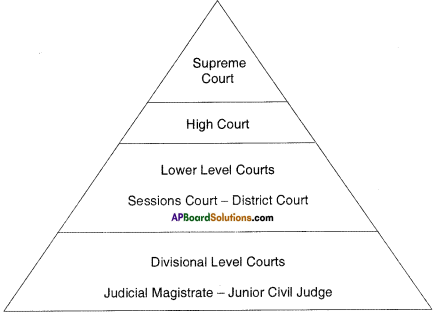
AP Board 8th Class Social Studies Solutions Chapter 14 Parliament and Central Government 7

AP Board 8th Class Social Studies Solutions Chapter 15 Law and Justice: A Case Study

AP Board 8th Class Social Studies Important Questions Chapter 2 Energy from the Sun

AP State Syllabus AP Board 8th Class Social Studies Important Questions Chapter 2 Energy from the Sun.

AP State Syllabus 8th Class Social Studies Important Questions 2nd Lesson Energy from the Sun

Question 1.
What is meant by Insolation?
The radiation received on the surface of a body is called insolation.

Question 2.
What is meant by Radiation?
Answer:
When a body gives out energy it is called radiation.

Question 3.
What are the forms of sun’s energy?
Answer:
Light, heat, UV rays, radio waves and X-rays are the forms of sun’s energy.

AP Board 8th Class Social Studies Important Questions Chapter 2 Energy from the Sun

Question 4.
Arrange the following temperatures from the highest to the lowest:
12°C, -16°C, 29°C, 0°C, – 4°C.
Answer:
29°C, 12°C, 0°C, -4°C, – 16°C.

Question 5.
What will happen if the inversion occurs?
Answer:
When inversion occurs cold air underlies warmer air.

Question 6.
Give three possible explanations for the differences between the average temperatures in Thiruvananthapuram and Shimla in January.
Answer:
A) Tiruvananthapuram is situated on sea coast.
B) Shimla is on high altitude.
C) Tiruvananthapuram is near to the equator and Shimla is far away from the equator.

Question 7.
Between Bhopal, Delhi, Mumbai and Shimla, which two places show a similar temperature pattern? How can you explain the similarity between these two places?
Answer:
Bhopal and Delhi show a similar temperature pattern. This is because these two are far away from the sea.

AP Board 8th Class Social Studies Important Questions Chapter 2 Energy from the Sun

Question 8.
Which continents are there near to the equator?
Answer:
South America, Africa and Asia continents are there near to the equator.

Question 9.
Give reasons for ditference in temperature of a location:
a) height from sea level.
b) distance from the sea
c) distance from equator
d) all the above
e) some of the above
Answer: d

Question 10.
What is the relation between temperature and rainfall?
Answer:
The amount of rain in 2 places is determined by temperature differences between them.

Question 11.
How do we have variation in vegetation and animal life?
Answer:
Temperature and rainfall affect life in very critical ways. Plants and animals depend upon heat and water.
Only certain kinds of trees and plants will grow in hot regions and some other kinds will grow in cold regions and in very cold regions, nothing grows. Thus we have variation in vegetation and animal life.

AP Board 8th Class Social Studies Important Questions Chapter 2 Energy from the Sun

Question 12.
What are the forms of sun’s energy?
Answer:
Light, heat, UV rays, radio waves and X-rays are the forms of sun’s energy.

Question 13.
Which results in ‘Global Warming’?
Answer:
Some gases like CO2 prevent radiation of heat from the earth. CO2 in the atmosphere N increases due to increased use of diesel and petrol, cutting down of forests etc. If the CO2 proportion in the atmosphere increases, then less heat will be radiated causing increase in global temperature. This results in ‘Global Warming’.

Question 14.
Appreciate the ‘green houses’.
Answer:
Green houses are also called Glass houses. Green house is a building in which plants are grown. These are climate controlled. It works by taking sunlight and heating it up. This process is the conversion of solar energy to thermal energy. It gives plants both temperate heat and a good water source. The creation of green house is excellent.

Question 15.
What are the effects of ‘Global warming’?
Answer:
Global warming is the increase of Earth’s average surface temperature due to effect of green house gases, such as carbon dioxide emissions from burning fossil fuels or from deforestation.

AP Board 8th Class Social Studies Important Questions Chapter 2 Energy from the Sun

Question 16.
The sun is the primary source of energy. The trees are the factories which produce food from sunlight. Are we growing or cutting down such trees? Discuss the advantages of trees and our responsibility in growing them.
Answer:
We are cutting down trees more than we grow.
The advantages of Trees:

  1. Trees can reduce air temperature by blocking sunlight. Further cooling occurs when water evaporates from the leaf surface. The conversion of water to air vapour … a chemical process …. removes heat energy from the air.
  2. A tree can be a natural air conditioner.
  3. Trees absorb and block noise and reduce glare.
  4. Fallen treen leaves can reduce soil temperature and soil moisture loss.
  5. Trees create an ecosystem to provide habitat and food for birds and other animals.
  6. Trees absorb CO2 and potentially harmful gasses from the air and release O2.
  7. Trees help to reduce surface water runoff from storms, thus decreasing soil erosion and the accumulation of sediments in streams. They increase ground water recharge and reduce the number of potentially harmful chemicals transported to our streams.
  8. Dews and frosts are less under tree because less radiant heat is lost at night.

Question 17.
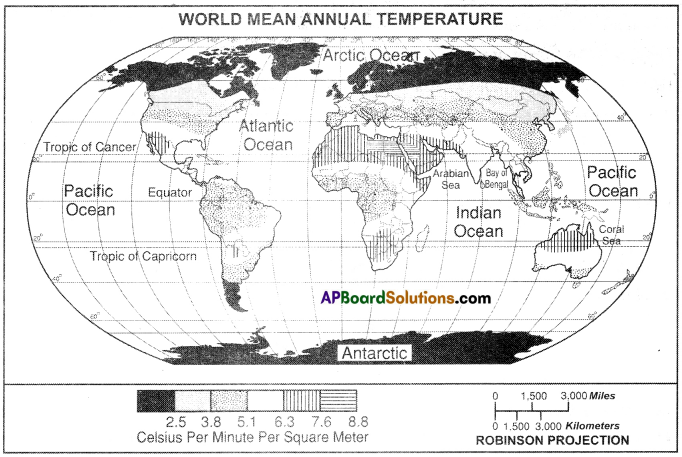
Locate the following in the given world map.

  1. Equator
  2. Poles
  3. Russia
  4. Australia 5)India

Answer:

AP Board 8th Class Social Studies Important Questions Chapter 2 Energy from the Sun 1

AP Board 8th Class Social Studies Important Questions Chapter 2 Energy from the Sun

Question 18.
Observe the given map and answer the following questions.
AP Board 8th Class Social Studies Important Questions Chapter 2 Energy from the Sun 21. What is the line to south of equator?
Answer:
Tropic of Capricorn.

2. This is ……… Projection.
Answer:
Robinson

3. Which continents are there near to the equator?
Answer:
South America, Africa and Asia.

AP Board 8th Class Social Studies Important Questions Chapter 2 Energy from the Sun

Project
Observe some families in your village / locality and fill up the following table.

S.No.Name of the family headNo.of electricity bulbs usedTypeElectricity bill (in rupees)
BulbTubeCFL

Educate the families about the energy-saving measures and then conduct the same survey again after three month and compare the difference.
Answer:

S.No.Name of the family headNo.of electricity bulbs usedTypeElectricity bill (in rupees)
BulbTubeCFL
1.Malleswara Rao104421000 ₹
2.Subba Rao93421200 ₹
3.Sunil10442800 ₹

Above families used more electricity bulbs especially tubes & bulbs. They are using very less CFL’s. By using more bulbs they get every month more electricity bill. That’s why, I explain to them about the importance of electricity, how we are wasting and our future generations will face the problems and I said, use more CFL’s to reduce the wastage of power & minimise the bill. After three months I went to their houses and saw the power bill really I admired because they reduce the power using and use CFL’s also. Due to this they save the power and get less electricity bill.

AP Board 8th Class Social Studies Important Questions Chapter 2 Energy from the Sun

AP Board 8th Class Social Studies Solutions Chapter 20 Understanding Secularism

SCERT AP Board 8th Class Social Solutions 20th Lesson Understanding Secularism Textbook Questions and Answers.

AP State Syllabus 8th Class Social Studies Solutions 20th Lesson Understanding Secularism

8th Class Social Studies 20th Lesson Understanding Secularism Textbook Questions and Answers

Improve your learning

AP Board 8th Class Social Studies Solutions Chapter 20 Understanding Secularism

Question 1.
List the different types of religious practices that you find in your neighbourhood. This could be different forms of prayer, worship of different gods, sacred sites, different kinds of religious music, and singing. Does this indicate freedom of religious practice?
Answer:

IssuesHindusChristiansMuslims
1) Different forms of prayerAshtottarams, Pujas, Abhishekas, HomasPrayersNamaj
2) Worship of different godsBrahma, Vishnu, Maheswara, Saraswathi, Lakshmi, Parvathi and others.Christ and Mary MathaAllah, Mohammad
3) Sacred sitesVaranasi, Haridwar – Madurai, Rameswaram, Allahabad etc.Israel and Nagapatnam in IndiaMecca Madina & Dargahs
4) Different kinds of religious musicKeertanalu, Tatwalu etc. Annamayya, ThyagayyaJesudas and othersPrayers only
5) SingingVengamamba, ‘Bala Murali Krishna’ etc.Melodious songsPrayers only

These indicate freedom of religious practice.

Question 2.
Will the government intervene if some religious group says that their religion allows them to practise infanticide? Give reasons for your answer.
Answer:
The government intervenes in this issue.
Reasons:

  1. In Indian secularism the state can intervene in religious affairs.
  2. This interference will be according to the ideals of the Constitution.

AP Board 8th Class Social Studies Solutions Chapter 20 Understanding Secularism

Question 3.
Find out some examples of different views within the same religion.
Answer:
Yes, there are 3 main schools of thoughts in Buddism.

  1. Theravada
  2. Mahayana
  3. Vajrayana

1. Theravada: They believe in self enlightenment.
2. Mahayana: In the course of enlightenment themselves, they vow to help other to the stage of enlightenment.
3. Vajrayana: They believe that not only bring others to enlightenment but also have power to do that.
Thus there are different views in same religion.

Question 4.
The Indian State both keeps away from religion as well as intervenes in religion. This idea can be quite confusing. Discuss this once again in class using examples from the chapter as well as those that you might have come up with.
Answer:
The Indian Constitution mandates that the Indian State be secular. This is according to the ideals of our Constitution, e.g.:

  1. The Constitution banned the ‘untouchability’.
  2. The Indian Muslim women are eligible for maintenance even though it is against Muslim Law. (Judgement was given by the Supreme Court in Shabano case)
  3. The government gives financial aid to religious educational institutions like Sisu Vidya Mandirs, RCM Schools and Urdu Schools etc.
  4. Similarly to ensure that laws relating to equal inheritance rights are respected.
  5. The government takes pearls and silk clothes to Ontimitta Ramalayam in Ekasilanagaram, Cuddapah on the celebration of Seetha Ramula Kalyanam.
  6. In the month of Ramzan the government gives permission to the Muslim employees to do Namaj and change their work timings.
    Thus our government is secular and interferes in the religious matters.

AP Board 8th Class Social Studies Solutions Chapter 20 Understanding Secularism

Question 5.
Read the paragraph under the heading ‘What is Secularism?’ and comment on it.
Answer:

  1. Secularism refers to the separation of religion from the State.
  2. The Constitution of India mandates that the Indian State be Secular.
  3. So the government stays away from the religion.
  4. The Indian secularism works to prevent the domination of a religion through a strategy of non-interference.
  5. When time comes, the Indian State interferes in religious matters.

8th Class Social Studies 20th Lesson Understanding Secularism InText Questions and Answers

Question 1.
In what way is Indian secularism different from that of other democratic countries? (Textbook Page No. 225)
Answer:
The governments of other democratic countries will not interfere in the religions of its people. But the Indian government interferes in the religious matters. Thus it is different from other democratic countries

Question 2.
Re-read the introduction to this chapter. Why do you think retaliation is not the proper response to this problem? What would happen if different groups followed this path?
(Textbook Page No. 223)
Answer:
I think retaliation in not the proper response to this problem because, it is not the solution. We are living in a secular country. We follow the principles of great personalities like Gandhiji, Buddha, Ambedkar etc. If this path of retaliation is followed – non-voilence would prevail everywhere and we can see unrest in the society.

AP Board 8th Class Social Studies Solutions Chapter 20 Understanding Secularism

Question 3.
Can there be different views within the same religion? (Textbook Page No. 224)
Answer:
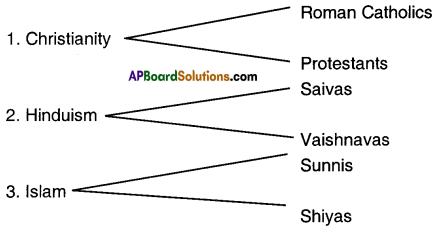
There can be different views within the same religion. Many religions in the world have different views.
For e.g.:
AP Board 8th Class Social Studies Solutions Chapter 20 Understanding Secularism 1
By observing all these we can say that all the famous religions have different views.

Question 4.
Can you think of a recent incident, from any part of India, in which the secular ideals of the Constitution were violated and persons were persecuted and killed because of their religious backgrounds? (Textbook Page No. 226)
Answer:
Not in recent past, but in 2002 Gujarat violence was a series of incidents starting with the Godra train burnings and the subsequent communal violence between Hindus and Muslims in the Indian state of Gujarat.
On 27.4.2002 the Sabarmathi Express train was attacked at Godra by a Muslim mob.
58 Hindu pilgrims returning from Ayodhya were killed in the attack. Out of them 25 were women, 15 were children. This in turn prompted retaliatory attacks against Muslims and general communal riots on a large scale across the state.
Later it was known that it was a preplanned attack.

AP Board 8th Class Social Studies Solutions Chapter 20 Understanding Secularism

AP Board 8th Class Social Studies Important Questions Chapter 1 Reading and Analysis of Maps

AP State Syllabus AP Board 8th Class Social Studies Important Questions Chapter 1 Reading and Analysis of Maps.

AP State Syllabus 8th Class Social Studies Important Questions 1st Lesson Reading and Analysis of Maps

Question 1.
Do you think the free access to maps is a good thing?
Answer:
No, I do not think so. Any government has to maintain secrecy in access to maps. Otherwise, it helps the enemies. But at present satellite images reveal every place on the earth.

Question 2.
What is meant by the Relief feature?
Answer:
Relief feature means the high and low places on the surface of the earth.

AP Board 8th Class Social Studies Important Questions Chapter 1 Reading and Analysis of Maps

Question 3.
Who were the Portuguese explorers?
Answer:
Magellan, Vasco-da-Gama and Bartholomeu Dias were the Portuguese explorers.

Question 4.
What do you know about Marcopolo?
Answer:
Marcopolo was an Italian explorer. He explored China and Asia.

Question 5.
Why do you think maps are useful to armies in times of war?
Answer:
Maps were also in great demand during times of war as armies and airforces needed them.
They use strategy maps to illustrate an organization’s vision, mission, overarching strategies and key goals and initiatives.

AP Board 8th Class Social Studies Important Questions Chapter 1 Reading and Analysis of Maps

Question 6.
Why were the Greeks and the Romans greatly interested in making maps?
Answer:
The Greeks and after them the Romans were greatly interested in making maps and knowing about places near and far. They wanted to conquer the world, build colonies in far off places and trade with them. e.g.: Alexander, the Greek king.

Question 7.
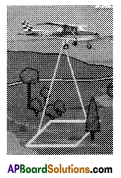
What is aerial photography?
Answer:
AP Board 8th Class Social Studies Important Questions Chapter 1 Reading and Analysis of Maps
Aerial photography is the technique of taking of photographs of the ground from an elevated position, using aircrafts, helicopters, hot air balloons etc.
Aerial photographs are not maps.

Question 8.
What are satellite imagery?
Answer:
Satellite imageries are the photographs of the earth taken by the artificial satellites launched into the space. These are used in many ways: map making, planning, meteorology, forestry, warfare etc.

AP Board 8th Class Social Studies Important Questions Chapter 1 Reading and Analysis of Maps

Question 9.
Write the difference between maps and photographs.
Answer:
Maps:
A map is used by geographers to show features that we consider important.
(Or)
A map actually is a model of a place giving those features that the map maker considers to be of importance.
Photographs:
A photograph may not be able to show you the features of a place like a map.

Question 10.
Name the early map makers.
Answer:
The Sumerians, the Babylonians, the Greeks, the Arabs, the Chinese, the Europeans were the early map makers.

Question 11.
How can we read Thematic maps?
Answer:

  1. A map which focuses on only one aspect is called “Thematic Map”,
    e.g.: Political Maps, Physical Maps etc.
  2. We should have the knowledge of different kinds of symbols, colours and patterns which are used on thematic maps.
    e.g.: Dark Grey – Mountain Black – Boundary.
  3. Then only we can read Thematic maps.

Question 12.
What are main relief features on the earth?
Answer:

  1. Relief feature means the high and low places on the surface of the earth.
  2. The main relief features are: hills, valleys, plateaus, plains, river basins, rocky and sandy places.

AP Board 8th Class Social Studies Important Questions Chapter 1 Reading and Analysis of Maps

Question 13.
What are called Isolines?
Answer:
The lines which join the places with some common features are called Isolines or Contour lines.

Question 14.
What are the uses of contour lines?
Answer:
Contour lines give an indication of the slope of the land as well as the elevation above sea level.

Question 15.
How did Mt. Everest get its name?
Answer:
In 1802 William Lambton began one of the most important geographical surveys in the world starting from Chennai in the south and culminating in the Himalayas to determine the length of longitude and also the heights of various places. This survey was completed by Sir George Everest. It is this survey that established that Mt. Everest is the highest peak in the world. It was named after George Everest.

Question 16.
What are conventional symbols?
Answer:
The symbols which are used by map makers conventionally are called conventional symbols.

Question 17.
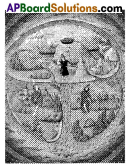
Observe the given picture and write your comment.
AP Board 8th Class Social Studies Important Questions Chapter 1 Reading and Analysis of Maps 2
Answer:
This was a model of the world according to the Bible. It is surrounded by oceans and is divided into three continents – Asia, Europe and Africa.
Of these, Asia was considered the largest and the most important as it had Jerusalem which was the birthplace of Jesus Christ. It is therefore also shown on the top.

AP Board 8th Class Social Studies Important Questions Chapter 1 Reading and Analysis of Maps

Question 18.
Statement:
“All the important features can be shown on a map. So people make different kinds of maps”.
* Read this statement and prepare a question on it.
Answer:
“Why do people make different kinds of maps?”

Question 19.
Why were the Greeks and the Romans greatly interested in making maps?
Answer:
The Greeks and after them the Romans were greatly interested in making maps and knowing about places near and far. They wanted to conquer the world, build colonies in far off places and trade with them.
e.g.: Alexander, the Greek king.

Question 20.
Why do you think that in Idrisi’s map the top side points to the south while in the maps prepared by the Greeks it pointed to the north?
Answer:
In many issues Islamic traditions are different with the rest of the world’s, e.g.: Script.
In the similar way the top side points to the south in Idrisi’s map.
(Or)
While facing towards east, he would have given importance to the right hand side (south) and showed it on the top side of the map.

Question 21.
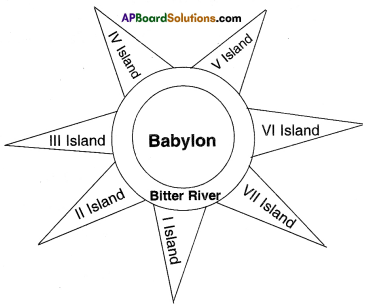
Appreciate the Babylonian clay tablet world map.
Answer:
AP Board 8th Class Social Studies Important Questions Chapter 1 Reading and Analysis of Maps 3The Babylonian clay tablet was dated from the Persian period. It was flat and round. The inner circle had all the places they knew about. The city of Babylon was shown in the middle. Beyond the inner circle was ‘Bitter river, or ‘Salt water ocean’ in which were seven triangular islands.

Their thought, imagination, map making ability were really appreciable.

AP Board 8th Class Social Studies Important Questions Chapter 1 Reading and Analysis of Maps

Question 22.
Who invented the latitudes and longitudes and the grid system?
Answer:
Hipparchus (190-120 B.C.) was perhaps the greatest of the Greek astronomers. He devised a method of locating geographical positions by means of latitudes and longitudes. Ptolemy also was a Greek astronomer and mathematician. He lived and worked in Egypt. His work which employed a system of latitudes and longitudes, influenced map makers for hundreds of years. He evolved the science of map-making.

Question 23.
Write the biography of Al Idrisi. (in a few lines)
Answer:
AP Board 8th Class Social Studies Important Questions Chapter 1 Reading and Analysis of Maps 4
Ash – Sharif Al Idrisi was born in 1099. He was a Muslim geographer, cartographer, Egyptologist and traveller. He lived in Sicily, at the Court of King Roger – II. He spent much of his early life travelling through North Africa and Spain.
Al Idrisi incorporated the knowledge of Africa, the Indian Ocean and the far east gathered by Islamic merchants and explorers and recorded on Islamic maps. He wrote a book ‘A Diversion for the Man Longing to Travel to Far Off Places’. The Tabula Rogeriana’ was drawn by him in 1154 for the Norman King Roger II of Sicily. He died in Sicily in 1165/1166.

Question 24.
Observe the following paragraph and answer the given questions.
Relief feature means the high and low places on the surface of the earth. The main relief features are: hills, valleys, plateaus, plains, river basins, rocky and sandy places. Since the maps are flat we cannot show the height on them. We, therefore, use a special symbol for this called contours or contour lines. Contours are lines on the map joining places of same height – measured from the sea level. In other words, all places on a contour line will have the same height from the sea level. Contour lines are also called isolines – lines joining places with some common features.
1. What is meant by Relief feature?
Answer:
Relief feature means the high and low places on the surface of the earth.

2. What are the main relief features?
Answer:
The main relief features are hills, valleys, plateaus, plains, river basins, rocky and sandy places.

3. Why can we not show the heights of the maps?
Answer:
Since the maps are flat we cannot show the height on them.

4. Special symbols are called contour lines.

5. Contours are lines on map joining places of same height measured from the sea level.

6. Contour lines are also called isolines.

7. What are isolines?
Answer:
Isolines are the lines which join the places with some common features.

AP Board 8th Class Social Studies Important Questions Chapter 1 Reading and Analysis of Maps

Question 25.
Observe the given information and answer the following questions.

Names of Famous ExplorersTheir NationalityTheir LifespanTheir Voyage of Exploration
1) MarcopoloItalian1254- 1324China and Asia
2) Ferdinand MagellanPortuguese1480- 1521First voyage around the world.
3) Christopher ColumbusItalian / Spanish1451 – 1506America, the new world.
4) Vasco-da-GamaPortuguese1469-1524Ocean route from Portugal to east.
5) Bartholomeu DiasPortuguese1457- 1500Voyage around the Cape of Good Hope on the southern most tip of Africa.

1. Who were the Protuguese explorers?
Answer:
Magellan, Vasco-da-Gama and Bartholomeu Dias were the Portuguese explorers.

2. What do you know about Marcopolo?
Answer:
Marcopolo was an Italian explorer. He explored China and Asia.

3. Who discovered America?
Answer:
Christopher Columbus discovered America.

4. What was the lifespan of Magellan?
Answer:
His lifespan of Magellan was 1480 – 1521. (41 years)

5. Who made his first voyage around the world?
Answer:
Ferdinand Magellan.

AP Board 8th Class Social Studies Important Questions Chapter 1 Reading and Analysis of Maps

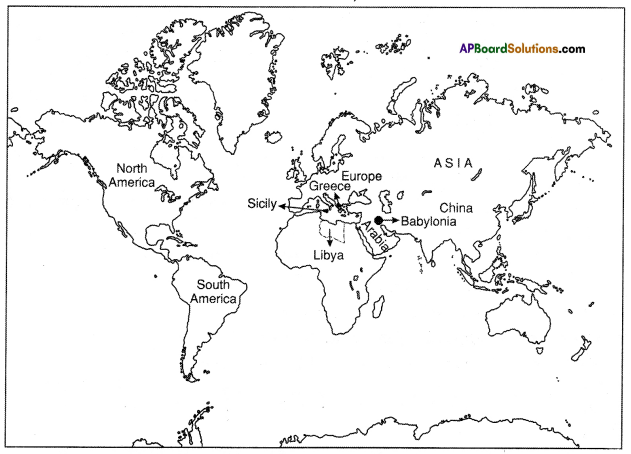
Question 26.
Locate the following on the given world map.

  1. Present place of Babylonians / Sumarians
  2. Greece
  3. Sicily
  4. Libya
  5. Asia
  6. Europe
  7. Arabia
  8. China
  9. North America
  10. South America

Answer:

AP Board 8th Class Social Studies Important Questions Chapter 1 Reading and Analysis of Maps 5

AP Board 8th Class Social Studies Important Questions Chapter 1 Reading and Analysis of Maps

Question 27.
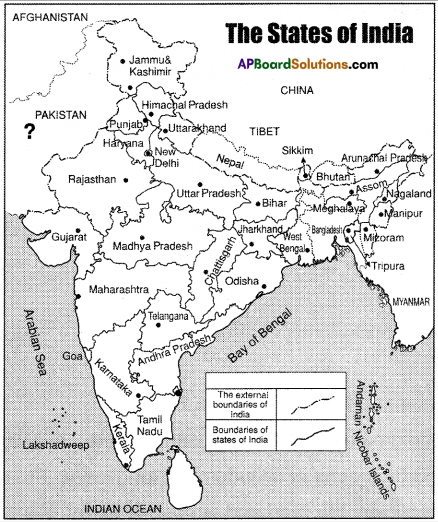
Observe the given map.
AP Board 8th Class Social Studies Important Questions Chapter 1 Reading and Analysis of Maps 6
Now answer the following questions.
1. What are the islands in the Arabian sea
Answer:
Lakshadweep.

2. AP Board 8th Class Social Studies Important Questions Chapter 1 Reading and Analysis of Maps 7 This indicates
Answer:
External boundaries.

3. What is the scale of the map?
Answer:
1 cm = 200 kms.

4. Name any state on east coast.
Answer:
Odisha, Andhra Pradesh.
(you can write any one)

5. Name any state on the west coast.
Answer:
Gujarat.

Question 28.
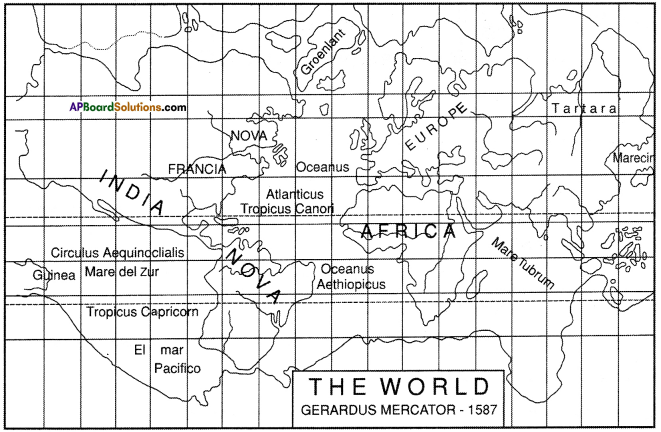
Observe the given picture and write down your opinion on Mercator projection.
AP Board 8th Class Social Studies Important Questions Chapter 1 Reading and Analysis of Maps 8
Answer:

  1. Gerardus Mercator was a Dutch geographer and cartographer.
  2. The Mercator projection distorts the size and the shape of large objects, as the scale increases from the equator to the poles, where it becomes infinite,
    e.g.: 1) Greenland takes as much space on the map as Africa. In reality Africa’s area is 14 times greater than that of Greenland. Greenland is comparable to Algeria only.
    2) Alaska – Brazil
  3. Finland – India.


AP Board 8th Class Social Studies Solutions Chapter 19 Social and Religious Reform Movements

SCERT AP Board 8th Class Social Solutions 19th Lesson Social and Religious Reform Movements Textbook Questions and Answers.

AP State Syllabus 8th Class Social Studies Solutions 19th Lesson Social and Religious Reform Movements

8th Class Social Studies 19th Lesson Social and Religious Reform Movements Textbook Questions and Answers

Improve your learning

AP Board 8th Class Social Studies Solutions Chapter 19 Social and Religious Reform Movements

Question 1.
Do you agree with “Western education and Christian Missionaries influenced the Social and Religious reform movement in India”. Why?
Answer:
Yes. I can agree with this statement.
Reasons: Many Christian missionaries came to India along with the European companies to preach Christianity in India. They severely criticised the existing religious practices and beliefs and tried to persuade people to adopt Christianity. At the same time they also established many educational institutions, hospitals and charity services with the view of serving the poor and needy. This helped in spreading many new ideas among people.

Soon a lively debate ensued between the missionaries and leaders of Hinduism and Islam as each tried to defend their own religious ideas. Such debates helped people not only to understand each others ideas but also encouraged them to enquire into the original and basic tenets of their own religions. Several European scholars studied the ancient literature of India, translated them and published them as books. (Since they studied books of the eastern countries they were called ‘Orientalists’.) Now these books are available for all to study.

As the ancient Sanskrit, Tamil, Telugu, Persian and Arabic books got translated into European languages, the rich and diverse cultural heritage of the country was recognized by all. This enabled the people with new ideas to reinterpret their own religions better.
e.g.:

  1. Rammohan Roy condemned idol worship.
  2. Vivekananda asked to adopt some of the positive qualities of European culture like freedom and respect for women, work ethic, technology etc.
  3. Swami Dayananda rejected all later additions to Hindu religion.
  4. Sir Syed Ahmed Khan worked for the spread of modern education and social reforms among the Muslims.
  5. The minimum age for marriage was raised to the 14 years.
  6. Rammohan Roy fought against ‘Sati’.
  7. Law was made to encourage widow remarriages.
  8. Many established schools for girls.

AP Board 8th Class Social Studies Solutions Chapter 19 Social and Religious Reform Movements

Question 2.
What was the importance of printifig press in the development of reform movement?
Answer:
The Europeans introduced printing press in India. It made possible the appearance of many newspapers and magazines. Books were also published in different Indian languages. This made books accessible to a large number of people at a very low cost. People could now carry on debates and discussions through these newspapers, magazines and books and easily reach out to large number of people.

Question 3.
The main idea behind religious reform was to end complex rituals, worshipping of many gods and idol worship, purdah system. Do you think people have accepted these reforms ? Explain.
Answer:
People have accepted these reforms temporarily.
Reasons:

  1. Now there was no existence of Brahmo Samaj. The members of it followed ‘Bhakti Path.’
  2. Arya Samaj also accepted Vedic religion at the end.
  3. At present, the Hindus are worshipping many Gods and their idols.
  4. Complex rituals: People have accepted some of the rituals which are easy to follow.

Question 4.
Why do you think people like Ramabai paid special attention to the condition of widows?
Answer:
Many writings tell us about the pitiful conditions of the widows in their families. They suffered because they had no economic freedom and education. The people like Ramabai thought that “it was the biggest sin to endure the ill deeds and not oppose them.” So, they paid special attention to the condition of widows.

AP Board 8th Class Social Studies Solutions Chapter 19 Social and Religious Reform Movements

Question 5.
Explain the role of Raja Rammohan Roy as a social reformer in India in 19th century.
Answer:
Raja Rammohan Roy was born in Bengal in 1772. He was a great scholar of Sanskrit, Persian, English, and knew Arabic, Latin and Greek.
He also studied several religious philosophies like Hinduism, Islam, Christianity and Sufism. Having studied various religious books he was convinced that there is only one God and that worshipping of idols and making sacrifices were incorrect. He was convinced that all great religions had the same common beliefs and it was incorrect to criticise the religions of others. He also believed that we should accept a religious belief only if it is rational and if it is beneficial to people.
He rejected the authority of priests and called upon people to study the original books of their religions. He published his ideas in magazines and books using the new technology of printing to reach out to maximum number of people.
In 1828 Rammohan Roy founded the Brahmo Samaj – an assembly of all those who believed in an universal religion based on the principle of One Supreme God. After the death of Rammohan Roy in 1833, the Brahmo movement was led by Devendranath Tagore and Keshav Chandra Sen. They popularised their ideas by lecturing all over India.

Question 6.
What was the main concern of Sir Syed Ahmad Khan in promoting English creation?
Answer:

  1. Sir Syed Ahmed Khan was convinced that the bitterness between Muslims and the British must end.
  2. In order to progress, Muslims should participate in government and get larger share in government jobs.
  3. He thought that this was possible only through modern education.
  4. This was the main concern of Sir Syed Ahmed Khan in promoting English education.

AP Board 8th Class Social Studies Solutions Chapter 19 Social and Religious Reform Movements

Question 7.
Different leaders thought of different ways in which the ‘untouchable’ castes can be made the equals with all others. Make a table with the suggestions of leaders like Phule, Bhagya Reddy Varma, Narayana Guru, Ambedkar and Gandhiji.
Answer:
Phule:

  1. He opened a special school for the Mahar and Maang castes.
  2. He wrote many books on caste discrimination.
  3. They set up Satya Shodhak Samaj for low caste children.
  4. He encouraged to conduct marriage and death ceremonies without the Brahmins.

Bhagya Reddy Varma :

  1. He called upon Dalits to call themselves ‘Adi Andhras’.
  2. To spread awareness in dalits he started ‘Jagan Mitra Mandali’.
  3. He opened special schools.
  4. He opposed religious misdeeds on dalit girls.
  5. He encouraged Buddhism.

Narayana Guru:

  1. He preached the idea of ‘One Jathi, One God and One Religion for all’.
  2. He called upon the Ezhava community to give up several aspects of their low caste status.
  3. He set up temples where no caste discrimination would be practised and very simple rituals would be followed without Brahmin priests.
  4. He even said that building schools for children was more important than building temples.

Ambedkar:

  1. He led many agitations for dalits.
  2. He argued that the dalits should vote separately for dalit candidates to the legislatures.
  3. Overcoming numerous social and financial obstacles, Ambedkar became one of the first dalits to obtain college education in India.
  4. He founded an Independent Labour Party to represent the interests of the dalits.
  5. Ambedkar was appointed as the Chairman of the Constitution Drafting Committee, charged by the assembly to write India’s new constitution.

Gandhiji:
Around 1932 Gandhiji started a movement against untouchability. He called the ‘untouchable’ castes as Harijans or ‘People of God’. He wanted to ensure them equal access to temples, water sources and schools. This campaign was taken up by Congress in a big way and helped to bring millions of Dalits into the national movement.

AP Board 8th Class Social Studies Solutions Chapter 19 Social and Religious Reform Movements

Question 8.
Why does caste remain such a controversial issue today? What do you think was the most important movement against caste in colonial times?
Answer:
In addition to that one feels one’s caste is great. So caste is an important pillar in some celebrations of families. No caste, even higher or lower, people will agree to cross these limitations.
Bringing this ‘caste’ into social issues is causing many problems, e.g.: A dispute between two persons is created as a dispute between two castes.
I think the movement led by Satya Shodhak Samaj was the most important movement against caste in colonial times.

Question 9.
What did Ambedkar want to achieve through the temple entry movement?
Answer:
Ambedkar wanted to say that ‘All are equal before God and everyone has rights on God”.

Question 10.
How in your opinion were the movements of social reform effective in ridding Indian society of social evils? What social evils do you find today ? Which reform movements should be started to combact them ?
Answer:
The movements of social reforms were effective in ridding Indian society of social evils. These movements banned Sati and child marriages. These encouraged women education, school education and widow remarriages.
We find the following social evils today:

  1. Corruption
  2. Religionism,
  3. Casteism
  4. Dowry
  5. Regionalism etc.

Today there is a silence in our society. No politician is working against these evils. Nobody is thinking of these.
The educated should think of these evils and respond. Otherwise, no reforms are introduced. The governments also should think of these issues.

AP Board 8th Class Social Studies Solutions Chapter 19 Social and Religious Reform Movements

Question 11.
Create a poster that reflects girls education and its importance.
Answer:

Poster on Girls’ Education

Despite all tall claims by the government and nagging by voluntary organizations, a vast majority of the girls are yet illiterate in India. During the last four decades since independence, much is being done to emancipate women. Education of girls is one of the basic features of the plan. Many schools and colleges are founded for girls.

Education has led to their economic independence and equality with the menfolk. They have now an honoured position in society and have secured their rights from the reluctant men but all this is confined chiefly to the urban areas. In rural areas most of the peopte-are-sWtfr against girls’ education.

Every village must have a girls’ school, or if that is not possible owing to lack of funds, parents should be persuaded to admit their daughters to boys’ schools thus promoting co-education.
Furthermore, the extreme poverty of the Indian masses makes it imperative that education for girls should be free up to the matriculation standard. If facilities for female education are provided in every village, it will also be possible to make it compulsory.

Special legislation should then be enacted to deal with parents who neglect the education of their daughters. This compulsion would be essential in early stages because most villagers are still too ignorant to understand the value of education for girls.

Question 12.
What qualities of Social Reformers you liked? Why?
Answer:
Qualities of Social Reformers I liked:

  1. The reformers took recourse to propaganda in the Indian language to reach the masses.
  2. They also used novels, dramas, short stories, poetry, the press and the cinema to spread their views.
  3. Indian women played an active and important role in the struggle for independence of the country.
    Reason: Due to the hardwork of these reformists and other individuals many superstitious disappeared.

8th Class Social Studies 19th Lesson Social and Religious Reform Movements InText Questions and Answers

AP Board 8th Class Social Studies Solutions Chapter 19 Social and Religious Reform Movements

Question 1.
What were the similarities and differences between the views of Rammohan Roy and Swami Vivekananda and Dayananda Saraswati ? (Textbook Page No. 213)
Compare the religious views of Ram Mohan Roy, Vivekananda and Dayananda and point out the similarities and differences among them.
(OR)
Compare the religious views of Rammohan Roy, Vivekananda and Dayananda, and point out the similarities and differences among them.
Answer:
Similarities:

  1. All the three believed the Hindu Dharmic Literature.
  2. They told that the best things of all the religions should be followed by all.
  3. They opted social service as their ideal hobby.

Differences:

DayanandaRammohan RoyVivekananda
1) He rejected the orthodox Hindu religion.1) He treated all the religions equal.1) He treated Hindu religion as best of all.
2) He set up Arya Samaj.2) He set up Brahmo Samaj.2) He set up Ramakrishna Mission.
3) He treated all the religi­ons are false and gave a call to the people to return to Vedic Hindu religions.3) He asked people to have faith in only one god.3) He wanted to revive a reformed Hindu religion. He wanted the people to leave superstitions and to follow the Hindu religion.

AP Board 8th Class Social Studies Solutions Chapter 19 Social and Religious Reform Movements

Question 2.
How do you think were the early reformers influenced by European culture and Christianity? (Textbook Page No. 213)
Answer:

  1. The early reformers were influenced by the positive qualities of European culture like freedom and respect for women, work ethic, technology etc. So they worked hard to abolish ‘Sati’ and child marriages and to encourage widow remarriages etc.
  2. The persons who were influenced with their religion, propagated new systems like worshipping one Supreme God.
  3. They were all educated in English. They studied many subjects for knowledge. So they encouraged English education and establishment of schools.
    Thus the early reformers were influenced by European culture and Christianity.

Question 3.
Do you see any similarities between the DAV schools and the MAO college? (Textbook Page No. 214)
Answer:

DAV
(Dayananda Anglo Vedic) Schools
MAO
(Mohammedan Anglo Oriental) college
1) These were established by the followers of Swami Dayananda.1) This was established by Sir Syed Ahmed Khan.
2) To educate children in modern subjects and at the same time keep them in touch with their religion and culture.2) It sought to teach English and science but in an Islamic atmosphere.
3) At the end they felt that they should focus on teaching Vedic religion and not modern subjects and counter the influence of other religions.3) It later developed into the Aligarh Muslim University.

Question 4.
Do you think these demands are necessary even today? (Textbook Page No. 219)
Answer:
I do not think so.
Reasons: The Government of India is providing the ‘low’ castes with ‘reservations’ in all the sectors like education, employment etc.
All these people are educated equally with others and doing their jobs. They are participating and are in good positions in politics also. So I think these demands are not necessary today.

AP Board 8th Class Social Studies Solutions Chapter 19 Social and Religious Reform Movements

Question 5.
Compare the efforts of Narayana Guru and Jyotiba Phule. What similarities and differences do you see between them? (Textbook Page No. 219)
Answer:
Similarities:

  1. Both opposed the caste system.
  2. Both established many schools.
  3. Both opposed the supremacy of Brahmins.

Differences:

Narayana GuruJhotiba Phule
1. He was a religious leader.1. He was a social reformist.
2. He set up temples where no caste discrimination would be practised and very simple rituals would be followed without Brahmin priests.2. He campaigned for special schools, colleges and hostels for the children of ‘low’ castes where the teachers too would be from ‘low’ castes.
3. He actively criticized caste system and called for end to all forms of caste discriminations.3. He called upon the low castes to conduct marriage and death ceremonies without the Brahmins.

Question 6.
Recall the teachings of Buddha with regard to the caste system. (Textbook Page No. 220)
Answer:
Buddha preached that ‘All are equal’. He opposed caste and religious discriminations. He treated all his followers equal.

AP Board 8th Class Social Studies Solutions Chapter 19 Social and Religious Reform Movements

Question 7.
What are the similarities and differences in the approaches of Gandhiji and Ambedkar towards dalits? (Textbook Page No. 221)
Answer:
Similarities:

  1. Both worked for Dalits.
  2. Both were the members of Congress Party.

Differences:

GandhijiAmbedkar
1) Being a person of higher caste, he fought for dalits.1) He fought for dalits as a dalit.
2) He reserved some seats in elections to dalits.2) He argued that the dalits should vote separately for dalit candidates to the legislatures.
3) He fought for dalits from Congress.3) He set up Independent Labour Party for dalits.
4) He continued himself in Hindu religion and fought for dalits.4) He lost his faith in Hinduism and converted to Buddhism at the end of his life.

Question 8.
In what way do you think printing helped in the spread of these new ideas? (Textbook Page No. 213)
Answer:
The Europeans introduced printing press in India. It made possible the appearance of many newspapers and magazines. Books were also published in different Indian languages. This made books accessible to a large number of people at a very low cost. People could now carry on debates and discussions through these newspapers, magazines and books and easily reach out to large number of people.
Thus the printing helped in the spread of these new ideas.

AP Board 8th Class Social Studies Solutions Chapter 19 Social and Religious Reform Movements

Question 9.
If you had to choose between a DAV school, Gurukul School and a government run school, which one would you prefer to go to and why? (Textbook Page No. 213)
Answer:
I would prefer the government school.
Reason:

  1. Here the teaching-learning process would be in a secular way.
  2. All the students here would be treated equally.

Question 10.
You may have noticed that all the reformers tried to reinterpret the ancient religious books in order to defend their reformist ideas. Look at the examples of all the major reformers and see how they did this. (Textbook Page No. 214)
Answer:
1) Raja Rammohan Roy:
He studied several religious philosophies like Hinduism, Islam, Christianity and Sufism. Having studied various religious books he was convinced that there is only one God and that worshipping of idols and making sacrifices were incorrect. He was convinced that all great religions had the same common beliefs and it was incorrect to criticise the religions of others. He also believed that we should accept a religious belief only if it is rational and if it is beneficial to people. He rejected the authority of priests and called upon people to study the original books of their religions. He published his ideas in magazines and books using the new technology of printing to reach out to maximum number of people.

2) Swami Vivekananda:
He believed that Hindu religion was superior to all others. He emphasized the teachings of Upanishadas which were being translated and printed in large numbers.

3) Swami Dayananda Saraswathi:
He studied the Vedas and was convinced that they contained the true religion and he rejected all later additions to Hindu religion like many gods and goddesses, idol and temple worship and Brahmanic priesthood and caste system. He advocated worshipping one Supreme God through simple rituals and recitation of Vedic mantras. He rejected all other religions as false religions and wanted Hindus who had converted to other religions to return to Hinduism based on the Vedas.

AP Board 8th Class Social Studies Solutions Chapter 19 Social and Religious Reform Movements

Question 11.
Do you find any religious idea advocated by the above reformers which was not part of the Bhakti Movement? (Textbook Page No. 214)
Answer:
No. All the reformers advocated the religious ideas of the Bhakti Movement only.

Question 12.
Some people thought this situation (No place inside the classroom) was better than the total lack of education for untouchable people. Would you agree with this view? (Textbook Page No. 218)
Answer:
Yes. I do agree with them.
Jyothiba Phule and Ambedkar faced and ignored such situations and studied well. So they were able to pave the way to the next generations. Otherwise there will be the same situation at present.

Question 13.
Do you think dalits have equal access to temples, water sources and schools today? What problems do they still face? (Textbook Page No. 221)
Answer:
At present dalits have equal access to temples, water sources and schools. To say frankly they have equal access and reservations also. So we can say that there were no social problems to them.

Question 14.
Write a dialogue between supporters and opposers of widow remarriage. (Textbook Page No. 215)
1856 – At the time of first widow remarriage – Calcutta.

  1. Srikanth Chattarji: Wow, this should be a golden page in the history of our nation. Here is an end to the problems of women. May God bless the women!
  2. Mukhesh Bandopadhyaya: How dare you to talk like this Srikanth babu? This gives us several punishments in the hell. Arey – A marriage to widow.
    How could this be possible? A woman will go to some other’s family to develop their family, again to some other family. How could they do this?
    Oh God! Please save us and save our country.
  3. Rajya Laxmi: Today is really a wonderful day. Child marriages and widowships etc., were curses on us. We have to work in our maternal and mother-in-law’s houses freely without any feelings. So this is a good beginning for us. We are very grateful to the God.

AP Board 8th Class Social Studies Solutions Chapter 19 Social and Religious Reform Movements

Question 15.
Do you think today equal importance is given to the education of girls or do girls still face discrimination? (Textbook Page No. 217)
Answer:
Equal importance is given to girls education with boys. To be frank the girl enrolment is more than boys in some schools and collges. But in some families girls face discrimination, mostly in some backward states.

Question 16.
What problems do girls face in getting educated which boys do not face? (Textbook Page No. 217)
Answer:

  1. Girls are not encouraged for higher education.
  2. Girls are not permitted to far off places for education.
  3. Some courses are only meant for boys.

Question 17.
To what extent has the treatment of widows changed today? (Textbook Page No. 218)
Answer:
We can say that the attitude of the society is changed. Widows are treated equally with other women. Their elders are only arranging remarriages for them. Men are also taking a step forward to marry them. They are treated equally except in some religious traditions like marriages etc.

Question 18.
Do dalit girls and Muslim girls face special problems in education even today? (Textbook Page No. 218)
Answer:
Nowadays we seldom hear such a news from newspapers that dalit girls are facing some problems from others. They are also receiving education in classrooms along with others. Muslim girls also have separate schools. They are also studying without problems.

Question 19.
Find out about some important women leaders of the freedom struggle – Kalpana Dutt, Aruna Asaf Ali, Captain Lakshmi Sehgal, Sarojini Naidu, Kamladevi Chattopadhyaya, etc. (Textbook Page No. 220)
Answer:
1. Kalpana Dutt:
27.07.1913
08.02.1995.
She was later known as Kalpana Joshi. She was a member of prominent Republican Army in Chittagang and participated in the well known Chittagong Armoury Raid case 1930. Later she joined Communist Party of India.

2) Aruna Asaf Ali:
16.07.1908
27.09.1996
She played a leading role during the Quit India Movement. She unfurled the national flag at the Gowalia tank Maidan to signify the commencement of the Quit India Movement and became a legend for thousands of youth that rose to emulate her.
She was awarded Lenin Prize for Peace in 1975, Jawaharlal Nehru Award for Interna¬tional Understanding – 1991 and Bharata Ratna – 1998.

3) Captain Lakshmi Sehgal:
24.10.1914
23.07.2012.
In 1943 she met Netaji in Singapore. Their meeting changed her life. She started Rani of Jhansi Regiment. Then she became as Captain Lakshmi Sehgal. She was arrested by the British in May 1945.

4) Sarojini Naidu:
13.02.1879
02.03.1949.
The Nightingale of India – she was the second Indian woman to become the President of Indian National Congress. Her birthday was celebrated as Women’s Day in India.
She joined the movement in 1905 – Partition of Bengal. She came into contact with many people.

5) Kamaladevi Chattopadhyaya:
03.04.1903
29.10.1988.
She was a social reformer and freedom fighter. She joined the movement in 1923 during Non-Cooperation Movement. She was the first Indian woman to be arrested.

AP Board 8th Class Social Studies Solutions Chapter 19 Social and Religious Reform Movements

Question 20.
Why do you think was there bitterness between the Muslims and the British after 1857? (Textbook Page No. 214)
Answer:
Mohammadans invaded India many times from 6 AD/7AD. Later they occupied and ruled India till the arrival of the Britishers. Nearly 1200 years they ruled India. Even though there were some native rulers, they were small in number. After 1857, India was under the control of the British queen’s rule. Mohammadans were also treated as Indians. So, there was bitter¬ness between the Muslims and the British after 1857.

Question 21.
Why do you think was it important to get the government to pass laws for social reform? (Textbook Page No. 215)
Answer:
Some persons might have reformistic views. Some might reject them. So the people in the society could not follow these ideas. Even though they followed, they might be rejected by the society. So it was important to get the government to pass laws for social reforms.

Question 22.
Imagine that you are one of the students sitting in the school veranda and listening to the classes. What kind of questions would be raising in your mind ? (Textbook Page No. 218)
Answer:

  1. Why should I sit here?
  2. Why I am not allowed to sit inside?
  3. Did I do any mistake
  4. Why I am an untouchable?
  5. Is it my mistake, taking birth in this caste?
  6. Why shouldn’t they touch me?

AP Board 8th Class Social Studies Solutions Chapter 19 Social and Religious Reform Movements

Question 23.
Why do you think he (Jyotiba Phule) insisted on ‘low’ caste teachers to teach such students? (Textbook Page No. 219)
Answer:
Teachers of higher castes ill-treated and hurted the low caste students. They showed discrimination in the castes. In these conditions the process of learning might not be perfect. The teachers of low castes could not hurt these students. So he insisted on low caste teachers to teach such students.

Question 24.
How would the feeling that the dalits were the orginal inhabitants of Andhra Pradesh have helped in boosting the confidence of the dalits ? (Textbook Page No. 220)
Answer:
The feeling would raise the confidence in dalits. This confidence would strengthen them in fighting against the discrimination. That led them to their success.

Question 25.
Did all women get the right to vote in independent India? (Textbook Page No. 220)
Answer:
Yes, all women get the right to vote in independent India.

AP Board 8th Class Social Studies Solutions Chapter 19 Social and Religious Reform Movements

Question 26.
Create a poster that reflects on social Reforms.
Answer:

Poster on Social Reforms

Sometimes society becomes full of evils and vices. It is guided by blind faith and superstition. People do not try to know the relation between cause and effect. They believe in imaginary ghosts and spirits as the prime-mover of all social actions. They believe in animal sacrifice to please the deities. They also once believed in the human sacrifice. The social vices like child wives were in existence. The widows were not allowed to marry again. The wives were compelled to be burnt with their dead husbands and so on. Untouchability disabled a big section of people. In order to eradicate all these things social reforms were necessary. Social reforms are necessary at all times in order to get the society purged off any vice that creeps into it.

Great reformers are born to reform the society and to reform the religion. Because many times religion is the basis of the social behavior. Martin Luther in Germany and John Wicliff in great Britain were the great reformers in 18th century. In India we got Raja Rammohan Roy, Ishwar Chadra Vidyasagar, Swami Dayananda Saraswati, Ramakrishna, Paramhamsa, Swami Vivekananda, Mahatma Gandhi as the great reformers. In ancient times we had Gautama Buddha and Mahavir as the great religious and social reformers. In Orissa Mr. Madhusudan Das, Pandit Nilakantha Das and Acharya Harihar Das made attempt to reform the society.

Social reform is necessary, time and often. So we must reform our society whenever it is necessary. Social reform should base on science and morality. Social reform cannot be made by legislation, force or imposition. It can be made only by effective public education, though the necessity of legislation cannot be altogether ruled out.

AP Board 8th Class Social Studies Solutions Chapter 19 Social and Religious Reform Movements

AP Board 8th Class Social Studies Solutions Chapter 18 Rights Approach to Development

SCERT AP Board 8th Class Social Solutions 18th Lesson Rights Approach to Development Textbook Questions and Answers.

AP State Syllabus 8th Class Social Studies Solutions 18th Lesson Rights Approach to Development

8th Class Social Studies 18th Lesson Rights Approach to Development Textbook Questions and Answers

Improve your learning

Question 1.
Correct the false statement:
a) Welfare functions of the government need to be monitored.
b) People need to allow the elected representatives alone to monitor the implementation of programmes.
c) Information officers can withhold the information for an indefinite period.
d) By looking at various documents one can identify if the programmes are implemented without malpractices.
Answer:
a) True b) False c) False d)True
Correct of false statements :
b) People and the elected representatives should monitor the implementation of programmes.
c) Information officers cannot withhold the information for indefinite period. It should be given in the prescribed time.

AP Board 8th Class Social Studies Solutions Chapter 18 Rights Approach to Development

Question 2.
Read the paragraph under the heading ‘Need for Information to Fight Corruption’ and answer the following:
Observe any of the government programme and make a report of its implementation in your area.
Answer:
In our area the government is giving pensions to the old people and handicapped. They give Rs. 200/- to the old and Rs. 500/- to the handicapped every month. They release these funds for every 2 or 3 months once. These pensions are given to the beneficiaries through the employs of local bodies.

They select one place to hand over these pensions. Everyone should reach there in prescribed time. There may be 400 to 500 beneficiaries in that centre. They should stand in a line for hours together and sometimes two or three days also. How pity this is ! We feel so sad for this. Why don’t the government send the pensions directly to their homes or to their accounts ? In this connection we request the government and its officials to view this issue in humanitarian grounds.

Question 3.
Collect a few success stories with regarding to Right To Information Act (RTI) from the newspapers and tell them in your class.
Answer:
Story – 1:
A 70 year old lady Laxmi, lost her son Anoop Singh in Delhi road accident. He was a traffic constable there. His wife was given his pension. Later she remarried some other person. Laxmi was left as an orphan. She used this RTI Act to gain access to files regarding the pension and other benefits of her son.
Story – 2:
Kshetramai of Bhuvaneswar bought a small piece of land and got it registered. But the clerk in the Sub Registrar Office did not hand over the documents to her for 11/2 years.
She complained in the camp of RTI Act. She got her documents within hours on the same day.
Story – 3:
Aashiyana, a thirteen year old Lucknow girl, had got raped by a gang of 6 boys. They gave a compalint in a police station. The prime accused showed an evidence that he was a minor at that time and went for a trial in a Juvenile Court. Then Aashiyana father Sabruddin has filed an application at District Magistrate Office under RTI Act. He has sought information that he was a major at the time of incident. Even though it was late, it was a success.
Story – 4:
RTI brought ban on dark film in motor cars. Use of films or any other material upon the wind screen or the side windows is impermissible in law w.e.f 4.5.2012.

AP Board 8th Class Social Studies Solutions Chapter 18 Rights Approach to Development

Question 4.
RTE is a boon to the children. Explain.
Answer:
RTE law declares that all children of the age of 6 to 14 years have the right to free education and the state has to ensure building of sufficient schools in the neighbourhood of all children, appoint properly qualified teachers and make all necessary provisions. It also declares that the education should ensure all round development of the children, learning through activities, discovery and exploration and child friendly manner. It also states that children should be taught in their mother tongue and they should be free of fear, trauma and anxiety and be able to express their views freely.

In case free neighbourhood schools are not available, in case sufficient number of teachers are not available in the schools, or sufficient teaching learning materials are not available, or if a child is beaten or terrorised, or forced to study in unfriendly manner, such children can complain to the courts against the authorities. So it is a boon to the children.

Question 5.
Do you need any more rights? Why?
Answer:
After going through this lesson, I came to understand that rights have responsibilities. My country is fulfilling my needs. So I do not need any more rights. I try to safeguard the existing rights.

AP Board 8th Class Social Studies Solutions Chapter 18 Rights Approach to Development

Question 6.
What information would you ask your Headmaster according to Right to Information Act?
Answer:
I ask the following information:

  1. Strength of the school
  2. Staff particulars
  3. Syllabus and teaching-related issues etc.

Question 7.
How can you say that the Right to Information Act helps to face the corruption?
Answer:
Right to Information laws, or “Sunshine” laws as they are commonly called grant citizens the legal right to access information held by their governments, bringing much-needed transparency in the otherwise opaque functioning of government.

The law is increasingly being used to tackle high profile corruption also. The transparency will automatically limit the abuse of discretion, and thus acts as the check on corruption in any regime. So I can say that the Right to Information Act helps to face corruption.

8th Class Social Studies 18th Lesson Rights Approach to Development InText Questions and Answers

AP Board 8th Class Social Studies Solutions Chapter 18 Rights Approach to Development

Question 1.
Discuss how the information regarding a road construction or building of houses is maintained by contractors. (Textbook Page No. 206)
Answer:
To construct a road or to build a house, the owners will call tenders from the contractors. They select and appoint the contractor who quoted least price. The contractors should follow the norms in the construction.

  1. What kind of cement is to be used?
  2. What is the ratio of cement and sand …?
  3. What is the measurement of the brick? etc….

All these should be decided and should be mentioned in a book. They should record the figures of coolies, their wages etc. The owner of the construction observes these things and the construction.
If he is satisfied, he pays the amount in installments.
If it is government construction, the government engineer observes all these things.

Question 2.
a) In the example above, (Text page No: 204) do you think Pavan and his mother are able to live with dignity?
b) What would give them a life with dignity?
c) Are Pavan and his mother free to do what they want?
d) Who is to blame for this kind of a life for Pavan and his mother? Are they respon¬sible for their own condition?
e) Whose duty is it to ensure that Pavan and his mother are able to live a life of dignity
and freedom? (Textbook Page No. 204)
Answer:
a) The persons, who do not participate in illegal and immoral works are able to live with dignity.
Pavan’s mother is working hard in some others’ house. It is dignified. But I think Pavan’s begging is not correct and dignified.
b) “Work hard – Lead the life”.
This only gives them a life with dignity.
c) Any higher official or employee should bend their head before their authorities. They should follow the rules and regulations. But they are not free to do what they want. Like wise Pavan and his mother should obey the rules of their employers in work matter. In the personal life they can do as they like.
For e.g.: If Pavan’s mother does not like the work, she can leave it. She can join some – where else also.
d) The system of the society and its organization are only responsible for their own kind. In this society the rich become the richest and the poor become the poorest. This is also the same.
Some Indians have belief in ‘Karma Siddhantha’. If they are such, they should blame their fate.
e) It is the duty of the society and the government to ensure that Pavan and his mother are able to live a life of dignity and freedom.

AP Board 8th Class Social Studies Solutions Chapter 18 Rights Approach to Development

Question 3.
With the help of your teacher make a table of the orders, reports, advices, log books etc., that he or she received from the education department during the last one year. What documents does the school maintain to report to the education department? How is the record for mid-day meal kept? (Textbook Page No. 208)
Answer:
A table of the orders, reports, advices and log books etc:

  1. The school aged children in the related area should be in the school. For this necessary steps should be taken.
  2. Drop-outs should be rejoined.
  3. Textbooks, uniform with free of cost, should be supplied to the students.
  4. Special classes should be conducted to the SSC students.
  5. Mid day meals scheme should be implemented properly.
  6. Eye camps should be conducted to the students and further treatment also.
  7. De-warming tablets should be supplied to the students.
  8. Necessary steps to be taken to improve the regularity of the students.
  9. Monthly meetings should be conducted with parents etc.

The documents maintained by the school:

  1. Admission Register
  2. T.C. Book
  3. Attendance Registers
  4. Mid-day meals register
  5. Salaries & Bills register
  6. Visitors book
  7. Mid-day meals record
    Date:

    Class & Sec.RollAttendanceNo. of Meals takenClass Teacher’s signature
  8. Daily Menu register
  9. Monthly statements register etc.

AP Board 8th Class Social Studies Solutions Chapter 18 Rights Approach to Development

Question 4.
Do you think your school confirms to these norms?
Answer:
Yes, I do think so.
e.g.:

  1. There are learned teachers in our school.
  2. We have all the needed facilities.
  3. Lessons are taught in Labs and LCD room.
  4. We enjoy freedom with responsibility.
  5. Our teachers are the architects of our future.

Question 5.
Find out to whom you can complain about the functioning of your school when necessary. (Textbook Page No. 210)
Answer:
We should complain to the D.E.O. in district level and the Director, School Education in state level.

Question 6.
Why do you think checking this information can help in improving accountability? (Textbook Page No. 206)
Answer:
Checking the information creates a fear and compulsory morality in the supervisors or other officials. So it improves accountability.

AP Board 8th Class Social Studies Solutions Chapter 18 Rights Approach to Development

Question 7.
Why do you think the word ‘independent’ is important in the context of State Information Commission? (Page – 208)
Answer:
If the State Information Commission has relations with the Legislature or the Executive it cannot question or control the corruption. It cannot provide the information to the people. So it should be ‘independent’. So the word is important.

Question 8.
Can you think of the questions you would want to ask information officer in the Health department? (If necessary read Chapter IX again and formulate your questions.) (Textbook Page No. 208)
Answer:

  1. How many ambulances are there to save the lives of the patients?
  2. What are the facilities in regional hospitals?
  3. What steps are you following to retain the doctors in rural areas?
  4. Are the vaccines like ‘Rabis vaccine’ available in all hospitals?
  5. Why are the funds of ‘Arogyasri’ not diverted to the modernization of the government hospitals instead of paying them to private hospitals?

AP Board 8th Class Social Studies Solutions Chapter 18 Rights Approach to Development

AP Board 8th Class Social Studies Solutions Chapter 24 Disaster Management

SCERT AP Board 8th Class Social Solutions 24th Lesson Disaster Management Textbook Questions and Answers.

AP State Syllabus 8th Class Social Studies Solutions 24th Lesson Disaster Management

8th Class Social Studies 24th Lesson Disaster Management Textbook Questions and Answers

Improve your learning

Question 1.
Describe any disaster that occurred in your area or that you watched on TV. What measures could have been taken to reduce its impact?
Answer:
Recently we had flooded to ‘Budameru’ due to heavy rains. Houses, fields, and roads were inundated with these floods. In our area, 8 persons were missed due to these floods. All the crops were washed out. Many animals were drowned in the water.
We should control the flood by channeling this ‘Budameru’ water to the Krishna river. The people in the danger zone should be sent to elevated areas. Donors should be encouraged to supply them with food and clothing. Drinking water should be supplied to them. Medical facilities should be arranged. Thus we can reduce its impact.

AP Board 8th Class Social Studies Solutions Chapter 24 Disaster Management

Question 2.
How can the disaster be prevented/managed?
Answer:
All the living beings except human beings are leading their lives with the nature. But the human beings are changing the nature according to their convenience. This should be avoided. The government should grow mangrove forests, relocate the villages to safe lands, practising and promoting cyclone resistant construction techniques. Thus we can manage disasters.
Village disaster management teams should be formulated and trained. A large numbers of cyclone shelters and mounds should be constructed in strategic locations so as to accommodate villagers in case another cyclone strikes the area. Thus the disaster can be prevented.

Question 3.
Discuss the elder’s experience with regard to the disasters and the management and write a note.
Answer:
Once there was an earthquake in Hyderabad. It was a summer night. All of our family members were sleeping outside in open place. My granny thought that some dog was striking her cot. In seconds we heard shouting ‘earthquake, earthquake’. All of us ran out immediately. One building at the end of the road collapsed. There were some breaches in the walls of the houses. It occurred nearly five to six times. Our colony people sat on the roads with great fear. The next day morning they entered their houses with frozen hearts.

AP Board 8th Class Social Studies Solutions Chapter 24 Disaster Management

Question 4.
Suggest the precautions to be taken by the people to face the disasters.
Answer:
Disaster precautions are important in preventing the loss of human lives and minimizing the damage to property during the occurance of a natural disaster. In todays world, there are many types of natural disasters. In some cases, we cannot be able to take any precautions. So safety measures or precautions should be pre-planned before the disaster strikes. How¬ever, some of the precautions to be taken before a natural disaster occurs are listed below:

  1. The people should be seen that all breakables are stored safely, food stuffs and water are prepared and big items need are on the floor.
  2. Green vegetations like trees surrounding should be pruned regularly or even cut down, if they are in state for damaging property if disturbed, for e.g. wind.
  3. In the event that the gas or electricity becomes hazardous, everyday should also familiar-ize themselves with turning off the gas and electricity supply to their houses.
  4. The originals or copies of valuable certificates like birth certificates, marriage certificates, passports etc.
  5. The cracks and damage of the house should be checked including the roof, chimneys and foundation.

Question 5.
Mention the effects of a drought.
Answer:
There is a sequential impact of drought:

  1. Scarcity of drinking water; fall in water-table
  2. Decline in crop acreage
  3. Fall in employment in the agricultural sector due to slowing down of agricultural activity
  4. Fall in purchasing power of those engaged in agriculture
  5. Scarcity of food grains
  6. Scarcity of fodder
  7. Loss of cattle life
  8. Malnutrition, especially among children
  9. III health and spread of diseases like diarrhoea, dysentery or cholera and opthalmia caused by starvation
  10. Distress sale and mortgage of land, jewellery and personal property
  11. Migration of people in search of employment.

AP Board 8th Class Social Studies Solutions Chapter 24 Disaster Management

Question 6.
Mention the occasions where the water is wasted and suggest preventive measures.
Answer:
Occasions where the water is wasted:

  1. Marriage functions
  2. Meetings
  3. Children at home (while playing)
  4. While carrying water in tanks
  5. Roadside taps
  6. While filling water tanks etc.

Preventive measures:

  1. People should be educated regarding water scarcity.
  2. Taps should be in good condition.
  3. There should be alarms to the water tanks.
  4. Children should be kept away from water while they are playing.
  5. The outlets of water tanks should be checked in Municipalities and Corporations etc.

AP Board 8th Class Social Studies Solutions Chapter 24 Disaster Management

Question 7.
Make an album with the pictures of natural disasters.
Answer:
Natural disasters:
AP Board 8th Class Social Studies Solutions Chapter 24 Disaster Management 1

8th Class Social Studies 24th Lesson Disaster Management InText Questions and Answers

Question 1.
Do you know what tsunamis are? How they are formed? How they can be predicted and how you can save yourself if you are residing in any of the coastal districts of the state ? (Textbook Page No. 256)
Answer:
The term “Tsunami” has been coined from the Japanese words ‘tsu’ meaning harbour and ‘name’ meaning waves. Tsunamis are huge waves generated by earthquakes, volcanic eruptions, or underwater landslides which devastate coastal communities. Tsunamis caused by nearby earthquakes may reach the coast within minutes. When the waves enter shallow water, they may rise to several feet or, in rare cases, tens of feet, striking the coast with devastating force. The tsunami danger period can continue for many hours after a major earthquake. With the use of satellite technology, the Tsunamis are predictable. With the cautions given by the department, we will move to the safest places to save ourselves.

AP Board 8th Class Social Studies Solutions Chapter 24 Disaster Management

AP Inter 2nd Year Maths 2A Formulas Chapter 10 యాదృచ్ఛిక చలరాశలు, సంభావ్యత విభాజనాలు

Use these Inter 2nd Year Maths 2A Formulas PDF Chapter 10 యాదృచ్ఛిక చలరాశలు, సంభావ్యత విభాజనాలు to solve questions creatively.

AP Intermediate 2nd Year Maths 2A యాదృచ్ఛిక చలరాశలు, సంభావ్యత విభాజనాలు Formulas

→ యాదృచ్ఛిక చలరాశి : ఒక యాదృచ్ఛిక ప్రయోగం శాంపిల్ ఆవరణం S అనుకుందాం. ఏదైనా ప్రమేయం X : S → R ను యాదృచ్ఛిక చలరాశి అంటాం.

→ సంభావ్యతా విభాజన ప్రమేయం : X ఒక యాదృచ్ఛిక చలరాశి అప్పుడు F : R → R ప్రతి X ∈ Rకు F(x) = P(X ≤ x) తో నిర్వచితమైన ప్రమేయాన్ని X కు సంభావ్యతా విభాజన ప్రమేయం అంటాం.

→ X : S → R ఒక యాదృచ్ఛిక చలరాశి. X వ్యాప్తి పరిమితం లేదా అపరిమిత గణ్యసమితి అయితే X ను విచ్ఛిన్న చలరాశి అని, అట్లా కాకపోతే అవిచ్ఛిన్న యాదృచ్ఛిక చలరాశి అని అంటాం.

→ X : S → R ఒక విచ్ఛిన్న యాదృచ్ఛిక చలరాశి. దాని వ్యాప్తి = {X1, X2, ….} అయిన \(\sum_{r=1}^n P\left(X_r\right)\) = 1, P(Xr) ≥ 0.

→ X ఒక విచ్ఛిన్న యాదృచ్ఛిక చలరాశి. దాని వ్యాప్తి {X1, X2, ……} అనుకుందాం. ప్రతి n కు P(X = xn) తెలిసి, Σxn P(X = xn) అనే మొత్తం పరిమితమైతే, ఆ మొత్తాన్ని X కు మధ్యమం (లేదా సగటు) అంటాం. దీన్ని µ తో సూచిస్తాం. (i.e.,) µ = Σxn P(X = xn)
Σ(xn – µ)2 P(X = xn) అనేది ఒక పరిమిత సంఖ్య అయితే ఆ మొత్తాన్ని X కు విస్తృతి అంటాం.

→ X విస్తృతిని σ2 తో సూచిస్తే, σ ను X కు క్రమ విచలనం అంటారు.
∴ μ = Σxn P(X = xn); σ2 = Σ(xn – μ)2 P(X = xn) = \(\Sigma x_n^2 P\left(X=x_n\right)\) – μ2

AP Inter 2nd Year Maths 2A Formulas Chapter 10 యాదృచ్ఛిక చలరాశలు, సంభావ్యత విభాజనాలు

→ ద్విపద విభాజనం: n ఒక ధన పూర్ణాంకం. p వాస్తవ సంఖ్య మరియు 0 ≤ p ≤ 1. యాదృచ్ఛిక చలరాశి వ్యాప్తి {0, 1, 2, 3, …. n}. X ద్విపద చలరాశి లేదా ద్విపద విభాజనాన్ని పాటిస్తూ, n, p లు పరామితులుగా గల్గి వుంటే, P(X = r) = nCr . pr qn-r; r = 0, 1, 2, ….. n మరియు q = 1 – p అవుతుంది.

→ ద్విపద విభాజనాన్ని X ~ B(n, p) గా లేదా P(X = r) = nCr pr qn-r . pr, r = 0, 1, 2, 3, …. n లేదా (q + p)nతో సూచిస్తాం.

→ ద్విపద విభాజనం యొక్క మధ్యమం = np. ద్విపద విభాజనం యొక్క విస్తృతి = npq, క్రమవిచలనం = \(\sqrt{n p q}\).

→ పాయిజాన్ విభాజనం : λ > 0 ఒక స్థిరరాశి. యాదృచ్ఛిక చలరాశి X యొక్క వ్యాప్తి {0, 1, 2, ….}
P(X = k) = \(\frac{\lambda^k}{k !} e^{-\lambda}\), (k = 0, 1, 2, …….) అనుకుంటే, λ పరామితిగా, X పాయిజాన్ విభాజనాన్ని అనుసరిస్తుందని అంటాం. X ను పాయిజాన్ యాదృచ్ఛిక చలరాశి అంటాం. పాయిజాన్ విభాజనానికి మధ్యమము = λ, విస్తృతి = λ, క్రమ విచలనం = √λ

→ ఈ క్రింది షరతులకు లోబడి పాయిజాన్ విభాజనాన్ని, ద్విపద విభాజనపు సమతాస్థితి (limiting case) గా ఉజ్జాయింపు చేయవచ్చు.

  • యత్నాల సంఖ్య n అనిశ్చితమైనంత పెద్దది, అంటే n → ∞
  • ప్రతి యత్నంలో గెలుపు సంభావ్యత (స్థిరం) అతిస్వల్పం, అంటే p → 0

AP Inter 2nd Year Maths 2A Formulas Chapter 9 సంభావ్యత

Use these Inter 2nd Year Maths 2A Formulas PDF Chapter 9 సంభావ్యత to solve questions creatively.

AP Intermediate 2nd Year Maths 2A సంభావ్యత Formulas

→ యాదృచ్ఛిక ప్రయోగం : ఒక ప్రయోగంలో ఏ ఫలితం వస్తుందో ముందే చెప్పలేనిదై, ఆ ప్రయోగ ఫలితాల జాబితా ముందే తెలిసి ఉండి, ఒకే విధమైన పరిస్థితుల్లో ఆ ప్రయోగాన్ని ఎన్నిసార్లైనా చేయడానికి వీలుంటే ఆ ప్రయోగాన్ని యాదృచ్ఛిక ప్రయోగం అంటాం.

→ లఘుఘటన, ఘటన ఒక యాదృచ్ఛిక ప్రయోగంలోని ఫలితాన్ని లఘుఘటన అంటాం. కొన్ని లఘు ఘటనల సమూహాన్ని ఘటన అంటాం.

→ పరస్పర వివర్జిత ఘటనలు: రెండు లేదా అంతకంటే ఎక్కువ ఘటనల్లో ఏదైనా ఒక ఘటన సంభవించడం, మిగతా ఘటనల సంభవాన్ని నిరోధించేటట్టుంటే, అటువంటి ఘటనలను పరస్పర వివర్జిత ఘటనలు అంటారు.

→ సమ సంభవ ఘటనలు: రెండు లేదా అంతకంటే ఎక్కువ ఘటనల్లో ఏ ఘటన అయినా మిగతా ఘటనల కంటే ఎక్కువగా సంభవిస్తుందనడానికి కారణమేమి లేకపోతే, అటువంటి ఘటనలను సమసంభవ ఘటనలు అంటారు.

→ పూర్ణ ఘటనలు : ఒక యాదృచ్ఛిక ప్రయోగంలోని రెండు లేదా అంతకంటే ఎక్కువ ఘటనల్లో ఆ ప్రయోగం ఫలితం వాటిలో ఒక్కదానికైనా చెందేటట్లుంటే, అటువంటి ఘటనలను పూర్ణ ఘటనలు అంటాం.

→ సంభావ్యత సాంప్రదాయిక (లేదా గణితాత్మక) నిర్వచనం : ఒక యాదృచ్ఛిక ప్రయోగంలో n పూర్ణ, పరస్పర వివర్జిత, సమసంభవ ఘటనలుండి వాటిలో ఏదైనా ఘటన E జరగడానికి m అనుకూల ఫలితాలుంటే, ఆ ఘటన సంభావ్యతను P(E) తో సూచిస్తూ, P(E) = \(\frac{m}{n}\) గా నిర్వచిస్తాం. 0 ≤ P(E) ≤ 1

AP Inter 2nd Year Maths 2A Formulas Chapter 9 సంభావ్యత

→ శాంపిల్ ఆవరణ : ఒక యాదృచ్ఛిక ప్రయోగపు ఫలితాన్ని లఘుఘటన అంటాం. ఒక యాదృచ్ఛిక ప్రయోగంలోని ఫలితాలన్నింటితో కూడిన సమితిని ఆ యాదృచ్ఛిక ప్రయోగానికి సంబంధించి శాంపిల్ ఆవరణ అంటాం. దీనిని S తో సూచిస్తాం. S లోని మూలకాలను శాంపిల్ బిందువులు అంటాం. S లో ప్రతిమూలకం, యాదృచ్ఛిక ప్రయోగం యొక్క ఒక ఫలితం S. ఒక ఉపసమితిని ఘటన అంటాం. అంటే, ఒక లఘుఘటనల సమితినే ఘటన అంటాం.

→ S శాంపిల్ ఆవరణ E ⊂ S.E లో ఒకే ఒక మూలకం ఉంటే E ని లఘుఘటన అంటాం. ఒక ప్రయోగ ఫలితం ఘటన E సంభవించింది లేదా జరిగింది అంటాం. అలాకాకపోతే ఘటన E సంభవించలేదు అంటాం.

→ Φ, S లు S కి ఉపసమితులు. వాటిని వరసగా అసంభవ ఘటన, నిశ్చిత ఘటన అంటాం.

→ ఘటన E కి పూరక ఘటనను EC తో సూచిస్తాం. EC = S – E శాంపిల్ ఆవరణ S కు E1, E2 లు రెండు ఘటనలు. అంటే E1 ⊆ S, E2 ⊆ S మరియు E1 ∩ E2 = Φ అయితే E1, E2 లను పరస్పర వివర్జిత ఘటనలు అంటాం.

→ ఘటనలు E1, E2, ……., En లు i ≠ j లకు 1 ≤ i, j ≤ n లకు Ei ∩ Ej = Φ అయ్యేటట్లుంటే, వాటిని పరస్పర వివర్జిత ఘటనలు అంటాం.

→ ఘటనలు E1, E2, …… Ek లు E1 ∪ E2 ∪ E3 ∪ Ek = S అయితే వాటిని పూర్ణ ఘటనలు అంటాం. శాంపిల్ ఆవరణ S లో E1, E2లు రెండు ఘటనలు పూరక ఘటనలైన E1 ∪ E2 = S, E1 ∩ E2 = Φ.

→ ఒక యాదృచ్ఛిక ప్రయోగంకి శాంపిల్ ఆవరణ S. ఈ ప్రయోగపు అన్ని ఘటనల సమితి P(S) తో సూచిస్తాం. ఇచ్చట P(S), Sకు ఘాత సమితి.

→ సంభావ్యతా స్వీకృత నిర్వచనం: ఒక యాదృచ్ఛిక ప్రయోగపు శాంపిల్ ఆవరణ S. ప్రమేయం P : P(S) → R

→ క్రింది స్వీకృతాలను ధ్రువపరిస్తే Pని సంభావ్యతా ప్రమేయం అంటాం.

  • P(E) ≥ 0 ∀ E ∈ P(S) (ధన స్వీకృతం)
  • P(S) = 1 (పూరణ స్వీకృతం)
  • E1, E2 ∈ P(S), E1 ∩ E2 = Φ అయితే P(E1 ∪ E2) = P(E1) + P(E2) (సమ్మేళును స్వీకృతం)
  • ప్రతి E ∈ P(S) కు P(E) ను ఘటన E సంభావ్యత అంటాం.

→ శాంపిల్ ఆవరణ Sలో E ఒక ఘటన అయితే 0 ≤ P(E) ≤ 1. శాంపిల్ ఆవరణ Sలో E ఒక ఘటన అయితే

  • P(E) : P(\(\bar{S}\)) ను E కు అనుకూలత అని
  • P(E) : P(E) ను E కు ప్రతికూలత అంటాం.

→ సంభావ్యతపై సంకలన సిద్ధాంతం: ఒక యాదృచ్ఛిక ప్రయోగంలో E1, E2 లు రెండు ఘటనలైతే P(E1 ∪ E2) = P(E1) + P(E2) – P(E1 ∩ E2)

→ శాంపిల్ ఆవరణ Sకు E1, E2 లు రెండు ఘటనలు.
P(E2 – E1) = P(E2) – P(E1 ∩ E2) మరియు P(E1 – E2) = P(E1) – P(E1 ∩ E2)

→ E1, E2, E3 లు శాంపిల్ ఆవరణ Sలో మూడు ఘటనలు అయిన P(E1 ∪ E2 ∪ E3) = P(E1) + P(E2) + P(E3) – P(E1 ∩ E2) – P(E2 ∩ E3) – P(E3 ∩ E1) + P(E1 ∩ E2 ∩ E3)

→ ఒక యాదృచ్ఛిక ప్రయోగపు ఘటనలు A, Bలు అనుకుందాం. అప్పుడు “A జరిగిన తరువాత B జరగడం” అనే ఘటనను నియత ఘటన అంటాం. దీనిని \(\frac{B}{A}\) తో సూచిస్తాం. ఇట్లే \(\frac{A}{B}\) అనే ఘటన “B జరిగిన తరువాత A జరగడం” అనే ఘటనను సూచిస్తుంది.

→ నియత సంభావ్యత : ఘటన A జరిగిందని ఇస్తే, ఘటన B జరిగే సంభావ్యతను P(B/A) తో సూచిస్తాం. P(B/A) ని నియత సంఖ్య అంటాం.
దీనిని P(B/A) = \(\frac{P(B \cap A)}{P(A)}\), P(A) > 0 గా నిర్వచిస్తాం. ఇట్లే P(A/B) = \(\frac{P(B \cap A)}{P(B)}\), P(B) > 0.
సూచన : P(A/B) = \(\frac{n(A \cap B)}{n(B)}\); P(B/A) = \(\frac{n(B \cap A)}{n(A)}\)

AP Inter 2nd Year Maths 2A Formulas Chapter 9 సంభావ్యత

→ నియత సంభావ్యతకు గణన సిద్ధాంతం ఒక శాంపిల్ ఆవరణం S లోని ఘటనలు A, Bలు ; P(A) > 0, P(B) > 0, అయితే P(A ∩ B) = P(A) . P(B/A) = P(B) . P(A/B).

→ స్వతంత్ర ఘటనలు : రెండు ఘటనలు A, Bలు P(A ∩ B) = P(A) . P(B) అయితే వాటిని స్వతంత్ర ఘటనలు అంటాం. అలాకాకపోతే A, B లను అస్వతంత్ర ఘటనలు అంటాం.

→ బేయీ సిద్ధాంతం: ఒక ప్రయోగంలో E1, E2, ……., En లు పరస్పర వివర్జిత, పూర్ణ ఘటనలవుతూ, P(Ei) > 0, i = 1, 2, …. n అయినప్పుడు k = 1, 2, 3, ….. n లకు
\(P\left(\frac{E_k}{A}\right)=\frac{P\left(E_k\right) \cdot P\left(\frac{A}{E_k}\right)}{\sum_{i=1}^n P\left(E_i\right) \cdot P\left(\frac{A}{E_i}\right)}\)

AP Inter 2nd Year Maths 2A Formulas Chapter 8 విస్తరణ కొలతలు

Use these Inter 2nd Year Maths 2A Formulas PDF Chapter 8 విస్తరణ కొలతలు to solve questions creatively.

AP Intermediate 2nd Year Maths 2A విస్తరణ కొలతలు Formulas

→ అవర్గీకృత దత్తాంశానికి మధ్యమం = \(\frac{విచలనాల మొత్తం}{పరిశీలనల సంఖ్య}\) = \(\frac{\Sigma x_i}{n}\)

→ అవర్గీకృత దత్తాంశానికి మధ్యగతం: ముందుగా దత్త n పరిశీలనలను పరిమాణపరంగా అవరోహణ లేదా ఆరోహణ క్రమంలో వ్రాయవలెను.

→ n బేసి సంఖ్య అయితే \(\frac{n+1}{2}\) వ పరిశీలనల అవర్గీకృత దత్తాంశం యొక్క మధ్యగతం అగును.

→ n సరి సంఖ్య అయితే \(\frac{n}{2}\) మరియు \(\frac{n+2}{2}\) వ పరిశీలనల సరాసరిను అవర్గీకృత దత్తాంశం యొక్క మధ్యగతం అగును.

→ వర్గీకృత మరియు అవర్గీకృత దత్తాంశానికి వ్యాప్తి, మధ్యమ విచలనం, విస్తృతి మరియు ప్రామాణిక విచలనం కొన్ని విస్తరణ కొలతలు

→ వ్యాప్తిని దత్తాంశ గరిష్ట విలువకు, కనిష్ఠ విలువకు మధ్యగల భేదంగా నిర్వచిస్తారు.

→ అవర్గీకృత విభాజనానికి మధ్యమ విచలనం

  • మధ్యమం నుంచి మధ్యమ విచలనం = \(\frac{\sum\left|x_i-\bar{x}\right|}{n}, \bar{x}\) మధ్యమం
  • మధ్యగతం నుంచి మధ్యమ విచలనం = \(\frac{\sum \mid x_i-\text { మధ్యగతం } \mid}{n}\)

→ వర్గీకృత దత్తాంశానికి మధ్యమ విచలనం

  • మధ్యమం నుంచి మధ్యమ విచలనం = \(\frac{1}{N} \sum f_i\left|x-\bar{x}_i\right|\); N = Σfi, మరియు \(\bar{x}\) మధ్యమం
  • మధ్యగతం నుంచి మధ్యమ విచలనం = \(\frac{1}{N} \sum f_i \mid x_i\) – మధ్యగతం|, N = Σfi

→ అవర్గీకృత దత్తాంశానికి విస్తృతి, σ2 = \(\frac{1}{n}\) = \(\sum\left(x_i-\bar{x}\right)^2\), ప్రామాణిక విచలనం σ = \(\sqrt{\frac{1}{n} \sum\left(x_1-\bar{x}\right)^2}\)

→ విచ్ఛిన్న పౌనఃపున్య విభాజనానికి విస్తృతి, σ2 = \(\frac{1}{N}\) = \(\sum f_i\left(x_i-\bar{x}\right)^2\), \(\bar{x}\) మధ్యమం

AP Inter 2nd Year Maths 2A Formulas Chapter 8 విస్తరణ కొలతలు

→ ప్రామాణిక విచలనం σ = \(\sqrt{\frac{1}{N} \sum f_i\left(x_i-\bar{x}\right)^2}\)

→ అవిచ్ఛిన్న పౌనఃపున్య విభాజనానికి ప్రామాణిక విచలనం σ = \(\frac{1}{N} \sqrt{N \sum f_i x_i^2-\left(\sum f_i x_i\right)^2}\) (లేదా) σ = \(\frac{h}{N} \sqrt{N \Sigma f_i y_i^2-\left(\Sigma f_i y_i\right)^2}, y_i=\frac{x_i-A}{h}\)

→ విచలనాంకం = \(\frac{\sigma}{x} \times 100(\bar{x} \neq 0)\)

→ దత్తాంశంలోని ప్రతి పరిశీలనను ఒక స్థిరరాశి K చే గుణించినపుడు ఫలితంగా వచ్చే పరిశీలనల విస్తృతి, తొలిపరిశీలనల విస్తృతికి K2 రెట్లు ఉంటుంది.

→ పరిశీలనలు x1, x2, …….., xn లలో ప్రతిదానిని K కి పెంచితే లేదా కలిపితే (K ఒక ధనాత్మక లేదా ఋణాత్మక సంఖ్య), వచ్చే పరిశీలనల విస్తృతి మారదు.

AP Inter 2nd Year Maths 2A Formulas Chapter 7 పాక్షిక భిన్నాలు

Use these Inter 2nd Year Maths 2A Formulas PDF Chapter 7 పాక్షిక భిన్నాలు to solve questions creatively.

AP Intermediate 2nd Year Maths 2A పాక్షిక భిన్నాలు Formulas

→ f(x), Φ(x) లు రెండు బహుపదులు. Φ(x) ఒక శూన్యేతర బహుపది (i.e.,) Φ(x) ≠ 0 అయితే \(\frac{f(x)}{\phi(x)}\) ను అకరణీయ భిన్నం అంటాం.

→ f(x) తరగతి Φ(x) తరగతి కంటే తక్కువ అయితే \(\frac{f(x)}{\phi(x)}\) ను క్రమభిన్నమని అంటారు.

→ f(x) తరగతి ≥ Φ(x) తరగతి అయిన \(\frac{f(x)}{\phi(x)}\) ను అపక్రమ భిన్నమని అంటారు.

→ \(\frac{f(x)}{\phi(x)}\) క్రమభిన్నం

→ Φ(x) కు పునరావృతం కాని ఏకఘాత కారణాంకాలున్నప్పుడు Φ(x) లో (ax + b) రూపంలో ఉండే ప్రతి కారణాంకానికి సంబంధించి \(\frac{A}{a x+b}\) అనే పాక్షిక భిన్నం ఉంటుంది A వాస్తవ సంఖ్య.

AP Inter 2nd Year Maths 2A Formulas Chapter 7 పాక్షిక భిన్నాలు

→ Φ(x) కు పునరావృతం అయ్యేవి, కానివి ఏకఘాత కారణాంకాలున్నప్పుడు, Φ(x) కు (ax + b)n, n ∈ N రూపంలో వుండే ప్రతి పునరావృత కారణాంకానికి సంబంధించి \(\frac{A_1}{a x+b}+\frac{A_2}{(a x+b)^2}\) + …… + \(\frac{A_n}{(a x+b)^n}\) అనే n పాక్షిక భిన్నాలుంటాయి. ఇక్కడ A1, A2, ……., An లు వాస్తవ స్థిరాంకాలు.

→ Φ(x) కు ax2 + bx + c రూపంలో పునరావృతం కాని అవిభాజ్య కారణాంకం ఉన్నప్పుడు Φ(x) కు ax2 + bx + c రూపంలో ఉన్న ప్రతి కారణాంకానికి సంబంధించి \(\frac{A x+B}{a x^2+b x+c}\); A, B లు వాస్తవ స్థిరరాసులు, రూపంలో ఒక పాక్షిక భిన్నం ఉంటుంది.

→ Φ(x) కు ax2 + bx + c రూపంలో పునరావృతం కాని అవిభాజ్య కారణాంకం ఉన్నప్పుడు Φ(x) కు (ax2 + bx + c)n రూపంలో ఉన్న ప్రతి కారణాంకానికి సంబంధించి n పాక్షిక భిన్నాలు \(\frac{A_1 x+B_1}{a x^2+b x+c}+\frac{A_2 x+B_2}{\left(a x^2+b x+c\right)^2}+\ldots . .+\frac{A_n x+B_n}{\left(a x^2+b x+c\right)^n}\), n ధన పూర్ణాంకం, A1, A2, ……, An, B1, B2, ………, Bn లు స్థిరరాసుల రూపంలో వుంటాయి.

→ Φ(x) కు ax2 + bx + c రూపంలో పునరావృతం అయ్యేవి. కానివి అవిభాజ్య కారణాంకాలున్నప్పుడు, థ(x) కు (ax2 + bx + c)n రూపంలో ఉన్న ప్రతి కారణాంకానికి సంబంధించి n పాక్షిక భిన్నాలు.

→ \(\frac{f(x)}{\phi(x)}\) అపక్రమ భిన్నమైతే \(\frac{f(x)}{\phi(x)}=q(x)+\frac{R(x)}{\phi(x)}\) అని వ్రాయవచ్చు. ఇచ్చట q(x) అనేది f(x) ను Φ(x) చే భాగించగా వచ్చే భాగఫలం, R(x) శేషం, R(x) తరగతి Φ(x), తరగతి కన్నా తక్కువ \(\frac{R(x)}{\phi(x)}\) ను పాక్షిక భిన్నాల మొత్తంగా వ్రాయటానికి పై పద్ధతులను ఉపయోగిస్తారు.

AP Inter 2nd Year Maths 2A Formulas Chapter 6 ద్విపద సిద్ధాంతం

Use these Inter 2nd Year Maths 2A Formulas PDF Chapter 6 ద్విపద సిద్ధాంతం to solve questions creatively.

AP Intermediate 2nd Year Maths 2A ద్విపద సిద్ధాంతం Formulas

→ n ఒక ధన పూర్ణాంకం, x, a లు వాస్తవ సంఖ్యలు అయితే
(x + a)n = nC0 . xn . a0 + nC1 . xn-1 . a1 + nC2 . xn-2 . an + …… + nCr . xn-r ar +……. + nCn . x0 . an = \(\sum_{r=0}^n{ }^n C_r \cdot x^{n-r} \cdot a^r\)

→ (x + a)n విస్తరణలో (n + 1) పదాలున్నాయి.

→ (x + a)n విస్తరణలోని rవ పదాన్ని Tr తో సూచిస్తే Tr = nC(r-1) xn-r+1 ar-1, 1 ≤ r ≤ n+1

→ (x + a)n విస్తరణలో (r + 1)వ పదాన్ని ‘సాధారణ పదం’ (General Term) అంటాం.
i.e., Tr+1 = nCr . xn-r. ar ; r = 0, 1, 2, ….., n.

→ (a + b + c)n విస్తరణలో పదాల సంఖ్య = \(\frac{(n+1)(n+2)}{2}\)

AP Inter 2nd Year Maths 2A Formulas Chapter 6 ద్విపద సిద్ధాంతం

→ n సరిసంఖ్య (ధన పూర్ణాంకం) అయితే (x + a)n విస్తరణలో మధ్య పదం = \(T_{\left(\frac{n}{2}+1\right)}\)

→ n బేసిసంఖ్య (ధన పూర్ణాంకం) అయితే (x + a)n విస్తరణలో రెండు మధ్య పదాలుంటాయి. అవి \(T_{\left(\frac{n+1}{2}\right)}\), \(T_{\left(\frac{n+3}{2}\right)}\)

→ \(\frac{(n+1)|x|}{|x|+1}\) = p, ధన పూర్ణాంకమైన, (1 + x)n విస్తరణలో pవ, (p + 1)వ పదాలు సంఖ్యాత్మకంగా గరిష్ఠ పదాలు అవుతాయి. మరియు |Tp| = |Tp+1|

→ \(\frac{(n+1)|x|}{|x|+1}\) = p + F; p ధన పూర్ణాంకం, 0 < F < 1 అయిన (1 + x)n విస్తరణలో (p + 1)వ పదం సంఖ్యాత్మకంగా గరిష్ఠ పదం అవుతుంది.

→ C0, C1, C2, …….., Cn లు ద్విపద గుణకాలు అంటాం. ఇచ్చట Cr = nCr, r = 0, 1, 2, ….. n

  • C0 + C1 + C2 + …… + Cn = \(\sum_{r=0}^n c_r\) = 2n
  • C0 – C1 + C2 – C3 + ……. (-1)n Cn = 0
  • C0 + C2 + C4 + …… = C1 + C3 + C5 + …….. = 2n-1
  • \(\sum_{r=0}^n r \cdot{ }^n C_r\) = n . 2n-1
  • \(\sum_{r=2}^n(r)(r-1) \cdot{ }^n C_r\) = (n) (n – 1) . 2n-2
  • \(\sum_{r=1}^n r^2 \cdot{ }^n C_r\) = (n) (n + 1) . 2n-2
  • a . C0 + (a + d) . C1 + (a + 2d) . C2 + ……. + (a + nd) . Cn = (2a + nd) 2n-1
  • C0Cr + C1Cr+1 + C2Cr+2 + Cn-rCn = (2n)C(n-r) = (2n)C(n+r) = \(\frac{(2 n) !}{(n+r) !(n-r) !}\)

→ f(x) = a0 + a1x + a2x2 + ….. + anxn అయిన

  • గుణకాల మొత్తం = f(1)
  • x యొక్క సరి ఘాతాల గుణకాల మొత్తం = \(\frac{f(1)+f(-1)}{2}\)
  • x యొక్క బేసి ఘాతాల గుణకాల మొత్తం = \(\frac{f(1)-f(-1)}{2}\)

→ m అకరణీయ సంఖ్య, x ఒక వాస్తవ సంఖ్య, |x| < 1 అయితే
(1 + x)m = \(1+\frac{m}{1} x+\frac{(m)(m-1)}{1.2} x^2+\frac{(m)(m-1) \ldots .(m-r+1)}{1.2 .3 \ldots . .(r)} \cdot x^r+\ldots \ldots\)
= \(1+\sum_{r=1}^{\infty} \frac{(m n)(m-1) \ldots .(m-r+1)}{1.2 \cdot 3 \ldots . . r^{\prime}} x^r\)

→ (1 – x)-n = \(1+n x+\frac{(n)(n+1)}{1.2} x^2+\ldots+\frac{(n)(n+1) \ldots(n+r-1)}{1: 2.3 \ldots \ldots(r)} x^r+\ldots\)

→ |x| < 1, p, q ∈ N అయిన
\((1-x)^{-p / q}=1+\frac{p}{1}\left(\frac{x}{q}\right)+\frac{(p)(p+q)}{1.2}\left(\frac{x}{q}\right)^2+\ldots .+\frac{(p)(p+q) \ldots .[p+(r-1) q]}{1.2 .3 \ldots . . r}\left(\frac{x}{q}\right)^r+\ldots .\)

→ \((1+x)^{-p / q}=1-p\left(\frac{x}{q}\right)+\frac{(p)(p+q)}{1.2}\left(\frac{x}{q}\right)^2+\ldots \ldots\) \(+(-1)^r \frac{(p)(p+q) \ldots(p+(\overline{r-1}) q)}{1.2 \cdot 3.4 \ldots .(r)} \cdot\left(\frac{x}{q}\right)^r+\ldots .\)

→ \((1+x)^{p / q}=1+\frac{p}{1 !}\left(\frac{x}{q}\right)+\frac{(p)(p-q)}{1.2}\left(\frac{x}{q}\right)^2+\ldots\) \(+\frac{(p)(p-q)(p-2 q) \ldots \ldots(p-(\overline{r-1}) q)}{r !}\left(\frac{x}{q}\right)^r+\ldots .\)

AP Inter 2nd Year Maths 2A Formulas Chapter 6 ద్విపద సిద్ధాంతం

→ \((1-x)^{p / q}\) లో Tr+1 = \((-1)^r \frac{(p)(p-q)(p-2 q) \ldots \ldots(p-(\overline{r-p}) q)}{r !}\left(\frac{x}{q}\right)^r\)

→ n ధన పూర్ణాంకం, x ఒక వాస్తవ సంఖ్య ; |x| < 1 అయితే

  • (1 + x)-n = \(1-\frac{n}{1 !} x+\frac{(n)(n+1)}{2 !} x^2+\ldots . .+\ldots .+(-1)^r \frac{(n)(n+1) \ldots .(n+r-1)}{r !} x^r\) \(+\ldots \infty=\sum_{r=0}^{\infty}(-1)^{r(n+r-1)} C_r \cdot x^r\)
  • (1 – x)-n = \(1+\frac{n}{1 !} x+\frac{(n)(n+1)}{2 !} x^2+\ldots .+\ldots .+\frac{(n)(n+1)(n+2) \ldots \ldots(n+r-1)}{r !} x^r\) \(+\ldots \infty=\sum_{r=0}^{\infty}{ }^{(n+r-1)} C_r \cdot x^r\)

→ x2, ఆపై x ఘాతాలు ఉపేక్షించేంతగా, |x| చిన్నదయితే (1 + x)n = 1 + nx

→ x3, ఆపై x ఘాతాలు ఉపేక్షించేంతగా, |x| చిన్నదయితే, (1 + x)n = 1 + nx + \(\frac{(n)(n-1)}{1.2} x^2\)

→ x4, ఆపై x ఘాతాలు ఉపేక్షించేంతగా, |x| చిన్నదయితే, (1 + x)n = 1 + nx + \(\frac{(n)(n-1)}{2 !} x^2+\frac{(n)(n-1)(n-2)}{3 !} x^3\)