AP SSC 10th Class Biology Solutions Chapter 9 Our Environment

AP State Board Syllabus AP SSC 10th Class Biology Solutions Chapter 9 Our Environment Textbook Questions and Answers.

AP State Syllabus SSC 10th Class Biology Solutions 9th Lesson Our Environment

10th Class Biology 9th Lesson Our Environment Textbook Questions and Answers

Improve your learning

Question 1.
What happens to the amount of energy transferred from one step to the next in a food chain?
Answer:

  1. Energy is transferred along food chains from one trophic level to the next.
  2. The amount of available energy decreases from one stage to the next.
  3. This is because not all the food can be fully digested and assimilate.
  4. Hair, feathers, insect exoskeletons, cartilage and bone in animal foods, cellulose and lignin in plant foods cannot be digested by most animals.
  5. These materials are excreted or made into pellets of indigested remains.
  6. Assimilated energy is available for the synthesis of new biomass through growth and reproduction.
  7. Organisms also lose some biomass by death disease or annual leaf-drop.
  8. Moreover at each tropic level, organisms use the most of the assimilated energy to fulfill their metabolic requirements – performance of work, growth and reproduction.
  9. Most of the energy is lost in the form of heat during biological processes.
  10. Only a small fraction goes to the consumer at next tropic level.

AP SSC 10th Class Biology Solutions Chapter 9 Our Environment

Question 2.
What do pyramids and food chain indicate in an ecosystem?
Answer:

  1. The ecologists used the idea of pyramid to show relationship among organisms in an existing food chain.
  2. Ecological pyramids are of three types. They are pyramid of biomass, pyramid of number, pyramid of energy.
  3. Pyramid of biomass indicates the available biomass in an ecosystem; pyramid of number indicates the organisms present and pyramid of energy indicates the available energy in an ecosystem.
  4. The food chain in an ecosystem indicates how energy is transferred from one organism to another.
  5. The starting point of a food chain are producers and it ends with top carnivores.
  6. A food chain represents a single directional transfer of energy.

Question 3.
Write a short note on pyramid of number for any food chain. What can we conclude from this pyramid of numbers?
i) tree ii) insect iii) woodpecker
(OR)
What is a pyramid of numbers? Write a brief note on the pyramid of numbers with the help of a block diagram.
Answer:
a.
AP SSC 10th Class Biology Solutions Chapter 9 Our Environment 1AP SSC 10th Class Biology Solutions Chapter 9 Our Environment 2

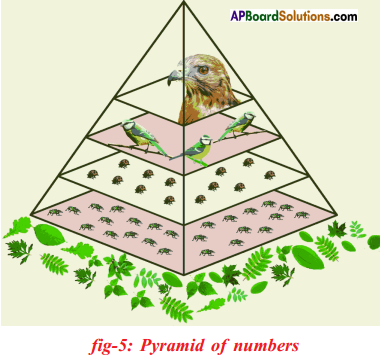
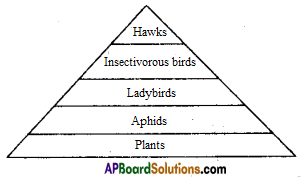
  1. The number of organisms in a food chain can be represented graphically in a pyramid of number.
  2. Each bar represents the number of individuals at each tropic level in a food chain.
  3. In the pyramid of numbers, from the first – order consumers to the large carnivores, there is normally an increase in size, but decrease in number.
  4. For example, in a wood, the aphids are very small and occur in astronomical numbers.
  5. The ladybirds which feed on them are distinctly larger and not so numerous.
  6. The insectivorous birds which feed on the ladybirds are larger still and are only present in a small numbers, and there may only be a single pair of hawks of much larger size than the insectivorous birds on which they prey.

b.

  1. In the given pyramid, the producer is a large tree, primary consumers are small
    insects which are numerous in number and secondary consumers are woodpeckers which are comparatively less in number than insects.
  2. From this pyramid of number, we can conclude that sometimes the pyramid of numbers does not look like a pyramid at all.
  3. This could happen if the producer is a large plant or if one of the organisms at any tropic level is very small.
  4. Whatever the situation, the producer still goes at the bottom of the pyramid.

AP SSC 10th Class Biology Solutions Chapter 9 Our Environment

Question 4.
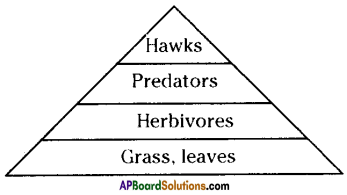
What is biomass? Draw a pyramid of biomass for the given food chain.
i) grass leaves ii) herbivores iii) predators iv) hawk
Answer:

  1. Biomass is organic material of biological origin that has ultimately derived from the fixation of carbon dioxide and the trapping of solar energy.
  2. This includes trees, shrubs, crops, grasses, algae, aquatic plants* agricultural and forest residues and all forms of human, animal and plant waste.
  3. Any type of plant or animal material that can be converted into energy is called “Biomass”.
  4. AP SSC 10th Class Biology Solutions Chapter 9 Our Environment 3

Question 5.
How is using of toxic material affecting the ecosystem? Write a short note on bioaccumulation and biomagnifications.
Answer:

  1. Use of toxic materials such as pesticides, herbicides and fungicides creates new problems in the ecosystem.
  2. As these toxic materials are often indiscriminate in their action and vast numbers of other animals may be destroyed.
  3. Some of them may be predators which naturally feed on these pests, others may be the food for other animals.
  4. Thus causing unpredictable changes in food chains and upsetting the balance within the ecosystem.
  5. Some toxic substances have a cumulative effect.
  6. Some of them are degradable, can be broken down into harmless substances in a comparatively short time usually a year.
  7. Others are non-degradable which are potentially dangerous as they accumulate in the bodies of animals and pass right through food web.
  8. This process of entering of pollutants in a food chain is known as “Bioaccumulation”.
  9. The tendency of pollutants to concentrate as they move from one tropic level to the next is known as “Biomagnifications”.

AP SSC 10th Class Biology Solutions Chapter 9 Our Environment

Question 6.
Should we use pesticides as they prevent our crop and food from pests or we should think of alternatives? Write your view about this issue and give sound reason for your answer.
(OR)
Why should we think of alternatives to pesticides? Give reasons.
Answer:

  1. We should think of alternatives. This is because these pesticides are toxic chemical whose usage leads to Bioaccumulation and Biomagnifications.
  2. When we use pesticides, they prevent our crop and food from pests effectively but indiscriminately destroys a vast number of other animals.
  3. This is causing unpredictable changes in food chains and upsetting the balance within the ecosystem.
  4. Most of the chemical pesticides that contain mercury, arsenic or lead are non -degradable.
  5. They enter into food chain, accumulate in the bodies of animals and pass right through food web.
  6. Being further concentrated at each step until animals at the top of the pyramid may receive enough to do considerable harm.
  7. This is one of the reasons for ever decreasing number of butterflies, bees, small and large birds.
  8. Some of the pesticides are nerve poisons and might bring about changes in behaviour.
  9. As the human beings are at the end of the food chain, these pesticides may get accumulated in our bodies also. This shows some adverse effects on us, when their concentration becomes sufficiently high.

Question 7.
What is a tropic level? What does it represent in an ecological pyramid?
Answer:

  1. The various steps in a food chain at which the transfer of food takes place is called tropic level.
  2. Tropic level means the feeding level of the organism.
  3. In an ecological pyramid, the first tropic level represents the primary producers, and their number, biomass or energy.
  4. Second tropic level represents the herbivores or primary consumers and their number, biomass or energy.
  5. The tropic level represents the lower carnivores or secondary consumers and their number, biomass or energy.
  6. The fourth tropic level represents the higher carnivores or tertiary consumers and their number, biomass or energy.

AP SSC 10th Class Biology Solutions Chapter 9 Our Environment

Question 8.
If you want to know more about the flow of energy in an ecosystem, what questions do you ask?
Answer:
I will ask the following questions to know more about flow of energy in an ecosystem.

  1. How does the energy flow in an ecosystem from one organism to other?
  2. Is the energy transformation from one level to other 100% efficient?
  3. What per cent of energy transfers from one level to other?
  4. What happens to the remaining energy?
  5. How does the ecosystem lose its energy during energy transformation?
  6. Which tropic level in an ecosystem has more energy and which has less?
  7. What is the ultimate source of energy in an ecosystem?

Question 9.
What will happen if we remove predators from food web?
Answer:

  1. Removal of organisms from any tropic level of a food chain or food web disturbs the ecosystem and leads to ecological imbalance.
  2. If we remove predators from food web, the prey population will increase enormously as there is no natural control over them.
  3. The producers population will decrease rapidly as the organisms feeding on them increase.
  4. After few generations the prey population also begins to decrease as some of the preys begin to die due to starvation.
  5. Some adaptations may also be developed by the organisms to bring the ecological balance.
  6. But it may take some generations, till that the ecosystem will be disturbed and imbalanced.
  7. For example, if we remove all the predators (carnivorous) from a forest ecosystem, the herbivorous animal population will increase as there are no carnivores to hunt them.
  8. As a result plant population will decrease as the ever increasing herbivores feed more and more on plants.
  9. After some generations the herbivore population begins to decrease as the decreasing number of plants are not sufficient to feed.
  10. Then some herbivorous animals may adapt to feed on other herbivores to increase their survival.
  11. Then scope for survival will increase for plants again which leads to ecological balance.
  12. But this may take lot of time to evolve new predators and to form ecological balance.

AP SSC 10th Class Biology Solutions Chapter 9 Our Environment

Question 10.
Observe a plant in your kitchen garden, and write a note on producer-consumer relationship.
Answer:
When I observe a plant in kitchen garden, I came to know the following things.

  1. Though it may be relatively small, a garden is a complete ecosystem.
  2. It has the same components as any other large and elaborate ecosystems had.
  3. The plant in a kitchen garden is a producer as it produces their own food from sunlight.
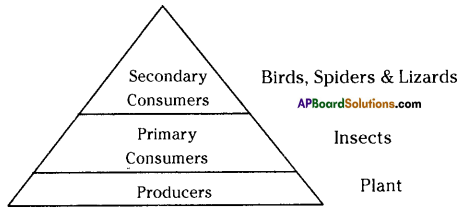
  4. There are two types of consumers in this ecosystem, a) Primary consumers and b) Secondary consumers.
  5. Primary consumers feed on plants. This tropic level consists of caterpillars, bees and butterflies.
  6. Secondary consumers feed on primary consumers. This tropic level consists of birds, garden lizards and spiders.
  7. Fungi, bacteria, insects and worms make up decomposers.
  8. The producer and consumer relationship can be shown in the following food chain.
    Plant → Plant eaters such as caterpillars, bees, butterflies → Meat-eaters such as birds, garden lizards, spiders
    Producers → Primary consumers → Secondary consumers
  9. The pyramid of number appears like this.

    AP SSC 10th Class Biology Solutions Chapter 9 Our Environment 4
  10. The pyramid of Biomass appears like this
    AP SSC 10th Class Biology Solutions Chapter 9 Our Environment 5
  11. The pyramid of energy appears like this
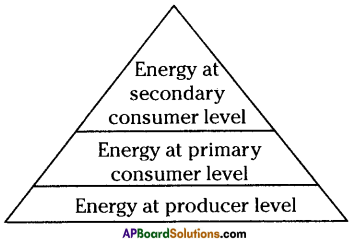
    AP SSC 10th Class Biology Solutions Chapter 9 Our Environment 6

AP SSC 10th Class Biology Solutions Chapter 9 Our Environment

Question 11.
What type of information do you require to explain the pyramid of biomass?
Answer:
To explain the pyramid of biomass, we require the following information.

  1. The type of ecosystem.
  2. Producers in the ecosystem.
  3. Primary consumers in the ecosystem.
  4. Secondary consumers in the ecosystem.
  5. Tertiary consumers in the ecosystem.
  6. Number of organisms at each tropic level.
  7. Size of organisms at each tropic level.
  8. Weight of organisms at each tropic level.
  9. All forms of waste produced at each tropic level and
  10. In total, total amount of biomass produced at each tropic level.

Question 12.
Draw a pyramid of numbers considering yourself sis top level consumer. Pyramid of numbers
Answer:
Pyramid of numbers
Ex: 1
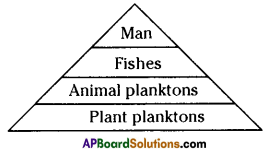
AP SSC 10th Class Biology Solutions Chapter 9 Our Environment 7

Ex: 2
AP SSC 10th Class Biology Solutions Chapter 9 Our Environment 8

AP SSC 10th Class Biology Solutions Chapter 9 Our Environment

Question 13.
Prepare slogans to promote awareness in your classmates about eco-friendly activities.
All the living things have the right to live on this earth along with us. Prepare slogans to promote awareness in public about the conservation of biodiversity.
(OR)
Which slogans do you prefer to promote awareness in your locality about eco-friendly activities?
Answer:

  1. Live and let live.
  2. If we protect the environment, it protects us.
  3. Conserve nature – Conserve life.
  4. Save mother earth.
  5. Earth needs you.
  6. Go ecofriendly.
  7. Clean the environment, live happily.
  8. Heal our planet! Turn it into a better planet.
  9. Plant a tree for your environment.
  10. Think ecofriendly and live ecofriendly.
  11. Earth enables you to definitely stand. Allow it to stand the actual way it is.
  12. You’ve only got one planet. Don’t trash it.

Question 14.
Suggest any three programmes on the prevention of soil pollution in view of avoiding pesticides.
(OR)
Suggest any four eco-friendly methods for prevention of soil pollution in view of avoiding pesticides. (OR)
In your area, soil is polluted by the enormous usage of pesticides. Suggest any two programmes for the prevention of soil pollution.
Answer:
To prevent the soil pollution caused by pesticides following programmes should be implemented.

  1. Rotation of crops :
    1. Same crop should not be grown in the same field in successive seasons.
    2. Rotation of crops reduce occurance of pests and damage due to pests will be decreased.
  2. Biological control: Introducing natural predator or parasite of the pest.
  3. Sterility: Sterilising the males of a pest species reduces the population of pests.
  4. Genetic strains: The development of genetic strains which are resistant to certain pest.
  5. Studying the life histories of the pests: When this is done it is sometimes possible to sow the crops at a time when least damage will be caused.

AP SSC 10th Class Biology Solutions Chapter 9 Our Environment

Choose the correct answer.

  1. What does a food chain always start with?
    A) The herbivore
    B) The carnivore
    C) The producer
    D) None of these
    Answer: C
  2. Which of the following do plants not compete for?
    A) Water
    B) Food
    C) Space
    D) All the above
    Answer: B
  3. Ban all pesticides, this means that
    A) Control on the usage of pesticides
    B) Prevention of pesticides
    C) Promote eco-friendly agricultural practices
    D) Stop biochemical factories
    Answer: C
  4. According to Charles Elton
    A) Carnivores at the top of the pyramid herbivore
    B) Energy trapping is high at the top of the pyramid
    C) No producers at the top of the pyramid
    D) A and C
    Answer: D

10th Class Biology 9th Lesson Our Environment InText Questions and Answers

Question 1.
Are all terrestrial ecosystems similar?
Answer:

  1. No. All the terrestrial ecosystems are not similar.
  2. Basing on variations in climatic conditions such as rainfall, temperature and the availability of light, there are various kinds of ecosystems.
  3. The major types of terrestrial ecosystem are
    1. Tundra,
    2. Coniferous forest,
    3. Deciduous forest,
    4. Savannah,
    5. Tropical forest and
    6. Deserts.

AP SSC 10th Class Biology Solutions Chapter 9 Our Environment

Question 2.
If we want to show a food chain consisting of grass, rabbit, snake and hawk then connect the given picture of organisms by putting arrows and make a food chain.
A) Name the producers and consumers in the above food chain.
B) Try to guess what does the arrows marked by you are indicate?
C) Identify at least four other food chains from your surroundings. Name the producers and different levels of consumers in those food chains.
Answer:
Grass → Rabbit → Snake → Hawk
A) In the above food chain grass is the primary producer. Rabbit is the primary consumer, snake is the secondary consumer and hawk is the tertiary consumer.
B) The arrows indicate the flow of energy from one organism to another. So these are always pointed from the food to the feeder.
C)

  1. Plant → insect → frog → bird
  2. Plant → insect →  frog → snake
  3. Aquatic plants → insects → fish → crane
  4. Plant → mice → snake → vulture
  5. Plant → aphids → spiders → birds

Question 3.
Why do most of the food chains consists of four steps?
Answer:

  1. Most of the food chains are quite short and mostly consists of four steps.
  2. This is because only 10% of the energy present in a tropic level transfers to the other tropic level.
  3. Remaining energy is dissipated as heat produced during the process of respiration and other ways.
  4. Thus about three steps in a food chain very little energy is still available for use by living organisms.

Question 4.
Why do the number of organisms get decreased as we move from producer to different level of consumers?
Answer:

  1. As we move from producers to different levels of consumers the energy available will decrease gradually.
  2. Only ten per cent of the energy present in one tropic level transfer to another tropic level.
  3. Biomass also decreases gradually as only 10 – 20% of the biomass is transferred from one tropic level to the next in a food chain.
  4. As there is less energy & less biomass available at top levels, number of organisms also less, generally.
  5. So, the number of organisms get decreased as we move from producer to different level of consumers.

AP SSC 10th Class Biology Solutions Chapter 9 Our Environment

Question 5.
Draw the pyramid of number for the following food chains.
i) Banyan → insects → woodpecker
ii) Grass → rabbit → wolf
A) Are the pyramid of number having same structure in both of the above two cases as compare to the example given in the earlier paragraph?
B) If there is a difference, then what it is?
Answer:
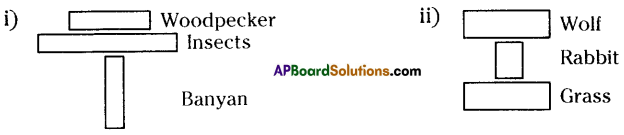
AP SSC 10th Class Biology Solutions Chapter 9 Our Environment 9
A) No. The pyramid of number in the above two cases doesn’t have the same structure as compared to the example given in the textbook.
B)

  1. In the example (given in the textbook), number of organisms at producers level is more. This number gradually decreased in consumers level step by step. So the pyramid of number formed has typical pyramid shape with broad base and the narrow apex.
  2. But in the first case given here, on a single Banyan tree, a large number of insects live and feed. These insects become food for few Woodpeckers. So producers number is less than primary and secondary consumers, and secondary consumers are less than primary consumers. So the pyramid of number does not look like a pyramid. It consists of narrow base, broad middle part and medium apex.
  3. In the second case, grass which are large in number become food for few rabbits. Rabbit provides food for several wolves which are comparatively less in number than grass. So primary consumers are less in number than secondary consumers and producers. So the pyramid of number for this food chain also does not look like a pyramid. It consists of broad base, narrow middle part and medium apex. Thus it differs from case (i) also.

Question 6.
Think why the pyramids are always upright?
Answer:

  1. In ecology not all the pyramids are always upright.
  2. Pyramid of number may be upright, inverted or partly upright.
  3. Pyramid of biomass may be upright or inverted.
  4. But the pyramid of energy is always upright.
  5. This is because energy will decrease when we move from producers to the high level consumers.
  6. Only 10% of the energy from one tropic level transfers to the other through food chain.
  7. So the energy at base is more, gradually decreases, and very less at the top.
  8. As a result the energy pyramid is always upright.

AP SSC 10th Class Biology Solutions Chapter 9 Our Environment

Question 7.
Observe the data given in the following table.

ClassesArea in 1967(Km2)Area in 2004 (Km2)
Lake – water spread area70.7062.65
Lake with sparse weed047.45
Lake with dense weed015.20
Lake-liable to flood in rainy season100.970
Aquaculture ponds099.74
Rice fields8.4016.62
Enchrochment0.311.37
Total180.38180.38

i) In which year lake-water spread area is more? Why?
Answer:
In the year 1967. Because lake was not brought under cultivation.

ii) How do you think weeds are more in the lake?
Answer:
Excessive nutrient addition, especially from anthropogenic sources, led to explosive weed growth. Ex: Eichornia, pistia.

iii) What are the reasons for decrease in lake area?
Answer:

  1. In 1996, almost entire lake was brought under cultivation.
  2. Industries came along in ever growing intensity in the catchment area of the lake.

iv) How do the above reasons lead to pollution?
Answer:

  1. Consequently, the drains and rivulets carry substantial quantity of various types of pollutants into the lake.
  2. The major sources of pollution are agricultural runoff containing residues of several agrochemicals, fertilizers, fish tank discharges, industrial effluents containing chemical residues.

v) How was the threat to the lake due to pollution discovered?
Answer:

  1. The water of the lake turned alkaline in nature, turbid, nutrient rich, low in dissolved oxygen and high in biochemical oxygen demand.
  2. Water borne diseases like diarrhoea, typhoid, amoebiasis and others are said to be common among the local inhabitants who are unaware of the state of pollution in the lake water.
  3. Vector borne diseases were also increased.

vi) What could be the reasons for the migration of birds to this lake?
Answer:
To avoid extreme cold weather conditions in Northern Asia and Eastern Europe birds migrate to Kolleru lake.

AP SSC 10th Class Biology Solutions Chapter 9 Our Environment

Question 8.
Observe the following table showing different activities in the lake and their influence.
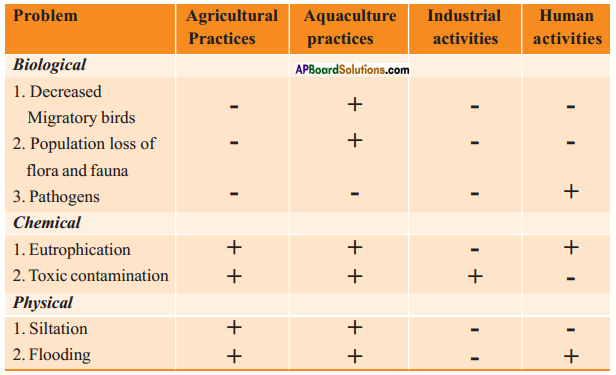
AP SSC 10th Class Biology Solutions Chapter 9 Our Environment 10Legend:
(+) means has influence on the mentioned problem
(-) means has no influence on the mentioned problem
i) What are the factors that affected the number of migratory birds to decrease?
Answer:
Aquaculture practices.

ii) Do you find any relationship between biological and physical problems?
Answer:
Yes. Aquaculture practices have influence on these problems.

iii) What are the reasons for chemical problems ?
Answer:
Agricultural practices, aquaculture practices, industrial activities and human activities are the reasons for chemical problems.

iv) What happens if the dissolved oxygen reduce in lake water ?
Answer:
If the dissolved oxygen reduces in lake water, sufficient amount of oxygen will not be available to organisms that live in the lake.
This leads to the death of organisms in the lake.

v) Is BOD of turbid and nutrient rich water high or low? What are its consequences?
Answer:
High. Its consequences are water borne diseases and death of organisms.

vi) People living in catchment area of Kolleru faced so many problems. Why?
Answer:
Vector borne disease increased. The lands adandoned are useless for agriculture.

AP SSC 10th Class Biology Solutions Chapter 9 Our Environment

Question 9.
Name any two pesticides / insecticides you have heard about.
Answer:
DDT, Aldrin, Malathian, Altrazine, Monocrotophos, Endosulphan etc.

Question 10.
How are the food grains and cereals being stored in your house and how dojyou protected them from pests and fungus?
Answer:
To protect food grains and cereals from pests and fungus, we will follow the following rules in our house.

  1. First of all we will dry and clean our grain before storing.
  2. We will avoid moisture in bagged grains by storing them on wooden structures, bamboo mats or polythene covers.
  3. We use domestic bins or improvised storage structures such as Gaade, Kotlu, Paatara, RCC bins and flat bottom metal bins etc.
  4. We fumigate the storage room with Ethylene Di-bromide (EDB) ampoules to avoid insect damage.
  5. We use anticoagulant for rat control in houses.

Question 11.
Where from pollutants enter to the water sources?
Answer:
The used water from industries and run off water containing agricultural effluents bring pollutants into water sources. Municipal and domestic sewage also pollute water sources.

Question 12.
How can you say fishes living in water having heavy metals in their bodies?
Answer:
The bioaccumulation of heavy metals in tissues of fish particularly in liver, kidney and gills were analysed and found their presence.

AP SSC 10th Class Biology Solutions Chapter 9 Our Environment

Question 13.
Researchers found that pollution levels increase during monsoon season. Why they found so?
Answer:

  1. Pollution levels increase during monsoon season in water bodies.
  2. During monsoon season heavy rainfall occurs.
  3. The rain water brings residues of agrochemicals, fertilizers and different types of organic substances, municipal and domestic sewage.
  4. Hence pollution levels increase in monsoon season.

Question 14.
Why did people also suffer from various diseases after consuming fishes living in local water reservoir?
Answer:

  1. The heavy metals could find their way into human beings through food chain.
  2. This bioaccumulation cause various physiological disorders such as hypertension, sporadic fever, renal damage, nausea etc.

Question 15.
What is the food chain that has been discussed in the above case?
Answer:
The food chain discussed in the above occurrence is Crops → Locust → Sparrow → Hawk.

Question 16.
How did the campaign disturb the food chain in the fields?
Answer:

  1. Crop yields after the campaign were substantially decreased.
  2. Though the campaign against sparrows ended it was too late.
  3. With no sparrows to eat the locust populations, the country was soon swarmed.
  4. Locust coupled with bad weather led to the great Chinese famine.

Question 17.
How did these disturbances affect the environment?
Answer:

  1. The number of locust increased.
  2. Use of pesticides against locust population further degraded the land.

Question 18.
Is it right to eradicate a living organism in an ecosystem? How is it harmful?
Answer:

  1. No, it is not right to eradicate a living organism in an ecosystem.
  2. It disturbs the existing food chain.

AP SSC 10th Class Biology Solutions Chapter 9 Our Environment

Question 19.
Were the sparrows really responsible? What was the reason for the fall in crop production?
Answer:

  1. No, the sparrows were not really responsible for the loss of food grain.
  2. With no sparrows to eat the locust population crops were damaged and this led to fall in crop production.

Question 20.
What was the impact of human activities on the environment?
Answer:

  1. The human activities badly affected the environment.
  2. Use of pesticides against the pest degraded the land.

Question 21.
What do you suggest for such incidents not to occur?
Answer:

  1. I suggest to use organic manures and organic insecticides to kill the insects.
  2. Rotation of crops is the best method to protect the crops from pests.
  3. We should not kill any organism on this earth because every organism has a role to play.
  4. Think before you start action.

10th Class Biology 9th Lesson Our Environment Activities

Activity – 1

Observe any water ecosystem in your surroundings and identify the different food chains and food web operating in this ecosystem. Write the following details in your notebook.

WORKSHEET

1. Names of the students in a group: ——————— Date: ———–
2. Name of the ecosystem: ———————
3. Topography: ———————
4. Names / Number of plants (producers) identified: ———————
5 Names / Number of animals identified: ———————
6. Identify the different types consumers and name them & mention their number below :
Herbivores (Primary consumers): ———————
Carnivores (Secondary consumers): ———————
Top carnivores (Tertiary): ———————
7 Food relationships among them: food habits/preferences: ———————
8 Show / draw the different food chains: ———————
9. Showcase the food web: ———————
10. List out all abiotic factors existing in the ecosystem: ———————
( A check list can be given, and asked to tick)
11. Is there any threat to the ecosystem ? Yes / No ———————
If yes, what ? and how ? ———————
Suggest few remedial measures ———————
Answer:
Student’s Activity.

AP SSC 10th Class Maths Solutions Chapter 7 Coordinate Geometry Ex 7.2

AP State Board Syllabus AP SSC 10th Class Maths Textbook Solutions Chapter 7 Coordinate Geometry Ex 7.2 Textbook Questions and Answers.

AP State Syllabus SSC 10th Class Maths Solutions 7th Lesson Coordinate Geometry Exercise 7.2

10th Class Maths 7th Lesson Coordinate Geometry Ex 7.2 Textbook Questions and Answers

Question 1.
Find the coordinates of the point which divides the line segment joining the points (-1, 7) and (4, -3) in the ratio 2 :3.
Answer:
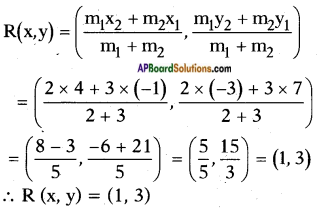
Given points P (-1, 7) and Q (4, – 3). Let ‘R’ be the required point which divides \(\overline{\mathrm{PQ}}\) in the ratio 2:3. Then
AP SSC 10th Class Maths Solutions Chapter 7 Coordinate Geometry Ex 7.2 1

AP SSC 10th Class Maths Solutions Chapter 7 Coordinate Geometry Ex 7.2

Question 2.
Find the coordinates of the points of trisection of the line segment joining (4, -1) and (-2, -3).
Answer:
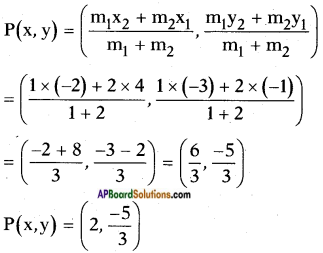
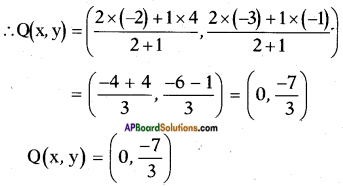
Given points A (4, – 1) and B (- 2, – 3) Let P and Q be the points of trisection
of \(\overline{\mathrm{AB}}\), then AP = PQ = QB.
AP SSC 10th Class Maths Solutions Chapter 7 Coordinate Geometry Ex 7.2 2
∴ P divides \(\overline{\mathrm{AB}}\) internally in the ratio 1 : 2.
AP SSC 10th Class Maths Solutions Chapter 7 Coordinate Geometry Ex 7.2 3
Also, Q divides \(\overline{\mathrm{AB}}\) in the ratio 2 : 1 internally.
AP SSC 10th Class Maths Solutions Chapter 7 Coordinate Geometry Ex 7.2 4

Question 3.
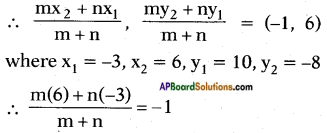
Find the ratio in which the line segment joining the points (-3, 10) and (6, -8) is divided by (-1, 6).
Answer:
Let the point (-1, 6) divides the line segment joining the points (-3, 10) and (6, -8) in a ratio of m : n
AP SSC 10th Class Maths Solutions Chapter 7 Coordinate Geometry Ex 7.2 5
⇒ 6m – 3n = -(m + n) = -m – n
⇒ 6m + m = – n + 3n
⇒ 7m = 2n
⇒ \(\frac{m}{n}=\frac{2}{7}\)
⇒ m : n = 2 : 7
∴ The point (-1, 6) divides the given line segment in a ratio of 2 : 7.

AP SSC 10th Class Maths Solutions Chapter 7 Coordinate Geometry Ex 7.2

Question 4.
If (1, 2), (4, y), (x, 6) and (3, 5) are the vertices of a parallelogram taken in order, find x and y.
Answer:
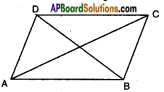
AP SSC 10th Class Maths Solutions Chapter 7 Coordinate Geometry Ex 7.2 6
Given: ▱ ABCD is a parallelogram where A (1, 2), B (4, y), C (x, 6) and D (3, 5).
In a parallelogram, diagonals bisect each other.
i.e., the midpoints of the diagonals coincide with each other.
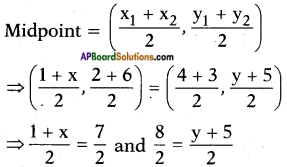
i.e.,midpoint of AC = midpoint of BD
AP SSC 10th Class Maths Solutions Chapter 7 Coordinate Geometry Ex 7.2 7
⇒ 1 + x = 7 and 8 = y + 5
⇒ x = 7 – 1 and y = 8 – 5
∴ x = 6 and y = 3.

Question 5.
Find the coordinates of a point A, where AB is the diameter of a circle whose centre is (2, -3) and B is (1, 4).
Answer:
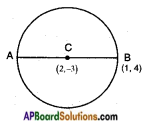
AP SSC 10th Class Maths Solutions Chapter 7 Coordinate Geometry Ex 7.2 8
Given:
A circle with centre ‘C’ (2, -3). \(\overline{\mathrm{AB}}\) is a diameter where
B = (1, 4); A = (x, y).
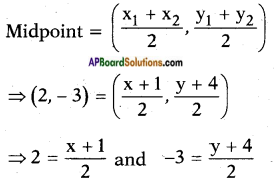
C is the midpoint of AB.
[∵ Centre of a circle is the midpoint of the diameter]
AP SSC 10th Class Maths Solutions Chapter 7 Coordinate Geometry Ex 7.2 9
4 = x + 1 and – 6 = y + 4
⇒ x = 4 – 1 = 3 and y = -6 – 4 = -10
A (x, y) = (3, -10)

AP SSC 10th Class Maths Solutions Chapter 7 Coordinate Geometry Ex 7.2

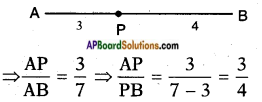
Question 6.
If A and B are (-2, -2) and (2, -4) respectively. Find the coordinates of P such that AP = \(\frac{3}{7}\) AB and P lies on the segment AB.
Answer:
Given: A (- 2, – 2) and B (2, – 4)
P lies on AB such that AP = latex]\frac{3}{7}[/latex] AB
AP SSC 10th Class Maths Solutions Chapter 7 Coordinate Geometry Ex 7.2 10
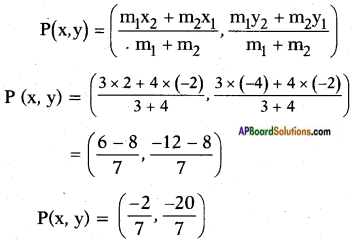
i.e., P divides \(\overline{\mathrm{AB}}\) in the ratio 3 : 4 By section formula,
AP SSC 10th Class Maths Solutions Chapter 7 Coordinate Geometry Ex 7.2 11

Question 7.
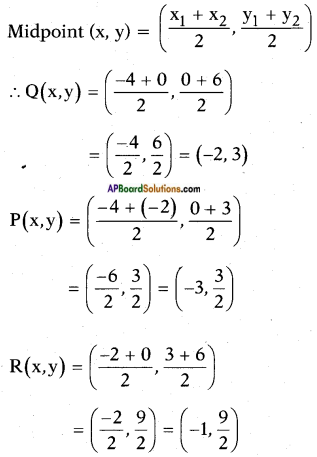
Find the coordinates of points which divide the line segment joining A (-4, 0) and B (0, 6) into four equal parts.
Answer:
Given, A (- 4, 0) and B (0, 6).
Let P, Q and R be the points which divide AB into four equal parts.
AP SSC 10th Class Maths Solutions Chapter 7 Coordinate Geometry Ex 7.2 12
P divides \(\overline{\mathrm{AB}}\) in the ratio 1 : 3, Q → 1 : 1 and R → 3 : 1 Use section formula to find P, Q and R.
Then, Q is the midpoint of \(\overline{\mathrm{AB}}\)
P is the midpoint of \(\overline{\mathrm{AQ}}\)
R is the midpoint of \(\overline{\mathrm{QB}}\)
AP SSC 10th Class Maths Solutions Chapter 7 Coordinate Geometry Ex 7.2 13

AP SSC 10th Class Maths Solutions Chapter 7 Coordinate Geometry Ex 7.2

Question 8.
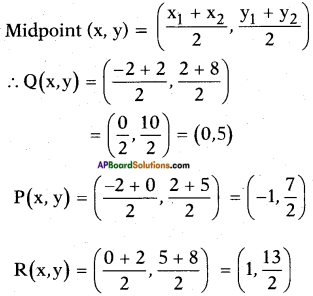
Find the coordinates of the points which divides the line segment joining A(-2, 2) and B(2, 8) into four equal parts.
Answer:
Given, A (- 2, 2) and B (2, 8).
Let P, Q and R be the points which divide AB into four equal parts.
AP SSC 10th Class Maths Solutions Chapter 7 Coordinate Geometry Ex 7.2 14
Then, Q is the midpoint of \(\overline{\mathrm{AB}}\)
P is the midpoint of \(\overline{\mathrm{AQ}}\)
R is the midpoint of \(\overline{\mathrm{QB}}\)
AP SSC 10th Class Maths Solutions Chapter 7 Coordinate Geometry Ex 7.2 15

Question 9.
Find the coordinates of the point which divide the line segment joining the points (a + b, a-b) and (a-b, a + b) in the ratio 3 : 2 internally.
Answer:
Given : A (a + b, a – b) and B (a – b, a + b).
Let P (x, y) divides \(\overline{\mathrm{AB}}\) in the ratio 3 : 2 internally.
Section formula
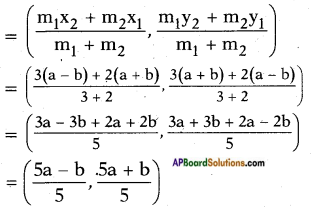
AP SSC 10th Class Maths Solutions Chapter 7 Coordinate Geometry Ex 7.2 16

Question 10.
Find the coordinates of centroid of the triangle with following vertices:
i) (-1, 3), (6, -3) and (-3, 6)
Answer:
Given: △ABC in which- A (- 1, 3), B (6, -3) and C (-3, 6)
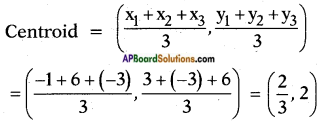
AP SSC 10th Class Maths Solutions Chapter 7 Coordinate Geometry Ex 7.2 17

ii) (6, 2), (0, 0) and (4, -7)
Answer:
Given: The three vertices of a triangle are A (6, 2), B (0, 0) and C (4, – 7).
Centroid (x, y)
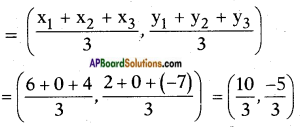
AP SSC 10th Class Maths Solutions Chapter 7 Coordinate Geometry Ex 7.2 18

AP SSC 10th Class Maths Solutions Chapter 7 Coordinate Geometry Ex 7.2

iii) (1,-1), (0, 6) and (-3, 0)
Answer:
Given: (1, -1), (0, 6) and (-3, 0) are the vertices of a triangle.
Centroid (x, y)
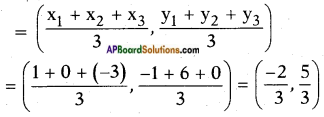
AP SSC 10th Class Maths Solutions Chapter 7 Coordinate Geometry Ex 7.2 19

AP Inter 2nd Year Maths 2A Solutions Chapter 4 సమీకరణ వాదం Ex 4(d)

Practicing the Intermediate 2nd Year Maths 2A Textbook Solutions Chapter 4 సమీకరణ వాదం Exercise 4(d) will help students to clear their doubts quickly.

AP Inter 2nd Year Maths 2A Solutions Chapter 4 సమీకరణ వాదం Exercise 4(d)

అభ్యాసం – 4(డి)

I.

ప్రశ్న 1.
x3 + 2x2 – 4x + 1 = 0 సమీకరణపు మూలాలకు 3 రెట్లున్న మూలాలు గల బీజీయ సమీకరణాన్ని కనుక్కోండి.
సాధన:
దత్త సమీకరణం f(x) = x3 + 2x2 – 4x + 1 = 0 అనుకొనుము.
∴ కావలసిన సమీకరణం f(\(\frac{x}{3}\)) = 0
\(\left(\frac{x}{3}\right)^3+2\left(\frac{x}{3}\right)^2-\frac{4 x}{3}+1=0\)
\(\frac{x^3}{27}+\frac{2}{9} x^2-\frac{4}{3} x+1=0\)
27 గుణించగా
కావలసిన సమీకరణం x3 + 6x2 – 36x + 27 = 0

ప్రశ్న 2.
x5 – 2x4 + 3x3 – 2x2 + 4x + 3 = 0 సమీకరణపు మూలాలకు 2 రెట్లున్న మూలాలు గల బీజీయ సమీకరణాన్ని కనుక్కోండి.
సాధన:
దత్త సమీకరణం f(x) = x5 – 2x4 + 3x3 – 2x2 + 4x + 3 = 0
f(\(\frac{x}{2}\)) = 0 సమీకరణం కావలసిన లక్షణాలలో ఉంటుంది.
కావలసిన సమీకరణం f(\(\frac{x}{3}\)) = 0
⇒ \(\left(\frac{x}{2}\right)^5-2\left(\frac{x}{2}\right)^4+3\left(\frac{x}{2}\right)^3-2\left(\frac{x}{2}\right)^2+4\left(\frac{x}{2}\right)\) + 3 = 0
⇒ \(\frac{x^5}{32}-2 \cdot \frac{x^4}{16}+3 \cdot \frac{x^3}{8}-2 \cdot \frac{x^2}{4}+4 \cdot \frac{x}{2}+3=0\)
32 చే గుణించగా
కావలసిన సమీకరణం x5 – 4x4 + 12x3 – 16x2 + 64x + 96 = 0

AP Inter 2nd Year Maths 2A Solutions Chapter 4 సమీకరణ వాదం Ex 4(d)

ప్రశ్న 3.
x4 + 5x3 + 11x + 3 = 0 సమీకరణ మూలాలకు వ్యతిరేక గుర్తులు కలిగిన సంఖ్యలు మూలాలుగా గల రూపాంతర సమీకరణాన్ని కనుక్కోండి.
సాధన:
దత్త సమీకరణం f(x) = x4 + 5x3 + 11x + 3 = 0
1, -α2, -α3, -α4 లు మూలాలుగా గల సమీకరణం f(-x) = 0
⇒ (-x)4 + 5(-x)3 + 11(-x) + 3 = 0
⇒ x4 – 5x3 – 11x + 3 = 0

ప్రశ్న 4.
x7 + 3x5 + x3 – x2 + 7x + 2 = 0 సమీకరణం మూలాలకు వ్యతిరేక గుర్తులు కలిగిన సంఖ్యలు మూలాలుగా గల రూపాంతర సమీకరణాన్ని కనుక్కోండి.
సాధన:
దత్త సమీకరణం f(x) = x7 + 3x5 + x3 – x2 + 7x + 2 = 0
1, -α2, …….., -α7 లు మూలాలుగల
సమీకరణం f(-x) = 0
⇒ (-x)7 + 3(-x)5 + (-x)3 – (-x)2 + 7(-x) + 2 = 0
⇒ -x7 – 3x5 – x3 – x2 – 7x + 2 = 0
⇒ x7 + 3x5 + x3 + x2 + 7x – 2 = 0

ప్రశ్న 5.
x4 – 3x3 + 7x2 + 5x – 2 = 0 సమీకరణ మూలాల వ్యుత్కమాలు మూలాలుగా గల బహుపది సమీకరణాన్ని కనుక్కోండి. [Mar. ’11]
సాధన:
దత్త సమీకరణం f(x) = x4 – 3x3 + 7x2 + 5x – 2 = 0
కావలసిన సమీకరణం f(\(\frac{1}{x}\)) = 0
⇒ \(\frac{1}{x^4}-\frac{3}{x^3}+\frac{7}{x^2}+\frac{5}{x}-2=0\)
x4 చే గుణించగా
⇒ 1 – 3x + 7x2 + 5x3 – 2x4 = 0
⇒ 2x4 – 5x3 – 7x2 + 3x – 1 = 0

AP Inter 2nd Year Maths 2A Solutions Chapter 4 సమీకరణ వాదం Ex 4(d)

ప్రశ్న 6.
x5 + 11x4 + x3 + 4x2 – 13x + 6 = 0 సమీకరణం మూలాల వ్యుత్కమాలు మూలాలుగా గల బహుపది సమీకరణాన్ని కనుక్కోండి.
సాధన:
దత్త సమీకరణం f(x) = x5 + 11x4 + x3 + 4x2 – 13x + 6 = 0
కావలసిన సమీకరణం f(\(\frac{1}{x}\)) = 0
\(\frac{1}{x^5}+\frac{11}{x^4}+\frac{1}{x^3}+\frac{4}{x^2}-\frac{13}{x}+6=0\)
x5 చే గుణించగా
⇒ 1 + 11x + x2 + 4x3 – 13x4 + 6x5 = 0
⇒ 6x5 – 13x4 + 4x3 + x2 + 11x + 1 = 0

II.

ప్రశ్న 1.
x4 + x3 + 2x2 + x + 1 = 0 సమీకరణ మూలాల వర్గాలు మూలాలుగా గల బహుపది సమీకరణాన్ని రూపొందించండి.
సాధన:
దత్త సమీకరణం f(x) = x4 + x3 + 2x2 + x + 1 = 0
కావలసిన సమీకరణం f(√x) = 0
⇒ x2 + x√x + 2x + √x + 1 = 0
⇒ √x(x + 1) = -(x2 + 2x + 1)
వర్గం చేయగా
⇒ x(x + 1)2 = (x2 + 2x + 1)2
⇒ x(x2 + 2x + 1) = x4 + 4x2 + 1 + 4x3 + 4x + 2x2
⇒ x3 + 2x2 + x = x4 + 4x3 + 6x2 + 4x + 1
⇒ x4 + 3x3 + 4x2 + 3x + 1 = 0

ప్రశ్న 2.
x3 + 3x2 – 7x + 6 = 0 సమీకరణ మూలాల వర్గాలు మూలాలుగా గల బహుపది సమీకరణాన్ని రూపొందించండి.
సాధన:
దత్త సమీకరణం f(x) = x3 + 3x2 – 7x + 6 = 0
కావలసిన సమీకరణం f(√x) = 0
⇒ x√x + 3x – 7√x + 6 = 0
⇒ √x(x – 7) = -(3x + 6)
వర్గం చేయగా
⇒ x(x – 7)2 = (3x + 6)2
⇒ x(x2 – 14x + 49) = 9x2 + 36 + 36x
⇒ x3 – 14x2 + 49x – 9x2 – 36x – 36 = 0
⇒ x3 – 23x2 + 13x – 36 = 0

AP Inter 2nd Year Maths 2A Solutions Chapter 4 సమీకరణ వాదం Ex 4(d)

ప్రశ్న 3.
x3 + 3x2 + 2 = 0 సమీకరణ మూలాల ఘనాలు మూలాలుగా గల బహుపది సమీకరణాన్ని రూపొందించండి.
సాధన:
దత్త సమీకరణం x3 + 3x2 + 2 = 0
y = x3 అయిన x = \(y^{1 / 3}\) అవుతుంది
∴ y + 3\(y^{2 / 3}\) + 2 = 0
3y\(y^{2 / 3}\) = -(y + 2)
ఘనం చేయగా
27y2 = -(y + 2)3 = -(y3 + 6y2 + 12y + 8)
∴ y3 + 6y2 + 27y2 + 12y + 8 = 0
⇒ y3 + 33y2 + 12y + 8 = 0
కావలసిన సమీకరణం x3 + 33x2 + 12x + 8 = 0

III.

ప్రశ్న 1.
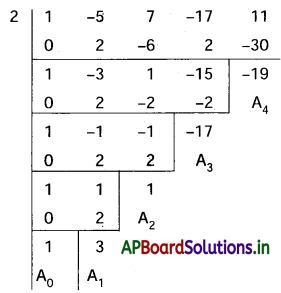
-2 తో మార్పు చెందిన x4 – 5x3 + 7x2 – 17x + 11 = 0 సమీకరణ మూలాల విలువలు మూలాలుగా గల బీజీయ సమీకరణాన్ని కనుక్కోండి.
సాధన:
దత్త సమీకరణం f(x) = x4 – 5x3 + 7x2 – 17x + 11 = 0
కావలసిన సమీకరణం f(x + 2) = 0
⇒ (x + 2)4 – 5(x + 2)3 + 7(x + 2)2 – 17(x + 2) + 11 = 0
AP Inter 2nd Year Maths 2A Solutions Chapter 4 సమీకరణ వాదం Ex 4(c) III Q1
కావలసిన సమీకరణం x4 + 3x3 + x2 – 17x – 19 = 0

ప్రశ్న 2.
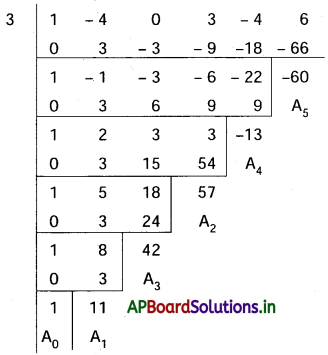
-3 తో మార్పు చెందిన x5 – 4x4 + 3x2 – 4x + 6 = 0 సమీకరణ మూలాల విలువలు మూలాలుగా గల బహుపది సమీకరణాన్ని కనుక్కోండి. [T.S. Mar. ’16]
సాధన:
దత్త సమీకరణం f(x) = x5 – 4x4 + 3x2 – 4x + 6 = 0
కావలసిన సమీకరణం f(x + 3) = 0
(x + 3)5 – 4(x + 3)3 + 3(x + 3)2 – 4(x + 3) + 6 = 0
AP Inter 2nd Year Maths 2A Solutions Chapter 4 సమీకరణ వాదం Ex 4(c) III Q2
∴ కావలసిన సమీకరణం x5 + 11x4 + 42x3 + 57x2 – 13x – 60 = 0

AP Inter 2nd Year Maths 2A Solutions Chapter 4 సమీకరణ వాదం Ex 4(d)

ప్రశ్న 3.
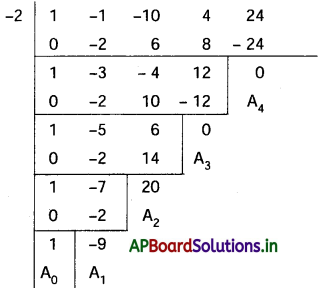
2 తో మార్పు చెందిన x4 – x3 – 10x2 + 4x + 24 = 0 సమీకరణ మూలాల విలువలు మూలాలుగా గల బహుపది సమీకరణాన్ని కనుక్కోండి.
సాధన:
దత్త సమీకరణం f(x) = x4 – x3 – 10x2 + 4x + 24 = 0
కావలసిన సమీకరణం f(x – 2) = 0
(x – 2)4 – (x – 2)3 – 10(x – 2)2 + 4(x – 2) + 24 = 0
AP Inter 2nd Year Maths 2A Solutions Chapter 4 సమీకరణ వాదం Ex 4(c) III Q3
∴ కావలసిన సమీకరణం x4 – 9x3 + 20x2 = 0

ప్రశ్న 4.
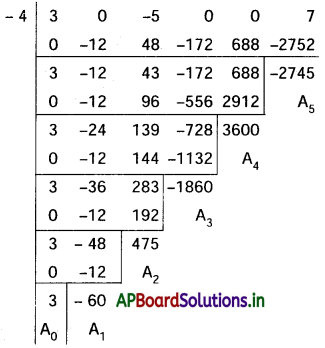
4తో మార్పు చెందిన 3x5 – 5x3 + 7 = 0 సమీకరణ మూలాల విలువలు మూలాలుగా గల బహువది సమీకరణాన్ని కనుక్కోండి.
సాధన:
దత్త సమీకరణం f(x) = 3x5 – 5x3 + 7 = 0
కావలసిన సమీకరణం f(x – 4) = 0
3(x – 4)5 – 5(x – 4)3 + 7 = 0
AP Inter 2nd Year Maths 2A Solutions Chapter 4 సమీకరణ వాదం Ex 4(c) III Q4
∴ కావలసిన సమీకరణం 3x5 – 60x4 + 475x3 – 1860x2 + 3600x – 2745 = 0

ప్రశ్న 5.
x యొక్క రెండో అత్యధిక ఘాత గుణకం సున్నా అయ్యే విధంగా కింది సమీకరణాలను పరివర్తన చేసి రూపాంతర సమీకరణాలను కనుక్కోండి.
(i) x3 – 6x2 + 10x – 3 = 0
సాధన:
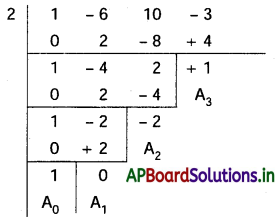
x యొక్క రెండో అత్యధిక ఘాత గుణకం లుప్తం అయ్యే విధంగా సమీకరణ మూలాలను \(\frac{-a_1}{n \cdot a_0}=\frac{-(-6)}{(3)(1)}\) = 2 తో మూలాల విలువలను పరివర్తనము చేయాలి.
అంటే f(x + 2) = 0 ను కనుక్కోవాలి.
AP Inter 2nd Year Maths 2A Solutions Chapter 4 సమీకరణ వాదం Ex 4(c) III Q5(i)
∴ కావలసిన సమీకరణము x3 – 2x + 1 = 0

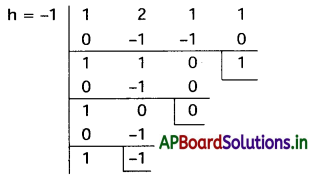
(ii) x4 + 4x3 + 2x2 – 4x – 2 = 0
సాధన:
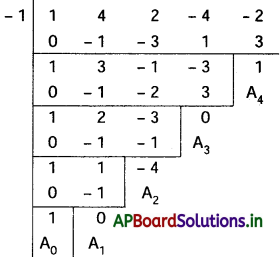
దత్త సమీకరణం x4 + 4x3 + 2x2 – 4x – 2 = 0
మూలాలను h = \(-\frac{a_1}{n a_0}=\frac{-4}{4}\) = -1 తో మార్పు చెందించాలి.
AP Inter 2nd Year Maths 2A Solutions Chapter 4 సమీకరణ వాదం Ex 4(c) III Q5(ii)
∴ కావలసిన సమీకరణం x4 – 4x2 + 1 = 0

(iii) x3 – 6x2 + 4x – 7 = 0
సాధన:
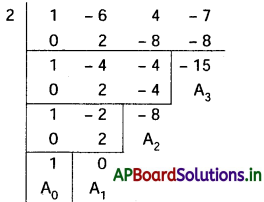
దత్త సమీకరణం x3 – 6x2 + 4x – 7 = 0
మూలాలను h = \(-\frac{a_1}{n a_0}=\frac{6}{3}\) = 2 తో మార్పు చెందించాలి.
AP Inter 2nd Year Maths 2A Solutions Chapter 4 సమీకరణ వాదం Ex 4(c) III Q5(iii)
∴ కావలసిన సమీకరణం x3 – 8x – 15 = 0

(iv) x3 + 6x2 + 4x + 4 = 0
సాధన:
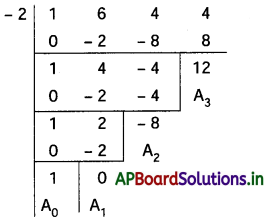
దత్త సమీకరణం x3 + 6x2 + 4x + 4 = 0
రెండవ పదాన్ని లోపింపచేయటానికి మూలాలను h = \(-\frac{a_1}{n a_0}=-\frac{6}{3}\) = -2 కు మార్పు చెందించాలి.
AP Inter 2nd Year Maths 2A Solutions Chapter 4 సమీకరణ వాదం Ex 4(c) III Q5(iv)
∴ కావలసిన సమీకరణం x3 – 8x + 12 = 0

AP Inter 2nd Year Maths 2A Solutions Chapter 4 సమీకరణ వాదం Ex 4(d)

ప్రశ్న 6.
x యొక్క మూడో అత్యధిక ఘాత గుణకం సున్నా అయ్యే విధంగా కింది సమీకరణాలను పరివర్తన చేయండి.
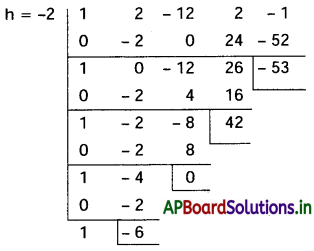
(i) x4 + 2x3 – 12x2 + 2x – 1 = 0
సాధన:
దత్త సమీకరణం
f(x) = x4 + 2x3 – 12x2 + 2x – 1 = 0
x యొక్క మూడో అత్యధిక ఘాత గుణకం సున్నా కావాలి.
అంటే, దత్త సమీకరణ, మూలాలను h కు మార్పు చెందించాలి.
ఇచ్చట h అనేది \(f^{(4-3+1)}(h)\) = 0 ⇒ \(f^{(2)} \text { (h) }\) = 0 నుండి వస్తుంది.
f'(x) = 4x3 + 6x2 – 24x + 2
f”(x) = 12x2 + 12x – 24
f”(h) = 0
⇒ 12h2 + 12h – 24 = 0
⇒ h2 + h – 2 = 0
⇒(h + 2) (h – 1) = 0
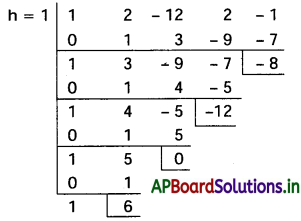
⇒ h = -2 (లేదా) 1
సందర్భము (i):
AP Inter 2nd Year Maths 2A Solutions Chapter 4 సమీకరణ వాదం Ex 4(c) III Q6(i)
∴ కావలసిన సమీకరణం x4 – 6x3 + 42x – 53 = 0
సందర్భము (ii):
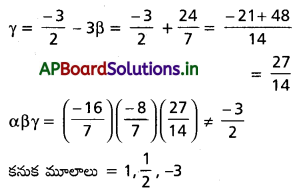
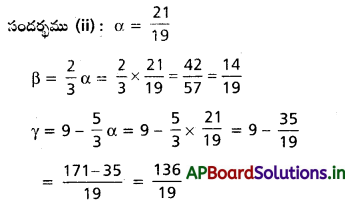
AP Inter 2nd Year Maths 2A Solutions Chapter 4 సమీకరణ వాదం Ex 4(c) III Q6(i).1
కావలసిన సమీకరణము x4 + 6x3 – 12x – 8 = 0
∴ కావలసిన సమీకరణాలు x4 – 6x3 + 42x – 53 = 0 (లేదా) x4 + 6x3 – 12x – 8 = 0

(ii) x3 + 2x2 + x + 1 = 0
సాధన:
f(x) = x3 + 2x2 + x + 1 అనుకోండి.
x యొక్క మూడో అత్యధిక గుణకం సున్నా కావాలి అంటే, దత్త సమీకరణ మూలాలను ‘h’ తో మార్పు చెందించాలి.
ఇచ్చట h అనేది f'(h) = 0 నుండి వస్తుంది.
f'(x) = 3x2 + 4x + 1
f'(h) = 0
⇒ 3h2 + 4h + 1 = 0
⇒ (3h + 1) (h + 1) = 0
⇒ h = -1, \(-\frac{1}{3}\)
సందర్భము (i):
AP Inter 2nd Year Maths 2A Solutions Chapter 4 సమీకరణ వాదం Ex 4(c) III Q6(ii)
∴ కావలసిన సమీకరణం x3 – x2 + 1 = 0
సందర్భము (ii):
AP Inter 2nd Year Maths 2A Solutions Chapter 4 సమీకరణ వాదం Ex 4(c) III Q6(ii).1
∴ కావలసిన సమీకరణం x3 + x2 + \(\frac{23}{27}\) = 0
⇒ 27x3 + 27x2 + 23 = 0
∴ కావలసిన సమీకరణాలు x3 – x2 + 1 = 0 (లేదా) 27x3 + 27x2 + 23 = 0

AP Inter 2nd Year Maths 2A Solutions Chapter 4 సమీకరణ వాదం Ex 4(d)

ప్రశ్న 7.
కింది సమీకరణాలను సాధించండి.
(i) x4 – 10x3 + 26x2 – 10x + 1 = 0
సాధన:
దత్త సమీకరణం ఒకటో కోవకు చెందిన సరిఘాత వ్యుత్కమ సమీకరణం
x2 చే భాగించగా x2 – 10x + 26 – \(\frac{10}{x}+\frac{1}{x^2}\) = 0
\([latex]\frac{10}{x}+\frac{1}{x^2}\)[/latex] …….(1)
a = x + \(\frac{1}{x}\) అనుకుంటే
\(x^2+\frac{1}{x^2}=\left(x-\frac{1}{x}\right)^2-2\) = a2 – 2
(1) లో వ్రాయగా a2 – 2 – 10a + 26 = 0
⇒ a2 – 10a + 24 = 0
⇒ (a – 4) (a – 6) = 0
⇒ a = 4 (లేదా) 6
సందర్భము (i): a = 4
x + \(\frac{1}{x}\) = 4
⇒ x2 + 1 = 4x
⇒ x2 – 4x + 1 = 0
⇒ x = \(\frac{4 \pm \sqrt{16-4}}{2}=\frac{4 \pm 2 \sqrt{3}}{2}\)
⇒ x = 2 ± √3
సందర్భము (ii): a = 6 అయిన
x + \(\frac{1}{x}\) = 6
⇒ x2 + 1 = 6x
⇒ x2 – 6x + 1 = 0
⇒ x = \(\frac{6 \pm \sqrt{36-4}}{2}=\frac{6 \pm 4 \sqrt{2}}{2}\)
⇒ x = 3 ± 2√2
∴ దత్త సమీకరణానికి మూలాలు 3 ± 2√2, 2 ± √3

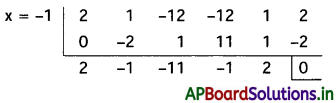
(ii) 2x5 + x4 – 12x3 – 12x2 + x + 2 = 0 [A.P. Mar ’16, Mar. ’08, ’07]
సాధన:
f(x) = 2x5 + x4 – 12x3 – 12x2 + x + 2 = 0
ఒకటవ కోవకు చెందిన బేసి తరగతి వ్యుత్కమ సమీకరణం
∴ -1 మూలం
AP Inter 2nd Year Maths 2A Solutions Chapter 4 సమీకరణ వాదం Ex 4(c) III Q7(ii)
f(x) ను (x + 1) చే భాగించగా
2x4 – x3 – 11x2 – x + 2 = 0
x2 చే భాగించగా
2x2 – x – 11 – \(\frac{1}{x}+\frac{2}{x^2}\) = 0
\(2\left(x^2+\frac{1}{x^2}\right)-\left(x+\frac{1}{x}\right)-11=0\) ………(1)
a = x + \(\frac{1}{x}\) అయిన x2 + \(\frac{1}{x^2}\) = a2 – 2
(1) లో వ్రాయగా
2(a2 – 2) – a – 11 = 0
⇒ 2a2 – 4 – a – 11 = 0
⇒ 2a2 – a – 15 = 0
⇒ (a – 3) (2a + 5) = 0
⇒ a = 3 లేదా \(\frac{-5}{2}\)
సందర్భము (i): a = 3 అయిన
x + \(\frac{1}{x}\) = 3
⇒ x2 + 1 = 3x
⇒ x2 – 3x + 1 = 0
⇒ x = \(\frac{3 \pm \sqrt{9-4}}{2}=\frac{3 \pm \sqrt{5}}{2}\)
సందర్భము (ii): a = \(\frac{-5}{2}\) అయిన
\(x+\frac{1}{x}=-\frac{5}{2}\)
⇒ \(\frac{x^2+1}{x}=-\frac{5}{2}\)
⇒ 2x2 + 2 = -5x
⇒ 2x2 + 5x + 2 = 0
⇒ (2x + 1) (x + 2) = 0
⇒ x = \(\frac{-1}{2}\), -2
∴ దత్త సమీకరణానికి మూలాలు -1, \(\frac{-1}{2}\), -2, \(\frac{3 \pm \sqrt{5}}{2}\)

AP Board 7th Class Maths Solutions Chapter 1 Integers Ex 1.1

SCERT AP 7th Class Maths Solutions Pdf Chapter 1 Integers Ex 1.1 Textbook Exercise Questions and Answers.

AP State Syllabus 7th Class Maths Solutions 1st Lesson Integers Exercise 1.1

Question 1.
Multiply the following.
(i) 5 × 7
Answer:
5 × 7 = 35

AP Board 7th Class Maths Solutions Chapter 1 Integers Ex 1.1

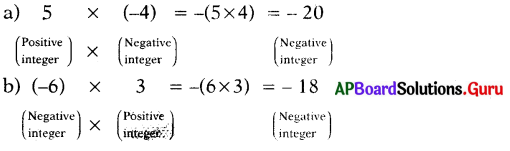
(ii) (-9) × (6) .
Answer:
(-9) × (6)
= -(9 × 6) = – 54

(iii) (9) × (-4)
Answer:
9 × – 4
= – (9 × 4) = – 36

(iv) (8) × (-7)
Answer:
8 × (-7) = – (8 × 7) = – 56

(v) (-124) × (-1)
Answer:
(-124) × (-1) = +(124 × 1) = + 124

(vi) (-12) × (-7)
Answer:
(-12) × (-7) = + (12 × 7) = + 84

(vii) (-63) × (7)
Answer:
(-63) × (7) = -(63 × 7) = – 441

(viii) (7) × (-15)
Answer:
7 × (-15) = – (7 × 15) = – 105

AP Board 7th Class Maths Solutions Chapter 1 Integers Ex 1.1

Question 2.
Which is greater?
(i) 2 × (-5) or 3 × (-4)
Answer:
2 × (-5) or 3 × (-4)
– (2 × 5) or – (3 × 4)
– 10 or – 12
– 10 greater than – 12
∴(-10) > (-12)

(ii) (-6) × (-7) or (-8) × 5
Answer:
(-6) × (-7) or (-8) × 5
6 × 7 or -(8 × 5)
42 or – 40
42 greater than – 40
∴ 42 > (-40)

(iii) (- 6) × 10 or (- 3) × (- 21)
Answer:
(-6) × 10 or (- 3) × (-21)
– (6 × 10) or 3 × 21
– 60 or 63
(- 60) less than 63
(or)
63 greater than (-60)
∴ 63 > (- 60)

(iv) 9 × (-11) or 6 × (-16)
Answer:
9 × (-11) or 6 × (-16)
-(9 × 11) or – (6 × 16)
(-99) or (- 96)
(- 99) less than (- 96)
(- 99) < (- 96)
(or)
(- 96) greater than (- 99)
∴ (-96) > (-99)

AP Board 7th Class Maths Solutions Chapter 1 Integers Ex 1.1

(v) (-8) × (-5) or (-9) × (-4)
Answer:
(-8) × (-5) or (-9) × (-4) + (8 × 5) or + (9 × 4)
40 or 36
40 greater than 36
∴ 40 > 36

Question 3.
Write the pair of integers whose product will give
(i) A negative integer
Answer:
AP Board 7th Class Maths Solutions Chapter 1 Integers Ex 1.1 1

(ii) A positive integer
Answer:
AP Board 7th Class Maths Solutions Chapter 1 Integers Ex 1.1 2

(iii) Zero
Answer:
AP Board 7th Class Maths Solutions Chapter 1 Integers Ex 1.1 3

AP Board 7th Class Maths Solutions Chapter 1 Integers Ex 1.1

Question 4.
A frog is slipping into a well from upper surface at a rate of 3 meters per minute, after 5 minutes what is the position of the frog in the well?
AP Board 7th Class Maths Solutions Chapter 1 Integers Ex 1.1 4
Answer:
No. of meters slipped by frog per minute = 3m = – 3 m
No. of meters slipped by frog per 5 minutes = (-3) × 5
= – (3 × 5)
= – 15 m
That is the frog is 15 m down from the upper surface.

Question 5.
During the summer, the level of water in a pond decreases by 5 inches every week due to evaporation. What is the change in the level of the water over a period of 6 weeks ?
AP Board 7th Class Maths Solutions Chapter 1 Integers Ex 1.1 5
Answer:
Decrease in water level per every week = 5 inches = (- 5)
Decrease in water level per 6 weeks = (-5) × 6 .
= – (5 × 6)
= – 30 inches
Change in the level of the water in the pond per 6 weeks is 30 inches decreased.

AP Board 7th Class Maths Solutions Chapter 1 Integers Ex 1.1

Question 6.
A shop keeper earns a profit of ₹ 5 on one note book and loss of ₹ 3 on one pen by selling in the month of July. He sells 1500 books and 1500 pens. Find out what is his profit or loss.
Answer:
Profit on each notebook = ₹5
Profit on 1500 notebooks = 1500 × 5
Total profit on 1500 note books = ₹ 75 007/-
Loss on each pen = ₹3
Which we denoted by – 3.
Loss on 1500 pens = 1500 × -3
= – ₹ 4500
profit > loss
So, he will get profit.
Total profit = 7500 – 4500
= ₹ 3000/-

Question 7.
A cement company earns a profit of ₹ 8 per bag of white cement and a loss of per bag of grey cement by selling.
The company sells 2,000 bags of white cement and 3,000 bags of grey cement in a month. Find out what is its profit or loss.
Answer:
Profit on each white cement bag = ₹ 8
Profit on each white cement bag
= 2000 × 8
= ₹ 16000
Loss on each grey cement bag = ₹ 6
Which we denoted by – 6.
Loss on 3000 grey cement bags = 3000 × – 6
= – ₹ 18000
Loss is more than profit.
So, he will get loss.
∴ Total loss = 16000 + (-18000)
= + 16000 – 18000
= – 2000/-

AP Board 7th Class Maths Solutions Chapter 1 Integers Ex 1.1

Question 8.
Fill in the blanks with suitable integer to make the statement true.
(i) (-4) × _________ = – 20
Answer:
(- 4) × 5 = – 20
(- 4) × 5 = – 20
– (4 × 5) = – 20
– 20 = – 20

(ii) __________ × 5 = – 35
Answer:
-7 × 5 = – 35
(-7) × 5 = – 35
– (7 × 5) = – 35
– 35 = – 35

(iii) (-6) × __________ = 48
Answer:
(-6) × (-8) = 48
(-6) × (-8) = 48
6 × 8 = 48
48 = 48

(iv) __________ × (- 9) = 45
Answer:
(-5) × (-9) = 45
(-5) × (-9) = 45
5 × 9 = 45
45 = 45

(v) ___________ × 7 = – 42
Answer:
– (6) × 7) = – 42
– (6) × 7) = – 42
– (6 × 7) = – 42
– 42 = – 42

AP Board 7th Class Maths Solutions Chapter 1 Integers Ex 1.1

(vi) 8 × = – 8
Answer:
8 × (-1) = – 8
(8) × (-1) = – 8 – (8 × 1) = – 8
– 8 = – 8

AP SSC 10th Class Maths Solutions Chapter 5 Quadratic Equations Ex 5.2

AP State Board Syllabus AP SSC 10th Class Maths Textbook Solutions Chapter 5 Quadratic Equations Ex 5.2 Textbook Questions and Answers.

AP State Syllabus SSC 10th Class Maths Solutions 5th Lesson Quadratic Equations Exercise 5.2

10th Class Maths 5th Lesson Quadratic Equations Ex 5.2 Textbook Questions and Answers

Question 1.
Find the roots of the following quadratic equations by factorisation,
i) x2 – 3x – 10 = 0
Answer:
Given: x2 – 3x – 10 = 0
x2 – 5x + 2x- 10 = 0
⇒ x(x – 5) + 2 (x – 5) = 0
⇒ (x – 5) (x + 2) = 0
⇒ x – 5 = 0 or x + 2 = 0
⇒ x = 5 or x = -2
⇒ x = 5 or -2
are the roots of the given Q.E.

ii) 2x2 + x – 6 = 0
Answer:
Given: 2x2 + x – 6 = 0
⇒ 2x2 + 4x – 3x – 6 = 0
⇒ 2x(x + 2) – 3(x + 2) = 0
⇒ (x + 2) (2x – 3) = 0
⇒ (x + 2) or 2x – 3 = 0
⇒ x = -2 or 2x = 3
⇒ x = -2 or \(\frac{3}{2}\)
are the roots of the given Q.E.

AP SSC 10th Class Maths Solutions Chapter 5 Quadratic Equations Ex 5.2

iii) √2x2 + 7x + 5√2 =0
Answer:
Given: √2x2 + 7x + 5√2 =0
⇒ √2x2 + 5x + 2x + 5√2 = 0
⇒ x(√2x + 5)+ √2(√2x + 5) = 0
⇒ (√2x + 5) (x + √2) = 0
⇒ √2x + 5 = 0 or x + √2 = 0
⇒ √2x = -5 or x = -√2
⇒ x = \(\frac{-5}{\sqrt{2}}\) = or -√2
are the roots of √2 the given Q.E.

iv) 2x2 – x + \(\frac{1}{8}\) = 0
Answer:
Given: 2x2 – x + \(\frac{1}{8}\) = 0
⇒ \(\frac{16 x^{2}-8 x+1}{8}\) = 0
⇒ 16x2 – 8x + 1 =0
⇒ 16x2 – 4x – 4x + 1 = 0
⇒ 4x(4x – 1) – l(4x – 1) = 0
⇒ (4x – 1) (4x – 1) – 0
⇒ 4x – 1 = 0
⇒ 4x = l
⇒ x = \(\frac{1}{4}\), \(\frac{1}{4}\)
are the roots of given Q.E.

v) 100x2 – 20x + 1 = 0
Answer:
Given : 100x2 – 20x + 1 =0
⇒ 100x2 – 10x – 10x + 1 = 0
⇒ 10x(10x – 1) – l(10x – 1) = 0
⇒ (10x – 1) (10x – l) = 0
⇒ 10x – 1 = 0
⇒ 10x = 1
⇒ x = \(\frac{1}{10}\), \(\frac{1}{10}\)
are the roots of the given Q.E.

vi) x(x + 4) = 12
Answer:
Given: x(x + 4) = 12
⇒ x2 + 4x = 12
⇒ x2 + 4x – 12 = 0
⇒ x2 + 6x – 2x – 12 = 0
⇒ x(x + 6) – 2(x + 6) = 0
⇒ (x + 6) (x – 2) = 0
⇒ x + 6 = 0 or x – 2 = 0
⇒ x = -6 or x = 2
⇒ x = -6 or 2
are the roots of the given Q.E.

AP SSC 10th Class Maths Solutions Chapter 5 Quadratic Equations Ex 5.2

vii) 3x2 – 5x + 2 = 0
Answer:
Given: 3x2 – 5x + 2 = 0
⇒ 3x2 – 3x – 2x + 2 = 0
⇒ 3x(x – 1) – 2(x – 1) = 0
⇒ (x – 1) (3x – 2) = 0
⇒ x – 1 = 0 or 3x – 2 = 0
⇒ x = 1 or \(\frac{2}{3}\),
⇒ x = 1 or \(\frac{2}{3}\) are the roots of the given Q.E.

viii) x – \(\frac{3}{x}\) = 2
Answer:
Given: x – \(\frac{3}{x}\) = 2
⇒ \(\frac{x^{2}-3}{x}\) = 2
⇒ x2 – 3 = 2x
⇒ x2 – 2x – 3 = 0
⇒ x2 – 3x + x – 3 = 0
⇒ x(x – 3) + l(x – 3) = 0
⇒ (x – 3) (x + 1) = 0
⇒ (x – 3) = 0 or (x + 1) = 0
⇒ x = 3 or x = -1
⇒ x = 3 or -1 are the roots of the given Q.E.

ix) 3(x – 4)2 – 5(x – 4) = 12
Answer:
Take (x – 4) = a, then the given Q.E. reduces to 3a2 – 5a = 12
⇒ 3a2 – 5a – 12 = 0
⇒ 3a2 – 9a + 4a – 12 = 0
⇒ 3a(a – 3) + 4(a – 3) = 0
⇒ (a – 3) (3a + 4) = 0
⇒ a – 3 = 0 or 3a + 4 = 0
⇒ a = 3 or a = \(\frac{-4}{3}\)
but a = x – 4
x – 4 = 3 (or) x – 4 = \(\frac{-4}{3}\)
⇒ x = 7 or x = 4 – \(\frac{-4}{3}\) = \(\frac{8}{3}\)
∴ x = 7 or \(\frac{8}{3}\)
are the roots of the given Q.E.

Question 2.
Find two numbers whose sum is 27 and product is 182.
Answer:
Let a number be x.
Then the other number = 27 – x
Product of the numbers = x(27 – x) = 27x – x2
By problem 27x – x2 = 182
⇒ x2 – 27x + 182 = 0
⇒ x2 – 14x – 13x + 182 = 0
⇒ x(x- 14) – 13(x – 14) = 0
⇒ (x – 13) (x – 14) = 0
⇒ x – 13 = 0 or x – 14 = 0
⇒ x = 13 or 14.
∴ The numbers are 13; 27 – 13 = 14 or 14 and 27 – 14 = 13.

AP SSC 10th Class Maths Solutions Chapter 5 Quadratic Equations Ex 5.2

Question 3.
Find two consecutive positive integers, sum of whose squares is 613.
Answer:
Let a positive integer be x.
Then the second integer = x + 1
Sum of the squares of the above integers = x2 + (x + 1)2
= x2 + x2 + 2x + 1
= 2x2 + 2x + 1
By problem 2x2 + 2x + 1 = 613
⇒ 2x2 + 2x – 612 = 0
⇒ x2 + x – 306 = 0
⇒ x2 + 18x – 17x – 306 = 0
⇒ x(x + 18) – 17(x + 18) = 0
⇒ (x – 17) (x + 18) = 0
⇒ x – 17 = 0 (or) x + 18 = 0
⇒ x = 17 (or) -18,
we do not consider -18
Then the numbers are (17, 17 + 1)
i.e., 17, 18 are the required two consecutive positive integers.

Question 4.
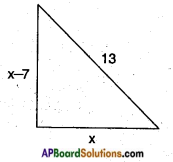
The altitude of a right triangle is 7 cm less than its base. If the hypotenuse is 13 cm, find the other two sides.
Answer:
Let the base of the right triangle = x cm
Then its altitude = x – 7 cm
By Pythagoras Theorem
AP SSC 10th Class Maths Solutions Chapter 5 Quadratic Equations Ex 5.2 1
(base)2 + (height)2 = (hypotenuse)2
⇒ x2 + (x – 7)2 = 132
⇒ x2 + x2 – 14x + 49 = 169 .
⇒ 2x2 – 14x + 49 – 169 = 0
⇒ 2x2 – 14x – 120 = 0
⇒ x2 – 7x – 60 = 0
⇒ x2 – 12x + 5x – 60 = 0
⇒ x(x – 12) + 5(x – 12) = 0
⇒ (x – 12) (x + 5) = 0
⇒ x – 12 = 0 (or) x + 5 = 0
⇒ x = 12 (or) x = -5 But x can’t be negative.
∴ x = 12
x – 7 = 12 – 7 = 5
The two sides are 12 cm and 5 cm.

AP SSC 10th Class Maths Solutions Chapter 5 Quadratic Equations Ex 5.2

Question 5.
A cottage industry produces a certain number of pottery articles in a day. It was observed on a particular day that the cost of production of each article (in rupees) was 3 more than twice the number of articles produced on that day. If the total cost of production on that day was Rs. 90, find the number of articles produced and the cost of each article.
Answer:
Let the number of articles produced be x.
Then the cost of each article = 2x + 3
Total cost of the articles produced = x [2x + 3] = 2x2 + 3x
By problem 2x2 + 3x = 90
⇒ 2x2 + 3x – 90 = 0
⇒ 2x2 + 15x – 12x – 90 = 0
⇒ x (2x + 15) – 6 (2x + 15) = 0
⇒ (2x + 15) (x – 6) = 0
⇒ 2x + 15 = 0 (or) x – 6 = 0
⇒ x = \(\frac{-15}{2}\) or x = 6
But x can’t be negative.
∴ x = 6
2x + 3 = 2 × 6 + 3 = 15
∴ Number of articles produced = 6 Cost of each article = Rs. 15.

Question 6.
Find the dimensions of a rectangle whose perimeter is 28 meters and whose area is 40 square meters.
Answer:
Let the length of the rectangle = x
Given perimeter = 2(1 + b) = 28
⇒ (1 + b) = \(\frac{28}{2}\) = 14
Breadth of the rectangle = 14 – x
Area = length . breadth = x (14 – x)
= 14x – x2
By problem, 14x – x2 = 40.
⇒ x2 – 14x + 40 = 0
⇒ x2 – 10x – 4x + 40 = 0
⇒ x(x – 10) – 4(x – 10) = 0
⇒ (x – 10) (x – 4) = 0
⇒ x – 10 = 0 (or) x – 4 = 0
⇒ x = 10 (or) 4
∴ Length = 10 m or 4 m
Then breadth = 14 – 10 = 4 m (or) 14 – 4 = 10 m

AP SSC 10th Class Maths Solutions Chapter 5 Quadratic Equations Ex 5.2

Question 7.
The base of a triangle is 4 cm longer than its altitude. If the area of the triangle is 48 sq.cm, then find its base and altitude.
Answer:
Let the altitude of the triangle h = x cm
Then its base ‘b’ = x + 4.
Area = \(\frac{1}{2}\) × base × height
= \(\frac{1}{2}\)(x + 4)(x)
= \(\frac{x^{2}+4 x}{2}\)
By problem \(\frac{x^{2}+4 x}{2}\) = 48
⇒ x2 + 4x = 2 × 48
⇒ x2 + 4x – 96 = 0
⇒ x2 + 12x – 8x – 96 = 0
⇒ x(x + 12) – 8(x + 12) = 0
⇒ (x + 12)(x – 8) = 0
⇒ x + 12 = 0 (or) x – 8 = 0
⇒ x = -12 (or) x = 8
But x can’t be negative.
∴ x = 8 and x + 4 = 8 + 4 = 12
Hence altitude = 8 cm and base = 12 cm.

Question 8.
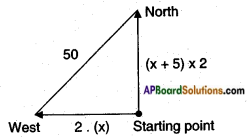
Two trains leave a railway station at the same time. The first train travels towards west and the second train towards north. The first train travels 5 km/hr faster than the second train. If after two hours they are 50 km. apart, find the average speed of each train.
Answer:
Let the speed of the slower train = x kmph
Then speed of the faster train = x + 5 kmph.
AP SSC 10th Class Maths Solutions Chapter 5 Quadratic Equations Ex 5.2 2
Distance = Speed × Time
Distance travelled by the first train = 2(x + 5) = 2x + 10
Distance travelled by the second train = 2.x = 2x
By Pythagoras Theorem
(hypotenuse)2 = (side)2 + (side)2
⇒ (2x)2 + (2x + 10)22 = 502
⇒ 4x2 + (4x2 + 40x + 100) = 2500
⇒ 4x2 + 4x2 + 40x + 100 = 2500
⇒ 8x2 + 40x – 2400 = 0
⇒ x2 + 5x – 300 = 0
⇒ x2 + 20x – 15x – 300 = 0
⇒ x (x + 20) – 15 (x + 20) = 0
⇒ (x + 20) (x – 15) = 0
∴ x – 15 = 0 (or) x + 20 = 0
⇒ x = 15 (or) – 20
But x can’t be negative.
∴ Speed of the slower train x = 15 kmph.
Speed of the faster train x + 5 = 15 + 5 = 20 kmph.

AP SSC 10th Class Maths Solutions Chapter 5 Quadratic Equations Ex 5.2

Question 9.
In a class of 60 students, each boy contributed rupees equal to the number of girls and each girl contributed rupees equal to the number of boys. If the total money then collected was Rs. 1600, how many boys are there in the class?
Answer:
Let the number of boys in the class = x
Then number of girls in the class = 60 – x [∵ total students = 60]
Money contributed by the boys = x(60 – x) = 60x – x2 [∵ given]
Money contributed by the girls = (60 – x)x = 60x – x2
∴ Money contributed by the class = 120x – 2x2
By problem 120x -2x2 = 1600
⇒ 2x2– 120x + 1600 = 0
⇒ x2 – 60x + 800 = 0
⇒ x2 – 40x – 20x + 800 = 0
⇒ x(x – 40) – 20 (x – 40) = 0
⇒ (x – 40) (x – 20) = 0
⇒ x = 40 (or) 20
∴ Boys = 40 or 20 Girls = 20 or 40.

Question 10.
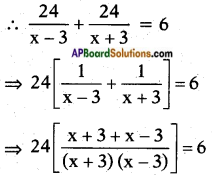
A motor boat heads upstream a distance of 24 km on a river whose current is running at 3 km per hour. The trip up and back takes 6 hours. Assuming that the motor boat maintained a constant speed, what was its speed ?
Answer:
Let the speed of the boat in still water be x kmph.
Speed of the current = 3 kmph
Then speed of the boat in upstream = (x – 3) kmph
Speed of the boat in downstream = (x + 3) kmph
By problem total time taken = 6h.
AP SSC 10th Class Maths Solutions Chapter 5 Quadratic Equations Ex 5.2 3
⇒ 24(2x) = 6(x2 – 9)
⇒ 8x = x2 – 9
⇒ x2 – 8x – 9 = 0
⇒ x2 – 9x + x-9 = 0
⇒ x (x – 9) + 1 (x – 9) = 6
⇒ (x – 9) (x + 1) = 0
⇒ x – 9 = 0 or x + 1 = 0
x can’t be negative,
∴ x = 9
i.e., speed of the boat in still water = 9 kmph.

AP Inter 2nd Year Maths 2A Solutions Chapter 4 సమీకరణ వాదం Ex 4(c)

Practicing the Intermediate 2nd Year Maths 2A Textbook Solutions Chapter 4 సమీకరణ వాదం Exercise 4(c) will help students to clear their doubts quickly.

AP Inter 2nd Year Maths 2A Solutions Chapter 4 సమీకరణ వాదం Exercise 4(c)

అభ్యాసం – 4(సి)

I.

ప్రశ్న 1.
క్రింది మూలాలు గల బహుపది సమీకరణాలను రూపొందించండి.
(i) 2 + 3i, 2 – 3i, 1 + i, 1 – i
సాధన:
కావలసిన సమీకరణం [x – (2 + 3i)] [x – (2 – 3i)] [x – (1 + i)] [x – (1 – i)] = 0
⇒ [(x – 2) – 3i)] [(x – 2) + 3i] [(x – 1) – i] [(x – 1) + i] = 0
⇒ [(x – 2)2 – 9i2] [(x – 1)2 – i2] = 0
⇒ (x2 – 4x + 4 + 9) (x2 – 2x + 1 + 1) = 0
⇒ (x2 – 4x + 13) (x2 – 2x + 2) = 0
⇒ x4 – 4x3 + 13x2 – 2x3 + 8x2 – 26x + 2x2 – 8x + 26 = 0
⇒ x4 – 6x3 + 23x2 – 34x + 26 = 0

(ii) 3, 2, 1 + i, 1 – i
సాధన:
కావలసిన సమీకరణం (x – 3) (x – 2) [x – (1 + i)] [x – (1 – i)] = 0
⇒ (x2 – 5x + 6) [(x – 1) – i] [(x – 1) + i) = 0
⇒ (x2 – 5x + 6) [(x – 1)2 – i2] = 0
⇒ (x2 – 5x + 6) (x2 – 2x + 1 + 1) = 0
⇒ (x2 – 5x + 6) (x2 – 2x + 2) = 0
⇒ x4 – 5x3 + 6x2 – 2x3 + 10x2 – 12x + 2x2 – 10x + 12 = 0
⇒ x4 – 7x3 + 18x2 – 22x + 12 = 0

(iii) 1 + i, 1 – i, -1 + i, -1 – i
సాధన:
కావలసిన సమీకరణం [x – (1 + i)] [x – (1 – i)] [x – (-1 + i)] [x – (-1 – i)] = 0
⇒ [(x – 1) – i] [(x – 1) + i] [(x + 1) – i] [(x + 1) + i) = 0
⇒ [(x – 1)2 – i2] [(x + 1)2 – i2] = 0
⇒ (x2 – 2x + 1 + 1) (x2 + 2x + 1 + 1) = 0
⇒ (x2 – 2x + 2) (x2 + 2x + 2) = 0
⇒ x4 – 2x3 + 2x2 + 2x3 – 4x2 + 4x + 2x2 – 4x + 4 = 0
⇒ x4 + 4 = 0

(iv) 1 + i, 1 – i, 1 + i, 1 – i
సాధన:
కావలసిన సమీకరణం [x – (1 + i)] [x – (1 – i)]
⇒ [x – (1 + i)] [x – (1 – i)] = 0
⇒ [(x – 1) – i]2 [(x – 1) + i]2 = 0
⇒ [(x – 1)2 – i2] = 0
⇒ (x2 – 2x + 1 + 1)2 = 0
⇒ x4 + 4x2 + 4 – 4x3 + 4x2 – 8x = 0
⇒ x4 – 4x3 + 8x2 – 8x + 4 = 0

AP Inter 2nd Year Maths 2A Solutions Chapter 4 సమీకరణ వాదం Ex 4(c)

ప్రశ్న 2.
కింది మూలాలు గల అకరణీయ గుణకాలు గల బహుపది సమీకరణాన్ని రూపొందించండి.
(i) 4√3, 5 + 2i
సాధన:
బహుపది సమీకరణ గుణకాలు అకరణీయ సంఖ్యలైన, దాని మూలాలు సంయుగ్మ కరణులు మరియు సంయుగ్మసంకీర్ణ సంఖ్యలు.
α = 4√3 అయిన β = -4√3 మరియు γ = 5 + 2i అయిన δ = 5 – 2i
α, β, γ, δ లు మూలాలు
α + β = 0, αβ = -48
γ + δ = 10, γδ = 25 + 4 = 29
కావలసిన సమీకరణం [x2 – (α + β)x + αβ] [x2 – (γ + δ)x + γδ] = 0
⇒ (x2 – 48) (x2 – 10x + 29) = 0
⇒ x4 – 10x3 + 29x2 – 48x2 + 480x – 1932 = 0
⇒ x4 – 10x3 – 19x2 + 480x – 1932 = 0

(ii) 1 + 5i, 5 – i
సాధన:
బహుపది సమీకరణ గుణకాలు అకరణీయ సంఖ్యలైన, దాని మూలాలు సంయుగ్మ కరణులు మరియు సంయుగ్మసంకీర్ణ సంఖ్యలు.
α = 1 + 5i అయిన β = 1 – 5i
మరియు γ = 5 + i అయిన δ = 5 – i లు మూలాలు.
α + β = 2, αβ = 26
γ + δ = 10, γδ = 26
కావలసిన సమీకరణం [x2 – (α + β)x + αβ] [x2 – (γ + δ)x + γδ] = 0
⇒ (x2 – 2x + 26) (x2 – 10x + 26) = 0
⇒ x4 – 12x3 + 72x2 – 312x + 676 = 0

(iii) i – √5
సాధన:
బహుపది సమీకరణ గుణకాలు అకరణీయ సంఖ్యలైన, దాని మూలాలు సంయుగ్మ కరణులు మరియు సంయుగ్మసంకీర్ణ సంఖ్యలు.
α = i – √5, β = i + √5, γ = -i – √5, δ = -i + √5 లు మూలాలు
α + β = 2i, αβ = -6
γ + δ = -2i, γδ = -6
కావలసిన సమీకరణం [x2 – (α + β)x + αβ] [x2 – (γ + δ)x + γδ] = 0
⇒ (x2 – 2ix – 6) (x2 + 2ix – 6) = 0
⇒ [(x2 – 6) – 2ix] [(x2 – 6) + 2ix] = 0
⇒ (x2 – 6)2 + 4x2 = 0
⇒ x4 + 36 – 12x2 + 4×2 = 0
⇒ x4 – 8x2 + 36 = 0

(iv) -√3 + i√2
సాధన:
α = -√3 + i√2, β = -√3 – i√2, γ = √3 – i√2, δ = √3 + i√2 లు మూలాలు
α + β = -2√3
αβ = (-√3)2 – (i√2)2
= 3 – i2 (2)
= 5
γ + δ = 2√3, γδ = 5
కావలసిన సమీకరణము [x2 – (α + β)x + αβ] [x2 – (γ + δ)x + γδ] = 0
⇒ (x2 + 2√3x + 5) (x2 – 2√3x + 5) = 0
⇒ (x2 + 5)2 – (2√3x)2 = 0
⇒ x4 + 25 + 10x2 – 12x2 = 0
⇒ x4 – 2x2 + 25 = 0

AP Inter 2nd Year Maths 2A Solutions Chapter 4 సమీకరణ వాదం Ex 4(c)

II.

ప్రశ్న 1.
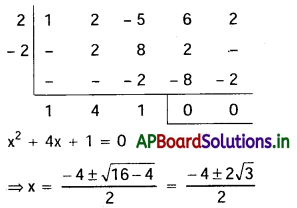
x4 + 2x3 – 5x2 + 6x + 2 = సమీకరణపు ఒక మూలం 1 + i అయిన, సమీకరణాన్ని సాధించండి.
సాధన:
1 + i ఒక మూలం ⇒ 1 – i ఇంకొక మూలం అవుతుంది.
1 ± i మూలాలుగా గల సమీకరణం
x2 – 2x + 2 = 0
∴ x2 – 2x + 2 ఒక కారణాంకము
x4 + 2x3 – 5x2 + 6x + 2 = 0
AP Inter 2nd Year Maths 2A Solutions Chapter 4 సమీకరణ వాదం Ex 4(c) II Q1
x = -2 ± √3
∴ మూలాలు 1 ± i, -2 ± √3

ప్రశ్న 2.
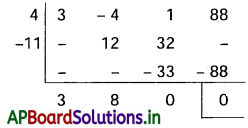
3x3 – 4x2 + x + 88 = 0 సమీకరణపు ఒక మూలం 2 – √-7 అయిన, సమీకరణాన్ని సాధించండి.
సాధన:
2 – √-7 ⇒ 2 – √7i ఒక మూలం
⇒2 + √7i ఇంకొక మూలం
2 ± √7i మూలాలుగా గల సమీకరణం x2 – 4x + 11 = 0
∴ x2 – 4x + 11 దత్త సమీకరణానికి ఒక కారణాంకము
AP Inter 2nd Year Maths 2A Solutions Chapter 4 సమీకరణ వాదం Ex 4(c) II Q2
3x + 8 = 0
⇒ x = \(\frac{-8}{3}\)
∴ దత్త సమీకరణానికి మూలాలు 2 ± √7i, \(\frac{-8}{3}\)

AP Inter 2nd Year Maths 2A Solutions Chapter 4 సమీకరణ వాదం Ex 4(c)

ప్రశ్న 3.
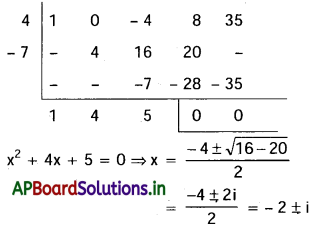
x4 – 4x2 + 8x + 35 = 0 సమీకరణపు ఒక మూలం 2 + i√3 అయితే, సమీకరణాన్ని సాధించండి.
సాధన:
2 + i√3 ఒక మూలం ⇒ 2 – i√3 ఇంకొక మూలం
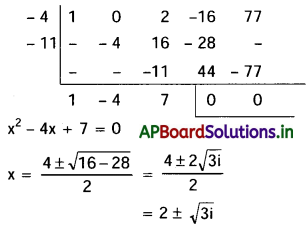
2 ± i√3 మూలాలుగాగల సమీకరణం x2 – 4x + 7 = 0
∴ x2 – 4x + 7 దత్త సమీకరణానికి ఒక మూలం
x4 – 4x2 + 8x + 35
AP Inter 2nd Year Maths 2A Solutions Chapter 4 సమీకరణ వాదం Ex 4(c) II Q3
∴ దత్త సమీకరణానికి మూలాలు 2 ± i√3, -2 ± i

ప్రశ్న 4.
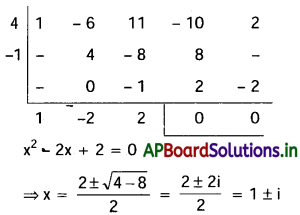
x4 – 6x3 + 11x2 – 10x + 2 = 0 సమీకరణపు ఒక మూలం 2 + √3 అయితే, సమీకరణాన్ని సాధించండి.
సాధన:
2 + √3 ఒక మూలం ⇒ 2 – √3 ఇంకొక మూలం.
2 ± √3 మూలాలుగాగల సమీకరణం x2 – 4x + 1 = 0
∴ x2 – 4x + 1 ఒక కారణాంకము
x4 – 6x3 + 11x2 – 10x + 2 = 0
AP Inter 2nd Year Maths 2A Solutions Chapter 4 సమీకరణ వాదం Ex 4(c) II Q4
∴ దత్త సమీకరణానికి 2 ± √3, 1 ± i

ప్రశ్న 5.
x4 + 2x2 – 16x + 77 = 0 సమీకరణపు ఒక మూలం -2 + √-7 అయితే, సమీకరణాన్ని పూర్తిగా సాధించండి.
సాధన:
-2 – √-7 (i.e.) -2 + i√7 ఒక మూలం.
⇒ -2 – i√7 ఇంకొక మూలం -2 + i√7
-2 ± i√7 మూలాలుగా గల సమీకరణం x2 + 4x + 11 = 0
∴ x2 + 4x + 11 ఒక కారణాంకము
x4 + 2x2 – 16x + 77 = 0
AP Inter 2nd Year Maths 2A Solutions Chapter 4 సమీకరణ వాదం Ex 4(c) II Q5
∴ దత్త సమీకరణానికి మూలాలు -2 ± i√7, 2 ± √3i

AP Inter 2nd Year Maths 2A Solutions Chapter 4 సమీకరణ వాదం Ex 4(c)

ప్రశ్న 6.
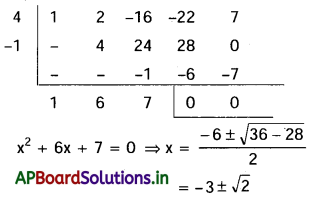
x4 + 2x3 – 16x2 – 22x + 7 = 0 సమీకరణపు ఒక మూలం 2 – √3 అయితే, సమీకరణాన్ని సాధించండి.
సాధన:
2 – √3 ఒక మూలం ⇒ 2 + √3 ఇంకొక మూలం
2 ± √3 లు మూలాలుగా గల వర్గ సమీకరణం
x2 – (2 + √3 + 2 – √3)x + (2 + √3) (2 – √3) = 0
⇒ x2 – 4x + 1 = 0
AP Inter 2nd Year Maths 2A Solutions Chapter 4 సమీకరణ వాదం Ex 4(c) II Q6
∴ దత్త సమీకరణానికి మూలాలు 2 ± √3, -3 ± √2

ప్రశ్న 7.
3x5 – 4x4 – 42x3 + 56x2 + 27x – 36 = 0 సమీకరణానికి ఒక మూలం √2 + √5 అయితే, సమీక రణాన్ని సాధించండి.
సాధన:
√2 + √5 ఒక మూలం
⇒ √2 – √5, -√2 + √5, -√2 – √5 లు కూడా దత్తసమీకరణానికి మూలాలు.
√2 ± √5 మూలాలుగా గల వర్గ సమీకరణం
x2 – (√2 + √5 + √2 – √5)x + (√2 + √5) (√2 – √5) = 0
⇒ x2 – 2√2x – 3 = 0
-√2 ± √5 లు మూలాలుగా గల వర్గ సమీకరణం
x2 – (-√2 + √5 – √2 – √5)x + (-√2 + √5)(-√2 – √5) = 0
⇒ x2 + 2√2x – 3 = 0
±√2±√5 లు మూలాలుగా గల సమీకరణం
(x2 + 2√2x – 3) (x2 – 2√2x – 3) = 0
⇒ (x2 – 3)2 – (2√2x)2 = 0
⇒ x4 – 6x2 + 9 – 8×2 = 0
⇒ x4 – 14x2 + 9 = 0
3x5 – 4x4 – 42x3 + 56x2 + 27x – 36 = 0
⇒ 3x(x4 – 14x2 + 9) – 4(x4 – 14x2 + 9) = 0
⇒ (x4 – 14x2 + 9) (3x – 4) = 0
⇒ x = ±√2 ± √5 లేదా \(\frac{4}{3}\)
∴ దత్త సమీకరణానికి మూలాలు ±√2 ± √5, \(\frac{4}{3}\)

ప్రశ్న 8.
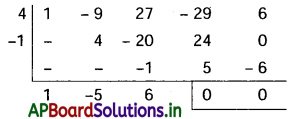
x4 – 9x3 + 27x2 – 29x + 6 = 0 సమీకరణపు ఒక మూలం 2 – √3 అయితే, సమీకరణాన్ని సాధించండి.
సాధన:
2 – √3 ఒక మూలం ⇒ 2 + √3 ఇంకొక మూలం.
2 ± √3 లు మూలాలుగా గల సమీకరణం
x2 – 4x + 1 = 0
∴ x2 – 4x + 1 ఒక కారణాంకము
AP Inter 2nd Year Maths 2A Solutions Chapter 4 సమీకరణ వాదం Ex 4(c) II Q8
x2 – 5x + 6 = 0
⇒ (x – 2) (x – 3) = 0
⇒ x = 2, 3
∴ దత్త సమీకరణానికి మూలాలు 2 ± √3, 2, 3

AP Inter 2nd Year Maths 2A Solutions Chapter 4 సమీకరణ వాదం Ex 4(c)

ప్రశ్న 9.
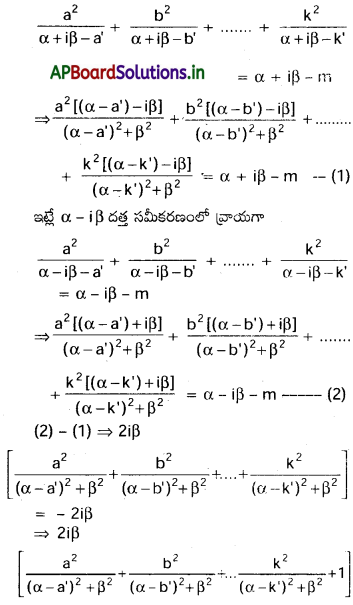
a, b, c…. k, m, a’, b’, c’….k’ లు అన్నీ వాస్తవ సంఖ్యలైనపుడు \(\frac{a^2}{x-a^{\prime}}+\frac{b^2}{x-b^{\prime}}+\frac{c^2}{x-c^{\prime}}\) +…..+ \(\frac{k^2}{x-k^{\prime}}\) = m సమీకరణం వాస్తవేతర మూలాన్ని కలిగి ఉండదని చూపండి.
సాధన:
దత్త సమీకరణానికి α + iβ ఒక మూలం అనుకోండి.
β ≠ 0 అనుకుందాం.
అపుడు α – iβ కూడా దత్త సమీకరణానికి మూలం అవుతుంది.
దత్త సమీకరణంలో α + iβ వ్రాయగా
AP Inter 2nd Year Maths 2A Solutions Chapter 4 సమీకరణ వాదం Ex 4(c) II Q9
= 0
⇒ β = 0
ఇది అనుకొన్నదానికి విరుద్ధం.
∴ దత్త సమీకరణానికి వాస్తవేతర మూలాలు ఉండవు.

AP SSC 10th Class Maths Solutions Chapter 6 Progressions Ex 6.3

AP State Board Syllabus AP SSC 10th Class Maths Textbook Solutions Chapter 6 Progressions Ex 6.3 Textbook Questions and Answers.

AP State Syllabus SSC 10th Class Maths Solutions 6th Lesson Progressions Exercise 6.3

10th Class Maths 6th Lesson Progressions Ex 6.3 Textbook Questions and Answers

Question 1.
Find the sum of the following APs:
i) 2, 7, 12,…, to 10 terms.
Answer:
Given A.P: 2, 7, 12, …… to 10 terms
a = 2; d = a2 – a1 = 7 – 2 = 5; n = 10
Sn = \(\frac{n}{2}\)[2a + (n – 1)d]
∴ S10 = \(\frac{10}{2}\)[2 × 2 + (10 – 1)5]
= 5 [4 + 9 × 5]
= 5 [4 + 45]
= 5 × 49
= 245

ii) -37, -33, -29,…, to 12 terms.
Answer:
Given A.P: -37, -33, -29,…, to 12 terms.
a = -37; d = a2 – a1 = (-33) – (-37) = -33 + 37 = 4; n = 12
Sn = \(\frac{n}{2}\)[2a + (n – 1)d]
∴ S12 = \(\frac{12}{2}\)[2 × (-37) + (12 – 1)4]
= 6 [-74 + 11 × 4]
= 6 [-74 + 44]
= 6 × (-30)
= -180

AP SSC 10th Class Maths Solutions Chapter 6 Progressions Ex 6.3

iii) 0.6, 1.7, 2.8,…, to 100 terms.
Answer:
Given A.P : 0.6, 1.7, 2.8,…. S100
a = 0.6; d = a2 – a1 = 1.7 – 0.6 = 1.1; n = 100
Sn = \(\frac{n}{2}\)[2a + (n – 1)d]
∴ S100 = \(\frac{100}{2}\)[2 × 0.6 + (100 – 1)1.1]
= 50 [1.2 + 99 × 1.1]
= 50 [1.2 + 108.9]
= 50 × 110.1
= 5505

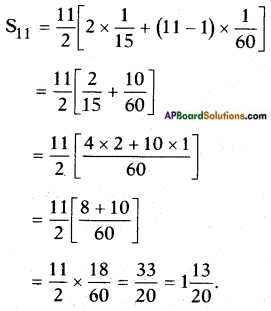
iv) \(\frac{1}{15}\), \(\frac{1}{12}\), \(\frac{1}{10}\),…, to 11 terms.
Answer:
Given A.P: \(\frac{1}{15}\), \(\frac{1}{12}\), \(\frac{1}{10}\),…, S11
a = \(\frac{1}{15}\); d = a2 – a1 = \(\frac{1}{12}\) – \(\frac{1}{15}\) = \(\frac{5-4}{60}\) = \(\frac{1}{60}\); n = 11
Sn = \(\frac{n}{2}\)[2a + (n – 1)d]
AP SSC 10th Class Maths Solutions Chapter 6 Progressions Ex 6.3 1

2. Find the sums given below =:
i) 7 + 10\(\frac{1}{2}\) + 14 + …. + 84
Answer:
Given A.P : 7 + 10\(\frac{1}{2}\) + 14 + …. + 84
a = 7; d = a2 – a1 = 10\(\frac{1}{2}\) – 7 = 3\(\frac{1}{2}\) and the last term l = an = 84
But, an = a + (n – 1) d
∴ 84 = 7 + (n – 1) 3\(\frac{1}{2}\)
⇒ 84 – 7 = (n – 1) × \(\frac{7}{2}\)
⇒ n – 1 = 77 × \(\frac{2}{7}\) = 22
⇒ n = 22 + 1 = 23
Now, Sn = \(\frac{n}{2}\)(a + l) where a = 7; l = 84
S23 = \(\frac{23}{2}\)(7 + 84)
= \(\frac{23}{2}\) × 91
= \(\frac{2093}{2}\)
= 1046\(\frac{1}{2}\)

ii) 34 + 32 + 30 + … + 10
Answer:
Given A.P: 34 + 32 + 30 + … + 10
a = 34; d = a2 – a1 = 32 – 34 = -2 and the last term l = an = 10
But, an = a + (n – 1) d
∴ 10 = 34 + (n – 1) (-2)
⇒ 10 – 34 = -2n + 2
⇒ -2n = -24 – 2
⇒ n = \(\frac{-26}{-2}\) = 13
∴ n = 13
Also, Sn = \(\frac{n}{2}\)(a + l)
where a = 34; l = 10
S13 = \(\frac{13}{2}\)(34 + 10)
= \(\frac{13}{2}\) × 44
= 13 × 22
= 286

AP SSC 10th Class Maths Solutions Chapter 6 Progressions Ex 6.3

iii) -5 + (-8) + (-11) + … + (-230)
Answer:
Given A.P: -5 + (-8) + (-11) + … + (-230)
Here first term, a = -5;
d = a2 – a1 = (-8) – (-5) = -8 + 5 = -3 and the last term l = an = 10
But, an = a + (n – 1) d
∴ (-230) = -5 + (n – 1) (-3)
⇒ -230 + 5 = -3n + 3
⇒ -3n + 3 = -225
⇒ -3n = -225 – 3
⇒ 3n = 228
⇒ n = \(\frac{228}{3}\) = 76
∴ n = 76
Now, Sn = \(\frac{n}{2}\)(a + l)
where a = -5; l = -230
S76 = \(\frac{76}{2}\)((-5) + (-230))
= 38 × (-235)
= -8930

Question 3.
In an AP:
i) Given a = 5, d = 3, an = 50. find n and Sn.
Answer:
Given :
a = 5; d = 3;
an = a + (n – 1)d = 50
⇒ 50 = 5 + (n – 1) 3
⇒ 50 – 5 = 3n – 3
⇒ 3n = 45 + 3
⇒ n = \(\frac{48}{3}\) = 16
Now, Sn = \(\frac{n}{2}\)(a + l)
S16 = \(\frac{16}{2}\)(5 + 50)
= 38 × 55
= 440

ii) Given a = 7, a13 = 35, find d and S13.
Answer:
Given: a = 7;
a13 = a + 12d = 35
⇒ 7 + 12d = 35
⇒ 12d = 35 – 7
⇒ n = \(\frac{28}{12}\) = \(\frac{7}{3}\)
Now, Sn = \(\frac{n}{2}\)(a + l)
S13 = \(\frac{13}{2}\)(7 + 35)
= \(\frac{13}{2}\) × 42
= 13 × 21
= 273

AP SSC 10th Class Maths Solutions Chapter 6 Progressions Ex 6.3

iii) Given a12 = 37, d = 3 find a and S12.
Answer:
Given:
a12 = a + 11d = 37
d = 3
So, a12 = a + 11 × 3 = 37
⇒ a + 33 = 37
⇒ a = 37 – 33 = 4
Now, Sn = \(\frac{n}{2}\)(a + l)
S12 = \(\frac{12}{2}\)(4 + 37)
= 6 × 41
= 246

iv) Given a3 = 15, S10 = 125, find d and a10.
Answer:
Given:
a3 = a + 2d = 15
⇒ a = 15 – 2d ……… (1)
S10 = 125 but take S10 as 175
i.e., S10 = 175
We know that,
AP SSC 10th Class Maths Solutions Chapter 6 Progressions Ex 6.3 2
⇒ 35 = 2 (15 – 2d) + 9d [∵ a = 15 – 2d]
⇒ 35 = 30 – 4d + 9d
⇒ 35 – 30 = 5d
⇒ d = \(\frac{5}{5}\) = 1
Substituting d = 1 in equation (1) we get
a = 15 – 2 × 1 = 15 – 2 = 13
Now, an = a + (n – 1) d
a10 = a + 9d = 13 + 9 × 1 = 13 + 9 = 22
∴ a10 = 22; d = 1

v) Given a = 2, d = 8, Sn = 90, find n and an.
Answer:
Given a = 2, d = 8, Sn = 90
Sn = \(\frac{n}{2}\)[2a + (n – 1)d]
AP SSC 10th Class Maths Solutions Chapter 6 Progressions Ex 6.3 3
⇒ 90 = 2n [2n – 1]
⇒ 4n2 – 2n = 90
⇒ 4n2 – 2n – 90 = 0
⇒ 2(2n2 – n – 45) = 0
⇒ 2n2 – n – 45 = 0
⇒ 2n2 -10n + 9n – 45 = 0
⇒ 2n(n – 5) + 9(n – 5) = 0
⇒ (n – 5)(2n + 9) = 0
⇒ n – 5 = 0 (or) 2n + 9 = 0
⇒ n = 5 (or) n = \(\frac{-9}{2}\) (discarded)
∴ n = 5
Now an = a5 = a + 4d = 2 + 4 x 8
= 2 + 32 = 34

AP SSC 10th Class Maths Solutions Chapter 6 Progressions Ex 6.3

vi) Given an = 4, d = 2, Sn = -14, find n and a.
Answer:
Given an = a + (n – 1) d = 4 ……. (1)
d = 2; Sn = – 14
From (1); a + (n – 1) 2 = 4
a = 4 – 2n + 2
a = 6 – 2n
Given a = 2, d = 8, Sn = 90
Sn = \(\frac{n}{2}\)[a + an]
-14 = \(\frac{n}{2}\)[(6-2n) + 4] [∵ a = 6 – 2n]
-14 × 2 = n (10 – 2n)
⇒ 10n – 2n2 = – 28
⇒ 2n2 – 10n – 28 = 0
⇒ n2 – 5n – 14 = 0
⇒ n2 – 7n + 2n – 14 = 0
⇒ n (n – 7) + 2 (n – 7) = 0
⇒ (n – 7) (n + 2) = 0
⇒ n = 7 (or) n = – 2
∴ n = 7
Now a = 6 – 2n = 6 – 2 × 7
= 6 – 14 = -8
∴ a = – 8; n = 7

vii) Given l = 28, S = 144, and there are total 9 terms. Find a.
Answer:
Given:
l = a9 = a + 8d = 28 and S9 = 144 But,
Now, Sn = \(\frac{n}{2}\)(a + l)
144 = \(\frac{9}{2}\)(a + 28)
⇒ 144 × \(\frac{2}{9}\) = a + 28
⇒ a + 28 = 32
⇒ a = 4

Question 4.
The first and the last terms of an A.P are 17 and 350 respectively. If the common difference is 9, how many terms are there and what is their sum?
Answer:
Given A.P in which a = 17
Last term = l = 350
Common difference, d = 9
We know that, an = a + (n – 1) d
350 = 17 + (n- 1) 9
⇒ 350 = 17 + 9n – 9
⇒ 9n = 350 – 8
⇒ n = \(\frac{342}{9}\) = 38
Now, Sn = \(\frac{n}{2}\)(a + l)
S38 = \(\frac{38}{2}\)(17 + 350)
= 19 × 367 = 6973
∴ n = 38; Sn = 6973

AP SSC 10th Class Maths Solutions Chapter 6 Progressions Ex 6.3

Question 5.
Find the sum of first 51 terms of an AP whose second and third terms are 14 and 18 respectively.
Answer:
Given A.P in which
AP SSC 10th Class Maths Solutions Chapter 6 Progressions Ex 6.3 4
Substituting d = 4 in equation (1),
we get a + 4 = 14
⇒ a = 14 – 4 = 10
AP SSC 10th Class Maths Solutions Chapter 6 Progressions Ex 6.3 5

Question 6.
If the sum of first 7 terms of an AP is 49 and that of 17 terms is 289, find the sum of first n terms.
Answer:
Given :
A.P such that S7 = 49; S17 = 289
We know that,
AP SSC 10th Class Maths Solutions Chapter 6 Progressions Ex 6.3 6
Substituting d = 2 in equation (1), we get,
a + 3 × 2 = 7
⇒ a = 7 – 6 = 1
∴ a = 1; d = 2
AP SSC 10th Class Maths Solutions Chapter 6 Progressions Ex 6.3 7
∴ Sum of first n terms Sn = n2.
Shortcut: S7 = 49 = 72
S17 = 289 = 172
∴ Sn = n2

AP SSC 10th Class Maths Solutions Chapter 6 Progressions Ex 6.3

Question 7.
Show that a1, a2 …,an, …. form an AP where an is defined as below:
i) a = 3 + 4n
ii) an = 9 – 5n. Also find the sum of the first 15 terms in each case.
Answer:
Given an = 3 + 4n
Then a1 = 3 + 4 × l = 3 + 4 = 7
a2 = 3 + 4 × 2 = 3 + 8 = 11
a3 = 3 + 4 × 3 = 3 + 12 = 15
a4 = 3 + 4 × 4 = 3 + 16 = 19
Now the pattern is 7, 11, 15, ……
where a = a1 = 7; a2 = 11; a3 = 15, ….. and
a2 – a1 = 11 – 7 = 4;
a3 – a2 = 15 – 11 = 4;
Here d = 4
Hence a1, a2, ….., an ….. forms an A.P.
AP SSC 10th Class Maths Solutions Chapter 6 Progressions Ex 6.3 8
ii) an = 9 – 5n
Given: an = 9 – 5n.
a1 = 9 – 5 × l = 9 – 5 = 4
a2 = 9 – 5 × 2 = 9 – 10 = -1
a3 = 9 – 5 × 3 = 9 – 15 = -6
a4 = 9 – 5 × 4 = 9 – 20 = -11
Also
a2 – a1 = -1 – 4 = -5;
a3 – a2 = -6 – (-1) = – 6 + 1 = -5
a4 – a3 = -11 – (-6) = -11 + 6 = -5
∴ d = a2 – a1 = a3 – a2 = a4 – a3 = …. = -5
Thus the difference between any two successive terms is constant (or) starting from the second term, each term is obtained by adding a fixed number ‘-5’ to its preceding term.
Hence {an} forms an A.P.
AP SSC 10th Class Maths Solutions Chapter 6 Progressions Ex 6.3 9

Question 8.
If the sum of the first n terms of an AP is 4n – n2, what is the first term (remember the first term is S1)? What is the sum of first two terms? What is the second term? Similarly, find the 3rd, the 10th and the nth terms.
Answer:
Given an A.P in which Sn = 4n – n2
Taking n = 1 we get
S1 = 4 × 1- 12 = 4 – 1 = 3
n = 2; S2 = a1 + a2 = 4 × 2 – 22 = 8 – 4 = 4
n = 3; S3 = a1 + a2 + a3 = 4 × 3 -32 = 12 – 9 = 3
n = 4; S4 = a1 + a2 + a3 + a4 = 4 × 4 – 42 = 16 – 16 = 0
Hence, S1 = a1 = 3
a2 = S2 – S1 = 4 – 3 = 1
a3 = S3 – S2 = 3 – 4 = -1
a4 = S4 – S3 = 0 – 3 = -3
So, d = a2 – a1 = l – 3 = -2
Now, a10 = a + 9d  [∵ an = a + (n – 1) d]
= 3 + 9 × (- 2)
= 3 – 18 = -15
an = 3 + (n – 1) × (-2)
= 3 – 2n + 2
= 5 – 2n

AP SSC 10th Class Maths Solutions Chapter 6 Progressions Ex 6.3

Question 9.
Find the sum of the first 40 positive integers divisible by 6.
Answer:
The given numbers are the first 40 positive multiples of 6
⇒ 6 × 1, 6 × 2, 6 × 3, ….., 6 × 40
⇒ 6, 12, 18, ….. 240
Sn = \(\frac{n}{2}\)(a + l)
S40 = \(\frac{40}{2}\)(6 + 240)
= 20 × 246
= 4920
∴ S40 = 4920

Question 10.
A sum of Rs. 700 is to be used to give seven cash prizes to students of a school for their overall academic performance. If each prize is Rs. 20 less than its preceding prize, find the value of each of the prizes.
Answer:
Given:
Total/Sum of all cash prizes = Rs. 700
Each prize differs by Rs. 20
Let the prizes (in ascending order) be x, x + 20, x + 40, x + 60, x + 80, x + 100, x + 120
∴ Sum of the prizes = S7 = \(\frac{n}{2}\)(a + l)
⇒ 700 = \(\frac{7}{2}\)[x + x + 120]
⇒ 700 × \(\frac{2}{7}\) = 2x + 120
⇒ 100 = x + 60
⇒ x = 100 – 60 = 40
∴ The prizes are 160, 140, 120, 100, 80, 60, 40.

Question 11.
In a school, students thought of plant¬ing trees in and around the school to reduce air pollution. It was decided that the number of trees, that each section of each class will plant, will be the same as the class, in which they are studying, e.g., a section of Class I will plant 1 tree, a section of Class II will plant 2 trees and so on till Class XII. There are three sections of each class. How many trees will be planted by the students?
Answer:
Given: Classes: From I to XII
Section: 3 in each class.
∴ Trees planted by each class = 3 × class number
AP SSC 10th Class Maths Solutions Chapter 6 Progressions Ex 6.3 10
∴ Total trees planted = 3 + 6 + 9 + 12 + …… + 36 is an A.P.
Here, a = 3 and l = 36; n = 12
∴ Sn = \(\frac{n}{2}\)(a + l)
S12 = \(\frac{12}{2}\)[3 + 36]
= 6 × 39
= 234
∴ Total plants = 234

AP SSC 10th Class Maths Solutions Chapter 6 Progressions Ex 6.3

Question 12.
A spiral is made up of successive semicircles, with centres alternately at A and B, starting with centre at A, of radii 0.5 cm, 1.0 cm, 1.5 cm, 2.0 cm, … as shown in figure. What is the total length of such a spiral made up of thirteen
consecutive semicircles? (Take π = \(\frac{22}{7}\))
AP SSC 10th Class Maths Solutions Chapter 6 Progressions Ex 6.3 11
[Hint: Length of successive semicircles is l1, l2, l3, l4,….. with centres at A, B, A, B,…, respectively.]
Answer:
Given: l1, l2, l3, l4,….., l13 are the semicircles with centres alternately at A and B; with radii
r1 = 0.5 cm [1 × 0.5]
r2 = 1.0 cm [2 × 0.5]
r3 = 1.5 cm [3 × 0.5]
r4 = 2.0 cm [4 × 0.5] [∵ Radii are in A.P. as aj = 0.5 and d = 0.5]
……………………………
r13 = 13 × 0.5 = 6.5
Now, the total length of the spiral = l1 + l2 + l3 + l4 + ….. + l13 [∵ 13 given]
But circumference of a semi-cirle is πr.
∴ Total length of the spiral = π × 0.5 + π × 1.0 + ………. + π × 6.5
= π × \(\frac{1}{2}\)[l + 2 + 3 + ….. + 13]
[∵ Sum of the first n – natural numbers is \(\frac{n(n+1)}{2}\)
= \(\frac{22}{7} \times \frac{1}{2} \times \frac{13 \times 14}{2}\)
= 11 × 13
= 143 cm.

Question 13.
200 logs are stacked in the following manner: 20 logs in the bottom row, 19 in the next row, 18 in the row next to it and so on. In how many rows are the 200 logs placed and how many logs are in the top row?
AP SSC 10th Class Maths Solutions Chapter 6 Progressions Ex 6.3 12
Answer:
Given: Total logs = 200
Number of logs stacked in the first row = 20
Number of logs stacked in the second row = 19
Number of logs stacked in the third row = 18
The number series is 20, 19, 18,….. is an A.P where a = 20 and
d = a2 – a1 = 19 – 20 = -1
Also, Sn = 200
AP SSC 10th Class Maths Solutions Chapter 6 Progressions Ex 6.3 13
400 = 41n – n2
⇒ n2 – 41n + 400 = 0
⇒ n2 – 25n – 16n + 400 = 0
⇒ n(n – 25) – 16(n – 25) = 0
⇒ (n – 25) (n – 16) = 0
⇒ n – 25 (or) 16
There can’t be 25 rows as we are starting with 20 logs in the first row.
∴ Number of rows must be 16.
∴ n = 16

AP SSC 10th Class Maths Solutions Chapter 6 Progressions Ex 6.3

Question 14.
In a bucket and ball race, a bucket is placed at the starting point, which is 5 m from the first ball, and the other balls are placed 3 m apart in a straight line. There are ten balls in the line.
AP SSC 10th Class Maths Solutions Chapter 6 Progressions Ex 6.3 14
A competitor starts from the bucket, picks up the nearest ball, runs back with it, drops it in the bucket, runs back to pick up the next ball, runs to the bucket to drop it in, and she continues in the same way until all the balls are in the bucket. What is the total distance the competitor has to run?
[Hint: To pick up the first ball and the second ball, the total distance (in metres) run by a competitor is 2 × 5 + 2 × (5 + 3)]
Answer:
Given: Balls are placed at an equal distance of 3 m from one another.
Distance of first ball from the bucket = 5 m
Distance of second ball from the bucket = 5 + 3 = 8 m (5 + 1 × 3)
Distance of third ball from the bucket = 8 + 3 = 11 m (5 + 2 × 3)
Distance of fourth ball from the bucket = 11 + 3 = 14 m (5 + 3 × 3)
………………………………
∴ Distance of the tenth ball from the bucket = 5 + 9 × 3 = 5 + 27 = 32 m.
1st ball: Distance covered by the competitor in picking up and dropping it in the bucket = 2 × 5 = 10 m.
2nd ball: Distance covered by the competitor in picking up and dropping it in the bucket = 2 × 8 = 16 m.
3rd ball: Distance covered by the competitor in picking up and dropping it in the bucket = 2 × 11 = 22 m.
………………………………
10th ball: Distance covered by the competitor in picking up and dropping it in the bucket = 2 × 32 = 64 m.
Total distance = 10 m + 16 m + 22 m + …… + 64 m.
Clearly, this is an A.P in which a = 10; d = a2 – a1 = 16 – 10 = 6 and n = 10.
∴ Sn = \(\frac{n}{2}\)[2a + (n – 1)d]
∴ S10 = \(\frac{10}{2}\)[2 × 10 + (10 – 1)6]
= 5 [20 + 54]
= 5 × 74
= 370 m
∴ Total distance = 370 m.

AP Inter 2nd Year Maths 2A Solutions Chapter 4 సమీకరణ వాదం Ex 4(b)

Practicing the Intermediate 2nd Year Maths 2A Textbook Solutions Chapter 4 సమీకరణ వాదం Exercise 4(b) will help students to clear their doubts quickly.

AP Inter 2nd Year Maths 2A Solutions Chapter 4 సమీకరణ వాదం Exercise 4(b)

అభ్యాసం – 4(బి)

I.

ప్రశ్న 1.
x3 – 3x2 – 16x + 48 = 0 సమీకరణం రెండు మూలాల మొత్తం సున్నా అయితే, సమీకరణాన్ని సాధించండి.
సాధన:
x3 – 3x2 – 16x + 48 = 0 కు మూలాలు α, β, γ లు
α + β + γ = 3
α + β = 0 (∵ రెండు మూలాల మొత్తం సున్న)
∴ γ = 3
i.e., x – 3 అనేది
x3 – 3x2 – 16x + 48 కు కారణాంకం
AP Inter 2nd Year Maths 2A Solutions Chapter 4 సమీకరణ వాదం Ex 4(b) I Q1
x2 – 16 = 0
⇒ x2 = 16
⇒ x = ±4
∴ మూలాలు -4, 4, 3

ప్రశ్న 2.
x3 – px2 + qx – r = 0 సమీకరణం యొక్క రెండు మూలాల మొత్తం సున్న కావటానికి నియమాన్ని కనుక్కోండి.
సాధన:
మూలాలు α, β, γ లు అనుకుందాం
అప్పుడు α + β + γ = p …….(1)
αβ + βγ + γα = q ……(2)
αβγ = r …….(3)
రెండు మూలాల మొత్తం సున్న కనుక α + β = 0 అనుకోండి.
(1) నుండి γ = p
‘γ’ దత్త సమీకరణానికి మూలం కనుక
γ3 – pγ2 + qγ – r = 0
⇒ p3 – p(p2) + q(p) – r = 0
⇒ r = pq
∴ కావలసిన నియమం r = pq

AP Inter 2nd Year Maths 2A Solutions Chapter 4 సమీకరణ వాదం Ex 4(b)

ప్రశ్న 3.
x3 + 3px2 + 3qx + r = 0 సమీకరణపు మూలాలు
(i) అంకశ్రేఢిలో వుంటే 2p3 – 3pq + r = 0
(ii) గుణశ్రేఢిలో వుంటే p3r = q3
(iii) హరాత్మక శ్రేఢిలో వుంటే 2q3 = r(3pq – r) అని చూపండి.
సాధన:
దత్త సమీకరణం x3 + 3px2 + 3qx + r = 0
(i) మూలాలు అంకశ్రేఢిలో వున్నవి కనుక అవి
a – d, a, a + d అనుకుందాం. అప్పుడు
(a – d) + a + (a + d) = -3p
⇒ 3a = -3p
⇒ a = -p
‘a’ దత్త సమీకరణానికి మూలం, కనుక
a3 + 3pa2 + 3qa + r = 0
⇒ (-p)3 + 3p(-p)2 + 3q(-p) + r = 0
⇒ -p3 + 3p3 – 3pq + r = 0
⇒ 2p3 – 3pq + r = 0
∴ కావలసిన నియమం 2p3 – 3pq + r = 0

(ii) మూలాలు గుణశ్రేఢిలో వున్నవి కనుక అవి \(\frac{a}{R}\), a, aR అనుకుందాం.
అపుడు మూలాల లబ్ధం = (\(\frac{a}{R}\)) (a) (aR) = -r
⇒ a3 = -r
⇒ a = \((-r)^{1 / 3}\)
‘a’ దత్త సమీకరణానికి మూలం కనుక
a3 + 3pa2 + 3qa + r = 0
AP Inter 2nd Year Maths 2A Solutions Chapter 4 సమీకరణ వాదం Ex 4(b) I Q3(ii)
∴ కావలసిన నియమం p3r = q3

(iii) దత్త సమీకరణం x3 + 3px2 + 3qx + r = 0 …….(1)
x = \(\frac{1}{y}\) వ్రాయగా
\(\left(\frac{1}{y}\right)^3+3 p\left(\frac{1}{y}\right)^2+3 q\left(\frac{1}{y}\right)+r=0\)
⇒ 1 + 3py + 3qy2 + ry3 = 0
⇒ ry3 + 3qy2 + 3py + 1 = 0 ………(2)
(1) యొక్క మూలాలు హరాత్మక శ్రేఢిలో వుంటే, (2) యొక్క మూలాలు అంకశ్రేఢిలో వుంటాయి.
కనుక అవి a – d, a, a + d అనుకుందాం.
(a – d) + a + (a + d) = \(\frac{-3q}{r}\)
⇒ 3a = \(\frac{-3q}{r}\)
⇒ a = \(\frac{-q}{r}\)
‘a’ అనేది (2) కు ఒక మూలం కనుక
ra3 + 3qa2 + 3pa + 1 = 0
⇒ \(r\left(\frac{-q}{r}\right)^3+3 q\left(\frac{-q}{r}\right)^2+3 p\left(\frac{-q}{r}\right)+1=0\)
⇒ \(\frac{-q^3}{r^2}+\frac{3 q^3}{r^2}+\frac{3 p q}{r}+1=0\)
⇒ -q3 + 3q3 – 3pqr + r2 = 0
⇒ r2 – 3pqr + 2q3 = 0
⇒ 2q3 = r(3pq – r)
∴ కావలసిన నియమం 2q3 = r(3pq – r)

AP Inter 2nd Year Maths 2A Solutions Chapter 4 సమీకరణ వాదం Ex 4(b)

ప్రశ్న 4.
x3 – px2 + qx – r = 0 సమీకరణ మూలాలు గుణ శ్రేఢిలో ఉండటానికి నియమాన్ని రాబట్టుము.
సాధన:
మూలాలు గుణశ్రేఢిలో వున్నవి. కనుక అవి \(\frac{a}{R}\), a, aR అనుకోండి.
అపుడు మూలాల లబ్దం = (\(\frac{a}{R}\)) (a) (aR) = r
⇒ a3 = r
⇒ a = \(r^{1 / 3}\)
‘a’ దత్త సమీకరణానికి ఒక మూలం కనుక
a3 – pa2 + qa – r = 0
AP Inter 2nd Year Maths 2A Solutions Chapter 4 సమీకరణ వాదం Ex 4(b) I Q4
∴ కావలసిన నియమం p3r = q3

II.

ప్రశ్న 1.
9x3 – 15x2 + 7x – 1 = 0 సమీకరణపు రెండు మూలాలు సమానమైతే, సమీకరణాన్ని సాధించండి.
సాధన:
AP Inter 2nd Year Maths 2A Solutions Chapter 4 సమీకరణ వాదం Ex 4(b) II Q1
AP Inter 2nd Year Maths 2A Solutions Chapter 4 సమీకరణ వాదం Ex 4(b) II Q1.1

ప్రశ్న 2.
2x3 + 3x2 – 8x + 3 = 0 సమీకరణపు ఒక మూలం, మరోదానికి రెట్టింపు అయిన, ఆ సమీకరణాన్ని సాధించండి.
సాధన:
α, β, γ లు 2x3 + 3x2 – 8x + 3 = 0 మూలాలు అనుకుందాం.
AP Inter 2nd Year Maths 2A Solutions Chapter 4 సమీకరణ వాదం Ex 4(b) II Q2
AP Inter 2nd Year Maths 2A Solutions Chapter 4 సమీకరణ వాదం Ex 4(b) II Q2.1
AP Inter 2nd Year Maths 2A Solutions Chapter 4 సమీకరణ వాదం Ex 4(b) II Q2.2

ప్రశ్న 3.
x3 – 9x2 + 14x + 24 = 0 సమీకరణపు రెండు మూలాలు 3 : 2 నిష్పత్తిలో ఉంటే, ఆ సమీకరణాన్ని సాధించండి.
సాధన:
మూలాలు α, β, γ లు అనుకుందాం.
α + β + γ = 9 …….(1)
αβ + βγ + γα = 14 ……..(2)
αβγ = -24 ………(3)
α : β = 3 : 2 అనుకుందాం.
2α = 3β
⇒ β = \(\frac{2}{3}\)α
(1) నుండి α + \(\frac{2}{3}\)α + γ = 9
γ = 9 – \(\frac{5 \alpha}{3}\) …….(4)
(2) నుండి (α) (\(\frac{2}{3}\)α) + γ(α + β) = 14
⇒ \(\frac{2}{3} \alpha^2+\left(9-\frac{5 \alpha}{3}\right)\left(\alpha+\frac{2}{3} \alpha\right)=14\)
⇒ \(\frac{2}{3} \alpha^2+\left(9-\frac{5}{3} \alpha\right)\left(\frac{5}{3} \alpha\right)=14\)
⇒ 6α2 + (27 – 5α) (5α) = 126
⇒ 6α2 + 135α – 25α2 – 126 = 0
⇒ 19α2 – 135α + 126 = 0
⇒ 19α2 – 114α – 21α + 126 = 0
⇒ 19α(α – 6) – 21(α – 6) = 0
⇒ (α – 6) (19α – 21) = 0
⇒ α = 6 (లేదా) α = \(\frac{21}{19}\)
సందర్భము (i): α = 6
β = \(\frac{2}{3}\)α
= \(\frac{2}{3}\) × 6 = 4
γ = 9 – \(\frac{5 \alpha}{3}\)
γ = 9 – \(\frac{2}{3}\) × 6
= 9 – 10
= -1
α = 6, β = 4, γ = -1
αβγ = -24
AP Inter 2nd Year Maths 2A Solutions Chapter 4 సమీకరణ వాదం Ex 4(b) II Q3
కానీ αβγ ≠ -24
∴ మూలాలు = 6, 4, -1

AP Inter 2nd Year Maths 2A Solutions Chapter 4 సమీకరణ వాదం Ex 4(b)

ప్రశ్న 4.
మూలాలు అంకశ్రేఢిలో ఉన్న క్రింది సమీకరణాలను సాధించండి.
(i) 8x3 – 36x2 – 18x + 81 = 0
సాధన:
మూలాలు అంకశ్రేఢిలో వున్నవి కనుక అవి a – d, a, a + d అనుకొనుము.
AP Inter 2nd Year Maths 2A Solutions Chapter 4 సమీకరణ వాదం Ex 4(b) II Q4(i)

(ii) x3 – 3x2 – 6x + 8 = 0
సాధన:
మూలాలు అంకశ్రేఢిలో ఉన్నవి కనుక మూలాలు a – d, a, a + d అనుకుందాం.
(a – d) + a + (a + d) = -(-3)= 3
⇒ 3a = 3
⇒ a = 1
(a – d) (a) (a + d) = -8
⇒ a(a2 – d2) = -8
⇒ 1(1 – d2) = -8
⇒ d2 = 1 + 8 = 9
⇒ d = 3
మూలాలు a – d, a, a + d
= 1 – 3, 1, 1 + 3
= -2, 1, 4

ప్రశ్న 5.
మూలాలు గుణశ్రేఢిలో ఉన్న క్రింది సమీకరణాలను సాధించండి.
(i) 3x3 – 26x2 + 52x – 24 = 0
సాధన:
మూలాలు గుణశ్రేఢిలో ఉన్నవి కనుక అవి \(\frac{a}{r}\), a, ar అనుకుందాం.
AP Inter 2nd Year Maths 2A Solutions Chapter 4 సమీకరణ వాదం Ex 4(b) II Q5(i)
AP Inter 2nd Year Maths 2A Solutions Chapter 4 సమీకరణ వాదం Ex 4(b) II Q5(i).1

(ii) 54x3 – 39x2 – 26x + 16 = 0
సాధన:
మూలాలు గుణశ్రేఢిలో వున్నవి కనుక అవి \(\frac{a}{r}\), a, ar అనుకుందాం.
AP Inter 2nd Year Maths 2A Solutions Chapter 4 సమీకరణ వాదం Ex 4(b) II Q5(ii)
AP Inter 2nd Year Maths 2A Solutions Chapter 4 సమీకరణ వాదం Ex 4(b) II Q5(ii).1

ప్రశ్న 6.
మూలాలు హరాత్మకశ్రేఢిలో ఉన్న క్రింది సమీకరణాలను సాధించండి.
(i) 6x3 – 11x2 + 6x – 1 = 0
సాధన:
దత్త సమీకరణం 6x3 – 11x2 + 6x – 1 = 0 ………(1)
y = \(\frac{1}{x}\) వ్రాయగా
\(6\left(\frac{1}{y}\right)^3-11\left(\frac{1}{y}\right)^2+6\left(\frac{1}{y}\right)-1=0\)
⇒ 6 – 11y + 6y2 – y3 = 0
⇒ y3 – 6y2 + 11y – 6 = 0 ……(2)
(1) యొక్క మూలాలు హరాత్మక శ్రేఢిలో వుంటే, (2) యొక్క మూలాలు అంకశ్రేఢిలో వుంటాయి.
(2) యొక్క మూలాలు a – d, a, a + d అనుకుంటే,
(a – d) + a + (a + d) = \(-\frac{(-6)}{1}\) = 6
⇒ 3a = 6
⇒ a = 2
మరియు (a – d) (a) (a + d) = \(-\frac{(-6)}{1}\) = 6
⇒ a(a2 – d2) = 6
⇒ 2(22 – d2) = 6
⇒ 4 – d2 = 3
⇒ d2 = 1
⇒ d = 1
(2) మూలాలు a – d, a, a + d
= 2 – 1, 2, 2 + 1
= 1, 2, 3
∴ దత్త సమీకరణానికి మూలాలు = 1, \(\frac{1}{2}\), \(\frac{1}{3}\)

(ii) 15x3 – 23x2 + 9x – 1 = 0
సాధన:
దత్త సమీకరణం 15x3 – 23x2 + 9x – 1 = 0 …….(1)
x = \(\frac{1}{y}\) వ్రాయగా
\(15\left(\frac{1}{y}\right)^3-23\left(\frac{1}{y}\right)^2+9\left(\frac{1}{y}\right)-1=0\)
⇒ 15 – 23y + 9y2 – y3 = 0
⇒ y3 – 9y2 + 23y – 15 = 0 ………(2)
(1) యొక్క మూలాలు హరాత్మక శ్రేఢిలో (H.P.) వుంటే, (2) యొక్క మూలాలు అంకశ్రేఢీలో ఉంటాయి.
కనుక ఆ మూలాలు a – d, a, a + d అనుకుందాం.
అప్పుడు (a – d) + (a) + (a + d) = -(-9) = 9
⇒ 3a = 9
⇒ a = 3
మరియు (a – d) (a) (a + d) = -(-15)
⇒ a(a2 – d2) = 15
⇒ 3(32 – d2) = 15
⇒ 9 – d2 = 5
⇒ d2 = 4
⇒ d = 2
∴ (2) యొక్క మూలాలు a – d, a, a + d
= 3 – 2, 3, 3 + 2
= 1, 3, 5
∴ దత్త సమీకరణానికి = 1, \(\frac{1}{3}\), \(\frac{1}{5}\)

AP Inter 2nd Year Maths 2A Solutions Chapter 4 సమీకరణ వాదం Ex 4(b)

ప్రశ్న 7.
పునరావృత మూలాలున్న క్రింది సమీకరణాలను సాధించండి.
(i) x4 – 6x3 + 13x2 – 24x + 36 = 0
సాధన:
f(x) = x4 – 6x3 + 13x2 – 24x + 36
f'(x) = 4x3 – 18x2 + 26x – 24
ఇప్పుడు f'(3) = 4(3)3 – 18(3)2 + 26(3) – 24
= 108 – 162 + 78 – 24
= 0
ఇట్లే f(3) = (3)4 – 6(3)3 + 13(3)2 – 24(3) + 36
= 81 – 162 + 117 – 72 + 36
= 0
కనుక x – 3; f(x), f'(x) లకు కారణాంకం
∴ f(x) = 0 కు 3 ఆవృత మూలం
AP Inter 2nd Year Maths 2A Solutions Chapter 4 సమీకరణ వాదం Ex 4(b) II Q7(i)
కనుక x2 + 4 = 0
⇒ x2 = -4
⇒ x = ±2i
∴ దత్త సమీకరణానికి 3, 3, 2i, -2i

(ii) 3x4 + 16x3 + 24x2 – 16 = 0
సాధన:
f(x) = 3x4 + 16x3 + 24x2 – 16
f'(x) = 12x3 + 48x2 + 48x
= 12x(x2 + 4x + 4)
= 12x(x + 2)2
f'(-2) = 0
f(-2) = 3(-2)4 + 16(-2)3 + 24(-2)2 – 16
= 48 – 128 + 96 – 16
= 0
కనుక f(x), f'(x) లకు (x + 2) కారణాంకం
∴ f(x) = 0 కు -2 ఆవృత మూలం
AP Inter 2nd Year Maths 2A Solutions Chapter 4 సమీకరణ వాదం Ex 4(b) II Q7(ii)
3x2 + 4x – 4 = 0
⇒ 3x2 + 6x – 2x – 4 = 0
⇒ 3x(x + 2) – 2(x + 2) = 0
⇒ (x + 2) (3x – 2) = 0
⇒ x = -2, x = \(\frac{2}{3}\)
∴ దత్త సమీకరణానికి -2, -2, -2, \(\frac{2}{3}\)

III.

ప్రశ్న 1.
x4+ x3 – 16x2 – 4x + 48 = 0 సమీకరణపు రెండు మూలాల లబ్ధం 6 అయితే ఆ సమీకరణాన్ని సాధించండి.
సాధన:
మూలాలు α, β, γ, δ లు అనుకుందాం.
α + β + γ + δ = -1 …….(1)
αβ + αδ + αγ + βγ + βδ + γδ = -16 …….(2)
αβγ + αβδ + βγδ + αγδ = -(-4) = 4 ……….(3)
αβγδ = 48 …….(4)
∵ రెండు మూలాల లబ్దం = 6 కనుక
αβ = 6 అనుకుందాం.
(4) నుండి 6γδ = 48 ⇒ γδ = 8
(3) నుండి 6γ + 6δ + 8β + 8α = 4
⇒ 6(γ + δ) + 8(α + β) = 4
6(γ + δ) + 6(α + β) = -6 – (1) × 6
2(α + β) = 10
α + β = 5
(1) నుండి γ + δ = -1 – 5 = -6
α + β = 5, αβ = 6
(α – β)2 = (α + β)2 – 4αβ
= (5)2 – 4(6)
= 1
α – β = 1
α + β = 5
2α = 6
⇒ α = 3, β = 2
ఇదే విధంగా γ + δ = -6, γδ = 8
(γ – δ)2 = (γ + δ)2 – 4γδ
= (-6)2 – 4(8)
= 36 – 32
= 4
γ – δ = 2
γ + δ = -6
2γ = -4
⇒ γ = -2, δ = -4
∴ దత్త సమీకరణానికి = 3, 2, -2, -4

AP Inter 2nd Year Maths 2A Solutions Chapter 4 సమీకరణ వాదం Ex 4(b)

ప్రశ్న 2.
8x4 – 2x3 – 27x2 + 6x + 9 = 0 సమీకరణ రెండు మూలాలు ఒకే పరమమూల్యాన్నీ, వ్యతిరేక గుర్తులను కలిగి వుంటే, సమీకరణాన్ని సాధించండి.
సాధన:
AP Inter 2nd Year Maths 2A Solutions Chapter 4 సమీకరణ వాదం Ex 4(b) III Q2
AP Inter 2nd Year Maths 2A Solutions Chapter 4 సమీకరణ వాదం Ex 4(b) III Q2.1

ప్రశ్న 3.
18x3 + 81x2 + 121x + 60 = 0 సమీకరణపు ఒక మూలం తక్కిన రెండు మూలాల మొత్తంలో సగమైతే, సమీకరణాన్ని సాధించండి. [May ’11, Mar. ’05]
సాధన:
AP Inter 2nd Year Maths 2A Solutions Chapter 4 సమీకరణ వాదం Ex 4(b) III Q3
AP Inter 2nd Year Maths 2A Solutions Chapter 4 సమీకరణ వాదం Ex 4(b) III Q3.1

ప్రశ్న 4.
ax4 + 4bx3 + 6cx2 + 4dx + c = 0 సమీకరణపు మూలాల్లో రెండు జతలు సమానంగా ఉండటానికి నియమాలను రాబట్టండి.
సాధన:
దత్త సమీకరణం ax4 + 4bx3 + 6cx2 + 4dx + e = 0
⇒ \(x^4+4 \frac{b}{a} x^3+6 \frac{c}{a} x^2+4 \frac{d}{a} x+\frac{e}{a}=0\)
మూలాలు α, α, β, β లు అనుకుందాం
అపుడు మూలాల మొత్తం 2(α + β) = -4\(\frac{b}{a}\)
⇒ α + β = -2\(\frac{b}{a}\)
αβ = k అనుకుంటే α, β లు మూలాలుగా గల వర్గ సమీకరణం
x2 – (α + β)x + αβ = 0
AP Inter 2nd Year Maths 2A Solutions Chapter 4 సమీకరణ వాదం Ex 4(b) III Q4
⇒ ad2 = eb2 ఇది మరొక నియమము
∴ కావలసిన నియమాలు 3abc = 2b3 + a2d, ad2 = eb2

AP Inter 2nd Year Maths 2A Solutions Chapter 4 సమీకరణ వాదం Ex 4(b)

ప్రశ్న 5.
(i) x5 – 5x3 + 5x2 – 1 = 0 సమీకరణానికి 3 సమాన మూలాలు ఉంటాయని చూపండి. ఆ మూలాన్ని కనుక్కోండి.
సాధన:
f(x) = x5 – 5x3 + 5x2 – 1
f'(x) = 5x4 – 15x2 + 10x = 5x(x3 – 3x + 2)
f'(1) = 5(1) (1 – 3 + 2) = 0
f(1) = 1 – 5 + 5 – 1 = 0
కనుక f(x), f'(x) లకు (x – 1) కారణాంకం
⇒ f(x) = 0 కు 1 ఆవృత మూలం
AP Inter 2nd Year Maths 2A Solutions Chapter 4 సమీకరణ వాదం Ex 4(b) III Q5(i)
∴ x3 + 2x2 – 2x – 1 = 0
x = 1 పై సమీకరణాన్ని తృప్తిపరుస్తుంది.
కనుక f(x) = 0 కు 1 అనేది 3 సార్లు ఆవృత మూలము అవుతుంది.

(ii) x5 – 3x4 – 5x3 + 27x2 – 32x + 12 = 0 సమీకరణం యొక్క పునరావృత మూలాలను కనుక్కోండి
సాధన:
f(x) = x5 – 3x4 – 5x3 + 27x2 – 32x + 12 అనుకోండి.
f'(x) = 5x4 – 12x3 – 15x2 + 54x – 32
f'(2) = 5(2)4 – 12(2)3 – 15(2)2 + 54(2) – 32
= 80 – 96 – 60 + 108 – 32
= 188 – 188
= 0
f(2) = 25 – 3(24) – 5(23) + 27(22) – 32(2) + 12
= 32 – 48 – 40 + 108 – 64 + 12
= 152 – 152
= 0
కనుక f(x), f'(x) లకు x – 2 కారణాంకం
∴ f(x) = 0 కు 2 ఆవృత మూలం
AP Inter 2nd Year Maths 2A Solutions Chapter 4 సమీకరణ వాదం Ex 4(b) III Q5(ii)
g(x) = x3 + x2 – 5x + 3 అనుకుందాం
g'(x) = 3x2 + 2x – 5
g'(1) = 3(1)2 + 2 – 5 = 0
g(1) = 1 + 1 – 5 + 3 = 0
కనుక g(x), g'(x) లకు x – 1 కారణాంకం
∴ g(x) = 0 కు 1 ఆవృత మూలం
AP Inter 2nd Year Maths 2A Solutions Chapter 4 సమీకరణ వాదం Ex 4(b) III Q5(ii).1
x + 3 = 0 ⇒ x = -3
∴ మూలాలు = 1, 1, 2, 2, -3

AP Inter 2nd Year Maths 2A Solutions Chapter 4 సమీకరణ వాదం Ex 4(b)

ప్రశ్న 6.
8x3 – 20x2 + 6x + 9 = 0 సమీకరణం యొక్క పునరావృత మూలాలు కనుక్కోండి.
సాధన:
f(x) = 8x3 – 20x2 + 6x + 9 అనుకోండి
f'(x) = 24x2 – 40x + 6
= 2(12x2 – 20x + 3)
= 2[12x2 – 18x – 2x + 3]
= 2[6x(2x – 3) – 1(2x – 3)]
= 2(2x – 3) (6x – 1)
f'(x) = 0
⇒ x = \(\frac{3}{2}\), x = \(\frac{1}{6}\)
\(f\left(\frac{3}{2}\right)=8\left(\frac{3}{2}\right)^3-20\left(\frac{3}{2}\right)^2+6\left(\frac{3}{2}\right)+9\)
= 27 – 45 + 9 + 9
= 0
కనుక x – \(\frac{3}{2}\), f(x), f'(x) లకు కారణాంకం
∴ f(x) = 0 కు \(\frac{3}{2}\) పునరావృత మూలం
AP Inter 2nd Year Maths 2A Solutions Chapter 4 సమీకరణ వాదం Ex 4(b) III Q6
8x + 4 = 0 ⇒ x = \(-\frac{4}{8}=-\frac{1}{2}\)
∴ f(x) = 0 యొక్క మూలాలు \(\frac{3}{2}, \frac{3}{2},-\frac{1}{2}\)

AP Inter 2nd Year Maths 2A Solutions Chapter 4 సమీకరణ వాదం Ex 4(a)

Practicing the Intermediate 2nd Year Maths 2A Textbook Solutions Chapter 4 సమీకరణ వాదం Exercise 4(a) will help students to clear their doubts quickly.

AP Inter 2nd Year Maths 2A Solutions Chapter 4 సమీకరణ వాదం Exercise 4(a)

అభ్యాసం – 4(ఎ)

I.

ప్రశ్న 1.
క్రింద ఇచ్చిన మూలాలు గల కనిష్ఠ తరగతి బహుపది సమీకరణాలను రూపొందించండి.
(i) 1, -1, 3
సాధన:
కావలసిన బహుపది సమీకరణం
(x – 1) (x + 1) (x – 3) = 0
⇒ (x2 – 1) (x – 3) = 0
⇒ x3 – 3x2 – x + 3 = 0

(ii) 1 ± 2i, 4, 2
సాధన:
కావలసిన బహుపది సమీకరణం
[x – (1 + 2i)] [x – (1 – 2i)] (x – 4) (x – 2) = 0
⇒ (x – 1 – 2i) (x – 1 + 2i) (x – 4) (x – 2) = 0
⇒ [(x – 1)2 – 4i2] (x2 – 6x + 8) = 0
⇒ (x2 – 2x + 1 + 4) (x2 – 6x + 8) = 0
⇒ (x2 – 2x + 5) (x2 – 6x + 8) = 0
⇒ x4 – 8x3 + 25x2 – 46x + 40 = 0

AP Inter 2nd Year Maths 2A Solutions Chapter 4 సమీకరణ వాదం Ex 4(a)

(iii) 2 ± √3, 1 ± 2i
సాధన:
కావలసిన బహుపది సమీకరణం
[x – (2 + √3)] [x – (2 – √3)] [x – (1 + 2i)] [x – (1 – 2i)] = 0
⇒ [(x – 2) – √3] [(x – 2) + √3] [(x – 1) – 2i] [(x – 1) + 2i] = 0
⇒ [(x – 2)2 – 3] [(x – 1)2 – (2i)2] = 0
⇒ (x2 – 4x + 4 – 3) (x2 – 2x + 1 – 4i2) = 0
⇒ (x2 – 4x + 1)(x2 – 2x + 5) = 0
⇒ x4 – 4x3 + x2 – 2x3+ 8x2 – 2x + 5x2 – 20x + 5 = 0
⇒ x4 – 6x3 + 14x2 – 22x + 5 = 0

(iv) 0, 0, 2, 2, -2, -2
సాధన:
కావలసిన బహుపది సమీకరణం
(x – 0) (x – 0) (x – 2) (x – 2) (x + 2) (x + 2) = 0
⇒ x2 (x – 2)2 (x + 2)2 = 0
⇒ x2 (x2 – 4)2 = 0
⇒ x2 (x4 + 16 – 8x2) = 0
⇒ x6 – 8x4 + 16x2 = 0

(v) 1 ± √3, 2, 5
సాధన:
కావలసిన బహుపది సమీకరణం
[x – (1 + √3)] [x – (1 – √3)] [(x – 2) (x – 5)] = 0
⇒ [(x – 1)- √3] [(x – 1) + √3] (x2 – 7x + 10) = 0
⇒ [(x – 1)2 – (√3)2] (x2 – 7x + 10) = 0
⇒ (x2 – 2x + 1 – 3) (x2 – 7x + 10) = 0
⇒ (x2 – 2x – 2) (x2 – 7x + 10) = 0
⇒ x4 – 2x3 – 2x2 – 7x3 + 14x2 + 14x + 10x2 – 20x – 20 = 0
⇒ x4 – 9x3 + 22x2 – 6x – 20 = 0

(vi) 0, 1, \(\frac{-3}{2}\), \(\frac{-5}{2}\)
సాధన:
కావలసిన బహుపది సమీకరణం
(x – 0) (x – 1) (x + \(\frac{3}{2}\)) (x + \(\frac{5}{2}\)) = 0
⇒ x(x – 1) (2x + 3) (2x + 5) = 0
⇒ (x2 – x) (4x2 + 16x + 15) = 0
⇒ 4x4 – 4x3 + 16x3 – 16x2 + 15x2 – 15x = 0
⇒ 4x4 + 12x3 – x2 – 15x = 0

AP Inter 2nd Year Maths 2A Solutions Chapter 4 సమీకరణ వాదం Ex 4(a)

ప్రశ్న 2.
4x3 – 6x2 + 7x + 3 = 0 మూలాలు α, β, γ అయితే, αβ + βγ + γα విలువను కనుక్కోండి.
సాధన:
α, β, γ లు 4x3 – 6x2 + 7x + 3 = 0 మూలాలు
α + β + γ = \(-\frac{a_1}{a_0}=\frac{6}{4}\)
αβ + βγ + γα = \(\frac{a_2}{a_0}=\frac{7}{4}\)

ప్రశ్న 3.
x3 – 6x2 + 9x – 4 = 0 కు 1, 1, α లు మూలాలైన α విలువను కనుగొనుము. [May ’11]
సాధన:
1, 1, α లు x3 – 6x2 + 9x – 4 = 0 కు మూలాలు కనుక
మూలాల మొత్తం = 1 + 1 + α = \(-\left(-\frac{6}{1}\right)\) = 6
⇒ 2 + α = 6
⇒ α = 6 – 2 = 4

ప్రశ్న 4.
2x3 + x2 – 7x – 6 = 0 మూలాలు -1, 2, α అయితే, α ను కనుక్కోండి. [Mar. ’14]
సాధన:
-1, 2, α లు 2x3 + x2 – 7x – 6 = 0 కు మూలాలు
కనుక -1 + 2 + α = \(\frac{-1}{2}\)
α + 1 = \(\frac{-1}{2}\)
⇒ α = -1 – \(\frac{1}{2}\) = \(\frac{-3}{2}\)

ప్రశ్న 5.
x3 – 2x2 + ax + 6 = 0 కు మూలాలు 1, -2, 3 అయితే a ను కనుక్కోండి. [Mar. ’04]
సాధన:
x3 – 2x2 + ax + 6 = 0 కు 1 మూలం కనుక
(1)3 – 2(1)2 + a(1) + 6 = 0
⇒ a + 5 = 0
⇒ a = -5

ప్రశ్న 6.
4x3 + 16x2 – 9x – a = 0 సమీకరణ మూలాల లబ్ధం 9 అయిన a విలువను కనుగొనుము. [T.S. Mar. ’16]
సాధన:
α, β, γ మూలాల లబ్దం
4x3 + 16x2 – 9x – a = 0
αβγ = \(\frac{a}{4}\) = 9
⇒ a = 36

AP Inter 2nd Year Maths 2A Solutions Chapter 4 సమీకరణ వాదం Ex 4(a)

ప్రశ్న 7.
క్రింది సమీకరణాలకు s1, s2, s3, s4 లను కనుగొనుము.
(i) x4 – 16x3 + 86x2 – 176x + 105 = 0
(ii) 8x4 – 2x3 – 27x2 + 6x + 9 = 0
సాధన:
AP Inter 2nd Year Maths 2A Solutions Chapter 4 సమీకరణ వాదం Ex 4(a) I Q7
AP Inter 2nd Year Maths 2A Solutions Chapter 4 సమీకరణ వాదం Ex 4(a) I Q7.1

II.

ప్రశ్న 1.
x3 – 2x2 – 5x + 6 = 0 కు మూలాలు α, β, 1 అయితే α, β లను కనుక్కోండి. [Mar. ’08]
సాధన:
x3 – 2x2 – 5x + 6 = 0 కు α, β, 1 లు మూలాలు
α + β + 1 = 2
⇒ α + β = 1
లబ్ధం = αβ = -6
(α – β)2 = (α + β)2 – 4αβ
= 1 + 24
= 25
α – β = 5
α + β = 1
కలుపగా 2α = 6
⇒ α = 3
α + β = 1
⇒ β = 1 – α
= 1 – 3
= -2
∴ α = 3, β = -2

ప్రశ్న 2.
x3 – 2x2 + 3x – 4 = 0 మూలాలు α, β, γ అయితే, (i) Σα2β2 (ii) Σαβ(α + β) లను కనుక్కోండి. [May ’07]
సాధన:
x3 – 2x2 + 3x – 4 = 0 మూలాలు α, β, γ కనుక
α + β + γ = 2
αβ + βγ + γα = 3
αβγ = 4
(i) Σα2β2 = α2β2 + β2γ2 + γ2α2
= (αβ + βγ + γα)2 – 2αβγ(α + β + γ)
= 9 – 2 (2) (4)
= 9 – 16
= -7

(ii) Σαβ(α + β) = α2β + β2γ + γ2α + αβ2 + βγ2 + γα2
= (αβ + βγ + γα) (α + β + γ) – 3αβγ
= 2(3) – 3(4)
= 6 – 12
= -6

AP Inter 2nd Year Maths 2A Solutions Chapter 4 సమీకరణ వాదం Ex 4(a)

ప్రశ్న 3.
x3 + px2 + qx + r = 0 మూలాలు α, β, γ అయితే, క్రింది వాటిని కనుక్కోండి.
సాధన:
x3 + px2 + qx + r = 0 మూలాలు α, β, γ లు
కనుక α + β + γ = -p
αβ + βγ + γα = q
αβγ = -r

(i) \(\sum \frac{1}{\alpha^2 \beta^2}\)
సాధన:
AP Inter 2nd Year Maths 2A Solutions Chapter 4 సమీకరణ వాదం Ex 4(a) II Q3(i)

(ii) \(\frac{\beta^2+\gamma^2}{\beta \gamma}+\frac{\gamma^2+\alpha^2}{\gamma \alpha}+\frac{\alpha^2+\beta^2}{\alpha \beta}\) లేదా \(\Sigma \frac{\beta^2+\gamma^2}{\beta \gamma}\)
సాధన:
AP Inter 2nd Year Maths 2A Solutions Chapter 4 సమీకరణ వాదం Ex 4(a) II Q3(ii)

(iii) (β + γ – 3α) (γ + α – 3β) (α + β – 3γ)
సాధన:
(β + γ – 3α) (γ + α – 3β) (α + β – 3γ)
= (α + β + γ – 4α) (α + β + γ – 4β) (α + β + γ – 4γ)
= (-p – 4α) (-p – 4β) (-p – 4γ)
= -(p + 4α) (p + 4β) (p + 4γ)
= -[(p3 + 4p2 (α + β + γ) + 16p (αβ + βγ + γα) + (64αβy)]
= -(p3 – 4p3 + 16pq – 64r)
= 3p3 – 16pq + 64r

(iv) Σα3β3
సాధన:
Σα3β3 = α3β3 + β3γ3 + γ3α3
(αβ + βγ + γα)2 = α2β2 + β2γ2 + γ2α2 + 2αβγ (α + β + γ)
q2 = α2β2 + β2γ2 + γ2α2 + 2pr
α2β2 + β2γ2 + γ2α2 = q2 – 2pr
∴ α3β3 + β3γ3 + γ3α3 = (α2β2 + β2γ2 + γ2α2) (αβ + βγ + γα) – αβγ Σα2β
= (q2 – 2pr) . q + r[(αβ + βγ + γα) (α + β + γ) – 3αβγ]
= q3 – 2pqr + r(-pq + 3r)
= q3 – 2pqr – pqr + 3r2
= q3 – 3pqr + 3r2

III.

ప్రశ్న 1.
x3 – 6x2 + 11x – 6 = 0 సమీకరణ మూలాలు α, β, γ అయితే, α2 + β2, β2 + γ2, γ2 + α2 మూలాలుగా గల సమీకరణాన్ని కనుక్కోండి.
సాధన:
1వ పద్ధతి:
α, β, γ లు x3 – 6x2 + 11x – 6 = 0 కు మూలాలు,
∴ α + β + γ = 6, αβ + βγ + γα = 11
y = α2 + β2 = α2 + β2 + γ2 – γ2 అనుకొనుము.
= (α + β + γ)2 – 2(αβ + βγ + γα) – x2 (∵ α, β, γ లు మూలాలు)
= 36 – 22 – x2
⇒ x2 = 14 – y
⇒ x = \(\sqrt{14-y}\) ను x3 – 6x2 + 11x – 6 = 0 లో వ్రాయగా
⇒ (\(\sqrt{14-y}\))3 – 6(\(\sqrt{14-y}\))2 + 11(\(\sqrt{14-y}\)) – 6 = 0
⇒ (14-y) \(\sqrt{14-y}\) – 6(14 – y) + 11\(\sqrt{14-y}\) – 6 = 0
⇒ -6(14 – y + 1) = \(\sqrt{14-y}\) [-11 – 14 + y]
⇒ -6(15 – y) = (\(\sqrt{14-y}\)) (y – 25)
ఇరువైపులా వర్గం చేయగా
i.e., [-6(15 – y)]2 = [\(\sqrt{14-y}\) (y – 25)]2
⇒ 36(225 – 30y + y2) = (14 – y) (y2 – 50y + 625)
⇒ 8100 – 1080y + 36y2 = 14y2 – 700y + 8750 – y3 + 50y2 – 625y
⇒ 8100 – 1080y + 36y2 = -y3 + 64y2 – 1325y + 8750
⇒ y3 – 28y2 + 245y – 650 = 0
∴ కావలసిన సమీకరణం x3 – 28x2 + 245x – 650 = 0
2వ పద్ధతి :
α, β, γ లు x3 – 6x2 + 11x – 6 = 0 కు మూలాలు,
ఇది రెండవ కోవకు చెందిన వ్యుతమ సమీకరణం
∴ x – 1 అనేది x3 – 6x2 + 11x – 6 కు ఒక కారణాంకం
AP Inter 2nd Year Maths 2A Solutions Chapter 4 సమీకరణ వాదం Ex 4(a) III Q1
∴ x3 – 6x2 + 11x – 6 = (x – 1) (x2 – 5x + 6) = (x – 1) (x – 2) (x – 3)
∴ x3 – 6x2 + 11x – 6 = 0 కు మూలాలు
α = 1, β = 2, γ = 3
ఇప్పుడు α2 + β2 = 12 + 22 = 5
β2 + γ2 = 22 + 32 = 13
γ2 + α2 = 32 + 12 = 10
α2 + β2, β2 + γ2, γ2 + α2 లు మూలాలుగా గల ఘన సమీకరణం (x – 5) (x – 13) (x – 10) = 0
⇒ x3 – (5 + 13 + 10)x2 +(65 + 130 + 50)x – 650 = 0
⇒ x3 – 28x2 + 245x – 650 = 0

AP Inter 2nd Year Maths 2A Solutions Chapter 4 సమీకరణ వాదం Ex 4(a)

ప్రశ్న 2.
x3 – 7x + 6 = 0, సమీకరణ మూలాలు α, β, γ అయితే (α – β)2, (β – γ)2, (γ – α)2 మూలాలుగా గల సమీకరణం కనుక్కోండి.
సాధన:
1వ పద్ధతి :
x3 – 7x + 6 = 0 …..(1) మూలాలు α, β, γ
కనుక α + β + γ = 0, αβγ = -6
y = (α – β)2 = (α + β)2 – 4αβ అనుకొనుము.
= (-γ)2 – 4(\(\frac{-6}{\gamma}\))
= γ2 + \(\frac{24}{\gamma}\)
= x2 + \(\frac{24}{x}\)
⇒ xy = x3 + 24
⇒ xy = 7x – 6 + 24 [(1) నుండి]
⇒ x(y – 7) = 18
⇒ x = \(\frac{18}{y-7}\)
x3 – 7x + 6 = 0 లో x = \(\frac{18}{y-7}\) ను వ్రాయగా
\(\left(\frac{18}{y-7}\right)^3-7\left(\frac{18}{y-7}\right)+6=0\)
⇒ (18)3 – 7(18) (y – 7)2 + 6(y – 7)3 = 0
⇒ 5832 – 126(y2 – 14y + 49) + 6(y3 – 21y2 + 147y – 343) = 0
⇒ 972 – 21(y2 – 14y + 49) + (y3 – 21y2 + 147y – 343) = 0
⇒ y3 – 42y2 + 441y – 400 = 0
(α – β)2, (β – γ)2, (γ – α)2 మూలాలుగా గల సమీకరణం x3 – 42x2 + 441x – 400 = 0
2వ పద్ధతి :
x3 – 7x + 6 = 0 మూలాలు α, β, γ లు యత్నదోష పద్ధతిన x = 1 సమీకరణాన్ని ధృవీకరిస్తుంది.
x3 – 7x + 6 కు x – 1 ఒక కారణాంకం
AP Inter 2nd Year Maths 2A Solutions Chapter 4 సమీకరణ వాదం Ex 4(a) III Q2
∴ x3 – 7x + 6 = (x – 1) (x2 + x – 6) = (x – 1) (x + 3) (x – 2)
∵ x3 – 7x + 6 = 0 మూలాలు
α = 1, β = 3, γ = 2
ఇప్పుడు (α – β)2 = [1 – (-3)]2 = (4)2 = 16
(β – γ)2 = [-3 – 2)2 = 25
(γ – α)2 = [2 – 1]2 = 1
∴ (α – β)2, (β – γ)2, (γ – α)2 మూలాలుగా గల సమీకరణం (x – 16) (x – 25) (x – 1) = 0
⇒ x3 – (16 + 25 + 1)x2 + (400 + 25 + 16)x – 400 = 0
⇒ x3 – 42x2 + 441x – 400 = 0

AP Inter 2nd Year Maths 2A Solutions Chapter 4 సమీకరణ వాదం Ex 4(a)

ప్రశ్న 3.
x3 – 3ax + b = 0 యొక్క సమీకరణం యొక్క మూలాలు α, β, γ అయితే, Σ(α – β) (α – γ) = 9a అని నిరూపించండి.
సాధన:
α, β, γ లు x3 – 3ax + b = 0 మూలాలు
α + β + γ = 0, αβ + βγ + γα = -3a, αβγ = -b
Σ(α – β) (α – γ) = Σ[α2 – α(β + γ) + βγ
= Σ(α2 + α2 + βγ)
= 2(α2 + β2 + γ2) + (βγ + γα + αβ)
= 2(α + β + γ)2 – 4(αβ + βγ + γα) + (αβ + βγ + γα)
= 0 – 4(-3a) + (-3a)
= 9a

AP Board 7th Class Maths Solutions Chapter 5 Triangles Ex 5.2

SCERT AP 7th Class Maths Solutions Pdf Chapter 5 Triangles Ex 5.2 Textbook Exercise Questions and Answers.

AP State Syllabus 7th Class Maths Solutions 5th Lesson Triangles Exercise 5.2

Question 1.
Which of the following angles form a triangle?
(a) 60°, 70°, 80°
Answer:
Given angles are 60°, 70°, 80°.
Sum of the angles = 60° + 70° + 80°
= 210° >180°
So, 60°, 70°, 80° cannot form a triangle.

(b) 65°, 45°, 70°
Answer:
Given angles are 65°, 45°, 70°.
Sum of the angles = 65° + 45° + 70° = 180°
So, 65°, 45°, 70° can form.a triangle.

(c) 40°, 50°, 60°
Answer:
Given angles are 40°, 50°, 60°
Sum of the angles = 40° + 50° + 60°
= 150° <180°
So, 40°, 50°, 60° cannot form a triangle.

(d) 60°, 30°, 90°
Answer:
Given angles are 60°, 30°, 90°.
Sum of the angles = 60° + 30° + 90° = 180°
So, 60°, 30°, 90° can form a triangle.

(e) 38°, 102°, 40°
Answer:
Given angles are 38°, 102°, 40°
Sum of the angles = 38° + 102° + 40° = 180°
So, 38°, 102°, 40° can form a triangle.

(f) 100°, 30°, 45°
Sol. Given angles are 100°, 30°, 45°
Sum of the angles = 100° + 30° + 45° = 175° < 180°
So, 100°, 30°, 45° cannot form a triangle.

AP Board 7th Class Maths Solutions Chapter 5 Triangles Exercise 5.2

Question 2.
Sum of two interior angles of a triangle is 105°. Find the third angle.
Answer:
AP Board 7th Class Maths Solutions Chapter 5 Triangles Ex 5.2 1
In ∆ABC given sum of two angles is 105°.
Let ∠A + ∠B = 105°
We know that in ∆ABC,
∠A + ∠B + ∠C = 180°
⇒ 105° + ∠C = 180°
⇒ 105° + ∠C – 105° – 180° – 105°
⇒ ∠C = 75°
∴ Third angle is 75°.

Question 3.
In ∆PQR, if ∠P=65° and ∠Q = 50°, then find ∠R.
Answer:
AP Board 7th Class Maths Solutions Chapter 5 Triangles Ex 5.2 2
Given in ∆PQR, ∠P = 65°, ∠Q = 50°
We know that in ∆PQR,.
∠P + ∠Q + ∠R = 180°
⇒ 65° + 50° + ∠R =180°
⇒ 115° + ∠R = 180°
⇒ 115° + ∠R – 115°
⇒ 180° – 115°
⇒∠R = 65°
∴ ∠R = 65°

Question 4.
Find the missing angles in each of the following triangles.
AP Board 7th Class Maths Solutions Chapter 5 Triangles Ex 5.2 3
Answer:
Given in ∆SKV, ∠K = 60°, ∠V = 70°
We know that in ∆SKV,
∠S + ∠K + ∠V = 180°
⇒ ∠S + 60° + 70° = 180°
⇒ ∠S + 130° = 180°
⇒∠S + 130°- 130° = 180°- 130°
⇒ ∠S = 50°
∴ ∠S = 50°

AP Board 7th Class Maths Solutions Chapter 5 Triangles Ex 5.2 4
Answer:
Given in ∆BUN, ∠B = 105°, ∠U – 55°
We know that in ABUN,
∠B + ∠U + ∠N = 180°
⇒ 105° + 55° + ∠N = 180°
⇒ 160° + ∠N = 180°
⇒ 160° + ∠N – 160° = 180° – 160°
∴ ∠N = 20°

AP Board 7th Class Maths Solutions Chapter 5 Triangles Ex 5.2 5
Answer:
Given in ∆PAT, ∠A = 90°, ∠T = 38°
We know that in ∆PAT,
∠P + ∠A + ∠T = 180°
⇒ ∠P + 90° + 38° = 180°
⇒ ∠P + 128° = 180°
⇒ ∠P + 128°- 128° = 180° – 128°
∴ ∠P = 52°

AP Board 7th Class Maths Solutions Chapter 5 Triangles Exercise 5.2

Question 5.
Find the value of ‘x’ in each of the given triangles.
AP Board 7th Class Maths Solutions Chapter 5 Triangles Ex 5.2 6
Answer:
In ∆CUT, ∠C = 64°, ∠U = 46° and exterior angle ∠CTE = x =?
∠C + ∠U + ∠T= 180°
⇒ 64° + 46° + ∠T = 180°
⇒ 110° + ∠T= 180°
⇒ 110° + ∠T – 110° = 180°- 110°
∠UTC = ∠T = 70°
∠UTC + ∠CTE = 180° (linear pair of angles)
⇒ 70° + x° = 180°
⇒ 70° + x° – 70° = 180°-70°
∴ x = 110°

AP Board 7th Class Maths Solutions Chapter 5 Triangles Ex 5.2 7
Answer:
In ∆NTE, ∠N = 78°, ∠T = x, ∠E = x,
We know that in ANTE, ‘
∠N + ∠T + ∠E = 180°
⇒ 78° + x + x = 180°
⇒ 78° + 2x – 78° = 180° – 78°
⇒ 2x = 102°
⇒ \(\frac{2 x}{2}=\frac{102^{\circ}}{2}\)
∴ x = 51°

Question 6.
Find the value of ‘x’ and ‘y’ in each of the following triangles.
AP Board 7th Class Maths Solutions Chapter 5 Triangles Ex 5.2 8
Answer:
In ∆TOP given ∠T = 6O, ∠O = y°
∠OPT = x° and ∠RPQ = 68°
∠OFT = ∠RPQ (Vertically, opposite angles are equal)
x = 68°

We know that in ∆TOP
∠T + ∠O + ∠P= 1800
⇒ 60° + y° + x° = 180°
⇒ 60° + y° + 68° = 180°
⇒ 128° + y – 128° = 180°- 128°
∴ y = 52° ‘
∴ x = 68°and y = 52°

AP Board 7th Class Maths Solutions Chapter 5 Triangles Ex 5.2 9
Answer:
In ∆EFG, ∠E = 70°, ∠F = 74° and ∠EGF – x° and∠EGH = y°
We know that in ∆EFG,
∠E + ∠F + ∠G = 180°
⇒ 70° + 74° + ∠EGF – 180°
⇒ 144° + x – 144° = 180° – 144°
⇒ x = 36°
∴ ∠EGF .= 36°

∠EGF + ∠EGH = 180° (linear pair of angles)
⇒ 36° + ∠EGH = 180°
⇒ 36° + y° – 36° = 180° – 36°
∴ y = 144°
∴ x = 36° and y = 144°

Question 7.
In a right angled triangle one acute angle is 37°. Find the other acute angle.
Answer:
AP Board 7th Class Maths Solutions Chapter 5 Triangles Ex 5.2 10
Given in ∆ADI, ∠A = 37°, ∠D = 90°, ∠I =?
We know that in ∆ADI.
∠A + ∠D + ∠I = 180°
⇒ 37° + 90° + ∠I = 180°
⇒ 127° + ∠I – 127° = 180°- 127°
∴ ∠I – 53°
∴ Other acute angle is 53°.

AP Board 7th Class Maths Solutions Chapter 5 Triangles Exercise 5.2

Question 8.
If the three angles of a triangular sign-board are 2x°, (x – 10)° and (x + 30)° respectively. Then find it’s angles.
Answer:
Given the three angles of a triangular signboard are 2x°, (x – 10)° and (x +30)°.

We know that in a triangle,
2x + (x – 10) + (x + 30) = 180°
⇒ 2x + x- 10° + x + 30 = 180°
⇒ 4x + 20 = 180°
⇒ 4x + 20 – 20 = 180° – 20°
⇒ 4x = 160°
⇒ \(\frac{4 x}{4}=\frac{160^{\circ}}{4}\)
∴ x = 40°
Angles are 2x°, (x- 10)°, (x + 30)° 2(40°), 40° – 10, 40 + 30
Angles of signboard are : 80°, 30°, 70°.

Question 9.
If one angle of a triangle is 80°, find the other two angles which are equal.
Answer:
AP Board 7th Class Maths Solutions Chapter 5 Triangles Ex 5.2 11
Given one angle of a triangle is 80°,
In ∆SRI, ZS = 80° and ∠R = ∠I = x

We know that in ∆SRI,
∠S + ∠R + ∠I = 180°
⇒ 80° + x + x = 180°
⇒ 80° + 2x-80° = 180°-80°
⇒ 2x = 100°
⇒ \(\frac{2 x}{2}=\frac{100^{\circ}}{2}\)
∴ x = 50°
Therefore angles of triangle are 80°, 50° and 50°.

Question 10.
State TRUE or FALSE for each of the following statements and write the reasons for the FALSE statement.
(i) A triangle can have two right angles.
Answer:
FALSE.

In triangle sum of three angles is 180°. In triangle, if two angles are two right angles (90° + 90° = 180°).
Then, sum of three angles is greater than 180°.

(ii) A triangle can have two acute angles.
Answer:
TRUE.

(iii) A triangle can have two obtuse angles.
Answer:
FALSE.

In triangle sum of three angles is 180°. In traingle, if two angles are two obtuse angles, then sum of three angles is greater than 180°.

AP Board 7th Class Maths Solutions Chapter 5 Triangles Exercise 5.2

Question 11.
The angles of a triangle are in the ratio 2 : 4 : 3, then find the angles.
Answer:
Given the ratio of the angles of a ’ triangle are 2 : 4 : 3.
2x : 4x : 3x

Sum of the angles of a triangle is 180°.
⇒ 2x + 4x + 3x = 180°
⇒ 9x = 180°
⇒ \(\frac{9 x}{9}=\frac{180^{\circ}}{9}\)
∴ x = 20°
Angles are ⇒ 2x : 4x :,3x
2(20°) : 4(20°): 3(20°)
40°: 80° : 60°
∴ Angles of a triangle are 40°, 80°, 60°.

AP Board 7th Class Social Solutions 2nd Lesson Forests

SCERT AP 7th Class Social Study Material Pdf 2nd Lesson Forests Textbook Questions and Answers.

AP State Syllabus 7th Class Social 2nd Lesson Questions and Answers Forests

7th Class Social 2nd Lesson Forests Textbook Questions and Answers

Observe the given picture.
AP Board 7th Class Social Solutions 2nd Lesson Forests 1

Answer the following questions.

Question 1.
Look at the above figure and say what do you observe in the figure?
Answer:
Forest, Birds and Wild animals habitation.

Question 2.
What are the components you can see in the forest ? Complete the given diagram.
Answer:
AP Board 7th Class Social Solutions 2nd Lesson Forests 2

Question 3.
Express your views about the forest in your own words.
Answer:
In my words, a forest is a piece of land with many trees. Many animals need forests to live and survive.

Forests are very important and grow in many places around the world. They are an ecosystem which includes many plants and animals.

We depend on forests for our survival.

Improve Your Learning

I. Answer the following questions.

1. A) Mention the types of forests in India.
Answer:
For -administrative convenience, the Government of India divided forests into three types. They are :

  1. Reserved forests
  2. Protected forests
  3. Unclassified forests.

B) Into how many types forests are classified?
Answer:
Forests are divided into five types based on climate, rainfall and types of soils. They are :

  1. Evergreen forests
  2. Deciduous forests
  3. Thorny forests
  4. Mangrove forests
  5. Montane forests

AP Board 7th Class Social Solutions 2nd Lesson Forests

Question 2.
Describe briefly about the Evergreen forests.
Answer:
Evergreen Forests :

  1. Evergreen forests are grown in the areas with high rainfall more than 200 cm.
  2. Trees in this area are very tall and they contain broad leaves.
  3. The trees in these forests remain green throughout the year. _
  4. These forests are located in Himalayan region, North-eastern states and Western ghats.
  5. Mahogany, Ebony, Rosewood trees etc. are found.
  6. Different types of snakes, Lion-tailed macaque and a variety of insects found here.

Question 3.
Describe the features of deciduous forests. Explain about flora and fauna of these forests in India.
Answer:

  1. The deciduous forest are grown in areas with rainfall between 70 cm and 200 cm.
  2. These forests are located in Peninsular plateau.
  3. The trees shed their leaves during very dry months to minimise transpiration.

Flora of this region :
Teak, Sal, Bamboo, Rosewood, Sandalwood, Neem, Shisham, Khair, Kusum, Arjun and Mulberry trees are found.

Fauna of this region :
The most common animals are found in this region like, Deers, Hares, Elephants, Tigers, Leopards, Peacocks, several species of Birds, etc.

Question 4.
Explain in detail about the thorn forests in India?
Answer:

  1. The thorn forests are found in regions with less than 70 cm of rainfall.
  2. Due to the arid climate most of the trees in these forests are sharp, thorny and bushy.
  3. This type of vegetation is found in the north-western parts of the country.
  4. Trees are scattered and have long roots penetrating deep into the soil in order to get moisture.
  5. The stems are succulent to conserve water.
  6. These forests are found in Madhya Pradesh, Uttar Pradesh, Rajasthan and Haryana.

Question 5.
Prepare some slogans on “conservation of forests”.
Answer:

  1. Save forests – Save the climate and wild life.
  2. Plant a tree – Keeps the flood away.
  3. Don’t destroy the greenery and don’t spoil the scenery. Save mother earth.
  4. Trees are Green Gold.
  5. Save trees now – They will save you in future.
  6. Plant a tree – Predict the mother earth.

AP Board 7th Class Social Solutions 2nd Lesson Forests

Question 6.
“Forests are essential for us, but yve destroy them.” Respond on this.
Answer:
The uses of forests.

  1. Forests play a major role in our life.
  2. Forests prevent soil erosion and floods.
  3. Trees help to regulate the climate of a place.
  4. We get more products which are needed to us from forests.

Even though the forests are useful for us, but we destroy them due to following relfeons.

  1. The ever-growing human consumption and population is the biggest cause of forest destruction.
  2. Along with population increase we need resources, products and services, so we destroy the forest.
  3. For the development of our nation for mining, for infrastructure projects, for agriculture purpose there is no other alternative so we destroy the forests.

Conclusion :
Governments will invent alternative resources for the development of our nation without destroying the forests.

Question 7.
List out the resources of the forests used by you in your daily life.
Answer:
The following resources are used by ourselves in our daily life from the forests.

  1. Notebooks → Wood pulp is used
  2. Furniture → Wood is used
  3. Medicines → Herbs are used
  4. Food & Fodder → Roots, tubers, bean sprouts, etc.
  5. Beedi leaves → Making beedis
  6. Bamboo is used for making fences
  7. Essential oils → Eucalyptus tree, camphor
  8. Fruits → Coconut, pear
  9. Cane → Walking sticks, etc.

Question 8.
Read about policies of forests and Fill in the following table.

YearName of the policyObjectives
1894
1950
1952
1980
1988

Answer:

YearName of the policyObjectives
1894The Forest LawMeeting needs of local people and after meet­ing local needs maximum revenue collection.
1950Forest FestivalVana Mahotsav – Create awareness on about saving forests, and bad effects of deforestation.
1952National Forest PolicyShould maintain 33% of forest cover.
1980Forest Conservation Act1) To protect the forest, its flora, fauna and other diverse ecological component.

2) To protect the integrity, territory, and individuality of the forests.,

1988National Forest PolicyTaking steps to create massive people’s move­ment with involvement of women to achieve the objectives and minimise pressure on exist­ing forest.

II. Choose the correct answer.

1. Which forests are green throughout the year?
a) Deciduous forests
b) Evergreen forests
c) Tidal forests
d) Mangrove forests
Answer:
b) Evergreen forests

2. Which of the following is not the slogan of conservation of forests?
a) Save the trees save the earth.
b) Save nature save future.
c) Greenery for better environment.
d) Good food good life.
Answer:
d) Good food good life.

3. Which of the following one is not a forest product?
a) Timber
b) Honey
c) Plums
d) Bread
Answer:
d) Bread

4. In which year was the National Conservation Policy enacted by the Central government?
a) 1984
b) 1950
c) 1952
d) 1980
Answer:
d) 1980

5. Which of the following forests have a variety of snakes and insects?
a) Evergreen forests
b) Deciduous forests
c) Mangrove forests
d) Thorny forests
Answer:
a) Evergreen forests

III. Match the following.

1.

Group-AGroup-B
1. Evergreen forestsA) Snow Leopard.
2. Deciduous forestsB) Variety of fishes.
3. Montane forestsC) Lion tailed macaque.
4. Mangrove forestsD) Different kinds of deers.

Answer:

Group-AGroup-B
1. Evergreen forestsC) Lion tailed macaque.
2. Deciduous forestsD) Different kinds of deers.
3. Montane forestsA) Snow Leopard.
4. Mangrove forestsB) Variety of fishes.

2.

Group-AGroup-B
1. High rainfallA) Mangrove forest.
2. Little rainfallB) Montane forests.
3. Coastal lineC) Evergreen forests.
4. Mountain regionD) Thorny forests

Answer:

Group-AGroup-B
1. High rainfallC) Evergreen forests.
2. Little rainfallD) Thorny forests
3. Coastal lineA) Mangrove forest.
4. Mountain regionB) Montane forests.

Puzzle

Solve the puzzle with the words related to given hints.
AP Board 7th Class Social Solutions 2nd Lesson Forests 3
Cross:
1. Largest hills in Andhra Pradesh (9).
2. Flora in evergreen forests (8).
3. These are known as Selvas (9).
4. Product of forest (4).
5. Raw material for Paper (6).

Down :
1. Hills in Tamilnadu (7).
2. Product of forest (6).
3. Forest in coastal region (8).
4. Product of forest (4).
5. Flora in deciduous forest (4).
Answer:
AP Board 7th Class Social Solutions 2nd Lesson Forests 4

7th Class Social 2nd Lesson Forests InText Questions and Answers

7th Class Social Textbook Page No. 20

Question 1.
Locate a few important countries in various climatic regions in the world map.
Answer:
AP Board 7th Class Social Solutions 2nd Lesson Forests 5

Question 2.
Prepare a table with various climatic regions and important countries in those regions.
Answer:

Climatic regionsCountries
Equatorial / Tropical
Climatic Region
South America – Brazil
Asia – Indonesia
Africa – Kenya, etc.
The SavannaIndia-China
Australia                                                         ‘
Desert regionSahara – Egypt, Libya
Kalahari – Namibia
Australian Desert – Australia
Thar desert – India
Mediterranean ClimateEurope – Spain, Italy, Turkey, Israel, Greece, etc.
Steppe ClimateUkraine, China, Uzbekistan, etc.
Taiga RegionAlaska, Canada, Scandinavia, etc.
Tundra RegionRussia, Greenland, Iceland – Sub – Antarctic islands

7th Class Social Textbook Page No. 21

Question 3.
Locate the Ever-green forests in an outline map of India.
Answer:

7th Class Social Textbook Page No. 22

Question 4.
Locate the areas of Deciduous forests in an outline map of India.
Answer:

AP Board 7th Class Social Solutions 2nd Lesson Forests

Question 5.
Locate the areas of Thorny and shrub forests in an outline map of India.
Answer:

7th Class Social Textbook Page No. 23

Question 6.
Locate the areas of Montane forests in an outline map of India.
Answer:

Question 7.
Fill up the following table.
AP Board 7th Class Social Solutions 2nd Lesson Forests 6
Answer:
AP Board 7th Class Social Solutions 2nd Lesson Forests 7

7th Class Social Textbook Page No. 25

AP Board 7th Class Social Solutions 2nd Lesson Forests 9
Question 8.
Observe the above Andhra Pradesh map. Which districts have more forest cover and which districts have less forest cover.
Answer:
YSR Kadapada, East Godavari, Visakhapatnam districts have more forest cover and Krishna and Anantapur districts have less forest cover.

AP Board 7th Class Social Solutions 2nd Lesson Forests

Question 9.
Witch type of forests do you find in your district?
Answer:
(Example : I am living in Krishna district. Mangrove forests are in Krishna district.)

7th Class Social Textbook Page No. 27

Question 10.
Fill up the following table.

Types of forestExtentFlora
Moist deciduous forests
Dry deciduous forests
Tidal forests

Answer:

Types of forestExtentFlora
Moist deciduous forestsSrikakulam, Visakhapatnam and East GodavariVegi, Egisa, Bamboo, Maddi, Bandaru, Jittegi and Sal.
Dry deciduous forestsYSR Kadapa, Kurnooi, Ananthapur, and Chittoor.Maddi, Teak, Biliu, Velaga, Egisa, Neem, Buruga, Moduga and Red sandal.
Tidal forestsKorangi region of East GodavariUppu ponna, Boddu ponna, Urada, Mada, Tellamad-a, Patri Teega and Balabandi Teega.

7th Class Social Textbook Page No. 29

Question 11.
Prepare some slogans on social forestry.
Answer:
Slogans :

  1. A tree that stay, keep flood away
  2. Don’t cut a tree don’t cut a life.
  3. Don’t cut trees if you want cool air. ‘
  4. No Trees, No Mankind.
  5. Plant a tree today; make the life of the earth much longer.

Question 12.
Plant a tree on your birthday and take care of it.
Answer:

Question 13.
Gift a plant on important occasions to your friends and relatives.
Answer:

7th Class Social Textbook Page No. 30

Question 14.
Make a poster on tribal culture and tribal products.
Answer:
AP Board 7th Class Social Solutions 2nd Lesson Forests 8

Question 15.
Celebrate Vana Mahostav in your school/locality and plant a few plants and notice their growth.
Answer:

Think & Respond

7th Class Social Textbook Page No. 20

Question 1.
Compare the climate of the various climatic regions.
Answer:

Climatic regionsComparision of climatic condition
Tropical climatic regionHigh temperature and heavy precipitation
The SavannaThe climate is usually warm and temperature ranges from 20° to 30°C. Annual rainfall – 25 to 75 cm per year.
Desert RegionHot summers and cold winters, high diurnal range of temperatures.
Mediterranean ClimatePleasant climate with dry summer, and moderate to high rainfall in winter.
Steppe climateExtremes of heat & cold low amount of rajnfall.
Taiga climateWinters are extremely cold and long whereas summers are moderately hot and short.
Tundra climateThe climate is cold and windy and rainfall is scanty.

If we compare the different regions through above table, equatorial region has high temperature & high rainfall compare with Taiga and Tundra regions. Desert regions have high temperature. Compare with mediterranean climate. Steppes have low amount of rainfall.

AP Board 7th Class Social Solutions 2nd Lesson Forests

Question 2.
What is the impact of climate on natural vegetation in climatic regions ?
Answer:

  1. The amount of temperature, rainfall, moist in air and soil determine the type of vegetation in forest.
  2. Ex : Evergreen forests in high temperature and rainfall regions – Bushy plants in arid regions.

Question 3.
Name the plants in forest which are having medicinal values.
Answer:
The commonly used plants in India are :

1) Sarpagandha :
Used to treat blood pressure, it is found only in India.

2) Jamun :
The powder of the seed is used for controlling diabetes.

3) Arjun
: The fresh juice of leaves is cure for ear ache.

4) Babool :
Leaves are used as a cure for eye sores.

5) Neem :
Has high antibiotic and antibacterial properties.

6) Tulasi plant :
Is used to cure cough and cold.

7) Kachnar :
Is used to cure asthma and ulcers.

7th Class Social Textbook Page No. 21

Question 4.
Why is a variety of flora and fauna found in evergreen forests ?
Answer:

  1. Evergreen forests are located in tropical regions.
  2. They receive a lot of sunlight and rainfall.
  3. There is a lot of energy in these forests.
  4. This energy is stored in plant vegetation, which is eaten by animals.
  5. The thick, dense forests are abode of Herbivorous and Carnivorous animals. So, a variety of flora and fauna is found in evergreen forests.

7th Class Social Textbook Page No. 22

Question 5.
Trees in deciduous forests shed their leaves. When and why ?
Answer:
The trees in deciduous forests shed their leaves during very dry months to minimise transpiration.

Question 6.
Have you ever seen the beauty of deciduous forests ? Describe the beauty of the forest.
Answer:
Yes. I have seen the beauty of deciduous forests.

  1. Forests are the nature gift to human beings. The deciduous forests shed leaves during the months of February and March.
  2. This is to reduce the consumption of water that it releases through leaves in the form of transpiration
  3. At that time the trees in the forest look completely dry.
  4. But when it starts budding of new leaves in spring, the forest looks very shiny and fresh. Later all the trees turned into very beautiful scenic view with shiny leaves and blossoms.
  5. One should watch and admire the picturesque marvel of deciduous forests.

AP Board 7th Class Social Solutions 2nd Lesson Forests

Question 7.
Mangrove forests are natural protectors of sea coast. Discuss.
Answer:
Mangrove swamps protect coastal areas from erosion, storm surge and tsunamis.

Mangroves act as shock absorbers. They reduce high tides and waves and help prevent soil erosion.

The mangroves massive root systems are efficient at dissipating wave energy.

7th Class Social Textbook Page No. 24

AP Board 7th Class Social Solutions 2nd Lesson Forests 10
Question 8.
Observe the above map. Which state has more forest cover. Give reasons.
Answer:
Madhya Pradesh state in India has more forest area.

The following reasons are responsible for more forest area in Madhya Pradesh.

Madhya pradesh has two horizontal mountain ranges from East to West. Vindya and Satpur mountains. These two ranges make a buffer of heavy clouds coming from South.

Hence, it results in longer period of rains and creates many seasonal rivers and ponds, which help dense forests.

Question 9.
Which state has less forest cover. Give reasons.
Answer:

  1. Punjab has the lowest forest cover with respect to total geographical area in India at 6.79 percent. It is a small state. Most of the people depended on agriculture only. As most of the land is under the cultivation there is less forest cover.
  2. Gujarath and Rajasthan states have less forest cover due to adverse conditions in most of their area.

Question 10.
The Western side of the Western Ghats is covered with thick forest than the Eastern side. Find the reason.
Answer:
Western Ghats are layered with thick evergreen forests because they receive more rainfall as compared to the Eastern Ghats that are covered with deciduous forests.

The Western Ghats get their rainfall from the monsoon winds that blow from Arabian sea.

7th Class Social Textbook Page No. 26

Question 11.
What are the uses of Red Sandalwood and Sandalwood?
Answer:
Uses of Red Sandalwood.

  1. Red Sandalwood is a tree.
  2. The wood at the centre of the trunk is used as medicine.
  3. Red Sandalwood is used for treating digestive tract problems, fluid retention, coughs, and for blood purification.
  4. In manufacturing, red Sandalwood is used as a flavoring in alcoholic beverages.

Uses of Sandalwood :

  1. Sandalwood is used as a fragrance in incense, cosmetics, perfumes and soaps.
  2. It is also used as a flavour for foods and beverages.
  3. The wood has been valued in carving because of its dense character.
  4. It is also used for medicinal purpose for headache, stomachache and urinary and genital disorders.

7th Class Social Textbook Page No. 27

Question 12.
Why do tribal people reject to leave the forests?
Answer:

  1. The tribal people lived in forest area for generations.
  2. They cleared the forests and follow agriculture.
  3. They worshipped nature gods.
  4. They domesticated animals.
  5. Their entire life depends on forests. ,

So they reject to leave the forests.

7th Class Social Textbook Page No. 28

Question 13.
What is the role of forests in conservation of environment?
Answer:
Role of forests in conservation of environment : „

  1. Prevent soilerosion and help in maintaining fertility of soil.
  2. They provide shelter to wild animals and are areas that sustain biodiversity.
  3. They reduce atmospheric pollution.
  4. They increase humidity and frequency of rainfall.
  5. They check the increase of atmospheric temperature.

AP Board 7th Class Social Solutions 2nd Lesson Forests

Question 14.
Write a list of items made from forest products in your surroundings.
Answer:
The following items we are using in our daily life.
Foods : Honey, Fruits, Palm oil, Mushroom, etc.
Wood : Furniture, paper, decorative items, etc.’
Medicines : Natural Aspirin and Acne medication.
Other items : Chewing Gum, Sponges, Carnauba wax, Henna Dye, Rubber, etc.

7th Class Social Textbook PageNo.29

Question 15.
What are the reasons for deforestation?
Answer:

  1. Agriculture
  2. Urbanization
  3. Industrialization
  4. Forest fires
  5. Mining
  6. Construction of Dams and Reservoirs etc. are the reasons for deforestation.

Question 16.
What are the consequences of deforestation?
Answer:

  1. Flooding
  2. Loss of soil
  3. Loss of biodiversity
  4. Climatic change
  5. Health problems and
  6. Displacement of the indigenous people are the consequences of deforestation.
  7. Imbalance of ecosystem causing natural calamities.
  8. Loss of habitat of wild life.

Question 17.
Suggest a few measures for afforestation!
Answer:
Methods that can be used to enhance afforestation are :

  1. Increase the number of planting trees and protect them.
  2. Choose the barron lands, waste lands to plant trees under social forestry.
  3. Road side areas, industrial areas can be enriched with thick growth of trees.
  4. Encourage the plants that provide forest products to the needy so that they pay interest to conserve them.

Question 18.
Do you observe any plantation of trees in your surroundings? What are the uses of plantation?
Answer:
Yes. I observed.

Uses of plantation :

  1. The more trees are there, the cleaner the air will be.
  2. Trees and forests can provide natural filtration, resulting in cleaner wafer.
  3. Planting trees can help to slow down the process of heat trapping of carbondioxide in our atmosphere.
  4. Trees are essentially nature’s wind-breakers, providing protection and shade during hot weather and dazzling sunshine.

Explore

7th Class Social Textbook Page No. 20

Question 1.
Go through library books or internet to know more about climatic regions.
Answer:

AP Board 7th Class Social Solutions 2nd Lesson Forests

Question 2.
Know about Podu cultivation with the help of your teacher.
Answer:
Podu is a traditional system of cultivation used by tribes in India, whereby different areas of jungle forest are cleared by burning each year to provide land for crops.

Podu is a form of shifting agriculture using slash-and-burn methods. Traditionally used on the hill-slopes of Andhra Pradesh. It is also known as Jhum cultivation.

7th Class Social Textbook Page No. 29

Question 2.
Go throiigh library books or browse internet to know more information about the given forest acts.
Answer:
The objectives of Forests Acts :

  1. To consolidate all the previous laws regarding forests.
  2. To give the Government the power td create different classes of forests for their effective usage for the colonial purpose.
  3. To regulate movement and transit of forest produce, and duty leviable on timber and other forest produce.
  4. To define the procedure to be followed for declaring an area as Reserved Forest, Protected Forest or Village Forest.
  5. To define forest offences acts prohibited inside the Reserved Forest, and penalties leviable on the violation.
  6. To make conservation of forests and wildlife more accountable.

Project Work

Prepare a model of forest use with natural material. Ans. Student’s own activity.
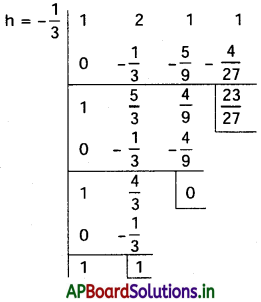
AP SSC 10th Class Social Studies Important Questions Chapter 2 Ideas of Development

AP State Board Syllabus AP SSC 10th Class Social Studies Important Questions Chapter 2 Ideas of Development.

AP State Syllabus SSC 10th Class Social Studies Important Questions 2nd Lesson Ideas of Development

10th Class Social 2nd Lesson Ideas of Development 1 Mark Important Questions and Answers

Question 1.
State reason for protesting against the establishment of Kudankulam Nuclear Power Project in Tamil Nadu.
Answer:

  1. Kudankulam people have protested on the grounds of safety, security and livelihood.
  2. They also want their coast and country protected from the radio active peril.

AP SSC 10th Class Social Studies Important Questions Chapter 2 Ideas of Development

Question 2.
Why did the people oppose the establishment of Kudankulam Nuclear Power project in Tamil Nadu?
Answer:
On the grounds of safety, security and livelihood, the people protested against the project.
(OR)
To protect their cost from radio active peril people opposed it.

Question 3.
Observe the following table and answer the questions a, b, c and d.
Answer:

CountryH.D.I. Ranking 2012Average Life Span in 2012Average years of Schooling
Norway181.312.6
America378.713.3
Sri Lanka9275.19.3
China10173.77.5
India13665.84.4
Bangladesh14669.24.8
Pakistan14665.74.9
World Average70.17.5

a) Which two countries have more average schooling years?
Answer:
Norway, America.

b) Which two Asian countries have better HDI rank than that of India?
Answer:
Srilanka, China.

c) Which countries are lacking behind to the average life expectancy of World?
Answer:
India, Bangladesh, Pakistan.

d) What are the reasons for having less average schooling in India, Bangladesh and Pakistan?
Answer:
The reasons for having less average schooling in India, Bangladesh and Pakistan are

  1. Poverty,
  2. More rural population,
  3. No awareness with regard to literacy.

AP SSC 10th Class Social Studies Important Questions Chapter 2 Ideas of Development

Question 4.
In the context of development, two persons or groups of persons may seek things which are conflicting. Give one example for this.
Answer:
Example – 1: To get more electricity industrialists may want more dams. But this may submerge the land and disrupt the lives of people such as the tribals who are dis-placed.
Example – 2: A girl expects as much freedom and opportunity as her brother and that he also shares in the household work. But brother may not like this.

Question 5.
What idea is the poster promoting?
AP SSC 10th Class Social Studies Important Questions Chapter 2 Ideas of Development 1
Answer:
Importance of Education.

Question 6.
State any two goals of development other than income.
Answer:
Equal treatment, freedom, security and respect from others.

Question 7.
What is HDI?
Answer:
The index developed for comparing coun¬tries for measuring human development is called HDI (Human Development Index). It generally includes income, educational levels and health status of the people.

AP SSC 10th Class Social Studies Important Questions Chapter 2 Ideas of Development

Question 8.
What is per capita income?
Answer:
Per capita income is “the total income of the country divided by its total population”.

Question 9.
Expand IMR.
Answer:
Infant Mortality Rate.

Question 10.
Which organization publishes HDR?
Answer:
UNDP publishes Human Development Report.

Question 11.
What is the main criteria for comparing the development of different countries?
Answer:
The main criteria for comparing the development of different countries are per capita income, life expectancy, average years of schooling, expected years of schooling, etc.

Question 12.
What is health?
Answer:
Health means a state of couple soundness – physical and mental.

Question 13.
Why do people look at a mix of goals?
Answer:
People look at a mix of goals for development.

Question 14.
Why are dams opposed?
Answer:
Dams are opposed because they will disrupt the lives of the people and submerge their own lands.

AP SSC 10th Class Social Studies Important Questions Chapter 2 Ideas of Development

Question 15.
How are the women who work outside the homes?
Answer:
Women who work outside the homes are economically independent and self¬confident.

Question 16.
What is adult literacy rate?
Answer:
The rate of percentage of people aged 15 and above, who can understand, read and write a short and simple statement in their regional languages is known as adult literacy rate.

Question 17.
What is the main criterion for comparing the development of different countries?
Answer:
Average income is the main criterion for comparing the development of different countries.

Question 18.
Explain the calculation of BMI.
Answer:
BMI can be calculated by dividing the total weight of a person by the square of his height.

Question 19.
What is educational development?
Answer:
Education attained by the people of a country on an average basis is referred as educational development.

AP SSC 10th Class Social Studies Important Questions Chapter 2 Ideas of Development

Question 20.
What isthe percentage of population living in the rural India?
Answer:
70% of the Indian population is living in rural India.

Question 21.
What is Infant Mortality Rate?
Answer:
The rate at which children in a country die within an age of 0-1 year is known as “Infant Mortality Rate.”

Question 22.
What are the factors of production?
Answer:
Land, Labour, Capital and Enterprise are the four factors of production.
Technology is also added to the factors of production.

Question 23.
How is the standard of living measured?
Answer:
Standard of living is measured by real GDP per capita.

Question 24.
What is development?
Answer:
Development refers to progress or improvement in lifestyle.

Question 25.
What is PDS?
Answer:
PDS is a system to distribute ration to the poor at a reasonable rate through govern¬ment ration shops. PDS – Public Distribution System.

AP SSC 10th Class Social Studies Important Questions Chapter 2 Ideas of Development

Question 26.
A girl from a rich urban family has some development goals for her. State any one such goal.
Answer:
She can get as much freedom as a boy has.

Question 27.
Write any one advantage of public facilities.
Answer:
It develops national feelings and a sense of collective responsibility. Reduces expenditure.
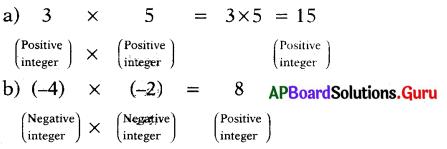
Question 28.
What is NAR?
Answer:
Net Attendance Rate: Out of the total num¬ber of children in age group 6-17, the per¬centage of children attending schools.

Question 29.
Which is considered to be one of the most important attributes for comparing coun¬tries?
Answer:
Income is considered to be one of the most important attributes for comparing countries.

Question 30.
Which is not a useful measure for comparison between countries?
Answer:
Total income is not such a useful measure for comparison between countries.

Question 31.
What are called developed countries?
Answer:
The rich countries, excluding countries of West Asia and certain other small countries, are generally called developed countries.

AP SSC 10th Class Social Studies Important Questions Chapter 2 Ideas of Development

Question 32.
Why, in some areas, children, particularly girls are not able to achieve secondary level schooling?
Answer:
Due to social restrictions imposed on girl child i.e., gender bias.

Question 33.
Why have some states lesser Infant Mortality Rate?
Answer:
Some states have a lesser Infant Mortality Rate because they have adequate provision of basic health and educational facilities.

Question 34.
What is the major consideration of Himachali women?
Answer:
One major consideration is that many Himachali women are themselves employed outside the home and hence show lesser gender bias.

Question 35.
How are the women who work outside the homes?
Answer:
Women who work outside the home are economically independent and self-confident.

10th Class Social 1st Lesson India: Relief Features 2 Marks Important Questions and Answers

Question 1.
What do you learn from the schooling revolution in Himachal Pradesh?
Answer:

  1. Both the government and the people of Himachal Pradesh were keen on education.
  2. They started many schools.
  3. They made sure that education was largely free.
  4. They allocated a good share to education in the government budget.
  5. They tried to ensure that the schools had all the facilities.
  6. Most of the students enjoy their schooling experience.

AP SSC 10th Class Social Studies Important Questions Chapter 2 Ideas of Development

Question 2.
People generally do not like to work in unorganised sector. Why?
Answer:

  1. Unorganised sector is largely outside the control of the government.
  2. Rules and regulations are often not followed.
  3. Jobs are not regular.
  4. Jobs are low paid.
  5. It is difficult to avail the leaves.
  6. No provision for paid leave.
  7. Job is not secure.
  8. Working conditions are generally poor.
  9. No safety measures followed in work places.
  10. Health hazards would be there.
  11. No insurance
  12. No welfare schemes.

Question 3.
Give examples of the criterion for the measurement of human development.
Answer:
The examples of the criterion for the measurement of human development:

  1. Per capita income
  2. The education levels of people and health status.
  3. Standard of life of the people
  4. Availability of electricity
  5. Transportation
  6. Sanitation facilities
  7. Expected years of schooling
  8. Average years of schooling, etc.
    Ex: Sri Lanka, one of our neighbours is much ahead of India in every respect.

Question 4.
What are the different indicators in which development is measured? Which one do you agree with ?
Answer:

  1. Per capita income
  2. Literacy rate
  3. Average years of schooling 4) Expected years of schooling
  4. Life expectancy at birth 6) Health status
  5. Employment status 8) Equal distribution
  6. I agree with all the above things because those are useful for measuring the complete development.

Question 5.
Give examples for different persons can have different developmental goals.
Answer:

Category of personsDevelopmental goals
Landless rural labourers:More days of work and better wages, quality education for their children, no social discrimination.
Prosperous farmers:Higher support prices for crops, should be able to settle their children abroad.
Farmers who depend only on rains for growing crops:Adequate rainfall.
Urban unemployed youth:High salaried jobs
An Adivasi from mining fields :To protect their livelihoods.
Persons from fishing community in the coastal area.Good weather and a good catch of fisher.

Question 6.
What do the people desire other than income?
Answer:
People desire the following other than income.

  1. Equal treatment
  2. Freedom
  3. Security
  4. Respect from others.

AP SSC 10th Class Social Studies Important Questions Chapter 2 Ideas of Development

Question 7.
Prepare a pamphlet on making mahila mandals active in villages.
Answer:
Mahila Mandals are voluntary service organizations that work for the betterment of women in the villages of India. To better their life the village women should have their say in the active involvement of Mahila Mandals’ activities. Active Mahila Mandals can be found In many villages. Suggestions to make Mahila Mandals active in the villages:

  • First priority should be given to girl education and to eradicate illiteracy.
  • Vocational training and credit facilities to women for self-employment should be provided.
  • Mahila Mandals should collectively work for the betterment of women who need nutrition, education and family welfare.
  • They should help the women in immunization of children, small savings, provision of bathrooms, women crafts centres and balwadis.
  • They should work towards the elimination of discrimination, inequality, intolerance, and violence-both, within and outside the home.
  • They should have comparatively high involvement in social life and village politics.

The government should provide basic equipment and stationery, etc. to the Mahila Mandals. It should create awareness among women regarding the Mahila Mandals.

Women empowerment leads to a strong nation.

Copies: 2000

Surya Printers.

Question 8.
What is Development ? Why do different people have different developemntal goals? Explain with two Examples.
Answer:
Meaning of Development:

  1. Growth plus change is called development. .
  2. All the persons may not have the same notion of development or progress.
  3. Each one of them seeks different things.
    Examples:
    i) A girl expects as much freedom and opportunity as her brother and that he also shares in the household work.
    ii) To get more electricity, industrialists, may want more dams. But this may submerge the land and disrupt the lives of people who are displaced as the tribals.

Question 9.
Create a few slogans on promoting girl education.
Answer:

  1. Girl with education – helpful to the family.
  2. Educate a girl – she educates a family.
  3. Encourage girl education – save the nation.
  4. An educated girl – serves the nation well.
    (Students can sit together and discuss to prepare a few slogans of their own.)

AP SSC 10th Class Social Studies Important Questions Chapter 2 Ideas of Development

Question 10.
Observe the following table and prepare a paragraph on it.
Answer:
Progress in Himachal Pradesh
The comparison across two different years is indicative of development that has happened. Clearly, there has been greater development in schooling and spread of education in Himachal Pradesh than India as a whole. Though there is still a lot of difference in the average levels of education among boys and girls, i.e., across genders, there has been some progress towards greater equal¬ity in the recent years.

Question 11.
Why was it necessary for government to run schools in Himachal Pradesh?
Answer:
The rich children can get the education in private sector schools. But the majority of Indian chil¬dren are enrolled in the government schools. Education has also been made free for children from 6 to 14 years of age or up to VIII class under the R.T.E. Act 2009. So, it was necessary for government to run schools in Himachal Pradesh.

Question 12.
‘Human development is the essence of social development’ – Explain.
Answer:

  1. Human development focuses on the people.
  2. It is concerned with the well-being of the people, their needs, choices and aspirations. All these help in building a right kind of society.
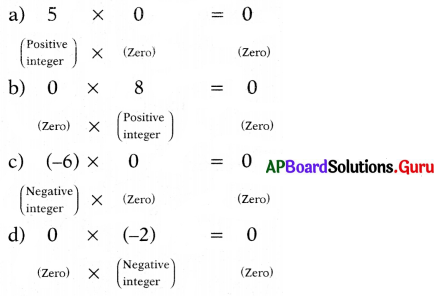
  3. It is all about the enlarging or widening the choices for the people. It is the building of human capabilities, such as education, information and knowledge, to have opportunities of livelihood.
  4. Human development focuses on the expansion of basic choices.

Question 13.
‘Money cannot buy all the goods and services that one needs to live well.’ Explain.
Answer:

  1. Even though per capita income is high in many states, education and health facilities are still lacking.
  2. Money or high per capita income cannot buy a pollution-free environment or good health.
  3. Money cannot buy peace and democracy.

10th Class Social 2nd Lesson Ideas of Development 4 Marks Important Questions and Answers

Question 1.

Study the following table and answer the questions that given below.
(a) What do you mean by literacy rate?
Answer:
The number of literates per every 100 persons in the population is known as literacy rate.

(b) In which state the net attendance is highest?
Answer:
Himachal Pradesh.

AP SSC 10th Class Social Studies Important Questions Chapter 2 Ideas of Development

(c) What could be the reason for the highest, Literacy rate in Himachal Pradesh?
Answer:

  1. Both the government of Himachal Pradesh and the people of the state were keen on education.
  2. The government started schools and made sure that education was largely free, or costs very little for parents.
  3. Further, it tried to ensure that these schools had at least the minimum facilities of teach¬ers, classrooms, toilets, drinking water, etc.

(d) In which state the IMR is least?
Answer:
Himachal Pradesh.

Question 2.
Read the following paragraph :
“In many parts of the country, girls’ are still given less priority by parents compared to boys.”
Comment on the gender bias in India.
Answer:

  1. Ours is a male-dominated society.
  2. Female literacy rate is low.
  3. Women who work outside their homes are less in number.
  4. Traditionally, in our society, women have less involvement in social life.
  5. Because of all these reasons, gender bias is still continuing.
  6. This is a hurdle for the development of society.
  7. Boys and girls should be treated equally.

Question 3.
“We should be able to integrate environmental concerns with the idea of progress”. Explain.
Answer:

  1. We must show concern on environmental issues while achieving development.
  2. The environmental source function will deplete while using the sources in a speedy way.
  3. When waste output exceeds the limit, it will cause long-term damage to the environment.
  4. The big projects may harm bio-diversity.
  5. Use of chemical fertilizers and pesticides in modern agriculture leads to a big loss to the environment.
  6. The fuel used as a part of industrial development causes a lot of air pollution.
  7. Ground water levels are being depleted.
  8. Deforestation is being occurred.
  9. The rights of low-income countries, future generations also should be viewed.

AP SSC 10th Class Social Studies Important Questions Chapter 2 Ideas of Development

Question 4.
Plot the below information on a bar graph. Write your observation.

SI. No.StateLiteracy rate (%)
1.Punjab77
2.Himachal Pradesh84
3.Bihar64

Answer:
AP SSC 10th Class Social Studies Important Questions Chapter 2 Ideas of Development 2Observation:
As Himachal Pradesh has high literacy rate, it can be considered as developed state.

Question 5.
Read the given paragraph and comment.
In many parts of the country, girls’ education is still given less priority by the parents as compared to boys’ education. While girls may study for a few years, they may not complete their schooling.
Answer:
According to this paragraph two things are clearly mentioned that there is a gender bias with regard to giving education to boys and girls among the people of the country and the second one is only the Himachali Pradesh Government is concentrating on girl education.
My opinion on these two issues is that the gender bias was there once in the society. As there is a vast awareness in the parents they send their daughters to the schools in many places. Even a rickshaw puller also wants to make his daughter study in a school.
He hopes his daughter becomes a professional. The parents are interested to send their children to English medium schools irrespective of their income and status. It shows their interest. A little bit fear about girls is there among them because of other reasons. They are afraid of the safety of their daughters. Just like in Himachal Pradesh other states are also spending much amount on education and schooling. It is accepted that the Himachal Pradesh state has taken the step earlier. I don’t say that other states are not taking steps to improve the conditions of schools for providing good education for the girls.
It is a sensitive issue and it is to be taken seriously to bring awareness among people to make their daughters admit in schools and the governments should consider the problems of girls in schools. Sufficient toilets and other facilities are to be provided so as to enroll all the girls in schools.

AP SSC 10th Class Social Studies Important Questions Chapter 2 Ideas of Development

Question 6.
Observe the table and answer the following questions.
Some data regarding India and its neighbours for 2013

CountryPer capita  Income in $Life Expectancy at birth (Years)Average years of schoolingExpected years of schoolingHuman Development Index (HDI) rank in the world
Sri Lanka517075.19.312.792
India328565.84.410.7136
Pakistan256665.74.97.3146
Myanmar181765.73.99.4149
Bangladesh178569.24.88.1146
Nepal113769.13.28.9157
  1. Which country stands ahead of India in all aspects in HDI ?
    Answer:
    The country Sri Lanka stands ahead of India in all aspects in HDI.
  2. Mention the aspects that are considered in making Human Development Index.
    Answer:

    1. Percapita income
    2. Literacy Rate
    3. Average years of schooling
    4. Expected years of schooling
    5. Life expectancy at birth
    6. Health status, etc. are the aspects considered in making Human Development Index.
  3. Name the country that has the lowest per capita income.
    Answer:
    The country Nepal has the lowest per capita income.
  4. Give two suggestions for the improvement of the rank of India in HDI.
    Answer:

    1. Education should be improved and more skill development centres should be established.
    2. The poor and needy people should be provided cheap and better health facilities.

Question 7.
Observe the given table and analyse the HDI data of India and its neighbours.
Some data regarding India and its neighbours for 2016

CountryPer capita income in $Life expectancy at birthLiteracy rateHuman Development Index (HDI)
Sri Lanka10,78974.992.670
India5,66368.374.04131
Pakistan5,03166.260.0148
Myanmar4,94365.993.1146
Bangladesh3,34171.661.5140
Nepal2,33769.664.7144

Answer:
The given table is about Human Development data of India and some of the neighbouring countries pertaining to 2016. In this table per capita income in dollars, life expectancy at birth and literacy rate are considered and HDI Ranking is given. In per capita income Sri Lanka stands high and in the same of life expectancy but in literacy Myanmar is better than Srilanka. Pakistan is very poor in literacy rate and so Bangladesh. These countries do not show interest on literacy. In over all ranking Srilanka stands well, Pakistan’s ranking is least. Countries should concentrate on what (the people need proper medication, medical facilities to the poorer people, wide availabiltiy of
104,108 services are essential in rural areas. In Telangana to some extent these services are provided. Each one teach one programme is to be maintained so that all people will be literated. Schooling should be strengthened. Per capita income should be spent on Health facilities and education. Priorities are to be set first and proper planning for its implementation is essential. So that countries can be developed.

AP SSC 10th Class Social Studies Important Questions Chapter 2 Ideas of Development

Question 8.
Read the text and interpret it.
The ongoing protest over the Kudankulam Nuclear Power Project in theTirunelveli district of Tamil Nadu is one such conflict. The government of India set up the nuclear power plant in this quiet coastal town of fisher folks. The aim is to generate nuclear power to meet the growing energy needs of the country. The people in the region have protested on the grounds of safety, security and livelihood.
Answer:

  1. The Government of India is going on with the Nuclear Power Project of the Kundankulum.
  2. The aim of the project is to generate nuclear power to meet the growing energy needs of the people.
  3. The fisher folks of this area are protesting against the project on the grounds of safety, security and livelihood.
  4. Hence the ideas on development are different for different people.
  5. Development for one may not be the development for other.
  6. Here the ideas on development of government is conflicting with the interests of the local people.

Question 9.
Read the following text and state your opinion on it.

Human Development Report

When we realise that even though the level of income is important, it is an inadequate measure of the level of development, we begin to think of other criterion. There could be a long list of such criteria but then it would not be so useful. What we need is a small number of the most important things. Health and education indicators, such as the ones we used in comparison of Kerala and Punjab, are among them. Over the past decade or so, health and education indicators have come to be widely used along with income as a measure of development. For instance, Human Development Report published by United Nations Development Programme (UNDP) compares countries based on the educational levels of the people, their health status and per capita Income.

Answer:

  1. The income is not the correct criteria to measure the level of development.
  2. Most of the time it hides disparities.
  3. So we begin to think of another criterion.
  4. There could be a long list of criteria.
  5. We selected some such as “health and education”.
  6. Health and Education indicators were used to compare Punjab and Kerala.
  7. Human Development Report was published by UNDP.
  8. The countries were compared on the basis of the education levels of the people, health status and per capita income.

AP SSC 10th Class Social Studies Important Questions Chapter 2 Ideas of Development

Question 10.
Read the following paragraph and write your opinion.
If you get a job in afar off place, you would try to consider many factors, apart from income.
This could be facilities for your family, working atmosphere or opportunity to learn. In another case, a job may give you less pay but may offer regular employment that enhances your sense of security. Another job, however, may offer high pay but no job security and also leave no time for your family. This will reduce your sense of security and freedom.
Answer:

  1. According to this paragraph, people give preference to income as well as facilities.
  2. They also want to spend time with their families.
  3. They need job security and freedom. It is not possible in all the cases.
  4. Many workers from India are migrating even to foreign countries for getting work so as to earn something for their livelihoods.
  5. Some people are working in cities like Hyderabad by keeping their families at their hometowns.
  6. They are losing the opportunity of spending their time with their families. Their living conditions are also not good.
  7. Many of them are leading sedentary life. In some cases pay is less but job is secure. In some other cases payment may be high but job security is not there.
  8. Whatever it is, I am coming to the conclusion that there are many factors that affect livelihoods.

Question 11.
Read the following paragraph and write your comments.
When we looked at Individual aspirations and goals, we found that people not only think of better income but also have goals such as security, respect of others, equal treatment, freedom, etc. In mind. Similarly, when we think of a nation or a region, we may, besides average income, think of other equally important attributes.
Answer:

  1. This paragraph is about the aspirations and goals of the individuals.
  2. The people want their income and they want to be treated well.
  3. Though the wages are well and good, they don’t want to be ill-treated.
  4. Everyone in the society wants to live with dignity which our Constitution promises.
  5. Many of the labourers are now looking towards prestige.
  6. Some states in our country are getting more per capita income but they are lacking in providing other facilities to the people.
  7. Nowadays schooling is very importing to its children.
  8. For nations and states the literacy rate, net attendance rate, infant mortality rate are also considered in its development.
  9. They have to provide schools, pollution-free atmosphere, unadulterated medicines, to its people for better living.

Question 12.
Read the following paragraph and write your opinion on it.
In many parts of the country, girls’ education is still given less priority by parents compared to
boys’ education. While girls may study for a few classes, they may not complete their schooling.
A welcome trend in Himachal Pradesh is the lower gender bias. Himachali parents have ambitious educational goals for their girls, just as for their boys.
Answer:

  1. According to this paragraph two things are clearly mentioned that there is a gender bias with regard to giving education to boys and girls among the people of the country.
  2. Only the Himachali Pradesh Government is concentrating on girl education.
  3. My opinion on these two,issues is that the gender bias was there once in the society.
  4. As there is a vast awareness in the parents they send their daughters to the schools in many
    places.
  5. Even a rickshaw puller also wants to make his daughter study In a school.
  6. He hopes his daughter becomes a professional.
  7. The parents are interested to send their children to English medium schools Irrespective of their income and status.
  8. It is a sensitive issue and it is to be taken seriously to bring awareness among people to make their daughters admitted in schools and the governments should consider the problems of girls in schools.
  9. Sufficient toilets and other facilities are to be provided so as to enroll all the girls In schools.

AP SSC 10th Class Social Studies Important Questions Chapter 2 Ideas of Development

Question 13.
Table: Read the following table and answer the following questions.
Some Comparative data of Selected States

stateIMR per 1000 (2006)Literacy rate (%) {2011)Net Attendance Rate (2006)
Punjab427776
Himachal Pradesh368490
Bihar626456
  1.  What does the table tell us?
    Answer:
    The table tells us about some comparative data of selected states.
  2. What are the three states compared here?
    Answer:
    The three states compared are Punjab, Himachal Pradesh and Bihar.
  3. What does IMR mean?
    Answer:
    IMR means Infant Mortality Rate.
  4. Which state ranks best in literacy rate?
    Answer:
    Himachal Pradesh ranks best in literacy rate with 84%.
  5. What is the Net Attendance Rate of Bihar in 2006?
    Answer:
    The Net Attendance Rate of Bihar in 2006 is 56.
  6. What is the position of Punjab in 2011 with regard to literacy rate?
    Answer:
    The position of Punjab in 2011 with regard to literacy rate is next to Himachal Pradesh.
  7. What is literacy rate?
    Answer:
    Literacy rate is that the percentage of literate people in the 7 and above years age group.
  8. Why is the number of children below the age of 6 not considered for counting of Net Atten¬dance Rate?
    Answer:
    The children below the age of 6 do not go to school.
  9. Which state ranks first when we consider the above data ?
    Answer:
    Himachal Pradesh ranks first.
  10. How do you say Bihar is an underdeveloped state ?
    Answer:
    Bihar has high infant mortality rate i.e., 62. It has less literacy rate and Net attendance rate i.e., 64 and 56 respectively. Hence we can say Bihar is a backward state.

Question 14.
Study the table given and answer the following questions.
Table: Some data regarding India and its neighbours for 2013

CountryPer Capita Income in $Life expectancy at birth (Years)Average years of schoolingExpected years of schoolingHuman Develop­ment Index (HDI) rank in the world
Sri Lanka517075.19.312.792
India328565.84.410.7136
Pakistan256665.74.97.3146
Myanmar181765.73.99.4149
Bangladesh178569.24.88.1146
Nepal113769.13.28.9157
  1. What is the table about?
    Answer:
    The table is about some data regarding India and its neighboring countries for 2013.
  2. What is the life expectancy at birth in India?
    Answer:
    The life expectancy at birth in India is 65.8 years.
  3. What components are considered in this table?
    Answer:
    The components considered in the table are per capita income, life expectancy at birth, aver¬age years of schooling, expected years of schooling and HDI.
  4. Which country ranks best in HDI?
    Answer:
    Sri Lanka ranks best in HDI with 92nd rank.
  5. Which country is lacking in expected years of schooling?
    Answer:
    Pakistan is lacking in expected years of schooling.
  6. Per capita income is shown in some symbol. What does it mean?
    Answer:
    The symbol given means dollar.
  7. Which country has the lowest average years of schooling?
    Answer:
    Nepal has the lowest average years of schooling.
  8. What is the per capita income of India ?
    Answer:
    The per capita income of India is $ 3,285.
  9. What is the lowest life expectancy at birth in the table?
    Answer:
    65.7 years is the lowest life expectancy at birth in the table.
  10. What is the difference between expected years of schooling and average years of schooling
    for India?
    Answer:
    The difference between expected years of schooling and average years of schooling for India is 6.3 years.

AP SSC 10th Class Social Studies Important Questions Chapter 2 Ideas of Development

Question 15.
By studying the given map answer the following questions.
AP SSC 10th Class Social Studies Important Questions Chapter 2 Ideas of Development 3

  1. Name two countries which have low income.
    Answer:
    Zimbabwe and Kenya are the two countries with low income.
  2. Which two countries have very high income?
    Answer:
    USA and Canada are the two countries which have very high income.
  3. Name two countries with high income.
    Answer:
    Brazil and Russia are the two countries with high income.
  4. Which two countries have medium income?
    Answer:
    India and Egypt are the two countries which have medium income.

Question 16.
Prepare a pamphlet on Promoting Girl Education.
Answer:

PROMOTING GIRL EDUCATION

Girls and boys in the society are equal but many of the parents give less importance to girl education compared to boys. This treatment of girls and boys in different ways is called gender bias. Some parents feel that boy is income and girl is expenditure. After marriage also the in-law’s family of the bride normally gives very less importance to her education. This is the wrong notion that the people have. It is to be removed.
The notion is to be changed. Many women have come forward to discharge their duties in political, educational and administrative areas. They are proving that they can do everything. In education also many girls are getting good results and ranks. Their number in civil services and other competitive examinations is rapidly increasing. If a girl is educated, she can manage her family herself well.
She can educate her children.
Many women now are district collectors or police officers and administrative officers and a few banks are being run under the leadership of female authorities. Many departments are under their control. For many years it has been a custom that the women have to work at kitchen but it is disproved, if they were given choice to do something they can do it as we expected.
All the parents should send their daughters to schools to study. They should be given an opportunity to show their intellect. All the parents should understand that their notion is to be
changed and think positively about their daughters’ future.

AP SSC 10th Class Social Studies Important Questions Chapter 2 Ideas of Development

Question 17.
Write a paragraph after reading the table.
Answer:
Comparison of two countries

Name of the countryMonthly incomes of citizens in 2014 (in Rupees)
Country A1IIIIIIVVAverage
9,500105009,800100001020010,000
Country B5005005005004800010,000

According to this table in the country ‘A’, all the five persons are earning mostly equal monthly income. In the country ‘B’ the first four persons are earning only five hundred each but the fifth person is earning forty eight thousand rupees per month. If you are the fifth one it is OK but if you are one among the first four it will be worst to live in. If we consider the average, it will be the same as ten thousand per person per month. In these two countries the country A has more equitable distribution of income.
In many countries more income is there with a few persons. Many people in the countries are poor. They don’t have minimum amount of income for their livelihoods. In the above table the average income of the two countries is the same but in B it is not equally distributed. The Gross Domestic Product is to be distributed among the people of the country that means the poor also have to get their share in the country. The gap between the poor and the rich is to be removed and so the society of equality emerged.

Question 18.
Locate the following in the given map of India.

  1. Nuclear power plant in Tamil Nadu.
    Answer:
    Kudankulam
  2. Schooling Revolution took place in the state.
    Answer:
    Himachal Pradesh
  3. Draw the Indian standard time.
    Answer:
    82 1/2° E longitude.
  4. Sahyadri Range.
  5. Islands in Bay of Bengal.
    Answer:
    Andoman & Nicobar
  6. Locate any one of Hill station.
    Answer:
    Nainital
  7. River which is flowing through a rift valley.
    Answer:
    Narmada
  8. The Hill Station located near Nilgiris.
    Answer:
    Ooty
  9. The largest river in South India.
    Answer:
    Godavari
  10. The largest river in India.
    Answer:
    Ganga

AP SSC 10th Class Social Studies Important Questions Chapter 2 Ideas of Development 4

AP SSC 10th Class Social Studies Important Questions Chapter 2 Ideas of Development