AP Board 8th Class Physical Science Notes Chapter 3 Matter Around Us

Students can go through AP State Board 8th Class Physical Science Notes Chapter 3 Matter Around Us to understand and remember the concept easily.

AP State Board Syllabus 8th Class Physical Science Notes Chapter 3 Matter Around Us

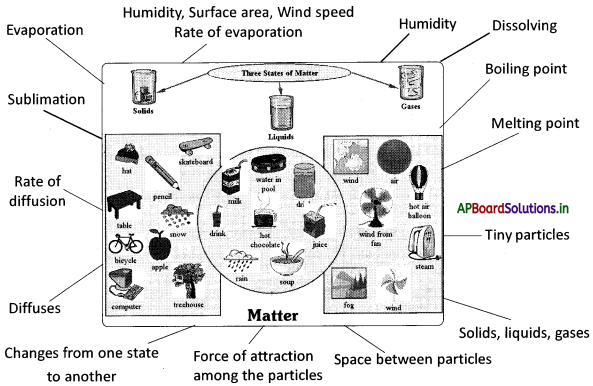
→ The matter is made up of tiny particles, which are small beyond our imagination.

→ Anything in this world that occupies space and has mass is considered as matter.

→ The matter is made up of tiny particles, which are small beyond our imagination

→ Matter exists in these states i.e. solids, liquids and gases.

→ Solids, liquids and gases differ in their properties.

→ Particles of matter move continuously in liquids and gases, known as diffusion.

→ Particles of matter have space between them.

→ The rate of diffusion of gases is higher than that of liquids and solids.

→ Dissolving is a process of occupying the space between liquid particles by solid particles, on the addition of a solid to a liquid.

AP Board Solutions AP Board 8th Class Physical Science Notes Chapter 3 Matter Around Us

→ Particles of matter have forces acting between them that keeps the particles together.

→ The force of attraction between the particles is maximum in solids, intermediate in liquids and minimum in gases.

→ The particles are arranged orderly in the case of solids, while particles move randomly in gases.

→ The states of matter can be changed by changing the temperature or pressure.

→ The temperature at which solid melts to become a liquid is called the ‘melting point’.

→ The process of changing solid to liquid is called ‘fusion’.

→ The amount of heat energy that is required to overcome the attraction energy among the particles is given by the latent heat of a substance.

→ The temperature at which a liquid starts boiling at the atmospheric pressure is known as its boiling point.

→ The phenomenon of change of a liquid into vapours at any temperature below its boiling point is called evaporation.

→ The rate of evaporation depends on the surface area, humidity and wind speed

→ Humidity is the amount of water vapour present in the air.

→ Matter: Anything in this world that occur íes space and has mass is considered as matter Ex: Water, food, air, tables, chairs, etc

→ States of matter: Matter exists in three states. They are solids, liquids and gases. These three differ in their properties.

→ Solid: Solids have a definite shape and ci fixed volume.

AP Board Solutions AP Board 8th Class Physical Science Notes Chapter 3 Matter Around Us

→ Liquid: Liquids can get their shape depending on the container. Liquids can flow easily from one container to another. Hence they are called fluids Ex: Water, milk, etc.

→ Gas: Gases neither have a fixed shape nor volume. Ex: Air, CNG, etc.

→ Particles: Matter is made up of tiny particles. Particle ¡s the smallest part of the matter.

→ Diffusion: The particles of matter move continuously in liquids and gases. This movement ¡s called diffusioni1

→ Compressibility: Large volume of gas ¡s compressed into cylinders of the small volume to make it portable. This property is called compressibility. (or) The reciprocal of the bulk modulus of the material.

→ Forces of attraction: The force of attraction between the particles is maximum in solids, intermediate in liquids and minimum in gases.

→ Evaporation: The phenomenon of change of a liquid into vapours at any temperature below its boiling point ¡s called evaporation.

→ Compressed Natural Gas: Natural gas at high volume, compressed into small cylinders, (CNG) so that they can be used in automobiles, etc.

→ Melting point: The temperature at which solid melts to become a liquid is called the melting point.

→ Fusion: The process of melting is called íusion.

→ Boiling point: The temperature at which a liquid starts boiling at the atmospheric pressure is known as its boiling point.

→ Sublimation: Some substances may change from solid to a gaseous state and vice versa without passing through the liquid state. This is called sublimation. Ex: Iodine, Camphor, etc.

→ Latent heat of fusion: The amount of heat energy that is required to overcome the attraction is given by the latent heat of the substance.

→ Space between particles: Particles of matter has space between them. This space is very high in gases, intermediate in liquids, very low ¡n solids.

→ Dissolving: Solid particles enter into the space between the liquid particles when we add a solid into a liquid. This is called dissolving. Ex: Addition of sugar to water.

→ Thermometer: A thermometer is a device used to measure the temperature of a substance, our body, etc.

AP Board Solutions AP Board 8th Class Physical Science Notes Chapter 3 Matter Around Us

→ Humidity: The amount of water vapour present in the air is called humidity.
AP Board 8th Class Physical Science Notes Chapter 3 Matter Around Us 1
→ Albert Einstein:

  • Albert Einstein was born in 1879 in Germany.
  • He is known throughout the world as a man who propounded the famous theory of relativity.
  • Einstein was awarded the Nobel Prize in 1921.
AP Board 8th Class Physical Science Notes Chapter 2 Friction

Students can go through AP State Board 8th Class Physical Science Notes Chapter 2 Friction to understand and remember the concept easily.

AP State Board Syllabus 8th Class Physical Science Notes Chapter 2 Friction

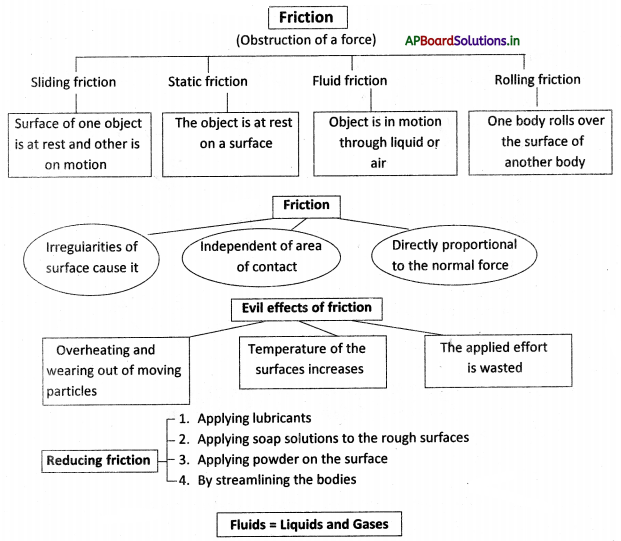
→ Friction opposes the relative motion between two surfaces in contact. It acts on both surfaces.

→ Friction depends on the nature of the surface in contact.

→ For a given pair of surfaces, friction depends upon the state of smoothness of those surfaces.

→ Friction depends on how hard the two surfaces pressed together which is a normal force acting on the body.

→ Friction is independent of the area of contact.

→ Static friction comes into play when we try to move an object at rest relative to another surface or object.

→ Sliding friction comes into play when an object is sliding over another.

→ Sliding friction is smaller than static friction.

→ Friction is important for many of our activities.

→ Friction can be increased by making a surface rough.

→ The sole of the shoes and the tires of the vehicles are threaded to increase friction.

→ Friction is sometimes undesirable.

→ Friction can be reduced by using lubricants.

AP Board Solutions AP Board 8th Class Physical Science Notes Chapter 2 Friction

→ Friction produces heat.

→ When one body rolls over another body, rolling friction comes into play. Rolling friction is smaller than sliding friction.

→ In many machines, friction is reduced by using ball bearings.

→ When bodies move through fluids, fluids exert a frictional force called drag.

→ Fluid friction can be minimized by giving a suitable shape to bodies moving in fluids.

→ Friction: The force which opposes the relative motion of two surfaces of bodies that are in contact.

→ Static friction: The friction which comes into play when surfaces of the objects are at rest relative to each other.

→ Sliding friction: Sliding friction is the friction that comes into play when the surface of one object moves relative to the surface of another object.

→ Lubricants: The substances which reduce friction are called lubricants.

→ Ball bearings: The devices which reduce friction between rotating shafts of machine tools.

→ Drag: The frictional force exerted by fluids is called drag.

→ Fluid friction: Pressure exerted by fluids is called fluid friction.

→ Rolling friction: When one body rolls over the surface of another body, the friction offered ¡s called rolling friction.

AP Board Solutions AP Board 8th Class Physical Science Notes Chapter 2 Friction

→ Fluids: Liquids and gases are called fluids.
AP Board 8th Class Physical Science Notes Chapter 2 Friction 1
→ Leonardo Davinci (1452-1519):

  • Leonardo Davinci was one of the first scholars to study friction systematically.
  • He realized how important friction is for the working of machines.
  • He focussed on all kinds of friction and drew a distinction between sliding friction and rolling friction.

AP Board 8th Class Physical Science Notes Chapter 1 Force

Students can go through AP State Board 8th Class Physical Science Notes Chapter 1 Force to understand and remember the concept easily.

AP State Board Syllabus 8th Class Physical Science Notes Chapter 1 Force

→ Force is a push or a pull.

→ A force can act on an object with or without being in contact with it.

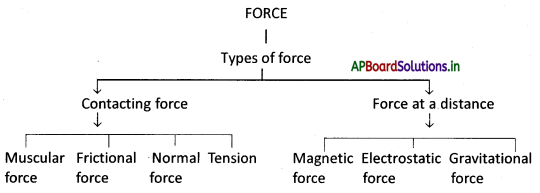
→ A force acting on the body is either a contact force or a force at a distance.

→ A direction that is perpendicular to the plane of a surface is said to be normal.

→ The force that a solid surface exerts on any object in the normal direction is called the normal force.

→ Tension always pulls the objects along the string.

→ The region in which an object at a point experiences force exerted by another object is called field.

→ The attractive force between any two massive objects is called gravitational force.

→ The force exerted by a magnet on another magnet is called magnetic force.

→ The magnetic force also acts on magnetic material such as iron, nickel.

→ The force exerted by a charged body on another charged or uncharged body is known as electrostatic force.

→ Friction is the force that opposes the relative motion of the surface in contact.

→ The force which we exert by using our body muscles is known as muscular force.

→ Force has magnitude as well as direction.

→ A change in the speed of the object or the direction of its motion or both implies a change in its state of motion.

→ The algebraic sum of all forces acting on a body is known as net force and is denoted before

→ A force can change the state of motion of an object.

AP Board Solutions AP Board 8th Class Physical Science Notes Chapter 1 Force

→ Force may cause a change in the shape of an object.

→ The force acting on the unit area of a surface is called pressure

→ Force: A push or a pull on an object is called a force.

→ Push: Move forward by using force.

→ Pull: Apply force so as to move it towards oneself or the origin of the force.

→ Contact force: The force existing between two interacting objects is called contact force.

→ Force at a distance: The force which acts between two bodies that are not directly touching each other is called force at a distance.

→ Field: Field ¡s a region ¡n which a force can be experienced by another object placed at any point ¡n that region.

→ Friction: The resistance to the movement of a body over the surface of another body.

→ Muscular force: The force exerted by body muscles is coiled muscular force.

→ Gravitational force: The force which pulls the object towards the earth is called gravitational force or force of gravity.

→ Magnetic force: The force exerted by o magnet on another magnet is called magnetic force.

→ Electrostatic force: The force exerted by a charged body on another charged or uncharged body is known as electrostatic force.

AP Board Solutions AP Board 8th Class Physical Science Notes Chapter 1 Force

→ Net force: The algebraic sum of all the forces acting on a body is known as the net force.

→ Magnitude: The size of a quantity is called magnitude.

→ Equilibrium: A state in which opposing forces are balanced.

→ Normal force: The force that a solid force exerts on any object in the normal direction ¡s called the normal force.

→ Tension: The tightness of rope or string when it is stretched is called tension.

→ State of motion: A change ¡n the speed of an object or the direction of its motion or both is called its state of motion.

→ Pressure: The force acting perpendicularly on a unit area of a surface is called pressure.

→ Free body diagram: The diagram showing all the forces acting on an object at a particular instant is called the free body diagram.

→ Magnetic field: The space around the magnet where its influence can be detected s called the magnetic field
AP Board 8th Class Physical Science Notes Chapter 1 Force 1
→ Sir Isaac Newton:

  • A British Physicist and Mathematician of high repute studied the color and composition of white light
  • His studies on planetary motion led to his famous universal law of gravitation.
  • He formulated three fundamental laws of mechanics called Newton‘s laws of motion.
  • His main works are Principia and optics.

AP Board 7th Class Social Studies Notes Chapter 20 Folk Religion

Students can go through AP State Board 7th Class Social Studies Notes Chapter 20 Folk Religion to understand and remember the concept easily.

AP State Board Syllabus 7th Class Social Studies Notes Chapter 20 Folk Religion

→ When children fall ill repeatedly when people are sick and very weak they worship the folk goddesses by offering Bonalu and sacrificing a cock, or they go to the Pir Baba’s Dargah and ask the Maulvi to tie ataWiz. tt is a general scene in villages.

→ There are a large number of village deities.

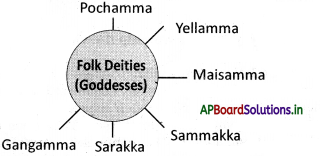
→ Pochamma is the most popular folk goddess of Andhra Pradesh. Near every village, a small shrine is dedicated to her. The main goddess is in the form of stone under a neem tree.

→ People worship the goddess Pochanima by offering bonuses.

→ Katta Maisamma is a goddess of water and is worshipped in the form of a small stone on the tank bund. With Her blessings, the crops flourish.

→ Once in five years, a major festival is celebrated in which sheep, goats, and hens are sacrificed.

→ Gangamma is also considered a water goddess who protects fishermen who go out into the sea.

→ Yellamma is also called Polimeramma, Maritemma, Renuka, Mahankali, Jogamma, Somalamma, etc.

→ Yellarnma, the goodness, guards the boundaries of the village and will not allow any disease or evil Village.

→ A devotee of ‘Devi becomes a deity and is called Paidi thalli. In Northern Andhra ‘Paidi thaTti Ammavart Jafthara is celebrated.

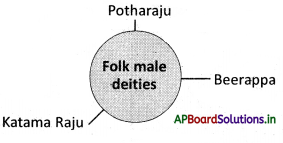
→ The farmers of Andhra Pradesh believe that Potharaju looks after their agricultural lands arid crops and products the crops from dreadful diseases, thieves and animals.

→ Beerappa and Katamaraju are worshipped by cowherd and shepherd communities. They are considered protectors of cattle and sheep.

AP Board Solutions AP Board 7th Class Social Studies Notes Chapter 20 Folk Religion

→ Many office folk gods and goddesses were actually local heroes who either died fighting for the defense of their people or were wronged by the powerful people of their times.

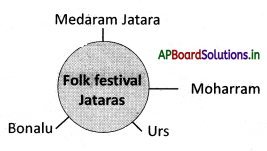
→ Sammakka and Sarakka (Medaram) Jatara is celebrated at Medaram village of Taadwai Mandal in Warangal district. Nearly one crore people attend it.

→ The Medaram Jatara is celebrated once every two years.

→ Moharram, a Muslim festival, commemorates the battle of Karbala in Iraq in which the grandson of Prophet Mohammad was killed.

→ Muslim celebrates Urs or anniversaries of Muslim saints who lie hurried in various parts of the state.

→ People, who seek some specific blessings like children or jobs etc visit the Dargahs and pray there.

→ Dargahs are built on tombs of Sufi saints who propagated Sufism.

→ Bonalu is one of the popular folk festivals celebrated in the Telangana state.

→ Many historical books tell us that such folk gods were worshipped in very old times also. & Many of these deities are worshipped by people irrespective of their caste or religion or economic status.

→ Folk Deities: Traditional Gods

→ Jatara: A festival conducted for village gods.

→ Urs: Urs is the death anniversary of the Sufi saint in the dargah.

→ Peeri: A Peeri is prepared with bamboo strips in a dome shape.
(Or)
The Muslims too pay respects to the heroes who fought against evil.

AP Board Solutions AP Board 7th Class Social Studies Notes Chapter 20 Folk Religion

→ Bonamu: The Godness is worshipped by offering food, which is later shared among the family members.
AP Board 7th Class Social Studies Notes Chapter 20 Folk Religion 1
AP Board 7th Class Social Studies Notes Chapter 20 Folk Religion 2
AP Board 7th Class Social Studies Notes Chapter 20 Folk Religion 3

AP Board 7th Class Social Studies Notes Chapter 12 The Kakatiyas – Emergence of the Regional Kingdom

Students can go through AP State Board 7th Class Social Studies Notes Chapter 12 The Kakatiyas – Emergence of the Regional Kingdom to understand and remember the concept easily.

AP State Board Syllabus 7th Class Social Studies Notes Chapter 12 The Kakatiyas – Emergence of the Regional Kingdom

→ Srimad-Andhra”Mahabharatam is the first poetic work in Telugu which was composed by Kavitrayamu, the Trinity of Poets – Nannaya, Tikkanen, and Erra Pragada between 1000 and 1400 AD.

→ Vaidyanathan wrote PrathaparUdra Yashobhushanam during the Kakatiya rule.

→ Kakatiya inscriptions are in Telugu and they called themselves ‘Andhra Rajas’.

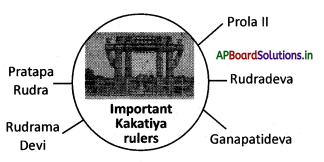
→ During Rudradeva’s rule, the capital was shifted from Anmakonda to Orugallu.

→ Rudradeva built a big fort, a tank, and a temple called Thousand Pillared Temple in Anaconda.

→ The city buildings and palaces were within this stone wall.

→ The city itself was divided into several quarters or Vadas.

→ Rudramadevi ruled from Orugallu and belonged to the famous Kakatiya family. She ruled from 1262 AD to 1289 AD for nearly 27 years.

→ Marco Polo visited Rudramadevi’s kingdom.

AP Board Solutions AP Board 7th Class Social Studies Notes Chapter 12 The Kakatiyas – Emergence of the Regional Kingdom

→ The Kakatiyas brought large tracts of land under cultivation by building tanks and digging wells.

→ The Kakatiyas also extensively patronized temples by donating to them.

→ Sometime around 1190 AD, a new kingdom was established in Delhi. The new kings were called Sultans and they originally came from Turkistan.

→ Sultan Mohammad binTugluq was able to defeat Kakatiya Prataparudra in 1323 AD.

→ Palani Virula Katha written by Srinatha.

→ Warriors: Brave or experienced soldiers or fighters

→ Nayantara System: Nayakaras (the authority of several villages) depended upon the queen or the king and remained loyal to them. They were also probably used to subdue the rebellious chiefs. This arrangement was called the Nayankara system.

→ Samantha: The landlord or warrior chief of seventh century A.D.

→ Artisans: Skilled workers who make things by hand.

→ Turkistan: A kingdom in Europe.

→ Abhaya Sasana: A pillar inscription issued by the Kakatiya king.

AP Board Solutions AP Board 7th Class Social Studies Notes Chapter 12 The Kakatiyas – Emergence of the Regional Kingdom

→ Marco Polo: An Italian traveler.

→ Fort: A building constructed to defend a place against attack
AP Board 7th Class Social Studies Notes Chapter 12 The Kakatiyas – Emergence of the Regional Kingdom 1
AP Board 7th Class Social Studies Notes Chapter 12 The Kakatiyas – Emergence of the Regional Kingdom 2

AP Board 7th Class Social Studies Notes Chapter 15 Establishment of the British Empire in India

Students can go through AP State Board 7th Class Social Studies Notes Chapter 15 Establishment of the British Empire in India to understand and remember the concept easily.

AP State Board Syllabus 7th Class Social Studies Notes Chapter 15 Establishment of the British Empire in India

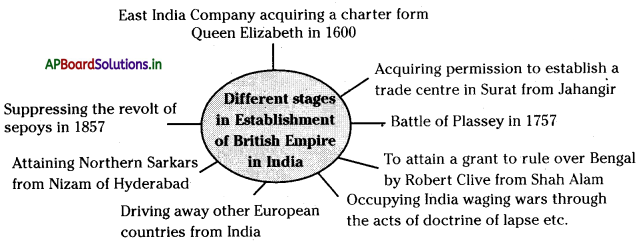
→ In 1600 AD, the East India Company acquired the grant from Queen Elizabeth-1 to trade with the East.

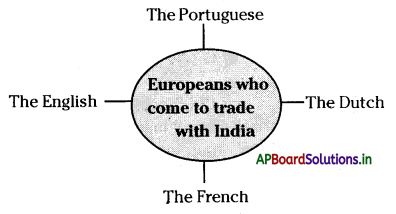
→ By the time the English reached India, the Portuguese, the Dutch and the French had already established their trading centers in India.

→ European traders formed their own East India Companies to trade in India.

→ Trade was carried on with arms and trading posts were protected through fortification.

→ This effort to fortify their settlements and carry on profitable trade also led to intense conflict with local rulers.

→ The English East India Company and the French East India Company fought against each other for many years to capture the trade in India.

→ After the Mughal empire had broken up into small kingdoms, the companies found their chance to assert their power.

→ When two Indian rulers were fighting, the European Companies interfered took sides, lent their army to one side, and helped them defeat their rivals.

→ In return, the companies were gifted many trade concessions and large amounts of money by the rulers.

→ The companies also began to acquire small parts of kingdoms as gifts from the rulers.

AP Board Solutions AP Board 7th Class Social Studies Notes Chapter 15 Establishment of the British Empire in India

→ Slowly the English began emerging victorious over the French Company in the struggle for dominance in India.

→ Some Indian rulers exempted the company from paying taxes on many of the goods. However, the company, its officials, and the people took advantage of these concessions.

→ Thus there was much looting and swindling took place in the kingdoms by the company, its officials, and the people.

→ The English gradually began to feel that they could make fuller and freer use of India for trade if they themselves ruled the country.

→ So they began removing the Nawabs and Rajas and started ruling themselves.

→ With the policies of Robert dove, Warren Hastings, Lord Wellesley, and Lord Dalhousie, a large area of India came under British rule.

→ There was discontentment against British rule in all spheres of Indian life. The royal families, the farmers and landowners, tribal people, Hindus and Muslims, and finally the Indian Sipahis under British service resisted the British.

→ On top of this, the Sipahis suspected that the cartridges for their guns were being coated with cow and pig fat to keep them dry. They felt that their religious faith was being violated.

→ All these causes led to a revolt in 1857. The revolt that started at Meerut and Barrackpur spread like wildfire to all parts of India.

→ A wave of people and policemen joined the Sipahis. The bungalows and offices of English were set afire and many English people were killed.

→ The spahis reached Delhi and declared the Mughal emperor, Bahadur Shah Zafar their Badshah.

AP Board Solutions AP Board 7th Class Social Studies Notes Chapter 15 Establishment of the British Empire in India

→ Many royal families such as Nawab of Avadh, the Peshwa Nana Sahib, Lakshmi Bai of Jhansi, and Tantia Tope joined the revolt.

→ Despite the widespread success of the revolt, the English slowly gained control over the situation.

→ Lack of combined and well-planned effort from the rebels and the shortage of modern arms caused the failure of the revolt.

→ The English brutally punished the rebels and suppressed the revolt.

→ In 1858, Queen Victoria of England made a declaration saying that they would not dethrone the Indian kings and the British government would not interfere in religious matters of Indians.

→ Royal Charter: Written or printed statement of rights, permission to do something, especially from a ruler or government.

→ Subedar: A Mughal Governor.

→ Sole right: Right belongs to one person or company.

→ Demand: Desire or ability to buy or obtain (goods etc).

→ Jagir: It was a type of feudal land grant in South Asia at the foundation of its Jagirdar system.

→ Cantonment: A permanent military station.

→ Colonies: A colony is a group of people who settle in a new place but keep ties to their homeland.

→ Maulvies: An expert in, or teacher of Islamic law. (Or) Islamic scholar.
AP Board 7th Class Social Studies Notes Chapter 15 Establishment of the British Empire in India 1
AP Board 7th Class Social Studies Notes Chapter 15 Establishment of the British Empire in India 2

AP Board 6th Class Social Studies Notes Chapter 4 Land Forms – Andhra Pradesh

Students can go through AP State Board 6th Class Social Studies Notes Chapter 4 Land Forms – Andhra Pradesh to understand and remember the concept easily.

AP State Board Syllabus 6th Class Social Studies Notes Chapter 4 Land Forms – Andhra Pradesh

→ Jana Gana Mana’ is the national anthem of our country, it describes the glory of our country. It Was written by Rabindranath Tagore.

→ ‘Ma Telugu Thalliki malle Poodanda… is our state song. “It describes the rivers and the rich heritage of our state. The shapes of the surface of the earth are called landforms. The lifestyle, food habits, and dressing patterns are different according to the region”

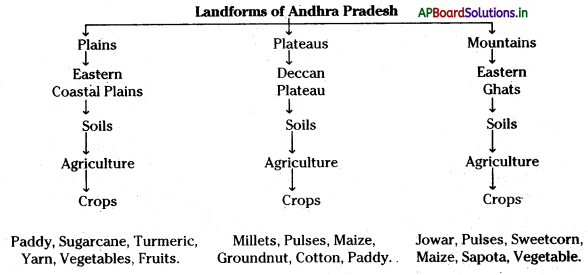
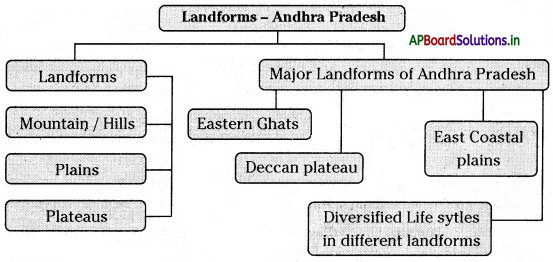
→ Landforms may vary from high elevated to plain land even valleys. Landforms can be mainly categorized into Plains, Plateaus, and Mountains or HiUs.These main landforms may contain several micro landforms. The height of the landforms is measured from Mean Sea Level (MSL).

→ A mountain is a natural higher elevated feature of the earth’s surface. Some mountains are even higher than the clouds. As we go higher and higher altitudes of mountains, the climate becomes cold. India has several huge mountain ranges like the Himalayas. In Andhra Pradesh state majority of high landforms are hills.

→ A plateau is an elevated flat land. It is a flab-topped table land standing above the surrounding area. A plateau may have one or more sides. The Deccan plateau in India is the oldest plateau and it is of volcanic origin. The larger part of Rayalaseema comes under the Deccan plateau region.

→ Plateaus are rich in mineral deposits. Many of the mining areas are located in the plateaus. The Deccan plateau is a lava plateau. The lava plateaus are rich in black soil that are fertile and good for the cultivation of cotton. Many plateaus have scenic spots and are great tourist attractions.

→ Plains are level lands with flat surfaces which have a maximum height of 200 meters above sea level.

→ Andhra Pradesh is located in the east coastal line of India. It is the seventh-largest state in India in the area and the tenth most populous state. The length of the coastal line of Andhra Pradesh is 972 km.

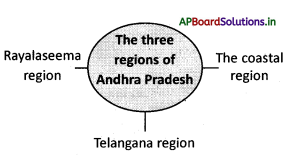
→ Andhra Pradesh comprises – Coastal Andhra Pradesh and Rayalaseema. Coastal Andhra Pradesh has 9 districts along the coast. This region has the fertile soils of Godavari, Krishna, and Penna Delta and the density of population is very high. Rayalaseema has 4 districts in the southern region of the state and is rich in minerals and horticulture crops. This has become a horticulture hub.

AP Board Solutions AP Board 6th Class Social Studies Notes Chapter 4 Land Forms – Andhra Pradesh

→ In Andhra Pradesh, most of the high’ elevated areas are in the form of hill ranges. In our state YSR Kadapa, East and West Godavari districts, Visakhapatnam, Chittoor, Kurnool, and Vizianagaram districts have stretches of hilly terrain.

→ Arma Konda (Zindagada) in Araku valley is the highest peak in our state with 1690 meters. Borra caves of Visakhapatnam district and Papikondalu of East and West Godavari districts are the famous tourist places in these landforms.

→ Lammasingi / Lambasingi, the interior tribal hamlet in Chintapalli Mandal of Visakhapatnam agency, has recorded single-digit temperatures in the winter. It is also known as ‘Kashmir of Andhra Pradesh’.

→ In hilly areas, the soils are uneven and sloped. These soils are red and rocky. Due to their high elevation and the natural downward movement of water, the soils are mostly well-drained and suitable for the plantation of beverage crops like Coffee and Tea.

→ Product is an ancient tribal agricultural practice in the hilly regions. It is also called Shifting or Jfiuming cultivation.

→ The plateau area of Andhra Pradesh belongs to the eastern Deccan Plateau and Rayalaseema region comes under this landform. Here low and uncertain rainfall and many times rain failure is a common feature. So. this area is a drought-prone region. The saline soils of plateau areas also contain more lime and salt which are unsuitable for cultivation.

→ In Andhra Pradesh, the plains are situated in coastal districts. These are stretching from Srikakulam district in the North to SPSR Nellore district in the South. These are known as coastal plains. In Andhra Pradesh, two main rivers Godavari and Krishna form a very big plain in the form of a delta.

→ The delta plains are treasure houses for food grains and are called rice granary of South India. The entire plain area in Andhra Pradesh is a gift to agriculture and farmers. Here the main occupation is agriculture and more than one crop can be cultivated in major parts of the plain, regions.

→ Landform: Is a natural feature on the Earth’s surface

→ Terrain: A stretch of land, especially with regard to its physical features

→ Agent: A person who acts on behalf of another person or group

AP Board Solutions AP Board 6th Class Social Studies Notes Chapter 4 Land Forms – Andhra Pradesh

→ Spring: A spring is a point at which water flows from an aquifer to the Earth’s surface

→ Drought: Prolonged shortage of water due to less rainfall

→ Drought prone area: The areas which are often hit up by droughts

→ Alluvial Soils: The soils formed with silt brought by rivers, very fertile lands

→ Orchards: Fruit gardens

→ Uplands: A little bit of high land in plain areas

→ Tenancy: The period of time for which a person has the right to use a piece of land

→ Juga: It is a tree grown in hilly areas. Caryota (the scientific name of Telugu) is a genus of palm trees.

→ Drought-hit: The area affected by drought
AP Board 6th Class Social Studies Notes Chapter 4 Land Forms – Andhra Pradesh 1
AP Board 6th Class Social Studies Notes Chapter 4 Land Forms – Andhra Pradesh 2

AP Board 7th Class Social Studies Notes Chapter 8 Industrial Revolution

Students can go through AP State Board 7th Class Social Studies Notes Chapter 8 Industrial Revolution to understand and remember the concept easily.

AP State Board Syllabus 7th Class Social Studies Notes Chapter 8 Industrial Revolution

→ From 1500 AD to 1800 AD trade between countries in America, Europe, Africa, and Asia increased manifold.

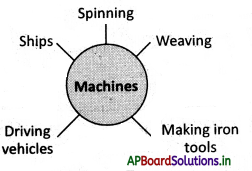
→ In about 1750, machines and steam power began to be increasingly used to produce goods, to move goods and people from one place to another.

→ This was the beginning of the ‘machine age’ in Britain.

→ James Watt was an English craftsman who invented machines.

→ During 1750-1850, a new system called the ‘factory system’ emerged.

→ Production was now carried on in a place called ‘factory’.

→ All facilities for production were owned and managed by individuals called capitalists.

→ In the 19th century, the industrial workers of Europe had to face several hardships.

→ Major changes swept industries with the coming of machines.

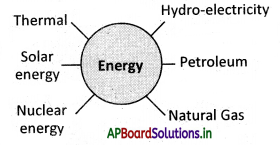
→ Energy is needed to run machines in a factory. Energy is available from coal, electricity, petroleum, and so on.

→ The invention of the steam engine boosted the shipping industry. It also reduced the cost of transportation by one-third of the cost of road transport.

→ George Stephenson’s locomotive pulled heavy loads along a 64-kilometer track from Liverpool to Manchester at a speed of 46 kilometers per hour.

→ In the 1840s, John Loudon McAdam devised a method of laying roads using broken stones.

AP Board Solutions AP Board 7th Class Social Studies Notes Chapter 8 Industrial Revolution

→ In the early 20th Century, aircraft was developed by Wright Brothers and today, air transport is a major means of transport.

→ The industrial revolution led to a gradual shift of people from villages to towns.

→ Slums became a common scenario in towns and cities, especially near the factories and mines. ,

→ Slowly people fought for civil rights and the conditions of the worker’s quarters also improved.

→ Revolution: It is an attempt, by a large ñumber of people, to change the government f a country, especially by violent action. Eg: A socialist Revolution, Industrial revolution

→ Production:: The quantity óf goods that are produced. Machines became important in place of minor tools and handlooms. They produced goods on a large scales

→ Factory: During 1750 – 1800, a new system called the ‘factory system’ emerged In the p1ace of simple tools and manual power, new machines and steam power came to be increasingly used Production was now carried on in a place called factory.

→ Organization: A group of people who work together in a structured way for a shared purpose.

→ Nuclear Energy: A powerful form of energy produced by converting matter into energy splitting the nuclei (centra) parts) of atoms, It Is used to produce electricity.

→ Urbanization: Expartson of town and cities.

→ Child worker: A working child aged below 14 years

→ Slums: A rundown re of a city or town inhabited by very poor people

AP Board Solutions AP Board 7th Class Social Studies Notes Chapter 8 Industrial Revolution

→ Capitalists: All facilities for production were owned and managed by Individuals calledcapita1ists

→ Colonies: Colonies are those countries whose resources are used for the benefit of another country.

→ Manufactories: The traders brought together the craftspersons under one roof so that they did not have to go to each one’s home or explain their requirements to each person They set up small workshops called manufactories

→ ProtoindustrlaIjsago; The craftsmen brought their own tools and worked with raw materials given by the trader The trader then took the product and sold ¡tin the market. In this way slowly the control of the trader over the craftspersons increased. This phase is called ‘Proto- industrialization’

→ Machines: Major changes swept industries with the coming of machines. Machines could be worked by even unskilled persons. Thus skilled artisans were no longer required In their place a large number of women and children were employed and made to work for meager wages.
AP Board 7th Class Social Studies Notes Chapter 8 Industrial Revolution 1
AP Board 7th Class Social Studies Notes Chapter 8 Industrial Revolution 2

AP Board 6th Class Social Studies Notes Chapter 1 Our Earth in the Solar System

Students can go through AP State Board 6th Class Social Studies Notes Chapter 1 Our Earth in the Solar System to understand and remember the concept easily.

AP State Board Syllabus 6th Class Social Studies Notes Chapter 1 Our Earth in the Solar System

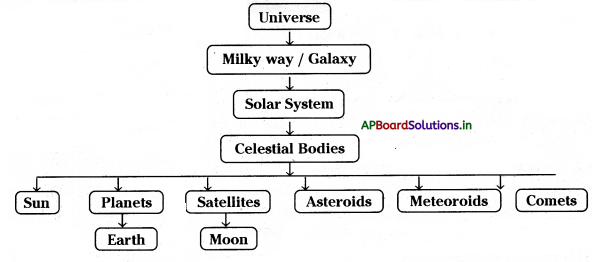
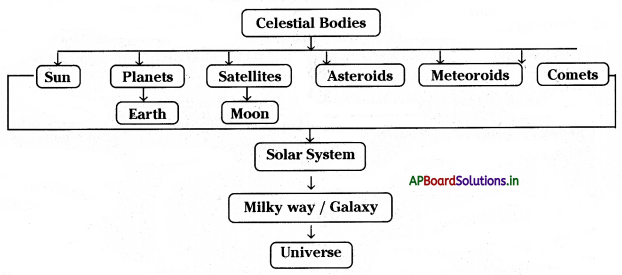
→ The Sun, the Moon, and all those objects shining in the night sky are called celestial bodies.

→ The celestial bodies which have their own heat and light are called Stars.

→ The Sun is a star.

→ The celestial bodies which do not have their own heat or light and or lit by the light of the other stars are called Planets.

→ The Sun, eight planets.

→ Satellites and some other celestial bodies known as asteroids and meteoroids form the Solar system.

→ The Sun is in the center of the Solar system. it provides the pulling force that binds the Solar system.

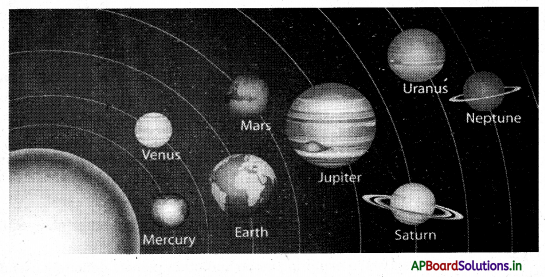
→ There are eight planets in our Solar system. They are Mercury, Venus, Earth, Mars; Jupiter, Saturn, Uranus, and Neptune

→ Jupiter is the biggest and Mercury is the smallest planet.

→ Our home planet Earth is the third nearest planet to the Sun.

→ The shape of the Earth is described as Geoid. Geoid means an Earth-like shape.

→ Earth is called a Blue planet because two-thirds of its surface is covered by water.

→ The Earth is the most suitable planet to support life.

→ There are four spheres of Earth. Lithosphere, Hydrosphere, Atmosphere, and Biosphere.

AP Board Solutions AP Board 6th Class Social Studies Notes Chapter 1 Our Earth in the Solar System

→ A Satellite is a celestial body that moves around the Planets in the same way as the Planets move around the Sun

→ Our Earth has only one natural satellite, that is, the Moon.

→ A man-made Satellite is an artificial body. It is designed by scientists to gather information about the universe, Earth, or for communication purposes.

→ Irregularly shaped rocks between Mars and Jupiter are called Asteroids. ,

→ Meteoroids are small rocky or metallic bodies in outer space,

→ A Comet is a celestial object made up of a head and a tail.

→ A cluster of millions of stars is called a Galaxy.

→ Some millions of Galaxies make the Universe.

→ Galaxy: The cluster of stars

→ Asteroids: Irregularly shaped rocks between Mars and Jupiter

→ Meteoroids: Small rocky or metallic bodies in outer space.

→ Satellites: Celestial bodies that move around the planets.

→ Orbit: The path in which the planets move around the sun

→ Geoid: Earth-like shape

→ Atmosphere: Solid outer layer of the earth

→ Hydrosphere: Waterbodies

→ Atmosphere: Layer of air

→ Biosphere: Plants and animal life on the earth.

→ Constellation: Patterns of Stars

AP Board Solutions AP Board 6th Class Social Studies Notes Chapter 1 Our Earth in the Solar System

→ Celestial bodies: An astronomical object

→ Comets: A comet is a celestial object made up of a head and a tail.

→ Planet: A celestial body moving in an elliptical orbit around a star
AP Board 6th Class Social Studies Notes Chapter 1 Our Earth in the Solar System 1
AP Board 6th Class Social Studies Notes Chapter 1 Our Earth in the Solar System 2
AP Board 6th Class Social Studies Notes Chapter 1 Our Earth in the Solar System 3

AP Board 7th Class Social Studies Notes Chapter 11 New Kings and Kingdoms

Students can go through AP State Board 7th Class Social Studies Notes Chapter 11 New Kings and Kingdoms to understand and remember the concept easily.

AP State Board Syllabus 7th Class Social Studies Notes Chapter 11 New Kings and Kingdoms

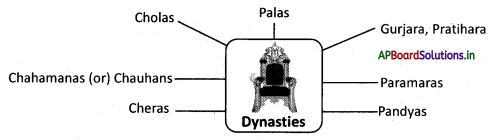
→ Many new dynasties emerged after the seventh century.

→ By the seventh century, there were big landlords or warrior chiefs in different regions of the subcontinent.

→ Initially, Rashtrakutas were subordinate to the Chalukyas of Karnataka.

→ Danti Durga was the founder of the Rashtrakuta dynasty.

→ The invocation part of an inscription is Prashasti.

→ Prashastis contains details about the ruling family such as their predecessors and the period to which they belonged.

→ Kings often rewarded brahmins by grants of land.

→ Kalhana’s Rajatarangini was about KashmirJ<ings.

→ Many of the new kings adopted high-sounding titles such as Maharajaadhiraja Tribhuvan- Chakravarti.

→ Revenue was also collected from traders.

→ As there were three “parties” in this long-drawn conflict, historians often describe it as the “tripartite struggle”,

AP Board Solutions AP Board 7th Class Social Studies Notes Chapter 11 New Kings and Kingdoms

→ One of the rulers, Sultan Mahmud of Ghazni, Afghanistan, ruled from 997 AD to 1030 AD.

→ Arabic work, known as the Kitab al-Hind, is an important source for historians.

→ Chahamanas, later known as the Chauhans, ruled over the region around Delhi and Ajmer.

→ The best-known Chahamana ruler was Prithviraj III (1168 AD-1192 AD), who defeated an Afghan ruler named Sultan Muhammad Ghori in 1191 AD, but lost to him the very next year, in 1192 AD.

→ The founder of the Chola dynasty was Vijayalaya Chola.

→ Cholas were subordinates to the Pallava kings of Kanchipuram,

→ Rajaraja’s son Rajendra I continued his policies and even raided the Ganga valley.

→ The big temples of Thanjavur and Gangaikonda-Cholapuram, built by Raja raja and Rajendra, are architectural and sculptural marvels.

→ Temples were centers of craft production.

→ The empire was divided into mandalas or provinces, further sub-divided into Valanadus and Nadus.

→ The sabha had separate committees to look after irrigation works, gardens, temples, etc.

→ Samantha The landlord or warrior chief of seventh century A.D

→ Temple: A place of worship for Hindus

→ Nadu: A group of villages formed a larger unit called ‘Nadu’ in the Chola Kingdom.

AP Board Solutions AP Board 7th Class Social Studies Notes Chapter 11 New Kings and Kingdoms

→ Sabha: Assembly.

→ Kingdom: A land ruled by a king

→ Sultan: The rulers of Afghanistan
AP Board 7th Class Social Studies Notes Chapter 11 New Kings and Kingdoms 1

AP Board 7th Class Social Studies Notes Chapter 7 Handicrafts and Handlooms

Students can go through AP State Board 7th Class Social Studies Notes Chapter 7 Handicrafts and Handlooms to understand and remember the concept easily.

AP State Board Syllabus 7th Class Social Studies Notes Chapter 7 Handicrafts and Handlooms

→ Polish is a basket maker from Shankavaram village in Kanigiri Mandal, Prakasam District. He belongs to Yerukala, a tribal community.

→ Polish uses the spines of wild date palm (Eatha Chettu) leaves.

→ Shankavaram is about 80 km from Ongole’

→ Basket making is craftwork that involves the use of wild date palm leaves, cane, and bamboo, which are found in forests.

→ Forests due to their extensive exploitation for big industries.

→ Polish live in a slum, which does not have proper drainage, so it emits a foul smell and breeds mosquitoes and flies.

→ People of the Yerukula tribe are usually involved in basket making and live in different parts of Andhra Pradesh.

→ Dharmavaram is located in Anantapur district in the state of Andhra Pradesh.

→ Recently Dharmavaram sarees received the patent right.

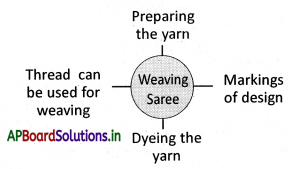
→ Farmers grow silkworms to produce cocoons on mulberry leaves from which silk yarn is made. & This silk yarn is locally called “Katcha Pattu”.

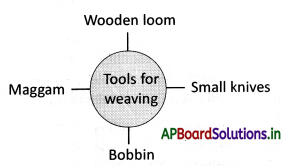
→ Weavers own the wooden loom which is the main tool for weaving.

→ Weaving saree is a hereditary occupation for Venkatesu’s family.

→ Andhra Pradesh has the second largest number of handlooms in the country, next only to West Bengal.

AP Board Solutions AP Board 7th Class Social Studies Notes Chapter 7 Handicrafts and Handlooms

→ The buyers are spread all over the world and weavers do not have any direct contact with them.

→ The cooperative societies are meant to help the weavers in buying raw materials at a low price and to arrange for marketing of their cloth.

→ A large amount of handloom cloth materials in Andhra Pradesh are produced and marketed by master weavers and merchants.

→ Along with Dharmavaram, there are many amazing weavers in Andhra Pradesh at Uppada (East Godavari), Mangalagiri (Guntur), Ponduru (Srikakulam), Venkatagiri (Nellore), Chirala (Prakasam), and Srikalahasti (Chittoor).

→ 1. Raw materials: The substance used to make things is called raw material. The raw materials for basket making are wild date palm tree leaves

→ Jacquard Cards: A card that is used for designing sarees.

→ Sapporo: The process by which the raw silk is made convenient for warp and waft.

→ Katcha Pattu: Silk yarn which is obtained from the cocoon in reeling centers is locally called Katcha Pattu.

→ Patent: An official right to be the only person to make, use or sell a product. or an invention.

→ Warp – Weft: Warp is the yarn that goes from top to bottom and wefts are the yarns that go from left to right. We can notice that cloth has threads passing from top to down and sideways something like this #.

→ Tie & Dye: Foy dyeing, the silk yarn is taken off, but when dry, it is again stretched, partly opened, and tied again for dyeing, this process is repeated several times. For making sarees in different colors and shades, different methods of dyeing are followed.

→ Co-operative Societies: Some persons of one particular group (farmers, teachers, etc.,) form, like society to get financial benefits.

→ Yerukula: People of the Yerukula tribe are usuallý involved in basket making and live in different parts of Andhra Pradesh. They are called ‘Yerukula’ after their women’s traditional profession of fortune-telling Eruka Chepputa (Sodhi)

AP Board Solutions AP Board 7th Class Social Studies Notes Chapter 7 Handicrafts and Handlooms

→ Sapporo: Making the raw silk convenient for warp (vertical threads) and weft (horizontal threads) is known as support

→ Eruka Chepputa: Eruka is called Sodi’ Which means ‘predicting future with the help of ‘Souls’ ‘Eruka Chepputa’ is the word of ‘Erukala Sanaa
AP Board 7th Class Social Studies Notes Chapter 7 Handicrafts and Handlooms 1
AP Board 7th Class Social Studies Notes Chapter 7 Handicrafts and Handlooms 2

AP Board 7th Class Social Studies Notes Chapter 19 Livelihood and Struggles of Urban Workers

Students can go through AP State Board 7th Class Social Studies Notes Chapter 19 Livelihood and Struggles of Urban Workers to understand and remember the concept easily.

AP State Board Syllabus 7th Class Social Studies Notes Chapter 19 Livelihood and Struggles of Urban Workers

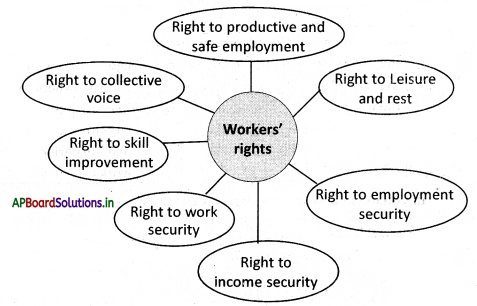
→ Right to productive and safe employment; Right to Leisure and Rest; Right to Employment Security; Income Security; Work Security; Skill improvement; Collective Voice are some of the rights of the workers.

→ In most countries, the governments have agreed that these basic needs of the workers, and made laws that ensure these rights to the workers.

→ The laborer departments have the responsibility to ensure that these laws are followed. & Many registered factories in our country gave these rights only to regular workers but not to casual or contract workers.

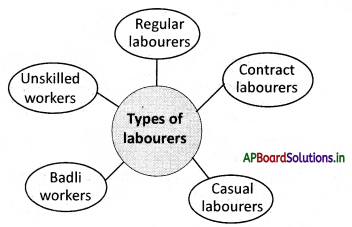
→ There are three kinds of workers employed in a factory. They are

(a) permanent workers
(b) casual workers (Badli workers) and
(c) daily workers.

→ Trade unions help the workers to get their wages fixed to get facilities such as employees’ state insurance and Provident Fund.

→ The trade unions have secured other benefits to workers such as health check-ups in case of sickness, safety wear in the workplace, educational allowance for workers’ children, etc.

AP Board Solutions AP Board 7th Class Social Studies Notes Chapter 19 Livelihood and Struggles of Urban Workers

→ Most of these benefits are available only to the permanent workers but not for the casual workers and contract workers.

→ While the permanent workers enjoy higher salaries, ESI, medical Insurance, and provident fund, the casual workers get very little salary and very few benefits like Provident Fund and Health Insurance.

→ The lot of the workers in a brick kiln is very miserable. They are paid very low wages and are forced to work for 14 to 16 hours per day.

→ The owners of brick kilns gave an advance payment and forced them to work as bonded laborers until their advance is repaid.

→ The sector, in which the workers are not registered as employees, there is no agreement and no protection of law or rules and regulations are called the Informal Sector.

→ In the Informal sector, the workers do not get any regular employment and so they end up as casual workers.

→ In Informal Sector the employment is both irregular and very low-paying.

→ People are forced to do many kinds of works in a day. In most cases, all the members of their families including their children have to work.

→ Their children remain uneducated. They don’t have good food or medicines. Their life is in a vulnerable position.

→ Almost all the workers in the informal sector are heavily in debt and often have to work for them.

→ Not only because of urbanization but also of the closing down of large factories and mills, the number of casual workers is increasing day by day.

→ Compensation: Something, typically money, awarded to someone in the ignition of loses suffering, or injury.

→ Provident Fund: An amount, saved from the earning of an employee with an added contribution from the employer.

→ BadliWorker: Temporary or contract workers

→ Wages: Monetary paid by an employer to an employee in exchange for work done.

→ Workers on contract basis: People who are appointed in a company/organization, who are not permanent employees, but for fulfilling the temporary or seasonal requirement.

AP Board Solutions AP Board 7th Class Social Studies Notes Chapter 19 Livelihood and Struggles of Urban Workers

→ ESI: Employees’ State Insurance Permanent

→ Workers: Regular employees. They are selected directly and paid directly by the employer
AP Board 7th Class Social Studies Notes Chapter 19 Livelihood and Struggles of Urban Workers 1
AP Board 7th Class Social Studies Notes Chapter 19 Livelihood and Struggles of Urban Workers 2