AP Board 10th Class Social Studies Notes Chapter 2 Ideas of Development

Students can go through AP State Board 10th Class Social Studies Notes Chapter 2 Ideas of Development to understand and remember the concept easily.

AP State Board Syllabus 10th Class Social Studies Notes Chapter 2 Ideas of Development

→ Development involves thinking about and adevùig goals of a better life for all and more quality among all

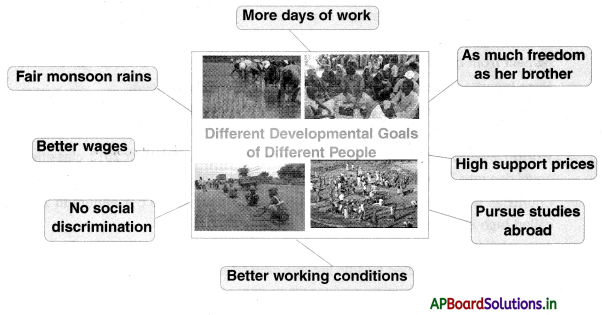
→ All persons do not have the same notion of development.

→ Persons seek things that can fulfill their aspirations or desires.

→ At times, two persons or groups of persons may seek things that are conflicting.

→ Besides seeking more income, people also seek equal treatment, freedom, security, respect from others, and resent discrimination.

→ More income means more of all things that human beings need. c& Average income, which is the total income of the country divided by the total population is also called per capita income.

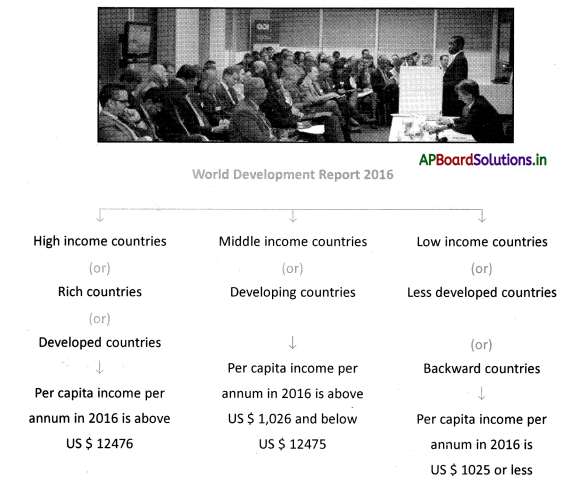
→ World Development Report brought out by the World Bank in 2013 classified the countries into 3 groups.

→ Countries with per capita income of US $ 12,600 and above per annum in 2012 are called high-income countries or rich countries,

→ Countries with a per capita income of above US $1,035 and below the US $ 12,600 per annum in 2012 are called middle-income countries.

AP Board Solutions AP Board 10th Class Social Studies Notes Chapter 2 Ideas of Development

→ Countries with a per capita income of US $1,035 or less per annum in 2012 are called low-income countries.

→ The rich countries, excluding countries of west Asia and certain other small countries, are called developed countries.

→ The goods and services or required facilities that are provided by the government or society are called public facilities.

→ Human Development Report compares the countries, the educational levels of people, their health status, and per capita income as measures of development.

→ Human Development Report 2013 is the Human Development Index ranking among the 177 countries in all.

→ Per capita income is calculated in US Dollars for all countries so that one can compare all the countries.

→ A small country in our neighborhood, Sri Lanka, is much ahead of India in every indicator of development.

→ The schooling revolution in Himachal Pradesh provided infrastructure in education, and, both the government and society complemented each other to achieve great indicators of education.

→ In the year 2005, the average spending on education by the government in Indian states was Rs. 1,049 per child, Himachal Pradesh was spending Rs. 2,005 per child.

→ Development entails a mix of goals.

→ India, a decade ago was a less developed country, and now transformed into a developing country or middle-income country.

→ Every Indian would like to see India as a developed country.

→ Per capita income: Total income of the country divided by the fatal population.

→ Human development: Comparing the countries and reporting their development based on the educational levels of people, their health status, and per capita income

→ Public facilities: The facilities, i.e., goods and services that are provided by the government or society

→ Education and health Indicators: The indicators which show the educational æd health conditions of the people like average years of schooling, life expectancy at birth, etc.

AP Board Solutions AP Board 10th Class Social Studies Notes Chapter 2 Ideas of Development

→ Development: Achieving the goals of making life better for all and bringing more equality

→ The idea of development: Sk the thing that is most important for one which fulfills his developmental goal or aspiration

→ Material things: The things that one can buy with money

→ Non-material things: The things that one cannot buy with money like equal treatment, freedom, etc.

→ High-income countries: Countries with annual per capita income of US $ 12,600 and above in 2012.

→ Middle-income Countries with per capita income of above US $ 1,035 countries and below LIS $12,600 per annum in 2012.

→ Low-income countries: Countries with per capita income of below US $ 1, 35 per annum in 2011

→ Infant Mortality Rate: Out of 1,000 live children burn, the number of children who die within one year.

→ Literacy Rate: The percentage of the literate population in the 7 years and above age group.

→ Net Attendance Rate: Out of the total number of children in the age group 6- 17 years the percentage of children attending school.

→ HDI: Human Development Index

→ Life expectancy at birth: Average expected length of life of a person at the time of birth.

AP Board Solutions AP Board 10th Class Social Studies Notes Chapter 2 Ideas of Development

→ Average years of schooling: Average number of years of education received by people that age 25 years and above.

→ Expected years of schooling: Number of years of schooling that a child at school entrance age can expect to receive given the present enrollment rates.
AP Board 10th Class Social Studies Notes Chapter 2 Ideas of Development 1
AP Board 10th Class Social Studies Notes Chapter 2 Ideas of Development 2

AP Board 8th Class Social Studies Notes Chapter 23 Sports: Nationalism and Commerce

Students can go through AP State Board 8th Class Social Studies Notes Chapter 23 Sports: Nationalism and Commerce to understand and remember the concept easily.

AP State Board Syllabus 8th Class Social Studies Notes Chapter 23 Sports: Nationalism and Commerce

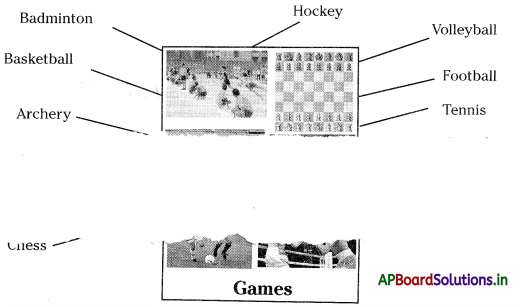
→ We play games for many reasons.

→ Cricket was a game played by villagers of England in open fields of their village just like our villagers play kabaddi.

→ The origins of Indian cricket, that is, cricket played by Indians are to be found in Bombay.

→ The Parsis founded the first Indian cricket club, the Oriental Cricket Club in Bombay in 1848.

→ Modern cricket is dominated by Tests and Day internationals played between national teams.

→ Television channels made money by selling television spots to companies who were happy to pay large sums of money to advertise their products to cricket’s captive television audience.

→ Pakistan has pioneered two great advances in bowling: the ‘doosra and the ‘reverse swing’.

AP Board Solutions AP Board 8th Class Social Studies Notes Chapter 23 Sports: Nationalism and Commerce

→ Hockey is another popular game in India.

→ Sports develop us mentally and physically.

→ Sports promote national integration in India, a multi-cultural country.

→ Colonial: A person or who lives in a colony (or)

→ A country or region under the rule of some other country conducting sports.

→ Global Commerce: The activity of buying and selling on a large scale in the world.

→ Nationalism: A patriotic feeling often to an extensive degree.

AP Board Solutions AP Board 8th Class Social Studies Notes Chapter 23 Sports: Nationalism and Commerce

→ Sponsors: Those who support a person, organization, or activity by giving money, encouragement, or other help.
AP Board 8th Class Social Studies Notes Chapter 23 Sports Nationalism and Commerce 1
AP Board 8th Class Social Studies Notes Chapter 23 Sports Nationalism and Commerce 2

AP Board 9th Class Social Studies Notes Chapter 11 The Government Budget and Taxation

Students can go through AP State Board 9th Class Social Studies Notes Chapter 11 The Government Budget and Taxation to understand and remember the concept easily.

AP State Board Syllabus 9th Class Social Studies Notes Chapter 11 The Government Budget and Taxation

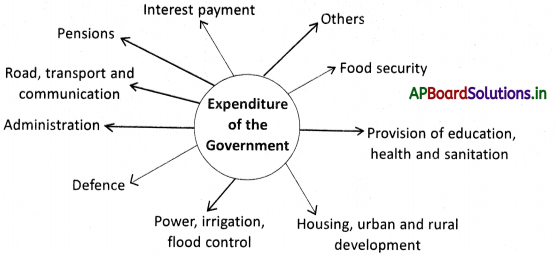
→ The government is responsible for a number of crucial functions. It has to perform both developmental and non-developmental functions.

→ To fulfill the various roles, the government must have adequate money. The money is collected from the people in the form of taxes. Revenues are necessary to finance the expenditure of the government

→ In 2011-12, the government spent around Rs. 23,00,000 crores in lots of heads. Nearly one-fourth of the total spending of the Indian economy is by the government

→ Taxes are levied with thorough approval of the Parliament

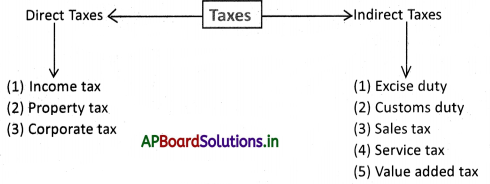
→ Taxes are the main sources of revenue for the government The taxes can broadly be classified into two categories

  1. Direct taxes
  2. Indirect taxes.

AP Board Solutions AP Board 9th Class Social Studies Notes Chapter 11 The Government Budget and Taxation

→ Excise duty, customs duty, VAT, sales tax, service taxes are indirect taxes. VAT has certain advantages.

→ Income tax, property tax, and corporate tax are indirect taxes.

→ In adopting a method of taxation, the government should be careful The poor should be exempted from paying taxes. Essential goes should not be taxed. Tax on luxuries can be increased Agriculture income is exempted from taxes.

→ There are many “tax evaders” and a lot of black money. To get hold of this hoard of money, the income tax department raids many people’s places.

→ Annual Budget: A written format of expected incomes and anticipated expenditure prepared by the Central or State Governments for a financial year.

→ Black Money: Many people do not disclose their entire income or show it to be less than what it actually is. This income which is kept hidden is known as black money.

→ Value Added Tax: VAT is a tax that is added to the price of goods and services.

→ Corporate tax: Corporate tax is the tax levied on the yearly profit of companies and business establishments.

→ Income tax: A direct tax in which tax is levied on the personal income of individuals.

→ Direct tax: Direct tax is that type of tax in which the tax burden will be on the same person on whom the tax is levied. e.g.: Income tax.

→ Indirect tax: Indirect tax is that type of tax in which the tax is levied on one person and the burden is shifted to some other person. e.g.: Excise duty.

AP Board Solutions AP Board 9th Class Social Studies Notes Chapter 11 The Government Budget and Taxation

→ Subsidies: The difference between the market price and the price at which the goods are offered is the subsidy given to the poor.

→ Consumers: Consumers are the persons who directly utilize the goods.
AP Board 9th Class Social Studies Notes Chapter 11 The Government Budget and Taxation 1
AP Board 9th Class Social Studies Notes Chapter 11 The Government Budget and Taxation 2

→ Subsidies: Money paid by the government to reduce the cost of certain important goods such as fertilizers, food grains, diesel, and other important goods so that their prices can be kept low and affordable to all.

AP Board 8th Class Social Studies Notes Chapter 22 Film and Print Media

Students can go through AP State Board 8th Class Social Studies Notes Chapter 22 Film and Print Media to understand and remember the concept easily.

AP State Board Syllabus 8th Class Social Studies Notes Chapter 22 Film and Print Media

→ The birth of cinema in India can be attributed to Lumiere’s brother’s first public show at Watson Hotel in Mumbai on July 7, 1896.

→ The plays written by George Bernard Shaw and Shakespeare were visualized with a camera and exhibited on the screen as a film.

→ The popularity of plays has decreased significantly while the films have gained prominence.

→ In Telugu the first ‘Mooki’ was ‘Bhishma Pratigna’ and ‘talkie’ was ‘Bhakta Prahlada’.

→ The father of the Telugu film industry is Raghupathi Venkaiah.

→ Before the cinema, there were various forms of entertainment like folk art forms, folk dances, classical dances, music, dramas, etc.

→ Several films on national movements were made later.

AP Board Solutions AP Board 8th Class Social Studies Notes Chapter 22 Film and Print Media

→ While society influences art and hence films, it is also true that films influence society.

→ Films can influence the opinions and ideas of people in society.

→ With the introduction of paper production in the 11th century and the printing machine by Gutenberg in the mid-15th-century things have changed.

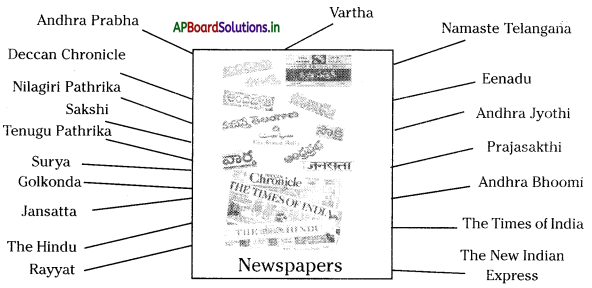
→ The newspapers play a very important role in our daily life.

→ In Telugu, Krishna Patrika was edited by Mutnuri Krishna Rao.

→ Many freedom fighters of Indian Independence were the editors of newspapers.

→ Projector: A device for projecting slides or film onto a screen.

→ Commentary: A spoken description of an event on the radio or television

→ Compose: Create a work of art especially music or poetry.

AP Board Solutions AP Board 8th Class Social Studies Notes Chapter 22 Film and Print Media

→ Gazette: A journal or nèwspaper.

→ Publish: Produce a book, newspaper, journal, or piece of music for public sale.
AP Board 8th Class Social Studies Notes Chapter 22 Film and Print Media 1

AP Board 8th Class Social Studies Notes Chapter 21 Performing Arts and Artistes in Modern Times

Students can go through AP State Board 8th Class Social Studies Notes Chapter 21 Performing Arts and Artistes in Modern Times to understand and remember the concept easily.

AP State Board Syllabus 8th Class Social Studies Notes Chapter 21 Performing Arts and Artistes in Modern Times

→ Many of the folk arts are performed by the people themselves.

→ The Chuttuu Kamudu is one of the art forms of Telangana that came out of the daily labor of the peasants.

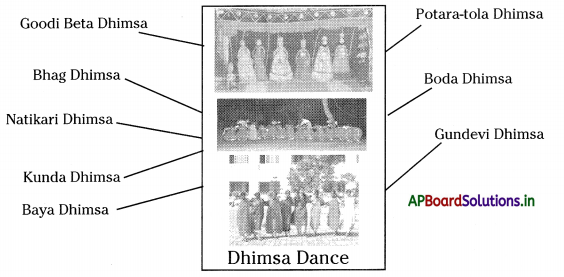
→ Dhimsa dance is performed by tribal groups living in Araku valley.

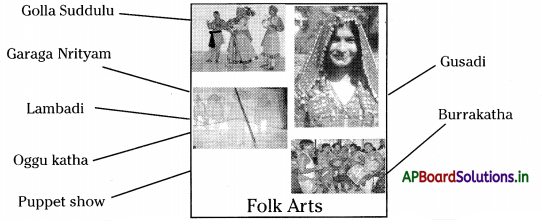
→ Raj Gonds of Adilabad dance during the celebrations of DIWALI known as ‘Gusadi’.

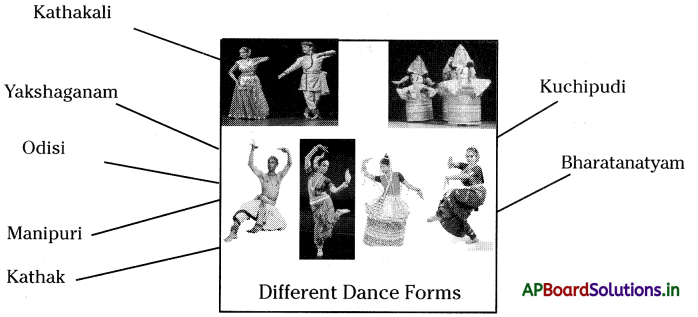
→ Kuchipudi is a group form of dance-drama from Kuchipudi, a village in Andhra Pradesh.

→ Golla Suddulu were practiced by shepherds who migrated from place to place.

→ Burrakatha is a Telugu art of storytelling. Its origin is associated with the Virashaiva movement in the 12 & 13 centuries.

→ The British and Nizam governments harassed Burrakatha artists as they suspected them of spreading rebellious ideas among people.

AP Board Solutions AP Board 8th Class Social Studies Notes Chapter 21 Performing Arts and Artistes in Modern Times

→ Progressive artists of the Communist Party set up the Praja Natya Mandali in 1943.

→ Tholubommalata is a shadow puppet show performed by traveling artists.

→ The classical dances that were prevalent in Tamil Nadu and Andhra Pradesh then were called Sadir, Kuravanji, and Kuchipudi.

→ E.Krishna Iyer, Rukmini Devi, and Bala Saraswathi promoted this dance.
AP Board 8th Class Social Studies Notes Chapter 21 Performing Arts and Artistes in Modern Times 1

→ Under British rule, propaganda prevailed against Indian art, misrepresenting it as crude, immoral, and inferior to the concepts of western civilization.

→ Many are forced to use recorded music in dance performances to keep costs down.

→ Kathakali, Yakshagana, Odissi, Manipuri, Kathak are other dance forms like Bharata- Natyam.

→ Cymbals: A musical instrument consisting of a round brass plate that is either struck against another one or hit with a stick.

→ Anklets: Chains or bands worn around the ankle.

→ Alms: Money or food given to poor people as charitable donations.

→ Mime: The use of silent gestures and facial expressions to tell a story or convey a feeling.

AP Board Solutions AP Board 8th Class Social Studies Notes Chapter 21 Performing Arts and Artistes in Modern Times

→ Tarangam: It is a tough task in the Kuchipudi dance form. In this, the artist dances in a ‘Plate’ and keeps a vessel with water on his/her head, sometimes candles in their hands.

→ Nattuvanars: Dance masters, who usually were male children of devadasis.
AP Board 8th Class Social Studies Notes Chapter 21 Performing Arts and Artistes in Modern Times 2
AP Board 8th Class Social Studies Notes Chapter 21 Performing Arts and Artistes in Modern Times 3
AP Board 8th Class Social Studies Notes Chapter 21 Performing Arts and Artistes in Modern Times 4

AP Board 9th Class Social Studies Notes Chapter 10 Prices and Cost of Living

Students can go through AP State Board 9th Class Social Studies Notes Chapter 10 Prices and Cost of Living to understand and remember the concept easily.

AP State Board Syllabus 9th Class Social Studies Notes Chapter 10 Prices and Cost of Living

→ Every family makes a budget The balancing of expenditure to income is called a budget They reduce their expenditure in order to adjust their budget

→ Not everyone is affected by prices. Not all working people get compensated easily.

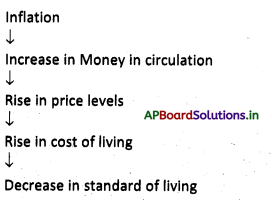
→ Continuous rise in prices of goods is known as inflation.

→ Change in price is measured with the help of a statistical device known as a price index.

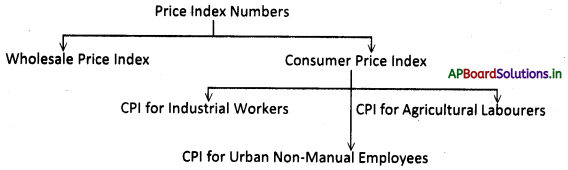
→ Price Index numbers are of different types. We have the Wholesale Price Index (WPI) and the Consumer Price Index. In India, different CPIs are published by the government

→ CPIs are used to calculated DA (Dearness Allowance) to be paid for government employees, to revise legal wages, etc.

→ WPIs are helpful in calculating the rates of inflation.

AP Board Solutions AP Board 9th Class Social Studies Notes Chapter 10 Prices and Cost of Living

→ The government generally regulates prices through Administrative Price Mechanisms. Sometimes subsidies are given to regulate the prices.

→ The Reserve Bank of India which is an apex body reduces the money in circulation to control inflation.

→ Standard of living Quality of life that people lead in terms of goods and services is the standard of living of the people.

→ Inflation: Inflation means a general increase in the price levels and a gradual decrease in the value of money.

→ Consumer Price Index: Changes in the prices of the selected consumer goods at retail price in a statistical form are called Consumer Price Index.

→ Wholesale Price Index: A statistical measure used to measure the change ¡n the prices of all goods in their wholesale rates.

AP Board Solutions AP Board 9th Class Social Studies Notes Chapter 10 Prices and Cost of Living

→ Administrative Price Mechanism: It is a system where prices are regularised by the governments
AP Board 9th Class Social Studies Notes Chapter 10 Prices and Cost of Living 1
AP Board 9th Class Social Studies Notes Chapter 10 Prices and Cost of Living 2

→ Food Inflation: Since 2009, the government began to estimate a new index – The Food Price Index (FPI). This index is used to estimate the rise in prices of food items called food inflation. The FPI consists wholesale price of food materials such as rice, wheat, pulses, vegetables, sugar, milk, eggs, meat, fish, and manufactured food materials such as edible oils. In 2011-12, edible oils accounted for higher food inflation. During that year, about 50 percent of India’s edible oil requirements were met through imports of crude palm oil sunflower oil, soyabean oil, and refined palm olein. When the price of these items increased at the international level – in other countries from where we import, Indian consumers also had to pay higher prices.

→ Since then the government has to take measures to control the rising prices, many research studies were conducted. It was found that the change in the dietary pattern of people has changed considerably in such a manner that their consumption of vegetables, eggs, meat, and fish increased recently. Any seasonal shortage causes a price rise since the demand for these products is quite high. People wish to consume them even at a higher cost. It has become a part of the regular diet.

AP Board 10th Class Social Studies Notes Chapter 1 India: Relief Features

Students can go through AP State Board 10th Class Social Studies Notes Chapter 1 India: Relief Features to understand and remember the concept easily.

AP State Board Syllabus 10th Class Social Studies Notes Chapter 1 India: Relief Features

→ World landforms originated from two giant lands namely Angara land (Laurasia) and Gondwana land.

→ The Indian Peninsula was part of Gondwana land.

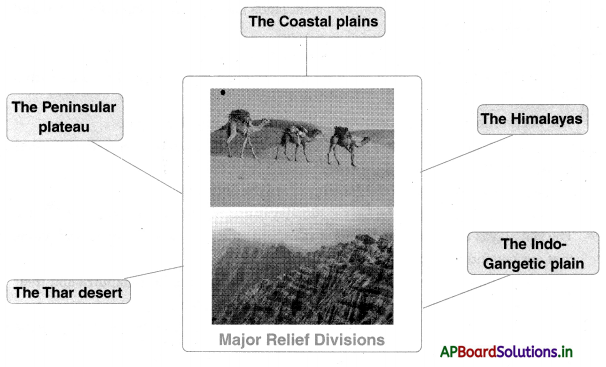
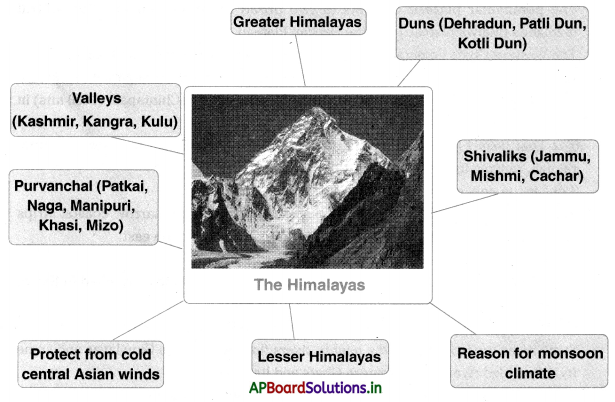
→ The Himalayan ranges run in the west-east direction in the form of an arch with a distance of about 2400 km.

→ The northernmost range is known as Himadri or Greater Himalayas.

→ The portion of the range found south of the Greater Himalayas is called ’Lesser Himalayas’.

→ The southernmost range of the Himalayas is the Shivaliks.

→ The valleys lying between the Lesser Himalayas and Shivalik ranges are called Duns.

→ The Himalayas are the reason for summer rains and monsoon type of climate in regions that are beyond the Western Ghats of India.

→ The interaction of three Himalayan rivers Indus, Ganga, and the Brahmaputra, and their tributaries resulted in the formation of the great northern plain.

AP Board Solutions AP Board 10th Class Social Studies Notes Chapter 1 India: Relief Features

→ In the western part of the great northern plain, the ’Doab’ features dominate the fertile land between the two rivers.

→ The Indian plateau is also known as the peninsular plateau as it is surrounded by the sea on three sides.

→ The peninsular plateau consists of two broad divisions, namely, the central I highlands (Malwa plateau) and the Deccan Plateau.

→ The Western Ghats lie parallel to the west coast and they extend for 1600 km.

→ The Eastern Ghats extend from Mahanadi valley in the north to Nilgiris in the south, The highest peak in the Eastern Ghats is Aroma Konda found at Chintapalli (1680 m) in Andhra Pradesh.

→ The Thar desert is located on the leeward side of Aravalis and receives very little rainfall, ranging from 100 to 150 mm per year.

→ ’Luni’ is the only river in the Thar desert area.

→ The southern part of the peninsular plateau is bordered by narrow coastal strips along the Arabian Sea on the west and the Bay of Bengal on the east.

→ Coastal zone enables rich fishing resources.

→ There are two groups of Islands – Andaman and Nicobar Islands stretched in the Bay of Bengal and Lakshadweep Islands in the Arabian Sea.

→ There is a vast diversity in the landforms in which Indian people live.

→ Some areas are irrigated by the mighty rivers flowing from the Himalayas and some by the rainfed rivers from the Western Ghats and its forests.

AP Board Solutions AP Board 10th Class Social Studies Notes Chapter 1 India: Relief Features

→ Many places are located in the valleys and others in the mountains.

→ Perennial: LastIng a very long time, or happening repeatedly or all the time

→ Coral reefs: A bank of coral, the top of which can sometimes be seen just above the sea

→ Coastal plains: The East Coastal plain is between the Eastern Ghats and the Bay of Bengal, the West Coastal plain Is between the Western Ghats and the Arabian sea.

→ Peninsula: A stretch of land surrounded by water on three sides

→ Angara land: Laurasia = The northerly of the two continents into which the earth’s landmass was once divided

→ Gondwana land: The southerly of the two continents Into which the earth’s landmass was once divided

→ Shivalik: The southernmost range of the Himalayas

→ Purvanchal: The divisions of the Himalayas In Arunachal Pradesh beyond the Dihang valley

→ Laurasia: Angara land

→ Duns: The valleys lying between the lesser Himalayas and Shivalik ranges

→ Leeward: The side or direction that Is sheltered from the wind. e.g. by a range of mountains

→ Relief features: The features which exhibit differences in the elevation of any part of the earth’s surface

→ Relief maps: Maps that seek to depict the surface relief of an area in three dimensions though not necessarily to scale

→ WeatherIng: The decay and disintegration of rocks of the earth’s crust by exposure to the atmosphere

→ DeposItion: The laying down of solid material that has been carried from a distant part of earth’s crust by natural agents like a river, wind, etc.

→ Erosion: The process of wearing away of the land surface by various natural agents like water, ice, wind, etc.

AP Board Solutions AP Board 10th Class Social Studies Notes Chapter 1 India: Relief Features

→ Landform: The shape, form, and nature of a feature of the earth’s land surface

→ Folding process: The formation of a bend In rock strata due to movements of the earth’s crust

→ Fold mountains: Mountains that have been thrown up into a massive fold or ridge by earth movements

→ Basin: A shallow structural down old In earth’s crust

→ River basin: The area drained by a single river system

→ Doab: The fertile land between two rivers

→ Topography: A detailed description or representation of both the natural and artificial features of an area Himadri Greater Himalayas = The northernmost range of the Himalayas.

→ Lesser Himalayas: Himachal The portion of the range found south of the Greater Himalayas.
AP Board 10th Class Social Studies Notes Chapter 1 India Relief Features 1
AP Board 10th Class Social Studies Notes Chapter 1 India Relief Features 2

AP Board 8th Class Social Studies Notes Chapter 20 Understanding Secularism

Students can go through AP State Board 8th Class Social Studies Notes Chapter 20 Understanding Secularism to understand and remember the concept easily.

AP State Board Syllabus 8th Class Social Studies Notes Chapter 20 Understanding Secularism

→ Jews were persecuted by Hitler in Germany and several million were killed.

→ Now, the Jewish state of Israel treats its own Muslim and Christian minorities quite badly.

→ In Saudi Arabia, non-Muslims are not allowed to build a temple, church, etc., and nor can they gather in a public place for prayers.

→ Members of one religious community either persecute or discriminate against members of other religious communities.

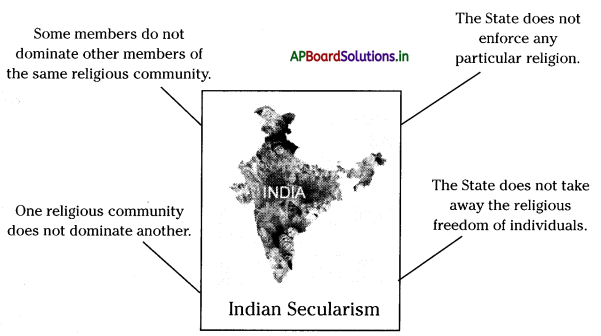
→ The Indian Constitution allows individuals the freedom to live by their religious beliefs and practices as they interpret these.

AP Board Solutions AP Board 8th Class Social Studies Notes Chapter 20 Understanding Secularism

→ Any form of domination based on religion is in violation of the rights that a democratic society guarantees to each and every citizen irrespective of their religion.

→ Any interference in religion by the state has to be based on the ideals laid out in the Constitution.

→ Fundamental Rights are based on secular principles.

→ Fundamental Rights: Rights that are essential or fundamental for the well-being of a person is called Fundamental Rights. These rights are enshrined in the Part — Ill of the Constitution of India.

→ Democracy: A system of government by the whole population or all the eligible members of a state, typically through elected representatives.

→ Tyranny: Cruel and oppressive government or rule

AP Board Solutions AP Board 8th Class Social Studies Notes Chapter 20 Understanding Secularism

→ Personal Law: Law that applies to a particular person or class of persons only. Wherever situated – distinguished from territorial law.
AP Board 8th Class Social Studies Notes Chapter 20 Understanding Secularism 1

AP Board 9th Class Social Studies Notes Chapter 9 Credit in the Financial System

Students can go through AP State Board 9th Class Social Studies Notes Chapter 9 Credit in the Financial System to understand and remember the concept easily.

AP State Board Syllabus 9th Class Social Studies Notes Chapter 9 Credit in the Financial System

→ Banks accept deposits that can be withdrawn at any moment They work under the R.B.I. Banks honor withdrawals in cash and cheques.

→ Banks in India keep 15% of their deposits as cash to repay the depositors. Bank uses the major portion of the deposits to extend loans.

→ Bank charges interest on loans. The difference between what is charged from borrowers and what is paid to depositors is the primary source of income for banks.

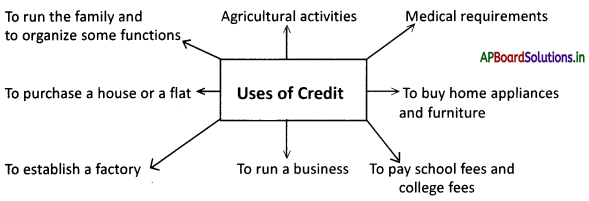
→ There are many reasons for taking credit A large number of transactions in our day-to¬day activities involve credit in some form or the other.

→ Interest rates, collateral and documentation requirement, and the mode of repayment together comprise what is called the terms of credit

→ There are two types of sources of credit One formal and the other informal.

→ Banks and cooperatives come under formal sources of credit The informal lenders are moneylenders, traders, employers, relatives, and friends,

→ Informal sources of credit are the reason for rural indebtedness.

AP Board Solutions AP Board 9th Class Social Studies Notes Chapter 9 Credit in the Financial System

→ Self-help groups give loans to the rural poor especially women without collateral and documentation. They save women from the exorbitant interest rates of money lenders. Group members are jointly responsible for the repayment of loans. These loans created self-employment and made women self-reliant

→ Demand deposits Since the deposits in the bank can be withdrawn on demand, these deposits are called demand deposits.

→ Economic activities: All the activities that deal with money involving – production, industrial activities, and trading activities, and other purposeful activities are called economic activities.

→ Cooperative societies: A business or organization owned equally by all the people working in the field, i.e. agriculture or mining or handlooms, etc.

→ Commercial banks: All institutions that accept deposits and lend loans and work under the regulations of the Reserve Bank of India are called commercial banks.

AP Board Solutions AP Board 9th Class Social Studies Notes Chapter 9 Credit in the Financial System

→ Informal sources of credit: All the people, who do not follow any rules and regulations in issuing loans together are called informal sources of credit. e.g.: Moneylenders, traders, friends, relatives, etc.
AP Board 9th Class Social Studies Notes Chapter 9 Credit in the Financial System 1

AP Board 9th Class Social Studies Notes Chapter 9 Credit in the Financial System 2

→ New Initiatives: The RBI has been taking steps for improving the financial access to people in rural areas. Banks operate in rural areas either through branches or through Business Correspondents (BCs). A Business Correspondent is an approved bank agent providing basic banking services using a Micro ATM (terminal). These Business Correspondents encourage people in rural and remote areas to open bank accounts, save money and also use loan facilities provided by the banks. Bio-metric smart card identification systems are used to open these accounts.

→ Aadhaar Enabled Payment System (AEPS):

  • AEPS is a new payment service offered by the National Payments Corporation of India (NPCI) to banks, financial institutions using the ‘Aadhaar’ number and online UIDAI authentication through their respective Business Correspondent service centers.
  • The customer needs his / her bank account linked to their Aadhaar number with the bank offering the AEPS service.
  • A customer can at present avail of the following four services using AEPS through the micro – ATMs at BCs :
    (a) Cash Withdrawal
    (b) Cash Deposit
    (c) Balance Enquiry
    (d) Fund transfer

→ Financial Literacy: Financial Literacy is the process of equipping oneself with knowledge and information on financial matters. Taking interest in financial literacy helps one to have better financial planning, puts them in a better position to achieve their financial goals, and protect themselves from frauds and debt traps. It aims to inculcate savings habits, improve the understanding of financial products leading to effective use of financial services, and thus helps better money management. Further, financial literacy facilitates easy access to financial services.
Financial literacy material is available on the website of the Reserve Bank of India (www.rbi.org.in).

→ The financial literacy material available now covers subjects such as features of genuine banknotes, know your Reserve Bank, how RBI touches the life of the common person, caution against emails/ SMS offering huge sums of money from abroad, caution against providing bank account details on the internet, information of loan products available from banks, why save with banks ?, grievance redressal mechanism, Banking Ombudsman Scheme, caution against depositing money in unincorporated bodies/ unlicensed entities, Deposit Insurance (Are my deposits safe in banks ?, What is Deposit Insurance and Credit Guarantee Corporation), etc.

→ Financial literacy information is available in brochures/pamphlets prepared by RBI and other banks. Further, RBI has developed com¬ics on financial literacy subjects for the benefit of the school children. ‘Raju and the Money Tree’, ‘Money Kumar and Monitory Policy’ etc., are the names of the comics that can be downloaded from the RBI website mentioned above. In addition to the above, for the ben¬efit of word illiterate persons in rural, urban and remote areas, the State Level Bankers Committee (SLBC), Andhra Pradesh has prepared an audio CD on the benefits of saving with banks.

→ Financial Literacy is an important adjunct for promoting financial inclusion, consumer protection, and ultimately financial stability. Financial inclusion and financial literacy need to go hand in hand to enable the common man to understand the need and benefits of the products and services offered by formal financial institutions. In India, the need for financial literacy is even greater considering the low levels of literacy and the large section of the population that are still out of the formal financial setup. Financial literacy has assumed greater importance in recent years as financial markets have become increasingly complex and the common man finds it very difficult to make informed decisions. Further, in view of a higher percentage of household savings in our country, financial literacy can play a significant role in the efficient allocation of household savings and the ability of individuals to meet their financial goals.

AP Board 8th Class Social Studies Notes Chapter 19 Social and Religious Reform Movements

Students can go through AP State Board 8th Class Social Studies Notes Chapter 19 Social and Religious Reform Movements to understand and remember the concept easily.

AP State Board Syllabus 8th Class Social Studies Notes Chapter 19 Social and Religious Reform Movements

→ Many Christian missionaries came to India along with the European companies to preach Christianity in India.

→ The Europeans introduced the printing press in India.

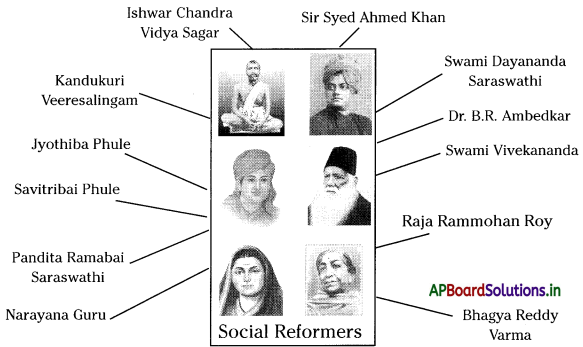
→ In 1828 Rammohan Roy founded the Brahmo Samaj.

→ Swami Vivekananda was a disciple of Ramakrishna and he set up the Ramakrishna Mission.

→ Swami Dayananda Saraswathi set up Arya Samaj in 1875.

→ The suppression of the revolt of 1857 had created a lot of bitterness between Muslims and the British.

→ Sir Syed Ahmed Khan started the Aligarh Movement for the spread of modern education and social reforms among Muslims.

AP Board Solutions AP Board 8th Class Social Studies Notes Chapter 19 Social and Religious Reform Movements

→ Kandukuri Veeresalingam was a social reformer of the Andhra Region.

→ Savitribai Phule along with her husband Jyothiba Phule played an important role in improving women’s rights in Maharashtra.

→ Ramabai devoted her life to helping women, especially widows.

→ Jyothiba Phule founded Satya Shodhak Samaj to build a new society based on truth and equality.

→ Narayana Guru was a religious leader who preached the idea of “One Jathi, One God and One Religion for all”.

→ Some of the reformers called Dalits of Andhra Pradesh ‘Adi Andhras’.

→ Gandhiji encouraged women to participate in the Non-Cooperation Movement and Satyagrahas.

→ Ambedkar founded an Independent Labour Party to represent the interests of the Dalits.

→ Reforms: A change in any pattern.

→ Sati: In some parts of the country, upper-caste women were burnt along with the bodies of their dead husbands. This was called ‘Sati’.

AP Board Solutions AP Board 8th Class Social Studies Notes Chapter 19 Social and Religious Reform Movements

→ Purdah: There ¡s a system for women covering their faces with some clothes or sarees. This is known as the Purdah system.

→ Widow marriages: In the olden days the widows were suffered a lot in their families. So some reformists worked on this and introduced remarriages to them.

→ Untouchability: It was a sin in society. Some castes in the society were treated as lower castes. And the higher caste people wouldn’t touch them. These were called untouchability.
AP Board 8th Class Social Studies Notes Chapter 19 Social and Religious Reform Movements 1

AP Board 8th Class Social Studies Notes Chapter 18 Rights Approach to Development

Students can go through AP State Board 8th Class Social Studies Notes Chapter 18 Rights Approach to Development to understand and remember the concept easily.

AP State Board Syllabus 8th Class Social Studies Notes Chapter 18 Rights Approach to Development

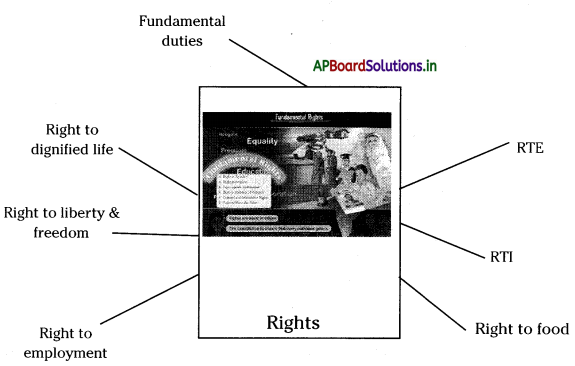
→ The right to liberty and freedom means that they can do, believe and speak out what they want without fear and live the life of their choice.

→ It is important to pass laws that sanction the economic and welfare rights of all people.

→ The Government of India has made laws related to the right to information, employment, and school education.

→ RTI prescribes that any individual can get documents from the government.

→ Under the RTI it is also compulsory for every government office to declare certain information in public even without being asked by the people.

→ RTE declares that all children of the age of 6 to 14 have the right to free education.

→ Children should be taught in their mother tongue.

AP Board Solutions AP Board 8th Class Social Studies Notes Chapter 18 Rights Approach to Development

→ The 86th Amendment of the Constitution, which made education a fundamental right was passed in the year 2002.

→ Human Rights: All human beings, irrespective of who they are, – their caste, gender, religion, country, etc., whether they are law-abiding or criminals have certain basic rights which cannot be denied to them.

→ RTI: Right to Information. This law prescribes that any individual can get documents like government orders, reports, advice, logbooks, rules and regulations, attendance lists, letters, etc. (Some exceptions are there).

→ RTE: Right to Education. It is a law. It declares that all children of the age 6 to 14 years have the right to free education etc.

AP Board Solutions AP Board 8th Class Social Studies Notes Chapter 18 Rights Approach to Development

→ Liberty: The state of being free or the ability to act as you please.
AP Board 8th Class Social Studies Notes Chapter 18 Rights Approach to Development 1

AP Board 9th Class Social Studies Notes Chapter 8 Service Activities in India

Students can go through AP State Board 9th Class Social Studies Notes Chapter 8 Service Activities in India to understand and remember the concept easily.

AP State Board Syllabus 9th Class Social Studies Notes Chapter 8 Service Activities in India

→ Services rendered by different people in any specified activity are known as service activities. They are not producing anything tangible. Nothing is done free of cost It is their livelihood. Service activities are required for agriculture and industrial activities.

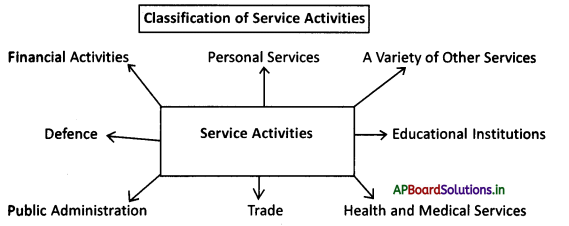
→ We can classify the service activities into

  1. Education
  2. Health and Medical Services
  3. Trade
  4. Public Administration
  5. Defence
  6. Financial activities
  7. Personal Services and
  8. A variety of other activities.

→ Developmental activities such as infrastructure facilities are also a part of service a&bivities.

→ The continuously changing technology has changed job opportunities for educated personnel in India.

→ Business Process Outsourcing, Telecommunications, the entertainment industry, internet cafes, public booths, the advertising agencies and banks etc., have brought in new kinds of jobs to the educated or highly skilled in India.

AP Board Solutions AP Board 9th Class Social Studies Notes Chapter 8 Service Activities in India

→ But unskilled has low earning employment opportunities in service activity.

→ These service jobs although bring a lot of income to families but at the same time bring stress to the new jobs that they do.

→ In 2012, the government has allowed foreigners to invest in selling goods in India. There will be gainers and losers from FDI in retail but the overall gains will outweigh the losses.

→ Call Centre: A call centre is an office where people work answering or making telephone calls for a particular company or customer regarding certain information.

→ Service Activities: Services rendered by duff rent people in any specified activity, are known as service activities.

→ Outsourcing: Outsourcing is a process through which a company makes the things done by outsiders and pays them. As a result number of jobs or recruitment will be reduced.

→ Information Technology: The use of electronic processes for gathering and storing information and making it available using computers.

→ Economic Development: Economic development is the process whereby the real per capita income of a country increases over a long period of time in which the number of people below the poverty line does not increase and there is the reduction of economic inequalities.

→ Retail Trade: Retail trade is the activity of selling goods directly to the public, usually in small quantities.

AP Board Solutions AP Board 9th Class Social Studies Notes Chapter 8 Service Activities in India

→ Multinational Company: A multinational Company has branches or owns companies in many different countries,
im-AP Board 9th Class Social Studies Notes Chapter 8 Service Activities in India 1