AP Board 8th Class Social Studies Notes Chapter 17 Understanding Poverty

Students can go through AP State Board 8th Class Social Studies Notes Chapter 17 Understanding Poverty to understand and remember the concept easily.

AP State Board Syllabus 8th Class Social Studies Notes Chapter 17 Understanding Poverty

→ The situation of chronic hunger is widespread in India.

→ The energy is measured in kilocalories (k.cal.).

→ The national calorie standard was established as 2,400 and 2,100 k.cal. per day for rural and urban areas.

→ Hunger is not just painful to bear, it is also destructive.

→ Chronic hunger and calorie deficiency are related to undernourishment.

→ Constant hunger weakens the immune system.

→ The most important contributor to poverty is the lack of regular employment.

→ More than 50% of people in India, still depend upon agricultural activities for their livelihood.

AP Board Solutions AP Board 8th Class Social Studies Notes Chapter 17 Understanding Poverty

→ In Andhra Pradesh, nearly 2/5ths of all rural families are mainly agricultural laborers.

→ The Right to Work states that everyone should be given the opportunity to work for a basic living.

→ After years of struggle by people’s groups the Mahatma Gandhi National Rural Employment Guarantee Act (MNREGA), 2005 was passed.

→ Alongside employment, the government has to ensure that everyone has access to affordable food.

→ The system of ration shops distributing foodgrains and other essential items is known as the Public Distribution System.

→ Based on BPL survey results, three types of cards were issued.

→ Ration shops are also called fair-price shops.

→ Undernourishment: Lack of nutrition in the food we take 1n :

→ Agricultural growth: At present agriculture is ¡n a critical stage. Facing all the negativities, it should be taken forward. This is called agricultural growth.

→ Directive Principles: The principles which direct the government

→ Public works: Works that are useful to the public

→ Social audit: It is meant for reducing corruption in government.

AP Board Solutions AP Board 8th Class Social Studies Notes Chapter 17 Understanding Poverty

→ Below Poverty Line: It is a survey that takes into account the family’s income, means of livelihood, number of meals per day, clothing, housing, migration, debt, etc., to decide whether a household is a poor household.

→ Public Distribution: The system of ration shops distributing foodgrains and other System essential items is known as the Public Distribution System.
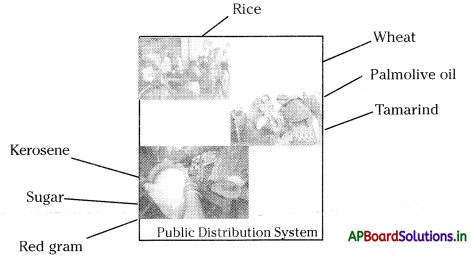
AP Board 8th Class Social Studies Notes Chapter 17 Understanding Poverty 1
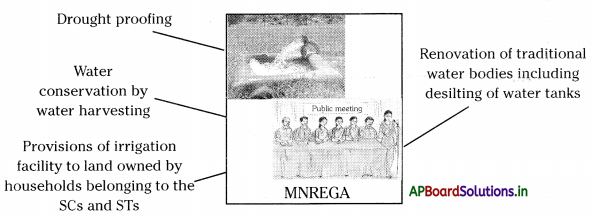
AP Board 8th Class Social Studies Notes Chapter 17 Understanding Poverty 2

AP Board 10th Class Physical Science Notes Chapter 12 Carbon and its Compounds

Students can go through AP State Board 10th Class Physical Science Notes Chapter 12 Carbon and its Compounds to understand and remember the concept easily.

AP State Board Syllabus 10th Class Physical Science Notes Chapter 12 Carbon and its Compounds

→ Carbon always forms covalent bonds.

→ Carbon is present in all substances of animal and vegetable origin.

→ The ability of carbon to unite with an indefinite number of carbon atoms in straight branched or cyclic chains is known as catenation.

→ Carbon and hydrogen combine together in different proportions to form a large number of compounds called hydrocarbons.

→ There are two types of hydrocarbons – saturated and unsaturated.

→ Alkanes are represented by the general formula CnH2n+2.

→ Alkenes are represented by the general formula CnH2n.

→ Alkynes are represented by the general formula CnH2n-2.

→ Organic compounds having the same functional group and common properties but differing in the molecular formula from the next member by one CH2 group, form a homologous series and such compounds are called homologs.

→ Compounds with the same molecular formula but different structural formulas are known as isomers.

→ The decomposition of alkanes on heating in the absence of oxygen is known as cracking.

→ Methane is prepared by heating a mixture of sodium acetate and soda-lime.

→ When ethanol is heated with an excess of concentrated H2SO4 at 160° C ethane gas is produced.

→ Natural gas is a mixture of gaseous hydrocarbons mainly methane, ethane, propane, and butane.

→ Natural gas is used as a fuel.

→ Compressed Natural Gas (CNG) is used as an alternative to petrol as automobile fuel.

→ Ethanol and Ethanoic acid are important carbon compounds in our daily life.

AP Board Solutions AP Board 10th Class Physical Science Notes Chapter 12 Carbon and its Compounds

→ The molecules of soap are sodium or potassium salts of long-chain carboxylic acids.

→ Detergents are ammonium or sulfate salts of long-chain carboxylic acids.

→ The action of soaps and detergents is based on the presence of both hydrophobic and hydrophilic groups in the molecule and this helps to emulsify the oily dirt and hence its removal.

→ Alcohols are organic compounds that contain hydroxyl group (-OH) bonded to a carbon atom.

→ Alcohols are neutral to litmus.

→ Alcohols are poor conductors of electricity.

→ Alcohols react with sodium to liberate hydrogen gas.

→ Carbon chains may be in the form of straight chains, branched chains of rings.

→ Saturated hydrocarbons on combustion give carbon dioxide and water with the liberation of heat.

→ Unsaturated hydrocarbons undergo addition reactions while saturated hydrocarbons undergo substitution reactions.

→ The occurrence of the same element in two or more different forms is known as allotropy.

→ Hybridization: The redistribution of orbitals of almost equal energy in individual atoms to give an equal number of new orbitals of equivalent energy is called hybridization.

→ Allotropy: The property of an element to exist in two or more physical forms having more or less similar chemical properties but different physical properties is called allotropy.

→ Diamond: A transparent form of carbon that is the hardest known material

→ Graphite: A soft dark grey or black form of carbon that occurs naturally as a mineral.

→ Buck minster fullerene: A hollow molecule, spherical like a football, has 20 hexagons and 12 pentagons, having 60 vertices on its surface and made from 60 atoms of carbon.

→ Nanotubes: Nanotubes are another allotropic form of carbon.

→ Catenation: Any element forms bands among its own atoms to give big molecules. This property is called catenation.

→ Tetravalency: The valency of a carbon atom is four. This valency of carbon otherwise is called tetravalency.

AP Board Solutions AP Board 10th Class Physical Science Notes Chapter 12 Carbon and its Compounds

→ Hydrocarbons: The compounds containing only carbon and hydrogen in their molecules are called hydrocarbons.

→ Alkanes: Hydrocarbons containing only single bonds between carbon atoms are called alkanes.

→ Alkenes: Hydrocarbons containing at least one double bond between carbon atoms are called alkenes.

→ Alkynes: Hydrocarbons containing at least one triple bond between carbon atoms are called alkynes.

→ Saturated hydrocarbons: The hydrocarbons containing C – C single bonds are known as saturated hydrocarbons.

→ Unsaturated hydrocarbons: The hydrocarbons containing at least one double bond (C = C) or containing at least one triple bond (C C) between the two carbon atoms are called unsaturated hydrocarbons.

→ Functional group: An atom or a group of atoms in an organic molecule, which is responsible for the compound’s characteristic reactions and determines its properties is known as a functional group.

→ Isomerism: The phenomenon of possessing the same molecular formula but different properties by the compounds is known as isomerism.

→ Homologous series: The series of carbon compounds in which two successive compounds differ by – CH2 unit is called homologous series.

→ Nomenclature: The naming of organic compounds is known as nomenclature.

→ Combustion: The process of burning carbon or carbon compound in excess of oxygen to give heat and light is called combustion.

AP Board Solutions AP Board 10th Class Physical Science Notes Chapter 12 Carbon and its Compounds

→ Oxidation: The addition of oxygen to a given compound or removal of hydrogen from the compound is called oxidation.

→ Addition reaction: The reaction in which an unsaturated hydrocarbon combines with another substance to give a single product is called an addition reaction.

→ Substitution reaction: The reaction in which one or more hydrogen atoms of a hydrocarbon are replaced by some

other atoms (like chlorine) is called a substitution reaction.

→ Ethanol: Ethanol is the second member of the homologous alcoholic series. Its formula is C2H5OH.

→ Ethanoic adds: It is the second member of the homologous series of carboxylic acids. Its formula is CH3COOH.

→ Ester: Esters are organic compounds that contain the functional group – COO and whose general structural formula is
AP Board 10th Class Physical Science Notes Chapter 12 Carbon and its Compounds 1
where R = H or an alkyl group and R’ is an alkyl group. R and R’ may be the same or different.

→ Esterification: The reaction in which a carboxylic acid combines with an alcohol to form an ester is called esterification.

→ SaponIfication: The process of making soap by the hydrolysis of fats and oils with alkalies is called saponification.

AP Board Solutions AP Board 10th Class Physical Science Notes Chapter 12 Carbon and its Compounds

→ Micelle: A spherical aggregate of soap molecules in the soap solution in water is called a micelle.
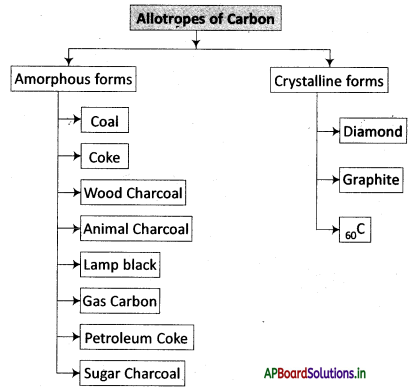
AP Board 10th Class Physical Science Notes Chapter 12 Carbon and its Compounds 2

→ Enrico Fermi (1901 – 1954)

  • Enrico Fermi was born in Rome on September 29, 1901.
  • He became a professor of theoretical physics at the University of Rome in 1927.
  • Fermi received the Nobel Prize in 1938 for his “discovery of new radioactive elements produced by a neutron in radiation, and for the discovery of nuclear reactions brought about by slow neutrons”.
  • Fermi’s momentous accomplishment caused him to be recognized as one of the great scientists of the 20th century.

AP Board 9th Class Social Studies Notes Chapter 7 Industries in India

Students can go through AP State Board 9th Class Social Studies Notes Chapter 7 Industries in India to understand and remember the concept easily.

AP State Board Syllabus 9th Class Social Studies Notes Chapter 7 Industries in India

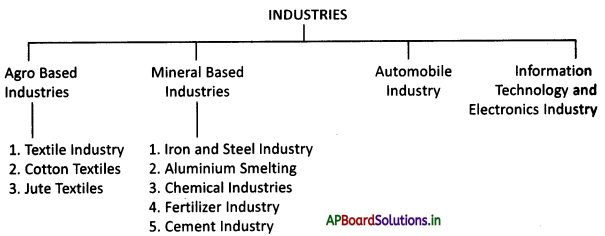
→ In a manufacturing production process, the raw materials are worked upon by people and changed using tools and machines to produce a good that can be useful

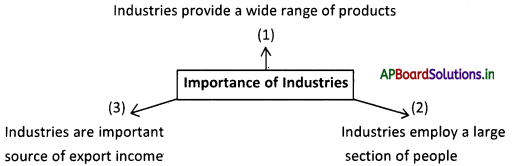
→ Industries produce a large variety of goods, generate employment and earn foreign exchange.

→ Machines, electricity, minerals and ores and transport facilities are basic needs and the government has taken responsibility to provide these basic goods.

→ During the early years of industrialization industrial production was increased But there were a lot of restrictions hence the Indian industry could not modernize.

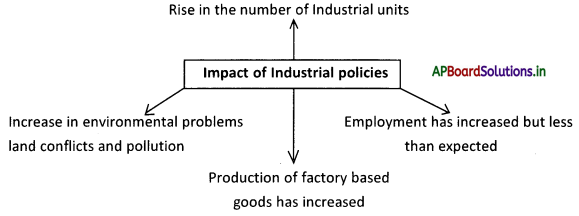
→ In the 1990s, the government introduced new policies for industries. Many activities which were earlier restricted only to the government are now allowed for the private industries. Rules were relaxed

→ Due to that, there was a rise in the number of industrial units. Employment has increased but less than expected and of low paying quality.

→ Large industries began to replace workers with technology. This led to almost zero additional employment in large factories.

→ In the course of production, these industries release a lot of other materials They are causing pollution in the industrial locations.

→ Colonial rule: Under British rule. (During the middle age the European countries occupied much of African and Asian countries and established their trading centers or colonies. We were under the colonial rule of the British)

AP Board Solutions AP Board 9th Class Social Studies Notes Chapter 7 Industries in India

→ Consumer goods: The goods which are directly consumed by the consumers are known as consumer goods.

→ Infrastructure facilities: Building of roads, good transport facilities such as roadways, railways. waterways and airways. provision of power supply, development of telephone lines, etc. are known as infrastructure facilities.

→ Basic goods industries: Industries or factories producing essential goods such as machines, electricity, minerals, and ores, and transport facilities are basic industries.

→ Self-sufficiency: Ability to provide all the things needed without external help.

→ Per capita consumption: Average consumption by each person.

→ Liberalization: Process by which government controls usually in the areas of social or economic policies are relaxed or even removed.

AP Board Solutions AP Board 9th Class Social Studies Notes Chapter 7 Industries in India

→ Foreign exchange: Foreign exchange is used to refer to foreign currency that is obtained through a foreign exchange system.
AP Board 9th Class Social Studies Notes Chapter 7 Industries in India 1
AP Board 9th Class Social Studies Notes Chapter 7 Industries in India 2
AP Board 9th Class Social Studies Notes Chapter 7 Industries in India 3

→ The first jute mill was set up near Kolkata in 1859 at Rishra. After Partition in 1947, the jute mills remained in India but three-fourth of the jute producing area went to Bangladesh (erstwhile East Pakistan).

AP Board 8th Class Social Studies Notes Chapter 16 Abolition of Zamindari System

Students can go through AP State Board 8th Class Social Studies Notes Chapter 16 Abolition of Zamindari System to understand and remember the concept easily.

AP State Board Syllabus 8th Class Social Studies Notes Chapter 16 Abolition of Zamindari System

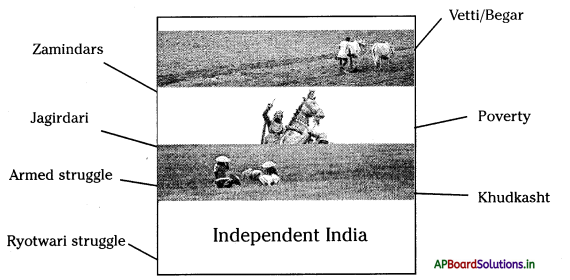
→ In India, a very large proportion of peasants were landless.

→ At the time of independence it was widely agreed that in order to end rural poverty, it was most important to give the poor access to land for cultivation.

→ The law to abolish the zamindari system was passed in the 1950s.

→ The zamindar’s own land is called Khudkasht.

→ As per the new laws the government took over the waste and forest lands held by zamindars.

→ The Madras Estate Bill came into force in 1950.

→ In the Telangana region, the powerful movement of the peasants was underway when the Nizam state was merged with India.

→ The famous Hyderabad Tenancy Act was passed in 1950 protecting all types of tenants.

→ Bhoodan means donating land to the landless.

→ The Challapalli Zamindar showed 2650 acres under his sugar factory.

→ Land Ceiling Acts were passed in most states after 1972.

AP Board Solutions AP Board 8th Class Social Studies Notes Chapter 16 Abolition of Zamindari System

→ The Land Ceiling Act defined a family with 5 members as a unit.

→ Several landlords gave false declarations to the officers and did not reveal the excess land.

→ One of the states in which the Land Ceiling Act was more efficiently implemented was West Bengal.

→ Land Ceiling: There is a limitation in the ownership of land – one unit – 10 to 27 acres of irrigated land and 35 to 54 acres of dryland

→ Jagirdari system: Lands were divided into jagirs and were ruled/administered by Jagirdars.

→ Firman: A Nizam government’s order.

→ Tenancy Act: The act which makes tenants as landowners

→ Bhoodan movement: A movement which was led by Sri Acharya Vinoba Bhave, it aims ‘donating land to the landless.

→ Sarf-e-Khas: Nizam’s own land

→ Maktas: Small kingdoms ¡n Nizam’s rule

AP Board Solutions AP Board 8th Class Social Studies Notes Chapter 16 Abolition of Zamindari System

→ Land holdIng: A piece of land owned by a person

→ Begar/Vetti: Working for somebody without any benefit

→ Compensation: Something which is received on behalf of something lost

→ Khudkasht: Own land of zamindars
AP Board 8th Class Social Studies Notes Chapter 16 Abolition of Zamindari System 1

AP Board 8th Class Social Studies Notes Chapter 15 Law and Justice: A Case Study

Students can go through AP State Board 8th Class Social Studies Notes Chapter 15 Law and Justice: A Case Study to understand and remember the concept easily.

AP State Board Syllabus 8th Class Social Studies Notes Chapter 15 Law and Justice: A Case Study

→ If you have to make a complaint to the police, it is necessary to file an FIR at the police station.

→ A copy of the FIR should be given free of charge to the person making the report.

→ One important function of the police is to investigate any complaint about the crime.

→ It is not the job of the police to punish the accused.

→ Civil cases are related to people’s rights over land, property, income and people’s relationships with one another.

→ The police take charge of the criminal case because it is a violation of law made by the government.

→ Bail is a right of the accused.

→ A criminal offence is registered as a public wrong.

→ The judge is like an umpire in a game and conducts the trial impartially and in an open court.

→ One of the central features of the Constitution is to separate the powers of Executive, Judiciary and Legislative.

AP Board Solutions AP Board 8th Class Social Studies Notes Chapter 15 Law and Justice: A Case Study

→ Each state has a High Court which is the highest court of that state.

→ Supreme Court is located in New Delhi.

→ Accused: The person who has done something wrong.

→ FIR: First Information Report gathered by the police.

→ Offence: A breach of law or rule; an illegal act.

→ Investigation: A formal inquiry or systematic study.

→ Arrest: To seize a person by legal authority or warrant.

→ Summons: An order to appear before a judge or magistrate.

→ Witness: One who furnishes evidence.

→ Fair Trial: A trial by a neutral and fair court.

→ Judgement: The legal document stating the reasons for a judicial decision.

AP Board Solutions AP Board 8th Class Social Studies Notes Chapter 15 Law and Justice: A Case Study

→ Appeal: To make a serious or urgent request to the public.

→ Breach of contract: Failure to do something that is required in a contract.

→ Client: A person receiving social or medical services.

→ Public Prosecutor: A law officer who conducts criminal proceedings on behalf of the government or in the public interest.

→ Bail: The temporary release of an accused person awaiting trial.

AP Board Solutions AP Board 8th Class Social Studies Notes Chapter 15 Law and Justice: A Case Study

→ ‘Magistrate: A civil officer or judge who administers the law, especially who conducts a court that deals with minor offences.
AP Board 8th Class Social Studies Notes Chapter 15 Law and Justice A Case Study 1

AP Board 9th Class Social Studies Notes Chapter 6 Agriculture in India

Students can go through AP State Board 9th Class Social Studies Notes Chapter 6 Agriculture in India to understand and remember the concept easily.

AP State Board Syllabus 9th Class Social Studies Notes Chapter 6 Agriculture in India

→ Agriculture is an age-old economic activity in our country. Farming varies from subsistence to commercial type.

→ Subsistence farming: This type of farming is alone in two forms. They are Simple Subsistence Farming and Intensive Subsistence Farming.

→ Commercial farming: The main characteristic of this type of farming is the use of higher doses of modern inputs, chemical fertilizers, insecticides, and pesticides in order to obtain higher productivity. The plantation is also a type of commercial farming.

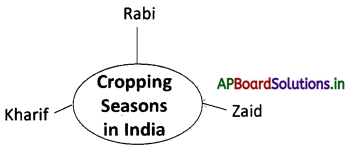
→ Agriculture crops depend on seasons and natural resources such as soil, water, and sunshine for cultivation. India has three cropping seasons.

  1. Rabi
  2. Kharif
  3. Zaid

→ Major Crops: A variety of food and non-food crops are grown in different parts of the country.

Major crops grown in India are:

  • Rice: It is a Kharif crop. High temperatures, heavy rainfall, and high humidity are essential for rice. Grown in the plains of north and northeastern plains of India.
  • Wheat: It is a winter crop. Grown in the northern part of our country.
  • Maize: It is used both as food and fodder. It is grown in old alluvial soil Major Maize producing states are Karnataka, Uttar Pradesh, Bihar, Telangana, Andhra Pradesh, and Madhya Pradesh.

→ Millets, Pulses, Sugarcane, Oilseeds, Tea are some other important crops.

→ Horticulture Crops: India is the largest producer of fruits and vegetables in the world

AP Board Solutions AP Board 9th Class Social Studies Notes Chapter 6 Agriculture in India

→ Non-Food Crops: Rubber, fiber crops such as cotton, jute, silk are important non-food crops.

→ Environmental Effects of New-Agricultural Technologies: The Green Revolution has brought in several environmental imbalances: In Punjab, Haryana, and parts of Uttar Pradesh, most farmers have shifted to the cultivation of HYVs of rice and wheat, which require plenty of water.

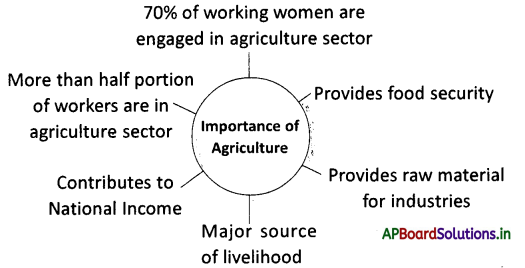
→ The food security of a nation depends on agriculture. A variety of raw materials required for industries are cultivated on farms. Agriculture is also a major source of livelihood for millions.

→ Two kinds of people are engaged in farming – agricultural laborers and cultivators.

→ A variety of crops are cultivated by farmers in India. They are food grains and non-food grains.

→ There are two challenges for the country

  1. to grow food in sufficient quantity and
  2. to ensure that people are not undernourished even when we have food available.

→ Agriculture crops depend on seasons and natural resources such as soil and water and sunshine for cultivation. Temperature and humidity conditions are important

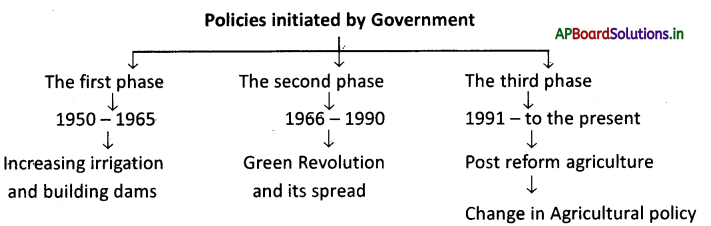
→ The newly formed Indian Government also made (initiated) other important policy changes.
(a) The First Phase: Between 1950-65, big dams for irrigation and electricity generation like Bhakra-Nangal, Damodar Valley, Hirakund, Nagarjuna Sagar, etc. were constructed.

(b) The Second Phase – Green Revolution and its Spread: The government introduced a new kind of seeds to the Indian soil It was also accompanied by the use of chemical fertilizers, machinery such as tractors, and others besides irrigation facilities. High Yielding Varieties of seeds and fertilizers were the key elements of new agricultural technologies.

AP Board Solutions AP Board 9th Class Social Studies Notes Chapter 6 Agriculture in India

→ Effects of Green Revolution: The spread ofHYVs to large parts of the country and to newer crops have led to a significant increase in crop production in the country. As a result of the import of food- grains from other countries were reduced. Today farmer is able to produce nearly 800 kilograms of foodgrains per acre of cultivable land

→ The Green Revolution has brought in several environmental imbalances.

(c) The Third Phase – Post reform agriculture: Foreign trade in food products was not allowed The Government started offering minimum support prices. Thus the Indian farmer produced for markets within the country.

→ In recent years, however, the support of the government has not been so strong. For example, the government has started only a very few new irrigation projects. So a large section of farmers are compelled to depend on rainfall

→ Chemical fertilizer: Fertilizers that are prepared by using petro-chemicals are called chemical fertilizers. They are proved to be harmful to agriculture.

→ Green Revolution: It is a specific program introduced to increase the productivity of agriculture by using a high-yielding variety of seeds.

→ Organic Material: The material obtained from degrading all the biological waste in the compost pit can be termed as organic material.

→ Dryland Agriculture: The agriculture carried on the lands which cannot easily be irrigated is known as dryland agriculture.

→ Modern Farming Practices: The use of High Yielding Varieties of seeds, fertilizers, and use of machinery, etc., are modern farming practices.

AP Board Solutions AP Board 9th Class Social Studies Notes Chapter 6 Agriculture in India

→ Foreign Trade Policy: Policy of government regarding imports and exports.

→ Bio-chemical: Bio-chemical fertilizers are prepared by using biological materials. often they are used to enrich the soil.

→ Tropical climate: The hot climate which can be experienced within the tropics.

→ Environmental problems: Problems related to our environment are called environmental problems.

→ Environmental imbalances: Any disturbance created to our natural surroundings in which we live or exist. e.g.: Reduction in groundwater levels etc.

AP Board 9th Class Social Studies Notes Chapter 6 Agriculture in India 1
AP Board 9th Class Social Studies Notes Chapter 6 Agriculture in India 2
AP Board 9th Class Social Studies Notes Chapter 6 Agriculture in India 3

→ High Yielding Varieties: High Yielding Varieties of seeds and fertilizers were the key elements of new agriculture technologies. The HYV5 seeds grew well when fertilizers and water were used; they had larger amounts of grain and shorter stalks and a short period of maturity in most cases. The short period of maturity also enables double cropping-farmers can to use their lands more than once a year.

→ This policy was initially implemented in Punjab, Haryana, Western Uttar Pradesh, and in some districts of Andhra Pradesh and Tamilnadu. The HYV seeds required a lot of water and these areas were already irrigated. The new variety of wheat was grown in Punjab, Haryana, and Western Uttar Pradesh, while the rice was grown in Andhra Pradesh and Tamilnadu.

→ Organic Farming – The experience of a farmer in Odisha: In order to overcome the ill effects of the Green Revolution, farmers in India have begun to adopt different farming practices. Let us look at an example. Aged 80, Natwarbhai is a resident of Narishu village, near Niali in Cuttack district, Odisha. A retired school teacher, he has been practicing organic farming for the last decade or so, and swears by its potential to feed India’s population. He says some of the varieties he grows yield over 20 quintals per acre, higher than the so-called ‘high yielding varieties that farmers around him get after using chemical fertilizers and pesticides. And he spends much less since his main inputs are gobar, natural pesticides when occasionally needed, and family labor.

AP Board Solutions AP Board 9th Class Social Studies Notes Chapter 6 Agriculture in India

→ Natwarbhai was earlier a ‘modern’ farmer. One day, while watching a laborer spray Carbofuran (a highly toxic pesticide), he was horrified to see him stagger and collapse. Rushed for treatment, the worker survived, but not Natwarbhai’s faith in the new agriculture. Especially after the laborer told him: “I could not breathe, my head was reeling”; and especially after, having buried the remaining stock of Carbofuran in a pit in his fields, Natwarbhai “saw dead snails, snakes, and frogs floating in the water that had accumulated there. “I immediately wondered what would be happening to the earthworms and micro-organisms that I knew kept the soil alive.” Natwarbhai switched to organic inputs, but with the high yielding varieties that them all, noting down their names, characteristics, and productivity.

→ What is fertile soil?
To be fertile, the soil has to provide the roots of plants with the right amounts of water, minerals, and air. To do this, it must have the correct texture and the correct composition. Soil is composed of mineral particles (which come from the breakdown of rocks) as well as organic components (which are or have come from living organisms). To be available to roots, the minerals must be dissolved in the water.

→ Why Government buys and stores some grain?
A lot of grain comes into the market at harvest time. One problem farmers faced was the low price of grain during this time. This means farmers were not able to sell grain at a high enough price to be able to repay their loans and continue using the new farming methods. They need to be protected from traders who might try to purchase the grains at low prices. Therefore, the government decided to set a Minimum Support Price (MSP). A Minimum Support Price is a price at which the farmers can sell their grain, if they want, to the government. The government sets the MSP so as to cover the cost of cultivation and allow a little bit of profit to the farmer. Because of the MSP, farmers are not forced to sell their grains at cheaper prices to the traders.

→ The Food Corporation of India (FCI) was formed by the government to purchase food grains from the farmers and store them. It keeps stockpiles and supplies grain to ration shops and other government schemes (e.g. for midday meals in schools).

AP Board 8th Class Social Studies Notes Chapter 14 Parliament and Central Government

Students can go through AP State Board 8th Class Social Studies Notes Chapter 14 Parliament and Central Government to understand and remember the concept easily.

AP State Board Syllabus 8th Class Social Studies Notes Chapter 14 Parliament and Central Government

→ The Constitution provides a parliamentary form of government.

→ Lok Sabha TV telecasts daily the discussions taking place in the Parliament.

→ In 1986, the Parliament adopted a National Policy on Education.

→ There are two houses of Parliament – Lok Sabha and Rajya Sabha.

→ Any ordinary law needs to be passed by both houses. Lok Sabha exercises more powers in money matters.

→ Normally, elections to the Lok Sabha are held every five years.

→ The first general elections were held in 1951-52.

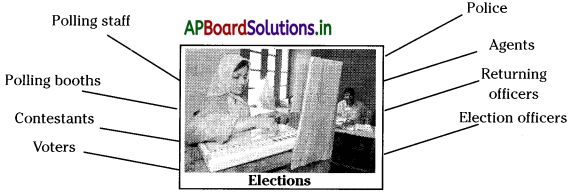
→ An Election Commission was set up to conduct the elections in a free and fair manner.

AP Board Solutions AP Board 8th Class Social Studies Notes Chapter 14 Parliament and Central Government

→ In an ideal situation, every voter is expected to know about the different candidates, their policies and decide whose policies they would prefer and who they think can represent their interests best in the Parliament and then vote.

→ The Election Commission in recent times has taken very strict measures to control illegal practices.

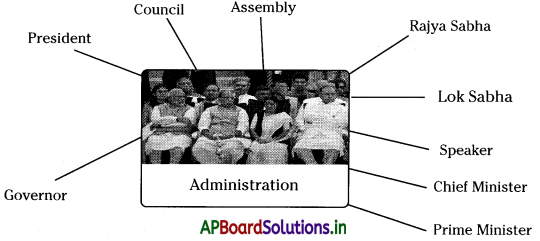
→ The MLAs of all the states and the members of both houses of the Parliament elect the President.

→ The Prime Minister and the Council of Ministers are chosen from among the members of Parliament.

→ All decisions of the government of India are taken in the name of the President.

→ Legislature: The house which is constituted by the elected members of the state in our election. (By the voters)

→ Lok Sabha: The house which is constituted by the elected members of the nation. This is also known as Lower House.

→ Rajya Sabha: Some wise people are elected to this and some are nominated. This is also known as Upper House.

→ Election Commission: An independent statutory body in India

→ Council of Ministers: The Prime Minister appoints some members of Parliament to this council. This is known as the Council of Ministers.

AP Board Solutions AP Board 8th Class Social Studies Notes Chapter 14 Parliament and Central Government

→ Central list: Subjects on which laws can be made only by the Parliament.

→ State list: Subjects on which laws can be made only by State Legislature Assemblies.

→ Concurrent List: Subjects on which laws can be made by both Parliament and State Legislature Assemblies.
AP Board 8th Class Social Studies Notes Chapter 14 Parliament and Central Government 1
AP Board 8th Class Social Studies Notes Chapter 14 Parliament and Central Government 2

AP Board 9th Class Biology Notes Chapter 11 Bio Geo Chemical Cycles

Students can go through AP State Board 9th Class Biology Notes Chapter 11 Bio Geo Chemical Cycles to understand and remember the concept easily.

AP State Board Syllabus 9th Class Biology Notes Chapter 11 Bio Geo Chemical Cycles

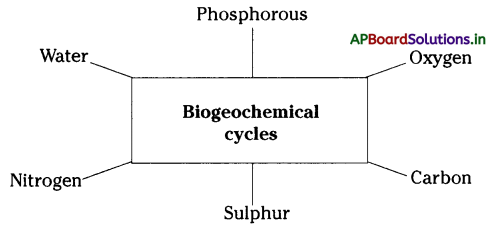
→ The cycles that involve the flow of nutrients on earth involve the flow of nutrients on earth from the environment to organisms and back through certain pathways are known as biogeochemical cycles.

→ The interaction between the biotic and abiotic components of the biosphere consists of the transfer of matter and energy.

→ Biogeochemical pathways determine the path of transfer of matter on earth.

→ Water is a universal solvent and essential for various reactions to take place within a living cell

→ Nearly 97% of all the water on the earth is in the oceans and so only about 3% is freshwater.

→ Water participates in many biochemical mechanisms, including photosynthesis, digestion, and cellular respiration.

→ Water provides hydrogen and oxygen that form an integral part of basic organic compounds of life.

→ About 78% of nitrogen is present in the atmosphere, but plants and animals can not directly use it

→ A number of bacteria and blue-green algae are known to be able to fix atmospheric nitrogen into compounds in their own body e.g.: Rhizobium and Nitrosomonas.

→ The conversion of nitrates to ammonia by the denitrifying bacteria in the soil is known as nitrification.

→ Nitrogen compounds mainly nitrates or ammonium ions (NH3) are taken up from soils by plants through a process known as assimilation.

→ The production of ammonia (NH3) from nitrates and other nitrogenous compounds is called ammonification.

AP Board Solutions AP Board 9th Class Biology Notes Chapter 11 Bio Geo Chemical Cycles

→ Solid (NO3) is converted back to gaseous nitrogen (N2) by a process called I denitrification.

→ Carbon dioxide or CO2 makes up about 0.04% by volume of air.

→ Fixing of carbon in biological form takes place within plants and other organisms known as producers – in a process called photosynthesis.

→ Some gases present in the atmosphere such as carbon dioxide, carbon monoxide, methane, and water vapor trap heat from radiating back to space. This is known as the greenhouse effect

→ Excessive amounts of CO2 and other greenhouse gases trap more amount of heat resulting in global warming.

→ Oxygen is found in the elemental form in the atmosphere to the extent of nearly 21 %.

→ Biological Oxygen Demand (BOD), represents the amount of oxygen needed by aerobic bacteria to decompose the waste.

→ Ozone is concentrated in a layer in the stratosphere, about 15.30 kilometers above the earth’s surface.

→ The ozone layer absorbs ultraviolet radiation from the sun, preventing it from reaching the planet’s surface.

→ Oxygen is also an essential component of most biological molecules like carbohydrates, proteins, nucleic acids, and fats.

→ The Montreal agreement in 1987 was to control and phase out the production and supply of ozone-depleting chemicals specifically chlorofluorocarbons (CFCs).

→ Water cycle or Hydrological cycle: It ¡s a process of constantly recycling water.

→ Nitro gen cycle: In this cycle nitrogen is converted from its inert atmospheric molecular form (N2) into a form that is useful in biological processes.

AP Board Solutions AP Board 9th Class Biology Notes Chapter 11 Bio Geo Chemical Cycles

→ Nitrogen fixation: It is the conversion of atmospheric nitrogen gas into ammonium and nitrates.

→ Nitrification: It is the conversion of nitrates into ammonia by the denitrifying bacteria in the soil.

→ Assimilation: It is the intake of nitrogen compounds mainly as nitrates or ammonium ions (NH) by plants.

→ Ammonification: It is the production of ammonia from nitrates and other nitro generous compounds.

→ Denitrification: It is the conversion of solid nitrate (NO3) to gaseous nitrogen (N2)from animal and plant cells.

→ Carbon cycle: It is the movement of carbon from one component to other components of the ecosystem which ¡s including both living organisms and the abiotic environment.

→ Greenhouse effect: Gases present in the atmosphere such as carbon dioxide, carbon monoxide, methane, and water trap heat from radiating back to space.

→ Global warming: Increase in temperatures of the earth due to the release of more amount of carbon dioxide and other greenhouse gases.

→ Oxygen cycle: Oxygen from the atmosphere is used up mainly by the processes, combustion, respiration and in the formation of oxides of elements like nitrogen, iron, etc., oxygen returns to the atmosphere through photosynthesis.

→ Precursor: A person or thing that comes before.

→ Condensation: The process of a gas changing to a liquid.

→ Precipitation: A chemical process in which solid material is separated from a liquid.

→ Soot: A black powder that is produced when wood, coal, etc. is burnt.

AP Board Solutions AP Board 9th Class Biology Notes Chapter 11 Bio Geo Chemical Cycles

→ Ozone Depletion: Ozone is a molecule containing three oxygen atoms. Certain industrial processes and consumer products result in the emission of ozone-depleting substances into the atmosphere.
AP Board 9th Class Biology Notes Chapter 11 Bio Geo Chemical Cycles 1

→ Though we usually think of oxygen as being necessary to live in the process of respiration, It might be of interest to you to learn that some forms of life, especially bacteria, are poisoned by elemental oxygen. In fact, even the process of nitrogen-fixing by bacteria does not take place in the presence of oxygen.

→ Vladimir Vernadsky:

  • The founder of biogeochemistry was Russian scientist Vladimir Vernadsky whose 1926 book ‘The biosphere’ in the tradition of Mendeleev, formulated a physics of the earth as a living whole.
  • Vernadsky distinguished three spheres, where a sphere was a concept similar to the Rieman concept of a space-phase.
  • He observed that each sphere had its own laws of evolution and that the higher spheres modified and dominated the lower.

AP Board 9th Class Social Studies Notes Chapter 5 Biosphere

Students can go through AP State Board 9th Class Social Studies Notes Chapter 5 Biosphere to understand and remember the concept easily.

AP State Board Syllabus 9th Class Social Studies Notes Chapter 5 Biosphere

→ The Earth is a unique planet that has life thriving on it

→ Air, water, and moderate temperature have made life possible on the earth.

→ AH, forms of life have an integral connection with the land, air, water, and sunshine around them.

→ Many forms of life are symbiotic that is they live by exchanging essential substances with each other.

→ Plants are the primary food producers.

→ Any disturbance in the cycle of life can create an ecological crisis.

→ Since all living and non-living things on earth are in one way or the other connected to each other, change affecting one, in due time affects all others too.

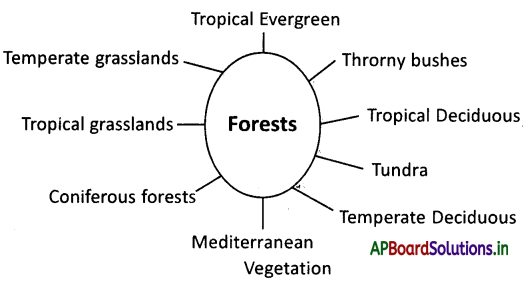
→ Natural vegetation is generally classified into three broad categories.
(a) Forests in areas of sufficient rainfall and sunshine.
(b) Grasslands regions of moderate rains.
(c) Shrubs in dry regions.

→ The thick forests which occur in the regions near the equator and close to the tropics are called tropical rainforests (or) tropical evergreen forests.

AP Board Solutions AP Board 9th Class Social Studies Notes Chapter 5 Biosphere

→ The forests in which trees shed their leaves and occur in the regions i&htch experience seasonal changes are called Tropical Deciduous Forests.

→ The forests which are located in the mid latitudinal coastal region are called the temperate Evergreen Forests.

→ The forests in which trees shed their leaves in the dry season and are located in higher latitudes are called Temperate Deciduous Forests.

→ The forests which are located in the west and southwest margins of the continents are called the Mediterranean Vegetation.

→ The trees which can be seen in the higher altitudes, in which tall softwood evergreen trees are grown are called Coniferous Forests.

→ The grasslands that grow on either side of the equator and extend to the tropics are called Tropical grasslands.

→ The thorny vegetation found in the dry desert-like regions is called Thorny bushes. The mosses; lichens and very small shrubs found in polar regions are called Tundra type of vegetation.

→ The building of knowledge of the environment is an essential part of human being’s interaction with the natural world.

→ The increase in population creates great pressure on earth as well as its resources.

→ The immense human industrial activity has had a profound impact on the air; water and the land around us.

→ The burning of fossil fuels releases large quantities of carbon dioxide and other chemicals that cause acid rains.

→ The burning of fossil fuels, release of enormous amounts of waste materials contaminate the air, water, and soil.

→ The cumulative impact of pollution poisons our environment which leads to global warming.

AP Board Solutions AP Board 9th Class Social Studies Notes Chapter 5 Biosphere

→ The extra radiation received at the earth’s surface produces the greenhouse effect The Greenhouse effect in simple terms is the property of the atmosphere, which permits sunlight rather easily and releases that heat with great difficulty.

→ The fertilizers and pesticides used in agriculture eventually remain in the soil and also mix with water and result in contamination of water and soil Urbanisation causes a number of environmental problems.

→ Food chain: It is a complex phenomenon in which one kind of life becomes the food for another kind and so on.

→ Hardwood trees: These are the trees that yield hardwood necessary for making furniture, doors, and windows, etc.

→ Acid rains: Acid rains are caused by the mingling of acid particles of the atmosphere with rain increasing the acid content of rainwater.

→ Ecological crisis: Any disturbance in the cycle of life that goes on can create what s called an ecological crisis’.

→ Tundra: Tundra ¡s a biome where tree growth is hindered by low temperatures and short growing seasons.

→ Global warming: The increase in temperature of the earth’s atmosphere that is caused by the impact of pollutants especially carbon dioxide in the atmosphere.

→ Fossil / Fuel: The remains of animals I plant, which had turned into rock.

→ Steppe: A large land of grass with few trees here and there.

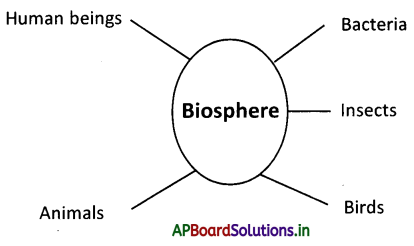
→ Biosphere: The separate sphere that constitutes countless forms of life from microscopic bacteria to great Banyan trees and animals like elephants, tigers, and blue whales and of course human beings is called Biosphere.

AP Board Solutions AP Board 9th Class Social Studies Notes Chapter 5 Biosphere

→ Eutrophication: An increase in the rate of supply of organic matter in an ecosystem.

→ Herbivores: The plant-eating animals are called herbivores.

→ The greenhouse effect: The greenhouse effect is a process by which thermal radiation from a planetary surface is absorbed by atmospheric greenhouse gases and is radiated in all directìons.
AP Board 9th Class Social Studies Notes Chapter 5 Biosphere 1
AP Board 9th Class Social Studies Notes Chapter 5 Biosphere 2

→ Kyoto Protocol:
A conference was held in the city of Kyoto in Japan under United Nations Organization in December 1997 to protect mother earth from global warming. The countries that attended realized the effect of Green House Gases and signed a declaration called the Kyoto Protocol. The main aim of this is to bring down the release of Green House Gases to less than 5.2%. According to this declaration, this aim should be achieved between 2008-2012.

→ Approximately 13-15 tonnes of effluents and sewage water reach Kolleru lake daily from its nearby towns and villages.

→ One study found that the radiation released by cell phone towers affects the life of honey bees. This leads not only to a scarcity of honey but also affects pollination, biodiversity, and here agricultural products.

AP Board 8th Class Social Studies Notes Chapter 13 The Indian Constitution

Students can go through AP State Board 8th Class Social Studies Notes Chapter 13 The Indian Constitution to understand and remember the concept easily.

AP State Board Syllabus 8th Class Social Studies Notes Chapter 13 The Indian Constitution

→ A Constitution is a set of rules.

→ The Indian Constitution was drafted under very difficult circumstances.

→ Everyone would be equal before the law.

→ The British too had introduced some basic institutions of democratic rule in India.

→ The Constitution was drafted by an assembly of elected representatives called the Constituent Assembly.

→ We can understand our Constitution by reading the views of some of our major leaders, on our Constitution.

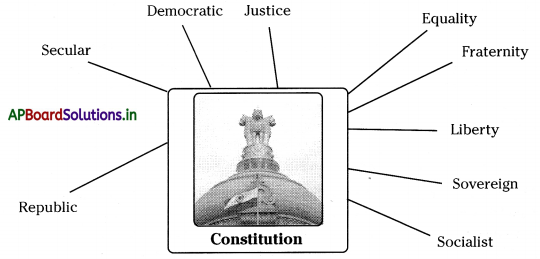
→ Republic means the head of the state is an elected person and not a hereditary position as in a kingdom.

→ Our Constitution does not promise equality in all respects but it seeks to ensure that all people will enjoy the same status.

AP Board Solutions AP Board 8th Class Social Studies Notes Chapter 13 The Indian Constitution

→ Our country has a federal system.

→ The central government has 2 houses – Lok Sabha and Rajya Sabha.

→ Our country has a three-level democracy.

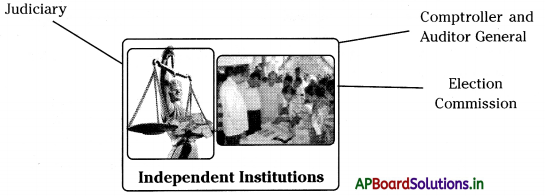
→ The Constitution also provides for some independent institutions to guard the Constitution.

→ The Constitution is a living and changing document.

→ Monarchy: Rule by a monarch

→ Representative: Typical of a class or group

→ Discrimination: Unfair treatment of different categories of people on grounds of race, sex, etc.

→ Autonomous: Self-governing

→ Constitution: A body of principles according to which a state or organization is governed

→ Sovereign: A king or queen who is the supreme ruler of a country

AP Board Solutions AP Board 8th Class Social Studies Notes Chapter 13 The Indian Constitution

→ Federal system: The main social system in medieval Europe, in which a person worked for a lord in exchange for land

→ Provisional: For the present time but likely to change, temporary.

→ Draft: A preliminary version of a piece of writing

→ Republic: A state in which power is held by the people and their elected representative and which has a President rather than a king or queen

→ Secular: Not religious or spiritual

→ Fraternity: Friendship and shared support within a group

→ Amendment: A minor improvement
AP Board 8th Class Social Studies Notes Chapter 13 The Indian Constitution 1
AP Board 8th Class Social Studies Notes Chapter 13 The Indian Constitution 2

AP Board 9th Class Biology Notes Chapter 10 Soil Pollution

Students can go through AP State Board 9th Class Biology Notes Chapter 10 Soil Pollution and Functions to understand and remember the concept easily.

AP State Board Syllabus 9th Class Biology Notes Chapter 10 Soil Pollution

→ Our environment is composed of the atmosphere, earth and water.

→ The interaction of the atmosphere, lithosphere, hydrosphere and biosphere is continuing for years together.

→ Soil is one of the marvellous products of nature and without which there would be no life.

→ Soil formation is a long and complex process and it can take 100 to 10,000years to create one inch of topsoil

→ Crop quality directly depends on the quality of the agricultural soil in which it is grown.

→ The soil properties can be divided into three major categories. Physical, chemical and biological properties.

→ Soil consists of nutrients necessary for plants growth such as nitrogen, phosphorus and potassium.

→ The pH of the soil is important in determining the type of vegetation that will grow in the soil and the type of organisms that will live there.

→ Soil is the most abundant and diverse ecosystem on the earth.

→ Soil microbes convert organic forms of elements to their inorganic forms and liberate carbon dioxide, ammonia etc., by a process known as mineralization.

→ Fertility of soil is closely associated with the properties of soil and is defined by its capacity to hold water and nutrients and supply them to plants when they need them, independent of direct application of nutrients.

→ Proper soil fertility management is very important for successful crop production and farming.

→ The waste generated from various sources can be categorized into two types like biodegradable waste and non-biodegradable waste.

AP Board Solutions AP Board 9th Class Biology Notes Chapter 10 Soil Pollution

→ Decomposition is the process of materials being digested and broken down into simpler substances making nutrients more available to plants.

→ Soil or land pollution can be understood as the addition of substances that adversely affect the quality of soil or its fertility.

→ On the basis of sources of pollutants, soil pollution can be classified into three categories.

  1. Agricultural soil pollution
  2. Soil pollution by industrial effluents and solid wastes
  3. Pollution due to urban activities.

→ A soil pollutant is any factor that deteriorates the quality, texture and mineral content of the soil or which disturbs the biological balance of the organisms in the soil.

→ Pesticides not only have a toxic effect on humans and animals but also decrease the fertility of the soil

→ The process of increasing the concentration of chemicals through the food chain is known as biomagnification.

→ Solid waste may be defined as the organic and inorganic waste produced by various activities of the society which have lost their value to the first user.

→ Solid waste on the basis of its sources of origin can be classified as municipal solid waste, hazardous solid waste and infectious solid waste.

→ Soil erosion occurs when the weathered soil particles are dislodged and carried away by wind or water.

→ Forests and grasslands are an excellent binding material that keeps the soil intact

→ Urban activities generate large quantities of city wastes including several biodegradable materials.

→ If solid waste is left uncollected and decomposed, they cause problems like clogging of drains, the barrier to the movement of water, foul smell, increased microbial activities etc.

→ To prevent soil pollution, we can limit construction in sensitive areas.

AP Board Solutions AP Board 9th Class Biology Notes Chapter 10 Soil Pollution

→ In general, we would need less fertilizer and fewer pesticides if we could all adopt the four R’s: Reduce, Reuse, Recycle and Recover.

→ Incineration of wastes is expensive and leaves a huge residue and adds to air pollution.

→ Pyrolysis is a process of combustion in absence of oxygen or the material burnt under a controlled atmosphere of oxygen.

→ Bioremediation means using a biological remedy to reduce or clean up contamination.

→ We can conserve soil by planting trees, terraces, no-till farming, contour ploughing, crop rotation, soil pH, watering the soil, salinity management, soil organisms and indigenous crops.

→ Atmosphere: The gaseous envelope surrounding the earth constitutes the atmosphere.

→ Lithosphere: Solid rocky layer covering the entire surface of the planet.

→ Hydrosphere: Contains all of the earth‘s bodies of water.

→ Biosphere: All the life-supporting zones on earth are together called the biosphere.

→ Topography: It ¡s the shape or configuration of the land represented on a map by contour lines.

→ Parent material: Any type of substance or material which undergoes some process to produce another material.

→ Weathering: Breakdown of bigger rocks into smaller mineral particles.

→ Thawing: The process whereby heat changes something from a solid to a liquid.

→ Crumb: A very small quantity of something.

AP Board Solutions AP Board 9th Class Biology Notes Chapter 10 Soil Pollution

→ Leaching: To be removed from soil by water passing through it.

→ Stench: A strong, very unpleasant smell.

→ Trash: Things that we throw away because we no longer want or need them.

→ Smelt: To heat and melt ore.

→ Ooze: The liquid flows from the place slowly.

→ Clog: To block or become blocked.

→ Inundate: To cover an area of land with a large amount of water.

→ Dire: Very serious.

→ Pyrolysis: It ¡s a process of combustion in absence of oxygen or the material burnt under a controlled atmosphere of oxygen.

→ Incineration: To burn substance until it is completely destroyed at high temperature.

→ Omnipresent: Present everywhere.

→ Tillage: The process of preparing and using land for growing crops.

→ Abode: Living place.

→ Gophers: Animal that lives in holes in the ground.

→ Soil fertility: The soil containing rich nutrients and is suitable for plants to grow.

AP Board Solutions AP Board 9th Class Biology Notes Chapter 10 Soil Pollution

→ Mineralization: It ¡s the process of converting organic forms of elements to their inorganic forms by soil microbes liberating CO2, NH3, sulphate, phosphate.

→ Biogeochemical cycle: The cycle that involves the flow of nutrients on earth from the environment to organisms and back through certain pathways are known as the biogeochemical cycle.

→ Biodegradable waste: Substances that can be degraded by microbes into harmless and non-toxic substances.

→ Non-biodegradable waste: Substances that cannot be easily degraded.

→ Soil erosion: Loss of top layers of soil by wind or water ¡s known as soil erosion.

→ Biomagnification: The process of increasing the concentration of toxic chemicals through the food chain.

→ Bioremediation: It means to use a biological remedy to reduce or clean up soil contamination.

→ Soil pollution: Soil pollution is defined as the build-up in soils of persistent toxic compounds, chemicals, salts, radioactive materials, or disease-causing agents, which have adverse effects on plant growth and animal health.

→ Organic soil: Soil that contains 30% or more organic matter (residues of dead plants and animals) is considered organic soil.

→ Abate: Reduce

→ Mycorrhiza: It is the symbiotic association that is taking place between a fungus and the roots of a plant.

→ Fragility: Easily broken or damaged.

AP Board Solutions AP Board 9th Class Biology Notes Chapter 10 Soil Pollution

→ Subtle: Not very noticeable.
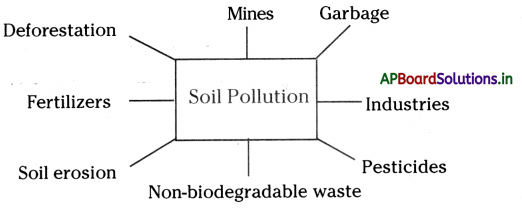
AP Board 9th Class Biology Notes Chapter 10 Soil Pollution 1
→ In one acre of land where the topsoil is eight inches thick nearly five and a half tons of Bacteria are present. 50,000 Earthworms are also present in it.

→ James Hutton (1726 – 1797):
James Hutton: Father of Modern Georgy

  • James Hutton was a Scottish geologist, physician, chemical manufacturer, naturalist and experimental agriculturalist
  • Hutton‘s work established geology as a proper science, and thus he is often referred to as the father of modern geology.
  • He recognized that the history of the earth could be determined by understanding how processes such as erosion and sedimentation work in the present day.
  • He is also credited as the first scientist to publicly express the earth was alive and should be considered a superorganism.

AP Board 10th Class Physical Science Notes Chapter 10 Electromagnetism

Students can go through AP State Board 10th Class Physical Science Notes Chapter 10 Electromagnetism to understand and remember the concept easily.

AP State Board Syllabus 10th Class Physical Science Notes Chapter 10 Electromagnetism

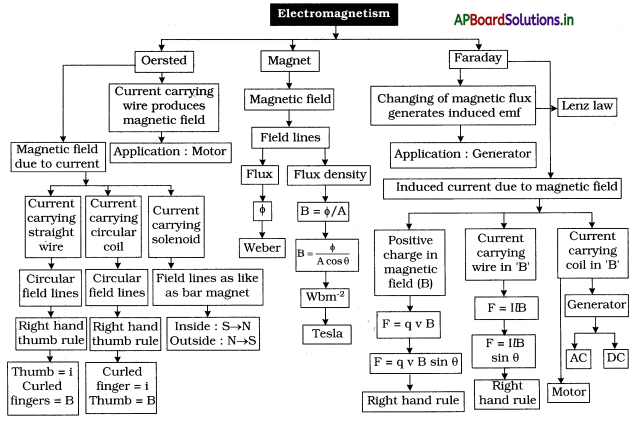
→ Magnetic flux density (B) is defined as the ratio of flux passing through a plane perpendicular to the field and the area of the plane.

→ To find the direction of the magnetic field due to the straight conductor-carrying conductor, we use the right-hand thumb rule.

→ The current-carrying wire produces a magnetic field.

→ The magnetic induction field of the earth is approximately BH = 0.38 × 10⁻⁴ Tesla.
Here 1 Tesla = 104 Gauss.

→ F = qvB sin θ and F = ILB sin θ.

→ The magnitude of magnetic field induction at the center of the coil is always
B ∝ \(\frac{\mathrm{Ni}}{\mathrm{r}}\)
Here N = Number of turns ; i = Current; r = Radius of the coil.

→ In an electric motor, electrical energy is converted into mechanical energy.

AP Board Solutions AP Board 10th Class Physical Science Notes Chapter 10 Electromagnetism

→ Electromagnets are used to lift heavy iron pieces. They are fitted on cranes lifting heavy objects of scrap iron.

→ Faraday’s law: The induced EMF generated in a closed loop is equal to the rate of change of magnetic flux passing through it.

→ Electromagnets are used in electric bells, electric horns, telephone receivers, electric relays, microphones, radio sets, television, and loudspeakers, etc.

→ Lenz’s law: The induced current set up in the coil is in such a direction that it opposes the changes in the flux.

→ Permanent magnets are used in galvanometers, voltmeters, ammeters, speedometers, etc.

→ When a conductor of length ‘V moves perpendicular to field B with a speed v then the potential difference (voltage) developed between the ends of the conductor is B/v. This EMF is called motional EMF.

→ The polarity of electromagnets can be reversed by changing the direction of the electric current.

→ In generators, mechanical energy is converted into electrical energy.

→ The polarity of a permanent magnet cannot be reversed.

→ The effect of magnetic field on moving charges has been used to build machines, called particle accelerators. Ex: Cyclotron.

→ The electric force is collinear, whereas magnetic force is perpendicular to the magnetic field.

→ The ratio of magnetic force to electric force is very negligible.

→ In domestic circuits, the series arrangement is not used.

→ To protect electric appliances like television sets, computers, which are highly expensive, cartridge fuses are used.

→ The cost of generation of A.C is less than the cost of generation of D.C.

AP Board Solutions AP Board 10th Class Physical Science Notes Chapter 10 Electromagnetism

→ A.C can be transmitted to distant places without much loss of electric power than D.C.

→ A.C can be easily connected to D.C.

→ A.C is more dangerous than D.C.

→ In the process of electrolysis, D.C. is used.

→ If the number of turns, area, speed of the rotation of armature increases induced emf is increased.

→ An electric fuse is made of a material of low melting point.

→ Magnetic flux: The number of lines passing through the plane of area perpendicular to the field is called magnetic flux. It is denoted by ‘Φ’. Its SI unit is Weber.

→ Magnetic flux density: Magnetic flux per unit area is known as magnetic flux density. This is also known as magnetic induction.
∴ B = \(\frac{\phi}{A}\)
Unit → Weber/metre2 or Tesla

→ Electric motor: It ¡sa device which converts electrical energy into mechanical energy.

→ Slip rings: The reverse of current in an AC dynamo occurs because the two ends of the armature coil are in permanent contact with the same two slip rings and S2

AP Board Solutions AP Board 10th Class Physical Science Notes Chapter 10 Electromagnetism

→ Induced current. Whenever there ¡s a continuous change of magnetic flux linked with the closed coil, the current is generated in the coil. This is known as induced current.

→ Induced EMF: The pushing or pulling of the magnet causes a change in magnetic flux linked to the coils which cause induced EMF.

→ Electric generator: It is a device that converts mechanical energy into electrical energy.

→ DC and AC currents: An electric current whose magnitude is either constant or variable but the direction of flow in a conductor remains the same is called Direct Current. It is denoted by DC. An electric current whose magnitude changes with the time and direction reverses periodically is called Alternate Current. It is denoted by AC.

→ rms values : Irms = \(\frac{\mathrm{I}_{0}}{\sqrt{2}}\) and Vrms = \(\frac{\mathrm{V}_{0}}{\sqrt{2}}\)
Here AC current and AC voltage are expressed in terms of RMS values. Here I and vo are the peak values of AC current and AC EMF.

→ Magnetic compass: It is a simple device to find directions. It is a small magnet that is pivoted at its center so that it can rotate in its horizontal plane, and always point towards the north-south direction of the earth, after coming to rest.

→ Ampere’s swimming rule: Imagine a swimmer along the length of the conductor in which current flows. Then the left-hand motion of the person gives the direction of deflection of the north pole of the magnetic needle placed near to it.

AP Board Solutions AP Board 10th Class Physical Science Notes Chapter 10 Electromagnetism

→ Electromagnet: An electromagnet is a temporary strong magnet and is just a solenoid with its winding on a soft iron core.

→ Permanent magnet: A permanent magnet is made from steel. As steel has more retentivity than iron, it does not lose its magnetism easily.

→ Flemmings left-hand rule: When a current-carrying wire is placed in a magnetic field, a force is exerted on the wire. According to Flemming’s rule, hold the forefinger, middle finger, and thumb of the left hand at right angles to one another, then the forefinger points in the direction of force due to the magnetic field. Middle finger points in the direction of current and the thumb points in the direction of motion of the conductor.

→ Flemming’s right-hand rule: Stretch the right hand such that forefinger, middle (Dynamo Rule) finger, and thumb are mutually perpendicular to each other. Forefinger points the direction of the field. The middle finger points the direction of the induced current. Thumb points the direction of motion of the conductor.

→ Energy meter or KWH meter: The cable connected to the energy meter records the electricity consumption of the house in kilowatt-hour.

→ Main Fuse: The live wire coming out from the output terminals or KWH meter has another fuse which is called the main fuse.

→ Electric Fuse: It is a device used in series to limit the current in an electric circuit so that it easily melts due to overheating when excessive current passes through it.

→ Armature: Armature is a coil that consists of a large number of turns of insulated copper wire wound over a soft iron core. it revolves around an axle between two poles of a strong magnet.

→ Short-circuiting: When live wire and neutral wire come in direct contact, the resistance of the wire becomes very small. Then huge current flows through the circuit and produces a large amount of heat in the circuit and the circuit catches fire. This is known as short-circuiting.
AP Board 10th Class Physical Science Notes Chapter 10 Electromagnetism 1

→ Michael Faraday:

  1. Faraday was a British chemist and physicist who contributed significantly to the study of electromagnetism and Pedro chemistry.
  2. He was born on 22 September 1791 in South London.
  3. 1831 Faraday discovered electromagnetic Induction and the principle behind the electric transformer and generator.
  4. As a chemist, Faraday discovered Benzene, Invented the early form of Bunsen Burner, and the system of oxidation numbers.
  5. The unit of electric capacity is ‘Farad which is named after him.

AP Board Solutions AP Board 10th Class Physical Science Notes Chapter 10 Electromagnetism

→ (Hans Christian Oeited(1777 – 1851):
One of the leading scientists of the f 9th century; played a crucial role In understanding electromagnetism. He gave lectures which were quite popular among the public and also learned a lot during the tours. During one such lecture In April 1820, Oersted carried out an experiment that was never performed before. He placed a Compass needle underneath a wire and then turned on the electric current. The needle of the magnetized compass showed movement.

Oersted recognized the significance of what he had ‚ust done. Earlier, It was believed that electricity and magnetism were two dill event forces. Oersted had demonstrated that they were. Interconnected. Through this observation, he showed that electricity and magnetism Were ie1ated phenomena. Some scientists, Influenced by this experiment, continued With the modern field of “electromagnetism”. Their research resulted In several new scientific theories and various vital Inventions like the dynamo and the electric motor, Crested technologies such as the radio, television, and fiber optics. The unit of magnetic field strength Is named the Oersted In his honor. Oersted was made a foreign Academy of science in 1822.