AP Board 9th Class Physical Science Notes Chapter 6 Chemical Reactions and Equations

Students can go through AP State Board 9th Class Physical Science Notes Chapter 6 Chemical Reactions and Equations to understand and remember the concept easily.

AP State Board Syllabus 9th Class Physical Science Notes Chapter 6 Chemical Reactions and Equations

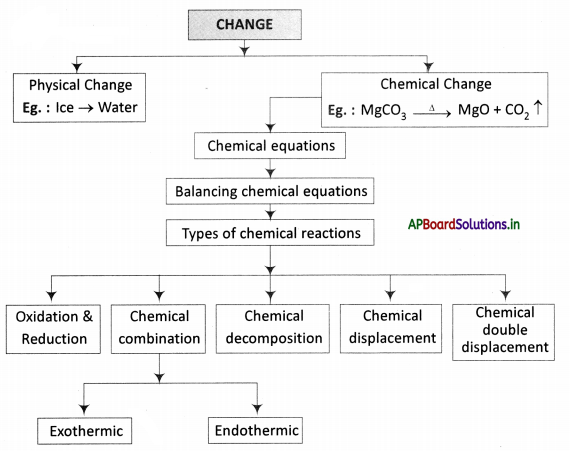
→ A chemical change is a permanent change.

→ In a chemical change, two substances react chemically to form new substances with different properties.

→ Chemical reactions are characterized by one or more of the following characteristics – the evolution of gas, change of color, formation of a precipitate, energy changes, and change of state.

→ A chemical equation represents a chemical reaction.

→ A complete chemical equation represents the reactants, products, and their physical state.

→ Reactions in which heat energy is absorbed by the reactants are endothermic reactions.

→ In exothermic reactions, heat energy is released by the reactants.

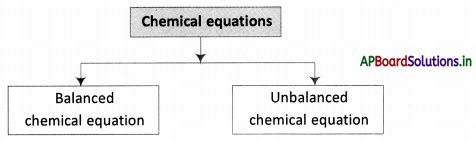
→ A chemical equation is balanced so that the number of atoms of each type involved in a chemical reaction is the same on the reactant and product sides of the equation.

→ Equations must always be balanced.

AP Board Solutions AP Board 9th Class Physical Science Notes Chapter 6 Chemical Reactions and Equations

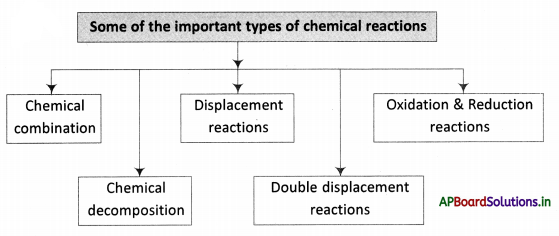
→ A combination reaction or synthesis is a reaction in which two or more substances combine to form a single substance.

→ A decomposition reaction is one in which a compound breaks up into two or more substances.

→ In a displacement reaction, one element replaces another element from a compound.

→ In a double decomposition reaction, two compounds react by exchanging their radicals.

→ Oxidation is a reaction involving the addition of oxygen or removal of hydrogen from a substance.

→ Reduction is a reaction involving the addition of hydrogen or the removal of oxygen from a substance.

→ Precipitation reactions produce insoluble salts.

→ According to the law of conservation of mass, “Mass can neither be created nor destroyed in a chemical reaction”.

→ The chemical equations are balanced to satisfy the law of conservation of mass in chemical reactions.

→ We should never change the formula of an element or a compound to balance an equation.

→ The process of making the number of different types of atoms equal on both sides of an equation is called the balancing of the equation.

→ All the combustion reactions are exothermic reactions.

→ The substance which gets oxidized is the reducing agent.

AP Board Solutions AP Board 9th Class Physical Science Notes Chapter 6 Chemical Reactions and Equations

→ The substance which gets reduced is the oxidizing agent.

→ Two common effects of oxidation reactions that we observe in daily life are

  1. Corrosion of metals
  2. Rancidity of food

→ Corrosion causes damage to iron appliances.

→ When fats and oils are oxidized, they become rancid.

→ The precipitate is an insoluble substance.

→ Reactants: The substances which undergo chemical change in the reactions are called reactants.

→ Products: New substances formed in the reaction are called products.

→ Exothermic reaction: Reaction during which heat is released.

→ Endothermic reaction: Reaction in which heat is absorbed.

→ Chemical combination: It is a reaction in which two or more substances combine to form a single substance.

→ Chemical decomposition: It is a reaction in which a compound breaks up into two or more substances.

→ Displacement reaction: More active element replaces less active element from its compound in a chemical reaction.

→ Double displacement reaction: If two reactants exchange their constituents chemically and form two products, then the reaction is called a double displacement reaction.

→ Oxidation: It is a reaction involving the addition of oxygen or removal of hydrogen from a substance.

→ Reduction: It is a reaction involving the addition of hydrogen or removal of oxygen from a substance.

AP Board Solutions AP Board 9th Class Physical Science Notes Chapter 6 Chemical Reactions and Equations

→ Corrosion: Chemical or electrochemical attack the surface of a metal.

→ Rancidity: The condition produced by aerial oxidation of fats and oils in foods marked by unpleasant smell and taste is called rancidity.

→ Antioxidants: Substances that prevent oxidation.

→ Chemical equation: A way of denoting a chemical reaction using the symbols for the participating particles (atoms, molecules, ions, etc.).

→ Chemical reaction: A change in which one or more chemical elements or compounds form new compounds.

→ Chemistry: The study of the elements and the compounds they form.

→ Oxidizing agents: Substances that oxidize other substances by providing oxygen to them or removing hydrogen from them.

→ Reducing agents: Substances that reduce other substances by removing oxygen from them or by supplying hydrogen to them.

→ Crystal: A solid in which atoms are arranged in a regular pattern.

→ Tarnish: To make something lose its shine and make it dull because of oxidation or rust.

→ Alloy: A material consisting of two or more metals or a metal and a non-metal. Ex: Steel.

→ Galvanizing: Iron or steel that has been coated with a layer of zinc to protect it from corrosion.

→ Rancid: Sour (or) Stale.

→ Redox reactions: The reactions in which both reduction and oxidation occur simultaneously are called redox reactions in short.

AP Board Solutions AP Board 9th Class Physical Science Notes Chapter 6 Chemical Reactions and Equations

→ Exo: Outside.

→ Endo: Inside.

→ Thermo: Heat.

→ Respiration: When we inhale oxygen, it enters our body and combines with glucose in the cells of our body, and releases energy which helps to do the various works.
AP Board 9th Class Physical Science Notes Chapter 6 Chemical Reactions and Equations 1
AP Board 9th Class Physical Science Notes Chapter 6 Chemical Reactions and Equations 2
AP Board 9th Class Physical Science Notes Chapter 6 Chemical Reactions and Equations 3

→ Henry Cavendish (1731 – 1810):

  • Henry Cavendish conducted first his experiments on heat, electricity, and magnetism.
  • He showed that water is composed of oxygen and hydrogen.
  • He measured heats of fusion and evaporation as well as specific heats and those of the mixing of solutions in water.
  • Cavendish’s measurements of the freezing points of various solutions showed the existence of compositions that yield maximum and minimum freezing points
  • Cavendish’s experiments included the investigation of capacitance.
  • In his experiments, he measured the strength of a current by shocking himself and estimating the magnitude of the pair.
AP Board 10th Class Biology Notes Chapter 5 Coordination

Students can go through AP State Board 10th Class Biology Notes Chapter 5 Coordination to understand and remember the concept easily.

AP State Board Syllabus 10th Class Biology Notes Chapter 5 Coordination

→ Living organisms respond and react to their environment.

→ All our functions are carried out by an effort of several systems working together.

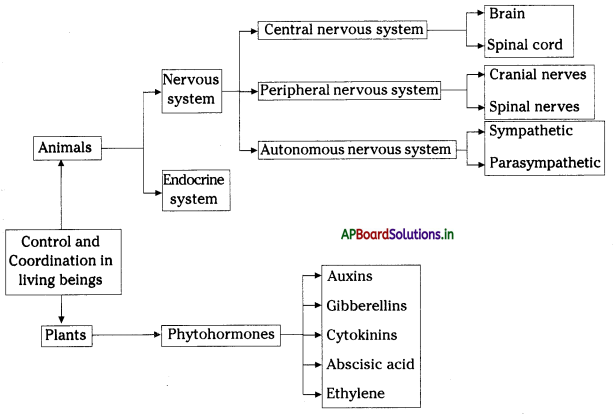
→ The nervous system and endocrine system are the two systems that control and coordinate various functions in the body.

→ The responses of the nervous system can be classified as a reflex, voluntary and involuntary actions.

→ Responses are brought about by rapid changes in some muscles.

→ The human nervous system is studied under two divisions. The central nervous system and the peripheral nervous system.

→ Galen concluded that nerves are of two kinds

  1. Those of sensation and
  2. Those of action.

→ The neuron is the structural and functional unit of the nervous system.

AP Board Solutions AP Board 10th Class Biology Notes Chapter 5 Coordination

→ Each nerve cell consists of a cell body, dendrites, and axon.

→ Synapse is the functional region of contact between two neurons.

→ Basing on the pathways followed nerves are classified mainly into three different types.

→ Afferent or sensory nerves carry information from the sense organs to the central nervous system.

→ Efferent or motor nerves carry messages from the central nervous system to parts that or the effector organs.

→ Association neurons link afferent and efferent nerves.

→ Responses on which we may not have control are called reflexes.

→ The existence of the knee jerk was first noted in 1875.

→ The pathway of reflex action is called a reflex arc.

→ The central nervous system includes the brain and spinal cord.

→ The brain is the highest coordinating center in the body.

→ The brain is protected by the cranium.

→ The brain is covered by three membranes called meninges.

AP Board Solutions AP Board 10th Class Biology Notes Chapter 5 Coordination

→ The space between the membrane is filled with cerebrospinal fluid.

→ The brain has three divisions:

  1. Forebrain,
  2. Midbrain and
  3. Hindbrain.

→ The forebrain consists of the cerebrum, diencephalon.

→ Midbrain has optic lobes.

→ Hindbrain has cerebellum, medulla oblongata.

→ The brain weighs approximately 1400 gms.

→ The spinal cord is a cylindrical structure enclosed within the vertebral column.

→ There are 12 pairs of cranial nerves that arise from the brain and 31 pairs of spinal nerves.

→ The dorsal root carries messages of sensation inwards while the ventral root carries outwards the instruction for muscular contraction.

→ The peripheral nervous system is the network of spinal and cranial nerves that are linked to the brain and spinal cord.

→ Many activities of the internal organs like the heart, blood vessels, and glands are controlled by the autonomous nervous system.

→ Neurons present in our digestive tract is named as small brain and the system is called the enteric nervous system.

→ ‘sugar diabetes is a condition in which the amount of free sugar in the blood and urine is called of the pancreas.

AP Board Solutions AP Board 10th Class Biology Notes Chapter 5 Coordination

→ The chemical substances produced by endocrine glands are known as hormones.

→ The feedback mechanism regulates the timing and amount of hormones released.

→ Plant hormones or growth substances coordinate the activities of the plant.

→ Major plant hormones are auxins, gibberellins, cytokinins, abscisic acid, and ethylene.

→ Auxins are responsible for cell elongation and differentiation of shoots and roots.

→ Gibberellins help in the germination of seeds and sprouting of buds; elongation of stems and breaking the dormancy in seeds and buds.

→ Abscisic acid helps in the closing stomata and seed dormancy.

→ Cytokinins promote cell division; the promotion of sprouting of lateral buds, delay the aging in leaves, the opening of stomata.

→ Ethylene is useful in ripening fruit.

→ Directional movements in plants in response to specific stimuli like light, chemicals, etc., are called tropic movements.

→ The bending of plants towards light is phototropism.

→ The downward movement of a plant in response to gravitational force is called geotropism.

→ The movement due to chemical stimulus is seen during the pollen tube growth is called chemotropism.

→ Response: Reaction, a reaction to something.

→ Stimuli:

  • A thing or event that evokes a specific functional reaction in an organ or tissue.
  • Something causing or regarded as causing a response.

→ Neuron: The structural and functional unit of the nervous system.

→ Schwann cell: A cell that forms spiral layers around a myelinated nerve fiber between two nodes of Ranvier and forms the myelin sheath consisting of the Inner spiral layers from which the protoplasm has been squeezed out.

→ Axon: The long projection from the cell body that extends to different parts of our body. The axon is to transmits information to different neurons, muscles, and glands.

→ Synapse: It ¡s the functional Junction between the two neurons through which information is transmitted or relayed to another neuron.

AP Board Solutions AP Board 10th Class Biology Notes Chapter 5 Coordination

→ Afferent or Sensory nerves: Carry information from the receptor to the association neurons in the spinal cord.

→ Efferent or motor nerves: Carry information from the spinal cord or brain to the effector organs.

→ Association nerves: Process the information and generates responses.

→ Central nervous system: It includes the brain and spinal cord. It coordinates all neural functions.

→ Brain: An organ of soft nervous tissue contained in the skull of vertebrates. It coordinates the center of sensation and intellectual and nervous activity.

→ Spinal cord: Part of the central nervous system that acts as a relay station. It plays a major role in reflex actions.

→ Cerebrospinal fluid: Fluid present between the inner and middle layers. Protects the brain from mechanical shocks.

→ Peripheral nervous system: The nervous system outside the brain and spinal cord. Its main function is to connect the central nervous system to the limbs and organs.

→ Insulin: It Is the hormone produced by islets of Langerhans of the pancreas. It regulates sugar levels in the blood. Its deficiency results in diabetes mellitus.

→ Endocrine glands: These are also known as ductless glands. Their secretion is directly released into the blood (Hormone). They bring about chemical coordination in living organisms. e.g.: Pituitary, Thyroid, Parathyroid, Pancreas, and Adrenal gland.

→ Hormones: The secretion of endocrine glands is a hormone. Chemical coordination is brought out by hormones.

→ Feedback mechanism: It helps the organism to maintain homeostasis or dynamic equilibrium. Homeostasis is the maintenance of a stable internal state within an organism. It regulates the action of hormones.

→ Plant hormones: Coordinate the growth processes of the plant. e.g.:Auxins, Gibberellins, Cytokinins, Abscisic acid, and Ethylene.

AP Board Solutions AP Board 10th Class Biology Notes Chapter 5 Coordination

→ Tropic movements: When the fixed part of a stationary plant moves in response to a stimulus the reaction is known as a tropic movement.

→ Nastic movement.s: These are non-directional movements or responses to stimuli. e.g.: Temperature, humidity, light, etc.

→ PhototropIsm: Bending of the plant towards the light is called phototropism.

→ Reflex arc: The path followed by a nerve impulse starting from the receptor and finally reaching the effector is called reflex arc; a Structural and functional unit that carries reflex action.

→ Stumble: MomentarIly lose one’s balance; almost fall.

→ MenInges: The three layers covering the brain.

→ Vasomotor: It refers to actions upon a blood vessel that alters its diameter.

→ Autonomous nervous system: Part of the peripheral nervous system that regulates the functions of our internal organs.

→ Enteric nervous system: Nervous system is present in the digestive system, independent of the central or peripheral nervous system.

→ Goosebumps: A roughness of the skin produced by the erection of its papillae especially from cold, fear, or a sudden feeling of excitement.

→ Stumps: The bottom part of a tree left projecting from the ground after most of the trunk has fallen or been cut down.

→ Geotropism: Plant responding positively for gravitational force; Root growing downwards.

→ Hydrotropism: Roots of a plant growing towards the water in the soil.

AP Board Solutions AP Board 10th Class Biology Notes Chapter 5 Coordination

→ Thigmotroplsm: Tendrils of a plant growing towards support and wind around them.

→ Chemotropism: Response to chemicals is called chemotropism.

→ Voluntary actIon: It occurs without the conscious choice of an organism. If it occurs specifically in response to a stimulus, it will be known as a reflex.

→ Involuntary actIon: It occurs because of choice. It may or may not occur with the awareness of the organism performing it.

→ Lumbar region: It refers to the lower back, where the spine curves inwards towards the abdomen.
AP Board 10th Class Biology Notes Chapter 5 Coordination 1

→ Aelius Galenus (Galen) – AD. 129-200:

  • Galen was a prominent Greek-speaking Roman physician, surgeon end philosopher.
  • Galen was the originator of the experimental method in medical investigation.
  • He. proved that urine was formed in the kidney.
  • His most important discovery was that arteries carry blood. He explained the differences between venous and arterial blood.
  • Galen explained the difference between motor and sensory nerves.

AP Board 9th Class Physical Science Notes Chapter 5 What is inside the Atom?

Students can go through AP State Board 9th Class Physical Science Notes Chapter 5 What is inside the Atom? to understand and remember the concept easily.

AP State Board Syllabus 9th Class Physical Science Notes Chapter 5 What is inside the Atom?

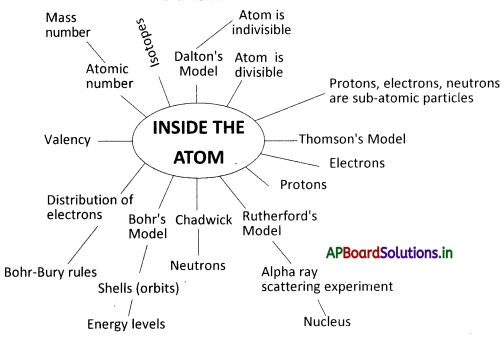
→ The matter is made up of atoms.

→ According to Dalton, the atom is indivisible. Later experiments proved that an atom is divisible.

→ Atom is electrically neutral.

→ Some small particles which are smaller than atoms are present inside the atom, called subatomic particles.

→ Thomson discovered electrons. These are the negatively charged particles whose mass is negligible.

→ Protons are positively charged particles whose mass is 2000 times that of electrons.

→ Chadwick discovered neutrons, which have no charge and mass nearly equal to that of protons.

→ Thomson developed a model of the atom that shows electrons embedded throughout the mass of positively charged material.

AP Board Solutions AP Board 9th Class Physical Science Notes Chapter 5 What is inside the Atom?

→ Rutherford’s alpha-particle scattering experiment led to the discovery of the atomic nucleus.

→ Rutherford’s model of the atom has a large empty space with a small dense, positively charged nucleus in the center.

→ According to Rutherford, electrons are revolving around the nucleus.

→ Rutherford’s model of the atom could not justify the stability of the atom.

→ Neils Bohr modified Rutherford’s model of the atom by stating that electrons move in specific energy levels around the nucleus.

→ Neils Bohr’s model of atoms could not predict the spectra of heavier atoms.

→ Bohr – Bury proposed some rules for the distribution of electrons in various shells.

→ A maximum number of electrons present in a shell is given by the formula 2n2, where ‘n’ is the shell number.

→ The number of electrons present in the outermost orbit of an atom is called its valency.

→ An outermost shell that has 8 electrons is said to possess an octet.

→ An atom with 8 electrons or an octet in its outermost shell is chemically stable.

→ The atomic number is the number of protons in the nucleus of an atom, denoted by ‘Z’.

→ The mass number is the number of protons plus the number of neutrons, denoted by ‘A’.

→ An element can be represented as follows with its atomic number and mass number,
atomic mass number → 19
atomic number → 9

→ Number of neutrons N = A – Z

AP Board Solutions AP Board 9th Class Physical Science Notes Chapter 5 What is inside the Atom?

→ The atoms of the same element which have the same number of protons but have different numbers of neutrons are called isotopes.

→ Some isotopes are used for solving chemical and medical mysteries.

→ Atom: An atom is the smallest particle of an element that can participate in a chemical reaction and retain all its properties.

→ Sub-atomic particles: Experiments proved that atoms were divisible and are made up of smaller particles. These particles are smaller than atoms and are present inside the atom called sub-atomic particles. The three sub-atomic particles are electron, proton, and neutron.

→ Electron: Electrons were the first subatomic particles, discovered by J.J. Thomson, represented by e, having negligible mass and & unit negative charge.

→ Proton: Proton is a positively charged sub-atomic particle that is part of every atomic nucleus. The mass of a proton is 2000 times that of the electron.

→ Neutron: A neutron is an uncharged particle that is part of almost every nucleus. The mass of the neutron is nearly equal to the mass of a proton.

→ Nucleus: All the positively charged material in an atom formed a small dense center, called the nucleus of the atom. The nucleus consists of protons and neutrons.

→ Atomic mass: The mass of an atom of a chemical element expressed in atomic mass units. It is approximately equivalent to the number of protons and neutrons in the atom (the mass number) or to the average number allowing for the relative abundances of different isotopes.

→ Molecular mass: Molecular mass or molecular weight refers to the mass of a molecule. It is calculated as the sum of the mass of each constituent atom multiplied by the number of atoms of that element in the molecular formula.

→ Formula unit mass: The formula mass of a molecule is the sum of the atomic weights of the atoms in the empirical formula of the compound.

→ Atomic number (Z): Atomic number is the number of protons in the nucleus of an atom, denoted by the letter ‘Z’.

→ Mass number (A): Mass number is the total number of protons and neutrons, denoted by the letter ‘A’. The mass number is the nearest numerical to the mass of an individual atom.

→ Valency: The number of electrons present in the outermost orbit of an atom is called its valency. (OR) The combining capacity of one atom with another atom is known as its valency.

→ Isotopes: Isotopes are atoms that have the same number of protons but a different number of neutrons.

→ Stable atom: An atom with 8 electrons or an octet in its outermost shell is chemically stable and does not combine with other atoms.

AP Board Solutions AP Board 9th Class Physical Science Notes Chapter 5 What is inside the Atom?

→ Octet: An outermost shell that has 8 electrons is said to possess an octet.

→ Inert or noble gases: The gases like He, Ne, Ar, etc. do not react with other elements to form compounds. They are chemically inactive and known as inert or noble gases.

→ Shells: Electrons can be found only in certain energy levels around the nucleus. These energy levels are known as orbits or shells.
AP Board 9th Class Physical Science Notes Chapter 5 What is inside the Atom 1
→ J.J . Thomson:

  • Thomson, Sir Joseph John was born on 18 December 1856 near Manchester, England. He completed his engineering course with the help of his friends.
  • In 1897 he was crowned “the father of electrons”. Thomson was a highly gifted teacher. Not less than eight of his students distinguished themselves as Nobel Prize winners. His son won the Nobel prize for physics. He got the Nobel Prize in 1906.

AP Board 9th Class Physical Science Notes Chapter 4 Atoms and Molecules

Students can go through AP State Board 9th Class Physical Science Notes Chapter 4 Atoms and Molecules to understand and remember the concept easily.

AP State Board Syllabus 9th Class Physical Science Notes Chapter 4 Atoms and Molecules

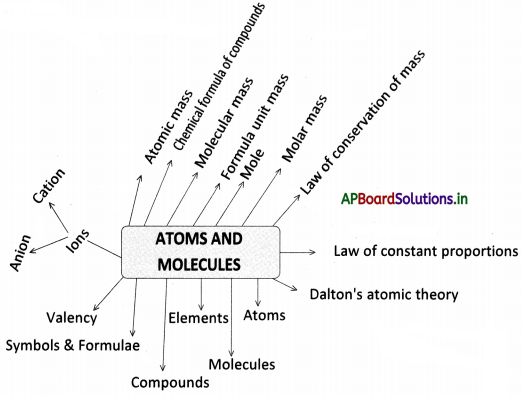
→ Mass is neither created nor destroyed during a chemical reaction. This is the law of conservation of mass, established by Antoine Lavoisier.

→ A given chemical substance always contains the same elements combined in a fixed proportion by weight. This is the law of constant proportions, proposed by Joseph L. Proust.

→ Dalton proposed atomic theory. According to this, matter consists of indivisible particles called atoms.

→ Atoms combine to form molecules.

→ Atoms of the same elements combine to form molecules.

→ Atoms of different elements combine to form compounds.

AP Board Solutions AP Board 9th Class Physical Science Notes Chapter 4 Atoms and Molecules

→ Symbols represent elements and formula represents compounds or molecules.

→ A symbol can have either one or two letters of English.

→ The number of atoms constituting a molecule is known as its atomicity.

→ The combining capacity of an element with another element is known as its valency.

→ Ions are single charged atoms or a group of atoms that have a net charge on them.

→ A positively charged ion is a cation and a negatively charged ion is an anion.

→ Scientists use the relative atomic mass scale to compare the masses of different atoms of elements.

→ The number of times one atom of a given element is heavier than 1/12th part of the atomic mass of carbon -12 is called atomic mass.

→ By using the criss-cross method, we can write the chemical formula of compounds.

→ The molecular mass of a substance is the sum of the atomic masses of all the atoms in a molecule of a substance.

AP Board Solutions AP Board 9th Class Physical Science Notes Chapter 4 Atoms and Molecules

→ The formula unit mass of a substance is a sum of atomic masses of all atoms in a formula unit of a compound.

→ One mole of any species is the quantity that is expressed in a number having a mass equal to its atomic or molecular mass in grams.

→ The number of particles present in one mole of any substance is the Avogadro number (Na) which is equal to 6.022 × 10²³.

→ The mass of 1 mole of a substance which is expressed in grams is called its molar mass.

→ Law of conservation of mass: The mass of reactants is equal to the mass of the products of chemical reactions.
(or)
Mass is neither created nor destroyed during a chemical reaction.

→ Law of constant proportion: A given chemical substance always contains the same elements combined in a fixed proportion by weight.

→ Atom: An atom is the smallest particle of an element that can participate in a chemical reaction and retain all its properties.

→ Symbol: Symbol is the short form of representing an element.

→ Atomic mass: The relative atomic mass of the atom of an element is defined as the average mass of the atom, as compared to 1/12th of the mass of one carbon – 12 atom.

→ Atomic mass unit (AMU): One atomic mass unit is defined as mass exactly one-twelfth the atomic mass of carbon – 12 isotopes.

AP Board Solutions AP Board 9th Class Physical Science Notes Chapter 4 Atoms and Molecules

→ Unified mass (u): Unified mass is the unit of atomic mass used in the place of AMU.

→ Molecule: A molecule can be defined as the smallest particle of matter that is capable of independent existence and retained all the properties of that substance.

→ Molecules of elements: Atoms of the same elements or of different elements can join together to form molecules.

→ Molecules of compounds: Atoms of different elements join together they form new substances known as compounds.

→ Formula: Formula is the shortest form to represent a compound.

→ Ion (Cation and Anion): Ion may be a single charged atom or a group of atoms that have a net charge on them. A positively charged ion is called a cation and a negatively charged ion is called an anion.

→ Valency: Every element reacts with other elements according to its combining capacity, which we call its valency.

→ Molecular mass: The molecular mass of substances is the sum of the atomic masses of all atoms in a molecule of a substance.

→ Formula unit mass: The formula unit mass of a substance Is a sum of the atomic masses of all atoms in a formula unit of a compound.

→ Mole: One mole of any species is the quantity that is expressed in a number having a mass equal to its atomic or molecular mass in grams.

AP Board Solutions AP Board 9th Class Physical Science Notes Chapter 4 Atoms and Molecules

→ Avogadro constant: The number of particles present in one mole of any substance is the Avogadro constant (NA). This is equal to 6.022 × 10²³.

→ Molar mass: The mass of 1 mole of a substance which is expressed in grams is called its molar mass.
AP Board 9th Class Physical Science Notes Chapter 4 Atoms and Molecules 1
→ Antoine Lavoisier:

  • HewasaFrench nobleman. He made many important contributions to chemistry and some call him the Father of Modern Chemistry.
  • Lavoisier studied combustion reactions in detail. For example, during combustion reactions, he not only carefully weighed the solid reactants but also took into account the gases involved. He perfected chemical apparatus which ensured that gases did not escape during the reactions. This led to the law of conservation of mass.

AP Board 7th Class Social Studies Notes Chapter 22 Rulers and Buildings

Students can go through AP State Board 7th Class Social Studies Notes Chapter 22 Rulers and Buildings to understand and remember the concept easily.

AP State Board Syllabus 7th Class Social Studies Notes Chapter 22 Rulers and Buildings

→ Monuments provide an insight into the technologies used for construction.

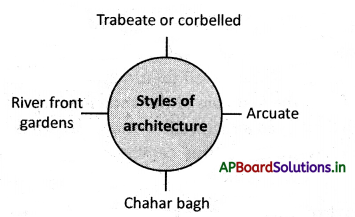
→ Between the seventh and tenth centuries, architects made roofs, doors, and windows by placing a horizontal beam across two vertical columns, a style of architecture called ‘trabeate’ or ‘corbelled’.

→ Between the eighth and thirteenth centuries, the trabeate style was used in the construction of temples, mosques, tombs.

→ The plan of the temples of the Chandela dynasty consisted of an ornamented gateway that led to an entrance and the main hall (maha mandapa) and the main shrine (Garbhagriha) where the chief deity was kept.

→ The Rajarajeshwara temple at Thanjavur had the tallest shikhara amongst temples of its time.

→ The technological and stylistic developments are noticeable from the twelfth century.

→ The weight of the superstructure above the doors and windows was sometimes carried by arches. The roofs too used this principle and were converted into vaults and domes. This architectural style is called ‘arcuate’.

→ The very high-quality cement – the limestone cement was increasingly in the construction. & temples were meant to demonstrate the power, wealth, and devotion of the patron. Temples and mosques were beautifully constructed because they were places of worship.

AP Board Solutions AP Board 7th Class Social Studies Notes Chapter 22 Rulers and Buildings

→ The temples, with the gods and goddesses of the allies and subordinates of the main duty, were miniature models of the world.

→ The kings and nobles endowed the temples with land, gold, and jewels so that worship of the gods could be carried on a grand scale.

→ By 1200 A.D. most of the temples had become elaborate institutions of political and economic power.

→ Constructing places of worship provided rulers with the chance to proclaim their close relationship with God.

→ When the kings attacked another kingdom, they used to target the temples and looted all the valuable gold, jewelry, and golden images of the gods.

→ Sultan Mahmud of Ghazani attacked the temples of defeated kings and looted their wealth and Idols.

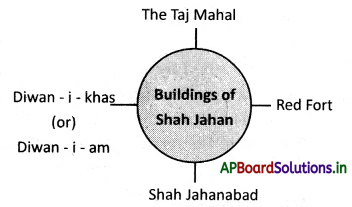
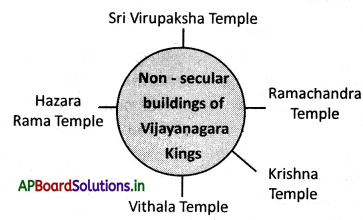
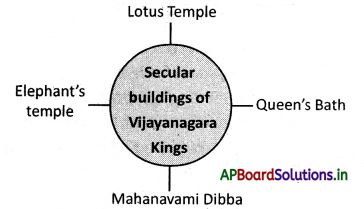
→ Vijayanagara kings Rayas built large temples using the style developed by Chola and Pandya emperors which included Vimanas and Gopurams.

→ Inscriptions: Words or symbols – inscribed on a monument, in a book, etc

→ Monuments: A large stone structure built to remind people of a famous person

→ Dynasty: A line of hereditary rulers of a country
(Or)
A succession of people from the same family, play a prominent role in any field

AP Board Solutions AP Board 7th Class Social Studies Notes Chapter 22 Rulers and Buildings

→ Architecture: The art, science, and profession of designing buildings

→ Coronation – Ceremony: It is the ceremony when a new king s officially installed
AP Board 7th Class Social Studies Notes Chapter 22 Rulers and Buildings 1
AP Board 7th Class Social Studies Notes Chapter 22 Rulers and Buildings 2
AP Board 7th Class Social Studies Notes Chapter 22 Rulers and Buildings 3
AP Board 7th Class Social Studies Notes Chapter 22 Rulers and Buildings 4

AP Board 7th Class Social Studies Notes Chapter 16 Making of Laws in the State Assembly

Students can go through AP State Board 7th Class Social Studies Notes Chapter 16 Making of Laws in the State Assembly to understand and remember the concept easily.

AP State Board Syllabus 7th Class Social Studies Notes Chapter 16 Making of Laws in the State Assembly

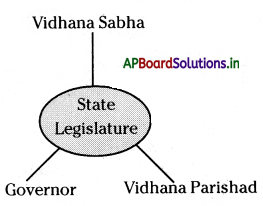
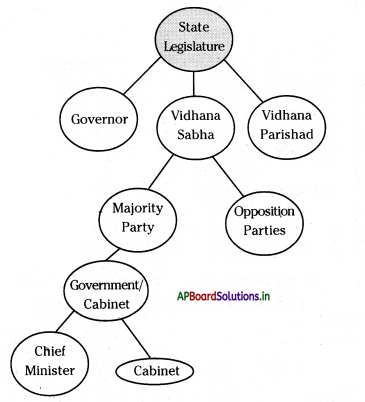
→ The legislative assembly is the most important body for making the laws for the state.

→ Our state assembly has 175 members.

→ These members of the Legislative Assembly (MLAs) are elected directly by the people.

→ Each of these 175 members is elected from a constituency. Thus there are 175 constituencies in the state.

→ All men and women of 18 years of age or above have the right to vote.

→ Usually, elections to these state legislative assemblies are held once every five years.

→ Candidates of various political parties and also individuals are known as Independents con-test elections.

→ All political parties come out with election manifestos.

→ Election manifestos are descriptions of programs that parties intend to undertake and promises that are relevant to the local context.

→ Voters have to show their identity cards issued by the election commission.

→ Candidates can cast their vote freely without fear, without getting influenced by the offerings of money or goods offered by the candidates.

AP Board Solutions AP Board 7th Class Social Studies Notes Chapter 16 Making of Laws in the State Assembly

→ The candidate who secures the highest number of votes is declared elected.

→ The party which has more than half a number of seats is considered to have got a majority.

→ The members of the majority party will elect one member among themselves as their leader. He will be made the chief minister of the state by Governor.

→ The chief minister will form his cabinet, which is called the government. The cabinet is responsible for implementing laws and developmental plans.

→ In case no single party gets more than half of the seats two or more political parties come together to form a government called the coalition government.

→ If anything goes wrong with a minister, the entire cabinet is responsible for it.

→ The speaker, elected by the MLAs, conducts the assembly meetings.

→ The entire cabinet along with the Chief Minister is responsible to the assembly.

→ The proposed law is called a ‘Bill’. After being passed by both the chambers and approval by the Governor, it becomes a law and is called an ‘Act’ of the legislature.

→ The minister, who introduced the bill, will describe it, in detail in the assembly.

→ A small committee is set up to these suggestions.

→ After the Vidhan Sabha and Vidhan Parishad approve the bell, it will be sent to the Governor for approval. Then it will be called an Act and it published in Gazette.

AP Board Solutions AP Board 7th Class Social Studies Notes Chapter 16 Making of Laws in the State Assembly

→ Manifesto: Public declaration of a policy by a party before the election, mostly filled with promises.

→ Cabinet: Council of Ministers along with Chief Minister who held responsible for the Legislative Assembly.

→ Speaker: The Chairman of the Lower House and who leads the proceedings of the House

→ Assembly: A group of people who are elected to make decisions or laws for a particular country, area, or organization.
(OR)
The most important body for making the laws for the state.

→ Ruling party: A party which ¡s ¡n power.

→ Opposition party: The party which ¡s not ¡n power.
AP Board 7th Class Social Studies Notes Chapter 16 Making of Laws in the State Assembly 1
AP Board 7th Class Social Studies Notes Chapter 16 Making of Laws in the State Assembly 2
AP Board 7th Class Social Studies Notes Chapter 16 Making of Laws in the State Assembly 3

AP Board 6th Class Social Studies Notes Chapter 5 Early Life to Settled Life

Students can go through AP State Board 6th Class Social Studies Notes Chapter 5 Early Life to Settled Life to understand and remember the concept easily.

AP State Board Syllabus 6th Class Social Studies Notes Chapter 5 Early Life to Settled Life

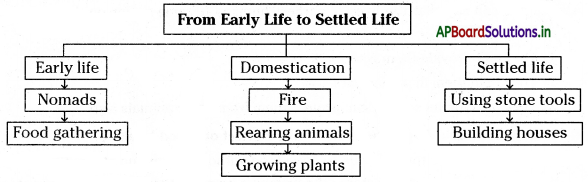
→ Thousands of years ago the people who lived in the sub-continent were called hunter-gatherers. They gathered fruits, edible roots, and tubers, nuts, seeds, leaves, honey, wild grains that grew naturally in the forests. They hunted animals and birds, caught fish, gathered eggs for food. So they got that name. They covered their bodies with skins of animals and leaves.

→ They lived in caves or under tree shades or rock shades. They moved from place to ] place in search of food. Such people are called nomads. Men, women, and children participated in hunting and gathering.

→ The hunter-gatherers discovered fire. It let them cook their food, making it safe to eat. They used fire to keep off wild animals, to light the caves, and to harden the wood. The fire had many uses in the life of hunter-gatherers. So, they considered it sacred.

→ Hunter-gatherers had a wide range of tools made out of stone, wood, and bone. They used those tools to scrape animal skins and to clean the skins. They used stone tools to cut animal flesh and bones. They dug soil for edible tubers and roots with these tools. They prepared spears and arrows for hunting. They hunted animals easily with these tools.

→ Betamcherla and Banaganapalli caves in the Kurnool district seem to have been used by the stone tools using hunter-gatherers as resting places for thousands of years.

→ Hunter-gatherers painted pictures of humans, animals, and hunting scenes on the surface of the rocks. Different color stones were ground and mixed with animal fat to prepare these colors. They used bamboo brushes to paint on rocks.

→ More than 12,000 years ago, the world had started becoming wanner. This was known as the period of great development for humans. In this period, humans changed from food gatherers to growers. Animals like buffalo, ox, sheep, goat, deer, etc., which depend on grass started increasing in number. Man used to domesticate those ani¬mals.

AP Board Solutions AP Board 6th Class Social Studies Notes Chapter 5 Early Life to Settled Life

→ As the greenery increased, people started observing the places where edible plants could be found, how seeds broke off stalks, fell on the ground, and new plants sprouted from them. This was the beginning of farming. They cultivated different crops such as rice, wheat, barley, lentil, green-gram, black-gram, etc.

→ Animals such as sheep, goats, buffaloes, oxen, and pigs lived in herds and most of them ate grass. These animals provided milk, meat and some would even carry loads. People protected those animals from the wild animals. This was how they became herders.

→ People realized that seeds took some time to grow – days, weeks, months, and even years. This meant that people had to stay in a place for a long time taking care of the plants, watering them, and protecting them from birds and animals. Due to these reasons, people began to settle down inconvenient places for a longer time.

→ The early farmers needed tools to clear forests by cutting trees. They developed new kinds of stone tools which were called Neolithic stone tools by the archaeologists. This period of early agriculture is called the Neolithic period.

→ During the late Neolithic Age, people made more technological advances. Toolmakers created better farming tools according to their needs.

→ Hunter-gatherers: The people who depend, upon hunting and gathering produce from the forest

→ Herders: Animal rearers.

→ Archaeologist: An archaeologist is a scientist who studies human history by digging up human remains and artifacts.

→ Settled life: Living permanently in one place

→ Stone-tools: Tools made by stones for different purposes

→ Mortars and pestles: Tools used to grind grains and plant products

AP Board Solutions AP Board 6th Class Social Studies Notes Chapter 5 Early Life to Settled Life

→ Bronze: It is an alloy of copper and tin metals

→ Domestication: It is the name given to the process in which people grow plants and rear animals
AP Board 6th Class Social Studies Notes Chapter 5 Early Life to Settled Life 1

AP Board 7th Class Telugu Solutions Chapter 12 అసామాన్యులు

SCERT AP State 7th Class Telugu Textbook Solutions 12th Lesson అసామాన్యులు Questions and Answers.

AP State Syllabus 7th Class Telugu Solutions 12th Lesson అసామాన్యులు

7th Class Telugu 12th Lesson అసామాన్యులు Textbook Questions and Answers

ఇవి చేయండి

I. వినడం – మాట్లాడడం

ప్రశ్న 1.
“ఆదివాసులు మనందరికీ మార్గదర్శకులు” దీన్ని వివరించండి.
జవాబు:
ఆహారం లేకపోతే ఎవరూ బతకరు. ఆహారం గురించి మనకు ఆదివాసులే తెలిపారు. ఆదివాసులు అడవులే అమ్మ ఒడిగా, కొండకోనలే తోడునీడగా జీవిస్తారు. వారు రాత్రింబగళ్ళు ప్రకృతితో కలిసి జీవిస్తూ ప్రకృతిని బాగా పరిశీలిస్తారు. ఏమి తినాలో, ఏమి తినగూడదో, మనకు ఆదివాసులే చెప్పారు. ఇందుకోసం వారు ప్రయోగాలు చేశారు. ఈ ప్రయోగాలలో కొందరు ఆదివాసులు ప్రాణాలు కూడా వదిలారు. జంతువుల మాంసం తినేముందు, వారు ఆ జంతువులనూ, వాటి ఆహారం అలవాట్లనూ, పరిశీలించారు. తర్వాతనే ఫలానా జంతువు. మాంసం తినవచ్చునని వారు తేల్చి చెప్పారు.

కోయలు, గోండులు, చెంచులు వంటి గిరిజనులకు ఉన్న ప్రకృతి విజ్ఞానం ఎంతో గొప్పది. చెట్లను గురించి వారికి తెలిసినంతగా, ఇతరులకు తెలియదు. ఆదివాసులు కూడా, శాస్త్రజ్ఞులే, వారికి రోగాలు వస్తే, చెట్ల మందులతోనే వారు తిరిగి ఆరోగ్యాన్ని పొందుతారు. అందువల్ల ఆదివాసులే గురువులై మనకు మార్గదర్శకులయ్యారు.

ప్రశ్న 2.
కుమ్మరివారి గొప్పతనాన్ని గురించి వివరించండి.
జవాబు:
కుమ్మరి వాని చక్రం నుంచి, బంకమట్టి నుంచి, మనం నిత్యం ఉపయోగించే కుండలు, కూజాలు, అటికెలు, గురుగులు, ప్రమిదలు వస్తున్నాయి. మెత్తటి మట్టి, బూడిద లేదా రంపం పొట్టు, సన్న ఇసుకను కలిపి, బంకమట్టిని తయారుచేస్తారు. వారు కాళ్ళతో తొక్కి, చెమటోడ్చి సిద్ధం చేసిన బంకమట్టిని కుమ్మరిసారెపై పెడతారు.

కుమ్మరి చక్రం తిప్పుతూ, చక్రం మీద పెట్టిన బంకమట్టిని తన చేతివేళ్ళ కొనలతో నేర్పుగా నొక్కుతాడు. ఆశ్చర్యంగా అనుకున్న రూపాలు వస్తాయి. తయారైన మట్టి పాత్రలను ఆరబెడతారు. తర్వాత ‘కుమ్మర ఆము’లో పెట్టి, బురదమట్టితో కప్పుతారు. కొలిమిని మండిస్తారు. వేడి అన్ని పాత్రలకూ సమానంగా అందుతుంది. మట్టి పాత్రలన్నీ కాలి, గట్టిగా తయారవుతాయి. వేసవికాలంలో వీరి కూజాలకు, కుండలకు మహాగిరాకీ. వీరు చేసే ప్రమిదలు భక్తి జీవితంలో ప్రధాన భాగం.

AP Board 7th Class Telugu Solutions Chapter 12 అసామాన్యులు

ప్రశ్న 3.
“వడ్రంగివారు నేటి ఆధునిక ఇంజనీర్లు” – దీన్ని సమర్థిస్తూ పదివాక్యాలు రాయండి.
జవాబు:
వడ్రంగుల పనిలో ఎంతో ఇంజనీరింగ్ నైపుణ్యం ఉంది. మనకు వ్యవసాయానికి కావః పిన నాగలి, గుంటక, గొర్రు వంటి పనిముట్లను అన్నింటినీ వడ్రంగులే తయారుచేస్తారు. ఆ పనిముట్ల ఈ రీకి ఏ చెట్టు కలప సరిపోతుందో వారు పరిశీలిస్తారు. చెట్టును చూస్తే సరిపోదు.

చెట్టును కొట్టి, దాన్ని కోసి, చిత్రిక పట్టాలి. తొలి కొట్టాలి. అందులో బిగించాలి. ఇలా వడ్రంగులు ఎంతో ఇంజనీరింగ్ నైపుణ్యం చూపించాలి.

వ్యవసాయానికీ, ప్రయాణానికీ ఉపయోగించే బండి సౌకర్యాన్ని వడ్రంగులు సమాజానికి అందించారు. ఇంటి తలుపులు, వాసాలు, కిటికీలు, ఇళ్ళు, వడ్రంగుల పనితనం వల్లే, అందంగా తయారవుతున్నాయి. మనం వాడుకొనే మంచాలు, కుర్చీలు, బెంచీలు, టేబుళ్ళు అలమారలు సైతం వడ్రంగుల చేతుల్లోనే తయారవుతున్నాయి. వడ్రంగులు
“దారు శిల్పులు”. వారు నేటి కాలం “ఇంజినీర్లు”.

ప్రశ్న 4.
“రైతులు మన అన్నదాతలు” – వివరించండి.
జవాబు:
రైతులు మనకు అన్నదాతలు. రైతు దేశానికి వెన్నెముక. అతనికి కోపం వస్తే, మనకు అన్నం దొరకదు. రైతు నడుంవంచి కష్టించి పాడిపంటలు పెంచుతున్నాడు. తాను పస్తులు ఉండి, మన కడుపులు చల్లగా ఉండేటట్లు మనకు రైతు తిండి పెడుతున్నాడు. రైతు రాత్రింబగళ్ళు కష్టపడి పనిచేస్తాడు. తాను ఎండకు ఎండినా, వానకు ‘ తడిసినా, చలికి వణకినా ధైర్యంతో కష్టపడి, రైతు పంటలు పండించి మన పొట్టలు నింపుతున్నాడు.

మనం తినే అన్నం, కూరగాయలు, పండ్లు అనేవి, రైతులు చెమటోడ్చి పనిచేసిన కృషికి ఫలాలు. రైతు రాత్రింబగళ్ళు రెక్కలు ముక్కలు చేసుకొని, శ్రమిస్తేనే మనం హాయిగా తింటున్నాము. అందుకే లాల్ బహదూర్ శాస్త్రిగారు “జై జవాన్, జై కిసాన్” – అన్నారు.

కాబట్టి రైతులు మనకు అన్నదాతలు. రైతుల త్యాగం, కృషి అపూర్వమైనవి.

AP Board 7th Class Telugu Solutions Chapter 12 అసామాన్యులు

ప్రశ్న 5.
“దేహానికి అవయవాలు ఎంత ముఖ్యమో, సమాజానికి అన్ని వృత్తులవారు అంత అవసరం” – దీన్ని సమర్థిస్తూ వ్యాసం రాయండి.
(లేదా)
“సమాజ నిర్మాణానికి అన్ని వృత్తుల వాళ్లూ అవసరమే” దీన్ని సమర్థిస్తూ రాయండి.
అన్ని వృత్తుల వారు పరస్పరం సహకరించుకుంటేనే సమాజ గమనం సాగుతుందని అసామాన్యులు పాఠంలో. చదివారు కదా ! మన సమాజంలోని వృత్తులను, వాటి ప్రాముఖ్యతను వివరించండి.
జవాబు:
కులవృత్తుల – ప్రాముఖ్యం

మన శరీరంలో కళ్లు, చెవి, ముక్కు, కాళ్ళు, చేతులు వంటి అవయవాలు ఉన్నాయి. ఈ అవయవాలు అన్నీ. సరిగా పనిచేస్తేనే మన శరీరం పనిచేస్తుంది. శరీరానికి ఈ అవయవాలు అన్నీ ముఖ్యమే. సంఘంలో అనేక వృత్తులవారు ఉన్నారు. కుమ్మరి, కంసాలి, కమ్మరి, వడ్రంగి, మంగలి, చర్మకారుడు, సాలె, కురుమలు, రజకుడు వంటి ఎందరో వృత్తి పనివారలు ఉన్నారు.

ప్రతి వృత్తి పవిత్రమైనదే. ఏ వృత్తినీ మనం చిన్న చూపు చూడరాదు. మన ఇంట్లో శుభకార్యం జరగాలంటే, మంగళ వాద్యాలు వాయించేవారు కావాలి. కుండలు, ప్రమిదలు, ఆభరణాలు, వస్త్రాలు అన్నీ కావాలి. అంటే అన్ని వృత్తులవారు సహకరిస్తేనే ఏ పనులయినా జరుగుతాయి. ఒకరికొకరు తోడ్పడితేనే, సమాజం నడుస్తుంది.

రైతులు పొలం దున్నాలంటే నాగలి కావాలి. దాన్ని వడ్రంగి చెక్కాలి. కమ్మరి దానికి గొర్రు తయారుచేయాలి. రైతుకు. చర్మకారులు చెప్పులు కుట్టాలి. సాలెలు బట్టలు వేయాలి. కంసాలి, వారికి నగలు చేయాలి. కుమ్మరి కుండలు చేయాలి. ఇలా అన్ని వృత్తులవారూ సహకారం అందిస్తేనే, సమాజం సక్రమంగా నడుస్తుంది.

ఒకప్పుడు గ్రామాలు స్వయం సమృద్ధిగా ఉండేవి. గ్రామ జీవనానికి అవసరమైన వస్తువులను, అన్ని వృత్తులవారు కలిసి మెలిసి తయారుచేసుకొనేవారు. వారు తమ కులాలను మరిచిపోయి, అక్క బావ, మామ, అత్త, అన్న అని పిలుచుకొనేవారు. .. తిరిగి గ్రామాల్లో అటువంటి తియ్యని జీవితం రావాలి. శరీరం నడవడానికి అవయవాలు అన్నీ ఎంత ముఖ్యమో మనిషి జీవనానికి అన్ని వృత్తులవారి శ్రమ కూడా అంత ముఖ్యం అని గుర్తించాలి.

ప్రశ్న 6.
‘ఒకరిమీద ఒకరు ఆధారపడడం’. అనేది మన సంస్కృతిలో చాలా గొప్పది. ఎందుకు? దీన్ని వివరిస్తూ రాయండి.
జవాబు:
నిత్య జీవితంలో మనిషి ప్రక్కమనిషి మీద ఆధారపడి బతకక తప్పదు. పరస్పరం ఒకరిపై ఒకరు. ఆధారపడటం అనేది మన సంస్కృతిలో గొప్ప విషయం.

ఈ మన ఇంట్లో పెళ్ళి అయితే మంగళవాద్యాలు కావాలి. కుండలు, ప్రమిదలు కావాలి. నగలు కావాలి. వంటల వారు కావాలి. పెండ్లి చేయించేవారు కావాలి. బట్టలు కావాలి. లైటింగ్ ఏర్పాట్లు కావాలి. అలంకరణ చేసేవారు కావాలి. ఈ పనులన్నీ చేసేవారు ఉంటే తప్ప, మన వద్ద డబ్బు ఉన్నా పెళ్ళి జరుగదు. దీనిని బట్టి మనం సంఘంలో ఒకరిపై ఒకరు ఆధారపడి బతుకుతున్నాం అని గ్రహించాలి.

రైతు పంటలు పండించాలి. ఆ పంటలను బజార్లకు తీసుకురావాలి. వాటిని వర్తకులు అమ్మాలి. అప్పుడే మనం వాటిని కొని, అనుభవించగలం. రోగం వస్తే వైద్యులు కావాలి, ఇళ్ళు కట్టడానికి, తాపీ పనివారు, వడ్రంగులు, ఇనుప పనివారు, విద్యుచ్ఛక్తి పనివారు, కుళాయిలు అమర్చేవారు కావాలి. ఇండ్లలో పనిచేసే పనివారు కావాలి.

దీనిని బట్టి మనం ఒకరిపై ఒకరు ఆధారపడి జీవిస్తున్నాం అనీ, పరస్పరం ఆధారపడటం మన సంస్కృతిలో గొప్ప విషయం అని గ్రహిస్తాము.

కఠిన పదములకు అర్థములు

అసామాన్యమైన = సాటిలేనిదైన
ప్రతిభ = తెలివి
క్షణాలలో = నిమిషాలలో
సారించామా? = ప్రసరింపజేశామా?
కృషి = పరిశ్రమ; ప్రయత్నము
త్యాగాన్ని = దానాన్ని
జీవమ్ములు = ప్రాణులు
జీవకోటి = ప్రాణికోటి
ఆదివాసులు = మొదట నివసించిన వారు
కొండకోనలు = కొండలు, అరణ్యాలు
రేయింబవళ్ళు = రాత్రింబవళ్ళు
ఆహారపుటలవాటు = ఆహారం, అలవాట్లు
అతిశయోక్తి = ఎక్కువగా చెప్పినమాట
జానపదులు = గ్రామీణులు
ప్రాచుర్యం = విస్తారం
సజావుగా = సరియైనరీతిలో
మురిసిపోతాం = ఆనందిస్తాము
గిరాకీ = అలభ్యత (దొరకకపోవడం)
అటికెలు = చిన్నకుండలు
గురుగులు = చిన్న పిడతలు
చకచకా = వేగంగా
సమాజగతిని = సంఘపు నడకను
ఆము = కుమ్మరి కుండలు కాల్చే నిప్పుల గుంట
తతంగము = కార్యక్రమము
కొలిమి = కమ్మరి ఇనుప పనిముట్లు కాల్చే నిప్పుల గుంట
కమ్మలు = చెవుల ఆభరణాలు (దుద్దులు)
ఆపాదమస్తకం = పాదాలనుండి తలవఱకు
సొమ్ములు = నగలు
మూస = బంగారం మున్నగువాటిని కరిగించే పాత్ర
అనారోగ్యము = ఆరోగ్యం చెడిపోవడం
నైపుణ్యం = నేర్పు
పొదగడం = అతకడం
గడ్డపార = గునపము
సెగ = వేడి
కీలకము = ముఖ్యము
గుంటక = విత్తనాలు చల్లడానికి నేలను చదును చేసే సాధనము
కొయ్య = కఱ్ఱ
దారు శిల్పులు = కఱ్ఱపై చెక్కే శిల్పులు
ఆవేదన = పెద్దనొప్పి
ఒడుపుగా = వీలుగా
ఔదార్యాన్ని = దాతృత్వాన్ని
కలిమిన్ కబళించి = సంపదను మ్రింగి
భరతావని = భారతభూమి
వక్కాణించారు = చెప్పారు

ముప్పు ఘటించి పద్యమునకు భావము

భావం :
చెప్పులు కుట్టి జీవించే వారి కులానికి కీడు చేసి, వారి సంపదను దోచుకొని, వారి శరీరాన్ని పిప్పి చేసిన భారతవీరుల యొక్క పాదాలు కందిపోకుండా వారికి చెప్పులు కుట్టి, చెప్పులుకుట్టేవారు జీవనాన్ని సాగిస్తారు. కాదని చెప్పరు. భరతభూమి చెప్పులు కుట్టేవారి సేవకు ఋణ పడింది.

AP Board 7th Class Telugu Solutions Chapter 12 అసామాన్యులు

కాటికి = శ్మశానమునకు
బొక్కెనలు = చేదలు
క్షురకులు = మంగలులు
భాగస్వామ్యం = వాటా
అవగాహన = తెలిసికోవడం
గాట్లుపడటం = పుండ్లు పడడం
చిట్కాలు = సూక్ష్మరహస్యాలు
శరీరమర్ధనం = శరీరాన్ని పిసకడం; (మాలిష్ చేయడం)
ఆషామాషీ = అశ్రద్ధ
సుదీర్ఘము = మిక్కిలి పొడవైనది
శుభాశుభకార్యక్రమాలు = మంచి చెడుపనులు
ప్రమేయం = సంబంధము
ఆవిష్కరణలు = కొత్త వస్తువులను కనుక్కోడాలు
తల్లడిల్లుతాం = ఆవేదన చెందుతాము
నినాదము = కేక
పస్తులుండి (పస్తులు + ఉండి) = తిండితినకుండా ఉండి
సడలని స్టైర్యం = జారని (తొలగని) ఓర్పు (నిలుకడ)
పునీతుడు = పవిత్రుడు
పరస్పరం = ఒకరికొకరు
సహకరించుకుంటే = సాయం చేసుకుంటే
స్వయం సమృద్ధంగా = తనంతట తాను నిండుగా
చేదోడు వాదోడుగా = పనిలో మాటలో సాయముగా
ఆత్మీయ సంబంధం = తనవారనే సంబంధము
శ్రమైక జీవన సౌందర్యము = శ్రమించడమే ముఖ్యమైన
అందం పాటించడం = ఆచరించడం

AP Board 10th Class Social Studies Notes Chapter 3 Production and Employment

Students can go through AP State Board 10th Class Social Studies Notes Chapter 3 Production and Employment to understand and remember the concept easily.

AP State Board Syllabus 10th Class Social Studies Notes Chapter 3 Production and Employment

→ People are engaged in different activities to earn their livelihoods.

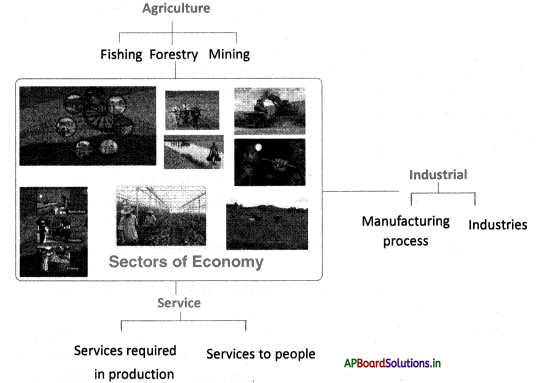
→ These activities are :

  1. Agriculture and related activities such as fishing, forestry, mining where nature has a dominant role in the production process.
  2. Manufacturing processes and other industries, where goods are produced by people using tools or machines and
  3. Those activities that don’t directly produce a good but provide services that are required in production and other services for people.

→ The good becomes final if it is not used further in producing goods to be sold.

→ Gross Domestic Product is the value of all final goods and services produced within a country during a particular year.

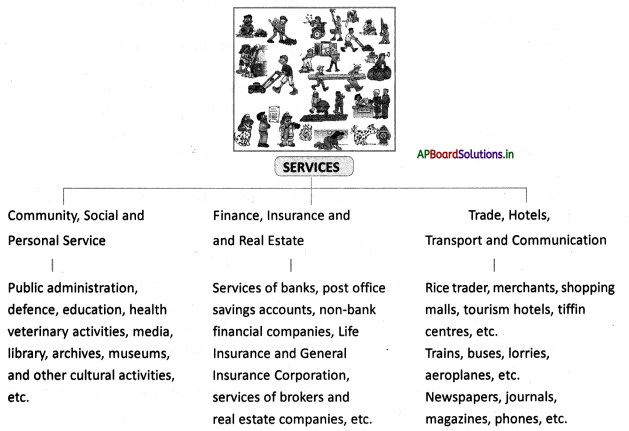
→ The unpaid work is done mostly by women even today, in India and across the globe. Community, social and personal services comprise Public Administration, Defence, Education, Health, Veterinary activities, Media, Library, Archives, Museums, and other cultural activities, etc.

→ Finance, Insurance, and Real Estate comprise services of Banks, Post-office Savings Accounts, Non-bank Financial Companies, Life Insurance and General Insurance corporations, Services of brokers and Real Estate Companies, etc.

→ The other service sector division comprises trade, hotels, transport, and communication.

→ The situation of underdevelopment where people are apparently working but all of them are made to work less than their potential.

→ This kind of unemployment is hidden in contrast to someone who does not have a job and is clearly visible as unemployed. Hence it is called ‘disguised unemployment.

→ 92% of workers in India are found in the unorganized sector and only 8% find work in the organized sector.

→ Places of work of organized sector are registered by the government and have to follow its rules and regulations.

→ The unorganized sector is characterized by small and scattered units which have remained largely outside the control of the government.

AP Board Solutions AP Board 10th Class Social Studies Notes Chapter 3 Production and Employment

→ Nearly 80% of rural households in India are in the small and marginal farmer category. During 2004-05, 92% of all workers contributed 50% of GDP whereas only 8% of people had decent employment and contributed 50% of GDP.

→ We should invest in many industries, in both rural and semi-urban areas, so that we are able to produce many more goods and services.

→ We not only have to generate new employment opportunities but also train many workers to work efficiently and with machines.

→ Gross Domestic: It is the value of all final goods and services produced within a Product country during a particular year.

→ Final Goods: The goods become final if they are not used further in producing goods to be sold.

→ Sectoral Goods: The goods produced In three sectors i.e., Agricultural, Industrial and Service sectors.

→ Employment shifts: In 1972-73 the shares of employment in Agricultural, Service and Industrial sectors were 74%, 15% and 11% whereas In 2009-10 they were 53%, 25%, and 22% respectively. This phenomenon is known as the employment shift.

→ Organized sector: Enterprises or places of work where the terms of employment are regular and therefore, people have assured work.

→ Unorganized sector: Small and scattered units where Jobs are low-paid and not regular and have remained largely outside the control of the government.

→ Financial year: A period of twelve months over which the accounts and taxes of a company or a person are calculated. For example, April 2017 to March 2018 Is called financial year 201 7-18.

→ Occupation: DIfferent activities In which people are engaged to earn their livelihood.

→ Primary sector: Agriculture and related activities such as farming, fishing, forestry, mining where nature has a dominant role In the production process.

→ Secondary sector: Manufacturing processes and other industries, where goods are produced by people using tools or machines.

→ Service sector: Those activities that don’t directly produce a good but provide services that are required in production and other services for people.

AP Board Solutions AP Board 10th Class Social Studies Notes Chapter 3 Production and Employment

→ Unpaid work: Work done at home like cooking, cleaning, organizing, bringing up children, etc. does not involve In any monetary transaction.

→ Employment: Individuals are gainfully engaged In productive work or service,

→ Unemployment: Individuals are not gainfully employed In any productive work.

→ Underemployment: The state of each one Is doing some work and no one is fully employed.

→ Disguised Unemployment: The situation of under-employment where people are apparently working but all of them are made to work less than their potential.
AP Board 10th Class Social Studies Notes Chapter 3 Production and Employment 1
AP Board 10th Class Social Studies Notes Chapter 3 Production and Employment 2

AP Board 9th Class Social Studies Notes Chapter 13 Democratic and Nationalist Revolutions 17th and 18th Centuries

Students can go through AP State Board 9th Class Social Studies Notes Chapter 13 Democratic and Nationalist Revolutions 17th and 18th Centuries to understand and remember the concept easily.

AP State Board Syllabus 9th Class Social Studies Notes Chapter 13 Democratic and Nationalist Revolutions 17th and 18th Centuries

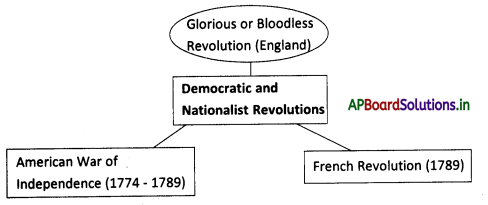
→ In 1603, James I of the Stuart dynasty became the King of England. He was succeeded by Charles I. He was executed in 1649. In 1688 the Glorious Revolution restricted the powers of the king and the supreme power was transferred to the Parliament.

→ England established thirteen colonies in the USA. “No Taxation without Representation” was the slogan of the American war of independence. The Declaration of Independence was adopted in 1776. War ended in 1783 and the USA became a republic in 1789.

→ In 1774, Louis XVI became the king of France. He was inefficient and was under the control of his wife Marie Antoinette. Long years of war had emptied the financial resources.

→ The French society was divided into three estates -1) Clergy, 2) Nobility, 3) Rest of the people. The first two classes were privileged classes and there was a lot of discontent among the third estate.

→ Louis XVI called on the Parliament “the Estates-General in 1789. The Third Estate declared itself as National Assembly. On 14 July the agitated Mob broke open the gates of the Bastille jail. Finally, the King and the Queen were executed in 1793.

→ The period from 1793 to 1794 is known as the Reign of Terror under Jacobins under the leadership of Robespierre.

→ Women in France fought for their rights but it was finally in 1946 that women in France won the right to vote.

→ Glorious Revolution The Revolution of 1688 in England happened without shedding a drop of blood. This transformation, therefore, is known as “Glorious” or ‘Bloodless Revolution”.

AP Board Solutions AP Board 9th Class Social Studies Notes Chapter 13 Democratic and Nationalist Revolutions 17th and 18th Centuries

→ Devine right: The rights that are provided by Gods are called Divine Rights.

→ Aristocracy: The Aristocracy is a class of people in some countries who have a high social rank and special titles.

→ Monarchy: Monarchy is a political system ¡n which all powers are concentrated in the hands of one single person.

→ Directory: An executive made up of five members.

→ Fraternity: Brotherhood.

→ National Assembly: On 20 June 1789 National Assembly was declared. It comprises three different institutions – the legislature, executive, and judiciary.

→ Civil war: Internal war in a country.

→ Guillotine: Beheaded by a machine.

→ Livres: Unit of currency in France till 1794.

→ Tithes: A tax levied by the church, comprising one-tenth of the agricultural produce.

→ Taille: Tax to be paid directly to the state.

AP Board Solutions AP Board 9th Class Social Studies Notes Chapter 13 Democratic and Nationalist Revolutions 17th and 18th Centuries

→ Manor: An estate consisting of the lord’s lands and his mansion.

→ Chateau: Castle or a stately residence belonging to a king or a nobleman.

→ Clergy: Group of persons invested with special functions in the church.

→ Nobility: Aristocratic and bureaucratic class.

→ Convent: A building belonging to a community devoted to religious life.
AP Board 9th Class Social Studies Notes Chapter 13 Democratic and Nationalist Revolutions 17th and 18th Centuries 1

→ Who were the inventors?
It is interesting to read about the individuals who brought these changes during industrialization. Few of them were trained scientists. Education in basic sciences like phys¬ics or chemistry was extremely limited until the late nineteenth century, even after the technological inventions described above. Since these inventions did not require full knowledge of the laws of physics or chemistry on which they were based, advances in science could be and were made by brilliant, intuitive thinkers and experimenters. They were helped by the fact that England had certain features which other European countries did not. Dozens of scientific journals and published papers of scientific societies appeared in England between 1760 and 1800. There was a widespread thirst for knowledge even in the smaller towns. This was met by the activities of the Society of Arts (founded in 1754), by traveling lecturers, or in ‘coffee houses’ that multiplied through the eighteenth century.

→ Most inventions happened because of determination, interest, curiosity, even luck, rather than the application of scientific knowledge. Some inventors in the cotton in¬dustry, like John Kay and James Hargreaves, were familiar with the skills of weaving and carpentry. Richard Arkwright, however, was a barber and wig-maker, Samuel Crompton was not technically skilled and Edmund Cartwright studied literature, medicine, and agriculture, ini¬tially wished to become a clergyman, and knew little of mechanics.

→ By contrast, in the area of steam engines, Thomas Savery, an army officer, Thomas Newcomen, a blacksmith and locksmith, and James Watt, with a strong mechanical bent, all had some knowledge relevant to their inventions. The road-builder, John Metcalf, who personally surveyed surfaces for roads and planned them, was blind. The canal builder James Brindley was almost illiterate, with such poor spelling that he could never spell the word ‘navigation’, but he had tremendous powers of memory, imagination, and concentration.

AP Board 9th Class Social Studies Notes Chapter 12 Changing Cultural Traditions in Europe 1300-1800

Students can go through AP State Board 9th Class Social Studies Notes Chapter 12 Changing Cultural Traditions in Europe 1300-1800 to understand and remember the concept easily.

AP State Board Syllabus 9th Class Social Studies Notes Chapter 12 Changing Cultural Traditions in Europe 1300-1800

→ From the ancient period till about 400 CE, Europe was dominated by the Roman Empire. The Romans carried out trade with distant countries like India.

→ They also influenced our art to a large extent, especially in northwest India.

→ The Roman Empire declined after 400 CE. The period from 400 CE to 1300 CE is called the Medieval Period.

→ Christianity, which had emerged during the first century-around 100 CE, had become the dominant religion in Europe replacing the older religions followed in the Roman Empire.

→ Feudalism grew stronger in Europe, the great cultural achievements of the ancient period were slowly forgotten and lost.

→ In Arabia, Persia, Iraq, and Northern Africa, the new religion of Islam were spreading and new political powers had emerged.

→ Turkish rule had been established in northern India around the beginning of the thirteenth century.

→ The Arabs established their empire in a region which was an intersection of several great cultures like China, India, Iran, Africa, and Europe.

AP Board Solutions AP Board 9th Class Social Studies Notes Chapter 12 Changing Cultural Traditions in Europe 1300-1800

→ There was a great revolt of peasants in England in 1381 which ended serfdom in England. Among the European countries, Italy was the first to benefit from urbanization and trade. Petrarch is considered one of the early Humanists of Italy.

→ During the middle ages, the culture of people came to be dominated by the Roman Catholic Church. In 1453, Constantinople was overthrown, Ottoman Empire took the place of the Eastern Roman Empire. Many of the educated men who spoke Greek fled to Italy for safety. They brought their books and ancient Greek literature was revived. This was called renais¬sance or rebirth.

→ Humanism started in Italy and soon spread to France, England, and the Netherlands.

→ Artists observed nature, the people, and places around them and sought to represent them as they were. Anatomy, Geometry, Physics, as well as a strong sense of what was beautiful, gave a new quality to Italian art, which was to be called “Realism” and which continued till the nineteenth century.

→ In Architecture, people studied the old Roman buildings to revive the old Roman style. Artists were known individually by name, not as members of a group as earlier. Michelangelo – immortalized by the ceiling he painted for the Pope in the Sistine Chapel, the sculpture called “The Pieta “and his design of the dome of St. Peter’s Church, all in Rome. Printing of the Bible led to the Reformation movement which questioned the corruption of the priesthood and laid foundations for the Protestant churches.

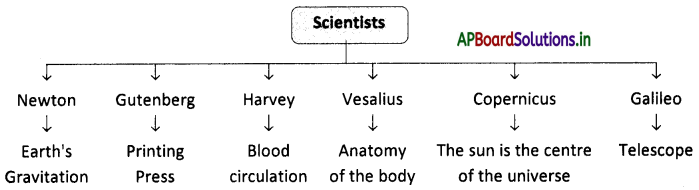
→ People started investigating the world in which they lived. Scientists like Bacon, Copernicus, Galileo, Harvey, Vesalius contributed a lot to the development of modern science. During the Renaissance, Europeans extended their limited knowledge of geography. The compass was invented. Constantinople was overthrown. Trade with Eastern countries was closed. So sailors like Bartholomew Diaz, Vasco-da-Gama, Columbus, Magellan discovered sea routes. These voyages were landmarks in human history.

→ Culture has been changing constantly in all ages. Even today, we can observe rapid changes in our cultural life.

→ During the medieval period, three great empires-Ottomans in Turkey, the Safavids in Iran, and the Mughals in India had emerged before 1550.

→ When Renaissance, Humanism, and Reformation were sweeping across Europe, in India styles of painting were refined as Mughal miniature painting and wall paintings of Vijaya Nagara.

→ Feudalism: It is a social system under which the political power was with large warrior-landlords who controlled the villages and peasants.

AP Board Solutions AP Board 9th Class Social Studies Notes Chapter 12 Changing Cultural Traditions in Europe 1300-1800

→ Serfs: Serfs were a class of people (during the Medieval period) who had to work on the land of the landlord, work in their workshops and also fight for them in wars.

→ Renaissance: Renaissance means “rebirth”. It was a period in Europe, especially Italy when there was a new interest in art, literature, science, and learning flourished.

→ Humanism: Humanism is the belief that people can achieve happiness and live well without religion.

→ Realism: Realism is a situation or the belief in which people recognize and accept the true nature of the situation.

→ Reformation: The reformation is the movement to reform the Catholic Church in the sixteenth century, which led to the Protestant Church is set up.

→ Protestant: A Protestant is a Christian who was separated from Roman Catholic Church in the sixteenth century.

→ Culture: It relates to aspects of human activity such as literature; music; dance; painting; sculpture; architecture; religious beliefs and even science.

AP Board Solutions AP Board 9th Class Social Studies Notes Chapter 12 Changing Cultural Traditions in Europe 1300-1800

→ Scientists and Inventions:
AP Board 9th Class Social Studies Notes Chapter 12 Changing Cultural Traditions in Europe 1300-1800 1

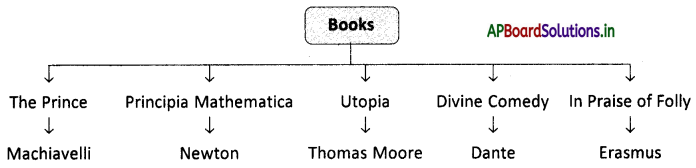
→ Books and Authors:
AP Board 9th Class Social Studies Notes Chapter 12 Changing Cultural Traditions in Europe 1300-1800 2

→ Periods in European History :

  • Ancient Period – up to 400 AD
  • Medieval Period – 400 AD to 1300 AD
  • Early Modern Period – 1300 to 1800 AD
  • Modern Period – 1800 to present
  • Note that these are rough dates.
  • Different historians may use different dates.

→ “Art” is embedded in nature; he who can extract it has it… The more closely your work abides by life in its form, so much the better will it appear… No man shall ever be able to make a beautiful figure out of his own imagination unless he has well stored his mind by much copying from life.’ – Albrecht Durer (1471 – 1528)
AP Board 9th Class Social Studies Notes Chapter 12 Changing Cultural Traditions in Europe 1300-1800 3
→ This sketch by Durer (Praying Hands) gives us a sense of Italian culture in the six¬teenth century, when people were deeply religious, but also had a sense of confidence in man’s ability to achieve near-perfection and to unravel the mysteries of the world and the universe.

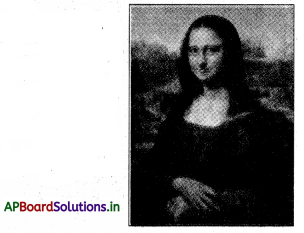
→ Leonardo da Vinci (1452-1519) had an amazing range of interests from botany and anatomy to mathematics and art. He painted the Mona Lisa (on left) and The Last Supper. One of his dreams was to be able to fly. He spent years observing birds in flight and designed a flying machine. He signed his name as ‘Leonardo da Vinci, a disciple of experiment’.
AP Board 9th Class Social Studies Notes Chapter 12 Changing Cultural Traditions in Europe 1300-1800 4

AP Board 8th Class Social Studies Notes Chapter 24 Disaster Management

Students can go through AP State Board 8th Class Social Studies Notes Chapter 24 Disaster Management to understand and remember the concept easily.

AP State Board Syllabus 8th Class Social Studies Notes Chapter 24 Disaster Management

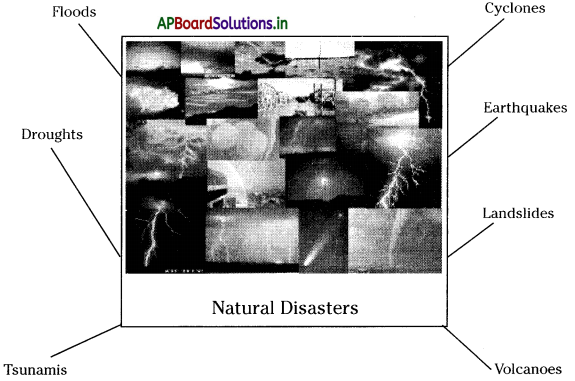
→ India with its vast population and unique geophysical characteristics is one of the world’s most “Disaster-prone” countries.

→ The East and South-East parts of India are frequently affected by cyclones.

→ The damage caused due to a hazard increases when people are not adequately prepared to face the disaster.

→ Disasters can be categorized into various types based on speed and origin/cause.

→ The term ‘Tsunami’ has been coined from Japanese words – ‘Tsu’ and ‘name’.

→ Coastal tidal gauges can stop tsunamis close to the shore, but they are useless in deep oceans.

→ Drought is basically a disaster situation caused by a lack of rainfall.

→ Excess or deficient rainfall is determined by the percent variation from the average rainfall of 70-100 years.

AP Board Solutions AP Board 8th Class Social Studies Notes Chapter 24 Disaster Management

→ Certain regions due to their geographical location are more likely to receive less rainfall. These are called ‘drought-prone areas’.

→ Unlike sudden disasters drought being a slow-onset disaster, gives us ample time for preparedness, response, and mitigation.

→ In urban areas, all rainwater as it falls over roofs of houses should be harvested.

→ The government is implementing Integrated Watershed Management Programme (IWMP) in drought-prone areas.

→ Multi-Hazard Zone: Area which faces floods and cyclones frequently is called Multi’ Hazard Zone.

→ Human-Induced Hazard: A serious disruption of normal life triggered by human-induced hazard.

→ Famine: A disaster situation caused by lack of rains.

→ Pest Infection: Sometimes there may be attacks of pests on fields and the fluids get infected. This is called pest infection.

AP Board Solutions AP Board 8th Class Social Studies Notes Chapter 24 Disaster Management

→ Environmental Degradation: Deterioration of the environment through depletion of resources such as air, water, and soil, the destruction of the ecosystem.

→ Drought: Drought ¡s basically a disaster situation caused by a lack of rainfall.
AP Board 8th Class Social Studies Notes Chapter 24 Disaster Management 1