AP Inter 1st Year Maths 1A Important Questions Chapter 6 త్రికోణమితీయ నిష్పత్తులు, పరివర్తనలు

Students get through AP Inter 1st Year Maths 1A Important Questions Chapter 6 త్రికోణమితీయ నిష్పత్తులు, పరివర్తనలు which are most likely to be asked in the exam.

AP Inter 1st Year Maths 1A Important Questions Chapter 6 త్రికోణమితీయ నిష్పత్తులు, పరివర్తనలు

సాధించిన సమస్యలు
(Solved Problems)

ప్రశ్న 1.
కింది విలువలు కనుక్కోండి.
(i) sin \(\frac{5 \pi}{3}\)
(ii) tan (855°)
(iii) sec \(\left(\frac{13 \pi}{3}\right)\)
సాధన:
(i) sin \(\frac{5 \pi}{3}\) = sin (2π – \(\frac{\pi}{3}\))
= -sin\(\frac{\pi}{3}\)
= –\(\frac{\sqrt{3}}{2}\)

(ii) tan (855°) = tan (2 × 360° + 135°)
= tan (135°)
= tan (180° – 45°)
= -tan 45° = -1

(iii) sec \(\left(\frac{13 \pi}{3}\right)\)
= sec (4л + \(\frac{\pi}{3}\))
= sec \(\frac{\pi}{3}\)
= 2

AP Inter 1st Year Maths 1A Important Questions Chapter 6 త్రికోణమితీయ నిష్పత్తులు, పరివర్తనలు

ప్రశ్న 2.
కింది వాటిని సూక్ష్మీకరించండి.
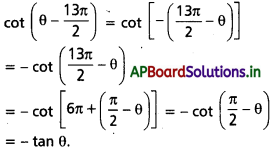
i) cot \(\left(\theta-\frac{13 \pi}{2}\right)\)
సాధన:
AP Inter 1st Year Maths 1A Important Questions Chapter 6 త్రికోణమితీయ నిష్పత్తులు, పరివర్తనలు 1

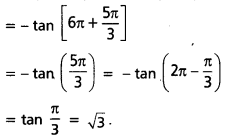
ii) tan \(\left(-23 \frac{\pi}{3}\right)\)
సాధన:
AP Inter 1st Year Maths 1A Important Questions Chapter 6 త్రికోణమితీయ నిష్పత్తులు, పరివర్తనలు 2

ప్రశ్న 3.
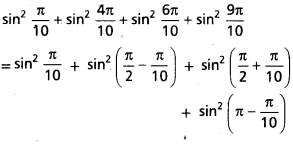
sin2 \(\frac{\pi}{10}\) + sin2 \(4\frac{\pi}{10}\) + sin2 \(\frac{6\pi}{10}\) + sin2 \(\frac{9\pi}{10}\) విలువను కనుక్కోండి.
సాధన:
AP Inter 1st Year Maths 1A Important Questions Chapter 6 త్రికోణమితీయ నిష్పత్తులు, పరివర్తనలు 3
= sin2 \(\frac{\pi}{10}\) + cos2 \(\frac{\pi}{10}\) + cos2 \(\frac{\pi}{10}\) + sin2 \(\frac{\pi}{10}\)
= 2 (∵ sin2 θ + cos2 θ = 1 ∀ θ)

AP Inter 1st Year Maths 1A Important Questions Chapter 6 త్రికోణమితీయ నిష్పత్తులు, పరివర్తనలు

ప్రశ్న 4.
sin θ = \(\frac{4}{5}\), θ మొదటి పాదంలో లేకపోతే cos θ విలువను కనుక్కోండి.
సాధన:
∵ sin θ = \(\frac{4}{5}\), θ మొదటి పాదంలో లేదు.
⇒ θ, రెండవ పాదంలో ఉంటుంది. . sin θ +ve కనుక,
⇒ cos θ = – \(\sqrt{1-\sin ^2 \theta}\) = –\(\sqrt{1-\left(\frac{4}{5}\right)^2}=\frac{-3}{5}\)
cos θ = –\(\frac{3}{5}\)

ప్రశ్న 5.
sec θ + tan θ = \(\frac{2}{3}\) అయితే, sin θ విలువ కనుక్కొని, θ ఏ పాదంలో ఉంటుందో కనుక్కోండి.
సాధన:
∵ sec θ + tan θ = \(\frac{2}{3}\)
⇒ sec θ – tan θ = \(\frac{3}{2}\) ; (∵ sec2 θ – tan2 θ = 1)
⇒ 2 sec θ = \(\frac{2}{3}\) + \(\frac{3}{2}\) = \(\frac{4+9}{6}\) = \(\frac{13}{6}\)
∴ sec θ = \(\frac{13}{12}\)
ఇంకా 2 tan θ = \(\frac{2}{3}\) – \(\frac{3}{2}\) = \(\frac{4-9}{6}\) = \(\frac{-5}{6}\)
∴ tan θ = \(\frac{-5}{12}\)
ఇప్పుడు sin θ = \(\frac{\tan \theta}{\sec \theta}=\frac{\left(\frac{-5}{12}\right)}{\left(\frac{13}{12}\right)}=\frac{-5}{13}\)
∵ tan θ రుణాత్మకం, sec θ ధనాత్మకం.
⇒ θ నాలుగో పాదంలో ఉంటుంది.

ప్రశ్న 6.
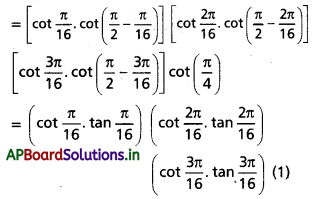
cot \(\frac{\pi}{16}\) . cot \(\frac{2\pi}{16}\) . cot \(\frac{3\pi}{16}\) …………. cot \(\frac{7\pi}{16}\) = 1 అని నిరూపించండి.
సాధన:
L.H.S. = \(\frac{\pi}{16}\) . cot \(\frac{2\pi}{16}\) . cot \(\frac{3\pi}{16}\) …………. cot \(\frac{7\pi}{16}\)
= \(\left(\cot \frac{\pi}{16} \cdot \cot \frac{7 \pi}{16}\right)\left(\cot \frac{2 \pi}{16} \cdot \cot \frac{6 \pi}{16}\right)\) \(\left(\cot \frac{3 \pi}{16}, \cot \frac{5 \pi}{16}\right) \cot \left(\frac{4 \pi}{16}\right)\)
AP Inter 1st Year Maths 1A Important Questions Chapter 6 త్రికోణమితీయ నిష్పత్తులు, పరివర్తనలు 4
= (1) (1) (1) (1) = 1

ప్రశ్న 7.
3 sin θ + 4 cos θ = 5 అయితే 4 sin θ – 3 cos θ విలువ కనుక్కోండి.
సాధన:
3 sin θ + 4 cos θ = 5
4 sin θ – 3 cos θ = x అనుకుందాం
పై సమీకరణాలను వర్గం చేసి, కలిపితే
(3 sin θ + 4 cos θ)2 + (4 sin θ – 3 cos θ)2 = 52 + x2
⇒ 9 sin2 + 16 cos2 θ + 24 sin θ cos θ + 16 sin2 θ + 9 cos2 θ – 24 sin θ cos θ = 25 + x2
⇒ 9 + 16 = 25 + x2
⇒ x2 = 0 ⇒ x = 0
∴ 4 sin θ – 3 cos θ = 0

AP Inter 1st Year Maths 1A Important Questions Chapter 6 త్రికోణమితీయ నిష్పత్తులు, పరివర్తనలు

ప్రశ్న 8.
cos θ + sin θ = \(\sqrt{2}\) cos θ అయితే cos θ – sin θ = \(\sqrt{2}\) sin θ అని చూపండి. [May ’11]
సాధన:
cos θ + sin θ = \(\sqrt{2}\) cos θ
sin θ = (\(\sqrt{2}\)-1) cos θ
ఇరువైపులా ( \(\sqrt{2}\) + 1) తో గుణిస్తే
⇒ (\(\sqrt{2}\) + 1) sin θ = (\(\sqrt{2}\) + 1) ( \(\sqrt{2}\) – 1) cos θ
⇒ (\(\sqrt{2}\) + 1) sin θ = (2 – 1) cos θ
⇒ \(\sqrt{2}\) sin θ + sin θ = cos θ
∴ cos θ – sin θ = \(\sqrt{2}\) sin θ

ప్రశ్న 9.
2(sin6 θ + cos6 θ) – 3(sin4 θ + cos4 θ) విలువను కనుక్కోండి,
సాధన:
2(sin6 θ + cos6 θ) – 3(sin4 θ + cos4 θ)
= 2[(sin2 θ)3 + (cos2 θ)3] – 3[(sin2 θ)2 + (cos2 θ)2]
= 2[(sin2 θ+ cos2 θ)3 – 3 sin2 θ cos2 θ (sin2 θ + cos2 θ)] – 3[(sin2θ+ cos2 θ)2 – 2 sin2 θ cos2 θ]
= 2[1 – 3 sin2 θ cos2 θ] – 3[1 – 2 sin2 θ cos2 θ]
= 2 – 6 sin2 θ cos2 θ – 3 + 6 sin2 θ cos2 θ
= -1

AP Inter 1st Year Maths 1A Important Questions Chapter 6 త్రికోణమితీయ నిష్పత్తులు, పరివర్తనలు

ప్రశ్న 10.
(tan θ + cot θ)2 = sec2 θ + cosec2 θ = sec2 θ. cosec2 θ అని నిరూపించండి.
సాధన:
(tan θ + cot θ)2
= tan2θ+ cot2 θ + 2 tan θ cot θ
= tan2θ + cot2θ + 2
= (1 + tan2θ) + (1 + cot2 θ)
= sec2 θ + cosec2 θ
ఇంకా sec2 θ. cosec2 = \(\frac{1}{\cos ^2 \theta}+\frac{1}{\sin ^2 \theta}\)
= \(\frac{\sin ^2 \theta+\cos ^2 \theta}{\sin ^2 \theta \cdot \cos ^2 \theta}\)
= \(\frac{1}{\cos ^2 \theta} \cdot \frac{1}{\sin ^2 \theta}\)
sec2 θ. cosec2

ప్రశ్న 11.
cos θ > 0, tan θ + sin θ = m, tan θ – sin θ = n అయితే m2 – n2 = 4\(\sqrt{mn}\) అని చూపండి.
సాధన:
m = tan θ + sin θ
n = tan θ – sin θ
⇒ m + n = 2 tan θ
m – n = 2 sin θ
(m + n) (m – n) = 4 tan θ sin θ
⇒ m2 – n2 = 4\(\sqrt{\tan ^2 \theta \cdot \sin ^2 \theta}\)
= 4\(\sqrt{\tan ^2 \theta\left(1-\cos ^2 \theta\right)}\)
= 4\(\sqrt{\tan ^2 \theta-\sin ^2 \theta}\)
= 4\(\sqrt{(\tan \theta+\sin \theta)(\tan \theta-\sin \theta)}\)
= 4\(\sqrt{m n}\)
∴ m2 – n2 = 4\(\sqrt{m n}\)

AP Inter 1st Year Maths 1A Important Questions Chapter 6 త్రికోణమితీయ నిష్పత్తులు, పరివర్తనలు

ప్రశ్న 12.
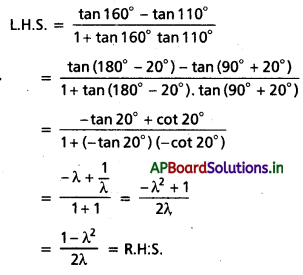
tan 20° = λ అయితే , \(\frac{\tan 160^{\circ}-\tan 110^{\circ}}{1+\tan 160^{\circ} \cdot \tan 110^{\circ}}\) = \(\frac{1-\lambda^2}{2 \lambda}\) అని నిరూపించండి.
సాధన:
tan 20° = λ
AP Inter 1st Year Maths 1A Important Questions Chapter 6 త్రికోణమితీయ నిష్పత్తులు, పరివర్తనలు 5

ప్రశ్న 13.
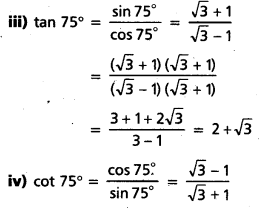
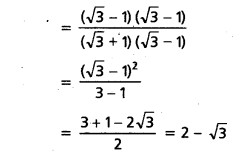
sin 75°, cos 75°, tan 75°, cot 75° యొక్క విలువలను కనుక్కోండి.
సాధన:
i) sin 75° = sin (45° + 30°)
sin 45°. cos 30° + cos 45°. sin 30°
= \(\left(\frac{1}{\sqrt{2}}\right)\left(\frac{\sqrt{3}}{2}\right)+\left(\frac{1}{\sqrt{2}}\right)\left(\frac{1}{2}\right)\)
= \(\frac{\sqrt{3}+1}{2 \sqrt{2}}\)

ii) cos (75°) = cos (45° + 30°)
= cos 45° cos 30° – sin 45° sin 30°
= \(\left(\frac{1}{\sqrt{2}}\right)\left(\frac{\sqrt{3}}{2}\right)-\left(\frac{1}{\sqrt{2}}\right)\left(\frac{1}{2}\right)\)
= \(\frac{\sqrt{3}-1}{2 \sqrt{2}}\)

AP Inter 1st Year Maths 1A Important Questions Chapter 6 త్రికోణమితీయ నిష్పత్తులు, పరివర్తనలు 6
AP Inter 1st Year Maths 1A Important Questions Chapter 6 త్రికోణమితీయ నిష్పత్తులు, పరివర్తనలు 7

AP Inter 1st Year Maths 1A Important Questions Chapter 6 త్రికోణమితీయ నిష్పత్తులు, పరివర్తనలు

ప్రశ్న 14.
cos A = \(\frac{5}{13}\), sin B = \(\frac{4}{5}\) 0 < A, B < 90° అయితే sin (A + B) విలువ కనుక్కోండి.
సాధన:
0 < A < 90°, cos A = \(\frac{5}{13}\) ⇒ sin A = \(\frac{12}{13}\)
0 < B < 90°, sin B = \(\frac{4}{5}\) ⇒ cos B = \(\frac{3}{5}\)
∴ sin (A + B) = sin A cos B + cos A sin B
= \(\frac{12}{13}\) . \(\frac{3}{5}\) + \(\frac{5}{13}\) . \(\frac{4}{5}\)
= \(\frac{56}{65}\)

ప్రశ్న 15.
sin2\(\left(52 \frac{1}{2}\right)^{\circ}\) – sin2\(\left(22 \frac{1}{2}\right)^{\circ}\) = \(\frac{\sqrt{3}+1}{4 \sqrt{2}}\) అని నిరూపించండి.
సాధన:
సూచన : sin2 A – sin2 B = sin (A + B). sin (A – B)
∴ sin2 52\(\frac{1}{2}\) – sin2 22\(\frac{1}{2}\)
= sin (52\(\frac{1}{2}\)° +22\(\frac{1}{2}\)°) . sin (52\(\frac{1}{2}\)° – 22\(\frac{1}{2}\)°)
= sin (75°). sin 30°
= \(\frac{1}{2}\) sin (45° + 30°)
= \(\frac{1}{2}\) [sin 45° cos 30° + cos 45° sin 30°]
= \(\frac{1}{2}\left[\left(\frac{1}{\sqrt{2}}\right)\left(\frac{\sqrt{3}}{2}\right)+\frac{1}{\sqrt{2}} \cdot \frac{1}{2}\right]\)
= \(\frac{\sqrt{3}+1}{4 \sqrt{2}}\)

ప్రశ్న 16.
tan 70° – tan 20° = 2 tan 50° అని నిరూపించండి.
సాధన:
tan 50° = tan (70° – 20°)
= \(\frac{\tan 70^{\circ}-\tan 20^{\circ}}{1+\tan 20^{\circ} \tan 70^{\circ}}\)
⇒ tan 70° – tan 20°
= tan 50° [1 + tan 20° tan (90° – 20°)]
⇒ tan 70° – tan 20° = tan 50° [1 + tan 20° cot 20°]
⇒ tan 70° – tan 20° = 2 tan 50°

AP Inter 1st Year Maths 1A Important Questions Chapter 6 త్రికోణమితీయ నిష్పత్తులు, పరివర్తనలు

ప్రశ్న 17.
A + B = π/4 అయితే ,
i) (1 + tan A) (1 + tan B) = 2, [Mar. 11, ’07]
ii) (cot A – 1) (cot B – 1) = 2 అని నిరూపించండి.
సాధన:
i) A + B = π/4
⇒ tan (A + B) = tan (π/4)
⇒ \(\frac{\tan A+\tan B}{1-\tan A \tan B}\) = 1
⇒ tan A + tan B = 1 – tan A tan B
⇒ tan A + tan B + tan A tan B = 1
ఇరువైపులా ‘1’ కలుపగా
⇒ 1 + tan A + tan B + tan A tan B = 1 + 1
⇒ (1 + tan A) (1 + tan B) = 2

ii) A + B = π/4
⇒ cot (A + B) = cot π/4
⇒ \(\frac{\cot A \cot B-1}{\cot B+\cot A}\) = 1
⇒ cot A cot B – 1 = cot B + cot A
⇒ cot A cot B – cot A – cot B = 1
ఇరువైపులా ‘1’ కలుపగా
cot A cot B – cot A – cot B + 1 = 1 + 1
∴ (cot A – 1) (cot B – 1) = 2.

ప్రశ్న 18.
sin α = \(\frac{1}{\sqrt{10}}\), sin β = \(\frac{1}{\sqrt{5}}\), α, β లము కోణాలయితే α + β = π/4 అని చూపండి.
సాధన:
α ఒక లఘు కోణం, sin α = \(\frac{1}{\sqrt{10}}\) ⇒ tan α = \(\frac{1}{2}\)
β ఒక లఘు కోణం, sin β = \(\frac{1}{\sqrt{5}}\) ⇒ tan β = \(\frac{1}{2}\)
కనుక tan (α + β) = \(\frac{\tan \alpha+\tan \beta}{1-\tan \alpha \tan \beta}\)
= \(\frac{\frac{1}{3}+\frac{1}{2}}{1-\frac{1}{3} \cdot \frac{1}{2}}\) = 1 ⇒ α + β = π/4

AP Inter 1st Year Maths 1A Important Questions Chapter 6 త్రికోణమితీయ నిష్పత్తులు, పరివర్తనలు

ప్రశ్న 19.
sin A = \(\frac{12}{13}\), cos B = \(\frac{3}{5}\), A, B రెండూ మొదటి పాదంలో లేకపోతే, A + B ఏ పాదంలో ఉందో కనుక్కోండి.
సాధన:
sin A = \(\frac{12}{13}\), A మొదటి పాదంలో లేదు.
⇒ A రెండవ పాదంలో ఉంటుంది ∵ sin A +ve
cos B = \(\frac{3}{5}\), θ మొదటి పాదంలో లేదు.
⇒ B నాల్గవ పాదంలో ఉంటుంది ∵ cos B +ve
∵ sin A = \(\frac{12}{13}\) ⇒ cos A = \(\frac{-5}{13}\)
cos B = \(\frac{3}{5}\) ⇒ sin B = \(\frac{-4}{5}\)
sin (A+B) sin A cos B + cos A sin B
= \(\left(\frac{12}{13}\right)\left(\frac{3}{5}\right)+\left(\frac{-5}{13}\right)\left(\frac{-4}{5}\right)\)
= \(\frac{36+20}{65}\) = \(\frac{56}{65}\)
cos (A+B)= cos A cos B – sin A sin B.
= \(\left(\frac{-5}{13}\right)\left(\frac{3}{5}\right)-\left(\frac{12}{13}\right)\left(\frac{-4}{5}\right)\)
= \(\frac{-15+48}{65}\) = \(\frac{33}{65}\)
∵ sin (A + B), cos (A + B) లు రెండూ ధనాత్మకాలు
⇒ (A + B) మొదటి పాదంలో ఉంటుంది.

ప్రశ్న 20.
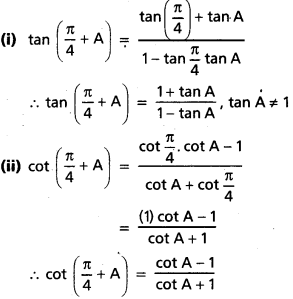
(i) tan A పదాలలో tan \(\left(\frac{\pi}{4}+\mathrm{A}\right)\) ని,
(ii) cot A పదాలలో cot \(\left(\frac{\pi}{4}+\mathrm{A}\right)\) ని కనుక్కోండి.
సాధన:
AP Inter 1st Year Maths 1A Important Questions Chapter 6 త్రికోణమితీయ నిష్పత్తులు, పరివర్తనలు 8

AP Inter 1st Year Maths 1A Important Questions Chapter 6 త్రికోణమితీయ నిష్పత్తులు, పరివర్తనలు

ప్రశ్న 21.
\(\frac{\cos 9^{\circ}+\sin 9^{\circ}}{\cos 9^{\circ}-\sin 9^{\circ}}\) = cot 36° అని నిరూపించండి. [(A.P) Mar. 15, ’11
సాధన:
L.H.S. = \(\frac{\cos 9^{\circ}+\sin 9^{\circ}}{\cos 9^{\circ}-\sin 9^{\circ}}\)
లవ, హారాలను cos 9° తో భాగిస్తే,
= \(\frac{1+\tan 9^{\circ}}{1-\tan 9^{\circ}}\) [∵ tan \(\left(\frac{\pi}{4}+\theta\right)=\frac{1+\tan \theta}{1-\tan \theta}\)]
= tan (45° + 9°)
= tan (54°)
= tan (90° – 36°) = cot 36°
∴ \(\frac{\cos 9^{\circ}+\sin 9^{\circ}}{\cos 9^{\circ}-\sin 9^{\circ}}\) = cot 36°.

ప్రశ్న 22.
cos 42° + cos 78° + cos 162° 0 అని చూపండి. [May ’11]
సాధన:
L.H.S.= cos 42° + cos 78° + cos 162°
= 2 cos \(\left(\frac{42^{\circ}+78^{\circ}}{2}\right)\) . cos \(\left(\frac{42^{\circ}-78^{\circ}}{2}\right)\) + cos (180° – 18°)
= 2 cos 60°. cos (-18°) + cos (180° – 18°)
= 2\(\left(\frac{1}{2}\right)\) cos 18° – cos 18° = 0
∴ cos 42° + cos 78° + cos 162°
= 0

ప్రశ్న 23.
\(\sqrt{3}\) sin θ + cos θ ని ఒక కోణానికి sine. గా వ్యక్తపరచండి.
సాధన:
\(\sqrt{3}\) sin θ + cos θ = 2(\(\frac{\sqrt{3}}{2}\) sinθ + \(\frac{1}{2}\)cos θ)
= 2(cos \(\frac{\pi}{6}\) sin 0 + sin \(\frac{\pi}{6}\) cos θ)
= 2. sin (θ + \(\frac{\pi}{6}\)).

AP Inter 1st Year Maths 1A Important Questions Chapter 6 త్రికోణమితీయ నిష్పత్తులు, పరివర్తనలు

ప్రశ్న 24.
sin2 θ + sin2 [θ – \(\frac{\pi}{3}\)] + sin2 [θ – \(\frac{\pi}{3}\)] = \(\frac{3}{2}\) అని చూపండి.
సాధన:
LHS = sin2 θ + sin2 [θ – \(\frac{\pi}{3}\)] + sin2 [θ – \(\frac{\pi}{3}\)]
= sin2 θ + (sin θ cos \(\frac{\pi}{3}\) + cos θ sin \(\frac{\pi}{3}\))2 + (sin θ cos cos \(\frac{\pi}{3}\) – cos \(\frac{\pi}{3}\) sin θ)2
= sin2 θ + 2 (sin2 θ cos2 \(\frac{\pi}{3}\) + cos2 θ sin2\(\frac{\pi}{3}\))
= sin2 θ + 2 (sin2 θ . \(\frac{1}{4}\) + cos2θ . \(\frac{3}{4}\))
= sin2 θ + \(\frac{1}{2}\) sin2 θ + \(\frac{3}{2}\) cos2 θ
= \(\frac{3}{2}\) sin2 θ + \(\frac{3}{2}\) cos2 θ = \(\frac{3}{2}\) (sin2 θ + cos2 θ)
= \(\frac{3}{2}\) = R.H.S.

ప్రశ్న 25.
A, B, C లు ఒక త్రిభుజంలోని కోణాలు అవుతూ, వీటిలో ఏ ఒక్కటీ \(\frac{\pi}{2}\) కానప్పుడు
i) tan A+ tan B + tan C = tan A tan B tan C
ii) cot A cot B+ cot B cot C + cot C cot A = 1 అని నిరూపించండి.
సాధన:
i) A, B, C లు త్రిభుజ కోణాలు.
⇒ A + B + C = 180°
⇒ A + B = 180° – C
⇒ tan (A + B) = tan (180° – C)
⇒ \(\frac{\tan A+\tan B}{1-\tan A \tan B}\) = -tan C
⇒ tan A + tan B = -tan C + tan A tan B tan C
⇒ tan A + tan B + tan C = tan A tan B tan C

ii) A + B + C = 180°
⇒ A+B 180° – C
⇒ cot (A + B) = cot (180° – C)
⇒ \(\frac{\cot A \cot B-1}{\cot B+\cot A}\) = -cot C
⇒ cot A cot B – 1 = -cot B cot C – cot C. cot A
⇒ cot A cot B + cot B cot C + cot C cot A = 1

AP Inter 1st Year Maths 1A Important Questions Chapter 6 త్రికోణమితీయ నిష్పత్తులు, పరివర్తనలు

ప్రశ్న 26.
ABC త్రిభుజంలో cot A + cot B + cot C = \(\sqrt{3}\) అయితే, ABC ఒక సమబాహు త్రిభుజమని చూపండి.
సాధన:
A + B + C = 180°
పై లెక్క నుండి
cot A cot B + cot B cot C+ cot C cot A = 1
i.e., Σ (cot A cot B) = 1 ………………. (1)
ఇప్పుడు (cot A – cot B)2
= Σ (cot2 A + cot2 B – 2 cot A cot B)
= 2 cot2 A + 2 cot2 B + 2 cot2 C – 2 cot A cot B – 2 cot B cot C – 2 cot C cot A
= 2 [cot A+ cot B + cot C]2 – 6 (cot A cot B + cot B cot C + cot C cot A)
= 2|(\(\sqrt{3}\))2 | – 6(1)
= 6 – 6 = 0
∴ Σ (cot A – cot B)2 = 0
⇒ cot A = cot B = cot C
⇒ cot A = cot B = cot C = \(\frac{\sqrt{3}}{3}=\frac{1}{\sqrt{3}}\)
(∵ cot A + cot B + cot C = \(\sqrt{3}\))
⇒ A = B = C = 60°
∴ ∆ABC సమబాహు త్రిభుజం

ప్రశ్న 27.
x = tan A, y tan B, z = tan C, A, B, C, A – B, B – C, C – A లలో ఏ ఒక్కటి కూడ \(\frac{\pi}{2}\) బేసి గుణిజం కానట్లయితే \(\Sigma\left(\frac{x-y}{1+x y}\right)=\pi\left(\frac{x-y}{1+x y}\right)\) అని చూపండి.
సాధన:
∵ x = tan A, y = tan B, z = tan C
అప్పుడు. \(\frac{x-y}{1+x y}=\frac{\tan A-\tan B}{1+\tan A \tan B}\) = tan (A – B)
ఇదే విధంగా \(\frac{y-z}{1+y z}\) = tan (B – C) మరియు
\(\frac{z-x}{1+z x}\) = tan (C – A)
P = A – B, Q = B – C, R = C – A అని రాస్తే
P + Q + R = 0 కనుక
⇒ P + Q = R
⇒ tan (P + Q) = tan (-R)
⇒ \(\frac{\tan P+\tan Q}{1-\tan P \tan Q}\) = -tan R
⇒ tan P + tan Q = -tan R + tan P tan Q tan R
⇒ tan P + tan Q + tan R = tan P tan Q tan R
⇒ Σ (tan P) = π (tan P)
⇒Σ tan (A – B) = π tan (A – B)
∴ \(\Sigma\left(\frac{x-y}{1+x y}\right)=\pi\left(\frac{x-y}{1+x y}\right)\)

AP Inter 1st Year Maths 1A Important Questions Chapter 6 త్రికోణమితీయ నిష్పత్తులు, పరివర్తనలు

ప్రశ్న 28.
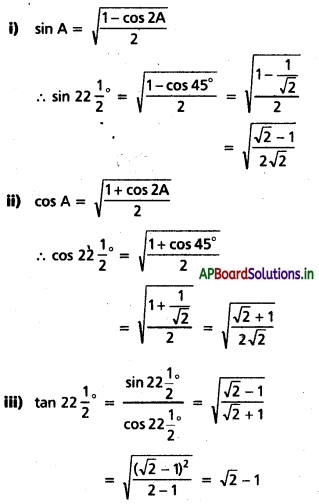
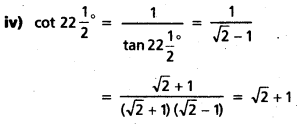
i) sin 22\(\frac{1}{2}\)°
ii) cos 22\(\frac{1}{2}\)°
iii) tan 22\(\frac{1}{2}\)°
iv) cot 22\(\frac{1}{2}\)° విలువలను కనుక్కోండి.
సాధన:
A = 2222\(\frac{1}{2}\)° అయిన 2A = 45° అవుతుంది.
AP Inter 1st Year Maths 1A Important Questions Chapter 6 త్రికోణమితీయ నిష్పత్తులు, పరివర్తనలు 9
AP Inter 1st Year Maths 1A Important Questions Chapter 6 త్రికోణమితీయ నిష్పత్తులు, పరివర్తనలు 10

ప్రశ్న 29.
కింది విలువలను కనుక్కోండి.
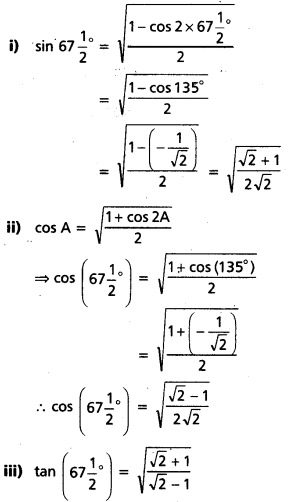
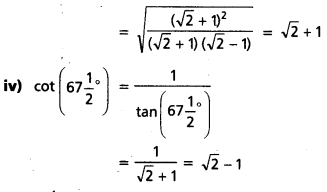
i) sin 67\(\frac{1}{2}\)°
ii) cos 67\(\frac{1}{2}\)°
iii) tan 67\(\frac{1}{2}\)°
iv) cot 67\(\frac{1}{2}\)°
సాధన:
A = 67\(\frac{1}{2}\)° అయిన 2A = 135° అవుతుంది.
AP Inter 1st Year Maths 1A Important Questions Chapter 6 త్రికోణమితీయ నిష్పత్తులు, పరివర్తనలు 11
AP Inter 1st Year Maths 1A Important Questions Chapter 6 త్రికోణమితీయ నిష్పత్తులు, పరివర్తనలు 12

AP Inter 1st Year Maths 1A Important Questions Chapter 6 త్రికోణమితీయ నిష్పత్తులు, పరివర్తనలు

ప్రశ్న 30.
\(\frac{1-\cos 2 \theta}{\sin 2 \theta}\) సూక్ష్మీకరించండి.
సాధన:
\(\frac{1-\cos 2 \theta}{\sin 2 \theta}=\frac{2 \sin ^2 \theta}{2 \sin \theta \cos \theta}=\frac{\sin \theta}{\cos \theta}\) = tan θ.

ప్రశ్న 31.
cos A = \(\sqrt{\frac{\sqrt{2}+1}{2 \sqrt{2}}}\) అయితే cos 2A విలువను కనుక్కోండి.
సాధన:
cos 2A = 2cos2 A – 1 = 2 \(\left(\frac{\sqrt{2}+1}{2 \sqrt{2}}\right)\) – 1
= \(\sqrt{\frac{\sqrt{2}+1}{2 \sqrt{2}}}\) – 1
= \(\frac{1}{\sqrt{2}}\)

ప్రశ్న 32.
\(\frac{\pi}{2}\) < 0 < π, cos θ = \(\frac{-5}{13}\) అయితే sin 2θ విలువను కనుక్కోండి.
సాధన:
\(\frac{\pi}{2}\) < θ < π ⇒ sin θ > 0, cos θ = –\(\frac{5}{13}\)
⇒ sin θ = \(\frac{12}{13}\)
∴ sin 2θ = 2 sin θ.cos θ
= 2 . \(\frac{12}{13}\left(\frac{-5}{13}\right)\) = \(\frac{-120}{169}\)

ప్రశ్న 33.
ప్రథమ పాదంలోని x యొక్క ఏ విలువలకు \(\frac{2 \tan x}{1-\tan ^2 x}\) ధనాత్మకం.
సాధన:
\(\frac{2 \tan x}{1-\tan ^2 x}\) > 0 ⇒ tan 2x > 0
⇒ 0 < 2x < \(\frac{\pi}{2}\) (x మొదటి పాదంలోని కోణం కనక)
⇒0 < x < \(\frac{\pi}{4}\)

AP Inter 1st Year Maths 1A Important Questions Chapter 6 త్రికోణమితీయ నిష్పత్తులు, పరివర్తనలు

ప్రశ్న 34.
π < θ < \(\frac{3\pi}{2}\), cos θ = \(\frac{-3}{5}\) అయితే tan θ/2 విలువను కనుక్కోండి.
సాధన:
tan \(\frac{\theta}{2}=\pm \sqrt{\frac{1-\cos \theta}{1+\cos \theta}}=\pm \sqrt{\frac{1+\frac{3}{5}}{1-\frac{3}{5}}}\) = ±2
దత్తాంశం నుంచి π < θ < \(\frac{3\pi}{2}\) ⇒ \(\frac{\pi}{2}\) < \(\frac{\theta}{2}\) < \(\frac{3\pi}{4}\)
⇒ tan θ/2 < 0
∴ tan θ/2 = -2

ప్రశ్న 35.
A అనేది \(\frac{\pi}{2}\) పూర్ణాంక గుణిజం కాకపోతే
i) tan A + cot A = 2 cosec 2A
ii) cot A tan A = 2 cot 2A
సాధన:
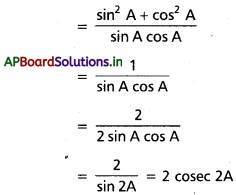
i) tan A + cot A = \(\frac{\sin A}{\cos A}+\frac{\cos A}{\sin A}\)
AP Inter 1st Year Maths 1A Important Questions Chapter 6 త్రికోణమితీయ నిష్పత్తులు, పరివర్తనలు 13
∴ tan A + cot A = 2 cosec 2A

ప్రశ్న 36.
θ అనేది \(\frac{\pi}{2}\) పూర్ణాంక గుణిజం కాకపోతే, tan θ + 2 tan 2θ + 4 tan 4θ + 8 cot 8θ = cot θ అని నిరూపించండి.
సాధన:
cot A – tan A = 2 cot 2A
tan A = cot A – 2 cot 2A అని వస్తుంది ……………… (1)
కనుక , tan θ + 2 tan 2θ + 4 tan 4θ + 8 cot 8θ
= (cot θ – 2 cot 2θ) + 2 (cot 2θ – 2 cot 4θ) + 4 (cot 4θ – 2 cot 8θ) + 8 cot 8θ
(సమీకరణం (1) నుంచి)
cot θ

AP Inter 1st Year Maths 1A Important Questions Chapter 6 త్రికోణమితీయ నిష్పత్తులు, పరివర్తనలు

ప్రశ్న 37.
A ∈ R అయితే,
i) sin A sin (π/3 + A) sin (π/3 – A) = \(\frac{1}{4}\) sin 3A
ii) cos A. cos (π/3 + A) cos (π/3 – A) = \(\frac{1}{4}\) cos 3A అని నిరూపించి తద్వారా
iii) sin 20° sin 40° sin 60° sin 80° = \(\frac{3}{16}\)
iv) cos \(\frac{\pi}{9}\) cos \(\frac{2\pi}{9}\) cos \(\frac{3\pi}{9}\) cos \(\frac{4\pi}{9}\) = \(\frac{1}{16}\) అని రాబట్టండి.
సాధన:
i) sin A. sin (π/3 + A). sin (π/3 – A)
sin A [sin2 π/3 sin2 A]
= [sin (A + B). sin (A – B)
= sin2 A – sin2 B = cos2 B – cos2 A]
= sin A \(\left[\left(\frac{3}{2}\right)-\sin ^2 \mathrm{~A}\right]\)
= sin A \(\left(\frac{3-4 \sin ^2 A}{4}\right)\)
= \(\frac{1}{4}\) (3 sin A – 4 sin3 A)
= \(\frac{1}{4}\) |sin 3A|

ii) cos A cos (π/3 + A) cos (π/3 – A)
= cos A (cos2 A – sin2 \(\frac{\pi}{3}\)_
= cos A (cos2 A – \(\frac{3}{4}\))
= \(\frac{\cos A\left(4 \cos ^2 A-3\right)}{4}\)
= \(\frac{1}{4}\) (4 cos3 A – 3 cos A)
= \(\frac{1}{4}\) . cos 3A
= \(\frac{1}{4}\) [4 cos3 A – 3 cos A]
= \(\frac{1}{4}\) cos 3A

iii) (1) A 20° ప్రతిక్షేపిస్తే,
⇒ sin 20°. sin (60° + 20°) sin (60° – 20°) = \(\frac{1}{4}\) sin 3(20°)
లేదా sin 20° sin 80° sin 40° = \(\frac{1}{4}\) sin 60°
పై సమీకరణాన్ని ఇరువైపులా sin 60° తో గుణిస్తే
sin 20° sin 40° sin 60° sin 80°
= \(\frac{1}{4}\) sin2 60° = \(\frac{1}{4}\) \(\frac{3}{4}\) = \(\frac{3}{16}\)
ఇదేవిధంగా, (ii) నుంచి

iv) cos 20° cos 40° cos 80° = \(\frac{1}{4}\) . cos 60° అని వస్తుంది.
ఇరువైపులా cos 60° తో గుణిస్తే
cos 20° cos 40° cos 60° cos 80°
= \(\frac{1}{4}\) cos2 60° = \(\frac{1}{16}\)
అంటే cos \(\frac{\pi}{9}\) cos \(\frac{2\pi}{9}\) cos \(\frac{3\pi}{9}\) cos \(\frac{4\pi}{9}\) = \(\frac{1}{16}\)

AP Inter 1st Year Maths 1A Important Questions Chapter 6 త్రికోణమితీయ నిష్పత్తులు, పరివర్తనలు

ప్రశ్న 38.
3A అనేది \(\frac{\pi}{2}\) కి బేసి గుణిజం కాకపోతే, tan A. tan(60° + A). tan (60° – A) = tan 3A అని నిరూపించి తర్వాత tan 6° tan 42° tan 66° tan 78° విలువను కనుక్కోండి.
సాధన:
sin A sin (π/3 + A) sin (π/3 – A) = 1/4 sin 3A
cos A cos (π/3 + A) cos (π/3 – A) = 1/4 cos 3A
sin A. sin (60° + A). sin (60° – A) = \(\frac{1}{4}\) sin 3A …………… (1)
cos A.cos (60° + A). cos (60° – A) = \(\frac{1}{4}\) cos 3A …………… (2)
(1) ని (2) తో భాగిస్తే
tan A. tan (60° + A). tan (60° – A) = tan 3A …………….. (3)
(3) లో A = 6° ప్రతిక్షేపిస్తే
tan 6°. tan 66°. tan 54° = tan 18° …………… (4)
మళ్ళీ (3) లో A = 18° ప్రతిక్షేపిస్తే
tan 18°. tan 78°. tan 42° = tan 54° …………… (5)
(4), (5) సమీకరణాలను గుణిస్తే
(tan 6°. tan 66°. tan 54°).
(tan 18°. tan 78°. tan 42°) = tan 18°. tan 54°
కనుక tan 6°. tan 42°. tan 66°. tan 78° = 1.

ప్రశ్న 39.
α, β ∈ R అయితే , (cos α + cos β)2 + (sin α + sin β)2 = 4 cos2 \(\frac{(\alpha+\beta)}{2}\) అని నిరూపించండి.
సాధన:
L.H.S. = (cos α + cos β)2 + (sin α + sin β)2
= (cos2 α + cos2 β + 2 cos α cos β) + (sin2 α + sin2 β + 2 sin α sin β)
= 1 + 1 + 2 (cos α cos β + sin α sin β)
= 2 + 2 cos (α – β)
= 2 [1 + cos (α – β)]
= 2[2 cos2 \(\frac{(\alpha+\beta)}{2}\)]
= 4. cos2 \(\frac{(\alpha+\beta)}{2}\) [∵ 1+ cos θ = 2 cos2 = \(\frac{\theta}{2}\)]

AP Inter 1st Year Maths 1A Important Questions Chapter 6 త్రికోణమితీయ నిష్పత్తులు, పరివర్తనలు

ప్రశ్న 40.
a, b, c లు శూన్యేతర వాస్తవ సంఖ్యలు, a cos θ + b sin θ = c సమీకరణానికి సాధనలు α, β లు అయితే
(i) sin α + sin β = \(\frac{2 b c}{a^2+b^2}\)
(ii) sin α . sin β = \(\frac{c^2-a^2}{a^2+b^2}\) అని చూపిండి.
సాధన:
∵ a cos θ + b sin θ = c
⇒ a cos θ = c – b sin θ
⇒ (a cos θ)2 = (c – b sin θ)2
⇒ a2 cos2 θ = c2 + b2 sin2 θ – 2bc sin θ
⇒ a2 (1 – sin2 θ) = c2 + b2 sin2 θ – 2bc sin θ
⇒ (a2 + b2) sin2 θ – 2bc sin θ + (c2 – a2) = 0
ఇది sin θ లో వర్గ సమీకరణం. sin α, sin β లు దీనికి మూలాలు
∴ మూలాలు మొత్తం = sin α + sin β = \(\frac{2 b c}{a^2+b^2}\)
మూలాల లబ్దం = sin α sin β = \(\frac{c^2-a^2}{a^2+b^2}\)

ప్రశ్న 41.
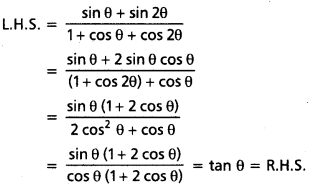
θ అనేది \(\frac{\pi}{2}\) బేసి గుణిజం కాదు, cos θ ≠ \(\frac{-1}{2}\) అయినప్పుడు, \(\frac{\sin \theta+\sin 2 \theta}{1+\cos \theta+\cos 2 \theta}\) = tan θ అని నిరూపించండి.
సాధన:
AP Inter 1st Year Maths 1A Important Questions Chapter 6 త్రికోణమితీయ నిష్పత్తులు, పరివర్తనలు 14

AP Inter 1st Year Maths 1A Important Questions Chapter 6 త్రికోణమితీయ నిష్పత్తులు, పరివర్తనలు

ప్రశ్న 42.
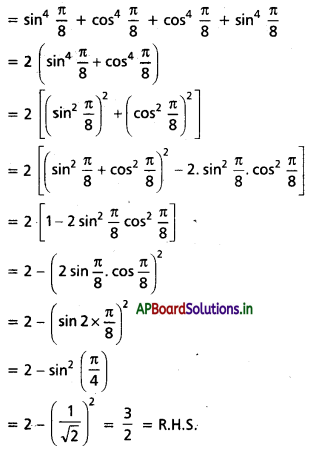
sin4 \(\frac{\pi}{8}\) + sin4 \(\frac{3\pi}{8}\) + sin4 \(\frac{5\pi}{8}\) + sin4 \(\frac{7\pi}{8}\) = \(\frac{3}{2}\) అని నిరూపించండి.
సాధన:
L.H.S. = sin4 \(\frac{\pi}{8}\) + sin4 \(\left(\frac{\pi}{2}-\frac{\pi}{8}\right)\) + sin4 \(\left(\frac{\pi}{2}+\frac{\pi}{8}\right)\) + sin4 \(\left(\pi-\frac{\pi}{8}\right)\)
AP Inter 1st Year Maths 1A Important Questions Chapter 6 త్రికోణమితీయ నిష్పత్తులు, పరివర్తనలు 15

ప్రశ్న 43.
2A, 3A లు \(\frac{\pi}{2}\) బేసి గుణిజాలు కానప్పుడు, tan 3A. tan 2A. tan A = tan 3A – tan 2A – tan A అని రుజువు చేయండి.
సాధన:
tan 3A = tan (2A + A)
= \(\frac{\tan 2 A+\tan A}{1-\tan 2 A \tan A}\)
⇒ tan 3A(1 – tan 2A tan A) = tan 2A + tan A
⇒ tan 3A – tan A tan 2A tan 3A = tan 2A + tan A
∴ tan 3A – tan 2A – tan A = tan A tan 2A tan 3A

ప్రశ్న 44.
sin 78° + cos 132° = \(\frac{\sqrt{5}-1}{4}\) అని చూపండి.
సాధన:
L.H.S. = sin 78° + cos 132°
= sin 78° + cos (90° + 42°)
= sin 78° – sin 42°
= 2 cos\(\left(\frac{78^{\circ}+42^{\circ}}{2}\right)\) . sin \(\left(\frac{78^{\circ}-42^{\circ}}{2}\right)\)
= 2 cos (60°), sin (18°)
= 2\(\left(\frac{1}{2}\right)\left(\frac{\sqrt{5}-1}{4}\right)\) = \(\frac{\sqrt{5}-1}{4}\) = R.H.S.

AP Inter 1st Year Maths 1A Important Questions Chapter 6 త్రికోణమితీయ నిష్పత్తులు, పరివర్తనలు

ప్రశ్న 45.
sin 21° cos 9° cos 84° cos 6° = \(\frac{1}{4}\) అని చూపండి.
సాధన:
L.H.S. = sin 21° cos 9° cos 84° cos 6°
= \(\frac{1}{4}\) [2 sin 21° cos 9° 2 cos 84° cos 6°]
= \(\frac{1}{2}\) [sin (21° + 9°) + sin (21° – 9°) – 2 cos (90° – 6°) cos 6°]
= \(\frac{1}{2}\) [sin 30°+ sin 12° – 2 sin 6° cos 6°]
= \(\frac{1}{2}\) [\(\frac{1}{4}\) + sin 12° – sin (2 × 16°)
= \(\frac{1}{4}\) = R.H.S.

ప్రశ్న 46.
sin 34° + cos 64° – cos 4° విలువను కనుక్కోండి .
సాధన:
sin 34° + (cos 64° – cos 4°)
= sin 34° – 2 sin \(\frac{64^{\circ}+4^{\circ}}{2}\) sin \(\frac{64^{\circ}-4^{\circ}}{2}\) [cos C – cosD = – 2 sin \(\left(\frac{C+D}{2}\right)\) sin \(\left(\frac{C-D}{2}\right)\)]
= sin 34° – 2. sin 34°.sin 30°
= 0 (sin 30° = \(\frac{1}{2}\) కనుక)

ప్రశ్న 47.
cos2 76° + cos2 16° – cos 76°. cos 16° = \(\frac{3}{4}\) అని చూపండి.
సాధన:
L.H.S.= cos2 76° + cos2 16° – cos 76° cos 16°
= cos2 76° + (1 – sin2 16°) – \(\frac{1}{2}\) (2 cos 76° cos 16°)
= 1 + (cos2 76° – sin2 16°) – \(\frac{1}{2}\) [cos (76° + 16°) + cos (76° – 16°)]
= 1 + cos (76° +16°). cos (76° -16°) – \(\frac{1}{2}\) [cos 92° + cos 60°]
= 1 + cos (92°). cos 60° – \(\frac{1}{2}\) cos 92° – \(\frac{1}{2}\) cos 60°
= 1 + \(\frac{1}{2}\) . cos 92° – \(\frac{1}{2}\) cos 92° – \(\frac{1}{2}\) × \(\frac{1}{2}\)
= 1 – \(\frac{1}{4}\) = \(\frac{3}{4}\)
= R.H.S.

AP Inter 1st Year Maths 1A Important Questions Chapter 6 త్రికోణమితీయ నిష్పత్తులు, పరివర్తనలు

ప్రశ్న 48.
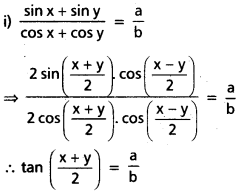
a ≠ 0b, sin x + sin y = a, cos x + cos y = b అయితే
i) tan \(\frac{x+y}{2}\)
ii) sin \(\frac{x-y}{2}\) విలువలు a, b లలో కనుక్కోండి.
సాధన:
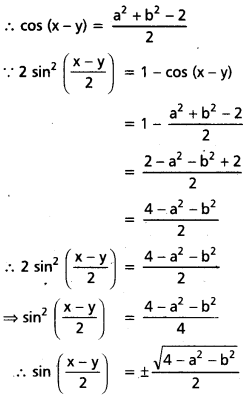
AP Inter 1st Year Maths 1A Important Questions Chapter 6 త్రికోణమితీయ నిష్పత్తులు, పరివర్తనలు 16

మొదటి పద్ధతి :
ii) a2 + b2 = (sin x + sin y)2 + (cos x + cos y)2
= sin2 x + sin2 y + 2 sin x sin y + cos2 x + cos2 y + 2 cos x cos y
= 2 + 2(cos x cos y + sin x sin y)
= 2 + 2 cos(x – y)
= 2[1 + cos(xy)]
a2 + b2 – 2 = 2 cos(x – y)
AP Inter 1st Year Maths 1A Important Questions Chapter 6 త్రికోణమితీయ నిష్పత్తులు, పరివర్తనలు 17
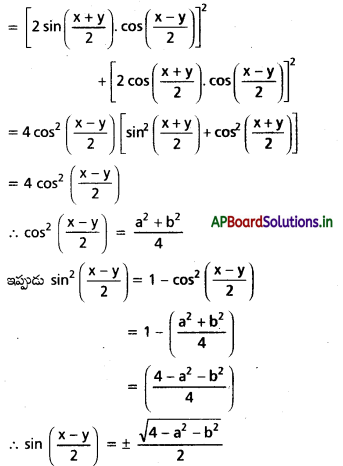
రెండవ పద్ధతి:
a2 + b2 = (sin x + sin y)2 + (cos x + cos y)2
AP Inter 1st Year Maths 1A Important Questions Chapter 6 త్రికోణమితీయ నిష్పత్తులు, పరివర్తనలు 18

ప్రశ్న 49.
cos 12° + cos 84° + cos 132° + cos 156° = –\(\frac{1}{2}\) అని చూపండి.
సాధన:
L.H.S.= cos 12° + cos 84° + cos 132° + cos 156°
= (cos 132°+ cos 12°) + (cos 156° + cos 84°)
= 2 cos \(\left(\frac{132^{\circ}+12^{\circ}}{2}\right)\) . cos \(\left(\frac{132^{\circ}-12^{\circ}}{2}\right)\) + 2 cos \(\left(\frac{156^{\circ}+84^{\circ}}{2}\right)\) . cos \(\left(\frac{156^{\circ}-84^{\circ}}{2}\right)\)
= 2 cos 72°. cos 60° + 2 cos (120°). cos (36°)
= 2 cos (90° – 18°)\(\left(\frac{1}{2}\right)\) + 2\(\left(\frac{-1}{2}\right)\) cos 36°
= sin 18° – cos 36°
= \(\left(\frac{\sqrt{5}-1}{4}\right)-\left(\frac{\sqrt{5}+1}{4}\right)=\frac{-1}{2}\) = R.H.S

AP Inter 1st Year Maths 1A Important Questions Chapter 6 త్రికోణమితీయ నిష్పత్తులు, పరివర్తనలు

ప్రశ్న 50.
ప్రతీ θ ∈ R కి, 4 sin \(\frac{5 \theta}{2}\) cos \(\frac{2 \theta}{2}\) cos 3θ = sin θ – sin 2θ + sin 4θ + sin 7θ అని చూపండి.
సాధన:
L.H.S. = 4 sin \(\frac{5 \theta}{2}\) cos \(\frac{2 \theta}{2}\) cos 3θ
= 2 [2 sin \(\frac{5 \theta}{2}\) cos \(\frac{3 \theta}{2}\) . cos 3θ
= 2 [sin\(\left(\frac{5 \theta}{2}+\frac{3 \theta}{2}\right)\) + sin \(\left(\frac{5 \theta}{2}-\frac{3 \theta}{2}\right)\)] cos 3θ
= 2[(sin 4θ + sin θ) cos 3θ]
= 2 sin 4θ cos 3θ + 2 sin θ cos 3θ
= sin (4θ + 3θ) + sin (4θ – 3θ) + sin (θ + 3θ) + sin (θ – 3θ)
= sin 7θ + sin θ + sin 4θ – sin 2θ = R.H.S.

ప్రశ్న 51.
A, B, A + B లలో ఏదీ π కి పూర్ణాంక గుణిజం కాకపోతే, \(\frac{1-\cos A+\cos B-\cos (A+B)}{1+\cos A-\cos B-\cos (A+B)}\) = tan \(\frac{A}{2}\) cot \(\frac{A}{2}\) అని చూపండి.
సాధన:
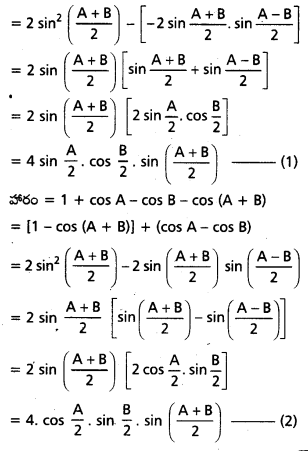
లవం = 1 – cos A + cos B cos (A + B)
= [1 – cos (A + B)] – (cos A – cos B)
AP Inter 1st Year Maths 1A Important Questions Chapter 6 త్రికోణమితీయ నిష్పత్తులు, పరివర్తనలు 19
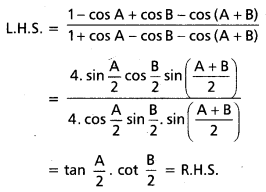
(1), (2) ల నుండి
AP Inter 1st Year Maths 1A Important Questions Chapter 6 త్రికోణమితీయ నిష్పత్తులు, పరివర్తనలు 20

AP Inter 1st Year Maths 1A Important Questions Chapter 6 త్రికోణమితీయ నిష్పత్తులు, పరివర్తనలు

ప్రశ్న 52.
α ∈ R అయితే , cos2 (α – π/4) + cos2 (α + π/12) – cos2 (α – π/12) = \(\frac{1}{2}\) అని చూపండి.
సాధన:
L.H.S. = cos2 (α – π/4) + cos2 (α + π/12) – cos2(α – π/2)
= \(\frac{1+\cos 2(\alpha-\pi / 2)}{2}\) + {sin (α + π/12 + α – π/12) sin (α – π/12 – α – π/12)}
= \(\frac{1}{2}\) (1 + sin 2α) + sin 2α. sin (π/6)
= \(\frac{1}{2}\)+ \(\frac{1}{2}\) sin 2α – \(\frac{1}{2}\) sin 2α = \(\frac{1}{2}\)
సూచన : cos2 A – cos2 B = sin (A + B) sin (B – A)

ప్రశ్న 53.
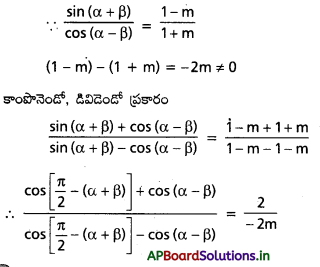
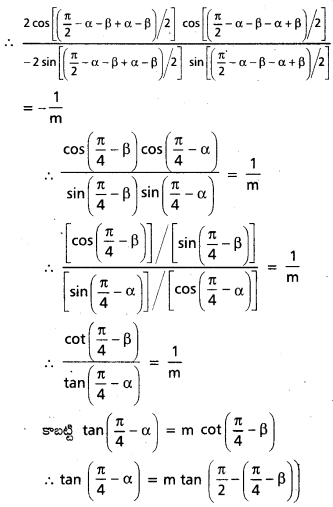
(α – β) అనేది \(\frac{\pi}{2}\) బేసి గుణిజం కాదు, m ≠ – 1, \(\frac{\sin (\alpha+\beta)}{\cos (\alpha-\dot{\beta})}=\frac{1-m}{1+m}\) అయితే tan \(\left(\frac{\pi}{4}-\alpha\right)\) = m. tan \(\left(\frac{\pi}{4}+\beta\right)\) అని చూపండి.
సాధన:
AP Inter 1st Year Maths 1A Important Questions Chapter 6 త్రికోణమితీయ నిష్పత్తులు, పరివర్తనలు 21
AP Inter 1st Year Maths 1A Important Questions Chapter 6 త్రికోణమితీయ నిష్పత్తులు, పరివర్తనలు 22
∴ tan \(\left(\frac{\pi}{4}-\alpha\right)\) = m. tan \(\left(\frac{\pi}{4}+\beta\right)\)

AP Inter 1st Year Maths 1A Important Questions Chapter 6 త్రికోణమితీయ నిష్పత్తులు, పరివర్తనలు

ప్రశ్న 54.
A, B, C లు త్రిభుజ కోణాలయితే, కింది వాటిని నిరూపించండి.
i) sin 2A + sin 2B + sin 2C = 4 sin A sin B sin C
ii) sin 2A + sin 2B – sin 2C = 4 cos A cos B sin C
సాధన:
i) ∵ A, B, C లు త్రిభుజ కోణాలు
⇒ A + B + C = 180° ……………… (1)
L.H.S. = sin 2A + sin 2B + sin 2C
= 2 sin \(\left(\frac{2 \mathrm{~A}+2 \mathrm{~B}}{2}\right)\) . cos \(\left(\frac{2 \mathrm{~A}-2 \mathrm{~B}}{2}\right)\) + sin 2C
= 2 sin (A + B) cos (AB) + sin 2C
= 2 sin (180° C) cos (AB) + sin 2C
(1) నుండి
2 sin C. cos (A – B) + 2 sin C. cos C
= 2 sin C [cos (A – B) + cos C]
= 2 sin C [cos (A – B) + cos (180° – \(\overline{A+B}\))]
= 2 sin C [cos (AB) cos (A + B)] = 2 sin C (2 sin A sin B)
= 4 sin A sin B sin C = R.H.S.

ii) L.H.S. = sin 2A + sin 2B – sin 2C
= 2 sin \(\left(\frac{2 \mathrm{~A}+2 \mathrm{~B}}{2}\right)\) . cos \(\left(\frac{2 \mathrm{~A}-2 \mathrm{~B}}{2}\right)\) – sin 2C
= 2 sin (A + B) cos (A – B) sin 2C
= 2 sin (180° – C) cos (A – B) – sin 2C
= 2 sin C. cos (A – B) – 2 sin C cos C
= 2 sin C [cos (A – B) cos C]
= 2 sin C [cos (A – B) – cos (180° – \(\overline{A+B}\))]
(1) నుండి
= 2 sin C [cos (A – B) + cos (A + B)]
= 2 sin C [2 cos A cos B]
= 4 cos A cos B sin C = R.H.S.

AP Inter 1st Year Maths 1A Important Questions Chapter 6 త్రికోణమితీయ నిష్పత్తులు, పరివర్తనలు

ప్రశ్న 55.
A, B, C లు త్రిభుజ కోణాలైతే, కింది వాటిని నిరూపించండి.
i) cos 2A + cos 2B + cos 2C = -4 cos A cos B cos C – 1
ii) cos 2A + cos 2B – cos 2C = 1 – 4 sin A sin B cos C
సాధన:
i) ∵ A, B, C లు త్రిభుజ కోణాలు.
⇒ A + B + C = 180° ……………. (1)
L.H.S.= (cos 2A + cos 2B) + cos 2C
= 2 cos (A + B) cos (A – B) + 2 cos2 C – 1
= -2 cos C cos (A – B) – 2 cos C cos (A + B) – 1
[∵ cos (A + B) = -cos C]
= -1 – 2 cos C [cos (AB) + cos (A – B)]
= -1 – 2 cos C [2 cos A cos B]
= -1 – 4 cos A cos B cos C = R.H.S.

ii) L.H.S.= cos 2A + cos 2B – cos 2C
= 2 cos \(\left(\frac{2 \mathrm{~A}+2 \mathrm{~B}}{2}\right)\) cos \(\left(\frac{2 \mathrm{~A}-2 \mathrm{~B}}{2}\right)\) – cos 2C
= 2 cos (A + B). cos (A – B) – (2 cos2 C – 1)
= 2 cos (180° – C) cos (A – B) – 2 cos2 C + 1
= 1 – 2 cos C cos (A – B) – 2 cos2 C
= 1 – 2 cos C [cos (AB) + cos C]
= 1 – 2 cos C [cos (A – B) + cos (180° \(\overline{A+B}\))]
= 1 – 2 cos C [cos (AB) cos (A + B)]
= 1 – 2 cos C [2 sin A sin B]
= 1 – 4 sin A sin B cos C = R.H.S.

AP Inter 1st Year Maths 1A Important Questions Chapter 6 త్రికోణమితీయ నిష్పత్తులు, పరివర్తనలు

ప్రశ్న 56.
A, B, C లు త్రిభుజ కోణాలయితే కింది వాటిని నిరూపించండి.
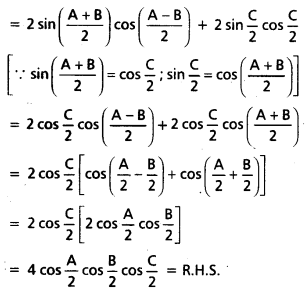
i) sin A + sin B + sin C = 4 cos \(\frac{A}{2}\) cos \(\frac{B}{2}\) cos \(\frac{C}{2}\)
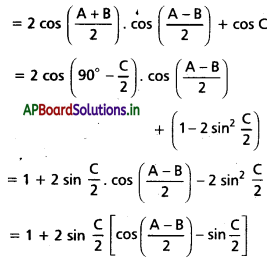
ii) cos A + cos B + cos C = 1 + 4 sin \(\frac{A}{2}\) sin \(\frac{B}{2}\) sin \(\frac{C}{2}\)
సాధన:
i) ∵ A, B, C లు త్రిభుజ కోణాలు.
⇒ A + B + C = 180°
L.H.S. = (sin A+ sin B) + sin C
AP Inter 1st Year Maths 1A Important Questions Chapter 6 త్రికోణమితీయ నిష్పత్తులు, పరివర్తనలు 23

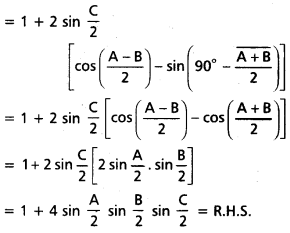
ii) cos A + cos B + cos C = 1 + 4 sin \(\frac{A}{2}\) sin \(\frac{B}{2}\) sin \(\frac{C}{2}\)
L.H.S. = cos A + cos B + cos C
AP Inter 1st Year Maths 1A Important Questions Chapter 6 త్రికోణమితీయ నిష్పత్తులు, పరివర్తనలు 24
AP Inter 1st Year Maths 1A Important Questions Chapter 6 త్రికోణమితీయ నిష్పత్తులు, పరివర్తనలు 25

AP Inter 1st Year Maths 1A Important Questions Chapter 6 త్రికోణమితీయ నిష్పత్తులు, పరివర్తనలు

ప్రశ్న 57.
A + B + C = 9 π/2 0° అయితే ,
i) sin2 A + sin2 B + sin2 C = 1 – 2 sin A sin B sin C
ii) sin 2A + sin 2B + sin 2C = 4 cos A cos B cos C అని చూపండి.
సాధన:
i) A + B + C = π/2 ………………. (1)
L.H.S. = sin2 A + sin2 B + sin2 C
= \(\frac{1}{2}\) [1 – cos 2A + 1 – cos 2B + 1 – cos 2C]
= \(\frac{1}{2}\) [3 – (cos 2A + cos 2B + cos 2C)]
= \(\frac{1}{2}\) [3 – (1 + 4 sin A sin B sin C)]
(56(ii)వ లెక్క చూడండి.)
(∵ 2A + 2B + 2C = 180°)
= \(\frac{1}{2}\) [2 – 4 sin A sin B sin C]
= 1 – 2 sin A sin B sin C

ii) A + B + C = π/2
⇒ 2A + 2B + 2C = 180°
sin 2A + sin 2B + sin 2C = 4 cos A cos B cos C
(56(i)వ లెక్క చూడండి.)

ప్రశ్న 58.
A + B + C = 3π/2, cos 2A + cos 2B + cos 2C = 1 – 4 sin A sin B sin C అని చూపండి. [Mar. 13]
సాధన:
A + B + C = 3π/2 …………….. (1)
L.H.S.= cos 2A + cos 2B + cos 2C
= 2 cos (A + B). cos (A – B) + 1 – 2 sin2C
= 2 cos (270° – C). cos (A – B) + 1 – 2 sin2C
= 1 – 2 sin C cos (A – B) – 2 sin2 C
= 1 – 2 sin C [cos (A – B) + sin C]
= 1 – 2 sin C [cos (A – B) + sin (270° – \(\overline{A+B}\))]
= 1 – 2 sin C [cos (A – B) – cos (A + B)]
= 1 – 2 sin C [2 sin A sin B]
= 1 – 4 sin A sin B sin C

AP Inter 1st Year Maths 1A Important Questions Chapter 6 త్రికోణమితీయ నిష్పత్తులు, పరివర్తనలు

ప్రశ్న 59.
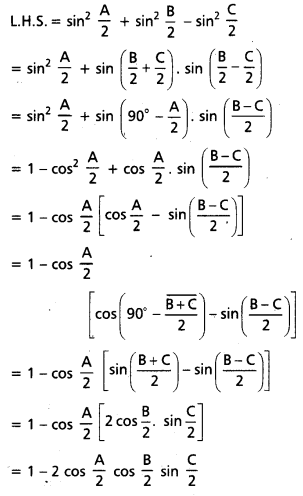
A, B, C లు త్రిభుజ కోణాలయితే, sin2 \(\frac{A}{2}\) + sin2 \(\frac{B}{2}\) – sin2 \(\frac{C}{2}\) = 1 – 2 cos \(\frac{A}{2}\) cos \(\frac{B}{2}\) sin \(\frac{C}{2}\) అని చూపండి. [May ’11]
సాధన:
A + B + C = 180° …………… (1)
AP Inter 1st Year Maths 1A Important Questions Chapter 6 త్రికోణమితీయ నిష్పత్తులు, పరివర్తనలు 26

AP Inter 1st Year Maths 1A Important Questions Chapter 6 త్రికోణమితీయ నిష్పత్తులు, పరివర్తనలు

ప్రశ్న 60.
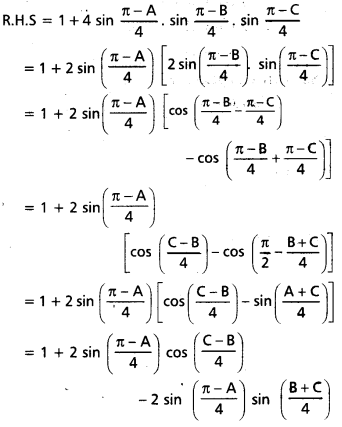
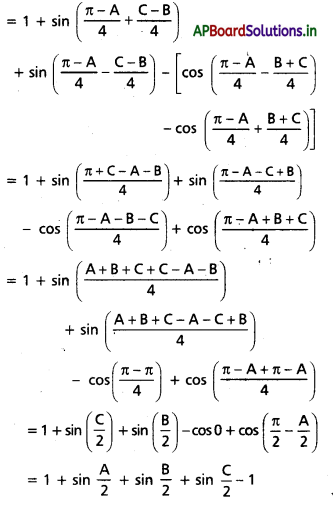
A, B, C లు త్రిభుజ కోణాలయితే sin\(\frac{A}{2}\) + sin\(\frac{B}{2}\) + sin\(\frac{C}{2}\) = 1 + 4 sin \(\frac{\pi-A}{4}\) . sin \(\frac{\pi-B}{4}\) sin \(\frac{\pi-C}{4}\) అని రుజువు చేయండి. [Mar. ’14]
సాధన:
A + B + C = 180° …………….. (1)
AP Inter 1st Year Maths 1A Important Questions Chapter 6 త్రికోణమితీయ నిష్పత్తులు, పరివర్తనలు 27
AP Inter 1st Year Maths 1A Important Questions Chapter 6 త్రికోణమితీయ నిష్పత్తులు, పరివర్తనలు 28
sin\(\frac{A}{2}\) + sin\(\frac{B}{2}\) + sin\(\frac{C}{2}\) = L.H.S

ప్రశ్న 61.
A + B + C = 0 అయితే, cos2 A + cosఅయితే B + cosఅయితే C = 1 + 2 cos A cos B cos C అని రుజువు చేయండి.
సాధన:
A + B + C = 0 ………….. (1)
L.H.S. = cos2 A + cos2 B + cos2 C
= cos2 A + (1 – sin2 B) + cos2 C
= 1 + (cos2 A – sin2 B) + cos2 C
= 1 + cos (A + B) cos (A – B) + cos2 C
= 1 + cos (-C) cos (A – B) + cos2 C
(1) నుండి
= 1 + cos C cos (A – B) + cos2 C
= 1 + cos C [cos (A – B) + cos C]
= 1 + cos C [cos (A – B) + cos (- B – A)]
(1) నుండి
= 1 + cos C [cos (A – B) + cos (A + B)]
= 1 + cos C (2 cos A cos B)
= 1 + 2 cos A cos B cos C
= R.H.S.

AP Inter 1st Year Maths 1A Important Questions Chapter 6 త్రికోణమితీయ నిష్పత్తులు, పరివర్తనలు

ప్రశ్న 62.
A + B + C = 2S అయితే cos (S – A) + cos (S – A) + cos (S – B) + cos (S – C) + cos S = 4 cos \(\frac{A}{2}\) cos \(\frac{B}{2}\) cos \(\frac{C}{2}\) అని రుజువు చేయండి.
సాధన:
A + B + C = 2S ……………. (1)
L.H.S. = [cos (S – A) + cos (S – B) + cos (S – C) + cos S]
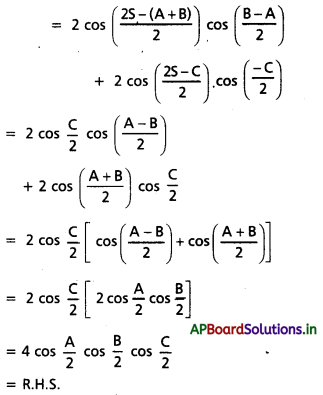
AP Inter 1st Year Maths 1A Important Questions Chapter 6 త్రికోణమితీయ నిష్పత్తులు, పరివర్తనలు 29

AP Inter 1st Year Physics Study Material Chapter 2 ప్రమాణాలు, కొలత

Andhra Pradesh BIEAP AP Inter 1st Year Physics Study Material 2nd Lesson ప్రమాణాలు, కొలత Textbook Questions and Answers.

AP Inter 1st Year Physics Study Material 2nd Lesson ప్రమాణాలు, కొలత

అతిస్వల్ప సమాధాన ప్రశ్నలు

ప్రశ్న 1.
యధార్థత, ఖచ్చితత్వాల మధ్య తేడాను రాయండి. [May, Mar. ’13]
జవాబు:

యధార్థతఖచ్చితత్వం
1) మనం కొలిచే భౌతిక రాశి నిజమైన విలువకు ఎంత దగ్గరగా. ఉన్నది తెలియజేసే ఒక కొలమానమే మనం తీసుకున్న కొలత యొక్క యధార్ధత.1) ఖచ్చితత్వం అనేది, ఆ పరికరంతో మనం ఎంత కనిష్ఠ అవధి వరకు (లేదా) ఎంత పృథక్కరణం వరకు భౌతికరాశిని కొలవడానికి వీలవుతుందో తెలియ జేస్తుంది.
2) యధార్థత దోషాల మీద ఆధారపడి ఉంటుంది.2) ఖచ్చితత్వం అనేది దోషాలపై ఆధార పడదు

ప్రశ్న 2.
కొలతలో వచ్చే వివిధ రకాల దోషాలు ఏవి?
జవాబు:
దోషాలు ప్రధానంగా మూడు రకాలు

  1. క్రమదోషాలు
  2. యాదృచ్ఛిక దోషాలు
  3. స్థూల దోషాలు

ప్రశ్న 3.
క్రమదోషాలను ఏవిధంగా కనిష్ఠం చేయవచ్చు లేదా తొలగించవచ్చు? [Mar. ’14]
జవాబు:
ప్రయోగ విధానంలో కౌశలతను పెంచుకోవడం, మంచి పరికరాలను ఎన్నుకోవడం మరియు వీలైనంత వరకు వ్యక్తిగతమైన లోపం లేకుండా చూసుకోవాలి.

ఇవ్వబడిన అమరికకు, ఈ దోషాలను అంచనావేసి, రీడింగ్లకు సరైన సర్దుబాటు తప్పనిసరిగా చేయాలి.

ప్రశ్న 4.
కొలత ఫలితాన్ని అందులో ఉండే దోషాన్ని సూచిస్తూ ఏవిధంగా నివేదిస్తారో (reported) ఉదాహరణలతో వివరించండి.
జవాబు:
ఏదైనా భౌతికరాశిని కొలిచినపుడు, ఆ రాశి యొక్క ప్రామాణిక విలువ (ప్రమాణం)తో పోల్చాలి. ప్రతి ప్రక్రియలో ఉండే దోషాలను పూర్తిగా తొలగించి కొలవడం సాధ్యం కాదు. మనం పూర్తి శ్రద్ధతో కొలిచినప్పటికీ కొలిచిన విలువ ఎల్లప్పుడూ నిజవిలువకు (లేదా) యధార్థ వేరుగా ఉంటుంది.

ప్రశ్న 5.
సార్థక సంఖ్యలంటే ఏవి? ఒక కొలత ఫలితాన్ని నివేదించేటప్పుడు అవి ఏమి సూచిస్తాయి?
జవాబు:
ఒక కొలతను సూచించే సంఖ్యలో నిశ్చయంగా తెలిసిన అంకెలు, వాటికి తోడు అదనంగా అంచనా ప్రకారం చేర్చిన అంకెలు వీటన్నింటినీ కలిపి సార్థక సంఖ్యలు (లేదా) సార్థక అంకెలు అంటారు.
ఉదాహరణ :
లఘులోలకం యొక్క ఆవర్తన కాలం 1.62, దీనిలో 1 మరియు 6 నిశ్చయంగా తెలిసిన అంకెలు, 2 అనునది అంచనా ప్రకారం చేర్చిన అంకె. కాబట్టి కొలిచిన విలువలో మూడు సార్థక సంఖ్యలు కలవు.

AP Inter 1st Year Physics Study Material Chapter 2 ప్రమాణాలు, కొలత

ప్రశ్న 6.
ప్రాథమిక ప్రమాణాలు, ఉత్పన్న ప్రమాణాల మధ్య తేడాలు రాయండి.
జవాబు:

  1. ప్రాథమిక రాశుల ప్రమాణాలను ప్రాథమిక ప్రమాణాలు అంటారు. ప్రాథమిక ప్రమాణాలను మరొక దానినుండి రాబట్టలేము. వేరొక ప్రమాణాలనుండి రాబట్టలేము.
  2. ఉత్పన్న రాశుల ప్రమాణాలను ఉత్పన్న ప్రమాణాలు అంటారు.

ప్రశ్న 7.
ఒకే భౌతికరాశికి వేరువేరు ప్రమాణాలు ఎందుకు ఉంటాయి?
జవాబు:
మనకు వేరు వేరు పద్ధతులు కలవు. అవి C.G.S పద్ధతి, M.S.K పద్ధతి, E.P.S పద్ధతి మరియు S. I పద్ధతి. అందువలన ఒకే భౌతికరాశికి వేరువేరు ప్రమాణాలు కలవు.

ప్రశ్న 8.
మితీయ విశ్లేషణ అంటే ఏమిటి?
జవాబు:
ఉత్పన్న భౌతిక రాశులను, ప్రాథమిక రాశుల ప్రమాణాలలో తెలియజేయుటను మితి విశ్లేషణ అంటారు.

మితివిశ్లేషణ ద్వారా ఇచ్చిన సమీకరణం సరైనదో, కాదో తెలుసుకోవచ్చు. ఒక పద్ధతిలో ప్రమాణాలను వేరొక పద్ధతిలోకి మార్చవచ్చు మరియు వివిధ భౌతిక రాశుల మధ్య సంబంధాన్ని సూచించే సమీకరణాలను రాబట్టవచ్చు.

ప్రశ్న 9.
కేంద్రకం వ్యాసార్ధంతో పోలిస్తే పరమాణు వ్యాసార్ధం పరిమాణ క్రమాలలో (orders of magnitude) ఎంత ఎక్కువగా ఉంటుంది?
జవాబు:
కేంద్రక వ్యాసార్థం పరిమాణం = 10-14m
పరమాణువు వ్యాసార్థం పరిమాణం = 10-10m

కాబట్టి కేంద్రకం వ్యాసార్థంతో పోలిస్తే పరమాణు వ్యాసార్థం పరిమాణక్రమాలలో 10-4 m ఎక్కువ.

ప్రశ్న 10.
ఏకీకృత పరమాణు ద్రవ్యరాశి ప్రమాణాన్ని kg లో వ్యక్తం చేయండి.
జవాబు:
ఏకీకృత పరమాణు ద్రవ్యరాశి ప్రమాణం = \(\frac{1}{12}\) × c12 – ద్రవ్యరాశి
1 a.m.u = 1.66 × 10⁻²⁷ Kg

స్వల్ప సమాధాన ప్రశ్నలు

ప్రశ్న 1.
ఒక పరికరం వెర్నియర్ స్కేలు 50 విభాగాలు కలిగి ఉంది. ఇవి ప్రధాన స్కేలుపై ఉండే 49 విభాగాలతో ఏకీభవిస్తాయి. ప్రధాన స్కేలులోని ప్రతి విభాగం విలువ 0.5mm. అయితే ఈ పరికరంతో కొలిచే దూరంలో కనిష్ఠ యధార్థతారాహిత్యం (inaccuracy) ఎంత ఉంటుంది?
జవాబు:
ప్రధాన స్కేలుపై ప్రతి విభాగం విలువు = 0.5 m.m
వెర్నియర్ స్కేల్పై విభాగాల సంఖ్య = 50
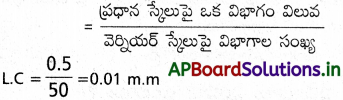
వెర్నియర్ కాలిపర్స్ కనీసపు కొలత = \(\frac{S}{N}\)
AP Inter 1st Year Physics Study Material Chapter 2 ప్రమాణాలు, కొలత 1

కాబట్టి దూరం కొలవడంలో కనిష్ఠ యధార్ధత 0.01 m.m (లేదా)
1 M.S.D విలువ = 0.5 m.m, N = 50
N V.S.D = (N-1) M.S.D
49 M.S.D = 50 V.S.D
1 V.S.D = \(\frac{49}{50}\)M.S.D = \(\frac{49}{50}\) × 0.5 m.m

∴ కనీసపు కొలత = 1 M.S.D – 1 V.S.D = (0.5 – \(\frac{49}{50}\) × 0.5) = (1 – \(\frac{49}{50}\))0.5
= \(\frac{1}{50}\) × 0.5 = 0.01m.m
కాబట్టి దూరం, కొలవడంలో కనిష్ఠ యధార్ధత 0.01 m.m

AP Inter 1st Year Physics Study Material Chapter 2 ప్రమాణాలు, కొలత

ప్రశ్న 2.
ప్రమాణాల ఒక వ్యవస్థలో బలానికి ప్రమాణం 100N, పొడవుకు ప్రమాణం 10m, కాలానికి ప్రమాణం 100 s. ఈ వ్యవస్థలో ద్రవ్యరాశికి ఉండే ప్రమాణం ఏది?
జవాబు:
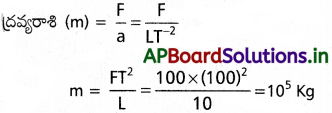
బలం (F) = 100N; పొడవు (L) = 10m; కాలం (T) = 100s
F = ma
AP Inter 1st Year Physics Study Material Chapter 2 ప్రమాణాలు, కొలత 2

ప్రశ్న 3.
భూమి నుంచి ఒక గెలాక్సీ దూరం 1025 m ల క్రమంలో ఉంది. గెలాక్సీ నుంచి కాంతి మనల్ని చేరేందుకు పట్టే కాలం పరిమాణం క్రమాన్ని గణించండి.
జవాబు:
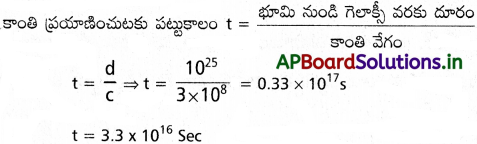
భూమి నుండి గెలాక్సీ వరకు దూరం = 1025 m
కాంతి వేగం (c) = 3 × 10⁸m/s
AP Inter 1st Year Physics Study Material Chapter 2 ప్రమాణాలు, కొలత 3

ప్రశ్న 4.
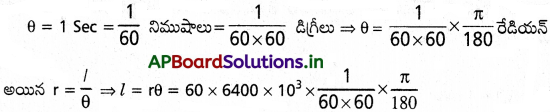
భూమి-చంద్రుల మధ్య దూరం సుమారు భూవ్యాసార్థానికి 60 రెట్లు. చంద్రుడి నుంచి చూస్తే భూమి వ్యాసం సుమారుగా ఎంత ఉంటుంది ?
జవాబు:
భూమి, చంద్రుడు మధ్యదూరం
భూమి వ్యాసార్ధం = R
r = 60R = 60 × 640 × 10³ (∵ R = 6400 Km)
AP Inter 1st Year Physics Study Material Chapter 2 ప్రమాణాలు, కొలత 4
l = 11.16 × 10³Km ⇒ వ్యాసం( 1 ) = 11.16 × 10³Km

ప్రశ్న 5.
లోలకం 20 డోలనాలకు పట్టే కాలానికి వచ్చిన మూడు కొలతలు వరుసగా t1 = 39.6 s, t2 = 39.9 s, t3 = 39.5s. కొలతల్లోని ఖచ్చితత్వం ఎంత? కొలతల్లోని యధార్ధత ఎంత?
జవాబు:
డోలనాల సంఖ్య = 20
t1 = 39.6 Sec, t2 = 39.9 Sec, t3 = 39.5 Sec
AP Inter 1st Year Physics Study Material Chapter 2 ప్రమాణాలు, కొలత 5
సగటు విలువ = 39.7 Sec
ఖచ్చితత్వం = 0.1 Sec
కొలిచిన విలువ, నిజవిలువకు దగ్గరగా ఉంటే, అది యధార్థత. కాబట్టి యధార్థత 39.6 s అవుతుంది.

ప్రశ్న 6.
1 కెలోరి = 4.23, 1J = 1kg m²s-2. ద్రవ్యరాశికి ప్రమాణం a’ kg గా, పొడవుకు ప్రమాణం \(\hat{\mathbf{a}}\)m గా, కాలం ప్రమాణం \(\tilde{\mathrm{a}}\)s గా ఉండే ఒక ప్రమాణ వ్యవస్థను వాడినపుడు, కొత్త వ్యవస్థలో కెలోరికి ఉండే పరిమాణం 4.2 \(\stackrel{\wedge-1}{a} a^{\wedge}-2 \wedge 2\) అని చూపండి.
జవాబు:
1 కెలోరీ = 4.2 J ⇒ 1 J = 1 kg m²s-2
1 కెలోరీ = 4.2 kg m²s-2
క్రొత్త పద్ధతిలో, 1 కెలోరీ = 4.2 \(\hat{a} \hat{a}^2 \hat{a}^{-2}\)

AP Inter 1st Year Physics Study Material Chapter 2 ప్రమాణాలు, కొలత

ప్రశ్న 7.
శూన్యంలో కాంతి వడి 1 ms2 అయ్యేవిధంగా పొడవుకు ఒక కొత్త ప్రమాణాన్ని ఎంచుకొన్నారు. సూర్యుడి నుంచి కాంతి భూమిని చేరేందుకు పట్టేకాలం 8 నిమిషాల 20 సెకన్లయితే కొత్త ప్రమాణాల్లో సూర్యుడు -భూమి మధ్య దూరం ఎంత?
జవాబు:
శూన్యంలో కాంతి వేగం (V) = 1m/s
పట్టుకాలం (t) = 8 నిముషాల 20 సెకండ్లు= 500 Sec
సూర్యుడు మరియు భూమి మధ్య దూరం (d) = \(\frac{V}{t}\)
d = \(\frac{1}{500}\) = 0.002m

ప్రశ్న 8.
100 ఆవర్ధనం ఉండే సూక్ష్మదర్శినిని ఉపయోగించి ఒక విద్యార్థి మానవుడి వెంట్రుక మందాన్ని కొలుస్తున్నాడు. 20 పరిశీలనల వల్ల వెంట్రుక సగటు మందాన్ని (సూక్ష్మదర్శినిలో చూసినదాని దృష్ట్వా) 3.5mm గా కనుక్కొన్నాడు. అంచనాకు వచ్చే మందం ఎంత ?
జవాబు:
సూక్ష్మదర్శిని ఆవర్ధనం (M) = 100
పరిశీలించిన మందం = 3.5 m.m
AP Inter 1st Year Physics Study Material Chapter 2 ప్రమాణాలు, కొలత 6

ప్రశ్న 9.
కొలవగలిగే నాలుగు రాశులు a, b, c, d లతో X అనే భౌతికరాశి కింది విధంగా సంబంధాన్ని కలిగి ఉంది.
X =a²b³c5/2d-2
a,b,c,d లను కొలవడంలో దోషశాతాలు వరుసగా 1%, 2%, 3%,4% అయితే X లో దోషశాతం ఎంత ?
జవాబు:
X =a²b³c5/2d-2

AP Inter 1st Year Physics Study Material Chapter 2 ప్రమాణాలు, కొలత 7

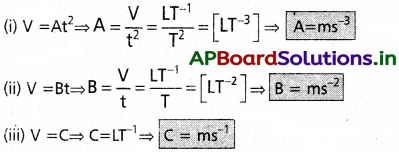
10. ఒక వస్తువు వేగం υ = At² + Bt + C అని ఇవ్వడమైంది. υ, t లను SI ప్రమాణాల్లో వ్యక్తం చేస్తే A,B,C లకు ప్రమాణాలు రాయండి.
జవాబు:
V=At² + Bt + C
సజాతీయత నియమం ప్రకారం
AP Inter 1st Year Physics Study Material Chapter 2 ప్రమాణాలు, కొలత 8

లెక్కలు (Problems)

ప్రశ్న 1.
P= El²m-5G-2 అనే సమాసంలో రాశులు E, l, m, G లు వరుసగా శక్తి, కోణీయ ద్రవ్యవేగం, ద్రవ్యరాశి,’ గురుత్వస్థిరాంకాలను సూచిస్తే Pఒక మితిరహిత రాశి అని చూపండి.
సాధన:
P = E L² m G-2
శక్తి (E) = [ML² T-2]
కోణీయ ద్రవ్యవేగం (L) = [ML² T-1]
ద్రవ్యరాశి = [M]
విశ్వగురుత్వ స్థిరాంకం (G) = [M-1L³ T-2]
P = [ML² T-2] [ML² T-1]² [M]-5 [M-1L³T-2]-2
P = M1 + 2 – 5 + 2 L2 + 4 – 6 T-2 – 2 + 4
P = M°L° T°
కాబట్టి P మితిరహితరాశి

ప్రశ్న 2.
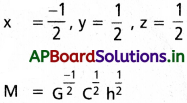
కాంతి వేగం c, ప్లాంక్ స్థిరాంకం h, విశ్వ గురుత్వ స్థిరాంకం G లను ప్రాథమిక రాశులుగా తీసుకొంటే, ఈ రాశుల మితుల్లో ద్రవ్యరాశి, పొడవు, కాలాలను రాయండి. [Mar. ’13]
సాధన:
i) M ∝ GxCyhz
[M¹ L° T°] = [M-1 L³ T-2]x [LT-1]y [ML²T-1]z
[M¹ L° T°] = [M-x+z L3x+y+2z T-2x – y – z]
– x + z = 1, 3x + y + 2z = 0, – 2x – y – z = 0
ఈ సమీకరణాలను సాధించగా
AP Inter 1st Year Physics Study Material Chapter 2 ప్రమాణాలు, కొలత 9
M = \(\sqrt{\frac{hc}{G}}\)

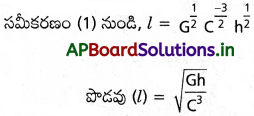
ii) పొడవు (l) ∝ GxCyhz → (1)
[M°L¹T°] = [M-1 L³ T-2]x [LT-1]y [ML²T-1]z
[M°L¹T°] = M– x + z L3x+y+2zT-2x – y – z
సజాతీయత నియమం ప్రకారం
– x + z = 0, 3x + y + 2z = 0, – 2x – y – z = 0
ఈ సమీకరణాలను సాధించగా
x = \(\frac{1}{2}\), y = \(\frac{-3}{2}\), z = \(\frac{1}{2}\)
AP Inter 1st Year Physics Study Material Chapter 2 ప్రమాణాలు, కొలత 10

iii) కాలం (T) ∝ GxCyhz
[M°L°T¹] = [M-1 L³ T-2]x [LT-1]y [ML² T-1]z
[M°L°T¹] = M– x + z L3x + y + 2z T– 2x – y – z
సజాతీయత నియమం ప్రకారం
– x + 2 = 0, 3x + y + 2z = 0, – 2x – y – z = 1
ఈ సమీకరణాలను సాధించగా
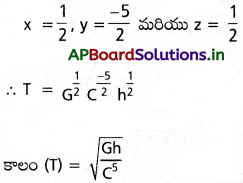
AP Inter 1st Year Physics Study Material Chapter 2 ప్రమాణాలు, కొలత 11

ప్రశ్న 3.
M ద్రవ్యరాశి, R వ్యాసార్ధం కలిగి ఉండే గ్రహం చుట్టూ r వ్యాసార్ధం ఉన్న వృత్తాకార కక్ష్యలో ఒక కృత్రిమ ఉపగ్రహం పరిభ్రమిస్తుంది. మితీయ విశ్లేషణ ఆధారంగా ఉపగ్రహ కక్ష్యావర్తన కాలం T = \(\frac{\hat{e}}{R} \sqrt{\frac{r^3}{g}}\) అని చూపండి. ఇక్కడ \(\hat{\mathbf{e}}\) మితిరహిత స్థిరాంకం, g గురుత్వ త్వరణం.
సాధన:
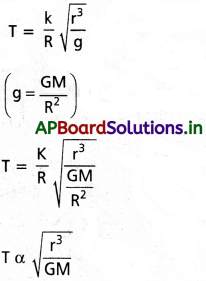
AP Inter 1st Year Physics Study Material Chapter 2 ప్రమాణాలు, కొలత 12
∴ T ∝ rxGyMz
T = krxGyMz → (1)
[M°L° T¹] = K[L]x [M-1L³ T-2]y [M]z
[M°L° T¹] = K[My + z Lx + 3y T-2y]
−y + z = 0, x + 3y = 0, 1 = −2y
పై సమీకరణాలను సాధించగా
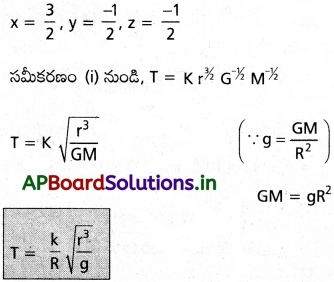
AP Inter 1st Year Physics Study Material Chapter 2 ప్రమాణాలు, కొలత 13

ప్రశ్న 4.
కింది సంఖ్యల్లో సార్ధక సంఖ్యలు ఎన్ని ఉన్నాయో తెలపండి.
a) 6729 b) 0.024 c) 0.08240 d) 6.032 e) 4.57 × 10⁸
సాధన:
a) 6729 – 4 సార్థక సంఖ్యలు
b) 0.024 – 2 సార్థక సంఖ్యలు
c) 0.08240 – 4 సార్థక సంఖ్యలు
d) 6.032 – 4 సార్థక సంఖ్యలు
e) 4.57 × 10⁸ – 3 సార్థక సంఖ్యలు

AP Inter 1st Year Physics Study Material Chapter 2 ప్రమాణాలు, కొలత

ప్రశ్న 5.
రెండు కర్రల పొడవులు వరుసగా 12.132 cm, 12.4 cm. ఈ కర్రలను ఒకదాని చివర మరొకదాని చివరకు తాకునట్లు అమర్చితే మొత్తం పొడవు ఎంత? రెండింటిని ఒకదాని పక్క మరొకటి అమర్చితే పొడవుల్లో వ్యత్యాసం ఎంత?
సాధన:
a) కడ్డీల యొక్క పొడవులు
l1 = 12.132 cm, l2 = 12.4 cm
ఇక్కడ l2 కు దశాంశ బిందువు తర్వాత ఒక స్థానం ఉంది. కాబట్టి l1 ను రెండు దశాంశస్థానాలకు సవరించాలి.
l = l1 + l2 = 12.13 + 12.4 = 24.53
కాబట్టి ఫలితాన్ని దశాంశ బిందువు తర్వాత ఒక స్థానానికి సవరించాలి.
∴ తుది ఫలితం = 24.5 cm

b) l1 = 12.132 cm l2 = 12.4 cm
ఇక్కడ l1 ను దశాంశ బిందువు తర్వాత రెండు స్థానాలకు సవరించాలి.
l2 – l1 = 12.4 – 12.13 = 0.27
ఇప్పుడు దీనిని దశాంశ బిందువు తర్వాత ఒక స్థానానికి సవరించాలి.
l2 – l1 = 0.3

ప్రశ్న 6.
సమ ఘనం భుజం పొడవు 7.203 m. (i) ఘనం ఉపరితల వైశాల్యం, ఘనం ఘనపరిమాణాలను తగిన సార్ధక సంఖ్యలకు లెక్కించండి.
సాధన:
ఘనం యొక్క భుజం (a) = 7.203 m
(i) ఉపరితల వైశాల్యం (A) = 6a²
= 6 × (7.203)² = 311.299
7.203లో సార్ధక సంఖ్యలు నాలుగు (4), ఫలితాన్ని కూడా నాలుగు సార్ధక సంఖ్యలకు సవరించాలి.
∴ (A) = 311.3m²

(ii) ఘనం యొక్క ఘనపరిమాణం = a³
= (7.203)³ = 373.71
ఈ విలువను నాలుగు సార్థక సంఖ్యలకు సవరించాలి.
∴ V = 373.7 m³

ప్రశ్న 7.
ఒక వస్తువు ద్రవ్యరాశి 2.42 g, ఘనపరిమాణం 4.7 cm³. వాటిలోని దోషాలు వరుసగా 0.01 g, 0.1 cm³ అయితే వస్తువు సాంద్రతలో గరిష్ఠ దోషాన్ని కనుక్కోండి.
సాధన:
M = 2.42 g, V = 4.7 cm³
∆Μ = 0.01g, ∆V = 0.1 cm³
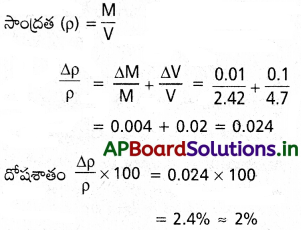
AP Inter 1st Year Physics Study Material Chapter 2 ప్రమాణాలు, కొలత 14

ప్రశ్న 8.
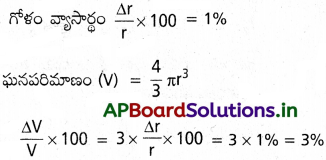
గోళం వ్యాసార్ధం కొలవడంలో దోషం 1% అయితే గోళం ఘనపరిమాణం కొలవడంలో దోషం ఎంత?
సాధన:
AP Inter 1st Year Physics Study Material Chapter 2 ప్రమాణాలు, కొలత 15

ప్రశ్న 9.
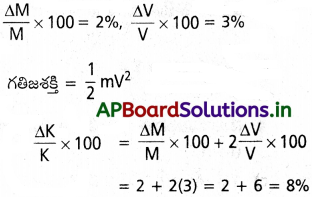
ద్రవ్యరాశి, వడిలో దోష శాతాలు వరుసగా 2%, 3% అయితే గతిజ శక్తిలో గరిష్ట దోషశాతం ఎంత?
సాధన:
AP Inter 1st Year Physics Study Material Chapter 2 ప్రమాణాలు, కొలత 16

ప్రశ్న 10.
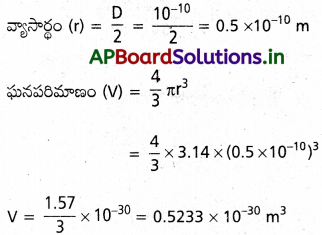
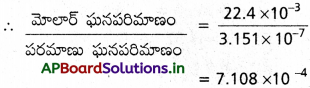
ప్రామాణిక ఉష్ణోగ్రతా పీడనాల వద్ద ఒక మోల్ ఆదర్శవాయువు 22.4L (మోలార్ ఘనపరిమాణం) ఘనపరిమాణం ఆక్రమిస్తుంది. హైడ్రోజన్ అణు పరిమాణం సుమారుగా 1 Å అయితే హైడ్రోజన్ మోలార్ ఘనపరిమాణానికి, పరమాణు ఘన పరిమాణానికి మధ్య నిష్పత్తి ఎంత?
సాధన:
మోలార్ ఘనపరిమాణం = 22.4 లీటర్లు
= 22.4 × 1000 c.c.
= 22.4 × 10⁻³ m³
హైడ్రోజన్ అణువు వ్యాసము
= 1A ° 10-10 m
AP Inter 1st Year Physics Study Material Chapter 2 ప్రమాణాలు, కొలత 17

పరమాణు ఘనపరిమాణం = V × అవగాడ్రో సంఖ్య (N)
= 0.5233 × 10-30 × 6.023 × 1023 = 3.151 × 10⁻⁷

AP Inter 1st Year Physics Study Material Chapter 2 ప్రమాణాలు, కొలత 18

అదనపు లెక్కలు (Additional Problems)

ప్రశ్న 1.
ఖాళీలను పూరించండి.
a) 1 cm భుజం పొడవు ఉండే సమఘనం m ఘనపరిమాణం ……….. m³
b) 2.0 cm వ్యాసార్ధం, 10.0 cm ఎత్తు ఉండే ఘన స్తూపం ఉపరితల వైశాల్యం (mm)²
c) 18 km h-1 వడితో చలిస్తున్న వాహనం 1 s లో ప్రయాణించే దూరం…… m
d) సీసం సాపేక్ష సాంద్రత 11.3 అయితే దాని సాంద్రత …………… g cm³ లేదా …………… kg m-3
సాధన:
a) పొడవు L = 1 cm = 10-2 m
ఘనం ఘనపరిమాణం L³ = (10-2)³
= 10-6 m³

b) r = 2 cm = 20 m.m
h = 10.0 cm = 100 m.m
ఘనస్థూపం ఉపరితల వైశాల్యం 2πr × h
= 2 × \(\frac{22}{7}\) × 20 × 100
= 1.26 × 10⁴ m.m²

c) వడి (V) = 18 kmph
= \(\frac{18\times1000}{60\times60}\) = 5 m/s
∴ 1 సెకనులో ప్రయాణించిన దూరం = 5 m

d) సాపేక్ష సాంద్రత = 11.3 gm/c.c
= \(\frac{11.3\times10^{3}}{(10^{-2})^3}\)
= 11.3 × 10³ kg/m³

ప్రశ్న 2.
ప్రమాణాలను తగురీతిలో పరివర్తన చేయడం ద్వారా ఖాళీలను పూరించండి.
a) 1 kg m² s-2 = …. 9 cm² 5-2
b) 1 m = …. 1y (కాంతి సంవత్సరాలు)
c) 3.0 ms-2 = …. km h-2
d) G = 6.67 × 10⁻¹¹ N m² (kg)-2 (cm)³ s-2 g-1.
సాధన:
a) 1 kg m² s-2
= 1 × 10³ × (10²)² s-2 = 107 gm cm² s-2

b) 1 కాంతి సంవత్సరం = 9.46 × 10¹⁵ m
∴ 1m = \(\frac{1}{9.46\times10^{-16}}\) కాంతి సంవత్సరం
= 1.053 × 10⁻¹⁶ కాంతి సంవత్సరం

c) 3ms-2 = 3 × 10⁻³ km(\(\frac{1}{60\times60}\)h)-2
= 3 × 10-3 × 3600 × 3600 km h-2
= 3.888 × 10⁴ km h-2

d) G = 6.67 × 10⁻¹¹ Nm² kg-2
= 6.67 × 10⁻¹¹ (kg ms-2) m² kg-2
= 6.67 × 10⁻¹¹ m³ s-2 kg-1
= 6.67 × 10⁻¹¹ (100 cm)³ s-2 (1000 g)-1
= 6.67 × 10⁻⁸ cm³ s-2 g-1

AP Inter 1st Year Physics Study Material Chapter 2 ప్రమాణాలు, కొలత

ప్రశ్న 3.
శక్తి లేదా ఉష్ణానికి ప్రమాణం కెలోరి. దీని విలువ సుమారు 4.2 J ఇక్కడ 1J = 1 kg m²s-2. ద్రవ్యరాశికి ప్రమాణం a kg, పొడవుకు ప్రమాణం b m, కాలానికి ప్రమాణం g s. అయ్యే ప్రమాణాల వ్యవస్థను వాడినామనుకోండి అప్పుడు కొత్త ప్రమాణాల పదాలలో కెలోరికి ఉండే పరిమాణం 4.2 a-1b-2 g² అని చూపండి.
సాధన:
1 కెలోరీ = 4.2 J = 4.2 Kg m²S-2
ద్రవ్యరాశి క్రొత్త ప్రమాణం a kg
∴ 1 kg = \(\frac{1}{a}\) = a-1
అదేవిధంగా 1m = b-1 ద్రవ్యరాశి క్రొత్త ప్రమాణం
1s = g-1 కాలం క్రొత్త ప్రమాణం
1 కెలోరీ = 4.2 (a-1) (b-1)² (g-1)-2
1 కెలోరీ = 4.2a-1 b-2g², శక్తి యొక్క క్రొత్త ప్రమాణం

ప్రశ్న 4.
కింది ప్రవచనాన్ని (statement) స్పష్టంగా వివరించండి :
” పోలికకు అవసరమయ్యే ప్రామాణికాన్ని నిర్దేశించకుండా మితీయరాశిని పెద్దది లేదా చిన్నది అని పిలవడం అర్థరహితం” దీన్ని దృష్టిలో ఉంచుకొని కింది ప్రవచనాలను అవసరమైన చోట సరిచేసి తిరిగి రాయండి.
a) పరమాణువులు అతిచిన్న వస్తువులు.
b) జెట్ విమానం ఎక్కువ వడితో చలిస్తుంది.
c) బృహస్పతి ద్రవ్యరాశి చాలా ఎక్కువ.
d) ఈ గదిలోని గాలి అధిక సంఖ్యలో అణువులను కలిగి ఉంది.
e) ఎలక్ట్రాన్ కంటే ప్రోటాన్ ద్రవ్యరాశి చాలా ఎక్కువ.
f) కాంతి వేగం కంటే ధ్వని వేగం చాలా తక్కువ.
సాధన:
i) పై నిర్వచనం సరియైనది. మితిరహితరాశులను కొన్ని ప్రమాణాలకు లోబడి పెద్దవా (లేదా) చిన్నవా అని పోల్చుతారు.
ఉదా : కోణం మితిరహితరాశి, ∠θ = 60° అనునది ∠θ = 30° కన్నా ఎక్కువ కాని ∠θ = 90° కన్నా తక్కువ.

ii) a) పరమాణువు పరిమాణం, ఒక గుండు సూదిమొన కన్నా చాలా చిన్నది.
b) సూపర్ ఫాస్ట్ రైలు కన్నా జెట్ విమానం చాలా వేగంగా పోతుంది.
c) భూమి ద్రవ్యరాశి కన్నా అంగారకుడి ద్రవ్యరాశి బాగా ఎక్కువ.
d) ఒక మోల్ వాయువులోని అణువుల కన్నా, గదిలో
గాలిలో అణువుల సంఖ్య ఎక్కువ.
e) పై స్టేట్మెంట్ సరియైనది.
f) పై స్టేట్మెంట్ సరియైనది.

ప్రశ్న 5.
శూన్యంలో కాంతి వడి 1ms-2 అయ్యేవిధంగా పొడవుకు ఒక కొత్త ప్రమాణాన్ని ఎంచుకొన్నారు. సూర్యుడి నుంచి కాంతి భూమిని చేరేందుకు పట్టేకాలం 8 నిమిషాల 20 సెకన్లయితే కొత్త ప్రమాణాల్లో సూర్యుడు-భూమి మధ్య దూరం ఎంత?
సాధన:
శూన్యంలో కాంతివేగం c = 1 పొడవు క్రొత్త ప్రమాణం s-1
కాంతి సూర్యుడి నుండి భూమిని చేరుటకు పట్టుకాలం
t = 8 నిమిషాల 20 సెకండ్లు = 8 × 60 + 20
= 500 సెకండ్ల
భూమి, సూర్యుడి మధ్యదూరం (x) = C × t
∴ పొడవు క్రొత్త ప్రమాణం s-1 × 500
= 500 పొడవు క్రొత్త ప్రమాణం

ప్రశ్న 6.
పొడవును కొలవడానికి కింది వాటిలో ఏది చాలా ఖచ్చితమైన పరికరం?
a) కదిలే స్కేలుపై 20 వెర్నియర్ విభాగాలు ఉండే వెర్నియర్ కాలిపర్స్
b) 1 mm పిచ్, 100 తలస్కేలు విభాగాలు ఉండే స్కూృగేజి.
c) కాంతి తరంగదైర్ఘ్యవిలువకు తక్కువ/సమానం వరకు పొడవును కొలిచే దృక్ సాధనం.
సాధన:
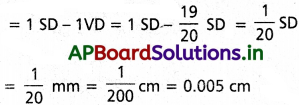
a) వెర్నియర్ కాలిపర్స్ కనీసపు కొలత
AP Inter 1st Year Physics Study Material Chapter 2 ప్రమాణాలు, కొలత 19
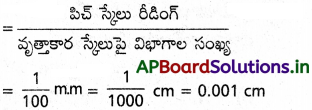
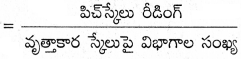
b) స్క్రూగేజి కనీసపు కొలత
AP Inter 1st Year Physics Study Material Chapter 2 ప్రమాణాలు, కొలత 20
c) కాంతి సంవత్సరం
λ = 10-5 cm = 0.00001 cm
ఎక్కువ యదార్థ కలది దృశావస్తువు

ప్రశ్న 7.
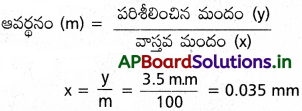
100 ఆవర్ధనం ఉండే సూక్ష్మదర్శిని ఉపయోగించి ఒక విద్యార్థి మానవుడి వెంట్రుక మందాన్ని కొలుస్తున్నాడు. 20 పరిశీలనల వల్ల వెంట్రుక సగటు మందాన్ని (సూక్ష్మదర్శినిలో చూసినదాని దృష్ట్యా) 3.5 mm.గా కనుక్కొన్నాడు. అంచనాకు వచ్చే మందం ఎంత
సాధన:
AP Inter 1st Year Physics Study Material Chapter 2 ప్రమాణాలు, కొలత 21

ప్రశ్న 8.
కింది వాటికి సమాధానం రాయండి:
a) నీకు ఒక దారం, మీటరు స్కేలును ఇస్తే దారం వ్యాసాన్ని ఏవిధంగా అంచనా వేస్తావు?
b) ఒక స్కూృగేజి పిచ్ 1.0 mm, వృత్తాకార స్కేలుపై విభాగాలు 200. వృత్తాకార స్కేలుపై విభాగాల సంఖ్యను అనియతంగా పెంచడం ద్వారా స్కూృగేజి యధార్ధతను పెంచడం సాధ్యమని నీవు అనుకొంటున్నావా?
c) వెర్నియర్ కాలిపర్స్ సహాయంతో పలుచని ఇత్తడి కడ్డీ సగటు వ్యాసాన్ని నిర్ణయించవలసి ఉంది. 5 కొలతల సమితి కంటే 100 కొలతల సమితితో వచ్చే అంచనా విలువ ఎక్కువ నమ్మదగినదని మనమెందుకు ఆశిస్తాం?
సాధన:
a) ద్వారం వ్యాసం చాలా చిన్నది కాబట్టి దానిని మీటరు స్కేలు ఉపయోగించి కొలవలేము. మీటరు స్కేలుపై దారాన్ని అనేకచుట్లుగా చుట్టాలి. ఆ చుట్లు బాగా దగ్గర దగ్గరగా చుట్టాలి.
n చుట్లు గల దారం పొడవు l
∴ దారం వ్యాసం = \(\frac{1}{n}\)

b) కనీసపు కొలత
AP Inter 1st Year Physics Study Material Chapter 2 ప్రమాణాలు, కొలత 22
వృత్తాకార స్కేలుపై విభాగాల సంఖ్య పెరిగితే, కనీసపు కొలత తగ్గుతుంది. కాబట్టి ఖచ్చితత్వం పెరుగు తుంది. కాని ప్రాయోగికంగా సాధారణ మానవుని కంటితో రీడింగ్లను ఖచ్చితంగా కొలవలేము.

c) తక్కువ పరిశీలనలు (5) కన్నా ఎక్కువ పరిశీలనలు (100) ఆధారపడదగినవిగా ఉంటాయి. దీనికి కారణం ధనయాదృచ్ఛిక దోషం, రుణయాదృచ్ఛిక దోషం ఒకే పరిమాణంలో ఉంటాయి. కాబట్టి పరిశీలనల సంఖ్య పెరిగే కొద్దీ యాదృచ్ఛిక దోషాలు తగ్గి, విలువలు ఆధారపడదగినవిగా ఉంటాయి.

ప్రశ్న 9.
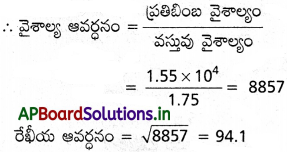
35 mm స్లైడుపై ఒక ఇంటి ఛాయాచిత్రం వైశాల్యం 1.75 cm². ఆ స్లెడును తెరపై ప్రొజెక్ట్ చేసినపుడు ఇంటి వైశాల్యం 1.55 m² గా ఉంది. ప్రొజెక్టర్-తెర అమరిక రేఖీయ ఆవర్ధనం ఎంత?
సాధన:
వస్తువు వైశాల్యం = 1.75 cm²
ప్రతిబింబం వైశాల్యం = 1.55 m² = 1.55 × 104cm²
AP Inter 1st Year Physics Study Material Chapter 2 ప్రమాణాలు, కొలత 23

ప్రశ్న 10.
కింద ఇచ్చిన వాటిలో సార్ధక సంఖ్యలు ఎన్ని ఉన్నాయి?
a) 0.007 m², b) 2.64 ×1024 kg, c) 0.2370 g cm-3, d) 6.320 J, e) 6.032 N m-2, f) 0.0006032 m²
సాధన:
ఇచ్చిన సంఖ్యలకు ఈ క్రింది సార్ధక సంఖ్యలు కలవు.
a) ఒకటి b) మూడు c) నాలుగు d) నాలుగు e) నాలుగు f) నాలుగు.

AP Inter 1st Year Physics Study Material Chapter 2 ప్రమాణాలు, కొలత

ప్రశ్న 11.
దీర్ఘచతురస్రాకార లోహ పలక పొడవు, వెడల్పు, మందాలు వరుసగా 4.234m, 1.005 m, 2.01 cm లు సరయిన సార్ధక సంఖ్యల వరకు ఆ పలక వైశాల్యం, ఘనపరిమాణాలను రాయండి. సాధన:
ఇక్కడ పొడవు l = 4.234 m
వెడల్పు b = 1.005 m
మందం t = 2.01 cm = 2.01 × 10⁻² m
పలక వైశాల్యం = 2 (l × b + b × t + t × l)
= 2(4.234 × 1.005 + 1.005 × 0.0201 + 0.021 × 4.234)
=2(4.3604739)
= 8.7209478 m²

వైశాల్యం మూడు సార్ధక సంఖ్యలు కలిగి ఉండాలి. కావున వీటిని సవరించాలి.
వైశాల్యం = 8.72 m²
ఘనపరిమాణం (V) = l × b × t
V = 4.234 × 1.005 × 0.0201
= 0.0855289
= 0.855 m³
దీనిలో మూడు సార్ధక సంఖ్యలు కలవు.

ప్రశ్న 12.
ఒక పెట్టెను కిరాణా షాపుదారు వాడే త్రాసుతో తూస్తే వచ్చిన ద్రవ్యరాశి 2.300 kg. ఇప్పుడు ఈ పెట్టెకు 20.15 g, 20.17 g ద్రవ్యరాశులు గల రెండు బంగారు ముక్కలను కలిపారు. (a) పెట్టె మొత్తం ద్రవ్యరాశి, (b) ముక్కల ద్రవ్యరాశుల్లో వ్యత్యాసాన్ని సరయిన సార్ధక సంఖ్యల వరకు రాయండి.
సాధన:
పెట్టె ద్రవ్యరాశి m = 2.3 kg
ఒక బంగారం ముక్క ద్రవ్యరాశి
m1 = 20.15 g = 0.02015 kg
మిగిలిన బంగారం ద్రవ్యరాశి
m2 = 20.17g = 0.02017 kg

a) మొత్తం ద్రవ్యరాశి = m + m1 + m2
= 2.3 +0.02015 +0.02017
= 2.34032 kg
ఫలితాన్ని దశాంశ స్థానం తర్వాత ఒక సంఖ్యకు సవరించాలి.
మొత్తం ద్రవ్యరాశి = 2.3 kg

b) ద్రవ్యరాశులలో తేడా
= m2 – m1 = 20.17 – 20.15
= 0.02gm

ప్రశ్న 13.
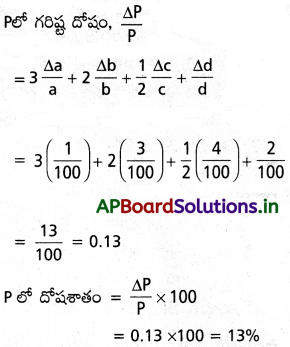
P అనే భౌతికరాశి a, b, c, d అనే నాలుగు పరిశీలించగలిగే రాశులతో కిందివిధమైన సంబంధాన్ని కలిగి ఉంది :
P = a³b²/(√cd)
a,b,c,d లకొలతల్లోని దోషశాతాలు వరుసగా 1%, 3%, 4%, 2% అయితే P లోని దోషశాతం ఎంత ? పై సంబంధం ఉపయోగించి లెక్కించిన P విలువ 3.763 అయితే, ఫలితాన్ని నీవు ఏ విలువ వరకు సవరిస్తావు ?
సాధన:
ఇక్కడ P = \(\frac{a^3 b^2}{\sqrt{c} d}\)
AP Inter 1st Year Physics Study Material Chapter 2 ప్రమాణాలు, కొలత 24

ఫలితం Pలో రెండు సార్ధక సంఖ్యలు కలవు కాబట్టి 3.763ని సవరిస్తే 3.8 అవుతుంది.

ప్రశ్న 14.
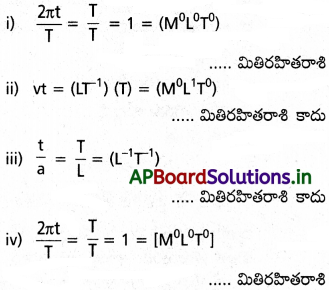
ముద్రణా దోషాలు అనేకంగా ఉండే పుస్తకంలో ఒక నిర్దిష్ట ఆవర్తన చలనం చేస్తున్న కణం స్థానభ్రంశానికి నాలుగు భిన్న ఫార్ములాలు ఉన్నాయి. అవి
a) y = a sin 2 p t/T, b) y = a sin vt, c) y = (a/T) sin t/a, d) y = (a√2) (sin 2 πt /T + cos 2 πt /T)
(a = కణం పొందే గరిష్ఠ స్థానభ్రంశం, v = కణం వడి, T = ఆవర్తన కాలం) మితుల దృష్ట్యా తప్పు అయిన ఫార్ములాలను కొట్టి వేయండి.
సాధన:
త్రికోణమితి ప్రమేయం మితిరహితరాశి అనగా కోణం మితిరహిత రాశి
AP Inter 1st Year Physics Study Material Chapter 2 ప్రమాణాలు, కొలత 25
కాబట్టి (ii) మరియు (iii) సూత్రాలు తప్పు.

ప్రశ్న 15.
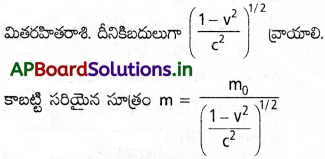
భౌతికశాస్త్రంలో ఒక ప్రసిద్ధమైన సంబంధం కణ ‘విరామ ద్రవ్యరాశి’ m0, చలిస్తున్నప్పుడు ద్రవ్యరాశి m లను కణ వడి v కాంతి వడి c పదాలతో కలుపుతుంది. (ఈ సంబంధం ఆల్బర్ట్ ఐన్స్టీన్ ప్రతిపాదించిన ప్రత్యేక సాపేక్షతా సిద్ధాంతం పర్యవసానంగా మొట్టమొదట వెలువడింది) ఒక బాలుడు ఈ సంబంధాన్ని దాదాపు సరిగానే జ్ఞప్తికి తెచ్చుకొన్నాడు కానీ స్థిరాంకం c ని ఎక్కడ ఉంచాలో మరచిపోయి కింది విధంగా రాశాడు.
m = \(\frac{m_0}{\left(1-v^2\right)^{1 / 2}}\)
ఇందులో కనిపించకుండా పోయిన ఁని ఎక్కడ ఉంచాలో ఊహించండి.
సాధన:
సజాతీయత సూత్రం ప్రకారం, MLT యొక్క ఘాతాలు
ఇరువైపులా సమానం. R.H.S వైపు లవంలో (1 – v²)1/2

AP Inter 1st Year Physics Study Material Chapter 2 ప్రమాణాలు, కొలత 26

ప్రశ్న 16.
పరమాణు మానంపై (atomic scale) అనువుగా ఉండే పొడవు ప్రమాణం ఆంగ్జామ్, దీన్ని AC తో సూచిస్తారు. 14° = 10-10 m. హైడ్రోజన్ పరమాణు పరిమాణం సుమారు 0.5A° . ఒక మోల్ హైడ్రోజన్ పరమాణువుల మొత&ం పరమాణు ఘనపరిమాణం m³ ల్లో ఎంత ఉంటుంది?
సాధన:
ఇక్కడ r = 0.5 A° = 0.5 × 10⁻¹⁰ m
ప్రతి హైడ్రోజన్ పరమాణువు ఘనపరిమాణం = \(\frac{4}{3}\)πr³
\(\frac{4}{3}\) × 3.14 × (0.5 × 10-10)³ = 5.236 × 10⁻³¹ 3 m³
ఒక గ్రామ్ మోల్ హైడ్రోజన్ పరమాణువుల సంఖ్య అవగాడ్రో సంఖ్య = 6.023 × 10²³

ఒక గ్రామ్ – మోల్ హైడ్రోజన్ పరమాణువు ఘన పరిమాణం
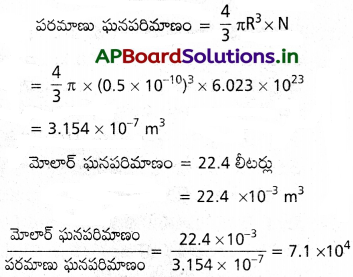
= 5.236 × 10-31 × 6.023 × 1023
= 3.154 × 10⁻⁷ m³

ప్రశ్న 17.
ప్రామాణిక ఉష్ణోగ్రతా పీడనాల వద్ద ఒక మోల్ ఆదర్శవాయువు 22.4L (మోలార్ ఘనపరిమాణం) ఆక్రమిస్తుంది. హైడ్రోజన్ అణు పరిమాణం సుమారుగా 1A° అయితే హైడ్రోజన్ మోలార్ ఘనపరిమాణానికి, పరమాణు ఘనపరిమాణానికి మధ్య నిష్పత్తి ఎంత? ఈ నిష్పత్తి అంత పెద్దదిగా ఎందుకు ఉంది?
సాధన:
AP Inter 1st Year Physics Study Material Chapter 2 ప్రమాణాలు, కొలత 27
ఈ నిష్పత్తి పరమాణువుల అంతర దూరాల కన్నా అధికం.

ప్రశ్న 18.
సాధారణంగా మనం పరిశీలించే ఈ అంశాన్ని స్పష్టంగా వివరించండి. వేగంగా ప్రయాణిస్తున్న రైలు కిటికీలో నుంచి బయటికి నీవు చూస్తే, దగ్గరలో ఉండే చెట్లు, ఇళ్ళు మొదలైనవి రైలు ప్రయాణ దిశకు వ్యతిరేక దిశలో వేగంగా కదులుతున్నట్లుగా అగుపిస్తాయి. కానీ, దూరంగా ఉండే వస్తువులు (కొండ శిఖరాలు, చంద్రుడు నక్షత్రాలు మొదలైనవి) స్థిరంగా ఉన్నట్లుగా అగుపిస్తాయి. (నిజానికి, నీవు చలిస్తున్నావని నీకు తెలుసు కాబట్టి ఈ దూర వస్తువులు నీతోపాటే చలిస్తున్నట్లు అనిపిస్తుంది)
సాధన:
వస్తువుకు, నేత్రానికి గీసే సరళరేఖను దృష్టిరేఖ అంటారు. రైలు వేగంగా కదిలితే, దగ్గరలో ఉన్న చెట్లపై దృష్టిరేఖ మారును. అందుకని చెట్లు వెనక్కి పోవుచున్నట్లు కనిపిస్తుంది.

దూరపు వస్తువులపై (కొండలు, చంద్రుడు, నక్షత్రాలు) దృష్టిరేఖ మారదు. కాబట్టివాటి దిశ మారదు. అందువలన పర్వతాలు, చంద్రుడు, నక్షత్రాలు వంటి దూరంగా ఉన్నవి నిశ్చలంగా ఉంటాయి.

AP Inter 1st Year Physics Study Material Chapter 2 ప్రమాణాలు, కొలత

ప్రశ్న 19.
విభాగం 2.3.1 లో చర్చించిన దృష్టి విక్షేప సూత్రం సుదూరంగా ఉండే నక్షత్రాల దూరాలను నిర్ణయించడానికి ఉపయోగించాం. 6 నెలల ఎడంలో సూర్యుడి చుట్టూ ఉండే దాని కక్ష్యలో గల భూమి రెండు స్థానాలను కలిపే రేఖ ఆధారరేఖ (baseline) AB. అంటే ఆధారరేఖ సుమారు భూకక్ష్య వ్యాసానికి సమానం (≈3 × 10¹¹ m). అయితే మనకు దగ్గర్లో ఉండే నక్షత్రాలు కూడా ఎంత దూరంలో ఉంటాయంటే అంతటి పొడవైన ఆధారరేఖతో అవి కలగచేసే ‘దృష్టి విక్షేపం’ చాపంలో 1″ (సెకను) క్రమంలో మాత్రమే ఉంటుంది. ఖగోళదూరాలకు ‘పార్సెక్’ అనేది అనుకూలమైన ‘పొడవు ప్రమాణం’. ఇది భూమి నుంచి సూర్యుడి వరకు గల దూరానికి సమానంగా ఉండే ఆధారరేఖ యొక్క రెండు వ్యతిరేక చివరలతో చాపపు 1″ (సెకను) పారలాక్స్ (కోణం) (దృష్టి విక్షేపం) ను చూపగలిగే వస్తువు దూరం. ఒక పార్సెక్ విలువ మీటర్లలో ఎంత?
సాధన:
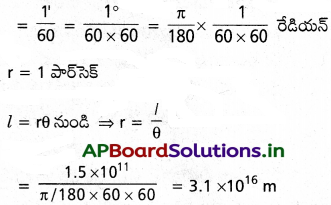
ఆధారరేఖ పొడవు = భూమి నుండి సూర్యుడి వరకు పొడవు
= 1 A.U = 1.5 × 10¹¹m
దృష్టికోణం θ = 111
AP Inter 1st Year Physics Study Material Chapter 2 ప్రమాణాలు, కొలత 28
కాబట్టి 1 పార్సెక్ 3.1 × 10¹⁶ m

ప్రశ్న 20.
మన సౌరవ్యవస్థకు అత్యంత సమీపంలో ఉండే నక్షత్రం దూరం 4.29 కాంతి సంవత్సరాలు. ఈ దూరం ‘పార్సెక్’ లలో ఎంత? ఆల్పాసెంటారీ (Alpha Centauri) అని పిలువబడే నక్షత్రం సూర్యుని చుట్టూ ఉండే కక్ష్యలో భూమి 6 నెలల ఎడంలో ఉన్నప్పుడు ఉండే రెండు స్థానాల నుంచి చూసినప్పుడు ఎంత దృష్టి విక్షేపాన్ని కలగచేస్తుంది?
సాధన:
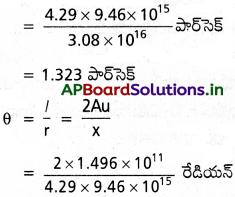
x = 4.29 కాంతి సంవత్సరాలు
= 4.29 × 9.46 × 1015 m
AP Inter 1st Year Physics Study Material Chapter 2 ప్రమాణాలు, కొలత 29
= 1.512 సెకన్లు

ప్రశ్న 21.
విజ్ఞానశాస్త్రానికి భౌతికరాశుల కచ్చిత కొలతలు ఆవశ్యం. ఉదాహరణకు ఒక విమాన వడిని నిశ్చయంగా తెలుసుకోవాలంటే స్వల్ప కాల వ్యవధుల ఎడంలో విడిపోయి ఉన్న దాని స్థానాలను కనుక్కోవడానికి ఒక యధార్థ పద్ధతి మనకు ఉండాలి. రెండో ప్రపంచ యుద్ధంలో రాడారును ఆవిష్కరించడం వెనుక ఉన్న నిజమైన ఉద్దేశం ఇదే. ఆధునిక విజ్ఞానశాస్త్రంలో ఎక్కడైతే పొడవు, కాలం, ద్రవ్యరాశి మొదలైనవాటి కచ్చిత కొలతలు అవసరమవుతాయో అలాంటి భిన్న ఉదాహరణల గురించి ఆలోచించండి. దాంతో పాటు అక్కడ అవసరమయ్యే కచ్చితత్వం పరిమాణాత్మక భావనను ఇవ్వగలిగిన చోట ఇవ్వండి.
సాధన:
సైన్స్ మరియు భౌతికశాస్త్ర నియమాలు అభివృద్ధి చెందాలంటే పొడవు, ద్రవ్యరాశి మరియు కాలాలను ఖచ్చితంగా కొలవాలి.

ఉదాహరణకు లేసర్ కిరణంతో భూమి నుండి, చంద్రుడు వరకు దూరాన్ని కొలిచామనుకోండి. అందుకు కాలంను ఖచ్చితంగా కొలవాలి. అదేవిధంగా దూరం, విమాన వేగాన్ని రాడార్తో కొలవడం మొదలగువాటికి కాలంను ఖచ్చితంగా కొలవాలి. నక్షత్రాల మధ్య దూరాలను కొలుచుటకు దృష్టికోణంను ఖచ్చితంగా కొలవాలి.

స్ఫటికాలలో పరమాణువులలో అంతర దూరాలు ఖచ్చితంగా కొలవాలి. ద్రవ్యరాశి స్పెక్ట్రోమీటరు ఉపయోగించి పరమాణువుల ద్రవ్యరాశిని ఖచ్చితంగా కొలవవచ్చు.

ప్రశ్న 22.
మూల భావనలను, సాధారణ పరిశీలనలను ఉపయోగిస్తూ, రాశులకు ఉజ్జాయింపు అంచనాలను కట్టగలగడం కూడా అంతే ముఖ్యం. ఈ కింది వాటిని అంచనావేసే మార్గాలను ఆలోచించండి. (ఎక్కడైతే అంచనా పొందడం కష్టమో, అక్కడ రాశి యొక్క విలువలో పైహద్దు (upper bound) ను పొందడానికి ప్రయత్నించండి)
a) రుతుపవనాల కాలంలో భారతదేశంపై ఆవరించి ఉండే వర్షాన్ని తీసుకొని రాగలిగే మేఘాల మొత్తం ద్రవ్యరాశి.
b) ఏనుగు ద్రవ్యరాశి
c) తుఫాన్ సమయంలో పవన వడి
d) నీ తలపై ఉండే వెంట్రుకల సంఖ్య
e) మీ తరగతి గదిలోని గాలి అణువుల సంఖ్య.
సాధన:
a) రుతుపవనాల కాలంలో, మెటీరియాలజిస్ట్ 100 cm వర్షపాతం కురిసినట్లుగా నమోదు చేశాడు.
= 100 cm = 1m.
దేశం వైశాల్యం,
A = 3.3 మిలియన్ × km²
= 3.3 × 10⁶ (10³)²
= 3.3 × 10¹² m²
వర్షపు నీరు ఘనపరిమాణం
v = Axh = 3.3 × 1012 × 1m³
నీటిసాంద్రత ρ = 10 km/m³
వాన నీటి ద్రవ్యరాశి
= vρ = 3.3 × 1012 × 10³
= 3.3 × 10¹⁵ kg
ఇది భారతదేశం అంతటా కురిసిన వర్షం మొత్తం ద్రవ్యరాశి.

b) ఏనుగు ద్రవ్యరాశి కొలవాలంటే, వైశాల్యం (A) తెలిసిన పడవను తీసుకోవాలి. నీటిలో పడవ లోతును తెలుసుకోవాలి. అది x1 అనుకొనుము. పడవ వలన స్థానభ్రంశం చెందిన నీటి ఘన పరిమాణం V1 = Ax1. ఇప్పుడు పడవలోకి ఏనుగును ఎక్కించాలి. పడవ నీటిలోకి దిగుతుంది. ఇప్పుడు పడవ నీటిలోకి ఎంత లోతు ఉన్నది కొలవాలి. అది x2 గా తీసుకోవాలి.

పడవ మరియు ఏనుగు వలన స్థానభ్రంశం చెందిన నీటి యొక్క ఘనపరిమాణం V2 = Ax2

ఏనుగువల్ల స్థానభ్రంశం చెందిన నీటి ఘన పరిమాణం (V) = V2 – V1 = A(x2 – x1)

నీటిసాంద్రత p, అయిన ఏనుగు ద్రవ్యరాశి
= తొలగిన నీటి ద్రవ్యరాశి
= Vρ = A(x2 – x1)ρ

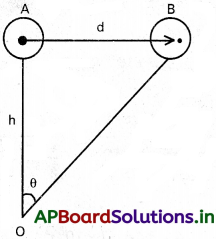
c) బెలూన్లో వాయువును నింపి గాలి వేగాన్ని తుఫాన్ సమయంలో కొలవవచ్చు. OA అనునది సాధారణ స్థితిలో వాయుబెలూన్ ఉంది. గాలి కుడివైపుకు వీస్తే ఒక సెకన్లో B వద్దకు బెలూన్ చేరినది. అప్పుడు ∠AOB = θను కొలవాలి. బెలూన్ ఎత్తు h అయిన AB = d = hθ. ఇది బెలూన్ ఒక సెకనులో ప్రయాణించిన దూరం. ఇదే గాలివేగం.
AP Inter 1st Year Physics Study Material Chapter 2 ప్రమాణాలు, కొలత 30

d) ముందుగా తల వైశాల్యాన్ని కొలవాలి. అది A అనుకొనుము. స్క్రూగేజిని ఉపయోగించి, వెంట్రుక మందాన్ని కొలవాలి (d).
వెంట్రుక అడ్డుకోత వైశాల్యం = πd²
తలపై ఉన్న వెంట్రుకల సంఖ్య
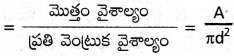
AP Inter 1st Year Physics Study Material Chapter 2 ప్రమాణాలు, కొలత 31
కాబట్టి లెక్కల ప్రకారం తలపై సుమారుగా ఒక మిలియన్ వెంట్రుకలు ఉంటాయి.

e) ముందుగా గది ఘనపరిమాణంను కొలవాలి. N.T.P వద్ద ఒక మోల్ వాయువు ఘనపరిమాణం 22.4 లీటర్లు అనగా 22.4 × 10³ m³
∴ వాయు అణువుల సంఖ్య
= 22.4 × 10⁻³ m³ = 6.023 × 10²³
V ఘనపరిమాణం గల తరగతి గదిలో వాయు
అణువుల సంఖ్య = \(\frac{6.023 \times 10^{23}}{22.4 \times 10^{-3}} \times v\)

AP Inter 1st Year Physics Study Material Chapter 2 ప్రమాణాలు, కొలత

ప్రశ్న 23.
అతి వేడిగా ఉండే ప్లాస్మా (అయనీకృత పదార్థం) స్థితిలో సూర్యుడు ఉంటాడు. సూర్యుడి అంతర్భాగ ఉష్ణోగ్రత 107 K కు మించి ఉంటుంది. బాహ్య ఉపరితల ఉష్ణోగ్రత సుమారు 6000 K. ఇంతటి అధిక ఉష్ణోగ్రతల వద్ద ఏ పదార్థం కూడా ఘన లేదా ద్రవ ప్రావస్థలో ఉండదు. ఘనపదార్థాలకు, ద్రవాలకు లేదా వాయువులకు ఉండే సాంద్రత వ్యాప్తిలో సూర్యుని ద్రవ్యరాశి సాంద్రత ఏ వ్యాప్తిలో ఉంటుందని లేదా ఉండవచ్చని మీరు భావిస్తున్నారు. మీరు ఊహించిన విలువ సరియైందో కాదో కింది దత్తాంశంతో సరిచూడండి. సూర్యుని ద్రవ్యరాశి : 2.0 × 1030 kg, సూర్యుని వ్యాసార్ధం = 7.0 × 10⁸ m.
సాధన:
m = 2.0 × 1030 kg, R = 7.0 × 10⁸
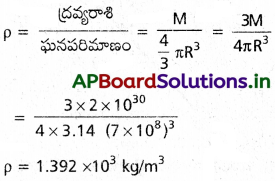
AP Inter 1st Year Physics Study Material Chapter 2 ప్రమాణాలు, కొలత 32
ఇది ఘన మరియు ద్రవాల సాంద్రత. వాయువులకు కాదు. సూర్యుడిపై బాహ్యపొరలపై లోపలివైపుకు గురుత్వాకర్షణ బలాలు ఉండుటచే సూర్యుడిలో అధిక సాంద్రత ఉంటుంది.

ప్రశ్న 24.
బృహస్పతి గ్రహం భూమి నుంచి 824.7 మిలియన్ కిలోమీటర్ల దూరంలో ఉన్నప్పుడు కోణీయ వ్యాసాన్ని కొలిస్తే 35.72″, గా వచ్చింది. బృహస్పతి వ్యాసాన్ని లెక్కించండి.
సాధన:
ఇక్కడ r = 824.7 × 10⁶ km,
θ = 35.72
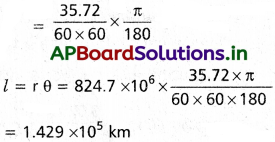
AP Inter 1st Year Physics Study Material Chapter 2 ప్రమాణాలు, కొలత 33

ప్రశ్న 25.
వర్షంలో వడితో వడివడిగా నడిచే వ్యక్తి తన గొడుగును నిలువు (క్షితిజ లంబం) తో q కోణం చేసే విధంగా ముందుకు వంచాలి. q, υ ల మధ్య సంబంధాన్ని ఒక విద్యార్థి tan q = υ గా ఉత్పాదించి ఈ సంబంధం సరియైన అవధి కలిగి ఉందని సరిచూశాడు. ఈ అవధి ఆశించినట్లుగానే ఉందని కనుక్కొంటాడు. అవధులు υ > 0, q > 0 (ఎలాంటి ప్రబలమైన గాలి వీచడం లేదని వర్షం నిశ్చలంగా ఉండే వ్యక్తి దృష్ట్యా నిలువుగానే పడుతుందని మనం భావించుకుంటున్నాం) ఈ సంబంధం సరియైందేనని మీరు భావిస్తున్నారా ? కాకపోయి నట్లయితే, సరియైన సంబంధాన్ని ఊహించండి.
సాధన:
tan θ = υ,
υ → 0; θ → 0.
R.H.S = tan θ = [M°L°T°] మరియు
L.H.S = υ = [M° L¹T-1]
మితులపరంగా ఈ సంబంధం సరియైనది కాదు. సరియైన సంబంధం
tan θ = \(\frac{v^2}{\mathrm{rg}}\)

ప్రశ్న 26.
రెండు సీజియం గడియారాలను నిరాటంకంగా 100 సంవత్సరాలు నడిపిస్తే, వాటి కాలాల్లో వచ్చే మార్పు కేవలం 0.025 అని నొక్కిచెప్పారు. 1 s కాలవ్యవధిని కొలవడంలో ప్రామాణిక సీజియం గడియారం యదార్థతకు ఇది ఏ అర్ధాన్ని ఇస్తుంది?
సాధన:
100 సంవత్సరాలకు దోషం = 0.02s
1 సెకనులో దోషం
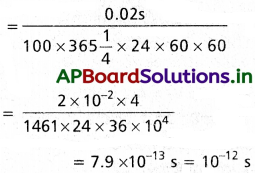
AP Inter 1st Year Physics Study Material Chapter 2 ప్రమాణాలు, కొలత 34
కాబట్టి ప్రామాణిక సీజియమ్ గడియారంలో కొలచే కాలం వ్యవధి 1 సెకనుకు యదార్థత 10-12 s.

ప్రశ్న 27.
సోడియం పరమాణువు పరిమాణాన్ని 2.5 A° గా పరిగణిస్తూ, సోడియం పరమాణువు సగటు ద్రవ్యరాశి సాంద్రతను అంచనా వేయండి. (అవొగాడ్రో) సంఖ్య, సోడియం పరమాణు ద్రవ్యరాశులకు తెలిసిన విలువలను ఉపయోగించండి.) ఈ సాంద్రత విలువను స్ఫటిక ప్రావస్థలోని సోడియం సాంద్రత విలువ 970 kg m-3 తో పోల్చండి. ఈ రెండు సాంద్రతలు ఒకే పరిమాణ క్రమాన్ని కలిగి ఉన్నాయా? ఉంటే, ఎందుకు?
సాధన:
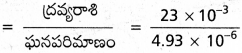
పరమాణు ఘనపరిమాణం = \(\frac{4}{3}\) πR³ × N
= \(\frac{4}{3}\times\frac{22}{7}\) (1.25 × 10-10)³ × 6.023 × 1023 m³
4.93 × 10⁻⁶ m³
సగటు ద్రవ్యరాశి సాంద్రత
AP Inter 1st Year Physics Study Material Chapter 2 ప్రమాణాలు, కొలత 35
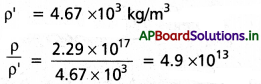
= 4.67 × 10³ kg/m³
ఈ రెండు సాంద్రతలు ఒకే క్రమంలో లేవు. ఇది స్ఫటికాలలో పరమాణువుల అంతర దూరాల దశను తెలుపును.

ప్రశ్న 28.
కేంద్రక మానం (nuclear scale) లో అనుకూలమైన పొడవు ప్రమాణం ఫెర్మీ. 1f = 10-15 m. కేంద్రక పరిమాణాలు ఉజ్జాయింపుగా అనుసరించే అనుభవిక సంబంధం : r = roA1/3
ఇక్కడ r కేంద్రక వ్యాసార్ధం, దాని ద్రవ్యరాశి, సంఖ్య ro అనేది 1.2 f కు దాదాపు సమానమైన స్థిరాంకం. ఈ నియమం ఆధారంగా భిన్న కేంద్రకాలకు ద్రవ్యరాశి సాంద్రత దాదాపు స్థిరాంకం అని చూపండి. సోడియం కేంద్రకం ద్రవ్యరాశి సాంద్రతను అంచనా వేయండి. ఈ విలువలను అభ్యాసం 27లో పొందిన సోడియం పరమాణు సగటు ద్రవ్యరాశి సాంద్రతతో పోల్చండి.
సాధన:
కేంద్రకం సగటు ద్రవ్యరాశి = m
కేంద్రకంలో న్యూక్లియాన్ల సంఖ్య = n
కేంద్రకం యొక్క ద్రవ్యరాశి M = mA
కేంద్రకం వ్యాసార్థం r = roA1/3

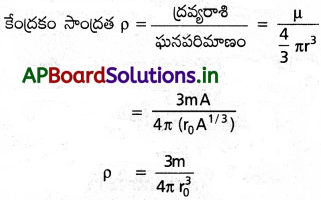
AP Inter 1st Year Physics Study Material Chapter 2 ప్రమాణాలు, కొలత 36
m, ro లు స్థిరాంకాలు. అన్ని కేంద్రకాల సాంద్రత స్థిరం
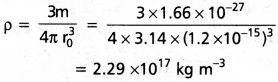
m = 1.66 × 10⁻²⁷ kg మరియు
ro = 1.2f = 1.2 × 10⁻¹⁵ m
AP Inter 1st Year Physics Study Material Chapter 2 ప్రమాణాలు, కొలత 37

అన్ని కేంద్రకాలకు p స్థిరం కనుక, ఇది సోడియం కేంద్రకం సాంద్రత కూడా అవుతుంది.
సోడియం కేంద్రకం సాంద్రత
AP Inter 1st Year Physics Study Material Chapter 2 ప్రమాణాలు, కొలత 38

ప్రశ్న 29.
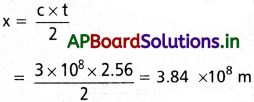
లేజర్ (LASER) చాలా తీవ్రత కలిగిన, ఏకవర్ణక, ఏకదిశాత్మక కాంతి పుంజ జనకం. ఈ ధర్మాల ఆధారంగా సుదూరాలను కొలవడానికి లేజర్ను వినియోగించుకోవచ్చు. లేజర్ను ఒక కాంతి జనకంగా ఉపయోగించి భూమి నుంచి చంద్రుని దూరాన్ని చాలా ఖచ్చితంగా ఇదివరకే నిర్ణయించారు. చంద్రుడిపైకి కేంద్రీకరించిన ఒక లేజర్ కాంతి పుంజం చంద్రుని ఉపరితలం నుంచి పరావర్తనం చెంది భూమిని చేరడానికి 2.56s తీసుకొంటుంది. భూమి చుట్టూ పరిభ్రమించే చంద్రుడి కక్ష్యా వ్యాసార్ధం ఎంత?
సాధన:
ఇక్కడ t = 2.56sec
శూన్యంలో లేసర్ కాంతి వేగం = 3 × 10⁸ m/s
లూనార్ కక్ష్యా వ్యాసార్థం, చంద్రుడు మరియు భూమికి మధ్యదూరం = x
AP Inter 1st Year Physics Study Material Chapter 2 ప్రమాణాలు, కొలత 39

ప్రశ్న 30.
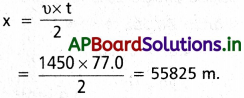
సోనార్ (SONAR) (sound navigation and ranging) అనే సాధనం నీటి అడుగున ఉండే వస్తువులను వాటి స్థానాలను శోధించడానికి అతిధ్వని తరంగాలను ఉపయోగిస్తుంది. ఒక సబ్మెరైన్ (జలాంతర్గామి) లోని సోనార్ నుంచి వెలువడిన శోధక తరంగ ఉత్పత్తికి, శతృదేశ జలాంతర్గామిపై పరావర్తనం తరవాత పొందే ప్రతిధ్వనుల మధ్య కాల విలంబనం (time delay) 77.0 s అని కనుక్కొన్నారు. శతృదేశ సబ్మెరైన్ దూరం ఎంత ? (నీటిలో ధ్వని = 1450 ms-1).
సాధన:
ఇక్కడ t = 77.0 sec, υ = 1450 ms-1

AP Inter 1st Year Physics Study Material Chapter 2 ప్రమాణాలు, కొలత 40

ప్రశ్న 31.
ఇంతవరకూ ఆవిష్కరించిన, మన విశ్వంలోని అత్యంత దూరంలో గల వస్తువులు ఎంత దూరంలో ఉంటాయంటే అవి ఉద్గారించే కాంతి భూమిని చేరుకోవడానికి బిలియన్ల సంవత్సరాలు పడుతుంది. (క్వాజార్ (quasars) అని పిలిచే) ఈ వస్తువులకు అనేకమైన దిగ్రమ కలిగించే లక్షణాలుంటాయి. ఈ లక్షణాలను ఇంతవరకు ఎవరూ సంతృప్తికరమైన వివరణ ఇవ్వలేకపోయారు. ఒక క్వాజార్ నుంచి వెలువడే కాంతి మనల్ని చేరుకోవడానికి 3.0 బిలియన్ల సంవత్సరాలు పడితే km లలో దాని దూరం ఎంత?
సాధన:
పట్టుకాలం t = 3 బిలియన్ సంవత్సరాలు
= 3 × 10⁹ సంవత్సరాలు
= 3 × 109 × 365 × 24 × 60 × 60 sec

శూన్యంలో కాంతివేగం, c = 3 × 10⁸ m/s
= 3 × 10⁵ m/s

దూరం = వేగం × కాలం
x = 3 × 105 × 3 × 109 × 365 × 24 × 60 × 60 km.
x = 2.84 × 10²² km

AP Inter 1st Year Physics Study Material Chapter 2 ప్రమాణాలు, కొలత

ప్రశ్న 32.
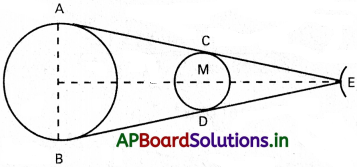
సంపూర్ణ సూర్యగ్రహణం ఏర్పడినపుడు చంద్రుడు ఒక బిళ్లవలె సూర్యబింబాన్ని దాదాపుగా పూర్తిగా కప్పివేస్తాడని మనకు బాగా తెలిసిన వాస్తవం. దీని నుంచి, ఉదాహరణలు 3, 4 లోని సమాచారం ఆధారంగా చంద్రుడి ఉజ్జాయింపు వ్యాసాన్ని నిర్ణయించండి.
సాధన:
చంద్రుడి నుండి భూమి వరకు దూరం = 3.84 × 10⁸ m
భూమి నుండి సూర్యుడి వరకు దూరం = 1.496 × 10¹¹ m
AP Inter 1st Year Physics Study Material Chapter 2 ప్రమాణాలు, కొలత 41
సూర్యుడు AB వ్యాసం = 1.39 × 10⁹ m
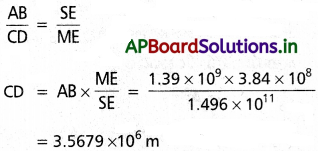
∆le ABE, ∆le CDEలు సర్వసమాన త్రిభుజాలు
AP Inter 1st Year Physics Study Material Chapter 2 ప్రమాణాలు, కొలత 42
CD = 3567.9 km ఇది చంద్రుడి వ్యాసం

ప్రశ్న 33.
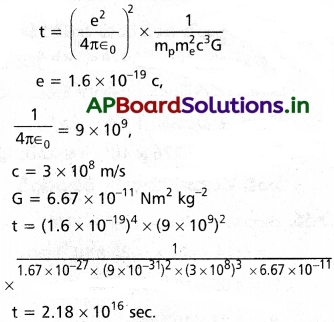
ఈ శతాబ్దంలోని గొప్ప భౌతికశాస్త్రవేత్త అయిన P.A.M. Dirac ప్రకృతిలోని ప్రాథమిక స్థిరాంకాల సంఖ్యాత్మక విలువలతో ఆడుకోవడాన్ని ఎంతో ఇష్టపడేవాడు. ఈ ఆట అతణ్ణి ఒక ఆసక్తిదాయకమైన పరిశీలనవైపు నడిపించింది. పరమాణు భౌతికశాస్త్రం మూల స్థిరాంకాలు (c, e ఎలక్ట్రాన్ ద్రవ్యరాశి, ప్రోటాన్ ద్రవ్యరాశి), గురుత్వ స్థిరాంకం G నుంచి ‘కాలం’ మితిగల ఒక సంఖ్యను చేరుకోవచ్చని డిరాక్ కనుక్కొన్నాడు. పైగా, అది చాలా పెద్ద సంఖ్య. అంటే దాని పరిమాణం విశ్వం వయస్సుపై మనకున్న నేటి అంచనాకు (~ 15 బిలియన్ సంవత్సరాలు) చాలా దగ్గరగా ఉంటుందని తెలిసింది. ఈ పుస్తకంలో ఇచ్చిన ప్రాథమిక స్థిరాంకాలకు సబంధించిన పట్టిక నుంచి నీవు కూడా ఈ సంఖ్యను నిర్మించగలవేమో ప్రయత్నించి చూడు (లేదా మరేదైనా, నీవు ఆలోచించగలిగే ఆసక్తిదాయకమైన సంఖ్యను కనుక్కోవచ్చు).ఈ విశ్వం వయస్సుతో ఈ సంఖ్య ఏకీభవించడమనేది ఒకవేళ ఉపేక్షించదగనిది అయితే ప్రాథమిక స్థిరాంకాలకు ఉండే స్థిరత్వం (constancy) పట్ల ఇది ఏ అర్థాన్ని సూచిస్తుంది?
సాధన:
కాంతి వేగం, ఆ ఎలక్ట్రాన్ యొక్క ఆవేశం, mp ప్రోటాన్ ద్రవ్యరాశి, me ఎలక్ట్రాన్ ద్రవ్యరాశి, G విశ్వగురుత్వ స్థిరాంకం.
AP Inter 1st Year Physics Study Material Chapter 2 ప్రమాణాలు, కొలత 43
ఇది విశ్వం యొక్క వయస్సు.

సాధించిన సమస్యలు (Solved Problems)

ప్రశ్న 1.
కోణాలు (a) 1 (డిగ్రీ) (b) 1′ (చాపం యొక్క నిమిషం లేదా ఆర్మిన్), (c) 1″ (చాపం యొక్క సెకను లేదా ఆర్క్ సెకను) రేడియన్లలో లెక్కించండి. 360° = 2π rad, 1° = 60′ 1′ = 60″ లను ఉపయోగించండి.
సాధన:
(a) 360° = = 2π rad నుంచి
1° = (π/180) rad = 1.745 × 10⁻²

(b) 1° = 60′ = 1.745 × 10⁻² rad
1’= 2.908 × 10⁻⁴ rad, 2.91 × 10⁻⁴ rad

(c) 1′ = 60″ = 2.908 × 10⁴ rad
1″ = 4.847 × 10⁻⁶ rad, 4.85 × 10⁻⁶ rad.

ప్రశ్న 2.
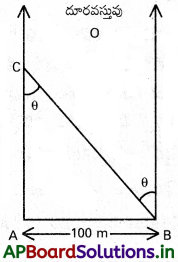
ఒక వ్యక్తి తనకు సమీపంలో ఉండే శిఖరం (tower) దూరాన్ని అంచనా వేయాలను కొన్నాడు. శిఖరం C కు ఎదురుగా ఉండే బిందువు A వద్ద నిల్చొని, చాలా దూరంలో ఉండే వస్తువు 0 ను ACరేఖ వెంట ఉండటం గుర్తించాడు. అపుడు AC కి లంబ దిశలో 100 m దూరం బిందువు B వరకు నడిచాడు. తరువాత O, C ల వైపు మళ్ళీ చూశాడు. ౦ ఎక్కువ దూరంలో ఉంది కాబట్టి వాస్తవంగా BO దిశ AO దిశ ఒకటే అవుతాయి, కానీ, C దృష్టి రేఖ, మౌలికంగా ఉన్న దృష్టి రేఖ నుంచి θ = 40° కోణం విస్థాపనం చెందినట్లు గుర్తించాడు. (θను దృష్టి విక్షేపం అంటారు) అతని తొలిస్థానం A నుంచి టవర్ C దూరాన్ని అంచనా వేయండి.
AP Inter 1st Year Physics Study Material Chapter 2 ప్రమాణాలు, కొలత 44
సాధన:
పారలాక్స్ కోణం θ = 40°;
పటం నుంచి AB = AC tan θ
AC = AB/tan θ = 100 m/tan 40°
= 100 m/0.8391 = 119 m.

ప్రశ్న 3.
భూమి వ్యాసంపై ఉండే రెండు వ్యతిరేక బిందువులు A,B ల నుంచి, చంద్రుడిని పరిశీలించారు. చంద్రుడి వద్ద రెండు పరిశీలనా దిశలు ఏర్పరిచే కోణం 8 విలువ 1’54’. భూమి వ్యాసం సుమారుగా 1.276 × 10⁷m అయితే, భూమి నుంచి చంద్రుని దూరాన్ని లెక్కించండి.
సాధన:
దత్తాంశం నుంచి θ = 1°54′ = 114′
= (114 × 60)” × (4.85 × 10⁻⁶) rad
1″ = 4.85 × 10⁻⁶ rad కాబట్టి,
θ = 3.32 × 10⁻² rad,
అంతేగాక, b = AB = 1.276 × 10⁷ m
భూమి -చంద్రుల మధ్య దూరం
AP Inter 1st Year Physics Study Material Chapter 2 ప్రమాణాలు, కొలత 45

ప్రశ్న 4.
సూర్యుడి కోణీయ వ్యాసం 1920″ అని కొలిచారు. భూమి నుంచి సూర్యుడి దూరం D విలువ 1.496 × 10″ m. అయితే సూర్యుడి వ్యాసం ఎంత?
సాధన:
సూర్యుడి కోణీయ వ్యాసం, α = 1920″
= 1920 × 4.85 × 10-6 rad
= 9.31 × 10⁻³ rad
సూర్యుడి వ్యాసం, d = α D
= (9.31 × 10-3) × (1.496 × 1011) m
= 1.39 × 10⁹ m.

AP Inter 1st Year Physics Study Material Chapter 2 ప్రమాణాలు, కొలత

ప్రశ్న 5.
కేంద్రక పరిమాణాన్ని (10-15 నుంచి 10-14 m వ్యాప్తిలో) నిశితమైన పిన్ను కొనతో పోల్చితే, పరమాణు పరిమాణం సుమారుగా ఎంత ఉంటుంది ? పిన్ను కొన 10 m నుంచి 104 m వ్యాప్తిలో ఉన్నదనుకోండి.
సాధన:
కేంద్రక పరిమాణం 10-15 m నుంచి 10-14 m వ్యాప్తిలో ఉంది. నిశితమైన పిన్ను చివర 10-5 m నుంచి 10-4 m వ్యాప్తిలో ఉన్నదని అనుకొంటే మనం పరిమాణ విలువను 1010 కారకంతో పెంచుతున్నామన్నమాట. కాబట్టి పరమాణువుకు 10-10 m (దాదాపు) పరిమాణం ఉన్నప్పుడు దానిని 1 m పరిమాణానికి పెంచినామన్న మాట. అంటే పరమాణువు లోపలి కేంద్రకం పరిమాణం దాదాపు 1 మీటరు పొడవు వ్యాసార్ధం ఉన్న గోళం కేంద్రం వద్ద ఉంచిన నిశిత పిన్ను కొన అంత చిన్నదిగా ఉంటుంది.

ప్రశ్న 6.
ఒక జాతీయ పరిశోధనాశాలలోని ప్రామాణిక గడియారంతో పోలుస్తూ రెండు గడియారాల పనితీరును పరీక్షిస్తున్నారు. ప్రామాణిక గడియారం మధ్యాహ్నం 12 : 00:00 సమయాన్ని సూచిస్తున్నప్పుడు ఆ రెండు గడియారాల్లోని రీడింగులు ఈవిధంగా ఉన్నాయి.

గడియారం 1గడియారం 2
సోమవారం12:00:0510:15:06
మంగళవారం12:01:1510:14:59
బుధవారం11:59:0810:15:18
గురువారం12:01:5010:15:07
శుక్రవారం11:59:1510:14:53
శనివారం12:01:3010:15:24
ఆదివారం12:01:1910:15:11

ఖచ్చితత్వం కలిగిన కాలవ్యవధుల కొలతలు అవసరమయ్యే ప్రయోగాన్ని నీవు చేస్తున్నావని అనుకొంటే, పై రెండు గడియారాల్లో దేన్ని ఎంచుకొంటావు?
సాధన:
ఏడు రోజులపాటు చేసే పరిశీలనల్లో మొదటి గడియారం (1) సమయాల్లో వచ్చే మార్పుల వ్యాప్తి 162 5 కాగా, రెండో గడియారానికి (2) 31 5 అవుతుంది. గడియారం (1) చూపే సగటు రీడింగ్, గడియారం (2) చూపే సగటు రీడింగ్ కంటే ప్రామాణిక కాలానికి చాలా దగ్గరగా ఉంది. ఇక్కడ గమనించవలసిన ముఖ్యమైన అంశం ఏమంటే ఖచ్చితత్వం అవసరమయ్యే ప్రయోగాలకు గడియారం చూపే వ్యాప్తియే ప్రధానం కాని అది చూపే శూన్యదోషం కాదు. ఎందుకంటే, ‘శూన్యదోషాన్ని’ ఎప్పుడైనా సులువుగా సవరించుకోవచ్చు. కాబట్టి గడియారం (1) కంటే రెండో గడియారాన్నే ఎంచుకోవాల్సి ఉంటుంది.

ప్రశ్న 7.
లఘులోలకం డోలనావర్తన కాలాన్ని కొలుద్దాం. వరుస కొలతల్లో వచ్చిన రీడింగ్లు 2.63s, 2.56, 2.42 s, 2.71, చివరగా 2.80s. పరమదోషాలను, సాపేక్షదోషం లేదా దోష శాతాన్ని లెక్కించండి.
సాధన:
లోలకం సగటు డోలనావర్తన కాలం
AP Inter 1st Year Physics Study Material Chapter 2 ప్రమాణాలు, కొలత 46

ప్రశ్న 8.
థర్మామీటరుతో రెండు వస్తువుల ఉష్ణోగ్రతలను t1 = 20 °C ± 0.5 °C, t2 = 50°C ± 0.5°C గా కొలిచారు. వాటి ఉష్ణోగ్రతా భేదాన్ని, దానిలోని దోషాన్ని లెక్కించండి.
సాధన:
t’ = t2 – t1
= (50 °C ± 0.5 °C) – (20 °C ± 0.5 °C)
t’ = 30 °C ± 1 °C.

ప్రశ్న 9.
నిరోధం R = V/I ఇందులో V = (100 ± 5) V, I = (10 ± 0.2) A. అయితే లోని దోషశాతాన్ని కనుక్కోండి.
సాధన:
V లోని దోష శాతం 5, అలాగే I లో దోష శాతం 2.
కాబట్టి R లో మొత్తం దోషం 5 + 2 = 7%.

ప్రశ్న 10.
రెండు నిరోధకాల నిరోధాలు R1 = 100 ± 3 ohm, R2 = 200 ± 4 ohm. వీటిని (a) శ్రేణిలో, (b) సమాంతరంగా కలిపారు. (a) శ్రేణీ సంయోగానికి, (b) సమాంతర సంయోగానికి తుల్య నిరోధాలను కనుక్కోండి. సూచన :
AP Inter 1st Year Physics Study Material Chapter 2 ప్రమాణాలు, కొలత 47
సాధన:
a) శ్రేణి సంయోగానికి తుల్య నిరోధం
R = R1 + R2 = (100 ± 3)
ohm + (200 ± 4) ohm = 300 ± 7 ohm

b) సమాంతర సంయోగానికి తుల్య సంబంధం
AP Inter 1st Year Physics Study Material Chapter 2 ప్రమాణాలు, కొలత 48
అప్పుడు R’ = 66.7 ± 1.8 ohm
(ఇక్కడ ∆R విలువను, 2గా సూచించడానికి బదులు 1.8 గానే వ్యక్తం చేశాం. `ఎందుకంటే, సార్థక సంఖ్యల నియమాలకు అనుగుణంగా ఉండటం కోసం).

ప్రశ్న 11.
Z = A4B1/3/CD3/2 అయితే 2 లో సాపేక్ష దోషాన్ని కనుక్కోండి.
సాధన:
Z లో సాపేక్ష దోషం, ∆Z/Z = 4(∆A/A) + (1/3) (∆B/B) + (∆C/C) + (3/2) (∆D/D).

ప్రశ్న 12.
లములోలకం డోలనావర్తన కాలం = 2π √L/g . 1 mm తెలిసిన యదార్థతతో కొలచిన L విలువ 20.0 cm. 100 డోలనాలకు పట్టిన కాలాన్ని 1s పృథక్కరణం ఉన్న చేతి గడియారంతో 90 s అని కనుక్కొన్నారు. అయితే g విలువను నిర్ణయించడంలో యదార్ధత ఎంత?
సాధన:
g = 4π²L/T²; ఇక్కడ T = \(\frac{t}{n}\), ∆T = \(\frac{\Delta t}{n}\)
కాబట్టి, \(\frac{\Delta T}{T}=\frac{\Delta t}{t}\) ఈ L, t రెండింటిలోని దోషాలు
కనీసపు కొలత దోషాలు కాబట్టి
(∆g/g) = (∆L/L) + 2(∆T/T)
= \(\frac{0.1}{20.0}\) + 2(\(\frac{1}{90}\)) = 0.027
అందువల్ల g లోని దోషశాతం
100 (∆g/g) = 100(∆L/L) + 2 × 100 (∆T/T) = 3.

AP Inter 1st Year Physics Study Material Chapter 2 ప్రమాణాలు, కొలత

ప్రశ్న 13.
ఒక ఘనం యొక్క ఒక్కొక్క భుజం పొడవును 7.203 m గా కొలిచారు. దాని మొత్తం ఉపరితల వైశాల్యం, ఘనపరిమాణాల విలువలను తగిన సార్ధక సంఖ్యల వరకు కనుక్కోండి.
సాధన:
కొలిచిన పొడవులో నాలుగు సార్థక సంఖ్యలు ఉండటం వల్ల మనం లెక్కించే వైశాల్యం, ఘనపరిమాణాలను కూడా నాలుగు సార్ధక సంఖ్యల వరకే సవరించవలసి ఉంటుంది.
ఘనం ఉపరితల వైశాల్యం = 6(7.203)² m²
= 311.299254 m²
= 311.3 m²

ఘనం ఘనపరిమాణం = (7.203)³ m³
= 373.714754 m³
= 373.7 m³.

ప్రశ్న 14.
5.74 g పదార్థం 1.2 cm3 ఘనపరిమాణం ఆక్రమిస్తుంది. సార్ధక సంఖ్యలను దృష్టిలో ఉంచుకొని దాని సాంద్రత విలువను వ్యక్తపరచండి.
సాధన:
కొలచిన ద్రవ్యరాశిలో మూడు సార్ధక సంఖ్యలు ఉంటే కొలచిన ఘనపరిమాణంలో రెండే సార్థక సంఖ్యలు ఉన్నాయి. కాబట్టి, సాంద్రత విలువను 2 సార్థక సంఖ్యల వరకు మాత్రమే వ్యక్తపరచాలి.
సాంద్రత = \(\frac{5.74}{1.2}\) g cm-3 = 4.8 g cm-3.

ప్రశ్న 15.
\(\frac{1}{2}\)mυ² = mgh అనే ఒక సమీకరణాన్ని పరిగణిద్దాం. ఇందులో m అనేది వస్తువు ద్రవ్యరాశి, υ దాని వేగం, g గురుత్వ తరణం, h దాని ఎత్తు. ఈ సమీకరణం మితీయంగా సరియైందో కాదో పరీక్షించి చూడండి.
సాధన:
ఎడమవైపు (LHS) ఉన్న మితులు
[M] [LT-1]² = [M] [L²T-2] = [M L²T-2]
కుడివైపు (RHS) ఉన్న మితులు
[M] [LT-2] [L] = [M] [L²T-2] = [M L²T-2]
LHS, RHS లలోని మితులు ఒకటే కాబట్టి సమీకరణం మితీయంగా సరైనది.

ప్రశ్న 16.
శక్తికి SI ప్రమాణం J = kg m²s-2; అదేవిధంగా వడి υ, త్వరణం a కు ప్రమాణాలు వరుసగా ms-1, ms-2. అయితే గతిజశక్తి (K) కి కింద ఇచ్చిన ఫార్ములాల్లో మితీయంగా దేనిని క్రమ విరుద్ధమైనదిగా తోసిపుచ్చుతావు? (m వస్తువు ద్రవ్యరాశిని సూచిస్తుంది)
(a) K = m²υ³ (b) K = (1/2) mυ²
(c) K = = ma (d) K = (3/16) mυ²
(e) K = (1/2) mυ² + ma.
సాధన:
ప్రతి సరైన సమీకరణం లేదా ఫార్ములాలో ‘సమీకరణానికి రెండువైపులా ఒకే మితులు ఉండాలి. అదేవిధంగా ఒకే రకమైన మితులుండే రాశులను మాత్రమే సంకలనం లేదా వ్యవకలనం చేయాలి. కుడివైపు గల రాశికి మితులు (a) విషయంలో[M²L³T-3], (b), (d) లకు [ML²T-2] (c)కి [MLT-2], (e) కి కుడివైపునున్న రాశికి సరియైన మితులు లేవు. ఎందుకంటే భిన్న మితులు కలిగిన రెండు రాశులను కలపడమైంది. గతిజ శక్తి Kకి ఉండే మితులు [ML²T-2] కాబట్టి (a), (c), (e) ఫార్ములాలను తోసిపుచ్చవలసిందే. అయితే, మిగతా రెండు ఫార్ములాలు (b) లేదా (d) లలో ఏది సరియైనదో మితుల ద్వారా చెప్పలేం. అందుకని, గతిజ శక్తికి ఇచ్చిన (అధ్యాయం లో) నిజ నిర్వచనం ప్రకారం, గతిజ శక్తికి సరియైన ఫార్ములాను (b) సూచిస్తుంది.

AP Inter 1st Year Physics Study Material Chapter 2 ప్రమాణాలు, కొలత

ప్రశ్న 17.
దారానికి గుండు తగిలించిన లఘులోలకాన్ని పరిగణించండి. గురుత్వ బల చర్య వల్ల ఇది డోలనాలను చేస్తుంది. లోలకం డోలనావర్తన కాలం(T), పొడవు(1), గుండు ద్రవ్యరాశి (m), గురుత్వ త్వరణం(g) లపై ఆధారపడుతుందను కోండి. ‘మితుల పద్ధతిని ఉపయోగించి దాని ..డోలనావర్తన కాలానికి సమాసాన్ని ఉత్పాదించండి.
సాధన:
l, g, m రాశులపై డోలనావర్తన కాలం T ఆధారపడటాన్ని వాటి లబ్ధంగా ఇలా రాయవచ్చు.
T = k lx gy mz

ఇక్కడ k మితిరహిత స్థిరాంకం, x, y, z లు ఘాతాంకాలు. ఇరువైపులా మితులను తీసుకొంటే,
[L°M°T¹] = [L¹]x [L¹T-2]y [M¹]z = Lx + y T-2y Mz
ఇరువైపులా ఉన్న మితులను సమానం చేస్తే,
x + y = 0; -2y = 1; z = 0
అందువల్ల, x = \(\frac{1}{2}\), y = –\(\frac{1}{2}\), z = 0
అప్పుడు T = kl1/2 g-1/2 లేదా T = k\(\sqrt{\frac{l}{g}}\)

k విలువను మితుల పద్ధతి ద్వారా కనుక్కోలేమని గమనించండి. ఇక్కడ కుడివైపు ఉన్న ఫార్ములాను ఏదో ఒక సంఖ్యతో గుణించినంత మాత్రాన ఎలాంటి ప్రభావం ఉండదు. ఎందుకంటే ఆ సంఖ్య దాని మితులను ప్రభావితం చేయదు.
నిజానికి k = 2π. అందువల్ల,
T = 2π \(\sqrt{\frac{l}{g}}\)

AP Inter 2nd Year Civics Study Material Chapter 7 State Legislature

Andhra Pradesh BIEAP AP Inter 2nd Year Civics Study Material 7th Lesson State Legislature Textbook Questions and Answers.

AP Inter 2nd Year Civics Study Material 7th Lesson State Legislature

Long Answer Questions

Question 1.
Explain the composition, powers, and functions of the State Legislative Assembly.
Answer:
The Constitution provides for a Legislature for every State on the model of the Parliament. As per Article 168, the State Legislature consists of the Governor and one or two Houses. In India, while some States have Bicameral Legislatures, others have Unicameral Legislatures. Andhra Pradesh at present possesses Unicameral Legislature.

The Lower House of the State Legislature is known as the Legislative Assembly or Vidhana Sabha and the Upper House is the Legislative Council or Vidhana Parishad.

Composition of Legislative Council (Vidhana Parishad) :
The Upper House of the State Legislature is known as Legislative Council. The Constitution lays down that a Legislative Council shall have not less than 40 members and not more than \(\frac{1}{3}\)rd of the total membership of the State Assembly. The Legislative Council consists of both nominated and elected members.

The election is conducted through the indirect method by means of proportional representation with a single transferable vote.

Distribution of Seats :

  1. \(\frac{1}{3}\)rd are elected by the members of the State Assembly.
  2. \(\frac{1}{3}\)rd are elected by members of local bodies.
  3. \(\frac{1}{12}\)th are elected by teachers.
  4. \(\frac{1}{12}\)th are elected by graduates.
  5. The remaining \(\frac{1}{6}\)th members are nominated by the Governor from among persons who have distinguished themselves in the fields of Literature, Science, Arts, Social Services etc.

Qualifications :
The members of the Council 1) must be citizens of India, 2) must have completed 30 years of age and 3) must possess such other qualifications as may be prescribed by the Legislature.

Term :
the members are elected for a period of 6 years. But \(\frac{1}{3}\)rd of them retire for every 2 years. The Council is a permanent body. It cannot be dissolved by the Governor.

Chairman and Deputy Chairman:
The Council has Chairman and a Deputy Chairman who are elected by the members of the Council from among themselves. The Chairman presides over the meetings of the Council.

Legislative Assembly (Vidhana Sabha) :
Composition of the Legislative Assembly :
The Legislative Assembly is the popular and powerful chamber of the State Legislature. It is the lower house and resembles more or less the Lok Sabha at the Centre. It consists of representatives directly elected by the people of the State on the basis of universal adult franchise. It’s maximum strength is fixed at 500 and minimum strength at 60. Only the Legislative Assembly of Sikkim has less than 60 because of it’s small population. Those who become members of State Legislative Assembly must be citizens of India and must be above 25 years of age.

Term of Office :
The normal term of Assembly is 5 years. It may be dissolved earlier by the Governor on the advice of the Chief Minister. The Parliament may extend it’s term by one year, when National Emergency is in force.

Presiding Officers :
The Presiding officer of Assembly is known as Speaker. He is elected by the members of the Assembly. The Assembly also elects a Deputy Speaker to conduct the business of the House in the absence of the Speaker.

Powers and Functions of the State Legislature :
The State Legislature has the following powers.

1) Legislative Powers and Functions :
The State Legislature has the power to make laws on all the subjects included in the State List. It has also the power to make laws in respect of subjects included in the Concurrent List. However, such a law should not disagree with a law already made by the Parliament on the same subject. In the making of laws, Legislative Assembly has been given more powers than the Legislative Council. The Legislative Council at the most may delay the legislation for a period of 4 months. Later the Assembly sends the bill to the Governor for his assent.

2) Constitutional Powers and Functions :
Even though, the Legislature has no powers to move the Constitution amendment bills, it’s consent is required for amending certain provisions of the Constitution. Such bills have to be referred to it after they are approved by the Parliament.

3) Executive Powers and Functions :
The State Legislature exercises control over the Council of Ministers. It’s members make the Ministers individually and collectively responsible to the Legislature. The Council of Ministers is collectively responsible to the State Legislative Assembly. The Legislature can expose the actions of Executive, through questions, debates and adjournment motions. In controlling the Executive, the Legislative Assembly has more powers than the Council. The Ministry has to resign when the Legislative Assembly passes no confidence motion against the Government.

4) Financial Powers and Functions:
The State Legislature exercises complete control over the finances of the State Government. It sanctions money to the State Government to enable it to run the administration. It may pass, reduce or reject the demands for grants presented to it by the Government. It may accept or reject proposals for taxation and borrowings presented to it by the Government. In financial matters the Assembly is more powerful than the Council. Because all money bills, including the Budget, shall be introduced first only in the Assembly. It can accept or reject any recommendations made by the Council.

5) Electoral Powers :
The elected members of the Assembly participate in the election of the President. They also elect the representatives of the State to the Rajya Sabha and l/3rd members of the Legislative Council if the State Legislature is bicameral. They also elect the presiding officers and deputy presiding officers of Assembly and Council.

Miscellaneous Powers : The state legislature :

  1. Safeguards the dignity and privileges of its members.
  2. Suspends, expels or terminates their membership.
  3. Examines the report of the State Public Service Commission and the Comptroller and Auditor General etc.

Conclusion:
The State Legislature plays an important role in the State Administration. It makes necessary laws for the welfare of the people of the State. It controls the Executive by making it responsible for their actions.

AP Inter 2nd Year Civics Study Material Chapter 7 State Legislature

Question 2.
Write briefly the composition, powers and functions of the. State Legislative Council.
Answer:
The Upper House of the State Legislature is known as Legislative Council. The Constitution lays down that a Legislative Council shall have not less than 40 members and not more than \(\frac{1}{3}\)rd of the total membership of the State Assembly. The Legislative Council is a body of partly nominated and partly elected members.

The election is conducted through indirect method by means of proportional representation with a single transferable vote.
Composition of the Council:

  1. \(\frac{1}{3}\)rd members are elected by the Legislative Assembly.
  2. \(\frac{1}{3}\)rd members are elected by members of local bodies.
  3. \(\frac{1}{12}\)th members are elected by teachers.
  4. \(\frac{1}{12}\)th members are elected by graduates.
  5. The remaining \(\frac{1}{6}\)rd members are nominated by the Governor from among persons who have distinguished themselves in the fields of Literature, Science, Arts, Social Services etc.

Tenure :
The Legislative council is a quasipermanent House. l/3rd of the members of this House retire every two years. But the term of each member is six years. New members are elected in the place of retired members. All the members of the House do not retire at a time as it is a permanent House.

Powers and Functions of State Legislative council:
State Legislative council is the primary law making body along with the Legislative Assembly. The State Legislative Council has the following powers and Functions.

a) Legislative powers and Functions :
The Legislative Council does not possess equal powers and functions when compared to counterpart, State Legislative Assembly. It is said that the Legislative Council enjoys equal status and not power. However it exercises the following powers and functions. All the bills, other than money bills may be introduced in either of the House. They will be sent to the assent of the Governor only with the approval of both the Houses. The Council may reject any bill and spnt it back for the reconsideration of the Assembly. However, incase of a disagreement between two Houses, the decision of the Assembly will be supreme.

The Council must approve all the bills sent by the Assembly with in a period of three months or at the maximum of four months. It implies that the Council can withhold its assent over the bills sent by the Assembly for a maximum period of four months. Thus, the Legislative Council can only delay the bills but the Legislative Assembly can override it.

b) Executive Powers and Functions :
The State Legislative Council has very limited executive powers when compared to that of the Assembly. The council of Ministers headed by the Chief Minister is responsible for its acts only to the Assembly and not to the Council. The Council cannot decide the future of the Council of Ministers. However, the Council can influence the policies and programmes of the ministers by asking questions and supplementary questions by drawing the call attention motion etc., but they cannot force the Council of Ministers to resign.

c) Financial Powers and Functions :
The Legislative Council has only limited powers in the financial matters. Money bills cannot at first be introduced in the Legislative Council first. The Council must accept all money bills with or without recommendation within fourteen days of the receipt of the bill. The Assembly possess the discretion powers either to accept or reject these recommendations. If the Council does not return the Money Bill to the Assembly within 14 days, then the bill is deemed to have been passed by both the Houses. It is clear that in the financial field the Legislative Council has a subordinate status and that Legislative Assembly has dominant position.

d) Electoral Functions:
The Legislative Council elects a Chairman and Deputy Chairman to preside over its meetings in a dignified manner. Some of its members are elected to various legislative committees like Public Accounts Committee, Estimates Committee and Public Undertakings committee etc.

e) Other Functions :
The Legislative council acts as the best means for formulating and consolidating public opinion. It discusses technical and other contemporary matters, as there are experts in various fields.

Question 3.
Explain the role and responsibilities of the Speaker of Legislative Assembly.
Answer:
The members of State Legislative Assembly elect one among them as a speaker to conduct the business of the House. His term of office is five years.

The speaker is the guardian of the Rights and Liberties of the members of the House.

Role and Responsibilities (or) Powers and Functions of the Speaker :
The powers and functions of the speaker of State Legislative Assembly are almost the same as those of the Speaker of Lok Sabha. His powers and functions are as follows.

  1. The speaker preserves order and decorum in the House for conducting legislative business.
  2. He allocates time for different kinds of business in the House.
  3. He interprets the rules and procedure.
  4. He puts matters to vote and announces the results.
  5. He has the right of casting vote in case of a tie.
  6. He admits motions, resolutions and points of order.
  7. He is empowered to adjourn the meeting of the House in the absence of a quorum.
  8. He can order for removal of indecent and incriminatory references from the records.
  9. He allows the members to speak in the House.
  10. He may name a member and ask him to leave the House in case of disorderly behavior.
  11. He can adjourn the House in case of grave disorder or serious matter.
  12. He accepts and rejects the resignation of a member of the House after ascertaining whether it was submitted under due process or not.
  13. He appoints the Chairmen of all the committee of the assembly and supervises their functioning. He himself is a Chairman of Business Advisory Committee, Rules Committee and the General Purpose Committee.
  14. He decides where a bill is a Money Bill or not. His decision on this question is final.

Short Answer Questions

Question 1.
Write a note on the Legislative Assembly.
Answer:
Legislative Assembly is the Lower House of the State Legislature. The Members of Legislative Assembly are called M.L.As. According to Article 170of the Indian Constitution it consists of not more than 500 members and not less than 60 members. It means that it’s strength depends on the population and size of the state. But small states have been allowed to have less number of members. Thus Goa and Mizoram have only 40 members, while Sikkim has 32 Members.

Composition of the Legislative Assembly:
The Legislative Assembly is the popular and powerful chamber of the State Legislature. It is the lower house and resembles more or less the Lok Sabha at the Centre. It consists of representatives directly elected by the people of the State on the basis of universal adult franchise. Those who become members of State Legislative Assembly must be citizens of India and must be above 25 years of age.

Term of office :
The normal term of Assembly is 5 years. It may be dissolved earlier by the Governor on the advice of the Chief Minister. The Parliament may extend it’s term by one year, when National Emergency is in force.

Presiding officers :
The Presiding Officer of Assembly is known as Speaker. He is elected by the members of the Assembly. The Assembly also elects a Deputy Speaker to conduct the business of the House in the absence of the speaker.

AP Inter 2nd Year Civics Study Material Chapter 7 State Legislature

Question 2.
Write a note on Estimates Committee.
Answer:
According to the Rules of Procedure and Conduct of Business in the State Legislature, the Estimates committee consists of 20 members. Among them 15 members belong to Assembly. The remaining 5 members belong to Legislative Council. The members hold office for a period of one year. They are elected through in indirect election.

Functions :
The functions of the Estimates Committee in the State Legislature are the same as that of Estimates Committee of Lok Sabha. These are given here under.

  1. Estimates Committee exercises control over public expenditure.
  2. It suggests fiscal reforms in organization, the efficiency or administration reforms consistent with the policy underlying estimates.
  3. It advises alternative policies for securing efficiency and economy in administration.
  4. It examines whether the money is well laid out within the limits of the policy implied in the estimates.
  5. It also suggests the form in which the estimates shall be presented to the Assembly.

Question 3.
What do you know about Public Accounts Committee? [Mar.-18, 17]
Answer:
Public Accounts Committee consists of 20 members out of which 15 members belong to Assembly and 5 members belong to Legislative Council. They are elected through indirect election by following the principle of proportional representation Jor a period of one year. The Chairman is normally the member of Opposition Party. The Ministers of Cabinet cannot be member of Public Accounts Committee.

Functions :
Public Account Committee performs the following functions.

  1. The committee examines the accounts showing the appropriation of sums granted by the house for expenditure of the state government.
  2. It scrutinizes the appropriation accounts of the state and the reports of the Comptroller and Auditor General.
  3. It shall be the duty of the Public Accounts Committee to examine such a trading, manufacturing, and profit and loss accounts and balance sheets and the accounts of the state government and also to consider the report of the Comptroller and Auditor General.
  4. The committee carefully considers the accounting and audit procedures.
  5. The committee is not concerned with the question of policy approved by the legislature.
  6. The committee investigates expenditure after it has already incurred. An overall, this committee is generally described as a ‘post-mortem committee’.

Question 4.
Write the powers and functions of Vidhcma Sabha Speaker. [Mar. 16]
Answer:
The powers and functions of the Speaker of State Legislative Assembly are almost the same as those of the Speaker of Lok Sabha. His powers and functions are as follows.

  1. The speaker preserves order and decorum in the House for conducting legislative business.
  2. He allocates time for different kinds of business in the House.
  3. He interprets the rules and procedure.
  4. He puts matters to vote and announces the results.
  5. He has the right of easting vote in case of a tie.
  6. He admits motions, resolutions and points of order.
  7. He is empowered to adjourn the meeting of the House in the absence of a quorum.
  8. He can order for removal of indecent arid incriminatory references from the records.
  9. He allows the members to speak in the House. ‘
  10. He may name a member and ask him to leave the House in case of disorderly behavior.
  11. He can adjourn the House in case of grave disorder or serious matter.
  12. He accepts and rejects the resignation of a member of the House after ascertaining whether it was submitted under due process or not.
  13. He appoints the Chairmen of all the committees of the assembly and supervises their functioning. He himself is a Chairman of Business Advisory Committee, Rules Committee and the General Purpose Committee.
  14. He decides where a bill is a Money Bill or not. His decision on this question is final.

Very Short Answer Questions

Question 1.
Qualifications of M.L.A. [Mar. 18, 16]
Answer:
A person who wishes to contest for the membership of the State Legislative Assembly must be possess the following qualifications.

  1. He should be a citizen of India.
  2. He should have completed the age of 25 years.
  3. He should possess such other qualifications as prescribed by any act of Parliament.
  4. However, no person can simultaneously be a member of any House of the Parliament and of a State Legislature.

Question 2.
Qualifications of M.L.C.
Answer:
A person who wishes to contest for the membership of the State Legislative Council must possess the following qualifications.
a) He should be a citizen of India.
b) He should have completed 30 years of age.
c) He should possess such other qualifications as laid down by an Act of Parliament.

Question 3.
Quorum.
Answer:
Quorum is the minimum number of members required to be present in the house before it can transact any business. According to Article 188 of the constitution, the Quorum for conducting,the State Legislative Assembly meeting was fixed at 1/10th of the total membership. However, in some states, where the strength of the State Legislative Assembly is very less, the quorum will be a minimum number of 10. The speaker decides whether there is a quorum or not on a particular day.

Question 4.
Salaries and Allowances of M.L.A.
Answer:
The salary of MLA is decided by the respective State Legislature as per the Article 164 of the Indian constitution. The members of Andhra Pradesh State Legislative Assembly receive a monthly salary of ₹ 90,000/- which includes a basic pay of ₹ 15,000/- and constituency allowance of ₹ 75,000/-. Those legislators who are not provided government accommodation will get an additional ₹ 10,000/- as H.R.A members also get daily allowance of ₹ 800/- when the state legislature is in session.

Question 5.
Privileges of State Legislature.
Answer:
Privileges of a State Legislature are a sum of special rights, immunities and exemptions enjoyed by the State Legislatures. They are necessary in order to secure independence and effectiveness of their actions. The Houses cannot maintain the authority, dignity and honour without these privileges. They can protect their members from any obstructions in the discharge of their legislative responsibilities.

  1. Collective privileges
  2. Individual privileges

i) Collective Privileges :
The legislature has the right to publish its reports, debates and proceedings and also to prohibit others publishing the same.

ii) Individual Privileges:
The privileges belonging to the members of state legislature individually. They can not be arrested during the session of the state legislature or 40 days before and after the end of the session.

AP Inter 2nd Year Civics Study Material Chapter 7 State Legislature

Question 6.
Brief History of AP legislature.
Answer:
The Andhra state was formed on October 1, 1953 Andhra State legislature initially had 140 MLAs. Elections were held to the Andhra State Legislative Assembly for the first time in 1955.

As per the recommendations of states re-organization committee, Hyderabad State was merged with Andhra State on linguistic basic and formed into Andhra Predesh State which had 245 MLAs [Including 150 MLAs of Hyderabad State.] Elections were held to the Andhra Pradesh legislative Assembly in 1957.

The State Legislative Council was established on July 1,1958. Since then it continued to exist till June 1, 1985, before being abolished. Again on March 30, 2007 the Andhra Pradesh Legislature became again bicameral after the revival of the legislative council.

Question 7.
Chairman of Legislative council. [Mar. 16]
Answer:
There will be a chairman in the Legislative council for conducting the meetings. He is elected by the members of the Legislative council among themselves. Dr. A. Chakrapani Yadav is the Present Chairman of Legislative council of Andhra Pradesh.

Question 8.
Deputy Speaker.
Answer:
The members of State Legislative Assembly elect one among them as a Deputy Speaker. His term of office is 5 years. The deputy speaker performs the duties in the absence of the speaker.

Question 9.
Deputy Chairman of Legislative Council.
Answer:
The Members of State Legislative Council elect one among them as a Deputy Chairman. The Deputy Chairman performs the duties in the absence of the Chairman.

AP Inter 2nd Year Civics Study Material Chapter 7 State Legislature

Question 10.
Types of committees. [Mar. 18]
Answer:
The committees are of two types i.e., Standing committees and Ad-hoc committees.
i) Standing Committees:
Standing committees deal with specific business (financial matters) Ex : Estimates committee, Public accounts committee and Committee on public undertakings.

ii) Ad-hoc Committees :
Ad-hoc committees are concerned with the matters of temporary nature. They cease to exist after completion of the work. They perform some specific functions assigned to them from time to time.

Inter 2nd Year Maths 2B Differential Equations Solutions Ex 8(c)

Practicing the Intermediate 2nd Year Maths 2B Textbook Solutions Inter 2nd Year Maths 2B Differential Equations Solutions Exercise 8(c) will help students to clear their doubts quickly.

Intermediate 2nd Year Maths 2B Differential Equations Solutions Exercise 8(c)

I.

Question 1.
Express x dy – ydx = \(\sqrt{x^2+y^2}\) dx in the form F (\(\frac{y}{x}\)) = (\(\frac{dy}{dx}\)).
Solution:
x. dy – y dx = \(\sqrt{x^2+y^2}\) dx
\(\frac{dy}{dx}\) – y = \(\sqrt{x^2+y^2}\)
Inter 2nd Year Maths 2B Differential Equations Solutions Ex 8(c) 1

Question 2.
Express (x – y Tan-1 \(\frac{y}{x}\))dx + x Tan-1\(\frac{y}{x}\) dy = 0 in the form F(\(\frac{y}{x}\)) = \(\frac{dy}{dx}\).
Solution:
Inter 2nd Year Maths 2B Differential Equations Solutions Ex 8(c) 2

Question 3.
Express x\(\frac{dy}{dx}\) = y(log y – log x + 1) in the from F (\(\frac{y}{x}\)) = \(\frac{dy}{dx}\)
Solution:
x . \(\frac{dy}{dx}\) = y(log y – log x + 1)
\(\frac{dy}{dx}\) = \(\frac{y}{x}\)(log\(\frac{y}{x}\) + 1)

II. Solve the following differential equations.

Question 1.
\(\frac{dy}{dx}=\frac{x-y}{x+y}\)
Solution:
\(\frac{dy}{dx}=\frac{x-y}{x+y}\)
Put y = vx
\(\frac{dy}{dx}\) = v + x\(\frac{dv}{dx}\)
Inter 2nd Year Maths 2B Differential Equations Solutions Ex 8(c) 3

Inter 2nd Year Maths 2B Differential Equations Solutions Ex 8(c)

Question 2.
(x² + y²) dy = 2xy dx
Solution:
(x² + y²) dy = 2xy dx
Inter 2nd Year Maths 2B Differential Equations Solutions Ex 8(c) 4
1 + v² = A(1 – v²) + Bv(1 – v) + Cv(1 + v)
v = 0 ⇒ = A
v = 1 ⇒ 1 + 1 = C(2) ⇒ c = 1
v = -1 ⇒ 1 + 1 = B(-1) (2) ⇒ 2 = -2B
B = -1
Inter 2nd Year Maths 2B Differential Equations Solutions Ex 8(c) 5

Question 3.
\(\frac{dy}{dx}=\frac{-(x^2+3y^2)}{3x^2+y^2}\)
Solution:
\(\frac{dy}{dx}=\frac{-(x^2+3y^2)}{3x^2+y^2}\)
Put y = vx
Inter 2nd Year Maths 2B Differential Equations Solutions Ex 8(c) 6
Multiplying with (v + 1)³
3 + v² = A(v + 1)² + B(v + 1) + C
v = – 1 ⇒ 3 + 1 = C ⇒ C = 4
Equating the co-efficients of v²
A = 1
Equating the co-efficients of v
0 = 2A + B
B = -2A = -2
Inter 2nd Year Maths 2B Differential Equations Solutions Ex 8(c) 7

Question 4.
y²dx + (x² – xy)dy = 0
Solution:
Inter 2nd Year Maths 2B Differential Equations Solutions Ex 8(c) 8
v – log v = log x + log k
v = log v + log x + log k
= log k (vx)
\(\frac{y}{x}\) = log ky
Solution is ky = ey/x

Question 5.
\(\frac{dy}{dx}=\frac{(x+y)^2}{2x^2}\)
Solution:
Inter 2nd Year Maths 2B Differential Equations Solutions Ex 8(c) 9

Question 6.
(x² – y²)dx – xy dy = 0
Solution:
(x² – y²)dx – xy dy = 0
(x² – y²)dx = xy . dy
Inter 2nd Year Maths 2B Differential Equations Solutions Ex 8(c) 10
Inter 2nd Year Maths 2B Differential Equations Solutions Ex 8(c) 11

Inter 2nd Year Maths 2B Differential Equations Solutions Ex 8(c)

Question 7.
(x²y – 2xy²)dx = (x³ – 3x²y)dy
Solution:
(x²y – 2xy²)dx = (x³ – 3x²y)dy
Inter 2nd Year Maths 2B Differential Equations Solutions Ex 8(c) 12
Inter 2nd Year Maths 2B Differential Equations Solutions Ex 8(c) 13

Question 8.
y²dx + (x² – xy + y²) dy = 0
Solution:
y²dx = – (x² – xy + y²)dy
Inter 2nd Year Maths 2B Differential Equations Solutions Ex 8(c) 14
1 – v + v² = A(1 + v²) + (Bv + C)v
v  =  0 ⇒ 1 = A
Equating the co-efficients of v²
1 = A + .B ⇒ B = 0
Equating the co-efficients of v
-1 = C
Inter 2nd Year Maths 2B Differential Equations Solutions Ex 8(c) 15

Question 9.
(y² – 2xy)dx + (2xy – x²)dy = 0
Solution:
(y² – 2xy)dx + (2xy – x²)dy = 0
(2xy – x²)dy = – (y² – 2xy)dx
Inter 2nd Year Maths 2B Differential Equations Solutions Ex 8(c) 16
2v – 1 = A(1 – v) + Bv
v = 0 ⇒ -1 = A ⇒ A = -1
v = 1 ⇒ 1 = B ⇒ B = 1
Inter 2nd Year Maths 2B Differential Equations Solutions Ex 8(c) 17

Question 10.
\(\frac{dy}{dx}+\frac{y}{x}=\frac{y^2}{x^2}\)
Solution:
\(\frac{dy}{dx}+\frac{y}{x}=\frac{y^2}{x^2}\)
Inter 2nd Year Maths 2B Differential Equations Solutions Ex 8(c) 18
Inter 2nd Year Maths 2B Differential Equations Solutions Ex 8(c) 19

Question 11.
x dy – y dx = \(\sqrt{x^2+y^2}\)
Solution:
x dy – y dx = \(\sqrt{x^2+y^2}\)
Inter 2nd Year Maths 2B Differential Equations Solutions Ex 8(c) 20

Question 12.
(2x – y)dy = (2y – x)dx
Solution:
Inter 2nd Year Maths 2B Differential Equations Solutions Ex 8(c) 21
Inter 2nd Year Maths 2B Differential Equations Solutions Ex 8(c) 22
⇒ (y – x)² = c²(y + x)²(y² – x²)
⇒ y – x = c²(y + x)³
⇒ (x + y)³ = c(x – y) where c = \(\frac{-1}{c^2}\)
∴ (x + y)³ = c(x – y)

Inter 2nd Year Maths 2B Differential Equations Solutions Ex 8(c)

Question 13.
(x² – y²)\(\frac{dy}{dx}\) = xy
Solution:
Inter 2nd Year Maths 2B Differential Equations Solutions Ex 8(c) 23
Inter 2nd Year Maths 2B Differential Equations Solutions Ex 8(c) 24

Question 14.
2\(\frac{dy}{dx}=\frac{y}{x}+\frac{y^2}{x^2}\)
Solution:
Put y = vx
Inter 2nd Year Maths 2B Differential Equations Solutions Ex 8(c) 25
(y – x)² = y²c²x
Solution is y²x = c(x – y)²

III.

Question 1.
Solve : (1 + ex/y)dx + ex/y(1 – \(\frac{x}{y}\))dy = 0.
Solution:
Put x = vy
Inter 2nd Year Maths 2B Differential Equations Solutions Ex 8(c) 26

Question 2.
Solve : x sin \(\frac{y}{x}.\frac{dy}{dx}\) = y sin \(\frac{y}{x}\) – x
Solution:
Dividing with x, we have
Inter 2nd Year Maths 2B Differential Equations Solutions Ex 8(c) 27

Question 3.
Solve : x dy = (y + x cos² \(\frac{y}{x}\))dx
Solution:
x.\(\frac{dy}{dx}\) = y + xcos² \(\frac{y}{x}\)
Inter 2nd Year Maths 2B Differential Equations Solutions Ex 8(c) 28

Question 4.
Solve : (x – y log y + y log x)dx + x(log y – log x)dy = 0
Solution:
Dividing with x. dx we get
Inter 2nd Year Maths 2B Differential Equations Solutions Ex 8(c) 29
Inter 2nd Year Maths 2B Differential Equations Solutions Ex 8(c) 30

Question 5.
Solve : (y dx + x dy) x cos \(\frac{y}{x}\) = (x dy – y dx) y sin \(\frac{y}{x}\).
Solution:
The given equation can be written as
Inter 2nd Year Maths 2B Differential Equations Solutions Ex 8(c) 31
∴ This is a homogeneous equation
Inter 2nd Year Maths 2B Differential Equations Solutions Ex 8(c) 32
Inter 2nd Year Maths 2B Differential Equations Solutions Ex 8(c) 33

Inter 2nd Year Maths 2B Differential Equations Solutions Ex 8(c)

Question 6.
Find the equation of a curve whose gradient is \(\frac{dy}{dx}=\frac{y}{x}-\cos^2\frac{y}{x}\), where x > 0, y > 0 and which passes through the point (1, \(\frac{\pi}{4}\)).
Solution:
Inter 2nd Year Maths 2B Differential Equations Solutions Ex 8(c) 34
tan v = – log |x| + c
This curve passes through (1, \(\frac{\pi}{4}\))
tan \(\frac{\pi}{4}\) = c – log 1
c = 1
∴ Equation of the curve is
tan v = 1 – log |x|
tan \(\frac{y}{x}\) = 1 – log |x|

Inter 2nd Year Maths 2B Integration Solutions Ex 6(c)

Practicing the Intermediate 2nd Year Maths 2B Textbook Solutions Inter 2nd Year Maths 2B Integration Solutions Exercise 6(c) will help students to clear their doubts quickly.

Intermediate 2nd Year Maths 2B Integration Solutions Exercise 6(c)

I. Evaluate the following integrals.

Question 1.
∫x sec² x dx on I ⊂ R\{\(\frac{(2n+1)\pi}{2}\) : n is integer}.
Solution:
∫uvdx = u∫vdx – ∫[\(\frac{d}{du}\)(U).∫vdx]dx
Let v = sec² x and u = x then
∫x sec² x dx = x(tan x) – ∫tan x dx
= x tan x – log|sec x| + C

Question 2.
∫ex(tan-1 x + \(\frac{1}{1+x^2}\))dx, x ∈ R.
Solution:
∫ex[f(x) + f'(x)] dx = ex. f(x) + C
Let f(x) = tan-1 x so that f'(x) = \(\frac{1}{1+x^2}\)
∴ ∫ex(tan-1 x + \(\frac{1}{1+x^2}\))dx = extan-1 x + C

Question 3.
∫\(\frac{log x}{x^2}\) dx on (0, ∞).
Solution:
∫\(\frac{log x}{x^2}\) dx = (log x)(-\(\frac{1}{x}\)) + ∫\(\frac{1}{x}\) . \(\frac{1}{x}\)dx
= – \(\frac{1}{x}\)log x – \(\frac{1}{x}\) + C

Question 4.
∫(log x)² dx (0, ∞).
Solution:
∫(log x)² dx = (log x)² x – ∫x . 2log x.\(\frac{1}{x}\) dx
= x (log x)² – 2 ∫log x dx
= x (log x)² – 2(x . log x – ∫x\(\frac{1}{x}\)dx)
= x(log x)² – 2x. log x + 2x + c

Question 5.
∫ex(sec x + sec x . tan x)dx on I ⊂ R\{(2n + 1)\(\frac{\pi}{2}\) : n ∈ Z}.
Solution:
∫ex(sec x + sec x . tan x)dx = ex.sec x + C
[∫ex[f(x) + f'(x)]dx = ex f(x) + C]

Inter 2nd Year Maths 2B Integration Solutions Ex 6(c)

Question 6.
∫ex cos x dx on R.
Solution:
I = ∫ex cos x dx = ex sin x – ∫sin x . ex dx
= ex. sin x + ex. cos x – ∫ex . cos x dx
= ex(sin x + cos x) – I
2I = ex(sin x + cos x)
I = \(\frac{e^x}{2}\)(sin x + cos x) + C

Question 7.
∫ex(sin x + cos x) dx on R.
Solution:
∫ex(sin x + cos x) dx
f(x) = sin x ⇒ f'(x) = cos x
∴ ∫ex(sin x + cos x) dx = ex. sin x + C

Question 8.
∫(tan x + log sec x)ex dx on ((2n – \(\frac{1}{2}\))π, (2n + \(\frac{1}{2}\))π) n ∈ Z.
Solution:
t = log|sec| ⇒ dt = \(\frac{1}{\sec x}\). sec x .tan x dx
= tan x dx
∫(tan x + log sec x)ex dx = ex.log|sec x| + C

II. Evaluate the following integrals.

Question 1.
∫xnlog x dx on (0, ∞), n is a real nember and n ≠ -1.
Solution:
∫xnlog x dx
Inter 2nd Year Maths 2B Integration Solutions Ex 6(c) 1

Question 2.
∫log (1 + x²) dx on R.
Solution:
∫log (1 + x²) dx on
= [log (1 + x²). x – ∫x\(\frac{1}{1+x^2}\)2x dx
= x log (1 + x²) – 2∫\(\frac{1+x^2-1}{1+x^2}\)dx
= x log (1 + x²) – 2∫dx + 2∫\(\frac{dx}{1+x^2}\)
= x log (1 + x²) – 2x + 2 tan-1 x + C

Question 3.
∫\(\sqrt{x}\) log x dx on (0, ∞).
Solution:
∫\(\sqrt{x}\) log x dx
Inter 2nd Year Maths 2B Integration Solutions Ex 6(c) 2

Question 4.
∫e√x dx on (0, ∞).
Solution:
t = √x ⇒ x = t²
dx = 2t dt
∫e√x dx = 2∫t et dt
= 2 [t et – ∫et dt
= 2 (t et – et) + C
= 2√x e√x – 2e√x + C

Question 5.
∫x² cos x dx on R.
Solution:
∫x² cosx dx = x²(sin x) – ∫sin x(2x dx)
= x² sin x + 2∫x(-sin x)dx
= x². sin x + 2[x cos x – ∫cos x dx]
= x² sin x + 2x cos x – 2 sin + C

Inter 2nd Year Maths 2B Integration Solutions Ex 6(c)

Question 6.
∫x sin² x dx on R.
Solution:
∫x sin² x dx = \(\frac{1}{2}\)∫x(1 – cos 2x) dx
= \(\frac{1}{2}\)[∫x dx – ∫x cos 2x dx]
= \(\frac{1}{2}\)[\(\frac{x^2}{2}\) – {x . \(\frac{\sin 2x}{2}\) – \(\frac{1}{2}\)∫sin 2x dx}]
= \(\frac{x^2}{4}\) – \(\frac{x}{4}\)sin 2x + \(\frac{1}{4}\)∫sin 2x dx
= \(\frac{x^2}{4}\) – \(\frac{x}{4}\)sin 2x – \(\frac{1}{8}\)cos 2x + C

Question 7.
∫x cos² x dx on R.
Solution:
∫x cos² x dx = \(\frac{1}{2}\)∫x(1+ cos 2x)dx
= \(\frac{1}{2}\)[∫x dx + ∫x cos 2x dx]
= \(\frac{1}{2}\)[\(\frac{x^2}{2}\) + {x.\(\frac{\sin 2x}{2}\) – \(\frac{1}{2}\)∫sin 2x dx}]
= \(\frac{x^2}{4}\) + \(\frac{x}{4}\) sin 2x – \(\frac{1}{4}\) ∫sin 2x dx
= \(\frac{x^2}{4}\) + \(\frac{x}{4}\) sin 2x + \(\frac{1}{8}\)cos 2x + C

Question 8.
∫cos √x dx on R.
Solution:
t = x = t² ⇒ dx = 2t dt
I = 2∫t. cos t dt = 2 (t sin t – ∫sin t dt)
= 2(t sin t + cos t) + C
= 2√x sin √x + 2 cos√x + C

Question 9.
∫x sec² 2x dx on I ⊂ R\ {(2nπ + 1)\(\frac{\pi}{4}\) : n ∈ Z}.
Solution:
∫x sec² 2x dx = x\(\frac{\tan 2x}{2}\) – \(\frac{1}{2}\)∫tan 2x dx
= x\(\frac{\tan 2x}{2}\) – \(\frac{1}{2}\) . \(\frac{1}{2}\) log|sec 2x| + C
= x\(\frac{\tan 2x}{2}\) – \(\frac{1}{4}\) log|sec 2x| + C

Question 10.
∫x cot² x dx on I ⊂ R\{nπ : n ∈ Z}.
Solution:
∫x cot² x dx
= ∫x (cosec² x – 1)dx
= ∫x cosec²x dx – ∫x dx
= x (- cot x) + ∫cot x dx – \(\frac{x^2}{2}\)
= – x cot x + log|sin x| – \(\frac{x^2}{2}\) + C

Question 11.
∫ex(tan x + sec² x)dx on I ⊂ R\{(2n + 1)\(\frac{\pi}{2}\) : n ∈ Z}.
Solution:
f(x) = tan x ⇒ f'(x) = sec² x dx
I = ∫ex[f(x) + f'(x)] dx = ex. f(x) + C
= ex. tan x + C

Question 12.
∫ex(\(\frac{1+log x}{x}\))dx on (0, ∞).
Solution:
∫ex(\(\frac{1+log x}{x}\))dx = ∫ex(log x + \(\frac{1}{x}\))dx
= ex.log x + C

Question 13.
∫eaxsin bx dx on R, a, b ∈ R.
Solution:
Let I = ∫eaxsin bx dx …………. (1)
Inter 2nd Year Maths 2B Integration Solutions Ex 6(c) 3

Question 14.
∫\(\frac{x.e^2}{(x+1)^2}\) dx on I ⊂ R\{-1}
Solution:
Inter 2nd Year Maths 2B Integration Solutions Ex 6(c) 4

Question 15.
∫\(\frac{dx}{(x^2+a^2)^2}\), (a > 0) on R.
Solution:
Put x = tan t
Then dx = a sec² t dt
Inter 2nd Year Maths 2B Integration Solutions Ex 6(c) 5

Question 16.
∫ex log (e2x + 5ex + 6) dx on R.
Solution:
∫ex log (e2x + 5ex + 6) dx
∵ e2x + 5ex + 6 = (ex + 2)(ex + 3)
= ∫ex. log((ex + 2)(ex + 3))dx
= ∫ex.{log(ex + 2) + log(ex + 3)}dx
= ∫exlog (ex + 2)dx + ∫exlog (ex + 3)dx
Put ex = t ⇒ exdx = dt
= ∫log(t + 2)dt + ∫log(t + 3) dt
= log(t + 2)∫1dt – ∫{\(\frac{d}{dt}\)log(t + 2). ∫1dt}dt + log(t + 3)∫1dt – ∫{\(\frac{d}{dt}\)log(t + 3). ∫1dt}dt
= t log(t + 2) – ∫\(\frac{1}{t + 2}\))t dt + t log(t+ 3) – ∫\(\frac{1}{t + 3}\)). t dt
= t {log(t + 2) + log (t + 3)} – ∫\(\frac{t}{t + 2}\)dt – ∫\(\frac{t}{t + 3}\)dt
= t log (t² + 5t + 6) – ∫(\(\frac{t+2-2}{t + 2}\))dt – ∫(\(\frac{t+3-3}{t + 3}\))dt
= t. log (t² + 5t + 6) – ∫{1 – \(\frac{2}{t + 2}\)}dt – ∫{1 – \(\frac{3}{t + 3}\)}dt
= t log (t² + 5t + 6) – t + 2 log|t + 2| – t + 3 log|t + 3| + C
= t log (t² + 5t + 6) – 2t + 2 log|t + 2| + 3log|t + 3| + C
= ex log(e2x + 5ex + 6) – 2ex + 2log ex + 2 + 3 log ex + 3 + C

Inter 2nd Year Maths 2B Integration Solutions Ex 6(c)

Question 17.
∫ex.\(\frac{x+2}{(x+3)^2}\) dx on I ⊂ R\ {-3}
Solution:
Inter 2nd Year Maths 2B Integration Solutions Ex 6(c) 6

Question 18.
∫cos (log x) dx on (0, ∞).
Solution:
Put log x = t
x = et
dx = et . dt
I = ∫et . cos t . dt
= et sin t – ∫sin.et dt
= et . sin t + cos t . et – ∫et . cos t dt
2I = et . (sin t + cos t)
I = \(\frac{e^t}{2}\)(sin t + cos t)
= \(\frac{x}{2}\)[sin(log x) + cos(log x)] + C

III. Evaluate the following integrals.

Question 1.
∫x tan-1 x dx, x ∈ R
Solution:
∫x tan-1 x dx = (tan-1 x)\(\frac{x^2}{2}\) – \(\frac{1}{2}\)∫x².\(\frac{1}{1+x^2}\)dx
Inter 2nd Year Maths 2B Integration Solutions Ex 6(c) 7

Question 2.
∫x² tan-1 x dx, x ∈ R.
Solution:
Inter 2nd Year Maths 2B Integration Solutions Ex 6(c) 8

Question 3.
∫\(\frac{tan^{-1}x}{x^2}\) dx, x ∈ I ⊂ R\{0}
Solution:
Inter 2nd Year Maths 2B Integration Solutions Ex 6(c) 9

Question 4.
∫x cos-1x dx, x ∈ (-1, 1).
Solution:
∫x cos-1x dx
Inter 2nd Year Maths 2B Integration Solutions Ex 6(c) 10
Inter 2nd Year Maths 2B Integration Solutions Ex 6(c) 11

Question 5.
∫x² sin-1x dx, x ∈ (-1, 1).
Solution:
∫x² sin-1x dx
Inter 2nd Year Maths 2B Integration Solutions Ex 6(c) 12

Inter 2nd Year Maths 2B Integration Solutions Ex 6(c)

Question 6.
∫x log(1 + x) dx, x ∈ (-1, ∞).
Solution:
∫x log(1 + x) dx
Inter 2nd Year Maths 2B Integration Solutions Ex 6(c) 13
Inter 2nd Year Maths 2B Integration Solutions Ex 6(c) 14

Question 7.
∫sin √x dx, on (0, ∞).
Solution:
x = t² ⇒ dx = 2t dt
∫sin √x dx = 2∫t. sin t dt
= 2(t(-cos t) + ∫cos t dt)
= -2t cos t + 2 sin t
= -2√x cos √x + 2 sin √x + C

Question 8.
∫eax sin (bx + c)dx, (a, b, c ∈ R, b ≠ 0) on R.
Solution:
Let I = ∫eax sin (bx + c)dx
Inter 2nd Year Maths 2B Integration Solutions Ex 6(c) 15
Inter 2nd Year Maths 2B Integration Solutions Ex 6(c) 16

Question 9.
∫ax cos 2x dx on R (a > 0 and a ≠ 0).
Solution:
Inter 2nd Year Maths 2B Integration Solutions Ex 6(c) 17

Question 10.
∫tan-1(\(\frac{3x-x^3}{1-3x^2}\)) dx on I ⊂ R\{-\(\frac{1}{\sqrt{3}}\), \(\frac{1}{\sqrt{3}}\)}.
Solution:
Put x = tan t ⇒ dx = sec² t dt
Then
∫tan-1(\(\frac{3x-x^3}{1-3x^2}\)) dx
= ∫tan-1(\(\frac{3 \tan t -\tan^3 t}{1-3\tan^2 t}\)) dx
= ∫tan-1(tan 3t).sec² t dt
= 3∫t sec² t dt
= 3[t∫sec² t dt – ∫{\(\frac{d}{dt}\)(t) ∫sec² t dt}dt]
= 3[t(tan t) – ∫(1) tan t dt]
= 3(x tan-1 x – log\(\sqrt{1+x^2}\)) + C
= 3x[tan-1 x – \(\frac{3}{2}\)log (1 + x²) + C
= 3x tan-1(x) – \(\frac{3}{2}\)log (1 + x²) + C

Question 11.
∫sinh-1 x dx on R.
Solution:
Inter 2nd Year Maths 2B Integration Solutions Ex 6(c) 18

Question 12.
∫cosh-1 x dx on (1, ∞).
Solution:
Inter 2nd Year Maths 2B Integration Solutions Ex 6(c) 19
Inter 2nd Year Maths 2B Integration Solutions Ex 6(c) 20

Inter 2nd Year Maths 2B Integration Solutions Ex 6(c)

Question 13.
∫tanh-1x dx on (-1, 1).
Solution:
Inter 2nd Year Maths 2B Integration Solutions Ex 6(c) 21

Inter 2nd Year Maths 2B Definite Integrals Solutions Ex 7(d)

Practicing the Intermediate 2nd Year Maths 2B Textbook Solutions Inter 2nd Year Maths 2B Definite Integrals Solutions Exercise 7(d) will help students to clear their doubts quickly.

Intermediate 2nd Year Maths 2B Definite Integrals Solutions Exercise 7(d)

I.

Question 1.
Find the area of the region enclosed by the given curves.
i) y = cos x, y = 1 – \(\frac{2x}{\pi}\)
Solution:
Equations of the given curves are
y = cos x ………….. (1)
y = 1 – \(\frac{2x}{\pi}\) ………….. (2)
Eliminating y from eq’s (1) and (2)
cos x = 1 – \(\frac{2x}{\pi}\)
When x = \(\frac{\pi}{2}\), cos x = cos\(\frac{\pi}{2}\) = 0
1 – \(\frac{2}{\pi}\), x = \(\frac{2}{\pi}\) . \(\frac{\pi}{2}\) = 1 – 1 = 0
When x = 0, cos x = cos 0 = 1
1 – \(\frac{2x}{\pi}\) = 1 – 0 = 1
∴ Point of intersection are A = (\(\frac{\pi}{2}\), 0) B = [π – 1]
Inter 2nd Year Maths 2B Definite Integrals Solutions Ex 7(d) 1

Question 2.
y =cos x, y = sin 2x, x = 0, x = \(\frac{\pi}{2}\).
Solution:
Inter 2nd Year Maths 2B Definite Integrals Solutions Ex 7(d) 2
Inter 2nd Year Maths 2B Definite Integrals Solutions Ex 7(d) 3

Inter 2nd Year Maths 2B Definite Integrals Solutions Ex 7(d)

Question 3.
y = x³ + 3, y = 0, x = -1, x = 2.
Solution:
Required area PABQ
Inter 2nd Year Maths 2B Definite Integrals Solutions Ex 7(d) 4

Question 4.
y = ex, y = x, x = 0, x = 1.
Solution:
Inter 2nd Year Maths 2B Definite Integrals Solutions Ex 7(d) 5

Question 5.
y = sin x, y = cos x; x = 0, x = \(\frac{\pi}{2}\).
Solution:
Inter 2nd Year Maths 2B Definite Integrals Solutions Ex 7(d) 6
Between 0 and \(\frac{\pi}{4}\).
cos x > sin x
Between \(\frac{\pi}{4}\) and \(\frac{\pi}{2}\)
cos x < sin x
Required area
Inter 2nd Year Maths 2B Definite Integrals Solutions Ex 7(d) 7

Question 6.
x = 4 – y², x = 0.
Solution:
The given parabola x = 4 – y² meets, the x – axis at A(4, 0) and Y – axis at P(0, 2) and Q(0, -2).

The parabola is symmetrical about X – axis
Inter 2nd Year Maths 2B Definite Integrals Solutions Ex 7(d) 8
Required area = 2 Area of OAP
Inter 2nd Year Maths 2B Definite Integrals Solutions Ex 7(d) 9

Question 7.
Find the area enclosed with in the curve |x| + |y| = 1
Solution:
Inter 2nd Year Maths 2B Definite Integrals Solutions Ex 7(d) 10

II.

Question 1.
x = 2 – 5y – 3y², x = 0.
Solution:
Solving the equation of given curves
2 – 5y – 3y² = 0
3y² + 5y – 2 = 0
(y + 2)(3y – 1) = 0 y = -2 or \(\frac{1}{3}\)
Inter 2nd Year Maths 2B Definite Integrals Solutions Ex 7(d) 11

Question 2.
x² = 4y, x = 2, y = 0.
Solution:
Inter 2nd Year Maths 2B Definite Integrals Solutions Ex 7(d) 12

Question 3.
y² = 3x, x = 3.
Solution:
Inter 2nd Year Maths 2B Definite Integrals Solutions Ex 7(d) 13
The parabola is symmetrical about X – axis
Required area = 2\(\int_0^3\)√3. √x dx
Inter 2nd Year Maths 2B Definite Integrals Solutions Ex 7(d) 14

Question 4.
y = x², y = 2x.
Solution:
Given equation are y = x² ………….. (1)
y = 2x …………. (2)
Inter 2nd Year Maths 2B Definite Integrals Solutions Ex 7(d) 15
Eliminating y, we get x² = 2x
x² – 2x = 0
x(x – 2) = 0
x = 0 or x = 2
y = 0, or y = 4

Point of intersection are O(0, 0), A(2, 4)
Inter 2nd Year Maths 2B Definite Integrals Solutions Ex 7(d) 16

Question 5.
y = sin 2x, y = √3 sin x, x = 0, x = \(\frac{\pi}{6}\).
Solution:
Given equation are y = sin 2x ………… (1)
y = √3 sin x …………. (2)
sin 2x = √3 sin x
2 sin x. cos x = √3 sin x
sin x = 0 or 2 cos x = \(\frac{\sqrt{3}}{2}\)
x = 0, cos x = \(\frac{\sqrt{3}}{2}\) ⇒ x = \(\frac{\pi}{6}\)
Inter 2nd Year Maths 2B Definite Integrals Solutions Ex 7(d) 17
Inter 2nd Year Maths 2B Definite Integrals Solutions Ex 7(d) 18

Inter 2nd Year Maths 2B Definite Integrals Solutions Ex 7(d)

Question 6.
y = x², y = x³.
Solution:
Given equations are y = x² ………….. (1)
y = x³ ………. (2)
Inter 2nd Year Maths 2B Definite Integrals Solutions Ex 7(d) 19
From equation (1) and (2) x² = x³
x³ – x² = 0
x²(x – 1) = 0
x = 0 or 1
Inter 2nd Year Maths 2B Definite Integrals Solutions Ex 7(d) 20

Question 7.
y = 4x – x², y = 5 – 2x
Solution:
Inter 2nd Year Maths 2B Definite Integrals Solutions Ex 7(d) 21
y = 4x – x² ………… (i)
y = 5 – 2x …………..(ii)
y = -([x – 2]²) = 4
y – 4 = -(x – 2)²
Solving equations (i) and (ii) we get
4x – x² = 5 – 2x
x² – 6x + 5 = 0
(x – 5)(x – 1 ) = 0
x = 1, 5
Inter 2nd Year Maths 2B Definite Integrals Solutions Ex 7(d) 22

Question 8.
Find the area in Sq. units bounded by the x – axis, part of the curve y = 1 + \(\frac{8}{x^2}\) and the ordinates x = 2 and x = 4.
Solution:
Given equations y = 1 + \(\frac{8}{x^2}\)
Inter 2nd Year Maths 2B Definite Integrals Solutions Ex 7(d) 23

Question 9.
Find the area of the region bounded by the parabolas y² = 4x and x² = 4y.
Solution:
Equations of the given curve are
y² = 4x
x² = 4y
(\(\frac{x^2}{4}\))² = 4x
\(\frac{x^4}{16}\) = 4x
x4 = 64x ⇒ x4 = 0 or x³ = 64, x = 4
Inter 2nd Year Maths 2B Definite Integrals Solutions Ex 7(d) 24

Question 10.
Find the area bounded by the curve y = lnx the X – axis and the straight line x = e.
Solution:
Equation of the curve is y = lnx
x = 1 ⇒ y = 0
The curve y = lnx meets
X – axis at C(1, 0)
Inter 2nd Year Maths 2B Definite Integrals Solutions Ex 7(d) 25
Required area = \(\int_1^e\)lnx dx
= (x.lnx)e1 – \(\int_1^e\)x.\(\frac{1}{x}\) dx
= (e.ln e – 1.ln 1) – (x)e1
= e – (e – 1)
= e – e + 1 = 1 Sq.unit.

III.

Question 1.
y = x² + 1, y = 2x – 2, x = -1, x = 2.
Solution:
Equation of the curve are
y = x² + 1 …………. (1)
y = 2x – 2 ………….. (2)
Inter 2nd Year Maths 2B Definite Integrals Solutions Ex 7(d) 26
Area between the given curves
Inter 2nd Year Maths 2B Definite Integrals Solutions Ex 7(d) 27

Question 2.
y² = 4x, y² = 4(4 – x).
Solution:
Equations of the curve are y² = 4x ………… (1)
y² = 4(4 – x) …………. (2)
Eliminating y, we get
4x = 4(4 – x)
2x = 4 ⇒ x = 2
Substituting in equation (1), y² = 8
y = ± 2√2
Inter 2nd Year Maths 2B Definite Integrals Solutions Ex 7(d) 28
Points of intersection are
A(2, 2√2), B(2, -2√2)
Required area is symmetrical about X – axis
Area OACB
Inter 2nd Year Maths 2B Definite Integrals Solutions Ex 7(d) 29

Question 3.
y = 2 – x², y = x².
Solution:
Inter 2nd Year Maths 2B Definite Integrals Solutions Ex 7(d) 30
y = 2 – x² …………. (1)
y = x² …………. (2)
x² = -(y – 2)
From equation (2)
2 – x² = x²
2 = 2x² or x² = 1
x = ±1
Area bounded by two curve be
Inter 2nd Year Maths 2B Definite Integrals Solutions Ex 7(d) 31

Question 4.
Show that the area enclosed between the curve y² = 12(x + 3) and y² = 20(5 – x) is 64\(\sqrt{\frac{5}{3}}\).
Solution:
Equation of the curve are
y² = 12(x + 3) ……….. (1)
y² = 20(5 – x) ……….. (2)
Eliminating y
12(x + 3) = 20(5 – x)
3x + 9 = 25 – 5x
8x = 16
x = 2
y² = 12(2 + 3) = 60
y = √60 = ±2√15
Inter 2nd Year Maths 2B Definite Integrals Solutions Ex 7(d) 32
Points of intersection are B’ (2, 2√15)
B’ (+2, -2√15)
The required area is symmetrical about X – axis
Area ABCB’
Inter 2nd Year Maths 2B Definite Integrals Solutions Ex 7(d) 33

Inter 2nd Year Maths 2B Definite Integrals Solutions Ex 7(d)

Question 5.
Find the area of the region {(x, y)/x² – x – 1 ≤ y ≤ -1}
Solution:
Inter 2nd Year Maths 2B Definite Integrals Solutions Ex 7(d) 34

Question 6.
The circle x² + y² = 8 is divided into two parts by the parabola 2y = x². Find the area of both the parts.
Solution:
Equations of the curves are
x² + y² = 8 ………… (1)
2y = x² ………… (2)
Eliminating y between equations (1) and (2)
Inter 2nd Year Maths 2B Definite Integrals Solutions Ex 7(d) 35
Let x² = t
4t + t² = 32
t² + 4t – 32 = 0
(t + 8)(t – 4) = 0
t = -8 (not possible) x² = 4 ⇒ x = ±2
Inter 2nd Year Maths 2B Definite Integrals Solutions Ex 7(d) 36
As curve is symmetric about Y – axis, total area be
Inter 2nd Year Maths 2B Definite Integrals Solutions Ex 7(d) 37

Question 7.
Show that the area of the region bounded \(\frac{x^2}{a^2}+\frac{y^2}{b^2}\) = 1 (ellipse) is π ab. also deduce the area of the cricle x² + y² = a².
Solution:
Inter 2nd Year Maths 2B Definite Integrals Solutions Ex 7(d) 38
The ellipse is symmetrical about X and Y axis
Area of the ellipse = 4 Area of CAB
= 4.\(\frac{\pi}{4}\) ab
Equation of elliple = \(\frac{x^2}{a^2}+\frac{y^2}{b^2}\) = 1
Inter 2nd Year Maths 2B Definite Integrals Solutions Ex 7(d) 39
Substituting b = a, we get the circle
x² + y² = a²
Area of the circle = πa(a) = πa² sq. units.

Question 8.
Find the area of region enclosed by the curves y = sin πx, y = x² – x, x = 2.
Solution:
Required area
Inter 2nd Year Maths 2B Definite Integrals Solutions Ex 7(d) 40
Inter 2nd Year Maths 2B Definite Integrals Solutions Ex 7(d) 41

Question 9.
Let AOB be the positive quadrant of the ellipse \(\frac{x^2}{a^2}+\frac{y^2}{b^2}\) = 1 with OA = a, OB = b. Then show that the area bounded the chord AB and the arc AB of the elliple is \(\frac{(\pi-2) a b}{4}\).
Solution:
Let OA = a, OB = b
Equation of AB is \(\frac{x}{a}+\frac{y}{b}\) = 1
\(\frac{y}{b}\) = 1 – \(\frac{x}{a}\)
y = b(1 – \(\frac{x}{a}\))
Inter 2nd Year Maths 2B Definite Integrals Solutions Ex 7(d) 42
Inter 2nd Year Maths 2B Definite Integrals Solutions Ex 7(d) 43

Inter 2nd Year Maths 2B Definite Integrals Solutions Ex 7(d)

Question 10.
Prove that curves y² = 4x and x² = 4y divide the area of the square bounded by the lines x = 0, x = 4, y = 4 and x = 0 into three equal parts.
Solution:
Inter 2nd Year Maths 2B Definite Integrals Solutions Ex 7(d) 44
The given equations are y² = 4x …………. (1)
x² = 4y …………. (2)
The points of intersection are O(0, 0) A(4, 4)
Inter 2nd Year Maths 2B Definite Integrals Solutions Ex 7(d) 45

AP Board 3rd Class Maths Solutions 7th Lesson దత్తాంశ విశ్లేషణ

Andhra Pradesh AP Board 3rd Class Maths Solutions 7th Lesson దత్తాంశ విశ్లేషణ Textbook Exercise Questions and Answers.

AP State Syllabus 3rd Class Maths Solutions Chapter 7 దత్తాంశ విశ్లేషణ

Textbook Page No. 90

I.

AP Board 3rd Class Maths Solutions 7th Lesson దత్తాంశ విశ్లేషణ 1
పై చిత్రాన్ని పరిశీలించి, క్రింది ప్రశ్నలకు సమాధానాలు వ్రాయండి.

అ) పై చిత్రంలో మీరు ఏమి గమనించారు ?
జవాబు:
దుకాణాలు, దుకాణాదారులు, పిల్లలు మరియు బొమ్మలు.

ఆ) బొమ్మకార్లు ఎన్ని ఉన్నాయి ?
జవాబు:
9 కలవు.

ఇ) బొమ్మ ఏనుగులు ఎన్ని ఉన్నాయి ?
జవాబు:
2 కలవు.

ఈ) బొమ్మ బస్సులు ఎన్ని ఉన్నాయి ?
జవాబు:
3 కలవు.

ఉ) బొమ్మ విమానాలు ఎన్ని ఉన్నాయి ?.
జవాబు:
3 కలవు.

II. రమణ కొన్ని బొమ్మలను కొన్నాడు. అతను కొన్న బొమ్మలు ఈ క్రింది పట్టికలో ఇవ్వబడ్డాయి. వాటి సంఖ్యను రాయండి.

AP Board 3rd Class Maths Solutions 7th Lesson దత్తాంశ విశ్లేషణ 2
జవాబు:
AP Board 3rd Class Maths Solutions 7th Lesson దత్తాంశ విశ్లేషణ 3

అ) ఏ రకం బొమ్మలు ఎక్కువ సంఖ్యలో కొన్నారు ?
జవాబు:
టెడ్డీబేర్ బొమ్మలు ఎక్కువగా కొన్నారు.

AP Board 3rd Class Maths Solutions 7th Lesson దత్తాంశ విశ్లేషణ

ఆ) వారు ఎన్ని టెడ్డీబేర్లు కొన్నారు ?
జవాబు:
6 బొమ్మలు కొన్నారు.

ఇ) వారు ఎన్ని విమానం బొమ్మలను కొన్నారు ?
జవాబు:
3 బొమ్మలు కొన్నారు.

ఉ) వారు కొన్న మొత్తం బొమ్మలు ఎన్ని ?
జవాబు:
వారు మొత్తం 19 బొమ్మలు కొన్నారు.

ఈ) ఏ రకపు బొమ్మలు తక్కువ కొన్నారు ?
జవాబు:
ఇంటి బొమ్మలు తక్కువగా కొన్నారు.

Textbook Page No. 92

III. గణన చిహ్నాలు :

బొమ్మలు కొన్నాక ఆ దుకాణం నుంచి మరొక దుకాణానికి వెళ్ళాం. అక్కడ కొంతమంది బొమ్మ తుపాకీతో బెలూన్లను పేల్చుతున్నారు. అది చాలా ఆసక్తికరంగా ఉంది. తాతయ్య టికెట్లను కొన్నాడు. ప్రతీ ఒక్కరు ఒక టికెట్ కు 5 సార్లు తుపాకీతో బెలూన్లను పేల్చవచ్చు. మేమంతా సరదాగా ఆ ఆటలో పాల్గొన్నాం.
AP Board 3rd Class Maths Solutions 7th Lesson దత్తాంశ విశ్లేషణ 4
ఫలితాలు కింది పట్టికలో ఇవ్వబడ్డాయి. బెలూన్లను తుపాకీతో పేల్చిన సందర్భానికి (✓) గుర్తుతోను, బెలూన్లను తుపాకీతో పేల్చని సందర్భానికి (✗) గుర్తుతోను సూచించడం జరిగింది.

గమనిక : (✓) గుర్తు అనగా బెలూన్లను గురిచూసి పేల్చిన సందర్భము ( |) అనే గణన చిహ్నాన్ని ఉపయోగించి పట్టికలో నమోదు చేయండి.
AP Board 3rd Class Maths Solutions 7th Lesson దత్తాంశ విశ్లేషణ 5
జవాబు:
AP Board 3rd Class Maths Solutions 7th Lesson దత్తాంశ విశ్లేషణ 6
ప్రశ్న 1.
పై పట్టికను పరిశీలించి, కింది ప్రశ్నలకు సమాధానాలు రాయండి.

అ) ఎక్కువ బెలూన్లను ఎవరు గురిచూసి పేల్చారు ?
జవాబు:
సాయి ఎక్కువ బెలూన్లను గురి చూసి పేల్చారు.

AP Board 3rd Class Maths Solutions 7th Lesson దత్తాంశ విశ్లేషణ

ఆ) ఎన్ని పేల్చారు ?
జవాబు:
4 బెలూన్లను పేల్చారు.

ప్రశ్న 2.
శ్రీకరి ఎన్ని బెలూన్లను గురిచూసి పేల్చింది ?
జవాబు:
2 బెలూన్లను

ప్రశ్న 3.
సాయి కంటే శ్రీకరి ఎన్ని బెలూన్లను తక్కువ పేల్చింది ?
జవాబు:
4 – 2 = 2 బెలూన్లను తక్కువ పేల్చింది.

ప్రశ్న 4.
ఎవరెవరు సమానంగా బెలూన్లను పేల్చారు ?
జవాబు:
రమణ మరియు శ్రీకరి

AP Board 3rd Class Maths Solutions 7th Lesson దత్తాంశ విశ్లేషణ

ప్రశ్న 5.
అందరి కన్నా తక్కువ బెలూన్లను ఎవరు పేల్చారు ? ఎన్ని పేల్చారు.
జవాబు:
కావ్య 1 పేల్చింది.

IV. కింది పండ్లను లెక్కించండి. పండ్ల ఆధారంగా రెండవ నిలువ వరుసలో గణన చిహ్నాలను రాయండి. వాటిని లెక్కించి వాటి సంఖ్యను మూడవ నిలువ వరుసలో రాయండి.

AP Board 3rd Class Maths Solutions 7th Lesson దత్తాంశ విశ్లేషణ 7
AP Board 3rd Class Maths Solutions 7th Lesson దత్తాంశ విశ్లేషణ 8
జవాబు:
AP Board 3rd Class Maths Solutions 7th Lesson దత్తాంశ విశ్లేషణ 9

అ) ఎక్కువ సంఖ్యలో ఉన్న పండు ఏది ?
జవాబు:
మామిడి ఎక్కువ సంఖ్యలో కలదు.

ఆ) తక్కువ సంఖ్యలో ఉన్న పండు ఏది ?
జవాబు:
పుచ్చకాయ తక్కువ సంఖ్యలో కలదు.

ఇ) సంఖ్య ఆధారంగా తక్కువ నుంచి ఎక్కువకు పండ్ల పేర్లను రాయండి.
జవాబు:
పుచ్చకాయ, బొప్పాయి, సీతాఫలం, ఆపిల్, ఆ పైనాపిల్, నారింజ, జామ మరియు మామిడి.

V. మేము జాతరలో నడుస్తుండగా ఎక్కడ పడితే అక్కడ ప్లాస్టిక్ వ్యర్థాలు ఉండటం నేను గమనించాను.

మా ఉపాధ్యాయులు ‘స్వచ్ఛభారత్’ గురించి చెప్పిన మాటలు గుర్తొచ్చాయి. నేను అక్కడ వారికి పరిసరాలను పరిశుభ్రంగా ఉంచుకోవాలని చెప్పాను. వారు నన్ను మెచ్చుకున్నారు.

అప్పుడు మేమంతా ప్లాస్టిక్ వ్యర్థాలు, చెత్తా, చెదారాన్ని ఏరి చెత్త బుట్టలో వేశాం. మేము చెత్తబుట్టలో వేసిన వ్యర్థాల వివరాలను ఒక పేపరు మీద రాశాను. అవి కింద చూపిన విధంగా ఉ న్నాయి.
జవాబు:
AP Board 3rd Class Maths Solutions 7th Lesson దత్తాంశ విశ్లేషణ 10

AP Board 3rd Class Maths Solutions 7th Lesson దత్తాంశ విశ్లేషణ

పై దత్తాంశానికి గణన చిహ్నాలు రాసి లెక్కించి సంఖ్యను రాయండి.
AP Board 3rd Class Maths Solutions 7th Lesson దత్తాంశ విశ్లేషణ 11
జవాబు:
AP Board 3rd Class Maths Solutions 7th Lesson దత్తాంశ విశ్లేషణ 12

అ) సేకరించిన ప్లాస్టిక్ వ్యర్థాలలో నీళ్ళ బాటిల్స్ ఎన్ని కలవు ?
జవాబు:
మూడు బాటిళ్ళు కలవు.

ఆ) ఏ రకపు వ్యర్థాలు ఎక్కువగా కలవు ?
జవాబు:
నీళ్ళ ప్యాకెట్లు ఎక్కువగా కలవు.

ఇ) ఏ రకపు వ్యర్థాలు తక్కువగా దొరికాయి ?
జవాబు:
బిస్కెట్ కవర్లు తక్కువగా దొరికాయి.

ఈ) మేము ఎన్ని బిస్కెట్ ప్యాకెట్ల కవర్లు సేకరించాము ?
జవాబు:
1 ప్యాకెట్

Textbook Page No. 95

ప్రాజెక్టు పని :

మీ తరగతిలోని విద్యార్థులు ఏ ఆటను ఇష్టంగా ఆడుతారో అనే సమాచారాన్ని సేకరించండి. సమాచారాన్ని గణన చిహ్నాలు ఉపయోగించి నమోదు చేయండి.
AP Board 3rd Class Maths Solutions 7th Lesson దత్తాంశ విశ్లేషణ 13
జవాబు:
AP Board 3rd Class Maths Solutions 7th Lesson దత్తాంశ విశ్లేషణ 14

AP Board 3rd Class Maths Solutions 7th Lesson దత్తాంశ విశ్లేషణ

ప్రశ్న 1.
క్రికెట్ అంటే ఎంతమందికి ఇష్టం ?
జవాబు:
8 మంది విద్యార్థులు క్రికెట్ ఇష్టపడతారు.

ప్రశ్న 2.
ఎక్కువ మంది ఇష్టపడే ఆట ఏద ఎంతమంది ?
జవాబు:
రింగ్ 9 మంది దానిని ఇష్టపడుతున్నారు.

ప్రశ్న 3.
తక్కువమంది ఇష్టపడిన ఆట ఏది ? ఎంతమంది ?
జవాబు:
తొక్కుడుబిల్ల. ఇద్దరు దానిని ఇష్టపడుతున్నారు.

ప్రశ్న 4.
మీ ప్రాజెక్టులో పాల్గొన్న మొత్తం విద్యార్థుల సంఖ్య ఎంత ?
జవాబు:
ఈ ప్రాజెక్టు పనిలో 44 మంది విద్యార్థులు పాల్గొన్నారు.

బహుళైచ్ఛిక ప్రశ్నలు

I. క్రింద ఇవ్వబడిన పట్టికలో ఒక స్కూలులోని 3వ తరగతి విద్యార్థుల ఇష్టపూర్వకమైన ఆహారపు విషయాలు పట్టికలో ఇవ్వబడినవి.
AP Board 3rd Class Maths Solutions 7th Lesson దత్తాంశ విశ్లేషణ 15

ప్రశ్న 1.
ఏ రకపు ఆహారంను విద్యార్థులు తక్కువగా ఇష్టపడ్డారు ?
A) శాండ్ విచ్
B) దోశ
C) నూడిల్స్
D) ఏదీకాదు
జవాబు:
C) నూడిల్స్

AP Board 3rd Class Maths Solutions 7th Lesson దత్తాంశ విశ్లేషణ

ప్రశ్న 2.
ఏ రకపు ఆహారంను విద్యార్థులు ఎక్కుగా ఇష్టపడ్డారు?
A) శాండ్ విచ్
B) దోశ
C) నూడిల్స్
D) ఏదీకాదు
జవాబు:
B) దోశ

ప్రశ్న 3.
3వ తరగతిలో ఎంతమంది విద్యార్థులు కలరు ?
A) 7
B) 11
C) 4
D) 22
జవాబు:
D) 22

II. ఇచ్చిన సమాచారం ఆధారంగా పట్టికను పూరించుము.

AP Board 3rd Class Maths Solutions 7th Lesson దత్తాంశ విశ్లేషణ 16
Answers:
AP Board 3rd Class Maths Solutions 7th Lesson దత్తాంశ విశ్లేషణ 17

III. క్రింది వాటిని జతపరచుము.

AP Board 3rd Class Maths Solutions 7th Lesson దత్తాంశ విశ్లేషణ 18

AP Inter 2nd Year Economics Study Material Chapter 4 Agriculture Sector

Andhra Pradesh BIEAP AP Inter 2nd Year Economics Study Material 4th Lesson Agriculture Sector Textbook Questions and Answers.

AP Inter 2nd Year Economics Study Material 4th Lesson Agriculture Sector

Essay Questions

Question 1.
Explain the importance of agriculture sector in the Indian Economy.
Answer:
Agriculture plays a vital role in Indian economy and is the backbone of Indian Economy. It provides employment to around 55 percent of the total work force in the country. It provides raw materials for industries and market for industrial goods. It is the supplier of food for 121 crore people. India is the land of producing multiple goods (crops). In our country agriculture is not only an important occupation of people but also a way of life culture and customs.

Importance:
1) Share of Agriculture in the National Income: Agriculture sector, including forestry, fishing, mining, quarrying and allied activities like animal husbandry, horticulture, silk industry etc.’, is significantly contributing to the Gross Domestic Product in India.

The share of agriculture in National Income has been disclining gradually from 1950-51. This is mainly due to the development of non-agriculture sectors during the five years plans in the economy. The share of agriculture in national income declined gradually from 56.5 percent in 1950 – 51 to 13.9 percent by 2013 -14. The share of agriculture in national income in U.K. and U.S.A is 2 to 3 percent. The proportion is about 7 percent in France and 6 percent in Australia.

2) Employment Providing Sector: Agriculture dominates the economy to such an extent that a very high proportion of working population in India is engaged in agriculture.

Agriculture provided employment to 98 million peoples in 1951. Thenumber of people working on lands both the cultivators and agricultural laborers increased to’234 million in 2011.

In case of developed countries the population engaged in agriculture is very much less. Ex: In USA and UK only 2 percent, in Japan and France 4 percent.

3) Importance in International Trade: For a long time three agricultural based exports of India like cotton textiles, Jute and tea accounted more than 50 percent. If we add other agricultural commodities the share of agriculture in exports will rise to 70 to 75 percent.

At present we are exporting Sugar, Cotton, Tobacco, Rice, Cashew nuts, Spices, Oilcakes, Coffee, Tea, Fish, Meat, Fruits, Pulses etc., to foreign countries. By exporting all these products we are earning foreign exchange.

4) Effective Social Safety Net: Though agriculture presently contributes less than 15 percent of Indians GDP yet it continues to employ more than half of the work force. If crops, animal husbandry, fisheries, agro-forestry, silk industry and horticulture are developed at household level, hunger and poverty will be alleviated. Green Revolution, along with White Revolution and Blue Revolution, provides income and employment to the rural poor by eradicating poverty. Thus, agriculture acts as an effective social safety net.

5) Food Supplier of the Expanding Population: The Hunger Index shows that India’s rank is 55 out of 76 countries. According to FAO, India is a hunger affected country. Because of the heavy pressure of population the existing levels of food consumption in our country are very low. The per capita availability of food grains was 510.1 grams per day in 1991. But it has declined to 468.9 grams in 2013. Therefore, unless agriculture is able to increase continuously its marketed surplus of food grains a crisis will emerge.

6) Role of agriculture in Industrialization : Industries which depend on agriculture products for their raw material are called agro-based industry. Industries like Cotton, Jute, Textile, Sugar, Flour mills, Edible oil etc., directly depend on agriculture for raw material. Some other industries like handloom weaving, rice husking, food processing, oil crushing, horticulture etc., are depend on agriculture. The development of agriculture sector will expand .the demand for industrial goods. Thus the development of industrial sector facilities the development of agriculture sector by supplying inputs like machines, fertilizers, pesticides etc.

7) Market for Industrial Products: Two thirds of the populations of developing country like India lives in rural areas. The purchasing power of these people in rural areas is too low to purchase industrial products. If steps are taken to increase agriculture produce and productivity, the income of the rural sector will increase. As a result of increase in income of those who depend on agriculture in rural areas causes demand for industrial goods. The increased demand for industrial goods leads to the development of industrial sector.

8) Other Factors:
a) The development of agriculture sector directly promotes growth in transport sector.
b) Development of agriculture sector invites expansion of branches of banks into rural areas.
c) Agriculture development minimizes migration from rural to urban.
d) Farm tourism in rural areas can be developed through the development of agriculture.
e) Agriculture and its allied sectors play a key role in protecting biodiversity.

AP Inter 2nd Year Economics Study Material Chapter 4 Agriculture Sector

Question 2.
Explain the present conditions of agricultural labour and suggest the measures to improve the conditions of agricultural labour.
Answer:
The number of people living in agriculture sector in developing country like India is very high. Unfortunately agriculture labour belong to economically depressed and socially backward sectors of rural economy.
The people who work on agriculture sector for their survival can be treated as agricultural labour.

Conditions of Agricultural Labourers :
1) Low Social Status: Most of the agricultural labourers are belonged to the depressed classes. They have been neglected for ages. In case of such farm labourers, exploitation has become common and they have not fought for their rights.

2) Unorganised : Agricultural labourers are living in scattered villages. Moreover, they are illiterates. Hence, they cannot easily to be organized. As a results it is difficult for farm labourers to bargain with the land owners for good wages.

3) Seasonal Employment : Agricultural labourers have to face the problems of unemployment and underemployment. They are employed while sowing and harvesting season, of the year they remain unemployed.

4) Low Wages and Income : Agricultural wages and family incomes of agricultural labourer are very low. The wages of farm labourers vary from state to state. In case of attached labourers these wages are pathetic. However, as prices also increased considerably, the real wages rates did not increase much.

5) Rural Indebtedness : Because of the low level of income agricultural labour generally seek debts. In fact the debt of agricultural labourers passes from generation to generation and become bonded labour.

6) Femanisation of Agricultural labour : Female agricultural workers are generally forced to work harder. They are paid less wages comparatively to male workers.

7) High Incidence of Child labour: It is estimated that one-third of child labourers in Asia are in India. The largest number of child workers are engaged in agriculture. Wages paid to child labourers are too low which adversely affect the incomes of their households.

8) Lack of subsidaty professions : Another serious problem that is being faced by farm labourers is lack of non-agricultural occupations in the villages. As there is no work on the fields, agricultural labour has no other means to earn for subsistence. Thus, they are disguised and are burden on land.

Measures to Improves the Conditions of Agricultural Labour:
1) Minimum Wages Act: It was passed in 1948. According to this act every State Government was asked to fix minimum wages for agricultural labour within three years. According to this law while fixing the minimum wages, the total costs and standards of living in various states of the country or in different parts within the states are to be kept in view.

2) Providing Land to Landless Labourers : The Government has distributed land to landless labourers with a view to improve their economic position. The surplus land obtained by enforcing Land Ceiling Acts and those donated in Bhoodan and Gramdan were distributed among the landless labourers.

3) Provision of House sites and Houses: Mostly, agriculture labourers do not possess their own houses. Governments have taken several steps during the plans periods to provide free house live “Indira Avasa Yojana (IAY)”, “Minimum Needs Programme (MNP)” etc.

4) Organization of Labour co-operation : During the second five year plan efforts were made for the formation of labour co-operatives. They provide employment to farm labourers and also eliminate the exploitation.

5) Special schemes for Providing Employment: A number of schemes have been initiated in planning period to provide employment to agricultural workers. Some important schemes are Rural Works Programme (RWP), Crash Scheme for Rural Employment (CSRE), Employment Guarantee Scheme (EGS), Food for work Programme (FWP) etc.

6) Sanction of Loans and Subsidies: Loans should be provided to the farm labourers at low rate of interest in order to start their own business. Sometimes Governments resorts debt moratorium for immediate relief of debts of agricultural labour and marginal farmers.

7) Abloition of Bonded Labour: Both exploitation and slavery are inhuman activities and punishable offences. The Government of India passed a legislation known as the Bonded Labour System Abolition Act, 1976.

8) Development of Cottage Industries: In order to minimize the pressure of population on land and to improve the economic conditions of farm labour, the Government has been making efforts to start the cottage and smalLscale industries in the rural areas of the country.

AP Inter 2nd Year Economics Study Material Chapter 4 Agriculture Sector

Question 3.
What are the factors affecting cropping pattern in India ?. Suggest the measures to correct the cropping pattern.
Answer:
The economic development of any nation depends on the utilization pattern of natural resources like land, water, the fertility of soil, irrigation facilities etc. The cropping pattern determines the development of a country.

Factors affecting cropping pattern in India : The cropping pattern in India can be affected by various factors like physical, economical, technical and Government policies.
I. Physical Factors : Physical factors play a vital role in determining the cropping pattern. These factors are classified below.
1) Climate and Rain fall: Climatic conditions and rainfall determine cropping pattern. Some crops require cool climate while some other crops require hot climate. For instance, apples will be produced in cool climate. For instance, crops like Paddy, Sugarcane require abundance of water.

2) Nature of Soil and Fertility: Nature of soil and fertility determine the production of certain crops. For instance, wheat requires well drained silt and fertile loam soils but for cotton black soils are ideal.

3) Irrigation facility: It also determine the cropping pattern. For instance crops like Paddy, Sugarcane, Wheat etc., require assured irrigation facility. Some other crops like Jowar, Maize, Ragi etc., will grow in the areas where irrigation facilities are insufficient.

II. Economic Factors:
1) Price and Incphie Maximization: Generally, farmers try to maximize their income. Consequently, they produce those crops whose market prices are high. As a result of fixed procurement prices of wheat and rice and other Government controls, the farmers are induced to shift to cash crops like’sugarance and cotton etc., Proff. M. L. Dantwala opined that the area under commercial crops is increasing in India as the farmers fetching higher returns.

2) Farm Size: There is a relationship between farm size and cropping pattern. At first the farmers are interested in producing food grains for their requirements but large farmers are used to produce both food grains and commercial crops.

3) Available of Inputs : The availability of agricultural inputs like seeds, fertilizers, pesticides machines etc., affect the cropping pattern in our country. Infrastructural facilities such as transport, storage, marketing, water storage etc., influence the cropping pattern significantly.

4) Insurance Against Risk: Generally, the farmers resort diversified cropping pattern to minimize the risk of crop failure. If Government introduces crop insurance whichprotects the farmers against all risks in farming, the farmers will farm those insurable crops. Thus, insurance affects cropping pattern.

5) Tenancy System: Existing tenancy system in India influences the cropping pattern. Generally, the Landlord decides the cropping pattern to ensure maximum profit before he leases out his land.

6) Social Factors : Social Environment, customs, traditions etc., also influence crop pattern to some extent. These factors induce farmers to cultivate traditional crops by using traditional varieties of seeds and methods.

III. Government Policies : Policies of Government relating to different crops, exports, taxes, subsidies, supply of inputs, available of credit, fixing support prices etc., can affect the cropping pattern in a significant manner.

Measures to correct the cropping pattern: Among all economists there is a common opinion that the cropping pattern in India is not suitable to satisfy the requirements of growing population. In order to maintain an optimum cropping pattern. “The National Council of Applied Economic Research (NCAER) has made the following suggestions for better cropping pattern in India.

  1. Government should enact some legislation fixing the production of certain crops in certain suitable regions.
  2. Government should appoint officials at local level to encourage fanners to produce more of food grains to meet the requirements of the growing population.
  3. Government should encourage mechanization in agriculture sector by supplying required machines at a cheaper rate.

AP Inter 2nd Year Economics Study Material Chapter 4 Agriculture Sector

Question 4.
What are the causes for low productivity in agriculture in India ? Suggest some measures to improve it. [A.P. Mar. 17]
Answer:
Agriculture plays a predominant role in Indian economy. The productivity in Indian Agriculture is too low when we compared to the agricultural productivity of other countries in the world.

The causes for low level of agriculture productivity in India are manifold. They can be grouped into four broad categories.

  1. General causes
  2. Institutional causes
  3. Technical causes
  4. Environmental causes

1) General causes:
i) Pressure of Population on Agriculture : Pressure of population on agriculture is heavy as a result of high growth rate of population and slow growth rate of other sectors of the economy. In 2011, about 263 million workers out of 348 million rural working populations are employed in agriculture. Increasing pressure of population on agriculture results, in the subdivisions and fragmentation of holding. Consequently, the productivity in agriculture sector remains low in India.

ii) Social Environment: The social environment of villages is an obstacle in agricultural development. The farmers in rural are illiterate, superstitious, conservative and unresponsive to new agriculture techniques. The decline of joint family system and land hunger are also discouraging the rural atmosphere. Peasants are not able to take proper care of their agriculture. Unless this atmosphere is changed, it is too difficult to enhance the productivity of agriculture.

iii) Lack of Infrastructural Facilities: Infrastructural facilities like transport, storage, credit and marketing are inadequate in rural areas to the growing population, due to lack of these adequate infrastructure facilities, the agricultural productivity in rural areas is very low.

iv) Impact of the British Regime : During British rule in India, they have not shown any interest in developing agriculture sector but made our economy as colonial one. Moreover, their policies like land tenure system, collection of land cess gave a deadly blow to the Indian agriculture.

2) Institutional causes:
i) Uneconomic Land Holding: According to the National Sample Survey, 52 percent land holdings had a size of less than 2 hectares in 1961 – 62. In 2010 -11,85 percent of total land holdings are less than 2 hectares. As a result of laws of inheritance and other reasons there is a further divisions and fragmentation of land holdings. Hence, these small holdings are adversely affecting productivity of agriculture.

ii) Defects in Land Tenancy System : The Indian agriculture system was adversely affected before Independence because of defectives in Zamindari, Jagirdari, Mahalvari systems which exploited the farmers. In this system lack of certainty in rent, security of tenure and ownership right the tenants don’t show any attention to develop agriculture. Hence, India has become less productivity.

iii) Lack of credit and marketing facilities : The cultivators are not able to invest requisite sources in agriculture due to lack of marketing facilities and required credit at fair rate of interest. Even support price policy and subsidies to inputs of agriculture fired by the Government are unsatisfactory. Hence, peasants follow traditional methods which results in low productivity.

3) Technical causes:
i) Outmoded Agricultural Techniques : T. W Schultz of famous economist opined that the peasants in India are still using traditional or outmoded techniques. Indian farmers are still using wooden ploughs, bullock carts, sickles etc. Use of fertilizers and new high yielding varieties of seeds is also extremely limited. Hence, the productivity in agriculture is low.

ii) Inadequate Irrigation Facilities : Gross cropped area in India in 2010 – 11 was 198.97 million hectares but only 89.36 million hectares of land had irrigation facilities. It implies that 55 percent of the gross cropped area continues to depend on rains. Rainfall is often insufficient, uncertain and irregular. In such atmosphere it is difficult to extend the new agricultural technology all over the country.

iii) Scarcity of Agricultural Inputs : The supply of modem agricultural inputs like fertilizers, pesticides, hybrid seeds, farm machinery etc., are inadequate to meet the requirements of our country. In order to achieve high production in agriculture requisite supply of inputs is essential.

4) Environmental causes : Environment also plays a vital role in affecting the productivity of agriculture, increase in the temperature. Degradation of soil, changes in temperature, pollution of water and air etc., adversely affect the productivity of agriculture are

  1. Global warming.
  2. Soil Degradation.
  3. The intensive cultivation of high yielding variety crops.
  4. The reckless use of fertilizers.
  5. Shifting cultivation.
  6. Displacement of the traditional practices of crops.

Measures to increase agricultural productivity in India :

  1. The proportion of people depending upon agriculture must decrease. Development of non- farm activities in rural areas go a long way for decreasing the dependency load in agriculture.
  2. A favourable support price policy leads to increased yield levels in agriculture.
  3. Agriculture, like industry must be protected for favourable terms of trade.
  4. Public investment in agriculture must increase.
  5. Timely and adequate institutional credit automatically enhances the access to vital inputs in agriculture.
  6. Strict implementation of land reforms is necessary. Land reforms remove the structural dificiencies in agriculture.

AP Inter 2nd Year Economics Study Material Chapter 4 Agriculture Sector

Question 5.
Explain various sources of Irrigation and its importance.
Answer:
The sources of irrigation in India are mainly classified into four. They are :

  1. Canal Irrigation,
  2. Well Irrigation,
  3. Tank Irrigation and
  4. Other Sources.

1) Canal Irrigation : Canals are considered to be the important source of irrigation. Though construction and maintenance of canals are highly expensive, they can irrigate a wide extent of cultivated area. Canal irrigation is more prevalent in Uttar Pradesh, Punjab, Haryana, Rajasthan and West Bengal. Canals are classified into two types. They are :
A) Perennial Canals
B) Inundation Canals

2) Well Irrigation : Wells are important and dependable source of irrigation. Wells are classified into common wells and tube wells. These common wells irrigate less area comparatively with tube wells. Well irrigation is more prevalent in Uttar Pradesh, Punjab, Gujarat and Bihar. The area irrigated under tube wells is more in Uttar Pradesh.

3) Tank Irrigation : Tanks form another sources of irrigation. Tank irrigation is common in those areas where canal and well irrigation is not possible. Tank irrigation is popular in Southern States like Andhra Pradesh, Tamilnadu and Karnataka.

Importance of Irrigation:
1) Insufficient, uncertain and irregular rains : The period of rainfall is restricted to only four months during monsoons. Even during monsoons the rainfall is scanty. Sometimes monsoons are delayed while some other times they are prematured. This type of atmosphere results in drought conditions. Hence, with the help of proper development of irrigation, droughts and famines can be effectively controlled.

2) Higher productivity on irrigated land : Irrigation helps greatly in raising the productivity of land than unirrigated land. Because this enables the application of modem inputs like fertilizers, high yielding varieties of seeds etc.

3) Multiple cropping possible: India is a land of tropical and sub-tropical climate. It has potentialities to grow crops throughout the year but rainfall is restricted to less than four months. Provision of irrigation facilities can make possible the growing of multiple crops throughout the year.

4) Crucial role in new agricultural strategy: The successful implementation of high yielding varieties programmed depends on timely and adequate supply of water. These seeds require chemical fertilizers and substantial water at regular intervals of time. Therefore, irrigation facilities facilitates the expansion of new agricultural strategy to larger areas of land.

5) Bringing more land under cultivation: The total reporting area according to land utilization statistics was 305.56 million hectares in 2009-10. Thus, some portion of the waste land can be brought under cultivation if there is availability of irrigation facilities.

6) Prosperity : Irrigation helps in stabilizing the output and yield level. Irrigation plays.a protective role during drought years. Thus, irrigation facilities prevent fall in output during drought and achieve stability in income and output which in turn result prosperity.

7) Indirect benefits of Irrigation: Expansion of irrigation facilities all over the country avoid disparities in the production of food grains. Irrigation promotes the growth of agriculture and allied sectors. Thus, increased production in agriculture stabilizes the prices of agricultural products.

Question 6.
What are the causes for small size.of land holdings in India ? Mention the problems of small holdings.
Answer:
Small size land holdings adversely affect the productivity of agriculture. The following are the causes for low productivity in agriculture.
1) The law of inheritance : The system of inheritance’is causing for division and fragmentation of land holdings. According to the law of inheritance children have an equal share in father’s property. Both the sons and daughters have equal share in father’s property either in Hindu Law or in Mohammedan Law. Consequently the division and fragmentation of land holdings are taken place.

2) Pressure of population: The population of India is growing at a faster rate of 1.64 percent per annum. While land under agriculture has increased only marginally. Because of th6 unsatisfactory expansion of the non-agricultural sector and its inability to absorb the growing population led to subdivision of land holdings.

3) Decline of joint family system : All the family members live together under the joint family system and this kept the land holding intact. As a result, subdivision and fragmentation of land holdings are taken place.

4) Farmers indebtedness: Most of the farmers in India are neck – deep in indebtedness. Frequently they are forced to sell off parts of their land to pay off the debts. It is observed that many money lenders in villages adopt unfair methods of fending and trap the illiterate peasants with a view keeping m mind to grab their lands. Thus the land continues to get subdivided and fragmented.

5) Land hunger In India of rural area are fond of land because of psychological, sentimental, social and economical attachments to land. Generally people in rural areas feel having l^nd as a matter of prestige and social symbol. This sort of attachment with land is called “Land Hunger”. Because of this land hunger peasants are reluctant to leave their land even though it is uneconomical.

6) The decline of handicrafts : Decline of village handicrafts is an another important historical factor for the small sized holdings in our country. Those handicrafts had provided employment and a source of livelihood to the artisans. As a result of competition from machine made goods these artisans left their ancestral occupations and they were forced to depend on agriculture. Hence, this further increased subdivision and fragmentation.

Problems of fragmentation of Land holdings : Small and fragmented land holdings impede agricultural progress. The following are the main disadvantages of subdivision and fragmentation.
1) Wastage of land : Because of subdivision and fragmentation, the size of plots becomes so small. In Ratnagiri district of Maharashtra land holdings were often as small as 0.006 acres. It is not possible to cultivate on them. In addition to such wastage, another 3 to 5 percent of land is wasted in drawing boundaries, hedges, pathways etc.

2) Supervisory problems: In general, agricultural activities are seasonal in nature. It is too difficult to supervise simultaneously the agricultural activities on scattered land holdings in various parts of the village. Hence, the productive efficiency will decline and the productivity will also be affected adversely.

3) Difficulties in modernisation : Small size land holdings are not suitable for mechanization. The small peasants are not able to invest on costly equipments like tractors, electric motors, sprayers, drillers, harvesting machines etc. There is no possibility to implant new technology to improve agricultural productivity in small holdings.

4) Disputes over boundaries : Disputes over boundaries, hedges, pathways, theft of crops, grazing by animals belonging to other villages etc., are very common in villages. These litigations lead to court causing wastage of valuable time and money. All these incidents disturb the rural atmosphere.

AP Inter 2nd Year Economics Study Material Chapter 4 Agriculture Sector

Question 7.
Explain the advantages and disadvantages of co-operative farming.
Answer:
Meaning of Co-operative Fanning: Co-operative farming indicates that all farmers of a village from themselves voluntarily a society. After forming the society entire land holdings of the farmers will be pooled into one unit. Later they will handover their land, cattle, implements etc., to the society. The co-operative society will cultivate all these holdings as one farm.

Advantages:
1) Increase in Production: Co-operative farming will bring more land into cultivation either consolidation of land holdings or bring into use waste land. Consequently, both the production and marketable surplus will increases.

2) Large Scale Economies: Large scale economies will occur in co-operative fanning such as technical, marketing, financial economies etc., As a result, the cost of production will decrease and the returns will be maximized.

3) Land Development Activities: Land development activities, like land conservation, land reclamation, construction of water sheds etc., can easily be made by co-operative farming societies. These activities will improve the production of agriculture.

4) New Farm Technology : Co-operative farming enables the farmers to adopt new technical implements in cultivation. New agricultural practices can be made in the farm sector. This results in agriculture development.

5) Effective Farm Management : Co-operative farm societies can easily ensure effective farm management by appointing experts in agriculture science. It is possible to implement division of labour and specialization in farm activities.

6) Higher Demand for Labour: The demand for labour increases because of intensive and extensive cultivation in farm sector. As a result, seasonal and disguised unemployment can be evicted from farm sector.

7) Social Equality: Co-operative farming inculcates the spirit of co-operation among the members of the society. Such a spirit of co-operation results in confidence, collective action, joint thinking and feeling of fraternity among the members of the society.

Problems of co-operative Farming:
1) Opposition from Farmers : The farmers feared that they may lose their right of ownership of the land and their position will decline to the level of agricultural labour. Hence, peasants reluctant to join in co-operative farming.

2) Management problems : Generally, Indian farmers are used to operate the small land holdings but it is difficult to them to operate the large size holdings effectively. Due to lack of efficient managerial persons in villages the co-operative farming was discouraged.

3) Danger of Unemployment: There is a lot of scope for implantation of mechanization in co-operative farms which are large in extent. Usually mechanization generates unemployment of displacing labour with machines.

4) Domination of Landlords : The landlords in the system of co-operative farming never treat the small and marginal farmers equal to them. The interests of share croppers, marginal and small farmers cannot be protected because of the domination of landlords in the co-operative farming.

5) Lack of trained Employees: Professional skill is necessary to operate and manage co-operative farms which are large in extent on contrary to the small individual holdings. Lack of such trained staff in our country, these co-operative farming societies are inactive. .

6) Other Problems:

  1. It is a voluntary programme without any motivation to the peasants.
  2. The principles of distribution of profit between farmers and workers are not clearly defined.

AP Inter 2nd Year Economics Study Material Chapter 4 Agriculture Sector

Question 8.
Explain the tenancy reforms in India.
Answer:
Tenancy system is quite common under the Zamindari and Ryotwari Systems. The farmers who take the land from the landlords on leased basis for cultivation called tenants. Tenants are classified into three categories. They are occupancy tenants, subtenants and tenants at will.

1) Occupancy Tenants : Occupancy tenants are called permanent tenants because the rights of occupancy tenants are permanent and inheritable. These tenants enjoy a fixity and security of tenure. No landlord can evict them until they pay the rent. The difference between occupancy tenant and landlord is that the occupancy tenant pays rent to the landlord while landlord pays rent to the Government.

2) Sub Tenants: Sub tenants are called as temporary tenants. Permanent tenant will lease out a part of land under their control to some other farmers who are called subtenants. These tenants do not have any ownership rights on the land which they cultivate on temporary basis. These tenants are ruthlessly exploited. They can be evicted from land on minor pretexts. The rent fixed under this system is oral.

3) Tenants at will: The position of tenants at will is precarious and pitiable. They are subjective to exploitation in the forms of enhancement of rent, eviction from the land without any reason.

Because of ruthless exploitation, Government implemented some tenancy reforms. They are regulation of rent, security of tenure and ownership right for tenants.
1) Regulation of Rent: During the pre-independence period rents were very high as a result of custom, inelastic supply of land and increasing population. Hence, in order to regulate rent various State Governments have enacted various legislations.

2) Security of tenure : Tenants take much care in agriculture if they are provided security of tenure. Then only tenants can invest on lands for the purpose of development of land, like wells or tube wells, permanent fence, preserving soil fertility etc. Due to the fear of loss of tenancy rights, the tenants do not show much personal interest on land.

3) Ownership rights for Tenants: So far as the right of ownership is concerned, tenants have been declared as the owners of land they cultivate. The main aim of tenancy legislation is to provide “Land to the tiller”. They were allowed to purchase their holdings at a fair price determined by tribunals.

Question 9.
Briefly explain various land reforms in India.
Answer:
The Government of India has implemented various land reforms in the country after independence. The following land reforms are introduced for the welfare of depressed groups of farming community. They are

  1. Abolition of Intermediaries
  2. Tenancy Reforms
  3. Ceiling on Land Holdings.

1) Abolition of Intermediaries: Soon after independence the abolition of Zamindari system and its alien forms like Jagirdary and Inamadari systems and Mahalwari system were abolished. The defectives pertain to the Ryotwari system were also regulated. The first act to abolish intermediaries was passed in Madras in 1948. As a result 30 lakh tenants and share croppers acquire ownership rights over a total cultivated area of 62 lakh acres. Compensation was paid to all the intermediaries on installment basis in our country unlike communist countries.
Advantages:

  1. As a result of abolition of intermediaries, tenants became owners of the land and the exploitation came to an end.
  2. The ownership right to the tillers of the land enabled them to have a direct contact with Government which resulted in agricultural development in India.
  3. The Government provided infrastructure facilities for the development of farm sector as the land revenue increased substantially.
  4. A considerable area of cultivable waste land.

2) Tenancy Reforms : Tenancy system is quite common under the Zamindari and Ryotwari systems. The farmers who take the land from the landlords on leased basis for cultivation called tenants. Tenants are classified into three categories. They are Occupancy tenants. Subtenant and Tenants at will.

Because of ruthless exploitation, Government implemented some tenancy reforms. They are regulation of rent, security of tenure and ownership right for tenants.

3) Ceiling on land holdings : Ceiling on land is an important land reform. This is more essential not only to build rural economy on the basis of socialistic pattern of society but also imperative to save the rural masses from the exploitation. The ceiling on land holdings means statutory absolute limit on the amount of land which an individual cultivator or a household may possess. The supply of land is limited and the claimants for it possession are numerous. Therefore, it is unjust to allow exploitation by single individual over a large surface of land. Hence, the Government will take over the land beyond the limit of ceiling and redistributes it among landless labour and marginal farmers.

AP Inter 2nd Year Economics Study Material Chapter 4 Agriculture Sector

Question 10.
Explain the factors responsible for “Green Revolution? in India and its impact on Indian Economy.
Answer:
The Government of India has announced the New Agricultural Strategy in 1965 to ensure rapid agricultural progress. Prof. Norman Borlog is the father of green revolution. The new strategy of agriculture which resulted in revolutionary progress in the farm sector during the period 1960-70 is termed as Green Revolution. Willian S. Gand is the first economist who used the term green revolution.

Achieving high produce and productivity in farm sector by implementing hybrid seeds, fertilizers, pesticides, machines etc., and also by inducing farmers is called green revolution.

Factors responsible for Green Revolution :
1. Intensive Agriculture District Programme (IADP) : In 1964 Government of India has introduced this programme on the basis of recommendation of Ford Foundation Team. This programme was introduced in.Seven Districts like West Godavari in Andhra Pradesh, Shahabad in Bihar, Raipur in Madhya Pradesh, Thanjavur in Tamilnadu, Ludhiana in Punjab, Aligarh in Uttar Pradesh and Pali in Rajasthan where assured irrigation facilities, high fertility, proper rainfall and less hazards (like floods, drainage problem soil conservation problem etc) are available.

2. Intensive Agricultural Area Programme (IAAP) : In 1967, Government of India has introduced this programme with a view to extend the area under intensive cultivation. Under this programme intensive cultivation has extended to other districts of various states. Both the programmes IADP and IAAP are restricted to the intensive cultivation of selected regions but IAAP is limited to some crops only. As a result of intensive cultivation in the selected regions, the neighboring districts will also develop which is treated as spread effect. This programme had extended to 164 Districts in the country.

3. High Yielding Variety Programme (HYVP) : In the new farm technology high yielding variety of seeds programme is crucial because it enables the Indian Agriculture to ensure high productivity Hence, Government of India initiated the programme in 1965.
Various types of hybrid, seeds are innovated with collective efforts of Indian Council of Agricultural Research (ICAR), International Crops Research Institute for Semi-Arid Tropic, (ICRISAT), Universities in Punjab and other research institutes, As a result of HYVP remarkable rise in the production of paddy, wheat, sugarcane, cotton etc., has taken place.

4. Introduction of crops with short gestation period: Various crops with short gestation period have been developed in India with the continuous collective research of various organizations like ICAR, ICRISAT. Considerable decrease has taken place in the gestation period of paddy, wheat, maize etc. Some kinds of paddy like IR 8, IR 20,1001,1010, Masuri, Basmati, Jaya, Padma etc., and mexican type of wheat known as miracle wheat which have short gestation period are being produced by Indian farmers.

5. Expansion of Irrigation Facilities: Agriculture research and experiments take place only in those areas where proper irrigation facilities are available. So far all the high yielding variety seeds require more irrigation facilities. The area under the irrigation facilities increased from 21 million hectares in 1951 to 63 million hectares by 2010.

6. Farm Mechanization : Mechanization is an integral part of green revolution. Mechanization in the farm of sector in the form of tractors, oil engines, electric motors, crushers, drillers, harvesting machines etc. enriches the operations in agriculture. As agricultural operations are being seasonal, mechanization is essential for timely operations in agriculture.

7. Consumption of fertilizers and pesticides: High yielding variety seeds are highly responsive to the use of fertilizers and pesticides. In order to achieve high production by using fertilizers and pesticides the Government of India has been providing subsidies favorably affects productivity of agriculture.

8. Other Factors:
a) Agricultural Extension Services centers like “Rural Knowledge Centers”, “Agricultural Technology Management Agency” (ATMA) etc, are established by the Government of India.
b) Adult education centers have been established by the Government to literate the rural people.
c) Credit facilities are indispensible for the successful accomplishment of timely operations in agriculture. The Government of India has been providing credit to the peasants through Commercial, Regional Rural banks, Primary Agricultural Co-operative Credit Societies etc.

Impact of Green Revolution on Indian Economy:
1. Increase in Foodgrain production : The rice production from 35.0 mts in 1960-61 increased to 99.37 mts in 2008-09. The production of wheat was 11.0 mts and rose to 77.63 mts. The production of pulses was only 12.7 mts in 1960-61 which has increased to 14.2 mts. Totally production of food grains was 82.0 mts in 1960-61 and that has increased 229.9 mts by the year 2008-09.

2. Boost to employment generation : Green revolution is the small farm revolution. Labour intensive crops like rice, sugarcane, potato, vegetables, fruits have increased the employment opportunities in agriculture sector. The entiy of corporate houses has generated more employment opportunities in retailing business of fruits and vegetables.

3. Improvement in incomes: The impact of green revolution revealed.that the farmers in Kerala, Madhya Pradesh, Andhra Pradesh, Tamilnadu, Gujarat, Punjab and Himachal Pradesh had good chances of improving their incomes. It facilitates the farmers to follow simple but scientific and technical ways like grading the produce in the field itself selling directly to the corporate retail companies by avoiding middlemen. Organised retailers have provided better remunerations to the farmers. So the consumers were benefited in the form of quality produce at lower prices.

Therefore the green revolution has also widened the inequalities between big and small farmers, in rural areas.

4. Forward and backward linkages strengthened: Agriculture supplies raw material to industries which is known as forward linkage. The new technology in agriculture has strengthened the backward linkage. This way the linkage between agriculture and industry has got strengthened.

5. Decrease in Poverty : The result of green revolution surplus in the production of food grains is actived.

AP Inter 2nd Year Economics Study Material Chapter 4 Agriculture Sector

Question 11.
What are the various sources of rural credit in India?
Answer:
Credit plays a significant role in the farm activities. The credit needs of the peasants can be satisified either by institutional or non-institutional sources. Credit plays on important role to meet the requirements of the farmes. But at present the importance of institutional credit has been steadly increasing in our Country.

I) Institutional Credit:
1. Government : The Government had played a key role in providing credit for agricultural operations before emerging institutional credit organizations. Generally, the volume of credit supplied by the Government directly to the farmer for farm operations is very low. The Government will sanction direct loans to the farmers whenever natural calamities like drought, famine etc., are happened. The Government will sanction these direct loans at low rate of interest which are called as “Takkavi loans”. These loans can be repaid by the farmers in easy installments. These loans are insignificant because of rigid rules in lending and are about 2.3 percent in the total requisite credit of the farmers.

2. Role of Reserve Bank of India: Reserve Bank of India was established in 1935 and was nationalized in 1949. It has started Agriculture Credit Department and two separate funds in 1956 to supply to the agriculture sector. They are i) National Agricultural Credit fund, ii) National Agricultural Credit Stabilization fund. RBI provides credit to the peasants through State Co-operative Banks.

3. Co-operative Credit Societies : Co-operative credit system was successfully implemented in Germany by providing cheap credit. Keeping it in view this co-operative movement was started in India in 1904. These societies were organized to relieve the indebtedness of rural pqople and to promote thrift.

4. Commercial Banks: Commercial Banks are defined “Those institutions which take up all types of banking activities with a view of profit”. Commercial Banks are extending credit facilities to agricultural allied activities like dairying, poultry farming, piggery, fisheries etc.

5. Regional Rural Banks : Establish Regional Rural Banks in our country on October 2,1975. The Main objective of RRBs is to provide credit and other facilities to the small and marginal farmers, agricultural labourers, artisans and small entrepreneurs so as to develop commerce, agriculture, industry and other productive activities.

6. National bank for agriculture and rural development (NABARD) : It was established in 1982. NABARD provides short term credits, medium term and long term credits to State co-operative Banks, Regional Rural Banks, Land Development Banks-and other financial institutions engaged in rural development and approved by R.B.I.

Non-Institutional sources:
1. Money lenders : Money lenders are the major source of agricultural credit for long period of time. Money lenders are two types, i) Agricultural money lenders ii) Professional money lenders. Money lenders lend money to the farmers at exorbitant rate of interest unproductive purposes. They are exploiting farmers by using unfair methods like manipulating accounts. The share of money lenders in the total farm credit was around 70% in 1951. But it declined to 19.6% in 2002.

2. Land lords : Mostly small farmers and tenants depend on land lords in order to meet their financial requirement. Land lords lend money both fob productive and un productive purposes at exorbitant rate of interest. They lend money to the farmers at high rates of interest keeping in view of grabbing their lands. The share of landlords in total farm credit was 15% in 1951-52 and declined 1% in 2002.

3. Traders and Commission agents : They advance loans to agriculturalists for i productive purposes against the crops without any legal agreement. They force the borrowers to sell their products at low prices to them and charge heavy commission on the produce of the farmers. The share of traders and commission agents in the total farm credit was 55% in 1951 and declined 2,6% in 2002.

4. Relatives and friends : Farmers often borrow from their relatives and friends in order to meet their temporary credit needs. They do not involve in any sort of exploitation. The share of these loans in total farm credit was 14.2% in 1951 and declined 7.1 in 2002.

AP Inter 2nd Year Economics Study Material Chapter 4 Agriculture Sector

Question 12.
What are the causes for rural indebtedness ? Suggest some remedial measures to reduce it. [A.P. Mar. 16]
Answer:
A majority of rural households are in indebtedness. Among the rural households, in-debtedness is highly prevalent in cultivators household, especially in the case of marginal and small farmers. Generally, these households are borrowing from non-institutional sources at a high rate of interest which results in rural indebtedness. The following are the main causes for increasing rural indebtedness in India.

1. Ancestral debt: The most important cause of the existing rural indebtedness is the ancestral debt which is inherited from ancestors. Infact, the volume of inherited debt should be limited to the extent of inherited property. Hence, many of the rural poor in our country are starting their career with a heavy burden of ancestral debt.

2. Poverty : The basic cause of the indebtedness of the farmers is their poverty. The farmers have to borrow for various purposes, as he has no past savings of his own. Poverty either forces the peasants to borrow or prevents them to pay off debts.

3. Natural calamities : Another cause of rural indebtedness is that indian agriculture is still a gamble in monsoons. Frequent failure of monsoons results is drought. On the other hand, excessive rains cause havoc in the form of floods which damage crops. All these problems force the farmers to borrow funds.

4. Extravagance of the farmers : It has been observed that Indian farmers spend more on social and religious functions like marriages, festivals, births, funerals, dinners, ornaments etc, beyond their capacity. All these funds borrowed for such unproductive purposes cannot be paid off easily.

5. Money lenders : Money lenders are the main source for the provision of credit facilities in the rural areas. Money lenders are least interested in the well being of farmers. Hence, they tempt the farmers to borrow funds for unproductive purposes at high rates of interest keeping in grab of their valuable assets. They adopt many unfair methods to exploit the rural people.

6. Small size land holdings: The average size of land holdings in India is very small due to sub-division and fragmentation of land holdings. When the holdings are small, modernization of agriculture becomes impossible.

7. Litigations: Litigation either civil or criminal is another cause of rural indebtedness. People in rural areas generally indulge in various kinds of disputes like disputes over boundaries, pathways, fencing etc. Hence, their valuable time and money is being wasted and this adversely affect farm production. All these lead to increase in their debts.

8. Passion for land : The peasants have a tremendous passion for land and desire to make improvements on land. These improvements on land should be done through saving and not through borrowing. But farmers mostly borrow for these purposes.

9. Other causes : In addition to the above causes, purchase of household luxuries, spending on bad habits, increasing cost of cultivation, dependence On non-institutional sources, expenditure on medicines, lack of support prices for the crops etc, are becoming responsible factors for increasing rural indebtedness.

Remedial measures:
1. Expansion of Institutional credit: In order to reduce the dependence of the rural people cm money lenders, the Government should provide timely and adequate credit through commercial banks, RRBs, co-operative credit societies etc. Consequently, the rural people get relief of their debts.

2. Regulation of Money lenders: The Government should enact legislations to control money lenders. These legislations should consist of licensing and registration of money lenders, maintenance of accounts in prescribed form, fixing maximum rate of interest, furnishing receipts to debtors after payment etc.

3. Debt Moratorium : Central Government and State Governments are resorting the policy of debt moratorium for redemption of debt of the marginal farmers, small farmers and landless laborers as it was introduced during the period of emergency.

4. Educating the farmers : All the farmers in rural areas should be educated. Then only they can understand various legislations pertaining to ancestral debt and fixed rate of interest.

5. Supply of Inputs : The institutional credit sources should sanction loans to the rural poor not in the form of cash but in the form of inputs in order to avoid unproductive expenditure. Such mode of sanction definitely enhances the repaying capacity of the debtor and minimizes the problem of indebtedness.

6. Others: In addition to the above the Government has to frame various schemes to eradicate poverty and employment which in turn increase the income and the repaying capacity of rural poor. Coverage of women farmers under micro-finance methodology must be increased.

AP Inter 2nd Year Economics Study Material Chapter 4 Agriculture Sector

Question 13.
Explain the role and progress of NABARD in the filed of agriculture and rural credit
Answer:
National Bank of Agriculture and Rural Development (NABARD) is an apex bank for rural credit and does not deal with rural people directly. The NABARD set up on July 12, 1982. It provides grants assistance through the co-operative banks, commercial banks, Regional Rural banks and self help groups etc.

Disbursement of Refinance : NABARD has initiated several innovative projects like Rural Infrastructure Development Fund (RIDF), Farm Innovation and Promotion Fund (FIPF), Kissan Credit Cards. It is playing an energetic role in strengthenning the rural credit structure in the country. The following are the features of these schemes.

1. R.I.D.F. : Rural Infrastructure Development Fund (RIDF) was created in 1995-96 from out of short fall of commercial banks lending to priority sectors and agriculture. Since the NABARD has partnered State Government in the creation of rural infrastructure. The annual allocation of funds under the RIDF has gradually increased from ? 2000 Crore in 1995-96 to 20000 crore in 2012-13.

2. Kisan Credit Card System: KCC scheme was introduced in 1998-99 with a view to facilitate short term timely credit to farmers. Commercial banks, Regional Rural Banks and Co-operative Banks which are refinanced by NABARD are implementing this scheme. Since its inception till the end of August, 2012 ? 91676 crore have been issued to nearly 9.54 crore kisan credit card holders.

3. Micro Finance: The aim of this programme is to bring banking service to the door steps of the poor. Micro Finance is a novel approach to banking with the poor. Under this scheme bank credit is extended to the poor through Self Held Groups (SHGs) which were incepted by NABARD in 1986-87 as non-govt, organisations. Micro credit attempts to combine lower transactions cost and high degree of repayments. NABARD disbursed ? 3916.64 crore in 2012-13 to SHGs.

4. Swarnajayanthi Gram Swarozgar Yojana (SGSY): It was launched by the Govt, of India on April 1,1999 by combining various programmes like IRDP, TRYSEM, DWCRA and allied schemes. Under this scheme up to 2011,168.46 lakh Swarojgaries have been assisted with a total out lay of ₹ 42.168 crore. NABARD disbursed an amount of ₹ 111.72 crore to SGSY in its annual budget 2012-13.

Progress of NABARD: The performance of NABARD and the amount to various sectors for the development of rural poor is presented in the following table.
Sector-wise Disbursement of Refinance (Crore)
AP Inter 2nd Year Economics Study Material Chapter 4 Agriculture Sector 1
AP Inter 2nd Year Economics Study Material Chapter 4 Agriculture Sector 2
In the table the share of non-farm sector is high i.e., ₹ 5150.88 crore in 2012-13. Minor irrigation and development, mechanization, plantation, dairy development and self help groups derived much attention Of NABARD in its disbursement of refinance. The total amount disbursed by NABARD in 2012-13 is ₹ 17674.29 crore.

Question 14.
Explain the defects in agricultural marketing and suggest some remedial measures. [A.P. Mar. 18]
Answer:
No doubt, agricultural markets are operating efficiency in India, being influenced by the reforms and the process of globalization. However, the position of agricultural markets is deplorable in our country. The farmer is poor illiterate and ignorant. He does not have facilities to store his produce. He has caught in the evil hands of the middlemen. He has been suffering from the following defects of Agricultural marketing.

1. Inadequate storage facilities: There is lade of proper and sufficient storage facilities for the produce in rural areas. The available facilities are so bad and unscientific that more than 20 percent of the produce is eaten away by the rats.

2. Absence of proper Grading: The farmers are not getting a relevant price according to the equality of their products. They are not properly graded. They are sold in one common tot in heap of all quantities of produce consequently. The farmer producing products of better quality in not assured of a better price.

3. Inadequate transport facilities: Even today the farmers are using traditional means of transportation to move his produce to the markets. Railways and roadways are not properly connecting the village. Bullock carts are used to move the products. As a result, the farmer is forced to domp his produce at nearby weekly or daily markets. This is true particularly in the case of perishable commodities.

4. Existance of middlemen : More number of middlemen are operating in the agriculture marketing. As a result, the share of farmers is reduced in the prices realised for products sold in the market. Many studies observed that middlemen are grabbing almost 60 to 70 percent of the market price.

5. Malpractices in the markets: In the markets, the farmer is defective by the use of wrong weights and measures. He is also cheated by brokers and traders. The farmer has to pay weighing charge unloading charges, separation of impurities in the produce charges and many other miscellaneous undefined and unspecified charges.

6. Lack of adequate market information : The farmers are not having proper information about the prices existing in the markets. They are deprived of getting reasonable price for their products due to the inadequate information.

7. The farmers are unorganised : The farmers in India belong to different places, different languages and dialects and unorganized. The middlemen are strong and well organized. As a result, the farmers are unable to get proper price for their products.

AP Inter 2nd Year Economics Study Material Chapter 4 Agriculture Sector

Remedial measures: After independence the Government of India adopted a number of measures to improve the system of agricultural marketing.

  1. Regulated markets : Regulated markets have been started will view to ensure remunerative price to the products of the farmers. These markets check all unfair practices prevalent in the marketing of farm produce.
  2. Co-operative marketing: In this system all the farmers of a village form together into a co-operative marketing society to sell their products at a fair price rate.
  3. Contract farming: It is another good remedy for solving the problems Of agricultural marketing in our country.
  4. Rythu Bazars : The Andhra Pradesh Government has introduced the concept of Rythu Bazars as 26th January 1999. In these markets the farmers will sell their products directly to the consumers without the interference of middlemen.
  5. Facilities of grading and Standardisation : The Government of India has done much to grade and standardise many agricultural goods. For this purpose Government of India enacted legislation in 1937 and established grading centres at Jaipur, Bhopal and Nagpur etc.
  6. Warehousing facilities : Many warehouses have been constructed by the Central Government throughout the country. As a result, the farmers will store their products until they get fair prices.
  7. Transport facilities: Transportation plays an important role in marketing system. Cheap and easy means of transportation encourage the farmers to carry their products to the market and create confidence among the farmers.
  8. Credit facilities : The Government of India established institutions like Primary agricultural co-operative credit societes, Commercial banks, Regional rural banks etc.
  9. Market information : The farmers should have perfect knowledge of prevailing market prices. Thus, market information relating to the prices can be provided to the farmers through Radio, T.V.s and News papers etc.

Short Answer Questions

Question 1.
Explain the features of Indian agriculture.
Answer:
1) Uncertainty in crop output: Monsoon and climatic conditions play a significant role in Indian agriculture which often affects agriculture productivity adversely. Moreover, floods and drought are quite common. Hence, Indian agriculture is rightly to be called a “gamble on monsoon”. As a result of these unforeseen contigencies production and productivity are uncertain.

2) Feudal relation of Agriculture : After independence Zamindari and Mahalwari systems were abolished and Ryotwari system came into existence. Under this system tenants do not possess security of tenure, regulation of rent and ownership rights.

3) Rural Indebtedness: After independence the Government has initiated co-operative credit societies and banks for providing rural credit. However, the small and marginal farmers continue to depend on money lenders for their requirements. Hence, rural indebtedness prevailing in agriculture sector has become common. Because of indebtedness farmers are unable to invest more on agriculture to reap much harvest.

4) Dualism in Labour market: Because of pressure of population on land, wages in agricultural sector are considerably lower comparatively to the industrial and service sectors of the economy. The cheapness of labour in the traditional agricultural sector causes that labour in agriculture sector to be used extensively rather than other sectors of the economy where wages are high.

5) Diversities in Agricultural sector : The nature of soil, magnitude of rainfall, irrigation facilities etc, vary from one region to another region. Similarly, drought conditions, floods, problems of water salinity etc., vary among various regions of our country. The size of land holdings are differ in various regions. These variations affect cropping pattern.

6) Outmoded Farming techniques : Most of the Indian farmers continue to use outmoded farming techniques. The traditional agriculture depends on human and animal labour, rains and dung manure. Thus, this results in subsistence farming.

AP Inter 2nd Year Economics Study Material Chapter 4 Agriculture Sector

Question 2.
Explain the present conditions of agricultural labourers. [A.P. Mar. 18]
Answer:
Present conditions of Agricultural Labourers :
1) Low Social Status: Most of the agricultural labourers are belonged to the depressed classes. They have been neglected for ages. In case of such farm labourers, exploitation has become common and they have not fought for their rights.

2) Unorganised : Agricultural labourers are living in scattered villages. Moreover, they are illiterates. Hence, they cannot easily to be organized. As a results it is difficult for farm labourers to bargain with the land owners for good wages.

3) Seasonal Employment : Agricultural labourers have to face the problems of unemployment and underemployment. They are employed while sowing and harvesting season, of the year they remain unemployed.

4) Low Wages and Income : Agricultural wages and family incomes of agricultural labourer are very low. The wages of farm labourers vary from state to state. In case of attached labourers these wages are pathetic. However, as prices also increased considerably, the real wages rates did not increase much.

5) Rural Indebtedness : Because of the low level of income agricultural labour generally seek debts. In fact the debt of agricultural labourers passes from generation to generation and become bonded labour.

6) Femanisation of Agricultural labour : Female agricultural workers are generally forced to work harder. They are paid less wages comparatively to male workers.

7) High incidence of Child labour: It is estimated that one-third of child labourers in Asia are in India. The largest number of child workers are engaged in agriculture. Wages paid to child labourers are too low which adversely affect the incomes of their households.

8) Lack of subsidary professions : Another serious problem that is being faced by farm labourers is lack of non-agricultural occupations in. the villages. As there is no work on the fields, agricultural labour has no other means to earn for subsistence. Thus, they are disguised and are burden on land.

Question 3.
Explain the factors affecting cropping pattern.
Answer:
Factors affecting cropping pattern in India : The cropping pattern in India can be affected by various factors like physical, economical, technical and Government policies.
Physical Factors: Physical factors play a vital role in determining the cropping pattern. These factors are classified below.

  1. Climate and Rain fall: Climatic conditions and rainfall determine cropping pattern. Some crops require cool climate while some other crops require hot climate. For instance, apples will be produced in cool climate. For instance, crops like Paddy, Sugarcane require abundance of water.
  2. Nature of Soil and Fertility: Nature of soil and fertility determine the production of certain crops. For instance, wheat requires well drained silt and fertile loam soils but for cotton black soils are ideal.
  3. Irrigation facility: It also determine the cropping pattern. For instance crops, like Paddy, Sugarcane, Wheat etc., require assured irrigation facility. Some other crops like Jowar, Maize, Ragi etc., will grow in the areas where irrigation facilities are insufficient.

AP Inter 2nd Year Economics Study Material Chapter 4 Agriculture Sector

Question 4.
Explain the importance of irrigation.
Answer:
Importance of Irrigation :
1) Insufficient, uncertain and irregular rains : The period of rainfall is restricted to only four months during monsoons. Even during monsoons the rainfall is scanty. Sometimes monsoons are delayed while some other times they are prematured. This type of atmosphere results in drought conditions. Hence, with the help of proper development of irrigation, droughts and famines can be effectively controlled.

2) Higher productivity on irrigated land : Irrigation helps greatly in raising the productivity of land than unirrigated land. Because this enables the application of modern inputs like fertilizers, high yielding varieties of seeds etc.

3) Multiple cropping possible : India is a land of tropical and sub-tropical climate. It has potentialities to grow crops throughout the year but rainfall is restricted to less than four months. Provision of irrigation facilities can make possible the growing of multiple crops throughout the year.

4) Crucial role in new agricultural strategy: The successful implementation of high yielding varieties programmed depends on timely and adequate supply of water. These seeds require chemical fertilizers and substantial water at regular intervals of time. Therefore, irrigation facilities facilitates the expansion of new agricultural strategy to larger areas of land.

5) Bringing more land under cultivation: The total reporting area according to land utilization statistics was 305.56 million hectares in 2009-10. Thus, some portion of the waste land can be brought under cultivation if there is availability of irrigation facilities.

6) Prosperity : Irrigation helps in stabilizing the output and yield level. Irrigation plays a protective role during drought years. Thus, irrigation facilities prevent fall in output during drought and achieve stability in income and output which in turn result prosperity.

7) Indirect benefits of Irrigation: Expansion of irrigation facilities all over the country avoid disparities in the production of food grains. Irrigation promotes the growth of agriculture and allied sectors. Thus, increased production in agriculture stabilizes the prices of agricultural products.

AP Inter 2nd Year Economics Study Material Chapter 4 Agriculture Sector

Question 5.
What are the causes for low productivity ?
Answer:
The causes for low level of agriculture productivity in India are manifold. They can be grouped into four broad categories.

  1. General causes
  2. Institutional causes
  3. Technical causes
  4. Environmental causes

1) General causes:
i) Pressure of Population on Agriculture : Pressure of population on agriculture is heavy as a result of high growth rate of population and slow growth rate of other sectors of the economy. In 2011, about 263 million workers out of 348 million rural working populations are employed in agriculture. Increasing pressure of population on agriculture results, in the subdivisions and fragmentation of holding. Consequently, the productivity in agriculture sector remains low in India.

ii) Social Environment: The social environment of villages is an obstacle in agricultural development. The farmers in rural are illiterate, superstitious, conservative and unresponsive to new agriculture techniques. The decline of joint family system and land hunger are also discouraging the rural atmosphere. Peasants are not able to take proper care of their agriculture. Unless this atmosphere is changed, it is too difficult to enhance the productivity of agriculture.

iii) Lack of Infrastructural Facilities: Infrastructural facilities like transport, storage, credit and marketing are inadequate in rural areas to the growing population, due to lack of these adequate infrastructure facilities, the agricultural productivity in rural areas is very low.

iv) Impact of the British Regime : During British rule in India, they have not shown any interest in developing agriculture sector but made our economy as colonial one. Moreover, their policies like land tenure system, collection of land cess gave a deadly blow to the Indian agriculture.

2. Institutional causes:
i) Uneconomic Land Holding: According to the National Sample Survey, 52 percent land holdings had a size of less than 2 hectares in 1961 – 62. In 2010 -11,85 percent of total land holdings are less than 2 hectares. As a result of laws of inheritance and other reasons is a further divisions and fragmentation of land holdings. Hence, these small holdings are adversely affecting productivity of agriculture.

ii) Defects in Land Tenancy System : The Indian agriculture system was adversely affected before Independence because of defectives in Zamindari, Jagirdari, Mahalvari systems which exploited the farmers. In this system lack of certainty in rent, security of tenure and ownership right the tenants don’t show any attention to develop agriculture. Hence, India has become less productivity.

iii) Lack of credit and marketing facilities : The cultivators are not able to invest requisite sources in agriculture due to lack of marketing facilities and required credit at fair rate of interest. Even support price policy and subsidies to inputs of agriculture fired by the Government are unsatisfactory. Hence, peasants follow traditional methods which results in low productivity.

3. Technical causes:
i) Outmoded Agricultural Techniques : T. W. Schultz of famous economist opined that the peasants in India are still using traditional or outmoded techniques. Indian farmers are still using wooden ploughs, bullock carts, sickles etc. Use of fertilizers and new high yielding varieties of seeds is also extremely limited. Hence, the productivity in agriculture is low.

ii) Inadequate Irrigation Facilities : Gross cropped area in India in 2010 – 11 was 198.97 million hectares but only 89.36 million hectares of land had irrigation facilities. It implies that’55 percent of the gross cropped area continues to depend on rains. Rainfall is often insufficient, uncertain and irregular. In such atmosphere it is difficult to extend the new agricultural technology all over the country.

iii) Scarcity of Agricultural Inputs : The supply of modem agricultural inputs like fertilizers, pesticides, hybrid seeds, farm machinery etc., are inadequate to meet the requirements of our country. In order to achieve high production in agriculture requisite supply of inputs is essential.

4. Environmental causes : Environment also plays a vital role in affecting the productivity of agriculture, increase in the temperature. Degradation of soil, changes in temperature, pollution of water and air etc., adversely affect the productivity of agriculture are

  1. Global warming.
  2. Soil Degradation.
  3. The intensive cultivation of high yielding variety crops.
  4. The reckless use of fertilizers.
  5. Shifting cultivation.
  6. Displacement of the traditional practies of crops.

AP Inter 2nd Year Economics Study Material Chapter 4 Agriculture Sector

Question 6.
Examine the present pattern of land utilization.
Answer:
Land is the most important resource of natural resources of any country. Land has the characteristic of inelasticity in supply. The economic development of a nation is directly depends on the supply of land. Hence, certain modifications can occur in the existing pattern of land utilization. The total area land is about 306 million hectares. The total cropped area is about 192 million hectares. The total area under fallow lands is about 26 million hectares and the area under forests is 70 million hectares. Asa result of increased irrigation facilities culturable waste land has been declined to 12.85 million hectares. The Government has provided loans and subsidies to the farmers for land reclamation.

Question 7.
Consolidation of land holding.
Answer:
Consolidation of holdings is a proper solution to the problems of scattered holdings. Consolidation means all the holdings of the village are pooled together into one compact block. The owners of scattered land holders may voluntarily exchange their pieces of land into one compact block. The State Governments have adopted coercive methods to the cosolidation of holdings. It was started in 1951 – 52. The States are Punjab, Haryana, M.P, U.P implemented this programme. But the States of A.P, Tamilnadu, Rajasthan, West Bengal, Assam have not enacted the laws of consolidation. According to annual report of Ministry of Rural Development 2004, total area brought under consolidation was 163.3 million hectares.

Question 8.
Creation of Economic land holding.
Answer:
Creation of economic holdings is another important method to solve the problems of small size land holdings. To develop and strengthen Indian agriculture sector is inevitable to create economic holdings. The economic holdings also termed as ‘Family holding1 or ‘Optimum holding’.

According to Dr. Mann the economic holding as “one which will provide for an average family the minimum standard of life”.

AP Inter 2nd Year Economics Study Material Chapter 4 Agriculture Sector

Question 9.
Need for land reforms. [A.P. Mar. 17, 16]
Answer:

  1. Agriculture development : Agricultural development takes places when land reforms are entrusted in agrarian sector to avoid the hindrances to agricultural development. In such atmosphere technical reforms will be fruitful in agricultural sector.
  2. Economic. Development : Agrarian sector influences largely the economic development of our country. In order to attain sustainable growth rate in Indian agriculture, it is inevitable to implement land reforms.
  3. Social Justice: Land reforms are aimed at alleviating rural poverty by distributing land among the landless, providing security to tenant, protecting the interests of tribals. Land reforms aim at achieving social justice in the economy by eradicating poverty and disparities in income.
  4. Increase in Agricultural productivity: Land reforms are essential to increase the production and productivity in Agriculture.

Question 10.
Abolition of intermediaries.
Answer:
The first act to abolish intermediaries was passed in Madras in 1948. Later state after state enacted legislations abolishing intermediaries. As a result 30 lakh tenants and share croppers acquire ownership rights over a total cultivated area of 62 lakh acres. Compensation was paid to all the intermediaries on installment basis in our country unlike communist countries.

The Effects of Abolition of Intermediaries :
The following are the advantages of the abolition of Intermediaries.

  1. As a result of abolition of intermediaries, tenants became owners of the land and the exploitation came to an end. This helped to secure social justice in agraian structure.
  2. The ownership right to the tillers of the land enabled them to have a direct contact with Government which resulted in agriculture development in India.
  3. The Government provided infrastructure facilities for the development of farm sector as the land revenue increased substantially.
  4. A considerable area of cultivable waste land and private forests belonging to the intermediaries have been brought under cultivation.

Question 11.
Ceiling on land holdings.
Answer:
Ceiling on land is an important land reform. This is more essential not only to build rural economy on the basis of socialistic pattern of society but also imperative to save the rural masses from the exploitation. The ceiling on land holdings means statutory absolute limit on the amount of land which and individual cultivator or a household may possess. The supply of land is limited and the claimants for it possession are numerous. Therefore, it is unjust to allow exploitation by single individual over a large surface of land. Hence, the Government will take over the land beyond the limit of ceiling and redistributes it among landless labour and marginal farmers.

Objectives of celling of land:

  1. To reduce inequalities in agrarian sector.
  2. To enlarge the sphere of self employment.
  3. To eliminate exploitation and to provide equal opportunities to all..
  4. To meet the desire that land must belong to the tiller.

AP Inter 2nd Year Economics Study Material Chapter 4 Agriculture Sector

Question 12.
Reasons for poor performance of land reforms.
Answer:
Land reforms were implemented with good objectives, aiming at the development and empowerment of rural poor. However, in practice they were internally rejected. The following reasons can be mentioned for the poor performance of land reforms.

  1. Lack of political will.
  2. The rural poor are unorganised.
  3. Absence of updation of land records.
  4. Legal hurdles in the way of implementation.
  5. Weak administrative set up.
  6. Very little surplus lands were talan into possession.
  7. Provision of exemptions were used for evading the ceiling on land holdings.
  8. Laws were challenged on number of other grounds like rates of compensation, calculation of standard holdings etc.
  9. Reforms were given a low priority in development strategy.

Question 13.
Describe the impact of Green Revolution on Indian Economy. [A.P. Mar. 18, 17]
Answer:
Impact of Green Revolution on Indian Economy :
1. Increase in Foodgrain production: The rice production from 35.0 mts in 1960-61 increased to 99.37 mts in 2008-09. The production of wheat was 11.0 mts and rose to 77.63 mts. The production of pulses was only 12.7 mts in 1960-61 which has increased to 14.2 mts. Totally production of food grains was 82.0 mts in 1960-61 and that has increased 229.9 mts by the year 2008-09.

2. Boost to employment generation : Green revolution is the small farm revolution. Labour intensive crops like rice, sugarcane, potato, vegetables, fruits have increased the employment opportunities in agriculture sector. The entry of corporate houses has generated more employment opportunities in retailing business of fruits and vegetables.

3. Improvement in incomes: The impact of green revolution revealed that the farmers in Kerala, Madhya Pradesh, Andhra Pradesh, Tamilnadu, Gujarat, Punjab and Himachal Pradesh had good chances of improving their increases. It facilitates the farmers to follow simple but scientific and technical ways like grading the produce in the field itself selling directly to the corporate retail companies by avoiding middlemen. Organised retailers have provided better remunerations to the farmers. So the consumers were benefited in the form of quality produce at lower prices.

Therefore the green revolution has also widened the inequalities between big and small farmers in rural areas.

4. Forward and backward linkages strengthened: Agriculture supplies raw material to industries which is known as forward linkage. The new technology in agriculture has strengthened the backward linkage. This way the linkage between agriculture and industry has got strengthened.

5. Decrease in Poverty : The result of green revolution surplus in the production of food grains is actived.

AP Inter 2nd Year Economics Study Material Chapter 4 Agriculture Sector

Question 14.
Role of Regional Rural Bank in rural credit.
Answer:
Regional Rural Banks : According to the recommendations of the working group on Rural Banks headed by prof. M.Narasimham, the Government of India issued an ordinance country establish Regional Rural Banks in our country on October 2, 1975. Five Regional Rural Banks were started. Later the number rose to 196. The Government of India amalgamated Regional Rural Banks in order to consolidating and strengthening them. As on March, 2013, the total member of branches of RRBs were 17,856 across 635 districts in 26 states and one Union Territory.

The Nationalized commercial banks are sponsoring the RRBs. Each Regional Rural Bank had an authorized capital of ₹ 1 crore and paid up capital ₹ 25 lakhs. The share capital has subscribed by the Central Govt. 50% the State Govt, concerned 15% and sponsoring commercial banks 35%.

The main objective of RRBs is to provide credit and other facilities to the small and marginal farmers, agricultural labourers, so as to develop commerce, agriculture and other productive activities.

Question 15.
Primary Agricultural Co – operative Credit Societies.
Answer:
Co-operative credit societies : Co-operative credit system was successfully implemented in Germany by providing cheap credit. Keeping it in view this co-operative movement was started in India in 1904. These societies were organized to relieve the indebtedness of rural people and to promote shift.

The co-operative credit institutions in India have been organized into short term and long term structures.
AP Inter 2nd Year Economics Study Material Chapter 4 Agriculture Sector 3
PACSs are organized at village level. They can be formed by any ten or more than ten persons. In order to strengthen PACSs financially the Reserve Bank of India, in collaboration with State Governments had been taking a series of steps. Commercial banks in India introduced a scheme of financing through PACSs for disbursing agricultural loans. The StCB advances loans to DCCBs in order to augment their capacity to advance loans to the village PACSs. PACSs are organized at village level. The management of the society is under an elected body consisting of a president, secretary and treasurer.

The total volume of credit supplied by these co-operative banks for agricultural sector has reached to ₹ 87,963 crore by 2012. The co-operative credit system is organizationally and financially weak to meet the credit needs of agricultural sector. Hence, co-operation has failed, but co-operation must succeed.

Question 16.
Commercial banks and Rural credit.
Answer:
The commercial banks started a vital role after nationalization of 14 banks in 1969 and 6 banks in 1980. As far as rural credit is concerned, the role of commercial banks is highly appreciable. These banks are supplying credit to the rural areas in the following manner. –
1) Commercial banks are supplying credit for short term and long term requirements of the needy farmers in rural areas. They are providing short term crop loans which accounted 42 to 45 percent of total loans disbursed by commercial banks. Long term loans are extended by commercial banks for purchasing pump sets, tractors and other agricultural machinery which accounted 35 to 37 % of total loans disbursed by commercial banks.

2) Commercial banks are extending credit facilities to agricultural allied activities like dairying, poultry, farming, piggery, fisheries etc.

3) Commercial banks working for the implementation of various rural development programmes like IRDP ; JRY etc by sanctioning and disbursing credit to the beneficiaries.

4) Commercial banks are indirectly helping the rural farmers by extending credit for fertilisers and pesticides companies. Central warehousing Corporation and Regional Rural banks.

AP Inter 2nd Year Economics Study Material Chapter 4 Agriculture Sector

Question 17.
Role of Reserve Bank of India in Rural Credit.
Answer:
RBI was established in 1935 and was nationalized in 1949. It has been rendering viable services for the development of rural areas. It has started agriculture credit department and two separate funds in 1956 to supply to the agriculture sector. They are 1. National Agriculture Credit Fund. 2. National Agricultural Credit Stabilization Fund.

R.B.I provides credit to the farmers through State co-operative banks in the following ways.
a) Short Term Credit: RBI provides short term credit facilities to State co-operative banks at a lower interest rate for a period of 15 months by providing rediscounting facilities on Govt, securities and debentures of land development bank.

b) Medium Term Credit: R.B.I has been providing medium term credit to the State co-operative banks for a period of 15 months to 5 years.

c) Long term Credit: R.B.I provides long term credit to the State Govt, for agricultural development activities. The term credit varies from 5 years to 20 years.
Other services:

  1. It provides credit to all the institutions which are engaged in rural credit.
  2. It provides loans for small farmers development agency and marginal farmers development agency.

Question 18.
Defects in the Agricultural marketing in India.
Answer:
No doubt, agricultural markets are operating efficiency in India, being influenced by the reforms and the process of globalization. However, the position of agricultural markets is deplorable in our country. The farmer is poor illiterate and ignorant. He does not have facilities to store his produce. He has caught in the evil hands of the middlemen. He has been suffering from the following defects of Agricultural marketing.

1. Inadequate storage facilities: There is lack of proper and sufficient storage facilities for the produce in rural areas. The available facilities are so bad and unscientific that more than 20 percent of the produce is eaten away by the rats.

2. Absence of proper Grading: The farmers are not getting a relevant price according to the equality of their products. They are not properly graded. They are sold in one common tot in heap of all quantities of produce consequently. The farmer producing products of better quality in not assured of a better price.

3. Inadequate transport facilities: Even today the farmers are using traditional means of transportation to move his produce to the markets. Railways and roadways are not properly connecting the village. Bullock carts are used to move the products. As a result, the farmer is forced to domp his produce at nearby weekly or daily markets. This is true particularly in the case of perishable commodities.

4. Existance of middlemen : More number of middlemen are operating in the agriculture marketing. As a result, the share of farmers is reduced in the prices realised for products sold in the market. Many studies observed that middlemen are grabbing almost 60 to 70 percent of the market price.

5. Malpractices in the markets : In the markets, the farmer is defective by the use of wrong weights and measures. He is also cheated by brokers and traders. The farmer has to pay weighing charge unloading charges, separation of impurities in the produce charges and many other miscellaneous undefined and unspecified charges.

6. Lack of adequate market information : The farmers are not having proper information about the prices existing in the markets. They are deprived of getting reasonable price for their products due to the inadequate information.

7. The farmers are unorganised : The farmers in India belong to different places, different languages and dialects and unorganized. The middlemen are strong and well organized. As a result, the farmers are unable to get proper price for their products.

AP Inter 2nd Year Economics Study Material Chapter 4 Agriculture Sector

Question 19.
Various stages of agricultural marketing.
Answer:
Farms cannot sell away all the their products instaniously after harvesting. These products must go through a series of stages before they are actually marketed. Such stages in agricultural marketing.

  1. Assembling: The total produce of various farmers from various places should be brought to one place. The process of pooling up of small surpluses of individual farmers in the market of the producing area is called assembling.
  2. Transportation : All the farm products must be transported from the producer markets to consumer markets. Transportation facilitates the availability Of goods in the market.
  3. Grading: All the assembled products should be graded and standardized according to their quality and durability.
  4. Processing : All the agricultural products assembled and graded cannot be used directly. So those products should be made useful for consumption.
  5. Sampling: Samples are to be made from the graded, standardized and processed produce. This sampling process enables the consumer to choose the best goods from the market.
  6. Packing: All the farms products whether processed or not must be packed to ensure better quality.
  7. Storing: All the farms products processed and packed cannot be sold immediately. They have to be preserved in store houses until they are sold.

Question 20.
Regulated markets. [A.P. Mar. 16]
Answer:
Regulated markets have been started with view to ensure remunerative price .to the products of farmers reduce the price spread between the producers and consumers. It check all unfair practices in the market. Most of the States implemented Act of agriculture marketing. In India 1951, 200 regulated markets were started. In 2005 the number of regulated markets increased 7521.
Functions :

  1. Fixation of charges for weighing and brokerage.
  2. Enforcing the use of standardized weights.
  3. Providing up to date information of market prices.
  4. Prevention of unauthorised deductions and under hand dealings.
  5. Market licenses are given to the middle men and their number is to be minimized.
  6. Setting of disputes among the parties arising in market operations.
  7. Warehouses and cold storages should be provided to the farmers wherever necessary.

AP Inter 2nd Year Economics Study Material Chapter 4 Agriculture Sector

Question 21.
Co-operative marketing.
Answer:
The first co-operative marketing society was started in India in 1915 which was implemented in Denmark. It was started with the purpose of giving credit to the farmers and marketing their surplus products. According to this system all the farmers of a village form together into a co-operative marketing society to sell their products at a fair price. The members of the society sell their products to the society. These societies are maintained by efficient paid staff. These societies sell their products at high prices in order to provide remunerative prices to their members.
Advantages: .

  1. Prices of farm produces will be remunerative.
  2. The co-operative marketing has its own storage and warehousing facilities. Thus it can avoid damage to agriculture products through rain, rats etc.
  3. These markets provide grading and standardizing facilities.
  4. Co-operative marketing control the flow of supplies and influences the price.
  5. These markets advance loans to the farmers and ensure them wait for better price.
  6. Co-operative marketing reduces cost of transportation.

Question 22.
Contract farming.
Answer:
Contract farming means that farming in which sale contract is made between fanners and users of farm products. Industries sugar, cotton, jute etc., have sale contracts with the farmers. The. following are the advantages of contract farming.

  1. Collective sale contracts of farmers provide better result than individual contracts.
  2. Fluctuations in the prices of farm products can be minimized and income of farmers can be maximized.
  3. Farmers will receive credit and technological support from the industries with whom they have sale contract.
  4. Prices of these products are fixed well in advance the farmers and put to effort to maintain quality of the products which have sale contracts.

Very Short Answer Questions

Question 1.
Agriculture sector.
Answer:
It is the sector which includes forestry, fishing, mining and quarrying and allied activities like animal husbandry etc., along with agriculture.

Question 2.
Agro based industries.
Answer:
Industries which depend an agriculture products for their raw materials are called agro based industries. Ex : Cotton, textile, flour mills, sugar etc., directly depend on agriculture for raw materials.

AP Inter 2nd Year Economics Study Material Chapter 4 Agriculture Sector

Question 3.
Food security.
Answer:
Food security is such a security which enables the people to have all time enough food for an active and healthy life.

Question 4.
Land reclamation.
Answer:
It means regaining the ownership on land after abolition of Zamindari system to make the land useful.

Question 5.
Cropping pattern.
Answer:
It is the pattern of utilisation of total farm land for producing different crops in a country at a point of time.

Question 6.
Perennial canals.
Answer:
These canals supply water through the year to irrigate lands as they are connected to the dams or rivers.

Question 7.
Drip irrigation.
Answer:
It is the system where water is deliver at or near root zones of plants, drop by drop.

Question 8.
Sprinkler irrigation.
Answer:
This is also called overhead irrigation system, water is piped to one or more central locations within the held and distributed by overhead high pressure sprinklers or guns.

AP Inter 2nd Year Economics Study Material Chapter 4 Agriculture Sector

Question 9.
Land reforms.
Answer:
Land reforms are the introduction of economic and non-economic changes relating to land in order to achieve social justice and agriculture development.

Question 10.
Organic farming. [A.P. Mar. 16]
Answer:
It is the farming which uses natural fertilizers and pesticides.

Question 11.
Economic holdings.
Answer:
Economic holdings is the size of holdings which provides a decant standard of giving of the members of the family.

Question 12.
Farm mechanization.
Answer:
It is the implementation of machines like tractors, pumpsets, harvesting, machines etc, in agriculture operations.

Question 13.
Consolidation of holdings.
Answer:
Consolidation of holdings means all the holdings of the village are pooled together into one unit. .

Question 14.
Co-operative farming. [A.P. Mar. 18]
Answer:
Co-operative farming means where the total land of village pooled into one unit and farmed together.

AP Inter 2nd Year Economics Study Material Chapter 4 Agriculture Sector

Question 15.
Objectives of land reforms.
Answer:
Land reforms facilitates the redistribution of land with a view to safe guard the interests of small and marginal farmers.

  1. Establishment of social justice.
  2. To provide security for the filler of soil.
  3. Assurance of equality Of status and opportunity for all sections of the rural population.

Question 16.
Zamindari system.
Answer:
Lord Comwalls introduced this system in Bengal in 1793. In this .system, the land was held by a few zamindars. They were entrusted with the responsibility of collection of revenue fixed by the British Government.

Question 17.
Ryotwari system. [A.P. Mar. 16]
Answer:
Thomas Manro introduced this system in Tamil Nadu in 1792. In this system had full rights regarding sale, transfer and leasing of land. Under this system no middle man exists between farmer and Government.

Question 18.
Occupancy tenant.
Answer:
Occupancy tenants are those tenants whom cannot be evicted by land lords until they pay rent.

Question 19.
Green Revolution.
Answer:
William S. Gand is the first economist who used the term green revolution. It was also called a “new strategy of agriculture development”. It is the result of the technological break through composed of improved irrigation facilities, better agricultural practices and mechanisation of agricultural operations.

AP Inter 2nd Year Economics Study Material Chapter 4 Agriculture Sector

Question 20.
IADP.
Answer:
Intensive Agriculture District Programme. This was introduced oh the basis of recommendations of Ford team. The Govt, provide fertilizers, pesticides, hybrid seeds etc., to all the farmers of the selected districts at a subsidize rate. Ex: West Godavari in A.P.

Question 21.
IAAP.
Answer:
Intensive Agriculture Area Programme. This was introduced in the year 1967. Under this system intensive cultivation has extended to other districts in various states.

Question 22.
HYVP.
Answer:
High Yielding Variety Programme. This was introduced in the year 1965.

Question 23.
RIDF.
Answer:
Rural Infrastructure Development Fund was created in 1995 – 96 from out short form of commercial banks landing priority sectors and agriculture.

Question 24.
Kisan Credit Cards. [A.P. Mar. 17]
Answer:
It was introduced in 1998 to facilitate the flow for crop loan by providing adequate, timely cost, effective short term loans. It also enables the farmers to purchase agriculture inputs and to draw cash for their production needs.

AP Inter 2nd Year Economics Study Material Chapter 4 Agriculture Sector

Question 25.
SGSY.
Answer:
Swama Jayanti Gram Swarozgar Yojana started on 1999. It is sponsored scheme. SGSY is a credit – cum – subsidy programme.

Question 26.
Micro Finance.
Answer:
It is the provision of finance on a small scale to the rural and urban poor.

Question 27.
Assembling.
Answer:
The process of pooling up of small surplus of individual farmers in the market of the producing area is called assembling.

Question 28.
Processing.
Answer:
Processing is the conversion of agriculture products into consumption.

Question 29.
AGMARK. [A.P. Mar. 18]
Answer:
It is simply an abbreviation for agriculture marketing which is the symbol of quality of produce.

AP Inter 2nd Year Economics Study Material Chapter 4 Agriculture Sector

Question 30.
Marketable suplus. [A.P. Mar. 18, 17]
Answer:
Marketable surplus is the available surplus for marketing after meeting all the requirements of the farmers.

Question 31.
Rythu Bazar. [A.P. Mar. 17, 16]
Answer:
It is a market where there is no existence of middle men between farmer Vs buyer.

AP Board 8th Class Biology Solutions Chapter 9 జంతువుల నుండి ఆహారోత్పత్తి

SCERT AP 8th Class Biology Study Material Pdf 9th Lesson జంతువుల నుండి ఆహారోత్పత్తి Textbook Questions and Answers.

AP State Syllabus 8th Class Biology 9th Lesson Questions and Answers జంతువుల నుండి ఆహారోత్పత్తి

8th Class Biology 9th Lesson జంతువుల నుండి ఆహారోత్పత్తి Textbook Questions and Answers

ప్రశ్న 1.
ఒక తేనెపట్టులో వివిధ రకాల తేనెటీగలు ఉంటాయి ? అవి ఏవి ? అవి ఒకదానికంటే మరొకటి ఎలా భిన్నంగా ఉంటాయి ?
జవాబు:
ఒక తేనెపట్టులో 3 రకాల తేనెటీగలు ఉంటాయి. అవి ఒకదాని కంటే మరొకటి ఎలా భిన్నంగా ఉంటాయి. అంటే
కూలీ ఈగలు : కొన్ని తేనెటీగలు వేల సంఖ్యలో ఉంటాయి. ఇవి కూలీ ఈగలు. తేనెపట్టు పెట్టి, తేనెటీగల పిల్లలను పోషించి, తేనెను సేకరించును. రాణి ఈగ : తేనెటీగల సమూహంలో ఒక్క రాణి ఈగ ఉంటుంది. ఇది ప్రతిరోజు 800-1200 గుడ్లను పెడుతుంది.
డ్రోన్ ఈగలు : ఇవి కొన్ని వందల సంఖ్యలో ఉంటాయి. వీటిని మగ ఈగలు అంటారు. ఇవి సోమరులు.

AP Board 8th Class Biology Solutions Chapter 9 జంతువుల నుండి ఆహారోత్పత్తి

ప్రశ్న 2.
మీ గ్రామంలో అధిక పాలనిచ్చే గేదెల లక్షణాలను రాయండి.
జవాబు:
మా గ్రామంలో అధిక పాలనిచ్చే గేదెల లక్షణాలు :

  1. చక్కని శరీర నిర్మాణం కలిగి ఉంటాయి.
  2. శరీర బరువు ఎక్కువగా ఉంటుంది.
  3. అధికంగా ప్రత్యుత్పత్తి సామర్థ్యం కలిగి ఉంటాయి.
  4. మంచి ఆరోగ్యం కలిగి ఉంటాయి.
  5. శారీరక రోగాలు కలిగి ఉండవు.
  6. గేదెల చూపు చక్కగా ఉంటుంది.
  7. గేదెలు చక్కని పొదుగు నిర్మాణం ఉండి మరియు పాలు తీయుటకు తేలికగా ఉండును.
  8. ఆహారం (మేత) ఎక్కువగా తీసుకొనును.
  9. సన్నని మెడ కలిగి ఉంటాయి.

ప్రశ్న 3.
గ్రామీణ ప్రాంతాలలో గుడ్లను పొదిగే విధానాన్ని వివరించండి.
జవాబు:
గ్రామాలలో గుడ్లను పొదిగించడం ఆసక్తికరమైన పని. గ్రామాలలో కోళ్ళకు పొదిగే కాలం రాగానే ఒక పెద్ద గంపలో గడ్డి పరచి దానిమీద గుడ్లు ఉంచితే కోళ్ళు గుడ్లపై కూర్చొని గుడ్లను పొదుగుతాయి.

ప్రశ్న 4.
పశువుల పెంపకంలో అనుబంధ ఉత్పత్తులు, పరిశ్రమల గురించి రాయండి.
జవాబు:
పశువుల పెంపకంలో అనుబంధ ఉత్పత్తులు :
మాంసం, పేడ, తోళ్ళు, ఎముకలు, చర్మం, వాటి కొమ్ములు.
పరిశ్రమలు :

  1. డైరీ పరిశ్రమ : దీనిలో పాలు, పాల ఉత్పత్తులు చేస్తారు.
  2. కబేల (పశువధశాల) : ఎద్దు మాంసం ఇక్కడ తయారుచేస్తారు.
  3. తోళ్ళ పరిశ్రమ : ఇక్కడ తోళ్లను శుభ్రపరిచి పర్సులు, బెల్ట్ లు, చెప్పులు తయారుచేస్తారు.
  4. ఎరువుల పరిశ్రమ : పేడను ఉపయోగించి బయోగ్యాస్ తయారుచేస్తారు.
  5. బయోగ్యాస్ పరిశ్రమ : పశువుల ఎముకలను ఎరువుల కర్మాగారాలలో వాడతారు.
  6. వస్తువులు తయారుచేసే పరిశ్రమ : పశువుల చర్మం, కొమ్ములను ఉపయోగించి వివిధ రకాల ఆట మరియు అలంకార వస్తువులు తయారుచేస్తారు.

AP Board 8th Class Biology Solutions Chapter 9 జంతువుల నుండి ఆహారోత్పత్తి

ప్రశ్న 5.
మీ గ్రామంలో ఎక్కడైనా కోళ్ళ ఫారం ఉందా ? గ్రుడ్లను ఎలా మార్కెట్ కి ఎగుమతి చేస్తారు ? ప్యాకింగ్ కు ఏ రకమైన పదార్థాలను వాడతారు ?
జవాబు:
మా గ్రామంలో కోళ్ళ ఫారం ఉంది. గ్రుడ్లు, మార్కెట్ కి ఎగుమతి చేయుటకు 30 గ్రుడ్లు పట్టే ట్రేలో ఉంచుతారు. ఇలాంటి 10 ట్రేలను ఒక అట్టపెట్టిలో పెట్టి దూరంను బట్టి లారీ కాని, ఆటో కాని లేదా రిక్షాలో కాని పెడతారు. ఈ ట్రేలో గ్రుడ్లు ఆకారంలో గుంటలు ఉంటాయి. ప్యాకింగ్ కు కాగితం, వేస్ట్ ప్లాస్టిక్, అట్టలు (మొక్కజొన్న ఆకుల నుండి తయారు చేస్తారు) వంటివి వాడతారు.

ప్రశ్న 6.
నదీముఖ ద్వారాలు అనగానేమి ? అవి సముద్రపు మరియు నీటి చేపలు నివసించటానికి ఎలా అనువుగా ఉంటాయి ?
జవాబు:
నదీముఖ ద్వారాలు అనగా నదులు సముద్రంలో కలిసే చోటు. నదీముఖ ద్వారాలలో సముద్రపు మరియు మంచినీటి చేపలు నివసించటానికి ఎలా అనువుగా ఉంటుంది అంటే ఈ ప్రాంతాలలో నివసించే చేపలు లవణీయత వ్యత్యాసాన్ని తట్టుకొనే శక్తిని కలిగి ఉంటాయి.

ప్రశ్న 7.
అక్టోబర్, నవంబర్ మాసాలలో చికెన్ మరియు గుడ్ల రేట్లు తగ్గుతాయి ? ఎందుకు ? కారణాలను చర్చించి రాయండి.
జవాబు:
1. ఈ నెలలందు తయారు అయిన గుడ్లు పొదగటానికి ఉపయోగించరు. కారణం ఉష్ణోగ్రత 38.39°C ఉండదు.
2. వాతావరణంలో ఉష్ణోగ్రత తక్కువ కాబట్టి గ్రుడ్లు చెడిపోవు.
3. అంతేకాక అక్టోబర్ లో సాధారణంగా దసరా మరియు దీపావళి పండుగలు వచ్చును. నవంబర్ కార్తీకమాసం ప్రభావం వలన ఎక్కువమంది మాంసాహారాన్ని తినరు. పై కారణాల వలన అక్టోబర్, నవంబర్ మాసాలలో చికెన్ మరియు గుడ్ల రేట్లు తగ్గుతాయి.

ప్రశ్న 8.
ఈ క్రింది పదాలను గురించి రాయండి.
శ్వేత విప్లవం, నీలి విప్లవం, ఎపిస్ టింక్చర్, హాల్ స్టీన్.
జవాబు:
శ్వేత విప్లవం : పాల ఉత్పత్తిని పెంచటం. పాల నుండి లభించే ఇతర పదార్థాల నాణ్యతని, పరిమాణాన్ని పెంచి, సాధ్యమైనంత తక్కువ ధరలో అందరికీ అందించటానికి జరిగిన ప్రయత్నమే శ్వేత విప్లవం అంటారు.
నీలి విప్లవం : చేపల పెంపకం. దిగుబడి పెంచటానికి, నాణ్యత అధికం చేయుటకు జరిగిన ప్రయత్నమే నీలి విప్లవం అంటారు. ఎపిస్ టింక్చర్ : తేనెటీగల విషంతో తయారుచేయబడిన హోమియో మందుని ఎపిస్ టింక్చర్ అంటారు.
హాల్ స్టీన్ : ప్రతిరోజు 25 లీటర్ల పాలు ఇచ్చే డెన్మార్క్ దేశానికి చెందిన ఆవు జాతి పేరు.

AP Board 8th Class Biology Solutions Chapter 9 జంతువుల నుండి ఆహారోత్పత్తి

ప్రశ్న 9.
చేపలను నిలవ చేయడంలో పాటించే పద్ధతులను వివరించండి.
జవాబు:
చేపలు నిలువ చేయడంలో పాటించే పద్ధతులు

  1. ఎండలో ఎండబెట్టడం
  2. పాక్షికంగా ఎండబెట్టడం
  3. పొగ బెట్టడం
  4. ఉప్పులో ఊరబెట్టడం

ప్రశ్న 10.
పాలశీతలీకరణ కేంద్రాన్ని పరిశీలించినప్పుడు నీవు ఏ రకమైన అనుమానాలు నివృత్తి చేసుకుంటావు ? వాటి జాబితా తయారుచేయండి.
జవాబు:
పాలశీతలీకరణ కేంద్రాన్ని పరిశీలించినప్పుడు నేను ఈ అనుమానాలు నివృత్తి చేసుకొనుటకు తయారుచేసిన జాబితా.
అవి:

  1. పాలశీతలీకరణ కేంద్రాలలో ఉన్న పాలు ఎందుకు తొందరగా పాడు అవ్వవు?
  2. పాశ్చరైజేషన్ ఎలా చేస్తారు ?
  3. పాల కేంద్రాలలో పాల శుద్ధితో పాటు ఇతర పదార్థాలు ఏవైనా తయారుచేస్తారా ?
  4. శీతాకాలంలో అధికంగా వచ్చిన పాలను ఏమి చేస్తారు ?
  5. పాలపొడి ఎలా చేస్తారు?
  6. పాలను, పాల పొడిని ఎందుకు సూక్ష్మజీవ రహిత ప్లాస్టిక్ కవరులలోను, డబ్బాలలో నిల్వచేస్తారు ?

ప్రశ్న 11.
కోళ్ళ/ఈము/చేపల/పశువుల/తేనెటీగల పెంపకంలో ఏదో ఒకదానిని సందర్శించి, అక్కడి రైతులనడిగి యాజమాన్య పద్ధతులపై ఒక నివేదిక తయారుచేయండి.
జవాబు:
నేను మాకు దగ్గరలో ఉన్న కోళ్ళ పరిశ్రమను సందర్శించాను. కోళ్ళ పెంపక విధానంలో యాజమాన్యం తగు జాగ్రత్తలు తీసుకోవటం గమనించాను.

  1. నేల క్రింది భాగంలో తడి, తేమను నివారించటానికి, నేలను పొట్టుతో కప్పారు.
  2. నేల సహజత్వాన్ని కాపాడటానికి సున్నం చల్లుతున్నారు. ఇది వ్యర్థాల వలన ఏర్పడే ఆమ్లత్వాన్ని నివారించటానికి తోడ్పడుతుంది.
  3. నీరు, ఆహారం వృధా కాకుండా తొట్టెలను ఎత్తులో అమర్చారు.
  4. రాత్రివేళలో సరైన ఉష్ణోగ్రతను నెలకొల్పటానికి విద్యుత్ దీపాలను ఉంచారు.
  5. కోడిపిల్లలు పొడుచుకోకుండా, డీబికింగ్ (ముక్కు కత్తిరించటం) చేస్తున్నారు.
  6. రోజు ఆహారాన్ని నిర్ణీత మోతాదులో నిర్ణీత వేళకు అందిస్తున్నారు.
  7. వేడిని నివారించటానికి, కోళ్ళ షెడ్ ను కొబ్బరి మట్టలతో కప్పారు. పరిసరాలలో చెట్ల పెంపకానికి ప్రాధాన్యత ఇచ్చారు.
  8. కోడి వయస్సును బట్టి ఆహార మోతాదు మార్చి అందిస్తున్నారు. మూడు నెలల వయస్సు నుండి కోళ్ళ పెరుగుదల అధికంగా ఉంటుంది కావున పౌష్ఠిక ఆహారం అందిస్తున్నారు.

AP Board 8th Class Biology Solutions Chapter 9 జంతువుల నుండి ఆహారోత్పత్తి

ప్రశ్న 12.
వార్తాపత్రికల నుండి పాల ఉత్పత్తికి, పాలలో కలుషితాలకు సంబంధించిన వార్తను సేకరించి నివేదికను తయారుచేసి గోడపత్రికపై ప్రదర్శించండి.
జవాబు:
పాల ఉత్పత్తికి తీసుకోవలసిన చర్యలు :

  1. రైతులు ముందుగా మంచి పాలు ఇచ్చే పశువులను ఎంచుకోవాలి.
  2. పచ్చిమేత 20 కేజీల వరకు రోజూ పెట్టాలి.
  3. ఆ పశువులు పాలిచ్చే దానిని బట్టి దాణా పెట్టాలి. సుమారుగా ప్రతి పది లీటర్ల పాలకు నాలుగు కిలోల మిశ్రమ దాణా పెట్టాలి.
  4. పశువులు నివసించే ప్రదేశాన్ని శుభ్రంగా ఉంచాలి.
  5. కాలం బట్టి వచ్చే వ్యాధులు నివారించుటకు టీకాలు ఇప్పించాలి.

పాలలో కలుషితాలకు సంబంధించిన నివేదిక :

  1. పాలలో ఈ క్రింది పేర్కొన్న కలుషితాలు కలుపుతున్నారు.
  2. సోడియం బై కార్బొనేట్, గంజిపిండి, సబ్బునీళ్ళు, యూరియా, హైడ్రోజన్ పెరాక్సైడ్, మెలనిన్.
  3. కొన్ని ప్రాంతాలలో కలుషితమైన ఆహారము పశువులకు పెట్టుట వలన పాలు కలుషితం అవుతున్నాయి.
    ఉదా : మెలనిన్ ఉన్న పాలు త్రాగుట వలన పిల్లలు చనిపోవుదురు. కొందరిలో మూత్రపిండాలు చెడిపోవును.

ప్రశ్న 13.
సముద్రపు కలుపుమొక్కలకు సంబంధించిన సమాచారాన్ని మీ పాఠశాల గ్రంథాలయం నుంచి సేకరించండి. ఉదాహరణలతో వివరించండి.
జవాబు:

  1. సముద్రపు కలుపు మొక్కలు గోధుమవర్ణ శైవలాలకు చెందినవి.
  2. సముద్రంలో ఇవి అతిపెద్ద పరిమాణంలో తుట్టలు తుట్టలుగా, సమూహంగా పెరుగుతాయి.
  3. వీటిని కెర్బ్స్ అంటారు. వీటివలనే అనేక ఉపయోగాలు ఉన్నాయి.
    • పశువుల మేతగా ఉపయోగపడును (సముద్రపు కలుపుమొక్క)
    • బయోగ్యాస్ ఉత్పత్తికి ఉపయోగపడును (సముద్రపు కలుపు మొక్క)
    • పైకో కొల్లాయిడ్ ఉపయోగపడును (సముద్రపు కలుపు మొక్క అగార్ – అగార్)
      పొగ పెట్టించి ఈగలను ప్రక్కకు మళ్ళించి తేనెపట్టును జాగ్రత్తగా కత్తిరించి తేనె తీస్తారు.

ప్రశ్న 14.
సాధారణంగా ఏ కాలంలో తేనెపట్టునుండి తేనెను సేకరిస్తారు. తేనెను సేకరించడానికి తియ్యడానికి అనుసరించే విధానాన్ని రాయండి.
జవాబు:
సాధారణంగా మా గ్రామంలో తేనెపట్టును పువ్వులు బాగా పూసే కాలమైన అక్టోబరు / నవంబరు మరియు ఫిబ్రవరి / జూన్ సీజన్లో చూస్తాము. తేనెపట్టు నుంచి తేనెను తీయడానికి అనుసరించే విధానము :
పొగ పెట్టించి ఈగలను ప్రక్కకు మళ్ళించి తేనెపట్టును జాగ్రత్తగా కత్తిరించి తేనె తీస్తారు.

ప్రశ్న 15.
ఎండిన తేనెపట్టును పరిశీలించండి. అది ఎలా నిర్మితమైనదో పరిశీలించి, బొమ్మను గీయండి.
జవాబు:
AP Board 8th Class Biology Solutions Chapter 9 జంతువుల నుండి ఆహారోత్పత్తి 1
ఎండిన తేనెపట్టును పరిశీలించితిని. అది అనేక చిన్న చిన్న గదులతో విభజింపబడి ఉండును. తేనెపట్టు మైనపు పధార్థం వలన చిన్నచిన్న గదులు ఏర్పడుటకు సహాయపడును. ఈ మైనం కూలీ ఈగలు స్రవించి తయారుచేస్తాయి.

AP Board 8th Class Biology Solutions Chapter 9 జంతువుల నుండి ఆహారోత్పత్తి

ప్రశ్న 16.
పశువులు మన ఆహారం కొరకే కాదు. వాటి విసర్జితాలు (వ్యర్థ పదార్థాలు) కూడా మనకు ఉపయోగపడతాయి. ఈ వినూత్న విషయాన్ని ఎలా అభినందిస్తారు ?
జవాబు:
పశువులు మన ఆహారం కొరకే కాదు. వాటి విసర్జితాలు పేడ మనకు బాగా ఉపయోగపడును. దీనిని ఎరువుగా పొలంలో వేయవచ్చు. పూర్వపు రోజులలో పిడకల కోసం పేడను ఉపయోగించేవారు. ఇప్పుడు ఆ పేడను కుళ్ళబెట్టి బయోగ్యాస్ తయారుచేస్తున్నారు. దానితో ఇంధన కొరత కొంత వరకు అధిగమించవచ్చు మరియు కాలుష్యం కొంతవరకు తగ్గుతుంది. అంతేకాక విద్యుత్ శక్తి కూడా ఉత్పత్తి చేయవచ్చు.

ఆహారంతో పాటు కాలుష్యాన్ని, ఇంధన కొరతలను తగ్గించిన పశువులను చూస్తే నాకు చాలా ఆనందంగా, కొంత ఆశ్చర్యంగాను ఉంది. అందుకే కొంతమంది వాటికి ప్రేమతో పేర్లు కూడా పెట్టి పిలుస్తారు.

ప్రశ్న 17.
రాజు పశుపోషణకు, వ్యవసాయానికి సంబంధం ఉంది అని తెలిపాడు. నీవు అతడిని ఎలా సమర్థిస్తావు?
జవాబు:

  1. పశుపోషణకు, వ్యవసాయానికి చాలా దగ్గర సంబంధం ఉంది.
  2. ఈ రెండూ పరస్పరం ఆధారనీయమైనవే గాక, ఒకే నాణేనికి బొమ్మా బొరుసూ వంటివి.
  3. వ్యవసాయ ఉత్పత్తులైన గడ్డి, ధాన్యం వంటి పదార్థాలు పశుపోషణలో ఆహారంగా ఉపయోగపడతాయి.
  4. జంతువుల వ్యర్థాలైన పేడ, మూత్రం వ్యవసాయ రంగంలో ఎరువులుగా వాడతారు.
  5. ఎద్దులు, దున్నల వంటి జంతువుల ఆధారంగా చాలా వ్యవసాయపనులు జరుగుతుంటాయి.
  6. దుక్కిదున్నటం, చదునుచేయటం, రవాణా వంటి వ్యవసాయ పనులకు నేడు ఇంకా జంతువులను ఉపయోగిస్తున్నారు.
  7. తేనెటీగల పరిశ్రమ ప్రధానంగా వ్యవసాయ రంగంపై ఆధారపడి ఉంటుంది. మొక్కలు బాగా పుష్పించినపుడే తేనెటీగలు తేనెను బాగా ఉత్పత్తి చేయగలవు.
  8. తేనెటీగలు మొక్కలలో ఫలదీకరణ రేటును పెంచి పంట దిగుబడిని పెంచుతాయి. కావున వ్యవసాయానికి, పశుపోషణకు చాలా దగ్గర సంబంధం ఉంది.

ప్రశ్న 18.
వ్యవసాయం, పశుపోషణ నాణానికి ఇరువైపులా ఉన్న అంశాలు. దీనిని నీవు ఎలా సమర్థిస్తావు ?
జవాబు:
వ్యవసాయం, పశుపోషణ నాణానికి ఇరువైపులా ఉన్న అంశాలు. ఎందుకంటే వ్యవసాయంలోని పచ్చగడ్డి, ఎండిన పశు గ్రాసం, ధాన్యం ఇంకా ఇతర ఉత్పత్తులు పశువుల దాణాగా ఉపయోగిస్తారు. అదే విధంగా పశువులను ముఖ్యంగా ఎద్దులను నేల దున్నుటకు, నూర్పిడిలోను, పశువుల పేడను ఎరువుగాను, పండిన పంటను కూడా ఇంటికి చేర్చుటకు ఎద్దులను ఉపయోగిస్తారు. ఈ రెండింటిలో ఏ ఒకటి లేకపోయిన రెండోది లేదు. కాబట్టి వ్యవసాయం, పశుపోషణ నాణానికి ఇరువైపులా ఉన్న అంశాలు.

ప్రశ్న 19.
పంట పొలాలను చేపకుంటలుగా మార్చటం వలన పర్యావరణం చెడిపోతుంది. ఆహారపు కొరతను ఎదుర్కోవాల్సి వస్తుంది? ఈ సమస్యపై చర్చలో పాల్గొనటానికి మీ అభిప్రాయాలను తెల్పండి.
జవాబు:
పంట పొలాలను చేపకుంటలుగా మార్చటం వలన పర్యావరణం చెడిపోతుంది మరియు ఆహారపు కొరతను ఎదుర్కొంటాము. అందుకు నా అభిప్రాయాలు ఈ విధంగా ఉన్నాయి.
1. పొలంలో వరి మొక్కలు ఉంటే కిరణజన్య సంయోగక్రియ జరిగి వాతావరణంలోనికి ఆక్సిజన్ విడుదల అవుతుంది. కాని చేపకుంట వలన ఆ విధంగా జరగదు.
2. చేపలు కూడా నీటిలోకి CO2 విడుదల చేస్తాయి. దాని వలన వాతావరణంలో కార్బన్ డై ఆక్సైడ్ పెరుగును.
3. చేప కుంటలో ఎక్కువగా చేపల కోసం వేసిన ఆహారం వలన, వాటి రక్షణకు ఉపయోగించే రసాయనాల వలన నీటి కాలుష్యం, భూకాలుష్యం వచ్చును.
4. చేపల కుంటలుగా మార్చుట వలన ముఖ్యంగా వరి పంట దెబ్బతిని ఆహారపు కొరత వచ్చును.

8th Class Biology 9th Lesson జంతువుల నుండి ఆహారోత్పత్తి InText Questions and Answers

కృత్యములు

1. పశువుల పెంపకం :

(a) తరగతిలో ఐదుగురు విద్యార్థుల చొప్పున కొన్ని జట్లుగా ఏర్పడండి. రైతులు పశువులను ఎందుకు పెంచుతారో, కారణాలు చర్చించి రాయండి. మీరు పరిశీలించిన అంశాలను నోటు పుస్తకంలో రాయండి.
జవాబు:
రైతులు పశువులను పెంచుటకు కారణాలు :
1. వారికి పశువులను పెంచుట వలన కొంత ఆదాయం వచ్చును.
2. వారికి వ్యవసాయంలో సహాయపడును. (దున్నుటకు, నూర్పిడులకు)
3. వ్యవసాయంలో లభించిన పశుగ్రాసం తిరిగి పశువుల మేతగా వాడుటకు.

(b) మీ గ్రామంలో పశువులను ఎక్కడికి తోలుకుపోతారు. పశువులను పెంచే వ్యక్తితో మాట్లాడి పశువుల పెంపకానికి సంబంధించిన సమాచారాన్ని సేకరించండి. ఈ క్రింది ప్రశ్నల సహాయంతో

(ఎ) ఇక్కడ ఏ ఏ రకాల పశువులను పెంచుతారు ?
జవాబు:
ఆవులు, గేదెలు, మేకలు, గొర్రెలు మొదలైన పశువులు పెంచుతారు.

(బి) పశుగ్రాసం ఉన్న ప్రాంతాలు. ఎక్కడ ఉన్నాయి ?
జవాబు:
ఊరికి చివర ఉన్న పొలాలు, పచ్చిక బయళ్ళ దగ్గర ఉన్న ప్రాంతాలలో ఉన్నాయి.

(సి) నీరు ఉన్న ప్రాంతం ఎక్కడ ఉన్నది ?
జవాబు:
పొలాలకు దగ్గరగా.

(డి) ఆవు, గేదెలు, మేక, గొర్రెల పెంపకంలో ఏమైనా తేడాలున్నాయా ?
జవాబు:
ఆవు, గేదెలు, ఎండిన గడ్డితో పాటు పచ్చిగడ్డి తింటాయి. మేకలు చెట్ల ఆకులను, పచ్చిగడ్డిని ఆహారంగా తీసుకొంటాయి. గొర్రెలు పచ్చిగడ్డిని, నూకలను ఆహారంగా తీసుకుంటాయి.

(ఇ) పశువులను పెంచేవారు సాధారణంగా ఎదుర్కొనే సమస్యలేవి ?
జవాబు:
అనావృష్టి పరిస్థితులలో పశుగ్రాసం కొరత పశువులు పెంచేవారు సాధారణంగా ఎదుర్కొనే సమస్య.

(c) పశువైద్యుని దగ్గరకు వెళ్ళి పశువులకు వచ్చే సాధారణ వ్యాధుల సమాచారాన్ని తెలుసుకుని ఒక నివేదిక తయారుచేయండి.
జవాబు:
AP Board 8th Class Biology Solutions Chapter 9 జంతువుల నుండి ఆహారోత్పత్తి 2

AP Board 8th Class Biology Solutions Chapter 9 జంతువుల నుండి ఆహారోత్పత్తి

పాఠ్యాంశములోని ప్రశ్నలు

ప్రశ్న 1.
ఆదిమానవుడు కొన్ని జంతువులను మాత్రమే ఎందుకు మచ్చిక చేసుకున్నాడు ? (పేజి.నెం. 141)
జవాబు:
ఆదిమానవుడు కొన్ని జంతువులు (ఉదా : కుక్క, పిల్లి, పశువులు, పక్షులు, కోళ్ళు, చిలుక మొదలైన) వాటివలన తనకు కలుగు ఉపయోగాలు గ్రహించి వాటిని మచ్చిక చేసుకున్నాడు. అందువలన ఆదిమానవుడు కొన్ని జంతువులనే మచ్చిక చేసుకున్నాడు.

ప్రశ్న 2.
ఏనుగు, పులి, సింహం వంటి జంతువులను గ్రద్ధ, గుడ్లగూబ వంటి పక్షులను ఎందుకు మచ్చిక చేసుకోలేకపోయాడు ? (పేజి.నెం.141)
జవాబు:
ఏనుగు, పులి, సింహం వంటి జంతువులను గ్ర, గుడ్లగూబ వంటి పక్షులను ఆదిమానవుడు ఎందుకు మచ్చిక చేసుకోలేకపోయాడు అంటే ఏనుగు, పులి, సింహం క్రూరజంతువులు మరియు ఆ పక్షుల వలన లాభాల కన్నా నష్టాలు ఎక్కువ ఉన్నాయి.

ప్రశ్న 3.
జంతువులను మచ్చిక చేసుకోవడానికి ఆనాటి మానవుడు ఏ ఏ విధానాలను పాటించి ఉంటాడో జట్లలో చర్చించి రాయండి. (పేజి.నెం. 142)
జవాబు:

  1. జంతువులు మచ్చికకు అలవాటు పడతాయి.
  2. మచ్చిక చేసుకొనుటకు పట్టుకాలం
  3. మచ్చిక వలన ఆ జంతువుకు అయ్యే ఖర్చు
  4. మచ్చిక చేసుకున్నాక అతనికి వచ్చే లాభం మొదలైన అంశాలను ఆనాటి మానవుడు జంతువులను మచ్చిక చేసుకొనేటపుడు పాటించిన పద్దతులు.

ప్రశ్న 4.
వ్యవసాయం చేసే వాళ్ళందరూ పశువులను పెంచుతారా ? (పేజి.నెం. 142)
జవాబు:
ఇంచుమించు వ్యవసాయం చేసే వాళ్ళందరూ పశువులను పెంచుతారు.

AP Board 8th Class Biology Solutions Chapter 9 జంతువుల నుండి ఆహారోత్పత్తి

ప్రశ్న 5.
వ్యవసాయానికి, పశుపోషణకు ఏమైనా సంబంధం ఉందా ? (పేజి.నెం. 142)
జవాబు:
వ్యవసాయానికి, పశుపోషణకు చాలా దగ్గర సంబంధం ఉంది.

ప్రశ్న 6.
ఎద్దులను, దున్నపోతులను ఉపయోగించి ఏమేమి వ్యవసాయ పనులు చేస్తారో రాయండి. (పేజి.నెం. 143)
జవాబు:
1. ఎద్దులను ఉపయోగించి పొలం, దుక్కి దున్నుతారు. పంట నూర్పిడి సమయంలో కూడా ఎద్దులను ఉపయోగిస్తారు.
2. దున్నపోతులను ప్రాచీన పద్ధతులలో నీటి పారుదలకు, పంట నూర్పిడి యందు ఉపయోగిస్తారు.

ప్రశ్న 7.
మీ ప్రాంతంలో పశువైద్యశాల ఎక్కడ ఉంది ? (పేజి.నెం. 143)
జవాబు:
మా ప్రాంతంలో పంచాయతీ రాజ్ ఆఫీసుకు దగ్గరగా ఉంది.
గమనిక : ఎవరి ప్రాంతంలో ఎక్కడ ఉంటే అక్కడే పేరు వ్రాసుకోవాలి.

ప్రశ్న 8.
అక్కడ (పశు వైద్యశాలలో) ఎవరు పనిచేస్తున్నారు ? ఏ పని చేస్తారు ? (పేజి.నెం. 143)
జవాబు:
అక్కడ (పశు వైద్యశాలలో) పశువైద్యులు పనిచేస్తారు. పశువుల వైద్యం, ఆరోగ్యం గురించి చూస్తారు.

ప్రశ్న 9.
మనకు పాల ఉత్పత్తి ఎక్కువగా ఎక్కడి నుండి వస్తుంది ? (పేజి.నెం. 144)
AP Board 8th Class Biology Solutions Chapter 9 జంతువుల నుండి ఆహారోత్పత్తి 3
జవాబు:
మనకు పాల ఉత్పత్తి ఎక్కువగా గ్రామాల నుండి వస్తుంది.

AP Board 8th Class Biology Solutions Chapter 9 జంతువుల నుండి ఆహారోత్పత్తి

ప్రశ్న 10.
ఒంటె పాలను ఏ ప్రాంతంవారు ఉపయోగిస్తారు ? (పేజి.నెం. 144)
జవాబు:
ఎడారి ప్రాంతంవారు ఒంటె పాలను ఉపయోగిస్తారు.

ప్రశ్న 11.
గాడిద పాలను ఉపయోగించటం చూశారా ? (పేజి.నెం. 144)
జవాబు:
గాడిద పాలను ఉపయోగించటం చూడలేదు.
గమనిక : ఈ మధ్య గాడిద పాలు తాగితే ఆరోగ్యంగా ఉంటాము అని పుకార్లు బాగా వచ్చినాయి. పుకార్లు అని ఎందుకు అన్నాము అంటే శాస్త్రవేత్తలు ఎవరూ అవి మంచివి అని చెప్పలేదు కాబట్టి.

ప్రశ్న 12.
మీ గ్రామంలో రైతులు ఏ రకమైన పశుగ్రాసాన్ని వాడతారు ? (పేజి.నెం. 144)
జవాబు:
మా గ్రామంలో రైతులు వరిగడ్డి, జొన్న, సజ్జ, మొక్కజొన్న, ఉలవలు మొదలైనవి పశుగ్రాసంగా వాడతారు.

ప్రశ్న 13.
పంటకోత కోసిన తరువాత పశుగ్రాసాన్ని ఎలా భద్రపరుస్తారు ? (పేజి.నెం. 144)
జవాబు:
పంటకోత కోసిన తరువాత దానిని రెండు లేక మూడు రోజులు ఎండలో ఆరబెట్టి ధాన్యాన్ని నూర్పిడి చేసి వచ్చిన గడ్డి కట్టలు క్రింద కట్టి ఇంటికి తీసుకువచ్చి గడ్డివాముగా వేసి భద్రపరుస్తారు.

ప్రశ్న 14.
క్రింది గ్రాఫ్ ను పరిశీలించండి. ఇది వివిధ దేశాలలో పాల ఉత్పత్తిని సూచిస్తుంది. మనదేశంలో పాల ఉత్పత్తిని పరిశీలించండి. మిగతా దేశాలతో పోల్చినప్పుడు పాల ఉత్పత్తిలో మనము ఎందుకు వెనుకబడి ఉన్నామో జట్లలో చర్చించండి. (పేజి.నెం. 144)
జవాబు:
AP Board 8th Class Biology Solutions Chapter 9 జంతువుల నుండి ఆహారోత్పత్తి 4
1. పాల ఉత్పత్తిలో ఇజ్రాయిల్ అగ్రస్థానంలో ఉంది.
2. మన ఇండియా అన్నింటికన్నా దిగువస్థానంలో ఉంది.
కారణాలు :

  1. మనదేశంలో పాడిపరిశ్రమ ఇంకా గ్రామీణ కుటీర పరిశ్రమగానే ఉంది.
  2. పాడి పరిశ్రమను ఒక వ్యాపారాత్మకంగా లాభసాటిగా భావించటం లేదు.
  3. కేవలం వ్యవసాయంలో అంతర్భాగంగానే, పాడిపరిశ్రమ నడుస్తుంది.
  4. దేశీయ గేదెలనే ఎక్కువ ప్రాంతాలలో మేపుతున్నారు.
  5. పశువుల పెంపకంలో మెలకువలకు, పోషణ విధానంపై సరైన అవగాహన లేదు.
  6. వ్యాధుల విషయంలో రైతులకు పరిజ్ఞానం లేదు.

ప్రశ్న 15.
మీ గ్రామంలో పాల సేకరణ కేంద్రం ఉందా ? (పేజి.నెం. 145)
జవాబు:
మా గ్రామంలో పాల సేకరణ కేంద్రం ఉంది.

AP Board 8th Class Biology Solutions Chapter 9 జంతువుల నుండి ఆహారోత్పత్తి

ప్రశ్న 16.
పాలను సేకరించి ఎలా ఎగుమతి చేస్తారు ? (పేజి.నెం. 145)
జవాబు:
పాలను పాలు సేకరించు కేంద్రం నుంచి 40 లీటర్ల క్యాన్ నింపి వాటిని పాల శీతలీకరణ కేంద్రంనకు ఎగుమతి చేస్తారు.

ప్రశ్న 17.
పాలధరను ఎలా నిర్ణయిస్తారు ? (పేజి.నెం. 145)
జవాబు:
పాలధరను పాల శీతలీకరణ కేంద్రం యొక్క చైర్మన్, బోర్డ్ ఆఫ్ డైరెక్టర్లు పాలలో గల వెన్న శాతాన్ని బట్టి పాల ధరను నిర్ణయిస్తారు.

ప్రశ్న 18.
మీ ప్రాంతంలో పాల శీతలీకరణ కేంద్రం ఎక్కడ ఉంది ? (పేజి.నెం.145)
జవాబు:
మా ప్రాంతంలో పాల శీతలీకరణ కేంద్రం విజయవాడలో ఉంది :
గమనిక : మీ ప్రాంతంలో ఇంకా దగ్గరలో ఏది, ఉంటే అది వ్రాయాలి.

ప్రశ్న 19.
పాల ఉత్పత్తి ఏ నెలలో అధికంగా ఉంటుందో చెప్పగలరా ? (పేజి.నెం. 145)
జవాబు:
పాల ఉత్పత్తి నవంబరు నెలలో అధికంగా ఉంటుంది.

ప్రశ్న 20.
ఏ నెలల్లో పాల ఉత్పత్తి ఎందుకు అధికంగా ఉంటుందో కారణాలను మీ తరగతిలో చర్చించండి. (పేజి.నెం. 145)
జవాబు:
అక్టోబరు, నవంబరు, డిసెంబరు నెలల్లో పాల ఉత్పత్తి అధికంగా ఉంటుంది. ఈ నెలల్లో పాల ఉత్పత్తి అధికంగా ఉండుటకు కారణాలు :
1. గేదెలు జులై నుంచి సెప్టెంబరు మధ్య ఎక్కువగా ఈనుతాయి. ఈనిన మొదటి మూడు నెలల్లో పాలు ఎక్కువ ఇస్తాయి.
2. పచ్చిమేత ఎక్కువగా అందుబాటులో ఉండును.
3. వాతావరణం కూడా పశువుల పెరుగుదలకు, ఈనుటకు, మేతను ఎక్కువగా తీసుకొనుటకు చాలా అనుకూలంగా ఉండును.

ప్రశ్న 21.
పౌల్టీలలో పెంచే కోళ్ళు, గ్రామాలలో పెంచే దేశీయ కోళ్ళు ఒకే రకంగా ఉంటాయా ? (పేజి.నెం. 148)
జవాబు:
పౌల్టీలలో పెంచే కోళ్ళు, గ్రామాలలో పెంచే దేశీయ కోళ్ళు ఒకే రకంగా ఉండవు.

AP Board 8th Class Biology Solutions Chapter 9 జంతువుల నుండి ఆహారోత్పత్తి

ప్రశ్న 22.
జన్యుపరంగా మార్పు చెందిన ఆహారం వాడటం మంచిదా ? కాదా ? ఆలోచించండి. (పేజి.నెం. 148)
జవాబు:
జన్యుపరంగా మార్పు చెందిన ఆహారం వాడటం మంచిది కాదు.

ప్రశ్న 23.
చికెన్-65 అంటే ఏమిటో తెలుసా ? అలా ఎందుకు అంటారు ? (పేజి.నెం. 148)
జవాబు:
చికెన్ – 65 అంటే అదో వంటకం పేరు. అలా ఎందుకు అంటారు అంటే దీనిని 1965వ సంవత్సరంలో చెన్నైలోని బుహారి హోటల్ లో మొదటగా తయారుచేస్తారు.

ప్రశ్న 24.
కోడిగుడ్లు పొదగటానికి పట్టేకాలం ఎంతో మీకు తెలుసా ? (పేజి. నెం. 149)
జవాబు:
కోడిగుడ్లు పొదగటానికి పట్టేకాలం 21 రోజులు అని నాకు తెలుసు.

ప్రశ్న 25.
మీ గ్రామాలలో గుడ్లను పొదిగే విధానంపై నివేదిక తయారుచేయండి. బొమ్మలు కూడా గీయండి. (పేజి.నెం. 149)
జవాబు:
మా గ్రామాలలో పొదిగే కాలం రాగానే గంపలో గడ్డిపరచి దానిమీద గుడ్లు ఉంచితే కోళ్ళు గుడ్లపై కూర్చొని గుడ్లన పొదుగుతాయి. . విద్యార్థి స్వయంకృత్యం

ప్రశ్న 26.
పరాగ సంపర్కానికి తేనెటీగలు ఎలా తోడ్పడతాయి ? (పేజి.నెం. 150)
జవాబు:
తేనెటీగలు మకరందం కోసం ఒక పువ్వుపై వాలుతాయి. అప్పుడు దాని శరీరానికి పరాగరేణువులు అంటుకొని ఉంటాయి. అది తర్వాత వేరే పుష్పంపై మకరందం కోసం వెళితే ఆ పరాగరేణువులు ఆ పుష్పంలోని కీలాగ్రంపై చేరును.
ఈ విధంగా తేనెటీగలు పరాగసంపర్కానికి సహాయపడును.

AP Board 8th Class Biology Solutions Chapter 9 జంతువుల నుండి ఆహారోత్పత్తి

ప్రశ్న 27.
మీ పరిసరాలలో తేనెపట్టును ఎక్కడ గమనించారు ? (పేజి.నెం. 152)
జవాబు:
మా పరిసరాల్లో పెద్ద పెద్ద చెట్లకు మరియు పెద్ద పెద్ద భవనాలకు తేనెపట్టు ఉండటం గమనించాం.

ప్రశ్న 28.
తేనెపట్టును ఏ కాలంలో ఎక్కువగా చూడవచ్చు ? (పేజి.నెం. 152)
జవాబు:
తేనెపట్టు ఏ కాలంలో అయితే ఎక్కువగా మొక్కలకు పూలు పూస్తాయో ఆ కాలంలో చూస్తాము. అది వర్షాకాలం, ఎండకాలానికి ముందు (శిశిర ఋతువు) పూలు బాగా పూస్తాయి.

ప్రశ్న 29.
తేనెపట్టు నుంచి తేనె సేకరించడం జాగ్రత్తగా చేసే పని. తేనెపట్టు నుంచి తేనె ఎలా సేకరిస్తారో, సేకరించేటప్పుడు ఎటువంటి జాగ్రత్తలు తీసుకుంటారో రాయండి. (పేజి.నెం. 152)
జవాబు:
తేనెపట్టు ఉన్న చోట పొగ పెట్టించి ఈగలను ప్రక్కకు మళ్లించి తేనె తీయడం “జరుగును. ఈగలు ప్రక్కకు వెళ్ళిన ఆ తరువాత తేనెపట్టును జాగ్రత్తగా కత్తిరించి తేనెను తీస్తారు. తేనె తీసే మనిషి గోనె సంచి ఒంటినిండా కప్పుకుంటారు.

ప్రశ్న 30.
కృత్రిమ మరియు సహజ తేనెపట్టుల మధ్య గల వ్యత్యాసాలను గురించి చర్చించండి. (పేజి.నెం. 152)
జవాబు:
AP Board 8th Class Biology Solutions Chapter 9 జంతువుల నుండి ఆహారోత్పత్తి 5

ప్రశ్న 31.
తేనెటీగల మైనం యొక్క ఉపయోగాలు వ్రాయండి. (పేజి.నెం. 152)
జవాబు:
తేనెటీగల మైనంతో అలంకరణ సామగ్రి, గోళ్ళ రంగు, కొవ్వొత్తులు, చెప్పుల పాలిష్ మొదలైనవి తయారుచేస్తారు.

AP Board 8th Class Biology Solutions Chapter 9 జంతువుల నుండి ఆహారోత్పత్తి

ప్రశ్న 32.
మీ చుట్టుపక్కల దొరికే వివిధ రకాల చేపల జాబితాను తయారుచేయండి. స్థానిక పేర్లను మాత్రమే రాయండి. (పేజి.నెం. 153)
జవాబు:
మా చుట్టుపక్కల దొరికే వివిధ రకాల చేపల స్థానిక పేర్లు :

  1. బొచ్చె
  2. రాహు, ఎర్రగండు
  3. రాగండి
  4. ఎర్రమోసు
  5. పెద్ద బొచ్చె
  6. వాలుగ
  7. మట్ట గిడస
  8. పులస
  9. సొర

ప్రశ్న 33.
మీకు కొలనులో చేపలను ఎలా పట్టాలో తెలుసా ? (పేజి.నెం. 153)
జవాబు:
తెలుసు, మేము కొలనులో చేపలను పట్టుటకు ఫిషింగ్ నెట్స్, ఫిషింగ్ రాడ్స్ ఉపయోగిస్తాము.

ప్రశ్న 34.
అధిక మొత్తంలో చేపలను పట్టడానికి ఏం చేస్తారు ? (పేజి.నెం. 153)
జవాబు:
అధిక మొత్తంలో చేపలు పట్టడానికి ఈ క్రింది విధంగా చేస్తాము.
1. అధిక మొత్తంలో చేపలు పట్టుకొనుటకు నైలాన్ వలలు ఉపయోగిస్తారు. .
2. పెద్ద వలలను, మోటార్ పడవలను ఉపయోగిస్తారు.

ప్రశ్న 35.
మర పడవలు ఉపయోగించి చేపలు పట్టడాన్ని నిరంతరంగా కొనసాగిస్తే ఏం జరుగుతుంది ? (పేజి.నెం. 153)
జవాబు:
మర పడవలు ఉపయోగించి చేపలు పట్టడాన్ని నిరంతరం కొనసాగిస్తే

  1. సహజ వనరుల దుర్వినియోగం జరుగును.
  2. కొన్ని చేపల జాతులు అంతరించును.
  3. చేపలను ఆహారంగా తినే ఇతర జీవులకు హాని కలుగును.
  4. ఆహారపు గొలుసు, ఆవరణ వ్యవస్థ అస్తవ్యస్థం అగును.

ప్రశ్న 36.
ఆలుచిప్పలు వలన కలిగే ఉపయోగాలను మీ ఉపాధ్యాయుడిని అడిగి తెలుసుకోండి. (పేజి.నెం.153)
జవాబు:

  1. ఆలుచిప్పలు విటమిన్ – డి, కాల్షియం, విటమిన్ – బి, ప్రొటీన్లు, మంచి కొలెస్ట్రాల్, ఇనుమును కలిగి ఉంటాయి.
  2. నీటిని వడకట్టి శుభ్రపరుస్తాయి.
  3. ఆలుచిప్పలు తినుటవలన లైంగిక సామర్థ్యం పెరుగును.
  4. కొన్ని ఆలుచిప్పలు ముత్యాల తయారీలో ఉపయోగపడును.

AP Board 8th Class Biology Solutions Chapter 9 జంతువుల నుండి ఆహారోత్పత్తి

ప్రశ్న 37.
మన సముద్ర జలాలలో “టూనా” అనే ముఖ్యమైన చేప లభిస్తుంది. టూనా చేపకు సంబంధించిన సమాచారాన్ని సేకరించి గోడ పత్రికలో ప్రదర్శించండి. (పేజి.నెం. 153).
జవాబు:
టూనా చేప 1 నుంచి 10 అడుగుల వరకు పెరుగును. 600 కేజీల బరువు ఉండును. 70 కి.మీ. వేగంతో ఈదును. 26°C ఉష్ణోగ్రత వద్ద నివసించును. దీనిలో ముఖ్యంగా 3 ఓమెగో కొవ్వు ఆమ్లాలు ఉంటాయి. కార్బోహైడ్రేట్స్ అసలు ఉండవు. క్రొవ్వులు కూడా తక్కువగా (8 గ్రాములు) ఉండును. ప్రొటీన్స్ ఎక్కువగా ఉండును.
ఈ “టూనా” చేపల ఉపయోగాలు :

  1. గుండెపోటు రాకుండా చేయును.
  2. పిల్లలలోను ఆస్మా తగ్గించును.
  3. మానసిక ఒత్తిడులను తగ్గించును.
  4. కీళ్ళ నొప్పులను తగ్గించును.
  5. పక్షవాతం నుంచి వ్యక్తి తొందరగా కోలుకొనుటకు సహాయపడును.

ప్రశ్న 38.
నీలి విప్లవం అనగానేమి ? దాని ప్రభావాన్ని తరగతి గదిలో ఉపాధ్యాయునితో చర్చించండి. (పేజి.నెం. 154)
జవాబు:
చేపల పెంపకం, దిగుబడి పెంచటానికి, నాణ్యత అధికం చేయుటకు జరిగిన ప్రయత్నమే నీలి విప్లవం అంటారు.
నీలి విప్లవం ప్రభావం :

  1. పెరుగుతున్న జనాభా అవసరానికి సరిపోవును.
  2. ఎగుమతులకు సరిపోయినన్ని చేపలు లభించును.
  3. సముద్రాలలో ఆవరణ వ్యవస్థ అంతగా పాడవదు.
  4. వ్యవసాయదారులకు రెండవ పంటగా ఉపయోగపడును.

ప్రశ్న 39.
మీ ప్రాంతంలో చేపలను నిల్వచేసే పద్ధతుల జాబితా రాయండి. (పేజి.నెం. 155)
జవాబు:
మా ప్రాంతంలో చేపలను క్రింది పద్ధతుల్లో నిల్వ చేస్తారు.

  1. ఎండలో ఎండబెట్టడం
  2. పాక్షికంగా ఎండబెట్టడం
  3. ఉప్పులో ఊరబెట్టడం
  4. పొగబెట్టడం

AP Inter 2nd Year Botany Study Material Chapter 11 Biotechnology: Principles and Processes

Andhra Pradesh BIEAP AP Inter 2nd Year Botany Study Material 11th Lesson Biotechnology: Principles and Processes Textbook Questions and Answers.

AP Inter 2nd Year Botany Study Material 11th Lesson Biotechnology: Principles and Processes

Very Short Answer Questions

Question 1.
Define Biotechnology.
Answer:
It is a science which utilizes properties and uses of micro-organisms or exploits cells and the cell constituents at the industrial level for generating useful products essential to life and human welfare.

Question 2.
What are molecular scissors? Where are they obtained from?
Answer:
Molecular scissors are the restriction enzymes which cut the DNA at specific locations. Usually, they are obtained from Bacteria.

Question 3.
Name any two artificially restructured plasmids.
Answer:
PBR322, PUC19 101.

Question 4.
What is E coRI? How does it function?
Answer:
E.coRI is a restriction enzyme obtained from Escherichia coli. It specifically recognises GAA sites on the DNA and cuts it between G and A.

AP Inter 2nd Year Botany Study Material Chapter 11 Biotechnology: Principles and Processes

Question 5.
What are cloning vectors? Give an example.
Answer:
Vectors used for multiplying the foreign DNA sequences are called cloning vectors.
Ex: Plasmids, Bacteriophages, Cosmids.

Question 6.
What is recombinant DNA?
Answer:
The hybrid DNA formed by the fusion of DNA with desirable genes with the vector DNA by DNA ligase is called r-DNA.

Question 7.
What is palindromic sequence?
Answer:
The specific nucleotide sequence of DNA which is recognised by restriction enzyme is called palindrome, which is 4-6 base pairs in length.

Question 8.
What is the full form of PCR? How it is useful in Biotechnology?
Answer:
PCR stands for Polymerase chain reaction. It can be used for the diagnosis of diseases like AIDS, middle ear infection, and tuberculosis.

Question 9.
What is down stream processing?
Answer:
Separation and purification of products before they are ready for marketing is called
downstream processing.

Question 10.
How does one visualize DNA on an agar – gel?
Answer:
To make the DNA visible in the gel, Ethidium bromide is added to the gel solution and the buffer. This positively charged polycyclic compound binds to .DNA inserting itself between the base pairs. Southern blotting may also be used as visualization technique for agarose gels.

AP Inter 2nd Year Botany Study Material Chapter 11 Biotechnology: Principles and Processes

Question 11.
How can you differentiate between exonucleases and endonucleases?
Answer:

ExonucleaseEndonuclease
1. They remove nucleotides from the ends of the DNA1. They make cuts at specific locations with in the DNA

Short Answer Questions

Question 1.
Write short notes on restriction enzymes.
Answer:
Two enzymes responsible for restricting the growth of Bacteriophage in Escherichia coli were isolated in the year 1963. One of these added methyl groups to DNA and the other cut DNA. The latter was called restriction endonuclease. The first restriction endonuclease – Hind II which cut DNA molecules at a particular point by recognising a specific Sequence of six base pairs, called recognition sequence for Hind II. Today, more than 900 restriction enzymes were isolated from over 200 strains of Bacteria, each of which recognises a different recognition sequence.

E CORI is a restriction enzyme in which, the first letter comes from the Genus (Escherichia), and the second two letters from the species of the Prokaryotic cell [coli], the letter ‘R’ is derived from the name of strain. Roman numbers indicate the order in which the enzymes were isolated from that strain of Bacteria. Restriction enzymes belong to a larger class of enzymes called nucleases. They are of two types.
a) Exonucleases which remove nucleotides from the ends of the DNA.
b) Endonucleases which make cut’s at specific location with in the DNA-

Question 2.
Give an account of amplification of gene of interest using PCR.
Answer:
PCR stands for Polymerase chain reaction. In this reaction, multiple copies of the gene of interest are synthesized in vitro using two sets of primers(oligonucleotides) and the enzyme DNA polymerase. The enzyme extends the primers using the nucleotides provided in the reaction and the. genomic DNA as template. As the process of replication of DNA is repeated many times, the segments of DNA can be amplified to approximately billion times.

Such repeated amplification is achieved by the use of a thermostable DNA polymerase such as Taq polymerase (isolated from thermus aquaticus) which remain active even during high temperature induced denaturation of ds DNA. The amplified fragment, if desired can: now be used to ligate with a vector for further cloning.

Question 3.
What is a bio-reactor? Describe briefly the stirring type of bio-reactor.
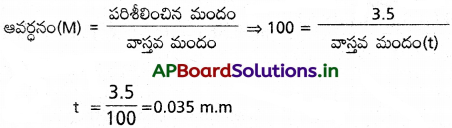
Answer:
Bio-reactor is a large vessel which is used for biological conversion of raw material into specific product.
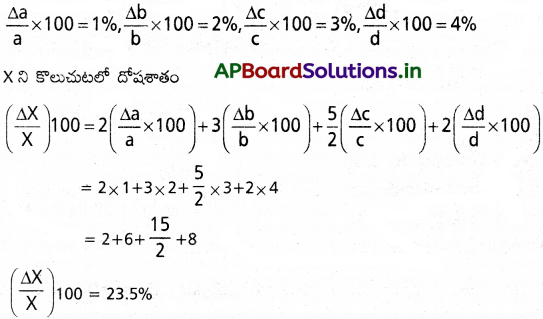
A stirred-tank bio-reactor is usually cylindrical or with a curved base to facilitate the mixing of the reactor contents.

The stirrer facilitates even mixing and oxygen availability throughout the bio-reactor. Alternatively air can be bubbled through the reactor. It has an agitator system, an oxygen delivery system, a foam control system, a temperature .control system, pH control system and sampling ports, so that small volumes of the culture can be with drawn periodically.

AP Inter 2nd Year Botany Study Material Chapter 11 Biotechnology: Principles and Processes

Question 4.
What are the different methods of insertion of recombinant DNA into the host cell?
Answer:
There are several methods of introducing the ligated DNA into recipient cells. Recipient cells after making them competent to receive, take up the DNA present in their surrounding. R-DNA can be forced into such cells by incubating the cells with r-DNA on ice followed by placing them briefly at 42eC -(heat shock) and then putting them back on ice. This enables the bacteria to fake up the r-DNA.

In Micro-injection method, r-DNA is directly injected into the nucleus of an animal cell.

In Bio listic of gene gun method – cells are bombarded with high velocity micro particles of gold or tungsten coated with DNA.

In another method, ‘Disarmed pathogen’ vectors are used which when allowed to infect the cell, transfer the r-DNA into the host.

Long Answer Questions

Question 1.
Explain briefly the various processes of recombinant DNA technology.
Answer:
The important methods in recombinant DNA technology are performed through genetic engineering. They are :
i) Isolation of a desired gene,
ii) Insertion of isolated gene into a suitable vector,
iii) Introduction of recombinant vector into a host and
iv) Selection of the transformed host cells.

I) Isolation of a desired gene :

  1. The desired gene is isolated from the donor cell. Normally bacteria are the source of desired genes.
  2. The cell walls of bacteria are degraded with the help of enzymes.
  3. The cell membranes are lysed with the help of detergents.
  4. By treating the cellular constituents with phenols and suitable nucleases and by subjecting to gradient centrifugation, pure DNA is isolated.
  5. The purified DNA is cut into a number of fragments by restriction endonucleases.
  6. The restriction enzymes cleave DNA molecules in two ways.

i) In one way they cut both strands of DNA at exactly opposite points to each other. This results in DNA fragments with blunt ends or flush ends, where two strands end at the same point. Such cut is generally termed as even cut.
AP Inter 2nd Year Botany Study Material Chapter 11 Biotechnology Principles and Processes 1

ii) But commonly, most enzymes cut the two strands of DNA double helix at different locations. Such a cleavage is generally termed as staggered cut. This generates protruding ends i.e., one strand of DNA double helix extends some bases beyond the other. Since the target site is palindromic in nature, the protruding ends generated by such a cleavage have complimentary base sequence.
As a result, they readily pair with each other and such ends are called cohesive or sticky ends. This stickyness of the ends facilitates the action of the enzyme DNA ligase. When cut by the same restriction enzyme, the resultant DNA fragments have the same kind of ’sticky ends’ and these can be joined together readily by using DNA ligases. E.g.: The restriction enzyme E coRI.
E – The first letter, represents the name of genus Escherichia.
Co – The next two letters, represent the species Escherichia Coli.

The letter R is derived from the name of strain.

Roman numbers following the names indicate the order in which the enzymes were isolated from the strain of bacteria.

This enzyme specifically recognises GAA sites on the DNA and cuts it between G and A (G ↓ A)
AP Inter 2nd Year Botany Study Material Chapter 11 Biotechnology Principles and Processes 2

7) The resultant fragments are separated from each other by gel electrophoresis.
8) The desired fragments are selected by Southern blotting technique.

II) Insertion of isolated gene into a suitable vector :

  1. The selected fragments of DNA are inserted into a suitable vector to produce a large number of copies of genes. This is called gene cloning.
  2. There are two major types of vectors, namely plasmids and bacteriophages.
  3. Among the two types, plasmids are the ideal cloning vectors.
  4. To isolate a plasmid, the Bacterial cell is treated with EDTA (Ethylene diamine tetra acetic acid) along with lysozyme enzyme to digest the cell wall.
  5. Then the bacterial cell is subjected to centrifugation in sodium lauryl sulphate to separate the plasmid.
  6. The plasmid DNA is cut with the help of restriction endonuclease.
  7. The circular plasmid is converted into a linear molecule having sticky ends.
  8. The two sticky ends of linear plasmid are joined to the ends of desired gene by DNA ligase.
  9. The plasmid containing foreign DNA segments is called recombinant DNA (r DNA) or Chimeric DNA.

AP Inter 2nd Year Botany Study Material Chapter 11 Biotechnology Principles and Processes 3

III) Introduction of recombinant vector into a suitable host :

  1. The r DNA molecule is introduced into suitable bacterial host cell by transfor-mation.
  2. The cell containing r DNA is called transformed cell.
  3. Bacterial cell walls are not permeable to recombinant vectors, but keeping in dil. Calcium chloride renders the bacterial cell wall permeable to recombinant vectors.
  4. The r DNA replicates with in the host cell.
  5. The transformed cell grows on the culture medium. Each daughter cell contains r DNA.

IV) Selection of transformed host cells :
1) Selection of transformed cells depends on the nature of gene which is cloned. 2) It can be done in two ways. The are :
a) Without using probes,
b) By using probes.

a) Without using probes:

  1. If the gene is cloned for antibiotic resistance, the cells are first incubated on a medium without antibiotic for one hour, to allow the antibiotic resistance gene to be expressed.
  2. Then the cells are placed on a medium with an antibiotic for selection of colonies containing rDNA.
  3. The cells which have expressed the gene will survive and the others die.

b) By using probes:
When transformed cells are cultured on the nutrient medium, several cells are produced. To select the cells containing the desired gene colony hybridization method is used. In this gene specific probes are used. A probe is a small fragment of single stranded RNA or DNA which is tagged with radioactive, molecule. It can search out complimentary DNA sequences from an organism.

Question 2.
Give a brief account of the tools of recombinant DNA technology.
Answer:
Key tools are :
1) Restriction enzymes :
Two enzymes responsible for restricting the growth of Bacteriophage in Escherichia coli were isolated in the year 1963. One of these added methyl groups to DNA and the other cut DNA. The latter was called restriction endonuclease. The first restriction endonuclease – Hind II which cut.

DNA molecules at a particular point by recognising a specific sequence of six base pairs, called recognition sequence for Hind II. Today, more than 900 restriction enzymes were isolated from over 200 strains of Bacteria, each of which recognises a different recognition sequence.

E CORI is a restriction enzyme in which, the first letter comes from the genus (Escherichia), and the second two letters from the species of the Prokaryotic cell [coli], the letter ‘R’ is derived from the name of strain. Roman numbers indicate the order in which the enzymes were isolated from that strain of Bacteria. Restriction enzymes belong to a larger class of enzymes called nucleases. They are of two types.

a) ExOnucleases which remove nucleotides from the ends of the DNA.
b) Endonucleases which make cuts at specific location with in the DNA.

Most restriction enzymes cut the two strands of DNA double helix at different locations. Such a cleavage is know as staggered cut. E CoRI recognises 5′ GAATT 3′ sites on the DNA and cuts it between G and A results in the formation of sticky ends or cohesive end pieces. This stickyness of the ends facilitates the action of enzyme DNA ligase.

Cloning vectors :
The DNA used as a carrier for transferring a fragment of foreign DNA into a suitable host is called vector. Vectors used for multiplying the foreign DNA sequences are called cloning vectors. Commonly used cloning vectors are plasmids, bacteriophages, cosmids. Plasmids are extrachromosomal circular DNA molecules present in almost all bacterial species. They are inheritable and carry few genes are easy to isolate and reintroduce into the bacterium (Host).

Features required to facilitate cloning into a vector:
a) Origin of replication:
(ori) This is a sequence from where replication starts and any piece of DNA when linked to this sequence can be made to replicate within host cells. It is also responsible for controlling the copy number of the linked DNA.

b) Selectable marker :
In addition to ‘ori’, the vector requires a selectable marker, which helps in identifying and eliminating non-transformants and selectively permitting the growth of the any transformants normally, the genes encoding resistance to antibiotics such as ampicillin, chloramphenicol, tetracycline or kanamycin etc., are useful selectable markers for E.Coli.

c) Cloning sites :
In order to link the alien DNA, the vector needs to have very few, preferably single recognition sites for the restriction enzymes.

d) Molecular weight:
The cloning vector should have low molecular weight.

e) Vectors for cloning genes in plants and animals:
The tumour inducing (Ti) plasmid of Agrobacterium tumifaciens has now been modified into a cloning vector such that it is no more pathogenic to plants. Similarly retroviruses have also been disarmed and are now used to deliver desirable genes into animal cells.

Intext Questions

Question 1.
Do Eukaryotic cells have restriction Endonucleases? Justify your answer.
Answer:
No. only prokaryotic cells have restriction Endonucleases. Today we know 900 or more restriction enzymes have been Isolated from over 230 strains of Bacteria.

AP Inter 2nd Year Botany Study Material Chapter 11 Biotechnology: Principles and Processes

Question 2.
Besides better aeration and mixing properties, what other advantages do stirred tank bioreactors have over shake flasks?
Answer:

  1. Small volumes of the culture can be withdrawn periodically.
  2. Air can be bubbled through the reactor.
  3. It has a control system that regulates the temperature and pH.

Question 3.
Can you recall Meiosis and indicate at what stage a recombinant DNA is made?
Answer:
Pachytene of Meiosis – I.

4. Describe briefly the following :
a) Origin of replication b) Bioreactors c) Down stream processing
Answer:
a) Origin of replication :
It is the specific DNA sequence which is responsible for initiating replication.

b) Bioreactors:
They are large vessels which are used for biological conversion of raw material into specific products.

c) Down stream processing :
Separation and purification of products is called down stream processing.

Question 5.
Explain briefly a) PCR b) Restriction enzymes and DNA c) Chitinase
Answer:
a) PCR:
Polymerase chain reaction: Is a biochemical technology in molecular biology to amplify a single or few copies of a piece of DNA generating thousands of copies of a particular DNA sequence.

b) Restriction enzymes and DNA :
Restriction enzymes are DNA cutting enzymes found in Bacteria because they cut with in the molecule.

c) Chitinase :
It is an enzyme obtained from the fungus, used in the digesting the bacterial cell walls.

Question 6.
Discuss with your teacher and find out how to distinguish between
a) Plasmid DNA and Chromosomal DNA
b) RNA and DNA
c) ExonuCleases and Endonucleases

a)

Plasmid DNAChromosomal DNA
1. Plasmid DNA is a small circular molecule found in Bacteria.1. It is main genetic material which is a circular, double stranded DNA
2. It carry a few genes.2. It carry several genes.

b)

RNADNA
1. It is made up of only polynucleotide chain.1. It is made up of 2 polynucleotide chains.
2. Purines or pyTamidines do not exist in 1 : 1 ratio.2. Purines and pyramidines exist in 1 : 1 ratio.
3. Nitrogen bases are Adenine, Guanine, uracil and cytosine.3. Nitrogen bases are Adenine, Guanine, Thymine and cytosine.

c)

ExonucleaseEndonuclease
1. They remove nucleotides grom the ends of the DNA.1. They make cuts at specific positions with in the DNA.

Question 7.
What does ‘H’ in’d’ and HI refer to in the enzyme Hind III?
Answer:
‘H’ – The genes from which it was isolated – Haemophilus
in – Influenza (the species name) .
d – Refers the bacterial strain from which enzyme was isolated.
III – Third isolated enzyme from the strain.

Question 8.
Restriction enzymes should not have more than one site of action in the cloning site of a vector. Comment.
Answer:
The presence of more than one recognition site for the same enzyme with in the vector will generate several fragments which will complicate the gene cloning. So vector needs to have very few, preferably single, recognition site for the commonly used restriction enzymes.

Question 9.
What does ‘competent’ refer to ‘incompetent cells’ used in transformation experiments?
Answer:
DNA is a hydrophilic molecule. It cannot pass through cell membranes. In order to force Bacteria to take up the plasmid, the bacterial cells must be made competent to take up DNA by treating them with a bivalent cation such as calcium which increaes the efficiency with which DNA enters the bacterium.

Question 10.
What is the significance of adding proteases at the time of Isolation of Genetic material (DNA)?
Answer:
Proteins can be removed by treatment with proteases.

Question 11.
While doing a PCR, ‘denaturation’ step is missed. What will be its effect on the process?
Answer:
The segment of DNA cannot be amplified.

Question 12.
What modification is done on the Ti plasmid of Agrobacterium tumefascians to convert it into a cloning vector?
Answer:
It is no more pathogenic to plants but is still able to use the mechanisms to deliver genes of our interest into a variety of plants.

Question 13.
What is meant by gene cloning?
Answer:
It is the replication of DNA fragments by the use of a self-replicating genetic material. It duplicates only individual genes of organism’s DNA.

AP Inter 2nd Year Botany Study Material Chapter 11 Biotechnology: Principles and Processes

Question 14.
Decide the ratio between ester bonds and hydrogen bonds that are broken in each palindromic sequence of DNA when treated with E coRI during the formation of sticky ends.
Answer:
1 : 4.

AP Board 7th Class Science Solutions 7th Lesson Reproduction in Plants

SCERT AP 7th Class Science Study Material Pdf 7th Lesson Reproduction in Plants Textbook Questions and Answers.

AP State Syllabus 7th Class Science 7th Lesson Questions and Answers Reproduction in Plants

7th Class Science 7th Lesson Reproduction in Plants Textbook Questions and Answers

Improve Your Learning

I. Fill in the blanks.

1. Hibiscus propagated by _______ .
2. The male reproductive part in a flower is _______ .
3. The lower swollen part in gynoecium is _______ .
Answer:
1. stem
2. Stamens dr Androecium
3. Ovary

II. Choose the correct answer.

1. The plant which reproduces through leaves is
a) Bryophyllum
b) Rose
c) Hydrilla
d) Balsam
Answer:
a) Bryophyllum

2. The reproductive part in a plant is
a) Root
b) Stem
c) Leaf
d) Flower
Answer:
d) Flower

AP Board 7th Class Science Solutions 7th Lesson Reproduction in Plants

3. The agents of pollination are
a) Air
b) Water
c) Insects
d) All the above
Answer:
d) All the above

III. Matching

A) Potato1. Stem cuttings
B) Bryophyllum2. Seeds
C) Sugarcane3. Leaves
D) Neem tree4. Eyes
E) Banana5. Anther
6. Suckers

Answer:

A) Potato4. Eyes
B) Bryophyllum3. Leaves
C) Sugarcane1. Stem cuttings
D) Neem tree2. Seeds
E) Banana6. Suckers

IV. Answer the following questions.

Question 1.
Identify whether the sentences below are true or not. Correct the statements which are not true
a) The flowers in pumpkin are unisexual.
b) Seeds are formed in asexual reproduction.
c) Generally, roses are propagated through seeds.
Answer:
a) The flowers in pumpkin are unisexual. This statement is true.

b) Seeds are formed in asexual reproduction. This statement is false. Seeds are formed in sexual reproduction.

c) Generally, roses are propagated through seeds. This statement also false. Generally, rose plants are propagated through a vegetative propagation method called stem cuttings.

Question 2.
What do you call the transfer of pollen grains to the stigma? Explain its types with the help of labelled diagrams.
Answer:

  1. The process of transferring pollen grains from the anther to stigma is known as POLLINATION.
  2. If the pollen grains are transferred from the anther of a flower to stigma of the same flower, is known as SELF POLLINATION.
  3. If the transfer of pollen grains takes place from the anther of one flower to the stigma of another flower, it is called CROSS POLLINATION.

AP Board 7th Class Science Solutions 7th Lesson Reproduction in Plants 1

Question 3.
Can plants produce new plants without the seeds? Explain those methods with the help of examples.
Answer:

  1. Yes, Some plants can produce new plants without seeds. This method of reproduction without formation of seeds is called asexual reproduction.
  2. In some plants asexual reproduction occurs through some vegetative parts like stem, roots and leaf. Such a propagation is called vegetative propagation.
  3. When the banana plants grow, a small new plant rises from the base of mother plant. Such small plants are called suckers (pilakulu). If we separate them and plant, they grow as new plants.
  4. If we cut the sugarcane stem into pieces with at least one node and plant it in the soil. After few days new plants will develop from the nodes.
  5. In Jasmine and chrysanthemum plants, small new plants arise from the underground stem of the mature parent plant. They are called layers. If these are separated from the parental plant and plant them in soil they grow into a new plants.
  6. If we cut the mint twigs with nodes and sow them in soil, they develops roots and give the crop.
  7. Potatoes have notches on them called eyes. If they are cut and plant in the suitable soil they gives rise to new potato plants.
  8. In addition to these natural vegetative propagation methods, some artificial vegetative propagation methods such as stem cuttings, layering and grafting are also helpful to grow new plants with out seeds.

AP Board 7th Class Science Solutions 7th Lesson Reproduction in Plants

Question 4.
What happens if the pollen of mango flower reaches the stigma of guava flower?
Answer:

  1. If the pollen of mango flower reaches the stigma of guava flower, fertilization does not occur.
  2. Fertilization occurs freely between the individuals of the same specious (type).
  3. But mango and guava plants belong to two different specious.
  4. So, there will be no fertilization and formation of new plants.

Question 5.
If all the honeybees in nature become extinct. Imagine, what will be the consequences.
Answer:

  1. Honeybees visit the flowers in search of nectar.
  2. When insects come in contact with a flower, the pollen grains stick to their legs and wings.
  3. Then insects visit another flower, the pollen fall on its slimy stigma.
  4. Thus they play key role in pollination, intern helps in fertilization and formation of seeds.
  5. If all the honey bees in nature become extinct, the fertilization in plants will reduce tremendously.
  6. This results in the extinction of several specious of plants.
  7. Agricultural productivity also will reduce to a great extent.
  8. So we should stop indiscriminate use of chemical pesticides and protect honey bees.

Question 6.
What are the materials required, procedure and precautions taken by you in the lab activity conducted to study the parts of Datura flower?
Answer:
AIM: To observe the parts of a flower.

Material required:
Two datura flowers, new blade, magnifying glass, pencil. Procedure: Hold a datura flower by its stalk and observe its external features. Now draw the diagram of that flower in the box given below. Note down your observations. Now cut the second datura flower vertically into two equal parts from bottom to top. Check that all parts are cut into two equal halves. Observe and draw the internal view.

Precautions:
We should be careful while cutting the flower as the new blade is sharp and may cause injury. We should not inhale the pollen as it may cause allergy.
AP Board 7th Class Science Solutions 7th Lesson Reproduction in Plants 2

Question 7.
Draw the diagram of a complete flower and label the parts.
Answer:
AP Board 7th Class Science Solutions 7th Lesson Reproduction in Plants 3

Question 8.
Rahul goes to a field trip with his classmates, he tries to catch an insect on a flower. Do you support this?
Answer:

  1. No, I never support Rahul.
  2. Insects on the flowers helps in pollination and there by fertilization.
  3. Catching and killing such insects effects the fertilization.
  4. This leads to decrease the productivity of plants.
  5. This hampers the propagation of that plants also.
  6. All the organisms on this planet have the equal right live.
  7. Killing of other organisms just for fun is a cruel act Which leads to imbalance in the nature.
  8. “Live and let live” should be out motive.

AP Board 7th Class Science Solutions 7th Lesson Reproduction in Plants

Question 9.
Venkat, lives in a city. He maintains a roof garden at the top of his six storied building. The ridge gourd creeper bears plenty of flowers. But the flower do not grow into ridge gourds. Can you give him any suggestions to get ridge gourds?
Answer:

  1. Flowers should pollinate and fertilize to form fruits.
  2. Flowers on the ridge guard plant are unisexual flowers.
  3. So, self-pollination is not possible.
  4. For Cross pollination pollinating agents such as insects are required.
  5. To allow the insects, if there is any net surrounding the plants, those should be removed.
  6. Should not spray harmful chemicals on plants.
  7. Along with ridge guard, other attractive flowers having nectar should be grown in the roof garden.
  8. As a last trial do artificial pollination. (Transfer the pollen from male flower to the stigma of the female flower.)

Question 10.
Draw the various methods of Artificial propagations on a chart and exhibit in your classroom.
Answer:
AP Board 7th Class Science Solutions 7th Lesson Reproduction in Plants 4

7th Class Science 7th Lesson Reproduction in Plants InText Questions and Answers

7th Class Science Textbook Page No. 2

Question 1.
Can we grow all plants by planting their stems?
Answer:
No, we cannot grow all the plants by planting their stems.

Question 2.
How do new plants grow from the stems?
Answer:
New plants grow from the stems with some vegetative propagation methods.

7th Class Science Textbook Page No. 3

Question 3.
Have you ever seen seeds in Banana?
Answer:
In general we never found seeds in most of the hybrid banana varities. In certain varities of banana we can find small seeds. But in the wild varities we can find large sized seeds.

Question 4.
Have you ever seen seeds in Jasmine?
Answer:
Yes, I have seen seeds in Jasmine plants. Jasmine plants give long fruits from their flowers. These fruits contain seeds.

AP Board 7th Class Science Solutions 7th Lesson Reproduction in Plants

Question 5.
Did you observe how the Hibiscus plant propagate?
Answer:
Hibiscus plant propagate by means of stem cuttings.

7th Class Science Textbook Page No. 6

Question 6.
What would your mother have done to grow a basil / tulasi plant in your house?
Answer:
My mother sow the seeds of basil / tulasi in soil to grow the basil plant.

Question 7.
She might have put some seeds in the soil. Isn’t it?
Answer:
Yes. She would sow some seeds in the soil to get new plants.

7th Class Science Textbook Page No. 7

Question 8.
Which part of the plant form the fruit?
Answer:
Flower form the fruit.

7th Class Science Textbook Page No. 9

Question 9.
Do bitter gourd flower have whorls?
Answer:
No, bitter gourd flower has only three whorls. Either androecium or gynoecium are absent in them.

7th Class Science Textbook Page No. 11

Question 10.
Do you know which part of the flower will develop into a fruit?
Answer:

  1. Ovary develop into fruits.
  2. Ovules develop into seeds.

7th Class Science Textbook Page No. 12

Question 11.
Think, what changes will take place in the flower after fertilization?
Answer:

  1. After fertilization, the ovary ripens and turns into fruit. ’
  2. The remaining floral parts will fall off.
  3. The ovules become the seeds.

7th Class Science Textbook Page No. 13

Question 12.
In which cup we observe healthy plants?
Answer:
The second cup contains healthy plants.

AP Board 7th Class Science Solutions 7th Lesson Reproduction in Plants

Question 13.
If all the seeds of a plant fall at the same place, how do the baby plants grow?
Answer:

  1. Baby plants will suffer from deficiency of nutrients, water and place.
  2. Their growth will be stunted.

Question 14.
Will they get sufficient place, nutrients, water to grow? What will happen if plants grow in such conditions?
Answer:

  1. Plants will not have enough space to grow freely.
  2. They will not get adequate amounts of nutrients and water.
  3. They do not obtain healthy growth.

Question 15.
Do you have any idea that how plant overcome this situation?
Answer:

  1. To overcome this problem, plants adopt different methods to disperse their seeds.
  2. Seed dispersal takes place with the help of various agents.

Think & Respond

7th Class Science Textbook Page No. 12

AP Board 7th Class Science Solutions 7th Lesson Reproduction in Plants 9

Question 1.
Why do some plants produce small and numerous seeds?
Answer:

  1. All the seeds of a fruit should be able to germinate to produce new plants. Actually, it does not happen in nature.
  2. All the seeds don’t germinate, some will germinate but die before their maturity. Some of the seeds never germinate.
  3. To over come all these problems, plants produce a large number of seeds.

Question 2.
Why do some seeds have wings?
Answer:

  1. This type of winged seeds are dispersed by wind.
  2. These wings help the seeds to move easily by winds to settle in a suitable place to germinate.

Question 3.
Why are some seeds with more fibre?
Answer:

  1. Fibres make seeds light weight and help in floating.
  2. These seeds dispersed through water for longer distance.
    Ex : Coconut.

AP Board 7th Class Science Solutions 7th Lesson Reproduction in Plants

Question 4.
Why do some pods of dry fruits explode?
Answer:

  1. Some pods of dry fruits explode is a mechanical reaction.
  2. In such way that they scatter the seeds all around.
  3. In this way they dispersal the seeds.

Question 5.
Why do some seeds have hairs?
Answer:

  1. Hairs help the seeds to travel in air.
  2. Long haired seeds are travel long distances in air.
  3. In that way seeds are settle at a suitable place to germinate.
    Ex : Calotropis.

Question 6.
Why are many fruits sweet and fleshy?
Answer:

  1. Animals, birds and human beings eat these fruits and the seeds are thrown away.
  2. Like that way, seeds will be dispersed to different places.
  3. For the purpose of reproduction many fruits are sweet and fleshy,

Question 7.
Why do some seeds-have hooks?
Answer:

  1. Seeds have hooks and thorns, help them to stick to the animals
  2. So they travel one place to another place. Ex : Xanthium, urena, grass.

Question 8.
Why are some seeds heavy and round?
Answer:

  1. Seeds that are heavy and round are dispersal by water.
  2. They fall into the bottom of water
  3. They carried by the flow of water for long distances.
    Ex : Seeds of Lotus.

Question 9.
Why are some seeds are delicate and small?
Answer:

  1. This type of seeds are dispersed through winds
  2. They are delicate, small, light in weight and hairy.
  3. These qualities enable them to travel with the mind and settle at a suitable place to germinate

Activities and Projects

Question 1.
Collect information from elders, internet or your school library regarding the method of vegetative propagation in Onion, Garlic, Ginger, Gladioli, Sweet potato, Bryophyllum, Begonia.
AP Board 7th Class Science Solutions 7th Lesson Reproduction in Plants 5
Answer:

PlantMethod of vegetative propagation
1. OnionNew plants grow from bulbs.
2. GarlicIndividual garlic cloves are planted and they each produce a bulb.
3. GingerNew plants are propagated through rhizomes.
4. GladioliNew plants are propagated through corms (modified stems).
5. Sweet potatoNew plants grow from modified roots.
6. BryophyllumNew plants grow from the buds on the leaves (Epiphyllons buds)
7. BegoniaNew plants grow from buds on the leaves (Epiphyllons buds)

Question 2.
Grow a plant using seeds and exhibit in the classroom record its growth.
Answer:

Activities

Activity – 1

Question 1.
Discuss with your friends and teachers and fill the table given below with ‘Yes’ or ‘No’ options. Answer the questions given below.

Name of the plantReproduce through seedsReproduce without seeds
1. Jasmine (malli)YesYes
2. Tamarind (chinta)YesNo
3. Curry leaf (Karivepaaku)YesYes
4. Banana (Arati)YesYes
5. Coriander (kottimeera)YesNo
6. Drumsticks (munaga)YesNo

i) Which plants are reproduce through seeds?
ii) Which plants are reproduce without seeds?
iii) Which plants are reproduce by both means?
Answer:
i) Tamarind, Coriander, Drumsticks plants repr oduce through seeds.
ii) Jasmine, Curry leaf, Banana plants reproduce without seeds.
iii) Jasmine, Curry leaf and some Banana plants reproduce by both means.

AP Board 7th Class Science Solutions 7th Lesson Reproduction in Plants

Activity – 2

Sheet For Lab Activity
Student Name : _____________________________________________
Date : _____________________________________________
AIM: To observe the parts of a flower.
Material required:
Two datura flowers, new blade, magnifying glass, pencil.

Procedure :
Hold a datura flower by its stalk and observe its external features. Now draw the diagram of that flower in the box given below. Note down your observations.
Parts of the flower :
AP Board 7th Class Science Solutions 7th Lesson Reproduction in Plants 3
External parts :
SEPALS:
Colour : Green Petal
Shape : Round tubular
Number : 5
Are they United/Separate ? United PETALS:
Colour : White
Shape v : Round tubular
Number : 5
Are they United/Separate? United

Procedure:
Cut the second datura flower vertically into two equal parts from bottom to top. Check that all parts are cut into two equal halves. Observe and draw the internal view.

AP Board 7th Class Science Solutions 7th Lesson Reproduction in Plants 6
Internal parts:
ANDROECIUM:
Colour : White
Shape : Thin filamentous
Number : 5
Are they United/Separate?
Separate
GYNOECIUM: Style
Colour : Light Yellow
Shape : Long tube like
. swollen at the base Ovary
Number : 1-Ovary – style – stigma
Are they United/Separate ? Separate Gynoecium

Activity – 3

Question 3.
Collect different varieties of flowers from your school garden. Take each flower and count the parts in it. Record the details in the given table.
AP Board 7th Class Science Solutions 7th Lesson Reproduction in Plants 7
i) Which flowers have all four whorls?
ii) Mention the flowers in which one or two whorls are missing.
iii) Write the whorl \ whorls which are missing.
Answer:
i) Lady’s fingers, Hibiscus and Datura flowers have all the four whorls.
ii) In Pumpkin, Bauhinia, Ipomea flowers one or two whorls are missing.
iii) Either androecium or gynoecium are missing.

Give examples for complete flowers …………………, ………………………, ………………….
Hibiscus, Datura etc.

Give examples for incomplete flowers …………………., …………………
Pumpkin, Ridge gourd, etc.

Activity – 4

Question 4.
Collect flowers of hibiscus, papaya, ridge gourd and some other flowers. Fill the table given below by observing the androecium and gynoecium.
AP Board 7th Class Science Solutions 7th Lesson Reproduction in Plants 8
i) In which plants either androecium or gynoecium is present?
ii) In which plants both androecium and gynoecium are present in the same flower?
iii) In which plant both androecium and gynoecium are present separately in different flowers of the same plant?
iv) In which plant both androecium and gynoecium are present in different flowers of different plants?
Answer:
i) Papaya, Ridge gourd, Bitter gourd
ii) Hibiscus, Datura.
iii) Ridge gourd, Bitter gourd
iv) Papaya

Activity – 5

Question 5.
How do you prove that seed dispersal is necessary for plants?
Answer:

  1. Take two cups with soil.
  2. Take handful of mustard seeds in the first cup and only four mustard seeds in the second cup.
  3. Pour equal amount of water daily and observe them regularly for 15 days.

Observations:

  1. Numerous plants germinated in the first cup. They have not enough space to grow freely. They are also not getting sufficient nutrients and water to grow. The plants present in the first cup are not healthy.
  2. In the second cup, the four mustard seeds germinated into new plants. They have enough space, water and nutrients to grow. They are healthy.

Inference:
All the plants try to spread their seeds to distant places to increase the chances of survival and propagation. So, they adopt different methods to disperse their seeds. It occurs with the help of different agents.

AP Board 7th Class Science Solutions 7th Lesson Reproduction in Plants

PROJECT : Page No. 13

Question 6.
Now Collect information about various agents of seed dispersal from internet, your school library or by observing your surroundings. Make a Scrap book with pictures and your illustrations. And fill the below table with at least three examples each.

Agents of dispersalName of the seeds/fruit
WindCalotropis. Milk weed, Dandelion, Maple
WaterCoconut, Lotus, Water Lily
AnimalsGuava, Tomato, Seeds of grass plants
BirdNeem, Thorn apple, Cucumber, Achyranthus
ManSugarcane, Wheat, Pulses
Any otherBhendi, Mustard, Kanakambaram

AP 7th Class Science Important Questions Chapter 4 శ్వాసక్రియ – ప్రసరణ

These AP 7th Class Science Important Questions 4th Lesson శ్వాసక్రియ – ప్రసరణ will help students prepare well for the exams.

AP Board 7th Class Science 4th Lesson Important Questions and Answers శ్వాసక్రియ – ప్రసరణ

7th Class Science 4th Lesson 2 Marks Important Questions and Answers

ప్రశ్న 1.
ఉచ్వా సము అనగానేమి?
జవాబు:
గాలిని లోపలికి పీల్చుకోవడాన్ని ఉచ్ఛ్వాసము అంటారు.

ప్రశ్న 2.
నిశ్వాసము అనగానేమి?
జవాబు:
పీల్చిన గాలిని బయటకు వదలటాన్ని నిశ్వాసం అంటారు.

ప్రశ్న 3.
శ్వాసించే రేటు అనగానేమి?
జవాబు:
ఒక నిముషంలో తీసుకొనే శ్వాసను, శ్వాసించే రేటు అంటారు. సాధారణంగా దీని విలువ నిముషానికి 14 నుండి 20 సార్లు ఉంటుంది.

ప్రశ్న 4.
మన శరీరంలో నీటిపైన తేలే అవయవం ఏమిటి?
జవాబు:
ఊపిరితిత్తులు మన శరీరంలోని నీటి పైన తేలే అవయవం.

AP 7th Class Science Important Questions Chapter 4 శ్వాసక్రియ – ప్రసరణ

ప్రశ్న 5.
స్టెతస్కోప్ యొక్క ఉపయోగం ఏమిటి?
జవాబు:
హృదయ స్పందనలు తెలుసుకోవటానికి వైద్యులు స్టెతస్కోప్ వాడతారు.

ప్రశ్న 6.
రక్తంలోని హి మోగ్లోబిన్ పాత్ర ఏమిటి?
జవాబు:
రక్తంలోని హిమోగ్లోబిన్ O2 మరియు CO2 రవాణాలో పాల్గొంటుంది.

ప్రశ్న 7.
రక్త ఫలకికల పని ఏమిటి?
జవాబు:
రక్తస్రావం జరగకుండా త్వరగా రక్తం గడ్డకట్టడానికి రక్త ఫలకికలు తోడ్పడతాయి.

ప్రశ్న 8.
రోగ నిరోధక శక్తి అనగానేమి?
జవాబు:
శరీరంలోనికి ప్రవేశించే రోగకార క్రిములతో పోరాడే శక్తి కల్గి ఉండటం. ఇది తెల్ల రక్తకణాల వలన కలుగుతుంది.

ప్రశ్న 9.
సంక్రమణ అనగానేమి?
జవాబు:
రోగకారక క్రిములు శరీరంలోనికి ప్రవేశించడాన్ని సంక్రమణ అంటారు.

ప్రశ్న 10.
వ్యాధి కారకములు ఎన్ని రకములు?
జవాబు:
వ్యాధి కారకములు ప్రధానంగా రెండు రకాలు. అవి :

  1. బాక్టీరియా
  2. వైరస్లు

ప్రశ్న 11.
వైరస్లను దేనితో పరిశీలిస్తారు?
జవాబు:
ఎలక్ట్రాన్ మైక్రోస్కోప్ ద్వారా వైరలను పరిశీలిస్తారు.

AP 7th Class Science Important Questions Chapter 4 శ్వాసక్రియ – ప్రసరణ

ప్రశ్న 12.
వైరస్ వ్యాధులకు ఉదాహరణ ఇవ్వండి.
జవాబు:
జలుబు, పోలియో, HIV, కోవిడ్-19.

ప్రశ్న 13.
బాక్టీరియా వ్యాధులకు ఉదాహరణ ఇవ్వండి.
జవాబు:
టైఫాయిడ్, కలరా, క్షయ మొదలైనవి బ్యా క్టీరియా వ్యాధులు.

7th Class Science 4th Lesson 4 Marks Important Questions and Answers

ప్రశ్న 1.
మానవ శ్వాసవ్యవస్థలోని వాయు మార్గానికి దిమ్మె చిత్రం గీయండి.
జవాబు:
AP 7th Class Science Important Questions Chapter 4 శ్వాసక్రియ – ప్రసరణ 1

ప్రశ్న 2.
మానవ ఊపిరితిత్తులను వర్ణించండి.
జవాబు:
ఊపిరితిత్తులు మృదువైన, సాగే గుణముగల సంచుల వంటి నిర్మాణాలు. ఇవి ఎరుపు గులాబీ రంగులో ఉంటాయి. వీటిలో అనేక చిన్న వాయు కుహరాలు ఉంటాయి. ఊపిరితిత్తులు ఛాతీ భాగంలో ప్రక్కటెముకలచే నిర్మించబడిన ఉరఃపంజరంలో సురక్షితంగా ఉంటాయి. కుడి ఊపిరితిత్తి ఎడమ ఊపిరితిత్తి కంటే కొద్దిగా పెద్దదిగా ఉంటుంది. ఊపిరితిత్తులలో కండరాలు ఉండవు, కావున అవి తమంతట తాముగా సంకోచ వ్యాకోచాల ద్వారా గాలిని లోపలకు బయటకు పంపలేవు.

AP 7th Class Science Important Questions Chapter 4 శ్వాసక్రియ – ప్రసరణ

ప్రశ్న 3.
ధూమపానం వలన కలుగు నష్టాలు ఏమిటి?
జవాబు:
పొగాకు పొగలోని నికోటిన్ అనే విషపదార్థం శరీర అన్ని భాగాలకు చేర్చబడుతుంది. ధూమపానం ఒక దురలవాటు, దీనివలన వారికే కాకుండా వారి చుట్టు పక్కల ఉన్నవారికి కూడా ప్రమాదకరం. ధూమపానము వలన ఊపిరితిత్తుల కాన్సర్, క్షయ మరియు ఇతర శ్వాససంబంధ వ్యాధులు కలుగుతాయి.

ప్రశ్న 4.
ట్రాకియల్ శ్వాసక్రియ గురించి రాయండి.
జవాబు:
AP Board 7th Class Science Solutions Chapter 4 శ్వాసక్రియ – ప్రసరణ 4
వాయునాళాల ద్వారా జరిగే శ్వాసక్రియను ట్రాకియల్ లేదా వాయునాళ శ్వాసక్రియ అని అంటారు. ఇవి కీటకాలలో ఉంటాయి. ఈ వ్యవస్థలో ట్రాకియా శరీరానికి ఇరువైపులా చిన్న స్పైరకిల్ అనే రంధ్రాలు ఉంటాయి. ఇవి వలయాకారంగా శరీరంలో అల్లుకుపోయిన వాయునాళాలలోకి తెరుచుకొని శరీరంలోని అన్ని భాగాలకు గాలిని చేర్చి వాయుమార్పిడి ప్రక్రియ పూర్తిచేస్తాయి.
ఉదా : బొద్దింక, మిడత, తేనెటీగ మొదలగునవి.

ప్రశ్న 5.
క్యుటేనియస్ శ్వాసక్రియ గురించి రాయండి.
జవాబు:
AP Board 7th Class Science Solutions Chapter 4 శ్వాసక్రియ – ప్రసరణ 5
చర్మం ద్వారా జరిగే శ్వాసక్రియను క్యుటేనియస్ లేదా చర్మ శ్వాసక్రియ అని అంటారు. కొన్ని జంతువులలో చర్మము తేమగా మరియు జిగటగా శ్లేష్మంతో కూడి ఉండి శ్వాసక్రియకు ఉపయోగపడుతుంది.
ఉదా : వానపాము, కప్ప మొదలైనవి. కప్పలో శ్వాసించడానికి ఊపిరితిత్తులుంటాయి. వీటిని కప్పలు నేలపై శ్వాసించడానికి ఉపయోగిస్తాయి. నీటిలో ఉన్నప్పుడు కప్పలు తమ మృదువైన, జిగురు చర్మంతో శ్వాసిస్తాయి.

ప్రశ్న 6.
బ్రాంకియల్ శ్వాసక్రియ గురించి రాయండి.
జవాబు:
AP Board 7th Class Science Solutions Chapter 4 శ్వాసక్రియ – ప్రసరణ 6
మొప్పల ద్వారా జరిగే శ్వాసక్రియను బ్రాంకియల్ లేదా జల శ్వాసక్రియ అని అంటారు. ఇవి చేపలలోని శ్వాసవయవాలు. మొప్పలు తలకు ఇరువైపులా మొప్పలు ఉన్న దొప్పల లోపల ఉంటాయి. మొప్పలలో రక్తం అధికంగా ఉండడం వలన ఆక్సిజన్ మరియు కార్బన్ డై ఆక్సైడ్ మార్పిడికి ఉపయోగపడుతుంది. చేపలు తమ నోటి ద్వారా నీటిని తీసుకొని దానిని మొప్పల మీదుగా పంపి నప్పుడు నీటిలో కరిగి ఉండే ఆక్సిజనను శోషిస్తాయి.

ఈ కారణం చేతనే చేపలు నీటిలో శ్వాసించగలవు కానీ ఊపిరితిత్తులు కలిగి ఉండే మానవులు గానీ ఇతర జంతువులు గానీ నీటిలో శ్వాసించలేవు.

ప్రశ్న 7.
పల్మనరీ శ్వాసక్రియ గురించి రాయండి.
జవాబు:
ఊపిరితిత్తుల ద్వారా జరిగే శ్వాసప్రక్రియను పల్మనరీ శ్వాసక్రియ అని కూడా అంటారు. భూమిపై ఉండే అన్ని జీవులలో మరియు నీటిలో ఉండే కొన్ని జీవులలో ఊపిరితిత్తులు శ్వాసించడానికి ఉపయోగిస్తాయి. ఇవి గాలిలోని ఆక్సీజన్ తీసుకోవడానికి ఉపయోగపడతాయి.
ఉదా : ఆవు, కుక్క తిమింగలం, మానవులు మొదలగునవి.

ప్రశ్న 8.
మొక్కలను మనం ఎందుకు పరిరక్షించాలి?
జవాబు:
శ్వాసక్రియలో మొక్కలు ఆక్సిజన్ పీల్చుకొని కార్బన్ డై ఆక్సైడ్ ను విడుదల చేస్తాయి. అవే మొక్కలు కిరణజన్య సంయోగక్రియ ప్రక్రియలో కార్బన్ డై ఆక్సైడ్ ను తీసుకొని అక్సిజన్ ను విడుదల చేస్తాయి. కాబట్టి మనం మొక్కలను నాటడం మరియు పరిరక్షించడం ద్వారా ఎక్కువ ఆక్సిజన్ పొందవచ్చు.

ప్రశ్న 9.
మానవ హృదయాన్ని వర్ణించండి.
జవాబు:
AP 7th Class Science Important Questions Chapter 4 శ్వాసక్రియ – ప్రసరణ 2
గుండె :
గుండె రక్తసరఫరా వ్యవస్థలో రక్తాన్ని పంపు చేసే ప్రధాన అవయవం. ఇది మన గుప్పెడంత పరిమాణములో ఉంటుంది. గుండె ఛాతీకుహరము మధ్యలో కాస్త ఎడమవైపునకు వంగి ఉండుటచేత ఎడమ ఊపిరితితి కుడి ఊపిరితితి కంటే కాస్త చిన్నగా ఉంటుంది. దీనిలో నాలుగు గదులుంటాయి, పై రెండు గదులను కర్ణికలు అంటారు. క్రింది రెండు గదులను జఠరికలు అంటారు. గుండెగదుల గోడలు కండరాలతో నిర్మితమయ్యి క్రమబద్ధంగా, లయబద్ధంగా సంకోచవ్యాకోచాలతో రక్తాన్ని పంపుచేస్తాయి. ఈ లయబద్ధ సంకోచము మరియు వ్యాకోచములను హృదయస్పందన అంటారు.

ప్రశ్న 10.
మానవ రక్తప్రసరణ వ్యవస్థలోని రక్తనాళాలు గురించి రాయండి.
జవాబు:
శరీరభాగాలన్నింటికీ గుండె రక్తనాళాల ద్వారా రక్తాన్ని పంపు చేస్తుంది. మానవ శరీరంలో మూడురకాల రక్తనాళాలు ఉన్నాయి.

  1. ధమనులు – ఇవి అధిక ఆక్సిజన్ కలిగిన రక్తాన్ని గుండె నుండి శరీరభాగాలకు సరఫరా చేస్తాయి.
  2. సిరలు – ఇవి అధిక కార్బన్ డై ఆక్సెడ్ కలిగిన రక్తాన్ని శరీరభాగాల నుండి గుండెకు సరఫరా చేస్తాయి.
  3. రక్త కేశ నాళికలు – ఇవి అతి సన్నని రక్తనాళాలు, ధమనులను సిరలను అనుసంధానం చేసి శరీర భాగాలన్నింటికీ రక్తాన్ని సరఫరా చేస్తాయి.

AP 7th Class Science Important Questions Chapter 4 శ్వాసక్రియ – ప్రసరణ

ప్రశ్న 11.
మానవ రక్త కణాలను వర్ణించండి.
జవాబు:
మానవ రక్తం రక్తకణాలు మరియు ప్లాస్మాతో ఏర్పడుతుంది. ప్లాస్మా అనేది రక్తంలోని ద్రవభాగం. రక్తకణాలు మూడు రకాలు – ఎర్ర రక్తకణాలు, తెల్ల రక్తకణాలు మరియు రక్త ఫలకికలు. తెల్ల రక్తకణాలు పలు రకాలు. ఇవి మన శరీర రోగనిరోధక శక్తి పెంపొందించి, మన శరీరంలోకి ప్రవేశించిన రోగకారక సూక్ష్మజీవులతో పోరాడి మనకు రక్షణ కల్పిస్తాయి. ఇవి మన శరీరంలో రక్షణ దళం వలె పనిచేస్తాయి. ఎర్ర రక్తకణాలలో హి మోగ్లోబిన్ అనే ఎర్రని వర్ణకం ఉండడం వలన రక్తం ఎర్ర రంగులో ఉంటుంది.
AP 7th Class Science Important Questions Chapter 4 శ్వాసక్రియ – ప్రసరణ 3

ప్రశ్న 12.
రక్తంలోని వివిధ పదార్థాల ప్రాధాన్యత ఏమిటి?
జవాబు:
రక్తంలోని హిమోగ్లోబిన్ ఆక్సిజన్ మరియు కార్బన్ డై ఆక్సైడ్ వాహకంగా పనిచేస్తూ శ్వాసక్రియలో ప్రధానపాత్ర పోషిస్తుంది. రక్తఫలకికలు గాయాలైనప్పుడు రక్తస్రావం అధికంగా జరగకుండా, త్వరగా గడ్డకట్టడానికి ఉపయోగ పడతాయి. రక్తము జంతువులలో పదార్థాల రవాణాలో ముఖ్య పాత్ర పోషిస్తుంది. రక్తము ఒక యానకము వలె జీర్ణమైన ఆహార పదార్థాలలో మరియు శ్వాసించిన ఆక్సిజన్‌ను శరీరంలోని అన్ని భాగాలకు చేరుస్తుంది.

ప్రశ్న 13.
ఆరోగ్యకరమైన జీవనశైలికి నీవు సూచించే సూచనలు ఏమిటి?
జవాబు:

  1. వారంలో ఐదు రోజులపాటు కనీసం 30 నిముషాలు శారీరక వ్యాయామం చేయాలి.
  2. రక్తం ప్రసరణను కండరాల బలాన్ని పెంచుకోవాలి.
  3. ఎక్కువ శారీరక శ్రమ మంచి ఆరోగ్య కారకం.

ప్రశ్న 14.
కోవిడ్ – 19ను ప్రపంచ మహమ్మారిగా పరిగణించారు ఎందుకు?
జవాబు:
కోవిడ్ – 19 అనే వ్యాధి ఇటీవలె ప్రపంచవ్యాప్తంగా ప్రభావం చూపించినది. ఒక దేశంలో లేక ప్రపంచ వ్యాప్తంగా ఒకేసారి అత్యధిక జనాభాకు సంక్రమించే వ్యాధిని ప్రపంచ మహమ్మారి అంటారు. మనము ఇటువంటి వ్యాధులను లేక వ్యాధి సంక్రమణను రోగ నిరోధక శక్తి పెంపొందించుకోవడం ద్వారా నివారించవచ్చు.

ప్రశ్న 15.
బాక్టీరియా వ్యాధులు, వైరస్ వ్యాధులకు మధ్యగల భేదం ఏమిటి?
జవాబు:

బ్యాక్టీరియా వ్యాధులువైరస్ వ్యాధులు
1. యాంటీబయోటిక్స్ సహాయంతో నయం చేయవచ్చు.1. యాంటీబయోటితో నయం చేయలేము.
2. కొన్నింటికి మాత్రమే వ్యాక్సిన్ అవసరం.2. వ్యాక్సీన్ మాత్రమే ప్రత్యామ్నాయం.
3. ఉదా : టైఫాయిడ్, కలరా, క్షయ (TB)3. ఉదా : జలుబు, పోలియో, HIV, కోవిడ్-19

ప్రశ్న 16.
కరోనా వైరస్ గురించి రాయండి.
జవాబు:
కరోనా వైరస్ వ్యాధి ఒక సంక్రమిత వ్యాధి. ఇది నూతనముగా ఆవిష్కరించబడిన కరోనా వైరస్ వలన కలుగును. ఈ వ్యాధి సంక్రమించిన వారిలో అత్యధికులలో సామాన్యం నుండి ఒక మోస్తరు శ్వాససంబంధ అనారోగ్యం కలగడం, ఆ తరువాత ఎటువంటి ప్రత్యేక వైద్య సేవలు అవసరం లేకుండానే కోలుకున్నారు. వృద్ధులు మరియు గుండె సంబంధ వ్యాధులు, చక్కెర వ్యాధిగ్రస్తులు, ఊపిరితిత్తుల వ్యాధులు కలవారికి మాత్రం కరోనా బాగా ప్రభావం చూపడంవలన తీవ్ర అనారోగ్యానికి గురైనారు. కొన్నిసార్లు అది వారి మరణానికి కూడా దారి తీస్తుంది.

ప్రశ్న 17.
కోవిడ్-19 ఎలా వ్యాపిస్తుంది? దీని నివారణ చర్యలు ఏమిటి?
జవాబు:
ఈ వ్యాధి సంక్రామ్యతను నివారించడానికి మరియు తగ్గించడానికి మనం కొన్ని చర్యలు తీసుకోవాలి. ఆ చర్య లేమిటంటే చేతులను సబ్బుతో లేక శానిటైజర్ తో తరచుగా శుభ్రపరుచుకోవడం, ముక్కు, నోరు, కళ్ళు తాకకపోవడం, ముఖానికి మాస్కు ధరించడం. కోవిడ్-19 వైరస్ ప్రధానంగా రోగి తుమ్మినపుడు లేక దగ్గినపుడు వారి యొక్క లాలాజల తుంపరలు మరియు చీమిడి తుంపరల ద్వారా వ్యాప్తి చెందుతుంది.

ప్రశ్న 18.
కోవిడ్ ప్రోటోకాల్ తెలపండి.
జవాబు:
కోవిడ్ ప్రొటోకాల్ – S.M.S
S – శానిటైజర్
M – మాస్క్
S – సోషల్ డిస్టెన్స్

AP 7th Class Science Important Questions Chapter 4 శ్వాసక్రియ – ప్రసరణ

ప్రశ్న 19.
శ్వాస వ్యవస్థకు సంబంధించిన సహజ ప్రక్రియలు తెలపండి.
జవాబు:
శ్వాస వ్యవస్థకు సంబంధించిన సహజ ప్రక్రియలు :

  1. తుమ్మడం
  2. ఆవలింతలు
  3. దగ్గడం
  4. పొలమారడం

ప్రశ్న 20.
రక్తం కారే గాయాలకు నీవు అందించే ప్రథమచికిత్స ఏమిటి?
జవాబు:
AP 7th Class Science Important Questions Chapter 4 శ్వాసక్రియ – ప్రసరణ 4
మనకు గాయాలైనప్పుడు లేక తెగినప్పుడు రక్తస్రావం జరుగుతుంది. ముందుగా గాయాన్ని శుభ్రమైన నీటితో కడగాలి. దూది. లేక గుడ్డతో గాయమైన భాగాన్ని తుడవాలి. తదుపరి దూది లేక బ్యాండేజి క్లాత్ (గాజు గుడ్డ) తో గాయానికి కట్టుకట్టి రక్త స్రావాన్ని ఆపాలి. రక్త స్రావం ఆగని పక్షంలో దగ్గరలోని వైద్యుని వద్దకు లేక వైద్యశాలకు ఆ వ్యక్తిని తీసుకెళ్ళాలి.

7th Class Science 4th Lesson 8 Marks Important Questions and Answers

ప్రశ్న 1.
తుమ్మడం అనే ప్రక్రియను వివరించండి.
జవాబు:
హఠాత్తుగా అనియంత్రితంగా ఊపిరితిత్తుల నుంచి ముక్కు ద్వారా గాలిని బలవంతంగా బయటకు పంపించడాన్ని తుమ్మడం అంటారు. ఇది నాసికా మార్గములో కలిగే చికాకు వలన జరుగుతుంది. మనం గాలి ద్వారా దుమ్ము, పొగ, పుప్పొడి లేక ఘాటు వాసన పీల్చినపుడు తుమ్ములు వస్తాయి. తుమ్ము ఒక వరం. కారణం దీని ద్వారా మన శరీరానికి అనవసరమైన మరియు ప్రమాదకరమైన పదార్థాలను ఊపిరితిత్తుల నుండి బయటకు పంపి మనల్ని కాపాడుతుంది. మనం ఎప్పుడు తుమ్మినా జేబు రుమాలు ముక్కుకు అడ్డంగా పెట్టుకోవాలి.

ప్రశ్న 2.
ఆవలింత గురించి రాయండి.
జవాబు:
మన ప్రమేయం లేకుండానే నోటిని పెద్దగా తెరిచి ఒక దీర్ఘమైన పెద్ద శ్వాసను తీసుకోవడాన్నే ఆవలింత అంటాము. ఇది ఒక వ్యక్తిలో అనాశక్తి, వత్తిడి, నిద్ర వచ్చినప్పుడు లేక బాగా అలసిపోయినప్పుడు జరిగే ప్రక్రియ. శ్వాసక్రియ – రేటు నిదానించి మెదడుకు సరిపడినంత ఆక్సిజన్ లభించనప్పుడు మనం ఆవలిస్తాము. ఇలాంటి పరిస్థితులలో మన శరీరము అసంకల్పితంగా నోటిని తెరిచి ఒక పెద్ద, దీర్ఘమైన శ్వాసను తీసుకుంటుంది.

ప్రశ్న 3.
దగ్గడం మరియు పొలమారడం ప్రక్రియలను తెలపండి.
జవాబు:
దగ్గడం :
ఊపిరితిత్తులు సంకోచించి దానిలోని పదార్థాలను బలవంతంగా బయటకు పంపే ప్రక్రియను దగ్గు అంటాము. ఇది ఘాటు వాసనలు లేదా దుమ్ము ఊపిరితిత్తుల లోపలి పొరను చికాకు పరిచినప్పుడు జరుగుతుంది. దగ్గడం ద్వారా ఊపిరితిత్తులలో జలుబు లేక ఇలా శ్వాస సంబంధ రుగ్మతల వలన చేరిన ఘన మరియు పాక్షిక ఘన వ్యర్థ పదార్థాలు కూడా బయటకు పంపబడతాయి.

పొలమారడం (ఆప్నియా) :
తాత్కాలిక శ్వాస సిలుపుదలను ఆప్నియా అంటారు. మనం ఏదైనా తినేటప్పుడు ఆహారం గ్రసని భాగంలో ఉన్నప్పుడు అసంకల్పితంగా జరిగే ప్రక్రియ. ఆహారం వాయునాళంలోకి ప్రవేశించకుండా ఈ చర్య కాపాడుతుంది. ఆహార పదార్థాలు వాయు నాళంలోకి వెళితే ప్రాణానికే ప్రమాదం. కావున స్వరపేటిక ముందుకు కదిలి ఆపుతుంది. కాబట్టి మనం ఆహారం తీసుకునేటప్పుడు మాట్లాడకూడదు.

AP 7th Class Science Important Questions Chapter 4 శ్వాసక్రియ – ప్రసరణ

ప్రశ్న 4.
ఉక్కిరి బిక్కిరి అవటం అంటే ఏమిటి? పెద్దవారిలోనూ, చిన్నవారిలోనూ నీవు చేయు ప్రథమచికిత్స ఏమిటి?
జవాబు:
వాయు నాళములో ఏమైనా అడ్డుపడినప్పుడు గాలి ఆడకపోతే దానినే ఉక్కిరిబిక్కిరి అంటారు. వెంటనే చర్య తీసుకోకపోతే ఇది ప్రమాదకరమైన పరిస్థితి కావున వెంటనే తగు చర్యలు తీసుకోవాలి. పెద్దలలోనైతే ఆ వ్యక్తిని వెనుక నుండి పొట్ట చుట్టూ ప్రక్కటెముకల క్రిందగా పట్టుకొని గట్టిగా నొక్కి విడవాలి. ఇలా ఆ వ్యక్తి దగ్గే వరకు లేదా వాంతి అయ్యే వరకు చేయాలి. పిల్లలలోనైతే ఆటల్లో గింజలు, నాణాలు లేక సీసామూతలు మింగినప్పుడు ఉక్కిరిబిక్కిరి అవుతుంటారు. పిల్లలను మన ఒళ్లో బోర్లా పడుకోబెట్టి తల క్రిందికి ఉండేట్టు చేసి వీపు భాగంలో భుజం ఎముకల మధ్య గట్టిగా తట్టడం ద్వారా ఆ వస్తువులు బయటకు వచ్చి స్వాంతన పొందుతారు. వారిని వెంటనే డాక్టర్ దగ్గరికి తీసుకొని వెళ్ళాలి.

AP Board 7th Class Science 4th Lesson 1 Mark Bits Questions and Answers శ్వాసక్రియ – ప్రసరణ

I. బహుళైచ్ఛిక ప్రశ్నలు

కింది వాటికి సరియైన జవాబులు గుర్తించండి.

1. శ్వాస వ్యవస్థకు సంబంధించి సహజ ప్రక్రియ కానిది
A) తుమ్మటం
B) దగ్గటం
C) ఏడ్వటం
D) ఆవలించటం
జవాబు:
C) ఏడ్వటం

2. క్రిందివానిలో విభిన్నమైనది
A) టైఫాయిడ్
B) కలరా
C) క్షయ
D) కోవిడ్
జవాబు:
D) కోవిడ్

3. శరీర రక్షణ దళం
A) ఎర్ర రక్తకణాలు
B) తెల్ల రక్తకణాలు
C) రక్త ఫలకికలు
D) రక్త కణాలు
జవాబు:
B) తెల్ల రక్తకణాలు

AP 7th Class Science Important Questions Chapter 4 శ్వాసక్రియ – ప్రసరణ

4. హృదయ స్పందనల పరిశీలనకు వాడే పరికరం
A) స్టెతస్కోప్
B) ఆక్సీమీటరు
C) పల్వనోమీటరు
D) బి.పి. మీటర్
జవాబు:
A) స్టెతస్కోప్

5. S.M.S ప్రోటోకాల్ ఏ వ్యాధికి సంబంధించినది?
A) కోవిడ్
B) పోలియో
C) క్యాన్సర్
D) మలేరియా
జవాబు:
A) కోవిడ్

6. మెదడుకు సరిపడినంత ఆక్సిజన్ లభించనపుడు
A) పొగాకు
B) వేపాకు
C) దగ్గుతాం
D) పొలమారటం
జవాబు:
B) వేపాకు

7. గ్రసనికి సంబంధించిన శ్వాసవ్యవస్థ సహజ ప్రక్రియ
A) తుమ్మటం
B) ఆవలించటం
C) దగ్గటం
D) పొలమారటం
జవాబు:
D) పొలమారటం

8. గుండె పై గదులు
A) జఠరికలు
B) కర్ణికలు
C) ధమనులు
D) సిరలు
జవాబు:
B) కర్ణికలు

9. హృదయ సంకోచ వ్యాకోచములను కలిపి ఏమంటారు?
A) హృదయస్పందన
B) నాడీ స్పందన
C) గుండెపోటు
D) అలసట
జవాబు:
A) హృదయస్పందన

10. రక్తప్రసరణ వ్యవస్థలో భాగము కానిది.
A) ఊపిరితిత్తులు
B) గుండె
C) రక్తము
D) రక్తనాళాలు
జవాబు:
A) ఊపిరితిత్తులు

11. మొక్కకు ముక్కు వంటిది
A) కాండము
B) పత్రము
C) పత్రరంధ్రము
D) బెరడు
జవాబు:
C) పత్రరంధ్రము

12. శ్వాసక్రియలో వెలువడు వాయువు
A) O2
B) H2
C) CO2
D) N2
జవాబు:
C) CO2

13. నికోటిన్ పదార్థం ఏ ఆకులో ఉంటుంది?
A) తుమ్ముతాము
B) ఆవలిస్తాము
C) కరివేపాకు
D) రావి
జవాబు:
A) తుమ్ముతాము

14. ఉచ్ఛ్వాస, నిశ్వాస గాలిలో స్థిరమైన పరిమాణం గల వాయువు
A) O2
B) CO2
C) నీటి ఆవిరి
D) నత్రజని
జవాబు:
D) నత్రజని

AP 7th Class Science Important Questions Chapter 4 శ్వాసక్రియ – ప్రసరణ

15. మన శరీరంలో వాయు రవాణాకు తోడ్పడునది
A) ఊపిరితిత్తులు
B) గుండె
C) రక్తము
D) నాలుక
జవాబు:
C) రక్తము

II. ఖాళీలను పూరించుట

కింది ఖాళీలను పూరింపుము.

1. ఉచ్ఛ్వాస, నిశ్వాస ప్రక్రియనే …………………………. అంటారు.
2. శ్వాసించే రేటు నిముషానికి …………….. సార్లు.
3. మానవునిలో శ్వాస అవయవాలు ……………..
4. …………… ఊపిరితిత్తి …………….. ఊపిరితిత్తి కంటే పెద్దది.
5. ఆహారం, వాయువులకు ఉమ్మడి మార్గం …………..
6. ‘C’ ఆకారపు రింగులు గల శ్వాస వ్యవస్థ భాగము ………………………
7. పురుష శ్వా స కదలికలో ……………….. ప్రముఖ పాత్ర వహిస్తుంది.
8. స్త్రీల శ్వాస కదలికలో ……………… ప్రముఖ పాత్ర వహిస్తుంది.
9. మానవ శరీరంలో నీటిపై తేలియాడే అవయవం …………………
10. నిశ్వాస గాలిలో ……………. మరియు ………… పరిమాణం అధికంగా ఉంటుంది.
11. CO2 సున్నపు నీటిని ………… వలె మార్చుతుంది.
12. పొగాకులోని ప్రమాదకర పదార్థం …………
13. కాండము ……………. ద్వారా శ్వాసిస్తుంది.
14. అతిచిన్న రక్తనాళాలు …………
15. రక్తములోని వర్ణక పదార్థం …………..
16. వ్యాధి నిరోధకతలో కీలకపాత్ర వహించునవి ……………….
17. నీలిరంగు రక్తం కలిగిన జీవులు …………………
18. ప్రపంచ మహమ్మారి ……………………….
19. రోగ కారక జీవి శరీరంలో ప్రవేశించటాన్ని ………………. అంటారు.
20. వైరస్ ను ………………….. మాత్రమే చూడగలం.
21. వైరస్ వ్యాధులు …………….
22. గుండెకు రక్తాన్ని చేరవేయు నాళాలు …………..
23. ట్రాకియా వ్యవస్థ …………………. కనిపిస్తుంది.
24. రక్తములోని ద్రవ భాగము ……………………
25. రక్తం గడ్డకట్టటంలో తోడ్పడునవి ……………
26. కోవిడ్-19……………….. ద్వారా వ్యాపిస్తుంది.
జవాబు:

  1. శ్వాసించటం
  2. 14 నుండి 20
  3. ఊపిరితిత్తులు
  4. కుడి, ఎడమ
  5. గ్రసని
  6. వాయునాళము
  7. ఉదర వితానం
  8. ఉరఃపంజరం
  9. ఊపిరితిత్తులు
  10. CO2 నీటి ఆవరి
  11. తెల్లనిపాల
    12. నికోటిన్
  12. లెటికణాలు
  13. రక్త కేశనాళికలు
  14. హిమోగ్లోబిన్
  15. తెల్ల రక్తకణాలు
  16. నత్తలు, పీతలు
  17. కోవిడ్-19
  18. సంక్రమణ
  19. ఎలక్ట్రాన్ మైక్రోస్కోలో
  20. జలుబు, పోలియో
  21. సిరలు
  22. కీటకాలలో
  23. ప్లాస్మా
  24. రక్త ఫలకికలు
  25. లాలాజల తుంపర

III. జతపరుచుట

కింది వానిని జతపరుచుము.

1.

Group – AGroup – B
A) ట్రాకియా1) రక్తం గడ్డకట్టడం
B) చర్మము2) వాయు గొట్టాలు
C) మొప్పలు3) తేమగా
D) ఊపిరితిత్తులు4) వ్యా ధి నిరోధకత
E) తెల్ల రక్తకణాలు5) ఎర్రగా
F) రక్త ఫలకికలు6) ఉరఃకుహరం

జవాబు:

Group – AGroup – B
A) ట్రాకియా2) వాయు గొట్టాలు
B) చర్మము3) తేమగా
C) మొప్పలు5) ఎర్రగా
D) ఊపిరితిత్తులు6) ఉరఃకుహరం
E) తెల్ల రక్తకణాలు4) వ్యా ధి నిరోధకత
F) రక్త ఫలకికలు1) రక్తం గడ్డకట్టడం

2.

Group – AGroup – B
A) ఆవలించడం1) నాసికామార్గం
B) తుమ్మటం2) దీర్ఘమైన శ్వాస
C) దగ్గటం3) గ్రసని
D) పొలమారటం4) శ్లేష్మం
E) ఉక్కిరిబిక్కిరి5) పీత
F) సంక్రమణ6) రోగకారకం
G) నీలివర్ణం7) వాయు నాళములో అడ్డంకి

జవాబు:

Group – AGroup – B
A) ఆవలించడం2) దీర్ఘమైన శ్వాస
B) తుమ్మటం1) నాసికామార్గం
C) దగ్గటం4) శ్లేష్మం
D) పొలమారటం3) గ్రసని
E) ఉక్కిరిబిక్కిరి7) వాయు నాళములో అడ్డంకి
F) సంక్రమణ6) రోగకారకం
G) నీలివర్ణం5) పీత

మీకు తెలుసా?

→ మానవ శరీరంలో నీటిపై తేలియాడే ఏకైక అవయవం ఊపిరితిత్తులు.

→ గొప్ప శాస్త్రవేత్తలైన వాన హెల్మెంట్ మరియు జోసెఫ్ బ్లాక్ కృషి ఫలితంగా కార్బన్ డై ఆక్సైడ్ కనుగొనబడింది. జోసెఫ్ ప్రీస్ట్ మరియు లావోయిజర్లు ఆక్సిజన్‌ను కనుగొన్నారు.

→ తిమింగలాలు, డాల్ఫిన్లు, సీళ్ళు మొ|| సముద్రపు జీవులు. ఇవి నీటిలో ఉన్నప్పటికి ఊపిరితిత్తులు ఉన్న కారణంగా క్రమం తప్పకుండా నీటి పైకి వచ్చి గాలిని పీల్చుకొని శ్వాసిస్తాయి.

AP 7th Class Science Important Questions Chapter 4 శ్వాసక్రియ – ప్రసరణ

→ శ్వాసక్రియలో మొక్క ఆక్సిజన్ పీల్చుకొని కార్బన్ డై ఆక్సైడ్ ను విడుదల చేస్తాయి. అవే మొక్కలు కిరణజన్య సంయోగక్రియ ప్రక్రియలో కార్బన్ డై ఆక్సైడ్ ను తీసుకొని ఆక్సిజన్‌ను విడుదల చేస్తాయి. కాబట్టి మనం మొక్కలను నాటడం మరియు పరిరక్షించడం ద్వారా ఎక్కువ ఆక్సిజన్ పొందవచ్చు.