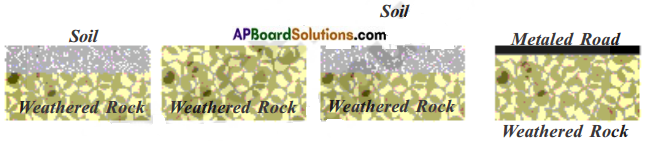
AP Board 7th Class Social Studies Solutions Chapter 8 Industrial Revolution

SCERT AP Board 7th Class Social Solutions 8th Lesson Industrial Revolution Textbook Questions and Answers.

AP State Syllabus 7th Class Social Studies Solutions 8th Lesson Industrial Revolution

7th Class Social Studies 8th Lesson Industrial Revolution Textbook Questions and Answers

Improve Your Learning

Question 1.
Correct the false sentences:
Under the putting-out system:
a) Spinners took cotton to the weavers.
Answer:
Correct statement: A cloth trader purchased cotton from a supplier and carried it to the spinners.

b) Unlike in the guild system traders controlled what product was to be made.
Answer:
Correct statement: Unlike in the guild system the capitalists controlled what product was to be made.

c) All work was done by the same group of people.
Answer:
Correct statement: Different activities could be done in different parts of the country by different groups of people.

Under the Guild system:
a) All small farmers were allowed to learn to weave.
Answer:
Correct statement: All small farmers were forced to learn to weave.

b) Weavers determined the prices and quality of the products.
Answer:
Correct statement: Capitalists determined prices and quality of the products.

AP Board 7th Class Social Studies Solutions Chapter 8 Industrial Revolution

Question 2.
Putting out a system is better than factory-based production of textiles. Do you agree?
Give reasons for your answer.
Answer:
Every system has its own merits and demerits.
Inputting out system different activities of the production could be done in different parts of the country. It consumes a lot of time and it is very much expensive. But in factory system production is carried on in one place called factory. This factory system is time-saving and less expensive when compared to the putting-out system. Inputting – out system every worker and craftsman get employment. But in factory system machines can do the work of several workers at the same time and therefore lakhs of people are expelled from the factories. Thus it leads to unemployment and unrest among the people. In putting out a system the craftsmen and workers control the whole process of production. But in the factory system, the factories are owned and managed by the capitalists. This widens the financial gap between the capitalists and owners. Thus it leads to unrest among the labourers.

Question 3.
If Kruthika argues “Railways in India were built only for the benefit of the people by the colonial rulers”, how can you counter this statement?
Answer:
No. It is not true. The English built railways not only for the benefit of Indian people, but to transport raw material to Indian ports and manufactured goods of England from Indian ports into the country. To transport cheap labour from villages to cities, and to transport their troops fast and easily to the nooks and corners of the country to link up all their trading centres in all parts of the country British established railways in India.

Question 4.
How will an increase in the wages of the workers affect industrial production?
Answer:

  1. The workers cannot work with complete skills if they are not paid properly.
  2. They cannot satisfy their basic needs with meagre wages.
  3. If their pay is increased they can work for more time with enthusiasm.
  4.  It results in an increase in production.
  5. Then the capitalists won’t mind the increase in their expenditures.
  6. Thus the increase in wages leads to an increase in production.

AP Board 7th Class Social Studies Solutions Chapter 8 Industrial Revolution

Question 5.
Why did factory owners pay low wages and force workers to work for long hours?
Answer:
Nowadays all facilities of production are owned and managed by capitalists. They invested money in workers, raw materials and machines. In this system, workers worked for wages. When the machines were introduced very few people were required to work on machines, all the rest would be expelled. So there are a lot of surplus workers available at hand for the capitalists. And the labourers are prepared to work even with meagre wages. Thus the capitalists who are aimed to get more and more profits to force the workers to work at low wages and they are forced to work for long hours under the whip.

Question 6.
Why do you think the working conditions in factories should be improved?
Answer:
The following steps are necessary for labourers.

  1. Working hours should be reduced.
  2. Minimum wages should be fixed.
  3. An insurance scheme should be launched.
  4. Holidays must be given to the labourers and industrial workers. In 1881 steps were taken for the welfare of the labour class and industrial workers.
  5. Major changes swept industries with the coming of machines.
  6. Machines could be worked by even unskilled persons. Thus skilled artisans were no longer required.
  7. In their place, a large number of women and children were employed and made to work for meagre wages.
  8. These conditions should be improved.

Question 7.
Why is it necessary for the government to enact laws to improve the working conditions in factories?
Answer:
The early factories were dreadful places of work. Industrial work had to face several hardships. They are

  1. They had to work for more than 12 hours a day.
  2. Machines could be worked by even unskilled people. So they were expelled from their jobs.
  3. A large number of women and children were employed and made to work for meagre wages.
  4. The children under 14 years of age were given hard jobs like pulling and pushing heavy loads and working near dangerous machines.
  5. The workers were forced to live in makeshift houses and shelters.
  6. Their areas of residence had little sanitation and their houses lacked proper ventilation and health facilities.
  7. Accidents, diseases and epidemics were common in their slums.

So it is very much necessary for the governments to enact laws to improve the working conditions.

AP Board 7th Class Social Studies Solutions Chapter 8 Industrial Revolution

Question 8.
Why are children not allowed to work in factories?
Answer:
The Indian Constitution provides the Right against exploitation as a fundamental right.
Article 24 prohibits the employment of children in hazardous work as in some factories and mines. The Directive Principles prescribe that

  1. the tender age of the children shall not be abused.
  2. children are not forced by economic necessity to enter vocations unsuited to their age and strength.
  3. children are given opportunities and facilities to develop in a healthy manner and in conditions of freedom and dignity and
  4. childhood is protected against exploitation. Under the Children’s Right to Protection, the children are free from all forms of exploitation, abuse, inhuman or degrading treatment and neglect. So the children should not be employed in factories.

Question 9.
The transport system helps the industry justify this statement in the context of Industrialisation.
Answer:
Yes. It is true. The transport system helps the industry. Cheap and proper transportation is one of the most necessary infrastructures for Industrialisation. After the Industrial revolution industrial production increased so much. They needed raw material in large quantities. The countries did not have the raw material needed for the industry. For example, the cotton needed for producing cloth was grown in India and America. So the English had to import the cotton. In the same way, industrial production increased so much that it had to be sold in other countries. Thus transport is needed to import raw materials and export the manufactured goods to other countries. To carry the cheap labour from the villages to the urban areas the transport is needed. Thus we can justify the above statement ‘Transport system helps the industry’.

Question 10.
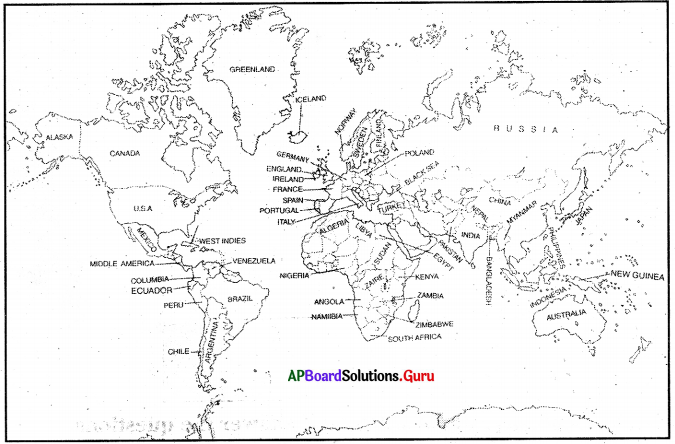
Locate the following places on the world map.
a) England b) Portugal c) France d) Spain
Answer:
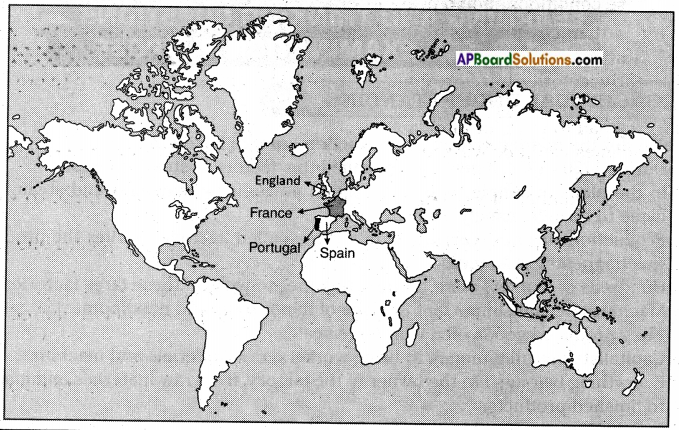
AP Board 7th Class Social Studies Solutions Chapter 8 Industrial Revolution 1

AP Board 7th Class Social Studies Solutions Chapter 8 Industrial Revolution

Question 11.
Read the para ‘Urbanisation and slums on page 82 and comment on it.
Urbanisation and slums: Industrial revolution led to a gradual shift of people from villages to towns. Industries and other urban activities gave people livelihood. As people moved to towns that were newly emerging, they settled down in makeshift houses and shelters which were cramped and had little sanitation or other facilities. Accidents, diseases and epidemics were common. Most workers’ residential areas lacked proper ventilation, health and sanitation facilities. Slums became a common scenario in towns and cities, especially near the factories and mines. At the same time, distinct quarters came up for the rich and the powerful which were well provided in terms of open spaces, sanitation, water supply, roads and other facilities. Slowly people fought for civil rights and the conditions of the workers quarters also improved.
Answer:
Industrialisation led to urbanisation. Slums are caused due to urbanisation. It is very difficult to provide health, sanitation and shelter facilities to the growing population in the urban areas. Public amenities like water, roads and education are also should be provided. The same condition is present in urban areas even today also.

Project Work

Question 1.
You may recall the lesson on agriculture and trade in Class VI. Compare the nature of farmers and traders in Andhra Pradesh with traders in Britain or Europe. You can use a few criteria and tabulate.
Answer:
The traders in Europe were international traders. They earned many profits. They purchase raw materials and market finished goods.
But our traders are local traders. They earn small profits. They purchase the finished goods and sell them with a little margin.

AP Board 7th Class Social Studies Solutions Chapter 8 Industrial Revolution

Question 2.
Do you know any child working in a factory or shop? If you find, how do you respond?
Answer:
Yes. If I find it, I will immediately respond to the concerned authorities to take action against child labour.
AP Board 7th Class Social Studies Solutions Chapter 7 Handicrafts and Handlooms

SCERT AP Board 7th Class Social Solutions 7th Lesson Handicrafts and Handlooms Textbook Questions and Answers.

AP State Syllabus 7th Class Social Studies Solutions 7th Lesson Handicrafts and Handlooms

7th Class Social Studies 7th Lesson Handicrafts and Handlooms Textbook Questions and Answers

Improve Your Learning

Question 1.
Do you think people have enough earnings from work like basket making and weaving?
Answer:
No. I think people do not have enough earnings from work like basket making and weaving.

Question 2.
Prepare a list of goods that could have substituted the basket. Discuss with your parents before preparing the list.
Answer:
List of goods which could have substituted the basket: Plastic basket, Plastic tray, Bamboo tray, Bamboo stand, Plastic bucket, Plastic bags, Woollen baskets and bags.

AP Board 7th Class Social Studies Solutions Chapter 7 Handicrafts and Handlooms

Question 3.
Many new products have replaced handicrafts – identify them and find out where they are produced. Discuss how this could affect the lives of handicrafts persons.
Answer:
a) Basket making:

  1. Baskets made of bamboo and eetha chettu leaves require simple investment.
  2. Basket makers are using very few materials mostly made of natural sources.
  3. But many plastic industries produce goods like baskets with cheap rates.
  4. So the demand for such products has reduced considerably.

b) Handloom weavers in Dharmavaram :

  1. Dharmavaram sarees one traditionally woven in the interlocked weft technique.
  2. Dharmavaram silk sarees are a benchmark in the traditional craft industry.
  3. They are very famous for striking colour combinations with contrast pallu and border woven with exquisite brocade gold patterns.
  4. Dharmavaram weavers face stiff competition from power loom and mill made cloth.
  5. These are cheaper as they are produced on machines.
  6. So weavers are not getting many rates for Dharmavaram sarees.

Thus the lives of basket makers and handloom weavers are getting worse.

AP Board 7th Class Social Studies Solutions Chapter 7 Handicrafts and Handlooms

Question 4.
Why did Polaiah’s family come to Kandukuru? Why does he have no right to vote in Kandukuru?
Answer:

  1. Polaiah’s family came to Kandukuru to sell baskets and earn money.
  2. a) Polaiah lives in a slum that does not have proper drainage, emits a foul smell and breeds mosquitoes and flies.
    b) The Municipal Corporation officials sometimes evict Polaiah and another basket
    maker families’ huts but they build them again.
    c) So these people like Polaiah don’t have any identity or proof of residence.
    d) In this way Polaiah have been denied voting rights and ration cards in this city

Question 5.
You may find crafts persons like Polaiah producing goods other than baskets. Meet two such persons, collect the following details and discuss them in the class. One sample is given for you.
Answer:

Name of the craftspersonGoods producedOne or two important raw materials usedSource of raw material
PolaiahBasketsSpokes of data palm leavesShankavaram- native village
PochaiahBommaluWood and paintsKondapalli-native village
MalleshamChairs, Tables, StoolsWood, nails and paints.Near forest village at Nandyala

Question 6.
Why do you think patenting Dharmavaram silk saree weaving would help weavers in and around Dharmavaram?
Answer:

  1. Dharmavaram is a small town in Ananthapur district in Andhra Pradesh.
  2. The weavers here produce unique sarees called silk sarees, which are world-famous.
  3. Dharmavaram Sarees are traditionally woven in the interlocked-weft technique.
  4. Dharmavaram silk sarees are a benchmark in the traditional craft industry.
  5. They are very famous for their striking colour combinations with contrast pallu and border woven with exquisite brocade gold patterns.
  6. Recently Dharmavaram sarees received the patent right.
  7. This means, no other handloom saree producers in the world can sell sarees in the name of “Dharmavaram silk sarees.”
  8. Only those produced in Dharmavaram and its surrounding villages can be sold with this brand name.
  9. These sarees are sold in India and abroad at high prices.

AP Board 7th Class Social Studies Solutions Chapter 7 Handicrafts and Handlooms

Question 7.
Should weavers procure raw materials, weave silk sarees and sell them directly to the people? What are the challenges in it?
(or)
Handloom weavers are facing a serious problem. They face stiff competition from power loom and mill made cloth, these are cheaper as they are produced on machines and also because they use synthetic yarn which is cheaper than cotton or silk even though it is popular due to its high quality and unique beauty, the Dharmavaram saree seems to be expensive. But weavers do not get a good rate due to middle men’s involvement.
Comment on the problems of weavers.
Answer:
Handloom weavers are facing many problems.

  1. They face stiff competition from power loom and mill made cloth. Because these are cheaper as they are produced on machines.
  2. The weavers are not getting their cost rate due to middle men’s involvement.
  3. Their buyers are spread all over the world and they do not have direct contact with them.
  4. Fashions in the cities change fast.
  5. It is difficult for the weavers to know what kind of design are in demand.
  6. Therefore they have to rely on middlemen to know about the designs.
  7. Raw materials like cotton or silk yarn are produced in faraway centres.
  8. So the weavers have to depend on middlemen for getting raw materials.

Question 8.
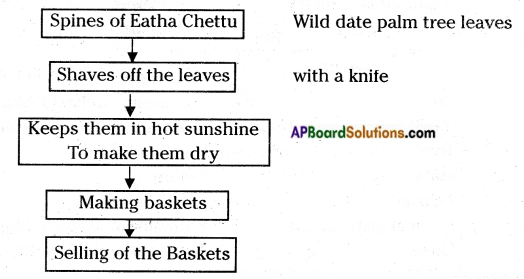
Prepare the flow diagram depicting the organisation of production in basket making and handloom textile weaving.
Answer:

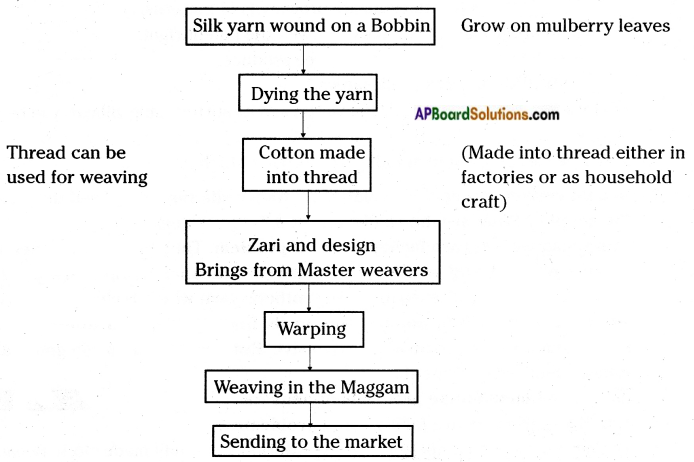
  1. The flow diagram for basket making:
    AP Board 7th Class Social Studies Solutions Chapter 7 Handicrafts and Handlooms 1
  2. The flow diagram for handloom textile weaving:
    AP Board 7th Class Social Studies Solutions Chapter 7 Handicrafts and Handlooms 2

AP Board 7th Class Social Studies Solutions Chapter 7 Handicrafts and Handlooms

Question 9.
Compare the similarities and differences between basket making and Ikkat saree weaving and fill in the following table.

WorkRaw materials usedTools usedHow goods are sold
Basket making
Handloom weaving

Answer:

WorkRaw materials usedTools usedHow goods are sold
Basket makingWild date palm leaves,KnifeSells directly to the customers
Handloom weavingSilk yarn, colour, zariMaggam, Stones, Punched Jacquard cardsSold to the middlemen

Question 10.
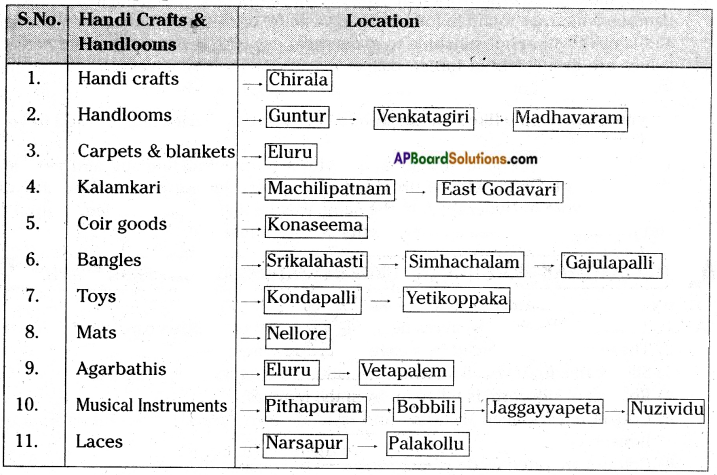
List various handicrafts with locations in Andhra Pradesh and prepare a chart.
Answer:

Handicrafts & HandloomsLocation
Handi CraftsUppada, Pochampalli, Chirala, Siddipeta.
Handlooms IndustryNarayanpet, Guntur, Venkatagiri, Gadwal pullampet and Madhavaram.
Carpets and blanketsEluru.
KalamkariMachilipatnam & East Godavari district.
CoirgoodsKonaseema in East Godavari district.
BanglesSrikalahasthi, Simhachalam and Gajulapalli.
ToysKondapalli.
MatsNellore.
AgarbathisEluru, Vetapalem.
Musical instrumentsPithapuram, Bobbili, Jaggayyapet and Nuzividu.
LacesNarsapur and Palakollu.

Note: Please prepare a chart above the matter.
AP Board 7th Class Social Studies Solutions Chapter 7 Handicrafts and Handlooms 3

AP Board 7th Class Social Studies Solutions Chapter 7 Handicrafts and Handlooms

Project Work

Question 1.
Invite a craftsperson to your classroom or visit their workplace. Make a wallpaper showing different processes of their production.
Answer:
Student Activity

Question 2.
Meet different artisans in your village/locality fill in the following table and discuss in the classroom.
AP Board 7th Class Social Studies Solutions Chapter 7 Handicrafts and Handlooms 4
Answer:
Student Activity

AP Board 7th Class Maths Solutions Chapter 4 Lines and Angles Exercise 4.3

SCERT AP 7th Class Maths Solutions Pdf Chapter 4 Lines and Angles Ex 4.3 Textbook Exercise Questions and Answers.

AP State Syllabus 7th Class Maths Solutions 4th Lesson Lines and Angles Exercise 4.3

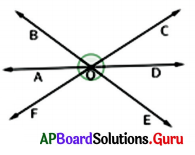
Question 1.
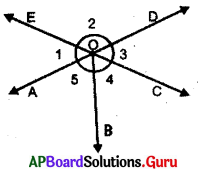
Name three pairs of vertically opposite angles in the figure. If ∠AOB = 45°, then find ∠DOE.
AP Board 7th Class Maths Solutions Chapter Chapter 4 Lines and Angles Ex 4.3 1
Answer:
Vertically opposite angles :
∠AOB, ∠DOE; ∠BOC, ∠EOF; ∠COD, ∠AOF
Given ∠AOB = 45°
In the given figure, ∠AOB is the vertically opposite angle to ∠DOE.
So, ∠DOE = ∠AOB = 45°
∴ ∠DOE = 45°

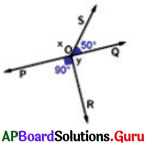
Question 2.
In the given figure \(\overrightarrow{\mathbf{PQ}}\) is a straight line. Check whether x and y are vertically opposite angles or not. Give reason.
AP Board 7th Class Maths Solutions Chapter Chapter 4 Lines and Angles Ex 4.3 2
Answer:
\(\overrightarrow{\mathbf{PQ}}\) is a straight line. But \(\overrightarrow{\mathbf{SR}}\) is not a straight line.
If \(\overrightarrow{\mathbf{PQ}}\) and \(\overrightarrow{\mathbf{SR}}\) are intersecting lines the x and y become vertically opposite angles.
So, x and y are not vertically opposite angles.

AP Board 7th Class Maths Solutions Chapter 4 Lines and Angles Exercise 4.3

Question 3.
Write any three examples for vertically opposite angles in your surroundings.
Answer:
Scissors, window grills, cross roads, rail cross junctions, etc.

Question 4.
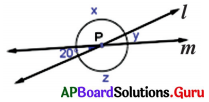
In the given figure, the lines l and m intersect at point P. Observe the figure and find the values of x, y and z.
AP Board 7th Class Maths Solutions Chapter Chapter 4 Lines and Angles Ex 4.3 3
Answer:
Given l and m are intersecting lines at P.
∠y = 20° (vertically opposite angles)
∠x = ∠z (vertically opposite angles)
∠y + ∠x = 180° (linear pair)
⇒ 20° + ∠x = 180°
⇒ 20° + ∠x – 20° = 180°- 20
⇒ ∠x = 160°
∴ ∠x = ∠z = 160°
∠x = 160°, ∠y = 20° and ∠z = 160°.

Question 5.
In the given figure, two lines \(\overleftrightarrow{\mathbf{A D}}\) and \(\overleftrightarrow{\mathbf{E C}}\) intersects at O. Name two pairs of vertically opposite angles in the given figure.
AP Board 7th Class Maths Solutions Chapter Chapter 4 Lines and Angles Ex 4.3 4
Answer:
In the given figure \(\overleftrightarrow{\mathbf{A D}}\) and \(\overleftrightarrow{\mathbf{E C}}\) are intersecting at O.
∠AOE = ∠COD (Vertically opposite angles)
∠1 = ∠3
∠EOD = ∠AOC (Vertically opposite angles)
∠EOD = ∠AOB + ∠BOC (we know ∠AOC = ∠AOB + ∠BOC)
∠2 = ∠5 + ∠4

AP Board 7th Class Maths Solutions Chapter 4 Lines and Angles Exercise 4.3

Question 6.
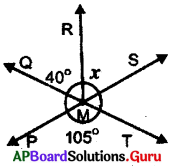
Two lines \(\overleftrightarrow{\mathbf{P S}}\) and \(\overleftrightarrow{\mathbf{Q T}}\) intersect at M. Observe the figure and find x.
AP Board 7th Class Maths Solutions Chapter Chapter 4 Lines and Angles Ex 4.3 5
Answer:
In the given figure \(\overleftrightarrow{\mathbf{P S}}\) and \(\overleftrightarrow{\mathbf{Q T}}\) are intersecting at M.
∠PMQ = ∠TMS (Vertically opposite angles)
∠QMS = ∠PMT (Vertically opposite angles)
∠QMR + ∠RMS = ∠PMT (we know ∠QMS = ∠QMR + ∠RMS)

But, given, ∠QMR = 40°, ∠RMS = x° and ∠PMT = 105°
⇒ 40° + x° – 40° = 105° – 40°
∴ x° = 65°

AP Board 1st Class English Solutions Lesson 3.2 My Actions

Andhra Pradesh AP Board 1st Class English Solutions Lesson 3.2 My Actions Textbook Exercise Questions and Answers.

AP State Syllabus 1st Class English Solutions Chapter 3.2 My Actions

Textbook Page No. 39

1. Warm-up Time

AP Board 1st Class English Solutions Lesson 3.2 My Actions 1
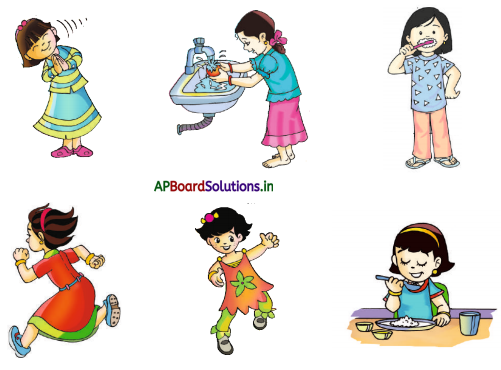
Ask the children to look at the picture and answer the following questions orally.

Question 1.
What are the children doing in the picture ?
Answer:
children are doing several things like cleaning, running and eating.

Question 2.
When do you brush your teeth ?
Answer:
I brush my teeth in the morning and night.

Question 3.
Do you wash your hands before eating something ?
Answer:
Yes, I wash my hands before eating something.

AP Board 1st Class English Solutions Lesson 3.2 My Actions

Question 4.
Why do you wash your hands ?
Answer:
I wash my hands to get rid of germs and dirt.

Textbook Page No. 40

2. Rhyme Time

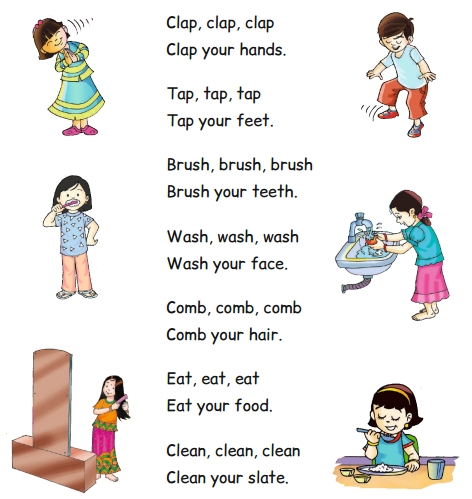
Recite the poem with appropriate actions and gestures. Ask children to repeat the poem after you.
AP Board 1st Class English Solutions Lesson 3.2 My Actions 2
Answer:
Student Activity

Textbook Page No. 41

3. Action Time

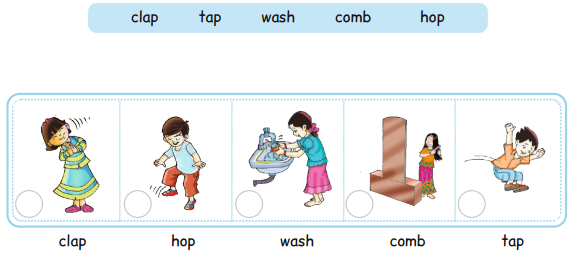
Say the following action words and encourage the children to mimic the actions. Ask children to tick (✓) the picture matching with the correct action words.
AP Board 1st Class English Solutions Lesson 3.2 My Actions 3
Answer:
Student Activity

AP Board 1st Class English Solutions Lesson 3.2 My Actions

4. Circle Time

Activity – 1
Note the teacher : Ask the children to stand in a circle.
Say the action words and ask them to mimic.
While doing this, give them a ball and ask them to pick up the ball in the middle of the action.
Increase the speed gradually to have fun.
Answer:
Student Activity

Textbook Page No. 42

5. Fun Time

Activity – 1
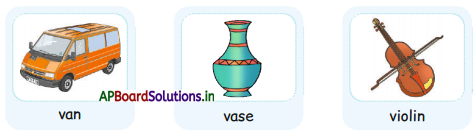
Read the words aloud.
AP Board 1st Class English Solutions Lesson 3.2 My Actions 4
Answer:
Student Activity

Activity – 2
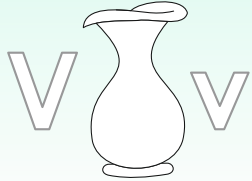
Look at the picture and the letters. Colour them.
AP Board 1st Class English Solutions Lesson 3.2 My Actions 5
Answer:
Student Activity

AP Board 1st Class English Solutions Lesson 3.2 My Actions

Activity – 3
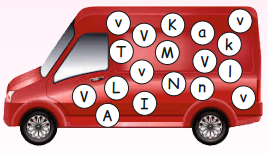
Find ‘V’ and ‘v’ in the picture. Colour them.
AP Board 1st Class English Solutions Lesson 3.2 My Actions 6
Answer:
Student Activity

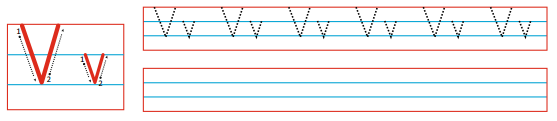
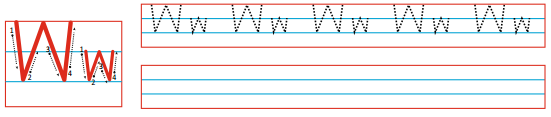
Activity – 4
Trace and copy the following letters.
AP Board 1st Class English Solutions Lesson 3.2 My Actions 7
Answer:
Student Activity

AP Board 1st Class English Solutions Lesson 3.2 My Actions

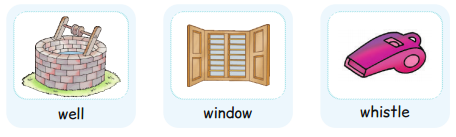
Activity – 5
Read the words aloud.
AP Board 1st Class English Solutions Lesson 3.2 My Actions 8
Answer:
Student Activity

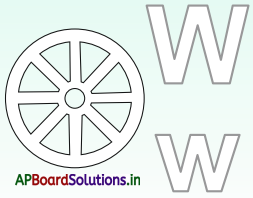
Activity – 6
Look at the picture and the letters. Colour them.
AP Board 1st Class English Solutions Lesson 3.2 My Actions 9
Answer:
Student Activity

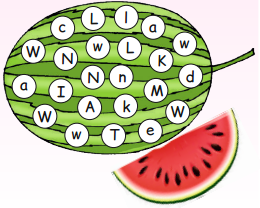
Activity – 7
Find ‘W’ and ‘w’ in the picture. Colour them.
AP Board 1st Class English Solutions Lesson 3.2 My Actions 10
Answer:
Student Activity

AP Board 1st Class English Solutions Lesson 3.2 My Actions

Activity – 8
Trace and copy the following letters.
AP Board 1st Class English Solutions Lesson 3.2 My Actions 11
Answer:
Student Activity

Textbook Page No. 44

6. Practice Time

Read with rhythm
Activity – 1
Elicit the answers by asking relevant questions on the given picture. Ask students to say the sentences given below to reinforce the short vowel sound of ‘I’ Let them repeat after you.
AP Board 1st Class English Solutions Lesson 3.2 My Actions 12

  • A kid with a lid.
  • A thin kid with a tin lid.
  • A thin kid with a tin lid hid.

Answer:
Student Activity

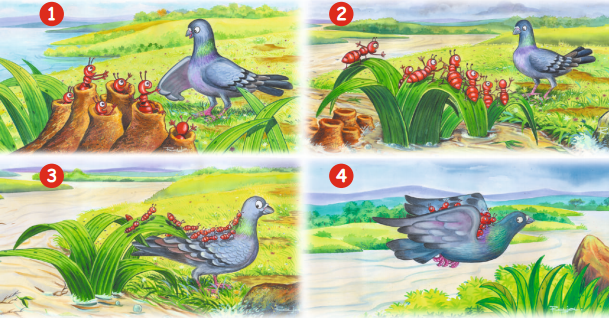
Friendship

Show the following pictures and encourage the students to frame the story.
AP Board 1st Class English Solutions Lesson 3.2 My Actions 13
Answer:
Once there lived some ants in an anthill, there was a river near the ant hill. The ants found that the river was flowing. The level of the water was rising. They did not know what to do. They would die if they stayed there.

AP Board 1st Class English Solutions Lesson 3.2 My Actions

The ants appealed to a dove. They climbed onto the leaves of a plant. The dove came near to the leaves of the plant. One by one, the ants climbed on the back of the dove.

The dove flew off and took the ants to a safe place.

AP Board 7th Class Social Studies Solutions Chapter 5 Europe

SCERT AP Board 7th Class Social Solutions 5th Lesson Europe Textbook Questions and Answers.

AP State Syllabus 7th Class Social Studies Solutions 5th Lesson Europe

7th Class Social Studies 5th Lesson Europe Textbook Questions and Answers

Improve Your Learning

Question 1.
The Atlantic Ocean has a deep impact on the climate of Europe as well as on the life and livelihood of the people of Europe. Collect relevant information and write an essay on the theme.
Answer:
Europe has four dominant types of climate-maritime in the south and mountain in the lands. The maritime climate has moderate temperatures in both summer and winter.
The climate of western Europe is far more moderate due to the marine influences of the relatively warm waters of the North Atlantic Drift, which are brought onshore by the prevailing Westerly winds. The major air pressure systems include the Icelandic. low, dominant in winter but influential all year, which is the origin of cyclonic storms. So impact in the changing weather conditions in western and northern Europe.
The North Atlantic drift brings warmer weather to Europe. Temperatures on the European continent are about 15°F warmer than other areas of the same latitude.

AP Board 7th Class Social Studies Solutions Chapter 5 Europe

Question 2.
Answer these questions with the help of the maps given in the lesson:
a) Which of the following is not a landlocked (surrounded by land) country?
(Hungary/Romania/Poland/Switzerland)
Answer:
Switzerland.

b) Which mountains lie between the Caspian Sea and the Black Sea?
(Alps/Caucasus Mountains)
Answer:
The Caucasus.

c) Which countries are on the shores of the Arctic Ocean?
(Russia/Germany/Sweden/Norway)
Answer:
Norway, Sweden, and Russia.

d) Can a ship sail from the Black Sea to the Atlantic Ocean? If yes, trace the route it will have to take.
Answer:
Yes, a ship can sail from the Black Sea to the Atlantic Ocean. The route is – the Black Sea to waters between Turkey and Bulgaria → to the Mediterranean Sea → Atlantic Ocean.

Question 3.
Why are harbors built-in deep gulfs or bays?
Answer:

  1. Bays and gulfs are parts of the sea enclosed by land on three sides.
  2. In a bay, the land curves inwards and the mouth of the bay is usually wide as in the Bay of Bengal.
  3. A gulf is a narrow inlet of the sea and has a narrow mouth.
  4. Since the bays and gulfs are protected from the storms of the high seas they are very useful for building harbors where ships can be safely anchored and cargo loaded or unloaded.
  5. Deep gulfs or bays are preferred for building harbors as Large ships can be anchored in them.
  6. Ships need deep waters so that their bottoms do not touch the seafloor.

AP Board 7th Class Social Studies Solutions Chapter 5 Europe

Question 4.
Why are the winters less severe in Western Europe than in Eastern Europe?
Answer:

  1. Besides its distance from the Equator, the climate of Europe is influenced by another factor – the Atlantic Ocean and the winds blowing from it.
  2. This impact is felt more by the regions along the Atlantic Ocean than the ones which are far inland.
  3. In the winters it is quite cold in Western Europe but it is even colder in Eastern Europe,
  4. Thus countries like Poland and Russia have severe winters while France and Great Britain are comparatively warmer.
  5. Russians winters are so cold that the rivers and even the nearby seas freeze
  6. However, this does not happen in the countries of West Europe along the sea coast.
  7. This difference must be because of the nearness of Western Europe to the Atlantic Ocean.

Question 5.
Name four countries on the coast of the Black Sea.
Answer:
The following are the countries on the coast of the Black Sea.

  1. Ukraine
  2. Romania
  3. Bulgaria
  4. Turkey

Question 6.
How do the Westerlies benefit the people of Western Europe?
Answer:
The Westerlies, which blow throughout the year also bring ample moisture to Northern and Western Europe. Since these winds blow from the sea they carry a lot of moisture and regularly cause rainfall. This is why it rains throughout the year in Northern and Western Europe. While it rains only for a few months in our country, there are light showers all around the year in Western Europe. The skies there are usually clouded. While we, in India, eagerly await cool showers, the people of Western Europe long for bright sunny days.
Western Europe also benefits in other ways from the Gulf Streams. The warm currents are very good for fish breeding as they contain ample food materials ic’- the fishes. As a result, the fishery industry is very well developed in the North Sea near Britain. This part of the North Sea is called ‘Dogger Bank’. Fish is an important part of the food of the Europeans and fishing is a very important industry in Europe.

AP Board 7th Class Social Studies Solutions Chapter 5 Europe

Question 7.
What are the characteristics of the Mediterranean climate? Name the countries which have a Mediterranean climate.
Answer:
The countries of Southern Europe have the Mediterranean Sea to their south. They are called ‘Mediterranean Countries’. The lands along the Mediterranean Sea have a distinct climate called the ‘Mediterranean climate’.
The Mediterranean countries are the southernmost countries of Europe. As a result, the winters here are not too cold and summers are warm. It does not rain all through the year as in Western Europe. The Westerlies blow here during the winter months only. These winds bring rain to the Mediterranean countries. In other words, it rains here only in winter. Such rainy winters and dry summers are termed as a Mediterranean climate. Several regions in other continents too have a Mediterranean climate. This climate is very good for growing juicy fruits.
The Mediterranean type of climate is found in Portugal, Spain, France, Monaco, Italy, Croatia, Yugoslavia, Albania, Greece and Ukraine.

Question 8.
What are the factors that limit European agriculture?
Answer:
A very large part of Europe is mountainous and not suitable for agriculture. In eastern and northern Europe, it is not possible to cultivate land in winter, due to extreme cold. As a result, it is possible to rain only one crop in a year.

Question 9.
Name the important crops of southern Europe.
Answer:
Wheat, barley, oats, rye, sugar – beet, potato, and fruits are the important crops in southern Europe.

AP Board 7th Class Social Studies Solutions Chapter 5 Europe

Question 10.
How can you say that trade and cultural relations have been developed among the countries due to the discovery of new sea routes by European sailors?
Answer:

  1. Europeans overseas expansion led to the contact between the old and new worlds producing the Columbian exchange, named after Columbus.
  2. It involved the transfer of goods unique from one hemisphere to another.
  3. It led to the age of Imperialism, where European colonial powers came to control most of the planet.
  4. The European appetite for trade commodities, empires, and slaves greatly affected many other areas of the world.
    So I can say that trade and cultural relations have been developed due to the discovery of new sea routes by European sailors.

Question 11.
Read the last para of this lesson and comment on it.

Industrial Revolution in Europe

The industrial revolution as you know started in England around 1750 and soon factory production spread to France, Holland, Germany, Spain, Russia, etc. Countries like England and Germany, which had large reserves of coal and other minerals, took lead in developing new industries.
However, as times changed, European countries began to use less and less of their own mineral resources and relied on imports from other countries. The old mining towns and old factories were closed down and new factories grew in new areas. Industrialization also enabled the European countries to import agricultural goods from other countries. Thus, they relied less on the agriculture of their countries for their food and raw material requirements. Hence, Europe became dependent upon trade with other countries. Initially, this trade was with their colonies in Asia, Africa, and America. However as the colonies became independent, they had to develop new ways of trading with them.
Answer:

  1. The industrial revolution started in England around 1750 and soon factory production spread to France, Holland, Germany, Spain, Russia, etc. Countries like England and Germany which had large reserves of coal and other minerals took lead in developing new industries. –
  2. However, as times changed, European countries began to use less and less of their own mineral resources and relied on imports from other countries.
  3. The old mining towns and old factories were closed down and new factories grew in new areas.
  4. Industrialization also enabled the European countries to import agricultural goods from other countries.
  5. Thus they relied less on the agriculture of their countries for their food requirements and raw material requirements.
  6. Hence Europe became dependent upon trade with other countries.
  7. Initially, this trade was with their colonies in Asia, Africa, and America.
  8. However as the colonies became independent, they had to develop new ways of trading with them.

AP Board 7th Class Social Studies Solutions Chapter 5 Europe

Question 12.
How is agriculture similar or different in Europe from that of our country?
(OR)
How are agricultural practices similar or different in Europe from those practiced in India? Explain.
Answer:
Indian agriculture is quite different from European agriculture.

  1. Seasons: In our country, we have three seasons winter, summer, and rain.
  2. In Europe, they have four seasons winter, spring, summer, and autumn.

Agricultural seasons:

  1. In our country, we have two agricultural seasons Rabi and Kharif mean winter and monsoon. Crops are grown nearly eight to 10 months a year.
  2. Summer is the season of agriculture in Europe. There is no need for irrigation as the occasional showers are sufficient for the crops. The cultivation is possible only for 6 to 7 months.
  3. A very large part of Europe is mountainous and not suitable for agriculture.
  4. In India as much as 55% of the land is cultivable.

AP Board 7th Class Social Studies Solutions Chapter 4 Oceans and Fishing

SCERT AP Board 7th Class Social Solutions 4th Lesson Oceans and Fishing Textbook Questions and Answers.

AP State Syllabus 7th Class Social Studies Solutions 4th Lesson Oceans and Fishing

7th Class Social Studies 4th Lesson Oceans and Fishing Textbook Questions and Answers

Improve Your Learning

Question 1.
Does Bhavanapadu look like the place you live in? What differences and similarities can you think of? Compare them on the following aspects,
a. Sources of livelihood
b. Types of employment
c. Water sources
d. Agriculture practices
Answer:
No. Bhavanapadu is a village on the coastline of Andhra Pradesh. Ours is a village Nandamaru, Unguturu Mandal in West Godavari district.

ComparisonBhavanapaduOur village Nandamuru
a.Sources of livelihoodFishing, AgricultureAgriculture
b.Types of employmentLaborers in fields salt pans, brokersAgricultural laborers, shop owners, vegetable vendors, etc.
c.Water sourcesOcean waterRiver, canal, and well water.
d.Agriculture practicesOld systemsOld and modern systems.

AP Board 7th Class Social Studies Solutions Chapter 4 Oceans and Fishing

Question 2.
How many types of ocean movements are there? Which of them is useful to the fishermen
Answer:
The water of the oceans is never still. There are different kinds of movements of water.
Ocean waters have three kinds of movements. They are:

  1. Waves: When the water on the surface of the ocean rises and falls, they are called waves. They are formed when gentle winds scrape across the ocean surface. The faster the wind, the bigger will be the waves.
  2. Currents: In the oceans, water is found to move from one part to another in big streams. These streams flow constantly in a definite direction on the surface of the ocean a called ocean currents. The ocean currents are of two types – The warm currents and the cold currents. The warm currents flow from the equatorial region towards the poles. The cold currents flow from the poles to towards the equatorial regions.
  3. Tides: Tides are the rhythmic rise and fall in the level of the water in the oceans every day. All places on the coast experience some hours of low tide and some hours of high tide. Tides do not rise to the same height every day. When the tide is high water comes up to the coast for some distance. Then as the low tide begins, the water moves back from the land. The tides are of great help to fishing. Tides at some places take away the mud brought down by rivers and prevent silting.

Question 3.
What is the difference between fishing with Mechanical boats and that of Karrateppa?
Answer:

Mechanical boatsKarrateppa
1. It is a costly boat. It costs around Rs. 6 lakhs.1. It is a country-made boat. So it is very cheap.
2. It has a capacity of 20 members. It has far more risk of life.2. It has the capacity of a few members. It has not had many risks compared to Marapadava.
3. Rs. 5000/- needed for a trip for diesel, wages, and other things.3. It does not need much money.
4. They can go far off places in the sea and can fish for a long time.4. It can cover very short distances.
5. In case of emergency, it is difficult to swim over to the shore.5. In case of emergency, it is easy to swim over to the shore.

AP Board 7th Class Social Studies Solutions Chapter 4 Oceans and Fishing

Question 4.
Write the process of getting a mechanical boat ready for fishing?
Answer:
The boat is made ready the day before with all the necessary things properly loaded. Before launching into the sea :

  1. The fishermen check the engine.
  2. They also check the rope puller.
  3. The additional stock of diesel is kept in the boat.
  4. They keep their food packages in the boat.
  5. They pray to the goddess in whom they have a strong faith.

Question 5.
What does the tool kit of fisherman contain?
Answer:
The fisherman has a special tool kit for repairing the nets which consists of Nulukarralu (net remaining fork), Nulukanda (thread), and a flattened stick that determines the net ring size.

Question 6.
What are the similarities that you find between the surface of the earth and the bottom of the sea?
Answer:
The floor of the ocean is just like the surface of the earth. The bottom of the sea is not a flat surface. It consists of hills, mountains, plateaus, plains, and trenches, etc.

Question 7.
Collect information about the aquifers of your village/town and fill in the table. Analyze the benefits.
AP Board 7th Class Social Studies Solutions Chapter 4 Oceans and Fishing 1
Answer:

S.No.Name of the aquiferUsesLimitations
1.Confined aquiferDrinking waterThe aquifer and vulnerability maps can assist with the planning process. In order to assist in the correct interpre­tation and use of the maps, SEPA alerts the user to the following limitations.
2.Unconfined aquiferCultivationHigher vulnerability ratings do not necessarily mean that all activities are unsuitable. Groundwater vulnerability is only one component of risk.
3.Semi confined aquiferDomestic useThe maps will be updated as new geological information becomes available. Maps of receptors will he added, identifying the location of known groundwater abstrac­tions and groundwater-dependent ecosystems.

AP Board 7th Class Social Studies Solutions Chapter 4 Oceans and Fishing

Question 8.
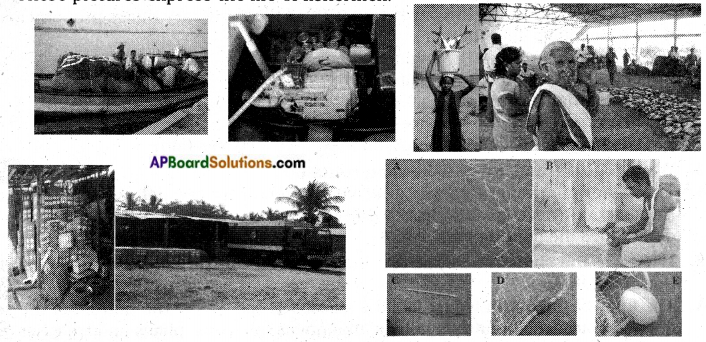
Make an album that reflects the life of fishermen.
Answer:
These pictures express the life of fishermen.
AP Board 7th Class Social Studies Solutions Chapter 4 Oceans and Fishing 2

Question 9.
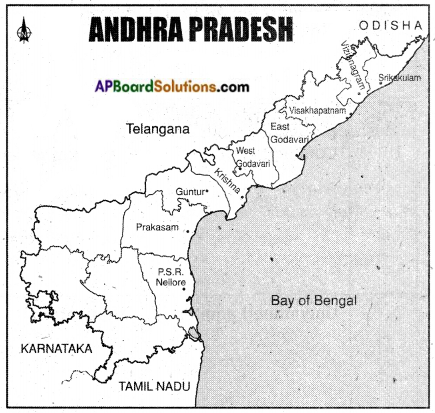
Locate the coastal districts of Andhra Pradesh and write them down.
Answer:
AP Board 7th Class Social Studies Solutions Chapter 4 Oceans and Fishing 3

  1. P.S.R. Nellore
  2. Prakasam
  3. Guntur
  4. Krishna
  5. East Godavari
  6. West Godavari
  7. Visakhapatnam
  8. Vizianagaram
  9. Srikakulam

AP Board 7th Class Social Studies Solutions Chapter 4 Oceans and Fishing

Question 10.
What solutions do you show to the fishermen for not depending on the middlemen for money?
Answer:
The fishermen should form themselves as an association or should open a cooperative bank. The association or bank should act as middlemen for the sake of money.

Question 11.
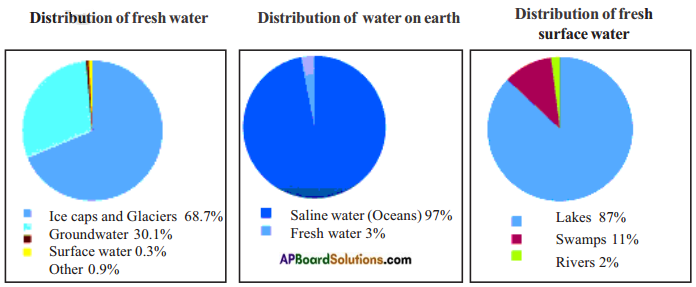
Across the last 4 chapters, we studied many different aspects of water. Here is more information about the availability of water on our Earth. Look at them carefully and explain the availability of water resources on the Earth.
AP Board 7th Class Social Studies Solutions Chapter 4 Oceans and Fishing 4
Answer:
71% of our Earth is covered with water.
a) Out of the total water on earth, 97% is saline water and 3% is freshwater.
b) Out of the total freshwater, icecaps and glaciers are 68.7%, groundwater 30.1%, surface water is 0.3% and other is 0.9%.
c) Out of the total fresh surface water, lakes are 87%, swamps are 11% and rivers are 2%.

Question 12.
How do you support the statement ‘The life of fishermen is tied up with seas’.
Answer:
I supported the following statement. The life of fishermen is tied up With seas, why because he doesn’t know any other work. From childhood days onwards he depends on the sea to catch the fish and continue his life. He earns money for his family through fishing only. He has no capacity to live in either village or town because he has no assets and large lands. His main occupation is fishing only. He felt that the sea or Ocean is god and world to him also.

AP Board 7th Class Social Studies Solutions Chapter 4 Oceans and Fishing

Question 13.
Read the first para of page 32 and comment on it.

Fishing Village on the Coastal Plains

Ocean water is always saline. It contains several mineral salts dissolved in it. The oceans are the main source of rainfall. Oceans are storehouses of fish and other seafood. They are the main source of salts. Oceans provide natural highways for international trade. Let us visit Bhavanapadu, a fishing village near the coast of Andhra Pradesh, and study the life of people living near the ocean.
Answer:
The oceans are useful to us in many ways

  1. We get salt from the ocean water.
  2. Seas abound in mineral wealth.
  3. Oceans provide us with large quantities and a variety of marine foods such as fish, shrimp, oysters, and crabs, etc.
  4. The oceans serve as water transport systems from one continent to another continent. It is cheaper to transport heavy cargo through navigation.
  5. Pearls are found in oysters.

Project

AP Board 7th Class Social Studies Solutions Chapter 4 Oceans and Fishing 5
Read some writings which reference the lifestyle of fishermen. Eg: Samajanv Musalodu, Aatu-Potu (Janjhavathi Kathalu)
Answer:
Students’ Activity.

AP Board 7th Class Social Studies Solutions Chapter 3 Tanks and Ground Water

SCERT AP Board 7th Class Social Solutions 3rd Lesson Tanks and Ground Water Textbook Questions and Answers.

AP State Syllabus 7th Class Social Studies Solutions 3rd Lesson Tanks and Ground Water

7th Class Social Studies 3rd Lesson Tanks and Ground Water Textbook Questions and Answers

Improve Your Learning

Question 1.
Correct the incorrect sentences:
a) Water flows from the plains to the plateau. (✕)
Answer:
Water flows from the plateau to the plains.

b) There is a thick deposit of sand and gravel in the plains. (✕)
Answer:
There is a thick deposit of alluvium in the plains.

c) Groundwater will never dry. (✕)
Answer:
Groundwater will dry sometime.

d) It is easy to dig wells in Rajahmundry. (✓)
Answer:
Correct

AP Board 7th Class Social Studies Solutions Chapter 3 Tanks and Ground Water

Question 2.
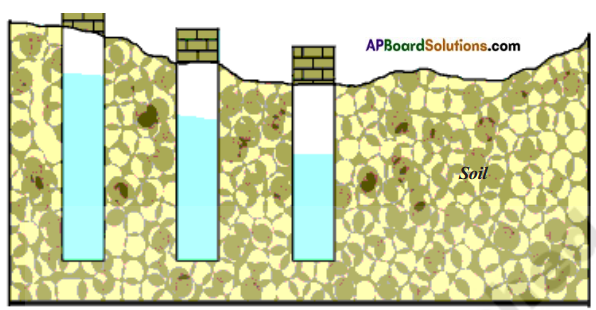
The wells shown in this figure are situated on the plains of the Godavari. But there seems to be a mistake in the figure. Can you correct it?
AP Board 7th Class Social Studies Solutions Chapter 3 Tanks and Ground Water 1
Answer:
The water level should be the same.

Question 3.
In which of these places do you expect maximum percolation to take place?
AP Board 7th Class Social Studies Solutions Chapter 3 Tanks and Ground Water 2
Answer:
B

Question 4.
When the owners of some wells in Pallerla started using high-powered motors to draw water from the wells, the owners of other wells noticed that their wells were drying up. Discuss the possible solution to the problem.
Answer:
The owners of other wells should resist that owner from using high-power motors. And the owner also should take necessary preventive steps to store rainwater/ underground water.

AP Board 7th Class Social Studies Solutions Chapter 3 Tanks and Ground Water

Question 5.
In areas where there is a shortage of groundwater, should there be any restrictions on digging tube wells? Why?
Answer:
The areas which have a shortage of groundwater are stated as notified areas by Central Ground Water Authority. In these areas, there is permission for only one tube well to meet the drinking and domestic purpose of water, its diameter should be 100 mm, and the capacity of the pump should not exceed 1 HP. It should have a rainwater harvesting system on the premises. Otherwise, the ‘holding capacity in the matter inside the earth will be lessened.

Question 6.
Think about the ways to restore the groundwater in your area?
Answer:
In our area also people draw more water from the ground, so the groundwater is decreasing over time. I think the following steps are useful to enhance groundwater

  1. Vegetation like trees and grasses and bunds are used to enhance groundwater.
  2. We follow watershed development projects.
  3. Under these projects trees and grasses are planted on the hill slopes from where a stream starts and small bunds are built across streams to stop the flow of water.
  4. I suggest the people store rainwater in tanks and not dig wells too deep in the ground.
  5. I think tanks should be developed in our village which helps the people not only in giving them and their animals drinking water, but also irrigating their fields in such a way that even in drought years people could raise at least some crops.

AP Board 7th Class Social Studies Solutions Chapter 3 Tanks and Ground Water

Question 7.
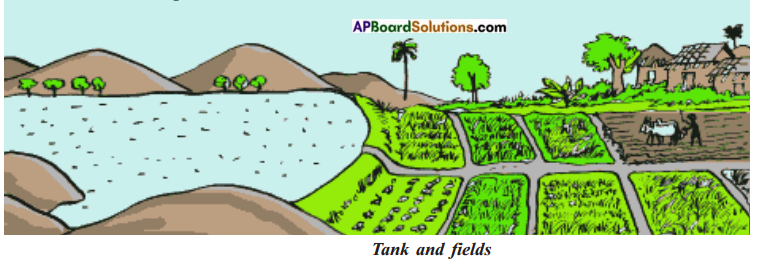
Observe the following picture and compare it with your locality.
AP Board 7th Class Social Studies Solutions Chapter 3 Tanks and Ground Water 3
Answer:
Our village is ‘Kalisipudi’ village in West Godavari District. There are no hills around our village like here. We have two water tanks – one is for drinking water and the another is for cultivation. Rainwater is saved in one tank. Water from* the canal, which was dug from the river Godavari, will be turned to another tank. Our farmers use tractors for ploughing. Our residences are far away from our fields. Draw the map of your village and locate the water resources of your village in it.

Question 8.
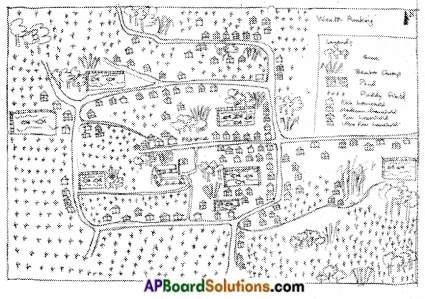
Draw the map of your village and locate the water resources of your village in it.
Answer:
A village picture – (with well, water tank)
AP Board 7th Class Social Studies Solutions Chapter 3 Tanks and Ground Water 4

Question 9.
Read the third para of page 27 and write a comment on it.
Water quickly flows into streams and into rivers. However, if the flow of the j rainwater were to be checked by vegetation or bunds, then there would be a greater possibility of the water percolating into the soil to join the groundwater.
Answer:
After runoff comes the last step of the water cycle, percolation.
Percolation occurs when the water on the earth’s surface in the run-off stage seeps underground. That is why in the old days they used wells to retrieve water.

AP Board 7th Class Social Studies Solutions Chapter 3 Tanks and Ground Water

Project

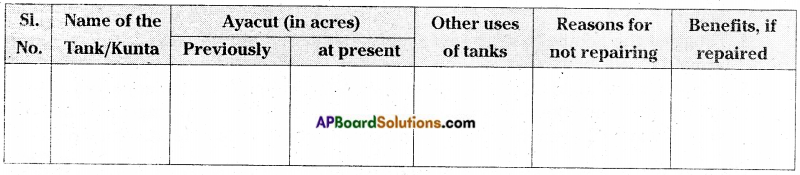
Collect the following information about the tanks/kuntas.
AP Board 7th Class Social Studies Solutions Chapter 3 Tanks and Ground Water 5
Answer:
Students’ Activity.

AP Board 7th Class Social Studies Solutions Chapter 2 Rain and Rivers

SCERT AP Board 7th Class Social Solutions 2nd Lesson Rain and Rivers Textbook Questions and Answers.

AP State Syllabus 7th Class Social Studies Solutions 2nd Lesson Rain and Rivers

7th Class Social Studies 2nd Lesson Rain and Rivers Textbook Questions and Answers

Improve Your Learning

Question 1.
Explain how water changes into water vapour and how clouds are formed from it.
Answer:

  1. The story of rain begins with water vapour. When we dry our wet clothes in the open, we see that the water disappears after a while, and the clothes dry.
  2. Similarly, if we keep some water on a plate, it dries up in a couple of days.
  3. Actually, water in the cloth or in the plate becomes water vapour and mixes with the air through a process called ‘evaporation’.
  4. So even when water is not boiling there is evaporation.
  5. There are several water bodies on the earth’s surface – oceans, rivers, lakes, etc.
  6. There is constant evaporation of water from these water bodies.
  7. In fact, wherever there is moisture, like on a wet cloth, there is evaporation.
  8. There is evaporation from our bodies, from trees, plants and soil.
  9. When water vapour rises with hot air and reaches high up in the sky, it gets cooled.
  10. With the cooling, water vapour is transformed into tiny water droplets.
  11. These droplets gather around minute dust or smoke particles in the air and v gradually increase in size.
  12. These small drops of water gather to form the clouds.

AP Board 7th Class Social Studies Solutions Chapter 2 Rain and Rivers

Question 2.
Where do evaporation and cloud formation take place on a large scale?
Answer:

  1. There are several water bodies on the earth’s surface – oceans, rivers lakes, etc.
  2. There is constant evaporation of water from these water bodies.
  3. Since evaporation takes place all over the earth’s surface, clouds are also being formed all over.
  4. However, it is on the surface of the oceans that maximum evaporation and cloud formation take place.
  5. After all, oceans are vast water bodies extending up to thousands of kilometres.
  6. As a result, it also rains very heavily on the oceans.
  7. Clouds travel inland for thousands of kilometres to bring rain to us.

Question 3.
How do the clouds reach deep inland?
Answer:
Clouds travel inland for thousands of kilometres to bring rain to us. These winds come all the way from the Arabian sea and the Bay of Bengal and they transport the rainy clouds. They are called “Monsoon winds’. They are also called ‘South West Monsoon winds, as they blow from that direction. Their winds blow only in the summer.
There are two arms of the monsoon winds: One blows from the Arabian sea and the other from the Bay of Bengal.
When the South-West monsoon sets around the beginning of June the winds carrying the clouds also reach Andhra Pradesh. These winds reach the Rayalaseema districts of Chittoor and Kurnool first. However they bring very little rain as most of the moisture in the clouds falls down in rain in the Western Ghats and only dry clouds and winds, reach Rayalaseema. The mountain ranges like the Western Ghats in the path of a rain-bearing wind cause them to rise. Rising air cools down and water vapour condenses faster. Further ascent leads to rainfall.

Question 4.
Where does it rain maximum? Choose the right option.
A) sea coasts that are in the direction of the winds.
B) Mountains that are in the direction of the winds.
C) Lands far away from the seas.
Answer:
Sea coasts that are in the direction of the winds.

Question 5.
Fill in the blanks choosing the correct options (bank, tributaries, flood-plain river valley)
a) A river flows through the …………… .
b) Streams or rivers joining a larger river are called the …………… of the main river.
c) The entire valley of a river which is filled with water during the floods is called the …………… of the river.
Answer:
a) river valley
b) tributaries
c) flood – plain.

AP Board 7th Class Social Studies Solutions Chapter 2 Rain and Rivers

Question 6.
The Godavari flows from the west to the east. Why?
Answer:
The plain through which the rivers in Andhra Pradesh flow is high in the North – West. It slopes towards the South-East. The rivers originate in the West. Hence they naturally flow towards the South-East and finally join the Bay of Bengal.
Rivers like the Krishna and the Godavari start from the Western Ghats which receive heavy rains. The rainwater slowly percolates into the ground and flows into the river all through the year.

Question 7.
Describe the main stages of the water cycle. (or)
Describe the different stages of the water cycle.
Answer:
Main stages of the water cycle:
Humidity: The amount of invisible water vapour present in the atmosphere is known as humidity.
Evaporation: The transformation of water from liquid to gas phases as it moves from the ground or bodies of water into the overlying atmosphere due to solar radiation.
Condensation: The transformation of Water vapour to liquid water droplets in the air, creating clouds and fog.
Precipitation: Condensed water vapour that falls to the earth’s surface.

Question 8.
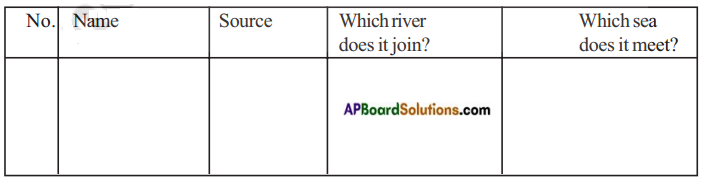
There may be streams and rivers flowing near your village or town. Find out about them and fill in the table below.
AP Board 7th Class Social Studies Solutions Chapter 2 Rain and Rivers 1
Answer:

No.NameSourceWhich river does it join?Which sea does it meet?
1.KrishnaRainwater/ Western GhatsItself it is a river.Bay of Bengal
2.GodavariRainwater / W. GhatsItself it is a river.Bay of Bengal

AP Board 7th Class Social Studies Solutions Chapter 2 Rain and Rivers

Question 9.
Do the rivers in your area contain water throughout the year? Find out from elders if they had more water in earlier times.
Answer:
No, the rivers in our area do not contain water throughout the year; Our elders also expressed the same.

Question 10.
How can people be prepared to face the disasters? (or)
What can the Government do to help the people meet the challenges of disasters like cyclones and floods?
Answer:

  1. Cyclones and floods are seasonal phenomena. During the cyclone listen to radio or TV weather reports and in case of a cyclone/flood warning, ensure that everyone is alerted. This is usually done through loudspeakers or by going from door to door.
  2. Keep an emergency kit ready at home. These kits should contain important papers, some food, some money and emergency telephone numbers.
  3. The nearest available place where refuge could be sought in case of a cyclone
    should be identified in advance.
  4. Wherever necessary, the walls of the house, roofing, doors and windows should be strengthened.
  5. When you get a cyclone warning, store adequate drinking water and food grains in waterproof bags.
  6. Do not venture outside, especially into the sea during and after the warning has been sounded.
  7. Close doors and windows and stay indoors.
  8. Move to a pucca building if you feel your house is not strong enough.
  9. If the cyclone strikes while you are in a vehicle, stop but keep away from the seashore, trees, electric poles and other objects that may be uprooted during the gale.
  10. If the cyclone wind suddenly drops, do not go out, as it could be the eye of the cyclone. Wait till the official all-clear declaration is made officially.
  11. Listen to Radio / TV for updates on the situation.
  12. Even after all-clear has been sounded take necessary precautions while moving to or out of your house. There may be partially uprooted trees or poles.
  13. Look out for snakes that may have come out of their holes. Do not enter floodwaters. They may be too deep.
  14. As a student group, you can play a very significant role in spreading awareness about the above precautions.

Question 11.
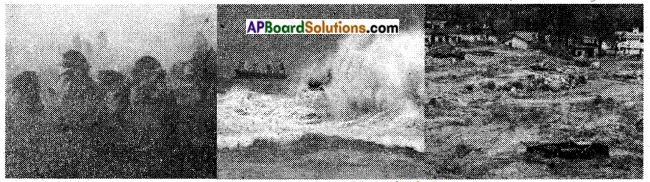
Collect the pictures showing cyclones and floods and prepare an album.
Answer:
AP Board 7th Class Social Studies Solutions Chapter 2 Rain and Rivers 2

Question 12.
Make a poster on the devastation of the flood.
Answer:

Floods Devastation

Climate change has contributed to a rise in extreme weather events. Climate change v/ill increase the frequency of heavy rainstorms/ puffing many communities at risk for devastation from floods.
As rains become heavier, streams, rivers and lakes can overflow, increasing the risk of waterborne pathogens flowing into drinking water sources. Downpours can also damage critical infrastructure.
Flooding can cause a range of health impacts and risks, including death and injury, contaminated drinking water, hazardous material spills increased populations of disease-carrying insects and rodents, mouldy houses and community disruption and displacement.
Local communities across the country can prevent floods and heavy rains from devasting their homes, buildings and agricultural land by updating the safety methods.

AP Board 7th Class Social Studies Solutions Chapter 2 Rain and Rivers

Project

Observe in your village/locality where the water is being wasted, furnish the details in a table, discuss the reasons, suggest the ways how water can be saved.
AP Board 7th Class Social Studies Solutions Chapter 2 Rain and Rivers 3
Answer:

Sl. NoThe place where the water is being wastedReasonWays to prevent/save the water
1.Near washing clothesNegligencyUse small buckets instead of large tubes.
2.While washing animalsNegligencyUse small mugs.
3.While carrying water from the tank to the house.WeightUse small utensils instead of large ones.

AP Board 8th Class Maths Notes Chapter 9 Area of Plane Figures

Students can go through AP Board 8th Class Maths Notes Chapter 9 Area of Plane Figures to understand and remember the concepts easily.

AP State Board Syllabus 8th Class Maths Notes Chapter 9 Area of Plane Figures

→ Area of a triangle = \(\frac{1}{2}\) × base × height = \(\frac{1}{2}\) bh

→ Area of a quadrilateral = \(\frac{1}{2}\) × length of a diagonal × Sum of the lengths of the perpendiculars drawn from the remaining two vertices on the diagonal
= \(\frac{1}{2}\) d(h1 + h2)

AP Board 8th Class Maths Notes Chapter 9 Area of Plane Figures

→ Area of a trapezium = \(\frac{1}{2}\) × sum of the lengths of parallel sides × distance between them
= \(\frac{1}{2}\) h(a + b)

→ Area of a rhombus = Half of the product of diagonals = \(\frac{1}{2}\) d1d2

→ Angle at the centre of a circle = 360°

→ Area of a circle = πr2
Where ‘r’ is the radius of the circle, π = \(\frac{22}{7}\) or 3.14 nearly

→ Circumference of a circle = 2πr

AP Board 8th Class Maths Notes Chapter 9 Area of Plane Figures

→ Area of a circular path (or) Area of a Ring = π(R2 – r2) or π(R + r) (R- r)
When R, r are radii of outer circle and inner circle respectively.

→ Width of the path w = R – r

→ Area of a sector A = \(\frac{x^{\circ}}{360^{\circ}}\) × πr2 where x° is the angle subtended by the arc of the sector at the center of the circle and r is radius of the circle. (OR) A = \(\frac{lr}{2}\) where Tis thdength of the arc.
Length of the arc of a sector = \(\frac{x^{\circ}}{360^{\circ}}\) × 2πr

AP 6th Class Social Studies Questions Chapter 6 Early Civilisations

These AP 6th Class Social Important Questions 6th Lesson Early Civilisations will help students prepare well for the exams.

AP State Syllabus 6th Class Social Important Questions Chapter 6 Early Civilisations

Question 1.
What is the origin of Indian history?
Answer:
The Vedic period is the origin of Indian History.

Question 2.
What is civilisation existed before the Vedic period?
Answer:
Indus valley civilisation or Harappan civilisation was the civilisation that existed before the Vedic period.

AP Board 6th Class Social Studies Important Questions Chapter 6 Early Civilisations

Question 3.
Where did the Indus civilization develop?
Answer:
Indus valley civilisation developed along the Indus river and the Ghaggar – Hakra river which is also identified as the dried Saraswati river.

Question 4.
What are the Indus cities at present?
Answer:
The Indus cities at present are spread over more than 1500 places. They are in the states of Punjab, Haryana, Gujarat, Rajasthan, Western Uttar Pradesh, and Maharashtra. They are also found in Afghanistan and Provinces of Punjab, Synd, and Beluehistan of Pakistan.

Question 5.
At what period did Indus valley civilization flourished?
Answer:
Indus valley civilization flourished between 2500 – 1700 B.C.

Question 6.
What is civilization?
Answer:
Civilization is an advanced stage of human society, where people live with a reasonable degree of comfort and can think about things like art and education.

AP Board 6th Class Social Studies Important Questions Chapter 6 Early Civilisations

Question 7.
Where were the bricks of the Indus valley civilisation found?
Answer:
While British Engineers laying a railway line between Lahore and Karachi in 1850 they found the bricks of Indus valley civilisation and they used those bricks for the foundation. They were produced during the Indus valley civilisation. They were nearly 5000 years old at that time.

Question 8.
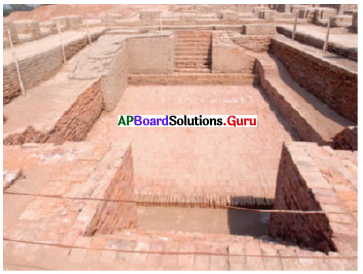
‘Describe the Great Bath’.
Answer:
‘Great Bath’ was found during excavations of Mohanjo – daro. The Great Bath was mainly used for religious practice. There were rooms on all sides.
AP Board 6th Class Social Studies Important Questions Chapter 6 Early Civilisations 1

Question 9.
Describe the houses of the Harappan people.
Answer:
The Harappan people built their houses with dried or baked bricks. There were two-storied buildings also. Every house had a well for water and bathrooms with pipes that carried waste into the main drains.

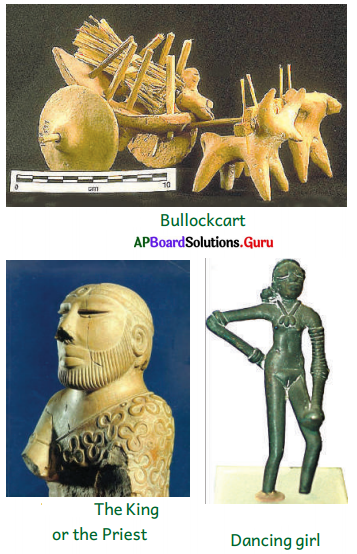
Question 10.
Describe the entertainment and artwork of Harappan people.
Answer:
Dance chess, music, marbles, and dice were their entertainments. Bullfighting was their major entertainment.
AP Board 6th Class Social Studies Important Questions Chapter 6 Early Civilisations 2
Art: Small idols of Ammatalli (Mother Goddess) made of clay have been found in large numbers in the excavations. The statue of a dancing girl and the stone idol of the bearded man is excellent artifacts.

AP Board 6th Class Social Studies Important Questions Chapter 6 Early Civilisations

Question 11.
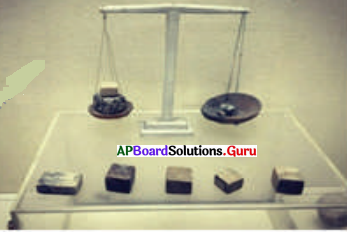
Who developed the weights and measures system?
Answer:
Harappans were the first to develop a system of standardized weights and measures. The measurement and weights of Indus people also moved to Persia and Central Asia.
AP Board 6th Class Social Studies Important Questions Chapter 6 Early Civilisations 3

Question 12.
What is the origin of the Aryan Civilization?
Answer:
There are various theories about the origin of Aryans. Some historians are of the opinion that Aryans came from outside the country i.e Central Asia, Arctic region, East of Alphs, etc,.
Some historians say that Aryan is not a race. It is an Indo-European linguistic group. Some argue that they are the natives of India.

Question 13.
What is the source to know about the Aryans?
Answer:
The Vedic literature is the major source to understand the Vedic period. The period of Rigveda is called the early Vedic period and the period of other Vedas is called the Later Vedic period.

Question 14.
How can the Vedic civilization period be classified?
Answer:
The period of Vedic Civilization (1500-500 BCE) can be divided into two broad parts –

  1. Early Vedic Period (1500-1000 BC), also known as Rig Vedic Period.
  2. Later Vedic Period (1000- 600 BC).

AP Board 6th Class Social Studies Important Questions Chapter 6 Early Civilisations

Question 15.
Explain the early Vedic period briefly.
Answer:
Social Life: Family is the basic unit of society. The father was the head of the family. The joint family system was in practice. The prisoners of war were called dasas and dasyas were like slaves. Monogamy was the usual practice.
Position of women: Women studied Vedas. There were no child marriages or Sati. Women can choose their husbands in swayamvaram. Widow remarriage was in practice. Dress: Men wore Vasa (dhoti), Adhivasa (upper cloth) as we wear today. Women used earrings, necklaces, bangles, and anklets as we do today.
Amusements: Chariot racing, hunting, boxing, dancing, and music are some of the amusements.
Education: Great importance was given to education. There were gurukuls. The entire institution was given freedom in their teaching and learning process. People can choose their profession.
Food and crops: Rice, barley, bean, and sesamum formed the food. They also ate bread, cake, milk, butter and curd, and fruits.
Religion: They believed that God is one and he can be worshipped and realized in many forms i.e Agni,
Varuna, Yama, Vayu, etc.
AP Board 6th Class Social Studies Important Questions Chapter 6 Early Civilisations 4

Question 16.
Explain later Vedic period briefly.
Answer:
Political changes: In the later Vedic Period the king became more powerful. Even Sabha and Samithi also lost their importance. The scope of the king was widened. The kingship became hereditary. The king performed rituals like Aswamedha and Rajasuya to expand the kingdom.
Social changes: Asrama system brahmacharya, grihastha, vanaprastha, and sannyasa were started during this period. The position of women was lowered. Varna system came into existence. Child marriage and sati started during this period.
Religious life: Religious ceremonies became complex and complicated. The Yagas and Yagnas were performed frequently. Brahma, Vishnu Ganesh, Skanda, and Siva were worshipped. Goddess Laxmi, Saraswathi, Parvathi got importance.
Epics: Ramayana and Mahabharatha are two great popular epics. Ramayana was written by Maharshi Valmiki in Sanskrit. Mahabharata was written in Sanskrit by Sage Vedavyasa.

AP Board 6th Class Social Studies Important Questions Chapter 6 Early Civilisations

Question 17.
In what ways do you think that the life of a ‘raja’ was different from that of a ‘dasa’ or ‘dasi’?
Answer:
In society, ‘raja’ was one of the highest civil positions. ’Rajas’ were the kings of the community, whereas the ‘dasas’/ ‘dasis’ were the lowest position in society. The ‘dasas’ / ‘dasis’ were slaves who were used for work. They were treated as the property of their owners. They were captured in war.

Question 18.
Write the differences between the religious life of the early Vedic period and the later Vedic period.
Answer:

  1. There was no ‘Varna’ or caste system in the early Vedic Period.
    The caste system was more rigid, hereditary in the later Vedic Period.
  2. Early Vedic period people worshipped forces of nature as gold like Surya, Chandra, and Agni.
    Later Vedic people worshipped Brahma, Vishnu and Shiva were worshipped.

AP 7th Class Social Important Questions Chapter 6 Africa

AP State Syllabus 7th Class Social Important Questions 6th Lesson Africa

Question 1.
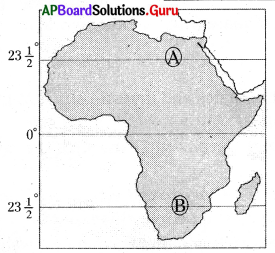
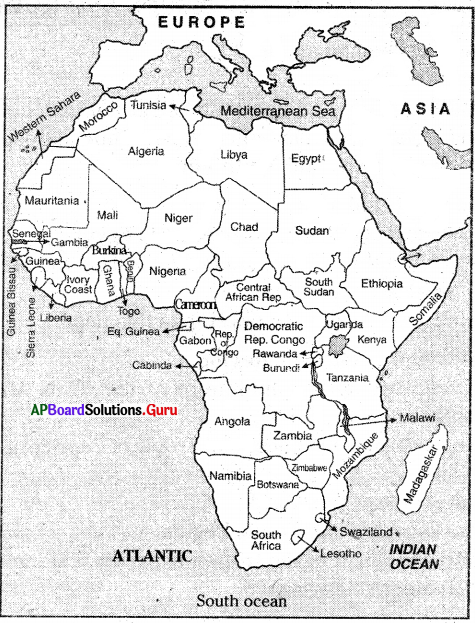
Observe the map and answer the questions given below.
AP 7th Class Social Important Questions Chapter 6 Africa 1
a) Write the name of the latitude which passes through the Region – A.
Answer:
Tropic of Cancer.

b) Write the name of the latitude which passes through Region – B.
Answer:
Tropic of Capricorn.

AP 7th Class Social Important Questions Chapter 6 Africa

Question 2.
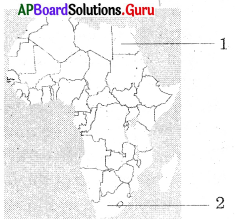
What are the countries that are pointed by “1 and 2” Africa map are given below?
AP 7th Class Social Important Questions Chapter 6 Africa 2
Answer:
1-Egypt
2 -South Africa

Question 3.
Read the given table and answer the following questions.

S.No.Geographical FeatureEuropeAfrica
1RiversLoire, Seine, Danube, Rhine, Dniper, Volga Don, PoChad, Nile, Zambezie, Volta, Congo, Niger
2Deserts—–Sahara, Kalahari
3MountainsPyranees, Alphs, Caucasus, Ural, ScandinaviaAtlas, Drakensberg
4Sea’sThe Mediterranean Sea, Black Sea, Atlantic OceanMediterranean sea Red Sea, Atlantic Ocean, Indian Ocean.

i) Which continent does not have any dessert?
Answer:
Europe Continent.

ii) In which continent Scandinavian mountains are located?
Answer:
European continent.

iii) The sea lies between Africa and Europe?
Answer:
Mediterranean sea.

iv) Which is the longest river in Europe?
Answer:
Volga River is the longest river in Europe.

AP 7th Class Social Important Questions Chapter 6 Africa

Question 4.
Discuss how Africa is richer than other continents in natural resources. In spite of its richness, why do you think African countries are still underdeveloped?
Answer:
In the beginning, Africa was a rich continent compare with the other world in natural resources.
Reasons for why it is not developed:

  1. The foreign companies do bring in new technologies and investments into mining and processing industries, thus creating employment for the local people.
  2. They are using their cheap labour to make huge profits and exploiting the mineral resources.
  3. Most of these companies have caused immense damage to the natural environment which has affected the quality of landlife of the local people adversely.
  4. Thus, we can say that the foreign companies are exploiting the mineral wealth of Africa irrespective of the local people’s welfare.
    That’s why Africa was instiled an underdeveloped position.

Question 5.
Into how many physical features can Africa be divided? What are they?
Answer:
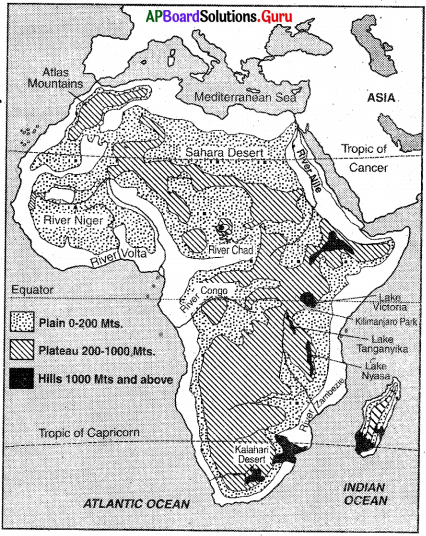
Africa can be divided broadly into four physical regions namely

  1. Mountains
  2. Plateaus
  3. Coastal plains
  4. Deserts.

AP 7th Class Social Important Questions Chapter 6 Africa

Question 6.
What are Savannas?
Answer:

  1. The large tropical grasslands on both sides of the forests do not produce wood but shelter a huge number of animals.
  2. These grasslands are called Savannas or Veldts.
  3. In some places, these grasses are so tall that even elephants can hide in them.
  4. Some trees also grow between them.

Question 7.
How to reach India from Africa? Which ocean has to be crossed?
Answer:

  1. From Africa to reach India one has to travel in west direction,
  2. The Indian Ocean has to be crossed

Question 8.
Are Asia and Africa connected by land?
Answer:
Yes. There is a small strip in Egypt, which connects Asia and Africa.

Question 9.
Name some bays and gulfs on the African coast.
Answer:
Bays: Bays of Djibouti, Bay of Yemen, Bays of Somalia, Bays of Madagascar.
Gulfs: the Gulf of Sidra, Gulf of Guinea, Gulf of Suez, Gulf of Aden.

AP 7th Class Social Important Questions Chapter 6 Africa

Question 10.
Mention the boundaries of Africa.
Answer:
East: The Red Sea, the Gulf of Eden and the Indian Ocean.
West: Atlantic Ocean
North: Mediterranean Sea
South: Southern Ocean

Question 11.
How is the lifestyle of people in Africa?
Answer:
People with different languages, lifestyles and habits live in different regions of Africa. Since ancient times, people have lived in small tribes, carrying out hunting, gathering, animal husbandry and agriculture. Hunters have inhabited the equatorial regions and the deserts, Pastoralists inhabited the high plateaus and Savanna, grazing their animals on the extensive grasslands. Agriculture has long been carried out on river banks as well as on the margins of forests. There were several cities on the coasts where traders from distant countries came to trade.

Question 12.
Mention the products which were exported to Europe.
Answer:
The Europeans exported African timber, minerals etc., on a very large scale to Europe. In fact, the gold and diamond mines in Southern Africa are still under the control of European companies. Zambia and Zimbabwe have priceless mines of copper. This mineral has long been an important export item. Europeans established plantations to grow tea, coffee, rubber, tobacco, etc.

AP 7th Class Social Important Questions Chapter 6 Africa

Question 13.
Observe the following table carefully and answer the questions given hereunder.
Answer:
Africa at a Glance

S.No.ContentSpecial feature
1.Deserts1)  Sahara is the biggest desert in the world.
2)   Kalahari
2.LakesVictoria, Nyasa, Tanganyika, Chad, Volta
3.RiversNile, Congo, Niger, Zambezi, Orange, Senegal and Limpopo
4.The highest peakMt. Kilimanjaro
5.The biggest countrySudan
6.The gift of NileEgypt
7.ExtentThe second-largest continent. It occupies 20% of the land area of the earth.

a. What is the highest peak in Africa?
Answer:
Mt. Kilimanjaro is the highest peak in Africa.

b. Which is the biggest country in Africa?
Answer:
Sudan

c. Which country in Africa is called the gift of Nile?
Answer:
Egypt

d. What is the biggest continent in the world?
Answer:
Asia is the biggest continent in the world.

e. What is the largest desert in Africa?
Answer:
Sahara is the largest desert in Africa.

AP 7th Class Social Important Questions Chapter 6 Africa

Question 14.
Read the following para and answer the questions.
Slave Trade
In the 16th century, many Europeans began migrating to America and started cultivation there. There was plenty of land in America, but not enough people to work in the fields. To fill the gap the slave trade from Africa began.
a. In which century many Europeans began migrating to America?
Answer:
In the 16th century.

b. Why did Europeans enter America?
Answer:
Because there was plenty of lands.

c. Who wanted to establish their rule over Africa?
Answer:
Europeans

d. Which continent is known as the Dark continent?
Answer:
Africa

e. Who benefited from the slave trade?
Answer:
Americans

Question 15.
What are the important items of export?
Answer:
The important items of export are:

  1. Agricultural products: Cocoa, coffee, palm oil, groundnut, cotton, tea.
  2. Minerals: Copper, gold, diamonds, iron ore, petroleum, phosphate, bauxite, etc. These are exported to Europe and North America.

AP 7th Class Social Important Questions Chapter 6 Africa

Question 16.
Why is Egypt called the gift of Nile?
Answer:

  1. The river Nile flows through the Sahara desert in Egypt.
  2. Nile’s water which flows through the Sahara Desert is used for irrigation in that area.
  3. River Nile is also used for navigation.
  4. The Nile has helped the civilization to develop in this desert.

Question 17.
Define Tropic Region and Temperate Region.
Answer:

  1. The Equator passes through the middle of Africa. Thus Africa is divided into Northern and Southern parts.
  2. The zone between the Tropic of Cancer and Tropic of Capricorn experiences a warm climate.
  3. This is the hottest region in the world.
  4. This region is also known as the Tropic Region.
  5. These zones south and north of the tropics experience summer as well as winter. They are called “Temperate Regions”.

Question 18.
Locate the following rivers and seas on the map of Africa.

  1. River Niger
  2. River Volta
  3. River Zambezi
  4. Mediterranean Sea
  5. River Nile
  6. River Congo

Answer:

AP 7th Class Social Important Questions Chapter 6 Africa 3

AP 7th Class Social Important Questions Chapter 6 Africa

Question 19.
Observe the following map of Africa and answer the questions.
AP 7th Class Social Important Questions Chapter 6 Africa 4
a. Which country is called the “Gift of Nile”?
Answer:
Egypt

b. Where do camels live?
Answer:
In the Sahara desert.

c. In what countries does the Sahara desert extend?
Answer:
It extends to Mauritania, Mali, Niger, Chad, Sudan, Egypt, Ethiopia and Somalia.

d. What is the western boundary of Africa?
Answer:
Atlantic ocean

e. What is the southern boundary of Africa?
Answer:
South ocean

AP 7th Class Social Important Questions Chapter 6 Africa

Question 20.
Look for Africa on the world map and write about its neighbouring countries.
AP 7th Class Social Important Questions Chapter 6 Africa 5
Answer:
Neighbouring countries of Africa:

  1. Italy
  2. Portugal
  3. Turkey

Question 21.
Look for Africa on the world map and name the oceans that surround it.
AP 7th Class Social Important Questions Chapter 6 Africa 6
Answer:
Oceans that surround Africa:

  1. Southern ocean
  2. Indian ocean
  3. Mediterranean sea

AP 7th Class Social Important Questions Chapter 6 Africa

Question 22.
Look at the following map and answer the following questions.
AP 7th Class Social Important Questions Chapter 6 Africa 7
a. What is the average height of the narrow coastal plain?
Answer:
The average height of the narrow coastal plain is 0 to 200 mts.

b. What is the height of a major portion of the plateau?
Answer:
The height of a major portion of the pla¬teau is 200 to 1000 mts.

c. The height of the high plateaus in the south and east of Africa is ….
Answer:
100 mts

d. In the north are the Mountains.
Answer:
Atlas

e. What is the height of the Kilimanjaro peak?
Answer:
5895 mts

f. Identify two other lakes in Africa, other than Lake Victoria and write down their names.
Answer:
Lake Nyasa, Lake Tanganyika

Question 22.
What are the regions of highest rainfall?
Answer:
A large part of Africa, on both sides of the Equator, receives heavy rainfall. These regions are in Central and Western Africa. They have dense forests due to heavy rainfall and warm climate.

AP 7th Class Social Important Questions Chapter 6 Africa

Question 23.
How were the slaves greatly oppressed by Americans?
Answer:
The slaves were greatly oppressed. Many of them died by the time they reached the ports. The ships were stuffed with slaves. There were no proper arrangements for food or medicine. In those days, it took a long time to reach America. Many slaves did not survive the journey due to illness and malnutrition.

Even in America, inhuman treatment was meted out to them. Despite working hard, they were not given proper food or living quarters. In this manner, millions of Africans were enslaved and taken to North and South America and the nearby islands. Lakhs of people died after being made into slaves.

Question 24.
Write about the deserts of Africa.
Answer:

  1. The Sahara desert in Africa is the biggest tropical desert in the world.
  2. This desert belt is broad and extends from east to west of Africa.
  3. West Sahara desert spreads over Mauritania, Mali, Niger, Chad, Sudan, Morocco, Tunisia, Algeria, Libya, Egypt, Ethiopia and Somalia.

The Kalahari desert extends in Namibia, Botswana and Angola in South – West Africa.

AP 7th Class Social Important Questions

AP Inter 2nd Year Physics Important Questions Chapter 3 Wave Optics

Students get through AP Inter 2nd Year Physics Important Questions 3rd Lesson Wave Optics which are most likely to be asked in the exam.

AP Inter 2nd Year Physics Important Questions 3rd Lesson Wave Optics

Short Answer Questions

Question 1.
Explain Doppler effect in light. Distinguish between red shift and blue shift. [T.S. Mar. 16]
Answer:
Doppler effect in light : The change in the apparent frequency of light, due to relative motion between source of light and observer. This phenomenon is called Doppler effect.

The apparent frequency of light increases when the distance between observer and source of light is decreasing and the apparent frequency of light decreases, if the distance between source of light and observer increasing.
Doppler shift can be expressed as = \(\frac{\Delta v}{v}=\frac{-v_{\text {radial }}}{c}\)
Applications of Doppler effect in light:

  1. It is used in measuring the speed of a star and speed of galaxies.
  2. Measuring the speed of rotation of the sun.

Red shift: The apparent increase in wave length in the middle of the visible region of the spectrum moves towards the red end of the spectrum is called red shift.

Blue shift: When waves are received from a source moving towards the observer, there is an apparent decrease in wave length, this is called blue shift.

AP Inter 2nd Year Physics Important Questions Chapter 3 Wave Optics

Question 2.
Derive the expression for the intensity at a point where interference of light occurs. Arrive at the conditions for maximum and zero intensity. [A.P. Mar. 16; T.S. Mar. 15]
Answer:
Let y1 and y2 be the displacements of the two waves having same amplitude a and <|> is the phase difference between them.
AP Inter 2nd Year Physics Important Questions Chapter 3 Wave Optics 1
y1 = a sin ωt …………… (1)
y2 = a sin (ωt + Φ) …………….. (2)
The resultant displacement y = y1 + y2
y = a sin ωt + a sin (ωt + Φ)
y = a sin ωt + a sin ωt cos Φ + a cos ωt sin Φ
y = a sin ωt [1 + cos Φ] + cos ωt (a sin Φ)
Let R cos θ = a(1+ cos Φ) ……………….. (4)
R sin θ = a sin Φ ………………. (5)
y = R sin ωt. cos θ + R cos ωt. sin θ
y = R sin (ωt + θ) ………………… (6)
where R is the resultant amplitude at P, squaring equations (4) and (5), then adding
R2 [cos2 θ + sin2 θ] = a2[l + cos2 Φ + 2 cos Φ + sin2 Φ]
R2 [1] = a2 [1 + 1 + 2 cos Φ]
I = R2 = 2a2 [1 + cos Φ] = 2a2 × 2 cos2 \(\frac{\phi}{2}\);
I = 4a2 cos2 \(\frac{\phi}{2}\) …………. (7)

i) Minimum intensity (Imax)
cos2 \(\frac{\phi}{2}\) = 1
Φ = 2nπ Where n = 0, 1, 2, 3 ……….
Φ = 0, 2π, 4π, 6π
∴ Imax = 4a2.

ii) Minimum intensity (Imin)
cos2 \(\frac{\theta}{2}\) = 1
Φ = (2n + 1)π Where n = 0, 1, 2, 3 ……….
Φ = π, 3π, 5π, 7π …………..
∴ Imin = 0

Question 3.
Does the principle of conservation of energy hold for interference and diffraction phenomena? Explain briefly. [Mar. 14]
Answer:
Yes, law of conservation of energy is obeyed. In case of constructive interference, intensity becomes maximum. Hence bright fringes are formed on the screen where as in the case of destructive interference, intensity becomes minimum. Hence dark fringes are formed on the screen.

This establishes that in the interference and diffraction pattern, the intensity of light is simply being redistributed i.e., energy is being transferred from dark fringe to bright fringe. No energy is being created (or) destroyed in the process. Hence energy is redistributed.

Thus the principle of conservation of energy is being obeyed in the process of interference and diffraction.

AP Inter 2nd Year Physics Important Questions Chapter 3 Wave Optics

Question 4.
How do you determine the resolving power of your eye ? [A.P. Mar. 17]
Answer:
Make black strips of equal width separated by white strips. All the black strips having same width, while the width of white strips should increase from left to right.
AP Inter 2nd Year Physics Important Questions Chapter 3 Wave Optics 2
Now watch the pattern with one eye. By moving away (or) closer to the wall, find the position where you can just see some two black strips as separate strips.

All black strips to the left of this strips would merge into one another and would not be distinguishable on the other hand, the black strips to the right of this would be more and more clearly visible.

Note the width d of the white strips and measure the distance D of the wall from eye.
Then resolution of your eye = \(\frac{\mathrm{d}}{\mathrm{D}}\)

Question 5.
Explain polarisation of light by reflection and arrive at Brewster’s law from it.
Answer:
Polarisation of light by reflection : When unpolarized light is incident on the boundary of a denser medium, at a particular angle of incidence the reflected light is completely plane polarised. This incident angle is called Brewster’s angle (iB).

Brewster’s law:
When light is incident on a transparent surface at Brewster s angle, then reflected and refracted rays are at right angles to each other.
From snell’s law, refractive index,
∴ iB + r = \(\frac{\pi}{2}\) ⇒ r = \(\frac{\pi}{2}\) – iB
AP Inter 2nd Year Physics Important Questions Chapter 3 Wave Optics 3
n = \(\frac{\sin \mathrm{i}_B}{\sin \mathrm{r}}=\frac{\sin \mathrm{i}_B}{\sin \left(\frac{\pi}{2}-\mathrm{i}_B\right)}=\frac{\sin \mathrm{i}_B}{\cos \mathrm{i}_B}\) = tan iB
n = taniB, This is known as Brewster’s law.
Brewster’s law – statement: The refractive index of a denser medium is equal to tangent of the polarising angle.

AP Inter 2nd Year Physics Important Questions Chapter 3 Wave Optics

Question 6.
Discuss the intensity of transmitted light when a polaroid sheet is rotated between two crossed polaroids. [T.S. Mar. 17; Mar. 12]
Answer:
Let I0 be the intensity of polarised light after passing through the first polariser P1. Then the intensity of light after passing through second polariser P2 will be I = I0cos2θ.
Where θ is the angle between pass axes P1 and P2. Since P1 and P2 are crossed the angle between the pass axes of P2 and P3 will be (\(\frac{\pi}{2}\) – θ)
Hence the intensity of light emerging from P3 will be
I = I0cos2θ . cos2(\(\frac{\pi}{2}\) – θ)
= I0cos2θ . sin2θ
I = \(\frac{\mathrm{I}_0}{4}\) sin2
∴ The transmitted intensity will be maximum when θ = \(\frac{\pi}{4}\).

Long Answer Questions

Question 1.
Distinguish between Coherent and Incoherent addition of waves. Develop the theory of constructive interferences.
Answer:
Coherent sources : The two sources which maintain zero (or) any constant phase relation between themselves are known as Coherent sources.
AP Inter 2nd Year Physics Important Questions Chapter 3 Wave Optics 4
Incoherent sources : If the phase difference changes with time, the two sources are known as incoherent sources.
Theory of constructive and destructive interference :
Let the waves of two coherent sources be
y1 = a sin ωt ………………….. (1)
y2 = a sin (ωt + Φ) …………….. (2)
where a is amplitude and Φ is the phase difference between two displacements.
According to superposition principle, y = y1 + y2
y = a sin ωt + a sin (ωt + Φ) = a sin ωt + a sin ω cos Φ + a cos ωt sin Φ
y = a sin ωt [1 + cos Φ] + cos ωt [a sin Φ] ………………….. (3)
Let A cos θ = a(1 + cos Φ], ………………. (4)
A sin θ = a sin Φ ……………… (5)
Substituting equations (4) and (5) in equation (3)
y = A sin ωt. cos θ + A cos ωt sin θ
y = A sin (ωt + θ) …………………… (6)
Where A is resultant amplitude. Squaring equations (4) and (5), then adding
A2[cos2 θ + sin2 θ] = a2[1 + cos2 Φ + 2 cos Φ + sin2 Φ]
A2 [1] = a2 [1 + 1 + 2 cos Φ]
I = A2 = 2a2 [1 + cos Φ]
I = 2a2 × 2 cos2 \(\frac{\phi}{2}\)
I = 4a2 cos2 \(\frac{\phi}{2}\)
I = 4I0 cos2 \(\frac{\phi}{2}\) …………….. (7) [∵ I0 = a2]

Case (i) For constructive interference: Intensity should be maximum.
cos \(\frac{\phi}{2}\) = 1 ⇒ Φ = 2nπ
Where n = 0, 1, 2, 3 ⇒ Φ = 0, 2π, 4π, 6π ………….. Imax = 4I0
Case (ii) For destructive interference: Intensity should be minimum
i.e., cos Φ = 0 ⇒ Φ = (2n + 1) π ; where π = 0, 1, 2, 3 ; Φ = π, 3π, 5π ⇒ Imin = 0.

AP Inter 2nd Year Physics Important Questions Chapter 3 Wave Optics

Question 2.
Describe Young’s experiment for observing interference and hence arrive at the expression for ‘fringe width’.
Answer:
Interference: The modification of intensity obtained by the super position of two (or) more light waves is called interference.
Description :
AP Inter 2nd Year Physics Important Questions Chapter 3 Wave Optics 5

  1. Thomas Young experimentally observed the phenomenon of interference of light using two coherent sources.
  2. A small pin hole ‘S’ illuminated by monochromatic source of light which produces a spherical wave.
  3. S1 and S2 are two narrow pin holes equidistant from S.
  4. Screen is placed at a distance D.
  5. The points at which any two crests (or) any two troughs are superimposed, constructive interference takes place bright fringe will be observed on the screen.
  6. The points at which crest of one wave and trough of another wave are superimposed, destructive interference takes place dark fringe will be observed on the screen.
  7. Thus on the screen alternately bright and dark frings are observed.

Expression for fringe width :
1. It is the distance between two successive bright (or) dark fringes, denoted by β.
AP Inter 2nd Year Physics Important Questions Chapter 3 Wave Optics 6

The path difference (δ) = d sin θ
2. If θ is very small then from figure sin θ ≈ tan θ = \(\frac{x}{D}\)

3. For bright fringes path difference S2P – S1P = nλ
∴ d sin θ = nλ
d × \(\frac{x}{D}\) = nλ
x = \(\frac{\mathrm{n} \lambda \mathrm{D}}{\mathrm{d}}\) ……………. (1) where n = 0, 1, 2, 3 …………….

This equation represents the position of bright fringe.
When n = 0, x0 = 0.
n = 1, x1 = \(\frac{\lambda \mathrm{D}}{\mathrm{d}}\) and n = 2, x2 = \(\frac{2\lambda \mathrm{D}}{\mathrm{d}}\)
The distance between any two consecutive bright fringes is
x2 – x1 = \(\frac{2 \lambda D}{d}-\frac{\lambda D}{d} \Rightarrow \beta=\frac{\lambda D}{d}\) ………… (2)

4. For dark fringes path difference S2P – S1P = (2n + 1) \(\frac{\lambda}{2}\) ∴ d sin θ = (2n + 1) \(\frac{\lambda}{2}\)
d × \(\frac{x}{D}\) = (2n + 1) \(\frac{\lambda}{2}\) ⇒ x = \(\frac{(2 n+1) \lambda D}{2 d}\) ………….. (3) where n = 0, 1, 2, 3…………
This equation (3) represents, position of dark fringe.
When n = 0, x0 = \(\frac{\lambda D}{2 d}\) ⇒ n = 1, x1 = \(\frac{3 \lambda D}{2 d}\); n = 2, x2 = \(\frac{5 \lambda D}{2 d}\) ………….
The distance between any two consecutive dark fringes is x2 – x1 = \(\frac{5 \lambda \mathrm{D}}{2 \mathrm{~d}}-\frac{3 \lambda \mathrm{D}}{2 \mathrm{~d}}=\frac{5 \lambda \mathrm{D}-3 \lambda \mathrm{D}}{2 \mathrm{~d}}\)
β = \(\frac{\lambda \mathrm{D}}{\mathrm{d}}\) …………………….. (4)
Hence fringe width is same for bright and dark fringes.

Problems

Question 1.
What speed should a galaxy move with respect to us so that the sodium line at 589.0 nm is observed at 589.6 nm ? .
Solution:
Since vλ = c, \(\frac{\Delta v}{v}=\frac{\Delta \lambda}{\lambda}\)
(for small changes in v and λ). For
∆λ = 589.6 – 589.0 = + 0.6 nm
we get [usmg Equation \(\frac{\Delta v}{v}=\frac{v_{\text {radial }}}{c}\)]
\(\frac{\Delta v}{v}=-\frac{\Delta \lambda}{\lambda}=-\frac{v_{\text {radial }}}{\dot{c}}\)
or, υradial ≅ + c(\(\frac{0.6}{589.0}\)) = +3.06 × 10⁵ m s-1
= 306 km/s
Therefore, the galaxy is moving away from us.

AP Inter 2nd Year Physics Important Questions Chapter 3 Wave Optics

Question 2.
Unpolarised light is incident on a plane glass surface. What should be the angle of the incidence so that the reflected and refracted rays are perpendicular to each other ?
Solution:
For i + r to be equal to π/2, we should have tan iB = μ = 1.5. This gives iB = 57°. This is the Brewster’s angle for air to glass interface.

Question 3.
What is the Brewster angle for air to glass transition ? (Refractive index of glass = 1.5.)
Solution:
Here, ip = ? μ = 1.5; As tan ip = μ = 1.5
∴ ip = tan-1 (1.5); ip = 56.3

Question 4.
In Young’s double-slit experiment using monochromatic light of wavelength λ, the intensity of light at a point on the screen where path difference is λ, is K units. What is the intensity of light at a point where path difference is λ/3 ?
Solution:
Let I1 = I2 = I. If Φ is phase difference between the two light waves, then resultant intensity,
IR = I1 + I2 + \(2 \sqrt{\mathrm{I}_1 \mathrm{I}_2}\) . cos Φ
When path difference = λ, Phase difference Φ = 0°
∴ IR = I + I + 2\(\sqrt{\text { II }}\) . cos 0° = 4I = k
When path difference = \(\frac{\lambda}{3}\), phase difference Φ = \(\frac{2 \pi}{3}\) rad
∴ IR = I + I + 2\(\sqrt{\text { II }}\) cos \(\frac{2 \pi}{3}\) ⇒ I’R = 2I + 2I(\(\frac{-1}{2}\)) = I = \(\frac{\mathrm{k}}{4}\)

AP Inter 2nd Year Physics Important Questions Chapter 3 Wave Optics

Question 5.
Assume that light of wavelength 6000Å is coming from a star. What is the limit of resolution of a telescope whose objective has a diameter of 100 inch ?
Solution:
A 100 inch telescope implies that 2a = 100 inch = 254 cm. Thus if,
λ = 6000 Å = 6 × 10⁻⁵ cm
then ∆θ ≈ \(\frac{0.61 \times 6 \times 10^{-5}}{127}\)
= 2.9 × 10⁻⁷ radians.

Question 6.
In a Youngs double-slit experiment, the slits are separated by 0.28 mm and the screen is placed 1.4 m away. The distance between the central bright fringe and the fourth bright fringe is measured to be 1.2 cm. Determine the wavelength of light used in the experiment.
Solution:
d = 0.28 mm = 0.28 × 10⁻³ m, D = 1.4 m, β = 1.2 × 10⁻² m, n = 4
Since, β = \(\frac{\mathrm{D}}{\mathrm{d}}\) nλ ⇒ \(\frac{\beta}{n} \cdot \frac{d}{D}\) ⇒ λ = \(\frac{1.2 \times 10^{-2} \times 2.8 \times 10^{-2}}{4 \times 1.4}\)
⇒ λ = 600 × 10-9 m
⇒ λ = 600 nm.

Textual Examples

Question 1.
What speed should a galaxy move with respect to us so that the sodium line at 589.0 nm is observed at 589.6 nm ?
Solution:
Since vλ = c, \(\frac{\Delta \mathrm{v}}{\mathrm{v}}=\frac{\Delta \lambda}{\lambda}\)
(for small changes in v and λ). For
∆λ = 589.6 – 589.0 = + 0.6 nm
we get [usmg Equation \(\frac{\Delta v}{v}=\frac{v_{\text {radial }}}{c}\)]
\(\frac{\Delta v}{v}=-\frac{\Delta \lambda}{\lambda}=-\frac{v_{\text {radial }}}{\dot{c}}\)
or, υradial ≅ + c(\(\frac{0.6}{589.0}\)) = +3.06 × 10⁵ m s-1
= 306 km/s
Therefore, the galaxy is moving away from us.

AP Inter 2nd Year Physics Important Questions Chapter 3 Wave Optics

Question 2.
(a) When monochromatic light is incident on a surface separating, two media, the reflected and refracted light both have the same frequency as the incident frequency. Explain why ?
(b) When light travels from a rarer to a denser medium, the speed decreases. Does the reduction in speed imply a reduction in the energy carried by the light wave ?
(c) In the wave picture of light, intensity of light is determined by the square of the amplitude of the wave. What determines the intensity of light in the photon picture of light.
Solution:
a) Reflection and refraction arise through interaction of incident light with the atomic constituents of matter. Atoms may be viewed as oscillators, which take up the frequency of the external agency (light) and undergo forced oscillations. The frequency of light emitted by a charged oscillator equals its frequency of oscillation. Thus, the frequency of scattered light equals the frequency of incident light.

b) No. energy carried by a wave depends on the amplitude of the wave, not on the speed of wave propagation.

c) For a given frequency, intensity of light in the photon picture is determined by the number of photons crossing ah unit area per unit time.

Question 3.
Two slits are made one millimetre apart and the screen is placed one metre away. What is the fringe separation when blue*: green light of wavelength 500 nm is used ?
Solution:
Fringe spacing = \(\frac{\mathrm{D} \lambda}{\mathrm{d}}=\frac{1 \times 5 \times 10^{-7}}{1 \times 10^{-3}}\) m
= 5 × 10⁻⁴ m = 0.5 mm

Question 4.
What is the effect on the interference fringes in a Young’s double-slit experiment due to each of the following operations :
(a) the screen is moved away from the plane of the slits;
(b) the (monochromatic) source is replaced by another (monochro-matic) source of shorter wavelength;
(c) the separation between the two slits is increased;
(d) the source slit is moved Closer to the double-slit plane;
(e) the width of the source slit is increased;
(f) the monochromatic source is replaced by a source of white light ?
(In each operation, take all parameters, other than the one specified, to remain unchanged.)
Solution:
a) Angular separation of the fringes remains constant (= λ/d). The actual separation of the fringes increases in proportion to the distance of the screen from the plane of the two slits.

b) The separation of the fringes (and also angular separation) decreases. See, however, the condition mentioned in (d) below.

c) The separation of the fringes (and also angular separation) decreases. See however, the condition mentioned in (d) below.

AP Inter 2nd Year Physics Important Questions Chapter 3 Wave Optics

d) Let s be the size of the source and S its distance from the plane of the two slits. For interference fringes to be seen, the condition s/S < λ/d should be satisfied; otherwise, interference patterns produced by different parts of the source overlap and no fringes are seen. Thus, as S decreases (i.e., the source slit is brought closer), the interference pattern gets less and less sharp, and when the source is brought too close for this condition to be valid, the fringes disappear. Till this happens, the fringe separation remains fixed.

e) Same as in (d). As the source slit which increases, fringe pattern gets less and less sharp. When the source slit is so wide that the condition s/S ≤ λ/d is not satisfied, the interference pattern disappears.

f) The interference patterns due to different component colours of white light overlap (incoherently). The central bright fringes for different colours are at the same position. Therefore, the central fringe is white. For a point P for which S2P – S1P = λb/2, where λb (≈ 4000 Å) represents the wavelength for the blue colour, the blue component will be absent and the fringe will appear red in colour. Slightly farther away where S2Q – S1Q = λb = λr/2 where λr (≈ 8000 Å) is the wavelength for the red colour, the fringe will be predominantly blue.
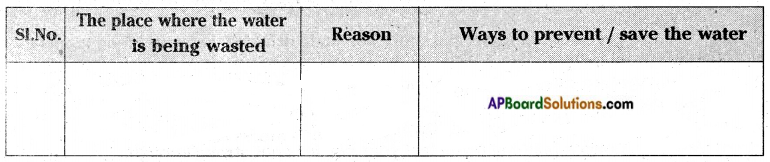
Thus, the fringe closest on either side of the central white fringe is red and the farthest will appear blue. After a few fringes, no clear fringe pattern is seen.

Question 5.
In Textual Example 3, what should the width of each slit be to obtain 10 maxima of the double slit pattern within the central maximum of the single slit pattern ?
Solution:
We want aθ = λ, θ = \(\frac{\lambda}{\mathrm{a}}\)
10 \(\frac{\lambda}{\mathrm{d}}\) = 2\(\frac{\lambda}{\mathrm{a}}\), a = \(\frac{\mathrm{d}}{5}\) = 0.2 mm

Question 6.
Assume that light of wavelength 6000 Å is coming from a star. What is the limit of resolution of a telescope whose objective has a diameter of 100 inch ?
Solution:
A 100 inch telescope implies that 2a =100 inch = 254 cm.

Thus if,
λ = 6000 Å = 6 × 10⁻⁵ cm
then
∆θ ≈ \(\frac{0.61 \times 6 \times 10^{-5}}{127}\)
≈ 2.9 × 10⁻⁷ radians.

AP Inter 2nd Year Physics Important Questions Chapter 3 Wave Optics

Question 7.
For what distance is ray optics a good approximation when the aperture is 3 mm wide and the wavelength is 500 nm ?
Solution:
ZF = \(\frac{\mathrm{a}^2}{\lambda}=\frac{\left(3 \times 10^{-3}\right)^2}{5 \times 10^{-7}}\) = 18 m

Question 8.
Discuss the intensity of transmitted light when a polaroid sheet is rotated between two crossed polaroids ?
Solution:
Let I0 be the intensity of polarised light after passing through the first polariser P1. Then the intensity of light after passing through second polariser P2 will be I = I0cos2θ,
where θ is the angle between pass axes of P1 and P2. Since P2 and P3 are crossed the angle between the pass axes of P2 and P3 will be (π/2 – θ). Hence the intensity of light emerging from P3 will be
I = I0cos2θ cos2 (\(\frac{\pi}{2}\) – θ)
= I0 cos2 θ sin2 θ = (I0/4) sin2
Therefore, the ‘transmitted intensity will be maximum when θ = π/4.

Question 9.
Unpolarised light is incident on a plane glass surface. What should be the angle of the incidence so that the reflected and refracted rays are perpendicular to each other ?
Solution:
For i + r to be equal to π/2, we should have tan iB = μ = 1.5. This gives iB = 57°. This is the Brewster’s angle for air to glass interface.