AP Board 10th Class Maths Solutions Chapter 8 సరూప త్రిభుజాలు Exercise 8.3

SCERT AP 10th Class Maths Textbook Solutions Chapter 8 సరూప త్రిభుజాలు Exercise 8.3 Textbook Exercise Questions and Answers.

AP State Syllabus 10th Class Maths Solutions 8th Lesson సరూప త్రిభుజాలు Exercise 8.3

ప్రశ్న 1.
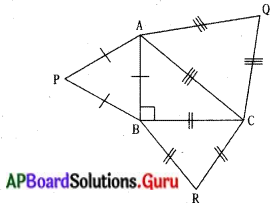
ఒక లంబకోణ త్రిభుజము మూడు భుజాలపై సమబాహు త్రిభుజాలు గీయబడ్డాయి. కర్ణము మీద గీసిన త్రిభుజ వైశాల్యము మిగిలిన రెండు భుజాల మీద గీసిన త్రిభుజాల వైశాల్యాల మొత్తమునకు సమానమని చూపండి.
సాధన.

AP Board 10th Class Maths Solutions Chapter 8 సరూప త్రిభుజాలు Exercise 8.3 1

దత్తాంశము :
∆ABC లంబకోణ త్రిభుజం
∠B = 90°.
∆ABP, ∆AQC, ∆BCRల సమబాహు త్రిభుజాలు.

సారాంశము :
∆AQC వైశాల్యం = ∆APB వైశాల్యం + ∆BCR వైశాల్యం

నిరూపణ :
∆ABP ~ ∆BCR ~ ∆ACR (∵ సమబాహు త్రిభుజాలు ఎల్లప్పుడు సరూపాలు)

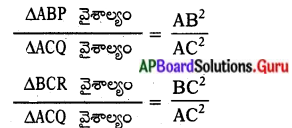
AP Board 10th Class Maths Solutions Chapter 8 సరూప త్రిభుజాలు Exercise 8.3 2

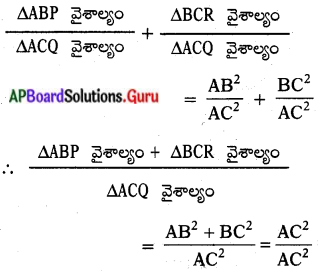
(∵ సరూప త్రిభుజాల వైశాల్యాల నిష్పత్తి వాని అనురూప భుజాల వర్గాల నిష్పత్తికి సమానం)

AP Board 10th Class Maths Solutions Chapter 8 సరూప త్రిభుజాలు Exercise 8.3 3

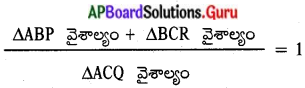
AP Board 10th Class Maths Solutions Chapter 8 సరూప త్రిభుజాలు Exercise 8.3 4 (పైథాగరస్ సిద్ధాంతం నుండి)

∴ ∆ACQ వైశాల్యం = ∆ ABP వైశాల్యం + ∆ BCR వైశాల్యం.

AP Board 10th Class Maths Solutions 8th Lesson సరూప త్రిభుజాలు Exercise 8.3

ప్రశ్న 2.
ఒక చతురస్రము భుజముపై గీచిన సమబాహు త్రిభుజ వైశాల్యము, ఆ చతురస్ర కర్ణముపై గీచిన సమబాహు త్రిభుజ వైశాల్యములో సగము వుంటుందని చూపండి.
సాధన.

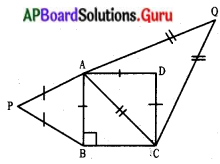
AP Board 10th Class Maths Solutions Chapter 8 సరూప త్రిభుజాలు Exercise 8.3 5

దత్తాంశము :
ABCD ఒక చతురస్రము ∆ABP మరియు ACQలు వరుసగా చతురస్ర భుజం, కర్ణాల మీద గీచిన సమబాహు త్రిభుజాలు.
సారాంశము :
∆ABP వైశాల్యం = \(\frac{1}{2}\) ∆ACQ వైశాల్యం
నిరూపణ :

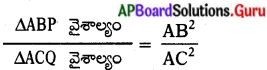
AP Board 10th Class Maths Solutions Chapter 8 సరూప త్రిభుజాలు Exercise 8.3 6 [∵ ∆ABP ~ ∆ACQ]
(∵ సరూప త్రిభుజాల వైశాల్యాల నిష్పత్తి వాని అనురూప భుజాల వర్గాల నిష్పత్తికి సమానం)

= \(\frac{\mathrm{AB}^{2}}{(\sqrt{2} \mathrm{AB})^{2}}\) [ABCD చతుర్భుజంలో]

= \(\frac{A B^{2}}{2 A B^{2}}=\frac{1}{2}\) [AC = √2 AB]

AP Board 10th Class Maths Solutions Chapter 8 సరూప త్రిభుజాలు Exercise 8.3 7

∴ ∆ABP వైశాల్యం = \(\frac{1}{2}\) ∆ACQ వైశాల్యం.

AP Board 10th Class Maths Solutions 8th Lesson సరూప త్రిభుజాలు Exercise 8.3

ప్రశ్న 3.
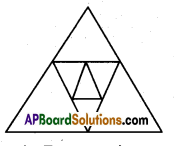
∆ ABCలో BC, CA, AB భుజాల మధ్య బిందువులు వరుసగా D, E, F. అయిన ∆DER మరియు ∆ABC ల వైశాల్యాల నిష్పత్తిని కనుగొనండి.
సాధన.

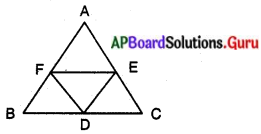
AP Board 10th Class Maths Solutions Chapter 8 సరూప త్రిభుజాలు Exercise 8.3 8

దత్తాంశము :
∆ABCలో; D, E మరియు , F లు BC, CA మరియు AB భుజాల మధ్య బిందువులు. ∆ABCలో AB, ACల మధ్య బిందువులను కలుపగా EF ఏర్పడినది.
FE || BC కావున \(\frac{A F}{F B}=\frac{A E}{E C}\)
(ప్రాథమిక అనుపాత సిద్ధాంత విపర్యయము నుండి)
అదే విధముగా AC మరియు BC లను DE ఒకే నిష్పత్తిలో విభజిస్తుంది. కావున DE || AB.
□BDEFలో ఎదుటి భుజాలు సమాంతరాలు (BD || EF మరియు DE || BF)
కావున OBDEF ఒక సమాంతర చతుర్భుజము ఇక్కడ DF ఒక కర్ణము.
∴ ∆BDF = ∆DEF ………… (1)
అదే విధముగా ∆DEF = ∆CDE అని నిరూపించవచ్చును. ………… (2) [∵ CDEF ఒక సమాంతర చతుర్భుజం] మరియు
∆DEF = ∆AEF …………. (3) [∵ □AEDF ఒక సమాంతర చతుర్భుజం]
(1), (2) మరియు (3) ల నుండి
∆AEF ≈ ∆DEF ≈ ∆BDF ≈ ∆CDE
అదే విధముగా ,
∆ABC = ∆AEF + ∆DEF + ∆BDF + ∆CDE = 4. ∆DEF
∆ABC : ∆DEF = 4 : 1.

AP Board 10th Class Maths Solutions 8th Lesson సరూప త్రిభుజాలు Exercise 8.3

ప్రశ్న 4.
∆ABCలో, XY || AC మరియు XYఆ త్రిభుజాన్ని రెండు సమాన వైశాల్యాలు గల భాగాలుగా AX విభజించును. అయిన \(\frac{\mathrm{AX}}{\mathrm{XB}}\) నిష్పత్తిని కనుగొనండి.
సాధన.

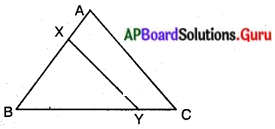
AP Board 10th Class Maths Solutions Chapter 8 సరూప త్రిభుజాలు Exercise 8.3 9

దత్తాంశము :
∆ABC లో XY | | AC.
సారాంశము :
\(\frac{\mathrm{AX}}{\mathrm{XB}}\) నిష్పత్తి , XY, ∆ABC ను సమాన వైశాల్యాలు గల భాగాలుగా విభజించును. ∆ABC, ∆XBY లలో ∠B = ∠B
∠A = ∠X [∵ XY || AC; ∠A, ∠X మరియు ∠C, ∠Yలు ఆసన్నకోణాల జత]
∆ABC ~ ∆XBY (కో.కో.కో సరూపకత ధర్మము ప్రకారము)
ఆ విధముగా \(\frac{\Delta \mathrm{ABC}}{\Delta \mathrm{XBY}}=\frac{\mathrm{AB}^{2}}{\mathrm{XB}^{2}}\)
[∵ రెండు సరూప త్రిభుజాల వైశాల్యాల నిష్పత్తి వాటి అనురూప భుజాల నిష్పత్తి వర్గమునకు సమానము)
\(\frac{2}{1}=\frac{\mathrm{AB}^{2}}{\mathrm{XB}^{2}}\)
[దత్తాంశంలో ∆BXY = ∆BAC కావున ∴ ∆ABC = 2 . ∆XBY]
2 = \(\left(\frac{\mathrm{AB}}{\mathrm{XB}}\right)^{2}\)

2 = \(\left(\frac{\mathrm{AX}+\mathrm{XB}}{\mathrm{XB}}\right)^{2}\)

2 = \(\left(\frac{\mathrm{AX}}{\mathrm{XB}}+\frac{\mathrm{XB}}{\mathrm{XB}^{\prime}}\right)^{2}\)

2 = \(\left(\frac{\mathrm{AX}}{\mathrm{XB}}+1\right)^{2}\)

⇒ \(\frac{\mathrm{AX}}{\mathrm{XB}}\) + 1 = √2

⇒ \(\frac{\mathrm{AX}}{\mathrm{XB}}\) = √2 – 1
కావున ఆ నిష్పత్తి \(\frac{\mathrm{AX}}{\mathrm{XB}}=\frac{\sqrt{2}-1}{1}\).

AP Board 10th Class Maths Solutions 8th Lesson సరూప త్రిభుజాలు Exercise 8.3

ప్రశ్న 5.
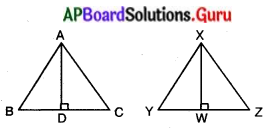
రెండు సరూపత్రిభుజాల వైశాల్యాల నిష్పత్తి వాటి – అనురూప మధ్యగతాల నిష్పత్తి వర్గానికి సమానమని చూపండి.
సాధన.

AP Board 10th Class Maths Solutions Chapter 8 సరూప త్రిభుజాలు Exercise 8.3 10

దత్తాంశము : ∆ABC ~ ∆XYZ
సారాంశము : \(\frac{\Delta \mathrm{ABC}}{\Delta \mathrm{XYZ}}=\frac{\mathrm{AD}^{2}}{\mathrm{XW}^{2}}\)
ఉపపత్తి : రెండు సరూప త్రిభుజాల వైశాల్యాల నిష్పత్తి వాటి అనురూప భుజాల నిష్పత్తి వర్గమునకు సమానము.
\(\frac{\Delta \mathrm{ABC}}{\Delta \mathrm{XYZ}}=\frac{\mathrm{AD}^{2}}{\mathrm{XW}^{2}}\) …………..(1) [∵ ∆ABC ~ ∆XYZ]
∆ABD మరియు ∆XYW లలో ∠B = ∠Y; ∠D = ∠W = 90°
(కో.కో.కో ఉప సిద్ధాంతము నుండి),
∆ABD ~ ∆XYW
∴ \(\frac{\Delta \mathrm{ABD}}{\Delta \mathrm{XYW}}=\frac{\mathrm{AB}^{2}}{\mathrm{XY}^{2}}=\frac{\mathrm{AD}^{2}}{\mathrm{XW}^{2}}\) …………..(2)
(1) మరియు (2) ల నుండి,
\(\frac{\Delta \mathrm{ABC}}{\Delta \mathrm{XYZ}}=\frac{\mathrm{AD}^{2}}{\mathrm{XW}^{2}}\)
ఆ విధముగా రెండు సరూప త్రిభుజాల వైశాల్యాల నిష్పత్తి వాటి అనురూప భుజాల నిష్పత్తి వర్గమునకు సమానము.

AP Board 10th Class Maths Solutions 8th Lesson సరూప త్రిభుజాలు Exercise 8.3

ప్రశ్న 6.
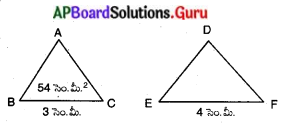
∆ABC ~ ∆DEF. BC = 3 సెం.మీ, EF = 4 సెం.మీ, ∆ABC వైశాల్యము = 54 చ.సెం.మీ అయిన ∆DEF వైశాల్యమును కనుగొనుము.
సాధన.

AP Board 10th Class Maths Solutions Chapter 8 సరూప త్రిభుజాలు Exercise 8.3 11

దత్తాంశము ప్రకారం, ∆ABC ~ ∆DEF.
BC = 3 సెం.మీ.; EF = 4 సెం.మీ. ∆ABC = 54 చ.సెం.మీ
∴ ∆ABC ~ DEF, కావున \(\frac{\Delta \mathrm{ABC}}{\Delta \mathrm{DEF}}=\frac{\mathrm{BC}^{2}}{\mathrm{EF}^{2}}\)
[∵ సరూప త్రిభుజాల వైశాల్యాల నిష్పత్తి. వాటి అనురూప భుజాల వర్గ నిష్పత్తికి సమానము].
\(\frac{54}{\Delta \mathrm{DEF}}=\frac{3^{2}}{4^{2}}\)
∴ ∆DEF = \(\frac{54 \times 16}{9}\) = 96 సెం.మీ.

AP Board 10th Class Maths Solutions 8th Lesson సరూప త్రిభుజాలు Exercise 8.3

ప్రశ్న 7.
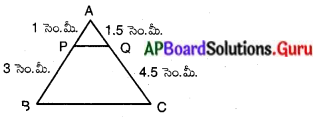
త్రిభుజము ABCలో AB భుజాన్ని P వద్ద, AC ని Q వద్ద తాకునట్లు PQ ఒక సరళరేఖ, ఇంకా AP = 1 సెం.మీ., BP = 3 సెం.మీ. AQ = 1.5 సెం.మీ., CQ = 4.5 సెం.మీ. అయిన ∆APQ వైశాల్యము = \(\frac{1}{16}\) (∆ABC వైశాల్యము) అని చూపండి.
సాధన.

AP Board 10th Class Maths Solutions Chapter 8 సరూప త్రిభుజాలు Exercise 8.3 12

దత్తాంశము ప్రకారం, ∆ABC మరియు \(\overline{\mathrm{PQ}}\), AB ను P వద్ద మరియు AC ను Q వద్ద ఖండించుచున్నది.
AP = 1 సెం.మీ; AQ = 1.5 సెం.మీ BP = 3 సెం.మీ; CQ = 4.5 సెం.మీ
\(\frac{\mathrm{AP}}{\mathrm{BP}}=\frac{1}{3}\) ……………. (1);
\(\frac{\mathrm{AQ}}{\mathrm{QC}}=\frac{1.5}{4.5}=\frac{1}{3}\) ……………(2)
(1) మరియు (2) ల నుండి \(\frac{\mathrm{AP}}{\mathrm{BP}}=\frac{\mathrm{AQ}}{\mathrm{CQ}}\)
[∵ PQ, AB మరియు AC లను ఒకే నిష్పత్తిలో విభజించింది]
ప్రాథమిక అనుపాత సిద్దాంత విపర్యయము నుండి PQ || BC.
∆APQ మరియు ∆ABC లలో
∠A = ∠A (ఉమ్మడి కోణం)
∠P = ∠B [∵ PQ || BC సమాంతరరేఖల అనురూప కోణాలు] .
∠Q = ∠C
∴ ∆APQ ~ ∆ABC [∵ కో.కో.కో సరూప నియమము నుండి]
\(\frac{\Delta \mathrm{APQ}}{\Delta \mathrm{ABC}}=\frac{\mathrm{AP}^{2}}{\mathrm{AB}^{2}}\)
[∵సరూప త్రిభుజాల వైశాల్యాల ‘నిష్పత్తి వాటి అనురూప భుజాల వర్గాల నిష్పత్తికి సమానము].
= \(\frac{1^{2}}{(3+1)^{2}}=\frac{1}{16}\)
∴ ∆APQ = \(\frac{1}{16}\) (∆ABC) నిరూపించబడినది.

AP Board 10th Class Maths Solutions 8th Lesson సరూప త్రిభుజాలు Exercise 8.3

ప్రశ్న 8.
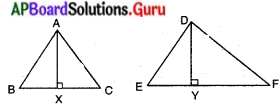
రెండు సరూప త్రిభుజాల వైశాల్యాలు 81 చ.సెం.మీ మరియు 49 చ.సెం.మీ. పెద్ద త్రిభుజములో గీసిన లంబము పొడవు 4.5 సెం.మీ అయిన చిన్న త్రిభుజములో దాని అనురూప లంబము పొడవును కనుగొనండి. .
సాధన.

AP Board 10th Class Maths Solutions Chapter 8 సరూప త్రిభుజాలు Exercise 8.3 13

దత్తాంశము : ∆ABC ~ ∆DEF ∆ABC = 81 సెం.మీ2; ∆DEF = 49 సెం.మీ2; AX = 4.5 సెం.మీ
సారాంశము : DY పొడవు
ఉపపత్తి : \(\frac{\Delta \mathrm{ABC}}{\Delta \mathrm{DEF}}=\frac{\mathrm{AX}^{2}}{\mathrm{DY}^{2}}\)
[∵ రెండు సరూప త్రిభుజాల వైశాల్యాల నిష్పత్తి వాటి అనురూప భుజాల వర్గాల నిష్పత్తికి సమానము]
\(\frac{81}{49}=\frac{(4.5)^{2}}{D Y^{2}}\)

⇒ \(\left(\frac{9}{7}\right)^{2}=\left(\frac{4.5}{D Y}\right)^{2}\)

⇒ \(\frac{9}{7}=\frac{4.5}{\mathrm{DY}}\)

⇒ DY = 4.5 × \(\frac{7}{9}\)

∴ DY = \(\frac{7}{2}\) = 3.5 సెం.మీ.

AP Inter 2nd Year Chemistry Study Material Chapter 5 General Principles of Metallurgy

Andhra Pradesh BIEAP AP Inter 2nd Year Chemistry Study Material 5th Lesson General Principles of Metallurgy Textbook Questions and Answers.

AP Inter 2nd Year Chemistry Study Material 5th Lesson General Principles of Metallurgy

Very Short Answer Questions

Question 1.
What is the role of depressant in froth floatation?
Answer:
By using depressants in the froth floatation process, it is possible to separate a mixture of two sulphide ores.
Eg: In the ore containing ZnS and PbS, the depressant used is NaCN. It prevents ZnS from coming to the froth but allows PbS to come with the froth.

Question 2.
Between C and CO, which is a better reducing agent at 673K.
Answer:

  • Out of C and CO, Carbon nonoxide (CO) is a better reducting agent at 673K.
  • At 983K (or) above coke(C) is better reducing agent.
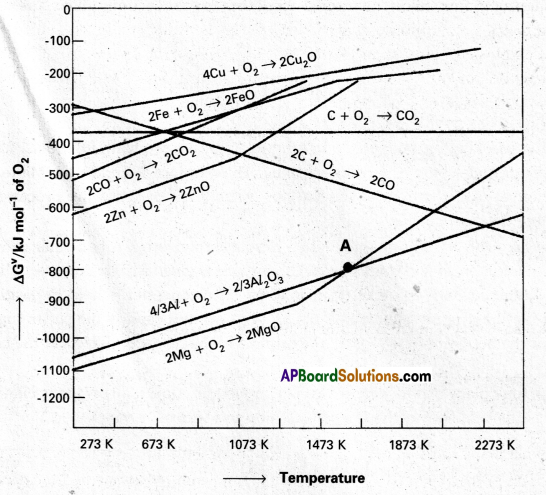
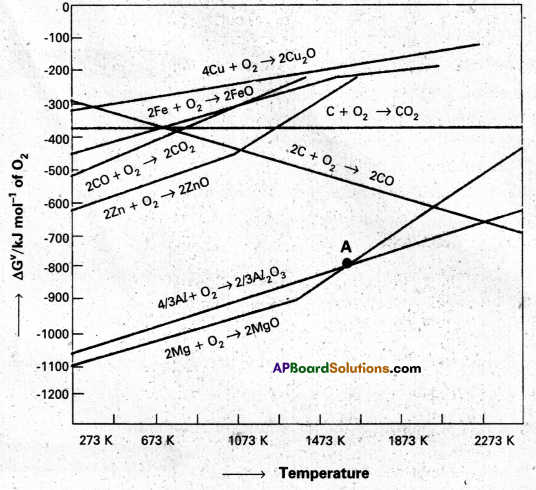
  • The above observations are form Ellingham diagram.

AP Inter 2nd Year Chemistry Study Material Chapter 5 General Principles of Metallurgy

Question 3.
Name the common elements present in the anode mud in the eletrolytic refining of copper.
Answer:

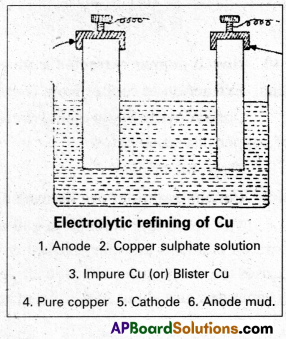
  • The common elements present in the anode mud in eletrolytic refining of copper are less reactive valuable metals, silver (Ag), gold (Au) and platinum (Pt) etc….
  • These elements donot lose eletrons at anode and collect under the anode as anode mud.

Question 4.
State the role of silica in the metallurgy of copper.
Answer:
The role of silica in the metallurgy of copper is to àcts as an acidic flux. Silica reacts with the impurities of iron and form slag.
FeO (Gangue) + SiO2 (flux) → FeSiO3 (Slag)

Question 5.
Explain “poling. [A.P. Mar.16, 15]
Answer:
When the metals are having the metal oxides as impurities this method is employed. The impure metal is melted and is then covered by carbon powder. Then it is stirred with green wood poles. The reducing gases formed from the green wood and the carbon, reduce the oxides to the metal.
Eg: Cu & Sn metals are refined by this method.

Question 6.
Decribe a method for the refining of nickel.
Answer:
Mond’s process:

  • In Mond’s process, nickel is heated in a stream of carbon monoxide forming a volatile complex, nickel tetra carbonyl.
    AP Inter 2nd Year Chemistry Study Material Chapter 5 General Principles of Metallurgy 1
  • Nickel tetra carbornyl is strongly heated to decompose and gives the pure Nickel
    AP Inter 2nd Year Chemistry Study Material Chapter 5 General Principles of Metallurgy 2

AP Inter 2nd Year Chemistry Study Material Chapter 5 General Principles of Metallurgy

Question 7.
How is cast iron different from pig iron ?
Answer:

  • Cast iron is formed by melting pig iron with scrap iron and coke in presence of blast of hot air. It contains carbon content 3%(approximately). It is extremely hard and brittle.
  • Pig iron is formed from blast furnace. It contains carbon 4% (approximately). It contains small quantities of impurities S, P, Si, Mu etc….

Question 8.
What is the difference between a mineral and an ore ?
Answer:
Minerals : The naturally occuring chemical compounds of metal in the earth’s crust are called minerals.
Ore : The mineral from which metal can be extracted economically is called ore.

Question 9.
Why copper matte is put in silica lined converter ?
Answer:
Copper matte conains Cu2 sand FeS. In this mixture FeS is gangue. For removing the gangue, silica present in the lining of the Bessemer’s converter acts as acidic flux and forms slag.
2FeS (gangue) + 3O2 → 2FeO + 2SO2
FeO (gangue) + SiO2 (flux) → FeSiO3 (Slag)

Question 10.
What is the role of cryolite in the metallurgy of aluminium? [T.S. Mar. 16, 15]
Answer:
By adding the cryolite to the pure Alumina, the melting point of pure Alumina is lowered (which is very high 2324K) and eletrical conductivity of pure alumina is increased.

Question 11.
How is leaching carried out in the case of low grade copper ores?
Answer:
In case of low grade ores of copper, hydrometallurgy technique is used for extraction. Here leaching process can be done by using acids (or) bacteria, The solution containing Cu+2 is treated with scrap iron (or) H2.
Cu+2(aq) + H2(g) → Cu(S) + 2H+(aq)

AP Inter 2nd Year Chemistry Study Material Chapter 5 General Principles of Metallurgy

Question 12.
Why is zinc not extracted from zinc oxide through reduction using CO?.
Answer:
Zinc is not extracted from zinc oxide through reduction by using CO.
Explanation:
2Zn + O2 → 2ZnO, ∆G° = -650 IcI
2C0 + O2 → 2CO, ∆G° = -450 kJ
2ZnO + 2CO → 2Zn, 2CO2, ∆G° = 200 kJ
∆G° = Positive indicatis that the reaction is not feasible.

Question 13.
Give the composition of the following alloys. [A.P. & T.S. Mar. 19, 17] [Mar. 14]
a) Brass
b) Bronze
c) German Silver
Answa:
a) Composition of Brass : 60 – 80% Cu, 20 – 40% Zn .
b) Composition of Bronze : 75 – 90% Cu, 10 – 25% Sn
c) Composition of German silver : 50 – 60% Cu, 10 – 30% Ni, 20 – 30% Zn.

Question 14.
Explain the terhts gangue and slag.
Answer:
Gangue : The ore is contaminated with the minerals of earth crust and undesired chemical compounds. These are known as gangue (or) matrix.
Slag: The fused material obtained during the refining (or) smelting of metals by combining the flux with gangue is called slag.
Eg : FeO (gangue) + SiO2 (flux) → FeSiO3 (Slag)

Question 15.
How is Ag or Au obtained by leaching from the respective ores ?
Answer:
Ag and Au are leached with a dilute solution of NaCN (or) KCN in presence of 02(air). From the leached solution the metal is obtained through displacement by Zinc. .
4M(s) + 8eN(aq) + 2H2O(aq) + O2(g) → 4[M(CN)2](aq) + 4OH(aq)
2[M(CN)2 ](aq) + Zn(s) → [Zn(CN)4]2-(aq) + 2M(s)

Question 16.
What are the limitations of Ellingham diagram ?
Answer:
Limitations of Ellingham diagram :

  • Ellingham diagram is based only on the thermodynamic concepts. It does not explain the kinetics of the reduction process. The graph simply indicates whether a reacton is possible or not but not the kinetics of the reaction.
  • The interpretation of ∆G° is depends on K [ ∆G° = -RTl.nK]
    It is presumed that the reactants and products are in equilibrium. .
    MxO + Ared ⇌ xM + AOox
    This is not always true because the reactant or product may be solid.

AP Inter 2nd Year Chemistry Study Material Chapter 5 General Principles of Metallurgy

Question 17.
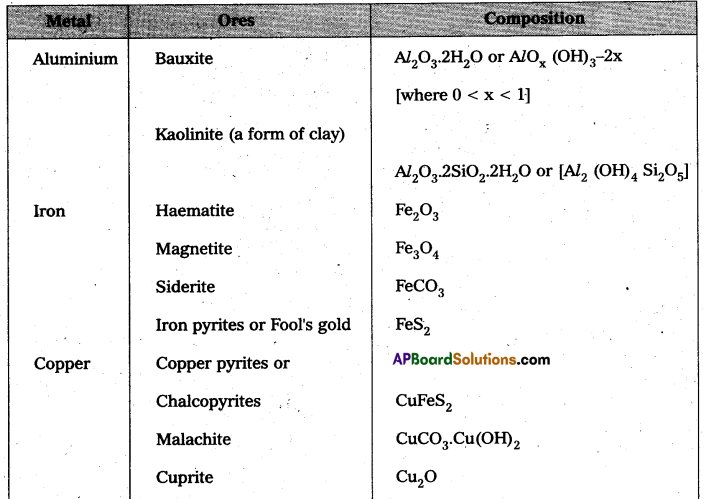
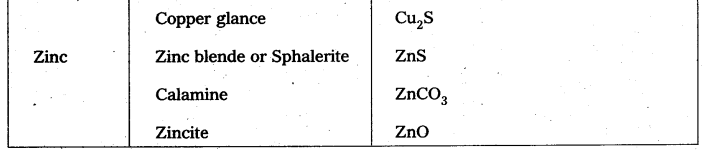
Write any two ores with formulae of the following metals :
(a) Aluminium
(b) Zinc
(c) Iron
(d) copper
Answer:
a) Ores of Aluminium : Bauxite – Al2 O3. 2H2O
Cryolite – Na3AlF6
b) Ores of Zinc : Zinc blende – Zns
Calamine – ZnCO3
c) Ores of Iron : Haematite – Fe2O3
Magnetite – Fe3O4
d) Ores of copper : Copper pyrites – CuFeS2
Copper glance – Cu2S.

Question 18.
What is matte ? Give its composition.
Answer:
During the extraction of ‘Cu’ from copper pyrites the product of the blast furnace consists mostly of Cu2S and a little of FeS. This product is known as “Matte”. It is collected from the outlet at the bottom of the fumance.

Question 19.
What is blister copper ? Why is it so called ? [T.S. Mar. 18]
Answer:
During the extraction of ‘Cu’ from copper pyrites when the matte is charged into a Bessemer converter then cuprous oxide combine with cuprous sulphide and forms Cu metal.
2CU2O + Cu2S → 6Cu + SO2
The ‘Cu’ meted is cooled.
The obtained copper metal is impure and is known as “Blister copper” (98% pure).
The solid fied copper has blistered appearance due to evolution of SO2 Hence it is called blister copper.

Question 20.
Explain magnetic separation of impurities from an ore.
Answer:
Electro-magnetic method : The method is used if the gangue or the ore particles are magnetic in nature. The finely powdered ore is dropped on a belt moving on two strong electromagnetic rollers. The magnetic and the non-magnetic substances form two separate heaps.

For example, let the ore particles be magnetic and then the non-magnetic material will be the gangue. The non-magnetic material forms a heap nearer to the magnetic roller.
Eg : Haematite and magnetite hae magnetic ore particles. Cassiterite or Tin stone has Wolframite as magnetic impurity.

Question 21.
What is flux ? Give an example.
Answer:
Flux : An outside substance added to ore to lower its melting point is known as flux.

  • Flux combines with gangue and forms easily fusible slag.
    gangue + flux → slag
    Eg: FeO (gangue) + SiO2 (flux) → FeSiO3 (Slag

AP Inter 2nd Year Chemistry Study Material Chapter 5 General Principles of Metallurgy

Question 22.
Give two uses each of the following metals :
(a) Zinc
(b) Copper
(c) Iron
(d) Aluminium
Answer:
a) Uses of Zinc :

  • Zinc is used in large quantities in batteries
  • Zinc is used for galvanising iron.
  • Zinc is used in manufacturing alloys.
    Eg: Brass, German silver,

b) Uses of copper :

  • Copper is used in manufacturing of water pipes and steam pipes.
  • Copper is used in making wires used in electrical industry.
  • Copper is used in manufacturing of alloys.
    Eg : Brass, Bronze. .

c) Uses of Iron:

  • Cast iron is used in casting stoves, railway siéepers- gutter pipers, toys etc.
  • It is used in manufacturing of wrought iron and steel.
  • Wrought iron is used in making anchors, wires, bolts, chains etc.

d) Uses of Aluminium :

  • Aluminium foils are used as wrappers for chacolates.
  • Aluminium is fine dust used in paints and lacquers.
  • Aluminium is used in photo frames.
  • Aluminium is used in extraction of Cr and Mn from their oxides.

Question 23.
Between C and CO, which is a better reducing agent for ZnO ?.
Answer:
Case – I : [Coke as reducing agent]
ZnO + C → Zn + CO, ∆G° become lesser as the T is more then 1120K
Case – II : [CO as reducing agent]
ZnO + CO2 → Zn + CO, ∆G° becomes lesser when the T is more then 1323K.

  • The value of ∆G° is negative for a reaction to occur.
  • In the equation (1) ∆G° becomes negative at low temperature- so equation (1) is feasible i. r. C is a better reducing agent for ZnO.

Question 24.
Give the uses of
a) Cast iron
b) Wrought iron
c) Nickel steel
d) Stainless steel
Answer:
a) Uses of Cast iron :

  • Cast iron is used for casting stoves, railway sleepers, gutter pipes, toys etc.
  • It is used in manufacturing of wrought iron and steel.

b) Uses of wrought iron :

  • Wrought iron is used in making anchors, wires.
  • Wrought iron is used in making chains and agricultural implements.

c) Uses of Nickel steel:

  • Nickel steel is used for making cables, automobiles and aeroplane parts.
  • Nickel steel is used for making pendulum, measuring tapes, chrome steel for cutting tools and crashing machines.

d) Uses of stainless steel:

  • Stainless steel is used in manufacturing of cycles, automobiles.
  • Stainless steel is used in manufacturing of utensils, pens etc.

AP Inter 2nd Year Chemistry Study Material Chapter 5 General Principles of Metallurgy

Question 25.
How is aluminium useful in the extraction of chromium and manganese from their oxides ?
Answer:

  • ’AT’ is used as reducing agent.
  • 4 By Alumino thermite process Cr, Mn are extracted from their oxides.
  • The reactions are highly exothermic.
    Cr2O3 + 2Al → 2Cr + Al2O3
    3Mn3O4 + 8Al → 4Al2O3 + 9Mn

Short Answer Questions

Question 1.
Copper can be extracted by hydrometallurgy but not zinc – explain.
Answer:
Copper can be extracted by hydromefallurgy but not zinc.
Explanation:

  • E0 Value of Zn+2/Zn = -0.762V is less than that of E0 value of Cu+2/Cu = 0.337V .
  • From the above data zinc is a stronger reducing agent and can easily displace the Cu+2 ions present in the complex.
    [Cu(CN)2] + Zn (Soluble complex → [Zn(CN)2] + Cu (Precipitate)
  • Zinc can be isolated by hydrometallurgy only when stronger reducing agents than zinc are present.
  • So zinc cannot be extracted by hydrometallurgy.

Question 2.
Why is the extraction of copper form pyrites more difficult then that from its oxide ore through reduction?
Answer:
The extraction of copper from pyrites is more difficult than that from its oxide ore through reduction.
Explanation:
Pyrites (Cu2S) Cannot be reduced by carbon(or) hydrogent because the standard free energy of formation (∆G°) of Cu2S is greater then those of CS2 and H2S.
AP Inter 2nd Year Chemistry Study Material Chapter 5 General Principles of Metallurgy 3
The ∆G° of copper oxide is less than that of CO2.
∴ The sulphide ore is first converted to oxide by roasting and then reduced.
AP Inter 2nd Year Chemistry Study Material Chapter 5 General Principles of Metallurgy 4

Question 3.
Explain zone refining.
Answer:
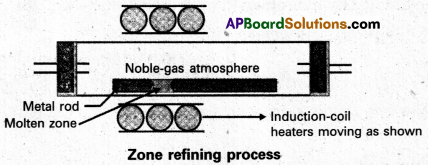
Zone refining:

  • Zone refining is based on the principle that the impurities are more soluble in the melt than in the solid state of the metal.
  • A circular mobile heater is fixed at one end of a rod of impure metal.
  • The molten zone moves along with the heater moves forward the pure metal crystallises out of the melt and the impurities pass into the adjacent molten zone.
  • The above process is repeated several times and the heater is moved in the same direction form one end to the other end. At one end impurities get concentrated. This end is cut off.
  • This method is very useful for producing semiconductor grade metals of very high purity. Eg : Ge, Si, B, Ga etc…
    AP Inter 2nd Year Chemistry Study Material Chapter 5 General Principles of Metallurgy 5

Question 4.
Write down the chemical reactions taking place in the extraction of zinc from zinc blende.
Answer:
In the extraction of zinc from zinc blende the following chemical reactions taking place.
i) Roasting : The process of strong heating the zinc blende in presence of air is roasting.
AP Inter 2nd Year Chemistry Study Material Chapter 5 General Principles of Metallurgy 6
ii) Reduction : Zinc oxide obtained by roasting undergo reduction with coke.
AP Inter 2nd Year Chemistry Study Material Chapter 5 General Principles of Metallurgy 7

AP Inter 2nd Year Chemistry Study Material Chapter 5 General Principles of Metallurgy

Question 5.
Write down the chemical reactions taking place in different zones in the blast furnace during the extraction of iron.
Answer:
The chemical reactions taking place in different zones in the blast furnace during the extraction of iron are
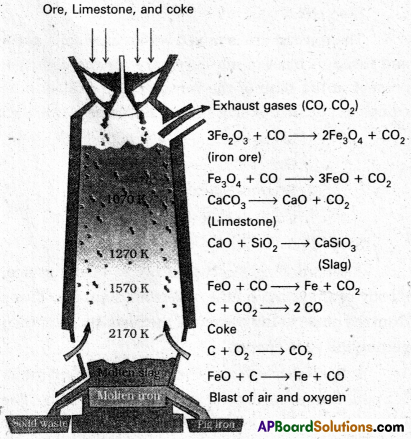
AP Inter 2nd Year Chemistry Study Material Chapter 5 General Principles of Metallurgy 8

Question 6.
How is alumina separated from silica in the bauxite ore associated with silica ? Give equations.
Answer:
Serpeck’s process is used for the purification of white Bauxite i.e., Bauxite containing silica as impurity.
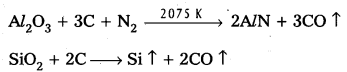
In this process bauxite is mixed with coke and is then heated to 2075K in a current of nitrogen. Silica is reduced to silicon and escapes as a vapour.
AP Inter 2nd Year Chemistry Study Material Chapter 5 General Principles of Metallurgy 9
Aluminium nitride formed in the above step is hydrolysed to form aluminium hydroxide.
AlN + 3H2O → AZ(OH)3 ↓ + NH3
Al(OH)3 PPt is washed, dried and then ignited to from purified bauxite.
AP Inter 2nd Year Chemistry Study Material Chapter 5 General Principles of Metallurgy 10

Question 7.
Giving examples to differentiate roasting and calcination. [T.S. Mar. 19, 18, 16, 15; A.P. Mar. 16, 15]
Answer:
Roasting: Removal of the volatile components of a mineral by heating mineral either alone (or) mixed with some other substances to a high temperature in the presence of air is called Roasting.

  • It is applied to the sulphide ores.
  • SO2 gas is producted along with metal oxide.
    Eg : 2ZnS + 3O2 AP Inter 2nd Year Chemistry Study Material Chapter 5 General Principles of Metallurgy 11 2ZnO + 2SO2

Calcination: Removal of the volatile components of a mineral by heating in the absence of air is called calcination.

  •  It is applied to carbonates and bicarbonates.
  • CO2 gas is produced along with metal oxide.
    Eg: CaCO3 AP Inter 2nd Year Chemistry Study Material Chapter 5 General Principles of Metallurgy 11 CaO + CO2
    ZnCO3 AP Inter 2nd Year Chemistry Study Material Chapter 5 General Principles of Metallurgy 11 ZnO + CO2

AP Inter 2nd Year Chemistry Study Material Chapter 5 General Principles of Metallurgy

Question 8.
The Value of ∆G° for the formation of Cr2O3 is – 540kJ mol-1 and that of Al2O3 is – 827kJ mol-1. Is the reduction of Cr2O3 Possible with Al?
Answer:
From the given data the following are the thermo chemical equations
\(\frac{4}{3}\) Cr(s) + O2(g) → \(\frac{2}{3}\) Cr2O2(s), ∆G° – 540 KJ ……………….. (1)
\(\frac{4}{3}\) Al(s) + O2(g) → \(\frac{2}{3}\) Al2O3(s), ∆G° – 827 KJ ……………….. (2)
Equation (1) – Equation (2)
\(\frac{2}{3}\) Cr2O3(s) + \(\frac{4}{3}\) Al(s) → \(\frac{2}{3}\) Al2O3(s) + \(\frac{4}{3}\) Cr(s), ∆G° – 287 KJ
∆G° = -ve, So the reaction is feasible
Hence the reduction of Cr2O3 is possible with ‘Al’.

Question 9.
What is the role of graphite rod in the electrometallurgy of aluminium ? [A.P. Mar. 16]
Answer:

  • In the electrolytic reduction of alumina by Hall – Heroult process graphite rod acts as anode.
  • At anode, O2 gas is liberated which reacts with the carbon of anode to form CO2 gas. So these graphite rods are consumed slowly and need to be replaced from time to time.
    Al2O3 ⇌ 2Al+3 + 3O-2
    Cathode : Al+3 + 3e → Al
    Anode : 3O-2 → 3[O] + 6e
    C(s) + O2(g) → CO2(g)

Question 10.
Outline the principles of refining of metals by the following methods.
(a) Zone refining
(b) Electrolytic refining
(c) Poling
(d) Vapour phase refining.
Answer:
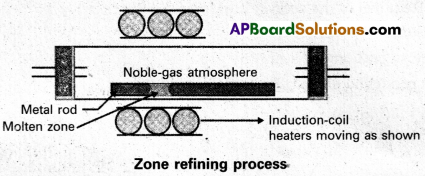
a) Zone refining :

  • Zone refining is based on the principle that the impurities are more soluble in the melt than in the solid state of the metal. .
  • A circular mobile heater is fixed at one end of a rod of impure metal.
  • The molten zone moves along with the heater moves forward the pure metal crystallises out of the melt and the impurities pass into the adjacent molten zone.
  • The above process is repeated several times and the heater is moved in the same direction form one end to the other end. At one end impurities get concentrated. This end is cut off.
  • This method is very useful for producing semiconductor grade metals of very high purity.
    Eg : Ge, Si, B, Ga etc..
    AP Inter 2nd Year Chemistry Study Material Chapter 5 General Principles of Metallurgy 12

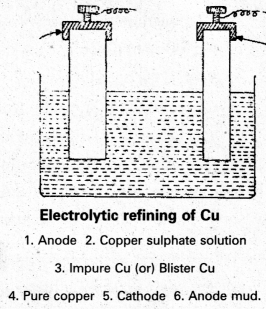
b) Electrolytic refining : This process is used for less reactive metals like Cu, Ag, AZ, Au etc.

  • In this process anode is made by impure metal and a thin strip of pure metal acts as cathode. .
  • On electrolysis metal dissolves from anode and pure metal gets deposited at cathode.
    M → Mn+ + ne
    Impure
    Mn+ + ne → M (Cathode) Pure metal
    Impurities settle down below anode in the form of anode mud.

c) Poling : When the metals are having the metal oxides as impurities this method is employed. The impure metal is melted and is then covered by carbon powder. Then it is stirred with green wood poles. The reducing gases formed from the green wood and the carbon, reduce the oxides to the metal.
Eg : Cu & Sh metals are refined by this method.

d) Vapour phase refining: In this method the metal is converted into its volatile compound and collected. It is then decomposed to give pure metal. .

  1. The metal should form a volatile compound with an available reagent.
  2. The volatile compound should be easily decomposable. So the the recovery is easy.
    E.g : Mond’s process :
  3. In Mond’s process, nickel is heated in a stream of carbon monoxide forming a volatile complex, nickel tetra carbonyl.
    AP Inter 2nd Year Chemistry Study Material Chapter 5 General Principles of Metallurgy 13
  4. Nickel tetra carbomyl is strongly heated to decompose and gives the pure Nickel
    AP Inter 2nd Year Chemistry Study Material Chapter 5 General Principles of Metallurgy 14

AP Inter 2nd Year Chemistry Study Material Chapter 5 General Principles of Metallurgy

Question 11.
Predict the conditions under which Al might be expected to reduce MgO.
Answer:
The Equations for the formation of two oxides are
\(\frac{4}{3}\)Al(S) + O2(g) → 2Mg(S) + \(\frac{2}{3}\) O2(g) \(\frac{4}{3}\) 2MgO(S)
From the Ellingham diagram the two curves of these oxides formation intersect each otherat a certain point. The corresponding value of ∆G° becomes zero for the reduction of MgO by aluminium metal,
2MgO(S) + \(\frac{4}{3}\) Al(S) ⇌ 2Mg(S) + \(\frac{2}{3}\) Al2O3(S)

  • From the above information the reduction of MgO by Al metal cannot occur below this temperature (1665 K) instead, Mg can reduce  Al2O3 to Al below 1665 K.
  • Al-Metal can reduce MgO to Mg above 1665K because ∆G° for Al2O3 is less compared to that of MgO.
    AP Inter 2nd Year Chemistry Study Material Chapter 5 General Principles of Metallurgy 15

Question 12.
Explain the purification of sulphide ore by froth floatation method. [A.P. Mar.’19, 17, 15; T.S. Mar. 15]
Answer:
Froth floatation method :
This method is used to concentrate sulphide ores.
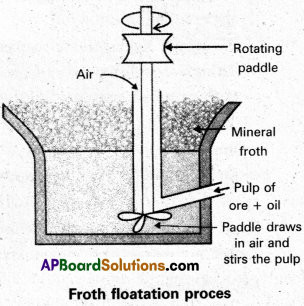
AP Inter 2nd Year Chemistry Study Material Chapter 5 General Principles of Metallurgy 16

  • In this process a suspension of the powdered ore is made with water.
  • A rotating paddle is used to agitate the suspension and air is blown into the suspension in presence of an oil.
  • Froth is formed as a result of blown of air, which carries the mineral particles.
  • To the above slurry froth collectors and stabilizers are added.
  • Collectors like pine oil enhance non-wettability of the mineral particles.
  • Froth stabilizers like cresol stabilize the froth.
  • The mineral particles wet by oil and gangue particles wet by water.
  • The broth is light and is skimmed off. The ore particles are then obtained from the froth. By using depressants in froth floatation process, it is possible to separate a mixture of two suplhide ores.
    Eg : In the ore containing ZnS and PbS, the depressant used is NaCN. It prevents ZnS from coming to the froth but allows PbS to come with the froth.

Question 13.
Explain the process of leaching of alumina from bauxite. [T.S. Mar. 17]
Answer:
The principal ore of aluminium, bauxite, usually contains SiO2, iron oxides and titanium oxide (TiO2) as impurities, concentration is carried out by digesting the powdered ore with a concentrated solution of NaOH at 473 – 523 K and 35 – 36 bar pressure. The way. Al2O3 is leached out as sodium aluminate (and SiO2 too as sodium silicate) leaving the other impurities behind :
Al2O3 (S) + 2NaOH(aq) + 3H2O(l) → 2 Na[Al(OH)4](aq)
The aluminate is alkaline in nature and is neutralised by passing CO2 gas and hydrated Al2O3 is precipitated. At this stage, the solution is seeded with freshly prepared samples of hydrated Al2O3 which induces the precipitation of Al2O3 xH2O
2 Na[Al(OH)4](aq) + CO2(g) → Al2O3 xH2O(s) + 2NaHCO3(aq)
The sodium silicate remains in the solution and the insoluble hydrated alumina is filtered, dried and heated to give pure Al2O3:
AP Inter 2nd Year Chemistry Study Material Chapter 5 General Principles of Metallurgy 17

AP Inter 2nd Year Chemistry Study Material Chapter 5 General Principles of Metallurgy

Question 14.
What is Ellingham diagram ? What information can be known from this in the reduction of oxides ?
Answer:
The graphical representation of Gibbs energy which provides a sound basis for considering the choice of reducing agent in the reduction of oxides. This graphical representation is known as Ellingham diagram.

  • This diagram helps us in predicting the feasibility of thermal reduction of an ore.
  • The Criterion of feasibility of a reaction is that at a given temperature, Gibbs energy of the reaction must be negative.
  •  Ellingham diagram normally consists plots of ∆G° vs T for formation of oxides of elements.
  • The graph indicates whether a reaction is possible or not, i.e., the tendency of reduction with a reducing agent is indicated with a reducing agent is indicated.
  • The reducing agent forms its oxide when the metal oxide is reduced. The role of reducing agent is to make the sum of ∆G° values of the two reactions negative.
  • Out of C and CO, Carbon monoxide (CO) is a better reducting agent at 673K.
  • At 983K (or) above coke(C) is better reducing agent.
  • The above observations are form Ellingham diagram.
    Zinc is not extracted from zinc oxide through reduction by using CO.

Explanation :

  • 2Zn + O2 → 2ZnO, ∆G° =-650 kJ
  • 2CO + O2 → 2CO2, ∆G° = -450 kJ
  • 2ZnO + 2CO → 2Zn, 2CO2, ∆G° = 200 kJ
    ∆G° = Positive indicatis that the reaction is not feasible.
    The above fact is explained on the basis of Ellingham diagram.
    AP Inter 2nd Year Chemistry Study Material Chapter 5 General Principles of Metallurgy 18

Question 15.
How is copper extracted from copper pyrites?
Answer:
Extraction of copper from copper pyrites :
Copper pyrite is the main source of copper metal. Various steps involved in the extraction of copper discussed below.
Step – I:
Concentration of ore by froth floatation process :
The ore is first crushed in ball mills. The finely divided ore is suspended in water. A little pine oil is added and the mixture is vigorously agitated by a current of air. The froth formed carries the ore particles almost completely. The gangue sinks to the bottom of the tank. The froth is separated and about 95% concentrated ore is obtained.

Step -II:
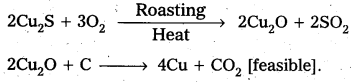
Roasting : To remove the volatile impurities like As (or) Sb, the ore is roasted in a free supply of air. A mixture of sulphides of copper and iron are obtained and these are partially oxidised to respective oxides.
Cu2S. Fe2S3 + O2 → Cu2S + 2FeS + SO2
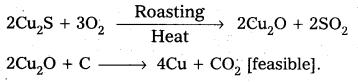
2Cu2S + 3O2 → 2Cu2O + 2SO2
2FeS + 3O2 → 2FeO + 2SO2

Step -III:
The roasted ore is mixed with a little coke and sand (Silica) and smelted in a blast furnace and fused. A blast of air, necessary for the combustion of coke, is blown through the tuyeres present at the base of the furnace. The oxidation of the sulphides of copper and iron will be completed further. A slag of iron silicate is formed according to the reactions given below :
2FeS + 3O2 → 2FeO + 2SO2
FeO + SiO2 → Fe SiO3 Ferrous Silicate (Slag)
Cu2O + FeS → Cu2S + FeO

Step -IV : After smelting the copper ore in blast furnace, the product of the blast furnace consists mostly of Cu2S and a little of ferrous sulphide. This product is known as “Matte.” It is collected from the outlet at the bottom of the furnace. After then the following processes are carried out for getting the pure copper.

Bessemerization : The matte is charged into a Bessemer converter. A bessemer converter is a pear-shaped furnace. It is made of steel plates. The furnace is given a basic lining with lime or magnesium oxide (obtained from dolomite or magnesite). The converter is held in position by trunnions and can be tilted in any position. A hot blast of air and sand is blown through the tuyeres present near the bottom. Molten metal, the product in the furnace, collects at the bottom of the converter.

Reactions that took place in blast furnace go to completion. Almost all of iron is eliminated as a slag. Cuprous oxide combines with cuprous sulphide and forms Cu metal.
2Cu2O + Cu2S → 6Cu + SO2
The molten metal is cooled in sand moulds. S02 escapes. The impure copper metal is known as “Blister copper” and is about 98% pure.
AP Inter 2nd Year Chemistry Study Material Chapter 5 General Principles of Metallurgy 19
Step -V:
Refining : The Blister copper is purified by electrolysis. The impure copper metal is made into plates. They are suspended into lead – lined tanks containing Copper (II) Sulphate solution. Thin plates of pure copper serve as cathode. The cathode plates are coated with graphite. On electrolysis, pure copper is deposited at the cathode. The copper obtained is almost 100% pure Cu.

AP Inter 2nd Year Chemistry Study Material Chapter 5 General Principles of Metallurgy

Question 16.
Explain the extraction of Zinc form Zinc blende.
Answer:
“Zinc blende (ZnS)” is an important source for ‘Zn’ metal.
Extraction of Zinc : Zinc blende ore is treated in the following stages.
i) Crushing : The ore is crushed to a fine powder in ball mills.

ii) Concentration of the ore : The ore is concentrated first by gravity process. The crushed ore is washed with a stream of water on a Wilfley’s table. The tables have a corrugated top and are under a rocking motion. Due to this motion, the lighter gangue particles are washed away by the steam. The heavier ore particles settle to the bottom of the table.

The partially concentrated ore is further concentrated by froth floatation process. The ore particles go with the froth.

The concentrated ore is subjected further to electromagnetic separation, if iron oxide is present in the gangue. Iron oxide is magnetic and so forms a heap nearer to the magnetic pole.

iii) Roasting: The concentrated ore thus obtained is roasted in rotary shelf burner which is provided with horizontal shelves and raking arms. The ore is added at the top and zinc oxide is collected from the bottom. The following reactions take place.
2ZnS + 3O2 → 2ZnO + 2SO2
ZnS + 2O2 → ZnSO4
2ZnSO4 → 2ZnO + 2SO2 + O2.
iv) Reduction : Three methods are in practice for the reduction of the oxide to the metal., The most commonly used method is the Belgian process. In this process the roasted ore is mixed with coal or coke intimately and is taken in fireclay or earthem ware retorts. The retorts are made of fireclay which are bottle shaped tubes. These are closed at one end. The other end is connected to air cooled earthem ware condenser. A large number of retorts are placed in tiers in a large furnace and heated in 1100°C by burning the gas. ‘Prolongs’ made of sheet iron are attached to the condensers. The metal condenses in these earthem ware condensers and the prolongs. The metal powder collected is mixed with some zinc oxide and is known as “zinc dust”. Some of the zinc metal is collected in the fused state. This is solidified in moulds. This metal is called “zinc spelter”.
ZnO + C → Zn + CO
ZnO + CO → Zn + CO2
Electrolytic refining : Very pure zinc is obtained by electrolysis. The electrolyte is zinc sulphate solution containing a little H2SO4. Impure zinc is made the anode and the pure zinc plates are made the cathode.

Question 17.
Explain smelting process in the extraction of copper.
Answer:
The roasted ore is mixed with a little coke and sand (Silica) and smelted in a blast furnace and fused. A blast of air, necessary for the combustion of coke, is blown through the tuyeres present at the base of the furnace. The oxidation of the sulphides of copper and iron will be completed further. A slag of iron silicate is formed according to the reactions given below :
2FeS + 3O2 → 2FeO + 2SO2
FeO + SiO2 → Fe SiO3
Ferrous Silicate (Slag)
Cu2O + FeS → Cu2S + FeO

Question 18.
Explain electrometallurgy with an example.
Answer:
Electro metallurgy : Metallurgy involving the use of electric arc furnaces, electrolysis and other electrical operations is called electrometallurgy.
In the reduction of a molten metal salt, electrolysis is used. These methods are based on electro chemical principles.
These are expained by the equation
∆G° = -n FE°
n = no. of electrons
E° = Electrode potential.
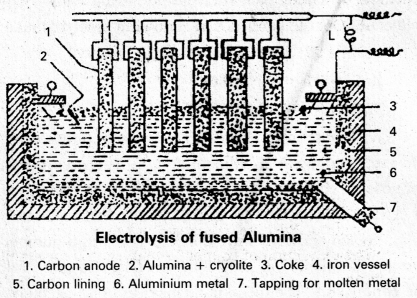
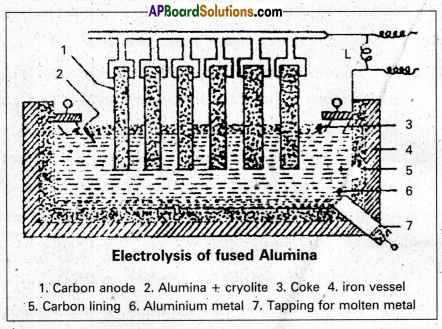
Electrolytic Reduction of Alumina : Pure Alumina (Al2O3) is a bad conductor of electricity and it has high melting point (2050°C). So it cannot be electrolysed. Alumina is electrolysed by dissolving in fused cryolite to increase the conductivity and small amount of Fluorspar is added to reduce its melting point. Thus the electrolyte is a fused mixture of Alumina, Cryolite and Fluorspar.
Electrolysis is carried out in an iron tank lined inside with graphite (carbon) which functions as cathode. A number of carbon rods (or) copper rods suspended in the electrolyte functions as Anode.
AP Inter 2nd Year Chemistry Study Material Chapter 5 General Principles of Metallurgy 20
An electric current of 100 amperes at 6 to 7 volts is passed through the electrolyte. Heat produced by the current keeps the mass in fused state at 1175 to 1225K. The following reactions take place in the electrolytic cell under these conditions.
Na3AlF6 → 3NaF + AlF3
Cryolite
4AlF3 → 4Al3+ + 12F
At cathode : 4Al3+ + 12e → 4Al
At anode : 12F → 6F2 + 12e
F2 formed at the anode reacts with alumina and forms Aluminium fluoride.
2Al2O3 + 6F2 → 4AlF3 + 3O2
Aluminium, produced at the cathode, sinks to the bottom of the cell. It is removed from time to time through topping hole.

AP Inter 2nd Year Chemistry Study Material Chapter 5 General Principles of Metallurgy

Question 19.
Explain briefly the extraction of aluminium from bauxite.
Answer:
Extraction of Aluminium from Bauxite:
For the purpose of extraction of Al, Bauxite is the best source.
purification of Bauxite : Bauxite containing Fe2O3 as impurity is known as red Bauxite.
Bauxite containing SiO2 as impurity is known as white Bauxite and can be purified by “Serpeck’s Process”. Red Bauxite is purified by Bayer’s process and Hall’s process.
Bayer’s Process : Red bauxite, is roasted and digested in concentrated NaOH at 423 K. Bauxite dissolves in NaOH to form sodium meta aluminate while impurity Fe2O3 does not dissolve which can be removed by filtration.
Al2O3.2H2O + 2NaOH → 2NaAlO2 + 3H2O
The solution which contains sodium meta aluminate is diluted and crystals of AZ(OH)3, are added which serves as seeding orgent. Sodium meta aluminate undergoes hydrolysis to precipitate Al(OH)3.
2NaAlO2 + 4H2O → 2NaOH + 2Al(OH)3
Al(OH)3 is filtered and ignited at 1200°C to get anhydrous alumina.
2Al(OH)3 AP Inter 2nd Year Chemistry Study Material Chapter 5 General Principles of Metallurgy 11 Al2O3 + 3H2O
Halls’ Process: Red Bauxite is fused with sodium carbonate to form sodium meta aluminate which is extracted with water. The impurity Fe2O3 is filtered out.
Al2O3 + Na2CO3 → 2NaAlO2 + CO2
Into the solution of sodium meta aluminate, CO2 gas is passed to precipitate Al(OH)3.
AP Inter 2nd Year Chemistry Study Material Chapter 5 General Principles of Metallurgy 26
The precipitated Al(OH)3 is ignited at 1200°C to get anhydrous alumina.
2Al(OH)3 → Al2O3 + 3H2O
Serpeck’s Process: Powdered bauxite is mixed with coke and heated to 2075 K in a current of nitrogen gas. Aluminium Nitride is formed while Si02 is reduced to SiO2 which escapes out.
AP Inter 2nd Year Chemistry Study Material Chapter 5 General Principles of Metallurgy 27
Aluminium nitride is hydrolysed to get aluminium hydroxide which on ignition gives anhydrous alumina.
AlN + 3H2O → Al(OH)3 ↓ + NH3
2Al(OH)3 AP Inter 2nd Year Chemistry Study Material Chapter 5 General Principles of Metallurgy 11 3 Al2O3 + 3H2O

Electrolytic Reduction of Alumina : Pure Alumina (Al2O3) is a bad conductor of electricity and it has high melting point (2050°C). So it cannot be electrolysed. Alumina is electrolysed by dissolving in fused cryolite to increase the conductivity and small amount of Fluorspar is added to reduce its melt¬ing point. Thus the electrolyte is a fused mixture of Alumina, Cryolite and Fluorspar.
AP Inter 2nd Year Chemistry Study Material Chapter 5 General Principles of Metallurgy 28
Electrolysis is carried out in an iron tank lined inside with graphite (carbon) which functions as cathode. A number of carbon rods (or) copper rods suspended in the electrolyte functions as Anode.
Na3AlF6 → 3NaF + AlF3
Cryolite
4AlF3 → 4Al3+ + 12F
At cathode : 4Al3+ + 12e → 4Al
At anode : 12F → 6F2 + 12e
F2 formed at the anode reacts with alumina and forms Aluminium fluoride.
2Al2O3 + 6F2 → 4AlF3 + 3O2
Aluminium, produced at the cathode, sinks to the bottom of the cell. It is removed from time to time through topping hole.

Purification of Aluminium : (Hoope’s Process)
The impurities present are Si, Cu, Mn etc.,
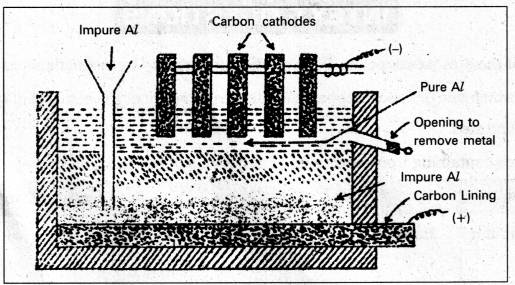
The electrolytic cell used for refining of aluminium consists of iron tank lined inside with carbon. This acts as anode. The tank contains three layers of fused masses. The bottom layer contains impure aluminium. Middle layer contains mixture of AlF3, NaF and BaF2 saturated with Al2O3. Top layer contains pure aluminium and graphite rods kept in it act as cathode.
AP Inter 2nd Year Chemistry Study Material Chapter 5 General Principles of Metallurgy 29
On passing current aluminium ions from the middle layer are discharged at the cathode as pure aluminium. Equivalent amount of aluminium from the bottom layer passes into middle layer.

Long Answer Questions

Question 1.
The choice of a reducing agent in a particular case depends on thermo-dynamic factor, •lain with two examples.
Answer:
The choice of a reducing agent in a particular case depends on thermodynamic factor. This fact can be explained by considering the following examples.

  • Out of C and CO, Carbon nonoxide (CO) is a better reducting agent at 673K.
  • At 983K (or) above coke(C) is better reducing agent.
  • The above observations are form Ellingham diagram.
  • Zinc is not extracted from zinc oxide through reduction using CO.

Explanation :
2Zn + O2 → 2ZnO, ∆G° = -650 kJ
2CO + O2 → 2CO2, ∆G° = -450 kJ
2ZnO + 2CO → 2Zn + 2CO2, ∆G° = 200 kJ
∆G° = Positive indicatis that the reaction is not feasible.
The extraction of copper from pyrites is more difficult than that from its oxide ore through reduction. ‘ .
Explanation : Pyrites (Cu2S) Cannot be reduced by carbon (or) hydrogent because the standard free energy of formation (∆G°) of Cu2S is greater then those of CS2 and H2S.
AP Inter 2nd Year Chemistry Study Material Chapter 5 General Principles of Metallurgy 21
The ∆G° of copper oxide is less than that of CO2.
∴ The sulphide ore is first converted to oxide by roasting and then reduced. Roasting
AP Inter 2nd Year Chemistry Study Material Chapter 5 General Principles of Metallurgy 22
The following are the conditions that Al might be expected to reduce MgO. The Equations for the formation of two oxides are
\(\frac{4}{3}\)Al(S) + O2(g) → \(\frac{2}{3}\) Al2O3(S)
2Mg(S) + O2(g) → 2MgO(S)
From the Ellingham diagram the two curves of these oxides formation intersect each other at a certain point. The corresponding value of ∆G° becomes zero for the reduction of MgO by aluminium metal,
2MgO(S) + \(\frac{4}{3}\)Al(S) → 2Mg(S) + \(\frac{2}{3}\) Al2O3(S)

  • From the above information the reduction of MgO by Al metal cannot occur below this temperature (1665 K) instead, Mg can reduce Al2O3 to Al below 1665 K.
  • Al-Metal can reduce MgO to Mg above 1665 K because ∆G° for Al2O3 is less compared to that of MgO.
    AP Inter 2nd Year Chemistry Study Material Chapter 5 General Principles of Metallurgy 23

AP Inter 2nd Year Chemistry Study Material Chapter 5 General Principles of Metallurgy

Question 2.
Discuss the extraction of Zinc from Zinc blend
Answer:
“Zinc blende (ZnS)” is an important source for ‘Zn’metal.
Extraction of’Zinc : Zinc blende ore is treated in the following states.
i) Crushing : The ore is crushed to a fine powder in ball mills.
ii) Concentration of the ore : The ore is concentrated first by gravity process. The crushed ore is washed with a stream of water on a Wilfley’s table. The tables have a corrugated top and are under a rocking motion. Due to this motion, the lighter gangue particles are washed away by the steam. The heavier ore particles settle to the bottom of the table.

The partially concentrated ore is further concentrated by froth floatation process. The ore particles go with the froth.

The concentrated ore is subjected further to electromagnetic separatioh, if iron oxide is present in the gangue. Iron oxide is magnetic and so forms a heap nearer to the magnetic pole.

iii) Roasting: The concentrated ore thus obtained is roasted in rotary shelf burner which is provided with horizontal shelves and raking arms. The ore is added at the top and zinc oxide is collected from the bottom. The following reactions take place.
2ZnS + 3O2 → 2ZnO + 2SO2
ZnS + 2O2 → ZnSO4
2ZnSO4 → 2ZnO + 2SO2 + O2
iv) Reduction : Three methods are in practice for the reduction of the oxide to the metal. The most commonly used method is the Belgian process. In this process the roasted ore is mixed with coal or coke intimately and is taken in fireclay or earthern ware retorts. The retorts are made of fireclay which are bottle shaped tubes. These are closed at one end. The other end is connected to air cooled earthern ware condenser. A large number of retorts are placed in tiers in a large furnace and heated in 1I00°C by burning the gas. ‘Prolongs’ made of sheet iron are attached to the condensers. The metal condenses in these earthern ware condensers and the prolongs. The metal powder collected is mixed with some zinc oxide and is known as “zinc dust”. Some of the zinc metal is collected in the fused state. This is solidified in moulds. This metal is called “zinc spelter”.
ZnO + C → Zn + CO
ZnO + CO → Zn + CO2
Electrolytic refining : Very pure zinc is obtained by electrolysis. The electrolyte is zinc sulphate solution containing a little H2SO4. Impure zinc is made the anode and the pure zinc plates are made the cathode.

Question 3.
Explain the reactions occuring in the blast furnace in the extraction of iron.
Answer:
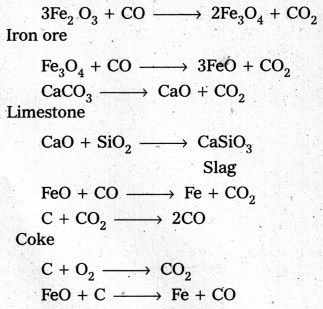
In the Blast furnace, reduction of iron oxides takes place in different temperature ranges. Hot air is blown from the bottom of the furnace and coke is burnt to give temperature upto about 2200K in the lower portion itself. The burning of coke therefore supplies most of the heat required in the process. The CO and heat moves to upper part of the furnace. In upper part, the temperature is 1o%er and the iron oxides (Fe2O3 and Fe3O4) coming from the top are reduced in steps to FeO. Thus, he reduction reactions taking place in the lower temperature range and in the higher temperature range, depend on the points of corresponding intersections in the ∆rG° vs T plots.

These reactions can be summarised as follows:
At 500 – 800 K (lower temperature range in the blast furnace)
3 Fe2O3 + CO → 2 Fe3O4 + CO2
Fe3O4 + 4 CO → 3 Fe + 4 CO2
Fe2O3 + CO → 2 FeO + CO2
At 900 – 1500 K (higher temperature range in the blast furnace)
C + CO2 → 2 CO
FeO + CO → Fe + CO2
Lime stone is also decomposed to CaO which removes silicate impurity of the ore as CaSiO3 slag. The slag is in molten state and separates out from iron.
AP Inter 2nd Year Chemistry Study Material Chapter 5 General Principles of Metallurgy 24
The iron obtained from Blast furnace contains about 4% carbon and many impurities in smaller amount (e.g., S, P, Si, Mn). This is known as pig iron. Cast iron is different from and is made by melting pig iron with scrap iron and coke using hot air blast. It has slightly lower carbon content (about 3%) and is extremely hard and brittle.
Fe2O3 3 C → 2 Fe + 3 CO

AP Inter 2nd Year Chemistry Study Material Chapter 5 General Principles of Metallurgy

Question 4.
Discuss the extraction of copper from copper pyrites.
Answer:
Extraction of copper from copper pyrites:
Copper pyrite is the main source of copper metal. Various steps involved in the extraction of copper discussed below.
Step – I:
Concentration of ore by froth floatation process:
The ore is first crushed in ball mills. The finely divided ore is suspended in water. A little pine oil is added and the mixture is vigorously agitated by a current of air. The froth formed carries the ore particles almost completely. The gangue sinks to the bottom of the tank. The froth is separated and about 95% concentrated ore is obtained.

Step – II: Roasting :
To remove the volatile impurities like As (or) Sb, the ore is roasted in a free supply of air. A mixture of sulphides of copper and iron are obtained and these are partially oxidised to respective oxides.
Cu2S. Fe2S3 + O2 → Cu2S + 2FeS + SO2
2Cu2S + 3O2 → 2Cu2O + 2SO2
2FeS + 3O2 → 2FeO + 2SO2

Step – III :
The roasted ore is mixed with a little coke and sand (Silica) and smelted in a blast furnace and fused. A blast of air, necessary for the combustion of coke, is blown through the tuyeres present at the base of the furnace. The oxidation of the sulphides of copper and iron will be completed further. A slag of iron silicate is formed according to the reactions given below :
2FeS + 3O2 → 2FeO + 2SO2
FeO + SiO2 → Fe SiO3
Ferrous Silicate (Slag)
Cu2O + FeS → Cu2S + FeO
Step -IV:
After smelting the copper ore in blast furnace, the product of the blast furnace consists mostly of Cu2S and a little of ferrous sulphide. This product is known as “Matte.” It is collected from the outlet at the bottom of the furnace . After then the following processes are carried out for getting the pure copper.

1. Bessemerization: The matte is charged into a Bessemer converter. A bessemer converter is a pear-shaped furnace. It is made of steel plates. The furnace is given a basic lining with lime or magnesium oxide (obtained from dolomite or magnesite). The converter is held in position by trunnions and can be tilted in any position. A hot blast of air and sand is blown through the tuyeres present near the bottom. Molten metal, the product in the furnace, collects at the bottom of the converter.

Reactions that took place in blast furnace go to completion. Almost all of iron is eliminated as a slag. Cuprous oxide combines with cuprous sulphide and forms Cu metal.
2Cu2O + Cu2S → 6Cu + SO2
AP Inter 2nd Year Chemistry Study Material Chapter 5 General Principles of Metallurgy 25
The molten metal is cooled in sand moulds. S02 escapes. The impure copper metal is known as “Blister copper” and is about 98% pure.

Step -V:
Refining : The Blister copper is purified by electrolysis. The impure copper metal is made into plates. They are suspended into lead – lined tanks containing Copper (II) Sulphate solution. Thin plates of pure copper serve as cathode. The cathode plates are coated with graphite. On electrolysis, pure copper is deposited at the cathode. The copper obtained is almost 100% pure Cu.

AP Inter 2nd Year Chemistry Study Material Chapter 5 General Principles of Metallurgy

Question 5.
Explain the various steps involved in the extraction of almninium from bauxite.
Answer:
Extraction of Aluminium from Bauxite:
For the purpose of extraction of Al, Bauxite is the best source.
purification of Bauxite : Bauxite containing Fe2O3 as impurity is known as red Bauxite.
Bauxite containing SiO2 as impurity is known as white Bauxite and can be purified by “Serpeck’s Process”. Red Bauxite is purified by Bayer’s process and Hall’s process.
Bayer’s Process : Red bauxite, is roasted and digested in concentrated NaOH at 423 K. Bauxite dissolves in NaOH to form sodium meta aluminate while impurity Fe2O3 does not dissolve which can be removed by filtration.
Al2O3.2H2O + 2NaOH → 2NaAlO2 + 3H2O
The solution which contains sodium meta aluminate is diluted and crystals of AZ(OH)3, are added which serves as seeding orgent. Sodium meta aluminate undergoes hydrolysis to precipitate Al(OH)3.
2NaAlO2 + 4H2O → 2NaOH + 2Al(OH)3
Al(OH)3 is filtered and ignited at 1200°C to get anhydrous alumina.
2Al(OH)3 AP Inter 2nd Year Chemistry Study Material Chapter 5 General Principles of Metallurgy 11 Al2O3 + 3H2O
Halls’ Process: Red Bauxite is fused with sodium carbonate to form sodium meta aluminate which is extracted with water. The impurity Fe2O3 is filtered out.
Al2O3 + Na2CO3 → 2NaAlO2 + CO2
Into the solution of sodium meta aluminate, CO2 gas is passed to precipitate Al(OH)3.
AP Inter 2nd Year Chemistry Study Material Chapter 5 General Principles of Metallurgy 26
The precipitated Al(OH)3 is ignited at 1200°C to get anhydrous alumina.
2Al(OH)3 → Al2O3 + 3H2O
Serpeck’s Process: Powdered bauxite is mixed with coke and heated to 2075 K in a current of nitrogen gas. Aluminium Nitride is formed while Si02 is reduced to SiO2 which escapes out.
AP Inter 2nd Year Chemistry Study Material Chapter 5 General Principles of Metallurgy 27
Aluminium nitride is hydrolysed to get aluminium hydroxide which on ignition gives anhydrous alumina.
AlN + 3H2O → Al(OH)3 ↓ + NH3
2Al(OH)3 AP Inter 2nd Year Chemistry Study Material Chapter 5 General Principles of Metallurgy 11 3 Al2O3 + 3H2O

Electrolytic Reduction of Alumina : Pure Alumina (Al2O3) is a bad conductor of electricity and it has high melting point (2050°C). So it cannot be electrolysed. Alumina is electrolysed by dissolving in fused cryolite to increase the conductivity and small amount of Fluorspar is added to reduce its melt¬ing point. Thus the electrolyte is a fused mixture of Alumina, Cryolite and Fluorspar.
AP Inter 2nd Year Chemistry Study Material Chapter 5 General Principles of Metallurgy 28
Electrolysis is carried out in an iron tank lined inside with graphite (carbon) which functions as cathode. A number of carbon rods (or) copper rods suspended in the electrolyte functions as Anode.
Na3AlF6 → 3NaF + AlF3
Cryolite
4AlF3 → 4Al3+ + 12F
At cathode : 4Al3+ + 12e → 4Al
At anode : 12F → 6F2 + 12e
F2 formed at the anode reacts with alumina and forms Aluminium fluoride.
2Al2O3 + 6F2 → 4AlF3 + 3O2
Aluminium, produced at the cathode, sinks to the bottom of the cell. It is removed from time to time through topping hole.

Purification of Aluminium : (Hoope’s Process)
The impurities present are Si, Cu, Mn etc.,
The electrolytic cell used for refining of aluminium consists of iron tank lined inside with carbon. This acts as anode. The tank contains three layers of fused masses. The bottom layer contains impure aluminium. Middle layer contains mixture of AlF3, NaF and BaF2 saturated with Al2O3. Top layer contains pure aluminium and graphite rods kept in it act as cathode.
AP Inter 2nd Year Chemistry Study Material Chapter 5 General Principles of Metallurgy 29
On passing current aluminium ions from the middle layer are discharged at the cathode as pure aluminium. Equivalent amount of aluminium from the bottom layer passes into middle layer.

Textual Examples

Question 1.
Suggest a condition under which magnesium could reduce alumina.
Answer:
The two equations are :
a) \(\frac{4}{3}\) Al + O2 → \(\frac{2}{3}\) Al2O3
b) 2 Mg + O2 → 2MgO
At the point of intersection of the Al2O3 and MgO curves (marked. “A” in Ellingham diagram), the ∆G becomes ZERO for the reaction :
\(\frac{2}{3}\) Al2O3 + 2Mg → 2MgO + \(\frac{4}{3}\) Al
Below that point magnesium can reduce alumina.

Question 2.
Although thermodynamically feasible, in practice, magnesium metal is not used for the reduction of alumina in the metallurgy of aluminium. Why ?
Answer:
Temperatures below the point of intersection of Al2O3 and MgO curves, magnesium can reduce alumina. But the process will be uneconomical.

AP Inter 2nd Year Chemistry Study Material Chapter 5 General Principles of Metallurgy

Question 3.
Why is the reduction of a metal oxide easier if the metal formed is in liquid state at the temperature of reduction ?
Solution:
The entropy is higher if the metal is in liquid state than when it is in solid state. The value of entropy change (∆S) of the reduction process is more on +ve side when the metal formed is in liquid state and the metal oxide being reduced is in solid state. Thus the value of ∆Gbecomes more on negative side and the reduction becomes easier.

Question 4.
At a site, low grade copper ores are available and zinc and iron scraps are also available. Which of the two scraps would be more suitable for reducing the leached copper ore and why ?
Solution:
Zinc being above iron in the electrochemical series (more reactive metal is zinc), the reduction will be faster in case zinc scraps are used. But zinc is costlier metal than iron. So using iron scraps will be advisable and advantageous.

Intext Questions

Question 1.
Which of the ores mentioned in Table can be concentrated by magnetic separation method ?
Answer:
Ores in which one of the components (either the impurity or the actual ore) is magnetic can be concentrated.
E.g.: ores containing iron (haematite, magnetite, siderite and iron pyrites).
AP Inter 2nd Year Chemistry Study Material Chapter 5 General Principles of Metallurgy 30
AP Inter 2nd Year Chemistry Study Material Chapter 5 General Principles of Metallurgy 31

Question 2.
What is the significance of leaching in the extraction of aluminium ?
Answer:
Leaching is significant as it helps in removing the impurities like SiO2, Fe2O3 etc. from the bauxite ore.

Question 3.
The reaction, Cr2O3 + 2 Al → Al2O3 + 2 Cr (∆G = -421 kJ) is thermodynamically feasible as is apparent from the Gibbs energy value. Why does it not take place at room temperature?
Answer:
Certain amount of activation energy is essential even for such reactions which are thermodynamically feasible, therefore heating is required.

AP Inter 2nd Year Chemistry Study Material Chapter 5 General Principles of Metallurgy

Question 4.
Is it true that under certain conditions Mg can reduce Al2O3 and Al can reduce MgO ? What are those conditions ?
Answer:
Yes, below 1350°C Mg can reduce Al2O3 and above 1350°C, Al can reduce MgO. This can be inferred from ∆G vs T plots.
AP Inter 2nd Year Chemistry Study Material Chapter 5 General Principles of Metallurgy 32

AP 7th Class Social Important Questions Chapter 8 భక్తి – సూఫీ

These AP 7th Class Social Important Questions 8th Lesson భక్తి – సూఫీ will help students prepare well for the exams.

AP Board 7th Class Social 8th Lesson Important Questions and Answers భక్తి – సూఫీ

ప్రశ్న 1.
భక్తి అంటే ఏమిటి? భక్తి ఉద్యమం గురించి క్లుప్తంగా రాయండి.
జవాబు:

  1. భక్తి అంటే దేవుని యందు ప్రేమ.
  2. అనగా భక్తులు తనను తాను ఏ విధమైన సందేహం లేకుండా దేవునితో అనుబంధాన్ని కలిగియున్నటువంటి
  3. హిందూ మతం కర్మ, జ్ఞానం మరియు భక్తుని మోక్ష సాధన మార్గాలుగా చెబుతుంది.
  4. భక్తి ఉద్యమం 8వ శతాబ్దంలో మొదలై 17వ శతాబ్దం వరకు కొనసాగింది. ఈ ఉద్యమం దేశవ్యాప్తంగా విస్తరించింది.
  5. ఆయా మతాలలోని మూఢనమ్మకాలు, దురాచారాలు, ఆ మత సంస్కరణలకు కారణమయ్యాయని సంస్కరణవాదుల అభిప్రాయం.
  6. సంస్కరణవాదులు కీర్తనలతో, దేవుణ్ణి స్తుతిస్తూ, తమ స్థానిక భాషలలో గీతాలు పాడటం వంటి వాటిని అవలంబించారు.
  7. సమాజంలో వివిధ వర్గాల ప్రజలు వీరికి శిష్యులుగా మారారు. వీరు సమాజంలో చాలా సంస్కరణలు తీసుకొచ్చారు.
  8. కుల, మత, వర్గ భేదాలు లేకుండా అందరికీ తమ బోధనలను అందించారు.

ప్రశ్న 2.
భక్తి ఉద్యమ నేపథ్యం గురించి విశదీకరించండి.
జవాబు:
భక్తి ఉద్యమ నేపథ్యం :

  1. భక్తి ఉద్యమాన్ని ఆదిశంకరాచార్యులు ప్రారంభించారు.
  2. తరువాత రామానుజాచార్యులు విశిష్టాద్వైతాన్ని ప్రబోధించారు.
  3. మధ్వాచార్యుడు ద్వైత సిద్ధాంతాన్ని ప్రతిపాదించాడు.
  4. ఆ తరువాత బసవేశ్వరుడు కర్ణాటకలో, తుకారాం, సమర్థ రామదాసు, నామ్ దేవ్ మొదలగువారు మహారాష్ట్రలో, రామానందుడు, మీరాబాయి, సూర్దాస్, రవిదాస్ మరియు కబీర్ ఉత్తర భారతదేశంలో భక్తి ఉద్యమాన్ని ప్రాచుర్యంలోకి తెచ్చారు.
  5. అదే విధంగా చైతన్య మహా ప్రభు బెంగాల్ లో, గురునానక్ దేవ్ పంజాబ్ లో మరియు శంకరదేవుడు అస్సాంలో భక్తి ఉద్యమాన్ని కొనసాగించారు.

AP 7th Class Social Important Questions Chapter 8 భక్తి – సూఫీ

ప్రశ్న 3.
భక్తి ఉద్యమ సాధువులైన ఆదిశంకరాచార్యులు, రామానుజాచార్యుల గురించి వ్రాయండి.
జవాబు:
ఆదిశంకరాచార్య :
కేరళలోని కాలడి గ్రామంలో ఆదిశంకరాచార్యులు జన్మించారు. వీరు ఐదు సంవత్సరముల వయస్సులో సన్యాసం స్వీకరించారు. వీరు అద్వైత సిద్ధాంతాన్ని ప్రబోధించారు. ఆదిశంకరాచార్యులు భారతదేశ నలుదిక్కులా అనగా, ఉత్తరాన బదరీ, దక్షిణాన శృంగేరి, తూర్పున పూరీ, పడమర ద్వారకలలో నాలుగు శక్తి పీఠాలను ఏర్పాటు చేశారు. వివేక చూడామణి, సౌందర్యలహరి, శివానందలహరి, ఆత్మబోధ మున్నగున్నవి వీరి రచనలు. 32వ సంవత్సరములో వీరు నిర్యాణం చెందారు. భారత సనాతన ధర్మంలో వీరిని గొప్ప మత సంస్కర్తగా భావిస్తారు.

రామానుజాచార్య :
రామానుజాచార్యులు తత్వవేత్త మరియు సంఘ సంస్కర్త. వీరు దక్షిణ భారతదేశంలోని శ్రీపెరంబుదూలో క్రీ.శ. 1017వ సంవత్సరంలో జన్మించారు. వీరు వైష్ణవ సిద్ధాంతానికి తాత్విక విచార పునాదులను అందించారు. వీరు విశిష్టాద్వైతాన్ని ప్రబోధించారు. సంపూర్ణ సమర్పణ భావంతో మోక్షాన్ని సాధించవచ్చునని ప్రతి ఒక్కరికి బోధించారు. రామానుజాచార్యులు “శ్రీ భాష్యం” అనే పేరుతో బ్రహ్మసూత్రాలను వ్యాఖ్యానించారు.

ప్రశ్న 4.
మధ్వాచార్యులు మరియు వల్లభాచార్యుల గురించి వివరించండి.
జవాబు:
మధ్వాచార్యులు :
13వ శతాబ్దంలో మధ్వాచార్యులు కర్ణాటక రాష్ట్రంలోని పశ్చిమ తీరంలో జన్మించారు. వీరు ద్వైత సిద్ధాంతాన్ని ప్రాచుర్యంలోకి తెచ్చారు. ద్వైతమనగా రెండు అని అర్థం. దీని ప్రకారం బ్రహ్మ మరియు ఆత్మ రెండూ వేరు వేరు అంశాలు. మోక్ష మార్గానికి భక్తి ప్రధాన ఆధారం. ద్వైత సిద్ధాంతం ప్రకారం ఈ ప్రపంచం అనేది భ్రమ కాదు వాస్తవం. బ్రహ్మ, ఆత్మ మరియు పదార్థాలనేవి ప్రకృతిలో ప్రత్యేకమైనవి.

వల్లభాచార్య :
దక్షిణ భారతదేశంలో వల్లభాచార్యులు మరో ముఖ్యమైన వైష్ణవ సన్యాసి. వీరు తెలుగు ప్రాంతానికి సంబంధించినవారు. తత్వశాస్త్రంలో అపార జ్ఞానం, ప్రతిభ పాండిత్యము కలిగినవారు. వీరి ఆలోచనా విధానాన్ని శుద్ధ అద్వైతం అంటారు. ఈ సాంప్రదాయం ప్రకారం దేవుడు ఒక్కడే. వల్లభాచార్యుని బోధనలను పుష్టి మార్గం లేదా భగవదనుగ్రహ మార్గంగా చెప్పవచ్చు. వీరికి భగవాన్ శ్రీకృష్ణుని యందు అపార భక్తి, అద్వితీయ ప్రేమ ఉండేది. బ్రహ్మ సూత్రాలకు వీరు భాష్యం రచించారు.

ప్రశ్న 5.
ఈ క్రింది భక్తి సాధువుల గురించి వ్రాయండి.
ఎ) బసవేశ్వరుడు
బి) రామానందుడు
జవాబు:
ఎ) బసవేశ్వరుడు :
బసవేశ్వరుడు కర్ణాటక రాష్ట్రానికి చెందిన రాజనీతిజ్ఞుడు, తత్వవేత్త, కవి మరియు సామాజిక సంస్కర్త. అతను వీర శైవ సంప్రదాయాన్ని ప్రచారం చేశాడు. ఆయన రచనలను వచనములు అంటారు. అతను పుట్టుకతో లేదా సామాజిక స్థితితో సంబంధం లేకుండా ప్రజలందరికి బోధించాడు. అతని ప్రసిద్ధ సూక్తి “మానవులంతా సమానమే, కులం లేదా ఉప కులం లేదు”.

బి) రామానందుడు :
ఉత్తర భారతదేశంలో వైష్ణవ మతాన్ని ప్రచారం చేసిన ఘనత రామానందునికి చెందుతుంది. వీరు ప్రయాగలో జన్మించారు. బనారస్లో వీరి విద్యాభ్యాసం కొనసాగింది. ఉత్తర భారతదేశంలోని అనేక ఆధ్యాత్మిక ప్రదేశాలలో సంచరిస్తూ వైష్ణవ సిద్ధాంతాన్ని బోధించారు. రామానుజాచార్యుల వారి విశిష్టాద్వైతం పట్ల వీరికి విశ్వాసం. అతని బోధనలను ఈయన బహుళ ప్రచారంలోకి తీసుకొచ్చాడు. సమాజం వివిధ వర్గాలుగా విభజించబడి ఉండడాన్ని ఈయన వ్యతిరేకించాడు. ఇతను హిందీ భాషలో బోధనలను చేశాడు.

ప్రశ్న 6.
కబీర్ మరియు సంత్ రవిదాస్ గురించి నీకేమి తెలియును?
జవాబు:
కబీర్ :
ఉత్తర భారతదేశంలోని ప్రముఖ భక్తి ఉద్యమ సాధువులలో కబీర్ ఒకరు. “నీరు” అనే ఇస్లాం చేనేతకారుని ఆదరణలో పెరిగారు. బాల్యం నుంచి కబీరు దైవ భక్తి ఎక్కువ. యవ్వన ప్రాయానికి వచ్చాక రామానందుని శిష్యునిగా మారి ఎక్కువ కాలం బనారస్లో గడిపాడు. రామానందుని ద్వారా ఆధునికీకరించబడిన మరియు బహుళ ప్రాచుర్యం పొందిన వేదాంత తత్వాన్ని కబీర్ సంగ్రహించాడు. అన్ని మతాలు, వర్గాలు, కులాల మధ్య ఐకమత్యాన్ని పెంపొందింపచేసేలా ప్రేమతత్వాన్ని ఒక మతంగా ప్రచారం చేశాడు. దేవుని ఎదుట అందరూ సమానమే అని బోధించాడు. హిందూ ముస్లింల సమైక్యత కొరకు ప్రయత్నించిన మొదటి సాధువుగా కబీర్ ని చెప్పవచ్చు.

సంత్ రవిదాస్ :
సంత్ రవిదాస్ బెనారస్ లో నివసించారు. వీరు నిరాడంబర జీవితాన్ని గడుపుతూ సంతృప్తిగా జీవించేవారు. ఆయన రచనలలో ఎంతో సామరస్యం కనిపించేది. ప్రతి వారు భగవంతునికి తనను పరిపూర్ణంగా సమర్పించుకోవాలని బోధించాడు. “హరిలో అందరూ, అందరిలోనూ హరి” అనేది వీరి బోధనల సారాంశం.

AP 7th Class Social Important Questions Chapter 8 భక్తి – సూఫీ

ప్రశ్న 7.
సిక్కు మత స్థాపకుడయిన గురునానక్ గురించి తెల్పండి.
జవాబు:
గురునానక్ :
సిక్కు మత స్థాపకుడు అయిన గురునానక్ మరొక ముఖ్య సాధువు. కబీర్ బోధనలను ఈయన విశేషంగా అభిమానించాడు. లాహోర్ సమీపంలోని తల్వండి గ్రామంలో గురునానక్ క్రీ.శ. 1469లో జన్మించాడు. చిన్నతనం నుండే మత గురువులతో, సాధువులతో మతపరమైన చర్చలు జరుపుతూ ఉండేవాడు. సత్యం, సోదర భావం, సరైన జీవన విధానం, సామాజిక విలువలైన పని పట్ల గౌరవం మరియు దాతృత్వం పట్ల నమ్మకాన్ని కలిగి వుండేవాడు.

ప్రశ్న 8.
చైతన్య మహాప్రభు మరియు శంకర దేవుడు భక్తి సాధువుల గురించి వివరించండి.
జవాబు:
చైతన్య మహాప్రభు :
ఇతనిని శ్రీగౌరంగ అని కూడా పిలుస్తారు. ఇతను బెంగాల్ కి చెందిన ప్రముఖ వైష్ణవ సాధువు మరియు సంస్కర్త. భారతదేశంలోని దక్షిణ, పశ్చిమ ప్రాంతాలైన పండరీపురం, సోమనాథ్ మరియు ద్వారకలను సందర్శించి తన బోధనలను ప్రచారం చేశాడు. ఉత్తర దిక్కున ఉన్న బృందావన్, మధుర మరియు ఇతర తీర్థయాత్రా ప్రదేశాలను సందర్శించి చివరిగా పూరీలో స్థిర నివాసం ఏర్పరచుకొని, చైతన్యుడు తుది శ్వాస వరకు అక్కడే నివసించాడు. “దేవుడు ఒక్కడే” అని, ఆయన కృష్ణుడు లేదా హరి అని విశ్వసించాడు. ప్రేమ, భక్తి, గానం మరియు నృత్యం ద్వారా దేవుని సన్నిధి చేరుకోవచ్చు అని ప్రబోధించాడు మరియు ఆత్మ పరిశీలనకు ప్రాముఖ్యతను ఇచ్చాడు. ఇది గురువు ద్వారా మాత్రమే సాధించవచ్చునని అతను నమ్మాడు.

శంకర దేవుడు :
శంకర దేవుడు అస్సాం ప్రాంత సాధువు. అతను కవి, నాటక కర్త మరియు సంఘ సంస్కర్త. సాంఘిక, ఆధ్యాత్మిక కార్యక్రమాలకు అన్ని వర్గాల ప్రజలు సమావేశమవడానికి సత్రాలు లేక మఠములు మరియు నామ్ ఘర్‌లను ప్రారంభించాడు. శంకరదేవుడు గిరిజనులతో సహా అందరికి వైష్ణవ మతాన్ని ప్రబోధించడంలో విజయం సాధించాడు.

ప్రశ్న 9.
నామ్ దేవ్ మరియు జ్ఞానేశ్వర్ల గురించి మీకు తెలిసినది వ్రాయండి.
జవాబు:
నామ్ దేవ్ :
ఈయన పండరీపురానికి చెందిన విరోభా భక్తుడు. సమాజంలోని అన్ని వర్గాల ప్రజలతో భజనలను నిర్వహించేవాడు. నామ్ దేవ్ ప్రకారం దేవుణ్ణి ప్రార్థించడానికి క్రతువులు, విస్తృతమైన పూజా విధానం అనుసరించాల్సిన అవసరం లేదు. ఏకాగ్రతతో మనస్సుని దైవానికి సమర్పించడం ద్వారా మోక్షాన్ని సాధించవచ్చు అని బోధించారు.

జ్ఞానేశ్వర్ :
జ్ఞానేశ్వరుడు “భగవత్ దీపిక” పేరుతో భగవద్గీతకు వ్యాఖ్యానాన్ని రాశారు. దీనినే జ్ఞానేశ్వరి అని కూడా అంటారు. జ్ఞానేశ్వర్ మరాఠీ భాషలో బోధనలు చేశాడు. సమాజంలోని అన్ని కులాలను భగవద్గీత గ్రంథ పఠనానికి అనుమతించాలని బోధించాడు.

ప్రశ్న 10.
తెలుగు భక్తి ఉద్యమకారులు ఎవరైనా ఇద్దరి గురించి వ్రాయండి.
జవాబు:
తెలుగు భక్తి ఉద్యమకారులు :
సాహిత్యంలోను మరియు సామాజిక అంశాలలోను బహుళ ప్రాచుర్యం పొందిన కొందరు తెలుగు కవులు, పండితులు.

మొల్ల :
ఈమెను మొల్లమాంబ అని కూడా పిలుస్తారు. మొల్ల ప్రసిద్ధ తెలుగు కవయిత్రి. రామాయణాన్ని తెలుగులో వ్రాసిన మొల్ల శ్రీకృష్ణదేవరాయలకి సమకాలీకురాలని పరిశీలకుల అభిప్రాయం. ఈమె శైలి సరళంగాను, ఆకర్షణీయంగాను ఉంటుంది.

అన్నమయ్య :
తాళ్ళపాక అన్నమాచార్యగా ప్రసిద్ధి గాంచిన అన్నమయ్య కడప జిల్లాలోని తాళ్ళపాక గ్రామంలో జన్మించాడు. వీరిని పద కవితా పితామహుడు అంటారు. ఈయన శ్రీవేంకటేశ్వరుడిని కీర్తిస్తూ 32 వేల సంకీర్తనలు రాశారని ప్రతీతి. తెలుగు వారందరిలో అన్నమయ్య కీర్తనలు బాగా ప్రాచుర్యాన్ని పొందాయి. సమాజంలోని అసమానతలను తన పద్యాలలో నిరసించారు.

ప్రశ్న 11.
సూఫీ ఉద్యమం అంటే ఏమిటి? సూఫీయిజం యొక్క విశిష్ట లక్షణాలు ఏవి?
జవాబు:
సూఫీ ఉద్యమం :
ఇస్లాం మతంలోని సాంఘిక మత సంస్కరణ ఉద్యమాన్ని సూఫీ ఉద్యమం అని అంటారు. సూఫీతత్వం విశ్వ మానవ ప్రేమ మరియు సమతావాదాన్ని ప్రచారం చేసింది. సూఫీ అనే పదం ‘సాఫ్’ అనే అరబిక్ పదం నుంచి గ్రహించబడింది. సాఫ్ అనగా స్వచ్ఛత లేదా శుభ్రత. సూఫీ సన్యాసులు నిరంతరం ధ్యానంలో గడుపుతూ, సాధారణ జీవనం గడిపేవారు.

సూఫీయిజం యొక్క విశిష్ట లక్షణాలు :

  1. దేవుడు ఒక్కడే. అందరూ దేవుని సంతానమే.
  2. సాటి మానవుడిని ప్రేమించడం అంటే భగవంతుడిని ప్రేమించడమే.
  3. భక్తితో కూడిన సంగీతం దేవుని సన్నిధిని చేరడానికి ఉన్న మార్గాలలో ఒకటి.
  4. వహదాత్-ఉల్-ఉజూద్ అనగా ఏకేశ్వరోపాసనని సూఫీతత్వం విశ్వసిస్తుంది.

AP 7th Class Social Important Questions Chapter 8 భక్తి – సూఫీ

ప్రశ్న 12.
సూఫీ ఉద్యమ ప్రభావం గురించి తెల్పండి.
జవాబు:
సూఫీ ఉద్యమ ప్రభావం :

  1. సూఫీలు దేశ వ్యాప్తంగా పర్యటించి నిరుపేదలకి, గ్రామీణ ప్రాంతాలవారికి తమ బోధనలను చేర్చగలిగారు.
  2. వారు స్థానిక భాషలలో తమ బోధనలను చేసేవారు.
  3. వీరు అతి సాధారణ నిరాడంబర జీవనాన్ని గడిపేవారు.

ప్రశ్న 13.
భక్తి, సూఫీ ఉద్యమానికి చెందిన సాహిత్యంలోని అంశాలేవి? వివరణాత్మకంగా తెల్పండి.
జవాబు:
భక్తి, సూఫీ ఉద్యమానికి చెందిన సాహిత్యంలోని అంశాలు :

  1. భక్తి, సూఫీ ఉద్యమాలు ప్రజల జీవన విధానం, సంస్కృతి సాంప్రదాయాలు, ఆచార వ్యవహారాలను ప్రభావితం చేశాయి.
  2. అప్పటి సమాజంలో ఉన్న మత, కుల అసమానతలను భక్తి ఉద్యమ సాధువులు మరియు వారి అనుచరులు తీవ్రంగా వ్యతిరేకించారు.
  3. వ్యవసాయం, చేనేత, హస్త కళలలో శ్రమ విలువకు గౌరవం పెంపొందింది.
  4. భక్తి ఉద్యమ ప్రేరణతో కొత్త సామ్రాజ్యాలు స్థాపించబడ్డాయి. ఉదా : విద్యారణ్య స్వామి ప్రేరణతో విజయనగర సామ్రాజ్యం, సమర్థ రామదాస్ స్వామి ప్రేరణతో శివాజీచే మరాఠా సామ్రాజ్యం.
  5. సాధారణ ప్రజలను ఆకట్టుకొనేలా పాటలని, పద్యాలని భక్తి ఉద్యమ సాధువులు రచించారు. ఇవి ప్రాంతీయ భాషలలో సాహిత్యాన్ని వికసింపజేసేలా చేశాయి.
    ఉదా : అక్క మహాదేవి రచనలు, మీరాబాయి భజనలు, గోదాదేవి రచించిన తిరుప్పావై.
  6. సూఫీ సాధువులు ఏకేశ్వరోపాసనను, నిరాడంబర పూజా విధానాన్ని ప్రచారం చేశారు. మూఢనమ్మకాలను నిరసించారు. ఈ అంశాలను వారి పాటలు, పద్యాలలో ప్రముఖంగా ప్రస్తావించేవారు. దైవాన్ని స్తుతించడంలో సంగీతానికి విశేష ప్రాధాన్యత ఉండేది.
    ఉదా : ఖవ్వాలీ
  7. నిరాడంబరత, క్రమశిక్షణతో కూడిన జీవనం, ఇస్లాం మతం పట్ల నిబద్దత మొదలగునవి సమాజాన్ని సూఫీయిజం పట్ల ఆకర్షితులయ్యేలా చేసింది.

ప్రశ్న 14.
ఆది శంకరాచార్యుని రచనలు ఏవి?
జవాబు:
ఆది శంకరాచార్యుని రచనలు :

  1. వివేక చూడామణి,
  2. సౌందర్యలహరి,
  3. శివానందలహరి,
  4. ఆత్మబోధలు,

ప్రశ్న 15.
ఉత్తర భారతదేశానికి చెందిన భక్తి సాధువులను వ్రాయండి. వారు పీఠాలను ఎక్కడ నెలకొల్పారు?
జవాబు:
ఉత్తర భారతదేశానికి చెందిన భక్తి సాధువులు, వారి పీఠాలు :
1) రామానందుడు :
ఉత్తర భారతదేశంలో వైష్ణవ మతాన్ని ప్రచారం చేసారు. వీరు ప్రయాగలో జన్మించారు. రామానుజాచార్యుల విశిష్టాద్వైతం పట్ల వీరికి విశ్వాసం, హిందీ భాషలో బోధనలు చేశారు.

2) కబీర్ :
రామానందుల వారి శిష్యులు. “నీరు” అనే ఇస్లాం చేనేతకారుని ఆదరణలో పెరిగారు. హిందూ ముస్లింల సమైక్యత కొరకు ప్రయత్నించిన మొదటి సాధువుగా కబీర్ ని చెప్పవచ్చు.

3) సంత్ రవిదాస్ :
వీరు బెనారస్ లో నివసించారు. వీరు నిరాడంబర జీవితాన్ని గడుపుతూ సంతృప్తిగా జీవించేవారు. ‘హరిలో అందరూ, అందరిలోనూ హరి” అనేది వీరి బోధనల సారాంశం.

4) మీరాబాయి :
బాల్యం నుంచి ఈమె శ్రీకృష్ణ భక్తురాలు. ఈమె సంత్ రవిదాస్ శిష్యురాలు. శతాబ్దాలుగా మీరాబాయి భజనలు జన బాహుళ్యంలో చిరస్థాయిగా నిలిచిపోయాయి.

5) చైతన్య మహాప్రభు :
ఇతనిని శ్రీ గౌరంగ అని కూడా పిలుస్తారు. పూరిలో స్థిర నివాసం ఏర్పరచుకున్నారు. దేవుడు ఒక్కడే అని, ఆయన శ్రీకృష్ణుడు లేదా హరి అని విశ్వసించాడు. ప్రేమ, భక్తి, గానం మరియు నృత్యం ద్వారా దేవుని సన్నిధి చేరుకోవచ్చు అని ప్రబోధించాడు మరియు ఆత్మపరిశీలనకు ప్రాముఖ్యతను ఇచ్చాడు. ఇది గురువు ద్వారా మాత్రమే సాధించవచ్చునని నమ్మాడు.

6) శంకర దేవుడు :
అస్సాం ప్రాంత సాధువు. ఇతను కవి, నాటక కర్త మరియు సంఘ సంస్కర్త. సాంఘిక, ఆధ్యాత్మిక కార్యక్రమాలకు అన్ని వర్గాల ప్రజలు సమావేశమవడానికి సత్రాలు లేక మఠములు మరియు నామ మర్లను ప్రారంభించాడు.

7) నామ్ దేవ్ :
ఈయన పండరీపురానికి చెందిన విరోభా భక్తుడు. దేవుణ్ణి ప్రార్ధించటానికి క్రతువులు, విస్తృతమైన పూజా విధానం అనుసరించాల్సిన అవసరం లేదు అని అన్నారు.

8) జ్ఞానేశ్వర్ :
వీరు భగవత్ దీపిక పేరుతో భగవద్గీతకు వ్యాఖ్యానాన్ని రాశారు. దీనినే జ్ఞానేశ్వరి అని కూడా అంటారు. వీరు మరాఠీ భాషలో బోధనలు చేశారు.

ప్రశ్న 16.
సమాజంపై భక్తి ఉద్యమ ప్రభావం ఏమిటి?
జవాబు:
భారతీయ సమాజంపై భక్తి ఉద్యమ ప్రభావం :

  1. భక్తి ఉద్యమకారులు కుల వివక్షతను తిరస్కరించటం అనేది భక్తి ఉద్యమం వలన కలిగిన అతి ముఖ్య సామాజిక ప్రభావం.
  2. ఈ ఉద్యమం మత సహనాన్ని ప్రోత్సహించింది.
  3. భక్తి ఉద్యమ సాధకులు సహనాన్ని, ఏకేశ్వరోపాసనను బోధించారు.
  4. సమాజంలోని విభిన్న వర్గాల మధ్య సామరస్య భావాన్ని పెంపొందించింది.
  5. ఇది మానవతా దృక్పథాన్ని పెంపొందించే ప్రయత్నం చేసింది.

ప్రశ్న 17.
వివిధ మత సాధువులు మీరా భజనలకు ఎందుకు ఆకర్షితులయ్యారు?
జవాబు:

  1. భక్తి పారవశ్యంతో నిండిన మీరాబాయి పాడే భజనలు వినడానికి అన్ని మతాలకు చెందిన సాధువులు ఆకర్షితులయ్యారు.
  2. ఈమె భజనలు సరళ భాషలో ఉండి అందరూ పాడుకోగలిగేవిగా ఉండేవి.
  3. శ్రీకృష్ణుని మనస్ఫూర్తిగా ప్రార్థిస్తూ, ఆమె పాడే పాటలు అందరిని ఆకట్టుకునేవి.
  4. శ్రీకృష్ణునిపై మీరాబాయి పాడిన సంకీర్తనలు శ్రావ్యంగా, రాగయుక్తంగా యుండి వినెడి వారి మనస్సులు భగవంతునిలో లీనమయ్యేవి.

AP 7th Class Social Important Questions Chapter 8 భక్తి – సూఫీ

ప్రశ్న 18.
ఉపాధ్యాయుని సహకారంతో మీ పాఠశాలలోని లైబ్రరీలో కానీ, అంతర్జాలంలో కాని అన్వేషించి అన్ని మతాలలోని సగుణ మరియు నిర్గుణ భక్తి సాధకుల పట్టిక తయారుచేయండి.
జవాబు:
భక్తి సాధకుల జాబితా :

శ్రీ ఆదిశంకరాచార్యులుశ్రీ సూరదాస్గురునానక్
శ్రీ రామానుజాచార్యులుమీరాబాయిగురుఅంగద్
శ్రీ మధ్వాచార్యులుతులసీదాస్గురు గోవింద్ సింగ్
శ్రీ నింబార్కుడుకబీర్ (నిర్గుణ)గురు అర్జున్
శ్రీ వల్లభాచార్యులురవిదాస్షేక్ ఇస్మాయిల్ (నిర్గుణ)
శ్రీ రామానందుడునరహరిదాస్ఖ్వాజా మొయినుద్దీన్ చిస్తీ (నిర్గుణ)
శ్రీ చైతన్యుడుజ్ఞానదేవ్బహుద్దీన్ జకారియా (నిర్గుణ)
శ్రీ తుకారామ్ఏకనాథుడునిజాముద్దీన్ ఔలియా (నిర్గుణ)
శ్రీ బసవేశ్వరుడుఅన్నమయ్యమాణిక్కవసగర్
శ్రీ పురంధరదాసుశ్రీ నమ్మాళ్వారుశ్రీరామదాసు
శ్రీ శంకరదేవుడునర్సి మెహతాఆండాళ్ మొదలగువారు

మీకు తెలుసా?

7th Class Social Textbook Page No. 37

భక్తి రెండు రకాలుగా ఉంటుంది. అవి సగుణ భక్తి. నిర్గుణ భక్తి. సగుణ భక్తి అనగా భగవంతుని ఒక ఆకారంలో పూజించడం, నిర్గుణ భక్తి అనగా భగవంతుని నిరాకారంగా పూజించడం.

7th Class Social Textbook Page No. 41

బ్రహ్మసూత్రాలనేది ఒక సంస్కృత గ్రంథం. వీటిని వ్యాసుడు లేదా బాదరాయణుడు రచించాడు. బ్రహ్మసూత్రాలనే వేదాంత సూత్రం అని కూడా అంటారు.

AP 7th Class Social Important Questions Chapter 8 భక్తి – సూఫీ

7th Class Social Textbook Page No. 49

మొయినుద్దీన్ చిస్తీ దర్గా భారతదేశంలో రాజస్థాన్ లోని అజ్మీర్ లో ఉన్నది. ఈ పవిత్ర స్థలంలో ఖ్వాజా మొయినుద్దీన్ చిస్తీ పవిత్ర సమాధి ఉంది.

AP 6th Class Social Important Questions Chapter 11 Indian Culture, Languages and Religions

These AP 6th Class Social Important Questions 11th Lesson Indian Culture, Languages and Religions will help students prepare well for the exams.

AP State Syllabus 6th Class Social Important Questions 11th Lesson Indian Culture, Languages and Religions

Question 1.
What is Culture?
Answer:
Culture is a continuous process that we inherit from past generations to create future generations. Culture is the way of life of the people living in a society.

Question 2.
Write about the Indian Culture.
Answer:
Unity in diversity is one major feature of Indian culture which makes it unique. Indian culture is composite and dynamic. The culture of India is very ancient. It began about 5,000 years ago. Indians made significant advances in yoga, architecture, mathematics, astronomy, and medicine.

AP Board 6th Class Social Studies Important Questions Chapter 11 Indian Culture, Languages and Religions

Question 3.
What is the importance of language?
Answer:
Humans are the only living things on the earth that speak ‘language’. We think and understand with the help of language. We communicate with each other with the help of language. Learning becomes easier with the evolution of language.

Question 4.
What are the methods used by people in the beginning to write?
Answer:
In the beginning, people wrote on cloth, leaves, barks, etc. In many parts of South India, they wrote on palm leaves. They used pins to write on the dried leaves. They drew pictures and symbols. Gradually the script we are using was developed.

Question 5.
What are the famous books written in earlier days?
Answer:
Popular epics Valmiki Ramayana and Vyasa Mahabharatha were written in Sanskrit. Aryabhatta wrote a book called ‘Aryabhattiyam’. ‘Charaka Samhita’ and ‘Sushruta Samhita’ are the books that laid the foundation for Ayurveda, Sushruta Samhita focuses on surgery.

Question 6.
What are the official languages of India?
Answer:
Hindi and English are the official languages of India.

AP Board 6th Class Social Studies Important Questions Chapter 11 Indian Culture, Languages and Religions

Question 7.
What are the books written on Ayurvedam?
Answer:
Charaka Samhita and Sushruta Samhita are books written on Ayurvedam. Sushruta Samhita focussed on Surgery.

Question 8.
What is the major feature of Indian culture which makes it unique?
Answer:
“Unity in Diversity” is the major feature of Indian culture which makes it unique.

Question 9.
What is called the Sikh temple?
Answer:
Gurudwara is the name of the Sikh Temple.

Question 10.
Name the Symbol of Hinduism.
Answer:
Om is the symbol of Hinduism.

Question 11.
Where is ‘The Kaaba’ located?
Answer:
The Kaaba is located in Mecca in Saudi Arabia.

AP Board 6th Class Social Studies Important Questions Chapter 11 Indian Culture, Languages and Religions

Question 12.
What is the first name of Gautama Buddha?
Answer:
Siddhartha Gautam is the first name of Gautama Buddha.

Question 13.
Name the holy book of the Muslims.
Answer:
The Quran is the holy book of Muslims.

Question 14.
Define the term ‘Unity in Diversity.
Answer:
The concept which is incorporating unity among people with diverse cultures and religions is known as ‘Unity in Diversity.

Question 15.
Write about Vardhamana.
Answer:
Vardhamana was born in 599 BCE in Vaishali. His parents were Siddhartha and Trishala. He was a prince by birth. His wife’s name was Yasoda and he had a daughter Priyadarsini. He was also known by titles Mahavira, Tirthankara, and Jina. He attained moksha in 527 BCE.

Question 16.
Write briefly about ‘Jainism’?
Answer:
Jainism is an ancient Indian religion. People who follow this religion are known as Jains. Twenty-four ‘Tirthankaras enriched this religion. The word Jain is derived from the Sanskrit word ‘Jina’. The most famous Tirthankara is Mahavira. The main aim of Jainism is to attain Moksha. When the soul achieves Kaivalya or Jina, it is liberated from the karmas. That state of happiness is known as Nirvana. The people who have reached moksha are called Tirthankaras.

AP Board 6th Class Social Studies Important Questions Chapter 11 Indian Culture, Languages and Religions

Question 17.
What are the doctrines of Jainism?
Answer:
Doctrines of Jainism:

  1. Ahimsa – Non-violence
  2. Satya – Truthfulness
  3. Asteya – Non-stealing
  4. Aparigraha – Non-possessiveness
  5. Brahmacharya – Centeredness

Question 18.
What are the three qualities to be observed in Jainism?
Answer:
The three qualities to be observed in Jainism are called Triratnas. They are:

  1. Samyak Darshan – Right faith,
  2. Samyak Gyan – Right knowledge
  3. Samyak Charitra – Right conduct.

Question 19.
Write about Tirumala temple?
Answer:
Lord Venkateswara Temple is at Tirumala in the Chittoor district. It is located in the Seshachalam hills. It is one of the prominent temples for the Hindus. Hindus think that Sri Venkateswara is the incarnation of Lord Vishnu.

Question 20.
Briefly write about Gautama Buddha.
Answer:
Gautama Buddha was born in Lumbini (Nepal) in 563 BCE. He was named Siddhartha. He was born to the ruler of Kapilavastu, Suddhodana, and his queen Maya Devi. He married Yashodhara and had a son named Rahul.

AP Board 6th Class Social Studies Important Questions Chapter 11 Indian Culture, Languages and Religions

Question 21.
What brings a change in Siddhartha? What did he do then?
Answer:
Siddhartha saw a sick person, an old man, a monk, and a dead body during his travel. Then he realized the true nature of life. So, he left his kingdom and his family and went in search of truth and peace. After 6 years, he got enlightenment. The tree under which he became enlightened is named ‘Bodhi Vriksha’. He achieved his Nirvana in 483 BCE in Khushinagar, Uttar Pradesh.

Question 22.
What are Tripitikas?
Answer:
Holy books of Buddhism are known as Tripitikas. They are the collection of Buddha life, teachings, and philosophical discourses.

Question 23.
What are the sacred books of the Hindu religion? What are the important festivals of the Hindu religion?
Answer:
The Bhagawad Gita is the holy book for Hindus. Vedas, Upanishads, The Ramayana, The Mahabharata are also regarded as sacred books. Sankranthi, Diwali, Dasara, etc., are important festivals for the Hindus.

Question 24.
Write about Jesus Christ.
Answer:
Christianity is spread across the world. The founder of Christianity was Jesus Christ. The Bible is the holy book of the Christians and it contains the teachings of Christ. Jesus was born in Bethlehem. His mother was Mary. When he was about thirty years old, he left his home and moved from place to place. He served the weak and the poor. Jesus was accused as a traitor and was crucified.

AP Board 6th Class Social Studies Important Questions Chapter 11 Indian Culture, Languages and Religions

Question 25.
Briefly explain Islam.
Answer:
Mohammad is considered a prophet or messenger of Allah. The teachings of Allah are written in a book called Quran. It is the holy book of Islam. Prophet Mohammad taught that all men are brothers. He emphasized the importance of love for the whole of humanity. Prophet taught that there is only one God.

Question 26.
Read the paragraph given below and comment on it.
India is a vast country. It includes the people of many religions, castes, tribes, languages, dance, music, architecture, food, dress, customs, and beliefs. India has the greatest heritage and culture. It is unique. It has a special identity in the world. Traditions differ from one place to another in India. It is a combination of several customs and traditions.
Answer:
India is a unique and vast country. It has a great heritage and culture. It includes people of many religions, customs, and beliefs. India has a special identity in the world. India is a combination of several customs and traditions.

Question 27.
Write about Sikhism.
Answer:
Sikhism is a faith whose followers are called “Sikhs”. The word Sikh means Student or Disciple. Guru Nanak was the founder of Sikhism. The Sikh temple is called ‘Gurudwara’. The holy book is Guru Granth Sahib for the Sikhs.

AP Board 6th Class Social Studies Important Questions Chapter 11 Indian Culture, Languages and Religions

Question 28.
Observe the below given Indian map.
AP Board 6th Class Social Studies Important Questions Chapter 11 Indian Culture, Languages and Religions 1
1. In how many states do people speak Hindi?
Answer:
9.

2. Name the language which the people of Assom speak.
Answer:
Assami.

3. Name the language which the people of Maharashtra speak.
Answer:
Marathi.

4. Name the language which the people of Kerala speak.
Answer:
Malayalam.

5. Name the two states in which people speak one language.
Answer:
Telangana and Andhra Pradesh.

6. Name the state where Konkan is spoken.
Answer:
Goa.

AP Board 6th Class Social Studies Important Questions Chapter 11 Indian Culture, Languages and Religions

Question 29.
What are the main features of Hinduism?
Answer:
The main features of Hinduism:

  1. Service to man is service to god.
  2. The whole world is one family. (Vasudhaika kutumbam)
  3. Pursuit of moksha through penance. (Tapas)
  4. The practice of Chaturvidha Purusharthas (Four types of practices like Dharma, Artha, Kama, and Moksha). The term ‘Hindu’ derives from the word ‘Sindhu’. The term ‘Hindu’ derives from the word ‘Sindhu’.
  5. The practice of four ashramas – Brahmacharya, Grihastha, Vanaprastha, and Sanyasa.

Inter 2nd Year Maths 2A Probability Formulas

Use these Inter 2nd Year Maths 2A Formulas PDF Chapter 9 Probability to solve questions creatively.

Intermediate 2nd Year Maths 2A Probability Formulas

→ An experiment that can be repeated any number of times under essentially identical conditions and associated with a set of known results is called a random experiment or trial if the result of any single repetition of the experiment is certain and is any one of the associated set.

→ A combination of elementary events in a trial is called an event.

→ The list of all elementary events in a trail is called list of exhaustive events.

→ Elementary events are said to be equally likely if they have the same chance of happening.

Inter 2nd Year Maths 2A Probability Formulas

→ If there are n exhaustive equally likely elementary events in a trail and m of them are
favourable to an event A, then \(\frac{m}{n}\) is called the probability of A. It is denoted by P(A).

→ P(A) = \(\frac{\text { Number of favourable cases (outcomes) with respect } A}{\text { Number of all cases (outcomes) of the experiment }}\)

→ The set of all possible outcomes (results) in a trail is called sample space for the trail. It is denoted by ‘S’. The elements of S are called sample points.

→ Let S be a sample space of a random experiment. Every subset of S is called an event.

→ Let S be a sample space. The event Φ is called impossible event and the event S is called certain event in S.

→ Two events A, B in a sample space S are said to be disjoint or mutually exclusive if A ∩ B = Φ

→ Two events A, B in a sample space S are said to be exhaustive if A ∪ B = S.

→ Two events A, B in a sample space S are said to be complementary if A ∪ B = S, A ∩ B = Φ. The complement B of A is denoted by Ā (or) Ac.

→ Let S be a finite sample space. A real valued function P: p(s) → R is said to be a probability function on S if (i) P(A) ≥ 0 ∀ A ∈ p(s) (ii) p(s) = 1

→ A, B, ∈ p(s), A ∩ B = Φ ⇒ P (A ∪ B) = P(A) + P(B). Then P is called probability function and for each A ∈ p(s), P(A) is called the probability of A.

Inter 2nd Year Maths 2A Probability Formulas

→ If A is an event in a sample space S, then 0 ≤ P(A) ≤ 1.

→ If A is an event in a sample space S, then the ratio P(A) : P̄(Ā) is called the odds favour to A and P̄(A): P(A) is called the odds against to A.

→ If A, B are two events in a sample space S, then P(A ∪ B) = P(A) + P(B) – P(A ∩ B)

→ If A, B are two events in a sample space, then P(B – A) = P(B) – P(A ∩ B) and P(A – B) = P(A) – P(A ∩ B) .

→ If A, B, C are three events in a sample space S, then
P(A ∪ B ∪ C) = P(A) + P(B) + P(C) – P(A ∩ B) – P(B ∩ C) – P(C ∩ A) + P(A ∩ B ∩ C).

→ If A, B are two events in a sample space then the event of happening B after the event A happening is called conditional event It is denoted by B/A.

→ If A, B are two events in a sample space S and P(A) ≠ 0, then the probability of B after the event A has occured is called conditional probability of B given A. It is denoted by P\(\left(\frac{B}{A}\right)\)

→ If A, B are two events in a sample space S such that P(A) ≠ o then \(P\left(\frac{B}{A}\right)=\frac{n(A \cap B)}{n(A)}\)

→ Let A, B be two events in a sample space S such that P(A) ≠ 0, P(B) ≠ 0, then

  • \(P\left(\frac{A}{B}\right)=\frac{P(A \cap B)}{P(B)}\)
  • \(P\left(\frac{B}{A}\right)=\frac{P(A \cap B)}{P(A)}\)

→ Multiplication theorem on Probability: If A and B are two events of a sample space 5 and P(A) > 0, P(B) > 0 then P(A n B) = P(A), P(B/A) = P(B). P(A/B).

→ Two events A and B are said to be independent if P(A ∩ B) = P(A). P(B). Otherwise A, B are said to be dependent.

Inter 2nd Year Maths 2A Probability Formulas

→ Bayes’ theorem : Suppose E1, E2 ……… En are mutually exclusive and exhaustive events of a Random experiment with P(Ei) > 0 for ī = 7, 2, ……… n in a random experiment then we have

\(p\left(\frac{E_{k}}{A}\right)\) = \(\frac{P\left(E_{k}\right) P\left(\frac{A}{E_{k}}\right)}{\sum_{i=1}^{n} P\left(E_{i}\right) P\left(\frac{A}{E_{i}}\right)}\) for k = 1, 2 …… n.

Random Experiment:
If the result of an experiment is not certain and is any one of the several possible outcomes, then the experiment is called Random experiment.

Sample space:
The set of all possible outcomes of an experiment is called the sample space whenever the experiment is conducted and is denoted by S.

Event:
Any subset of the sample space ‘S’ is called an Event.

Equally likely Events:
A set of events is said to be equally likely if there is no reason to expect one of them in preference to the others.

Exhaustive Events:
A set of events is said to be exhaustive of the performance of the experiment always results in the occurrence of at least one of them.

Mutually Exclusive Events:
A set of events is said to the mutually exclusive if happening of one of them prevents the happening of any of the remaining events.

Classical Definition of Probability:
If there are n mutually exclusive equally likely elementary events of an experiment and m of them are favourable to an event A then the probability of A denoted by P(A) is defined as min.

Inter 2nd Year Maths 2A Probability Formulas

Axiomatic Approach to Probability:
Let S be finite sample space. A real valued function P from power set of S into R is called probability function if
P(A) ≥ 0 ∀ A ⊆ S
P(S) = 1, P(Φ) = 0;
(3) P(A ∪ B) = P(A) + P(B) if A ∩ B = Φ. Here the image of A w.r.t. P denoted by P(A) is called probability of A.

Note:

  • P(A) + P(A̅) = 1
  • If A1 ⊆ A2, then P(A1) < P(A2) where A1, A2 are any two events.

Odds in favour and odds against an Event:
Suppose A is any Event of an experiment. The odds in favour of Event A is P(A̅) : P(A). The odds against of A is P(A̅) : P(A).

Addition theorem on Probability:
If A, B are any two events in a sample space S, then P(A ∪ B) = P(A) + P(B) – P(A ∩ B).
If A and B are exclusive events

  • P(A ∪ B) = P(A) + P(B)
  • P(A ∪ B ∪ C) = P(A) + P(B) + P(C) – P(A ∩ B) P(A ∩ C) – P(B ∩ C) + P(A ∩ B ∩ C).

Conditional Probability:
If A and B are two events in sample space and P(A) ≠ 0. The probability of B after the event A has occurred is called the conditional probability of B given A and is denoted by P(B/A).
P(B/A) = \(\frac{\mathrm{n}(\mathrm{A} \cap \mathrm{B})}{\mathrm{n}(\mathrm{A})}=\frac{\mathrm{P}(\mathrm{A} \cap \mathrm{B})}{\mathrm{P}(\mathrm{A})}\)
Similarly
n(A ∩ B) = \(\frac{\mathrm{n}(\mathrm{A} \cap \mathrm{B})}{\mathrm{n}(\mathrm{B})}=\frac{\mathrm{P}(\mathrm{A} \cap \mathrm{B})}{\mathrm{P}(\mathrm{B})}\)

Independent Events:
The events A and B of an experiment are said to be independent if occurrence of A cannot influence the happening of the event B.
i.e. A, B are independent if P(A/B) = P(A) or P(B/A) = P(B).
i.e. P(A ∩ B) = P(A) . P(B).

Multiplication Theorem:
If A and B are any two events in S then
P(A ∩ B) = P(A) P(B/A) if P(A)≠ 0.
P (B) P(A/B) if P(B) ≠ 0.
The events A and B are independent if
P(A ∩ B) = P(A) P(B).
A set of events A1, A2, A3 … An are said to be pair wise independent if
P(Ai n Aj) = P(Ai) P(Aj) for all i ≠ J.

Inter 2nd Year Maths 2A Probability Formulas

Theorem:
Addition Theorem on Probability. If A, B are two events in a sample space S
Then P(A ∪ B) = P(A) + P(B) – P(A ∩ B)
Proof:
FRom the figure (Venn diagram) it can be observed that
(B – A) ∪ (A ∩ B) = B, (B – A) ∩ (A ∩ B) = Φ
Inter 2nd Year Maths 2A Probability Formulas 1
∴ P(B) = P[(B – A) ∪ (A ∩ B)]
= P(B – A) + P(A ∩ B)
⇒ P(B – A) = P(B) – P(A ∩ B) ………(1)

Again from the figure, it can be observed that
A ∪ (B – A) = A ∪ B, A ∩ (B – A) = Φ
∴ P(A ∪ B) = P[A ∪ (B – A)]
= P(A) + P(B – A)
= P(A) + P(B) – P(A ∩ B) since from (1)
∴ P(A ∪ B) = P(A) + P(B) – P(A ∩ B)

Theorem:
Multiplication Theorem on Probability.
Let A, B be two events in a sample space S such that P(A) ≠ 0, P(B) ≠ 0, then
i) P(A ∩ B) = P(A)P\(\left(\frac{B}{A}\right)\)
ii) P(A ∩ B) = P(B)P\(\left(\frac{A}{B}\right)\)
Proof:
Let S be the sample space associated with the random experiment. Let A, B be two events of S show that P(A) ≠ 0 and P(B) ≠ 0. Then by def. of confidential probability.
P\(\left(\frac{B}{A}\right)=\frac{P(B \cap A)}{P(A)}\)
∴ P(B ∩ A) = P(A)P\(\left(\frac{B}{A}\right)\)
Again, ∵P(B) ≠ 0
\(\left(\frac{\mathrm{A}}{\mathrm{B}}\right)=\frac{\mathrm{P}(\mathrm{A} \cap \mathrm{B})}{\mathrm{P}(\mathrm{B})}\)
∴ P(A ∩ B) = P(B) . P\(\left(\frac{\mathrm{A}}{\mathrm{B}}\right)\)
∴ P(A ∩ B) = P(A) . P\(\left(\frac{B}{A}\right)\) = P(B).P\(\left(\frac{\mathrm{A}}{\mathrm{B}}\right)\)

Inter 2nd Year Maths 2A Probability Formulas

Baye’s Theorem or Inverse probability Theorem
Statement:
If A1, A2, … and An are ‘n’ mutually exclusive and exhaustive events of a random experiment associated with sample space S such that P(Ai) > 0 and E is any event which takes place in conjunction with any one of Ai then
P(Ak/E) = \(\frac{P\left(A_{k}\right) P\left(E / A_{k}\right)}{\sum_{i=1}^{n} P\left(A_{i}\right) P\left(E / A_{i}\right)}\), for any k = 1, 2, ………. n;
Proof:
Since A1, A2, … and An are mutually exclusive and exhaustive in sample space S, we have Ai ∩ Aj = for i ≠ j, 1 ≤ i, j ≤ n and A1 ∪ A2 ∪…. ∪ An = S.

Since E is any event which takes place in conjunction with any one of Ai, we have
E = (A1 ∩ E) ∪ (A2 ∩ E) ∪ …………….. ∪(An ∩ E).

We know that A1, A2, ……… An are mutually exclusive, their subsets (A1 ∩ E), (A2 ∩ E) , … are also
mutually exclusive.

Now P(E) = P(E ∩ A1) + P(E ∩ A2) + ………. + P(E ∩ An) (By axiom of additively)
= P(A1)P(E/A1) + P(A2)P(E/A2) + ………… + P(An)P(E/An)
(By multiplication theorem of probability)
= \(\sum_{i=1}^{n}\)P(Ai)P(E/Ai) …………..(1)

By definition of conditional probability
P(Ak/E) = \(\frac{P\left(A_{k} \cap E\right)}{P(E)}\) for
= \(\frac{P\left(A_{k}\right) P\left(E / A_{k}\right)}{P(E)}\)
(By multiplication theorem)
= \(\frac{P\left(A_{k}\right) P\left(E / A_{k}\right)}{\sum_{i=1}^{n} P\left(A_{I}\right) p\left(E / A_{i}\right)}\) from (1)
Hence the theorem

AP 6th Class Science Important Questions Chapter 4 నీరు

These AP 6th Class Science Important Questions 4th Lesson నీరు will help students prepare well for the exams.

AP Board 6th Class Science 4th Lesson Important Questions and Answers నీరు

6th Class Science 4th Lesson 2 Marks Important Questions and Answers

ప్రశ్న 1.
మనకు ఎక్కడ నుండి నీరు వస్తుంది?
జవాబు:
మనకు నది, చెరువు, సరస్సు, కాలువ మరియు బోర్ బావుల నుండి నీరు లభిస్తుంది.

ప్రశ్న 2.
మనకు నీరు ఎందుకు అవసరం?
జవాబు:
ఆహారం వండటం, బట్టలు ఉతకడం, పాత్రలు శుభ్రపరచడం, స్నానం చేయడం వంటి రోజువారీ కార్యకలాపాలను నిర్వహించడానికి మనకు నీరు అవసరం. దీనితో పాటు వ్యవసాయానికి పరిశ్రమకు కూడా నీరు అవసరం.

ప్రశ్న 3.
మేఘాలు ఏర్పడటానికి కారణమైన రెండు ప్రక్రియలకు పేరు పెట్టండి.
జవాబు:
మేఘాలు ఏర్పడటానికి రెండు ప్రక్రియలు కారణమవుతాయి.

  1. బాష్పీభవనం
  2. సాంద్రీకరణ.

ప్రశ్న 4.
నీటికి సంబంధించిన ఏవైనా ప్రకృతి వైపరీత్యాలను రాయండి.
జవాబు:
1. వరదలు 2. సునామి 3. కరవు 4.తుఫాన్.

ప్రశ్న 5.
ఎక్కువ నీరు ఉండే పండ్లు, కూరగాయలకు కొన్ని ఉదాహరణలు ఇవ్వండి.
జవాబు:
కూరగాయలు :
దోసకాయ, టమోటా, పొట్లకాయ, సొరకాయ. పండ్లు : పుచ్చకాయ, నిమ్మ, నారింజ, కస్తూరి పుచ్చకాయ, మామిడి.

AP 6th Class Science Important Questions Chapter 4 నీరు

ప్రశ్న 6.
గ్రామాల్లోని ప్రధాన నీటి వనరులు ఏమిటి?
జవాబు:
గ్రామాల్లో బావులు, కాలువలు, కొలను, చెరువులు, నదులు మొదలైనవి ప్రధాన నీటి వనరులు.

ప్రశ్న 7.
జ్యూసి పండ్లు అంటే ఏమిటి? ఉదాహరణలు ఇవ్వండి.
జవాబు:
ఎక్కువ నీరు ఉన్న పండ్లను జ్యూసి పండ్లు అంటారు.
ఉదా : పుచ్చకాయ, ద్రాక్ష, నారింజ.

ప్రశ్న 8.
నీటి రూపాలు ఏమిటి?
జవాబు:
ప్రకృతిలో నీరు మూడు రూపాలలో లభిస్తుంది. అవి మంచు (ఘన రూపం), నీరు (ద్రవ రూపం) మరియు నీటి ఆవిరి (వాయు రూపం).

ప్రశ్న 9.
బాష్పీభవనం అంటే ఏమిటి?
జవాబు:
నీరు, నీటి ఆవిరిగా మారే ప్రక్రియను బాష్పీభవనం అంటారు.

ప్రశ్న 10.
మేఘం అంటే ఏమిటి?
జవాబు:
బాష్పీభవన ప్రక్రియ ద్వారా గాలిలోకి ప్రవేశించే నీటి ఆవిరి ఆకాశంలో మేఘాలను ఏర్పరుస్తుంది.

ప్రశ్న 11.
సాంద్రీకరణను నిర్వచించండి.
జవాబు:
నీటి ఆవిరిని నీటిగా మార్చే ప్రక్రియను సాంద్రీకరణ అంటారు.

ప్రశ్న 12.
కరవు ఎప్పుడు వస్తుంది?
జవాబు:
ఎక్కువ కాలం వర్షం లేకపోతే, అది కరవుకు కారణం కావచ్చు.

AP 6th Class Science Important Questions Chapter 4 నీరు

ప్రశ్న 13.
వడగళ్ళు అంటే ఏమిటి?
జవాబు:
వాతావరణం బాగా చల్లబడినప్పుడు నీరు మంచుగా మారి గట్టి రాళ్ళ వలె భూమిపై పడతాయి. వీటినే వడగళ్ళు అని పిలుస్తారు.

ప్రశ్న 14.
‘అవపాతం’ అనే పదం ద్వారా మీరు ఏమి అర్థం చేసుకుంటారు?
జవాబు:
ఆకాశం నుండి వర్షం, మంచు లేదా వడగళ్ళు పడే వాతావరణ పరిస్థితిని అవపాతం అంటారు.

ప్రశ్న 15.
జల చక్రాన్ని నిర్వచించండి.
జవాబు:
భూమి ఉపరితలం మరియు గాలి మధ్య నీటి ప్రసరణను హైడ్రోలాజికల్ సైకిల్ లేదా నీటి చక్రం లేదా జలచక్రం అంటారు.

ప్రశ్న 16.
నీటి చక్రానికి భంగం కలిగించే ప్రధాన కారణాలు ఏమిటి?
జవాబు:
అటవీ నిర్మూలన మరియు కాలుష్యం నీటి చక్రానికి భంగం కలిగించే ప్రధాన కారణాలు.

ప్రశ్న 17.
తక్కువ వర్షపాతం లేదా ఎక్కువ వర్షపాతం ఉంటే ఏమి జరుగుతుంది?
జవాబు:
తక్కువ వర్షపాతం ఉంటే దాని ఫలితాలు కరవు లేదా నీటి కొరత మరియు ఎక్కువ వర్షపాతం వల్ల వరదలు వస్తాయి.

ప్రశ్న 18.
ఆంధ్రప్రదేశ్ లో కరవు పీడిత జిల్లాలను పేర్కొనండి.
జవాబు:
అనంతపూర్, కడప మరియు ప్రకాశం ఆంధ్రప్రదేశ్ లో కరవు పీడిత జిల్లాలు.

ప్రశ్న 19.
నీరు సాంద్రీకరణ చెంది దేనిని ఏర్పరుస్తుంది?
జవాబు:
మంచు.

AP 6th Class Science Important Questions Chapter 4 నీరు

ప్రశ్న 20.
ద్రవాల ఘన పరిమాణం యొక్క నిర్దిష్ట కొలత ఏమిటి?
జవాబు:
నీరు మరియు ఇతర ద్రవాలను లీటర్లలో కొలుస్తారు.

6th Class Science 4th Lesson 4 Marks Important Questions and Answers

ప్రశ్న 1.
బాష్పీభవనం అంటే ఏమిటి? మన జీవితంలో దాని ప్రాముఖ్యత ఏమిటి?
జవాబు:
బాష్పీభవనం అంటే ఉష్ణం వలన నీరు నీటి ఆవిరిగా మారటం. నీటి బాష్పీభవనం వలన వాతావరణములోకి తేమ చేరుతుంది. బాష్పీభవనం మేఘాల ఏర్పాటుకు సహాయపడుతుంది. బాష్పీభవనం చెమట ద్వారా మన శరీరాన్ని చల్లబరుస్తుంది.

ప్రశ్న 2.
మన దైనందిన జీవితంలో చూసే బాష్పీభవన సందర్బాలు రాయండి.
జవాబు:
మన దైనందిన జీవితంలో ఈ క్రింది సందర్భాలలో బాష్పీభవనాన్ని గమనించాము.

బట్టలు ఆరబెట్టినపుడు, టీ మరిగించినపుడు, తుడిచిన నేల ఆరినపుడు, సరస్సులు మరియు నదులు ఎండినపుడు, సముద్రం నుండి ఉప్పు తయారీలో, ధాన్యాలు మరియు చేపలను ఎండబెట్టినపుడు, మేఘాలు ఏర్పడినపుడు.

ప్రశ్న 3.
మన దైనందిన జీవితంలో నీటి ప్రాముఖ్యత ఏమిటి?
జవాబు:
ఉష్ణోగ్రత మరియు శారీరక పనితీరులను నిర్వహించడానికి మన శరీరానికి నీరు అవసరం. ఆహారం జీర్ణం కావడానికి నీరు సహాయపడుతుంది. శరీరం నుండి విషపదార్థాలు తొలగించడానికి నీరు సహాయపడుతుంది. ఇది చర్మ తేమను మెరుగుపరుస్తుంది.

ప్రశ్న 4.
మన శరీరంలో నీటి ప్రాధాన్యత ఏమిటి?
జవాబు:
మన శరీరం, శరీర ఉష్ణోగ్రతను నియంత్రించడానికి, ఇతర శారీరక విధులు నిర్వహించడానికి నీటిని ఉపయోగించుకుంటుంది. సరైన శారీరక పనితీరు కోసం (ఆరోగ్యంగా ఉండటం కోసం) మానవ శరీరానికి రోజుకు 2-3 లీటర్ల నీరు అవసరం. ఆహారం జీర్ణం కావటానికి, శరీరం నుండి విష పదార్థాలను (వ్యర్థాలను) తొలగించడానికి నీరు ఎంతో సహాయపడుతుంది. మన పాఠశాలల్లో నీటి గంటలు (Water bell) ప్రవేశపెట్టడానికి ఇదే కారణం.

ప్రశ్న 5.
మూడు రూపాలలోకి నీరు పరస్పరం మారుతుందని మీరు ఎలా చెప్పగలరు?
జవాబు:
మంచు, నీరు మరియు నీటి ఆవిరి వంటి మూడు రూపాల్లో నీరు సహజంగా లభిస్తుంది. మంచును. వేడి చేసినప్పుడు అది నీరుగా మారుతుంది మరియు నీటిని వేడి చేస్తే అది నీటి ఆవిరిగా మారుతుంది. నీటి ఆవిరి చల్లబడితే అది నీరుగా మారుతుంది. నీరు మరింత చల్లబడితే, మనకు మంచు వస్తుంది. కాబట్టి, మూడు రకాలైన రూపాల్లో నీరు పరస్పరం మారుతుందని మనం చెప్పగలం.
AP 6th Class Science Important Questions Chapter 4 నీరు 1

ప్రశ్న 6.
బాష్పీభవనం ఎలా జరుగుతుందో వివరించండి.
జవాబు:
నీటిని నిదానంగా వేడి చేస్తే, దాని ఉష్ణోగ్రత పెరుగుతుంది. బాగా వేడెక్కిన నీరు మరుగుతుంది. మరిగిన నీరు నీటి ఆవిరిగా మారుతుంది. నీరు నీటి ఆవిరిగా మారే ఈ ప్రక్రియను బాష్పీభవనం అంటారు.

AP 6th Class Science Important Questions Chapter 4 నీరు

ప్రశ్న 7.
వర్షాలు మరియు మేఘాల మధ్య సంబంధం ఏమిటి?
జవాబు:
నీటి బాష్పీభవనం ద్వారా మేఘాలు ఏర్పడతాయి. ఆకాశంలో నీటి ఆవిరి పెరిగినప్పుడు అది మేఘాలను ఏర్పరుస్తుంది. చల్లటి గాలితో మేఘాలు చల్లబడతాయి. అప్పుడు మేఘాలలో ఉన్న నీరు ఘనీభవించి వర్షం వలె భూమిపై పడుతుంది.

ప్రశ్న 8.
అన్ని మేఘాలు ఎందుకు వర్షించలేవు?
జవాబు:
గాలిలో కదులుతూ మనకు అనేక మేఘాలు కనిపిస్తుంటాయి. అయినప్పటికి అన్నీ మేఘాలు వర్షించలేవు. మేఘం వర్షించాలంటే మేఘంలోని తేమ శాతం, వాతావరణ ఉష్ణోగ్రత, భౌగోళిక పరిస్థితులు వంటి కారకాలు ప్రభావం చూపుతాయి.

ప్రశ్న 9.
గడ్డి మరియు మొక్కల ఆకులపై చిన్న మంచు బిందువులు కనిపించడాన్ని మీరు గమనించి ఉండవచ్చు. ఆకులు మరియు గడ్డి మీద ఈ నీటి చుక్కలు ఎక్కడ నుండి వచ్చాయి?
జవాబు:
శీతాకాలంలో మొక్కల ఆకుల అంచుల వెంట నీటి బిందువులు కనిపిస్తాయి. బిందు స్రావం అనే ప్రక్రియ ద్వారా ఈ బిందువులు ఏర్పడతాయి. శీతల వాతావరణంలో మొక్కలోని అధిక నీరు ఇలా బయటకు పంపబడుతుంది.

ప్రశ్న 10.
మీ రోజువారీ జీవితంలో నీటి ఆవిరి నీరుగా మారడాన్ని మీరు గమనించారా? వాటిని జాబితా చేయండి.
జవాబు:
అవును. నీటి ఆవిరి నీరుగా క్రింది సందర్భంలో మారుతుంది.

శీతాకాలంలో ఉదయం వేళ మంచు పడటం. చల్లని శీతాకాలపు రోజులో కంటి అద్దాలు మంచుతో తడుస్తాయి. కూల్ డ్రింక్ లేదా ఐస్ క్రీం గాజు పాత్రల వెలుపలి వైపు నీటి చుక్కలు ఏర్పడటం. వండుతున్న ఆహార పాత్ర మూత నుండి నీటి చుక్కలు కారటం.

ప్రశ్న 11.
వర్షం పడే ముందే ఆకాశంలో మరియు వాతావరణంలో మీరు ఏ మార్పులను గమనిస్తారు?
జవాబు:
మేఘాలు ఏర్పడటం వల్ల వర్షానికి ముందు ఆకాశం నల్లగా మారుతుంది. వాతావరణం చాలా తేమగా మారుతుంది. తద్వారా మనకు ఉక్కపోసినట్లు అనిపిస్తుంది. ఆకాశం వర్షపు మేఘాలతో నిండిపోతుంది. పరిసరాలలో చల్లని గాలులు వీస్తాయి. కొన్ని సార్లు ఉరుములు, మెరుపులు సంభవించవచ్చు.

AP 6th Class Science Important Questions Chapter 4 నీరు

ప్రశ్న 12.
రుతుపవనాల రకాలు ఏమిటి?
జవాబు:
భారతదేశంలో రెండు రకాల రుతుపవనాలు ఉన్నాయి.

  1. నైరుతి రుతుపవనాలు
  2. ఈశాన్య రుతుపవనాలు.

1. నైరుతి రుతుపవనాలు :
జూన్ నుండి సెప్టెంబర్ వరకు మేఘాలు పశ్చిమ దిశ నుండి వీచే గాలులతో పాటు వస్తాయి. ఈ గాలులను నైరుతి రుతుపవనాలు అంటారు.

2. ఈశాన్య రుతుపవనాలు :
తూర్పు వైపు నుండి గాలులు వీచే దిశలో, మేఘాల కదలిక కారణంగా నవంబర్ మరియు డిసెంబర్ నెలల్లో వర్షాలు కురుస్తాయి. ఈ గాలులను ఈశాన్య రుతుపవనాలు అంటారు.

ప్రశ్న 13.
నీటి వనరులలో వర్షపు నీరు ఎలా పునరుద్ధరించబడుతుంది?
జవాబు:
వర్షం నుండి వచ్చే నీరు చిన్న ప్రవాహాలుగా మారుతుంది. ఈ చిన్న ప్రవాహాలు అన్నీ కలిసి పెద్ద ప్రవాహాలను ఏర్పర్చుతాయి. ఈ పెద్ద ప్రవాహాలు నదులలో కలుస్తాయి. నదులు, సముద్రాలు మరియు మహాసముద్రాలలోకి ప్రవహిస్తాయి. కొంత వర్షపు నీరు భూమిలోకి ప్రవేశించి భూగర్భ జలంగా మారుతుంది.

ప్రశ్న 14.
నీటి సంరక్షణపై నినాదాలు సిద్ధం చేయండి.
జవాబు:
నీరు సృష్టికర్త ఇచ్చిన బహుమతి. దాన్ని రక్షించండి!
భూమిని కాపాడండి – భవిష్యత్ ను బ్రతికించండి.
నీటిని కాపాడండి మరియు భూమిపై ప్రాణాన్ని రక్షించండి.
నీరు జీవితానికి ఆధారం – వర్షమే దానికి ఆధారం.

ప్రశ్న 15.
నీటి కొరతను నివారించడానికి మీరు ఏ జాగ్రత్తలు పాటిస్తున్నారు?
జవాబు:
నీటి వినియోగంపై ప్రజలకు అవగాహన కల్పించటం. వారి జీవన విధానాలను మార్చడం. వ్యర్థ జలాన్ని రీసైకిల్ చేయటం. నీటి నిర్వహణ పద్ధతులను అనుసరించడం. నీటి పారుదల మరియు వ్యవసాయ పద్ధతులను మెరుగుపరచటం. వర్షపు నీటిని సేకరించటం. నీటి సంరక్షణ పద్ధతులను అనుసరించడం ద్వారా నీటి కొరతను నివారించవచ్చు.

ప్రశ్న 16.
ప్రకృతి విపత్తు పరిస్థితులలో ఏ విభాగాలు పనిచేస్తాయి?
జవాబు:
ప్రకృతి వైపరీత్య బాధితులకు జాతీయ విపత్తు సహాయక దళం, రాష్ట్ర విపత్తు సహాయక దళం, స్థానిక అగ్నిమాపక, ఆరోగ్యం, పోలీసు మరియు రెవెన్యూ విభాగాలు సహాయపడతాయి. ప్రకృతి విపత్తు యొక్క సహాయక చర్యలలో మిలటరీ కూడా పాల్గొంటుంది.

AP 6th Class Science Important Questions Chapter 4 నీరు

ప్రశ్న 17.
నీటి కొరతకు కారణాలు ఏమిటి?
జవాబు:
నీటి కొరతకు కారణాలు :
జనాభా పెరుగుదల, వర్షపాతం యొక్క అసమాన పంపిణీ, భూగర్భజల క్షీణత, నీటి కాలుష్యం, నీటిని అజాగ్రత్తగా వాడుట, అడవుల నరికివేత, పారిశ్రామిక కాలుష్యం.

6th Class Science 4th Lesson 8 Marks Important Questions and Answers

ప్రశ్న 1.
వర్షాకాలం మనకు ఎందుకు ముఖ్యమైనది?
జవాబు:
భారతదేశంలో వర్షాకాలాన్ని రుతుపవన కాలం అంటారు. ఈ కాలం భారతదేశంలో సుమారు 3-4 నెలలు ఉంటుంది. భారతీయ జనాభా ప్రధానంగా వ్యవసాయం మీద ఆధారపడి ఉంటుంది. కాబట్టి, పంట ఎక్కువగా వర్షం నాణ్యతను బట్టి ఉంటుంది. భూగర్భ జలాల పెరుగుదలకు వర్షాకాలం ముఖ్యమైనది. అన్ని జీవులు మరియు ప్రాణులు ప్రత్యక్షంగా లేదా పరోక్షంగా వర్షాకాలంపై ఆధారపడి ఉంటాయి. వివిధ పద్ధతుల ద్వారా ప్రవహించే వర్షపు నీటిని సేకరించడానికి రుతుపవనాలు మనకు ఆధారం. భూమి మీద జీవించడానికి అవసరమైన మంచినీటిని వర్షాలే మనకు అందిస్తున్నాయి.

ప్రశ్న 2.
అవపాతం యొక్క ప్రధాన రకాలు ఏమిటి? వివరించండి.
జవాబు:
అవపాతంలో నాలుగు ప్రధాన రకాలు ఉంటాయి. అవి వర్షం, మంచు, మంచు వర్షం, వడగళ్ళు. ప్రతి రకం మేఘాలలో నీటి బిందువులు లేదా మంచు స్ఫటికాలుగా ప్రారంభం అవుతుంది. వాతావరణం యొక్క దిగువ భాగంలోని ఉష్ణోగ్రత, అవపాతం ఏ రూపాన్ని తీసుకుంటుందో నిర్ణయిస్తుంది.

వర్షం :
గాలి యొక్క ఉష్ణోగ్రత నీటి ఘనీభవన స్థానం కంటే ఎక్కువగా ఉన్నప్పుడు వర్షం కురుస్తుంది.

మంచు :
నీటి ఆవిరి ఘనీభవించేంత చల్లగా ఉన్న గాలి గుండా వెళుతున్నప్పుడు నీటి ఆవిరి స్ఫటికీకరింపబడి, మంచుగా మారుతుంది.

మంచు వర్షం :
భూమి యొక్క ఉపరితలం దగ్గరగా ఉన్న ఘనీభవించే గాలి ద్వారా వర్షపు చినుకులు పడిపోయినపుడు మంచువర్షం సంభవిస్తుంది.

వడగళ్ళు :
ఉరుములతో కూడిన గాలులు. నీటిని తిరిగి వాతావరణంలోకి నెట్టినప్పుడు వడగళ్ళు ఏర్పడతాయి. మంచుగా మారిన నీరు, ఎక్కువ నీటితో పూత పూయబడి, పడగలిగేంత భారీగా మారే వరకు ఈ ప్రక్రియ పునరావృతమవుతుంది. భారీగా మారిన తరువాత వడగళ్ళుగా పడతాయి.

ప్రశ్న 3.
నీటి ఉపయోగాలను ఇంటి కోసం, వ్యవసాయం కోసం మరియు ఇతర ప్రయోజనాలు కోసం అను మూడు గ్రూపులుగా వర్గీకరించండి.
జవాబు:
నీటి ఉపయోగాలు :
ఇంటికోసం :
త్రాగడం, స్నానం చేయడం, కడగడం, నాళాలు శుభ్రపరచడం, మరుగుదొడ్లు మొదలైన వాటి కోసం.

వ్యవసాయం కోసం :
విత్తనాల అంకురోత్పత్తి, పంటల నీటిపారుదల.

ఇతరాలు :
పరిశ్రమలకు, విద్యుత్తును ఉత్పత్తి చేయడానికి నీటిని ఉపయోగిస్తారు.

AP 6th Class Science Important Questions Chapter 4 నీరు

ప్రశ్న 4.
నీటి వనరుల గురించి క్లుప్తంగా రాయండి.
జవాబు:
నీరు ప్రధానంగా మూడు రూపాల్లో లభిస్తుంది. 1. మంచు 2. నీరు 3. నీటి ఆవిరి.

మంచు :
ఇది నీటి యొక్క ఘన రూపం. మంచు సహజంగా సంభవిస్తుంది. ఇది మంచుతో కప్పబడిన పర్వతాలు, హిమానీనదాలు మరియు ధ్రువ ప్రాంతాలలో ఉంటుంది. 10% భూభాగం హిమానీనదాలతో నిండి ఉంది.

నీరు :
ఇది నీటి ద్రవ రూపం. భూమి ఉపరితలంలో మూడవ వంతు నీటితో కప్పబడి ఉంటుంది. ఇది మహాసముద్రాలు, సముద్రాలు, సరస్సులు, నదులు మరియు భూగర్భంలో కూడా ఉంది. సముద్రపు నీరు ఉప్పగా ఉంటుంది. కానీ మన రోజువారీ ప్రయోజనంలో మనం ఉపయోగించే నీరు ఉప్పగా ఉండదు. దీనిని మంచినీరు అంటారు. 3% మంచినీరు భూమిపై లభిస్తుంది.

నీటి ఆవిరి :
నీటి వాయువు రూపం. ఇది వాతావరణంలో 0.01% ఉంది. వర్షం ఏర్పడటంలోనూ, వాతావరణ ఉష్ణోగ్రతను నిర్ధారిస్తుంది.

ప్రశ్న 5.
వరదలు మానవ జీవితాన్ని ఎలా ప్రభావితం చేస్తాయి?
జవాబు:
ఎక్కువ వర్షపాతం వరదలకు కారణమవుతుంది. వరదల యొక్క తక్షణ ప్రభావాలు :

  • మానవులు ప్రాణాలు కోల్పోవడం, ఆస్తి నష్టం.
  • పంటల నాశనం, పశువుల ప్రాణ నష్టం.
  • నీటి వలన కలిగే వ్యాధుల కారణంగా ఆరోగ్య పరిస్థితుల క్షీణత.
  • విద్యుత్ ప్లాంట్లు, రోడ్లు మరియు వంతెనల నాశనం.
  • ప్రజలు తమ సొంత ఇళ్లను కోల్పోవటం.
  • స్వచ్ఛమైన నీరు, రవాణా, విద్యుత్, కమ్యూనికేషన్ మొదలైన వాటి సరఫరాకు అంతరాయం మొ||నవి ప్రభావితమవుతాయి.

ప్రశ్న 6.
కరవుకు కారణాలు ఏమిటి? ఇది మానవ జీవితాన్ని ఎలా ప్రభావితం చేస్తుంది?
జవాబు:
ఒక నిర్దిష్ట ప్రాంతానికి సుదీర్ఘకాలం పాటు వర్షపాతం సాధారణం కంటే తక్కువగా ఉన్నప్పుడు కరువు వస్తుంది. కర్మాగారాలు, అటవీ నిర్మూలన మరియు కాలుష్యం, గ్లోబల్ వార్మింగ్ కు దారితీస్తుంది. గ్లోబల్ వార్మింగ్ వాతావరణ పరిస్థితులను మారుస్తుంది, ఇవి మేఘాలు చల్లబడటానికి అనుకూలంగా ఉండవు. పర్యవసానంగా, వర్షపాతం తగ్గుతుంది.

మానవ జీవితంపై కరువు ప్రభావాలు :

  • ఆహారం మరియు పశుగ్రాసం కొరత, త్రాగునీరు కొరత.
  • నీటి కొరకు ప్రజలు చాలా దూరం ప్రయాణించాలి.
  • నేల ఎండిపోతుంది, వ్యవసాయం మరియు సాగు కష్టమవుతుంది.
  • జీవనోపాధి కోసం వ్యవసాయం మీద ఆధారపడే చాలా మంది, ఉద్యోగాల కోసం ఇతర ప్రాంతాలకు వలస వెళతారు.
  • అధిక ఎండలు, వడదెబ్బలు ఉంటాయి. తగ్గిన ఆదాయం వలన ఆర్థిక నష్టం జరుగుతుంది.

ప్రశ్న 7.
నీటి సంరక్షణ పద్ధతులు ఏమిటి?
జవాబు:
నీటి సంరక్షణ పద్ధతులు :

  • వ్యర్థాలను నీటి వనరుల్లోకి విసరటం వలన కలిగే చెడు ప్రభావాల గురించి అవగాహన తీసుకురావటం.
  • కాలుష్య కారకాలను వేరు చేయటం ద్వారా నీటిని పునఃచక్రీయం చేయడం.
  • వ్యవసాయంలో రసాయన ఎరువుల వాడకాన్ని తగ్గించటం ద్వారా భూగర్భ జలాల కాలుష్యాన్ని తగ్గించడం.
  • అటవీ నిర్మూలనను తగ్గించటం.
  • వ్యవసాయంలో బిందు సేద్యం, తుంపరల సేద్యం ఉపయోగించటం ద్వారా నీటిపారుదలకు అవసరమయ్యే నీటిని తగ్గించటం.

ప్రశ్న 8.
వర్షపు నీటి నిర్వహణ గురించి క్లుప్తంగా రాయండి.
జవాబు:
వర్షపు నీటి నిర్వహణ (Rainwater harvesting) :
వర్షపు నీటిని ప్రత్యక్షంగా సేకరించటం మరియు వాడటాన్ని వర్షపు నీటి నిర్వహణ అంటారు. వర్షపు నీటి నిర్వహణలో రెండు రకాలు ఉన్నాయి.

• వర్షపు నీరు పడ్డ చోటనుండే సేకరించడం. ఉదా : ఇళ్ళు లేదా భవనాల పై కప్పుల నుండి నీటిని సేకరించడం (Roof water harvesting).

• ప్రవహించే వర్షపు నీటిని సేకరించడం. ఉదా : చెరువులు, కట్టలు నిర్మించటం ద్వారా వర్షపు నీటిని సేకరించడం. నీరు లేకుండా మనం ఒక్కరోజు కూడా జీవించలేం. నీరు చాలా విలువైనది. ఒక్క చుక్క నీటిని కూడా వృథా చేయకూడదు. మనకోసమే కాకుండా భవిష్యత్తు తరాల కోసం నీటిని కాపాడుకోవడం మన బాధ్యత.

AP Board 6th Class Science 4th Lesson 1 Mark Bits Questions and Answers నీరు

I. బహుళైచ్ఛిక ప్రశ్నలు

కింది వాటికి సరియైన జవాబులు గుర్తించండి.

1. మానవ శరీరానికి …. నీరు అవసరం.
A) 1-2 లీటర్లు
B) 2-3 లీటర్లు
C) 4-5 లీటర్లు
D) 5-6 లీటర్లు
జవాబు:
B) 2-3 లీటర్లు

2. నీటి ఘన పరిమాణం ప్రమాణం
A) మీటర్లు
B) సెంటీమీటర్లు
C) లీటర్లు
D) చదరపు మీటర్లు
జవాబు:
C) లీటర్లు

3. కింది వాటిలో ఏది వ్యవసాయ నీటి వినియోగం కింద వస్తుంది?
A) విత్తనాలు మొలకెత్తటం
B) స్నానం
C) ఇల్లు శుభ్రపరచడం
D) పాత్రలు కడగటం
జవాబు:
A) విత్తనాలు మొలకెత్తటం

4. కింది వాటిలో ఏది స్థిరమైన నీటి వనరు కాదు?
A) చెరువు
B) నది
C) ట్యాంక్
D) బావి
జవాబు:
B) నది

5. మన శరీరంలో నీటి బరువు ……….
A) 50%
B) 60%
C) 70%
D) 80%
జవాబు:
C) 70%

AP 6th Class Science Important Questions Chapter 4 నీరు

6. కింది వాటిలో జ్యూసి పండ్లను గుర్తించండి.
A) దోసకాయ
B) పొట్లకాయ
C) టొమాటో
D) పుచ్చకాయ
జవాబు:
D) పుచ్చకాయ

7. భూమి యొక్క ఉపరితలం ఎంత నీటితో ఆక్రమించబడింది?
A) 3/4
B) 1/2
C) 5/6
D) 4/5
జవాబు:
A) 3/4

8. నీరు దేని వలన లభిస్తుంది?
A) భూగర్భ జలాలు
B) వర్షాలు
C) నదులు
D) సముద్రాలు
జవాబు:
B) వర్షాలు

9. నీటి ఘన స్థితి
A) మహాసముద్రాలు
B) నదులు
C) మంచు
D) పర్వతాలు
జవాబు:
C) మంచు

10. కింది వాటిలో ఏది నీటిని మంచుగా మారుస్తుంది?
A) ఘనీభవనం
B) అవపాతం
C) బాష్పీభవనం
D) బాష్పోత్సేకము
జవాబు:
A) ఘనీభవనం

11. నీటి ద్రవ రూపం ………..
A) హిమానీనదాలు
B) ధ్రువ ప్రాంతాలు
C) మంచుతో కప్పబడిన పర్వతాలు
D) నదులు
జవాబు:
D) నదులు

12. ఏ కూరగాయలో చాలా నీరు ఉంటుంది?
A) బెండకాయ
B) దోసకాయ
C) వంకాయ
D) గుమ్మడికాయ
జవాబు:
B) దోసకాయ

AP 6th Class Science Important Questions Chapter 4 నీరు

13. ఆకాశంలో మేఘాలు ఏర్పడే ప్రక్రియ
A) స్వేదనం
B) అవపాతం
C) బాష్పీభవనం
D) ఘనీభవనం
జవాబు:
C) బాష్పీభవనం

14. ఉదయం వేళలో గడ్డి ఆకులపై నీటి చుక్కలకు కారణం
A) సాంద్రీకరణం
B) బాష్పీభవనం
C) వర్షపాతం
D) గ్లోబల్ వార్మింగ్
జవాబు:
A) సాంద్రీకరణం

15. వర్షం, మంచు, స్ట్రీట్ లేదా ఆకాశం నుండి వడగళ్ళు పడే వాతావరణ పరిస్థితిని …. అంటారు.
A) సాంద్రీకరణం
B) బాష్పీభవనం
C) బాష్పోత్సేకము
D) అవపాతం
జవాబు:
D) అవపాతం

16. నీటి చక్రం కింది వేని మధ్య తిరుగుతుంది?
A) భూమి
B) మహాసముద్రాలు
C) వాతావరణం
D) పైవన్నీ
జవాబు:
D) పైవన్నీ

17. కిందివాటిలో ఏది నీటి చక్రానికి భంగం కలిగిస్తుంది?
A) అటవీ నిర్మూలన
B) కాలుష్యం
C) గ్లోబల్ వార్మింగ్
D) పైవన్నీ
జవాబు:
D) పైవన్నీ

18. అటవీ నిర్మూలన వలన ఏమి తగ్గుతుంది?
A) నేల కోత
B) కరవు
C) బాష్పోత్సేకము
D) అవపాతం
జవాబు:
C) బాష్పోత్సేకము

19. కింది వాటిలో ఏది నీటి సంబంధిత విపత్తు కాదు?
A) వరదలు
B) భూకంపం
C) సునామి
D) కరవు
జవాబు:
B) భూకంపం

20. నదులలో నీటి మట్టం పెరుగుదలకు కారణం
A) వరద
B) కరవు
C) నీటి కొరత
D) ఎండిన భూమి
జవాబు:
A) వరద

21. కింది వాటిలో కరవు పీడిత జిల్లా
A) గుంటూరు
B) కృష్ణ
C) ప్రకాశం
D) చిత్తూరు
జవాబు:
C) ప్రకాశం

AP 6th Class Science Important Questions Chapter 4 నీరు

22. కింది వాటిలో నీటి నిర్వహణ పద్దతులు ఏవి?
A) బిందు సేద్యం మరియు స్ప్రింక్లర్
B) నీటి కాలుష్యం
C) రసాయన ఎరువులు వాడటం
D) బోర్ బావులను తవ్వడం
జవాబు:
A) బిందు సేద్యం మరియు స్ప్రింక్లర్

II. ఖాళీలను పూరించుట

కింది ఖాళీలను పూరింపుము.

1. ఆహారం జీర్ణం కావడానికి మరియు శరీరం నుండి ……………………. తొలగించడానికి నీరు సహాయపడుతుంది. అంటారు.
2. నీరు మరియు ఇతర ద్రవాలను …………….. లో కొలుస్తారు.
3. ఎక్కువ నీరు ఉన్న పండ్లను …………… అంటారు.
4. …………… జ్యూసి కూరగాయలకు ఉదాహరణ.
5. భూమిపై లభించే నీటిలో, మంచినీరు ….. మాత్రమే.
6. మన దైనందిన ప్రయోజనాలకు ఉపయోగించే నీటిని …………… అంటారు.
7. నీటిని ఆవిరిగా మార్చే ప్రక్రియను …………….. అంటారు.
8. నీటి చక్రాన్ని ………… అని కూడా అంటారు.
9. ఎక్కువకాలం పాటు వర్షం లేకపోవటం ఆ ప్రాంతంలో ………. కు దారితీస్తుంది.
10. అధిక వర్షాలు …………… ను కలిగిస్తాయి.
11. …………… నీరు, నీటి ఆవిరిగా మారుతుంది.
12. నీరు ………… శోషించి బాష్పీభవనం ద్వారా వాతావరణాన్ని ప్రభావితం చేస్తుంది.
13. నీటి ఆవిరిని నీటిగా మార్చే ప్రక్రియను ………………. అంటారు.
14. ………….. వాతావరణం పైపొరలలో మేఘాలను చల్లబరుస్తుంది.
15. వర్షంతో పాటు పడే మంచు ముక్కలు ………….
16. నైరుతి రుతుపవనాల కాలం ……………..
17. ఈశాన్య రుతుపవనాల కాలం ……………
18. భూమి ఉపరితలం మరియు గాలి మధ్య నీటి
ప్రసరణను ……….. అంటారు.
19. NDRF ని విస్తరించండి …………..
20. SDRF ని విస్తరించండి …………..
21. వర్షపు నీటిని ప్రత్యక్షంగా సేకరించడం మరియు వాడటాన్ని …………… అంటారు.
22. ఇళ్ళు మరియు భవనాల పైకప్పు భాగాల నుండి నీటిని సేకరించడం ……………
23. వ్యవసాయంలో ఉపయోగించే ఉత్తమ నీటిపారుదల పద్దతి ……………..
24. నీటి కొరతను నివారించే ఏకైక పద్ధతి ……………
25. ఎక్కువ కాలం పాటు తక్కువ వర్షపాతం వలన …………… వస్తుంది.
జవాబు:

  1. విష పదార్థాలు (వ్యర్థ పదార్థాలు ).
  2. లీటర్లలో
  3. జ్యూసి పండ్లు
  4. దోసకాయ
  5. 3%
  6. మంచి నీరు
  7. బాష్పీభవనం
  8. హైడ్రోలాజికల్ చక్రం (జల చక్రం)
  9. కరవు
  10. వరదలు
  11. వేడి
  12. వేడిని
  13. సాంద్రీకరణ
  14. చల్లని గాలి
  15. వడగళ్ళు
  16. జూన్-సెప్టెంబర్
  17. నవంబర్ – డిసెంబర్
  18. నీటి చక్రం
  19. జాతీయ విపత్తు సహాయక దళం
  20. రాష్ట్ర విపత్తు సహాయక’ దళం
  21. వర్షపు నీటి సేకరణ
  22. పైకప్పు నీటి సేకరణ
  23. బిందు సేద్యం / స్ప్రింక్లర్ ఇరిగేషన్
  24. నీటి సంరక్షణ
  25. కరవు

III. జతపరుచుట

కింది వానిని జతపరుచుము.

1.

Group – AGroup – B
ఎ) భూమిపై నీరు1. 70%
బి) మంచినీరు2. రుతుపవనాలు
సి) మన శరీరంలో నీరు3. 75%
డి) వడగళ్ళు రాళ్ళు4.3%
ఇ) వర్షాలు5. అవపాతం

జవాబు:

Group – AGroup – B
ఎ) భూమిపై నీరు3. 75%
బి) మంచినీరు4.3%
సి) మన శరీరంలో నీరు1. 70%
డి) వడగళ్ళు రాళ్ళు5. అవపాతం
ఇ) వర్షాలు2. రుతుపవనాలు

2.

Group – AGroup – B
ఎ) ఘన రూపం1. నైరుతి ఋతుపవనాలు
బి) ద్రవ రూపం2. మంచు
సి) వాయు రూపం3. ఈశాన్య రుతుపవనాలు
డి) జూన్-సెప్టెంబర్4. నీరు
ఇ) నవంబర్-డిసెంబర్5. నీటి ఆవిరి

జవాబు:

Group – AGroup – B
ఎ) ఘన రూపం2. మంచు
బి) ద్రవ రూపం4. నీరు
సి) వాయు రూపం5. నీటి ఆవిరి
డి) జూన్-సెప్టెంబర్1. నైరుతి ఋతుపవనాలు
ఇ) నవంబర్-డిసెంబర్3. ఈశాన్య రుతుపవనాలు

3.

Group – AGroup – B
ఎ) సాంద్రీకరణ1. మొక్కల నుండి నీరు ఆవిరి కావటం
బి) బాష్పీభవనం2. వాయువు ద్రవంగా మారుతుంది
సి) బాష్పోత్సేకం3. ద్రవము వాయువుగా మారటం
డి) వర్షం4. నీరు భూమిలోకి ఇంకటం
ఇ) భూగర్భజలం5. నీరు భూమిపై పడటం

జవాబు:

Group – AGroup – B
ఎ) సాంద్రీకరణ2. వాయువు ద్రవంగా మారుతుంది
బి) బాష్పీభవనం3. ద్రవము వాయువుగా మారటం
సి) బాష్పోత్సేకం1. మొక్కల నుండి నీరు ఆవిరి కావటం
డి) వర్షం5. నీరు భూమిపై పడటం
ఇ) భూగర్భజలం4. నీరు భూమిలోకి ఇంకటం

మీకు తెలుసా?

→ ప్రపంచ వ్యాప్తంగా 783 మిలియన్ల మందికి పరిశుభ్రమైన నీరు అందుబాటులో లేదు.

→ మన శరీరం ఉష్ణోగ్రతను నియంత్రించడానికి, ఇతర శారీరక విధులు నిర్వహించడానికి నీటిని ఉపయోగించుకుంటుంది. సరైన శారీరక పనితీరు కోసం (ఆరోగ్యంగా ఉండటం కోసం) మానవ శరీరానికి రోజుకు 2-3 లీటర్ల నీరు అవసరం. ఆహారం జీర్ణం కావటానికి, శరీరం నుండి విష పదార్థాలను (వ్యర్థాలను) తొలగించడానికి నీరు ఎంతో సహాయపడుతుంది. మన పాఠశాలల్లో నీటి గంటలు (water bell) ప్రవేశపెట్టడానికి ఇదే కారణం.

→ మనకు కావలసిన నీరు నదులు, చెరువులు, కుంటల నుండే కాకుండా పండ్లు, కూరగాయల నుంచి కూడా లభిస్తుంది. పుచ్చకాయ, బత్తాయి వంటి పండ్లు, సొర, దోస వంటి కూరగాయలలో కూడా నీరు ఉంటుంది. ఇలాంటివే మరికొన్ని ఉదాహరణలు ఇవ్వండి. మన బరువులో 70% నీరే ఉంటుంది. వేసవికాలంలో రసాలనిచ్చే పండ్లను మనం ఎందుకు తీసుకుంటామో ఆలోచించండి.

→ ప్రతి సంవత్సరం కొన్ని నెలల్లో వర్షాలు కురవడం మనం సాధారణంగా చూస్తుంటాం. మన రాష్ట్రంలో జూన్ నుండి సెప్టెంబరు వరకు వర్షాలు కురుస్తుంటాయి. ఈ రోజుల్లో ఆకాశం మేఘాలతో నిండి ఉంటుంది. గాలులు కూడా వీస్తుంటాయి. నైరుతి మూల నుండి ఈ గాలులు వీస్తుంటాయి. కాబట్టి వీటిని ‘నైరుతి ఋతుపవనాలు’ అంటారు. అలాగే నవంబరు, డిసెంబరు నెలలో కూడా వర్షాలు కురుస్తాయి. ఈ సమయంలో ఈశాన్య మూలనుంచి గాలులు వీస్తుంటాయి. వీటిని “ఈశాన్య ఋతుపవనాలు” అంటారు. అయితే ఈ మధ్యకాలంలో ఋతువులకు తగినట్లు వర్షాలు కురవడం లేదని అందరు అనుకుంటుండడం మీరు వినే ఉంటారు. ఇలా ఎందుకు జరుగుతోందో ఆలోచించండి.

→ అవపాతంలో నాలుగు ప్రధాన రకాలు ఉంటాయి. అవి వర్షం, మంచు, మంచువర్షం, వడగళ్ళు. ప్రతి రకం మేఘాలలో నీటి బిందువులు లేదా మంచు స్ఫటికాలుగా ప్రారంభం అవుతుంది. వాతావరణం యొక్క దిగువ భాగంలోని ఉష్ణోగ్రత, అవపాతం ఏ రూపాన్ని తీసుకుంటుందో నిర్ణయిస్తుంది.
AP 6th Class Science Important Questions Chapter 4 నీరు 2

వర్షం :
గాలి యొక్క ఉష్ణోగ్రత నీటి ఘనీభవన స్థానం కంటే ఎక్కువగా ఉన్నప్పుడు వర్షం కురుస్తుంది.

మంచు :
నీటి ఆవిరి ఘనీభవించేంత చల్లగా ఉన్న గాలి గుండా వెళుతున్నప్పుడు నీటి ఆవిరి స్పటికీకరింపబడి, మంచుగా మారుతుంది.

మంచు వర్షం :
భూమి యొక్క ఉపరితలం దగ్గరగా ఉన్న ఘనీభవించే గాలి ద్వారా వర్షపు చినుకులు పడిపోయినపుడు మంచువర్షం సంభవిస్తుంది.

AP 6th Class Science Important Questions Chapter 4 నీరు

వడగళ్ళు :
ఉరుములతో కూడిన గాలులు నీటిని తిరిగి వాతావరణంలోకి నెట్టినప్పుడు వడగళ్ళు ఏర్పడతాయి. మారిన నీరు, ఎక్కువ నీటితో పూత పూయబడి, పడగలిగేంత భారీగా మారే వరకు ఈ ప్రక్రియ పునరావృత మవుతుంది. భారీగా మారిన తరువాత వడగళ్ళుగా పడతాయి.

→ జాతీయ విపత్తు సహాయక దళం (National Disaster Relief Force (NDRF), రాష్ట్ర విపత్తు సహాయక దళం, స్థానిక అగ్నిమాపక, ఆరోగ్య, పోలీసు, రెవిన్యూ విభాగాలు ప్రకృతి వైపరీత్యాల సమయంలో సమన్వయంతో పనిచేస్తున్నాయి. అవసరమైనప్పుడు సైన్యం కూడా సహాయక చర్యలలో పాల్గొంటుంది.

AP 10th Class Maths Bits Chapter 6 Progressions with Answers

Practice the AP 10th Class Maths Bits with Answers Chapter 6 Progressions on a regular basis so that you can attempt exams with utmost confidence.

AP SSC 10th Class Maths Bits 6th Lesson Progressions with Answers

Question 1.
Which term of Answer:P., 18, 15, 12, ………….. equal to ‘0’ ?
Answer:
7
Explanation :
a = 18, d = 15 – 18 = -3
an = 0 ⇒ a + (n – 1)d = 0
18 + (n-1)(-3) = 0
(n-1)(-3) = -18
n – 1 = 6 ⇒ n = 7

AP 10th Class Maths Bits Chapter 6 Progressions Bits

Question 2.
Find the 21st term of an Answer:P., whose first two terms are – 3 and 4.
Answer:
137
Explanation :
a1 = -3, a2 = 4
⇒ d = 4 – (-3) = 7
a21 = a + 20d
= (-3) + 20(7)
= -3 + 140 = 137

Question 3.
Which term of G.P., 3, 3\(\sqrt{3}\) , 9,
equals to 243 ?
Answer:
9
Explanation :
AP 10th Class Maths Bits Chapter 6 Progressions Bits 8

Question 4.
If a, b, c are in G.P., then find b’.
Answer:
\(\sqrt{\mathrm{ac}}\)

Question 5.
Find the sum of 10 terms of the progression log 2 + log 4 + log 8 + log 16 + ………………..
Answer:
55 log 2

AP 10th Class Maths Bits Chapter 6 Progressions Bits

Question 6.
Find nth term of a progression a, ar, ar2 ……………
Answer:
arn – 1

Question 7.
Find the sum of first 100 natural num-bers.
Answer:
5050

Question 8.
Find the common difference of Answer:P. log2 2, log2 4, log2 8.
Answer:
1
Explanation :
log22,log222 , log223
log22, 2 log22, 3 log22
1, 2, 3, ….
⇒ d = 1

Question 9.
In a GP, a1 = 20 and a4 = 540, then ‘ find ‘r’.
Answer:
3
Explanation :
a = 20, a4 = a – r3 = 540
⇒ 20.r3 = 540
⇒ r3 = \(\frac{540}{20}\) = 27 ⇒ r3 = 33 ⇒ r = 3

Question 10.
In an Answer:P., if a = 1, an = 20 and Sn = 399, then find ‘n’.
Answer:
38
Explanation :
AP 10th Class Maths Bits Chapter 6 Progressions Bits 9

Question 11.
Find the common difference of the AP x – y, x, x + y.
Answer:
y

AP 10th Class Maths Bits Chapter 6 Progressions Bits

Question 12.
Find the common difference of the AP 1,-1, -3.
Answer:
– 2

Question 13.
If k, 2k + 1, 2k + 3 are three consecutive terms in Answer:P., then find the value of’k’.
Answer:
1
Explanation :
k + 1 – k = 2k + 3 – (2k + 1)
⇒ k + 1 = 2 ⇒ k = 1

Question 14.
Find the common difference in the AP 2a – b, 4a – 3b, 6a – 5b.
Answer:
2a – 2b.

Question 15.
Which term of the arithmetic progres-sion 24,21,18, is the first negative term ?
Answer:
10th term
Explanation :
a = 24, d = 21-24 = -3
an = a + (n – 1)d = 0
⇒ 24 + (n- 1) (-3) = 0
⇒ 24 – 3n + 3 = 0
⇒ 27 – 3n = 0
⇒ n = 9
∴ First negative term is ’10’.

Question 16.
Find the next term in Answer:P. \(\sqrt{3}, \sqrt{12}, \sqrt{27}\)
Answer:
\(\sqrt{48}\)

Question 17.
Find the common difference of an arithmetic progression in which
a25 – a12 = -52
Answer:
-4
Explanation :
a + 24d – (a + 11d) = – 52
an + 24d – a – 11d = – 52
⇒ 13d = – 52 ⇒ d = \(-\frac{52}{13}\) = – 4.

Question 18.
Find the sum of first ‘n’ odd natural numbers.
Answer:
n2

Question 19.
Find the common difference of an Answer:P. for which a18 – a14 = 32.
Answer:
8

Question 20.
Write a formula for sum of first ‘n’ terms in an AP.
Answer:
Sn = \(\frac{n}{2}\) [2a + (n – 1 )d] (or)
Sn = \(\frac{n}{2}\)[a + l]

Question 21.
Which term of the G.P. \(\frac{1}{3}, \frac{1}{9}, \frac{1}{27}, \ldots \ldots\) is \(\frac{1}{2187}\) ?
Answer:
7th

AP 10th Class Maths Bits Chapter 6 Progressions Bits

Question 22.
If an = \(\frac{\mathbf{n}}{\mathbf{n}+\mathbf{1}}\) then find a2017
Answer:
\(\frac{2017}{2018}\)

Question 23.
In an arithmetic progression, 4th term is 11 and 7th term is 17, then find its common difference.
Answer:
2
Explanation :
a4 = a + 3d = 11 and a7 = a + 6d = 17
AP 10th Class Maths Bits Chapter 6 Progressions Bits 10

Question 24.
If x, x + 2, x + 6 are three consecutive terms in G.P. Find the value of’x’.
Answer:
2

Question 25.
The ’nth’ term of an Answer:P. is an = 3 + 2n, then find the common difference.
Answer:
2

Question 26.
If an = \(\frac{n(n+3)}{n+2}\)then find a17.
Answer:
\(\frac{340}{19}\)

Question 27.
In an AP an = \(\frac{5 n-3}{4}\), then find a7.
Answer:
8
Explanation :
a7 = \(\frac{5 \times 7-3}{4}=\frac{32}{4}\) = 8

AP 10th Class Maths Bits Chapter 6 Progressions Bits

Question 28.
Find the common difference of an arithmetic progression, whose 3rd term is 5 and 7th</sup? term is 9.
Answer:
1

Question 29.
If 4, a, 9 are in G.P., then find ‘a’,
Answer:
±6

Question 30.
If \(-\frac{2}{7}\) x , \(-\frac{7}{2}\) are in Geometric Progression, then find the value of x.
Answer:
1

Question 31.
If (i) – 1.0, – 1.5, – 2.0, – 2.5,…… and
(ii)- 1,-3, -9, -27, ………
ate two progressions, then which of them is a geometric progression ?
A) (i) only
B) (ii) only
C) (i) and (ii) both
D) None of them
Answer:
B) (ii) only

Question 32.
In a G.P., a = 81, r = \(-\frac{1}{3}\), then find a3.
Answer:
9
Explanation :
a3 = Answer:r2 = 81. (\(\left(\frac{-1}{3}\right)^{2}\)) ⇒ a3 = 9

Question 33.
Write a G.P. with r = 2 and a = 7.
Answer:
7, 14, 28 ………………..

Question 34.
If a, b, c are in AP, then find ’b’.
Answer:
\(\frac{a+c}{2}\) = b.

Question 35.
3, \(\frac{3}{2}\) , \(\frac{3}{4}\), …………. then find ‘r’.
Answer:
r = \(\frac{t_{2}}{t_{1}}=\frac{\frac{3}{2}}{3}=\frac{3}{2} \times \frac{1}{3}=\frac{1}{2}\)

Question 36.
Find the sum of first 1000 positive integers.
Answer:
500500

Question 37.
In the AP – 9, – 14, – 19, – 24, …………….. then find the value of a30 – a20.
Answer:
-50
Explanation :
a = – 9, d = -14 + 9 = -5
a30 = a + 29d
= – 9 + 29 (- 5)
= -9-145 = -154
a20 = a + 19d
= -9 + 19 (-5)
= -9-95 = -104
∴ a30 – a20 = – 154 + 104 = – 50

Question 38.
If 4, x, 9 are in G.P., then find ‘x’.
Answer:
6

AP 10th Class Maths Bits Chapter 6 Progressions Bits

Question 39.
Find 15th term of the AP x – 7, x – 2, x + 3, …………………….
Answer:
x + 63

Question 40.
\(\frac{1}{3}, \frac{1}{9}, \frac{1}{27}, \ldots\) find a7.
Answer:
\(\frac{1}{2187}\)

Question 41.
Write a formula 12 + 22 + 32 + … + n2.
Answer:
Σn2 = \(\frac{n(n+1)(2 n+1)}{6}\)

Question 42.
1 + \(\frac{1}{2}+\frac{1}{2^{2}}\) + ………….. then find ‘r’.
Answer:
\(\frac { 1 }{ 2 }\)

Question 43.
Find the common ratio of the G.P. 2, \(\sqrt{8}\), 4.
Answer:
\(\sqrt{2}\)

Question 44.
1,4,7,10, ……………… find ‘d’.
Answer:
3

Question 45.
If an = \(\frac{\mathbf{n}}{\mathbf{n}+\mathbf{2}}\), then find a3.
Answer:
\(\frac{3}{5}\)

AP 10th Class Maths Bits Chapter 6 Progressions Bits

Question 46.
Write an in G.P.
Answer:
arn-1 = an

Question 47.
2, \(\frac{5}{2}\), 3, find S25.
Answer:
S25 = 200
Explanation :
a = 2, d = \(\frac{5}{2}\) – 2 = \(\frac{1}{2}\)
S25 = \(\frac{n}{2}\)[2a + (n- 1) d]
= \(\frac{25}{2}\) [2(2) + 24 (1/2)]
= \(\frac{25}{2}\)[4 + 12]
= \(\frac{25}{2}\) x 16 = 25 x 8 = 200

Question 48.
Write G.M of a and b.
Answer:
\(\sqrt{\mathrm{ab}}\) = G.M.

Question 49.
In an Answer:P. a1 = -4, a6 = 6, then find a2
Answer:
-2.

Question 50.
If a, b, c are in Answer:P., then find ‘b’.
Answer:
\(\frac{a+c}{2}\) = b.

Question 51.
Which term of the G.P. 2, 6, 18, 54,…. is 2 x 310 ?
Answer:
11th term
Explanation :
a = 2, r = 3, an = 2 x 310
Answer:rn-1 = 2x 310
2 x 3n-1 = 2 x 310
⇒ n – 1 = 10 ⇒ n = 11

Question 52.
Find the sum of 15 terms of the Answer:P. 4, 7, 10, ………………
Answer:
375

Question 53.
Which term of the Answer:P. 100, 90, 80, …………… is zero ?
Answer:
11th term
Explanation :
a = 100, d = 90 – 100 = -10
an = a + (n – 1)d = 0
⇒ 100 + (n- 1)(- 10) = 0
⇒ (n – 1) (- 10) = – 100
⇒ n- 1 = 10
⇒ n = 11

Question 54.
Is the numbers, – 15, -11,-7, – 3, are in Answer:P. ? If so, find’d’.
Answer:
Yes, it is in Answer:P., with d = 4.

AP 10th Class Maths Bits Chapter 6 Progressions Bits

Question 55.
\(\frac{1}{\sqrt{2}},-2, \frac{8}{\sqrt{2}}\) find a5
Answer:
\(32 \sqrt{2}\)

Question 56.
Find AM of 24 and 16.
Answer:
20

Question 57.
In the Answer:P. – 11,-9, – 7, find d’.
Answer:
2

Question 58.
Which term of Answer:P. 21, 18, 15, …………… is -81 ?
Answer:
35th term

Question 59.
Write a G.P. your own with r = – 2.
Answer:
5,- 10, 20,-40, ……………

Question 60.
Find the sum of first ’n’ natural num-bers.
Answer:
1 + 2 + 3 + 4 ……………+ n = Σ \(\frac{\mathrm{n}(\mathrm{n}+1)}{2}\)

Question 61.
In AP a12 = 37, d = 3, then find S12.
Answer:
246
Explanation :
a12 = 37, d = 3
⇒ a + 11d = 37
⇒ a + 11 x 3 = 37
⇒ a = 37 – 33 = 4
S12 = \(\frac { 12 }{ 2 }\)[2 x 4 + 11 x 3]
= 6[8 + 33] = 6 x 41 = 246

Question 62.
If 3, x, 11 are in Answer:P., then find ‘x’.
Answer:
7 = x
Explanation :
x – 3 = 11- x ⇒ 2x = 14 ⇒ x = 7

Question 63.
In an AP 7a7 = 11a11, then find a18.
Answer:
0 = a18

Question 64.
Find number of terms of the Answer:P.
-5 + (-8) + (- 11) + + (-230).
Answer:
76
Explanation :
a = -5, d = -8 + 5 = -3, an ⇒ a + (n – 1) d = – 230
⇒ – 5 + (n – 1) (- 3) = – 230
⇒ (n – 1)(-3) = -225
⇒ n – 1 = \(\frac{-225}{-3}\) = 75
⇒ n = 75 + 1 ⇒ n = 76

Question 65.
– 8, – 6, – 4, find a7.
Answer:
6 = a7.

AP 10th Class Maths Bits Chapter 6 Progressions Bits

Question 66.
1, – 1, 1, – 1, 1, – 1, ………………upto 131 terms, then find S131.
Answer:
1 = S131.

Question 67.
ind the next term of the Answer:P. 51, 59, 67,75.
Answer:
83

Question 68.
an = 9 – 5n, find a4.
Answer:
-11
Explanation :
Explanation :
an = 9 – 5n
⇒ a4 = 9- 5×4 = 9-20 = -11

Question 69.
3, 6, 12, then find ‘r’.
Answer:
r = \(\frac{6}{3}=\frac{12}{6}\) = 2

Question 70.
Which term of Answer:P. 7 + 4 + 1 + is – 56 ?
Answer:
22

Question 71.
n – 1, n – 2, n – 3, ….. find a10.
Answer:
n – 10 = a10

Question 72.
Write Answer:M. of M, P, C.
Answer:
\(\frac{M+P+C}{3}\)

Question 73.
In the formula an = 3.6, a = – 18.9, d = 2.5, then find ‘n’.
Answer:
10
Explanation :
an = 3.6, a = – 18.9, d = 2.5
⇒ a + (n – 1)d = 3.6
⇒ – 18.9 + (n – 1)(2.5) = 3.6
⇒ (n – 1)(2.5) = 3.6 + 18.9 = 22.5
⇒ n-1 = \(\frac{22.5}{2.5}\) = 9
⇒ n = 9 + 1 = 10

Question 74.
Write G.M. of a’ arid \(\frac{1}{a}\).
Answer:
G.M. = 1

Question 75.
In a series an = \(\frac{n(n+1)}{3}\), find a2.
Answer:
a2 = 2.

Question 76.
If a, b, c are in Answer:P., then find b – Answer:
Answer:
c – b

Question 77.
\(\frac{1}{4}, \frac{-1}{4}, \frac{-3}{4}, \frac{-5}{4}\) ………….. find ‘d’
Answer:
d = \(\frac{-1}{2}\)

AP 10th Class Maths Bits Chapter 6 Progressions Bits

Question 78.
Find 1 + 1 + 1 + + n terms.
Answer:
Sn = n

Question 79.
Find G.M. of x3 and \(\frac{1}{x^{3}}\)
Answer:
G.M. = 1

Question 80.
Write Answer:M. of x2 + y2 and x2 – y2.
Answer:
x2
Explanation :
Answer:M = \(\frac{x^{2}+y^{2}+x^{2}-y^{2}}{2}=\frac{2 x^{2}}{2}\) = x2

Question 81.
a, a2, a3, …… then find r.
Answer:
r = a .

Question 82.
Reciprocals of terms of G.P. are in which progression ?
Answer:
G.P.

Question 83.
2, – 6, 18, – 54,………….find r.
Answer:
-3.

Question 84.
Find the value of – 5 + (- 8) + (- 11) + ………….. + (-230).
Answer:
-8930

Question 85.
In a G.P. 25, – 5,1, \(-\frac{1}{5}\),…. then find ‘r’.
Answer:
\(-\frac{1}{5}\) = r

Question 86.
If 2, x, 6 are in G.P., then find ‘x’.
Answer:
\(2 \sqrt{3}\) = x.

Question 87.
In a G.P. a8 = 192, r = 2, then find a12.
Answer:
3072 = a12.

Question 88.
Which term of G.P., 2,8,32, is 512?
Answer:
5

Question 89.
1, 2, 3, ……….. find sum to ’10’ terms.
Answer:
S10 = 55
Explanation :
a = 1,d = 1
S10 = \(\frac{10}{2}\)[21 + 9 x 1]
= 5[2 + 9] = 5 x 11 = 55

Question 90.
\(\frac{5}{2}, \frac{5}{4}, \frac{5}{8}\), …………. find an.
Answer:
\(\frac{5}{2^{n}}\) = an

Question 91.
4,16, , 256, ……….. then find
A,
64

AP 10th Class Maths Bits Chapter 6 Progressions Bits

Question 92.
In the Answer:P. 100, 103, 106, find d’.
Answer:
d = 3

Question 93.
Find the Answer:P. with first term is 8 and common difference is 2\(\frac { 1 }{ 2 }\).
Answer:
8, 10\(\frac { 1 }{ 2 }\), 13, …………….

Question 94.
How many terms of Answer:P. – 6, \(\frac { -11 }{ 2 }\), – 5, ……………. are needed to obtain a sum – 25 ?
Answer:
5 or 20 terms.
Explanation :
a = -6,d = \(\frac{-11}{2}\) + 6 = \(\frac{1}{2}\) Sn = -25
Sn = \(\frac{n}{2}\)[2a + (n – 1)d] = -25
AP 10th Class Maths Bits Chapter 6 Progressions Bits 11
⇒ n (n – 25) – 100
⇒ n2 – 25n + 100 = 0
⇒ n2 – 20n – 5n + 100 = 0
⇒ n (n – 20) – 5 (n – 20) = 0
⇒ (n – 5) (n – 20) = 0
∴ n = 5 or 20

Question 95.
(a + 3d), (a + d), (a – d), ……….. find the next term of the Answer:P.
Answer:
a – 3d

Question 96.
Find the 103rd term of 1, -1,1,- 1, ….
Answer:
– 1

Question 97.
Find the sum of first 50 even numbers.
Answer:
2550
Explanation :
Sum of first 50 even numbers
= n(n + 1)
= 50(51) = 2550

Question 98.
Find the common ratio of the G.P.192, 36, 9, …………
Answer:
1/4

Question 99.
Find the 25th term of
– 300, – 290, – 280,
Answer:
-60.

Question 100.
a, b, c are in AP, then write, \(\frac{1}{a}, \frac{1}{b}, \frac{1}{c}\) are in which progression ?
Answer:
Harmonic progression (H.P)

Question 101.
In Answer:P. ap = q, aq = p, then find ap + q.
Answer:
0 = ap + q

Question 102.
a, b, c are in Answer:P., then 3a, 3b, 3c fire in which series ?
Answer:
In geometric Progression (G.P).

Question 103.
22, 32, 42, find a7.
Answer:
a7 = 82

AP 10th Class Maths Bits Chapter 6 Progressions Bits

Question 104.
an = 2n, then find a5.
Answer:
32 = a5.

Question 105.
Write G.M. of 5 and 125.
Answer:
25

Question 106.
Σn = 10, then Σn3.
Answer:
1000
Explanation :
(Σn)3 = (10)3 = 1000

Question 107.
Write G.M. of x, y, z.
Answer:
G.M. = \(\sqrt[3]{x y z}\)

Question 108.
Find the value of 16 + 11 + 6 + …. 23 terms.
Answer:
S23 = – 897.

Question 109.
Write a formula to 13 + 23 + 33 +….+ n3
Answer:
\(\frac{n^{2}(n+1)^{2}}{4}=\Sigma n^{3}\)

Question 110.
an = (n – 1) (n – 2), then find a2.
Answer:
a2 = 1

Question 111.
If a, b, c are in G.P., then find \(\frac{\mathbf{b}}{\mathbf{a}}\)
Answer:
\(\frac{b}{a}=\frac{c}{b}\)

Question 112.
-1, \(\frac{1}{4}, \frac{3}{2}\), ……….. find sum to 10 terms.
Answer:
46.25

Question 113.
Find the sum of first 40 positive integers which are divisible by 6.
Answer:
4920
Explanation :
Sn = 6 + 12 + 18 + 24 + …. + 240
= \(6\left[\frac{\mathrm{n}(\mathrm{n}+1)}{2}\right]=6\left[\frac{40 \times 41}{2}\right]\)
= 6 x 20 x 41
= 4920

Question 114.
If a, b, c are in G.P., then find b2.
Answer:
ac = b2

Question 115.
Calculate the common ratio of the G.P. 4, 20, 100, 500, ……………
Answer:
r = 5

AP 10th Class Maths Bits Chapter 6 Progressions Bits

Question 116.
In the Answer:P., first term is 4 and common difference is – 1, then find Answer:P.
Answer:
4,3, 2, Answer:P.

Question 117.
Find the sum of first 20 odd numbers..
Answer:
400 = S20.

Question 118.
How many numbers are divisible by ‘4’ lying between 101 and 250 ?
Answer:
37

Question 119.
If a7 – a3 = 32, then the common dif-ference of the Answer:P.
Answer:
8 = d

Question 120.
Which term of the Answer:P. 125, 120, 115, ………… is the first negative ?
Answer:
7th term.

Question 121.
If a7 ÷ a4 of a G.P is 343, then find the common ratio.
Answer:
r = 7.

Question 122.
If x, xy, xy2, xy3, …. forms a G.P, then find its 15th term.
Answer:
xy14

Question 123.
Find the nth term of a, a + d, a + 2d,…
Answer:
a + (n – 1) d = an

Question 124.
In a G.P. write a6.
Answer:
ar5 = a6.

Question 125.
Calculate the 16th term of 4, – 4, 4, – 4, ……..
Answer:
4 = a6.

Question 126.
In Answer:P. aa12. = 37, d = 3, then find ‘a’.
Answer:
4 = Answer:

Question 127.
3, – 32, 33, find a6.
Answer:
– 729 = a6.

Question 128.
If there are’n’AM’s between’a’and h’, then find d.
Answer:
d = \(\frac{b-a}{n+1}\)

AP 10th Class Maths Bits Chapter 6 Progressions Bits

Question 129.
7, 10, 13, find a5.
Answer:
19 = a5.

Question 130.
Find AM of 5 and 95.
Answer:
50 = AM

Question 131.
f 4, x, 16 are in G.P., then find ‘x’.
Answer:
8
Explanation :
b2 = ac ⇒ x = \(\sqrt{4 \times 16}=\sqrt{64}\) = 8

Question 132.
5, 1, – 3, – 7, find a10.
Answer:
– 31 = a10.

Question 133.
Write product of ‘n’ GM’s between a and b.
Answer:
(ab)n/2 = G.M.

Question 134.
If a, b, c are in GP, then b is called
Answer:
Geometric mean.

Question 135.
How many 3-digit numbers are divisible by 7 ?
Answer:
128

Question 136.
If a = 3 and a7 = 33, then find a11.
Answer:
53 = a11
Explanation :
a = 3,
a7 = a + (n – 1)d = 33
⇒ 3 + (7 – 1) d = 33
⇒ 6d = 30 ⇒ d = 5
a11 = a + 10d
= 3 + 10×5 = 3 + 50 = 53

Question 137.
Find the 10th term of the
AP:3, 11, 19, …………..
Answer:
75 = a10

AP 10th Class Maths Bits Chapter 6 Progressions Bits

Question 138.
aa28 – aa23 = 15, then find the common difference of the Answer:P.
Answer:
3 = d

Question 139.
If x – 1, x + 3, 3x – 1 are in Answer:P., then find ‘x’.
Answer:
4 = x

Question 140.
Find the common ratio of the G.P.
3, 6, 12, 24, …………..
Answer:
2

Question 141.
Find the 8th term from the end of the Answer:P., 7, 10, 13, …………. 1814.
Answer:
163

Question 142.
\(\frac{\mathbf{b}+\mathbf{c}-\mathbf{a}}{\mathbf{a}}, \frac{\mathbf{c}+\mathbf{a}-\mathbf{b}}{\mathbf{b}}, \frac{\mathbf{a}+\mathbf{b}-\mathbf{c}}{\mathbf{c}}\) are in AP, then write \(\frac{1}{a}, \frac{1}{b}, \frac{1}{c}\) are in ,
Answer:
Arithmetic Progression.

Question 143.
Which term of the Answer:P, 24, 21, 18, …. is the first negative ?
Answer:
a10 is first negative term.

Question 144.
Find AM of 10 and 20.
Answer:
15 = AM .

Question 145.
Write the next term of the
Answer:P. \(\sqrt{48}, \sqrt{75}, \sqrt{147}, \ldots \ldots \ldots\)
Answer:
\(\sqrt{192}\)

Question 146.
– 20, – 18, – 16, ………… which term of this Answer:P. is a first positive term ?
Answer:
12

Question 147.
Find the 17th term of 1.1, 2.2, 3.3, 4.4 …………….
Answer:
18.7 = a17

Question 148.
If \(\frac{a^{n+1}+b^{n+1}}{a^{n}+b^{n}}\) is the AM of ‘a’and ‘b’, then find ‘n’.
Answer:
n = 0.

Choose the correct answer satisfying the following statements.

Question 149.
Statement (A): Common difference of the AP : – 5, – 1, 3, 7, is 4.
Statement (B): Common difference of the a, a + d, a + 2d, is given by
d = 2nd term – 1st term.
i) Both A and B are true.
ii) A is true, B is false.
iii) A is false, B is true.
iv) Both A and B are false.
Answer:
(i)
Explanation :
Common difference, d = – 1 – (- 5)
= 4
So, both A and B are correct and B explains Answer: Hence, (i) is the correct option.

AP 10th Class Maths Bits Chapter 6 Progressions Bits

Question 150.
Statement (A) : an – an-1 is not independent of n, then the given sequence is an AP.
Statement (B) : Common difference d = an – an-1 is constant or independent of n.
i) Both A and B are true.
ii) A is true, B is false.
iii) A is false, B is true.
iv) Both A and B are false.
Answer:
(iii)
Explanation :
We have, common difference of an Answer:P. d = an – an-1 is independent of ‘n’ or constant. So, A is incorrect but B is correct. Hence, (iii) is the correct option.

Question 151.
Statement (A): The sum of the first ‘n’ terms of an AP is given by Sn = 3n2 -4n. Then its nth term an = 6n – 7.
Statement (B) : nth term of an AP, whose sum to ’n’ terms is Sn, is given
by an = Sn – Sn-1
i) Both A and B are true.
ii) A is true, B is false.
iii) A is false, B is true.
iv) Both A and B are false.
Answer:
(i)
Explanation :
nth term of an AP be an = Sn – Sn-1
⇒ an = 3n2 – 4n – 3(n – 1)2 + 4 (n – 1)
⇒ an = 6n – 7
So, both A and B are correct and B explains Answer: Hence, (i) is the correct option.

Question 152.
Statement (A) : Common difference of an AP in which a21 – a7 = 84 is 14. Statement (B) : nth term of an AP is given by an = a + (n – 1) d.
i) Both A and B are true.
ii) A is true, B is false.
iii) A is false, B is true.
iv) Both A and B are false.
Answer:
(iii)
Explanation :
We have, an= a + (n – 1)d
a21 – a7 = {a + (21 – 1)}d – {a + (7-l)d} = 84
⇒ a + 20d – a – 6d = 84
⇒ 14d = 84
⇒ d = 84/14 = 6
⇒ d = 6
So, A is incorrect but B is correct. Hence, (iii) is the correct option.

Question 153.
Statement (A) : Three consecutive terms 2k + 1, 3k + 3 and 5k – 1 from an AP, then k is equal to 6.
Statement (B) : In an AP
a, a + d, a + 2d, the sum to n terms of the AP be Sn = \(\frac{\mathrm{n}}{2}\) [2a + (n – 1)d].
i) Both A and B are true.
ii) A is true, B is false.
iii) A is false, B is true.
iv) Both A and B are false.
Answer:
(i)
Explanation :
For 2k + 1, 3k + 3 and 5k- 1 to form an Answer:P.
(3k + 3)-(2k + 1) = (5k- l)-(3k + 3)
⇒ k + 2 = 2k-4
⇒ 2 + 4 = 2k – k = k
⇒ k = 6
So, both A and B are correct but B does not explain Answer:
Hence, (i) is the correct option.

Question 154.
Statement (A) : 10th term from the end of AP : 100, 95, 90, 85,……………. 10 is 55.
Statement (B): The nth term from the end of an AP having last term L and common difference d is L – (n – 1) d.
i) Both A and B are true.
ii) A is true, B is false.
iii) A is false, B is true.
iv) Both A and B are false.
Answer:
(i)

AP 10th Class Maths Bits Chapter 6 Progressions Bits

Question 155.
Statement (A) : If the sum of first ‘n’ terms of an AP is an2 + bn, then its common difference is 2Answer:
Statement (B): In an AP with first term a and last term l, sum of n terms is
given by Sn = \(\frac{n}{2}\)(a + l).
i) Both A and B are true.
ii) A is true, B is false.
iii) A is false, B is true.
iv) Both A and B are false.
Answer:
(iii)

Question 156.
Statement (A) : The sum of all natural numbers between 100 and 1000 which are multiple of 7 is 70336.
Statement (B) : The 10th term of an AP is 31 and 20th term is 71. Then t30 = 111
i) Both A and B are true.
ii) A is true, B is false.
iii) A is false, B is true.
iv) Both A and B are false.
Answer:
(ii)

Question 157.
Statement (A): 1, 2, 4, 8,……………. is a G.P., 4, 8, 16, 32 is a G.P. and 1 + 4, 2 + 8, 4 + 16, 8 + 32, …. is also a G.P.
Statement (B) : Let general term of a G.P. with common ratio ‘r’ be Tk + 1 and general term of another G.P., with common ratio ‘r’ be Tk + v then the series
whose general term Tk + 1 = Tk + 1 + Tk + 1 is also a G.P. with common ratio ‘r’.
i) Both A and B are true.
ii) A is true, B is false.
iii) A is false, B is true.
iv) Both A and B are false.
Answer:
(i)
Explanation :
Let Tk + 1 = ark and Tk + 1 = brk
Since T”k + 1 = ark + brk = (a + b)rk ,
∴ T”k + 1 is general term of a G.P.
Option (i) is correct.

Question 158.
Statement (A) : 1111 …………. 1 (upto 91 terms) is a prime number.
Statement (B) : If \(\frac{b+c-a}{a}\), \(\frac{c+a-b}{b}, \frac{a+b-c}{c}\) are in Answer:P., then \(\frac{1}{a}, \frac{1}{b}, \frac{1}{c}\) are also in Answer:P.
i) Both A and B are true.
ii) A is true, B is false.
iii) A is false, B is true.
iv) Both A and B are false.
Answer:
(iii)
Explanation :
Since 11 11 ………..,
= \(\frac{10^{91}-1}{10-1}\) = divisible by 9.
The given number is not prime. So, A is false, but B is true.
∴ Option (iii) is correct.

Question 159.
Statement (A) : Let the positive numbers a, b, c be in Answer:P, then \(\frac{1}{\mathrm{bc}}, \frac{1}{\mathrm{ac}}, \frac{1}{\mathrm{ab}}\) are also in Answer:P.
Statement (B): If each term of an Answer:P. is divided by abc, then the resulting sequence is also in Answer:P.
i) Both A and B are true.
ii) A is true, B is false.
iii) A is false, B is true.
iv) Both A and B are false.
Answer:
(i)

Question 160.
Statement (A) : Let three distinct positive real numbers a, b, c are in G.P., then a2, b2, c2 are in G.P.
Statement (B) : If we square each term of a G.P., then the resulting sequence is also in G.P.
i) Both A and B are true.
ii) A is true, B is false.
iii) A is false, B is true.
iv) Both A and B are false.
Answer:
(i)

Question 161.
Statement (A) : The sum of the series with the nth term, tn = (9 – 5n) is 465, when number of terms n = 15.
Statement (B) : Given series is in Answer:P. and sum of ‘n’ terms of an Answer:P. is
Sn = \(\frac{\mathrm{n}}{2}\)[2a + (n- 1) d]
i) Both A and B are true.
ii) A is true, B is false.
iii) A is false, B is true.
iv) Both A and B are false.
Answer:
(iii)

Read Che below passages and answer to the following questions.

Following given series are in Answer:P.
2, 4, 6, 8, …………..
3,6,9,12, ……….
First series contains 30 terms, while the second series contains 20 terms. Both of the above given series contains some terms, which are common to both of them.

AP 10th Class Maths Bits Chapter 6 Progressions Bits

Question 162.
Find the last term of both the above given Answer:P. are
Answer:
(60, 60)
Explanation :
For 2, 4, 6, 8, …………..
Last term, t30 = 2 + (30 – 1)2
= 2 + 2 (29) = 60
3,6,9,12,
Last term, t20 = 3 + (20 – 1)3 x = 3 + 57 = 60

Question 163.
Find the sum of both the above given Answer:P. are
Answer:
(930, 630).
Explanation :
For 2, 4, 6, 8,
S30 = \(\frac { 30 }{ 2 }\) (2 + 60) = 930
For 3, 6, 9, 12,
S20 = \(\frac { 20 }{ 2 }\) (3 + 60) = 630

Question 164.
Write number of terms identical to both the above given Answer:P. are
Answer:
10
Explanation :
Let mth term of the first series is common with the nth term of the second series.
tm = tn
2 + (m – 1)2 = 3 + (n – 1) 3
2 + 2m -2 = 3 + 3n – 3
2m = 3n
\(\frac{m}{3}=\frac{n}{2}=k \text { (let) }\)
m = 3k, n = 2k.
Hence, k = 1, 2, 3, , 10.
[ ∵ 1 ≤ m ≤ 30, 1 ≤ n ≤ 20
1 ≤ 3k ≤ 30, 1 ≤ 2k ≤ 20
\(\frac{1}{2}\) ≤ k ≤ 10, \(\frac{1}{2}\) ≤ k ≤ 10]
For each value of k, we get one identical term.
Thus, number of identical terms =10.

There are 25 trees at equal distances of 5 m in a line with a well, the distance of the well from the nearest tree being 10 m. A gardener waters all the trees separately starting from the well and he returns to the well after watering each tree to get water for the next.

Question 165.
Where the well located in the garden?
Answer:
Obviously the well must be on one side of the trees.

Question 166.
How much the distance between the trees ?
Answer:
5 m.

Question 167.
Which mathematical concept is used to find the total distance the gardener will cover in order to water all the trees?
Answer:
Arithmetic Progression.

Question 168.
Column – II give common difference for Answer:P. given column -1, match them cor-rectly.
AP 10th Class Maths Bits Chapter 6 Progressions Bits 1
Answer:
A – (iv), B – (iii).

Question 169.
Column – II give common difference for Answer:P. given column -1, match them cor. rectly.
AP 10th Class Maths Bits Chapter 6 Progressions Bits 2
Answer:
A – (ii), B – (i).

AP 10th Class Maths Bits Chapter 6 Progressions Bits

Question 170.
Column – II give nth term for Answer:P. given column -I, match them correctly.
AP 10th Class Maths Bits Chapter 6 Progressions Bits 3
Answer:
A – (iv), B – (iii).

Question 171.
Column – II give n,h term for Answer:P. given column -I, match them correctly.
AP 10th Class Maths Bits Chapter 6 Progressions Bits 4
Answer:
A – (ii), B – (i).

Question 172.
AP 10th Class Maths Bits Chapter 6 Progressions Bits 5
Answer:
A – (i), B – (ii).

Question 173.
AP 10th Class Maths Bits Chapter 6 Progressions Bits 6
Answer:
A – (iv), B – (iii).

Question 174.
In which progression are the perimeters of triangles formed by joining the midpoints of sides of triangles succes-sively in the given figure.
AP 10th Class Maths Bits Chapter 6 Progressions Bits 7
Answer:
Geometric Progression.

AP 10th Class Maths Bits Chapter 7 Coordinate Geometry with Answers

Practice the AP 10th Class Maths Bits with Answers Chapter 7 Coordinate Geometry on a regular basis so that you can attempt exams with utmost confidence.

AP SSC 10th Class Maths Bits 7th Lesson Coordinate Geometry with Answers

Question 1.
Write the nearest point to origin,
i) (2, – 3)
ii) (5, 0)
iii) (0, – 5)
iv) (1, 3)
Answer:
(1,3)

Question 2.
The distance of a point (3, 4) from the origin is how many units ?
Answer:
5 units.

Question 3.
Write the formula to find the area of a triangle.
Answer:
Δ = \(\frac { 1 }{ 2 }\) bh and
Δ = \(\sqrt{s(s-a)(s-b)(s-c)}\)

Question 4.
Find the mid point of (2, 3) and (-2,3).
Answer:
(0, 3)

AP 10th Class Maths Bits Chapter 7 Coordinate Geometry with Answers

Question 5.
Find the distance to X – axis from the point (3, – 4).
Answer:
4 units

Question 6.
Find the centroid of the triangle formed by these points (0, 3); (3, 0) and (0, 0).
Answer:
(1, 1)

Question 7.
Where do the points lie on co-ordinate axis ?
(- 4, 0), (2, 0), (6, 0), (- 8, 0)
Answer:
On X-axis.

Question 8.
The graph of y = 5 represents.
Answer:
Parallel to X – axis.

Question 9.
Find sum of the distances from A(3, 4) to X – axis and from B(5, 7) to Y – axis.
Answer:
9 units.

Question 10.
Find the distance from origin to (2,3).
Answer:
\(\sqrt{13}\) units.

Question 11.
Find slope of the line passing through the points (0, sin 60°) and (cos 30°, 0).
Answer:
m = – 1

Question 12.
If the mid point of (x – y, 8) and (2, x + y) is (5, 10), then find (x, y).
Answer:
(10,2)

Question 13.
Where the point (0, 5) lies ?
Answer:
On Y – axis.

Question 14.
Find the area of a triangle whose verti-ces (points) Eire (0, 0), (3, 0) and (0, 4).
Answer:
6 sq. units.

Question 15.
Write the slope of Y – axis.
Answer:
Not defined.

Question 16.
Find the mid point of line segment joined by (4, 5) and (- 6, 3).
Answer:
(-1,4)

AP 10th Class Maths Bits Chapter 7 Coordinate Geometry with Answers

Question 17.
(x, y), (2,0), (3,2) and (1,2) are vertices of a parallelogram, then find (x, y).
Answer:
(0, 0)

Question 18.
Find centroid of a triangle, whose ver-tices are (- a, 0), (0, b) and (a, 0).
Answer:
(0, \(\frac { b }{ 3 }\))

Question 19.
Find the distance between two points A (a cos 0, 0), B (0, a sin 0).
Answer:
a units.

Question 20.
Find the distance between (0, 0), (x1, y1) points.
Answer:
\(\sqrt{\mathrm{x}_{1}^{2}+\mathrm{y}_{1}^{2}}\)

Question 21.
If A(log2 8, log5 25) and B(log10 10, log10 100), then find the mid-point of AB.
Answer:
(2,2)

Question 22.
Find the distance between (0, 7) and (- 7, 0).
Answer:
7\(\sqrt{2}\) units.

Question 23.
Find slope of the line passing through the points (- 1, 1) and (1, 1).
Answer:
0

Question 24.
Find the slope of the line passing through the points (4, 6) and (2, – 5).
Answer:
\(\frac { 11 }{ 2 }\)

Question 25.
In the given figure, find the area of ΔOAB.
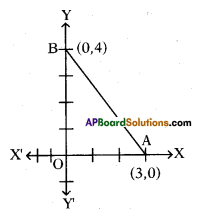
AP 10th Class Maths Bits Chapter 7 Coordinate Geometry with Answers 1
Answer:
6 sq. units.

Question 26.
A line makes 45° with X – axis, then find its slope.
Answer:
m = tan θ = tan 45° = 1

Question 27.
If a line is passing through (2, 3) and (2, – 3), then write the nature of that line.
Answer:
The line is parallel to Y – axis and The slope of the line is not defined.

Question 28.
Find area of the triangle formed by the points A(0, 0), B(1, 0) and C(0, 1).
Answer:
\(\frac { 1 }{ 2 }\) sq. units.

Question 29.
Find the distance from X – axis to (- 4, 3) is units.
Answer:
3 units.

Question 30.
Find the area of the triangle BOA is …………… sq. units.
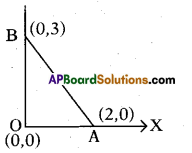
AP 10th Class Maths Bits Chapter 7 Coordinate Geometry with Answers 2
Answer:
3 sq. units.

AP 10th Class Maths Bits Chapter 7 Coordinate Geometry with Answers

Question 31.
Find the slope of the line that passes through the points P (x1, y1) and Q(x2, y2) and making an angle ‘θ’ with X – axis.
Answer:
m = \(\frac{y_{2}-y_{1}}{x_{2}-x_{1}}\)

Question 32.
The area of given triangle is 60 sq. units, then find x = …………units.
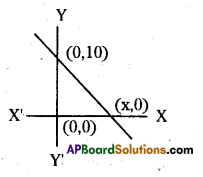
AP 10th Class Maths Bits Chapter 7 Coordinate Geometry with Answers 3
Answer:
12 units.

Question 33.
A line makes 45° with X – axis, then find its slope.
Answer:
1

Question 34.
Find the distance between the points (x1, y1) and (x2, y2) which are on the line parallel to Y – axis.
Answer:
|y – y2| or |y2 – y1 |

Question 35.
If the co-ordinates of the vertices of a rectangle are (0, 0), (4, 0), (4, 3) and (0, 3), then find the length of its di¬agonal.
Answer:
5 units.

Question 36.
Find the distance from Y-axis to (4, 0) is ……………. units.
Answer:
4 units.

Question 37.
Draw the graph represented by y = x.
AP 10th Class Maths Bits Chapter 7 Coordinate Geometry with Answers 4

Question 38.
If origin is the centroid of a triangle, whose vertices are (3, 2), (- 6, y) and (3, – 2), then calculate ‘y’.
Answer:
y = 0

Question 39.
In a coordinate plane, if line segment AB is parallel to X – axis, then write about points A and B.
Answer:
X – coordinates of points A and B are equal.

Question 40.
Find the distance between the points (0, 7) and (- 7, 0).
Answer:
7\(\sqrt{2}\) units.

Question 41.
Find the distance of the point (- 8, 3) from the origin.
Answer:
\(\sqrt{73}\) units

Question 42.
If points (x, 0), (0, y) and (1, 1) are collinear, then find \(\frac{1}{x}+\frac{1}{y}\).
Answer:
1

Question 43.
Write a point on the X – axis is of the form.
Answer:
(x, 0)

Question 44.
Find the points (- 3, 0), (0, 5) and (3, 0) are the vertices of which type of triangle ?
Answer:
Isosceles triangle.

Question 45.
Find the area of the triangle formed by (a, b + c), (b, c + a) and (c, a + b).
Answer:
0

Question 46.
Write a point on the Y – axis is of the form.
Answer:
(0, y)

Question 47.
The point which divides the line segment joining the points (3, 4) and (7, – 6) internally in the ratio 1 : 2 lies in the quadrant.
Answer:
Q4

AP 10th Class Maths Bits Chapter 7 Coordinate Geometry with Answers

Question 48.
Find the distance between the points (- 2, 3) and (2, – 3).
Answer:
\(\sqrt{52}\) units.

Question 49.
AOBC is a rectangle whose three ver-tices are A(4, 0), B(0, 3) and O (0, 0), then find its diagonal ?
Answer:
5 units.

Question 50.
Find the distance of the point (-8, -7) from Y – axis.
Answer:
8 units.

Question 51.
A circle is drawn with origin as centre and passing through (2, 3), then find its radius.
Answer:
\(\sqrt{13}\) units.

Question 52.
Find the perimeter of a triangle whose vertices are A(12, 0), 0(0,.0) and B(0, 5).
Answer:
30 units.

Question 53.
Find the distance of the point (- 4, 3) from X – axis.
Answer:
3 units.

Question 54.
If the distance between the points (4, y) and (1, 0) is 5, then find ‘y’.
Answer:
y = ± 4.

Question 55.
Write the distance of (x, y) from X-axis.
Answer:
y units.

Question 56.
Find the distance of the point (- 9, 40) from the origin.
Answer:
41 units

Question 57.
If (0, 0), (a, 0) and (0, b) are collinear, then write the relation between ‘a’ and b’.
Answer:
ab = 0

Question 58.
Which ratio the centroid divides each median ?
Answer:
2:1

Question 59.
Find the value of ‘p’ if the distance be-tween (2, 3) and (p, 3) is 5. ,
Answer:
p = 7

Question 60.
Find the angle between X – axis and Y – axis.
Answer:
90°

Question 61. Find the distance between the points (a cos θ, 0) and (0, a sin θ).
Answer:
‘a’ units

Question 62.
(- 2, 8) belongs to which quadrant ?
Answer:
Q2

AP 10th Class Maths Bits Chapter 7 Coordinate Geometry with Answers

Question 63.
Find the centroid of the triangle whose vertices are (2, – 3), (4, 6), (- 2, 8).
Answer:
(\(\frac{4}{3}, \frac{11}{3}\))

Question 64.
Guess shape of the closed figure formed by the points (- 2, 0), (2, 0), (2, 2), (0, 4) and (-2,-2).
Answer:
Pentagon

Question 65.
Find the midpoint of the line joining of (2, 3) and (- 2, 3).
Answer:
(0, 0)

Question 66.
If the centroid of the triangle formed with (a, b); (b, c) and (c, a) is O (0, 0), then the value of a3 + b3 + c3.
Answer:
3 abc

Question 67.
If the points (a, 2a), (3a, 3a) and (3,1) are collinear, then find k.
Answer:
k = \(\frac { -1 }{ 3 }\)

Question 68.
Write the coordinates of the midpoint joining P(x1, y1) and Q(x2, y2).
Answer:
\(\left(\frac{\mathrm{x}_{1}+\mathrm{x}_{2}}{2}, \frac{\mathrm{y}_{1}+\mathrm{y}_{2}}{2}\right)\)

Question 69.
Find the slope of line joining of (5, -1), (0, 8).
Answer:
\(-\frac{9}{5}\) =m

Question 70.
If the distance between the points (3, k) and (4, 1) is \(\sqrt{10}\), then find the value of k.
Answer:
4 (or)-2.

Question 71.
If (- 2, – 1), (a, 0), (4, b) and (1,2) are the vertices of a parallelogram, then find a’.
Answer:
a = 1

Question 72.
Write the slope of X – axis.
Answer:
0

Question 73.
P(2, 2), Q(- 4, 4) and R(5, – 8) are the vertices of a ΔPQR, then find length of median from ‘R’.
Answer:
\(\sqrt{157}\) units.

Question 74.
Find the value of ‘k’ if the distance be-tween (2, 8) and (2, k) is 3.
Answer:
k = 5.

Question 75.
Find the distance of a point (α, β) from the origin.
Answer:
\(\sqrt{\alpha^{2}+\beta^{2}}\)

Question 76.
If the points (1, 2), (-1, x) and (2, 3) are collinear, then find the value of x.
Answer:
x = 0.

Question 77.
If (- 2,8) and (6, – 4) are the end points of the diameter of a circle, then find the centre of the circle.
Answer:
(2, 2) = centre.

Question 78.
A(0, -1), B(2, 1) and C(0, 3) are the vertices of AABC, then find median
through ‘B’ has a length . units.
Answer:
2

Question 79.
Two vertices of a triangle are (3, 5) and (- 4, – 5). If the centroid of the triangle is (4, 3), find the third vertex.
Answer:
(13, 9).

Question 80.
If A, B, C are collinear, then find the area of AABC.
Answer:
Δ = 0

AP 10th Class Maths Bits Chapter 7 Coordinate Geometry with Answers

Question 81.
A circle drawn with origin as centre 13
passes through (\(\frac { 13 }{ 2 }\),0). Find the point which doesn’t lie in the interior of the circle.
Answer:
(-6,3)

Question 82.
Find area of triangle formed by (-4, 0), (0, 0) and (0, 5) is ……………… sq. units.
Answer:
10 sq.units.

Question 83.
Find the ratio in which the point (4, 8) divide the line segment joining the points (8, 6) and (0, 10).
Answer:
1:1

Question 84.
Write a formula to the coordinates of the point which divides the line join¬ing (x1, y1) and (x2, y2) in the ratio m: n internally.
Answer:
P = \(\left(\frac{m x_{2}+n x_{1}}{m+n}, \frac{m y_{2}+n y_{1}}{m+n}\right)\)

Question 82.
If A(4, 0), B(8, 0), then find \(\overline{\mathbf{A B}}\).
Answer:
4 units.

Question 83.
Find the slope of the line \(\frac{\mathbf{x}}{\mathbf{a}}+\frac{\mathbf{y}}{\mathbf{b}}\) = 1.
Answer:
m = \(\frac{-\mathrm{b}}{\mathrm{a}}\)

Question 87.
Find .the radius of the circle whose centre is (3, 2) and passes through (- 5, 6) is……………..units.
Answer:
4\(\sqrt{5}\) units.

Question 88.
In Heron’s formula ‘s’ represents.
Answer:
s = \(\frac{a+b+c}{2}\) = Semi perimeter

Question 89.
Slope of the line joining the points (2, 5) and (k, 3) is 2, then find k.
Answer:
k = 1.

Question 90.
If A(4, 5), B(7, 6), then find \(\overline{\mathbf{A B}}\).
Answer:
\(\sqrt{10}=\overline{\mathrm{AB}}\)

Question 91.
Write the distance of (x, y) from Y-axis.
Answer:
‘x’units.

Question 92.
A(2, 0), B(l, 2), C(l, 6), then find ∆ABC.
Answer:
∆ = 0, so the points are collinear.

Question 93.
Find the mid point of the line joining the points (1,1) and (0, 0).
Answer:
( \(\frac{1}{2}, \frac{1}{2}\) )

Question 94.
How much the slope of vertical line ?
Answer:
Not defined.

Question 95.
A(1, – 1), B(0, 6) and C(- 3, 0), then find G (centroid).
Answer:
G = (\(\frac{-2}{3}, \frac{5}{3}\))

Question 96.
A(a, b) and B(- a, – b), then find \(\overline{\mathbf{B A}}\).
Answer:
\(\overline{\mathrm{BA}}=2 \sqrt{\mathrm{a}^{2}+\mathrm{b}^{2}}\)

Question 97.
Find the centroid of the triangle formed with the line x + y = 6 with the coordinate axes.
Answer:
G .= (2, 2)

AP 10th Class Maths Bits Chapter 7 Coordinate Geometry with Answers

Question 98.
Find the area of triangle formed with (- 5,-1), (3,-5) and (5, 2).
Answer:
32 sq. units.

Question 99.
How much the slope of horizontal line?
Answer:
0 = m

Question 100.
Find the angle between the lines x = 2 and y = 3.
Answer:
θ = 90°.

Question 101.
Write the slope of the line y = mx.
Answer:
‘m’

Question 102.
The midpoint of the line joining the points (1, 2) and (1, p) is (1, – 1), then find p.
Answer:
p = – 4.

Question 103.
Name the point of concurrence of me-dians of a triangle is called
Answer:
Centroid

Question 104.
If AC = AB + BC, then the points A, B, C are called points.
Answer:
Collinear

Question 105.
ax + by + c = 0, represents a
Answer:
Straight line

Question 106.
If the points (k, k), (2, 3) and (4, – 1) are collinear, then find k.
Answer:
\(\frac{7}{3}\) = k

Question 107.
Write other name for x-coordinate of a points.
Answer:
Abscissa

Question 108.
Find the slope of the line joining the points A(-1.4, – 3.7) and B(-2.4, 1.3).
Answer:
m = – 5

Question 109.
If a < 0, then (- a, – a) belongs to which quadrant ?
Answer:
Q1

AP 10th Class Maths Bits Chapter 7 Coordinate Geometry with Answers

Question 110.
If θ is the angle made by a line with X – axis, then find slope’m’.
Answer:
m = tan θ

Question 111.
Find the area of square formed with the vertices (0, – 1), (2, 1), (0, 3) and (-2, 1) taken in order as vertices.
Answer:
∆ = 8 sq. units.

Question 112.
Name the person who was introduced coordinate geometry.
Answer:
Rene Descartes

Question 113.
Find the coordinates of centroid of the triangle formed with the vertices (-1,3), (6, -3) and (-3, 6).

Question 114.
In quadrilateral ABCD, AB = BC = CD = AD and \(\overline{\mathbf{A C}} \neq \overline{\mathbf{B D}}\), then it is Answer:……………..type of quadrilateral.
Answer:
Rhombus

Question 115.
Write the slope of the line joining the points (2a, 3b) and (a, – b).
Answer:
m = \(\frac{4 \mathrm{~b}}{\mathrm{a}}\)

Question 116.
Write a formula to distance of (x, y) from origin.
Answer:
\(\sqrt{x^{2}+y^{2}}\)

Question 117.
In rhombus all sides are……………….
Answer:
Equal in length.

Question 118.
If the slope of a line passing through (- 2, 3) and (4, a) is \(\frac { -5 }{ 3 }\), then find Answer:
Answer:
a = – 7.

119.
A(2a, 4a), B(2a, 6a), C(2a+ \(\sqrt{3}\), 5), then write ΔABC is a type of tri¬
angle.
Answer:
Equilateral triangle.

Question 120.
How much each angle in equilateral triangle ?
Answer:
60° = each angle.

Question 121.
In the below figure, G is the centroid then AG : GD = ………………
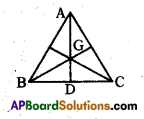
AP 10th Class Maths Bits Chapter 7 Coordinate Geometry with Answers 5
Answer:
2:1

Question 122.
In the below figure AD : GD =
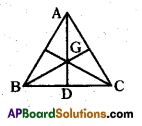
AP 10th Class Maths Bits Chapter 7 Coordinate Geometry with Answers 6
Answer:
3 : 1

Question 123.
Write the midpoint of a line segment divides it in the ratio.
im
Answer:
1 : 1

Question 124.
If the distance between the points (x1, y1) and (x2, y2) is |x1 – x2|, then they are parallel to ……………..
Answer:
x-axis.

Question 125.
Find slope of the line joining the points A(0,0), B(1/2,1/2)
Answer:
1 = m

Question 126.
Write the equation of X – axis.
Answer:
Y = 0

AP 10th Class Maths Bits Chapter 7 Coordinate Geometry with Answers

Question 127.
Write the point of concurrence of alti-tudes of a triangle is called ……………..
Answer:
Orthocentre

Question 128.
P(cos θ, – cos θ), Q (sin θ, sin θ), then find \(\overline{\mathbf{P Q}}\).
Answer:
\(\sqrt{2}\) units.

Question 129.
Diagonals in a parallelogram …………….. to each other.
Answer:
Bisect

Question 130.
Find slope of the line 3x – 2 = 0.
Answer:
Not defined = (\(\frac{0}{3}\))

Question 131.
If A(p, q), B(m, n) and C(p – m, q – n) are collinear, then find pn.
Answer:
qm

Question 132.
Write Y-axis can be represented as.
Answer:
X = 0

Question 133.
Write number of medians of a triangle.
Answer:
3

Question 134.
A(cot θ, 1), B(0, 0), then find \(\overline{\mathbf{B A}}\).
Answer:
cosec θ

Question 135.
If the point (4 – p) lie on X – axis, then find the value of p2 + 2p – 1.
Answer:
– 1

Question 136.
A(t, 2t), B(- 2, 6), C(3, 1) and ΔABC = 5 sq.units, then find ‘t’.
Answer:
t = 2

Question 137.
y-intercept of the line x – 2y + 1 = 0 is …………..
Answer:
b = \(\frac { 1 }{ 2 }\)

Question 138.
In the below figure find ‘x’.
AP 10th Class Maths Bits Chapter 7 Coordinate Geometry with Answers 7
Answer:
-9 = x

Question 139.
In the below figure find ‘y’.
AP 10th Class Maths Bits Chapter 7 Coordinate Geometry with Answers 8
Answer:
3 = y

Question 140.
Where the X and Y axes will inter¬sects ?
Answer:
(0, 0)

Question 141.
If the point (a, 5) lies on Y – axis find the value of ‘a’.
Answer:
a = 0.

Question 142.
Write (3, 0), (8, 0), (1/2, 0) points lie on ………….
Answer:
X – axis.

Question 143.
Nature of the line that does not pass through origin and having a zero slope is
Answer:
Parallel to X – axis.

AP 10th Class Maths Bits Chapter 7 Coordinate Geometry with Answers

Question 144.
Y-intercept of the line y = mx + c is ….
Answer:
‘c’

Question 145.
In ΔABC, all the side are different, then it is called type of triangle.
Answer:
Scalene

Question 146.
A = (\(\frac{1}{2}, \frac{3}{2}\)) , B = (\(\frac{3}{2}, \frac{-1}{2}\)) then find \(\overline{\mathbf{B A}}\)
Answer:
\(\sqrt{5}\)

Question 147.
Find the area of below parallelogram, if ΔABC = 5 sq. units.
AP 10th Class Maths Bits Chapter 7 Coordinate Geometry with Answers 9
Answer:
10 sq. units

Question 148.
Find x-intercept of the line x – y +1 =0.
Answer:
– 1

Question 149.
In ΔPQR, PQ = QR, then it is called ……………… triangle.
Answer:
Isosceles

Question 150.
If (1, x) is at \(\sqrt{10}\) units from origin, then find the value of ‘x’.
Answer:
x = ± 3

Question 151.
A(1, – 1), B(2 1/2, 0), C(4, 1), then find area of ΔABC.
Answer:
Δ = 0.

Question 152.
Name the line joining the mid point of one side of a triangle from opposite vertex is called …………….
Answer:
Median

Question 153.
Find angle made by the line y = x with the positive direction of X – axis.
Answer:
45°.

Choose the correct answer satistying the following statements.

Question 154.
Statement (A): The point (0, 4) lies on Y – axis.
Statement (B) : The X co-ordinate of the point on Y – axis zero.
i) Both A and B are true.
ii) A is true, B is false.
iii) A is false, B is true.
iv) Both A and B are false.
Answer:
(i)

Question 155.
Statement (A): The value of y is 6, for which the distance between the points P(2, – 3) and Q(10, y) is 10.
Statement (B): Distance between two given points A(x1, y1) and B(x2, y2) is given by
AB = \(\sqrt{\left(x_{2}+x_{1}\right)^{2}+\left(y_{2}-y_{1}\right)^{2}}\)
i) Both A and B are true.
ii) A is true, B is false.
iii) A is false, B is true.
iv) Both A and B are false.
Answer:
(iii)

Question 156.
Statement (A) : The point (- 1, 6) di¬vides the line segment joining the points (- 3, 10) and (6, – 8) in the ratio 2 : 7 internally.
Statement (B): Three points A, B and C are collinear if area of AABC = 0.
i) Both A and B are true.
ii) A is true, B is false.
iii) A is false, B is true.
iv) Both A and B are false.
Answer:
(i)

Question 157.
Statement (A) : Centroid of a triangle formed by the points (a, b), (b, c) and (c, a) is at origin, then a + b + c = 0.
Statement (B) : Centroid of a AABC with vertices A(x1, y1), B(x2, y2) and C(x3, y3) is given by
\(\left(\frac{x_{1}+x_{2}+x_{3}}{3}, \frac{y_{1}+y_{2}+y_{3}}{3}\right)\)
i) Both A and B are true.
ii) A is true, B is false.
iii) A is false, B is true.
iv) Both A and B are false.
Answer:
(i)

AP 10th Class Maths Bits Chapter 7 Coordinate Geometry with Answers

Question 158.
Statement (A): The area of the triangle with vertices (- 5,-1), (3, – 5), (5, 2) is 32 square units.
Statement (B): The point (x, y) divides the line segment joining the points A(xj, y2) and B(x2, y2) in the ratio k : 1 externally, then
\(x=\frac{k x_{2}+x_{1}}{k+1}, y=\frac{k y_{2}+y_{1}}{k+1}\)
i) Both A and B are true.
ii) A is true, B is false.
iii) A is false, B is true.
iv) Both A and B are false.
Answer:
(ii)

Question 159.
Statement (A): The ratio in which the segment joining the points (-3, 10) and (6, – 8) is divided by (- 1, 6) is 2 : 7.
Statement (B) : If A(x1, y1), B(x2, y2) are two points. Then the point C(x, y) such that C divides AB internally in the ratio k : 1 is given by
x = \(\frac{\mathrm{kx}_{2}+\mathrm{x}_{1}}{\mathrm{k}+1}, \mathrm{y}=\frac{\mathrm{ky}_{2}+\mathrm{y}_{1}}{\mathrm{k}+1}\)
i) Both A and B are true.
ii) A is true, B is false.
iii) A is false, B is true.
iv) Both A and B are false.
Answer:
(i)

Question 160.
Statement (A) : If three vertices of a parallelogram taken in order are (- 1, – 6), (2, – 5) and (7, 2), then its fourth vertex is (4, 1).
Statement (B) : Diagonals of a paral-lelogram bisect each other.
i) Both A and B are true.
ii) A is true, B is false.
iii) A is false, B is true.
iv) Both A and B are false.
Answer:
(i)

Question 161.
Statement (A) : The points (k -I- 1, 1), (2k + 1, 3) and (2k + 2, 2k) are col- linear, then k = 4.
Statement (B) : Three points A(x1, y1), B(x2, y2) and C(x3, y3) are collinear if and only if
x1(y2 – y3) + x2(y3-y1) + x3(y1-y2) = 0
i) Both A and B are true.
ii) A is true, B is false.
iii) A is false, B is true.
iv) Both A and B are false.
Answer:
(iii)

Question 162.
Statement (A) : Let the vertices of a ΔABC are A(- 5, – 2), B(7, 6) and C(5, – 4), then coordinate of circum- centre is (1, 2).
Statement (B) : In a right angle tri¬angle, mid-point of hypotenuse is the circumcentre of the triangle.
i) Both A and B are true.
ii) A is true, B is false.
iii) A is false, B is true.
iv) Both A and B are false.
Answer:
(i)

Question 163.
Statement (A): If A(2a, 4a) and B(2a, 6a) are two vertices of a equilat¬eral triangle ABC, then the vertex C is given by (2a + a\(\sqrt{3}\) , 5a).
Statement (B): In equilaterahtriangle all the coordinates of three vertices can be rational.
i) Both A and B are true.
ii) A is true, B is false.
iii) A is false, B is true.
iv) Both A and B are false.
Answer:
(ii)

Question 164.
Statement (A) : The equation of the straight line which passes through the point (2,-3) and the point of the inter-section of the lines x + y + 4 = 0 and 3x – y – 8 = 0 is 2x – y – 7 = 0.
Statement (B) : Product of slopes of two perpendicular straight lines is – 1.
i) Both A and B are true.
ii) A is true, B is false.
iii) A is false, B is true.
iv) Both A and B are false.
Answer:
(i)

Read Che below passages and answer to the following questions.

Let there be two points (4, 1) and (5,-2) in a two dimensional coordi¬nate system. A line which passes through the above give points and intersects the coordinate axes forms a triangle.

Question 165.
Write the equation of the line passing through the above given points.
Answer:
3x + y – 13 = 0.

Question 166.
Find the point of intersection of the above line with both the coordinate axes.
Answer:
(\(\frac { 13 }{ 3 }\),0) and (0, 13).

Question 167.
Find the area of the triangle so formed.
Answer:
\(\frac { 169 }{ 6 }\) sq. units.

In the diagram on a Lunar eclipse, if the position of Sun, Earth and Moon are shown by (- 4, 6) (k, – 2) and (5, – 6) respectively.

Question 168.
In Lunar eclipse what is the positions of Sun, Earth and Moon ?
Answer:
All are in same line, i.e., collinear.

Question 169.
To solve the above problem which mathematical concept is used ?
Answer:
Co-ordinate Geometry.

AP 10th Class Maths Bits Chapter 7 Coordinate Geometry with Answers

Question 170.
Which formula is used to find the value of k ?
Δ = \(\frac { 1 }{ 2 }\) |x1(y2 – y3) + x2(y3-y1) + x3(y1 – y2) | = 0

Manowbhiram calculated the dis¬tance between T(5, 2) and R(-4, -1) to the nearest length is 9.5 units.

Question 171.
Do you agree with Manowbhiram ?
Answer:
Yes, I agree with him.

Question 172.
Which mathematical concept is used to you support Manowbhiram ?
Answer:
Co-ordinate Geometry (or) (Distance formula).

Question 173.
Column – II gives distance between pair of points given in column -I, match them correctly.
AP 10th Class Maths Bits Chapter 7 Coordinate Geometry with Answers 10
Answer:
A – (iv), B – (i)

Question 174.
Column – II gives distance between pair of points given in column -I, match them correctly.
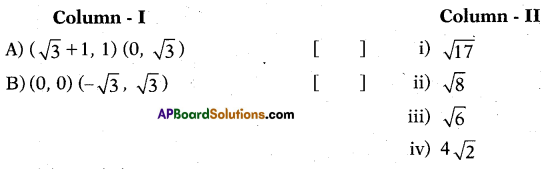
AP 10th Class Maths Bits Chapter 7 Coordinate Geometry with Answers 11
Answer:
A – (ii), B – (iii)

Question 175.
Column – II gives the coordinates of the point ’p’ that divides the line segment join¬ing the points given in column -I, match them correctly.
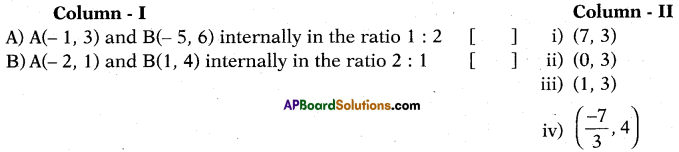
AP 10th Class Maths Bits Chapter 7 Coordinate Geometry with Answers 12
Answer:
A – (iv), B – (ii)

Question 176.
Column – II gives the coordinates of the point ‘p’ that divides the line segment join¬ing the points given in column -I, match them correctly.
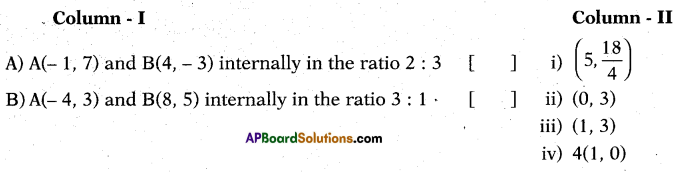
AP 10th Class Maths Bits Chapter 7 Coordinate Geometry with Answers 13
Answer:
A – (iii), B – (i).

Question 177.
Column – II gives the area of triangles whose vertices are given in column -1, match them correctly.
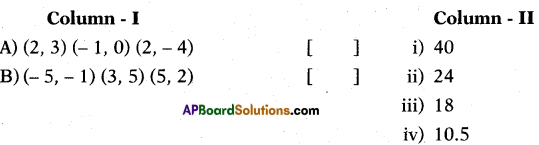
AP 10th Class Maths Bits Chapter 7 Coordinate Geometry with Answers 14
Answer:
A – (iv), B – (iii).

Question 178.
Column – II gives the area of triangles whose vertices are given in column -1, match them correctly.
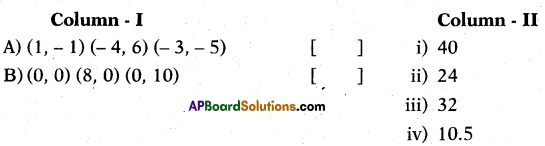
AP 10th Class Maths Bits Chapter 7 Coordinate Geometry with Answers 15
Answer:
A – (ii), B – (i).

Question 179.
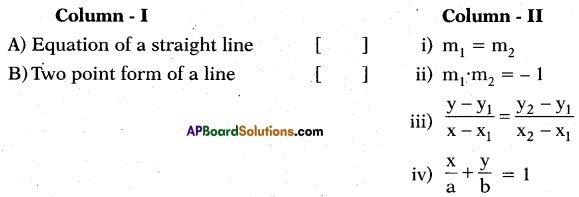
AP 10th Class Maths Bits Chapter 7 Coordinate Geometry with Answers 16
Answer:
A – (iv), B – (iii).

Question 180.
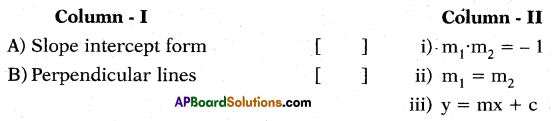
AP 10th Class Maths Bits Chapter 7 Coordinate Geometry with Answers 17
Answer:
A – (iii), B – (i).

AP 10th Class Maths Bits Chapter 7 Coordinate Geometry with Answers

Question 181.
Name the quadrilateral, which satis¬fies both the conditions given below.
Statement (A) : Diagonals are equal
Statement (B) : All sides are equal
a) Rhombus
b) Parallelogram
c) Rectangle
d) Square
Answer:
(d)

Question 182.
Find the area of the shaded triangle, in the figure given below.
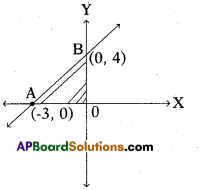
AP 10th Class Maths Bits Chapter 7 Coordinate Geometry with Answers 18
Answer:
6 sq. units

Question 183.
What is the slope of the line joining the points (2, 0) and (- 2, 0).
Solution:
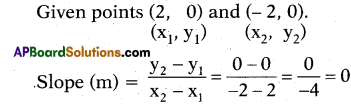
AP 10th Class Maths Bits Chapter 7 Coordinate Geometry with Answers 19

Question 184.
Name the point which is the point of intersection of medians of a triangle.
Answer:
Centroid of a triangle.

AP Board 7th Class Maths Solutions Chapter 4 Lines and Angles InText Questions

SCERT AP 7th Class Maths Solutions Pdf Chapter 4 Lines and Angles InText Questions and Answers.

AP State Syllabus 7th Class Maths Solutions 4th Lesson Lines and Angles InText Questions

Check Your Progress [Page No. 66]

Question 1.
Find the complementary angles of
(i) 27°
Answer:
If the sum of any two angles is 90°, then the angles are called complementary angles.
A complementary angle of 27° is
(90 – 27) = 63°

(ii) 43°
Answer:
Complementary angle of 43° is
(90 – 43) = 47°

(iii) k°
Answer:
Complementary angle of k° is (90 – k)°

(iv) 2°
Answer:
Complementary angle of 2° is
(90 – 2) = 88°

AP Board 7th Class Maths Solutions Chapter 4 Lines and Angles InText Questions

Question 2.
Find the supplementary angles of
(i) 13°
Answer:
If the sum of any two angles is 180°, then the angles are called as supplementary angles.
Supplementary angle of 13° is
(180 – 13) = 167°

(ii) 97°
Answer:
Supplementary angle of 97° is
(180 – 97) = 83°

(iii) a°
Answer:
Supplementary angle of a° is
(180 – a)°

(iv) 46°
Answer:
Supplementary angle of 46° is
(180 – 46) = 134°

Question 3.
Find the conjugate angles of
(i) 74°
Answer:
If the sum of any two angles is 360°, then the angles are called as conjugate angles.
Conjugate angle of 74° is
(360 – 74) = 286°

(ii) 180°
Answer:
Conjugate angle of 180° is
(360- 180) = 180°

(iii) m°
Answer:
Conjugate angle of m° is (360 – m)°

(iv) 300°
Answer:
Conjugate angle of 300° is
(360.-300) = 60°

[Page No. 66]

Question 1.
Umesh said, “Two acute angles cannot form a pair of supplementary angles.” Do you agree ? Give reason.
Answer:
Yes, acute angle is always less than 90°. So, sum of two acute angles is always less than 180°.
Therefore, two acute angles cannot form a pair of supplementary angles (180°).

Question 2.
Lokesh said, “Each angle in any pair of complementary angles is always acute.” Do you agree? Justify your answer.
Answer:
Yes, sum of any two acute angles is 90°, then they are complementary angles. If they are not acute means they may . be right angle (90°) or obtuse angle (> 90°) or etc.

So, its impossible.
Therefore, each angle in any pair of complementary angles is always acute.

Let’s Think [Page No. 69]

Question 1.
In the figure, ∠AOB and ∠BPC are not adjacent angles. Why? Give reason.
AP Board 7th Class Maths Solutions Chapter Chapter 4 Lines and Angles InText Questions 1
Answer:
In the given figure, ∠AOB and ∠BPC are not adjacent angles. Because, they have no common vertex and no common arm.

AP Board 7th Class Maths Solutions Chapter 4 Lines and Angles InText Questions

Question 2.
In the figure, ∠AOB and ∠COD have common vertex O. But ∠AOB, ∠COD are not adjacent angles. Why? Give reason.
AP Board 7th Class Maths Solutions Chapter Chapter 4 Lines and Angles InText Questions 2
Answer:
In the given figure, ∠AOB and ∠COD are not adjacent angles. Because, they have common vertex. But they have no common arm.

Question 3.
In the figure, ∠POQ and ∠POR have common vertex O and common arm OP but ∠POQ and ∠POR are not adjacent angles. Why? Give reason.
AP Board 7th Class Maths Solutions Chapter Chapter 4 Lines and Angles InText Questions 3
Answer:
∠POQ and ∠POR have common vertex O and common arm OP. But they are not lie either side of the common arm. That’s why they are not adjacent angles.

Check Your Progress [Page No. 70]

Question 1.
In the adjacent figure \(\overrightarrow{\mathbf{P R}}\) is a straight line and O is a point on the line. \(\overrightarrow{\mathbf{O Q}}\) is a ray.
AP Board 7th Class Maths Solutions Chapter Chapter 4 Lines and Angles InText Questions 4
(i) If ∠QOR= 50°, then what is ∠POQ?
Answer:
Given ∠QOR= 50°
∠POQ, ∠QOR are linear pair.
⇒ ∠POQ + ∠QOR = 180°
⇒ ∠POQ + 50° = 180°
⇒ ∠POQ — 180° – 50° = 130°
.-. ∠POQ =130°

(ii) If ∠QOP = 102°, then what is ∠QOR?
. Sol. Given ∠QOP = 102°
∠QOP and ∠QOR are linear pair.
⇒ ∠QOP + ∠QOR = 180°
⇒ 102° + ∠QOR = 180°
⇒ 102°- 102° + ∠QOR = 180°- 102°
⇒ ∠QOR = 78°

Let’s Explore [Page No. 70]

Question 1.
A linear pair of angles must be adja-cent but adjacent angles need not be linear pair. Do you agree? Draw a figure to support your answer.
Answer:
Yes.
AP Board 7th Class Maths Solutions Chapter Chapter 4 Lines and Angles InText Questions 5

Question 2.
Mahesh said that the sum of two angles 30° and 150° is 180°, hence they are linear pair. Do you agree? Justify your answer.
Answer:
No, sum of two angles is 180°, then they are said to be supplementary angles.
If the two angles are on the same straight line and they are adjacent they are said to be linear pair.
So, the two angles 30° and 150° are need not be linear pair.

AP Board 7th Class Maths Solutions Chapter 4 Lines and Angles InText Questions

Let’s Think [Page No. 70]

Question 1.
In the adjacent figure, AB is a straight line, O is a point on AB. OC is a ray. Take a point D in the interior of ∠AOC, join OD.
Find ∠AOD + ∠DOC + ∠COB.
AP Board 7th Class Maths Solutions Chapter Chapter 4 Lines and Angles InText Questions 6
Answer:
Given ∠AOC and ∠COB are linear pair. But ∠AOC = ∠AOD + ∠DOC
AP Board 7th Class Maths Solutions Chapter Chapter 4 Lines and Angles InText Questions 12
⇒ ∠AOC + ∠COB = 180° (linear pair)
⇒ ∠AOD + ∠DOC + ZCOB = 180°

Question 2.
In the given figure, AG is a straight line. Find the value of ∠1 + ∠2 + ∠3 + ∠4 + ∠5 + ∠6.
AP Board 7th Class Maths Solutions Chapter Chapter 4 Lines and Angles InText Questions 13
Answer:
Given ∠AOC and ∠COG are linear pair. ∠AOC + ∠COG = 180° (linear pair)
But ∠AOC = ∠AOB + ∠BOC
= ∠1 + ∠2
∠COG – ∠COD + ∠DOE + ∠EOF + ∠FOG – ∠3 + ∠4 + ∠5 + ∠6
=> (∠AOB + ∠BOC) + (∠COD + ∠DOE + ∠EOF + ∠FOG)
= 180°
=> ∠1 + ∠2 + ∠3 + ∠4 + ∠5 + ∠6
= 180°
Therefore, the sum of angles at a point on the same side of the line is 180°.

Let’s DO Activity [Page No. 72]

Take a white paper. Draw 3 distinct pairs of intersecting lines on this paper. Measure the angles so formed and fill the table.
AP-Board-7th-Class-Maths-Solutions-Chapter-Chapter-4-Lines-and-Angles-InText-Questions-9
From the above table, we observe that “vertically opposite angles are equal.

Check Your Progress [Page No. 73]

In the figure three lines p, q and r inter-sect at a point O. Observe the angles in the figure. Write answers to the following.
Question 1.
What is the vertically opposite angle to ∠1?
Answer:
Vertically opposite angle to ∠1 is ∠4.

Question 2.
What is the vertically opposite angle to ∠6?
Answer:
Vertically opposite angle to ∠6 is ∠3.

Question 3.
If ∠2 = 50°, then what is ∠5?
Answer:
Vertically opposite angle of ∠2 is ∠5. So, ∠5 = ∠2 = 50° ∠5 = 50°

Let’s Think [Page No. 75]

Question 1.
In the figure, the line l intersects other two lines m and n at A and B respectively. Hence l is a transversal. Is there
AP Board 7th Class Maths Solutions Chapter Chapter 4 Lines and Angles InText Questions 10
Give reason.
Answer:
Yes.
1) The line m intersects other two lines / and n at two distinct points A and C respectively. Hence m is a transversal line.
2) The line n intersects other two lines / and m at two distinct points B and C respectively. Hence n is a transversal line.

Question 2.
How many transversals can be drawn for the given pair of lines?
Answer:
One and only one transversal line can be drawn for the given pair of lines.

AP Board 7th Class Maths Solutions Chapter 4 Lines and Angles InText Questions

Check Your Progress [Page No. 76]

Observe the figures (i) and (ii) then fill the table.
AP Board 7th Class Maths Solutions Chapter Chapter 4 Lines and Angles InText Questions 11
AP Board 7th Class Maths Solutions Chapter Chapter 4 Lines and Angles InText Questions 12
Answer:
AP Board 7th Class Maths Solutions Chapter Chapter 4 Lines and Angles InText Questions 13

Check Your Progress [Page No. 78]

In the figure, p ∥ q and t is a transversal. Observe the angles formed.
AP Board 7th Class Maths Solutions Chapter Chapter 4 Lines and Angles InText Questions 14
Question 1.
If ∠1 = 100°, then what is ∠5?
Answer:
In the given figure ∠5 = Z1 (corresponding angles)
Given ∠1 = 100°
So, ∠5 = ∠1 = 100°
∴ ∠5 – 100°

Question 2.
If ∠8 = 80°, then what is ∠4?
Answer:
In the given figure ∠4 = ∠8 (corresponding angles)
Given ∠8 = 80°
So, ∠4 — ∠8 = 80°
∴ ∠4 = 80°

Question 3.
If ∠3 = 145°, then what is ∠7?
Answer:
In the given figure ∠7 = ∠3 (corresponding angles)
Given ∠3 = 145°
So, ∠7 = ∠3 = 145°
∴ ∠7 – 145°

Question 4.
If ∠6 = 30°, then what is ∠2?
Answer:
In the given figure ∠2 = ∠6 (corresponding angles)

Given ∠6 = 30°
So, ∠2 = ∠6 = 30°
∴ ∠2 = 30°

Let’s Think [Page No. 78]

Question 1.
What is the relation between alternate exterior angles formed by a transversal on parallel lines?
Answer:
AP Board 7th Class Maths Solutions Chapter Chapter 4 Lines and Angles InText Questions 15
Alternate exterior angles are equal. That is ∠1 = ∠7 and ∠2 = ∠8

Check Your Progress [Page No. 80]

In the figure, m∥ n and l is a transversal.
AP Board 7th Class Maths Solutions Chapter Chapter 4 Lines and Angles InText Questions 16
Question 1.
If ∠3 = 116°, then what is ∠5?
Answer:
In the figure ∠5 = ∠3 (Alternate interior angles)
Given ∠3 = 116°
So, ∠5 = ∠3 = 116°
∴ ∠5 = 116°

Question 2.
If ∠4 = 51°, then what is ∠5?
Answer:
In the figure the interior angles in the same side of transversal are supple-mentary’.
So, ∠5 + ∠4 = 180° we know ∠4 = 51°
∠5 + 51° = 180°
∠5 + 51° – 51° = 180° – 51°
=> ∠5 = 129°

Question 3.
If ∠1 = 123° then what is ∠7?
Answer:
In the given figure
∠7 = ∠1 (Alternative exterior angles) Given ∠1 = 123°
So, ∠7 = ∠1 = 123°
∴ ∠7 = 123° .

Question 4.
If ∠2 = 66° then what is ∠7?
Answer:
In the given figure,
sum of the exterior angles are the same side of transversal are supplementary. So, ∠2 + ∠7 = 180°
=> 66° + ∠7 = 180° (Given ∠2 = 66°)
=> 66° + ∠7 – 66° = 180° – 66°
=> ∠7 = 114°
∴ ∠7 = 114°

Let’s Think [Page No. 80]

Question 1.
What is the relation between co-exterior angles, when a transversal cuts a pair of parallel lines?
AP Board 7th Class Maths Solutions Chapter Chapter 4 Lines and Angles InText Questions 17
Answer:
Co-exterior angles are supplementary. That is ∠2 + ∠7 = 180° and ∠1 + ∠8 = 180°

AP Board 7th Class Maths Solutions Chapter 4 Lines and Angles InText Questions

Let’s Do Activity [Page N0. 80]

Take a white paper and draw a pair of non-parallel lines p and q and a transversal shown in the fIgure 1. Measure the corresponding angles and fill the table. Measure the pair óf corresponding angles and fill the table.
AP Board 7th Class Maths Solutions Chapter Chapter 4 Lines and Angles InText Questions 18

Check Your Progress [Page No. 81].

From the figure, state which property that is used in each of the following.
AP Board 7th Class Maths Solutions Chapter Chapter 4 Lines and Angles InText Questions 19
Question 1.
If ∠3 = ∠5, then p ∥ q.
Answer:
Given ∠3 = ∠5
Alternative interior angles are equal.

Question 2.
If ∠3 + ∠6 = 180°, then p ∥ q.
Answer:
Given ∠3 + ∠6 = 180°
Interior angles on the same Side of transversal are supplementary.

Question 3.
If ∠3 = ∠8, then p∥q.
Answer:
Given ∠3 = = ∠8 .
∠3 and ∠8 are not corresponding angles and not alternate interior angles.
So, ∠3 ≠ ∠8.

Let’s Explore [Page No. 81]

Question 1.
When a transversal intersects two lines and a pair of alternate exterior angles are equal, what can you say about the two lines?
Answer:
If a pair of alternate exterior angles are equal, then the two lines are parallel to each other.

Question 2.
When a transversal intersects two lines and a pair of co-exterior angles are supplementary, what can you say about the two-lines?
Answer:
If a pair of co-exterior angles are supplementary’ then the two lines are parallel to each other.

Examples:

Question 1.
In the given figure, ∠B and ∠E are complementary angles. Find the value of x.
AP Board 7th Class Maths Solutions Chapter Chapter 4 Lines and Angles InText Questions 20
Answer:
From the figure,
∠B = x + 10°and ∠E =35°
Since ∠B and ∠E are complementary angles,
∠B + ∠E =90°
⇒ x + 10° + 35° = 90°
⇒ x + 45° = 90°
⇒ x = 90°- 45°
x = 45°

Question 2.
If the ratio of supplementary angles is 4 : 5, then find the two angles.
Answer:
Given ratio of supplementary angles = 4:5
Sum of the parts in the ratio = 4 + 5 = 9
Sum of the supplementary angles = 180°
First angle = \(\frac{4}{9}\) × 180° = 80°
Second angle = \(\frac{5}{9}\) × 180 °= 100°

AP Board 7th Class Maths Solutions Chapter 4 Lines and Angles InText Questions

Question 3.
Find the linear pair of angles which are equal to each other?
Answer:
Let the equal linear pair of angles are x° and x°.
⇒ x° + x° = 180° .
⇒ 2x° = 180°
⇒ x° = \(\frac{180^{\circ}}{2}\)
∴ x° = 90°
Hence, each angle = 90°

Question 4.
In the given figure, PS is a straight line, find x°.
AP Board 7th Class Maths Solutions Chapter Chapter 4 Lines and Angles InText Questions 21
Answer:
From the given figure, ∠POQ = 60°
∠QOR = x°
∠ROS = 47°
But ∠POQ + ∠QOR + ∠ROS = 180°
⇒ 60° + x° + 47° = 180°
⇒ x° + 107° = 180°
⇒ x° = 180°- 107°
∴ x° = 73°

Question 5.
Observe the figure, then find x, y and z.
AP Board 7th Class Maths Solutions Chapter Chapter 4 Lines and Angles InText Questions 22
Answer:
From the figure, x = 110° (vertically opposite angles are equal)
y + 110° = 180°
y = 180°- 110° = 70°
z = y ⇒ z = 70°
Hence x = 110°, y = 70° and z = 70°

Question 6.
In the given figure AB ∥ CD and AE is transversal. If ∠BAC =120°, then find x and y.
AP Board 7th Class Maths Solutions Chapter Chapter 4 Lines and Angles InText Questions 23
Answer:
In the given figure, AB ∥ CD and AE is transversal.
∠BAC = 120
∠ACD = x
∠DCE = y
∠BAC = ∠DCE (correpsonding angles are equal)
y = 120°
x + y = 180 ° (Linear pair of angles are supplementary)
x + 120° – 180°
x = 180°- 120°
∴ x = 60°
Hence x = 60°, y =120°.

Question 7.
In the given figure, BA ∥ CD and BC is transversal. Find x.
AP Board 7th Class Maths Solutions Chapter Chapter 4 Lines and Angles InText Questions 24
Answer:
In the given figure, BA ∥ CD and BC is transversal.
∠C = x + 35° and ∠B = 60°
∠C = ∠B (∵ alternate interior angles are equal)
x + 35° = 60° .
x – 60° – 35°
∴ x = 25°

Question 8.
In the figure \(\overrightarrow{\mathbf{M N}} \| \overrightarrow{\mathbf{K L}}\) and \(\overline{\mathrm{MK}}\) is transversal. Find x.
AP Board 7th Class Maths Solutions Chapter Chapter 4 Lines and Angles InText Questions 25
Answer:
From the figure, \(\overrightarrow{\mathbf{M N}} \| \overrightarrow{\mathbf{K L}}\) and \(\overline{\mathrm{MK}}\) is transversal.
∠M = 2x and ∠K = x + 30°
∠M + ∠K = 180° (Q co-interior angles are supplementary)
⇒ 2x + x + 30° = 180°
⇒ 3x + 30° = 180°
⇒ 3x = 180° – 30°
⇒ 3x = 150° ⇒ x = \(\frac{150^{\circ}}{3}\)
∴ x = 50°

AP Board 7th Class Maths Solutions Chapter 4 Lines and Angles InText Questions

Question 9.
In the figure \(\overline{\mathrm{AB}} \| \overline{\mathrm{DE}}\) and C is a point in between them. Observe the figure, then find x, y and ∠BCD.
AP Board 7th Class Maths Solutions Chapter Chapter 4 Lines and Angles InText Questions 26
Answer:
In the figure \(\overline{\mathrm{AB}} \| \overline{\mathrm{DE}}\) and C is a point in between them.
Draw a parallel line CF to \(\overline{\mathrm{AB}}\) through C.
\(\overline{\mathrm{AB}} \| \overline{\mathrm{CF}}\) and \(\overline{\mathrm{BC}}\) is a transversal,
x + 103° = 180°
x = 180°- 103°
x = 77°

From the figure,
\(\overline{\mathrm{DC}} \| \overline{\mathrm{CF}}\) and \(\overline{\mathrm{CD}}\) is a transversal,
y + 103° = 180°
y = 180°- 103°
y = 77°
and ∠BCD = x + y = 77° + 77° = 154°

Question 10.
In the figure transversal p intersects two lines m and n. Observe the figure, check whether m ∥ n or not.
AP Board 7th Class Maths Solutions Chapter Chapter 4 Lines and Angles InText Questions 27
Answer:
In the given figure, it is given that each angle in the pair of corresponding angles is 45°. So they are equal. Since a pair of corresponding angles are equal the lines are parallel. Hence, m ∥ n.

Practice Questions [Page No. 87]
Indicate the group (a, b, c, d, e, f) to which given below belongs to

Question 1.
State, District, Mandai
Answer:
AP Board 7th Class Maths Solutions Chapter Chapter 4 Lines and Angles InText Questions 28
Group: b

Question 2.
Boys, Girls, Artistists
Answer:
AP Board 7th Class Maths Solutions Chapter Chapter 4 Lines and Angles InText Questions 29
Group: c

Question 3.
Hours, Days, Minutes
Answer:
AP Board 7th Class Maths Solutions Chapter Chapter 4 Lines and Angles InText Questions 30
Group: b

Question 4.
Women, Teacher, Doctor
Answer:
AP Board 7th Class Maths Solutions Chapter Chapter 4 Lines and Angles InText Questions 31
Group: c

Question 5.
Food, Curd, Spoon
Answer:
AP Board 7th Class Maths Solutions Chapter Chapter 4 Lines and Angles InText Questions 32
Group: f

AP Board 7th Class Maths Solutions Chapter 4 Lines and Angles InText Questions

Question 6.
Humans, Dancer. Player
Answer:
AP Board 7th Class Maths Solutions Chapter Chapter 4 Lines and Angles InText Questions 33
Group: f

Question 7.
Building, Brick, Bridge
Answer:
AP Board 7th Class Maths Solutions Chapter Chapter 4 Lines and Angles InText Questions 34
Group: c

Question 8.
Tree, Branch, Leaf
Answer:
AP Board 7th Class Maths Solutions Chapter Chapter 4 Lines and Angles InText Questions 35
Group: b

Question 9.
Gold. Silver, Jewellary
Answer:
AP Board 7th Class Maths Solutions Chapter Chapter 4 Lines and Angles InText Questions 36
Group: f

Question 10.
Bulbs, Mixtures, Electricals
Answer:
AP Board 7th Class Maths Solutions Chapter Chapter 4 Lines and Angles InText Questions 37
Group: f

AP Board 7th Class Maths Solutions Chapter 4 Lines and Angles InText Questions

Question 11.
Women, Illiteracy, Men
Answer:
AP Board 7th Class Maths Solutions Chapter Chapter 4 Lines and Angles InText Questions 38
Group: c

Question 12.
Medicine, Tablets. Syrup
Answer:
AP Board 7th Class Maths Solutions Chapter Chapter 4 Lines and Angles InText Questions 39
Group: f

Question 13.
Carrots, Oranges, Vegetables
Answer:
AP Board 7th Class Maths Solutions Chapter Chapter 4 Lines and Angles InText Questions 40
Group: e

Question 14.
Female, Mothers. Sisters
Answer:
AP Board 7th Class Maths Solutions Chapter Chapter 4 Lines and Angles InText Questions 41
Group: f

Question 15.
Table. Furniture, Chair
Answer:
AP Board 7th Class Maths Solutions Chapter Chapter 4 Lines and Angles InText Questions 42
Group: f

Question 16.
Fruits, Mango. Onions
Answer:
AP Board 7th Class Maths Solutions Chapter Chapter 4 Lines and Angles InText Questions 43
Group: e

Question 17.
School, Teacher, Students
Answer:
AP Board 7th Class Maths Solutions Chapter Chapter 4 Lines and Angles InText Questions 44
Group: f

Question 18.
Rivers. Oceans. Springs
Answer:
AP Board 7th Class Maths Solutions Chapter Chapter 4 Lines and Angles InText Questions 45
Group: d

Question 19.
India. Andhra Pradesh, Visakhapatnam
Answer:
AP Board 7th Class Maths Solutions Chapter Chapter 4 Lines and Angles InText Questions 46
Group: b

Question 20.
Animals. Cows. Horses
Answer:
AP Board 7th Class Maths Solutions Chapter Chapter 4 Lines and Angles InText Questions 47
Group: f

Question 21.
Fish. Tiger, snakes
Answer:
AP Board 7th Class Maths Solutions Chapter Chapter 4 Lines and Angles InText Questions 48
Group: a

AP Board 7th Class Maths Solutions Chapter 4 Lines and Angles InText Questions

Question 22.
Flowers. Jasmine. Banana
Answer:
AP Board 7th Class Maths Solutions Chapter Chapter 4 Lines and Angles InText Questions 49
Group: e

Question 23.
Authors, teachers, Men
Answer:
AP Board 7th Class Maths Solutions Chapter Chapter 4 Lines and Angles InText Questions 50
Group: c

Question 24.
Dog. Fish, Parrot
Answer:
AP Board 7th Class Maths Solutions Chapter Chapter 4 Lines and Angles InText Questions 51
Group: a

Question 25.
Rose, Flower, Apple
Answer:
AP Board 7th Class Maths Solutions Chapter Chapter 4 Lines and Angles InText Questions 52
Group: e

Question 26.
School, Benches. Class Room
Answer:
AP Board 7th Class Maths Solutions Chapter Chapter 4 Lines and Angles InText Questions 53
Group: b

Question 27.
Pen, Stationary, Powder
Answer:
AP Board 7th Class Maths Solutions Chapter Chapter 4 Lines and Angles InText Questions 54
Group: e

Question 28.
Crow, Pigeon. Bird
Answer:
AP Board 7th Class Maths Solutions Chapter Chapter 4 Lines and Angles InText Questions 55
Group: f

Question 29.
Mammals, Elephants, Dinosaurs
Answer:
AP Board 7th Class Maths Solutions Chapter Chapter 4 Lines and Angles InText Questions 56
Group: f

Question 30.
Writers. Teachers, Researchers
Answer:
AP Board 7th Class Maths Solutions Chapter Chapter 4 Lines and Angles InText Questions 57
Group: d

REASONING [Practice Questions]

Question 1.
Musician, Instrumentalist, Violinist.
Answer:
AP Board 7th Class Maths Solutions Chapter Chapter 4 Lines and Angles InText Questions 58
Group: b

Question 2.
Officer, Woman, Doctor
Answer:
AP Board 7th Class Maths Solutions Chapter Chapter 4 Lines and Angles InText Questions 59
Group: c

AP Board 7th Class Maths Solutions Chapter 4 Lines and Angles InText Questions

Question 3.
Girls, Students, 7” class girls
Answer:
AP Board 7th Class Maths Solutions Chapter Chapter 4 Lines and Angles InText Questions 60
Group: d

Question 4.
Pencil, Stationary, Toothpaste
Answer:
AP Board 7th Class Maths Solutions Chapter Chapter 4 Lines and Angles InText Questions 61
Group: e

Question 5.
Food, Curd, Fruits
Answer:
AP Board 7th Class Maths Solutions Chapter Chapter 4 Lines and Angles InText Questions 62
Group: f

Question 6.
Bird Pigeon, Cow
Answer:
AP Board 7th Class Maths Solutions Chapter Chapter 4 Lines and Angles InText Questions 63
Group: e

Question 7.
Notes, Pad, Pen
Answer:
AP Board 7th Class Maths Solutions Chapter Chapter 4 Lines and Angles InText Questions 64
Group: a

Question 8.
Banana, Guava, Apple
Answer:
AP Board 7th Class Maths Solutions Chapter Chapter 4 Lines and Angles InText Questions 65
Group: a

Question 9.
Tomato, Food, Vegetables
Answer:
AP Board 7th Class Maths Solutions Chapter Chapter 4 Lines and Angles InText Questions 66
Group: b

AP Board 7th Class Maths Solutions Chapter 4 Lines and Angles InText Questions

Question 10.
Cow, Dog Pet
Answer:
AP Board 7th Class Maths Solutions Chapter Chapter 4 Lines and Angles InText Questions 67
Group: c

AP 10th Class Maths Bits Chapter 4 Pair of Linear Equations in Two Variables with Answers

Practice the AP 10th Class Maths Bits with Answers Chapter 4 Pair of Linear Equations in Two Variables on a regular basis so that you can attempt exams with utmost confidence.

AP SSC 10th Class Maths Bits 4th Lesson Pair of Linear Equations in Two Variables with Answers

Question 1.
Pair of equations 4x + 6y = 7 and 2x + 3y = 8. How many solutions have ?
Answer:
No solution.

Question 2.
Find the point where the line 2x – 3y = 8 intersects X – axis ?
Answer:
(4,0)
Explanation:stitute y = 0 in 2x – 3y = 8
⇒ 2x – 3-0 = 8 ⇒ x = 4
∴ The point on X – axis = (4, 0).

AP 10th Class Maths Bits Chapter 4 Pair of Linear Equations in Two Variables Bits

Question 3.
Find the solution for the equations \(\sqrt{3} x+\sqrt{5 y}=0\) and \(\sqrt{7} \mathrm{x}+\sqrt{11} \mathrm{y}=0\)
Answer:
x = 0, y = 0.

Question 4.
Find the value of ‘x’ in the equation 3x- (x-4) = 3x + 1.
Answer:
3
Explanation:
3x – x + 4 = 3x + 1
⇒ 3x – 3x — x = 1 – 4
⇒ x = 3

Question 5.
The pair of equations a1x + b1y + C1 = 0 and a2x + b2y + c2 = 0 are consistent, then write the condition for that.
Answer:
\(\frac{\mathrm{a}_{1}}{\mathrm{a}_{2}} \neq \frac{\mathrm{b}_{1}}{\mathrm{~b}_{2}}\) and \(\frac{\mathrm{a}_{1}}{\mathrm{a}_{2}}=\frac{\mathrm{b}_{1}}{\mathrm{~b}_{2}}=\frac{\mathrm{c}_{1}}{\mathrm{c}_{2}}\)

Question 6.
The graph y = ax + b is a straight line, find the point x where it intersects x – axis ?
Answer:
(\(-\frac{b}{a}\), 0)

Question 7.
Find the value of ‘k’ for which the sys-tem of equations kx – y = 2 and
6x – 2y = 3 has no solution.
Answer:
3
Explanation:
\(\frac{\mathrm{a}_{1}}{\mathrm{a}_{2}}=\frac{\mathrm{b}_{1}}{\mathrm{~b}_{2}}\) when pair of equations has no solution.
\(\frac{\mathrm{k}}{6}=\frac{1}{2} \Rightarrow \mathrm{k}=\frac{6}{2}\) = 3

Question 8.
Find the point of intersection of x + y = 6 and x – y = 4.
Answer:
(5,1)
Explanation:
x + y = 6 and
x-y = 4 ⇒ x = 4 + y
4 + y + y = 6 ⇒ 2y = 2 ⇒ y = 1
x = 6 – y = 6 – 1 ⇒ x = 5 .
∴ Point of intersection (x, y) = (5, 1).

Question 9.
If pair of equations 6x + 2y – 9 = 0 and kx + y – 7 = 0 has no solution, then find ‘k’.
Answer:
3
Explanation:
\(\frac{a_{1}}{a_{2}}=\frac{b_{1}}{b_{2}} \Rightarrow \frac{6}{k}=\frac{2}{1} \Rightarrow \frac{6}{2}\) = k ⇒ k = 3

Question 10.
If the pair of equations 2x+3y+k = 0, 6x + 9y + 3 = 0 having infinite solu-tions, find the value of ‘k’.
Answer:
1
Explanation:
Infinite solutions, so
AP 10th Class Maths Bits Chapter 4 Pair of Linear Equations in Two Variables Bits 7

Question 11.
A pair of linear equations in two variables are 2x – y = 4 and 4x – 2y = 6. The pair of equations are
Answer:
Inconsistent.
Explanation:
\(\frac{2}{4}=\frac{1}{2} \neq \frac{4}{6} \Rightarrow \frac{a_{1}}{a_{2}}=\frac{b_{1}}{b_{2}} \neq \frac{c_{1}}{c_{2}}\)
∴ Pair of equations are inconsistent.

AP 10th Class Maths Bits Chapter 4 Pair of Linear Equations in Two Variables Bits

Question 12.
How many solutions to the pair of equations y = 0 and y = – 3 ?
Answer:
No solution.

Question 13.
If 7x – 8y = 9, then find ‘y’.
Answer:
\(\frac{7 x-9}{8}\)

Question 14.
Write the standard form of a linear equation.
Answer:
ax + by + c = 0

Question 15.
For which value of ‘k’ will the follow-ing pair of linear equations have no solution 3x + y = 1;
(2k- l)x + (k – l)y = 2k – 1 ?
Answer:
2
Explanation:
No, solution, so \(\frac{a_{1}}{a_{2}}=\frac{b_{1}}{b_{2}}\)
⇒ \(\frac{3}{2 k-1}=\frac{1}{k-1}\)
⇒ 3(k – 1) = 1 (2k – 1)
⇒ 3k – 3 = 2k – 1 ⇒ 3k – 2k = 3 – 1 ⇒ k = 2

Question 16.
The lines 3x + 8y – 13 = 0 and – 6x – 16y + 23 = 0 are type of lines.
Answer:
Parallel
Explanation:
\(\frac{a_{1}}{a_{2}}=\frac{b_{1}}{b_{2}} \neq \frac{c_{1}}{c_{2}} \Rightarrow \frac{3}{-6}=\frac{8}{-16} \neq \frac{-13}{23}\)
∴ Parallel lines.

Question 17.
2x + 3y = 1, 3x – y = 7, then find (x, y).
Answer:
(2,-1)

Question 18.
Where the line x – y = 8 intersects X – axis ?
Answer:
(8,0)

Question 19.
x + \(\frac { 6 }{ y }\) = 6 and 3x – \(\frac { 8 }{ y }\) = 5, then find ‘y’.
Answer:
2

Question 20.
Write the nature of the graph of the line y = 5x.
Answer:
The graph of the line passes through the origin.
Explanation:
y – 5x ⇒ y = mx passes through the origin.

Question 21.
Pair of linear equations px + 3y – (p – 3) = 0, 12x + py – p = 0 has infinitely many solutions, then find p’.
Answer:
± 6.
Explanation:
\(\frac{a_{1}}{a_{2}}=\frac{b_{1}}{b_{2}}=\frac{c_{1}}{c_{2}} \Rightarrow \frac{p}{12}=\frac{3}{p}=\frac{(p-3)}{p}\)
p2 = 36 ⇒ p = \(\sqrt{36}\) = ± 6

AP 10th Class Maths Bits Chapter 4 Pair of Linear Equations in Two Variables Bits

Question 22.
In which quadrant (2, 0) belongs ?
Answer:
Q1

Question 23.
x + y = 10, x – y = – 4, then find ‘x’.
Answer:
3
Explanation:
x – y = -4 ⇒ x = y – 4 = y – 4 + y= 10
⇒ 2y – 4 = 10 ⇒ 2y = 14 ⇒ y = 7,
x – 7 = -4 ⇒ x = 7 – 4 = 3
∴ x = 3

Question 24.
Find the solution of the equations \(\sqrt{2} x+\sqrt{3} y=0\) and \(\sqrt{3} x-\sqrt{8} y=0\).
Answer:
x = 0, y = 0 (or) (0, 0)

Question 25.
If 3x + 4y + 2 = 0and9x + 12y + k = 0 represent coincident lines, then find the value of ‘k’.
Answer:
x = 0, y = 0 (or) (0.0)
Explanation:
AP 10th Class Maths Bits Chapter 4 Pair of Linear Equations in Two Variables Bits 8

Question 26.
If ax + b = 0, then find ‘x’. b
Answer:
\(-\frac{b}{a}\)

Question 27.
If x + y = 7, x – y = 1, then find 2x.
Answer:
8
Explanation:
x – y = 1 ⇒ x = 1 + y and
x + y = 7 ⇒ 1 + y + y = 7
⇒ 1 + 2y = 7 ⇒ 2y = 6 ⇒ y = 3,
x = 1 + 3 = 4
∴ 2x = 2(4) = 8

Question 28.
If x – y = 0; 2x – y = 2, then find the value of ‘y’.
Answer:
2

Question 29.
How many solutions to the pair of lin-ear equations 3x + 4y + 5 = 0 and 12x + 16y +15 = 0 have ?
Answer:
No solution. They are parallel lines.

Question 30.
Find the solution to \(\frac{a^{2}}{x}-\frac{b^{2}}{y}=0\) ; \(\) = a + b, x ≠ 0, y ≠ 0
Answer:
(a2, b2)

Question 31.
If the lines given by 3x + 2ky = 2 and 2x + 5y + 1 = 0 are parallel, then find the value of ‘k’.
Answer:
k = \(\frac{15}{4}\)

Question 32.
The lines represented by 5x + 3y – 7 = 0 and 6y + 10x – 14 = 0 are type …………… of lines.
Answer:
Coincident
Explanation:
\(\frac{5}{10}=\frac{3}{6}=\frac{7}{14} \Rightarrow \frac{a_{1}}{a_{2}}=\frac{b_{1}}{b_{2}}=\frac{c_{1}}{c_{2}}\)
So given pair of equations are coinci-dent lines.

AP 10th Class Maths Bits Chapter 4 Pair of Linear Equations in Two Variables Bits

Question 33.
Find slope of the line x = 2y.
Answer:
Slope (m) = \(\frac{1}{2}\)
Explanation:
x = 2y ⇒ y = \(\frac { 1 }{ 2 }\) x ⇒ m = \(\frac { 1 }{ 2 }\)

Question 34.
If x = 1 and y = \(\frac{1}{2}\), then find x – y.
Answer:
\(\frac{3}{2}\)
Explanation:
x – y = 1 – \(\frac { -1 }{ 2 }\) = 1 + \(\frac { 1 }{ 2 }\) = \(\frac { 3 }{ 2 }\)

Question 35.
Find the value of x if y = \(\frac{3}{4}\) x and 5x + 8y = 33.
Answer:
x = 3

Question 36.
Write the slope of X – axis.
Answer:
y = 0

Question 37.
Find the value of y in – 5x + 10y =100 at x = 0.
Answer:
y = 10

Question 38.
2u + 3v = 2 and 4u – 6v = 0, then find ‘v’.
Answer:
\(\frac{1}{3}\)

Question 39.
If – x + y = – 10, then write ‘x’ as sub-ject.
Answer:
x = y + 10
Explanation:
-x + y = -10 ⇒ x = y + 10

Question 40.
Write shape of the graph of 3x-y = -1.
Answer:
Straight line.

Question 41.
The pair of linear equations
px + 2y = 5 and 3x + y = 1 has unique solution, then find value of’p’.
Answer:
p ≠ 6.
Explanation:
\(\frac{p}{3} \neq \frac{2}{1}\) ⇒ p ≠ 6

Question 42.
The lines represented by 5x + 7y – 14 = 0 and 10x + 3y-8 = 0 are……………….lines.
Answer:
Consistent.

Question 43.
3x – 5y = – 1 and – y + x = – 1, then find (x, y).
Answer:
(-2,-1).

Question 44.
How many solutions to the pair of lin-ear equations – 3x + 4y = 7 and
\(\frac { 9 }{ 2 }\) x – 6y + \(\frac { 21 }{ 2 }\) = 0 ?
Answer:
Infinitely many solutions.
Explanation:
AP 10th Class Maths Bits Chapter 4 Pair of Linear Equations in Two Variables Bits 9
So infinitely, many solutions.

AP 10th Class Maths Bits Chapter 4 Pair of Linear Equations in Two Variables Bits

Question 45.
For which value of ‘p’ the lines repre-sented by 8x + 2py = 2 and 2x + 5y + 1 = 0 are parallel ?
Answer:
10
Explanation:
\(\frac{8}{2}=\frac{2 p}{5}\) ⇒ P = \(\frac{8 \times 5}{2 \times 2}\) ⇒ P = 10

Question 46.
If \(\frac{a_{1}}{a_{2}}=\frac{b_{1}}{b_{2}}=\frac{c_{1}}{c_{2}}\), then the lines are …………………. type of lilies.
Answer:
Coincident lines (or) dependent lines.

Question 47.
4m – 2n = 2 and 6m – 5n = 9, then find ‘n’.
Answer:
n = – 3.

Question 48.
If 99x + lOly = 499,101x+ 99y = 510, then find ‘x’.
Answer:
x = 3

Question 49.
Find the solution to x – y = 1 and 2x – 2y = 7.
Answer:
No solution (or) not possible.
Explanation:
\(\frac{a_{1}}{a_{2}}=\frac{b_{1}}{b_{2}} \Rightarrow \frac{1}{2}=\frac{1}{2}\),
so no solution.

Question 50.
141x + 93y = 189, 93x + 141y = 45, then find y’.
Answer:
y = -1

Question 51.
\(\frac{120}{x}+\frac{12}{x}\) = 11, then find ‘x’. x x
Answer:
x = 12.

Question 52.
Find the solution to 2x – 2y – 2 = 0, 4x – 4y – 5 = 0.
Answer:
No solution (or) not possible.

Question 53.
500x + 240y = 8, 130x + 240y = \(\frac{43}{10}\)
then find the value of ‘x’.
Answer:
\(\frac{1}{100}\)

Question 54.
Find the value of ‘y’ when \(\frac{x+y}{x y}\) = 2 and \(\frac{x-y}{x y}\) = 6.
Answer:
y = \(\frac { 1 }{ 4 }\)

Question 55.
Where the two lines 2x + y – 6 = 0 and 4x – 2y – 4 = 0 intersect, find that intersecting point.
Answer:
(2,2)

Question 56.
\(\frac{x+3}{2}-y=2, \frac{x-3}{2}+2 y=4 \frac{1}{2}\) then find ‘x’
Answer:
\(\frac { 14 }{ 3 }\)

Question 57.
How much the angle between any two parallel lines ?
Answer:

AP 10th Class Maths Bits Chapter 4 Pair of Linear Equations in Two Variables Bits

Question 58.
Find the values of ’k’ for which the pair of linear equations 3x – 2y = 7, and 6x + ky + 11 = 0 has a unique solution.
Answer:
All numbers expect “’-“4r are the solution.

Question 59.
Find slope of the line y = x.
Answer:
m = 1

Question 60.
If x = 1, then find the value of’y’ satis- 5 3
fying the equation \(\frac{5}{x}+\frac{3}{y}\) = 6 ;
Answer:
y = 3.
Explanation:
\(\frac{5}{1}+\frac{3}{y}\) = 6 ⇒ \(\frac{3}{y}\) = 6 – 5 = 1 ⇒ y = 3

Question 61.
Write the point (- 3, – 8) is in the…………………quadrant.
Answer:
Q3

Question 62.
Write the point (7, -5) is in the quadrant.
Answer:
Q4

Question 63.
Find slope of the line ax + by + c = 0.
Answer:
m = \(\frac{-a}{b}\)

Question 64.
Write the nature of the line x = 2020.
Answer:
Slope not defined and it parallel to Y – axis.

Question 65.
Write the nature of the line x = 7.
Answer:
It is parallel to Y – axis.

Question 66.
Write nature of the graph of a pair of linear equations in two variables is represented by
Answer:
Straight lines.

Question 67.
Find the number of solutions to the pair of equations 6x – 7y + 8 = 0 and 12x – 14y +16 = 0.
Answer:
Infinitely many solutions.

Question 68.
If 2x + 3y = 17 and 2x + 2 – 3y + 1 = 5, then find y’.
Answer:
y = 2.
Explanation:
2x + 3y = 17
⇒ a + b = 17
⇒ 3a + 3b = 51
2x . 22 – 3y . 31 = 5
⇒ 4a – 3b = 5 ……………….. (ii)
Solving equations (1) & (2)
7a = 56 ⇒ a = 8,
b = 17-a = 17-8 = 9
3y = b = 32 ⇒ y = 2

AP 10th Class Maths Bits Chapter 4 Pair of Linear Equations in Two Variables Bits

Question 69.
If \(\frac{2}{x}+\frac{3}{y}\) = 13 and \(\frac{5}{x}-\frac{4}{y}\) = -2
find the solution.
Answer:
( \(\frac{1}{2}, \frac{1}{3}\) )

Question 70.
If 5x + py + 8 = 0 and 10x + 15y + 12 = 0 has no solution, then find the value of
p’.
Answer:
P = 7\(\frac{1}{2}\)

Question 71.
The larger of two supplementary angles exceeds the smaller by 38°. Find them.
Answer:
71° and 109°.
Explanation:
x, 180 – x =⇒ y = 180 – x
x + 38 = 180 – x
⇒ 2x = 180-38 = 142
x = \(\) = 71°
⇒ y = 180-71 = 109°

Question 72.
Write the number of solutions to 4x + 6y – 7 = 0 and 8x + 5y – 8 = 0.
Answer:
Only one solution.

Question 73.
Find the number of solutions to the pair of equation llx – 7y = 6 and 4x + 9y = 8.
Answer:
Only one solution.

Question 74.
\(\frac{2}{x}+\frac{3}{y}\) = 2, \(\frac{12}{x}-\frac{9}{y}\) = 3, then find ’x’.
Answer:
x = 2.

Question 75.
Write the pair of equations 4x – 2y + 6 = 0 and 2x – y + 8 = 0 has ……………. solutions.
Answer:
No solution.

Question 76.
Sita has pencils and pens which are together 40 in number. If she has 5 less pencils and 5 more pens the number of pens become four times the number of pencils. Represent this situation in a linear equation form.
Answer:
x + y = 40

Question 77.
Which type of equations
a1x + b1y + c1 = 0 and a2x + b2y + c2 = 0 are …
Answer:
Pair of linear equations.

Question 78.
If ax + by = c and px + qy = r has unique solution, then write the condition.
Answer:
\(\frac{a}{b}=\frac{p}{q}\)

Question 79.
If the pair of equations kx + 14y + 8 = 0 and 3x + 7y + 6 = 0 has a unique so-lution, then find ’k’.
k ≠ 6

Question 80.
\(\frac{\mathbf{a x}}{\mathbf{b}}-\frac{\mathbf{b y}}{\mathbf{a}}\) = a + b, ax – by = 2ab, then find ‘x’.
Answer:
x = 3b

Question 81.
The pair of equations a1x + b1y + c1 = 0 and a2x + b2y + c2 = 0 has a unique solution, then write the condition.
Answer:
\(\frac{a_{1}}{a_{2}} \neq \frac{b_{1}}{b_{2}}\)

Question 82.
Write the type of pair of lines
3x – 2y + 6 = 0, 6x – 4y + 8 = 0 are represents
Answer:
Parallel lines.

AP 10th Class Maths Bits Chapter 4 Pair of Linear Equations in Two Variables Bits

Question 83.
The age of a daughter is one third the age of her father. If the present age of father is ‘x’ years, then write the age of the daughter after 18 years in linear form.
Answer:
y = \(\frac{\mathrm{x}}{3}\) + 18

Question 84.
How many solutions \(\frac{\mathbf{a}_{1}}{\mathbf{a}_{\mathbf{2}}}=\frac{\mathbf{b}_{1}}{\mathbf{b}_{\mathbf{2}}}=\frac{\mathbf{c}_{1}}{\mathbf{c}_{\mathbf{2}}}\) will have ?
Answer:
Infinitely many solutions.

Question 85.
\(\frac{x+1}{2}+\frac{y-1}{3}=9, \frac{x-1}{3}+\frac{y+1}{2}=8\) then find x’.
Answer:
x = 13.

Question 86.
If the pair of equations 2x + y = 7 and 6x – py – 21 = 0 has infinite number of solutions, then find p.
Answer:
p = – 3
Explanation:
Infinite solutions,
so \(\frac{a_{1}}{a_{2}}=\frac{b_{1}}{b_{2}} \Rightarrow \frac{2}{6}=\frac{1}{-p}\)
⇒ \(\frac{1}{3}=\frac{-1}{\mathrm{p}}\)
⇒ p = – 3

Question 87.
The ratio of incomes of two persons is 11:7 and the ratio of their expendi-tures is 9 : 5. If each of them manages to save ₹400 per month, then find the monthly income of first person.
Answer:
₹ 2200
Explanation:
11x – 9y = 400 and 7x – 5y = 400
On solving these equations income of first person was ₹ 2200.

Question 88.
Where the two lines 2x – y = 1, x + 2y = 13 will intersect each other ?
Answer:
(3,5)

Question 89.
Find the lines x – y = 1; 2x + y = 8 where they intersects at each other ?
Answer:
(3,2)
Explanation:
x = y + 1, 2(y + 1) + y = 8
⇒ 2y + 2 + y = 8
⇒ 3y = 6 ⇒ y = 2
⇒ x – 2 = 1 ⇒ x = 3

Question 90.
Write a line parallel to the line x + 2y + 1 = 0.
Answer:
2x + 4y + 1 = 0

Question 91.
If the equations (2m – l)x + 3y-5=0, 3x + (n – 1 )y – 2 — 0 has infinite number of solutions, then find ‘n’.
Answer:
n = \(\frac{11}{5}\).

Question 92.
Find where the line 2x + y = 7 inter-sects X – axis ?
Answer:
(\(\frac{7}{2}\), 0)

Question 93.
If \(\frac{5}{x-1}+\frac{1}{y-2}=2, \frac{6}{x-1}+\frac{-3}{y-2}=1\) then find ‘x’.
Answer:
x = 4

AP 10th Class Maths Bits Chapter 4 Pair of Linear Equations in Two Variables Bits

Question 94.
For what value of It, 2x + 3y = 4 and (k + 2)x + 6y = 3k + 2 will have infi-nitely many solutions ?
Answer:
k = 2
Explanation:
Infinitely many solutions, so
AP 10th Class Maths Bits Chapter 4 Pair of Linear Equations in Two Variables Bits 10
k + 2 = 4
k = 4 – 2 = 2

Question 95.
A fraction becomes \(\frac { 9 }{ 11 }\) if ‘2’ is added to both numerator and denominator. If ‘3’ is added to both numerator and denominator it becomes \(\frac { 5 }{ 6 }\), then find
the fraction.
Answer:
\(\frac { 7 }{ 9 }\) = fraction.
Explanation:
\(\frac{x+2}{y+2}=\frac{9}{11}\)
⇒ 11x + 22 = 9y + 18
⇒ 11 x – 9y = -4
\(\frac{x+3}{y+3}=\frac{5}{6}\)
⇒ 6x + 18 = 5y + 15
⇒ 6x – 5y = – 3
On solving these equations x = 7 and y = 9
∴ Fraction = \(\frac{x}{y}=\frac{7}{9}\)

Question 96.
Find the value of It’ for which the sys-tem of equations kx + 3y = 1, 12x + ky = 2 has no solution.
Answer:
k = – 6

Question 97.
The age of a father 8 years ago was 5 times that of his son 8 years. Hence, his age will be 8 years more than twice the age of his son. Then find the present age of father.
Answer:
48 years.

Question 98.
In the above problem, find the age of son.
Answer:
16 years.

Question 99.
If ad ≠ be, then find the pair of linear equations ax + by = p and cx + dy =q has how many solutions ?
Answer:
2 solutions.

Choose the correct answer satisfying the following statements.

Question 100.
Statement (A): Pair of linear equations 9x + 3y 4- 12 = 0, 18x 4- 6y + 24 = 0 have infinitely many solutions.
Statement (B): Pair of linear equations a1x + b1y + c1 = 0 , a2x + b2y + c2 = 0 have infinitely many solutions, if
\(\frac{a_{1}}{a_{2}}=\frac{b_{1}}{b_{2}}=\frac{c_{1}}{c_{2}}\)
i) Both A and B are true.
ii) A is true, B is false.
iii) A is false, B is true.
iv) Both A and B are false.
Answer:
(i)
Explanation:
From the given equations, we have
AP 10th Class Maths Bits Chapter 4 Pair of Linear Equations in Two Variables Bits 15
So, both A and B are correct and B explains A. Hence, (i) is the correct option.

Question 101.
Statement (A) : For k = 6, the system of linear equations x + 2y + 3 = 0 and 3x + ky + 6 = 0 is inconsistent. Statement (B) : The system of linear equations a1x + b1y + c1 = 0,
a2x + b2y + c2 = 0 is inconsistent if \(\frac{a_{1}}{a_{2}}=\frac{b_{1}}{b_{2}}=\frac{c_{1}}{c_{2}}\)
i) Both A and B are true.
ii) A is true, B is false.
iii) A is false, B is true.
iv) Both A and B are false.
Answer:
(ii)
Explanation:
For inconsistent solution we have bs
\(\frac{a_{1}}{a_{2}}=\frac{b_{1}}{b_{2}} \neq \frac{c_{1}}{c_{2}}\)
So, A is correct but B is incorrect.
Hence, (ii) is the correct option.

Question 102.
Statement (A): The value of q = ±2, if x = 3, y = 1 is the solution of the line 2x + y – q2 – 3 = 0.
Statement (B): The solution of the line will satisfy the equation of the line.
i) Both A and B are true.
ii) A is true, B is false.
iii) A is false, B is true.
iv) Both A and B are false.
Answer:
(i)
Explanation:
As x = 3, y = 1 is the solution of
2x + y – q2 – 3 = 0
⇒ 2 x 3 + 1 – q2 – 3 = 0
⇒ 4 – q2 = 0 ⇒ q2 = 4 ⇒ q = ±2
So, both A and B are correct and B explains A.
Hence, (i) is the correct option.

AP 10th Class Maths Bits Chapter 4 Pair of Linear Equations in Two Variables Bits

Question 103.
Statement (A): The value of k for which the system of equations kx – y = 2, 6x – 2y = 3 has a unique solution is 3.
Statement (B) : The system of linear equations a1x + b1y + c1 = 0,
a2x + b2y + c2 = 0 has a unique solution if \(\frac{a_{1}}{a_{2}} \neq \frac{b_{1}}{b_{2}}\)
i) Both A and B are true.
ii) A is true, B is false.
iii) A is false, B is true.
iv) Both A and B are false.
Answer:
(iii)
Explanation:
Given system of linear equations has a
unique solution, if \(\frac{\mathrm{k}}{6} \neq \frac{1}{2}\)
⇒ \(\frac{\mathrm{k}}{6} \neq \frac{1}{2}\) ⇒ k ≠ 3
So, A is incorrect and B is corrrect.
Hence, (iii) is the correct option.

Question 104.
Statement (A) : The lines 2x – 5y = 7 and 6x – 15y = 8 are parallel lines.
Statement (B) : The system of linear equations a1x + b1y + c1 = 0, a2x + b2y + c2 = 0 have infinitely many
solutions if \(\frac{a_{1}}{a_{2}}=\frac{b_{1}}{b_{2}} \neq \frac{c_{1}}{c_{2}}\).
i) Both A and B are true.
ii) A is true, B is false.
iii) A is false, B is true.
iv) Both A and B are false.
Answer:
(i)
Explanation:
Two lines a1x + b1y + c1 = 0 and a2x + b2y + c2 = 0 are parallel,
if \(\frac{a_{1}}{a_{2}}=\frac{b_{1}}{b_{2}} \neq \frac{c_{1}}{c_{2}}\)
So, both A and B are correct.
Hence, (i) is the correct option.

Question 105.
Statement (A) : The system of equations 2x + y + 3 = 0 and 2x 4- y – 3=0 has no solution.
Statement (B) : The system of equations a1x + b1y + c1 = 0, a2x + b2y + c2 = 0 has a unique solution when \(\frac{a_{1}}{a_{2}} \neq \frac{b_{1}}{b_{2}}\)
i) Both A and B are true.
ii) A is true, B is false.
iii) A is false, B is true.
iv) Both A and B are false.
Answer:
(i)

Question 106.
Statement (A) : If the system of equations 2x + 3y = 7 and 2ax + (a + b)y = 28 has infinitely many solutions, then 2a – b = 0.
Statement (B) : The system of equations x – 5y = 3 and 2x- lOy = 5 has a unique solution.
i) Both A and B are true.
ii) A is true, B is false.
iii) A is false, B is true.
iv) Both A and B are false.
Answer:
(ii)

Question 107.
Statement (A): If the pair of lines are coincident, then we say that pair of lin-ear equations is consistent and it has a unique solution.
Statement (B) : If the pair of lines are parallel, then the pair of linear equations has no solution and is called inconsistent pair of equations.
i) Both A and B are true.
ii) A is true, B is false.
iii) A is false, B is true.
iv) Both A and B are false.
Answer:
(iii)

AP 10th Class Maths Bits Chapter 4 Pair of Linear Equations in Two Variables Bits

Question 108.
Statement (A) : 3x + 4y – 5 = 0 and 6x -I- ky + 9 = 0 represent parallel lines if k = 8.
Statement (B): a1x + b1y + c1 = 0, a2x + b2y + c2 = 0 represent parallel lines if \(\frac{a_{1}}{a_{2}}=\frac{b_{1}}{b_{2}} \neq \frac{c_{1}}{c_{2}}\)
i) Both A and B are true.
ii) A is true, B is false.
iii) A is false, B is true.
iv) Both A and B are false.
Answer:
(i)
Explanation:
In statement (A), given lines represent parallel lines, if
\(\frac{3}{6}=\frac{4}{\mathrm{k}} \neq \frac{5}{9} \Rightarrow \mathrm{k}=\frac{6 \times 4}{3}=8\)
∴ Statement (A) is true.
∴ Statement (B) is also true.
∴ Since reason is the correct explana¬tion for statement (A).
Option (i) is true.

Question 109.
Statement (A) : x + y – 4 = 0 and 2x + ky – 3 = 0 has no solution if k = 2.
Statement (B): a1x + b1y + c1 = 0, a2x + b2y + c2 = 0 are consistent if \(\frac{a_{1}}{a_{2}} \neq \frac{b_{1}}{b_{2}}\)
i) Both A and B are true.
ii) A is true, B is false.
iii) A is false, B is true.
iv) Both A and B are false.
Answer:
(i)
Explanation:
For (A), given equation has no solution, if
\(\frac{1}{2}=\frac{1}{\mathrm{k}} \neq \frac{-4}{-3}, \text { i.e., } \frac{4}{3}\)
⇒ k = 2 [ \(\frac{1}{2} \neq \frac{4}{3}\) holds]
∴ (A) is true.
Since (B) does not give result of (A), so option (i) is true.

Question 110.
Statement (A): If the system of equa-tions 2x + 3y = 7 and 2ax + (a + b)y = 28 has infinitely many solutions, then 2a – b = 0.
Statement (B) : The system of equations 3x – 5y = 9 and 6x- lOy = 8 has a unique solution. –
i) Both A and B are true.
ii) A is true, B is false.
iii) A is false, B is true.
iv) Both A and B are false.
Answer:
(ii)
Explanation:
For (A), given system of equations has infinitely many solutions, if
\(\frac{2}{2 a}=\frac{3}{a+b}=\frac{-7}{-28}, \text { i.e., }\)
⇒ \(\frac{1}{a}=\frac{3}{a+b}=\frac{1}{4}\)
⇒ 3a = a + b ⇒ 2a – b = 0
Also clearly a = 4 and
a + b = 12 ⇒ b = 8
∴ 2a – b = 8 – 8 = 0
∴ (A) is true.
But (B) is false ∵ \(\frac{3}{6}=\frac{-5}{-10}\)
[∵ 3(-10) = (-5) (6) = -30]
For unique solution, if
\(\frac{a_{1}}{a_{2}} \neq \frac{b_{1}}{b_{2}}\)
∴ Option (ii) is true.

Question 111.
Statement (A): If kx – y – 2 = 0 and 6x – 2y – 3 = 0 are inconsistent, then k = 3.
Statement (B): a1x + b1y + c1 = 0, a2x + b2y + c2 = 0 are inconsistent if \(\frac{a_{1}}{a_{2}}=\frac{b_{1}}{b_{2}} \neq \frac{c_{1}}{c_{2}}\)
i) Both A and B are true.
ii) A is true, B is false.
iii) A is false, B is true.
iv) Both A and B are false.
Answer:
(i)
Explanation:
Statement (A) is true.
AP 10th Class Maths Bits Chapter 4 Pair of Linear Equations in Two Variables Bits 11
⇒ k = 3.
Statement (B) is also true.
∴ Option (i) is true.

AP 10th Class Maths Bits Chapter 4 Pair of Linear Equations in Two Variables Bits

Question 112.
Statement (A): 3x – 4y = 7 and
6x – 8y = k have infinite number of solutions if k = 14.
Statement (B): a1x + b1y + c1 = 0, a2x + b2y + c2 = 0 have a unique solution if \(\frac{a_{1}}{a_{2}} \neq \frac{b_{1}}{b_{2}}\)
i) Both A and B are true.
ii) A is true, B is false.
iii) A is false, B is true.
iv) Both A and B are false.
Answer:
(i)

Question 113.
Statement (A) : The linear equations x – 2y – 3 = 0 and 3x + 4y – 20 = 0 have exactly one solution.
Statement (B) : The linear-equations 2x + 3y – 9 = 0 and 4x + 6y – 18 = 0 have a unique solution.
i) Both A and B are true.
ii) A is true, B is false.
iii) A is false, B is true.
iv) Both A and B are false.
Answer:
(ii)

Question 114.
Statement (A) : kx + 2y = 5 and 3x + y = 1 have a unique solution if
k = 6.
Statement (B) : x + 2y = 3 and 5x + ky + 7 = 0 have a unique solution k ≠ 1.
i) Both A and B are true.
ii) A is true, B is false.
iii) A is false, B is true.
iv) Both A and B are false.
Answer:
(iv)

Read the below passages and answer to the following questions.

If we have two simultaneous equations ax + by = c and bx + ay — d, l (c + d c-d^
then x = \(\frac{1}{2}\left(\frac{\mathrm{c}+\mathrm{d}}{\mathrm{a}+\mathrm{b}}+\frac{\mathrm{c}-\mathrm{d}}{\mathrm{a}-\mathrm{b}}\right)\) and y = \(\frac{1}{2}\left(\frac{c+d}{a+b}-\frac{c-d}{a-b}\right)\)

Question 115.
Find the solution of 217x + 131y = 913 and 131x + 217y = 827.
Answer:
x = 3, y = 2
Explanation:
We have 217x + 131y = 913
131x + 217y = 827
AP 10th Class Maths Bits Chapter 4 Pair of Linear Equations in Two Variables Bits 12

Question 116.
Find the solution of 37x + 41y = 70 and 4lx + 37y = 86.
Answer:
x = 3, y = – 1
Explanation:
We have,
37x + 41y = 70
41x + 37y = 86
AP 10th Class Maths Bits Chapter 4 Pair of Linear Equations in Two Variables Bits 13

Question 117.
Find the solution of x + 2y = \(\frac { 3 }{ 2 }\) and 2x + y = \(\frac { 3 }{ 2 }\)
Answer:
x = \(\frac { 1 }{ 2 }\), y = \(\frac { 1 }{ 2 }\)
A system of linear equations is given as follows :
a1x + b1y + c1 = 0 and
a2x + b2y + c2 = 0
Explanation:
We have
AP 10th Class Maths Bits Chapter 4 Pair of Linear Equations in Two Variables Bits 14

Question 118.
Write the condition for two lines to have a unique solution.
Answer:
\(\frac{a_{1}}{a_{2}} \neq \frac{c_{1}}{c_{2}}\)

Question 119.
Write the condition for two lines to have infinitely many solutions.
Answer:
\(\frac{a_{1}}{a_{2}}=\frac{b_{1}}{b_{2}}=\frac{c_{1}}{c_{2}}\)

Question 120.
Write the condition both lines are par-allel only.
Answer:
\(\frac{a_{1}}{a_{2}}=\frac{b_{1}}{b_{2}} \neq \frac{c_{1}}{c_{2}}\)
6 pencils and 4 notebooks together cost ₹ 90 whereas. 8 pencils and 3 notebooks together cost ₹ 85.

Question 121.
Create an equation to first situation.
Answer:
6x + 4y = 90.

AP 10th Class Maths Bits Chapter 4 Pair of Linear Equations in Two Variables Bits

Question 122.
Create an equation to second situation.
Answer:
8x + 3y = 85

Question 123.
Which mathematical concept is used to find the cost of notebook and pencil ?
Answer:
Pair of linear equations.
A boat goes 30 km upstream and 44 km downstream in 10 hrs. In 13 hrs it can go 40 km upstream and 55 km downstream.

Question 124.
Prepare an equation to first condition.
Answer:
\(\frac{30}{x-y}+\frac{44}{x+y}=10\)

Question 125.
Prepare an equation to second condition.
Answer:
\(\frac{40}{x-y}+\frac{55}{x+y}=13\)

Write the correct option to match the column -I and column – II, which gave value of ‘x1 and ‘y’ for pair of equation given in column -I.

Question 126.
AP 10th Class Maths Bits Chapter 4 Pair of Linear Equations in Two Variables Bits 1
Answer:
A – (iv), B – (ii)

Question 127.
AP 10th Class Maths Bits Chapter 4 Pair of Linear Equations in Two Variables Bits 2
A – (iii), B – (i)

Question 128.
AP 10th Class Maths Bits Chapter 4 Pair of Linear Equations in Two Variables Bits 3
A – (ii), B – (iv)

Question 129.
AP 10th Class Maths Bits Chapter 4 Pair of Linear Equations in Two Variables Bits 4
A – (i), B – (iii)

Answer Questions 130 and 131 based on the data given below.
“The cost of 1 kg potatoes and 2kg to-matoes was ₹ 30 on a certain day. After two days the cost of 2 kg potatoes and 4 kg tomatoes was found to be ₹ 66”.

Question 130.
Write a pair of linear equations in two variables x and y from the datAnswer:
Solution:
x + 2y = 30, 2x + 4y = 66 (or) x + 2y = 33

Question 131.
Which system of linear equations in two variables does the data represent ?
Answer:
Parallel lines, inconsistent, no solution.

Question 132.
For what value of ‘k’ is the pair of linear equations x + 2y = 7 and3x – ky = 21 has infinitely many solutions ?
Answer:
Given equations are x + 2y = 7 and 3x – ky = 21 has infinitely many solutions, so
AP 10th Class Maths Bits Chapter 4 Pair of Linear Equations in Two Variables Bits 5

Question 133.
What is the value of ‘x’ in 4x – 7y = 9 ify = 3?
Answer:
Given , 4x – 7y = 9
If y = 3, then 4x – 7(3) = 9
=> 4x-21 = 9
=> 4x = 30
x = \(\frac{30}{4}=\frac{15}{2}\)

AP 10th Class Maths Bits Chapter 4 Pair of Linear Equations in Two Variables Bits

Question 134.
Lahari bought two pens and five pencils spending Rs. 30. Express this information as a linear equation in variables x and y.
Answer:
Let the cost of each pen be ₹ x and the cost of each pencil be ₹ y.
By problem, 2x + 5y = 30

AP 10th Class Maths Bits Chapter 2 Sets with Answers

Practice the AP 10th Class Maths Bits with Answers Chapter 2 Sets on a regular basis so that you can attempt exams with utmost confidence.

AP SSC 10th Class Maths Bits 2nd Lesson Sets with Answers

Question 1.
Which type of set of human being that reside on moon is ……………….
Answer:
null set

Question 2.
Write the number of subsets of the null set Φ.
Answer:
1

AP 10th Class Maths Bits Chapter 2 Sets Bits

Question 3.
Ifn(A) = 8, n(B) = 3, n(A ∩ B) = 2, then find n(A ∪ B).
Answer:
9
Explanation:
n(A∪B) = n (A) + n (B) – n (A ∩ B)
= 8 + 3-2 = 9

Question 4.
The number of subsets of a set is 16, then find the set has ………… elements.
Answer:
4
Explanation:
2n = 16 = 24
⇒ no. of elements in the set = 4

Question 5.
Write the number of subsets of the set A = {l, 2,3, 4}.
Answer:
16
Explanation:
n (A) = 4, no. of subsets = 2n = 24 = 16

Question 6.
If A⊂ B, n(A) = l2and n(13) = 20, then find the value of n (B – A).
Answer:
8
Explanation:
A ⊂ B, son (B – A) = 20- 12 .= 8

Question 7.
Roster form of (x: x is a prime number and a divisor of 6).
Answer:
{2,3}

Question 8.
Write an example for finite set in your own.
Answer:
{x/x∈N and x2 = 9}

Question 9.
If A⊂B,n(A) = 4 and n(B) = 6,then find n(A∪ B).
Answer:
6
Explanation:
A ⊂ B, so n (A ∪ B) = n (B) = 6

Question 10.
If A⊂B, then A∩B is
Answer:
A
Explanation:
A⊂B, so A∩B = A

AP 10th Class Maths Bits Chapter 2 Sets Bits

Question 11.
If the union of two sets is one of the set itself, write the relation between the two sets.
Answer:
One set is a subset of other set.

Question 12.
The following venn diagram indicates
AP 10th Class Maths Bits Chapter 2 Sets Bits 1
Answer:
A⊂B

Question 13.
If A From the venn diagram, find A ∪ B.
AP 10th Class Maths Bits Chapter 2 Sets Bits 2
Answer:
{5, , 7, 8}

Question 14.
If A = {x : x is a letter in the word EX¬AMINATION}, then write its roster form.
Answer:
A = {e, x, m, i, n, a, t, o}

Question 15.
If A = {x : x is a letter in the word HEADMASTER}; then write its ros-ter form.
Answer:
A — {h, e, a, d, m, s, t, r}

Question 16.
If n (A) = 12 and n (A ∩ B) = 5, then find n (A – B).
Answer:
7
Explanation:
n (A – B) = n(A) – n(A∩B) = 12 – 5 = 7

Question 17.
The following venn diagram indicates
AP 10th Class Maths Bits Chapter 2 Sets Bits 3
Answer:
A, B are disjoint sets.

Question 18.
The shaded region in the given figure shows.
AP 10th Class Maths Bits Chapter 2 Sets Bits 4
Answer:
μ – B = B’

AP 10th Class Maths Bits Chapter 2 Sets Bits

Question 19.
Write the relation between sets in the following venn diagram.
AP 10th Class Maths Bits Chapter 2 Sets Bits 5
Answer:
A ∩ B = Φ

Question 20.
If A ={1,2, 3}, B = (3,4, 5), then find A Δ B.
Answer:
A Δ B = {1,2, 4, 5}
Explanation:
A Δ B = (A ∪ B) – (A ∩ B)
= {1, 2, 3, 4, 5}- {3} = {1,2, 4, 5}

Question 21.
(A’)’is equal to …………….
Answer:
A

Question 22.
An object of a set is called ……………..
Answer:
Element

Question 23.
2 is ………………. of set of natural numbers.
Answer:
An element

Question 24.
Number of elements in a singleton set is …………………..
Answer:
1

Question 25.
If A, B are disjoint sets such that n (A) = 4 and n (A ∪ B) = 7, then find n(B).
Answer:
3
Explanation:
n(A∪B) = n (A) + n (B) – n (A ∩ B)
⇒ 7 = 4 + n (B) – 0
⇒ n(B) = 7 – 4 = 3

Question 26.
‘O’ is to set of whole numbers.
Answer:
belong

Question 27.
n (A) = 4, then write n(p(A)).
Answer:
16
Explanation:
n(P(A)) = 2n = 24 = 16

Question 28.
If A = {1, 2, 3} and B = {1, 2, 3, 4}, then we say A is a …………….. of B.
Answer:
Subset

Question 29.
Φ is equal to A.
Answer:
μ

AP 10th Class Maths Bits Chapter 2 Sets Bits

Question 30.
A set is a ……………… of objects.
Answer:
Well defined collection.

Question 31.
{2, 4,6, 8, 10} is an example of which type of set ?
Answer:
Finite

Question 32.
If A = {1, 2, 3, 4}, B = {2, 4, 6, 8}, then find A – B.
Answer:
{1,3}

Question 33.
A = {2, 4, 6, 8, 10}, then write its rule form.
Answer:
A = {x / x is an even number, x ≤ 10}

Question 34.
If B = {1, 7, 2, 0, 6}, then find n(B).
Answer:
5

Question 35.
A – (A -B) is equal to ……………..
Answer:
A ∩ B

Question 36.
The objects in the set are called ……………….. of the set.
Answer:
Elements

Question 37.
Let A, B are two sets such that n (A) = 5, n(B) = 7, then write the maximum number of elements in A ∪ B.
Answer:
12

Question 38.
Empty set is denoted by ………………..
Answer:
Φ

Question 39.
Write A Δ B.
Answer:
(A – B) ∪

(B – A) (or) (A∪B)-(A ∩ B)

Question 40.
A = {1, 2, 3}, B = {3, 4, 5}, then find A ∩ B.
Answer:
{3}

Question 41.
– 3 is of the set of whole numbers.
Answer:
not an element

Question 42.
If n(A ∪ B) = 8, n(A) = 6, n(B) = 4, then find n(A ∩ B).
Answer:
2

AP 10th Class Maths Bits Chapter 2 Sets Bits

Question 43.
The number of elements in a set is called the…………….of the set.
Answer:
Cardinal number

Question 44.
A ∪ Φ is equal to …………………
Answer:
A

Question 45.
{x / x ≠ x} is which type of set ?
Answer:
Empty

Question 46.
B = {x/x ∈ N and x < 1000} is a ……………type of set.
Answer:
Finite

Question 47.
Write the symbol used for belongs to’.
Answer:

Question 48.
n (Φ) is equal to ………………..
Answer:
0

Question 49.
Write (2, 6, 10} ∩ (8, 9, 11, 12, 13}.
Answer:
Φ

Question 50.
{x / x is a student of your school} is in which form ?
Answer:
Set Builder

Question 51.
Every set is ……………. of itself.
Answer:
Subset

AP 10th Class Maths Bits Chapter 2 Sets Bits

Question 52.
A = {1, 2,7, 10}, then use symbol be-tween 7 and A.
Answer:

Question 53.
If A = {1, 2, 3, 4}, then find the cardi-nality of set A.
Answer:
4

Question 54.
A≠B means, set A and B do not contains same elements. This statement is true (or) false.
Answer:
True

Question 55.
A = {1, 2, 3}, B = {12, 0, 5}, then find A-B.
Answer:
A

Question 56.
A = {x / x + 4 = 4}, then write Roster form of A.
Answer:
{0}

Question 57.
Which type of set has no elements in it ?
Answer:
Null set

Question 58.
If A ∪ B = A ∪ C and A ∩ B = A ∩ C, then write the relation between these sets.
Answer:
B = C

Question 59.
A set with only one element is known as ……………. set.
Answer:
singleton

Question 60.
The set of all real numbers is, which type of set ?
Answer:
Infinite set

Question 61.
Roster form of B = \(\left\{\frac{x}{x}+3=6\right\}\), B = ?
Answer:
{3}

Question 62.
‘μ’ is equal to
Answer:
Φ

Question 63.
If A ⊂ B and A ≠ B, then A’ is called the ………………. of B.
Answer:
Proper subset

Question 64.
{x / x is a natural number} is which type of set ?
Answer:
Infinite

Question 65.
Write the number of elements in the empty set.
Answer:
0

Question 66.
The null set is sometimes denoted as .
Answer:
{} = Φ

Question 67.
If in two sets A and B, every element of A is in B and every element of B is in A, then write it as
Answer:
A = B

Question 68.
Another name to Roster form is ……………….
Answer:
List

AP 10th Class Maths Bits Chapter 2 Sets Bits

Question 69.
A’ – B’ is equal to
Answer:
B-A

Question 70.
If every element of A is also an element of B, then write this symboliically.
Answer:
A⊂B

Question 71.
A ⊂ B, then find A – B.
Answer:
Φ

Question 72.
“0 does not belong to the set of natural numbers”. Write the statement sym¬bolically.
Answer:
0 ∉ N

Question 73.
A = {1,2, 4}, B = {3, 5, 6}, then write the relation.
Answer:
A ∩ B = Φ

Question 74.
If A ⊂ B, then find A ∪ B.
Answer:
B

Question 75.
If B = {1,7, 2, 0,6}, then find n(B).
Answer:
5

Question 76.
Write Roster form of the set of natu¬ral numbers less than 6.
Answer:
(1, 2, 3, 4, 5}

Question 77.
If A ⊂ B, then find A-B.
Answer:
Φ

Question 78.
A ∪ Φ is equal to ……………
Answer:
A

Question 79.
A ∪ B = B ∪ A is called ……………. law.
Answer:
Commutative

Question 80.
If A = {1, 2, 2, 1, 3, 4, 3, 4}, then find n(A).
Answer:
4

Question 81.
Write cardinal number of null set.
Answer:
0

Question 82.
K = {x/x is a prime number less than 13}. Write list form of K.
Answer:
K= {2, 3, 5, 7, 11}

Question 83.
W – {0} is equal to …………………
Answer:
N

AP 10th Class Maths Bits Chapter 2 Sets Bits

Question 84.
In the rule form, the slant bar stands for
Answer:
such that

Question 85.
A = {a, b, c}, B = {c, a, b}, then write the relation between A and B.
Answer:
A – B

Question 86.
Write the set formed from the letters of the word “SCHOOL “.
Answer:
{S, C, H, O, L}

Question 87.
A = {1, 2, 7}, B = {2, 1}, then write the relation between A and B.
Answer:
B⊂A

Question 88.
If A ⊂ B, B ⊂ C, then write the relation between A and C.
Answer:
A ⊂ C

Question 89.
If A ⊂ B, then find A∪(B – A).
Answer:
B

Question 90.
Write the set builder form of D = \(\left\{1, \frac{1}{2}, \frac{1}{3} ; \frac{1}{4}, \frac{1}{5}, \frac{1}{6}\right\}\)
Answer:
D = {x / x ∈ 1/n ,n ∈ N,n < 7}

Question 91.
In set builder form, the letter “X” denotes any………… that belongs to the set.
Answer:
Arbitrary element.

Question 92.
Write the Roster form of the set of multiples of 5 which lie between 25 and 50 is
Answer:
{30, 35, 40, 45}

Question 93.
Write the name of German mathemati¬cian who developed the theory of sets.
Answer:
George Cantor.

Question 94.
N∩W is equal to ………………..
Answer:
N

Question 95.
A = Φ, B = Φ, then find A∩B.
Answer:
Φ

Question 96.
Write the identity element under union of sets.
Answer:
Φ

Question 97.
A ∩ B = Φ, then find B ∩ A’.
Answer:
B

Question 98.
A = {all primes less than 20}
B = {all whole numbers less than 10}, then find A∩B.
Answer:
{2,3, 5, 7}

Question 99.
μ’ = Φ is called …………….. law.
Answer:
Complementary

Question 100.
A ∪ A = A is called……………law.
Answer:
Idempotent.

Question 101.
If A and B are disjoint sets, then write n (A ∪ B).
Answer:
n (A) + n (B)
Explanation:
n (A ∪ B) = n (A) + n (B)

Question 102.
If A = Φ, B = Φ, then find A∪B.
Answer:
Φ

AP 10th Class Maths Bits Chapter 2 Sets Bits

Question 103.
n (A) = 3, then write the number of proper subsets of A.
Answer:
7
Explanation:
Proper subsets are 2n – 1 = 23 – 1
= 8 – 1
= 7

Question 104.
A ∪ B = A ∩ B, then write the relation between A and B.
Answer:
A = B

Question 105.
n (A ∪ B) = 51, n (A) = 20, n (A ∩ B) = 13, then find n (B).
Answer:
44
Explanation:
n (A ∪ B) = n (A) + n (B) – n (A ∩ B)
⇒ 51 = 20 + n(B)- 13
⇒ 31 + 13 = n(B) = 44

Question 106.
A’ = B, then find A ∪ B.
Answer:
μ
Explanation:
A’= B ⇒ μ – A = B
⇒ A u B = μ

Question 107.
n (A) = 10, n (B) = 4, n (A ∩ B) = 2, then find n (A ∪ B).
Answer:
12

Question 108.
μ ∪ Φ is equal to
Answer:
μ

Question 109.
If A ∩ B = Φ then find n (A ∩ B).
Answer:
n (A) + n (B)

Question 110.
Write the identity element under intersection of sets.
Answer:
μ

Question 111.
A∪B = B, then write the relation between A and B.
Answer:
A⊂B

Question 112.
The given venn diagram represents.
AP 10th Class Maths Bits Chapter 2 Sets Bits 6
Answer:
AΔB

Question 113.
Φ Δ Φ is equal to
Answer:
Φ

Question 114.
(A ∪ B)’ is equal to
Answer:
A’ ∩ B’
Explanation:
(A ∪ B)’ = A’∩B’

Question 115.
Draw the venn diagram of A – B.
Answer:
AP 10th Class Maths Bits Chapter 2 Sets Bits 7

Question 116.
If the number of proper subsets of a given set is 31, then how many ele-ments the set contains ?
Answer:
5
Explanation:
2n – 1 = 31 ⇒ 2n = 32 = 25
∴ no. of elements are 5.

AP 10th Class Maths Bits Chapter 2 Sets Bits

Question 117.
Write the intersection of set of ratio-nal numbers and set of irrational num¬bers.
Answer:
Real numbers

Question 118.
AP 10th Class Maths Bits Chapter 2 Sets Bits 8
This venn diagram represents
Answer:
A∩B

Question 119.
From the venn diagram, write the set A∪B.
AP 10th Class Maths Bits Chapter 2 Sets Bits 9
Answer:
A ∪ B = {1, 2, 4, 5, 6, 7, 10}
Explanation:
A ∪ B = {1,2, 4, 5, 6, 7, 10}

If A = {x : x is a natural number}
B = {x : x is an even natural number}
C = {x : x is an odd natural number) and
D = {x : x is a prime number}

Question 120.
Find A∩B.
Answer:
A∩B = (1, 2, 3, 4, } ∩ (2, 4, 6, 8…………… }
= {2,4,6, 8, ….} = B{∵B⊂A}

Question 121.
Find A ∩C.
Answer:
A ∩ C = {1, 2, 3,4, …} ∩ {1, 3, 5, 7,…} = (1,3, 5, 7,…} = C(∵C⊂A}

Question 122.
Find A ∩D.
Answer:
A∩D = {1,2, 3, 4, …} ∩ {2, 3,5,7,…} = {2, 3, 5, 7,…} = D{∵ D⊂A)

By observing the below diagram and answer the following questions :
AP 10th Class Maths Bits Chapter 2 Sets Bits 10

Question 123.
Find A∪B.
Answer:
A∪B = {2, 3, 4, 5, 6} ∪ {7, 8, 9, 10} = {2,3,4,5,6,7,8,9,10}

Question 124.
Find A∩B.
Answer:
A∩B = {2, 3, 4, 5, 6} ∩ {7, 8, 9, 10}
= { } = Φ

Question 125.
Find A Δ B.
Answer:
A Δ B = (A ∪ B) – (A ∩ B) = A ∪ B . { ∵ A ∩ B = Φ}

By observing the below diagram and answer the following questions.
AP 10th Class Maths Bits Chapter 2 Sets Bits 11

Question 126.
What do you observes in P and Q ?
Answer:
There are no common elements

Question 127.
Name the type of sets P and Q.
Answer:
P and Q are disjoint sets.

Question 128.
Write the relation between P and Q.
Answer:
P ∩ Q = Φ

Question 129.
Define disjoint sets.
Answer:
There is no common elements in any two sets such type of sets are called disjoint sets.

By observing the below information and answer the following questions.

D = The set of all letters in the word TRIGONOMETRY

Question 130.
Write the Roster form of set ‘D’.
Answer:
D = {T, R, I, G, O, N, M, E, Y}

Question 131.
Write the cardinal number of set D.
Answer:
n (D) = 9
By observing the below diagram and answer the following questions.
AP 10th Class Maths Bits Chapter 2 Sets Bits 12

Question 132.
Find n(A).
Answer:
n (A) = 2

Question 133.
Find n(B).
Answer:
n (B) = 1

Question 134.
Find n(A ∩ B).
Answer:
n(A ∩ B) = Φ

Question 135.
Find n(A ∪ B).
Answer:
n(A ∪ B) = 3

AP 10th Class Maths Bits Chapter 2 Sets Bits

Question 136.
Write the relation between n (A), n (B), n (A ∩ B) and n (A ∪ B).
Answer:
n (A) + n (B) = n(A∪B) + n(A∩B)
1 + 2 = 3 + 0 = 3

Write the correct matching options.

Question 140.
Roster form
A) {a, e, i, o, u} []
B) {2, 5, 10, 17} []

Choose the correct answer satistying the following statements.

Question 137.
Statement (A): If A = {1,2,3, 4, 5,6}, B = {7,8,9, 10, 11} and C = {6,8, 10, 12,14}, then A and B are disjoints sets.
Statement (B) : Two sets A and B are said to be disjoint, if A ∩ B = Φ
i) Both A and B are true
ii) A’ is true, ‘B’ is false
iii) A is false,’B’is true
iv) Both A and B are false
Answer:
i)

Question 138.
Statement (A) : The set of all rect-angles in contained in the set of all squares.
Statement (B) : The sets P = {a} and B = {{a}} are equal.
i) Both A and B are true
ii) A is true, ‘B’ is false
iii) A’ is false, ‘B’ is true
iv) Both A and 6 are false
Answer:
ii)

Question 139.
Statement (A) : For any two sets A and B, we have A – B = {x : x ∉ A and x∈B}
Statement (B) : For any two sets A and B, we have A-B = {x:x∈A and x∉B) andB-A = {x:x ∈ B and x ∉ A}
i) Both A and B are true
ii) A’ is true, ‘B’ is false
iii) A’ is false, ‘B’ is true
iv) Both A and B are false
Answer:
iii)

Write the correct matching options.

Question 140.
Roster form
AP 10th Class Maths Bits Chapter 2 Sets Bits 13 1
Answer:
A – (i), B – (iv).

AP 10th Class Maths Bits Chapter 2 Sets Bits

Question 141.
AP 10th Class Maths Bits Chapter 2 Sets Bits 13
Answer:
A – (iii), B – (ii).

Question 142.
AP 10th Class Maths Bits Chapter 2 Sets Bits 14
Answer:
A – (iv), B – (iii).

Question 143.
AP 10th Class Maths Bits Chapter 2 Sets Bits 15
Answer:
A – (i), B – (ii).

Question 144.
AP 10th Class Maths Bits Chapter 2 Sets Bits 16
Answer:
A – (ii), B – (iii).

AP 10th Class Maths Bits Chapter 2 Sets Bits

Question 145.
AP 10th Class Maths Bits Chapter 2 Sets Bits 17
Answer:
A – (i), B – (iv).

Question 146.
If A = {1,2,3} and Φ = { }, find A∩Φ
Answer:
Φ

Question 147.
Find n(A ∪ B) from the figure
AP 10th Class Maths Bits Chapter 2 Sets Bits 18
Answer:
5

Question 148.
How many subsets does a set of three distinct elements have ?
Answer:
8 sub-sets

Question 149.
If A = {1,2,3} andB = {2,4,6}. What is n(A ∪ B) ?
Solution:
A = {1, 2, 3}, B = {2, 4, 6}
A∪B = {1, 2, 3}∪{2, 4,6} = {1,2,3,4,61
n(A ∪ B) = 5

AP 10th Class Maths Bits Chapter 5 Quadratic Equations with Answers

Practice the AP 10th Class Maths Bits with Answers Chapter 5 Quadratic Equations on a regular basis so that you can attempt exams with utmost confidence.

AP SSC 10th Class Maths Bits 5th Lesson Quadratic Equations with Answers

Question 1.
If x2 – px + q = 0(p,q∈R and p ≠ 0, q ≠ 0) has distinct real roots, then write
the condition.
Answer: p2 > 4q.

Question 2.
If one root of 2x2 + kx – 6 is 2., then find k.
Answer:
k = – 1
Explanation:
2(2)2 + k(2) – 6 = 0
⇒ 8 + 2k – 6 = O
⇒ 2k + 2 = 0 ⇒ k = -1

Question 3.
If the equation x2 + 5x + k = 0 has real and distinct roots, then find the value of ‘k’.
Answer:
k > 6.25
Explanation:
Real and distinct roots so,
b2 – 4ac > 0
⇒ 25 – 4 . 1. k > 0
⇒ 25 > 4k = k > \(\frac{25}{4}\) > 6.25

AP 10th Class Maths Bits Chapter 5 Quadratic Equations Bits

Question 4.
Frame a quadratic equation, whose roots are 2 + \(\sqrt{3}\) and 2 – \(\sqrt{3}\) ?
Answer:
x2 – 4x + 1 = 0
Explanation:
x2 – (2 + \(\sqrt{3}\) +2 – \(\sqrt{3}\))x + (2 + \(\sqrt{3}\)) (2 – \(\sqrt{3}\))
⇒ x2 – 4x + 1 = 0

Question 5.
In a quadratic equation ax2 + bx + c = 0, if b2 – 4ac > 0, then write the nature of the roots.
Answer:
Roots are real and distinct.

Question 6.
Create the quadratic equation, whose zeroes are \(\sqrt{2}\) and – \(\sqrt{2}\) ?
Answer:
x2 – 2 = 0.
Explanation:
\(x^{2}-(\sqrt{2}-\sqrt{2}) x+(\sqrt{2})(-\sqrt{2})=0\)
⇒ x2 – 2 = 0

Question 7.
For which positive value of x the qua-dratic equation 4x\(\sqrt{3}\) -9 = 0 satisfies ?
Answer:
\(\frac{3}{2}\)

Question 8.
If the roots of x2 + 6x + 5 = 0 are a and P, then find the value of sum of the roots.
Answer:
-6
Explanation:
α + β = \(\frac{-b}{a}\) = — 6

Question 9.
Write the discriminant of 6x2 – 5x + 1 = 0.
Answer:
D = 1
Explanation:
D = b2 – 4ac = 25 – 4 . 6 . 1
⇒ 25 – 24 = 1 > 0 D = 1

Question 10.
Write the quadratic polynomial having \(\frac { 1 }{ 3 }\) and \(\frac { 1 }{ 2 }\) as its zeroes.
Answer:
x2 – \(\frac{5 x-1}{6}\) = 0 ⇒ 6x2 – 5x + 1 = 0
Explanation:
AP 10th Class Maths Bits Chapter 5 Quadratic Equations Bits 15

Question 11.
If a number is 132 smaller than its square, then find the number.
Answer:
12
Explanation:
x + 132 = x2
⇒ x2 – x – 132 = 0
By solve the equation, ∴ x = 12

Question 12.
Write the general form of a quadratic equation in variable ‘x’.
Answer:
ax2 + bx + c = 0 (a ≠ 0).

Question 13.
Make the quadratic polynomial, whose zeroes are 2 and 3.
Answer:
x2 – 5x + 6.

Question 14.
If α, β are the roots of x2 – 10x + 9 = 0, thep find the value of | α – β |.
Answer:
8
Explanation:
x2 – 9x – x + 9 = 0
⇒ x(x – 9) – 1 (x – 9) = 0
⇒ (x-9)(x- 1) = 0
x = 9 and 1, |α – β| = |9- 1| = 8

Question 15.
Write the discriminant of adjacent dia-gram indicates.
AP 10th Class Maths Bits Chapter 5 Quadratic Equations Bits 1
Answer:
b2 – 4ac > 0.

Question 16.
If the roots of a quadratic equation px2 + qx + r = 0 are imaginary, then write the condition of discriminant.
Answer:
q2 < 4pr (or) q2 – 4pr < 0.

AP 10th Class Maths Bits Chapter 5 Quadratic Equations Bits

Question 17.
Two angles are complementary. If the large angle is twice the measure of a smaller angle, then find the value of smaller angle.
Answer:
30°
Explanation:
x + y = 90°
⇒ x + 2x = 90°
⇒ 3x = 90° ⇒ x = 30°

Question 18.
Observe the following graphs.
AP 10th Class Maths Bits Chapter 5 Quadratic Equations Bits 2
Which as them are the graphs of qua-dratic polynomials ?
Answer:
(i) and (iv).

Question 19.
Write the possible number of roots to a quadratic equation.
Answer:
At a maximum of 2.

Question 20.
If 1 is a common root of ax2 + ax + 2 = 0 and x2 + x + 6 = 0, then find a-b.
Answer:
2

Question 21.
Find the product of roots of quadratic equation ax2 + bx + c = 0.
Answer:
\(\frac{\text { c }}{\text { a }}\)

Question 22.
Write the number of diagonals in a polygon, having ‘n’ sides.
Answer:
\(\frac{n(n-3)}{2}\)

Question 23.
Find the discriminant of quadratic equation 2x2 + x – 4 = 0.
Answer:
33

Question 24.
A quadratic equation ax2 + bx + c = 0 has two distinct real roots, then write the condition.
Answer:
b2 – 4ac >0.

Question 25.
Draw the shape of quadratic equation which having distinct roots ?
Answer:
AP 10th Class Maths Bits Chapter 5 Quadratic Equations Bits 3

Question 26.
The sum of a number and its reciprocal is \(\frac { 5 }{ 2 }\) then find the number.
Answer:
2 or \(\frac { 1 }{ 2 }\)
Explanation:
x + \(\frac{1}{x}=\frac{5}{2}\)
⇒ \(\frac{x^{2}+1}{x}=\frac{5}{2}\)
⇒ 2x2 + 2 = 5x
⇒ 2x2 – 5x + 2 = 0
⇒ 2x2 – 4x r x + 2 = 0
⇒ 2x(x – 2) – 1 (x – 2) – 0 ⇒ (x – 2) (2x – 1) = 0 1
∴ x = 2 or 1/2.

AP 10th Class Maths Bits Chapter 5 Quadratic Equations Bits

Question 27.
Find the roots of the equation 4x2 – 4\(\sqrt{3}\) x + 3 = 0.
Answer:
\(-\frac{\sqrt{3}}{2}\)

Question 28.
Find the positive root of \(\sqrt{3 x^{2}+6}=9\)
Answer:
5
Explanation:
3x2 + 6 = 81
⇒ 3x2 = 81 – 6 = 75
⇒ x2 = \(\) = 25 ⇒ x = 5

Question 29.
Find the roots of the quadratic equation (7x – 1) (2x + 3) = 0.
Answer:
\(\frac{1}{7}, \frac{-3}{2}\)

Question 30.
If the sum of the squares of two con-secutive odd numbers is 74, then find the smaller number.
Answer:
5 (or)-7
Explanation:
(2x + 1)2 + (2x + 3)2 – 74
⇒ 4x2 + 4x + 1 + 4x2 + 12x + 9 — 74′
⇒ 8x2 + 16x + 10 = 74
⇒ 8x2 + 16x – 64 = 0
⇒ 8(x2 + 2x – 8) = 0
⇒ x2 + 4x – 2x – 8 = 0
⇒ x(x + 4) – 2 (x + 4) = 0
⇒ x = – 4, 2
∴ x = – 4, then smaller number
= 2 . (-4) + 1 = -8 + 1 = -7
∴ x = 2, then smaller number
= 2 . (2) + 1 = 4 + 1 = 5

Question 31.
Write the standard form of a cubic polynomial.
Answer:
ax3 + bx2 + cx + d = 0; (a ≠ 0).

Question 32.
Write the discriminant of 5x2– 3x – 2 = 0.
Answer:
49

Question 33.
Create the quadratic equation whose roots are – 2 and – 3.
Answer:
x2 + 5x + 6 = 0

Question 34.
Find the roots of the quadratic equation \(\frac{x^{2}-8}{x^{2}+20}=\frac{1}{2}\)
Answer:
±6
Explanation:
2x2 – 16 = x2 + 20
⇒ x2 – 36 ⇒ x = ±6.

Question 35.
Find the roots of the equation 3x2 – 2\(\sqrt{6}\) x + 2 = 0.
Answer:
\(\sqrt{\frac{2}{3}}, \sqrt{\frac{2}{3}}\)

Question 36.
Find the roots of the quadratic equa- tion \(\left(x-\frac{1}{3}\right)^{2}\) = 9.
Answer:
\(\frac { 10 }{ 3 }\) (or) \(\frac { -8 }{ 3 }\).
Explanation:
AP 10th Class Maths Bits Chapter 5 Quadratic Equations Bits 16

Question 37.
On solving x2 + 5 = – 6x, find the value of ‘x’
Answer:
– 1 or – 5.

Question 38.
Simplified form of \(\frac{\mathbf{x}}{\mathbf{x}-\mathbf{y}}-\frac{\mathbf{y}}{\mathbf{x}+\mathbf{y}}\)
Answer:
\(\frac{x^{2}+y^{2}}{x^{2}-y^{2}}\)

Question 39.
Find the sum of roots of bx2 + ax + c = 0.
Answer:
\(\frac{-a}{b}\)

AP 10th Class Maths Bits Chapter 5 Quadratic Equations Bits

Question 40.
Find the roots of 2x2 – x + \(\frac { 1 }{ 8 }\) = 0.
Answer:
\(\frac{1}{4}, \frac{1}{4}\)

Question 41.
If x + \(\frac{1}{x}\) = 2, then find \(x^{2}+\frac{1}{x^{2}}\).
Answer:
2
Explanation:
x + \(\frac { 1 }{ x }\) = 2
⇒ \(x^{2}+\frac{1}{x^{2}}\) + 2 = 4 ⇒ x2 + \(x^{2}+\frac{1}{x^{2}}\) = 2

Question 42.
If 3y2 — 192, then find ‘y’.
Answer:
y = ± 8

Question 43.
How many diagonals has a pentagon?
Answer:
’9′

Question 44.
If α and β are the roots of the quadratic equation x2 – 3x + 1 = 0, then find \(\left(\frac{1}{\alpha^{2}}+\frac{1}{\beta^{2}}\right)\)
Answer:
7

Question 45.
If \(\mathbf{a}^{\mathbf{x}^{2}-4 \mathbf{x}+3}\) = 1, then find x (a # 0).
Answer:
1 or 3.

Question 46.
Find discriminant of the quadratic equation x + \(\frac { 1 }{ x }\) = 3.
Answer:
5

Question 47.
Create the quadratic equation with 2 < x < 3.
Answer:
x2 – 5x + 6 < 0.
Explanation:
x2 – (2 + 3)x + 2 . 3 < 0
⇒ x2 – 5x + 6 < 0

Question 48.
p(x) = x2 + 2x + 1, then find p(x2).
Answer:
x4 + 2x2 + 1

Question 49.
x2 – 7x – 60 = 0, then find ‘x’.
Answer:
12 and -5.

Question 50.
\(\frac{1}{a+3}+\frac{1}{a-3}+\frac{6}{9-a^{2}}\) is equal to ?
Answer:
\(\frac{2}{a+3}\)

Question 51.
Find the roots of \(\sqrt{2} x^{2}+7 x+5 \sqrt{2}\) = 0.
Answer:
\(\frac{-5}{\sqrt{2}} \text { or }-\sqrt{2}\)

Question 52.
Find the roots of a quadratic equation \((\sqrt{2} x+3)(5 x-\sqrt{3})=0\)
Answer:
\(\frac{-3}{\sqrt{2}}, \frac{\sqrt{3}}{5}\)

Question 53.
4x2 + ky – 2 = 0 has no real roots, then find ‘k’.
Answer:
k < – \(\sqrt{32}\)

AP 10th Class Maths Bits Chapter 5 Quadratic Equations Bits

Question 54.
The sum of a number and its reciprocal is \(\frac { 50 }{ 7 }\), then find the number.
Answer:
7 (or) \(\frac { 1 }{ 7 }\)
Explanation:
x + \(\frac{1}{x}=\frac{50}{7}\)
⇒ \(\frac{x^{2}+1}{x}=\frac{50}{7}\)
⇒ 7x2 + 7 — 50x
⇒ 7x2 – 50x + 7 — 0
⇒ 7x2 – 49x – x + 7 = 0
⇒ 7x (x – 7) – 1 (x – 7) – 0
⇒ (x – 7) (7x – 1) – 0
=+ x = 7 (or) 1/7

Question 55.
Find the roots of the quadratic equation \(\frac{9}{x^{2}-27}=\frac{25}{x^{2}-11}\)
Answer:
±6;

Question 56.
Write the nature of the roots of a qua-dratic equation 4x2 – 12x + 9 = 0.
Answer:
Real and equal.

Question 57.
3x2 + (- k)x + 8 = 0 has no real roots, then find k’.
Answer:
k < 4\(\sqrt{6}\)
Explanation:
No real roots. So D < 0,
(-k)2 – 4 . 3 . 8 < 0
⇒ k2 – 96 < 0
⇒ k2 < 96
⇒ k < \(\sqrt{96}\)
⇒ k < \(4 \sqrt{6}\)

Question 58.
Find the discriminant of 3x2 – 2x = \(\frac{-1}{3}\).
Answer:
D = 0

Question 59.
Find the product of the roots of 1 =x2.
Answer:
-1

Question 60.
x(x + 4) = 12, then find ‘x’.
Answer:
– 6 or 2.

Question 61.
Form a quadratic equation from, x3 – 4x2 – x + 1 = (x – 2)3.
Answer:
2x2 – 13x + 9 = 0.
Explanation:
x3 – 4x2 – x + 1 = x3 – 3 . x2 . 2 + 3 . x . 22 – 23
⇒ x3 – 4x2 – x + 1 = x3 – 6x2 + 12x – 8
⇒ x3 – 4x2 – x + 1 = x3 + 6x2 – 12x + 8 = 0
⇒ 2x2 – 13x + 9 = 0

Question 62.
Find the product of the roots of x2 + 7x = 0.
Answer:
0

Question 63.
\(\frac{2 a^{2}+a-1}{a+1}+\frac{3 a^{2}+5 a+2}{3 a+2}+\frac{4-a^{2}}{a+2}\) is equal to ?
Answer:
2 (a +1)

Question 64.
1 and \(\frac { 3 }{ 2 }\) are the roots of which qua-dratic equation ?
Answer:
2x2 – 5x + 3 = 0.

Question 65.
If b2 < 4ac, then draw the shape of graph.
Answer:
AP 10th Class Maths Bits Chapter 5 Quadratic Equations Bits 4

Question 66.
\(\sqrt{\mathbf{k}+\mathbf{1}}\) = 3, then find ‘k’.
Answer:
k = 8

Question 67.
\(\sqrt{x}=\sqrt{2 x-1}\), then find ‘x’.
Answer:
x = 1

AP 10th Class Maths Bits Chapter 5 Quadratic Equations Bits

Question 68.
If \(\frac{1}{x-2}+\frac{2}{x-1}=\frac{6}{x}\) then find ‘x’
Answer:
3 or \(\frac { 4 }{ 3 }\)

Question 69.
Find the coefficient of ‘x’ in a pine qua-dratic equation.
Answer:
0

Question 70.
Write number of distinct line segments that can be formed out of n – points.
Answer:
\(\frac{n(n-1)}{2}\)

Question 71.
The product of two consecutive positive integers is 306, then find the largest number.
Answer:
18
Explanation:
x(x + 1) = 306 ⇒ x2 + x – 306 = 0
by solving thik Q.E., x = 17
∴ Largest number = x + 1
= 17 + 1 = 18.

Question 72.
Write the nature of roots of 3x2 + 13x – 2 = 0.
Answer:
Real and unequal.

Question 73.
If α and β are the roots of x2 – 2x + 3 = 0, then find α2 + β2
Answer:
α2 + β2 = – 2.

Question 74.
If (2x – 1) (2x + 3) = 0, then find ‘x’.
Answer:
\(\frac { 1 }{ 2 }\) or \(\frac { -3 }{ 2 }\)

Question 75.
Write the quadratic equation whose one root is 2 – \(\sqrt{3}\) .
Answer:
x2 – 4x + 1 = 0

Question 76.
If b2 – 4ac > 0, then write nature of the roots of the quadratic equation.
Answer:
Real and distinct.

Question 77.
Find product of the roots of ax2 + bx + c = 0. c
Answer:
c/a

Question 78.
Write the nature of the roots of a qua-dratic equation 4x2 + 5x + 1 = 0.
Answer:
Real and distinct.

Question 79.
Write the quadratic equation whose roots are – 1,6.
Answer:
x2 – 5x – 6 = 0.

Question 80.
Create the quadratic equation whose roots are – 3 and – 4.
Answer:
x2 + 7x 4- 12 = 0.

Question 81.
Find the roots of the quadratic equation (3x + 4)2 – 49 = 0.
Answer:
1, \(\frac{-11}{3}\)

Question 82.
If x2 – 2x + 1 = 0, then find x + \(\frac{1}{x}\).
Answer:
2

Question 83.
Write nature of the roots of 5x2 – x + 1 = 0.
Answer:
Imaginary roots.

AP 10th Class Maths Bits Chapter 5 Quadratic Equations Bits

Question 84.
Write the nature of the roots of qua-dratic equation 3x2 + x + 8 = 0.
Answer:
Imaginary roots.

Question 85.
Find product of the roots of the qua-dratic equation 3x2 – 6x + 11 = 0.
Answer:
\(\frac{11}{3}\)

Question 86.
Form a quadratic equation whose roots are k and 1/k.
Answer:
x2 – (\(\mathrm{k}+\frac{1}{\mathrm{k}}\))x + 1 = 0

Question 87.
If k2 – 8kx + 16 = 0 has equal roots, then find the value of ‘k’.
Answer:
k = ± 1.
Explanation:
(-8k)2 – 4(1) (16) = 0
⇒ 64k2 = 64 ⇒ k2 = 1 ⇒ k = ±1

Question 88.
If the roots of a quadratic equation ax2 + bx + c = 0 are real and equal, then find ‘b2‘.
Answer:
4ac

Question 89.
3(x – 4)2 – 5(x – 4) = 12, then find ‘x’.
Answer:
7 (or) 8/3.
Explanation:
3(x – 4)2 – 5 (x – 4) = 12
3[x2 + 16 – 8x] – 5x + 20 — 12
3x2 + 48 – 24x – 5x + 20 – 12 — 0
⇒ 3x2 – 29x + 56 = 0
⇒ 3x2 – 21x – 8x + 56 — 0
⇒ 3x (x – 7) – 8 (x – 7) = 0
⇒ (x – 7) (3x – 8) = 0
⇒ x = 7 (or) x = \(\frac { 8 }{ 3 }\)

Question 90.
If a and pare the roots of x2 + x + 1 = 0, then find α2 + β2.
Answer:
α2 + β2 = – 1.

Question 91.
\(\frac{1-\frac{1}{1+x}}{\frac{1}{1+x}}\) is equal to ?
Answer:
x

Question 92.
Find sum of the roots of a pure quadratic equation.
Answer:
0

Question 93.
\(\frac{\mathbf{x}}{\mathbf{a}-\mathbf{b}}=\frac{\mathbf{a}}{\mathbf{x}-\mathbf{b}}\) , then find ‘x’.
Answer:
b – a (or) – a

Question 94.
\(\frac{1}{x+4}-\frac{1}{x-7}=\frac{11}{30}\) x ≠ -4 x or 7 find x’.
Answer:
2 or 1

Question 95.
(1 – 5x) (9x +1) is equal to ?
Answer:
1 + 4x – 5x2.

Question 96.
From the figure, find ’x’.
AP 10th Class Maths Bits Chapter 5 Quadratic Equations Bits 5
Answer:
± 10
Explanation:
By Pythagoras theorem,
x2 = 62 + 82 = 64 + 36 = 100
x = \(\sqrt{100}\) = ± 10

AP 10th Class Maths Bits Chapter 5 Quadratic Equations Bits

Question 97.
Find the sum of the roots of the equation 3x2 – 7x + 11 = 0.
Answer:
7/3

Question 98.
Find the roots of the quadratic equation \((\sqrt{5} x-3)(\sqrt{5} x-3)\) – 0.
Answer:
\(\frac{3}{\sqrt{5}}, \frac{3}{\sqrt{5}}\)

Question 99.
Write the nature of the roots of the quadratic equation \(\sqrt{3} x^{2}-2 x-\sqrt{3}\).
Answer:
Real and distinct.

Question 100.
If 5x2 – kx + 11 = 0 has root x = 3, then find ’k’.
Answer:
k = \(\frac{56}{3}\)
Explanation:
5(3)2 – k(3) + 11 = 0
⇒ 45 + 11 – 3k = 0
⇒ 56 – 3k = 0
⇒ 3k = 56 ⇒ k = \(\frac { 56 }{ 3 }\)

Question 101.
Find the value of ‘p’ for which 4x2 – 2px + 7 = 0 has a real roots.
Answer:
p > 2\(\sqrt{7}\)

Question 102.
If one root of a quadratic equation is 7 – 7\(\sqrt{3}\) , then find the quadratic equation.
Answer:
x2 – 14x + 46 = 0.

AP 10th Class Maths Bits Chapter 5 Quadratic Equations Bits

Question 103.
If b2 – 4ac = 0, then write nature of the roots of the quadratic equation.
Answer:
Real and equal.

Question 104.
Find sum of the roots of ax2 + bx + c = 0.
Answer:
\(-\frac{b}{a}\)

Question 105.
If the equation x2 – kx + 1 = 0 has equal roots, then find the value of ‘k’.
Answer:
k = ± 2
Explanation:
b2 – 4ac = (- k)2 – 4 . 1 . 1 = 0
⇒ k2 – 4 = 0
⇒ k2 = 4 ⇒ k = \(\sqrt{4}\) = ± 2.

Question 106.
Find (he product of the roots of the qua-dratic equation \(\sqrt{2} \mathrm{x}^{2}-3 \mathrm{x}+5 \sqrt{2}\) = 0.
Answer:
5

Question 107.
Write the nature of roots of 3x2 + 6x – 2 = 0.
Answer:
Real and distinct.

Question 108.
If the sum of the roots of the quadratic equation 3x2 + (2k + 1)x – (k + 5) = 0 is equal to the product of the roots, then find the value of k.
Answer:
4
Explanation:
Sum of the roots = product of the roots
⇒ \(\frac{-(2 k+1)}{3}=\frac{-(k+5)}{3}\)
⇒ – 2k- 1 = -k – 5 ⇒ k = 4

AP 10th Class Maths Bits Chapter 5 Quadratic Equations Bits

Question 109.
Find the product of zeroes in the above equation.
Answer:
\(\frac{-11}{5}\)

Question 110.
Find the degree of any quadratic equation.
Answer:
2

Question 111.
In the quadratic equation
x2 + x – 2 = 0, find the value of a + b + c.
Answer:
a + b + c = 0.

Question 112.
Find the value of \(\left(x+\frac{1}{x}\right)^{2}-\left(y+\frac{1}{y}\right)^{2}-\left(x y-\frac{1}{x y}\right) \cdot\left(\frac{x}{y}-\frac{y}{x}\right)\)
Answer:
0

Question 113.
Form a quadratic equation from x(2x + 3) = x2 + 1.
Answer:
x2 + 3x – 1 = 0.
Explanation:
2x2 + 3x = x2 + 1
⇒ x2 + 3x – 1 = 0

Question 114.
(x – α) (x – β) = 0, then find the product.
Answer:
x2 – (α + β)x + αβ = 0.

Question 115.
If α and β are die roots of x2 – 5x + 6 = 0, then find the value of α – β.
Answer:
± 1.

Question 116.
For what values of m’ are the roots of the equation mx2 + (m + 3)x + 4 = 0 are equal ?
Answer:
9 or 1.
Explanation:
(m + 3)2 – 4 . m . 4 = 0
⇒ (m + 3)2 – 16m = 0
⇒ m2 + 9 + 6m- 16m = 0
⇒ m2 – 10m + 9 = 0
⇒ m2 – 9m – m + 9 = 0
⇒ m(m – 9) – 1 (m – 9) = 0
∴ m = 9 or 1

Question 117.
Find the roots of 2x2 + x – 4 = 0.
Answer:
x = \(\frac{-1 \pm \sqrt{33}}{4}\)

Question 118.
If kx (x – 2) + 6 = 0 has equal roots, then find k’.
Answer:
k = 6.
Explanation:
kx2 – 2kx + 6 = 0
⇒ (2k)2 – 4 . k . 6 = 0
⇒ 4k2 – 24k = 0
⇒ 4k (k – 6) = 0 ⇒ k = 6

Question 119.
If ‘2’ is a root of x2 + 5x + r = 0, then find ‘r’.
Answer:
r = -14

Question 120.
(α + β)2 – 2αβ is sequal to ……………
Answer:
α2 + β2

Question 121.
Find the value of \(\sqrt{\mathbf{a}+\sqrt{\mathbf{a}+\sqrt{\mathbf{a + \ldots \ldots \infty}}}}\)
Answer:
\(\frac{1+\sqrt{1+4 a}}{2}\)

Question 122.
If the sum of the roots of kx2 – 3x + 1 = 0 is \(\frac{-4}{3}\) then find ‘k’.
Answer:
\(\frac{-9}{4}\)
Explanation:
\(\frac{3}{\mathrm{k}}=\frac{-4}{3} \Rightarrow \frac{3 \times 3}{-4}=\mathrm{k} \Rightarrow \mathrm{k}=\frac{-9}{4}\)

Question 123.
\(\frac{n(n+1)}{2}\) = 55, then find ‘n’
Answer:
10
Explanation:
⇒ n2 + n = 110 = 0
⇒ n2 + n – 110 = 0
⇒ n = 10

AP 10th Class Maths Bits Chapter 5 Quadratic Equations Bits

Question 124.
If ‘α’ is β root of ax2 + bx + c = 0, then find aα2 + bα + c.
Answer:
0

Question 125.
If α and β are the roots of the quadratic equation 2x2 + 3x – 7 = 0, then find \(\frac{\alpha^{2}+\beta^{2}}{\alpha \beta}\)
Answer:
\(\frac{-37}{14}\)

Question 126.
Find the sum of the roots of -7x + 3x2 – 1 = 0.
Answer:
\(\frac{7}{3}\)

Question 127.
Find the roots of a quadratic equation \(\frac{\mathbf{x}}{\mathbf{p}}=\frac{\mathbf{p}}{\mathbf{x}}\)
Answer:
x = p
Explanation:
x2 = p2 ⇒ x = p

Question 128.
If (x – 3) (x + 3) = 16, then find the value of ‘x’.
Answer:
± 5.

Question 129.
Write the roots of a quadratic equation ax2 + bx + c = 0.
Answer:
x = \(\frac{-b \pm \sqrt{b^{2}-4 a c}}{2 a}\)

Question 130.
Find the sum of the roots of the quadratic equation 5x2 + 4\(\sqrt{3}\)x – 11 = 0.
Answer:
\(\frac{-4 \sqrt{3}}{5}\)

Question 131.
If one root of x2 – (p – 1)x + 10 = 0 is 5, then find ‘p’.
Answer:
7
Explanation:
52 – (p – 1) 5 + 10 = 0
⇒ 25 + 10 – 5p + 5 = 0
⇒ 35 = 5p ⇒ p = 7

Question 132.
If one root of x2 – x + k = 0 is square of other, then find ‘k’.
Answer:
k = cube of one root
Explanation:
α = x, β = x2
Product of roots = αβ = \(\frac{\mathrm{c}}{\mathrm{a}}\)
⇒ x.x2 = k ⇒ k = x3
k is cube of the first root.

Question 133.
If α, β are the roots of x2 – px + q = 0, then find α3 + β3.
Answer:
p3 – 3pq

Question 134.
x2 + (x + 2)2 = 290, then find ‘x’.,
Answer:
11 or – 13

Question 135.
Find the value of \(\sqrt{\mathbf{a} \sqrt{\mathbf{a} \sqrt{\mathbf{a}} \ldots \ldots \infty}}\)
Answer:
a

Question 136.
If \(\frac{-7}{3}\) is a root of 6x2 – 13x – 63 = 0, then find other root.
Answer:
\(\frac{9}{2}\)

Question 137.
If b22 – 4ac < 0, then write nature of the roots of the quadratic equation.
Answer:
Imaginary roots.

Choose the correct answer satistying the following statements.

Question 138.
Statement (A) : The equation x2 + 3x + 1 = (x – 2)2 is a quadratic equation.
Statement (B) : Any equation of the form ax2 + bx + c = 0 where a ± 0, is called a quadratic equation.
i) Both A and B are true.
ii) A is true, B is false.
iii) A is false, B is true.
iv) Both A and B are false.
Answer:
(iii)
Explanation:
We have, x2 + 3x + 1 = (x – 2)2
⇒ x2 + 3x + 1 = x2 – 4x + 4
⇒ 7x – 3 = 0, it is not of the form ax2 + bx + c = 0
So, A is incorrect but B is correct.
Hence (iii) is the correct option.

AP 10th Class Maths Bits Chapter 5 Quadratic Equations Bits

Question 139.
Statement (A) : The roots of the qua-dratic equation x2 + 2x + 2 = 0 are imaginary.
Statement (B) : If discriminant D = b2 – 4ac < 0, then the roots of quadratic equation ax2 + bx + c = 0 are imaginary.
i) Both A and B are true.
ii) A is true, B is false.
iii) A is false, B is true.
iv) Both A and B are false.
Answer:
(i)
Explanation:
x2 + 2x + 2 = 0
∴ Discriminant, D = b2 – 4ac
= (2)2 – 4 x 1 x 2
= 4 – 8 = -4 < 0
∴ Roots are imaginary.
So, both A and B are correct and B explains Answer: Hence, (i) is the correct option.

Question 140.
Statement (A) : The value of k = 2, if one root of the quadratic equation
6x2 – x – k = 0 is \(\frac{2}{3}\)
Statement (B) : The quadratic equation ax2 + bx + c = 0, a ≠ 0 has two roots.
i) Both A and B are true.
ii) A is true, B is false.
iii) A is false, B is true.
iv) Both A and B are false.
Answer:
(i)
Explanation:
As one root is \(\frac{2}{3}\) ⇒ x = \(\frac{2}{3}\)
AP 10th Class Maths Bits Chapter 5 Quadratic Equations Bits 17
So, both A and B are correct but B does not explain Answer:
∴ Hence, (i) is the correct option.

Question 141.
Statement (A) : The equation 8x2 + 3kx + 2 = 0 has equal roots, then the value of k is ± \(\frac{8}{3}\).
Statement (B) : The equation ax2 + bx + c = 0 has equal roots if D = b2 – 4ac = 0.
i) Both A and B are true.
ii) A is true, B is false.
iii) A is false, B is true.
iv) Both A and B are false.
Answer:
(i)
Explanation:
8x2 + 3kx + 2 = 0
∴ Discriminant, D = b2 – 4ac
= (3k)2 – 4 x 8 x 2
= 9k2 – 64
For equal roots, D = 0
⇒ 9k2 – 64 = 0
⇒ 9k2 = 64
⇒ k2 = \(\frac { 64 }{ 9 }\)
⇒ 9k2 = ±\(\frac { 8 }{ 3 }\)
So, A and B both correct and B explains Answer: Hence, (i) is the correct option.

Question 142.
Statement (A) : The values of x are \(\frac{-a}{2}\), a for a quadratic equation 2x2 + ax – a2 = 0.
Statement (B) : For quadratic equation ax2 + bx + c = 0.
x = \(\frac{-b \pm \sqrt{b^{2}-4 a c}}{2 a}\)
i) Both A and B are true.
ii) A is true, B is false.
iii) A is false, B is true.
iv) Both A and B are false.
Answer:
(iii)
Explanation:
2x2 + ax – a2 =0
AP 10th Class Maths Bits Chapter 5 Quadratic Equations Bits 18
So, A is incorrect but B is correct. Hence, (iii) is the correct option.

Question 143.
Statement (A) : The equation (x – p) (x – r) + λ(x – q) (x – s) = 0, p < q < r < s, has non-real roots if λ > 0.
Statement (B) : The equation ax2 + bx + c = 0, a, b,c ∈ R, has non-real roots if b2 – 4ac < 0.
i) Both A and B are true.
ii) A is true, B is false.
iii) A is false, B is true.
iv) Both A and B are false.
Answer:
(iii)
Explanation:
Statement (A):
Let f(x) = (x – p) (x – r) + λ(x – q) (x- s)
f(p) = λ(p – q) (p – s)
f(q) = (q – p) (q – r)
f(s) = (s – p) (s – r)
f(r) = λ(r – q) (r – s)
If λ > 0, then f(p) > 0, f(q) < 0, f(r) < 0 and f(s) > 0.
⇒ f(x) = 0 has one real root between p and q and other real root between r and s.
Statement – B is obviously true. Option (iii) is correct.

Question 144.
Statement (A) : If roots of the equation x2 – bx + c = 0 are two consecutive integers, then b2 – 4c = 1.
Statement (B) : If a, b, c are odd integer, then the roots of the equation 4abc x2 + (b2 – 4ac)x – b = 0 are real and distinct.
i) Both A and B are true.
ii) A is true, B is false.
iii) A is false, B is true.
iv) Both A and B are false.
Answer:
(ii)
Explanation:
Statement (A) : Given equation , x2 – bx + c = 0.
Let α, β be two roots such that |α – β| = 1. .
⇒ (α + β)2 – 4αβ = 1.
⇒ b2 – 4c = 1
Statement (B): Given equation
4abc x2 + (b2 – 4ac) x – b = 0
D = (b2 – 4ac)2 + 16 ab2 c
D = (b2 – 4ac)2 > 0
Hence roots are real and unequal. Option (ii) is correct.

Question 145.
Statement (A) : If 1 ≤ a ≤ 2, then \(\sqrt{a+2 \sqrt{a-1}}+\sqrt{a-2 \sqrt{a-1}}=2\)
Statement (B) : If 1 ≤ a ≤ 2, then (a – 1) > 1.
i) Both A and B are true.
ii) A is true, B is false.
iii) A is false, B is true.
iv) Both A and B are false.
Answer:
(ii)
Explanation:
If 1 ≤ a ≤ 2 ⇒ 0 ≤ a- 1 ≤ 1
AP 10th Class Maths Bits Chapter 5 Quadratic Equations Bits 19
Statement – A is true.
Statement – B is false.
Option – (ii) is correct.

AP 10th Class Maths Bits Chapter 5 Quadratic Equations Bits

Question 146.
Statement (A): If one root is \(\sqrt{3}-\sqrt{2}\), then the equation of lowest degree with rational coefficients x4 – 10x2 + 1 = 0.
Statement (B): For a polynomial equa-tion with rational coefficient irrational roots occurs in pairs.
i) Both A and B are true.
ii) A is true, B is false.
iii) A is false, B is true.
iv) Both A and B are false.
Answer:
(i)
Explanation:
x = \(\sqrt{3}-\sqrt{2}\), x2 = 5 – 2\(\sqrt{6}\)
(x2 – 5)2 = 24
x4 – 10x2 + 25 = 24
x4 – 10x2 + 1 = 0
For polynomial equation with rational coefficients irrational roots occurs in pairs.
Option (i) is correct.

Question 147.
Statement (A): Degree of the polynomial 5x2 + 3x + 4 is 2.
Statement (B) : The degree of a poly-nomial of one variable is the highest value of the exponent of the variable.
i) Both A and B are true.
ii) A is true, B is false.
iii) A is false, B is true.
iv) Both A and B are false.
Answer:
(i)

Read the below passages and answer to the following questions.

Let us consider a quadratic equation x2 + 3ax + 2a2 = 0.
If the above equation has roots α,β and it is given that α2 + β2 = 5.

Question 148.
Find value of ‘a’.
Answer:
±1.
Explanation:
α + β = – 3a; αβ = 2a2
a2 + p2 = 5
⇒ (α + β)2 – 2αβ = 5
⇒ (- 3a)2 – 2(2a2) = 5
⇒ 9a2 – 4a2 = 5
⇒ 5a2 = 5 ⇒ a = ± 1

Question 149.
Find value of ‘D’ for the above qua-dratic equation.
Answer:
D > 0.
Explanation:
D = (3a)2 – 4(2a2)
= 9a2 – 8a2 = a2 = 1 > 0

Question 150.
Find the product of roots.
Answer:
2
Explanation:
αβ = 2a2 = 2(1) = 2

Let us consider a quadratic equation x2 + λx + λ + 1.25 = O, where λ is a constant. The value of A such that the above quadratic equation has

Question 151.
Two distinct roots.
Answer:
λ > 5 or λ < – 1.
Explanation:
The equation has two distinct roots if b2 – 4ac > 0.
∴ (λ – 5)(λ + 1) > 0
⇒ Either λ – 5 > 0 (or) λ + 1 > 0
⇒ λ > 5 (or) λ > -1
∴ λ > 5
⇒ λ – 5 <0 (or) λ + 1 < 0
⇒ λ < 5 (or) λ < – 1
∴ λ < -1 Hence the given equation has two dis-tinct roots for λ > 5 (or) λ < – 1

Question 152.
Two coincident roots.
Answer:
λ = 5 or λ = -1.
Explanation:
The equation has two coincident roots if b2 – 4ac = 0
⇒ (λ – 5) (λ + 1) = 0
⇒ Either λ – 5 = 0 (or) λ = 5
⇒ λ + 1 = 0
⇒ λ = – 1
⇒ λ = 5 or – 1
Hence the given equation has coincident roots for λ = 5 or – 1.

The area of a rectangular plot is 528 m2. The length of the plot is one more than twice its breadth.

Question 153.
Which mathematical concept is used to find area of above plot ?
Answer:
Quadratic equation.

Question 154.
Write the breadth and length of above given plot.
Answer:
Let breadth = x m, length = 2x + 1 m.

Question 155.
Write the equation of area of above given plot.
Answer:
Area = length x breadth
= x(2x + 1) – 2x2 + x = 528 m2.

The hypotenuse of a right triangle is 25 cm. We know that the difference in lengthof the other two sides is 5 cm.

Question 156.
Write the lengths of smaller and larger sides.
Answer:
Smaller side = x m
Larger side = (x + 5) cm.

Question 157.
Write the hypotenuse of the triangle.
Answer:
x2 + (x + 5)2 = (25)2
i.e., x2 + 5x – 300 = 0

AP 10th Class Maths Bits Chapter 5 Quadratic Equations Bits

Question 158.
Which mathematical concept is used to find out the values of dimensions ?
Answer:
Quadratic equations.

Question 159.
Column -II give roots of quadratic equations given in column – I, match them correctly.
AP 10th Class Maths Bits Chapter 5 Quadratic Equations Bits 6
Answer:
A – (iv), B – (ii).

Question 160.
Column – II give roots of quadratic equations given in column -1, match them correctly.
AP 10th Class Maths Bits Chapter 5 Quadratic Equations Bits 7
Answer:
A – (i), B – (iii).

Question 161.
Write the correct matching.
AP 10th Class Maths Bits Chapter 5 Quadratic Equations Bits 8
Answer:
A – (ii), B – (iv).

Question 162.
Write die correct matching.
AP 10th Class Maths Bits Chapter 5 Quadratic Equations Bits 9
Answer:
A – (iii), B – (i).

Question 163.
Column – II give pair at two numbers for solution to problems given in column -I. Match them correctly.
AP 10th Class Maths Bits Chapter 5 Quadratic Equations Bits 10
Answer:
A – (iv), B – (ii).

Question 164.
Column – II give pair at two numbers for solution to problems given in column -I.
Match them correctly.
AP 10th Class Maths Bits Chapter 5 Quadratic Equations Bits 11
Answer:
A – (i), B – (iii).

Question 165.
D is the discriminait of the quadratic equation ax2 + bx + e = 0.
AP 10th Class Maths Bits Chapter 5 Quadratic Equations Bits 12
Answer:
A – (ii), B – (i).

Question 166.
D Is the discriminant of the quadratic equation ax2 + bx + c = O.
AP 10th Class Maths Bits Chapter 5 Quadratic Equations Bits 13
Answer:
A – (ii), B – (i).

Question 167.
Write a quadratic equation with roots 3 and 4.
Answer:
x2 – 7x + 12 = 0

Question 168.
Draw the rough graph of the quadratic equation ax2 + bx + c = 0, when b2 – 4ac < 0.
Answer:
AP 10th Class Maths Bits Chapter 5 Quadratic Equations Bits 14