AP 10th Class Maths Bits Chapter 3 Polynomials with Answers

Practice the AP 10th Class Maths Bits with Answers Chapter 3 Polynomials on a regular basis so that you can attempt exams with utmost confidence.

AP SSC 10th Class Maths Bits 3rd Lesson Polynomials with Answers

Question 1.
Write the sum of zeroes of
bx2 + ax + c.
Answer:
\(\frac{-a}{b}\)

Question 2.
Find product of the zeroes of
p(x) = (x-2).(x + 3)
Answer:
= -6
Explanation:
p(x) = x2 + x – 6,
Product of zeroes = \(\frac{\mathrm{c}}{\mathrm{a}}\) = – 6.

Question 3.
5x – 3 represents which type of poly¬nomial ?
Answer:
Linear.

Question 4.
Find the value of ‘x’ which satisfies 2(x – 1) – (1 – x) = 2x + 3 ?
Answer:
6
Explanation:
2x – 2 – 1 + x = 2x + 3
⇒ 3x – 2x = 3 + 3 = 6
⇒ x = 6.

AP 10th Class Maths Bits Chapter 3 Polynomials Bits

Question 5.
Write the degree of the polynomial
\(\sqrt{2}\)x2 – 3x + 1.
Answer:
2

Question 6.
Write order of the polynomial 5x7 – 6x5 + 7x – 6.
Answer:
7

Question 7.
Find the product of zeroes of 2x2 – 3x + 6.
Answer:
3
Explanation:
Product of zeroes = \(\frac{c}{a}=\frac{6}{2}\) = 3.

Question 8.
Find sum of zeroes of a polynomial x3 – 2x2 + 3x – 4.
Answer:
2
Explanation:
Sum of zeroes = α + β + γ
= \(\frac{-b}{a}=\frac{-(-2)}{1}\) = 2

Question 9.
Find a quadratic polynomial, the sum of whose zeroes is zero and one zero is 4, is
Answer:
x2 – 16 = 0
Explanation:
Sum of zeroes = \(\frac{-b}{a}\) = 0,
α + β = 0, β = 4
⇒ α = -4 x2 – (α + β)x + αβ = 0
⇒ x2 – 0(x) -16 = 0
⇒ x2 – 16 = 0.

Question 10.
If p(x) = x2 – ax – 3 and p(2) = – 3, then find Answer:
Answer:
2
Explanation:
p(x) = (2)2 – 2a – 3 = – 3
⇒ 1 — 2a = — 3
⇒ 4 – 2a = 0
⇒ 4 = 2a ⇒ a = 2

AP 10th Class Maths Bits Chapter 3 Polynomials Bits

Question 11.
Write the zero value of polynomial px + q.
Answer:
\(\frac{-\mathrm{q}}{\mathrm{p}}\)

Question 12.
In a division, if divisor is x + 1, quo¬tient is x and remainder is 4, then find dividend.
Answer:
x (x + 1) + 4 = x2 + x + 4
Explanation:
Dividend = Divisor x Quotient
+ Remainder
= (x + 1) x + 4 = x2 + x + 4.

Question 13.
Find the zero value of linear polynomial ax – b.
Answer:
\(\frac{\mathrm{b}}{\mathrm{a}}\)

Question 14.
Find the sum of the zeroes of the poly-nomial x2 + 5x + 6.
Answer:
– 5

Question 15.
4y2 – 5y + 1 is an example for this type of polynomial.
Answer:
Quadratic polynomial.

Question 16.
Write the degree of the polynomial 5x7 – 6x5 + 7x – 4.
Answer:
7

Question 17.
How much the sum of zeroes of the polynomial 2x2 – 8x + 6 ?
Answer:
4

Question 18.
f α,β are the zeroes of x2 + x +1, then find \(\frac{1}{\alpha}+\frac{1}{\beta}\)
Answer:
-1
Explanation:
α + β = -1, αβ = 1
⇒ \(\frac{1}{\alpha}+\frac{1}{\beta}=\frac{\alpha+\beta}{\alpha \beta}=\frac{-1}{1}\) = -1

Question 19.
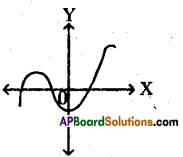
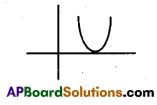
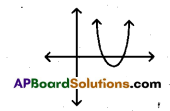
Write the number of zeroes of the poly¬nomial in the given graph.
AP 10th Class Maths Bits Chapter 3 Polynomials Bits 1
Answer:
3

Question 20.
Write product of zeroes of the cubic polynomial 3x3 – 5x2 – 11x – 3.
Answer:
1
Explanation:
Product of zeroes = αβγ
= \(\frac{-d}{a}=\frac{-(-3)}{3}=\frac{3}{3}\) = 1

AP 10th Class Maths Bits Chapter 3 Polynomials Bits

Question 21.
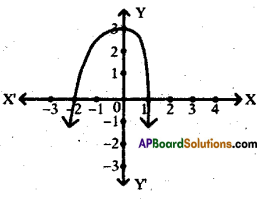
The following is the graph of a poly¬nomial. Find the zeroes of the poly¬nomial from the given graph.
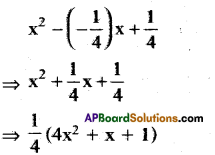
AP 10th Class Maths Bits Chapter 3 Polynomials Bits 2
Answer:
– 2,1

Question 22.
Find the value of p(x) = 4x2 + 3x + 1 at x = -1.
Answer:
2

Question 23.
If α, β, γ are the zeroes of the cubic polynomial ax3 + bx2 + cx + d and (a ≠ 0), then find αβγ

Question 24.
4x + 6y = 18 doesn’t pass through ori-gin, then its graph indicates
Answer:
A straight line

Question 25.
If ‘3’ is one of the zeroes of
p(x) = x2 + kx – 9, then find the value of k.
Answer:
0
Explanation:
p(3) = 32 + 3k – 9 = 0
⇒ 3k = 0 ⇒ k = 0

Question 26.
When p(x) = x2 – 8x + k leaves a re-mainder when it is divided by (x – 1), then find k.
Answer:
k > 7
Explanation:
p(1) = 1 – 8 + k = 0
⇒ k > 7

Question 27.
If α, β, γ are zeroes of x3 + 3x2 – x + 2, then find the value of αβγ.
Answer:
-2

Question 28.
Make a quadratic polynomial having 2, 3 as zeroes.
Answer:
x2 – 5x + 6 = 0
Explanation:
x2 – (2 + 3)x + 2 . 3 = 0
⇒ x2 – 5x + 6 = 0.

Question 29.
Write a quadratic polynomial, whose zeroes are \(\sqrt{2}\) and –\(\sqrt{2}\).
Answer:
x2 – 2 = 0
Explanation:
x2 – \((\sqrt{2}-\sqrt{2}) x+\sqrt{2}(-\sqrt{2})\) = 0
⇒ x2 – 0(x) -2 = 0
⇒ x2 – 2 = 0.

AP 10th Class Maths Bits Chapter 3 Polynomials Bits

Question 30.
Find the coefficient of x7 in the poly¬nomial 7x17 – 17x11 + 27x5 – 7.
Answer:
0

Question 31.
If α, β are the zeroes of the polyno¬mial x2 – x – 6, then find α2β2
Answer:
36
Explanation:
αβ = \(\frac{\mathrm{c}}{\mathrm{a}}\) = – 6 ⇒ (αβ)2 = (-6)2 = 36

Question 32.
If ‘4’ is one of the zeroes of p(x) = x2 + kx – 8, then the value of k.
Answer:
-2

Question 33.
If the polynomial p(x) = x3 – x2 + 3x + k is divided by (x – 1), the remainder obtained is 3, then find the value of k.
Answer:
0
Explanation:
p(1) = 1-1 + 3 + k = 3 ⇒ k = 0

Question 34.
If one zero of the polynomial f(x) = 5x2 + 13x + k is reciprocal of the other, then find the value of k.
Answer:
5
Explanation:
α = x, β = 1/x
⇒ α . β = x . 1/x = k/5 ⇒ k = 5

Question 35.
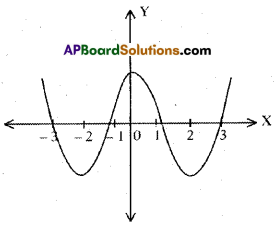
Find the number of zeroes of the po!y: nomial, whose graph is given below.
Answer:
AP 10th Class Maths Bits Chapter 3 Polynomials Bits 3

Question 36.
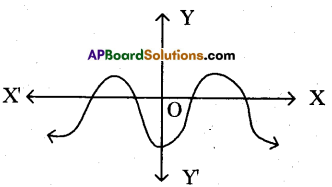
Number of zeroes that can be identi¬fied by the given figure.
Answer:
AP 10th Class Maths Bits Chapter 3 Polynomials Bits 4

Question 37.
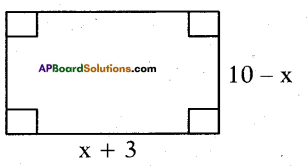
Observe the given rectangular figure, then write its area in polynomial func-tion.
AP 10th Class Maths Bits Chapter 3 Polynomials Bits 5
Answer:
x2 – 7x – 30 = 0
Explanation:
(10 – x)(x + 3) = 10x + 30 – x2 – 3x = 0
⇒ x2 – 7x – 30 = 0

Question 38.
f(x) = x + 3, then find zero of f(x).
Answer:
-3

AP 10th Class Maths Bits Chapter 3 Polynomials Bits

Question 39.
One zero of the polynomial 2x2 + 3x + k is 1/2, then find k.
Answer:
-2
Explanation:
im 19
α + β + γ = \(\frac{-b}{a}\) = -3
\(\sqrt{5}-\sqrt{5}+\gamma\) = -3
γ = -3

Question 40.
Find factors of x2 + x(a + b) + ab.
Answer:
x + a and x + b

Question 41.
f(x) = 4x2 + 4x – 3, then find f(\(\frac{-3}{2}\))
Answer:
0

Question 42.
If \(\sqrt{5}\) and \(-\sqrt{5}\) are two zeroes of the polynomial x3 + 3x2 – 5x – 15, then find its third zero.
Answer:
-3
Explanation:

Question 43.
If \(\sqrt{3}\) and – \(\sqrt{3}\) are the zeroes of a polynomial p(x), then find p(x).
Answer:
x2 – 3

Question 44.
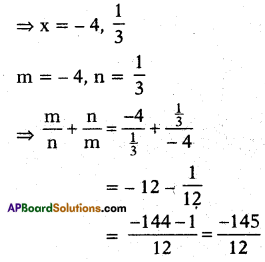
If ‘m’ and ‘n’ are zeroes of the polyno-mial 3x2 + 11x – 4, then find the value \(\frac{\mathbf{m}}{\mathbf{n}}+\frac{\mathbf{n}}{\mathbf{m}}\)
Answer:
\(\frac{-145}{12}\)
Explanation:
3x2 + 11x – 4 = 3x2 + 12x – x – 4 = 0
⇒(x + 4)(3x – 1)= 0
⇒x = -4, \(\frac { 1 }{ 2 }\)
AP 10th Class Maths Bits Chapter 3 Polynomials Bits 27

Question 45.
In the product (x + 4) (x + 2). Write the constant term.
Answer:
8

Question 46.
Find the polynomial whose zeroes are – 5 and 4.
Answer:
x2 + x – 20

Question 47.
Flnd product of zeroes of 3x2 = 1
Answer:
\(-\frac{1}{3}\)

Question 48.
Find the sum of the zeroes of x2 + 7x + 10.
Answer:
-7

AP 10th Class Maths Bits Chapter 3 Polynomials Bits

Question 49.
If one root of the polynomial
fix) = 5x2 + 13x + k is reciprocal of the other, then find ‘k’.
Answer:
5

Question 50.
f(x) = 3x – 2. then find zero of f(x).
Answer:
\(\frac{2}{3}\)

Question 51.
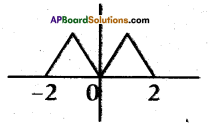
Write the zeroes from the below graph.
AP 10th Class Maths Bits Chapter 3 Polynomials Bits 6
Answer:
-2, 0 and 2

Question 52.
Make a quadratic polynomial whose zeroes are 5 and -2.
Answer:
x2 – 3x – 10.

Question 53.
If α, β are (1w zero ai polynomial
f(x) = x2 – p(x + 1) – c then find (α + 1)(β + 1).
Answer:
1 – c
Explanation:
α + β = \(\frac{-b}{a}=\frac{+p}{1}\) = +p
αβ = \(\frac{c}{a}=\frac{-p-c}{1}\) = -(p+c)
(α + 1) (β + 1) = αβ + α + β + 1
= -p – c + p + 1
= 1 – c

Question 54.
Write number of constant polynomial x2 + 7x – 7.
Answer:
1

Question 55.
Write the quadratic polynomial, whose sum and product of zeroes are 1 and – 2 respectively.
Answer:
x2 – x – 2

Question 56.
Find the product of the zeroes of x3 + 4x2 + x – 6.
Answer:
6

Question 57.
p(x) = \(\frac{x+1}{1-x}\) , then find p(0).
Answer:
1

Question 58.
Write the maximum number of zeroes that a polynomial of degree 3 can have.
Answer:
Three

AP 10th Class Maths Bits Chapter 3 Polynomials Bits

Question 59.
If x + 2 is a factor of x2 + ax + 2 b and a 4 b = 4, then find Answer:
Answer:
3
Explanation:
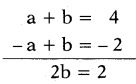
(- 2)2 – 2a + 2b = 0
⇒ 4 – 2a + 2b = 0
⇒ -a + b = -2
AP 10th Class Maths Bits Chapter 3 Polynomials Bits 28
⇒ b = 1,a = 4- b = 4 – 1 = 3.

Question 60.
The graph of ax + b represents which type of polynomial ?
Answer:
linear polynomial.

Question 61.
If ‘1’ is the zero of the quadratic poly- nomlal x2 + kx – 5, then find the value ofk.
Answer:
4
Explanation:
1 + k – 5 = 0 ⇒ k = 4.

Question 62.
Find a quadratic polynomial, the sum of whose zeroes is W and product of zero is 3.
Answer:
x2 – 9

Question 63.
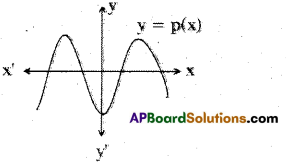
If y = p(x) is represented by the given pqih, then find die number of zeroes.
AP 10th Class Maths Bits Chapter 3 Polynomials Bits 7
Answer:
4

Question 64.
If α + β = 0, αβ = \(\sqrt{3}\), then write the quadratic polynomial.
Answer:
x2 + \(\sqrt{3}\)

Question 65.
Find the degree of the polynomial ax4 + bx3 + cx2 + dx + e.
Answer:
4.

Question 66.
If α, β, γ are the zeroes of the polyno- mid f(x) = x3 – px2 + qx – r, then find
\(\frac{1}{\alpha \beta}+\frac{1}{\beta \gamma}+\frac{1}{\gamma \alpha}\)
Answer:
\(\frac{\mathbf{p}}{\mathrm{r}}\)
Explanation:
\(\frac{1}{\alpha \beta}+\frac{1}{\beta \gamma}+\frac{1}{\gamma \alpha}=\frac{\alpha+\beta+\gamma}{\alpha \beta \gamma}=\frac{\frac{p}{1}}{\frac{r}{1}}=\frac{p}{r}\)

AP 10th Class Maths Bits Chapter 3 Polynomials Bits

Question 67.
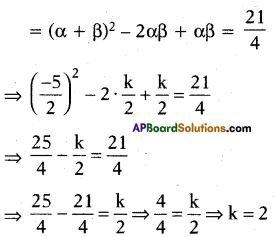
If α and β are the zeroes of the poly¬nomial p(x) = 2x2 + 5x + k satisfying the relation α2 + β2 + αβ = \(\frac{21}{4}\), then find k.
Answer:
2
Explanation:
α2 + β2 + αβ
AP 10th Class Maths Bits Chapter 3 Polynomials Bits 29

Question 68.
If p(t) = t3 , then find p(- 2).
Answer:
– 9

Question 69.
If the polynomial f(x) = ax3 – bx – a is divisible % the polynomial g(x) = x2 + bx + c, then find ah.
Answer:
1

Question 70.
Write degree of a linear polynomial.
Answer:
1

Question 71.
If the sum off the zeroes off die polyno¬mial fix) = 2x3 – 3kx2 + 4x – 5 is 6, then find k.
Answer:
4.

Question 72.
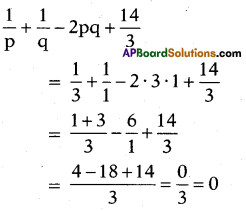
If p and q are the zeroes of the poly¬nomial t2 – 4t + 3, then find \(\frac{1}{p}+\frac{1}{9}-2 p q+\frac{14}{3}\)
Answer:
0
Explanation:
t2 – 3t – t + 3
= t(t – 3) – 1(t-3)
= (t – 3) (t – 1)
t = 3,1
p = 3, q = 1
AP 10th Class Maths Bits Chapter 3 Polynomials Bits 30

Question 73.
If the inudnct of zeroes rf9x2+3x + p is 7, then find p”.
Answer:
63

AP 10th Class Maths Bits Chapter 3 Polynomials Bits

Question 74.
If α, β, γ are the zeroes of the polyno-mial f(x) = ax3 + hx2 + cx + d, then find α2 + β2 + γ2
Answer:
\(\frac{b^{2}-2 a c}{a^{2}}\)

Question 75.
p(x) = x2 + 5x + 6, then find zeroes of p(x).
Answer:
-2,-3.

Question 76.
If one of the zeroes of the quadratic polynomial ax2 + bx + c is ‘0’, then find the other zero.
Answer:
-b

Question 77.
α = a – b, β = a 4 b, then make the quadratic polynomial.
Answer:
x2 – 2ax + a2 – b2

Question 78.
Find the quadratic polynomial whose zeroes are \(4+\sqrt{5}\) and \(4-\sqrt{5}\)
Answer:
x2 – 8x + 11

Question 79.
Find die remainder when
3x3 + x2 + 2x + 5 is divided by x2 + 2x + 1.
Answer:
9x + 10

Question 80.
What must be subtracted or added to p(x) = 8x4 + 14x3 – 2x2 + 8x – 12, so that 4x2 + 3x – 2 is a factor off p(x) ?
Answer:
15x – 14

Question 81.
Prepare a quadratic polynomial whose zeroes are \(\sqrt{15}\) and \(-\sqrt{15}\).
Answer:
x2 – 15

Question 82.
Divide(x3 – 6x2 + 11x – 12) by (x2 – x + 2)r then find quotient.
Answer:
x – 5

Question 83.
If -1 is a zero of the polynomial f(x) = x2 – 7x – 8, then find the other zero.
Answer:
8

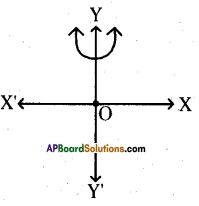
Question 84.
If a > 0, dim draw the shape off ax2 + bx + c = 0.
Answer:
AP 10th Class Maths Bits Chapter 3 Polynomials Bits 8

Question 85.
If 2x + 3 is a factor of 2x3 – x – b + 9x2, then find the value erf b.
Answer:
-15

AP 10th Class Maths Bits Chapter 3 Polynomials Bits

Question 86.
If the order erf ax5 + 3x4 + 4x3 + 3x2 + 2x + 1 is 4, then find Answer:
Answer:
0
Explanation:
If a = 0, then given equation order becomes 4.

Question 87.
Find the zeroes erf the polynomial p(x) = 4x2 – 12x + 9.
Answer:
\(\frac{3}{2}, \frac{3}{2}\)

Question 88.
If α, β, γ are roots erf a cubic polynomial ax3 + bx2 + cx + d, then find αβ + βγ + γα
Answer:
\(\frac{\mathbf{c}}{\mathbf{a}}\)

Question 89.
If one of the zeroes of the quadratic polynomial f(x) = 14x2 – 42k2x – 9 is negative of the other, then find k.
Answer:
0
Explanation:
Let α = x, β = – x
α + β = \(-\frac{b}{a}\)
x – x = \(\frac{-\left(-42 \mathrm{k}^{2}\right)}{14}\)
⇒ + 3k2 = 0
⇒ k2 = \(\frac{0}{3}\) = 0 ⇒ k = 0

Question 90.
p(x) = 4x2 + 3x – 1, then find P(\(\frac{1}{4}\))
Answer:
0

AP 10th Class Maths Bits Chapter 3 Polynomials Bits

Question 91.
Find the sum of zeroes of the polynomial 3x2 – 8x + 1 = 0.
Answer:
\(\frac{8}{3}\)
Explanation:
3x2 – 8x + 1 = 0
Sum of zeroes = \(-\frac{b}{a}\)
= \(\frac{-(-8)}{3}=\frac{8}{3}\)

Question 92.
If the product of zeroes of the polynomial f(x) = ax3 – 6x2 + 11x – 6 is 4, then find Answer:
Answer:
\(\frac{3}{2}\)
Explanation:
αβγ = \(\frac{-\mathrm{d}}{\mathrm{a}}\) = 4
\(\frac{-(-6)}{a}\) = 4 ⇒ 4a = 6 ⇒ a = \(\frac{6}{4}=\frac{3}{2}\)

Question 93.
Name a polynomial of degree ‘3’.
Answer:
Cubic polynomial.

Question 94.
Is the below graph represents a polynomial ?
AP 10th Class Maths Bits Chapter 3 Polynomials Bits 9
Answer:
No, it is not a polynomial.

Question 95.
Find the quotient when x4 + x3 + x2 – 2x – 3 is divided by x2 – 2.
Answer:
x2 + x + 3

Question 96.
If α, β, γ are roots of a cubic polyno-mial ax3 + bx2 + cx + d, then find α + β + γ
Answer:
\(\frac{-b}{a}\)

Question 97.
If one zero of the quadratic polynomial 2x2 + kx – 15 is 3, then find the other zero.
Answer:
\(\frac{-5}{2}\)

Question 98.
If α, β, γ are the zeroes of the polynomial f(x) = ax3 + bx2 + cx + d, then
find \(\frac{1}{\alpha}+\frac{1}{\beta}+\frac{1}{\gamma}\)
Answer:
\(-\frac{c}{d}\)

Question 99.
The graph
AP 10th Class Maths Bits Chapter 3 Polynomials Bits 10
represents, which type of polynomial ?
Answer:
Cubic polynomial.

AP 10th Class Maths Bits Chapter 3 Polynomials Bits

Question 100.
Write the product and sum of the zeroes of the quadratic polynomial ax2 + bx + c respectively.
Answer:
\(\frac{c}{a}, \frac{-b}{a}\)

Question 101.
Write the number of zeroes of the poly¬nomial in the given graph.
AP 10th Class Maths Bits Chapter 3 Polynomials Bits 11
Answer:
0

Question 102.
If f(x) = ax2 + bx + c has no real zeroes and a + b + c < 0, then write the condition.
Answer:
c < 0

Question 103.
Which type of polynomial ax2 + bx + c?
Answer:
Quadratic polynomial.

Question 104.
If one zero of the polynomial
f(x) = (k2 + 4)x2 + 13x + 4k is recip¬rocal of the other, then find k.
Answer:
2
Explanation:
\(x \cdot \frac{1}{x}=\frac{4 k}{k^{2}+4}\)
⇒ k2 + 4 = 4k
=» k2 – 4k + 4 = 0
⇒ (k – 2)2 = 0
⇒ k = 2

Question 105.
Write the number of zeroes of the poly-nomial function p(x), whose graph is given below.
AP 10th Class Maths Bits Chapter 3 Polynomials Bits 12
Answer:
3

Question 106.
If two zeroes of x3 + x2 – 5x – 5 are \(\sqrt{5}\) and \(-\sqrt{5}\) then find its third zero.
Answer:
-1

Question 107.
If one zero of the quadratic polynomial x2 – 5x – 6 is 6, then find the other zero.
Answer:
– 1

AP 10th Class Maths Bits Chapter 3 Polynomials Bits

Question 108.
Find the degree of the polynomial \(a_{0} x^{n}+a_{1} x^{n-1}+a_{2} x^{n-2}+\ldots .+a_{n} x^{n}\)
Answer:
n

Question 109.
If α and β are the zeros of the polyno-mial f(x) = x2 + px + q, then find a
polynomial having \(\frac{1}{\alpha}\) and \(\frac{1}{\beta}\) as its a p
zeroes.
Answer:
qx2 + px + 1

Question 110.
If both the zeroes of a quadratic poly-nomial ax2 + bx + c are equal and opposite in sign, then find ‘b’.
Answer:
0

Question 111.
Write the number of zeroes of the poly-nomial in the given graph.
AP 10th Class Maths Bits Chapter 3 Polynomials Bits 13
Answer:
1

Question 112.
Find the sum and product of the ze¬roes of polynomial x2 – 3 respectively.
Answer:
0,-3

Question 113.
If a < 0, then draw the shape of ax2 + bx + c = 0.
Answer:
AP 10th Class Maths Bits Chapter 3 Polynomials Bits 14

Question 114.
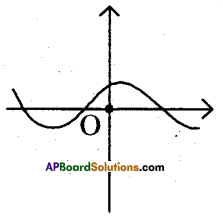
From the graph write the number of zeroes of the polynomial.
AP 10th Class Maths Bits Chapter 3 Polynomials Bits 15
Answer:
2

Question 115.
If α and β are zeroes of the polynomial p(x) = x2 – 5x + 6, then find the value of α + β – 3αβ.
Answer:
– 13
Explanation:
α + β = \(\frac{-b}{a}=\frac{-(-5)}{1}\) = 5
αβ = \(\frac{\mathrm{c}}{\mathrm{a}}\) = 6
= α + β – 3αβ = 5 – 3(6)
= 5- 18 = – 13.

Question 116.
What should be subtracted from the polynomial x2 – 16x + 30 so that 15 is the zero of the resulting polynomial ?
Answer:
15

AP 10th Class Maths Bits Chapter 3 Polynomials Bits

Question 117.
Find the number of zeroes lying be-tween – 2 and 2 of the polynomial f(x) whose graph is given below.
AP 10th Class Maths Bits Chapter 3 Polynomials Bits 16
Answer:
2

Question 118.
If the zeroes of a quadratic polynomial are equal in magnitude but opposite in sign, then write the relation be¬tween zeroes.
Answer:
Sum of its zeroes is 0.

Question 119.
Find where the graph of the polyno¬mial f(x) = 2x – 5 is a straight line which intersects the x – axis.
Answer:
[\(\frac{5}{2}\),0]

Question 120.
If α,β are the zeroes of the polyno¬mial f(x) = ax2 + bx + c, then find \(\frac{1}{\alpha^{2}}+\frac{1}{\beta^{2}}=\)
Answer:
\(\frac{b^{2}-2 a c}{c^{2}}\)

Choose the correct answer satis¬fying the following statements.

Question 121.
Statement (A): (2 – \(\sqrt{3}\))is °ne zero of the quadratic polynomial, then other zero will be (2 + \(\sqrt{3}\)).
Statement (B) : Irrational zeroes (roots) always occurs in pairs.
i) Both A and B are true.
ii) A is true, B is false.
iii) A is false, B is true.
iv) Both A and B are false.
Answer:
(i)
Explanation:
As irrational roots / zeroes always oc¬curs in pairs therefore, when one, zero
is 2 – √3 , then other will be 2 + √3
So, both A and B are correct and B explains A.
Hence, (i) is the correct option.

AP 10th Class Maths Bits Chapter 3 Polynomials Bits

Question 122.
Statement (A) : If both zeroes of the quadratic polynomial x2 – 2kx + 2 are equal in magnitude but opposite in sign, then value of k is \(\frac { 1 }{ 2 }\).
Statement (B) : Sum of zeroes of a quadratic polynomial ax2 + bx + c is \(\frac{-b}{a}\)
i) Both A and B are true.
ii) A is true, B is false.
iii) A is false, B is true.
iv) Both A and B are false.
Answer:
(iii)
Explanation:
As the polynomial is x2 – 2kx + 2 and
its zeros are equal but opposition sign.
∴ Sum of zeroes = 0 = \(\frac{-(-2 \mathrm{k})}{1}\) = 0
⇒ 2k = 0 ⇒ k = 0
So, A is incorrect but B is correct.
Hence, (iii) is the correct option.

Question 123.
Statement (A): p(x) = 14x3 – 2x2 + 8x4 + 7x – 8 is a polynomial of degree 3. Statement (B) : The highest power of x in any polynomial p(x) is the degree of the polynomial.
i) Both A and B are true.
ii) A is true, B is false.
iii) A is false, B is true.
iv) Both A and B are false.
Answer:
(iii)
Explanation:
The highest power of x in the polyno¬mial p(x) = 14x3 – 2x2 + 8x4 + 7x – 8 is 4.
∴ Degree of p(x) is 4.
So, A is incorrect but B is correct.
Hence, (iii) is the correct option.

Question 124.
AP 10th Class Maths Bits Chapter 3 Polynomials Bits 17
Statement (A) : The graph y = f(x) is shown in figure, for the polynomial f(x). The number of zeroes of f(x) is 4.
Statement (B): The number of zero of polynomial f(x) is the number of point of which f(x) cuts or touches the axes.
i) Both A and B are true.
ii) A is true, B is false.
iii) A is false, B is true.
iv) Both A and B are false.
Answer:
(ii)
Explanation:
As the number of zero of polynomial f(x) is the number of {mints at which f(x) cuts (intersects) the x-axis and number of zero in the given figure is 4. So A is correct but B is incorrect Hence, (ii) is the correct option.

Question 125.
Statement (A) : The sum and product of the zeroes of a quadratic polynomial
are – \(\frac { 1 }{ 4 }\) and \(\frac { 1 }{ 4 }\) respectively. Then the
quadratic polynomial is 4x2 + x + 1.
Statement (B): The quadratic polyno-mial whose sum and product of zeroes are given is x2 – (sum of zeroes)x + product of zeroes.
i) Both A and B are true.
ii) A is true, B is false.
iii) A is false, B is true.
iv) Both A and B are false,
Answer:
(i)
Explanation:
Sum of zeroes = –\(\frac { 1 }{ 4 }\) and
Product of zeroes = \(\frac { 1 }{ 4 }\)
∴ Quadratic polynomial be
AP 10th Class Maths Bits Chapter 3 Polynomials Bits 31
∴ Quadratic polynomial be 4x2 + x + 4.
So, both A and B are correct and B explains A. Hence, (i) is the correct option.

AP 10th Class Maths Bits Chapter 3 Polynomials Bits

Question 126.
Statement (A) : If α, β are zeroes of x2 – 3x + p and 2α + 3β = 15, then p – 54.
Statement (B) : If α, β are the zeroes of the polynomial ax2 + bx + c, then
α + β = \(\frac{-b}{a}\) and αβ = \(\frac{c}{a}\)
i) Both A and B are true.
ii) A is true, B is false.
iii) A is false, B is true.
iv) Both A and B are false.
Answer:
(iii)

Question 127.
Statement (A) : A quadratic polyno¬mial having 4 and – 2 as zeroes is 2x2 – 4x – 16.
Statement (B): The quadratic polyno-mial having a and (3 as zeroes is given by p(x) = x2 – (α + β)x + αβ
i) Both A and B are true.
ii) A is true, B is false.
iii) A is false, B is true.
iv) Both A and B are false.
Answer:
(i)

Question 128.
Statement (A) : The polynomial p(x) = x3 + x has one real zero.
Statement (B) : A polynomial of nth degree has at most n zeroes.
i) Both A and B are true.
ii) A is true, B is false.
iii) A is false, B is true.
iv) Both A and B are false.
Answer:
(ii)

Question 129.
Statement (A): If α, β, γ are the zeroes of x3 – 2x2 – qx – r and α + β = 0, then 2q= r.
Statement (B) : If α, β, γ are the ze¬roes of ax3 + bx2 + cx + d, then
α + β + γ = \(\frac{-b}{a}\), αβ, βγ, γα = \(\frac{c}{a}\), αβγ = \(\frac{-d}{a}\)
i) Both A and B are true.
ii) A is true, B is false.
iii) A is false, B is true.
iv) Both A and B are false.
Answer:
(iii)
Explanation:
Clearly, (B) is true, [standard result] cc + p + y = -(-2) = 2 ⇒ 0 + y = 2 ‘ Y – 2 ‘
α + β + γ = – (- 2) = 2=
o + γ = 2
γ = 2
αβγ = -(-r) = r
∴ αβ(2) = r
⇒ αβ = \(\frac{r}{2}\)
⇒ αβ + βγ + γα = -q
⇒\(\frac{r}{2}\) + γ(α+β) = -q
⇒\(\frac{r}{2}\) + 2(0) = -q
⇒ r = 2q
∴ (A) is false
Hence, (iii) is the correct option.

Question 130.
Statement (A) : If one zero of polyno¬mial p(x) = (k2 + 4)x2 + 13x + 4k is reciprocal of other, then k = 2.
Statement (B) : If x – a is a factor of p(x), then p(α) = 0 i.e., a is a zero of p(x).
i) Both A and B are true.
ii) A is true, B is false.
iii) A is false, B is true.
iv) Both A and B are false.
Answer:
(i)
Explanation:
(B) is true
Let α, 1/α be the zeroes of p(x), then
\(\alpha \cdot \frac{1}{\alpha}=\frac{4 \mathbf{k}}{\mathbf{k}^{2}+4} \Rightarrow \mathbf{1}=\frac{4 \mathbf{k}}{\mathbf{k}^{2}+4}\)
∴ k2 -4k + 4 = 0 ⇒ (k- 2)2 = 0
∴ k = 2
∴ (A) is true. So, (i) is correct option.

AP 10th Class Maths Bits Chapter 3 Polynomials Bits

Question 131.
Statement (A) : The polynomial x4 + 4x2 + 5 has four zeroes. Statement (B) : If p(x) is divided by (x – k), then the remainder = p(k).
i) Both A and B are true.
ii) A is true, B is false.
iii) A is false, B is true.
iv) Both A and B are false.
Answer:
(iii)
Explanation:
(B) is true by remainder theorem. Again, x4 + 4x2 + 5
= (x2 + 2)2 + 1 > 0 for all x.
∴ Given polynomial has no zeroes.
∴ (A) is not true.
Hence, (iii) is the correct option.

Question 132.
Statement (A) : x3 + x has only one real zero.
Statement (B) : A polynomial of nth degree must have ‘n’ real zeroes.
i) Both A and B are true.
ii) A is true, B is false.
iii) A is false, B is true.
iv) Both A and B are false.
Answer:
(ii)
Explanation:
(B) is false [v a polynomial of n<sup<th degree has at most x zeroes]
Again, x3 + x = x (x2 + 1) which has only one real zero (x = 0)
[∵ x2 + 1 ≠ 0 for all x ∈ R]
(A) is true.
Hence, (ii) is the correct option.

Question 133.
Statement (A) : If 2, 3 are the zeroes of a quadratic polynomial, then poly¬nomial is x2 – 5x + 6.
Statement (B) : If a, P are the zeroes of a monic quadratic polynomial, then polynomial is x2 – (a + p)x + ap.
i) Both A and B are true.
ii) A is true, B is false.
iii) A is false, B is true.
iv) Both A and B are false.
Answer:
(i)

Question 134.
Statement (A): Degree of a zero poly-nomial is not defined.
Statement (B) : Degree of a non-zero constant polynomial is ‘0’.
i) Both A and B are true.
ii) A is true, B is false.
iii) A is false, B is true.
iv) Both A and B are false.
Answer:
(ii)

Question 135.
Statement (A) : Zeroes of f(x) = x3 – 4x – 5 are 5, – 1.
Statement (B): The polynomial whose zeroes are \(2+\sqrt{3}, 2-\sqrt{3}\) is x2 – 4x + 7.
i) Both A and B are true.
ii) A is true, B is false.
iii) A is false, B is true.
iv) Both A and B are false.
Answer:
(i)

Question 136.
Statement (A) : x2 + 4x + 5 has two zeroes.
Statement (B) : A quadratic polyno¬mial can have at the most two zeroes.
i) Both A and B are true.
ii) A is true, B is false.
iii) A is false, B is true.
iv) Both A and B are false.
Answer:
(i)

AP 10th Class Maths Bits Chapter 3 Polynomials Bits

Read the below passages and an¬swer to the following questions.

If α, β are the zeroes of the quadratic polynomial f(x) = ax2 + bx + c, then
α + β = \(\frac{-b}{a}\), αβ = \(\frac{c}{a}\)

If α, β are the zeroes of the quadratic polynomial f(x) = x2 – px + q, then find \(\frac{1}{\alpha}+\frac{1}{\beta}\)
Answer:
\(\frac{p}{q}\)
Explanation:
α + β = p, αβ = q
∴ \(\frac{1}{\alpha}+\frac{1}{\beta}=\frac{\alpha+\beta}{\alpha \beta}=\frac{p}{q}\)

Question 138.
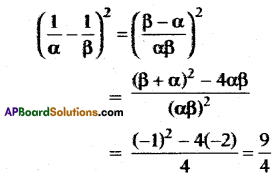
If α, β are the zeroes of the quadratic polynomial fix) = x2 + x – 2, then find \(\left(\frac{1}{\alpha}-\frac{1}{\beta}\right)^{2}\)
Answer:
\(\frac{9}{4}\)
Explanation:
α + β = -1, αβ = -2
AP 10th Class Maths Bits Chapter 3 Polynomials Bits 32

Question 139.
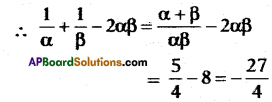
If α, β are the zeroes of the quadratic polynomial fix) = x2 – 5x + 4, then
find \(\frac{1}{\alpha}+\frac{1}{\beta}-2 \alpha \beta\)
Answer:
–\(\frac{27}{4}\)

If α, β, γ are the zeroes of ax3 + bx2 + cx + d, then \(\Sigma \alpha=\frac{-b}{a}\), \(\Sigma \alpha \beta=\frac{\mathbf{c}}{\mathbf{a}}, \Sigma \alpha \beta \gamma=\frac{-\mathbf{d}}{\mathbf{a}}\)
Explanation:
α + β = 5, αβ = 4
AP 10th Class Maths Bits Chapter 3 Polynomials Bits 33

Question 140.
If α, β, γ are the zeroes of x3 – 5x2 – 2x + 24 and ap = 12, then
find αβ = 12, then find ‘γ’
Answer:
-2

Question 141.
If a – b, a, a + b are the roots of x3 – 3x2 + x + 1, then find a + b2.
Answer:
3

Question 142.
If two zeroes of the polynomial x3 – 5x2 – 16x + 80 are equal in magni¬tude but opposite in sign, then find ze¬roes.
Answer:
4,-4, 5.

Manow says that the order of the polynomial (x2 – 5) (x3 + 1) is 6.

Question 143.
Do you agree with Manow ?
Answer:
No.

AP 10th Class Maths Bits Chapter 3 Polynomials Bits

Question 144.
Which mathematical concept is used to judge Manow ?
Answer:
Polynomial.

Question 145.
How much the actual order of given problem ?
Answer:
Degree is 5.

The length of a rectangle is ’5’ more than its breadth.

Question 146.
Express the information in the form of polynomial.
Answer:
(x + 5 + x) = 2x + 5.

Question 147.
Find the perimeter of the rectangle given above.
Answer:
(4x + 10)m

Question 148.
To solve this given problem which mathematical concept was used by you?
Answer:
Polynomial.

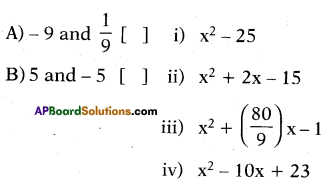
Question 149.
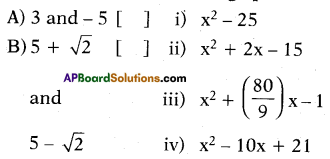
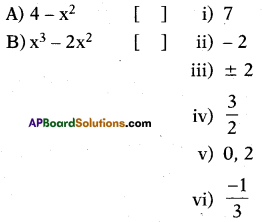
Write the correct matching option.
AP 10th Class Maths Bits Chapter 3 Polynomials Bits 18
Answer:
A – (ii), B – (iv).

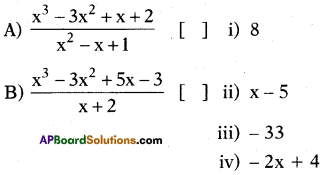
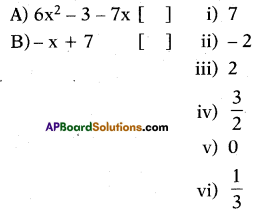
Question 150.
Write the correct matching option.
AP 10th Class Maths Bits Chapter 3 Polynomials Bits 19
A – (iii), B – (i).

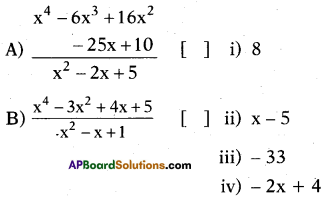
Question 151.
Write the correct matching option.
AP 10th Class Maths Bits Chapter 3 Polynomials Bits 20
Answer:
A – (iv), B – (iii).

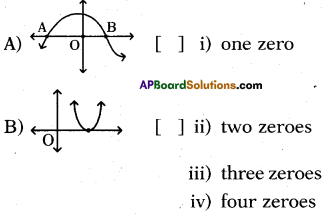
Question 152.
Write the correct matching option.
AP 10th Class Maths Bits Chapter 3 Polynomials Bits 21
Answer:
A – (ii), B – (i).

Question 153.
Write the correct matching option.
AP 10th Class Maths Bits Chapter 3 Polynomials Bits 22
Answer:
A – (iii), B – (i).

Question 154.
Write the correct matching option.
AP 10th Class Maths Bits Chapter 3 Polynomials Bits 23
Answer:
A – (iii), B – (v).

AP 10th Class Maths Bits Chapter 3 Polynomials Bits

Question 155.
Write the correct matching option.
AP 10th Class Maths Bits Chapter 3 Polynomials Bits 24
Answer:
A – (iv), B – (i).

Question 156.
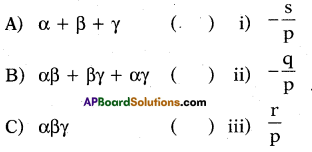
If α, β, γ are the zeroes of the polyno-mial px3 + qx2 + rx + s then, which of the following matching is correct ?
AP 10th Class Maths Bits Chapter 3 Polynomials Bits 25
a) A(i), B(ii), C(iii)
b) A(ii), B(iii), C(i)
c) A(iii), B(i), C(ii)
d) A(ii), B(i), C(iii)
Answer:
(b)

Question 157.
What is the zero of the polynomial 3x – 2 ?
Solution:
f(x) = 3x – 2; f(x) = 0
3x – 2 = 0 ⇒ 3x = 2
⇒ x = 2/3

AP 10th Class Maths Bits Chapter 3 Polynomials Bits

Question 158.
Write the polynomial in variable ‘x’ whose zero is \(\frac{-k}{a}\).
Solution:
x – \(\frac{-k}{a}\) = 0 ⇒ x + \(\frac{k}{a}\) = 0
⇒ ax + k = 0
∴ ax + k = 0 is a polynomial with degree T in variable ‘x’ whose zero is \(\frac{-k}{a}\).

AP Inter 2nd Year Commerce Study Material Chapter 1 Entrepreneurship

Andhra Pradesh BIEAP AP Inter 2nd Year Commerce Study Material 1st Lesson Entrepreneurship Textbook Questions and Answers.

AP Inter 2nd Year Commerce Study Material 1st Lesson Entrepreneurship

Essay Answer Questions

Question 1.
Explain the characteristics of entrepreneurs.
Answer:
The following are some of the important characteristics that every successful entrepreneur must possess.
1) Innovation:
Innovation is an important characteristic of an entrepreneur in modem business. The entrepreneur makes arrangements for introducing innovations which help in increasing production on the one hand and reducing costs on the other.

2) Risk-taking :
Risk-taking is another feature of an entrepreneur. He has to pay to all the other factors of production in advance. There are chances that he may be rewarded with a handsome profit or he may suffer a heavy loss. Therefore, risk bearing is the final responsibility of an entrepreneur.

3) Decision making :
An entrepreneur has to take decisions with regard to the establishment of business its management and coordination of various resources. Every activity of the business requires decision-making. The entrepreneur has to take decisions every day which have an impact on the working of the enterprise.

4) Leadership :
An entrepreneur has to be a leader because he is such a person who organise direct, control the functions of the organisation. His personality will influence the working of his subordinates who can praise and appreciate him. An entrepreneur in his role as a leader, not only guide and counsels his persons but he motivates them to achieve goals quickly and efficiently.

5) Organisation of production :
Art entrepreneur procures various factors of production like land, labour, capital, raw materials etc. For manufacturing a product or brining out a service. He assess the viability of different production process and selects one which is most suitable.

6) Planning :
An entrepreneur is the person who plans each and everything in the business. A planning is a process which involves thinking before doing an entrepreneur decides the following : What to do? When to do? How to do? Who do a particular task?

7) Work hard :
Willingness to work hard distinguishes a successful entrepreneur from an unsuccessful one. Most of the successful entrepreneurs work hard endlessly, especially in the beginning and the same becomes their whole life.

8) Desire for high achievement and highly optimistic :
The entrepreneurs should have strong desire to achieve high goals in business. The successful entrepreneurs are not disturbed by present problems and are optimistic for future that situation will become favourable to business in future.

9) Independence :
The successful entrepreneurs do not like to be guided by others and like to be independent in the matters of their business.

10) Foresight:
The entrepreneurs should have a good foresight i.e., they visualize the likely changes take place in market, consumer attitude, technological developments etc., and take timely action accordingly.

Question 2.
Explain the functions of entrepreneurs. [A.P. Mar. 17]
Answer:
An entrepreneur performs all the functions necessary right from the generation of an idea and upto setting up an enterprise. The following are the functions of entrepreneur.

1) Formation of new producing organisation :
The function of an entrepreneur is to rationally combine the factors of production into a new producing organisation.

2) Decision making :
An entrepreneur as a decision maker takes various decisions regarding ascertaining the objective of the enterprise, sources of finance, product mix, pricing policies, promotion strategies, appropriate technology or new equipment.

3) Innovation:
Innovation is the main function of an entrepreneur. Innovation means doing new things or doing of things that are already being done in a new way. An entrepreneur puts science and technology to economic use. Innovative entrepreneurs are essential for rapid industrialisation and economic development.

4) Management:
An entrepreneur performs managerial functions such formulation of production plans, providing raw materials, physical facilities, production facilities, organizing and managing sales.

5) Risk bearing :
An entrepreneur undertakes the responsibility for loss that may arise due to unforeseen contingencies in future. He guarantees interest to creditors, wages to labour and rent to land holders.

6) Supervision, control and direction :
J.S.Mill mentions superintendence, control and direction as entrepreneurial functions. Supervision involves assembling the means, turnout maximum output at minimum cost and supervise the work. The entrepreneur has to regulate and control the flow of goods, the use of finance and machinery. He also has to control and direct the activities of the employees.

7) Planning:
Planning is the first step in the direction of setting up of an enterprise. The entrepreneur prepares a scheme of the proposed project in a formal systematic approach. The authorities, if satisfied fully with the requirements, grants legal sanction of the project.

According to Kilby, an entrepreneur performs the following major four functions.

  1. Exchange functions
  2. Administrative functions
  3. Management and control functions
  4. Technological functions

AP Inter 2nd Year Commerce Study Material Chapter 1 Entrepreneurship

Question 3.
Explain the types of entrepreneurs.
Answer:
Entrepreneurs can be found among various sections of the society viz., farmers, artisoris, workers etc. In a study of American Agriculture, Danhof has classified entrepreneurs into four categories. They are :
a) Innovating entrepreneurs
b) Adoptive or initiative entrepreneurs
c) Fabian entrepreneurs and
d) Drone entrepreneurs.

a) Innovating entrepreneurs :
Schumpeter’s entrepreneur was of this type. He introduces new products, new methods of production and open new markets. The entrepreneurs are aggressive in nature. Innovating entrepreneurs experiments and converts attractive possibilities into practice.

b) Adaptive or initiative entrepreneur:
Entrepreneur of this type are found in under-developed countries. This type of entrepreneurs instead of innovating new things, they just adopt the successful innovations innovated by others. However, some of the innovations made by others, may not suit the needs of underdeveloped countries. In such cases, the initiative innovators may make some changes in the innovations made by innovative entrepreneur so as to suit their requirements.

c) Fabian entrepreneur:
These entrepreneurs neither fall in innovative entrepreneur category nor in adoptive entrepreneur category. These are very cautions people. These entrepreneurs are regid and fundamental in approach. They follow the foot steps of their successors. They are shy to introduce new methods and ideas. Fabian entrepreneurs are no risk takers.

d) Drone entrepreneur :
Drone entrepreneurs are lazy in adopting new methods, but Drone entrepreneurs are more rigid than Fabian entrepreneurs. They resist changes. They are laggards. They may close down their business but they dont adopt for changes. Drone entrepreneurs refuse to adopt changes.

Question 4.
Explain the relation between entrepreneur and entrepreneurship. [A.P. Mar. 17]
Answer:
Entrepreneur is the person, entrepreneurship is the process and enterprise is the creation of the person and output of the process. Though the term entrepreneur is often used interchangeably with entrepreneurship, yet they are conceptually different. The relationship between the two is just like the two sides of the same coin.

The following points highlights the relationship between entrepreneur and entre-preneurship.

  1. Entrepreneur is a person : Entrepreneurship is a process.
  2. Entrepreneur is organiser : Entrepreneurship is the organisation.
  3. Entrepreneur is innovator : Entrepreneurship is innovation.
  4. Entrepreneur is risk bearer : Entrepreneurship is risk bearing.
  5. Entrepreneur is motivator : Entrepreneurship is motivation.
  6. Entrepreneur is creator : Entrepreneurship is the creation.
  7. Entrepreneur is visualiser : Entrepreneurship is vision.
  8. Entrepreneur is the leader : Entrepreneurship is leadership.
  9. Entrepreneur is imitator : Entrepreneurship is imitation.

Question 5.
Explain the role of entrepreneurship in economic development.
Answer:
The role of entrepreneurship in economic development varies from economy to economy depending upon its material resources, industrial climate and the responsiveness of the political system to the entrepreneurial functions. India is a developing economy aims to decentralise industries to mitigate the regional imbalances in levels of economic development.

Small-scale entrepreneurship in such industrial structure plays an important role to achieve balanced regional development. It is clearly believed that small scale industries provide immediate large scale employment, ensure a more equitable distribution of national income and facilitate an effective resource mobilisation of capital and skills which might otherwise remain unutilised.

Role of entrepreneurship in economic development:

  1. Entrepreneurship promotes capital formation by mobilising the idle savings of the public.
  2. It provides large scale employment and helps to reduce unemployment problem.
  3. Entrepreneurship promotes balanced regional development.
  4. It helps to reduce concentration of economic power.
  5. Entrepreneurship stimulates the equitable distribution of wealth, income and even political power in the interest of the country.
  6. Entrepreneurship encourages effective resource mobilisation of capital and skill which might otherwise remain unutilised and idle.
  7. It also induces backward and forward linkages which stimulate the process of economic development.
  8. Entrepreneurship also promote country’s export trade. It is an important ingradient to economic development.

Question 6.
Explain the opportunities for entrepreneurship in Andhra Pradesh.
Answer:
Andhra Pradesh, with its rich and abundant natural resources base as well as diverse agricultural and forest wealth provides tremendous opportunities for entrepreneurs in the state. The various opportunities for entrepreneurs in A.P. are as follows.

1) Information technology:
Government of A.P. has declared Information Technology (IT) industry as an essential service under the Essential Services Maintenance Act and the industry have been exempted from power cuts. It aims to transform the state into a knowledge society and make available the benefits of IT to all citizens, especially those in rural areas. People with innovative ideas would be encouraged to set up their own IT and IT enabled services units in the state.

2) Automobiles :
A broad base of automotive equipment manufacturers and a large pool of highly trained, skilled and disciplined man power make Andhra Pradesh the desired location for automobile industries. There are more than 100 automotive component manufacturing companies in the state. The industry is highly potential and there is a plenty of demand for automobile components, hence the entrepreneurs in the state may grab the opportunities.

3) Drugs and pharmaceuticals:
The state offers excellent opportunities for the growth of pharmaceutical industry due to availability trained and skilled manpower, good infrastructure as well as research and development facilities. Hyderabad accounts for around one-third of Indias total bulk production, is considered as the drug capital of the country. It provides plenty of opportunities for entrepreneurs as govt, taken a decision for the establishment of pharma city near Visakhapatnam.

4) Mines and Minerals:
Andhra Pradesh is the second largest store house of minerals resources in India. It includes vast deposits of coal, limestone, slabs, oil and natural gas,, manganese, iron ore etc. A wide range of these minerals use in fertilisers, ceramics, abrasives, glass, foundry, oil well drilling filters and pigments. Besides the state has immense potential of untapped and under tapped minerals and provides opportunities for entrepreneurs.

5) Agriculture and Forestry :
Agriculture is the main occupation for the people in A.R Rice is the major crop in the state. Other important crops are lower bajra, pulses, cluster etc. Entrepreneurs may have many opportunities to establish units based on these products. Entrepreneurs make use of recently announced industrial policy of A.R and explore the possibilities of establishing agro based units.

6) Tourism:
A.P is truly a land of beauty and it represents Indian culture and heritage. Beaches, wild life and forests, forts, historical monuments, national parks, holy temples with architectural beauty. It provide many opportunities to entrepreneurs to start ventures related to tourism services.

7) Fisheries:
The state has stretched over the coastal area of Bay of Bengal. A vast coastal area is the main reason for sea food. The aqua culture around the coastal proved to be a rich source for sea food, which occupies a major share in exports from the state. The entrepreneurs may examine the various opportunities and explore the possibilities of setting units based on the sea foods and export the same.

Short Answer Questions

Question 1.
Explain the meaning of entrepreneur.
Answer:
The word entrepreneur is derived from the French verb ‘entrepredre’, which means to undertake. An entrepreneur may be referred to such a single person or group of persons who promote a new enterprise by collecting various factors of production and bearing the risks arising out of such venture.

AP Inter 2nd Year Commerce Study Material Chapter 1 Entrepreneurship

Question 2.
Write one definition of entrepreneur.
Answer:
According to Peter F.Drucker an entrepreneur is one who “searches for change, responds to it and exploits opportunities and the innovation is the specified tool of an entrepreneur”.

Question 3.
Write one definition of entrepreneurship.
Answer:
In a conference on entrepreneurship held in United States, the term entrepreneurship was defined as “Entrepreneurship is an attempt to create value through recognition of business opportunity, the management of risk-taking appropriate to the opportunity and through the-communication and management skills to mobilise human, financial and material resources necessary to bring a project to function”.

Question 4.
Explain the any one characteristic of an entrepreneur. [A.P. Mar. 17]
Answer:
The following are the some of the important characteristics that every successful entrepreneur must possess.

1) Innovation:
Innovation is an important characteristic of an entrepreneur in modem business. The entrepreneur makes arrangements for introducing innovations which help in increasing production on the one hand and reducing costs on the other.

2) Risk-taking :
Risk taking is another feature of an entrepreneur. He has to pay to all the other factors of production in advance. There are chances that he may be rewarded with a handsome profit or he may suffer a heavy loss. Therefore, the risk bearing is the final responsibility of an entrepreneur.

Question 5.
Explain the any one function of an entrepreneur.
Answer:
An entrepreneur performs all the functions necessary right from the generation of an idea and upto setting up an enterprise. The following are the functions of entrepreneur.

Decision making :
An entrepreneur as a decision maker takes various decisions regarding the following :

  1. Ascertaining the objective of the enterprise
  2. Sources of finance
  3. Product mix
  4. Pricing policies
  5. Promotion strategies
  6. Appropriate technology or new equipments etc.

AP Inter 2nd Year Commerce Study Material Chapter 1 Entrepreneurship

Question 6.
Write the types of entrepreneurs. [A.P. Mar. 17]
Answer:
Entrepreneurs are classified into four types. They are :

  1. Innovating entrepreneurs.
  2. Initiative entrepreneurs.
  3. Fabian entrepreneurs.
  4. Drone entrepreneurs.

AP Inter 2nd Year Chemistry Study Material Chapter 4 Surface Chemistry

Andhra Pradesh BIEAP AP Inter 2nd Year Chemistry Study Material 4th Lesson Surface Chemistry Textbook Questions and Answers.

AP Inter 2nd Year Chemistry Study Material 4th Lesson Surface Chemistry

Very Short Answer Questions

Question 1.
What is an interface? Give one example.
Answer:
The interface is normally a few molecules thick but its area depends on the size of the particles of bulk.
Interface is represented by separating the bulk phases by hyphen (-) (or) a slash (/).
Eg : Interface between a solid and a gas may be represented by solid-gas (or) solid/gas.

Question 2.
What is adsorption ? Give one example.
Answer:
Adsorption : The accumulation (or) concentration of a substance on the surface rather than in the bulk of solid (or) liquid is known as adsorption.
Eg : Adsorption of gases like O2, H2, Cl2 etc., on charcoal.

AP Inter 2nd Year Chemistry Study Material Chapter 4 Surface Chemistry

Question 3.
What is absorption ? Give one example.
Answer:
Absorption : The uniform distribution of a substance through out the bulk of the solid substance is known as absorption.
Eg : Chalk stick dipped in ink.

Question 4.
Distinguish between adsorption and absorption. Give one example of each.
Answer:
Adsorption
1. The accumulation (or) concentration of a substance on the surface rather than in the bulk of solid (or) liquid is known as adsorption.
Eg :Adsorption of gases like O2, H2, Cl2 etc., on charcoal.

Absorption
1) The uniform distribution of a susbstance through out the bulk of the solid substance is known as absorption.
Eg : Chalk stick dipped in ink.

Question 5.
The moist air becomes dry in the presence of silica gel. Give reason for this.
Answer: The moist air becomes dry in presence of silica gel because the water molecules present in air get adsorbed on the surface of the gel.

Question 6.
Methylene blue solution when shakes with animal charcoal gives a colourless filtrate on filteration. Give the reason.
Answer:
Methylene blue solution (organic dye) when shaken with animal charcoal gives a colourless filtrate on filtration. The molecules of the dye from the solution are adsorbed on the charcoal.

AP Inter 2nd Year Chemistry Study Material Chapter 4 Surface Chemistry

Question 7.
A small amount of silica gel and a small amount of anhydrous calcium chloride are placed separately in two corners of a vessel containing water vapour. What phenomena will occur ?
Answer:
A small amount of silica gel and a small amount of anhydrous CaCl2 are placed separately in two comers of a vessel of water vapour. Water vapours are is absorbed by anhydrous CaCl2 but adsorbed by silical gel.

Question 8.
What is desorption ?
Answer:
Desorption: The process of removing aa adsorbed substance from a surface on which it is adsorbed is called desorption.

Question 9.
What is sorption ?
Answer:
In case of some substances both adsorption and absorption takes place. This phenomenon is called sorption.

Question 10.
Amongst adsorption, absorption which is a surface phenomena and why ?
Answer:

  1. Adsorption is a surface phenomenon.
  2. In adsorption the concentration of the adsorbate increases only at the surface of the adsorbent. While in absorption the concentration is uniformly distributed throughout the bulk of the compound.

Question 11.
What is the name given to the phenomenon when both absorption and adsorption take place together ?
Answer:
The name of the phenomenon when both adsorption and absorption take place together is sorption.

AP Inter 2nd Year Chemistry Study Material Chapter 4 Surface Chemistry

Question 12.
Chalk stick dipped in an ink solution exhibits the following :
a) The surface of the stick retains the colour of the ink.
b) Breaking the chalk stick,-it is found still white from inside.Explain the above observations.
Answer:
a) Chalk stick dipped in an ink solution, the surface of the stick retains the colour of the ink due to adsorption of coloured molecules in the ink.
b) Chalk stick dipped in an ink solution, the surface of the stick retains the colour of the ink due to adsorption of coloured molecules in the ink while the solvent of the in k goes deep into the stick due to absorption so on breaking the chalk stick, it is found to be white inside.

Question 13.
What are the factors which influence the adsorption of a gas on a solid ?
Answer:
Adsorption of a gas on solids is influenced by the following factors.
a) Surface area of the adsorbent, b) Nature of the gas, c) Pressure of the adsorbate, d) Temperature.

Question 14.
Why is adsorption always exothermic ?
Answer:
During the adsorption, there is always a decrease in residual forces of the surface. There is decrease in surface energy which appears as heat.
∴ Adsorption is always Exothermic.

Question 15.
Give the signs of ∆H & ∆S, when ammonia gas gets adsorbed on charcoal.
Answer:
When NH3 gas gets adsorbed on charcoal the sign of ∆H is negative and the sign of ∆S is also negative.

Question 16.
How many types of adsorption are known ? What are they ?
Answer:
Adsorption process is divided into two types.
1) Physisorption 2) Chemisorption

Question 17.
What types of forces are involved in physisorption of a gas on solid ?
Answer:
Weak Vander waals forces are involved in physisorption of a gas on solid.

AP Inter 2nd Year Chemistry Study Material Chapter 4 Surface Chemistry

Question 18.
What type of interaction occurring between gas molecules and a solid surface is responsible for chemisorption of the gas on solid.
Answer:
Chemical bonds occur between gas molecules and a solid surface, is responsible for chemisorption of the gas on solid.

Question 19.
Why chemisorption is called activated adsorption ?
Answer:
Chemisorption involves a high energy of activation. Hence it is referred as activated adsorption.

Question 20.
What is the difference between physisorption and chemisorption ?
Answer:
1) In physisorption the forces present between adsorbate and adsorbent are weak vander . waal’s forces.
2) In chemisorption the forces present between adsorbate and adsobent are chemical bonds (valency forces).

Question 21.
Out of physisorption and chemisorption, which can be reversed ?
Answer:
Out of physisorption and chemisorption, phyisorption is reversed (reversible).

Question 22.
How is adsorption of a gas related to its critical temperature ?
Answer:
Higher the critical temperature, greater is the case of liquefaction of a gas. Then the extent of adsorption will be high.

Question 23.
The critical temperature of SO2 is 630 K and that of CH4 is 190 K. Which is adsorbed easily on activated charcoal ? Why ?
Answer:
Given the critical temperature of SO2 is 630 K and that of CH4 is 190 K.
SO2 gas is adsorbed easily on activated charcoal because of higher critical temperature. Higher the critical temperature of gas, extent of adsorption is high.

Question 24.
Easily liquefiable gases aye readily adsorbed on solids. Why ?
Answer:
Easily liquefiable gases are readily adsorbed on solids because vander waal’s forces are stronger near the critical temperatures.

AP Inter 2nd Year Chemistry Study Material Chapter 4 Surface Chemistry

Question 25.
Amongst SO2, H2 which will be adsorbed more readily on the surface of charcoal and why ?
Answer:
Among SO2, H2 gases, SO2 gas adsorb more readily on the surface of charcoal because SO2 has high critical temperature (630 K) than dihydrogen (33K).

Question 26.
Compare the enthalpy of adsorption for physisorption and chemisorption.
Answer:

  1. In physical adsorption enthalpy of adsorption is low (20 – 40 KJ/mole)
  2. In case of chemical adsorption enthalpy of adsorption is high (80 – 240 KJ/mole)

Question 27.
What is the magnitude of enthalpy of physical adsorption ? Give reason for this magnitude.
Answer:
The magnitude of enthalpy of physical adsorption is low 20 – 40 KJ ,/mole. This is due to the presence of weak vander waal’s forces between gas molecules and solid surface.

Question 28.
What is the magnitude of enthalpy of chemisorption ? Give reason for this magnitude.
Answer:
The magnitude of enthalpy of chemical adsorption is high 80 – 240 KJ /mole. This is due to the presence of chemical bonds between gas molecules and solid surface.

Question 29.
Give any two applications of adsorption.
Answer:
Applications of adsorption :
a) Separation of inert gases : Different noble gases adsorb at different temperatures on coconut charcoal. By this principle (adsorption) mixture of noble gas is separated by adsorption on coconut charcoal.
b) Gas masks : Gas mask is a device which consists of activated charcoal (or) mixture of adsorbents is used by coal miners to adsorb poisonous gases during breathing.

Question 30.
Why physisorption suffers from lack of specificity ?
Answer:
Physisorption suffers from lack of specificity.
Explanation: A given surface of an adsorbent doesnot show any preference of a particular gas as the vander waal’s forces are universal.

Question 31.
What is an adsorption isotherm ? Write the equation of Freundlich adsorption isotherm.
Answer:
Adsorption Isotherm : The variation in the amount of gas adsorbed by the adsorbent with pressure at constant temperature can be expressed by means of a curve known as adsorption isotherm.
Freundlich adsorption isotherm equation is \(\frac{x}{m}\) = k. P1/n
x = mass of the gas adsorbed
m = mass of the adsorbent
P, k and n are constants.

AP Inter 2nd Year Chemistry Study Material Chapter 4 Surface Chemistry

Question 32.
In the Freundlich adsorption isotherm, mention the conditions under which, following graph will be true ?
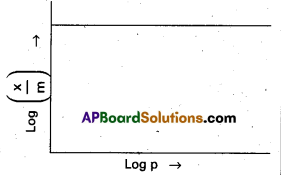
AP Inter 2nd Year Chemistry Study Material Chapter 4 Surface Chemistry 1
Answer:
In the above graph extent of adsorption does not depends on the pressure.
When \(\frac{1}{n}\) = 0, \(\frac{x}{m}\) = constant, the adsorption is independent of pressure.

Question 33.
What role does adsorption play in heterogenous catalysis ?
Answer:
In heterogeneous catalysis, adsorption of reactants on the solid surface of the catalysts increases the rate of reaction.
Eg : Manufacturing of NH3 using Fe-as catalyst [Haber’s process].

Question 34.
What is the role of MnO2 in the preparation of O2 from KClO3 ?
Ans. The chemical equation for the preparation of O2 from KClO3 is

AP Inter 2nd Year Chemistry Study Material Chapter 4 Surface Chemistry 2
MnO2 increases the rate of reaction. Hence it is a catalyst for the above reaction.

Question 35.
Define “promoters” and “poisons” in the phenamenon of catalysis ?
Answer:
Promoters : The substances with enhance the activity of catalyst are known as promoters. Poisons : The substances which decrease the activity of a catalyst are known as poisons.

Question 36.
What is homogeneous catalysis ? How is it different from heterogeneous catalysis ?
Answer:
Homogeneous Catalysis : The catalysis in which reactants and catalyst are in same phase is called Homogeneous catalysis.
In case of heterogeneous catalysis, catalyst and reactants are present in different phases where as in case of homogeneous catalysis catalyst and reactants are present in same phase.

Question 37.
Give two examples for homogeneous catalytic reactions.
Answer:
The following are the examples for homogeneous catalytic reactions.
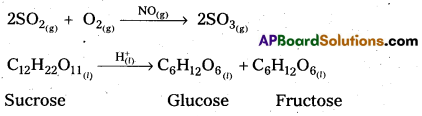
AP Inter 2nd Year Chemistry Study Material Chapter 4 Surface Chemistry 3

Question 38.
Give two examples for heterogeneous catalysis.
Answer:
The following are the examples of heterogeneous catalytic reactions.
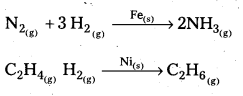
AP Inter 2nd Year Chemistry Study Material Chapter 4 Surface Chemistry 4

AP Inter 2nd Year Chemistry Study Material Chapter 4 Surface Chemistry

Question 39.
Give two examples which indicate the selectivity of heterogeneous catalysis.
Answer:
The following reactions indicate the selectivity of heterogeneous catalysis.
Starting with H2 and CO, and using different catalysts, we get different products.
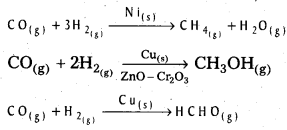
AP Inter 2nd Year Chemistry Study Material Chapter 4 Surface Chemistry 5
The action of a catalyst is highly selective in nature. A substance which acts as a catalyst in one reaction may fail to catalyse another reaction.

Question 40.
Why zeolites are treated as shape selective catalysts ?
Answer:

  • The catalytic reaction that depends upon the pore structure of the catalyst and the size of the reactant and product molecules is called shape selective catalysts.
  • Zeolites are shope selective catalysts because of their honey comb-like structure. They are microporous alumino silicates with 3-dimensional net work of silicates.

Question 41.
Which zeolite catalyst is used to convert alcohols directly into gasoline ?
Answer:
Zeolite ZSM – 5 is used to convert alcohols directly into gasoline (petrol) by dehydrating them to give a mixture of hydrocarbons.

Question 42.
What are enzymes ? What is their role in human body ?
Answer:
Enzymes are complex nitrogenous organic compounds which are produced by living plants and animals.
These act as specific catalysts in biological reactions.
These catalyse the numerous reactions that occur in the bodies of animals and plants to maintain the life process.

Question 43.
Can catalyst increase the yield of reaction ?
Answer:
Catalyst does not increase the yield of reaction. Catalyst just speed up the product formation.

Question 44.
Name any two enzyme catalyzed reactions. Give the reactions.
Answer:
1) Inversion of Cane Sugar :

AP Inter 2nd Year Chemistry Study Material Chapter 4 Surface Chemistry 6
2) Decomposition of urea into ammonia and CO2:

AP Inter 2nd Year Chemistry Study Material Chapter 4 Surface Chemistry 7

Question 45.
Name the enzymes obtained from soyabean source.
Answer:
The enzyme obtained from soyabean source is urease.

AP Inter 2nd Year Chemistry Study Material Chapter 4 Surface Chemistry

Question 46.
Name the enzymes used in
a) Decomposition of urea into ammonia.
b) Conversion of proteins into peptides in stomach.
Answer:
a) The enzyme used in the decomposition of urea into ammonia is urease.
b) The enzyme used in conversion of proteins into peptides in stomach is pepsin.

Question 47.
What enzymes are obtained from yeast ?
Answer:
The enzymes obtained from yeast are invertase, zymase and maltase.

Question 48.
At what ranges of temperature and pH, enzymes are active ?
Answer:
The optimum temperature range for enzymatic activity is 298 – 310 K. Human body temperature being 310 K is suited for enzyme catalysed reactions. The rate of an enzyme – catalysed reaction is maximum at a particular pH called optimum pH, which lies between 5-7.

Question 49.
Represent diagrammatically the mechanism of the enzyme catalyis.
Answer:
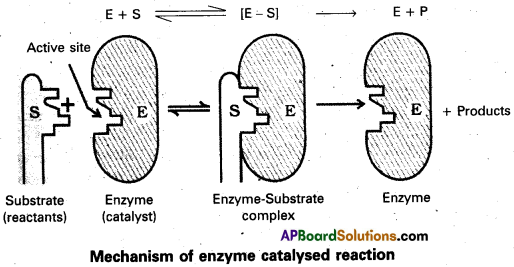
AP Inter 2nd Year Chemistry Study Material Chapter 4 Surface Chemistry 8

Question 50.
Name any two industrially important heterogeneous catalytic reactions mentioning the catalysts used.
Answer:
i) Manufacturing of NH3 by Haber’s process

AP Inter 2nd Year Chemistry Study Material Chapter 4 Surface Chemistry 9
ii) Hydrogenation of vegetable oils in presence of finely divided nickel as catalyst.

AP Inter 2nd Year Chemistry Study Material Chapter 4 Surface Chemistry 10
The above mentioned are industrially important heterogeneous catalytic reactions.

Question 51.
What is a colloidal solution ? How is it different from a true solution with respect to dispersed particle size and homogeneity ?
Answer:
A heterogeneous system in which one substance is dispersed as large particles in another substance is called colloidal solution.

  • In colloidal solution the particle size of the dispersed phase is of the order of 1 mμ – 1 μ where as in true solution the particle size of the solute are the order of mp or less.
  • Colloidal solution is a heterogeneous binary system where as true solution is a homogeneous binary system.

AP Inter 2nd Year Chemistry Study Material Chapter 4 Surface Chemistry

Question 52.
Name the dispersed phase and a dispersion medium in the following colloidal systems

  1. fog
  2. smoke
  3. milk.

Answer:

  1. Fog : Dispersed phase → liquid
    Dispersion medium → gas
  2. Smoke : Dispersed phase → carbon particles (solid)
    Dispersion medium → Air
  3. Milk : Dispersed phase → liquid fat
    Dispersion medium → water

Question 53.
What are lyophilic and lyophobic sols ? Give one example for each type.
Answer:
Lyophilic colloid : The colloidal solution in which the dispersed phase has great affinity to the dispersion medium is called a Lyophilic colloid or Lyophilic solution.
Ex : Starch solution.

The starch paste when dissolved in hot water, with stirring, the starch solution is formed. The starch particles (dispersed phase) has great affinity to water molecules (dispersion medium). So starch solution is a lyophilic solution or lyophilic colloid.

Lyophobic colloid : The colloidal solution in which there exists not much affinity between the dispersed phase and dispersion medium, it is called a Lyophobic colloid or Lyophobic solution.
Ex: Gold solution.

Gold rods are placed in water containing alkali. Electric arc is applied between gold rods. The gold particles dissolves in water, to give gold solution.

Gold particles (dispersed phase) have not much affinity towards water (dispersion medium). So this is a Lyophobic solution or Lyophobic colloid.

Question 54.
Explain the terms with suitable examples .

  1. aerosol
  2. hydrosol.

Answer:

  1. Aerosol: The colloidal solution in which dispersed phase is solid and dispersion medium is gas is called an aerosol.
    Eg : Smoke, dust.
  2. Hydrosol: In a colloidal solution dispersion medium is water them it is called aquasol (or) hydrosol.
    Eg : Milk, Gold sol.

Question 55.
Explain why lyophilic colloids are relatively more stable than lyophobic colloids ?
Answer:

  • Lyophilic colloids are reversible and are quite stable. These are not coagulated.
  • Lyophobic sols are irreversible and need stabilizing agents for their stabilization. These sols are readily precipitated on the addition of small amounts of electrolytes.

Question 56.
Give two examples of colloidal solutions of liquids dispersed in solid. What is the name given to the colloidal solution ?
Answer:
Cheese, butter, jellies are examples of colloidal solutions of liquids dispersed in solid. The name of the colloidal solution given to this type is Gels.

AP Inter 2nd Year Chemistry Study Material Chapter 4 Surface Chemistry

Question 57.
What is the difference between multimolecular and macromolecular colloids ? Give one example for each.
Answer:

  • In multimolecular colloids, a large number of atoms (or) small molecules of the dispersed phase aggregate together to form species in the colloidal range.
  • Macro molecules in suitable solvents form solutions in which the sizes of the macromolecules are in the colloidal range.

Question 58.
What are micelles ? Give one example.
Answer:
Micelles : Some substances which at low concentrations behave as normal strong electrolytes, but at high concentrations exhibit colloidal behaviour due to formation of aggregates. The aggregated particles thus formed are called micelles.
Eg : Stearate ions (C17H35COO) associate together in high concentration, in a solution of soap in water and forms a micelle.

Question 59.
How do micelles differ from a normal colloidal solutions ?
Answer:
Some substances which at low concentrations behave as normal strong electrolytes, but at high concentrations exhibit colloidal behaviour due to formation of aggregates. The aggregated particles thus formed are called micelles.

  • hese are also known as associated colloids.
  • These colloids have both lyophilic and lyophobic parts.
  • Micelles may contain as many as 100 or more of normal molecules.
  • On dilution these colloids revert back to individual electrolytes.

Question 60.
Give two examples of associated colloids.
Answer:
Surface active agents such as soaps and synthetic detergents are examples of associated colloids.

Question 61.
Can the same substance act both as colloid and crystalloid ?
Answer:
Yes, Micelles, (associated colloids) act as normal strong electrolytes at low concentrations and exhibit colloid behavior at high concentrations.

AP Inter 2nd Year Chemistry Study Material Chapter 4 Surface Chemistry

Question 62.
Give two examples of lyophobic sols.
Answer:
Metal sols and metal suiphide sols are examples of lyophobic colloids

  • Gold sol is lyophobic colloid

Question 63.
Give examples of’colloidal system of

  1. Liquid In solid
  2. Gas in solid.

Answer:

  1. Cheese, butter, jellies are examples of liquid in solid type colloidal system.
  2. Foam rubber, pumice ‘stone are examples of gas in solid type of colloidal system.

Question 64.
What type of substances form lyophobic sols?
Answer:
Substances like metals, their sulphides.donot form colloidal sol simply by mixing with the dispersion medium. These form colloids by special methods, These sols are lyophobic colloids.

Question 65.
What is critical micelle concentration (CMC) and kraft temperature (Tk) ?
Answer:
The formation of micelles takes place only above a particular temperature called Kraft temperature (Tk) and above a particular concentration called Critical micelle concentration (CMC).

Question 66.
Why lyophobic colloids are called irreversible colloids ?
Answer:

  • Lyophobic colloids are coagulated by the addition of small amounts of electrolytes.
  • The precipitates does not give back the colloidal sol by same addition of the dispersion medium.
  • Hence lyophobic sols are called irreversible sols.

Question 67.
How a colloidal sol of arsenous sulphide is prepared ?
Answer:
Colloidal sol of arsenous sulphide is prepared by the double decompostion of As2O3 and H2S as follows.

AP Inter 2nd Year Chemistry Study Material Chapter 4 Surface Chemistry 11

AP Inter 2nd Year Chemistry Study Material Chapter 4 Surface Chemistry

Question 68.
What is Peptization ?
Answer:
Peptization : The process of converting a precipitate into colloidal sol by shaking it with the dispersion medium in the presence of a small amount of electrolyte is called Peptization.

Question 69.
What is dialysis ? How is dialysis can be made fast ?
Answer:
Dialysis : The process of removing a dissolved substance from a colloidal solution using a suitable membrane is called dialysis.
Dialysis is made faster by applying an Emf. This is known as Electrodialysis.

Question 70.
What is collodion solution ?
Answer:
Collodion solution : Collodion is a 4% solution of nitro cellulose in a mixture of alcohol and ether.

Question 71.
How an ultrafilter paper is prepared from ordinary filter paper ?
Answer:
Ultra filter paper is prepared by soaking the filter paper in collodion solution, hardening by formaldehyde and then finally dried.

Question 72.
What is Tyndall effect ?
Answer:
Tyndall effect : When light enters a colloidal solution, it is scattered by the large sized colloidal dispersed phase particles. Therefore when light passes through a solution we will be able to see the path of the light as a luminous beam. This is called Tyndall effect.
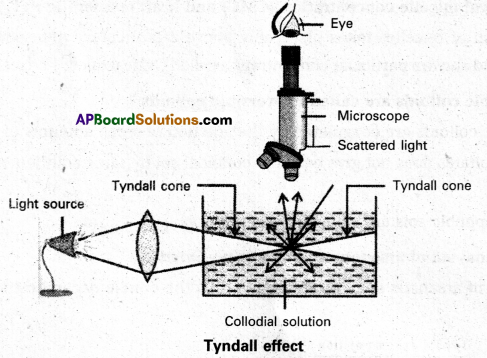
AP Inter 2nd Year Chemistry Study Material Chapter 4 Surface Chemistry 12
This is an optical property exhibited by colloidal solution. This phenomenon is clearly seen with a microscope placed at right angles to the path of light. Colloidal particles become self luminous due to absorption of light. A true solution does not show Tyndall effect.

Question 73.
What conditions is tyndall effect observed ?
Answer:
Tyndall effect is observed only when

  1. The diameter of the dispersed particles is not much smaller than the wave length of the light used.
  2. The refractive indices of the dispersed phase and dispersion medium differ greatly in magnitude.

AP Inter 2nd Year Chemistry Study Material Chapter 4 Surface Chemistry

Question 74.
Can Tyndall effect be used to distinguish between a colloidal solution and a true solution ? Explain.
Answer:
Tyndall effect is used to distinguish between a colloidal solution and a true solution.

  • True solution placed in dark and is observed in the direction of the light passed beam passing through it. It appears clear and it is observed from a direction at right angles to the direction of the light beam, it appears perfectly dark.
  • Colloidal solution viewed in the same way may appear reasonably clear in the direction of light but they show a mild to strong opalescence when viewed at right angles to the direction of light.

Question 75.
Sky appears blue in colour. Explain.
Answer:
Dust particles along with water vapour suspended in air scatter blue light which reaches our eyes and hence the sky looks blue to us.

Question 76.
What is Brownian movement.
Answer:
Brownian movement: This is a kinetic property of colloidal solution.
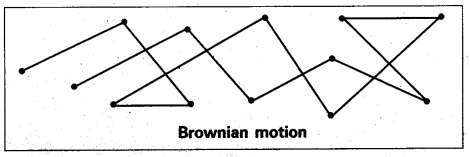
AP Inter 2nd Year Chemistry Study Material Chapter 4 Surface Chemistry 13
When a colloidal solution is examined by ultramicroscope, the colloidal particles are seem to be moving in a rapid zig-zag motion.
This rapid motion of colloidal particles is called Brownian movement.

This motion is due to unequal bombardment of colloidal particles by molecules of dispersion medium. Smaller the colloidal particles the more rapid is the Brownian movement.

Question 77.
What is the main cause for charge on a colloidal solution ?
Answer:
The charge on the colloidal particles is due to electron capture by sol particles during electro dispersion of metals , and due to preferential adsorption ions from solution (or) due to formulation of electrical double layer.

Question 78.
What is electrokinetic potential or zeta potential ?
Answer:
In a colloidal sol the charges of opposite signs on the fixed and diffused parts of the double layer results in a difference in potential between these layers. The potential difference between the fixed layer and the diffused layer of opposite charge is called electro kinetic potential (or) zeta potential.

AP Inter 2nd Year Chemistry Study Material Chapter 4 Surface Chemistry

Question 79.
Write the chemical formula of positively charged and negatively charged hydrated ferric oxide colloidal solutions.
Answer:

  • Formula of positively charged hydrated ferric oxide is Fe2O3.xH2O/Fe+3
  • Formula of negatively charged hydrated ferric oxide is Fe2O3.xH20/OH

Question 80.
Give the order of coagulating power of Cl, SO42-, PO43- in the coagulation of positive sols.
Answer:
The order of coagulating ability’of given ions with positive sols is PO43- > SO42- > Cl

Question 81.
Amongst Na+, Ba2+, Al3+, which coagulates negative sol readily and why ?
Answer:
The order of coagulating ability of given ions with negative sols is Al+3 > Ba+2 > Na+

Question 82.
A colloidal solution of AgI is positively charged when prepared from a solution containing excess of Ag+ ions and negatively charged when prepared from a solution containing excess of I ions Explain.
Answer:
When a dilute AgNO3 solution is added to a dilute KI solution taken in excess, the precipitated Agl adsorbs I ions present in excess and a negatively charged AgI colloidal solution is formed. However when dilute KI solution is added to dilute AgNO3 solution taken in excess, AgI precipitate adsorbs Ag+ ions present in excess and a positively charged AgI colloidal solution is formed. Generally the ion common to dispersed particle is adsorbed. .
AgI/I
Negatively charged
AgI/Ag+
Positively charged.

Question 83.
What is electrophoresis ?
Answer:
When electric potential is applied across two platinum electrodes dipping in a colloidal solution,-the colloidal particles move towards one or the other electrode. The movement of colloidal particles under an applied emf is called “electrophoresis”.

Question 84.
What is electro osmosis ?
Answer:
If the movement of colloidal particles is arrested by some suitable means, the dispersion medium moves in opposite direction. This phenomenon is termed “electro osmosis”.

Question 85.
What is coagulation ?
Answer:
The stability of the lyophilic sols is due to the presence of charge on the colloidal particles. If this charge is neutralised the particles will come nearer to each other to form aggregates (or coagulate) and settle down under the force of gravity. This process of settling down of colloidal particles is called coagulation (or) flocculation (or) precipitation.

AP Inter 2nd Year Chemistry Study Material Chapter 4 Surface Chemistry

Question 86.
Define flocculation value.
Answer:
The minimum concentration of an electrolyte in millimoles per litre required to cause coagulation of a sol in two hours is called “coagulating value” (or) flocculation value.

Question 87.
State Hardy – Schulze rule.
Answer:
Greater the valence of the coagulating ion added, the greater is its power to cause coagulation. This is known as Hardy-Schulze rule.

Questions 88.
Coagulation takes place when sodium chloride solution is added to a colloidal solution of hydrated ferric oxide. Explain.
Answer:
When NaCl solution is added to the colloidal solution of hydrated ferric oxide coagulation takes place (precipitation formed). .
The reason is that colloidal particles interact with ions (Na+, Cl) carrying charge opposite to that present on themselves. This causes neutralisation of charges leading to their coagulation.

Question 89.
How are lyophobic solutions protected from phenomenon of coagulation.
Answer:
Lyophobic sols are protected from the phenomenon of coagulation by adding suitable lyophilic sol.

Question 90.
What is protective colloid ?
Answer:
Lyophilic colloids used for the prevention of coagulation of lyophobic colloids are called protective colloids.

  • Lyophilic colloids protect the lyophobic colloids.

Question 91.
What is an emulsion ? Give two examples. [A.P. Mar. 17]
Answer:
Emulsion: The colloidal system in which a dispersion of finely divided droplets of a liquid in another liquid medium is called emulsion.
Eg : Milk, Vanishing cream, Cold cream.

Question 92.
How emulsions are classified ? Give one example for each type of emulsion. [A.P. Mar. 17]
Answer:
Emulsion : A dispersion of finely divided droplets of a liquid in another liquid medium is called’emulsion’.
Ex: Milk.
In Milk, the droplets of liquid fat are dispersed in water. This is an example for oil in water type emulsion.
Classification of emulsions : Emulsions are “classified into two classes. These are
a) oil in water (O/W) and
b) water in oil (W/O), (O = Oil; W = Water).

These emulsions are classified as such depending on which is dispersed phase and which is dispersion medium.
a) Oil in Water (O/W) type emulsions : In this type of emulsions, the dispersed phase is oil and the dispersion medium is water.
Ex : Milk, liquid, fat (oil) in water.
Vanishing cream; fat in water.

b) Water in Oil (W/O) type emulsions : In this type of emulsions, the dispersed phase is water and the dispersion medium is oil.
Ex : Stiff greases : water in lubrication oils
Cod liver oil : water in cod liver oil
Cold cream : water in fat.

Question 93.
What is an emulsifying agent ?
Answer:
Emulsifying agent: The third substance which is added in small amounts to an emulsion to stabilize the emulsion is called emulsifying agent.

AP Inter 2nd Year Chemistry Study Material Chapter 4 Surface Chemistry

Question 94.
What is demulsification ? Name two demulsifiers.
Answer:
Demulsification : The separation of an emulsion into constituent liquids is known as demulsification.

Question 95.
How is artificial rain produced ?
Answer:
Artificial rain is produced by throwing electrified sand (or) spraying a sol carrying charge opposite to the one on clouds from an aeroplane.

Question 96.
Bleeding from fresh cut can be Stopped by applying alum. Give reasons.
Answer:
Bleeding from fresh cut can be stopped by applying alum. This is due to styptic action of alum which coagulates the blood and stops further bleeding.

Question 97.
Deltas are formed at the points where river enters the sea. Why ?
Answer:
Deltas are formed at the points where river enters the sea.
Explantation : River water is a colloidal solution of clay. Sea water contains a number of electrolytes. When river water meets the sea water, the electrolytes present in sea water coagulate the colloidal solution of clay resulting in its deposition of clay with the formation of delta.

Question 98.
Name any two applications of colloidal solutions.
Answer:
Applications of colloidal solutions :
Rubber: Plant latex is a colloidal solution of rubber particles which are negatively charged. Rubber is obtained from latex by coagulation.
Industrial Products : Paints, inks, synthetic plastics, rubber, graphite, lubricants, cement, etc., are all colloidal in nature.

Question 99.
How can aerial pollution by colloidal particles of smoke be prevented ? Explain.
Answer:
Aerial pollution by colloidal particles of smoke be prevented by electrical precipitation of smoke. Smoke is a colloidal solution of solid particles such as carbon, arsenic compounds, dust, etc., in air. The smoke, before it comes out from the chimney, is led through a precipitator containing plates having a charge opposite to that carried by smoke particles. The particles on coming in contact with these plates lose their charge and get precipitated. The particles thus settle down on the floor of the chamber. The precipitator is called cottrell precipitator.

Question 100.
Alum is used to purify water obtained from natural sources. Explain.
Answer:
The water obtained from natural sources often contains suspended impurities. Alum is added to such water to coagulate the suspended impurities and make water fit for drinking purposes.

AP Inter 2nd Year Chemistry Study Material Chapter 4 Surface Chemistry

Question 101.
Why medicines are more effective in colloidal state ?
Answer:
Colloidal medicines are more effective because they have large surface area and are therefore easily assimilated.

Question 102.
How rubber is obtained from latex ?
Answer:
Plant latex is a colloidal solution of rubber particles which are negatively charged. Rubber is obtained from latex by coagulation.

Question 103.
Name the type of emulsion to which milk belongs.
Answer:
Milk is a oil in water type of emulsion.
Dispersed phase : liquid fat.
Dispersion medium : water.

Short Answer Questions

Question 1.
What is adsorption ? Discuss the mechanism of adsorption of gases on solids.
Answer:
Adsorption : The accumulation (or) concentration of a substance on the surface rather than in the bulk of solid (or) liquid is known as adsorption.
Eg : Adsorption of gases like O2, H2, Cl2 etc., on charcoal.
Mechanism of Adsorption :

  • Adsorption arises due to the fact that the surface particles of the adsorbent are not in the same environment as the particles inside the bulk.
  • Adsorbent possess unbalanced or residual attractive forces. These forces are responsible for attracting the adsorbate molecules on adsorbent surface.
  • The extent of adsorption increases with increase in surface area of adsorbent at a given temperature and pressure.
  • During the adsorption, there is always a decrease in residual forces of the surface. There is decrease in surface energy which appears as heat. So, Adsorption is always Exothermic.
  • Adsorption is accompanied by decrease in enthalpy as well as decrease in entropy of system. .
  • As the adsorption proceeds AH becomes less and less negative, ultimately, AH becomes equal to TAS and AG becomes zero. At this state equilibrium is attained.

Question 2.
What are different types of adsorption ? Give any four differences between characteristics of these different types. [T.S. Mar. 19, 15; A.P. Mar. 15]
Answer:
Adsorption process is divided into two types.
1) Physisorption
2) Chemisorption.
Distinguishing characteristics of Physisorption and Chemisorption are given in the following table:
Physisorption

  1. This process is weak, due to vander Waal’s forces.
  2. The process is reversible.
  3. This is a quick process, i.e., takes place quickly.
  4. The process decreases with increase of temperature.
  5. This is a multilayered process.
  6. The process depends mainly on the nature of the adsorbent.

Chemisorption

  1. This process is strong, due to chemical forces.
  2. The process is irreversible.
  3. This is a slow process.
  4. The process increases with increase of temperature.
  5. This is a unilayered process.
  6. The process depends both on the nature of adsorbent and adsorbate.

AP Inter 2nd Year Chemistry Study Material Chapter 4 Surface Chemistry

Question 3.
What do you understand by the terms given below (a) absorption (b) Adsorption (c) Adsorbent and Adsorbate
Answer:
Absorption : The uniform distribution of a susbstance through out the bulk of the solid .substance is known as absorption. Eg: Chalk stick dipped in ink.
Adsorption : The accumulation (or) concentration of a substance on the surface rather than in the bulk of solid (or) liquid is known as adsorption.
Eg: Adsorption of gases like O2, H2, Cl2 etc., on charcoal.

Adsorbent: The substance on whose surface the adsorption occurs is known as adsorbent.

Adsorbate : The substance whose molecules get adsorbed on the surface of the adsorbent is known as adsorbate.
Eg: In the adsorption of acetic acid by charcoal, acetic acid is adsorbate and the charcoal is adsorbent.

Question 4.
Adsorption of a gas on the surface of solid is generally accompanied by decrease in entropy. Still it is a spontaneous process. Explain.
Answer:
Adsorption is accompanied by decrease in enthalpy as well as decrease in entropy of the system.

  • For a process to be spontaneus there is a decrease in Gibbs Energy. .
  • On the basis of equation ∆G = ∆H – T∆S; ∆G = -Ve
  •  If AH has sufficiently high negative value and T∆S is positive.
  • In an adsorption process which ¡s spontaneous ∆G becomes negative by combining above.
  • As the adsorption proceeds ∆H becomes less and less negative ultimately, ∆H becomes equal to T∆S and ∆G becomes zero. At this state equilibrium is attained.

Question 5.
How can the constants k and n of the Freundlich adsorption equation be calculated?
Answer:
Freundlich adsorption isotherm equation is
\(\frac{x}{m}\) = k. P =, x/m = Extent of adsorption ⇒ P = Pressure
k and n are constants which depend on the nature of the adsorbent and the gas at a particular temperature.
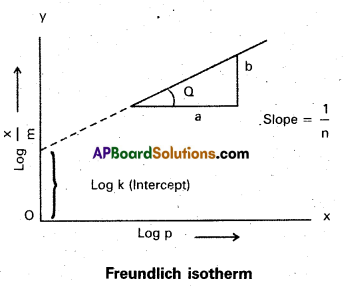
AP Inter 2nd Year Chemistry Study Material Chapter 4 Surface Chemistry 14
Applying logarithm to the above equation
log \(\frac{x}{m}\) = log k + \(\frac{1}{n}\) log P.

  • A graph is plotted taking log \(\frac{x}{m}\) on y – axis and log P on x – axis. 1f the graph is a straight line then Freundlich isotherm is valid.
  • The slope of the straight line gives \(\frac{1}{n}\) value.
  • The intercept on the y-axis gives value of log k.
  • \(\frac{1}{n}\) has values between 0 and 1
  • When \(\frac{1}{n}\), = 0, \(\frac{x}{m}\) = constant, the adsorption is independent of pressure
    \(\frac{1}{n}\) = 1, \(\frac{x}{m}\) = kP i.e., \(\frac{x}{m}\) ∝ p.

AP Inter 2nd Year Chemistry Study Material Chapter 4 Surface Chemistry

Question 6.
How does the extent of adsorption depend upon
a) Increasing the surface area per unit mass of adsorbent.
b) Increasing temperature of the system.
c) Increasing pressure of the gas.
Answer:
a) The extent of adsorption increases by increasing the surface area per unit mass of adsorbent.
b) The extent of adsorption decrease with an increase in temperature.
c) The extent of adsorption increase with increasing pressure of the gas.

Question 7.
What is catalysis ? How is catalysis classified ? Give two examples for each type of catalysis. [A.P. Mar. 16] [Mar. 14]
Answer:
Catalysis : A substance which alters the rate of a chemical reaction without itself being consumed in the process, is called a catalyst.
The action of catalyst in altering the rate of a chemical reaction is called catalysis.

Types of catalysis: Catalysis is classified into two types as
a) Homogeneous catalysis and b) Heterogeneous catalysis.

a) Homogeneous catalysis : The catalytic process in which the catalyst is present in the same phase as that of reactants, is known as homogeneous catalysis.

AP Inter 2nd Year Chemistry Study Material Chapter 4 Surface Chemistry 15

b) Heterogeneous catalysis : The catalytic process in which the catalyst is present in a phase different from that of the reactants is known as heterogeneous catalysis.

AP Inter 2nd Year Chemistry Study Material Chapter 4 Surface Chemistry 16

Question 8.
Discuss the mechanism involved in adsorption of heterogeneous catalysis.
Answer:
Adsorption theory of heterogeneous catalysis :
Adsorption theory explains the mechanism of heterogeneous catalysis.
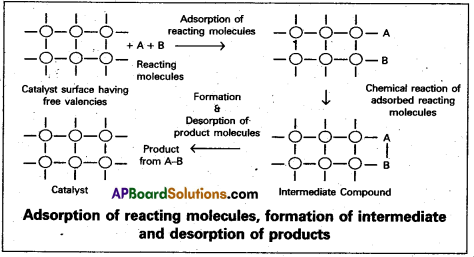
AP Inter 2nd Year Chemistry Study Material Chapter 4 Surface Chemistry 17

  • The modern adsorption theory is the combination of the intermediate compound formation theory and the old adsorption theory.
  •  The mechanism of catalysis involves five steps.
  • Diffusion of the reactants to the surface of the catalyst.
  • Adsorption of the reactant molecules on the surface of the catalyst.
  • Occurrence of chemical reaction on the catalyst’s surface through formation of an . intermediate.
  • Desorption of reaction products from the catalyst surface, and thereby making the surface available again for more reaction to occur.
  • Diffusion of reaction products away from the catalyst’s surface.

Question 9.
Discuss some features of catalysis by zeolites.
Answer:
The catalytic reaction that depends upon the pore structure of the catalyst and the size of the reactant and product molecules is called shape selective catalysts.

  • Zeolites are shope selective catalysts because of their honey comb-like structure. They are microporous alumino silicates with 3-dimensional net work of silicates.
  • Zeolites are microporous alumino silicates with dimensional network of silicates in which some Si-atoms are replaced by aluminium atoms giving Al-o-Si frame work.
  • The reactions taking place in zeolites depend upon the size and shape of reactant and product molecules as well as on the pores and cavities of the zeolites.
  • Zeolites are found in nature and also synthesized for catalytic selectivity.

Uses:

  • Zeolites are used as catalysts in petrochemical industries for cracking.
  • Zeolite ZSM – 5 is used to convert alcohol directly into gasoline (petrol) by dehydrating them to give a mixture of hydrocarbons.

AP Inter 2nd Year Chemistry Study Material Chapter 4 Surface Chemistry

Question 10.
Give brief account of mechanism of enzyme catalysis with suitable diagrams.
Answer:
Mechanism of enzyme catalysis :
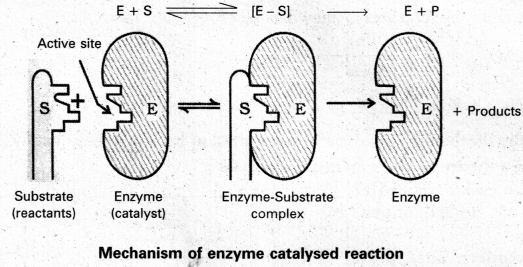
AP Inter 2nd Year Chemistry Study Material Chapter 4 Surface Chemistry 18
The enzyme – catalysed reactions may be considered to proceed in two steps.
Step 1 : Binding of substrate to enzyme to form an activated complex (ES).
E + S → E S
Step 2 : Decomposition of the activated complex to form product.
E S → E + P

Question 11.
Discuss the factors that influence the catalytic activity of enzymes.
Answer:
Factors influencing the catalytic activity of enzymes :

  • Highly specific nature: One catalyst catalyses only one reaction. Each enzyme is specific ‘ for a given reaction.
    Eg : The enzyme urease catalyses the hydrolysis of urea only and not any other amide.
  • Highly active under optimum temperature: The rate of an enzyme reaction is maximum at a temperature called optimum temperature.
  • The optimum temperature range for enzymatic activity is 298 – 310 K.
  • Highly active under optimum pH : The rate of an enzyme – catalysed reaction is maximum at a particular pH called optimum pH which lies between 5 – 7.
  • Increasing activity in presence of activators and co-enzymes : The enzymatic activity is increased in presence of co-enzymes (or) in presence of activators such as Na+, Mn+2 etc.,
  •  Influence of inhibitors and poisons: The inhibitors (or) poisons interact with the active functional groups on the enzyme surface and reduce or completely destroy the catalytic activity.

Question 12.
Name any six enzyme catalysed reactions. [A.P. Mar. 19]
Answer:
i) Inversion of Cane sugar : Enzyme : Invertase
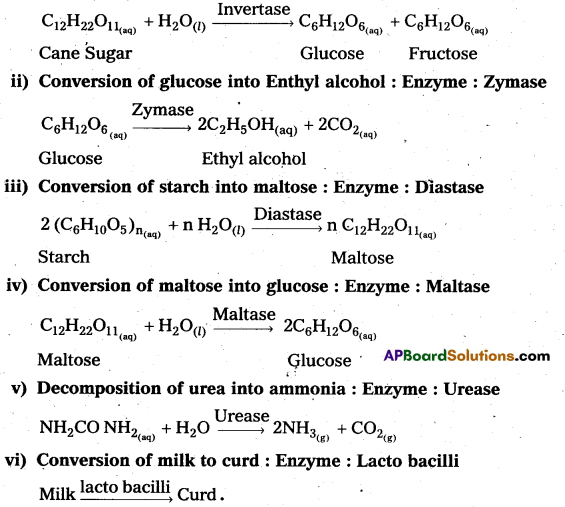
AP Inter 2nd Year Chemistry Study Material Chapter 4 Surface Chemistry 19

Question 13.
What do you mean by activity and selectivity of catalysts ?
Answer:
Activity :
The ability of a catalyst in increasing the rate of reaction is defined as activity of catalyst.

  • The activity of a catalyst depends upon the strength of chemisorption to a large extent.
  • The reactants must get adsorbed reasonably strongly on to the catalyst to become reactive.
    Eg : The catalystic activity increases from Group – 5 to Group – 11 for hydrogenation reactions.
    The maximum activity being shown by 7 – 9 group metals.
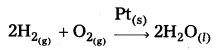
    AP Inter 2nd Year Chemistry Study Material Chapter 4 Surface Chemistry 20

Selectivity:
The selectivity of a catalyst is its-ability to direct a reaction to form specific products. The following reactions indicate the selectivity of heterogeneous catalysis.
Starting with H2 and CO, and using different catalysts, we get different products.

AP Inter 2nd Year Chemistry Study Material Chapter 4 Surface Chemistry 21
The action of a catalyst is highly selective in nature. A substance which acts as a catalyst in one reaction may fail to catalyse another reaction.

AP Inter 2nd Year Chemistry Study Material Chapter 4 Surface Chemistry

Question 14.
How are colloids classified on the basis of physical states of components ?
Answer:
On the basis of physical states of dispersed phase and dispersion medium colloidal solutions are classified into eight types.
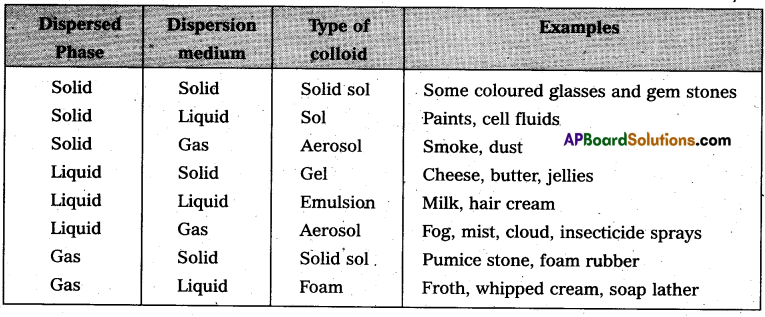
AP Inter 2nd Year Chemistry Study Material Chapter 4 Surface Chemistry 22

Question 15.
How are colloids classified on the basis of nature of the dispersion medium ?
Answer:
On the basis of nature of dispersion medium colloids are classified as follows.

  •  If the dispersion medium is ‘air’, the sols are called aerosols.
    Eg : Smoke.
  • If the dispersion medium is ‘water’ the sols are called Hydrosol (or) aquasol.
    Eg : starch solution.
  • If the dispersion medium is ‘alcohol’ then the sols are called alcosols.

Question 16.
How are colloids classified on the basis of interaction between dispersed phase and dispersion medium ?
Answer:
Lyophilic colloid : The colloidal solution in which the dispersed phase has great affinity to the dispersion medium is called a Lyophilic colloid or Lyophilic solution.
Ex: Starch solution.
The starch paste when dissolved in hot water, with stirring, the starch solution is formed. The starch particles (dispersed phase) has great affinity to water molecules (dispersion medium). So starch solution is a lyophilic solution or lyophilic colloid.

Lyophobic colloid : The colloidal solution in which there exists not much affinity between the dispersed phase and dispersion medium, it is called a Lyophobic colloid or Lyophobic solution.
Ex: Gold solution.

Gold rods are placed in water containing alkali. Electric arc is applied between gold rods. The gold particles dissolves in water, to give gold solution.

Gold particles (dispersed phase) have not much affinity towards water (dispersion medium). So this is a Lyophobic solution or Lyophobic colloid.

AP Inter 2nd Year Chemistry Study Material Chapter 4 Surface Chemistry

Question 17.
What is the difference between a colloidal sol, gel, emulsion and a foam?
Answer:
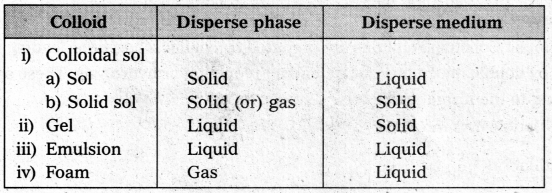
AP Inter 2nd Year Chemistry Study Material Chapter 4 Surface Chemistry 23

Question 18.
What are lyophilic and lyophobic sols? Compare the two terms in terms of stability and reversibility.
Answer:
Lyophilic colloid : The colloidal solution in which the dispersed phase has great affinity to the dispersion medium is called a Lyophilic colloid or Lyophilic solution.
Ex : Starch solution.
The starch paste when dissolved in hot water, with stirring, the starch solution is formed. The starch particles (dispersed phase) has great affinity to water molecules (dispersion medium). So starch solution is a lyophilic solution or lyophilic colloid.

Lyophobic colloid : The colloidal solution in which there exists not much affinity between the dispersed phase and dispersion medium, it is called a Lyophobic colloid or Lyophobic solution.
Ex: Gold solution.

Gold rods are placed in water containing alkali. Electric arc is applied between gold rods. The gold particles dissolves in water, to give gold solution.

Gold particles (dispersed phase) have not much affinity towards water (dispersion medium). So this is a Lyophobic solution or Lyophobic colloid.

Question 19.
Name a substance whose molecules consist of lyophilic as well as lyophobic parts. Give its use in our daily life.
Answer:

  • Associated colloids (or) micelles contains both lyophobic and lyophillic parts.
  • Examples are soaps and synthetic detergents.
  • The cleaning action of soap is due to the fact that soap molecule form a micelle around the oil droplet.

Question 20.
Describe Bredig’s arc method of preparation of colloids with a neat diagram.
Answer:
Electrical disintegration or Bredig’s Arc method : This process involves dispersion as well as condensation. Colloidal sols of metals such as gold, silver, platinum, etc., are prepared by this method. In this method, electric arc is struck between electrodes of the metal immersed in the dispersion medium. The intense heat produced vapourises the metal, which then condenses to form particles of colloidal size.
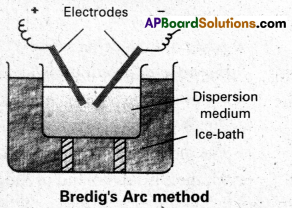
AP Inter 2nd Year Chemistry Study Material Chapter 4 Surface Chemistry 24

Question 21.
Name any four examples of preparation of colloids by chemical methods with necessary chemical equations.
Answer:
Chemical methods : Colloidal solutions are prepared by chemical reactions leading to the formation of species by double decompostion, oxidation, reduction or hydrolysis. These species then aggregate leading to the formation of sols.
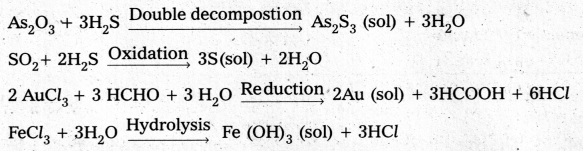
AP Inter 2nd Year Chemistry Study Material Chapter 4 Surface Chemistry 25

AP Inter 2nd Year Chemistry Study Material Chapter 4 Surface Chemistry

Question 22.
Describe the purification of colloidal solutions by the phenomenon of dialysis with a neat diagram. [A.P. Mar. 18]
Answer:
Colloidal solutions generally contain excess amount of electrolytes and some other soluble impurities. It is necessary to reduce the concentration of soluble impurities to a requisite minimum. The impurities presence required in traces.
“The process used for reducing the amount of impurities to a requisite minimum is known as purification of colloidal solution”.

Purification of colloidal solution by Dialysis :
Dialysis : The process of removing a dissolved substance from a colloidal solution using a suitable membrane is called dialysis.
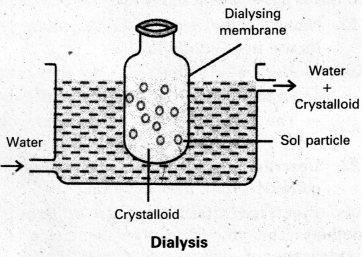
AP Inter 2nd Year Chemistry Study Material Chapter 4 Surface Chemistry 26

  • In a true solution particles can pass through animal membrane (or) cellophane sheet (or) parchment paper but not colloidal particles.
  • The apparatus used for the dialysis is called dialyser.
  • A bag of suitable membrane containing the colloidal solution is suspended in a vessel containing a continuously flowing water.
  • The molecules and ions diffuse through the membrane into the water and pure colloidal solution is left behind in the bag.

Question 23.
Explain the formation of micelles with a neat sketch.
Answer:
Mechanism of micelle formation: Let us take the example of soap solution. Soap is sodium or potassium salt of a higher fatty acid and may be represented as RCOC Na+ (e.g., sodium strearate CH3 (CH2)16 COO Na+, which is a major component of many bar soaps). When dissolved in water, it dissociates into RCOO and Na+ ions. The RCOO ions, however, consist of two parts – a long hydrocarbon chain R (also called non-polar ‘tail’) which is hydrophobic (water repelling), and a polar group COO(also called polar-ionic ‘head’), which is hydrophilic (water loving).
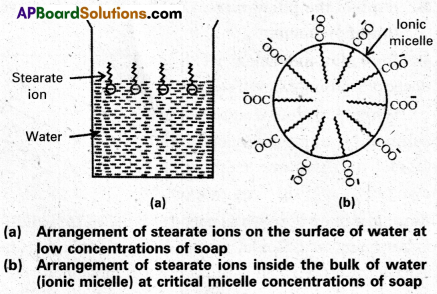
AP Inter 2nd Year Chemistry Study Material Chapter 4 Surface Chemistry 27
The RCOO ions are, therefore, present on the surface with their COO groups in water and the hydrocarbon chains (R) staying away from it and remain at the surface. But at critical micelle concentration, the COO irons are pulled into the bulk of the solution and are aggregated to form a spherical shape with their hydrocarbon chains pointing towards the centre of the . sphere with COO part remaining outward on the surface of the sphere. The aggregate thus formed is known as ‘ionic micelle’. These micelles may contain as many as 100 simple molecules.

Similarly, in case of detergents, e.g., sodium laurylsulphate. CH3 (CH2)11 SO3Na+, the polar group is -SO3 along with the long hydrocarbon chain. Hence, the mechanism of micelle formation here also is same as that of soaps.

Question 24.
Action of soap is due to emulsification and micelle formation. Comment.
Answer:
Soap is sodium stearate, C17H35COONa, in water soap gives the ions stearate anion and sodium ion.
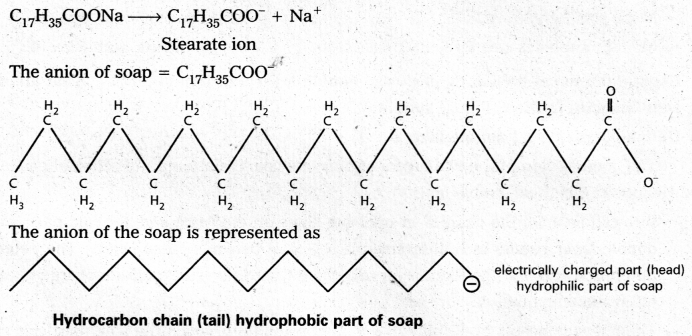
AP Inter 2nd Year Chemistry Study Material Chapter 4 Surface Chemistry 28
Cleaning action of soap : Soap anions form a micelle. The grease or dirt of the cloth are absorbed into the interior of the micelle. The tails of the anion are pegged into micelle and these micelle are washed away with the soap solution.
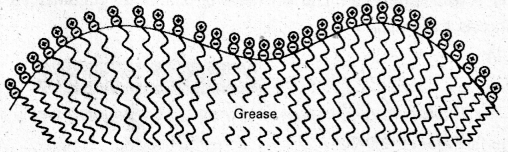
AP Inter 2nd Year Chemistry Study Material Chapter 4 Surface Chemistry 29
Soap thus, functions as an emulsifying agent for the water dirt emulsion. The emulsified grease or dirt is then washed away with soap solution.

AP Inter 2nd Year Chemistry Study Material Chapter 4 Surface Chemistry

Question 25.
Explain the phenomenon of Brownian movement giving reasons for the occurrence of this phenomena.
Answer:
Brownian movement: This is a kinetic property of colloidal solution.
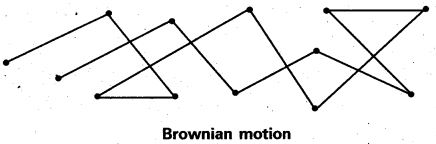
AP Inter 2nd Year Chemistry Study Material Chapter 4 Surface Chemistry 30
When a colloidal solution is examined by ultramicroscope, the colloidal particles are seem to be moving in a rapid zig – zag motion.
This rapid motion of colloidal particles is called Brownian movement. This motion is due to unequal bombardment of colloidal particles by molecules of dispersion medium. Smaller the colloidal particles the more rapid is the Brownian movement.

Question 26.
Name the four positively charged sols. .
Answer:
The following are the positively charged sols.

  • Hydroated metallic oxide sols. Eg : Al2O3.xH2O, CrO3.xH2O etc.
  • Basic dye stuffs Eg : Methylene blue sol.
  • Hemoglobin (blood).
  • Oxides Eg : TiO2 sol.

Question 27.
Name the four negatively charged sols.
Answer:
The following are the negatively charged sols.

  • Metal sols Eg : Ag, Au-sols.
  • Metallic suphides sols Eg : ArS3, CdS sols.
  • Acid dye stuffs Eg: eosinol.
  • Sols of starch, gum, clay etc.

Question 28.
Explain the terms helmholtz electrical double layer and zeta potential. What are their significancies in the colloidal solutions ?
Answer:
Helmholtz electrical double layer :
The combination of the two layers of opposite charges around the colloidal particle is called Helmholtz electrical double layer.

  • In a colloidal sol the charges of opposite signs on the fixed and diffused parts of the double layer results in a difference in potential between these layers. The potential difference between the fixed layer and the diffused layer of opposite charge is called electro kinetic potential (or) zeta potential.
  • The above concepts applicable in colloidal solution in which the solid particles carry one kind of charge while liquid medium carries opposite charge to that of solids.

AP Inter 2nd Year Chemistry Study Material Chapter 4 Surface Chemistry

Question 29.
Explain with a neat sketch the phenomenon of electrophoresis.
Answer:
Electrophoresis : The existence of charge on colloidal particles is confirmed by electro-phoresis experiment.
When electric potential is applied across two platinum electrodes dipping in a colloidal solution, the colloidal articles move towards one or the other electrode. The movement of colloidal particles under an applied emf is called “electrophoresis”.
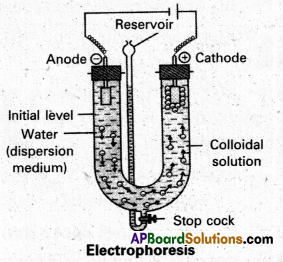
AP Inter 2nd Year Chemistry Study Material Chapter 4 Surface Chemistry 31
Positive charged particles move towards the cathode while negative charged particles towards anode.

Question 30.
Explain the following terms, i) Electrophoresis ii) Coagulation iii) Tyndall effect.
Answer:
Electrophoresis: When electric potential is applied across two platinum electrodes dipping in a colloidal solution, the colloidal particles move towards one or the other electrode. The movement of colloidal particles under an applied emf is called “electrophoresis”.

Coagulation : The stability of the lyophilic sols is due to the presence of charge on the colloidal particles. If this charge is neutralised the particles will come nearer to each other to form aggregates (or coagulate) and settle down under the force of gravity. This process of settling down of colloidal particles is called coagulation (or) flocculation (or) precipitation.
Coagulation of lyophobic sols can be carried out by
i) Electrophoresis, ii) Boiling, iii) Adding Electrolytes, iv) Prolonged dialysis etc.

Tyndall effect : When light enters a colloidal solution, it is scattered by the large sized colloidal dispersed phase particles. Therefore when light passes through a solution we will be able to see the path of the light as a luminous beam. This is called Tyndall effect.

Question 31.
Explain the phenomenon observed
i) When a beam of light is passed through a colloidal sol.
Answer:
Tyndall effect : When light enters a colloidal solution, it is scattered by the large sized colloidal dispersed phase particles. Therefore when light passes through a solution we will be able to see the path of the light as a luminous beam. This is called Tyndall effect.

This is an optical property exhibited by colloidal solution. This phenomenon is clearly seen with a microscope placed at right angles to the path of light. Colloidal particles become self luminous due to absorption of light. A true solution does not show Tyndall effect.

AP Inter 2nd Year Chemistry Study Material Chapter 4 Surface Chemistry

ii) An electrolyte, NaCl is added to hydrated ferric oxide.
Answer:
When NaCl solution is added to the colloidal solution of hydrated ferric oxide coagulation takes place (precipitation formed).

The reason is that colloidal particles interact with ions (Na+, Cl) carrying charge opposite to that present on themselves. This causes neutralisation of charges leading to their coagulation.

iii) An electric current is passed through a colloidal solution.
Answer:
Electrophoresis : the existence of charge on colloidal particles is confirmed by electrophoresis experiment.

When electric potential is applied across two platinum electrodes dipping in a colloidal solution, the colloidal particles move towards one or the other electrode. The movement of colloidal particles under an applied emf is called “electrophoresis”.

Positive charged particles move towards the cathode while negative charged particles towards anode.

Question 32.
Describe cottrell smoke precipitator with a neat diagram.
Answer:
Aerial pollution by colloidal particles of smoke be prevented by electrical precipitation of smoke. Smoke is a colloidal solution of solid particles such as carbon, arsenic compounds, dust, etc., in air. The smoke, before it comes out from the chimney, is led through a precipitator containing plates having a charge opposite to that carried by smoke particles. The particles on coming in contact with these plates lose their charge and get precipitated. The particles thus settle down on the. floor of the chamber. The precipitator is called conttrels precipitator.
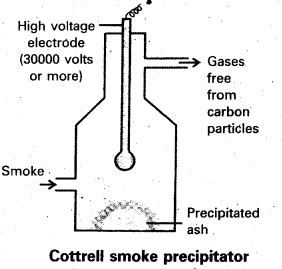
AP Inter 2nd Year Chemistry Study Material Chapter 4 Surface Chemistry 32

Question 33.
Among NaCl, Na2SO4, Na3PO4 electrolytes, which is more effective for coagulation of hydrated ferric oxide sol and why ?
Answer:
Among NaCl, Na2SO4, Na3PO4 electrolytes, Na3PO4 is more effective for coagulation of hydrated ferric oxide sol. This is explained by Hardy-Schulze rule.
Greater the valence of the coagulating ion added, the greater is its power to cause coagulation. This is known as Hardy-Schulze rule.

Coagulating ability order of the anions in the above salts is
PO4-3 > SO4-2 > Cl.

Question 34.
Discuss how a lyophilic colloids protect a lyophobic colloids.
Answer:
Lyophilic colloids are much stable than lyophobic colloids. A very small amount of electrolyte can precipitate the lyophobic colloids. But their precipitation can be prevented by the addition of small amounts of lyophilic colloids. This lyophilic colloids form a protecting layer around the lyophobic colloids and protect them from precipitation (coagulation). Lyophilic colloids used for. this purpose are called protective colloids.
Ex : Gelatin, gum, starch sols are generally used as protective colloids.

AP Inter 2nd Year Chemistry Study Material Chapter 4 Surface Chemistry

Question 35.
Discuss the use of colloids in
i) Purification of drinking water ii) Tanning iii) Medicines.
Answer:
i) Purification of drinking water: The water obtained from natural sources often contains suspended impurities. Alum is added to such water to coagulate the suspended impurities and make water fit for drinking purposes.

ii) Tanning: Animal skins are colloidal in nature. When a skin, which has positively charged particles, is soaked in tannin, which contains negatively charged colloidal particles, mutual coagulation takes place. This results in the hardening of skin (leather). This process is termed as tanning. Chromium salts are also used in place of tannin.

iii) Medicines : Most of the medicines are colloidal in nature. For example argyrol is a silver sol used as an eye lotion. Colloidal antimony is used in curing kalaazar. Colloidal gold is used as intramuscular injection. Milk of magnesia, an emulsion, is used for stomach disorders. Colloidal medicines are more effective because they have large surface area and are therefore easily assimilated.

Question 36.
Define Gold Number.
Answer:
The capacity of the lyophilic colloid in protecting a lyophobic colloid is measured in terms of Gold Number, introduced by “Zigmondy”.

Gold Number:” It is the number of milligrams of lyophilic colloid that is to be added to 10 ml of standard gold sol to prevent its precipitation by the addition of 1ml of a 10% sodium chloride solution”.
Lesser in the gold number the greater is the protecting capacity. Gold number of a few colloids are given below.
Starch = 25 .
Gelatin = 0.005 – 0.01
Albumin =0.1 – 0.2

Question 37.
How do emulsifiers stabilize emulsion ? Name two emulsifiers.
Answer:
Emulsifying agent: The third substance which is added in small amounts to an emulsion to stabilize the emulsion is called emulsifying agent.
—> The emulsifying agent forms an interfacial film between suspended particles and the medium.
Eg : 1) Carbon black stabilizes water in oil type emulsions.
2) Casein and silica stabilize oil in water type emulsions.

Long Answer Questions

Question 1.
Explain the terms absorption, adsorption and sorption. Describe the different types of adsorption.
Answer:
Absorption : The uniform distribution of a substance through out the bulk of the solid substance is known as absorption.
Eg : Chalk stick dipped in ink.

Adsorption : The accumulation (or) concentration of a substance on the surface, rather than in the bulk of solid (or) liquid is known as adsorption.
Eg : Adsorption of gases like O2, H2, Cl2, etc., on charcoal

Sorption : In case of some substances both adsorption and absorption takes place. This phenomenon is called sorption.

Types of adsorption : On the basis of forces present between adsorbate and adsorbent molecules, adsorption classified into two types :
1) Physisorption, 2) Chemisorption.

1) Physisorption: If the forces that are responsible for the adsorption of adsorbate molecules on the surface of the adsorbent are weak vander waal’s for the adsorption is known as physisorption.
Eg : Adsorption of H2, on O2, on charcoal.
Characteristics :

  • It is a weak adsorption.
  • Enthalpy of adsorption is low (20 – 40 KJ / mole).
  • It is reversible and occurs rapidly.
  • It decrease with increase in temperature.
  • It increase with increase in pressure.
  • It is multilayered and not specific.

2) Chemisorption : If the forces that are responsible for the formation of adsorbate molecules on the source of adsorbent are chemical forces, the adsorption is called chemisorption.
Eg : Adsorption of H2 on Ni – metal surface.
Characteristics :

  • It is a strong adsorption. ,
  • Enthalpy of adsorption of high (80 – 240 KJ / mole).
  • It is irreversible and occurs slowly.
  • It increases with increase of temperature and finally decrease.
  • Pressure has no effect on chemisorption.
  • It is unilayered and specific.

AP Inter 2nd Year Chemistry Study Material Chapter 4 Surface Chemistry

Question 2.
Discuss the characteristics of physical adsorption.
Answer:
Characteristics of physical adsorption :

  • Lack of specificity : Physisorption is not specific. In this adsorption the given surface of adsorbent doesnot show any preference for a particular gas as the forces present are variderwaal’s forces (Universal).
  • Nature of adsorbate : The amount of gas adsorbed by a solid depends on the nature of gas. Easily liquefiable gases are readily adsorbed.
  • The gas with high critical temperature value is easily liquefied and gets readily adsorbed.
  • Reversible Nature : Physical adsorption is reversible and occurs rapidly at low temperatures.
  • Surface area of adsorbent: The extent of adsorption increase with increase in surface area of adsorbent. .
  • Finely divided metals and porous substances having large surface area are good adsorbents.
  • Enthalpy of adsorption : Physisorption is an exothermic process but the enthalpy of adsorption is low (20 – 40 KJ/mole). This is due to the presence of Vander waal’s forces.

Question 3.
Discuss the characteristics of chemisorption. .
Answer:

  1. High specificity: Chemisorption is highly specific and it will only occur if there is some possibility of chemical bonding between adsorbate and adsorbent.
  2. Irreversibility : Chemisorption involves compound formation and is irreversible in nature.
    • Chemisorption is exothermic and increases with increase of temperature.
  3. Surface area : Chemisorption increase with increase of surface area of the adsorbent.
  4. Enthalpy of adsorption : Enthalpy of chemisorption is high (80 – 240 KJ/mole).

Question 4.
Compare and contrast the phenomenon of physisorption and chemisorption.
Answer:
Characterstics of Physical adsorption :
Physisorption: If the forces that are responsible for the adsorption of adsorbate molecules on the surface of the adsorbent are weak vander waal’s for the adsorption is known as physisorption.
Eg : Adsorption of H2 on O2 on charcoal.

  • Lack of specificity : Physisorption is not specific. In this adsorption the given surface of adsorbent doesnot show any preference for a particular gas as the forces present are vander waal’s forces (Universal). ‘
  • Nature of adsorbate : The amount of gas adsorbed by a solid depends on the nature of gas.
  • Easily liquefiable gases are readily adsorbed:
    The gas with high critical temperature value is easily liquefied apd gets readily adsorbed.
  • Reversible Nature : Physical adsorption is reversible and occurs rapidly at low temperatures.
  • Surface area of adsorbent: The extent of adsorption increase with increase in surface area of adsorbent.
  • Finely divided metals and porous substances having large surface area are good adsorbents. .
  • Enthalpy of adsorption : Physisorption is an exothermic process but the enthalpy of adsorption is low (20 – 40 KJ/mole). This is due to the presence of Vander waal’s forces.

2) Chemisorption : If the forces that are responsible for the formation of adsorbate molecules on the source of adsorbent are chemical forces, the adsorption is called chemisorption.
Eg : Adsorption of H2 on Ni – metal surface.

  1. High specificity: Chemisorption is highly specific and it will only occur if there is some possibility of chemical bonding between adsorbate and adsorbent.
  2.  Irreversibility : Chemisorption involves compound formation and is irreversible in nature.
    • Chemisorption is exothermic and increases with increase of temperature.. ,
  3. Surface area : Chemisorption increase with increase of surface area of the adsorbent.
  4. Enthalpy of adsorption : Enthalpy of chemisorption is high (80 – 240 KJ/mole).

AP Inter 2nd Year Chemistry Study Material Chapter 4 Surface Chemistry

Question 5.
What is an adsorption isotherm ? Discuss the phenomenon of adsorption of gases on solids with the help of Freundlich adsorption isotherm.
Answer:
Adsorption Isotherm : The variation in the amount of gas adsorbed by the adsorbent with pressure at constant temperature can be expressed by means of a curve known as adsorption Isotherm.
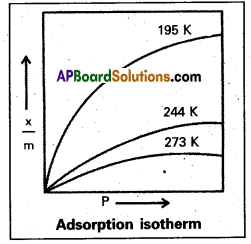
AP Inter 2nd Year Chemistry Study Material Chapter 4 Surface Chemistry 33

  • Freundlich adsorption isotherm equation is
    \(\frac{\mathrm{x}}{\mathrm{m}}\) = k, P1/n
    x = mass of the gas adsorbed
    m = mass of the adsorbent
    P, k and n are constants.
  • k and n depend on the nature of the adsorbent and the gas at a particular temperature.
  • The relation ship is generally represented in the form of a curve where x/m is plotted against pressure.
  • These curves indicate that at a fixed pressure there is a decrease in physical adsorption with rise of temperature.
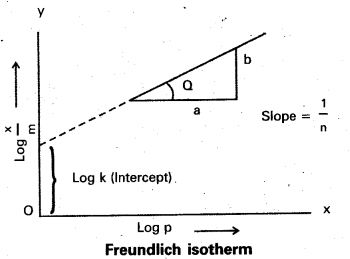
    AP Inter 2nd Year Chemistry Study Material Chapter 4 Surface Chemistry 34
    \(\frac{\mathrm{x}}{\mathrm{m}}\) = k.P1/4
    Applying logarithm
    Log \(\frac{\mathrm{x}}{\mathrm{m}}\) = log k + \(\frac{\mathrm{1}}{\mathrm{n}}\) log p.
  • The validity of Freundlich isotherm can be verified by plotting log \(\frac{\mathrm{x}}{\mathrm{m}}\) on y-axis and log P on x-axis. If it is a straight line then the isotherm is valid.
  • The slope of the straight line give the value of \(\frac{\mathrm{1}}{\mathrm{n}}\)
  • The intercept on the y-axis gives the value of log k.

Question 6.
Give a detailed account of applications of adsorption.
Answer:
Applications of adsorption : The phenomenon of adsorption funds a number of applications. Important ones are listed here.

  1. Production of high vacuum: The traces of air still remaining in the vessel evacuated by a vacuum pump to give high vacuum can be adsorbed by charcoal.
  2. Gas masks : Gas mask, a device which consists of activated charcoal or mixture of adsorbents is usually used by coal miners to adsorb poisonous gases during breathing.
  3. Control of humidity : Silica gel and alumina gel are used as adsorbents for removing mixture and controlling humidity of air in rooms.
  4. Removal of colouring matter from solutions : Animal charcoal removes colours of impure coloured solutions by adsorbing impurities responsible for the colour.
  5. Separation of inert gases : Due to the difference in degree of adsorption of gases by charcoal, a mixture of noble gases can be separated by adsorption on coconut charcoal at different temperatures.
  6. In curing diseases : A number of drugs kill germs by getting themselves adsorbed on germs.
  7. Froth floatation process : A low grade sulphide ore is concentrated by separating silica and other earthy matter by this method using pine oil and frothing agent.
  8. Adsorption indicators : Surfaces of certain precipitates such as silver halides have the property of adsorbing some dyes like eosin, fluorescein, etc. and thereby producing a characteristic colour change at the end point in argentometric titrations.
  9. Chromatographic analysis : Chromatographic analysis based on the phenomenon of adsorption finds a number of applications in analytical and industrial methods.

AP Inter 2nd Year Chemistry Study Material Chapter 4 Surface Chemistry

Question 7.
What is catalysis ? How is catalysis classified ?* Give four examples for each type of catalysis.
Answer:
Catalysis: A substance which alters the rate of a chemical reaction without itself being consumed in the process, is called a catalyst.
The action of catalyst in altering the rate of a chemical reaction is called catalysis.
Types of catalysis : Catalysis is classified into two types as .
a) Homogeneous catalysis and
b) Heterogeneous catalysis.
Homogeneous catalysis : The catalytic process in which the catalyst is present in the same phase as that of reactants, is known as homogeneous catalysis.

AP Inter 2nd Year Chemistry Study Material Chapter 4 Surface Chemistry 35
Heterogeneous catalysis: The catalytic process in which the catalyst is present in a phase different from that of reactarts is known as heterogeneous catalysis.
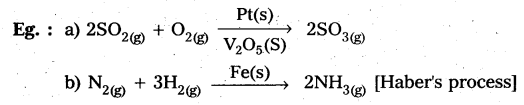
AP Inter 2nd Year Chemistry Study Material Chapter 4 Surface Chemistry 36

Question 8.
Discuss the mechanism of heterogeneous catalysis.
Answer:
Adsorption theory of heterogeneous catalysis :
Adsorption theory explains the mechanism of heterogeneous catalysis.
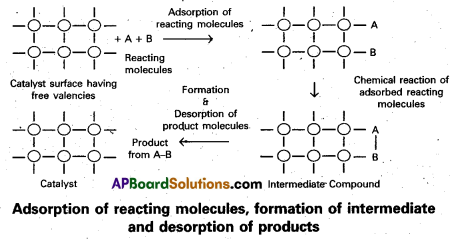
AP Inter 2nd Year Chemistry Study Material Chapter 4 Surface Chemistry 37

  • The modern adsorption theory is the combination of the intermediate compound formation theory and the old adsorption theory.
  • The mechanism of catalysis involves five steps.
  • Diffusion of the reactants to the surface of the catalyst.
  • Adsorption of the reactant molecules on the surface of the catalyst.
  • Occurrence of chemical reaction on the catalyst’s surface through formation of an intermediate.
  • Desorption of reaction products from the catalyst surface, and thereby making the surface available again for more reaction to occur.
  • Diffusion of reaction products away from the catalyst’s surface.

Question 9.
What are enzymes ? Explain in detail the enzyme catalysis, with necessary examples.
Answer:
Enzymes are complex nitrogenous organic compounds which are produced by living plants and animals.

  • These act as specific catalysts in biological reactions.
  • These catalyse the numerous reactions that occur in the bodies of animals and plants to maintain the life process.
    Mechanism of enzyme catalysis :
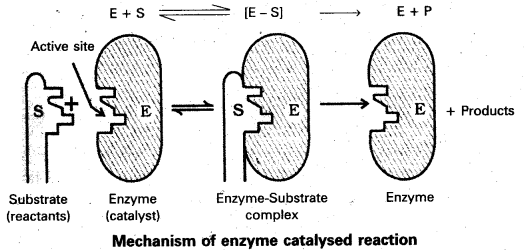
    AP Inter 2nd Year Chemistry Study Material Chapter 4 Surface Chemistry 38
    The enzyme – catalysed reactions may be considered to proceed in two steps.
    Step 1 : Binding of substrate to enzyme to form an activated complex (ES)
    E + S → ES
    Step 2 : Decomposition of the activated complex to form product.
    ES → E + P

Factors influencing the catalytic activity of enzymes :

  • Highly specific nature: One catalyst catalyses only one reaction. Each enzyme is specific for a given reaction.
    Eg : The enzyme urease catalyses the hydrolysis of urea only and not any other amide
  • Highly active under optinum temperature: The rate of an enzyme reaction is maximum at a temperature called optimum temperature.
  • The optimum temperature range for enzymatic activity is 298 – 310 K.
  •  Highly active under optimum pH : The rate of an enzyme – catalysed reaction is maximum at a particular pH called optimum pH which lies between 5-7
  •  Increasing activity in presence of activators and co-enzymes : The enzymatic activity is increased in presence of co-enzymes (or) in presence of activators such as Na+, Mn+2 etc.,
  • Influence of inhibitors and poisons: The inhibitors (or) poisons interact with the active functional groups on the enzyme surface and reduce or completely destroy the catalytic activity.
    i) Inversion of Cane sugar: Enzyme : Invertase
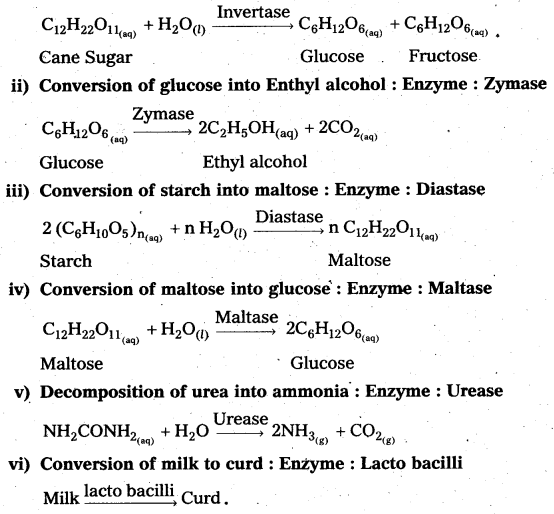
    AP Inter 2nd Year Chemistry Study Material Chapter 4 Surface Chemistry 39

AP Inter 2nd Year Chemistry Study Material Chapter 4 Surface Chemistry

Question 10 & 11.
What are colloidal solutions ? How are they classified ? Give examples.
Answer:
A heterogeneous system in which one substance is dispered as large particles in another substance is called colloidal solution.

  • In colloidal solution the particle size of the dispersed phase is of the order of 1 mμ – 1 μ where as in true solution the particle size of the solute are the order of mp or less.
  • Colloidal solution is a heterogeneous binary system where as true solution is a homogeneous binary system.
    On the basis of physical states of dispersed phase and dispersion medium colloidal solutions are classified into eight types.
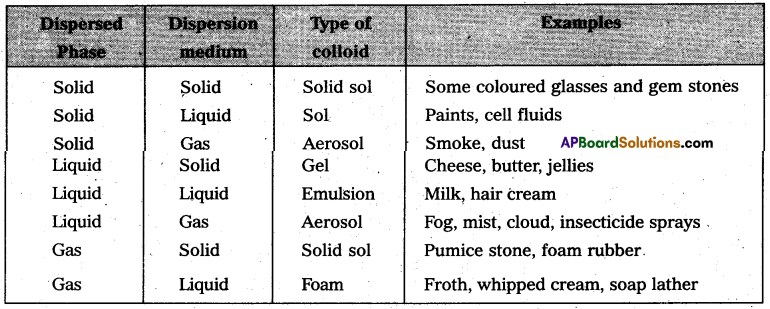
    AP Inter 2nd Year Chemistry Study Material Chapter 4 Surface Chemistry 40

On the basis of nature of dispersion medium colloids are classified as follows.
If the dispersion medium is ‘air’, the sols are called aerosols.
Eg : Smoke.

If the dispersion medium is ‘water’ the sols are called Hydrosol (or) aquasol.
Eg: starch solution.
If the dispersion medium is ‘alcohol’ then the sols are called alcosols.

The colloidal solution in which the dispersed phase has great affinity to the dispersion medium is called a Lyophilic colloid or Lyophilic solution.
Ex : Starch solution.
The starch paste when dissolved in hot water, with stirring, the starch solution is formed. The starch particles (dispersed phase) has great affinity to water molecules (dispersion medium). So starch solution is a lyophilic solution or lyophilic colloid.

Lyophobic colloid : The colloidal solution in which there exists not much affinity between the dispersed phase and dispersion medium, it is called a Lyophobic colloid or Lyophobic solution. Ex : Gold solution.

Gold rods are placed in water containing alkali. Electric arc is applied between gold rods. The gold particles dissolves in water, to give gold solution.

Gold particles (dispersed phase) have not much affinity towards water (dispersion medium). So this is a Lyophobic solution or Lyophobic colloid.

Question 12.
How are colloids classified on the basis of the nature of interaction between a dispersed phase and a dispersion medium ? Describe an important characteristic of each class. Which of the sols need stabilising agents for preservation ?
Answer:
The colloidal solution in which the dispersed phase has great affinity to the dispersion medium is called a Lyophilic colloid or Lyophilic solution.
Ex : Starch solution.

The starch paste when dissolved in hot water, with stirring, the starch solution is formed. The starch particles (dispersed phase) has great affinity to water molecules (dispersion medium). So starch solution is a lyophilic solution or lyophilic colloid.

Lyophobic colloid : The colloidal solution in which there exists not much affinity between the dispersed phase and dispersion medium, it is called a Lyophobic colloid or Lyophobic solution.
Ex: Gold solution.

Gold rods are placed in water containing alkali. Electric arc is applied between gold rods. The gold particles dissolves in water, to give gold solution.

Gold particles (dispersed phase) have not much affinity towards water (dispersion medium). So this is a Lyophobic solution or Lyophobic colloid.

Lyophilic colloids are much stable than lyophobic colloids. Avery small amount of electrolyte can precipitate the lyophobic colloids. But their precipitation can be prevented by the addition of small amounts of lyophilic colloids. This lyophilic colloids form a protecting layer around the lyophobic colloids and protect them from precipitation (coagulation). Lyophilic colloids used for this purpose are called protective colloids.
Ex : Gelatin, gum, starch sols are generally used as protective colloids.

AP Inter 2nd Year Chemistry Study Material Chapter 4 Surface Chemistry

Question 13.
What are micelles ? Discuss the mechanism of micelle formation and cleaning action of soap.
Answer:
Micelles : Some substances which at low concentrations behave as normal strong electrolytes, but at high concentrations exhibit colloidal behaviour due to formation of aggregates. The aggregated particles thus formed are called micelles.
Eg : Stearate ions (C17H35COO) associate together in high concentration, in a solution of soap in water and forms a micelle.

Mechanism of micelle formation : Let us take the example of soap solution. Soap is sodium or potassium salt of a higher fatty acid and may be represented as RCOC Na+ (E.g., sodium strearate CH3 (CH2)16 COO Na+, which is a major component of many bar soaps). When dissolved in water, it dissociates into RCOO and Na+ ions. The RCOO ions, however, consist of two parts – a long hydrocarbon chain R (also called non-polar ’tail) which is hydrophobic (water repelling), and a polar group COO(also called polar-ionic ‘head), which is hydrophilic (water loving).
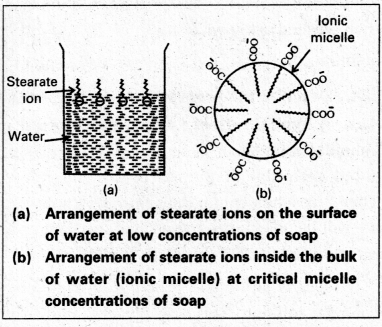
AP Inter 2nd Year Chemistry Study Material Chapter 4 Surface Chemistry 41
The RCOO ions are, therefore, present on the surface with their COO groups in water and the hydrocarbon chains (R) staying away from it and remain at the surface. But at critical micelle concentration, the COO irons are pulled into the bulk of the solution and are aggregated to form a spherical shape with their hydro¬carbon chains pointing towards the centre of the sphere with COO- part remaining outward on the surface of the sphere. The aggregate thus formed is known as ‘ionic micelle’. These micelles may contain as many as 100 simple molecules.

Similarly, in case of detergents, E.g., sodium laurylsulphate. CH3 (CH3)11 SO3Na+, the polar group is -SO3along with the long hydrocarbon chain. Hence, the mechanism of micelle formation here also is same as that of soaps.
Soap is sodium stearate, C17H35COONa, in water soap gives the ions stearate anion and sodium ion.
C17H35COONa → C17H35COO + Na+ (Stearate ion)
The anion of soap = C17H35COO
AP Inter 2nd Year Chemistry Study Material Chapter 4 Surface Chemistry 42
Cleaning action of soap : Soap anions form a micelle. The grease or dirt of the cloth are absorbed into the interior of the micelle. The tails of the anion are pegged into micelle and these micelle are washed away with the soap solution.
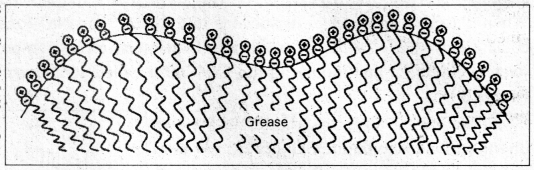
AP Inter 2nd Year Chemistry Study Material Chapter 4 Surface Chemistry 43
Soap thus, functions as an emulsifying agent for the water dirt emulsion. The emulsified grease or dirt is then washed away with soap solution.

Question 14.
Describe the properties of colloids with necessary diagrams wherever necessary.
Answ:
i) Tyndall effect : When light enters a colloidal solution, it is scattered by the large sized colloidal dispersed phase particles.. Therefore when light passes through a solution we will be able to see the path of the light as a luminous beam. This is called Tyndall effect.
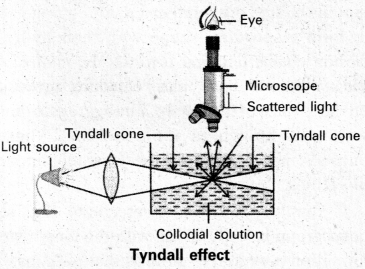
AP Inter 2nd Year Chemistry Study Material Chapter 4 Surface Chemistry 44
This is an optical property exhibited by colloidal solution. This phenomenon is clearly seen with a microscope placed at right angles to the path of light. Colloidal particles become self luminous due to absorption of light.
A true solution does not show Tyndall effect.

ii) Brownion movement: This is a kinetic property of colloidal solution.
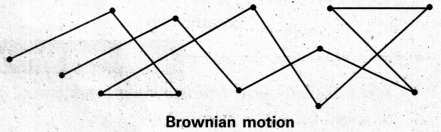
AP Inter 2nd Year Chemistry Study Material Chapter 4 Surface Chemistry 45
When a colloidal solution is examined by ultramicroscope, the colloidal particles are seem to be moving in a rapid zig-zag motion.
This rapid motion of colloidal particles is called Brownian movement.

This motion is due to unequal bombardment of colloidal particles by molecules of dispersion medium. Smaller the colloidal particles the more rapid is the Brownian movement.

iii) Charge on colloidal particles : The charge on the colloidal particles is due to electron capture by sol particles during electro dispersion of metals and due to preferrential adsorption ions from solution (of) due to formulation of electrical double layer.

When a dilute AgNO3 solution is added to a dilute KI solution taken in excess the precipitated AgI adsorbs I ions present in excess and a negatively charged AgI colloidal solution is formed. However when dilute KI solution is added to dilute AgNO3 solution taken in excess, AgI precipitate adsorbs Ag+ ions present in excess and a positively charged Agl colloidal solution is formed. Generally the ion common to dispersed particle is adsorbed.
AgI/I
Negatively charged
AgI/Ag+
Positively charged.

iv) Zeta Potential: In a colloidal sol the charges of opposite signs on the fixed’and diffused parts of the double layer results in a difference in potential between these layers. The potential difference between the fixed layer and the diffused layer of opposite charge is called electro kinetic potential (or) zeta potential.

v) electrophoresis : When electric potential is applied across two platinum electrodes dipping in a colloidal solution, the colloidal particles move towards one or the other electrode. The movement of colloidal particles under an applied emf is called “electrophoresis”.
If the movement of colloidal particles is arrested by some suitable means, the dispersion medium moves in opposite direction. This phenomenon is termed “electro osmosis”.

vi) Coagulation : The stability of the lyophilic sols is due to the presence of charge on the colloidal particles. If tins charge is neutralised the particles will come nearer to each other to form aggregates (or coagulate) and settle down under the force of gravity. This process of settling down of colloidal particles is called coagulation (or) flocculation (or) precipitation.

AP Inter 2nd Year Chemistry Study Material Chapter 4 Surface Chemistry

Question 15.
What are emulsions ? How are they classified ? Describe the applications of emulsion. [T.S. Mar. 18, 16]
Answer:
Emulsion: The colloidal system in which a dispersion of finely divided droplets of a liquid in another liquid medium is called Emulsion.
Ex: Milk. .
In Milk, the droplets of liquid fat are dispersed in water. This is an example for oil in water type emulsion.
Classification of emulsions : Emulsions are classified, into two classes. These are
a) oil in water (O/W) and ‘
b) water in oil (W/O), (O = Oil; W = Water).
These emulsions are classified as such depending on which is dispersed phase and which is dispersion medium.

a) Oil in Water (O/W) type emulsions : In this type of emulsions, the dispersed phase is oil and the dispersion medium is water.
Ex : Milk, liquid, fat (oil) in water.
Vanishing cream; fat in water.

b) Water in Oil (W/O) type emulsions : In this type of emulsions, the dispersed phase is water and the dispersion medium is oil.
Ex : Stiff greases : water in lubrication oils
Cod liver oil : water in cod liver oil
Cold cream : water in fat.

Applications of Emulsions : Emulsions are useful

  • In the digestion of fats in intestines.
  •  In washing processes of clothes and crockery.
  •  In the preparation of lotions, creams, ointments in pharmaceutical and cosmetics.
  • In the extraction of metals (froth flotation).
  • In the conversion of cream into butter by churning.
  • To break oil and water emulsions in oil wells.
  • In the preparation of oily type of drugs for easy adsorption to the body.

Intext Questions

Question 1.
Write any two characteristics of Chemisorption. .
Solution:

  1. High specificity: Chemisorption; is highly specific and it will only occur when adsorbent and adsorbate molecules can chemically react with each other.
    Eg.: oxygen is adsorbed on metals by oxide formation.
  2. Surface area : Chemisorption increases with increase in surface area of the adsorbent.

Question 2.
Why does physisorption decrease with the increase of temperature ?
Solution:
Physisorption is an exothermic process :
Solid (Adsorbent) + Gas (Adsorbate) ⇌ Gas adsorbed on solid + Heat
When temperature is increased, the equilibrium shifts towards the backward direction to neutralise the effect of the change (Le-Chatelier’s principle). So, physisorption decreases with increase in temperature.

Question 3.
Why are finely powdered substances more effective adsorbents than their non powdered crystal forms ? .
Solution:
Finally divided substances provide increased surface area for adsorption which is not available to such extent in their crystalline forms. That’s why the powdered forms are more effective than crystalline forms for the purpose of adsorbents.

Question 4.
Hydrogen used in Haber’s process is obtained by reacting methane with steam in presence of NiO as catalyst. The process is known as steam reforming. Why is it necessary to remove CO formed in steam reforming when ammonia is obtained by Haber’s process ?
Solution:
Carbon monoxide (CO) acts as a poison for catalyst iron and promoter molybdenum in Haber’s process, i.e., the efficiency of catalyst and promoter is decreased. It also combines with Fe to form iron carbonyl, Fe(CO)5 which interfere in the production of ammonia. Hence, CO must be removed from the reaction mixture.

AP Inter 2nd Year Chemistry Study Material Chapter 4 Surface Chemistry

Question 5.
Why is ester hydrolysis slow in the beginning but is fast after sometime ?
Solution:
The chemical equation for ester hydrolysis is as follows :

AP Inter 2nd Year Chemistry Study Material Chapter 4 Surface Chemistry 46
Carboxylic acid produced during hydrolysis releases H+ ions in the solution which act as catalyst (auto-catalysis) for the reaction. Therefore, ester hydrolysis is slow in the beginning but becomes faster after sometime.

Question 6.
What is role of desorption in the process of adsorption catalysis.
Solution:
The reaction products formed on the catalyst surface get detached from the surface as a result of desorption, thereby making the surface available again for more reactant particles.

Question 7.
What modification can you suggest in the Hardy-Schulze law ?
Solution:
According to Hardy Schulze law, the ions carrying charge opposite to the charge on sol particles neutralise their charge and thus cause their coagulation or precipitation. But actually, the sol carrying these ions also get coagulated since the ions neutralize their charge. So, Hardy Schulze law can be modified as :

“When equimolar proportions of two oppositely charged sols are mixed, they mutually neutralize their charge and both get coagulated”.

Question 8.
Why is it essential to wash the precipitate in gravimetric chemical analysis with wash liquid before drying and weighing it quantitatively ?
Solution:
Some of the reactant ions my be adsorbed or may adhere to the surface of the particles of the precipitate formed during an ionic reaction. In order to remove these reactant ions, the precipitate should.be washed with water. If this is not done, an error may be produced during quantitative analysis.

Inter 1st Year Maths 1B Applications of Derivatives Solutions Ex 10(f)

Practicing the Intermediate 1st Year Maths 1B Textbook Solutions Inter 1st Year Maths 1B Applications of Derivatives Solutions Exercise 10(f) will help students to clear their doubts quickly.

Intermediate 1st Year Maths 1B Applications of Derivatives Solutions Exercise 10(f)

I.

Question 1.
Verify Rolle’s theorem for the following functions.
i) x² – 1 on [-1, 1]
Solution:
Let f(x) = x² – 1
f is continuous on [-1,1]
since f(-1) = f(1) = 0 and
f is differentiable on [-1, 1]
∴ By Rolle’s theorem ∃ c ∈ (-1, 1) such that f'(c) = 0
f'(x) = 2x = 0
∴ = f'(c) = 0
2c = 0
c = 0
The point c = 0 ∈ (-1, 1)
Then Rolle’s theorem is verified.

ii) sin x – sin 2x on [0, π].
Solution:
Let f(x) = sin x – sin 2x
f is continuous on [0, π]
since f(0) = f(π)= 0 and
f is differentiable on [0, π]
By Rolle’s theorem ∃ c ∈ (0, π)
such that f'(c) = 0
f'(x) = cos x – 2 cos 2x
f'(c) = 0 ⇒ cosc – 2 cos 2c = 0
⇒ cosc – 2(2cos²c – 1):
cosc – 4 cos²c + 2=0 2
4 cos² c – cosc – 2 = 0
Inter 1st Year Maths 1B Applications of Derivatives Solutions Ex 10(f) 1

iii) log (x² + 2) – log 3 on [-1, 1]
Solution:
Let f(x) = log (x² + 2) – log 3
f is continuous on [-1, 1]
Since f(-1) = f(1) = 0 and f is
Differentable on [-1, 1]
By Rolle’s theorem ∃ c ∈ (-1, 1)
Such that f'(c) = 0
f'(x) = \(\frac{1}{x^{2}+2}\) = (2x)
f'(x) = \(\frac{2c}{c^{2}+2}\) = 0
2c = 0
c = 0
c = 0 ∈ (-1, 1).

Inter 1st Year Maths 1B Applications of Derivatives Solutions Ex 10(f)

Question 2.
It is given that Rolle’s theorem holds for the function f(x) = x³ + bx² + ax on [1, 3] with c = 2t + \(\frac{1}{\sqrt{3}}\). Find the values of a and b.
Solution:
Given f(x) = x³ + bx² + ax
f'(x) = 3x² + 2bx + a
∴ f'(c) = 0 6 ⇔ 3c² + 2bc + a = 0
Inter 1st Year Maths 1B Applications of Derivatives Solutions Ex 10(f) 2
⇔ b = 6 and b² – 3a = 3
36 – 3 = 3a
33 = 3a
a = 11
Hence a = 11 and b = -6.

Question 3.
Show that there is no real number k, for which the equation x² – 3x + k = 0 has two distinct roots in [0, 1].
Solution:
Clearly f(0) = f(c)
0 – 0 + k = 1 – 3 + k
0 = -2
Which is not possible
∴ There is no real number K.

Question 4.
Find a point on the graph of the curve y = (x – 3)², where the tangent is parallel to the chord joining (3, 0) and (4, 1).
Solution:
Given points (3, 0) and (4, 1)
The slope of chord = \(\frac{1-0}{4-3}\) = 1
Given y = (x- 3)²
\(\frac{dy}{dx}\) = 2(x – 3)
⇒ Slope = 2(x – 3)
1 = 2(x – 3)
\(\frac{1}{2}\) = x – 3
x = \(\frac{1}{2}\) + 3 = \(\frac{7}{2}\)
y = (x – 3)² = (\(\frac{7}{2}\) – 3)² = \(\frac{1}{4}\)
∴ The point on the curve is (\(\frac{7}{2}\), \(\frac{1}{4}\))

Question 5.
Find a point on the graph of the curve y = x³, where the tangent is parallel to the chord joining (1, 1) and (3, 27).
Solution:
Given points (1, 1) and (3, 27)
Slope of chord = \(\frac{27-1}{3-1}\) = 13
Given y = x³
\(\frac{dy}{dx}\) = 3x²
⇒ Slope = 3x²
13 = 3x²
Inter 1st Year Maths 1B Applications of Derivatives Solutions Ex 10(f) 3
∴ The point on the curve is (\(\frac{\sqrt{39}}{3}\), \(\frac{13\sqrt{39}}{9}\))

Inter 1st Year Maths 1B Applications of Derivatives Solutions Ex 10(f)

Question 6.
Find ‘c’, so that f'(c) = \(\frac{f(b)-f(a)}{b-a}\) in the following cases.
i) f(x) = x² – 3x – 1, a = \(\frac{-11}{7}\), b = \(\frac{13}{7}\).
Solution:
Inter 1st Year Maths 1B Applications of Derivatives Solutions Ex 10(f) 4
f'(x) = 2x – 3
f'(c) = 2c – 3
Given f'(c)= \(\frac{f(b)-f(a)}{b-a}\)
Inter 1st Year Maths 1B Applications of Derivatives Solutions Ex 10(f) 5

ii) f(x) = ex ; a = 0, b = 1
Solution:
f(b) = f(1) = e’ = e
f(a) = f(0) = e° = 1
Given f(x) = ex
f'(x) = ex
Given condition f'(c) = \(\frac{f(b)-f(a)}{b-a}\)
Inter 1st Year Maths 1B Applications of Derivatives Solutions Ex 10(f) 6

Question 7.
Verify the Rolle’s theorem for the function (x² – 1) (x – 2) on [-1, 2]. Find the point in the interval where the derivate vanishes.
Solution:
Let f(x) = (x² – 1) (x- 2) = x³ – 2x² – x + 2
f is continous on [-1, 2]
since f(-1) = f(2) = 0 and f is
Differentiable on [-1, 2]
By Rolle’s theorem ∃ C ∈ (-1, 2)
Let f'(c) = 0
f'(x) = 3x² – 4x – 1
3c² – 4c – 1 = 0
Inter 1st Year Maths 1B Applications of Derivatives Solutions Ex 10(f) 7

Question 8.
Verify the conditions of the Lagrange’s mean value theorem for the following functions. In each case find a point ‘c’ in the interval as stated by the theorem
i) x² -1 on [2, 3]
Solution:
Solution:
Let f(x) = x² – 1
f is continous on [2, 3]
and f is differentiable
Given f(x) = x² – 1
f'(x) = 2x
By Lagrange’s mean value theorem ∃ C ∈ (2, 3) such there
Inter 1st Year Maths 1B Applications of Derivatives Solutions Ex 10(f) 8

ii) sin x – sin 2x on [0, π]
Solution:
Let f(x) = sin x – sin 2x
f is continuous on [0, π] and f is differentiable
Given f(x) = sin x – sin 2x
f'(x) = cos x – 2 cos 2x
By Lagrange’s mean value than ∃ C ∈ (0, π) such there
f'(c) = \(\frac{f(\pi)-f(0)}{\pi-0}\)
cosc – 2 cos 2c = 0
cosc 2(2cos² – 1) = 0
cosc – 4 cos²c + 2 = 0
4 cos² c – cos c – 2 = 0
Inter 1st Year Maths 1B Applications of Derivatives Solutions Ex 10(f) 9

Inter 1st Year Maths 1B Applications of Derivatives Solutions Ex 10(f)

iii) log x on [1, 2].
Solution:
Let f(x) = log x
f is continuous on [1, 2] and f is differentiable
Given f(x) = log x
f'(x) = \(\frac{1}{x}\)
By Lagrange’s mean value theorem ∃ c ∈ (1, 2) such that
Inter 1st Year Maths 1B Applications of Derivatives Solutions Ex 10(f) 10

Inter 1st Year Maths 1A Trigonometric Ratios up to Transformations Important Questions

Students get through Maths 1A Important Questions Inter 1st Year Maths 1A Trigonometric Ratios up to Transformations Important Questions which are most likely to be asked in the exam.

Intermediate 1st Year Maths 1A Trigonometric Ratios up to Transformations Important Questions

Question 1.
Find the values of
(i) sin \(\frac{5 \pi}{3}\)
(ii) tan (855°)
(iii) sec \(\left(\frac{13 \pi}{3}\right)\)
Solution:
i) sin \(\frac{5 \pi}{3}\) = sin \(\left(2 \pi-\frac{\pi}{3}\right)\) = -sin \(\frac{\pi}{3}\) = \(-\frac{\sqrt{3}}{2}\)

ii) tan (855°) = tan (2 × 360° + 135°)
= tan (135°)
= tan (180° – 45°)
= -tan 45° = -1

iii) sec \(\left(13 \frac{\pi}{3}\right)\) = sec \(\left(4 \pi+\frac{\pi}{3}\right)\)
= sec \(\frac{\pi}{3}\) = 2

Question 2.
Simplify.
i) Cot (θ – \(\frac{13 \pi}{2}\))
ii) tan \(\left(-23 \frac{\pi}{3}\right)\)
Solution:
Inter 1st Year Maths 1A Trigonometric Ratios up to Transformations Important Questions 1

Inter 1st Year Maths 1A Trigonometric Ratios up to Transformations Important Questions

Question 3.
Find the value of sin2 \(\frac{\pi}{10}\) + sin2 \(\frac{4 \pi}{10}\) + sin2 \(\frac{6 \pi}{10}\) + sin2 \(\frac{9 \pi}{10}\)
Solution:
Inter 1st Year Maths 1A Trigonometric Ratios up to Transformations Important Questions 2
Inter 1st Year Maths 1A Trigonometric Ratios up to Transformations Important Questions 3

Question 4.
If sin θ = \(\frac{4}{5}\) and θ is not in the first qua-drant, find the value of cos θ.
Solution:
∵ sin θ = \(\frac{4}{5}\) and θ is not in the first quadrant
⇒ θ lies in 2nd quadrant, ∵ sin θ is +ve
Inter 1st Year Maths 1A Trigonometric Ratios up to Transformations Important Questions 4

Question 5.
If sec θ + tan θ = \(\frac{2}{3}\), find the value of sin θ and determine the quadrant in which θ lies.
Solution:
∵ sec θ + tan θ = \(\frac{2}{3}\)
Inter 1st Year Maths 1A Trigonometric Ratios up to Transformations Important Questions 6
∵ tan θ is negative, sec θ is positive
⇒ θ lies in fourth quadrant.

Question 6.
Prove that
cot\(\frac{\pi}{16}\).cot\(\frac{2 \pi}{16}\).cot\(\frac{3 \pi}{16}\)…..cot\(\frac{7 \pi}{16}\) = 1
Solution:
Inter 1st Year Maths 1A Trigonometric Ratios up to Transformations Important Questions 7
Inter 1st Year Maths 1A Trigonometric Ratios up to Transformations Important Questions 8

Inter 1st Year Maths 1A Trigonometric Ratios up to Transformations Important Questions

Question 7.
If 3 sin θ + 4 cos θ = 5, then find the value of 4 sin θ – 3 cos θ.
Solution:
Given 3 sin θ + 4 cos θ = 5 and let 4 sin θ – 3 cos θ = x
By squaring and adding, we get
(3 sin θ + 4 cos θ)2 + (4 sin θ – 3 cos θ)2 = 52 + x2
⇒ 9 sin2 θ + 16 cos2 θ + 24 sin θ cos θ + 16 sin2 θ + 9 cos2 θ – 24 sin θ cos θ = 25 + x2
⇒ 9 + 16 = 25 + x2
⇒ x2 = 0 ⇒ x = 0
∴ 4 sin θ – 3 cos θ = 0.

Question 8.
If cos θ + sin θ = \(\sqrt{2}\) cos θ, prove that cos θ – sin θ = \(\sqrt{2}\) sin θ. (May ’11)
Solution:
Given cos θ + sin θ = \(\sqrt{2}\) cos θ
⇒ sin θ = (\(\sqrt{2}\) – 1) cos θ
Now multiplying both sides by (\(\sqrt{2}\) + 1)
Inter 1st Year Maths 1A Trigonometric Ratios up to Transformations Important Questions 9

Question 9.
Find the value of 2(sin2 θ + cos6 θ) – 3(sin4 θ + cos4 θ)
Solution:
2 (sin6 θ + cos6 θ) – 3(sin4 θ + cos4 θ)
= 2[(sin2 θ)3 + (cos2 θ)3] – 3[(sin2 θ)2 + (cos2 θ)2]
= 2[(sin2 θ + cos2 θ)3 – 3 sin2 θ cos2 θ (sin2 θ + cos2 θ)] – 3[(sin2 θ + cos2 θ)2 – 2 sin2 θ cos2 θ]
= 2[1 – 3 sin2 θ cos2 θ] – 3[1 – 2 sin2 θ cos2 θ]
= 2 – 6 sin2 θ cos2 θ – 3 + 6 sin2 θ cos2 θ
= -1

Question 10.
Prove that (tan θ + cot θ)2 = sec2 θ + cosec2 θ = sec2 θ cosec2 θ.
Solution:
(tan θ + cot θ)2
=tan2 θ + cot 2 θ + 2 tan θ cot θ
= tan2 θ + cot2 θ + 2
= (1 + tan2 θ) + (1 + cot2 θ)
= sec2 θ + cosec2 θ
Inter 1st Year Maths 1A Trigonometric Ratios up to Transformations Important Questions 10

Question 11.
If cos θ > 0, tan θ + sin θ = m and tan θ – sin θ = n, then show that m2 – n2 = n, then show that m2 – n2 = 4\(\sqrt{m n}\)
Solution:
Given that m = tan θ + sin θ
n = tan θ – sin θ
⇒ m + n = 2 tan θ and m – n = 2 sin θ
Now(m + n)(m – n) = 4 tan θ sin θ
Inter 1st Year Maths 1A Trigonometric Ratios up to Transformations Important Questions 11

Question 12.
If tan 20° = λ, then show that \(\frac{\tan 160^{\circ}-\tan 110^{\circ}}{1+\tan 160^{\circ} \cdot \tan 110^{\circ}}\) = \(\frac{1-\lambda^{2}}{2 \lambda}\) (A.P.) Mar. ’16
Solution:
Given tan 20° = λ
Inter 1st Year Maths 1A Trigonometric Ratios up to Transformations Important Questions 12

Question 13.
Find the values of sin 75°, cos 75°, tan 75° and cot 75°.
Solution:
i) sin 75° = sin (45° + 30°)
= sin 45°. cos 30° + cos 45°. sin 30°
Inter 1st Year Maths 1A Trigonometric Ratios up to Transformations Important Questions 13

Inter 1st Year Maths 1A Trigonometric Ratios up to Transformations Important Questions

ii) cos (75°) = cos (45° + 30°)
= cos 45° cos 30° – sin 45° sin 30°
Inter 1st Year Maths 1A Trigonometric Ratios up to Transformations Important Questions 14

Inter 1st Year Maths 1A Trigonometric Ratios up to Transformations Important Questions 16

Question 14.
If 0 < A, B < 90°.cos A = \(\frac{5}{13}\) and sin B = \(\frac{4}{5}\)-then find sin(A + B).
Solution:
0 < A < 90°and cos A = \(\frac{5}{13}\) ⇒ sin A = \(\frac{12}{13}\)
0 < B < 90°and sin B = \(\frac{4}{5}\) ⇒ cos B = \(\frac{3}{5}\)
∴ sin (A + B) = sin A cos B + cos A sin B
= \(\frac{12}{13}\) • \(\frac{3}{5}\) + \(\frac{5}{13}\) • \(\frac{4}{5}\) = \(\frac{56}{65}\)

Question 15.
Prove that
sin2 \(\left(52 \frac{1}{2}\right)^{\circ}\) – sin2 \(\left(22 \frac{1}{2}\right)^{\circ}\) = \(\frac{\sqrt{3}+1}{4 \sqrt{2}}\)
Solution:
Inter 1st Year Maths 1A Trigonometric Ratios up to Transformations Important Questions 17

Question 16.
Prove that tan 70° – tan 20° = 2 tan 50°.
Solution:
tan 50° = tan (70° – 20°)
= \(\frac{\tan 70^{\circ}-\tan 20^{\circ}}{1+\tan 20^{\circ} \cdot \tan 70^{\circ}}\)
⇒ tan 70° – tan 20°
= tan 50° [1 + tan 20° . tan (90° – 20°)]
= tan 70° – tan 20° = tan 50°[1 + tan 20° cot 20°]
⇒ tan 70° – tan 20° = 2 tan 50°.

Question 17.
If A + B = π/4, then prove that
i)(1 + tan A)(1 + tan B) = 2. (May ’11; Mar. ’07)
ii) (cot A – 1)(cot B – 1) = 2
Solution:
i) Given that A + B = π/4 (T.S) (Mar. ’16)
⇒ tan (A + B) = tan (π/4)
⇒ \(\frac{\tan A+\tan B}{1-\tan A \tan B}\) = 1
⇒ tan A + tan B = 1 – tan A tan B
⇒ tan A + tan B + tan A tan B = 1
Add 1 on both sides
⇒ 1 + tan A + tan B + tan A tan B = 1 + 1
⇒ (1 + tan A)(1 + tan B) = 2

ii) Given A + B = π/4
⇒ cot (A + B) = cot π/4
⇒ \(\frac{\cot A \cot B-1}{\cot B+\cot A}\) = 1
⇒ cot A cot B – 1 = çot B + cot A
⇒ cot A cot B – cot A – cot B = 1
Again add 1 on both sides
cot A cot B – cot A – cot B + 1 = 1 + 1
∴ (cot A – 1) (cot B – 1) = 2.

Question 18.
If sin α = \(\frac{1}{\sqrt{10}}\), sin β = \(\frac{1}{\sqrt{5}}\) and α, β are acute, show that α + β = π/4.
Solution:
Given α is acute and sin α = \(\frac{1}{\sqrt{10}}\)
⇒ tan α = \(\frac{1}{3}\)
β is acute and sin β = \(\frac{1}{\sqrt{5}}\) ⇒ tan β = \(\frac{1}{2} .\)
Inter 1st Year Maths 1A Trigonometric Ratios up to Transformations Important Questions 18

Question 19.
If sin A = \(\frac{12}{13}\), cos B = \(\frac{3}{5}\) and neither A nor B is in the first quadrant, then find the quadrant in which A + B lies.
Solution:
sin A = \(\frac{12}{13}\) and A is not in first quadrant
⇒ A lies in second quadrant, ∵ sin A is +ve
cos B = \(\frac{3}{5}\) and B is not in first quadrant
⇒ B lies in fourth quadrant, cos B is +ve
∵ sin A = \(\frac{12}{13}\) ⇒ cos A = –\(\frac{5}{13}\)
cos B = \(\frac{3}{5}\) ⇒ sin B = –\(\frac{4}{5}\)
sin (A + B) = sin A cos B + cos A sin B
Inter 1st Year Maths 1A Trigonometric Ratios up to Transformations Important Questions 19
cos (A + B) = cos A cos B – sin A sin B
Inter 1st Year Maths 1A Trigonometric Ratios up to Transformations Important Questions 20
∵ sin (A + B) and cos (A + B) are positive
⇒ (A + B) lies in first quadrant.

Question 20.
Find (i) tan \(\left(\frac{\pi}{4}+\mathbf{A}\right)\) interms of tan A
and (ii) cot \(\left(\frac{\pi}{4}+\mathbf{A}\right)\) interms of cot A.
Solution:
Inter 1st Year Maths 1A Trigonometric Ratios up to Transformations Important Questions 21

Inter 1st Year Maths 1A Trigonometric Ratios up to Transformations Important Questions

Question 21.
Prove that \(\frac{\cos 9^{\circ}+\sin 9^{\circ}}{\cos 9^{\circ}-\sin 9^{\circ}}\) = cot 36°. (A.P) (Mar ’15, Mar. ’11)
Solution:
Inter 1st Year Maths 1A Trigonometric Ratios up to Transformations Important Questions 22

Question 22.
Show that
cos 42° + cos 78° + cos 162° = 0 (May. ’11)
Solution:
L.H.S. = cos 42° + cos 78° + cos 162°
= 2 cos \(\left(\frac{42^{\circ}+78^{\circ}}{2}\right)\). cos \(\left(\frac{42^{\circ}-78^{\circ}}{2}\right)\) + cos (180° – 18°)
= 2 cos 60° . cos (-18°) + cos (180° – 18°)
= 2\(\left(\frac{1}{2}\right)\) cos 18° – cos 18° = 0
∴ cos 42° + cos 78° + cos 162° = 0

Question 23.
Express \(\sqrt{3}\) sin θ + cos θ as a sine of an angle.
Solution:
\(\sqrt{3}\) sin θ + cos θ = 2(\(\frac{\sqrt{3}}{2}\) sin θ + cos θ)
= 2(cos \(\frac{\pi}{6}\) sin θ + sin \(\frac{\pi}{6}\) cos θ)
= 2. sin[θ + \(\frac{\pi}{6}\)]

Question 24.
Prove that sin2 θ + sin2 [θ – \(\frac{\pi}{3}\)] + sin2 [θ – \(\frac{\pi}{3}\)] = \(\frac{3}{2} .\)
Solution:
Inter 1st Year Maths 1A Trigonometric Ratios up to Transformations Important Questions 23

Question 25.
If A, B, C are angles of a triangle and if none of them is equal to \(\frac{\pi}{2}\), then prove that
i) tan A + tan B + tan C = tan A tan B tan C
ii) cot A cot B + cot B cot C + cot C cot A = 1
Solution:
i) ∵ A, B, C are angles of a triangle
⇒ A + B + C = 180°
⇒ A + B = 180° – C
⇒ tan (A + B) = tan (180° – C)
⇒ \(\frac{\tan A+\tan B}{1-\tan A \tan B}\) = -tan C
⇒ tan A + tan B = -tan C + tan A tan Btan C
⇒ tan A + tan B + tan C = tan A tan B tan C

ii) ∵ A + B + C = 180°
⇒ A + B = 180° – C
⇒ cot (A + B) = cot (180° – C)
⇒ \(\frac{\cot A \cot B-1}{\cot B+\cot A}\) = -cot C
⇒ cot A cot B – 1 = -cot B cot C – cot C. cot A
⇒ cot A cot B + cot B cot C + cot C cot A = 1

Question 26.
Let ABC be a triangle such that cot A + cot B + cot C = \(\sqrt{3}\). Then prove that ABC is an equilateral triangle.
Solution:
Given that A + B + C = 180°
Then we know that
cot A cot B + cot B cot C + cot C cot A = 1
i.e., Σ(cot A cot B) = 1 —– (1)
Now Σ (cot A – cot B)2
= Σ (cot2 A + cot2 B – 2 cot A cot B)
= 2 cot2 A + 2 cot2 B + 2 cot2 C – 2 cot A cot B – 2 cot B cot C – 2 cot C cot A
= 2 [cot A + cot B + cot C]2 – 6 (cot A cot B + cot B cot C + cot C cot A)
= 2
= 6 – 6 = 0
∴ Σ (cot A – cot B)2 = 0 .
⇒ cot A = cot B = cot C
⇒ cot A = cot B = cot C = \(\frac{\sqrt{3}}{3}\) = \(\frac{1}{\sqrt{3}}\)
(∵ cot A + cot B + cot C = \(\sqrt{3})\))
⇒ A = B = C = 60°
∴ ΔABC is an equilateral triangle.

Question 27.
Suppose x = tan A, y = tan B, z = tan C. Suppose none of A, B, C, A – B, B – C, C – A is an odd multiple of \(\frac{\pi}{2}\).Then prove that \(\sum\left(\frac{x-y}{1+x y}\right)\) = \(\pi\left(\frac{x-y}{1+x y}\right)\)
Solution:
∵ x = tan A, y = tan B, z = tan C
Inter 1st Year Maths 1A Trigonometric Ratios up to Transformations Important Questions 24
Write P = A – B, Q = B – C, R = C – A.
Then P + Q + R = O
⇒ tan (P + Q) = tan (-R)
⇒ \(\frac{\tan P+\tan Q}{1-\tan P \tan Q}\) = -tan R
⇒ tan P + tan Q = -tan R + tan P tan Q tan R
⇒ tan P + tan Q + tan R = tan P tan Q tan R
⇒ Σ(tan P) = π (tan P)
⇒ Σtan (A – B) = π tan (A – B)
∴ Σ\(\left(\frac{x-y}{1+x y}\right)\) = π\(\left(\frac{x-y}{1+x y}\right)\)

Question 28.
Find the values of
i) sin 22\(\frac{1}{2}\)°
ii) cos 22\(\frac{1}{2}\)°
iii) tan 22\(\frac{1}{2}\)°
iv) cot 22\(\frac{1}{2}\)°
Solution:
Inter 1st Year Maths 1A Trigonometric Ratios up to Transformations Important Questions 25
Inter 1st Year Maths 1A Trigonometric Ratios up to Transformations Important Questions 26

Question 29.
Find the values of
i) sin 67\(\frac{1}{2}\)°
ii) cos 67\(\frac{1}{2}\)°
iii) tan 67\(\frac{1}{2}\)°
iv) cot 67\(\frac{1}{2}\)°
Solution:
Let A = 67\(\frac{1}{2}\)° ⇒ = 2A = 135°
Inter 1st Year Maths 1A Trigonometric Ratios up to Transformations Important Questions 27
Inter 1st Year Maths 1A Trigonometric Ratios up to Transformations Important Questions 28

Inter 1st Year Maths 1A Trigonometric Ratios up to Transformations Important Questions

Question 30.
Simplify: \(\frac{1-\cos 2 \theta}{\sin 2 \theta}\)
Solution:
\(\frac{1-\cos 2 \theta}{\sin 2 \theta}\) = \(\frac{2 \sin ^{2} \theta}{2 \sin \theta \cos \theta}\) = \(\frac{\sin \theta}{\cos \theta}\) = tan θ

Question 31.
If cos A = \(\sqrt{\frac{\sqrt{2}+1}{2 \sqrt{2}}}\), find the value of cos 2A.
Solution:
cos 2A = 2 cos2A – 1 = 2 \(\left(\frac{\sqrt{2}+1}{2 \sqrt{2}}\right)\) – 1
= \(\frac{\sqrt{2}+1}{\sqrt{2}}\) – 1 = \(\frac{1}{\sqrt{2}}\)

Question 32.
If cos θ = \(\frac{-5}{13}\) and \(\frac{\pi}{2}\) < θ < π, find the value of sin 2θ.
Solution:
\(\frac{\pi}{2}\) < θ < π ⇒ sin θ > 0 and cos θ = –\(\frac{5}{13}\)
⇒ Sin θ = \(\frac{12}{13}\)
∴ sin 2θ = 2 sin θ cos θ
= 2 . \(\frac{12}{13}\)(-\(\frac{5}{13}\)) = –\(\frac{120}{169}\)

Question 33.
For what values of x in the first quadrant \(\frac{2 \tan x}{1-\tan ^{2} x}\) is positive?
Solution:
\(\frac{2 \tan x}{1-\tan ^{2} x}\) > 0 ⇒ tan 2x > 0
⇒ 0 < 2x < \(\frac{\pi}{2}\) (since x is in the first quadrant)
⇒ 0 < x < \(\frac{\pi}{4}\)

Question 34.
If cos θ = \(\frac{-3}{5}\) and π < θ < \(\frac{3 \pi}{2}\), find the value of tan θ/2.
Solution:
Inter 1st Year Maths 1A Trigonometric Ratios up to Transformations Important Questions 29

Question 35.
If A is not an integral multiple of \(\frac{\pi}{2}\), prove that
i) tan A + cot A = 2 cosec 2A
ii) cot A – tan A = 2 cot 2A
Solution:
i) tan A + cot A = \(\frac{\sin A}{\cos A}\) + \(\frac{\cos A}{\sin A}\)
= \(\frac{\sin ^{2} A+\cos ^{2} A}{\sin A \cos A}\)
Inter 1st Year Maths 1A Trigonometric Ratios up to Transformations Important Questions 30

Question 36.
If A is not an integral multiple of prove that
i) tan A + cot A = 2 cosec 2A
ii) cot A – tan A = 2 cot 2A
Solution:
Inter 1st Year Maths 1A Trigonometric Ratios up to Transformations Important Questions 31

Question 37.
If θ is not an integral multiple of \(\frac{\pi}{2}\), prove that tan θ + 2 tan 2θ + 4 tan 4θ +
8 cot 8θ = cot θ.
Solution:
From cot A – tan A = 2 cot 2A above tan A = cot A – 2 cot 2A ….(1)
∴ tan θ + 2 tan 2θ + 4 tan 4θ + 8 cot 8θ = (cot θ – 2 cot 2θ) + 2 (cot 2θ – 2 cot 4θ) + 4 (cot 4θ – 2 cot 8θ) + 8 cot 8θ (by (1) above)
= cot θ

Question 38.
For A ∈ R, prove that
i) sin A.sin(π/3 +A).sin(π/3 – A) = \(\frac{1}{4}\) . sin3A
ii) cosA . cos (π/3 + A). cos(π/3 – A)
= \(\frac{1}{4}\) cos 3A and hence deduce that
iii) sin 20° sin 40° sin 60° sin 80° = \(\frac{3}{16}\)
iv) cos \(\frac{\pi}{9}\), cos \(\frac{2 \pi}{9}\), cos \(\frac{3 \pi}{9}\). cos \(\frac{4 \pi}{9}\) = \(\frac{1}{16}\).
Solution:
i) sin A. sin (π/3 + A). sin (π/3 – A)
= sin A [sin2 π/3 – sin2 A]
Inter 1st Year Maths 1A Trigonometric Ratios up to Transformations Important Questions 32
Inter 1st Year Maths 1A Trigonometric Ratios up to Transformations Important Questions 33
iii) ∵ sin A. sin (60° + A). sin (60° – A)
= \(\frac{1}{4}\) sin 3A
Put A = 20°
⇒ sin 20°. sin (60° + 20°). sin (60° – 20°)
= \(\frac{1}{4}\). sin(3 × 20°) .
⇒ sin 20°. sin 40°. sin 80° = \(\frac{1}{4}\) sin 60°
Multiplying on both sides with sin 60°
We get, sin 20° sin 40° sin 60° sin 80°
= \(\frac{1}{4}\) sin2 60°
= \(\frac{1}{4}\left(\frac{\sqrt{3}}{2}\right)^{2}[latex] = [latex]\frac{3}{16}\)

iv) ∵ cos A. cos (60° + A). cos (60° – A) = \(\frac{1}{4}\)cos 3A
Put A = 20°
⇒ cos 20°. cos (60° + 20°) cos (60° – 20°)
= \(\frac{1}{4}\). cos(3 × 20°)
⇒ cos 20°. cos 40°. cos 80° = cos 60°
On multiplying both sides by cos 60°, we get cos 20°. cos 40°. cos 60°. cos 80°
= \(\frac{1}{4}\). cos2 60°
Inter 1st Year Maths 1A Trigonometric Ratios up to Transformations Important Questions 34

Question 39.
If 3A is not an odd multiple of \(\frac{\pi}{2}\), prove that tan A. tan (60° + A). tan (60° – A)
= tan 3A and hence find the value of tan 6°. tan 42°. tan 66°. tan 78°.
Solution:
Inter 1st Year Maths 1A Trigonometric Ratios up to Transformations Important Questions 35
∴ tan A . tan \(\left(\frac{\pi}{3}+\mathrm{A}\right)\) tan \(\left(\frac{\pi}{3}-A\right)\) = tan 3A
i.e., tan A tan (60° – A) tan (60° + A) = tan 3A —— (1)
Put A = 6°
⇒ tan 6° tan 54° tan 66° = tan 18° ——- (2)
Put A = 18° in (1)
tan 18° tan 42° tan 78° = tan 54° ——- (3)
put (2) in (3),
(tan 6° tan 54° tan 66°) tan 42° tan 78°
= tan 54
⇒ tan 6° tan 42° tan 66° tan 78° = 1

Question 40.
For α, β ∈ R, prove that (cos α + cos β)2 + (sin α + sin β)2 = 4 cos2 \(\left(\frac{\alpha-\beta}{2}\right)\).
Solution:
LH.S. = (cos α + cos β)2 + (sin α + sin β)2
= (cos2 α + cos2 β + 2 cos α cos β + (sin2 α + sin2 β + 2 sin α sin β)
= 1 + 1 + 2 (cos α cos β + sin α sin β)
= 2 + 2 cos (α – β) = 2 (1 + cos (α – β)]
= 2[2cos2\(\left(\frac{\alpha-\beta}{2}\right)\)]
= 4.cos2\(\left(\frac{\alpha-\beta}{2}\right)\); [∵ 1 + cos θ = 2 cos2 \(\frac{\theta}{2}\)]

Question 43.
If a, b, c are non zero real numbers and α, β are solutions of the equation a cos θ + b sin θ = c then show that
(i) sin α + sin β = \(\frac{2 b c}{a^{2}+b^{2}}\) and
(ii) sin α. sin β = \(\frac{c^{2}-a^{2}}{a^{2}+b^{2}}\)
Solution:
∵ a cos θ + b sin θ = c
= a cos θ = c – b sin θ
⇒ (a cos θ)2 = (c – b sin θ)2
⇒ a2 cos2 θ = c2 + b2 sin2 θ – 2bc sinθ
⇒ a2 (1 – sin2 θ) = c2 + b2 sin2 θ – 2bc sin θ
⇒ (a2 + b2) sin2 θ – 2bc sin θ + (c2 – a2) = 0
This is a quadratic equatioñ in sin θ, whose roots are sin α and sin β (given that α, β are two solutions of θ)
∴ Sum of the roots sin α + sin β = \(\frac{2 b c}{a^{2}+b^{2}}\)
Product of the roots sin α sin β = \(\frac{c^{2}-a^{2}}{a^{2}+b^{2}}\)

Inter 1st Year Maths 1A Trigonometric Ratios up to Transformations Important Questions

Question 42.
If θ is not an odd multiple of \(\frac{\pi}{2}\) and cos θ ≠ \(\frac{-1}{2}\), prove that
\(\frac{\sin \theta+\sin 2 \theta}{1+\cos \theta+\cos 2 \theta}\) = tan θ.
Solution:
Inter 1st Year Maths 1A Trigonometric Ratios up to Transformations Important Questions 36

Question 43.
Prove that sin4 \(\frac{\pi}{8}\) + sin4 \(\frac{3 \pi}{8}\) + sin4 \(\frac{5 \pi}{8}\) + sin4 \(\frac{7 \pi}{8}\) = \(\frac{3}{2}\)
Solution:
Inter 1st Year Maths 1A Trigonometric Ratios up to Transformations Important Questions 37

Question 44.
If none of 2A and 3A is an odd multiple of \(\frac{\pi}{2}\), then prove that tan 3A. tan 2A. tanA = tan 3A – tan 2A – tan A.
Solution:
∵ tan 3A = tan (2A + A)
= \(\frac{\tan 2 A+\tan A}{1-\tan 2 A \tan A}\)
⇒ tan 3A(1 – tan 2A tan A) = tan 2A + tan A
⇒ tan 3A – tan A tan 2A tan 3A
= tan 2A + tan A
∴ tan 3A – tan 2A – tan A
= tan A tan 2A tan 3A

Question 45.
Prove that sin 78° + cos 132° = \(\frac{\sqrt{5}-1}{4}\).
Solution:
L.H.S. = sin 78° + cos 132°
= sin 78° + cos (90° + 42°)
= sin 78° – sin 42°
Inter 1st Year Maths 1A Trigonometric Ratios up to Transformations Important Questions 38

Question 46.
Prove that sin 21° cos 9° – cos 84° cos 6° = \(\frac{1}{4}\).
Solution:
LH.S. = sin 21° cos 9° – cos 84° cos 6°
= \(\frac{1}{2}\)[2 sin 21° cos 9° – 2 cos 84° cos 6°]
= \(\frac{1}{2}\)[sin (21° + 9°) + sin (21° – 9°) – 2 cos (90° – 6°) cos 6°]
= \(\frac{1}{2}\)[sin 30° + sin 12° – 2 sin 6° cos 6°]
= \(\frac{1}{2}\)[\(\frac{1}{2}\) + sin 12° – sin (2 × 16°)
= \(\frac{1}{4}\) = R.H.S.

Question 47.
Find the value of sin 34° + cos 64° – cos 4°.
Solution:
sin 34° + (cos 64° – cos 4°)
Inter 1st Year Maths 1A Trigonometric Ratios up to Transformations Important Questions 39

Question 48.
Prove that cos2 76° + cos2 16° – cos 76° cos 16° = \(\frac{3}{4} .\)
Solution:
L.H.S. = cos2 76° + cos2 16° – cos 76° cos 16°
= cos2 76° + (1 – sin2 16°) – \(\frac{1}{2}\)(2 cos 76° cos 16°)
= 1 + (cos2 76° – sin2 16°) – \(\frac{1}{2}\)[cos (76° + 16°) + cos (76° – 16°)]
= 1 + cos (76° + 16°). cos (76° – 16°) – \(\frac{1}{2}\)[cos 92° + cos 60°]
= 1 + cos (92°). cos 60° – \(\frac{1}{2}\)cos 92° – \(\frac{1}{2}\)cos 60°
= 1 + \(\frac{1}{2}\). cos 92° – \(\frac{1}{2}\). cos 92° – \(\frac{1}{2}\) × \(\frac{1}{2}\)
= 1 – \(\frac{1}{4}\) = \(\frac{3}{4}\) = R.H.S.

Question 49.
If a, b, ≠ 0 and sin x + sin y = a and cos x + cos y = b, find two values of
i) tan \(\left(\frac{x+y}{2}\right)\)
ii) sin \(\left(\frac{x-y}{.2}\right)\) interms of a and b.
Solution:
Inter 1st Year Maths 1A Trigonometric Ratios up to Transformations Important Questions 40

First method:

ii) a2 + b2 = (sin x + sin y)2 + (cos x + cos y)2
= sin2 x + sin2 y + 2 sin x sin y + cos2 x + cos2 y + 2 cos x cos y
= 2 + 2(cos x cos y + sin x sin y)
= 2 + 2 cos (x – y)
= 2[1 + cos (x – y)]
a2 + b2 – 2 = 2 cos (x – y)
Inter 1st Year Maths 1A Trigonometric Ratios up to Transformations Important Questions 41

Second method:

Inter 1st Year Maths 1A Trigonometric Ratios up to Transformations Important Questions 42

Question 50.
Prove that cos 12° + cos 84° + cos 132° + cos 156° = –\(\frac{1}{2}\).
Solution:
L.H.S. = cos 12° + cos 84° + cos 132° + cos 156°
Inter 1st Year Maths 1A Trigonometric Ratios up to Transformations Important Questions 43

Inter 1st Year Maths 1A Trigonometric Ratios up to Transformations Important Questions

Question 51.
Show that for any θ ∈ R
4 sin \(\frac{5 \theta}{2}\) cos \(\frac{3 \theta}{2}\) cos 3θ = sin θ – sin 2θ + sin 4θ + sin 7θ
Solution:
R.H.S. = 4 sin \(\frac{5 \theta}{2}\) cos \(\frac{3 \theta}{2}\) cos 3θ
Inter 1st Year Maths 1A Trigonometric Ratios up to Transformations Important Questions 44
= 2 [(sin 4θ + sin θ) cos 3θ]
= 2 sin 4θ cos 3θ + 2 sinθ cos 3θ
= sin (4θ + 3θ) + sin (4θ – 3θ) + sin (θ + 3θ) + sin(θ – 3θ)
= sin 7θ + sin θ + sin 4θ – sin 2θ = R.H.S.

Question 52.
If none of A, B, A + B is an integral multiple of π, then prove that
Inter 1st Year Maths 1A Trigonometric Ratios up to Transformations Important Questions 45
Solution:
Inter 1st Year Maths 1A Trigonometric Ratios up to Transformations Important Questions 46
Inter 1st Year Maths 1A Trigonometric Ratios up to Transformations Important Questions 47

Question 53.
For any α ∈ R, provethat cos2 (α – π/4) + cos2 (α + π/12) – cos2 (α – π/12) = \(\frac{1}{2}\).
Solution:
Inter 1st Year Maths 1A Trigonometric Ratios up to Transformations Important Questions 48

Question 54.
Suppose (α – β) is not an odd multiple of \(\frac{\pi}{2}\), m is a non – zero real number such that m ≠ -1 and \(\frac{\sin (\alpha+\beta)}{\cos (\alpha-\beta)}\) = \(\frac{1-m}{1+m}\), Then prove that tan \(\left(\frac{\pi}{4}-\alpha\right)\) = m. tan \(\left(\frac{\pi}{4}+\beta\right)\)
Solution:
Inter 1st Year Maths 1A Trigonometric Ratios up to Transformations Important Questions 49
Inter 1st Year Maths 1A Trigonometric Ratios up to Transformations Important Questions 50

Question 55.
If A, B, C are the angles of a triangle, prove that
i) sin 2A + sin 2B + sin 2C = 4 sin A sin B sin C
ii) sin 2A + sin 2B – sin 2C = 4 cos A cos B sin C
Solution:
i) ∵ A, B, C are angles of a triangle
⇒ A + B + C = 180° ——- (1)
L.H.S. = sin 2A + sin 2B + sin 2C
Inter 1st Year Maths 1A Trigonometric Ratios up to Transformations Important Questions 51
= 2 sin (A + B) cos (A – B) + sin 2C
= 2 sin (180° – C) cos (A – B) + sin 2C
By(1)
= 2 sin C. cos (A — B) + 2 sin C. cos C
= 2 sin C [cos (A — B) + cos C]
= 2 sin C [cos (A — B) + cos (180° — \(\overline{A+B}\))]
= 2 sin C [cos (A – B) — cos (A + B)]
= 2 sin C (2 sin A sin B)
= 4 sin A sin B sin C = R.H.S.

ii) LH.S. = sin 2A + sin 28 — sin 2C
Inter 1st Year Maths 1A Trigonometric Ratios up to Transformations Important Questions 52
= 2 sin(A+ B)cos(A—B)—sin2C
= 2 sin (180° — C) cos (A — B) — sin 2C
= 2 sin C. cos(A – B) – 2 sin C cos C
= 2 sin C [cos (A – B) – cos C]
= 2 sin C [cos (A — B)—cos (180°— \(\overline{A+B}\))]
By(1)
= 2 sin C [cos (A — B) + cos (A + B)]
= 2 sin C [2 cos A cas B]
= 4 cos A cos B sin C = R.H.S.

Question 56.
If A, B, C are angles of a triangle, prove that
i) cos 2A + cos 2B + cos 2C
= -4 cos A cos B cos C – 1

ii) cos 2A + cos 2B – cos 2C
= 1 – 4 sin A sin B cos C
Solution:
i) ∵ A, B, C are angles of a triangle
⇒ A + B + C = 180° ———— (1)
L.H.S. = (cos 2A + cos 2B) + cos 2C
= 2 cos(A + B) cos (A – B) + 2 cos2 C – 1
= -2 cos C cos (A – B) – 2 cos C cos (A + B) – 1
[∵ cos (A + B) = -cos C]
= – 1 – 2 cos C[cos (A – B) + cos(A – B)]
= – 1 – 2 cos C[2 cos A cos B]
= -1 – 4 cos A cos B cos C = R.H.S.

ii) L.H.S. = cos 2A + cos 2B – cos 2C
Inter 1st Year Maths 1A Trigonometric Ratios up to Transformations Important Questions 53
= 2 cos (A + B). cos (A – B) – (2 cos2 C – 1)
= 2 cos (180° – C) cos (A – B) – 2 cos2 C + 1
= 1 – 2 cos C cos (A – B) – 2 cos2 C
= 1 – 2 cos C [cos (A – B) + cos C]
= 1 – 2 cos C[cos(A – B) + cos(180° – \(\overline{\mathrm{A}+\mathrm{B}}\))]
= 1 – 2 cos C [cos (A – B) – cos (A + B)]
= 1 – 2 cos C [2 sin A sin B]
= 1 – 4 sin A sin B cos C = R.H.S.

Inter 1st Year Maths 1A Trigonometric Ratios up to Transformations Important Questions

Question 57.
If A B, C are angles in a triangle, then prove that
i) sin A + sin B + sin C = 4 cos \(\frac{A}{2}\) cos \(\frac{B}{2}\) cos \(\frac{C}{2}\)
ii) cos A + cos B + cos C = 1 + 4 sin \(\frac{A}{2}\) sin \(\frac{B}{2}\) sin \(\frac{C}{2}\)
Solution:
Inter 1st Year Maths 1A Trigonometric Ratios up to Transformations Important Questions 54
Inter 1st Year Maths 1A Trigonometric Ratios up to Transformations Important Questions 55
Inter 1st Year Maths 1A Trigonometric Ratios up to Transformations Important Questions 56

Question 58.
If A + B + C = π/2, then show that
i) sin2 A + sin2 B + sin2 C = 1 – 2 sin A sin B sin C
ii) sin 2A + sin 2B + sin 2C = 4 cos A cos B cos C
Solution:
A + B + C = π/2 ——– (1)
L.H.S. = sin2 A + sin2 B + sin2 C
= \(\frac{1}{2}\)(1 – cos2A + 1 – cos 2B + 1 – cos 2C]
= \(\frac{1}{2}\)[3 – (cos 2A + cos 2B + cos 2C)]
= \(\frac{1}{2}\)[3 – (1 + 4 sin A sin B sin C)
(By Problem No. 57(ii)]
(∵ 2A + 2B + 2C = 180°)
= \(\frac{1}{2}\)[2 – 4 sin A sin B sin C]
= 1 – 2 sin A sin B sin C

ii) A + B + C = 90°
⇒ 2A + 2B + 2C = 180°
2A + 2B + 2C 180°
sin 2A + sin 2B + sin 2C
= 4 cos A cos B cos C
By Problem No. 57(i).

Question 59.
If A + B + C = 3π/2, prove that cos 2A + cos 2B + cos 2C = 1 – 4 sin A sin B sin C.
Solution:
A + B + C = 3π/2 —— (1)
L.H.S. = cos 2A + cos 2B + cos 2C
= 2 cos (A + B). cos(A – B) +1 – 2 sin2 C
= 2 cos (270° – C). cos (A – B) + 1 – 2 sin2 C
= 1 – 2 sin C cos (A – B) – 2 sin2C
= 1 – 2 sin C [cos(A – B) + sin C]
= 1 – 2 sin C[cos (A – B) + sin (270° – \(\overline{A+B}\))]
= 1 – 2 sin C[cos(A – B) – cos(A + B)]
= 1 – 2 sin C[2 sin A sin B]
= 1 – 4 sin A sin B sin C

Question 60.
If A B, C are angles of a triangle, then prove that
sin2 \(\frac{A}{2}\) + sin2 \(\frac{B}{2}\) – sin2 \(\frac{C}{2}\) = 1 – 2 cos \(\frac{A}{2}\) cos \(\frac{B}{2}\) sin \(\frac{C}{2}\) (Mar. ’16, May ’12, ’11)
Solution:
Inter 1st Year Maths 1A Trigonometric Ratios up to Transformations Important Questions 57

Inter 1st Year Maths 1A Trigonometric Ratios up to Transformations Important Questions

Question 61
If A. B, C are angles of a triangle, then prove that sin \(\frac{\mathbf{A}}{\mathbf{2}}\) + sin \(\frac{\mathbf{B}}{\mathbf{2}}\) + sin \(\frac{\mathbf{C}}{\mathbf{2}}\) = 1 + 4 sin \(\frac{\pi-\mathbf{A}}{4}\) sin \(\frac{\pi-B}{4}\) sin \(\frac{\mathrm{C}}{2}\)
Solution:
A + B + C = 180° ——- (1)
Inter 1st Year Maths 1A Trigonometric Ratios up to Transformations Important Questions 58
Inter 1st Year Maths 1A Trigonometric Ratios up to Transformations Important Questions 59
Inter 1st Year Maths 1A Trigonometric Ratios up to Transformations Important Questions 60

Question 62.
If A + B + C = 0, then prove that cos2 A + cos2 B + cos2 C = 1 + 2 cos A cos B cos C.
Solution:
A + B + C = 0 —— (1)
L.H.S. = cos2 A + cos2 B + cos2 C
= cos2 A + (1 – sin2 B) + cos2 C
= 1 + (cos2 A – sin2 B) + cos2 C
= 1 + cos (A + B) cos (A – B) + cos2 C
= 1 + cos(-C) cos(A – B) + cos2 C
By (1)
= 1 + cos C cos (A – B) + cos2 C
= 1 + cos C [cos (A – B) + cos c]
= 1 + cos C[cos(A – B) + cos(-B – A)]
By (1)
1 + cos C[cos (A – B) + cos(A + B)]
= 1 + cos C (2 cos A cos B)
= 1 + 2 cos A cos B cos C = R.H.S.

Question 63.
If A + B + C = 25, then prove that cos (S – A) + cos (S – B) + cos (S – C) + cos (S) = 4 cos \(\frac{A}{2}\) cos \(\frac{B}{2}\) cos \(\frac{C}{2}\).
Solution:
Inter 1st Year Maths 1A Trigonometric Ratios up to Transformations Important Questions 61

AP Board 9th Class Social Solutions Chapter 4 వాతావరణం

SCERT AP 9th Class Social Studies Guide Pdf 4th Lesson వాతావరణం Textbook Questions and Answers.

AP State Syllabus 9th Class Social Solutions 4th Lesson వాతావరణం

9th Class Social Studies 4th Lesson వాతావరణం Textbook Questions and Answers

Improve your learning (మీ అభ్యసనాన్ని మెరుగుపడుచుకోండి)

ప్రశ్న 1.
వాతావరణంలోని వివిధ అంశాలను వివరించండి. (AS1)
జవాబు:
వాతావరణంలోని వివిధ అంశాలు:

  1. ఉష్ణోగ్రత
  2. పీడనం
  3. పవనాలు
  4. గాలిలోని తేమ
  5. వర్షపాతం

1. ఉష్ణోగ్రత :
భూ ఉపరితలం నుండి పైకి వెళ్ళే కొలది ఉష్ణోగ్రతలు తగ్గుతాయి.

2. పీడనం :
వాతావరణం యొక్క బరువు భూమి ఉపరితలముపై ఒత్తిడిని కలిగిస్తుంది. దీనినే పీడనం అంటారు.

3. పవనాలు :
అధిక పీడన ప్రాంతం నుంచి ఎల్లప్పుడు అల్పపీడన ప్రాంతానికి వీచే గాలిని పవనాలు అంటారు.

4. గాలిలోని తేమ :
గాలిలోని తేమను ఆర్ధత అంటారు.

5. వర్షపాతం :
నీటి బిందువుల రూపంలో పడుతుంది.

ప్రశ్న 2.
చిత్రం సహాయంతో వాతావరణంలోని పొరలను చర్చించండి. (AS1)
జవాబు:
AP Board 9th Class Social Solutions Chapter 4 వాతావరణం 1
సాంద్రత, ఉష్ణోగ్రతల ఆధారంగా కూడా వాతావరణాన్ని వివిధ పొరలుగా విభజించవచ్చు.

1. ట్రోపో ఆవరణం :

  1. వాతావరణంలో అన్నిటి కంటే కింద ఉన్న పొర.
  2. ధృవాల వద్ద 8 కిలోమీటర్లు భూమధ్యరేఖ వద్ద 18 కిలోమీటర్ల ఎత్తు వరకు ఉంటుంది.
  3. ఈ పొర సగటు ఎత్తు 13 కిలోమీటర్లు.
  4. వాతావరణంలో మార్పులు జరుగుతాయి.
  5. జీవరాశి నివసిస్తుంది.
  6. మేఘాలు ఏర్పడతాయి.

2. స్ట్రాటో ఆవరణం :

  1. 50 కిలోమీటర్ల ఎత్తు వరకు ఉంటుంది.
  2. జెట్ విమానాలు ఎగరటానికి ఈ పొర చాలా అనువుగా ఉంటుంది.
  3. ఓజోన్ పొర ఈ ఆవరణలోనే కలదు.
  4. ఎత్తుకు వెళ్తున్న కొలది ఈ ఆవరణంలో ఉష్ణోగ్రతలు తగ్గుతాయి.

3. మీసో ఆవరణం :

  1. 80 కిలోమీటర్ల ఎత్తు వరకు ఉంటుంది.
  2. విశ్వంలో రాని ఉల్కలు ఈ పొరలోకి ప్రవేశించగానే కాలిపోతాయి.
  3. ఎత్తు పెరుగుతున్న కొద్దీ ఈ ఆవరణంలో ఉష్ణోగ్రతలు తగ్గుతాయి.

4. థర్మో ఆవరణం :

  1. 400 కిలోమీటర్ల ఎత్తు వరకు ఉంటుంది.
  2. ఈ ఆవరణంలో ఎత్తుకు వెళుతున్న కొద్ది ఉష్ణోగ్రతలు వేగంగా పడిపోతాయి.
  3. ఈ పొరలో అయాన్లు అనే విద్యుదావేశం ఉండే కణాలు ఉంటాయి.
  4. భూమి నుంచి ప్రసారితమయ్యే రేడియో తరంగాలు ఈ అయాన్ల కారణంగా తిరిగి – భూమికి పరావర్తనం చెందుతాయి.

5. ఎక్సో ఆవరణం :
వాతావరణంలోని అన్నిటి కంటే చివరి పైపొర ఇదే. అత్యంత ఎత్తులో ఉండే ఈ పొర గురించి మనకు తెలిసింది చాలా తక్కువ.

AP Board 9th Class Social Solutions Chapter 4 వాతావరణం

ప్రశ్న 3.
శీతోష్ణస్థితులు (climate), స్థానిక వాతావరణ స్థితులు (weather) మధ్య తేడాలను తెలియజేయండి. (AS1)
జవాబు:

  1. శీతోష్ణస్థితులు అనగా ఉష్ణోగ్రత, పీడనం, పవనాలు, గాలిలోని తేమ, వర్షపాతం వంటి అంశాలను శీతోష్ణస్థితి అంశాలు అనవచ్చును. సాధారణంగా అంతటా ఉన్న పై అంశాలను గురించి తెలియజేసేది శీతోష్ణస్థితి.
  2. స్థానిక వాతావరణ స్థితులు అనగా ప్రత్యేకంగా ఒక ప్రాంతంలో ఉన్న ఉష్ణోగ్రత, పీడనం, పవనాలు, గాలిలోని తేమ, వర్షపాతం వంటి అంశాలను గురించి వివరించడాన్ని స్థానిక వాతావరణ స్థితులు అంటారు. స్థానికం అనగా ఒక ప్రాంతం గురించి వివరించడం.

ప్రశ్న 4.
సంవహన వర్షపాతం, పర్వతీయ వర్షపాతాల మధ్య తేడాలు, పోలికలు తెలియజేయండి. (AS1)
జవాబు:
1. సంవహన వర్షపాతం :
వేడెక్కిన ఉపరితలం మీద తేమ కలిగిన గాలి కూడా వేడెక్కి పైకిలేచి చల్లబడినపుడు పడే వర్షాన్ని సంవహన వర్షపాతం అంటారు.

2. పర్వతీయ వర్షపాతం :
తేమతో కూడిన గాలి దాని దారిలో ఉన్న కొండ లేదా ఎత్తైన అవరోధం వల్ల పైకి లేచినపుడుఈ రకమైన వర్షం కురుస్తుంది.

తేడాలు :
సంవహన వర్షం తేమ కలిగిన గాలి పైకి లేచి ఆదే ప్రాంతంలో వర్షం పడుతుంది. పర్వతీయ వర్షపాతం తేమతో కూడిన గాలి వీయడం వల్ల పర్వతాలు అడ్డు వచ్చే వరకు వెళ్ళి అక్కడ వర్షం సంభవిస్తుంది.

పోలికలు :
రెండు రకాలైన వర్షాలు తేమతో కూడిన గాలుల వలన సంభవిస్తాయి.

రెండు రకాల వర్షాలు భూ ఉపరితలం పైనున్న నీరు ఆవిరై నీటి ఆవిరిగా మారి వర్షపాతం సంభవిస్తుంది.

ప్రశ్న 5.
ప్రపంచ వ్యాప్తంగా వర్షపాతం ఎలా ఉంటుందో వివరించండి. (AS1)
జవాబు:
ప్రపంచవ్యాప్తంగా వర్షాలు :

  1. భూమధ్యరేఖకు ఉత్తర, దక్షిణ దిశలలో 10° నుంచి 30° అక్షాంశాల మధ్య వాణిజ్య పవనాల కారణంగా తూర్పు తీరంలో భారీ వర్షాలు పడతాయి, పశ్చిమం వైపునకు వెళ్ళే కొద్దీ వర్షాలు తగ్గుతాయి.
  2. భూమధ్యరేఖకు, ఉత్తర, దక్షిణ దిశలలో 40° నుంచి 60° అక్షాంశాల మధ్య పశ్చిమ పవనాల వల్ల పడమటి తీరంలో భారీ వర్షాలు పడతాయి. తూర్పునకు వెళుతున్న కొద్దీ వర్షాలు తగ్గుతాయి.
  3. తక్కువ పీడనం ఉన్న ప్రాంతాలలో, ప్రత్యేకించి భూమధ్యరేఖకు సమీపంలో ఎక్కువ పీడనం ఉన్న ప్రాంతాలకంటే ఎక్కువ వర్షాలు పడతాయి.
  4. ఖండాల మీదకంటే సముద్రాల మీద వర్షాలు ఎక్కువ పడతాయి.

ప్రశ్న 6.
శీతోష్ణస్థితులలోని మార్పులు మానవ జీవితాన్ని ఎలా ప్రభావితం చేస్తాయి? (AS4)
(లేదా)
వాతావరణంలో వస్తున్న మార్పులు మానవ జీవితాన్ని ఎలా ప్రభావితం చేస్తున్నాయి?
జవాబు:
శీతోష్ణస్థితులలోని మార్పులు మానవజీవితాన్ని ప్రభావితం చేసే విధానం:
శీతోష్ణస్థితి అంశాలు –

  1. ఉష్ణోగ్రత
  2. పీడనం
  3. పవనాలు
  4. గాలిలోని తేమ
  5. వర్షపాతం వంటి అంశాలు మానవుని ఆర్థిక, సామాజిక, సాంస్కృతిక జీవన విధానాన్ని నిర్ణయిస్తాయి. ఉష్ణోగ్రత పీడనం, పవనాలు, గాలిలోని తేమ, వర్షపాతాలపై ఆచారాలు, అలవాట్లు, వేషధారణ, ఆహారం మొ||న విషయాలు ఆధారపడి ఉన్నాయి.

AP Board 9th Class Social Solutions Chapter 4 వాతావరణం

ప్రశ్న 7.
సాపేక్ష ఆర్ధతను వివరించండి. (AS1)
జవాబు:

  1. ఒక నిర్దిష్టమైన ఉష్ణోగ్రత మరియు పీడనము వద్ద గాలి గ్రహించగల మొత్తం నీటి ఆవిరి పరిమాణమునకు మరియు లెక్కకట్టిన సమయంలో గాలిలోగల నీటి ఆవిరి పరిమాణానికి మధ్యగల నిష్పత్తిని సాపేక్ష ఆర్ధత అంటారు.
  2. దీనిని ఎల్లప్పుడూ శాతములో చూపుతారు.
  3. వాతావరణంలో సాపేక్ష ఆర్ధత 100 గా ఉన్నప్పుడు దానిని సంతృప్తి స్థాయి అంటారు.

ప్రశ్న 8.
ఎత్తు పెరిగేకొలది నీటి ఆవిరి వేగంగా తగ్గుతుంది. ఎందువల్ల? (AS1)
జవాబు:
ఎత్తు పెరిగేకొలది నీటి ఆవిరి వేగంగా తగ్గుతుంది. కారణం ఎత్తుకు నీటి ఆవిరికి విలోమ సంబంధం కలదు.

  1. థర్మో ఆవరణం 400 కిలోమీటర్ల ఎత్తు వరకు ఉంటుంది.
  2. ఈ ఆవరణలో ఎత్తుకు వెళుతున్న కొద్దీ ఉష్ణోగ్రతలు వేగంగా పడిపోతుంటాయి. అందువల్ల నీటి ఆవిరి కూడా వేగంగా తగ్గిపోతుంది.

ప్రశ్న 9.
కొరియాలిస్ ప్రభావం అనగానేమి? దాని ప్రభావాన్ని వివరించండి. (AS1)
జవాబు:

  1. భూభ్రమణము వలన జనించు శక్తిని కొరియాలిస్ ప్రభావం అంటారు.
  2. దాని ప్రభావం : ఉత్తరార్ధగోళంలో వీచే పవనాలు కుడివైపునకు, మరియు దక్షిణార్ధ గోళములో. వీచే పవనాలుఎడమవైపునకు నెట్టబడుతున్నాయి.
  3. ఇది భూమధ్యరేఖ వద్ద శూన్యంగానూ, ధృవ ప్రాంతాల వద్ద అత్యధికంగానూ ఉంటుంది.
  4. కాబట్టి ప్రపంచం అంతటా నిరంతరం వాతావరణ ప్రసరణ జరుగుతూ ఉంటుంది.

ప్రశ్న 10.
ప్రపంచ పటంలో కింది స్థానిక పవనాలను గుర్తించండి. (AS5)
ఎ) చినూక్ బి) లూ సీ) సైమూన్ డి) యోమా ఇ) నార్వెస్టర్ ఎఫ్) మిస్ట్రాల్ జి) ప్యూనా హెచ్) పాంపెరో
జవాబు:
AP Board 9th Class Social Solutions Chapter 4 వాతావరణం 2

ప్రశ్న 11.
పేజి నెం. 43లోని “ప్రపంచ పవనాల ప్రభావం” అంశాన్ని చదివి, వ్యాఖ్యానించండి. (AS2)
జవాబు:
ప్రపంచవ్యాప్తంగా వేడిని, తేమను రవాణా చేయటంలో ప్రపంచ పవనాలు కీలకపాత్ర పోషిస్తాయి. కనుకనే ప్రపంచంలో ఏ భాగము కూడా ప్రాణులు మనలేనంతగా వేడెక్కదు, లేదా చల్లబడదు. వాతావరణం, లేకపోతే పగటి పూట, లేదా ఉష్ణ మండలాల్లో భరించలేనంత వేడిగా ఉండేది, రాత్రిళ్లు లేదా ధృవప్రాంతాల్లో భరించలేనంతగా చల్లగా ఉండేది. అయితే వేడిని, తేమను ప్రపంచ పవనాలు సమంగా పంచటం లేదు. అందుకే మనకు ప్రపంచంలో కొన్ని ప్రాంతాలు వేడిగా, కొన్ని ప్రాంతాలు చలిగా, కొన్ని ప్రాంతాలు అధిక వర్షపాతంతో, కొన్ని ప్రాంతాలు ఎడారులుగా ఉన్నాయి.

9th Class Social Studies 4th Lesson వాతావరణం InText Questions and Answers

9th Class Social Textbook Page No.37

ప్రశ్న 1.
గాలిలో నీటి ఆవిరి లేకపోతే ఏమవుతుంది?
జవాబు:

  1. గాలిలో నీటి ఆవిరి లేకపోతే వేడిగా ఉంటుంది.
  2. వేడిగాలులు వలన మనం అనేక సమస్యలను ఎదుర్కోవలసి వస్తుంది.
  3. వర్షాలు పడవు.
  4. దానితో నీరు ఉండదు. సముద్రాలలో మార్పులుండవు.

ప్రశ్న 2.
శీతాకాలంలో మన చర్మం పొడారి పోతుంది. ఎందుకు?
జవాబు:
శీతాకాలంలో మన చర్మం పొడారి పోవడానికి కారణం :

  1. శీతాకాలంలో గాలి చలిగా, పొడిగా ఉంటుంది.
  2. ఇటువంటి వాతావరణంలో మన చర్మం దురద పెడుతుంది.
  3. ఇటువంటి సమయంలో పెదాలు పగులుతాయి. కారణం గాలిలో తేమ లేకపోవడమే.

9th Class Social Textbook Page No.37

ప్రశ్న 3.
వాతావరణంలోని రేణువులు మనకు ఏ రకంగా ఉపయోగకరమో, ఏ రకంగా హానికరమో పేర్కొనండి.
జవాబు:

  1. వాతావరణంలోని రేణువులు ప్రకృతి ప్రక్రియల ద్వారా, మానవ చర్యల ద్వారా ఏర్పడతాయి.
  2. భూమి మీద జీవనానికి అనువుగా వాతావరణ పరిస్థితులను ఈ రేణువులు మారుస్తాయి.
  3. సూర్యోదయం, సూర్యాస్తమయం సమయాల్లో సూర్యుడు నారింజ రంగులో ఉండటానికి కారణం ఈ రేణువులే.
  4. వర్షానికి, వడగండ్లు పడడానికి కూడా రేణువులు చాలా వరకు కారణమవుతాయి.

హానికరం :

  1. దుమ్ము, ధూళీ వలన కళ్లు దెబ్బతింటాయి.
  2. మృత్తికా క్రమక్షయం జరుగుతుంది.
  3. వీటి వలన ఎడారుల మీద ఇసుక తుపానులు, అడవుల్లో మంటలు సంభవిస్తాయి.

AP Board 9th Class Social Solutions Chapter 4 వాతావరణం

ప్రశ్న 4.
మనకు వాతావరణం ఎందుకు ముఖ్యమైనది?
జవాబు:

  1. మనం పీల్చే గాలితో పాటు ప్రాణవాయువు తీసుకుంటాం.
  2. అది లేకపోతే మనం బతకలేం. మనకు కావలసిన ప్రాణవాయువు వాతావరణంలో ఉంటుంది.
  3. మనం ఊపిరి బయటికి వదిలినపుడు బొగ్గుపులుసు వాయువు వదులుతాం.
  4. సూర్యుని నుండి వెలువడే హానికరమైన కిరణాల నుండి వాతావరణం మనల్ని కాపాడుతుంది.
  5. ఆకుపచ్చని చెట్లు బొగ్గుపులుసు వాయువు తీసుకుని సూర్యరశ్మి, నీటితో కిరణజన్య సంయోగక్రియ జరుపుతాయి.
  6. తత్ ఫలితంగా వాటి నుంచి తియ్యటి పళ్లు, కూరగాయలు, ఆహారధాన్యాలు వంటివి లభిస్తాయి.
  7. వీటి నుంచి మనకు మాంసకృత్తులు, పిండిపదార్థాలు, చక్కెరలు, కొవ్వు పదార్థాలు, ఖనిజలవణాలు, మనం జీవించటానికి అవసరమయ్యే ఇతర పోషకాలు లభిస్తాయి.
  8. వాతావరణం, వానను కూడా ఇస్తుంది.
  9. వాతావరణం లేకపోతే చాలా రాళ్లు కోతకు గురయ్యేవి కావు. అంటే మనకు అనేక రకాల నేలలు ఉండేవి కావు. అనేక రకాల పంటలు పండించగలిగేవాళ్లం కాదు.

ప్రశ్న 5.
చంద్రుని మీద జీవనం ఎందుకు సాధ్యం కాదో ఊహించండి.
జవాబు:
చంద్రుని మీద వాతావరణం లేదు. వాయువులు లేవు. నీరు లేదు. అందువలన మానవ జీవన విధానానికి కావలసిన వాతావరణం చంద్రుడి మీద లేదు కాబట్టి జీవనం సాధ్యం కాదు.

9th Class Social Textbook Page No.39

ప్రశ్న 6.
ఏ ఆవరణంలో జీవం ఉంది?
జవాబు:

  1. ట్రోపో ఆవరణంలో జీవం ఉంది.
  2. శీతోష్ణస్థితులు, వర్షపాతం వంటి వాతావరణ అంశాలన్నీ ఈ ఆవరణంలోనే సంభవిస్తాయి.
  3. అందువల్ల జీవం ట్రోపో ఆవరణంలోనే కలదు.

ప్రశ్న 7.
ఏ ఆవరణం గురించి మనకు చాలా తక్కువ తెలుసు?
జవాబు:

  1. ఎక్సో ఆవరణం గురించి మనకు చాలా తక్కువ తెలుసు.
  2. వాతావరణంలో అన్నిటి కంటే చివరి పై పొర ఇదే.
  3. అత్యంత ఎత్తులో ఉంటుంది.

AP Board 9th Class Social Solutions Chapter 4 వాతావరణం

ప్రశ్న 8.
జెట్ విమానాలు ఎగరటానికి ఏ ఆవరణం అనువైనది? ఎందుకు?
జవాబు:

  1. జెట్ విమానాలు ఎగరటానికి అనువైన ఆవరణం స్ట్రాటో ఆవరణం.
  2. ఈ ఆవరణంలో మబ్బులు ఉండవు. వర్షపాతం, తుపానులు వంటివి ఉండవు.
  3. అందువల్ల బాగా అనుకూలంగా ఉంటుంది.

ప్రాజెక్టు

ప్రశ్న 1.
వాతావరణ పరిస్థితికి సంబంధించిన సమాచారాన్ని పత్రికలు, రేడియో, టీవీల ద్వారా సేకరించండి. (T.Q.)
జవాబు:

ప్రశ్న 2.
జూలై నుండి డిసెంబర్ వరకు దేశంలోని వివిధ ప్రాంతాల్లో సంభవించిన అత్యధిక వర్షపాతానికి సంబంధించిన సమాచారాన్ని సేకరించండి. (T.Q)
జవాబు:

AP 7th Class Hindi Important Questions 3rd Lesson आदिवासी नृत्य – धिंसा

These AP 7th Class Hindi Important Questions 3rd Lesson आदिवासी नृत्य – धिंसा will help students prepare well for the exams.

AP Board 7th Class Hindi 3rd Lesson Important Questions and Answers आदिवासी नृत्य – धिंसा

व्याकरण कार्य

सूचना के अनुसार उत्तर लिखिए।

1. रेखांकित शब्दों के पर्यायवाची शब्द लिखिए।

1. स्त्रियाँ नाच रही हैं।
उत्तर:
नृत्य

2. यह एक सुंदर स्थान है।
उत्तर:
खूबसूरत

3. धिंसा का आरंभ सोपी गाँव में हुआ था।
उत्तर:
प्रारंभ/शुरुआत

4. यह त्यौहारों के दिनों में नाचा जाता है।
उत्तर:
पर्व

5. मोर के पंख सुंदर हैं।
उत्तर:
मयूर

2. रेखांकित शब्दों के विलोम शब्द लिखिए।

1. अरकु एक सुंदर पर्यटक स्थान है।
उत्तर:
असुंदर

2. बोर्रा गुफाएँ बहुत ही प्रसिद्ध हैं।
उत्तर:
अप्रसिद्ध

3. वे वाद्य यंत्र का उपयोग करते हैं।
उत्तर:
अनुपयोग

4. प्रकृति की सुंदरता देखने लायक होती है।
उत्तर:
असुंदरता

5. वह एक पहाडी गाँव है।
उत्तर:
शहर

AP 7th Class Hindi Important Questions 3rd Lesson आदिवासी नृत्य – धिंसा

3. रेखांकित शब्दों के अर्थ अपनी मात्रुभाषा में लिखिए।

1. हम हर वर्ष कई त्यौहार मनाते हैं।
उत्तर:
పండుగ

2. धिंसा का अर्थ जोर – जोर से कदम हिलाना।
उत्तर:
అడుగు

3. यहाँ होनेवाली जातरा बहुत प्रसिद्ध है।
उत्तर:
ప్రసిద్ధి

4. आंध्र सरकार उत्सवों का आयोजन करती है।
उत्तर:
ప్రభుత్వం

5. तमिलनाडु में कई पहाड हैं।
उत्तर:
పర్వతములు

4. नीचे दिये गये शब्दों को वाक्यों में प्रयोग कीजिए।

1. पर्वतीय : अरकु एक पर्वतीय गाँव है।
2. नाच : स्त्रियाँ नाच रही हैं।
3. पंख : मोर के पंख बहुत सुंदर हैं।
4. सरकार : सरकार उत्सव मनाती हैं।
5. पर्यटक : अरकु एक पर्यटक स्थल है।

5. अशुद्ध वर्तनीवाले कोष्ठक में ‘×’ लगाइए।

1. अ) स्त्रीयाँ ( ) आ) देखिए ( ) इ) धिंसा ( ) ई) दिन ( )
उत्तर:
अ) ×

2. अ) समय ( ). आ) परयटक ( ) इ) रेल ( ) ई) यात्रा ( )
उत्तर:
आ) ×

3. अ) यहाँ ( ) आ) भोर्रा ( ) इ) स्थल ( ) ई) अर्थ ( )
उत्तर:
आ) ×

4. अ) तयोहार ( ) आ) पूजा ( ) इ) पाठ ( ) ई) सुंदर ( )
उत्तर:
अ) ×

5. अ) नृत्य ( ) आ) अरकु ( ) इ) धल ( ) ई) जातरा ( )
उत्तर:
इ) ×

6. अंकों में लिखिए।

1. नौ = 9
2. बारह = 12
3. सोलह = 16
4. छः = 6

7. सही कारक चिह्नों से खाली जगहें भरिए।

1. यहाँ ……. अरकु जाने के लिए रेलगाडी भी है।
उत्तर:
से

2. यहाँ …….. बोर्रा गुफ़ाएँ बहुत ही सुंदर है।
उत्तर:
की

3. धिंसा …….. अर्थ है – कूदना।
उत्तर:
का

4. यहाँ रहनेवाले लोगों ………. आदिवासी कहते हैं।
उत्तर:
को

5. ओडिशा …… लोग इस देवी की पूजा करते हैं।
उत्तर:
के

AP 7th Class Hindi Important Questions 3rd Lesson आदिवासी नृत्य – धिंसा

8. सही क्रिया शब्दों से खाली जगहें भरिए।

1. वे पूजा ……….. हैं। (जाते/करते)
उत्तर:
करते

2. ‘अरकु’ को आंध्रा ऊटी …… हैं। (कहते/करते)
उत्तर:
कहते

3. वे कई त्यौहार ……. हैं। (होते/मनाते)
उत्तर:
मनाते

4. वे नाटकारी के अनुसार …… हैं। (सोचते/नाचते)
उत्तर:
नाचते

5. वे ओडिया में भी बात ……… हैं। (करते/सुनते)
उत्तर:
करते

9. रेखांकित शब्दों की वर्तनी शुद्ध कीजिए।

1. उस बाषा की कोई लिपि नहीं हैं।
उत्तर:
भाषा

2. यहाँ होनेवाली जातरा बहुत परसिद है।
उत्तर:
प्रसिद्ध

3. यह एक सुंदर स्तल है।
उत्तर:
स्थल

4. वहाँ जाने के लिए रेल मारग भी हैं।
उत्तर:
मार्ग

5. वे वाद्य यंत्रों का उफयोघ करते हैं।
उत्तर:
उपयोग

10. विशेषण शब्दों को पहचानकर लिखिए।

1. यह एक पहाडी गाँव है।
उत्तर:
पहाडी

2. यह एक सुंदर पर्यटक स्थल है।
उत्तर:
सुंदर

3. धिंसा उनका प्रमुख नृत्य है।
उत्तर:
प्रमुख

4. नृत्य में मुख्य नर्तक रहता है।
उत्तर:
मुख्य

5. वह खूब पढ़ता है।
उत्तर:
खूब

11. रेखांकित शब्दों के लिंग बदलकर वाक्य फिर से लिखिए।

1. हमारे अध्यापक ने बताया।
उत्तर:
हमारी अध्यापिका ने बतायीं।

2. मैं समझ गया
उत्तर:
मैं समझ गयी

3. प्रधानाध्यापक पाठ पढ़ाता है।
उत्तर:
प्रधानाध्यापिका पाठ पढाती हैं।

4. लड़का हिन्दी सीखता है।
उत्तर:
लड़की हिन्दी सीखती है।

5. माँ रोटी बनाती है।
उत्तर:
पिता रोटी बनाता है।

AP 7th Class Hindi Important Questions 3rd Lesson आदिवासी नृत्य – धिंसा

12. रेखांकित शब्दों के वचन बदलकर वाक्य फिर से लिखिए।

1. एक दिन मैं अरकु गया।
उत्तर:
एक दिन हम अरकु गये।

2. यहाँ की गुफा प्रसिद्ध है।
उत्तर:
यहाँ की गुफाएँ प्रसिद्ध हैं।

3. उस भाषा की कोई लिपि नहीं है।
उत्तर:
उन भाषाओं की कोई भी लिपि नहीं है।

4. स्त्री नाच रही है।
उत्तर:
स्त्रियाँ नाच रही हैं।

5. वे एक त्यौहार मनाते हैं।
उत्तर:
वे अनेक त्यौहार मनाते हैं।

13. उचित शब्दों से खाली जगह भरिए।

1. धिंसा का …. है कूदना, जोर-जोर से कदम हिलाना। (अर्थ/प्रश्न)
उत्तर:
अर्थ

2. यह सुंदर और …… स्थान है। (नीरस/मनमोहक)
उत्तर:
मनमोहक

3. नृत्य देखने के लिए दूर – दूर से ……. आते हैं। (पर्यटक/धनवान)
उत्तर:
पर्यटक

4. यहाँ की बोर्रा …… बहुत प्रसिद्ध हैं। (गुफाएँ/पहाह)
उत्तर:
गुफाएँ

5. धिंसा उनकी संस्कृति का प्रमुख ……. है। (गाना/नृत्य)
उत्तर:
नृत्य

पठित – गद्यांश

निम्न लिखित गद्यांश पढ़कर दिये गये प्रश्नों के उत्तर एक वाक्य में दीजिए।

I. एक दिन हम धिंसा नृत्य के बारे में जानने के लिए ‘अरकु’ गये थे। यह विशाखपट्टणम जिले का एक पहाड़ी गाँव है। यह एक सुंदर पर्यटक स्थल है।
प्रश्न :
1. बच्चे कहाँ गये थे?
उत्तर:
बच्चे अरकु गये थे।

2. बच्चे अरकु क्यों गये थे?
उत्तर:
बच्चे धिंसा नृत्य के बारे में जानने के लिए अरकु गये थे।

3. विशाखपट्टणम जिले का पहाडी गाँव क्या है?
उत्तर:
विशाखपट्टणम जिले का पहाडी गाँव है “अरकु’।

4. सुंदर पर्यटक स्थल क्या है?
उत्तर:
‘अरकु’ सुंदर पर्यटक स्थल है।

5. उपर्युक्त गद्यांश किस पाठ से लिया गया है?
उत्तर:
उपर्युक्त गद्यांश ‘आदिवासी नृत्य – धिंसा’ नामक पाठ से लिया गया है।

II. यह विशाखपट्टणम से करीब 114 किलोमीटर की दूरी पर है। यहाँ से अरकु जाने के लिए रेल मार्ग भी है। रेल की यात्रा करते समय प्रकृति की सुंदरता देखने लायक होती है। यहाँ की बोर्रा गुफ़ाएँ बहुत ही प्रसिद्ध हैं। यह एक सुंदर मनमोहक स्थल है।
प्रश्न :
1. अरकु विशाखपट्टणम से कितने किलोमीटर की दूरी पर है?
उत्तर:
अरकु विशाशपट्टणम से 114 किलोमीटर की दूरी पर है।

2. अरकु जाने के लिए रेल मार्ग कहाँ से हैं?
उत्तर:
अरकु जाने के लिए विशाखपट्टणम से रेलमार्ग है।

3. प्रकृति की सुंदरता कैसी होती है?
उत्तर:
प्रकृति की सुंदरता देखने लायक होती है।

4. यहाँ की प्रसिद्ध गुफाएँ क्या हैं?
उत्तर:
‘बोर्रा गुफाएँ’ यहाँ की प्रसिद्ध गुफाएँ हैं।

5. यह कैसा स्थल है?
उत्तर:
यह सुंदर मनमोहक स्थल है।

AP 7th Class Hindi Important Questions 3rd Lesson आदिवासी नृत्य – धिंसा

III. “अरकु” में आदिवासी लोग रहते हैं। वे ‘कुवी भाषा में बात करते हैं। उस भाषा की कोई लिपि नहीं है। वे कोया, तेलुगु, ओड़िया में भी बात करते हैं।
प्रश्न :
1. आदिवासी किसे कहते हैं?
उत्तर:
अरकु में रहनेवाले लोगों को आदिवासी कहते हैं।

2. आदिवासी किस भाषा में बात करते हैं?
उत्तर:
आदिवासी ‘कुवी भाषा में बात करते हैं।

3. अरकु में रहनेवाले ‘कुवी’ के अलावा और किन – किन भाषाओं में बात करते हैं?
उत्तर:
अरकु में रहनेवाले “कुवी” के अलावा कोया, तेलुगु, ओड़िया में भी बात करते हैं।

4. किस भाषा की लिपि नहीं है?
उत्तर:
‘कुवी’ भाषा की लिपि नहीं है।

5. उपर्युक्त गद्यांश किस पाठ से दिया गया है?
उत्तर:
उपर्युक्त गद्यांश ‘आदिवासी नृत्य – धिंसा’ पाठ से दिया गया है।

IV. ‘धिंसा’ उनकी संस्कृति का प्रमुख नृत्य है। इस लोकनृत्य का प्रारंभ ‘सोपी’ नामक गाँव में हुआ था। यह त्यौहारों और उत्सवों के दिनों में नाचा जाता है। नृत्य देखने के लिए दूर – दूर से पर्यटक आते हैं। कभी-कभी वे इनके साथ मिलजुलकर नाचते भी हैं।
प्रश्न :
1. धिंसा नृत्य का प्रारंभ किस गाँव में हुआ?
उत्तर:
धिंसा नृत्य का प्रारंभ ‘सोंपी’ नामक गाँव में हुआ।

2. धिंसा कब नाचा जाता है?
उत्तर:
त्यौहारों और उत्सवों के दिनों में ‘धिंसा’ नाचा जाता है।

3. दूर – दूर से पर्यटक क्यों आते हैं?
उत्तर:
नृत्य देखने के लिए दूर – दूर से पर्यटक आते हैं।

4. उनकी संस्कृति का प्रमुख नृत्य क्या है?
उत्तर:
उनकी संस्कृति का प्रमुख नृत्य है ‘धिंसा”।

5. धिंसा किनकी संस्कृति का प्रमुख नृत्य है?
उत्तर:
धिंसा आदिवासी संस्कृति का प्रमुख नृत्य है।

V. ‘धिंसा का अर्थ है – कूदना, जोर – जोर से कदम हिलाना। जहाँ नृत्य किया जाता है, उस स्थान को ‘चावड़ी कहते हैं। वे ‘तुडुमु’ नामक वाद्य यंत्र का उपयोग करते हैं। इस नृत्य में एक मुख्य नर्तक रहता है। इसे ‘नाटकारी कहते हैं। वह एक हाथ में मोर के पंख और दूसरे हाथ में बांसुरी लेकर नाचता है। यह नृत्य गोलाकार में मानव हार की तरह बनकर नाचते हैं। दल के सभी लोग नाटकारी के अनुसार नाचते हैं।
प्रश्न :
1. धिंसा का अर्थ क्या है?
उत्तर:
धिंसा का अर्थ है कूदना, ज़ोर – ज़ोर से कदम हिलाना।

2. ‘चावडी’ किसे कहते हैं?
उत्तर:
जहाँ नृत्य किया जाता है उस स्थान को चावडी कहते हैं।

3. मुख्य नर्तक को क्या कहते हैं?
उत्तर:
मुख्य नर्तक को नाटकारी कहते हैं।

4. धिंसा नृत्य में किस वाद्य यंत्र का उपयोग करते हैं?
उत्तर:
धिंसा नृत्य में ‘तुडुमु’ नामक वाद्य यंत्र का उपयोग करते हैं।

5. वे अपने हाथों में क्या – क्या लेकर नाचते हैं?
उत्तर:
वे एक हाथ में मोर के पंख और दूसरे हाथ में ‘बाँसुरी’ लेकर नाचते हैं।

AP 7th Class Hindi Important Questions 3rd Lesson आदिवासी नृत्य – धिंसा

VI. वे ‘कोर्रकोट्टा, इटुकला पंडुगा, मोदकोंडम्मा जातरा, नंदी, विटिंग’ त्यौहार मनाते हैं। ‘मोदकोंडम्मा’ उनकी देवी है। उत्तर – आँध्र, ओडिशा के लोग मोदकोंडम्मा की पूजा करते हैं। यहाँ होने वाली जातरा बहुत प्रसिद्ध है। आँध्र सरकार पर तरह – तरह के उत्सवों का आयोजन करती है। यह सुंदर और मनमोहक स्थान है।
प्रश्न :
1. आदिवासी किन – किन त्यौहारों को मनाते हैं?
उत्तर:
आदिवासी कोर्रकोट्टा, इटुकला पंडुगा, मोदकोंडम्मा जातरा, नंदी और विटिंग आदि त्यौहार मनाते हैं।

2. आदिवासियों की देवी कौन है?
उत्तर:
आदिवासियों की देवी है ‘मोदकोंडम्मा’।

3. अरकु कैसा स्थान है?
उत्तर:
अरकु सुंदर और मनमोहक स्थान है।

4. मोदकोंडम्मा की पूजा कौन – कौन करते हैं?
उत्तर:
उत्तर आंध्र और ओडिशा के लोग मोदकोंडम्मा की पूजा करते हैं।

5. आंध्र सरकार किनका आयोजन करती है?
उत्तर:
आंध्र सरकार तरह – तरह के उत्सवों का आयोजन करती है।

अपठित – गद्यांश

निम्न लिखित गद्यांश पढ़कर दिये गये प्रश्नों के उत्तर विकल्पों में से चुनकर लिखिए।

I. आज विश्व भर में दूरदर्शन का विस्तार हो गया है। इसके माध्यम से हम समाचार, शिक्षा, विज्ञान आदि की बातें सुन और देख सकते हैं। आज इसका प्रभाव बढ़ गया है। हमारे देश में आज लगभग 80 प्रतिशत जनता दूरदर्शन के प्रसार की सीमा में हैं। आज ऐसा कोई विषय नहीं जो इसके द्वारा प्रसारित नहीं किया जा सके। दूरदर्शन वास्तव में आज के विज्ञान के विकास का एक अद्भुत आविष्कार है।
प्रश्न :
1. आज विश्व भर में किसका विस्तार हो गया?
A) आकाशवाणी
B) फ़िल्म
C) दूरदर्शन
D) उपग्रह
उत्तर:
C) दूरदर्शन

2. वास्तव में आज.के विज्ञान के विकास का एक अद्भुत आविष्कार क्या है?
A) समाचार पत्र
B) शीतलक
C) प्रशीतियंत्र
D) दूरदर्शन
उत्तर:
D) दूरदर्शन

3. हमारे देश में आज कितनी प्रतिशत जनता दूरदर्शन के प्रसार की सीमा में हैं?
A) 80
B) 60
C) 75
D) B & C
उत्तर:
A) 80

4. दूरदर्शन से हम क्या सुन और देख सकते हैं?
A) समाचार, शिक्षा की बातें
B) विज्ञान की बातें
C) A & B
D) कोई नहीं
उत्तर:
C) A & B

5. उपर्युक्त गद्यांश के लिए उपयुक्त शीर्षक निकालिए।
A) दूरदर्शन
B) समाचार पत्र
C) शिक्षा
D) नीति
उत्तर:
A) दूरदर्शन

AP 7th Class Hindi Important Questions 3rd Lesson आदिवासी नृत्य – धिंसा

II. राज्य के धान्यागार में भी चूहों की संख्या बढ़ गयी। दरबार में इस पर विचार हुआ। श्रीकृष्णदेवराय ने आदेश दिया कि नगर के हर घर में कम से कम एक बिल्ली पाली जाय। निश्चय हुआ कि राज्य की ओर से हर घर को एक अच्छी बिल्ली दी जाय।
प्रश्न :
1. चूहों की संख्या कहाँ बढ़ गयी?
A) राज्य के धान्यागार में
B) राज्य में
C) धान्यागार में
D) A & B
उत्तर:
A) राज्य के धान्यागार में

2. दरबार में किस विषय पर विचार हुआ?
A) चूहों की संख्या पर
B) अनाज के उत्पादन पर
C) बिल्ली पालने पर
D) इन सभी पर
उत्तर:
A) चूहों की संख्या पर

3. श्रीकृष्ण देवराय ने क्या आदेश दिया?
A) घर को एक चूहा दिया जाय
B) घर को एक गाय दी जाय
C) घर को एक शेर दिया जाय
D) घर को एक बिल्ली पाली जाय
उत्तर:
D) घर को एक बिल्ली पाली जाय

4. क्या देने का निश्चय हुआ?
A) अच्छी कुत्तिया देने का
B) कुत्ता देने का
C) चूहा देने का
D) अच्छी बिल्ली देने का
उत्तर:
D) अच्छी बिल्ली देने का

5. इस गद्यांश में किस समस्या के बारे में चर्चा हुई?
A) बढी चूहों की संख्या
B) बिल्लियों की समस्या
C) अनाज की समस्या
D) फसलों की समस्या
उत्तर:
A) बढी चूहों की संख्या

III. गाँवों में किसान खेती – बाडी करते हैं। वे गाय और बैलों को पालते हैं। गाय का दूध बच्चों को पिलाया जाता है। भैसों के दूध से दही, मक्खन, घी और छाछ आदि चीजें बनती हैं। कुछ लोग खरगोश और बकरियों को पालते हैं। धोबी और कुम्हार बोझ ढोने के लिए गधे का उपयोग करते हैं।
प्रश्न :
1. गाँवों में किसान क्या करते हैं?
A) व्यापार
B) खेती – बाडी
C) छाछ बेचना
D) दूध बेचना
उत्तर:
B) खेती – बाडी

2. भेंसों के दूध से क्या – क्या चीजें बनती हैं?
A) दही, मक्खन, घी, छाछ
B) रबडी, मीठी भात
C) खजूर
D) B & C
उत्तर:
A) दही, मक्खन, घी, छाछ

3. कुछ लोग किन्हें पालते हैं?
A) गाय और भैंस
B) घोडा और गधा
C) कुत्ता और बिल्ली
D) खरगोश और बकरियाँ
उत्तर:
D) खरगोश और बकरियाँ

4. धोबी और कुम्हार गधे का उपयोग क्यों करते हैं?
A) बोझ ढोने के लिए
B) मटके बनाने के लिए
C) कपडे धोने के लिए
D) मटके रखने के लिए
उत्तर:
A) बोझ ढोने के लिए

5. बच्चों को किसका दूध पिलाया जाता है?
A) कुत्तिये का
B) भैंस का
C) गाय का
D) बकरी का
उत्तर:
C) गाय का

IV. मेहनत करना मनुष्य की बुनियादी प्रवृत्ति है। इसीके ज़रिये वह अपनी तमाम भौतिक ज़रूरतों की पूर्ति करता है। उसमें छिपी हुई शक्तियों को बरतने तथा विकसित करने का यही एक रास्ता है। इसके अलावा, मनुष्य के लिए व्यक्ति या समाज के अंग के रूप में अपनी उपयोगिता तथा परिपूर्णता का अनुभव करने के लिए यही सच्चा रास्ता है।
प्रश्न :
1. मनुष्य की बुनियादी प्रवृत्ति क्या है?
A) सोना
B) पढ़ना
C) मेहनत करना
D) ये सब
उत्तर:
C) मेहनत करना

2. अपनी तमाम भौतिक ज़रूरतों की पूर्ति मनुष्य किसके ज़रिये करता है?
A) मेहनत
B) नींद
C) आराम
D) खेल
उत्तर:
A) मेहनत

3. मनुष्य में छिपी हुई शक्तियों को बरतने का रास्ता क्या है?
A) सोना
B) चाँदी
C) मेहनत
D) ये सब
उत्तर:
C) मेहनत

4. मनुष्य या व्यक्ति इसका अंग है?
A) घर
B) समाज
C) देश
D) ये सब
उत्तर:
B) समाज

5. इस अनुच्छेद में किसके बारे में बताया गया है?
A) आराम रहने
B) सोने
C) पढ़ने
D) मेहनत
उत्तर:
D) मेहनत

AP 7th Class Hindi Important Questions 3rd Lesson आदिवासी नृत्य – धिंसा

V. नारायणपुर नामक गाँव में रामय्या नामक एक किसान रहता था। वह अपने खेत की खुदाई करते समय एक बहुत बडा ‘देग’ मिला। वह देग इतना बड़ा था कि उसमें एक साथ सौ लोगों के लिए चावल पकाये जा सकते थे। किसान के लिए वह देग बेकार था। उसने देग को एक तरफ रख दिया और दोबारा खुदाई में जुट गया।
प्रश्न :
1. रामय्या कहाँ रहता था?
A) रामापुर
B) नारायणपुर
C) अनंतपुर
D) रमापुर
उत्तर:
B) नारायणपुर

2. उसे क्या मिला?
A) बडा देग
B) छोटा देग
C) मटका
D) टोकरी
उत्तर:
A) बडा देग

3. उस देग में कितने लोगों के लिए चावल पकाये जा सकते थे?
A) बीस
B) पचास
C) सौ
D) हज़ार
उत्तर:
C) सौ

4. किसान के लिए वह देग कैसा था?
A) उपयोगी
B) अनोखा
C) महँगा
D) बेकार
उत्तर:
D) बेकार

5. किसान ने देग को क्या किया?
A) बेच डाला
B) एक तरफ़ रख दिया
C) फिर मिट्टी में रख दिया।
D) घर भेजा
उत्तर:
B) एक तरफ़ रख दिया

VI. हमारे राज – चिन्ह में सामने दिखाई देनेवाले तीन सिंहों की मूर्तियों के नीचे एक चक्र रखा गया है। यह धर्म – चक्र कहलाता है। इसमें चौबीस छड़ें हैं। इनको उन्नति का प्रतीक मान सकते हैं। हमारे | राष्ट्रीय झण्डे में यही धर्म – चक्र रखा गया है। प्रश्न : 1. हमारे राज चिन्ह में सामने कितने सिंहों की मूर्तियाँ दिखायी देते हैं?
A) दो
B) तीन
C) चार
D) केवल एक
उत्तर:
B) तीन

2. सिंहों की मूर्तियों के नीचे क्या रखा गया है?
A) त्रिशूल
B) शूल
C) काँटा
D) चक्र
उत्तर:
D) चक्र

3. यह चक्र क्या कहलाता है?
A) शुभ चक्र
B) शंकुचक्र
C) धर्म चक्र
D) श्रीचक्र
उत्तर:
C) धर्म चक्र

4. धर्म चक्र में कितने छड़े हैं?
A) 20
B) 24
C) 34
D) 14
उत्तर:
B) 24

5. हमारे राष्ट्रीय झंडे में क्या रखा गया है?
A) विष्णु चक्र
B) भूचक्र
C) श्रीचक्र
D) धर्म चक्र
उत्तर:
D) धर्म चक्र

बहुविकल्पीय प्रश्न

निम्न लिखित प्रश्नों के सही उत्तर विकल्पों से चुनकर कोष्ठक में लिखिए।

1. आदिवासियों का एक त्यौहार ‘विटिंग’ है। (रेखांकित शब्द का पर्यायवाची शब्द पहचानकरलिखिए।)
A) पर्व
B) नृत्य
C) नाच
D) ये सब
उत्तर:
A) पर्व

AP 7th Class Hindi Important Questions 3rd Lesson आदिवासी नृत्य – धिंसा

2. ‘प्रमुख’ शब्द का विलोम शब्द पहचानिए।
A) प्रधान
B) मुख्य
C) गौण
D) प्रदान
उत्तर:
C) गौण

3. धिंसा का आरंभ सोपी नामक गाँव में हुआ। (रेखांकित शब्द का अर्थ पहचानकर लिखिए।)
A) अंत
B) प्रारंभ
C) आखिर
D) शहर
उत्तर:
B) प्रारंभ

4. स्त्रियाँ नाच रही हैं। (रेखांकित शब्द का लिंग बदालए!)
A) औरत
B) नारियाँ
C) पुरुष
D) औरतें
उत्तर:
C) पुरुष

5. बोर्रा गुफाएँ बहुत ही प्रसिद्ध हैं। (रेखांकित शब्द का वचन बदलकर लिखिए।)
A) गुफ़ा
B) गुफाओं
C) गुफाएँ
D) से सब
उत्तर:
A) गुफ़ा

6. धिंसा त्यौहारों और उत्सवों ….. समय नाचा जाता है। (उचित कारक चिहन से रिक्त स्थान भरिए।)
A) का
B) की
C) को
D) के
उत्तर:
D) के

7. शुद्ध वर्तनीवाला शब्द पहचानिए।
A) स्थान
B) षहर
C) घाँव
D) दिसा
उत्तर:
A) स्थान

8. अशद्ध वर्तनी वाला शब्द पहचानिए।
A) गुफा
B) स्थल
C) स्थान
D) परसिद्ध
उत्तर:
D) परसिद्ध

AP 7th Class Hindi Important Questions 3rd Lesson आदिवासी नृत्य – धिंसा

9. बाईस – इसे अंकों में पहचानिए।
A) 23
B) 24
C) 22
D) 26
उत्तर:
C) 22

10. 58 – इसे अक्षरों में पहचानिए।
A) बावन
B) तिरपन
C) अट्ठावन
D) छप्पन
उत्तर:
C) अट्ठावन

11. सीधा – वाक्य पहचानिए।
A) पर्यटक स्थल है एक यह
B) पर्यटक स्थल यह एक है
C) यह एक पर्यटक स्थल है।
D) पर्यटक है स्थल एक यह
उत्तर:
C) यह एक पर्यटक स्थल है।

12. शुद्ध वाक्य पहचानिए।
A) राम फल खाता है।
B) तुम घर जाता हूँ।
C) राम उसका पाठ पढ़ता है।
D) रवि खत पढता हो।
उत्तर:
A) राम फल खाता है।

13. यह उत्सवों के दिनों में नाचा जाता है। (रेखांकित शब्द क्या है?)
A) संज्ञा
B) क्रिया
C) सर्वनाम
D) विशेषण
उत्तर:
B) क्रिया

14. सरला ठंडी हवा में घूम रही है। (विशेषण शब्द क्या है?)
A) सरला
B) ठंडी
C) घूम
D) रही है
उत्तर:
B) ठंडी

15. वह नाच रहा है। (वर्तनी की दृष्टि से रेखांकित शब्द क्या है?)
A) संज्ञा
B) क्रिया
C) विशेषण
D) सर्वनाम
उत्तर:
D) सर्वनाम

16. मोदकोंडम्मा उनकी देवी है। (व्याकरण की दृष्टि से रेखांकित शब्द क्या है?)
A) संज्ञा
B) सर्वनाम
C) क्रिया
D) अव्यय
उत्तर:
A) संज्ञा

AP 7th Class Hindi Important Questions 3rd Lesson आदिवासी नृत्य – धिंसा

17. बेमेल शब्द पहचानिए
A) साइकिल
B) मोटर
C) कार
D) विमान
उत्तर:
D) विमान

18. बेमेल शब्द पहचानिए।
A) अध्यापक
B) अध्यापिका
C) प्रधानाध्यापक
D) डॉक्टर
उत्तर:
D) डॉक्टर

19. स्त्रियाँ नाचती हैं। (इस वाक्य का काल पहचानिए।)
A) का
B) के
C) की
D) को
उत्तर:
B) के

20. नृत्य देखने के लिए दूर – दूर से …… आते हैं। (उचित शब्द से रिक्त स्थान भरिए।)
A) पर्यटक
B) प्रेक्षक
C) चोर
D) पुलीस
उत्तर:
A) पर्यटक

21. धिंसा नृत्य का प्रारंभ सोपी नामक गाँव में हुआ था। (रेखांकित शब्द का पर्यायवाची शब्द पहचानिए।)
A) ग्राम
B) शहर
C) नगर
D) खुद
उत्तर:
A) ग्राम

22. उसके हाथ में मोर के पंख हैं। (रेखांकित शब्द का अर्थ पहचानिए।)
A) पाँव
B) पैर
C) कर
D) घुघुरु
उत्तर:
C) कर

23. कभी – कभी वे पर्यटकों के साथ मिलकर नाचते हैं। (रेखांकित शब्द का विलोम शब्द पहचानिए।)
A) हमेशा
B) प्रतिदिन
C) नित्य
D) बार – बार
उत्तर:
A) हमेशा

AP 7th Class Hindi Important Questions 3rd Lesson आदिवासी नृत्य – धिंसा

24. लेखक लेख लिखता है। (रेखांकित शब्द का स्त्रीलिंग रूप पहचानिए।)
A) कवि
B) कवयित्री
C) लेखिका
D) कहानीकार
उत्तर:
C) लेखिका

25. आंध्र – सरकार कई उत्सवों का आयोजन करती है। (रेखांकित शब्द का वचन रूप पहचानिए।)
A) उत्सव
B) उतस्वें
C) उत्सवों
D) उतस्वाएँ
उत्तर:
A) उत्सव

26. दल …… सभी लोग नाचते हैं। (उचित कारक चिहन पहचानिए।)
A) भूतकाल
B) वर्तमान काल
C) भविष्यत काल
D) त्रेतायुग काल
उत्तर:
B) वर्तमान काल

27. यह कृष्णा जिले ……. एक पहाडी गाँव है। (उचित कारक चिहन से रिक्त स्थान भरिए।)
A) का
B) के
C) की
D) को
उत्तर:
A) का

28. सही क्रम वाला वाक्य पहचानिए।
A) एक नर्तक मुख्य रहता है।
B) एक मुख्य रहता नर्तक है।
C) एक है नर्तक मुख्य रहता।
D) एक मुख्य नर्तक रहता है।
उत्तर:
D) एक मुख्य नर्तक रहता है।

29. वह मुंबई गया। (वाक्य का काल पहचानिए।)
A) भूतकाल
B) भविष्यत काल
C) वर्तमान काल
D) तात्कालिक भविष्यतकाल
उत्तर:
A) भूतकाल

30. शुद्ध वर्तनी शब्द पहचानिए।
A) नरतक
B) दिसा
C) नठकारी
D) आयोजन
उत्तर:
D) आयोजन

31. 57 – इसे अक्षरों में पहचानिए।
A) सत्तावन
B) पचपन
C) बावन
D) तिरपन
उत्तर:
A) सत्तावन

32. छियालीस – अंकों में पहचानिए।
A) 40
B) 36
C) 41
D) 46
उत्तर:
D) 46

AP 7th Class Hindi Important Questions 3rd Lesson आदिवासी नृत्य – धिंसा

33. शुद्ध वाक्य पहचानिए।
A) वह जाती हो।
B) तुम जाती हो।
C) मैं जाता हो।
D) वह जाते हो।
उत्तर:
B) तुम जाती हो।

34. बेमेल शब्द पहचानिए।
A) हिंदी
B) शेर
C) उर्दू
D) मराठी
उत्तर:
B) शेर

35. वह हाथ में बाँसुरी लेकर नाचता है। (इस वाक्य में संज्ञा शब्द को पहचानिए।)
A) वह
B) बाँसुरी
C) नाचता
D) लेकर
उत्तर:
B) बाँसुरी

36. यहाँ होनेवाली जातरा बहुत प्रसिद्ध है। (रेखांकित शब्द को पहचानिए।)
A) क्रिया
B) विशेषण
C) संज्ञा
D) अव्यय
उत्तर:
B) विशेषण

37. यह सुंदर मनमोहक स्थान है। (इस वाक्य में सर्वनाम शब्द को पहचानिए।)
A) सुंदर
B) मनमोहक
C) स्थान
D) यह
उत्तर:
D) यह

38. दूर – दूर से पर्यटक आते हैं। (क्रिया शब्द पहचानिए।)
A) दूर – दूर
B) पर्यटक
C) आते
D) से
उत्तर:
C) आते

39. मैं समझ गया। (रेखांकित शब्द का विलोम शब्द क्या है?)
A) बेसमझ
B) असमझ
C) मालूम
D) नामालूम
उत्तर:
A) बेसमझ

AP 7th Class Hindi Important Questions 3rd Lesson आदिवासी नृत्य – धिंसा

40. यहाँ ….. अरकु 30 किलोमीटर की दूरी पर है। (उचित कारक चिहन से रिक्तस्थान भरिए।)
A) का
B) से
C) के
D) में
उत्तर:
B) से

AP Board 6th Class Science Important Questions Chapter 7 Let us Measure

AP State Syllabus AP Board 6th Class Science Important Questions Chapter 7 Let us Measure

AP State Syllabus 6th Class Science Important Questions 7th Lesson Fun with Magnets

6th Class Science 7th Lesson Let us Measure 2 Mark Important Questions and Answers

Question 1.
What are conventional methods of measurement?
Answer:
The conventional methods of measurement are Foot – space, Hand – space, and Cubit.

Question 2.
What are the units for length?
Answer:
Meter is the standard unit of length.

Question 3.
What do you mean by area? What is the standard unit to measure area?
Answer:
Square centimeter (cm2) is the standard unit to measure area.

Question 4.
What is the instrument used to measure the volume of liquids?
Answer:
Measuring cylinder.

Question 5.
What is the yard?
Answer:
A distance between the nose and tip of the figure is called a yard.

Question 6.
Who made the first scale? Now, where is it?
Answer:
France made the first scale and now it is in France museum.

Question 7.
What was the material used by France to make the scale?
Answer:
Platinum and iridium.

Question 8.
What are the instruments we used in our daily life to measure the length?
Answer:
We use instruments like plane tape, roll tape, scales with different measurements made with wood plastic, and metals.

Question 9.
Give examples for having cured path?
Answer:
The perimeter of the bucket and perimeter of Kadai or Tava having curved paths.

Question 10.
What is the convenient unit to measure the distance between Guntur to Visakhapatnam?
Answer:
Kilo meter is a suitable unit to measure long distances.

Question 11.
Why cubit can’t be used as a standard unit of length?
Answer:
The cubit can’t be used as a standard unit of length, because the length of the hand or cubit is not equal for all of the people.

Question 12.
What is a cube?
Answer:
The cube is a measurement of 1 cm length 1cm breadth and 1cm of Height.

Question 13.
Which device did we use to measure the length of the curved line?
Answer:
We use the thread to measure the length of a curved line.

Question 14.
How the long-distance is measured?
Answer:
Long-distance is measured by kilometers.
1 kilo meter = 100 meters

Question 15.
The distance between Rama’s house and school is 2500 meters. Convert this distance in to kilometers?
Answer:
1 kilometer = 1000 meters
2500 m = 2500/1000 = 2.5 km

Question 16.
What is the relation between ml and cm3?
Answer:
1 ml = cm3

Question 17.
What is the unit to express the thickens of wires?
Answer:
Milli meters.

Question 18.
Which instruments are used to measure the volumes of milk and liquids?
Answer:
Measuring cylinders.

Question 19.
Which instruments are used to measure the plane of irregular surface?
Answer:
Graph paper.

Question 20.
What is the standard unit of measuring the volume of solids?
Answer:
The standard unit of measuring the volume of solids is ml.

Question 21.
Are you able to measure the volume of loose solids?
Answer:
Yes, we are able to measure the volume of loose solids.

Question 22.
How can you decide a standard unit of volume of a solid?
Answer:
The standard unit of volume of a solid cm3.

6th Class Science 7th Lesson Let us Measure 4 Mark Important Questions and Answers

Question 1.
How is the distance yard decided in the early days?
Answer:

  • The distance between nose and tip of the middle finger of their king was taken a measure by some people.
  • They called this distance as a yard.
  • This yard was divided into three equal parts and each part was called as a foot.
  • They divided each foot into twelve equal parts called inches.
  • Then they divided each inch into smaller parts.

Question 2.
Why there is a need to develop an internationally accepted instrument for measuring lengths?
Answer:

  • Each country had its own scale which differs from others, so it lead to commerce a lot of problems in trade and commerce.
  • So each country in the world began to make their own sales.
  • Finally in France, it was decided that a certain length of rod made of a special material (Platinum – Iridium) would be called a meter.
  • This was finally accepted as an instrument of measuring lengths.

Question 3.
What is the standard unit of length? How is it divided into smaller units?
Answer:

  • Meter is the standard unit of length.
  • The centimeter and millimeters are smaller units of length
    AP Board 6th Class Science Important Questions Chapter 7 Let us Measure 1
  • 1 Meter (1 m) = 100 centimeters (100 cm)
  • 1 Centimeter (1 cm) = 10 millimeters (10 mm)

Question 4.
Describe a measuring cylinder. Where are they used?
Answer:

  • A measuring cylinder is a tubular structure with graduations marked on the body.
  • We can fill it with liquid and can read markings at the lowest point of the concave surface of the liquid.
  • Measuring cylinders are available in different sizes.
  • They are used in laboratories to measure a certain volume of liquids like milk, oil etc.

Question 5.
A persons height is written as 1.85 m. Convert it in to cm and milli meters?
Answer:
Person height is 1.85 m
1 meter = 100 cm
1.85 m = 1.85 x 100 = 185 cm
We know that 1 meter = 1000 mm
1.85m = 1.85 x 1000 mm = 1850 mm

Question 6.
Why meter scale is used to measure the cloth length?
Answer:

  • The meter scale is an internationally accepted instrument for measuring length.
  • This avoids a lot of problems in international trades and commerce.
  • The length measures with the meter is constant anywhere in the world.

Question 7.
Why did women use their hands to measure the jasmine flowers sting?
Answer:
Accuracy is not important in measuring the jasmine string.
Various in measurement is negligible in this trade.
So, there is no problem by using hand measurement in this aspect.
And this is also an old tradition of our country that will be continued.

Question 8.
Define volume? What is its importance?
Answer:
Volume is a measure of extent space that occupy a body.
Apart from the measuring of volume of liquids we also measure the volumes of solids like sand and clay.

  • We use measuring cylinders to measure the volume of liquids as milk, kerosene and oil.
  • The volume of liquid is expressed in liters or in ml.

Question 9.
How is meter scale designed and what is it subunits? Where it is preserved?
Answer:

  • In France, it was decided that a certain length of rod made of a special material (Platinum-Iridium) would be called a meter.
  • The meter was divided into 100 equal parts called centimeters.
  • Each centimeter was further divided into ten equal parts called millimeters.
  • Now we are using this as a standard measurement for length throughout the world.
  • This original scale is preserved in a museum in France.

Question 10.
How do you measure the length with a meter scale?
Answer:

  • The zero marks on the scale are made to coincide with one end of the table and the reading at the point which is coinciding with the other end of the table is taken.
  • Since a meter scale has some thickness.
  • We may make an error if the eye is not correctly positioned.
  • The correct position of the eye is vertically above the end where the reading is to be taken.

Question 11.
How do you select a suitable instrument to measure length?
Answer:
I select a tape to which is a suitable instrument to measure the length.

6th Class Science 7th Lesson Let us Measure 8 Mark Important Questions and Answers

Question 1.
What precautions must be taken while using a meter scale?
Answer:
We must take the following precautions while using a meter scale:
AP Board 6th Class Science Important Questions Chapter 7 Let us Measure 2

  • The scale should be placed exactly along length to be measured.
  • Zero-point of the scale should be coincide with the starting point of the length to be measured.
  • Our eyes must be vertically above the point of coincidence of scale where the measurement is to be taken.
  • Ensure that the ends of scale are not worn out.
  • Measure the length of an object more than two times and then take the average of these measurements for accuracy.

Question 2.
How do you measure the height of your classmate using a meter scale?
Answer:

  • I shall ask my classmate to stand with his / her back against a wall.
    AP Board 6th Class Science Important Questions Chapter 7 Let us Measure 3
  • I put a mark on the wall exactly above his / her head.
  • Then I measure the distance, from the floor to this mark on the wall, with a scale.
  • The same procedure is followed to some other students and their observations are recorded in the table.

Question 3.
How do you measure the length accurately with a meter scale?
Answer:

  • In our day-to-day work, we use a wooden/plastic scale to measure lengths.
  • It is marked or graduated in centimeters and millimeters.
  • Take a scale. The zero mark on the scale is made to coincide with one end of the table.
  • And the reading at the point which is coinciding with the other end of the table is taken.
  • Since a meter-scale has some thickness, we may make an error if the eye is not correctly positioned.
  • The correct position of the eye is which is vertically above the end where the reading is to be taken.

Question 4.
Observe the given of figure. In each figure, vertical and horizon¬tal lines divide the surface into certain number of parts.
AP Board 6th Class Science Important Questions Chapter 7 Let us Measure 4
Now answer the following questions?
i) Which figure has more area and why?
Answer:
I think, both the figures have same area.

ii) Are all the parts in both figures equal?
Answer:
No, in both figure length and breadth are not equal.

iii) What is the shape of the smaller part in each diagram?
Answer:
It has square shape.

iv) Is the length and breadth of each smaller part are equal?
Answer:
Yes, the length and breadth of each smaller part are equal.

v) Measure the length and breadth of any one part of each diagram. What do you notice?
Answer:
We notice that they have equal area with different measurements.

Question 5.
How can you measure the area of a rectangular surface?
Answer:

  • Cut a cardboard into a shape of rectangle having length 4 cm and breadth 2 cm as shown in Figure.
    AP Board 6th Class Science Important Questions Chapter 7 Let us Measure 5
  • Let us measure its area. The convenient unit to measure the area of given cardboard would be cm2.
  • Take a centimeter graph paper. Each small square on this graph paper has a side equal to 1 cm.
  • The area of each small square on this graph paper is 1 cm2.
  • Place the cardboard on the centimeter graph paper (figure).
  • and draw its outline with the help of a sharp pencil.
  • Now remove the cardboard and mark the shape as PQRS.
  • Count the number of squares inside the outline. The number of squares is 8.
  • Area of the cardboard is equal to the area covered by PQRS on the graph paper.
  • Area of PQRS = Total area of unit squares inside the PQRS
    = 8 x area of 1 unit square
    = 8 x 1cm2 = 8 cm2
    In this case, the cardboard we used has a regular shape – rectangle.

Question 6.
Write about the measuring cylinder?
Answer:

  • Measuring cylinder is cylindrical in shape, with graduations marked on its body.
  • Measuring cylinders are available in different sizes.
    AP Board 6th Class Science Important Questions Chapter 7 Let us Measure 6
  • They are used in laboratories to measure a certain volume of a liquid and to measure milk, oils, etc by shop keepers.
  • We can fill it with the liquid to be measured and then read the marking at the lowest point of the concave surface of liquid.
  • We must bring our eyes in line with this level of liquid and then read it.
  • Apart from measuring the volumes of liquids, we also measure the volumes of solids, for example, loose solids like sand, clay, and ready-mix of cement.

Question 7.
See the picture and answer the following questions?
AP Board 6th Class Science Important Questions Chapter 7 Let us Measure 7
i) Can we measure long distances such as one country to other country using the instruments?
Answer:
No, its not possible.

ii) If not, how are these distances measured?
Answer:
Long distances are used in kilo meters.

iii) What instruments are used?
Answer:
An odometer is used to measure the kilometers.

iv) Is there any other way to measure very large distances?
Answer:
Very long distances are generally denoted in light-years. That is, distance traveled by light in one year.

Question 8.
Narrate the story of scale?
Answer:
Many hundred years ago, people used to measure distances with their hand-spans, strides or foot-spans.

  • One day a very tall man went to a shop to buy some cloth. He asked for three and a half arm’s length of cloth.
  • The shopkeeper measured three arm lengths of cloth and then added approximately another half-arm length.
  • The man felt that the shopkeeper had cheated on him. So he measured the cloth with his arms and found that the cloth was not even three arm lengths.
  • He told the shopkeeper that the length of the cloth was less than three-and-a-half arms when he measured with his own arm.
  • The shopkeeper replied that his own arm was the standard for measuring. They both argued about whose arm was to be taken as a standard measure.
  • In those days, people arguing over measuring the length of fields, ropes, and hundreds of other things must have been a familiar fight. How should one measure a half or a quarter arm length
  • Finally, some sensible people got together and decided to have a scale of a fixed length.
  • In order to measure subunits, they marked this scale with several smaller but equal divisions.
  • They then decided that everyone would measure lengths with this scale.
  • They used wood and metal to make scales of the same length.

Question 9.
How do you measure the volume of a cardboard box?
Answer:

  • We measure the volume of cardboard with the help of cube boxes.
  • Each cube has a measurement of 1 cm length, 1 cm breadth, and 1 cm height.
  • The volume of one cube is equal to 1cm x 1cm x 1cm = 1 cm3 which is known as 1 cubic centimeter and written as 1 cm3.
  • A cubic centimeter is a standard unit for the measurement of the volume of solids.
  • Therefore the volume of the rectangular cardboard box is equal to the total number of cubes occupying it. Therefore the volume of a rectangular cardboard box
    = 12 x 1 cm3 = 12 cm3.
  • However, if we multiply length, breadth and height, it would be
    3 cm x 2 cm x 2 cm = 12 cm3
  • Therefore, we can say the volume of a box = length x breadth x height

AP Board 6th Class Science Important Questions Chapter 12 Movement and Locomotion

AP State Syllabus AP Board 6th Class Science Important Questions Chapter 12 Movement and Locomotion

AP State Syllabus 6th Class Science Important Questions 12th Lesson Movement and Locomotion

6th Class Science 12th Lesson Movement and Locomotion 2 Mark Important Questions and Answers

Question 1.
What is movement?
Answer:
The displacement of a body or its parts from its original position is called movement.

Question 2.
What is locomotion?
Answer:
The displacement of an entire body from one place to another is called locomotion.

AP Board 6th Class Science Important Questions Chapter 12 Movement and Locomotion

Question 3.
What is the use of locomotion?
Answer:
Locomotion helps for protection and food gathering.

Question 4.
How the muscles are connected to hones?
Answer:
Muscles are connected to bones either directly or with the help of tendons.

Question 5.
How do the muscles work?
Answer:
Muscles work in pairs. When one of them contracts, the bone is pulled in that direction and the other muscle of the pair relaxes.

Question 6.
What is a skeleton?
Answer:
Different bones of our body combine together to form the skeleton.

Question 7.
What is joint?
Answer:
The point where two bones meet is called a joint.

Question 8.
What are the types of joints?
Answer:
Joints are of two types. They are movable and immovable (fixed)

Question 9.
What are the types of movable joints?
Answer:
Movable joints are four types namely 1. Ball and socket 2. Hinge 3. Sliding 4. Pivot joints.

AP Board 6th Class Science Important Questions Chapter 12 Movement and Locomotion

Question 10.
What is the use of tendons?
Answer:
Tendons join the muscles to bones.

Question 11.
What is the function of the ligament?
Answer:
Ligaments join one bone to the other bone.

Question 12.
Where do you find fixed joints?
Answer:
The joint between the upper jaw and the skull is the fixed joint.

Question 13.
Give some examples for locomotory organs?
Answer:
The stream-lined body, fins in fish; wings, legs in birds; ribs in the snake; muscular foot in snail are useful in locomotion.

Question 14.
How many muscles are there in our body?
Answer:
There are more than 650 muscles in our body.

Question 15.
What is the biggest muscle in our body?
Answer:
The biggest muscle is Gluteus Maximus

Question 16.
What is the smallest muscle in our body?
Answer:
The smallest muscle in our body is Stapedius.

Question 17.
Which muscles work without rest?
Answer:
Interestingly the muscle of the heart works without rest.

AP Board 6th Class Science Important Questions Chapter 12 Movement and Locomotion

Question 18.
How much blood is pumped by the heart per minute?
Answer:
The human heart forces 4500 ccs of blood per minute through blood vessels.

Question 19.
What is the movable joint in the skull?
Answer:
This lower jaw is the only movable joint of the skull.

Question 20.
How many bones are there in the body?
Answer:
There are 206 bones present in our body.

Question 21.
How the bones are made up of?
Answer:
These bones are so hard they are made of calcium and phosphorus.

Question 22.
What is the biggest bone in our body?
Answer:
The biggest bone is the femur.

Question 23.
What is the smallest bone in our body?
Answer:
The smallest bone is stapes.

Question 24.
Why we can’t move the upper jaw?
Answer:
There is a joint between the upper jaw and the rest of the head. It is a fixed joint. So, you cannot move the upper jaw.

6th Class Science 12th Lesson Movement and Locomotion 4 Mark Important Questions and Answers

Question 1.
How do you observe the shoulder muscles?
Answer:
Make a fist with one hand, bend your arm at the elbow and touch your shoulder with the fist.
AP Board 6th Class Science Important Questions Chapter 12 Movement and Locomotion 1
Also, touch your upper arm with the other hand, you feel a swollen region inside your upper arm. This is muscle.
The muscle bulges due to contraction.
When the muscle is contracted it becomes shorter, stiffer, and thicker.

AP Board 6th Class Science Important Questions Chapter 12 Movement and Locomotion

Question 2.
Is it possible to move your parts without moving muscles? Why?
Answer:
It is not possible to move the body parts without moving muscles.
Muscles are fleshy structures that cause movement.
These are attached to one another and perform contraction and relaxation.
By these contractions, bones are pulled in that direction that makes the movement.

Question 3.
How do Muscles work?
Answer:

  1. Muscles work in pairs.
    AP Board 6th Class Science Important Questions Chapter 12 Movement and Locomotion 2
  2. When one of them contracts, the bone is pulled in that direction and the other muscle of the pair relaxes.
  3. To move the bone in the opposite direction, the relaxed muscle contracts and the first one relaxes.
  4. Thus two muscles have to work together to move a bone.

Question 4.
What is Tendon? What is its role in our body?
Answer:
Some muscles have round, white, and rope-like fibers at their ends that connect them to the bone.
These fibrous structures are called Tendons.
AP Board 6th Class Science Important Questions Chapter 12 Movement and Locomotion 3
You can feel the tendons in several parts of your body like; above the elbow, beneath the knee, near the ankle.
They have a key role in body movements to pull the bones.
These also help muscles to attach to the bones.

Question 5.
What is Skeleton System? What is its importance?
Answer:

  1. The different bones of different parts of the body combine together to form a single structure or system. This structure is called the skeleton.
  2. The skeletal system provides base and shape to our body.
  3. It provides protection to internal organs.
  4. It also help in blood formation.

AP Board 6th Class Science Important Questions Chapter 12 Movement and Locomotion

Question 6.
What is a ligament? What is its use?
Answer:
Two bones are joined together in a special way by fibers. These fibers are called ligaments These helps in bones connection and body movements.
AP Board 6th Class Science Important Questions Chapter 12 Movement and Locomotion 4

Question 7.
How we are without a skeleton.
Answer:

  1. It’s funny to imagine our body without a skeleton.
  2. Without a skeleton, muscles don’t have support.
  3. So the body does not have a shape.
  4. The body becomes a fate round ball.

Question 8.
How do you observe the lower jaw bone?
Answer:
Ask your friend to open his mouth and move his lower jaw up and down as well as sideways.
Observe his face carefully.
This is the place where the lower jaw bone is joined to the skull.
Press your finger on both sides of your face and spot where you have these joints. This lower jaw is the only movable joint of another skull.

Question 9.
What is Clavicle? What is its importance?
Answer:

  1. The clavicle is a long bone between the neck and the shoulder blade it’s also known as collar bone.
  2. It provides great support to the shoulder and helps to carry weighty things.

Question 10.
How do you observe the Clavicle?
Answer:

  1. To observe the clavicle fold one arm and rest it on your waist.
  2. Now slowly lift your arm and shoulder together.
    AP Board 6th Class Science Important Questions Chapter 12 Movement and Locomotion 5
  3. Run a finger of your other hand from just below your neck towards your shoulder.
  4. Try and locate a raised bone there and the one behind it.
  5. The raised bone is called the clavicle and the bone behind it is the shoulder blade.

AP Board 6th Class Science Important Questions Chapter 12 Movement and Locomotion

Question 11.
What are the differences between Ribs and Ric Case?
Answer:

RibsRib case
1. Ribs are the bones in chest cavity.1. Ribs connect together and form rib case.
2. These are 12 in pair.2. Its single in number.
3. These are connected to chest bone at front side and back bone to back side.3. Whole structure of chest bone, ribs and back bone is called as rib case.
4. Helps in respiratory movements and protection.4. It protects lungs and heart.

Question 12.
How do you observe the backbone?
Answer:

  1. Ask your friend to stand up, bend forward at the waist and try to touch his toes with his palms.
    AP Board 6th Class Science Important Questions Chapter 12 Movement and Locomotion 6
  2. Run a finger along the center of his back from below the neck.
  3. A long structure running down the middle of his back is called the backbone.

Question 13.
How do you observe the Pelvic Girdle?
Answer:

  1. Press the area just below your waist with the fingers of both hands.
    AP Board 6th Class Science Important Questions Chapter 12 Movement and Locomotion 7
  2. You can feel the bones with the same shape on both sides of your body. This is called the pelvic girdle.
  3. Here the leg bones are attached to the bottom of the spine by a group of bones. This is called the pelvis.
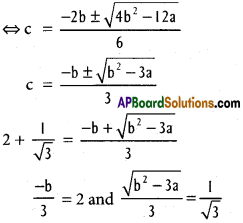
  4. This is also the part you sit on.

Question 14.
Write about the Skull?
Answer:

  1. The skull is made up of many bones joined together.
  2. It encloses and protects the brain.
    AP Board 6th Class Science Important Questions Chapter 12 Movement and Locomotion 8
  3. The joints between the skull bones are fused.
  4. They are also called fixed joints.
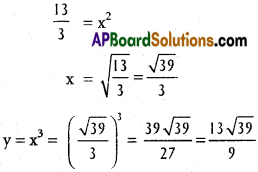
AP Board 6th Class Science Important Questions Chapter 12 Movement and Locomotion

Question 15.
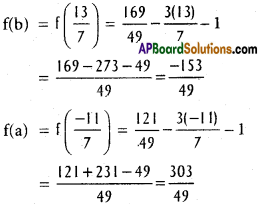
What is Cartilage? How it useful to the body?
Answer:

  1. Some parts of the ear and nose are soft and others are hard.
  2. The soft parts are made up of a structure called cartilage.
  3. This is also a bone but it is flexible.
  4. The cartilage is present in other parts of the skeleton as well, like, between the tips of the rib, eyelids, and sternum, between the vertebrae of the vertebral column, etc.
  5. It protects the ends of long bones at the joints and is a structural component of the rib cage, the ear, and the nose.

Question 16.
What are the joints? What are the types in it?
Answer:

  1. The point where two bones meet is called a Joint.
  2. The joints help us to bend, twist and turn.
  3. There are different types of joints in our body to help us carry out different movements and activities.
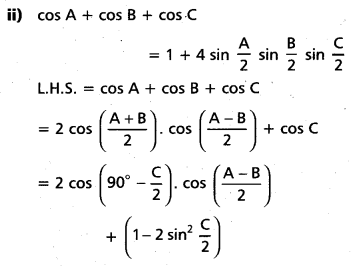
  4. The joints are divided into two types. 1. Movable joints 2. Immovable joints
Question 17.
Write about fixed joints?
Answer:

  1. Some joints between bones in our body can’t move, such joints are called fixed joints.
  2. These joints are fused and seem to be a single bone.
  3. These are present in the skull. When you open your mouth, you can move your lower jaw only.
  4. The remaining joints are fixed joints in the skull.

Question 18.
Write about locomotion in birds?
Answer:

  1. Birds fly in the air and walk on the ground.
  2. Birds can fly because their bodies are well suited for flying.
  3. Their bones are hollow and light.
  4. The bones of the hind limbs are typical for walking and perching.
  5. The forelimbs are modified as wings which help the bird in flight.
  6. Feathers also play an important role in flight mechanism.

Question 19.
Observe the hen and the sparrow. How do they move?
Answer:
Hen and Sparrows, both are birds but they have different styles in locomotion.

HENSPARROW
1. It can’t fly.1. It can fly.
2. Walking is main locomotion.2. It can jump and fly.
3. Legs are enough strong.3. Legs are thin and weak.
4. Wings are not enough strong to ; floats its body in air.4. Wings are enough strong to fly.

Question 20.
Describe the Locomotion in Snakes?
Answer:

  1. Snakes do not have limbs (legs).
  2. Snakes have a long backbone and several muscles.
  3. Usually, the snake’s body curves into many loops.
  4. Each loop of the snake gives it a forward push by pressing against the ground.
  5. This helps the snake move forward very fast.

AP Board 6th Class Science Important Questions Chapter 12 Movement and Locomotion

Question 21.
How do you observe the Locomotion in Snails?
Answer:

  1. Collect a snail from a garden.
  2. Place the snail on a glass plate and watch it when it starts moving.
    AP Board 6th Class Science Important Questions Chapter 12 Movement and Locomotion 9
  3. A thick structure may come out of an opening in the shell.
  4. The thick structure is its foot, made of strong muscle.
  5. The wavy motion of its foot is the reason why a snail moves slowly.

6th Class Science 12th Lesson Movement and Locomotion 8 Mark Important Questions and Answers

Question 1.
There are other ways in which snakes move. Try to find out about them. Collect those pictures, information and display them on wall magazine.
Answer:
Snakes have four ways of moving around. Since they don’t have legs they use their muscles and their scales to do the “walking”.

  • Serpentine method: This motion is what most people think of when they think of snakes. Snakes will push off of any bump or other surface, rocks, trees, etc., to get going. They move in a wavy motion. They would not be able to move over slick surfaces like glass at all. This movement is also known as lateral undulation.
    AP Board 6th Class Science Important Questions Chapter 12 Movement and Locomotion 10
  • Concertina method: This is a more difficult way for the snake to move but is effective in tight spaces.
    The snake braces the back portion of their body while pushing and extending the front portion. Then the snake drops the front portion of their body and straightens and pulls the back portion along. It is almost like they threw themselves forward.
    AP Board 6th Class Science Important Questions Chapter 12 Movement and Locomotion 11
  • Side winding: This is a difficult motion to describe but it is often used by snakes to move on loose or slippery surfaces like sand or mud. The snake appears to throw its head forward and the rest of its body follows while the head is thrown forward again.
    AP Board 6th Class Science Important Questions Chapter 12 Movement and Locomotion 12
  • Rectilinear Method: This is a slow, creeping, straight movement. The snake uses some of the wide scales on its belly to grip the ground while pushing forward with the others.
    AP Board 6th Class Science Important Questions Chapter 12 Movement and Locomotion 13

AP Board 6th Class Science Important Questions Chapter 12 Movement and Locomotion

Question 2.
Write about movable joints in Human beings?
Answer:
Movable joints are four types. They are:

  1. Ball-and-socket joint: The ball-shaped surface of one bone fits into the cup-like shape of another. Examples of a ball-and-socket joint include the hip and the shoulder.
  2. Hinge joint: The ends of the bones are shaped in a way that allows motion in two directions, forward and backward. Examples of hinge joints are the knees and elbows
  3. Pivot joint: Only allows rotating movement. The joint that joins the skull to the backbone is called the pivot or neck joint.
  4. Gliding joint: It is a joint which allows only gliding movement. The gliding joint allows one bone to slide over the other. The gliding joint in your wrist allows you to flex your wrist. It also allows you to make very small side-to-side motions. There are also gliding joints in your ankles and backbone.

Question 3.
How the fish swim in the water?
Answer:

  1. The body of the fish is streamlined.
  2. The shape is such that it allows the fish to move in water easily.
  3. The skeleton of the fish is covered with strong muscles.
    AP Board 6th Class Science Important Questions Chapter 12 Movement and Locomotion 14
  4. While swimming, muscles make the front part of the body swing towards one side while the tail swings its body towards the opposite side.
  5. This creates a jerk and pushes the body forward.
  6. A series of such jerks help the fish swim forward.
  7. The tail fins also aid in this movement.

Question 4.
Write about different types of Locomotion and their Locomotory Organs in a tabular manner.
Answer:
Animals show different types of locomotion with their locomotory organs. Those are:

LocomotionAnimalsLocomotary
Organ
Discription
1. SwimFishFinsFins and spindle body helps to fish in swimming.
2. FlyBirdsWingsBirds have strong feathered wings to fly.
3. CrawlSnakesScalesSnakes crawl with scales that are present at bottom of the body.
4. WalkManLegsAnimals use four legs to walk, but humans two.

AP Board 6th Class Science Important Questions Chapter 12 Movement and Locomotion

Question 5.
Observe the skeletal system of a bird and write their parts.
Answer:
AP Board 6th Class Science Important Questions Chapter 12 Movement and Locomotion 15

AP Board 6th Class Science Important Questions Chapter 6 Fun with Magnets

AP State Syllabus AP Board 6th Class Science Important Questions Chapter 6 Fun with Magnets

AP State Syllabus 6th Class Science Important Questions 5th Lesson Fun with Magnets

6th Class Science 6th Lesson Fun with Magnets 2 Mark Important Questions and Answers

Question 1.
Explain why do pins get attached to the cap of the pin holder.
Answer:
Pins get attached to the cap of the pin holder because it contains a magnet.

Question 2.
Why the natural magnets are called leading stones?
Answer:
Natural magnets are used for finding direction, So they are also called ‘leading stones’ or ‘lode stones’.

Question 3.
From which part of the magnet do you feel more difficulty in removing iron filings?
Answer:
I felt more difficulty in removing iron filings from the poles of the magnet.

Question 4.
What property of the magnet is used to make the magnetic compass?
Answer:
The directional property of the magnet is used to make the magnetic compass.

Question 5.
What is the important precaution you have to take with the magnetic compass?
Answer:
The magnetic compass and magnets should not be put together.

AP Board 6th Class Science Important Questions Chapter 6 Fun with Magnets

Question 6.
What will happen to the magnet when we cut it into two pieces?
Answer:
When we cut a bar magnet into two pieces, both these pieces act as magnets and we get two magnets.

Question 7.
How can you separate metal scrap from a heap of waste materials in a scrap yard?
Answer:
We can separate metal scrap from a heap of waste materials in a scrap yard with the help of magnets.

Question 8.
You are given a bar magnet How will you find out the west direction?
Answer:
The two poles of a bar magnet point towards the north and south direction, so the west direction can be easily located.

Question 9.
A carpenter by chance mixes iron nails and screws with wood shavings while working. How can you help him in getting back the nails and screws from the wood shavings?
Answer:
We can’ help him in getting back the nails and screw from wood shavings with the help of a magnet.

Question 10.
What is magnetic induction?
Answer:
The magnetic property possessed by a magnetic substance due to the presence of a magnet near it is called ‘magnetic, induction’.

Question 11.
What is the sure test for magnetism?
Answer:
Repulsion and not attraction is the sure test for magnetism.

Question 12.
What is meant by the directional property of magnets?
Answer:
A freely suspended magnet always come to rest in north and south directions. This property of magnets is called a directional property.

AP Board 6th Class Science Important Questions Chapter 6 Fun with Magnets

Question 13.
On what principle electromagnetic trains work?
Answer:
Electromagnetic trains work on the principle that – Magnetic objects can levitate by using repulsion.

Question 14.
Draw the diagram of the horseshoe magnets.
Answer:
AP Board 6th Class Science Important Questions Chapter 6 Fun with Magnets 1

6th Class Science 6th Lesson Fun with Magnets 4 Mark Important Questions and Answers

Question 1.
What are magnetic and non magnetic materials? Give examples.
Answer:

  1. The materials that are attracted by magnets are called magnetic materials.
  2. Examples: Iron, Steel, Cobalt, etc.
  3. The materials that are not attracted by magnets are called non-magnetic substances.
  4. Examples: Brass, Plastic, Wood, Paper, etc.

Question 2.
Which part of the bar magnet attracts more iron filings? What do you conclude from this?
Answer:

  1. The ends of the bar magnet attract more iron filings than the middle part of the magnet.
  2. We conclude that every bar magnet always has two ends whose attracting capacity is more than its other parts.
  3. These ends are called ‘Poles’ of the magnet.

Question 3.
When do magnets attract each other?
Answer:

  1. When two bar magnets with their opposite poles are placed side by side at a small distance the magnets attract each other.
  2. Opposite poles of the magnets attract.

Question 4.
When do the magnets repel each other?
Answer:

  1. When two magnets with their like poles are placed side by side at a small distance the magnets repel each other.
  2. Like poles of the magnets repel.

AP Board 6th Class Science Important Questions Chapter 6 Fun with Magnets

Question 5.
Fill up the following table.

PolesThey are calledWe observe
North – ……….. …………..Attraction
North – NorthSimilar poles……………..
……………….Similar polesRepulsion
South – NorthOpposite poles……………..

Answer:

PolesThey are calledWe observe
North – SouthOpposite polesAttraction
North – NorthSimilar polesRepulsion
South – SouthSimilar polesRepulsion
South – NorthOpposite polesAttraction

AP Board 6th Class Science Important Questions Chapter 6 Fun with Magnets

Question 6.
How is a compass used to find directions?
Answer:

  1. A compass has a magnetic needle attached to it which can rotates freely.
  2. The magnet always points to N – S direction which is marked on compass and thus help in finding direction.

Question 7.
Why is compass needle kept in a closed glass vessel?
Answer:

  1. The compass needle is a small and thin magnet used to find the direction.
  2. If it is kept in open, it may deflect in any direction.
  3. So to know right direction, it is kept covered by glass covering.

Question 8.
What is the use of a magnetic compass?
Answer:

  1. A magnetic compass is used to find directions.
  2. It is mostly used in ships and airplanes.
  3. Mountaineers and army people also carry a compass with them so that they do not lose their way in an unknown place.

Question 9.
Rajani needs some iron filings to conduct experiments with magnets. She don’t know how to collect them. Help her by explaining the process of collecting iron filings?
Answer:

  1. In the experiments with magnets, we need to use iron filings again and again.
  2. We can collect these by placing a magnet in a pile of sand and turning it around in the sand.
  3. The small pieces of iron present in the sand will stick to the magnet.
  4. If we cannot find sand we can look for iron pieces in clay soil as well.

Question 10.
‘Like poles repel each other and unlike poles attract each other” – How can you prove this statement?
Answer:

  1. Take two similar bar magnets.
  2. Bring the south pole of a bar magnet close to the south pole of another bar magnet. They repel each other.
  3. Now bring the north pole of a bar magnet close to the north pole of another bar magnet. They also repel each other. This confirms like poles repel each other.
  4. Now bring the south pole of a bar magnet to the north pole of another bar magnet, vice versa. They attract each other confirming that unlike poles attract each other.

AP Board 6th Class Science Important Questions Chapter 6 Fun with Magnets

Question 11.
How do the properties of magnets get destroyed?
Answer:

  1. Magnets lose their properties if they are heated or dropped from a height or hit with a hammer.
  2. Magnets lose their properties when they are placed near Cell phone, Computer, DVDs.
  3. Improper storage can also cause magnets to lose their properties.

Question 12.
Write the cations for the proper storage of magnets.
Answer:

  1. Improper storage can cause magnets to lose their properties.
  2. To keep them safe, bar magnets should be kept in pairs with their unlike poles on the same side.
  3. They must be separated by a piece of wood and two pieces of soft iron should be placed across their ends.
  4. For a horse-shoe magnet a single piece of soft iron can be used as a magnetic keeper across the poles.

Question 13.
What is a suspension train? On what principle it works?
Answer:

  1. An Electromagnetic train is called a suspension train or a flying train.
  2. It does not require either diesel or petrol.
  3. This technology uses the property of magnetic attraction and repulsion to run these super fast electromagnetic trains.
  4. Electromagnetic train work on the principle of magnetic levitation. That is – A magnetic object can levitate by using repulsion.

Question 14.
Write the differences between natural magnets and artificial magnets.
Answer:

Natural MagnetsArtificial magnets
1. They occur naturally in nature.1. They are man made magnets..
2. These are obtained from their ore.2. They are obtained by magnetization of magnetic materials such as iron.
3. They do not have definite shape3. They are prepared in different shapes such as round, ring, disc, horse shoe etc.
4. They are called lead stones or leading stones.4. They are named after their shapes.

AP Board 6th Class Science Important Questions Chapter 6 Fun with Magnets

6th Class Science 6th Lesson Fun with Magnets 8 Mark Important Questions and Answers

Question 1.
Describe the story of the discovery of magnets?
Answer:

  1. About 2500 years back in a place named magnesia in Greek, there lived a shepherd named Magnus.
  2. One day while his goats were grassing he took a hap on a rock by keeping his iron caped stick and iron nailed boots on that rock.
  3. When he woke up, he found that his iron-capped stick stuck on the rock and stood erect. His iron-nailed boots also stuck on the fock.
  4. The entire village assembled there to see this magic.
  5. People wondered about this incident, each and everyone expressed their views in different ways.
  6. People found it attractive not only the stick of Magnus but also all other materials made of iron.
  7. more rocks of these kinds were found worldwide.
  8. These magnetic rocks were named ‘Magnets’ and the ore is called ‘Magnetite’ after the name of the boy Magnus.

Question 2.
Describe the construction of a magnetic compass. How is it used? What are its uses? (Imp.)
Answer:
Magnetic Compass:
Description:

  1. A compass is usually a small box with glass covering it.
  2. A magnetized needle is pivoted inside the box in such a way that it can rotate freely.
  3. The compass also has a dial with directions marked on it.

Working with Compass:

  1. The compass is kept at the place where we wish to know the direction.
  2. Its needle indicates the North-South direction when it comes to rest.
  3. The compass is then rotated until the north and south marked on the dial are exactly below the two ends of the needle.
  4. To identify the North pole of the magnetic needle, it is usually painted in a different color (see Fig.).
    AP Board 6th Class Science Important Questions Chapter 6 Fun with Magnets 2
  5. Then we identify north and south at that place.
  6. After that we can also identify the East and West between them.

Uses:

  1. A compass is used to find directions and in ships & airplanes.
  2. Mountaineers and army people also carry a compass with them so that they do not lose their way in an unknown place.

AP Board 6th Class Science Important Questions Chapter 6 Fun with Magnets

Question 3.
Observe the picture and answer the following questions.
AP Board 6th Class Science Important Questions Chapter 6 Fun with Magnets 3
a) What are the materials required to do this experiment?
b) What precautions you would take while doing this experiment?
c) In which direction the magnet show when it stands rest?
d) What is the instrument made based on this experiment/property?
Answer:
a) Required material:

  1. Bar magnet
  2. Thread
  3. Stand

b) Suspend the bar magnet freely with help of a strong thread tied to the center of the bar magnet.
c) North-South direction.
d) Magnetic compass.

Question 4.
i) According to the pictures write whether rat attracts or repels to the food in the bowl.
ii) Give reasons.
AP Board 6th Class Science Important Questions Chapter 6 Fun with Magnets 4
Answer:
A) Rat attracts to the food in the bowl.  Reason: Unlike poles attract each other.
B) Rat repels to the food in the bowl. Reason: Like poles repel each other.
C) Rat attracts to the food in the bowl. Reason: Unlike poles attract each other.
D) Rat repels to the food in the bowl. Reason: Like poles repel each other.

Question 5.
Observe the picture.
AP Board 6th Class Science Important Questions Chapter 6 Fun with Magnets 5
i) Identify the name of the picture.
ii) In which direction the magnet needle show when it comes to rest?
iii) What property of the magnet is used to make the instrument?
iv) What is the use of that Instrument?
Answer:
i) Magnetic, compass.
ii) North-South direction.
iii) The directional property of the magnet is used to make the magnet compass.
iv) We use it to find out the direction.

Question 6.
How do you find whether the given object is a magnet or not? You are given three objects of the same size, shape, and color and a bar magnet. Describe your activity.
Answer:
The procedure of the activity:
I bring three objects one after the other close to one pole of the bar magnet and observe whether they get attracted, repelled, or not attracted.
Conclusions:

  1. If an object is attracted by one pole of the bar magnet and repelled by its other pole, then I can say that it is a magnet.
  2. If an object is attracted by both the poles of a bar magnet and not repelled by any
    pole, then I can say that it is not a magnet but a magnetic substance.
  3. If an object is neither attracted by a magnet nor repelled by it, then I can say that it is neither a magnet nor a magnetic substance.

AP Board 6th Class Science Important Questions Chapter 6 Fun with Magnets

Question 7.
Write a short note on the properties of magnets.
Answer:

  1. Magnets attract magnetic materials.
  2. A magnet always has two ends whose attracting capacity is more than the parts of it. The poles of the magnet lie at these birds.
  3. Each magnet has two magnetic poles: North and South.
  4. Like Poles (N-N, S-S) repel each other and unlike poles (N-S, S-N) attract each other.
  5. A freely suspended magnet always aligns in the North-South direction.
  6. Magnets lose their properties if they are heated or dropped from a height hit with a hammer.

Question 8.
How can you prove that a bar magnet possesses two poles?
Answer:
Aim: To prove that a bar magnet possesses two poles.
AP Board 6th Class Science Important Questions Chapter 6 Fun with Magnets 6
What do you need? (Materials required): Iron filings, a sheet of paper, bar magnet.
What to do? (Procedure):

  1. Spread some iron fillings uniformly on a sheet of paper.
  2. Place a bar magnet below this sheet.

What do you see? (Observation):

  1. We will notice that the uniformly spread iron filings come close and get concentrate at two points of the paper sheet.
  2. At some distance, we will find some scattered iron filings between these two points.

What do you learn? (Result): Thus the ends of the bar magnet attract more iron filings than the middle part of the magnet. By this activity we can conclude that every bar magnet always has two ends whose attracting capacity is more than its other parts. These ends are called poles of the magnet.

Question 9.
How can you demonstrate the directional property of a bar magnet?
Answer:
Aim: To demonstrate the directional property of a bar magnet.
What do you need? (Materials required): Bar magnet, thread, stand and colour.
What to do? (Procedure):

  1. Suspend the bar magnet freely with the help of a thread tied around its center.
    AP Board 6th Class Science Important Questions Chapter 6 Fun with Magnets 7
  2. The magnet finally takes a position in the North-South direction.
  3. Mark the end points towards the North with some color.
  4. Now disturb the magnet and again wait for some time.

What do you see? (Observation):
Magnets always come to rest in the North-South direction. In each case the marked endpoints towards North.
What do you learn? (Result): The marked end is known as the North pole of the magnet. The other end, which points towards the South is known as the South pole of the magnet. This property of magnets is called directional property.

AP Board 6th Class Science Important Questions Chapter 6 Fun with Magnets

Question 10.
Draw different shapes of magnets available in your area.
Answer:
AP Board 6th Class Science Important Questions Chapter 6 Fun with Magnets 8

AP Board 6th Class Science Important Questions Chapter 11 Shadows – Images

AP State Syllabus AP Board 6th Class Science Important Questions Chapter 11 Shadows – Images

AP State Syllabus 6th Class Science Important Questions 11th Lesson Shadows – Images

6th Class Science 11th Lesson Shadows – Images 2 Mark Important Questions and Answers

Question 1.
What is the need of light?
Answer:
We need light to see objects.

Question 2.
What is light of source?
Answer:
Substance which gives light is known as a source of light.

Question 3.
When the shadows are formed?
Answer:
Shadows are formed when opaque objects obstruct the path of light.

AP Board 6th Class Science Important Questions Chapter 11 Shadows - Images

Question 4.
What we need to obtain shadow?
Answer:
In addition to light and object we also need a screen to obtain the shadow of an opaque object.

Question 5.
Are you guess the colour of object by its shadow?
Answer:
The colour of objects cannot be determined by looking at their shadows.

Question 6.
How the light travels?
Answer:
Light travels in a straight line.

Question 7.
When the light reflected?
Answer:
Light gets reflected when it falls on any object.

Question 8.
How do the people know that light travels in a straight line?
Answer:
People came to an understanding that light travels in a straight line by observing the shapes of shadows.

Question 9.
Why am I not able to see the objects clearly when it gets dark?
Answer:
In the dark light is not sufficient to see the objects.

Question 10.
Why am I not able to see the objects when the power goes off?
Answer:
When the power goes off light is absent. So we can’t see the objects.

Question 11.
How are we able to see the objects in the presence of light?
Answer:
The light reflects eyes that fell on objects. So we are able to see the objects.

AP Board 6th Class Science Important Questions Chapter 11 Shadows - Images

Question 12.
Why are we not able to see the objects in the absence of light?
Answer:
Light is the source of visible since. So without light, we can’t see anything.

Question 13.
What are the conditions to form a shadow?
Answer:
We need a source of light and an opaque object and a screen to get a shadow.

Question 14.
How in ancient days, people came to an understanding that light travels in a straight line?
Answer:
In ancient days, by observing the shapes of shadows people came to an understanding that light travels in a straight line.

6th Class Science 11th Lesson Shadows – Images 4 Mark Important Questions and Answers

Question 1.
How can we see the objects?
Answer:

  1. When we put on the bulb, light falls on the object, bounces from the object and reaches us.
  2. We can see an object only when light falls on it and bounces back to our eyes.
    AP Board 6th Class Science Important Questions Chapter 11 Shadows - Images 1
  3. The object is visible when there is no obstruction between your eyes and the object.
  4. It means light travels in straight lines.

Question 2.
How do you classify the objects according to light traveling through them?
Answer:

  1. The substances like paper, plank, wood, iron, etc. don’t allow light to pass through them. These objects form shadows. These are called opaque substances.
  2. The substances like glass and air allow light to pass through them and hence we don’t get their shadows. Such substances are called transparent substances.
  3. The substances such as polyethylene cover and oily paper partially allow the light to pass through them. Their shadows are unclear. These substances.

AP Board 6th Class Science Important Questions Chapter 11 Shadows - Images

Question 3.
Write about shadow puppet?
Answer:

  1. Shadow puppetry is one of our traditional recreational activities.
  2. In this, some puppets are used to form shadows on a screen and a story is narrated with the help of these shadows.
    AP Board 6th Class Science Important Questions Chapter 11 Shadows - Images 2
  3. By using this art old epics like Ramayana and Maha Bharat were played.
  4. Now a days this old art losses its glow.

Question 4.
Write the difference between opaque and transperent substances?
Answer:
Opaque: An object which does not allow light to pass through it and you are not able to see the objects behind your opaque material.
Transparent: An object that allows light to pass through it and you can see the objects behind your transparent material.

Question 5.
Vivek said that light and object are enough to form a shadow? Are you agree with him?
Answer:
No. I can’t agree with this statement. I understand that only light and an opaque object are not enough to form the shadow of an object. In addition to these, we need a screen.

Question 6.
Can we guess the object by observing its shadow?
Answer:

  1. Mostly we guess the object by observing its shadow.
  2. But it is not always possible.
  3. Sometimes the shadow may differ from the shape of the object.
  4. Because of light source position and shape of the object.

Question 7.
What is a pinhole camera?
Answer:
It is a small instrument that works on the light.
With this camera, we can observe a big object through a pinhole.
On the screen, it forms a little reverse image without a lance.
The nature of the straight-line motion of light can also be understood by this one.

Question 8.
Look at a tree through the pinhole camera. What do you see?
Answer:
When I observe the tree in the pinhole camera

  1. the image is small.
  2. it is inverted on the screen.
  3. it is colorful.
  4. and appear near to me.

AP Board 6th Class Science Important Questions Chapter 11 Shadows - Images

Question 9.
Predict what would happen if we make two pin-holes in the camera?
Answer:

  1. If we make two pin-holes in the camera I predict that images are not clear.
  2. But it is a wonder that it forms two images, both are clear.

Question 10.
We see our faces in the mirror every day. Is the picture in the mirror a shadow or an image? How did you decide that?
Answer:

  1. The picture in the mirror is an image.
  2. We know that shadows are not colored but an image has colors that are the same as that of the object.
  3. A shadow shows only the outline of the object but an image shows the complete object as it is, just like a photograph.
  4. The picture in the mirror has color and shows a complete object. So its an imaged

Question 11.
Can you show the difference between a shadow and an image through a drawing?
Answer:
Yes, we can show the difference between shadows and images through a drawing.

  1. In images, we can use color and draw the whole picture.
  2. Whereas in shadows we draw only outline and fill with black.

6th Class Science 11th Lesson Shadows – Images 8 Mark Important Questions and Answers

Question 1.
How do you prove that screen is necessary to form shadow?
Answer:
Aim: To prove that screen is necessary to form shadow.
Materials: Torch, leaf, darkroom, drawing sheet, or plank.
Procedure:

  1. Do this activity in a dark room with a torch and a leaf.
  2. Focus the light on the leaf with a torch.
  3. Keep the distance about 30 cm between the leaf and the torch.
    AP Board 6th Class Science Important Questions Chapter 11 Shadows - Images 3
  4. Now the shadow is formed in the wall.
  5. Now put the torch under the leaf at a distance of about 30cm.
  6. Now the shadow is formed on the roof.
  7. Do the same activity, in the open air (outside) at night.
  8. Now we can’t find any shadow outside.
    AP Board 6th Class Science Important Questions Chapter 11 Shadows - Images 4
  9. Place a drawing sheet or a plank at a distance of 1 m. above
  10. Now we can find a shadow on the drawing sheet.
  11. It means the screen is needed to form shadows.

Conclusion: It is proved that screen is needed to form shadows.

AP Board 6th Class Science Important Questions Chapter 11 Shadows - Images

Question 2.
Write the process of making a pinhole camera? (Activity – 6)
Answer:
Aim: Making a pin-hole camera.
Materials: A PVC pipe, about 8 cm in diameter and of length 30 cm.
A PVC pipe, about 7 cm in diameter and of length 20 cm.
One black drawing sheet. Oil -1 ml, two rubber bands, a pin, and A4 Sheet. (If you cannot get PVC pipes, take a thick sheet of paper and roll it to form tubes. The diameter and length of the tubes should be the same as that given for the pipes.)
Procedure:

  1. Cut a piece of black paper and put it like a cap at one end of the big pvc pipe and fix it with a rubber band as shown in the figure.
    AP Board 6th Class Science Important Questions Chapter 11 Shadows - Images 5
  2. Put the white paper like a cap at one end of the thinner PVC pipe.
  3. Fix it with a rubber band, now make a hole in the middle of the black paper cap with the help of a pin.
  4. Put 2 to 3 drops of oil on the white paper cap so that it becomes translucent.
  5. Insert the thin pipe into the big pipe. Your pinhole camera is ready

Working:

  1. Arrange a lighted candle in front of the pinhole of the camera.
    AP Board 6th Class Science Important Questions Chapter 11 Shadows - Images 6
  2. Move the thinner pipe forward and backward to get a clear picture of the candle on the screen of the thin pipe.
  3. This picture is to be observed from the back of the thin pipe.
    Observation: The flame of the candle appears inverted on the screen. This is not the shadow of the candle. It is its image.

AP Board 6th Class Science Important Questions Chapter 11 Shadows - Images

Question 3.
Why the image in the pinhole camera is inverted?
Answer:

  1. The light from the candle travels straight in all directions from each point of the flame of the candle.
  2. But only the light coming in some particular directions can enter into the camera through its pin-hole.
    AP Board 6th Class Science Important Questions Chapter 11 Shadows - Images 7
  3. The light that comes from the point at the top of the flame goes straight towards the bottom of the screen.
  4. And the light that comes from the point at the bottom of the flame goes straight towards the top of the screen.
  5. In this way, the light coming in a particular direction from each point of the flame will be able to enter into the pin-hole.
  6. And light going in other directions is blocked by the black sheet.
  7. This leads to the formation of an inverted image.
  8. The formation of an inverted image on the screen of the pinhole camera explains that light travels in a straight line.

AP Board 6th Class Science Important Questions Chapter 10 Basic Electric Circuits

AP State Syllabus AP Board 6th Class Science Important Questions Chapter 10 Basic Electric Circuits

AP State Syllabus 6th Class Science Important Questions 10th Lesson Organisms and Habitat

6th Class Science 10th Lesson Organisms and Habitat 2 Mark Important Questions and Answers

Question 1.
What does a cell contain?
Answer:
A cell contains some chemical substances which can produce electricity with two terminals.

Question 2.
Many times in our houses we observe that though electricity is available some bulbs glow and some don’t glow. What could be the reason for that?
Answer:
The filament might have been fused off.

Question 3.
What is current?
Answer:
The flow of electricity in a circuit is called current.

AP Board 6th Class Science Important Questions Chapter 10 Basic Electric Circuits

Question 4.
Do not connect the two terminals of a cell with a single wire. Give reason.
Answer:

  1. We should never connect the two terminals of a cell with a single wire.
  2. If we do so, the chemicals in the cell get used up very fast and the cell stops working.

Question 5.
What is filament?
Answer:
The part of the bulb that glows is the filament, which is a thin spring-like wire attached to the two metal wires inside the glass bulb.

Question 6.
What is the switch?
Answer:
The switch is a device used to close or open an electric circuit.

Question 7.
What is the purpose of a switch?
Answer:
We use switches to put ON or put OFF the torchlight.

Question 8.
Is our body insulator or conductor?
Answer:
Our body is a good conductor of electricity.

Question 9.
Why is the handle of the electrician’s screwdriver made of plastic?
Answer:

  1. Plastic is a bad conductor and does not allow current to pass through it.
  2. So, the electrician has a plastic handle to protect him from any shock.

AP Board 6th Class Science Important Questions Chapter 10 Basic Electric Circuits

Question 10.
What is the difference between our present bulbs and the Edison bulb?
Answer:

  1. Today we use the same kind of bulbs as were first made by Edison.
  2. The only difference is that our bulbs have a filament made of a metal called Tungsten.

6th Class Science 10th Lesson Organisms and Habitat 4 Mark Important Questions and Answers

Question 1.
What is the use of a switch in a circuit?
Answer:

  1. The switch allows the flow of electricity when it is ON and cuts off the flow of electricity when it is OFF.
  2. In this way, the switch is used to allow / stop the flow of electricity to the bulb or any other electrical device.
    Label the parts in the following figure.

Question 2.
Label the parts in the following figure.
AP Board 6th Class Science Important Questions Chapter 10 Basic Electric Circuits 1
Answer:
1. Glass chamber
2. Filament
3. Metal cap
4. Terminals

Question 3.
Match the following by seeing the figure.
AP Board 6th Class Science Important Questions Chapter 10 Basic Electric Circuits 2
AP Board 6th Class Science Important Questions Chapter 10 Basic Electric Circuits 7
Answer:
a – q,
b – r,
c – s,
d – p

AP Board 6th Class Science Important Questions Chapter 10 Basic Electric Circuits

Question 4.
Observe the following figure.
AP Board 6th Class Science Important Questions Chapter 10 Basic Electric Circuits 3
Does the bulb glow or not? Why?
Answer:

  1. Yes, the bulb will glow.
  2. Since the connections are
    perfectly done in the closed circuit.

Question 5.
Observe the following figure.
AP Board 6th Class Science Important Questions Chapter 10 Basic Electric Circuits 4
Does the bulb glow or not in the arrangement which shown in figure? Why?
Answer:

  1. No, the bulb will not glow.
  2. Here in this arrangement the circuit is not completed.
  3. The handle of the screw is an insulator.

Question 6.
Would the bulb glow in the circuit shown in figure? Why?
Answer:

  1. No, the bulb will not glow.
    AP Board 6th Class Science Important Questions Chapter 10 Basic Electric Circuits 5
  2. This is because an electric bulb glow up only when circuit is completed and eraser is a non – conducting material.

Question 7.
Give reasons for the following:
a) Electric wires are made of copper.
b) We should not operate electric switches with wet hands.
Answer:
a) Copper is a good conductor of electricity.
b) Water is a good conductor of electricity and we might get an electric shock.

AP Board 6th Class Science Important Questions Chapter 10 Basic Electric Circuits

Question 8.
What was the story of the bulb ? Who ultimately succeeded in making the first bulb?
Answer:

  1. The story of invention of bulb is very interesting.
  2. We may think that a bulb is a very sinjple gadget, just press a switch and it lights up.
  3. But many scientists worked hard for many years before the first successful bulb was made.
  4. One of them was Thomas Alva Edison who ultimately succeeded in making the first bulb.

Question 9.
What was the nature of Thomas Alva Edison?
Answer:

  1. From childhood, Edison was of an inquisitive nature and he learned science by performing experiments himself.
    AP Board 6th Class Science Important Questions Chapter 10 Basic Electric Circuits 6
  2. We will be amazed to know that in his life time he invented more them one thousand inventions.
  3. Even an intelligent scientist like Edison had to work hard for many years before he could make a bulb that worked.

Question 10.
Why do bulbs and cells have two terminals?
Answer:

  1. Current needs a closed path in order to flow.
  2. To form a closed path there should be two terminal – one for inlet and another for an outlet.
  3. So in order to complete the circuit bulbs and cells have two terminals.

AP Board 6th Class Science Important Questions Chapter 10 Basic Electric Circuits

Question 11.
How does a bulb glow with the help of a cell?
Answer:

  1. Cell is the source of energy that produces electricity from the chemical stored inside it.
  2. When the terminals of the bulb are connected with that of the electric cell by wires, the current passes through the filament of the bulb.
  3. As a result the filament gats heated up and emits the light.
  4. This makes the bulb glow.

6th Class Science 10th Lesson Organisms and Habitat 8 Mark Important Questions and Answers

Question 1.
Describe the construction of a torch-bulb.
Answer:

  1. A torch bulb consists of a glass chamber fixed on a metal base.
  2. Two metal wires are firmly fixed.
    AP Board 6th Class Science Important Questions Chapter 10 Basic Electric Circuits 8
  3. One wire is attached to the metal cap and the other is attached to the base at the center of the metal cap.
  4. These wires act as two terminals. The two terminals do not touch each other.
  5. The part of the bulb that glows is the filament, which is a thin spring-like wire attached to the two metal wires inside the glass bulb.

Question 2.
How do you test when the electric bulb glows with a cell? Describe the activity you do with simple electric circuits.
Answer:
Aim: To test when do the electric bulb glows with a cell.
What do you need? (Materials required): Four wires of different colors each about 15 cm long, a bulb, a cell, a cello-tape or cell-holder
How to do? (Procedure):

  1. Take four wires of different colors, say blue, green, red and yellow, each about 15 cm long.
  2. Electric wires are often covered with plastic. First, remove about two centimeters of the plastic covering, from both ends of each wire.
  3. Now attach two wires (Blue and Green) to a bulb and two Wires (Red and Yellow) to a cell with a cello-tape or cell-holder as shown in Fig.
  4. We can use a cell holder to hold the cells and wires together tightly.
  5. Now connect the wires in different forms as shown in Fig. 4(b) to 4(g).
    AP Board 6th Class Science Important Questions Chapter 10 Basic Electric Circuits 9
  6. In each case, check whether the bulb glows or not.
  7. Record your observations in the table.
    ConnectionDoes the bulb glow (Yes / No)
    Fig (b)No
    Fig (c)No
    Fig (d)Yes
    Fig (e)Yes
    Fig (0No
    Fig (g)No

What do you see? (Observation): You may observe that the bulb glows in connections shown in Fig. 4(d) and Fig. 4(e), but not in other cases.
What do you learn? Result: We noticed that in Fig. (d) and Fig. 4(e) the connections form a closed path while in the remaining cases we find some gap in the path.

AP Board 6th Class Science Important Questions Chapter 10 Basic Electric Circuits

Question 3.
Write an activity showing the working of a switch in a circuit.
Answer:
Aim: To show the working of switch in a circuit.
What do you need? (Materials required: a cell (power source, a bulb, connecting wires, wooden plank or thermocol sheet, two drawing pins, and the materials provided to test.
How to do it? (Procedure):

  1. Connect à èirÙit on a wooden plank or on a thermocol sheet as shown in Fig.
  2. Insert two drawing pins at A and B.
    AP Board 6th Class Science Important Questions Chapter 10 Basic Electric Circuits 10
  3. Insert a safety pin in between A and B, such that one end of the pin is completely in contact wLth Rand the other end is left free.
  4. Now observe the bulb.
  5. Now touch the safety pin to pin A and observe the bulb again

What do you see? (Observation): The bulb doesn’t glow when the safety pin left free at one end. But it glows when the safety pin touches pin A.
What do you learn? (Result): In this activity, the safety pin is used to close /open the circuit. Similarly, An electric switch is an arrangement to close or open (break) a circuit. The switch allows the flow of electricity when it is on and cuts off the flow of electricity when it is off. In this way, the switch is used to allow/stop the flow of electricity to the bulb or any other electrical device.

Question 4.
Describe the trials of Edison to make a bulb.
Answer:

  1. First of all, Edison passed electricity through a thin, thread-like platinum wire.
  2. He noticed that the wire did give out the light after being heated, but it burned out after only a few seconds.
  3. He made a glass casing and fitted a filament of platinum wire in it.
    AP Board 6th Class Science Important Questions Chapter 10 Basic Electric Circuits 11
  4. He then removed all the air from within the glass casing.
  5. He passed an electric current through the wire and, to his delight, the bulb lit up and did not burn out for eight long minutes.
  6. He began experimenting with different materials while searching for a better choice of filament.
  7. He tried cotton thread coated with soot. This filament burned continuously for 45 hours.
  8. He tried different kinds of thread.
  9. Finally, he succeeded in making a cotton filament that was even better than the bamboo one.

AP Board 6th Class Science Important Questions Chapter 10 Basic Electric Circuits

Question 5.
Label the parts 1, 2, 3, 4, 5, 6, 7 and 8 in Torchlight.
AP Board 6th Class Science Important Questions Chapter 10 Basic Electric Circuits 12
Answer:

  1. Hollow cylindrical barrel
  2. Metal spring
  3. Cells
  4. Switch
  5. Copper wire
  6. Reflector
  7. Glass
  8. Bulb

Question 6.
Observe the given diagram.
AP Board 6th Class Science Important Questions Chapter 10 Basic Electric Circuits 13
Now answer the following questions.

  1. In a bulb which part gives us light?
  2. What is the use of a switch in a circuit?
  3. What is the filament made of?
  4. What does a torch consist of?
  5. What is a source of electrical energy in a torchlight?
  6. Which of the following acts as the negative terminal of a torchlight?

Answer:

  1. Filament.
  2. The switch helps us to allow or break the flow of current in a circuit.
  3. Tungsten.
  4. Torchlight consists of a cell, bulb, and switch.
  5. Cell.
  6. Zinc plate or Zinc container.