AP Board 7th Class Social Studies Notes Chapter 10 Importance of Transport System

Students can go through AP State Board 7th Class Social Studies Notes Chapter 10 Importance of Transport System to understand and remember the concept easily.

AP State Board Syllabus 7th Class Social Studies Notes Chapter 10 Importance of Transport System

→ In our daily life, we use various vehicles to go from one place to another.

→ In India, most roads are built and maintained by the government.

→ National Highways are built across different states in the country.

→ One-fifth of travellers in India use trains.

→ Railways are mainly used to transport goods like coal, iron ore, fertilizers, cement, food grains etc.

→ There are six domestic airports in Andhra Pradesh – Visakhapatnam, Tirupathi (Renigunt), Rajamundry, Vijayawada (Gannavaram), Puttaparthi and Kadapa.

→ Almost all goods traded by Indian traders are transported to other countries through ports. Port cities or towns are thus major trading centres. Andhra Pradesh has 15 ports out of which Visakhapatnam is the largest one.

→ Most people in Andhra Pradesh depend on roads for travel.

→ Nearly one crore vehicles are running on Andhra Pradesh roads and about three fourth of them are two-wheelers.

→ If the cost of travel is high, people may not be able to move from one place to another.

AP Board Solutions AP Board 7th Class Social Studies Notes Chapter 10 Importance of Transport System

→ Most cities In our country are now experiencing congestion and traffic blocks.

→ Motorcycles and cars are used in a big way. This has led to the use of more petrol and diesel, which increase air pollution.

→ To reduce pollution we should consume less of these petroleum products. Public transport can help in this aspect as they carry more people with minimum cost.

→ Road travel nowadays has become riskier.

→ The first week of every year, the Road transport departments all over the country celebrate Road Safety Week.

→ Government-run companies such as the Andhra Pradesh State Road Transport Corporation conduct awareness campaigns among drivers and give them the training to drive safely.

→ Every person using transport system – roads, railways or airways and those working in them are required to follow specific safety rules.

→ Safety travelling: Travelling without worries or accidents.

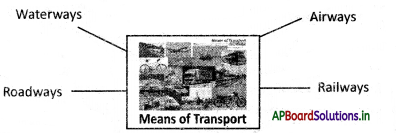
→ Roadways: Connecting the people in remote areas with the main cities.

→ Airways: Transporting through the air by using aeroplanes, helicopters, etc. It is costlIest transport.

→ Waterways: Transporting through canals, rivers, oceans, etc., through ports. Cheapest transportation.

→ Railways: Railways are mainly used to transport goods like coal, iron ore, fertilizers, cement, etc., One fifth of the travellers in India use trains.

→ National Highway: Roads built across different stat€s in the country.

→ State Highway: Roads connecting small towns and districts within the state.

→ Village / Rural roads: Roads connecting small villages and are maintained by panchayats.

→ Urban roads: Roads connecting töwnandcities and are maintained by Corporations and Municipalities.

→ Border roads: Roads laid along the international boundaries are called border roads.

AP Board Solutions AP Board 7th Class Social Studies Notes Chapter 10 Importance of Transport System

→ APSRTC: Andhra Pradesh State Road Transport Corporation is a government-owned transport service That employs about 1,20,000 people to run about 20,000 buses.

→ Congestion: Overcrowding with too much traffic.

→ Registration: The action of registering

→ Driving licence: Grant a permit to drive

→ Transport: Carry people or goods from one place to another by means of a vehicle, aircraft or ship.

→ Traffic: Vehicles moving on Public Roads.

→ Signal: A gesture, action or sound giving information or instruction.

→ Pavement: A raised path for pedestrians at the side of a road.
AP Board 7th Class Social Studies Notes Chapter 10 Importance of Transport System 1

AP Board 7th Class Social Studies Notes Chapter 14 Mughal Empire

Students can go through AP State Board 7th Class Social Studies Notes Chapter 14 Mughal Empire to understand and remember the concept easily.

AP State Board Syllabus 7th Class Social Studies Notes Chapter 14 Mughal Empire

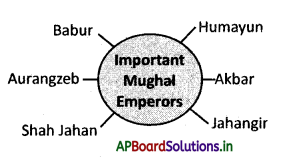
→ Babur founded the Mughal Empire in India in 1526 AD. He established control over Agra and Delhi.

→ Humayun was defeated by Sher Khan. He recaptured Delhi with the help of Safavid Shah- in 1555.

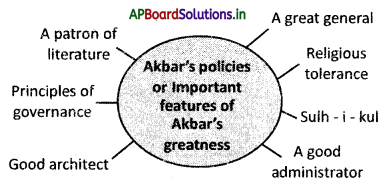
→ Akbar became the emperor at the early age of 13. He rapidly conquered Bengal, Central India Rajasthan, and Gujarat. He was the greatest of all the Mughal emperors.

→ Jahangir continued the conquests started by Akbar.

→ Shah Jahan continued campaigns in the Deccan. He faced many revolts by nobles and chiefs. Shah Jahan was imprisoned by Aurangazeb.

→ Aurangazeb faced a large number of revolts all over his kingdom. Shivaji and his own son Akbar revolted against him.

→ Mughal rulers campaigned constantly against rulers who refused to accept their authority.

→ The Mughals married princesses of many of the local rulers as a mark of friendship.

→ The Mughals recruited diverse kinds of people, who included Iranians, Indian Muslims, Afghans, Rajputs, Marathas, and other groups.

→ The Mughals developed the Mansabdari system in which Mansabdars should not act independently, but they should act as per the wishes of their emperor.

→ Akbar’s revenue minister Todar Mai carried out a careful survey of crop yields, prices, and areas for ten years. On the basis of this data, the tax was fixed on each crop in cash.

AP Board Solutions AP Board 7th Class Social Studies Notes Chapter 14 Mughal Empire

→ Today Mai started a revenue system known as Zabt, in which each province was divided into revenue circles with its own schedule of revenue rates for individual crops.

→ The broad features of administration were laid down by Akbar.

→ Akbar wanted to bring together people of all faiths. During the 1570s he started discussions on religious matters with Muslim scholars, Brahmins, Jesuits, and Zoroastrians.

→ Akbar, with the help of Abut Fazl, framed the vision of governance, i.e., the emperor would work for the welfare of all subjects irrespective of their religion or social status.

→ The administrative and military efficiency of the Mughal Empire led to great economic

→ Mansabdar: A-Rank holder, who had joined the Mughals.

→ Jagirdar: One who looked after the Jagirs,

→ Jager: It was a type of feudal land grant in South Asia at the foundation of its Jagirdat system.

→ Zabt: Revenue collected on the basis of the schedule of revenue rates for individual crops is known as Zabt.

AP Board Solutions AP Board 7th Class Social Studies Notes Chapter 14 Mughal Empire

→ Elite: Headman or local chieftains.
(OR)
The enormous wealth and resources were commanded by the Mughal nobility.
AP Board 7th Class Social Studies Notes Chapter 14 Mughal Empire 1
AP Board 7th Class Social Studies Notes Chapter 14 Mughal Empire 2

AP Board 6th Class Social Studies Notes Chapter 3 Maps

Students can go through AP State Board 6th Class Social Studies Notes Chapter 3 Maps to understand and remember the concept easily.

AP State Board Syllabus 6th Class Social Studies Notes Chapter 3 Maps

→ We use maps when we want to study the Earth horizontally as a part, such as a country, state, district, town, village, and world as a whole.

→ A rough drawing drawn without scale and directions mainly based on memory and spot observation and not to scale is called a sketch.

→ A map is a representation of the whole Earth or a part of it, on a flat surface according to ^proportionate scale. –

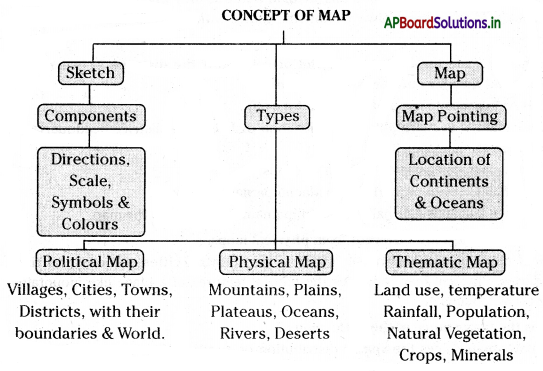
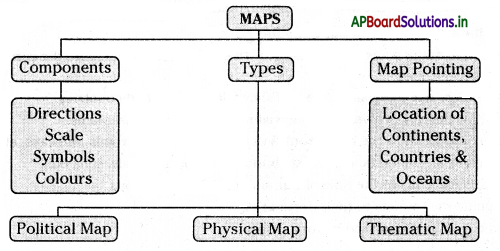
→ A map must have certain components like direction, scale, symbols, etc.

→ Main components of a map. 1.Directions 2. Scale 3. Symbols 4.Colours.

→ North, South, East, and West are called Cardinal directions. Among these four direc¬tions North is treated as principal direction. So all the maps contain a North arrow with the letter N at the top right-hand corner.

→ intermediate directions are North-East (NE), South-East (SE), South-West (SW), and North-West (NW). We can locate any place more accurately with the help of these intermediate directions.

→ Scale is another component of a map. The scale of a map is the ratio of a distance on a map to the corresponding distance on the actual ground. A scale can be used to figure out the distance between two locations on a map.

→ With the use of these symbols, maps can be drawn easily. With the symbols, maps are simple to read. Symbols give a lot of information in a limited space. Even if we don’t know the language of an area we can know the information from maps with the help of symbols.

AP Board Solutions AP Board 6th Class Social Studies Notes Chapter 3 Maps

→ The colors used in the maps represent different physical features.

→ Maps can be classified into three types. They are :

  1. Political Maps
  2. Physical Maps
  3. Thematic Maps

→ Political maps show villages, cities, towns, districts, states, and countries with their boundaries.

→ Large landmasses on the World map are called Continents. Large water bodies on the World maps are called Oceans.

→ Physical maps show the physical features such as Mountains, Plateaus, Plains, Oceans and Rivers, Deserts, etc.

→ Thematic maps show the distribution of specific features such as land use, temperature, rainfall, population, soils, natural vegetation, crops, minerals, industries, railways, roads, waterways, etc.

→ There are two types of maps based on scale.

  1. Large-scale maps
  2. Small-scale maps

→ Large-scale maps: These maps represent small areas. They can be divided into Cadastral maps and Topographical maps. Cadastral maps show the individual property. Topographical maps show detailed surface features.

→ Small-scale maps: They represent large areas – World, Continents or Countries. They are of two types:

  1. Wall maps and
  2. Atlas maps.

→ Map: Diagrammatic representation of an area of land or sea showing physical features, cities, roads, etc.

→ Sketch: Drawing based on memory and spot observation and not to scale.

→ Plan: Drawing a small area on a Large scale.

→ Scale: Ratio between the actual distance on the ground and the distance shown on the map with the help of scale.

AP Board Solutions AP Board 6th Class Social Studies Notes Chapter 3 Maps

→ Cardinal directions: Directions of North, East, South, and West, denoted by N, E, S, W.

→ Intermediate directions: Direction between to cardinal directions (northeast, southeast, southwest, and northwest)

→ Compass: Drawing circles and arcs and measuring distances between points.
AP Board 6th Class Social Studies Notes Chapter 3 Maps 1
AP Board 6th Class Social Studies Notes Chapter 3 Maps 2

AP Board 7th Class Social Studies Notes Chapter 9 Production in a Factory – A Paper Mill

Students can go through AP State Board 7th Class Social Studies Notes Chapter 9 Production in a Factory – A Paper Mill to understand and remember the concept easily.

AP State Board Syllabus 7th Class Social Studies Notes Chapter 9 Production in a Factory – A Paper Mill

→ Factories produce goods on a large scale, with the help of machines and a large number of workers.

→ There are two paper mills in Andhra Pradesh – Rajahmundry and Kurnool.

→ Paper mills generally use wood from bamboo, eucalyptus, and sublabel trees.

→ Besides wood, a number of chemicals like common salt and caustic soda are also used in different stages of paper-making.

→ Paper mills need electricity for operating their machines.

→ Besides electricity, the mill requires a large quantity of clean water throughout the year. Paper mills engage contractors to supply bamboo and other raw materials.

→ Paper is actually made in five stages. They are:

  1. Chipping,
  2. Making of wood pulp,
  3. Spreading the pulp,
  4. Pressing, drying, and rolling,
  5. Cutting.

→ Papermill runs all 24 hours a day.

AP Board Solutions AP Board 7th Class Social Studies Notes Chapter 9 Production in a Factory – A Paper Mill

→ Papermill has marketing depots in different cities.

→ Developed railways and roadways make it is easy to transport wood and paper to and from the mill.

→ A factory also employs people on different terms and conditions.

→ Some are regular ‘permanent’ workers of the factory, while some others may be employed as casual workers when the need arises.

→ A regular employee, he gets a number of benefits like Provident Fund (paid when he retires from service), medical insurance, etc.

→ Platform: It is a space meant for something.

→ Conveyor belt: A continuous moving belt used for transporting objects within a building

→ Fibre line: This is a section in paper mills. There the wood chips are turned into thin fibers.

→ Label: A small piece of card, fabric, or other material attached to an object and giving information about it

→ Allowance: The amount of something allowed or a sum of money paid regularly to a person

→ Bonus: A sum of money added to a person’s wages for good performance

→ Pollution: The presence in the air, soil, or water of a substance with harmful or unpleasant effects.

→ Working hours .: Any organization has some prescribed working hours.

→ Raw materi&: The material which ¡s used to make something.
e.g: Cotton → doth.

AP Board Solutions AP Board 7th Class Social Studies Notes Chapter 9 Production in a Factory – A Paper Mill

→ Accountant: A person who keeps or Inspects financial accounts.
AP Board 7th Class Social Studies Notes Chapter 9 Production in a Factory – A Paper Mill 1

AP Board 7th Class Social Studies Notes Chapter 18 Caste Discrimination and the Struggle for Equality

Students can go through AP State Board 7th Class Social Studies Notes Chapter 18 Caste Discrimination and the Struggle for Equality to understand and remember the concept easily.

AP State Board Syllabus 7th Class Social Studies Notes Chapter 18 Caste Discrimination and the Struggle for Equality

→ A group of people, who follow some common rules and Customs, worship the common duties, follow the same profession of work, and are bonded together are said to be one caste.

→ The caste system gave rise to great inequalities and discrimination in our society.

→ People who take up dignified professions are considered as higher caste people and those who take up undignified professions are called people of low caste and are treated as untouchables.

→ People of lower caste are not allowed to enter temples, not allowed to enter the houses of upper caste people, their children are not allowed to sit with the children of higher castes, and they are not allowed to take water from the wells. Thus the discrimination went on for ages in our country.

→ Dr. B.R. Ambedkar, chairman of the Drafting Committee of Indian Constitution who belonged to the Mahar caste, was treated as untouchable.

→ Omprakash Valmiki, a famous Dalit writer, had to sit away from the others in the classroom and that too on the floor, he had to sweep all the school and playground, while other children were listening to lessons in the classrooms because of his caste.

→ The caste system, with the four major caste groups, Brahmana, Kshatriya > Vysya, and Sudra emerged in the times of the Vedas.

→ Later new aspects like untouchability, restrictions on marriage and eating together, etc., emerged.

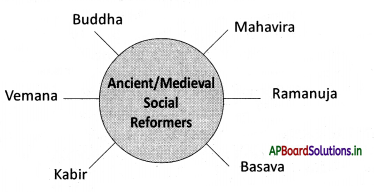
→ Thinkers like Buddha, Mahavira, Ramanuja, Basava, Kabir, Vemana, etc., criticized the discrimination based on birth.

AP Board Solutions AP Board 7th Class Social Studies Notes Chapter 18 Caste Discrimination and the Struggle for Equality

→ The struggle for freedom from British rule was also included within the struggle against social evils and discrimination.

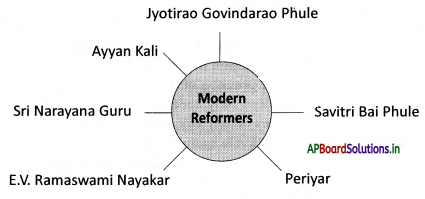
→ In the nineteenth and twentieth centuries, several reformers fought to create a new social system based on freedom/equality, brotherhood, human dignity, and economic justice.

→ Jyotirao Govindarao Phule and his wife Savitri Bai Phule were pioneers of education for women and the lower castes as well as the masses.

→ Periyar, a rationalist and the lower caste movement in South India taught, it is the birthright of everyone to enjoy liberty and equality.

→ Sri Narayana Guru of Kerala preached brotherhood for all and fought against the ill effects of the caste system.

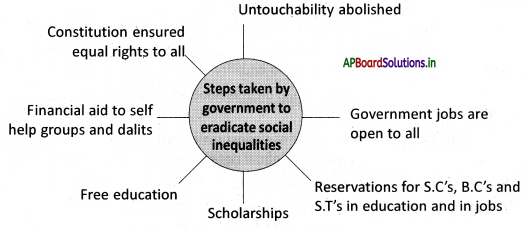
→ When India became a free nation, our constitution ensured that all the people of India are considered equal. Everyone has equal rights and opportunities.

→ Untouchability is seen as a crime and abolished by law.

→ Through laws and through government programs and schemes to help disadvantaged communities, the government tried to implement equality.

→ Still, there is discrimination in our schools against Dalit children. Where their dignity is not respected people are treated unequally on the basis of their caste, religion, disability, economic status, and gender.

→ It is only when people begin to believe that every person deserved to be treated with dignity, that the discrimination against the lower caste people ends and social equality prevails.

→ Untouchability: Show the discrimination on the basis of their caste.

→ Scheme: Apian or a system for doing or organizing something.

AP Board Solutions AP Board 7th Class Social Studies Notes Chapter 18 Caste Discrimination and the Struggle for Equality

→ Constitution: A set of rules and regulations which are followed by people and government

→ Autobiography: The story of a person’s life, written by that person.
AP Board 7th Class Social Studies Notes Chapter 18 Caste Discrimination and the Struggle for Equality 1
AP Board 7th Class Social Studies Notes Chapter 18 Caste Discrimination and the Struggle for Equality 2
AP Board 7th Class Social Studies Notes Chapter 18 Caste Discrimination and the Struggle for Equality 3

AP Board 7th Class Social Studies Notes Chapter 13 The Kings of Vijayanagara

Students can go through AP State Board 7th Class Social Studies Notes Chapter 13 The Kings of Vijayanagara to understand and remember the concept easily.

AP State Board Syllabus 7th Class Social Studies Notes Chapter 13 The Kings of Vijayanagara

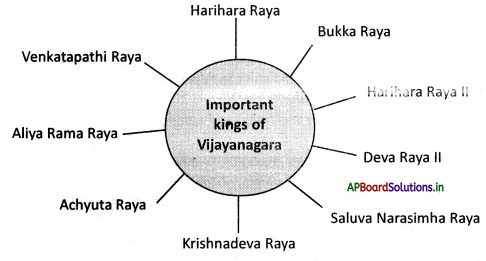
→ Vijayanagara kingdom was founded by Harihara Raya and Bukka Raya in 1336 AD with the blessings of the sage – Vidyaranya.

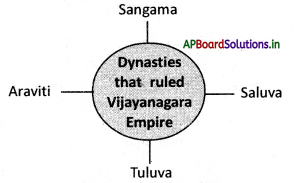
→ It was ruled by four dynasties – Sangama, Saluva, Tuluva and Aravali.

→ On the north of Tungabhadra, the Bahmani kingdom was established with its capital in Gulbarga.

→ Later, between 1489 and 1520 it broke up into five small kingdoms.

→ Of these five kingdoms, Bijapur and Golkonda achieved prominence.

→ We know much about the Vijayanagara kingdom from inscriptions, books, buildings and detailed accounts of foreign travellers.

→ The capital city of Vijayanagara was built on the bank of the river Tungabhadra with seven rings of fortifications.

→ The city had four separate divisions – the first one devoted to temples, the second one for crops, the third one for the royal centre and the fourth one for ordinary town’s folk.

→ By importing a large number of horses from Arabia, by recruiting a large army, by building many strong forts and by introducing guns and cannons in their forces, the Vijayanagara rulers attained great military power.

→ The entire kingdom was actually controlled ^nd administered by the commanders of the army – Islayaka/ Amara Nayak as

AP Board Solutions AP Board 7th Class Social Studies Notes Chapter 13 The Kings of Vijayanagara

→ The Nayakas held Amara – revenue assignments whose revenue they could collect and use for maintaining the troops kept in their possession. They also had judicial powers.

→ Many powerful Nayak controlled vast areas and at times they could even challenge the Vijayanagara Kings. By building tanks and irrigation canals, the Nayakas helped to bring the large areas of the kingdom under cultivation.

→ Because of their efforts, there was a tremendous increase in agricultural production. This in turn provided the impetus to trade.

→ Trade-in agricultural produce, as well as craft, produce like cloth increased manifold in the Vijayanagara period.

→ Trade centres were established on both of India’s extensive coasts.

→ The strategic goods the Vijayanagara kingdom imported were horses, guns and cannons.

→ Indian exports remained the same as in earlier periods as textiles and other craft items.

→ Krishnadeva Raya ruled from 1509 to 1529 AD.

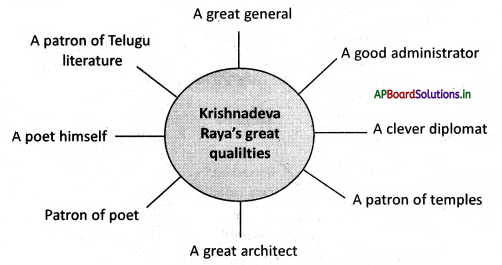
→ He was a great general. He defeated the Sultans of Bahmani and the Gajapathis of Odisha.

→ Krishnadeva Raya patronised temples which include Tirupathi, Srisailam and Ahobilam. He also built several beautiful temples.

→ Krishnadeva Raya was also a patron of Telugu literature. He himself wrote the book – Amuktamalyada.

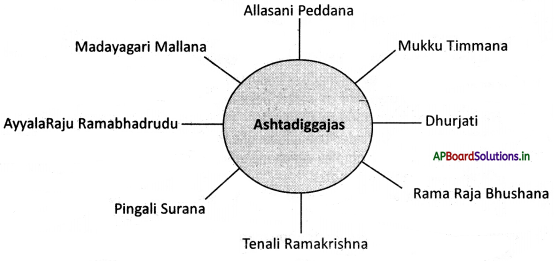
→ His court was adorned with eight poets known popularly as Ashtadiggajas.

→ In 1565 AD all five Bahmani kingdoms joined together and Aliya Rama Raya of Vijayanagara kingdom in Rakkasi Tangadi (Tallikota) war.

→ They looted and destroyed the Vijayanagara city.

→ Their capital was’ shifted to Chandragiri.

AP Board Solutions AP Board 7th Class Social Studies Notes Chapter 13 The Kings of Vijayanagara

→ The succeeding emperors could not regain the glory of Vijayanagara.

→ Amaranayaka: The captains who held Amara revenue assignments i.e., they were given some villages and cities whose revenue they could collect and use.

→ Iqta: Revenue assignments of Delhi sultanate.
(OR)
Nobles or amirs were given similar revenue assignments called Iqtas.

→ Archaeologists: A person who studies human history and prehistory through the excavation of sites and the analysis of artefacts and other physical remains.
(OR)
Scientists who excavate and study the historical remains.

→ Amirs: Nobles

→ Raya gopuram: Towering temple gateways.

→ Bahmani Kingdoms: A Muslim state of the Deccan in South India and one of the major medieval Indian kingdoms. Bah manid Sultanate was the first independent Islamic kingdom in South India.

AP Board Solutions AP Board 7th Class Social Studies Notes Chapter 13 The Kings of Vijayanagara

→ Portuguese: A native or inhabitant of Portugal or a person of Portuguese descent.
(OR)
An ethnic group indigenous to the country of Portugal. Their language is Portugal.
AP Board 7th Class Social Studies Notes Chapter 13 The Kings of Vijayanagara 1
AP Board 7th Class Social Studies Notes Chapter 13 The Kings of Vijayanagara 2
AP Board 7th Class Social Studies Notes Chapter 13 The Kings of Vijayanagara 3
AP Board 7th Class Social Studies Notes Chapter 13 The Kings of Vijayanagara 4

AP Board 6th Class Social Studies Notes Chapter 2 Globe – Model of the Earth

Students can go through AP State Board 6th Class Social Studies Notes Chapter 2 Globe – Model of the Earth to understand and remember the concept easily.

AP State Board Syllabus 6th Class Social Studies Notes Chapter 2 Globe – Model of the Earth

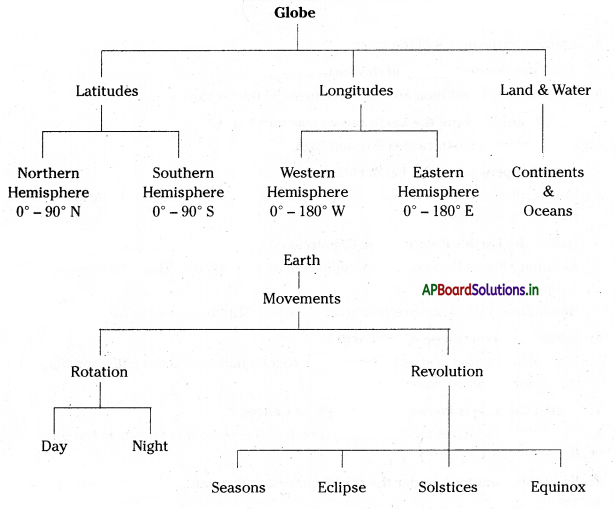
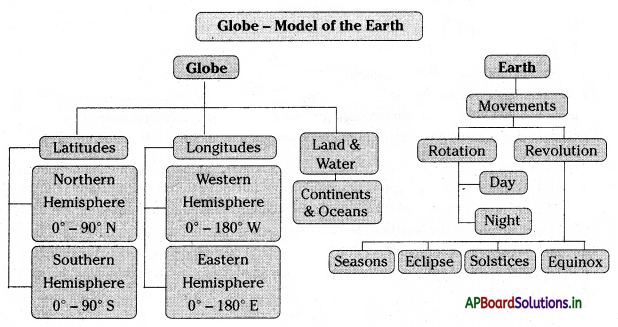
→ Globe is a model of the Earth.

→ Latitudes are the imaginary lines that are drawn horizontally on the globe.

→ Longitudes are the imaginary lines that are drawn vertically on the globe.

→ Longitudes are also known as Meridians.

→ Axis is an imaginary straight line that runs through the North and South Pole.

→ 23 1/2 degrees north latitude is called a Tropic of cancer.

→ 23 1/2 degrees south latitude is called as Tropic of Capricorn.

→ 66 1/2 degrees north latitude is called Arctic Circle.

→ 66 1/2 degrees south latitude is called as Antarctic Circle.

→ 90 degrees north latitude is called the North Pole.

→ 90 degrees south latitude is called the South Pole.

→ 0 degrees longitude is known as Greenwich longitude.

→ 180 degrees east and west longitude are known as International Date Line.

→ The half of the Earth that lies north of the equator is called as Northern Hemisphere. The half of the Earth that lies south of the equator is called as Southern Hemisphere.

AP Board Solutions AP Board 6th Class Social Studies Notes Chapter 2 Globe – Model of the Earth

→ The half of the Earth that lies east of the prime longitude is called as Eastern Hemisphere.

→ The half of the Earth that lies west of the prime longitude is called as Western Hemisphere.

→ There are two types of Earth movements. They are Earth Rotation, Earth Revolution.

→ The main result of the Earth Rotation is the occurrence of day and night.

→ The main result of the Earth Revolution is the occurrence of seasons.

→ Seasons are the divisions of the year, defined by changes in weather.

→ Solar Eclipse occurs when the Moon passes between the Sun and Earth on one line.

→ Lunar Eclipse occurs when the Earth moves between Sun and Moon on one line.

→ Axis: An imaginary line about which a body rotates.

→ Equator: 0° latitude.

→ Tropic of Cancer: 23 1/2 Northern Latitude

→ Tropic of Capricorn: 23 1/2 Southern Latitude

→ Arctic Circle: 66 1/2 Northern Latitude

→ Antarctic Circle: 66 1/2 Southern Latitude

→ North Pole: 90° Northernmost part of the Earth.

→ South Pole: 90° Southernmost part of the Earth.

→ Meridians: Longitudes connecting North and South poles and shows mid-day

→ Greenwich/Prime meridian : 0° longitude.

→ International Dateline: 1800 east and west longitudes

→ Latitudes: Imaginary lines that run parallel to the equator.

→ Longitudes: Imaginary lines that run between the North pole and South pole.

→ Northern Hemisphere: The half of the earth that lies north of the equator.

→ Southern Hemisphere: The half of the earth that lies south of the equator.

→ Eastern Hemisphere: Half of the earth that lies east of the Prime Meridian.

→ Western Hemisphere: Half of the earth that lies west of the Prime Meridian.

→ Seasons: Seasons are divisions of the year, defined by changes in weather.

AP Board Solutions AP Board 6th Class Social Studies Notes Chapter 2 Globe – Model of the Earth

→ Solar Eclipse: Occurs when the Mòon passes between the Sun and Earth on one line.

→ Lunar Eclipse: Occurs when Earth moves between Sun and Moon on one line.
AP Board 6th Class Social Studies Notes Chapter 2 Globe – Model of the Earth 1
AP Board 6th Class Social Studies Notes Chapter 2 Globe – Model of the Earth 2

AP Board 7th Class Social Studies Notes Chapter 17 Implementation of Laws in the District

Students can go through AP State Board 7th Class Social Studies Notes Chapter 17 Implementation of Laws in the District to understand and remember the concept easily.

AP State Board Syllabus 7th Class Social Studies Notes Chapter 17 Implementation of Laws in the District

→ Various departments of the government do various kinds of activities.

→ The ministers who control the departments and the officials of those departments carry out the orders of the government.

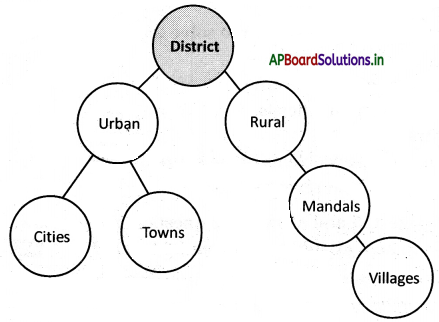
→ These officials of the department work at different levels: secretariat (capital) level, district level, and the Mandal level.

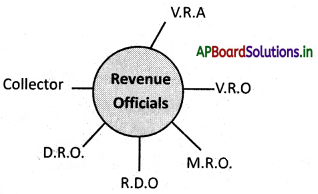
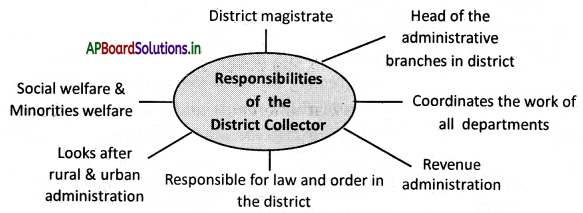
→ The District Collector or the District Magistrate coordinates the work of all departments in the district.

→ The District Collector conducts the meetings with the heads of all the departments.

→ He attends to the problems of the people from all the mandates and helps them to solve them.

→ The Collector would instruct the heads of various departments to attend to the problems of the people.

→ In case of emergency, he will act briskly, personally monitors the situation, and announce compensation to the affected people.

→ He would act strictly if anyone encroached the public places, sidewalks, and roads.,

→ The district is divided into different manuals and mandates are formed of many villages.

AP Board Solutions AP Board 7th Class Social Studies Notes Chapter 17 Implementation of Laws in the District

→ Mandal Revenue Office keeps the records of land.

→ Using these land records and maps the Mandal Revenue Office settles the disputes between the individuals.

→ If anyone encroaches on the forest land or the land belonged to the government, Mandal officials evict them.

→ The Village Revenue Officer and Mandal Revenue Officer have the responsibility of up¬dating and issuing ration cards.

→ To protect the resources such as forests, rivers, and groundwater for the benefit of the next generations, the Government of Andhra Pradesh enacted the Andhra Pradesh Water, Land, and Trees Protection Act in 2002.

→ After the Law was passed, the Water, Land, and Trees Protection Authority or WALTA was formed to implement this Act.

→ in a democratic country like ours, the elected representatives and appointed government officials play different roles.

→ We should work towards achieving to drive away marginalization, disparities, and discrimination.

→ Magistrate: A civil officer with powers to try miner cases and hold a preliminary hearing.

→ Loan waiver: An act of giving up of loans

→ V.R.O: Village Revenue officer

→ Ginning: Separate seeds from cotton.

AP Board Solutions AP Board 7th Class Social Studies Notes Chapter 17 Implementation of Laws in the District

→ WALTA: Water Land and Trees Protection ACT (2002)

→ Tahsildar(MRO): An officer who maintains the records of land. (Mandai Revenue officer)
AP Board 7th Class Social Studies Notes Chapter 17 Implementation of Laws in the District 1
AP Board 7th Class Social Studies Notes Chapter 17 Implementation of Laws in the District 2
AP Board 7th Class Social Studies Notes Chapter 17 Implementation of Laws in the District 3

AP Board 7th Class Social Studies Notes Chapter 21 Devotional Paths to the Divine

Students can go through AP State Board 7th Class Social Studies Notes Chapter 21 Devotional Paths to the Divine to understand and remember the concept easily.

AP State Board Syllabus 7th Class Social Studies Notes Chapter 21 Devotional Paths to the Divine

→ Ramanuja Acharya was a staunch devotee of Vishnu. He propounded the doctrine of Visishtadvaita or qualified monotheism according to which the soul even when united with the Supreme God remained distinct.

→ The Virashaiva movement was initiated by Basavanna. The Virashaivas argued strongly for the equality of all human beings against and scriptural ideas about caste and the treatment of women.

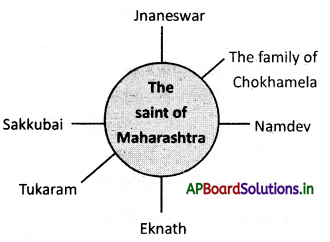
→ Maharashtra saw a great number of saint poets. The most important among them were Jnaneswar, Namdev, Eknath and Tukaram, Sakkubai, and the family of Chokhamela.

→ The saints of Maharashtra rejected all forms of ritualism outward display of piety and social differences based on birth.

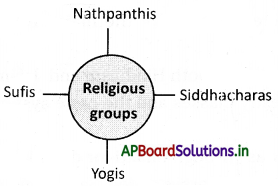
→ A number of religious groups such as Nathpanthis, Sidhacharas, and Yogis advocated renunciation of the world.

→ Sufis were Muslim Mystics. They rejected outward religiosity and emphasized love and devotion by God and compassion towards all fellow human beings.

→ Islam propagated strict monotheism or submission to one God. It also rejects Idol worship and considerably simplified rituals of worship into collective prayers.

→ The Sufis often rejected the elaborate rituals and codes of behavior demanded by Muslim religious scholars. Sufis sought union with God.

→ Among the great Sufis of central Asia were Ghazzali, Rumi, and Sadi.

AP Board Solutions AP Board 7th Class Social Studies Notes Chapter 21 Devotional Paths to the Divine

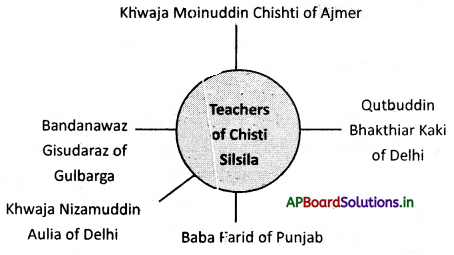
→ During the Delhi sultanate, the Chishti silica developed in the Indian subcontinent. It had teachers like Khwaja Moinuddin Chishti of Ajmer, Qutbuddin Bhaktiar Kaki of Delhi, Baba Farid of Punjab, Khwaja Nijamuddin Auliya of Delhi and Bandanawaz Gisudaraz of Gulbarga.

→ The period of the thirteenth century saw a new wave of the Bhakti movie in north India.

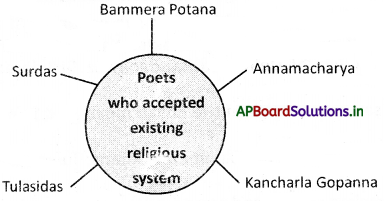
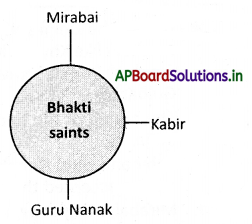
→ Kabir and Guru Nanak rejected Orthodox customs. But Bammera Pothana; Tulasidas and Surdas accepted the existing system.

→ Mirabai, a Rajput princess, devoted herself to Krishna and composed innumerable bhajans expressing her intense devotion.

→ A most unique feature of most of the saints is that their works were composed in regional languages and could be sung.

→ Kabir, the most influential saint, openly ridiculed all forms of external worship, of both Hinduism and Islam. The pre-eminence of the priestly classes and caste system.

→ Kabir believed in a formless Supreme God and preached that the only path to salvation was through Bhakti or devotion.

→ Guru Nanak emphasized the importance of the worship of one God. He insisted that caste, creed, or gender was irrelevant for attaining liberation.

→ Nanak used the terms Riam (right worship) dan (welfare of others) and Isnan (purity of conduct)

→ Yogi Vemana of Andhra Pradesh wrote about the foolishness of the ignorant about aspiring to know God and union with God.

→ Advaita: A Vedantic doctrine that identifies the individual self with the ground of reality.
(Or)
The doctrine of the oneness of the individual soul and the supreme God. It was propagated by Sankaracharya.

AP Board Solutions AP Board 7th Class Social Studies Notes Chapter 21 Devotional Paths to the Divine

→ Salvation: PreservatIon or deliverance from harm, ruin, or loss.
(Or)
The process of saving the soul from sin and its consequences

→ Alvars: The devotees of Lord Vishnu.

→ Nayanars: The devotees of Lord Shiva.

→ Bhakti: Devotional worship directed to one supreme deity.

→ Yogasanas: Positions and postures of the body in a systematic way.

→ Bijak: One of the earliest of the major texts in modern Hindi, which Includes the compilations of compositions of Kabir.

→ Abhang: A form of devotional poetry, sung in praise of Hindu God, Vithala.
AP Board 7th Class Social Studies Notes Chapter 21 Devotional Paths to the Divine 1
AP Board 7th Class Social Studies Notes Chapter 21 Devotional Paths to the Divine 2
AP Board 7th Class Social Studies Notes Chapter 21 Devotional Paths to the Divine 3
AP Board 7th Class Social Studies Notes Chapter 21 Devotional Paths to the Divine 4
AP Board 7th Class Social Studies Notes Chapter 21 Devotional Paths to the Divine 5
AP Board 7th Class Social Studies Notes Chapter 21 Devotional Paths to the Divine 6

AP Board 6th Class Social Studies Notes Chapter 6 Early Civilisations

Students can go through AP State Board 6th Class Social Studies Notes Chapter 6 Early Civilisations to understand and remember the concept easily.

AP State Board Syllabus 6th Class Social Studies Notes Chapter 6 Early Civilisations

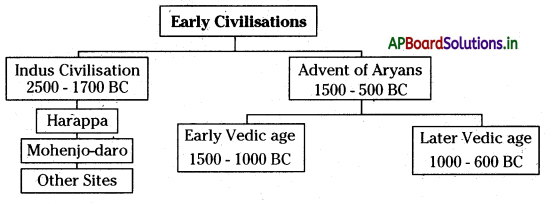
→ India has a long history, it has a rich culture and tradition. India is a living museum of the ancient world and its lost civilizations. Most historians thought that Indian history began with the Vedic period until the last century. The excavations of Mohenjodaro and Harappa in the 1920s pushed back our history by at least 2000 years. They found an excellent and advanced civilization earlier in the Vedic period. It is called the Indus valley civilization or Harappan civilization.

→ Indus valley civilization developed along the Rivers Indus and Ghaggar-Hakra. The traces of these rivers are found by satellite images and other sources also.

→ The cities of the Harappan civilization were well planned. They had wide roads, public wells. In Mohenjodoro, ‘the Great Bath’ (a great tank for public bath) was found. Lothal was a popular harbor in those days.

→ They had a well-planned underground drainage system which shows the importance given to the cleanliness and public health.

→ The Harappan people built their houses with dried or baked bricks. There were two-storeyed buildings also. Every house had a well for water and bathrooms with pipes that carried waste into the main drains.

→ Harappans are credited for growing cotton for the first time. Production of baked bricks was another occupation. They rear cattle, goats, pigs, dogs, camels, and donkeys. They carried out trade activities through the port Lethal -in the Arabian sea with Mesopotamia, Egypt, Iran, etc.

→ Women used ornaments like necklaces, armlets, finger rings, bangles, earrings, nose studs, etc, They knew cosmetics and used perfumes.

→ They grew Wheat, barley, peas, lentils, mustard, etc., Dance, chess, music, marbles, and dice were their entertainments. Bullfighting was their major entertainment. Small idols of Ammatalli (Mother Goddess) and the statue of a dancing girl and the stone idol of the bearded man are excellent artifacts.

→ They worshipped Pashupathi (Siva) and Mother Goddess. The symbols of Swastika are most commonly found. Harappans had developed their own unique script and language. Harappans were the first to develop a system of standardized weights and measures. The measurements and weights of Indus people also moved to Persia and Central Asia.

→ Archaeologists thought that change in the course of the Indus River and forbids led this civilization to decline. And some others believed that the drying up of the Indus River and its tributaries made the people leave this area. After Indus valley civilization Aryans came into existence.

→ The river Ghaggar – Hakra which disappeared in the Thar desert of Rajasthan is believed to be the ancient river Saraswati. The Rigveda mentioned the river Saraswati many times.

→ The Vedic literature is the major source to know about the Aryans. The term Veda means “superior knowledge” in Sanskrit. It is the knowledge of knowing oneself or self-realization. Four major Vedas constitute Vedic literature. They are – Rig Veda, Yajur Veda, Sama Veda, and Atharvana Veda.

AP Board Solutions AP Board 6th Class Social Studies Notes Chapter 6 Early Civilisations

→ The period of Vedic Civilisation (1500-500 BCE) is divided into two broad parts:

  1. Early Vedic Period (1500-1000 BC), also known as Rig Vedic Period.
  2. Later Vedic

→ As time passed by the Vedic people migrated to the plains of Ganga and Yamuna from ‘ the plains of rivers Indus-Saraswati. They crossed the mountain ranges of the Vindhyas and moved towards the south.

→ The Ramayana and The Mahabharatha are two great epics. The Ramayana (Adi kavya) was written by Maharshi Valmiki in Sanskrit. The Mahabharata was written in Sanskrit by sage Vedavyasa.

→ Civilizations: The stage of human social and cultural development and organization that is considered most advanced.

→ Sub-Continent: A large area of land that is part of a continent.

→ Trade: The action of buying and selling göods and services.

→ Vedas: Holiest books of Hindû religion.

→ Brahmanas: The lengthy commentaries of Vedas.

→ Upanishads: A series of Hindu sacred treatises.

AP Board Solutions AP Board 6th Class Social Studies Notes Chapter 6 Early Civilisations

→ Barter System: To exchange goods for other goods or services without using money.
AP Board 6th Class Social Studies Notes Chapter 6 Early Civilisations 1

AP Board 7th Class Science Notes Chapter 11 Respiration in Organisms

Students can go through AP State Board 7th Class Science Notes Chapter 11 Respiration in Organisms to understand and remember the concept easily.

AP State Board Syllabus 7th Class Science Notes Chapter 11 Respiration in Organisms

→ The process of breathing in air is called inspiration and that of breathing out air is called expiration.

→ The number of times we breathe in and breathe out the air in a minute is called the respiration rate.

→ The air we breathe fills our lungs that are located in our chest.

→ The air we breathe in does not contain only oxygen. It is a mixture of many gases.

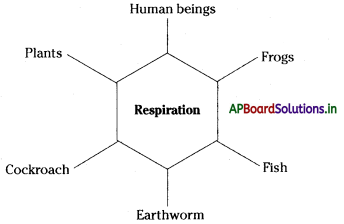
→ Gills are the respiratory organs of the fish.

→ The gills absorb the oxygen that is dissolved in water.

→ Earthworms breathe through their skin.

→ Respiration occurs in all organisms. In this process, oxygen is taken in while carbon dioxide and water vapor are released.

AP Board Solutions AP Board 7th Class Science Notes Chapter 11 Respiration in Organisms

→ Skin, gills, tracheae, and lungs are respiratory organs.

→ Stomata and lenticels help in the exchange of gases in plants.

→ Spiracle: small openings or holes on the sides of the body of cockroach which help to breathe

→ Gills: Respiratory organ of aquatic animals that breathe oxygen dissolved in water.

→ Carbon dioxide: A colorless. odorless, non-flammable gas formed when carbon burns in excess oxygen. It is also produced by respiration.

→ Oxygen: A gas that is essential for living things.

→ Inhale: The Breath in, draw into the lungs.

→ Exhale: Breath out, send out, emit, breathe forth.

→ Inspiration: Breathing in, supernatural or divine influence.

AP Board Solutions AP Board 7th Class Science Notes Chapter 11 Respiration in Organisms

→ Expiration: Breathing out

→ Trachea: Windpipe
AP Board 7th Class Science Notes Chapter 11 Respiration in Organisms 1
→ Albert Einstein was born in 1879 in the German city of Ulm.

  • In 1921 he was awarded the Nobel Prize in Physics.
  • E = mc2 is his famous equation.
  • Einstein was lam ous for his theory of relativity. A traveling clock runs slower than a clock that is at rest. He proved that light travels in the form of particles called Photons (also called Quanta). Photons are pieces of light energy
  • In 1955 lie died while he was in deep slumber.

AP Board 7th Class Science Notes Chapter 10 Nutrition in Plants

Students can go through AP State Board 7th Class Science Notes Chapter 10 Nutrition in Plants to understand and remember the concept easily.

AP State Board Syllabus 7th Class Science Notes Chapter 10 Nutrition in Plants

→ The substances needed for the growth of a plant do not come from the soil only.

→ The green substance in the leaves is called chlorophyll.

→ Plants get water from the soil through their roots.

→ The main nutrients needed for plants are nitrogen, phosphorus, and potassium.

→ Cuscuta takes food from the plant on which it is climbing.

→ Saprophytes grow on -dead, decaying matter.

→ A few plants manufacture their own food but also obtain a part of their nutrition from insects.

→ Green parts of plants use carbon dioxide in the presence of sunlight (as well as other sources of light) along with water to make glucose, starch, and other food materials. This process of making food materials is called photosynthesis.

AP Board Solutions AP Board 7th Class Science Notes Chapter 10 Nutrition in Plants

→ Plants that do not photosynthesize depend on other means of getting their nutrition.

→ Saprophytes live on decaying organic matter.

→ Insectivorous plants fulfill their nitrogen deficiency by trapping insects.

→ In symbiosis, organisms share their food and shelter.

→ Nutrition: Nourishing food, the study of food and its effects

→ Autotroph: Which prepare their own food materials

→ Chlorophyll: Green pigment of plants.

→ Photosynthesis: Synthesis of compounds with the aid of radiant energy

→ Stomata: A part of a leaf through which gases exchange takes place

→ Saprophyte: A plant that lives on dead organic matter.

→ Insectivorous: A plant that eats insects

→ Carnivorous: Animals that eat meat

→ SymbIosis: Close association of two species living together to their mutual benefit

→ Fungi: Mushroom or allied plant
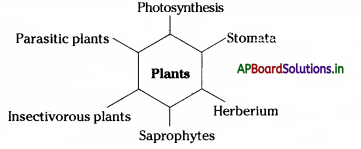
AP Board 7th Class Science Notes Chapter 10 Nutrition in Plants 1
→ Preservation of plant parts like leaves, flowers, or whole plants is a traditional designer art. If the plants are not available in a particular place then the plant physiologists collect those plants where they are available and make them in the preservative form. This is commonly known as an herbarium. They study those plants, and these preserved plants are also helpful for future studies.

There are colonies of algae and fungi living together in a symbiotic relationship! These colonies are known as Lichens. This relationship starts with the attack of the algal colony by a type of fungus. It is an example of balanced parasitism then. Later as algae survive, they are given protection from intense light and conditions of drying up due to the presence of fungus colony. The fungus gets food from its partner.

AP Board Solutions AP Board 7th Class Science Notes Chapter 10 Nutrition in Plants

→ M.S Swaminathan:
Mom kombu Sambasivan Swam Nathan was born on 7th August 1925 at Kumbakonam in Tamilnadu. Swam Nathan is one of the responsible persons for the green revolution in India.

He introduced modern methods and techniques to raise agricultural production. He was the first agriculture scientist to win the Albert Einstein World Science Award in 1986.

At present, he is the Director of the MS. Swaminathan Research Foundation, Chennai.