AP Board 9th Class Social Studies Notes Chapter 4 Atmosphere

Students can go through AP State Board 9th Class Social Studies Notes Chapter 4 Atmosphere to understand and remember the concept easily.

AP State Board Syllabus 9th Class Social Studies Notes Chapter 4 Atmosphere

→ The atmosphere is a sea of gases surrounding the earth.

→ The atmosphere consists of nitrogen (78%), oxygen (21%) and argon, neon, carbon dioxide, methane, ammonia and ozone in a very small percentage.

→ The fine dust particles or particulates can change atmospheric conditions and are beneficial to life on earth.

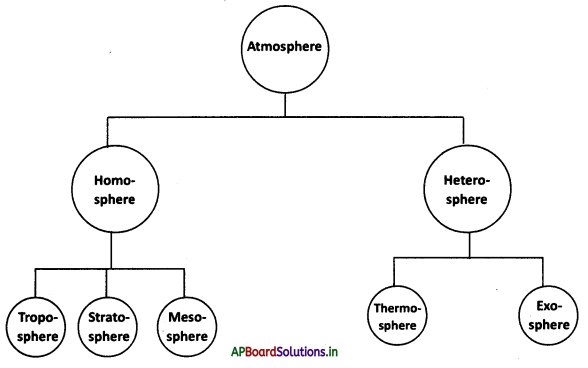
→ On the basis of chemical composition, the atmosphere is divided into two broad layers. They are 1) Homosphere 2) Heterosphere.

→ The Homosphere consists of three thermal layers as Troposphere, Stratosphere and Mesosphere.

→ The Heterosphere consists of two thermal layers called Thermosphere and Exosphere.

→ The gas molecules in the air constantly push each other or any other object that comes their way. This push affects them exert together on any other object is described as Air pressure.

→ When air is hot the pressure becomes low and when it is cool air pressure increases.

AP Board Solutions AP Board 9th Class Social Studies Notes Chapter 4 Atmosphere

→ Wind flows from high-pressure areas to low-pressure areas.

→ The low-pressure belt at the earth’s surface around the equator is called the equatorial low-pressure belt or the Inter-Tropical Convergence Zone.

→ Because of the impact of Earth’s rotation on its own axis, the winds move slightly to the right in the northern hemisphere and to the left in the southern hemisphere. This effect is called the Coriolis effect

→ Depending upon the wind speed, their features, their directions, the way they occur, winds are classified into three types. They are Planetary winds, Seasonal winds and Local winds.

→ The winds that blow continuously and regularly above the world pressure belts are known as Planetary winds.

→ The winds in low latitudes that seasonally change direction between winter and summer are called Seasonal winds.

→ The winds that blow due to local variation in the temperature and pressure, and influence a very small area are called Local winds.

→ Chinook and Loo are hot and dry local winds.

→ Mistral Puna and Pampero are cold local winds.

→ Climate is a description of the average atmospheric conditions for areas over a long period of time.

→ The daily state of the atmosphere at a particular time and place is called weather.

AP Board Solutions AP Board 9th Class Social Studies Notes Chapter 4 Atmosphere

→ Temperature, pressure, wind, humidity and precipitation are called the elements of weather.

→ The amount of water vapour in the atmosphere is called humidity.

→ The relative humidity is the ratio between the maximum water vapour that the air can hold at a given temperature and pressure and the actual amount of water vapour it holds at any given time.

→ If the atmosphere has 100% relative humidity, it is known as saturation level

→ When relative humidity exceeds 100 per cent the excess of water vapour present in the atmosphere gets condensed and forms as minute droplets of water.

→ With condensation, the droplets get heavy and fall to the ground as precipitation in the form of rain, snow, hail etc.

→ On the basis of origin, rainfall may be classified into three main types.
They are:

  1. Convectional rainfall
  2. Orographic rainfall and
  3. Cyclonic rainfall

→ Convectional currents: The transfer of heat by the mass movement of heated particles into an area of cooler fluid.

→ Inter-Tropical Convergence Zone: The low-pressure belt around the equator is called the Equatorial low-pressure belt or the Inter-Tropical Convergence Zone.

→ Coriolis effect: Because of the impact of Earth’s rotation on its own axis the winds move slightly to the right towards the east in the northern hemisphere and to the left, i.e. towards the west in the southern hemisphere. This effect is called the Coriolis effect.

AP Board Solutions AP Board 9th Class Social Studies Notes Chapter 4 Atmosphere

→ Relative Humidity: The amount of water vapour in the air.

→ Leeward side: The other side of the mountain receives less rainfall.

→ Tropical cyclones: Warmcore vortex circulation of tropical origin with a small diameter often of an approximately circular shape are called tropical cyclones.

→ Sleet: Wet, partly melted falling snow.

→ Chinook: The winds that move down the Rockey Mountains in the U.S.A – Canada and part of North America are known as Chinook.

→ Orographic Rainfall: The rain that occurs when the moist wind is forced to rise over mountains or other elevation in its path is called Orogenic rainfall (or) Orographic rainfall.

→ Loo: The hot and dry winds that blow in the plains of northern India from west to east in the months of May and June are called Loos.

→ Atmosphere: The thin layer of air that surrounds the earth is the atmosphere (or) The atmosphere is a sea of gases surrounding the Earth.

→ NASA: National Aeronautics and Space Administration – the space agency of the U.S.A.

→ Particulates: The fine dust particles in the atmosphere are called particulates.

→ Homosphere: The layer of the atmosphere which consists of gases like Nitrogen, Oxygen, Argon and Carbon dioxide.

→ Heterosphere: The layer which has heterogeneous composition and which is above 90 km of the atmosphere is called heterosphere.

→ Wind: The air that moves from areas of higher pressure to areas of lower pressure, is called wind.

→ Breeze: If the air that moves at a slow pace and we feel comfortable in it, is called a breeze.

→ Gust: The wind that comes in a short and fast burst is called a gust.

AP Board Solutions AP Board 9th Class Social Studies Notes Chapter 4 Atmosphere

→ Storm: The wind that comes very fast and blows things around is called a storm.

→ Planetary winds: The winds that blow constantly, continuously, regularly above the world pressure belts are known as planetary winds.

→ Mistral: The most famous cold wind that blows from the Alps over France towards the Mediterranean sea is called Mistral.

→ Climate: The average atmospheric condition for areas over a long period of time is called the atmosphere.

→ Dew point: The critical temperature at which saturation level of humidity is reached is called a dew point.

→ Convectional Rainfall: The rainfall that occurs when moist air over the heated ground becomes warmer than the surrounding air and is forced to rise, expand, cool and yield some of its moisture, is called Convectional rainfall.

→ Cyclonic rainfall: The rainfall that is associated with the passage of a cyclone or depression is called Cyclonic rainfall.
AP Board 9th Class Social Studies Notes Chapter 4 Atmosphere 1

→ Hygrometer is an instrument that measures the water vapour content (humidity) of the air.
AP Board 8th Class Social Studies Notes Chapter 12 Freedom Movement in Hyderabad State

Students can go through AP State Board 8th Class Social Studies Notes Chapter 12 Freedom Movement in Hyderabad State to understand and remember the concept easily.

AP State Board Syllabus 8th Class Social Studies Notes Chapter 12 Freedom Movement in Hyderabad State

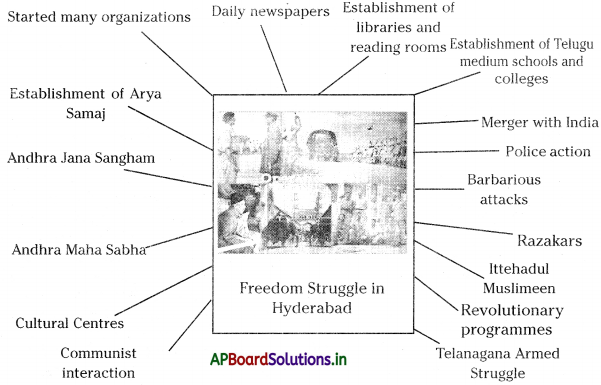
→ Hyderabad was an important princely state of South India under British paramountcy.

→ It was ruled by the Nizams who were initially, provincial governors of the Mughal emperors.

→ Mullah Abdul Qayyum of Hyderabad became a great champion of the Congress.

→ In the year 1892 Arya Samaj was established in Hyderabad, which has credited many leaders to the nationalist movement in Hyderabad.

→ The Nizams actually discouraged the setting up of private Telugu medium schools.

→ In 1924 Madapati Hanumantha Rao and others formed the Andhra Jana Sangham.

→ The leaders of various sections decided to unite into one large organization and thus AMS was formed in 1930.

→ Later the radical elements gained leadership and a new movement of the peasants
started.

→ Enthused by the response of the youth of the state, the nationalists of Hyderabad had set up the Hyderabad State Congress in 1938.

→ in 1942 they started Satyagraha in tune with the National Quit India Movement.

→ From 1929, Ryot Sangams were established.

AP Board Solutions AP Board 8th Class Social Studies Notes Chapter 12 Freedom Movement in Hyderabad State

→ The movement was transformed in 1947-48 into a broad anti-Nizam and anti-feudal struggle demanding the merging of Hyderabad with independent India.

→ The fanatic Muslim enthusiasts formed Ittehadul Muslimeen, an organization to protect the Muslim domination of Hyderabad state and Nizam rule.

→ In 1947, the Nizam was Osman AiiKhan.

→ Hyderabad was finally integrated into Indian Union in September 1948.

→ Flrnianas: Orders issued by the rulers especially Muslim rulers

→ Vettel: Making some people work for no wages (slavery)

→ Feudal system: System of landlords

→ Subordinate kings: The kings under an emperor or a Samrat, enjoying liberty by paying some annual tribute

→ Legitimate rights: Rights that are guaranteed by law

→ Guerrilla squad: A group of armed people who attack all of a sudden

→ Jagirdars: Owners of Jagirs

AP Board Solutions AP Board 8th Class Social Studies Notes Chapter 12 Freedom Movement in Hyderabad State

→ Representative Government: A government that is run by the elected or nominated members
AP Board 8th Class Social Studies Notes Chapter 12 Freedom Movement in Hyderabad State 1

AP Board 8th Class Social Studies Notes Chapter 11B National Movement: The Last Phase 1919-1947

Students can go through AP State Board 8th Class Social Studies Notes Chapter 11B National Movement: The Last Phase 1919-1947 to understand and remember the concept easily.

AP State Board Syllabus 8th Class Social Studies Notes Chapter 11B National Movement: The Last Phase 1919-1947

→ Gandhiji arrived in India in 1915 from South Africa. He was already a respected leader known internationally.

→ His earliest interventions were in local movements in Champaran and Kheda.

→ He did not associate with any Congress faction. He built his own political program and space in nationalist politics.

→ Muslim League was formed in 1906 and Hindu Mahasabha in 1915.

→ During Rowlatt Satyagraha the participants tried to ensure that Hindus and Muslims were united in the fight against British rule.

→ The Non-Cooperation Movement gained momentum through 1921-22.

→ Guntur District was at the center of nationalist activity and the participation was very widespread.

→ Sometimes people thought of Gandhiji as someone who could help them overcome their misery and poverty.

AP Board Solutions AP Board 8th Class Social Studies Notes Chapter 11B National Movement: The Last Phase 1919-1947

→ On March 13th, 1930 Gandhiji led his March to Dandi village to break the government salt laws. A wave of enthusiasm swept the country.

→ The combined struggles of the Indian people bore fruit when the Government of India Act of 1935 prescribed provincial autonomy.

→ Subhash Chandra Bose organized the Indian National Army (INA) with the cooperation of Rash Bihari Bose in Burma and Andamans.

→ The period after 1940 was characterized by intensive activities of radical organizations.

→ Louis Mountbatten, who was appointed Viceroy in early 1947 was not able to resolve the differences between the Muslim League and the Congress party.

→ Independence is our strength. Partition is our failure.

→ Nationalism: Patriotic feeling often to an extensive degree

→ Secular: Not religious or spiritual

→ Terrorist: A person who uses violence and intimidation in the attempt to achieve political aims unofficially

AP Board Solutions AP Board 8th Class Social Studies Notes Chapter 11B National Movement: The Last Phase 1919-1947

→ extremism: Holding extreme political or religious views

→ Satyagraha: True anger. It was introduced and led by Gandhiji in our Independence movement.

→ Non-Cooperation: Not rendering co-operation to the government by not accepting their policies, not obeying their orders, and not paying taxes, etc.

→ Civil Disobedience: Refuse to be obedient by the people of a nation

→ Subcontinent: The land or a country that has all the characteristics of a continent

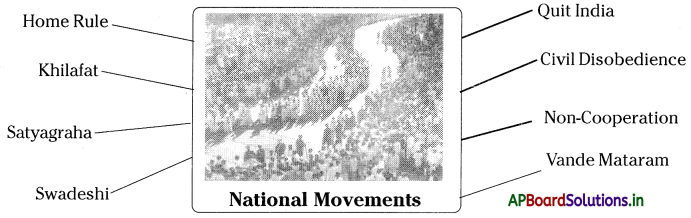
AP Board 8th Class Social Studies Notes Chapter 11B National Movement The Last Phase 1919-1947 1

AP Board 8th Class Social Studies Notes Chapter 11B National Movement The Last Phase 1919-1947 2

AP Board 10th Class Physical Science Notes Chapter 9 Electric Current

Students can go through AP State Board 10th Class Physical Science Notes Chapter 9 Electric Current to understand and remember the concept easily.

AP State Board Syllabus 10th Class Physical Science Notes Chapter 9 Electric Current

→ A negative charge flows through an electric wire when it is connected to an electric circuit.

→ Lightning is an electric discharge between two clouds or between clouds and the earth. This is an example of the motion of charge in the atmosphere.

→ In a circuit, the battery stores chemical energy, and this energy converts into electric energy.

→ The material which transfers energy from the battery (source) to the bulb (consumer) is called a conductor.

→ Electric charge (I) = \(\frac{\text { Electric charge (Q) }}{\text { Time interval (t) }}\)

→ The SI unit of the electric current is ampere (A).

→ 1 Ampere = \(\frac{1 \text { coulomb }}{1 \text { second }}\)

→ The electrons in the conductor move with a constant average speed called drift speed or drift velocity.

→ The charge carriers in a conductor are electrons. The magnitude of the electric charge is 1.602 × 10⁻¹⁹ C.

→ The electron density of copper is 8.5 × 1028 m-3.

→ The direction of the electric current is the direct flow of positive charges.

AP Board Solutions AP Board 10th Class Physical Science Notes Chapter 9 Electric Current

→ An ammeter is used to measure electric current. It is always connected in series to the circuit. Work done by the electric force on the unit positive charge to move it through a distance is called the potential difference. It is denoted by V.

→ V = \(\frac{W}{q}=\frac{\text { Workdone }}{\text { Charge }}=\frac{\text { Joule }}{\text { Coulomb }}\)

→ Potential difference is also called voltage. The SI unit of potential difference is volt (V).

→ The amount of charge accumulated on the plates depends on the nature of the chemical used in the battery.

→ The direction of the electric field is from positive terminal to negative terminal in the conductor.

→ Electromotive force (emf) is defined as the work done by the chemical force to move unit positive charge from negative terminal to positive terminal of the battery.

→ A voltmeter is used to measure potential difference or emf across an electric device like a battery.

→ \(\frac{\mathrm{V}}{\mathrm{I}}\) is constant. This constant is called the resistance of the conductor.

→ According to Ohm’s law, the potential difference between the ends of a conductor is directly proportional to the electric current passing through it at a constant temperature.

→ The SI unit of resistance is Ohm (Ω).

→ 1 Ohm = \(\frac{1 \text { Volt }}{1 \text { Ampere }}\)

→ Based on Ohm’s law materials are classified into two categories. They are ohmic conductors and non-ohmic conductors.

→ Metals obey Ohm’s law. They are called ohmic conductors.

→ LEDs are non-ohmic conductors. They don’t obey Ohm’s law.

AP Board Solutions AP Board 10th Class Physical Science Notes Chapter 9 Electric Current

→ Ohm’s law is not applicable to gaseous conductors and semi-conductors.

→ The resistance of a conductor is defined as the obstruction to the motion of the electrons in a conductor.

→ The material which offers resistance to the motion of electrons is called a resistor.

→ The resistance of the human body generally varies from 100 Ω (if the body is wet with salt water) to 5,00,000 Ω (if the skin is very dry).

→ The electric shock is a combined effect of potential difference, electric current, and resistance of the human body.

→ Temperature, nature of the material, length of the conductor, and cross-section area are the factors that affect resistance.

→ R = \(\frac{\rho l}{A}\) (p = density, l = length of the conductor, A = the cross-section area)

→ The filament of an electric bulb is made of tungsten.

→ The melting point of tungsten is 3422° C.

→ Semiconductors are used to make diodes, transistors, and integrated circuits.

→ A closed path created by the connecting wires through a battery along which the electrons conductor is called a circuit.

→ If the current drawn by a resistor is equal to the current drawn by the combination of resistors, then the resistor is called an equivalent resistor.

→ Two or more resistors are said to be connected in series if the same current flows through them.

→ Two or more resistors are said to be connected in parallel if the same potential difference exists across them.

→ According to Kirchhoff,
“At any junction point in a circuit where the current can divide, the sum of the currents into the junction must equal the sum of the currents leaving the junction.” This law is called the junction law.

AP Board Solutions AP Board 10th Class Physical Science Notes Chapter 9 Electric Current

→ According to Kirchhoff,
“The algebraic sum of the increases and decreases in potential difference across various components of a closed circuit loop must be zero.”

→ Electric power = V × I = voltage × current (I).

→ SI unit of power is the watt.

→ Electrical energy is the product of power and time.
E = power × time

→ Units of electrical energy are W and KWH (unit).

→ Charge: Positive or negative particles present in an electric circuit.

→ Potential difference: Work done by the electric force on the unit positive charge to move it through a distance.

→ Electric current: The ordered motion of electrons. (OR) The amount of charge crossing any cross-section of the conductor in one second.

→ Multi-meter: It is an electronic measuring instrument that combines several measurement functions in one unit.

→ Ohm’s law: V = IR; The potential difference between the ends of a conductor is directly proportional to the electric current passing through it at a constant temperature.

→ Resistance: The obstruction to the motion of the electrons in a conductor.

→ Resistivity (ρ): Resistance offered by a conductor having unit length and unit cross-section area. (constant in R = \(\frac{\rho l}{A}\))

AP Board Solutions AP Board 10th Class Physical Science Notes Chapter 9 Electric Current

→ Kirchhoff’s laws: Two simple rules of Kirchhoff applicable to any DC circuit containing batteries and resistors connected in any way.

→ Electric power: The product of voltage and current.

→ Electric energy: The product of electric power and time.

→ Conductivity (σ): The reciprocal of resistivity.

→ Resistor: The material which offers resistance to the motion of electrons.

→ Overloading (or): When the current drawn from the mains is more than 20 A, Short circuit overheating occurs and may cause a fire. This is called overloading.

→ Fuse: The fuse consists of a thin wire of a low melting point.

→ Semi-conductors: The materials whose resistivity is 105 to 1010 times more than that of metals and 1015 to 1016 times less than that of insulators.
Eg: Silicon, Germanium.

→ Conductors: The materials which can conduct electricity.

→ Insulators: The materials which can’t conduct electricity.
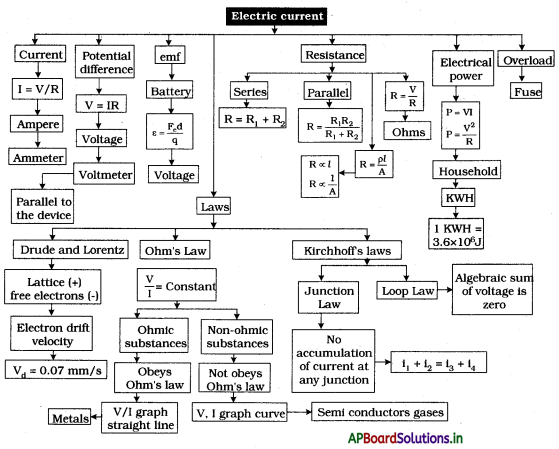
AP Board 10th Class Physical Science Notes Chapter 9 Electric Current 1

→ Sir Charles Wheatstone(1802 – 1875):

  • Sir Charles Wheatstone was a professor in London. He was very famous for his telegraph and stereoscope.
  • He discovered the principles of stereoscopic vision and invented the stereoscope.
  • His name is attached to the circuit he invented for the newly invented telegraph.

AP Board 9th Class Biology Notes Chapter 8 Challenges in Improving Agricultural Products

Students can go through AP State Board 9th Class Biology Notes Chapter 8 Challenges in Improving Agricultural Products to understand and remember the concept easily.

AP State Board Syllabus 9th Class Biology Notes Chapter 8 Challenges in Improving Agricultural Products

→ Increasing food production in proportion to the increasing population is a big challenge for our country.

→ The production of a crop depends on

  • the kind of seeds planted,
  • the properties of the soil,
  • the availability and proper application of irrigation and fertilizers,
  • the weather, controlling insect attacks,
  • the growth of weeds and so on.

→ Alternating crops preserve soil fertility.

→ Producing a variety of crops, as well as an increase in production, can be possible in a mixed crop system.

→ Irrigation plays an important role in increasing crop production.

→ A plant uses only 0.1 per cent of the water it absorbs to form carbohydrates.

→ Only the nutrient that dissolves in water is absorbed by the roots of the plant

→ Hybridization methods and genetic engineering methods enables us to bring desirable characters in seeds.

→ Transpiration and absorption of water occur through stomata.

→ Macronutrients are required in large quantities by plants. e.g.: Nitrogen, Phosphorous and Potassium.

→ Micronutrients are required in small quantities by plants. e.g.: Iron, Boran, Manganese, Zinc etc.

AP Board Solutions AP Board 9th Class Biology Notes Chapter 8 Challenges in Improving Agricultural Products

→ Agriculture officers advise farmers to cultivate dryland crops in fewer water areas.

→ Leguminous plants with root nodules supply nitrogen to the plant

→ Organic manure is produced by decaying plant and animal wastes.

→ Nutrients are replenished with crop rotation, adding organic manure or chemical fertilizers.

→ Green manure crops are grown so that they can be ploughed back into the soil

→ Biofertilizers synthesise nutrients from the environment or from soil to plants.

→ Green leaf manure can be prepared by using any plant leaves.

→ Soil testing centres give us knowledge about the soil

→ In organic farming, farmers use natural manures and natural pest-controlling methods.

→ Humus and water holding capacity are increased in the soil by applying natural manure.

→ Friendly insects control harmful insects.

AP Board Solutions AP Board 9th Class Biology Notes Chapter 8 Challenges in Improving Agricultural Products

→ Over usage of insecticides, fungicides, weedicides, pesticides lead to soil pollution, water pollution and hazardous to biodiversity.

→ Food Chain: Describes the linear sequence of organisms which represent their prey-predator relationship in the ecosystem.

→ Ecology: It ¡s the scientific study ¡n which plants, animals and people are related to each other and the environment.

→ Irrigation: To supply land or crops with water.

→ Kharif Crop: Crop refers to the planting, cultivation and harvesting of any domesticated plant sown in the rainy (monsoon) season.
E.g.: Paddy, Sugarcane, Maize etc.

→ Mixed Crops: Cultivation of more than one crop in the same field.

→ Rabi Crop: Agricultural crops sown in winter and harvested in the summer season. E.g.: Wheat, barley, sesame etc.

→ Fertilizers: Substance that ¡s applied to increase soil fertility and plant growth. May be organic or inorganic.

AP Board Solutions AP Board 9th Class Biology Notes Chapter 8 Challenges in Improving Agricultural Products

→ Macronutrients: Nutrients required ¡n large quantities by plants.
E.g.: Nitrogen, Phosphorous and Potassium.

→ Micronutrients: Nutrients required in small quantities by plants.
E.g.: Iron, Manganese, Boron, Zinc, Copper, Molybdenum etc.

→ Crop rotation: It is the process ¡n which one crop is followed by another crop on an agricultural field.
E.g.: After cultivation of Paddy, Black gram or Groundnut has to be grown followed by paddy again.

→ Replenish: To fill something again put new supplies into something. Soil testing centre: Tests the soil and give us knowledge about the soil.

→ Soil testing centre: Tests the soil and give us knowledge about the soil.

→ Synthetic pyrethroids: Chemicals used to control pests on crops.
E. g.: Pesticides, insecticides.

→ Biofertilizers: Fertilizers synthesized by microorganisms from the environment or from soil to plants.

→ Indigenous: Native, not foreign.

→ Insecticides: Chemicals used to kill insects.

→ Fungicides: Chemicals used to kill fungi.

→ Weedicides: Chemicals used to kill weeds.

AP Board Solutions AP Board 9th Class Biology Notes Chapter 8 Challenges in Improving Agricultural Products

→ Herbicides: Chemicals used to kill herbs.

→ Predatory insects: Insects that kill and eat insects.

→ Bacteria: Unicellular microorganisms reproduce by binary fission.

→ Immunity: Resistance developed against chemicals or things or animals. Stomata: Microscopic holes present in the epidermis of the leaf, helps in transpiration.

→ Carbohydrate: It ¡s an organic compound that consists only of carbon, hydrogen and oxygen. A major food source.

→ Bacterial culture: the initial step in studying morphology and identification of bacteria ¡n the disease process.

→ Mixed Crops: More than one crop ¡s cultivated ¡n the same field.

→ Organic farming: In this type of farming farmers use natural manures and natural pest-controlling methods. Crop rotation, mixed crops are also practised.

→ Vermicompost: It is the product or process of composting using worms usually earthworms.

→ Ingredients: A component part, constituent.

→ Watershed: A ridge of land that separates two adjacent river systems. A watershed is a basin-like landform defined by high points and ridgelines that descend into lower elevations and stream valleys.

→ Weeds: Other plants grow in afield along with the crop. These plants are called weeds.

AP Board Solutions AP Board 9th Class Biology Notes Chapter 8 Challenges in Improving Agricultural Products

→ Irrigated farming: Supplying water to land or crops is called irrigated farming.

→ Unirrigated farming: A farming that does not supply water to land or crops is called unirrigated forming.
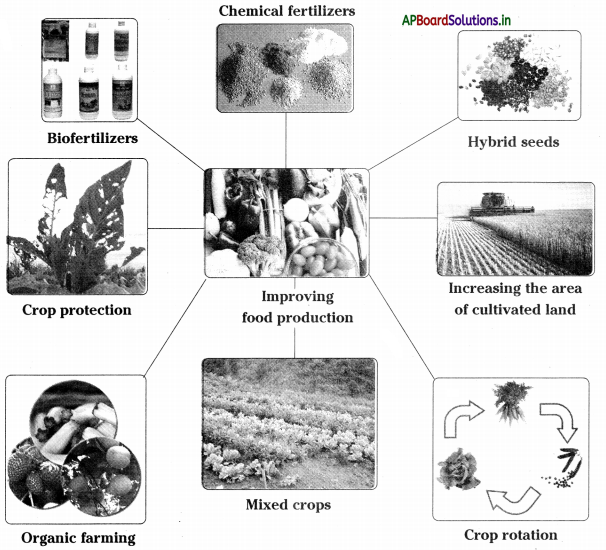
AP Board 9th Class Biology Notes Chapter 8 Challenges in Improving Agricultural Products 1

→ Dr M.S.Swaminathan 7th August 1924:

  • Dr M.S.Swaminathan is an Indian scientist doing his research in the agricultural industry.
  • He is known as the fat her of the Green Revolution in India.
  • He had contributed to the development high yielding varieties of wheat in India.
  • From 1972 to 1979 he was director-general of the Indian Council of Agricultural Research (ICAR) and was the minister of Agriculture from 1979 to 1980.
  • He served as director-general of the International Rice Research Institute (1982-88) at Manila.
  • He is the founder and chairman of the M.S. Swaminathan Research Foundation and striving to rid the world of hunger and poverty.

AP Board 8th Class Social Studies Notes Chapter 11A National Movement: The Early Phase 1885-1919

Students can go through AP State Board 8th Class Social Studies Notes Chapter 11A National Movement: The Early Phase 1885-1919 to understand and remember the concept easily.

AP State Board Syllabus 8th Class Social Studies Notes Chapter 11A National Movement: The Early Phase 1885-1919

→ The National Movement in India forms an important epoch in history.

→ With the growth of English education during the late nineteenth century in some major cities, a new consciousness began to develop.

→ In 1866, Dadabhai Naoroji organized the “East India Association” in London to discuss the Indian question.

→ All the provincial nationalistic intellectuals came together in the first session of the Indian National Congress at Bombay in December 1885.

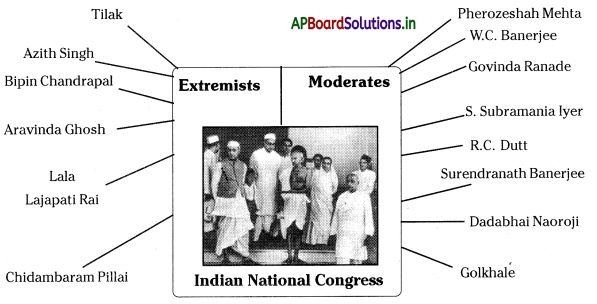
→ Moderates adopted a policy of pray, petition, and protest.

→ With the start of the Swadeshi movement around 1903, the Indian National Congress movement took a major leap forward.

→ The Swadeshi movement gave tremendous impetus to Indian history, particularly the textile industry of India.

→ Bal Gangadhar Tilak gave the famous slogan, “Swaraj is my birthright and I shall have it.”

AP Board Solutions AP Board 8th Class Social Studies Notes Chapter 11A National Movement: The Early Phase 1885-1919

→ There was a split in the Congress in the 1907 Surat session.

→ Tilak joined his hands with Annie Besant to launch a movement for ‘Home Rule’.

→ The two factions of the Congress united again in 1916 through the Lucknow pact.

→ Mahatma Gandhi came back from South Africa and joined the Indian freedom movement.

→ Sovereign: Having authority on self (on a country or a person or a race)

→ Racial discrimination: The discrimination showed by the Europeans especially the British towards other races. e.g.: Blacks & Whites.

→ Resolution: A decision which is taken in a meeting or self.

→ Moderates: The freedom fighters who followed a policy of petition, pray, and protest.

→ Petitions: Requisitions to the government or higher authorities to fulfill some wants

→ Swadeshi: Which are not belonged to foreign

→ Boycott: Refuse to deal with a person, organization, or country as punishment or a protest.

→ Picketing: A group of people positioned outside a workplace with the aim of persuading other people not to work during a strike.

→ Swaraj: Full-fledged freedom

AP Board Solutions AP Board 8th Class Social Studies Notes Chapter 11A National Movement: The Early Phase 1885-1919

→ Protest: Show disagreement

→ Extremism: A policy followed by some freedom fighters like Tilak etc., to achieve freedom in extreme ways.
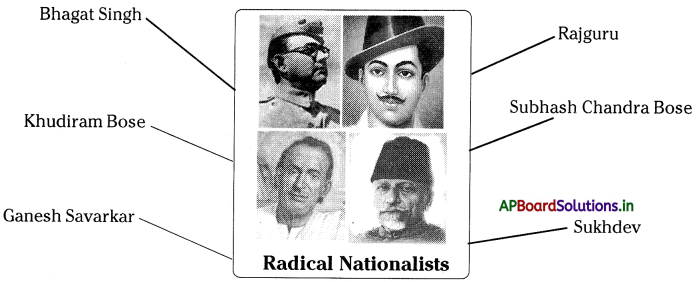
AP Board 8th Class Social Studies Notes Chapter 11A National Movement The Early Phase 1885-1919 1

AP Board 8th Class Social Studies Notes Chapter 10 Landlords and Tenants under the British and the Nizam

Students can go through AP State Board 8th Class Social Studies Notes Chapter 10 Landlords and Tenants under the British and the Nizam to understand and remember the concept easily.

AP State Board Syllabus 8th Class Social Studies Notes Chapter 10 Landlords and Tenants under the British and the Nizam

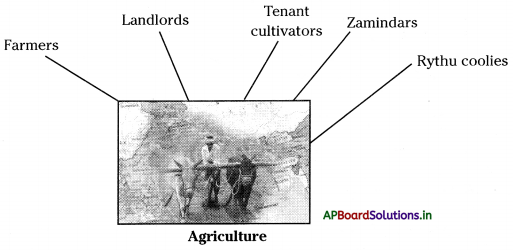
→ During the time of the Mughal emperors, on their behalf them, the zamindars collected land revenue from the peasants.

→ Khudkhasht lands are lands of zamindars on which the laborers worked.

→ The English East India Company introduced the Permanent Settlement in 1793 when Cornwallis was the Governor-General.

→ By 1820, the prices of grains in the market rose and cultivation slowly expanded.

→ The zamindars did not have an interest in improving the land.

→ Nizam handed over Rayalaseema to the British on account of debt.

→ Some British administrators believed that it was the duty of the government to invest in large-scale irrigation works.

→ Even in the Ryotwari areas, the land revenue was fixed at a very high level.

→ Peasants very often borrowed money from moneylenders in order to pay their land revenue.

→ During the colonial period, the peasants were forced to do ‘Vetti’ on the personal land of the landlords.

AP Board Solutions AP Board 8th Class Social Studies Notes Chapter 10 Landlords and Tenants under the British and the Nizam

→ The zamindars also tried to extract as much money as they could from the peasants under a variety of pretexts.

→ In the Hyderabad State under the Nizam rule, there were many forms of subordinate chieftaincies.

→ The large landlords were called Doras.

→ Famines or massive food shortages leading to acute distress were a regular feature of British rule. Not less than 11 famines occurred during the latter half of the 19th century.

→ The famous peasant movements were the Deccan riots of the 1860s, Rampa features, and Mappila agitations.

→ Landlords: Zamindars gave their land to peasants either for a share of the products or for a fixed rent. These peasants were called Landlords.

→ Moneylenders: Persons who lend money on interest to the needy (on the mortgage)

→ Jagirs: These are the areas of Jagirdars, Subordinate Chieftaincies in the Hyderabad State under Nizam rule.

→ Santhanam: Some areas were ruled by Swadeshi rulers under British rule.

→ Inamdar’s: The people who received ‘Inams’ from Nizam in the form of land.
→ Patta: A paper order which declares the ownership of land.

→ Ryotwari: Ryotwari means peasant tenure.

AP Board Solutions AP Board 8th Class Social Studies Notes Chapter 10 Landlords and Tenants under the British and the Nizam

→ Deshmukh: The person who collects revenue in Hyderabad State during Nizam’s rule.
AP Board 8th Class Social Studies Notes Chapter 10 Landlords and Tenants under the British and the Nizam 1
AP Board 8th Class Social Studies Notes Chapter 10 Landlords and Tenants under the British and the Nizam 2

AP Board 9th Class Biology Notes Chapter 7 Animal Behaviour

Students can go through AP State Board 9th Class Biology Notes Chapter 7 Animal Behaviour to understand and remember the concept easily.

AP State Board Syllabus 9th Class Biology Notes Chapter 7 Animal Behaviour

→ Animal behaviour is influenced by many factors.

→ Animal behaviour is the scientific study of the wild and wonderful ways in which animals interact with each other, with other living beings, and with the environment

→ Both external and internal stimuli prompt behaviours.

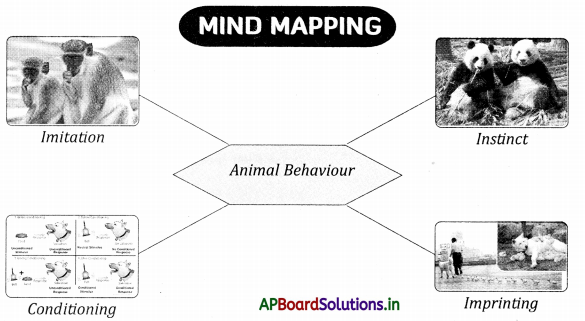
→ Animal behaviour is studied as instinct, imprinting, conditioning and imitation.

→ Instinctual behaviours are inborn behaviours that need not be learned.

→ Making nests by birds, choose mates and forming groups for protection etc., are examples of instinctive behaviour.

→ Chickens and ducklings recognise their mother because of a behaviour type called imprinting.

→ Conditioning is a type of behaviour involving a response to a stimulus that is different from the natural one.

→ Ivan Pavlov conducted experiments on conditioning.

AP Board Solutions AP Board 9th Class Biology Notes Chapter 7 Animal Behaviour

→ Imitation is a type of behaviour where one animal copies another animal.

→ Human behaviour is more complex because we are more intelligent and aware of ourselves.

→ Tagging help scientists follow the journeys the animals make.

→ Identifying or smelling the ability of dogs and searching and communicating the nature of ants is because of pheromones.

→ Beaver, a mammal, which lives in North America builds dams across water streams,

→ Dolphins have great logical thinking power.

→ In 1977 Ervin Pepperberg made learned more than 100 words to Alex, the grey parrot

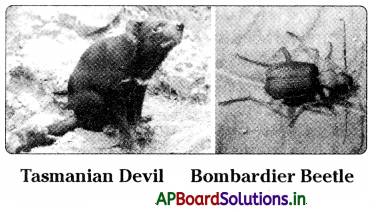
→ Some animals spray bad smells through their body to protect from predators. e.g.:Tasmanian devil.

→ The scientific study of animal behaviour is called Ethology.

→ Instinct: This type of behaviour need not be learned. They are present from birth.

→ Reflex: These are also a type of instinctive behaviour. We do not have to learn this.

AP Board Solutions AP Board 9th Class Biology Notes Chapter 7 Animal Behaviour

→ Imprinting: It is a type of behaviour. Recognition of mother by chickens and ducklings after they are hatched from the eggs.

→ Conditioning: It ¡s a type of behaviour involving a response to a stimulus that is different from the natural one. It ¡s a type of learned behaviour.

→ limitation: It ¡s a type of behaviour where one animal copies another animal.

→ Creativity: Make a new thing.

→ Ethology: It is the scientific and objective study of animal behaviour.

→ Primates: The group of mammals that includes humans and monkeys.
AP Board 9th Class Biology Notes Chapter 7 Animal Behaviour 1

→ Konrad Lorenz (1903 to 1989) was an Austrian scientist who studied animal behaviour. He discovered that if he reared geese (give the local name of this) since they hatched; they became imprinted on him. They followed him around and preferred to be near him even when they had grown into adult geese.

AP Board Solutions AP Board 9th Class Biology Notes Chapter 7 Animal Behaviour

→ Some animals spray bad smells through their body to protect from predators. The Tasmanian Devil is the worst smelling animal in the animal kingdom. We are also familiar with a beetle with a foul smell called Bombardier Beetle.
AP Board 9th Class Biology Notes Chapter 7 Animal Behaviour 2
It has two chemicals hydroquinone and hydrogen peroxide stored in its body. Whenever the beetle feels threatened, these chemicals mix with some special enzymes and that heat up the liquids, which gives out a bad smell from its body.

→ Konrad Lorenz (1903 – 1989):

  • Konrad Lorenz was an Austrian zoologist, ethologist and ornithologist
  • He is often regarded as one of the founders of modern ethology.
  • He discovered that if he reared geese since they hatch they became imprinted on him.
  • They followed him around and preferred to be near him even when they had grown into adult geese.
  • Konrad Lorenzsha red the 1973 Nobel Prize in Physiology or Medicine with Nikolas Tin bergen and Ka rl von Frisch.

AP Board 10th Class Physical Science Notes Chapter 8 Chemical Bonding

Students can go through AP State Board 10th Class Physical Science Notes Chapter 8 Chemical Bonding to understand and remember the concept easily.

AP State Board Syllabus 10th Class Physical Science Notes Chapter 8 Chemical Bonding

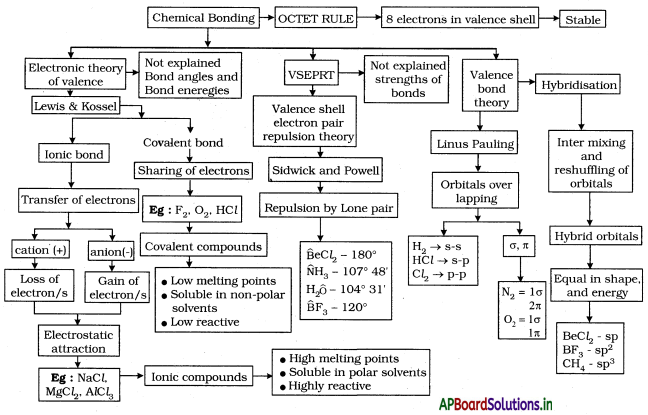
→ A chemical bond is an attractive force between two atoms in a molecule.

→ Atoms which contain 8 electrons in the outermost shell are stable and less reactive.

→ Electron transfer occurs from one atom to another because atoms try to acquire an inert gas configuration.

→ Ions are charged particles.

→ The atom which loses electron acquire positive charge and the atoms gain electrons acquire a negative charge.

→ The formation of ionic compounds involves the formation of ions and the attraction of ion pairs.

→ Oxidation involves the removal of electrons.

→ Reduction involves the addition of electrons.

→ Oxidation and reduction go side by side.

→ The compounds containing molecules that are formed by sharing of electrons are known as covalent compounds.

AP Board Solutions AP Board 10th Class Physical Science Notes Chapter 8 Chemical Bonding

→ Covalent compounds are soft with low melting and boiling points.

→ Molecules having two oppositely charged poles are called polar molecules.

→ Vander Waal’s forces are purely electrostatic forces operating between molecules at a short distance.

→ A dipolar molecule attracting announcer dipolar molecule is called dipole-dipole attraction.

→ A strong bond is formed by the maximum overlap of orbitals.

→ End-end overlap of orbitals leads to the formation of sigma (σ) bond and part overlap of orbitals leads to the formation of pi (π) bond.

→ a bond is stronger than an π bond.

→ σ (Sigma) bond exists independently.

→ π bond has no independent existence. It exists only in the presence of a sigma bond.

→ In a double bond one, a and one π bond are present.

AP Board Solutions AP Board 10th Class Physical Science Notes Chapter 8 Chemical Bonding

→ In a triple bond, one d and two π bonds are present.

→ s – s overlap is present in H2.

→ p – p overlap is present in F2, Cl2, Br2, and I2.

→ s – p overlap is present in HF, HC/, HBr, and HI.

→ Molecules having single bonds have only o bonds.

→ Molecules having a single bond are H2, F2, Cl2, Br2, I2, BeCl2, etc.

→ Molecules having double bonds are O2, C2H4, CO2, etc.

→ C2H2, IM2, HCN, CaC2, etc. have triple bonds.

→ The number of valence electrons available in the atoms decides the type of bond.

→ To explain the bond angles in the molecules through covalent bonds the Valence – Shell – Electron – Pair – Repulsion – Theory (VSEPR).

→ VSEPR was proposed by Sidgwickand Powell (1940). It was further improved by Gillespie and Nyholm (1957).

→ Electrons: Elementary particles in an atom with a negative charge.

→ Noble gases: A group of monoatomic gaseous elements forming group ‘O’ of the periodic table.

→ Lewis dot structure: The valence electrons in the atom of an element are depicted in a short form by Lewis symbol or Lewis dot structure.

→ Octet rule: A stable group of eight electrons in the outer shell of an atom is called the octet rule.

→ Chemical bond: The force of attraction between any two atoms or a group of atoms that results in a stable entity is called a chemical bond.

→ Ionic bond: The electrostatic attraction force that keeps cation and anion together to form a new electrically neutral compound is called ‘Ionic bond’.

AP Board Solutions AP Board 10th Class Physical Science Notes Chapter 8 Chemical Bonding

→ Covalent bond: The chemical bond formed between two atoms by mutual sharing of a pair of valence shell electrons so that both of them can attain octet or duplet in their valence shell is called the covalent bond.

→ Cation: It is a positively charged ion formed by the removal of an electron from an atom.

→ Anion: It is a negatively charged ion formed by the addition of an electron to the atom.

→ Electrostatic force: Force of attraction between positively charged and negatively charged bodies or ions is called electrostatic force.

→ Electrovalent: The valence concept has been explained in terms of electrons. It is also called electrovalent.

→ Polar solvent: Polar solvents are the compounds such as water and liquid ammonia which have dipole moments and consequently high dielectric constants. The solvents are capable of dissolving ionic compounds or covalent compounds that ionize.

→ Non-polar solvent: Non-polar solvents are compounds such ethane and benzene, which do not have dipole moments. These do not dissolve in but will dissolve nonpolar covalent compounds

→ Formation of molecules: Atoms combine and form molecules. This is called the formation of molecules.

→ Ionic compounds: The compounds formed by the ionic bonds are called compounds.

→ Covalent compounds: The compounds formed by the covalent bonds are covalent compounds.

→ Electropositive character: The ability to lose electrons and become a positively charged ion of an atom is called the electropositive character.

→ Electronegative character: The tendency of an atom to gain electrons and become a negative ion.

→ Polar bonds: These are formed due to unequal sharing of electrons by the combining atoms.

→ Bonded pair of electrons: Electrons which arranged by atoms to share and form a bond is called bonded pair of electrons.

→ Lone pair: Unshared electron pair or non-bonding electron pair.

AP Board Solutions AP Board 10th Class Physical Science Notes Chapter 8 Chemical Bonding

→ Bond length: Bond length or bond distance is the equilibrium distance between the nuclei of two atoms that form a covalent bond.

→ Bond energy: An amount of energy associated with a bond in a chemical compound.

→ The shape of the molecules: While atoms combine and form molecules they should have some shape. They are called the shape of the molecules.

→ Linear: A molecule in which the atoms are in a straight line as in carbon dioxide O = C = O.

→ Tetrahedral: Having four faces.

→ Properties of Ionic and: Formula mass, physical appearance, type of bond, covalent compounds melting point, boiling point, solubility, etc.

→ Configuration: The arrangement of electrons around the nudes in an atom.

→ Oxidation: The process in which an atom, ion, or molecule loses electrons.

→ Conductivity: Covalent compounds are poor conductors of electricity due to rigid bonding.

→ Van der Waal forces: Van der Waal forces are purely electrostatic forces operating between molecules at a short distance.

→ Dipole – dIpole forces: A dipolar molecule attracting another dipolar molecule.

→ Banana bond: Informal name for the type of electron-deficient bond holding the B – H – B bridges in boranes and similar compounds.

→ Bivalent or divalent: Having a valency of two.

→ Bisulfate: Hydrogen sulfate.

→ Alkali: A base that dissolves in water to give hydroxide ions.

→ Atom: The smallest part of an element that can exist chemically.

AP Board Solutions AP Board 10th Class Physical Science Notes Chapter 8 Chemical Bonding

→ Single bond: Covalent bonds in which one pair of electrons is shared are known as covalent ‘single bond’.

→ Double bond: Covalent bonds in which two pairs of electrons are shared are known as covalent ‘double bonds’.

→ Triple bond: Covalent bonds in which three pairs of electrons are shared are known as covalent ‘triple bonds’.

→ Compound: A substance formed by the combination of elements in fixed proportions.

→ Dissociation: The breakdown of a molecule, ion, etc. into smaller molecules, ions, etc.

→ Electronegativity: It is the ability of the bonded atom to attract the electron density of the shared electrons.
AP Board 10th Class Physical Science Notes Chapter 8 Chemical Bonding 1

→ Count Alessandro Volta (1745 – 1827):

  • Volta was born in Como, Italy to a noble family.
  • He made discoveries In electrostatic, meteorology, and pneumatics.
  • His most famous invention, however, is the first battery (cell).
  • Volta’s battery was later refined by other scientists and the French emperor, Nepolean, made volta a TMCount” for his discovery.

AP Board 8th Class Social Studies Notes Chapter 9 Public Health and the Government

Students can go through AP State Board 8th Class Social Studies Notes Chapter 9 Public Health and the Government to understand and remember the concept easily.

AP State Board Syllabus 8th Class Social Studies Notes Chapter 9 Public Health and the Government

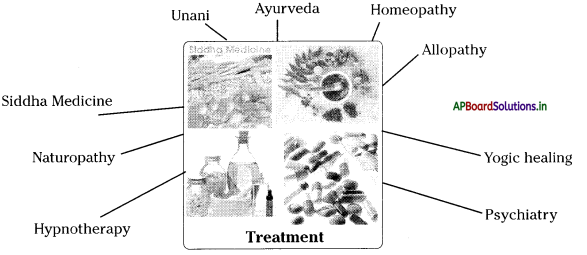
→ In order to prevent and treat illnesses, we need appropriate facilities.

→ India has a large number of doctors, clinics and hospitals.

→ India is the 4th largest producer of medicines in the world and is also a large exporter of medicines.

→ The public health service is a system of health centres and hospitals run by the government to provide treatment to all kinds of problems.

→ There is a wide range of private health facilities that exist in our country.

→ Registered Medical Practitioners (RMPs) work in rural areas.

→ Medicines are too expensive for some chronic diseases to the public. So many insurance companies are present in the market.

→ Water is essential for life and good health.

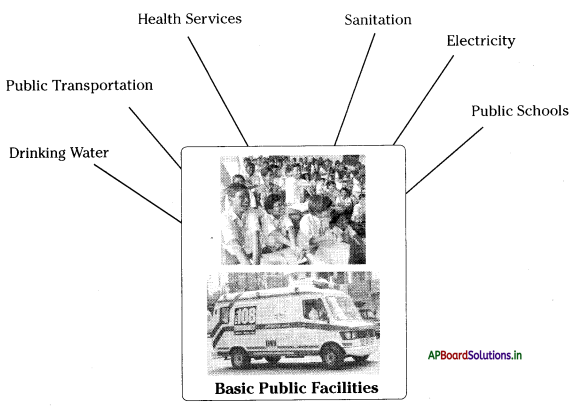
→ Health care, sanitation, electricity etc., are known as public facilities.

→ Government is responsible for providing these to people.

AP Board Solutions AP Board 8th Class Social Studies Notes Chapter 9 Public Health and the Government

→ Adequate food, safe drinking water, proper sanitation and preventive measures are basic to a healthy living environment.

→ Public Health: Health centres, hospitals run by the government are called Public Centres Health Centres.

→ Area Hospital: The hospital has 100 beds at the division level.

→ Public amenities: Like water, there are other essential facilities that need to be provided for everyone. Health care, sanitation, electricity, public transport etc. These are called public amenities.

→ Nutrition: All of us require some fat in our body to remain healthy to provide the source of energy for our activities to protect ourselves from infections. This is called nutrition.

→ Aarogyasri Scheme: This scheme is available to all the persons who hold white cards. They are eligible for free treatment in private hospitals also.

→ Primary Health: These are located at the mandate levels. The PHC covers a Centres population of 30,000 (roughly five Sub Centre areas).

→ Anganwadi centres: Education and health centres for children from 3 to 5 years.

→ Resistance power: Our body has some power of resisting harmful bacteria.

AP Board Solutions AP Board 8th Class Social Studies Notes Chapter 9 Public Health and the Government

→ Asha: A government health worker at the village level.
AP Board 8th Class Social Studies Notes Chapter 9 Public Health and the Government 1
AP Board 8th Class Social Studies Notes Chapter 9 Public Health and the Government 2

AP Board 9th Class Biology Notes Chapter 6 Sense Organs

Students can go through AP State Board 9th Class Biology Notes Chapter 6 Sense Organs to understand and remember the concept easily.

AP State Board Syllabus 9th Class Biology Notes Chapter 6 Sense Organs

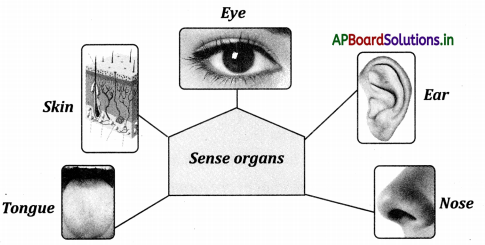
→ The eye, nose, ear, tongue and skin are the five sensory organs in human beings.

→ Stimuli from the environment around are received by the body through sense organs.

→ All sense organs work together for a particular sensation.

→ There is a particular level at which the process of sensation is triggered

→ The brain is the centre of all sensitive activities.

→ The brain receives information from sense organs through sensory nerves and after interpretation sends signals to the parts through motor nerves.

→ Aristotle and Plato mentioned the five senses of humans. Touch was the most important

→ Eyelids, eyelashes, eyebrows, lachrymal glands, eyeballs, conjunctiva are some of the parts of an eye.

→ The eye is covered by three layers called the sclerotic layer or sclera, choroid layer and retina.

→ The biconvex lens is present immediately behind the pupil

→ Lens divides the inner eyeball into an aqueous chamber and a vitreous chamber.

AP Board Solutions AP Board 9th Class Biology Notes Chapter 6 Sense Organs

→ The retina contains rods for near dark vision while cones help in bright colour light, vision.

→ Blindspot is the area of no vision where the optic nerve leaves the eye.

→ Fovea or yellow spot is the area of best vision.

→ The eye forms an image in the retina.

→ The lens turns the image left to right and upside down.

→ In nearsightedness or Myopia images are formed in front of the retina.

→ In farsightedness or Hypermetropia, images are formed behind the retina.

→ Lachrymal glands secrete tears for lubrication and also prevent dehydration of various mucus membranes.

→ Ms patterns are different for different individuals and can be used for identification.

→ The main diseases and defects of the eye are night blindness, xeropthalmia, myopia (near sightedness], Hypermetropia (farsightedness], glaucoma, cataract and colour blindness.

AP Board Solutions AP Board 9th Class Biology Notes Chapter 6 Sense Organs

→ Ear helps in hearing and in maintaining the equilibrium of our body.

→ The ear has three parts: external ear or pinna, middle ear and internal ear.

→ Ceruminous and sebaceous are present in the external ear to keep the ear canal lubricated

→ The tympanum or eardrum is present at the end of the ear canal or Auditory Meatus.

→ The chain of three bones malleus, incus and stapes are present in the middle ear which helps in amplifying sound

→ The internal ear consists of a bony labyrinth enclosing the membranous labyrinth.

→ Olfactory receptors or smell receptors are present in the mucus membrane of the nasal cavity.

→ 10 thousand taste buds are located in the walls of the papillae of the tongue.

→ Umami is one of the five basic tastes together with sweet, sour, bitter and salty.

→ On the tongue, a specialised nerve hotline carries nothing but taste messages to specialised regions of the brain.

→ The skin has cutaneous receptors for touch.

AP Board Solutions AP Board 9th Class Biology Notes Chapter 6 Sense Organs

→ Skin is the largest organ of human beings contains the outer epidermis and the inner dermis.

→ Sweat glands, sebaceous glands, hair follicles, blood vessels and fats are present in the dermis of the skin.

→ Sense organs are the gateway of knowledge.

→ The visually impaired students can read the Braille script merely by touching.

→ The impression of an eye image stays in the retina for about 1/16 of a second

→ Sensory receptors: Receptors present in sense organs that respond to a stimulus in the external or internal environment of an organism.

→ Lachrymal glands: Present in eye. They secrete lubricant for the eye aiding in the movement of the eye.

→ Stimulus: Something external that influences an activity.

→ Conjunctiva: It ¡s the layer that covers the front portion of the eye.

AP Board Solutions AP Board 9th Class Biology Notes Chapter 6 Sense Organs

→ Sclera: One of the three layers that cover the eye. It is the outermost thick, tough, fibrous, non – elastic and white coloured layer.

→ Iris: It ¡s the part formed by the choroid layer around the pupil.

→ Cornea:

  • It is the part that is formed due to the bulging of the sclera.
  • It is the clear window in the sclera in front of the iris.
  • The transparent protective covering is on the outer surface of the eye.

→ Pupil: The small black round area in the middle of the eye.

→ Choroid layer: It ¡s the second layer that covers the eye. It is black ¡n colour and contains a lot of blood vessels.

→ Pinna: External ear; visible part of the ear on either side of our head.

→ Ceruminous glands: Wax producing glands ¡n the pinna.

→ Sebaceous glands: Oil-producing glands ¡n the pinna. Helps ¡n lubricating cheer canal (or) Glands present ¡n inner layer of skin i.e., the dermis. It secretes oil.

→ Auditory meatus: The canal in the ear.

→ Malleus: The first bone of the three bones present in the middle ear.

AP Board Solutions AP Board 9th Class Biology Notes Chapter 6 Sense Organs

→ Incus: The second bone of the three bones present in the middle ear.

→ Stapes: The last one of the three bones present in the middle ear. All these three bones amplify vibrations received on the tympanum membrane.

→ Tympanum: Also called the eardrum. A thin layer is present at the end of the auditory meatus.

→ Vestibule: It is the first part of the membranous labyrinth present in the internal ear.

→ Vestibular nerves: Nerve fibres from vestibule forms vestibular nerve.

→ SnlIunar canals: It is the second part of the membranous labyrinth present in the internal ear connected with the vestibule and filled with endolymph.

→ Cochlea: It ¡s the third part of the membranous labyrinth. It is spiral-shaped.

→ Basilar membrane: Membrane that separates semi-lunar canals and cochlea.

→ Vestibular membrane: It separates vestibule and semilunar canals.

→ Cochlear nerve: Cochlear nerve fibres from the cochlear nerve.

→ Auditory nerve: It is formed by the union of vestibular and cochlear nenes.

AP Board Solutions AP Board 9th Class Biology Notes Chapter 6 Sense Organs

→ Suspensory ligaments: Biconvex lens ¡s present behind the pupil and is attached to suspensory ligaments.

→ Vitreous chamber: It is the part of the inner ball divided by a lens. It is filled with jelly-like fluid.

→ Aqueous chamber: It is another part of the inner ball divided by a lens. It is filled with water like fluid.

→ Suspensory ligaments: Biconvex lens is present behind the pupil and is attached to suspensory ligaments.

→ Vitreous chamber: It is the part of the inner ball divided by a lens. It is filled with jelly-like fluid.

→ Aqueous chamber: It is another part of the inner ball divided by a lens. It is filled with water like fluid.

→ Retina: Image formation site in eye. It contains cells called rods and cones. Yellow spots and blind spots are present in it.

→ Blindspot: The area of no vision In Retina

→ Fovea or Macula or yellow spot: The area of the best vision in the Retina.

→ Optic nerve: It ¡s formed by the nerve cells bundled together. It transports visual information from the eye to the brain.

AP Board Solutions AP Board 9th Class Biology Notes Chapter 6 Sense Organs

→ Night blindness: Type of eye disease. The person cannot see the objects in dim light and in the night.

→ Myopia: Also called nearsightedness. Images are formed in front of the retina. Type of eye disease. Can’t see objects at a distance.

→ Hypermetropia: Also called farsightedness type of eye disease. mages are formed behind the retina. Cannot see near objects properly.

→ Cataract: Type of eye disease. A thin layer is formed over the conjunctiva. The lens becomes white instead of clear.

→ Colour blindness: Type of eye disease. Unable to see the difference between all or some colours.

→ Chemoreceptors: These are specialised nerve cells designed to respond to chemical stimuli.

→ Foliate papillae: These are the bump-like structures present on the sides of the tongue.

→ Filiform papillae: Small prominences or Flakes on the tongue. They are thin, ‘V’ shaped but do not contain taste buds. Numerous in number not involved in gestation. Mechanical in function.

→ Olfactory sense: Sense of smell.

→ Vallarta papillae: These are dome-shaped structures on the tongue. Their number varies from eight to twelve. They get afferent taste nerves from the cranial nerve, glass pharyngeal.

→ Fungiform papillae: The roundish structures on the tongue.

→ Melanin: It Is a pigment, responsible for the colouration of the skin.

→ Cutaneous receptors: Receptors present in the skin for touch.

→ Tactile receptors: Separate Receptors for touch in the skin.

→ Pacinian receptors (Corpuscles): Receptors for pressure ¡n skin.

→ Nociceptors: Receptors for temperature in the skin.

AP Board Solutions AP Board 9th Class Biology Notes Chapter 6 Sense Organs

→ Leucoderma: Disease due to the deficiency of melanin.

→ Pella gro: Disease due to the deficiency of Vitamins.

→ Umami: It is the savoury flavour found in protein-rich foods such as meat, seafood and cheese. It is one of the five basic tastes together with sweet, sour, bitter and salty.
AP Board 9th Class Biology Notes Chapter 6 Sense Organs 1
→ While issuing identity cards like AADHAR. They take photographs of your eyes. Do you know why did they take a photo of your eye? Iris patterns are individual specific and can be used for identification just as our fingerprints.

→Each taste bud has a cavity with a pore. The pore is called the taste pore. The epithelial cells, surrounding the taste buds form taste cells or the receptors. The receptor cells and the cells supporting them are situated in the cavity. Each receptor cell connects to a nerve fibre. All the nerve fibres connect to the main nerves that carry messages to the brain and spinal cord for further processing.

→ Albertus Magnus (1193 – 1280):

  • Albertus Magnus was born in Lauingen, Germany in 1193 and died on November 15, 1280, in Cologne, Germany.
  • Albertus Magnus was a bishop in a church in Italy, a keen observer of nature and a lover of science.
  • Albertus Magnus follows Aristotelian ideas but comments on them for the first time and making them accessible for wider academic debate.
  • He mentions the role of nerves for the first time in the sensation of touch.

AP Board 8th Class Social Studies Notes Chapter 8 Impact of Technology on Livelihoods

Students can go through AP State Board 8th Class Social Studies Notes Chapter 8 Impact of Technology on Livelihoods to understand and remember the concept easily.

AP State Board Syllabus 8th Class Social Studies Notes Chapter 8 Impact of Technology on Livelihoods

→ Technology is something we see and use every day.

→ Technology is the practical application of knowledge in our everyday lives that leads to a new product or an improvement in the way something works or how something is done.

→ The steam engine changed many production processes in factories.

→ Technology is not always welcomed. People are afraid that they would lose their jobs to the machines.

→ Agriculture around the time of independence was traditional. Agricultural goods were produced mostly for self and some for the market.

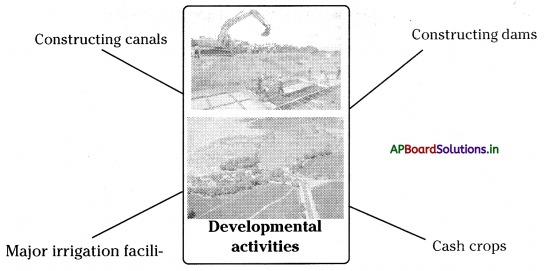
→ After independence, the government began building dams and providing irrigation facilities.

→ The use of agricultural machinery also changed the production process quite considerably.

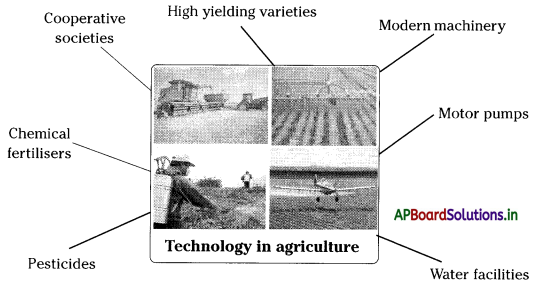
→ Tractors, Combined Harvesters began to be used.

→ Extensive farm mechanization is leading to the displacement of laborers.

→ The British introduced power loom production in India. Later they moved from large mills to small sheds.

AP Board Solutions AP Board 8th Class Social Studies Notes Chapter 8 Impact of Technology on Livelihoods

→ Technological changes also affect service activities.

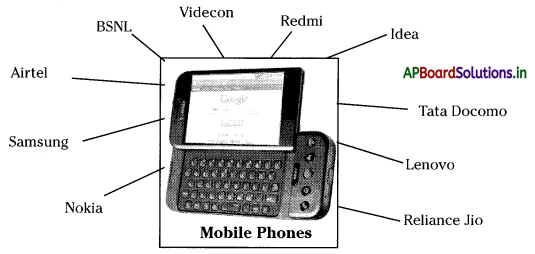
→ India’s telecommunication network is the third-largest in the world.

→ The changes in telephone technology brought down the cost of communication.

→ technology: Technology is the practical application of knowledge in our everyday lives that leads to a new product or an improvement in the way something works.

→ Invention: When the new machine or method of production is created for the first time, it is called an invention.

→ irrigation Facilities: Supplying water to the fields through different methods is called Irrigation facilities.

→ Fertilizers and Pesticides: Fertilisers are used for high yielding, Pesticides are used for killing insects in fields.

→ Agricultural Operations: Ploughing, sprouting, etc., are all agricultural operations.

AP Board Solutions AP Board 8th Class Social Studies Notes Chapter 8 Impact of Technology on Livelihoods

→ Service Activities: All the activities that support agricultural industries and all the trading activities are called service activities.
AP Board 8th Class Social Studies Notes Chapter 8 Impact of Technology on Livelihoods 1
AP Board 8th Class Social Studies Notes Chapter 8 Impact of Technology on Livelihoods 2