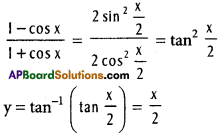
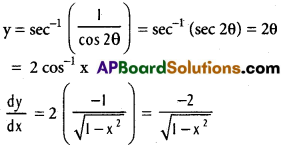
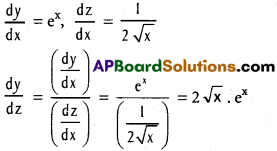
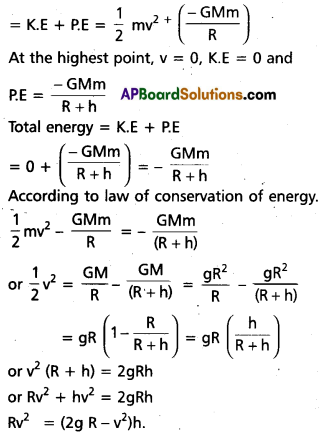
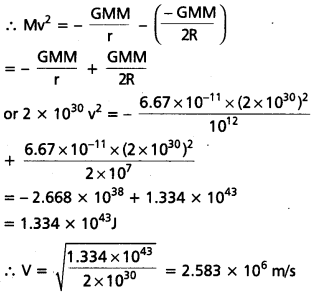
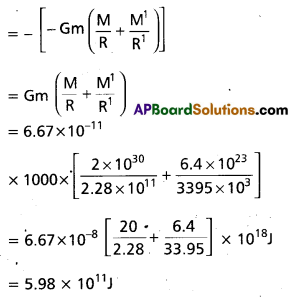
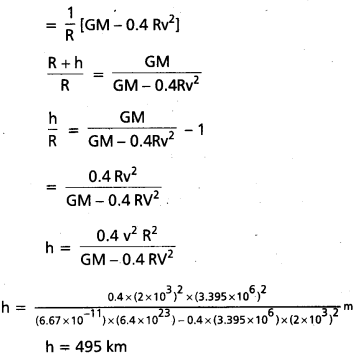
AP Inter 1st Year Physics Study Material Chapter 3 సరళరేఖాత్మక గమనం

Andhra Pradesh BIEAP AP Inter 1st Year Physics Study Material 3rd Lesson సరళరేఖాత్మక గమనం Textbook Questions and Answers.

AP Inter 1st Year Physics Study Material 3rd Lesson సరళరేఖాత్మక గమనం

అతిస్వల్ప సమాధాన ప్రశ్నలు

ప్రశ్న 1.
గమన, నిశ్చల స్థితులు సాపేక్షం వివరించండి.
జవాబు:
నిశ్చల స్థితి మరియు గమనస్థితి సాపేక్షం.
ఉదా : ఒక నిర్ధేశకం పరంగా వస్తువు నిశ్చల స్థితిలోగాని లేదా గమనంలోగాని ఉండవచ్చు. గమనంలో ఉన్న ఒక రైలులో ఒకవ్యక్తి తన సహప్రయాణికుని పరంగా నిశ్చల స్థితిలో, భూమిపై గల వ్యక్తి పరంగా గమనంలో ఉంటాడు.

ప్రశ్న 2.
సగటు వేగం ఏవిధంగా తత్కాల వేగంతో విభేదిస్తుంది? [Mar. ’13]
జవాబు:
సగటు వేగం చలించే కణం యొక్క ఫలిత గమనాన్ని తెల్పును.
తత్కాల వేగం, ఏదైనా నిర్దిష్ట సమయం వద్ద కణం వేగంను కూడా తెల్పును. ఏకరీతి చలనంలో తత్కాల వేగం, సగటు వేగం రెండు సమానమవుతాయి.

ప్రశ్న 3.
ఒక వస్తువు వేగం శూన్యమై దాని త్వరణం శూన్యం కాని సందర్భానికి ఒక ఉదాహరణ ఇవ్వండి. [Mar. ’13]
జవాబు:
నిట్టనిలువుగా పైకి విసిరిన వస్తువు, గరిష్ట ఎత్తు వద్ద సున్నా వేగం కల్గి, త్వరణం (a) సున్నాకాదు (i.e a = g)

ప్రశ్న 4.
ఒక వాహనం ప్రయాణించిన దూరం L లో సగం దూరం వడి υ1, తోనూ, రెండవ సగం దూరం వడి v2 తోనూ ప్రయాణించింది. ఆ వాహనం సగటు వడి ఎంత?
జవాబు:
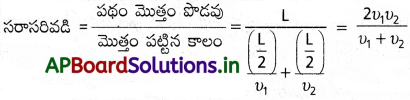
AP Inter 1st Year Physics Study Material Chapter 3 సరళరేఖాత్మక గమనం 1

ప్రశ్న 5.
కింది దిశలో ప్రయాణిస్తూ ఒక లిఫ్టు భూ అంతస్తు (ground floor) కు చేరబోతున్నది. భూ అంతస్తును మూల బిందువుగానూ, ఊర్ధ్వ దిశను ధన దిశగానూ అన్ని రాశులకూ ఎంపిక చేసుకొంటే కింది ఇచ్చిన వాటిలో ఏది సరియైనది?
a) x < 0, v < 0, a > 0,
c) x > 0, v < 0, a > 0,
b) x > 0, v < 0, a < 0, d) x > 0, V > 0, a > 0
జవాబు:
లిఫ్ట్, గ్రౌండ్ ఫ్లోర్ (మూలబిందువు) వైపు చలిస్తూ ఉన్నప్పుడు, దానిస్థానం X తగ్గును, వేగం తగ్గును, కావున x < 0, v <0 కాని a > 0 కావున (a) సరియైన సమాధానము.

AP Inter 1st Year Physics Study Material Chapter 3 సరళరేఖాత్మక గమనం

ప్రశ్న 6.
ఏకరీతి (సమరీతి) గమనం గల ఒక క్రికెట్ బంతి చాలా స్వల్పకాలం పాటు ఒక బ్యాట్ తో కొట్టగా వెనకకు మరలింది. తిరోదిశలో త్వరణాన్ని ధనాత్మకంగా తీసుకొని కాలంపరంగా త్వరణంలో మార్పుకు గ్రాఫు గీయండి.
జవాబు:
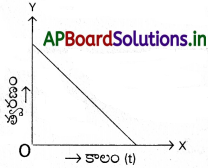
AP Inter 1st Year Physics Study Material Chapter 3 సరళరేఖాత్మక గమనం 2

ప్రశ్న 7.
ధన x—దిశలో అక్షం వెంబడి ఏకమితీయ గమనాన్ని కలిగి ఉండి, ఆవర్తకంగా నిశ్చలస్థితికి వచ్చి ముందుకు పోతూ ఉండే ఒక కణం గమనానికి ఉదాహరణ ఇవ్వండి.
జవాబు:
సరళహరాత్మక డోలని ఎడమ అంత్యస్థానం నుండి బయలుదేరి, అదే బిందువు వద్దకు ఆవర్తకంగా నిశ్చలస్థితికి వచ్చి ధన X- అక్ష దిశలో ముందుకు చలిస్తుంది.

ప్రశ్న 8.
ఒక (ద్రవంలో) ప్రవాహిలో పతనం చెందే ఒక వస్తువు a = g-bv త్వరణం కలిగి ఉందని పరిశీలించడం జరిగింది. ఇక్కడ g గురుత్వ త్వరణం, b ఒక స్థిరాంకం. కొంత కాలం తరువాత వస్తువు స్థిర వేగంతో పతనం చెందుతుందని తెలుసుకొన్నారు. ఆ స్థిరవేగం విలువ ఎంతై ఉండవచ్చు?
జవాబు:
త్వరణం, a = g – bv
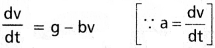
AP Inter 1st Year Physics Study Material Chapter 3 సరళరేఖాత్మక గమనం 3
వస్తువు ప్రవాహి ద్వారా స్థిర వేగంతో చలిస్తే, dv = 0
0 = g – bv ∴ v = \(\frac{g}{b}\)

ప్రశ్న 9.
ఒక నిర్దేశ చట్రం పరంగా ఒక వస్తువు గమన పథం పరావలయం. ఈ నిర్దేశ చట్రం పరంగా స్థిరవేగంతో గమనంలో ఉన్న వేరొక నిర్దేశ చట్రం పరంగా వస్తువు గమన పథం పరావలయం అవుతుందా? కాకపోతే మరేమై ఉండవచ్చు?
జవాబు:
కాదు, వస్తువు’ యొక్క పథం నిలువు సరళరేఖాత్మక మార్గంలో ఉంటుంది.

ప్రశ్న 10.
ఒక స్ప్రింగు ఒక కొనను ద్రుఢ ఆధారానికి బిగించి, రెండో కొనకు ఒక ద్రవ్యరాశిని వేలాడదీసి, లాగి వదిలారు. ఎప్పుడు త్వరణం పరిమాణం గరిష్ఠంగా ఉంటుంది?
జవాబు:
అంత్యస్థానం వద్ద త్వరణ పరిమాణం గరిష్టము.

స్వల్ప సమాధాన ప్రశ్నలు

ప్రశ్న 1.
త్వరణం కాలంతోపాటు మారుతూ ఉన్నప్పుడు శుద్ధగతి శాస్త్రంలోని సమీకరణాలను ఉపయోగించవచ్చా? ఉపయోగించ వీలులేకపోతే ఆ సమీకరణాలు ఏ రూపాన్ని సంతరించుకొంటాయి ?
జవాబు:
కాలంతో త్వరణం మారితే, శుద్ధగతిక సమీకరణాలు ఉపయోగించలేము.
ఒక వస్తువు ఏకరీతి త్వరణం (a) తో సరళరేఖ వెంట చలిస్తున్నప్పుడు, శుద్ధగతిక సమీకరణాలు
1) v = vo + at; 2) x = vot + \(\frac{1}{2}\) at²; 3) v² = v0² + 2ax
ఇచ్చట ‘X’ స్థానభ్రంశం, t = 0 వద్ద వేగం v0, కాలం t వద్ద వేగం ‘v’, ‘a’ త్వరణము.
స్థిరత్వరణంతో, సరళ పథం గమనంలో ఈ సమీకరణాలను, శుద్ధగతిక సమీకరణాలు అంటారు.

AP Inter 1st Year Physics Study Material Chapter 3 సరళరేఖాత్మక గమనం

ప్రశ్న 2.
ఒక కణం ఒక సరళరేఖ వెండి సమత్వరణంతో గమనంలో ఉంది. t = 0 వద్ద కణం వేగం v., t = t వద్ద వేగం vz ఆ కణం సగటు వేగం, ఈ కాలవ్యవధిలో (v1 + v2)/2 అని తెలిపితే, అది సరియైనదేనా? మీ సమాధానానికి తగిన వివరణ ఇవ్వండి.
జవాబు:
సరియైనది.
వివరణ :
ఒక కణం, ఏకరీతి త్వరణం ‘a’ తో గమనంలో ఉందని భావిద్దాం.
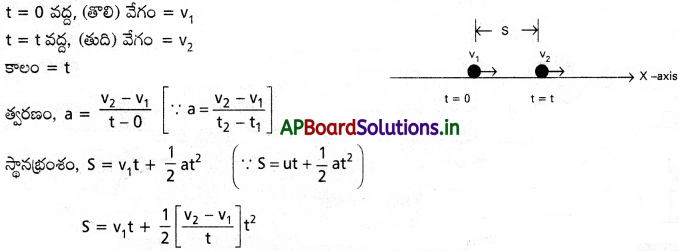
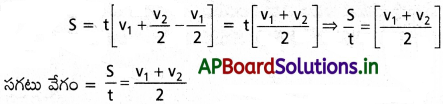
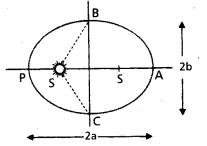
AP Inter 1st Year Physics Study Material Chapter 3 సరళరేఖాత్మక గమనం 4
AP Inter 1st Year Physics Study Material Chapter 3 సరళరేఖాత్మక గమనం 5

ప్రశ్న 3.
ఒక కణం వేగ దిశ, కణ త్వరణ దిశతో పోల్చితే వేరుగా ఉండవచ్చా? అవును అయితే ఉదాహరణ ఇవ్వండి.
జవాబు:
ఒక కణం యొక్క వేగం, త్వరణంలు భిన్న దిశలలో ఉండవచ్చును.
ఉదా : నిట్టనిలువుగా పైకి విసిరిన కణం వేగం మరియు త్వరణంలు వ్యతిరేక దిశలలో ఉండును. వాని మధ్య కోణం 180° ఉండును. కణం ప్రయాణంలో వేగదిశ ఊర్థ్వదిశలో, త్వరణదిశ అథోదిశలో ఉండును.

ప్రశ్న 4.
ఎగురుతూ ఉన్న విమానం నుంచి పారాచూట్ సహాయంతో ఒక వ్యక్తి భూమి నుంచి 3 km ఎత్తు నుంచి దూకాడు. అతడు భూమి నుంచి 1 km ఎత్తులో ఉన్నప్పుడు పారాచూటును పూర్తిగా విప్పాడు. అతడి గమనాన్ని వివరించండి.
జవాబు:

  1. భూమి నుండి 3 km ఎత్తులో ఎగురుతూ గమనంలో ఉన్న విమానం నుండి పారాచూట్తో ఒకవ్యక్తి దూకితే, భూమి నుండి 1 km ఎత్తు వరకు స్వేచ్ఛా వస్తువు వలె, 9.8 ms-2 స్థిర గురుత్వ త్వరణంతో చలిస్తాడు.
  2. భూమి నుండి 1 km ఎత్తు వద్ద, పారాచూటన్ను వ్యక్తి పూర్తిగా తెరిస్తే, దానిపై గురుత్వాకర్షణ బలం క్రిందికి, గాలి నిరోధ బలం పైకి పనిచేయును. పారాచూట్ ఫలిత త్వరణం, a = g – bv అనుసరించి క్రమంగా తగ్గును.
  3. పారాచూటైపై ఊర్థ్వదిశలో గాలి నిరోధ బలం, అథోదిశలో గురుత్వాకర్షణ బలంనకు సమానమై, వ్యక్తి చరమ వేగాన్ని పొందుతాడు.
  4. ఈ చరమ వేగం తక్కువగా ఉంటే, పారాచుటిస్టు ఎక్కువ కష్టం లేకుండా భూమిపై క్షేమంగా చేరతాడు.

ప్రశ్న 5.
ఒక పక్షి తన ముక్కును ఒక పండు కరుచుకుని భూమికి సమాంతరంగా ఎగురుతున్నది. ఒకానొక ఎత్తు అది పండును జారవిడిచింది (a) పక్షిపరంగానూ (b) భూమిపై నిలబడిన వ్యక్తి పరంగానూ కిందపడుతున్న పండు గమన పథాన్ని వివరించండి.
జవాబు:
ఒక పక్షి పండును ముక్కున కరచుకుని, భూమికి క్షితిజ సమాంతరంగా ఎగురుతూ, పండును వదిలితే

AP Inter 1st Year Physics Study Material Chapter 3 సరళరేఖాత్మక గమనం 6
(a) పక్షిపరంగా పండు యొక్క పథం సరళరేఖ
(b) భూమిపై నిలబడిన వ్యక్తి పరంగా పండు పథం పరావలయం

ప్రశ్న 6.
ఒకడు ఎత్తైన భవన ఉపరితలంపై పరిగెడుతూ, పక్కనే కొద్దిగా తక్కువ ఎత్తున్న ఇంకొక భవనం పైకి క్షితిజ సమాంతరంగా దూకాడు. అతడి వేగం 9 ms 1. రెండు భవనాల మధ్య దూరం 10m భవనాల ఎత్తులలో తేడా9 m అయితే అతడు రెండవ భవనం పైకి దూకగలడా ? (g = 10 ms-2).
జవాబు:
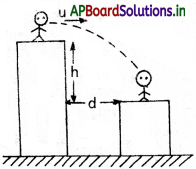
AP Inter 1st Year Physics Study Material Chapter 3 సరళరేఖాత్మక గమనం 7
రెండు భవనాల మధ్య ఎత్తుల తేడా h = 9 m; g = 10 ms-2
మనిషి గమన కాలం t = \(\sqrt{\frac{2h}{g}}=\sqrt{\frac{2\times9}{10}}\) = 1.341 sec
మనిషి క్షితిజ సమాంతర వడి, u = 9 ms-1
మనిషి ప్రయాణించిన క్షితిజ సమాంతర దూరం,
d3 = క్షితిజ సమాంతర వడి × గమన కాలం = u × t = 9 × 1.341 12.07 m
రెండు భవనాల మధ్య క్షితిజ సమాంతర దూరం db = 10 m అని ఇవ్వబడినది.
∴ మనిషి రెండవ భవనంపైకి దూకగలడు. కారణము dm > db

ప్రశ్న 7.
ఒక ఎత్తైన భవనంపై నుంచి ఒక బంతిని జారవిడిచారు. అదే క్షణంలో ఇంకొక బంతిని కొంత వేగంతో క్షితిజ సమాంతరంగా విసిరారు. ఏ బంతి మొదటగా భూమిని చేరుతుంది? మీ సమాధానాన్ని
వివరించండి.
జవాబు:
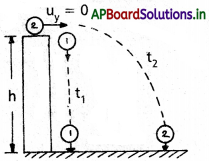
AP Inter 1st Year Physics Study Material Chapter 3 సరళరేఖాత్మక గమనం 8
భవంతి ఎత్తు = బంతి స్థానంభ్రంశం = h
మొదటి బంతికి, u = 0; S = h, a = g; t = t1
ఈ విలువలను S = ut + \(\frac{1}{2}\) at² లో ప్రతిక్షేపిస్తే,
h = 0 + \(\frac{1}{2}\) gt1²
∴ t1 = \(\sqrt{\frac{2h}{g}}\) ………….. (1)
రెండవ బంతికి, uX = u; uY = 0, aY = g, SY = h; t = t2
ఈ విలువలను SY = uYt + \(\frac{1}{2}\)aYt² లో ప్రతిక్షేపిస్తే,
h = 0 + \(\frac{1}{2}\) gt2²
∴ t2 = \(\sqrt{\frac{2h}{g}}\) …………… (2)
(1) మరియు (2) సమీకరణాల నుండి, t, = t,
∴ రెండు బంతులు ఒకేసారి భూమిని చేరతాయి.

AP Inter 1st Year Physics Study Material Chapter 3 సరళరేఖాత్మక గమనం

ప్రశ్న 8.
ఒక భవనంపై నుంచి ఒక బంతిని జారవిడిచారు. అదే క్షణంలో ఇంకొక బంతిని నిట్టనిలువుగా పైకి కొంత వేగంతో విసిరారు. ఆ బంతుల సాపేక్ష వేగాలలోమార్పును కాలం ప్రమేయంగా వివరించండి.
జవాబు:
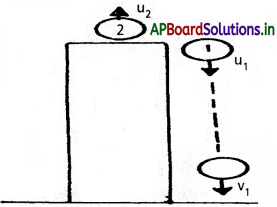
AP Inter 1st Year Physics Study Material Chapter 3 సరళరేఖాత్మక గమనం 9
మొదటి బంతికి u = u1; v = v1; a = g; t = t
ఈ విలువలను v = u + at లో ప్రతిక్షేపిస్తే
v1 = u1 + gt1 ……………. (1)
రెండవ బంతికి, u = u2; v = v2; a = − g; t = t2
ఈ విలువలను v = u + at లో ప్రతిక్షేపిస్తే,
v2 = u2 + gt2 ………. (2)
(1) − (2) ⇒ (v1 − v2) = (u1 − u2) + g(t1 + t2)
∴ (v1 − v2) − (u1 − u2) = g(t1 + t2)
∴ (v1 – v2) – (0 – u2) = g(t1 + t2)[∵ u1 = 0]
∴ రెండు బంతుల తుది సాపేక్ష మరియు తొలి సాపేక్ష వేగంల మధ్య భేదం = కాలంలో ప్రమేయము.

ప్రశ్న 9.
ఒకనొక వర్ష బిందువు వ్యాసం 4 mm. భూమి నుంచి 1 km ఎత్తున గల మేఘం నుంచి ఆ వర్షం బిందువు జారిపడితే అది భూమిని ఎంత ద్రవ్యవేగంతో తాకుతుంది?
జవాబు:
వర్షపు బిందువు వ్యాసము, D = 4 mm
వర్షపు బిందువు వ్యాసార్థం, r = 2 mm = 2 × 10⁻³ m
వర్షపు బిందువు ఘనపరిమాణం, V = \(\frac{4}{3}\)πr³ = \(\frac{4}{3}\times\frac{22}{7}\) × (2 × 10⁻³
నీటి సాంద్రత, d = 10³ kg/m³
నీటి బిందువు ద్రవ్యరాశి, M = Vd = \(\frac{4}{3}\times\frac{22}{7}\) × 8 × 10-9 × 10³ = 33.5 × 2 × 10-6 kg
మేఘం నుండి పడు వర్షపు బిందువు ఎత్తు, h = 1 km = 1000 m
భూమిని తాకే ముందు వర్షపు బిందువు వేగం V = \(\sqrt{2gh}=\sqrt{2\times9.8\times1000}\) = 140 ms-1
భూమిని తాకేటప్పుడు వర్షపు బిందువు ద్రవ్యవేగం P = mV = 33.52 × 10-6 × 140 = 469.28 × 10-5
= 0.004692 kg ms-1

ప్రశ్న 10.
క్షితిజంతో 45° కోణంతో ప్రక్షిప్తం చేసిన ప్రక్షేపకం చేరే గరిష్ట ఎత్తు దాని వ్యాప్తిలో నాలుగోవంతు ఉంటుందని చూపండి.
జవాబు:
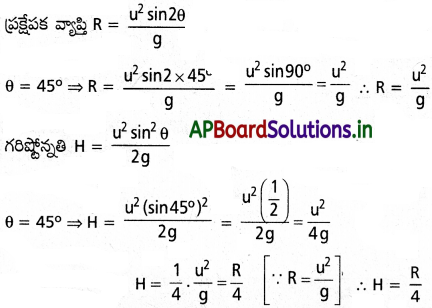
AP Inter 1st Year Physics Study Material Chapter 3 సరళరేఖాత్మక గమనం 10

లెక్కలు (Problems)

ప్రశ్న 1.
ఒకడు ఒక తిన్నని రోడ్డు వెంట తన ఇంటి నుంచి 2.5 km దూరాన ఉన్న మార్కెట్కు 5 km h-1 వడితో నడిచాడు. మార్కెట్ మూసి ఉండటం గమనించి, వెంటనే వెనుదిరిగి ఇంటికి 7.5 km h-1 వేగంతో చేరాడు. 0 నుంచి 50 నిమిషాల కాలవ్యవధిలో అతడి (a) సగటు వేగ పరిమాణం, (b) సగటు వడి ఎంత?
సాధన:
ఇంటినుండి మార్కెట్కు :
X1 = 2.5 km; v1 = 5 km h-1;
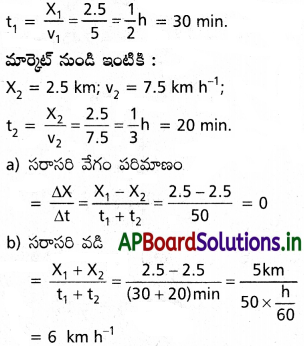
AP Inter 1st Year Physics Study Material Chapter 3 సరళరేఖాత్మక గమనం 11

ప్రశ్న 2.
ఒక కారు మొదటి మూడు వంతుల దూరాన్ని 10 kmph వేగంతోనూ, రెండవ మూడు వంతుల దూరాన్ని 20 kmph వేగంతోనూ, చివరి మూడు వంతుల దూరాన్ని 60 kmph వేగంతోనూ ప్రయాణిస్తే, మొత్తం దూరాన్ని పూర్తి చేయడంలో కారు సగటు వడి ఎంత ?
సాధన:
v1 = 10 kmph; v2 = 20 kmph;
v3 = 60 kmph; v = ?
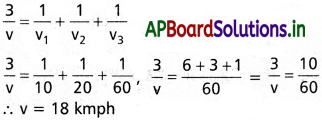
AP Inter 1st Year Physics Study Material Chapter 3 సరళరేఖాత్మక గమనం 12

ప్రశ్న 3.
ఒక తుపాకి గుండు 150 ms-1 వడితో ప్రయాణిస్తూ చెట్టును తాకి 3.5 cm దూరం దూసుకొని పోయి ఆగిపోయింది. చెట్టు కాండంలో గుండు రుణత్వరణం పరిమాణం, చెట్టును తాకిన తరువాత గుండు ఆగిపోవడానికి పట్టిన కాలం ఎంత?
సాధన:
u 150 m/s, s = 3.5 cm = 0.035 m, v = 0
v² – u² = 2as
0 – 150² = 2 × a × 0.035
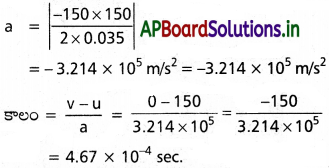
AP Inter 1st Year Physics Study Material Chapter 3 సరళరేఖాత్మక గమనం 13

AP Inter 1st Year Physics Study Material Chapter 3 సరళరేఖాత్మక గమనం

ప్రశ్న 4.
ఒక మోటారు వాహకుడు మోటారును 35 min నిమిషాలపాటు 85 km/h వేగంతో ఉత్తర దిశగా నడిపి 15 నిమిషాలపాటు ఆగిపోయాడు. తరువాత ఉత్తరదిశలోనే ప్రయాణించి 2 గంటలలో 130 km దూరం వెళ్ళాడు. అతడి మొత్తం స్థానభ్రంశం, సగటు వేగం ఎంత?
సాధన:
v1 = 85 kmph, t = 35.0 min, S2 = 130 km
S1 = స్థానభ్రంశం = \(\frac{85}{60}\) × 30 = 42.5 km
S2 = 130 km

a) S = S1 + S2 = 42.5 + 130 = 172.50 km
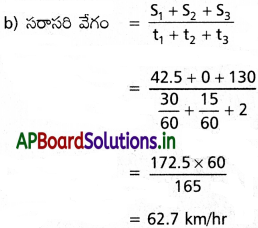
AP Inter 1st Year Physics Study Material Chapter 3 సరళరేఖాత్మక గమనం 14

ప్రశ్న 5.
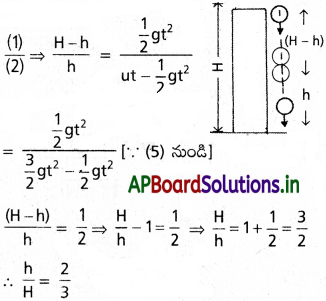
ఒక భవనంపైకప్పు నుంచి ఒక బంతి A ని జారవిడిచిన క్షణంలోనే, అలాంటిదే బంతి B ను భూమిపై నుంచి నిట్టనిలువుగా పైకి విసిరారు. బంతులు ఢీకొట్టుకున్న క్షణంలో బంతి Aవడి, బంతి B వడికి రెట్టింపు ఉంది. బంతులు అభిఘాతం జరుపుకొన్న ఎత్తు, భవనం ఎత్తులో ఎన్నో వంతు ఉంటుంది?
సాధన:
బిల్డింగ్ ఎత్తు = H గా తీసుకుందాము
రెండు బంతులు అభిఘాతం జరిగిన ఎత్తు = h
బంతి A కు, u = : 0; V = VA; s = H – h; t = t; a = g
ఈ విలువలు 5 = ut + \(\frac{1}{2}\) at² లో ప్రతిక్షేపించగా
H- h = 0 + \(\frac{1}{2}\)gt²
H – h = \(\frac{1}{2}\)gt² ………… (1)
మరియు VA = gt ………….. (2)
బంతి B కు, u = u; V= VB; s = h; a = -g
ఈ విలువలు s = ut + \(\frac{1}{2}\)at² లో ప్రతిక్షేపించగా
⇒ h = ut – \(\frac{1}{2}\)gt² ………….. (3)
మరియు VB = u – gt ………….. (4)
ఇచ్చినది VA = 2VB
gt = 2(u – gt)
u = \(\frac{3}{2}\) gt ………….. (5)
AP Inter 1st Year Physics Study Material Chapter 3 సరళరేఖాత్మక గమనం 15

ప్రశ్న 6.
16 m ఎత్తు గల ఒక భవనం పై కప్పు నుంచి క్రమ కాలవ్యవధులలో నీటి బిందువులు పడుతున్నాయి. మొదటి నీటి బిందువు భూమిని తాకిన క్షణంలో, అయిదవ నీటి బిందువు పైకప్పును వదిలింది. వరస నీటి బిందువుల మధ్య దూరం కనుక్కోండి.
సాధన:
H = 16 m
మొదటి నీటి బిందువు భూమిని తాకుటకు పట్టుకాలం

AP Inter 1st Year Physics Study Material Chapter 3 సరళరేఖాత్మక గమనం 16
= 1.8 సెకను.
ప్రతి నీటి బిందువుకు మధ్య కాలవ్యవధి = \(\frac{t}{n – 1}\)
ఇచ్చట n = నీటి బిందువుల సంఖ్య
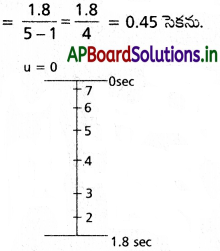
AP Inter 1st Year Physics Study Material Chapter 3 సరళరేఖాత్మక గమనం 17
రెండవ నీటి బిందువుకు h2 = \(\frac{1}{2}\) gt²
\(\frac{1}{2}\) × 9.8 × 1.35 × 1.35 = 8.93 m
d12 = 16 – 8.93 = 7.06 = 7 m
మూడవ నీటి బిందువుకు h3 = \(\frac{1}{2}\) × 9.8 × 0.90 × 0.90
= 3.97
d23 = 8.93 – 3.97 = 4.961 = 5 m
నాల్గవ నీటి బిందువుకు h4 = \(\frac{1}{2}\) × 9.8 × 0.45 × 0.45
= 0.9922

d34 = 3.97 – 0.9922
d34 = 2.9778 = 3 m
అదేవిధంగా d45 = 0.9922 – 0 = 0.9922 =1 m

ప్రశ్న 7.
ఒక వేటగాడు తనకు కొంత దూరంలో ఉన్న చెట్టు నుంచి వేలాడుతున్న ఒక కోతికి తుపాకీ గురిపెట్టాడు. వేటగాడు తుపాకీ పేల్చిన క్షణాన, గుండు తగలకుండా తప్పించుకోవాలని కోతి కొమ్మను విడిచి జారిపడింది. కోతిది తప్పుడు నిర్ణయం అని వివరించండి.
సాధన:
ఒక వేటగాడు తన నుంచి ‘d’ దూరంలో ఉన్న చెట్టుపై కొమ్మనుంచి వేలాడుతున్న ఒక కోతి వైపు తుపాకీ గురిపెట్టాడనుకుందాము. తుపాకీ గుండు వెలుగును గమనించిన అది చెట్టు నుండి క్రింద పడుతుంది. తుపాకీ వేగం ఎంతైనప్పటికీ అది కోతిని తాకుతుంది.
కోతి భూమిని చేరుటకు పట్టుకాలం t1 = \(\sqrt{\frac{2h}{g}}\) ……….. (1)
తుపాకీ నుండి తూటా గమనం క్షితిజ సమాంతర ప్రక్షిప్త వస్తువువలె ఉంటుంది.
లంబదిశలో వేగం uy = 0
తూటా భూమిని చేరుటకు పట్టుకాలం t2 అనుకుందాము.
∴ S= ut + \(\frac{1}{2}\)at²1
S = 0 × t + \(\frac{1}{2}\)at²2
∴ h = \(\frac{1}{2}\)ht²2
t2 = \(\sqrt{\frac{2h}{g}}\) ……….. (2)
(1) మరియు (2) ల నుండి, t1 = t2
తూటా మరియు కోతి ఒకేసారి భూమిని చేరును.
కావున కోతిని తూటా తాకుతుంది.
కోతి పొరపాటు పడింది.

ప్రశ్న 8.
భూమి నుంచి 500 m ఎత్తున 360 kmph వడితో క్షితిజ సమాంతర దిశలో ప్రయాణిస్తున్న విమానం నుంచి ఆహారపు పొట్లాన్ని జార విడిచారు. (i) పొట్లం అవరోహణ కాలం, (ii) జారవిడిచిన బిందువు నుంచి క్షితిజ సమాంతరంగా ఎంత దూరంలో పొట్లం భూమిని చేరుతుందో కనుక్కోండి.
సాధన:
విమానం వేగం v = 360 kmph
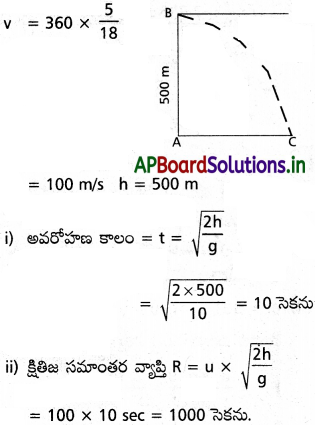
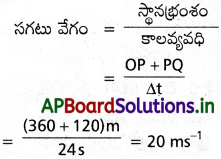
AP Inter 1st Year Physics Study Material Chapter 3 సరళరేఖాత్మక గమనం 18

ప్రశ్న 9.
ఒక భవనం కిటికీ నుంచి, క్షితిజానికి 20° కిందగా, 8 ms−1 వేగంతో ఒక బంతిని విసి రారు. బంతి భూమిని 3 s తరువాత తాకింది. బంతిని ఎంత ఎత్తు నుంచి విసిరారు ? భవనం పునాది నుంచి ఎంత దూరంలో బంతి భూమిని తాకుతుంది ?
సాధన:
u = 8 m/s, θ = 20°, t = 35

a) క్షితిజ సమాంతర దూరం (u cos θ) t = 8
cos 20° × 3 = 8 × 0.9397 × 3 = 22.6 m

b) ఎత్తు h = (u sin θ)t + \(\frac{1}{2}\) gt²
= 8 sin 20° × 3 + \(\frac{1}{2}\) × 9.8 × 9
= 8.208 + 44.1 = 52.31 m

c) 44.1 m ఎత్తు నుండి బంతిని విసిరారు.
h1 = (u sin θ)t1 + \(\frac{1}{2}\) gt1²
10 = (8 sin 20°)t1 + \(\frac{1}{2}\)9.8 t1²
= 2.736 t1 + 4.9 t1²
⇒ 4.9 t1² + 2.736 t1 – 10 = 0

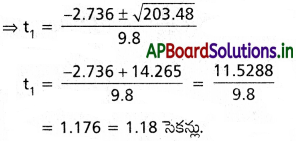
AP Inter 1st Year Physics Study Material Chapter 3 సరళరేఖాత్మక గమనం 19
AP Inter 1st Year Physics Study Material Chapter 3 సరళరేఖాత్మక గమనం 20

ప్రశ్న 10.
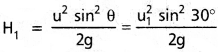
క్షితిజంతో 30°, 60° చేసే దిశలలో, ఒకే బిందువు నుంచి రెండు బంతులను ప్రక్షిప్తం చేశారు. ఆ రెండు బంతులూ (a) ఒకే ఎత్తును చేరితే, (b) ఒకే వ్యాప్తిని కలిగి ఉంటే వాటి తొలి వేగాల నిష్పత్తి ఎంత?
సాధన:
θ1 = 30°, θ2 = 60°
మొదటి వస్తువు గరిష్ట ఎత్తు
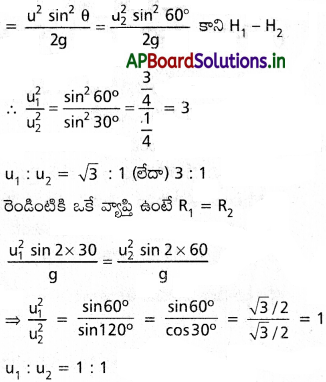
AP Inter 1st Year Physics Study Material Chapter 3 సరళరేఖాత్మక గమనం 21
రెండవ వస్తువు గరిష్ట ఎత్తు H2
AP Inter 1st Year Physics Study Material Chapter 3 సరళరేఖాత్మక గమనం 22

అదనపు లెక్కలు (Additional Problems)

ప్రశ్న 1.
కింద ఇచ్చిన గమన సంబంధ ఉదాహరణలలో దేనిలో వస్తువును బిందు వస్తువుగా ఉజ్జాయింపు చేయవచ్చు.
a) రెండు స్టేషన్ల మధ్య కుదుపులు లేకుండా ప్రయాణించే రైలు కారేజ్.
b) వృత్తాకార మార్గంలో సైకిల్ తొక్కే వ్యక్తి తలపై కూర్చున్న కోతి.
c) స్పిన్ తిరుగుతూ భూమిని తాకి హఠాత్తుగా మలుపు తిరిగిన క్రికెట్ బంతి.
d) టేబుల్ అంచు నుంచి జారిపడి అటూ ఇటూ దొర్లుతున్న బీకర్.
సాధన:
a) రైల్వే క్యారేజి పరిమాణం, రెండు స్టేషన్ల మధ్య దూరంతో పోల్చిన చాలా తక్కువ. కావున క్యారేజిని బిందు వస్తువుగా పరిగణిస్తారు.

b) కోతి పరిమాణం, సైక్లిస్ట్, హెచ్చు వ్యాసార్థంగల వృత్తాకార ట్రాక్ వెంట తిరుగుతున్నప్పుడు, ప్రయాణించు దూరం కంటే చాలా తక్కువ. కావున వృత్తాకార ట్రాక్ సైక్లిస్ట్ పై కూర్చున్న కోతిని బిందు వస్తువుగా పరిగణిస్తారు.

c) భ్రమణ క్రికెట్ బంతి పరిమాణం, అది భూమిని తాకి ప్రయాణించు దూరంతో విస్మరించలేము. కావున క్రికెట్ బంతిని బిందు వస్తువుగా పరిగణిస్తారు.

d) టేబుల్ అంచునుండి జారిపడిన బీకరు పరిమాణం, టేబుల్ ఎత్తులో పోల్చి విస్మరించలేము. కావున బీకరును బిందు వస్తువుగా పరిగణించలేము.

ప్రశ్న 2.
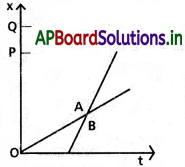
ఇద్దరు పిల్లలు A, B లు వారి స్కూలు 0 నుంచి వారి ఇళ్ళు P, Q లకు తిరిగి ప్రయాణమయ్యే సందర్భంలో వారి గమనాన్ని సూచించే స్థానం- కాలం (x – t) గ్రాఫు పటంలో చూపడం జరి గింది. కింద ఇచ్చిన బ్రాకెట్లలో సరియైన ఎంపికచేయండి.
AP Inter 1st Year Physics Study Material Chapter 3 సరళరేఖాత్మక గమనం 23
a) (A/B) స్కూలుకు (B/A) కంటే దగ్గరగా ఉంటాడు.
b) (A/B) స్కూలుకు (B/A) కంటే ముందుగా బయలుదేరుతాడు.
c) (A/B), (B/A) కంటే వేగంగా నడుస్తాడు.
d) A, B లు ఇంటికి (ఒకే సమయంలో/ వేరు వేరు సమయాలలో) చేరుతారు.
e) (A/B) ప్రయాణంలో (B/A) ను (ఒకసారి/ రెండు సార్లు) దాటి వెళతాడు.
సాధన:
a) OP < OQ కావున A పిల్లవాడు B పిల్లవాని కన్న స్కూలు దగ్గరగా నివసించుచున్నాడని చెప్పవచ్చు.
b) Aకు x = 0, t = 0. B కొంత నిర్ణీత t విలువ కల్గి ఉన్నాడు. కావున A స్కూల్ నుండి B కన్నా ముందుగా బయలుదేరును.
c) ఏకరీతి చలన సందర్భంలో x – t గ్రాఫ్ వాలు వేగంనకు సమానము మరియు B కు x – t గ్రాఫ్ వాలు A కన్నా ఎక్కువ. కావున B, A కన్నా వేగంగా నడుచును.
d) x – t గ్రాఫ్ల నుండి t విలువ A మరియు B కు సమానము. t అక్షంనకు సమాంతరంగా గీసిన రేఖలు
P మరియు Q లకు సమానం. కావున A, B లు ఒకేసారి ఇళ్లను చేరును.
e) A మరియు B, X-t గ్రాఫ్లు ఒకే ఒకచోట ఖండించు కొనును. స్కూల్ వదిలిన తరువాత B బయలుదేరిన తరువాత A ను ఒకసారి అతిక్రమించును.

AP Inter 1st Year Physics Study Material Chapter 3 సరళరేఖాత్మక గమనం

ప్రశ్న 3.
ఒక స్త్రీ ఇంటి వద్ద 9.00 amకు బయలుదేరి, కాలి నడకన 5 km h-1 వడితో తిన్నని రోడ్డుపై 2.5 km దూరంలో ఉన్న కార్యాలయానికి చేరి, 5.00 pm వరకు అక్కడ ఉండిపోయి, ఆటోలో 25 km h-1 వడితో తిరిగి ఇంటికి చేరింది. తగిన స్కేలు తీసుకొని ఆ స్త్రీ గమనానికి సంబంధించి x-t గ్రాఫు గీయండి.
సాధన:
ఆఫీస్ ను చేరుటకు పట్టుకాలము
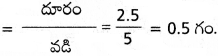
AP Inter 1st Year Physics Study Material Chapter 3 సరళరేఖాత్మక గమనం 24

ఆఫీస్ నుండి తిరిగి వచ్చుటకు పట్టుకాలం
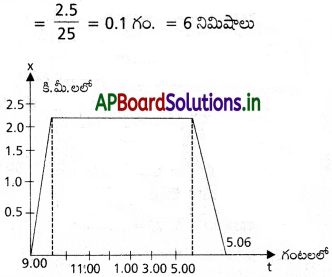
AP Inter 1st Year Physics Study Material Chapter 3 సరళరేఖాత్మక గమనం 25
మహిళ ఆఫీస్ను 9.30 am కు చేరును మరియు 5.06 p.m. ను తిరిగి ఇంటికి చేరును. ఈ చలనంనకు సంబంధించిన x – t గ్రాఫ్ పటంలో చూడండి.

ప్రశ్న 4.
ఒక వ్యక్తి సన్నని వీధిలో 5 అడుగులు ముందుకు, 3 అడుగులు వెనక్కి, మరల 5 అడుగులు ముందుకు, 3 అడుగులు వెనక్కి.. ఇలా నడిచాడు. ప్రతి అడుగులో అతడు 1 m దూరం, 1 సెకనులో ప్రయాణిస్తే, అతని గమనానికి x t గ్రాఫు గీయండి. వ్యక్తి తాగినవాడైతే బయలుదేరిన చోటు నుంచి 13 m దూరంలో ఉన్న గుంతలో పడడానికి ఎంత సమయం పడుతుందో గ్రాఫు ద్వారా కనుక్కోండి. సాధన:
త్రాగిన వ్యక్తి 8 స్టెప్స్ ప్రయాణించు ప్రభావ దూరం = 5 – 3 = 2 m.
∴ 8m లు చలించుటకు 32 స్టెప్స్ తీసుకొనును.
గుంటను చేరుటకు 5 m కన్నా ఎక్కువ దూరం ప్రయాణించాల్సి ఉంటుంది. అందుకు అతడు ముందుకు 5 స్టెప్స్ తీసుకొనును.
∴ అతడు 13m ప్రయాణించుటకు తీసుకున్న స్టెప్లు
= 32 + 5 = 37
కావున అతడు 37 స్టెప్స్ తీసుకున్న తరువాత బయలుదేరిన 37 సెకనుల తరువాత గుంటలో పడిపోవును.

ప్రశ్న 5.
500 km h-1 వడితో పోతున్న ఒక జెట్ విమానం పరంగా దాని నుంచి దగ్ధం చెందిన ఇంధన వాయువులు 1500 km h వడితో వెలువడుతున్నాయి. భూమిపై నుంచి పరి శీలించి వ్యక్తికి వాయువులు ఎంత వడితో వెలువడుతున్నట్లు అనిపిస్తుంది?
సాధన:
భూమి సాపేక్షంగా ఉత్పత్తుల వేగం vp. ధన X-అక్ష దిశలో విమాన చలనదిశను భావిద్దాం.
జెట్ విమానం వడి, vA = 500 km h-1
జెట్ విమానం పరంగా దహన ఉత్పత్తుల సాపేక్ష వడి VPA= -1500 km h-1.
విమాన పరంగా ఉత్పత్తుల సాపేక్ష వేగం,
VPA = VP – VA = −1500
VP = VA – 1500 = 500 – 1500
= 1000 km h-1
ఇచ్చట రుణగుర్తు విమాన చలన దిశకు వ్యతిరేకంగా దహన ఉత్పత్తుల దిశ ఉండునని తెల్పును. కావున సాపేక్ష వేగం పరిమాణం 1000 km h-1.

ప్రశ్న 6.
ఒక తిన్నని రహదారి వెంట ఒక కారు 126 km h-1 వడితో ప్రయాణిస్తూ 200 m దూరంలో నిశ్చలస్థితిలోకి వచ్చింది. కారు రుణ త్వరణం (త్వరణం సమరీతి త్వరణం అని భావించండి) ఎంత? నిశ్చలస్థితికి రావడానికి కారు తీసుకున్న సమయం ఎంత?
సాధన:
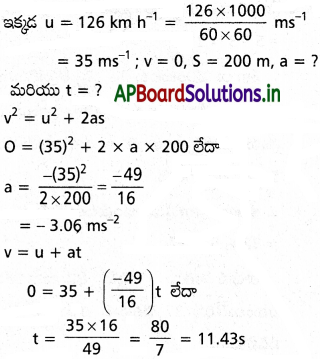
AP Inter 1st Year Physics Study Material Chapter 3 సరళరేఖాత్మక గమనం 26

ప్రశ్న 7.
400 m పొడవున్న రెండు రైళ్ళు A, Bలు రెండు సమాంతర రైలు మార్గాలపై 72 km h-1 సమవడితో ఒకేదిశలో ప్రయాణిస్తున్నాయి. రైలు A, రైలు B కంటే ముందు ఉంది. రైలు B డ్రైవరు, రైలు Aను దాటిపోవాలని నిర్ణయించి తన రైలుకు 1 ms-2 త్వరణం కలిగించాడు. 50 s తరువాత రైలు Bలో గార్డు, రైలు A డ్రైవరును దాటి రెండు రైళ్ళ మధ్య ఉన్న అసలు దూరం ఎంత?
సాధన:
రైలు A కు : u = 72 km h-1 = \(\frac{72\times1000}{60\times60}\)
= 20 m s-2; t = 50s; a = 0 s = sA ;
s = ut + \(\frac{1}{2}\)at²
∴ SA = 20 × 50 + \(\frac{1}{2}\) × 0 × 50²
= 1000 m

రైలు Bకు : u = 72 kms-1 = 20 ms -2;
a = 1 ms-2; t = 50/S, s = s-B
∴ SB = 20 × 50 + \(\frac{1}{2}\) × 1 × 50²
= 2250 m
రైలు B చివరి పెట్టెలో గార్డ్ ఉంటే, రెండు రైళ్ళ మధ్య యదార్థ దూరం + A రైలు పొడవు + B రైలు పొడవు = SB – SA.

లేక రెండు రైళ్ళ మధ్య యదార్ధ దూరం + 400 + 400
= 2250 – 1000 = 1250 m

లేక రెండు రైళ్ళ మధ్య యదార్ధ దూరం
= 1250 – 800 = 450m.

ప్రశ్న 8.
రెండు వరుసలున్న (two-lane) రోడ్డుపై కారు A 36 km h-1 వడితో పోతున్నది. రెండు కార్లు B, Cలు వ్యతిరేక దిశల్లో 54 km h-1 వడితో A వైపు ప్రయాణిస్తున్నాయి. ఒకానొక క్షణాన, దూరాలు AB, AC లు1 kmకు సమానమై నప్పుడు, C కంటే ముందుగా A ని దాటి పోవాలని B నిర్ణయించడం జరిగింది. ప్రమాదాన్ని నివారించడానికి కారు B కి ఉండాల్సిన కనీస త్వరణం ఎంత?
సాధన:
కారు A వేగం = 36 km h-1 = 10 ms-1
కారు B లేక C వేగం = 54 km h-1 = 15 ms-1
A రంగ B సాపేక్ష వేగం
A = 15 – 10 – 5 ms-1
A పరంగ C సాపేక్ష వేగం
A = 15 + 10 = 25 ms-1
AB = AC = 1 km = 1000 m
A దాటుటకు B లేక కు అవసరమయ్యే కాలం
= \(\frac{1000}{25}\) = 40 sec.

కారు ( కన్నా ముందు కారు A ను దాటుటకు, కారు B, a త్వరణంతో ప్రయాణిస్తే, అప్పుడు
u = 5 ms-1, t = 40s, s = 1000 m, a = ?
Using s = ut + \(\frac{1}{2}\)at²
1000 = 5 × 40 + \(\frac{1}{2}\) × a × 40² (లేక)
1000 – 200 800 a (లేక)
a = 1 m/s²

ప్రశ్న 9.
రెండు పట్టణాలు A, Bల నుంచి ప్రతి T నిమిషాలకు రెండు దిశల్లోనూ బస్సులు బయలుదేరేటట్లు రవాణా సౌకర్యంతో వాటిని సంధానించారు. A నుంచి Bకు 20 km h-1 వడితో సైకిల్పై ప్రయాణించే వ్యక్తిని, అతని గమన దిశలో, ప్రతి 18 నిమిషాలకు ఒక బస్సు దాటుతుంది. వ్యతిరేక దిశలో ప్రతి 6 నిమిషాలకు ఒక బస్సు దాటుతుంది. రవాణా వ్యవస్థలో రెండు వరస బస్సుల మధ్య కాల వ్యవధి Tబస్సుల వడి (స్థిర వడిగా భావించండి) ఎంత?
సాధన:
v km h-1 స్థిర వడితో A మరియు B టౌన్ల మధ్య ప్రయాణించినవని తీసుకుందాం. సైక్లిస్ట్ దృష్ట్యా (A నుండి B వైపు) సాపేక్ష వేగం (i.e., సైక్లిస్ట్ వెళ్ళే దిశలో)
= (v – 20) kmh-1. సైక్లిస్ట్ దృష్ట్యా B నుండి A వైపు బస్సు సాపేక్ష వేగం = (v + 20) kmh-1.
T (మినిట్) కాలంలో బస్సు ప్రయాణించు దూరం
= VT ప్రశ్న పరంగా = \(\frac{vT}{v – 20}\) = 18 లేక vT
= 18v – 18 × 20 …………. (i)
మరియు \(\frac{vT}{v + 20}\) = 6 లేక vT = 6v + 20 × 6 ……… (ii)
(i) మరియు (ii) లను సమానం చేయగా
18v – 18 × 20 = 6v + 20 × 6 (లేక)
12v = 20 × 6 + 18 × 20 = 480
(లేక) υ = 40 kmh-1
υ విలువను (i) లో ప్రతిక్షేపించగా
40 T = 18 × 40 – 18 × 20 = 18 × 20
(లేక) T = 18 × 20/40 9 min.

ప్రశ్న 10.
ఒక క్రీడాకారుడు ఒక బంతిని 29.4 m s తొలి వేగంతో నిట్టనిలువుగా విసిరాడు.
a) బంతి ఊర్ధ్వ దిశలో. గమనంలో ఉన్న కాలంలో త్వరణం దిశ ఏమిటి?
b) బంతి గరిష్ట ఎత్తు వద్ద గల బిందువును చేరినప్పుడు బంతి వేగం, త్వరణాల విలువలు ఎంతెంత?
c) బంతి గరిష్ఠ ఎత్తు వద్ద x = 3 0 m t = 0 s గా స్థానం, కాలం విలువలను ఎన్నుకొని, నిమ్నదిశను ధన x – అక్షం దిశగా భావించి, స్థానం, వేగం, త్వరణం సంజ్ఞలను బంతి ఊర్ధ్వ దిశలో గమనంలో ఉన్నప్పుడు, నిమ్న దిశలో గమనంలో ఉన్నప్పుడు ఎలా ఉంటాయో తెలపండి.
d) బంతి ఎంత ఎత్తుకు చేరుతుందో, ఎంత కాలం తరువాతక్రీడాకారుని చేతిలోకి తిరిగి వస్తుందో తెలపండి. (g = 9.8 ms-2 గాను, గాలి నిరోధం లేనట్లుగానూ భావించండి.)
సాధన:
a) గురుత్వాకర్షణవల్ల బంతి చలించును. గురుత్వ త్వరణం ఎల్లప్పుడు నిలువుగా క్రింది దిశలో పని చేయును.

b) గరిష్ఠ బిందువు వద్ద బంతి వేగం శూన్యం. గురుత్వ త్వరణం = 9.8 ms-2 క్రింది దిశలో పనిచేయును.

c) గరిష్ఠ బిందువును (x = 0 మరియు t = 0) మూల బిందువుగా పరిగణిస్తే, క్రింది నిలువు దిశలో x – అక్ష దిశను ధనాత్మకంగా మరియు ఊర్ధ్వ దిశలో x-అక్ష దిశను రుణాత్మకంగా తీసుకుంటారు. ఊర్ధ్వ దిశ చలనంలో, స్థానం గుర్తు ధనాత్మకం, వేగం గుర్తు ధనాత్మకం మరియు త్వరణం గుర్తు ధనాత్మకం.

d) భూమి 5 నుండి గరిష్ఠ బిందువును బంతి చేరుటకు పట్టు కాలం t. బంతి ఊర్ధ్వ నిలువు చలనంలో,
u = -29.4 m/s-1, a = 9.8 m/s-2,
v = 0, S = 5, t = 2
v² – u² = 2as
0 – (29.4)² = 2 × 9.8 × s (Or)
S = \(\frac{-(29.4)^2}{2\times9.8}\) = – 44.1 m
ఇచ్చట రుణగుర్తు ఊర్ధ్వ దిశలో ప్రయాణించు దూరంను తెల్పును.
As v = u + at
∴ 0 = -29.4 + 9.8 × t లేదా t = \(\frac{29.4}{9.8}\)
ఆరోహణ కాలం = 3s
వస్తువు ఒక్క గురుత్వాకర్షణ ప్రభావం వల్ల చలిస్తే, ఆరోహణ కాలం ఎల్లప్పుడు అవరోహణ కాలంనకు సమానము.

ఆటగాడు చేతిలోనికి తిరిగి వచ్చుటకు పట్టు మొత్తం కాలం = 3 + 3 = 6s.

AP Inter 1st Year Physics Study Material Chapter 3 సరళరేఖాత్మక గమనం

ప్రశ్న 11.
కింది వాక్యాలను జాగ్రత్తగా చదివి, అవి తప్పో, ఒప్పో తెలిపి తగిన కారణాలను, ఉదాహరణ లను పేర్కొనండి. ఒక కణం ఏకమితీయ గమనంలో ఉంది.
a) ఒకానొక క్షణంలో దాని వడి శూన్యమై, ఆ క్షణంలో త్వరణం శూన్యేతర విలువ కలిగి ఉండవచ్చు.
b) దాని వడి శూన్యమై, వేగం శూన్యేతర విలువ కలిగి ఉండవచ్చు.
c) అది స్థిరపడి కలిగి ఉండి తప్పక త్వరణం శూన్యమై ఉండి తీరాలి.
d) దాని త్వరణం విలువ ధనాత్మకమై తప్పక వడి వృద్ధి కలిగి ఉండాలి.
సాధన:
a) వస్తువును అంతరాళంలోనికి ఊర్ధ్వ లోనికి విసిరితే, గరిష్ట బిందువు వద్ద సున్నా వడి కలిగి, త్వరణం గురుత్వ త్వరణానికి సమానమగును. కావున ఇచ్చిన స్టేట్మెంట్ నిజము.

b) వస్తు వడి దిశలో వేగం ఉండును. వడి సున్నా అయిన వస్తు వేగ పరిమాణం సున్న. వేగం సున్న. కావున ఇచ్చిన స్టేట్మెంట్ తప్పు,

c) కణం సరళరేఖా మార్గంలో స్థిర వడిలో చలిస్తే, కాలంతోపాటు వేగము స్థిరము. త్వరణం

AP Inter 1st Year Physics Study Material Chapter 3 సరళరేఖాత్మక గమనం 27నిజము.

d) వస్తువు స్టేట్మెంట్ క్షణిక కాలంపై ఆధారపడును. సరళరేఖలో ధన త్వరణంతో ప్రయాణించునపుడు, క్షణిక కాలం t వద్ద వస్తు వేగము v = u + at. క్షణిక కాలము మూల బిందువుగా తీసుకుంటే, a ధనాత్మకమైతే, u రుణాత్మకం అగును. ఇచ్చిన స్టేట్మెంట్ నిజము కాదు.

క్షణిక కాలంనకు ముందు అన్ని కాలాలకు ఉండదు. కణం నెమ్మదిగా క్రిందికి చలిస్తున్నప్పుడు, కణం వడి కాలంతో క్రమంగా తగ్గును.

వస్తువును నిలువుగా పైకి ప్రక్షిప్తం చేసినపుడు u ధనాత్మకం మరియు a ధనాత్మకం. కావున ఇచ్చిన స్టేట్మెంట్ నిజము.

ప్రశ్న 12.
90 m ఎత్తు నుంచి ఒక బంతిని నేలపైకి జారవిడిచారు. నేలతో అభిఘాతం జరిపిన ప్రతిసారి బంతి తన వేగంలో 10వవంతు కోల్పోతుంది. t = 0,12 s మధ్య బంతి గమనానికి సంబంధించి వడి కాలం గ్రాఫు గీయండి.
సాధన:
90 m ఎత్తు నుండి బంతి నిలువు అధో చలనంను భావిస్తే,
u = 0, a = 10 m/s², S = 90 m, t = ?, v = ?
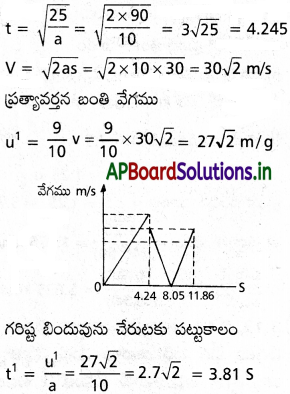
AP Inter 1st Year Physics Study Material Chapter 3 సరళరేఖాత్మక గమనం 28

మొత్తం కాలం = = t + t¹ = 4.24 + 3.81 = 8.05 S
నేల = 2.7√2 m/s.
నేలకు తిరిగి రావటానికి పట్టుకాలం = 3.81 S
t¹ = \(\frac{u^1}{a}=\frac{27 \sqrt{2}}{10}\) = 2.7√2 m/s.
మొత్తం కాలం = t + t¹ = 4.24 + 3.81 = 8.05 S
నేలను తాకే ముందు బంతి వేగం = 2.7√2 m/s.
నేలను తాకిన తరువాత బంతి వేగం
= \(\frac{9}{10}\) × 27√2=24.3√2 m/s.

బంతి ఊర్ధ్వ చలనంనకు పట్టు మొత్తం కాలం
= 8.05 3.81 = 11.86 S

ఈ చలనంనకు సంబంధించిన వడి కాలం గ్రాఫ్ పటంలో చూపబడింది.

ప్రశ్న 13.
కింద ఇచ్చిన అంశాల మధ్య భేదాలను తగిన ఉదాహరణలతో స్పష్టంగా వివరించండి.
a) ఒకానొక కాలవ్యవధిలో స్థానభ్రంశపు పరిమాణం (ఒక్కొక్కప్పుడు దూరం అంటారు) ఆ కాలవ్యవధిలో కణం ప్రయాణించిన పథం పొడవు;
b) ఒకానొక కాలవ్యవధిలో సగటు వేగం పరిమాణం, అదే కాలవ్యవధిలో సగటు వడి. (ఒకానొక కావవ్యధిలో కణం ప్రయాణించిన మొత్తం పథం పొడవును ఆ కాలవ్యవధితో భాగించగా వచ్చే భాగఫలాన్ని సగటు వడిగా నిర్వచించడమైనది) (a), (b) లలో రెండవ రాశి (పథం పొడవు, సగటు వడి) మొదటి రాశి (స్థానభ్రంశ పరిమాణం, సగటు వేగ పరిమాణం) కంటే తక్కువ లేదా సమానంగా ఉంటుందని చూపండి. (సరళత కోసం, ఏకమితీయ గమనాన్ని మాత్రమే పరి గణించండి.)
సాధన:
a) కణం స్థాన భ్రంశ పరిమాణం, ఇచ్చిన కాలంలో తొలిమరియు తుది స్థానాల మధ్య కనిష్ట దూరంనకు సమానము. అదేకాలంలో కణం ప్రయాణించిన వాస్తవ మార్గంను మొత్తం పొడవుగా చెప్పవచ్చు. పటంలో చూపినట్లు కణం A నుండి Bకు మరియు B నుండి C కు t కాలంలో చలిస్తే, అప్పుడు స్థానభ్రంశ పరిమాణం = దూరం AC.

మొత్తం పదం పొడవు = దూరం AB + దూరం AC కావున మొత్తం పదం పొడవు (AB + AC) స్థాన భ్రంశం (AC) పరిమాణం కన్నా ఎక్కువ.

కణం చలనంను ఒకే దిశలో i. e., సరళరేఖ వెంట తీసుకుంటే, స్థానభ్రంశ పరిమాణం, కణం ప్రయాణించిన మొత్తం పొడవుకు సమానం.

b) సరాసరి వేగం పరిమాణం
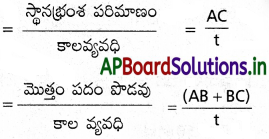
AP Inter 1st Year Physics Study Material Chapter 3 సరళరేఖాత్మక గమనం 29
మరియు సరాసరి వడి
(AB + AC) AC, కావున సరాసరి వడి, సరాసరి వేగ పరిమాణం కన్నా ఎక్కువ. కణం సరళరేఖ వెంట చలిస్తే, ఇచ్చిన కాలంలో స్థానభ్రంశ పరిమాణం, అదే సమయంలో కణం ప్రయాణించిన మొత్తం పొడవుకు సమానం. కావున సరాసరి వడి, సరాసరి వేగంనకు సమానము.

AP Inter 1st Year Physics Study Material Chapter 3 సరళరేఖాత్మక గమనం

ప్రశ్న 14.
ఒక వ్యక్తి తిన్ననని రోడ్డుపై తన ఇంటి నుంచి 2.5 kmల దూరం ఉన్న మార్కెట్కు 5 km h-1. వడితో నడిచాడు. మార్కెట్ మూసి ఉండటం వల్ల వెంటనే వెనుదిరిగి ఇంటికి 7.5 km h-1. వడితో నడిచాడు. అతడి
a) సగటు వేగ పరిమాణం,
b) సగటు వడి (i) 0 నుంచి 30 నిమిషాల కాలవ్యవధిలో (ii) 0 నుంచి 50 నిమిషాల కాలవ్యవధిలో, (iii) 0 నుంచి 40 నిమిషాల కాలవ్యవధిలో ఎంతెంత ? [గమనిక : ఈ అభ్యాసం ద్వారా సగటు వేగ పరిమాణం కాకుండా, సగటు వడిని మొత్తం పథం పొడువు, కాలవ్యవధుల భాగఫలంగా నిర్వచించడం ఎందువల్ల ఉచితమో మీరు చక్కగా అవగాహన చేసుకొంటారు.]
సాధన:
ఇంటి నుండి మార్కెట్ను చేరుటకు పట్టుకాలం,
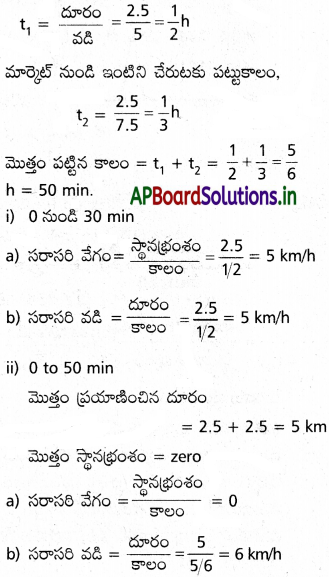
AP Inter 1st Year Physics Study Material Chapter 3 సరళరేఖాత్మక గమనం 30

iii) 0 to 40 min
30 min లో ప్రయాణించు దూరం
(ఇంటి నుండి ‘మార్కెట్కు) = 2.5 km
10 min లో 7.5 km/h వడితో ప్రయాణించు దూరం
(మార్కెట్ నుండి ఇంటికి) = 7.5 × \(\frac{10}{60}\) = 12.5 km
స్థానభ్రంశం 2.5 – 1.25 = 1.25 km
ప్రయాణించిన దూరం = 2.5 + 1.25 = 3.75 km
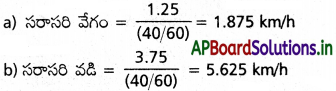
AP Inter 1st Year Physics Study Material Chapter 3 సరళరేఖాత్మక గమనం 31

ప్రశ్న 15.
3.13, 3.14 అభ్యాసాల ద్వారా సగటు వడి, సగటు వేగ పరిమాణాల మధ్య వ్యత్యాసాన్ని జాగ్రత్తగా అవగాహన చేసుకొని ఉంటారు. అయితే ఈ రకపు వ్యత్యాసాన్ని తత్కాల వడి, తత్కాల వేగాల మధ్య గుర్తించ వలసిన అవసరం లేదు. తత్కాల వడి ఎప్పుడూ తత్కాల వేగ పరిమాణానికి సమానం అవుతుంది. ఎందువల్ల?
సాధన:
ఏ క్షణానైన క్షణిక వడి దూరంలోని మార్పు రేటుకు కణం స్వల్పకాల సమానం. ie., vక్షణిక = \(\frac{dx}{dt}\) ప్రయాణంలో, దిశలో మార్పు లేకపోతే, dt కాలంలో ప్రయాణించిన మొత్తం పొడవు, స్థానభ్రంశ. పరిమాణంనకు సమానమగును. కావున క్షణిక వడి ఎల్లప్పుడు క్షణికవేగ పరిమాణంనకు సమానము.

ప్రశ్న 16.
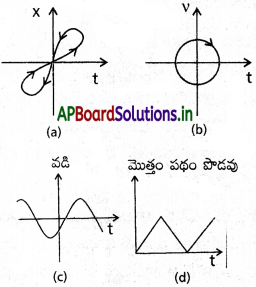
పటం లోని గ్రాఫులు (a) నుంచి (d) వరకు జాగ్రత్తగా గమనించండి. ఏ గ్రాపు కణం ఏకమితీయ గమనాన్ని సూచించదో కారణాలతో సహా తెలపండి.
AP Inter 1st Year Physics Study Material Chapter 3 సరళరేఖాత్మక గమనం 32
సాధన:
a) ఈ గ్రాఫ్ ఏకమితీయ చలనంను సూచించదు. ఏదైనా కాలంలో కణం రెండు స్థానాలను కల్గి ఉండుట వల్ల ఏకమితీయ చలనం సాధ్యం కాదు.

b) ఈ గ్రాఫ్ ఏకమితీయ చలనంను సూచించదు. ఏదైనా కాలంలో కణం ధనాత్మక వేగం, రుణాత్మక దిశను కల్గి ఉండుట వల్ల ఏకమితీయ చలనం సాధ్యం కాదు.

c) ఈ గ్రాఫ్ ఏకమితీయ చలనంను సూచించదు. గ్రాఫ్ రుణాత్మక వడి కల్గి ఉండుటను చెబుతుంది. కాని కణం వడి ఎప్పుడు రుణాత్మకం కాదు.

d) ఈ గ్రాఫ్ ఏకమితీయ చలనంను సూచించదు. గ్రాఫ్ నిర్ణీత కాలం తరువాత మొత్తం పదం పొడవును తెల్పుతుంది. కాని కణం మొత్తం పదం పొడవు కాలంతో ఎప్పుడు తగ్గదు.

ప్రశ్న 17.
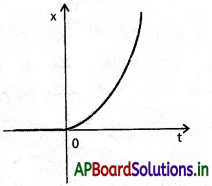
పటం లో ఒక కణం ఏకమితీయ గమనానికి x – t గ్రాఫ్ చూపడం జరిగింది. గ్రాఫ్ ద్వారా t < 0 అయినపుడు కణం సరళరేఖా మార్గంలో గమనంలో ఉన్నదనీ, t > 0 అయినపుడు పరావలయపథంలో గమనంలో వున్నదనీ అనడం సరియైనదేనా ? ఒక వేళ సరికాక పోతే, గ్రాఫ్ సూచించే తగిన భౌతిక సందర్భాన్ని తెలపండి.
AP Inter 1st Year Physics Study Material Chapter 3 సరళరేఖాత్మక గమనం 33
సాధన:
కణం అనుసరించి పదంను x – t గ్రాఫ్ సూచించదు. గ్రాఫ్ నుండి t = 0, x 0 కావున కణం సరళరేఖలో ప్రయాణించదు.

కంటెస్ట్ :
పై గ్రాఫ్ శిఖరం నుండి స్వేచ్ఛగా గురుత్వాకర్షణకు లోనై చలించు వస్తువుకు సంబంధించిన గ్రాఫ్ను
సూచించును.

AP Inter 1st Year Physics Study Material Chapter 3 సరళరేఖాత్మక గమనం

ప్రశ్న 18.
రహదారిపై 30 km h-1 వడితో గమనంలో ఉన్న పోలీసు వ్యాను నుంచి అదే దిశలో 192 km h-1 వడితో కారులో పారిపోతున్న దొంగలపైకి తుపాకీ గుండ్లను పేల్చారు. తుపాకి నుంచి వెలువడినగుండ్ల వడి 150 ms-1 అయితే, ఎంత వడితో తుపాకి గుండు దొంగల కారును తాకుతుంది? (గమనిక : దొంగల కారుకు హాని చేకూర్చే వడిని రాబట్టండి)
సాధన:
బుల్లెట్ వడి, υb = 150 m/s = 540 km h-1
పోలీస్ వాహనం వడి, υp = 30 km/h
దొంగ యొక్క కారు వడి υT = 192 km/h
పోలీస్ వాహనం దృష్ట్యా బుల్లెట్ సాపేక్ష వేగం
VB = υB + υp = 540 + 30 570 km/h
దొంగ కారు దృష్ట్యా అదే దిశలో చలించు బుల్లెట్ వడి
VBT = VB – υT
= \(\frac{378\times1000}{60\times60}\) = 105 m/s

ప్రశ్న 19.
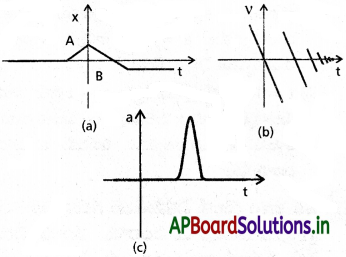
పటం లోని ప్రతి గ్రాపు ద్వారా సూచించే భౌతిక సందర్భాన్ని సూచించండి.
AP Inter 1st Year Physics Study Material Chapter 3 సరళరేఖాత్మక గమనం 34
సాధన:
(a) పటంలో x – t గ్రాఫ్ x సున్నాను (i.e విరామస్థితి) సూచించును. కాలంతో పాటు దాని విలువ పెరిగి స్థిర విలువను చేరి, ఆ తరువాత కాలంతో తగ్గుతూ మరల సున్న చేరి, ఆ తరువాత వ్యతిరేకదిశలో అది స్థిర విలువను చేరి విరామస్థితికి వచ్చును.

(b) పటంలో, వేగం కాలంతో మరల, మరల వేగం మార్పు గుర్తు మారి మరియు ప్రతిసారి కొంత వడి కోల్పోవును.

(c) పటంలో, వస్తువు ఏకరీతి వేగంతో చలించుటను తెల్పును. స్వల్పకాలంలో త్వరణం పెరిగి, మరల సున్నకు తగ్గి, ఆ తరువాత వస్తువు స్థిరవేగంతో చలించుటను తెల్పును.

ప్రశ్న 20.
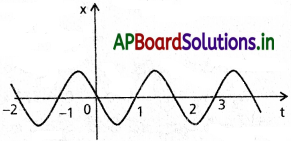
పటం ఏకమితీయ సరళహరత్మక గమనంలో ఉన్న ఒక x – t గ్రాపును చూపిస్తోంది. t = 0.3s, 1.2s,−1.2s వద్ద కణం చరరాశులు స్థానం, వేగం, త్వరణాల సంజ్ఞలను తెలపండి.
AP Inter 1st Year Physics Study Material Chapter 3 సరళరేఖాత్మక గమనం 35
సాధన:
స.హ.చ.లో, త్వరణం a = ω²x, ఇచ్చట ω (i.e., కోణీయ పౌనఃపున్యం) స్థిరాంకం.

i) కాలం t = 0.35 వద్ద, × రుణాత్మకం, x – t వాలు రుణాత్మకం, కావున స్థానం మరియు వేగంలు రుణాత్మకం. a = ω²x, కావున త్వరణం ధనాత్మకం.

ii) t = 1.25 వద్ద, × ధనాత్మకము, x – t వాలు ధనాత్మకం, కావున స్థానం మరియు వేగంలు ధనాత్మకము. a = ω²x కావున త్వరణం

iii) t = 1.25 వద్ద, × రుణాత్మకం, x – t గ్రాఫ్ కూడ రుణాత్మకం. కాని x మరియు t లు రుణాత్మకము. కావున వేగం ధనాత్మకము. చివరకు ‘a’ కూడ ధనాత్మకము.

ప్రశ్న 21.
ఒక కణం యొక్క ఏకమితీయ గమనానికి x – t గ్రాపును పటంలోచూపించారు. మూడు వేరు వేరు సమాన కాలవ్యవధులను సూచించారు. ఏ కాలవ్యవధిలో సగటువడి గరిష్ఠం, ఏ కాలవ్యవధిలో సగటు వడి కనిష్ఠం? ప్రతి కాలవ్యవధిలో సగటు వేగపు సంజ్ఞను తెలపండి.
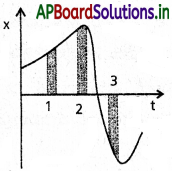
AP Inter 1st Year Physics Study Material Chapter 3 సరళరేఖాత్మక గమనం 36
సాధన:
స్వల్పకాలవ్యవధిలో x – t గ్రాఫ్ వాలు, అదేకాలవ్యవధిలో సరాసరి వడికి సమానం. కాలవ్యవధిలో 3 లో సరాసరి వడి ఎక్కువ కారణం వాలు ఎక్కువ మరియు కాలవ్యవధి 2 లో సరాసరి వడి తక్కువ కారణం వాలు తక్కువ.

కాలవ్యవధి 1 మరియు 2ల మధ్య, x – t వాలు ధనాత్మకం. కావున సరాసరి వడి ధనాత్మకము. కాలవ్యవధి 3లో, x-tవాలు రుణాత్మకం. కావున సరాసరి వడి రుణాత్మకం.

ప్రశ్న 22.
స్థిరమైన (ఒకే) దిశ వెంబడి గమనంలో ఉన్న ఒక కణం గమనానికి వడి-కాలం గ్రాఫ్ పటంలో చూపించారు. మూడు సమాన కాల వ్యవధులు చూపించారు. ఏ కాలవ్యవధిలో సగటు త్వరణం పరిమాణం గరిష్ఠం ఝ ఏ కాలవ్యవధిలో సగటు వడి గరిష్ఠం? (స్థిర దిశ గల) గమన దిశను ధన దిశగా ఎంచుకుని v, a ల సంజ్ఞలను మూడు కాలవ్యవధులలోనూ తెలపండి. A, B, C, D బిందువుల వద్ద త్వరణాలు ఏమిటి?
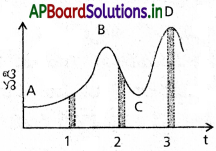
AP Inter 1st Year Physics Study Material Chapter 3 సరళరేఖాత్మక గమనం 37
సాధన:
స్వల్పకాల వ్యవధిలో వేగం-కాలం వాలు సరాసరి త్వరణంనకు సమానం. వ్యవధులు 1 మరియు 3 లతో” పోల్చిన వ్యవధి 2 లో వేగం-కాలం గ్రాఫ్ వాలు గరిష్టం. కావున సరాసరి త్వరణ పరిమాణం వ్యవధి 2 లో ఎక్కువ. సరాసరి వడి వ్యవధి 3లో ఎక్కువ.

వ్యవధి 1లో, వేగం -కాలం గ్రాఫ్ వాలు ధనాత్మకం, కావున త్వరణం a ధనాత్మకం. వడి u, ఈ కాలవ్యవధిలో ధనాత్మకం. వ్యవధిలో2, వేగం-కాలం గ్రాఫ్ వాలు రుణాత్మకం, కావున త్వరణం రుణాత్మకం. వడి u, ఈ కాలవ్యవధిలో ధనాత్మకం. వ్యవధి 3 లో, వేగం -కాలం గ్రాఫ్ కాలం అక్షంనకు సమాంతరం. త్వరణం సున్న కాని v ధనాత్మకం.

A, B, C మరియు D బిందువుల వద్ద, వేగం-కాలం గ్రాఫ్ కాలం అక్షంనకు సమాంతరం. అన్ని నాల్గు బిందువుల వద్ద త్వరణం a సున్న.

అదనపు లెక్కలు (Additional Problems)

ప్రశ్న 23.
ఒక ఆటో (మూడు చక్రాల వాహనం) నిశ్చల స్థితి నుంచి బయలుదేరి, తిన్నని రోడ్డుపై, 10 5 పాటు 1 ms-2 సమత్వరణంతోను, అటుపై సమవేగంతో గమనంలో ఉంది. వాహనం n వ సెకనులో (n = 1, 2, 3, ………….) ప్రయాణించిన దూరానికీ n కూ మద్య గ్రాపు గీయండి. వాహనం త్వరణంతో ప్రయాణించిన కాలంలో గ్రాపు ఆకారం ఎలా ఉండవచ్చో ఊహించండి. ఒక సరళరేఖా? లేదా ఒక పరావలయమా?
సాధన:
ఇక్కడ u = 0, a = 1 m/s²
n వ సెకండ్లో ప్రయాణించిన దూరం
Dn = u + \(\frac{a}{2}\)(2n – 1) = 0 + \(\frac{1}{2}\) (2n – 1) = 0.5
(2n – 1)
n = 1, 2, 3, …………… ప్రతిక్షేపించి Dn విలువ కనుక్కోవచ్చును. n వేర్వేరు విలువలు మరియు వానికి సంబంది Dn విలువలు పట్టికలో క్రింద చూపబడినవి.
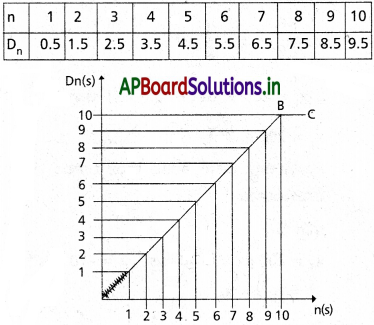
AP Inter 1st Year Physics Study Material Chapter 3 సరళరేఖాత్మక గమనం 38

Dn మరియు n లకు గ్రాఫ్ గీసి పటంలో చూపినట్లు AB సరళరేఖను పొందవచ్చును. (1) నుండి, Dnn గ్రాఫ్ సరళరేఖ. 10S తరువాత గ్రాఫ్ కాలం అక్షానికి సమాంతరంగా ఉన్న సరళరేఖ BC.

ప్రశ్న 24.
నిశ్చలంగా ఉన్న పై కప్పు లేని లిఫ్ట్ లో నిలబడిన ఒక బాలుడు ఒక బంతిని నిట్టనిలువుగా అతడు విసరగలిగిన గరిష్ఠ తొలి వడి 49 ms-1 తో విసిరాడు. అతని చేతిలోకి తిరిగి చేరడానికి బంతికి ఎంత సమయం పడుతుంది? లిఫ్టు, సమవడి 5 ms-1తో పై దిశలో కదులుతూ ఉన్నప్పుడు తిరిగి ఆ బాలుడు అతడు విసర గలిగిన గరిష్ఠ వడితో (49 ms-1) బంతిని పైకి విసిరితే అతని చేతిలోకి తిరిగి చేరడానికి బంతి తీసుకొనే సమయం ఎంత?
సాధన:
నిలువు ఊర్ధ్వదిశను X అక్షం ధనాత్మక దిశగ తీసుకుందాము. లిఫ్ట్ నిశ్చలంగా ఉన్నప్పుడు, బంతి నిలువుగా ఊర్ధ్వ దిశలో చలించి బాలుని చేతిలోనికి చేరినట్లు భావిద్దాము.
u = 49 m/s, a = 9.8m/s², t = ? x – x0 = S = 0
S = ut + \(\frac{1}{2}\) at²
0 = 49 t + \(\frac{1}{2}\)(-9.8)t² లేదా 49t = 4.9 t² లేదా
t = 49/4.9 = 10 sec

లిఫ్ట్ స్థిరవడితో చలించినపుడు :
లిఫ్ట్ స్థిరవడి 5 m/s తో ఊర్వదిశలో చలిస్తే, బాలుని దృష్ట్యా బంతి సాపేక్ష వేగం మారదు. అది 49 ms1. కల్గి ఉండును. కావున, ఈ సందర్భంలో, బంతి 10 సెకండ్ల తరువాత బంతి బాలుని చేతిలోనికి చేరును.

ప్రశ్న 25.
ఒక పొడవైన, క్షితిజ సమాంతరంగా కదిలే, బెల్ట్ (పటం) పైన 50m దూరంలో నిలబడిన తన తండ్రి, తల్లి స్థానాల మధ్య ముందుకూ, వెననకూ బెల్ట్ పరంగా 9 km h-1 వడితో ఒక బిడ్డ పరుగెడుతున్నాడు. బెల్ట్ 4 km h-1 వడితో కదులుతున్నది. బెల్టు ఆవల స్థిరమైన ప్లాట్ ఫాంపై నిలబడి ఉన్న పరిశీలకుడికి,
a) బెల్ట్ గమన దిశలో బిడ్డ పరుగెడుతున్నప్పుడు బిడ్డ వడి ఎంత?
b) బెల్ట్ గమనదిశకు వ్యతిరేక దిశలో బిడ్డ పరెగెడుతున్నప్పుడు బిడ్డ వడి ఎంత?
c) (a), (b) లలో తీసుకొనే సమయమెంత? తల్లి లేదా తండ్రి పరంగా చూసినప్పుడు పై ప్రశ్నల సమాధానాలలో దేని సమాధానం మారుతుంది?
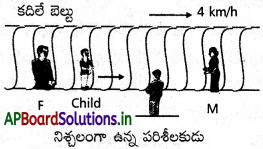
AP Inter 1st Year Physics Study Material Chapter 3 సరళరేఖాత్మక గమనం 39
సాధన:
ఎడమ నుండి కుడివైపు x-అక్షం ధనాత్మక దిశగ భావిద్దాం.
a) బెల్టు వేగం, υB = + 4 km/h-1;
బెల్టు దృష్ట్యా పిల్లవాని వడి,
υC= + 9 km/h = \(\frac{5}{2}\)m/s-1
నిశ్చల పరిశీలనకుని దృష్ట్యా పిల్లవాని వడి,
υC¹ = υC + υB = 9 + 4 = 13 km/h-1

b) ఇక్కడ υB = + 4 km/h, υC = -9 km/h
నిశ్చల పరిశీలకుని దృష్ట్యా పిల్లవాని వడి,
υC¹ = υC + υB = -9 + 4 = -5 km/h-1
బెల్టుచలనదిశకు వ్యతిరేకంగా పిల్లవాడు పరిగెత్తుటకు రుణగుర్తు సూచించును.

c) తల్లిదండ్రుల మధ్యదూరం, S = 540 m
తల్లిదండ్రులు మరియు పిల్లవాడు అదే బెల్టుపై ఉన్నప్పుడు, నిశ్చలంగా ఉన్న పరిశీలకుని దృష్ట్యా (తల్లివైపు లేక తండ్రి వైపు నుండి), పిల్లవాని వడి 9 km/h.

(a) మరియు (b) సందర్భంలో పిల్లవానికి పట్టుకాలం
t = \(\frac{50}{(5/2)}\) = 20 S
తల్లిదండ్రులలో ఒకరు చలనంను పరిశీలిస్తే సందర్భము (a) లేక సందర్భం (b) సమాధానాలు ఒకదానికొకటి మారును. అందువల్ల తల్లి లేక తండ్రి దృష్ట్యా పిల్లవాని వడి 9 km/h కాని సమాధానం (C) మారదు. కారణం తల్లి, తండ్రి మరియు పిల్లవాడు అదే బెల్టుపై ఉండుట వల్ల, బెల్టు చలనం వల్ల అందరు ఒకే ప్రభావంను కల్గి ఉంటారు.

AP Inter 1st Year Physics Study Material Chapter 3 సరళరేఖాత్మక గమనం

ప్రశ్న 26.
200m ఎత్తున ఒక కొండచరియ అంచు నుంచి రెండు రాళ్ళను ఏకకాలంలో నిట్టనిలువుగా, వరసగా 15 ms-1, 30 ms-1 వడులతో పైకి విసిరారు.మొదటి రాయితో పోల్చినపుడు రెండవ రాయి సాపేక్ష స్థానం కాలంతో ఎలా మార్పు చెందుతున్నదో సూచించే గ్రాఫ్ను పటంలో చూపించారు. ఈగ్రాఫ్ సరిగా ఉందని నిరూపిం చండి. గాలి నిరోధాన్ని ఉపేక్షించి, భూమికి తాకిన రాయి తిరిగి వెనక్కి ప్రయాణించదు అని భావించండి. g = 10 ms-2 గా తీసుకోండి. గ్రాఫ్లోని సరళరేఖా భాగానికి, వక్ర భాగానికి సమీకరణాలు తెలపండి.
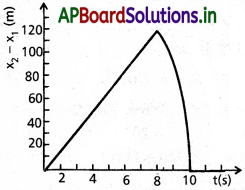
AP Inter 1st Year Physics Study Material Chapter 3 సరళరేఖాత్మక గమనం 40
సాధన:
నిలువు ఊర్థ్వ దిశలో మొదటి రాయి t కాలం చలనం తీసుకుందాము.
x0 = 200 m, u = 15 m/s, a = -10 m/s², t = t1,
x = x1
x = x0 + \(\frac{1}{2}\)ut²
x1 = 200 + 15t + \(\frac{1}{2}\)(-10)t² లేదా
x1 = 200 + 15 t – 5t² ………… (i)
నిలువు ఊర్ధ్వ దిశలో రెండవ రాయి t కాలం చలనం తీసుకుందాము.
అప్పుడు
x0 = 200 m, u = 30 m/s-1, a = = -10 m/s-2,
t = t1, x = x2
అప్పుడు x2 = 200 + 30 t – \(\frac{1}{2}\) × 10 t²
= 200 + 30 t – 5t²
మొదటి రాయి భూమిని తాకితే,
x1 = 0, So t² – 3t – 40 = 0
లేదా (t – 8) (t + 5) = 0 ………… (ii)
∴ t = 8 S లేదా – 5S
t = 0 రాయి ప్రక్షిప్తం చేసిన కాలంనకు సంబంధించినది. కావున రుణకాలంనకు అర్థం లేదు. ఈ సందర్భంలో t = 8S.
రెండవ రాయి భూమిని తాకితే, x2 = 0.
0 = 200 + 30 t – 5t² (లేదా) t² – 6t – 40 = 0
(లేదా) (t – 10) (t + 4) = 0
t = -4s కు అర్థం లేదు. కావున t = 10 s

మొదటిరాయి దృష్ట్యా రెండవరాయి సాపేక్షస్థానం
= x2 – x1 = 15 t ………….. (ii)
(i) మరియు (ii) నుండి
(x2 – x1) మరియు t లు రేఖియ సంబంధంను కల్గి ఉండును. గ్రాఫ్ t = 8s వరకు సరళరేఖను ఇస్తుంది.
t = 8 S లకు రెండు రాయిల మధ్య గరిష్ట దూరం = 15 × 8 = 120 m

8 సెకనుల తరువాత రెండవ రాయి 2 సెకనుల వరకు చలనంలో ఉండి, కాలవ్యవధి 8 సెకనుల నుండి 10 సెకనుల వరకు x = 200 + 30 – 5t² వర్గ సమీకరణం గ్రాఫ్ను కల్గి ఉండును.

ప్రశ్న 27.
ఒక స్థిర దిశ కలిగి సరళరేఖపై గమనంలో ఉన్న ఒక కణం గమనాన్ని తెలిపే వడి కాలం గ్రాఫ్ను పటంలో చూపించారు. (a) t = 0 s to 10 s, (b) t = 2s నుంచి 6s. మధ్య కణం ప్రయాణించిన దూరాలను లెక్కగట్టండి. (a), (b) లలో (ఆ కాలవ్యవధిలలో) కణం సగటు వడి ఎంత?
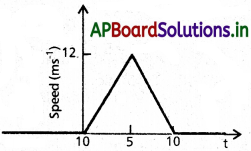
AP Inter 1st Year Physics Study Material Chapter 3 సరళరేఖాత్మక గమనం 41
సాధన:
a) 0 నుండి 10 సెకనుల మధ్య కణం ప్రయాణించు దూరం
= ఆధారం 10s మరియు ఎత్తు 12 ms-1 గల
∆ OAB వైశాల్యం.
\(\frac{1}{2}\) × 10 × 12 = 60 m
సరాసరి వడి = \(\frac{60}{10}\) = 6mS-1

b) t1 = 2S నుండి 5s మరియు t2 = 5s నుండి 6s వరకు కణం ప్రయాణించిన దూరాలు వరుసగా s1 మరియు s2 t = 2s నుండి 6s వ్యవధిలో మొత్తం ప్రయాణించు దూరం s = s1 + s2 …………… (i)

s1 కనుగొనుట :
2 సెకనుల తరువాత కణం వేగం 4, మరియు కాలం సున్న నుండి 5 సెకనుల వ్యవధిలో కణం త్వరణం a1.
అప్పుడు u1 = 0, v = 12 m/s,
a = a1 మరియు t = 5s
a1 = \(\frac{v-u}{t}=\frac{12-0}{5}=\frac{12}{5}\)
= 2.4 m/s²
∴ u1 = υ + a1t = 0 + 2.4 × 2 = 4.8 m/s-1
కణం 3s లలో ప్రయాణించిన దూరం
(i.e., కాలవ్యవధి 2s నుండి 5s).
∴ u1 = 4.8 m/s, t1 = 3s, a1 = 2.4 m/s², s1 = ?
s1 = u1t1 + \(\frac{1}{2}\)a1t1²
S1 = 4.8 + 3 × \(\frac{1}{2}\) × 2.4 × 3² = 25.2 m

s2 కనుగొనుట :
t = 5s నుండి t = 10s ల మధ్య కణం త్వరణం a2.
a2 = \(\frac{0-12}{10-5}\) = -2.4 m/s²
t = 5s నుండి t = 6s ల మధ్య కణం చలనం తీసుకుందాము.
u1 = 12 m/s-1, a2 = -2.4 m/s²
t2 = 1s, s2 = ?
s2 = u2t + \(\frac{1}{2}\)a2t2²
s2 = 12 × 1 + \(\frac{1}{2}\)(-2.4) 1² = 10.8 m
∴ మొత్తం ప్రయాణించిన దూరం,
s = 25.2 + 10.8 = 36 m
సరాసరి వేగం = \(\frac{36}{6-2}=\frac{36}{4}\) = 9 m/s

ప్రశ్న 28.
ఏకమితీయ గమనంలో ఉన్న ఒక కణం వేగం- కాలం గ్రాపును పటం 3.29లో ఇచ్చారు. t1 నుంచి t2 కాలవ్యవధిలో కణం గమనాన్ని వర్ణించే సరియైన ఫార్ములాను కింది వాటి నుంచి ఎంపిక చేయండి.
a) x(t2) = x(t1) + v(t1) (t2 – t1) + \(\frac{1}{2}\)a(t2 – t1
b) v(t2) = v(t1) + a(t2 – t1)
c) vసగటు = (x(t2) − x(t1)) / (t2 – t1)
d) vసగటు = (v(tz) – v(t,)) / (t) – t, )
e) x(t2) = x(t1) + vసగటు (t2 – t1) + (\(\frac{1}{2}\))సగటు(t2 – t1
f) x(t2) = x(t1) = t-అక్షం, చుక్కల గీత మధ్య v – t వక్రంతో ఆవరించిన వైశాల్యం.
సాధన:
గ్రాఫ్ నుండి వాలు స్థిరం కాదు మరియు ఏకరీతిగా ఉండదు. కావున (i), (ii) మరియు (v) ల సంబంధాలు నిజము కాదు. కాని (iii), (iv), మరియు (vi) లు నిజము.

సాధించిన సమస్యలు (Solved Problems)

ప్రశ్న 1.
ఒక కారు ఒక సరళరేఖ వెంబడి OP అనుకుందాం, గమనంలో ఉన్నది. అది 18s లలో O నుంచి P బిందువును చేరి మరల P నుంచి బిందువు Q ను 6.0sలలో చేరింది. (a) O నుంచి P ను చేరినప్పుడు, (b) O నుంచి P ను, అటు నుంచి వెనుదిరిగి Q ను చేరినప్పుడు వస్తువు సగటు వేగం, సగటు వడి విలువ లేమిటి?
సాధన:
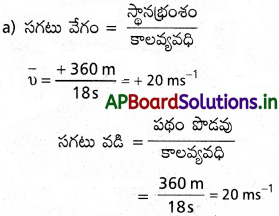
AP Inter 1st Year Physics Study Material Chapter 3 సరళరేఖాత్మక గమనం 42
ఈ సందర్భంలో సగటు వడి సగటు వేగ పరిమాణానికి సమానం
b) ఈ సందర్భంలో
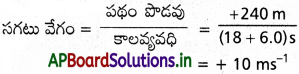
AP Inter 1st Year Physics Study Material Chapter 3 సరళరేఖాత్మక గమనం 43
AP Inter 1st Year Physics Study Material Chapter 3 సరళరేఖాత్మక గమనం 44

ప్రశ్న 2.
x అక్షం వెంబడి గమనంలో ఉన్న ఒక వస్తువు స్థానం x = a + bt² గా ఇవ్వడమైనది. ఇక్కడ a = 8.5 m, b = 2.5 ms-2, t ను సెకండ్లలో కొలిచారు. t = 0s, t = 2.0s వద్ద వేగం ఎంత? t = 2.0s, t = 4.0s మధ్య సగటు వేగం ఎంత?
సాధన:
అవకలన కలన గణితం సంకేత పద్ధతిలో వేగం
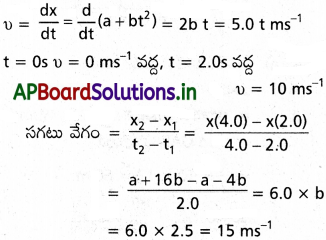
AP Inter 1st Year Physics Study Material Chapter 3 సరళరేఖాత్మక గమనం 45

ప్రశ్న 3.
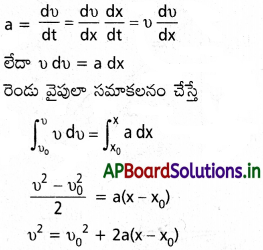
కలన గణిత పద్ధతిని ఉపయోగించి స్థిర త్వరణం గల గమనానికి సమీకరణాలను ఉత్పాదించండి.
సాధన:
నిర్వచనాన్నిబట్టి a = \(\frac{dυ}{dt}\)
dυ = a dt
ఇరువైపులా సమాకలనం చేస్తే
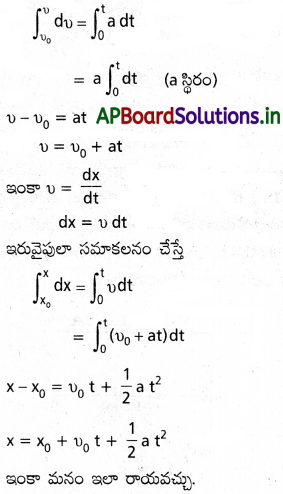
AP Inter 1st Year Physics Study Material Chapter 3 సరళరేఖాత్మక గమనం 46
AP Inter 1st Year Physics Study Material Chapter 3 సరళరేఖాత్మక గమనం 47

ప్రశ్న 4.
ఒక బహుళ అంతస్థు పై భాగం నుంచి ఒక బంతిని నిట్టనిలువుగా పైకి 20 ms-1 వేగంతో విసిరారు. బంతిని విసిరిన బిందువు భూమి నుంచి 25.0 m ఎత్తున ఉంది. (a) బంతి ఎంత ఎత్తుకు ఎగురుతుంది? (b) విసిరిన తరువాత బంతి భూమిని తాకడానికి ఎంత కాలం పడుతుంది? g = 10 ms-2 గా తీసుకోండి. (g నిజవిలువ 9.8 ms-2).
సాధన:
a) నిట్టనిలువు దిశలో y-అక్షాన్ని, భూమి సున్నా నిరూపకంగా పటంలో చూపించినట్లు తీసుకొందాం.
ఇప్పుడు υ0 = + 20 ms-1
a = -g = -10 ms-2,
υ = 0 ms-1
విసిరిన బిందువు నుంచి బంతి y ఎత్తును చేరింది అనుకొంటే
υ² + υo² + 2a(y − yo) సమీకరణాన్ననుసరించి 0 = (20)² + 2(−10) (y – yo) ను పొందుతాం.
దీన్ని సాధిస్తే (y – yo) = 20 m వస్తుంది.

b) సమస్యలోని ఈ భాగాన్ని మనం రెండు పద్ధతులలో సాధించవచ్చు. పద్ధతులను చాలా జాగ్రత్తగా గమనించండి.
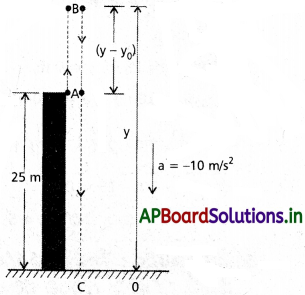
AP Inter 1st Year Physics Study Material Chapter 3 సరళరేఖాత్మక గమనం 48
మొదటి పద్ధతి :
ఈ పద్ధతిలో మార్గాన్ని రెండు భాగాలుగా విడదీస్తాం. పై దిశలో గమనం (A నుంచి Bవరకు), కింది దిశలో గమనం (B నుంచి C వరకు). ఈ గమనాలకు సంబంధించిన కాలాలు t1, t2 లను లెక్కిస్తాం. B వద్ద వేగం శూన్యం అవుతుంది. కాబట్టి :
υ = υo + at
0 = 20 – 10 t1
(∵ a = −g = – 10 ms-2)
లేదా t1 = 2s వస్తుంది.

ఈ కాలాన్ని A నుంచి Bని చేరడానికి తీసుకొంటుంది. బిందువు B నుంచి లేదా గరిష్ఠ ఎత్తు వద్ద బిందువు నుంచి, బంతి స్వేచ్ఛగా గురుత్వత్వరణంతో కిందికి పడుతుంది. బంతి రుణ y-అక్షము దిశలో కదులుతుంది.

y = yo + υot + \(\frac{1}{2}\)at² సమీకరణాన్ని ఉపయోగిస్తాం.

yo = 45 m, y = 0, υo = 0, a = -g = -10 ms-2 అని మనకు తెలుసు.
0 = 45 + (\(\frac{1}{2}\))(-10) t2²
సాధిస్తే, t2 = 3s వస్తుంది.

అందువల్ల విసిరిన తరువాత బంతి బూమిని చేరేలోపు పట్టిన కాలం = t1 + t2 = 2s + 3s = 5s

రెండవ పద్ధతి (Second Method) :
ఎంచుకొన్న మూలబిందువు పరంగా బంతి తొలి, తుది స్థానాల నిరూపకాలను గుర్తించి బంతి భూమిని చేరడానికి తీసుకొన్న మొత్తం కాలాన్ని
y = yo + υot + \(\frac{1}{2}\) at² సమీకరణాన్ని ఉపయోగించి లెక్కించవచ్చు.
ఇప్పుడు yo = 25 m, y = 0 m
υo = 20 ms-1, a = -10 ms-2, t = ?
0 = 25 + 20t + (\(\frac{1}{2}\))(-10)t²
లేదా 5t² – 20t – 25 = 0
ఈ వర్గ సమీకరణాన్ని సాధిస్తే, t = 5s వస్తుంది.

AP Inter 1st Year Physics Study Material Chapter 3 సరళరేఖాత్మక గమనం

ప్రశ్న 5.
స్వేచ్ఛాపతనం : స్వేచ్ఛగా పతనం చెందే ఒక వస్తువు గమనాన్ని గురించి చర్చించండి. గాలి నిరోధాన్ని ఉపేక్షించండి.
సాధన:
భూ ఉపరితలం పై నుంచి ఒక వస్తువును జారవిడిస్తే అది గురుత్వబల ప్రభావం వల్ల నిమ్న చెందుతుంది. గురుత్వత్వరణం పరిమాణాన్ని 9 తో సూచిస్తారు. గాలి నిరోధాన్ని ఉపేక్షించినట్లయితే వస్తువు స్వేచ్ఛాపటనం చెందుతున్నదని అంటారు. వస్తువు ఎంత ఎత్తు నుంచి పతనం చెందుతున్నదో ఆ ఎత్తును భూ వ్యాసార్ధంతో పోల్చినప్పుడు చాలా తక్కువగా ఉంటే g విలువను స్థిరాంకంగా 9.8 ms-2 కు సమానంగా తీసుకోవచ్చు. అందువల్ల స్వేచ్ఛాపతన గమనాన్ని ఏకరీతి (సమరీతి) త్వరణం గల గమనంగా తీసుకోవచ్చు. గమనం y-దిశలో, ఇంకా కచ్చితంగా రుణ y దిశలో ఉన్నట్లుగా అనుకొందాం. ఎందువల్ల అంటే ఊర్ధ్వ దిశను ధనాత్మకంగా ఎంచుకొందాం. గురుత్వ త్వరణం ఎప్పటికీ నిమ్నదిశలోనే ఉండటం వల్ల అది రుణ దిశలోనే ఉంటుంది. అందువల్ల
a = – g = -9.8 ms-2
y = 0 నుంచి, వస్తువును నిశ్చల స్థితి నుంచి జారవిడిచారు. అందువల్ల υo = 0 అప్పుడు గమన సమీకరణాలు కింద ఇచ్చినట్లుగా మారతాయి.

υ = 0 – gt = -9.8 t ms-1
y = 0 – \(\frac{1}{2}\)gt² = -4.9 t² m
υ² = 0 – 2 gy = -19.6 ym²s-2

మొదటి సమీకరణం వేగాన్ని కాలప్రమేయంగా రెండవ సమీకరణం ప్రయాణించిన దూరాన్ని కాల ప్రమేయంగా తెలుపుతున్నాయి. మూడవ సమీకరణం వేగాన్ని దూరం ప్రమేయంగా తెలుపుతున్నది. కాలంతో త్వరణంలో మార్పును, వేగంలో మార్పును, దూరంలో మార్పును వరసగా పటాలు (a), (b), (c) లలోని వక్రాలు సూచిస్తున్నాయి.
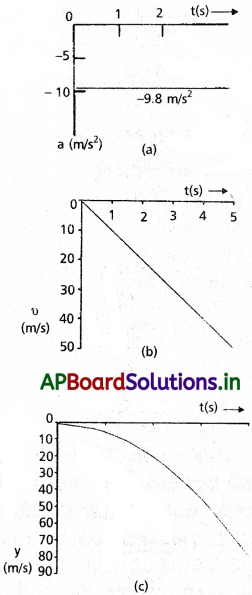
AP Inter 1st Year Physics Study Material Chapter 3 సరళరేఖాత్మక గమనం 49

ప్రశ్న 6.
గెలీలియో బేసి సంఖ్యల నియమం (Galileo’s | సాధన. law of odd numbers) : “నిశ్చల స్థితి నుంచి స్వేచ్ఛగా పతనం చెందే వస్తువు వరస సమానకాలవ్యవధులలో ప్రయాణించే దూరాల నిష్పత్తి ఒకటితో మొదలయ్యే బేసి సంఖ్య నిష్పత్తికి సమానం దీన్ని నిరూపించండి.
సాధన:
ఒక వస్తువు స్వేచ్ఛగా పతనం చెందిన కాలవ్యవధిని అనేక సమాన కాలవ్యవధులు τ విభజించి, వరస కాలవ్యవధుల్లో ప్రయాణించిన దూరాలను లెక్కించండి. తొలి వేగం శూన్యం కాబట్టి y = –\(\frac{1}{2}\)gt² అవుతుంది. ఈ సమీకరనాన్ని ఉపయోగించి వివిధ కాలవ్యవధుల, 0, τ, τ2, τ3 .. తరువాత వస్తువు స్థానాన్ని లెక్కించి రెండ నిలువు వరసలో పొందు పరచడమైంది. yo (-1/2) gτ² ను మొదటి కాలవ్యవధి τ తరువాత స్థాన నిరూపకం (y0) గా తీసుకొంటే, మూడవ నిలువ వరుస (yo) ప్రమాణాల్లో వస్తువు స్థానాలను ఇస్తుంది. వరస కాలవ్యవధులు τs లలో వస్తువు ప్రయాణించిన దూరాలను నాలుగో నిలువు వరుస సూచిస్తుంది. పట్టికలోని చివరి వరసలో దూరాల నిష్పత్తి సరళంగా 1 : 3 : 5 : 7 : 9 : 11 ……….గా ఉంటుందని గుర్తిస్తాం.

వస్తువుల స్వేచ్ఛా పతన గమనాన్ని గుణాత్మకంగా మొదటగా అధ్యయనం చేసిన గెలీలియా గలీలీ (Galileo Galilei) (1564–1642) ఈ నియమాన్ని రుజువు చేశాడు.

ప్రశ్న 7.
వాహనాల నిలిచే దూరం (Stopping distance of vehicles) : బ్రేకు పడిన తరవాత నిలిచిపోయే ముందు వాహనం ప్రయాణించిన దూరాన్ని నిలిచే దూరం అంటారు. రోడ్డు రవాణా భద్రతకు అత్యంత ప్రాముఖ్యంగల ఈ దూరం వాహనం తొలి (బ్రేకు వేయడానికి పూర్వం) వేగం (υo), బ్రేకింగ్ సామర్థ్యం లేదా బ్రేకు వేయడం వల్ల కలిగే రుణత్వరణం (-a) పై ఆధారపడి ఉంటుంది. ఒక వాహనం నిలిచే దూరానికి υo, a పదాలలో సమాసాన్ని రాబట్టండి.
సాధన:
వాహనం నిలిచిపోవడానికి ముందు అది ప్రయాణించిన దూరం (నిలిచే దూరం) ds అనుకొందాం. గమన సమీకరణం υ = υo² + 2 ax నుంచి υ = 0 అని గుర్తిస్తే, నిలిచే దూరం
ds = \(\frac{-v_0^2}{2 a}\)

ఈవిధంగా నిలిచే దూరం తొలివేగం (υo) వర్గానికి అనులోమానుపాతంలో ఉంటుంది. తొలివేగాన్ని రెట్టింపు చేస్తే నిలిచే దూరం (అదే రుణ త్వరణం విలువకు) 4 రెట్లు అవుతుంది.

ఒక నిర్దిష్టమైన పద్ధతిలో తయారయిన కారుకు 11, 15,20, 25 m/s వేగాలకు అనురూపంగా బ్రేకులు వేసినప్పుడు ఆగిన దూరాలు వరసగా 10 m, 20 m, 34 m, 50 m అని కనుక్కోవడం జరిగింది. ఈ విలువలు పైన ఉత్పాదించిన సమాసానికి దాదాపు అనుగుణంగాను ఉన్నాయి.

ప్రశ్న 8.
ప్రతిస్పందన కాలం (Reaction time) : పరిస్థితిని అనుసరించి తక్షణ చర్య తీసుకోవలసిన అవసరం ఏర్పడినప్పుడు చర్య తీసుకోవడానికి కొంత సమయం పడుతుంది. ఒక వ్యక్తి అక్కడ ఉన్నస్థితిని గమనించడానికి, ఆపై ఆలోచించి, తగిన చర్య తీసుకోవడం ప్రారంభించడానికి పట్టే కాలాన్ని ప్రతిస్పందన కాలం అంటారు. ఉదాహరణకు కారు నడిపే వ్యక్తి హఠాత్తుగా దారికి అడ్డంగా వచ్చిన బాలుణ్ణి చూసి దభాలున బ్రేకులు వేసేలోపు గడిచిన కాలమే ప్రతిస్పందన కాలం. ప్రతిస్పందన కాలం పరిస్థితి సంక్లిష్టతమైనా, పరిస్థితిని ఎదురుకొనే వ్యక్తిపైనా ఆధారపడి ఉంటుంది.

మీరు మీ ప్రతిస్పందన కాలాన్ని ఒక సులభమైన ప్రయోగం ద్వారా లెక్కించవచ్చు. ఒక రూళ్ళ కర్రను మీ స్నేహితునికిచ్చి, దానిని మీ చేతి బొటనవేలు, చూపుడు వేలు మధ్య ఉన్న ఖాళీ ద్వారా నిట్టనిలువుగా జారవిడవమని చెప్పండి (పటం). అలా విడిచిన రూళ్ళ కర్రను మీరు పట్టుకొన్న తరవాత అది ప్రయాణించిన దూరం d కనుక్కోండి. ఒక ప్రత్యేక ప్రయోగంలో d. విలువ21:0 cm గా కనుక్కొన్నారు. ప్రతిస్పందన కాలం లెక్కించండి.
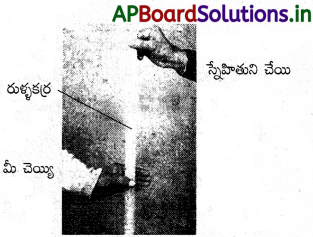
AP Inter 1st Year Physics Study Material Chapter 3 సరళరేఖాత్మక గమనం 50
సాధన:
రూళ్ళకర్ర స్వేచ్ఛగా పతనం చెందుతుంది. అందువల్ల, υo = 0 and a = -g = -9.8 ms-2. రూళ్ళకర్ర ప్రయాణించిన దూరం d, ప్రతిస్పందన కాలం t, ల మధ్య సంబంధం తెలిపే సమాసం
d = –\(\frac{1}{2}\) gt²r లేదా tr = \(\sqrt{\frac{2d}{g}}\)s.
ప్రయోగం ద్వారా తెలిసిన d విలువ 21.0 cm,
g = 0.8 ms-2

AP Inter 1st Year Physics Study Material Chapter 3 సరళరేఖాత్మక గమనం 51

AP Inter 1st Year Physics Study Material Chapter 3 సరళరేఖాత్మక గమనం

ప్రశ్న 9.
ఉత్తర – దక్షిణ దిశలో రెండు సమాంతర రైలు మార్గాలున్నాయి. రైలు A 54 km h-1 వడితో ఉత్తరం వైపు, రైలు B 90 kmh-1 వడితో దక్షిణం వైపు ప్రయాణిస్తున్నాయి.
a) A పరంగా B వేగం ఎంత?
b) B పరంగా భూమి వేగం ఎంత?
c) రైలు A పైకప్పుపై 18 kmh-1 వేగంతో రైలు వేగానికి వ్యతిరేక దిశలో పరుగెడుతున్న కోతి సాపేక్ష వేగం భూమిపై నిల్చున్న పరిశీలకుడి పరంగా ఎంత?
సాధన:
దక్షిణం నుంచి ఉత్తరం వైపు ధన x-axis దిశగా ఎంచుకొందాం. అప్పుడు,
υA = + 54 km h-1 = 15 ms-1
υB = – 90 km h-1 = -25ms-1

A పరంగా B సాపేక్ష వేగం = υB – υA = – 40 ms-1, అంటే రైలు A పరంగా రైలు B 40 ms1 వడితో ఉత్తరం నుంచి దక్షిణంవైపు ప్రయాణిస్తున్నట్లు అనిపిస్తుంది. రైలు B పరంగా భూమి సాపేక్ష వేగం
= 0 – υB = 25 ms-1.

భాగం (c) లో భూమి పరంగా కోతి వేగం υM అనుకొందాం. రైలు A పరంగా కోతి సాపేక్షవేగం
υMA = υM – υA = – 18 km h = -5 ms-1
అందువల్ల υM = (15 – 5)ms-1 = 10 ms-1.
AP Inter 1st Year Botany Notes Chapter 13 ఆవరణ సంబంధ అనుకూలనాలు, అనుక్రమం, ఆవరణ సంబంధ సేవలు

Students can go through AP Inter 1st Year Botany Notes 13th Lesson ఆవరణ సంబంధ అనుకూలనాలు, అనుక్రమం, ఆవరణ సంబంధ సేవలు will help students in revising the entire concepts quickly.

AP Inter 1st Year Botany Notes 13th Lesson ఆవరణ సంబంధ అనుకూలనాలు, అనుక్రమం, ఆవరణ సంబంధ సేవలు

→ రామేవ్ మిశ్రాను భారతదేశంలో ఆవరణశాస్త్ర పితగా పరిగణిస్తారు.

→ ఆయన ఆగష్టు 26, 1908న జన్మించారు.

→ మిశ్రాకు గౌరవ సూచకంగా ఇండియన్ నేషనల్ సైన్స్ అకాడమి, ప్రపంచ ఆర్ట్స్, సైన్స్ అకాడమి వారు ప్రోత్సాహకాలను ఇచ్చి సత్కరించారు. ఆవరణశాస్త్రంలో గౌరవప్రదమైన సంజయ్గాంధీ అవార్డును బహూకరించారు.

→ జీవులలోని, జీవులమధ్య, భౌతిక పరిసరాలతో జీవులకు గల సంబంధాన్ని తెలిపే జీవశాస్త్ర విభాగాన్ని ఆవరణశాస్త్రం అంటారు.

→ యూజెన్ వార్మింగ్ అనే డానిష్ వృక్షశాస్త్రవేత్త మొక్కలకు నీటికి ఉన్న సంబంధాలను అనుసరించి మూడు ఆవరణ సమూహాలను వర్గీకరించారు. అవి నీటి మొక్కలు, మధ్యరకపు మొక్కలు మరియు ఎడారి మొక్కలు.

→ పూర్తిగా నీటిలోగాని, బాగా తడిగా ఉన్న నేలలో పెరిగే మొక్కలను నీటి మొక్కలు అంటారు. నీటిలో పెరిగే విధానాన్ని బట్టి, ఇవి 5 రకాలు.

→ జలాభావ పరిస్థితులు లేదా నీరు అధికంగా లేని పరిస్థితులు ఉండే ఆవాసాలలో పెరిగే మొక్కలను పెరిగే మొక్కలను మధ్యరకపు మొక్కలు అంటారు.

→ నీరు లోపించిన జలాభావ పరిస్థితులలో పెరిగే మొక్కలను ఎడారి మొక్కలు అంటారు. ఇవి అల్పకాలికాలు, రసభరితమొక్కలు, రసభరితం కాని మొక్కలుగా వర్గీకరించారు.

→ ఒక ప్రదేశంలో క్రమాను గతంగా జాతుల సంఘటనలో ఊహించగల మార్పులు జరగడాన్ని ఆవరణసంబంధ అనుక్రమము అంటారు.

→ ఎలాంటి జీవజాతులు లేని చోట అనగా నగ్నశిలాప్రదేశాలలో మొదలయ్యే ప్రక్రియను ప్రాథమిక అనుక్రమం అంటారు.

→ ఒక ప్రదేశంలో మొదట ఉన్న జీవ సముదాయాలు నాశనం చేయబడిన తర్వాత మొదలయ్యే ప్రక్రియను ద్వితీయ అనుక్రమం అంటారు. ఉదా : పాడుబడిన వ్యవసాయ భూములు, చెట్లు నరకడం వల్ల నాశనమైన అరణ్యాలు.

AP Inter 1st Year Botany Notes Chapter 13 ఆవరణ సంబంధ అనుకూలనాలు, అనుక్రమం, ఆవరణ సంబంధ సేవలు

→ నీరు లేక నీటి పరిసరాలలో ప్రారంభమయ్యే అనుక్రమంను జలక్రమకం అంటారు.

→ శుష్క ఆవాసాలలో ప్రారంభమయ్యే అనుక్రమంను జలాభావ క్రమకం అంటారు.

→ బంజరుభూమిలో మొదట ఆవాసం ఏర్పరుచుకొను మొక్కలను మార్గదర్శక మొక్కలు అంటారు.

→ జీవ, నిర్జీవ అనుఘటకాల మధ్య జరిగే చర్యలను ఆవరణ వ్యవస్థ అంటారు.

→ ఆవరణ వ్యవస్థ అనుపదమును A.G. టాన్స్ ప్రతిపాదించారు.

→ భూమండలంను అతిపెద్ద ఆవరణ వ్యవస్థ అంటారు.

→ పుష్పాలలోని అండాశయాల ఫలధీకరణను అవసరమైన పరాగరేణువులు మార్పిడి, ముఖ్యమైన ఆరోగ్యవంతమైన ఆవరణవ్యవస్థలోని భాగము.

→ ప్రపంచంలో ఆహారధాన్యాల అధిక ఉత్పత్తిలో పరాగసంపర్క సహకారులు ప్రధానపాత్ర వహిస్తాయి.

→ వ్యవసాయ సంబంధ ఉత్పత్తులలో ప్రధానపాత్ర పోషించే పరాగ సంపర్క సహకారి-తేనెటీగ.

→ 1,00,000 పైగా అకసేరుక జాతులు (తేనెటీగలు, సీతాకోకచిలుకలు, ఈగలు) ప్రపంచవ్యాప్తంగా పరాగసంపర్క సహకారులుగా పనిచేస్తున్నాయి.

→ మీ ఇళ్ళలోను, పరిసరాలలోను వాడే కీటకనాశకాల స్థాయిని తగ్గించి పరాగసంపర్క సహకారులను రక్షించవచ్చు.

→ ఒకసంవత్సర కాలంలో 10మంది వ్యక్తులకు కావలసిన 02 ను ఒక పత్రయుత ప్రౌఢ మొక్క ఒక ఋతువులో విడుదల చేస్తుంది.

→ పూర్తిగా ఎదిగిన మొక్క 48 lbs CO2 ను ఒక సంవత్సరకాలంలో శోషించి విడుదలచేసే O2 ఇద్దరు మనుషులకు సరిపోతుంది.

AP Inter 1st Year Botany Notes Chapter 13 ఆవరణ సంబంధ అనుకూలనాలు, అనుక్రమం, ఆవరణ సంబంధ సేవలు

→ కొన్ని సూక్ష్మజీవులు, ప్రధానంగా సయనోబాక్టీరియాలు O2 ను ప్రత్యక్షంగా విడుదల చేస్తాయి.

→ సైకిల్ లేక నడక, ప్రజారవాణా వ్యవస్థను వాడటం ద్వారా సహజవనరులను రక్షించడం, కాలుష్యాన్ని తగ్గించడం ఆరోగ్యసంబంధ లాభాలను ఆస్వాదించడంవల్ల ఆవరణ సంబంధ విధులు కొనసాగించవచ్చు.

→ ఉద్యానవనాలలో స్థానికమొక్కలను పెంచడం, వన్యప్రాణులకు ఆవాసాన్ని ఏర్పరచాలి.

→ అనుకూలనాలు : జీవులు వాటి ప్రవర్తనా సంబంధ, శరీర ధర్మ సంబంధ అంశాలలో మార్పులకు లోనవుతూ క్రమంగా పరిసరాలతో సమతుల్యతను చూపే ప్రక్రియ.

→ బయోమ్లు : ఇది ఒక ప్రధానమైన ఆవరణ సంబంధ సముదాయం. ఇది అధిక భాగం ఆక్రమించి ఉంటుంది. సాధారణంగా ప్రధానమైన మొక్కల లక్షణాలచే గుర్తింపబడుతుంది.

→ జీవావరణం : జీవులు ఆవాసం చేసే ప్రపంచంలోని అన్ని ఆవరణ వ్యవస్థలతో కూడిన ప్రదేశం. ఈ భూమండలాన్ని “మహా ఆరవరణ వ్యవస్థ” గా భావిస్తారు.

→ సముదాయాలు లేదా సంఘాలు : ఒక ప్రాంతంలో నివసించే వివిధ జాతులకు చెందిన అనేక జనాభాల సమూహాన్ని సంఘం లేదా సముదాయం లేదా జీవుల సముదాయం అంటారు.

→ ఆవరణ వ్యవస్థ : ప్రకృతిలో ఇది క్రియాత్మక ప్రమాణం. జీవ నిర్జీవ అనుఘటకాల మధ్య జరిగే పరస్పర చర్యలను ఆవరణ వ్యవస్థ అంటారు. ఈ పదాన్ని ప్రతిపాదించింది ఎ.జి. టాన్.

→ ఆవరణసంబంధ అనుక్రమం: ఒక ప్రదేశాన్ని క్రమానుగతంగా వేరువేరు జీవుల సంఘాలు ఆక్రమించడాన్ని ఆవరణ సంబంధ అనుక్రమం అంటారు.

→ ఆవరణ వ్యవస్థ సేవలు లేదా ఆవరణ సంబంధ సేవలు : వాతావరణంలోని వివిధ ప్రక్రియల వల్ల ఉత్పత్తి అయ్యే వనరులు, వీటిని మనం చాలా వరకు తేలికగా తీసుకోవడం జరుగుతుంది. నీటి శుద్ధి, కలప, చేపల ఆవాసం, పంట మొక్కల పరాగ సంపర్కం మొదలైనవి ఈ సేవల కింద పేర్కొనవచ్చు.

→ జలక్రమకం : నీరు లేదా నీటి పరిసరాలలో ప్రారంభమయ్యే మొక్కల అనుక్రమము.

→ జలాభావ క్రమకం : శుష్క ఆవాసాలలో ప్రారంభమయ్యే మొక్క అను క్రమము.

→ జనాభా : ఒక ప్రాంతంలో నివసించే ఒకే జాతికి చెందిన జీవుల సమూహాన్ని జనాభా అంటారు. దీన్నే “ప్రాంతీయ జనాభా” అని కూడా అంటారు.

AP Inter 1st Year Botany Notes Chapter 12 పుష్పించే మొక్కల కణజాలశాస్త్రం, అంతర్నిర్మాణ శాస్త్రం

Students can go through AP Inter 1st Year Botany Notes 12th Lesson పుష్పించే మొక్కల కణజాలశాస్త్రం, అంతర్నిర్మాణ శాస్త్రం will help students in revising the entire concepts quickly.

AP Inter 1st Year Botany Notes 12th Lesson పుష్పించే మొక్కల కణజాలశాస్త్రం, అంతర్నిర్మాణ శాస్త్రం

→ అంతర్నిర్మాణ పరంగా, మొక్క దేహము వివిద రకాల కణజాలాలతో నిర్మితమై ఉన్నది.

→ కణజాలాలు రెండు రకాలు. అవి

  • విభాజ్య కణజాలాలు
  • శాశ్వత కణజాలాలు

→ ఎల్లప్పుడు విభజనచెందే అపరిపక్వ కణజాల సముదాయమును విభాజ్య కణజాలాలు అంటారు.

→ ఇవి కాండ అగ్రంలో (అగ్ర) లేక మధ్యస్థ లేక పార్శ్వంగా ఉంటాయి.

→ విభజనశక్తిని కోల్పోయి, పక్వత చెంది నిర్దిష్ట ఆకారంను ఏర్పరుచుకున్న కణజాలాలను శాశ్వత కణజాలాలు అంటారు.

→ శాశ్వత కణజాలాలు 3 రకాలు అవి

  • సరళ కణజాలాలు
  • సంక్లిష్ట కణజాలాలు
  • ప్రత్యేక కణజాలాలు

→ ఒకే రకమైన కణాలతో ఏర్పడి, ఒకే విధిని నిర్వర్తించే కణాల సముదాయమును సరళ కణజాలాలు అంటారు. ఇవి మృదుకణజాలము స్థూలకోణ కణజాలము మరియు దృఢ కణజాలము అవి 3 రకాలు

AP Inter 1st Year Botany Notes Chapter 12 పుష్పించే మొక్కల కణజాలశాస్త్రం, అంతర్నిర్మాణ శాస్త్రం

→ వేర్వేరు కణాలలో ఏర్పడి, అన్ని కలసి ఒకే విధిని నిర్వర్తించే కణాల సముదాయమును సంక్లిష్ట కణజాలాలు అంటారు. వీటిలో దారువు, పోషక కణజాలములు కలవు.

→ నిర్మాణము, స్థానమును బట్టి కణజాల వ్యవస్థలు 3 రకాలు కలవు. అవి బాహ్యచర్మ కణజాల వ్యవస్థ, సంధాయక కణజాలవ్యవస్థ మరియు నాళికా కణజాల వ్యవస్థ.

→ బాహ్యచర్మ కణజాల వ్యవస్థలో బాహ్య చర్మము, పత్రరంధ్రాలు, కేశాలు అవభాసిని ఉంటాయి.

→ సంధాయక కణజాల వ్యవస్థలో బాహ్యచర్మము, నాళికాపుంజాలు కాక మిగిలినవి (అధశ్చర్మము, సాధారణ వల్కలం, అంతరశ్చర్మం, దవ్వ, దవ్వరేఖలు) ఉంటాయి.

→ నాళికా కణజాలవ్యవస్థలో దారువు, పోషకకణజాలములు కలవు.

→ నాళికాపుంజాలు సహ పార్శ్వ వివృతము (ద్విదళబీజ కాండము), సహ పార్శ్వ సంవృతము (ఏకదళబీజ కాండము) వ్యాసార్థపు (వేర్లు) ద్విసహపార్శ్వము (కుకుర్చిటా కాండము)గా ఉంటాయి.

→ ద్విదళబీజవేరు అడ్డుకోతలో బాహ్యచర్మము, వల్కలము మరియు ప్రసరణస్థంభం ఉంటాయి. ప్రసరణస్థంభంలో దారువు, పోషక కణజాలాలు వేరు వేరు వ్యాసార్ధాల పై ఉంటాయి. దారువు చతుఃప్రథమ దారుకము.

→ ఏకదళబీజవేరు అడ్డుకోతలో దారువు, పోషక కణజాలాలు వ్యాసార్థంగా ఉంటాయి మరియు బహుప్రథమదారుకము.

→ ద్విదళబీజ కాండములో 15-20 నాళికాపుంజాలు ఒక వలయంలో అమరి ఉంటాయి. (నిజ ప్రసరణస్థంభం)

→ ఏకదళ బీజకాండంలో అనేక నాళికా పుంజాలు చెల్లాచెదురుగా అమరి ఉంటాయి. (అటాక్టోస్టీల్)

→ ద్విదళబీజ పత్రంలో పత్రాంతరంలో స్థంభ, స్పాంజి మృదు కణజాలాలు ఉంటాయి. ఏకదళబీజ పత్రంలో స్పాంజి కణజాలం మాత్రమే ఉంటుంది.

→ ద్విదళబీజకాండాలు, వేర్లలో నాళికా విభాజ్య కణావళి వలన వ్యాసం పెరుగుతుంది. దీనిని ద్వితీయ వృద్ధి అంటారు.

→ పుంజాంతర విభాజ్య కణావళి, పుంజాంతస్థ విభాజ్యకణావళి కలసి విభాజ్య కణావళి వలయం ఏర్పడుతుంది.

→ వసంతదారువు, శరద్దారువులను కలిపి వార్షిక వలయము అంటారు. వీటిని లెక్కించి, మొక్క యొక్క వయస్సు అంచనా వేయవచ్చు. దీనిని డెండ్రోక్రోనాలజి అంటారు.

→ ముదిరిన కాండాలలో మధ్యలో ఉన్న ముదురు దారువును అంతర్దారువు/ డ్యూరమెన్ అంటారు.

AP Inter 1st Year Botany Notes Chapter 12 పుష్పించే మొక్కల కణజాలశాస్త్రం, అంతర్నిర్మాణ శాస్త్రం

→ పరిధీయ, లేతరంగులో ఉన్న దారువును రస దారువు అంటారు.

→ వల్కల కణాలు విభాజ్యకణాలుగా మారి బెండు విభాజ్య కణావళి లేక ఫెల్లోజన్ ను ఏర్పరుస్తాయి.

→ ఫెల్లోజన్, ఫెల్లం (వెలుపలిబెండు), ఫెల్లోడర్ (లోపలి ద్వితీయ వల్కలము) లను కలిపి పరిచర్మం అంటారు.

→ ముదిరిన కాండాలలో ఏర్పడే కటకాకార రంధ్రాలను వాయు రంధ్రాలు అంటారు. ఇవి వాయువుల వినిమయానికి తోడ్పడతాయి.

→ వార్షిక వలయం : ద్విదళబీజాల ద్వితీయ అంగాలలో ఒక సంవత్సరంలో ఏర్పడి ఏకకేంద్రక వలయాలుగా కనిపించే వసంత దారువు, శరద్దారువులను వార్షిక వలయం అంటారు. వార్షిక వలయాల సంఖ్యను లెక్కబెట్టి వృక్షాల వయస్సును సుమారుగా అంచనా వేయవచ్చు.

→ శరద్దారువు లేదా మలిదారువు : సన్నని అవకాశికలను కలిగిన దారు నాళాలు ఉన్న దారువును శరద్దారువు అంటారు. ఇది శరదృతువులో ఏర్పడుతుంది.

→ ద్విసహపార్శ్వ నాళికా పుంజాలు : దారువుకి ఇరువైపులా పోషక కణజాలం అమరి ఉండి విభాజ్యకణజాలం ద్వారా వేరు చేయబడి ఉన్న నాళికా పుంజం.

→ బుల్లిఫామ్ కణాలు : ఇవి సమద్విపార్శ్వ పత్రంలోని అభ్యక్ష తలంలో పెద్దవిగా, ఖాళీగా, వర్ణరహితంగా ఉండే కణాలు. పత్రాలు చుట్టుకోవడానికి, విప్పుకోవడానికి ఈ కణాలు తోడ్పడతాయి.

→ కాస్పేరియన్ పేలికలు : ఇవి నీటికి అపారగమ్యంగా ఉండి, అంతశ్చర్మ కణాల స్పర్శరేఖీయ, వ్యాసార్ధ కుడ్యాల మీద నిక్షిప్తమయిన మైనం లాంటి సూబరిన్తో తయారు చేయబడ్డ పట్టీలు.

→ సంక్లిష్ట కణజాలాలు : అనేక రకాల కణాలను కలిగిన శాశ్వత కణజాలాలను సంక్లిష్ట కణజాలాలు అంటారు.

→ సంయుక్త నాళికా పుంజాలు : దారువు, పోషకకణజాలాలు ఒకే వ్యాసార్థం మీద ఉండే ఒక రకమైన నాళికా పుంజాలు.

→ అంతర ప్రథమదారుకం : ప్రథమ దారువు లోపలి వైపు (దవ్వ వైపు), అంతదారువు అంగం వెలుపలి వైపు ఉంటాయి. ఇటువంటి దారువు కాండాలలో కనిపిస్తుంది.

→ బాహ్య ప్రథమదారుకం : ప్రథమ దారువు వెలుపలివైపుకి, అంత్యదారువు లోపలి వైపుకి ఉంటాయి. ఇటువంటి ప్రాథమిక దారువు అమరిక వేర్లలో ఉంటుంది.

→ నారలు : ఇవి మందమైన కుడ్యాలను కలిగి పొడవుగా ఉండే దృఢకణజాల కణాలు. వీటి కొనలు సన్నగా, మొనదేలి ఉంటాయి. ఈ కణాలు సమూహాలుగా ఉంటాయి.

→ అంతర్దారువు : ముదురు గోధుమ వర్ణంలో ఉండే ద్వితీయదారువు మధ్య భాగాన్ని అంతర్దారువు అంటారు. దీనిలో నిర్జీవ మూలకాలు ఉంటాయి. వీటి కుడ్యాలు అధిక లిగ్నిన్ పూరితమై ఉంటాయి. ఇది టానిన్లు, రెసిన్లు, నూనెలు, జిగుర్లు, సువాసన పదార్థాల లాంటి కర్బన పదార్థాలు, సుగంధ తైలాలతో నిండి ఉంటుంది. అంతర్దారువు నీటిని ప్రసరింపచేయదు. కాని కాండానికి యాంత్రిక ఆధారాన్నిస్తుంది.

→ వాయురంధ్రాలు : దారుయుత వృక్షాల బెండులో ఉండే కటకాకార రంధ్రాలను వాయురంధ్రాలు అంటారు. వీటిలో కణాలు దగ్గర దగ్గరగా అమరి ఉంటాయి. వాయురంధ్రాల ద్వారా దారుయుత అంగాల అంతర కణజాలాలు, వెలుపలి వాతావరణం మధ్య వాయువుల వినిమయం జరుగుతుంది.

→ విభాజ్య కణజాలాలు : ఇవి మొక్కలలో చురుకుగా కణవిభజన జరిగే ప్రత్యేకమైన ప్రదేశాలు.

AP Inter 1st Year Botany Notes Chapter 12 పుష్పించే మొక్కల కణజాలశాస్త్రం, అంతర్నిర్మాణ శాస్త్రం

→ పరిచర్మం : ఫెల్లోజన్, ఫెల్లమ్, ఫెల్లోడర్ ను కలిపి పరిచర్మం అంటారు.

→ ఫెల్లమ్ : ఫెల్లోజన్ కణాలనుంచి ఏర్పడే బెండు కణజాలం.

→ ఫెల్లోడర్మ్: బెండు విభాజ్యకణావళికి లోపలివైపు ఏర్పడే ద్వితీయ వల్కలం కణాలు.

→ ఫెల్లోజన్ : దీన్ని బెండు విభాజ్యకణావళి అని కూడా అంటారు. ఇది సాధారణంగా వల్కలంలో కనిపిస్తుంది. ఇది ఫెల్లమ్, ఫెల్లోడర్లను ఉత్పత్తి చేస్తుంది.

→ రసదారువు : ద్వితీయ దారువు వెలుపలి భాగం లేత వర్ణంలో ఉంటుంది. దీన్ని రసదారువు అంటారు. ఇది వేరు నుంచి పత్రానికి నీరు, ఖనిజాలను సరఫరా చేస్తుంది.

→ దృఢకణాలు : ఇవి గోళాకారం, అండాకారం లేదా స్థూపాకారంగా ఉండే దృఢ కణజాల కణాలు. ఇవి నిర్జీవ కణాలు, వీటిలో అవకాశిక చాలా సన్నగా ఉంటుంది.

→ సరళ కణజాలాలు : నిర్మాణంలోనూ, విధిలోను ఒకే రకంగా ఉండే కణాలను కలిగిన శాశ్వత కణజాలాలను సరళ కణజాలాలు అంటారు.

→ వసంత దారువు లేదా తొలిదారువు : విశాలమైన అవకాశికలను కలిగిన దారునాళాలతో ఉండే దారువును వసంత దారువు అంటారు. ఇది వసంత రుతువులో ఏర్పడుతుంది.

→ పిండి ఒర : అంతశ్చర్మ కణాలలో అధికంగా పిండి రేణువులు ఉంటాయి. అందువల్ల అంతశ్చర్మాన్ని పిండి ఒర అంటారు.

→ పత్రరంధ్ర పరికరం : పత్రరంధ్రం, రక్షక కణాలు, వాటిని ఆవరించి ఉండే అనుబంధ కణాలను కలిపి పత్రరంధ్ర పరికరం అంటారు.

AP Inter 1st Year Botany Notes Chapter 11 కణచక్రం, కణ విభజన

Students can go through AP Inter 1st Year Botany Notes 11th Lesson కణచక్రం, కణ విభజన will help students in revising the entire concepts quickly.

AP Inter 1st Year Botany Notes 11th Lesson కణచక్రం, కణ విభజన

→ కణ సిద్ధాంతం ప్రకారము, కణాలు అంతకు ముందు ఉన్న కణాల నుండి విభజన వలన ఏర్పడతాయి.

→ లైంగిక ప్రత్యుత్పత్తి జరుపుకునే జీవులు తమ జీవిత చక్రమును సంయుక్త బీజంతో మొదలు పెడతాయి.

→ ఒక వరుస క్రమంలో జరిగే ప్రక్రియల ద్వారా జీనోమ్లు రెండుగా ఏర్పడుట, వివిధ అనుఘటకాల సంశ్లేషణ మరియు ఒక మాతృకణం రెండు పిల్ల కణాలుగా విభజనచెందే ప్రక్రియను కణ చక్రం అంటారు.

→ కణచక్రంలో రెండు ప్రదాన దశలు ఉంటాయి. అవి అంతార్దశ, M దశలు.

→ అంతర్దశలో G1, దశ, S దశ, G2, దశలు కలవు.

→ G. దశలో కణం నిరంతరం పెరుగుదల కొనసాగిస్తూ జీవక్రియా పరంగా అధిక క్రియాశీలత కలిగి ఉంటుంది.

→ S దశలో DNA ప్రతికృతి జరుగును.

→ G2 దశలో కణద్రవ్య పెరుగుదల జరుగును.

→ S దశలో 4 ఉప దశలు కలవు. అవి ప్రథమ దశ, మధ్య దశ, చలన దశ మురియు అంత్య దశ.

→ ప్రథమ దశలో క్రోమోసోయల్ సంగ్రహణం జరుగుతుంది.

→ మధ్యస్థ దశలో క్రోమోసోమ్లు మద్యరేఖ వద్దకు చేరుకొని, మధ్యస్థ ఫలకం వద్ద రెండు దృవప్రాంతాలు కండెపోగులతో కలసి ఉంటాయి.

AP Inter 1st Year Botany Notes Chapter 11 కణచక్రం, కణ విభజన

→ చలన దశలో ప్రతి క్రోమోసోమ్ చీలిపోయి రెండు క్రోమాటిడ్లుగా ఏర్పడతాయి.

→ క్రోమోసోమ్ల చుట్టూ కేంద్రక త్వచం ఏర్పడుట, కేంద్రకాంశం గాల్జి సంక్లిష్టము, అంతర్జీవ ద్రవ్యజాలము ఏర్పడుట, అంత్యదశలో కనిపిస్తాయి.

→ కణద్రవ్య విభజనను సైటోక్రినసిస్ అంటారు.

→ క్షయకరణ విభజన ధ్వయస్థితిక కణాలలో జరుగును. దీనిలో క్రోమోసోమ్ల సంఖ్య సగానికి సగం తగ్గించ బడుతుంది.

→ క్షయకరణ విభజనలో క్షయకరణ విభజన I, II లు కలవు.

→ క్షయకరణ విభజన I లో ప్రథమ దశ , మద్య దశ I, చలన దశ I, అంతిమ దశ I ఉంటాయి.

→ ప్రథమ దశ I లో లెప్టోటీన్, జైగోటీన్, పాకీటీన్, డిప్లోటీన్ డయాకైనెసిస్ కలవు.

→ పాకిటిన్ ఉప దశలో పారగతి జరుగును.

→ క్షయకరణ విభజన II, సమవిభజన వలె ఉంటుంది. దీనిలో ప్రథమ దశ II, మధ్యస్థ దశ II, చలన దశ, అంత్య దశ II ఉంటాయి.

→ క్షయకరణ విభజన అనంతరం 4 పిల్ల కణాలు ఏర్పడతాయి.

→ బైవలెంట్ : సూత్రయుగ్మనమై (synapsis) ఉన్న ఒక జత సమజాతీయ క్రోమోజోమ్లు.

→ కణచక్రం (cell cycle) : జీనోమ్ రెట్టింపవడం, చివరగా ఒక కణం విభజన చెందే ప్రక్రియలు చక్రీయంగా జరుగటను, కణాలుగా విడిపోయే ప్రక్రియను కణచక్రం అంటారు.

→ కణ ఫలకం : మొక్కల కణాలలో కణద్రవ్య విభజన చెందునప్పుడు ఏర్పడు కణకవచ పూర్వగామి.

→ కయాస్మేటా : వినిమయం లేదా పారగతి (crossing over) జరిగిన తరువాత ‘X’ ఆకారంలో ఉన్న క్రొమాటిడ్ల నిర్మాణాన్ని కయాస్మేటా అంటారు.

→ క్రొమాటిడ్ : మధ్యస్థ దశలోని ప్రతి క్రోమోసోమ్ నిలువుగా చీలిన అర్థభాగం.

→ సైటోకైనెసిస్ : కణద్రవ్య విభజనను సైటోకైనెసిస్ అంటారు.

→ డిప్లొటీన్ : క్షయకరణ విభజనలోని ప్రథమదశ | లో క్రోమోసోమ్ జతలు విడిపోవుట ప్రారంభమయ్యే దశ.

→ అంతర్దశ (Interphase) : రెండు వరుస (successive) విభజనల మధ్య ఉన్న తయారీదశ.

AP Inter 1st Year Botany Notes Chapter 11 కణచక్రం, కణ విభజన

→ కేంద్రక విభజన (Karyokinesis) : కణవిభజనలో ఒక కేంద్రకం నుండి రెండు కేంద్రకాలుగా ఏర్పడుటను కేంద్రక విభజన అని అంటారు.

→ పాకిటీన్ (Pachytene) : క్షయకరణ విభజన | లోని దశ. దీనిలో క్రోమోసోమ్లు మందంగా స్పష్టంగా కనబడతాయి. ఈ దశలో సమజాతీయ క్రోమోసోమ్ల మధ్య జన్యు పదార్థం మార్పిడి జరుగును.

→ శాంతదశ (Quiscent state – Go) : కణ చక్రంలో కణాలు విభజన చెందకుండా ఉండే నిష్క్రియ దశను శాంత దశ అంటారు.

→ సినాప్టోనిమల్ సంక్లిష్టం (Synaptonemal complex) : క్షయకరణ విభజనలోని ప్రథమ దశ | లో సమజాతీయ క్రోమోసోమ్లను కలిపి ఉంచే ప్రోటీన్ సంక్లిష్టం.

AP Inter 1st Year Botany Notes Chapter 10 జీవ అణువులు

Students can go through AP Inter 1st Year Botany Notes 10th Lesson జీవ అణువులు will help students in revising the entire concepts quickly.

AP Inter 1st Year Botany Notes 10th Lesson జీవ అణువులు

→ జీవకణాలలోనైనా భూ పటలంలో కంటే అధికంగా కర్బనం ఉదజని ఉంటాయి.

→ సజీవ కణజాలాల నుంచి లభించే అన్ని కర్బన సమ్మేళనాలను జీవాణుద్రలు అంటారు.

→ సజీవ కణజాలంలో అమైనో ఆమ్లాలు, న్యూక్లియోటైడ్ క్షారాలు కొవ్వుఆమ్లాలు ఉంటాయి.

→ అమైనో ఆమ్లాలు ఒక అమైనోగ్రూప్, ఒక ఆమ్ల గ్రూప్/కార్బోక్సిలిక్ గ్రూప్ రెండు ఒకే QL – కార్టన్ మీద కలిగి ఉన్న కర్బన సమ్మేళనాలు కనుక వీటిని QC – అమైనో ఆమ్లాలు అంటారు.

→ అమైనో, కారక్సిల్ గ్రూప్ సంఖ్యను అనుసరించి ఇవి ఆమ్ల (ఉదా : గుటామిక్ ఆమ్లము) క్షార (లైసిన్) తటస్థ (వాలిన్) స్వభావాన్ని కలిగి ఉంటాయి.

→ లిపిడ్లు సాధారణంగా నీటిలో కరగవు.

→ లిపిడ్లు కొవ్వు ఆమ్లాలు, గ్లైకోలిపిడ్లు మరియు ఫాస్ఫోలిపిడ్లు రూపంలో ఉంటాయి.

→ అడినిన్, గ్వానిన్, సైటోసిన్, యురాసిల్ మరియు థైమిన్లను నత్రజని క్షారాలు అంటారు.

→ ఎడినిలిక్ ఆమ్లం, థెమిడిలిక్ ఆమ్లం, గ్వాని కామ్లం యురిడిలిక్ ఆమ్లము, సైటిడిలిక్ ఆమ్లములను న్యూక్లియోటైడ్లు అంటారు.

AP Inter 1st Year Botany Notes Chapter 10 జీవ అణువులు

→ అమైనో ఆమ్లాలు, చక్కెరలు ప్రాథమిక జీవక్రియోత్పన్నాలు

→ ఆల్కలాయిడ్లు, ఫ్లావానాయిడ్లు, రబ్బరు, యాంటీబయోటిక్స్, జిగురులు ద్వితీయా జీవక్రియోత్పన్నాలు

→ 1000 డాల్టన్ల కన్నా తక్కువ అణుభారం కల అణువులను సూక్ష్మ అణువులు అంటారు.

→ ఆమ్ల అద్రావణీయ భాగంలో ఉన్న బృహదణువులను స్థూల అణువులు లేదా జీవ బృహదణువులు అంటారు.

→ ప్రోటీన్లు పొలిపెప్టైడు, వీటిలో గల అమైనో ఆమ్లాలు ఒక సరళ శృంఖలంలో ఒకదానితో ఒకటి కలపబడి ఉంటాయి.

→ మనం తినే ప్రోటీన్లు ద్వారా అవశ్యక అమైనో ఆమ్లాలు లభిస్తాయి.

→ కొల్లాజెన్ జంతు ప్రపంచంలో అత్యంత సమృద్ధిగా ఉండే ప్రోటీను RUBISCO సమస్థ జీవావరణంలోనే అత్యంత సమృద్దిగా ఉన్న ప్రోటీను.

→ పాలిశాఖరైడ్లు చక్కెరతో కలిసి ఏర్పడిన పొడవైన గొలుసులు.

→ సెల్యులోస్ ఒక సమజాతీయ బహ్వణువు. ఉదా : పత్తిదారం

→ న్యూక్లియోటైడ్ అనేది కేంద్రకామ్లంలోని నిర్మాణ ప్రమాణం.

→ న్యూక్లియోటైడ్లో నత్రజని క్షారము, చక్కెర, ఫాస్ఫేట్ అణువు ఉంటాయి.

→ ప్రోటీన్లులో ఏ అమైనో ఆమ్లం మొదటిది. ఏది రెండవది అనే సమాచారాన్ని ప్రోటీను ప్రాథమిక నిర్మాణము అంటారు.

→ ప్రోటీను పోగులలో వేర్వేరు విధాలుగా మడతలు పడిన, దానిని ద్వితీయ నిర్మాణం అంటారు.

→ పొడవైన ప్రోటీనుగొలుసు దానిమీద అదే మడతలు పడి ఒక డొల్లగా ఉన్న ఊలు బంతి వంటి తృతీయ నిర్మాణంగా ఏర్పడుతుంది.

→ ప్రోటీనులో అమైనోఆమ్లాలు పెప్టైడ్ బంధాలతో ఉంటాయి. పాలిశాఖరైడ్లో మోనోశాఖరైడ్లు గ్లైకోసైడిక్ బంధాలతో ఉంటాయి.

AP Inter 1st Year Botany Notes Chapter 10 జీవ అణువులు

→ DNA ద్వితీయ నిర్మాణాన్ని ప్రదర్శిస్తాయి. ఉదా : వాట్సన్ క్రిక్ నమూనా

→ ప్రతి రసాయన చర్య – ఒక ఉత్ప్రేరకచర్య.

→ జీవవ్యవస్థలో ముఖ్యమైన శక్తి రూపము = ATP.

→ ATP : అడినోసిన్ ట్రైఫాస్ఫేట్, సాధారణంగా శక్తి ద్రవ్య రూపంగా వర్ణించబడుతుంది.

→ బయో ఎనర్జిటిక్స్ : జీవకణాల్లో శక్తి పరివర్తనాల అధ్యయనం

→ బయోమాక్రోమోలిక్యూల్స్ : జీవకణజాలాల్లోని ఆమ్ల అద్రావణీయతగల, అధిక అణుభారం కలిగిన పదార్థాలు.

→ జీవాణువులు : జీవకణాజాలాల నుంచి లభించే సమస్త కర్బన సమ్మేళనాలు.

→ ఆవశ్యక అమైనో ఆమ్లాలు : ఆహారం ద్వారా సరఫరా చేయబడే, ఆరోగ్యానికి అవసరమైన ఆమ్లాలు.

→ గ్లైకోసైడిక్ బంధం : పక్క పక్క నుండే చక్కెర అణువులలోని కార్బన్ల మధ్య ఉండే రసాయన బంధం.

→ జీవక్రియ : ఒక జీవి శరీరంలో జరిగే అన్ని రసాయనిక చర్యలను కలిపి జీవక్రియగా పేర్కొంటారు. సరళమైన అణువుల నుంచి సంక్లిష్టమైన అణువులు ఏర్పడే నిర్మాణాత్మక జీవక్రియను నిర్మాణక్రియ (anabolism) అంటారు. సంక్లిష్టమైన అణువులు సరళమైన అణువులుగా విడగొట్టబడే విచ్ఛిన్న జీవక్రియను విచ్ఛిన్న క్రియ (catabolism) అని అంటారు.

→ కేంద్రకామ్లాలు : న్యూక్లియోటైడ్ల బహ్వణువులు.

→ పెప్టైడ్ బంధం : ప్రొటీన్లలోని రెండు అమైనో ఆమ్లాల మధ్యగల బంధం.

→ పాలిశాఖరైడ్లు : చక్కెర అణువుల పొడవైన జీవ బహ్వణువు శృంఖల.

→ ద్వితీయ జీవక్రియోత్పన్నాలు : అతిథేయిలో చెప్పుకోదగ్గ విధులు లేని జీవక్రియ ఉత్పన్నాలు.

→ తృతీయ నిర్మాణ ప్రోటీన్లు జీవక్రియలకి ఆవశ్యకమైన త్రిమితీయ ప్రోటీన్ నిర్మాణం.

AP Inter 1st Year Botany Notes Chapter 9 కణం: జీవప్రమాణం

Students can go through AP Inter 1st Year Botany Notes 9th Lesson కణం: జీవప్రమాణం will help students in revising the entire concepts quickly.

AP Inter 1st Year Botany Notes 9th Lesson కణం: జీవప్రమాణం

→ ఏక కణజీవులు స్వతంత్ర ఉనికిని కలిగి ఉంటాయి. ఆవశ్యక జీవ క్రియలన్నింటినీ నిర్వర్తించగలవు.

→ ఆంటానా వాన్ లీవన్ హాక్, సజీవ కణాన్ని గుర్తించారు.

→ ప్లీడన్ మరియు ష్వాన్లు కణ సిద్ధాంతాన్ని ప్రతిపాదించారు.

→ ఆర్. విర్షా కణ సిద్ధాంతంను, జీవులన్ని కణాలు, కణ ఉత్పత్తులతో ఏర్పడ్డాయని, అన్ని కణాలు అంతకు పూర్వము ఉన్న కణాల నుంచి పడతాయని వివరించారు.

→ మైకోప్లాస్మాలు అతి చిన్నవిగా, 0.3 μm ఉంటాయి.

→ ఆస్ట్రిచ్ పక్షి స్త్రీ బీజము అతి పెద్ద కణము.

→ కేంద్రక పూర్వ కణాలలో బాక్టీరియా, నీలి ఆకుపచ్చ శైవలాలు, మైకోప్లాస్మా PPLO లు కలవు.

→ బాక్టీరియాలు కోకస్ (గుండ్రము), బాసిల్లస్ (దండాకారము) విబ్రియో (కామా) మరియు స్ట్పైరిల్లమ్ (సర్పిలాకారం)లలో ఉంటాయి.

→ కేంద్రక పూర్వకణాలలో కేంద్రక త్వచంలేని కేంద్రకం ఉంటుంది.

→ 2 కేంద్రక పూర్వ కణాలలో జన్యు పదార్థాన్ని న్యూక్లియాయిడ్ అంటారు.

AP Inter 1st Year Botany Notes Chapter 9 కణం: జీవప్రమాణం

→ 2 కేంద్రక పూర్వ కణాలలో న్యూక్లియాయిడ్ కాకుండా, జీనోయేతర DNA లు ఉంటాయి. వాటిని ప్లాస్మిడ్లు అంటారు.

→ బాక్టీరియల్ కశాభంలో, ఫిలమెంట్, కొక్కెము, పీఠదేహము ఉంటాయి.

→ బాక్టీరియా ఉపరితలంపై ఫిలి, ఫింబ్రియాలు ఉంటాయి.

→ కేంద్రక పూర్వ కణాలలో 705 రైబోసోమ్లు ఉంటాయి.

→ కేంద్రక పూర్వ కణాలలో నిల్వ ఆహారములు పాలీ/3 హైడ్రాక్సి బ్యుటిరేట్ రూపంలో లేక గ్లైకోజన్ రేణువుల రూపంలో ఉంటాయి.

→ నిజకేంద్రక కణాలలో నిర్దిష్ట కేంద్రకం ఉంటుంది.

→ నిజకేంద్రక కణాలలో ప్లాస్మాపొర వెలుపల, నిర్జీవ రక్షణ పొర అయిన కణ కవచం ఉంటుంది.

→ కణ కవచం సెల్యులోస్, హెమిసోల్యులోస్, పెక్టిన్, ప్రోటీనులతో నిర్మితము.

→ అంతర్జీవ ద్రవ్యజాలము, గాల్జీ సంక్లిష్టము, లైసోసోమ్లు, రిక్తికలను అంతరత్వచ వ్యవస్థ అంటారు.

→ రైబోసోమ్లు కల అంతర్జీవ ద్రవ్య జాలమును గరుకు అంతర్జీవ ద్రవ్యజాలము అంటారు.

→ కణ కవచ పదార్థాల తయారీలో పాల్గొనే కణాంగము గాల్జి సంక్లిష్టము.

→ కణ విచ్ఛిత్తికి దారితీసే కణాంగము – లైసోసోమ్.

→ రిక్తికలు కణ ద్రవాభిసరణ చర్యలను నియంత్రిస్తాయి.

→ మైటోకాండ్రియాలు వాయుసహిత శ్వాసక్రియ ప్రదేశాలు.

→ కార్బోహైడ్రేటులను నిల్వచేయు శ్వేతరేణువులను అమైలోప్లాస్ట్లు అని, ప్రోటీనులను నిల్వచేయు శ్వేతరేణువులను అల్యురోప్లాస్ట్లు అని, కొవ్వులు, నూనెలను నిల్వచేయు శ్వేతరేణువులను ఇలియోప్లాస్ట్లు అని అంటారు.

AP Inter 1st Year Botany Notes Chapter 9 కణం: జీవప్రమాణం

→ హరితరేణువులు కిరణజన్య సంయోగక్రియను జరుపుతాయి.

→ నిజకేంద్రక కణాలలో 80 S రైబోసోమ్లు ఉంటాయి.

→ కణవిభజనలో సెంట్రియోలు కండెపరికరం ఏర్పాటులో పాల్గొంటాయి.

→ కేంద్రకం, కణ మేధస్సు, కణంలోని అన్ని జీవక్రియలను నియంత్రిస్తుంది.

→ క్రొమాటిన్ లో DNA మరియు హిస్టోన్ ప్రోటీనులు ఉంటాయి.

→ పెరాక్సీసోమ్లు, గ్లై ఆక్సీసోమ్లను సూక్ష్మదేహాలు అంటారు.

→ సక్రియరవాణా : ATP రూపంలోని శక్తి ఉపయోగంతో త్వచం ద్వారా జరిగే రవాణా

→ సూక్ష్మ జీవనాశకాలు (Antibiotics) : కొన్ని సూక్ష్మజీవుల నుంచి ఉత్పత్తి అయి, ఇతర సూక్ష్మజీవులను నశింపచేసే పదార్థాలు

→ ఆక్సోనీమ్ : సూక్ష్మనాళికలను 9 + 2 అమరికలో కలిగి ఉన్న శైలిక లేక కశాభం యొక్క కోర్ (కేంద్ర) భాగం.

→ కెరోటినాయిడ్లు : వర్ణ రేణువులలో సమృద్ధిగా ఉంది పసుపు, నారింజ లేదా ఎరుపు వర్ణాలను కలిగించే, టర్పినాయిడ్ వర్ణద్రవ్యాలు,

→ కణాంగాలు : కణద్రవ్యంలో కనిపించే త్వచయుత లేదా త్వచరహిత నిర్మాణాలు.

→ క్రొమాటిన్ : నిజకేంద్రక జీవకణంలోని కేంద్రకంలో కనిపించే వర్ణయుతమైన సూక్ష్మ పోగుల లాంటి పదార్థం.

→ కణ అస్థిపంజరం : నిజకేంద్రక జీవకణంలో కనిపించే విస్తారమైన ప్రోటీన్ యుత తంతు రూప నిర్మాణాలు.

→ గ్లైకోకాలిక్స్ : బాక్టీరియా కణకవచానికి వెలుపల పాలిశాఖరైడ్తో నిర్మించబడిన పొర.

→ హిస్టోనులు : DNA తో కలిసి ఉండే క్షార ప్రోటీనులు

→ కైనిటోకోర్ : క్రోమోజోమ్ యొక్క సెంట్రోమియర్ భాగంలో కనిపించే రెండు బిళ్ళలలాంటి నిర్మాణాలు.

→ మిసోసోమ్ : కొన్ని బాక్టీరియాలలో కణకవచం నిర్మాణానికి, DNA ప్రతికృతికి తోడ్పడే త్వచ అంతర్వలనాలు (infoldings)

→ నిష్కియా రవాణా : శక్తి వినియోగింపబడకుండా త్వచం ద్వారా జరిగే రవాణా అంటే గాఢతా ప్రవణతననుసరించి జరిగే చర్య.

→ ప్లాస్మిడ్లు : అనేక బాక్టీరియమ్లలో జీనోమిక్ DNA కు వెలుపల కనిపించే చిన్న వృత్తాకార DNA అణువులు.

→ శాటిలైట్ : కొన్ని క్రోమోజోమ్లలో ద్వితీయ కుంచనానికి ఆవల క్రోమోసోమ్ చివరిభాగంలో కనిపించే గుండ్రని నిర్మాణం.

AP Inter 1st Year Botany Notes Chapter 9 కణం: జీవప్రమాణం

→ అంతరత్వచ వ్యవస్థ : సమన్వయం చెందిన విధులతో ఏర్పడిన కణాంగాల (అంతర్జీవ ద్రవ్యజాలం ER, గాల్జీ సంక్లిష్టం, లైసోజోమ్లు, రిక్తికలు) సమూహం.

→ థైలకాయిడ్లు : హరిత రేణువులలో కనిపించే చదునైన త్వచయుత కోశాలు.

AP Inter 1st Year Botany Notes Chapter 8 ఆవృతబీజాల వర్గీకరణ శాస్త్రం

Students can go through AP Inter 1st Year Botany Notes 8th Lesson ఆవృతబీజాల వర్గీకరణ శాస్త్రం will help students in revising the entire concepts quickly.

AP Inter 1st Year Botany Notes 8th Lesson ఆవృతబీజాల వర్గీకరణ శాస్త్రం

→ Taxonomy అను పదమును ఎ.పి.డి. కండోల్ (1813) ప్రతి పాదించారు.

→ వర్గీకరణ శాస్త్రములో లక్షణాలను వర్ణించడం గుర్తించడం, నామీకరణ మరియు వర్గీకరణ అను అంశాలు కలవు.

→ కార్ల్ లిన్నేయసన్ను వర్గీకరణ శాస్త్ర పితామహుడుగా కీర్తిస్తారు.

→ స్వరూప లక్షణాలమీద ఆధారపడి చేసిన వర్గీకరణ శాస్త్రాన్ని అల్ఫా వర్గీకరణ శాస్త్రము అంటారు.

→ స్వరూప లక్షణాలతోపాటు, పిండోత్పత్తి శాస్త్రము, కణశాస్త్రము, పరాగరేణు శాస్త్రము, వృక్ష రసాయనశాస్త్రము, సిరాలజి వంటి అనేక శాఖలనుండి సేకరించిన సమాచారం ఆధారంగా చేసిన వర్గీకరణను ఒమేగా వర్గీకరణ శాస్త్రము అంటారు.

→ ఒకటి లేక రెండు లక్షణాలను ఆధారంగా చేసుకొని ఇచ్చిన వర్గీకరణను కృత్రిమ వర్గీకరణ అంటారు.

→ అన్ని లక్షణాలను పరిగణలోనికి తీసుకొని చేసిన వర్గీకరణను సహజ వర్గీకరణ అంటారు.

→ పరిణామక్రమ ప్రవృత్తులను పరిగణలోనికి తీసుకొని చేసిన వర్గీకరణను వర్గవికాస వర్గీకరణ అంటారు.

→ వర్గీకరణలో పుష్పలక్షణాలకు ప్రాధాన్యత ఇస్తారు. ఇవి వాతావరణ కారకాల ప్రభావం వల్ల మార్పుచెందవు.

→ గణితశాస్త్ర పద్ధతులను ఉపయోగించి, వర్గీకరణ సముదాయాల మధ్యగల గమనించ దగ్గ విభేదాలను, పోలికలను లెక్కగట్టే శాస్త్రాన్ని సాంఖ్యక వర్గీకరణ శాస్త్రం అంటారు.

→ క్రోమోసోమ్ల సంఖ్య, నిర్మాణంలాంటి కణ లక్షణాలను ఉపయోగించి వర్గీకరణ సమస్యలను పరిష్కరించే శాఖను కణాధార వర్గీకరణ శాస్త్రము అంటారు.

AP Inter 1st Year Botany Notes Chapter 8 ఆవృతబీజాల వర్గీకరణ శాస్త్రం

→ మొక్కలలో ఉండే రసాయన పదార్థాల సమాచారాన్ని ఉపయోగించి వర్గీకరణ సమస్యలను పరిష్కరించే శాఖను రసాయనిక వర్గీకరణశాస్త్రం అంటారు.

→ థియోఫ్రాస్టస్ మొక్కలను, ఆకారంపై ఆధారపడి గుల్మములు పొదలు, వృక్షంలుగా తన గ్రంధమైన హిస్టోరియా ప్లాంటేరంలో వర్ణించారు.

→ బెంథామ్ మరియు హుకర్ల వర్గీకరణను సహజవర్గీకరణ అంటారు.

→ APG- ఆంజియోస్పెర్మిక్ ఫైలోజెనిటిక్ గ్రూప్ అనే వ్యవస్థ ఆధునిక వర్గ వికాస వర్గీకరణ.

→ ఫాబేసిలో పైసం సటైవ, సొలనేసిలో సొలానం నైగ్రమ్, లిలియేసిలో అల్లియం సెపాలు ముఖ్య ఉదాహరణలు.

→ పుష్పచిత్రంలో పుష్ప భాగాల సంఖ్య, వాటి అమరిక, ఒక భాగానికి మరొకభాగానికి మధ్య సంబంధాలను తెలియచేస్తుంది.

→ పుష్పసంకేతం, పుష్పంలోని వివిధ భాగాలను కొన్ని సంకేతాల ద్వారా చూపిస్తుంది.

→ అల్ఫా వర్గీకరణ శాస్త్రం : స్వరూప లక్షణాల మీద మాత్రమే పూర్తిగా ఆధారపడే వర్గీకరణ శాస్త్రం.

→ కృత్రిమ వ్యవస్థ : ఇది సులభంగా పోల్చదగిన కొన్ని స్వరూప లక్షణాల మీద ఆధారపడి ఉండే వర్గీకరణ వ్యవస్థ.

→ ద్వినామ నామీకరణం : ప్రజాతి నామం (generic name), జాతినామం (specific name or specific epithet) అనే రెండు అనుఘటకాలతో పేరుని ఇవ్వడం.

→ వర్గీకరణ : మొక్కలకు వాటి మధ్యగల సారూప్యతలు, విభేదాలు ఆధారంగా నిర్దిష్టమైన సముదాయాలుగా అమర్చడం.

→ సంపూర్ణ పుష్పం : రక్షకపత్రావళి, ఆకర్షణ పత్రావళి, కేసరావళి, అండకోశం అనే నాలుగు భాగాలున్న పుష్పం.

→ ద్విబంధక కేసరావళి : కేసరాలు సంయుక్తమై రెండు పుంజాలుగా ఏర్పడే స్థితి.

→ ఫ్లోరా : ఒక ప్రదేశంలో ఉన్న మొక్కల ఆవాసం, వితరణల సమాచారాన్ని, మొక్కల జాబితాను ఒక క్రమపద్ధతిలో కలిగి ఉంటుంది.

→ పుష్పచిత్రం : ప్రధాన అక్షం పరంగా పుష్పభాగాల సంఖ్య, నిర్మాణం, అమరిక, పుష్పరచన, సంసంజనం, అసంజనం, స్థానాలను సూచించే చిత్రం.

→ ప్రజాతి : సన్నిహిత సంబంధం ఉన్న జాతులు.

→ భూఫలనం : మృత్తిక కింద ఫలం అభివృద్ధి చెందడం.

→ హెర్బేరియమ్ : సేకరించిన మొక్కల నమూనాలను ఎండిన తరవాత గట్టిగా వత్తి, గట్టి అట్టలపై భద్రపరచి, సేకరణ వివరాలతో వర్గీకరణ వ్యవస్థపరంగా నిల్వ చేయడం.

→ అసంపూర్ణ పుష్పం : పరిపత్రాలు లేదా కేసరాలు లేదా ఫలదళాలలో ఏదో ఒక వలయం లోపించిన పుష్పం.

→ సహజ వర్గీకరణ వ్యవస్థ : సులభంగా పోల్చదగిన కొన్ని స్వరూప లక్షణాలమీద ఆధారపడి చేసిన వర్గీకరణ వ్యవస్థ.

→ సాంఖ్యక వర్గీకరణశాస్త్రం : వివిధ వర్గీకరణ సముదాయాల మధ్య గమనించదగిన పోలికలు, తేడాలను గణితశాస్త్ర పద్ధతులను ఉపయోగించి విలువకట్టే వర్గీకరణ శాస్త్ర విభాగం.

→ ఒమేగా వర్గీకరణశాస్త్రం : స్వరూప లక్షణాల మీదనే కాకుండా పిండోత్పత్తి శాస్త్రం, కణశాస్త్రం, వృక్ష రసాయన శాస్త్రం, పరాగరేణుశాస్త్రం మొదలైన అనేక ఇతర వృక్షశాస్త్ర శాఖల నుంచి లభించే సమాచారం మీద ఆధారపడి ఉండే వర్గీకరణశాస్త్రం.

→ పిస్టన్ యాంత్రికం : ధ్వజ పత్రం కీటకాలను ఆకర్షిస్తుంది. కీటకం పుష్పం మీద వాలినప్పుడు, దాని బరువువల్ల బాహువులు, ద్రోణిపత్రాలు కిందకు నొక్కబడి కీలాగ్రం, కేసరాలు బహిర్గతమవుతాయి. మొదటగా బయటకు వచ్చే కీలాగ్రం కీటకం ఉదరభాగాన్ని తాకి అక్కడ అంటి ఉన్న పరాగరేణువులను గ్రహిస్తుంది. ఈ కీటకం పుష్పాన్ని వదిలినప్పుడు ఆవశ్యకాంగాలు తిరిగి యథాస్థానాన్ని చేరతాయి.

AP Inter 1st Year Botany Notes Chapter 8 ఆవృతబీజాల వర్గీకరణ శాస్త్రం

→ మొక్కల సిస్టమాటిక్స్ (Plant Systematics) : మొక్కల వైవిధ్యాన్ని, చరిత్రను, మొక్కల మధ్య పరిణామ సంబంధాలను అధ్యయనం చేయడం.

→ వృక్ష వర్గీకరణశాస్త్రం : మొక్కల లక్షణాలు, గుర్తించడం, నామీకరణ, వర్గీకరణలను చర్చించడం.

→ వర్గవికాస వ్యవస్థ : వివిధ టాక్సా మధ్య ఉండే జన్యుపరమైన, పరిణామ క్రమమైన సంబంధాల మీద ఆధారపడే వర్గీకరణ వ్యవస్థ.

→ టాక్సన్ (Taxon) : వర్గీకరణ వ్యవస్థలోని ఏ స్థాయికి చెందిన ప్రమాణాన్నైనా లేదా రకాన్నైనా టాక్సాన్ అంటారు. ఈ టాక్సా (బహువచనం) లను వృక్షరాజ్యం నుంచి ఉపజాతుల వరకు క్రమ స్థాయిలో అమరుస్తారు.

AP Inter 1st Year Botany Notes Chapter 7 పుష్పించే మొక్కలలో లైంగిక ప్రత్యుత్పత్తి

Students can go through AP Inter 1st Year Botany Notes 7th Lesson పుష్పించే మొక్కలలో లైంగిక ప్రత్యుత్పత్తి will help students in revising the entire concepts quickly.

AP Inter 1st Year Botany Notes 7th Lesson పుష్పించే మొక్కలలో లైంగిక ప్రత్యుత్పత్తి

→ లైంగిక ప్రత్యుత్పత్తి కొరకు రూపాంతరము చెందిన ప్రకాండంను పుష్పం అంటారు.

→ పుష్పంలో కేసరావళిని పురుష ప్రత్యుత్పత్తి భాగమని, అండకోశంను స్త్రీప్రత్యుత్పత్తి భాగమని అంటారు.

→ ఒక ఆవృత బీజ పరాగకోశం ద్విలంబికంగా ఉండి, ప్రతి లంబికలో 2 గదులు కల్గి ఉంటుంది.

→ మందారలో పరాగకోశం ఏకలంబికము, దానిని ఏక కక్ష్య యుత పరాగకోశం అంటారు.

→ పరాగకోశము అడ్డుకోతలో 4 పార్శ్వాలుగా ఉండి వాటిలో సూక్ష్మసిద్ధ బీజశయాలు ఉంటాయి.

→ ప్రతి సూక్ష్మ సిద్ధబీజాశయము గుండ్రంగా ఉండి 4 పొరలతో ఉన్న కుడ్యంతో కప్పబడి ఉంటుంది. అవి బాహ్యచర్మం, ఎండోథీషియమ్, మధ్య వరుసలు, టపెటమ్.

→ టపెటమ్ అభివృద్ధి చెందే పరాగ రేణువులకు పోషణనిస్తుంది.

→ సిద్ధబీజ జనక కణజాలము క్షయకరణ విభజన చెంది సూక్ష్మ సిద్ధబీజ చతుష్కాలు ఏర్పడుటను సూక్ష్మసిద్ధబీజ జననము అంటారు.

→ పరాగరేణువులు గోళాకారంలో రెండు పొరలతో ఉంటాయి. వెలుపలి పొర ఎత్తైన్, స్పోరోపొలెనిన్ ను, లోపలిపొర, ఇంటైన్ పెక్టిన్ సెల్యులోస్లతోను నిర్మితమై ఉంటాయి.

→ 60 శాతం ఆవృత బీజాలలో పరాగరేణువులు 2 కణాలదశలో (పెద్ద శాకీయ కణము, చిన్న ఉత్పాదక కణము) విడుదల అవుతాయి.

AP Inter 1st Year Botany Notes Chapter 7 పుష్పించే మొక్కలలో లైంగిక ప్రత్యుత్పత్తి

→ 40 శాతం ఆవృత బీజాలలో పరాగ రేణువులు 3 కణాల దశలో (1 శాకీయకణం, 2 పురుషబీజాలు) విడుదల అవుతాయి.

→ పరాగరేణువులో పోషకాలు ఎక్కువగా ఉండుటవల్ల, పాశ్చాత్యదేశాలలో ఇవి టాబ్లెట్లు, సిరప్ రూపంలో లభిస్తున్నాయి.

→ పరాగరేణువులు కీలాగ్రంపై పడి మొలకెత్తుతాయి.

→ లొరాంథస్ లో అండం చుట్టూ అండకవచాలు ఉండవు.

→ హీలియంథస్, దత్తురలలో అండాలు ఏకకవచయుతాలు.

→ పాలిపెటాలే జాతులు, ఏకదళబీజాలలో అండాలు ద్వికవచయుతాలు.

→ పాలీగోనంలో అండద్వారం, చలాజా, అండవృంతం, మూడు ఒక నిలువ వరుసలో ఉంటాయి. దానిని నిర్వక్ర అండం అంటారు.

→ సూర్యకాంతం, అండదేహం 180° కోణంలో వంపుతిరిగి ఉంటుంది. దీనిని వక్ర అండం అంటారు.

→ చిక్కుడులో అండదేహం మూత్రపిండాకారంలో ఉంటుంది. దానిని కాంపైలోట్రోపస్ అండం అంటారు.

→ స్థూలసిద్ధ బీజమాతృకణం నుండి స్థూలసిద్ధ బీజాలు ఏర్పడుటను స్థూలసిద్ధ బీజ జననము అంటారు.

→ 7 కణాలు, 8 కేంద్రకాలతో ఉన్న పిండకోశము ఒక స్థూల సిద్ధబీజం నుండి ఏర్పడుతుంది కావున దానిని ఏకసిద్ధబీజ వర్థక రకము అంటారు.

→ పిండకోశంలో స్త్రీబీజ పరికరం, ప్రతిపాదకణాలు, 2ధ్రువ కేంద్రకాలు ఉంటాయి.

→ పరాగకోశం నుండి పరాగరేణువులు కీలాగ్రంను చేరుటను పరాగసంపర్కం అంటారు.

→ ఒక పుష్పంలోని పరాగరేణువులు అదే పుష్పంలో కీలాగ్రంను చేరుటను ఆత్మపరాగసంపర్కము అని, వేరొక పుష్పంలోని కీలాగ్రంను చేరుటను పరపరాగ సంపర్కము అంటారు.

→ గాలి ద్వారా జరిగే పరాగసంపర్కంను ఎనిమోఫిలీ అంటారు.

→ నీరు ద్వారా జరిగే పరాగసంపర్కంను హైడ్రోఫిలీ అంటారు.

→ జంతువుల ద్వారా జరిగే పరాగసంపర్కంను జూఫిలీ అంటారు.

→ పక్షుల ద్వారా జరిగే పరాగసంపర్కంను ఆర్నిథోఫిలీ అంటారు.

→ గబ్బిలాల ద్వారా జరిగే పరాగసంపర్కంను కీరోష్టిరి ఫిలీ అంటారు.

→ ఉడతల ద్వారా జరిగే పరాగసంపర్కంను లెరోఫిలీ అంటారు.

→ సరీసృపాల ద్వారా జరిగే పరాగసంపర్కంను ఒఫియోఫిలీ అంటారు.

→ సూర్యకాంతంలో పుంభాగప్రథమోత్పత్తి వల్ల పరపరాగ సంపర్కం జరుగుతుంది.

→ దతూర, సొలానమ్లలో స్త్రీ భాగ ప్రథమోత్పత్తి వల్ల పరపరాగసంపర్కం జరుగుతుంది.

→ హైబిదాస్కస్ లో పరాగ కోశాలు, కీలాగ్రాలు వేరు వేరు స్థానాలలో ఉంటాయి. దానిని హెర్కొగమి అంటారు.

→ అబూటిలాన్ ఆత్మవంధ్యత్వం కనిపిస్తుంది.

AP Inter 1st Year Botany Notes Chapter 7 పుష్పించే మొక్కలలో లైంగిక ప్రత్యుత్పత్తి

→ పురుష, స్త్రీ పుష్పాలు ఒకే మొక్క పై ఉంటే ఆ స్థితిని ద్విలింగాశ్రయ స్థితి అంటారు. ఉదా: ఆముదం, మొక్కజొన్న,

→ పురుష, స్త్రీ పుష్పాలు వేరువేరు మొక్కలపై ఉంటే ఆ స్థితిని ఏకలింగాశ్రయ స్థితి అంటారు. ఉదా : బొప్పాయి

→ ఒకే జాతికి చెందిన పుప్పొడిని స్వీకరించే శక్తి కీలాగ్రంనకు ఉన్నది.

→ పరాగనాళం అండంలోనికి అండద్వారం లేక, చలాజా ద్వారా లేక అండకవచాల ద్వారా చేరుతుంది.

→ ద్విలింగపుష్పంలోని (స్త్రీజనకులు) కేసరాలను తొలగించుటను విపుంసీకరణ అంటారు.

→ విపుంసీకరణ చేసిన పుష్పాలను పాలిథిన్ సంచులు (బట్టర్ పేపర్) తో మూసివేయుటను బాగింగ్ అంటారు.

→ ఒక పురుషబీజం, స్త్రీబీజంతో కలియుటను సంయుక్త సంయోగము అంటారు. రెండవ పురుషబీజము ద్వితీయ కేంద్రకంతో కలియుటను త్రిసంయోగం అంటారు.

→ సంయుక్త బీజం అభివృద్ధి చెంది హృదయాకారంలో ఉన్న పిండమును ఇస్తుంది.

→ ఫలదీకరణ లేకుండా విత్తనాలు ఏర్పడుటను అసంయోగజననం అంటారు.

→ ఫలదీకరణ లేకుండా అండాశయం నుండి ఫలాలు ఏర్పడుటను అనిషేకఫలాల జననం అంటారు.

→ విత్తనంలో ఒకటికంటే ఎక్కువ పిండాలు ఉంటే దానిని బహుపిండత అంటారు.

→ పరపరాగసంపర్కం (అల్లోగమి) : ఒక పుష్పంలోని పరాగ రేణువులు వేరొక పుష్పాన్ని చేరడం.

→ వాయు పరాగ సంపర్కం : గాలి ద్వారా జరిగే సంపర్కం

→ ఆటోగమి : ఒకే పుష్పంలో జరిగే పరాగ రేణువుల రవాణా.

→ ప్రతిపాద కణాలు : పిండకోశంలో చలాజా వైపున ఉండే మూడు కణాలు.

→ అసంయోగజననం (Apomixis) : సాధారణ లైంగిక ప్రత్యుత్పత్తికి బదులుగా ఫలదీకరణ లేకుండా జరిగే లైంగిక ప్రత్యుత్పత్తి లేదా విత్తనాభివృద్ధి.

→ వివృత సంయోగం : వికసించే పుష్పాలలో పరాగ సంపర్కం జరగడం.

→ కీరోఫ్టిరి ఫెలీ : గబ్బిలాల వల్ల జరిగే పరపరాగ సంపర్కం.

→ సంవృత సంయోగం : ఎప్పుడూ వికసించని పుష్పాలలో జరిగే పరాగ సంపర్కం.

→ క్లోన్ : లైంగిక ప్రత్యుత్పత్తి ద్వారా కాకుండా యితర ప్రత్యుత్పత్తి విధానాల ద్వారా ఏర్పడి స్వరూపాత్మకంగా, జన్యుపరంగా ఒకే విధంగా ఉండే సంతతి.

→ చలాజా : అండంలోని అండాంతఃకణజాలం పీఠభాగం. ఇక్కడ నుంచి అండకవచాలు ఏర్పడతాయి.

→ చలజో సంయోగం : పరాగనాళం అండంలోని చలాజా ద్వారా పిండకోశంలోనికి ప్రవేశించడం.

→ మూలాంకుర కంచుకం (Coleorhiza) : పిండాక్షంలోని ప్రథమ మూలం, దాన్ని ఆవరించి ఉన్న వేరు తొడుగును కప్పుతూ ఉండే విభేదనం చూపని పొర.

→ ప్రాంకుర కంచుకం (Coleoptile) : పిండాక్షంలోని ఉపరి బీజదళంలోని, ప్రకాండపు మొగ్గ, పత్ర ఆద్యాలను కప్పుతూ బోలుగా ఉండే పొర.

→ భిన్నకాలిక పక్వత (Dichogamy) : పుప్పొడి విడుదల, కీలాగ్రం పక్వదశకు చేరడం అనేది సమకాలికంగా ఉండదు.

→ ఏకలింగాశ్రయి (Heterothallic) : పురుష, స్త్రీ ప్రత్యుత్పత్తి అవయవాలు వేరువేరు థాలస్లపై అభివృద్ధి చెందడం. ద్విఫలదీకరణ : రెండు ఫలదీకరణ ప్రక్రియలు
(a) ఒక పురుష సంయోగబీజం + స్త్రీ బీజకణం
(b) రెండవ పురుష సంయోగబీజం + ద్వితీయ కేంద్రకం, ఆవృత బీజాల ప్రత్యేక లక్షణం.

→ కీటక పరాగ సంపర్కం : కీటకాల సహాయంతో జరిగే పరాగ సంపర్కం

→ స్త్రీబీజ కణ పరికరం : అండద్వారం కొనవైపున ఉండే పిండకోశంలోని మూడు కణాలు.

→ పిండం : పిండాక్షం (ప్రథమ మూలం, ప్రథమ కాండం), బీజదళాలతో ఉండే అతిచిన్న మొక్క దీన్ని కప్పుతూ బీజకవచాలు ఉంటాయి.

AP Inter 1st Year Botany Notes Chapter 7 పుష్పించే మొక్కలలో లైంగిక ప్రత్యుత్పత్తి

→ పిండోత్పత్తి శాస్త్రం : సంయోగ బీజాల అభివృద్ధి, నిర్మాణం ఫలదీకరణ విధానం, పిండాభివృద్ధి మొదలైన అంశాలు అధ్యయనం చేసే విజ్ఞాన శాస్త్రశాఖ.

→ పిండకోశం : స్త్రీబీజ కణ పరికరం, ద్వితీయ కేంద్రకం/ ధ్రువకేంద్రకాలు, ప్రతిపాద కణాలు ఉండే స్త్రీ సంయోగ బీజదం. ఆవృత బీజాలలో ఇది 7 కణాలలో (8- కేంద్రకాలలో), ఉంటుంది.

→ అంకురచ్ఛదం : అభివృద్ధి చెందుతున్న పిండాన్ని చుట్టి ఉండి పోషణనిచ్చే కణజాలం. ఆవృత బీజాలలో ఇది త్రయస్థితికంగా ఉంటుంది.

→ ఎండోథీసియమ్ : పరాగకోశపు గోడోలోని బాహ్యచర్మ కిందనున్న పొర, దీనిలో స్పర్శరేఖీయ గోడలు తంతుయుత మందాలలో (fibrous thickenings) ఉండి పరాగకోశాల స్ఫోటనానికి సహాయపడతాయి.

→ ఫలదీకరణ : పురుష సంయోగబీజం, స్త్రీ బీజకణంతో సంయోగం చెందే ప్రక్రియ.

→ ఫ్లోరికల్చర్ : పుష్పాలనిచ్చే మొక్కలను సాగు చేసే విధానం.

→ అండవృంతం : అండానికి ఉండే కాడ వంటి భాగం.

→ సంయోగబీజదం : మొక్క జీవిత చక్రంలో ఏకస్థితికంగా ఉన్న, సంయోగ బీజాన్ని ఏర్పరచే (లైంగిక) దశ.

→ ఏకవృక్ష పరపరాగ సంపర్కం (geitonogamy) : ఒక పుష్పంలోని పరాగ రేణువులు అదే మొక్కపై ఉన్న వేరొక పుష్ప కీలాగ్రం మీద పడటం.

→ హెర్కోగమి : పరాగకోశాలు, కీలాగ్రాలు వేర్వేరు ఎత్తులో లేదా వేర్వేరు దిశలలో ఉండటం.

→ భిన్న సంయోగ బీజాలు : స్వరూపాత్మకంగా రెండుగా విభేదనం చూపే సంయోగ బీజాలు (పురుష, స్త్రీ).

→ ఏకకాలపక్వత (homogamy) : పుష్పంలోని పరాగ కోశాలు, కీలాగ్రం ఒకే సమయాన పక్వదశకు చేరుకోవడం.

→ జల పరాగ సంపర్కం : నీటి ద్వారా జరిగే పరాగ సంపర్కం

→ అండకవచాలు : అండంలోని అండాంతఃకణ జాలాన్ని కప్పుతూ ఉండే బహుకణయుత కవచాలు.

→ సమసంయోగబీజాలు : నిర్మాణాత్మకంగా, క్రియాత్మకంగా ఒకేవిధంగా / రకంగా ఉండే రెండు సంయోగ బీజాలు.

→ శైశవ దశ (Juvenile phase) : పెరుగుదల, అభివృద్ధి చూపే దశ.

→ మెలకోఫిలి (malacophily) : నత్తల ద్వారా జరిగే పరాగ సంపర్కం.

→ ద్విలింగాశ్రయ మొక్క (monoecious) : పురుష, స్త్రీ పుష్పాలు ఒకే మొక్కపై ఏర్పడటం.

AP Inter 1st Year Botany Notes Chapter 7 పుష్పించే మొక్కలలో లైంగిక ప్రత్యుత్పత్తి

→ స్థూలసిద్ధ బీజాలు : ఏకస్థితిక కణం – స్త్రీ సంయోగ బీజదం లేదా పిండకోశంగా అభివృద్ధి చెంతుంది.

→ మధ్య సంయోగం (mesogamy) : అండకవచం ద్వారాగాని, అండ వృంతం ద్వారా గాని లేదా అండం పీఠభాగం నుంచి గాని, పరాగ నాళాలు అండంలోనికి ప్రవేశించడం.

→ అండద్వారం : అండకవచాలు అండాతఃకణజాలాన్ని పూర్తిగా కప్పి వేయకుండా అండంకొనభాగంలో ఏర్పడే రంధ్రం.

→ సూక్ష్మసిద్ధబీజము : పురుష సంయోగబీజదంగా (3 కణాలతో) వృద్ధి చెందే పరాగ రేణువు.

→ అండాతఃకణజాలం : అండంలోపల, పలుచని కవచాలతో ఉండే మృదు కణజాలం.

→ పక్షిపరాగ సంపర్కం : పక్షుల ద్వారా జరిగే పరాగ సంపర్కం.

→ అండం : పుష్పించే మొక్కల్లోని స్థూల సిద్ధబీజాశయం.

→ ఫలకవచం : ఫలకుడ్యం. కండగల ఫలంలో వెలుపలవైపు బాహ్యఫలకవచం, మధ్యలో మధ్యఫలకవచం, లోపలివైపు అంతఃఫలకవచం అనే విభేదనం చూపుతుంది.

→ పరిచ్ఛదం : మిగిలిపోయిన దీర్ఘకాలిక అండాంతఃకణజాలం.

→ పుప్పొడి బ్యాంక్ (Pollen Bank) : జీవించే శక్తి ఉన్న పుప్పొడి రేణువులను సేకరించి రాబోయే తరాల కొరకు భద్రపరిచే విధానం. ప్రజనన ప్రయోగాల కొరకు ఏకస్థితిక మొక్కలను రూపొందించటం కొరకు ఇవి ప్రాముఖ్యత పొందినవి. పుప్పొడి/మకరందం దోపిడి దొంగలు : పరాగ సంపర్కానికి తోడ్పడకుండా పుప్పొడి/మకరందాన్ని వినియోగించుకునే కీటకాలు.

→ పరాగసంపర్కం : పరాగకోశంలోని పరాగరేణువులు కీలాగ్రాన్ని చేరడం.

→ పరాగసంపర్క సహకారులు : పరాగసంపర్కం జరగడానికి తోడ్పడే సహకారులు.

→ పుంభాగ ప్రథమోత్పత్తి (protandry) : ఒకే పుష్పంలోని కీలాగ్రం కంటే పరాగ కోశాలు ముందుగా పక్వానికి రావడం.

→ స్త్రీభాగ ప్రథమోత్పత్తి (Protogyny) : ఒకే పుష్పంలో పరాగకోశాల కంటే కీలాగ్రం ముందు పక్వానికి రావడం.

→ బహుపిండత : ఒక విత్తనంలో, ఒకటి కంటే ఎక్కువ పిండాలు వృద్ధి చెందుట.

→ రంధ్రసంయోగం : పరాగనాళం అండంలోనికి అండ ద్వారం ద్వారా ప్రవేశించడం.

→ ప్రాథమిక ‘అంకురచ్ఛద కేంద్రకం : రెండవ పురుష సంయోగ బీజ కేంద్రకం, రెండు ధృవకేంద్రాలతో సంయోగం చెంది, ఏర్పడే త్రయస్థితిక కేంద్రకం.

→ రాఫే (Raphe) : వక్రఅండంలో అండదేహం పక్క భాగానంతటా, విత్తుచారను దాటి అతుక్కొని ఉండే అండవృంతం భాగం. స్కూటెల్లమ్ : ఏకదళ బీజ మొక్కల్లోని బీజదళాలు (గడ్డిజాతి కుటుంబం)

AP Inter 1st Year Botany Notes Chapter 7 పుష్పించే మొక్కలలో లైంగిక ప్రత్యుత్పత్తి

→ ద్వితీయకేంద్రకం : రెండు ధృవకేంద్రాల సంయోగం ద్వారా ఏర్పడిన కేంద్రకం. విత్తనబ్యాంక్ (Seed Bank) మొలకెత్తే శక్తి కలిగి ఉన్న విత్తనాలను సేకరించి ముందుతరాల కొరకు భద్రపరచడం. లైంగిక ప్రత్యుత్పత్తి జరిపే మొక్కలలోని ఈ భాగాలను (విత్తనాలను) స్థానేతరపద్ధతులలో సమర్ధవంతంగా భద్రపరచడం.

→ ఆత్మవంధ్యత్వం (self-sterility) : ఒక పుష్పంలోని పరాగ రేణువులు అదే పుష్పంలోని కీలాగ్రంపై పడినపుడు మొలకెత్తలేకపోవడం.

→ సిద్ధబీజదం : మొక్క జీవితచక్రంలో ద్వయస్థితికంగా ఉండి సిద్ధబీజాలను ఏర్పరిచే అలైంగిక దశ. ఇది సిద్ధబీజ మాతృకణాలలో జరిగే క్షయకరణ విభజన ద్వారా ఏకస్థితిక బీజాలను ఏర్పరుస్తుంది.

→ సహాయకణాలు : స్త్రీ బీజకణ పరికరంలో, స్త్రీబీజ కణానికి ఇరువైపులా ఉండే రెండు కణాలు.

→ టపెటమ్ : పరాగకోశపు కుడ్యము అన్నిటికన్నా లోపల ఉండే పొర. ఇది అభివృద్ధి చెందుతున్న సూక్ష్మ సిద్ధబీజాలకు పోషణనిస్తుంది.

→ వివిపారి (Vivipary) : విత్తనం తల్లి మొక్కను అంటిపెట్టుకొని ఉండగానే అంకురించి పిల్ల మొక్కగా వృద్ధి చెందుట.

→ భిన్న వృక్షపరపరాగ సంపర్కం (Xenogamy) : ఒక పుష్పంలోని పరాగరేణువులు అదే జాతికి చెందిన వేరొక మొక్కపై ఉన్న పుష్పం కీలాగ్రం మీద పడడం.

→ జంతు పరాగసంపర్కం (zoophily) : జంతువుల సహాయంతో జరిగే పరాగ సంపర్కం.

→ సంయుక్త బీజం : పురుష సంయోగ బీజం, స్త్రీ బీజకణం సంయోగం చెందడం ద్వారా ఏర్పడే ద్వయ స్థితిక కణం

Inter 1st Year Maths 1B Differentiation Solutions Ex 9(c)

Practicing the Intermediate 1st Year Maths 1B Textbook Solutions Inter 1st Year Maths 1B Differentiation Solutions Exercise 9(c) will help students to clear their doubts quickly.

Intermediate 1st Year Maths 1B Differentiation Solutions Exercise 9(c)

I.

Question 1.
Find the derivatives of the following functions.
i) sin-1 (3x – 4x³)
Solution:
Put x = sin θ
y = sin-1 (3 sin θ – 4 sin³ θ)
= sin-1 (sin 3 θ) = 3 θ = 3 sin-1 x.
\(\frac{dy}{dx}\) = \(\frac{3}{\sqrt{1-x^{2}}}\)

ii) cos-1 (4X3 – 3x)
Solution:
Put x = cos θ
y = cos-1 (4 cos³ θ – 3 cos θ)
= cos-1 (cos 3θ) = 3θ = 3 cos-1 x
\(\frac{dy}{dx}\) = \(\frac{3}{\sqrt{1-x^{2}}}\)

iii) sin-1 \(\frac{3}{{1-x^{2}}}\)
Solution:
Put x tan θ ⇒ y
Inter 1st Year Maths 1B Differentiation Solutions Ex 9(c) 1

iv) tan-1 \(\frac{a-x}{1+ax}\)
Solution:
Put a tan α, x = tan θ
y = tan-1 \(\left(\frac{\tan \alpha-\tan \theta}{1+\tan \alpha \tan \theta}\right)\)
= tan-1 (tan (α – θ)) = α – θ
= tan-1 a – tan-1 x;
\(\frac{dy}{dx}\) = 0 – \(\frac{1}{1+x^{2}}\) = – \(\frac{1}{1+x^{2}}\)

v) tan-1 \(\sqrt{\frac{1-\cos x}{1+\cos x}}\)
Solution:
Inter 1st Year Maths 1B Differentiation Solutions Ex 9(c) 2
Differentiating w.r.to x; \(\frac{dy}{dx}\) = \(\frac{1}{2}\)

vi) sin [cos (x²)]
Solution:
\(\frac{dy}{dx}\) = cos [cos (x²)]\(\frac{d}{dx}\) [cos (x²)]
= cos [cos (x²)]. [-sin (x²)] \(\frac{d}{dx}\) (x²)
= cos [cos (x²)] [- sin (x²)]. 2x
= -2x . sin (x²).cos [cos (x²)]

vii) sec-1 (\(\frac{1}{2x^{2}-1}\)) (0 < x < \(\frac{1}{\sqrt{2}}\))
Solution:
x = cos θ
2x² – 1 = 2 cos² θ – 1 = cos 2θ
Inter 1st Year Maths 1B Differentiation Solutions Ex 9(c) 3

viii) sin-1 [tan-1 (e-x)]
Solution:
\(\frac{dy}{dx}\) = cos [tan-1 (e-x)]. [tan-1 (e-x)]¹
= cos (tan-1 (e-x)]x – \(\frac{1}{1+\left(e^{-x}\right)^{2}}\) (e-x
= \(\frac{-e^{-x}}{1+e^{-2 x}}\) . cos [tan-1 (e-x)]

Inter 1st Year Maths 1B Differentiation Solutions Ex 9(c)

Question 2.
Differentiate f(x) with respect to g(x) for the following.
i) f(x) = ex, g(x) = √x
Solution:
Let y = ex and z = √x
Inter 1st Year Maths 1B Differentiation Solutions Ex 9(c) 4

ii) f(x) = esin x, g(x) = sin x.
Solution:
Let y = esin x and z = sin x.
Inter 1st Year Maths 1B Differentiation Solutions Ex 9(c) 5

iii) f(x) = tan-1 \(\frac{2x}{1-x^{2}}\), g(x) sin-1 = \(\frac{2x}{1+x^{2}}\)
Solution:
Lety = tan-1 \(\frac{2x}{1-x^{2}}\), and z = sin-1 = \(\frac{2x}{1+x^{2}}\)
Put x = tan θ
Inter 1st Year Maths 1B Differentiation Solutions Ex 9(c) 6

Question 3.
If y = ea sin-1x the prove that \(\frac{dy}{dx}\) = \(\frac{a y}{\sqrt{1-x^{2}}}\)
Solution:
y = ea sin-1x
\(\frac{dy}{dx}\) = ea sin-1x (a sin-1 x)¹
= ea sin-1x . a \(\frac{1}{\sqrt{1-x^{2}}}\) = \(\frac{a y}{\sqrt{1-x^{2}}}\)

II.

Question 1.
Find the derivatives of the following function.
i) tan-1 \(\left(\frac{3 a^{2} x-x^{3}}{a\left(a^{2}-3 x^{2}\right)}\right)\)
Solution:
Put x = a tan θ
Inter 1st Year Maths 1B Differentiation Solutions Ex 9(c) 7

ii) tan-1 (sec x + tan x)
Solution:
Inter 1st Year Maths 1B Differentiation Solutions Ex 9(c) 8

iii) tan-1 \(\left(\frac{\sqrt{1+x^{2}}-1}{x}\right)\)
Solution:
Put x = tan θ
Inter 1st Year Maths 1B Differentiation Solutions Ex 9(c) 9
Inter 1st Year Maths 1B Differentiation Solutions Ex 9(c) 10

iv) (logx)tan x
Solution:
log y = log (log x)tan x
= (tan x). log (log x)
Differentiating w.r.to x
\(\frac{1}{y}\) . \(\frac{dy}{dx}\) = tan x . \(\frac{d}{dx}\) (log(log x)) + log(logx) \(\frac{d}{dx}\) (tan x)
= tan x. \(\frac{1}{log x}\) . \(\frac{1}{x}\) + log(log x). sec² x
Inter 1st Year Maths 1B Differentiation Solutions Ex 9(c) 11

v) (xx)x = x
Solution:
log y = log x = x². log x
\(\frac{1}{y}\) . \(\frac{dy}{dx}\) = x² . \(\frac{d(\log x)}{d x}\) + (log x ) \(\frac{d}{dx}\) (x²)
= x². \(\frac{1}{x}\) + 2x. log x
= x + 2x log x = x (1 + 2 log x).
= x (log e + log x²)
= x. log (ex²)
\(\frac{dy}{dx}\) = y. x. log (ex²)
= x . x. log (ex²)
= xx² +1 log (ex²)

vi) 20log (tan x)
Solution:
log y = log (20)log (tan x)
= log (tan x) log 20
Differentiating w. r. to x
Inter 1st Year Maths 1B Differentiation Solutions Ex 9(c) 12
\(\frac{dy}{dx}\) = y. (2 log 20). cosec 2x
= 20log (tan x) (2 log 20). cosec 2x

Inter 1st Year Maths 1B Differentiation Solutions Ex 9(c)

vii) xx + eex
Solution:
Let y1 = xx and y2 = eex so that y = y1 + y2.
y1 = xx ⇒ log y1 = log xx = x log x
Inter 1st Year Maths 1B Differentiation Solutions Ex 9(c) 13

viii) x. log x. log (log x)
Solution:
\(\frac{dy}{dx}\) = x. log x \(\frac{d}{dx}\) (log. (log x)) + log (log x) logx. 1 + x. log (log x) \(\frac{1}{x}\).
= x log x. \(\frac{1}{log x}\) . \(\frac{1}{x}\) + log x. log (log x) + log (log x)
= 1 + log (logx) (1 + logx) = 1 + log (logx) + log x log (log x)
= log e + log (log x) + log x. log (log x)
= log (e log x) + log x. log (log x)

ix) e-ax² sin (x log x)
Solution:
\(\frac{dy}{dx}\) = e-ax² . \(\frac{d}{dx}\) (sin (x log x)) dx + sin (x log x) \(\frac{d}{dx}\) (e-ax²)
= e-ax² cos (x log x). (x . \(\frac{1}{x}\) + log x) + sin (x log x) e-ax² (-2ax)
= e-ax² [(cos (x log x) (1 + log x) – 2 ax. sin (x log x)]
= e-ax² (cos (x log x) (log ex) -2 ax. sin (x log x))

x) sin-1\(\left(\frac{2^{x+1}}{1+4^{x}}\right)\) (Put 2n = tan θ)
Solution:
sin-1\(\left(\frac{2^{x+1}}{1+4^{x}}\right)\)
Put 2x = tan θ.
Inter 1st Year Maths 1B Differentiation Solutions Ex 9(c) 14

Question 2.
Find \(\frac{dy}{dx}\) for the following functions.
i) x = 3 cos t – 2 cos³ t,
y = 3 sin t – 2 sin³ t
Solution:
\(\frac{dx}{dt}\) = – 3 sin t – 2(3 cos² t) (- sin t)
= – 3 sin t + 6 cos² t (sin t)
= 3 sin t (2 cos² t – 1)
= 3 sin t. cos 2t
y = 3 sin t – 2 sin³ t
\(\frac{dy}{dt}\) = 3 cos t – 2 (3 sin² t) (- cos t)
= 3 cos t (1 – 2 sin² t)
= 3 cos t. cos 2t
\(\frac{dy}{dx}\) = \(\frac{\left(\frac{\mathrm{dy}}{\mathrm{dt}}\right)}{\left(\frac{\mathrm{dx}}{\mathrm{dt}}\right)}=\frac{3 \cos t \cos 2 t}{3 \sin t \cos 2 t}\) = cot t

ii) x = \(\frac{3 a t}{1+t^{3}}\), y = \(\frac{3 a t^{2}}{1+t^{3}}\)
Solution:
Inter 1st Year Maths 1B Differentiation Solutions Ex 9(c) 15

iii) x = a (cos t + t sin t), y = a (sin t – t cos t)
Solution:
\(\frac{dx}{dt}\) = a (- sin t + t cos t + sin t) = at cos t
∴ y = a (sin t – t cos t)
\(\frac{dy}{dt}\) = a (cos t – cos t + t sin t) = at sin t
\(\frac{dy}{dx}\) = \(\frac{\left(\frac{\mathrm{dy}}{\mathrm{dt}}\right)}{\left(\frac{\mathrm{dx}}{\mathrm{dt}}\right)}=\frac{at\cos t}{at\cos t}\) = tan t

iv) x = a\(\left[\frac{\left(1-t^{2}\right)}{1+t^{2}}\right], \mathbf{y}=\frac{2 b t}{1+t^{2}}\)
Solution:
Inter 1st Year Maths 1B Differentiation Solutions Ex 9(c) 16
Inter 1st Year Maths 1B Differentiation Solutions Ex 9(c) 17

Question 3.
Differentiate f(x) with respect to g(x) for the following.
i) f(x) = logax, g(x) = ax.
Solution:
y = logax = \(\frac{\log x}{\log _{c}^{a}}\)
Inter 1st Year Maths 1B Differentiation Solutions Ex 9(c) 18

ii) f(x) = sec-1 (\(\frac{1}{2x^{2}-1}\)) g(x) = \(\sqrt{1-x^{2}}\)
Solution:
Let y = sec-1 (\(\frac{1}{2x^{2}-1}\)) and z = \(\sqrt{1-x^{2}}\)
Put x = cos θ
Inter 1st Year Maths 1B Differentiation Solutions Ex 9(c) 19

iii) f(x) = tan-1\(\left(\frac{\sqrt{1+x^{2}}-1}{x}\right)\), g(x) = tan-1 x.
Solution:
Let y = tan-1\(\left(\frac{\sqrt{1+x^{2}}-1}{x}\right)\) and z = tan-1 x
x = tan z
Inter 1st Year Maths 1B Differentiation Solutions Ex 9(c) 20

Question 4.
Find the derivative of the function y defined implicitly by each of the following equations.
i) x4 + y4 – a² xy = 0
Solution:
Differentiate w.r.to x
4x³ + 4y³ . \(\frac{dy}{dx}\) – a²(x. \(\frac{dy}{dx}\) + y . 1 = 0)
4x³ + 4y³ . \(\frac{dy}{dx}\) – a²x\(\frac{dy}{dx}\) – a²y = 0
4y³ – a²x) \(\frac{dy}{dx}\) = a²y – 4x³ ; \(\frac{dy}{dx}\) = \(\frac{a^{2} y-4 x^{3}}{4 y^{3}-a^{2} x}\)

ii) y = xy
Solution:
log y = log xy = y log x
Differentiate w.r.to x
Inter 1st Year Maths 1B Differentiation Solutions Ex 9(c) 21

iii) yx = xsin y
Solution:
Take log on both sides
log yx = log xsin y ⇒ x. log y = (sin y) log x.
Differentiating w.r.to x
Inter 1st Year Maths 1B Differentiation Solutions Ex 9(c) 22
Inter 1st Year Maths 1B Differentiation Solutions Ex 9(c) 23

Question 5.
Establish the following.
i) If \(\sqrt{1-x^{2}}+\sqrt{1-y^{2}}\) = a(x – y), than \(\frac{d y}{d x}=\frac{\sqrt{1-y^{2}}}{\sqrt{1-x^{2}}}\)
Solution:
Given \(\sqrt{1-x^{2}}+\sqrt{1-y^{2}}\) = a(x – y)
Put x = sin θ, y = sin Φ
Differentiating w.r. to x
Inter 1st Year Maths 1B Differentiation Solutions Ex 9(c) 24

ii) If y = x \(\sqrt{a^{2}+x^{2}}\) + a² log (x + \(\sqrt{a^{2}+x^{2}}\)), then \(\frac{dy}{dx}\) = 2 \(\sqrt{a^{2}+x^{2}}\)
Solution:
y ⇒ x\(\sqrt{a^{2}+x^{2}}\) + a² log (x + \(\sqrt{a^{2}+x^{2}}\))
Inter 1st Year Maths 1B Differentiation Solutions Ex 9(c) 25
Inter 1st Year Maths 1B Differentiation Solutions Ex 9(c) 26

iii) If xlog y = log x, then
Solution:
Given xlog y = log x, log xlog y = log log x
(log y) (log x) = log(logx).
Differentiating w.r.to x
Inter 1st Year Maths 1B Differentiation Solutions Ex 9(c) 27

iv) If y = Tan-1 \(\frac{2x}{1-x^{2}}\) + Tan-1 \(\frac{3x-x^{3}}{1-3x^{2}}\) – tan-1 \(\frac{4x-4x^{3}}{1-6x^{2}+x^{4}}\) than \(\frac{dy}{dx}\) = \(\frac{1}{1+x^{2}}\)
Solution:
Put x = tan θ
Inter 1st Year Maths 1B Differentiation Solutions Ex 9(c) 28
= tan-1 (tan 2θ) + tan-1 (tan 3θ) – tan-1 (tan 4θ)
= 2θ + 3θ – 4θ = θ = tan-1 x
∴ \(\frac{dy}{dx}\) = \(\frac{1}{1+x^{2}}\)

Inter 1st Year Maths 1B Differentiation Solutions Ex 9(c)

v) If xy = yx, then \(\frac{dy}{dx}\) = \(\frac{y(x log y – y)}{x(y log x – x)}\)
Solution:
Given xy = yx ; log xy = log yx
y log x = x log y
Differentiating w.r.to x
Inter 1st Year Maths 1B Differentiation Solutions Ex 9(c) 29

vi) If x2/3 + y2/3 = a2/3 then \(\frac{dy}{dx}\) = -3 √y/x
Solution:
Given x2/3 + y2/3 = a2/3
Differentiating w.r.to x
Inter 1st Year Maths 1B Differentiation Solutions Ex 9(c) 30

Question 6.
Find the derivative \(\frac{dy}{dx}\) of each of the following functions.
i) y = \(\frac{(1-2 x)^{2 / 3}(1+3 x)^{-3 / 4}}{(1-6 x)^{5 / 6}(1+7 x)^{-6 / 7}}\)
Solution:
log y = log \(\left\{\frac{(1-2 x)^{2 / 3}(1+3 x)^{-3 / 4}}{(1-6 x)^{5 / 6}(1+7 x)^{-6 / 7}}\right\}\)
= log (1 – 2x)2/3 + log (1 + 3x)-3/4 – log (1 – 6x)5/6 – log (1 + 7x)-6/7
= \(\frac{2}{3}\) log (1 – 2x) – \(\frac{3}{4}\) log (1 + 3x) – \(\frac{5}{6}\) log (1 – 6x) + \(\frac{6}{7}\) log (1 + 7x)
Differentiating w.r.to x
\(\frac{1}{y}\).\(\frac{dy}{dx}\) = \(\frac{2}{3}\) . \(\frac{1(-2)}{1-2x}\) – \(\frac{3}{4}\) . \(\frac{1}{1+3x}\) . 3
Inter 1st Year Maths 1B Differentiation Solutions Ex 9(c) 31

ii)
Inter 1st Year Maths 1B Differentiation Solutions Ex 9(c) 32
Solution:
log y = log x4 + log (x² + 4)1/3 – log (4x² – 7)1/2
= 4 log x + \(\frac{1}{3}\) log (x² + 4) – \(\frac{1}{2}\) log (4x² – 7)
Differentiating w.r.to x
Inter 1st Year Maths 1B Differentiation Solutions Ex 9(c) 33

iii) y = \(\frac{(a-x)^{2}(b-x)^{3}}{(c-2 x)^{3}}\)
Solution:
log y = log \(\frac{(a-x)^{2}(b-x)^{3}}{(c-2 x)^{3}}\)
= log (a – x)² + log (b – x)³ – log (c – 2x)³
= 2 log (a – x) + 3 log (b – x) – 3 log (c – 2x)
Differentiating w.r.to x
Inter 1st Year Maths 1B Differentiation Solutions Ex 9(c) 34

iv)
Inter 1st Year Maths 1B Differentiation Solutions Ex 9(c) 35
Solution:
log y = log \(\frac{x^{3}(2+3 x)^{1 / 2}}{(2+x)(1-x)}\)
= log x³ + log (2 + 3x)1/2 – log (2 + x) – log (1 – x)
= 3 log x + \(\frac{1}{2}\) log (2 + 3x) – log (2 + x) – log (1 – x)
Differentiating w.r. to x
Inter 1st Year Maths 1B Differentiation Solutions Ex 9(c) 36

v) y = \(\sqrt{\frac{(x-3)\left(x^{2}+4\right)}{3 x^{2}+4 x+5}}\)
Solution:
log y = log(\(\frac{(x-3)\left(x^{2}+4\right)}{3 x^{2}+4 x+5}\))1/2
= \(\frac{1}{2}\) log \(\frac{(x-3)\left(x^{2}+4\right)}{3 x^{2}+4 x+5}\)
= \(\frac{1}{2}\) (log (x – 3) + log (x² + 4) – log (3x² + 4x + 5))
Inter 1st Year Maths 1B Differentiation Solutions Ex 9(c) 37

III.

Question 1.
Find the derivatives of the following functions.
i) y = (sin x)logx + xsin x
Solution:
Let y1 =(sinx)logx, y2 = xsin x so that y = y1 + y2
y1 = (sin x)logx
log y1= log{ (Sin x)logx} = log x. log (sin x)
Differentiating w.r. to x
Inter 1st Year Maths 1B Differentiation Solutions Ex 9(c) 38
y2 = xsin x
log y2 = (log x)sin x = sin x. logx
Inter 1st Year Maths 1B Differentiation Solutions Ex 9(c) 39

ii) xxx
Solution:
log y = log x(xxx) = xx. log X
\(\frac{1}{y}\) \(\frac{dy}{dx}\) = xx. \(\frac{1}{x}\) + (log x). xx (1 + log x)
[\(\frac{d}{dx}\)(xx) = xx (1 + log x)]
= xx-1 [1+ x log x (log e + log x)]
= xx-1 (1 + x. log x. log ex)
\(\frac{dy}{dx}\) = y.xx-1 (1 + x log x. log ex)
= x(xx) . xx-1 (1 + x log x. log ex)
= xxx+x-1 (1 + x log x. log ex)

Inter 1st Year Maths 1B Differentiation Solutions Ex 9(c)

iii) (sin x)x + xsin x
Solution:
Let y1 = (sin x)x and y2 = xsin x
so that y = y1 + y2
log y1 = log (sin x)x = x. log sin x
Inter 1st Year Maths 1B Differentiation Solutions Ex 9(c) 40
Inter 1st Year Maths 1B Differentiation Solutions Ex 9(c) 41

iv) xx + (cot x)x
Solution:
Let y1 = xx and y2 = (cot x)x
log y1 = log xx = x log x
Inter 1st Year Maths 1B Differentiation Solutions Ex 9(c) 42
Inter 1st Year Maths 1B Differentiation Solutions Ex 9(c) 43

Question 2.
Establish the following
i) If xy + yx = ab then
\(\frac{dy}{dx}\) = \(-\left(\frac{y \cdot x^{y-1}+y^{x} \cdot \log y}{x^{y} \cdot \log x+x \cdot y^{x-1}}\right)\)
Solution:
Let y1 = xy and y2 = yx. so that y1 + y2 = ab
logy1 = log xy = y logx
Inter 1st Year Maths 1B Differentiation Solutions Ex 9(c) 44

ii) If f(x) = sin-1\(\sqrt{\frac{x-\beta}{\alpha-\beta}}\) and
g(x) = tan \(\sqrt{\frac{x-\beta}{\alpha-x}}\) than
f'(x) = g'(x) (β < x < α)
Solution:
Inter 1st Year Maths 1B Differentiation Solutions Ex 9(c) 45
Inter 1st Year Maths 1B Differentiation Solutions Ex 9(c) 46

iii) If a > b > 0 and 0 < x < π
f(x) = (a – b)-1/2 . cos-1\(\left(\frac{a \cos x+b}{a+b \cos x}\right)\), than f'(x) = (a + b cos x)-1
Solution:
Let u = cos-1\(\left(\frac{a \cos x+b}{a+b \cos x}\right)\)
Inter 1st Year Maths 1B Differentiation Solutions Ex 9(c) 47
Inter 1st Year Maths 1B Differentiation Solutions Ex 9(c) 48

Question 3.
Differentiate (x² – 5x + 8) (x³ + 7x + 9) by
i) Using product
ii) Obtaining a single polynomial expanding the product
iii) Logarithmic differentiation do they all give the same answer?
Solution:
Do Product rule:
y = (x² – 5x + 8) (x³ + 7x + 9)
\(\frac{dy}{dx}\) = (x² – 5x + 8) \(\frac{d}{dx}\)(x³ + 7x + 9) + (x³ + 7x + 9) \(\frac{d}{dx}\)(x² – 5x + 8)
= (x² – 5x + 8)(3x² + 7) + (x³ + 7x + 9)(2x – 5)
= 3x4 – 15x³ + 24x² + 7x² – 35x + 56 + 2x4 + 14x² + 18x – 15x³ – 35x – 45
= 5x4 – 20x³ + 45x² – 52x + 11 ……….. (1)

ii) Expanding the product :
Solution:
y = (x² – 5x + 8) (x³ + 7x + 9)
= 5x5 + 7x³ + 9x² – 5x4 -35x² – 45x + 8x³ + 56x + 72
= x5 – 5x4 + 15x³ – 26x² + 11x +72
\(\frac{dy}{dx}\) = 5x4 – 20x³ + 45x² – 52x + 11 ……….. (2)

iii) y = (x² – 5x + 8) (x³ + 7x + 9)
Solution:
log y = log (x² – 5x + 8) (x³ + 7x + 9)
= log (x² – 5x + 8) + log (x³ + 7x + 9)
Inter 1st Year Maths 1B Differentiation Solutions Ex 9(c) 49
= (2x – 5)(x³ + 7x + 9) + (x² – 5x + 8)(3x² + 7)
= 2x4 + 14x² + 18x – 5x³ – 35x – 45 + 3x4 -15x³ + 24x² + 7x² – 35x + 56
= 5x4 – 20x³ +45x² – 52x + 11 ……….. (3)
From (1), (2) and (3) we observe that all the three give same answer.

AP Inter 1st Year Physics Study Material Chapter 9 Gravitation

Andhra Pradesh BIEAP AP Inter 1st Year Physics Study Material 9th Lesson Gravitation Textbook Questions and Answers.

AP Inter 1st Year Physics Study Material 9th Lesson Gravitation

Very Short Answer Questions

Question 1.
State the unit and dimension of the universal gravitational constant (G).
Answer:
F = \(\frac{\mathrm{Gm}_1 \mathrm{~m}_2}{\mathrm{~d}^2}\)
units of G = Nm2 Kg-2
dimensional formula of G = \(\frac{\left[\mathrm{MLT}^{-2}\right]\left[\mathrm{L}^2\right]}{[\mathrm{M}][\mathrm{M}]}\) = [M-1 L3 T-2]

Question 2.
State the vector form of Newtons’s law of gravitation.
Answer:
Vector form of Newton’s law of gravitation is
F = \(\frac{-G m_1 m_2}{r^3} \hat{r}\) where \(\hat{r}\) is unit vector.

AP Inter 1st Year Physics Study Material Chapter 9 Gravitation

Question 3.
If the gravitational force of Earth on the Moon is F, what is the gravitational force of moon on earth ? Do these forces to attraction-reaction pair ?
Answer:
F. Yes, they form action and reaction pair.

Question 4.
What would be the change in acceleration due to gravity (g) at the surface, if the radius of Earth decreases by 2% keeping the mass of Earth constant ?
Answer:
g1r12, l = g2r22, r2 = \(\frac{98}{100}\) r1
\(\frac{g_2}{g_1}=\frac{r_1^2}{r_2^2}=\frac{r_1^2}{\left(\frac{98}{100}\right) r_1^2}=\frac{100 \times 100}{98 \times 98}\)
\(\frac{g_2}{g_1}\) = 1.04
\(\frac{g_2}{g_1}\) – 1 = 1.04 – 1
\(\frac{g_2-g_1}{g_1}\) = 0.04

Question 5.
As we go from one planet to another, how will
a) the mass and
b) the weight of a body change ?
Answer:
a) The mass remains constant.
b) The weight (w = mg), changes from one planet to another planet.

Question 6.
Keeping the length of a simple pendulum constant, will the time period be the same on all planets ? Support your answer with reason.
Answer:
No, Time period depends on acceleration due to gravity (g).
T = 2π \(\sqrt{\frac{l}{g}}\)
g value varies from planet to planet. So time period changes.

AP Inter 1st Year Physics Study Material Chapter 9 Gravitation

Question 7.
Give the equation for the value of g at a depth ‘d’ from the surface of Earth. What is the value of ‘g’ at the centre of Earth ?
Answer:

  1. gd = g(1 – \(\frac{\mathrm{d}}{\mathrm{R}}\)) where d = Depth
    R = Radius of the Earth
  2. At the centre of the Earth g = 0.

Question 8.
What are the factors that make ‘g’ the least at the equator and maximum at the poles ? > .
Answer:

  1. g value is maximum at poles due to
    a) Rotation of the Earth
    b) Earth is flattened at the poles
    c) The equatorial radius is less at the poles.
  2. g value minimum at equator due to
    a) Rotation of the earth
    b) Bulging near the equator.

Question 9.
“Hydrogen is in abundance around the sun but not around Earth”. Explain.
Answer:
The escape velocity on the sun is 620 km/s and escape velocity on the Earth is 11.2 km/s. The r.m.s velocities of hydrogen (2 km/s) is less than escape velocity on the Sun. So hydrogen is more abundant around the Sun and less around the Earth.

Question 10.
What is the time period of revolution of a geostationary satellite ? Does it rorate from West to East or from East to West ?
Answer:
Time period of geo-stationary satellite is 24 hours. It can rotate from west to east.

AP Inter 1st Year Physics Study Material Chapter 9 Gravitation

Question 11.
What are polar satellites ?
Answer:
Polar satellites are low altitude satellites (500 to 800 km), but they go around the poles of the earth in a north-south direction. Its time period is around 100 minutes.

Short Answer Questions

Question 1.
State Kepler’s laws of planetary motion.
Answer:
The three laws of Kepler can be stated as follows.

  1. Law of orbits : All planets move in elliptical orbits with the sun situated at one of the foci.
    AP Inter 1st Year Physics Study Material Chapter 9 Gravitation 1
  2. Law of areas : The line that joins any planet to the sun sweeps equal areas in equal intervals of time.
  3. Law of periods : The square of the time period of revolution of a planet is proportional to the cube of the semi-major axis of the ellipse traced out by the planet.
    T2 ∝ R3

Question 2.
Derive the relation between acceleration due to gravity (g) at the surface of a planet and Gravitational constant (G).
Answer:
Consider a body of mass m on the surface of the planet. Let R be the radius of the Earth and M be the mass of the Earth.
Force acting on the body due to gravitational pull of the planet is
F = m g → (1)
According to Newton’s gravitational law, Force on the body is F = \(\frac{\mathrm{GMm}}{\mathrm{R}^2}\) → (2)
AP Inter 1st Year Physics Study Material Chapter 9 Gravitation 2
From eq’s (1) and (2), we have
m g = \(\frac{\mathrm{GMm}}{\mathrm{R}^2}\)
g = \(\frac{\mathrm{GM}}{\mathrm{R}^2}\)
This is the relation between g and G
Mass of the earth (M) = Volume × density of the earth
M = \(\frac{4}{3}\) π R2 × ρ
g = \(\frac{4}{3}\) π G R ρ

AP Inter 1st Year Physics Study Material Chapter 9 Gravitation

Question 3.
How does the acceleration due to gravity (g) change for the same values of height(h) and depth (d).
Answer:
a) gh = g(1 – \(\frac{2 \mathrm{~h}}{\mathrm{R}}\)), gd = g(1 – \(\frac{\mathrm{d}}{\mathrm{R}}\))
Same values of height and depth, h = d
gh = g (1 – \(\frac{2 \mathrm{~d}}{\mathrm{R}}\)) and gd = g(1 – \(\frac{\mathrm{d}}{\mathrm{R}}\))
∴ gd > gh

b) For large height and large depth
gh = \(\frac{\mathrm{g}}{\left(1+\frac{\mathrm{h}}{\mathrm{R}}\right)^2}\) and gd = g(1 – \(\frac{\mathrm{d}}{\mathrm{R}}\))
If h = d = R
gh = \(\frac{\mathrm{g}}{\left(1+\frac{\mathrm{R}}{\mathrm{R}}\right)^2}\) and gd = g(1 – \(\frac{\mathrm{R}}{\mathrm{R}}\)) = 0
∴ gh > gd

Question 4.
What is orbital velocity ? Obtain an expression for it. [Mar. 14]
Answer:
Orbital velocity (V0) : The horizontal velocity required for an object to revolve around a planet in a circular orbit is called orbital velocity.

Expression for orbital velocity :
Consider a body (satellite) of mass m, revolves round the earth in a circular orbit. Let h be the height of the satellite from the surface of the earth. Then (R + h) is the radius of the orbit.
The Gravitational force of attraction of the earth on the body is given by F = \(\frac{\mathrm{GMm}}{(\mathrm{R}+\mathrm{h})^2}\) ………….. (1)
Where M = Mass of the earth, R = Radius of the earth, G = universal gravitational constant. If V0 is the orbital velocity of the body.
The centripetal force on the body is given by F = \(\frac{\mathrm{mv}_{\mathrm{o}}^2}{(\mathrm{R}+\mathrm{h})}\) …………… (2)
In order to make the body revolve in the same orbit, its centripetal force must be equal to the gravitational force
AP Inter 1st Year Physics Study Material Chapter 9 Gravitation 3

Question 5.
What is escape velocity ? Obtain an expression for it.
Answer:
Escape velocity : It is the minimum velocity with which a body should be projected, so that it moves into the space by overcoming the earth’s gravitational field.

Expression for escape velocity :
Consider a body of mass m thrown with a velocity v2
Then K.E = \(\frac{1}{2}\) m ve2 …………. (1)
The gravitational force of attraction of the earth of mass M and Radius R on a body of mass m at its surface is F = \(\frac{\mathrm{GMm}}{\mathrm{R}^2}\) ……………… (2)
Gravitational P. E. = work done on the body
∴ P. E. = F × R = \(\frac{\mathrm{GMm}}{\mathrm{R}^2}\) × R
P.E. = \(\frac{\mathrm{GMm}}{\mathrm{R}}\) …………….. (3)
A body just escapes when its K. E. = P. E
\(\frac{1}{2}\) m ve2 = \(\frac{\mathrm{GMm}}{\mathrm{R}^2}\)
ve2 = \(\frac{2 \mathrm{GM}}{\mathrm{R}}\) (∵ g = \(\frac{\mathrm{GM}}{\mathrm{R}^2}\))
ve = \(\sqrt{\frac{2 \mathrm{GM}}{\mathrm{R}}}\)
ve = \(\sqrt{2 g R}\) (gR = \(\frac{\mathrm{GM}}{\mathrm{R}}\))
ve = \(\sqrt{2} \times \sqrt{g R}\) (∵ v0 = \(\sqrt{g R}\))
ve = \(\sqrt{2}\) × v0
∴ Escape velocity is \(\sqrt{2}\) times the orbital velocity.

AP Inter 1st Year Physics Study Material Chapter 9 Gravitation

Question 6.
What is a geostationary satellite ? State its uses. [T.S. Mar. 18, 15; A.P. Mar. 16]
Answer:
Geo-stationary satellite : If the period of revolution of an artificial satellite is equal to the period of rotation of earth, then such a satellite is called geo-stationary satellite.
Time period of geo-stationary satellite is 24 hours.
Uses :

  1. Study the upper layers of atmosphere
  2. Forecast the changes in atmosphere
  3. Know the shape and size of the earth.
  4. Identify the minerals and natural resources present inside and on the surface of the earth.
  5. Transmit the T. V. programmes to distant objects
  6. Under take space research i.e. to know about the planets, satellites, comets etc.

Question 7.
If two places are at the same height from the mean sea level; One is a mountain and other is in air at which place will ‘g’ be greater ? State the reason for your answer.
Answer:
The acceleration due to gravity on mountain is greater than that of air.
g = \(\frac{\mathrm{GM}}{\mathrm{R}^2}\) ………….. (1)
Mass (M) = volume × density (ρ)
M = \(\frac{4}{3}\)π R3 × ρ
g = \(\frac{\mathrm{G}}{\mathrm{R}^2}\) × \(\frac{4}{3}\) π R3 ρ
g = – \(\frac{4}{3}\) π R G ρ …………….. (2)
g ∝ ρ
So density is more at mountains. So g is more on mountain.

Question 8.
The weight of an object is more at the poles than at the equator. At which of these can we get more sugar for the same weight ? State the reason for your answer.
Answer:
Weight of the object at poles = mp gp (∵ w = mg)
Weight of the object at equator = me ge
Given weight of the object at poles > weight of the object at equator
mp gp > mege
We know that gp > ge
Then mp < me
Hence we can get more sugar at equator.

AP Inter 1st Year Physics Study Material Chapter 9 Gravitation

Question 9.
If a nut becomes loose and gets detached form a satellite revolving around the earth, will it fall down to earth or will it revolve around earth ? Give reasons for your answer.
Answer:
When a nut is detached from a satellite revolving around the earth, the nut is also moving with the speed of the satellite as the orbit of a satellite does not depend upon its mass. Hence nut is moving in the same orbit under centripetal force.

Question 10.
An object projected with a velocity greater than or equal to 11.2 kms it will not return to earth. Explain the reason.
Answer:
The escape velocity on the surface of the earth (ve) = 11.2 km/s. Any object projected with the velocity greater then (or) equal to 11.2 km/s it will not come back. Because it has overcome the earth’s gravitational pull.
So an object never come back to earth.

Long Answer Questions

Question 1.
Define gravitational potential energy and derive an expression for it associated with two particles of masses m1 and m2.
Answer:
Gravitational potential energy : Gravitational potential energy of a body at a point in a gravitational field of another body is defined as the amount of work done in brining the given body from infinity to that point without acceleration.

Expression for gravitational potential energy : Consider a gravitational field due to earth of mass M, radius R. The mass of the earth can be supposed to be concentrated at its centre 0. Let us calculate the gravitational the potential energy of the body of mass m placed at point p in the gravitational field, where OP = r and r > R. Let OA = x and AB = dx.
The gravitational force on the body at A will be
F = \(\frac{\mathrm{GMm}}{\mathrm{X}^2}\) ……………… (1)
Small amount of work done in bringing the body without acceleration through a small distance dx is given by
dw = Force × displacement
dw = F × dx
dw = \(\frac{\mathrm{GMm}}{\mathrm{X}^2}\) × dx ……………… (2)
Total work done in bringing the body from infinity to point P is given by
AP Inter 1st Year Physics Study Material Chapter 9 Gravitation 4
This work done is stored in the body as its gravitational potential energy (u)
∴ Gravitational potential energy (u) = \(\frac{\mathrm{GMm}}{\mathrm{r}}\) ……………….. (4)
Gravitational potential energy associated with two particles of masses m, and m2 separated by a distance r is given by
u = –\(\frac{G m_1 m_2}{r}\) ……………….. (5) (if we choose u = 0 as r → ∞).

AP Inter 1st Year Physics Study Material Chapter 9 Gravitation

Question 2.
Derive an expression for the variation of acceleration due to gravity (a) above and (b) below the surface of the Earth.
Answer:
i) Variation of g with height:
When an object is on the surface of the earth, it will be at a distance r = R radius of the earth, then we have g = \(\frac{\mathrm{GM}}{\mathrm{R}^2}\)
Where G = universal gravitational constant, M = Mass of the earth
When the object is at a height h above the surface of the earth, Then r = R + h
AP Inter 1st Year Physics Study Material Chapter 9 Gravitation 5
g value decreases with altitude.

ii) Variation of g with depth :
Let us assume that the earth to be a homogeneous uniform sphere of radius R, mass M and of uniform density ρ.
We know that g = \(\frac{\mathrm{GM}}{\mathrm{R}^2}\) = \(\frac{4}{3}\) π ρ G R ………………… (1)
Consider a body of mass m be placed at a depth d.
AP Inter 1st Year Physics Study Material Chapter 9 Gravitation 6
The value of g decreases with depth.

AP Inter 1st Year Physics Study Material Chapter 9 Gravitation

Question 3.
State Newton’s Universal Law of gravitation. Explain how the value of the Gravitational constant (G) can be determined by Cavendish method.
Answer:
Newton’s law of gravitation :
“Every body in the universe attracts every other body with a force which is directly proportional to the product of their masses and inversly proportional to the square of the distance between them”
Determination of G value by cavendish method :
AP Inter 1st Year Physics Study Material Chapter 9 Gravitation 7

  1. In 1798 Henry Cavendish determined the value of G experimentally.
  2. The bar AB has two small lead spheres attached at its ends.
  3. The bar is suspended from a rigid support by a fine wire.
  4. Two large lead spheres are brought close to the small ones but on opposite sides as shown in figure.
  5. The big spheres attract the nearby small ones by equal and opposite force as shown in figurer.
  6. There is no net force on the bar but only a torque which is clearly equal to F times the length of the bar. When F is the force of attraction between a big sphere and its neighbouring small sphere.
  7. Due to this torque, the suspended wire gets twisted till such time as the restoring torque of the wire equals the gravitational torque.
    Restoring torque = τ θ ………………… (1)
    Where τ is restoring couple per unit twist 0 is the angle
  8. If d is the seperation between big and small balls having masses M and m.
    Gravitational force (F) = \(\frac{\mathrm{GMm}}{\mathrm{d}^2}\) ……………… (2)
    ix) If L is the length of the bar A B, then the torque arising out of F is F multiplied by L. At equilibrium, this is equal to the restoring torque.
    \(\frac{\mathrm{GMm}}{\mathrm{d}^2}\) = τ θ
    observations of θ thus enables one to calculate G.
    The measurement of G = 6.67 × 10⁻¹¹ Nm2/ Kg2

Problems

(Gravitational Constant ‘G’ = 6.67 × 10⁻¹¹ Nm2/ Kg-2; Radius of earth ‘R’ = 6400 km; Mass of earth ‘ME’ = 6 × 1024 kg)

Question 1.
Two spherical balls each of mass 1 kg are placed 1 cm apart. Find the gravitational force of attraction between them.
Solution:
m1 = m2 = 1 kg, d = 1 cm = 1 × 10⁻² m
F = \(\frac{\mathrm{Gm}_1 \mathrm{~m}_2}{\mathrm{~d}^2}\)
F = \(\frac{6.67 \times 10^{-11} \times 1 \times 1}{\left(1 \times 10^{-2}\right)^2}\) = 6.67 × 10⁻⁷N

AP Inter 1st Year Physics Study Material Chapter 9 Gravitation

Question 2.
The mass of a ball is four times the mass of another ball. When these balls are separated by a distance of 10 cm, the force of gravitation between them is 6.67 × 10⁻⁷ N. Find the masses of the two balls.
Solution:
m1 = m, m2 = 4m, d = 10 cm = 10 × 10-2 m,
F = 6.67 × 10⁻⁷ N
G = 6.67 × 10⁻¹¹ Nm2/kg 2
F = \(\frac{\mathrm{Gm}_1 \mathrm{~m}_2}{\mathrm{~d}^2}\)
6.67 × 10-7 = \(\frac{6.67 \times 10^{-11} \times \mathrm{m} \times 4 \mathrm{~m}}{\left(10 \times 10^{-2}\right)^2}\)
4 m2 = 102
m2 = \(\frac{100}{4}\) = 25
m = 5 kg
∴ m1 = m = 5 kg
m2 = 4m = 4 × 5 = 20 kg

Question 3.
Three spherical balls of masses 1 kg, 2kg and 3 kg are placed at the corners of an equilateral triangle of side 1 m. Find the magnitude of gravitational force exerted by the 2 kg and 3kg masses on the 1 kg mass.
Solution:
The force of attraction at 2 kg on the 1 kg particle
F2 = \(\frac{\mathrm{Gmn}{\mathrm{~d}^2}\) = \(\frac{\mathrm{G} \times 1 \times 2}{1^2}\)
F2 = 2 G
AP Inter 1st Year Physics Study Material Chapter 9 Gravitation 8

Question 4.
At a certain height above the earth’s surface, the acceleration due to gravity is 4% of its value at the surface of earth. Determine the height.
Solution:
gh = 4% of g = \(\frac{4}{100}\)g, R = 6400 km
gh = \(\frac{\mathrm{g}}{\left(1+\frac{\mathrm{h}}{\mathrm{R}}\right)^2}\)
\(\frac{4 \mathrm{~g}}{100}=\frac{\mathrm{g}}{\left(1+\frac{\mathrm{h}}{\mathrm{R}}\right)^2}\)
\(\left(1+\frac{h}{R}\right)^2=\frac{100}{4}\) = 25
1 + \(\frac{h}{R}\) = 5
\(\frac{h}{R}\) = 4
h = 4 × R = 4 × 6400 = 25,600 km.

AP Inter 1st Year Physics Study Material Chapter 9 Gravitation

Question 5.
A satellite is orbiting the earth at a height of 1000km. Find its orbital speed.
Solution:
h = 1000 km
Oribital velocity (v0) = \(\sqrt{\frac{\mathrm{GM}}{\mathrm{R}+\mathrm{h}}}\)
G = 6.67 × 10⁻¹¹ Nm2/kg 2, M = 6 × 1024 kg
R + h = 6400 + 1000 = 7400 km
= 7400 × 103m
v0 = \(\sqrt{\frac{6.67 \times 10^{-11} \times 6 \times 10^{24}}{7400 \times 10^3}}\)
v0 = \(\sqrt{0.5408 \times 10^{10}}\) = 73.54 × 10³ m/s
v0 = 7.354km/s

Question 6.
A satellite orbits the earth at a height equal to the radius of earth. Find it’s
(i) orbital speed and
(ii) Period of revolution
Solution:
Height h = R
AP Inter 1st Year Physics Study Material Chapter 9 Gravitation 11

Question 7.
The gravitational force of attraction between two objects decreases by 36% when the distance between them is increased by 4 m. Find the original distance between them.
Solution:
F1 = F, F2 = \(\frac{64}{100}\) F
d1 = d, d2 = (d + 4) m
AP Inter 1st Year Physics Study Material Chapter 9 Gravitation 12
5d = 4d + 16
d = 16 m.

AP Inter 1st Year Physics Study Material Chapter 9 Gravitation

Question 8.
Four identical masses of m are kept at the corners of a square of side a. Find the gravitational force exerted on one of the masses by the other masses.
Solution:
AP Inter 1st Year Physics Study Material Chapter 9 Gravitation 13

Question 9.
Two spherical balls of 1 kg and 4kg are separated by a distance of 12 cm. Find the distance of a point from the 1 kg mass at which the gravitational force on any mass becomes zero.
Solution:
m1 = 1 kg, m2 = 4kg, r = 12 cm
∴ x = \(\frac{r}{\sqrt{\frac{m_2}{m_1}}+1}\) from m1
= \(\frac{12}{\sqrt{\frac{4}{1}}+1}=\frac{12}{2+1}=\frac{12}{3}\) = 4 cm
At x = 4 cm the gravitational force is zero.

Question 10.
Three uniform spheres each of mass m and radius R are kept in such a way that each touches the other two. Find the magnitude of the gravitational force on any one of the spheres due to the other two.
Solution:
AP Inter 1st Year Physics Study Material Chapter 9 Gravitation 9

AP Inter 1st Year Physics Study Material Chapter 9 Gravitation

Question 11.
Two satellites are revolving round the earth at different heights. The ratio of their orbital speeds ¡s 2 : 1. If one of them is at a height of 100 km, what is the height of the other satellite ?
Solution:
AP Inter 1st Year Physics Study Material Chapter 9 Gravitation 10
4R + 400 = R + h2
h2 = 3R + 400 = 3 × 6400 + 400
= 19200 + 400
h2 = 19,600 km.

Question 12.
A satellite is revolving round in a circular orbit with a speed of 8 km s-1 at a height where the value of acceleration due to gravity is 8 m s-2. How high is the satellite from the Earth’s surface ? (Radius of planet = 6000 km)
Solution:
v0 = 8 km/s = 8000 m/s
gh = 8 m/s2, R = 6000 km = 6000 × 103 m
∴ v0 = \(\sqrt{\frac{G M}{R+h}}=\sqrt{g(R+h)}\)
v02 = g(R + h)
(8000)2 = 8(6000 × 103 + h)
6000 × 103 + h = 8 × 10⁶
h = (8 – 6) 106
h = 2 × 10⁶m
h = 2000 × 103 = 2000 km.

AP Inter 1st Year Physics Study Material Chapter 9 Gravitation

Question 13.
(a) Calculate the escape velocity of a body from the Earth’s surface, (b) If. the Earth were made of wood, its mass would be 10% of its current mass. What would be the escape velocity, if the Earth were made of wood ?
Solution:
R = 6400 × 103m,
AP Inter 1st Year Physics Study Material Chapter 9 Gravitation 14

Additional Problems

Question 1.
Answer the following :
a) You can shield a charge from electrical forces by putting it inside a hollow conductor. Can you shield a body from the gravitational influence of nearby matter by putting it inside a hollow sphere or by some other means ?
b) An astronaut inside a small space ship orbiting around the earth cannot detect gravity. If the space station orbiting around the earth has a large size, can he hope to detect gravity ?
c) If you compare the gravitational force on the earth due to the sun to that due to the moon, you would find that the Sun’s pull is greater than the moon’s pull, (you can check this yourself using the data available in the succeeding exercises). However, the tidal effect of the moon’s pull is greater than the tidal effect of sun. Why ?
Solution:
a) We cannot shield a body from the gravitational influence of nearby matter because the gravitational force on the body due to near by matter is independent of the presence of other matter, whereas it is not so in the case of electrical forces it means the gravitational screens are not possible.

b) Yes, if the size of the spaceship orbiting around the earth is large enough, an astronaut inside the spaceship can detect the variation in g.

c) Tidal effect depends inversly on the cube of the distance, unlike force which depends inversly on the square of the distance. Since the distance of moon from the ocean water is very small as compared to the distance of sun from the ocean water on earth. Therefore, the tidal effect of moon’s pull is greater than the tidal effect of the sun.

Question 2.
Choose the correct alternative :
a) Acceleration due to gravity increase^ decreases with increasing altitude.
b) Acceleration due to gravity increases/decreases with increas¬ing depth (assume the earth to be a sphere of uniform density).
c) Acceleration due to gravity is independent of mass of the earth/ mass of the body.
d) The formula – G Mm (1/r2 – 1/r1) is more/less accurate than the formula mg (r2 – r1) for the difference of potential energy between two points r2 and r1 distance away from the centre of the earth.
Solution:
a) decreases
b) decreases
c) mass of the body
d) more

AP Inter 1st Year Physics Study Material Chapter 9 Gravitation

Question 3.
Suppose there existed a planet that went around the sun twice as fast as the earth. What would be its orbital size as compared to that of the earth ?
Solution:
Here, Te = 1 year; Tp = \(\frac{T_c}{2}=\frac{1}{2}\) year; re = 1
A.U.; rp = ?
Using Kepler’s third law, we have
rp = re\(\left(\frac{T_p}{T_e}\right)^{2 / 3}\) = \(1\left(\frac{1 / 2}{1}\right)^{2 / 3}\)
= 0.63 AU

Question 4.
Io, one of the satellites of Jupiter, has an orbital period of 1.769 days and the radius of the orbit is 4.22 × 10⁸m. Show that the mass of Jupiter is about-one-thousandth that of the sun.
Solution:
For a satellite of Jupiter, orbital period,
T1 = 1.769 days = 1.769 × 24 × 60 × 60 s
Radius of the orbit of satellite,
r1 = 4.22 × 10⁸ m
mass of Jupiter, M1 is given by M1
= \(\frac{4 \pi^2 \times\left(4.22 \times 10^8\right)^3}{G \times(1.769 \times 24 \times 60 \times 60)^2}\)
= \(\frac{4 \pi^2 r_1^3}{\mathrm{GT}_1^2}\) ……………. (1)
We know that the orbital period of earth around the sun,
T = 1 year = 365.25 × 24 × 60 × 60 s
Oribital radius, r = 1 A.U = 1.496 × 10¹¹ m
AP Inter 1st Year Physics Study Material Chapter 9 Gravitation 15

AP Inter 1st Year Physics Study Material Chapter 9 Gravitation

Question 5.
Let us assume that our galaxy consists of 2.5 × 10¹¹ stars each of one solar mass. How long will a star at a distance of 50,000ly from the galactic centre take to complete one revolution ? Take the diameter of the Milky Way to be 105 ly.
Solution:
Here, r = 50,000 ly =50,000 × 9.46 × 1015m
= 4.73 × 10²⁰m.
M = 2.5 × 10¹¹ solar, mass = 2.5 × 1011 × (2 × 1030) kg
= 5.0 × 1041 kg
We know that, M = \(\frac{4 \pi^2 r^3}{\mathrm{GT}^2}\)
or T = \(\left(\frac{4 \pi^2 r^3}{G M}\right)^{1 / 2}\)
= \(\left[\frac{4 \times(22 / 7)^2 \times\left(4.73 \times 10^{20}\right)^3}{\left(6.67 \times 10^{11}\right) \times\left(5.0 \times 10^{41}\right)}\right]^{1 / 2}\)
= 1.12 × 10¹⁶S.

Question 6.
Choose the correct alternative :
a) If the zero of potential energy is at infinity, the total energy of an orbiting satellite is negative of its kinetic/potentia! energy.
b) The energy required to launch an orbiting .satellite out of earth’s gravitational influence is more/less than the energy required to project a stationary object at the same height (as the satellite) out of earth’s influence.
Solution:
a) Kinetic energy
b) Less.

Question 7.
Does the escape speed of a body from the earth depend on (a) the mass of the body, (b) the Ideation from where it is projected, (c) the direction of projection, (d) the height of the location from where the body is launched ?
Solution:
The escape velocity is independent of mass of the body and the direction of projection it depends upon the gravitational potential at the point from where the body is launched. Since this potential depends slightly on the latitude and height of the point, therefore, the escape velocity depends slightly on these factors.

AP Inter 1st Year Physics Study Material Chapter 9 Gravitation

Question 8.
A comet orbits the sun in a highly elliptical orbit. Does the comet have a constant (a) linear speed, (b) angular speed, (c) angular momentum, (d) kinetic energy, (e) potential energy, (f) total energy throughout its orbit ? Neglect any mass loss of the comet when it comes very close to the Sun.
Solution:
A comet while going on elliptical orbit around the sun has constant angular momentum and total energy at all locations but other quantities vary with locations.

Question 9.
Which of the following symptoms is likely to afflict an astronaut in space
(a) swollen feet,
(b) swollen face,
(c) headache,
(d) orientational problem.
Solution:
a) We know that the legs carry the weight of the body in the normal position due to gravity pull. The astronaut in space is in weightless state. Hence, swollen feet may not affect his working.

b) In the conditions of weightless, the face of the astronaut is expected to get more supply. Due to it, the astronaut may develop swollen face. As eyes, ears, nose, mouth etc. are all embedded in the face, hence, swollen face may affect to great extent the seeing / hearing / eating / smelling capabilities of the astronaut in space.

c) Headache is due to metal strain it will persist whether a person is an astronaut in space or he is on earth it means headache will have the same effect on the astronaut in space as on a person on earth.

d) Space also has orientation. We also have the frames of reference in space. Hence, orientational problem will affect the astronaut in space.

AP Inter 1st Year Physics Study Material Chapter 9 Gravitation

Question 10.
In the following two exercises, choose the correct answer from among the given ones : The gravitational intensity at the centre of a hemispherical shell of uniform mass density has the direction indicated by the arrow (see Fig) (i) a, (ii) b, (iii) c, (iv) 0.
AP Inter 1st Year Physics Study Material Chapter 9 Gravitation 16
Solution:
We know that the gravitational potential is constant at all points upside a spherical shell. Therefore, the gravitational potential gradient at all points inside the spherical shell is zero [i.e as v is constant, \(\frac{\mathrm{dv}}{\mathrm{dr}}\) = 0].

Since gravitational intensity is equal to negative of the gravitational potential gradient, hence the gravitational intensity is zero at all points inside a hollow spherical shell. This indicates that the gravitational forces acting on a particle at any point inside a spherical shell, will be symmetrically placed. Therefore if we remove the upper hemispherical shell, the net gravitational forces acting on the particle at the centre Q or at some other point P will be acting downwards which will also be the direction of gravitational intensity it is so because, the gravitational intensity at a point is the gravitational force per unit mass at that point. Hence the gravitational intensity at the centre Q will be along c, i.e., option (iii) is correct.

Question 11.
For the above problem, the direction of the gravitational intensity at an arbitrary point P is indicated by the arrow (i) d, (ii) e, (iii) f, (iv) g. .
Solution:
As per explanation given in the answer of Q. 10, the direction of gravitational intensity at P will be along e i.e., option (ii) is correct.

Question 12.
A rocket is fired from the earth towards the sun. At what distance from the earth’s centre is the gravitational force on the rocket zero ? Mass of the sun = 2 × 1030 kg, mass of the earth 6 × 1024 kg. Neglect the effect of other planets etc. (orbital radius 1.5 × 10¹¹ m).
Solution:
Here Ms = 2 × 1030 kg ; Mc = 6 × 1024 kg ; r = 1.5 × 10¹¹ m .
Let x be the distance of a point from the earth where gravitational forces on the rocket due to sun and earth become equal and opposite. Then distance of rocket from the sun
= (r – x). If m is the mass of rocket then
\(\frac{\mathrm{GM}_{\mathrm{s}} \mathrm{m}}{(\mathrm{r}-\mathrm{x})^2}=\frac{\mathrm{GM}_{\mathrm{e}} \mathrm{m}}{\mathrm{x}^2} \text { or } \frac{(\mathrm{r}-\mathrm{x})^2}{\mathrm{x}^2}=\frac{\mathrm{M}_{\mathrm{s}}}{\mathrm{M}_{\mathrm{e}}}\)
AP Inter 1st Year Physics Study Material Chapter 9 Gravitation 17

AP Inter 1st Year Physics Study Material Chapter 9 Gravitation

Question 13.
How will you ‘weigh the sun1, that is estimate its mass ? The mean orbital radius of the earth around the sun is 1.5 × 10⁸ km.
Solution:
To estimate the mass of the sun, we require, the time period of revolution T of one of its planets (say the earth). Let Ms, Me be the masses of sun and earth respectively and r be the mean orbital radius of the earth around the sun. The gravitational force acting on earth due to sum is
F = \(\frac{\mathrm{GM}_{\mathrm{s}} \mathrm{M}_{\mathrm{e}}}{\mathrm{r}^2}\)
Let, the earth be moving in circular orbit around the sun, with a uniform angular velocity ω, the centripetal force acting on earth is.
F1 = Me2 = Mer \(\frac{4 \pi^2}{T^2}\)
As this centripetal force is provided by the gravitational pull of sun on earth, So
\(\frac{\mathrm{GM}_{\mathrm{s}} \mathrm{M}_{\mathrm{e}}}{\mathrm{r}^2}=\mathrm{M}_{\mathrm{e}} \mathrm{r} \frac{4 \pi^2}{\mathrm{~T}^2} \text { or } \mathrm{M}_{\mathrm{s}}=\frac{4 \pi^2 \mathrm{r}^3}{G \mathrm{~T}^2}\)
Knowing r and T, mass Ms of the sun can be estimated.
In this Question, we are given, r = 1.5 × 10⁸ km
= 1.5 × 10¹¹ m
T = 365 days = 365 × 24 × 60 × 60 s
∴ Ms = \(\frac{4 \times(22 / 7)^2 \times\left(1.5 \times 10^{11}\right)^3}{\left(6.67 \times 10^{-11}\right) \times(365 \times 24 \times 60 \times 60)^2}\)
= 2 × 1030 kg.

Question 14.
A saturn year is 29.5 times the earth year. How far is the saturn from the sun if the earth is 1.50 × 10⁸ km away from the sun ?
Solution:
Here, Ts = 29.5 Te; Re = 1.5 × 10⁸ km; Rs =?
Using the relation, \(\frac{\mathrm{T}_{\mathrm{s}}^2}{\mathrm{R}_{\mathrm{s}}^3}=\frac{\mathrm{T}_{\mathrm{e}}^2}{\mathrm{R}_{\mathrm{e}}^3}\)
or R = Re \(\left(\frac{\mathrm{T}_{\mathrm{s}}}{\mathrm{T}_{\mathrm{e}}}\right)^{2 / 3}\)
= 1.5 × 10⁸ \(\left(\frac{29.5 \mathrm{~T}_{\mathrm{e}}}{\mathrm{T}_{\mathrm{e}}}\right)^{2 / 3}\)
= 1.43 × 10⁹ km.

AP Inter 1st Year Physics Study Material Chapter 9 Gravitation

Question 15.
A body weighs 63 N on the surface of the earth. What is the gravitational force on it due to the earth at a height equal to half the radius of the earth?
Solution:
Weight of the body = mg = 63N
At height h, the value of g is given by
g’ = \(\frac{g R^2}{(R+h)^2}=\frac{g R^2}{(R+R / 2)^2}\) = 4/9 g
Gravitational force on body at height h is
F = mg’ = m × \(\frac{4}{9}\) g = \(\frac{4}{9}\) mg
= \(\frac{4}{9}\) × 63 = 28N

Question 16.
Assuming the earth to be a sphere of uniform mass density, how much would a body weigh half way down to the centre of the earth if it weighed 250 N on the surface ?
Solution:
wt. of body at a depth d = mg1
= m × g \(\left(1-\frac{d}{R}\right)\)
= 250 \(\left(1-\frac{R / 2}{R}\right)\)
= 125 N

Question 17.
A rocket is fired vertically with a speed of 5 km s-1 from the earth’s surface. How far from the earth does the rocket go before returning to the earth ? Mass of the earth = 6.0 × 1024 kg; mean radius of the earth = 6.4 × 10⁶ m; G = 6.67 × 10⁻¹¹ N m2 kg-2.
Solution:
Let the rocket be fired with velocity v from the surface of earth and it reaches a height h from the surface of earth where its velocity becomes zero.
Total energy of rocket at the surface of energy
AP Inter 1st Year Physics Study Material Chapter 9 Gravitation 18
or h = \(\frac{\mathrm{Rv}^2}{2 \mathrm{gR}-\mathrm{v}^2}\)
= \(\frac{\left(6.4 \times 10^6\right) \times\left(5 \times 10^3\right)^2}{2 \times 9.8 \times\left(6.4 \times 10^6\right)-\left(5 \times 10^3\right)^2}\)
= 1.6 × 10⁶m

AP Inter 1st Year Physics Study Material Chapter 9 Gravitation

Question 18.
The escape speed of a projectile on the earth’s surface is 11.2 km s-1. A body is projected out with thrice this speed. What is the speed of the body far away from the earth ? Ignore the presence of the sun and other planets.
Solution:
Here, ve = 11.2 kms-1, velocity of projection of the body v = 3ve. Let m be the mass of the projectile and v0 be the velocity of the projectile when far away from the earth (i.e) out of gravitational field of earth) then from the law of conservation of energy
\(\frac{1}{2}\) mv02 = \(\frac{1}{2}\) mv2 – \(\frac{1}{2}\) mve2
or v0 = \(\sqrt{v^2-v_e^2}\)
= \(\sqrt{(3 v e)^2-v_e^2}\)
= \(\sqrt{8} v_e=\sqrt{8}\) × 11.2 = 31.68 kms-1

Question 19.
A satellite orbits the earth at a height of 400 km above the surface. How much energy must be expended to rocket the satellite out of the earth’s gravitational influence ? Mass of the satellite = 200 kg; mass of the earth = 6.0 × 1024 kg; radius of the earth = 6.4 × 10⁶ m; G = 6.67 × 10⁻¹¹ N m2 kg-2.
Solution:
Total energy of orbiting satellite at a hight h.
= – \(\frac{\mathrm{GMm}}{(\mathrm{R}+\mathrm{h})}+\frac{1}{2} \mathrm{mv}^2\)
= – \(\frac{\mathrm{GMm}}{(\mathrm{R}+\mathrm{h})}+\frac{1}{2} m \frac{\mathrm{GM}}{(\mathrm{R}+\mathrm{h})}\)
= \(\frac{\mathrm{GMm}}{2(\mathrm{R}+\mathrm{h})}\)
energy expended to rocket the satellite out of the earth’s gravitational field.
= – (total energy of orbiting satellite)
= \(\frac{\mathrm{GMm}}{2(\mathrm{R}+\mathrm{h})}\)
= \(\frac{\left(6.67 \times 10^{-11}\right) \times\left(6 \times 10^{24}\right) \times 200}{2\left(6.4 \times 10^6+4 \times 10^5\right)}\)
= 5.9 × 10⁹J

AP Inter 1st Year Physics Study Material Chapter 9 Gravitation

Question 20.
Two stars each of one solar mass (= 2 × 1030< kg) are approaching each other for a head on collision. When they are a distance i09 km, their speeds are negligible. What is the speed with which they collide? The radius of each star is 104< km. Assume the stars to remain undistorted until they collide. (Use the known value of G).
Solution:
Here, mass of each star, M = 2 × 1030< kg
initial distance between two stars, r = 109<
km = 1012< m.
initial potential energy of the system = – \(\frac{\text { GMM }}{r}\)
Total K.E. of the stars = \(\frac{1}{2}\) mv2< + \(\frac{1}{2}\) mv2<
= Mv2<
Where v is the speed of stars with which they collide. When the stars are about to collide, the distance between their centres, r1< = 2R.
∴ Final potential energy of two starts = \(\frac{-\mathrm{GMM}}{2 \mathrm{R}}\)
since gain in K.E. is at the cost of loss in P.E
AP Inter 1st Year Physics Study Material Chapter 9 Gravitation 19

Question 21.
Two heavy spheres each of mass 100 kg and radius 0.10 m are placed 1.0 m apart on a horizontal table. What is the gravitational force and potential at the mid point of the line joining the centres of the spheres ? Is an object placed at that point in equilibrium ? If so, is the equilibrium stable or unstable ?
Solution:
Gravitational field at the mid – point of the line joining the centres of the two spheres.
= \(\frac{\mathrm{GM}}{(r / 2)^2}(-\hat{r})+\frac{\mathrm{GM}}{(r / 2)^2} \hat{r}=0\)
Gravitational potential at the mid point of the list joining the centres of the two spheres is
v = \(\frac{-\mathrm{GM}}{r / 2}+\left(\frac{-\mathrm{GM}}{r / 2}\right)=\frac{-4 \mathrm{GM}}{r}\)
\(\frac{-4 \times 6.67 \times 10^{-11} \times 100}{1.0}\) = -2.7 × 10⁻⁸< J/kg
As the effective force on the body placed at mid-point is zero, so the body is in equilibrium. If the body is displaced a little towards either mass body from its equilibrium position, it will not return back to its initial position of equilibrium. Hence, the body is in unstable equilibrium.

AP Inter 1st Year Physics Study Material Chapter 9 Gravitation

Question 22.
As you have learnt in the text, a geo-stationary satellite orbits the earth at a height of nearly 36,000 km from the surface of the earth. What is the potential due to earth’s gravity at the site of this satellite ? (Take the potential energy at infinity to be zero). Mass of the earth = 6.0 × 1024 kg, radius = 6400 km.
Solution:
Gravitational potential at height h from the surface of earth is
v = \(\frac{-\mathrm{GM}}{(\mathrm{R}+\mathrm{h})}\)
= \(\frac{-6.67 \times 10^{-11} \times\left(6 \times 10^{24}\right)}{\left(6.4 \times 10^6+36 \times 10^6\right)}\)
= -9.4 × 10⁶ J/kg.

Question 23.
A star 2.5 times the mass of the sun and collapsed to a size of 12 km rotates with a speed of 1.2 rev. per second. (Extremely compact stars of this kind are known as neutron stars. Certain stellar objects called pulsars belong to this category). Will an object placed on its equator remain stuck to its surface due to gravity ? (mass of the sun = 2 × 1030< kg).
Solution:
The object will remain struck to the surface of star due to gravity, if the accerlation due to gravity is more than the centrifugal accerlation due to its rotation.
Accerlation due to gravity, g = \(\frac{\mathrm{GM}}{\mathrm{R}^2}\)
= \(\frac{6.67 \times 10^{-11} \times 2.5 \times 2 \times 10^{30}}{(12000)^2}\)
= 2.3 × 10¹² m/s2
centrifugal accerlation = rw2
= r(2πv)2
= 12000 (2π × 1.5)2
= 1.1 × 10⁶ ms-2
since g > rω2 , therefore the body will remain struck with the surface of star.

AP Inter 1st Year Physics Study Material Chapter 9 Gravitation

Question 24.
A spaceship is stationed on Mars. How much energy must be expended on the spaceship to launch it out of the solar system ? Mass of the space ship = 1000 kg; mass of the sun = 2 × 1030 kg; mass of mars = 6.4 × 10²³< kg; radius of mars = 3395 km; radius of the orbit of mars = 2.28 × 10⁸< km; G = 6.67 × 10⁻¹¹< N m2 kg 2 .
Solution:
Let R, be the radius of the orbit of mars and R be the radius of the mars. M be the mass of the sun and M’ be the mass of mars. If m is the mass of the space ship, then potential energy of space-ship due to gravitational attraction of the sun = \(\frac{-\mathrm{GMm}}{\mathrm{R}}\)
potential energy of space – ship due to gravitational attraction of mars = – \(\frac{\mathrm{GM}^1 \mathrm{~m}}{\mathrm{R}^1}\)
since K.E of space ship is zero, therefore total energy of spaceship
= \(\frac{-\mathrm{GMm}}{\mathrm{R}}\) – \(\frac{\mathrm{GM}^1 \mathrm{~m}}{\mathrm{R}^1}\)
= – Gm \(\left(\frac{M}{R}+\frac{M^1}{R^1}\right)\)
∴ energy required to rocket out the spaceship from the solar system = – (total energy of space ship)
AP Inter 1st Year Physics Study Material Chapter 9 Gravitation 20

Question 25.
A rocket is fired ‘vertically’ from the surface of mars with a speed of 2 km s-1. If 20% of its initial energy is lost due to martian atmospheric resistance, how far will the rocket go from the surface of mars before returning to it ? Mass of mars = 6.4 × 10²³< kg; radius of mars = 3395 km; G = 6.67 × 10⁻¹¹< N m2 kg-2.
Solution:
Let m = mass of the rocket, M = mass of the mars and
R = radius of mars. Let v be the initial velocity of rocket.
Initial K.E = \(\frac{1}{2}\) mv2; Initial P.E = – \(\frac{-\mathrm{GMm}}{\mathrm{R}}\)
Total initial energy = \(\frac{1}{2}\) mv2 – \(\frac{-\mathrm{GMm}}{\mathrm{R}}\)
since 20% of K.E is lost, only 80% is left behind to reach the height. Therefore
Total energy available = \(\frac{80}{100} \times \frac{1}{2}\) mv2
– \(\frac{-\mathrm{GMm}}{\mathrm{R}}\) = 0.4 mv2 – \(\frac{-\mathrm{GMm}}{\mathrm{R}}\)
If the rocket reaches the higher point which is at a height h from the surface of Mars, its
K.E. is zero and P.E. = \(\frac{-\mathrm{GMm}}{(\mathrm{R}+\mathrm{h})}\)
using principle of conservation of energy, we have
0.4 mv2 – \(\frac{\mathrm{GMm}}{\mathrm{R}}=-\frac{\mathrm{GMm}}{(\mathrm{R}+\mathrm{h})}\)
or \(\frac{\mathrm{GM}}{(\mathrm{R}+\mathrm{h})}=\frac{\mathrm{GM}}{\mathrm{R}}\) – 0.4 v2
AP Inter 1st Year Physics Study Material Chapter 9 Gravitation 21

Textual Examples

Question 1.
Let the speed of the planet at the perihelion P in Fig. be υp and the Sun- planet distance SP be rp. Relate {rp, υp} to the corresponding quantities at the aphelion {rA, υA}. Will the planet take equal times to traverse BAC and CPB ?
AP Inter 1st Year Physics Study Material Chapter 9 Gravitation 22
(a) An ellipse traced out by a planet around the sun. The colsest point is P and the farthest point is A. P is called the perihelion and A the aphelion. The semimajor axis (a) is half the distance AP
Answer:
The magnitude of the angular momentum at P is Lp = mp rp υp. Similarly, LA = mp rA υA. From angular momentum conservation
mp rp υp = mp rA υA
or \(\frac{v_p}{v_A}=\frac{r_A}{r_p}\)

AP Inter 1st Year Physics Study Material Chapter 9 Gravitation

Question 2.
Three equal masses of m kg each are fixed at the vertices of an equilateral triangle ABC. (a) What is the force acting on a mass,2m placed at the centroid O of the triangle ? (b) What is the force if the mass at the vertex A is doubled ?
Take AO = BO = CO = 1 m (see Fig)
AP Inter 1st Year Physics Study Material Chapter 9 Gravitation 23
Three equal masses are placed at the three vertices of the ∆ABC. A mass 2m is placed at the centroid O.
Answer:
(a) The angle between OC and the positive x- axix is 30° and so is the angle between OB and the negative x-axis. The individual forces a vector notation are
AP Inter 1st Year Physics Study Material Chapter 9 Gravitation 24
From the principle of superposition and the law of vector addition, the resultant gravitational force FR on (2m) at O is
FR = FOA + FOB + FOC
FR = 2Gm2 \(\hat{\mathrm{j}}\) + 2Gm2 \(-\hat{\mathrm{i}}\) cos 30° – \(\hat{\mathrm{j}}\) sin 30°) + 2Gm2 (\(\hat{\mathrm{i}}\) cos 30° – \(\hat{\mathrm{j}}\) sin 30°) = 0
Alternatively, one expects on the basis of symmetry that the resultant force ought to be zero.

(b) By symmetry the x-component of the force cancels out. The y-component survives.
FR = 4Gm2 \(\hat{\mathrm{j}}\) – 2Gm2 \(\hat{\mathrm{j}}\) = 2Gm2 \(\hat{\mathrm{j}}\)

Question 3.
Find the potential energy of a system of four particles placed at the vertices of a square of side l. Also obtain the potential at the centre of the square.
Answer:
We have four mass pairs at distance l and two diagonal pairs at distance \(\sqrt{2}\)1 Hence,
AP Inter 1st Year Physics Study Material Chapter 9 Gravitation 25
= \(\frac{2 \mathrm{Gm}}{1}\left(2+\frac{1}{\sqrt{2}}\right)\) = -5.41 \(\frac{\mathrm{Gm}^2}{l}\)
The gravitational potential U(r) at the centre of the square (r = \(\sqrt{2}\) l / 2) is
U(r) = \(-4 \sqrt{2} \frac{\mathrm{Gm}}{\mathrm{l}}\)

AP Inter 1st Year Physics Study Material Chapter 9 Gravitation

Question 4.
Two uniform solid spheres of equal radii R, but mass M and 4 M have a centre to centre separation 6 R, as shown in Fig. The two spheres are held fixed A projeetile of mass m is projected from the surface of the sphere of mass M directly towards the centre of the second sphere. Obtain an expression for the minimum speed v of the projectile so that it reaches the surface of the second sphere.
AP Inter 1st Year Physics Study Material Chapter 9 Gravitation 26
Answer:
If ON = r, we have
\(\frac{\mathrm{GMm}}{\mathrm{r}^2}=\frac{4 \mathrm{GMm}}{\left(6 \mathrm{R}-\mathrm{r}^2\right)}\)
(6R – r)2 = 4r2
6R – r = ±2r
r = 2R or – 6R.
The neutral point r = -6R does not concern us in this example. Thus ON = r = 2R.
Thereafter, the greater gravitational pull of 4M would suffice. The mechanical energy at the surface of M is
Ei = \(\frac{1}{2} \mathrm{~m} v^2-\frac{\mathrm{GMm}}{\mathrm{R}}-\frac{4 \mathrm{GMm}}{5 \mathrm{R}}\)
The mechanical energy at N is purely potential.
EN = \(-\frac{\mathrm{GMm}}{\mathrm{R}}-\frac{4 \mathrm{GMm}}{4 \mathrm{R}}\)
From the principle of conservation of mechanical energy
\(\frac{1}{2} v^2-\frac{G M}{R}-\frac{4 G M}{5 R}=-\frac{G M}{2 R}-\frac{G M}{R}\)
υ2 = \(\frac{2 G M}{R}\left(\frac{4}{5}-\frac{1}{2}\right)\)
υ2 = \(\left(\frac{3 \mathrm{GM}}{5 R}\right)^{1 / 2}\)

Question 5.
The planet Mars has two moons, phobos and delmos. (i) phobos has a period 7 hours, 39 minutes and an orbital radius of 9.4 × 10³ km. Calculate the mass of Mars, (ii) Assume that Earth and Mars move in circular orbits around the sun, with the Martian orbits being 1.52 times the orbital radius of the earth. What is the length of the Martain year in days ?
Answer:
(i) We employ T2 = K (RE + h)3 (where K = 4π2 / GME) with the Earth’s mass replaced by the Martian mass Mm
AP Inter 1st Year Physics Study Material Chapter 9 Gravitation 27
(ii) Once again Kepler’s third law comes to our aid,
\(\frac{T_M^2}{T_E^2}=\frac{R_{M S}^3}{R_{E S}^3}\)
Where RMS is the Mars-Sun distance and RES is the Earth-Sun distance.
∴ TM = (1.52)3/2 × 365
= 684 days
For example. the ratio of the semi-minor to semi-major axis for our Earth is, b/a = 0.99986.

AP Inter 1st Year Physics Study Material Chapter 9 Gravitation

Question 6.
Weighing the Earth : You are given the following data g = 9.81 ms2 RE = 6.37 x10⁶ m the distance to the moon R = 3.4 × 10⁸ m and the time period of the moons revolution is 27.3 days. Obtain the mass of the Earth ME in two different ways.
Answer:
(1) From g = \(\frac{F}{m}=\frac{G M_E}{R_E^2}\)
ME = \(\frac{g R_E^2}{G}\)
= \(\frac{9.81 \times\left(6.37 \times 10^6\right)^2}{6.67 \times 10^{-11}}\)
= 5.97 × 1024kg. (by Method – 1)

(2) The moon is a satellite of the Earth. From the derivation of Kepler’s third law
AP Inter 1st Year Physics Study Material Chapter 9 Gravitation 28
= 6.02 × 1024kg (by Method – 2)
Both methods yield almost the same answer the difference between them being less than 1%.

Question 7.
Express the constant k T2 = K (RE + h)2 where K = 4π2/GME of in days and kilometres. Given k = 10-13 s2 m-3. The moon is at a distance of 3.84 × 10⁵ km from the earth. Obtain its time period of revolution in days.
Answer:
Given
k = 10-13 s2 m-3 (d = day)
= 10-13 \(\left[\frac{1}{(24 \times 60 \times 60)^2} d^2\right]\)
\(\left[\frac{1}{(1 / 1000)^3 \mathrm{~km}^3}\right]\) = 1.33 × 10⁻¹⁴ d2 km-3
Using T2 = K (RE + h)3 (where k = 4π2/ GME) and the given value of k the time period of the moon is
T2 = (1.33 × 10⁻¹⁴) (3.84 × 10⁵)3
T = 27.3 d

AP Inter 1st Year Physics Study Material Chapter 9 Gravitation

Question 8.
A 400 kg satellite is in a circular orbit of radius 2RE about the Earth. How much energy is required to transfer it to a circular orbit of radius 4RE? What are the changes in the kinetic and potential energies ?
Answer:
Initially,
E1 = \(\)
While finally
Ef = \(\)
The change in the total energy is
∆E = Ef – Ei
= \(\frac{\mathrm{GM}_E \mathrm{~m}}{8 R_E}=\left(\frac{\mathrm{GM}_{\mathrm{E}}}{\mathrm{R}_{\mathrm{E}}^2}\right) \frac{\mathrm{mR} \mathrm{R}_{\mathrm{E}}}{8}\)
∆E = \(\frac{\mathrm{gm} \mathrm{R}_{\mathrm{E}}}{8}=\frac{9.81 \times 400 \times 6.37 \times 10^6}{8}\)
= 3.13 × 10⁹J
The kinetic enegy is reduced and it mimics ∆E, namely, ∆K = Kf – Ki = -3.13 × 10⁹ J.
The change in potential energy is twice the change in the total energy, namely
∆V = Vf – Vi= -6.25 × 10⁹ J

Inter 1st Year Maths 1A Functions Formulas

Use these Inter 1st Year Maths 1A Formulas PDF Chapter 1 Functions to solve questions creatively.

Intermediate 1st Year Maths 1A Functions Formulas

Function:
Let A and B be non – empty sets and f be a relation from A to B. If for each element a e A, there exists a unique element b e B such that (a,b) ∈ f, then f is called a function or mapping from A to B (or A into B). It is denoted by f: A → B. The set A is called the domain of f and B is called co-domain off.

Illustration: Let A = {1, 2, 3, 4} and B = {1, 4, 9, 16, 25}. Consider the relation f(x) = x2, then f(1) = 1, f(2) = 4, f(3) = 9, f(4) = 16. Clearly each element in A has unique image in B. So, f: A → B.
f = {(1, 1) (2, 4) (3, 9) (4, 16)} is a function from A to. B.
Clearly Domain (f) = {1,2, 3, 4} and Range (f) = {1, 4, 9, 16}
Note : The number of functions that can be defined from, a non-empty finite set A into a non-empty finite set B is [n(B)]n(A).

If f: A → B a function then f(A) = {f(a) / a ∈ A} is called the range off. It is a subset of B (ie) f(A) ≤ B.

Inter 1st Year Maths 1A Functions Formulas

One – one function (Injection):
Let f: A B, then f is said to be one-one function if different elements of A have different f- images in B. Thus f: A → B is one-one. (μ) f: A B is an injection <=> ay a2 e A and f(a7) = f(aj implies that a1 = a2

Illustration:
LetA = {1, 2, 3} and B = {2, 4, 6}. Consider f: A → B. f(x) = 2x then f(1) = 2, f(2) = 4 and f(3) = 6. Clearly f is a function from A to B such that different elements in A have different f – images in B.
∴ f: {(1, 2) (2, 4) (3, 6)} is one – one.

Note : The number of one-one functions that can be defined from a non-empty finite set A into a non-empty finite set B is n(B) Pn(A) if n(B) ≥ n(A) and zero if n(B) < n(A).

Onto function (Surjection):
Let f: A → B. If every element of B occurs as the image of at least one element of in A, then fis an onto function. Thus f: A → B is surjection iff for each b e B, 3 a e A such that f(a) = b. Clearly fis onto ⇔ Range (f) = B.

Illustration; Let A = {-1, 7, 2, -2}, B = {1, 4} and Let f: A → B, be a function defined by f(x) = x2 then fis onto because f(A) = {f(-1), f(1), f(2), f(-2)} = {1, 4} = B.
Note : The number of onto functions that can be defined from a non – empty finite set A onto a two element set B is 2n(A) – 2 if n(A) ≥ 2 and zero if n(A) < 2.

Bijective function :
A function f: A → B is a bijection if

  • It is one – one i.e., f(a) – f(b) ⇒ a = b ∀ a, b ∈ A.
  • It is onto i.e., ∀ b ∈ B ∃ a ∈ A such that f(a) = b.

Note : Number of bijections that can be defined from A to B is [n(A)]!, [n(A) = n(B)].

If f: A → B is a bijection then the relation f-1 = {(b, a) / (a, b) ∈ f} is a function from B to A and is called the inverse function off.

Constant function :
Let f: A B defined in such a way that all the elements of A have the same f- image in B, then f is said to be a constant function.

Illustration : Let A – {1, 2, 3} and B = {6, 7, 8}. Let f: A → B
f(x) = 6 ∀ x ∈ A i.e., f = {(1, 6) (2, 6) (3, 6)} is a constant function.
The range of a constant function is a singleton set.

Inter 1st Year Maths 1A Functions Formulas

Identity function :
Let A be a non-empty set then the function f: A → A defined by, f(x) = x ∀ x ∈ IA is called the identity function on A and is denoted by IA. The identity function is bijective.

Let f: A → B, g: B → C be functions. Then gof: A → C is a function and (gof) (a) = g If (a)] ∀ a ∈ A, is called composite of ‘g’ with ‘f.

If f : A → B, g B → C are bijections so is (go f) : A → C and (gof)-1 = f-1o g-1.

  • If f: A → B is a bijection, then fof-1 = IB and f-1of = IA.
  • If f: A → B, g: B → C such that go f = IA fog = IB then f is a bijection and g = f-1

Let A be a non-empty subset of R such that – x ∈ A, for all x ∈ A and f: A → R.

  • If f(-x) = f(x), ∀ x ∈ A then fis called an EVEN function.
  • If f(-x) = – f(x), ∀ x ∈ A then f is called an ODD function.

Functions:
Def 1:
A relation f from a set A into a set B is said to be a function or mapping from A into B if for each x ∈ A there exists a unique y ∈ B such that (x, y) ∈ f. It is denoted
by f : A → B.
Note: Example of a function may be represented diagrammatically. The above example can be written diagrammatically as follows.
Inter 1st Year Maths 1A Functions Formulas 1

Def 2:
A relation f from a set A into a set B is a said to be a function or mapping from a into B if
i) x ∈ A ⇒ f (x) ∈ B
ii) x1, x2 ∈ A, x2 ⇒ f (x1) = f (x2)

Def 3:
If f : A → B is a function, then A is called domain, B is called codomain and f (A) = {f (x): x ∈ A} is called range of f.

Def 4:
A function f : A → B if said to be one one function or injection from A into B if different element in A have different f-images in B.
Note:

  • A function f : A → B is one one if f(x1, y) ∈ f,(x2, y) ∈ f ⇒ x1 = x2.
  • A function f : A → B is one one iff x1, x2 ∈ A, x1 ≠ x2 ⇒ f (x1) ^ f (x1)
  • A function f : A → B is one one iff x1, x2 ∈ A, f (x1) = f (x2) ⇒ x1 = x2
  • A function f : A → B which is not one one is called many one function
  • If f : A → B is one one and A, B are finite then n(A) < n(B).

Inter 1st Year Maths 1A Functions Formulas

Def 5:
A function f : A → B is said to be onto function or surjection from A onto B if f(A) = B.

Note:

  • A function f : A → B is onto if y e B U ⇓ ∃x ∈ A ∋ f (x) = y .
  • A function f : A → B which is not onto is called an into function.
  • If A, B are two finite sets and f : A → B is onto then n(B) ≤ n(A).
  • If A, B are two finite sets and n (B) = 2, then the number of onto functions that can be defined from A onto B is 2n( A) – 2.

Def 6:
A function f : A → B is said to be one one onto function or bijection from A onto B if f : A → B is both one one function and onto function.

Theorem: If f : A → B, g : B → C are two functions then the composite relation gof is a function a into C.
Theorem: If f : A → B, g : B → C are two one one onto functions then gof : A → C is also one one be onto.
i) Let x1, x2 ∈ A and f (x1) = f (x2).
x1,x2 ∈ A, f : A → B ⇒ f (x1), f (x2) ∈ B
f (x1), f (x2) ∈ B → C, f (x2) ⇒ g[f (x1)] = g[f (x2)] ⇒ (gof)(x1) = (gof)(x2)
x1, x2 ∈ A,(gof)(x1) = (gof): A → C is one one ⇒ x1 = x2
x1, x2 ∈ A, f (x1) = f (x2) ⇒ x1 = x2.
∴ f: A → B Is one one.

ii) Proof: let z ∈ C,g : B → C is onto B y ∈ B ∃:g (y) = z y ∈ Bf : A → B is onto
∃x ∈ A ∋ f (x) = y
G {f(x)} = t
(g o f) x = t
∀ z ∈ CB x ∈ A ∋ (gof)(x) = z.
∴ g is onto.

Def 7:
Two functions f : A → B, g : C → D are said to be equal if

  • A = C, B = D
  • f (x) = g (x) ∀ x ∈ A. It is denoted by f = g

Theorem:
If f : A → B, g : B → C , h: C → D are three functions, then ho(gof) = (hof )of

Theorem:
if A is set, then the identify relation I on A is one one onto.

Def 8:
If A is a set, then the function I on A defined by I(x) = x ∀ x ∈ A, is called identify function on A. it is denoted by IA.

Theorem: If f : A → B and IA, IB are identify functions on A, B respectively then
foIA = IBof = f .
Proof:
IA: A → A , f: A → B ⇒ foIA: A → B
f : A → B , IB : B → B ⇒ IBof: A → B
(foIA)(x) = f {IA(x)} = f (x), ∀x ∈ A ∴ f0IA = f
(IBof)(x) = IB{f (x)} = f (x), ∀ x ∈ A ∴ IBof = f
∴ foIA = IBof = f

Def 9:
If f : A → B is a function then {(y, x) ∈ B × A:(x, y) ∈ f} is called inverse of f. It is denoted by f-1.

Def 10:
If f : A → B is a bijection, then the function f-1: B → A defined by f-1(y) = x iff f (x) = y ∀ y ∈ B is called inverse function of f.

Theorem:
If f : A → B is a bijection, then f-1 of = IA, fof-1 = IB
Proof:
Since f : A → B is a bijection f-1: B → A is also a bijection and
f-1 (y) = x ⇔ f (x) = y ∀ y ∈ B
f : A → B, f-1: B → A ⇒ f-1 of: A → A
Clearly IA : A → A such that IA (x) = x, ∀ x ∈ A.

Let x ∈ A
x ∈ A, f : A → B ⇒ f (x) ∈ B
Let y = f(x)
y = f (x) ⇒ f-1(y) = x
(f -1 of)(x) = f -1[ f (x) = f-1( y) = x = IA (x)
(f-1 of) (x) = IA (x) ∀ x ∈ A f-1of = IA
f-1: B → A, f: A → B ⇒ fof-1: B → B

Clearly IB : B → B such that IB (y) = y ∀ y ∈ B
Let y ∈ B
y ∈ B, f-1: B → A = f-1(y) ∈ A
Let f-1(y) = x
f-1(y) = x ⇒ f (x) = y
(fof’)(y) = f [ f -1( y)] = f (x) = y = IB (y)
∴ (fof-1)(y) = IB (y) ∀ y ∈ B
∴ fof-1 = IB

Inter 1st Year Maths 1A Functions Formulas

Theorem: If f : A → B, g : B → C are two bijections then (gof )-1 = f-1og-1.
Proof:
f : A → B, g : B →C are bijections gof: A → C is bijection (gof )-1: C → A is a bijection.
f : A → B is a bijection f-1: B → A is a bijection
g : B → C Is a bijection ⇒ g-1: C → B is a bijection
g-1:C → B , g-1: B → A are bijections ⇒ f-1 og-1: C → A is a bijection

Let z ∈ C
z ∈ C, g : B → C is onto ⇒ ∃ y ∈ B ∋ g (y) = z ⇒ g-1(z) = y
y e B, f: A → B is onto ⇒ ∃ x ∈ A ∋ f (x) = y ⇒ f-1(y) = x
(gof) (x) = g[ f (x)] = g (y) = z ⇒ (gof )-1(z) = x
∴ (gof)-1 (z) = x = f-1( y) = f-1 [ g-1 (z) ] = (f -1og-1)(z)
∴ (gof )-1 = f-1og-1

Theorem:
If f : A → B, g : B → A are two functions such that gof = IA and fog = IB then f : A → B is a bijection and f-1 = g .
Proof:
Let x1, x2 ∈ A, f (x1) = f (x2)
x1, x2 ∈ A, f : A → B ⇒ f (x1), f (x2) ∈ B
f (x1), f (x2) ∈ B, f (x1) = f (x2), g = B → A
⇒ g [ f (x1)] = g[ f (x2)]
⇒ (gof)(x1) = (gof)(x1) ⇒ IA (x2) ⇒ x1 = x2
x1,x2 ∈ A, f (x1) = f (x2) ⇒ x1 = x2.
∴ f : A → B is one one

Let y ∈ B .
y ∈ B, g : B → A ⇒ g(y) ∈ A

Def 11:
A function f : A → B is said tobe a constant function if the range of f contain only one element i.e., f (x) = c ∀ x ∈ A where c is a fixed element of B

Def 12:
A function f : A → B is said to be a real variable function if A ⊆ R.

Def 13:
A function f : A → B is said to be a real valued function iff B ⊆ R.

Def 14:
A function f : A → B is said to be a real function if A ⊆ R, B ⊆ R.

Def 15:
If f : A → R, g : B → R then f + g : A ∩ B → R is defined as (f + g)(x) = f (x) + g (x) ∀ x ∈ A ∩ B

Def 16:
If f : A → R and k e R then kf : A → R is defined as (kf)(x) = kf (x), ∀ x ∈ A

Def 17:
If f : A → B, g : B → R then fg : A n B → R is defined as (fg)(x) = f (x)g(x) ∀ x ∈ A ∩ B .

Def 18:
If f : A → R, g : B → R then : C → R is defined as
C = {x ∈ A n B: g(x) ≠ 0}.

Def 19:
If f : A → R then |f| (x) =| f (x)|, ∀ x ∈ A

Inter 1st Year Maths 1A Functions Formulas

Def 20:
If n ∈ Z , n ≥ 0, a0, a1, a2, ………….. an ∈ R, an ≠ 0, then the function f : R → R defined by
f (x) = a0 + a1x + a2x2 + + anxn ∀ x ∈ R is called a polynomial function of degree n.

Def 21:
If f : R → R, g : R → R are two polynomial functions, then the quotient f/g is called a rational function.

Def 22:
A function f : A → R is said to be bounded on A if there exists real numbers k1, k2 such that k1 < f (x) < k2 ∀ x ∈ A Def 23: A function f : A → R is said to be an even function if f (-x) = f (x) ∀ x ∈ A Def 24: A function f : A → R is said to be an odd function if f (-x) = – f (x) ∀ x ∈ A .  Def 25: If a ∈ R, a > 0 then the function f : R → R defined as f (x) = ax is called an exponential function.

Def 26:
If a ∈ R, a > 0, a ≠ 1 then the function f : (0, ∞) → R defined as f (x) = loga x is called a logarithmic function.

Def 27:
The function f : R → R defined as f(x) = n where n ∈ Z such that n ≤ x < n + 1 ∀ x ∈ R is called step function or greatest integer function. It is denoted by f (x) = [x]

Def 28:
The functions f(x) = sin x, cos x, tan x, cot x, sec x or cosec x are called trigonometric functions.

Def 29:
The functions f (x) = sin-1 x ,cos-1x,tan-1 x,cot-1x,sec-1x or cos ec-1 x are called inverse trigonometric functions.

Def 30:
The functions f(x) = sinh x, cosh x, coth x, sech x or cosech x are called hyperbolic functions.

Def 30:
The functions f(x) = sinh-1x, cosh-1x, coth-1x, sech-1x or cosech-1x are called Inverse hyperbolic functions.

FunctionDomainRange
axR(0, ∞)
log a x(0, ∞)R
[X]RZ
[X]R[0, ∞)
√ x[0, ∞)[0, ∞)
sin xR[-1, 1]
cos xR[-1, 1]
tan xR – {(2n +1)\(\frac{\pi}{2}\): n ∈ Z}R
cot xR – {nπ: n ∈ Z}R
sec xR – {(2n +1)\(\frac{\pi}{2}\): n ∈ Z}(-∞,-1] ∪ [1, ∞)
cos ecxR – {nπ: n ∈ Z}(-∞,-1] ∪ [1, ∞)
Sin-1x[-1 , 1][-π/2, π/2]
Cos-1x[ -1, 1][0, π]
Tan-1xR(-π/2, π/2)
Cot-1xR(0, π)
Sec-1x(-∞ -1] ∪ [1, ∞)[0, π/2) ∪ (π/2, π]
Cosec-1x(-∞ -1] ∪ [1, ∞)[-π/2,0) ∪ (0, π/2]
sinh xRR
cosh xR[1, ∞)
tanh xR(-1,1)
coth x(-∞,0) ∪ (0, ∞)(-∞,-1) ∪ (1, ∞)
sech xR(0, 1]
cosech x(-∞,0) ∪ (0, ∞)(-∞,0) ∪ (0, ∞)
Sinh-1xRR
Cosh-1x[1, ∞)[0, ∞)
Tanh-1x(-1, 1)R
Coth-1x(-∞,-1) ∪ (1, ∞)(-∞,0) ∪ (0, ∞)
Sech-1x(0, 1][0, ∞)
Coseh-1x(-∞,0) ∪ (0, ∞)(-∞,0) ∪ (0, ∞)

Inter 2nd Year Maths 2A Quadratic Expressions Solutions Ex 3(b)

Practicing the Intermediate 2nd Year Maths 2A Textbook Solutions Inter 2nd Year Maths 2A Quadratic Expressions Solutions Exercise 3(b) will help students to clear their doubts quickly.

Intermediate 2nd Year Maths 2A Quadratic Expressions Solutions Exercise 3(b)

I.

Question 1.
If the quadratic equations ax2 + 2bx + c = 0 and ax2 + 2cx + b = 0, (b ≠ c) have a common root, then show that a + 4b + 4c = 0
Solution:
Let α be the common roots of the equations ax2 + 2bx + c = 0 and ax2 + 2cx + b = 0
2 + 2bα + c = 0
2 + 2cα + b = 0
on Subtracting,
2α(b – c) + c – b = 0
2α(b – c) = b – c
2α = 1 (b ≠ c)
α = \(\frac{1}{2}\)
Substitute α = \(\frac{1}{2}\) in ax2 + 2bx + c = 0 is
\(a\left(\frac{1}{4}\right)+2 b \frac{1}{2}+c=0\)
⇒ a + 4b + 4c = 0
∴ a + 4b + 4c = 0

Inter 2nd Year Maths 2A Quadratic Expressions Solutions Ex 3(b)

Question 2.
If x2 – 6x + 5 = 0 and x2 – 12x + p = 0 have a common root, then find p.
Solution:
Given x2 – 6x + 5 = 0, x2 – 12x + p = 0 have a common root.
If α is the common root then
α2 – 6α + 5 = 0, α2 – 12α + p = 0
α2 – 6α + 5 = 0
⇒ (α – 1) (α – 5) = 0
⇒ α = 1 or 5
If α = 1 then α2 – 12α + p = 0
⇒ 1 – 12 + p = 0
⇒ p = 11
If α = 5 then α2 – 12α + p = 0
⇒ 25 – 60 + p = 0
⇒ p = 35
∴ p = 11 or 35

Question 3.
If x2 – 6x + 5 = 0 and x2 – 3ax + 35 = 0 have a common root, then find a.
Solution:
The roots of the equation x2 – 6x + 5 = 0 are
(x – 1) (x – 5) = 0
⇒ x = 1, x = 5
Case (i): x = 1 is a common root then it is also root for the equation x2 – 3ax + 35 = 0
⇒ 1 – 3a(1) + 35 = 0
⇒ a = 12
Case (ii): x = 5 is a common root then
(5)2 – 3a(5) + 35 = 0
⇒ 60 – 15a = 0
⇒ a = 4
∴ a = 12 (or) a = 4

Question 4.
If the equation x2 + ax + b = 0 and x2 + cx + d = 0 have a common root and the first equation has equal roots, then prove that 2(b + d) = ac.
Solution:
Let α be the common root.
∴ x2 + ax + b = 0 has equal roots.
Its roots are α, α
α + α = -a
⇒ α = \(-\frac{a}{2}\)
α . α = b
⇒ α2 = b
∴ α is a root of x2 + cx + d = 0
⇒ α2 + cα + d = 0
⇒ b + c(\(-\frac{a}{2}\)) + d = 0
⇒ 2(b + d) = ac

Inter 2nd Year Maths 2A Quadratic Expressions Solutions Ex 3(b)

Question 5.
Discuss the signs of the following quadratic expressions when x is real.
(i) x2 – 5x + 4
Solution:
x2 – 5x + 4 = (x – 1) (x – 4)
a = 1 > 0
The expression x2 – 5x + 2 is positive if x < 1 or x > 4 and is negative if 1 < x < 4

(ii) x2 – x + 3
Solution:
∆ = b2 – 4ac
= (-1)2 – 4 (1) (3)
= 1 – 12
= -11 < 0
a = 1 > 0, ∆ < 0
⇒ The given expression is positive for all real x.

Question 6.
For what values of x, the following expressions are positive?
(i) x2 – 5x + 6
Solution:
x2 – 5x + 6 = (x – 2) (x – 3)
Roots of x2 – 5x + 6 = 0 are 2, 3 which are real.
The expression x2 – 5x + 6 is positive if x < 2 or x > 3
∴ a = 1 > 0

(ii) 3x2 + 4x + 4
Solution:
Here a = 3, b = 4, c = 4
∆ = b2 – 4ac
= 16 – 48
= -32 < 0
∴ 3x2 + 4x + 4 is positive ∀ x ∈ R
∴ a = 3 > 0 and ∆ < 0
ax2 + bx + c and ‘a’ have same sign ∀ x ∈ R, if ∆ < 0

(iii) 4x – 5x2 + 2
Solution:
Roots of 4x – 5x2 + 2 = 0 are \(\frac{-4 \pm \sqrt{16+40}}{-10}\)
i.e., \(\frac{2 \pm \sqrt{14}}{5}\) which is real
∴ The expression 4x – 5x2 + 2 is positive when
\(\frac{2-\sqrt{14}}{5}<x<\frac{2+\sqrt{14}}{5}\) [∵ a = -5 < 0]

(iv) x2 – 5x + 14
Solution:
Here a = 1, b = -5, c = 14
∆ = b2 – 4ac
= 25 – 56
= -31 < 0
∴ ∆ < 0 ∵ a = 1 > 0 and ∆ < 0
⇒ x2 – 5x + 14 is positive ∀ x ∈ R.

Question 7.
For what values of x, the following expressions are negative?
(i) x2 – 7x + 10
Solution:
x2 – 7x + 10 = (x – 2)(x – 5)
Roots of x2 – 7x + 10 = 0 are 2, 5 which are real.
∴ The expression x2 – 7x + 10 is negative if 2 < x < 5, ∵ a = 1 > 0

(ii) 15 + 4x – 3x2
Solution:
The roots of 15 + 4x – 3x2 = 0 are \(\frac{-4 \pm \sqrt{16+180}}{-6}\)
i.e., \(\frac{-5}{3}\), 3
∴ The expression 15 + 4x – 3x2 is negative if
-5x < \(\frac{-5}{3}\) or x > 3, ∵ a = -3 < 0

(iii) 2x2 + 5x – 3
Solution:
The roots of 2x2 + 5x – 3 = 0 are \(\frac{-5 \pm \sqrt{25+24}}{4}\)
i.e., -3, \(\frac{1}{2}\)
∴ The expression 2x2 + 5x – 3 is negative if -3 < x < \(\frac{1}{2}\), ∵ a = 2 > 0

(iv) x2 – 5x – 6
Solution:
x2 – 5x – 6 = (x – 6) (x + 1)
Roots of x2 – 5x – 6 = 0 are -1, 6 which are real.
∴ The expression x2 – 5x – 6 is negative if -1 < x < 6, ∵ a = 1 > 0

Inter 2nd Year Maths 2A Quadratic Expressions Solutions Ex 3(b)

Question 8.
Find the changes in the sign of the following expressions and find their extreme values.
Hint: Let α, β are the roots of ax2 + bx + c = 0 and α < β
(1) If x < α or x > β, ax2 + bx + c and ‘a’ have same sign.
(2) If α < x < β, ax2 + bx + c and ‘a’ have opposite sign.

(i) x2 – 5x + 6
Solution:
x2 – 5x + 6 = (x – 2) (x – 3)
(1) If 2 < x < 3, the sign of x2 – 5x + 6 is negative, ∵ a = 1 > 0
(2) If x < 2 or x > 3, the sign of x2 – 5x + 6 is positive, ∵ a = 1 > 0
Since a > 0, the minimum value of x2 – 5x + 6 is \(\frac{4 a c-b^{2}}{4 a}\)
= \(\frac{4(1)(6)-(-5)^{2}}{4(1)}\)
= \(\frac{24-25}{4}\)
= \(-\frac{1}{4}\)
Hence the extreme value of the expression x2 – 5x + 6 is \(-\frac{1}{4}\)

(ii) 15 + 4x – 3x2
Solution:
15 + 4x – 3x2 = 15 + 9x – 5x – 3x2
= 3(5 + 3x) – x(5 + 3x)
= (3 – x) (5 + 3x)
(1) If \(-\frac{5}{3}\) < x < 3 the sign of 15 + 4x – 3x2 is positive, ∵ a = -3 < 0
(2) If x < \(-\frac{5}{3}\) or x > 3, the sign of 15 + 4x – 3x2 is negative, ∵ a = -3 < 0
Since a < 0, the maximum value of 15 + 4x – 3x2 is \(\frac{4 a c-b^{2}}{4 a}\)
= \(\frac{4(-3)(15)-16}{4(-3)}\)
= \(\frac{49}{3}\)
Hence the extreme value of the expression 15 + 4x – 3x2 is \(\frac{49}{3}\)

Question 9.
Find the maximum or minimum of the following expressions as x varies over R.
(i) x2 – x + 7
Solution:
a = 1 > 0,
minimum value = \(\frac{4 a c-b^{2}}{4 a}\)
= \(\frac{28-1}{4}\)
= \(\frac{27}{4}\)

(ii) 12x – x2 – 32
Solution:
a = -1 < 0,
maximum value = \(\frac{4 a c-b^{2}}{4 a}\)
= \(\frac{128-144}{-4}\)
= 4

(iii) 2x + 5 – 3x2
Solution:
a = -3 < 0,
maximum value = \(\frac{4 a c-b^{2}}{4 a}\)
= \(\frac{(4)(-3)(5)-(2)^{2}}{4 \times-3}\)
= \(\frac{16}{3}\)

(iv) ax2 + bx + a
Solution:
If a < 0, then maximum value = \(\frac{4 a \cdot a-b^{2}}{4 a}\) = \(\frac{4 a^{2}-b^{2}}{4 a}\)
If a > 0, then minimum value = \(\frac{4 a \cdot a-b^{2}}{4 a}\) = \(\frac{4 a^{2}-b^{2}}{4 a}\)

II.

Question 1.
Determine the range of the following expressions.
(i) \(\frac{x^{2}+x+1}{x^{2}-x+1}\)
Solution:
Let y = \(\frac{x^{2}+x+1}{x^{2}-x+1}\)
⇒ x2y – xy + y = x2 + x + 1
⇒ x2y – xy + y – x2 – x – 1 = 0
⇒ x2 (y – 1) – x(y + 1) + (y – 1) = 0
∴ x is real ⇒ b2 – 4ac ≥ 0
⇒ (y + 1 )2 – 4(y – 1 )2 ≥ 0
⇒ (y + 1)2 – (2y – 2)2 ≥ 0
⇒ (y + 1 + 2y – 2) (y + 1 – 2y + 2) ≥ 0
⇒ (3y – 1) (-y + 3) ≥ 0
⇒ -(3y – 1) (y – 3) ≥ 0
a = Coeff of y2 = -3 < 0
But The expression ≥ 0
⇒ y lies between \(\frac{1}{3}\) and 3
∴ The range of \(\frac{x^{2}+x+1}{x^{2}-x+1}\) is [\(\frac{1}{3}\), 0]

(ii) \(\frac{x+2}{2 x^{2}+3 x+6}\)
Solution:
Let y = \(\frac{x+2}{2 x^{2}+3 x+6}\)
Then 2yx2 + 3yx + 6y = x + 2
⇒ 2yx2 + (3y – 1)x + (6y – 2) = 0
∴ x is real ⇒ discriminant ≥ 0
⇒ (3y – 1)2 – 4(2y)(6y – 2) ≥ 0
⇒ 9y2 + 1 – 6y – 48y2 + 16y ≥ 0
⇒ -39y2 + 10y + 1 ≥ 0
⇒ 39y2 – 10y – 1 < 0
⇒ 39y2 – 13y + 3y – 1 < 0
⇒ 13y(3y – 1) + 1(3y – 1) ≤ 0
⇒ (3y – 1) (13y + 1) ≤ 0
∴ a = Coeff of y2 = 39 > 0 and the exp ≤ 0
⇒ y lies between \(\frac{-1}{13}\) and \(\frac{1}{3}\)
∴ Range of \(\frac{x+2}{2 x^{2}+3 x+6}\) is \(\left[-\frac{1}{13}, \frac{1}{3}\right]\)

Inter 2nd Year Maths 2A Quadratic Expressions Solutions Ex 3(b)

(iii) \(\frac{(x-1)(x+2)}{x+3}\)
Solution:
Let y = \(\frac{(x-1)(x+2)}{x+3}\)
⇒ yx + 3y = x2 + x – 2
⇒ x2 + (1 – y)x – 3y – 2 = 0
x ∈ R ⇒ (1 – y2) – 4(-3y – 2) ≥ 0
⇒ 1 + y2 – 2y + 12y + 8 ≥ 0
⇒ y2 + 10y + 9 ≥ 0
y2 + 10y + 9 = 0
⇒ (y + 1) (y + 9) = 0
⇒ y = -1, -9
y2 + 10y + 9 ≥ 0
∴ a = Coeff of y2 = 1 > 0 and exp ≥ 0
⇒ y ≤ -9 or y ≥ -1
∴ Range = (-∞, -9] ∪ [-1, ∞)

(iv) \(\frac{2 x^{2}-6 x+5}{x^{2}-3 x+2}\)
Solution:
Let y = \(\frac{2 x^{2}-6 x+5}{x^{2}-3 x+2}\)
⇒ yx2 – 3yx + 2y = 2x2 – 6x + 5
⇒ (y – 2)x2 + (6 – 3y)x + (2y – 5) = 0
x ∈ R ⇒ (6-3y)2 – 4(y – 2) (2y – 5) ≥ 0
⇒ 36 + 9y2 – 36y – 4(2y2 – 9y + 10) ≥ 0
⇒ 36 + 9y2 – 36y – 8y2 + 36y – 40 ≥ 0
⇒ y2 – 4 ≥ 0
y2 – 4 = 0
⇒ y2 = 4
⇒ y = ±2
y2 – 4 ≥ 0
⇒ y ≤ -2 or y ≥ 2
⇒ y does not lie between -2, 2,
∵ y2 Coeff is > 0 and exp is also ≥ 0
∴ Range of \(\frac{2 x^{2}-6 x+5}{x^{2}-3 x+2}\) is (-∞, -2] ∪ [2, ∞)

Question 2.
Prove that \(\frac{1}{3 x+1}+\frac{1}{x+1}-\frac{1}{(3 x+1)(x+1)}\) does not lie between 1 and 4, if x is real.
Solution:
Let y = \(\frac{1}{3 x+1}+\frac{1}{x+1}-\frac{1}{(3 x+1)(x+1)}\)
⇒ y = \(\frac{x+1+3 x+1-1}{(3 x+1)(x+1)}\)
⇒ y = \(\frac{4 x+1}{3 x^{2}+4 x+1}\)
⇒ 3yx2 + 4yx + y = 4x + 1
⇒ 3yx2 + (4y – 4)x + (y – 1) = 0
x ∈ R ⇒ (4y – 4)2 – 4(3y)(y – 1) ≥ 0
⇒ 16y2 + 16 – 32y – 12y2 + 12y ≥ 0
⇒ 4y2 – 20y + 16 ≥ 0
4y2 – 20y + 16 = 0
⇒ y2 – 5y + 4 = 0
⇒ (y – 1)(y – 4) = 0
⇒ y = 1, 4
4y2 – 20y + 16 ≥ 0
⇒ y ≤ 1 or y ≥ 4
⇒ y does not lie between 1 and 4
Since y2 Coeff is the and exp ≥ 0.

Inter 2nd Year Maths 2A Quadratic Expressions Solutions Ex 3(b)

Question 3.
If x is real, prove that \(\frac{x}{x^{2}-5 x+9}\) lies between 1 and \(\frac{-1}{11}\).
Solution:
Let y = \(\frac{x}{x^{2}-5 x+9}\)
⇒ yx2 + (-5y – 1)x + 9y = 0
x ∈ R ⇒ (5y – 1)2 – 4y(9y) ≥ 0
⇒ 25y2 + 1 + 10y – 36y2 ≥ 0
⇒ -11y2 + 10y + 1 ≥ 0 ……….(1)
-11y2 + 10y + 1 = 0
⇒ -11y2 + 11y – y + 1 = 0
⇒ 11y(-y + 1) + 1(-y + 1) = 0
⇒ (-y + 1) (11y + 1) = 0
⇒ y = 1, \(\frac{-1}{11}\)
-11y2 + 10y + 1 ≥ 0
∴ y2 Coeff is -ve, but the exp is ≥ 0 from (1)
⇒ \(\frac{-1}{11}\) ≤ y ≤ 1
⇒ y lies between 1 and \(\frac{-1}{11}\)

Question 4.
If the expression \(\frac{x-p}{x^{2}-3 x+2}\) takes all real value for x ∈ R, then find the bounts for p.
Solution:
Let y = \(\frac{x-p}{x^{2}-3 x+2}\), given y is real
Then yx2 – 3yx + 2y = x – p
⇒ yx2 + (-3y – 1)x + (2y + p) = 0
∵ x is real ⇒ (-3y – 1)2 – 4y(2y + p) ≥ 0
⇒ 9y2 + 6y + 1 – 8y2 – 4py ≥ 0
⇒ y2 + (6 – 4p)y + 1 ≥ 0
∵ y is real ⇒ y2 + (6 – 4p)y + 1 ≥ 0
⇒ The roots are imaginary or real and equal
⇒ ∆ ≤ 0
⇒ (6 – 4p)2 – 4 ≤ 0
⇒ 4(3 – 2p)2 – 4 ≤ 0
⇒ (3 – 2p)2 – 1 ≤ 0
⇒ 4p2 – 12p + 8 ≤ 0
⇒ p2 – 3p + 2 ≤ 0
⇒ (p – 1)(p – 2) ≤ 0
If p = 1 or p = 2 then \(\frac{x-p}{x^{2}-3 x+2}\) is not defined.
∴ 1 < p < 2

Inter 2nd Year Maths 2A Quadratic Expressions Solutions Ex 3(b)

Question 5.
If c2 ≠ ab and the roots of (c2 – ab)x2 – 2(a2 – bc)x + (b2 – ac) = 0 are equal, then show that a3 + b3 + c3 = 3abc or a = 0.
Solution:
Given equation is (c2 – ab)x2 – 2(a2 – bc)x + (b2 – ac) = 0
Discriminant = 4(a2 – bc)2 – 4(c2 – ab) (b2 – ac)
= 4[(a2 – bc)2 – (c2 – ab) (b2 – ac)]
= 4(a4 + b2c2 – 2a2bc – b2c2 + ac3 + ab3 – a2bc)
= 4(a4 + ab3 + ac3 – 3a2bc)
= 4a(a3 + b3 + c3 – 3abc)
The roots are equal ⇒ discriminant = 0
4a(a3 + b3 + c3 – 3abc) = 0
a = 0 or a3 + b3 + c3 – 3abc = 0
i.e., a = 0 or a3 + b3 + c3 = 3abc