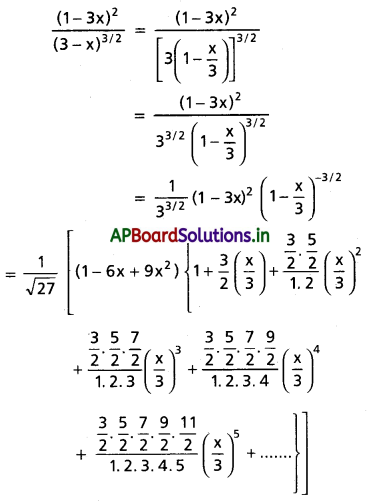
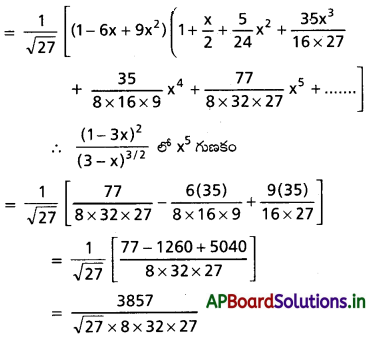
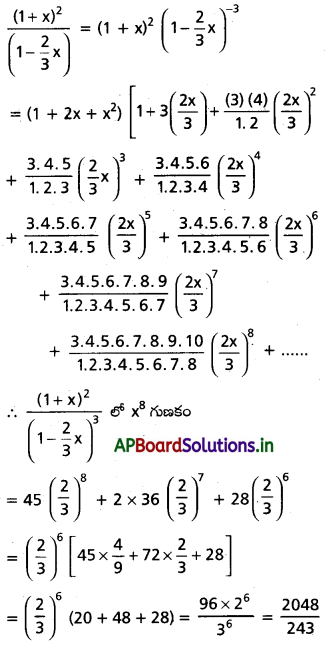
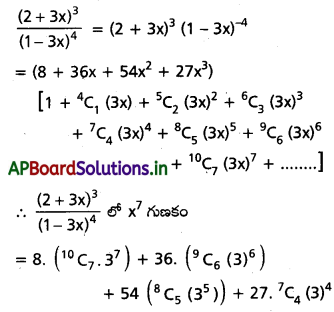
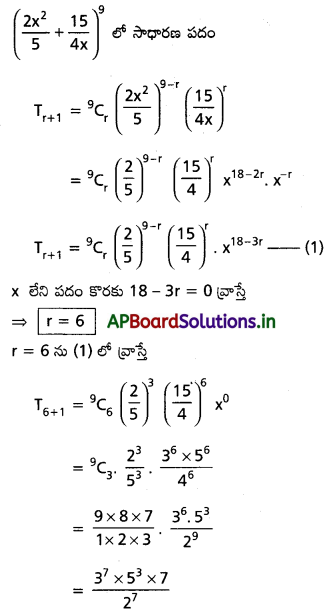
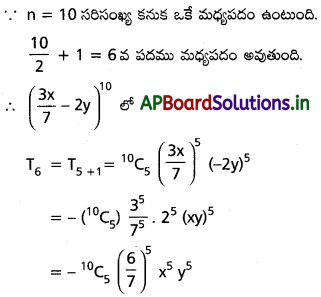
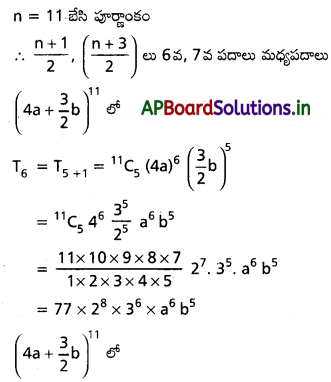
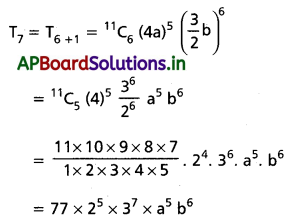
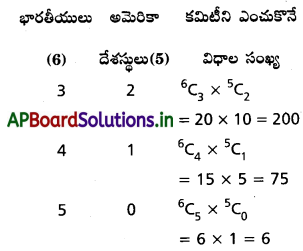
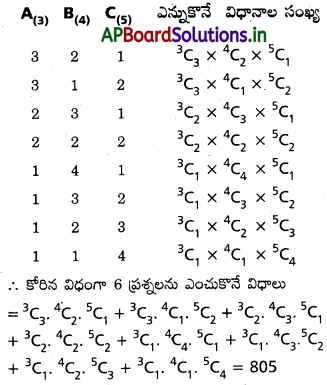
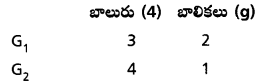
AP Inter 2nd Year Maths 2A Solutions Chapter 7 పాక్షిక భిన్నాలు Ex 7(c)

Practicing the Intermediate 2nd Year Maths 2A Textbook Solutions Chapter 7 పాక్షిక భిన్నాలు Exercise 7(c) will help students to clear their doubts quickly.

AP Inter 2nd Year Maths 2A Solutions Chapter 7 పాక్షిక భిన్నాలు Exercise 7(c)

అభ్యాసం – 7(సి)

క్రింది భిన్నాలను పాక్షిక భిన్నాలుగా విడగొట్టండి.

ప్రశ్న 1.
\(\frac{x^2}{(x-1)(x-2)}\)
సాధన:
\(\frac{x^2}{(x-1)(x-2)}=1+\frac{A}{x-1}+\frac{B}{x-2}\) అనుకుందాం.
x2 = (x – 1) (x – 2) + A(x – 2) + B(x – 1)
x = 1 వ్రాస్తే, 1 = A(-1) ⇒ A = -1
x = 2 వ్రాస్తే, 4 = B(1) ⇒ B = 4
∴ A = -1, B = 4
∴ \(\frac{x^2}{(x-1)(x-2)}=1-\frac{1}{x-1}+\frac{4}{x-2}\)

AP Inter 2nd Year Maths 2A Solutions Chapter 7 పాక్షిక భిన్నాలు Ex 7(c)

ప్రశ్న 2.
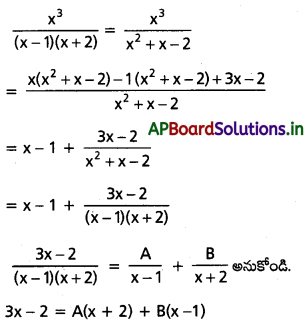
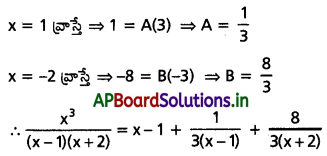
\(\frac{x^3}{(x-1)(x+2)}\)
సాధన:
AP Inter 2nd Year Maths 2A Solutions Chapter 7 పాక్షిక భిన్నాలు Ex 7(c) Q2
AP Inter 2nd Year Maths 2A Solutions Chapter 7 పాక్షిక భిన్నాలు Ex 7(c) Q2.1

ప్రశ్న 3.
\(\frac{x^3}{(2 x-1)(x-1)^2}\)
సాధన:
\(\frac{x^3}{(2 x-1)(x-1)^2}\) = \(\frac{1}{2}+\frac{A}{2 x-1}+\frac{B}{x-1}+\frac{C}{(x-1)^2}\) అనుకుందాం.
2x3 = (2x – 1) (x – 1)2 + 2A(x – 1)2 + 2B(2x – 1) (x – 1) + 2C(2x – 1)
x = \(\frac{1}{2}\) వ్రాస్తే, 2(\(\frac{1}{8}\)) = 2A(\(\frac{1}{4}\))
⇒ A = \(\frac{1}{2}\)
x = 1 వ్రాస్తే, 2(1) = 2C(1)
⇒ C = 1
x = 0 వ్రాస్తే, 0 = (-1) (1) + 2A(1) + 2B(-1) (-1) + 2C(-1)
⇒ 2A + 2B – 2C = 1
⇒ 2B = 1 + 2C – 2A
⇒ 2B = 1 + 2 – 1
⇒ 2B = 2
⇒ B = 1
∴ A = \(\frac{1}{2}\), B = 1, C = 1
∴ \(\frac{x^3}{(2 x-1)(x-1)^2}\) = \(\frac{1}{2}+\frac{1}{2(2 x-1)}+\frac{1}{(x-1)}+\frac{1}{(x-1)^2}\)

AP Inter 2nd Year Maths 2A Solutions Chapter 7 పాక్షిక భిన్నాలు Ex 7(c)

ప్రశ్న 4.
\(\frac{x^3}{(x-a)(x-b)(x-c)}\)
సాధన:
\(\frac{x^3}{(x-a)(x-b)(x-c)}\) = \(1+\frac{A}{x-a}+\frac{B}{x-b}+\frac{C}{x-c}\) అనుకోండి.
(x – a)(x – b)(x – c) చే గుణించగా
x3 = (x – a)(x – b)(x – c) + A(x – b) (x – c) + B(x – a) (x – c) + C(x – a) (x – b)
x = a ⇒ a3 = A(a – b) (a – c)
⇒ A = \(\frac{a^3}{(a-b)(a-c)}\)
x = b ⇒ b3 = B(b – a) (b – c)
⇒ B = \(\frac{b^3}{(b-a)(b-c)}\)
x = c ⇒ c3 = C(c – a) (c – b)
⇒ C = \(\frac{c^3}{(c-a)(c-b)}\)
∴ \(\frac{x^3}{(x-a)(x-b)(x-c)}\) = \(1+\frac{a^3}{(a-b)(a-c)(x-a)}+\frac{b^3}{(b-a)(b-c)(x-b)}\) + \(\frac{c^3}{(c-a)(c-b)(x-c)}\)

AP SSC 10th Class Biology Important Questions Chapter 2 Respiration

AP State Board Syllabus AP SSC 10th Class Biology Important Questions Chapter 2 Respiration.

AP State Syllabus SSC 10th Class Biology Important Questions 2nd Lesson Respiration

10th Class Biology 2nd Lesson Respiration 1 Mark Important Questions and Answers

Question 1.
What are the end products of Aerobic and Anaerobic Respirations?
Answer:
End products of aerobic respiration: Carbon dioxide, Water, Energy
End products of anaerobic respiration: Ethanol / Lactic acid, Carbon dioxide, Energy

Question 2.
In which organisms, blood does not supply the Oxygen?
Answer:
Arthropoda organisms (or) Insects (OR) Tracheal respiratory Organisms.

AP SSC 10th Class Biology Important Questions Chapter 2 Respiration

Question 3.
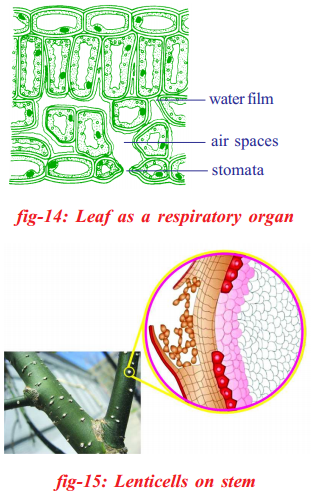
Hari said that stem also respires along with leaves. How do you support him?
Answer:
Lenticels on stem also help in gaseous exchange in some woody plants along with stomata.
AP SSC 10th Class Biology Important Questions Chapter 2 Respiration 1

Question 4.
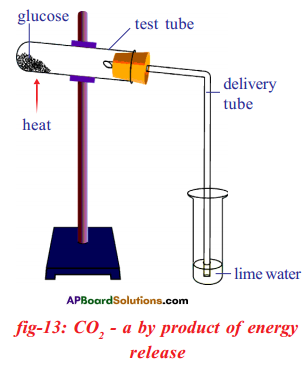
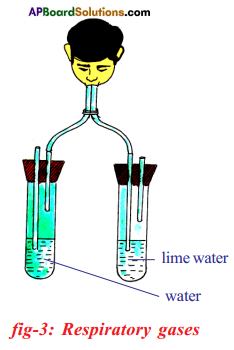
Arrange the apparatus as above and heat the glucose. What will happen to lime water when glucose burns?
Answer:
Lime water turns milky due to carbon dioxide (CO2).

Question 5.
What is the role of mitochondria in anaerobic respiration?
Answer:
The release of energy from glucose in the presence of oxygen occurs in mitochondria. In anaerobic respiration, as oxygen is absent, mitochondria have no role in respiration.

Question 6.
Fermented idli, dosa produce smell. Name the microorganism responsible for producing such smell.
Answer:
Yeast is responsible for producing such smell in fermented idli, dosa.

Question 7.
In what compound, the energy released during the breakdown of glucose is stored?
Answer:
“ATP” (Adenosine Triphosphate).

Question 8.
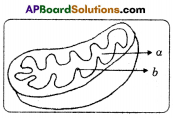
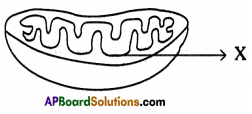
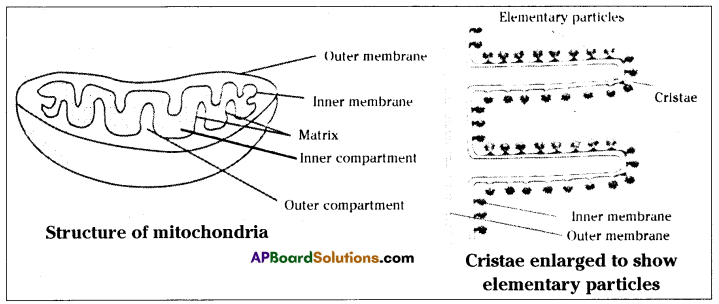
Label a and b in the given diagram.
AP SSC 10th Class Biology Important Questions Chapter 2 Respiration 2
Answer:
(a) Matrix, (b) Cristae.

Question 9.
Name chemical substance produced in human muscles during Anaerobic respiration.
Answer:
Lactic acid is produced in human muscles during Anaerobic respiration.

AP SSC 10th Class Biology Important Questions Chapter 2 Respiration

Question 10.
Why is Diazene Green solution added to the Glucose solution in anaerobic respiration experiment?
Answer:
Diazene Green solution is added to the Glucose solution in anaerobic respiration experiment to check the presence of oxygen in glucose solution.

Question 11.
Name the food material on which trypsin acts and name the end products.
Answer:
i) protein ii) end products – peptones.

Question 12.
“Respiration is the energy releasing process.” Write your opinion on this statement.
Answer:
The given statement is absolutely correct. We respire to use the oxygen to oxidise our food and release energy. This is similar like burning but a slower process. With the help of respiratory enzymes, energy released can be stored in the form of ATP for later use.

Question 13.
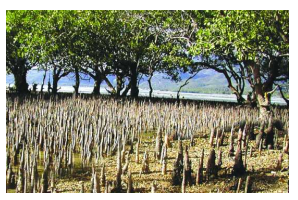
Identify the figure.
AP SSC 10th Class Biology Important Questions Chapter 2 Respiration 3
Answer:
Aerial roots in Mangrove plants.

Question 14.
Can we say that combustion and respiration are almost same actions? What evidences do you have for this?
Answer:

  1. In both these processes sugar is converted to carbon dioxide and water.
  2. Both these processes require oxygen.
  3. Both combustion and respiration releases energy.

Question 15.
What is the role of epiglottis in respiration and swallowing food?
Answer:
The epiglottis is a flexible flap at the superior end of the pharynx in the throat. Epiglot¬tis acts as a lid over glottis and prevents food from entering into larynx. Air from pharynx enters the larynx while food enters into oesophagus.

Question 16.
What is the function of haemoglobin?
Answer:
During respiration haemoglobin carries oxygen to the cells and CO, from cells to lungs.

Question 17.
What is respiration?
Answer:
Respiration is the process by which food is broken down to release energy.

Question 18.
What does the word respiration mean in Latin?
Answer:
In Latin the word respiration means “to breathe”.

Question 19.
Who did comprehensive work on properties of gases, their exchange and respiration?
Answer:
Lavoisier and Priestly.

Question 20.
What was the gas liberated on heating powdered charcoal in a bell jar?
Answer:
It was fixed air. In those days carbon dioxide was known as fixed air.

Question 21.
What is oxygen debt?
Answer:
It is the inadequate supply of oxygen when we undertake strenuous exercise.

Question 22.
What is vitiated air?
Answer:
It is the term used then to show air from which the component needed for burning had been removed.

Question 23.
What is the total lung capacity of human being?
Answer:
The total lung capacity of human being is nearly 5800 ml.

Question 24.
Who was the renowned chemist who wrote a textbook of Human Physiology?
Answer:
John Daper was the renowned chemist who wrote a textbook of Human Physiology.

Question 25.
What happens when air passes through nasal cavities?
Answer:

  1. Air is filtered in nasal cavity by mucus lining and the hairs growing from its sides, remove some of the tiny particles of dirt in the air.
  2. The temperature of the air is brought close to that of the body.

Question 26.
What is the function of epiglottis?
Answer:
Epiglottis controls the movement of air and food towards their respective passages.

Question 27.
What is breathing?
Answer:

  1. Breathing is the process of inhaling and exhaling.
  2. The mechanism by which organisms obtain oxygen from the environment and release CO2 is called breathing.

AP SSC 10th Class Biology Important Questions Chapter 2 Respiration

Question 28.
What are pleura?
Answer:
Pleura are the two membranes that protect lungs from injury.

Question 29.
What is the concentration of oxygen at a height of 13 km from the sea level?
Answer:
At a height of 13 km above sea level the concentration of oxygen is much lower about one-fifth as great as at sea level.

Question 30.
What is cellular respiration?
Answer:
Oxidation of glucose or fatty acids takes place in the cells releasing energy. Hence this process is known as cellular respiration.

Question 31.
Where does aerobic respiration occur in eukaryotic cells?
Answer:
Aerobic respiration occur in cytoplasm and mitochondria of eukaryotic cells.

Question 32.
What is Glycolysis?
Answer:
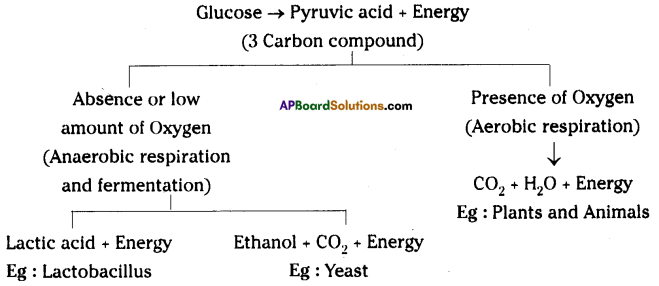
It is the first stage of respiration. In this breakdown of glucose molecule into two molecules of 3 carbon compound called pyruvic acid or pyruvate releasing energy.

Question 33.
What is the fate of pyruvate in the absence of oxygen in animals?
Answer:
In the absence of oxygen pyruvate will be converted to lactic acid and release small amount of energy in animals.

Question 34.
In which type of respiration pyruvate is converted into carbon dioxide and water?
Answer:
In aerobic respiration pyruvate is converted into carbon dioxide and water.

Question 35.
What is the main reason for feeling pain in muscles after strenuous exercise?
Answer:
Due to the anaerobic respiration in muscles large amounts of lactic acid is accumulated and this results in muscular pains.

Question 36.
What is fermentation?
Answer:
In the absence of oxygen, yeast cells convert pyruvic acid to ethanol. This process is called fermentation.

Question 37.
What is the method used to separate ethanol from the yeast glucose mixture in anaerobic respiration?
Answer:
The method used to separate ethanol from the yeast glucose mixture in anaerobic respiration is fractional distillation.

Question 38.
In which organisms does exchange of gases take place through diffusion?
Answer:
In Amoeba, hydra and planarians exchange of gases takes place through diffusion.

Question 39.
In tracheal respiratory system which carry air directly to the cells in the tissues?
Answer:
Trachioles, the fine branches of trachea carry air directly to the cells in the tissues.

AP SSC 10th Class Biology Important Questions Chapter 2 Respiration

Question 40.
What are the respiratory organs in fishes?
Answer:
Gills or bronchiae are the respiratory organs in fishes.

Question 41.
What is cutaneous respiration?
Answer:
If the respiration occurs through skin, it is known as cutaneous respiration, e.g : Leech, Earthworm and Frog.

Question 42.
What are the other areas on the plant body through which gaseous exchange take place?
Answer:
The areas on the plant body through which geseous exchange take place are the surface of roots, lenticels on the stem.

Question 43.
What is the full form of ATP? How is it formed?
Answer:
I) ATP stands for Adenosine triphosphate.
2) ATP is used to supply energy in the cells for the carrying all the metabolic processes.

Question 44.
What are the factors that control respiration?
Answer:
Oxygen and temperature are the two important factors that control the process of respiration.

Question 45.
What are the substances that are used for the production of energy in all living organisms?
Answer:
Glucose and fatty acids are used for the production of energy in all living organisms.

Question 46.
How many types of respiration are present? What are they?
Answer:
There are two types of respiration. They are :

  1. Aerobic respiration and
  2. Anaerobic respiration.

Question 47.
Where is energy stored in ATP?
Answer:
Energy is stored in the terminal phosphate bond in ATP which is having three phosphates attached to a molecule of Adenosine.

Question 48.
What are the power houses of the cell?
Answer:
Mitochondria are the power houses of the cell.

Question 49.
What is the main difference between respiration and combustion?
Answer:
In respiration several intermediates are produced and in combustion, there are no such intermediates are produced.

Question 50.
What is the equation that represents respiration?
Answer:
The equation that represents respiration is
AP SSC 10th Class Biology Important Questions Chapter 2 Respiration 4

Question 51.

.
What are the sites of cellular respiration?
Answer:
Mitochondria are the sites of cellular respiration.

Question 52.
What are cristae in mitochondria?
Answer:
The inner membrane of mitochondria is thrown into several folds called cristae.

Question 53.
What is the net gain of ATP molecules in Glycolysis?
Answer:

  1. Four ATP molecules are produced when one molecule of glucose is converted to two molecules of pyruvate but two are consumed.
  2. The remaining two ATP molecules are net gain in glycolysis.

AP SSC 10th Class Biology Important Questions Chapter 2 Respiration

Question 54.
How many ATP molecules are produced when one glucose molecule is completely oxidised?
Answer:
A net gain of 38 ATP molecules are formed from the total oxidation of one glucose molecule.

Question 55.
What are the three stages present in complete oxidation of glucose molecule?
Answer:
The three stages present in complete oxidation of glucose molecule are

  1. Glycolysis
  2. Kreb’s cycle and
  3. Electron transport.

Question 56.
Why does oxidation of fatty acids give more energy?
Answer:
Oxidation of fatty acids give more energy due to the presence of more carbon atoms in them.

Question 57.
What are aquatic and terrestrial animals?
Answer:
Animals that live in water are called aquatic animals and that live on land are known as terrestrial animals.

Question 58.
Why is the rate of breathing in aquatic organisms much faster than terrestrial organisms?
Answer:

  1. The amount of oxygen dissolved in water is low when compared to the amount of oxygen present in air.
  2. Therefore the rate of breathing in aquatic animals is much faster than in terrestrial animals.

Question 59.
Which part of the roots is involved in the exchange of respiratory gases?
Answer:
The part of roots that are involved in the exchange of respiratory gases are root hairs.

Question 60.
What is the average breathing rate in an adult mem at rest?
Answer:
The average breathing rate in an adult man at rest is about 15 to 18 times per minute.

Question 61.
Why is the trachea prevented from collapsing?
Answer:
The walls of the trachea are supported by several ‘C’ shaped cartillagenous rings. They prevent the trachea from collapsing and closing.

Question 62.
Why deos the percentage of carbon dioxide increase in exhaled air?
Answer:
During oxidation of glucose carbon dioxide is produced as waste product. Hence the concentration of carbon dioxide increases in exhaled air.

Question 63.
How does breathing take place in mangrove plants?
Answer:
In mangrove plants breathing takes place through specialised structures called breath¬ing roots or pneumatophores.

AP SSC 10th Class Biology Important Questions Chapter 2 Respiration

Question 64.
How does respiration take place in plants where roots are present in wet places?
Answer:
The plants which have their roots in very wet places have much larger air spaces, connect the stems with the roots, making diffusion from upper parts.

Question 65.
Which form a continuous network all over the plant?
Answer:
The stomatal openings lead to a series of spaces between the cells inside the plant which form a continuous network all over the plant.

Question 66.
What are the reasons for the animals to develop different types of respiratory organs?
Answer:
Body size, availability of water, habitat in which they live and the type of circulatory system are some of the reasons for the animals to develop different types of respiratory organs.

Question 67.
Why do fishes die when taken out of water?
Answer:
Fishes do not have lungs to utilise oxygen for breathing. They have gills which can utilize only dissolved oxygen from water.

Question 68.
What would be the consequences of deficiency of haemoglobin in our bodies?
Answer:
Deficiency of haemoglobin in blood can affect the oxygen supplying capacity of blood to body cells. It can also lead to a disease called Anaemia.

Question 69.
What are the stages of respiration in man?
Answer:
Respiration in man occurs in two stages 1) Inhalation (or) Inspiration 2) Exhalation (or) Expiration.

Question 70.
Which part plays major role in respiration of man?
Answer:
Diaphragm plays a major role in respiration in man.

Question 71.
Which part plays major role in respiration of woman?
Answer:
In woman ribs play a major role in respiration.

Question 72.
How are lungs protected?
Answer:
Lungs are protected by two membranes called pleura. A fluid between these membranes protects the lungs from injury.

Question 73.
What is the composition of exhaled air?
Answer:
Exhaled air contains 16% of oxygen, 4% of carbon dioxide and 79% of nitrogen.

Question 74.
Why are red blood cells red in colour?
Answer:
Red blood cells are red in colour due to the presence of haemoglobin in their cytoplasm.

AP SSC 10th Class Biology Important Questions Chapter 2 Respiration

Question 75.
How is haemoglobin made up of?
Answer:
Haemoglobin is made up of a protein called globin, Iron (Hearn) and organic molecule called porphyrin.

10th Class Biology 2nd Lesson Respiration 2 Marks Important Questions and Answers

Question 1.
AP SSC 10th Class Biology Important Questions Chapter 2 Respiration 5(a) Which gas turns lime water milky in this experiment?
Answer:
Carbondioxide (or) CO2

(b) Which gas do you think might be present in less quantities in the air we breath out as compared to air around us?
Answer:
Oxygen (or) O2

Question 2.
Balu said that, “Plants perform Photosynthesis during day time. They respire during night time”.
Do you agree with Bain? Why? Why not?
Answer:

  1. I do not agree with Balu’s statement.
  2. Photosynthesis depends on light for energy but respiration does not depend on light.
  3. Hence, photosynthesis takes place during day time only whereas respiration takes place both day and night.

Question 3.
The sportsman who participated in 100 mtr race get more muscle pains. But the sportsman who participates in 5 km’s race get less muscle pains. What is the reason?
Answer:

  1. Accumulation of lactic acid results in muscular pain.
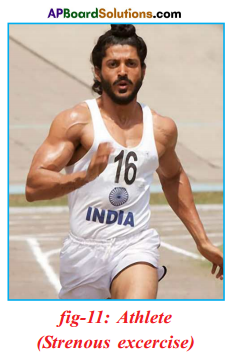
  2. During 100 m race a well trained athlete can hold his breath and afterwards he pants.
  3. In this case, the muscles are using energy released during the anaerobic break down of glucose, lactic acid is produced.
  4. The presence of lactic acid in the blood is the main cause of muscle fatigue. Whether it is 100 mtr race or 5 km race.
  5. If the body is rested long enough the tiredness goes.

Question 4.
What happens if there is no epiglottis in human beings?
Answer:

  1. Food may enters into the larynx.
  2. Food may enters into the lungs leading to the death.
  3. May not speak properly.
  4. Entry of food and air may not be regulated properly.

AP SSC 10th Class Biology Important Questions Chapter 2 Respiration

Question 5.
Write two chemicals and two materials required to conduct the experiment “Heat and Carbon dioxide are evolved during anaerobic respiration”.
Materials required: Thermosflask, splitted corks, thermometer, wash bottle, glass tubes.
Chemicals required: Liquid paraffin, glucose solution, bicarbonate solution, Janus green B and Yeast cells.

Question 6.
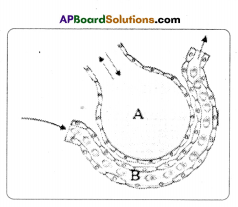
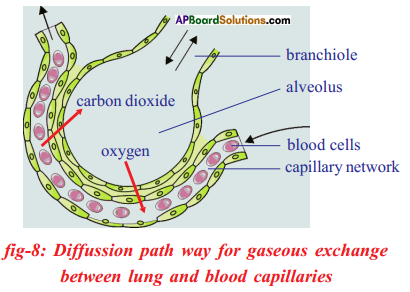
Observe the below diagram.
AP SSC 10th Class Biology Important Questions Chapter 2 Respiration 6A) To which biosystem is this picture related?
Answer:
Respiratory system.

B) Write the names of the parts of A, B.
Answer:
A – alveolus; B – blood capillary network

C) To which system are they linked with?
Answer:
Respiratory system; circulatory system.

D) Which process is happening here? What happens as a result of it?
Answer:
Gaseous exchange between alveolus of lungs and blood capillaries. Due to this the CO2, present in blood capillaries enter alveolus and oxygen present in alveolus en¬ter blood capillaries.

Question 7.
A person reached a specific distance once on foot and once by running. In which situation his legs pain? Why?
Answer:

  1. When a person runs to reach a specific distance gets pain in his legs.
  2. This is due to the production of lactic acid in the muscles.
  3. Due to the Anaerobic respiration glucose in muscles converts into lactic Acid.
  4. Accumulation of lactic acid causes pain in leg muscles.

Question 8.
What is the advantage of the wet and warm passage of air from the nostrils to capillaries?
Answer:
When the air passes in nasal cavity and in the pharynx some changes take place.

  1. The mucus layer and hair in the nasal cavity removes the dust particles in the air.
  2. The temperature of the air brought to the body temperature.
  3. Moistening the air.

Question 9.
In the experiment of anaerobic respiration with yeast
i) Why was liquid paraffin poured on glucose?
ii) What did you understood about anaerobic respiration?
Answer:
i) The supply of oxygen from the air can be stopped by pouring liquid paraffin on glucose.
ii) Anaerobic respiration takes place in the absence of oxygen. In this glucose molecule is incompletely oxidised. The end products of anaerobic respiration are ethyl alcohol or lactic acid and CO2.
During anaerobic respiration small amount of energy is liberated (2ATP). Anaero¬bic respiration occurs in many anaerobic bacteria and human muscles cells. The anaero¬bic respiration can be represented as:
C6H12O6 → 2C2H5OH + 2CO2+ 56 K.Cal.

Question 10.
See the below table. Write what you know from it.

Gas% in inhaled air% of exhaled air
Oxygen2116
Carbon dioxide0.044
Nitrogen7979

Answer:

  1. The inhaled air consists of 21% of oxygen whereas the exhaled air contains 16% of oxygen only. This is due to utlilisation of oxygen during cellular respiration in the body. Hence the difference occurs.
  2. Inhaled air contains 0.04% of carbondioxide whereas exhale air contains 4% of carbondioxide.
    The concentration of CO2 is increased a lot due to the release of CO2 during cellular respiration in the body.
  3. Both inhale and exhale air contains 79% of nitrogen because nitrogen has no role to play in cellular respiration.

AP SSC 10th Class Biology Important Questions Chapter 2 Respiration

Question 11.
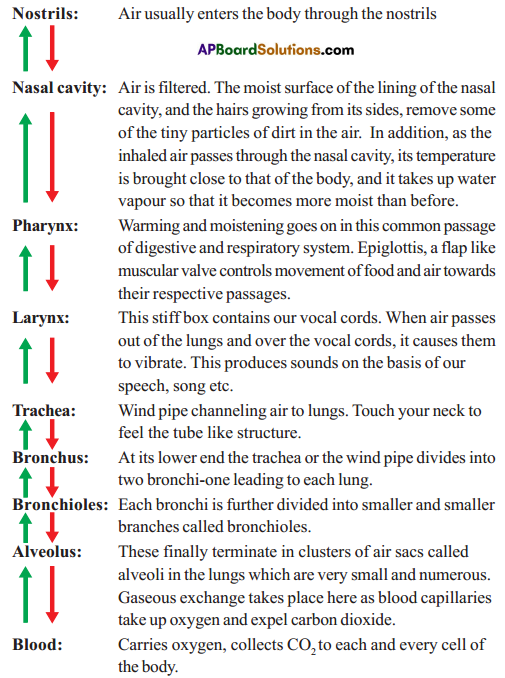
What is the pathway of air from nostril to alveolus?
Answer:
Draw a flow chart of Respiratory passage of Humans.
AP SSC 10th Class Biology Important Questions Chapter 2 Respiration 7

Question 12.
What happens when a baker prepares a dough by mixing yeast in it?
Answer:

  1. The yeast is commonly used for fermenting bread is saccharomyces cerevisiae.
  2. Baker’s yeast has the advantage of producing uniform, quick, and reliable results because it is obtained from pure culture.
  3. Water is mixed with flour, salt and the fermenting agent.
  4. The mixed dough is then allowed to rise one or more times.
  5. Then loaves are formed and the bread is baked in air oven.

Question 13.
How does respiration in amoeba and hydra occur through diffusion? (OR)
What are the similarities in respiration of amoeba and hydra?
Answer:

  1. Amoeba and hydra are aquatic organisms.
  2. Respiration in them occurs through diffusion.
  3. As oxygen is used by these organisms in respiration, its concentration is reduced in cytoplasm. Hence oxygen diffuses into cytoplasm from surrounding water.
  4. During respiration CO2 is continuously produced, its concentration increases in the cytoplasm, hence it diffuses into surrounding water.

Question 14.
Write a short note on ATP. (OR) Expand ATP.
Answer:

  1. From the break down of glucose the energy is released and stored up in a special compound known as ATP (Adenosine Triphosphate).
  2. It is a small parcel of chemical energy. The energy currency of these cells is ATP an energy rich compound that is capable of supplying energy whenever needed within the cell.
  3. Each ATP molecule gives 7200 calories of energy. This energy is stored in the form of phosphate bonds.
  4. If the bond is broken, the stored energy is released.

Question 15.
How do Dolphin and Crocodile respire?
Answer:

  1. The aquatic animals like dolphin and crocodile respire with the help of lungs.
  2. They come out of the water for air.
  3. These two animals were lived on land initially.
  4. Later they lived in water and developed several adaptations to live in water.

Question 16.
Why are Mitochondria called “Power houses of cell”? (QR)
What is the energy producing organ in a cell? How does it produce energy?
Answer:

  1. Cellular respiration in prokaryotic cells like that of bacteria occurs within the cytoplasm.
  2. In eukaryotic cells cytoplasm and mitochondria are the sites of reaction.
  3. The produced energy is stored in mitochandria in the form of ATP.
  4. Hence, mitochondria are called “Power houses of cell”.

AP SSC 10th Class Biology Important Questions Chapter 2 Respiration

Question 17.
Write the rate of respiration in different age groups of human beings.
Answer:

  1. Newborn child: 32 times per minute
  2. Children of 5 years: 26 times per minute
  3. Man of 25 years: 15 times per minute
  4. Man of 50 years: 18 times per minute

10th Class Biology 2nd Lesson Respiration 4 Marks Important Questions and Answers

Question 1.
Write about respiration in mangroves that grow in marshy lands.
Answer:

  1. Mangroves grown near the marshy places respire through aerial roots or respiratory roots.
  2. The root hairs exchange the gases from their surface.
  3. They obtain oxygen from the airspaces present between the soil particles.
  4. The plants grown in marshy places are adapted to develop aerial roots above the soil surface which helps in gaseous exchange.

Question 2.
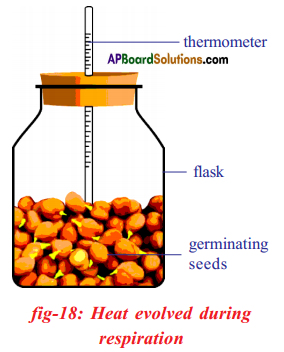
AP SSC 10th Class Biology Important Questions Chapter 2 Respiration 10a) What is the aim of this experiment?
Answer:
Heat is liberated during respiration.

b) What change do you observe in thermometer readings?
Answer:
Reading increases in the thermometer.

c) In your opinion, where did this heat come from?
Answer:
The heat comes from the germinating seeds which respire and releasing heat.

d) What precaution should we take, while doing this experiment?
Answer:
The bulb of the thermometer should be dip in the germinating seeds (or) sprouts.

Question 3.
You have conducted this experiment in your classroom. Now answer the following questions.
AP SSC 10th Class Biology Important Questions Chapter 2 Respiration 11a) What do you prove by conducting this experiment?
Answer:
To test the production of heat and carbon dioxide during anaerobic respiration.

b) Why do you heat glucose solution?
Answer:
To remove the dissolved oxygen in the glucose solution.

c) How do you confirm that glucose solution is free from oxygen after heating it?
Answer:
By adding diazine green (Janus green B) solution to glucose solution, it turns to pink.

d) What are the changes you notice in the lime water?
Answer:
Lime water turns milky white.

AP SSC 10th Class Biology Important Questions Chapter 2 Respiration

Question 4.
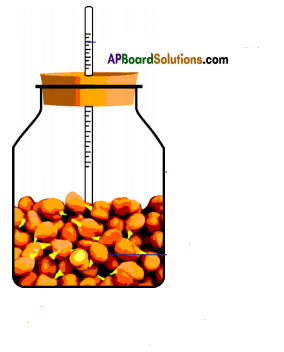
AP SSC 10th Class Biology Important Questions Chapter 2 Respiration 12
i) What change did you observe in the thermometer in the given experiment?
Answer:
Raise in the temperature

ii) Where does the heat come from?
Answer:
From the germinating seeds during respiration

iii) What result you will get, if you perform this experiment with dry seeds?
Answer:
No change of temperature in thermometre.

iv) What are the apparatus used in this experiment?
Answer:
Glass jar, germinating seeds, cork, thermometer.

AP SSC 10th Class Biology Important Questions Chapter 2 Respiration

Question 5.
Observe the set of apparatus and answer the following questions.
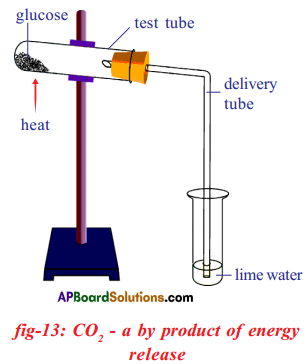
AP SSC 10th Class Biology Important Questions Chapter 2 Respiration 13i) Which process do we know with the help of this experiment?
Answer:
Combustion.

ii) How does this process differ with respiration?
Answer:
Respiration occurs in the presence of water.
Combustion occurs in the absence of water.

iii) What are the similarities between this process and respiration?
Answer:
In both processes energy is released.

iv) Which gas turns lime – water milky?
Answer:
Carbon-di-oxide (CO2)

Question 6.
Look at the following experiment. Answer the questions.
AP SSC 10th Class Biology Important Questions Chapter 2 Respiration 11
a) What is the aim of the experiment?
Answer:
The aim of the experiment is CO2 is released during anaerobic respiration.

b) Which agent is used to find the presence of oxygen?
What changes do you observe when oxygen is present in Glucose solution?
Answer:
To find the presence of oxygen diazine green (Janus Green B) solution is used. The blue diazine green solution turns pink when oxygen is present in the glucose solution.

c) Why is liquid paraffin poured on glucose solution?
Answer:
By pouring liquid paraffin on glucose solution, the supply of oxygen from the air can be cut off.

d) Which gas is released during the experiment? How can you prove it?
Answer:
Carbon dioxide is released.
The released CO2 passes into lime water it turns milky.

AP SSC 10th Class Biology Important Questions Chapter 2 Respiration

Question 7.
Observe the following diagram and answer the following questions.
AP SSC 10th Class Biology Important Questions Chapter 2 Respiration 14

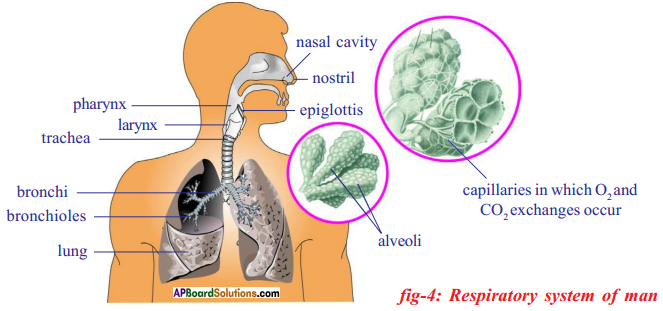
  1. What do we call the membranes that cover the lungs?
  2. What is the functional unit of lungs ?
  3. Which part produces the sound ?
  4. What does ‘X’ denote ?

Answer:

  1. Pleura
  2. Alveoli
  3. Larynx
  4. Trachea

Question 8.
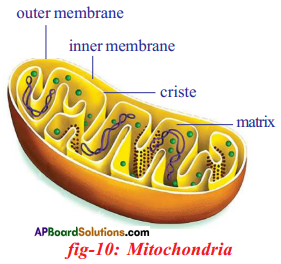
Observe the diagram and answer the following questions.
AP SSC 10th Class Biology Important Questions Chapter 2 Respiration 15
a) What does the given diagram indicate?
b) What is the part ‘X’ in the diagram?
c) What is the function of the given picture?
d) To which system the given picture belongs to?
Answer:
a) The given diagram indicates mitochondria.
b) Matrix
c) Performing cellular respiration and releasing energy in the form of ATP.
d) Respiratory system.

Question 9.
Observe the experimental setup and answer the given questions.
AP SSC 10th Class Biology Important Questions Chapter 2 Respiration 12A) What is the aim of this experiment?
B) What are the apparatus required for this experiment?
C) What changes do you observe in thermometer during this WKm experiment?
D) What will happen, if dry seeds are taken instead of germinating seeds in this experiment?
Answer:
A) Heat is liberated during respiration.
B) Glass jar, Germinating seeds, Cork and Thermometer.
C) We can notice the raise in temperature after observing the thermometer readings.
D) There will be no change of temperature in the thermometer. We can’t prove the aim of the experiment.

Question 10.
Observe the below diagram and answer the following questions:
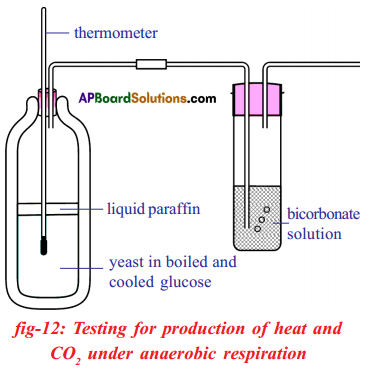
AP SSC 10th Class Biology Important Questions Chapter 2 Respiration 11i) What does the above setting (diagram) indicate?
Answer:
The above setting (diagram) indicates to prove that carbon dioxide and heat are liberated during anaerobic respiration by yeast cells.

ii) Why is boiled and cooled glucose covered with paraffin?
Answer:
To prevent supply of air, boiled and cooled glucose is covered with paraffin.

iii) What is the use of adding diazine green to glucose solution? What change you notice in glucose solution?
Answer:
Diazine green is added to glucose solution to know whether oxygen is present or not in glucose solution. When the availability of oxygen is less the diazine green changes to pink colour.

iv) Why is lime water used in this experiment?
Answer:
To know whether carbon dioxide is released or not in this experiment lime water is used. Carbon dioxide changes lime water to milky white.

v) Why is bulb of thermometer dipped in the glucose water?
Answer:
To know the rise in temperature of glucose solution when heated, the bulb of thermometer is dipped in the glucose water.

AP SSC 10th Class Biology Important Questions Chapter 2 Respiration

Question 11.
Explain with the help of a flow chart, the path way of air in humans.
Answer:
AP SSC 10th Class Biology Important Questions Chapter 2 Respiration 8

Question 12.
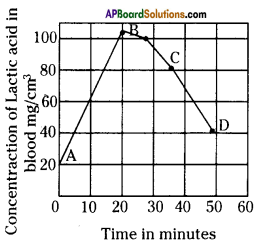
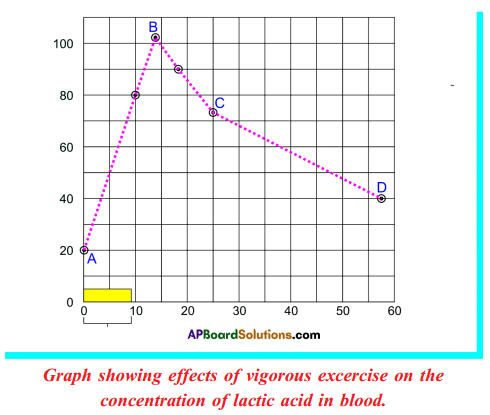
Study the graph and answer the following questions :
AP SSC 10th Class Biology Important Questions Chapter 2 Respiration 16Graph showing effects of vigorous excercise on the concentration of lactic acid in blood.
i) What was the concentration of lactic acid in blood to start with?
ii) What was the greatest concentration of lactic acid reached during the experiment?
iii) What is the concentration of lactic acid after 25 minutes of exercise?
iv) What is the relationship between lactic acid and muscle pain?
Answer:
i) 20 mg/cm3
ii) 20 minutes (Or) at “B” point,
iii) 101 mg/cm3
iv) If concentration of lactic acid increases, muscle pains also increases.

Question 13.
Observe the following :
AP SSC 10th Class Biology Important Questions Chapter 2 Respiration 17
Write the answers to the following questions:
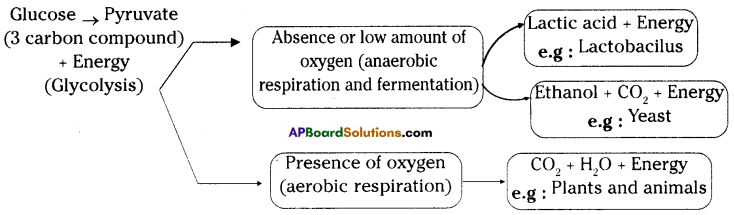
i) How many Pyruvic acid molecules form from one Glucose?
Answer:
2 Pyruvic acid molecules.

ii) What conditions influence Pyruvic acid to participate in Aerobic and Anaerobic respiration?
Answer:
Presence of oxygen

iii) In which we get more energy in both Aerobic and Anaerobic respirations?
Answer:
Aerobic respiration

iv) The chemical that is formed in human muscles during Anaerobic respiration.
Answer:
Lactic acid

Question 14.
Why does the exchange of gases happen only in alveoli, though arteries are present in pharynx, trachea and bronchus?
Answer:

  1. Alveoli are tiny air sacs in the lungs surrounded by capillaries
  2. They are numerous and only single cell thickness
  3. They increase the efficiency of gas exchange.
  4. Due to the difference in a gradient of O2 oxygen diffuse from alveoli to blood capillaries.

Question 15.
What are the events or steps in respiration?
Answer:
The following are the events or steps in respiration.

  1. Breathing: Air moves into lungs and out of lungs.
  2. Gaseous exchange in lungs: Exchange of gases between alveoli and blood.
  3. Gas transport by blood: Transport of oxygen from blood capillaries of alveoli to body cells and return of carbon dioxide.
  4. Gaseous exchange in cells: Exchanging oxygen from blood into the cells and carbon dioxide from cells into the blood.
  5. Cellular respiration: Using oxygen in cell processes to produce carbon dioxide and water, releasing energy to be used for life processes.

AP SSC 10th Class Biology Important Questions Chapter 2 Respiration

Question 16.
What will happen if the respiratory tract is not moist? (OR)
Why respiratory tract should be moist?
Answer:

  1. If the respiratory tract is not moist the dirt particles in the inhaled air will not be removed from air in the nasal cavities and reaches lungs and creates problems to lungs.
  2. The temperature of the inhaled air is brought close to that of the body for the smooth passage in the respiratory tract. If it is dry, it is not possible.
  3. If the surface dries out, gas exchange will happen at a very reduced rate since fast moving gaseous oxygen molecules do not efficiently cross the alveoli membrane.
  4. The reduced gas exchange is most likely not enough to support blood oxygenation for vital functions.
  5. Hence respiratory tract should be moist for smooth exchange of gases.

Question 17.
Explain the process of transportation of gases through the blood.
Answer:

  1. The relative amount of gases and their combining capacity with haemoglobin and other substances in blood determine their transport via blood in the body.
  2. When oxygen present in the air is within normal limits (around 21%) then almost all of it is carried in the blood by binding to haemoglobin, a protein present in the red blood cells.
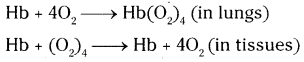
  3. As oxygen is diffused in the blood, it rapidly combines with the haemoglobin to form oxyhaemoglobin.
  4. Not only can haemoglobin combine with oxygen, but it can easily broken into haemoglobin and oxygen.
  5. Carbon dioxide is usually transported as bicarbonate, while some amount of it combines with haemoglobin and rest is dissolved in blood plasma.
    AP SSC 10th Class Biology Important Questions Chapter 2 Respiration 18

Question 18.
Why is human life impossible at higher altitudes without a supplementary supply of oxygen? (OR)
The concentration of oxygen in air decreases as we go up from sea level. Explain briefly.
Answer:

  1. If haemoglobin is exposed to air at sea level, every molecule in air combines with oxygen to form oxyhaemoglobin.
  2. At a height of 13 km above sea level, the concentration of oxygen is much lower about l/5th of a sea level.
  3. Under these conditions about half as many molecules of oxygen combine with haemoglobin to form oxyhaemoglobin.
  4. Blood cannot carry enough oxygen to the tissues.
  5. Hence human life is impossible at such a high altitude without a supplementary supply of oxygen.
  6. Provision for such a supply is built into modern aircraft which have pressurized cabins that maintain an enriched air supply.

Question 19.
What are the different ways in which glucose is oxidised to provide energy in various organisms? Give one example of each.
How does oxidation of glucose occur in various organisms?
Answer:

  1. Glucose is the most commonly used sugar for deriving energy in plants, animals and in microorganisms.
  2. In all these organisms glucose is oxidized in two stages.
  3. The first stage is known as Glycolysis. It occurs in cytoplasm.
  4. During glycolysis glucose is converted to two molecules of pyruvic acid.
  5. In the second stage if oxygen is available pyruvic acid is converted to C02 and water, large amount of energy is released. This is known as aerobic respiration. It occurs in most of the plant and animal cells.
  6. If oxygen is inadequate or not available, pyruvic acid is converted into ethanol and carbon dioxide. This is anaerobic respiration taking place in yeast cells that is called fermentation.
  7. If oxygen is not available in muscle cells, the pyruvic acid is converted into lactic acid.
    AP SSC 10th Class Biology Important Questions Chapter 2 Respiration 19

AP SSC 10th Class Biology Important Questions Chapter 2 Respiration

Question 20.
Write the adaptations seen in plants living in water logged conditions.
(OR)
What are the adaptations seen in magrove plants?
Answer:

  1. Most plants can aerate their roots by taking in the oxygen through lenticels or through the surface of their root hairs.
  2. But plants which have their roots in very wet places, are unable to do this.
  3. They are adapted to these water logged conditions by having much larger air spaces which connect the stems with the roots, making diffusion from the upper parts much more efficiently.
  4. The problem of air transportion is more difficult for trees and may not survive with their roots permanently in water.
  5. To overcome this problem the mangrove tree of the tropics which raise up aerial roots above the surface and takes in oxygen.

Question 21.
Describe the mechanism of branchial or gill respiration in fishes.
(OR)
Briefly explain the process of exchange of gases in fishes during respiration.
Answer:

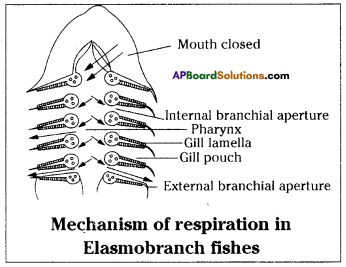
  1. Some aquatic animals like fishes have developed special organs for respiration which are known as gills or branchiae.
  2. Blood is supplied to gills through capillaries which have thin walls where gases are exchanged. Gills are present in the gill pouches or branchial pouches.
    AP SSC 10th Class Biology Important Questions Chapter 2 Respiration 20
  3. Gills are provided with leaf-like folds called gill lamellae.
  4. Fish keeps its mouth open and lowers the floor of the oral cavity. As a result water from outside will be drawn into the oral cavity.
  5. Now the mouth is closed and the floor of the oral cavity is raised.
  6. Water is pushed into the pharynx and is forced to gill pouches through internal branchia apertures.
  7. When water passes through gill lamellae exchange of gases takes place, that is oxygen diffuses from water to blood and CO2 from blood into water.
  8. Then water flows through external branchia aperture.

Question 22.
Explain briefly about Pranayama- the art of breathing. (OR)
How can the capacity of lungs be improved by yoga?
Answer:

  1. To improve breathing capacity the saint Patanjali developed Yogabyasa.
  2. The art of breathing in Yogabyasa is called Pranayama. Prana means gas, ayama means journey.
  3. In Pranayama practice air is allowed to enter three lobes of lungs in order to in¬crease the amount of oxygen to diffuse into blood.
  4. More amount of oxygen available to brain and tissues the body will be more active.
  5. It is very important to practise Pranayama regularly to make our life healthy and active.
  6. All people irrespective of age and sex should practise Pranayama under the guidance of well trained Yoga Teacher to improve the working capacity of lungs.

Question 23.
What are the experiments carried out by Lavoisier to understand the property of gases?
Answer:

  1. In his early experiments Lavoisier thought that the gas liberated on heating powdered charcoal in a bell jar kept over water in a trough was like fixed air i.e., carbon dioxide.
  2. The next series of experiments deals with the combustion of phosphorous in a bell jar. From this he showed that whatever it was in the atmospheric air which combined with the phosphorous was not water vapour.
  3. This was respirable air, a component of air that also helped in burning.
  4. The air that we breathe out precipitated lime water while that after heating metal did not.
  5. From this, he concluded that there were two processes involved in respiration.
  6. Lavoisier carried out another experiment by which he showed that about one sixth of the volume of ‘vitiated air’ consists of chalky acid gas (fixed air).
  7. Either eminently respirable air is changed in the lungs to chalky acid air; or an exchange takes place, the eminently respirable air being absorbed, and an almost equal volume of chalky acid air being given up to the air from the lungs.
  8. Lavoisier had to admit that there were strong grounds for believing that eminently respirable air did combine with the blood to produce the red colour.

AP SSC 10th Class Biology Important Questions Chapter 2 Respiration

Question 24.
Explain the evolutionary changes in energy-releasing system.
(OR)
What are the different respiratory systems in animal groups?
Answer:
Exchange of gases is a common life process in all living organisms, but it is not same in all.

  1. Diffusion:
    1. Single-celled organisms like amoeba or multicellular organisms like hydra and planarians obtain oxygen and expel carbon dioxide directly from the body by the process of diffusion.
    2. In multicellular animals special organs are evolved.
    3. Body size, availability of water and the type of circulatory system are some of the reasons for the animals to develop different types of respiratory organs.
  2. Tracheal respiratory system : In insects tracheal respiratory system is present in which small branches of trachea called trachioles carry air directly to the cells in the tissues.
  3. Bronchial respiration : In fishes gills are utilised for the exchanges of gases. Blood is supplied to gills through capillaries which have thin walls for exchange of gases. This is called bronchial respiration.
  4. Cutaneous respiration: 0 Respiration through skin is called cutaneous respiration.
    Eg: i) Earth worms and leeches.
    ii) Frog, an amphibian can respire through lungs and skin.
  5. Pulmonary respiration : Most of the higher animals respire with the help of lungs. This type of respiration is known as pulmonary respiration. Eg: Mammals.

Question 25.
Describe the structure of mitochondria with the help of a diagram. (OR)
Which cell organelle is called energy currency or power house of cell? What do you know about its construction?
Answer:
Mitochondria is known as energy currency or power house of cell.
Structure of mitochondria:
AP SSC 10th Class Biology Important Questions Chapter 2 Respiration 21

  1. Mitochondria are sac-like structures present in the cytoplasm of the cells.
  2. Mitochondria have two compartments-an inner compartment and an outer compartment. The substance in the inner compartment is called matrix.
  3. The matrix is surrounded by a membrane called inner membrane of mitochondria.
  4. The inner membrane is thrown into several folds called cristae. The cristae extended into the matrix.
  5. The space between the folds is continuous with the outer compartment.
  6. On the inner membrane, projecting into the matrix are a large number of particles called elementary particles.
  7. These particles have a spherical head and a stalk. They are attached to the inner membrane by their stalk and the head portion of the particle is in the matrix.
  8. The outer compartment is surrounded by another membrane – the outer membrane. The outer membrane is smooth and has no projections.
  9. The inner membrane, the matrix and the elementary particles in the mitochondria have large number of enzymes and other required proteins for the respiration and energy production.

AP SSC 10th Class Biology Important Questions Chapter 2 Respiration

Question 26.
Draw and label mitochondria. Why should we call it cell of power ?
Answer:

AP SSC 10th Class Biology Important Questions Chapter 2 Respiration 22Oxidation of glucose molecule occurs in the mitochondria, ot cell. This is known as cellular respiration. The energy produced during cellular respiration stored in the form of ATP molecule. Energy producing cellular respiration occurs in mitochondria hence we call it cell of power or power house of the ceil.

Question 27.
Describe how oxygen enters the blood in lungs with the help of block diagram.
(OR)
How does gaseous exchange occur in lungs?
Answer:

  1. Gaseous exchange takes place within the lungs by diffusion from the alveoli to blood capillaries and vice versa. Alveoli in lungs are numerous and only one cell thick.
    AP SSC 10th Class Biology Important Questions Chapter 2 Respiration 23
  2. Alveoli are surrounded by capillaries that are also one cell thick.
  3. Blood, dark red in colour flows from the heart through these capillaries and collects oxygen from the alveoli.
    At the same time, carbon dioxide passes out of the capillaries and into the alveoli.
  4. When we breathe out, we get rid of carbon dioxide.
  5. The bright red, oxygen rich blood is returned to the heart and pumped out to all parts of the body.

AP SSC 10th Class Biology Important Questions Chapter 2 Respiration

Question 28.
What is the role of diaphragm and ribs in respiration? Are both active in man and woman?
Answer:
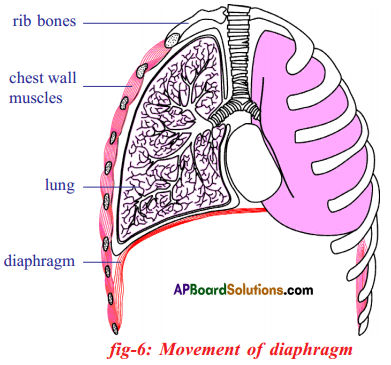
Diaphragm:

  1. Diaphragm is a muscular dome shaped tissue present at the floor of the chest cavity separating abdomen from respiratory system.
  2. Diaphragm expands downwards into the abdomen thus increasing chest cavity. This allows the lungs to expand as we inhale.
  3. As the diaphragm contracts upwards thus decreasing the chest cavity, it allows the air to expel from the lungs.
    Ribs:
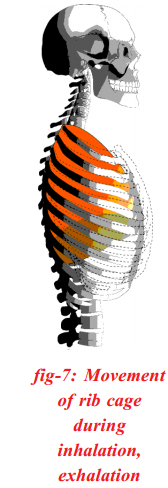
  4. The ribs protect the lungs and expand as we inhale to facilitate space for the lungs to expand. The ribs then contract expelling the air from the lungs.
  5. The intercostal muscles present between the ribs help in contraction and relaxation of ribs.
  6. In man, diaphragm plays a major role in the respiration, while in woman, the ribs play a major role.

Question 29.
Why are alveoli so small and uncountable in number? (OR)
How do alveoli increase the area for exchange of gases?
Answer:

  1. The pouch-like air sacs at the ends of the smallest branchioles are called alveoli.
  2. The walls of the alveolus are very thin and they are surrounded by very thin blood capillaries.
  3. It is in the alveoli that gaseous exchange takes place.
  4. There are millions of alveoli in the lungs. The presence of millions of alveoli in the lungs provides a very large area for the exchange of gases.
  5. And the availability of large surface area maximises the exchanges of gases.

Question 30.
Write a brief note on respiration in plants. (OR)
Does respiration occur in plants? Explain briefly about it.
Answer:

  1. In most plants exchange of gases takes place through stomata.
  2. There are other areas on the plant body like surface of roots, lenticels on stem, etc. the gaseous exchange takes place.
    AP SSC 10th Class Biology Important Questions Chapter 2 Respiration 24
  3. Some plants have specialized structures like breathing roots of mangrove plants as well as the tissue in orchids.
  4. Breathing roots and tissue in orchids help plants to take oxygen to produce energy and release carbon dioxide.
  5. Inside the plants openings lead to a series of spaces between the cells which form a continuous network all over the plant.
  6. The whole system works by diffusion.
  7. As the oxygen is used up by the cells a gradient develops between the cells and the air in the spaces.
  8. So oxygen passes in between the air spaces and the air outside stomata and lenticels.
  9. In the same way, as more carbon dioxide is given out by the cells, a gradient occurs in the reverse direction and it passes out.

AP SSC 10th Class Biology Important Questions Chapter 2 Respiration

Question 31.
Write a brief note on tracheal respiration in insects.
Answer:

  1. In insects blood do not contain haemoglobin, and blood is white in colour. Hence it cannot carry oxygen.
  2. For respiration insects adopt a special system called tracheal system.
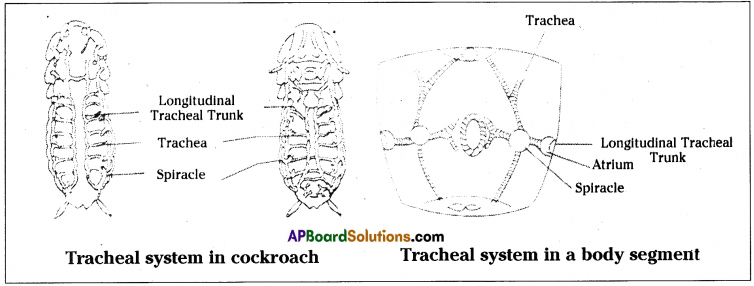
    AP SSC 10th Class Biology Important Questions Chapter 2 Respiration 25
  3. This system consists of a series of tubes called trachea.
  4. These trachea open out through small apertures called spiracles on either side of the body.
  5. All tracheal tubes of each side join and form a longitudinal tracheal trunk.
  6. Trachea divide into a number of branches called tracheoles which carry air directly to the tissues.
  7. As the air moves in and out of the trachea, oxygen present in the air diffuses into the cells and CO2 diffuses into the air from the cells.

Question 32.
Write about the mechanism of respiration in human beings. (OR)
How does exchange of gases take place in human beings?
Answer:

  1. Respiration in man occurs in two stages. They are inspiration and expiration.
  2. During inspiration air from outside enters into the lungs by increasing the chest cavity.
    AP SSC 10th Class Biology Important Questions Chapter 2 Respiration 26
  3. Increase in the chest cavity is made by pulling the diaphragm down and pushing the ribs forward.
  4. As the air pressure in the lungs is reduced, air from outside enters the lungs through external nostrils, nasal cavities, internal nares, pharynx, epiglottis, larynx, trachea, bronchi and branchioles and finally reach the alveoli where exchange of gases takes place.
  5. During expiration the diaphragm and ribs come back to original positions.
    AP SSC 10th Class Biology Important Questions Chapter 2 Respiration 27
  6. This reduces the volume of chest cavity.
  7. So the volume of lungs is decreased and air under pressure comes out of the lungs.

AP SSC 10th Class Biology Important Questions Chapter 2 Respiration

Question 33.
Study the graph given below and analyse the reasons for accumulation of lactic acid in blood after strenuous exercise.
AP SSC 10th Class Biology Important Questions Chapter 2 Respiration 28AP SSC 10th Class Biology Important Questions Chapter 2 Respiration 29
Answer:

  1. This graph shows the relation between time accumulation of lactic acid in the muscles.
  2. At the beginning, the amount of lactic acid in the blood is very less.
  3. Gradually it is increased by vigorous exercise.
  4. Within 15 minutes it goes to maximum level which causes muscle pain.
  5. Then the lactic acid is removed from muscles in an hour.
  6. Muscles produce energy by anaerobic respiration.
    C6H12O6 → lactic acid + CO2 + energy
  7. In the vigorous exercise, muscle work rapidly and produce more lactic acid.
  8. That’s why lactic acid concentration is increased in muscle after strenuous exercise.

Question 34.
Observe the above graph of lactic acid accumulation in the muscles of an athlete and answer the following questions.
a) What was the concentration of lactic acid in the blood to start with?
Answer:
It is 20 mg/km3.

b) What was the greatest concentration reached during the experiment?
Answer:
101 mg/cm3.

c) If the trend between points C and D were to continue at the same rate, how long might it take for the original lactic acid level to be reached once again?
Answer:
55 minutes.

d) What does high level of lactic acid indicate about the condition of respiration?
Answer:
It indicates the accumulation of lactic acid in muscles through anaerobic respiration. The presence of lactic acid in the blood is the main cause of muscular pain and fatigue.

AP SSC 10th Class Biology Important Questions Chapter 2 Respiration

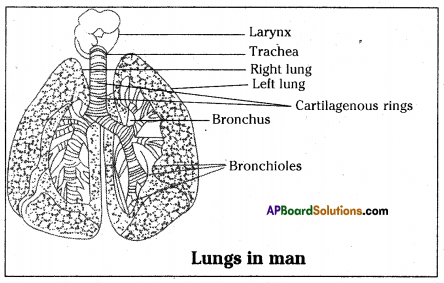
Question 35.
Describe the structure of human lungs with the help of a diagram.
AP SSC 10th Class Biology Important Questions Chapter 2 Respiration 30
Answer:

  1. A pair of lungs is present in the chest cavity one on either side of the heart.
  2. Lungs are spongy and elastic. They are enclosed by two membranes called pleura.
  3. Space between the two membranes of pleura is filled with fluid. Pleura protects the lungs from injury.
  4. Right lung is larger than the left lung.
  5. Right lung is made of three lobes while the left lung has only two lobes.
  6. Lung has several thousands of alveoli which are supplied with blood capillaries.
  7. Pulmonary artery brings deoxygenated blood from heart to lungs.
  8. After entering the lung, this artery divides into several arterioles and capillaries and supplies deoxygenated blood to alveoli.
  9. Gas exchange occurs in the alveoli.
  10. Oxygenated blood is carried from the lung to heart by the pulmonary vein.

Project work
Question 1.
Observe and analyse the questions in the table given below.

Newly borned(Children)(Children)ChildrenYouth/AdultsAthletics
(0-3 months)(3-6 months)(6-12 months)(1-10 years)
Heart beat100 -15090-12080 -12070-13060-10040-60

A) In which age group rate of heart beat is more?
B) In which age group rate of heart beat is less?
C) Why heart beat in Athletics is less?
D) What are reasons for more rate of heart beats differences between the newly born and children?
Answer:
A) In newly borned babies which are in 0 – 3 months of age group rate of heart beat is more i.e., 100 to 150 times.
B) In athletics the rate of heart beat is less i.e., 40 – 60 times / minute.
C) The heart of athlete pump more blood per beat due to increased cardio-vascular fitness in the structure of the heart. The muscles in the heart wall thicken and the heart pumps more blood with each beat.
D)

  1. Mothers who have special medical conditions such as thyroid diseases or diabetes may give birth to new borns who are temporarily tachscardic from altered hormone and glucose levels. Tachycardia is a medical term for a very rapid heart beat.
  2. Some infants are born with accessory electrical tissue in the heart causes epi¬sodes of rapid heart rate.
  3. In wolf – parkinson syndrome – white syndrome there are extra cells and an ac-cessory path way, causing additional heart beats.

AP SSC 10th Class Biology Important Questions Chapter 2 Respiration

Question 2.
Observe the table given below and analyse the questions.

Name of the animalWeight of the bodyWeight of the heartNo. of beats/min
Blue whale1,30,000 kg750 kg7
Elephant3000 kg12-21 kg46
Man60 – 70 kg300 gm76
Coaltit (Bird)8 gm0.15 gm1200

A) Why heart beat is less in animals with more weight?
B) Why heart beat is more in animals with less weight?
C) What is the relationship between weight of the body and rate of heart beat?
D) Why the weight of heart is less than body weight?
Answer:
A) The animals with more weight usually have weighted hearts. In one heart beat the large-sized hearts sends high amounts of blood to circulatory system. It takes time for the fulfilment of heart. Hence heart beat is less in animals with more body weight.
B) Usually the heart is very small in less weight animals. When the animal shrinks or contracts , its heart actually decrease the volume of blood proportionately. It can compensate for the reduced volume by increasing the rate at which it can supply blood to all body parts.
C) As the weight of the body of the animal increases the rate of heart beat per minute decreases. And also as the weight of the body decrease the rate of heart beat increases.
D) Usually the body of an organism is made by number of organs which makes the body functional. As all the body parts constitute the whole organism, the heart one of the organ is usually has less weight than body weight of an animal.
AP SSC 10th Class Biology Important Questions Chapter 2 Respiration

AP Inter 2nd Year Maths 2A Solutions Chapter 7 పాక్షిక భిన్నాలు Ex 7(b)

Practicing the Intermediate 2nd Year Maths 2A Textbook Solutions Chapter 7 పాక్షిక భిన్నాలు Exercise 7(b) will help students to clear their doubts quickly.

AP Inter 2nd Year Maths 2A Solutions Chapter 7 పాక్షిక భిన్నాలు Exercise 7(b)

అభ్యాసం – 7 (బి)

క్రింది భిన్నాలను పాక్షిక భిన్నాలుగా విడగొట్టండి.

ప్రశ్న 1.
\(\frac{2 x^2+3 x+4}{(x-1)\left(x^2+2\right)}\) [May, Mar. ’11]
సాధన:
\(\frac{2 x^2+3 x+4}{(x-1)\left(x^2+2\right)}=\frac{A}{x-1}+\frac{B x+C}{x^2+2}\) అనుకుందాం.
2x2 + 3x + 4 = A(x2 + 2) + (Bx + C) (x – 1) …….(1)
x = 1 వ్రాస్తే, 2 + 3 + 4 = A(1 + 2)
⇒ 9 = 3A
⇒ A = 3
(1) లో x2 గుణకాలను పోల్చగా
2 = A + B
⇒ B = 2 – A
⇒ B = 2 – 3
⇒ B = -1
(1) లో స్థిరపదాలను పోల్చగా
4 = 2A – C
⇒ C = 2A – 4
= 6 – 4
= 2
∴ A = 3, B = -1, C = 2
\(\frac{2 x^2+3 x+4}{(x-1)\left(x^2+2\right)}=\frac{3}{x-1}+\frac{-x+2}{x^2+2}\)

AP Inter 2nd Year Maths 2A Solutions Chapter 7 పాక్షిక భిన్నాలు Ex 7(b)

ప్రశ్న 2.
\(\frac{3 x-1}{\left(1-x+x^2\right)(x+2)}\)
సాధన:
\(\frac{3 x-1}{\left(1-x+x^2\right)(x+2)}=\frac{A}{2+x}+\frac{B x+C}{1-x+x^2}\) అనుకుందాం.
3x – 1 = A(1 – x + x2) (Bx + C) (2 + x) …….(1)
x = -2 వ్రాస్తే, -7 = A(1 + 2 + 4)
⇒ -7 = 7A
⇒ A = -1
(1) లో x2 గుణకాలను పోల్చగా
0 = A + B
⇒ B = -A = 1
స్థిరపదాలను పోల్చగా
-1 = A + 2C
⇒ 2C = -1 – A
⇒ 2C = -1 + 1
⇒ 2C = 0
⇒ C = 0
∴ A = -1, B = 1, C = 0
\(\frac{3 x-1}{\left(1-x+x^2\right)(2+x)}=-\frac{1}{2+x}+\frac{x}{1-x+x^2}\)

ప్రశ్న 3.
\(\frac{x^2-3}{(x+2)\left(x^2+1\right)}\)
సాధన:
\(\frac{x^2-3}{(x+2)\left(x^2+1\right)}=\frac{A}{x+2}+\frac{B x+C}{x^2+1}\) అనుకుందాం.
x2 – 3 = A(x2 + 1) + (Bx + C) (x + 2) …..(1)
x = -2 వ్రాస్తే, 4 – 3 = A(4 + 1)
⇒ 1 = 5A
⇒ A = \(\frac{1}{5}\)
(1) లో x2 గుణకాలను పోల్చగా
1 = A + B
⇒ B = 1 – A
⇒ B = 1 – \(\frac{1}{5}\)
⇒ B = \(\frac{4}{5}\)
(1) లో స్థిరపదాలను పోల్చగా
-3 = A + 2C
⇒ 2C = -3 – A
⇒ 2C = -3 – \(\frac{1}{5}\)
⇒ 2C = \(-\frac{16}{5}\)
⇒ C = \(-\frac{8}{5}\)
∴ A = \(\frac{1}{5}\), B = \(\frac{4}{5}\), C = \(-\frac{8}{5}\)
\(\frac{x^2-3}{(x+2)\left(x^2+1\right)}=\frac{1}{5(x+2)}+\frac{4 x-8}{5\left(x^2+1\right)}\)

AP Inter 2nd Year Maths 2A Solutions Chapter 7 పాక్షిక భిన్నాలు Ex 7(b)

ప్రశ్న 4.
\(\frac{x^2+1}{\left(x^2+x+1\right)^2}\)
సాధన:
\(\frac{x^2+1}{\left(x^2+x+1\right)^2}=\frac{A x+B}{x^2+x+1}+\frac{C x+D}{\left(x^2+x+1\right)^2}\) అనుకుందాం.
x2 + 1 = (Ax + B) (x2 + x + 1) + (Cx + D) ……(1)
(1) లో x3 గుణకాలను పోల్చగా, A = 0
(1) లో x2 గుణకాలను పోల్చగా, A + B = 1 ⇒ B = 1
(1) లో x గుణకాలను పోల్చగా, A + B + C = 0
⇒ 1 + C = 0
⇒ C = -1
(1) లో స్థిరపదాలను పోల్చగా, B + D = 1
⇒ D = 1 – B
= 1 – 1
= 0
∴ A = 0, B = 1, C = -1, D = 0
∴ Ax + B = 1, Cx + D = -x
∴ \(\frac{x^2+1}{\left(x^2+x+1\right)^2}=\frac{1}{x^2+x+1}-\frac{x}{\left(x^2+x+1\right)^2}\)

ప్రశ్న 5.
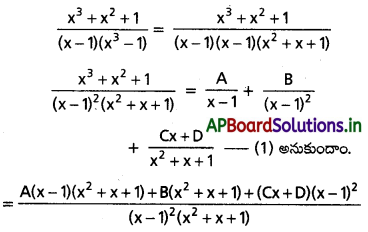
\(\frac{x^3+x^2+1}{(x-1)\left(x^3-1\right)}\)
సాధన:
AP Inter 2nd Year Maths 2A Solutions Chapter 7 పాక్షిక భిన్నాలు Ex 7(b) Q5
∴ x3 + x2 + 1 = A(x – 1) (x2 + x + 1) + B(x2 + x + 1) + (Cx + D) (x – 1)2 ……(2)
x = 1 ను (2) లో వ్రాయగా
1 + 1 + 1 = A(0) + B(1 + 1 + 1) + (C(1) + D) (0)
⇒ 3B = 3
⇒ B = 1
(2) లో x3 గుణకాలను పోల్చగా
1 = A + C ….(3)
(2) లో x2 గుణకాలను పోల్చగా
1 = A(1 – 1) + B(1) + C(-2) + D(1)
⇒ 1 = B – 2C + D
⇒ 1 = 1 – 2C + D
⇒ 2C = D ……..(4)
x = 0 ను (2) లో వ్రాయగా
1 = A(-1) (1) + B(1) + D(-1)2
⇒ A + B + D = 1
⇒ -A + 1 + D = 1
⇒ A = D ……..(5)
(3), (4), (5) ల నుండి
1 = D + \(\frac{D}{2}\)
⇒ \(\frac{3D}{2}\) = 1
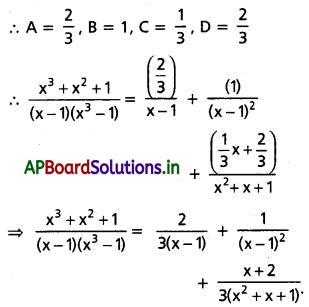
⇒ D = \(\frac{2}{3}\)
(5) నుండి A = \(\frac{2}{3}\)
(4) నుండి C = \(\frac{\mathrm{D}}{2}=\frac{\left(\frac{2}{3}\right)}{2}=\frac{1}{3}\)
AP Inter 2nd Year Maths 2A Solutions Chapter 7 పాక్షిక భిన్నాలు Ex 7(b) Q5.1

AP Inter 2nd Year Maths 2A Solutions Chapter 7 పాక్షిక భిన్నాలు Ex 7(a)

Practicing the Intermediate 2nd Year Maths 2A Textbook Solutions Chapter 7 పాక్షిక భిన్నాలు Exercise 7(a) will help students to clear their doubts quickly.

AP Inter 2nd Year Maths 2A Solutions Chapter 7 పాక్షిక భిన్నాలు Exercise 7(a)

అభ్యాసం – 7(ఎ)

I. క్రింది భిన్నాలను పాక్షిక భిన్నాలుగా విడగొట్టండి.

ప్రశ్న 1.
\(\frac{2 x+3}{(x+1)(x-3)}\)
సాధన.
\(\frac{2 x+3}{(x+1)(x-3)}=\frac{A}{x+1}+\frac{B}{x-3}\) అనుకుందాం.
∴ 2x + 3 = A(x – 3) + B(x + 1) …..(1)
(1) లో x = -1 వ్రాస్తే, 1 = A(-4) ⇒ A = \(-\frac{1}{4}\)
(1) లో x = 3 వ్రాస్తే, 9 = B(4) ⇒ B = \(\frac{9}{4}\)
\(\frac{2 x+3}{(x+1)(x-3)}=\frac{-1}{4(x+1)}+\frac{9}{4(x-3)}\)

AP Inter 2nd Year Maths 2A Solutions Chapter 7 పాక్షిక భిన్నాలు Ex 7(a)

ప్రశ్న 2.
\(\frac{5 x+6}{(2+x)(1-x)}\)
సాధన:
\(\frac{5 x+6}{(2+x)(1-x)}=\frac{A}{2+x}+\frac{B}{1-x}\) అనుకుందాం.
5x + 6 = A(1 – x) + B(2 + x) …..(1)
(1) లో x = -2 వ్రాస్తే, -10 + 6 = A(1 + 2) ⇒ A = \(-\frac{4}{3}\)
(1) లో x = 1 వ్రాస్తే, 5 + 6 = B(2 + 1) ⇒ B = \(\frac{11}{3}\)
∴ \(\frac{5 x+6}{(2+x)(1-x)}=-\frac{4}{3(2+x)}+\frac{11}{3(1-x)}\)

II.

ప్రశ్న 1.
\(\frac{3 x+7}{x^2-3 x+2}\)
సాధన:
\(\frac{3 x+7}{x^2-3 x+2}=\frac{3 x+7}{(x-1)(x-2)}=\frac{A}{x-1}+\frac{B}{x-2}\) అనుకుందాం.
3x + 7 = A(x – 2) + B(x – 1) ……(1)
(1) లో x = 1 వ్రాస్తే, 10 = -A ⇒ A = -10
(1) లో x = 2 వ్రాస్తే, 13 = B
∴ \(\frac{3 x+7}{x^2-3 x+2}=\frac{-10}{x-1}+\frac{13}{x-2}\)

AP Inter 2nd Year Maths 2A Solutions Chapter 7 పాక్షిక భిన్నాలు Ex 7(a)

ప్రశ్న 2.
\(\frac{x+4}{\left(x^2-4\right)(x+1)}\) [Mar. ’14]
సాధన:
\(\frac{x+4}{\left(x^2-4\right)(x+1)}=\frac{A}{x+1}+\frac{B}{x+2}+\frac{C}{x-2}\)
x + 4 = A(x2 – 4) + B(x + 1)(x – 2) + C(x + 1)(x + 2) …….(1)
(1) లో x = -1 వ్రాస్తే, 3 = A(1 – 4)
⇒ 3 = -3A
⇒ A = -1
(1) లో x = -2 వ్రాస్తే,
2 = B(-2 + 1) (-2 – 2)
⇒ 2 = 4B
⇒ B = \(\frac{1}{2}\)
(1) లో x = 2 వ్రాస్తే,
6 = C(2 + 1) (2 + 2)
⇒ 6 = 12C
⇒ C = \(\frac{1}{2}\)
∴ \(\frac{x+4}{\left(x^2-4\right)(x+1)}=-\frac{1}{x+1}+\frac{1}{2(x+2)}+\frac{1}{2(x-2)}\)

ప్రశ్న 3.
\(\frac{2 x^2+2 x+1}{x^3+x^2}\)
సాధన:
\(\frac{2 x^2+2 x+1}{x^3+x^2}=\frac{2 x^2+2 x+1}{x^2(x+1)}=\frac{A}{x}+\frac{B}{x^2}+\frac{C}{x+1}\)
2x2 + 2x + 1 = Ax(x + 1) + B(x + 1) + Cx2 ……(1)
(1) లో x = 0 వ్రాస్తే, 1 = B
(1) లో x = -1 వ్రాస్తే, 2 – 2 + 1 = C(1) ⇒ C = 1
ఇరువైపులా x2 గుణకాలు పోల్చగా
2 = A + C
⇒ A = 2 – C
= 2 – 1
= 1
∴ \(\frac{2 x^2+2 x+1}{x^3+x^2}=\frac{1}{x}+\frac{1}{x^2}+\frac{1}{x+1}\)

ప్రశ్న 4.
\(\frac{2 x+3}{(x-1)^3}\)
సాధన:
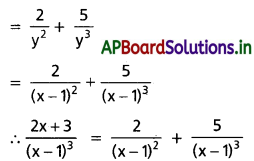
\(\frac{2 x+3}{(x-1)^3}\)
x – 1 = y అనుకుంటే x = y + 1
⇒ \(\frac{2 x+3}{(x-1)^3}=\frac{2(y+1)+3}{y^3}=\frac{2 y+5}{y^3}\)
AP Inter 2nd Year Maths 2A Solutions Chapter 7 పాక్షిక భిన్నాలు Ex 7(a) II Q4

AP Inter 2nd Year Maths 2A Solutions Chapter 7 పాక్షిక భిన్నాలు Ex 7(a)

ప్రశ్న 5.
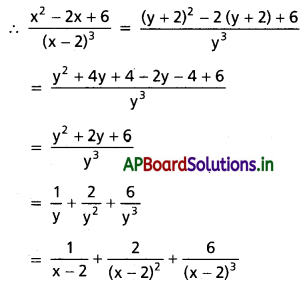
\(\frac{x^2-2 x-6}{(x-2)^3}\)
సాధన:
x – 2 = y అనుకొనుము
⇒ x = y + 2
AP Inter 2nd Year Maths 2A Solutions Chapter 7 పాక్షిక భిన్నాలు Ex 7(a) II Q5

III.

ప్రశ్న 1.
\(\frac{x^2-x+1}{(x+1)(x-1)^2}\)
సాధన:
\(\frac{x^2-x+1}{(x+1)(x-1)^2}=\frac{A}{x+1}+\frac{B}{x-1}+\frac{C}{(x-1)^2}\) అనుకుందాం.
x2 – x + 1 = A(x – 1)2 + B(x + 1)(x – 1) + C(x + 1) …….(1)
x = -1 వ్రాస్తే, 1 + 1 + 1 = A(4) ⇒ A = \(\frac{3}{4}\)
x = 1 వ్రాస్తే, 1 – 1 + 1 = C(2) ⇒ C = +\(\frac{1}{2}\)
1 లో x2 గుణకాలను పోల్చగా
A + B = 1
⇒ B = 1 – A
⇒ B = 1 – \(\frac{3}{4}\)
⇒ B = \(\frac{1}{4}\)
∴ \(\frac{x^2-x+1}{(x+1)(x-1)^2}=\frac{3}{4(x+1)}+\frac{1}{4(x-1)}+\frac{1}{2(x-1)^2}\)

ప్రశ్న 2.
\(\frac{9}{(x-1)(x+2)^2}\)
సాధన:
\(\frac{9}{(x-1)(x+2)^2}=\frac{A}{x-1}+\frac{B}{x+2}+\frac{C}{(x+2)^2}\) అనుకొందాం.
9 = A(x + 2)2 + B(x – 1) (x + 2) + C(x – 1) ……(1)
x = 1 వ్రాస్తే, 9 = 9A ⇒ A = 1
x = -2 వ్రాస్తే, 9 = -3C ⇒ C = -3
(1) లో x2 గుణకాలను పోల్చగా
A + B = 0
⇒ B = -A = -1
∴ \(\frac{9}{(x-1)(x+2)^2}=\frac{1}{x-1}-\frac{1}{x+2}-\frac{3}{(x+2)^2}\)

AP Inter 2nd Year Maths 2A Solutions Chapter 7 పాక్షిక భిన్నాలు Ex 7(a)

ప్రశ్న 3.
\(\frac{1}{(1-2 x)^2(1-3 x)}\)
సాధన:
\(\frac{1}{(1-2 x)^2(1-3 x)}=\frac{A}{1-3 x}+\frac{B}{1-2 x}+\frac{C}{(1-2 x)^2}\) అనుకుందాం.
1 = A(1 – 2x)2 + B(1 – 3x) (1 – 2x) + C(1 – 3x) ……..(1)
x = \(\frac{1}{3}\) వ్రాస్తే, 1 = A\(\left(1-\frac{2}{3}\right)^2\)
⇒ 1 = \(\frac{A}{9}\)
⇒ A = 9
x = \(\frac{1}{2}\) వ్రాస్తే, 1 = C(1 – \(\frac{3}{2}\))
⇒ 1 = \(-\frac{C}{2}\)
⇒ C = -2
(1) లో x2 గుణకాలను పోల్చగా
0 = 4A + 6B
6B = -4A – 36
B = -6
∴ \(\frac{1}{(1-2 x)^2(1-3 x)}=\frac{9}{1-3 x}-\frac{6}{1-2 x}-\frac{2}{(1-2 x)^2}\)

ప్రశ్న 4.
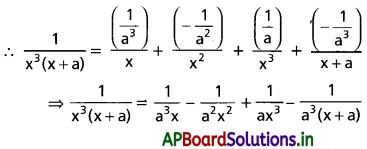
\(\frac{1}{x^3(x+a)}\)
సాధన:
\(\frac{1}{x^3(x+a)}=\frac{A}{x}+\frac{B}{x^2}+\frac{C}{x^3}+\frac{D}{x+a}\) అనుకుందాం.
= \(\frac{A \cdot x^2(x+a)+B(x)(x+a)+C(x+a)+D x^3}{x^3(x+a)}\)
∴ 1 = A(x2) (x + a) + Bx(x + a) + C(x + a) + Dx3 ……..(1)
x = 0 ను (1) లో వ్రాస్తే, 1 = A(0) + B(0) + C(0 + a) + D(0)
⇒ 1 = C (a)
⇒ C = \(\frac{1}{a}\)
x = -a ను (1) లో వ్రాస్తే, 1 = A(0) + B(0) + C(0) + D(-a)3
⇒ 1 = D(-a3)
⇒ D = \(-\frac{1}{a^3}\)
(1) లో x3 గుణకాలను పోల్చగా
0 = A + D
⇒ A = -D
⇒ A = \(\frac{1}{a^3}\)
(1) లో x2 గుణకాలను పోల్చగా
0 = Aa + B
⇒ B = -aA
⇒ B = \(-a\left(\frac{1}{a^3}\right)\)
⇒ B = \(-\frac{1}{a^2}\)
AP Inter 2nd Year Maths 2A Solutions Chapter 7 పాక్షిక భిన్నాలు Ex 7(a) III Q4

ప్రశ్న 5.
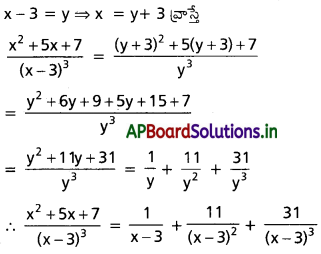
\(\frac{x^2+5 x+7}{(x-3)^3}\)
సాధన:
AP Inter 2nd Year Maths 2A Solutions Chapter 7 పాక్షిక భిన్నాలు Ex 7(a) III Q5

AP Inter 2nd Year Maths 2A Solutions Chapter 7 పాక్షిక భిన్నాలు Ex 7(a)

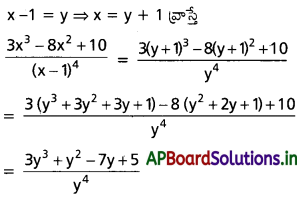
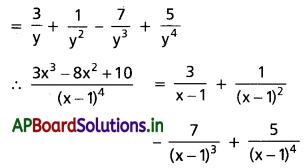
ప్రశ్న 6.
\(\frac{3 x^3-8 x^2+10}{(x-1)^4}\)
సాధన:
AP Inter 2nd Year Maths 2A Solutions Chapter 7 పాక్షిక భిన్నాలు Ex 7(a) III Q6
AP Inter 2nd Year Maths 2A Solutions Chapter 7 పాక్షిక భిన్నాలు Ex 7(a) III Q6.1

AP Inter 2nd Year Maths 2A Solutions Chapter 6 ద్విపద సిద్ధాంతం Ex 6(c)

Practicing the Intermediate 2nd Year Maths 2A Textbook Solutions Chapter 6 ద్విపద సిద్ధాంతం Exercise 6(c) will help students to clear their doubts quickly.

AP Inter 2nd Year Maths 2A Solutions Chapter 6 ద్విపద సిద్ధాంతం Exercise 6(c)

అభ్యాసం – 6(సి)

ప్రశ్న 1.
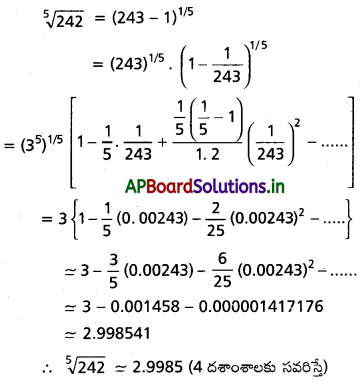
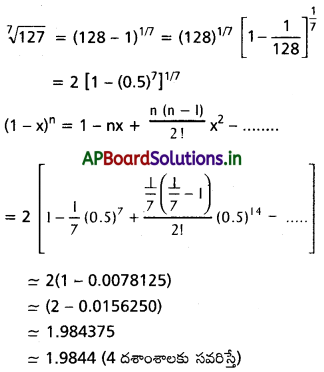
క్రింది సమాసాల విలువలను 4 దశాంశాలకు సవరించి కనుక్కోండి.
(i) \(\sqrt[5]{242}\)
సాధన:
AP Inter 2nd Year Maths 2A Solutions Chapter 6 ద్విపద సిద్ధాంతం Ex 6(c) Q1(i)

(ii) \(\sqrt[7]{127}\)
సాధన:
AP Inter 2nd Year Maths 2A Solutions Chapter 6 ద్విపద సిద్ధాంతం Ex 6(c) Q1(ii)

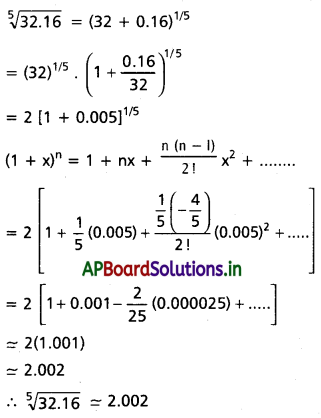
(iii) \(\sqrt[5]{32.16}\)
సాధన:
AP Inter 2nd Year Maths 2A Solutions Chapter 6 ద్విపద సిద్ధాంతం Ex 6(c) Q1(iii)

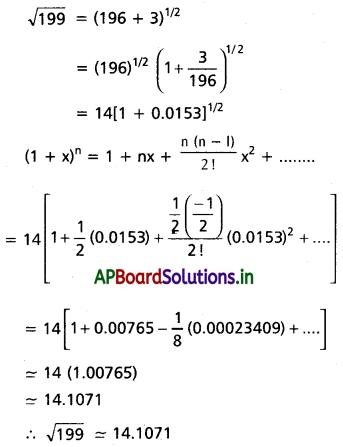
(iv) √199
సాధన:
AP Inter 2nd Year Maths 2A Solutions Chapter 6 ద్విపద సిద్ధాంతం Ex 6(c) Q1(iv)

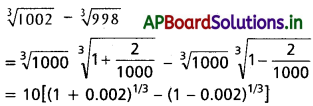
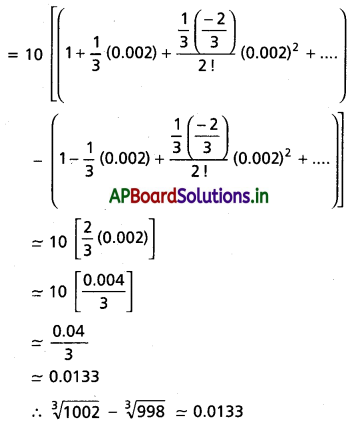
(v) \(\sqrt[3]{1002}-\sqrt[3]{998}\)
సాధన:
AP Inter 2nd Year Maths 2A Solutions Chapter 6 ద్విపద సిద్ధాంతం Ex 6(c) Q1(v)
AP Inter 2nd Year Maths 2A Solutions Chapter 6 ద్విపద సిద్ధాంతం Ex 6(c) Q1(v).1

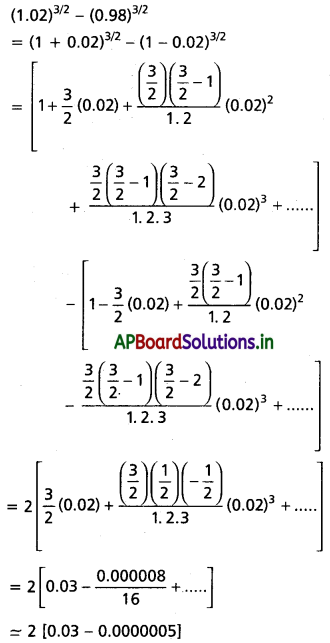
(vi) \((1.02)^{3 / 2}-(0.98)^{3 / 2}\)
సాధన:
AP Inter 2nd Year Maths 2A Solutions Chapter 6 ద్విపద సిద్ధాంతం Ex 6(c) Q1(vi)
= 2[0.0299995]
= 0.0599990
≈ 0.059999
∴ \((1.02)^{3 / 2}-(0.98)^{3 / 2}\) = 0.059999

AP Inter 2nd Year Maths 2A Solutions Chapter 6 ద్విపద సిద్ధాంతం Ex 6(c)

ప్రశ్న 2.
x2 ఆపై x ఘాతాలు ఉపేక్షించేంతగా |x| స్వల్పమైతే క్రింది సమాసాల ఉజ్జాయింపు విలువలను కనుక్కోండి.
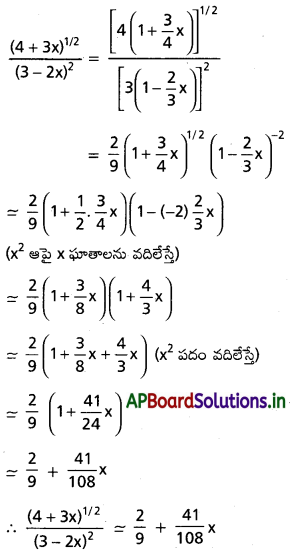
(i) \(\frac{(4+3 x)^{1 / 2}}{(3-2 x)^2}\)
సాధన:
AP Inter 2nd Year Maths 2A Solutions Chapter 6 ద్విపద సిద్ధాంతం Ex 6(c) Q2(i)

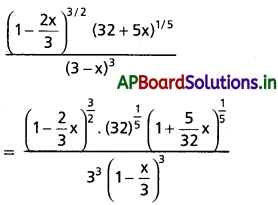
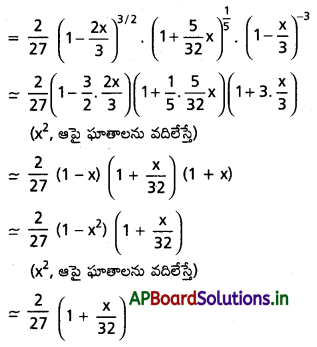
(ii) \(\frac{\left(1-\frac{2 x}{3}\right)^{3 / 2}(32+5 x)^{1 / 5}}{(3-x)^3}\)
సాధన:
AP Inter 2nd Year Maths 2A Solutions Chapter 6 ద్విపద సిద్ధాంతం Ex 6(c) Q2(ii)
AP Inter 2nd Year Maths 2A Solutions Chapter 6 ద్విపద సిద్ధాంతం Ex 6(c) Q2(ii).1

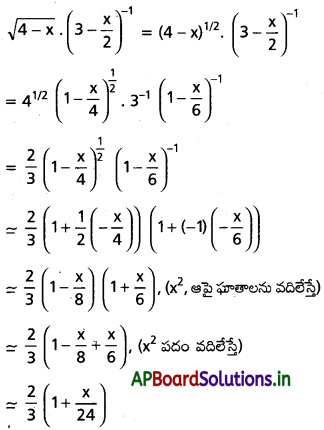
(iii) \(\sqrt{4-x}\left(3-\frac{x}{2}\right)^{-1}\)
సాధన:
AP Inter 2nd Year Maths 2A Solutions Chapter 6 ద్విపద సిద్ధాంతం Ex 6(c) Q2(iii)

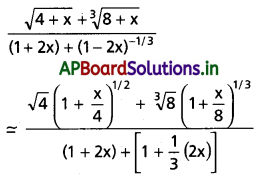
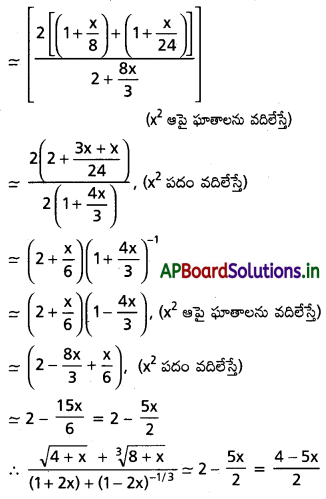
(iv) \(\frac{\sqrt{4+x}+\sqrt[3]{8+x}}{(1+2 x)+(1-2 x)^{-1 / 3}}\)
సాధన:
AP Inter 2nd Year Maths 2A Solutions Chapter 6 ద్విపద సిద్ధాంతం Ex 6(c) Q2(iv)
AP Inter 2nd Year Maths 2A Solutions Chapter 6 ద్విపద సిద్ధాంతం Ex 6(c) Q2(iv).1

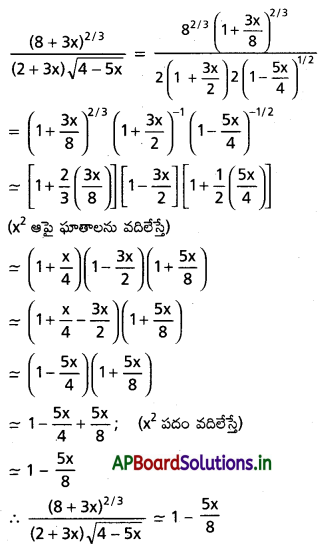
(v) \(\frac{(8+3 x)^{2 / 3}}{(2+3 x) \sqrt{4-5 x}}\)
సాధన:
AP Inter 2nd Year Maths 2A Solutions Chapter 6 ద్విపద సిద్ధాంతం Ex 6(c) Q2(v)

AP Inter 2nd Year Maths 2A Solutions Chapter 6 ద్విపద సిద్ధాంతం Ex 6(c)

ప్రశ్న 3.
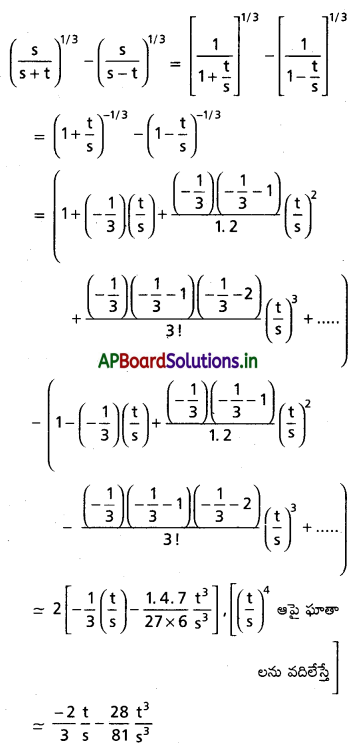
s, t లు ధన వాస్తవసంఖ్యలు, s తో పోల్చినపుడు t విలువ చాలా తక్కువ అయితే \(\left(\frac{s}{s+t}\right)^{1 / 3}-\left(\frac{s}{s-t}\right)^{1 / 3}\) యొక్క ఉజ్జాయింపు విలువ కనుక్కోండి.
సాధన:
s తో పోల్చినపుడు విలువ చాలా తక్కువ కనుక \(\frac{t}{s}\) అత్యల్పం
∴ |\(\frac{t}{s}\)| < 1
AP Inter 2nd Year Maths 2A Solutions Chapter 6 ద్విపద సిద్ధాంతం Ex 6(c) Q3

ప్రశ్న 4.
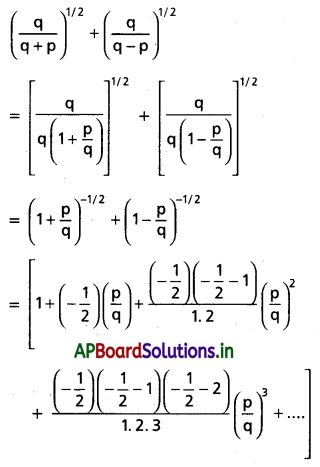
p, q లు ధన వాస్తవ సంఖ్యలు, q తో సరి పోలిస్తే p విలువ చాలా తక్కువ అయితే \(\left(\frac{q}{q+p}\right)^{1 / 2}+\left(\frac{q}{q-p}\right)^{1 / 2}\) యొక్క ఉజ్జాయింపు విలువ కనుక్కోండి.
సాధన:
q తో సరిపోలిస్తే p విలువ చాలా తక్కువ కనుక \(\frac{p}{q}\) అత్యల్పం
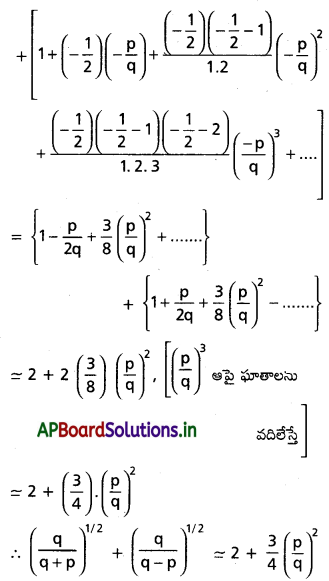
AP Inter 2nd Year Maths 2A Solutions Chapter 6 ద్విపద సిద్ధాంతం Ex 6(c) Q4
AP Inter 2nd Year Maths 2A Solutions Chapter 6 ద్విపద సిద్ధాంతం Ex 6(c) Q4.1

ప్రశ్న 5.
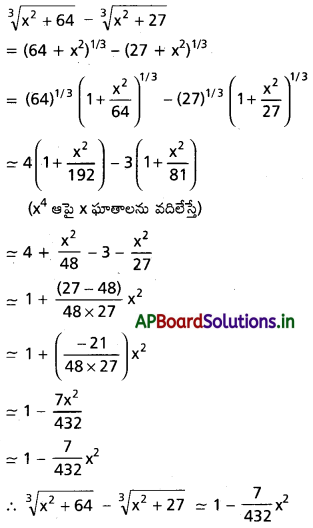
x4, ఆపై x ఘాతాలు ఉపేక్షిస్తే \(\sqrt[3]{x^2+64}-\sqrt[3]{x^2+27}\) యొక్క ఉజ్జాయింపు విలువ కనుక్కోండి.
సాధన:
AP Inter 2nd Year Maths 2A Solutions Chapter 6 ద్విపద సిద్ధాంతం Ex 6(c) Q5

AP Inter 2nd Year Maths 2A Solutions Chapter 6 ద్విపద సిద్ధాంతం Ex 6(c)

ప్రశ్న 6.
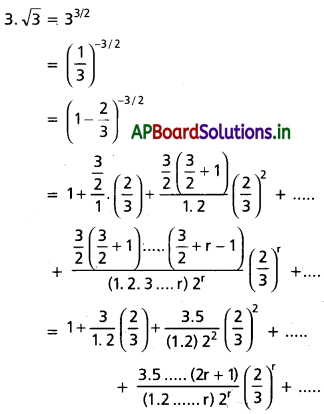
3√3 విలువను \(\frac{2}{3}\) యొక్క ఆరోహణ ఘాతాలలో వ్రాయండి.
సాధన:
AP Inter 2nd Year Maths 2A Solutions Chapter 6 ద్విపద సిద్ధాంతం Ex 6(c) Q6

AP Inter 2nd Year Maths 2A Solutions Chapter 6 ద్విపద సిద్ధాంతం Ex 6(b)

Practicing the Intermediate 2nd Year Maths 2A Textbook Solutions Chapter 6 ద్విపద సిద్ధాంతం Exercise 6(b) will help students to clear their doubts quickly.

AP Inter 2nd Year Maths 2A Solutions Chapter 6 ద్విపద సిద్ధాంతం Exercise 6(b)

అభ్యాసం – 6(బి)

I.

ప్రశ్న 1.
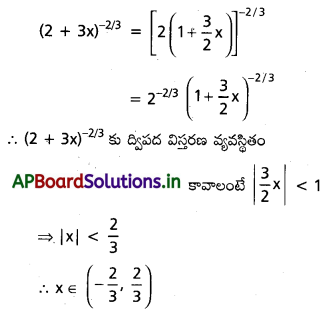
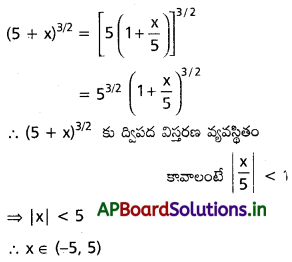
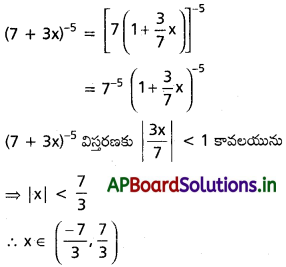
క్రింది సమాసాలకు ద్విపద విస్తరణ వ్యవస్థితంచే x ల సమితులు కనుక్కోండి. [T.S. Mar. ’16, Mar. ’11]
(i) \((2+3 x)^{-2 / 3}\)
సాధన:
AP Inter 2nd Year Maths 2A Solutions Chapter 6 ద్విపద సిద్ధాంతం Ex 6(b) I Q1(i)

(ii) \((5+x)^{3 / 2}\)
సాధన:
AP Inter 2nd Year Maths 2A Solutions Chapter 6 ద్విపద సిద్ధాంతం Ex 6(b) I Q1(ii)

(iii) (7 + 3x)-5
సాధన:
AP Inter 2nd Year Maths 2A Solutions Chapter 6 ద్విపద సిద్ధాంతం Ex 6(b) I Q1(iii)

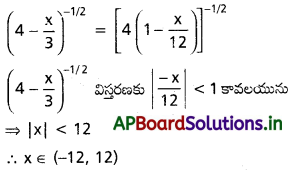
(iv) \(\left(4-\frac{x}{3}\right)^{-1 / 2}\)
సాధన:
AP Inter 2nd Year Maths 2A Solutions Chapter 6 ద్విపద సిద్ధాంతం Ex 6(b) I Q1(iv)

AP Inter 2nd Year Maths 2A Solutions Chapter 6 ద్విపద సిద్ధాంతం Ex 6(b)

ప్రశ్న 2.
క్రింది విస్తరణలో సూచించిన పదాలు కనుక్కోండి.
(i) \(\left(1+\frac{x}{2}\right)^{-5}\) లో 6వ పదం
సాధన:
AP Inter 2nd Year Maths 2A Solutions Chapter 6 ద్విపద సిద్ధాంతం Ex 6(b) I Q2(i)

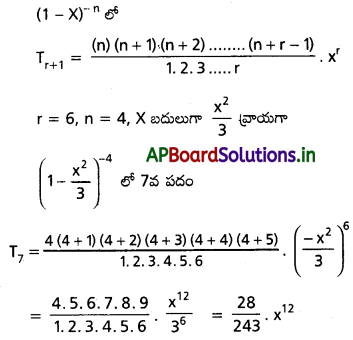
(ii) \(\left(1-\frac{x^2}{3}\right)^{-4}\) విస్తరణలో 7వ పదం
సాధన:
AP Inter 2nd Year Maths 2A Solutions Chapter 6 ద్విపద సిద్ధాంతం Ex 6(b) I Q2(ii)

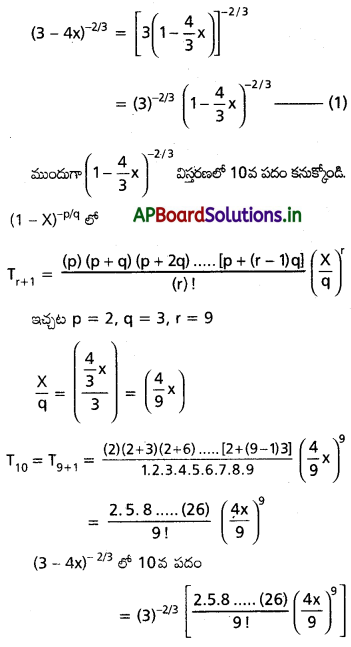
(iii) \((3-4 x)^{-2 / 3}\) విస్తరణలో 10వ పదం
సాధన:
AP Inter 2nd Year Maths 2A Solutions Chapter 6 ద్విపద సిద్ధాంతం Ex 6(b) I Q2(iii)

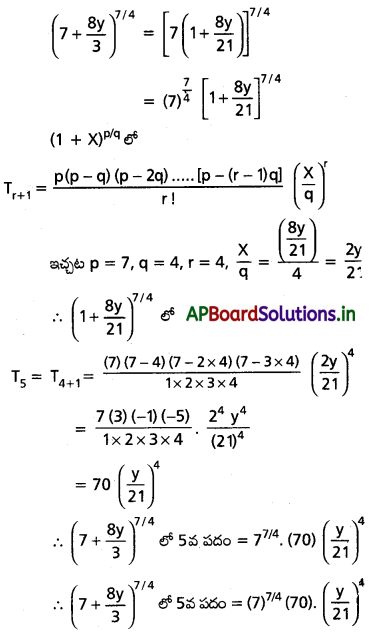
(iv) \(\left(7+\frac{8 y}{3}\right)^{7 / 4}\) విస్తరణలో 5వ పదం
సాధన:
AP Inter 2nd Year Maths 2A Solutions Chapter 6 ద్విపద సిద్ధాంతం Ex 6(b) I Q2(iv)

ప్రశ్న 3.
క్రింది విస్తరణలలో మొదటి 3 పదాలు వ్రాయండి.
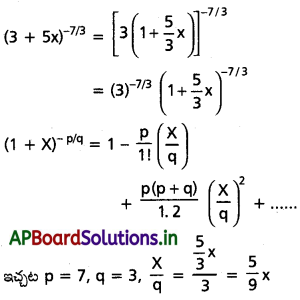
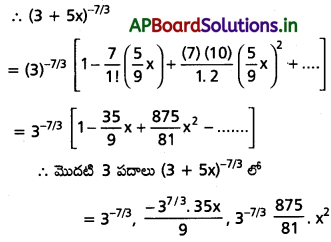
(i) \((3+5 x)^{-7 / 3}\)
సాధన:
AP Inter 2nd Year Maths 2A Solutions Chapter 6 ద్విపద సిద్ధాంతం Ex 6(b) I Q3(i)
AP Inter 2nd Year Maths 2A Solutions Chapter 6 ద్విపద సిద్ధాంతం Ex 6(b) I Q3(i).1

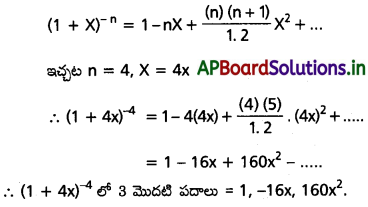
(ii) (1 + 4x)-4
సాధన:
AP Inter 2nd Year Maths 2A Solutions Chapter 6 ద్విపద సిద్ధాంతం Ex 6(b) I Q3(ii)

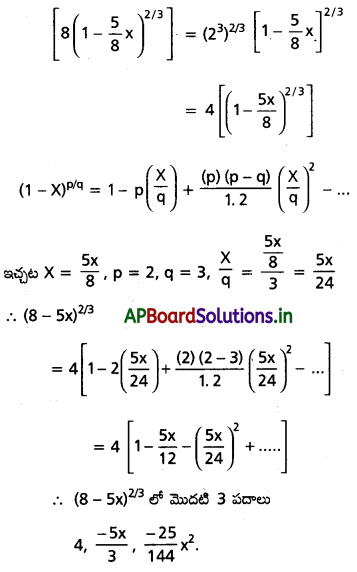
(iii) \((8-5 x)^{2 / 3}\)
సాధన:
AP Inter 2nd Year Maths 2A Solutions Chapter 6 ద్విపద సిద్ధాంతం Ex 6(b) I Q3(iii)

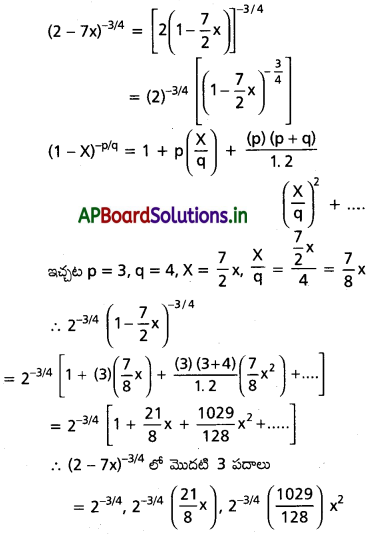
(iv) \((2-7 x)^{-3 / 4}\)
సాధన:
AP Inter 2nd Year Maths 2A Solutions Chapter 6 ద్విపద సిద్ధాంతం Ex 6(b) I Q3(iv)

AP Inter 2nd Year Maths 2A Solutions Chapter 6 ద్విపద సిద్ధాంతం Ex 6(b)

ప్రశ్న 4.
క్రింది విస్తరణలో సాధారణ పదం ((r + 1)వ పదం) కనుక్కోండి.
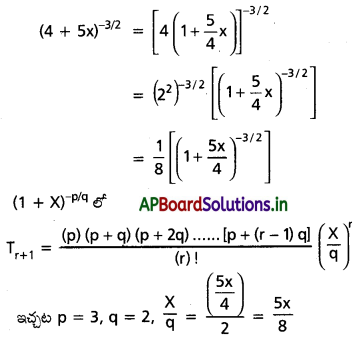
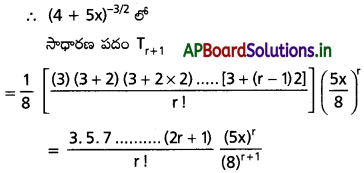
(i) \((4+5 x)^{-3 / 2}\)
సాధన:
AP Inter 2nd Year Maths 2A Solutions Chapter 6 ద్విపద సిద్ధాంతం Ex 6(b) I Q4(i)
AP Inter 2nd Year Maths 2A Solutions Chapter 6 ద్విపద సిద్ధాంతం Ex 6(b) I Q4(i).1

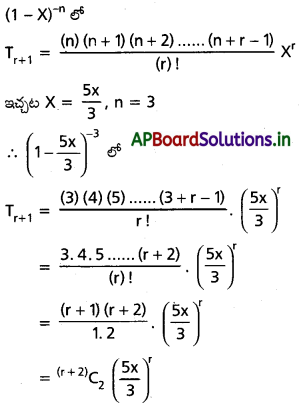
(ii) \(\left(1-\frac{5 x}{3}\right)^{-3}\)
సాధన:
AP Inter 2nd Year Maths 2A Solutions Chapter 6 ద్విపద సిద్ధాంతం Ex 6(b) I Q4(ii)

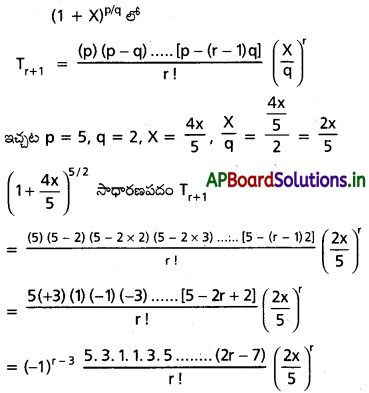
(iii) \(\left(1+\frac{4 x}{5}\right)^{5 / 2}\)
సాధన:
AP Inter 2nd Year Maths 2A Solutions Chapter 6 ద్విపద సిద్ధాంతం Ex 6(b) I Q4(iii)

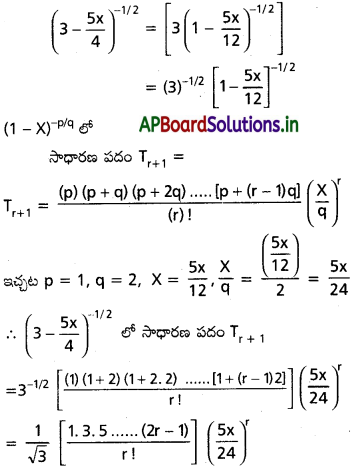
(iv) \(\left(3-\frac{5 x}{4}\right)^{-1 / 2}\)
సాధన:
AP Inter 2nd Year Maths 2A Solutions Chapter 6 ద్విపద సిద్ధాంతం Ex 6(b) I Q4(iv)

II.

ప్రశ్న 1.
\(\frac{1+2 x}{(1-2 x)^2}\) విస్తరణలో x10 గుణకం కనుక్కోండి.
సాధన:
\(\frac{1+2 x}{(1-2 x)^2}\) = (1 + 2x) (1 – 2x)-2
= (1 + 2x) [1 + 2(2x) + 3(2x)2 + 4(2x)3 + 5(2x)4 + 6(2x)5 + 7(2x)6 + 8(2x)7 + 9(2x)8 + 10(2x)9 + 11(2x)10 + …….. + (r + 1) . (2x)r +……]
∴ \(\frac{1+2 x}{(1-2 x)^2}\) లో x10 గుణకం = (11) (2)10 + 10 (2) (29)
= 210 (11 + 10)
= 21 × 210

AP Inter 2nd Year Maths 2A Solutions Chapter 6 ద్విపద సిద్ధాంతం Ex 6(b)

ప్రశ్న 2.
\((1-4 x)^{-3 / 5}\) విస్తరణలో x4 గుణకం కనుక్కోండి.
సాధన:
AP Inter 2nd Year Maths 2A Solutions Chapter 6 ద్విపద సిద్ధాంతం Ex 6(b) II Q2
AP Inter 2nd Year Maths 2A Solutions Chapter 6 ద్విపద సిద్ధాంతం Ex 6(b) II Q2.1

ప్రశ్న 3.
(i) \(\frac{(1-3 x)^2}{(3-x)^{3 / 2}}\) విస్తరణలో x5 గుణకాన్ని కనుక్కోండి.
సాధన:
AP Inter 2nd Year Maths 2A Solutions Chapter 6 ద్విపద సిద్ధాంతం Ex 6(b) II Q3(i)
AP Inter 2nd Year Maths 2A Solutions Chapter 6 ద్విపద సిద్ధాంతం Ex 6(b) II Q3(i).1

(ii) \(\frac{(1+x)^2}{\left(1-\frac{2}{3} x\right)^3}\) విస్తరణలో x8 గుణకాన్ని కనుక్కోండి.
సాధన:
AP Inter 2nd Year Maths 2A Solutions Chapter 6 ద్విపద సిద్ధాంతం Ex 6(b) II Q3(ii)

(iii) \(\frac{(2+3 x)^3}{(1-3 x)^4}\) విస్తరణలో x7 గుణకాన్ని కనుక్కోండి.
సాధన:
AP Inter 2nd Year Maths 2A Solutions Chapter 6 ద్విపద సిద్ధాంతం Ex 6(b) II Q3(iii)
AP Inter 2nd Year Maths 2A Solutions Chapter 6 ద్విపద సిద్ధాంతం Ex 6(b) II Q3(iii).1

AP Inter 2nd Year Maths 2A Solutions Chapter 6 ద్విపద సిద్ధాంతం Ex 6(b)

ప్రశ్న 4.
\(\frac{\left(1+3 x^2\right)^{3 / 2}}{(3+4 x)^{1 / 3}}\) విస్తరణలో x3 గుణకాన్ని కనుక్కోండి.
సాధన:
AP Inter 2nd Year Maths 2A Solutions Chapter 6 ద్విపద సిద్ధాంతం Ex 6(b) II Q4

III.

ప్రశ్న 1.
క్రింది అనంతశ్రేణుల మొత్తాలు కనుక్కోండి.
(i) \(1+\frac{1}{3}+\frac{1.3}{3.6}+\frac{1.3 .5}{3.6 .9}+\ldots \ldots \ldots\)
సాధన:
దత్తశ్రేణి S = \(1+\frac{1}{1} \cdot \frac{1}{3}+\frac{1.3}{1.2}\left(\frac{1}{3}\right)^2+\frac{1.3 \cdot 5}{1.2 .3}\left(\frac{1}{3}\right)^3\) + ……..
AP Inter 2nd Year Maths 2A Solutions Chapter 6 ద్విపద సిద్ధాంతం Ex 6(b) III Q1(i)

(ii) \(1-\frac{4}{5}+\frac{4.7}{5.10}-\frac{4.7 .10}{5.10 .15}+\ldots \ldots\)
సాధన:
AP Inter 2nd Year Maths 2A Solutions Chapter 6 ద్విపద సిద్ధాంతం Ex 6(b) III Q1(ii)

(iii) \(\frac{3}{4}+\frac{3.5}{4.8}+\frac{3.5 .7}{4.8 .12}+\ldots\) (Mar. ’11)
సాధన:
AP Inter 2nd Year Maths 2A Solutions Chapter 6 ద్విపద సిద్ధాంతం Ex 6(b) III Q1(iii)
AP Inter 2nd Year Maths 2A Solutions Chapter 6 ద్విపద సిద్ధాంతం Ex 6(b) III Q1(iii).1

(iv) \(\frac{3}{4.8}-\frac{3.5}{4.8 .12}+\frac{3.5 .7}{4.8 .12 .16}-\ldots \ldots\) [T.S. Mar. ’16]
సాధన:
AP Inter 2nd Year Maths 2A Solutions Chapter 6 ద్విపద సిద్ధాంతం Ex 6(b) III Q1(iv)

AP Inter 2nd Year Maths 2A Solutions Chapter 6 ద్విపద సిద్ధాంతం Ex 6(b)

ప్రశ్న 2.
t = \(\frac{4}{5}+\frac{4.6}{5.10}+\frac{4.6 .8}{5.10 .15}+\) …….∞ అయితే, 9t = 16 అని చూపండి.
సాధన:
AP Inter 2nd Year Maths 2A Solutions Chapter 6 ద్విపద సిద్ధాంతం Ex 6(b) III Q2

ప్రశ్న 3.
x = \(\frac{1.3}{3.6}+\frac{1.3 .5}{3.6 .9}+\frac{1.3 .5 .7}{3.6 .9 .12}+\ldots \ldots\) అయితే 9x2 + 24x = 11 అని చూపండి. [T.S. Mar. ’16]
సాధన:
AP Inter 2nd Year Maths 2A Solutions Chapter 6 ద్విపద సిద్ధాంతం Ex 6(b) III Q3
AP Inter 2nd Year Maths 2A Solutions Chapter 6 ద్విపద సిద్ధాంతం Ex 6(b) III Q3.1
3x = 3√3 – 4
⇒ 3x + 4 = 3√3
ఇరువైపుల వర్గం చేయగా
(3x + 4)2 = (3√3)2
⇒ 9x2 + 24x + 16 = 27
⇒ 9x2 + 24x = 11

ప్రశ్న 4.
x = \(\frac{5}{(2 !) \cdot 3}+\frac{5.7}{(3 !) \cdot 3^2}+\frac{5 \cdot 7 \cdot 9}{(4 !) \cdot 3^3}+\ldots\) అయితే x2 + 4x విలువ కనుక్కోండి.
సాధన:
AP Inter 2nd Year Maths 2A Solutions Chapter 6 ద్విపద సిద్ధాంతం Ex 6(b) III Q4
AP Inter 2nd Year Maths 2A Solutions Chapter 6 ద్విపద సిద్ధాంతం Ex 6(b) III Q4.1

ప్రశ్న 5.
క్రింది అనంత శ్రేణి మొత్తం కనుక్కోండి. [A.P. Mar. ’16, Mar. ’05]
\(\frac{7}{5}\left(1+\frac{1}{10^2}+\frac{1.3}{1.2} \cdot \frac{1}{10^4}+\frac{1.3 .5}{1.2 .3} \cdot \frac{1}{10^6}+\ldots\right)\)
సాధన:
AP Inter 2nd Year Maths 2A Solutions Chapter 6 ద్విపద సిద్ధాంతం Ex 6(b) III Q5

AP Inter 2nd Year Maths 2A Solutions Chapter 6 ద్విపద సిద్ధాంతం Ex 6(b)

ప్రశ్న 6.
x ఒక శూన్యేతర అకరణీయ సంఖ్య అయితే \(1+\frac{x}{2}+\frac{x(x-1)}{2.4}+\frac{x(x-1)(x-2)}{2.4 .6}+\ldots \ldots\) \(=1+\frac{x}{3}+\frac{x(x+1)}{3.6}+\frac{x(x+1)(x+2)}{3.6 .9}+\ldots\) అని నిరూపించండి.
సాధన:
AP Inter 2nd Year Maths 2A Solutions Chapter 6 ద్విపద సిద్ధాంతం Ex 6(b) III Q6
AP Inter 2nd Year Maths 2A Solutions Chapter 6 ద్విపద సిద్ధాంతం Ex 6(b) III Q6.1

AP Inter 2nd Year Maths 2A Solutions Chapter 6 ద్విపద సిద్ధాంతం Ex 6(a)

Practicing the Intermediate 2nd Year Maths 2A Textbook Solutions Chapter 6 ద్విపద సిద్ధాంతం Exercise 6(a) will help students to clear their doubts quickly.

AP Inter 2nd Year Maths 2A Solutions Chapter 6 ద్విపద సిద్ధాంతం Exercise 6(a)

అభ్యాసం – 6(ఎ)

I.

ప్రశ్న 1.
ద్విపద సిద్ధాంతాన్ని ఉపయోగించి క్రింది సమాసాలను విస్తరించి వ్రాయండి.
(i) (4x + 5y)7
సాధన:
AP Inter 2nd Year Maths 2A Solutions Chapter 6 ద్విపద సిద్ధాంతం Ex 6(a) I Q1(i)

(ii) \(\left(\frac{2}{3} x+\frac{7}{4} y\right)^5\)
సాధన:
AP Inter 2nd Year Maths 2A Solutions Chapter 6 ద్విపద సిద్ధాంతం Ex 6(a) I Q1(ii)

(iii) \(\left(\frac{2 p}{5}-\frac{3 q}{7}\right)^6\)
సాధన:
AP Inter 2nd Year Maths 2A Solutions Chapter 6 ద్విపద సిద్ధాంతం Ex 6(a) I Q1(iii)
AP Inter 2nd Year Maths 2A Solutions Chapter 6 ద్విపద సిద్ధాంతం Ex 6(a) I Q1(iii).1

(iv) (3 + x – x2)4
సాధన:
AP Inter 2nd Year Maths 2A Solutions Chapter 6 ద్విపద సిద్ధాంతం Ex 6(a) I Q1(iv)

AP Inter 2nd Year Maths 2A Solutions Chapter 6 ద్విపద సిద్ధాంతం Ex 6(a)

ప్రశ్న 2.
క్రింది పదాలు వ్రాసి సూక్ష్మీకరించండి.
(i) \(\left(\frac{2 x}{3}+\frac{3 y}{2}\right)^9\) లో 6వ పదం [May ’13]
సాధన:
AP Inter 2nd Year Maths 2A Solutions Chapter 6 ద్విపద సిద్ధాంతం Ex 6(a) I Q2(i)

(ii) (3x – 4y)10 లో 7వ పదం
సాధన:
AP Inter 2nd Year Maths 2A Solutions Chapter 6 ద్విపద సిద్ధాంతం Ex 6(a) I Q2(ii)

(iii) \(\left(\frac{3 p}{4}-5 q\right)^{14}\) లో 10వ పదం
సాధన:
AP Inter 2nd Year Maths 2A Solutions Chapter 6 ద్విపద సిద్ధాంతం Ex 6(a) I Q2(iii)
AP Inter 2nd Year Maths 2A Solutions Chapter 6 ద్విపద సిద్ధాంతం Ex 6(a) I Q2(iii).1

(iv) \(\left(\frac{3 a}{5}+\frac{5 b}{7}\right)^8\) లో rవ పదం (1 ≤ r ≤ 9)
సాధన:
AP Inter 2nd Year Maths 2A Solutions Chapter 6 ద్విపద సిద్ధాంతం Ex 6(a) I Q2(iv)

ప్రశ్న 3.
క్రింది సమాసాల ద్విపద విస్తరణలలో పదాల సంఖ్యను కనుక్కోండి.
(i) \(\left(\frac{3 a}{4}+\frac{b}{2}\right)^9\)
సాధన:
(x + a)n విస్తరణలో n పదాల సంఖ్య = (n + 1)
∴ \(\left(\frac{3 a}{4}+\frac{b}{2}\right)^9\) ద్విపద విస్తరణలో పదాల సంఖ్య = 9 + 1 = 10

(ii) (3p + 4q)14
సాధన:
(3p + 4q)14 ద్విపద విస్తరణలో పదాల సంఖ్య = 14 + 1 = 15

(iii) (2x + 3y + z)7 [Mar. ’07; Mar. ’14, ’13]
సాధన:
(a + b + c)n విస్తరణలో పదాల సంఖ్య = \(\frac{(n+1)(n+2)}{2}\)
n ధన పూర్ణాంకం కనుక
(2x + 3y + z)7 లో పదాల సంఖ్య = \(\frac{(7+1)(7+2)}{2}\)
= \(\frac{8 \times 9}{2}\)
= 36

AP Inter 2nd Year Maths 2A Solutions Chapter 6 ద్విపద సిద్ధాంతం Ex 6(a)

ప్రశ్న 4.
(4x – 7y)49 + (4x + 7y)49 విస్తరణలో శూన్యేతర గుణకాలు కలిగిన పదాలు ఎన్ని?
సాధన:
AP Inter 2nd Year Maths 2A Solutions Chapter 6 ద్విపద సిద్ధాంతం Ex 6(a) I Q4

ప్రశ్న 5.
(1 + x)39 విస్తరణలో చివరి 20 గుణకాల మొత్తం కనుక్కోండి.
సాధన:
AP Inter 2nd Year Maths 2A Solutions Chapter 6 ద్విపద సిద్ధాంతం Ex 6(a) I Q5

ప్రశ్న 6.
(1 + x)2n, (1 + x)2n-1 విస్తరణలలో A, B లు వరుసగా xn గుణకాలు అయితే \(\frac{A}{B}\) విలువ కనుక్కోండి.
సాధన:
ఇచ్చిన దత్తాంశం ప్రకారం (1 + x)2n మరియు (1 + x)2n-1 విస్తరణలో xn గుణకాలు A మరియు B అనుకొందాం.
∴ A = 2nCn
B = 2n-1Cn
AP Inter 2nd Year Maths 2A Solutions Chapter 6 ద్విపద సిద్ధాంతం Ex 6(a) I Q6

II.

ప్రశ్న 1.
క్రింది గుణకాలను కనుక్కోండి.
(i) \(\left(3 x-\frac{4}{x}\right)^{10}\) లో x-6 గుణకం
సాధన:
AP Inter 2nd Year Maths 2A Solutions Chapter 6 ద్విపద సిద్ధాంతం Ex 6(a) II Q1(i)

(ii) \(\left(2 x^2+\frac{3}{x^3}\right)^{13}\) లో x11 గుణకం
సాధన:
AP Inter 2nd Year Maths 2A Solutions Chapter 6 ద్విపద సిద్ధాంతం Ex 6(a) II Q1(ii)

(iii) \(\left(7 x^3-\frac{2}{x^2}\right)^9\) లో x2 గుణకం
సాధన:
AP Inter 2nd Year Maths 2A Solutions Chapter 6 ద్విపద సిద్ధాంతం Ex 6(a) II Q1(iii)

(iv) \(\left(\frac{2 x^2}{3}-\frac{5}{4 x^5}\right)^7\) లో x-7 గుణకం
సాధన:
AP Inter 2nd Year Maths 2A Solutions Chapter 6 ద్విపద సిద్ధాంతం Ex 6(a) II Q1(iv)

AP Inter 2nd Year Maths 2A Solutions Chapter 6 ద్విపద సిద్ధాంతం Ex 6(a)

ప్రశ్న 2.
క్రింది సమాసాల ద్విపద విస్తరణలలో x లేని పదం (స్థిర పదం) కనుక్కోండి.
(i) \(\left(\frac{\sqrt{x}}{3}-\frac{4}{x^2}\right)^{10}\)
సాధన:
AP Inter 2nd Year Maths 2A Solutions Chapter 6 ద్విపద సిద్ధాంతం Ex 6(a) II Q2(i)
AP Inter 2nd Year Maths 2A Solutions Chapter 6 ద్విపద సిద్ధాంతం Ex 6(a) II Q2(i).1

(ii) \(\left(\frac{3}{\sqrt[3]{x}}+5 \sqrt{x}\right)^{25}\)
సాధన:
AP Inter 2nd Year Maths 2A Solutions Chapter 6 ద్విపద సిద్ధాంతం Ex 6(a) II Q2(ii)

(iii) \(\left(4 x^3+\frac{7}{x^2}\right)^{14}\)
సాధన:
AP Inter 2nd Year Maths 2A Solutions Chapter 6 ద్విపద సిద్ధాంతం Ex 6(a) II Q2(iii)

(iv) \(\left(\frac{2 x^2}{5}+\frac{15}{4 x}\right)^9\)
సాధన:
AP Inter 2nd Year Maths 2A Solutions Chapter 6 ద్విపద సిద్ధాంతం Ex 6(a) II Q2(iv)

ప్రశ్న 3.
క్రింది సమాసాల ద్విపద విస్తరణలలో మధ్యపదం (పదాలు) కనుక్కోండి.
(i) \(\left(\frac{3 x}{7}-2 y\right)^{10}\)
సాధన:
(x + a)n విస్తరణలో n సరిసంఖ్య అయిన మధ్యపదం \(T_{\left(\frac{n+1}{2}\right)}\), n బేసిసంఖ్య అయిన రెండు పదాలు \(\frac{T_{n+1}}{2}\), \(\frac{T_{n+3}}{2}\) మధ్యపదాలు అవుతాయి.
AP Inter 2nd Year Maths 2A Solutions Chapter 6 ద్విపద సిద్ధాంతం Ex 6(a) II Q3(i)

(ii) \(\left(4 a+\frac{3}{2} b\right)^{11}\)
సాధన:
AP Inter 2nd Year Maths 2A Solutions Chapter 6 ద్విపద సిద్ధాంతం Ex 6(a) II Q3(ii)
AP Inter 2nd Year Maths 2A Solutions Chapter 6 ద్విపద సిద్ధాంతం Ex 6(a) II Q3(ii).1

(iii) (4x2 + 5x3)17
సాధన:
AP Inter 2nd Year Maths 2A Solutions Chapter 6 ద్విపద సిద్ధాంతం Ex 6(a) II Q3(iii)

(iv) \(\left(\frac{3}{a^3}+5 a^4\right)^{20}\)
సాధన:
AP Inter 2nd Year Maths 2A Solutions Chapter 6 ద్విపద సిద్ధాంతం Ex 6(a) II Q3(iv)
AP Inter 2nd Year Maths 2A Solutions Chapter 6 ద్విపద సిద్ధాంతం Ex 6(a) II Q3(iv).1

AP Inter 2nd Year Maths 2A Solutions Chapter 6 ద్విపద సిద్ధాంతం Ex 6(a)

ప్రశ్న 4.
క్రింది సమాసాల ద్విపద విస్తరణలలో సంఖ్యాపరంగా గరిష్ఠ పదం (పదాలు) కనుక్కోండి.
(i) (4 + 3x)15, x = \(\frac{7}{2}\)
సాధన:
AP Inter 2nd Year Maths 2A Solutions Chapter 6 ద్విపద సిద్ధాంతం Ex 6(a) II Q4(i)
AP Inter 2nd Year Maths 2A Solutions Chapter 6 ద్విపద సిద్ధాంతం Ex 6(a) II Q4(i).1

(ii) (3x + 5y)12, x = \(\frac{1}{2}\), y = \(\frac{4}{3}\)
సాధన:
AP Inter 2nd Year Maths 2A Solutions Chapter 6 ద్విపద సిద్ధాంతం Ex 6(a) II Q4(ii)
AP Inter 2nd Year Maths 2A Solutions Chapter 6 ద్విపద సిద్ధాంతం Ex 6(a) II Q4(ii).1

(iii) (4a – 6b)13, a = 3, b = 5
సాధన:
AP Inter 2nd Year Maths 2A Solutions Chapter 6 ద్విపద సిద్ధాంతం Ex 6(a) II Q4(iii)
AP Inter 2nd Year Maths 2A Solutions Chapter 6 ద్విపద సిద్ధాంతం Ex 6(a) II Q4(iii).1
AP Inter 2nd Year Maths 2A Solutions Chapter 6 ద్విపద సిద్ధాంతం Ex 6(a) II Q4(iii).2

(iv) (3 + 7x)n, x = \(\frac{4}{5}\), n = 15
సాధన:
(3 + 7x)n = \(\left[3\left(1+\frac{7}{3} x\right)\right]^n\)
AP Inter 2nd Year Maths 2A Solutions Chapter 6 ద్విపద సిద్ధాంతం Ex 6(a) II Q4(iv)
AP Inter 2nd Year Maths 2A Solutions Chapter 6 ద్విపద సిద్ధాంతం Ex 6(a) II Q4(iv).1

ప్రశ్న 5.
క్రింది వాటిని నిరూపించండి.
(i) 2.C0 + 5.C1 + 8.C2 + ….. + (3n+2).Cn = (3n + 4) . 2n-1
సాధన:
AP Inter 2nd Year Maths 2A Solutions Chapter 6 ద్విపద సిద్ధాంతం Ex 6(a) II Q5(i)
AP Inter 2nd Year Maths 2A Solutions Chapter 6 ద్విపద సిద్ధాంతం Ex 6(a) II Q5(i).1

(ii) n ఒక సరిధన పూర్ణంకమైతే C0 – 4 . C1 + 7 . C2 – 10 . C3 + …… = 0
సాధన:
AP Inter 2nd Year Maths 2A Solutions Chapter 6 ద్విపద సిద్ధాంతం Ex 6(a) II Q5(ii)

(iii) \(\frac{C_1}{2}+\frac{C_3}{4}+\frac{C_5}{6}+\frac{C_7}{8}+\ldots \ldots=\frac{2^n-1}{n+1}\)
సాధన:
AP Inter 2nd Year Maths 2A Solutions Chapter 6 ద్విపద సిద్ధాంతం Ex 6(a) II Q5(iii)
AP Inter 2nd Year Maths 2A Solutions Chapter 6 ద్విపద సిద్ధాంతం Ex 6(a) II Q5(iii).1

(iv) \(C_0+\frac{3}{2} \cdot C_1+\frac{9}{3} \cdot C_2+\frac{27}{4} \cdot C_3+\ldots \ldots\) \(+\frac{3^n}{n+1} \cdot C_n=\frac{4^{n+1}-1}{3(n+1)}\)
సాధన:
AP Inter 2nd Year Maths 2A Solutions Chapter 6 ద్విపద సిద్ధాంతం Ex 6(a) II Q5(iv)

(v) C0 + 2 . C1 + 4 . C2 + 8 . C3 + ….. + 2n . Cn = 3n [May ’07]
సాధన:
AP Inter 2nd Year Maths 2A Solutions Chapter 6 ద్విపద సిద్ధాంతం Ex 6(a) II Q5(v)
AP Inter 2nd Year Maths 2A Solutions Chapter 6 ద్విపద సిద్ధాంతం Ex 6(a) II Q5(v).1

AP Inter 2nd Year Maths 2A Solutions Chapter 6 ద్విపద సిద్ధాంతం Ex 6(a)

ప్రశ్న 6.
క్రింది మొత్తాలను కనుక్కోండి.
(i) \(\frac{{ }^{15} C_1}{{ }^{15} C_0}+2 \cdot \frac{{ }^{15} C_2}{{ }^{15} C_1}+3 \cdot \frac{{ }^{15} C_3}{{ }^{15} C_2}+\ldots \ldots\) \(+15 \cdot \frac{{ }^{15} C_{15}}{{ }^{15} C_{14}}\)
సాధన:
AP Inter 2nd Year Maths 2A Solutions Chapter 6 ద్విపద సిద్ధాంతం Ex 6(a) II Q6(i)

(ii) C0 . C3 + C1 . C4 + C2 . C5 + ….. + Cn-3 . Cn
సాధన:
AP Inter 2nd Year Maths 2A Solutions Chapter 6 ద్విపద సిద్ధాంతం Ex 6(a) II Q6(ii)
AP Inter 2nd Year Maths 2A Solutions Chapter 6 ద్విపద సిద్ధాంతం Ex 6(a) II Q6(ii).1

(iii) 22 . C0 + 32 . C1 + 42 . C2 + …… + (n+2)2 . Cn
సాధన:
AP Inter 2nd Year Maths 2A Solutions Chapter 6 ద్విపద సిద్ధాంతం Ex 6(a) II Q6(iii)

(iv) 3C0 + 6C1 + 12C2 + …… + 3 . 2n . Cn
సాధన:
AP Inter 2nd Year Maths 2A Solutions Chapter 6 ద్విపద సిద్ధాంతం Ex 6(a) II Q6(iv)

ప్రశ్న 7.
ద్విపద సిద్ధాంతాన్ని ఉపయోగించి ప్రతి ధన పూర్ణాంకం nకు 50n – 49n – 1 ను 492 భాగిస్తుందని చూపండి.
సాధన:
AP Inter 2nd Year Maths 2A Solutions Chapter 6 ద్విపద సిద్ధాంతం Ex 6(a) II Q7
AP Inter 2nd Year Maths 2A Solutions Chapter 6 ద్విపద సిద్ధాంతం Ex 6(a) II Q7.1

ప్రశ్న 8.
ద్విపద సిద్ధాంతాన్ని ఉపయోగించి ప్రతి ధన పూర్ణాంకం nకు 54n + 52n – 1 ను 676 భాగిస్తుందని చూపండి.
సాధన:
AP Inter 2nd Year Maths 2A Solutions Chapter 6 ద్విపద సిద్ధాంతం Ex 6(a) II Q8

AP Inter 2nd Year Maths 2A Solutions Chapter 6 ద్విపద సిద్ధాంతం Ex 6(a)

ప్రశ్న 9.
(1 + x + x2)n = a0 + a1x + a2x2 + …… + a2n x2n, అయితే
(i) a0 + a1 + a2 + ……. + a2n = 3n
(ii) a0 + a2 + a4 + …… + a2n = \(\frac{3^n+1}{2}\)
(iii) a1 + a3 + a5 + …….. + a2n-1 = \(\frac{3^n-1}{2}\)
(iv) a0 + a3 + a6 + a9 + …… = 3n-1 అని చూపండి.
సాధన:
AP Inter 2nd Year Maths 2A Solutions Chapter 6 ద్విపద సిద్ధాంతం Ex 6(a) II Q9
AP Inter 2nd Year Maths 2A Solutions Chapter 6 ద్విపద సిద్ధాంతం Ex 6(a) II Q9.1
AP Inter 2nd Year Maths 2A Solutions Chapter 6 ద్విపద సిద్ధాంతం Ex 6(a) II Q9.2

ప్రశ్న 10.
(1 + x + x2 + x3)7 = b0 + b1x + b2x2 + ……. + b21 x21 అయితే
(i) b0 + b2 + b4 + …… + b20
(ii) b1 + b3 + b5 + ….. + b21 విలువలు కనుక్కోండి.
సాధన:
AP Inter 2nd Year Maths 2A Solutions Chapter 6 ద్విపద సిద్ధాంతం Ex 6(a) II Q10
AP Inter 2nd Year Maths 2A Solutions Chapter 6 ద్విపద సిద్ధాంతం Ex 6(a) II Q10.1

ప్రశ్న 11.
\(\left(2+\frac{8 x}{3}\right)^n\) విస్తరణలో x11, x12 గుణకాలు సమానమైతే n విలువ కనుక్కోండి.
సాధన:
AP Inter 2nd Year Maths 2A Solutions Chapter 6 ద్విపద సిద్ధాంతం Ex 6(a) II Q11

ప్రశ్న 12.
22013 ను 17 తో భాగించగా వచ్చే శేషాన్ని కనుక్కోండి.
సాధన:
24 = 16
24 ను 17 తో భాగించగా వచ్చే శేషం – 1
22013 = (24)503 . 21
∴ 22013 ను 17 తో భాగించగా వచ్చే శేషం (-1)503 . 2
= (-1) . 2
= -2

AP Inter 2nd Year Maths 2A Solutions Chapter 6 ద్విపద సిద్ధాంతం Ex 6(a)

ప్రశ్న 13.
(1 + x)21 ద్విపద విస్తరణలో (2r + 4), (3r + 4) పదాల గుణకాలు సమానమయితే విలువ కనుక్కోండి.
సాధన:
AP Inter 2nd Year Maths 2A Solutions Chapter 6 ద్విపద సిద్ధాంతం Ex 6(a) II Q13

III.

ప్రశ్న 1.
(1 + x)n విస్తరణలో x9, x10, x11 పదాల గుణకాలు అంకశ్రేఢిలో ఉంటే, n2 – 41n + 398 = 0 అని చూపండి.
సాధన:
AP Inter 2nd Year Maths 2A Solutions Chapter 6 ద్విపద సిద్ధాంతం Ex 6(a) III Q1

ప్రశ్న 2.
(1 + x)n విస్తరణలో 3 వరస గుణకాలు 36, 84, 126 అయితే n విలువ కనుక్కోండి.
సాధన:
AP Inter 2nd Year Maths 2A Solutions Chapter 6 ద్విపద సిద్ధాంతం Ex 6(a) III Q2

ప్రశ్న 3.
(a + x)n విస్తరణలో 2, 3, 4 పదాల గుణకాలు వరుసగా 40, 70, 1080 అయితే a, x, n విలువలు కనుక్కోండి. [T.S. Mar ’16, May ’06]
సాధన:
AP Inter 2nd Year Maths 2A Solutions Chapter 6 ద్విపద సిద్ధాంతం Ex 6(a) III Q3
AP Inter 2nd Year Maths 2A Solutions Chapter 6 ద్విపద సిద్ధాంతం Ex 6(a) III Q3.1

AP Inter 2nd Year Maths 2A Solutions Chapter 6 ద్విపద సిద్ధాంతం Ex 6(a)

ప్రశ్న 4.
(1 + x)n విస్తరణలో r, (r + 1), (r + 2) పదాల గుణకాలు అంకశ్రేఢిలో ఉంటే n2 – (4r + 1)n + 4r2 – 2 = 0 అని చూపండి.
సాధన:
AP Inter 2nd Year Maths 2A Solutions Chapter 6 ద్విపద సిద్ధాంతం Ex 6(a) III Q4

ప్రశ్న 5.
\(\left(2 x^3-\frac{3}{x^2}\right)^{14}\) విస్తరణలో x32, x-18 గుణకాల మొత్తం కనుక్కోండి.
సాధన:
AP Inter 2nd Year Maths 2A Solutions Chapter 6 ద్విపద సిద్ధాంతం Ex 6(a) III Q5
AP Inter 2nd Year Maths 2A Solutions Chapter 6 ద్విపద సిద్ధాంతం Ex 6(a) III Q5.1

ప్రశ్న 6.
(x + a)n ద్విపద విస్తరణలో బేసిపదాల మొత్తం P, సరిపదాల మొత్తం Q అయితే (i) P2 – Q2 = (x2 – a2)n (ii) 4PQ = (x + a)2n – (x – a)2n అని నిరూపించండి. [A.P. Mar. ’16]
సాధన:
AP Inter 2nd Year Maths 2A Solutions Chapter 6 ద్విపద సిద్ధాంతం Ex 6(a) III Q6
AP Inter 2nd Year Maths 2A Solutions Chapter 6 ద్విపద సిద్ధాంతం Ex 6(a) III Q6.1

ప్రశ్న 7.
(1 + x)n ద్విపద విస్తరణలో 4 వరుస పదాల గుణకాలు వరుసగా a1, a2, a3, a4 అయితే \(\frac{a_1}{a_1+a_2}+\frac{a_3}{a_3+a_4}=\frac{2 a_2}{a_2+a_3}\) అని చూపండి. [Mar. ’11; May ’07]
సాధన:
AP Inter 2nd Year Maths 2A Solutions Chapter 6 ద్విపద సిద్ధాంతం Ex 6(a) III Q7
AP Inter 2nd Year Maths 2A Solutions Chapter 6 ద్విపద సిద్ధాంతం Ex 6(a) III Q7.1

AP Inter 2nd Year Maths 2A Solutions Chapter 6 ద్విపద సిద్ధాంతం Ex 6(a)

ప్రశ్న 8.
\(\left({ }^{2 n} C_0\right)^2-\left({ }^{2 n} C_1\right)^2+\left({ }^{2 n} C_2\right)^2-\left({ }^{2 n} C_3\right)^2+\) ……. \(+\left({ }^{2 n} C_{2 n}\right)^2=(-1)^{22 n} C_n\) అని నిరూపించండి.
సాధన:
AP Inter 2nd Year Maths 2A Solutions Chapter 6 ద్విపద సిద్ధాంతం Ex 6(a) III Q8

ప్రశ్న 9.
(C0 + C1) (C1 + C2) (C2 + C3) …. (Cn-1 + Cn) = \(\frac{(n+1)^n}{n !}\) · C0 . C1 . C2 …… Cn అని నిరూపించండి.
సాధన:
AP Inter 2nd Year Maths 2A Solutions Chapter 6 ద్విపద సిద్ధాంతం Ex 6(a) III Q9
AP Inter 2nd Year Maths 2A Solutions Chapter 6 ద్విపద సిద్ధాంతం Ex 6(a) III Q9.1

ప్రశ్న 10.
\((1+3 x)^n\left(1+\frac{1}{3 x}\right)^n\) విస్తరణలో x లేని పదం (స్థిర పదం) కనుక్కోండి.
సాధన:
AP Inter 2nd Year Maths 2A Solutions Chapter 6 ద్విపద సిద్ధాంతం Ex 6(a) III Q10

ప్రశ్న 11.
(1 + x)2n ద్విపద విస్తరణలోని మధ్యపదం \(\frac{1.3 .5 \ldots \ldots(2 n-1)}{n !}(2 x)^n\) అనిచూపండి. [May ’06]
సాధన:
AP Inter 2nd Year Maths 2A Solutions Chapter 6 ద్విపద సిద్ధాంతం Ex 6(a) III Q11
AP Inter 2nd Year Maths 2A Solutions Chapter 6 ద్విపద సిద్ధాంతం Ex 6(a) III Q11.1

ప్రశ్న 12.
(1 + 3x – 2x2)10 = a0 + a1x + a2x2 + …. + a20x20 అయితే
(i) a0 + a1 + a2 + …… + a20 = 210
(ii) a0 – a1 + a2 – a3 + ……… + a20 = 410 అని నిరూపించండి.
సాధన:
AP Inter 2nd Year Maths 2A Solutions Chapter 6 ద్విపద సిద్ధాంతం Ex 6(a) III Q12

AP Inter 2nd Year Maths 2A Solutions Chapter 6 ద్విపద సిద్ధాంతం Ex 6(a)

ప్రశ్న 13.
(3√3 + 5)2n+1 = x, f = x – [x] అయితే (ఇక్కడ [x] అనేది x పూర్ణాంక భాగాన్ని సూచిస్తుంది.), x . f విలువ కనుక్కోండి.
సాధన:
(3√3 + 5)2n+1 = x
f = x – [x] ⇒ 0 < f < 1
F = (3√3 – 5)2n+1 అనుకోండి.
5 < 3√3 < 6
⇒ 0 < 3√3 – 5 < 1
⇒ 0 < (3√3 – 5)2n+1 < 1
⇒ 0 < F < 1
⇒ 0 > -F > -1
⇒ -1 < -F < 0
AP Inter 2nd Year Maths 2A Solutions Chapter 6 ద్విపద సిద్ధాంతం Ex 6(a) III Q13

ప్రశ్న 14.
R, n లు ధన పూర్ణాంకాలు, n బేసి పూర్ణాంకం, 0 < F < 1, (5√5 + 11)n = R + F అయితే
(i) R ఒక సరి పూర్ణాంకం
(ii) (R + F) . F = 4n అని చూపండి.
సాధన:
(i) R, n లు ధన పూర్ణాంకాలు
0 < F < 1, (5√5 + 11)n = R + F
(5√5 – 11)n = f అనుకోండి.
121 < 125 < 144 కనుక
ఇప్పుడు 11 < 5√5 < 12
⇒ 0 < 5√5 – 11 < 1
⇒ 0 < (5√5 – 11)n < 1
⇒ 0 < f < 1
⇒ 0 > -f > -1
∴ -1 < -f < 0
R + F – f = (5√5 + 11)n – (5√5 – 11)n
= \(\left[{ }^n C_0(5 \sqrt{5})^n+{ }^n C_1(5 \sqrt{5})^{n-1}(11)\right.\)
AP Inter 2nd Year Maths 2A Solutions Chapter 6 ద్విపద సిద్ధాంతం Ex 6(a) III Q14

ప్రశ్న 15.
I, n లు ధన పూర్ణాంకాలు 0 < f < 1, (7 + 4√3)n = I + f అయితే
(i) I ఒక బేసి పూర్ణాంకం
(ii) (I + f) (I – f) = 1 అని చూపండి.
సాధన:
I, n లు ధన పూర్ణాంకాలు
(7 + 4√3)n = I + f, 0 < f < 1
7 – 4√3 = F అనుకోండి.
∴ 36 < 48 < 49
ఇప్పుడు 6 < 4√3 < 7
⇒ -6 > 4√3 > -7
⇒ -7< -4√3 < -6
⇒ 0 < (7 – 4√3)n < 1
∴ 0 < F < 1
I + f + F = (7 + 4√3)n + (7 – 4√3)n
AP Inter 2nd Year Maths 2A Solutions Chapter 6 ద్విపద సిద్ధాంతం Ex 6(a) III Q15
= \(2\left[{ }^n C_0 7^n+{ }^n C_2 7^{n-2}(4 \sqrt{3})^2+\ldots . .\right]\)
= 2k, k పూర్ణాంకం
∴ I + f + F సరిపూర్ణాంకం.
⇒ f + F పూర్ణాంకం, (I పూర్ణాంకం కనుక)
కానీ 0 < f < 1, 0 < F < 1
⇒ 0 < f + F < 2
∴ f + F = 1 …….(1)
⇒ I + 1 సరి పూర్ణాంకం.
∴ I బేసి పూర్ణాంకం.
(I + f) (I – f) = (I + f) F, (1) నుండి
= (7 + 4√3)n (7 – 4√3)n
= [(7 + 4√3) (7 – 4√3)]n
= (49 – 48)n
= 1

AP Inter 2nd Year Maths 2A Solutions Chapter 6 ద్విపద సిద్ధాంతం Ex 6(a)

ప్రశ్న 16.
n ధన పూర్ణాంకం అయితే \(\sum_{r=1}^n r^3\left(\frac{{ }^n C_r}{{ }^n C_{r-1}}\right)^2=\frac{(n)(n+1)^2(n+2)}{12}\) అని నిరూపించండి.
సాధన:
AP Inter 2nd Year Maths 2A Solutions Chapter 6 ద్విపద సిద్ధాంతం Ex 6(a) III Q16

ప్రశ్న 17.
\(\left(5^{1 / 6}+2^{1 / 8}\right)^{100}\) విస్తరణలో కరణీయ పదాల సంఖ్యను కనుకోండి.
సాధన:
సాధారణ పదం
\(T_{r+1}={ }^{100} C_r\left(5^{1 / 6}\right)^{100-r}\left(2^{1 / 8}\right)^r\) = \({ }^{100} C_r 5^{\frac{100-r}{6}} \cdot 2^{\frac{r}{8}}\)
0 ≤ r ≤ 100 లో r = 4, 10, 16, 22, 28, 34, 40, 46, 52, 58, 64, 70, 76, 82, 88, 94, 100 అయితే \(\frac{100-r}{6}\) ఒక పూర్ణాంకం
0 ≤ r ≤ 100 లో r = 8, 16, 24, 32, 40, 48, 56, 64, 72, 80, 88, 96\(\frac{r}{8}\) ఒక పూర్ణాంకం
0 ≤ r ≤ 100 అయితే r = 16, 40, 64, 88 అయితే \(\frac{100-r}{6}, \frac{r}{8}\) లు రెండూ పూర్ణాంకాలు
∴ \(\left(5^{1 / 6}+2^{1 / 8}\right)^r\) విస్తరణలో అకరణీయ పదాలు = 4
∴ \(\left(5^{1 / 6}+2^{1 / 8}\right)^r\) విస్తరణలో కరణీయ పదాల సంఖ్య = 101 – 4 = 97

AP SSC 10th Class Maths Solutions Chapter 4 Pair of Linear Equations in Two Variables Ex 4.1

AP State Board Syllabus AP SSC 10th Class Maths Textbook Solutions Chapter 4 Pair of Linear Equations in Two Variables Ex 4.1 Textbook Questions and Answers.

AP State Syllabus SSC 10th Class Maths Solutions 4th Lesson Pair of Linear Equations in Two Variables Exercise 4.1

10th Class Maths 4th Lesson Pair of Linear Equations in Two Variables Ex 4.1 Textbook Questions and Answers

Question 1.
By comparing the ratios \(\frac{a_{1}}{a_{2}}\), \(\frac{b_{1}}{b_{2}}\), \(\frac{c_{1}}{c_{2}}\) K find out whether the lines represented by the following pairs of linear equations intersect at a point, are parallel or are coincident.
a) 5x – 4y + 8 = 0
7x + 6y – 9 = 0
Answer:
Given: 5x – 4y + 8 = 0
7x + 6y – 9 = 0
\(\frac{a_{1}}{a_{2}}\) = \(\frac{5}{7}\); \(\frac{b_{1}}{b_{2}}\) = \(\frac{-4}{6}\); \(\frac{c_{1}}{c_{2}}\) = \(\frac{8}{-9}\)
∴ \(\frac{a_{1}}{a_{2}}\) ≠ \(\frac{b_{1}}{b_{2}}\)
Hence the given pair of linear equations represents a pair of intersecting lines.

b) 9x + 3y + 12 = 0
18x + 6y + 24 = 0
Answer:
Given : 9x + 3y + 12 = 0
18x + 6y + 24= 0
\(\frac{a_{1}}{a_{2}}\) = \(\frac{9}{18}\) = \(\frac{1}{2}\);
\(\frac{b_{1}}{b_{2}}\) = \(\frac{3}{6}\) = \(\frac{1}{2}\);
\(\frac{c_{1}}{c_{2}}\) = \(\frac{12}{24}\) = \(\frac{1}{2}\)
∴ \(\frac{a_{1}}{a_{2}}\) = \(\frac{b_{1}}{b_{2}}\) = \(\frac{c_{1}}{c_{2}}\)
The lines are coincident.

AP SSC 10th Class Maths Solutions Chapter 4 Pair of Linear Equations in Two Variables Ex 4.1

c) 6x – 3y + 10 = 0
2x – y + 9 = 0
Answer:
Given: 6x – 3y + 10 = 0
2x – y + 9 = 0
\(\frac{a_{1}}{a_{2}}\) = \(\frac{6}{2}\) = \(\frac{3}{1}\);
\(\frac{b_{1}}{b_{2}}\) = \(\frac{-3}{-1}\) = \(\frac{3}{1}\);
\(\frac{c_{1}}{c_{2}}\) = \(\frac{10}{9}\)
Here \(\frac{a_{1}}{a_{2}}\) = \(\frac{b_{1}}{b_{2}}\) ≠ \(\frac{c_{1}}{c_{2}}\)
∴ The lines are parallel.

Question 2.
Check whether the following equations are consistent or inconsistent. Solve them graphically. (AS2, AS5)
a) 3x + 2y = 8
2x – 3y = 1
Answer:
Given equaions are 3x + 2y = 8 and 2x – 3y = 1
\(\frac{a_{1}}{a_{2}}\) = \(\frac{3}{2}\);
\(\frac{b_{2}}{b_{-3}}\) = \(\frac{-4}{6}\);
\(\frac{a_{1}}{a_{2}}\) ≠ \(\frac{b_{1}}{b_{2}}\)
Hence the linear equations are consistent.
AP SSC 10th Class Maths Solutions Chapter 4 Pair of Linear Equations in Two Variables Ex 4.1 1
AP SSC 10th Class Maths Solutions Chapter 4 Pair of Linear Equations in Two Variables Ex 4.1 2
The lines intersect at (2, 1), so the solution is (2, 1).

b) 2x – 3y = 8
4x – 6y = 9
Answer:
Given: 2x – 3y = 8 and 4x – 6y = 9
\(\frac{a_{1}}{a_{2}}\) = \(\frac{2}{4}\) = \(\frac{1}{2}\);
\(\frac{b_{1}}{b_{2}}\) = \(\frac{-3}{-6}\) = \(\frac{1}{2}\);
\(\frac{c_{1}}{c_{2}}\) = \(\frac{8}{9}\)
∴ \(\frac{a_{1}}{a_{2}}\) = \(\frac{b_{1}}{b_{2}}\) ≠ \(\frac{c_{1}}{c_{2}}\)
Lines are inconsistent and have no solution.
AP SSC 10th Class Maths Solutions Chapter 4 Pair of Linear Equations in Two Variables Ex 4.1 3
Lines are parallel.
AP SSC 10th Class Maths Solutions Chapter 4 Pair of Linear Equations in Two Variables Ex 4.1 4a
The lines are parallel and no solution exists.

AP SSC 10th Class Maths Solutions Chapter 4 Pair of Linear Equations in Two Variables Ex 4.1

c) \(\frac{3}{2}\)x + \(\frac{5}{3}\)y = 7
9x – 10y = 12
Answer:
Given pair of equations \(\frac{3}{2}\)x + \(\frac{5}{3}\)y = 7 and 9x – 10y = 12
Now take \(\frac{3}{2}\)x + \(\frac{5}{3}\)y = 7 ⇒ \(\frac{9x+10y}{6}\) = 7 ⇒ 9x + 10y = 42
and 9x – 10y =12
\(\frac{a_{1}}{a_{2}}\) = \(\frac{9}{9}\) = \(\frac{1}{1}\);
\(\frac{b_{1}}{b_{2}}\) = \(\frac{10}{-10}\) = \(\frac{1}{-1}\) and
\(\frac{c_{1}}{c_{2}}\) = \(\frac{-42}{-12}\) = \(\frac{7}{2}\)
Since \(\frac{a_{1}}{a_{2}}\) ≠ \(\frac{b_{1}}{b_{2}}\) they are intersecting lines and hence consistent pair of linear equations.
AP SSC 10th Class Maths Solutions Chapter 4 Pair of Linear Equations in Two Variables Ex 4.1 5
AP SSC 10th Class Maths Solutions Chapter 4 Pair of Linear Equations in Two Variables Ex 4.1 6
Solution: The unique solution of given pair of equations is (3.1, 1.4)

d) 5x – 3y = 11
-10x + 6y = -22
Answer:
Given pair of equations 5x – 3y = 11 and -10x + 6y = -22
\(\frac{a_{1}}{a_{2}}\) = \(\frac{5}{-10}\) = \(\frac{-1}{2}\);
\(\frac{b_{1}}{b_{2}}\) = \(\frac{-3}{6}\) = \(\frac{-1}{2}\) and
\(\frac{c_{1}}{c_{2}}\) = \(\frac{11}{-22}\) = \(\frac{-1}{2}\)
∴ \(\frac{a_{1}}{a_{2}}\) = \(\frac{b_{1}}{b_{2}}\) = \(\frac{c_{1}}{c_{2}}\)
∴ The lines are consistent.
∴ The given linear equations represent coincident lines.
Thus they have infinitely many solutions.
AP SSC 10th Class Maths Solutions Chapter 4 Pair of Linear Equations in Two Variables Ex 4.1 7
AP SSC 10th Class Maths Solutions Chapter 4 Pair of Linear Equations in Two Variables Ex 4.1 8

AP SSC 10th Class Maths Solutions Chapter 4 Pair of Linear Equations in Two Variables Ex 4.1

e) \(\frac{4}{3}\)x + 2y = 8
2x + 3y = 12
Answer:
Given pair of equations \(\frac{4}{3}\)x + 2y = 8 ⇒ \(\frac{4x+6y}{3}\) = 8 ⇒ 4x + 6y = 24 ⇒ 2x + 3y = 12
\(\frac{a_{1}}{a_{2}}\) = \(\frac{4}{2}\) = 2;
\(\frac{b_{1}}{b_{2}}\) = \(\frac{6}{3}\) = 2;
\(\frac{c_{1}}{c_{2}}\) = \(\frac{24}{12}\) = 2
∴ \(\frac{a_{1}}{a_{2}}\) = \(\frac{b_{1}}{b_{2}}\) = \(\frac{c_{1}}{c_{2}}\)
Thus the equations are consistent.
∴ The given equations have infinitely many solutions.
AP SSC 10th Class Maths Solutions Chapter 4 Pair of Linear Equations in Two Variables Ex 4.1 9
AP SSC 10th Class Maths Solutions Chapter 4 Pair of Linear Equations in Two Variables Ex 4.1 10

f) x + y = 5
2x + 2y = 10
Answer:
Given pair of equations x + y = 5 and 2x + 2y = 10
\(\frac{a_{1}}{a_{2}}\) = \(\frac{1}{2}\);
\(\frac{b_{1}}{b_{2}}\) = \(\frac{1}{2}\);
\(\frac{c_{1}}{c_{2}}\) = \(\frac{5}{10}\) = \(\frac{1}{2}\)
∴ \(\frac{a_{1}}{a_{2}}\) = \(\frac{b_{1}}{b_{2}}\) = \(\frac{c_{1}}{c_{2}}\)
Thus the equations are consistent and have infinitely many solutions.
AP SSC 10th Class Maths Solutions Chapter 4 Pair of Linear Equations in Two Variables Ex 4.1 11
AP SSC 10th Class Maths Solutions Chapter 4 Pair of Linear Equations in Two Variables Ex 4.1 12

AP SSC 10th Class Maths Solutions Chapter 4 Pair of Linear Equations in Two Variables Ex 4.1

g) x – y = 8
3x – 3y = 16
Answer:
Given pair of equations x – y = 8 and 3x – 3y = 16
\(\frac{a_{1}}{a_{2}}\) = \(\frac{1}{3}\);
\(\frac{b_{1}}{b_{2}}\) = \(\frac{-1}{-3}\) = \(\frac{1}{3}\) and
\(\frac{c_{1}}{c_{2}}\) = \(\frac{8}{16}\) = \(\frac{1}{2}\)
∴ \(\frac{a_{1}}{a_{2}}\) = \(\frac{b_{1}}{b_{2}}\) ≠ \(\frac{c_{1}}{c_{2}}\)
Thus the equations are inconsistent.
∴ They represent parallel lines and have no solution.
AP SSC 10th Class Maths Solutions Chapter 4 Pair of Linear Equations in Two Variables Ex 4.1 13
AP SSC 10th Class Maths Solutions Chapter 4 Pair of Linear Equations in Two Variables Ex 4.1 14

h) 2x + y – 6 = 0 and 4x – 2y – 4 = 0
Answer:
Given pair of equations 2x + y – 6 = 0 and 4x – 2y – 4 = 0
\(\frac{a_{1}}{a_{2}}\) = \(\frac{2}{4}\) = \(\frac{1}{2}\);
\(\frac{b_{1}}{b_{2}}\) = \(\frac{1}{-2}\) = \(\frac{-1}{2}\);
\(\frac{c_{1}}{c_{2}}\) = \(\frac{-6}{-4}\) = \(\frac{3}{2}\)
∴ \(\frac{a_{1}}{a_{2}}\) ≠ \(\frac{b_{1}}{b_{2}}\)
The equations are consistent.
∴ They intersect at one point giving only one solution.
AP SSC 10th Class Maths Solutions Chapter 4 Pair of Linear Equations in Two Variables Ex 4.1 15
AP SSC 10th Class Maths Solutions Chapter 4 Pair of Linear Equations in Two Variables Ex 4.1 16
The solution is x = 2 and y = 2

AP SSC 10th Class Maths Solutions Chapter 4 Pair of Linear Equations in Two Variables Ex 4.1

i) 2x – 2y – 2 = 0 and 4x – 4y – 5 = 0
Answer:
Given pair of equations 2x – 2y – 2 = 0 and 4x – 4y – 5 = 0
\(\frac{a_{1}}{a_{2}}\) = \(\frac{2}{4}\) = \(\frac{1}{2}\);
\(\frac{b_{1}}{b_{2}}\) = \(\frac{-2}{-4}\) = \(\frac{1}{2}\);
\(\frac{c_{1}}{c_{2}}\) = \(\frac{-2}{-5}\) = \(\frac{2}{5}\)
∴ \(\frac{a_{1}}{a_{2}}\) = \(\frac{b_{1}}{b_{2}}\) ≠ \(\frac{c_{1}}{c_{2}}\)
Thus the equations are inconsistent.
∴ They represent parallel lines and have no solution.
AP SSC 10th Class Maths Solutions Chapter 4 Pair of Linear Equations in Two Variables Ex 4.1 17
AP SSC 10th Class Maths Solutions Chapter 4 Pair of Linear Equations in Two Variables Ex 4.1 18

Question 3.
Neha went to a ‘sale’ to purchase some pants and skirts. When her friend asked her how many of each she had bought, she answered “The number of skirts are two less than twice the number of pants purchased. Also the number of skirts is four less than four times the number of pants purchased.”
Help her friend to find how many pants and skirts Neha bought.
Answer:
Let the number of pants = x and the number of skirts = y
By problem y = 2x – 2 ⇒ 2x – y = 2
y = 4x – 4 ⇒ 4x – y = 4
AP SSC 10th Class Maths Solutions Chapter 4 Pair of Linear Equations in Two Variables Ex 4.1 19
AP SSC 10th Class Maths Solutions Chapter 4 Pair of Linear Equations in Two Variables Ex 4.1 20
The two lines are intersecting at the point (1,0)
∴ x = 1; y = 0 is the required solution of the pair of linear equations.
i.e., pants =1
She did not buy any skirt.

AP SSC 10th Class Maths Solutions Chapter 4 Pair of Linear Equations in Two Variables Ex 4.1

Question 4.
10 students of Class-X took part in a mathematics quiz. If the number of girls is 4 more than the number of boys then, find the number of boys and the number of girls who took part in the quiz.
Answer:
Let the number of boys be x.
Then the number of girls = x + 4
By problem, x + x + 4 = 10
∴ 2x + 4 = 10
2x = 10-4
x = \(\frac{6}{2}\) = 3
∴ Boys = 3 Girls = 3 + 4 = 7 (or)
Boys = x, Girls = y
By problem x + y = 10 (total)
and y = x + 4 (girls)
⇒ x + y = 10 and x – y = – 4
AP SSC 10th Class Maths Solutions Chapter 4 Pair of Linear Equations in Two Variables Ex 4.1 21
AP SSC 10th Class Maths Solutions Chapter 4 Pair of Linear Equations in Two Variables Ex 4.1 22
∴ Number of boys = 3 and the number of girls = 7

Question 5.
5 pencils and 7 pens together cost Rs. 50 whereas 7 pencils and 5 pens together cost Rs. 46. Find the cost of one pencil and that of one pen.
Answer:
Let the cost of each pencil be Rs. x
and the cost of each pen be Rs. y.
By problem 5x + 7y = 50
7x + 5y = 46
AP SSC 10th Class Maths Solutions Chapter 4 Pair of Linear Equations in Two Variables Ex 4.1 23
AP SSC 10th Class Maths Solutions Chapter 4 Pair of Linear Equations in Two Variables Ex 4.1 24
The lines are intersecting at the point (3, 5).
x = 3 and y = 5 is the solution of given equations.
∴ Cost of one pencil = Rs. 3 and pen = Rs. 5

AP SSC 10th Class Maths Solutions Chapter 4 Pair of Linear Equations in Two Variables Ex 4.1

Question 6.
Half the perimeter of a rectangular garden, whose length is 4 m more than its width is 36 m. Find the dimensions of the garden.
Answer:
Let the width of the garden = x cm
then its length = x + 4 cm
Half the perimeter = \(\frac{1}{2}\) × 2(7+ b) = l + b
By problem, x + x + 4 = 36
2x + 4 = 36
2x = 36 – 4 = 32
∴ x = 16 and x + 4 = 16 + 4 = 20
i.e., length = 20 cm and breadth = 16 cm.
(or)
Let the breadth be x and length = y
then x + y = 36 ⇒ x + y = 36
y = x + 4 ⇒ x – y = -4
AP SSC 10th Class Maths Solutions Chapter 4 Pair of Linear Equations in Two Variables Ex 4.1 25
AP SSC 10th Class Maths Solutions Chapter 4 Pair of Linear Equations in Two Variables Ex 4.1 26
The two lines intersect at the point (16, 20)
i.e., length = 20 cm and the breadth = 16 cm.

Question 7.
We have a linear equation 2x + 3y – 8 = 0. Write another linear equation in two variables such that the geometrical representation of the pair so formed is intersect¬ing lines. Now, write two more linear equations so that one forms a pair of parallel lines and the second forms coincident line with the given equation.
Answer:
i) Given: 2x + 3y – 8 = 0
The lines are intersecting lines.
Let the other linear equation be ax + by + c = 0
∴ \(\frac{a_{1}}{a_{2}}\) ≠ \(\frac{b_{1}}{b_{2}}\); we have to choose appropriate values satisfying the condition above.
Thus the other equation may be 3x + 5y – 6 =0

ii) Parallel line \(\frac{a_{1}}{a_{2}}\) = \(\frac{b_{1}}{b_{2}}\) ≠ \(\frac{c_{1}}{c_{2}}\)
⇒ 2x + 3y – 8 = 0
4x + 6y – 10 = 0

iii) Coincident lines \(\frac{a_{1}}{a_{2}}\) = \(\frac{b_{1}}{b_{2}}\) = \(\frac{c_{1}}{c_{2}}\)
⇒ 2x + 3y – 8 = 0 ⇒ 8x + 12y – 32 = 0

AP SSC 10th Class Maths Solutions Chapter 4 Pair of Linear Equations in Two Variables Ex 4.1

Question 8.
The area of a rectangle gets reduced by 80 sq. units if its length is reduced by 5 units and breadth is increased by 2 units. If we increase the length by 10 units and decrease the breadth by 5 units, the area will increase by 50 sq. units. Find the length and breadth of the rectangle.
Answer:
Let the length of the rectangle = x units
breadth = y units Area = l . b = xy sq. units
By problem, (x – 5) (y + 2) = xy – 80 and          (x + 10) (y – 5) = xy + 50
⇒ xy + 2x – 5y – 10 = xy – 80 and                    xy – 5x + 10y – 50 = xy + 50
⇒ 2x – 5y = xy – 80 – xy + 10 and                   -5x + 10y = xy + 50 – xy + 50
⇒ 2x – 5y = – 70 and                                       -5x + 10y = 100
AP SSC 10th Class Maths Solutions Chapter 4 Pair of Linear Equations in Two Variables Ex 4.1 27
AP SSC 10th Class Maths Solutions Chapter 4 Pair of Linear Equations in Two Variables Ex 4.1 28
The two lines intersect at the point (40, 30)
∴ The solution is x = 40 and y = 30
i.e., length = 40 units; breadth = 30 units.

AP SSC 10th Class Maths Solutions Chapter 4 Pair of Linear Equations in Two Variables Ex 4.1

Question 9.
In X class, if three students sit on each bench, one student will be left. If four students sit on each bench, one bench will be left. Find the number of students and the number of benches in that class.
Answer:
Let the number of benches = x say and the number of students = y
By problem
y = 3x + 1 ⇒ 3x – y + 1 = 0
and y = 4(x – 1) ⇒ 4x – y – 4 = 0
AP SSC 10th Class Maths Solutions Chapter 4 Pair of Linear Equations in Two Variables Ex 4.1 29
AP SSC 10th Class Maths Solutions Chapter 4 Pair of Linear Equations in Two Variables Ex 4.1 30
The two lines intersect at (5, 16)
∴ The solution of the equation is x = 5 and y = 16
i.e., Number of benches = 5 and the number of students = 16

AP SSC 10th Class Maths Solutions Chapter 10 Mensuration Ex 10.2

AP State Board Syllabus AP SSC 10th Class Maths Textbook Solutions Chapter 10 Mensuration Ex 10.2 Textbook Questions and Answers.

AP State Syllabus SSC 10th Class Maths Solutions 10th Lesson Mensuration Exercise 10.2

10th Class Maths 10th Lesson Mensuration Ex 10.2 Textbook Questions and Answers

Question 1.
A toy is in the form of a cone mounted on a hemisphere. The diameter of the base and the height of the cone are 6 cm and 4 cm respectively. Determine the surface area of the toy. (Use π = 3.14)
Answer:
AP SSC 10th Class Maths Solutions Chapter 10 Mensuration Ex 10.2 1
Diameter of the base of the cone d = 6 cm.
∴ Radius of the base of the cone
r = \(\frac{d}{2}\) = \(\frac{6}{2}\) = 3 cm
Height of the cone = h = 4 cm
Slant height of the cone l = \(\sqrt{r^{2}+h^{2}}\)
= \(\sqrt{3^{2}+4^{2}}\)
= \(\sqrt{9+16}\)
= √25
= 5 cm
∴ C.S.A of the cone = πrl
= \(\frac{22}{7}\) × 3 × 5
= \(\frac{330}{7}\) cm2
Radius of the hemisphere = \(\frac{d}{2}\) = \(\frac{6}{2}\) = 3 cm
C.S.A. of the hemisphere = 2πr2
= 2 × \(\frac{22}{7}\) × 3 × 3
= \(\frac{396}{7}\)
Hence the surface area of the toy = C.S.A. of cone + C.S.A. of hemisphere
= \(\frac{330}{7}\) + \(\frac{396}{7}\)
= \(\frac{726}{7}\) ≃ 103.71 cm2.

AP SSC 10th Class Maths Solutions Chapter 10 Mensuration Ex 10.2

Question 2.
A solid is in the form of a right circular cylinder with a hemisphere at one end and a cone at the other end. The radius of the common base is 8 cm and the heights of the cylindrical and conical portions are 10 cm and 6 cm respectively. Find the total surface area of the solid. [Use π = 3.14]
Answer:
Total surface area = C.S.A. of the cone + C.S.A. of cylinder + C.S.A of the hemisphere.
AP SSC 10th Class Maths Solutions Chapter 10 Mensuration Ex 10.2 2
Cone:
Radius (r) = 8 cm
Height (h) = 6 cm
Slant height l = \(\sqrt{r^{2}+h^{2}}\)
= \(\sqrt{8^{2}+6^{2}}\)
= \(\sqrt{64+36}\)
= √100
= 10 cm
C.S.A. = πrl
= \(\frac{22}{7}\) × 8 × 10
= \(\frac{1760}{7}\) cm2
Cylinder:
Radius (r) = 8 cm;
Height (h) = 10 cm
C.S.A. = 2πrh
= 2 × \(\frac{22}{7}\) × 8 × 10
= \(\frac{3520}{7}\) cm2
Hemisphere:
Radius (r) = 8 cm
C.S.A. = 2πr2
= 2 × \(\frac{22}{7}\) × 8 × 8
= \(\frac{2816}{7}\) cm2
∴ Total surface area of the given solid
= \(\frac{1760}{7}\) + \(\frac{3520}{7}\) + \(\frac{2816}{7}\)
T.S.A. = \(\frac{8096}{7}\) = 1156.57 cm2.

AP SSC 10th Class Maths Solutions Chapter 10 Mensuration Ex 10.2

Question 3.
A medicine capsule is ih the shape of a cylinder with two hemispheres stuck to each of its ends. The length of the capsule is 14 mm. and the width is 5 mm. Find its surface area.
Answer:
AP SSC 10th Class Maths Solutions Chapter 10 Mensuration Ex 10.2 3
Surface area of the capsule = C.S.A. of 2 hemispheres + C.S.A. of the cylinder
i) Now for Hemisphere:
Radius (r) = \(\frac{d}{2}\) = \(\frac{5}{2}\) = 2.5 mm
C.S.A of each hemisphere = 2πr2
C.S.A of two hemispheres
= 2 × 2πr2 = 4πr2
= 2 × \(\frac{22}{7}\) × \(\frac{5}{2}\) × \(\frac{5}{2}\)
= \(\frac{550}{7}\)
= 78.57 mm2.

ii) Now for Cylinder:
Length of capsule = AB =14 mm
Then height (length) cylinder part = 14 – 2(2.5)
h = 14 – 5 = 9 mm
Radius of cylinder part (r) = \(\frac{5}{2}\)
Now C.S.A of cylinder part = 2πrh
= 2 × \(\frac{22}{7}\) × \(\frac{5}{2}\) × 9
= \(\frac{900}{7}\)
= 141.428 mm2
Now total surface area of capsule
= 78.57 + 141.43 = 220 mm2

Question 4.
Two cubes each of volume 64 cm3 are joined end to end together. Find the surface area of the resulting cuboid.
Answer:
Given, volume of the cube.
V = a3 = 64 cm3
∴ a3 = 4 × 4 × 4 = 43 , Hence a = 4 cm
When two cubes are added, the length of cuboid = 2a = 2 × 4 = 8 cm,
breadth = a = 4 cm.
height = a = 4 cm is formed.
AP SSC 10th Class Maths Solutions Chapter 10 Mensuration Ex 10.2 4
∴ T.S.A. of the cuboid
= 2 (lb + bh + lh)
= 2(8 × 4 + 4 × 4 + 8 × 4)
= 2(32 + 16 + 32)
= 2 × 80
= 160 cm2
∴ The surface area of resulting cuboid is 160 cm2.

AP SSC 10th Class Maths Solutions Chapter 10 Mensuration Ex 10.2

Question 5.
A storage tank consists of a circular cylinder with a hemisphere stuck on either end. If the external diameter of the cylinder be 1.4 m. and its length be 8 m. Find the cost of painting it on the outside at rate of Rs. 20 per m2.
Answer:
Total surface area of the tank = 2 × C.S.A. of hemisphere + C.S.A. of cylinder.
AP SSC 10th Class Maths Solutions Chapter 10 Mensuration Ex 10.2 5
Hemisphere:
Radius (r) = \(\frac{d}{2}\) = \(\frac{1.4}{2}\) = 0.7 m
C.S.A. of hemisphere = 2πr2
= 2 × \(\frac{22}{7}\) × 0.7 × 0.7
= 3.08 m2.
2 × C.S.A. = 2 × 3.08 m2 = 6.16 m2
Cylinder:
Radius (r) = \(\frac{d}{2}\) = \(\frac{1.4}{2}\) = 0.7 m
Height (h) = 8 m
C.S.A. of the cylinder = 2πrh
= 2 × \(\frac{22}{7}\) × 0.7 × 8
= 35.2 m2
∴ Total surface area of the storage tank = 35.2 + 6.16 = 41.36 m2
Cost of painting its surface area @ Rs. 20 per sq.m, is
= 41.36 × 20 = Rs. 827.2.

Question 6.
A hemisphere is cut out from one face of a cubical wooden block such that the diameter of the hemisphere is equal to the length of the cube. Determine the surface area of the remaining solid.
Answer:
Let the length of the edge of the cube = a units
AP SSC 10th Class Maths Solutions Chapter 10 Mensuration Ex 10.2 6
T.S.A. of the given solid = 5 × Area of each surface + Area of hemisphere
Square surface:
Side = a units
Area = a2 sq. units
5 × square surface = 5a2 sq. units
Hemisphere:
Diameter = a units;
Radius = \(\frac{a}{2}\)
C.S.A. = 2πr2
= 2π\(\left(\frac{a}{2}\right)^{2}\)
= 2π\(\frac{a^{2}}{4}\) = \(\frac{\pi \mathrm{a}^{2}}{2}\) sq. units
Total surface area = 5a2 + \(\frac{\pi \mathrm{a}^{2}}{2}\) = a2\(\left(5+\frac{\pi}{2}\right)\) sq. units.

AP SSC 10th Class Maths Solutions Chapter 10 Mensuration Ex 10.2

Question 7.
A wooden article was made by scooping out a hemisphere from each end of a solid cylinder, as shown in the figure. If the height of the cylinder is 10 cm and its base radius is of 3.5 cm, find the total surface area of the article.
AP SSC 10th Class Maths Solutions Chapter 10 Mensuration Ex 10.2 7
Answer:
Surface area of the given solid = C.S.A. of the cylinder + 2 × C.S.A. of hemisphere.
If we take base = radius
Cylinder:
Radius (r) = 3.5 cm
Height (h) = 10 cm
C.S.A. = 2πrh
= 2 × \(\frac{22}{7}\) × 3.5 × 10
= 220 cm2
Hemisphere:
Radius (r) = 3.5 cm
C.S.A. = 2πr2
= 2 × \(\frac{22}{7}\) × 3.5 × 3.5
= 77 cm2
2 × C.S.A. = 2 × 77 = 154 cm2
∴ T.S.A. = 220 + 154 = 374 cm2.

AP Board 7th Class Maths Solutions Chapter 6 Data Handling Ex 6.2

SCERT AP 7th Class Maths Solutions Pdf Chapter 6 Data Handling Ex 6.2 Textbook Exercise Questions and Answers.

AP State Syllabus 7th Class Maths Solutions 6th Lesson Data Handling Ex 6.2

Question 1.
Find mode of the following data.
(i) 2, 3, 7, 5, 3, 2, 6, 7, 1,2.
Answer:
Given data : 2, 3, 7, 5, 3, 2, 6, 7, 1,2.
By arranging the numbers with same values together
1, 2, 2, 2, 3, 3, 5, 6, 7, 7.
As 2 occurs more frequently than other observations in the data.
∴ Mode = 2

AP Board 7th Class Maths Solutions Chapter 6 Data Handling Ex 6.2

(ii) K, A, B, C, B, C, D, K, B, D, B, K, A, K.
Answer:
Given data : K, A, B, C, B, C, D, K, B, D, B, K, A, K
By arranging the letters in the alphabetical order of same type together.
A, A, B, B, B, B, C, C, D, D, K, K, K, K.
As B and K occurs most frequently than other observations in the data.
∴ Mode = B and K.

(iii) First ten natural numbers.
Answer:
First 10 natural numbers are 1, 2, 3, 4, 5, 6, 7, 8, 9, 10.
In the given observations there is no repeated number.
So, the given data has no mode.

(iv) 2, 2, 3, 3, 4, 4, 5, 5, 6, 6, 7, 7, 8, 8.
Answer:
Given data : 2, 2, 3, 3, 4, 4, 5, 5, 6, 6, 7, 7, 8, 8.
In the given observations, data is repeated an equal number of times. .
So, the given data has no mode.

Question 2.
20 students were participated in ‘SWATCH BHARAT ABHIYAN’ campaign. The number of days each student participated were 5, 1, 2, 4, 1, 2, 3, 2, 1, 2, 3, 2, 5, 3, 4, 2, 1, 3, 4 and 5. Find mode of the data.
Answer:
Given data 5, 1, 2, 4, 1, 2, 3, 2, 1, 2, 3, 2, 5, 3, 4, 2, 1, 3, 4, 5.
By arranging the numbers with same value together
1, 1, 1, 1, 2, 2, 2, 2, 2, 2, 3, 3, 3, 3, 4, 4; 4, 5, 5, 5.
As 2 occurs more frequently than other observations in the data.
∴ Mode = 2.

Question 3.
The number of goals scored by a 3, 2, 4, 6, 1, 3, 2, 4, 1 and 6. Find the mode of data.
Answer:
Given data: 3, 2, 4, 6, 1, 3, 2, 4, 1, 6.
By arranging the numbers with same values together.
1, 1, 2, 2, 3, 3, 4, 4, 6, 6.
In the given observation, data is repeated an equal number of times.
So, the given data has no mode.

AP Board 7th Class Maths Solutions Chapter 6 Data Handling Ex 6.2

Question 4.
Find the mode of letters in the adjacent figure. Verify whether it is Unimodal or Bimodal Data.
AP Board 7th Class Maths Solutions Chapter 6 Data Handling Ex 6.2 1
Answer:
In the figure data is: S, A, H, S, A, M, S, T, M, T, H, % A, T, S, M, H, M, A, S, T, M, A, T, S, T, H, M.
By arranging the letters, of same type together.
A, A, A, A, A, H, H, H, H, M, M, M, M/M, M, S, S, S, S, S, S, T, T, T, T, T, T, T.
As T occurs most frequently in the data.
∴ Mode = T
Data having only one mode is known as unimodal data.
So, given data is unimodal data.

AP Inter 2nd Year Maths 2A Solutions Chapter 5 ప్రస్తారాలు-సంయోగాలు Ex 5(e)

Practicing the Intermediate 2nd Year Maths 2A Textbook Solutions Chapter 5 ప్రస్తారాలు-సంయోగాలు Exercise 5(e) will help students to clear their doubts quickly.

AP Inter 2nd Year Maths 2A Solutions Chapter 5 ప్రస్తారాలు-సంయోగాలు Exercise 5(e)

అభ్యాసం – 5(ఇ)

I.

ప్రశ్న 1.
nC4 = 210, అయితే n విలువ ఎంత?
సాధన:
సూచన: nCr = \(\frac{n !}{(n-r) ! r !}\) = \(\frac{n \cdot(n-1)(n-2) \ldots \ldots / n-(r-1)]}{1.2 .3 \ldots \ldots \ldots . .}\)
nC4 = 210
⇒ \(\frac{n(n-1)(n-2)(n-3)}{1.2 .3 .4}\) = 10 × 21
⇒ n(n – 1) (n – 2) (n – 3) = 10 × 21 × 1 × 2 × 3 × 4
⇒ n(n – 1) (n – 2) (n – 3) = 10 × 7 × 3 × 2 × 3 × 4
⇒ n(n – 1) (n – 2) (n – 3) = 10 × 9 × 8 × 7
∴ n = 10

ప్రశ్న 2.
12Cr = 495, అయితే r విలువ కనుక్కోండి.
సాధన:
సూచన: nCr = nCn-r
12Cr = 495
= 5 × 99
= 11 × 9 × 5
= \(\frac{12 \times 11 \times 9 \times 5 \times 2}{12 \times 2}\)
= \(\frac{12 \times 11 \times 10 \times 9}{1.2 .3 .4}\)
= 12C4 లేదా 12C8
∴ r = 4 లేదా 8

AP Inter 2nd Year Maths 2A Solutions Chapter 5 ప్రస్తారాలు-సంయోగాలు Ex 5(e)

ప్రశ్న 3.
10 . nC2 = 3 . n+1C3, అయితే n విలువ ఎంత?
సాధన:
10 . nC2 = 3 . n+1C3
⇒ 10 × \(\frac{n(n-1)}{1.2}=\frac{3(n+1) n(n-1)}{1.2 .3}\)
⇒ 10 = n + 1
⇒ n = 9

ప్రశ్న 4.
nPr = 5040, nCr = 210 అయితే n, r విలువలను కనుక్కోండి. [A.P. Mar. ’16]
సాధన:
సూచన: nPr = r! nCr మరియు nPr = n(n – 1) (n – 2)…. [n – (r – 1)]
nPr = 5040, nCr = 210
r! = \(\frac{{ }^n P_r}{{ }^n C_r}=\frac{5040}{210}=\frac{504}{21}\) = 24 = 4!
∴ r = 4
nPr = 5040
nP4 = 5040
= 10 × 504
= 10 × 9 × 56
= 10 × 9 × 8 × 7
= 10P4
∴ n = 10
∴ n = 10, r = 4

ప్రశ్న 5.
nC4 = nC6, అయితే n ఎంత?
సాధన:
సూచన: nCr = nCs ⇒ r = s or r + s = n
nC4 = nC6
∴ n = 4 + 6 = 10

ప్రశ్న 6.
15C2r-1 = 15C2r+4 అయితే r విలువ కనుక్కోండి. [Mar. ’14, ’05]
సాధన:
15C2r-1 = 15C2r+4
⇒ 2r – 1 = 2r + 4 లేదా (2r – 1) + (2r + 4) = 15
⇒ 4r + 3 = 15
⇒ 4r = 12
⇒ r = 3
∴ 2r – 1 = 2r + 4
⇒ -1 = 4 ఇది అసాధ్యం
∴ r = 3

AP Inter 2nd Year Maths 2A Solutions Chapter 5 ప్రస్తారాలు-సంయోగాలు Ex 5(e)

ప్రశ్న 7.
17C2t+1 = 17C3t-5, అయితే t విలువ ఎంత?
సాధన:
17C2t+1 = 17C3t-5
⇒ 2t + 1 = 3t – 5 లేదా (2t + 1) + (3t – 5) = 17
⇒ 1 + 5 = t లేదా 5t = 21
⇒ t = 6 లేదా t = \(\frac{21}{5}\) ఇది పూర్ణాంకము కాదు
∴ t = 6

ప్రశ్న 8.
12Cr+1 = 12C3r-5, అయితే r విలువ కనుక్కోండి. [T.S. Mar. ’16, Mar. ’08]
సాధన:
12Cr+1 = 12C3r-5
⇒ r + 1 = 3r – 5 లేదా (r + 1) + (3r – 5) = 12
⇒ 1 + 5 = 2r లేదా 4r – 4 = 12
⇒ 2r = 6 లేదా 4r = 16
⇒ r = 3 లేదా r = 4
∴ r = 3 లేదా 4

ప్రశ్న 9.
9C3 + 9C5 = 10Cr, అయితే r విలువ కనుక్కోండి?
సాధన:
సూచన: nCr = nCn-r
10Cr = 9C3 + 9C5
nCr + nCr-1 = (n+1)Cr
9C6 + 9C5 = 10C6 లేదా 10C4
∴ r = 4 లేదా 6

ప్రశ్న 10.
ఆరుగురు పురుషులు ముగ్గురు స్త్రీల నుంచి అయిదుగురు సభ్యులున్న కమిటీలు ఎన్ని ఏర్పరచవచ్చు?
సాధన:
వ్యక్తుల సంఖ్య = 6 + 3 = 9
ఈ 9 మంది నుండి 5 గురు సభ్యులున్న కమిటీ ఏర్పరచే విధానాలు = 9C5
= 9C4
= \(\frac{9 \times 8 \times 7 \times 6}{1 \times 2 \times 3 \times 4}\)
= 126

ప్రశ్న 11.
పై ప్రశ్నలో కనీసం ఇద్దరు స్త్రీలు ఉండే కమిటీలు ఎన్ని?
సాధన:
కమిటీలో కనీసం ఇద్దరు స్త్రీలు ఉండేటట్లుగా కమిటీలను ఈక్రింది విధంగా ఎన్నుకోవచ్చు.
(i) ముగ్గురు పురుషులు, ఇద్దరు స్త్రీలు
ముగ్గురు పురుషులు, ఇద్దరు స్త్రీలను ఎన్నుకొనే విధానాల సంఖ్య = 6C3 × 3C2
= 20 × 3
= 60
(ii) ఇద్దరు పురుషులు, ముగ్గురు స్త్రీలు
ఇద్దరు పురుషులు, ముగ్గురు స్త్రీలను ఎన్నుకొనే విధానాల సంఖ్య = 6C2 × 3C2
= 15 × 1
= 15
∴ కనీసం ఇద్దరు స్త్రీలు ఉండేటట్లుగా కమిటీలను ఎన్ను కొనే విధానాల సంఖ్య = 60 + 15 = 75

AP Inter 2nd Year Maths 2A Solutions Chapter 5 ప్రస్తారాలు-సంయోగాలు Ex 5(e)

ప్రశ్న 12.
nC5 = nC6, అయితే 13Cn విలువ ఎంత? [Mar. ’13]
సాధన:
nC5 = nC6
⇒ n = 6 + 5 = 11
13Cn = 13C11
= 13C2
= \(\frac{13 \times 12}{1 \times 2}\)
= 78

II.

ప్రశ్న 1.
3 ≤ r ≤ n కు (n-3)Cr + 3 (n-3)Cr-1 + 3 (n-3)Cr-2 + (n-3)Cr-3 = nCr అని నిరూపించండి.
సాధన:
AP Inter 2nd Year Maths 2A Solutions Chapter 5 ప్రస్తారాలు-సంయోగాలు Ex 5(e) II Q1

ప్రశ్న 2.
10C5 + 2 . 10C4 + 10C3 విలువ ఎంత?
సాధన:
సూచన: nCr + nCr-1 = (n+1)Cr
10C5 + 2 . 10C4 + 10C3
AP Inter 2nd Year Maths 2A Solutions Chapter 5 ప్రస్తారాలు-సంయోగాలు Ex 5(e) II Q2

ప్రశ్న 3.
సూక్ష్మీకరించండి 34C5 + \(\sum_{r=0}^4(38-r) C_4\)
సాధన:
AP Inter 2nd Year Maths 2A Solutions Chapter 5 ప్రస్తారాలు-సంయోగాలు Ex 5(e) II Q3

ప్రశ్న 4.
ఒక తరగతిలో 30 మంది విద్యార్థులున్నారు. వారిలో ప్రతి విద్యార్థి మిగిలిన విద్యార్థులందరితో ఒక చదరంగం ఆటను ఆడితే మొత్తం ఎన్ని చదరంగం ఆటలు వారు ఆడినట్లు?
సాధన:
తరగతిలోని విద్యార్థుల సంఖ్య = 30
ప్రతి విద్యార్థి మిగిలిన విద్యార్థులందరితో ఒక్కో చదరంగం ఆటను ఆడతాడు.
కనుక మొత్తం చదరంగం ఆటల సంఖ్య = 30C2
= \(\frac{30 \times 29}{1 \times 2}\)
= 435

AP Inter 2nd Year Maths 2A Solutions Chapter 5 ప్రస్తారాలు-సంయోగాలు Ex 5(e)

ప్రశ్న 5.
ఏడుగురు బాలికలు, ఆరుగురు బాలురు నుంచి ముగ్గురు బాలురు, ముగ్గురు బాలికలు ఉండే కమిటీలను ఎన్ని రకాలుగా ఏర్పరచవచ్చు?
సాధన:
ఏడుగురు బాలికలు, ఆరుగురు బాలురు నుండి ముగ్గురు బాలురు, ముగ్గురు బాలికలు ఉండే కమిటీల సంఖ్య = 7C3 × 6C3
= 35 × 20
= 700

ప్రశ్న 6.
10 మంది వ్యక్తుల నుంచి నిర్దేశించిన ఒక వ్యక్తి ఉండేలా ఆరుగురు సభ్యుల కమిటీలు ఎన్ని ఏర్పరచవచ్చు?
సాధన:
నిర్దేశించిన వ్యక్తి కమిటీలో ఉండి, మిగిలిన 9 మంది నుండి 5 గురు వ్యక్తులను ఎన్నుకొనే విధాల సంఖ్య = 9C5
∴ 10 మంది వ్యక్తుల నుంచి నిర్దేశించిన వ్యక్తి ఉండేలా ఆరుగురు సభ్యుల కమిటీలు ఎన్నుకొనే విధాల సంఖ్య = 9C5
= \(\frac{9 \times 8 \times 7 \times 6 \times 5}{1 \times 2 \times 3 \times 4 \times 5}\)
= 126

ప్రశ్న 7.
ఇచ్చిన 9 పుస్తకాల నుంచి నిర్దేశించిన ఒక పుస్తకం లేకుండా 5 పుస్తకాలను ఎన్ని రకాలుగా ఎంచుకోవచ్చు?
సాధన:
9 పుస్తకాలనుంచి నిర్దేశించిన ఒక పుస్తకం లేకుండా 5 పుస్తకాలు ఎన్నుకోవాలి. అంటే నిర్దేశించిన ఆ పుస్తకం తీసివేసి, మిగిలిన 8 పుస్తకాల నుండి 5 పుస్తకాలు ఎంచుకోవాలి. ఈ పనిని 8C5 విధాలుగా చేయవచ్చు.
కనుక కావలసిన సంయోగాల సంఖ్య = 8C5
= 8C3
= \(\frac{8 \times 7 \times 6}{1 \times 2 \times 3}\)
= 56

ప్రశ్న 8.
EQUATION పదంలోని అక్షరాల నుంచి 3 అచ్చులు, 2 హల్లులు ఎన్ని రకాలుగా ఎంచుకోవచ్చు? [May ’11, Mar. ’07]
సాధన:
EQUATION అనే పదంలో {E, U, A, I, O} అను 5 అచ్చుల {Q, T, N} అను 3 హల్లులు కలవు.
అందులో 3 అచ్చులు, 2. హల్లులు ఎన్నుకొనే విధాలు = 5C3 × 3C2
= 10 × 3
= 30

AP Inter 2nd Year Maths 2A Solutions Chapter 5 ప్రస్తారాలు-సంయోగాలు Ex 5(e)

ప్రశ్న 9.
12 భుజాలున్న ఒక బహుభుజి కర్ణాల సంఖ్య కనుక్కోండి.
సాధన:
ఇచ్చట n = 12
n భుజాలున్న బహుభుజి కర్ణాల సంఖ్య = \(\frac{n(n-3)}{2}\)
= \(\frac{12 \times 9}{2}\)
= 54

ప్రశ్న 10.
ఒక వరుసలో ఉన్న n వ్యక్తుల నుంచి పక్క పక్కనే ఉన్న ఇద్దరు వ్యక్తులను ఎన్ని రకాలుగా ఎంచుకోవచ్చు?
సాధన:
ఒక వరుసలో ఉన్న n వ్యక్తుల నుంచి, పక్కపక్కనే ఉన్న ఇద్దరు వ్యక్తులను ఎంచుకొనే విధాల సంఖ్య = n – 1

ప్రశ్న 11.
4 సరూప నాణేలను 5 గురు బాలురకు ఎవరికైనా ఎన్నైనా ఇచ్చే పద్ధతిలో ఎన్ని రకాలుగా పంచవచ్చు?
సాధన:
4 సరూప నాణేలను ఈ క్రింది విభిన్న సమూహాలుగా విభజించవచ్చు.
(i) ఒక సమూహంలో 4 నాణేలు
(ii) రెండు సమూహాలలో వరుసగా 1, 3 నాణేలు
(iii) రెండు సమూహాలలో వరుసగా 2, 2 నాణేలు
(iv) రెండు సమూహాలలో వరుసగా 3, 1 నాణేలు
(v) మూడు సమూహాలలో వరుసగా 1, 1, 2 నాణేలు
(vi) మూడు సమూహాలలో వరుసగా 1, 2, 1 నాణేలు
(vii) మూడు సమూహాలలో వరుసగా 2, 1, 1 నాణేలు
(viii) నాలుగు సమూహాలలో వరుసగా 1, 1, 1, 1 నాణేలు
ఈ సమూహాలను 5 గురు బాలురకు పంచే విధాల సంఖ్య
= \({ }^5 C_1+2 \times{ }^5 C_2+{ }^5 C_2+{ }^5 C_3 \times \frac{3 !}{2 !}+{ }^5 C_4\)
= 5 + 20 + 10 + 30 + 5
= 70

III.

ప్రశ్న 1.
\(\frac{{ }^{4 n} C_{2 n}}{{ }^{2 n} C_n}=\frac{1.3 .5 \ldots \ldots(4 n-1)}{\{1.3 .5 \ldots \ldots(2 n-1)\}^2}\) అని నిరూపించండి.
సాధన:
AP Inter 2nd Year Maths 2A Solutions Chapter 5 ప్రస్తారాలు-సంయోగాలు Ex 5(e) III Q1

ప్రశ్న 2.
ఒక సమితి A లో 12 మూలకాలున్నాయి. ఆ సమితిలో
(i) 4 మూలకాలున్న ఉపసమితులెన్ని?
(ii) కనీసం 3 మూలకాలున్న ఉపసమితులెన్ని?
(iii) 3 లేదా అంతకంటే తక్కువ మూలకాలున్న ఉపసమితులెన్ని? [May ’07]
సాధన:
సమితి A లో వున్న మూలకాల సంఖ్య = 12
(i) 4 మూలకాలున్న ఉపసమితుల సంఖ్య = 12C4
= \(\frac{2 \times 11 \times 10 \times 9}{1 \times 2 \times 3 \times 4}\)
= 495
(ii) కనీసం 3 మూలకాలున్న ఉపసమితులు.
పై లెక్క ప్రకారం కనీసం రెండు మూలకాలున్న ఉపసమితులు = 12C0 + 12C1 + 12C2
= 1 + 12 + 66
= 79
A సమితికున్న మొత్తం ఉపసమితుల సంఖ్య = 212
∴ కనీసం 3 మూలకాలున్న ఉపసమితులు = 212 – (79)
= 4096 – 79
= 4017
(iii) 3 లేదా అంతకంటే తక్కువ మూలకాలున్న ఉప సమితులు సున్నా మూలకాలు
(i.e.,) మూలకాలు లేని ఉపసమితిల సంఖ్య = 12C0 = 1
ఒకే ఒక మూలకము వున్న ఉపసమితులు = 12C1 = 12
రెండు మూలకములు వున్న ఉపసమితులు = 12C2
= \(\frac{12 \times 11}{1 \times 2}\)
= 66
మూడు మూలకములు వున్న ఉపసమితులు = 12C3
= \(\frac{12 \times 11 \times 10}{1 \times 2 \times 3}\)
= 220
∴ కనీసం 3 మూలకాలున్న ఉపసమితులు = 1 + 12 + 66 + 220 = 299

AP Inter 2nd Year Maths 2A Solutions Chapter 5 ప్రస్తారాలు-సంయోగాలు Ex 5(e)

ప్రశ్న 3.
ఏడుగురు బాట్స్మెన్, ఆరుగురు బౌలర్లు నుంచి కనీసం అయిదుగురు బౌలర్లు ఉన్న పదకొండు మంది క్రికెట్ టీమును ఎన్ని రకాలుగా ఏర్పరచవచ్చు?
సాధన:
కనీసం 5 గురు బౌలర్లు ఉన్న పదకొండు మంది క్రికెట్ టీమును క్రింద చూపిన విధాలుగా ఎంచుకోవచ్చు.
AP Inter 2nd Year Maths 2A Solutions Chapter 5 ప్రస్తారాలు-సంయోగాలు Ex 5(e) III Q3
∴ కోరిన విధంగా క్రికెట్ టీముని ఎంచుకొనే విధానాలు = 42 + 21 = 63

ప్రశ్న 4.
5 అచ్చులు, 6 హల్లులు నుంచి 3 అచ్చులు, 3 హల్లులు ఉండేలా ఎన్ని 6 అక్షరాల పదాలు ఏర్పరచవచ్చు.
సాధన:
అచ్చుల సంఖ్య = 5
హల్లుల సంఖ్య = 6
5 అచ్చుల నుండి 3 అచ్చులు ఎన్నుకొనే విధానాల సంఖ్య = 5P3
6 హల్లులు నుండి 3 హల్లులు ఎన్నుకొనే విధానాల సంఖ్య = 6P3
ఈ 6 అక్షరాలను వాటిలో వాటిని మార్చి వ్రాయగల పదాల సంఖ్య 6!
∴ 6 అక్షరాల పదాలలో 3 అచ్చులు 3 హల్లులు ఉండేలా ఎన్నుకోగల పదాల సంఖ్య = 5C3 × 6C3 × 6!

ప్రశ్న 5.
ఒక రైలు మార్గంలో 8 స్టేషన్లు ఉన్నాయి. వీటిలో 3 స్టేషన్లలో రైలు ఆపాలి. ఆ మూడు స్టేషన్లలో ఏ రెండూ పక్కపక్కన లేకుండా ఎన్ని రకాలుగా ఎంచుకోవచ్చు? [Mar. ’08]
సాధన:
మొదటి రైలు ఆగే స్టేషన్ ముందు గల స్టేషన్ల సంఖ్య x1 అనుకోండి. ఇట్లే మొదట, రెండు రైలు ఆగే మధ్య x2 స్టేషన్లు, రెండు, మూడు రైలు ఆగే స్టేషన్ల మధ్య x3, స్టేషన్లు మరియు మూడవసారి రైలు ఆగిన తరువాత x4 స్టేషన్లు ఉన్నాయి అనుకోండి.
అప్పుడు x1 ≥ 0, x2 ≥ 1, x3 ≥ 1, x4 ≥ 0 మరియు x1 + x2 + x3 + x4 = n – 3
ఈ సమీకరణానికి గల సాధనల సంఖ్య 6C3
∴ ఏ రెండు స్టేషన్లు పక్క పక్కన లేకుండా 8 స్టేషన్లలో 3 స్టేషన్లు ఎంచుకొనే విధానాలు = 6C3
= \(\frac{6 \times 5 \times 4}{1 \times 2 \times 3}\)
= 20

ప్రశ్న 6.
ఆరుగురు భారతీయులు, అయిదుగురు అమెరికా దేశస్థుల నుంచి అయిదుగురు సభ్యులున్న కమిటీని, ఆ కమిటీలో భారతీయుల సంఖ్య పెద్దదిగా ఉండేలా ఎన్ని రకాలుగా ఎంచుకోవచ్చు? [Mar. ’13, ’08]
సాధన:
కమిటీలో భారతీయుల సంఖ్య పెద్దదిగా ఉండేటట్లు కమిటీని ఎన్నుకొనే విధాలు ఈ క్రింద ఇవ్వబడినవి.
AP Inter 2nd Year Maths 2A Solutions Chapter 5 ప్రస్తారాలు-సంయోగాలు Ex 5(e) III Q6
∴ కమిటీని కోరిన విధంగా ఎంచుకొనే విధానాల సంఖ్య = 200 + 75 + 6 = 281

AP Inter 2nd Year Maths 2A Solutions Chapter 5 ప్రస్తారాలు-సంయోగాలు Ex 5(e)

ప్రశ్న 7.
ఒక ప్రశ్నాపత్రంలో A, B, C అనే మూడు భాగాలలో వరుసగా 3, 4, 5 ప్రశ్నలున్నాయి. ఒక్కో భాగం నుంచి కనీసం ఒక ప్రశ్న ఉండే విధంగా మొత్తం 6 ప్రశ్నలు ఎన్ని రకాలుగా ఎంచుకోవచ్చు?
సాధన:
మొదటి పద్దతి
ఒక్కొక్క భాగం నుంచి ఒక ప్రశ్న ఉండే విధంగా 6 ప్రశ్నలు ఎన్నుకొనే విధాలు ఈ క్రింది ఇవ్వబడినవి.
AP Inter 2nd Year Maths 2A Solutions Chapter 5 ప్రస్తారాలు-సంయోగాలు Ex 5(e) III Q7
రెండవ పద్ధతి
ఒక్కో భాగం నుంచి కనీసం ఒక ప్రశ్న ఉండే విధంగా మొత్తం 6 ప్రశ్నలు ఎంచుకొనే విధాలు = మొత్తం 12 ప్రశ్నల నుండి 6 ప్రశ్నలు ఎంచుకొనే విధాలు – C భాగం నుండి కాక మిగిలిన రెండు భాగాల నుండి 6 ప్రశ్నలు ఎన్నుకోవడం – B నుండి కాక మిగిలిన రెండు భాగాల నుండి 6 ప్రశ్నలు ఎన్నుకోవటం – A నుండి కాక మిగిలిన రెండు భాగాల నుండి 6 ప్రశ్నలు ఎన్నుకోవడం
= 12C67C68C69C6
= 805

ప్రశ్న 8.
12 విభిన్నమైన వస్తువులను ఎన్నిరకాలుగా
(i) 4 సమభాగాలుగా చేయవచ్చు
(ii) నలుగురు వ్యక్తులకు సమానంగా పంచవచ్చు?
సాధన:
(i) 12 విభిన్న వస్తువులను 4 సమభాగాలుగా విభజించే విధానాలు = \(\frac{(12) !}{(3)^4 4 !}\)
(ii) నలుగురు వ్యక్తులకు సమానంగా 12 విభిన్న వస్తువులు పంచే విధాల సంఖ్య = \(\frac{(12) !}{(3 !)^4}\)

AP Inter 2nd Year Maths 2A Solutions Chapter 5 ప్రస్తారాలు-సంయోగాలు Ex 5(e)

ప్రశ్న 9.
ఒక తరగతిలో నలుగురు బాలురు, ఆ బాలికలున్నారు. ప్రతీ ఆదివారం వారిలో కనీసం ముగ్గురు బాలురు ఉండేలా 5 గురు ఉన్న సమూహం విహారయాత్రకు వెళ్తారు. ప్రతీ ఆదివారం వేర్వేరు సమూహాలు విహారయాత్రకు వెళ్తాయి. వారి తరగతి ఉపాధ్యాయిని విహార యాత్రకు వచ్చిన ప్రతీ అమ్మాయికి ప్రతిసారి ఒక్కో బొమ్మ ఇవ్వగా వచ్చే మొత్తం బొమ్మల సంఖ్య 85 ఐతే g విలువ కనుక్కోండి.
సాధన:
బాలుర సంఖ్య = 4
బాలికల సంఖ్య = g
కనీసం ముగ్గురు బాలురు ఉండేలా ఈ క్రింది పట్టికలో తెలిపిన విధంగా ఎన్నుకొనవచ్చును.
AP Inter 2nd Year Maths 2A Solutions Chapter 5 ప్రస్తారాలు-సంయోగాలు Ex 5(e) III Q9
G1 లో బాలికల సంఖ్య = [4C3 × 9C2] × 2 ఎందువలననగా ప్రతిసారి ఇద్దరు బాలికలు ఉంటారు.
G2 లో బాలికల సంఖ్య = [4C3 × 9C2] × 1 ఎందువలననగా ప్రతిసారి ఒక బాలిక ఉంటుంది.
మొత్తం బాలికలకు ఇచ్చిన బొమ్మల సంఖ్య = 85
⇒ [4C3 × 9C2] × 2 + [4C3 × 9C2] × 1 = 85
⇒ 4 . \(\frac{g(g-1)}{2}\) × 2 + 1 . g . 1 = 85
⇒ 4g2 – 4g + g – 85 = 0
⇒ 4g2 – 3g – 85 = 0
⇒ 4g2 – 20g + 17g – 85 = 0
⇒ 4g(g – 5) + 17(g – 5) = 0
⇒ (g – 5) (4g + 17) = 0
g ≠ \(\frac{17}{5}\) కనుక
∴ g = 5
∴ బాలికల సంఖ్య = 5

AP SSC 10th Class Social Studies Important Questions Chapter 19 Emerging Political Trends 1977 to 2000

AP State Board Syllabus AP SSC 10th Class Social Studies Important Questions Chapter 19 Emerging Political Trends 1977 to 2000.

AP State Syllabus SSC 10th Class Social Studies Important Questions 19th Lesson Emerging Political Trends 1977 to 2000

10th Class Social 19th Lesson Emerging Political Trends 1977 to 2000 1 Mark Important Questions and Answers

Question 1.
Expand the term AIADMK.
Answer:
All India Anna Dravida Munnetra Kazagam.

Question 2.
Give any two examples for Regional Political parties.
Answer:
TDP, YSRCP, JANA SENA, TRS, AIADMK, DMK, etc.

AP SSC 10th Class Social Studies Important Questions Chapter 19 Emerging Political Trends 1977 to 2000

Question 3.
Which welfare schemes initiated by N.T. Rama Rao are still continuing with some changes in Andhra Pradesh?
Answer:

  1. Mid-day meal scheme in government schools.
  2. Sale of rice at subsidy rates to the poor.

Question 4.
Identify at least any two states presently ruled by regional parties in India on the given Indian political map.
Answer:
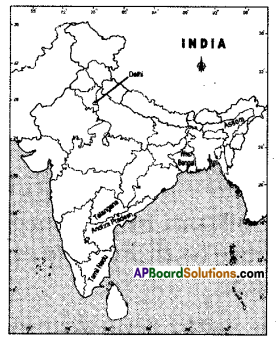
AP SSC 10th Class Social Studies Important Questions Chapter 18 Independent India (The First 30 years – 1947-77) 9

Question 5.
What was the contribution of Telecom revolution?
Answer:
The contribution of Telecom Revolution:
A network of telephonic communication in the country using satellite technology increased.

Question 6.
Mention any two initiations of N.T. Rama Rao.
Answer:

  1. Sale of rice at Rs. 2/- kg
  2. Mid day meal scheme in government schools.
  3. Liquor prohibition

AP SSC 10th Class Social Studies Important Questions Chapter 19 Emerging Political Trends 1977 to 2000

Question 7.
Write about the 73rd amendment of the constitution.
Answer:
73rd amendment: The 73rd constitutional amendment created institutions of local self government at the village level and so Gram Panchayat, Mandal Parishad and Zilla Parishad are formed.

Observe the table given below and answer the questions 8 & 9.
Results of Telangana State Assembly and Parliament Elections – 2014

S.No.Name of the PartyAssembly Seats wonParliament Seats won
1.T.R.S.6311
2.Congress Party212
3.T.D.P.202
4.Others152
Total11917

Question 8.
Name the two parties that secured more than 15 Assembly seats.
Answer:
Parties that secured more than 15 Assembly seats.

  1. TRS
  2. Congress Party
  3. T.D.P

Question 9.
Why did TRS secure more seats in 2014 elections?
Answer:
TRS secured more seats in 2014 elections because it played a key role in Telangana agitation.

Question 10.
What is meant by the Coalition government?
Answer:
During the time of General Election to the Assembly and Lok Sabha, no party gain the majority to form the government at the centre or state at that time. Two or more than two political parties come together to form a single government.
(OR)
A number of national and regional parties had to come together to form governments at the centre.

Question 11.
Name some non-political movements.
Answer:
Environmental movements, the feminist movement, civil liberties movement, literacy movements.

Question 12.
Which became powerful motors of social change?
Answer:
A number of non-political movements emerged and became powerful motors of social change.

Question 13.
Which parties decided to merge together and form the Janata Party?
Answer:
The Congress, Swatantra Party, Bharatiya Jan Sangh, the Bharatiya Lok Dal and the Socia¬list Party decided to merge together and form the Janata Party.

AP SSC 10th Class Social Studies Important Questions Chapter 19 Emerging Political Trends 1977 to 2000

Question 14.
Who supported the Janata Party?
Answer:
The DMK, the SAD and the CPI (M) chose to maintain their separate identities but supported the Janata Party in a common front against the Congress.

Question 15.
Who played an important role in bringing together all the anti-Congress and anti-Emergency parties?
Answer:
Senior leaders like Jayaprakash Narayan and Acharya JB Kriplani played an important role in bringing together all the anti-Congress and anti-Emergency parties to fight the elections.

Question 16.
What was the argument of the Janata Party regarding the dismiss of nine state governments?
Answer:
The Janata Party argued that the Congress party had lost its mandate to rule in the States as it had been defeated.

Question 17.
Which created a bad state in A.P.?
Answer:
In Andhra Pradesh, the frequent change of Chief Ministers by the central Congress leadership and the imposition of leaders from above created a bad taste.

Question 18.
Who moved to Assom and Bengal?
Answer:
The Bangladeshis moved to Assom and Bengal.

Question 19.
Name some communities of Assom.
Answer:
Bodos, Khasis, Mizos and Karbis.

Question 20.
Who was Bhindtanwale and what was his demand?
Answer:
Bhindranwale, the leader of the group of militant Sikhs began to preach separatism and also demanded the formation of a Sikh State- Khalistan.

Question 21.
What did the militants try?
Answer:
The militants tried to impose an orthodox life code on all Sikhs and even non-Sikhs of Punjab.

AP SSC 10th Class Social Studies Important Questions Chapter 19 Emerging Political Trends 1977 to 2000

Question 22.
Who made a declaration in April 1986?
Answer:
In April 1986, an assembly at the Akal Takht, made a declaration of an independent state of Khalistan.

Question 23.
Where were the militants engaged in?
Answer:
The militants were also engaged in large scale kidnapping and extortion to raise funds for their work.

Question 24.
How were the methods used by the govern¬ment for the suppression of militancy in Punjab?
Answer:
The Government used very harsh methods for the suppression of militancy in Punjab, many of which were seen as a violation of. Constitutional rights of citizens.

Question 25.
What did Rajiv Gandhi begin?
Answer:
Rajiv Gandhi began a peace initiative in Punjab, Assam and Mizoram and also in the neighbouring country of Sri Lanka.

Question 26.
What is called the telecom revolution?
Answer:
Rajiv Gandhi initiated what is called the ‘telecom revolution’ in India which speeded up and spread the network of telephonic communication in the country using satellite technology.

Question 27.
What had been under dispute for some time regarding Babri Masjid?
Answer:
Some sections of the Hindus had begun a campaign for building a temple for Lord Rama in Ayodhya in the place of Babri Masjid.

Question 28.
What is the speciality of Elections held in 1989?
Answer:
The issue of corruption in administration and in political circles became the main plank of the election campaign for non-Congress political forces in the next elections held in 1989.

Question 29.
What is Policy Paralysis?
Answer:
Policy Paralysis means the coalition could not implement any policy which called for serious change for fear of withdrawal of support by one or the other partners.

Question 30.
Which was the first coalition to be re-elected?
Answer:
The UPA was the first coalition to be re-elected.

Question 31.
Who led the Left Front Government in West Bengal in 1977?
Answer:
Jyoti Basu of CPM led the Left Front Government in West Bengal in 1977.

AP SSC 10th Class Social Studies Important Questions Chapter 19 Emerging Political Trends 1977 to 2000

Question 32.
On what did the Operation Barga depend?
Answer:
Operation Barga depended heavily on collective action by the share croppers and Panchayati Raj Institutions thus avoiding bureaucratic delays and domination of the landowning classes.

10th Class Social 19th Lesson Emerging Political Trends 1977 to 2000 2 Marks Important Questions and Answers

Question 1.
Read the following paragraph and answer the questions.

The Government used very harsh methods for the suppression of militancy in Punjab, many of which were seen as a violation of the constitutional rights of citizens. Many observers felt that such violations of constitutional rights and human rights were justified.as the constitutional machinery was on the edge of collapse due to militant activity.
Express your views on the information given above.

Answer:
There was a threat to the integration of the Indian nation due to the militancy in Punjab. If the government had not taken such actions, the map of India would be different today. So I think the government was correct.

Question 2.
Read the given data to answer the questions.
AP SSC 10th Class Social Studies Important Questions Chapter 19 Emerging Political Trends 1977 to 2000 1

A) Which were the parties that participated in the governments of the National Front and United Front and supported the government from the outside?
Answer:
To National Front: CPM, CPI, and BJP.
To United Front: CPM.

B) Mention the name of the party that participated in the above three governments.
Answer:
J.K.N.C.

AP SSC 10th Class Social Studies Important Questions Chapter 19 Emerging Political Trends 1977 to 2000

Question 3.
Based on the information given below, answer the following questions.

End of Emergency and formation of Janata party government under Morarji Desai and Charan Singh1977
Formation of Congress government led by Indira Gandhi1980
Formation of TDP1982
Operation Blue Star and assassination of Indira Gandhi1984
Rajiv Gandhi Accords with H.S. Longowal on Punjab and AASU on Assam.1985

a) Name the first non-Congress party which formed the government at the centre.
Answer:
Janata Party is the first non-Congress party which formed the government at the centre.

b) Who is the founder of Telugu Desam Party?
Answer:
Nandamuri Taraka Rama Rao (NTR) is the founder of Telugu Desam Party.

Question 4.
Which are the newest states of India, when they created?
Answer:

StateYear of formation
1. Uttaranchal / Uttarkhand2000
2. Jharkand2000
3. Chattisghar / Chattisghad2000
4. Telangana2014

Question 5.
Read the table and answer the given equations.

Assassination of Rajiv Gandhi and government led by Congress party with P.V. Narsimha Rao as P.M.1991
Economic liberalization1990
Demolition of Babri Masjid1992
National Front Government with Deve Gowda and I.K. Gujral as P.M.s1996
NDA government led by A.B. Vajpayee1998

a) Which party won in 1996 elections and formed government?
Answer:
National Front.

b) Name the Coalition Governments mentioned in the above table.
Answer:
National Front and NDA Governments.

Question 6.
Write about people’s welfare schemes started by present Governments.
Answer:

  1. Supply of rice at the cost of Rs. 1 per Kg to the white ration cardholders.
  2. Pensions for the old age people and widows.
  3. Free textbooks, uniforms and Midday meal scheme in government schools.
  4. Housing schemes for the poor people.
  5. Health scheme for the poor people.
  6. Fees reimbursement to the poor for higher education, etc.

Question 7.
Read the following text and answer the questions given below.

The Congress returned to power in 1980. The Congress immediately paid back the Janatb in the same coin by dismissing the Janata and non-Congress governments in nine States. The Congress was victorious in all the States except Tamil Nadu and West Bengal.

A) Which party ruled before 1980s?
Answer:
Janata Party.

B) In which two states, the Congress party was defeated?
Answer:
Tamilnadu and West Bengal.

AP SSC 10th Class Social Studies Important Questions Chapter 19 Emerging Political Trends 1977 to 2000

Question 8.
Prepare a table by classifying the given political parties into National and Regional Parties. “BJP, YSRCP, TDP, CPM, CPI, DMK, Congress-1, AGP”.

National partiesRegional parties

Answer:

S.No.National PartiesRegional Parties
1.Bharatiya janata PartyDMK
2.Congress -1TDP
3.CPIAGP
4.CPMYSRCP

Question 9.
Based on the information given below, answer the following questions.

Election and formation of Janata Dal government with VP Singh and Chandrasekhar1989
Decision to implement Mandal Commission recommendation1989
Ram Janmabhoomi Rath Yatra1990
Assassination of Rajiv Gandhi and government led by Congress party with P.V. Narsimha Rao as P.M.1991
Economic Liberalization1990
Demolition of Babri Masjid1992
National Front Government with Deve Gowda and IK Gujral as PMs1996
NDA government led by AB Vajpayee1998

i) Who was the Prime Minister at the time of demolition of Babri Masjid?
Answer:
P.V. Narasimha Rao.

ii) Give two examples of the Coalition government.
Answer:

  1. Janata Dal government.
  2. National Front government.
  3. National Democratic Alliance (NDA).

Question 10.
Sometimes coalition governments cause ‘Policy Paralysis’. Do you agree with this statement?
Write your opinion.
Answer:
Yes. I agree with this statement. The coalition could not implement any policy which called for serious change for fear of withdrawal of support by one or the other partners.

Question 11.
“Coalition Governments cause political instability.” Comment.
Answer:

  1. Sometimes no single party wins a majority of seats to form a government of its own. In such the situation, a number of political parties come together and form coalition governments.
  2. A common agreement between these parties has to be arrived at, but this is not so easy.
  3. Different parties put pressure on the government for their different interests.
  4. The government cannot implement any policy for fear of withdrawal of support by one or the other partners. The governments become instable.
  5. This is called policy paralise which is frequent in the coalition government.

AP SSC 10th Class Social Studies Important Questions Chapter 19 Emerging Political Trends 1977 to 2000

Question 12.
What are the situations that paved to strengthen the regional parties in present days?
Answer:
The situations that paved to strengthen the regional parties

  1. Regional aspirations – regional movements.
  2. Intermediate castes strengthening – gaining political power.
  3. To gain political power.
  4. Defections and corruption.

Question 13.
Write the main reasons for Assam movement.
Answer:

  1. Demand for autonomy.
  2. Protest against the domination of Bangladesh.
  3. Migration from Bangladesh.
  4. Fear of losing their cultural roots.
  5. Trade and other establishments were in the hands of outsiders.
  6. No preference in employment for locals.

Question 14.
Observe the following table and analyse it.
Table: Seat share of various Political parties in 2014 (lok Sabha)

S.No.Political pattyWon Seats
1Bharatiya Janata Party (BJP)282
2Indian National Congress (INC)45
3Telugu Desam Party (TDP)16
4Telangana Rashtra Samithi (TRS)11
5Left parties [CPI + CPI (M)]10

Answer:

  1. In 2014 General elections BjP got with 282 seats and form the largest party and form the government also.
  2. Indian National Congress got only 45 seats.
  3. Left parties CPI + CPI (M) joined together got 10 seats.
  4. The Regional parties like TDP 16 seats 8i TRS 11 seats gained In Lok’Sabha elections.

Question 15.
What are the important changes that occured in India between 1975-85?
Answer:
Many changes occurred In India between 1975-85. Some of them are:

  1. Emergency was declared by smt. Indira Gandhi as she was asked to quit her Prime Minister post by Allahabad high court.
  2. Janatha Government came into power in 1979.
  3. Congress Party came to power in the elections after Janatha govt, failure.
  4. Non-political movements like environment movements, feminist movements, civil liberties movement and literacy movements came up.

Question 16.
At present, what is the necessity of coalition politics?
Answer:
In the present multiparty system in India it is impossible for any single party to win a majority of seats and form a government of its own but in 2019 elections BJP has won the election as single party. It went as coalition.

AP SSC 10th Class Social Studies Important Questions Chapter 19 Emerging Political Trends 1977 to 2000

Question 17.
Read the following paragraph and comment on it.

In Andhra Pradesh, the frequent change of Chief Ministers by the central Congress leadership and the imposition of leaders from above created a bad taste. There was a feeling that the Andhra Pradesh leadership was not getting respect from the national Congress leadership. This was perceived as an insult to the pride of the Telugu people. N.T. Rama Rao(NTR), popular film actor, chose to take up this cause. He began the Telugu Desam Party (TDP) on his 60th birthday in 1982. He said that the TDP stood for the honour and self respect of the Telugu speaking people (Teluguvari atma gauravam). He argued that the state could not be treated as a lower office of the Congress party.

Answer:

  1. The Congress government frequently changed the Chief Ministers.
  2. The Congress was not giving respect to Andhra Pradesh leadership.
  3. The TDP was formed for the honour and self-respect of the Telugu speaking people.
  4. He introduced welfare schemes like midday meals to government schools, liquor prohibition and the sale of rice for Rs. 2/- per kg.
  5. These populist measures helped the TDP sweep the 1982 elections.
  6. TDP emerged as a strong regional party, and challenged the Congress domination.

Question 18.
What are the effects of changes of the Telecom Revolution on the Human lifestyles.
Answer:

  1. Telecom Revolution is the result of privatization of Telecommunications.
  2. Number of industries invested in telecommunications.
  3. “Mobiles” and Smart phones have created sensation.
  4. They reduced the distance between the buyers and sellers.
  5. Every family has a mobile in India.
  6. Telemarketing is a creative innovation.
  7. Smartphones have internet access and due to that internet facility is accessible to villagers through telephones.

Question 19.
What was Operation Blue Star?
Answer:

  1. Sikhs became militant in Punjab under Bhindranwale.
  2. People belonging to non-Sikhs were subjected to communal attack.
  3. Sikh separatist groups hid in the Golden Temple.
  4. Army had to intervene to vacate the campus.
  5. This was called ‘Operation Blue Star’.

Question 20.
What factors influenced central government to use armed forces to reduce tensions in Assam?
Answer:

  1. Three factors influenced the use of armed forces in the North Eastern Region.
  2. Firstly, it was a sensitive border area adjacent to China, Mynmar and Bangladesh.
  3. Secondly, rebel groups demanding separation from India, procured arms from outside.
  4. Thirdly, they indulged in large-scale ethnic violence against minority communities.
  5. The government thought this was the only way to bring about peace in the area.

Question 21.
Read the given information.
AP SSC 10th Class Social Studies Important Questions Chapter 19 Emerging Political Trends 1977 to 2000 2

Now answer the following questions.
a) Which party was included in “Governing parties” in all the above coalition governments?
Answer:
Jammu & Kashmir National Conference (JKNC)

b) Which party gave support to NDA government?
Answer:
TDP.

c) Which party gave support to National Front and United Front from outside?
Answer:
CPM.

AP SSC 10th Class Social Studies Important Questions Chapter 19 Emerging Political Trends 1977 to 2000

Question 22.
What did the emergence of competitive alternatives ensured?
Answer:
The emergence of competitive alternatives ensured that Indian voters could always exercise a reasonable choice. This also allowed many different political viewpoints and sectional interests to become active in state level and national politics.

Question 23.
How was the rule of the first non-Congress government?
Answer:
The Janata Party had come to power promising a restoration of democracy and freedom from authoritarian rule. However, the disunity among the partners had a serious effect on the governance and its rule is most often remembered for internal squabbles and defections. The factional struggle in the party soon culminated in the fall of the government within three years leading to fresh elections in 1980.

Question 24.
What happened whenever there was any political instability?
Answer:
Whenever there was any political instability or natural calamity in the neighbouring country, thousands of people moved into the State creating huge discomfort for the locals. The local people felt that they would lose their cultural roots and soon be outnumbered by the ‘outsiders’.

Question 25.
What was there besides culture and demographics?
Answer:
Besides culture and demographics, there was also an economic dimension. Trade and other establishments were in the hands of non-Assamese communities. The major resources of the State, including tea and oil were again not benefitting the locals.

Question 26.
What was the dominant thrust of the movement?
Answer:
The dominant thrust of the movement was that Assam was being treated as an “internal colony” and this had to stop. The main demands were that the local people should be given greater preference in employment, the “outsiders” should be removed and the resources should be used for the benefit of the locals.

Question 27.
Which has led to violent attempts of ethnic cleansing in Assam?
Answer:
Too much emphasis on ethnic identities had a negative impact on other communities of Assam like the Bodos, Khasis, Mizos and Karbis. Many of them too demanded autonomous status. They began to assert themselves and wanted to drive out people of other communities from their areas.

Question 28.
What did Punjab claim?
Answer:
It laid claims to the new capital city of Chandigarh which remained a union territory directly administered by the Centre. Punjab also claimed more water from Bhakra Nangal dam and greater recruitment of Sikhs in the army.

AP SSC 10th Class Social Studies Important Questions Chapter 19 Emerging Political Trends 1977 to 2000

Question 29.
Write about the resolution of Akali Dal.
Answer:
The Akali Dal had passed a set of resolutions in 1978 during the Janata Party rule in the centre, calling upon the central government to implement them. Its most significant demand was to amend the Constitution to give more powers to the states and ensure greater decentralisation of powers.

Question 30.
What happened after Rajiv Gandhi’s entrance?
Answer:
After Rajiv Gandhi became the Prime Minister, he held talks with SAD and entered into an agreement with Sant Langowal, the SAD president. Though fresh elections were held in Punjab and SAD won them, the peace was short-lived as Langowal was assassinated by the militants.

Question 31.
What did Rajiv Gandhi say in his speech?
Answer:
In a famous speech Rajiv Gandhi said that out of every Rupee spent on the poor barely 15 paise reaches them I It highlighted the fact that despite huge increases in development expenditure, the story of the poor remained the same.

Question 32.
Which factors influenced the central government to use armed forces to reduce tensions in Assam?
Answer:

  1. Three factors influenced the use of armed forces in the Northeastern region.
  2. Firstly, it was a sensitive border area adjacent to China, Myanmar and Bangladesh.
  3. Secondly, rebel groups demanding separation from India, procured arms from outside.
  4. Thirdly, they indulged in large scale ethnic violence against minority communities.
  5. The government thought this was the only way to bring about peace in the area.

Question 33.
What was meant by liberalization?
Answer:

  1. It meant a lot of things put together like the drastic reduction of government expenditure, reducing restrictions and taxes on imports, etc.
  2. It proved for reducing restrictions on foreign investments in India and allowed foreign countries to set up companies in India.
  3. It is required to the opening of many sectors of the economy to private investors.
  4. It brought in foreign goods and Indian businessmen were forced to compete with them.
  5. It had many positive and negative impacts on India.

Question 34.
“One of the greatest weakness was undoubtedly the low priority given to primary education and public health”. Comment on it.
Answer:

  1. The post-Independence era is marked with less priority to education and health.
  2. The optimum development of country depends mostly on the education and health levels of the population of it.
  3. It further forms part of Human Development Indicators also.
  4. So, I suggest more priority should be given to education and health now.

Question 35.
Read the given information.

In 1992 government led by P.V. Narasimha Rao passed an important amendment to the Constitution to provide local self-governments a Constitutional Status. The 73rd Constitutional Amendment created institutions of local self government at the village level while the 74th Constitutional Amendment did the same in towns and cities. These were path-breaking amendments. They sought to usher in for the first time, office bearers at the local level elected on the basis of universal adult franchise. One-third of the seats were to be reserved for women. Seats were also reserved for scheduled castes and tribes.

Answer the following questions.
a) Which constitutional amendment created institution of local self-government?
b) According to which amendment general elections were conducted in towns and cities?
c) How many seats are reserved for women in local bodies?
Answer:
a) 73rd Constitutional Amendment created institutions of local self-governments for villages.
b) According to 74th Constitutional Amendment general elections were conducted in towns/cities.
c) 1/3 seats were reserved for women in local self-government elections.

Question 36.
“Do you think that the reservations will promote the social development” ? Express your ideas.
Answer:

  1. Reservations will definitely promote social development.
  2. Scheduled castes and tribes were drowtodden and suffered in the social stature for centuries.
  3. To develop themselves and to question the injustice they meted out, reservations will of great help.
  4. Reservations both in education, jobs, and legislature help them.

AP SSC 10th Class Social Studies Important Questions Chapter 19 Emerging Political Trends 1977 to 2000

Question 37.
Imagine and write the main reasons for the continuation of anti Hindi movement in Tamil Nadu till today.
Answer:

  1. DMK in Tamil Nadu believed the passage of Official Languages Act, 1963 was an attempt to first Hindi on the rest of the country.
  2. They started a statewide campaign protesting the imposition of Hindi.
  3. They organised strikes, dharnas, burning effigies, Hindi books as well as pages of constitution.
  4. Still there is same feeling in Tamil Nadu.

Question 38.
“Some people think that Social Welfare Schemes do not reach eligible persons”. Express your suggestions.
Answer:

  1. Despite all the attention to development in the country, much of it did not reach the real beneficiaries.
  2. Despite huge increases in development expenditure the story of the poor remained the same.
  3. The main reasons were political and beaurocratic corruption.
  4. Enlistment of various beneficiaries also plagued by officialdom and political pressures.

Question 39.
“India needed to adapt itself to the new technologies emerging in the world, especially computer and telecommunication technologies”. Comment.
Answer:

  1. Technologies like computer and communication technology are thursting the world.
  2. It is believed that we should also adopt them without fail.
  3. With initiatives of Rajiv Gandhi now called ‘Telecom Revolution1 was introduced in India.
  4. With the help of satellite technology communications spread widely and extensively.
  5. Everyone has access to mobile phones, the internet, email, facebook, Twitter, etc.

10th Class Social 19th Lesson Emerging Political Trends 1977 to 2000 4 Marks Important Questions and Answers

Question 1.
Read the text given and answer the questions.

Panchayati Raj & 73rd, 74th Amendment

In 1992, Government led by P.V. Narasimha Rao passed an Important amendment to the Constitution to provide Local Self Governments a Constitutional status. The 73rd Constitutional Amendment created Institutions of local self-government at the village level, while the 74th Constitutional Amendment did the same in towns and cities. These were pathbreaking amendments. They sought to usher in for the first time, office bearers at the local level elected on the basis of Universal Adult Franchise. One-third of the seats were to be reserved for women. Seats were also reserved for scheduled castes and tribes. The concerns of the State governments were taken into account and it was left to the States to decide on what functions and powers were to be developed to their respective local self-governments. Consequently, the powers of local self-governments vary across the country.

i) What is Local Self Government?
Answer:
The Government that formed by the people at the village, town and city level to solve the local needs is Local Self Government.

ii) Which government recognised the Constitutional status of Local self Government?
Answer:
P.V. Narasimha Rao or Congress Government.

iii) What does the 73rd Constitutional Amendment say?
Answer:
Creation of Local Self government at the village level.

iv) 1/3 of seats were to be reserved for women in Local Self Governments. Comment.
Answer:
Women need political equality and they should Involve actively In the Local Governments.

AP SSC 10th Class Social Studies Important Questions Chapter 19 Emerging Political Trends 1977 to 2000

Question 2.
Read the following paragraph and answer the given questions.

Liberalization measures brought in foreign goods and forced Indian business to compete with global manufacturers. It also led to the setting up of industries and business by foreign companies in India. However, it also meant a lot of hardship for the common people as the government was forced to cut subsidies to the people and as many factories closed down due to Influx of cheap foreign goods. This also led to privatization of many public amenities tike education, health, and transport and people had to pay high prices to private service providers.

Write your opinion on the consequences of liberalization.
(OR)
What are the consequences of economic Liberalization?
Answer:

  1. India was drawn into the world market.
  2. Liberalization paved the way to telecom revolution.
  3. Liberalization forced Indian business to compete with global manufactures.
  4. The government was forced to cut subsidies which results a great loss to people and local industries.
  5. It also led to the privatization of many public amenities like education, health and transport.
  6. It led to globalization.
  7. The policies of liberalisation have been of advantage particularly to well of sections only.

Question 3.
Explain the importance of regional parties in Democracy.
Answer:

  1. Multi-party system which includes national parties and regional parties strengthens the democracy.
  2. Regional parties reflect the spirit of the federalism.
  3. Regional parties have good understanding of the problems and needs of the respective states.
  4. They focus mainly on the development of their states.

Question 4.
Telecom revolution has brought several changes in human life nowadays. Explain them.
Answer:
Changes brought by the telecom revolution:

  1. Saves time
  2. Fast communication
  3. Online services
  4. Prosperous life
  5. Addiction
  6. Obesity
  7. Cost of living increased
  8. Affected human relations

Question 5.
Read the paragraph given below and interpret.

India was forced to open up and ‘liberalise’ its economy by allowing free flow of foreign capital and goods Into India. On the other hand, new social groups asserted themselves politically for the first time, and finally, religious nationalism and communal political mobilisation became Important features of our political life. All this put the Indian society into great turmoil, we are still coming to grips with these changes and adapting ourselves to them.

Answer:

  1. Liberalisation means relaxation of previous government restrictions usually in areas of social and economic policy.
  2. The twentieth century ended with India’s drawing into the world free market.
  3. India was forced to open up and liberalise its economy. It allowed free flow of foreign capital and goods into India.
  4. On the other hand, India seemed to have a thriving democracy in which voices of different sections of the population were making themselves heard and in which divisive and communal political mobilisation was threatening to destroy social peace.
  5. It had stood the test of time for over fifty years and had built a relatively stable economy and deeply rooted democratic politics.
  6. It still had not managed to solve the problem of acute poverty and gross inequality between castes, communities, regions and gender.

Question 6.
Observe the following table and write a paragraph analyzing it.
Summary of the 2014 -Indian General Elections

PartyAllianceVotes(%)Seats
BJPNDA31%282
INCUPA19.31%44

Answer:
The given table describes the summary of the 2014 general elections in India. In the given table two parties that is Bharatiya Janata Party and the Indian National Congress are compared. It is not only the party comparison but their alliances are also mentioned. The Bharatiya Janata Party alliance is National Democratic Alliance whereas the United Progressive Alliance is related to Indian National Congress. In these elections the NDAgot 31% of the votes whereas the UPAgot 19.31%. If we observe the seats, the BJP with its alliance won 282 whereas the INC won only 44. These elections are very crucial because the voter strongly rejected the pre-independence party which ruled India since 1947. For a long time it was a single largest party to win the seats in Lok sabha. The voters cleverly gave mandate to the Bharatiya Janata Party with the hopes that their future may be changed. The BJP announced the Prime Ministerial candidate, Narendra Modi in advance. He achieved and succeeded in Gujarat as Chief Minister. So the voters accepted him as Prime Minister also. They believed him. Congress lost faith of the people because of its failures. During Congress period there was a lot of corruption, scams and nepotism, etc. Many of the Congress members of Parliament were in court cases. Rajiv Gandhi himself declared that corruption is highly established in India. If the Bharatiya Janata Party with its alliance work for the development of the country, definitely they will win the next coming 2019 elections. So the party should keep this in mind and work in that direction.

AP SSC 10th Class Social Studies Important Questions Chapter 19 Emerging Political Trends 1977 to 2000

Question 7.
Explain the effects along with the reasons for the emerging era of coalition politics.
Answer:
Reasons for the emergence of coalition era of politcs:

  1. Multi party system
  2. No single party securing required majority.
  3. Significance of regional parties increased.
  4. Congress party gradually lost people’s mandate after 1960s.

Effects:

  1. No political stability
  2. Isolating the ideologies
  3. Giving importance to party’s interest at the cost of nation’s interest.
  4. Coming to power in spite of securing less mandate.

Question 8.
Read the following paragraph and write your opinion.

The twentieth century closed with India which was drawn into the world market, India which seemed to have a thriving democracy in which voices of different sections of the population were making themselves heard and in which, divisive and communal political mobilisation were threatening to destroy social peace. It had stood the test of time for over fifty years and had built a relatively stable economy and deeply rooted democratic politics. It still had not managed to solve the problem of acute poverty and gross inequality between castes, communities, regions and gender.

Answer:
The given paragraph depicts about divisive and communal politics. These may destroy the social peace. After independence in India, stable government continued for 30, 40 years and unstability began. Main problem of solving poverty and inequalities with regard to caste, region is not yet solved.

My opinion is that the politics are only vote bank based. Sometimes the political leaders are there behind the communal riots. To throw out some Chief Minister of the same party, their party leaders encourage these riots. Caste based politics are shown at the time of tickets given to party candidates. Caste unions, and the caste group heads are distributed money to lure them to get their votes. Some constituencies are fixed for some religion because of their dominance in number. It is really a threat to democracy. Holy places of worship are also in some cases used to spread communal message. That destroys social peace.
My suggestion is that people should get awarness about this and act accordingly.

Question 9.
Observe the following table and analyse it.
The trend of Coalition Governments, 1989 – 2004

S.No.CoalitionDurationGoverning partiesSupporting parties
1.National Front1989 – 90JD, DMK, AGP, TDP, JKNCCPM, CPI, BJP
2.United Front1996 – 98JKNC, TDP, TMC, CPI, AGP, DMK, MGPCMP
3.National Democratic Alliance1998 – 2004JDU, SAD, TMC, AIADMK, JKNC, BJD, Shiva-SenaTDP

Answer:

  1. The given table is about the trend of Coalition Governments during the period of the years from 1989 to 2004.
  2. The details of three coalition governments and their duration, etc. are given in the table.
  3. During 1989-1990 Janata Dal-led National Front formed the government. The governing parties in this government were JD, DMK, AGP, TDP, JKNC. CPM, CPI and BJP supported this government.
  4. United Front formed the coalition government during 1996-1998. JKNC, TDP, TMC, CPI, AGP, DMK, MGP were the governing parties in this government. CPM supported this government.
  5. During 1998-2004 BJP-led National Democratic Alliance formed the government. The governing parties in this government were JDU, SAD, AIADMK, JKNC, TMC, BJD and Shiva Sena. TDP rendered support to the NDA government.
  6. The 1990s were years of very significant change in the post-Independence India.
  7. With the transformation to a competitive multi-party system, it became near impossible for any single party to win a majority of seats and form a government of its own.
  8. Since 1989, all governments that had formed at the national level have been either coalition or minority governments.

AP SSC 10th Class Social Studies Important Questions Chapter 19 Emerging Political Trends 1977 to 2000

Question 10.
Explain about Assam movement in detail.
Answer:

Assam movement:

It is the struggle between Assamese and non-Assamese. These non-Assamese were none other than the people of Bangladesh. The youth of Assam formed All Assam Students Union (AASU) and was in the forefront of agitation. It led a number of strikes, agitations and marches to remove the so called outsiders. The problem of outsiders is not a cultural one but of economic issue. Every country or state wants to protect their cultural roots. The Assamese were most of them, Hindus and the outsiders were Muslims. The local people were afraid of their cultural roots.
Now they affect the trade and so the livelihoods of the locals had been in trouble. It is not only the problem of Assam, it happens at many states. Outsiders dominate a few areas of business and so the locals lose opportunities. In Assam the locals were not given priority or preference in employment. This was the demand of the Assamese. Gradually these demands led to communal polarisation as most of the outsiders are from Bangladesh Muslims. The movement between the Assamese and outsider Muslim led to form an idea of anti Indian stand.

Central Government took initiation and went on for talks for three years. An agreement was signed by the central government and the students union. In the next elections Assam Gana Parishad (an offshoot of AASU) came to power.

In conclusion, the formation of Bangladesh erstwhile Pakistan was taken place on the basis of religion. One’s religion can be given respect by all but it led to many disturbances. The Muslims, the outsiders of Assam occupied most of the areas of trade and business and there was distress and disappointment among the Assamese. The outsiders would have settled in Bangladesh only. They wanted their country to be separated and still they are coming to India illegally. Recently both the Prime Ministers of India and Bangladesh sat together and solved a few problems. If any problem arises, they should sit together and problems can be solved.

Question 11.
Prepare an album by collecting the photos of Prime Ministers of India and write their specialities.
Answer:
AP SSC 10th Class Social Studies Important Questions Chapter 19 Emerging Political Trends 1977 to 2000 6AP SSC 10th Class Social Studies Important Questions Chapter 19 Emerging Political Trends 1977 to 2000 7AP SSC 10th Class Social Studies Important Questions Chapter 19 Emerging Political Trends 1977 to 2000 8AP SSC 10th Class Social Studies Important Questions Chapter 19 Emerging Political Trends 1977 to 2000 9

Question 12.
You may notice how simple and genuine demands of the people of Punjab were hijacked by religious and anti-national extremists. What steps do you think would have prevented this?
Answer:

  1. The simple and genuine demands of Punjab were
    a) the contribution of state was ignored
    b) received unfair bargain when it was created
    c) capital remain UT
    d) more water from Bhakra Nangal and
    e) greater recruitment of Sikhs in the army.
  2. Akali Dal government was dismissed by Congress.
  3. A series of untoward incidents increased distance between Sikhs and the central government.
  4. Militant Sikhs demanded separate state.
  5. They occupied Golden Temple, then Congress used army to vacate.
  6. A fallout led to the assassination of Indira.
  7. Rioting in Delhi against Sikhs was followed.
  8. Later Langowal made an agreement with centre but was killed by militants.
  9. Militants engaged in extortion and kidnapping and lost faith of the people

AP SSC 10th Class Social Studies Important Questions Chapter 19 Emerging Political Trends 1977 to 2000

Question 13.
Understand the table and answer the following questions.
Some opposition parties of 1970’s

SI.No.Name of the partyPlace of ActivityIdeologies
1.BLD-Bharatiya Lok DalUttar PradeshSpecial attention to Indian farmers
2.Congress (O)Entire IndiaConservative section opposed policies of Indira Gandhi
3.CPI (M)
Communist Party of India (Marxist)
West Bengal, Tripura, Kerala, and remained statesRadical land reforms, trade unionism, socialist policies
4.DMK – Dravida Munnetra KazagamTamil Nadu1. Greater autonomy and powers to state
2. Fiercely opposed Hindi in the state
5.Jan SanghNorthern StatesA Hindu nationalist party
6.SAD – Shiromani Akali DalPunjab1. Great autonomy to states
2. Organised around Gurudwaras

a) Which political party fiercely opposes Hindi in the state ?
Answer:
DMK is the party which opposes Hindi in the state.

b) What is the place of activity for Jan Sangh?
Answer:
Jan Sangh is active in Northern States.

c) What is the ideology of CPI (M)?
Answer:
The ideologies of CPI (M) are radical land reforms, trade unionism and socialist policies.

d) Where is the political party which shows special attention to farmers, active ?
Answer:
The political party, which shows special attention to farmers is active in Uttar Pradesh.

e) Which party is of semireligious nature?
Answer:
SAD – Shiromani Akali Dal is of semireligious nature.

Question 14.
What were the implications of 1977 general elections?
Answer:

  1. It was a historical election for democracy.
  2. The Congress party was defeated at the national level for the first time.
  3. Janata Party became victorious and tried to consolidate itself.
  4. It dismissed nine Congress governments in states.
  5. It argued that Congress had lost its mandate to rule in the states as it had been defeated.
  6. Its stand somewhat proved correct by the results.
  7. Except Tamil Nadu and West Bengal, Janata Party came to power in states.
  8. The disunity among the partners had a serious effect on governance.
  9. The government fell within three years.
  10. It led to fresh elections in 1980.

Question 15.
Why was the public sympathy to Punjab militant Sikhs declined?
Answer:

  1. They formed armed attachments and engaged in terrorist activities.
  2. They clashed with police and other religious groups.
  3. Those who were not confirmed to militant approved behaviour were killed.
  4. There were civil casualities in derailing trains, exploding bombs, etc.
  5. They were engaged in kidnapping, extortion to raise funds.
  6. All this gradually alienated them from masses and even Sikhs.
  7. Over a period, public sympathy declined rapidly.
  8. Peace was finally returned to Punjab by the end of 1990s.

AP SSC 10th Class Social Studies Important Questions Chapter 19 Emerging Political Trends 1977 to 2000

Question 16.
‘Coalition governments induce political instability’ – Elucidate.
Answer:

  1. Since 1989, all governments at national level were coalition/minority governments.
  2. A number of national and regional parties had come together.
  3. So political ideologies and programmes of all parties had to be accommodated.
  4. A common agreement had to be arrived at.
  5. No party could pursue extreme agendas.
  6. They needed to tone down their approaches.
  7. It caused considerable instability.
  8. Many coalitions did not last their full time.

Question 17.
How do political parties reap on communal polarisation? Provide an example.
Answer:

  1. The Hindus are led by Bharatiya Janata Party.
  2. In the year 1984 LokSabha elections they won only 2 seats.
  3. It made great strides when it took up the Ayodhya issue.
  4. It decided to campaign for the building of a temple at the site of mosque.
  5. It claimed that was the birthplace of Lord Rama.
  6. L.K. Advani in 1990, led a ‘Rath Yatra’ from Somanath to Ayodhya.
  7. This campaign was accompanied by intense communal polarisation.
  8. It caused a large number of communal conflicts.
  9. In 1991 General elections BJP’s strength went up to 120.
  10. It was then Rajiv was killed and sympathy wave followed the Congress, still, BJP withstood it.

Question 18.
What is meant by liberalisation?
Answer:

  1. It means a lot of things put together.
  2. It proposes drastic reduction of government expenditure.
  3. It asks for reducing restrictions and taxes on import of foreign goods.
  4. It provides for reducing restrictions on foreign investments in India.
  5. It is required to the opening of many sectors of the economy to private investors.
  6. It brought in foreign goods and forced Indian business to compete with them.
  7. It allowed foreign countries to set up companies in India.
  8. Common people suffered with cut of subsidies.
  9. Many factories were closed down due to influx of cheap foreign goods.

AP SSC 10th Class Social Studies Important Questions Chapter 19 Emerging Political Trends 1977 to 2000

Question 19.
Study the timeline given below and answer the following questions.
AP SSC 10th Class Social Studies Important Questions Chapter 19 Emerging Political Trends 1977 to 2000 3a) Who was the Prime Minister that initiated peace agreements with Sri Lanka?
Answer:
Rajiv Gandhi initiated peace agreements with Sri Lanka.
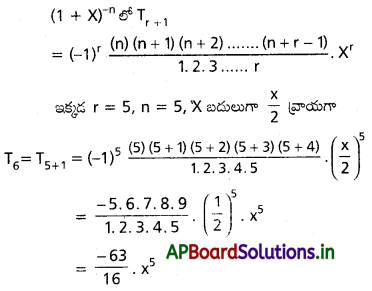
b) Which government tried to implement Mandal Commissions report?
Answer:
Janata Dal government tried to implement Mandal Commissions report.
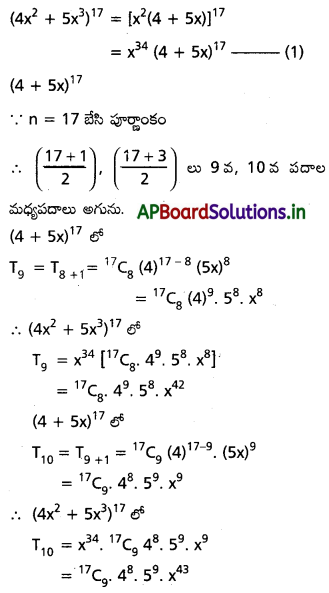
c) Name two important incidents occurred during the period of P.V. Narasimha Rao.
Answer:
Economic liberalization and the demolition of the Babri Masjid took place during the period of P.V. Narasimha Rao.

d) When was Indira Gandhi assassinated?
Answer:
Indira Gandhi was assassinated in 1984.

e) Who were the Prime Ministers of National Front Government?
Answer:
Deve Gowda and I.K. Gujral were the Prime Ministers of the National Front Government.

f) Who were the Prime Ministers of Janata Dal Government?
Answer:
V.P. Singh and Chandrasekhar were the Prime Ministers of Janata Dal Government.

g) Who led the Congress party after the assassination of Rajiv Gandhi?
Answer:
P.V. Narasimha Rao led the Congress party after the assassination of Rajiv Gandhi.

h) Who led the NDA government?
Answer:
A.B. Vajpayee led the NDA government.

i) When was the NDA Government formed?
Answer:
NDA formed the government in 1998.

Question 20.

Read the following information and answer the questions.

Some opposition parties of 1970s

BLD – Bharatiya Lok Dal – A party which was formed of socialists who called for special attention to Indian farmers, based mainly in Uttar Pradesh.

Congress (O) – The conservative section of the Congress which had opposed the policies of Indira Gandhi.

CPI (M) – Communist Party of India (Marxist)-a party with a national presence, which strove for radical land reforms, trade unionism and socialist policies.

DMK – Dravida Munnetra Kazagam – a party based mainly in Tamil Nadu which sought greater autonomy and powers for the state.

Jan Sangh – A Hindu nationalist party largely confined to the northern States.

SAD – Shiromani Akali Dal – a party based in Punjab catering specially to the Sikhs and organised around Gurudwaras. It therefore had a semi-religious character. It was also in favour of greater autonomy to the States.

a) Which party fought for autonomy in Tamil Nadu?
Answer:
Dravida Munnetra Kazagam fought for greater autonomy in Tamil Nadu.

b) Which party showed special attention to Indian farmers mainly in UP?
Answer:
Bharatiya Lok Dal showed special attention to farmers mainly in U.P.

c) Name the regional party of Punjab.
Answer:
Shiromani Akali Dal is the regional party of Punjab.

d) Name one Hindu nationalist party.
Answer:
“Jan Sangh” is one Hindu nationalistic party.

e) Which opposed the policies of Indira Gandhi?
Answer:
Congress (O) – The conservative section of the Congress opposed the policies of Indira Gandhi.

f) What was the main aim of SAD?
Answer:
It sought for greater autonomy to Punjab.

g) Which party was confined to North India only?
Answer:
Jan Sangh was confined to North India only.

AP SSC 10th Class Social Studies Important Questions Chapter 19 Emerging Political Trends 1977 to 2000

Question 21.

Read the following passage and interpret it.

Panchayati Raj & 73rd, 74th amendment

In 1992 government led by P.V. Narasimha Rao passed an important amendment to the Constitution to provide local self-governments a Constitutional Status. The 73rd Constitutional Amendment created institutions of local self government at the village level while the 74th Constitutional Amendment did the same in towns and cities. These were path-breaking amendments. They sought to usher in for the first time, office bearers at the local level elected on the basis of universal adult franchise.

One-third of the seats were to be reserved for women. Seats were also reserved for , scheduled castes and tribes. The concerns of the State governments were taken into j account and it was left to the States to decide on what functions and powers were to be devolved to their respective local self governments. Consequently, the powers of local self governments vary across the country.

Answer:

  1. In 1992 P.V. Narasimha Rao s government passed the important amendments of 73rd and 74th.
  2. The 73rd amendment created institutions of local self governments at the village levels.
  3. The 74th amendment created institutions of local self-governments at the town and city levels.
  4. They are path-breaking as the office bearers at the local level are elected on the basis of universal adult franchise.
  5. Seats are reserved for women and Scheduled Castes and Tribes too.
  6. Powers were devolved to their respective local self-governments.
  7. Hence we can say that these two amendments were path-breaking.

Question 22.
On the outline map of India locate the On the outline map of India locate the following.

  1. Andhra Pradesh
  2. Assom
  3. Punjab
  4. Tamil Nadu
  5. West Bengal
  6. Uttar Pradesh
  7. Nagaland
  8. Mizoram
  9. Bihar
  10. Gujarat
  11. Maharashtra
  12. Ayodhya

Answer:

AP SSC 10th Class Social Studies Important Questions Chapter 19 Emerging Political Trends 1977 to 2000 4

AP SSC 10th Class Social Studies Important Questions Chapter 19 Emerging Political Trends 1977 to 2000

Question 23.
Locate the following in the given map of World.

  1. Madagascar Island
  2. Nigeria
  3. Holland
  4. Amsterdam
  5. Brazil
  6. Jordan
  7. Israel
  8. Spain
  9. Palestine
  10. Bangladesh

Answer:
AP SSC 10th Class Social Studies Important Questions Chapter 19 Emerging Political Trends 1977 to 2000 5

AP SSC 10th Class Social Studies Important Questions Chapter 19 Emerging Political Trends 1977 to 2000