AP SSC 10th Class Social Studies Solutions Chapter 22 Citizens and the Governments

SCERT AP Board 10th Class Social Solutions 22nd Lesson Citizens and the Governments Textbook Questions and Answers.

AP State Syllabus SSC 10th Class Social Studies Solutions 22nd Lesson Citizens and the Governments

10th Class Social Studies 22nd Lesson Citizens and the Governments Textbook Questions and Answers

Improve your learning

AP SSC 10th Class Social Studies Solutions Chapter 22 Citizens and the Governments

Question 1.
Using the following case study, explain the role of different departments of the Government and citizens in the context of RTI. Also, write how can the RTI make the functioning of the governments more transparent.

The following incident occurred in Chinnashankarampet of Medak district. Members of the Self Help Groups joined in Abhaya Hastam, Aam Aadmi schemes of the Rural Welfare Ministry of the State Government. Under this scheme, their children who were students of classes 9 to 12 were eligible for scholarships of Rs. 1200. However, for 3 years students have not been receiving the amount for the years during 2008-11. The students went to the IKP (Indira Kranthi Pathakam) office and enquired about it but the officers ignored their requests.

This came to the notice of the local newspapers. Now they applied to the officers concerned for the information with regard to the scholarships sanctioned. They asked about the number of beneficiaries and the amount sanctioned during 2008-09, 09-10 and 10-11. They got rqply in one week. The amount was 7 lakh rupees. It became clear from the RTI records that even though the amount was sanctioned, it was not distributed. When it was published in the newspapers the amount was distributed to 1167 children within 15 days.

Answer:
Following the case study above we can assess the role of the departments handling different schemes like SHG, IKP, Abhaya Hastam and Aam Aadmi, etc.
Having learnt of the knowledge of RTI and applying for information of the scholarships sanctioned helped the beneficiaries.
The RTI can make the functioning of the Government more transparent. Students who did not receive scholarships for 3 long years were given the same within 15 days. Not only that not providing information asks for punishment on the part of PIOs.

AP SSC 10th Class Social Studies Solutions Chapter 22 Citizens and the Governments

Question 2.
How do you think RTI would help in improving and monitoring the work of the governments?
“RTI would help in improving and monitoring the work of the governments”- Do you agree with this? Support your answer.
Answer:

  1. In any democratic system, governments are responsible and accountable to people.
  2. Earlier accountability of government departments and its functionaries were mostly limited to the elected representatives of people.
  3. Enactment of the RTI effectively means that individual government departments now have a responsibility to maintain records and make them available to any citizen who may ask for it.
  4. So, if there are any discrepancies, they will be brought out and who are responsible will be given punishments.
  5. So, in this way government functioning can be bettered and monitored well.

Question 3.
What is identified as information? How is this generated in Government Departments? Would it include oral communication between senior and junior officers?
Answer:

  1. According to RTI Act, information is defined as material in any form, including records, documents, memos, e-mails, opinions, advices, press releases, circulars, orders, logbooks, contracts, reports, papers, samples, models, data material held in any electronic form, and information relating to any private body which can be assessed by a public authority under any other law for the time being in force.
  2. Enactment of the RTI effectively means that individual government departments now have a responsibility to maintain records and make them available to any citizen who may ask for it.
  3. The oral instructions or oral communication between senior and junior officers do not fall in this category.

AP SSC 10th Class Social Studies Solutions Chapter 22 Citizens and the Governments

Question 4.
Why are the State and Central Information Offices given autonomy?
Answer:

  1. Every government offices have a Public Information Officer (PIO) and Assistant Public Information Officer (APIO) and appellate authority in department.
  2. All PIOs and APIOs of all departments and departmental appellate authorities are under autonomous appellate State Public Information Office with a State Public Information Commissioner (SPIC).
  3. If a government department fall under Central government, PIOs are accountable to autonomous Central Information Office with a Central Public Information Commissioner (CPIC).
  4. They are given autonomy because they need to deal with the PIOs who rejected to provide information.
  5. They should not yield under any pressure that is why they must be independent.

Question 5.
This (RTI 2005) Act resembles the true spirit of democracy. How do you justify?
Answer:

  1. In a democracy, it is the people’s money that is used for their welfare and therefore people have every right to know how this is being used.
  2. People can participate in government and ensure just development only if they have sufficient information in the form of official documents.
  3. In situations where information has to be made public, arbitrary decisions by the elected representatives or the officials can be controlled.
  4. Information is crucial to human development, and democratic rights.
  5. Information will make governments more accountable in their functioning and check the possibility of corrupt practices.
  6. Thus, this Act (RTI Act of 2005) resembles the true spirit of democracy.

Question 6.
What steps have been taken to ensure that any citizen can access information from the different government departments in the country?
Answer:
Under the provisions of 2005 Act of RTI, public authorities are obliged to
a) maintain all information in a computerised format
b) publish all detailed information pertaining to the information some of it fbitn the Act as follows:

  1. Every public authority shall
    a) Maintain all its records duly catalogued and indexed.
    b) The authority shall publish the particulars of its organisation, functions and duties.
  2. The powers and duties of its officers and employees to be published.
  3. The procedure followed in the decision making process, including channels of supervision and accountability;
  4. The rules, regulations, instructions, manuals and records, held by it or under its control or used by its employees for discharging its functions.

AP SSC 10th Class Social Studies Solutions Chapter 22 Citizens and the Governments

Question 7.
How do you think the Legal Services Authority would help the people in seeking legal aid?
Answer:

  1. There is a system in our country to provide free legal service to the people.
  2. Under the Legal Services Authority (amendment) Act, 2002, legal services authorities are constituted to provide free and legal services to the weaker sections of the society.
  3. This is to ensure that opportunities for securing justice are not denied to any citizen by reasons of economic or other disabilities and to organize Lok Adalats to ensure that the operation of the legal system promotes justice on an equal opportunity basis.
  4. In this way, Legal Services Authority would help the people in seeking legal aid.

Question 8.
What is the purpose of Lok Adalat?
Answer:

  1. Lok Adalat meahs people’s court.
  2. All are equal before law.
  3. The Article 39A of the Constitution of India contains various provisions for settlement of disputes.
  4. It is an act to constitute legal services, authorities to provide free and competent legal services to the weaker sections of the society.
  5. It is to ensure that opportunities for securing justice or not denied to any citizen by reason of economic or other disabilities.
  6. To organise Lok Adalats to secure that the operation of the legal system promotes justice on a basis of equal opportunity.
  7. This is the purpose of Lok Adalat.

(OR)

  1. The main aim of Lok Adalat is to provide free legal aid to poor and weaker sections and also faster settlement of long pending cases on mutual consent.
  2. Lok Adalat facilitates the peaceful, amicable, compromise or settlement of cases.
  3. It is meant to reduce the burden of the courts.

AP SSC 10th Class Social Studies Solutions Chapter 22 Citizens and the Governments

Question 9.
What do you think on the eligible criteria for free legal services and nature of cases under this Act?
Answer:
i) Persons entitled to get free legal support are

  1. A member of scheduled caste or scheduled tribe.
  2. A victim of trafficking in human being or beggars.
  3. Women and children.
  4. A mentally ill or otherwise disabled person.
  5. Persons who are victims of mass disaster, ethnic violence, caste atrocity, flood, drought earthquake and industrial disaster.
  6. Industrial workers.
  7. Persons in custody.
  8. Persons with annual income of not more than Rs. 1 lakh

ii) Nature of cases under this Act.
Matrimonial disputes, maintenance cases, harassment cases by husbands and in-laws, domestic violence cases, all types of civil cases, land disputes, compoundable criminal cases etc.

Question 10.
Compare and contrast the procedures of conflict/case resolution by the Village Community elders and by courts. Which do you prefer and why?
Answer:

  1. In our country, it is common that conflicts in the villages and in the communities are addressed by the village/community elders.
  2. They settle them in a peaceful and amicable way by discussing the various issues and concerns.
  3. The nature of conflict and disputes and their origin are mostly known to the local people and village elders.
  4. This facilitates to find out amicable solutions in a transparent way.
  5. Now Lok Adalats are functioning to settle disputes/cases in an amicable atmosphere by mutual consent in the presence of legal experts, officials and non-officials, dignitaries.
  6. People are now using it for expeditious and inexpensive justice.
  7. It is an opportunity to settle long pending court cases through Lok Adalat in short time and without any expenses.
  8. It is an old form of dispute/ conflict resolution system valid now also.

AP SSC 10th Class Social Studies Solutions Chapter 22 Citizens and the Governments

10th Class Social Studies 22nd Lesson Citizens and the Governments InText Questions and Answers

10th Class Social Textbook Page No. 316

Question 1.
Discuss what could be the reason information would not include oral (instruction of a headmaster to a teacher.
Answer:

  1. RTI Act has defined information as the following:
  2. Material in any form, including records, documents, memos, e-mails, opinions, advices, press releases, circulars, orders, logbooks, contracts, reports, papers, samples, models.
  3. Data material held in any electronic form and information relating to any private body which can be assessed by a public authority under any other law for the time being in force.
  4. In this, the oral instructions are not included as they were not in written form.
  5. Thus, the oral instruction of a headmaster to a teacher would not be included in information.

Question 2.
Imagine how would government departments would become more accountable when rules and regulations are followed within prescribed manner.
Answer:

  1. Government departments have the responsibility to use the people’s money for their welfare.
  2. For every department there are rules and regulations that are to be followed within a prescribed manner.
  3. If all the departments follow them, automatically they will be more accountable to people.
  4. Not only that their functioning would become transparent and free from corruption.
  5. Machinery to monitoring them is essential and they must be given applause if they are behaving accountable to people.

10th Class Social Textbook Page No. 318

AP SSC 10th Class Social Studies Solutions Chapter 22 Citizens and the Governments

Question 3.
According to this Act (RTI 2005), if any officer fails to give the specified information, she/he will have to pay the fine. Do you agree with this? Why?
Answer:

  1. According to this Act, if any officer fails to give the specified information she/he will have to pay fine.
  2. I do agree with it.
  3. It prevents corruption.
  4. It provides for accountability and transparency.
  5. It prevents PIOs from shying away of information.
  6. If a fine is imposed on one PIO then it acts as deterrent and most PIOs realise the impact of not giving information.
  7. Apart from making the PIOs responsible in case of not providing information, they should be appreciated.

Question 4.
What type of information is not accessible to the citizens? What is the argument in favour of this?
Answer:

  1. Information that could affect the sovereignty and integrity of India.
  2. Matters that could be of strategic economic on scientific interest of the state in the context of foreign powers.
  3. Most of our armed forces and security agencies are outside the purview of Information Commission.
  4. It is correct on the part of government not to share the information that is vital and affect the country,. . . . ..
  5. If information of strategic importance was disclosed and reached the hands of foreign powers, the damage that could be caused cannot be estimated.
  6. Citizens should also have some self restraint and not to seek the information which causes the worry to National Government.

10th Class Social Textbook Page No. 320

AP SSC 10th Class Social Studies Solutions Chapter 22 Citizens and the Governments

Question 5.
What sort of opportunities are existing in our country for free legal services to the poor people who cannot afford to pay court fees and other related expenses?
Answer:

  1. There is a system in our country to provide free legal service to the people.
  2. Under Legal Services Authority (amendment) Act, 2002 Legal Services Authorities are constituted to provide free legal services to the weaker sections of the society.
  3. This is to ensure that opportunities for securing justice are not denied to any citizen by reason of economic or other disabilities.
  4. To organise Lok Adalats to ensure that the operation of the legal system promotes justice on equal opportunity basis.

Question 6.
What is the nature of cases and conflicts that can be addressed through free legal services?
Answer:

  1. The legal services authority through Lok Adalats settles long pending court cases in short time without any expenses.
  2. Matrimonial disputes, maintenance cases, harassment cases by husband and in-laws, domestic violence cases can be addressed through free legal service.
  3. All types of civil cases, land disputes, compoundable criminal cases, etc. can be settled amicably and permanently by Lok Adalats without any fees or expenses through free legal services.

Question 7.
Is there any mechanism for alternate dispute resolution outside the courts?
Answer:

  1. There is one mechanism for alternate dispute resolution outside the courts.
  2. Conflicts in villages/ communities are addressed by village/ community elders.
  3. They resolute conflicts in a peaceful and amicable way by discussing various issues/ concerns.
  4. The nature of conflicts/disputes and their origin are mostly known to village elders.
  5. This facilitates to find out an amicable solution in a transparent way.
  6. Thus outside the courts the conflicts/disputes are addressed and resoluted by village elders.

AP SSC 10th Class Social Studies Solutions Chapter 22 Citizens and the Governments

Question 8.
Do you support the Lok Adalats? If so, why?
Answer:

  1. I support Lok Adalats because there is no court fee, if paid it will be refunded if the dispute is settled.
  2. It has procedural flexibility and speedy trial of the disputes.
  3. The parties of the dispute can directly interact with the judge through their council.
  4. The Award by Lok Adalat is binding on the parties with a status of decree of civil court.
  5. Provides free legal advice form the advocates.
  6. Provides photocopies of judgements on free of cost.


AP Inter 2nd Year Maths 2A Solutions Chapter 2 డిమోయర్ సిద్ధాంతం Ex 2(a)

Practicing the Intermediate 2nd Year Maths 2A Textbook Solutions Chapter 2 డిమోయర్ సిద్ధాంతం Exercise 2(a) will help students to clear their doubts quickly.

AP Inter 2nd Year Maths 2A Solutions Chapter 2 డిమోయర్ సిద్ధాంతం Exercise 2(a)

అభ్యాసం 2(ఎ)

I.

ప్రశ్న 1.
n పూర్ణాంకం అయితే (1 + i)2n + (1 – i)2n = \(2^{n+1} \cos \frac{n \pi}{2}\) అని చూపండి.
సాధన:
AP Inter 2nd Year Maths 2A Solutions Chapter 2 డిమోయర్ సిద్ధాంతం Ex 2(a) I Q1
AP Inter 2nd Year Maths 2A Solutions Chapter 2 డిమోయర్ సిద్ధాంతం Ex 2(a) I Q1.1
AP Inter 2nd Year Maths 2A Solutions Chapter 2 డిమోయర్ సిద్ధాంతం Ex 2(a) I Q1.2

AP Inter 2nd Year Maths 2A Solutions Chapter 2 డిమోయర్ సిద్ధాంతం Ex 2(a)

ప్రశ్న 2.
క్రింది విలువలు కనుక్కోండి.
(i) (1 + i√3)3
సాధన:
1 + i√3 = r (cos θ + i sin θ) అనుకుందాం.
r cos θ = 1, r sin θ = √3
r2(1) = 1 + 3 = 4
r = 2
AP Inter 2nd Year Maths 2A Solutions Chapter 2 డిమోయర్ సిద్ధాంతం Ex 2(a) I Q2(i)

(ii) (1 – i)8 [Mar. ’07]
సాధన:
AP Inter 2nd Year Maths 2A Solutions Chapter 2 డిమోయర్ సిద్ధాంతం Ex 2(a) I Q2(ii)

(iii) (1 + i)16
సాధన:
AP Inter 2nd Year Maths 2A Solutions Chapter 2 డిమోయర్ సిద్ధాంతం Ex 2(a) I Q2(iii)

AP Inter 2nd Year Maths 2A Solutions Chapter 2 డిమోయర్ సిద్ధాంతం Ex 2(a)

(iv) \(\left(\frac{\sqrt{3}}{2}+\frac{i}{2}\right)^5-\left(\frac{\sqrt{3}}{2}-\frac{i}{2}\right)^5\)
సాధన:
AP Inter 2nd Year Maths 2A Solutions Chapter 2 డిమోయర్ సిద్ధాంతం Ex 2(a) I Q2(iv)

II.

ప్రశ్న 1.
x2 – 2x + 4 = 0 సమీకరణం మూలాలు α, β లు అయితే n ∈ N కు αn + βn = \(2^{n+1} \cos \left(\frac{n \pi}{3}\right)\) అని చూపండి. [Mar. ’14, ’11]
సాధన:
AP Inter 2nd Year Maths 2A Solutions Chapter 2 డిమోయర్ సిద్ధాంతం Ex 2(a) II Q1
AP Inter 2nd Year Maths 2A Solutions Chapter 2 డిమోయర్ సిద్ధాంతం Ex 2(a) II Q1.1

ప్రశ్న 2.
cos α + cos β + cos γ = 0 = sin α + sin β + sin γ అయితే
(i) cos 3α + cos 3β + cos 3γ = 3 cos(α + β + γ)
(ii) sin 3α + sin 3β + sin 3γ = 3 sin(a + β + γ)
(iii) cos (α + β) + cos (β + γ) + cos (γ + α) = 0 అని రుజువు చేయండి. [May, Mar ’08]
సాధన:
cos α +cos β + cos γ = 0
sin α + sin β + sin γ = 0
∴ (cos α + cos β + cos γ) + i(sin α + sin β + sin γ) = 0
i.e., (cos α + i sin α) + (cos β + i sin β) +(cos γ + i sin γ) = 0
a + b + c = 0 అయితే a3 + b3 + c3 = 3abc
కాబట్టి (cos α + i sin α)3 + (cos β + i sin β)3 + (cos γ + i sin γ)3 = 3(cos α + i sin α) (cos β + i sin β) + (cos γ + i sin γ)
i.e., cos 3α + i sin 3α + cos 3β + i sin 3β + cos 3γ + i sin 3γ = 3[cos(α + β + γ) + i sin (α + β + γ)] – (1)
వాస్తవ, సంకీర్ణ భాగాలను పోల్చగా,
(i) cos 3α + cos 3β + cos 3γ = 3 cos(α + β + γ)
(ii) sin 3α + sin 3β + sin 3γ = 3 sin(α + β + γ)
(iii) a = cos α + i sin α అయితే \(\frac{1}{a}\) = cos α – i sin α
b = cos β + i sin β అయితే \(\frac{1}{b}\) = cos β – i sin β
c = cos γ + i sin γ అయితే \(\frac{1}{c}\) = cos γ – i sin γ
ఇప్పుడు \(\frac{1}{a}+\frac{1}{b}+\frac{1}{c}\) = (cos α + cos β + cos γ) – i(sin α + sin β + sin γ)
= 0 – i(0)
= 0
⇒ \(\frac{1}{a}+\frac{1}{b}+\frac{1}{c}=0\)
⇒ bc + ca + ab = 0
⇒ [cos(β + γ)+ i sin(β + γ)] + [cos(γ + α) + i sin(γ + α)] + [cos(α + β) + i sin(α + β)] = 0
⇒ [cos(α + β) + cos(β + γ) + cos(γ + α)] + i[sin(α + β) sin(β + γ) + sin(γ + α)] = 0
వాస్తవ భాగాలను పోల్చగా,
cos(α + β) + cos(β + γ) + cos(γ + α) = 0

AP Inter 2nd Year Maths 2A Solutions Chapter 2 డిమోయర్ సిద్ధాంతం Ex 2(a)

ప్రశ్న 3.
n పూర్ణాంకం, z = cis θ, (θ ≠ (2n + 1) π/2) అయితే \(\frac{z^{2 n}-1}{z^{2 n}+1}\) = i tan nθ అని చూపండి.
సాధన:
z = cis θ = cos θ + i sin θ, θ ≠ (2n + 1)π/2
AP Inter 2nd Year Maths 2A Solutions Chapter 2 డిమోయర్ సిద్ధాంతం Ex 2(a) II Q3

AP Inter 2nd Year Maths 2A Solutions Chapter 2 డిమోయర్ సిద్ధాంతం Ex 2(a)

ప్రశ్న 4.
(1 + x)n = a0 + a1x + a2x2 + …… anxn, n ∈ N అయితే
(i) a0 – a2 + a4 – a6 + ……. = \(2^{n / 2} \cos \left[\frac{n \pi}{4}\right]\)
(ii) a1 – a3 + a5 – a7 + ….. = \(2^{n / 2} \sin \left[\frac{n \pi}{4}\right]\)
సాధన:
ఇచ్చినది (1 + x)n = a0 + a1x + a2x2 + …… anxn
x = i అయితే
AP Inter 2nd Year Maths 2A Solutions Chapter 2 డిమోయర్ సిద్ధాంతం Ex 2(a) II Q4
వాస్తవ మరియు కల్పిత భాగములను పోల్చగా,
(i) a0 – a2 + a4 – a6 + ……. = \(2^{n / 2} \cos \left[\frac{n \pi}{4}\right]\)
(ii) a1 – a3 + a5 – a7 + ….. = \(2^{n / 2} \sin \left[\frac{n \pi}{4}\right]\)

AP Inter 2nd Year Maths 2A Solutions Chapter 1 సంకీర్ణ సంఖ్యలు Ex 1(d)

Practicing the Intermediate 2nd Year Maths 2A Textbook Solutions Chapter 1 సంకీర్ణ సంఖ్యలు Exercise 1(d) will help students to clear their doubts quickly.

AP Inter 2nd Year Maths 2A Solutions Chapter 1 సంకీర్ణ సంఖ్యలు Exercise 1(d)

అభ్యాసం – 1(డి)

I.

ప్రశ్న 1.
(i) ఆర్లాండ్ తలంలో 7 + 7i, 7 – 7i బిందువులను కలిపే రేఖాఖండపు లంబ సమద్విఖండన రేఖకు సమీకరణాన్ని కనుక్కోండి.
సాధన:
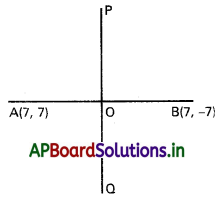
దత్త సంకీర్ణ సంఖ్యలు ఆర్లాండ్ తలంలో A(7, 7); B(7, -7) లను సూచిస్తున్నాయి అనుకుందాం.
AB మధ్యబిందువు O
AP Inter 2nd Year Maths 2A Solutions Chapter 1 సంకీర్ణ సంఖ్యలు Ex 1(d) I Q1(i)
‘O’ నిరూపకాలు \(\left(\frac{7+7}{2}, \frac{7-7}{2}\right)\) = (7, 0)
\(\overleftrightarrow{\mathrm{AB}}\) వాలు = \(\frac{7+7}{7-7}=\frac{14}{0}\) = ∞
\(\overline{\mathrm{AB}}\) రేఖ అక్షానికి సమాంతరంగా ఉంది.
\(\overline{\mathrm{PQ}} \perp \overline{\mathrm{AB}}\)
\(\overleftrightarrow{\mathrm{PQ}}\) రేఖ X-అక్షానికి సమాంతరంగా ఉంది.
\(\overline{\mathrm{PQ}}\) వాలు = 0
\(\overrightarrow{\mathrm{PQ}}\) సమీకరణం y – 0 = 0(x – 7)
y = 0

(ii) ఆర్లాండ్ తలంలో (-9 + 6i), (11 – 4i) బిందువులను కలిపే సరళరేఖ సమీకరణాన్ని కనుక్కోండి.
సాధన:
(-9 + 6i), (11 – 4i) లు ఆర్లాండ్ తలంలో సూచించే బిందువులు. (-9, 6), B(11, -4).
\(\overleftrightarrow{\mathrm{AB}}\) రేఖా సమీకరణం
⇒ y – y1 = \(\left(\frac{y_2-y_1}{x_2-x_1}\right)\) (x – x1)
⇒ y – 6 = \(\left(\frac{-4-6}{11+9}\right)\) (x + 9)
⇒ y – 6 = \(-\frac{1}{2}\)(x + 9)
⇒ 2y – 12 = -x – 9
⇒ x + 2y – 3 = 0

AP Inter 2nd Year Maths 2A Solutions Chapter 1 సంకీర్ణ సంఖ్యలు Ex 1(d)

ప్రశ్న 2.
z = x + iy అవుతూ, P బిందువు ఆర్గాండ్ సమతలంలో z ను సూచిస్తుంటే, క్రింది సమీకరణాలను తృప్తిపరచే z బిందుపథాన్ని కనుక్కోండి.
(i) |z – 2 – 3i| = 5
సాధన:
z = x + iy, |z – 2 – 3i| = 5
|z – 2 – 3i| = 5
⇒ \(|x+i \overline{y-2}-3 i|=5\)
⇒ |(x – 2) + (y – 3)| = 5
⇒ \(\sqrt{(x-2)^2+(y-3)^2}=5\)
⇒ (x – 2)2 + (y – 3)2 = 25
⇒ x2 – 4x + 4 + y2 – 6y + 9 = 25
∴ P బిందుపథం x2 + y2 – 4x – 6y – 12 = 0

(ii) 2|z – 2| = |z – 1|
సాధన:
2|z – 2| = |z – 1|
⇒ 2|x + iy – 2| = |x + iy – 1|
⇒ 2(x – 2) + iy| = |(x – 1) + iy|
⇒ \(2 \sqrt{(x-2)^2+y^2}=\sqrt{(x-1)^2+y^2}\)
ఇరువైపులా వర్గం చేయగా
⇒ 4[(x – 2)2 + y2] = (x – 1)2 + y2
⇒ 4(x2 – 4x + 4 + y2) = x2 – 2x + 1 + y2
⇒ 4x2 + 4y2 – 16x + 16 = x2 + y2 – 2x + 1
∴ P బిందుపథం 3x2 + 3y2 – 14x + 15 = 0

(iii) Img z2 = 4
సాధన:
Img z2 = 4
∵ z = x + iy
⇒ z2 = (x + iy)2 = x2 + i2y2 + 2ixy = (x2 – y2) + i(2xy)
∴ Img (z2) = 2xy = 4
∴ P బిందుపథం xy = 2

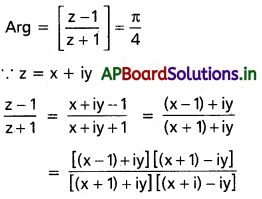
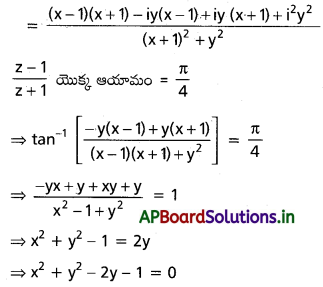
(iv) \({Arg}\left|\frac{z-1}{z+1}\right|=\frac{\pi}{4}\)
సాధన:
AP Inter 2nd Year Maths 2A Solutions Chapter 1 సంకీర్ణ సంఖ్యలు Ex 1(d) I Q2(iv)
AP Inter 2nd Year Maths 2A Solutions Chapter 1 సంకీర్ణ సంఖ్యలు Ex 1(d) I Q2(iv).1

ప్రశ్న 3.
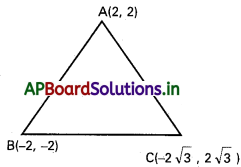
ఆర్లాండ్ సమతలంలో 2 + 2i, -2 – 2i, 2√3 + 2√3i లను సూచించే బిందువులతో ఏర్పడే త్రిభుజం సమబాహు త్రిభుజమని చూపండి. (May ’07)
సాధన:
ఇచ్చిన సంకీర్ణ సంఖ్యలు ఆర్గాండ్ తలంలో A(2, 2), B(-2, -2), C(-2√3, 2√3) లను సూచిస్తున్నాయి అనుకుందాం.
AP Inter 2nd Year Maths 2A Solutions Chapter 1 సంకీర్ణ సంఖ్యలు Ex 1(d) I Q3
AB2 = (2 + 2)2 + (2 + 2)2
= 16 + 16
= 32
BC2 = (-2 + 2√3)2 + (-2 – 2√3)2
= 4 + 12 – 8√3 + 4 + 12 + 8√3
= 32
AC2 = (-2√3 – 2)2 + (2√3 – 2)2
= 12 + 4 + 8√3 +12 +4 – 8√3
= 32
AB2 = BC2 = AC2
⇒ AB = BC = CA
∴ ∆ABC సమబాహు త్రిభుజంను సూచిస్తుంది.

AP Inter 2nd Year Maths 2A Solutions Chapter 1 సంకీర్ణ సంఖ్యలు Ex 1(d)

ప్రశ్న 4.
|z – 4| + \(\left|z-\frac{12}{5}\right|\) = 10 సమీకరణం ద్వారా సూచించే దీర్ఘవృత్త యొక్క ఉత్కేంద్రతను కనుక్కోండి.
సాధన:
SP + S’P = 2a
S = (4, 0)
S’ = (\(\frac{12}{5}\), 0)
2a = 10
a = 5
SS’ = 2ae
4 – \(\frac{12}{5}\) = 2 × 5e
\(\frac{8}{5}\) = 10e
e = \(\frac{4}{25}\)

II.

ప్రశ్న 1.
\(\frac{z_3-z_1}{z_2-z_1}\) ఒక వాస్తవ సంఖ్య అయినప్పుడు z1, z2, z3 సంకీర్ణ సంఖ్యలను సూచించే బిందువులు సరేఖీయాలని చూపండి.
సాధన:
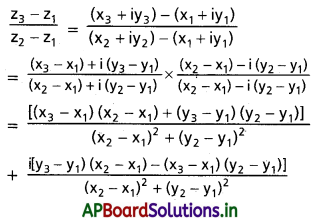
z1 = x1 + iy1, z2 = x2 + iy2, z3 = x3 + iy3 అనుకుందాం.
AP Inter 2nd Year Maths 2A Solutions Chapter 1 సంకీర్ణ సంఖ్యలు Ex 1(d) II Q1
\(\frac{z_3-z_1}{z_2-z_1}\) ఒక వాస్తవ సంఖ్య కనుక దాని సంకీర్ణ భాగం సున్నా కావాలి.
⇒ (y3 – y1) (x2 – x1) – (x3 – x1) (y2 – y1) = 0
⇒ (y3 – y1) (x2 – x1) = (x3 – x1) (y2 – y1)
\(\frac{y_3-y_1}{x_3-x_1}=\frac{y_2-y_1}{x_2-x_1}\)
A(x1, y1), B(x2, y2), C(x3, y3) బిందువులు
z1, z2, z3 లను సూచిస్తున్నాయి.
\(\stackrel{\leftrightarrow}{\mathrm{AC}}\) వాలు = \(\stackrel{\leftrightarrow}{\mathrm{AB}}\) వాలు
∴ A, B, C లు సరేఖీయాలు.

ప్రశ్న 2.
2 + i, 4 + 3i, 2 + 5i, 3i అనే సంకీర్ణ సంఖ్యలను సూచించే బిందువులు, ఆర్గాండ్ సమతలంలో ఒక చతురస్ర శీర్షాలను తెలుపుతాయని చూపండి.
సాధన:
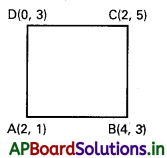
A(2, 1), B(4, 3), C(2, 5), D(0, 3) లు ఆర్లాండ్ సమతలంలో దత్త సంకీర్ణ సంఖ్యలను సూచించే బిందువులు.
AP Inter 2nd Year Maths 2A Solutions Chapter 1 సంకీర్ణ సంఖ్యలు Ex 1(d) II Q2
AB2 = (2 – 4)2 + (1 – 3)2 = 4 + 4 = 8
BC2 = (4 – 2)2 + (3 – 5)2 = 4 + 4 = 8
CD2 = (2 – 0)2 + (5 – 3)2 = 4 + 4 = 8
DA2 = (0 – 2)2 + (3 – 1)2 = 4 + 4 = 8
AB2 = BC2 = CD2 = DA2
⇒ AB = BC = CD = DA …..(1)
AC2 = (2 – 2)2 + (1 – 5)2 = 0 + 16 = 16
BD2 = (4 – 0)2 + (3 – 3)2 = 16 + 0 = 16
AC2 = BD2
⇒ AC = BD …….(2)
(1), (2) ల నుంచి A, B, C, D లు చతురస్రం శీర్షాలు.

AP Inter 2nd Year Maths 2A Solutions Chapter 1 సంకీర్ణ సంఖ్యలు Ex 1(d)

ప్రశ్న 3.
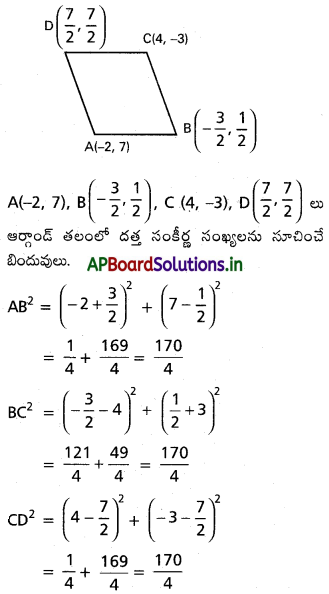
-2 + 7i, \(-\frac{3}{2}+\frac{1}{2}\), 4 – 3i, \(\frac{7}{2}\)(1 + i) అనే సంకీర్ణ సంఖ్యలను సూచించే బిందువులు, ఆర్ఖండ్ తలంలో ఒక సమచతుర్భుజి (రాంబస్) శీర్షాలను సూచిస్తాయని నిరూపించండి. [T.S. Mar ’16, May ’05, Mar. ’05, June ’04]
సాధన:
AP Inter 2nd Year Maths 2A Solutions Chapter 1 సంకీర్ణ సంఖ్యలు Ex 1(d) II Q3
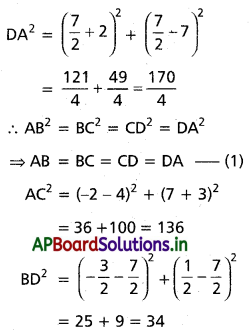
AP Inter 2nd Year Maths 2A Solutions Chapter 1 సంకీర్ణ సంఖ్యలు Ex 1(d) II Q3.1
AC ≠ BD …..(2)
కనుక A, B, C, D లు సమచతుర్భుజి (రాంబస్) శీర్షాలు.

ప్రశ్న 4.
ఆర్గాండ్ తలంలో z1, z2, z3 సంకీర్ణ సంఖ్యలను సూచించే బిందువులు సరేఖీయాలు కావడానికి ఆవశ్యక, పర్యాప్త నియమం pz1 + qz2+ rz3 = 0, p + q + r = 0 లను తృప్తి పరచే అన్ని శూన్యం కాని మూడు వాస్తవ సంఖ్యలు p, q, r లు వ్యవస్థితం అని చూపండి. [Mar. ’07]
సాధన:
pz1 + qz2 + rz3 = 0
⇔ rz3 = -pz1 – qz2
⇔ z3 = \(\frac{-p z_1-q z_2}{r}\)
∵ r ≠ 0
∵ p + q + r = 0
⇔ r = -p – q
⇔ z3 = \(-\frac{\left(p z_1+q z_2\right)}{-(p+q)}\)
⇔ z3 = \(\frac{p z_1+q z_2}{p+q}\)
⇔ z3, z1, z2 లను కలిపే రేఖాఖండాన్ని q : p నిష్పత్తిలో విభజిస్తుంది.
⇔ z1, z2, z3 లు సరేఖీయాలు.

AP Inter 2nd Year Maths 2A Solutions Chapter 1 సంకీర్ణ సంఖ్యలు Ex 1(d)

ప్రశ్న 5.
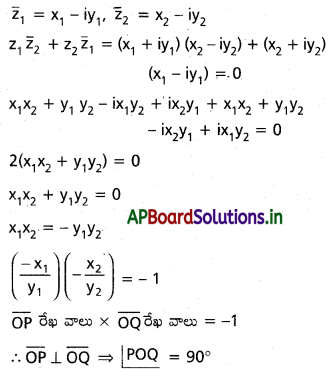
ఆర్గాండ్ సమతలంలో P, Q బిందువులు z1, z2 సంకీర్ణ సంఖ్యలను సూచిస్తున్నాయి. O మూల బిందువు \(z_1 \bar{z}_2+\bar{z}_1 z_2=0\) అయినప్పుడు ∠POQ = 90° అని చూపండి. [Mar. ’07]
సాధన:
z1 = x1 + iy1, z2 = x2 + iy2 అనుకుంటే,
అప్పుడు P(x1, y1), Q(x2, y2), O(0, 0) లు అవుతాయి.
AP Inter 2nd Year Maths 2A Solutions Chapter 1 సంకీర్ణ సంఖ్యలు Ex 1(d) II Q5

ప్రశ్న 6.
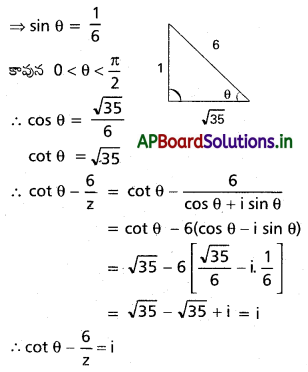
సంకీర్ణ సంఖ్య z ఆయామం θ, 0 < θ < \(\frac{\pi}{2}\) ని కలిగి, అది |z – 3i| = 3 సమీకరణాన్ని తృప్తిపరిస్తే (cot θ – \(\frac{6}{z}\)) = i అని చూపండి.
సాధన:
z = cos θ + i sin θ అనుకొనుము.
ఇచ్చినది |z – 3i| = 3
⇒ |(cos θ + i sin θ) – 3i| = 3
⇒ |cos θ + i(sin θ – 3)| = 3
⇒ \(\sqrt{\cos ^2 \theta+(\sin \theta-3)^2}\) = 3
⇒ cos2θ + sin2θ – 6 sin θ + 9 = 9
⇒ 1 – 6 sin θ = 0
⇒ 6 sin θ = 1
AP Inter 2nd Year Maths 2A Solutions Chapter 1 సంకీర్ణ సంఖ్యలు Ex 1(d) II Q6

AP Inter 2nd Year Maths 2A Solutions Chapter 1 సంకీర్ణ సంఖ్యలు Ex 1(c)

Practicing the Intermediate 2nd Year Maths 2A Textbook Solutions Chapter 1 సంకీర్ణ సంఖ్యలు Exercise 1(c) will help students to clear their doubts quickly.

AP Inter 2nd Year Maths 2A Solutions Chapter 1 సంకీర్ణ సంఖ్యలు Exercise 1(c)

అభ్యాసం 1(సి)

I.

ప్రశ్న 1.
క్రింది సంకీర్ణ సంఖ్యలను మాప – ఆయామ రూపంలో వ్యక్తపరచండి.
(i) 1 – i
సాధన:
1 – i = r(cos θ + i sin θ) అనుకుందాం.
ఇరువైపులా వాస్తవ సంకీర్ణ భాగాలను పోల్చగా
r cos θ = 1
r sin θ = -1
⇒ θ నాల్గవ పాదంలో ఉంది.
వర్గం చేసి కలుపగా
r2(cos2θ + sin2θ) = 1 + 1 = 2
r2 = 2
⇒ r = √2
tan θ = -1 ⇒ θ = π/4
∴ 1 – i = \(\sqrt{2}\left(\cos \left(-\frac{\pi}{4}\right)+i \sin \left(-\frac{\pi}{4}\right)\right)\)

(ii) 1 + i√3 [Mar. ’14]
సాధన:
1 + i√3 = r(cos θ + i sin θ)
r cos θ = 1 …….(1)
r sin θ = √3 ……..(2)
θ మొదటి పాదంలో ఉంది.
వర్గం చేసి (1), (2) లను కలుపగా
r2(cos2θ + sin2θ) = 1 + 3
r2 = 4
⇒ r = 2
(2) ను (1) చే భాగించగా
\(\frac{r \sin \theta}{r \cos \theta}\) = √3
tan θ = √3
⇒ θ = \(\frac{\pi}{3}\)
∴ 1 + i√3 = 2 (cos\(\frac{\pi}{3}\) + i sin\(\frac{\pi}{3}\))

AP Inter 2nd Year Maths 2A Solutions Chapter 1 సంకీర్ణ సంఖ్యలు Ex 1(c)

(iii) -√3 + i
సాధన:
-√3 + i = r(cos θ + i sin θ) అనుకుందాం.
r cos θ = -√3 …..(1)
r sin θ = 1 ……..(2)
⇒ θ రెండో పాదంలో ఉంది.
వర్గం చేసి (1), (2) లను కలుపగా
r2(cos2θ + sin2θ) = 3 + 1 = 4
r2 = 4
⇒ r = 2
(2) ను (1) చే భాగించగా
\(\frac{r \sin \theta}{r \cos \theta}=-\frac{1}{\sqrt{3}}\)
tan θ = \(-\frac{1}{\sqrt{3}}\), θ రెండో పాదంలో ఉంది కనుక
θ = 180° – 30° = 150° = \(\frac{5 \pi}{6}\)
∴ -√3 + i = 2(cos \(\frac{5 \pi}{6}\) + i sin \(\frac{5 \pi}{6}\))

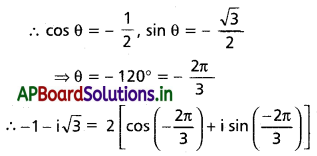
(iv) -1 – i√3
సాధన:
-1 – i√3 = r(cos θ + i sin θ)
వాస్తవ, సంకీర్ణ భాగాలను పోల్చగా
r cos θ = -1, r sin θ = -√3
వర్గం చేసి కలుపగా
r2(cos2θ + sin2θ) = 1 + 3
r2 = 4
⇒ r = 2
AP Inter 2nd Year Maths 2A Solutions Chapter 1 సంకీర్ణ సంఖ్యలు Ex 1(c) I Q1(iv)

ప్రశ్న 2.
-2i(3 + i) (2 + 4i) (1 + i) ను సూక్ష్మీకరించి, ఆ సంకీర్ణ సంఖ్య మాపాన్ని రాబట్టండి.
సాధన:
-2i(3 + i) (2 + 4i) (1 + i)
= (-6i – 2i2) (2 + 2i + 4i + 4i2)
= (2 – 6i) (-2 + 6i)
= -4 + 12 – 36i2 + 12i
= 32 + 24i
= 8(4 + 3i)
మాపం = |8(4 + 3i)| = \(8 \sqrt{(4)^2+(3)^2}\)
= 8(5)
= 40

AP Inter 2nd Year Maths 2A Solutions Chapter 1 సంకీర్ణ సంఖ్యలు Ex 1(c)

ప్రశ్న 3.
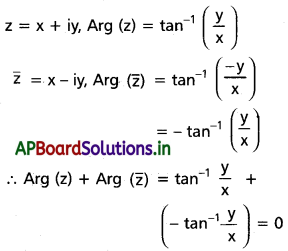
(i) z ≠ 0 అయితే Arg z + Arg \(\overline{\mathbf{Z}}\) ను కనుక్కోండి.
సాధన:
AP Inter 2nd Year Maths 2A Solutions Chapter 1 సంకీర్ణ సంఖ్యలు Ex 1(c) I Q3(i)

(ii) z1 = -1, z2 = -i అయితే Arg(z1z2) ను కనుక్కోండి.
సాధన:
z1 = -1 = cos π + i sin π
⇒ Arg z1 = π
z2 = -i = \(\cos \left(-\frac{\pi}{2}\right)+i \sin \left(-\frac{\pi}{2}\right)\)
⇒ Arg z2 = -π/2
Arg(z1z2) = Arg z1 + Arg z2
= π – \(\frac{\pi}{2}\)
= \(\frac{\pi}{2}\)

(iii) z1 = -1, z2 = i అయితే \({Arg}\left(\frac{z_1}{z_2}\right)\) ను కనుక్కోండి. [T.S. Mar ’16, May ’11]
సాధన:
z1 = -1 = cos π + i sin π
⇒ Arg z1 = π
z2 = i = cos\(\frac{\pi}{2}\) + i sin\(\frac{\pi}{2}\)
⇒ Arg z2 = \(\frac{\pi}{2}\)
\({Arg}\left(\frac{z_1}{z_2}\right)\) = Arg z1 – Arg z2
= π – \(\frac{\pi}{2}\)
= \(\frac{\pi}{2}\)

ప్రశ్న 4.
(i) (cos 2α + i sin 2α) (cos 2β + i sin 2β) = cos θ + i sin θ అయితే θ విలువను కనుక్కోండి.
సాధన:
cos θ + i sin θ = (cos 2α + i sin 2α) (cos 2β + i sin 2β)
= cos 2α . cos 2β + i sin 2α . cos 2β + i cos 2α sin 2β + i2 sin 2α . sin 2β
= (cos 2α . cos 2β – sin 2α . sin 2β) + i(sin 2α cos 2β + cos 2α sin 2β)
= cos 2(α + β) + i . sin 2(α + β)
∴ θ = 2(α + β)

(ii) √3 + i = r (cos θ + i sin θ), అయితే θ విలువను రేడియన్లలో కనుక్కోండి.
సాధన:
∴ √3 + i = r(cos θ + i sin θ)
⇒ r cos θ = √3, r sin θ = 1
⇒ r2(cos2θ + sin2θ) = 3 + 1
⇒ r2 = 4
⇒ r = 2
∴ cos θ = \(\frac{\sqrt{3}}{2}\), sin θ = \(\frac{1}{2}\)
⇒ θ = \(\frac{\pi}{6}\)

AP Inter 2nd Year Maths 2A Solutions Chapter 1 సంకీర్ణ సంఖ్యలు Ex 1(c)

(iii) x + iy = cis α . cis β and x2 + y2 విలువను కనుక్కోండి.
సాధన:
x + iy = cis α . cis β
⇒ x + iy = (cos α + i sin α) (cos β + i sin β)
⇒ x + iy = cos(α + β) + i sin(α + β)
వాస్తవ భాగాలను, సంకీర్ణ భాగాలను పోల్చిన
x = cos(α + β), y = sin(α + β)
∴ x2 + y2 = cos2(α + β) + sin2(α + β) = 1

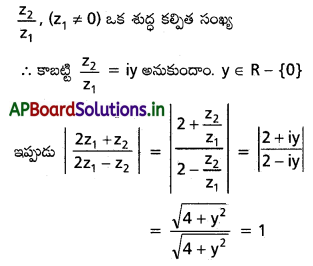
(iv) \(\frac{z_2}{z_1}\), (z1 ≠ 0) ఒక శుద్ధ కల్పిత సంఖ్య అయితే, \(\left|\frac{2 z_1+z_2}{2 z_1-z_2}\right|\) విలువను కనుక్కోండి.
సాధన:
AP Inter 2nd Year Maths 2A Solutions Chapter 1 సంకీర్ణ సంఖ్యలు Ex 1(c) I Q4(iv)

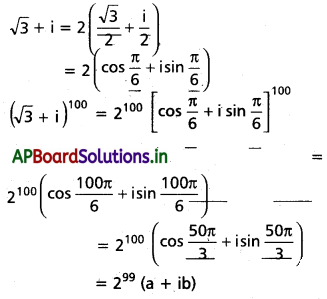
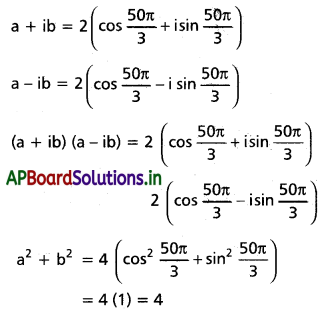
(v) (√3 + i)100 = 299 (a + ib) అయితే a2 + b2 = 4 అని చూపండి. [A.P Mar ’16]
సాధన:
AP Inter 2nd Year Maths 2A Solutions Chapter 1 సంకీర్ణ సంఖ్యలు Ex 1(c) I Q4(v)
AP Inter 2nd Year Maths 2A Solutions Chapter 1 సంకీర్ణ సంఖ్యలు Ex 1(c) I Q4(v).1

ప్రశ్న 5.
(i) z = x + iy, |z| = 1 అయితే z బిందుపథాన్ని కనుక్కోండి.
సాధన:
|z| = 1
\(\sqrt{x^2+y^2}\) = 1
⇒ x2 + y2 = 1
z బిందుపథం x2 + y2 = 1

(ii) (z – 1) యొక్క ఆయామం \(\frac{\pi}{2}\) అయితే, z యొక్క బిందుపథాన్ని కనుక్కోండి. [May ’07]
సాధన:
z – 1 = x + iy – 1 = (x – 1) + iy
(z – 1) ఆయామం \(\frac{\pi}{2}\) కావున
వాస్తవ భాగం శూన్యం
⇒ x – 1 = 0
∴ z బిందుపథం x – 1 = 0

AP Inter 2nd Year Maths 2A Solutions Chapter 1 సంకీర్ణ సంఖ్యలు Ex 1(c)

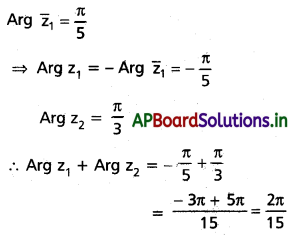
(iii) Arg \(\overline{\mathbf{z}}_1\), Arg z2 లు వరుసగా \(\frac{\pi}{5}, \frac{\pi}{3}\) అయితే (Arg z1 + Arg z2) ను కనుక్కోండి. [A.P Mar ’16]
సాధన:
AP Inter 2nd Year Maths 2A Solutions Chapter 1 సంకీర్ణ సంఖ్యలు Ex 1(c) I Q5(iii)

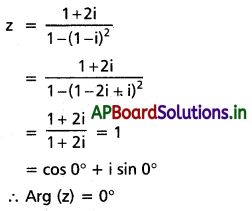
(iv) z = \(\frac{1+2 i}{1-(1-i)^2}\) అయితే Arg(z) ను కనుక్కోండి.
సాధన:
AP Inter 2nd Year Maths 2A Solutions Chapter 1 సంకీర్ణ సంఖ్యలు Ex 1(c) I Q5(iv)

II.

ప్రశ్న 1.
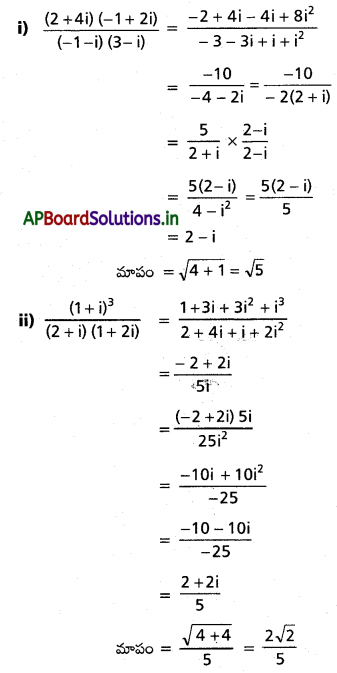
క్రింది సంకీర్ణ సంఖ్యలను సూక్ష్మీకరించి, వాటి మాపాన్ని కనుక్కోండి.
(i) \(\frac{(2+4 i)(-1+2 i)}{(-1-i)(3-i)}\)
(ii) \(\frac{(1+i)^3}{(2+i)(1+2 i)}\)
సాధన:
AP Inter 2nd Year Maths 2A Solutions Chapter 1 సంకీర్ణ సంఖ్యలు Ex 1(c) II Q1

ప్రశ్న 2.
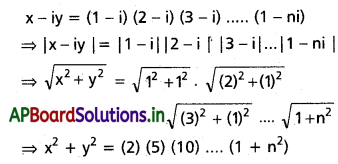
(i) (1 – i) (2 – i) (3 – i)…. (1 – ni) = x – iy, అయితే 2.5.10 …. (1 + n2) = x2 + y2 అని చూపండి.
సాధన:
AP Inter 2nd Year Maths 2A Solutions Chapter 1 సంకీర్ణ సంఖ్యలు Ex 1(c) II Q2(i)

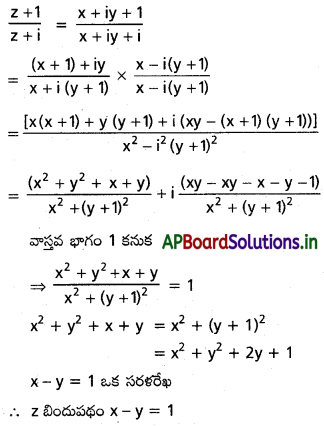
(ii) \(\frac{z+1}{z+i}\) యొక్క వాస్తవ భాగం 1 అయితే z యొక్క బిందుపథాన్ని కనుక్కోండి.
సాధన:
AP Inter 2nd Year Maths 2A Solutions Chapter 1 సంకీర్ణ సంఖ్యలు Ex 1(c) II Q2(ii)

(iii) |z – 3 + i| = 4 అయితే z బిందుపథాన్ని నిర్ధారించండి. [Mar. ’14; May ’08]
సాధన:
|z – 3 + i| = 4
|x + iy – 3 + i = 4
(x – 3) + (y + 1)| = 4
\(\sqrt{(x-3)^2+(y+1)^2}\) = 4
∴ z బిందుపథం (x – 3)2 + (y + 1)2 = 16
x2 – 6x + 9 + y2 + 2y + 1 – 16 = 0
x2 + y2 – 6x + 2y – 6 = 0

(iv) |z + ai| = |z – ai| అయితే z బిందుపథాన్ని కనుక్కోండి.
సాధన:
|z + ai| = |z – ai|
|x + iy + ai| = |x + iy – ai|
|x + i(y + a)| = |x + i(y – a)|
\(\sqrt{x^2+(y+a)^2}=\sqrt{x^2+(y-a)^2}\)
x2 + (y + a)2 = x2 + (y – a)2
(y + a)2 – (y – a)2 = 0
i.e., 4ay = 0
⇒ y = 0
z బిందుపథం y = 0

AP Inter 2nd Year Maths 2A Solutions Chapter 1 సంకీర్ణ సంఖ్యలు Ex 1(c)

ప్రశ్న 3.
z = x + iy అయి, P బిందువు ఆర్గాండ్ తలంలో z ని సూచిస్తుంటే, క్రింది సమీకరణాలను తృప్తిపరచే, z బిందు పథాన్ని కనుక్కోండి.
(i) |2z – 3| = 7
సాధన:
|2z – 3| = 7
z = x + iy
⇒ |2z – 3| = 7
⇒ |2(x + iy) – 3| = 7
⇒ (2x – 3) + 2(iy)| = 7
⇒ \(\sqrt{(2 x-3)^2+4 y^2}\) = 7
P బిందుపథం (2x – 3)2 + 4y2 = 49
⇒ 4x2 + 9 – 12x + 4y2 – 49 = 0
⇒ 4x2 + 4y2 – 12x – 40 = 0
(i.e,) x2 + y2 – 3x – 10 = 0
∴ z యొక్క బిందుపథం x2 + y2 – 3x – 10 = 0
ఈ సమీకరణం వృత్తాన్ని సూచిస్తుంది.
కేంద్రం = (\(\frac{3}{2}\), 0)
వ్యాసార్ధం = \(\sqrt{\frac{9}{4}-(-10)}\)
= \(\sqrt{\frac{9+40}{4}}\)
= \(\frac{7}{2}\) యూనిట్లు

(ii) z2 = 4 Re (z + 2)
సాధన:
z = x + iy, |z|2 = 4 Re (z + 2)
⇒ |x + iy|2 = 4 Re (x + iy + 2)
⇒ \(\left(\sqrt{x^2+y^2}\right)^2\) = 4 Re (x + 2 + iy)
⇒ (x2 + y2) = 4(x + 2)
⇒ x2 + y2 – 4x – 8 = 0
ఇదియే P బిందుపథం.
ఈ సమీకరణం వృత్తాన్ని సూచిస్తుంది.
కేంద్రం = (2, 0)
వ్యాసార్థం = \(\sqrt{4-(-8)}\) = √12 = 2√3 యూనిట్లు

(iii) |z + i|2 – |z – i|2 = 2
సాధన:
z = x + iy
|z + i|2 – |z – i|2 = 2
⇒ |x + iy + i|2 – |x + iy – i|2 = 2
⇒ x + i(y + 1)2 – |x + (y – 1)|2 = 2
⇒ \(\left[\sqrt{x^2+(y+1)^2}\right]^2-\left[\sqrt{x^2+(y-1)^2}\right]^2\) = 2
⇒ x2 + (y + 1)2 – (x2 + (y – 1)2) = 2
⇒ (y + 1)2 – (y – 1)2 = 2
⇒ 4y = 2
⇒ 2y = 1
P బిందుపథం 2y – 1 = 0
ఈ సమీకరణం X- అక్షానికి సమాంతరంగా గల సరళరేఖ.

AP Inter 2nd Year Maths 2A Solutions Chapter 1 సంకీర్ణ సంఖ్యలు Ex 1(c)

(iv) |z + 4i| + |z – 4i| = 10
సాధన:
z = x + iy
∵ |z + 4i| + |z – 4i| = 10
⇒ |x + iy + 4i| + |x + iy – 4i| = 10
⇒ |x + i(y + 4)| + |x + (y – 4)i| = 10
⇒ \(\sqrt{x^2+(y+4)^2}+\sqrt{x^2+(y-4)^2}\) = 10
⇒ \(\sqrt{x^2+(y+4)^2}=10-\sqrt{x^2+(y-4)^2}\)
ఇరువైపులా వర్గం చేయగా
⇒ x2 + (y + 4)2 = \(\left[10-\sqrt{x^2+(y-4)^2}\right]^2\)
⇒ x2 + (y + 4)2 = 100 + x2 + (y – 4)2 – 20\(\sqrt{x^2+(y-4)^2}\)
⇒ (y + 4)2 – (y – 4)2 – 100 = -20\(\sqrt{x^2+(y-4)^2}\)
⇒ 4 (y) (4) – 100 = -20\(\sqrt{x^2+(y-4)^2}\)
⇒ 4(4y – 25) = -20\(\sqrt{x^2+(y-4)^2}\)
⇒ (4y – 25) = -5\(\sqrt{x^2+(y-4)^2}\)
మరల వర్గం చేయగా (4y – 25)2 = 25[x2 + (y – 4)2]
16y2 + 625 – 200y = 25x2 + 25y2 – 200y + 400
25x2 + 9y2 = 225
∴ P బిందుపథం 25x2 + 9y2 = 225
\(\frac{x^2}{9}+\frac{y^2}{25}=1\)
ఈ సమీకరణం దీర్ఘవృత్తాన్ని సూచిస్తుంది.
a2 = 9, b2 = 25
a2 = b2 (1 – e2)
⇒ 9 = 25 (1 – e2)
⇒ 1 – e2 = \(\frac{9}{25}\)
e2 = 1 – \(\frac{9}{25}\) = \(\frac{16}{25}\)
∴ ఉత్కేంద్రత = \(\frac{4}{5}\) మరియు దీర్ఘాక్షం y – అక్షానికి సమాంతరంగా ఉండును.

ప్రశ్న 4.
(i) z1, z2 లు రెండు శూన్యేతర సంకీర్ణ సంఖ్యలు మరియు |z1 + z2| = |z1| + |z2| అయితే Arg z1 – Arg z2 = 0 అని చూపండి.
సాధన:
z1 + z2 = (x1 + iy1) + (x2 + iy2) = (x1 + x2) + i(y1 + y2)
|z1 + z2| = \(\sqrt{\left(x_1+x_2\right)^2+\left(y_1+y_2\right)^2}\)
(దత్తాంశం నుండి) |z1 + z2| = |z2| + |z2|
AP Inter 2nd Year Maths 2A Solutions Chapter 1 సంకీర్ణ సంఖ్యలు Ex 1(c) II Q4(i)
AP Inter 2nd Year Maths 2A Solutions Chapter 1 సంకీర్ణ సంఖ్యలు Ex 1(c) II Q4(i).1

AP Inter 2nd Year Maths 2A Solutions Chapter 1 సంకీర్ణ సంఖ్యలు Ex 1(c)

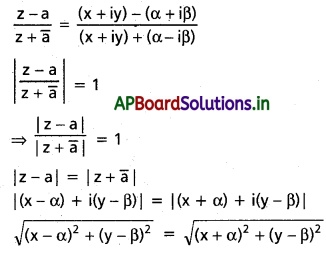
(ii) z = x + iy ఆర్గాండ్ తలంలో P బిందువు z ని సూచిస్తుంది. \(\left|\frac{\mathbf{z}-\mathbf{a}}{\mathbf{z}+\overline{\mathbf{a}}}\right|\) = 1, వాస్తవ (a) ≠ 0 అయితే P బిందు
పథాన్ని కనుక్కోండి.
సాధన:
z = x + iy, a = α + iβ అనుకుందాం.
AP Inter 2nd Year Maths 2A Solutions Chapter 1 సంకీర్ణ సంఖ్యలు Ex 1(c) II Q4(ii)
(x – α)2 + (y – β)2 = (x + α)2 + (y – β)2
⇒ (x – α)2 = (x + α)2
⇒ (x + α)2 – (x – α)2 = 0
⇒ 4αx = 0
Re(a) ≠ 0 ⇒ α ≠ 0
⇒ x = 0
∴ P బిందుపథం x = 0 i.e., Y-అక్షం.

AP Inter 2nd Year Maths 2A Solutions Chapter 1 సంకీర్ణ సంఖ్యలు Ex 1(b)

Practicing the Intermediate 2nd Year Maths 2A Textbook Solutions Chapter 1 సంకీర్ణ సంఖ్యలు Exercise 1(b) will help students to clear their doubts quickly.

AP Inter 2nd Year Maths 2A Solutions Chapter 1 సంకీర్ణ సంఖ్యలు Exercise 1(b)

అభ్యాసం 1(బి)

I.

ప్రశ్న 1.
క్రింది సంకీర్ణ సంఖ్యలను a + ib రూపంలో వ్రాయండి.
(i) (2 – 3i) (3 + 4i)
సాధన:
(2 – 3i) (3+ 4i) = 6 + 8i – 9i – 12i2
= (6 + 12) – i
= 18 – i
= 18 + i(-1)

(ii) (1 + 2i)3
సాధన:
(1 + 2i)3 = 1 + 3(2i) + 3(2i)2 + (2i)3
= 1 + 6i + 3(-4) + 8i3
= 1 + 6i – 12 – 8i
= -11 – 2i
= -11 + i(-2)

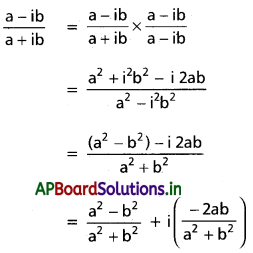
(iii) \(\frac{a-i b}{a+i b}\)
సాధన:
AP Inter 2nd Year Maths 2A Solutions Chapter 1 సంకీర్ణ సంఖ్యలు Ex 1(b) I Q1(iii)

(iv) \(\frac{4+3 i}{(2+3 i)(4-3 i)}\)
సాధన:
(2 + 3i) (4 – 3i) = 8 – 6i + 12i – 9i2 = 17 + 6i
AP Inter 2nd Year Maths 2A Solutions Chapter 1 సంకీర్ణ సంఖ్యలు Ex 1(b) I Q1(iv)

(v) (-√3 + √-2) (2√3 – i)
సాధన:
(-√3 + √-2) (2√3 – i)
= (-√3 + i√2) (2√3 – i)
= -6 + i√3 + i 2√6 + √2
= (-6 + √2) + i(√3 + 2√6)

AP Inter 2nd Year Maths 2A Solutions Chapter 1 సంకీర్ణ సంఖ్యలు Ex 1(b)

(vi) -5i (\(\frac{i}{8}\))
సాధన:
-5i (\(\frac{i}{8}\)) = \(\frac{-5 i^2}{8}\)
= \(\frac{5}{8}\)
= \(\frac{5}{8}\) + i(0)

(vii) (-i) (2i)
సాధన:
(-i) (2i) = -2i2
= (-2) (-1)
= 2
= 2 + i(0)

(viii) i9
సాధన:
i9 = (i8) (i)
= (i2)4 i
= (-1)4 i
= i
= 0 + i(1)

(ix) i-19
సాధన:
AP Inter 2nd Year Maths 2A Solutions Chapter 1 సంకీర్ణ సంఖ్యలు Ex 1(b) I Q1(ix)

(x) 3(7 + 7i) + i(7 + 7i)
సాధన:
3(7 + 7i) + i(7 + 7i)
= 21 + 21i + 7i + 7i2
= 21 + 28i + 7(-1)
= 14 + 28i
= 14 + i(28)

AP Inter 2nd Year Maths 2A Solutions Chapter 1 సంకీర్ణ సంఖ్యలు Ex 1(b)

(xi) \(\frac{2+5 i}{3-2 i}+\frac{2-5 i}{3+2 i}\)
సాధన:
AP Inter 2nd Year Maths 2A Solutions Chapter 1 సంకీర్ణ సంఖ్యలు Ex 1(b) I Q1(xi)

ప్రశ్న 2.
క్రింది సంకీర్ణ సంఖ్యలకు సంయుగ్మాలను వ్రాయండి.
(i) 3 + 4i
సాధన:
3 + 4i కు సంయుగ్మ సంకీర్ణ సంఖ్య 3 – 4i

(ii) (15 + 3i) – (4 – 20i)
సాధన:
(15 + 3i) – (4 – 20i)
= 15 + 3i – 4 + 20i
= 11 + 23i
దాని సంయుగ్మ సంకీర్ణ సంఖ్య = 11 – 23i

(iii) (2 + 5i) (-4 + 6i)
సాధన:
(2 + 5i) (-4 + 6i)
= -8 + 12i – 20i + 30i2
= -38 – 8i
దాని సంయుగ్మ సంకీర్ణ సంఖ్య = -38 + 8i

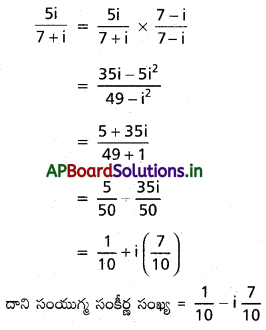
(iv) \(\frac{5 \mathbf{i}}{\mathbf{7 + i}}\)
సాధన:
AP Inter 2nd Year Maths 2A Solutions Chapter 1 సంకీర్ణ సంఖ్యలు Ex 1(b) I Q2(iv)

ప్రశ్న 3.
క్రింది వాటిని సూక్ష్మీకరించండి.
(i) i2 + i4 + i6 + (2n + 1) + ….. పదాల వరకు
సాధన:
i2 + i4 = -1 + (-1)2 = 0
ఇదే విధంగా i6 + i8 = (i2)3 + (i2)4
= (-1)3 + (-1)4
= -1 + 1
= 0
(i.e..) రెండు వరుస పదాల మొత్తం… = 0
∴ చివరి పదం (i2)2n+1 = (-1)2n+1 = -1
∴ i2 + i4 + i6 + …..(2n + 1) పదాలు = -1

(ii) i18 + 3 . i7 + i2 (1 + i4) (-i26)
సాధన:
i18 = i16 . i2
= (i4)4 i2
= 1(-1)
= -1
i7 = i4 . i2 . i = 1(-1) i = -i
i4 = 1
(-i)26 = i26
= i24 . i2
= (i4)6 . i2
= i6(-1)
= -1
i18 – 3i7 + i2 (1 + i4) (-i)26
= 1 – 3(-i)(-1)(1 + 1) (-1)
= -1 + 3i + 2
= 1 + 3i

AP Inter 2nd Year Maths 2A Solutions Chapter 1 సంకీర్ణ సంఖ్యలు Ex 1(b)

ప్రశ్న 4.
క్రింది సంకీర్ణ సంఖ్యలకు వర్గమూలాలను కనుక్కోండి.
(i) 7 + 24i
సాధన:
\(\sqrt{7+24 i}\) = ±(a + ib)
ఇరువైపులా వర్గం చేయగా
7 + 24i = (a + ib)2
= a2 + i2b2 + 2iab
= a2 – b2 + 2iab
వాస్తవ, సంకీర్ణ భాగాలను పోల్చగా
a2 – b2 = 7 …….(1)
2ab = 24 ……(2)
(a2 + b2)2 = (a2 – b2)2 + 4a2b2
= 49 + 576
= 625
a2 + b2 = 25 ……(3)
a2 – b2 = 7 …….(1)
కలుపగా 2a2 = 32
⇒ a2 = 16
⇒ a = 4
తీసివేయగా 2b2 = 18
⇒ b2 = 9
⇒ b = 3
\(\sqrt{7+24 i}\) = ±(4 + 3i)

(ii) -8 – 6i
సాధన:
\(\sqrt{-8-6 i}\) = ±(a – ib) అనుకుందాం.
ఇరువైపులా వర్గం చేయగా
-8 – 6i = (a – ib)2
= a2 + i2b2 – 2iab
= a2 – b2 – 2iab
వాస్తవ, సంకీర్ణ భాగాలను పోల్చగా
a2 – b2 = -8 …..(1)
2ab = +6 …….(2)
(a2 + b2)2 = (a2 – b2)2 + 4a2b2
= 64 + 36
= 100
a2 + b2 = 10 ……(3)
a2 – b2 = -8 ……(1)
కలుపగా 2a2 = 2
⇒ a2 = 1
⇒ a = 1
తీసివేస్తే 2b2 = 18
⇒ b2 = 9
⇒ b = 3
\(\sqrt{-8-6 i}\) = (1 – 3i)
∴ -8 – 6i వర్గమూలం = ±(1 – 3i)

(iii) (3 + 4i) [Mar. ’13]
సాధన:
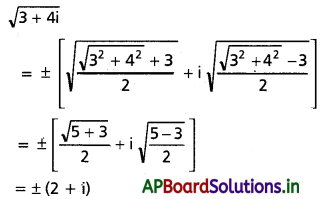
AP Inter 2nd Year Maths 2A Solutions Chapter 1 సంకీర్ణ సంఖ్యలు Ex 1(b) I Q4(iii)

(iv) (-47 + i . 8√3)
సాధన:
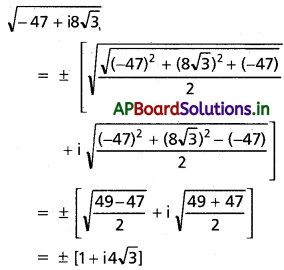
AP Inter 2nd Year Maths 2A Solutions Chapter 1 సంకీర్ణ సంఖ్యలు Ex 1(b) I Q4(iv)

AP Inter 2nd Year Maths 2A Solutions Chapter 1 సంకీర్ణ సంఖ్యలు Ex 1(b)

ప్రశ్న 5.
క్రింది సంకీర్ణ సంఖ్యలకు గుణన విలోమాన్ని కనుక్కోండి.
(i) √5 + 3i
(ii) -i
(iii) i-35
సాధన:
∵ a + ib గుణన విలోమం \(\frac{a-i b}{a^2+b^2}\)
(i) √5 + 3i గుణన విలోమం
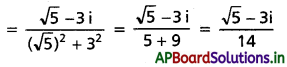
AP Inter 2nd Year Maths 2A Solutions Chapter 1 సంకీర్ణ సంఖ్యలు Ex 1(b) I Q5(i)
(ii) -i గుణన విలోమం = \(\frac{0+i}{1}\) = i
(iii) i-35
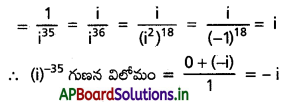
AP Inter 2nd Year Maths 2A Solutions Chapter 1 సంకీర్ణ సంఖ్యలు Ex 1(b) I Q5(iii)

II.

ప్రశ్న 1.
(i) (a + ib)2 = x + iy అయితే x2 + y2 ను కనుక్కోండి.
సాధన:
∵ x + iy = (a + ib)2
= a2 + i2b2 + i2ab
= (a2 – b2) + i(2ab)
ఇరువైపులా వాస్తవ మరియు కల్పిత భాగాలను పోల్చగా
x = a2 – b2, y = 2ab
∴ x2 + y2 = (a2 – b2) + (2ba)2
= a4 + b4 – 2a2b2 + 4a2b2
= a4 + b4 + 2a2b2
= (a2 + b2)2
∴ x2 + y2 = (a2 + b2)2

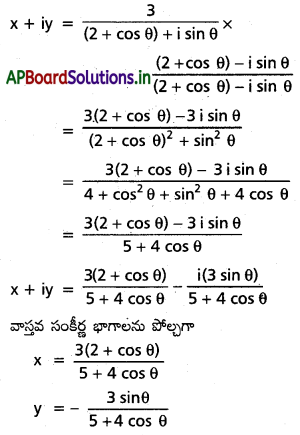
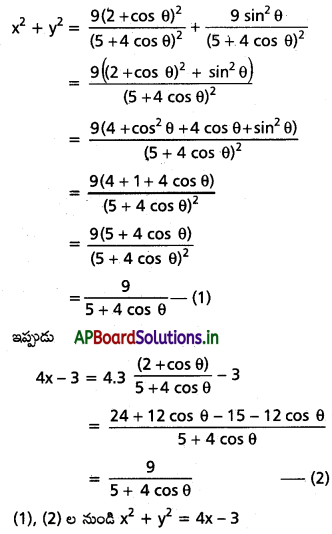
(ii) x + iy = \(\frac{3}{2+\cos \theta+i \sin \theta}\) అయితే x2 + y2 = 4x – 3 అని చూపండి.
సాధన:
AP Inter 2nd Year Maths 2A Solutions Chapter 1 సంకీర్ణ సంఖ్యలు Ex 1(b) II Q1(ii)
AP Inter 2nd Year Maths 2A Solutions Chapter 1 సంకీర్ణ సంఖ్యలు Ex 1(b) II Q1(ii).1

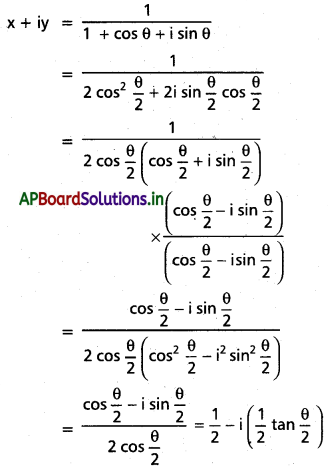
(iii) x + iy = \(\frac{1}{1+\cos \theta+i \sin \theta}\), అయితే 4x2 – 1 = 0 అని చూపండి. [A.P. Mar ’16, Mar. ’06]
సాధన:
AP Inter 2nd Year Maths 2A Solutions Chapter 1 సంకీర్ణ సంఖ్యలు Ex 1(b) II Q1(iii)
వాస్తవ భాగాన్ని పోల్చగా x = \(\frac{1}{2}\)
⇒ 2x = 1
⇒ 4x2 = 1
⇒ 4x2 – 1 = 0

AP Inter 2nd Year Maths 2A Solutions Chapter 1 సంకీర్ణ సంఖ్యలు Ex 1(b)

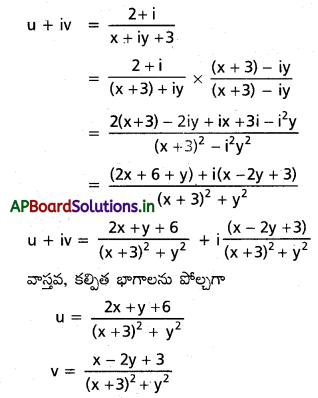
(iv) u + iv = \(\frac{2+i}{z+3}\), z = x + iy, అయితే u, v లను కనుక్కోండి.
సాధన:
AP Inter 2nd Year Maths 2A Solutions Chapter 1 సంకీర్ణ సంఖ్యలు Ex 1(b) II Q1(iv)

ప్రశ్న 2.
(i) z = 3 – 5i అయితే, z3 – 10z2 + 58z – 136 = 0 అని చూపండి.
సాధన:
z = 3 – 5i
z – 3 = -5i
(z – 3)2 = (-5i)2
z2 – 6z + 9 = -25
z2 – 6z + 34 = 0
z3 – 10z2 + 58z – 136 = z(z2 – 6z + 34) – 4z2 + 24z – 136
= z(0) – 4(z2 – 6z + 34)
= 0 – 4(0)
= 0
∴ z3 – 10z2 + 58z – 136 = 0

(ii) z = 2 – i√7 అయితే, 3z3 – 4z2 + z + 88 = 0 అని చూపండి.
సాధన:
∵ z = 2 – i√7
z – 2 = -i√7
(z – 2)2 = (-i√7)2
z2 – 4z + 4 = 7
z2 – 4z + 11 = 0
3z3 – 4z2 + z + 88 = 3z(z2 – 4z +11) + 8z2 – 32z + 88
= 3z(0) + 8(z2 – 4z + 11)
= 0 + 8(0)
= 0

AP Inter 2nd Year Maths 2A Solutions Chapter 1 సంకీర్ణ సంఖ్యలు Ex 1(b)

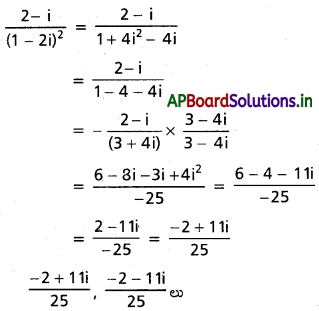
(iii) \(\frac{2-i}{(1-2 i)^2},-\left(\frac{2+11 i}{25}\right)\) లు పరస్పరం సంయుగ్మ సంకీర్ణ సంఖ్యలని చూపండి.
సాధన:
AP Inter 2nd Year Maths 2A Solutions Chapter 1 సంకీర్ణ సంఖ్యలు Ex 1(b) II Q2(iii)
x + iy, x – iy రూపంలో ఉన్నవి.
∴ అవి పరస్పర సంయుగ్మ సంకీర్ణ సంఖ్యలు.

ప్రశ్న 3.
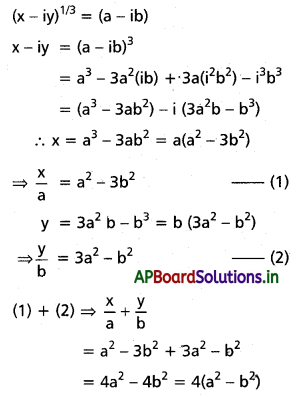
(i) (x – iy)1/3 = a – ib అయితే, \(\frac{x}{a}+\frac{y}{b}\) = 4(a2 – b2) అని చూపండి.
సాధన:
AP Inter 2nd Year Maths 2A Solutions Chapter 1 సంకీర్ణ సంఖ్యలు Ex 1(b) II Q3(i)

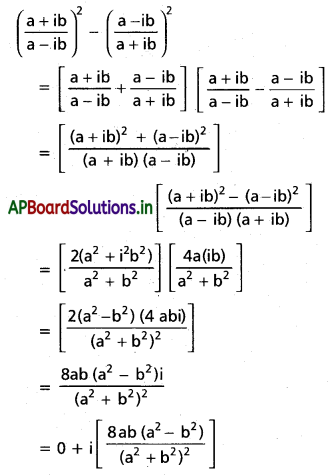
(ii) \(\left(\frac{a+i b}{a-i b}\right)^2-\left(\frac{a-i b}{a+i b}\right)^2\) ను x + iy రూపంలో వ్రాయండి.
సాధన:
AP Inter 2nd Year Maths 2A Solutions Chapter 1 సంకీర్ణ సంఖ్యలు Ex 1(b) II Q3(ii)

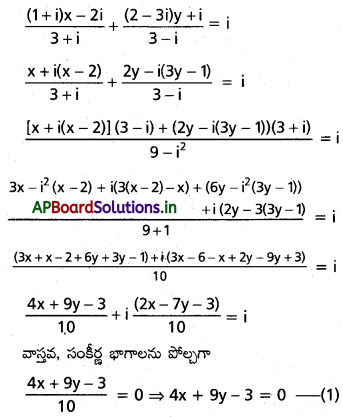
(iii) \(\frac{(1+i) x-2 i}{3+i}+\frac{(2-3 i) y+i}{3-i}=i\) అయ్యేటట్లు x, y వాస్తవసంఖ్యలు అయితే x, y విలువలను నిర్ధారించండి.
సాధన:
AP Inter 2nd Year Maths 2A Solutions Chapter 1 సంకీర్ణ సంఖ్యలు Ex 1(b) II Q3(iii)
AP Inter 2nd Year Maths 2A Solutions Chapter 1 సంకీర్ణ సంఖ్యలు Ex 1(b) II Q3(iii).1

ప్రశ్న 4.
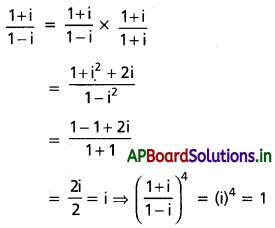
(i) \(\left(\frac{1+i}{1-i}\right)^n=1\) ను తృప్తిపరచే, కనిష్ట ధన పూర్ణాంకం n ను కనుక్కోండి.
సాధన:
AP Inter 2nd Year Maths 2A Solutions Chapter 1 సంకీర్ణ సంఖ్యలు Ex 1(b) II Q4(i)
∴ n యొక్క కనిష్ట ధన పూర్ణాంకం విలువ 4.

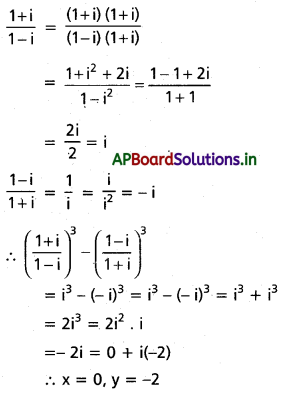
(ii) \(\left(\frac{1+i}{1-i}\right)^3-\left(\frac{1-i}{1+i}\right)^3\) = x + iy అయితే x, y విలువలను కనుక్కోండి.
సాధన:
AP Inter 2nd Year Maths 2A Solutions Chapter 1 సంకీర్ణ సంఖ్యలు Ex 1(b) II Q4(ii)

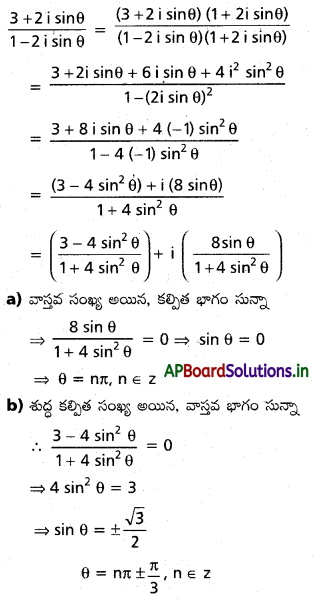
(iii) \(\frac{3+2 i \sin \theta}{1-2 i \sin \theta}\) ఒక (a) వాస్తవ సంఖ్య (b) శుద్ధ కల్పిత సంఖ్య అయినప్పుడు, θ కు వాస్తవ విలువలను కనుక్కోండి.
సాధన:
AP Inter 2nd Year Maths 2A Solutions Chapter 1 సంకీర్ణ సంఖ్యలు Ex 1(b) II Q4(iii)

AP Inter 2nd Year Maths 2A Solutions Chapter 1 సంకీర్ణ సంఖ్యలు Ex 1(b)

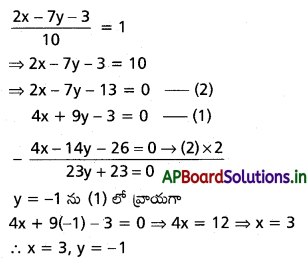
(iv) \(\frac{x-1}{3+i}+\frac{y-1}{3-i}=i\) అయ్యేటట్లు x, y లు వాస్తవ సంఖ్యలు అయితే x, y విలువలను కనుక్కోండి.
సాధన:
\(\frac{x-1}{3+i}+\frac{y-1}{3-i}=i\)
⇒ \(\frac{(x-1)(3-i)+(y-1)(3+i)}{9-i^2}=i\)
⇒ 3x – xi – 3 + i + 3y – iy – 3 – i = 10i
⇒ (3x + 3y – 6) + i(-x + y) = 0 + 10i
వాస్తవ భాగాలను, సంకీర్ణ భాగాలను పోల్చిన
3x + 3y – 6 = 0
⇒ x + y – 2 = 0 …….(1)
-x + y = 10
⇒ x – y + 10 = 0 …….(2)
(1) + (2) ⇒ 2x + 8 = 0
⇒ x = -4
(1) నుండి -4 + y – 2 = 0
⇒ y = 6
∴ x = -4, y = 6

AP Inter 2nd Year Maths 2A Solutions Chapter 1 సంకీర్ణ సంఖ్యలు Ex 1(a)

Practicing the Intermediate 2nd Year Maths 2A Textbook Solutions Chapter 1 సంకీర్ణ సంఖ్యలు Exercise 1(a) will help students to clear their doubts quickly.

AP Inter 2nd Year Maths 2A Solutions Chapter 1 సంకీర్ణ సంఖ్యలు Exercise 1(a)

అభ్యాసం 1(ఎ)

I.

ప్రశ్న 1.
z1 = (2, -1), z2 = (6, 3), and z1 – z2 ను కనుక్కోండి.
సాధన:
∵ z1 = (2, -1), z2 = (6, 3)
z1 – z2 = (2 – 6, -1 – 3) = (-4, -4)

ప్రశ్న 2.
z1 = (3, 5), z2 = (2, 6) అయితే z1 . z2 ను కనుక్కోండి.
సాధన:
z1 = (3, 5) = 3 + 5i
z2 = (2, 6) = 2 + 6i
z1 . z2 = (3 + 5i) . (2 + 6i)
= 6 + 10 + 18i + 30i2 (∵ i2 = -1)
= 6 + 28i + 30(-1)
= -24 + 28i
= (-24, 28)

AP Inter 2nd Year Maths 2A Solutions Chapter 1 సంకీర్ణ సంఖ్యలు Ex 1(a)

ప్రశ్న 3.
క్రింది సంకీర్ణ సంఖ్యల సంకలన విలోమాన్ని వ్రాయండి.
(i) (√3, 5)
(ii) (-6, 5) + (10, -4)
(iii) (2, 1) (-4, 6)
సాధన:
(a, b) కు సంకలన విలోమం (-a, -b) కనుక
(i) (√3, 5)
సంకీర్ణ సంఖ్యకు సంకలన విలోమం (√3, -5)
(ii) (-6, 5) + (10, -4)
= (-6 + 10, 5 + (-4))
= (4, 1)
∴ సంకలన విలోమం (-4, -1)
(iii) (2, 1) . (-4, 6)
= ((2 × -4 – 1 × 6), (1 × -4 + 2 × 6))
= (-8 – 6, -4 + 12)
= (-14, 8)
∴ సంకలన విలోమం (14, -8)

II.

ప్రశ్న 1.
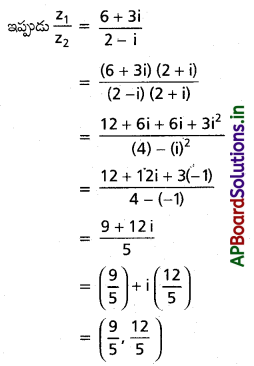
z1 = (6, 3); z2 = (2, -1) అయితే z1/z2 ని కనుక్కోండి.
సాధన:
∵ z1 = (6, 3) = 6 + 3i
z2 = (2, -1) = 2 – i
AP Inter 2nd Year Maths 2A Solutions Chapter 1 సంకీర్ణ సంఖ్యలు Ex 1(a) II Q1

ప్రశ్న 2.
z = (cos θ, sin θ) అయితే (z – \(\frac{1}{z}\)) ని కనుక్కోండి.
సాధన:
∵ z = (cos θ, sin θ) = cos θ + i sin θ
\(\frac{1}{z}\) = cos θ – i sin θ
∴ z – \(\frac{1}{z}\) = (cos θ + i sin θ) – (cos θ – i sin θ)
= 2 i sin θ
= 0 + i(2 sin θ)
= (0, 2 sin θ)

AP Inter 2nd Year Maths 2A Solutions Chapter 1 సంకీర్ణ సంఖ్యలు Ex 1(a)

ప్రశ్న 3.
క్రింది సంకీర్ణ సంఖ్యల గుణన విలోమాన్ని వ్రాయండి.
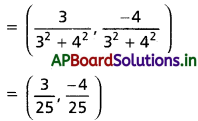
(i) (3, 4)
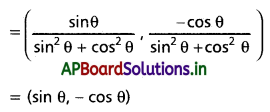
(ii) (sin θ, cos θ)
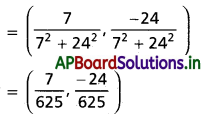
(iii) (7, 24)
(iv) (-2, 1)
సాధన:
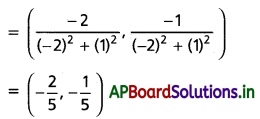
(a, b) సంకీర్ణ సంఖ్యకు గుణన విలోమం = \(\left(\frac{a}{a^2+b^2}, \frac{-b}{a^2+b^2}\right)\)
(i) (3, 4) కు గుణన విలోమం
AP Inter 2nd Year Maths 2A Solutions Chapter 1 సంకీర్ణ సంఖ్యలు Ex 1(a) II Q3
(ii) (sin θ, cos θ) కు గుణన విలోమం
AP Inter 2nd Year Maths 2A Solutions Chapter 1 సంకీర్ణ సంఖ్యలు Ex 1(a) II Q3.1
(iii) (7, 24) కు గుణన విలోమం
AP Inter 2nd Year Maths 2A Solutions Chapter 1 సంకీర్ణ సంఖ్యలు Ex 1(a) II Q3.2
(iv) (-2, 1) కు గుణన విలోమం
AP Inter 2nd Year Maths 2A Solutions Chapter 1 సంకీర్ణ సంఖ్యలు Ex 1(a) II Q3.3

AP SSC 10th Class Social Studies Solutions Chapter 2 Ideas of Development

SCERT AP Board 10th Class Social Solutions 2nd Lesson Ideas of Development Textbook Questions and Answers.

AP State Syllabus SSC 10th Class Social Studies Solutions 2nd Lesson Ideas of Development

10th Class Social Studies 2nd Lesson Ideas of Development Textbook Questions and Answers

Improve your learning

Question 1.
What main criterion is used by the World Bank in classifying different counties? What are the limitations of the above criterion, if any?
Answer:

  1. The main criterion that is used by the World Bank in classifying different countries is per capita income.
  2. It is otherwise called the average income.
  3. It is calculated as the total income of the country divided by the total population.
  4. It Is a better Indicator of development than the total income of the country.
  5. There are limitations in this criterion also.
  6. Average Income may be useful for comparison, it hides disparities.
  7. It does not tell us how the total income is distributed among people.
  8. It does not necessarily convey more equitable distribution.

AP SSC 10th Class Social Studies Solutions Chapter 2 Ideas of Development

Question 2.
Usually, behind each social phenomenon, there would be several contributing factors, and not one. What, in your opinion, are the factors that came together for the development of schooling in Himachal Pradesh?
Answer:
There are so many factors that came together for the development of schooling in Himachal Pradesh. They are:

  1. The development of schooling in Himachal Pradesh is called ‘the schooling revolution in Himachal Pradesh.
  2. The government started schools and made education largely free or cost very little for parents.
  3. It tried to ensure that these schools with minimum facilities like teachers, classrooms, toilets, drinking water etc.
  4. It has the distinction of one of the highest spending states from the government budget on the education of each child.
  5. A welcome trend in Himachal Pradesh is the lower gender bias.
  6. Himachali parents have ambitious educational goals for their girls, just as for boys.
  7. Himachali mothers expect their daughters to work outside the home after marriage.
  8. Schooling, therefore, comes naturally and became a social norm.

Question 3.
In what respect is the criterion used by the UNDP for measuring development different from the one used by the World Bank?
Answer:

  1. The criterion used by the UNDP for measuring development has three factors.
  2. They are:
    • a) to compare countries based on the educational levels of people.
    • b) their health status
    • c) per capita income.
  3. It included health and educational indicators to income.
  4. It termed its report to be Human Development Report.
  5. Whereas the criterion used by the World Bank is per capita income only.
  6. It did not include educational and health indicators.
  7. It termed its report to be World Development Report.
  8. In this way the criteria used by the UNDP and the World Bank for measuring development are different.

AP SSC 10th Class Social Studies Solutions Chapter 2 Ideas of Development

Question 4.
Do you think there are certain other aspects, other than those discussed in the chapter that should be considered in measuring human development?
Answer:

  1. The aspects that are considered in measuring human development are per capita income by World Bank.
  2. Along with per capita income, the education levels of people and health status are considered by the UNDP.
  3. There are other aspects to be considered.
  4. Standard of life is one aspect to be considered.
  5. Another aspect to be considered is the availability of electricity.
  6. Transportation is also one among them.
  7. Sanitation facilities is one such aspect.
  8. Availability of irrigation facilities and housing etc. are few other aspects to be considered in measuring human development.

Question 5.
Why do we use averages? Are there any limitations to their use? Illustrate with your own examples related to development.
Answer:

  1. We use averages for comparison.
  2. Averages are better indicators than total.
  3. There are limitations to their use.
  4. They also hide disparities.
  5. They do not tell us how the total is distributed among people.
  6. They do not necessarily convey more equitable distribution.
  7. Example:
    AP SSC 10th Class Social Studies Solutions Chapter Chapter 2 Ideas of Development 2
  8. Both the countries have the same average income of ₹ 25,000
  9. Country X-has more equitably distributed income.
  10. Country Y has one rich and more poor persons.

AP SSC 10th Class Social Studies Solutions Chapter 2 Ideas of Development

Question 6.
What lessons can you draw about the importance of income from the fact that Himachal Pradesh with lower per capita income has a better human development ranking than Punjab?
Answer:

  1. Both the government and the people of Himachal Pradesh are keen on education.
  2. The government started schools and filled them with minimum facilities like teachers, classrooms, toilets and drinking water, etc.
  3. The government spent the highest on the education of each child.
  4. The people of Himachal Pradesh showed less gender bias.
  5. Himachali women worked outside and had greater say in children’s education, health, birth and upkeep, etc.
  6. Himachali women have high involvement in social life and village politics.
  7. The above were not the same with Punjab.
  8. Thus, even with low per capita income Himachal Pradesh has a better human development ranking than Punjab.

Question 7.
Based on the figures in Table 6, fill the following :

AP SSC 10th Class Social Studies Solutions Chapter Chapter 2 Ideas of Development 1

Out of every 100 girls above 6 years of age, ——– girls had studied beyond the primary level in Himachal Pradesh in the year 1993. By the year 2006, this proportion reached ———- out of 100. For India as a whole, the proportion of boys who had studied beyond the primary level was only ——— out of 100 in the year 2006.
Answer:
Out of every 100 girls above 6 years of age, 39 girls had studied beyond the primary level in Himachal Pradesh in the year 1993. By the year 2006, this proportion reached 60 out of 100. For India as a whole, the proportion of boys who had studied beyond the primary level was only 57 out of 100 in the year 2006.

AP SSC 10th Class Social Studies Solutions Chapter 2 Ideas of Development

Question 8.
What is the per capita income of Himachal Pradesh? Do you think higher incomes can make it easier for parents to send children to school? Discuss. Why was it necessary for the government to run schools in Himachal Pradesh?
Answer:

  1. The per capita income of Himachal Pradesh in 2012 is Rs. 74,000.
  2. Higher-income can make it easier for parents to send their children to school.
  3. If the incomes are meagre, then parents cannot spend money on the education of their children.
  4. Then children ought to supplement with their labour to run the family.
  5. If higher incomes are there for family, these can be avoided.
  6. Himachal Pradesh had very low levels of education at the time of independence.
  7. Being a hilly region, with low density of population in many villages, the spread of schools is a big challenge.
  8. So, it was necessary for the government to run schools in Himachal Pradesh.

Question 9.
Why do you think parents accord less priority to girls education as compared to boys?
Answer:

  1. Parents give less priority to girls education compared to boys.
  2. The main reason behind this is gender bias.
  3. Parents believe that boy is their heir and spreads their clan.
  4. This very notion imbibes into children as father is the decision maker in the family.
  5. As marriage institution provides for the girl to live with husband’s family, her parents take less care about her education.
  6. Well educated girl needed to be married off to still better educated suitor, an expensive affair.
  7. Girls are engaged in taking care of their smaller siblings, which obstructs their educational chances.
  8. In rural areas girls are married off at early ages, which prevents their education.

AP SSC 10th Class Social Studies Solutions Chapter 2 Ideas of Development

Question 10.
What is the relationship between women’s work outside their homes and gender bias?
Answer:

  1. Our families are patriarchial, so men work outside and women manage the house.
  2. For their household chores women are not paid.
  3. But nowadays women are employed outside.
  4. They are economically independent and self-confident.
  5. They have greater say in household decisions including children’s education, health, birth, upkeep etc.
  6. Whereas this is not the case with housewives.
  7. Educated mothers expect their daughters to work outside after marriage.
  8. Thus, women working outside need not bear the dent of gender bias.

(OR)

  1. There is a clear visibility of gender bias at the work places outside homes.
  2. Though men and women do the same kind of work, women are paid less than men.
  3. Especially in the farm activities in rural areas, women wages are very low compared to men.
  4. For some activities we find only men or women attending.
    Eg: Ploughing – men.
    Cotton balls plucking – women.

Question 11.
Right to Education Act, 2009 (RTE) declares that all children of the age of 6 to 14 years have the right to free education. And the government has to ensure the building of sufficient schools in the neighbourhood, appoint properly qualified teachers and make all necessary provisions. In the light of what you have read in this chapter and already know, discuss and debate the importance of this Act for
(i) children, and (ii) human development.
Answer:
Importance of RTE Act for children :

  1. It makes all children have a chance to study.
  2. Children from hilly areas, rural areas and areas with low density of population are not deprived of schools.
  3. Schools are provided with minimum facilities of teachers, classrooms, toilets, drinking water, etc.
  4. Schooling becomes a social norm.
    Importance of RTE Act for human development:
  5. As the UNDP is using the educational levels of people as the measure of development, it promotes human development.
  6. Expected years of schooling will increase in turn promotes human development.
  7. Promotes human development by increasing the average years of schooling.
  8. Education imparts the ideals of human development.

AP SSC 10th Class Social Studies Solutions Chapter 2 Ideas of Development

10th Class Social Studies 2nd Lesson Ideas of Development InText Questions and Answers

10th Class Social Textbook Page No.14

Question 1.
Complete the table with developmental goals of different categories of persons.
AP SSC 10th Class Social Studies Solutions Chapter Chapter 2 Ideas of Development 3
Answer:

Category of PersonDevelopmental Goals/ Aspirations
1. Landless rural labourers1. More days of work and better wages; local school is able to provide quality education for their children; there is no social discrimination and they too can become leaders in the village.
2. Prosperous farmers2. Assured high family income through higher support prices for their crops and through hard- working and cheap labourers; they should be able to settle their children abroad.
3. Farmers who depend only on rain for growing crops3. Monsoon shall bring good rains and make the year good one; crops shall give good yield; Government announce higher minimum support price.
(OR)
Want more facility of water so that they can grow more crops in different seasons.
4. A rural woman from a land owning family4. Government shall provide good irrigation facilities, banks provide crop loans to meet the needs like seeds, fertilisers, pesticides etc., good yield of crop.
(OR)
Women aspire to own land, to inherit land allocation and to build a permanent structure on the land.
5. Urban unemployed youth5. A gainful employment throughout the year; Government’s support to self employment; own vehicle to travel to work place.
6. A boy from a rich urban family6. A hassle-free environment for entreprenuership; a suitable employment inside India or abroad; wholesome entertainment facilities.
7. A girl from a rich urban family7. She gets as much freedom as her brother and is able to decide what she wants to do in life. She would like to be able to pursue her studies abroad.
8. An Adivasi from mining fields8. Accident-free work environment; maintaining good health support; satisfactory remuneration and bonus, schooling for children.
9. Person from fishing community in the coastal area9. Ensured daily catch with good prices; no hindrance from the machine boats; detailed daily weather forecast; protection from natural calamities.

AP SSC 10th Class Social Studies Solutions Chapter 2 Ideas of Development

10th Class Social Textbook Page No.17

Question 2.
Read the newspaper report given on Text Page 16 and answer the following questions.
(i) Who are the people benefited and who did not ?
Answer:

  1. The local company owners and multinational company were the people who benefited.
  2. They dumped their waste without much difficulty.
  3. The innocent people of Abidjan in Ivory Coast suffered from this act.
  4. The fumes from the highly toxic waste caused nausea, skin rashes, fainting and diarrhoea etc.

(ii) What should be the developmental goals for this country ?
Answer:
The developmental goals for this country are
a) The government should Impose strict rules and regulations regarding “the disposal of waste”
b) The government should safeguard the environment and check air and environment pollution.
c) The companies who violate rules, should be punished severely.

(iii) What can be some of the developmental goals for your village or town or locality ?
Answer:
Some of the developmental goals for our village can be

  1. to be provided with safe drinking water and sanitation facilities.
  2. to start a primary health centre with minimum facilities.
  3. to recruit sufficient teachers and provide other facilities to schools.
  4. to provide employment to eligible youth.

(iv) What are the issues of conflict between the government and the people living in regions of nuclear power plant ?
Answer:

  1. The Issues of conflict between the government and the people living in the regions of Nuclear Power Plant are
    (a) Safety
    (b) Security and
    (c) Livelihood.
  2. People also suggested the government to look to renewable energy as an alternative.

AP SSC 10th Class Social Studies Solutions Chapter 2 Ideas of Development

(v) Do you know of any such controversy around development projects/policies? Find out the debates on either side.
Answer:

  1. One such controversy around development project is Narmada River Project in Gujarat.
  2. Government aimed at large electricity to be produced with this project would serve the power needs of the state.
  3. It also provides many small dams for irrigation water.
  4. On the other hand, people under the leadership of Medha Patkar set up Narmada Bachao Andolan and fought with the government.
  5. They are fighting for the people displaced, their lands evacuated and villages that are going to be submerged.
  6. They have also concern over ecological imbalances and loss to the tribal culture.

10th Class Social Textbook Page No.18

Question 3.
Why do different persons have different notions of development? Which of the following explanations is more important and why ?
a. Because people are different.
b. Because life situations of persons are different.
Answer:

  1. Different persons have different notions of development or progress.
  2. Each one of them seeks different things.
  3. They seek things which can fulfil their aspirations or goals.
  4. The explanation ‘because life situations of persons are different1 is more important.
  5. Because each one has developmental goal based on life situation.

AP SSC 10th Class Social Studies Solutions Chapter 2 Ideas of Development

Question 4.
Do these two statements mean the same thing? Justify your answer.
a) People have different developmental goals.
b) People have conflicting developmental goals.
Answer:

  1. Both statements do not mean the same thing.
  2. People seek different things which can fulfil their aspirations or desires, thus different developmental goals.
  3. In fact, at times, two persons or group of persons may seek things which are conflicting.
  4. So the developmental goals are always not conflicting.
  5. So, it is wrong to say both are correct at the same time.

Question 5. Give some examples where factors other than income are important aspects of our lives.
Answer:

  1. Work at a place where discrimination is prevalent.
  2. A job at a far off place when family needs him.
  3. A job offers high pay, but no job security and no time for family.
    Income alone is not sufficient for development.

Reasons:

  1. There are many other non-materialistic values like equality, freedom etc. without these values development is impossible.
  2. Without basic health facilities people cannot contribute much to the National Income and thus no development takes place.
  3. Without education there will be less human resources and hence no development takes place.

Question 6.
Explain some of the important ideas of the above section (Income and Other Goals) in your own words.
Answer:

  1. People always want more income and get material things.
  2. But they also need non-material things to lead a quality life.
  3. Things like freedom, security, equal treatment, respect from others and no discrimination are a few of them.
  4. They want good working atmosphere and an opportunity to learn.
  5. Women who are working outside the home earns great respect in family and society.

AP SSC 10th Class Social Studies Solutions Chapter 2 Ideas of Development

10th Class Social Textbook Page No. 20

Question 7.
Give three examples where an average is used for comparing situations other than what is given here.
Answer:

  1. Average marks in each subject in the class.
  2. Average persons living in a square kilometre area to find out the population density of a state.
  3. Average speed of a vehicle in its journey.

Question 8.
Why do you think average income is an important criterion for development? Explain.
Answer:

  1. For comparison in the development of two countries total income is not a useful measure.
  2. Countries have different populations.
  3. So, comparing total income, will not tell us what an average person is likely to earn.
  4. Hence, we compare the average incomes.

Question 9.
Suppose the records show that the average income in a country has been increasing over a period. From this, can we conclude that all sections of the economy have become better? Illustrate your answer with an example.
Answer:

  1. Records show that the average income in a country has been increasing over a period.
  2. From that, we cannot conclude that all sections of the economy have become better.
  3. Example : Average income of country A.
  4. Above example proves that only one section’s exponential growth has led to constant increase in average income.
  5. All the sections of economy have not become better.

Question 10.
From the text, find out the per capita income level of middle-income countries as per World Development Report, 2012.
Answer:
The per capita income level of middle income countries as per World Development Report, 2012 is above US $ 1,035 per annum and below US $ 12,600 per annum.

Question 11.
Write a paragraph on your notion of what India should do, or achieve, to become a developed country.
Answer:
To become a developed country India should be 100% literate. We are a resource rich country. We shall make optimum use of them. The governance should be transparent. We shall provide our youth with a gainful employment. We shall encourage students to pursue the careers of scientists to serve our country. We should adopt technology in agriculture. We shall promote industrial and service sectors.

AP SSC 10th Class Social Studies Solutions Chapter 2 Ideas of Development

10th Class Social Textbook Page No. 22

Question 12.
Look at the data in Tables 3 and 4 (given on Page No. 20 & 21 in Textbook). Is Punjab as ahead of Bihar in literacy rate, etc. as it is in terms of per capita income?

AP SSC 10th Class Social Studies Solutions Chapter Chapter 2 Ideas of Development Q12

AP SSC 10th Class Social Studies Solutions Chapter Chapter 2 Ideas of Development Q13

Answer:

  1. Punjab is ahead of Bihar in terms of per capita income.
  2. It is Rs. 78,000 for Punjab, whereas it is Rs. 25,000 only for Bihar.
  3. Punjab is ahead of Bihar in both literacy rate and net attendance rate.
  4. They are for Punjab 77 and 76 respectively, whereas for Bihar are 64 and 56 only.
  5. Punjab is ahead of Bihar even in Infant Mortality Rate.
  6. Punjab has less (42) IMR, whereas Bihar has 62IMR.

Question 13.
Think of other examples where collective provision of goods and services is cheaper than individual provision.
Answer:

  1. Park facility for the people of a colony.
  2. Electricity facility for the people of a village.
  3. Over head water tanks for the people of a village.
  4. Lift facility for the residents of an apartment.

Question 14.
Does availability of good health and educational facilities depend only on amount of money spent by the government on these facilities? What other factors could be relevant?
Answer:

  1. Much of the population of our country fall under below poverty line.
  2. So the availability of good health and educational facilities mostly depend on the money spent by the government.
  3. The other factors could be like health insurance schemes which are of the paid premiums of the individuals.
  4. The rich sections of people who could meet the expenses on their own.

Question 15.
For a family in rural area in Tamil Nadu and Andhra Pradesh in 2009-2010, rice purchased from ration shops account for 53 and 33 per cent respectively. The rest they buy from markets. In West Bengal and Assom, only 11 and 6 per cent of rice is purchased from ration shops. Where would people be better off and why ?
Answer:

  1. The people are better off in West Bengal and Assom.
  2. The people who are buying rice from market in Tamil Nadu and Andhra Pradesh are 47 and 67 per cent respectively.
  3. Whereas the people who are buying rice from market are 89 and 94 per cent respectively for West Bengal and Assom.
  4. That means more people are purchasing rice from market in West Bengal and Assom.
  5. So, we can say the people of West Bengal and Assom are better off.

AP SSC 10th Class Social Studies Solutions Chapter 2 Ideas of Development

Project work

Here is an illustration showing different sources of livelihoods. Create a similar illustration and write caption that would describe their notion of development.
AP SSC 10th Class Social Studies Solutions Chapter Chapter 2 Ideas of Development 5q
Answer:
Self Activity

AP SSC 10th Class Social Studies Solutions Chapter 12 Sustainable Development with Equity

SCERT AP Board 10th Class Social Solutions 12th Lesson Sustainable Development with Equity Textbook Questions and Answers.

AP State Syllabus SSC 10th Class Social Studies Solutions 12th Lesson Sustainable Development with Equity

10th Class Social Studies 12th Lesson Sustainable Development with Equity Textbook Questions and Answers

Improve your learning

Question 1.
Identify at least ten food items that you consume and find out how far they have travelled from their place of production to reach your plate.
AP SSC 10th Class Social Studies Solutions Chapter 12 Sustainable Development with Equity 1Many people have argued for localisation of food production rather than food travelling long distances. How is localisation of food connected to the environment ? Find out more about the localisation movement in food and organise a discussion and debate in the classroom.
Answer:
AP SSC 10th Class Social Studies Solutions Chapter 12 Sustainable Development with Equity 2

AP SSC 10th Class Social Studies Solutions Chapter 12 Sustainable Development with Equity

Question 2.
Why did the people of Jalsindhi village refuse to move out of the village?
Answer:

  1. The people of Jalsindhi were asked to leave the place as it would be the first village in Madhya Pradesh to be submerged by Sardar Sarovar dam.
  2. They have lived there for generations, cleared the forests, worshipped Gods, improved the soil, domesticated animals and settled in villages.
  3. In hard times they went to the forest and used its produce.
  4. They live with their clan, their relatives.
  5. They are all alike and they share a common understanding.
  6. Their village gods were all there.
  7. The land in Gujarat was not acceptable to them.
  8. The compensation to be given by Madhya Pradesh government was not acceptable to them.
  9. They were born from the belly of the Narmada and they were not afraid to die in her lap.
  10. That’s why they were not ready to leave their village.

Question 3.
“This is the land of our forefathers. We have a right to it. If this is lost, then we will only get spades and pickaxes, nothing else ” says Bava Mahalia. Can you explain the statement?
Answer:

  1. Bava Mahaliya belonged to Jalsindhi, a village on the banks of river Narmada.
  2. When government decided to construct Sardar Sarovar dam, it would be the first village in Madhya Pradesh to be submerged.
  3. They lived there for generations.
  4. Their ancestors cleared the forest, worshipped Gods, improved the soil, domesticated the animals and settled in villages.
  5. They had flowing water of the river Narmada and fodder in the forest.
  6. In hard times they depended on forest produce.
  7. Their children played on the banks of the river Narmada.
  8. They were all alike there and shared a common understanding.
  9. Thus, they say that was their forefathers’ land and they won’t leave it. They will try to protect it by hook or crook.

AP SSC 10th Class Social Studies Solutions Chapter 12 Sustainable Development with Equity

Question 4.
“Last, but not the least, the key to the environmental problem lies in changing lifestyles that will minimise waste and pollution.”
(i) What are the various ways in which our lifestyles affect the environment? Use examples from your own context to explain.
Answer:

  1. There are various ways in which our lifestyles affect the environment.
  2. Nowadays people are using polythene covers as carry bags for almost every household chore.
  3. After usage they are thrown into waste.
  4. It takes many years for them to completely decay into land.
  5. Everyone is using vehicles to travel, they emit carbon monoxide and a few other gases which cause damage to environment.
  6. The usage of air-conditioners and refrigerators is also increasing, the gases emitted by them cause the destruction or holes to ozone layer.
  7. Thus, our lifestyle is the key to environmental problems.
  8. So we need to change our lifestyle and minimize the waste and reduce the pollution.

(ii) Find out about the various ways in which the problems of garbage and emissions are being dealt with around the world.
Answer:

  1. The problems of garbage and emissions are dealt In i
  2. The garbage is divided into dry waste and wet waste and thus channelized to be used In production of electricity.
  3. Much research is underway in waste management.
  4. United Nations organs are working on the emission of gases and their management.
  5. Euro standards were set up and the production of vehicles also was made compatible.
  6. In many places conversion from the usage of petroleum or diesel to Natural Gas Compressed (CNG) was also advocated.
  7. Making products that are more durable, repairable, re-usable and recyclable would help out down on the amount of waste being created.
  8. Encouraging people and business to re-use goods via charity shops or other re-use networks would help boost markets for second hand items.

AP SSC 10th Class Social Studies Solutions Chapter 12 Sustainable Development with Equity

Question 5.
Rapid extraction of minerals and other natural resources would adversely impact the future development prospects. Do you agree?
Answer:

  1. Yes, I agree with this statement.
  2. We are extracting minerals and natural resources rapidly.
  3. Modern industrial development and agricultural development are intensive in use of minerals and natural resources.
  4. If this extraction goes on like this, the mineral deposits and natural resources will be deploted.
  5. The extent of our current use of minerals and natural resources is such that the chances of future generations to have access to their fair share of scarce resources are endangered.
  6. Moreover, the consequences in terms of impacts on the environment may Induce serious damages that go beyond the carrying capacity of the environment.

Question 6.
Why do you think the effects of ‘climate change’ may be felt by all countries?
Answer:
Many global issues are climate-related, including basic needs such as food, water, health and shelter.
Changes in climate may threaten these needs with increased temperatures, rise of sea level, changes in precipitation, etc. Climate change also threatens key natural resources, affecting water and food security.
So conflicts, mass migrations, health Impacts and environmental stresses happened.
So, I think the effects of climate change may be felt by all countries.

Question 7.
Should the average temperature of the earth be treated as a natural resource for all people?
Answer:

  1. The average temperature of the earth should be treated as a natural resource for all people.
  2. The complete radiation of the heat received by the sun Is important.
  3. If the CO2 proportion in the atmosphere Increases, then less heat will be radiated.
  4. This causes an increase in global temperatures called Global Warming.
  5. So the average temperature of the earth is treated as natural resource for all people.
  6. People can use this temperature for different types of solar energy operated equipment.

(OR)

Yes, the average temperature of the earth can be treated as a natural resource for all people. Taking the advantage of this renewable resource in the form of solar energy, people can reduce their dependency on non – renewable sources like coal, petroleum etc.

AP SSC 10th Class Social Studies Solutions Chapter 12 Sustainable Development with Equity

Question 8.
What are the lessons to be drawn from the alternate PDS initiative at Zaheerabad mandal in Telangana?
Answer:

  1. Many lessons can be drawn from the alternate PDS initiative of Zaheerabad mandal In Telangana.
  2. We have to reverse the dependence on crops like wheat and rice.
  3. We can adapt to crops like millets.
  4. Millets are hardy crops and nutritious.
  5. Community can cultivate and start community grain banks.
  6. Manage local grain and ensure food security in the village.

Question 9.
“Environment is crucially important for the lives and livelihoods of the local communities and the lifestyles of local communities are harmonious with the environment.” Explain.
Answer:

  1. For most rural communities, the link between the environment and the lives of people is very strong.
  2. Access to environment serves their needs like food, firewood, fodder, commercially valuable articles, etc.
  3. They lose out all if they are displaced.
  4. The environment is denuded of its rich biodiversity and rich traditional knowledge.
  5. With It they can make good contributions to environment when it is endangered.
  6. So, environment is crucially important for the lives and livelihoods of the local communities.
  7. The lifestyle of local communities also should be in harmony with the environment.

10th Class Social Studies 12th Lesson Sustainable Development with Equity InText Questions and Answers

10th Class Social Textbook Page No. 159 & 160

AP SSC 10th Class Social Studies Solutions Chapter 12 Sustainable Development with Equity

Question 1.
Write a brief note on the inequality in India based on the graphs and figures.
Graph: Distribution of households in India based on annual income (2010 survey)
AP SSC 10th Class Social Studies Solutions Chapter 12 Sustainable Development with Equity 3
AP SSC 10th Class Social Studies Solutions Chapter 12 Sustainable Development with Equity 4
AP SSC 10th Class Social Studies Solutions Chapter 12 Sustainable Development with Equity 5Answer:
Graph 1 shows the distribution of households in India based on annual income. It gives the details of rich people, middle class, below middle class and poor people. We can see a lot of difference in terms of inequality. There are 135 million households with annual income Rs. 1.5 lakhs, 71 million households with income between Rs. 1.5 to Rs. 3.4 lakhs, 31 million households with income between Rs. 3.4 to Rs. 17 lakhs whereas 3 million households are there with annual income above Rs. 17 lakhs.
Graph 2 depicts that the total wealth held by Billionaires. When compared to 1996 and 2004, the total wealth by Billionaires had an enormous increase in 2011.
Graph 3 shows an increase in the number of Billionaires. There were 3 billionaires in 1996, 9 billionaires in 2004 but the number of billionaires was 56 in 2011 which shows an enormous increase between 2004 and 2011.

  1. The figures show the living conditions of the rich and the poor. The rich are getting richer and richer whereas the poor are getting poorer and poorer.
  2. The rich are leading comfortable lives and the poor are living in pitiable conditions without even basic amenities.
  3. People with education, skill and wealth have made the best use of opportunities.
  4. On the other hand, there are many people who have not shared the benefits.
  5. Such wide inequalities in incomes and opportunities across people cannot be the basis for a just society.

10th Class Social Textbook Page No. 161

AP SSC 10th Class Social Studies Solutions Chapter 12 Sustainable Development with Equity

Question 2.
Revisit the class IX chapters on Indian Agriculture and industry.
How have they discussed issues of disparity and distribution and access to resources in these two contexts?
Answer:

  1. There are disparities in cultivating various crops and areas under such crop cultivation.
  2. The land distribution was not equitable, more land was concentrated in the hands of large farmers and landlords.
  3. Small landholdings were there for many small and marginal farmers.
  4. There were irrigation facilities for only 40% of the total land cultivated.
  5. When it comes to Industries, we lack in sophisticated technologies and in the adaption of them.
  6. The capital required did not meet through mobilization and expansions of industries were not in large scale.
  7. There is shortage of skilled labourers and the wages paid were also low.
  8. Post globalisation era, changed these situations to some extent of improvement.

Question 3.
Identify how the idea of development has been contested through problems of the environment.
Answer:

  1. The Idea of development has been contested through problems of the environment.
  2. The groundwater levels fell rapidly and groundwater recharge is also not to the expected level.
  3. Fertilizers made the soil less fertile and ever-increasing costs to farmers.
  4. The industrialization has resulted in a world where natural resources are threatened.
  5. The industrialization has resulted in the disruption of climate.
  6. Economic development focussed narrowly on GDP springs from its neglect of the environment.
  7. Environmental resources have been used up and damaged to an unprecedented extent.
  8. There occurred long-term damages to the environment.

Question 4.
What kind of environmental problems did the spread of the ‘green revolution’ create? What lesson does this have for the future?
Answer:

  1. The ‘Green Revolution’ has brought in several environmental imbalances.
  2. The High Yielding Variety seeds usage required plenty of water.
  3. The number of tubewells was increased over the years, the groundwater level fell rapidly which meant that less groundwater is available for future use.
  4. Green Revolution resulted in a loss of soil fertility.
  5. The soil was deprived of the normal production of micro-organisms.
  6. Chemical fertilizers polluted groundwater, rivers, lakes, etc.
  7. Thus, it resulted in ever-increasing costs for farmers.

10th Class Social Textbook Page No. 162

AP SSC 10th Class Social Studies Solutions Chapter 12 Sustainable Development with Equity

Question 5.
Why do you think has the modern method of lifting water proved to be unsustainable?
Answer:

  1. The modern method of lifting water has proved to be unsustainable.
  2. Initially, there was relief from drudgery and lifting of water with pumps was easy.
  3. With the lifting of groundwater by electric and motor pumps, the water table started going down.
  4. Nearly 1/3 of the country is pumping out groundwater than what goes in as recharge.
  5. About 300 districts have reported a water level decline of over 4 mts during the past 20 years.
  6. Groundwaters are also becoming unsafe and being contaminated by chemical industrial waste.

10th Class Social Textbook Page No. 164

Question 6.
Environment is also called ‘natural capital’. Recall the definition of capital from Chapter 9. Why do you think environment is called natural capital?
Answer:

  1. Capital from chapter 9 defines as the money needed to meet the inputs of agriculture and the raw materials for production.
  2. They also included factors of production like land, labour on which money is to be spent.
  3. Many naturally existing substances like land, water, minerals and ores, products from trees and animals are central to the production processes.
  4. All the sectors of economy too are dependent on natural resources in various degrees i.e., environment’s source function.
  5. Thus, we can say that environment is natural capital.

Question 7.
Why should water be considered as common property?
Answer:

  1. Water is available to us through the nature.
  2. We can have access to it from different sources like underground water, canals, tanks and rivers, etc.
  3. It is a compulsory part of living.
  4. Thus it is common for all and is called common property.
  5. We shall have it and retain it for the future generations.
  6. We have used up it and this extra use is causing a concern of future availability.
  7. Underground waters are to be recharged and we should see that they are not contaminated.
  8. For a better quality of life to everyone, water is necessary. So water is considered as common property.

Question 8.
Why was it considered necessary to go to court to stop the use of endosulfan?
Answer:

  1. In 1976, to protect cashew crop the government sprayed the pesticide endosulfan by helicopter over 15,000 acres of land in Kasaragod in the northen part of Kerala.
  2. The air, water and entire environment was suffused with the pesticide.
  3. Caused serious health problems to local people, especially agricultural labourers.
  4. At least 5,000 people died and for countless life became miserable.
  5. So, it was necessary to go to court to stop the use of endosulfan.
  6. In recent years, the use of endosulfan was banned by court order.

AP SSC 10th Class Social Studies Solutions Chapter 12 Sustainable Development with Equity

Question 9.
The court order banning the use of endosulfan argued that the pesticide violated the Right to Life (Article 21 of the Constitution). Can you describe how use of endosulfan had violated people’s Right to Life?
Answer:

  1. The Constitution gaurantees Right to Life under Article 21 of it.
  2. It states that every individual has the right to lead life which is secured.
  3. But the spraying of pesticide, endosulfan claimed the lives of 5,000 people.
  4. Apart from this it has caused cancer and deformities which made life worse than death.
  5. The treatment was continued for 25 years.
  6. Thus, the use of endosulfan had violated people’s Right to Life.

10th Class Social Textbook Page No. 167

Question 10.
“In the chapter ideas on Development, we read that what is development for one might not be development for another”. Use Bava Mahaiiya’s letter to explain this statement.
Answer:

  1. Bava Mahaliya in his letter brings out different ideas of development.
  2. The idea that the government took was different from him.
  3. Government says their lands were not hospitable but they say they are satisfied with living there.
  4. As government calls them, they say that they own houses and have prosperous agriculture.
  5. They have traditional knowledge of every tree and herb and shrub, which would be lost if they are to be dislocated.
  6. They say they pool together and construct a house in one day and are living alike with sharing a common understanding.
  7. Thus, we can say ‘what is development for one might not be development for another’.

Question 11.
Create a table identifying the current aspects of living and changes that will occur if the tribal people are re-settled in a different state on the following aspects:
Food habits; Farming; Finance; Relation with forest; Religious practices; House making; Social relations.
Answer:
AP SSC 10th Class Social Studies Solutions Chapter 12 Sustainable Development with Equity 6
AP SSC 10th Class Social Studies Solutions Chapter 12 Sustainable Development with Equity 7

Question 12.
How is the loss of biodiversity being expressed in the letter?
Answer:

  1. The loss of biodiversity is expressed in different ways in the letter.
  2. The forest will be submerged and cannot be seen.
  3. The various trees, shrubs and herbs are not seen and their traditional knowledge will be forgotten.
  4. Many different kinds of crops that were not grown outside the forest will not be cultivated.
  5. Channels made from streams will be washed away.
  6. Thus, the loss of biodiversity was discussed.

AP SSC 10th Class Social Studies Solutions Chapter 12 Sustainable Development with Equity

Question 13.
For the tribal people livelihood, cultural practices and social relations are deeply connected to the local environment. Can you explain?
Answer:

  1. They get their livelihood from local cultivation of own seeds, manure from livestock.
  2. For irrigation water they make channels from stream in the local environment.
  3. They live with their clan, their relatives and their kin.
  4. All of them pool together to any individual’s work needs.
  5. Their village gods were all there and their ancestors memorial stones were there.
  6. People come from all over to celebrate their festivals.
  7. All of them go to market where the youth choose their spouses.
  8. Thus, tribal people’s livelihood, cultural practices and social relations are deeply connected to the local government.

Question 14.
Do you think that the people of Jalsindhi village are food secure in their present location?
Answer:

  1. I think the people of Jalsindhi village are not food secure in their present location.
  2. As far as the various crops they grew, nothing insecure of food.
  3. They eat the leaves of forest trees like hegva, mahia, amli, etc. It does not refer to food security.
  4. In times of famine they are survived by eating roots and tubers which is not food secure.
  5. When they fall sick, their medicine was leaves, roots and bark from forest, this is also not
    food secure.

Question 15.
If you lived in the above situation, how would you have responded to the demand for resettlement?
Answer:

  1. If I lived in the above situation, I would have accepted the demand for resettlement.
  2. At the place of resettlement, one may get schooling to their children.
  3. In place of tribal medicine treatments governments provide with public health.
  4. The food taken there may at times prove to be health hazardous.
  5. Government pay provide with alternate land to practice modern agriculture, etc.

10th Class Social Textbook Page No. 168

AP SSC 10th Class Social Studies Solutions Chapter 12 Sustainable Development with Equity

Question 16. Observe the following figure.
AP SSC 10th Class Social Studies Solutions Chapter 12 Sustainable Development with Equity 8Write your caption in the context of the environment.
Answer:
FOR BETTER FUTURE – SAVE THE NATURE
Man is overusing natural resources indiscriminately
Creating severe problems ecologically
For our future generations we should work collectively
To conserve these invaluable resources judiciously
And take measures that are eco-friendly.

10th Class Social Textbook Page No. 169

Question 17.
You have read about the protests against the Kudankulam nuclear power plant in the Chapter on Ideas of Development. Can you interpret the protest in view of what you have read here?
Answer:

  1. Kudankulam was a peaceful village in Tamil Nadu.
  2. Most people from there depend on fishing for livelihood.
  3. With the setting up Kudankulam nuclear power plant all of them have to vacate that place.
  4. They lost their livelihood.
  5. Not only they have allayed the fears of the accidents in Nuclear plants.
  6. A recent accident jn Nuclear plant in Japan created a havoc in the minds of people.
  7. They have protested on large scale.

Question 18.
“Environment protection is not just crucial for those communities directly affected but for all of us.” Explain with a few examples.
Answer:

  1. Climate change affects all countries and people, some may be more than the others.
  2. Even a country is trying to reduce emission of greenhouse gases, its environment would continue to deteriorate if other countries do not regulate their emissions.
  3. As more and more ground water is pumped out through electric and motor power pumps the water tables deplete.
  4. In 59% of the districts of India, water from hand pumps and wells are unsafe for drinking.
  5. Thus, environment protection is not just crucial for those communities directly affected but for ail of us.

AP SSC 10th Class Social Studies Solutions Chapter 12 Sustainable Development with Equity

Question 19.
Revisit the class VIII chapters on Mines and Minerals in the context of Andhra Pradesh. What issues of conflict emerge between industrialists and people living in regions of minerals?
AP SSC 10th Class Social Studies Solutions Chapter 12 Sustainable Development with Equity 9Answer:

  1. People living in regions of minerals face cutting down of forests, destroying fields and habitations, creating large pits and mounds.
  2. Nearby rivers and water sources are polluted.
  3. This results in people leaving the land like that as the older use of land cannot be continued.
  4. Even people who live nearby face problems created by mining.
  5. Uncontrolled mining by the private companies far in excess of the permits given to them and disregarded safety measures.
  6. Minerals taken by private companies without paying royalty to the government- thus people do not get anything.

Question 20.
There has been rapid increase in the extraction of minerals for domestic use and for exports to other countries since liberalisation and globalisation of Indian economy. Using figures from the table here substantiate the observation.
Answer:

  1. The extraction of Bauxite is raised from 6108 thousand tonnes in 1997-98 to 15250 thousand tonnes in 2008-2009.
  2. The extraction of Coal is raised from 297000 in 1997-98 to 493000 thousand tonnes in 2008-2009.
  3. The extraction of Iron ore is raised from 75723 in 1997-1998 to 225544 thousand tonnes in 2008-2009.
  4. The extraction of Chromite is raised from 1515 thousand and tonnes in 1997-1998 to 3976 thousand tonnes in 2008-2009.

Question 21.
What do you think would be the environmental and human costs of such rapid growth in mining?
Answer:

  1. Such rapid growth in mining would have a negative impact on the environment as well as at the human cost.
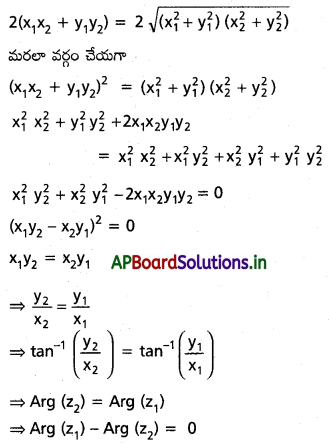
  2. Mines are dug deep, so the layers of earth become weak.
  3. They may cause landslides, avalanches, earthquakes, etc.
  4. Most of the water is used in the process of digging and later process also.
  5. Post liberalisation era brought private people (companies) into mining activities.
  6. Accidents may occur, tunnel may fall down, or get flooded with water or there can be fire and suffocation due to gases – these dangers may be faced in mining.
  7. With the motto of earning profits, these companies do not take proper measures of safety.
  8. Thus, there may be many human losses in rapid extractions of minerals.

10th Class Social Textbook Page No. 170

AP SSC 10th Class Social Studies Solutions Chapter 12 Sustainable Development with Equity

Question 22.
Observe the following picture.
AP SSC 10th Class Social Studies Solutions Chapter 12 Sustainable Development with Equity 10Write your caption in the context of development.
Answer:
On the name of development, man is causing nature’s destruction, So for the flora and fauna where is the protection ?

Project work

AP SSC 10th Class Social Studies Solutions Chapter 12 Sustainable Development with Equity

You have read about composting in the context of organic farming. Here is a simple method that you can try out in your school and home.

  • Take a large size container and make several holes for water drainage.
  • Layer it with coconut fibres for drainage.
  • Cover it with a thin layer of soil.
  • Add vegetable wastes in a layer.
  • Add another layer of soil.
  • Again add vegetable wastes in a layer.
  • Cover with soil.
  • After one week, introduce earthworms in it.
  • After decomposition, use the soil to make a small garden with plants of your choice.

Answer:
Self Activity.

AP SSC 10th Class Social Studies Solutions Chapter 5 Indian Rivers and Water Resources

SCERT AP Board 10th Class Social Solutions 5th Lesson Indian Rivers and Water Resources Textbook Questions and Answers.

AP State Syllabus SSC 10th Class Social Studies Solutions 5th Lesson Indian Rivers and Water Resources

10th Class Social Studies 5th Lesson Indian Rivers and Water Resources Textbook Questions and Answers

Improve your learning

Question 1.
Create a table to describe major river systems in India with the following items: direction of flow, countries or regions through which they pass through, and relief features of the areas.
Answer:

RiverDirection of flowCountries through which it flowsRelief features of the areas
Indusnorth-westerlyTibet, India and PakistanKailash range, Lake Manasarovar, the Himalayas, Thar desert
Gangasouthward and the eastwardIndia, BangladeshGlacier, Hills of Haridwar, Himalayan ranges.
BrahmaputraeastwardTibet, India, BangladeshKailash range, Manasarovar Lake, Himalayan ranges, Assam valley
GodavarieastwardIndiaTriambak Plateau, Western Ghats, Deccan Plateau
KrishnaeastwardIndiaMahabaleswar, Western Ghats, Deccan Plateau.
NarmadawestwardIndiaAmarkantak, Vindhya and Satpura ranges, rift valley.
TapatiwestwardIndiaSatpura range, Deccan Plateau, Muttai.

AP SSC 10th Class Social Studies Solutions Chapter 5 Indian Rivers and Water Resources

Question 2.
Identify and list arguments that would support or oppose use of groundwater in various contexts such as agriculture, industry etc.
Answer:

  1. Groundwater is the major source of drinking water in both urban and rural India.
  2. It is also an important source of water for the agricultural, industrial and other sectors.

The arguments that would support the usage of underground water are:

  1. The underground water is both an important input for manufacturing and industrial sectors and used as cool for machines.
  2. These include higher productivity and its more equitable distribution among various classes of farmers, insurance against drought and stabilisation of agricultural production and enhanced employment generation.

The arguments that would oppose the usage of underground water:

  1. India is the world’s largest groundwater user in terms of both absolute volumes pumped and the total number of users.
  2. It led to decline groundwater levels and sea water intrusion in coastal areas.
  3. Industrial waste is largely responsible for high level of pollutants found in groundwater.

Question 3.
What are the different inflow and outflow processes in the context of water resource?
Answer:
Inflow:

  1. For any area inflow = precipitation + surface flow + groundwater flow.
  2. Surface flow includes rivers, streams, canals and other flows on the surface of water.
  3. Groundwater inflow is decided by the percolation and aquifer presence.
  4. It is difficult to estimate this, but can be done.
  5. Precipitation includes rainfall, snow, dew, hail etc.

Outflow:

  1. The total amount of water added to the atmosphere from both evaporation and transpiration.
  2. Water used for agriculture, domestic purpose and for animals, and for industrial use.
  3. Water flowing out via surface flows and the flowing out of groundwaters through wells, pumps and tubewells, etc.

AP SSC 10th Class Social Studies Solutions Chapter 5 Indian Rivers and Water Resources

Question 4.
Which of the inflow or outflow processes has the most impact in the context of groundwater resources?
Answer:

  1. In the context of groundwater resources the inflows like recharging, rainfall, aquifers etc.
  2. In the context of groundwater resources the outflows are like borewells, tube wells, pumps etc.
  3. Out of all these processes outflow which shows most impact is the tube-wells.
  4. Use of the tubewells draws water from storages and lowers the water available to them.
  5. When we dig into deeper aquifers – this is mining water that has collected over thousands of years.
  6. With this we face today is the depletion of groundwater storages and a tendency not to care about the availability of water for future generations.

(OR)

  1. Groundwater recharge may be explained as the process whereby the amount of water present in or flowing through the interstices of the sub-soil increases by natural or artificial means.
  2. Rainfall is the principal source for recharge of groundwater.

Question 5.
Make a list of challenges faced in the water resources in the Tungabhadra basin. Identify the solutions that have been discussed in the context of these problems either in this chapter or elsewhere in different classes.
Answer:
Challenges:

  1. Tungabhadra dam has gradually lost its water storage capacity over the decades.
  2. The mining of iron and manganese ore has seriously affected the stability of the catchment.
  3. Siltation of several small reservoirs, traditional tanks and Tungabhadra reservoir is one challenge.
  4. Cultivation of crops which demands a lot of water throughout the basin altered the water sharing balance.
  5. Increased small towns and industrial areas made the competing demands for water more complex.

Solutions:

  1. To restore the storage capacity, the silt, dust, debris etc. needed to be removed.
  2. To maintain water balance people need to own the crops which use less water.
  3. To improve sanitation and drinking water supply to match the pace of developmental activities.
  4. Afforestation must be encouraged.
  5. We should make provision to recharge the underground system through ‘Water harvesting Pits’.
  6. Felling of trees and mining activities should be controlled.
  7. We must adopt a different plants for water conservation and system of sharing water.
  8. Soil erosion should be controlled.

AP SSC 10th Class Social Studies Solutions Chapter 5 Indian Rivers and Water Resources

Question 6.
There has been various ways in which changes occurred in the context of water resources. Describe the positive as well as negative social changes that got reflected in this chapter.
Answer:
Positive Social Changes :

  1. Making arrangements that a portion of rainfall percolates into the soil and travels to the underground strata and recharge the aquifers.
  2. Continuous contour trenches were dug on the hill slopes to arrest the erosion of soil, harvest water and encourage growth of grass.
  3. A number of water harvesting structures like check dams, percolation tanks and loose boulder structures were built.
  4. Banning the use of borewells for irrigation and not allowing to cultivate crops which demand more water.
  5. Advanced technology in agriculture.
  6. Recycling procedures of industrial wastes.
  7. Increase in agricultural land.
  8. Construction of Hydroelectric projects.

Negative Social Changes:

  1. The depletion of groundwater storage and a tendency not to care about the availability for future generations.
  2. Digging into deeper aquifers -this is mining water that has collected over thousands of years.
  3. Loss of water storage capacity of dams, etc. due to the accumulation of silt, dust, debris and soil erosion.
  4. Increase in the number of towns and industrial areas demanding more water.
  5. Water pollution.
  6. Population growth
  7. Water conflicts.

AP SSC 10th Class Social Studies Solutions Chapter 5 Indian Rivers and Water Resources

Question 7.
Which aspects of farming practices were regulated in the context of Hiware Bazar to improve the water conservation?
Answer:

  1. Hiware Bazar is situated on the eastern side of Sahyadri ranges in Ahmednagar district in Maharashtra.
  2. Continuous contour trenches were dug on the hill slopes to arrest the erosion of soil, water harvesting and encourage growth of grass.
  3. There was ban on borewells for irrigation, growing sugarcane, banana and selling one’s land to any outsider.
  4. The range of crops is diversified and potatoes, onions, fruits, flowers, wheat, etc. are practised.
  5. The land was made much more productive as the water availability is increased and resulted in second crop during the year.
  6. The cultivation of water-intensive crops like sugar was stopped.
  7. Water for irrigation should be taken only through dug wells.
  8. Water use prioritisation was taken up along with crop planning.

Question 8.
How significant are the laws and people’s actions, in the context of water resources? Write a short note based on the ideas discussed in the last two sections of the chapter.
Answer:

  1. People’s actions are significant in the context of water resources.
  2. People imposed themselves ban felling trees, free grazing to protect soil fertility.
  3. They even imposed ban on practice of water taking from bore/tubewells for irrigation and extensive water usage crops.
  4. They put up practices for water harvesting and diversification of crops.
  5. The current laws about groundwater in many states are both outdated and inappropriate.
  6. These are based oh the basic link between access to groundwater and land ownership, which is flowed.
  7. Landowners were not restricted in the amount of water they can take out.
  8. State governments have often chosen tolncrease power subsidies to make extraction of even deeper layers of groundwater possible.
  9. Drinking water is the first priority as well as a human right and that Panchayat Raj institutions must have control over the use of groundwater.

AP SSC 10th Class Social Studies Solutions Chapter 5 Indian Rivers and Water Resources

Question 9.
If you have access to internet, visit www.aponline.gov.in and learn more about Andhra Pradesh WALTA Act.
Answer:

  1. AP WALTA Act means Andhra Pradesh Water Land and Trees Act-2002.
  2. Its objectives are to promote water conservation.
  3. For protection and conservation of forests.
  4. It promotes the construction of check-dams.
  5. It encourages the setting up of watershed programs.
  6. s a part of agriculture it advises the less water usage crops and methods to save water like sprinklers to water the crops.
  7. It advises for the participation of common people in promoting social forestry in the state of Andhra Pradesh.
  8. It brought many changes in the implementation of this act from 2009 onwards.

Question 10.
In what ways is water bought and sold in your area and for what purposes? Do you think there should be some checks and balances for this? Discuss.
Answer:
1. The water in our area is mainly supplied by our corporation. They supply through pumps/ nallas. This water is used for drinking and household purpose.
2. Drinking water is also supplied by local companies after purification. They charge Rs. 15 to 30 for on refill.
Yes, I think that there should be some checks and balances for both these supplies. The corporation water tanks should be cleansed at regular intervals. The water should be purified through different possible methods. We should check the refills of the private companies also. And we should observe the cleaning/filtering procedure at the point regularly.

AP SSC 10th Class Social Studies Solutions Chapter 5 Indian Rivers and Water Resources

10th Class Social Textbook Page No. 58

Question 1.
On a map of India identify and mark the Himalayas and the Western Ghats.
Answer:
AP SSC 10th Class Social Studies Solutions Chapter 5 Indian Rivers and Water Resources 1

Question 2.
Using the colour code, identify the height range in which some of the rivers originate. Using the atlas and the raised relief map, follow the course of these rivers and locate the direction in which they are flowing.
Answer:
Some of the rivers : Indus, Brahmaputra, Ganga, Krishna, Godavari, Narmada and Tapati.

Sl.No.RiverHeight range of originDirection
1Indus1001 to 3000 mtsWestward
2Brahmaputra1001 to 3000 mtsEastward
3GangaAbove 3000 mtsSouthward and then eastward
4Krishna1001 to 3000 mts (Mahabaleswar)Eastward
5Godavari1001 to 3000 mtsEastward
6Narmada301 to 1000 mtsWestward
7Tapati301 to 1000 mtsWestward

AP SSC 10th Class Social Studies Solutions Chapter 5 Indian Rivers and Water Resources

Question 3.
Discuss: About 5% of water is used for domestic purposes and yet a large section of the population does not have access to the water.
Answer:

  1. Out of the total water available, most is saline and only less than 3% is non-saline.
  2. Most of it is in the form of ice and only less is accessible.
  3. Out of this available water also only 5% is used for domestic purpose and the remaining is used for other purposes.
  4. In spite of all this, a large section of the population does not have access to water.
  5. There are many reasons for this like the depletion in groundwater tables.
  6. Non-domestic usage is geared up with bore/tubewells and pumps and extracting a large amount.
  7. The poor and destitute do not have access to water.
  8. Water supply is a state responsibility under the Indian constitution.
  9. In some coastal areas, sea water desalination is becoming an important source of drinking water supply.
  10. There is a need to river linking in India.

Question 4.
40 million hectares of land in India is flood-prone and an equally large part of the country is also drought prone. What are the causes of this ?
Answer:

  1. In India only 40% of the cultivated land has irrigation facility.
  2. For the remaining cultivated land, agriculture is the gambling with monsoon.
  3. If monsoons give good rains, the year is good otherwise most part is drought-prone.
  4. In India there are 72 drought – prone districts spread over 13 states.
  5. Floods mostly occur in the low-lying plain areas and river valleys almost every year in the country.
  6. 40 million hectares of land in India is flood prone.
  7. We have no interlinking of rivers in India, which can arrange for the transfer of floodwaters to drought-prone areas.
  8. Thus we are equally affected with both floods and droughts.
  9. Floods are associated with excessive rainfall while droughts are the result of deficit rainfall.
  10. Hydrology, deforestation, soil nature and erosion also play an important role in these
    calamities.

AP SSC 10th Class Social Studies Solutions Chapter 5 Indian Rivers and Water Resources

Question 5.
70% of our surface water resources are polluted. Why?
Answer:

  1. The contamination of water with unwanted and harmful substances is called water polution.
  2. The biodegradable waste enters a water supply and thus pollutes water.
  3. Chemical fertilisers from agriculture runoff due to rain and industrial waste pollute water.
  4. Heat can be a source of pollution in water by decreasing the amount of dissolved oxygen.
  5. Sediment consists of mineral or organic solid matter that is washed from land into water sources.
  6. The industrial waste contains a large number of harmful chemicals like acids, alkali and metals such as arsenic, lead, mercury and cadmium leading to toxicity.
  7. Hazardous substances like fluorine mixed in groundwater are causing pollution.
  8. Thus nearly 70% of the surface water sources are polluted.

10th Class Social Textbook Page No. 59

Question 6.
With the help of an atlas trace the course of Indus both in India and Pakistan.
Answer:
AP SSC 10th Class Social Studies Solutions Chapter 5 Indian Rivers and Water Resources 2

Out of the total length of 2880 kms Indus flows 709 kms in India and 2171 kms in Pakistan.

AP SSC 10th Class Social Studies Solutions Chapter 5 Indian Rivers and Water Resources

Question 7.
Look at the map of river Ganga and name the states which are drained by it.
AP SSC 10th Class Social Studies Solutions Chapter 5 Indian Rivers and Water Resources 3
Answer:
The states which are drained by the river Ganga are Uttarakhand, Uttar Pradesh, Bihar, West Bengal, Madhya Pradesh, Haryana and Rajasthan.

Question 8.
From the above map list out the north-flowing and south-flowing tributaries of the Ganga. North-flowing tributaries of the Ganga :
Answer:

  1. The Yamuna
  2. The Gomti
  3. The Ghaghara
  4. The Gandak
  5. The Kosi
  6. The Teesta

South-flowing tributaries of the Ganga :

  1. The Chambal
  2. The Sind
  3. The Betwa
  4. The Ken
  5. The Son.

10th Class Social Textbook Page No. 60

AP SSC 10th Class Social Studies Solutions Chapter 5 Indian Rivers and Water Resources

Question 9.
From the Map and using your atlas, describe the following.

  1. The Godavari originates in ——– and ——–.
  2. The Krishna is the second largest east flowing peninsular river which rises near ——–.
  3. The Mahanadi rises near Sihawa in Chattisgarh and runs through ——–.
  4. The Narmada originates near ——– in Madhya Pradesh.
  5. The Tapati originates from ——– and flows ——– (fill in the direction of flow).

Answer:

  1. Triambak plateau drains into Bay of Bengal
  2. Mahabaleswar
  3. Odisha
  4. Amar Kantak
  5. Multai; westward

10th Class Social Textbook Page No. 61

AP SSC 10th Class Social Studies Solutions Chapter 5 Indian Rivers and Water Resources

Question 10.
Discuss the term “watershed”.

Answer:

AP SSC 10th Class Social Studies Solutions Chapter 5 Indian Rivers and Water Resources 5

  1. Watershed is a line of high land where streams on one side flow into one river and streams on the other side flow into a different river.
  2. If the flow of water (rain water) were to be checked by vegetation or bunds, then there would be a greater possibility of the water percolating into the soil to join the groundwater.
  3. Over the last few years great efforts have been undertaken to harvest rainwater by these means.
  4. These measures are usually taken for a stream or a river.
  5. Such efforts are called ‘Watershed development projects’.
  6. Under these projects trees and grasses are planted on the hill slopes from where a stream starts and small bunds are built across streams to stop the flow of water.

Question 11.
From the nearest Mandal office find out the total annual rainfall for your area over the past 5 years.
Answer:
The total annual rainfall for the area of Mangalagiri over the past 5 years is as such.

Year(in cm.)
2015 -16130
2014 -15140
2013-14136
2012 -13128
2011 -12132

AP SSC 10th Class Social Studies Solutions Chapter 5 Indian Rivers and Water Resources

Question 12.
Recall from your science lessons what happens to the water that plants draw through their roots.
Answer:

  1. Plant absorbs water from the soil.
  2. The plant combines water and carbon dioxide with the help of sunlight to produce carbohydrates.
  3. Starch, sugars, cellulose are also carbohydrates.
  4. The plant does not use all the water it absorbs through its roots to produce carbohydrates, most of it evaporates into the air.
  5. The water that plants release into the atmosphere is called transpiration,
  6. Most of the water released by plants evaporate from the leaves, which have microscopic holes called ‘stomata’.

10th Class Social Textbook Page No. 63

Question 13.
On a map of India trace the course of the Tungabhadra river.
Answer:
AP SSC 10th Class Social Studies Solutions Chapter 5 Indian Rivers and Water Resources 4

10th Class Social Textbook Page No. 65

AP SSC 10th Class Social Studies Solutions Chapter 5 Indian Rivers and Water Resources

Question 14.
How would it help if there was a government river basin authority for overall planning of water use?
Answer:

  1. Encroachment of public lands, by rampant felling of tree cover, brought under cultivation.
  2. It resulted in water run-off and flash floods.
  3. Storage capacity of dam was lost with accumulation of silt, dust, debris etc.
  4. Water is flow resource and its storage or use upstream affects what is available to people downstream.
  5. Growth of towns and industrial areas increased the demand for water.
  6. Conflicts within communities in a region and across sectors like agriculture, industry or drinking water are common.
  7. If there was a government river basin authority for overall planning of water use, all the problems above could be solved.
  8. If the government river basin is there it will solve the problems by following way.
    a) It would do justice to all users of river basins water.
    b) It would involve the community organisations in the authority.
    c) It would reduce the growing conflicts and the possibility of social unrest in the country in future due to water scarcity.
    d) It would rejuvenate the traditional techniques in conservation and management recognition of water as a common property resource.

Question 15.
What are the different conflicts in the use of water for Tungabhadra river basin ?
Answer:

  1. The basin of Tungabhadra, the tributary of Krishna, has two parts
    a) the upper and middle catchment in Karnataka,
    b) the lower portion of the catchment in Telangana and Andhra Pradesh.
  2. There is a lot of difference in water availability between these two types of regions.
  3. Conflicts between Karnataka, Telangana and Andhra Pradesh are generally related to water
    that is available to use.
  4. Water is a flow resource and its storage or use upstream affects what is available to people downstream.
  5. Water is shared based on agreements between state governments.
  6. Although the area is ideal for semi-arid crops, the major crops grown demand a lot of water.
  7. Cultivation of such crops throughout the basin has dramatically altered the water sharing balance.
  8. When all areas desire water for these crops, conflicts become inevitable.

(OR)

  1. Tunga bhadra is the major tributary of the river Krishna.
  2. Tungabhadra project was constructed and it was the joint venture of Karnataka, Telangana State and A.P.
  3. The upper catchment area is used for storage by water harvesting. The lower portion of the basin is characterised by lower rainfall and drought conditions.
  4. Later Karnataka constructed another dam known as Almatti dam.
  5. The height and the water storage capacity of the river is the apple of discard among Karnataka, Telangana and A.P.
  6. Tribunals have given judgements on the water sharing proportions among Telangana state, A.P and Karnataka.
  7. But still it is a burning water dispute among these states.

10th Class Social Textbook Page No. 67

AP SSC 10th Class Social Studies Solutions Chapter 5 Indian Rivers and Water Resources

Question 16.
Underline sentences that reflect the efforts taken for water conservation in Hiware Bazar.
Answer:

  1. Most significant was the ban on borewells for irrigation, growing sugarcane and banana and selling one’s land to any outsider.
  2. The most significant development is that increased water availability has made a second crop possible due to normal rainfall.
  3. Social control over groundwater extraction and use no borewells for irrigation (only for drinking water) no water-intense crops like sugarcane.
  4. Water for irrigation should be taken only through due wells.
  5. They keep rainfall data meticulously and use it for crop planning and water use prioritisation.
  6. As they plan according to water available there was no shortage of water to drink even in years of continuous drought.

Question 17.
What was the effort for planning agriculture according to the available water ?
Answer:

  1. Farmers of Hiware Bazar worked out certain thumb rule type of think like if they get good rainfall, then they can take full Rabi crop.
  2. If the rainfall is less then they bring down the area under rabi etc.
  3. They keep rainfall data meticulously and use it for crop planning and water use prioritisation.
  4. Because of this even in years of continuous drought there was no drinking water shortage.
  5. This is mainly because they plan according to the water available.

Question 18.
If you have access to internet, watch a documentary about Hiware Bazar at http:// bit.ly/kothLl.
Answer:
Students’ Activity

10th Class Social Textbook Page No. 69

Question 19.
Should groundwater regulation be primarily community-led, as in the case of Hiware Bazar ?
Answer:

  1. Groundwater regulation in Hiware Bazar was taken up by community and saw good results.
  2. But it definitely may not be the same if it were primarily led by community throughout the country.
  3. Instead of that, governments should bring new laws and rules in place of the existing ones and serve the purpose.
  4. They should make the water as common pool resource and identify the human right for water.
  5. Drinking water shall be given the first priority.
  6. Panchayat Raj institutions must be given control over the use of groundwater.
  7. Governments shall not encourage over use or over extraction of underground resources of water.
  8. So the governments must take up the responsibility instead of community.

AP SSC 10th Class Social Studies Solutions Chapter 5 Indian Rivers and Water Resources

Question 20.
“The groundwater laws are both outdated and inappropriate.” Explain.
Answer:

  1. The current laws about groundwater in many states are both outdated and inappropriate.
  2. They were developed at a time when groundwater was a marginal source of water.
  3. Today shallow and deep tubewells have the potential to draw a lot of water.
  4. Now the basic link between access to groundwater and land ownership on which the rules are based are flowed.
  5. Land owners were not restricted in the amount of water they can take out.
  6. Over extraction from one tubewell often dries up other tubewells around.
  7. Moreover, there are no laws and regulations that can determine on how many wells, hand pumps and other tubewells can be sunk in a given area.
  8. Some support that groundwater is a public resource and some others support the primacy of land owners control over ground water.
  9. Hence laws are outdated and have to be modified.

Question 21.
Should groundwater be considered a common pool resource ? Explain your view.
Answer:

  1. For resource like water, the consumption by one person or a sector affects what is available to others.
  2. In a number of states, the answer to falling water tables has been not to address the issue itself.
  3. Apart from this each person wants their share of water before someone else.
  4. This is the real contemporary challenge.
  5. So groundwater should be considered a common pool resource.
  6. Based on this the laws and rules to water usage should be framed.
  7. It should be made that drinking water is the first priority as well as a human right.
  8. Panchayat Raj institutions must have control over the use of groundwater.

(OR)

  1. Over the past few decades ground water has been the main source, especially for domestic use and agriculture.
  2. This tremendous increase in the use of ground water has a significant impact on water availability and on access to water.
  3. Water is a flowing resource. Extraction from one tube well often dries up other tube wells around.
  4. If each one competes to go deeper than the neighbour, the ground water structure would be disturbed.
  5. Hence ground water should be considered as common pool resource and we should delink the connection between the ownership of land and water drawn from the underground.

AP SSC 10th Class Social Studies Solutions Chapter 5 Indian Rivers and Water Resources

Project work

Think of plans for your village or locality, which if implemented would help everyone.
Answer:
Students’ Activity.

AP SSC 10th Class Social Studies Solutions Chapter 11 Food Security

SCERT AP Board 10th Class Social Solutions 11th Lesson Food Security Textbook Questions and Answers.

AP State Syllabus SSC 10th Class Social Studies Solutions 11th Lesson Food Security

10th Class Social Studies 11th Lesson Food Security Textbook Questions and Answers

Improve your learning

Question 1.
Correct the false statements.
(a) Increase in food production alone ensures food security.
Answer:
It is not sufficient that there is increase in food production. Everyone should be able to buy them for consumption.

(b) It is important to encourage mono-crop cultivation to ensure food security.
Answer:
Encouraging mono-crops will not serve the purpose of food secuirty. It makes the soil lose its ife&ility. Care must be taken to encourage farmers to go for agricultural diversification.

(c)
Low-calorie intake is higher among people with low income.
Answer:
It is correct.

(d) Legislations have an important role to play in ensuring food security.
Answer:
It is correct. Those legislations are needed to be executed in a heartful manner.

(e) PDS system could be used to address the issue of child nutrition.
Answer:
To address the issue of child nutrition PDS could be used. Anganwadis and Mid-day meals are. serving the needs of children. Their parents shall be made to have the purchasing power to sufficient food with secured access.

AP SSC 10th Class Social Studies Solutions Chapter 11 Food Security

Question 2.
The consumption of calories has consistently ——– in rural areas. The average per capita calorie consumption in 2004-05 is ——– than the required calories. The minimum calorie consumption for persons living in urban areas is 2100 calories. The difference between actual calorie consumption in 2004-05 and the required calorie consumption in urban areas is ——–.
Answer:
(i) decreased
(ii) less
(iii) 300 calories

Question 3.
Supposing the foodgrain production has been affected in a particular year, because of a natural calamity. In what ways can the government ensure higher availability of foodgrains for the year?
Answer:

  1. The food production has been affected in a particular year, because of natural calamity.
  2. The government ensures higher availability of foodgrains for the year in different ways.
  3. It could arrange from stocks with it.
  4. It could arrange from imports i.e., increasing the amount of foodgrains compared to the exports.
  5. Encouraging the farmers who suffered in calamity with waiver of taxes and providing free inputs.
  6. Insuring the crops all the time by paying the premium by government itself.

Question 4.
Use an imaginary example from your context to describe the relationship between underweight
and access to food.
Answer:

  1. There is some relationship between underweight and access to food.
  2. If we have access to sufficient food with required calorific values, there is no question of underweight.
  3. No one would have a lower weight if he/she had access to adequate food.
  4. The purchasing power of people is also related with weight.
  5. Madhavaiah and his family earns monthly Rs. 6000 and with a rented house and medication to parents, he can only afford less amount on food apart from educating his children.
  6. Thus, all his family members do not consume sufficient calories food, which resulted in underweight.
  7. They are even prone to diseases.

AP SSC 10th Class Social Studies Solutions Chapter 11 Food Security

Question 5.
Analyse a week’s food habit of your family. Create a table to explain nutrition elements included in it.
Answer:
AP SSC 10th Class Social Studies Solutions Chapter 10 Globalisation 2AP SSC 10th Class Social Studies Solutions Chapter 10 Globalisation 3

Question 6.
Describe the relationship between increase in food production and food security.
Answer:

  1. Producing a sufficient amount of foodgrains is an important requirement of food security.
  2. The government creates conditions so that farmers are able to produce an increasing amount of foodgrains.
  3. The necessary inputs to agriculture are to be provided in a judicious manner.
  4. To expand the irrigation and water is to be made available to all.
  5. It is not sufficient to produce food grains and other items.
  6. Everyone should be able to buy them for consumption.

AP SSC 10th Class Social Studies Solutions Chapter 11 Food Security

Question 7.
Give reasons to argue for the following statement “Public Distribution system can ensure better food security for people”.
(OR)
“Central and State Governments purchase one-third of food grains from farmers. Through different programmes, these food grains are distributed to people.”
Do you think that the public distribution system managed by the government is providing proper food security? Express your opinion in an elaborate manner.
Answer:

  1. The Indian government came out with a new law in 2013 called the National Food Security Act to legalise peoples’ Right to Food.
  2. This food security bill covers nearly 70% of people of the country.
  3. They will be given rice, wheat and millets at subsidised prices of Rs. 3. Rs. 2 and Rs. 1 respectively.
  4. Every person of low income families is entitled to 5 kg of foodgrains at subsidised price.
  5. Among poor families, the poorest ones are entitled to 35 kilograms of foodgrains.
  6. 75% of rural population and 50% of urban population will be covered under this scheme.
  7. It will provide cooked meals for pregnant women, lactating mothers, children between 1-6 years and mid-day meals to children of 6-14 years.
  8. If the government is not able to arrange foodgrains, it will give cash for the people to buy food grains. Thus, public food distribution can ensure better food security for people.

Question 8.
Below poster what indicates about food security.
AP SSC 10th Class Social Studies Solutions Chapter 11 Food Security 1Answer:
The above poster indicates :

  1. Every night one in seven of us goes to bed with hungry.
  2. We know that it doesn’t have to be happend in this way.
  3. We wake up with this situation.
  4. So food security is very important in our life.

AP SSC 10th Class Social Studies Solutions Chapter 11 Food Security

Question 9.
Make similar posters about food security.
Answer:
AP SSC 10th Class Social Studies Solutions Chapter 11 Food Security 2

10th Class Social Studies 11th Lesson Food Security InText Questions and Answers

10th Class Social Textbook Page No. 146

Question 1.
Examine the given graph and fill in the blanks.
AP SSC 10th Class Social Studies Solutions Chapter 11 Food Security 3The food grains production has grown over the period 1970-71 to ——–. Paddy production increased from about 40 million tonnes in 1970-71 to about ——– million tonnes in 2010-11. Another important food crop that witnessed rapid increase in production during this 40 years period was ——–. Compared to paddy and wheat the production of ——– did not increase during 1970-2011. This could be due to ——–.
Answer:
The food grains production has grown over the period of 1970-71 to 2010-11. Paddy production increased from about 40 million tonnes in 1970-71 to about 96 million tonnes in 2010-11. Another important food crop that witnessed rapid increase in production during this 40 years period was wheat. Compared to paddy and wheat the production of jowar did not increase during 1976-2011. This could be due to dry land agriculture.

AP SSC 10th Class Social Studies Solutions Chapter 11 Food Security

Question 2.
Read again the section on “Land and other natural resources” In chapter 9, What are the possible ways of increasing production of crops from land?
Answer:

  1. After going through “Land and other natural resources” in chapter 9, there are a few possible ways of increasing production of crops from land.
  2. One way is to grow more than one crop on the same piece of land.
  3. It is the most common way of increasing production from land.
  4. The other way is to grow three different crops in a year due to the well-developed irrigation system.
  5. Electric tubewells could irrigate much larger area of land easily.
  6. Increasing the production with intensive use of natural resources like land and water.

(OR)
The possible ways of increasing production of crops from land.

  1. Mechanization
  2. High yield varieties, which were the basis of the green revolution.
  3. Fertilizers
  4. HW of seeds
  5. Increased plant density.
  6. Growing three different crops in a year due to the well developed irrigation system.
  7. Electric tube wells could irrigate much larger area of land easily.

10th Class Social Textbook Page No. 147

Question 3.
Describe the per hectare yield of paddy and wheat by filling the following passage.
Two crops ——– and ——– always had low yield when compared with paddy and wheat. Yet both these crops have shown slow increase in yield in recent years.
Answer:
Two crops jowar and oil seeds always had low yield when compared with paddy and wheat. Yet both these crops have shown slow increase in yield in recent years.

Question 4.
Why should attention be given to increase the yield of jowar? Discuss.
Answer:

  1. Jowar is the poor man’s food.
  2. It is the third most important food crop ranking next to rice and wheat in both area and production.
  3. It is a rainfed crop mostly grown in moist areas which hardly need irrigation.
  4. Maharashtra is the largest producer of jowar, followed by Karnataka, Andhra Pradesh, Telangana and Madhya Pradesh.
  5. Only half of the jowar crop area is being cultivated with High Yielding Varieties seeds.
  6. As it does not need irrigation, use of HYVs can be increased, thus we should give attention to increase the yield of jowar.

(OR)

  1. Jowar is a highly nutritious food.
  2. To increase the availability of food grains, and food security.
  3. Not necessary to use of pesticides, fertilizers and insecticides.
  4. Even though where the water availability is very low this crop is also suitable.
  5. Jowar has more demand in the market.

AP SSC 10th Class Social Studies Solutions Chapter 11 Food Security

Question 5.
What factors have contributed to the high growth of paddy and wheat yields over a long period?
Answer:

  1. Many factors have contributed to the growth of paddy and wheat yields over the long period.
  2. The rice and wheat are cultivated in India by intensive and unscientific application of chemical fertilizers and insecticides have led to the continuous increase in the yield levels.
  3. Development of a dense network of canal irrigation and tubewells helped the growth in yieds of rice and wheat.
  4. The use of High Yielding Varieties of seeds under Green Revolution helped the growth in yields of rice and wheat.
  5. They provide for larger amounts of grains as the stalks are short and a short period of maturity of the crop in most cases.

10th Class Social Textbook Page No. 148

Question 6.
Complete the following table.
AP SSC 10th Class Social Studies Solutions Chapter 11 Food Security 4Answer:
AP SSC 10th Class Social Studies Solutions Chapter 11 Food Security 5

Question 7.
Based on your calculations, fill in the blanks:
The per person availability of food grains _____ (increased/decreased) between 1971 and 1991 but was _____ lower/higher) in 2011. This happened despite shown in population growth in recent decades. In the future, the government must ensure higher availability through _____.
Answer:
The per person availability of food grains increased between 1971 and 1991 but was lower in 2011. This happened despite slowdown in population growth in the recent decades. In future, the government must ensure higher availability through selling from its existing stocks.

AP SSC 10th Class Social Studies Solutions Chapter 11 Food Security

10th Class Social Textbook Page No. 150

Question 8.
Underline words and sentences that deal with agricultural diversification and explain why are these essential for Indian farmers.
Answer:
Water development – technology – cash crops – vegetables – dairying – best pulse seeds – second crop – yields – a plan and government effort.

  • The bank gave credit to them for water development.
  • The technology is fairly good.
  • They take more money from cash crops and it is vegetables all the way.
  • A great thing that happened on the way was dairying.
  • Farmers know the best pulse seeds come from Maharashtra.
  • The second crop, if any, depending on the rains.
  • Yields are low.
  • Without a plan and government effort it would be a cruel joke to talk about diversification to them.

Question 9.
Write a description about agricultural diversification for your own village or any village that you know about.
Answer:
Velpur has most of the lands with black cotton soils. There are a few rainfed streams for irrigation water. Rice is cultivated as the primary crop. Cotton is cultivated as the second crop. The seeds for these crops are collected from corporate seed companies. Most of the villagers own few buffaloes. They are much interested in dairying. Some part of the land is used to keep grass which is to be used as the fodder to the cattle.
When there was a shortage of rainfall, the crops are damaged and they do not yield good crop. Along with cotton, chillies are also grown in large scale. People are taking up the works of agriculture with much of the usage of technology. A proper plan from the government and its efforts are enabling this village to experience the agricultural diversification.

10th Class Social Textbook Page No. 151

Question 10.
Recall the discussion on Public Distribution System in Class VIII. How is PDS related to food security of the people in the country ?
Answer:

  1. PDS has played a crucial role in reaching food to everyone both in the rural and urban areas.
  2. Around 1997, government decided that ration shops should cater mainly to the poor.
  3. Governments buy foodgrains from farmers and supply these to the ration shops.
  4. Ration shops keep stocks of foodgrains and these items are then sold to people.
  5. Prices at the ration shops are meant to be lower than the prices in the market.
  6. The government is trying to provide food to all.
  7. The government stakes a lot of amount in purchasing food from farmers and wholesalers and selling them at subsidised prices.
  8. Thus, PDS is thriving for food security of the people in the country.

AP SSC 10th Class Social Studies Solutions Chapter 11 Food Security

Question 11.
Observe the following graph and fill in the blanks.
Percentage Share of Purchases from PDS, rice and wheat, 2009-10.
AP SSC 10th Class Social Studies Solutions Chapter 11 Food Security 6

(a) Fill in the blanks.
For all India, —— percent of peoples’ total consumption of rice and —— percent of peoples total consumption of wheat are purchased from the ration shops. This shows that people have to buy most of their foodgrain requirements from ——. However, there are several well-performing states like —— and ——. And some states like ——, ——, —— where PDS hardly seems to be fulfilling peoples’ needs for food grains.
Answer:
For all India, 39 percent of peoples’ total consumption of rice and 28 percent of people’s consumption of wheat are purchased from the ration shops. This shows that people have to buy most of their food grain requirements from market. However, there are several well-performing states like Tamil Nadu and combined Andhra Pradesh. And some states like Bihar, Rajasthan and Punjab where PDS hardly seems to be fulfilling peoples’ needs for food- grains.

10th Class Social Textbook Page No. 155

Question 12.
How can an effective Anganwadi center deal with such a situation for a locality? Discuss.
Answer:

  1. Out of 7000 children, in the age group of 1 – 5 years, examined in the survey of NIN (National Institute of Nutrition) from many states in the country, 45% of children are underweight.
  2. Their weight was less than what is expected by normal standards.
  3. These children are in fact hungry and not getting adequate food.
  4. Unless they are severely underweight it may not be easily visible or identifiable.
  5. In such circumstances an effective anganwadi center in such locality would provide the children nutritious food.
  6. Its teachers are supposed to go to every household where children are present and supply them this food.
  7. Make their parents to know about the losses of sustained underweight of children and educate them to provide their children with nutritious food.

Question 13.
What overall conclusions can you draw from these statistics? Write a paragraph.
AP SSC 10th Class Social Studies Solutions Chapter 11 Food Security 7
Answer:
AP SSC 10th Class Social Studies Solutions Chapter 11 Food Security 8When weight is plotted against age nearly 45% of children in the country are under weight. It means that they cannot study, work or perform physical activities. They do not grow as quickly as healthy children. Their immune system is weakened. When height is plotted against age 41% of children not up to the height they have to be. It seems their growth is affected and short for their age. They are difficult to cover this. When weight is plotted against height 21% children are not with weight they are supposed to be. With sufficient food they can cover this up.

AP SSC 10th Class Social Studies Solutions Chapter 11 Food Security

Project work

Read the following poem, Aai. Can you write a poem relating to any aspect of food security?
AP SSC 10th Class Social Studies Solutions Chapter 11 Food Security 9
Answer:
Some Quotes on Food Security:
AP SSC 10th Class Social Studies Solutions Chapter 11 Food Security 10

AP SSC 10th Class Social Studies Solutions Chapter 8 People and Migration

SCERT AP Board 10th Class Social Solutions 8th Lesson People and Migration Textbook Questions and Answers.

AP State Syllabus SSC 10th Class Social Studies Solutions 8th Lesson People and Migration

10th Class Social Studies 8th Lesson People and Migration Textbook Questions and Answers

Improve your learning

Question 1.
Draw a table with the following items and summarise various examples in the context of migrant laborers.

  1. Migrant labour
  2. Reasons for the migration
  3. Living standards of the migrants
  4. Economic impact on their lives
  5. Economic impact on the lives of people from where they migrated.

Answer:
AP SSC 10th Class Social Studies Solutions Chapter 8 People and Migration 1

AP SSC 10th Class Social Studies Solutions Chapter 8 People and Migration

Question 2.
Compare and contrast the migration from rural to urban areas and rural to rural areas.
Answer:

Migration from Rural to Urban AreaMigration from Rural to Rural Area
People migrate due to insufficient employment.People migrate seasonally when there is a lot of work.
Hope for higher incomes, better services, more opportunities for family members.Most tribal and low caste people migrate.
Work as labourers and in unorga­nised sectors.They are not skilled.
Work in industries and service activities.They work for meagre wages.
Greater freedom and less discri­mination based on caste and gender.They live in poor conditions of living.
Remittance supplement family income.They find employment in sugarcane cutting, rice production activities, mining, tea plantations, fish processing etc.

Question 3.
Which of the following could be considered as seasonal migration? Why?

  1. Women moving from their parents’ house to husband’s house due to marriage
  2. Turmeric harvesters moving from one district to another district in Tamil Nadu for three months in a year
  3. Cycle rickshaw pullers in Delhi coming from rural parts of Bihar for six months a year
  4. Women from Nalgonda district come to work as domestic maids in Hyderabad

Answer:

  1. This could not be considered as a seasonal migration. In accordance with our social norms wife is supposed to live permanently in the house of her husband.
  2. This could be considered as a seasonal migration. Because duration of the season is three months, which is below the 6 months norm.
  3. This could be considered as a seasonal migration as it is not more than 6 months and the migration is done every year.
  4. This could not be considered as seasonal migration as the domestic maids need to serve
    throughout the year.

Question 4.
Do you think migrants are trouble makers/trouble shooters in their destinations? Justify your answer.
Answer:

  1. I think migrants are trouble shooters.
  2. In almost all examples from our lesson, migrants served the purpose.
  3. They were nowhere trouble makers.
  4. But for them, most works cannot be easily completed.
  5. Though they lived in inhumane conditions, they worked hard.
  6. Apart from these, they eke out a living.

AP SSC 10th Class Social Studies Solutions Chapter 8 People and Migration

Question 5.
The following are migrants of different types. Classify th into internal and international migrants.
a) People going from India to Saudi Arabia to work as technicians
b) Agricultural labourers going from Bihar to Punjab
c) Brick workers going from Odisha to Andhra Pradesh
d) Teachers going from China to India to teach Chinese to Indian children
Answer:
AP SSC 10th Class Social Studies Solutions Chapter 8 People and Migration 2

Question 6.
‘Most children of migrant families become dropouts.’ Do you agree with this statement? Justify your answer.

Answer:

  1. Most children of migrant families become dropouts.
  2. I do agree with this statement.
  3. Children accompanying their parents do not have creche facilities.
  4. Grown-up children are not able to continue their studies at their parents’ new work places.
  5. Schools in their native place refuse to take them again when they come back.
  6. They finally become dropouts.
  7. Young girls in such families are required to take care of siblings and many of them become dropouts.

Question 7.
How does rural to urban migration increase the purchasing power of people in rural areas?
(OR)
How does migration affect the purchasing power of people?
Answer:

  1. Rural to urban migration increases the purchasing power of people in rural areas.
  2. Remittances are an important means of supplementing or generating additional income for the rural families.
  3. Migration allows households to meet debt and other obligations without having to sell assets.
  4. The majority of migrants either remit or bring back savings.
  5. Migrant families buy house, land, agricultural machinery and consumer durables.
  6. Thus, their purchasing power increases.

Question 8.
Why are only professionals able to go to developed countries? Why cannot unskilled workers migrate to these countries?
Answer:

  1. Professionals are able to go to developed countries.
  2. Unskilled workers cannot migrate to these countries.
  3. Developed countries depend a lot on industries and service sector.
  4. They require people with technical skills and professionals.
  5. So, the unskilled workers cannot serve the purpose.
  6. Thus, there is no scope for unskilled workers to migrate to developed countries.

AP SSC 10th Class Social Studies Solutions Chapter 8 People and Migration

Question 9.
Why are only unskilled workers from India wanted in West Asian countries?
Answer:

  1. Only unskilled workers from India are wanted in West Asian countries.
  2. Semi-skilled workers also migrate to these countries.
  3. They are oil-exporting countries.
  4. They employ workers on contract basis.
  5. They empldy workers on large scale with lower wages.
  6. They do not nekL^technically skilled or professionals for these jobs.
  7. Besides, the need to pay handsome perks and emoluments.
  8. Thus, only unskilled workers are wanted in West Asian countries.

Question 10.
Why are workers from three states able to go to a considerable extent to work in West Asia?
Answer:

  1. Unskilled and semi-skilled workers migrate to West Asian countries.
  2. Nearly three fifths of workers going to West Asia are from Kerala, Tamil Nadu and Andhra Pradesh.
  3. A considerable section of these are engaged in construction projects, maintenance services, transport and telecommunications.
  4. Most work in oil exporting work.
  5. Nearly 30-40 years back many people from these three states went there.
  6. They are using the contacts and network in West Asia and making to migrate others from their birth places.

Question 11.
Describe the similarities and differences between the impacts of internal and international migration.
Answer:
People generally migrate to improve their standard of living. Sometimes it is internal and sometimes internationals. The differences are:

Internal Migration   International Migration
1) Due to insufficient employment, inadequate income, with hope of higher incomes, better services people migrate.1) People with technical skills and professional expertise have migrated to developed countries.
2) Work as hawkers, painters, mechanics, rickshaw pullers, const­ruction labour etc.2) Unskilled and semi-skilled workers migrate to oil exporting countries of the West Asia.
3) Engage in industry and service activities.3) These are engaged in construction projects, maintenance services, transport and telecommunications.
4) Remittances are important to families.4) Families are able to pay back loans, buy assets and standard of life improves.
5) They supplement and generate additional incomes.5) Kerala has recorded a stupendous growth in remittances from other countries.
6) These people retain economic ties in rural areas.
7) Family decides member to migrate or not.

AP SSC 10th Class Social Studies Solutions Chapter 8 People and Migration

10th Class Social Studies 8th Lesson People and Migration InText Questions and Answers

10th Class Social Textbook Page No. 102

Question 1.
Draw a sketch map showing Kurnool district along with Nandyala town. Mark arrow lines linking the names listed in the case study.
Answer:
AP SSC 10th Class Social Studies Solutions Chapter 8 People and Migration 3

Question 2.
Here is a list of a few people. Categorise them as migrant or non-migrant. Indicate the pattern and guess the probable reasons for migration.
AP SSC 10th Class Social Studies Solutions Chapter 8 People and Migration 4Answer:
AP SSC 10th Class Social Studies Solutions Chapter 8 People and Migration 5

10th Class Social Textbook Page No. 103

AP SSC 10th Class Social Studies Solutions Chapter 8 People and Migration

Question 3.
Read the following table and complete the required information.
AP SSC 10th Class Social Studies Solutions Chapter 8 People and Migration 6Answer:
AP SSC 10th Class Social Studies Solutions Chapter 8 People and Migration 7q

10th Class Social Textbook Page No. 105

Question 4.
In the following map, what are the states from which migrant come to Delhi ?
AP SSC 10th Class Social Studies Solutions Chapter 8 People and Migration 8Answer:
From Bihar, Haryana and Uttar Pradesh, migrants come to Delhi

AP SSC 10th Class Social Studies Solutions Chapter 8 People and Migration

Question 5.
In the following map, form which states do the people migrate to Andhra Pradesh and Karnataka?
AP SSC 10th Class Social Studies Solutions Chapter 8 People and Migration 9Answer:

  1. From Karnataka migrants come to Andhra Pradesh.
  2. There is no migration from other states to Karnataka and Andhra Pradesh..

Question 6.
In the following map, look at Tamil Nadu, what could be reasons out-migration and in migration?
AP SSC 10th Class Social Studies Solutions Chapter 8 People and Migration 10Answer:

  1. People migrate to Tamil Nadu to acquire new skills, to find new jobs, to find job in the film industry and to earn a better salary.
  2. People migrate from Tamil Nadu to Kerala in the tourism industry.

AP SSC 10th Class Social Studies Solutions Chapter 8 People and Migration

10th Class Social Textbook Page No. 106

Question 7.
Interview a person who has come to a town to work in the unorganized sector as a labourer or domestic servant and write her story (see the case study of Ramaiah).
Answer:
Seethamma – a domestic helper in Bengaluru.
I hail from Pedavadlapudi village, Mangalagiri Mandal, Guntur District. I am 56 years old. We have two male children. Both of them are married off. My husband used to pull rickshaw. But his untimely death, a few years ago made my life miserable. We have some debts to be repaid.
A woman of acquaintance introduced me to Mr. and Mrs. Rao. Both of them are software professionals. They hail from our village and are working in Bengaluru. They were married two years back. Recently Mrs. Rao gave birth to a male child. As they couldn’t afford to foster him in time, I was asked to take care of the child and work as a domestic helper.
They cleared our debts in advance and deduct them from my wage. I go to my place for some festivals.

Question 8.
If you live in a rural area, interview a person who has come on a vacation from working in a town in the unorganized sector, write his story (see the case study of Ramaiah).
Answer:
Suresh – a salesman in a readymade shop.
I was a resident of Pedakonduru village of Duggirala Mandal in Guntur District. I studied up to 5th class in Pedakonduru elementary school and later up to 10th class in Pedapalem, a 2 km journey upwards. Later I could not continue my studies.
Later I went to Vijayawada, a 17 km distant city in nearby district Krishna. I joined ‘Step-n- Style’ a readymade garment shop at Patamata in Vijayawada. Except salary they do not provide me with any other facility. It is the work under unorganized sector. Our shop works 7 days a week. Each one is allowed to take a weekly off on a different day of the week.
I have been working there for the last 17 years. I had pleasure working there for that much time. At times, we aren’t even given off on festival days. Most of the customers are of friendly nature and we don’t usually have any tensions.

Question 9.
Compare and contrast these two situations.
Answer:

  • Both of them do not work in any organised sector.
  • Both of them are paid low.
  • Both of them are denied of good health and family care programmes.
  • Domestic helper’s life took different turn after facing many difficulties.
  • Salesman was unable to get well educated.
  • He was contented and did not attempt to improve his education.
  • Both of them work in different working conditions.

10th Class Social Textbook Page No. 107

Question 10.
Why are contacts and networks essential for getting jobs in urban areas?
Answer:

  1. Contacts and networks are crucial for getting jobs in urban areas.
  2. Migration is the survival strategy for many families.
  3. Villagers pre-arrange their jobs from rural areas.
  4. They come to urban areas through their contacts or networks.
  5. Migrants also pass on the urban opportunities to the rural masses.
  6. So that potential migrants can engage in rural-based job research.

AP SSC 10th Class Social Studies Solutions Chapter 8 People and Migration

Question 11.
Calculate the total number of persons added to urban population for each period and percentage of each group. Write sentences for each bullet point.
AP SSC 10th Class Social Studies Solutions Chapter 8 People and Migration 11Answer:

  1. During 1961-71, there were 31 million (20 + 5 + 6) people added in the urban population. In terms of percentage, 65% increase was due to natural increase, 16% was due to expansion of urban areas and 19% was due to migration.
  2. During 1971-81, there were 50 million people added in the urban population. In terms of percentage, 52% increase was due to natural increase, 28 was due to expansion of urban areas and 20 was due to migration.
  3. During 1981-1991 there were 56 million people added in the urban population. In terms of percentage, 63% increase was due to natural increase, 14% was due to expansion of urban areas and 23% was due to migration.
  4. During 1991-2001, there were 67 million people added in the urban population. In terms of percentage, 60% increase was due to natural increase, 19% was due to expansion of urban areas and 21% was due to migration.

10th Class Social Textbook Page No. 108

Question 12.
Observe the graph given on page 107 in Textbook and answer the following questions.
AP SSC 10th Class Social Studies Solutions Chapter 8 People and Migration 11a) How would you construct a table to show the effect of migration for the entire period 1961 – 2011?
Answer:
AP SSC 10th Class Social Studies Solutions Chapter 8 People and Migration 12

b) When people move out of rural areas which sector of the economy in the rural area loses the most number of people? Why?
Answer:

  1. When people move out of rural areas primary sector of economy in the rural area loses the most number of people.
  2. Had they not been moved out of rural areas, they would have taken part in agriculture and allied activities.
  3. So, primary sector is losing the most number of people.

c) In urban areas, what are the common sector(s) of the economy in which migrants from the rural areas find employment? What are the reasons for this?
Answer:

  1. Most urban migrants find employment in the unorganised sector.
  2. They work as hawkers, painters, mechanics, rickshaw pullers, construction labour etc.
  3. They come to work in industries and other service activities.
  4. They have opportunities for education and acquiring skills.
  5. Urban areas also appear to offer greater freedom and somewhat less discrimination based on caste and gender.
  6. They want to increase their income and they desire better family prospects.

AP SSC 10th Class Social Studies Solutions Chapter 8 People and Migration

10th Class Social Textbook Page No. 109

Question 13.
Why is there a shortage of sugarcane cutters in western Maharashtra ?
Answer:

  1. There is a shortage of sugarcane cutters in western Maharashtra.
  2. Maharashtra produces about 70 % of sugar in the country.
  3. It has about 186 cooperative sugar factories.
  4. Large scale sugarcane cultivation began here in the early 1970s after the Koina dam was built.
  5. Sugarcane cutting requires a lot of workers.
  6. It needed to be transported to mills at the earliest.
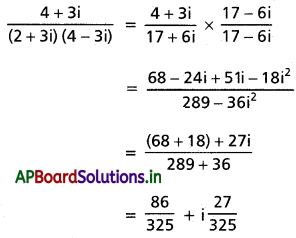
  7. As many of the western Maharashtra farmers are growing sugarcane, there is a shortage of sugarcane cutters.
  8. On the contrary, central Maharashtra, i.e., Vidharbha region is less cultivated, so there is scope of migration.

Question 14.
What would happen to children who come with their parents? Is it possible to bring these children to schools? Are there any provisions in the government laws for educating these children?
Answer:

  1. The children who come with their parents are engaged in piling the canes that are cut and removed the leaves if they are of working age.
  2. As their parents are living in bamboo huts, it is difficult for children to go to school.
  3. It is a seasonal migration.
  4. There is no provision of schools.
  5. It is possible to bring these children to schools.
  6. It requires a lot of care and interest on the part of the government.
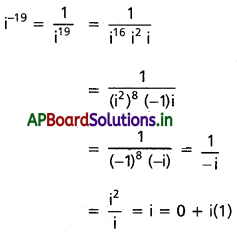
  7. There are provisions like setting up of Bridge schools and seasonal hostels for children of migrated parents.
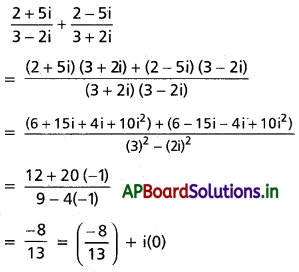
AP SSC 10th Class Social Studies Solutions Chapter 8 People and Migration

Question 15.
Why are sugarcane cutters employed only for six months? What work might they do during the other six months of the year?
Answer:

  1. Sugarcane cutters are employed only for six months.
  2. Because the season ends with it.
  3. Sugarcane cutters come there due to distress caused in rural areas.
  4. They might do agricultural works or MNREGA works during the other six months of the year.

Question 16.
How could the living conditions of these workers be improved?
Answer:

  1. They live in small conical huts.
  2. They live together with animals in congested conditions.
  3. They have to fight exhaustion all the time.
  4. The living conditions of these workers have to be improved.
  5. The owners of sugarcane cultivating lands, the government at the state and even local self governments should take initiative to develop their living conditions.
  6. They should set up health clinics, make shift houses and schools, fix proper wages and work hours.
  7. See that children are not engaged in work, but sent to schools.

Question 17.
The seven districts in western Maharashtra- Nasik, Ahmadnagar, Pune, Satara, Sangli, Kolhapur and Sholapur – comprise the “sugar belt” which extends into Surat (Gujarat) in the north and Belgaum (Karnataka) in the south. Five districts of the arid Marathwada region – Beed, Jalgaon, Ahmadnagar, Nasik and Jalna – send out labour to this sugar belt for six months every year for sugarcane harvesting.
Draw arrow lines on a map showing districts of origin and destination of migrants.
Answer:
AP SSC 10th Class Social Studies Solutions Chapter 8 People and Migration 14
AP SSC 10th Class Social Studies Solutions Chapter 8 People and Migration 15

10th Class Social Textbook Page No. 110

AP SSC 10th Class Social Studies Solutions Chapter 8 People and Migration

Question 18.
Describe an example of seasonal migration of your region.
Answer:

  1. People from our region migrate to Guntur and other towns to work in tobacco barons.
  2. With the gap in agricultural activities, many of the landless poor and even marginal farmers migrate there in search of employment.
  3. Leaving the children with grandparents, they migrate to work in barons.
  4. They bring back their savings.

10th Class Social Textbook Page No. 111

Question 19.
What can be done so that migrants are able to get food, health and family care programmes?
Answer:

  1. Migrants should get good food, health and family care programmes.
  2. It should be made possible for them to get food from fair price shops at their work places.
  3. Make-shift hospitals with doctors and nurses are to be established at or near the work places.
  4. Necessary care must be taken to prevent accidents in work places.
  5. Unorganised sector workers are also to be provided with access to various health and family care programmes.

Question 20.
There are some initiatives taken by government and voluntary agencies. Find out if there is any such initiative in your area. Invite some persons from such agencies for a talk in the school.
Answer:
Self Activity.

AP SSC 10th Class Social Studies Solutions Chapter 8 People and Migration

Question 21.
National boundaries are protected against migrants. Here are examples of
a) USA on Mexican border
b) South Korea on North Korean border
c) India on Bangladesh border.
AP SSC 10th Class Social Studies Solutions Chapter 8 People and Migration 17What do you think of migrants across the border?
Answer:
In the above figures the national boundaries of Mexico – the USA, South Korea – North Korea and India – Bangladesh are shown. It is common to arrange a fence between two countries along the border. The soldiers belonging to both the countries always safeguard the borders. But, due to many reasons different people try to cross the borders and enter the neighbouring countries. Some among them are terrorists who resort to violence and destruction in their enemy countries. They are induced and inspired by respective countries. They are called state sponsored terrorists.

In terms of employment and infrastructure, America is more attractive than Mexico. That is the reason why some people enter that country in illegal ways. Both South Korean and North Korean governments have different doctrines. One is communist whereas the other is capitalist. Those who differ with other countries’ doctrines try to cross the borders and go from one country to other for the sake of spying.

In Bangladesh, the rule has been dictatorial and the life of people there has been pathetic for ages. So some people of that country cross the border and enter the democratic country India. The states such as Paschim Banga and Assam are facing a grave problem with these people.

It’s a crime to cross the borders in an illegal way. And these people become a problem to the country they enter.

AP SSC 10th Class Social Studies Solutions Chapter 8 People and Migration

10th Class Social Textbook Page No. 112

Question 22.
Draw arrow lines on a World Map depicting people from India going to different countries mentioned in the above passages.

  1. USA
  2. Canada
  3. United Kingdom
  4. Australia
  5. Germany
  6. Norway
  7. Japan
  8. Malaysia
  9. Saudi Arabia
  10. UAE

Answer:
AP SSC 10th Class Social Studies Solutions Chapter 8 People and Migration 16

AP SSC 10th Class Social Studies Solutions Chapter 4 Climate of India

SCERT AP Board 10th Class Social Solutions 4th Lesson Climate of India Textbook Questions and Answers.

AP State Syllabus SSC 10th Class Social Studies Solutions 4th Lesson Climate of India

10th Class Social Studies 4th Lesson Climate of India Textbook Questions and Answers

Improve your learning

Question 1.
Read the following statements and mark if It is an example of weather or climate.
(a) During the last few years many glaciers have melted in the Himalayas.
Answer:
It is an example of weather.

(b) During the last few decades drought in the Vidarbha region has increased.
Answer:
It is an example of climate.

AP SSC 10th Class Social Studies Solutions Chapter 4 Climate of India

Question 2.
Match the following. Use maps if you cannot locate the places.
(There could be multiple correct answers.)
AP SSC 10th Class Social Studies Solutions Chapter 4 Climate of India 1a
Answer:
(a) Trivandrum — is closer to sea and the climate has big impact of the seas
(b) Gangtok — is farther from the equator and temperature would be lower in winter
(c) Anantapur — is closer to the equator but not close to the seas and has low rainfall

Question 3.
Describe India’s climate controls.
(OR)
Explain any two factors that influence the climate in India.
Answer:
The factors that affect climate are called climatic controls. These include:

  1. Latitude
  2. Land – Water relationship
  3. Relief
  4. Upper air circulation.

1. Latitude:

  • The intensity of temperature depends on the latitude. It is more intense in lower latitudes than at higher latitudes.
  • In India, the Southern part lies ¡n the tropical zone, closer to the equator; it has higher average temperature than the northern part.

2. Land – Water relationship:

  • The water bodies absorb and losses heat more slowly than land.
  • Due to this the formation of land and sea breezes influence the climate of coastal region.

3. Relief:

  • Relief or altitude of a region influences the climate of the area.
  • Several hill stations have cool climate even during summer months.
    Eg: Simia, Nainital, Mussone, Kodaikanal.

4. Upper air circulation:

  • The high velocity of Upper air movements is known as “Jet Streams’.
  • This jet stream causes the neighboring atmosphere to cool.

AP SSC 10th Class Social Studies Solutions Chapter 4 Climate of India

Question 4.
Write a short note on factors influencing climatic variations in hilly areas and deserts.
Answer:

  1. The factors influencing climatic conditions are called climatic controls.
  2. These include (i) Latitude (ii) Land-water relationship (iii) Upper air circulation.
  3. In hilly areas important factors influencing climatic conditions are latitudes, relief and land- water relationship, and upper air circulation only as a whole.
  4. If the hills are in southern India, they receive more temperature and rainfall. If they are near the coast, the effects would be different.
  5. In the hilly area altitude also plays a crucial role in deciding the temperature in accordance with the normal lapse rate.
  6. Relief of desert plays a crucial role in its temperature being decided and the inland nature shuns any influence of land-water relationship.
  7. The rainfalls in these regions are scanty and during temperature range is very high.

Question 5.
How are human activities contributing to global warming?
Answer:

  1. Human activities contribute to climate change by causing changes in Earth’s atmosphere in the amounts of greenhouse gases, aerosols and cloudiness.
  2. The largest known contribution comes from the burning of fossil fuels, which releases carbon dioxide gas to the atmosphere.
  3. Greenhouse gases and aerosols affect climate by altering incoming solar radiation and outgoing infrared radiation that are part of the earth’s energy balance.
  4. Changing their atmospheric abundance or properties of these gases and particles can lead to a warming or cooling of the climate system.
  5. Since the start of the industrial era (about 1750) the overall effect of human activities on climate has been a warming influence.,
  6. The human impact on climate during this era greatly exceeds that due to known changes in natural processes such as solar changes and volcanic eruptions.

AP SSC 10th Class Social Studies Solutions Chapter 4 Climate of India

Question 6.
What are the disagreements between ‘developed’ and ‘developing’ countries about AGW ?
Answer:

  1. An international organization called the Inter-governmental Panel on Climate Change (IPCC) was formed to reduce the emission of greenhouse gases.
  2. The latest attempt made at the IPCC conference in Warsaw (Poland) in 2013, failed to achieve any agreement.
  3. Disagreements are between developed countries and developing countries.
  4. Developed countries want developing countries to cut down on burning coal and other activities that add greenhouse gases to the atmosphere.
  5. Developing countries argue that developed countries developed precisely by burning fossil fuels in their development and their economic development will be seriously (developing countries) damaged if (developing countries) they do not burn fossil fuels.
  6. Developing countries also argue that developed countries should do their fair share of work to find alternatives that can help the developing countries to progress.

Question 7.
How is climate change causing global warming? Suggest measures to minimise the influence of the global warming.
Answer:

  1. Now heating of earth is much more rapid and could lead to catastrophic changes.
  2. Much of the warming has been occurring since the Industrial Revolution.
  3. Volumes of methane under the frozen tundras of northern latitudes is discovered.
  4. As global temperature increases, the ice in the tundra melts more.
  5. The methane trapped in, the ice escapes into the atmosphere increasing global temperatures.
  6. In turn, this causes even more ice to melt, releasing more methane, and so on.
  7. To minimize the influence of global warming, we should plan to reduce the emission of greenhouse gases like CO2, Methane, etc.
  8. We should take up afforestation.
  9. We should encourage public transport.
  10. We should minimize the use of refrigerators and air conditioners, etc.

AP SSC 10th Class Social Studies Solutions Chapter 4 Climate of India

Question 8.
On an outline map of India, show the following:
(i) Areas recorded with more than 40°C annual mean temperature.
(ii) Areas recorded with annual mean temperature less than 10°C.
(iii) The direction of the south-west monsoon over India.
Answer:
AP SSC 10th Class Social Studies Solutions Chapter 4 Climate of India 2

Question 9.
Observe the following climograph and answer the following questions.
AP SSC 10th Class Social Studies Solutions Chapter 4 Climate of India 3

AP SSC 10th Class Social Studies Solutions Chapter 4 Climate of India

(A) Which month received the highest rainfall?
Answer:
‘August’ month received the highest rainfall.

(B) Which months experience the highest and the lowest temperature?
Answer:
The highest temperature is experienced in the month of May.
The lowest temperature is experienced in the month of December.

(C) Why is the maximum amount of rainfall between June and October?
Answer:
The maximum amount of rainfall is received in Hyderabad between the months of June and October. The reason for this is the presence of south-west monsoons.

(D) Why is the temperature high between March and May?
Answer:
The temperature is high between March and May because it is the summer season.

(E) Identify relief conditions causing variation in temperature and rainfall.
Answer:
Hyderabad is present in the Deccan Plateau. It is situated at an elevation of 600 m from the mean sea level.

10th Class Social Studies 4th Lesson Climate of India InText Questions and Answers

10th Class Social Textbook Page No. 45 & 46

Question 1.
Fill the table after reading climographs.

AP SSC 10th Class Social Studies Solutions Chapter 4 Climate of India 4AP SSC 10th Class Social Studies Solutions Chapter 4 Climate of India 5

Range of Temperature: From highest value to lowest value
AP SSC 10th Class Social Studies Solutions Chapter 4 Climate of India 6Answer:

AP SSC 10th Class Social Studies Solutions Chapter 4 Climate of India 7

10th Class Social Textbook Page No. 46

AP SSC 10th Class Social Studies Solutions Chapter 4 Climate of India

Question 2.
What are the warmest and coldest months in Leh?
Answer:
The warmest month in Leh is June The coldest month in Leh is January.

Question 3.
From the range of temperatures in the above table, say whether Jaipur is, in general, hotter than Leh. Explain your answer.
Answer:

  1. Jaipur is, in general, hotter than Leh.
  2. In the hottest month, Leh got 26°C the highest temperature whereas Jaipur got 40-C during the same month.
  3. Thus, we can say Jaipur is hotter in general.

Question 4.
Compare the climate of Delhi and Chennai. How are they different? 4S June 20171
Answer:

  1. Delhi has an extreme climate with 6°C as the lowest temperature and 40°C as the highest temperature.
  2. Every month the difference between the highest and lowest temperatures is also more around 16°C.
  3. But whereas Chennai has a moderate climate with 38°C as highest and 20°C as the lowest temperature.
  4. Even the difference between the highest and the lowest every month is also less, around 10°C.
  5. Delhi The climate of Delhi is a monsoon-influenced humid subtropical with high variation between summer and winter temperatures and precipitation. Its climate is greatly influenced by its proximity to the Himalayas and the Thar Desert, causing it to experience both weather extremes.
  6. Chennai: The geographical location determines the weather and climate in Chennai. The close proximity of the ocean and equator makes the climate and weather in Chennai relatively consistent with less variation in the seasonal temperature. The weather in Chennai is mostly hot and humid.

AP SSC 10th Class Social Studies Solutions Chapter 4 Climate of India

Question 5.
Read carefully the rainfall pattern for Leh. In what ways is this different from the others? From your atlas, can you find out some other places in the world that have similar rainfall patterns?
Answer:

  1. Leh is situated nearly 6 km above the mean sea level.
  2. So the atmosphere there is not conducible for rain.
  3. It receives less than 10 mm as the maximum monthly rainfall.
  4. The remaining three places receive 200 mm or more rainfall as the maximum monthly rainfall.
  5. It is surrounded by greater Himalayan mountains which are always covered with snow.
  6. Thus, it is different from the other 3 places which are unlike this.
  7. There are some other places in the world like this like Zurich in Switzerland, Oslo in Norway, Thimpu in Bhutan and Khatmandu in Nepal etc.

Question 6.
Identify the wet months for Chennai. How is this different from Jaipur?
Answer:

  1. The wettest months for Chennai are October and November.
  2. It is because it receives rainfall during the retreat of southwest monsoon or during the north-east monsoon.
  3. Whereas the wettest months for Jaipur are July and August.
  4. It receives rainfall during the southwest monsoon.
  5. In this way Chennai and Jaipur are different.

10th Class Social Textbook Page No. 47

Question 7.
Using a globe recall and discuss what you may have read earlier. How does the angle of the sun vary at different latitudes? What impact does this have?
Answer:
AP SSC 10th Class Social Studies Solutions Chapter 4 Climate of India 8Sun angles and their impact.

  1. Tilt of the earth is the axis of rotation.
  2. Axis of rotation tilted 23.5° away from perpendicular to the plane of earth’s orbit.
  3. Due to this, it creates seasonal variations in which hemisphere is oriented towards the sun.

AP SSC 10th Class Social Studies Solutions Chapter 4 Climate of India

10th Class Social Textbook Page No. 48

Question 8.
In your atlas, compare the temperatures of Mumbai and Nagpur for the winter and summer months. How are they similar or different? How does it explain the distance from the sea?
Answer:

  1. Mumbai is located on the west coast at 18°55′ N latitude and 77°54′ E longitude.
  2. Nagpur is located as an inland at 21°9′ N latitude and 79°9′ E longitude.
  3. For January, the winter month Mumbai has an average temperature of 24.4°C whereas Nagpur has 20.6°C.
  4. For May, the summer month Mumbai has an average temperature of 30°C whereas Nagpur has 37°C.
  5. As Mumbai is on the west coast it is experiencing a moderate climate with less changes of temperatures.
  6. Being an island region, the variations in temperatures during summer and winter are more for Nagpur.
  7. Thus, It shows the influence of distance from the sea.

Question 9.
With the help of the climographs, can you explain how differences in temperature can be explained for Jaipur and Chennai ?
Answer:

  1. Jaipur has an extreme climate whereas Chennai is with moderate climate.
  2. Though the highest average temperature for both regions are at near 40*C, the lowest average temperatures for Jaipur is at 6°C whereas that is for Chennai is 18°C.
  3. The monthly differences in highest and lowest temperatures also vary.
  4. For Jaipur they are around 16°C whereas for Chennai they are around 10°C.
  5. The atmosphere of Chennai will be pleasant with these temperatures whereas that is not the case with Jaipur.

AP SSC 10th Class Social Studies Solutions Chapter 4 Climate of India

Question 10.
Are Shimla and Delhi located on very different latitudes? Check with your atlas. Is Shimla cooler than Delhi during summer ?
Answer:

  1. Delhi is located at 28°38’N latitude and 77°17’E longitude.
  2. Shimla Is located at 31°6’N latitude and 77°13′ E longitude.
  3. Thus Delhi and Shimla are located in different latitudes.
  4. During summer Shimla is cooler than Delhi.
  5. Being in the northern plain and experiencing the hot winds named ‘Loo’ Delhi experiences high temperatures, during summer.
  6. Being in the Himalayan ranges and above the altitude of more than 3 km Shimla experiences less temperatures compared to Delhi, during summer.

Question 11.
Why does Darjeeling have pleasant weather as compared to Kolkata during summer season ?
Answer:

  1. Darjeeling is located in West Bengal at the latitude of 27°3′ N and a longitude of 88°18′ E.
  2. Kolkata is also located in West Bengal at the latitude of 22°34′ N and a longitude of 88°24′ E.
  3. Kolkata is located near the coast and experiences the advantage of the nearness to water during summer.
  4. But Darjeeling, being situated in the Himalayan Ranges at an altitude of more than 3 km, experiences less temperatures during summer.
  5. Thus, Darjeeling will have pleasant weather compared to Kolkata during the summer season.

10th Class Social Textbook Page No. 49

Question 12.
What would be the range for the average temperature in A.P. for January?
Answer:

  1. January is the month during which winter is severe.
  2. It usually will be cold during this month throughout Andhra Pradesh.
  3. For the month of January, the average maximum temperature is around 28°C.
  4. The average minimum temperature is around 16°C for January in Andhra Pradesh.
  5. Thus range of average temperature for January in Andhra Pradesh is around 28°C to 16°C.

Question 13.
Using your atlas, find some places located on 15°C temperature.
Answer:
The places that are located on 15°C are Jaipur, Mathura, Itanagar etc.

AP SSC 10th Class Social Studies Solutions Chapter 4 Climate of India

Question 14.
Close to the line showing places where average temperature is 25°C, there’s a small circle of places on 20°C. How is this possible?
Answer:

  1. Close to the line showing places where average temperature is 25°C, there is a small circle of places on 20°C.
  2. That is the region where the Western Ghats rise above 2000 m peaks.
  3. There are the Nilgiri Hills which has peaks more than 2000 m height.
  4. So the temperatures there are less as the elevation is more.
  5. That is why there was 20°C circle close to 25°C line.

10th Class Social Textbook Page No. 50

Question 15.
From the climographs (Graph 1-4), note the approximate average temperature for May for the four places and mark them on the map given.
Answer:
AP SSC 10th Class Social Studies Solutions Chapter 4 Climate of India 9

  1. Jaipur 24°C to 40°C
  2. Leh 12°C to 29°C
  3. New Delhi 34°C to 40°C

10th Class Social Textbook Page No. 54

AP SSC 10th Class Social Studies Solutions Chapter 4 Climate of India

Question 16.
What is deforestation ?
Answer:

  1. Cutting down of the trees indiscriminately in the areas of forest or where there a presence of sizable number of trees like plantations is called deforestation.
  2. It results in the lowering of the green cover.
  3. It affects the ecological balance.
  4. It reduces the probability of raining.
  5. It affects the soil erosion, it increases soil erosion.
  6. It also affects the sustainability of green cover.

Question 17.
Does deforestation happen only in forest areas? How about in your local area, even if there are no forests?
Answer:

  1. Deforestation not only happens in forest areas.
  2. In our local areas the felling of trees comes under deforestation.
  3. Even if there are no forests, the cutting down of trees is considered as deforestation.

Question 18.
How does deforestation affect global warming?
Answer:

  1. Deforestation is the cutting down of trees for commercial purposes (other than domestic purposes of tribals) in the forests and vegetations of a large scale.
  2. Trees make use of the most of the greenhouse gas of carbon dioxide into their food which is called photosynthesis using sunlight.
  3. If trees were cut down indiscriminately, it would result in the accumulation of C02, the green house gas.
  4. It will result in the increase of temperatures throughout the earth i.e., global warming.
  5. Thus, deforestation affects global warming.

AP SSC 10th Class Social Studies Solutions Chapter 4 Climate of India

Question 19.
What are some other ways in which human action contributes to global warming?
Answer:

  1. Usage of refrigerators and air conditioners, etc. by humans leads to global warming.
  2. Usage of motor vehicles which run on fuel emits greenhouse gases.
  3. Usage of inorganic fertilizers, chemicals and pesticides.
  4. Releasing of effluences and wastes of industries.
  5. Excessive usage of natural resources.

10th Class Social Textbook Page No. 55

Question 20.
Imagine how one would cope with the situation if millions of people were affected. Where would you find land for resettlement? What jobs would they do?

AP SSC 10th Class Social Studies Solutions Chapter 4 Climate of India 10
Impact of Aila : broken embankment

Answer:

AP SSC 10th Class Social Studies Solutions Chapter 4 Climate of India 11
Repairing embankment
  1. If millions of people were affected with any natural calamity, it certainly would be difficult to cope with.
  2. The government has to make arrangements to resettlement of all those affected.
  3. It may seek help from international organisations or non-governmental organisations in our country as well as the donors.
  4. It will be a Herculean task to provide them shelter and alternate employment, but government must take initiative to get it done.
  5. It must employ the eligible to work within Rural Works Programme, Food for Work, Mahatma Gandhi National Rural Labour Employment Guarantee schemes etc.

AP SSC 10th Class Social Studies Solutions Chapter 4 Climate of India

Project work

Collect proverbs/sayings that are related to climate and weather in your region.

  1. A Rainbow in the morning is the Sailor’s Warming.
  2. A Rainbow at night is the Sailor’s delight.
  3. When the dew is on the grass rain will never come to pass.

Answer:
“Red sky at night, sailor’s delight. Red sky in the morning, sailor take warning.”
“Mare’s tails and mackerel scales make tall ships take in their sails.”
“Clear moon, frost soon.”
“Halo around the sun or moon, rain or snow soon.”
“Rainbow in the morning gives you fair warning.”
“When the stars begin to huddle, the earth will soon become a puddle.”