AP Board 6th Class Maths Solutions Chapter 3 గ.సా.కా – క.సా.గు Ex 3.5

SCERT AP 6th Class Maths Solutions Chapter 3 గ.సా.కా – క.సా.గు Ex 3.5 Textbook Exercise Questions and Answers.

AP State Syllabus 6th Class Maths Solutions 3rd Lesson గ.సా.కా – క.సా.గు Exercise 3.5

ప్రశ్న 1.
కింద ఇవ్వబడిన సంఖ్యల గ.సా.భాను ప్రధాన కారణాంక విభజన పద్ధతి ద్వారా మరియు నిరంతర భాగహార పద్ధతి ద్వారా కనుగొనుము.
అ) 48, 64
ఆ) 126, 216
ఇ) 40, 60, 56
ఈ) 10, 35, 40
సాధన.
అ) 48, 64
ప్రధాన కారణాంక విభజన పద్ధతి :
\(\begin{array}{c|c}
2 & 48 \\
\hline 2 & 24 \\
\hline 2 & 12 \\
\hline 2 & 06 \\
\hline 3 & 3 \\
\hline & 1
\end{array}\)

\(\begin{array}{l|l}
2 & 64 \\
\hline 2 & 32 \\
\hline 2 & 16 \\
\hline 2 & 08 \\
\hline 2 & 4 \\
\hline 2 & 2 \\
\hline & 1
\end{array}\)
48 = 2 × 2 × 2 × 2 × 3
64 = 2 × 2 × 2 × 2 × 2 × 2
(48, 64)ల ఉమ్మడి కారణాంకాలు 2,2,2,2
∴ 48, 64 ల గ.సా.భా = 2 × 2 × 2 × 2 = 16

నిరంతర భాగహార పద్ధతి :
AP Board 6th Class Maths Solutions Chapter 3 గ.సా.కా - క.సా.గు Ex 3.5 1
శేషం ‘0’ వచ్చినపుడు చివరి భాజకం 16.
∴ 48, 64 గ.సా.భా = 16

ఆ) 126, 216
ప్రధాన కారణాంక విభజన పద్ధతి :
\(\begin{array}{l|l}
2 & 126 \\
\hline 3 & 063 \\
\hline 3 & 21 \\
\hline 7 & 07 \\
\hline & 1
\end{array}\)

\(\begin{array}{l|r}
2 & 216 \\
\hline 2 & 108 \\
\hline 2 & 054 \\
\hline 3 & 27 \\
\hline 3 & 09 \\
\hline 3 & 3 \\
\hline & 1
\end{array}\)
126 = 2 × 3 × 3 × 7
216 = 2 × 2 × 2 × 3 × 3 × 3
126, 216 ల గ.సా.భా = 2 × 3 × 3 = 18

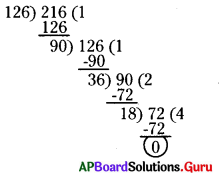
నిరంతర భాగహార పద్ధతి :
AP Board 6th Class Maths Solutions Chapter 3 గ.సా.కా - క.సా.గు Ex 3.5 2
126, 216 ల గ.సా.భా = 18

ఇ) 40, 60, 56
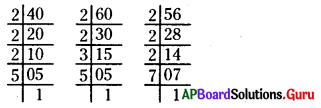
ప్రధాన కారణాంక విభజన పద్ధతి :
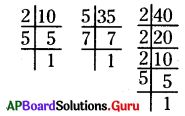
AP Board 6th Class Maths Solutions Chapter 3 గ.సా.కా - క.సా.గు Ex 3.5 3
40 = 2 × 2 × 2 × 5
60 = 2 × 2 × 3 × 5
56 = 2 × 2 × 2 ×7
40,60,56 ల ఉమ్మడి కారణాంకాలు 2, 2
∴ 40,60,56 ల గ.సా.భా = 2 × 2 = 4

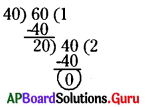
నిరంతర భాగహార పద్ధతి :
AP Board 6th Class Maths Solutions Chapter 3 గ.సా.కా - క.సా.గు Ex 3.5 4
40, 60 ల గ.సా.భా = 20
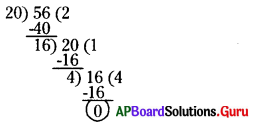
ఇపుడు 20, 56 ల గ.సా.భా
AP Board 6th Class Maths Solutions Chapter 3 గ.సా.కా - క.సా.గు Ex 3.5 5
20, 56 ల గ.సా.భా = 4
∴ 40, 60, 56 ల గ.సా.భా = 4

ఈ) 10, 35, 40
ప్రధాన కారణాంక విభజన పద్ధతి :
AP Board 6th Class Maths Solutions Chapter 3 గ.సా.కా - క.సా.గు Ex 3.5 6
10 = 2 × 5
35 = 5 × 7
40 = 2 × 2 × 2 × 5
ఉమ్మడి కారణాంకం = 5
10, 35, 40 ల గ.సా.భా = 5

నిరంతర భాగహార పద్ధతి :
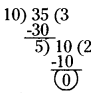
AP Board 6th Class Maths Solutions Chapter 3 గ.సా.కా - క.సా.గు Ex 3.5 7
10, 35 ల గ.సా.భా = 5
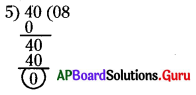
AP Board 6th Class Maths Solutions Chapter 3 గ.సా.కా - క.సా.గు Ex 3.5 8
5, 40 ల గ.సా.భా = 5
∴ 10, 35, 40 ల గ.సా.భా = 5.

AP Board 6th Class Maths Solutions Chapter 3 గ.సా.కా - క.సా.గు Ex 3.5

ప్రశ్న 2.
రెండు పాలక్యాన్లలో వరుసగా 60 లీటర్లు, 165 లీటర్ల పాలు ఉన్నవి. రెండు క్యాన్లలోని పాలను కొలవగలిగే గరిష్ఠ పరిమాణం కలిగిన క్యానను కనుగొనండి.
సాధన.
రెండు పాలక్యాన్లలో గల పాలు = 60 లీటర్లు మరియు 165 లీటర్లు
రెండు క్యాన్లలోని పాలను కొలవగలిగే గరిష్ఠ పరిమాణం కలిగిన క్యాన్ = 60, 165 ల గ.సా.భా.
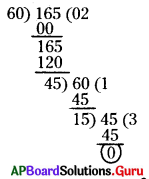
AP Board 6th Class Maths Solutions Chapter 3 గ.సా.కా - క.సా.గు Ex 3.5 9
60, 165 ల గ.సా.భా = 15
∴ పాలను కొలవగలిగే గరిష్ఠ పరిమాణం కలిగిన క్యాన్ = 15 లీటర్లు.

ప్రశ్న 3.
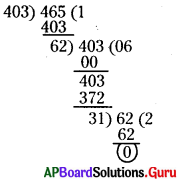
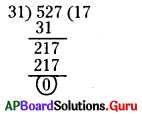
మూడు వేర్వేరు కొలతలు గల కంటైనర్లలో వరుసగా 403 లీటర్లు, 465 లీటర్లు, 527 లీటర్లు పరిమాణాలలో పాలు ఉన్నవి. వేర్వేరు పరిమాణాలలో గల కంటైనర్లలోని పాలను పూర్తిగా కొలవగలిగే గరిష్ఠ పరిమాణం గల కొలత ఎంత?
సాధన.
మూడు కంటైనర్లలో గల పాల పరిమాణం = 403 లీటర్లు, 465 లీటర్లు, 527 లీటర్లు
కంటైనర్లలోని పాలను పూర్తిగా కొలవగలిగే
గరిష్ట పరిమాణం గల కొలత = 403, 465, 527 ల గ.సా.భా = 31
AP Board 6th Class Maths Solutions Chapter 3 గ.సా.కా - క.సా.గు Ex 3.5 10
AP Board 6th Class Maths Solutions Chapter 3 గ.సా.కా - క.సా.గు Ex 3.5 11

AP Board 6th Class Maths Solutions Chapter 3 గ.సా.కా – క.సా.గు Ex 3.4

SCERT AP 6th Class Maths Solutions Chapter 3 గ.సా.కా – క.సా.గు Ex 3.4 Textbook Exercise Questions and Answers.

AP State Syllabus 6th Class Maths Solutions 3rd Lesson గ.సా.కా – క.సా.గు Exercise 3.4

ప్రశ్న 1.
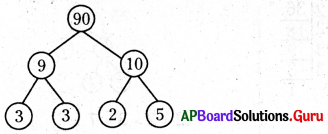
90 యొక్క కారణాంక వృక్షాన్ని తయారు చేయండి.
సాధన.
AP Board 6th Class Maths Solutions Chapter 3 గ.సా.కా - క.సా.గు Ex 3.4 1
90 = 2 × 3 × 3 × 5

ప్రశ్న 2.
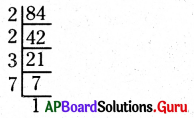
భాగహార పద్ధతిలో 84 ను ప్రధాన కారణాంకాల లబ్ధంగా రాయండి.
సాధన.
84 = 2 × 2 × 3 × 7
AP Board 6th Class Maths Solutions Chapter 3 గ.సా.కా - క.సా.గు Ex 3.4 2

ప్రశ్న 3.
4 అంకెల గరిష్ఠ సంఖ్యను రాసి, దానిని ప్రధాన కారణాంకాల లబ్దంగా రాయండి.
సాధన.
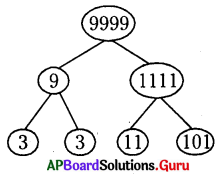
4 అంకెల గరిష్ఠ సంఖ్య : 9999
AP Board 6th Class Maths Solutions Chapter 3 గ.సా.కా - క.సా.గు Ex 3.4 3
AP Board 6th Class Maths Solutions Chapter 3 గ.సా.కా - క.సా.గు Ex 3.4 4
∴ 9999 = 3 × 3 × 11 × 101

AP Board 6th Class Maths Solutions Chapter 3 గ.సా.కా - క.సా.గు Ex 3.4

ప్రశ్న 4.
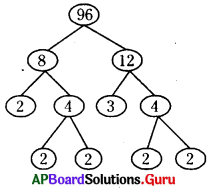
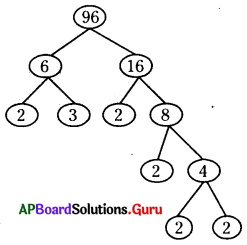
కారణాంక వృక్ష పద్ధతి ద్వారా 96 యొక్క ప్రధాన కారణాంక విభజనను రాయండి.
సాధన.
AP Board 6th Class Maths Solutions Chapter 3 గ.సా.కా - క.సా.గు Ex 3.4 5
(లేదా)
AP Board 6th Class Maths Solutions Chapter 3 గ.సా.కా - క.సా.గు Ex 3.4 6
∴ 96 = 2 × 2 × 2 × 2 × 2 × 3

ప్రశ్న 5.
నేను ఒక కనిష్ఠ సంఖ్యను నేను నాలుగు విభిన్న ప్రధాన కారణాంకాల లబ్దాన్ని నేనెవరో కనుగొనండి.
సాధన.
మొదటి నాలుగు ప్రధాన సంఖ్యలు = 2, 3, 5, 7.
వాటి లబ్ధం = AP Board 6th Class Maths Solutions Chapter 3 గ.సా.కా - క.సా.గు Ex 3.4 7 = 210
కావున, నాలుగు విభిన్న ప్రధాన కారణాంకాల లబ్ధంగా గల కనిష్ఠ సంఖ్య = 210.

ప్రశ్న 6.
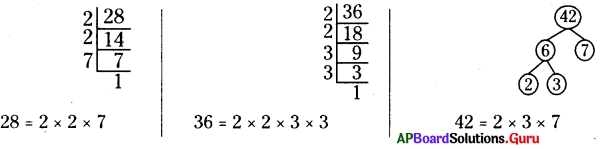
భాగహార పద్దతిన 28 మరియు 36 ల ప్రధాన కారణాంక విభజనను రాయండి. 42 యొక్క ప్రధాన కారణాంక విభజనను కారణాంక వృక్ష పద్ధతి ద్వారా రాయండి.
సాధన.
AP Board 6th Class Maths Solutions Chapter 3 గ.సా.కా - క.సా.గు Ex 3.4 8

AP Board 6th Class Maths Solutions Chapter 3 గ.సా.కా – క.సా.గు Ex 3.3

SCERT AP 6th Class Maths Solutions Chapter 3 గ.సా.కా – క.సా.గు Ex 3.3 Textbook Exercise Questions and Answers.

AP State Syllabus 6th Class Maths Solutions 3rd Lesson గ.సా.కా – క.సా.గు Exercise 3.3

ప్రశ్న 1.
కింది ఇవ్వబడిన సంఖ్యలకు అన్ని కారణాంకాలు రాయండి.
అ) 24
ఆ) 56
ఇ) 80
ఈ) 98
సాధన.
అ) 24
24 = 1 × 24
24 = 2 × 12
24 = 3 × 8
24 = 4 × 6
4 కారణాంకాలు
1, 2, 3, 4, 6, 8, 12, 24.

ఆ) 56
56 = 1 × 56
56 = 2 × 28
56 = 4 × 14
56 = 7 × 8
56 కారణాంకాలు
1, 2, 4, 7, 8, 14, 28, 56.

ఇ) 80
80 = 1 × 80
80 = 2 × 40
80 = 4 × 20
80 = 5 × 16
80 = 8 × 10
80 కారణాంకాలు
1, 2, 4, 5, 8, 10, 16, 20, 40, 80.

ఈ) 98
98 = 1 × 98
98 = 2 × 49
98 = 7 × 14
98 కారణాంకాలు
1, 2, 7, 14, 49, 98.

ప్రశ్న 2.
50 మరియు 100 మధ్యన గల అతిపెద్ద ప్రధాన సంఖ్య ఏది?
సాధన.
50 మరియు 100 మధ్యగల అతి పెద్ద ప్రధానసంఖ్య = 97.

AP Board 6th Class Maths Solutions Chapter 3 గ.సా.కా - క.సా.గు Ex 3.3

ప్రశ్న 3.
13 మరియు 31 సంఖ్యలు ప్రధాన సంఖ్యలు. రెండు సంఖ్యలు 1 మరియు 3 అంకెలు కలిగివున్నవి. ఇలాంటి 100 లోపున్న రెండు జతల ప్రధాన సంఖ్యలను కనుగొనండి.
సాధన.
(17, 71), (37, 73) (79, 97)

ప్రశ్న 4.
కింద ఇవ్వబడిన సంఖ్యలను రెండు బేసి ప్రధాన సంఖ్యల మొత్తంగా తెలుపుము.
అ) 18
ఆ) 24
ఇ) 36
ఈ) 44
సాధన.
అ) 18 = 5 + 13
18 = 7 + 11

ఆ) 24 = 5 + 19
24 = 7 + 17
24 = 11 + 13

ఇ) 36 = 5 + 31
36 = 7 + 29
36 = 13 + 23
36 = 17 + 19

ఈ) 44 = 3 + 41
44 = 7 + 37
44 = 13 + 31

ప్రశ్న 5.
100 లోపున్న 7 వరుస సంయుక్త సంఖ్యలను రాయండి.
సాధన.
100 లోపు ఉన్న 7 వరుస సంయుక్త సంఖ్యలు : 90, 91, 92, 93, 94, 95, 96

ప్రశ్న 6.
10 భేదంగా కలిగిన రెండు ప్రధాన సంఖ్యలను రాయండి.
సాధన.
10 భేదంగా గల రెండు ప్రధాన సంఖ్యలు
(3, 13) లేదా (7, 17) లేదా (13, 23) లేదా (19, 29) లేదా (31, 41) లేదా (37, 47) లేదా (43, 53) లేదా (61, 71) లేదా (73, 83) మొదలగునవి.

AP Board 6th Class Maths Solutions Chapter 3 గ.సా.కా - క.సా.గు Ex 3.3

ప్రశ్న 7.
20 లోపు ఉండి వాటి మొత్తం 5 చే భాగింపబడే మూడు జతల ప్రధాన సంఖ్యలను రాయండి.
సాధన.

ప్రధాన సంఖ్యల జతవాటి మొత్తం5 చే భాగించబడుతుందా ? / లేదా ?
2, 32 + 3 = 5అవును
3, 73 + 7 = 10అవును
7, 137 + 13 = 20అవును

AP Board 6th Class Maths Solutions Chapter 3 గ.సా.కా – క.సా.గు Ex 3.2

SCERT AP 6th Class Maths Solutions Chapter 3 గ.సా.కా – క.సా.గు Ex 3.2 Textbook Exercise Questions and Answers.

AP State Syllabus 6th Class Maths Solutions 3rd Lesson గ.సా.కా – క.సా.గు Exercise 3.2

ప్రశ్న 1.
భాజనీయతా సూత్రమును ఉపయోగించి, కింది సంఖ్యలలో ఏవి 11చే నిశ్శేషంగా భాగించబడతాయో తెలపండి.
అ) 6446
ఆ) 10934
ఇ) 7138965
ఈ) 726352
సాధన.
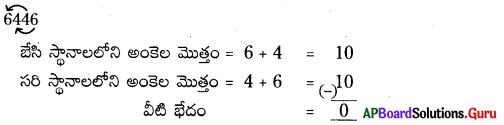
అ)
AP Board 6th Class Maths Solutions Chapter 3 గ.సా.కా - క.సా.గు Ex 3.2 1
భేదం ‘0’ కావున 11 1 6446 భాగింపబడుతుంది.
(లేదా)
6446 ద్విముఖ సంఖ్య (పాలి డ్రోమ్ సంఖ్య) కావున 11చే భాగింపబడుతుంది.

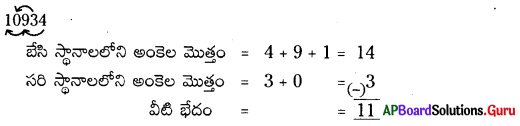
ఆ)
AP Board 6th Class Maths Solutions Chapter 3 గ.సా.కా - క.సా.గు Ex 3.2 2
భేదం 11 ని 11 నిశ్శేషంగా భాగిస్తుంది.
కావున ఇచ్చిన సంఖ్య 10934 ను 11 నిశ్శేషంగా భాగిస్తుంది.

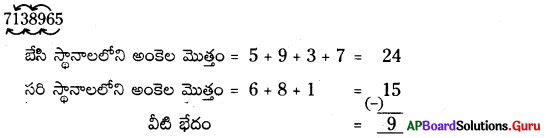
ఇ)
AP Board 6th Class Maths Solutions Chapter 3 గ.సా.కా - క.సా.గు Ex 3.2 3
భేదం 9 ని 11 నిశ్శేషంగా భాగించదు. కావున
ఇచ్చిన సంఖ్య 7138965 ను 11 నిశ్శేషంగా భాగించదు.

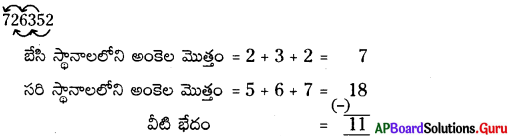
ఈ)
AP Board 6th Class Maths Solutions Chapter 3 గ.సా.కా - క.సా.గు Ex 3.2 4
11 భేదం 11 ని 11 నిశ్శేషంగా భాగిస్తుంది. కావున ,
ఇచ్చిన సంఖ్య 726352 కూడా 11 చే నిశ్శేషంగా భాగింపబడుతుంది.

AP Board 6th Class Maths Solutions Chapter 3 గ.సా.కా - క.సా.గు Ex 3.2

ప్రశ్న 2.
11 చే నిశ్శేషంగా భాగించబడే, 2000 మరియు 2100 మధ్యనగల సంఖ్యలను రాయండి.
సాధన.
2000 కు సమీప పెద్దదైన 11 చే భాగింపబడు సంఖ్య = 2002 (ద్విముఖ సంఖ్య)
కావున 2000 మరియు 2100 మధ్య గల 11 చే నిశ్శేషంగా భాగింపబడే సంఖ్యలు
= 2002, 2013, 2024, 2035, 2046, 2057, 2068, 2079, 2090.
(ఏ రెండు వరుస సంఖ్యల భేదమైన 11గా ఉంటుంది)

ప్రశ్న 3.
11 చే నిశ్శేషంగా భాగించబడే, 1234 సంఖ్యకు అతి దగ్గరగా గల సంఖ్యను రాయండి.
సాధన.
ఇచ్చిన సంఖ్య
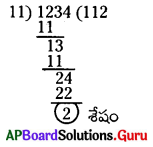
AP Board 6th Class Maths Solutions Chapter 3 గ.సా.కా - క.సా.గు Ex 3.2 5
బేసి స్థానాలలోని అంకెల మొత్తం = 4 + 2 = 6
సరి స్థానాలలోని అంకెల మొత్తం = 3 + 1 = 4
వీని భేదం ‘0’ గాని, 11 చే భాగింపబడే సంఖ్య గాని అయితే 1234, 11 చే నిశ్శేషంగా భాగింపబడుతుంది.
భేదం 11 కావడానికి అవకాశం లేదు. కావున ‘0’ కావాలి.
భేదం ‘0’ కావాలంటే బేసి స్థానాలలోని అంకెల మొత్తం 4 కావాలి.
కావున ఒకట్ల స్థానంలోని అంకె 4 కు బదులు 2 ఉన్నట్లయితే ఇది సాధ్యము.
కావున 1232 అనే సంఖ్య 1234 సంఖ్యకు అతి దగ్గరగా ఉండి 11 చే భాగింపబడుతుంది.
(లేదా)
1234 – 2 = 1232
AP Board 6th Class Maths Solutions Chapter 3 గ.సా.కా - క.సా.గు Ex 3.2 6
11 చే నిశ్శేషంగా భాగింపబడుతుంది.
కావున 11 చే నిశ్శేషంగా భాగింపబడే 1234 కు అతి దగ్గరగా గల సంఖ్య = 1232

AP Board 6th Class Maths Solutions Chapter 3 గ.సా.కా – క.సా.గు Ex 3.1

SCERT AP 6th Class Maths Solutions Chapter 3 గ.సా.కా – క.సా.గు Ex 3.1 Textbook Exercise Questions and Answers.

AP State Syllabus 6th Class Maths Solutions 3rd Lesson గ.సా.కా – క.సా.గు Exercise 3.1

ప్రశ్న 1.
ఈ కింద ఇవ్వబడిన సంఖ్యలలో 2, 3 మరియు 6 చే నిశ్శేషంగా భాగింపబడే సంఖ్యలేవి?
అ) 237192
ఆ) 193272
ఇ) 972312
ఈ) 1790184
ఉ) 312792
ఊ) 800552
ఋ) 4335
ౠ) 726352
సాధన.
అ) 237192
ఒకట్ల స్థానం 2 కావున 2 చే భాగింపబడుతుంది.
అంకెల మొత్తం = 2 + 3 + 7 + 1 + 9 + 2 = 24
24 ను 3 భాగిస్తుంది. కావున 3 చే ఇచ్చిన సంఖ్య భాగింపబడుతుంది.
∴ 2, 3 లచే 237192 భాగింపబడుచున్నది కావున 6చే భాగింపబడుతుంది.

ఆ) 193272
ఒకట్ల స్థానం 2, కావున 2 చే భాగింపబడుతుంది.
అంకెల మొత్తం = 1 + 9 + 3 + 2 + 7 + 2 = 24
24 ను 3 నిశ్శేషంగా భాగిస్తుంది కావున 193272 ను కూడా 3 నిశ్శేషంగా భాగిస్తుంది.
2, 3 లచే 193272 భాగింపబడుతున్నది. కావున 6 చే కూడా నిశ్శేషంగా భాగింపబడుతుంది.

ఇ) 972312
ఒకట్ల స్థానం 2, కావున 2 చే భాగింపబడుతుంది.
అంకెల మొత్తం = 9 + 7 + 2 + 3 + 1 + 2 = 24, కావున 3 చే కూడా భాగింపబడుతుంది.
2, 3 లచే భాగింపబడుతుంది. కావున 972312, 6 చే కూడా భాగింపబడుతుంది.

ఈ) 1790184
ఒకట్ల స్థానం 4, కావున 2 చే భాగింపబడుతుంది.
అంకెల మొత్తం = 1 + 7 + 9 + 0 + 1 + 8 + 4 = 30
30 ని 3 నిశ్శేషంగా భాగిస్తుంది. కావున 1790184 ను 3 నిశ్శేషంగా భాగిస్తుంది.
2, 3 లచే 1790184 నిశ్శేషంగా భాగింపబడుతున్నది. కావున 6 చే కూడా నిశ్శేషంగా భాగింపబడుతుంది.

ఉ) 312792
2 చే నిశ్శేషంగా భాగింపబడుతుంది. (ఒకట్ల స్థానం 2 కావున)
అంకెల మొత్తం = 3+ 1 + 2 + 7 + 9 + 2 = 24,
3చే 24 భాగింపబడుతుంది. కావున 312792 కూడా 3 చే భాగింపబడుతుంది.
2, 3 లచే 312792 భాగింపబడుతున్నది. కావున 6 చే కూడా భాగింపబడుతుంది.

ఊ) 800552
2 చే భాగింపబడుతుంది. (ఒకట్ల స్థానం 2 కావున)
అంకెల మొత్తం = 8 + 0 + 0 + 5 + 5 + 2 = 20
20 ని 3 నిశ్శేషంగా భాగించదు. కావున 3 చే ఇచ్చిన సంఖ్య 800552 భాగింపబడదు.
ఇచ్చిన సంఖ్య 800552 ను 3 నిశ్శేషంగా భాగించదు. కావున 6 కూడా నిశ్శేషంగా భాగించదు.

ఋ) 4335
ఒకట్ల స్థానం 5 కావున 2 చే భాగింపబడదు.
అంకెల మొత్తం = 4 + 3 + 3 + 5 = 15
15 ను 3 భాగిస్తుంది. కావున 4335 ను కూడా 3 భాగిస్తుంది.
ఇచ్చిన సంఖ్య 4335 ను 2 నిశ్శేషంగా భాగించదు కావున 6 కూడా నిశ్శేషంగా భాగించదు.

ౠ) 726352
2 చే నిశ్శేషంగా భాగించబడుతుంది. (ఒకట్ల స్థానం 2)
అంకెల మొత్తం = 7 + 2 + 6 + 3 + 5 + 2 = 25
25 ను 3 నిశ్శేషంగా భాగించదు. కావున 726352 ను కూడా 3 నిశ్శేషంగా భాగించదు.
3 చే 726352 భాగింపబడటం లేదు. కావున 6 చే కూడా భాగింపబడదు.

AP Board 6th Class Maths Solutions Chapter 3 గ.సా.కా - క.సా.గు Ex 3.1

ప్రశ్న 2.
ఈ కింద ఇవ్వబడిన సంఖ్యలలో 5 మరియు 10 లచే నిశ్శేషంగా భాగింపబడే సంఖ్యలను గుర్తించండి.
25, 125, 250, 1250, 10205, 70985, 45880లు 10 చేత భాగింపబడే సంఖ్యలు 2 మరియు 5ల చేత కూడా భాగింపబడునో పరిశీలించండి.
సాధన.
ఒక సంఖ్య ఒకట్ల స్థానంలోని అంకె ‘0’ లేదా ‘5’ అయినచో ఆ సంఖ్య ‘5’ చే నిశ్శేషంగా భాగించబడుతుంది.
ఒక సంఖ్య ఒకట్ల స్థానంలోని అంకె 0, 2, 4, 6 మరియు 8 అయినచో ఆ సంఖ్య ‘2’ చే నిశ్శేషంగా భాగించబడుతుంది.
ఒక సంఖ్య ఒకట్ల స్థానంలోని అంకె ‘0’ అయినచో ఆ సంఖ్య ’10’ చే నిశ్శేషంగా భాగించబడుతుంది.

సంఖ్య2చే భాగించబడును5చే భాగించబడును10చే భాగించబడును
25కాదుఅవునుకాదు
125కాదుఅవునుకాదు
250అవునుఅవునుఅవును
1250అవునుఅవునుఅవును
10205కాదుఅవునుకాదు
70985కాదుఅవునుకాదు
45880అవునుఅవునుఅవును

∴ 2 మరియు 5 లచే భాగించబడే సంఖ్యలు 10చే నిశ్శేషంగా భాగించబడును.

ప్రశ్న 3.
2, 3, 4 లను ఉపయోగించి 3 వేర్వేరు మూడంకెల సంఖ్యలను తయారు చేయండి. ప్రతి అంకె ఒకసారి మాత్రమే ఉపయోగించాలి) వీటిలో 9 చేత భాగించబడే సంఖ్యలేవో పరిశీలించండి.
సాధన.

2, 3, 4 లతో ఏర్పడే 3 అంకెల సంఖ్యసంఖ్యలోని అంకెల మొత్తం9చే భాగింపబడును / భాగింపబడదు
2 3 42 + 3 + 4 = 9భాగింపబడును.
2 4 32 + 4 + 3 = 9భాగింపబడును.
3 2 43 + 2 + 4 = 9భాగింపబడును.
3 4 23 + 4 + 2 = 9భాగింపబడును.
4 2 34 + 2 + 3 = 9భాగింపబడును.
4 3 24 + 3 + 2 = 9భాగింపబడును.

పై పట్టికనుండి 2, 3, 4 లతో ఏర్పడే అన్ని మూడంకెల సంఖ్యలు (ఒక అంకెను ఒకసారి మాత్రమే ఉపయోగించాలి) 9 చే భాగింపబడును.

AP Board 6th Class Maths Solutions Chapter 3 గ.సా.కా - క.సా.గు Ex 3.1

ప్రశ్న 4.
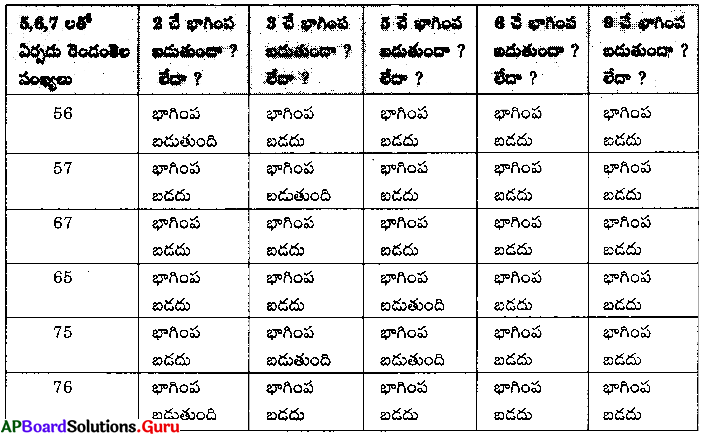
5, 6, 7 అంకెలను ఉపయోగించి వేర్వేరు రెండంకెల సంఖ్యలను రాయండి. ఈ సంఖ్యలు 2, 3, 5, 6 మరియు 9ల చేత భాగించబడునో, లేదో పరిశీలించండి.
సాధన.
AP Board 6th Class Maths Solutions Chapter 3 గ.సా.కా - క.సా.గు Ex 3.1 1

ప్రశ్న 5.
128 సంఖ్యకు ఏ కనిష్ఠ సంఖ్యను కూడిన అది 5 చే నిశ్శేషంగా భాగించబడునో కనుగొనండి.
సాధన.
128 కి 2 కలిపిన 130 అవుతుంది.
130 ఒకట్ల స్థానం ‘0’ కావున 5 చే భాగింపబడుతుంది.
128 కి 2 కలిపితే 5 చే నిశ్శేషంగా భాగింపబడును.

ప్రశ్న 6.
276 సంఖ్య నుండి ఏ కనిష్ఠ సంఖ్యను తీసివేసిన అది 10 చే నిశ్శేషంగా భాగించబడునో కనుగొనండి.
సాధన.
276 – 6 = 270, ఒకట్ల స్థానం 0 కావున 10 చే భాగింపబడుతుంది.
కావున 276 నుండి 6 తీసివేసిన అది 10చే నిశ్శేషంగా భాగింపబడుతుంది.

AP Board 6th Class Maths Solutions Chapter 3 గ.సా.కా - క.సా.గు Ex 3.1

ప్రశ్న 7.
6 చేత నిశ్శేషంగా భాగించబడే 100 మరియు 200 ల మధ్యనున్న సంఖ్యలను రాయండి.
సాధన.
6 చేత నిశ్శేషంగా భాగింపబడే 100 మరియు 200ల మధ్యగల సంఖ్యలు
102, 108, 114, 120, 126, 132, 138, 144, 150, 156, 162, 168, 174, 180, 186, 192, 198
( ఏ రెండు వరుస సంఖ్యల భేదమైన 6 గా కలదు)

ప్రశ్న 8.
9 చేత నిశ్శేషంగా భాగించబడే అతి పెద్ద నాలుగంకెల సంఖ్యను రాయండి. నీవేమి గమనించావు ?
సాధన.
9 చేత నిశ్శేషంగా భాగింపబడే అతి పెద్ద నాలుగంకెల సంఖ్య = 9999
9999 నాలుగంకెల సంఖ్యలలో గరిష్ఠ సంఖ్య. 3 మరియు 9 లచే భాగింపబడుతుంది.

ప్రశ్న 9.
కింది వాటిలో 8 చే నిశ్శేషంగా భాగించబడే సంఖ్యలేవి?
అ) 1238
ఆ) 13576
ఇ) 93624
ఈ) 67104
సాధన.
అ) 1238
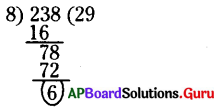
1238 లో వందల, పదుల, ఒకట్ల స్థానంలోని సంఖ్య = 238.
AP Board 6th Class Maths Solutions Chapter 3 గ.సా.కా - క.సా.గు Ex 3.1 2
238 ని 8 నిశ్శేషంగా భాగించడం లేదు. కావున 1238 ని 8 నిశ్శేషంగా భాగింపబడదు.

ఆ) 13576
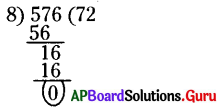
13576 సంఖ్యలోని చివరి మూడంకెల సంఖ్య
(వందల, పదుల, ఒకట్ల స్థానంలోని సంఖ్య. = 576)
AP Board 6th Class Maths Solutions Chapter 3 గ.సా.కా - క.సా.గు Ex 3.1 3
576 ను 8 నిశ్శేషంగా భాగిస్తున్నది.
కావున 13576 ను 8 నిశ్శేషంగా భాగిస్తుంది.

ఇ) 93624
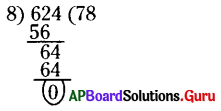
93624 లో చివరి మూడంకెల సంఖ్య 624.
AP Board 6th Class Maths Solutions Chapter 3 గ.సా.కా - క.సా.గు Ex 3.1 4
624 ను 8 నిశ్శేషంగా భాగిస్తున్నది.
కావున 93624 ను 8 నిశ్శేషంగా భాగిస్తుంది.

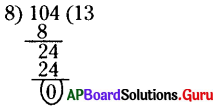
ఈ) 67104
67104 లో చివరి మూడంకెల సంఖ్య = 104
AP Board 6th Class Maths Solutions Chapter 3 గ.సా.కా - క.సా.గు Ex 3.1 5
104 ను 8 నిశ్శేషంగా భాగిస్తున్నది.
కావున 67104 ను 8 నిశ్శేషంగా భాగిస్తుంది.

AP Board 6th Class Maths Solutions Chapter 3 గ.సా.కా - క.సా.గు Ex 3.1

ప్రశ్న 10.
4 చేత నిశ్శేషంగా భాగించబడే 12345 సంఖ్యకు అతి దగ్గరగానున్న సంఖ్యను రాయండి.
సాధన.
ఇచ్చిన సంఖ్య 12345 లో పదులు, ఒకట్ల స్థానంలోని సంఖ్య = 45
45 – 1 = 44, 44 ను 4 నిశ్శేషంగా భాగిస్తుంది. కావున
12344 ను 4 నిశ్శేషంగా భాగిస్తుంది.
4 చేత భాగింపబడే 12345 సంఖ్యకు అతి దగ్గరగా గల సంఖ్య = 12344.

AP Inter 2nd Year Civics Study Material Chapter 3 Union Executive

Andhra Pradesh BIEAP AP Inter 2nd Year Civics Study Material 3rd Lesson Union Executive Textbook Questions and Answers.

AP Inter 2nd Year Civics Study Material 3rd Lesson Union Executive

Long Answer Questions

Question 1.
Explain the powers and functions of the President of India.
Answer:
Introduction:
The President of India is the constitutional head of the Indian Republic. He is the First citizen of India. He administers the affairs of the union Government either himself or through the officers subordinate to him. (Articles 52 and 53)

Qualifications :
A person to be eligible to contest the office of the President shall possess the following qualifications :

  1. He should be a citizen of India.
  2. He should have completed the age of 35 years.
  3. He should be qualified for election as a member of the Lok Sabha.
  4. He should not hold any office of profit under the union, state or local Governments (Article 59 (i))
  5. Possess such other qualifications as prescribed by the Parliament.

Election Procedure :
The President of India shall be elected indirectly by an electoral college consisting of the elected members of both Houses of Parliament. State Legislative Assemblies and elected members of Delhi and Pondicheri. The election is held in accordance with the system of proportional representation by means of a single transferable vote system and secret ballot.

Oath of office :
The person who is elected as President assumes office only after he takes oath of office and secrecy by the Chief Justice of India.

Term of office :
The President continues in office for five years from the date of his assumption of office.

Salary and Allowances :
The President now gets a monthly salary of ₹ 1,50,000/-. His official residence is Rashtrapathi Bhavan at New Delhi. On retirement, he will get a monthly pension of ₹ 75,000/-.

Removal (or) Impeachment :
The President can be removed from the office by a process of impeachment for violation of the constitution. Impeachment is a quasi-judicial procedure adopted by the Parliament.

Powers and Functions :
The President shall exercise his powers with the help of the Council of Ministers headed by the Prime Minister. His powers may be analysed under the following heads :

1. Executive Powers :
An executive action of the Union Government shall be expressed in the name of the President. The President appoints the Prime Minister and other Ministers, Attorney General, Comptroller and Auditor General of India, State Governors, Judges of the Supreme Court and State High Courts, Finance Commission, Chairman and members of U.P.S.C., Election Commission, and Chief Commissioners of Unit Territories. He allocates portfolios to the Ministers.

2. Legislative Powers :
The President is an integral part of Parliament (Art. 79) and as such enjoys extensive legislative powers.
They are :

  1. He summons from time to time each House of Parliament, adjours, and prorogues either or both the Houses.
  2. He addresses either House separately or both the Houses Jointly.
  3. He can dissolve the Lok Sabha on the advice of the Prime Minister.
  4. He opens the first session of Parliament after the General Elections and at the commencement of the first session of each year.
  5. He can send messages to the Parliament.
  6. He arranges a joint session of both the Houses when there is a dead-lock over an ordinary bill.
  7. All bills passed by Parliament require his assent for becoming in acts.
  8. He nominates 12 members to Rajya Sabha and two Anglo Indian members to Lok Sabha.
  9. He promulgates ordinances when the Parliament is not in session.
  10. He sends the annual reports of Finance Commission, U.P.S.C etc., for the consideration and approval of Parliament.

3. Financial Powers :
The President also enjoys some financial powers. They are :

  1. He recommends the financial bills to be introduced by the members in parliament. The Budget is caused to be laid down before the Parliament by the President.
  2. He operates the Consolidated Fund of India.
  3. He determines the shares of States in the proceeds of Income Tax.
  4. No Money Bill can be introduced in the Parliament except on his recommendations.
  5. He constitutes a Finance Commission for every five years etc.

4. Judicial Powers :

  1. The President can grant pardons, reprieves, respites or remission of punishments.
  2. He appoints the judges of the Supreme Court and State High Courts.
  3. He can also remove them on an address by the Parliament.

5. Military Powers:
The President is the Supreme Commander of the Defence Forces of the Union. He appoints the Chiefs on the Staff for Army, Navy, and Air Force. He can declare war and conclude peace. But he has to take the approval of Parliament.

6. Diplomatic Powers :
The president appoints Ambassadors to foreign countries to represent India. He receives the credentials of the Ambassadors appointed in India. He represents our Nation in International affairs. He makes treaties and agreements with other countries subject to the ratification by the Parliament.

7. Emergency Powers :
In extraordinary conditions, the President can proelaim emergency to safeguard the security, integrity, and independence of our country. They are of three types :

  • Emergency caused by war or external aggression or armed rebellion (Article 352).
  • Emergency due to failure of Constitutional machinery in the States (Article 356)
  • Emergency due to threat to the financial stability of India (Article 360).

AP Inter 2nd Year Civics Study Material Chapter 3 Union Executive

Question 2.
Write briefly the Emergency powers of the President of India. [Mar. 16]
Answer:
Articles 352 to 360 of part XVIII of Indian constitution deals with three types of emergency powers of the Indian President. They are :

  1. National Emergency,
  2. Constitutional Emergency,
  3. Financial Emergency

They may be explained as follows.
1) National Emergency : (Article 352)
The President exercises this power during the period of war, external aggression or armed rebellion. He declares emergency if he is satisfied that the sovereignty and security of India or any part thereof is threatened by external aggression.

When National Emergency is in force, the federal provisions of our constitution ceases to operate. So far, National Emergency was proclaimed on four occasions in our country. They are : 1. Chinese Aggression (1962), 2. Indo – Pak war (1965), 3. Indo – Pak war in the context of Bangladesh Liberation Movement (1971), 4. Opposition’s call for blocking Parliament (1975).

2) Constitutional Emergency : (Article 356)
Article 356 of Indian constitution empowers the President to proclaim the constitutional emergency. If the President, on receipt of a report from the Governor or other wise; is satisfied that a situation has arisen in which the government of a state cannot be carried on according to the constitutional provisions. He is empowered to proclaim this emergency. It is also called as the President’s Rule. So far this type of emergency was proclaimed for over 100 times.

3) Financial Emergency : (Article 360)
If the President is satisfied that a situation has arisen where by the financial stability or credit of India is threatended, then he may proclaim financial emergency in the country. During the period of financial emergency, the President enjoys the following powers.

  • The President may reserve all the money bills or other financial bills of the state after they are approved by the state legislature.
  • He may reduce the salaries and allowances of all or any person serving in the states.
  • The President can reduce the salaries allowances of the persons working at the union level including the judges of the Supreme Court and the State High Courts. But so far the financial emergency has not been yet imposed in the country.

Question 3.
Discuss the powers and functions of the Prime Minister of India. [Mar. 18, 16]
Answer:
The Prime Minister is the real executive head of the Union Government. He occupies an important position in the administration of our country. Since India has a Parliamentary form of Government the real power rests with him. He is the ‘uncrowned king’ and “the keystone of the Cabinet arch in the Union Government”.

Qualifications :

  1. He should be citizen of India.
  2. He should have completed the age of 25 ytears.
  3. He should be qualified for election as a member of the Lok Sabha.
  4. He should not hold any office of profit under the union or state or local governments.

Appointment:
The President appoints the Prime Minister. Generally the President has to summon the leader of the majority party in the Lok Sabha to form the Ministry. If no party gets an absolute majority, the President can use his discretion and summon the leader of the party, who in his opinion can manage to form a ministry. Afterwards the Prime Minister will be asked to prove his majority in the Lok Sabha.

Oath of Office :
The President of India will administers the oath of office of the Prime Minister.

Term of Office :
The Prime Minister shall remain in office during the pleasure of the President. But actually he assumes his powers as long as he retains the confidence of the majority members in the Lok Sabha. He resigns when the Lok Sabha accepts a no-confidence motion against his ministry.

Salary and Allowances:
The salary and allowances of Prime Minister are decided by the Parliament from time to time. He gets his salary and allowances that are payable to a member of Parliament. At present the Prime Minister gets a salary and allowances of ₹ 1,60,000/- per month.

Powers and Functions :
The Prime Minister is the head of the union government. He is the real executive. The Council of Ministers cannot exist without the Prime Minister. His powers are explained here under.

1) Leader of the Union Cabinet:
The Prime Minister is the leader of the Union Cabinet and Union Council of Ministers. He selects some eminent members of his party in parliament and sees that they are appointed as ministers by the President. He has a free choice of both allocating portfolios and reshuffling the ministry. All the ministers are personally and politically loyal to the Prime Minister. He decides the agenda, of the cabinet meetings. Further, he presides over the cabinet meetings.

2) Leader of the Union Government:
The Prime Minister acts as the leader of the union government. The union executive (Union Council of Ministers) initiates its business after the swearing in ceremony of the Prime Minister. All the ministers in the union ministry assume their office, owe their position and exercise their powers along with the Prime Minister. Infact, the Prime Minister influences the nature and working of the union government. He not only has a clear understanding but holds complete control over the affairs of the union government. All the high-level officers and the entire ministry in the union government behave and act according to the wishes of the Prime Minister.

3) Leader of the parliament:
The Prime Minister acts the leader of the Parliament in India. He is primarily a member of Parliament. He extends co-operation to the presiding officers in the smooth conduct of the two Houses. He wields complete control over his party members in the Parliament. He ensures that his party members maintain discipline during the sessions of the Parliament. He informs out the cabinet decisions to the Parliament. He communicates the major domestic and foreign policies of the union government to the members of Parliament. He maintains rapport with the opposition leaders and discusses the major issues confronted by the nation with them.

4) Link between the President and the Council of Ministers :
The Prime Minister acts as the main link between the President and the Union Council of Ministers. It is his duty to communicate to the President about the decisions of the Union Council of Ministers. He furnishes the every information required by the President concerning the affairs of union government. All the ministers shall formally meet the President only with the consent of the Prime Minister.

5) Leader of the Majority Party:
The Prime Minister acts as the leader of the majority party or group in the lower House of Parliament. He participates in the meetings of the party and acquaints his party members on various issues and steps taken by his ministry in implementing the party promises. He utilizes the services of the senior party leaders in running the government. He acts as the main link between the part and the government.

6) Leader of the Nation :
The Prime Minister is the leader of the nation. He takes initiative in finding solutions to several problems in the internal matters of the country. He plays an important role in the development of the nation.

7) Maker of Foreign Policy :
The Prime Minister plays a dominant role in shaping the foreign policy of the nation. He keeps in touch with the developments in all countries. He meets Heads of various countries and maintains friendly relations with them.

8) Chairman of NITI Aayog :
The Prime Minister heads the NITI Aayog (National Institution for Transforming India) NITI Aayog means policy commission. It is a policy think tank of government of India that replaces planning commission which aims to involve the states in economic policy making in India. It will provide strategic and technical advice to the central and state governments. It will have a governing council comprising Chief Ministers of all the states and it governors of Union Territories. Union government set up the NITI Aayog on January 1,-2015.

Question 4.
Explain the composition, powers and functions of the Union Council of Ministers. .
Answer:
Article 74 (1) of the Constitution provides for a Council of Ministers at the Centre. It’s main function is to aid and advice the President in the performance of his duties. It consists of Prime Minister and other Ministers. It is this body which runs the entire administration of our country. It is thefreal Executive authority of the country. It functions on the ‘Principle of Collective Responsibility1. It holds office till it continues to enjoy the confidence and support of the Lok Sabha.

Formation of Council of Ministers :
The formation of the Council of Ministers starts with the appointment of the Prime Minister. The President appoints the Prime Minister and on the advice of the Prime Minister, the other Ministers are appointed by the President.

Composition of Council of Ministers :
Our Constitution did not mention the exact size of the Union Council of Ministers. But there are three kinds of Ministers:

  1. Cabinet Ministers
  2. Ministers of State
  3. Deputy Ministers.

The Cabinet Ministers are entrusted with the maintenance of some important ministries. They enjoy independence and decision making powers.

The Ministers of State act as the heads of some important sections in the ministry. They are directly responsible to the Prime Minister for their activities.

The Deputy Ministers have no independent and discretionary powers. They assist the Cabinet Ministers and perform the functions assigned to them.

The Cabinet or the Council of Ministers is the pivot around which the entire administration of our country revolves. “It is the steering wheel of the ship of the State.” It is the hyphen that joins the Executive and Legislative organs of the Government.

Powers and Functions :
1. Executive Powers :
The Union Cabinet is a deliberative and policy formulating body. It discusses and decides all National and International policies of the country. The policies decided by the cabinet are carried out by the Ministers. It directs and leads the Parliament for action and gets its approval for all its policies. It coordinates and guides the activities of departments of the Government. It also plays an important role by suggesting persons for all major appointments. It considers the reports of various committees before they are presented to the Parliament.

2. Legislative Powers :
The Cabinet plans the legislative programme of the Government at the beginning of each session of Parliament. It drafts Bills on all important matters and introduces them in the Parliament. It also decides the time of summoning and prorogation of Parliament. The inaugural speech of the President to the Parliament is prepared by the Cabinet.

3. Financial Powers:
The Cabinet possess important financial powers. It has complete control over national finance. It prepares the Union Budget. It decides what taxes are to be imposed and how much of expenditure is to be incurred. Money Bills are always introduced in the Lok Sabha by the Finance Minister.

4. Foreign Relations :
In the field of foreign relations also the Cabinet plays an important role. It determines and formulates the foreign policy of the country and decides India’s relations with other countries. It considers and approves all international treaties and agreements.

Collective Responsibility :
Article 75(3) of Indian constitution stated that the union council of Ministers shall be collectively responsible to the Lok Sabha, for all their acts of commissions and commissions. They act as a team under the leadership of the Prime Minister. They sail together, they swim together and they sink together.

Conclusion:
It is thus clear that the Council of Minister or Cabinet enjoys far reaching powers both with regard to the internal and external policies of the country. Internally it maintains law and order within the country and externally protects the country from foreign aggression. The progress of the country largely depends upon the ability of the Cabinet.

Short Answer Questions

Question 1.
How is the President of India elected?
Answer:
The President of India shall be elected indirectly by an electoral college consisting of the elected members of both Houses of Parliament. State Legislative Assemblies and elected members of Delhi and Pondicheri. The election is held in accordance with the system of proportional representation by means of a single transferable vote system and secret ballot.

Each member of the Electoral College has one vote. But the value of the vote differes from State to State. The value of the vote of a Parliament member also differs from the value of the vote of a member of State Assembly.

The value of the vote of an M.L.A is worked out as follows. The total population of the State is divided by the total number of elected members of the Assembly. The quotient thus obtained is to be divided by 1,000. Fractions of half or more should be counted as one and added to the quotient. If it is less than half, it is ignored. This may be shown as follows.

  1. Value of vote of an M.L.A = Population of State / number of elected members of the Assembly / 1,000.
  2. Value of vote of M.P. = Total value of votes of all Assembly members / Total number of elected members of both Houses of Parliaments.

This method is followed to keep the election of the President above narrow political considerations.

AP Inter 2nd Year Civics Study Material Chapter 3 Union Executive

Question 2.
Write briefly about the procedure of impeachment of President
Answer:
The President may be removed from the office for violation of the constitution by a process of impeachment. Impeachment is a quasi-judicial procedure adopted by the Parliament. Either House of Parliament shall prefer the charge for removal of the President. The other House shall investigate into the charges itself or cause the charge to be investigated.

There are four stages in the impeachment of the President.

Firstly the impeachment resolution has to be moved with a 14 days prior notice in writing signed by not less than 1/4th of the total members of that House. Such a resolution has to be passed by a majority of not less than 2/3rds of the total members of the House.

Secondly, the resolution approved by the first House will be sent to the second House for consideration and approval.

Thirdly, the second House investigates into the charges directly or constitutes a committee to enquire into the charges. The President has the right to present his views directly or through a deputy during such enquiry.

Fourthly, if the charges against the President are established and adopted by the second House with 2/3rds majority of the total members, the President stands removed from the office. With regard to voting on the resolution for impeachment, only the elected members cast their vote. No president has so far been impeached in our country till today.

Question 3.
Mention any two Emergency powers of the Indian President.
Answer:
1) National Emergency : (Article 352)
The President exercises this power during the period of war, External aggression or armed rebellion. He declares emergency if he is satisfied that the sovereignty and security of India or any part thereof is threatened by external aggression.

When National Emergency is in force, the federal provisions of our constitution ceases to operate. So far, National Emergency was proclaimed on four occasions in our country. They are :

  1. Chinese Aggression (1962) ‘
  2. Indo – Pak war (1965) .
  3. Indo – Pak war in the context of Bangaldesh Liberation Movement (1971)
  4. Oppositions call for blocking Parliament (1975)

2) Constitutional Emergency : (Article 356)
Article 356 of Indian constitution Empowers the President to proclaim the constitutional emergency. If the President, on receipt of a report from the Governor or other wise, is satisfied that a situation has arisen in which the government of a state cannot be carried on according to the constitutional provisions. He is empowered to proclaim this emergency, It is also called as the President’s rule. So far this type of emergency was proclaimed for over 100 times.

Question 4.
Explain the role and position of the President in Union Government.
Answer:
The President of India is the head of the union executive. He is the first citizen of India. He could exercise many powers as enstined in the constitution in the following manner.

Position of the President:
There are different opinions on the actual position of the president of India in the administration of our country. The farmers of the constitution wanted him to be a nominal Head of the state.

Dr. Ambedkar compared his position to that of the British King Sri. M. C. Setalved, the farmer Attorney General of India mentioned that the position of the President of India is like the king in England and the Governor General in a Dominion. Sri Alladi Krishna Swamya Ayyar also said that it was perfectly clear that our presidents position was similar to that of the constitutional Monarch in England.

Jawaharlal Nehru, the first Prime Minister of India, said that “We have not given our President any real power but we have made his position one of great authority and dignity.” These opinions make it clear that our President is only a nominal figure head and he does not have any real powers. This is confirmed by the 42nd Amendment of the constitution of India.

However, the President exercises independent powers under some conditions. He utilises these powers in regard to the appointment of the Prime Minister, dissolving the Lok Sabha and ordering midterm poll to the Lok Sabha. Some presidents like Sanjiva Reddy, Zail Singh, R.Venkata Raman, Dr. S.D. Sharma etc., utilised their discretionary powers where there was political instability or Hung Parliament after the general elections in the country. Like the Monarch of England, he still enjoys three rights the right to be ! consulted the right to encourage and the right to warn.

Question 5.
Write about any two powers of the Vice – President of India.
Answer:
The Vice President of India occupies the second highest position in the union government. He is accorded a rank next to the President.

Qualifications :
A person to be eligible as vice-president should possess the following qualifications.

  1. He should be a citizen of India.
  2. He should have completed 35 years of age.
  3. He should be qualified for election as a member of the eousil of states.
  4. He should not hold any office of profit under the union, state or local Governments in India.

Election :
The election of the vice – president like that of the President shall be indirect and in accordance with the system of proportional representation by means of the single transferable vote system. He is elected by the members of an electoral college consisting of the members of both the houses of Parliament.

Term of Office :
The Vice-President holds office for a term of 5 years from the date on which he enters his office.

Removal:
The Vice President may be removed from his office by a resolution of the council of states passed by a majority of all the members of the council and agreed to by the house of the people.

Salary and Allowances :
The Vice President of India receives a monthly salary of ₹ 1,25,000/-in addition, he is entitled to daily allowance, free furnished residence, medical, travel and other facilities.

Powers and Functions :
The Vice – President is the ex-officio Chairman of the Rajya Sabha. As. such he enjoys the same powers like the Speaker of Lok Sabha, such as (1) presiding over the meetings of Rajya Sabha, (2) maintaining discipline, decency and decorum in the House, (3) exercising casting vote in case of a tie, (4) admitting visitors, (5) protecting the privileges and rights of the members. He has no right with regard to money bills.

Acting as President of India :
He discharges the functions of the President during the temporary absertce of the President. He may take over the office of the President under 4 situations like (1) Death of the President, (2) Resignation of the President, (3) Removal of the President, (4) Inability of the President due to absence, illness or any other cause.

Question 6.
How is the Prime Minister appointed?
Answer:
Article 75 (1) of the Indian constitution deals with the appointment of the Prime Minister of India.

Appointment:
The constitution simply lays down that the Prime Minister shall be appointed by the President. After the conduct of General Elections to the Lok Sabha, the President has to invite the majority party leader of the Ldk Sabha to form the Government.

When no single party is able to secure majority seats in Lok Sabha, the President invites the leader of a coalition to form the Government. The president uses his discretionary powers in this regard. The President appoints the leader of the coalition as the Prime Minister on the condition that he has to prove his majority in the Lok Sabha within a specified period. Being the leader of the majority in Lok Sabha to be the Prime Minister, the person has to be a member of Parliament. If he is not a member at the time of appointment, he has to acquire it within six months from the date of his appointment as Prime Minister.

The powers of the President in choosing, inviting and appointing the Prime Minister cannot be questioned in any court of Law.

AP Inter 2nd Year Civics Study Material Chapter 3 Union Executive

Question 7.
Explain the role of the Prime Minister in Union Government.
Answer:
The prime Minister plays a predominant role in the affairs of the union government. He will have an indelible impression on every one in the administration of the union government. He is described as the Primus Interparus (first among equals). His role as the leader of the Union Council of Ministers, Union Cabinet, Party in power, Lok Sabha, Nation and as the link between the President and the Union Council of Ministers is unique. He wields tremendous political power and patronage. He enjoys enormous powers and fulfils innumerable tasks. It all depends on the image, influence, stature, and personality of the Prime Minister in the union government.

Jawaharlal Nehru, Dr. Ambedkar, and other eminent leaders of the National Movement and members of the Constituent Assembly described the Prime Minister as the linchpin of the union government. It is in this context that Sir william Harcourt remarked that every one expects from the Prime Minister dignity and authority, firmness to control, tact, practice and firmness, an impartial mind, a tolerant temper, a kind and prudent counsellorship, and accessibility to the people.

Question 8.
Describe the composition and powers of the Union Council of Ministers.
Answer:
Composition of Council of Ministers :
Our Constitution did not mention the exact size of the Union Council of Ministers. But there are three kinds of Ministers: 1) Cabinet Ministers 2) Ministers of State 3) Deputy Ministers.

The Cabinet Ministers are entrusted with the maintenance of some important ministries. They enjoy independence and decision making powers.

The Ministers of State act as the heads of some important sections in the ministry. They are directly responsible to the Prime Minister for their activities.

The Deputy Ministers have no independent and discretionary powers. They a&ist the Cabinet Ministers and perform the functions assigned to them.

The Cabinet Or the Council of Ministers is the pivot around which the entire administration of our country revolves. “It is the steering wheel of the ship of the State”. It is the hyphen that joins the Executive and Legislative organs of the Government.

Powers and Functions :
1) Executive Powers :
The Union Cabinet is a deliberative and policy formulating body. It discusses and decides all National and International policies of the country. The policies decided by the cabinet are carried out by the Ministers. It directs and leads the Parliament for action and gets its approval for all its policies. It co-ordinates and guides the activities of departments of the Government. It also plays an important role by suggesting persons for all major appointments. It considers the reports of various committees before they are presented to the Parliament.

2) Legislative Powers :
The Cabinet plans the legislative programme of the Government at the beginning of each session of. Parliament. It drafts Bills on all important matters and introduces them in the Parliament. It also decides the time of summoning and prorogation of Parliament. The inaugural speech of the President to the Parliament is prepared by the Cabinet.

3) Financial Powers :
The Cabinet possesses important financial powers. It has complete control over national finance. It prepares the Union Budget. It decides what taxes are to be imposed and how much of expenditure is to be incurred. Money Bills are always introduced in the Lok Sabha by the Finance Minister.

4) Foreign Relations :
In the field of foreign relations also the Cabinet plays an important role. It determines and formulates the foreign policy of the country and decides India’s relations with other countries. It considers and approves all international treaties and agreements.

Very Short answers

Question 1.
Composition of the Union Executive.
Answer:
The constitution of India provides for the Union Executive. Articles 52 to 78 in part V of the constitution deal with the union executive. The Union Executive consists.
i) The President
ii) The Vice-President
iii) The Prime Minister and
iv) The Union Council of Ministers

Question 2.
Qualifications required for contesting the Presidential elections.
Answer:
A person to be eligible to contest the office of the president shall possess the following qualifications.

  1. He should be a citizen of India.
  2. He should have completed the age of 35 years.
  3. He should be qualified for election as a member of the Lok Sabha.
  4. He should not hold any office of profit under the Union, State or Local Governments.
  5. Possess such other qualifications as prescribed by the Parliament.

Question 3.
Election of President.
Answer:
The President of India shall be elected indirectly by an electoral college consisting of the elected members of both houses of Parliament, State Legislative Assemblies and elected members of Delhi and Pondicheri. The election is held in accordance with the system of proportional representation by means of a single transferable vote system and secret ballot.

Question 4.
Important appointments of President.
Answer:
The president has the power to appoint the following high dignitaries :

  • The Prime Minister of India.
  • Members of the union council of Ministers.
  • The Affomey General of India.
  • The Comptroller and Auditor general of India.
  • The judges of the Supreme Court and the High Court.
  • State Governors etc.

Question 5.
Judicial Powers of the President.
Answer:

  1. The President can grant pardons, reprieves, respites or remission of punishments.
  2. He appoints the Judges of the Supreme Court and State High Courts.
  3. He can also remove them on an address by the Parliament.

Question 6.
Article 352. [Mar. 18, 16]
Answer:
Article 352 of the Indian constitution empowers the President to impose National Emergency during the period of war, External Aggression, Armed Rebellion or internal disturbance. So far National Emergency was proclaimed on Four occasions. They are :

  1. Chinese Aggression (1962)
  2. Indo – Pak War (1965)
  3. Indo – Pak war in the context of Bangladesh Liberation movement (1971) and
  4. Opposition’s call for blocking Parliament (1975).

Question 7.
Article 356.
Answer:
Article 356 of Indian Constitution empowers the President to proclaim the constitutional emergency. If the President on receipt of a report from the governor or otherwise is satisfied that a situation has arisen in which the government of a state cannot be carried on according to the constitutional provisions. He is empowered to proclaim this emergency. It is also called as the President’s Rule.

Question 8.
Financial Emergency.
Answer:
If the President is satisfied that a situation has arisen where by the financial stability or credit of India is threatened then he may proclaim financial emergency in the country as per Article 360 of the Indian Constitution.

Question 9.
National Emergency.
Answer:
Article 352 of the Indian constitution empowers the president to impose National Erpergency during the period of war, External Aggression, Armed Rebellion or Internal disturbances. When National Emergency is in force, the Federal provisions of our constitution cease to operate. So far, National Emergency was imposed four times in 1962, 1965, 1971 and 1975.

Question 10.
Qualifications required for contesting as Vice-President. [Mar. 16]
Answer:
A person to be eligible for election as Vice-president should possess the following qualifications : ,

  1. He should be a citizen of India.
  2. He should have completed 35 years of age.
  3. He should be qualified for election as a member of the council of states.
  4. He should not hold any office of profit under the Union, State or Local Governments in India.

Question 11.
Chairman of Rajya Sabha,
Answer:
The Vice President is the ex-officio chairman of the Rajya Sabha. As such he enjoys the same powers like the speaker of Lok Sabha such as

  1. Presiding over the meetings of Rajya Sabha.
  2. Maintaining discipline, decency and decorum in the House.
  3. Exercising casting vote in case of a tie.
  4. Protecting the privileges and rights of the members.

Question 12.
Appointment of Prime Minister.
Answer:
After the conduct of General elections of the Lok Sabha, the President has to invite the majority party leader of the Lok Sabha to form the Government. When no single party is able to secure majority seats in Lok Sabha, the President invites the Leader of a coalition to form the Government. The president uses his discretionary powers in this regard.

Question 13.
Categories of Union Council of Ministers.
Answer:
There are three kinds of ministers in the union council of ministers. They are

  1. Cabinet Minister.
  2. Ministers of State.
  3. Deputy Ministers.

1) The Cabinet Ministers are entrusted with the maintenance of some important ministries like Finance, Home, Defence etc.

2) The Ministers of state act as the heads of some important sections in the Ministry. They are directly responsible to the Prime Minister for their activities.

3) The Deputy Ministers have no independent and discretionary powers. They assist the Cabinet Ministers.

Question 14.
Any two functions of the Union Cabinet.
Answer:

  1. The Union Cabinet formulates the policies of the union government. It finalizes the domestic as well as foreign policies of the nation after having serious deliberations.
  2. It pilots several bills in the Parliament at various stages and strives to secure the approval of the latter.

AP Inter 2nd Year Civics Study Material Chapter 3 Union Executive

Question 15.
Collective Responsibility. [Mar. 18]
Answer:
Article 75 (3) of Indian constitution stated that the union council of Ministers shall be collectively responsible to the Lok Sabha, for all their acts of omissions and commissions. They act as a team tinder the leadership of the Prime Minister. They sail together, they swim together and they sink together.
AP Board 10th Class Maths Solutions Chapter 14 సాంఖ్యకశాస్త్రం Exercise 14.4

SCERT AP 10th Class Maths Textbook Solutions Chapter 14 సాంఖ్యకశాస్త్రం Exercise 14.4 Textbook Exercise Questions and Answers.

AP State Syllabus 10th Class Maths Solutions 14th Lesson సాంఖ్యకశాస్త్రం Exercise 14.4

ప్రశ్న 1.
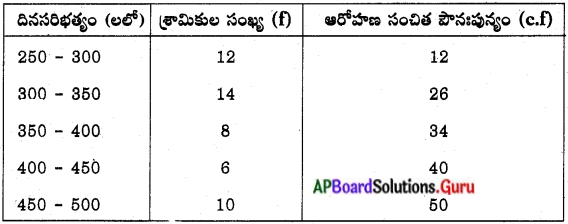
50 మంది శ్రామికుల దినసరి భత్యములు క్రింది పౌనఃపున్య విభాజనములో ఇవ్వబడ్డాయి.

AP Board 10th Class Maths Solutions Chapter 14 సాంఖ్యకశాస్త్రం Exercise 14.4 1

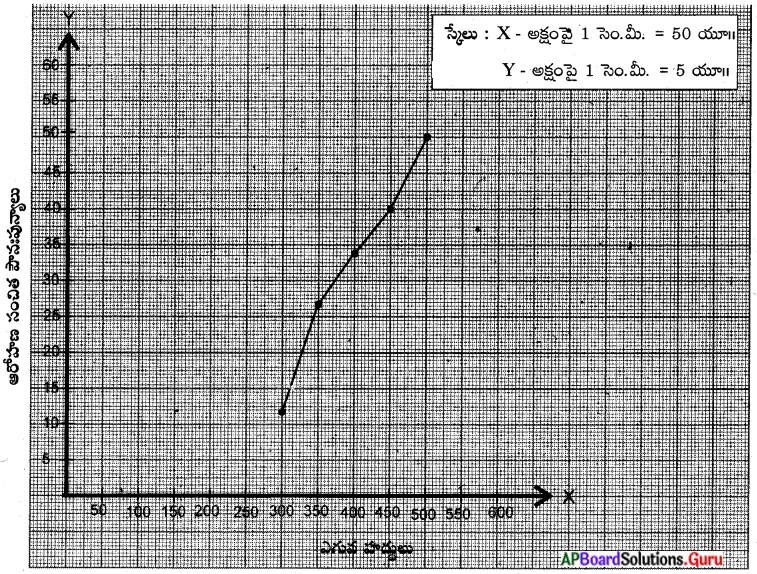
ఈ దత్తాంశమునకు ఆరోహణ సంచిత పౌనఃపున్యములను తయారు చేసి, ఓజీవ్ వక్రము గీయండి.
సాధన.

AP Board 10th Class Maths Solutions Chapter 14 సాంఖ్యకశాస్త్రం Exercise 14.4 2

ఓజీవ్ వక్రం కొరకు X-అక్షంపై ఎగువ హద్దులు, Y-అక్షంపై ఆరోహణ సంచిత పౌనఃపున్యాలు తీసుకొనవలెను. పై పట్టిక నుండి కావలసిన క్రమయుగ్మాలు = {(300, 12), (350, 26), (400, 34), (450, 40), (500, 50)}

AP Board 10th Class Maths Solutions Chapter 14 సాంఖ్యకశాస్త్రం Exercise 14.4 3

AP Board 10th Class Maths Solutions 14th Lesson సాంఖ్యకశాస్త్రం Exercise 14.4

ప్రశ్న 2.
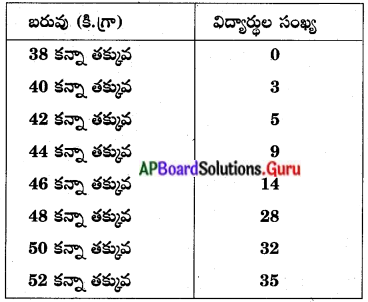
ఒక పాఠశాలలో జరిగిన వైద్య పరీక్షలలో తరగతిలోని 35 మంది విద్యార్థుల బరువులు క్రింది పట్టికలో ఇవ్వబడ్డాయి.

AP Board 10th Class Maths Solutions Chapter 14 సాంఖ్యకశాస్త్రం Exercise 14.4 4

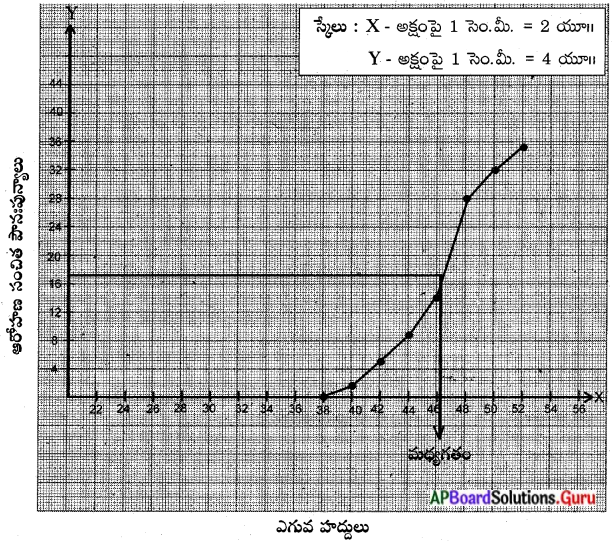
ఆరోహణ సంచిత పౌనఃపున్య వక్రము గీచి దాని నుండి మధ్యగతమును గుర్తించండి. ఈ దత్తాంశమునకు సూత్ర సహాయంతో మధ్యగతము కనుగొని రెండు విలువలు సరిచూడండి..
సాధన

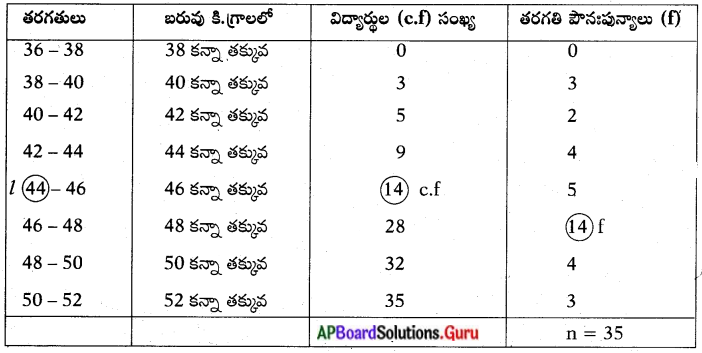
AP Board 10th Class Maths Solutions Chapter 14 సాంఖ్యకశాస్త్రం Exercise 14.4 5

⇒ \(\frac{n}{2}=\frac{35}{2}\) = 17.5
∴ మధ్యగతం = l + \(\left(\frac{\frac{\mathrm{n}}{2}-\mathrm{c} \cdot \mathrm{f}}{\mathrm{f}}\right)\) × h
l = 46, \(\frac{n}{2}\) = 17.5, cf = 14, f = 14, h = 2.
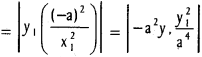
∴ మధ్యగతం = 46 + \(\frac{17.5-14}{14}\) × 2
= 46 + \(\frac{7}{14}\)
= 46 + 0.5
46.5 కి.గ్రా.
∴ ఓజీవ్ వక్రం మరియు సహజ పద్ధతి ద్వారా విద్యార్థుల బరువుల మధ్యగతం 46.5 కే.జీగా సరిచూడటమైనది.

AP Board 10th Class Maths Solutions 14th Lesson సాంఖ్యకశాస్త్రం Exercise 14.4

(లేదా)

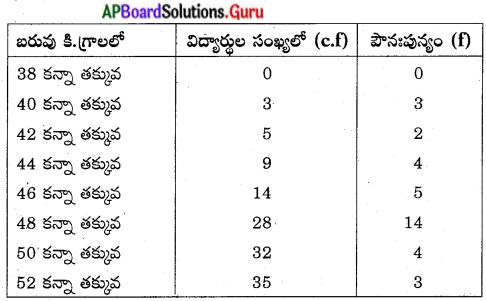
AP Board 10th Class Maths Solutions Chapter 14 సాంఖ్యకశాస్త్రం Exercise 14.4 6

∴ ఓజివ్ వక్రం కొరకు X-అక్షంపై ఎగువ హద్దులు, Y-అక్షంపై ఆరోహణ సంచిత పౌనఃపున్యాలు తీసుకొనవలెను.
∴ కావలసిన క్రమయుగ్మాల సమితి = {(38, 0), (40, 3), (42, 5), (44, 9), (46, 14), (48, 28), (50, 32) (52, 35)}
∴ ఓజీవ్ వక్రానికి = \(\frac{n}{2}=\frac{35}{2}\) = 17.5 వద్ద లంబాన్ని గీయగా అది X – అక్షం పై చేయు నిరూపకమే దాని మధ్యగతం అగును.
∴ 35 మంది పిల్లల బరువుల మధ్యగతం = 46.5 కి.గ్రా.

AP Board 10th Class Maths Solutions Chapter 14 సాంఖ్యకశాస్త్రం Exercise 14.4 7

AP Board 10th Class Maths Solutions 14th Lesson సాంఖ్యకశాస్త్రం Exercise 14.4

ప్రశ్న 3.
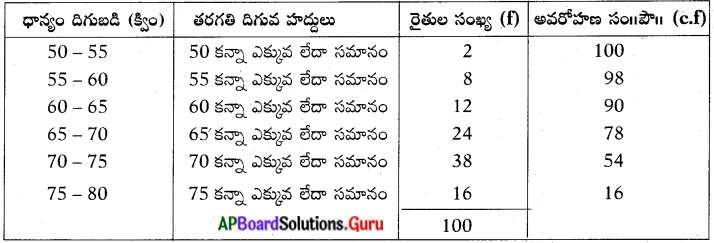
ఒక గ్రామములోని 100 మంది రైతులు పొలములలో హెక్టారుకు దిగుబడి ధాన్యము క్రింది విభాజనము నందు ఇవ్వబడింది.

AP Board 10th Class Maths Solutions Chapter 14 సాంఖ్యకశాస్త్రం Exercise 14.4 8

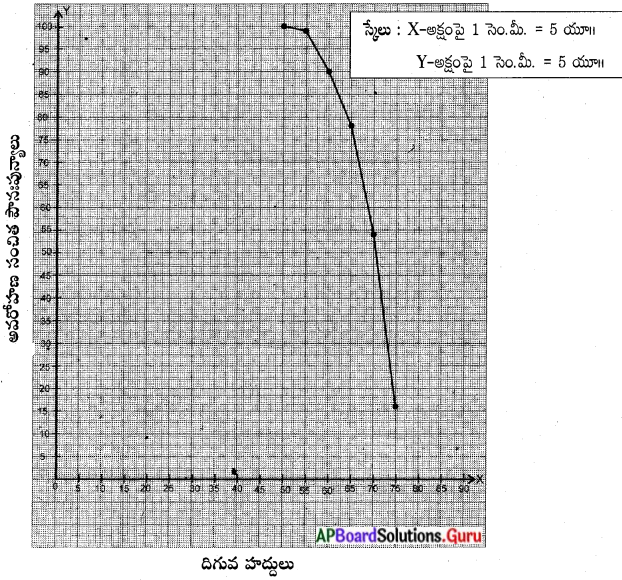
ఈ దత్తాంశమునకు అవరోహణ సంచిత పౌనఃపున్యము తయారుచేసి ఓజీవ్ వక్రము గీయండి.
సాధన.

AP Board 10th Class Maths Solutions Chapter 14 సాంఖ్యకశాస్త్రం Exercise 14.4 9

∴ ఓజీవ్ వక్రం కొరకు X-అక్షంపై తరగతి దిగువ హద్దులు, Y-అక్షంపై అవరోహణ సంచిత పౌనఃపున్యాలు.
∴ కావలసిన క్రమయుగ్మాల సమితి = {(50, 100), (55, 98), (60, 90), (65, 78), (70, 54), (75, 16)}

AP Board 10th Class Maths Solutions Chapter 14 సాంఖ్యకశాస్త్రం Exercise 14.4 10
AP Board 1st Class English Solutions Lesson 7.1 Play Time

Andhra Pradesh AP Board 1st Class English Solutions Lesson 7.1 Play Time Textbook Exercise Questions and Answers.

AP State Syllabus 1st Class English Solutions Chapter 7.1 Play Time

Textbook Page No. 93

1. Warm-up Time

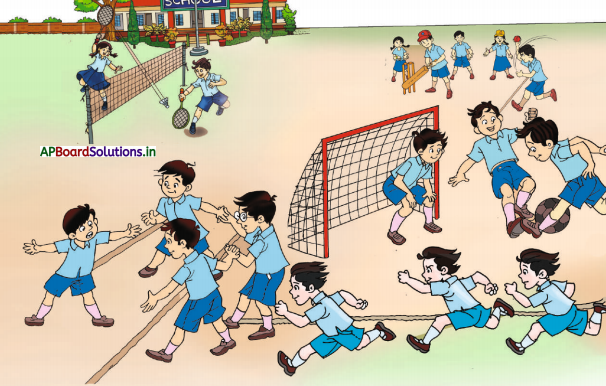
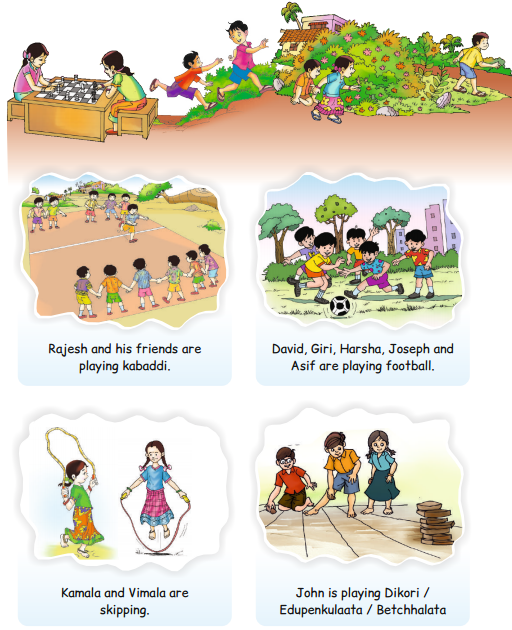
Ask children to look at the picture and encourage them to answer the following questions.
AP Board 1st Class English Solutions Lesson 7.1 Play Time 1
Question 1.
What are the children doing in the picture?
Answer:
They are playing.

Question 2.
Name the games they are playing.
Answer:
Badminton, Foot Ball, Cricket, Running.

Question 3.
Which games do you play ?
Answer:
Cricket, Tennies, Skipping, Carroms.

AP Board 1st Class English Solutions Lesson 7.1 Play Time

Question 4.
Name the games that you know.
Answer:
Volley ball, basket ball, Cricket, Swimming.

Question 5.
Which games do you like the most ?
Answer:
Swimming, Hockey, Basket ball and Carroms.

Textbook Page No. 94

2. Sharing Time

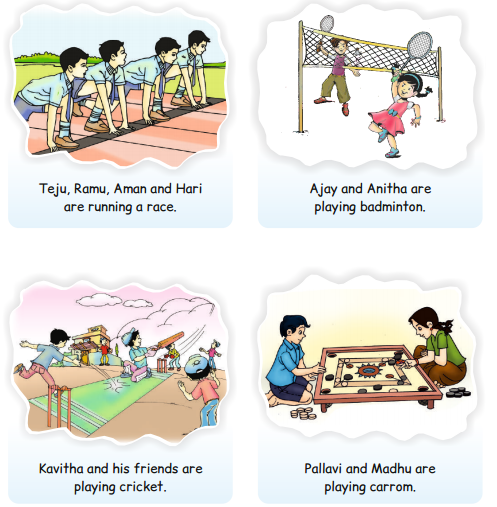
Read the sentences aloud and talk about the games in the picture.
AP Board 1st Class English Solutions Lesson 7.1 Play Time 2

AP Board 1st Class English Solutions Lesson 7.1 Play Time

AP Board 1st Class English Solutions Lesson 7.1 Play Time 3
Answer:
Student Activity

Textbook Page No. 96

3. Action Time

Activity – 1
Let the children say these names of the games aloud along with you.
AP Board 1st Class English Solutions Lesson 7.1 Play Time 4
Answer:
Student Activity

AP Board 1st Class English Solutions Lesson 7.1 Play Time

4. Circle Time

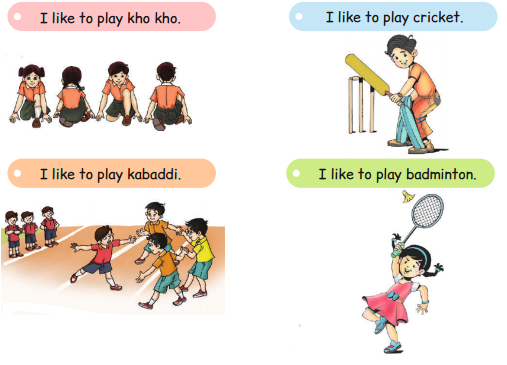
Tell the students that when we talk about our favourite game we say “I like to play”Ask the children to stand up one by one and tell the class the name of the game they like to play.
Activity – 1
AP Board 1st Class English Solutions Lesson 7.1 Play Time 5
Answer:
Student Activity

Textbook Page No. 97

5. Fun Time

Activity – 1

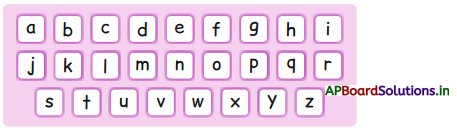
Read the following letters from left to right, and from right to left.
AP Board 1st Class English Solutions Lesson 7.1 Play Time 6
Answer:
Student Activity

AP Board 1st Class English Solutions Lesson 7.1 Play Time

Activity – 2
Read each letter above and say a word.
Answer:
Student Activity

Activity – 3
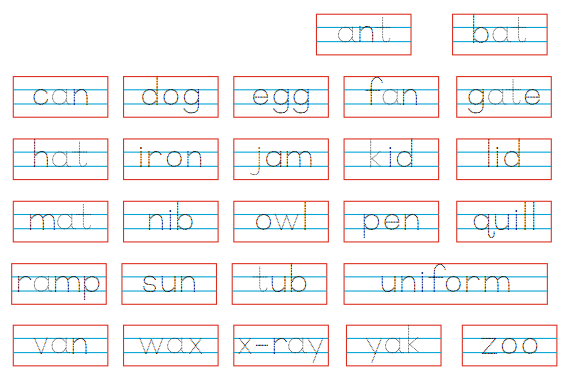
Trace the words given below.
AP Board 1st Class English Solutions Lesson 7.1 Play Time 7
Answer:
Student Activity

Textbook Page No. 98

6. Practice Time

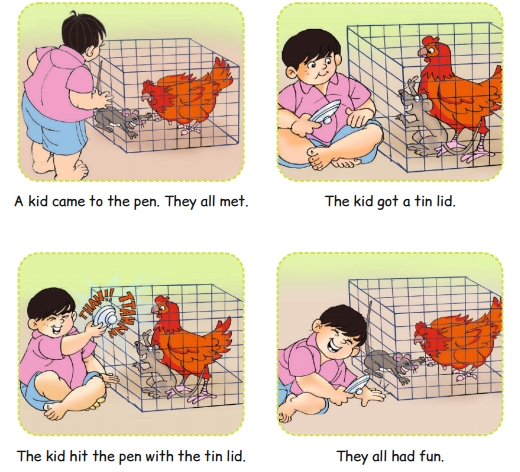
The kid with the lid

We read, listen and enjoy

  • Make tile fl ash cards of the sight word: s.
  • Make the students read the cards.
  • Make them repeat the sentences given below the pictures after you.

AP Board 1st Class English Solutions Lesson 7.1 Play Time

AP Board 1st Class English Solutions Lesson 7.1 Play Time 8
Sight words
a
all
to
the
Answer:
Student Activity

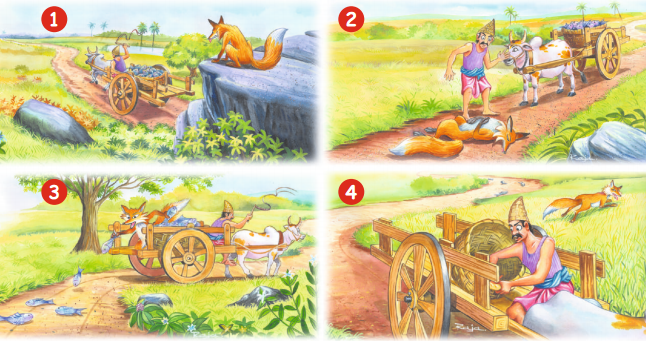
THE CUNNING FOX

Show the following pictures and encourage the students to frame the story.
AP Board 1st Class English Solutions Lesson 7.1 Play Time 9
Answer:
Once, there was a fisher man. He used to catch fish everyday and took the catch of fish on a bullock cart. A fox saw this. The fisherman was taing fish in a cart every day. He sold them and made money.

AP Board 1st Class English Solutions Lesson 7.1 Play Time

One day, the fisher man was coming with his catch of fish. On the way, he formed a fox lying in the middle of the road. The fisherman stopped the cart and came to the fox. The fox said, “Sir, I am unwell. I want to go some. Please take me along with you. “I will die”.

The fisherman took pity on him. He made the fox sit on the back his cart and started driving the cart again. The fox took the fish one by one, dropped it to the ground. When the basket was empty, the fox jumped off the cart. When he reached home, the fisher man did not find the fish or the fox.

AP Inter 2nd Year Economics Study Material Chapter 6 Tertiary Sector

Andhra Pradesh BIEAP AP Inter 2nd Year Economics Study Material 6th Lesson Tertiary Sector Textbook Questions and Answers.

AP Inter 2nd Year Economics Study Material 6th Lesson Tertiary Sector

Essay Questions

Question 1.
Define tertiary sector. Explain the importance of tertiary sector in Indian economy.
Answer:
The tertiary sector activities include all other activities like transport communication, banking, insurance and trade. Tertiary sector with its sub-sectors act as complementary sector to the development of primary and secondary sectors. Economists argue that the development of the economy is associated with high proportion of grass domestic product and working population employed in tertiary sector. The importance of the tertiary sector can be illustrated by the following indices.

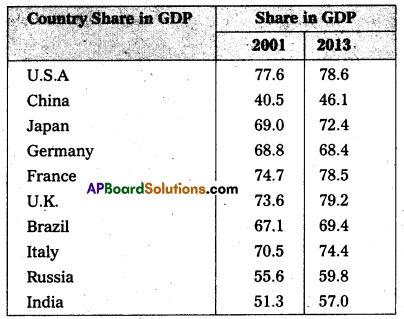
1) Share in the gross domestic product: A review of the sectoral contribution to the gross domestic product reveals that the contribution of service sector has been increasing from 1950, its share was 27.5 percent of the GDP in 1950 – 51 and increased to around 56.0 percent in 2007 – 2008. The share of services sector in India is continuously increasing. It was only 27.5 percent in 1950 – 51 and increased to 40.59 percent in 1990 – 91 and further to 55.73 percent in 2007 – 08. In 2013 it was 57.0%.
2) Workers employed : Generally there is a tendency for the tertiary sector to expand more rapidly than secondary sector activities as a consequency the percentage of labour force engaged in this sector also registers an increase.

The workers engaged in tertiary sector has increased from 178.56 lakhs (1991) to 182.65 lakhs in 2008. Though 189.60 lakh workers were employed in tertiary sector during 2001 there was a decline in the number of workers employed to 182.65 lakhs in 2008. This was mainly due to the decline in the employment of workers in public sector.

It is evident form the data that 54.1 percent of the workers employed in tertiaiy sector are in rural areas and the proportion of urban areas was 45.9 percent.

3) Exports of services: India has been recording high growth in the export of services during the last few years. Exports of services was US $ 460 billion in 2004 – 05, increased to US $ 61.4 billion in 2005 – 06 and to US $ 90.1 billion in 2007 – 08 growth of exports was particularly repaid in the miscellaneous services which comprise software services, business services, financial services and communication services India’s export of services is expected to touch US $ 310.9 billion powered by the booming software consultancy, engineering and tourism sectors by 2011 -12.

AP Inter 2nd Year Economics Study Material Chapter 6 Tertiary Sector

Question 2.
Infrastructure contributes to the economic development of a country. Explain.
Answer:
“Infrastructure” is an umbrella term for many service activities referred to as social overhead. Capital by many development economists infrastructure facilities are also referred to as economic and social overhead often they have also referred to urban and rural infrastructure. Adequate infrastructural facilities help to determine a country’s success and another failure. They diversity production, expand trade, reduce poverty and improve the environmental conditions.
Generally infrastructure is categorised into two groups. They are :

  1. Economic infrastructure
  2. Social infrastructure

The services and facilities that are used in the economic production and by households is called as Economic infrastructure.

Engineering structures, equipment, power, gas, telecommunications, water supply, sanitation public works for irrigation, roads and railways, urban transport ports, waterways, air ports etc., are grouped as “economic infrastructure”.

Social infrastructure includes education, healthcare, family welfare housing, labour welfare etc. Both economic and social infrastructural serve as the true “engine of growth” and provides the needed impetus to the economy. The services associated with the use of infrastructure are called as infrastructural services, act as wheels of the economic activity. The availability on infrastructure improves the per capita GDP and has the following effects:

  1. Raises the productivity of the production process.
  2. Increases access to markets.
  3. Leads to agricultural expansion.
  4. Brings higher yields in agriculture.
  5. Lowers the cost of doing business.
  6. Provides ability to complete in the international trade, even in traditional commodities.
  7. Provides employment opportunities.
  8. Achieves cost – saving in inventory and working capital.
  9. Delivers the product just-in-time particularly in exports.
  10. Facilitates diversification of trade.
  11. Leads to modernisation and diversification of production.
  12. Provides ability to repond to changes in demand and prices.
  13. Facilitates employment intensive growth.
  14. Defines welfare and ensures growth with poverty reduction.
  15. Helps to identify the poor.
  16. Improves the quality of life.
  17. Offers non-farm employment opportunities.
  18. Encourages the modification of physical surroundings as environment friendly surroundings.
  19. Promotes environment sustainability of human settlements.
  20. Removes and disposes the liquid and solid wastes.
  21. Protects public health and provides health benefits.

Keeping in view all these beneficial impacts of infrastructural services, the Government of India has decided to invest ₹ 4,35,349 crore, to spend exclusively on the improvement of rural infrastructure. This amount is allocated for the development of electricity, roads, telecommunications, irrigation, water supply and sanitation.

Short Answer Questions

Question 1.
Explain the contribution of GDP in service sector.
Answer:
Service sector has become very prominent in world’s economies. The importance may be highlighted in terms of its contribution to GDP, employment and exports.

The share of GDP is high in many countries. The following table shows that the contribution of services sector to the overall GDP those countries is very high in the tuble U.K has highest share of service sector followed by U.S.A, France. In India the share of service sector increase between 2001 and 2013.
AP Inter 2nd Year Economics Study Material Chapter 6 Tertiary Sector 1

AP Inter 2nd Year Economics Study Material Chapter 6 Tertiary Sector

Question 2.
What are the activities considered under the India’s Services Sector ?
Answer:
Services in India are emerging as a prominent sector in terms of contribution of national and State incomes, trade flows, foreign direct investment (FDI) inflows and employment. The following activities can be considered to form the part of the service sector.

  1. Trade.
  2. Hotels and Restaurants.
  3. Transport (Including Railways and transport by other means)
  4. Storage.
  5. Communication.
  6. Banking and Insurance.
  7. Real Estate and Business Services.
  8. Public administration and defence.
  9. Construction.
  10. Other services including education, medical and health, religious and other community services, legal services, recreation services.

Question 3.
What are the advantages of Roadways? [A.P. Mar. 18, 17, 16]
Answer:
The principle mode of connectivity between places in roadways. India has one of the largest road networks in the world, spread over 48.65 lakh k.m. district and villages road constitutive 95.2% of the total road network in our country.
Advantages of Roadways :

  1. Road transport connects all the villages and regions and finally it connects to the railways.
  2. Road transport does not required heavy capital expenditure.
  3. The chances of delay, damages are less in case of road transport.
  4. Road transport provides transports the goods to the railway station.
  5. Road transport help the farmers particularly easily and quickly to transport to mandis and towns.
  6. Road transport is more flexible when compared to other means of transport. It can provide door to door service.
  7. Enables to defence forces to move areas inaccessible by railways in emergencies.

AP Inter 2nd Year Economics Study Material Chapter 6 Tertiary Sector

Question 4.
Explain the importance of Railways.
Answer:
Railways provide the principal mode of transportation for freight and passengers. They are the great integrating force for the past 150 years and helping in acclerating the development of industry and agriculture railways made a very modest beginning in 1853. With a route length of 34 kms. Indian railways have grown into a vast network of 7,183 stations spread over a route length of 53,332 kilometers. They have a flat of 8025 locomotives, 44090 passenger service vehicles, 5990 other loading vehicles and 2,07,176 wagons. The Indian railways is the world’s third largest rail network under a single management. Better resource management rational pricing policy have led to a significant improvement in the performance of the railways. In India the development of agriculture and industrial sectors has generated higher level of demand for rail transport. Coal, pig iron, iron ore, cement, food grains, fertilizers sugar, salt, steel, petroleum products and other essential commodities are transported by railways.

Question 5.
What is tourism ? Explain its importance in Indian economy.
Answer:
Tourism is the sub – sector of tertiary sector in general and services industry in particular.

W.T.O defined Tourism as “the activities of persons travelling and staying in places outside their usual environment for not more then one consecutive year for leisure, business and other purposes”.
Importance:

  1. Tourism provides revenue to the government.
  2. Tourism creates employment facilities for women.
  3. It provides regional development.
  4. It is a source of foreign exchange earnings.
  5. Tourism sells indirectly the environmental resources.
  6. It can be used as a means of reducing poverty.
  7. It builds partnership with private sector.

AP Inter 2nd Year Economics Study Material Chapter 6 Tertiary Sector

Question 6.
Explain the banking system in India.
Answer:
A well – developed banking system is necessary pro -requisite for achievement of economic development. Banks play an important role in mobilization of savings and investments. Banks are the efficient agents of capital formation in the economy and give access to use the resources in a productive way.

Banking system in India has been playing a very important role in the process of economic development. Depending upon the nature of the activity performed by them, banking system in India may be classified into the following categories. They are :
a) Commercial Banks
b) Cooperative Banks
c) Central Bank (Reserve Bank of India)

a) Commercial Banks : The commercial banks were nationalized in phased manner in 1969 and 1980. They are classified as public sector (nationalized) banks and private sector banks. The State Bank of India and its associates along with another 20 banks are the public sector banks. The Indian scheduled banks, which are not nationalized and branches of foreign banks operating in India are called as private sector banks.

b) Cooperative Banks: Under Cooperative Banking System State Cooperative Banks, District Central Cooperative Banks (DCCB) and primary to short term credit. State Cooperative Agriculture and Rural Development Banks and Primary Agriculture and Rural Development Bank provide long term credit.

c) Reserve Bank of India (RBI) : The RBI is India’s Central Bank was established on 1st April 1935 was nationalized on 1st January 1949. RBI is Supreme Monetary Authority in the country. It keeps the reserves of all scheduled banks, which were included in 2nd schedule of RBI and which were not included is called as ‘Non-schedule Banks’.

Question 7.
What are the major constituents of insurance industry in India ?
Answer:
A Health and Development Insurance Sector of vital importance to every modem economy. It encourages the savings habits provides a safety net to rural and urban enterprises and individuals and generates long term funds for infrastructure development. Development and insurance is therefore, necessary to support continued economic growth social security and person reforms also benefit from a mature insurance industry.
There are two major constituents of Insurance :

  1. Life Insurance
  2. Non Life Insurance (General)

1) Life Insurance : LIC offers schemes, policies and plans to investors. Particularly the main objective of UC is giving protecting against risk of death and channalizing the funds for the benefits and the economy in the socially oriented sectors during 2013 -14.

Life Insurance under wrote first – year premium of ₹ 1,19,641 crore as against ₹ 1,07,361 crore during 2012-13 registering a growth of 11.44 percent.

2) Non Life Insurance (General): The general insurance companies deal with non life insurance. The GIC was approved as the Indian Reinsurer on 3rd November 2000. It offers fire, marine, motor, health and other insurance. During 2013-14, non-life insurance including stand lone health insurance and specialize insurance (Export Credit Guarantee Scheme) and Agriculture Insurance Company (AIQ underwrote premium worth ₹ 77,584 crore as against ₹ 69,089 crore during 2012 -13 registering a growth of 12.23 percent.

Very Short Answer Questions

Question 1.
Service sector [A.P. Mar 17]
Answer:
Service sector is also known as tertiary sector. Service sector is the life, line for the social and economic growth of a country. The service sector activities include trade, transport, communications, banking, insurance, education, health, energy, marketing etc., all these facilities and services constitutes collectively the tertiary sector.

AP Inter 2nd Year Economics Study Material Chapter 6 Tertiary Sector

Question 2.
Infrastructure
Answer:
An umbrella term for service activities in the economy. Infrastructure is categorized into two groups. They are economic infrastructure and social infrastructure.

Question 3.
Transport
Answer:
Transport means conveyance of people or property from one place to another. These services provide a link between production distribution and consumption activities. Road ways, railways, airways, waterways are the important means of transport.

Question 4.
Water Transport
Answer:
Water Transport is the another important means of transport. Shipping is an important indicator of both commodity and service trade of any country. Water transport in India is of two types. They are the land water transport and International water transport (Shipping).

Question 5.
Civil Aviation
Answer:
Air transport has a vital role in the economic development of the country. It is the modem and quickest transport. In India the first commercial flight started on February 18th, 19.11. The real progress in civil aviation started in 1920.

Question 6.
Tourism [A.P. Mar. 17, 16]
Answer:
Tourism is the sub-sector of tertiary sector in general and services industry in particular. Tourism as “the activities of persons travelling and staying in places outside their usual environment for not more than one consecutive year for leisure, business and other purposes.

AP Inter 2nd Year Economics Study Material Chapter 6 Tertiary Sector

Question 7.
LIC [A.P. Mar. 18, 16]
Answer:
Life Insurance Corporation of India was set up in 1956. UC has its central office at Mumbai with 7 Zonal offices, 101 divisional offices and 2,048 branch offices. It mobilise savings of the public to invest in the industrial securities.

Question 8.
GIC
Answer:
General Insurance Industry in India was nationalized in 1972 and a government company known as General Insurance Corporation of India (GIC) was established. There are four GIC companies.

  1. National Insurance Company Limited
  2. New India Assurance Company Limited
  3. Oriental Insurance Company Limited
  4. United India Insurance Company Limited. The GIC deal with non-life insurance.

Question 9.
Micro – Insurance [A.P. Mar. 18]
Answer:
A system that blends insurance with savings and credit practices. The member of self help groups, farmers, migrant workers and tribals are the target groups for this micro finance. This insurance offers both individuals and group insurance services.

Question 10.
Communication
Answer:
The communication system is an integral part of the development process. Communication means the transmission of information. By providing necessary information about markets and supply of goods. It consists of posts of telegraphs, telecommunications broadcasting, television etc.

AP Inter 2nd Year Economics Study Material Chapter 6 Tertiary Sector

Question 11.
Science and Technology
Answer:
Science and technology are ideas and means with which man seeks to change his environment. Science represents accumulation of knowledge, while technology represents ‘refinement in tools. These two have helped to improve the quality of human life.

Question 12.
Performance of software industry
Answer:
The software industry is the main component of the information technology in India. India’s pool of young-aged man power is the key behind this success story. Presently there are more then 500 software forms in the country. Global software gaints like Microsoft, Oracle etc.

Inter 1st Year Maths 1B Applications of Derivatives Solutions Ex 10(c)

Practicing the Intermediate 1st Year Maths 1B Textbook Solutions Inter 1st Year Maths 1B Applications of Derivatives Solutions Exercise 10(c) will help students to clear their doubts quickly.

Intermediate 1st Year Maths 1B Applications of Derivatives Solutions Exercise 10(c)

I.

Question 1.
Find the lengths of subtangent and sub-normal at a point of the curve
Solution:
Equation of the curve is y = b. sin \(\frac{x}{a}\)
\(\frac{dy}{dx}\) = b. cos \(\frac{x}{a}.\frac{1}{a}=\frac{b}{a}\). cos \(\frac{x}{a}\)
Length of the sub-tangent = |\(\frac{y_{1}}{f^{\prime}\left(x_{1}\right)}\)|
= \(\frac{b \cdot \sin \frac{x}{a}}{\frac{b}{a} \cdot \cos \frac{x}{a}}=\left|a \cdot \tan \frac{x}{a}\right|\)
Length of the sub-normal = |y1, f'(x1)|
Inter 1st Year Maths 1B Applications of Derivatives Solutions Ex 10(c) 2

Question 2.
Show that the length of sub normal at any point on the curve xy = a2 varies as the cube of the ordinate of the point.
Solution:
Equation of the curve is xy = a²
y = \(\frac{a^{2}}{x}\)
\(\frac{dy}{dx}=\frac{-a^{2}}{x^{2}}\)
Length of the sub-normal = |y1, f’ (x1)|
Inter 1st Year Maths 1B Applications of Derivatives Solutions Ex 10(c) 3
\(\frac{y_{1}^{3}}{a^{2}}\) ∝ y31 = cube of the ordinate.

Inter 1st Year Maths 1B Applications of Derivatives Solutions Ex 10(c)

Question 3.
Show that at any point (x, y) on the curve y = bex/a, the length of the sub¬tangent is a constant and the length of the sub normal is \(\frac{y^{2}}{a}\).
Solution:
Equation of the curve is y = b.ex/a
\(\frac{a^{2}}{x}\) = b.ex/a.\(\frac{1}{a}=\frac{y}{a}\)
Length of the sub tangent
= |\(\frac{y_{1}}{f^{\prime}\left(x_{1}\right)}\)| = \(\frac{y_{1}}{\left(\frac{y_{1}}{a}\right)}\) = a = constant
Length of the sub-normal
= |y1f'(x1)| = |y1\(\frac{y_{1}}{a}\)| = \(\frac{y_{1}^{2}}{a}\).

II.

Question 1.
Find the value of k so that the length of the sub normal at any point on the curve xyk = ak + 1 is a constant.
Solution:
Equation of the curve is x.yk = ak + 1
Differentiating w.r.to x
x.k.yk-1 \(\frac{dy}{dx}\) + yk.1 = 0
x.k.yk-1 \(\frac{dy}{dx}\) = -yk
\(\frac{dy}{dx}=\frac{-y^{k}}{k \cdot x \cdot y^{k-1}}=-\frac{y}{kx}\)
Length of the sub-normal = |y1f'(x1|
Inter 1st Year Maths 1B Applications of Derivatives Solutions Ex 10(c) 4
Length of the sub-normal is constant at any point on the curve is independent of x1 and y1
∴ \(\frac{y_{1}^{k+2}}{k \cdot a^{k+1}}\) is independent of x1, y1
⇒ k + 2 = 0 ⇒ k = -2

Question 2.
At any point t on the curve x = a (t + sin t), y = a (1 – cos t), find the lengths of tangent, normal, sub tangent and sub
normal.
Solution:
Equation of the curve is x = a (t + sin t), y = a (1 – cost)
\(\frac{dx}{dt}\) = a (1 + cos t), \(\frac{dy}{dt}\) = a. sin t
Inter 1st Year Maths 1B Applications of Derivatives Solutions Ex 10(c) 5
Length of the tangent = |y1|\(\sqrt{1+\frac{1}{\left[f^{\prime}\left(x_{1}\right)\right]^{2}}}\)
Inter 1st Year Maths 1B Applications of Derivatives Solutions Ex 10(c) 6
Length of the normal = |y1|\(\sqrt{1+\left[f\left(x_{1}\right)\right]^{2}}\)
Inter 1st Year Maths 1B Applications of Derivatives Solutions Ex 10(c) 7
Length of the sub tangent.
Inter 1st Year Maths 1B Applications of Derivatives Solutions Ex 10(c) 8
= |a (2 sin t/2. cos t/2|
= |a. sin t|
Length of the sub normal
= |y1.f'(x1)| = |a(1 – cos t).\(\frac{\sin t / 2}{\cos t / 2}\)|
= |2a sin² t/2. tan t/2|

Inter 1st Year Maths 1B Applications of Derivatives Solutions Ex 10(c)

Question 3.
Find the lengths of normal and sub normal at a point on the curve y = \(\frac{a}{2}\) (ex/a + e-x/a).
Solution:
Equation of the curve is y = \(\frac{a}{2}\) (ex/a + e-x/a)
= a. cosh (\(\frac{x}{a}\))
Length of the normal = |y1|\(\sqrt{1+\left[f\left(x_{1}\right)\right]^{2}}\)
= |a.cosh \(\frac{x}{a}\)|\(\sqrt{1+\sinh ^{2} \frac{x}{a}}\)
= a. cosh \(\frac{x}{a}\). cosh \(\frac{x}{a}\) = a. cosh² \(\frac{x}{a}\)
Length of the sub normal = |y1 f'(x1)|
Inter 1st Year Maths 1B Applications of Derivatives Solutions Ex 10(c) 9

Question 4.
Find the lengths of subtangent, sub normal at a point t on the curve x = a (cos t + t sin t), y=a (sin t – t cos t)
Solution:
Equations of the curve are x = a (cos t + t sin t)
\(\frac{dx}{dt}\) = a (- sin t + sin t +1 cost) = at cos t
y = a (sin t – t cos t)
\(\frac{dy}{dt}\) = a (cos t – cos t +1 sin t) = a t sin t
Inter 1st Year Maths 1B Applications of Derivatives Solutions Ex 10(c) 10
Length of the sub tangent
Inter 1st Year Maths 1B Applications of Derivatives Solutions Ex 10(c) 11
= |a cot t (sin t – t cos t)|
Length of the sub-normal = |y1.f'(x1)|
= |a (sin t – t cos t) tan t|
= |a tan t (sin t – t cos t)|

Inter 1st Year Maths 1A Matrices Formulas

Use these Inter 1st Year Maths 1A Formulas PDF Chapter 3 Matrices to solve questions creatively.

Intermediate 1st Year Maths 1A Matrices Formulas

→ An ordered rectangular array of elements is called a matrix.

→ A matrix in which the number of rows is equal to the number of columns, is called a square matrix. Otherwise, it is called a rectangular matrix. In a square matrix, an element aij is in principal diagonal, if i = j

→ If each non-diagonal element of a square matrix is equal to zero, then it is called a diagonal matrix.

→ If each non-diagonal element of a square matrix is equal to zero and each diagonal element is equal to a scalar, then it is called a scalar matrix.

→ If each non-diagonal element of a square matrix is equal to zero and each diagonal element is equal to 1, then that matrix is called a unit matrix or Identity matrix.

→ If A is a square matrix then the sum of elements in the principal diagonal of A is called the trace of A.

  • Matrix addition is commutative.
  • Matrix addition is associative.
  • Matrix multiplication is associative.
  • Matrix multiplication is distributive over matrix addition.

Inter 1st Year Maths 1A Matrices Formulas

→ A square matrix A is said to be an idempotent matrix if A2 = A.

→ A square matrix A is said to be an involuntary matrix if A2 = I.

→ A square matrix A is said to be a nilpotent matrix, if there exist a positive integer n such that An = 0. If n is the least positive integer such thatAn = 0, then n is called index of the nilpotent matrix A.

→ The matrix obtained by interchanging rows and columns is called transpose of the given matrix. Transpose of A is denoted by AT (or) A’.

→ For any matrices A and B

  • (AT)T = A
  • (A + B)T = AT + BT (A and B are same order)
  • (AB)T = BTAT. (If A and B are of orders m xn and n xp respectively)

→ A square matrix A is said to be symmetric if AT = A.

→ A square matrix A is said to be skew symmetric if AT = A.

→ Every square matrix can be uniquely expressed as a sum of symmetric matrix and a skew symmetric matrix.

→ The minor of an element in the square matrix of order ‘3’ is defined as the determinant of 2 × 2 matrix, obtained after deleting the row and the column in which the element is present.

→ The cofactor of an element in the ith row and jth column of 3 × 3 matrix is defined as its minor multiplied by (-1)i+j.

→ The sum of the products of the elements of any row or column with their corresponding cofactors is called the determinant of a matrix.

  • A square ‘A’ is said to be a singular matrix if det A = 0.
  • A square A’ is said to be a non-singular matrix if det A ≠ 0.

→ The transpose of the matrix obtained by replacing.the elements of a square matrix A by the corresponding cofactors is called the adjoint matrix of A and it is denoted by adj (A).

  • A square matrix ‘A is said to be an invertible matrix if there exists a square matrix B such that AB = BA = I the matrix B is called inverse of A and it is denoted by A-1.
  • If A is an invertible then A-1 = 1.

→ A square matrix A is non-singular if A is invertible.

  • If A and B are non-singular matrices of same type then Adj (AB) = (Adj B) (Adj A).
  • If A is a square matrix of type n then det (Adj A) = (det A)n-1.

→ A matrix obtained by deleting some rows or columns (or both) of a matrix is called a submatrix.

→ Let Abe a non-zero matrix, the rank of A is defined as the maximum of the orders of the non-singular square submatrices of A. The rank of a null matrix is zero. The rank of a matrix A is denoted as rank (A) or P (A).

→ A system of linear equations is

  • Consistent, if it has a solution
  • Inconsistent, if it has no solution

→ Non homogeneous system

  • a1x + b1y + c1z = d1
  • a2x + b2y + c2z = d2
  • a3x + b3y + c3z = d3

Inter 1st Year Maths 1A Matrices Formulas

→ The above system of equations has

  • aunique solution if rank (A) = Rank [AD] = 3
  • infinity many solutions, if rank (A) = Rank ([AD]) < 3
  • no solution, if rank A ≠ Rank ([AD])

→ Homogeneous system of equations

  • a1x + b1y + c1z = d1
  • a2x + b2y + c2z = d2
  • a3x + b3y + c3z = d3

→ The above system has

  • Trival solution x = y = z = 0 only if rank (A) = 3
  • infinitely many non-trival solutions if rank (A) < 3.

→ A matrix is an arrangement of real or complex numbers into rows and columns so that all the rows (columns) contain equal no. of elements.

→ If a matrix consists of ‘m’ rows and ‘n’ columns, then it is said to be of order m × n.

→ A matrix of order n × n is said to be a square matrix of order n.

→ A matrix (aij)m×n is said to be a null matrix if aij = 0 for all i and j.

→ Two matrices of the same order are said to be equal if the corresponding elements in the matrices are all equal.

→ A matrix (aij)n×n is a diagonal matrix aij = 0 for all i ≠ j

→ A matrix (aij)n×n is a scalar matrix if a = 0 for all i ≠ j and aij = k (constant) for i = j

→ A matrix (aij)n×n is said to be a unit matrix of order n, denoted by In if aij = 1, when i = j and aij = 0 when i ≠ j
Ex: I2 = \(\left[\begin{array}{ll}
1 & 0 \\
0 & 1
\end{array}\right]\)
I3 = \(\left[\begin{array}{lll}
1 & 0 & 0 \\
0 & 1 & 0 \\
0 & 0 & 1
\end{array}\right]\)

→ If A = (aij)m×n, B = (bij)m×n, then A + B = (aij + bij)m×n

→ Matrix addition is commutative and associative

→ Matrix multiplication is not commutative but associative

→ If A is a matrix of order m × n, then AIn = ImA = A(AI = IA = A)

→ If AB = CA = I, then B = C

Inter 1st Year Maths 1A Matrices Formulas

→ If A = (aij)m×n, then A T = (aij)n×m

→ (KA)T = KAT, (A + B)T = AT + BT, (AB)T = BT.AT

→ A(B + C) = AB + AC, (A + B)C = AC + BC

→ A square matrix is said to be “non-singular” if detA ≠ 0

→ A square matrix is said to be “singular” if detA = 0

→ If AB = 0, where A and B are non-zero square matrices, then both A are singular.

→ A minor of any element in a square matrix is determinant of the matrix obtained by omitting the row and column in which the element is present.

→ In (aij)n×n, the cofactor of aij is (-1)i+j × (minor of aij).

→ In a square matrix, the sum of the products of the elements of any row (column) and the corresponding cofactors is equal to the determinant of the matrix.

→ In a square matrix, the sum of the products of the elements of any row (column) and the corresponding cofactors of any other row (column) is alway s zero.

→ If A is any square matrix, then A adjA = adjA. A = detA. I

→ If A is any square matrix and there exists a matrix B such that AB = BA = I, then B is called the inverse of A and denoted by A-1.

→ AA-1 = A-1A = I.

→ If A is non-singular, then A-1 = \(\frac{{adj} A}{{det} A}\) (or) adj A = |A|AA-1

→ If A = \(\left(\begin{array}{ll}
a & b \\
c & d
\end{array}\right)\), then A-1 = \(\frac{1}{a d-b c}\left(\begin{array}{cc}
d & -b \\
-c & a
\end{array}\right)\)

→ (A-1)-1 = A, (AB)-1 = B-1.A-1, (A-1)T =( AT)-1; (ABC….)-1 = C-1B-1A-1.

Theorem:
Matrix multiplication is associative. i.e. if conformability is assured for the matrices A, B and C, then (AB)C = A(BC).
Proof:
Inter 1st Year Maths 1A Matrices Formulas 1

Inter 1st Year Maths 1A Matrices Formulas

Theorem:
Matrix multiplication is distributive over matrix addition i.e. if conformability is assured for the matrices A, B and C, then
(i) A (B + C) = AB + AC
(ii) (B + C) A = BA + CA
Proof:
Let A = (aij)m×n, B = (bjk)n×p C = (cki)n×p
B + C = (djk)n×p, where djk = bjk + cjk
Inter 1st Year Maths 1A Matrices Formulas 2
∴ A(B + C) = AB + AC
Similarly we can prove that
(B + C) = BA + CA.

Theorem:
If A is any matrix, then (AT)T = A.
Proof:
Let A = (aij)m×n
AT = (a’jk)n×m, where a’ji = aij
(AT)T = (a”ji)m×n, where a”ij = aji
a”ij = a’ji = aij
∴ (AT)T = A

Theorem:
If A and B are two matrices o same type, then (A + B)T = AT + BT.
Proof:
Let A = (aij)m×n, B = (bij)
A + B = (cij)m×n,where cij = aij + bij
(A + B)T = (c’ji)n×m. c’ji = cij
AT = (a’ji)n×m,where a’ji = aij
BT = (bji)n×m. where. b’kj = bjk
AT + BT = (dji)n×m, where dji = a’ji + b’ji
c’ji = cij = aij + bij = a’ji + b’ji = dji
∴(A + B)T = AT + BT

Theorem:
If A and B are two matrices for which conformability for multiplication is assured, then (AB)T = BTAT.
Pr0of:
Let A = (aij)m×n, B = (bji)n×p
AB = (cik)m×p, where cik = \(\sum_{j=1}^{n}\) aijbjk
(AB)T = (cki)p×m,where cki = cik
AT = (aji)n×m,where aji = aij
BT = (bkj)p×n, where bkj = bjk
BT . AT = (dki )p×m, where dki= \(\sum_{j=1}^{n}\) bkjaji
c’ki = cik = \(\sum_{j=1}^{n}\) aijbjk= \(\sum_{j=1}^{n}\) bkjajidki
∴ (AB)T = BTAT

Inter 1st Year Maths 1A Matrices Formulas

Theorem:
If A and B are two invertible matrices of same type then AB is also invertible and (AB)-1 = B-1A-1.
Proof:
A is invertible matrix ⇒ A-1 exists and AA-1 = A-1A = I.
B is an invertible matrix ⇒ B-1 exists and
BB-1 = B-1B = I
Now (AB)(B-1A-1) = A(BB-1)A-1 = AIA-1 = AA-1 = I
(B-1A-1)(AB) = B-1(A-1A)B ∴ AB is invertible and
= B-1IB = B-1B = I
(AB)(B-1A-1) = (B-1A-1) = (B-1A-1)(AB) = 1
(AB)-1 = B-1A-1.

Theorem:
If A is a non-singular matrix then A is invertible and A-1 = \(\frac{{Adj} A}{{det} A}\).
Proof:
Let A = \(\left[\begin{array}{lll}
\mathrm{a}_{1} & \mathrm{~b}_{1} & \mathrm{c}_{1} \\
\mathrm{a}_{2} & \mathrm{~b}_{2} & \mathrm{c}_{2} \\
\mathrm{a}_{3} & \mathrm{~b}_{3} & \mathrm{c}_{3}
\end{array}\right]\) be a non – singular matrix.
∴ det A ≠ 0
Inter 1st Year Maths 1A Matrices Formulas 3

Inter 1st Year Maths 1A Trigonometric Ratios up to Transformations Solutions Ex 6(f)

Practicing the Intermediate 1st Year Maths 1A Textbook Solutions Inter 1st Year Maths 1A Trigonometric Ratios up to Transformations Solutions Exercise 6(f) will help students to clear their doubts quickly.

Intermediate 1st Year Maths 1A Trigonometric Ratios up to Transformations Solutions Exercise 6(f)

Question 1.
If A, B, C are angles in a triangle, then prove that
(i) sin 2A – sin 2B + sin 2C = 4 cos A sin B cos C
Solution:
∵ A, B, C are angles in a triangle
⇒ A + B + C = 180° ……….(1)
LHS = sin 2A – sin 2B + sin 2C
= sin 2A + sin 2C – sin 2B
= 2 sin (\(\frac{2 A+2 C}{2}\)) . cos(\(\frac{2 A-2 C}{2}\)) – sin 2B
= 2 sin (A + C) cos (A – C) – sin B
= 2 sin (180° – B) cos (A – C) – 2 sin B cos B
= 2 sin B cos (A – C) – 2 sin B cos B
= 2 sin B [cos (A – C) – cos B]
= 2 sin B [cos (A – C) – cos (180° – (A + C)]
= 2 sin B [cos (A – C) + cos (A + C)]
= 2 sin B (2 cos A cos C)
= 4 cos A sin B cos C
∴ sin 2A – sin 2B + sin 2C = 4 cos A sin B cos C

(ii) cos 2A – cos 2B + cos 2C = 1 – 4 sin A cos B Sin C
Solution:
L.H.S. = -(cos 2B – cos 2A) + cos 2C
= -2 sin (A + B) sin (A – B) + cos 2C
= -2 sin (180° – C) sin (A – B) + cos 2C
= -2 sin C sin (A – B) + 1 – 2 sin2C
= 1 – 2 sin C (sin (A – B) + sin C)
= 1 – 2 sin C sin (A – B) + sin (180° – \(\overline{\mathrm{A}+\mathrm{B}}\))
= 1 – 2 sin C (sin (A – B) + sin (A + B))
= 1 – 2 sin C (2 sin A cos B)
= 1 – 4 sin A cos B sin C
= R.H.S.

Inter 1st Year Maths 1A Trigonometric Ratios up to Transformations Solutions Ex 6(f)

Question 2.
If A, B, C are angles in a triangle, then prove that
(i) sin A + sin B – sin C = 4 sin \(\frac{A}{2}\) sin \(\frac{B}{2}\) cos \(\frac{C}{2}\)
Solution:
L.H.S. = (sin A + sin B) – sin C
= 2 sin (\(\frac{A+B}{2}\)) cos (\(\frac{A-B}{2}\)) – sin C
Inter 1st Year Maths 1A Trigonometric Ratios up to Transformations Solutions Ex 6(f) Q2(i)

(ii) cos A + cos B – cos C = -1 + 4 cos \(\frac{A}{2}\) cos \(\frac{B}{2}\) sin \(\frac{C}{2}\)
Solution:
A, B, C are angles in a triangle
A + B + C = 180° ………(1)
LHS = cos A + cos B – cos C
Inter 1st Year Maths 1A Trigonometric Ratios up to Transformations Solutions Ex 6(f) Q2(ii)

Question 3.
If A, B, C are angles in a triangle, then prove that
(i) sin2A + sin2B – sin2C = 2 sin A sin B cos C
Solution:
Given A + B + C = 180°
L.H.S. = sin2A + [sin2B – sin2C]
= sin2A + sin (B + C) sin (B – C)
= sin2A + sin (180° – A) . sin (B – C)
= sin2A + sin A . sin (B – C)
= sin A (sin A + sin (B – C))
= sin A [sin (180° – \(\overline{\mathrm{B}+\mathrm{C}}\)) + sin (B – C)]
= sin A [sin (B + C) + sin (B – C)]
= sin A [2 sin B cos C]
= 2 sin A sin B cos C
= R.H.S

(ii) cos2A + cos2B – cos2C = 1 – 2 sin A sin B cos C
Solution:
A, B, C are angles in a triangle
⇒ A + B + C = 180° ……..(1)
L.H.S = cos2A + cos2B – cos2C
= cos2A + cos2B – cos2C
Inter 1st Year Maths 1A Trigonometric Ratios up to Transformations Solutions Ex 6(f) Q3(ii)
= 1 + cos (A + B) cos (A – B) – cos2C
= 1 + cos (180° – C) cos (A – B) – cos2C [By (1)]
= 1 – cos C cos (A – B) – cos2C
= 1 – cos C [cos (A – B) + cos C]
= 1 – cos C [cos (A – B) + cos(180° – \(\overline{A+B}\)] [By eq. (1)]
= 1 – cos C [cos (A – B) – cos (A + B)]
= 1 – cos C [2 sin A sin B]
= 1 – 2 sin A sin B cos C
∴ cos2A + cos2B – cos2C = 1 – 2 sin A sin B cos C

Inter 1st Year Maths 1A Trigonometric Ratios up to Transformations Solutions Ex 6(f)

Question 4.
If A + B + C = π, then prove that
(i) \(\cos ^{2} \frac{A}{2}+\cos ^{2} \frac{B}{2}+\cos ^{2} \frac{C}{2}\) = \(2\left[1+\sin \frac{A}{2}+\sin \frac{B}{2} \sin \frac{C}{2}\right]\)
Solution:
Inter 1st Year Maths 1A Trigonometric Ratios up to Transformations Solutions Ex 6(f) Q4(i)

(ii) \(\cos ^{2} \frac{A}{2}+\cos ^{2} \frac{B}{2}-\cos ^{2} \frac{C}{2}=2 \cos \frac{A}{2}\) \(\cos \frac{B}{2} \sin \frac{C}{2}\)
Solution:
Inter 1st Year Maths 1A Trigonometric Ratios up to Transformations Solutions Ex 6(f) Q4(ii)
Inter 1st Year Maths 1A Trigonometric Ratios up to Transformations Solutions Ex 6(f) Q4(ii).1

Question 5.
In triangle ABC, prove that
(i) \(\cos \frac{A}{2}+\cos \frac{B}{2}+\cos \frac{C}{2}\) = \(4 \cos \frac{\pi-A}{4} \cos \frac{\pi-B}{4} \cos \frac{\pi-C}{4}\)
Solution:
Inter 1st Year Maths 1A Trigonometric Ratios up to Transformations Solutions Ex 6(f) Q5(i)
Inter 1st Year Maths 1A Trigonometric Ratios up to Transformations Solutions Ex 6(f) Q5(i).1

(ii) \(\cos \frac{A}{2}+\cos \frac{B}{2}-\cos \frac{C}{2}\) = \(4 \cos \frac{\pi+A}{4} \cdot \cos \frac{\pi+B}{4} \cos \frac{\pi-C}{4}\)
Solution:
Inter 1st Year Maths 1A Trigonometric Ratios up to Transformations Solutions Ex 6(f) Q5(ii)

(iii) \(\sin \frac{A}{2}+\sin \frac{B}{2}-\sin \frac{C}{2}\) = \(-1+4 \cos \frac{\pi-A}{4} \cos \frac{\pi-B}{4} \sin \frac{\pi-C}{4}\)
Solution:
Inter 1st Year Maths 1A Trigonometric Ratios up to Transformations Solutions Ex 6(f) Q5(iii)
Inter 1st Year Maths 1A Trigonometric Ratios up to Transformations Solutions Ex 6(f) Q5(iii).1
Inter 1st Year Maths 1A Trigonometric Ratios up to Transformations Solutions Ex 6(f) Q5(iii).2

Question 6.
If A + B + C = π/2, then prove that cos 2A + cos 2B + cos 2C = 1 + 4 sin A sin B sin C
Solution:
A + B + C = π/2 ………(1)
LHS = cos 2A + cos 2B + cos 2C
= 2 cos (\(\frac{2 \mathrm{~A}+2 \mathrm{~B}}{2}\)) cos (\(\frac{2 \mathrm{~A}-2 \mathrm{~B}}{2}\)) + cos 2C
= 2 cos (A + B) . cos (A – B) + cos 2C
= 2 cos (90° – C) cos (A – B) + cos 2C
= 2 sin C cos (A – B) + (1 – 2 sin2C)
= 1 + 2 sin C [cos (A – B) – sin C]
= 1 + 2 sin C [cos (A – B)- sin (90° – \(\overline{A+B}\))]
= 1 + 2 sin C [cos (A – B) – cos (A +B)]
= 1 + 2 sin C [2 sin A sin B]
= 1 + 4 sin A sin B sin C
= RHS
∴ cos 2A + cos 2B + cos 2C = 1 + 4 sin A sin B sin C

Inter 1st Year Maths 1A Trigonometric Ratios up to Transformations Solutions Ex 6(f)

Question 7.
If A + B + C = 3π/2, then prove that
(i) cos2A + cos2B – cos2C = -2 cos A cos B sin C
Solution:
A + B + C = 3π/2 ……..(1)
L.H.S. = cos2A + cos2B – cos2C
= cos2A + (1 – sin2B) – cos2C
= (cos2A – sin2B) + (1 – cos2C)
= cos (A + B) cos (A – B) + sin2C
= cos (270° – C) cos(A – B) + sin2C
= -sin C cos (A – B) + sin2C
= sin C [sin C – cos (A – B)]
= sin C [sin (270°- \(\overline{A+B}\)) – cos (A – B)]
= sin C [-cos (A + B) – cos (A – B)]
= -sin C [cos (A + B) + cos (A – B)]
= -sin C [2 cos A cos B]
= -2 cos A cos B sin C
= RHS
∴ cos2A + cos2B – cos2C = -2 cos A cos B sin C

(ii) sin 2A + sin 2B – sin 2C = -4 sin A sin B cos C
Solution:
Here A + B + C = 270° ………(1)
LHS = sin 2A + sin 2B – sin 2C
= 2 sin (\(\frac{2 A+2 B}{2}\)) cos (\(\frac{2 A-2 B}{2}\)) – sin 2C
= 2 sin (A + B) . cos (A – B) – 2 sin C cos 2C
= 2 sin (270° – C) cos (A – B) – 2 sin C cos C
= -2 cos C cos (A – B) – 2 sin C cos C
= -2 cos C [cos (A – B) + sin C]
= -2 cos C [cos (A – B) + sin (270° – \(\overline{A+B}\))]
= -2 cos C [cos (A – B) – cos (A + B)]
= -2 cos C [2 sin A sin B]
= -4 sin A sin B cos C
= RHS
∴ sin 2A + sin 2B – sin 2C = -4 sin A sin B cos C

Question 8.
If A + B + C = 0°, then prove that
(i) sin 2A + sin 2B + sin 2C = -4 sin A sin B sin C
Solution:
Here A + B + C = 0 ………(1)
LHS = sin 2A + sin 2B + sin 2C
= 2 sin (\(\frac{2 A+2 B}{2}\)) cos (\(\frac{2 A-2 B}{2}\)) + sin 2C
= 2 sin (A + B) . cos (A – B) + 2 sin C cos 2C
= 2 sin (-C) cos (A – B) + 2 sin C cos C
= -2 sin C cos (A – B) + 2 sin C cos C
= -2 sin C [cos (A – B) – cos C]
= -2 sin C [cos (A – B) – cos (-A – B)]
= -2 sin C [cos (A – B) – cos (A + B)]
= -2 sin C [2 sin A sin B]
= -4 sin A sin B sin C
= RHS
∴ sin 2A + sin 2B + sin 2C = -4 sin A sin B sin C

(ii) sin A + sin B – sin C = – 4 cos \(\frac{A}{2}\) cos \(\frac{B}{2}\) sin \(\frac{C}{2}\)
Solution:
Inter 1st Year Maths 1A Trigonometric Ratios up to Transformations Solutions Ex 6(f) Q8(ii)
Inter 1st Year Maths 1A Trigonometric Ratios up to Transformations Solutions Ex 6(f) Q8(ii).1

Inter 1st Year Maths 1A Trigonometric Ratios up to Transformations Solutions Ex 6(f)

Question 9.
If A + B + C + D = 2π then prove that
(i) sin A – sin B + sin C – sin D = \(-4 \cos \left(\frac{A+B}{2}\right) \sin \left(\frac{A+C}{2}\right) \cos \left(\frac{A+D}{2}\right)\)
Solution:
Inter 1st Year Maths 1A Trigonometric Ratios up to Transformations Solutions Ex 6(f) Q9(i)
Inter 1st Year Maths 1A Trigonometric Ratios up to Transformations Solutions Ex 6(f) Q9(i).1
Inter 1st Year Maths 1A Trigonometric Ratios up to Transformations Solutions Ex 6(f) Q9(i).2

(ii) cos 2A + cos 2B + cos 2C + cos 2D = 4 cos (A + B) cos (A + C) cos (A + D)
Solution:
Inter 1st Year Maths 1A Trigonometric Ratios up to Transformations Solutions Ex 6(f) Q9(ii)

Question 10.
If A + B + C = 2S, then prove that
(i) sin (S – A) + sin (S – B) + sin C = \(4 \cos \left(\frac{S-A}{2}\right) \cos \left(\frac{S-B}{2}\right) \sin \frac{C}{2}\)
Solution:
Inter 1st Year Maths 1A Trigonometric Ratios up to Transformations Solutions Ex 6(f) Q10(i)

(ii) cos (S – A) + cos (S – B) + cos C = \(-1+4 \cos \left(\frac{S-A}{2}\right) \cos \left(\frac{S-B}{2}\right) \cdot \cos \frac{C}{2}\)
Solution:
Inter 1st Year Maths 1A Trigonometric Ratios up to Transformations Solutions Ex 6(f) Q10(ii)