AP Inter 2nd Year Chemistry Study Material Chapter 10 Chemistry In Everyday Life

Andhra Pradesh BIEAP AP Inter 2nd Year Chemistry Study Material 10th Lesson Chemistry In Everyday Life Textbook Questions and Answers.

AP Inter 2nd Year Chemistry Study Material 10th Lesson Chemistry In Everyday Life

Very Short Answer Questions

Question 1.
What are drugs ?
Answer:
Drug : The chemicals of low molecular masses ranging from 100 to 500 U that react with macromolecular targets to produce biological response are called drugs.
E.g.: Morphine, Codeine, Heroin etc.,

Question 2.
When are the drugs called medicines ?
Answer:
When the biological response of a drug is therapeutic arid useful then the chemical substances (drugs) are called medicines.

AP Inter 2nd Year Chemistry Study Material Chapter 10 Chemistry In Everyday Life

Question 3.
Define the term chemotherapy.
Answer:
Chemotherapy : The use of medicines (chemical substances) in the treatment of diseases is called chemotherapy.
In chemotherapy diagnosis, prevention and treatment of diseases involved.

Question 4.
Name the macromolecules that are chosen as drug targets.
Answer:
The macromolecules that are chosen as drug targets are carbohydrates, lipids, proteins, nucleic acids and enzymes.

Question 5.
What are enzymes and receptors ?
Answer:
Enzymes : The proteins which perform the role of biological catalysts in the body are called enzymes.
Receptors : The proteins which are crucial to communication system in the body are called receptors.

Question 6.
Which forces are involved in holding the drug to the active site of enzymes ?
Answer:
The forces involved in holding the drugs to the active site of enzymes are ionic bonds, vander waal’s forces, hydrogen bonds, dipole-dipole interactions etc.,

AP Inter 2nd Year Chemistry Study Material Chapter 10 Chemistry In Everyday Life

Question 7.
What are enzyme inhibitors ?
Answer:
The drugs which inhibits the catalytic activity of enzymes and can block the binding site of the enzyme and prevent the binding of substrate are called enzyme inhibitors.

Question 8.
What is allosteric site ?
Answer:
Some drugs do not bind to the enzyme’s active site and bind to a different site of enzyme. This different site of enzyme is called allosteric site.

Question 9.
What are antagonists and agonists ?
Answer:
Antagonists : The drugs that bind to the receptor site and inhibit its natural function are called antagonists.

  • These are useful when blocking of message is required.

Agonists : The drugs that mimic the natural messenger by switching on receptors are called agonists.

  • These are useful when there is lack of natural chemical messenger.

Question 10.
Why do we need to classify the drugs in different ways ?
Answer:

  1. By knowing the pharmacological effect it makes easy for doctors.
  2. Antacid can be used in case of excessive acidity in stomach.

AP Inter 2nd Year Chemistry Study Material Chapter 10 Chemistry In Everyday Life

Question 11.
What are antacids ? Give example. [Mar. 14]
Answer:
Antacids : Chemicals that remove the excess of acid in the stomach and maintain the pH to normal level are antacids. E.g. : Omeprazole, Lansoprozole etc.,

Question 12.
What are antihistamines ? Give example.
Answer:
Antihistamines : Chemicals that prevent the interaction of histamines with receptors of the stomach wall thus producing less amount of acid are antihistamines.
E.g. : Dimetapp, Terfenadine (Seldane).

Question 13.
While antacids and antiallergic drugs interfere with the function of histamines why do not these interfere with the function of each other ?
Answer:
Antacids and antiallergic drugs donot interfere with the function of each other because they work on different receptors in the body.

Question 14.
What are tranquilizers ? Give example.
Answer:
Tranquilizers : The drugs which are used in the management (or) treatment of psychoes and neuroses are called tranquilizers.
E.g.: Luminal, Seconal, Barbituric acid etc.,

AP Inter 2nd Year Chemistry Study Material Chapter 10 Chemistry In Everyday Life

Question 15.
What are barbiturates ?
Answer:
Barbiturates : Derivatives of barbituric acid which functions as important class of tranquilizers are called barbiturates.
E.g.: Veronal, Amytatt etc.,

Question 16.
What are analgesics ? How are they classified ?
Answer:
Analgesics : These are to reduce or totally abolish pain without causing impairment of consciousness, mental confusion, incoordination, paralysis, disturbances of nervous system etc. Analgesics are classified as

  1. Narcotic analgesics : These are most potent and clinically useful agents causing depression of central nervous system and at the same time act as strong analgesics.
    E.g. : Morphine, Codeine etc.
  2. Non-narcotic analgesics : These drugs are analgesics but they have no addictive properties. Their analgesic use is limited to mild aches and pains.
    E.g.: Aspirin, Ibuprofen etc.

Question 17.
What are narcotic analgesics ? Give example.
Answer:
Narcotic analgesics: These are most potent and clinically useful agents causing depression of central nervous system and at the same time act as strong analgesics.
E.g. : Morphine, Codeine etc.

Question 18.
What are non-narcotic analgesics ? Give example.
Answer:
Non-narcotic analgesics: These drugs are analgesics but they have no addictive properties. Their analgesic use is limited to mild aches and pains.
E.g.: Aspirin, Ibuprofen etc.

AP Inter 2nd Year Chemistry Study Material Chapter 10 Chemistry In Everyday Life

Question 19.
What are antimicrobials ?
Answer:
Antimicrobials : The chemical substances which destroy (or) prevent the developement (or) inhibit the pathogenic action of microbes such as bacteria, fungi, virus are called antimicrobials.
E.g.: Lysozyme, Lactic acid etc.,

Question 20.
What are antibiotics ? Give example. [T.S. Mar. 19; A.P. Mar. 16]
Answer:
Antibiotics: The chemical substances produced by micro organisms and inhibit the growth or destroy microorganisms are called antibiotics.
(Or)
The substance produced totally or partly by chemical synthesis which in low concentration inhibits the growth (or) destroy microorganism by intervening in their metabolic process are called antibiotics.
E.g. : Penicillin, Chloramphenicol etc.

Question 21.
What are antiseptics ? Give example. [T.S. Mar. 19; A.P. Mar. 19, 15]
Answer:
Antiseptics : The chemical compounds that kill (or) prevent the growth of micro organism are called antiseptics.
Antiseptics are the chemical substances applied on the living tissues such as wounds, cuts, ulcers and diseased skin surfaces.
E.g. : Dettol, Bithional etc.

Question 22.
What are disinfectants ? Give example.
Answer:
Disinfectants : The chemical compounds used for killing (or) preventing the growth of microorganism are called disinfectants.

  • These are applied to inanimate objects like floors, drainage systems etc…
    E.g.:

    • 4% aqueous solution of formaldehyde called formalin is a disinfectant
    • 0.3 ppm chlorine aqueous solution is disinfectant.
    • SO2 in very low concentration is disinfectant.

AP Inter 2nd Year Chemistry Study Material Chapter 10 Chemistry In Everyday Life

Question 23.
Name a substance which can be used as an antiseptic as well as disinfectant.
Answer:
Phenol is used as antiseptic as well as disinfectant.

  1. 0.2% phenol is antiseptic.
  2. 1% phenol is disinfectant.

Question 24.
What is the difference between antiseptics and disinfectants ?
Answer:
Antiseptics are the chemical substances applied on the living tissues such as wounds, cuts, ulcers and diseased skin surfaces.
Disinfectants are applied to inanimate objects such as floors, drainage system, instruments etc.

Question 25.
What are the main constituents of dettol ?
Answer:
Dettol (antiseptic) is a mixture of chloroxylenol and terpineol.

Question 26.
What is tincture of iodine ? What is its use ?
Answer:
Tincture of iodine (antiseptic) is a mixture of 2 – 3% Iodine solution in alcohol-water.

AP Inter 2nd Year Chemistry Study Material Chapter 10 Chemistry In Everyday Life

Question 27.
What are antifertility drugs ? Give example.
Answer:
Antifertility drugs: These are birth control pills and contain a mixture of synthetic estrogen and progesterone derivatives.
E.g. : Norethindrone, Ethynylestradiol (novestrol)

Question 28.
Why chemicals are added to food ?
Answer:
Chemicals are added to food for

  1. preservation
  2. enhancing their appeal
  3. adding nutritive value in them.

Question 29.
Name different categories of food additives.
Answer:
The following are the categories of food additives.

  1. Food colours
  2. Flavours and sweetners
  3. Fat Emulsifiers and stabilising agents
  4. Anti oxidants
  5. Flour improvers – antistaling agents and bleaches
  6. Preservatives .
  7. Nutritional supplements such as minerals, vitamins and amino acids.

Question 30.
What are artificial sweetening agents ? Give example. [A.P. Mar. 16; 15]
Answer:
The chemical substances which are used instead of sucrose (or) sugar are called artificial sweetening agents.
E.g.: Aspartame, Alitame, saccharin.
These decrease the calorific intake and at the same time several times sweater than sucrose.

AP Inter 2nd Year Chemistry Study Material Chapter 10 Chemistry In Everyday Life

Question 31.
Why do we require artificial sweetening agents ?
Answer:

  1. Artificial sweetening agents are very useful to diabetic persons.
  2. These decrease the calorific in take and at the same time several times sweeter than sucrose.
  3. These are harmless.

Question 32.
Why is the use of aspartame limited to cold foods and drinks ?
Answer:
Aspartame is unstable at cooking temperature so it’s use is limited to cold foods and soft drinks. –

Question 33.
Name the sweetening agent used in the preparation of sweets for a diabetic patient.
Answer:
The sweetening agent used in the preparation of sweets for a diabetic patient is saccharin (or) sucralose. It is stable at cooking temperature.

Question 34.
What problem does arise in using alitame as artificial sweetener ?
Answer:
While using alitame as artificial sweetener, the control of sweetness of food is difficult. Alitame is a high potency sweetner.

Question 35.
What are food preservatives ? Give example.
Answer:
The chemical substances which prevent the spoilage of food due to microbial growth are called food preservatives.
E.g.: Sodium benzoate, Salt of sorbic acid etc.

AP Inter 2nd Year Chemistry Study Material Chapter 10 Chemistry In Everyday Life

Questions 36.
Name two most familiar antioxidants used as food additives.
Answer:
The most familiar antioxidants are butylated hydroxy toluene (BHT) and butylated hydroxy anisole (BHA)

Question 37.
What is saponification ?
Answer:
The process of formation of soaps Containing sodium salts by heating esters of fatty acid with aq. NaOH solution is called saponification.

Questions 38.
What are soaps chemically ?
Answer:
Chemically soaps are sodium (OF) potassium salts of long chain fatty acids.
E.g.: Sodium stearate.

Question 39.
Why do soaps not work in hard water ?
Answer:
In hard water Ca, Mg-dissolved salts are present. Ca+2, Mg+2 ions form insoluble Ca, Mg, soaps respectively when sodium (or) potassium soaps are dissolved in hard water.

AP Inter 2nd Year Chemistry Study Material Chapter 10 Chemistry In Everyday Life 1

  1. These insoluble soaps separate as scum in water and are useless as cleansing agent. These are problematic to good washing because the ppt adheres into the fibres of cloth as gummy mass.
  2. Hair washed with hard water looks dull.
  3. Dye does not absorb evenly on cloth washed with soap using hard water due to this gummy mass.

AP Inter 2nd Year Chemistry Study Material Chapter 10 Chemistry In Everyday Life

Question 40.
What are synthetic detergents ?
Answer:
The cleasing agents which are having all the properties of soaps but do not contain any soap are called synthetic detergents.
Synthetic detergents can be used both in soft and hard water as they give foam even in hard water.
E.g.: Sodium dodecyl benzene sulphonate.

Question 41.
What is the difference between a soap and a synthetic detergent ?
Answer:

  1. Generally soaps are sodium or potassium salts of long chain fattyacids.
  2. Synthetic detergents are cleansing agents having all the properties of soaps and do not contain any soap.
  3. Soaps do not work in hard water but synthetic detergents can be used both in soft and hard water as they give foam even in hard water. Some of the detergents give foam even in ice cold water.

Question 42.
How are synthetic detergents better than soaps ? [Mar 14]
Answer:
Soaps do not work in hard water but synthetic detergents can be used both in soft and hard water as they give foam even in hard water. Some of the detergents give foam even in ice cold water.

Question 43.
Name the different categories of synthetic detergents.
Answer:
Synthetic detergents are classified into three types

  1. nionic detergents
  2. Cationic detergents
  3. Non-ionic detergents.

Question 44.
Can you use soaps and synthetic detergents to check the hardness of water ?
Answer:

  1. Soaps are used to check the hardness of water because soaps form insoluble precipitate with hard water.
  2. Detergents are soluble in both types of water i.e hardwater and soft water, so detergents are not used to check the hardness of water.

AP Inter 2nd Year Chemistry Study Material Chapter 10 Chemistry In Everyday Life

Question 45.
If water contains dissolved calcium hydrogen carbonate, out of soaps and synthetic detergents which one will you use for cleaning clothes and why ?
Answer:
Water contains dissolved calcium hydrogen carbonate is called hard water. This water form insoluble precipitate with soap. Synthetic detergents donot form this type of precipitates, so synthetic detergents are used for cleaning clothes with water containing dissolved Ca(HCO3)2.

Short Answer Questions

Question 1.
Explain the term target molecules or drug targets as used in medicinal chemistry.
Answer:
Drug Targets (or) Target molecules: Macro molecules like carbohydrates, lipids, proteins, nucleic acids and enzymes which interact with the drugs are ailed drug targets (or) Target molecules.

Question 2.
Explain the catalytic action of enzymes as drug targets.
Answer:
a) Catalytic action of Enzymes : In the enzyme catalytic activity it performs two functions

  1. The first function of an enzyme is to hold the substrate for a chemical reaction. Substrate bind to active site of enzyme through ionic bonding, hydrogen bonding, vander waal force etc.
  2. The second function of an enzyme is to provide functional groups that will attack the substrate, and carry out the chemical reaction.

b) Drug- Enzyme interaction :

  1. Drugs which inhibit the catalytic activity of the enzymes are called Enzyme inhibitors.
  2. Drugs which compete with the substrate for their attachment on active sites of enzymes are called competitive inhibitors.
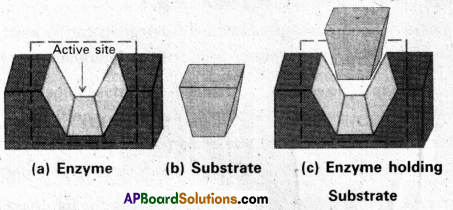
    AP Inter 2nd Year Chemistry Study Material Chapter 10 Chemistry In Everyday Life 2

AP Inter 2nd Year Chemistry Study Material Chapter 10 Chemistry In Everyday Life

Question 3.
Explain the drug – enzyme interaction.
Answer:
Explanation of drug – Target interaction with Enzymes :

  1. The proteins which perform the role of biological catalysts in the body are called enzymes.
  2. The binding of inhibitor ai allosteric site changes the shape of the active site.
  3. If the bond formed between an enzyme and an inhibitor is a strong covalent bond it cannot be broken easily In this case enzyme is blocked permanently and the body then degrades the enzyme-inhibitoi complex and synthesises the new enzyme.
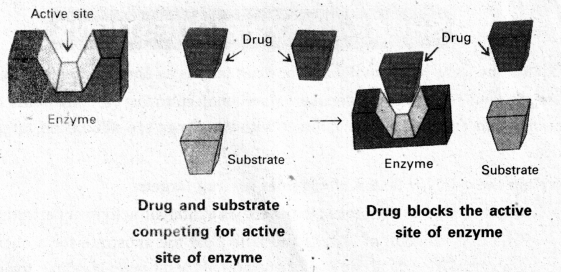
    AP Inter 2nd Year Chemistry Study Material Chapter 10 Chemistry In Everyday Life 3

Question 4.
Why are cimetidine and ranitidine better antacids than sodium hydrogen carbonate or magnesium hydroxide or aluminium hydroxide.
Answer:
Sodium hydrogen carbonate or magnesium hydroxide (or) aluminium hydroxide treatment as antacids control only symptoms and not the cause. In advanced stages, ulcers become life threatening and only treatment is removal of affected part of stomach.
The drugs cinetidine, ranitidine prevent the interaction of histamine with the receptors present in the stomach wall and results in release of lesser amount of acid.
So cinetidine, ranitidine are better antacids than NaHCO3 (or) Mg(OH)2 (or) Al(OH)3.

Question 5.
Low level of noradrenaline in the cause of depression. What type of drugs are needed to cure this problem ? Name two drugs.
Answer:
If the level of Noradrenaline is low then the signal sending activity becomes low and the person suffers from depression. In this situations antidepressant drugs (tranquilizers) are required, These drugs inhibit the enzymes which catalyse the degradation of noradrenaline. If the enzyme is inhibited, this important neurotransmitter is slowly metabolised and can activate its receptor for longer periods of time.

Two important antidepressant drugs are IProniazid and phenelzine.

AP Inter 2nd Year Chemistry Study Material Chapter 10 Chemistry In Everyday Life

Question 6.
What are analgesics ? How are they classified ? Give examples. [T.S. & A.P. Mar. 19]
Answer:
Analgesics : These are to reduce or totally abolish pain without causing impairment of consciousness, mental confusion, incoordination, paralysis, disturbances of nervous system etc.
Analgesics are classified as

  1. Narcotic analgesics : These are most potent and clinically useful agents causing depression of central nervous system and at the same time act as strong analgesics.
    E.g. : Morphine, Codeine etc.
  2. Non-narcotic analgesics : These drugs are analgesics but they have no addictive properties. Their analgesic use is limited to mild aches and pains.
    E.g.: Aspirin, Ibuprofen etc.

Question 7.
What are different types of microbial drugs ? Give one example for each.
Answer:
Antimicrobials : The chemical substances which destroy or prevent the developement (or) inhibit the pathogenic action of microbes such as bacteria, fungi, virus are called antimicrobials.
E.g.: Lysozyme, Lactic acid etc.,
Different types of antimicrobial drugs are antibiotics, antiseptics, disinfectants.
1) Antibiotics : The chemical substances produced by micro organisms and inhibit the growth or destroy microorganisms are called antibiotics.
(Or)
The substance produced totally or partly by chemical synthesis in low concentration inhibits the growth (or) destroy microorganism by intervening in their metabolic process are called antibiotics.

2) Antiseptics: The chemical compounds that kill (or) prevent the growth of micro organism
are caiied antiseptics. .
Antiseptics are the chemical substances applied on the living tissues such as wounds, cuts, ulcers and diseased skin surfaces.

3) Disinfectants : The chemical compounds used for killing (or) preventing the growth of microorganism are called disinfectants.
These are applied to inanimate objects like floors, drainage systems etc…
E.g.:

  • 4% aqueous solution of formaldehyde called formalin is a disinfectant
  • 0.3 ppm chlorine aqueous solution is disinfectant.
  • SO2 in very low concentration is disinfectant.

AP Inter 2nd Year Chemistry Study Material Chapter 10 Chemistry In Everyday Life

Question 8.
Write the characteristic properties of antibiotics.
Answer:
Characteristic properties of antibiotics :

  1. Antibiotic drugs must be the products of metabolism. ,
  2. Antibiotic drugs are effective in low concentration.
  3. Antibiotic drug retards the growth (or) survival of microorganism.
  4. Antibiotic should be a synthetic substance produced as a structural analogue of naturally occurring antibiotic.
  5. Antibiotics have either cidal (killing) effect (or) a static (inhibiting) effect on microbes.
    E.g.: Penicillin, Ofloxacin are Bactericidal.
    Erythromycin, Tetracycline are Bacteriostatic.

Question 9.
What is meant by the term broad spectrum antibiotics ? Explain.
Answer:
The range of bacteria (or) other micro organisms that are effected by a certain antibiotic is expressed as its spectrum of action.
Broad spectrum antibiotics : Antibiotics which kill (or) inhibit a wide range of gram-positive and gram-negative bacteria are called broad spectrum antibiotics.

Question 10.
What are broad spectrum and narrow spectrum antibiotics ? Give one example for each.
Answer:
The range of bacteria (or) other micro organisms that are effected by a certain antibiotic is expressed as its spectrum of action.
Broad spectrum antibiotics : Antibiotics which kill (or) inhibit a wide range of gram¬positive and gram-negative bacteria are called broad spectrum antibiotics.

Narrow spectrum antibiotics: Antibiotics which are effective mainly against gram-positive (or) gram-negative bacteria are called narrow spectrum antibiotics,
E.g.: Penicillin – G is a narrow spectrum antibiotic.

Limited spectrum antibiotics : Antibiotics which are effective mainly against a single organism (or) disease are called as limited spectrum antibiotics.

AP Inter 2nd Year Chemistry Study Material Chapter 10 Chemistry In Everyday Life

Question 11.
Write notes on antiseptics and disinfectants.
Answer:
Antiseptics: The chemical compounds that kill (or) prevent the growth of micro organism are called antiseptics.
Antiseptics are the chemical substances applied on the living tissues such as wounds, cuts, ulcers and diseased skin surfaces.
E.g.: Dettol, Bithional etc.
Phenol is used as antiseptic as well as disinfectant. 0.2% phenol is antiseptic.
Dettol (antiseptic) is a mixture of chloroxylenol and terpineol.
Tincture of iodine (antiseptic) is a mixture of 2 – 3% Iodine solution in alcohol-water.

Disinfectants : The chemical compounds used for killing (or) preventing the growth of microorganism are called disinfectants.

  1. These are applied to inanimate objects like floors, drainage systems etc…
    E.g.: 4% aqueous solution of formaldehyde called formalin is a disinfectant.
  2. 0.3 ppm chlorine aqueous solution is disinfectant.
  3. SO2 in very low concentration is disinfectant.

Phenol is used as antiseptic as well as disinfectant 1% phenol is disinfectant.

Question 12.
How do antiseptics differ from disinfectants ? Does the same substance be used as both ? Give one example for each.
Answer:
Antiseptics are the chemical substances applied on the living tissues such as wounds, cuts, ulcers and diseased skin surfaces.
Disinfectants are applied to inanimate objects such as floors, drainage system, instruments etc.
Phenol is used as antiseptic as well as disinfectant.
i) 0.2% phenol is antiseptic.
ii) 1% phenol is disinfectant.

  1. Examples of Antiseptics :
    • Dettol (antiseptic) is a mixture of chloroxylenol and terpineol.
    • Tincture of iodine (antiseptic) is a mixture of 2.3% Iodine solution in alcohol-water.
  2. Examples of disinfectants :
    • 4% aqueous solution of formaldehyde called formalin is a disinfectant.
    • 0.3 ppm chlorine aqueous solution is disinfectant.
    • SO2 in very low concentration is disinfectant.

Phenol is used as anti in very low concentration is disinfectant.

AP Inter 2nd Year Chemistry Study Material Chapter 10 Chemistry In Everyday Life

Question 13.
What are the main categories of food additives ?
Answer:
The following are the categories of food additives.

  1. Food colours
  2. Flavours and sweetners
  3. Fat Emulsifiers and stabilising agents
  4. Anti oxidants
  5. Flour improvers – antistaling agents and bleaches
  6. Preservatives
  7. Nutritional supplements such as minerals, vitamins and amino acids.

Question 14.
Write notes on antioxidants in food.
Answer:
Antioxidants :

  • Antioxidants are important and necessary food additives.
  • Antioxidants help in food preservation by retarding the action of oxygen on food. Antioxidants are more reactive towards, oxygen than the food material which they protecting.
  • The most familiar antioxidants are Butylated hydroxy toluene (BHT) and Butylated hydroxy anisole (BHA).
  • The addition of BHA to butter increases its shelf life from months to years.
  • BHT and BHA along with citric acid are added to produce more antioxidant effect.
  • SO2 and sulphites are useful anti Oxidants for wine and beer, sugar syrups and cut, peeled (or) dried fruits and vegetables.

Question 15.
Name different types of soaps.
Answer:
The following are the different types of soaps.

  1. Toilet soaps
  2. Soaps that float in water
  3. Medicated soaps
  4. Shaving soaps
  5. Laundry soaps
  6. Soap powders and scouring soaps etc.

AP Inter 2nd Year Chemistry Study Material Chapter 10 Chemistry In Everyday Life

Question 16.
Explain the following terms with suitable examples.
i) Cationic detergents
ii) Anionic detergents
iii) Non-ionic detergents
Answer:
Synthetic detergents are classified into three types.
i) Cationic detergents : These are synthetic detergents.
a) Cationic detergents are quarternary ammonium salts of amines with acetates, chlorides (or) bromides as anions.
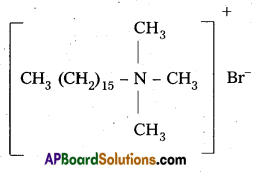
AP Inter 2nd Year Chemistry Study Material Chapter 10 Chemistry In Everyday Life 4
b) Cationic part possess a long hydrocarbon chain and a positive charge on nitrogen atom. Hence these are called catiomc detergents.
E.g. : Cetyl trimethyl ammonium bromide
It is used in hair conditioners.

ii) Anionic Detergents: These are synthetic detergents.
a) Anionic detergents are sodium salts of sulphonated long chain alcohols (or) hydrocarbons.
b) Anionic detergents are formed by the treatment of long chain alcohols with conc. H2SO4 followed by the neutralisation with alkali.
E.g.: Sodium lauryl sulphate.
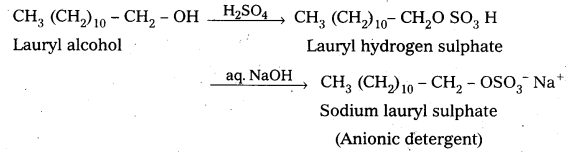
AP Inter 2nd Year Chemistry Study Material Chapter 10 Chemistry In Everyday Life 5
These are used for house hold work and in tooth pastes.

iii) Non-ionic detergents : These are synthetic detergents.
a) Non-ionic detergents do not contain any ion in their constitution.
b) The detergent formed by the reaction of stearic acid with poly ethylene glycol is an example of non ionic detergent.

AP Inter 2nd Year Chemistry Study Material Chapter 10 Chemistry In Everyday Life 6
Non-ionic detergents are used in liquid dish washing purpose.

Question 17.
What are biodegradable and non-bio degradable detergents ? Give one example for each.
Answer:

  1. Biodegradable detergents :
    The detergents which are degraded (or) decomposed by micro organisms are called biodegradable detergents. Biodegradable detergents have less branching.
    These do not cause water pollution.
    E.g.: n-dodecyle benzene sulphonate, soap (non synthetic),
  2. Non Biodegradable detergents :
    The detergents which are not decomposed (or) degraded by microbes (or) micro organisms are called non-biodegradable detergents. These have more branching.
    These cause water pollution.
    E.g.: ABS detergent.

AP Inter 2nd Year Chemistry Study Material Chapter 10 Chemistry In Everyday Life

Question 18.
Explain the cleansing action of soaps.
Answer:
Soap is sodium stearate, C17H35COONa, in water soap gives the ions stearate anion and sodium ion.
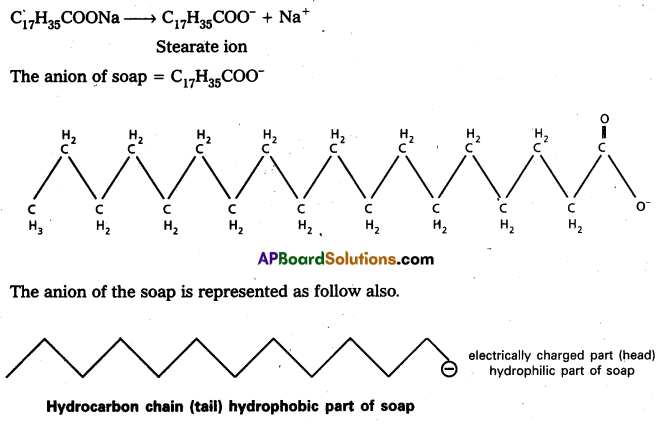
AP Inter 2nd Year Chemistry Study Material Chapter 10 Chemistry In Everyday Life 7
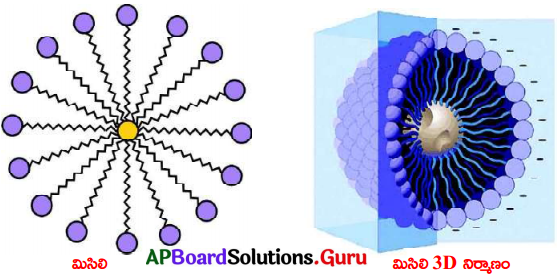
Cleansing action of soap : Soap anions form a micelle. The grease or dirt of the cloth are absorbed into the interior of the micelle. The tails of the anion are pegged into micelle and these micelle are washed away with the soap solution.
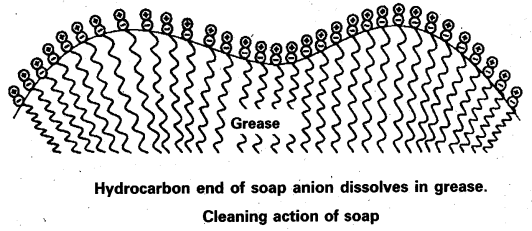
AP Inter 2nd Year Chemistry Study Material Chapter 10 Chemistry In Everyday Life 8
The main function of the soap is therefore, to convert the oily and greasy dirt on the cloth into large colloidal particles. For this a critical concentration of soap solution is required. Soap thus, functions as an emulsifying agent for the water – dirt emulsion. The emulsified grease or dirt is then washed away with soap solution.

Question 19.
Label the hydrophilic and. hydrophobic parts in the following compounds.
i) CH3 (CH2)10 CH2 OSO3 Na+
ii) CH3(CH2)15N+(CH3)3 Br
iii) CH3 (CH2)16 COO (CH2 CH2O)n CH2 CH2 OH
Answer:
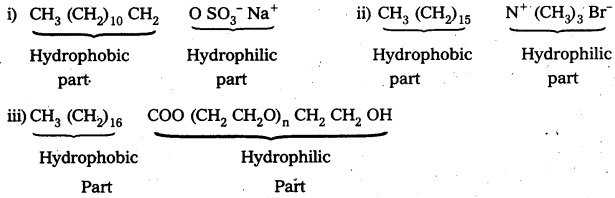
AP Inter 2nd Year Chemistry Study Material Chapter 10 Chemistry In Everyday Life 9

AP Inter 2nd Year Chemistry Study Material Chapter 10 Chemistry In Everyday Life

Question 20.
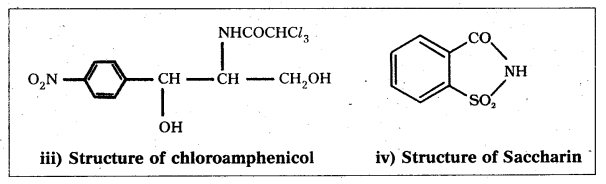
Draw the structures of following:
i) Serotonin
ii) Bithionol
iii) Chloramphenicol
iv) saccharin
Answer:
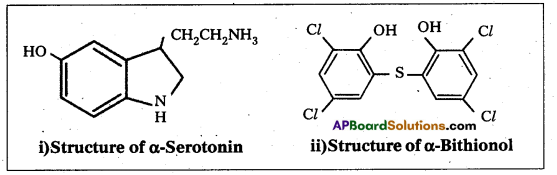
AP Inter 2nd Year Chemistry Study Material Chapter 10 Chemistry In Everyday Life 10
AP Inter 2nd Year Chemistry Study Material Chapter 10 Chemistry In Everyday Life 11

Long Answer Questions

Question 1.
Describe the classification of drugs into different classes.
Answer:
Classification of drugs : Drugs are classified in different ways.

  1. On the basis of drug action : Based on the actions of drugs on particular biochemical processes they are classified as
    • Antibacterials
    • Antibiotics
    • Hypnotics
    • Sedatives and tranquilizers
    • Cardio vascular drugs
    • Antiseptics etc.
  2. On the basis of molecular targets : Biomolecules like Carbohydrates, lipids, proteins, nucleic acids etc. react with drugs. These biomolecules are called drug targets or simply target molecules.
  3. On the basis of chemical structure : The drugs with some common structural features generally show similar pharmacological activity.
    E.g.: Sulfonamides have common structural feature.
    So they have same chemotherapeutic action.
  4. On the basis of pharmocological effect:
    This type of classification is useful for doctors because it provides them the whole range of drugs available for the treatment.
    E.g.: Analgesics have pair killing effect.

AP Inter 2nd Year Chemistry Study Material Chapter 10 Chemistry In Everyday Life

Question 2.
Describe briefly the therapeutic action of different classes of drugs.
Answer:
The therapeutic action of different classes of drugs discussed below.
Antacids : Chemicals that remove the excess of acid in the stomach and maintain the pH to normal level are antacids.
E.g. : Omeprazole, Lansoprazole etc.,

Antihistamines : Chemicals that prevent the interaction of histamines with receptors of the stomach wall thus producing less amount of acid are anti histamines.
E.g.: Dimetapp, Terfenadine (Seldane)

Tranquilizers : The drugs which are used in the management (or) treatment of psychoes and neuroses are called tranquilizers
E.g.: Luminal, Seconal, Barbituric acid etc.,

Barbiturates : Derivatives of barbituric acid which functions as important class of tranquilizers are called barbiturates
E.g.: Veronal, Amytal etc.,

Analgesics : These are to reduce or totally abolish pain without causing impairment of consciousness, mental confusion, incoordination, paralysis, disturbances of nervous system etc.
Analgesics are classified as

  1. Narcotic analgesics : These are most potent and clinically useful agents causing depression of central nervous system and at the same time act as strong analgesics.
    E.g.: Morphine, Codeine etc.
  2. Non-narcotic analgesics : These drugs are analgesics but they have no addictive properties. Their analgesic use is limited to mild aches and pains.
    E.g. : Aspirin, Ibuprofen etc.

Antimicrobials : The chemical substances which destroy (or) prevent the developement (or) inhibit the pathogenic action of microbes such as bacteria, fungi, virus are called antimicrobials. E.g.: Lysozyme, Lactic acid etc.,

Antibiotics: The chemical substances produced by micro Organisms and inhibit the growth or destroy microorganisms are called antibiotics. .
(Or)
The substance produced totally or partly by chemical synthesis in low concentration inhibits the growth (or) destroy microorganism by intervening in their metabolic process are called antibiotics.
E.g. : Penicillin, Chloramphenicol etc.

Antiseptics : The chemical compounds that kill (or) prevent the growth of micro organism are called antiseptics.
Antiseptics are the chemical substances applied on the living tissues such as wounds, cuts, ulcers and diseased skin surfaces.

Disinfectants : The chemical compounds used for killing (or) preventing the growth of microorganism are called disinfectants.
These are applied to inanimate objects like floors, drainage systems etc.
E.g.:

  1. 4% aqueous solution of formaldehyde called formalin is a disinfectant.
  2. 0.3 ppm chlorine aqueous solution is disinfectant.
  3. SO2 in very low concentration is disinfectant.

Antifertility drugs: These are birth control pills and contains a mixture of synthetic estrogen and progesterone derivatives.
E.g. : Norethindrone, Ethynylestradiol (novestrol).

Question 3.
Write an essay on antimicrobials.
Answer:
Antimicrobials : The chemical substances which destroy or prevent the developement (or) inhibit the pathogenic action of microbes such as bacteria, fungi, virus are called antimicrobials
E.g. : Lysozyme, Lactic acid etc.,
Different types of anti microbial drugs are antibiotics, antiseptics, disinfectants.

Question 4.
Write notes on the following : [T.S. Mar. 16]
i) Artificial sweetening agents
ii) Food preservatives
iii) Antioxidants in food.
Answer:
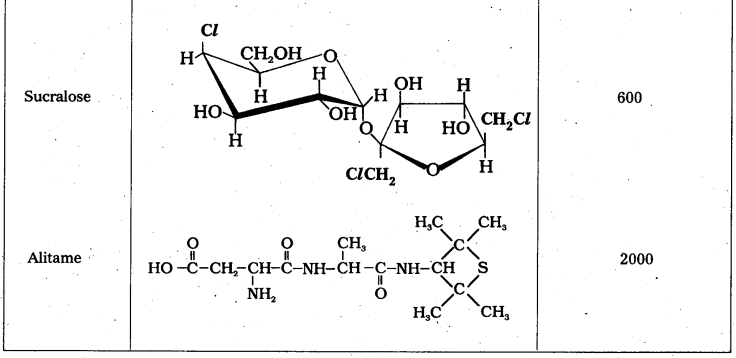
i) Artificial sweetening agents: The chemical substances which are used instead of sucrose (or) sugar are called artificial sweetening agents.
E.g.: Aspartame, Alitame, saccharin.
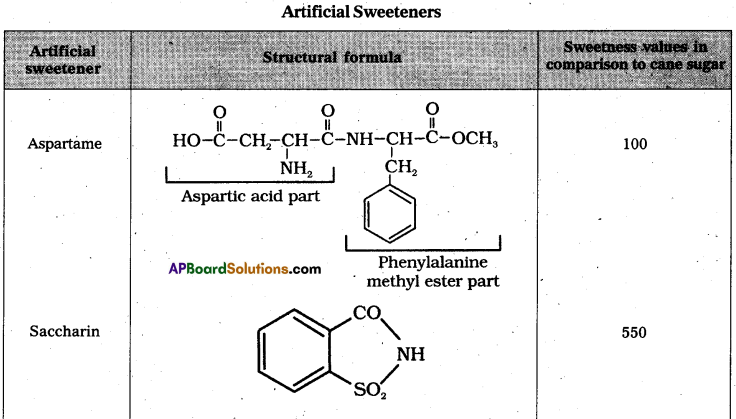
AP Inter 2nd Year Chemistry Study Material Chapter 10 Chemistry In Everyday Life 12
AP Inter 2nd Year Chemistry Study Material Chapter 10 Chemistry In Everyday Life 13

  1. These decrease the calorific intake and at the same time several times sweeter than sucrose.
  2. Artificial sweetening agents are very useful to diabetic persons.
  3. These are harmless.
  4. Aspartame is unstable at cooking temperature so it’s use is limited to cold foods and soft drinks.
  5. The sweetening agent used in the preparation of sweets for a diabetic patient is saccharin (or) sucralose. It is stable at cooking tenperature.
  6. While using alitame as artificial sweetener, the control of sweetness of food is difficult. Alitame is a high potency sweetner.

ii) Food preservatives : The chemical substances which prevent the spoilage of food due to microbial growth are called food preservatives.
Sodium benzoate, C6H5COONa is the most important food preservative used in limited quantities and is metabolised by conversion into hippuricacid. Which is finally excreted in the urine. Salts of sorbicacid, propionic acid are also food presevatives.

iii) Antioxidants :

  1. Antioxidants are important and necessary food additives.
  2. Antioxidants help in food preservation by retarding the action of oxygen on food.
  3. Antioxidants are more reactive towards oxygen than the food material which they protecting.
  4. The most familiar anti oxidants are Butylated hydroxy toluene (BHT) and Butylated hydroxy anisole (BHA).
  5. The addition of BHA to butter increases its shelf life from months to years.
  6. BHT and BHA along with citric acid are added to produce more antioxidant effect.
  7. SO2 and sulphits are useful anti oxidants for wine and beer, sugar syrups and cut, peeled (or) dried fruits and vegetables.

AP Inter 2nd Year Chemistry Study Material Chapter 10 Chemistry In Everyday Life

Question 5.
Write notes on the following :
i) Soaps
ii) Synthetic detergents.
Answer:
i) Soaps : 1) Soaps are the detergents which improve cleansing properties of water and help in removal of fats which bind other materials to the fabric (or) skin.
Chemically soaps are sodium (or) potassium salts of long chain fatty acids.
E.g.: Sodium stearate.
The process of formation of soaps containing sodium salts by heating esters of fatty acid with aq. NaOH solution is called saponification.
Only sodium and potassium soaps are soluble in water and are used for cleaning purpose. Potassium soaps are soft to the skin and are prepared by using KOH instead of NaOH.

Types of soaps :
The following are the different types of soaps

  1. Toilet soaps
  2. Soaps that float in water
  3. Medicated soaps
  4. Shaving soaps
  5. Laundry soaps –
  6. Soap powders and scouring soaps etc.

In hard water Ca, Mg-dissolved salts are present. Ca+2, Mg+2 ions form insoluble Ca, Mg, soaps respectively when sodium (or) potassium soaps are dissolved in hard water.

AP Inter 2nd Year Chemistry Study Material Chapter 10 Chemistry In Everyday Life 14

  1. These insoluble soaps separate as scum in water and are useless as cleansing agent. These are problematic to good washing because the ppt adheres into the fibres of cloth as gummy mass.
  2. Hair washed with hard water looks dull.
  3. Dye does not absorb evenly on cloth washed with soap using hard water due to this gummy mass.

ii) Synthetic detergents : The cleansing agents which are having all the properties of soaps but donot contain any soap are called synthetic detergents.
Synthetic detergents can be used both is soft and hardwater as they give foam even in hard water.
E.g. : Sodium dodecyl benzene sulphonate.
Soaps do not work in hard water but synthetic detegents can be used both in soft and hard water as they give foam even in hard water. Some of the detergents give foam even in ice cold water.

Synthetic Detergents are classified into three types :
i) Cationic detergents : These are synthetic detergents.
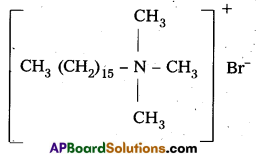
a) Cationic detergents are quarternary ammonium salts of amines with acetates, chlorides (or) bromides as anions.
AP Inter 2nd Year Chemistry Study Material Chapter 10 Chemistry In Everyday Life 15
b) Cationic part possess a long hydrocarbon chain and a positive charge on nitrogen atom. Hence these are called cationic detergents.
E.g. : Cetyl trimethyl ammonium bromide.
It is used in hair conditioners.

ii) Anionic Detergents :
These are synthetic detergents.
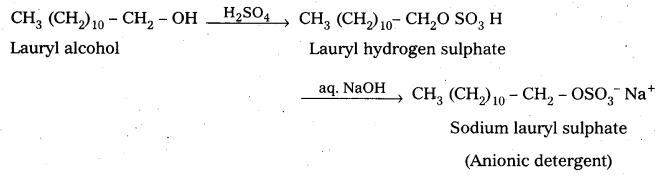
a) Anionic detergents are sodium salts of sulphonated long chain alcohols (or) hydro-carbons.
b) Anionic detergents are formed by the treatment of long chain alcohols with cone, H2S04 followed by the neutralisation with alkali.
E.g. : Sodium lauryl sulphate.
AP Inter 2nd Year Chemistry Study Material Chapter 10 Chemistry In Everyday Life 16
These are used for house hold work and in tooth pastes.

AP Inter 2nd Year Chemistry Study Material Chapter 10 Chemistry In Everyday Life

iii) Non-ionic detergents : .
These are synthetic detergents.
a) Non-ionic detergents donot contain any ion in their constitution.
b) The detergent formed by the reaction of stearic acid with poly ethylene glycol is an example of non ionic detergent.

AP Inter 2nd Year Chemistry Study Material Chapter 10 Chemistry In Everyday Life 17
Non-ionic detergents are used in liquid dish washing purpose.

Intext Questions

Question 1.
Sleeping pills are recommended by doctors to the patients suffering from sleeplessness but it is not advisable to take its doses without consultation with the doctor. Why ?
• Consider the effect of tranquilizers or antidepressants on the nervous system.
Solution:
Sleeping pills contain drugs that may be tranquilizers or antidepressants. They affect the nervous system, relieve anxiety, stress, irritability or excitement. But they should strictly be used under the supervision of a doctor. If not, the uncontrolled and over dosage can cause harm to the body and mind because in higher doses these drugs act as poisons.

Question 2.
With reference to which classification has the statement, “ranitidine is an antacid” been given ?
Solution:
This statement refers to the classification of drugs according to pharmacological effect because in neutralizes the acidity (excess) of stomach.

Question 3.
Why do we require artificial sweetening agents ?
• Mention the function of natural sweeteners, discuss the same for artificial sweeteners.
Solution:
Natural sweeteners (sucrose etc.) provide calories to the body. Taking extra calories is harmful
for diabetic patients. So, artificial sweeteners are used
(a) to control intake of calories and
(b) as a substitute of sugar for diabetics.

AP Inter 2nd Year Chemistry Study Material Chapter 10 Chemistry In Everyday Life

Question 4.
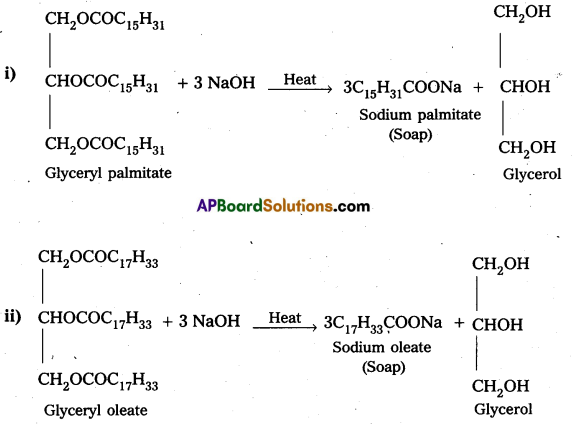
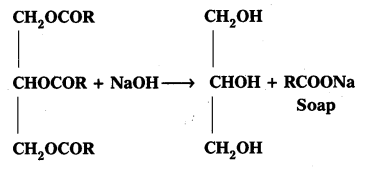
Write the chemical equation for preparing sodium soap from glyceryl oleate and glyceryl palmitate. Structural formulae of these compounds are given below.
i) (C15H31COO)3 C3H5 – Glyceryl palmitate
ii) (C17H32COO)3 C3H5 – Glyceryl oleate
• Consider the following method.
AP Inter 2nd Year Chemistry Study Material Chapter 10 Chemistry In Everyday Life 18
Solution:

AP Inter 2nd Year Chemistry Study Material Chapter 10 Chemistry In Everyday Life 19

Question 5.
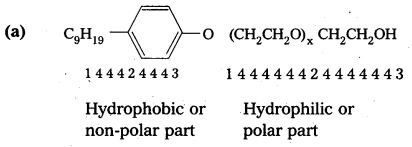
Following types of non-ionic detergents are present in liquid detergents, emulsifying agents and wetting agents. Label the hydrophilic and hydrophobic parts in the molecule. Identify the functional group (s) present in the molecule.
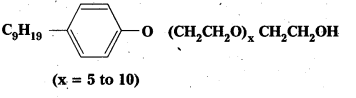
AP Inter 2nd Year Chemistry Study Material Chapter 10 Chemistry In Everyday Life 20
Solution:
AP Inter 2nd Year Chemistry Study Material Chapter 10 Chemistry In Everyday Life 21
(b) Functional group : Ether and alcohol.
AP Board 10th Class Physical Science Solutions 12th Lesson కార్బన్ – దాని సమ్మేళనాలు

SCERT AP 10th Class Physical Science Guide 12th Lesson కార్బన్ – దాని సమ్మేళనాలు Textbook Questions and Answers.

AP State Syllabus 10th Class Physical Science 12th Lesson Questions and Answers కార్బన్ – దాని సమ్మేళనాలు

10th Class Physical Science 12th Lesson కార్బన్ – దాని సమ్మేళనాలు Textbook Questions and Answers

అభ్యసనాన్ని మెరుగుపరుచుకోండి

ప్రశ్న 1.
ఒక సాధారణ హైడ్రోకార్బన్ పేరు చెప్పండి. (AS1)
జవాబు:
సాధారణ హైడ్రోకార్బన్ మీథేన్ (CH4).

ప్రశ్న 2.
ఆల్కేన్లు, ఆల్కీన్లు, ఆల్కైల సాధారణ అణు ఫార్ములా ఏమిటి? (AS1)
జవాబు:
ఆల్కేనులు, ఆల్కీనులు, ఆల్కెనుల సాధారణ అణు సాంకేతికములు :

  1. ఆల్కేనులు – CnH2n+2
  2. ఆల్కీనులు – CnH2n
  3. ఆల్కైనులు – CnH2n-2

ప్రశ్న 3.
ఇథనాలను గాలిలో దహనం చేసినపుడు నీరుతో పాటుగా ఏర్పడే ఇతర ఉత్పన్నమేమిటి? (AS1)
(లేదా)
ఇథనాలను గాలిలో మండించినపుడు నీటితో పాటుగా విడుదలగు వాయువు ఏది?
జవాబు:
ఇథనాల్ ను గాలిలో మండించినపుడు నీటితో పాటు ఏర్పడే మరొక ఉత్పన్నం కార్బన్ డై ఆక్సైడ్ (CO2).

ప్రశ్న 4.
ఈ క్రింది సమ్మేళనాల యొక్క IUPAC పేర్లు రాయండి. ఒకవేళ ఒకటి కంటే ఎక్కువ సమ్మేళనాలు వస్తే వాటి అన్నిటి పేర్లను రాయండి. (AS1)
i) ఈథేన్ నుండి ఏర్పడిన ఆల్డిహైడ్
ii) బ్యూటేన్ నుండి పొందిన కీటోన్
iii) ప్రొపేన్ నుండి ఏర్పడిన క్లోరైడ్
iv) పెంటేన్ నుండి ఏర్పడిన ఆల్కహాల్
జవాబు:
i) ఈథేన్ నుంచి ఏర్పడిన ఆల్డిహైడ్ ఇథనాల్ (CH3CHO).
ii) బ్యూటేన్ నుండి పొందిన కీటోన్ బ్యూటనోన్ లేదా బ్యూటాన్-2 – ఓన్ (CH3COCH2CH3).
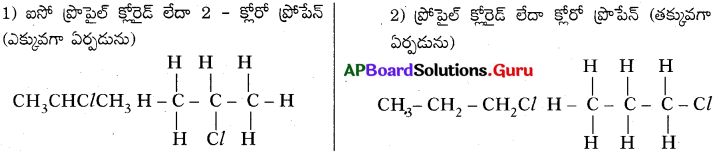
iii) ప్రొపేన్ నుండి ఏర్పడిన క్లోరైడ్ 2 రకాలు :
AP Board 10th Class Physical Science Solutions 12th Lesson కార్బన్ – దాని సమ్మేళనాలు 1

iv) పెంటేస్ నుంచి వచ్చే ఆల్కహాలు మూడు రకాలు. అవి :
1) 1 – పెంటనోల్ : CH3CH2CH2CH2CH2OH
2) 2 – పెంటనోల్ : CH3CH2CH2CH (OH) CH3 లేదా పెంటాన్- 2 – ఓల్
3) 3 – పెంటనోల్ లేదా పెంటాస్ – 3 – ఓల్. CH3CH2CH (OH) CH2CH3

AP Board 10th Class Physical Science Solutions 12th Lesson కార్బన్ – దాని సమ్మేళనాలు

ప్రశ్న 5.
ఒక సాధారణ కీటోన్ పేర్కొని, దాని అణుఫార్ములా రాయండి. (AS1)
(లేదా)
ఏదైనా సాధారణ కీటోన్ ను ఉదహరించి, దాని అణుఫార్ములాను వ్రాయుము.
జవాబు:
సాధారణ కీటోన్ : డై మిథైల్ కీటోన్ లేదా ప్రొపనోన్.

దీని ఫార్ములా : CH3COCH3.

ప్రశ్న 6.
కార్బన్ పరమాణువు మరొక కార్బన్ పరమాణువుతో కలిసి బంధాలనేర్పరచుకునే ధర్మాన్ని ఏమంటారు? (AS1)
జవాబు:
కర్బన పరమాణువులు ఒకదానితో మరొకటి స్వయంగా కలిసి, గొలుసు వంటి పెద్ద అణువును ఏర్పరచే ధర్మాన్ని కాటనేషన్ లేక శృంఖల ధర్మం అంటారు.

ప్రశ్న 7.
ఇథనోలను 443Kల వద్ద గాఢ సల్ఫ్యూరిక్ ఆమ్లం (H2SO4)తో కలిపి వేడిచేయుట వలన ఏర్పడే సమ్మేళనం పేరు ఏమిటి? (AS1)
జవాబు:
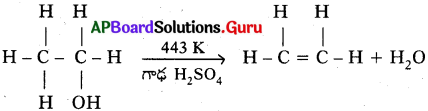
ఇథనోలను 443K వద్ద అధిక గాఢ సల్ఫ్యూరిక్ ఆమ్లంతో చర్య జరిపితే నిర్జలీకరణ చర్య జరిగి ఇథిలీన్ లేదా ఈథేన్ ఏర్పడుతుంది.
AP Board 10th Class Physical Science Solutions 12th Lesson కార్బన్ – దాని సమ్మేళనాలు 2

ప్రశ్న 8.
ఎస్టరిఫికేషన్ చర్యకు ఒక ఉదాహరణ ఇవ్వండి. (AS1)
(లేదా)
ఎస్టరీకరణముపై లఘు వ్యాఖ్య వ్రాయుము.
జవాబు:
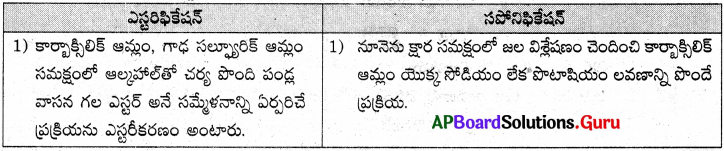
కార్బాక్సిలిక్ ఆమ్లం, గాఢ సల్ఫ్యూరిక్ ఆమ్ల సమక్షంలో ఆల్కహాల్ తో చర్య జరిపి తియ్యని వాసన గల ఎస్టర్ అనే సమ్మేళనాన్ని ఏర్పరచే చర్యను ఎస్టరీకరణ చర్య అంటారు.
ఉదా :
ఎసిటిక్ ఆమ్లం (ఇథనోయిక్ ఆమ్లం) గాఢ సల్ఫ్యూరిక్ ఆమ్లం సమక్షంలో ఇథైల్ ఆల్కహాల్ (ఇథనోల్) తో చర్య జరిపి ఇథైల్ ఎసిటేట్ (ఇథైల్ ఇథియోనేట్) ను ఏర్పరుస్తుంది.
AP Board 10th Class Physical Science Solutions 12th Lesson కార్బన్ – దాని సమ్మేళనాలు 3

ప్రశ్న 9.
ఈథేన్ నుండి ఇథనాల్ ను తయారుచేసే చర్యను చూపే రసాయన సమీకరణాన్ని రాయండి. (AS1)
(లేదా)
ఇథనాలను, ఈథేన్ నుండి తయారుచేయుటను సూచించు రసాయన సమీకరణమును వ్రాయుము.
జవాబు:
ఈథేన్ ను గాలి లేకుండా వేడిచేస్తే ఈ థీన్ లేక ఇథిలీన్ ఏర్పడుతుంది. దీనిని P2O5 లేక టంగ్స్టన్ ఆక్సెడ్ ఉత్ర్పేరక సమక్షంలో అధిక ఉష్ణోగ్రత పీడనాలకు గురిచేసి నీటిఆవిరితో చర్య జరపడం ద్వారా ఇథనోల్ ఏర్పడుతుంది.
AP Board 10th Class Physical Science Solutions 12th Lesson కార్బన్ – దాని సమ్మేళనాలు 4

ప్రశ్న 10.
కర్బన సమ్మేళనాల సమజాత శ్రేణులను నిర్వచించండి. సమజాత శ్రేణుల ఏవేని రెండు లక్షణాలను తెల్పండి. (AS1)
జవాబు:
ఒకే ప్రమేయ సమూహాలున్న కర్బన సమ్మేళనాలను సమజాతీయ శ్రేణులు అంటారు.
ఉదా : ఆల్కేనులు, ఆల్కీనులు, ఆల్కెనులు, హాలో ఆల్కేనులు మొదలైనవి.

లక్షణాలు :

  1. ఇవి ఒకే సాధారణ ఫార్ములా కలిగి ఉంటాయి.
    ఉదా : ఆల్కేనుల సాధారణ ఫార్ములా CnH2n+2
  2. వరుస సమ్మేళనాల మధ్య తేడా -CH2 ఉంటుంది.
  3. ఒకే ప్రమేయ సమూహాన్ని కలిగి ఉండటం వలన ఒకే రసాయన ధర్మాలు కలిగి ఉంటాయి.
  4. భౌతిక ధర్మాలలో ఒక క్రమపద్ధతిలో పెరుగుదల కనబడుతుంది.

ప్రశ్న 11.
క్రింది ప్రమేయ సమూహాల పేర్లను రాయండి. (AS1)
(a) -CHO (b) -C=0
(లేదా)
ఇవ్వబడిన ప్రమేయ సమూహాలను కలిగి ఉన్న కర్బన సమ్మేళనాలను ఉదహరించుము.
జవాబు:
a) -CHO ప్రమేయ సమూహం పేర్లు ఆల్డిహైడ్.
b) – C = O ప్రమేయ సమూహం పేరు కీటోన్.

AP Board 10th Class Physical Science Solutions 12th Lesson కార్బన్ – దాని సమ్మేళనాలు

ప్రశ్న 12.
కార్బన్ ప్రధానంగా సమయోజనీయ బంధాలను ఎందుకు ఏర్పరుస్తుంది? (AS1)
జవాబు:

  1. కార్బన్ నవీన ఆవర్తన పట్టికలోని IVA లేదా 14వ గ్రూప్ కు చెందిన మూలకం.
  2. కార్బన్ C6 యొక్క ఎలక్ట్రానిక్ విన్యాసం 1s²2s²2p². ఇది ‘తన సమీప జడవాయువైన నియాన్ విన్యాసం పొందుటకు 4 ఎలక్ట్రానులు స్వీకరించాలి లేదా హీలియం విన్యాసం పొందుటకు 4 ఎలక్ట్రానులను కోల్పోవాలి.
  3. కార్బన్ కేంద్రకంలో 6 ప్రోటానులు ఉంటాయి. కాబట్టి అదనంగా 4 ఎలక్ట్రానులను స్వీకరిస్తే 6 ప్రోటానులు, 10 ఎలక్ట్రానులను బంధించవలసి వస్తుంది. కాబట్టి C4- సాధారణంగా ఏర్పడదు.
  4. ఇదే విధంగా 4 ఎలక్ట్రానులను కోల్పోతే C4+ అయాన్ ఏర్పడుతుంది. ఇలా ఏర్పడుటకు అధిక మోతాదులో శక్తి అవసరం. కాబట్టి ఇది కూడా దాదాపుగా ఏర్పడదు.
  5. కాబట్టి కార్బన్ తన చతుస్సంయోజకతను ఎలక్ట్రాన్ జంటను పంచుకోవడం ద్వారా సంతృప్తపరుచుకోవాలి.
  6. కాబట్టి కార్బన్ ఇతర కార్బన్ పరమాణువులతోకాని, ఇతర మూలకాల పరమాణువులతో కాని నాలుగు సంయోజనీయ బంధాలు ఏర్పరుస్తుంది.

ప్రశ్న 13.
ఇథనోల్ నుండి సోడియం ఇథాక్సెడ్ ఎలా తయారుచేయబడుతుంది? రసాయన సమీకరణంతో వివరించండి. (AS1)
జవాబు:
ఇథనోల్, సోడియం లోహంతో చర్య జరిపి సోడియం ఇథాక్సెడ్ ను ఏర్పరుస్తుంది. ఈ చర్యలో హైడ్రోజన్ వాయువు విడుదలవుతుంది.
AP Board 10th Class Physical Science Solutions 12th Lesson కార్బన్ – దాని సమ్మేళనాలు 5

ప్రశ్న 14.
ఇథనాల్ నుంచి ఇథనోయిక్ ఆమ్లం ఏ విధంగా ఏర్పడుతుందో రసాయన సమీకరణము ద్వారా వర్ణించండి. (AS1)
జవాబు:
క్షారీకృత పొటాషియం పర్మాంగనేట్ లేదా ఆఫీకృత పొటాషియం డై క్రోమేట్ సమక్షంలో ఆల్కహాలు ఆక్సీకరణానికి గురి అయ్యి కార్బాక్సిలిక్ ఆమ్లములను ఏర్పరుస్తాయి.

ఉదాహరణకు ఇథనాల్ లేదా ఇథైల్ ఆల్కహాల్ ఆల్కలైన్ పొటాషియం పర్మాంగనేట్ లేదా ఆమీకృత పొటాషియం డై క్రోమేట్ నుంచి ఆక్సిజన్‌ను గ్రహించి, ఆక్సీకరణ ప్రక్రియ ద్వారా ఇథనోయిక్ ఆమ్లం లేదా ఎసిటిక్ ఆమ్లంను ఏర్పరుస్తుంది.
AP Board 10th Class Physical Science Solutions 12th Lesson కార్బన్ – దాని సమ్మేళనాలు 7

ప్రశ్న 15.
సబ్బు యొక్క శుభ్రపరిచే చర్యను వివరించండి. (AS1)
(లేదా)
బట్టలను శుభ్రపరచుటలో సబ్బు యొక్క పనితీరును వివరించుము.
(లేదా)
బట్టలను సబ్బుతో శుభ్రపరచే క్రమములో మిసిలి యొక్క పాత్రను పట సహాయంతో వివరించుము.
జవాబు:
1) సబ్బులు, డిటర్జెంట్లు బట్టలలో ఉన్న నూనె మరియు మలినాలను నీటిలోకి వచ్చేటట్లు చేస్తాయి. దానివలన బట్టలు శుభ్రపరచబడతాయి.
AP Board 10th Class Physical Science Solutions 12th Lesson కార్బన్ – దాని సమ్మేళనాలు 8
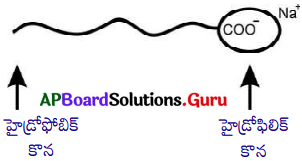
2) సబ్బుకు ఒక వైపు కార్బాక్సల్ (ధృవ) కొన, మరొక వైపు హైడ్రోకార్బన్ గొలుసు (అధృవ) కొన ఉంటాయి.
3) ధృవపు చివర హైడ్రోఫిలిక్ గా ఉంటుంది. అనగా ఇది నీటిని ఆకర్షిస్తుంది.
4) అధృవపు చివర హైడ్రో- బిక్ గా ఉంటుంది. కాబట్టి బట్టలలోని గ్రీజు లేదా నూనెను ఆకర్షిస్తుంది. కాని నీటిని ఆకర్పించదు.
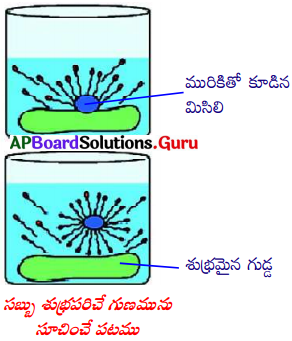
5) సబ్బును నీటిలో కరిగించినపుడు హైడ్రోఫోబిక్ చివర తనంతటతాను మలినాలతో కలిసిపోయి బట్టలలోని మలినాలను తొలగిస్తుంది. దీనిని పక్కన ఇవ్వబడ్డ పటంలో గమనించవచ్చు.
6) సబ్బులోని హైడ్రోఫోబిక్ ‘చివర మలినాలు లేక గ్రీజువైపుకు ఆకర్షించబడుతుంది.
7) హైడ్రోఫోబిక్ చివర మలినాలతో కలిసిపోయి మలిన కణాలను బట్టల నుంచి బయటకు లాగటానికి ప్రయత్నిస్తాయి.
8) సబ్బు అణువులు మలిన కణాల చుట్టూ చేరి ఒక గోళాకృత నిర్మాణాన్ని ఏర్పరుస్తాయి. దీనిని మిసిలి అంటారు.
AP Board 10th Class Physical Science Solutions 12th Lesson కార్బన్ – దాని సమ్మేళనాలు 9
9) ఈ మిసిలిలు కొల్లాయిడల్ ద్రావణంలోని కణాల లాగ నీటి అడుగున ఉండిపోతాయి.
10) వివిధ రకాల మిసిలిలు ఒకదానితో ఒకటి అయాన్-అయాన్ బలాలచే వికర్షించబడటం వలన అవక్షేపాన్ని ఏర్పరచవు.
11) కాబట్టి మిసిలిలలో ఉన్న మలిన పదార్థాలను ఉతకటం ద్వారా తేలికగా తొలగించవచ్చు.
12) ఈ విధంగా సబ్బు మిసిలిలు నీటిలో కరిగి బట్టలలోని మలినాలను తొలగిస్తాయి.

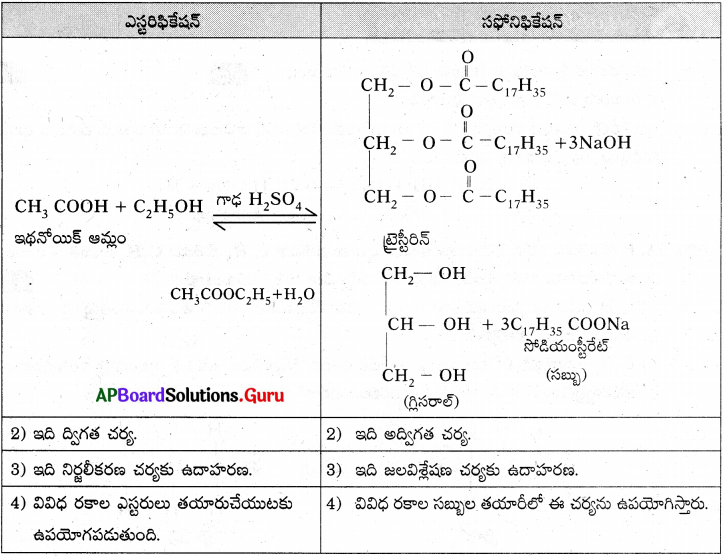
ప్రశ్న 16.
కార్బన్ సమ్మేళనాల ఎస్టరిఫికేషన్ మరియు సపోనిఫికేషన్ చర్యల మధ్య భేదాన్ని వివరించండి. (AS1)
(లేదా)
కర్బన సమ్మేళనాల యొక్క ఎస్టరిఫికేషన్ మరియు సఫోనిఫికేషన్ చర్యల మధ్యగల భేదంను వివరించుము.
జవాబు:
AP Board 10th Class Physical Science Solutions 12th Lesson కార్బన్ – దాని సమ్మేళనాలు 10 AP Board 10th Class Physical Science Solutions 12th Lesson కార్బన్ – దాని సమ్మేళనాలు 11

ప్రశ్న 17.
గ్రాఫైట్ నిర్మాణాన్ని బంధాలు ఏర్పడుట దృష్ట్యా వివరించండి. దాని నిర్మాణంపై ఆధారపడిన ఒక ధర్మాన్ని తెల్పండి. (AS1)
జవాబు:

  1. గ్రాఫైట్ ద్విమితీయ పొరల నిర్మాణాన్ని C – C బంధాలు అను ఈ పొరలలోనే కలిగి ఉంటుంది. ఈ పొరల మధ్య , బలహీన బలాలు పనిచేస్తాయి.
  2. ఈ పొరలు సమతల త్రిభుజీకరణ నిర్మాణాన్ని కలిగి ఉంటాయి.
  3. ఈ పొరలలో ప్రతి కార్బన్ sp² సంకరీకరణాన్ని కలిగి ఉంటుంది.
  4. ఈ sp² ఆర్బిటాళ్ళు అతిపాతం చెందడం వల్ల C- C బంధాలు ఏర్పడతాయి.
  5. ప్రతి కార్బన్ పరమాణువులో సంకరీకరణంలో పాల్గొనని ఒక p ఆర్బిటాల్ మిగిలిపోతుంది.
  6. ఈ అసంకరీకరణ p ఆర్బిటాళ్ళు ఒకదానితో ఒకటి అతిపాతం చెంది మొత్తం పొరపై కేంద్రీకృతమయ్యే π వ్యవస్థను ఏర్పరుస్తాయి.
  7. రెండు పొరల. మధ్య బలహీన ఆకర్షణ బలాలు లేక వాండర్ వాల్ బలాలు 3.35Å దూరంతో వేరుచేయబడతాయి.
  8. ఈ బలాలు నీటి సమక్షంలో మరింత బలహీనపడతాయి. కాబట్టి గ్రాఫైట్ లోని బలాలు విచ్ఛిన్నం చేయుట తేలిక.
  9. అందువలన గ్రాఫైట్ ను కందెనగాను మరియు పెన్సిల్ లో లెడ్ గాను ఉపయోగిస్తున్నారు.

AP Board 10th Class Physical Science Solutions 12th Lesson కార్బన్ – దాని సమ్మేళనాలు

ప్రశ్న 18.
వెనిగర్ లో ఉండే ఆమ్లం పేరు ఏమిటి? (AS1)
(లేదా)
వెనిగర్ కలిగి ఉండు ఆమ్లంను తెలుపుము.
జవాబు:

  1. 5 – 8% ఎసిటిక్ ఆమ్ల ద్రావణాన్ని వెనిగర్ అంటారు.
  2. కాబట్టి వెనిగర్ లో ఉన్న ఆమ్లం ఇథనోయిక్ లేదా ఎసిటిక్ ఆమ్లం (CH3COOH).

ప్రశ్న 19.
ఇథనోల్ లో చిన్న సోడియం ముక్కను వేస్తే ఏమి జరుగుతుంది? (AS2)
(లేదా)
సోడియంను ఇథనోలకు కల్పిన ఏమగును?
జవాబు:
ఇథనోల్ లో సోడియం ముక్కను వేస్తే బుసలు పొంగుతూ హైడ్రోజన్ వాయువు వెలువడుతుంది మరియు ఈ ప్రక్రియలో సోడియం ఇథాక్సెడ్ కూడా ఏర్పడుతుంది.
AP Board 10th Class Physical Science Solutions 12th Lesson కార్బన్ – దాని సమ్మేళనాలు 12

ప్రశ్న 20.
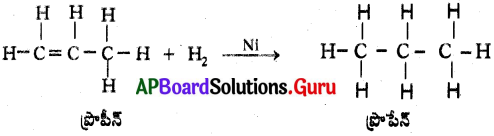
A, B అనే రెండు కర్బన సమ్మేళనాల అణుఫార్ములాలు వరుసగా C3H8 మరియు C3H6 అయితే ఆ రెండింటిలో ఏది సంకలన చర్యలను ప్రదర్శిస్తుంది? మీ సమాధానాన్ని ఎలా సమర్థించుకుంటారు? (AS2)
జవాబు:
a) C3H8 అనేది ఆల్కేనుల సమజాత శ్రేణికి చెందిన సమ్మేళనము. కాబట్టి ఇది ఒక సంతృప్త హైడ్రోకార్బన్ కాబట్టి సంకలన చర్యలో పాల్గొనదు.
b) C3H6 అనగా ఇది ఆల్కీనుల సమజాత శ్రేణికి చెందిన సమ్మేళనము. ఇది ఒక ద్విబంధాన్ని కలిగి ఉంటుంది కాబట్టి అసంతృప్త హైడ్రోకార్బన్. కావున ఇది సంకలన చర్యలో పాల్గొని ఆల్కేనులను ఏర్పరుస్తుంది
AP Board 10th Class Physical Science Solutions 12th Lesson కార్బన్ – దాని సమ్మేళనాలు 13

ప్రశ్న 21.
నీటి కాఠిన్యతను పరిశీలించుటకు ఏదైన ఒక పరీక్షను సూచించండి మరియు దానిని సోదాహరణంగా వివరించండి. (AS3)
(లేదా)
నీటి యొక్క కఠినత్వంను తెలుసుకొనుటకు ఒక సాధారణ కృత్యంను వివరించుము.
జవాబు:
నీటి యొక్క కాఠిన్యతను ఒక నాణ్యమైన సబ్బు ద్వారా పరీక్షించవచ్చు.
పరీక్ష విధానము:

  1. సాలుగు పరీక్షనాళికలు తీసుకొని వాటికి A, B, C, D అనే లేబుల్స్ అంటించవలెను.
  2. వీటిలో ఒక్కొక్క దాంట్లో 50 మి.లీల చొప్పున వరుసగా కుళాయి, బావి, సరస్సు, చెరువు, నదిలోని నీటిని తీసుకొనవలెను.
  3. ఒక్కొక్క పరీక్ష నాళికలో 1 గ్రా. చొప్పున నాణ్యమైన సబ్బును కలపండి.
  4. పరీక్షనాళికలను బిరడాలతో బిగించండి.
  5. A పరీక్షనాళికను 15 సెకండ్ల పాటు తీవ్రంగా కుదిపి 30 సెకండ్ల పాటు కదలకుండా ఉంచాలి. నురగ ఎత్తును కొలవాలి. దానిని నోట్ బుక్ లో నమోదు చేసుకోవాలి.
  6. ఇదే పరీక్షను ప్రతి పరీక్షనాళికలోని నీటితో చేసి పరిశీలనలను నోట్ బుక్ లో నమోదుచేసుకోవాలి. ఏ పరీక్షనాళికలోని నీరు తక్కువ నురగ ఎత్తును ఇస్తుందో అది కఠిన నీరు.

ప్రశ్న 22.
‘X’ అనే ఒక సమ్మేళనం C2H6O అనే అణుఫార్ములాను కలిగి ఉండి KMnO4 ఆమ్ల సమక్షంలో ఆక్సీకరణ చర్యలో పాల్గొని ‘Y’ అనే సమ్మేళనాన్ని ఏర్పరిచింది. దాని అణుఫార్ములా C2H4O2 అయినా
a) X మరియు Y ని కనుక్కోండి. (AS3)
b) ‘X’అనే సమ్మేళనం ‘Y’ తో చర్య జరిపినపుడు ఏర్పడే సమ్మేళనం పచ్చళ్ళ నిల్వకోసం ఉపయోగించేది. అయితే ఏర్పడే సమ్మేళనంకు సంబంధించిన మీ పరిశీలనలను నమోదు చేయండి.
జవాబు:
a) X: C2H6O – ఇథనోల్
Y: C2H4O2

ఇథనోయిక్ ఆమ్లం. ఇథనోలను క్షారీకృత KMnO4 తో ఆక్సీకరణం చెందిస్తే ఇథనోయిక్ ఆమ్లం ఏర్పడుతుంది.
AP Board 10th Class Physical Science Solutions 12th Lesson కార్బన్ – దాని సమ్మేళనాలు 14

ఇథనోయిక్ ఆమ్లంను ఊరగాయలు ఎక్కువ కాలం నిల్వ ఉంచడానికి ఉపయోగిస్తారు.

b) ఇథనోల్ (X)ను గాఢ సల్ఫ్యూరిక్ ఆమ్ల సమక్షంలో ఇథనోయిక్ (Y) ఆమ్లంతో చర్య జరిపితే మంచి సువాసన గల ఇథైల్ విసిటేట్ (ఎస్టర్) అనే సమ్మేళనం ఏర్పడుతుంది.
AP Board 10th Class Physical Science Solutions 12th Lesson కార్బన్ – దాని సమ్మేళనాలు 15

ప్రశ్న 23.
పండ్లను కృత్రిమంగా పక్వం చేయుటకు ఇథిలీన్ ఉపయోగించటం గురించిన సమాచారాన్ని సేకరించండి. ఒక నివేదిక తయారు చేయండి. (AS4)
(లేదా)
కృత్రిమముగా మనము నిజ జీవితంలో వాడు పండ్లను పక్వము చెందించుటకు ఇథిలీస్ ఏ విధంగా ఉపయోగపడునో, సమాచారాన్ని సేకరించుము.
జవాబు:
మొదటి పద్ధతి :

  1. కాయలను పెద్ద పెద్ద చెక్క పెట్టెలలో (క్రేట్) భద్రపరుస్తారు. ఈ పెట్టెలను మండుతున్న వంట చెరుకుపైన ఏర్పాటు చేస్తారు.
  2. ఈ పొగలో ఇథిలీన్ మరియు ఎసిటిలీన్ వాయువులు ఉంటాయి. ఇవి కాయలు పండ్లుగా మారడానికి ఉపయోగపడతాయి.

రెండవ పద్ధతి :

  1. కాయలను ఇథిలీన్ లేదా ఎసిటిలీన్ వాయువులు ఉన్న గదిలో ఉంచుతారు.
  2. వాటివల్ల కాయలు కృత్రిమంగా పళ్లవలే మారుతాయి.

మూడవ పద్ధతి :
ఈ పద్ధతిలో కాయలపై కాల్షియం కార్బైడ్ ను రాస్తారు. ఇది గాలిలోని తేమతో చర్య పొంది ఎసిటిలీన్ వాయువును విడుదల చేస్తుంది. అది కాయలు కృత్రిమంగా పండ్లుగా మారుటకు తోడ్పడుతుంది.

ప్రశ్న 24.
ఈథేన్ అణువు యొక్క ఎలక్ట్రాన్ బిందు నిర్మాణాన్ని గీయండి. (AS5)
జవాబు:
AP Board 10th Class Physical Science Solutions 12th Lesson కార్బన్ – దాని సమ్మేళనాలు 16

ప్రశ్న 25.
C2H4O2 అణుఫార్ములా కలిగిన ఒక కర్బన సమ్మేళనం, సోడియం కార్బొనేట్/బైకార్బోనేట్ కలయికతో మంచి సువాసన గల వాయువును ఇస్తుంది. కింది ప్రశ్నలకు సమాధానాలివ్వండి.
a) ఆ కర్బన సమ్మేళనం ఏమై ఉంటుంది? (AS1)
జవాబు:
ఆ కర్బన సమ్మేళనం ఇథనోయిక్ ఆమ్లం (CH3COOH).

b) వెలువడిన వాయువు పేరేమిటి? (AS1)
జవాబు:
విడుదలయిన వాయువు కార్బన్ డై ఆక్సెడ్ (CO2).

c) వెలువడిన వాయువును ఎలా పరీక్షిస్తారు? (AS2)
జవాబు:
1) విడుదలయిన వాయువును సున్నపుతేట గుండా పంపితే అది తెల్లని పాలవలె మారుతుంది.
2) ఒక మండుతున్న అగ్గిపుల్లను ఈ వాయువు వద్దకు తీసుకొని వస్తే అది దానిని ఆర్పివేస్తుంది.

d) పై చర్యకు తగిన సమీకరణం వ్రాయండి. (AS3)
జవాబు:
2CH3COOH + Na2CO3 → 2CH3COONa + H2O + CO2
CH3COOH + NaHCO3 → CH3COONa + H2O + CO2

e) పై కర్బన సమ్మేళనం యొక్క రెండు ముఖ్యమైన ఉపయోగాలు రాయండి. (AS1)
జవాబు:

  1. ఊరగాయలు ఎక్కువ కాలం నిల్వ ఉండడానికి ఇథనోయిక్ ఆమ్లాన్ని ఉపయోగిస్తారు.
  2. దీనిని శుభ్రపరిచే కారకంగా కూడా ఉపయోగిస్తారు.

AP Board 10th Class Physical Science Solutions 12th Lesson కార్బన్ – దాని సమ్మేళనాలు

ప్రశ్న 26.
నిల్వచేయుటకు ఉపయోగించే కార్బాక్సిలికామ్లము పేరు ఏమిటి? (AS1)
(లేదా)
ఆహార నిల్వకై ఉపయోగించు ఆమ్లమును వ్రాయుము.
జవాబు:
ఆహారం నిల్వ చేయడంలో ఉపయోగపడే ఆమ్లం ఎసిటిక్ ఆమ్లం (ఇథనోయిక్ ఆమ్లం).

ప్రశ్న 27.
వెల్డింగ్ చేయుటకు ఇథైన్, ఆక్సిజన్స్ మిశ్రమాన్ని మండిస్తారు. ఇజైన్ మరియు గాలిని ఎందుకు ఉపయోగించరో చెప్పగలరా? (AS1)
(లేదా)
వెల్డింగ్ చేయుటలో ఇథైన్ మరియు ఆక్సిజన్లను మాత్రమే ఉపయోగించుటకు గల కారణమేమి?
జవాబు:

  1. ఇథైన్ ను మండించడం ఒక దహనచర్యకు ఉదాహరణ. అనగా ఇది ఆక్సిజన్ సమక్షంలో జరుగుతుంది.
  2. కాని గాలి N2, CO2, O2 వంటి అనేక వాయువుల మిశ్రమం.
  3. కాబట్టి ఈ వాయువుల మిశ్రమ సమక్షంలో దహనచర్య సరిగా జరగకపోవడం వల్ల విడుదలయ్యే ఉష్ణశక్తి తక్కువగా ఉంటుంది.
  4. కావున వెల్డింగ్ నందు ఇథైన్ ను ఆక్సిజన్ సమక్షంలో మండిస్తారు.

ప్రశ్న 28.
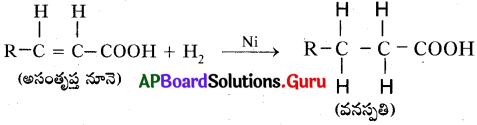
వనస్పతి తయారీలో సంకలన చర్యను ఎలా ఉపయోగిస్తారో రసాయన సమీకరణం సహాయంతో వివరించండి. (AS1)
(లేదా)
వనస్పతి తయారీలో హైడ్రోజనీకరణం ఏ విధముగా ఉపయోగపడునో, రసాయన సమీకరణం ద్వారా వివరింపుము.
జవాబు:
నికెల్ ఉత్ప్రేరక సమక్షంలో అసంతృప్త నూనెలను హైడ్రోజన్ వాయువుతో సంకలన చర్యకు గురిచేయడం ద్వారా వనస్పతిని తయారు చేస్తారు.
AP Board 10th Class Physical Science Solutions 12th Lesson కార్బన్ – దాని సమ్మేళనాలు 17

ప్రశ్న 29.
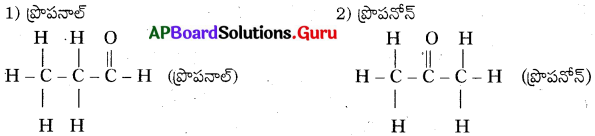
A) ఒక సమ్మేళనం అణుఫార్ములా C3H6O. ఈ అణుఫార్ములాతో రాయగలిగిన వివిధ నిర్మాణాలను రాయండి. (AS1)
B) మీరు రాసిన సమ్మేళనాల IUPAC పేర్లను సూచించండి.
C) ఈ సమ్మేళనాలలోని పోలికలు ఏమిటి?
జవాబు:
A) C3H6O అణుఫార్ములాకు సంబంధించిన వివిధ నిర్మాణాత్మక ఫార్ములాలు : –
1) CH3CH2CHO
2) CH3COCH3

B) పైన తెల్పిన సమ్మేళనాల IUPAC పేర్లు మరియు వాటి నిర్మాణాలు.
AP Board 10th Class Physical Science Solutions 12th Lesson కార్బన్ – దాని సమ్మేళనాలు 18

C) ఈ రెండు సమ్మేళనాల అణుఫార్ములా ఒకటే.

ప్రశ్న 30.
క్రోమిక్ ఎన్ హైడ్రైడ్ లేదా ఆమీకృత పొటాషియం పర్మాంగనేట్ లలో ఏదేని ఒకదానితో ఇథనాల్ ను ఆక్సీకరణ చెందిస్తే ఏర్పడే ఉత్పన్నం ఏమిటి? (AS1)
జవాబు:
ఇథనోల్ ను క్రోమిక్ ఎన్ హైడ్రైడ్ లేక ఆల్కలైన్ పొటాషియం పర్మాంగనేట్ సమక్షంలో ఆక్సీకరణం చెందిస్తే మొదట. ఇథనాల్ లేదా ఎసిటాల్డి హైడ్ ఏర్పడుతుంది. చివరకు ఎసిటిక్ ఆమ్లం లేదా ఇథనోయిక్ ఆమ్లం ఏర్పడుతుంది.
AP Board 10th Class Physical Science Solutions 12th Lesson కార్బన్ – దాని సమ్మేళనాలు 19

ప్రశ్న 31.
సమజాత శ్రేణిలో CH3OHCH2CH3 కి తరువాత వచ్చే సమ్మేళనం యొక్క IUPAC పేరును రాయండి. (AS1)
జవాబు:
CH3OHCH2CH3 అనగా 2-ప్రొపనోల్ లేదా ప్రొపాన్-2-ఓల్. దీని తరువాత వచ్చే సమజాతీయ సమ్మేళనం CH3CH2OHCH2CH3. దీని IUPAC పేరు 2-బ్యుటనోల్ లేదా బ్యూటాన్-2-ఓల్.

ప్రశ్న 32.
మూలకాలు, సమ్మేళనాలు లేదా మిశ్రమాలు ఏవి రూపాంతరత అనే ధర్మాన్ని చూపుతాయి ? సరైన ఉదాహరణలతో వివరించండి. (AS1)
(లేదా)
కర్బన సమ్మేళనాలలో రూపాంతరత ధర్మం యొక్క ప్రాధాన్యతను ఉదహరించుము.
జవాబు:
రూపాంతరతను మూలకాలు ప్రదర్శిస్తాయి.

రూపాంతరత :
ఒక మూలకం వివిధ రూపాలలో లభ్యమవుతూ దాదాపు ఒకే రసాయన ధర్మాలను ప్రదర్శిస్తూ, వేరువేరు భౌతిక, ధర్మాలను కలిగి ఉండడాన్ని రూపాంతరత అంటారు. కార్బన్ అనేక రూపాంతరాలను కలిగి ఉంటుంది.

1) అస్ఫటిక రూపం : కోక్, కోల్, కొయ్యబొగ్గు.
2) స్ఫటిక రూపం : వజ్రం, గ్రాఫైట్, బక్ మిస్టర్ ఫుల్లరిన్, నానోట్యూబులు.

AP Board 10th Class Physical Science Solutions 12th Lesson కార్బన్ – దాని సమ్మేళనాలు

ప్రశ్న 33.
ఇథనోల్ మరియు ఇథనోయిక్ ఆమ్లాల మధ్య భేదాన్ని చూపించే ఒక రసాయన చర్యను వర్ణించండి. (AS3)
జవాబు:

  1. రెండు వేరు వేరు పరీక్షనాళికలలో ఇథనోల్ మరియు ఇథనోయిక్ ఆమ్లములను తీసుకొనండి.
  2. ఈ రెండు పరీక్షనాళికలకు సుమారు 18 గ్రాముల సోడియం బై కార్బోనేట్ (NaHCO3) ను కలపండి.
  3. ఇథనోయిక్ ఆమ్లం ఉన్న పరీక్షనాళికలో అసంఖ్యాకమైన బుడగలు మరియు నురగను గమనించవచ్చు. ఎందువలన అనగా దీనిలో CO2 వాయువు వెలువడింది.
    NaHCO3 + CH3COOH → CH3COONa + H2O + CO2
  4. ఇథనోల్ ఉన్న పరీక్షనాళికలో ఎటువంటి నురగ, బుడగలు ఏర్పడవు. కారణం ఇథనోల్ సోడియం బై కార్బోనేట్ తో చర్య పొందదు.
    ఈ విధంగా ఇథనోల్, ఇథనోయిక్ ఆమ్లంను వేరుచేయవచ్చు.

ప్రశ్న 34.
మీథేన్, ఈథేన్, ఈథేన్ మరియు ఈథైన్ అణువుల నమూనాలను బంకమట్టి మరియు అగ్గిపుల్లలతో తయారు చేయండి. (AS4)
జవాబు:
విద్యార్థులు తమ సొంత నమూనాలను ఈ విధంగా తయారు చేసుకోవచ్చు.

  1. బంకమన్ను, బంతులను కర్బన పరమాణువులకు ఉపయోగించవచ్చు.
  2. అగ్గిపుల్లలోని పుల్లను బంధాన్ని సూచించుటకు, తలను హైడ్రోజన్ పరమాణువులను సూచించుటకు ఉపయోగిస్తారు.

ప్రశ్న 35.
రోజువారీ జీవితంలో ఎస్టర్ల పాత్రను నీవు ఎలా ప్రశంసిస్తావు? (AS6)
(లేదా)
నిజ జీవితంలో మనము ఎస్టర్లను ఏ విధంగా వినియోగిస్తామో ప్రశంసించుము.
జవాబు:
ఎస్టర్లు ప్రత్యేక సువాసన కలిగిన సమ్మేళనాలు. కాబట్టి వీటిని

  1. సెంట్లు, సబ్బులు, నెయిల్ పాలిష్ మొదలైన సౌందర్యాత్మక సాధనాలలో ఉపయోగిస్తారు.
  2. ఆల్కహాళ్ళు, ఫాటీ ఆమ్లాల తయారీలో ఉపయోగిస్తారు.
  3. పువ్వులు, పండ్లు ప్రత్యేక వాసన కలిగి ఉండడానికి వాటిలోని ఎస్టర్లు తోడ్పడుతున్నాయి.
  4. ఎస్టర్లను కొన్ని ప్రత్యామ్నాయ మందులుగాను, విటమిన్లలోను ఉపయోగిస్తున్నారు.

ఈ విధంగా అనేక నిత్యజీవిత అంశాలలో ఎస్టర్లు ప్రముఖ పాత్ర వహిస్తున్నాయి. కాబట్టి వాటి పాత్ర ఎంతో అభినందనీయం.

ప్రశ్న 36.
సమాజంలో కొంతమంది ఆల్కహాల్ త్రాగడాన్ని ఒక అలవాటుగా కలిగి ఉంటారు. దీనిని నీవు ఎలా ఖండిస్తావు? (AS7)
(లేదా)
“మద్యం సేవనం ఒక దుర్వ్యసనము” నీవు దీనిని ఎలా సమర్థిస్తావు?
జవాబు:

  1. ఆల్కహాల్ ను వివిధ పానీయాలుగా సేవించడం ఆరోగ్యానికి హానికరం.
  2. అది రక్త ప్రసరణ వ్యవస్థపై తీవ్ర ప్రభావాన్ని చూపిస్తుంది.
  3. ఆల్కహాల్ కు బానిస కావడం వలన గుండెకు సంబంధించిన వ్యాధులు వస్తాయి. అంతేకాకుండా కాలేయం పాడయిపోతుంది.
  4. చిన్న ప్రేగులలో ఆమ్లత్వం పెరగడం వల్ల పుండ్లు ఏర్పడతాయి. జీర్ణవ్యవస్థను దెబ్బ తీస్తుంది.
  5. కొన్ని ప్రాంతాలలో మిథైల్ ఆల్కహాల్ సేవించుట వలన గుడ్డితనం ఏర్పడటమే కాక ప్రాణాలకు కూడా హాని ఏర్పడుతుంది.
  6. కాబట్టి ఆల్కహాల్ వినియోగాన్ని ప్రతి ఒక్కరు అరికట్టవలసి ఉన్నది. ఎందువలన అనగా దాని ప్రభావం సమాజంపై తీవ్రస్థాయిలో ఉన్నది.

ప్రశ్న 37.
1మి.లీ గ్లేసియల్ ఎసిటిక్ ఆమ్లము మరియు 1 మి.లీ. ఇథనాలను ఒక పరీక్ష నాళికలో తీసుకొని, దానికి కొన్ని చుక్కల గాఢ సల్ఫ్యూరిక్ ఆమ్లమును కలిపి ఆ మిశ్రమాన్ని వెచ్చటి నీటిలో 5 నిమిషాల పాటు ఉంచారు.
ఈ క్రింది ప్రశ్నలకు సమాధానాలు తెల్పండి.
ఎ) చర్యానంతరం ఏర్పడే ఫలిత సమ్మేళనం ఏమిటి? (AS2)
జవాబు:
ఏర్పడే ఫలిత సమ్మేళనం పేరు ఇథైల్ ఎసిటేట్ (CH3COOC2H5).

బి) పై చర్యను రసాయన సమీకరణంతో సూచించండి. (AS1)
జవాబు:
AP Board 10th Class Physical Science Solutions 12th Lesson కార్బన్ – దాని సమ్మేళనాలు 20

సి) పై చర్యను పోలిన చర్యలను సూచించుటకు ఉపయోగించే పదమేమిటి? (AS1)
జవాబు:
పైన ఏర్పడ్డ చర్యను, ఎస్టరీకరణం అంటారు.

డి) ఏర్పడిన సమ్మేళనమునకు ఉండే ప్రత్యేక లక్షణాలేమిటి? (AS1)
జవాబు:
ఏర్పడే సమ్మేళనం తియ్యని వాసనను కలిగి ఉంటుంది.

ఖాళీలను పూరించండి

1. ద్విబంధం మరియు త్రిబంధాలను కలిగి ఉండే కర్బన సమ్మేళనాలను ………….. అంటారు. (అసంతృప్త హైడ్రోకార్బన్లు)
2. దగ్గుటానిలో ముఖ్య అనుఘటకంగా ఉండే సమ్మేళనం ……………… (ఇథనోల్)
3. ఇథనోయిక్ ఆమ్లం యొక్క చాలా విలీనపరచిన ద్రావణం …………. (వెనిగర్)
4. ఆల్కహాల్, కార్బాక్సిలిక్ ఆమ్లాల చర్య వలన ఏర్పడే తియ్యని వాసన గల పదార్థం ……………… (ఎస్టర్)
5. ఇథనాల్ లో సోడియం లోహాన్ని జారవిడిస్తే ………… వాయువు వెలువడుతుంది. (హైడ్రోజన్)
6. మిథనాల్ లోని ప్రమేయ సమూహం ……………… (ఆల్కహాల్)
7. 3 కర్బన పరమాణువులను కలిగి ఉన్న ఆల్కేన్ యొక్క IUPAC నామము ………… (ప్రొపీన్)
8. ఆలైన్ సమజాతశ్రేణిలోని మొదటి సమ్మేళనం ………. (ఇథైన్)
9. గాఢ సల్ఫ్యూరికామ్లంలో ఇథనాల్ యొక్క నిర్జలీకరణ చర్య కారణంగా …….. ఏర్పడుతుంది. (ఈథేన్)
10. అమ్మోనియాలోని ఏక సమయోజనీయ బంధాల సంఖ్య ……………. (3)
11. ఆల్కేన్లు ………… చర్యలలో పాల్గొంటాయి. (ప్రతిక్షేపణ చర్యలు)

సరైన సమాధానాన్ని ఎన్నుకోండి

1. విలీన ఎసిటికామ్లాన్ని కింది రసాయనాలను కలిగి ఉన్న 4 పరీక్షనాళికలలో కలిపారు.
i) KOH
ii) NaHCO3
iii) K2CO3
iv) NaCl
ఏ పరీక్షనాళికలో సువాసనగల వాయువు ఏర్పడుతుంది?
A) i & ii
B) ii & iii
C) i & iv
D) ii &.in
జవాబు:
B) ii & iii

AP Board 10th Class Physical Science Solutions 12th Lesson కార్బన్ – దాని సమ్మేళనాలు

2. కింది సూచించిన శాతాలలో ఏ శాతపు ఎసిటికామ్లాన్ని నీటితో కలిపి పచ్చళ్ళను నిల్వచేసే వెనిగర్ వాడుతారు?
A) 5-10%
B) 10-15%
C) 20-130%
D) 100%
జవాబు:
A) 5-10%

3. ఆల్డిహైడ్ పేరును రాయడానికి ఉపయోగించే పరపదం ఏమిటి?
A) ఓల్ – ol
B) ఆల్ – al
C) ఓన్ – one
D) ఈన్ – ene
జవాబు:
B) ఆల్ – al

4. ఎసిటికామ్లాన్ని నీటిలో కలిపినపుడు అది ద్విగతంగా అయాలుగా విడిపోతుంది. ఎందుకంటే అది ఒక
A) బలహీన ఆమ్లం
B) బలమైన ఆమ్లం
C) బలహీన క్షారం
D) బలమైన క్షారం
జవాబు:
A) బలహీన ఆమ్లం

5. కింది ఏ హైడ్రోకార్బన్ అణు సాదృశ్యాన్ని ప్రదర్శిస్తుంది?
A) C2H4
B) C2H6
C) C3H8
D) C4H10
జవాబు:
D) C4H10

6. సాధారణంగా హైడ్రోకార్బన్ల దహనంతో పాటు సాధారణంగా ఏర్పడునవి ……….
A) వేడి
B) కాంతి
C) వేడి, కాంతి రెండూ
D) విద్చుచ్ఛక్తి
జవాబు:
C) వేడి, కాంతి రెండూ

7. A, B, C అనే మూడు పరీక్షనాళికలను తీసుకొని, 2 మి.లీ. ఇథనోయిక్ ఆమ్లాన్ని ప్రతిదాంట్లోనూ తీసుకొని వాటికి 2 మి.లీ., 4 మి.లీ. మరియు 8 మి.లీ. నీటిని కలిపారు. ఏ పరీక్షనాళికల్లో స్పష్టమైన ద్రావణం (Clear Solution) ఏర్పడుతుంది?
A) పరీక్షనాళిక Aలో మాత్రమే
B) పరీక్షనాళికలు A, B లలో మాత్రమే
C) పరీక్షనాళికలు B, C లలో మాత్రమే
D) అన్ని పరీక్ష నాళికలలో
జవాబు:
D) అన్ని పరీక్ష నాళికలలో

8. 5 మి.లీ. నీటికి 2 మి.లీ. ఎసిటికామ్లాన్ని చుక్కలు చుక్కలుగా కలిపినపుడు దీనిని గమనించవచ్చు.
A) నీటి పైన ఒక ప్రత్యేక పొరగా ఆమ్లం ఏర్పడడం
B) నీరు, ఆమ్లంపైన ఒక ప్రత్యేక పొరగా ఏర్పడడం
C) స్పష్టమైన సజాతీయ ద్రావణం ఏర్పడడం
D) పింక్ రంగులోనున్న స్పష్టమైన ద్రావణం ఏర్పడడం
జవాబు:
C) స్పష్టమైన సజాతీయ ద్రావణం ఏర్పడడం

9. ఘన సోడియం కార్బోనేట్ కు కొన్ని చుక్కల ఇథనోయిక్ ఆమ్లాన్ని కలిపినపుడు కింది చర్య జరుగుతుంది.
A) వేగంగా బుడగలుగా వాయువు వెలువడుతుంది.
B) గోధుమ రంగు పొగలు వెలువడుతాయి.
C) సువాసనగల వాయువు వెలువడుతుంది.
D) కుళ్ళిన వాసనగల వాయువు వెలువడుతుంది.
జవాబు:
A) వేగంగా బుడగలుగా వాయువు వెలువడుతుంది.

AP Board 10th Class Physical Science Solutions 12th Lesson కార్బన్ – దాని సమ్మేళనాలు

10. ఎసిటికామ్లం , ఇథైల్ ఆల్కహాల్ తో చర్య జరుపునపుడు దానికి గాఢ సల్ఫ్యూరిక్ ఆమ్లంగా కలుపుతాం. అది ……. వలె ఉపయోగపడుతుంది. ఈ ప్రక్రియను …………….. అంటాం.
A) ఆక్సీకారిణి, సఫోనిఫికేషన్
B) నిర్జలీకారిణి, ఎస్టరిఫికేషన్
C) క్షయకారిణి, ఎస్టరిఫికేషన్
D) ఆమ్లం, ఎస్టరిఫికేషన్
జవాబు:
B) నిర్జలీకారిణి, ఎస్టరిఫికేషన్

10th Class Physical Science 12th Lesson కార్బన్ – దాని సమ్మేళనాలు Textbook InText Questions and Answers

10th Class Physical Science Textbook Page No. 287

ప్రశ్న 1.
జంతు సంబంధమైన కొవ్వులను వంటకు ఉపయోగించకూడదంటారు ఎందుకు?
జవాబు:

  1. జంతువుల కొవ్వు సంతృప్త ఫాటీ ఆమ్లాలను కలిగి ఉంటుంది. అవి హృద్రోగాలకు కారణం అవుతున్నాయి.
  2. జంతువుల కొవ్వు అధికంగా స్వీకరించడం వలన ఊబకాయం కూడా ఏర్పడుతుంది.

ప్రశ్న 2.
వంట చేయుటకు ఏ నూనెలు మంచివి? ఎందుకు?
జవాబు:

  1. కనోల మొక్క యొక్క విత్తనాలను పిండి చేయగా కనోల నూనె తయారగును.
  2. ఇది అన్నింటికన్నా ఆరోగ్యవంతమైన వంటనూనెగా పరిగణించబడుతున్నది. దీనికి కారణం ఇది తక్కువ సంతృప్త ఫాటీ ఆమ్లాలను కలిగి ఉంటుంది. అంతేకాకుండా మోనోసాచురేటెడ్ కొవ్వు మరియు ఎక్కువ ఒమేగా – 3 మరియు ఒమేగా కొవ్వులను కలిగి ఉంటుంది.
  3. కాబట్టి కనోల నూనెను వంట చేయుటకు ఉపయోగించుట ఉత్తమం.

10th Class Physical Science Textbook Page No. 261

ప్రశ్న 3.
కార్బన్ తన బాహ్య క్యలో నాలుగు ఎలక్ట్రాన్లను కోల్పోయి, హీలియం ఎలక్ట్రాన్ విన్యాసాన్ని పొందగలదా?
జవాబు:

  1. కార్బన్ బాహ్య కర్పరం నాలుగు ఎలక్ట్రానులను కోల్పోతే అది C4+ ఏర్పరచాలి.
  2. కాని దీనికి అధిక మొత్తంలో శక్తి అవసరం. కాని సాధారణ పరిస్థితులలో ఈ శక్తి అందుబాటులో ఉండదు.
  3. కాబట్టి C4+ ఏర్పడటం దాదాపు అసంభవం.
    కాబట్టి కార్బన్ C4+ అయాన్లను ఏర్పరచదు.

10th Class Physical Science Textbook Page No. 262

ప్రశ్న 4.
కార్బన్ పరమాణువులు పైన సూచించిన విధంగా అనేక రకాల బంధాలను ఏవిధంగా ఏర్పరచగలుగుతాయి?
జవాబు:
వేలన్సీ బంధ సిద్ధాంతం ప్రకారం కార్బన్ యొక్క నాలుగు సంయోజక ఎలక్ట్రానులు (ఒంటరి ఎలక్ట్రానులు) కార్బన్ పరమాణువులు వివిధ రకాల బంధాలు ఏర్పరచడానికి కారణం.

10th Class Physical Science Textbook Page No. 263

ప్రశ్న 5.
ఎలక్ట్రాన్ ను ఉత్తేజపరిచే ఈ శక్తి ఎక్కడి నుండి వస్తుంది?
జవాబు:

  1. సాధారణంగా కార్బన్ పరమాణువు భూస్థాయిలోనే ఉంటుంది.
  2. కాని వేరే పరమాణువులతో బంధమేర్పరచాలనుకొన్నప్పుడు ఉత్తేజిత స్థాయికి చేరడానికి కావలసిన శక్తిని కార్బన్ మరియు ఇతర పరమాణువుల మధ్య బంధం ఏర్పడినపుడు విడుదలయ్యే శక్తిని వినియోగించుకొంటుంది.

10th Class Physical Science Textbook Page No. 264

ప్రశ్న 6.
కార్బన్ యొక్క నాలుగు ఒంటరి ఎలక్ట్రాన్లను కలిగి ఉన్న ఆర్బిటాళ్ళు, శక్తి రీత్యా సమానంగా మారుతాయని ఎలా వివరించగలం?
జవాబు:
‘సంకరీకరణం’ అనే దృగ్విషయం ద్వారా దీనిని వివరించవచ్చు.

10th Class Physical Science Textbook Page No. 267

ప్రశ్న 7.
CH4, C2H4 మరియు C2H2 అణువులలోని \(\text { HĈH }\) బంధ కోణములు ఎంతెంత?
జవాబు:
CH4 లోని \(\text { HĈH }\) బంధ కోణం 109.5°. C2H4 లోని \(\text { HĈH }\) బంధ కోణం 120°.
C2H4 లోని \(\text { HĈH }\) బంధ కోణం 180°.

10th Class Physical Science Textbook Page No. 273

ప్రశ్న 8.
హైడ్రోకార్బన్లు అంటే ఏమిటి?
జవాబు:
కార్బన్, హైడ్రోజన్లను మాత్రమే కలిగియున్న సమ్మేళనాలను హైడ్రోకార్బన్లు అంటారు.

10th Class Physical Science Textbook Page No. 274

ప్రశ్న 9.
అన్ని కర్బన సమ్మేళనాలలో సమాన సంఖ్యలో కార్బన్ (C) మరియు హైడ్రోజన్ (H) పరమాణువులు కలిగి ఉన్నాయా?
జవాబు:
ఉండవు.

AP Board 10th Class Physical Science Solutions 12th Lesson కార్బన్ – దాని సమ్మేళనాలు

10th Class Physical Science Textbook Page No. 277

ప్రశ్న 10.
కార్బన్ ఇతర మూలకాలతో బంధాన్ని ఏర్పరచగలదా?
జవాబు:
కార్బన్ ఇతర మూలక పరమాణువులైన హైడ్రోజన్, ఆక్సిజన్, నైట్రోజన్, సల్ఫర్, పాస్ఫరస్, హాలోజన్లతో బంధాలు ఏర్పరుస్తుంది.

10th Class Physical Science Textbook Page No. 287

ప్రశ్న 11.
ఉత్ప్రేరకం అంటే ఏమిటో తెలుసా?
జవాబు:
రసాయన చర్యలో పాల్గొనకుండా రసాయన చర్యా వేగాన్ని నియంత్రించే పదార్థాలను ఉత్ప్రేరకాలు అంటారు.

10th Class Physical Science Textbook Page No. 290

ప్రశ్న 12.
ఎస్టర్లు అంటే ఏమిటి?
జవాబు:
ప్రమేయ సమూహం కలిగిన సమ్మేళనాలను ఎస్టర్లు అంటారు.
వీటి సాధారణ ఫార్ములా. R – COO – R’
AP Board 10th Class Physical Science Solutions 12th Lesson కార్బన్ – దాని సమ్మేళనాలు 26

10th Class Physical Science Textbook Page No. 292

ప్రశ్న 13.
నిజ ద్రావణం (true solution) అంటే ఏమిటి?
జవాబు:
1nm కంటే తక్కువ వ్యాసం గల ద్రావిత కణాలు ద్రావణంలో విక్షేపణం చెందడం వల్ల ఏర్పడే ద్రావణాన్ని నిజ ద్రావణం అంటారు.

10th Class Physical Science Textbook Page No. 262

ప్రశ్న 14.
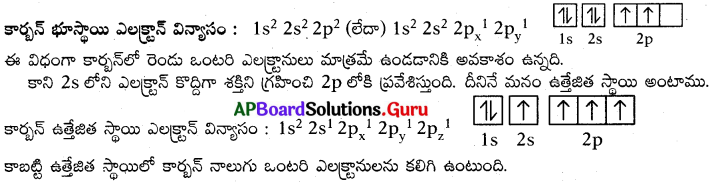
కార్బన్ పరమాణువు యొక్క ఉత్తేజస్థితిలోని జతకూడని 4 ఒంటరి ఎలక్ట్రాన్లు ఎలా ఉంటాయి?
జవాబు:
AP Board 10th Class Physical Science Solutions 12th Lesson కార్బన్ – దాని సమ్మేళనాలు 27

10th Class Physical Science Textbook Page No. 263

ప్రశ్న 15.
మీథేన్ అణువు (CH4) లో కార్బన్ – హైడ్రోజన్ బంధాలు నాలుగూ ఒకేరకమైనవి మరియు \(\text { HĈH }\) బంధకోణం 109°28′. దీనిని మనం ఎలా వివరించగలం?
జవాబు:
కార్బన్ ఉత్తేజిత స్థాయిలో p- ఆర్బిటాల్ లో మూడు ఒంటరి ఎలక్ట్రానులు మరియు S- ఆర్బిటాల్ లో ఒక ఒంటరి ఎలక్ట్రానను కలిగి ఉంటుంది. ఈ నాలుగు వేలన్సీ ఆర్బిటాళ్ళు వివిధ శక్తులను కలిగి ఉంటాయి. కాబట్టి ఈ ఆర్బిటాళ్ళు సంకరీకరణం చెంది నాలుగు సర్వసమాన ఆర్బిటాళ్లను ఏర్పరుస్తాయి. నాలుగు హైడ్రోజన్ పరమాణువులు కార్బతో కలిసి నాలుగు సర్వసమాన C – H బంధాలను ఏర్పరుస్తాయి. మరియు ఈ బంధాల మధ్య బంధకోణం 109°28′ ఉంటుంది. (అత్యల్ప వికర్షణ కొరకు)

ప్రశ్న 16.
మీథేన్ అణువులో శక్తిరీత్యా అసమానమైన సంయోజనీయత గల ఎలక్ట్రాన్లు సమానమైన నాలుగు సమయోజనీయతా బంధాలను ఏ విధంగా ఏర్పరుస్తాయి? ఇది ఎలా జరుగుతుంది?
జవాబు:

  1. బంధాలు ఎక్కువ ఏర్పడే కొద్ది శక్తి ఎక్కువ అవడం వలన ఆ అణువు స్థిరంగా ఉంటుంది.
  2. కార్బన్ నాలుగు బంధాలను ఏర్పరిస్తే రెండు బంధాలు ఏర్పడటం కంటే ఎక్కువ శక్తి విడుదలవ్వడం వలన అధిక స్థిరత్వం పొందుతుంది.
  3. 28 ఆర్బిటాల్ మరియు 2p ఆర్బిటాలకు మధ్య శక్తి తేడా తక్కువగా ఉంటుంది. కార్బన్ బంధాన్ని ఏర్పరచాలనుకొన్నపుడు బంధ శక్తి నుంచి లభించే కొద్దిగా శక్తి 28 లోని ఎలక్ట్రాన ను 2p లోకి పంపిస్తుంది. ఈ విధంగా నాలుగు ఒంటరి ఎలక్ట్రానులు ఏర్పడతాయి.
  4. ఈ S మరియు p ఆర్బిటాళ్ళు సంకరీకరణం చెంది నాలుగు సర్వసమాన ఆర్బిటాళ్ళను ఏర్పరుస్తాయి. కాబట్టి వివిధ శక్తులు కలిగిన వేలన్సీ ఎలక్ట్రానులు సంకరీకరణం వలన నాలుగు సర్వసమాన బంధాలను మీథేన్ లో ఏర్పరుస్తాయి.

10th Class Physical Science Textbook Page No. 269

ప్రశ్న 17.
పెన్సిల్ లో పేపర్ పై చేసే గుర్తులను (రాతను) మీరు ఏవిధంగా అర్థం చేసుకొంటారు?
జవాబు:

  1. పేపర్ పై పెన్సిల్ తో రాసినపుడు గ్రాఫైట్లో గల లోపలి పొరల మధ్య ఆకర్షణ బలాలు విచ్ఛిన్నం అవుతాయి. కాబట్టి విడిపడిన గ్రాఫైట్ పొరలు పేపర్‌పై ఉండిపోతాయి.
  2. అంతేకాకుండా ఈ పెన్సిల్ మార్కింగ్ లను ఎరేజర్ ద్వారా తేలికగా తొలగించవచ్చు. ఎందువలన అనగా గ్రాఫైట్ పొరలు పేపరును గట్టిగా అంటిపెట్టుకొని ఉండవు.

10th Class Physical Science Textbook Page No. 272

ప్రశ్న 18.
రసాయన శాస్త్రంలో కార్బన్, దాని సంయోగ పదార్థాలకు ప్రత్యేకంగా ఒక శాఖను కేటాయించడం సమంజసమేనా? మరే విధమైన మూలకానికి ఇటువంటి ప్రత్యేక శాఖ కేటాయించబడలేదు. దీనిని ఎలా సమర్థిస్తావు?
జవాబు:

  1. మనము జీవించడానికి అవసరమయ్యే పదార్థాలయిన కార్బోహైడ్రేట్లు, ప్రొటీన్లు, న్యూక్లియిక్ ఆమ్లాలు, లిపిడ్లు, హార్మోన్లు మరియు విటమిన్లు అన్నీ కార్బనను కలిగి ఉన్నాయి.
  2. మన శరీరంలో జరిగే జీవక్రియలలో కూడా కర్బన సమ్మేళనాలు ప్రధానపాత్ర వహిస్తున్నాయి.
  3. మనకు ప్రకృతి నుంచి లభించే ఆహారము; అనేక మందులు, నూలు, ఉన్ని వంటి వస్త్రాలు, పెట్రోలియం, సహజ వాయువు వంటి ఇంధనాలు అన్నీ కర్బన సమ్మేళనాలు.
  4. కృత్రిమ వస్త్రాలు, ప్లాస్టిక్ లు, కృత్రిమ రబ్బరు అన్నీ కర్బన సమ్మేళనాలు.
  5. ఈ విధంగా ఇన్ని రంగాలలో ఉపయోగపడుతున్న కార్బన్ సమ్మేళనాలకు ప్రత్యేక విభాగాన్ని ఏర్పరచుట ఖచ్చితంగా సరియైన నిర్ణయం

AP Board 10th Class Physical Science Solutions 12th Lesson కార్బన్ – దాని సమ్మేళనాలు

10th Class Physical Science Textbook Page No. 276

ప్రశ్న 19.
కింద ఇవ్వబడిన రెండు. హైడ్రోకార్బన్స్ నిర్మాణాలను పరిశీలించండి.
AP Board 10th Class Physical Science Solutions 12th Lesson కార్బన్ – దాని సమ్మేళనాలు 28
i) పై నిర్మాణాలలో ఏం తేడాను గమనించారు?
జవాబు:
ఆ రెండు వేరు వేరు సమ్మేళనాలు. (a) బ్యూటేన్ (b) 2-మిథైల్ ప్రోపేన్ లేదా ఐసో బ్యూటేన్.

ii) (a) మరియు (b) నిర్మాణాలలో ఎన్ని కార్బన్, హైడ్రోజన్ పరమాణువులు ఉన్నాయి ?
జవాబు:
(a) మరియు (b) నిర్మాణాలలో నాలుగు కార్బన్, పది హైడ్రోజన్ పరమాణువులు కలవు.

iii) (a) మరియు (b) ల అణుఫార్ములా రాయండి. అవి ఒకే విధంగా ఉన్నాయా?
జవాబు:
C4H10 అవును. ఒకే విధంగా ఉన్నాయి.

10th Class Physical Science Textbook Page No. 285

ప్రశ్న 20.
ఏదేని సమ్మేళనం పేరును చెబితే, దాని నిర్మాణాన్ని మనం గీయగలమా?
జవాబు:

  1. రూట్ పదం నుంచి ప్రధాన గొలుసులో కర్బన పరమాణువులను రాసుకోవాలి.
  2. ఇచ్చిన పేరు ఆధారంగా ఎడమ నుంచిగాని కుడి నుంచి గాని కర్బన పరమాణువులను లెక్కించాలి.
  3. ప్రతిక్షేపకాలను పేరులో ఇచ్చిన విధంగా కర్బన పరమాణువులపై ప్రతిక్షేపించుకోవాలి.
  4. ప్రమేయ సమూహం ఫార్ములాలు ఇచ్చిన పేరు బట్టి రాసుకోవాలి.
  5. కార్బన్ యొక్క చతుర సంయోజకత దృష్టిలో పెట్టుకొని వాటి యొక్క సంయోజకతను హైడ్రోజన్లతో సంతృప్తి పరచాలి.

10th Class Physical Science Textbook Page No. 286

ప్రశ్న 21.
అప్పుడప్పుడు గ్యాసు లేదా కిరోసిన్ స్టవ్ పైన వంట చేస్తున్నప్పుడు వంట పాత్రలపై నల్లని మసి ఏర్పడుతుంది. ఎందుకు?
జవాబు:
బర్నర్ లేదా స్టవ్ కు సంబంధించిన గాలి రంధ్రాలు మలినాలతో మూసుకొని పోవడం వలన ఇంధన వాయువులు పూర్తిగా మండవు. అందువలన పూర్తిగా మండని కార్బన్ వంట పాత్రలపై ఏర్పడటం వలన వంటపాత్రలు నల్లగా అవుతాయి.

10th Class Physical Science Textbook Page No. 288

ప్రశ్న 22.
వాహనాలు నడిపే వ్యక్తులు మద్యం తీసుకొన్నారా లేదా అని పోలీసులు ఎలా కనుగొంటారో మీకు తెలుసా?
జవాబు:

  1. పోలీస్ అధికారి అనుమానిత డ్రైవర్‌ను పొటాషియం డై క్రోమేట్ (K2Cr2O7) స్ఫటికాలు కలిగిఉన్న ఒక ప్లాస్టిక్ సంచిలోకి, ఒక గుర్తించగల పరికరం యొక్క మౌత్ పీస్ ద్వారా ఊదమంటారు.
  2. అతను ఊదిన గాలిలో ఇథనోల్ ఉంటే అది K2Cr2O7 మంచి ఆక్సీకరణి అవుటచే వెంటనే ఇథనాల్ మరియు ఇథనోయిక్ ఆమ్లంగా మారిపోతుంది.
  3. అంతేకాకుండా నారింజరంగులోని Cr2O72- అయాన్ ఈ ఆక్సీకరణ ప్రక్రియ వలన ఆకుపచ్చని Cr3+ అయాన్లుగా మారుతుంది.
  4. గొట్టంలో ఎంతభాగం ఆకుపచ్చని రంగులో మారుతుందో దాని ఆధారంగా సేవించిన ఆల్కహాల్ పరిమాణాన్ని లెక్కిస్తారు.
  5. ఇంతేకాకుండా పోలీసులు IR వర్ణపటాల ద్వారా C – OH, C – H మరియు CH3 – CH2 – OH బంధాలను లెక్కించడం ద్వారా కూడా ఆల్కహాల్ పరిమాణాన్ని కనుగొంటారు.

10th Class Physical Science Textbook Page No. 266

ప్రశ్న 23.
ఒక ఏకబంధం మరియు ఒక త్రిబంధం ఏర్పరచగల కార్బన్ సామర్థ్యాన్ని మీరేవిధంగా వివరిస్తారు?
జవాబు:
1) ఈజైన్ ఎసిటిలీన్ (C2H2) అణువును ఉదాహరణ తీసుకొని ఒక ఏకబంధం మరియు ఒక త్రిబంధాన్ని కార్బన్ ఎలా ఏర్పరుస్తుందో వివరించవచ్చు.
2) ఎసిటిలీన్ అణువులోని రెండు కార్బన్ పరమాణువుల మధ్య ఒక త్రిబంధం ఉంటుంది.
3) పరమాణువు యొక్క చతుర సంయోజనీయతను సంతృప్తపరచడానికి ప్రతి కార్బన్ పరమాణువు ఒక హైడ్రోజన్ తో బంధాన్ని ఏర్పరుస్తుంది
(H – C ≡ C – H).
AP Board 10th Class Physical Science Solutions 12th Lesson కార్బన్ – దాని సమ్మేళనాలు 29

4) ఎసిటిలీన్ (C2H2) అణువులో రెండు కార్బన్, రెండు హైడ్రోజన్ పరమాణువులున్నాయి.
5) ఉత్తేజిత స్థితిలో ప్రతి కార్బన్ పరమాణువులో ఒక S – ఆర్బిటాల్ (2s) మరియు ఒక p – ఆర్బిటాల్ (2px) కలవటం వలన sp సంకరీకరణం జరిగి రెండు సర్వసమానమైన sp ఆర్బిటాళ్ళు ఏర్పడతాయి.
6) ప్రతి కార్బన్ పరమాణువు రెండు సంకరీకరణం చెందని p – ఆర్బిటాళ్ళు (2px, 2py) కలిగి ఉంటుంది.
AP Board 10th Class Physical Science Solutions 12th Lesson కార్బన్ – దాని సమ్మేళనాలు 30
7) ఒక కార్బన్ లోని sp సంకర ఆర్బిటాల్ మరో కార్బన్ లోని sp సంకర ఆర్బిటాల్ తో అతిపాతం చెందటం వలన sp – sp సిగ్మా బంధం ఏర్పడుతుంది.
8) కార్బన్లో గల మరో sp ఆర్బిటాల్, హైడ్రోజన్ పరమాణువు యొక్క S – ఆర్బిటాల్ లో అతిపాతం చెందడం వలన రెండు S – sp సిగ్మా బంధాలు ఏర్పడతాయి.
9) కార్బన్ పరమాణువులో ఉండే సంకరీకరణం చెందని p ఆర్బిటాల్, వేరొక కార్బన్ పరమాణువులోని p ఆర్బిటాల్ లో అతిపాతం చెందడం వలన రెండు π బంధాలు ఏర్పడతాయి. ( πpy – py మరియు πpz – pz).
10) అందుచేత ఈథేన్ పరమాణువు (H – C = C – H) లో 3 సిగ్మా బంధాలు, రెండు IT బంధాలు ఉంటాయి.

10th Class Physical Science Textbook Page No. 267

ప్రశ్న 24.
AP Board 10th Class Physical Science Solutions 12th Lesson కార్బన్ – దాని సమ్మేళనాలు 31
క్రమంలో కార్బన్ పరమాణు కేంద్రకాల మధ్యగల బంధ దూరాన్ని, బంధ శక్తులను ఊహించగలరా? వివరించండి.
జవాబు:
AP Board 10th Class Physical Science Solutions 12th Lesson కార్బన్ – దాని సమ్మేళనాలు 32
AP Board 10th Class Physical Science Solutions 12th Lesson కార్బన్ – దాని సమ్మేళనాలు 33

10th Class Physical Science Textbook Page No. 293

ప్రశ్న 25.
జిడ్డుగా నున్న బట్టపై సబ్బు కణాలు జరిపే చర్య ఏమిటి?
జవాబు:

  1. సబ్బు లేదా డిటర్జెంట్లు నూనె మరియు మలినాలను నీటిలోకి వచ్చేటట్లు చేస్తాయి. ఈ విధంగా బట్టలను శుభ్రపరుస్తాయి.
  2. సబ్బులో ఒక చివర ధృవంగా, మరొక చివర ధృవరహితంగాను ఉంటుంది.
  3. ధృవపు చివర హైడ్రోఫిలిక్ గాను, ధృవరహిత చివర హైడ్రోఫోబి గాను ఉంటుంది.
  4. ధృవరహిత చివర హైడ్రోఫోబిక్ గా ఉండటం వలన ఇది గ్రీజు లేదా నూనె చేత ఆకర్షించబడుతుంది.
  5. సబ్బుని నీటిలో కరిగిస్తే హైడ్రోఫోబిక్ చివర మలినాలు గ్రీజు లేక మలినాలను అతుక్కొని వాటిని నీటి నుంచి తొలగిస్తాయి.
  6. హైడ్రోఫోబిక్ చివర మరియు గ్రీజు కణాల వైపుకు కదులుతాయి.
  7. హైడ్రోఫోబిక్ చివర మలిన కణాలకు అతుక్కొని మలిన కణాలను బయటకు లాగడానికి ప్రదర్శిస్తాయి.
  8. సబ్బు అణువులు మలిన కణాల చుట్టూ చేరి గోళాకృత నిర్మాణాన్ని ఏర్పరుస్తాయి. దీనిని మిసిలి అంటారు.
  9. ఈ మిసిలిలు కొల్లాడయిల్ ద్రావణంలోని కణాలలాగ నీటి అడుగున ఉండి పోతాయి.
  10. వివిధ రకాల మిసిలిలు ఒకదానిలో ఒకటి అయాన్ – అయాన్ బలాల చేత వికర్షించబడటం వలన అవక్షేపాన్ని ఏర్పరచవు.
  11. కాబట్టి మిసిలిలో ఉన్న మలిన పదార్థాలను తేలికగా తొలగించవచ్చు.
  12. ఈ విధంగా సబ్బు మిసిలిలు నీటిలో కరిగి బట్టలలోని మలినాలను తొలగిస్తాయి.

AP Board 10th Class Physical Science Solutions 12th Lesson కార్బన్ – దాని సమ్మేళనాలు

పరికరాల జాబితా

పరీక్షనాళికలు, నీటి తొట్టె, బున్సెన్ బర్నర్, ఇథనోల్, ఎసిటికామ్లం , గాఢ సల్ఫ్యూరికామ్లం, బంతి-పుల్లల నమూనాలు

10th Class Physical Science 12th Lesson కార్బన్ – దాని సమ్మేళనాలు Textbook Activities

కృత్యములు

కృత్యం – 1

ప్రశ్న 1.
కింది నిర్మాణాత్మక ఫార్ములాలను పరిశీలించి, వాటి పేర్లను మీ నోట్ బుక్ లో రాయండి.
1) CH3 – CH2 – CH = CH2
జవాబు:
బ్యూట్-1-ఈన్

2)
AP Board 10th Class Physical Science Solutions 12th Lesson కార్బన్ – దాని సమ్మేళనాలు 21
జవాబు:
2-మిథైల్ బ్యూటేన్

3) CH3 – CH2 – CH2 – CH2 – CH2 – CH3
జవాబు:
హెక్సేన్

4)
AP Board 10th Class Physical Science Solutions 12th Lesson కార్బన్ – దాని సమ్మేళనాలు 22
జవాబు:
3-మిథైల్, బ్యూట్-1-ఈన్

5) CH3 – C ≡ CH
జవాబు:
ప్రొప్-1-ఐన్

కృత్యం – 2

ప్రశ్న 2.
కింది కర్బన సమ్మేళనాల పేర్లను చదివి, వాటి నిర్మాణాత్మక ఫార్ములాలను మీ నోటు పుస్తకంలో రాయండి.
AP Board 10th Class Physical Science Solutions 12th Lesson కార్బన్ – దాని సమ్మేళనాలు 23

కృత్యం – 3

ప్రశ్న 3.
ఎస్టరీకరణ చర్యను కృత్యం ద్వారా వివరించండి.
జవాబు:
AP Board 10th Class Physical Science Solutions 12th Lesson కార్బన్ – దాని సమ్మేళనాలు 24

  1. ఒక పరీక్షనాళికలో 1 మి.లీ ఇథనోలు (అబ్సల్యూట్ ఆల్కహాల్) మరియు 1 మి.లీ. గడ్డకట్టిన ఎసిటిక్ ఆమ్లం (glacial acetic acid) అలాగే కొన్ని చుక్కల గాఢ సల్ఫ్యూరిక్ ఆమ్లాన్ని తీసుకోండి.
  2. నీటితొట్టిలో వేడి చేయండి లేదా వేడి నీటిని కలిగి ఉన్న బీకర్ లో కనీసం 5 నిమిషాలు పటంలో చూపిన విధంగా ఉంచండి.
  3. 20-50 మి.లీ. నీరుగల బీకరులోనికి వెచ్చగా ఉండే ఈ ద్రావణాన్ని కలపండి.

గమనించినది :
ఒక మంచి తియ్యని వాసనగల ద్రావణం ఏర్పడటం గమనించవచ్చు.

ఫలితం :
ఏర్పడిన పదార్థమే ఎస్టరు. ఈ చర్యనే ఎస్టరీకరణ చర్య అంటారు.

కృత్యం – 4

ప్రశ్న 4.
మిసిలీ తయారీ విధానమును వివరించుము.
జవాబు:
AP Board 10th Class Physical Science Solutions 12th Lesson కార్బన్ – దాని సమ్మేళనాలు 25

  1. 10 మి.లీ. ల చొప్పున నీటిని రెండు పరీక్షనాళికలలో తీసుకొనుము.
  2. రెండింటిలోను ఒక చుక్క వంటనూనెను కలిపి వాటికి A మరియు B అనే లేబుల్స్ అంటించవలెను.
  3. B పరీక్షనాళికకు కొన్ని చుక్కల సబ్బు ద్రావణాన్ని కలపవలెను.
  4. రెండు పరీక్షనాళికలను కొంత సమయం పాటు తీవ్రంగా కుదపవలెను.
  5. కుదపడం ఆపిన వెంటనే రెండు పరీక్షనాళికలలో నూనె, నీటి పొరలు ఏర్పడవు.
  6. కొంతసేపు పరీక్షనాళికలను కదపకుండా ప్రక్కన ఉంచండి.
  7. B పరీక్షనాళికలో నూనె పొర వేరు చేయబడుతుంది. దీనికి కారణం, దానిలో సబ్బు ద్రావణం ఉండటం.

AP 7th Class Science Important Questions 4th Lesson Respiration and Circulation

These AP 7th Class Science Important Questions 4th Lesson Respiration and Circulation will help students prepare well for the exams.

AP Board 7th Class Science 4th Lesson Important Questions and Answers Respiration and Circulation

Question 1.
What is inspiration?
Answer:
The process of inhaling air is called inspiration.

Question 2.
What is expiration?
Answer:
The process of exhalation of air is called expiration.

Question 3.
What is respiratory rate?
Answer:
The number of times we inhale and exhale air in a minute is called the Respiratory Rate.,

Question 4.
What is the normal respiratory rate in human beings?
Answer:
The normal respiratory rate in human beings is 14 to 20 times per minute.

Question 5.
What are the only part of the human body which floats on water?
Answer:
Lungs are the only part of the human body which floats on water

AP 7th Class Science Important Questions 4th Lesson Respiration and Circulation

Question 6.
What does our circulatory system consisting of?
Answer:
Circulatory system consists of Heart, Blood vessels and Blood

Question 7.
What is the pumping organ in the blood circulatory system.
Answer:
Heart is the pumping organ in the blood circulatory system.

Question 8.
How many chambers are there in the human heart? What are those?
Answer:
Human heart has four chambers, upper two chambers are called Atria and lower two chambers are called Ventricles.

Question 9.
What is heartbeat?
Answer:
The rhythmic contraction followed by its relaxation of heart is called heartbeat.

Question 10.
What is the instrument used to feel and measure the “heart beat?
Answer:
Stethoscope is the instrument used to feel and measure the heart beat.

Question 11.
What is the role of circulation in the human body?
Answer:
The process of circulation helps in the supply of digested food and oxygen to all parts of the body (cells) and also to bring back the waste material.
Question 12.

What is the fluid portion of the blood?
Answer:
Plasma is the fluid portion of the blood.
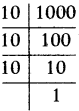
AP 7th Class Science Important Questions 4th Lesson Respiration and Circulation

Question 13.
What are the different types of blood cells in the human blood?
Answer:
Blood cells are of three types – Red blood cells, White blood cells and Blood platelets.

Question 14.
Which blood cells act like police force of our body?
Answer:
White blood cells act like police force of our body.

Question 15.
Why red blood cells are red in colour?
Answer:
Red blood cells have a colouring pigment called Haemoglobin. It gives blood the red colour.

Question 16.
What is the function of haemoglobin?
Answer:
Haemoglobin acts as a carrier for oxygen and carbon dioxide and plays a key role in respiration. ,

Question 17.
What is the function of Blood platelets?
Answer:
Blood platelets play an important role in coagulation of blood when there are cuts and wounds.

Question 18.
Which organisms have colour less blood?
Answer:
Insects like cockroach have colour less blood.

Question 19.
Give examples for the organisms having blue coloured blood?
Answer:
Prawns, snails and crabs have blue coloured blood.

Question 20.
Expand NCDs.
Answer:
Non communicable diseases

Question 21.
Give some examples for non-communicable diseases.
Answer:
Heart attack, Cancer, Paralysis

AP 7th Class Science Important Questions 4th Lesson Respiration and Circulation

Question 22.
What are the major causes for non-communicable diseases?
Answer:
Tobacco and alcohol use, poor eating habits, and lack of exercise are the major causes for non – communicable diseases.

Question 23.
What is immunity?
Answer:
Immunity is the inbuilt capacity of the body to fight and overcome the effects of disease causing germs.

Question 24.
What is meant by infection?
Answer:
The entry of disease-causing germs into our body to grow and multiply is called infection.

AP 7th Class Science Important Questions 4th Lesson Respiration and Circulation

Question 25.
Expand SARS.
Answer:
Severe Acute Respiratory Syndrome

7th Class Science 4th Lesson Respiration and Circulation Short Questions and Answers

Question 1.
What is breathing? Explain brifly about breathing.
Answer:

  1. The process of inhalation and exhalation of air is called Breathing.
  2. During the process of inhalation the air with more oxygen and less carbon dioxide enters the lungs through nostrils.
  3. During the process of exhalation the air with more carbondioxide and less oxygen is sent out from the lungs.

Question 2.
Write about lungs.
Answer:

  1. Lungs are pink in colour spongy, elastic and sac like structures with many tiny air sacs.
  2. They are placed safely in the ribcage formed by ribs in the chest cavity.
  3. The right lung is slightly larger than the left one. ‘
  4. The lungs do not possess muscles, so they cannot expand or contract on their own.

Question 3.
Why is the right lung larger than the left lung?
Answer:

  1. Lungs are located in the chest cavity.
  2. Heart is also present in the chest cavity on the left side.
  3. So, there is less space for the left lung in the chest cavity.
  4. As a result left lung is smaller with two lobes when compared with the right lung which had three lobes.

Question 4.
What is diaphragm? what is its role?
Answer:

  1. A large thin muscular sheet called diaphragm is attached to the lower side of the ribcage and forms the floor of the chest cavity.
  2. The process of breathing involves the movement of the diaphragm and the ribcage.
  3. During inhalation diaphragm moves down as a result air enters the lungs.
  4. During exhalation diaphragm moves back as a result air goes out of the lungs.
  5. It play major role in the respiratory movements of men when compared with women.

AP 7th Class Science Important Questions 4th Lesson Respiration and Circulation 1

Question 5.
Draw the flow chart air passage in respiration.
Answer:
AP 7th Class Science Important Questions 4th Lesson Respiration and Circulation 2

Question 6.
What are plants respiratory organs?
Answer:

  1. Plants being living organisms, have to breathe to survive. ,.
  2. Plants take in oxygen and leave out carbon dioxide, as in any other living organisms.
  3. The process of breathing takes place with the help of small openings in the leaves called stomata and in stem called lenticels.
  4. The roots also need oxygen to produce energy, so they absorh the oxygen present in the air spaces between soil particles with the help of root hairs.

AP 7th Class Science Important Questions 4th Lesson Respiration and Circulation

Question 7.
What is the need to plant more trees?
Answer:

  1. Plants take in Oxygen and give out Carbon dioxide during respiration.
  2. The same plants take in carbon dioxide and give out oxygen during the process of Photosynthesis.
  3. So we should protect and plant more trees for a rich supply of oxygen.

Question 8.
What is the role of respiration?
Answer:

  1. During the process of Respiration oxygen is absorbed and carbon dioxide is sent out of the body.
  2. The process of respiration leads to the production of energy in all the living organisms.
  3. Respiration takes place uninterrupted even when we are sleeping, eating, working or at rest.
  4. Respiration takes place without our knowledge and effort and is very much essential for the survival of the organism.

Question 9.
How can we. prevent Covid-19?
Answer:
The best way to prevent and slow down spread is

  1. Protecting ourselves by washing hands with soap or sanitizer
  2. Not touching the face, eyes, nose, mouth
  3. Wearing a facemask Maintaining social distance
  4. Strictly adhering to covid protocol SMS – SANITISE, MASK, SOCIAL DISTANCE.

Question 10.
Write the differences between bacterial and viral disease.
Answer:

Bacterial diseasesViral diseases
1. Can be cured using antibiotics.1. Cannot be cured using antibiotics.
2. Only few need vaccines2. Vaccine is the only remedy.
3. Ex : Typhoid, Cholera, Tuberculosis (TB).3. Ex.: Common cold, Polio, HIV, CoViD-19

Question 11.
What is sneezing? When is it occur?
Answer:

  1. The process of sudden uncontrolled expulsion of air through the nose by the lungs, due to irritation in the nasal passage is called Sneezing.
  2. Sneezing occurs when we inhale air with dust, smoke, pollen or strong smells.

Question 12.
What is yawning? How is it caused?
Answer:

  1. The uncontrolled action of opening of our mouth wide, to take a long, deep breath of air is called Yawning.
  2. It is seen when a person is bored, stressed, feeling sleepy or very tired.
  3. Yawning is caused when the respiratory rate gets slowed down resulting in insufficient supply of oxygen to the brain.
  4. To overcome this situation, the body goes for the involuntary opening of the mouth to take in a long deep breath of air.

Question 13.
What is coughing? When does it happen?
Answer:

  1. Coughing is the result of forceful contraction of the lungs to send out the unwanted substances through the mouth.
  2. This happens when some strong smells or dust irritate the inner lining of the lungs.
  3. By coughing the accumulated solid and semi -solid wastes in the lungs due to cold and other related respiratory disorders are also expelled out.

AP 7th Class Science Important Questions 4th Lesson Respiration and Circulation

Question 14.
What is Deglutition apnea? What is its importance?
Answer:

  1. The temporary arrest of respiration is called Apnea.
  2. Deglutition or swallowing apnea occurs reflexly when the food is in the pharynx.
  3. This process prevents the food from entering into the windpipe.
  4. If food enters the windpipe it will have serious effects, so the larynx moves up to stop the food from entering the windpipe. Hence we should not talk while eating.

Question 15.
When do bleeding occurs? What is the first aid foe it?
Answer:

  1. Bleeding takes place when we are injured or there is a cut,
  2. First the bleeding injury is to be washed with clean water.
  3. Use cotton or a cloth to clean the injured are ‘
  4. Then use cotton or a bandage cloth to cover the injury to stop the flow of blood.
  5. Take the injured person to the nearest Doctor or Hospital if bleeding does not stop.

7th Class Science 4th Lesson Respiration and Circulation Long Questions and Answers

Question 1.
Which of the following statements are wrong? Give reasons.
1) There is no har m in trying a cigarette once, because one can stop after that.
2) One cigarette a day does not harm any more.
3) Will power alone can help a smoker to stop smoking.
4) Smoking helps you feet good and relaxed.
5) Smoking is not harmful to health.
Answer:

  1. Wrong. Because almost all smoker starts by trying just once but it will become a habit hard to leave.
  2. Wrong. Because every cigarette you smoke is doing damage to your body, which ultimately causes heartattack, stroke and lung diseases.
  3. Wrong. Because along with will power, the love and support of the family and friends combined with medical arid psychological treatment also needed to quit smoking.
  4. Wrong. Because smoking may make you feel relaxed temporarily but the long term harmful effects will affect your health, wealth and life style.
  5. Wrong. Because smoking leads to several health problems such as Lung Cancer, Tuberculosis and other respiratory disorders. So, never try to start smoking.

Question 2.
Describe the structure of human heart.
Answer:
AP 7th Class Science Important Questions 4th Lesson Respiration and Circulation 3

  1. Heart is the pumping organ in the blood circulatory system.
  2. It’s about the size of one’s fist.?
  3. It is located in the centre of the chest cavity slightly bent towards the left.
  4. It has four chambers, upper two chambers are called Atria and lower two chambers are called Ventricles.
  5. The walls of the chambers are made of muscles which contract and relax, regularly and rhythmically to pump the blood.

Question 3.
How do you prove the aerobic respiration?
Answer:
Aim: To prove the aerobic respiration.

Apparitors : Wide-mouthed bottle, lid, sprouting seeds, beaker, lime water.

Procedure:

  1. Take a wide mouthed bottle and place a handful of sprouting seeds in it.
  2. Prepare some fresh lime water in a small container and place it carefully in one corner of the bottle.
  3. Close the cap of the bottle and apply vaseline on the edges to make it air-tight.
  4. Leave the apparatus undisturbed for a day or two days.
  5. After two days open the cap and carefully take out the lime water container and observe the changes.

Observation:
The lime water turns into milky white.

Conclusion:
Lime water turned milky white by carbon dioxide, which is released by germinated seeds through aerobic respiration

Prove:
It is proven that carbon dioxide is released in aerobic respiration
AP Board 7th Class Science Solutions 4th Lesson Respiration and Circulation 12

Question 4.
What are blood vessels? Write about different types of blood vessels in human body.
Answer:

  1. The tube like structures through which blood flow in the human body are called blood vessels.
  2. There are three types of blood vessels in the human body. 1. Arteries, 2. Veins and 3. Blood capillaries –
  3. Arteries carry blood with more oxygen from heart to body parts.
  4. Veins carry blood with more carbon dioxide from the body parts to the heart.
  5. Blood capillaries which are very thin narrow blood vessels that connect the arteries with the veins and distribute the blood to the body parts.

Question 5.
Write about composition and functions of blood.
Answer:

  1. Human blood is composed of Blood cells and plasm. Plasma is the fluid portion of the blood.
  2. Blood cells are of three types – Red blood cells, White blood cells and Blood platelets.
  3. White blood cells are again of different types.
  4. The white blood cells boost our immunity and protect us from the harmful, disease causing micro organisms that enter into our body.
  5. They act like police force of our body.
  6. Red blood cells have a colouring pigment called Haemoglobin in the RBC, which gives blood the red colour.
  7. Haemoglobin acts as a carrier for oxygen and carbon dioxide and plays a key role in respiration.
  8. Blood platelets play an important role in coagulation of blood when there are cuts and wounds.
  9. Blood plays an important role in the transport of materials in animals.
  10. Blood is the medium to carry the digested food materials and the inhaled oxygen to all parts of the body.

Question 6.
What preventive measures will you suggest to be healthy, strong and disease free in the context of covid 19.
Answer:

  1. Protecting ourselves by washing hands with soap or sanitizer,
  2. Not touching the face, eyes, nose, mouth
  3. Wearing a face mask
  4. Maintaining social distance
  5. Strictly adhering to covid protocol SMS – SANITISE, MASK, SOCIAL DISTANCE.
  6. Taking steam inhalation twice a day.
  7. Drinking hot milk mixed with turmeric,
  8. Taking meals when hot,
  9. Taking a nutritive balanced diet,
  10. Practicing breathing exercises and yoga,
  11. Gargling with warm water and Taking vitamin C

AP 7th Class Science Important Questions 4th Lesson Respiration and Circulation

Question 7.
What is Choking? What is the first aid for it?
Answer:

  1. Choking occurs when the wind pipe is obstructed by an object leading to blocking of air.
  2. Choking has to be attended immediately as it is dangerous.
  3. In adults, hold the person from behind around the abdomen just below the ribs.
  4. Press quickly and repeatedly until the person gets relief by coughing or vomiting.
  5. In case of children who usually put seeds, coins or bottle caption their mouth and get choked.
  6. The child should be made to lie down upside down in the lap of an adult.
  7. Then, the part of the back between the shoulder bones has to be tapped strongly until the object comes out.
  8. Take him to the doctor immediately.

AP Board 7th Class Science 4th Lesson 1 Mark Bits Questions and Answers Respiration and Circulation

I. Multiple Choice Questions

1. In which process accumulated semisolid wastes come out?
A) Sneezing
B) Yawning
C) Coughing
D) Apnea
Answer:
C) Coughing

2. Which of the following is occured when food enters in the wind pipe?
A) Sneezing
B) Yawning
C) Coughing
D) Apnea
Answer:
D) Apnea

3. First aid for bleeding is
A) Create pressure on the diaphragm
B) Cover with bandage
C) Upside down
D) Above all
Answer:
B) Cover with bandage

4. Which of the following requires oxygen?
A) Aerobic respiration
B) Anaerobic respiration
C) Both A & B
D) None
Answer:
A) Aerobic respiration

5. The process of inhaling air is called
A) Breathing
B) Inspiration
C) Expiration
D) Respiration
Answer:
B) Inspiration

6. The opening of the nose is called
A) Nostrils
B) Nasal cavity
C) Pharynx
D) wind pipe
Answer:
A) Nostrils

7. Inspiration occurs due to
A) Ribcage move upward
B) Diaphragm move upward
C) Air enters the lungs
D) A & B
Answer:
A) Ribcage move upward

AP 7th Class Science Important Questions 4th Lesson Respiration and Circulation

8. Quantity of nitrogen present in the inhaled air …………%.
A) 21
B) 25
C) 78
D) 0.4
Answer:
C) 78

9. Quantity of water vapour in exhaled air 0.4 …………%.
A) 15
B) 4
C) 78
D) 3
Answer:
D) 3

10. This gas turns lime water into milky white
A) Oxygen
B) Hydrogen
C) Carbon dioxide
D) Nitrogen
Answer:
C) Carbon dioxide

11. Find the correct statement
i) In the lungs, Carbon dioxide from the inhaled air is absorbed by the blood vessels present in the lungs.
ii) Oxygen collected by the blood vessels from all parts of the body enters into the Lungs.
A) both are correct
B) i only correct
C) ii only correct
D) both are wrong
Answer:
D) both are wrong

12. This will help to quit smoking.
A) Will power
B) support of the family and friends
C) medical and psychological treatment
D) All the above
Answer:
D) All the above

13. Nicotine is present in this leaf
A) Neem
B) Pipal
C) Tobacco
D) Betel
Answer:
C) Tobacco

14. Find the odd one
A) Grasshopper
B) Cockroach
C) Earthworm
D) Honey bee
Answer:
C) Earthworm

15. Frogs respires through
A) Lungs
B) Skin
C) Tracheae
D) Both A & B
Answer:
D) Both A & B

16. Fish respire through
A) Gills
B) Skin
C) Lung
D) Both A & B
Answer:
A) Gills

AP 7th Class Science Important Questions 4th Lesson Respiration and Circulation

17. Marine animal that respire through lung is
A) Fish
B) Dolphins
C) Prawn
D) Star fish
Answer:
B) Dolphins

18. Respiration in plants occurs through
A) Stomata
B) Lenticles
C) Root hairs
D) All the above
Answer:
D) All the above

19. Honey bee : Tracheae :: Earth worm : ?
A) Gill
B) Lung
C) Skin
D) None of, these
Answer:
C) Skin

20. In this process, energy released in our body
A) Photosynthesis
B) Digestion
C) Respiration
D) Circulation
Answer:
C) Respiration

21. This process helps in the supply of digested food and oxygen to all parts of the body
A) Digestion
B) Circulation
C) Excretion
D) Photosynthesis
Answer:
B) Circulation

22. This is not a part of circulatory system ….
A) Lungs
B) Heart
C) Blood vessels
D) Blood
Answer:
A) Lungs

AP 7th Class Science Important Questions 4th Lesson Respiration and Circulation

23. Upper two chambers of the heart are called
A) Arteries
B) Ventricles
C) Atria
D) Veins
Answer:
C) Atria

24. The fluid portion of the blood is
A) RBC
B) WBC
C) Blood platelets
D) Plasma
Answer:
D) Plasma

25. They protect us from the harmful, disease causing micro organisms that enter into our body.
A) RBC
B) WBC
C) Blood platelets
D) Plasma
Answer:
B) WBC

26. They play an important role in coagulation of blood…….
A) RBC
B) WBC
C) Blood platelets
D) Plasma
Answer:
C) Blood platelets

27. They plays a key role in respiration.
A) RBC
B) WBC
C) Blood platelets
D) Plasma
Answer:
A) RBC

28. Which of the following does not have blue coloured blood
A) Prawns
B) Snails
C) Cockroach
D) Crabs
Answer:
D) Crabs

29. This life processes play an important role in release of energy in organisms.
A) Digestion
B) Respiration
C) Circulation
D) All the above
Answer:
A) Digestion

30. Which of the following is not a non communicable diseases?
A) Heart attack
B) COVID – 19
C) Cancer
D) Paralysis
Answer:
B) COVID – 19

31. Identify the bacterial disease
A) Common cold
B) Polio
C) Tuberculosis
D) HIV
Answer:
C) Tuberculosis

AP 7th Class Science Important Questions 4th Lesson Respiration and Circulation

32. Identify the viral, disease
A) Typhoid
B) Common cold
C) Cholera
D) Tuberculosis
Answer:
B) Common cold

33. SMS protocol is for this disease
A) Polio
B) COVID
C) Cancer
D) Paralysis
Answer:
B) COVID

34. This is caused due to insufficient supply of Oxygen to the brain.
A) Coughing
B) Sneezing
C) Deglutition
D) Yawning
Answer:
D) Yawning

35. This process prevents the food from entering into the windpipe.
A) Coughing
B) Sneezing
C) Deglutition
D) Yawning
Answer:
C) Deglutition

AP 7th Class Science Important Questions 4th Lesson Respiration and Circulation

36. This occurs when the wind pipe is obstructed by an object leading to blocking of air….
A) Coughing
B) Sneezing
C) Deglutition
D) Choking
Answer:
D) Choking

II. Fill in the blanks

1. COVID -19 is caused by a virus called …………………… .
2. SARS means …………………… .
3. Giving assistance before a doctor attending is called …………………… .
4. The temporary arrest of respiration is called …………………… .
5. The process of inhalation and exhalation of air is called …………………… .
6. The process of inhaling air is called …………………… .
7. The process of exhalation of air is called …………………… .
8; The number of times we inhale and exhale air in a minute is called the
9. We breathe about …………………… times per minute normally.
10. One inhalation and one exhalation together called one
11. …………………… is the first part of the Wind pipe.
12. …………………… is the process which helps in the release of energy in our body.
13. …………………… are the respiratory organs in human beings.
14. The …………………… lung is slightly larger than the …………………… one.
15. Wind pipe is kept in its shape by …………………… .
16. Lungs are protected by …………………… .
17. …………………… is the thin muscular sheet attached to the lower side of the ribcage.
18. …………………… forms the floor of the chest cavity.
19. …………………… play key role in the respiratory movements in man.
20. …………………… play key role in the respiratory movements in woman.
21. …………………… are the only part of the human body which floats on water
22. …………………… is the gas produced in photosynthesis.
23. Percentage of carbon dioxide in the inhaled air is …………………… .
24. Percentage of oxygen in the inhaled air is …………………… .
25. Percentage of carbon dioxide in the exhaled air is …………………… .
26. Percentage of oxygen in the exhaled air is …………………… .
27. Lime water turns milky white when it reacts with …………………… .
28. Glucose + Oxygen → …………………… + water + Energy
29. Tobacco smoke contains a highly dangerous substance called
30. …………………… respiration is present in insects.
31. Breathing through the skin is called …………………… respiration.
32. Respiration carried out by gills is called …………………… .
33. Respiration through is called Pulmonary respiration.
34. Plants respire through on the leaf and on the stem.
35. …………………… is the pumping organ in the blood circulatory system.
36. Upper two chambers of the heart are called and lower two chambers are called …………………… .
37. The rhythmic contraction followed by its relaxation of the heart is called …………………… .
38. Heart beat can be felt and measured by an instrument called …………………… .
39. …………………… carry blood with more oxygen from heart to body parts.
40. …………………… carry blood with more carbon dioxide from the body parts to the heart.
41. …………………… connect the arteries with the Veins
42. …………………… is the fluid portion of the blood.
43. …………………… act like police force of our body.
44. Red blood cells have a colouring pigment called …………………… .
45. …………………… acts as a carrier for oxygen and carbon dioxide in blood.
46. …………………… play an important role in coagulation of blood …………………… .
47. Blood present in cockroach is
48. …………………… is the storage point for undigested food.
49. Blood in snails is …………………… in colour.
50. …………………… was the new disease that created a global impact recently.
51. …………………… is the inbuilt capacity of the body to fight and overcome the effects of disease-causing germs.
52. The entry of disease-causing germs into our body is called ……………… .
53. COVID-19 virus spreads primarily through …………………… of infected person.
Answer:

  1. SARS CoV – 2
  2. Severe Acute Respiratory Syndrome
  3. First aid.
  4. Apnea
  5. breathing
  6. inspiration
  7. expiration
  8. Respiratory Rate
  9. 14 to 20
  10. breath
  11. Larynx
  12. Respiration
  13. Lungs
  14. right
  15. C Shaped rings
  16. ribcage
  17. Diaphragm
  18. Diaphragm
  19. Diaphragm
  20. Ribcage
  21. Lungs
  22. Oxygen
  23. 0.04%
  24. 21%
  25. 4%
  26. 15%
  27. carbon dioxide
  28. Carbon dioxide
  29. Nicotine
  30. Tracheal
  31. cutaneous
  32. branchial respiration
  33. lungs
  34. stomata, lenticels
  35. Heart
  36. atria, ventricles
  37. heartbeat
  38. Stethoscope
  39. Arteries
  40. Veins
  41. Blood capillaries
  42. Plasma
  43. White blood cells
  44. Haemoglobin
  45. Haemoglobin
  46. Blood platelets
  47. colourless
  48. Rectum
  49. bluish
  50. COVID-19
  51. Immunity
  52. infection
  53. droplets of saliva or nasal discharges

III. Match the following

1.

Group – AGroup – B
A) Opening of the nose1) Nostrils
B) Mucus and nasal hair2) Nasal cavity
C) Common chamber3) Lungs
D) Wide tube4) Wind pipe
E) Branches of wind pipe5) Bronchi
F) Spongy and elastic6) Pharynx

Answer:

Group – AGroup – B
A) Opening of the nose1) Nostrils
B) Mucus and nasal hair2) Nasal cavity
C) Common chamber6) Pharynx
D) Wide tube5) Bronchi
E) Branches of wind pipe4) Wind pipe
F) Spongy and elastic3) Lungs

2.

Group – AGroup – B
A) Red blood cells1) Earthworm
B) White blood cells2) Cockroach
C) Blood platelets3) Carrier for oxygen and carbondioxide
D) Colourless blood4) Coagulation of blood
E) Blue colour blood5) Police force of our body
6) Snails

Answer:

Group – AGroup – B
A) Red blood cells3) Carrier for oxygen and carbondioxide
B) White blood cells5) Police force of our body
C) Blood platelets4) Coagulation of blood
D) Colourless blood2) Cockroach
E) Blue colour blood6) Snails

3.

Group – AGroup – B
A) Sneezing1) Wastes in the lungs expelled out
B) Yawning2) Inhale air with dust
C) Coughing3) Obstruction Of wind pipe leading to blocking Of air
D) Apnea4) Bleeding injury
E) Choking5) Insufficient supply of Oxygen to the brain
6) Prevents the food from, entering into the windpipe

Answer:

Group – AGroup – B
A) Sneezing2) Inhale air with dust
B) Yawning5) Insufficient supply of Oxygen to the brain
C) Coughing1) Wastes in the lungs expelled out
D) Apnea6) Prevents the food from, entering into the windpipe
E) Choking3) Obstruction Of wind pipe leading to blocking Of air

4.

Group – AGroup – B
A) Typhoid1) Non communicable diseases
B) Polio2) Pumping organ in the circulatory system
C) Heart attack3) Bacterial disease
D) Capillaries4) Carry blood with more oxygen
E) Heart5) Viral disease

Answer:

Group – AGroup – B
A) Typhoid3) Bacterial disease
B) Polio5) Viral disease
C) Heart attack1) Non communicable diseases
D) Capillaries6) Connect the arteries with the veins
E) Heart2) Pumping organ in the circulatory system

Do You Know?

→ Lungs are the only part of the human body which floats on water.

→ The efforts of scientists like Von Helmont and Joseph Black led to the discovery of carbon dioxide. Joseph Priestley and Lavoiser discovered Oxygen.

→ Whales, Dolphins, Seals etc. are marine animals which live in water but have lungs. So, they come up regularly ones the surface to breathe the air.

AP 7th Class Science Important Questions 4th Lesson Respiration and Circulation

→ Plants take in Oxygen and give out Carbon dioxide during respiration. The same plants take in carbon dioxide and give out oxygen during the process of Photosynthesis. So we should protect and plant more trees for a rich supply of oxygen.

AP Board 5th Class Telugu Solutions 6th Lesson పెన్నేటి పాట

Andhra Pradesh AP Board 5th Class Telugu Solutions 6th Lesson పెన్నేటి పాట Textbook Exercise Questions and Answers.

AP State Syllabus 5th Class Telugu Solutions Chapter 6 పెన్నేటి పాట

చిత్రం చూడండి. ఆలోచించి మాట్లాడండి.

AP Board 5th Class Telugu Solutions 6th Lesson పెన్నేటి పాట 1
ప్రశ్నలకు జవాబులు చెప్పండి.

ప్రశ్న 1.
చిత్రంలో మీకు ఏమేమి కనిపిస్తున్నాయి?
జవాబు:
చిత్రంలో ఇంద్ర దనస్సు, మేఘాలు, కొండలు, కొండల మధ్య నుండి వాగు, చెట్లు, కాడిఎడ్లు, చిన్న గ్రామం, రైతు, పశువులు, ఆడుకుంటున్న పిల్లలు, గంప తలకెత్తుకున్న ఆడ మనిషి, పక్షులు కనిపిస్తున్నాయి.

ప్రశ్న 2.
చిత్రంలో ఎవరెవరు ఏమేమి చేస్తున్నారు ?
జవాబు:
చిత్రంలో ఒక ఆడమనిషి తల పైన గంప పెట్టుకుని గంపలో పండ్లు పెట్టుకుని వెళోంది. ఆ ప్రక్కనే ఐదుగురు చిన్న పిల్లలు ఒకరిచేతులు మరొకరు పట్టుకుని ఆడుకుంటున్నారు. వాగుకు అవతలివైపు రైతు తన ఎడం భుజం పైన మోపును పెట్టుకుని, కుడిచేతితో కొడవలిని పట్టుకుని నడుస్తున్నాడు. జోడెద్దులు మెడ పైన కాడివేసి రైతు వంతెన దాటిస్తున్నాడు. పక్షులు స్వేచ్ఛగా ఎగురుతున్నాయి.

AP Board 5th Class Telugu Solutions 6th Lesson పెన్నేటి పాట

ఇవి చేయండి

వినడం – ఆలోచించి మాట్లాడటం

ప్రశ్న 1.
పాటను రాగయుక్తంగా పాడండి.
జవాబు:
AP Board 5th Class Telugu Solutions 6th Lesson పెన్నేటి పాట 3
కోటిగొంతుల
కిన్నెర మీటుకొనుచు
కోటిగుండెల
కంజర కొట్టుకొనుచు
వినిపింతునింక
నేటిరాయలసీమపెన్నేటిపాట

ఏదీ పెన్న! ఏదీపెన్న!
ఏదీ పినాకినీ?
ఇదే పెన్న! ఇదే పెన్న!
ఇదే పినాకినీ!

ఏదీ నీరు? ఏదీపూరు?
ఏదీ నీటిజాలు ?
ఇదే నీరు! ఇదే పూరు!
ఇదే ఇసుక వాలు!

AP Board 5th Class Telugu Solutions 6th Lesson పెన్నేటి పాట

అదే పెన్న! అదే పెన్న!
నిదానించి నడు!
విదారించు నెదన్, వట్టి
ఎడారి తమ్ముడు

కుండపోతల వానలు
గురియనేమి?
పట్టుమని పదినాళ్ళలో
పారబోసి

ఇసుక బొక్కసమున
మిగులెల్లదాచి,
పెన్నపండుకొను
నీ నేల దిన్నెమీద!

ఈ ఏటి నీటిలో
క్రమ్మదనములూరుచుండు
దోసిట నొక్కమారు
పుక్కిలించిన చాలు

నీ పుట్టువునకు, సార్థకత్వమ్ము
నిష్కల్మషత్వ మబ్బు!
ఇంతమంది కన్నతల్లి
ఎందుకిట్లు మారెనో?
ఇంతమంచి పెన్నతల్లి
ఎందుకెండిపోయెనో?
AP Board 5th Class Telugu Solutions 6th Lesson పెన్నేటి పాట 4

ప్రశ్న 2.
పాట భావం సొంత మాటల్లో చెప్పండి.
జవాబు:
ఇది రాయలసీమ లోని పెన్నేటిపాట. ఇక్కడ నివసించే కోటి గొంతుల కిన్నెర వీణల తీగలను మీటుకుంటూ, కోటి గుండెల కంజరులను మోగిస్తూ మీకు ఈ పెన్నేటి పాటను వినిపిస్తాను అంటున్నాడు కవి)

ఏదీ ! ఇక్కడ ప్రవహించే పెన్న ఏదీ కనిపించదే పినాకిని (పెన్నకు మరో పేరు). ఓ ! ఇదే పెన్న. ఇదే పినాకినీ. ఆ మహా ప్రవాహం ఇప్పుడు లేదు. ఈ ఎండిపోయిన ఇసుక నేలయే ఆ పినాకిని. ఏది ! ఆ నీరు! ఆ హోరు, ఆ ప్రవాహం . ఓ ఇదే ఆ నీరు, ఆహోరు, ఆ ప్రవాహం. ఓ! తమ్ముడా! నిదానించి నడు. హృదయం చీల్చుకుపోయే బాధ కలిగించే ఒట్టి ఎడారి ఇది.

కుండపోతగా వర్షం కురిసినా! ఇట్టే పట్టుమని పది రోజులలో ఈ ఇసుక సందుల బొక్కసాల్లోకి ఇంకి పోతుంది. నిశ్శబ్దంగా నేల అడుగు పొరల్లో నిద్రిస్తుంది.

కానీ ఈ ఏటి నీటిలో కమ్మదనముంటుంది. దోసిలితో తీసి ఒక్కసారి పుక్కిలిస్తే చాలు పుట్టుకకు సార్ధకత ఏర్పడుతుంది. మనసులోని కల్మషం పోయి నిష్కల్మషత్యం అబ్బుతుంది.

అలాంటిది ఇంత మందిని కన్న తల్లి, ఇంత మంచి పెన్న తల్లి ఎందుకిలా మారిపోయిందో! ఎందుకిలా ఎండిపోయిందో, తమ్ముడు. ఇదే పెన్నేటిపాట.

AP Board 5th Class Telugu Solutions 6th Lesson పెన్నేటి పాట

ప్రశ్న 3.
మీకు తెలిసిన నది/ సెలయేరు / చెరువు / కాలువల గురించి మాట్లాడండి.
జవాబు:
నాకు తెలిసిన నది – కృష్ణానది :
కృష్ణానది భారతదేశంలోని అతి పెద్ద పొడవైన నదుల్లో మూడవది. దక్షిణ భారతదేశంలో రెండో పెద్దనది. నీటి ప్రవాహం పరంగా కృష్ణానది మన దేశంలో నాల్గవది. తెలుగు ప్రాంతం వారు కృష్ణానదినే ‘కృష్ణవేణి’ అని గూడా పిలుస్తారు.

ఈ నది మహాబలేశ్వరంలో పుట్టి హంసలదీవి దగ్గర సముద్రంలో కలుస్తోంది. పుట్టిన ప్రదేశం నుండి తనలో – కొయినా, వర్ణ, పంచగంగ, దూద గంగ, ఘటప్రభ, మలప్రభ, భీమా, తుంగభద్ర, దిండి, మూసి, పాలేరు, మున్నేరు, మొదలైన చిన్న చిన్న నదులను తనలో కలుపుకుంటూ విజయవాడ ప్రకాశం బ్యారేజిని దాటి దివిసీమలో హంసల దీవి వద్ద బంగాళాఖాతంలో కలుస్తుంది. కృష్ణానదీ పరివాహక ప్రాంతం సారవంతమై, సకల మానవాళికి అన్నదాత అయినది.

చదవడం – వ్యక్త పరచడం

అ) గేయం ఆధారంగా ప్రాస పదాలు గుర్తించండి, రాయండి.
జవాబు:

  1. మీటుకొనుచు – కొట్టుకొనుచు
  2. “ఏది పెన్న – ఏది పెన్న” – “ ఇదే పెన్న – ఇదే పెన్న”
  3. ఏది? నీరు – ఏది హోరు?
  4. నీటి జాలు – ఇసుక వాలు
  5. నిదానించి నడు – ఎడారి తమ్ముడు
  6. ఎందుకిట్లు మారెనో – ఎందుకెండిపోయెనో !

ఆ) పేరాను చదవండి. ప్రశ్నలకు జవాబులు రాయండి.

మన రాష్ట్రంలోని ఉత్తరాంధ్ర ప్రాంతంలో ప్రవహిస్తున్న నదులలో “నాగావళి” ముఖ్యమైన నది. ఇది ఒడిశా రాష్ట్రంలో ప్రారంభమవుతుంది. నాగావళి నది మీద తోటపల్లి, నారాయణపురం వద్ద నీటిపారుదల ప్రాజెక్టులను నిర్మించారు. శ్రీకాకుళం దగ్గరలోని కళ్ళేపల్లి వద్ద నాగావళి బంగాళాఖాతంలో కలుస్తుంది. శ్రీకాకుళం పట్టణ ప్రజలకు ఈ నది ద్వారా తాగునీటి అవసరాలు తీరుతాయి.
AP Board 5th Class Telugu Solutions 6th Lesson పెన్నేటి పాట 5
ప్రశ్న 1.
నాగావళి నది ఏ ప్రాంతానికి చెందినది?
జవాబు:
నాగావళి నది ‘ఒడిశా’ ప్రాంతానికి చెందినది.

AP Board 5th Class Telugu Solutions 6th Lesson పెన్నేటి పాట

ప్రశ్న 2.
నాగావళి నది ఎక్కడ బంగాళాఖాతంలో కలుస్తుంది?
జవాబు:
నాగావళి నది శ్రీకాకుళం దగ్గరలోని కళ్ళేపల్లి వద్ద బంగాళాఖాతంలో కలుస్తుంది.

ప్రశ్న 3.
నదుల వలన నునకు కలిగే ఉపయోగమేంటి?
జవాబు:
నదుల వలన మనకు తాగునీటి, సాగునీటి అవసరాలు తీరుతాయి.

ఇ) కిండి లేఖను చదవండి. ప్రశ్నలు తయారు చేయండి.

పత్రికా సంయుకు,
నమస్కారములు !

గూటాల
తేది : 03-01-2020

మా ఊరు అడవికి దగ్గరగా ఉంటుంది. ప్రక్కనే గోదావరి సది. ఈ మధ్య రహదారుల విస్తరణ కోసమని పెద్ద పెద్ద చెట్లను నరికేసారు. గోదావరిలో నానా చెత్తా చెదారం వేసి కలుషితం చేస్తున్నారు. ఇలా విచక్షణ లేకుండా పర్యావరణాన్ని పాడు చేస్తే భవిష్యత్ తరాలకు తాగడానికి స్వచ్ఛమైన నీరు దొరకదు. పీల్చడానికి స్వచ్ఛమైన గాలి ఉండదు. అడవులు, నదుల రక్షణ మన జీవన విధానంలో భాగం కావాలి. దీనికి అందరూ బాధ్యత సహించాలి. దీన్ని పత్రికా ముఖంగా ప్రజలకు తెలియజేయ కొడుకులు అందుకు వరం వలసినదిగా కోరుతున్నాను.
AP Board 5th Class Telugu Solutions 6th Lesson పెన్నేటి పాట 6

AP Board 5th Class Telugu Solutions 6th Lesson పెన్నేటి పాట

కృతజ్ఞతలతో
ఇట్లు
అభిరామ్
జవాబు:
ప్రశ్నలు:

  1. వాళ్ళ ఊరు దేనికి దగ్గరగా ఉంటుంది ?
  2. ఊరికి దగ్గరగా ఏ నది ప్రవహిస్తున్నది ?
  3. జీవన విధానంలో ఏది భాగం కావాలి ?
  4. పర్యావరణాన్ని పాడు చేస్తే ఏం జరుగుతుంది ?

పదజాలం

ఇ) కింది గేయ వాక్యాలు చదవండి.

ఏదీ కృష్ణ? ఏదీ కృష్ణ ? – ఏదీ కృష్ణవేణి?
ఇదే కృష్ణ? ఇదే కృష్ణ ? , ఇదే కృష్ణవేణి?

కృష్ణను కృష్ణవేణి అని అంటారు. ఇలాగే ‘గోదావరిని గౌతమి’ అని, ‘గంగను భాగిరథి’ అని కూడా అంటారు. వీటిని ఉపయోగించి మీరు గేయాలు రాయండి.

ప్రశ్న 1.
ఏదీ? గౌతమి? ఏదీ? గౌతమి? . ఏది గోదావరి ?
జవాబు:
ఇదే? గౌతమి? ఇదే? గౌతమి? – ఇదే గోదావరి ?

AP Board 5th Class Telugu Solutions 6th Lesson పెన్నేటి పాట

ప్రశ్న 2.
ఏదీ? గంగ? ఏదీ? గంగ? . ఏదీ భాగీరధి ?
జవాబు:
ఇదే? గంగ ? ఇదే? గంగ? ఇదే భాగీరధి ?

స్వీయరచన

అ) కింది ప్రశ్నలకు జవాబులు రాయండి.

ప్రశ్న 1.
కవి పెన్నా పూర్వవైభవం గురించి ఏమని ప్రశ్నించాడు ?
AP Board 5th Class Telugu Solutions 6th Lesson పెన్నేటి పాట 7
జవాబు:
ఏది పెన్న? ఏది? పెన్న? – ఏది పినాకిని ?
ఏది నీరు? ఏది హోరు? – ఏది నీటి జాలు ?
అని కవి పెన్న పూర్వ వైభవాన్ని ప్రశ్నించాడు.

ప్రశ్న 2.
పెన్నా నీటిని కవి ఎలా వర్ణించాడు ?
జవాబు:
కుండపోతలుగా వర్షం కురిసినా! ఇట్టే పట్టుమని పది రోజులలోనే ఈ ఇసుక సందులలోని బొక్కసాల్లోకి ఇంకి పోతుంది. నిశ్శబ్దంగా నేల అడుగు పొరల్లో నిద్రిస్తుంది. కానీ ఈ ఏటి నీటిలో కమ్మదనముంటుంది. దోసిలితో తీసి ఒక్కసారి పుక్కిలిస్తే చాలు పుట్టుకకు సార్థకత ఏర్పడుతుంది. అని కవి పెన్నను వర్ణించాడు.

AP Board 5th Class Telugu Solutions 6th Lesson పెన్నేటి పాట

ప్రశ్న 3.
నదులలో నీళ్ళు లేకపోతే ఏమౌతుంది?
జవాబు:
నదులలో నీళ్ళు లేకపోతే త్రాగునీరు కష్టమవుతుంది. సాగునీరు కష్టమవుతుంది. త్రాగటానికి నీరు లేకపోతే మనిషి జీవించడం కష్టమవుతుంది. సాగునీరు లేకపోతే రైతులకు పంటలు పండించడం కష్టమవుతుంది. పంటలు పండకపోతే మనిషికి తిండి కరువౌతుంది. మనిషి జీవించడం కష్టమవుతుంది. కనుక నదులలోని నీళ్ళు జీవనాధారం.

సృజనాత్మకత

అ) కింది గోడ పత్రికను చదవండి.
AP Board 5th Class Telugu Solutions 6th Lesson పెన్నేటి పాట 8

ఆ) ఇదే విధంగా నేడు ప్లాస్టిక్ సంచుల వల్ల కాలుష్యం పెరుగుతుంది. దానికి బదులుగా కాగితం, జనపనార సంచుల వినియోగపు అవసరాన్ని తెలియచేస్తూ గోడ పత్రికను తయారు చేయండి.
జవాబు:
గ్రామ ప్రజలకు విజ్ఞప్తి
ప్లాస్టిక్ సంచులు నివారిద్దాం – కాలుష్యాన్ని అరికడదాం

  • ప్లాస్టిక్ సంచులు ప్రాణహానికి కారణమవుతున్నాయి.
  • వాతావరణ కాలుష్యానికి కారణమవుతున్నాయి.
  • తెలిసి తప్పు చేస్తున్నాం – భవిష్యతరాలకు ముప్పు తెస్తున్నాం.
  • మట్టిలో కలిసిపోయే కాగితపు సంచులు వాడదాం – కాలుష్యం నివారిద్దాం
  • జనపనార సంచులు ఉపయోగిద్దాం – జగతికి మేలు చేద్దాం
  • చేతి సంచులు వాడదాం – భూమికి చేతనైన సాయం చేద్దాం.

ఇట్లు
గ్రామ పంచాయితీ
రావులపాలెం.

ప్రశంస

అ) మీ స్నేహితులు పాఠశాల కుళాయిల్లో నీటిని వృథా చేయకుండా జాగ్రత్తగా వాడుతుంటే వారిని మీరు ఎలా ప్రశంసిస్తారు?
జవాబు:
ప్రియమైన నా మిత్రులందరికీ శుభోదయం నాతో పాటు చదువుతున్న మీ అందరికీ ఈ రోజు నా అభినందనలు. ఎందుకంటే పాఠశాలలోని కుళాయి నీటిని వృధా చేయకుండా వాడుతున్నారు మీరు. చేతులు కడగటం, పాత్రలు కడగటం ఇలా త్రాగునీరు వృధా చేయకుండా కేవలం త్రాగటానికి మాత్రం ఉపయోగిస్తున్నారు.

నీరు ప్రాణాధారం అని మీకు తెలుసు. ఎప్పటికప్పుడు కుళాయి పంపు కట్టి ఉంచుతున్నారు. కనుకనే మన పాఠశాల ప్రధానధ్యాపకులు మన తరగతిని, నీరు పొదుపుగా – వృధాకాకుండా వాడినందుకు ఉత్తమ తరగతిగా ప్రకటించారు. అందుకని ఈరోజు మిమ్మల్నందరినీ నేను ప్రశంసిస్తున్నాను. మీ అందరికీ నా అభినందనలు.

నీటిని వృధా కానికండి – నీరు ప్రాణధారం

AP Board 5th Class Telugu Solutions 6th Lesson పెన్నేటి పాట

భాషాంశాలు

అ) కింది వాక్యాలు చదవండి. గీత గీసిన పదాలు గమనించండి.

ప్రశ్న 1.
చందన్ కథల పుస్తకం చదివాడు.
జవాబు:
[ ‘చదివాడు’ అనేది జరిగిపోయిన పనిని సూచిచే క్రియా పదం]

ప్రశ్న 2.
చందన్ కథల పుస్తకం చదువుతున్నాడు.
జవాబు:
[ ‘చదువుతున్నాడు’ అనేది జరుగుతున్న పనిని సూచిచే క్రియా పదం]

ప్రశ్న 3.
చందన్ కథల పుస్తకం చదువుతాడు.
జవాబు:
[ ‘చదువుతాడు’ అనేది జరగబోయే పనిని సూచిచే క్రియా పదం]
అంటే వాక్యాలలోని కాలాలను బట్టి ” క్రియాపదాల రూపాలు ” మారు నాకు

ఈ కాలాలను మూడు విధాలుగా విభజించవచ్చు.

  1. జరిగిపోయిన కాలం – దీనినే ‘ భూతకాలం’ అంటారు.
  2. జరుగుతున్న కాలం – కూత దీనినే ‘వర్తమాన కాలం’ అంటారు.
  3. జరగబోయే కాలం – దీనినే ‘ భవిష్యత్ కాలం’ అంటారు.

AP Board 5th Class Telugu Solutions 6th Lesson పెన్నేటి పాట

ఆ) ఇంతవరకు మీరు చదివిన పాఠాల ఆధారంగా కింద పట్టికను పూరించండి. వారిలో రాయండి.
AP Board 5th Class Telugu Solutions 6th Lesson పెన్నేటి పాట 9
జవాబు:
భూతకాల పదాలు:
జీవం పోశారు : వారు కళలకు జీవం పోశారు .
మలచినావు : మనిషిని మనిషిగా మలచినావు

వర్తమాన కాల పదాలు:
చేస్తున్నాయి : రకరకాల విన్యాసాలు చేస్తున్నాయి.
పారుతున్నాయి. కొన్ని నీటి పాయలు పారుతున్నాయి.
వేస్తున్నాడు : సూర్య దానికి తాళం వేస్తున్నాడు.

భవిష్యత్ కాల పదాలు :
చేస్తారు . వీటిని ముఖతః పారాయణం చేస్తారు.
ఎగిరిపోతుంది : కాసే పైతే అదే ఎగిరి పోతుంది లేరా!

ధారణ చేస్తాం

సాధువులగు జంతువులకు
బాధలు గావించు ఖలుల భంజింపని రా
జాధము నాయుస్స్వర్గ
శ్రీధనములు వీగి బోవు సిద్ధము తల్లీ. అందుకు

భావం :
తల్లీ! సాధు జంతువలను బాధించి వేధించే దుర్మార్గులను రాజైన నా న తప్పక శిక్షించాలి. ఆ విధంగా శిక్షించకుండా ఉపేక్షించిన అధముడైన రాజు జీవితం ఆయుషు, ఐశ్వర్యం అన్నీ వ్యర్థం అనేమాట నిజం.
జవాబు:
విద్యార్థి పద్యాన్ని – భావాన్ని పద విభాగంతో చదవటం నేర్చుకుని, భావయుక్తం. గా, అర్థవంతంగా ధారణచేయాలి. అందుకు ఉపాధ్యాయులు సహకరించాలి. అందులో ని నీతిని, విషయాన్ని వంటపట్టించుకోవాలి.

AP Board 5th Class Telugu Solutions 6th Lesson పెన్నేటి పాట

కవి పరిచయం

కవి : విద్వాన్ విశ్వం
కాలము : 21-10-1915 నుండి 19-10-1987 వరకు
రచనలు : పెన్నేటి పాట, విలాసిని, రాతలు-గీతలు
విశేషాంశాలు : విద్యాన్ విశ్వం కవి, కథకుడు, సంస్కృత కావ్యాలను తెలుగు వచనంలోకి అనువదించారు. వీరి రచనల్లో కొన్ని రాయలసీమ సౌందర్యాన్ని, విషాదాన్ని సమంగా చిత్రించిన ‘పెన్నేటి పాట’ నుండి ఖండికను తీసుకున్నాం.
AP Board 5th Class Telugu Solutions 6th Lesson పెన్నేటి పాట 2

పదాలు – అర్థాలు

హోరు = శబ్దం
నిదానించు = నెమ్మదిగా
జాలు = ప్రవాహం
విదారించు = చీల్చుకుంటూ
ఎద = హృదయం
బొక్కసం = ధనాగారం
నాళ్లు = రోజులు, ప్రాంతాలు
కంజర = ఒక రకమైన వాయిద్యం

చదువు – అర్థం చేసుకో – ఆనందించు. పరీక్షల కోసం కాదు.

మూడు చేపలు

ఒక మడుగులో మూడు చేపలు ఉన్నాయి. అందులో ఒకదాని పేరు దీర్ఘదర్శి, మరోకదాని పేరు ప్రాప్తకాలజ్ఞుడు. ఇంకోకదాని పేరు దీర్ఘ సూత్రుడు. అవి ఆ మడుగులో సుఖంగా కాలం గడుపుతుంటే వేసవికాలం సమీపించింది. ఇది గమనించిన దీర్ఘదర్శి తక్కిన రెండిటితో ” ఈ మడుగు చాలా చిన్నది. వేసవిలో ఎండిపోతుంది.

కనుక ఎప్పుడూ ఎండిపోని పెద్ద మడుగులోకి వెళ్ళిపోదాం” అంది. ఇది విని ప్రాప్త కాజ్ఞుడు “వేసవి వస్తే ఈ మడుగు ఎండిపోతుందని ఎలా చెప్పగలం? ఒక వేళ ఎండిపోవడం నిజమైతే అప్పుడే ఏదో కొ ఉపాయం తోచక పోతుందా? ఇప్పుడు ఈ మడుగు నిండుగా ఉంది. ఎప్పుడో కష్టం వస్తుందని ఇప్పుడు ఈ మడుగు విడిచివెళ్ళడం మంచిది కాదు” అంది.
AP Board 5th Class Telugu Solutions 6th Lesson పెన్నేటి పాట 10

AP Board 5th Class Telugu Solutions 6th Lesson పెన్నేటి పాట

ఇది విని దీర్ఘ సూత్రుడు ” మీ మాటలు చాలా తికమకగా ఉన్నాయి. ఈ మడుగు మహాసముద్రంవలె పెద్దది. అనవసరంగా భయపడుతున్నారు. కాబట్టి మనం ఇక్కడ నుండి కదలడం మంచిది కాదు” అంది. దీర్ఘదర్శకి ఈ మాటలు నచ్చలేదు. వేసవిలో ఇక్కడ ఉ ండడం అపాయకరమని ఈనుకుంది. దీర్ఘదర్శి వెంటనే మడుగులోకి నీరు వచ్చే పిల్లకాలువలో ప్రవేశించింది. అక్కడ నుండి పెద్దకాలువలోకి దానిలో నుండి సముద్రంలా ఉండే ఒక పెద్ద మడుగులోకి ప్రవేశించింది. అక్కడ నిశ్చింతగా గడపసాగింది.

ఇంతలోనే వేసవి కాలం రానే వచ్చింది. ఒక్కొక్క చెరువు ఎండిపోసాగింది. మరికొన్ని రోజులకు మడుగు దగ్గరికి వలలు పట్టుకుని జాలరులు వచ్చారు. చేపలన్నీ తప్పించుకోవడానికి ఎంత ప్రయత్నించినా ఫలితం లేకపోయిందా. జాలర్లుకు దొరికిపోయాయి. దొరికిన చేపలన్నిటినీ వారు ఒక తాడుకు గుచ్చసాగారు. ఈది చూచి ప్రాప్తకాలజ్ఞుడు “అయో ! పెద్ద చిక్కు వచ్చింది. ఇప్పుడు బాధపడుతూ కూర్చోక ఏదైనా ఉపాయం ఆలోచించాలి” అని తీవ్రంగా ఆలోచించింది.

ఇంతలో చేపలు గుచ్చిన తాడుతో అక్కడికి ఒక జాలరి పచ్చాడు. అప్పుడు ప్రాప్తకాలజ్ఞుడు నేనిప్పుడు ఆ తాడుని నోటితో కరచి పట్టుకుంటా. జాలరి నన్ను చూచి గుచ్చబడిన చేపే అని అనుకుంటాడు. తర్వాత అతడు వెళ్ళిపోయాక మంచి మడుగులోకి దూకి తప్పించుకుంటా అని అనుకుని అలాగే చేసింది.

ఎలా తప్పించుకోవాలా అని అప్పటికప్పుడు అలోచిస్తున్న దీర్ఘ సూత్రుని జాలరి పట్టుకుని తాడుకు గుచ్చి బుట్టలో వేసుకున్నాడు. ఆ మడుగులోని చేపలన్నిటినీ పట్టుకున్న జాలర్లు ఇళ్ళకు బయలుదేరారు. వారికి దారిలో ఒక పెద్ద కాలువ కనబడింది. బురదతో ఉ న్న చేపల్ని కడగడానికి జాలర్లు కాలవలోకి దిగారు.

ప్రాప్తకాలుడు వెంటనే ఆ తాడును వరిలి పెట్టి జాలర్లకు అందకుండా కాలువలో మునిగి తప్పించుకుంది. చూశారా! అపద వస్తుందని ముందు చూపుతో దీర్ఘదర్శి తన ప్రాణాలను కాపాడుకుంది. సమయస్పూర్తతో ప్రాప్తకాలజ్ఞుడు తన ప్రాణాలను రక్షించుకుంది. మందబుద్ధితో నిర్లక్ష్యంతో దీర్ఘ సూత్రుడు తన ప్రాణాలను పోగొట్టుకుంది.

AP Board 7th Class Maths Solutions Chapter 8 ఘాతాంకాలు మరియు ఘాతాలు InText Questions

SCERT AP 7th Class Maths Solutions Pdf Chapter 8 ఘాతాంకాలు మరియు ఘాతాలు InText Questions and Answers.

AP State Syllabus 7th Class Maths Solutions 8th Lesson ఘాతాంకాలు మరియు ఘాతాలు InText Questions

నీ ప్రగతిని సరిచూసుకో [పేజి నెం. 56]

ప్రశ్న 1.
కింది వాటిని భూమి 10గా ఉండే విధంగా ఘాతాంక రూపంలో వ్రాయండి.
(i) 10,00,00,000
(ii) 100,00,00,000
సాధన.
(i) 10,00,00,000 = 108
(ii) 100,00,00,000 = 109

AP Board 7th Class Maths Solutions Chapter 8 ఘాతాంకాలు మరియు ఘాతాలు InText Questions

అన్వేషిద్దాం [ఆపే నెం. 58]

ప్రశ్న 1.
కింది పట్టికను గమనించి పూరించండి. మొదటిది మీ కోసం చేయబడినది.
AP Board 7th Class Maths Solutions Chapter 8 ఘాతాంకాలు మరియు ఘాతాలు InText Questions 1
సాధన.
AP Board 7th Class Maths Solutions Chapter 8 ఘాతాంకాలు మరియు ఘాతాలు InText Questions 2

ప్రశ్న 2.
కింది సంఖ్యలను ఘాతాంక రూపంలో రాయండి. వాటి – భూమి, ఘాతాంకం మరియు ఎలా చదువుతారో సూచించండి.
(i) 16
సాధన.
16 = 42 భూమి 4, ఘాతాంకం 2
4 యొక్క 2వ ఘాతం (లేదా)
4 యొక్క వర్గం.
16 = 24 భూమి 2, ఘాతాంకం 4
2 యొక్క 4వ ఘాతం.

(ii) 49
సాధన.
49 = 72 భూమి 7, ఘాతాంకం 2
7 యొక్క 2వ ఘాతం (లేదా)
7 యొక్క వర్గం.

(iii) 512
సాధన.
512 = 29 భూమి 2, ఘాతాంకం 9
2 యొక్క 9వ ఘాతం
512 = 83 భూమి 8, ఘాతాంకం 3
8 యొక్క 3వ ఘాతం. (లేదా)
8 యొక్క ఘనం.

AP Board 7th Class Maths Solutions Chapter 8 ఘాతాంకాలు మరియు ఘాతాలు InText Questions

(iv) 243
సాధన.
243 = 35 భూమి 3, ఘాతాంకం 5 .
3 యొక్క 5వ ఘాతం.

ప్రశ్న 3.
కింది వాటిని గణించి పెద్ద దానిని రాయండి.
(i) 43 లేదా 34
సాధన.
43 = 4 × 4 × 4 = 64
34 = 3 × 3 × 3 × 3 = 81
81 > 64 (లేదా) 64 < 81 .
కావున, 34 > 43, 34 పెద్దది.

(ii) 53 లేదా 35
సాధన.
53 = 5 × 5 × 5 = 125
35 = 3 × 3× 3 × 3 × 3 = 243
243 > 125
35 > 53, 35 పెద్దది.

ప్రశ్న 4.
32 అనేది 23 కు సమానమా ? మీ జవాబును సమర్ధించండి.
సాధన.
32 = 3 × 3 = 9
23 = 2 × 2 × 2 = 8
9 ≠ 8 కావున 32 ≠ 23
∴ 32 అనేది 23 కు సమానం కాదు.

AP Board 7th Class Maths Solutions Chapter 8 ఘాతాంకాలు మరియు ఘాతాలు InText Questions

నీ ప్రగతిని సరిచూసుకో [పేజి నెం. 60]

ప్రశ్న 1.
కింది సంఖ్యలను ప్రధాన కారణాంక పద్దతిని ఉపయోగించి ఘాత రూపంలో రాయండి.

(i) 432
సాధన.
AP Board 7th Class Maths Solutions Chapter 8 ఘాతాంకాలు మరియు ఘాతాలు InText Questions 3

432 = 2 × 216
= 2 × 2 × 108
= 2 × 2 × 2 × 54
= 2 × 2 × 2 × 2 × 27
= 2 × 2 × 2 × 2 × 3 × 9
= 2 × 2 × 2 × 2 × 3 × 3 × 3
= 24 × 33
∴ 432 = 24 × 33

(ii) 1296
సాధన.
AP Board 7th Class Maths Solutions Chapter 8 ఘాతాంకాలు మరియు ఘాతాలు InText Questions 4

1296 = 2 × 648
= 2 × 2 × 324
= 2 × 2 × 2 × 162
= 2 × 2 × 2 × 2 × 81
= 2 × 2 × 2 × 2 × 3 × 27
= 2 × 2 × 2 × 2 × 3 × 3 × 9
= 2 × 2 × 2 × 2 × 3 × 3 × 3 × 3
= 24 × 34
∴ 1296 = 24 × 34

AP Board 7th Class Maths Solutions Chapter 8 ఘాతాంకాలు మరియు ఘాతాలు InText Questions

(iii) 729
సాధన.
AP Board 7th Class Maths Solutions Chapter 8 ఘాతాంకాలు మరియు ఘాతాలు InText Questions 5

729 = 3 × 243
= 3 × 3 × 81
= 3 × 3 × 3 × 27
= 3 × 3 × 3 × 3 × 9
= 3 × 3 × 3 × 3 × 3 × 3
= 36
∴ 729 = 36

(iv) 1600
సాధన.
AP Board 7th Class Maths Solutions Chapter 8 ఘాతాంకాలు మరియు ఘాతాలు InText Questions 6

1600 = 2 × 800
= 2 × 2 × 400
= 2 × 2 × 2 × 200
= 2 × 2 × 2 × 2 × 100
= 2 × 2 × 2 × 2 × 2 × 50
= 2 × 2 × 2 × 2 × 2 × 2 × 25
= 2 × 2 × 2 × 2 × 2 × 2 × 5 × 5
= 26 × 52
∴ 1600 = 26 × 52

AP Board 7th Class Maths Solutions Chapter 8 ఘాతాంకాలు మరియు ఘాతాలు InText Questions

అన్వేషిద్దాం. [పేజి నెం. 64]

ప్రశ్న 1.
క్రింది వాటిలో ఖాళీ గడి లో తగిన సంఖ్యను రాయండి.
‘b’ ఏదైనా ఒక శూన్యేతర పూర్ణసంఖ్యగా తీసుకోండి.
(i)
AP Board 7th Class Maths Solutions Chapter 8 ఘాతాంకాలు మరియు ఘాతాలు InText Questions 7
సాధన.
AP Board 7th Class Maths Solutions Chapter 8 ఘాతాంకాలు మరియు ఘాతాలు InText Questions 7
= b2 × b3
= b × b × b × b × b = b5
∴ b2 × b3 = b5
AP Board 7th Class Maths Solutions Chapter 8 ఘాతాంకాలు మరియు ఘాతాలు InText Questions 8

(ii)
AP Board 7th Class Maths Solutions Chapter 8 ఘాతాంకాలు మరియు ఘాతాలు InText Questions 9
సాధన.
AP Board 7th Class Maths Solutions Chapter 8 ఘాతాంకాలు మరియు ఘాతాలు InText Questions 10

ప్రశ్న 2.
కింది వాటిని am × an = am + n సూత్రాన్ని ఉపయోగించి సూక్ష్మీకరించండి.
(i) 57 × 54
సాధన.
57 × 54
57 × 54= 57 + 4 = 511
∴ 57 × 54 = 511

(ii) p3 × p2
సాధన.
p3 × p2
p3 × p2 = p3 + 2 = p5
∴ p3 × p2 = p5

(iii) (- 4)10 × (- 4)3 × (- 4)2
సాధన.
(- 4)10 × (- 4)3 × (- 4)2
= (- 4)10 + 3 × (- 4)2
= (- 4)13 × (- 4)2
= (- 4)13 + 2
= (- 4)15
(లేదా)
= (- 4)10 + 3 + 2 = (- 4)15

AP Board 7th Class Maths Solutions Chapter 8 ఘాతాంకాలు మరియు ఘాతాలు InText Questions

అన్వేషిద్దాం [సంకలనం పేజి నెం. 66]

ప్రశ్న 1.
కింది వాటిని (am)n = amn సూత్రాన్ని ఉపయోగించి ఘాతరూపంలో రాయండి.
(i) (62)4
సాధన.
(62)4
(62)4 = 62 × 4 = 68 [∵ (am)n = amn]
∴ (62)4 = 68

(ii) (22)100
సాధన.
(22)100
(22)100 = 22 × 100 = 2200
∴ (22)100 = 2200

(iii) (206)2
సాధన.
(206)2
(206)2 = 206 × 2 = 2012
∴ (206)2 = 2012

(iv) [(- 10)3]5
సాధన.
[(- 10)3]5
[(- 10)3]5 = (- 10)3 × 5 = (- 10)15
∴ [(- 10)3]5 = (- 10)15

నీ ప్రగతిని సరిచూసుకో [పేజి నెం. 68]

కింది వాటిని am × bm = (ab)m న్యాయాన్ని ఉపయోగించి సూక్ష్మీకరించండి.

(i) 76 × 36
సాధన.
76 × 36
76 × 36 = (7 × 3)6 = (21)6 [∵ am × bm = (ab)m]
∴ 76 × 36 = 216

AP Board 7th Class Maths Solutions Chapter 8 ఘాతాంకాలు మరియు ఘాతాలు InText Questions

(ii) (3 × 5)4
సాధన.
(3 × 5)4
34 × 54 = (3 × 5)4 = 154
∴ (3 × 5)4 = 154

(iii) a4 × b4
సాధన.
a4 × b4
a4 × b4 = (a × b)4 = (ab)4
∴ a4 × b4 = (ab)4

(iv) 32 × a2
సాధన.
32 × a22
32 × a2 = (3 × a)2 = (3a)2
∴ 32 × a2 = (3a)2

అన్వేషిద్దాం [పేజి నెం. 74]

ప్రశ్న 1.
కింది వాటిని సూక్ష్మీకరించి am – n లేదా \(\frac{1}{a^{n-m}}\) రూపంలో రాయండి.

(i) \(\frac{10^{8}}{10^{4}}\)
సాధన.
\(\frac{10^{8}}{10^{4}}\) = 108 – 4 = 104 [∵ \(\frac{a^{m}}{a^{n}}\) = am – n(m > n)]
∴ \(\frac{10^{8}}{10^{4}}\) = 104

(ii) \(\frac{(-7)^{13}}{(-7)^{10}}\)
సాధన.
\(\frac{(-7)^{13}}{(-7)^{10}}\) = (- 7)13 – 10
= (- 7)3 = – 7 × – 7 × – 7 = – 343
∴ \(\frac{(-7)^{13}}{(-7)^{10}}\) = (- 7)3 (లేదా) – 343

(iii) \(\frac{12^{5}}{12^{8}}\)
సాదన.
AP Board 7th Class Maths Solutions Chapter 8 ఘాతాంకాలు మరియు ఘాతాలు InText Questions 11

AP Board 7th Class Maths Solutions Chapter 8 ఘాతాంకాలు మరియు ఘాతాలు InText Questions

(iv) \(\frac{3^{4}}{3^{7}}\)
సాదన.
\(\frac{3^{4}}{3^{7}}\) = \(\frac{1}{3^{7-4}}\) = \(\frac{1}{3^{3}}\)
∴ \(\frac{3^{4}}{3^{7}}\) = \(\frac{1}{3^{3}}\)

ప్రశ్న 2.
ఖాళీ గడిని సరైన సంఖ్యతో నింపండి.
AP Board 7th Class Maths Solutions Chapter 8 ఘాతాంకాలు మరియు ఘాతాలు InText Questions 12

(i)
AP Board 7th Class Maths Solutions Chapter 8 ఘాతాంకాలు మరియు ఘాతాలు InText Questions 13
సాధన.
AP Board 7th Class Maths Solutions Chapter 8 ఘాతాంకాలు మరియు ఘాతాలు InText Questions 14

(ii)
AP Board 7th Class Maths Solutions Chapter 8 ఘాతాంకాలు మరియు ఘాతాలు InText Questions 15
సాధన.
AP Board 7th Class Maths Solutions Chapter 8 ఘాతాంకాలు మరియు ఘాతాలు InText Questions 16

(iii)
AP Board 7th Class Maths Solutions Chapter 8 ఘాతాంకాలు మరియు ఘాతాలు InText Questions 17
సాధన.
AP Board 7th Class Maths Solutions Chapter 8 ఘాతాంకాలు మరియు ఘాతాలు InText Questions 18

AP Board 7th Class Maths Solutions Chapter 8 ఘాతాంకాలు మరియు ఘాతాలు InText Questions

(iv)
AP Board 7th Class Maths Solutions Chapter 8 ఘాతాంకాలు మరియు ఘాతాలు InText Questions 19
సాధన.
AP Board 7th Class Maths Solutions Chapter 8 ఘాతాంకాలు మరియు ఘాతాలు InText Questions 20

ప్రశ్న 3.
కింది వాటిని సూక్ష్మీకరించండి.
(i) \(\frac{6^{8}}{6^{8}}\)
సాదన.
\(\frac{6^{8}}{6^{8}}\) = 68 – 8 = 60 = 1 (∵ a0 = 1)

(ii) \(\frac{\mathbf{t}^{10}}{\mathbf{t}^{10}}\)
సాదన
\(\frac{\mathbf{t}^{10}}{\mathbf{t}^{10}}\) = t10 – 10 = t10 = 1 (∵ a0 = 1)

(iii) \(\frac{12^{7}}{12^{7}}\)
సాదన
\(\frac{12^{7}}{12^{7}}\) = 127 – 7 = 120 = 1 (∵ a0 = 1)

(iv) \(\frac{p^{5}}{p^{5}}\)
సాదన
\(\frac{p^{5}}{p^{5}}\) = p5 – 5 = p0 = 1 (∵ a0 = 1)

నీ ప్రగతిని సరిచూసుకో మన [పేజి నెం. 76]

ప్రశ్న 1.
క్రింది ఖాళీ గడులను పూరించండి.
(i)
AP Board 7th Class Maths Solutions Chapter 8 ఘాతాంకాలు మరియు ఘాతాలు InText Questions 21
సాధన.
AP Board 7th Class Maths Solutions Chapter 8 ఘాతాంకాలు మరియు ఘాతాలు InText Questions 22

(ii)
AP Board 7th Class Maths Solutions Chapter 8 ఘాతాంకాలు మరియు ఘాతాలు InText Questions 23
సాధన.
AP Board 7th Class Maths Solutions Chapter 8 ఘాతాంకాలు మరియు ఘాతాలు InText Questions 24

(iii)
AP Board 7th Class Maths Solutions Chapter 8 ఘాతాంకాలు మరియు ఘాతాలు InText Questions 25
సాధన.
AP Board 7th Class Maths Solutions Chapter 8 ఘాతాంకాలు మరియు ఘాతాలు InText Questions 26

AP Board 7th Class Maths Solutions Chapter 8 ఘాతాంకాలు మరియు ఘాతాలు InText Questions

(iv)
AP Board 7th Class Maths Solutions Chapter 8 ఘాతాంకాలు మరియు ఘాతాలు InText Questions 27
సాధన.
AP Board 7th Class Maths Solutions Chapter 8 ఘాతాంకాలు మరియు ఘాతాలు InText Questions 28

నీ ప్రగతిని సరిచూసుకో [పేజి నెం. 78]

ప్రశ్న 1.
కింది వాటిని ఘాత రూపంలో వ్యక్తపరచండి.
(i) \(\frac{-27}{125}\)
షాధన.
AP Board 7th Class Maths Solutions Chapter 8 ఘాతాంకాలు మరియు ఘాతాలు InText Questions 29

(ii) \(\frac{-32}{243}\)
సాధన.
AP Board 7th Class Maths Solutions Chapter 8 ఘాతాంకాలు మరియు ఘాతాలు InText Questions 30

(iii) \(\frac{-125}{1000}\)
సాధన.
AP Board 7th Class Maths Solutions Chapter 8 ఘాతాంకాలు మరియు ఘాతాలు InText Questions 31

(iv) \(\frac{-1}{625}\)
సాధన.
AP Board 7th Class Maths Solutions Chapter 8 ఘాతాంకాలు మరియు ఘాతాలు InText Questions 32

AP Board 7th Class Maths Solutions Chapter 8 ఘాతాంకాలు మరియు ఘాతాలు InText Questions

ఆలోచించండి [పేజి నెం. 78]

ప్రశ్న 1.
దీక్షిత మరియు హర్ష 4(3)2 ను వేరువేరు విధాలుగా లెక్కించారు. దీక్షిత ఇలా చేసింది.
4(3)2 = (4 × 3)2
= 122
= 144
హర్ష ఇలా చేశాడు.
4(3)2 = 4 × (3 × 3)
= 4 × 9
= 36
ఎవరు సమస్యను తప్పుగా చేశారు ? మీ స్నేహితులతో తప్పు చేయుటకు కారణాలను చర్చించండి.
సాధన.
దీక్షిత తప్పుగా చేసినది.
4(3)2 = (4 × 3)2 = 122 = 144 గా దీక్షిత తప్పు చేసినది. ఇక్కడ భూమి 3, ఘాతాంకం 2, గుణకం 4.
దీక్షిత గుణకంను కూడా భూమిగా పరిగణించి సమస్యను సాధించింది. కావున తప్పు అయినది.

ఇవి చేయండి కృత్యం [పేజి నెం. 80]

జతను కనుగొనడం: తరగతి గదిని రెండు గ్రూపులుగా విభజించండి. ప్రతి గ్రూపు కూడా కార్డుల కట్టను కలిగి ఉన్నాయి. గ్రూప్-1లోని ప్రతి విద్యార్థి గ్రూపు-2 లోని తగిన విద్యార్థితో జత కూడి సరైన కారణం చెప్పాలి.
AP Board 7th Class Maths Solutions Chapter 8 ఘాతాంకాలు మరియు ఘాతాలు InText Questions 33
గమనిక: తరగతిలోని విద్యార్థులందరికి ఘాతాంక న్యాయాల పట్ల అవగాహన అయ్యేవరకు ఈ కృత్యాన్ని కొనసాగించవచ్చు.
సాధన.
AP Board 7th Class Maths Solutions Chapter 8 ఘాతాంకాలు మరియు ఘాతాలు InText Questions 34

AP Board 7th Class Maths Solutions Chapter 8 ఘాతాంకాలు మరియు ఘాతాలు InText Questions

ప్రాజెక్టు పని [పేజి నెం. 84]

మీ ప్రాంతములోని 5 కుటుంబాల వార్షిక ఆదాయ వివరాలను వారి రేషన్ కార్డును పరిశీలించి దగ్గర వెయ్యి / లక్షలకు సవరించి ఘాత రూపంలో వ్యక్తపరచుము. ఒకటి మీ కోసం చేయబడినవి.
AP Board 7th Class Maths Solutions Chapter 8 ఘాతాంకాలు మరియు ఘాతాలు InText Questions 35
సాధన.
AP Board 7th Class Maths Solutions Chapter 8 ఘాతాంకాలు మరియు ఘాతాలు InText Questions 36

తార్కిక విభాగం

సంఖ్యలలో భిన్నమైన దానిని గుర్తించడం [పేజి నెం. 90]

క్రింద ఇవ్వబడిన ప్రతి ప్రశ్నలో 4 సంఖ్యలు ఇవ్వబడ్డాయి. అందులో 3 ఒకే విధంగా సంబంధాన్ని కలిగి ఉన్నాయి. కాని ఒకటి మాత్రం మిగిలిన మూడు సంఖ్యలకు భిన్నంగా ఉన్నది. మూడింటి మధ్య సంబంధాన్ని కనుగొని భిన్నంగా ఉన్న సంఖ్యను గుర్తించి సమాధానంగా వ్రాయుము.
సంఖ్యలు బేసి / సరి / వరుస సంఖ్యలు, ప్రధాన సంఖ్యలు, ఏదో ఒక సంఖ్య యొక్క గుణిజాలు వర్గాలు లేదా ఘనాలు, కూడిక లేదా తీసివేతలలో ఏదైనా ఒక సంబంధాన్నిగాని విభిన్న సంబంధాల కలయికగానైనా ఉండవచ్చు. ప్రశ్నలు
సమాధానాలు సూచనలు

ప్రశ్న 1.
(a) 12
(b) 25
(c) 37
(d) 49
జవాబు
(c) 37

వివరణ:
ప్రధాన సంఖ్య.

AP Board 7th Class Maths Solutions Chapter 8 ఘాతాంకాలు మరియు ఘాతాలు InText Questions

ప్రశ్న 2.
(a) 13
(b) 63
(c) 83
(d) 43
జవాబు
(b) 63

వివరణ:
ప్రధాన సంఖ్య కాదు.

ప్రశ్న 3.
(a) 21
(b) 49
(c) 56
(d) 36
జవాబు
(d) 36

వివరణ:
7 తో భాగింపబడదు.

ప్రశ్న 4.
(a) 112
(b) 256
(c) 118
(d) 214
జవాబు
(b) 256

వివరణ:
వర్గ సంఖ్య.

ప్రశ్న 5.
(a) 42
(b) 21
(c) 84
(d) 35
జవాబు
(d) 35

వివరణ:
3 తో భాగింపబడదు.

ప్రశ్న 6.
(a) 11
(b) 13
(c) 15
(d) 17
జవాబు.
(c) 15

వివరణ:
ప్రధాన సంఖ్య కాదు.

AP Board 7th Class Maths Solutions Chapter 8 ఘాతాంకాలు మరియు ఘాతాలు InText Questions

ప్రశ్న 7.
(a) 10
(b) 11
(c) 15
(d) 16
జవాబు
(b) 11

వివరణ:
ప్రధాన సంఖ్య.

ప్రశ్న 8.
(a) 49
(b) 63
(c) 77
(d) 81
జవాబు
(d) 81

వివరణ:
7 తో భాగింపబడదు.

ప్రశ్న 9.
(a) 28
(b) 65
(c) 129
(d) 215
జవాబు
(a) 28

వివరణ:
సరి సంఖ్య.

ప్రశ్న 10.
(a) 51
(b) 144
(c) 64
(d) 121
జవాబు
(a) 51

వివరణ:
వర్గ సంఖ్య కాదు.

AP Board 7th Class Maths Solutions Chapter 8 ఘాతాంకాలు మరియు ఘాతాలు InText Questions

ఉదాహరణ

ప్రశ్న 1.
82 లేక 28 లలో ఏది పెద్దది ? సమర్థించండి.
సాధన.
82 = 8 × 8 = 64
28 = 2 × 2 × 2 × 2 × 2 × 2 × 2 × 2 = 256
256 > 64
∴ 28 > 89.

ప్రశ్న 2.
కింది వాటిని am × an = am + n సూత్రాన్ని ఉపయోగించి సూక్ష్మీకరించండి.
(i) (- 5)7 × (- 5)4
సాధన.
(- 5)7 × (- 5)4 = (- 5)7 + 4 (∵ am × an = am + n)
= (- 5)11
∴ (- 5)7 × (- 5)4 = (- 5)11

(ii) 33 × 32 × 34
సాధన.
33 × 32 × 34 = 33 + 2 + 4 (∵ am × an = am + n)
= 39
∴ 33 × 32 × 34 = 39

ప్రశ్న 3.
కింది వాటిని (am)n = amn సూత్రాన్ని ఉపయోగించి సూక్ష్మీకరించండి.
(i) (83)4
సాధన.
(83)4 = 83 × 4 [∵ am)n = amn
= 812
∴ (83)4</sup = 812

(ii) [(- 11)5]2
సాధన.
[(- 11)5]2 = (- 11)5 × 2
= (- 11)10
∴ [(- 11)5]2 = (- 11)10

(iii) (750)2
సాధన.
(750)2 = 750 × 2
= 7100
∴ (750)2 = 7100

AP Board 7th Class Maths Solutions Chapter 8 ఘాతాంకాలు మరియు ఘాతాలు InText Questions

ప్రశ్న 4.
కింది వాటిని am× bm = (ab)m న్యాయాన్ని ఉపయోగించి సూక్ష్మీకరించండి.
(i) 52 × 32
సాధన.
52 × 32 = (5 × 3)2 [∵ am × bm = (ab)m]

(ii) p3 × q3
సాధన.
p3 × q3 = (p × q)3

(iii) (7 × 8)4
సాధన.
(7 × 8)4 = 74 × 84 [∵ (ab)m = am × bm]

ప్రశ్న 5.
కింది వాటిని సూక్ష్మీకరించి \(\frac{a^{m}}{a^{n}}\) = am – n లేదా \(\) = \(\frac{1}{a^{n-m}}\) రూపంలో రాయండి.

(i) \(\frac{2^{9}}{2^{3}}\)
సాధన.
\(\frac{2^{9}}{2^{3}}\) = 29 – 3 [∵ \(\frac{a^{m}}{a^{n}}\) = am – n]
= 26

(ii) \(\frac{(-9)^{11}}{(-9)^{7}}\)
సాధన.
\(\frac{(-9)^{11}}{(-9)^{7}}\) = (- 9)11 – 7 = (- 9)4

(iii) \(\frac{7^{10}}{7^{13}}\)
సాధన.
\(\frac{7^{10}}{7^{13}}\) = \(\frac{1}{7^{13-10}}\) (∵ \(\frac{a^{m}}{a^{n}}\) = \(\left.=\frac{1}{a^{n-m}}\right)\)]
= \(\frac{1}{7^{3}}\)

AP Board 7th Class Maths Solutions Chapter 8 ఘాతాంకాలు మరియు ఘాతాలు InText Questions

(iv) \(\frac{6^{2}}{6^{5}}\)
సాధన.
\(\frac{6^{2}}{6^{5}}\) = \(\frac{1}{6^{5-2}}\) = \(\frac{1}{6^{3}}\)

ప్రశ్న 6.
కింది వాటిని \(\frac{a^{m}}{b^{m}}\) = \(\left(\frac{\mathrm{a}}{\mathrm{b}}\right)^{\mathrm{m}}\)సూత్రాన్ని ఉపయోగించి సూక్ష్మీకరించండి.

(i) \(\frac{5^{3}}{2^{3}}\)
సాదన.
\(\frac{5^{3}}{2^{3}}\) = \(\left(\frac{5}{2}\right)^{3}\) (∵ \(\frac{a^{m}}{b^{m}}\) = \(\left(\frac{\mathrm{a}}{\mathrm{b}}\right)^{\mathrm{m}}\))

(ii) \(\left(\frac{8}{5}\right)^{4}\)
సాదన.
\(\left(\frac{8}{5}\right)^{4}=\frac{8^{4}}{5^{4}}\) = \(\frac{8^{4}}{5^{4}}\) (∵ \(\frac{a^{m}}{b^{m}}\) = \(\left(\frac{\mathrm{a}}{\mathrm{b}}\right)^{\mathrm{m}}\))

ప్రశ్న 7.
(1)4, (1)5, (1)7, (- 1)2, (- 1)3, (- 1)4, (- 1)5 విలువలను లెక్కించండి.
సాధన.
(1)4 = 1 × 1 × 1 × 1 = 1
(1)5 = 1 × 1 × 1 × 1 × 1 = 1
(1)7 = 1 × 1 × 1 × 1 × 1 × 1 × 1 = 1
(- 1)2 = (- 1) × (- 1) = 1
(- 1)3 = (- 1) × (- 1) × (- 1) = – 1
(- 1)4 = (- 1) × (- 1) × (- 1) × (- 1) = 1
(- 1)5 = (- 1) × (- 1) × (- 1) × (- 1) × (- 1) = – 1
పై ఉదాహరణల నుండి మనం కింది విషయాలు గమనించవచ్చు.
(i) 1 యొక్క ఏ ఘాతంకైనా దాని విలువ 1.
(ii) (- 1) యొక్క సరి ఘాతం 1 మరియు (- 1) యొక్క బేసి ఘాతం – 1 అగును.
కాబట్టి (- 1)m = 1 ‘m’ సరిసంఖ్య అయిన
(- 1)m = – 1 ‘m’ బేసిసంఖ్య అయిన

ప్రశ్న 8.
\(\frac{-8}{27}\) ను ఘాత రూపంలో వ్యక్తపరచండి.
సాధన.
– 8 = (- 2) × (- 2) × (- 2) = (- 2)3
27 = 3 × 3 × 3 = (3)3
∴ \(\frac{-8}{27}\) = \(\frac{(-2)^{3}}{3^{3}}\) = \(\left(\frac{-2}{3}\right)^{3}\)

AP Board 7th Class Maths Solutions Chapter 8 ఘాతాంకాలు మరియు ఘాతాలు InText Questions

ప్రశ్న 9.
అభిలాష్ a3 ∙ a2 ను a6 గా లెక్కించాడు. అతడు చేసినది సరియైనదేనా ?
సాధన.
అభిలాష్ చేసినది సరికాదు. ఎందుకనగా
a3 ∙ a2 = a3 + 2 = a5
[∵ am – an = am + n]
కావున, a3 ∙ a2 = a5 అనునది సరియైనది.

ప్రశ్న 10.
రియాజ్ \(\frac{a^{8}}{a^{2}}\) ను a4 గా లెక్కించాడు. అతడు చేసినది సరియైనదేనా ? మీ జవాబును సమర్థించండి.
సాధన.
రియాజ్ చేసినది సరికాదు. ఎందుకనగా
\(\frac{a^{8}}{a^{2}}\) = a8 – 2 = a6 (∵ \(\frac{a^{m}}{a^{n}}\) = am – n]
∴ \(\frac{a^{8}}{a^{2}}\) = a6 అనునది సరియైనది.

ప్రశ్న 11.
కింది వాటిని ప్రామాణిక రూపంలో రాయండి.
(i) 7465
సాధన.
7465 = 7.465 × 1000 (దశాంశం మూడు స్థానాలు ఎడమ వైపుకు మార్చబడుతుంది.)
= 7.465 × 10³

(ii) ఎవరెస్ట్ శిఖరం ఎత్తు 8848 మీ.
సాధన.
ఎవరెస్ట్ శిఖరం ఎత్తు = 8848 మీ.
= 8.848 × 1000 మీ. (దశాంశం మూడు స్థానాలు ఎడమ వైపుకు మార్చబడుతుంది.)
= 8.848 × 10³ మీ.

(iii) సూర్యుడు మరియు భూమి మధ్య దూరం 149,600,000,000 మీ.
సాధన.
సూర్యుడు మరియు భూమి మధ్య దూరం
= 149,600,000,000 మీ.
= 1.496 × 100000000000 మీ.
= 1.496 × 10¹¹ మీ.

AP Board 7th Class Maths Solutions Chapter 8 ఘాతాంకాలు మరియు ఘాతాలు InText Questions

సాధనా ప్రశ్నలు [పేజి నెం. 90]

క్రింద ఇవ్వబడిన వాటిలో భిన్నమైన సంఖ్యను గుర్తించండి.

ప్రశ్న 1.
(a) 3
(b) 9
(c) 5
(d) 7
జవాబు
(b) 9

వివరణ:
3, 5, 7 లు ప్రధాన సంఖ్యలు, 9 సంయుక్త సంఖ్య.

ప్రశ్న 2.
(a) 6450
(b) 1776
(c) 2392
(d) 3815
జవాబు
(d) 3815

వివరణ:
3815 బేసి సంఖ్య, మిగిలినవన్నీ సరిసంఖ్యలు.

ప్రశ్న 3.
(a) 24
(b) 48
(c) 42
(d) 12
జవాబు
(c) 42

వివరణ:
42 తప్ప మిగిలిన అన్ని సంఖ్యలు 12చే భాగింపబడును.

ప్రశ్న 4.
(a) 616
(b) 252
(c) 311
(d) 707
జవాబు
(c) 311

వివరణ:
311 తప్ప మిగిలిన అన్ని సంఖ్యలు పాలిండ్రోమ్ సంఖ్యలు.
(లేదా)
311 తప్ప మిగిలిన అన్ని సంఖ్యలు 7 చే భాగింపడును.

AP Board 7th Class Maths Solutions Chapter 8 ఘాతాంకాలు మరియు ఘాతాలు InText Questions

ప్రశ్న 5.
(a) 18
(b) 12
(c) 30
(d) 20
జవాబు
(d) 20

వివరణ:
20 తప్ప మిగిలిన అన్ని సంఖ్యలు 3 చే భాగింపబడుతాయి
(లేదా)
20 తప్ప మిగిలిన అన్ని సంఖ్యలు 6 చే భాగింపబడుతాయి.

ప్రశ్న 6.
(a) 3730
(b) 6820
(c) 5568
(d) 4604
జవాబు
(c) 5568

వివరణ:
ఇచ్చిన సంఖ్యలలో (c) 5568 తప్ప మిగిలిన సంఖ్యలు 3 చే భాగింపబడవు.
(లేదా)
ఇచ్చిన సంఖ్యలలో. (c) 5568 మాత్రమే 6 చే భాగింపబడుతుంది.

ప్రశ్న 7.
(a) 2587
(b) 7628
(c) 8726
(d) 2867
జవాబు
(a) 2587

వివరణ:
(a) 2587 తప్ప మిగిలిన అన్ని సంఖ్యలు 2, 6, 7, 8 అనే అంకెలతో ఏర్పడినవి.
(లేదా)
2587 లో తప్ప మిగిలిన సంఖ్యల అంకమూలం 23 (Digit root).
7628 అంక మొత్తం = 7 + 6 + 2 + 8 = 23 అలాగే,
8726 అంక మొత్తం = 8 + 7 + 2 + 6 = 23
2867 అంక మొత్తం = 2 + 8 + 6 + 7 = 23

AP Board 7th Class Maths Solutions Chapter 8 ఘాతాంకాలు మరియు ఘాతాలు InText Questions

ప్రశ్న 8.
(a) 63
(b) 29
(c) 27
(d) 25
జవాబు
(d) 25

వివరణ:
(a) : 25 వర్గ సంఖ్య.

ప్రశ్న 9.
(a) 23
(b) 37
(c) 21
(d) 31
జవాబు
(c) 21

వివరణ:
21 సంయుక్త సంఖ్య, మిగిలిన అన్ని సంఖ్యలు ప్రధాన సంఖ్యలు.

ప్రశ్న 10.
(a) 18
(b) 9
(c) 21
(d) 7
జవాబు
(d) 7

వివరణ:
7 ప్రధాన సంఖ్య, మిగిలిన అన్ని సంఖ్యలు సంయుక్త సంఖ్యలు.
(లేదా)
7 తప్ప మిగిలిన అన్ని సంఖ్యలు ‘3’ చే భాగింప బడతాయి.

AP Board 7th Class Maths Solutions Chapter 8 ఘాతాంకాలు మరియు ఘాతాలు Unit Exercise

SCERT AP 7th Class Maths Solutions Pdf Chapter 8 ఘాతాంకాలు మరియు ఘాతాలు Unit Exercise Questions and Answers.

AP State Syllabus 7th Class Maths Solutions 8th Lesson ఘాతాంకాలు మరియు ఘాతాలు Unit Exercise

ప్రశ్న 1.
కింది వాటికి సమాధానం ఇవ్వండి.
(i) ఘాత రూపం 149 ను చదివే విధానం …………………
సాధన.
14 యొక్క 9వ ఘాతం.

AP Board 7th Class Maths Solutions Chapter 8 ఘాతాంకాలు మరియు ఘాతాలు Unit Exercise

(ii) భూమి 12 మరియు ఘాతాంకం 17 అయిన దాని ఘాతాంక రూపం …………..
సాధన.
1217.

(iii) (14 × 21)0 విలువ …………..
సాధన.
1

ప్రశ్న 2.
కింది సంఖ్యలను ప్రధాన కారణాంకాల లబ్దముగా వ్యక్తపరచండి.
(i) 648
సాధన.
AP Board 7th Class Maths Solutions Chapter 8 ఘాతాంకాలు మరియు ఘాతాలు Ex 8.2 4
∴ 648 = 2 × 2 × 2 × 3 × 3 × 3 × 3
= 23 × 34

(ii) 1600
సాధన.
AP Board 7th Class Maths Solutions Chapter 8 ఘాతాంకాలు మరియు ఘాతాలు Ex 8.2 5
∴ 1600 = 2 × 2 × 2 × 2 × 2 2 × 5 × 5
= 26 × 52
(లేదా)
1600 = 16 × 100
= 24 × (2 × 5)2
= 24 × 22 × 52
= 26 × 52
∴ 1600 = 26 × 52

AP Board 7th Class Maths Solutions Chapter 8 ఘాతాంకాలు మరియు ఘాతాలు Unit Exercise

(iii) 3600
సాధన.
AP Board 7th Class Maths Solutions Chapter 8 ఘాతాంకాలు మరియు ఘాతాలు Ex 8.2 6
∴ 3600 = 2 × 2 × 2 × 2 × 3 × 3 × 5 × 5
= 24 × 32 × 52
(లేదా)
3600 = 36 × 100
= 62 × 102
= (2 × 3)2 × (2 × 5)2
= 22 × 32 × 22 × 52
= 24 × 32 × 52
∴ 3600 = 24 × 32 × 52

ప్రశ్న 3.
కింది వాటిని ఘాతాంక న్యాయాలను ఉపయోగించి సూక్ష్మీకరించండి.
(i) a4 × a10
సాధన.
a4 × a10 = a4 + 10 = a14
(∵ am × an = am + n)

(ii) 1818 ÷ 1814
సాధన.
1818 ÷ 1814 = \(\frac{18^{18}}{18^{14}}\) = 1818 – 14 = 184

(iii) (xm)0
సాధన.
(xm)0 = xm × 0 = x0 [∵ (am)n = amn]
= 1 [∵ a0 = 1]

AP Board 7th Class Maths Solutions Chapter 8 ఘాతాంకాలు మరియు ఘాతాలు Unit Exercise

(iv) (62 × 64) ÷ 63
సాధన.
(62 × 64) ÷ 63
= (62 + 4) ÷ 63 [∵ am × an = am + n]
= 66 ÷ 63 = \(\frac{6^{6}}{6^{3}}\)
= 66 – 3 = 63 (∵ a\(\frac{a^{m}}{a^{n}}\) = am – n, m > n)
∴ (62 × 64) ÷ 63 = 63

(v) \(\left(\frac{2}{3}\right)^{p}\)
సాధన.
\(\left(\frac{2}{3}\right)^{p}\) = \(\frac{2^{\mathrm{p}}}{3^{\mathrm{p}}}\) \(\left[\left(\frac{a}{b}\right)^{m}=\frac{a^{m}}{b^{m}}\right]\)

ప్రశ్న 4.
కింది వాటిలో పెద్ద సంఖ్యను గుర్తించి మీ జవాబును సమర్థించండి.
(i) 210 లేదా 102
సాధన.
210 = 1024
102 = 100
1024 > 100
కావున 210 > 102
∴ 210 పెద్దది.

(ii) 54 లేదా 45
సాధన.
54 = 5 × 5 × 5 × 5 = 625
45 = 4 × 4 × 4 × 4 × 4 = 1024
1024 > 625
కావున 45 > 54
∴ 45 పెద్దది,

ప్రశ్న 5.
\(\left(\frac{4}{5}\right)^{2} \times\left(\frac{4}{5}\right)^{5}=\left(\frac{4}{5}\right)^{k}\) అయితే ‘K’ విలువను కనుక్కోండి.
సాధన.
\(\left(\frac{4}{5}\right)^{2} \times\left(\frac{4}{5}\right)^{5}=\left(\frac{4}{5}\right)^{k}\)
⇒ \(\left(\frac{4}{5}\right)^{2+5}\) = \(\left(\frac{4}{5}\right)^{\mathrm{k}}\)
⇒ \(\left(\frac{4}{5}\right)^{7}\) = \(\left(\frac{4}{5}\right)^{\mathrm{k}}\)
సమీకరణంలో ఇరువైపులా భూములు సమానం. కావున ఘాతాంకాలు సమానం.
∴ k = 7.

AP Board 7th Class Maths Solutions Chapter 8 ఘాతాంకాలు మరియు ఘాతాలు Unit Exercise

ప్రశ్న 6.
52p + 1 ÷ 52 = 125 అయితే ‘p’ విలువను కనుక్కోండి.
సాధన.
AP Board 7th Class Maths Solutions Chapter 8 ఘాతాంకాలు మరియు ఘాతాలు Ex 8.2 7
సమీకరణంలో ఇరువైపులా భూములు సమానం. కావున ఘాతాంకాలు సమానం.
∴ 2p – 1 = 3
⇒ 2p = 3 + 1 = 4
⇒ p = \(\frac{4}{2}\) = 2
∴ p = 2

సరిచూచుట:
p = 2 అయిన 52p + 1 ÷ 52
= 52(2) + 1 ÷ 52
= 55 ÷ 52
= 55 – 2
= 53 = RHS.

ప్రశ్న 7.
\(\left(\frac{x^{b}}{x^{c}}\right)^{a} \times\left(\frac{x^{c}}{x^{a}}\right)^{b} \times\left(\frac{x^{a}}{x^{b}}\right)^{c}\) = 1 అని చూపండి
సాధన.
AP Board 7th Class Maths Solutions Chapter 8 ఘాతాంకాలు మరియు ఘాతాలు Ex 8.2 8

AP Board 7th Class Maths Solutions Chapter 8 ఘాతాంకాలు మరియు ఘాతాలు Unit Exercise

ప్రశ్న 8.
కింది సంఖ్యలను విస్తరణ రూపంలో వ్యక్తపరచండి.
(i) 20068
సాధన.
20068 విస్తరణ రూపం
= (2 × 10,000) + (0 × 1000) + (0 × 100) + (6 × 10) + (8 × 1)
= (2 × 10⁴) + (6 × 101) + (8 × 1)

(ii) 120718
సాధన.
120718 విస్తరణ రూపం
= (1 × 100000) + (2 × 10000) + (0 × 1000) + (7 × 100) + (1 × 10) + (8 × 1)
= (1 × 10⁵) + (2 × 10⁴) + (7 × 10²) + (1 × 101) + (8 × 1)

ప్రశ్న 9.
కింది వాక్యాలలో గల సంఖ్యలను ప్రామాణిక రూపంలో వ్యక్తపరచండి.
(i) చంద్రుడు భూమికి సుమారు 384467000 మీటర్ల దూరంలో వున్నాడు.
సాధన.
384467000 ప్రామాణిక రూపం
= 3.84467 × 10⁸ మీటర్లు
చంద్రుడు భూమికి సుమారు 3.84467 × 10<sup8 మీటర్ల దూరంలో ఉన్నాడు.

(ii) సూర్యుని ద్రవ్యరాశి
1,989,000,000,000,000,000,000,000,000,000 కి.గ్రా.
సాధన.
సూర్యుని ద్రవ్యరాశి = 1,989,000,000,000, 000,000,000,000,000,000
ప్రామాణిక రూపం = 1.989 × 10<sup30 కి.గ్రా.

AP Board 7th Class Maths Solutions Chapter 8 ఘాతాంకాలు మరియు ఘాతాలు Unit Exercise

ప్రశ్న 10.
ఘాతాంకాలు మరియు ఘాతాలలోని సమస్యలను ‘లాస్య’ కింది విధంగా చేసింది. ఆమె సాధనతో మీరు ఏకీభవిస్తున్నారా ? మీ జవాబును సమర్థించండి..
(i) x3 × x2 = x6
సాధన.
x3 × x2 = x6
లాస్య సాధనతో నేను ఏకీభవించను. ఎందుకనగా
x3 × x2 = x3 + 2 = x5
(∵ am × an = am + n)

(ii) (63)10 = 613
సాధన.
(63)10 = 613
లాస్య సాధనతో నేను ఏకీభవించను. ఎందుకనగా
(63)10 = 63 × 10
= 630 [∵ (am)an = amn]

(iii) \(\frac{4 x^{6}}{2 x^{2}}\) = 2x3
సాధన.
\(\frac{4 x^{6}}{2 x^{2}}\) = 2x3
లాస్య సాధనతో నేను ఏకీభవించను. ఎందుకనగా
AP Board 7th Class Maths Solutions Chapter 8 ఘాతాంకాలు మరియు ఘాతాలు Ex 8.2 9

(iv) \(\frac{3^{5}}{9^{5}}\) = \(\frac{1}{3}\)
సాధన.
\(\frac{3^{5}}{9^{5}}\) = \(\frac{1}{3}\)
లాస్య సమాధానంతో నేను ఏకీభవించను.
ఎందుకనగా
AP Board 7th Class Maths Solutions Chapter 8 ఘాతాంకాలు మరియు ఘాతాలు Ex 8.2 10

AP Board 7th Class Maths Solutions Chapter 8 ఘాతాంకాలు మరియు ఘాతాలు Unit Exercise

ప్రశ్న 11.
– 22 అనునది 4కు సమానమా ? మీ జవాబును సమర్థించండి.
సాధన.
– 22 అనునది 4కు సమానం కాదు.
కారణం:
– 22 = – (2 × 2) = – 4

ప్రశ్న 12.
బ్యులా 25 × 210 = 250 గా లెక్కించింది. ఆమె చేసినది సరియైనదేనా ? కారణం తెలపండి.
సాధన.
బ్యులా 25 × 210 = 250 గా లెక్కించడము సరైనది కాదు.
కారణం:
25 × 210 = 25 + 10 = 215
(∵ am × an =am + n)

ప్రశ్న 13.
రఫి \(\frac{3^{9}}{3^{3}}\) ను 33 గా లెక్కించాడు. అతడు చేసినది సరియైనదేనా ? మీ జవాబును సమర్థించండి.
సాధన.
\(\frac{3^{9}}{3^{3}}\) = 33 గా లెక్కించడము సరైనది కాదు.
కారణం:
\(\frac{3^{9}}{3^{3}}\) = 39 – 3 = 36 (∵ \(\frac{a^{m}}{a^{n}}\) = am – n)

AP Board 7th Class Maths Solutions Chapter 8 ఘాతాంకాలు మరియు ఘాతాలు Unit Exercise

ప్రశ్న 14.
(a2)3 అనునది a8 కు సమానమా ? కారణం తెలపండి.
సాధన.
(a2)3 అనునది a8 కు సమానం కాదు.
కారణం:
(a2)3 = a2 × 3 = a6 [∵ (am)n = amn]

AP Board 7th Class Maths Solutions Chapter 8 ఘాతాంకాలు మరియు ఘాతాలు Ex 8.3

SCERT AP 7th Class Maths Solutions Pdf Chapter 8 ఘాతాంకాలు మరియు ఘాతాలు Ex 8.3 Textbook Exercise Questions and Answers.

AP State Syllabus 7th Class Maths Solutions 8th Lesson ఘాతాంకాలు మరియు ఘాతాలు Exercise 8.3

ప్రశ్న 1.
కింది సంఖ్యలను విస్తరణ రూపంలో రాయండి.
(i) 23468
సాధన.
23468 విస్తరణ రూపం
23468 = (2 × 10,000) + (3 × 1000) + (4 × 100) + (6 × 10) + (8 × 1)
= (2 × 10⁴) + (3 × 10³) + (4 × 10²) + (6 × 101) + (8 × 1)

AP Board 7th Class Maths Solutions Chapter 8 ఘాతాంకాలు మరియు ఘాతాలు Ex 8.3

(ii) 120718
సాధన.
1207 18 విస్తరణ రూపం
1,20,718 = (1 × 1,00,000) + (2 × 10,000) + (0 × 1000) + (7 × 100) + (1 × 10) + (8 × 1)
= (1 × 10⁵) + (2 × 10⁴) + (7 × 10²) + (1 × 101) + (8 × 1)

(iii) 806190
సాధన.
806190 విస్తరణ రూపం
8,06,190 = (8 × 1,00,000) + (0 × 10,000) + (6 × 1000) + (1 × 100) + (9 × 10) + (0 × 1)
= (8 × 10⁵ + (6 × 10³) + (1 × 10²) + (9 × 101)

(iv) 3006194
సాధన.
3006194 విస్తరణ రూపం 30,06,194
= (3 × 10,00,000) + (6 × 1000) +(1 × 100) + (9 × 10) + (4 × 1)
= (3 × 10⁶) + (6 × 10³) + (1 × 10²) + (9 × 101) + (4 × 1)

ప్రశ్న 2.
కింది సంఖ్యలను ప్రామాణిక రూపంలో రాయండి.
(i) 5,00,000
సాధన.
5,00,000 యొక్క ప్రామాణిక రూపం 5,00,000 = 5 × 10⁵

(ii) 48,30,000
సాధన.
48,30,000 యొక్క ప్రామాణిక రూపం
48,30,000 = 4.83 × 10⁶

AP Board 7th Class Maths Solutions Chapter 8 ఘాతాంకాలు మరియు ఘాతాలు Ex 8.3

(iii) 3,94,00,00,00,000
సాధన.
3,94,00,00,00,000 యొక్క ప్రామాణిక రూపం
3.94 × 10¹¹

(iv) 30000000
సాధన.
3,00,00,000 యొక్క ప్రామాణిక రూపం
3,00,00,000 = 3 × 10⁷

(v) 1,80,000
సాధన.
1,80,000 యొక్క ప్రామాణిక రూపం
1,80,000 = 1.8 × 10⁵

ప్రశ్న 3.
కింది వాక్యాలలో గల సంఖ్యలను ప్రామాణిక రూపంలో వ్యక్తపరచండి.
(i) విశ్వం యొక్క వయస్సు 12,000,000,000 సంవత్సరాలుగా అంచనా వేశారు.
సాధన.
విశ్వం యొక్క వయస్సు = 1.2 × 10¹⁰ సంవత్సరాలుగా అంచనా వేశారు.

AP Board 7th Class Maths Solutions Chapter 8 ఘాతాంకాలు మరియు ఘాతాలు Ex 8.3

(ii) భూమి చుట్టుకొలత సుమారు 402000000 కి.మీ.
సాధన.
భూమి చుట్టుకొలత = 4.02 × 10⁸ కి.మీ.

AP Board 7th Class Maths Solutions Chapter 8 ఘాతాంకాలు మరియు ఘాతాలు Ex 8.2

SCERT AP 7th Class Maths Solutions Pdf Chapter 8 ఘాతాంకాలు మరియు ఘాతాలు Ex 8.2 Textbook Exercise Questions and Answers.

AP State Syllabus 7th Class Maths Solutions 8th Lesson ఘాతాంకాలు మరియు ఘాతాలు Exercise 8.2

ప్రశ్న 1.
ఘాతాంక న్యాయాలనుపయోగించి కింది వాటిని సూక్ష్మీకరించండి.
(i) 37 × 38
సాధన.
37 × 38 = 37 + 8 = 315 (∵ am × an = am + n)

AP Board 7th Class Maths Solutions Chapter 8 ఘాతాంకాలు మరియు ఘాతాలు Ex 8.2

(ii) 92 × 90 × 93
సాధన.
92 × 90 × 93 = 92 + 0 + 3 = 95
(∵ am × an × ap = am + n + p
(లేదా)
92 × 1 × 93 = 92 × 93 = 92 + 3 = 95 (∴ a0 = 1)
∴ 92 × 90 × 93 = 95

(iii) (28)3
సాధన.
(28)3 = 28 × 3 = 224 (∵ (am)n = amn)

(iv) (a5)4
సాధన.
(a5)4 = a5 × 4 = a20 (∵ (am)n = amn)

(v) \(\left(\frac{2}{5}\right)^{4} \times\left(\frac{2}{5}\right)^{3} \times\left(\frac{2}{5}\right)^{8}\)
సాధన.
\(\left(\frac{2}{5}\right)^{4} \times\left(\frac{2}{5}\right)^{3} \times\left(\frac{2}{5}\right)^{8}\)
= \(\left(\frac{2}{5}\right)^{4+3+8}\)
= \(\left(\frac{2}{5}\right)^{15}\) (∴ am ∙ an ∙ ap = am + n + p)

(vi) 75 ÷ 78
సాధన.
75 ÷ 78 = \(\frac{7^{5}}{7^{8}}=\frac{1}{7^{8-5}}=\frac{1}{7^{3}}\)
\(\left(\frac{a^{m}}{a^{n}}=\frac{1}{a^{n-m}}, n>m\right)\)

(vii) \(\frac{(-6)^{9}}{(-6)^{5}}\)
సాధన.
\(\frac{(-6)^{9}}{(-6)^{5}}\) = (- 6)9 – 5 = (- 6)4
(∵ \(\frac{a^{m}}{a^{n}}\) = am – n, m > n)

AP Board 7th Class Maths Solutions Chapter 8 ఘాతాంకాలు మరియు ఘాతాలు Ex 8.2

(viii) (64 × 62) ÷ 65
సాధన.
(64 × 62) ÷ 65
= (64 + 2) ÷ 65 (∵ am × an = am + n
= 66 ÷ 65
= \(\frac{6^{6}}{6^{5}}\) = 66 – 5 = 61 = 6
(∵ \(\frac{a^{m}}{a^{n}}\) = am – n, (m > n))

(ix) \(\frac{5^{3}}{2^{3}}\)
సాధన.
\(\frac{5^{3}}{2^{3}}\) = \(\left(\frac{5}{2}\right)^{3}\) \(\left(\frac{a^{m}}{b^{m}}=\left(\frac{a}{b}\right)^{m}\right)\)

(x) (- 3)3 × (- 3)10 × (- 3)7
సాధన.
(- 3)3 × (- 3)10 × (- 3)7 = (- 3)3 + 10 + 1
= (- 3)20
(∵ ap ∙ aq ∙ ar = ap + q + r)

ప్రశ్న 2.
కింది వానిని సూక్ష్మీకరించి ఘాత రూపంలో వ్యక్తపరచండి.

(i) \(\left(\frac{a^{5}}{a^{3}}\right)\) × a8
సాధన.
AP Board 7th Class Maths Solutions Chapter 8 ఘాతాంకాలు మరియు ఘాతాలు Ex 8.2 1

AP Board 7th Class Maths Solutions Chapter 8 ఘాతాంకాలు మరియు ఘాతాలు Ex 8.2

(ii) 20 + 30 – 40
సాధన.
20 + 30 – 40 = 1 + 1 – 1 = 2 – 1 = 1
∴ 20 + 30 – 40 = 1 (∵ a0 = 1)

(iii) (23 × 2)2
సాధన.
(23 × 2)2 = (23 + 1)2 = (24)2
(∵ am × an = am + n; (am)n = amn)
∴ (23 × 2)2 = 28
(లేదా )
(23 × 2)2 = (23)2 × 22
(∵ (a × b)m = am × bm)
= 26 × 22 (∵ (am)n = amn)
= 26 + 2 = 28 (∵ am × an = am + n)

(iv) [(52)3 × 54] ÷ 57.
సాధన.
[(52)3 × 54] ÷ 57
= (52 × 3 × 54 ÷ 57 (∵ (am)n = amn)
= [56 × 54] ÷ 57(∵ am × an = am + n)
= [56 + 4] ÷ 57
= 510 ÷ 57 = \(\frac{5^{10}}{5^{7}}\)
= 510 – 7 = 53 (∵ \(\frac{a^{m}}{a^{n}}\) = am – n, m > n)
∴ [(52)3 × 54)] ÷ 57 = 53

ప్రశ్న 3.
\(\left(\frac{x^{a}}{x^{b}}\right) \times\left(\frac{x^{b}}{x^{c}}\right) \times\left(\frac{x^{c}}{x^{a}}\right)\) ను సూక్ష్మీకరించండి.
సాధన.
AP Board 7th Class Maths Solutions Chapter 8 ఘాతాంకాలు మరియు ఘాతాలు Ex 8.2 2

AP Board 7th Class Maths Solutions Chapter 8 ఘాతాంకాలు మరియు ఘాతాలు Ex 8.2

ప్రశ్న 4.
కింది వాటి విలువ కనుక్కోండి.
(i) (- 1)1000
సాధన.
(- 1)1000 = 1 (∵ 1000 సరిసంఖ్య)
[∵ (- 1)m = – 1 (m బేసిసంఖ్య)
(- 1)m = 1 (m సరిసంఖ్య)]

(ii) (1)250
సాధన.
(1)250 = 1. (∵ 250 సరిసంఖ్య)

(iii) (- 1)121
సాధన.
(- 1)121 = – 1 (∵ 121 బేసిసంఖ్య)

(iv) (10000)0
సాధన.
(100000)0 = 1 (∵ a0 = 1)

ప్రశ్న 5.
75 × 73x = 720 అయితే ‘x’ విలువ కనుక్కోండి.
సాధన.
75 × 73x = 720
75 + 3x = 720 (∵ am × an = am + n)
సమీకరణంలో ఇరువైపులా భూములు సమానం కావున ఘాతాంకాలు సమానం అవుతాయి.
∴ 5 + 3x = 20
⇒ 3x = 20 – 5
⇒ 3x = 15
⇒ \(\frac{3 x}{3}\) = \(\frac{15}{3}\) = 5
∴ 75 × 73x = 720 అయితే x = 5

సరిచూచుట:
x = 5 అయిన L.H.S.
75 × 73x = 75 × 73(5)
= 75 × 715
= 75 + 15
= 720
= R.H.S.

AP Board 7th Class Maths Solutions Chapter 8 ఘాతాంకాలు మరియు ఘాతాలు Ex 8.2

ప్రశ్న 6.
10y = 10000 అయితే 5y = ?
సాధన.
10y = 10000
10y = 104
సమీకరణంలో ఇరువైపులా భూములు సమానం కావున ఘాతాంకాలు సమానం.
∴ y = 4
⇒ 5y = 5(4) = 20
∴ 10y = 10000 అయిన 5y = 20

ప్రశ్న 7.
5x = 100 అయితే కింది వాటి విలువలు కనుక్కోండి.
(i) 5x + 2
సాధన.
5x = 100 (ఇవ్వబడినది)
5x + 2 = 5x × 52 = 100 × 25 = 2500
(∵ am × an = am + n)

(ii) 5x – 2
సాధన.
5x – 2 = \(\frac{5^{x}}{5^{2}}\) = \(\frac{100}{25}\) = 4
[∵ (am ÷ an = am – n]

ప్రశ్న 8.
34 ను ఏ సంఖ్యచే గుణించిన లబ్దము
సాధన.
AP Board 7th Class Maths Solutions Chapter 8 ఘాతాంకాలు మరియు ఘాతాలు Ex 8.2 3

34 ను x తో గుణించిన లబ్దం అనుకొనుము.
34 × x = 243
34 × x = 35
∴ x = \(\frac{3^{5}}{3^{4}}\)
⇒ x = 35 – 4
∴ x = 31 = 3
34 ను 3చే గుణించిన లబ్దం 243 అవుతుంది

AP Board 7th Class Maths Solutions Chapter 8 ఘాతాంకాలు మరియు ఘాతాలు Ex 8.2

ప్రశ్న 9.
ఆరుషి (52)4 ను 516 గా లెక్కించింది. ఆమె చేసినది సరియైనదేనా ? మీ జవాబును సమర్థించండి.
సాధన.
ఆరుషి చేసినది సరైనది కాదు. ఎందుకనగా
(52)4 = 52 × 4
= 58 [∵ (am)an = amn)

ప్రశ్న 10.
35 × 45 అనునది 1225 కు సమానమా ? కానిచో ఎందుకు కాదు ? మీ జవాబును సమర్థించండి.
సాధన.
35 × 45 అనునది (12)25 కు సమానం కాదు.
35 × 45 = (3 × 4)5
= (12)5
[∵ am × bm = (a × b)m]

AP Board 7th Class Maths Solutions Chapter 8 ఘాతాంకాలు మరియు ఘాతాలు Ex 8.1

SCERT AP 7th Class Maths Solutions Pdf Chapter 8 ఘాతాంకాలు మరియు ఘాతాలు Ex 8.1 Textbook Exercise Questions and Answers.

AP State Syllabus 7th Class Maths Solutions 8th Lesson ఘాతాంకాలు మరియు ఘాతాలు Exercise 8.1

ప్రశ్న 1.
కింది వాటిని ఘాత రూపంలో వ్యక్త పరచండి.
(i) 14 × 14 × 14
సాధన. 1
4 × 14 × 14 = 143

AP Board 7th Class Maths Solutions Chapter 8 ఘాతాంకాలు మరియు ఘాతాలు Ex 8.1

(ii) 25 × 25 × 25 × 25 × 25
సాధన.
25 × 25 × 25 × 25 × 25 = 255

(iii) ab × ab × ab × ab
సాధన.
ab × ab × ab × ab = (ab)4

(iv) 7 × p × p × q
సాధన.
7 × p × p × q = 7p2q

ప్రశ్న 2.
కింది వాటిని విస్తరణ రూపంలో వ్యక్తపరచండి.
(i) 276
సాధన.
276 = 27 × 27 × 27 × 27 × 27 × 27

(ii) 1015
సాధన.
1015 = 101 × 101 × 101 × 101 × 101

(iii) (2b)4
సాధన.
2b4 = 2b × 2b × 2b × 2b

(iv) 3a8
సాధన.
3a8 = 3 × a × a × a × a × a × a × a × a

ప్రశ్న 3.
కింది వాటిని ప్రధాన కారణాంక పద్ధతిని ఉపయోగించి ఘాతరూపంలో రాయండి.
(i) 81
సాధన.
AP Board 7th Class Maths Solutions Chapter 8 ఘాతాంకాలు మరియు ఘాతాలు Ex 8.1 1

81 = 3 × 27
= 3 × 3 × 9
= 3 × 3 × 3 × 3
= 34
∴ 81 = 34

AP Board 7th Class Maths Solutions Chapter 8 ఘాతాంకాలు మరియు ఘాతాలు Ex 8.1

(ii) 125
సాధన.
AP Board 7th Class Maths Solutions Chapter 8 ఘాతాంకాలు మరియు ఘాతాలు Ex 8.1 2

125 = 5 × 25
= 5 × 5 × 5
= 53
∴ 125 = 53

(iii) 324
సాధన.
AP Board 7th Class Maths Solutions Chapter 8 ఘాతాంకాలు మరియు ఘాతాలు Ex 8.1 3

324 = 2 × 162 .
= 2 × 2 × 81
= 2 × 2 × 3 × 27
= 2 × 2 × 3 × 3 × 9
= 2 × 2 × 3 × 3 × 3 × 3
= 22 × 34
∴ 324 = 22 × 34

(iv) 1080
సాధన.
AP Board 7th Class Maths Solutions Chapter 8 ఘాతాంకాలు మరియు ఘాతాలు Ex 8.1 4

1080 = 2 × 540
= 2 × 2 × 270
= 2 × 2 × 2 × 135
= 2 × 2 × 2 × 3 × 45
= 2 × 2 × 2 × 3 × 3 × 15
= 2 × 2 × 2 × 3 × 3 × 3 × 5
= 23 × 33 × 51
∴ 1080 = 23 × 33 × 51

AP Board 7th Class Maths Solutions Chapter 8 ఘాతాంకాలు మరియు ఘాతాలు Ex 8.1

ప్రశ్న 4.
కింది జతలలో ఏది పెద్దదో గణించి గుర్తించండి.
(i) 23 లేదా 52
సాధన.
25 = 2 × 2 × 2 × 2 × 2 = 32
52 = 5 × 5 = 25
32 > 25 కావున
25 > 52

(ii) 73 లేదా 37
సాధన.
73 = 7 × 7 × 7 = 343
37 = 3 × 3 × 3 × 3 × 3 × 3 × 3
= 2187
2187 > 343 కావున
37 > 73

(iii) 23 లేదా 32
సాధన.
23 = 2 × 2 × 2 = 8 .
32 = 3 × 3 = 9
9 > 8 కావున
32 > 23

ప్రశ్న 5.
33 × 42 మరియు 43 × 32 లను విస్తరించండి. అవి సమానమేనా ? అయితే ఎందుకు ? సమర్ధించండి.
సాధన.
33 × 42 = 3 × 3 × 3 × 4 × 4
= 27 × 16 = 432
∴ 33 × 42 = 432
43 × 32 = 4 × 4 × 4 × 3 × 3
= 64 × 9 = 576
∴ 43 × 32 = 576
432 ≠ 576 కావున 33 × 42 మరియు 43 × 32 సమానం కావు.
∴ 33 × 42 ≠ 43 × 32

AP Board 7th Class Maths Solutions Chapter 8 ఘాతాంకాలు మరియు ఘాతాలు Ex 8.1

ప్రశ్న 6.
ఇచ్చిన భూమితో కింది సంఖ్యలను ఘాత రూపంలో వ్యక్తపరచండి.
(i) 1000, భూమి 10
సాధన.
AP Board 7th Class Maths Solutions Chapter 8 ఘాతాంకాలు మరియు ఘాతాలు Ex 8.1 5
∴ 1000 = 10 × 10 × 10 = 103

(ii) 512, భూమి 2
సాధన.
AP Board 7th Class Maths Solutions Chapter 8 ఘాతాంకాలు మరియు ఘాతాలు Ex 8.1 6
512 = 2 × 2 × 2 × 2 × 2 × 2 × 2 × 2 × 2
∴ 512 = 29

(iii) 243, భూమి 3
సాధన.
AP Board 7th Class Maths Solutions Chapter 8 ఘాతాంకాలు మరియు ఘాతాలు Ex 8.1 7
243 = 3 × 3 × 3 × 3 × 3
∴ 243 = 35

ప్రశ్న 7.
a = 2, b = 3 అయిన, క్రింది వాటి విలువలను కనుగొనండి.
(i) aa + bb
సాధన.
a = 2, b = 3
aa + bb = 22 + 33
= (2 × 2) + (3 × 3 × 3)
= 4 + 27 = 31
∴ aa + bb = 31

AP Board 7th Class Maths Solutions Chapter 8 ఘాతాంకాలు మరియు ఘాతాలు Ex 8.1

(ii) ab + ba
సాధన.
a = 2, b = 3
ab + bb = 23 + 32
= (2 × 2 × 2) + (3 × 3)
= 8 + 9 = 17
∴ ab + ba = 17

(iii) (a + b)
సాధన.
a = 2, b = 3
(a + b)b = (2 + 3)3 = 53
= 5 × 5 × 5
= 125
∴ (a + b)b = 125

ప్రశ్న 8.
కింది వాటిని విస్తరణ రూపంలో రాయండి.
(i) శూన్యంలో కాంతి వేగం దాదాపు 30,00,00,000 మీ./సె.
సాధన.
శూన్యంలో కాంతి వేగం
= 30,00,00,000 మీ./సె.
= 3 × 10 × 10 × 10 × 10 × 10 × 10 × 10 × 10
= 3 × 10⁸ మీ./సె.

AP Board 7th Class Maths Solutions Chapter 8 ఘాతాంకాలు మరియు ఘాతాలు Ex 8.1

(ii) 2011 జనాభా లెక్కల ప్రకారం భారతదేశ జనాభా దాదాపుగా 121,00,00,000.
సాధన.
భారతదేశ జనాభా
= 121,00,00,000
= 121 × 10 × 10 × 10 × 10 × 10 × 10 × 10
= 11 × 11 × 107
= 112 × 107

AP Board 7th Class Maths Solutions Chapter 7 నిష్పత్తి మరియు అనుపాతం Unit Exercise

SCERT AP 7th Class Maths Solutions Pdf Chapter 7 నిష్పత్తి మరియు అనుపాతం Unit Exercise Questions and Answers.

AP State Syllabus 7th Class Maths Solutions 7th Lesson నిష్పత్తి మరియు అనుపాతం Unit Exercise

ప్రశ్న1.
7ఆడుకునే బొమ్మల వెల ₹1575 అయిన, అటువంటి 6 బొమ్మల వెల ఎంత ?
సాధన :
ఆడుకునే బొమ్మల సంఖ్య, వాని వెల అనులోమాను పాతంలో ఉంటాయి.
7 ఆడుకునే బొమ్మల వెల = ₹ 1575
6 ఆడుకునే బొమ్మల వెల = ₹x అనుకొందాము. 7 : 1575 = 6: x
అంత్యముల లబ్ధం = మధ్యమముల లబ్ధం
⇒ 7 × x = 1575 × 6
AP Board 7th Class Maths Solutions Chapter 7 నిష్పత్తి మరియు అనుపాతం Unit Exercise 1
⇒ x = ₹ 1350
∴ 6 ఆడుకునే బొమ్మల వెల = ₹ 1350.

AP Board 7th Class Maths Solutions Chapter 7 నిష్పత్తి మరియు అనుపాతం Unit Exercise

ప్రశ్న2.
ఒక బాలుని వద్ద ప్లేటు ఇడ్లీ ₹ 24 చొప్పున, 5 ప్లేట్లు ఇడ్లీలు కొనుటకుగాను సరిపోయే డబ్బు ఉన్నది. కానీ హోటల్ కి వెళ్ళిన తర్వాత ప్లేటు ఇడ్లీ ధర ₹30 కి పెరిగినదని తెలిసిన, అదే డబ్బుతో ఆ బాలుడు ఎన్ని ప్లేట్లు ఇడ్లీలు కొనగలడు ?
సాధన :
ప్లేటు ఇడ్లీ వెల మరియు – ప్లేట్ల సంఖ్య విలోమాను పాతంలో ఉంటాయి.

ప్లేటు ఇడ్లీ ధర (₹ లలో)ప్లేట్ల సంఖ్య
245
30x

24 : 30 = x : 5
AP Board 7th Class Maths Solutions Chapter 7 నిష్పత్తి మరియు అనుపాతం Unit Exercise 2
∴ ₹30 తో ఆ బాలుడు 4 ప్లేట్ల ఇడ్లీలను కొనగలడు.
(లేదా)
ప్లేటు ఇడ్లీ ₹ 24 వంతున 5 ప్లేట్ల ఇడ్లీ వెల = 24 × 5 = ₹120
ప్లేటు ఇడ్లీ వెల ₹ 30 వంతున ₹ 120కి వచ్చు ప్లేట్ల సంఖ్య = \(\frac{120}{30}\) = 4
∴ ₹30 తో ఆ బాలుడు 4 ప్లేట్ల ఇడ్లీలను కొనగలడు.

ప్రశ్న3.
రాజు రెండు గంటల్లో 28 కి.మీ. దూరాన్ని ప్రయాణం చేసినాడు. అదే వేగంతో 56 కి.మీ. దూరాన్ని ప్రయాణం చేయడానికి అతనికి ఎంత సమయం పడుతుంది ?
సాధన :
దూరం మరియు కాలం అనులోమానుపాతంలో ఉంటాయి.
రాజుకు 28 కి.మీ. ప్రయాణానికి పట్టిన కాలం = 2 గం.
56 కి.మీ. ప్రయాణానికి పట్టే కాలం = x గం. అనుకొనుము.
∴ 28 : 2 = 56 : x
అంత్యముల లబ్దం = మధ్యమముల లబ్దం
28 × x = 2 × 56
AP Board 7th Class Maths Solutions Chapter 7 నిష్పత్తి మరియు అనుపాతం Unit Exercise 3
∴ 56 కి.మీ. ప్రయాణానికి రాజుకు 4 గంటల సమయం పడుతుంది.

ప్రశ్న4.
24 మంది వ్యక్తులు రోజుకి 8 గంటలు చొప్పున పనిచేస్తూ ఒక పనిని 15 రోజులలో పూర్తి చేయగలరు. అదే పనిని 20 మంది వ్యక్తులు రోజుకి 9 గంటలు చొప్పున పనిచేస్తూ ఎన్ని రోజులలో పూర్తి చేయగలరు?
సాధన :
ఆ పనిని 20 మంది రోజుకు 9 గంటలు చొప్పున పనిచేస్తూ x రోజులలో పూర్తి చేస్తారు అనుకొనుము.
AP Board 7th Class Maths Solutions Chapter 7 నిష్పత్తి మరియు అనుపాతం Unit Exercise 4
(i) రోజుల సంఖ్య, మనుషుల సంఖ్యకు విలోమాను పాతంలో ఉంటుంది.
(ii) రోజుల సంఖ్య, గంటల సంఖ్యకు విలోమాను పాతంలో ఉంటుంది.
∴ 15: x = 20 : 24 మరియు 9 : 8 ల బహుళ నిష్పత్తి
15 : x = 20 × 9 : 24 × 8
మధ్యమముల లబ్దం = అంత్యముల లబ్దం
x × 20 × 9 = 15 × 24 × 8
AP Board 7th Class Maths Solutions Chapter 7 నిష్పత్తి మరియు అనుపాతం Unit Exercise 5
∴ 20 మంది వ్యక్తులు రోజుకి 9 గంటలు పనిచేస్తూ ఆ పనిని 16 రోజులలో పూర్తి చేయగలరు.

ప్రశ్న5.
ఒక నియోజకవర్గ పరిధి 15,000 ఓటర్లలో 60% మంది ఓటు వేసిన, ఓటు వేయని వారి సంఖ్య ఎంత ?
సాధన :
నియోజకవర్గ పరిధిలోని ఓటర్ల సంఖ్య = 15,000
ఓటు వేసిన వారి శాతము = 60% ఓటు వేసిన వారి సంఖ్య = 15,000 లో 60%
AP Board 7th Class Maths Solutions Chapter 7 నిష్పత్తి మరియు అనుపాతం Unit Exercise 6
∴ ఓటు వేయని వారి సంఖ్య = 15,000 – 9,000 = 6,000
(లేదా)
ఓటు వేసిన వారి శాతము = 60%
కావున ఓటు వేయని వారి శాతము
= 100 – 60 = 40%
∴ ఓటు వేయని వారి సంఖ్య = 15,000 లో 40%
AP Board 7th Class Maths Solutions Chapter 7 నిష్పత్తి మరియు అనుపాతం Unit Exercise 7

AP Board 7th Class Maths Solutions Chapter 7 నిష్పత్తి మరియు అనుపాతం Unit Exercise

ప్రశ్న6.
ఒక వర్తకుడు ఒక సూట్ కేస్ ను ₹ 950కి కొని ₹ 1200కి అమ్మాడు. అయిన అతని లాభం లేదా నష్టశాతాన్ని కనుక్కోండి.
సాధన :
సూట్ కేసు యొక్క కొన్న వెల = ₹ 950
అమ్మిన వెల = ₹ 1200
లాభం = అ.వె – కొ.వె = 1200 – 950 = ₹ 250
AP Board 7th Class Maths Solutions Chapter 7 నిష్పత్తి మరియు అనుపాతం Unit Exercise 8

ప్రశ్న7.
ఒక వర్తకుడు సెల్ ఫోనును ₹ 4500కి అమ్మితే, అతనికి నష్టం 10% వస్తుంది. 15% లాభం రావాలంటే ఆ సెల్ ఫోనును ఎంతకు అమ్మాలి ?
సాధన :
సెల్ ఫోన్ ను అమ్మిన వెల = ₹ 4500
నష్టము = 10%; కొన్న వెల = ?
కొన్న వెల నష్టము అనులోమానుపాతంలో ఉంటాయి.
నష్టం 10% అనగా కొన్న వెల ₹100 అయిన అమ్మిన వెల = ₹90

100 : 90 = x : 4500
మధ్యమముల లబ్దం = అంత్యముల లబ్దం
⇒ 90 × x = 100 × 4500
AP Board 7th Class Maths Solutions Chapter 7 నిష్పత్తి మరియు అనుపాతం Unit Exercise 9
సెల్ ఫోన్ కొన్న వెల = ₹ 5000
15% లాభం రావలెనన్న సెల్ ఫోన్ అమ్మకం వెల = ?
లాభం = ₹ 5000 పై 15%
AP Board 7th Class Maths Solutions Chapter 7 నిష్పత్తి మరియు అనుపాతం Unit Exercise 10
అమ్మకం వెల = కొ.వె. + లాభం = 5000 + 750 = ₹750.

∴ 15% లాభం రావాలంటే సెల్ ఫోన్ ను ₹5750కి అమ్మాలి.
(లేదా)
కొన్న వెల ₹100 అయినపుడు 10% నష్టం అనగా
అమ్మిన వెల ₹90, అలాగే లాభం 15% రావలెనన్న ₹115 అమ్మిన వెల కావలెను.
15% లాభం రావడానికి సెల్ ఫోన్ ను అమ్మిన వెల = ₹ x అనుకొనుము.
90 : 4500 = 115 : x
⇒ 90 × x = 4500 × 115
AP Board 7th Class Maths Solutions Chapter 7 నిష్పత్తి మరియు అనుపాతం Unit Exercise 11
⇒ x = ₹ 5750 :: 15% లాభం రావాలంటే సెల్ ఫోన్ ను ₹ 5750కి అమ్మాలి.

ప్రశ్న8.
ఒక వడ్రంగి పనివాడు తను చేసిన చెక్క వస్తువులపై 15% రాయితీని ఇస్తున్నాడు. ఒక కుర్చీని అతను ₹680 కి అమ్మిన, దాని ప్రకటన వెల ఎంత ?
సాధన :
కుర్చీ అమ్మిన వెల = ₹ 680
రాయితీ = 15%
ప్రకటన వెల, రాయితీ అనులోమానుపాతంలో ఉంటాయి.
ప్రకటన వెల ₹100 అయిన రాయితీ 15%
అయిన అమ్మిన వెల = 100 – 15 = ₹ 85
కుర్చీ ప్రకటన వెల = ₹ x అనుకొనుము.
100 : 85 = x : 680
మధ్యమముల లబ్దం = అంత్యముల లబ్దం
⇒ 85 × x = 680 × 100
AP Board 7th Class Maths Solutions Chapter 7 నిష్పత్తి మరియు అనుపాతం Unit Exercise 12
⇒ x = ₹ 800
∴ కుర్చీ ప్రకటన వెల = ₹ 800.
(లేదా)
కుర్చీ ప్రకటన వెల = ₹ x అనుకొనుము.
అమ్మకం వెల = ₹ 680;
రాయితీ = x – 680
AP Board 7th Class Maths Solutions Chapter 7 నిష్పత్తి మరియు అనుపాతం Unit Exercise 13
(∵ రాయితీ 15% అని ఇవ్వబడినది)
⇒ 100x – 68000 = 15x
⇒ 1001 – 15x = 68000
⇒ 85x = 68000
AP Board 7th Class Maths Solutions Chapter 7 నిష్పత్తి మరియు అనుపాతం Unit Exercise 14
∴ x = ₹ 800
∴ కుర్చీ ప్రకటన వెల = ₹ 800.

AP Board 7th Class Maths Solutions Chapter 7 నిష్పత్తి మరియు అనుపాతం Unit Exercise

ప్రశ్న9.
సంవత్సరానికి 11% వడ్డీరేటుతో అసలు ₹ 75000కి ఆ 3 సంవత్సరాలలో అయ్యే సాధారణ వడ్డీ ఎంత ? మొత్తం సొమ్మును కనుగొనండి.
సాధన :
అసలు P = ₹75000; కాలము T = 3 సం||
వడ్డీ రేటు R = 11%; సాధారణ వడ్డీ I = ?
AP Board 7th Class Maths Solutions Chapter 7 నిష్పత్తి మరియు అనుపాతం Unit Exercise 15
= ₹ 24,750
∴ సాధారణ వడ్డీ I = ₹ 24,750
మొత్తం సొమ్ము (A) = అసలు + వడ్డీ
= 75000 + 24750
∴ A = ₹ 99,750

AP Board 7th Class Maths Solutions Chapter 7 నిష్పత్తి మరియు అనుపాతం Ex 7.7

SCERT AP 7th Class Maths Solutions Pdf Chapter 7 నిష్పత్తి మరియు అనుపాతం Ex 7.7 Textbook Exercise Questions and Answers.

AP State Syllabus 7th Class Maths Solutions 7th Lesson నిష్పత్తి మరియు అనుపాతం Exercise 7.7

ప్రశ్న1.
అసలు ₹ 12600 కు, సంవత్సరానికి 9% వడ్డీతో, రెండు సంవత్సరాలలో అయ్యే సాధారణ వడ్డీ కనుక్కోండి.
సాధన :
అసలు P = ₹ 12600; కాలం T = 2 సంవత్సరాలు; వడ్డీ రేటు R = 9%
PTR సాధారణ వడ్డీ I = \(\frac{\text { PTR }}{100}\)
AP Board 7th Class Maths Solutions Chapter 7 నిష్పత్తి మరియు అనుపాతం Ex 7.7 1
∴సాధారణ వడ్డీ = ₹ 2268

ప్రశ్న2.
అసలు ₹85000కు, సంవత్సరానికి 11% వడ్డీతో, మూడు సంవత్సరాలలో అయ్యే సాధారణ వడ్డీ లెక్కించండి.
సాధన :
అసలు P = ₹ 85000; కాలం T = 3 సంవత్సరాలు;
వడ్డీ రేటు R = 11%
సాధారణ వడీ I = \(\frac{\text { PTR }}{100}\)
AP Board 7th Class Maths Solutions Chapter 7 నిష్పత్తి మరియు అనుపాతం Ex 7.7 2
∴ సాధారణ వడ్డీ = ₹ 28,050

AP Board 7th Class Maths Solutions Chapter 7 నిష్పత్తి మరియు అనుపాతం Ex 7.7

ప్రశ్న3.
ఎంత సమయంలో అనలు ₹45000 కు, సంవత్సరానికి 10% వడ్డీతో మొత్తం ₹63,000 అవుతుంది ?
సాధన :
అసలు P = ₹45000; కాలం T = ?
వడ్డీ రేటు R = 10%; మొత్తం A = ₹ 63,000
వడ్డీ I = మొత్తం – అసలు
= 63,000 – 45,000 = ₹ 18,000
AP Board 7th Class Maths Solutions Chapter 7 నిష్పత్తి మరియు అనుపాతం Ex 7.7 3
∴ T = 4
4 సంవత్సరాలలో అసలు ₹ 45000 కు,
సంవత్సరానికి 10% వడ్డీతో ₹ 63,000 అవుతుంది.

ప్రశ్న4.
కొంత సొమ్ముపై సంవత్సరానికి 12% వడ్డీతో, 3 సంవత్సరాలలో సాధారణ వడ్డీ ₹18000 అయినది. అయిన అసలు ఎంత ?
సాధన :
అసలు P = ?; కాలం T = 3 సంవత్సరాలు
వడ్డీ రేటు R = 12%
సాధారణ వడ్డీ I = ₹ 18000
AP Board 7th Class Maths Solutions Chapter 7 నిష్పత్తి మరియు అనుపాతం Ex 7.7 4
∴ P = 50,000
₹ 50,000 పై సంవత్సరానికి 12% వడ్డీతో 3 సంవత్సరాలలో సాధారణ వడ్డీ ₹18000 అవుతుంది.

AP Board 7th Class Maths Solutions Chapter 7 నిష్పత్తి మరియు అనుపాతం Ex 7.7

ప్రశ్న5.
ఎంత కాలంలో ₹ 35000 సొమ్ము పై, సంవత్సరానికి 13% వడ్డీతో, సాధారణ వడ్డీ ₹27300 అవుతుంది?
సాధన :
అసలు P = ₹ 35000,
కాలం T = ?
వడ్డీ రేటు R = 13%
సాధారణ వడ్డీ I = ₹ 27300
AP Board 7th Class Maths Solutions Chapter 7 నిష్పత్తి మరియు అనుపాతం Ex 7.7 5
∴ T = 6
6 సంవత్సరాల కాలంలో ₹ 35000 సొమ్ముపై, సంవత్సరానికి 13% వడ్డీతో సాధారణ వడ్డీ ₹ 27300 అవుతుంది.

AP Board 7th Class Maths Solutions Chapter 7 నిష్పత్తి మరియు అనుపాతం Ex 7.6

SCERT AP 7th Class Maths Solutions Pdf Chapter 7 నిష్పత్తి మరియు అనుపాతం Ex 7.6 Textbook Exercise Questions and Answers.

AP State Syllabus 7th Class Maths Solutions 7th Lesson నిష్పత్తి మరియు అనుపాతం Exercise 7.6

ప్రశ్న1.
ఒక షాపులో వర్తకుడు బట్టలు కుట్టే యంత్రం పరికరాలపై 3% తగ్గింపు ప్రకటిస్తున్నాడు. ఒక వస్తువు ప్రకటన వెల ₹ 650 ఉంటే, దాని అమ్మిన వెల ఎంత?
సాధన :
ఒక వస్తువు ప్రకటన వెల = ₹ 650
తగ్గింపు (రాయితీ) = 3%
తగ్గింపు విలువ = ₹ 650 పై 3%
AP Board 7th Class Maths Solutions Chapter 7 నిష్పత్తి మరియు అనుపాతం Ex 7.6 1
= ₹ 19.5
∴ అమ్మిన వెల = ప్రకటన వెల – తగ్గింపు
= 650 – 19.5
= ₹ 630.5

AP Board 7th Class Maths Solutions Chapter 7 నిష్పత్తి మరియు అనుపాతం Ex 7.6

ప్రశ్న2.
ఒక సందర్భంలో, ₹ 720 ప్రకటన వెల కలిగిన ఒక సీలింగ్ ఫ్యానును ₹ 684 కు అమ్ముతూ ఉంటే, రాయితీ శాతం ఎంత ?
AP Board 7th Class Maths Solutions Chapter 7 నిష్పత్తి మరియు అనుపాతం Ex 7.6 2
సాధన :
సీలింగ్ ఫ్యాన్ యొక్క ప్రకటన వెల = ₹ 720
అమ్మకం వెల = ₹ 684
రాయితీ = ప్ర.వే – అ.వె
= 720 – 684 = ₹ 36
AP Board 7th Class Maths Solutions Chapter 7 నిష్పత్తి మరియు అనుపాతం Ex 7.6 3
∴ రాయితీ శాతం = 5%

ప్రశ్న3.
ఒక పుస్తక ముద్రణ చేసేవాళ్ళు, వాళ్ల పుస్తకం వెలకి 32% తగ్గింపునకు దుకాణం వాళ్లకి అమ్ముతున్నారు. ఆ పుస్తకం ప్రకటన వెల ₹ 275 అయిన, దుకాణం
వారు ముద్రించే వాళ్లకి ఎంత సొమ్ము చెల్లించాలి ?
సాధన :
పుస్తకం ప్రకటన వెల = ₹ 275
తగ్గింపు (రాయితీ) = 32%
తగ్గింపు విలువ = ₹ 275 పై 32%
AP Board 7th Class Maths Solutions Chapter 7 నిష్పత్తి మరియు అనుపాతం Ex 7.6 4
అమ్మకం వెల = ప్రకటన వెల – తగ్గింపు విలువ
= 275 – 88 = ₹ 187
∴ అమ్మకం వేల = ₹ 187
∴ దుకాణం వారు ముద్రించే వాళ్ళకి ₹ 187 చెల్లించాలి.

AP Board 7th Class Maths Solutions Chapter 7 నిష్పత్తి మరియు అనుపాతం Ex 7.6

ప్రశ్న4.
రోహిత్ ఒక వస్తువును 25% తగ్గింపునకు కొన్నాడు. అతను ₹660 కి వస్తువును కొన్నచో, ఆ వస్తువు యొక్క ప్రకటన వెల ఎంత ?
సాధన :
ప్రకటన, వెల మరియు అమ్మిన వెల అనులో మాను పాతంలో ఉంటాయి. (రాయితీ స్థిరంగా ఉన్నపుడు) వస్తువు యొక్క తగ్గింపు శాతము (రాయితీ) = 25% అనగా ₹ 100 ప్రకటన వెల అయిన అమ్మకం వెల = 100 – 25 = ₹ 75
ఆ వస్తువు ప్రకటన వెల ₹ x అనుకొనము. అమ్మిన వెల = ₹ 660
∴100 : 75 = x : 660
⇒ 75 × x = 660 × 100
AP Board 7th Class Maths Solutions Chapter 7 నిష్పత్తి మరియు అనుపాతం Ex 7.6 5
∴ ప్రకటన వెల = ₹ 880
(లేదా)
ప్రకటన వెల = ₹ x అనుకొనుము.
రాయితీ = 25%
రాయితీ = x పై 25%
AP Board 7th Class Maths Solutions Chapter 7 నిష్పత్తి మరియు అనుపాతం Ex 7.6 6

అమ్మకం వెల = కొ.వె – రాయితీ
⇒ x – 4 = 660
⇒ \(\frac{4 x-x}{4}\) = 660
⇒ \(\frac{3 x}{4}\) = 660
AP Board 7th Class Maths Solutions Chapter 7 నిష్పత్తి మరియు అనుపాతం Ex 7.6 7
∴ ప్రకటన వెల = ₹ 880