AP Inter 1st Year Physics Study Material Chapter 6 Work, Energy and Power

Andhra Pradesh BIEAP AP Inter 1st Year Physics Study Material 6th Lesson Work, Energy and Power Textbook Questions and Answers.

AP Inter 1st Year Physics Study Material 6th Lesson Work, Energy and Power

Very Short Answer Questions

Question 1.
State the conditions under which a force does no work. [T.S. Mar. 15]
Answer:

  1. When the displacement is zero,
  2. When the displacement is perpendicular to the direction of the force,
  3. When the body moves under the action of a conservative force over a closed path.

Question 2.
Define : Work, Power and Energy. State their SI units.
Answer:
Work : The product of magnitude of displacement (S) and component of force (F cos θ) along the direction of displacement is called work, ie., W = \(\vec{F} \cdot \vec{S}\) = F S cos θ.
Unit: Joule

Power : The rate of doing work by a force is called power, i.e., P = \(\frac{\mathrm{W}}{\mathrm{t}}\)
Unit: watt or J/S

Energy : The ability or the capacity to do work is called energy.
Unit: Joule

AP Inter 1st Year Physics Study Material Chapter 6 Work, Energy and Power

Question 3.
State the relation between the kinetic energy and momentum of a body.
Answer:
Kinetic energy (EK) = \(\frac{\mathrm{P}^2}{2 \mathrm{~m}}\); where P = momentum of a body, m = mass of the body

Question 4.
State the sign of work done by a force in the following.
a) Work done by a man in lifting a bucket out of a well by means of a rope tied to the bucket.
b) Work done gravitational force in the above case.
Answer:
a) To lift a bucket out of a well, force equal to the weight of the bucket has to be applied by the man along the vertical in upward direction. Since the displacement is also in upward direction θ = 0 and hence the workdone is positive.

b) The angle between the gravitational force and the displacement is 180°. Therefore workdone by the gravitational force is negative.

Question 5.
State the sign of work done by a force in the following.
a) Work done by friction on a body sliding down an inclined plane.
b) Work done by gravitational force in the above case.
Answer:
a) Friction always acts in a direction, opposite to the direction of motion. Hence work done is negative.
b) The work done is positive.

Question 6.
State the sign of work done by a force in the following.
a) Work done by an applied force on a body moving on a rough horizontal plane with uniform velocity.
b) Work done by the resistive force of air on a vibrating pendulum in bringing it to rest.
Answer:
a) The applied force and the displacement are in same direction. Work is positive.
b) The direction of resistive force is opposite to the direction of motion of the pendulum. Hence work done is negative.

AP Inter 1st Year Physics Study Material Chapter 6 Work, Energy and Power

Question 7.
State if each of the following statements is true or false. Give reasons for your answer.
a) Total energy of a system is always conserved, no matter what internal and external forces on the body are present.
b) The work done by earth’s gravitational force in keeping the moon in its orbit for its one revolution is zero.*
Answer:

  1. False
  2. True. Because gravitational force is conservative force.

Question 8.
Which physical quantity remains constant

  1. in an elastic collision
  2. in am. inelastic collision ?

Answer:

  1. In elastic collision : Both momentum and kinetic energy is constant.
  2. In an inelastic collision : Momentum remains constant.

Question 9.
A body freely falling from a certain height h, after striking a smooth floor rebounds and h rises to a height W2. What is the coefficient of restitution between the floor and the body? [T.S. – Mar.’18]
Answer:
h1 = h, h2 = \(\frac{\mathrm{h}}{2}\)
e = \(\sqrt{\frac{\mathrm{h}_2}{\mathrm{~h}_1}}=\sqrt{\frac{\frac{\mathrm{h}}{2}}{\mathrm{~h}}}=\frac{1}{\sqrt{2}}\)

AP Inter 1st Year Physics Study Material Chapter 6 Work, Energy and Power

Question 10.
What is the total displacement of a freely falling body, after successive rebounds from the same place of ground, before it comes to stop ? Assume that ‘e’ is the coefficient of restitution between the body and the ground.
Answer:
Total distance = \(\frac{h\left(1+e^2\right)}{\left(1-e^2\right)}\), where h is the height through it has fallen and e is the coefficient of restitution.

Short Answer Questions

Question 1.
What is potential energy ? Derive an expression for the gravitational potential energy.
Answer:
Potential energy: Definition : The energy possessed by a body by virtue of its position or state is called potential energy.
e.g. : 1) Energy possessed by water stored in a dam.
2) A stretched rubber card.
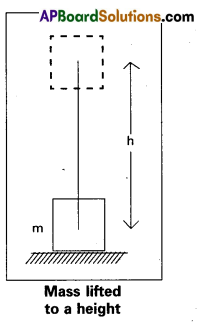
Formula for P.E = mgh : The potential energy is measured by the work done in lifting a body through a height ‘h’ against gravitational force. Consider a body of mass m on the body against gravitational force.
AP Inter 1st Year Physics Study Material Chapter 6 Work, Energy and Power 1
∴ Gravitational force F = Weight of the body
Minimum force needed to lift the body = F in upwards direction
F = mg
Height lifted = h
Work done W = gravitational force × height lifted
W = mgh
This work done is stored as potential energy.
∴ Potential energy P.E = mgh.

Question 2.
A lorry and a car moving with the same momentum are brought to rest by the application of brakes, which provide equal retarding forces. Which of them will come to rest in shorter time ? Which will come to rest in less distance ?
Answer:
F1 = F2 and P1 = P2; W = \(\frac{1}{2}\) mv2 – \(\frac{1}{2}\) mu2; \(\frac{1}{2}\) mu2 = \(\frac{\mathrm{P}^2}{2 \mathrm{~m}}\)
∴ W = F.S = \(\frac{\mathrm{P}^2}{2 \mathrm{~m}}\)
∴ S ∝ \(\frac{1}{m}\)
The heavier body (lorry) comes to rest in shorter time. The lorry will come to rest in less distance.

AP Inter 1st Year Physics Study Material Chapter 6 Work, Energy and Power

Question 3.
Distinguish between conservative and non-conservative forces with one example each.
Answer:
Forces can be classified into two types.

  1. Conservative force,
  2. Non conservative force.

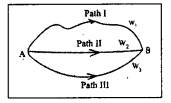
1) Conservative force : Conservative forces are the forces under the action of which a body returns to its starting point with same K.F. with which it is projected work done by conservative force is path independent.
AP Inter 1st Year Physics Study Material Chapter 6 Work, Energy and Power 2
Explanation : If work done along path I, path II, path III are w1, w2, w3 respectively and w1 = w2 = w3 then the force involved in the work is conservative force.
Workdone by a conservative force along a closed path is zero.
Ex. : Gravitational force, electrostatic force, spring force etc.

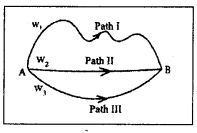
2) Non-conservative force : Non-conservative force are the forces under the action of which the work done depends upon the path followed and the K.E changes work done by non¬conservative force is path dependent.
AP Inter 1st Year Physics Study Material Chapter 6 Work, Energy and Power 3
Explanation : If workdone along path I, path II, path III are w1, w2, w3 respectively and w1 ≠ w2 ≠ w3, then the force involved in the work is non conservative. Workdone by a non conservative force along a closed path is not zero.
Ex. : Frictional force, viscous force etc.

Question 4.
Show that in the case of one dimensional elastic collision, the relative velocity of approach of two colliding bodies before collision is equal to the relative velocity of – separation after collision. [T.S. Mar. 18]
Answer:
Consider two spheres (bodies) which have smooth, non-rotating of masses m1 and m2 (m1 > m2) are moving along the straight line joining the centres of mass with initial velocities u1 and u2 (u1 > u2). They undergo head on collision and move along the same line after collision with final velocities of v, and v2. These two bodies exert forces on each other during collision.
Let the collision be elastic, then both momentum and K.E are conserved.
According to law of conservation of linear momentum, Momentum of the system before collision = Momentum of the system after collision.
m1u1 + m2u2 = m1v1 + m1v2
m1(u1 – v1) = m2 (v2 – u2) ……………….. (1)
According to law of conservation of kinetic energy, K.E of the system before collision = K.E of the system after collision.
\(\frac{1}{2}\)m1u12 + \(\frac{1}{2}\)m2u22 = \(\frac{1}{2}\) m1v12 + \(\frac{1}{2}\)m2v22
m1u12 + m2u22 = m1v12 + m2v22
m1(u12 – v12) = m2(v22 – u22) ……………….. (2)
\(\frac{\text { (2) }}{(1)} \Rightarrow \frac{m_1\left(u_1^2-v_1^2\right)}{m_1\left(u_1-v_1\right)}=\frac{m_2\left(v_2^2-u_2^2\right)}{m_2\left(v_2-u_2\right)}\)
\(\frac{\left(u_1-v_1\right)\left(u_1+v_1\right)}{\left(u_1-v_1\right)}=\frac{\left(v_2-u_2\right)\left(v_2+u_2\right)}{\left(v_2-u_2\right)}\)
(u1 – v1) = u2 + v2
u1 – u2 = v2 – v1
Relative velocity of approach from the above equation before collision = Relative velocity of separation after collision.

AP Inter 1st Year Physics Study Material Chapter 6 Work, Energy and Power

Question 5.
Show that two equal masses undergo oblique elastic collision will move at right angles after collision, if the second body initially at rest.
Answer:
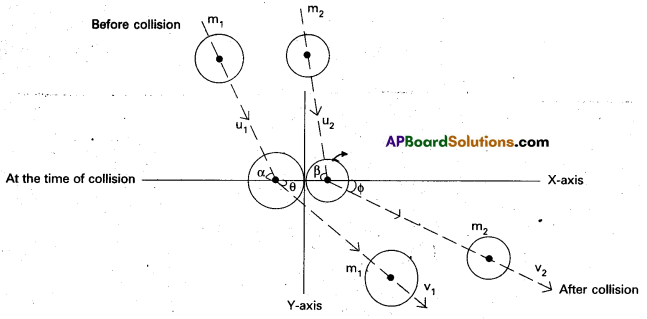
Oblique elastic collision : If the centres of mass of the colliding bodies are not initially moving along the line of impact, then the impact is called oblique collision.

Two equal masses undergo oblique elastic collision will move at right angles after collision, if the second body initially at rest:
AP Inter 1st Year Physics Study Material Chapter 6 Work, Energy and Power 4
Consider two smooth and perfectly elastic spheres of masses m1 and m2. Let u1 and u2 be their initial velocities before collission. Let v1 and v2 be their final velocities after collision, (α, β) and (θ, Φ) are the angles, the directions of motion make with the line of impact before collision and after collision.

Since the spheres are smooth, there is no (impulse) change of velocities perpendicular to the line of impact. Hence the resolved parts of velocity of the two spheres in the direction perpendicular to the line of impact remain unchanged.
∴ v1 sinθ = u1 sinα ……………………. (1)
and v2 sinΦ = u2 sin β …………………. (2)
According to the principle of conservation of momentum, the sum of the moment of the two spheres along the line of impact before collision and after collision are equal.
∴ m1u1 cosα + m2u2 cosβ = m1v1 cosθ + m2v2 cosΦ ……………… (3)
⇒ m1(u1 cosα – v, cosθ) = m2 (v2 cosΦ – u2 cosβ) ……………….. (4)
According to the principle of conservation of kinetic energy, the sum of the K.E along the line of impart before and after are equal.
⇒ \(\frac{1}{2}\) m1 (u1cosα)2 + \(\frac{1}{2}\)m2 (u2cosβ)2 = \(\frac{1}{2}\) m1 (v1cosθ)2 + \(\frac{1}{2}\)m2(v2cos126,Φ)2
⇒ m1 [(u1cosα)2 – (v1cosθ)2 ] = m2 [(v2cosΦ)2 – (u2cosβ)2] …………….. (5)
\(\frac{(5)}{(4)}\) ⇒ u1 cosα + v1 cosθ = v2 cosΦ + u2 cosβ
v1cosθ = v2 cosΦ + u2 cosβ – u1 cosα ……………… (6)
and v2 cosΦ = v1 cosθ + u1 cosα – u2 cosβ ……………….. (7)
sub. equation (7) in equation (3), we get
v1 cosθ = \(\left(\frac{m_1-m_2}{m_1+m_2}\right)\) u1 cosα + \(\left(\frac{2 m_u u_2}{m_1+m_2}\right)\) cosβ ……………… (8)
Sub-equation (6) in equation (3), we get
and v2 cosΦ = \(\left(\frac{m_2-m_1}{m_1+m_2}\right)\) u2 cosβ + \(\left(\frac{2 m_1 u_1}{m_1+m_2}\right)\) cosα ………………. (9)
If u2 = 0 and m1 = m2 then equation (2), we get Φ = 0 and from equation (8), θ = 90°. This means that if a sphere of mass ‘m’ collides obliquely on another perfectly elastic sphere of the same mass at rest, the directions of motions of the spheres after impact will be at right angles.

Question 6.
Derive an expression for the height attained by a freely falling body after ‘n’ number of rebounds from the floor.
Answer:
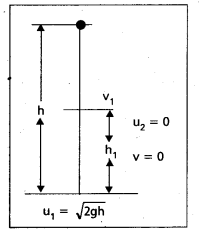
Consider a small sphere fall freely at a height ‘h’ onto the floor. It strikes the floor with a velocity of ‘u’
So that u1 = \(\sqrt{2 g h}\) …………….. (1)
At the time of collision between the sphere and the floor, the initial and final velocities of floor are zero i.e., u2 = 0 and v2 = 0
AP Inter 1st Year Physics Study Material Chapter 6 Work, Energy and Power 5
Let ‘v1‘ be the final velocity of the sphere after the first collision.
∴ e = \(\frac{v_2-v_1}{u_1-u_2}=\frac{0-v_1}{\sqrt{2 g h}-0}=\frac{-v_1}{\sqrt{2 g h}}\)
∴ v1 = -e\(\sqrt{2 g h}\) ……………… (2)
(-) indicates that the sphere rebounds
∴ The height (h1) attained by the sphere after first rebound is
h1 = \(\frac{v_1^2}{2 g}=\frac{(e \sqrt{2 g h})^2}{2 g}\) = e2h
h1 = (e2)1 h ………………… (3)
Similarly we can that velocity attained by the sphere after second rebound.
v2 = -e2 \(\sqrt{2 g h}\) …………………. (4)
and maximum height attained by the sphere after second rebound
h2 = (e2)2 h ………………… (5)
From the (2) and (4) equations
velocity of the sphere rebounds after ‘n’ collisions
vn = en \(\sqrt{2 g h}\)
From the (3) and (5) equations, maximum height attained by the sphere after n rebounds hn = (e2)n h

AP Inter 1st Year Physics Study Material Chapter 6 Work, Energy and Power

Question 7.
Explain the law of conservation of energy.
Answer:
The total mechanical energy of the system is conserved if the forces doing work on it are conservative. If some of the forces involved are non-conservative, part of the mechanical energy may get transformed into other forms such as heat, light and sound. However, the total energy of an isolated system does not change, as long as one accounts for all forms of energy. Energy may be transformed from one form to another but the total energy of an isolated system remains constant. Energy can neither be created, nor destroyed.

Since the universe as a whole may be viewed as an isolated system, the total energy of the universe is constant. If one part of the universe looses energy, another part must gain an equal amount of energy.

Long Answer Questions

Question 1.
Develop the notions of work and kinetic energy and show that it leads to work energy theorem. [A.P. Mar. 17; T.S. Mar. 15, 14]
Answer:
Statement : The change in kinetic energy of a particle is equal to the workdone on it by the net force, i.e., kf – ki = W
Proof : Consider a particle of mass ‘m’ is moving with initial speed ‘u’ to final speed ‘v’. Let ‘a’ be its constant acceleration and S be its distance traversed. The kinematic relation is given by
v2 – u2 = 2as ………………. (1)
Multiplying both sides by \(\frac{\mathrm{m}}{2}\), we have 11
\(\frac{1}{2}\) mv2 – \(\frac{1}{2}\) mu2 mas = FS …………….. (2)
Where the last step follows from Newton’s second law.
We can generalise Equation (1) to three dimensions by employing vectors
v2 – u2 = 2 \(\overrightarrow{\mathrm{a}} \cdot \overrightarrow{\mathrm{d}}\)
Once again multiplying both sides by \(\frac{\mathrm{m}}{2}\), we obtain
\(\frac{1}{2}\) mv2 – \(\frac{1}{2}\) mu2 = m \(\overrightarrow{\mathrm{a}} \cdot \overrightarrow{\mathrm{d}}\) – \(\overrightarrow{\mathrm{F}} \cdot \overrightarrow{\mathrm{d}}\) …………………. (3)
The above equation provides a motivation for the definitions of work and kinetec energy.
In equation (3), \(\frac{1}{2}\) mv2 – \(\frac{1}{2}\) mu2 = kf – ki
Where ki, kf are initial and final kinetic energies and \(\overrightarrow{\mathrm{F}} \cdot \overrightarrow{\mathrm{d}}\) = W, where W refers workdone by a force on the body over a certain displacement.
kf – ki = W ……………….. (4)
Equation (4) is also a special case of the work-energy (WE) theorem.

AP Inter 1st Year Physics Study Material Chapter 6 Work, Energy and Power

Question 2.
What are collisions ? Explain the possible types of collisions ? Develop the theory of one dimensional elastic collision. [T.S. Mar. 18]
Answer:
Collisions : A strong interactions between bodies that occurs for a very short interval during which redistribution of momenta occur ignoring the effect of other forces are called collisions.
Collisions are of two types :
i) Elastic collision : The collision in which both momentum and kinetic energy is constant is called elastic collision.
ii) Inelastic collision: The collision in which momentum remains constant but not kinetic energy is called Inelastic collision.
One dimensional elastic collision : Consider two spheres (bodies) which have smooth, non-rotating of masses m1 and m2 (m1 > m2) are moving along the straight line joining their centres of mass with initial velocities u1and u2 (u1 > u2). They undergo head on collision and move along the same line after collision with final velocities v1 and v2. These two bodies exert forces on each other during collision.
Hence both momentum and kinetic energy are conserved. According to law of conservation of linear momentum.
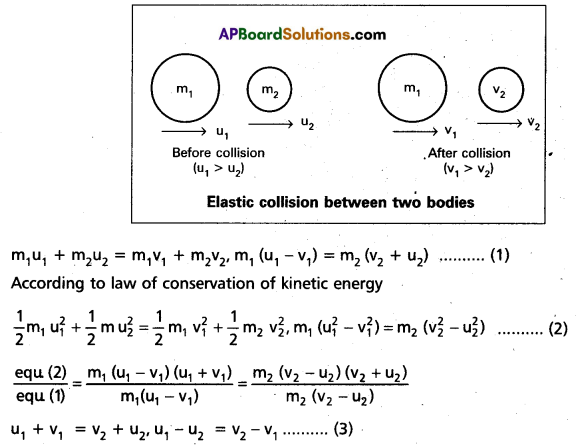
AP Inter 1st Year Physics Study Material Chapter 6 Work, Energy and Power 6
From the above equation, in one dimensional elastic collision, the relative velocity of approach before collision is equal to the relative velocity of separation after collision.
From equation (3) u1 – u2 = v2 – v1, v2 = u1 – u2 + v1 ………………… (4)
Sub equation (4) in equation (1) we get
m1 (u1 – v1) = m2 (u1 – u2 + v1 – u2), m1 u1 – m1v1 = m2 u1 – m2 u2 + m2 v1 – m2 u2
m1 u1 – m2 u1 + 2 m2 u2 = m1 v1 + m2 v1 (m1 – m2) u1 + 2 m2 u2 = (m1 + m2) u1
vi = \(\left(\frac{m_1-m_2}{m_1+m_2}\right) u_1+\left(\frac{2 m_2}{m_1+m_2}\right) u_2\) ………………… (5)
From the equation (4), v1 = v2 – u1 + u2
Sub. this value in equation (1) we get
m1 (u1 – v2 + u1 – u2) = m2 (v2 – u2), m1 u1 – m1 v2 + m1 u1 – m1 u2 = m2 v2 – m2 u2
2m1 u1 + u2 (m2 – m1) = (m2 + m2)v2
v2 = \(\frac{2 m_1 u_1}{\left(m_1+m_2\right)}+\frac{\left(m_2-m_1\right)}{\left(m_1+m_2\right)}\) u2

AP Inter 1st Year Physics Study Material Chapter 6 Work, Energy and Power

Question 3.
State and prove law of conservation of energy in case of a freely falling body. [AP – Mar. ’18, ’16, ’15, ’13; TS – Mar. ’17, ’16]
Answer:
Statement: “Energy can neither be created nor destroyed. But it can be converted from one form to another form. The total energy of a closed system always remains constant”. This law is called law of conservation of energy.

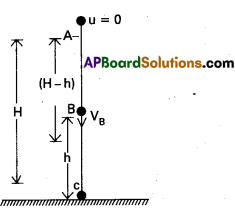
Proof : In case of freely falling body : A body of mass’m’ is dropped or freely falling at a height ‘H‘ from the ground. The total mechanical energy of the body E = K + U.
AP Inter 1st Year Physics Study Material Chapter 6 Work, Energy and Power 7
Where k = kinetic energy; U = potential energy.
Suppose A, B and C are the points at heights H, h and ground respectively.
At ‘A’ : At the highest point, velocity u = 0
Kinetic energy K.E. = \(\frac{1}{2}\) mu2 = 0
Potential energy P.E. = mgH
Total mechanical energy of the body = EA = P.E. + K.E. = mgH + 0
∴ EA = mgH ………………. (1)

At ‘B’: When the body falls from A to B, which is at a height ‘h’ from the ground. The velocity of the body at ‘B’ is VB.
At ‘B’ the body possesses both P.E and K.E
S = H – h
u = 0
a = g
v = vB = ?
vB2 – u2 = 2as
a = g
v = vB = ?
vA2 – 0 = 2g (H – h)
VB = 2g(H – h)
Kinetic energy of the body (K) = \(\frac{1}{2}\) mvB2 = \(\frac{1}{2}\) m 2g(H – h)
K = mg (H – h)
Potential energy (u) = mgh
∴ Total mechanical energy at B = k + u
EB = mg (H – h) + mgH
EB = mgh ……………… (2)

At ‘C’ : When the body reaches the point ‘c’ on the ground. The velocity of the body at ‘c is ‘vc’ can be found by using v2 – u2 = 2as equation.
S = H
u = 0
a = g
v = vc = ?
vc2 – 0 = 2gH
vc2 = 2gH
vc = \(\sqrt{2 \mathrm{gH}}\)
Kinetic energy of the body (k) = \(\frac{1}{2}\) mvc2
= \(\frac{1}{2}\) m 2gH = mgH
Potential energy (u) = 0
Total energy at c = k + u
∴ EC = mgH ………………. (3)
From the above three equations (1), (2) and (3), the mechanical energy of the body remains constant under the action of gravitational force. Hence, law of conservation of energy is proved incase of freely falling body.

Problems

Question 1.
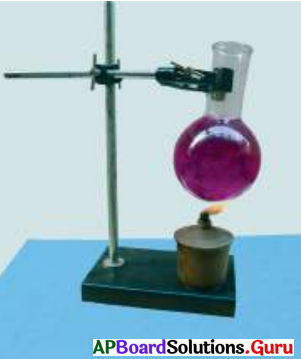
A test tube of mass 10 grams closed with a cork of mass 1 gram contains some ether. When the test tube is heated the cork flies out under the pressure of the ether gas. The test tube is suspended horizontally by a weight less rigid bar of length 5cm. What is the minimum velocity with which the cork should fly out of the tube, so that test tube describing a full vertical circle about the point O. Neglect the mass of ether.
Answer:
Mass of test tube M = 10g; Mass of ether m = 1g ;
Length of rigid bar = radius of circle (r) = 5cm
AP Inter 1st Year Physics Study Material Chapter 6 Work, Energy and Power 8
∴ r = 5 × 10⁻² m, g = 10 ms2
[∴ action = – reaction]
Given the minimum velocity of cork flies out (= -v) (v) = The minimum velocity of test tube right
v = \(\sqrt{5 r g}=\sqrt{5 \times 5 \times 10^{-2} \times 10}\)
= 5 × \(\sqrt{10^{-1}}\) m/s

AP Inter 1st Year Physics Study Material Chapter 6 Work, Energy and Power

Question 2.
A machine gun fires 360 bullets per minute and each bullet travels with a velocity of 600 ms-1. If the mass of each bullet is 5 gm, find the power of the machine gun ? [A.P. – Mar. ’18, ’16; Mar. ’13]
Answer:
Here n = 360; t = 60 sec; V = 600 ms-1; m = 5g = 5 × 10⁻³ kg; Power,
P = \(\frac{\text { K.E of n} \text { bullets }}{t}=\frac{\frac{1}{2} \mathrm{mnV}^2}{t}\)
= \(\frac{\frac{1}{2} \times 5 \times 10^{-3} \times 360 \times 600 \times 600}{60}\)
∴ P = 5400, W = 5.4 KW.

Question 3.
Find the useful power used in pumping 3425 m3 of water per hour from a well 8 m deep to the surface, supposing 40% of the horse power during pumping is wasted. What is the horse power of the engine ?
Answer:
Here V = 3425 m3; d = 103 kg m-3; h = 8m;
g = 9.8ms-2; t = 1 hour = 60 × 60s
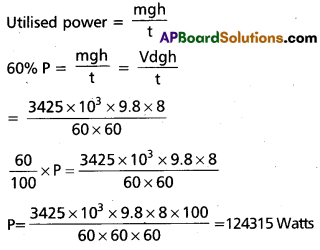
AP Inter 1st Year Physics Study Material Chapter 6 Work, Energy and Power 9
166.6 HP [1 hp = 746 Watt]

Question 4.
A pump is required to lift 600 kg of water per minute from a well 25 m deep and to eject it with a speed of 50 ms-1. Calculate the power required to perform the above task ? [Mar. 16 (TS), A.P (Mar. ’15)
Answer:
Here m = 600kg; h = 25m; V = 50ms-1; t = 60s;
Power of the motor,
P = \(\frac{\mathrm{mgh}+\frac{1}{2} m \mathrm{~V}^2}{\mathrm{t}}=\frac{\mathrm{m}\left(\mathrm{gh}+\frac{\mathrm{V}^2}{2}\right)}{\mathrm{t}}\)
= \(\frac{600}{60}\left(9.8 \times 25+\frac{50 \times 50}{2}\right)\)
= 10 (245 + 1250) = 14950 = 14.95 KW.

AP Inter 1st Year Physics Study Material Chapter 6 Work, Energy and Power

Question 5.
A block of mass 5 kg initially at rest at the origin is acted on by a force along the X-positive direction represented by F = (20 + 5x)N. Calculate the work done by the force during the displacement of the block from x = 0 to x = 4 m.
Answer:
Given m = 5kg;
F = (20 + 5x)
W = \(\int_{x=0}^{x=4} F d x\)
= \(\int_0^4(20+5 x) d x\)
= \([20 x]_0^4+\left[5 \frac{x^2}{2}\right]_0^4\)
= 20 × 4 + 5 × \(\frac{16}{2}\)
= 120 J.

Question 6.
A block of mass 2.5 kg is sliding down a smooth inclined plane as shown. The spring arranged near the bottom of the inclined plane has a force constant 600 N/m. Find the compression in the spring at the moment the velocity of the block is maximum?
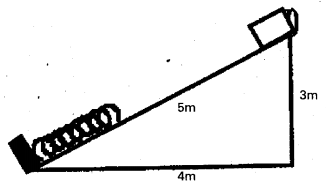
AP Inter 1st Year Physics Study Material Chapter 6 Work, Energy and Power 10
Answer:
Here m = 2.5 kg
µ = 0; K = 600 N/m
Let ‘x’ be the compression of the spring.
According to Newton’s third law, we have
Force due to block on spring
FB = – Restoring force of spring (FR)
In magnitude FB = FR = mg sinθ = Kx
2.5 × 10 × \(\frac{3}{5}\) = 600 × x
⇒ x = \(\frac{15}{600}\)
= 0.025 cm.

Question 7.
A force F = –\(\frac{K}{x^2}\)(x ≠ 0)acts on a particle along the X-axis. Find the work done by the force in displacing the particle from x = C +a to x = +2a. Take K as a positive constant.
Answer:
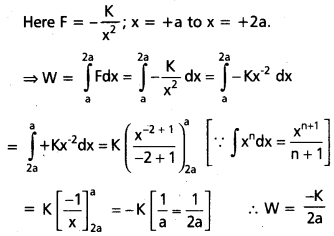
AP Inter 1st Year Physics Study Material Chapter 6 Work, Energy and Power 11

AP Inter 1st Year Physics Study Material Chapter 6 Work, Energy and Power

Question 8.
A force F acting on a particle varies with the position x as shown in the graph. Find the work done by the force in displacing the particle from x = -a to x = +2a.
Answer:
Average force, F = \(\frac{+2 b-b}{2}=\frac{b}{2}\)
⇒ x = -a to x = 2a
W = \(\int_{-a}^{+2 a} F d x=F[x]_a^{+2}=\frac{b}{2}[2 a-(-a)]=\frac{3 a b}{2}\)

Question 9.
From a height of 20m above a horizontal floor, a ball is thrown down with initial velocity 20 m/s. After striking the floor, the ball bounces to the same height from which it was thrown. Find the coefficient of restitution for the collision between the ball and the floor.
Answer:
Here u = 20 mIs; s = h = 20m; g = 10m/s2;
v = u1
using, v2 – u2 = 2as
u12 = 202 = 2 × 10 × 20
u12 = 202 + 400 = 800
∴ u1 = \(\sqrt{800}\)
And v1 = \(\sqrt{2 \mathrm{gh}}=\sqrt{2 \times 10 \times 20}=\sqrt{400}\)
Since floor is at rest u2 = 0; v2 = 0
e = \(\frac{v_2-v_1}{u_1-u_2}=\frac{0-\sqrt{400}}{800-0}=-\frac{1}{\sqrt{2}}\)
∴ e = \(\frac{1}{\sqrt{2}}\) […. -ve sign indicates, if rebounds]

AP Inter 1st Year Physics Study Material Chapter 6 Work, Energy and Power

Question 10.
A Ball falls from a height of 10 m on to a hard horizontal floor and repeatedly bounces. If the coefficient of restitution is \(\frac{1}{\sqrt{2}}\). What is the total distance travelled by the ball before it ceases to rebound ?
Solution:
Given h = 10m; e = \(\frac{1}{\sqrt{2}}\)
d = h\(\left[\frac{1+\mathrm{e}^2}{1-\mathrm{e}^2}\right]=10\left[\frac{1+\frac{1}{2}}{1-\frac{1}{2}}\right]=10\left[\frac{\left(\frac{3}{2}\right)}{1 / 2}\right]\)
∴ d = 30 m

Additional Problems

Question 1.
The sign of work done by a force on a body is important to understand. State carefully if the following quantities are positive or negative:
a) Work done by a man ¡n lifting a bucket out of a well by means of a rope tied to the bucket.
b) Work done by gravitational force in the above case,
c) Work done by friction on a body sliding down an inclined plane,
d) Work done by an applied force on a body moving on a rough horizontal plane with uniform velocity.
e) Work done by the resistive force of air on a vibrating pendulum in bringing it to rest.
Answer:
Workdone W = \(\vec{F} \cdot \vec{S}\) = FS cosθ where θ is smaller angle between force j and displacement \(\vec{S}\).
a) To lift the bucket, force equal to weight of b

b) The bucket moves in a direction opposite to the gravitational force which acts vertically downwards.
θ = 180°
W = FS cos 180° = -FS. It is negative

c) Friction always opposite the relative motion.
∴ θ = 180°, W = FS cos 180° = -FS. It is negative.

d) As the body moves along the direction of applied force θ = 0, W = FS cos 0° = FS. It is positive.

e) The direction of resistive face is opposite to the direction of motion of the bob i.e. θ = 180°. Hence workdone, in this case, is negative.

AP Inter 1st Year Physics Study Material Chapter 6 Work, Energy and Power

Question 2.
A body of mass 2kg initially at rest moves under the action of an applied horizontal force of 7 N on a table with coefficient of kinetic friction = 0.1. Compute the
a) Work done by the applied force in 10s,
b) Work done by friction in 10s,
c) Work done by the net force on the body in 10s.
d) Change in kinetic energy of the body in 10s. and interpret your results.
Answer:
Here, m = 2kg, u = 0, F = 7N; µ = 0.1,
W = 2, t = 10s
Acceleration produced by applied force;
a = –\(\frac{F}{m}=\frac{7}{2}\) = 3.5 m/s2
force of friction, f = µR = µmg = 0.1 × 2 × 9.8 = 1.96 N
Retardation produced by friction
a2 = –\(\frac{F}{m}=\frac{-1.96}{2}\) = 0.98 m/s2
Net acceleration with which body moves,
a = a1 + a2
= 3.5 – 0.98 = 2.52m/s2
Distance moved by the body in 10 second from
S = Ut + \(\frac{1}{2}\) at2
= 0 + \(\frac{1}{2}\) × 2.52 × (10)2 = 126m.
a) Workdone by the applied force = F × S
W1 = 7 × 126 = 882J

b) Workdone by force of friction W2
= -f × s = -1.96 × 126 = 246.9J

c) Workdone by the net force W3 = Net force × distance
= (F – f)s = (7 – 1.96)126 = 635 J.

d) From v = u + at
v = 0 + 2.52 × 10 = 25.2 mS-1
Final K.E = \(\frac{1}{2}\) mv2 = \(\frac{1}{2}\) × 2 × (25.2)2
= 635J
Initial K.E = \(\frac{1}{2}\)mu2 = 0
∴ Change in K.E = 635 – 0 = 635 J.
This shows that change in K.E of the body is equal to workdone by the net force on the body.

Question 3.
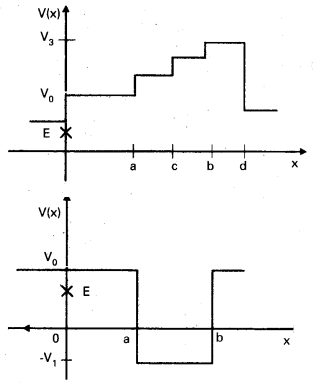
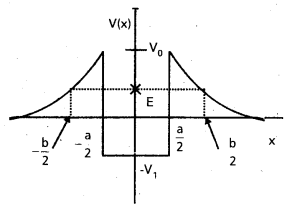
Given in Fig. are examples of some potential energy functions in one dimension. The total energy of the particle is indicated by a cross on the ordinate axis. In each case, specify the regions, if any, in which the particle cannot be found for the given energy. Also, indicate the minimum total energy the particle must have in each case. Think of simple physical contexts for which these potential energy shapes are relevant.
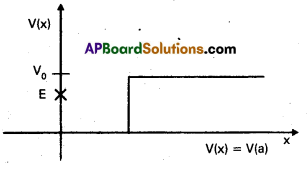
AP Inter 1st Year Physics Study Material Chapter 6 Work, Energy and Power 12
AP Inter 1st Year Physics Study Material Chapter 6 Work, Energy and Power 13
AP Inter 1st Year Physics Study Material Chapter 6 Work, Energy and Power 14
Answer:
We know that total energy E = P.E + K.E (or) K.E = E – P.E and K.E can never be negative. The object cannot exist in the region where its K.E would become negative.

  1. For x > a, P.E (v0) > E
    ∴ K.E becomes negative. Hence the object cannot exist in the region x > a.
  2. For x < a and x > b, P.E (v0) > E
    ∴ K.E becomes negative. Hence the object cannot be present in the region x < a and x > b.
  3. Object cannot exist in any region because P.E (v0) > E in every region.
  4. On the same basis, the object cannot exist in the region -b/2 < x < – a/2 and a/2 < x < b/2.

AP Inter 1st Year Physics Study Material Chapter 6 Work, Energy and Power

Question 4.
To potential energy function for a particle executing linear simple harmonic motion is given by V(x) = kx2/ 2, where k is the force constant of the oscillator. For k= 0.5 N m-1, the graph of V(x) versus x is shown in Fig. Show that a particle of total energy 1 J moving under this potential must ‘turn back’ when it reaches x = ± 2m
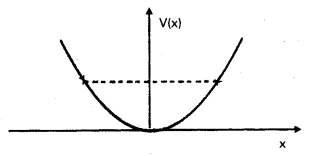
AP Inter 1st Year Physics Study Material Chapter 6 Work, Energy and Power 15
Answer:
At any instant, the total energy of an oscillator is the sum of K.E and P.E i.e.
E = K.E + P.E, E = \(\frac{1}{2}\) mu2 + \(\frac{1}{2}\) kx2
The particles turns back at the instant, when its velocity becomes zero i.e. u = 0.
∴ E = 0 + \(\frac{1}{2}\) kx2 as E = 1 Joule and K = \(\frac{1}{2}\) N/m
∴ 1 = \(\frac{1}{2}\) × \(\frac{1}{2}\) x2 (or) x2 = 4, x = ± 2m.

Question 5.
Answer the following :
a) The casing of a rocket in flight burns up due to friction. At whose expense is the heat energy required for burning obtained ? The rocket or the atmosphere ?
b) Comets move around the sun in highly elliptical orbits. The gravitational force on the comet due to the sun is not normal to the comet’s velocity in general. Yet the work done by the gravitational force over every complete orbit of the comet is zero. Why ?
c) An artificial satellite orbiting the earth in very thin atmosphere loses its energy gradually due to dissipation against atmospheric resistance, however small. Why then does its speed increase progressively as it comes closer and closer to the earth ?
AP Inter 1st Year Physics Study Material Chapter 6 Work, Energy and Power 16
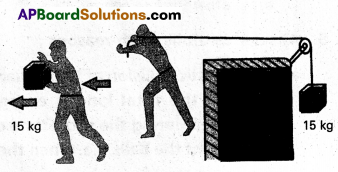
d) In fig. (i) the man walks 2 m carrying a mass of 15 kg on his hands. In Fig. (ii), he walks the same distance pulling the rope behind him. The rope goes over a pulley, and a mass of 15 kg hangs at its other end. In which case is the work done greater ?
Answer:
a) The total energy of a rocket in a flight depends on its mass i.e. P.E + K.E = mgh + \(\frac{1}{2}\) mv2. When the casing burns up, its mass decreases. The total energy of the rocket decreases Hence heat energy required for burning is obtained from the rocket itself and not from the atmosphere.

b) This is because gravitational force is a conservative force. Work done by the gravitational force of the sun over a closed path in every complete orbit of the comet is zero.

c) When the artificial satellite orbiting the earth comes closer and closer to the earth, its potential energy decreases as sum of potential energy and kinetic energy is constant, therefore K.E of satellite and hence its velocity goes on increasing. However total energy of satellite decreases a little on account of dissipation against atmospheric resistance.

d) In fig. (a), force is applied on the mass, by the man in vertically upward direction but distance is moved along the horizontal.
∴ θ = 90°, W = FS cos 90° = zero.
In fig. (b), force is applied along the horizontal and the distance moved is also along the horizontal. Therefore v = 0°.
W = FS cosθ = mg × S cos0°
W = 15 × 9.8 × 2 × 1 = 294 Joule.
workdone in 2nd case is greater.

AP Inter 1st Year Physics Study Material Chapter 6 Work, Energy and Power

Question 6.
Underline the correct alternative :
a) When a conservative force does positive work on a body, the potential energy of the body increases / decreases / remains unaltered.
b) Work done by a body against friction always .results in a loss of its kinetic / potential energy.
c) The rate of change of total momentum of a many-particle system is proportional to the external force / sum of the internal forces on the system.
d) In an inelastic collision of two bodies, the quantities which do not change after the collision are the total kinetic energy/total linear mometum. total energy of the system of two bodies.
Answer:
a) Potential energy of the body decreases. The conservative force does positive work on a body, when it displaces the body in the direction of force. The body, therefore, approaches the center of force, decreasing x. Hence P.E decreases.

b) Workdone by a body against friction at the expense of its kinetic energy. Hence K.E of the body decreases.

c) Internal forces cannot change the total (or) net momentum of a system. Hence the rate of change of total momentum of many particle system is proportional to the external force on the system.

d) In an inelastic collision of two bodies, the quantities which do not change after the collision are total linear momentum and total energy of the system of two bodies. The total K.E changes as some energy appears in other forms.

Question 7.
State if each of the following statements is true or false. Give reasons for your answer.
a) In an elastic collision of two bodies, the momentum and energy of each body is conserved.
b) Total energy of a system is always conserved, no matter what internal and external forces on the body are present.
c) Work done in the motion of a body over a closed loop is zero for every force in nature.
d) In an inelastic collision/the final kinetic energy is always less than the initial kinetic energy of the system.
Answer:
a) False. The total momentum and total energy of the system are conserved and not of each body.
b) False. The external forces on the body may change the total energy of the body.
c) False. Work done in the motion of a body over a closed loop is zero only the body is moving under the action of conservative forces (like gravitational (or) electrostatic faces).
It is not zero when the forces are non conservative, e.g. frictional forces etc.
d) True, because in an inelastic collision, some kinetic energy usually changes into some other form of energy.

Question 8.
Answer carefully, with reasons ;
a) In an elastic collision of two billiard balls, is the total kinetic energy conserved during the short time of collision of the balls (i.e. when they are in contact) ?
b) Is the total linear momentum conserved during the short time of an elastic collision of two balls ?
c) What are the answer to (a) and (b) for an inelastic collision ?
d) If the potential energy of two billiard balls depends only on the separation distance between their centres, is the collision elastic or inelastic ? (Note, we are talking here of potential energy corresponding to the force during collision, not gravitational potential energy).
Answer:
a) No, K.E is not conserved during the given elastic collision. K.E. before and after collision is the same. Infact during collision, K.E of the balls gets converted into potential energy.
b) Yes, the total linear momentum is conserved during the short time of an elastic collision of two balls.
c) In an in elastic collision, total K.E is not conserved during collision.
d) The collision is elastic, because the forces involved are conservative.

AP Inter 1st Year Physics Study Material Chapter 6 Work, Energy and Power

Question 9.
A body is initially at rest. It undergoes one-dimensional motion with constant acceleration. The power delivered to it at time t is proportional to
i) t1/2
ii) t
iii) t3/2
iv) t2
Answer:
From v – u + at, v = 0 + at = at
As power, p = F × v = (ma) × at = ma2t
As m and a are constants, therefore, p ∝ t.

Question 10.
A body is moving unidirectionally under the influence of a source of constant power. Its displacement in time t is proportional to
i) t1/2
ii) t
iii) t3/2
iv) t2
Answer:
As power, P = force × velocity
∴ P = [MLT-2] [LT-1] = [mL2 T-3]
As P = [mL-2 T-3] = constant
∴ L2 T-3 = constant
∴ L2 ∝ T3 (or) L ∝ T3/2
(or) \(\frac{\mathrm{L}^2}{\mathrm{~T}^3}\) = constant

Question 11.
A body constrained to move along the z-axis of a coordinate system is subject to a constant force F given by F = \(-\hat{\mathrm{i}}+2 \hat{\mathrm{j}}+2 \hat{\mathrm{k}}\) N where \(\hat{i}, \hat{j}, \hat{k}\) are unit vectors along the x-, y- and z-axis of the system respectively. What is the work done by this force in moving the body a distance of 4 m along the z-axis ?
Answer:
Here, F = \(-\hat{\mathrm{i}}+2 \hat{\mathrm{j}}+2 \hat{\mathrm{k}}\)N
\(\overrightarrow{\mathrm{S}}=4 \hat{\mathrm{k}}\) (∵ 4m distance is along z-axis)
W = 2; As W = \(\overrightarrow{\mathrm{F}} \cdot \overrightarrow{\mathrm{S}}\)
∴ W = \((-\hat{\mathrm{i}}+2 \hat{\mathrm{j}}+3 \hat{\mathrm{k}}) \cdot(4 \hat{\mathrm{k}})=12 \hat{\mathrm{k}} \cdot \hat{\mathrm{k}}\) = 12J.

AP Inter 1st Year Physics Study Material Chapter 6 Work, Energy and Power

Question 12.
An electron and a proton are detected in a cosmic ray experiment, the first with kinetic energy 10 keV and the second With 100 keV. Which is faster, the electron or the proton ? Obtain the ratio of their speeds, (electron mass = 9.11 × 10⁻³¹ kg, proton mass = 1.67 × 10⁻²⁷ kg, 1 eV = 1.60 × 10⁻¹⁹ J).
Answer:
E1 = \(\frac{1}{2}\) meve2 = 10 × 1.6 × 10-16 ……………… (i)
E2 = \(\frac{1}{2}\) mpvp2 = 100 × 1.6 × 10-16 ……………… (ii)
Divide (i) by (ii) \(\frac{m_v v_v^2}{m_p v_p^2}=\frac{1}{10}\)
\(\frac{v_{\mathrm{e}}}{v_\rho}=\sqrt{\frac{1}{10}} \frac{m \rho}{m_e}\)
= \(\sqrt{\frac{1.67 \times 10^{-27}}{10 \times 9.11 \times 10^{-31}}}=10^2 \sqrt{\frac{1.67}{91.1}}\) = 13.53

Question 13.
A rain drop of radius 2 mm falls from a height of 500 m above the ground. It falls with decreasing acceleration (due to viscous resistance of the air) until at half its original height, it .attains its maximum (terminal) speed and moves with uniform speed thereafter. What is the work done by the gravita-tional force on the drop in the first and second half of its journey ? What is the work done by the resistive force in the entire journey if its speed on reaching the ground is 10 ms-1 ?
Answer:
Here, r = 2mm = 2 × 10⁻³m
Distance moved in each half of journey,
s = \(\frac{500}{2}\) = 250 m
Density of water, ρ = 103 kg/m3
Mass of rain drop
= Volume of drop × Density
m = \(\frac{4}{3}\)πr3 × ρ = \(\frac{4}{3}\) × \(\frac{22}{7}\) (2 × 10⁻³)3 × 103
= 3.35 × 10⁻⁵ kg
w = mg × s = 3.35 × 10-5 × 9.8 × 250 = 0.082J
It should be clearly understood that whether the drop moves with decreasing acceleration (or) with uniform speed, work done by the gravitational force on the drop remains the same.
If there were no resistive forces, energy of drop on reaching the ground.
E1 = mgh = 3.35 × 10-5 × 9.8 × 500 = 0.164J
Actual energy, E2 = \(\frac{1}{2}\) mv2 = \(\frac{1}{2}\) × 3.35 × 10-5 × (10)2 = 1.675 × 10⁻³ J.
∴ Workdone by the resistive forces,
W = E1 – E2 = 0.164 – 1.675 × 10⁻³
W = 0.1623 Joule.

Question 14.
A molecule in a gas container hits a horizontal wall with speed 200 m s-1 and angle 30° with the normal and rebounds with the same speed. Is momentum conserved in the collision ? Is the collision elastic or inelastic ?
Answer:
We know that momentum is conserved in all collisions, elastic as well as inelastic. Let us now check if K. E is conserved (or) not.
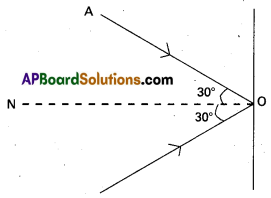
AP Inter 1st Year Physics Study Material Chapter 6 Work, Energy and Power 17+
If the wall is too heavy, the recoiling molecule produces no velocity in the wall.
If m is mass of the gas molecule and M is mass of wall, then total K.E after collision
E2 = – m(200)2 + \(\frac{1}{2}\) M(0)2
E2 = 2 × 10⁴ mJ
Which is the K.E. of the molecule before collision.
[E1 = \(\frac{1}{2}\)m(200)2 = 2 × 10⁴ mJ]
Hence the collision is elastic.

AP Inter 1st Year Physics Study Material Chapter 6 Work, Energy and Power

Question 15.
A pump on the ground floor of a building can pump up water to fill a tank of volume 30 m3 in 15 min. If the tank is 40 m above the ground and the efficiency of the pump is 30%, how much electric power is consumed by the pump ?
Answer:
Here, volume of water = 30 m2, t = 15 min = 15 × 60 = 900s.
height h = 40m, efficiency η = 30%
As density of water = ρ = 103 kg /m3
∴ Mass of water pumped, m = volume x density = 30 × 103 kg
Actual power consumed (or) out power
P0 = \(\frac{\mathrm{w}}{\mathrm{t}}=\frac{\mathrm{mgh}}{\mathrm{t}}\)
= \(\frac{30 \times 10^3 \times 9.8 \times 40}{900}\) = 10370 watt.
If Pi is input power (required), then as η = \(\frac{P_0}{P_i}\)
∴ Pi =\(\frac{P_0}{\eta}=\frac{10370}{\frac{30}{100}}\) = 43567 watt = 43.567 KW.

Question 16.
Two identical ball bearings in contact with each other and resting on a frictionless table are hit head-on by another ball bearing of the same mass moving initially with a speed V. If the collision ¡s elastic, which of the following (Fig.) is a possible result after collision ?
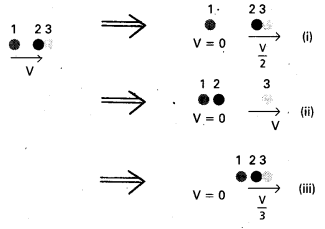
AP Inter 1st Year Physics Study Material Chapter 6 Work, Energy and Power 18
Answer:
Let m be the mass of each ball bearing
Before collision, total K.E of the system =
\(\frac{1}{2}\)mV2 + 0 = \(\frac{1}{2}\) mV2
After collision K.E of the system is
Case I, E1 = \(\frac{1}{2}\) (2m) (V/2)2 = \(\frac{1}{4}\) mV2
Case II, E2 = \(\frac{1}{2}\) mV2
Case III, E3 = – (3m) (V/3)2 = \(\frac{1}{6}\)mV2
We observe that is conserved only in Case II. Hence the Case II is the only possibility.

Question 17.
The bob A of a pendulum released from 30° to the vertical hits another bob B of the same mass at rest on a tables as shown in Fig. How high does the bob A rise after the collision ? Neglect the size of the bobs and assume the collision to be elastic.
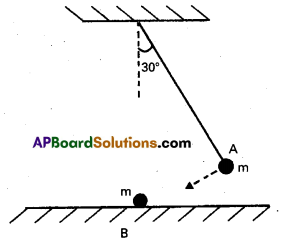
AP Inter 1st Year Physics Study Material Chapter 6 Work, Energy and Power 19
Answer:
The bob A shall not rise. This is because when two bodies of same mass undergo an elastic collision, their velocities are interchanged. After collision, ball a will come to rest and the ball B would move with the velocity of A.

AP Inter 1st Year Physics Study Material Chapter 6 Work, Energy and Power

Question 18.
The bob of a pendulum is released from a horizontal position, If the length of the pendulum is 1.5 m, what is the speed with which the bob arrives at the lowermost point, given that it dissipated 5% of its initial energy against air resistance ?
Answer:
Here, h = 1.5m, V = ?
Energy dissipated = 5%
Taking B as the lowest position of the bob, its potential energy at B is zero. At the horizontal position, A total potential energy of the bob is mgh.
In going from A to B, P.E of the bob is converted into K.E
Energy conserved = 95% (mgh)
If V is velocity acquired at B, then K.E = \(\frac{1}{2}\) mv2
= \(\frac{95}{100}\)mgh
V = \(\sqrt{\frac{95}{100} \times 2 \mathrm{gh}}=\sqrt{\frac{19}{20} \times 2 \times 9.8 \times 1.5}\)
= 5.285ms-1.

Question 19.
A trolley of mass 300 kg carrying a sandbag of 25 kg is moving uniformly with a speed of 27 km/ h oh a frictionless track. After a while, sand starts leaking out of a hole on the floor of the trolley at the rate of 0.05 kg s-1. What is the speed of the trolley after the entire sand bag is empty ?
Answer:
As the trolley carrying the sane bag is moving uniformly, therefore, external force on the system = zero.
When the sand leaks out, it does not lead to the application of any external force on the trolley. Hence the speed of the trolley shall not change.

Question 20.
A body of mass 0.5 kg travels in a straight line with velocity v = ax3/2 where a = 5m-1/2 s-1. What is the workdone by the net force during its displacement from x = 0 to x = 2 m ?
Answer:
Here, m = 0.5 kg; v = ax3/2, a = 5m-1/2 s-1,
w = ?
Intial vel. at x = 0, v1 = a × 0 =0
Final vel, at x = 2, v2 = a23/2 = 5 × 23/2
Workdone = increase in K.E. = \(\frac{1}{2}\) m
(v22 – v12), W = \(\frac{1}{2}\) × 0.5 [(5 × 23/2)2) – 0]
= 50 J

AP Inter 1st Year Physics Study Material Chapter 6 Work, Energy and Power

Question 21.
The blades of a windmill sweep out a circle of area A.
(a) If the wind flows at a velocity v perpendicular to the circle, what is the mass of the air passing through it in time t ?
(b) What is the kinetic energy of the air ?
(c) Assume that the windmill converts 25% of the wind’s energy into electrical energy and that A = 30 m2, v = 36 km/h and the density of air is 1.2 kg m-3. What is the electrical power produced ?
Answer:
a) Volume of wind flowing /sec = AV
Mass of wind flowing / sec = AVρ
Mass of air passing in t sec = AVρt

b) K.E of air = \(\frac{1}{2}\) mv2 = \(\frac{1}{2}\) (AVρt)
v2 = \(\frac{1}{2}\) av3ρt.

c) Electrical energy produced = \(\frac{25}{100}\)
K.E of air = \(\frac{1}{4}\) × \(\frac{1}{2}\) × Av3ρt
Electrical power = \(\frac{1}{8} \frac{A v^3 \rho t}{t}=\frac{1}{8} A v^3 \rho t\)
P = \(\frac{1}{8}\) × 30 × (10)3 × 1.2 = 4500 watt
= 4.5 Kw.

Question 22.
A person trying to lose weight (dieter) lifts a 10kg mass, one thousand times, to a height of 0.5 m ech time. Assume that the potential energy lost each time she lowers the mass is dissipated,
(a) How much work does she do against the gravitational force ?
(b) Fat supplies 3.8 × 10⁷J of energy per kilo-gram which is converted to mechanical energy with a 20% efficiency rate. How much fat will the dieter use up ?
Answer:
Here, m = 10 kg, h = 0.5 m, n = 1000
a) Workdone against gravitational force W = n(mgh)
= 1000 × (10 × 9.8 × 0.5 = 49000 J

b) Mechanical energy supplied by 1 kg of fat
= 3.8 × 10 × \(\frac{20}{100}\) = 0.76 × 10⁷ J/kg
∴ Fat used up by the dieter
= \(\frac{1 \mathrm{~kg}}{0.76 \times 10^7}\) = 4000 = 6.45 × 10⁻³ kg.

Question 23.
A family uses 8 kW of power,
(a) Direct solar energy is incident on the horizontal surface at an average rate of 200 W per square meter. If 20% of this energy can be converted to useful electrical energy, how large an area is needed to supply 8 kW ?
(b) Compare this area to that of the roof of a typical house.
Answer:
Let area be A’ square meter
∴ Total power = 200A
Useful electrical energy produced/sec = \(\frac{20}{100}\)
(200A) = 8KW = 40A = 8000 (watt)
Therefore, A = \(\frac{8000}{40}\) = 200 sq.m
This area is comparable to the roof of a large house of 250 sq.mt.

AP Inter 1st Year Physics Study Material Chapter 6 Work, Energy and Power

Question 24.
A bullet of mass 0.012 kg and horizontal speed 70 ms-1 strikes a block of wood of mass 0.4 kg and instantly comes to rest with respect to the block. The block is suspended from the ceiling by means of thin wires. Calculate the height to which the block rises. Also, estimate the amount of heat produced in the block.
Answer:
Here m1 = 0.012kg. u1 = 70 m/s m2 = 0.4 kg, u2 = 0
As the bullet comes to rest w.r. to the block, the two behave as one body. Let v be the velocity acquired by the combination. Applying principle of conservation of linear momentum, (m1 + m2)v
= m1u1 + m2u2 = m1u1
V = \(\frac{m_1 u_1}{m_1+m_2}=\frac{0.012 \times 70}{0.012+0.4}=\frac{0.84}{0.412}\)
= 2.04 m/s.
Let the block rise to a height h.
RE of combination = K.E. of the combination
(m1 + m2)gh = \(\frac{1}{2}\) (m1 + m2)v2
h = \(\frac{v^2}{2 g}=\frac{2.04 \times 2.04}{2 \times 9.8}\) = 0.212m.
For calculating heat produced. We calculate energy lost (W). where
W = intial K.E of bullet – final K.E of combination
= \(\frac{1}{2}\) m1u12 \(\frac{1}{2}\) (m1 + m2)v2
= \(\frac{1}{2}\) × 0.012 (70)2 – \(\frac{1}{2}\) (0.412) (2.04)2
W = 29.4 – 0.86 = 28.54 Joule.
∴ heat produd. H = \(\frac{W}{j}=\frac{28.54}{4.2}\) = 6.8 cal.

Question 25.
A 1kg block situated on a rough incline is connected to a spring of spring constant 100 N m-1 as shown in Fig. The block is released from rest with the spring in the unstretched position. The block moves 10 cm down the incline before coming to rest. Find the coefficient of friction between the block and the incline. Assume that the spring has a negligible mass and the pulley is frictionless.
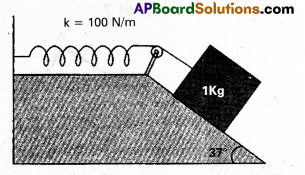
AP Inter 1st Year Physics Study Material Chapter 6 Work, Energy and Power 20
Answer:
From Fig.
R = mg cosθ
F = μR = μmg cosθ
Net force on the block down the incline
= mg sin θ – F = mg sin θ – μ mg cos θ
= mg (sin – μ cos θ)
Distanced moved, x = 10cm = 0.1m.
In equilibrium, work done = P.E of streched spring
mg (sin θ – μ cos θ) x = \(\frac{1}{2}\) Kx2
2mg (sin θ – μ cos θ) = Kx
2 × 1 × 10 (sin 37° – μ cos 37°) = 100 × 0.1
20(0.601 – μ 0.798) = 10
∴ μ = 0.126

AP Inter 1st Year Physics Study Material Chapter 6 Work, Energy and Power

Question 26.
A bob of mass 0.3 kg falls from the ceiling of an elevator moving down with an uniform speed of 7 ms-1. It hits the floor of the elevator (length of the elevator = 3 m) and does not rebound. What is the heat produced by the impact ? Would your answer be different if the elevator were stationary ?
Answer:
Here, m 0.3kg, v = 7 m/s h = length of elevator = 3m
As relative of the bob w.r.t elevator is zero, therefore, in the impact, only potential energy of the fall is converted into heat energy.
Amount of heat produced = P.E lost by the bob = mgh = 0.3 × 9.8 × 3 = 8.82 J.
The answer shall not be different, if the elevator were stationary as the bob too in that cause would start from stationary position, i.e. relative velocity of the ball w.r.t elevator would continue to be zero.

Question 27.
A trolley of mass 200 kg moves with a uniform speed of 36 km / h on a frictionless track. A child of mass 20 kg runs on the trolley from one end to the other (10 m away) with a speed of p m s-1 relative to the trolley in a direction opposite to the its motion and jumps out of the trolley. What is the final speed of the trolley ? Flow much has been trolley moved from the time the child begins to run ?
Answer:
Here, mass of trolley, m1 = 200 kg
speed of the trolley v = 36 km/h = 10m/s
mass of the child, m2 = 20 kg
Before the child starts running, momentum of the system.
P1 = (m1 + m2)v = (200 + 20)10
= 2200kg ms-1.
∴ Momentum of the system when the child is running
P2 = 200v1 + 20 (v1 – 4) = 220v1 – 80
As no external force is applied on the system.
∴ P2 = P1
220v1 – 80 = 2200
220v1 = 2200 + 80 = 2280
v1 = \(\frac{2280}{220}\) = 10.36 ms-1
Time taken by the child to run a distance of 10m over the trolley, t = \(\frac{10 \mathrm{~m}}{4 \mathrm{~ms}^{-1}}\) = 2.5 s
Distance moved by the trolley in this time = Velocity of trolley × time = 10.36 × 2.5 = 25.9 m

Question 28.
Which of the following potential energy curves in Fig. cannot possibly describe the elastic collision of two billiard balls ? Here r is the distance between centres of the balls.
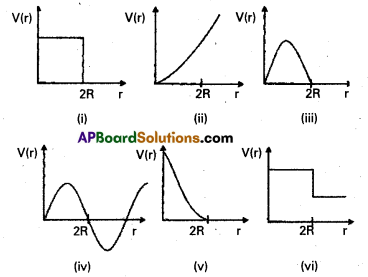
AP Inter 1st Year Physics Study Material Chapter 6 Work, Energy and Power 21
Answer:
The potential energy of a system of two masses varies inversely as the distance (r) between them i.e,
v(r) ∝ \(\frac{\mathrm{1}}{\mathrm{r}}\).
When the two billiard balls touch each other, P.E become zero i.e. at r = R + R = 2R;
v(r) = 0. Out of the given graphs, curve (v) only satisfies these two conditions.

AP Inter 1st Year Physics Study Material Chapter 6 Work, Energy and Power

Question 29.
Consider the decay of a free neutron at rest : n → p + e Show that the two-body decay of this type must necessarily give an electron of fixed energy and, therefore, cannot account for the observed continuous energy distribution in the β-decay of a neutron or a nucleus (Fig.).
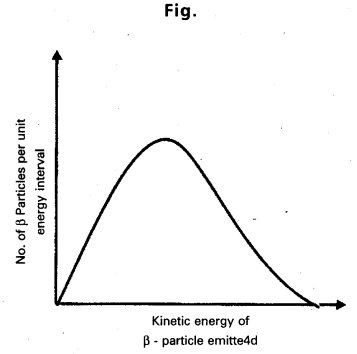
AP Inter 1st Year Physics Study Material Chapter 6 Work, Energy and Power 22
(Note : The simple result of this exercise was one among the several arguments advanced by W. Pauli to predict the existence of a third particle in the decay products of β-decay. This particle is known as neutrino. We now know that it is a particle of intrinsic spin 1/2 (like e-, p or n), but is neutral, and either masslessor having an extremely small mass (compared to the mass of electron) and which interacts very weakly with matter. The correct decay process of neutron is: n → p + e- + v
Answer:
In the decay process, n → p + e
energy of electrons is equal to (∆m)c2
Where ∆m = mass defect = mass of neutron – mass of proton and electron;
which is fixed. Therefore, two body decay of this type cannot explain the observed continuous energy distribution in the β-decay of a neutron or a nucleus.

Textual Examples

Question 1.
Find the angle between force F = \((3 \bar{i}+4 \bar{J}-5 \bar{k})\) unit and displacement d = \((3 \bar{i}+4 \bar{J}-5 \bar{k})\) unit. Also find the projection of F on d.
Answer:
F.d = Fxdx + Fydy + Fzdz = 3(5) + 4(4) + (-5)
(3) = 16 unit
Hence F.d = F d cos θ = 16 unit
Now F.F = F2 – Fx2 + Fy2 + Fz2
= 9 + 16 + 25 = 50 unit
and d.d = d2 = dx2 + dy2 + dz2
= 25 + 16 + 9 = 50 unit
∴ cosθ = \(\frac{16}{\sqrt{50} \sqrt{50}}=\frac{16}{50}\) = 0.32
= θ = cos-1 0.32.

Question 2.
It is well known that a raindrop falls under the influence of the downward gravitational force and the opposing resistive force. The latter is known to be proportional to the speed of the drop but is otherwise undetermined. Consider a drop of mass 1.00 g falling from a height 1.00 km. It hits the ground with a speed of 50.0 ms-1. (a) What is the work done by the gravitational force? What is the work done by the unknown resistive force?
Answer:
(a) The change in kinetic energy of the drop is
∆k = \(\frac{1}{2}\)mv2 – 0
= \(\frac{1}{2}\) × 10-3 × 50 × 50 = 1.25 J
where we have assumed that the drop is initially at rest.
Assuming that g is a constant with a value 10 m/s2, the work done by the gravitational force is,
Wg = mgh = 10-3 × 10 × 10-3 = 10.0 J

(b) From the work-energy theorem
∆K = Wg + Wr
Where Wr is the work done by the resistive force on the raindrop. Thus
Wr = ∆K – Wg = 1.25 – 10 = -8.75 J in negative.

AP Inter 1st Year Physics Study Material Chapter 6 Work, Energy and Power

Question 3.
A cyclist comes to a skidding stop in 10 m. During this process, the force on the cycle due to the road is 200 N and is directly opposed to the motion,
(a) How much work does the road do on the cycle ?
(b) How much work does the cycle do on the road ?
Answer:
Work done on the cycle by the road is the work done by the stopping (frictional) force on the cycle due to the road.
(a) The stopping force and the displacement make an angle of 180° (π rad) with each other.
Thus, work done by the road,
Wr = Fd cosθ = 200 × 10 × cos π
= -2000 J
It is this negative work that brings the cycle to a halt in accordance with WE theorem.

(b) From Newton’s Third Law an equal and opposite force acts on the road due to the cycle. Its magnitude is 200 N. However, the road, undergoes no displacement. Thus work done by cycle on the road is zero.

Question 4.
In a ballistics demonstration a police officer fires a bullet of mass 50.0g with speed 200 ms-1 (Bullet of mass = 5 × 10⁻², Bullet of speed = 200; Bullet of K(J) = 103; on soft plywood of thickness 2.00 cm. The bullet emerges with only 10% of its initial kinetic energy. What is the emergent speed of the bullet ?
Answer:
The initial kinetic energy of the bullet is mv2 / 2 = 1000 J. It has a final kinetic energy of 0.1 × 1000 = 100 J. If vf is the emergent speed of the bullet,
\(\frac{1}{2}\) mv2f = 100 J
vf = \(\frac{\sqrt{2 \times 100 \mathrm{~J}}}{0.05 \mathrm{~kg}}\) = 63.2 ms-1
The speed is reduced by approximately 68% (not 90%).

AP Inter 1st Year Physics Study Material Chapter 6 Work, Energy and Power

Question 5.
A woman pushes a trunk on a railway platform which has a rough surface. She applies a force of 100 N over a distance of 10 m. Thereafter, she gets progressively tired and her applied force reduces linearly with distance to 50 N. The total distance through which the trunk has been moved is 20 m. Plot the force applied by the woman and the frictional force, which is 50 N versus displacement. Calculate the work done by the two forces over 20m.
Answer:
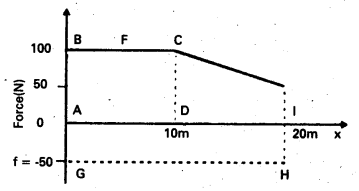
AP Inter 1st Year Physics Study Material Chapter 6 Work, Energy and Power 23
Plot of the force F applied by the woman and the opposing frictional force f versus displacement.
The plot of the applied force is shown in Fig. At x = 20 m, F = 50 N (≠ 0). We are given that the frictional force f is |f| = 50N. It opposes motion and acts in a direction opposite to F. It is therefore, shown on the negative side of the force axis.
The work done by the woman is
WF → area of the rectangle ABCD + area of the trapezium CEID
WF = 1000 × 10 + \(\frac{1}{2}\)(100 + 50) ×10
= 1000 + 750 = 1750 J
The work done by the frictional force is
Wf → area of the rectangle AGHI
Wf → (-50) × 20 = -1000 J
The area on the negative side of the x- axis has a negative sign.

Question 6.
A bob of mass m is suspended by a light string of length L. It is imparted a horizontal velocity v0 at the lowest point A such that it completes a semi circular trajectory in the vertical plane with the string becoming slack only on reaching the topmost point, C. This is shown in Fig. Obtain an expression for (i) v0 (ii) the speeds at points B and C; (iii) the ratio of the kinetic energies (KB/K) at B and C. Comment on the nature of the trajectory of the bob after it reaches the point C.
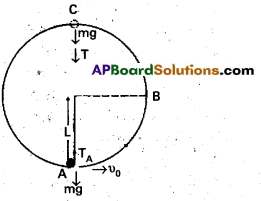
AP Inter 1st Year Physics Study Material Chapter 6 Work, Energy and Power 24
Answer:
Thus, at A:
E = \(\frac{1}{2} {\mathrm{mv}_0^2}\) ………………… (1)
TA – mg = \(\frac{\mathrm{mv}_0^2}{\mathrm{~L}}\) [Newtons Second Law]
where TA is the tension in the string at A. At the highest point C, the string slackens, as the tension in the string (Tc) becomes zero.
E = – \(\frac{1}{2} {\mathrm{mv}_c^2}\) + 2mgL ………………… (2) .
mg = \(\frac{\mathrm{mv}_c^2}{\mathrm{~L}}\) [Newtons Second law] ……………… (3)
where vc is the speed at C. From equations (2) & (3)
E = \(\frac{5}{2}\)mgL
Equating this to the energy at A
\(\frac{5}{2}\) mgL = \(\frac{m}{2} v_0^2\) or, v0 = \(\sqrt{5 \mathrm{gL}}\)

(ii) It is clear from Equation (3)
vc = \(\sqrt{ \mathrm{gL}}\)
At B, the energy is
E = \(\frac{1}{2} m v_B^2\) + mgL
Equating this to the energy at A and empLoying the result from (i),
namely v02 = 5gL
\(\frac{1}{2} m v_B^2+m g L=\frac{1}{2} m v_0^2\)
= \(\frac{5}{2}\)mgl ∴ vB = \(\sqrt{3\mathrm{gL}}\)

(iii) The ratio of the kinetic energies at Band C is :
\(\frac{\mathrm{K}_{\mathrm{B}}}{\mathrm{K}_{\mathrm{C}}}=\frac{\frac{1}{2} m v_{\mathrm{B}}^2}{\frac{1}{2} m v_{\mathrm{c}}^2}=\frac{3}{1}\)
At point C, the string becomes slack and the velocity of the bob is horizontal and to the left.

AP Inter 1st Year Physics Study Material Chapter 6 Work, Energy and Power

Question 7.
To simulate car accidents, auto manufactures study the collisions of moving cars with mounted springs of different spring constants. Consider a typical simulation with a car of mass 1000 kg moving with a speed 18.0 km / h on a smooth road and colliding with a horizontally mounted spring of spring constant 6.25 × 10³ N m1. What is the maximum compression of the spring ?
Answer:
At maximum compression the kinetic energy of the car is converted entirely into the potential energy of the spring.
The kinetic energy of the moving car is 11
K = \(\frac{1}{2}\)mv2 = \(\frac{1}{2}\) × 103 × 5 × 5
K = 1.25 × 10⁴ J
where we have converted 18 km h-1 to 5ms-1 [It is useful to remember that 36 km h-1 = 10 ms-1]. At maximum compression xm, the potential energy. V of the spring is equal to the kinetic energy K of the moving car from the principle of conservation of mechanical energy.
V = \(\frac{1}{2}\) K xm2 = 1.25 × 10⁴ J
We obtain xm = 2.00 m

Question 8.
Consider example 8 taking the coefficient of friction, μ, to be 0.5 and calculate the maximum compression of the spring.
Answer:
In presence of friction, both the spring force and the frictional force act so as to oppose the compression of the spring as shown in Fig.
We invoke the work-energy theorem, rather than the conservation of mechanical energy.
The change in kinetic energy is
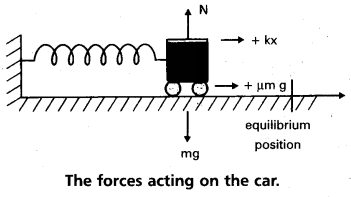
AP Inter 1st Year Physics Study Material Chapter 6 Work, Energy and Power 25
∆K = Kf – Ki = 0 – \(\frac{1}{2}\)mv2
The work done by the net force is
W = \(\frac{1}{2}\)Kxm2 – μm g xm
Equating we have
\(\frac{1}{2}\)mv2 = \(\frac{1}{2}\)K xm2 + μm g xm
Now μmg = 0.5 × 103 × 10 = 5 × 10³ N
(taking g = 10.0 ms-2]. After rearranging the above equation we obtain the following quadratic equation in the unknown xm.
K xm2 + 2μm gxm – mv2 = 0
xm = \(\frac{-\mu m g+\left[\mu^2 m^2 g^2+m k v^2\right]^{1 / 2}}{k}\)
where we take the positive square root since xm is positive. Putting in numerical values we obtain
xm = 1.35 m
which, as expected, is less than the result in example 7
If the two forces on the body consist of a conservative force Fc and a non- conservative force Fnc, the conservation of mechanical energy formula will have to be modified. By the WE theorem
But Hence, (Fc + Fnc) ∆x = ∆K
Fc ∆x = ∆V
∆ (K + V) = Fnc ∆x
∆E = Fnc ∆x
where E is the total mechanical energy. Over the path this assumes the form Ef – Ei = Wnc
Where Wnc is the total work done by the non-conservative forces over the path. Note that unlike the conservative force. Wnc depends on the particular path i to f.

AP Inter 1st Year Physics Study Material Chapter 6 Work, Energy and Power

Question 9.
Examine express
(a) The energy required to break one bond in DNA in eV(1.6 × 10⁻¹⁹J);
(b) The kinetic energy of an air molecule (10-21J) in eV;
(c) The daily in take of a human adult in kilocalories (107).
Answer:
(a) Energy required to break one bond of DNA is \(\frac{10^{-20} \mathrm{~J}}{1.6 \times 10^{-19} \mathrm{~J} / \mathrm{eV}}\) ; 0.06 eV
Note 0.1 eV = 100 meV (100 millielectron volt).

(b) The kinetic energy of an air molecule is
\(\frac{10^{-21} \mathrm{~J}}{1.6 \times 10^{-19} \mathrm{~J} / \mathrm{eV}}\); 0.0062 eV
This is the same as 6.2 meV.

(c) The average human consumption in a day
is \(\frac{10^7 \mathrm{~J}}{4.2 \times 10^3 \mathrm{~J} / \mathrm{kcal}}\); 2400 kcaL

Question 10.
An elevator can carry a maximum load of 1800 kg (elavator + passengers) is moving up with a constant speed of 2ms-1. The frictional force opposing the motion is 4000 N. Determine the minimum power delivered by the motor to the elevator in watts as well as in horse power.
Answer:
The downward force on the elevator is F = mg + Ff = (1800 × 10) + 4000 = 22000 N
The motor must supply enough power to balance this force. Hence,
P = F.v = 22000 × 2 = 44000 W = 59 hp

Question 11.
Slowing down of neutrons : In a nuclear reactor of high speed (typically 107ms-1) must be slowed to 103 ms-1 so that it can have a high probability of interacting with isotope \({ }_{92}^{235} \mathrm{U}\) and causing it to fission. Show that a neutron can lose most of its kinetic energy in an elastic collision with a light nuclei like deuterium or carbon which has a mass of only a few times the neutron mass. The material making up the light nuclei, usually heavy water (D2O) or graphite, is called a moderator.
Answer:
The initial kinetic energy of the neutron is
K1i = \(\frac{1}{2}\) m1 v1i2
While its final kinetic energy from
V1f = \(\frac{\left(m_1-m_2\right)}{m_1+m_2}\) v1i2
K1f = \(\frac{1}{2}\)m1 v12f = \(\frac{1}{2}\)m1 \(\left(\frac{m_1-m_2}{m_1+m_2}\right)^2\) v1i2
The fractional kinetic energy lost is
f1 = \(\frac{K_{1 f}}{k_{1i}}\left(\frac{m_1-m_2}{m_1+m_2}\right)^2\)
while the fractional kinetic energy gained by the moderating nuclei K2f/ K1i is f2 = 1 – f1
elastic collision = \(\frac{4 m_1 m_2}{\left(m_1+m_2\right)^2}\)
One canalso verify this result by substituting from
v2f = \(\frac{2 m_1 v_1i}{m_1+m_2}\)
For deuterium m2 = 2m1 and we obtain f1 = 1/9 while f2 = 8/9. Almost 90% of the neutron’s energy is transferred to deuterium. For carbon f1 = 71.6% and f2 = 28.4%. In practice, however, this number is smaller since head-on collisions are rare.

AP Inter 1st Year Physics Study Material Chapter 6 Work, Energy and Power

Question 12.
Consider the collision depicted in Fig. to be between two billiard balls with equal masses m1 = m2. The first bail is called the cue while the second bail is called the target. The billiard player wants to ‘sink’ the target ball in a corner pocket, which is at an angle θ2 = 37°. Assume that the collision is elastic and that friction and rotational motion are not important. Obtain θ1.
Answer:
From momentum conservation, since the masses are equal
v1i = v1f + v2f
(or) v1i2 = (v1f + v2f). (v1f + v2f)
= v1f2 + V2f2 + 2v1fv2fcos (θ1 + 37°) …………….. (1)
Since the collision is elastic and m1 = m2 it follows from conservation of kinetic energy that
v1i2= v1f2 + v2f2 ………………. (2)
Comparing equations (1) and (2), we get
cos (θ1 + 37°) = 0
or θ1 +37° = 90°
Thus, θ1 = 53°
This proves the following results : When two equal masses undergo a glancing elastic collision with one of them at rest, after the collision, they will move at right angles to each other.

AP Board 7th Class Hindi Solutions 11th Lesson सफलता का मंत्र

SCERT AP Board 7th Class Hindi Solutions 11th Lesson सफलता का मंत्र Textbook Questions and Answers.

AP State Syllabus 7th Class Hindi 11th Lesson Questions and Answers सफलता का मंत्र

7th Class Hindi 11th Lesson सफलता का मंत्र Textbook Questions and Answers

सोचिए-बोलिए
AP Board 7th Class Hindi Solutions 11th Lesson सफलता का मंत्र 1

प्रश्न 1.
चित्र में क्या – क्या दिखाई दे रहे हैं? (చిత్రములో ఏమేమి కనిపించుచున్నవి?)
उत्तर:
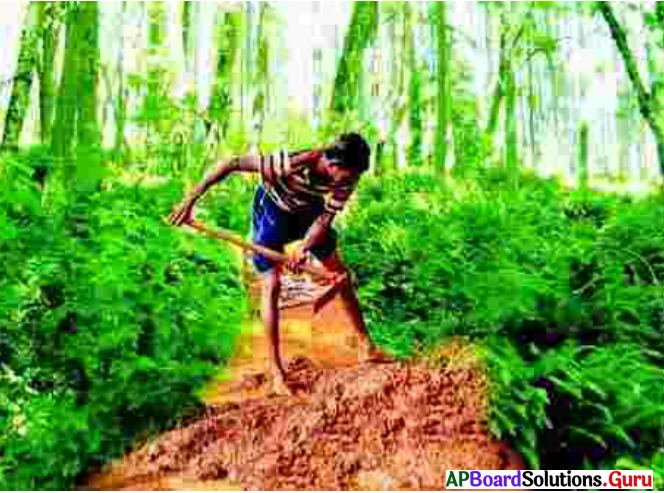
चित्र में एक जंगल,पेड़, पौधे, फूल, एक आदमी, फावडा (कुदाल), सब्बल, मिट्टी, टोकरियाँ, एक औरत आदि दिखाई दे रहे हैं।
(చిత్రంలో ఒక అడవి, చెట్లు, పొదలు, మొక్కలు, పూలు, ఒక మనిషి, పార, మట్టి, తట్టలు, పలుగు, మట్టి, ఒక స్త్రీ మొదలగునవి కనిపించుచున్నవి.)

AP Board 7th Class Hindi Solutions 11th Lesson सफलता का मंत्र

प्रश्न 2.
आदमी क्या कर रहा है? (మనిషి ఏమి చేయుచున్నాడు?)
उत्तर:
आदमी रास्ता बना रहा है।
(మనిషి దారిని ఏర్పాటు చేయుచున్నాడు.)

सफलता का मंत्र (విజయపు మంత్రము)

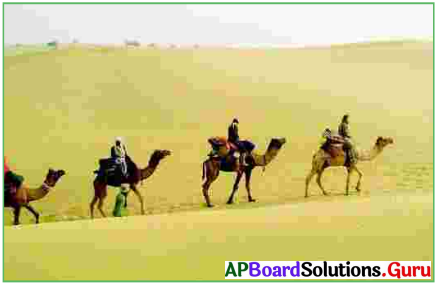
एक बार कुछ व्यापारी अपना माल बेचने रेगिस्तान से गुज़र रहे थे। उनके साथ ऊँट और बैल भी थे। गर्मी के कारण वे दिन में सफ़र नहीं कर पा रहे थे। इसीलिए वे रात के समय यात्रा कर रहे थे। उनके नेता मार्गदर्शक बनकर आगे जा रहे थे। सब उनके पीछे चल रहे थे। अंधेरे के कारण वे रास्ता भटक गये। आखिर जब सबेरा हुआ तब वे वहीं पहुँचे जहाँ से शुरू हुए थे। इससे वे सब दुःखी हुए।
AP Board 7th Class Hindi Solutions 11th Lesson सफलता का मंत्र 2

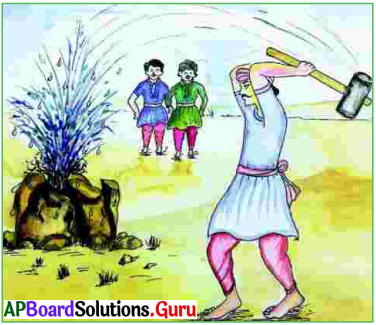
उनके पास एक बूंद पानी तक नहीं था। सब अपने नेता पर चिल्लाने लगे। नेता सोच में पड़ गया। “संकट का धैर्य से सामना करना चाहिए।“ अचानक उसकी नज़र एक घास के तिनके पर पड़ी। उसे लगा कि ज़रूर यहाँ पानी होगा। इसलिए कुछ लोगों की सहायता से वहाँ खोदने लगा। बहुत देर खोदने के बाद वहाँ एक पत्थर दिखाई पड़ा। इसे देखकर सब लोग नेता की निंदा करने लगे।तब नेता ने कहा “दोस्तों, बीच में ही अपना प्रयास नहीं छोड़ना चाहिए। चलो इस पत्थर को लोडेगे।” एक युवक ने उस पत्थर को हथोडे से तोड़ डाला। पत्थर टूटते ही पानी ऊपर आया। इसे देखकर सब खुश हुए सब अपनी प्यास बुझाकर यात्रा के लिए आगे बढ़ गये।

नीति : संकल्प की दृढ़ता से जरूर सफलता मिलती है।
AP Board 7th Class Hindi Solutions 11th Lesson सफलता का मंत्र 3

సారాంశము

ఒకసారి కొంతమంది వ్యాపారస్తులు తమ సరుకులను అమ్ముటకు ఎడారిలో పోవుచుండిరి. వారికి తోడు కొన్ని ఒంటెలు, ఎద్దులు కూడా కలవు. వేసవి కారణముగా వారు తమ యాత్రను పూర్తి చేయలేకపోవుచుండిరి. అందువలన వారు రాత్రి సమయంలో యాత్ర చేయుచుండిరి. వారి నాయకుడు మార్గదర్శకుడిగా ముందు నడుచుచుండెను. అందరూ అతని వెనుక నడుచుచుండిరి. చీకటి కారణముగా వారు దారి తప్పిరి. తెల్లవారగానే యాత్రను వారు ఎక్కడి నుండి ప్రారంభించారో అక్కడికే వచ్చి యుండిరి అందువలన వారందరూ చాలా దు:ఖించిరి.

వారి వద్ద ఒక్క బొట్టు మంచినీరు కూడా లేదు. అందరూ తమ నాయకుణ్ణి తిట్టసాగిరి. నాయకుడు ఆలోచనలో పడెను. ఆపదను ధైర్యముతో ఎదుర్కొనాలి. అకస్మాత్తుగా తన దృష్టి ఒక గడ్డి పరకపై పడెను. తప్పనిసరిగా ఇక్కడ నీళ్ళు ఉంటాయని అతనికి అనిపించెను. అందువలన కొంతమంది సహాయముతో అతడు అక్కడ తవ్వుచుండెను. చాలాసేపు తవ్విన తర్వాత అక్కడ ఒక రాయి కన్పించెను. దీనిని చూసి అందరూ తమ నాయకుణ్ణి నిందించసాగిరి. అప్పుడు నాయకుడు “మిత్రులారా, మధ్యలోనే మన ప్రయత్నము వదలకూడదు. పదండి ఆ రాయిని ముక్కలు చేద్దాం. అని అనెను. ఒక యువకుడు ఆ రాయిని ఒక సమ్మెటతో పగలగొట్టెను. రాయి ఇరిగి పోగానే నీరు పైకి ఉబికినది. దీనిని చూసి అందరూ సంతోషించిరి. అందరూ తమ దాహమును తీర్చుకుని యాత్ర కొరకు ముందుకు సాగిరి. నీతి : సంకల్ప దృఢత్వముతో తప్పనిసరిగా విజయం లభిస్తుంది.

Summary

Once some traders were travelling across a desert to sell their goods. Some camels and oxen were also accompanying them. They were not able to travel due to the summer. So they were travelling during night time. The leader was walking ahead of them as their guide. Others were following him. They lost their way because of the darkness. As it dawned, they arrived at the place where their journey from. So they felt very sad.

They had no water with them even a drop. All of the traders started blaming their leader. The leader was obsessed with thoughts. One should face a problem courageously. All of a sudden a blade of grass caught his attention. He thought that there would certainly be water. He started digging there with the help of some traders. After digging for a long time, a stone was found there. On seeing that stone, the traders started blaming their leader. Then the leader said to them, “Friends, we should not give up our effort in the middle. Let’s go, let’s break the stone into pieces.” A young man broke the stone with a maul. When the stone broke into pieces, water sprang up. All of them felt happy. They quenched their thirst and carried on their travel.

Moral : Success can certainly be achieved by strong willpower.

Intext guestions & Answers

प्रश्न 1.
समस्या का सामना कैसे करना चाहिए? (సమస్యను ఎలా ఎదుర్కొనాలి?)
उत्तर:
समस्या का सामना धैर्य से करना चाहिए।
(సమస్యను ధైర్యంతో ఎదుర్కొనవలెను.)

AP Board 7th Class Hindi Solutions 11th Lesson सफलता का मंत्र

प्रश्न 2.
सफलता प्राप्त करने के लिए क्या करना चाहिए? (విజయము పొందడానికి ఏమి చేయాలి?)
उत्तर:
सफलता प्राप्त करने के लिए दृढ़ संकल्प होना चाहिए।
(విజయము పొందడానికి దృఢ సంకల్పము కావాలి.)

Improve Your Learning

सुनिए-बोलिए

प्रश्न 1.
व्यापारी कहाँ से गुज़र रहे थे? (వ్యాపారస్తులు ఎక్కడి నుండి వెళ్లుచున్నారు?)
उत्तर:
व्यापारी रेगिस्तान से गुज़र रहे थे।
(వ్యాపారస్తులు ఎడారి నుండి వెళ్లుచున్నారు.)

प्रश्न 2.
व्यापारी रास्ता क्यों भटक गये? (వ్యాపారస్తులు ఎందుకు దారి తప్పిరి?)
उत्तर:
व्यापारी अंधेरे के कारण रास्ता भटक गये।
(చీకటి కారణముగా వ్యాపారస్తులు దారి తప్పిరి.)

प्रश्न 3.
सफलता कैसे मिलती है? (విజయము ఎలా లభించును?)
उत्तर:
संकल्प की दृढ़ता से सफलता मिलती है।
(సంకల్ప దృఢత్వముతో విజయము లభించును.)

पढ़िए

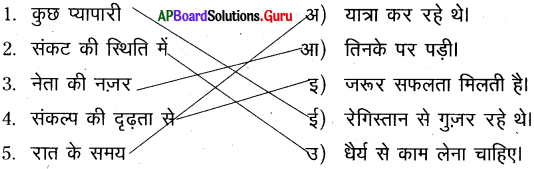
अ) जोड़ी बनाइए।

1. कुछ प्यापारी।ई) रेगिस्तान से गुज़र रहे थे।
2. संकट की स्थिति मेंउ) धैर्य से काम लेना चाहिए।
3. नेता की नज़र।आ) तिनके पर पड़ी।
4. संकल्प की दृढ़ता सेइ) जरूर सफलता मिलती है।
5. रात के समयअ) यात्रा कर रहे थे।

AP Board 7th Class Hindi Solutions 11th Lesson सफलता का मंत्र 4

आ) पाठ में वाक्यों के सही क्रम को पहचानकर क्रम संख्या कोष्ठक में लिखिए।

1. अचानक उसकी नज़र एक तिनके पर पड़ी। [ 3 ]
2. बहुत देर खोदने के बाद वहाँ एक पत्थर दिखाई पड़ा। [ 4 ]
3. कुछ व्यापारी रेगिस्तान से गुज़र रहे थे। [ 1 ]
4. सब अपनी प्यास बुझाकर यात्रा के लिए आगे बढ़े। [ 5 ]
5. इससे वे सब दुःखी हुए। [ 2 ]

AP Board 7th Class Hindi Solutions 11th Lesson सफलता का मंत्र

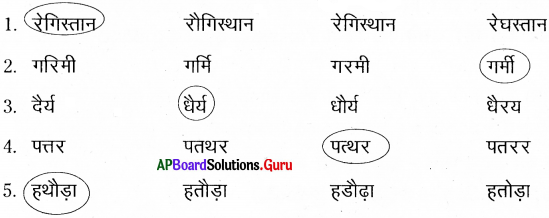
इ) सही वर्तनी वाले शब्दों पर गोला “O” बनाइए।
AP Board 7th Class Hindi Solutions 11th Lesson सफलता का मंत्र 5

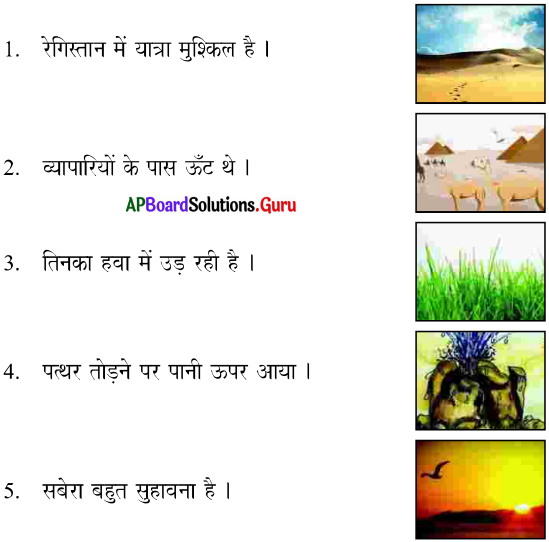
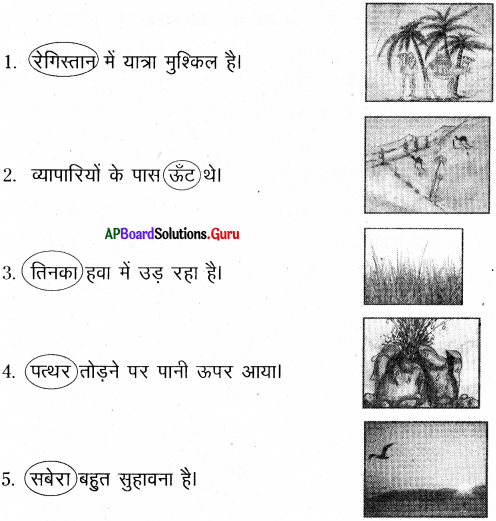
ई) नीचे दिए गए वाक्यों में चित्रों से संबंधित शब्दों पर गोला “O” बनाइए।
AP Board 7th Class Hindi Solutions 11th Lesson सफलता का मंत्र 6
उत्तर:
AP Board 7th Class Hindi Solutions 11th Lesson सफलता का मंत्र 7

लिखिए

अ) नीचे दिये गये प्रश्नों के उत्तर छोटे – छोटे वाक्यों में लिखिए।
క్రింది ఇవ్వబడిన ప్రశ్నలకు సమాధానములు చిన్న – చిన్న వాక్యములలో ఇవ్వండి.

1. रेगिस्तान से कौन गुजर रहे थे? उनके साथ क्या – क्या थे? (ఎడారి గుండా ఎవరెవరు ప్రయాణం చేయుచున్నారు? వారితో ఏమేమి ఉన్నవి?)
उत्तर:
रेगिस्तान से कुछ व्यापारी गुज़र रहे थे। उनके साथ ऊँट और बैल भी थे।
(ఎడారి గుండా కొంతమంది వ్యాపారస్తులు ప్రయాణం చేయుచుండిరి. వారితో ఒంటెలు, ఎద్దులు కూడా ఉన్నవి.)

2. व्यापारी किस समय यात्रा कर रहे थे? (వ్యాపారస్తులు ఏ సమయంలో యాత్ర చేయుచుండిరి?)
उत्तर:
व्यापारी रात के समय यात्रा कर रहे थे।
(వ్యాపారస్తులు రాత్రి సమయంలో యాత్ర చేయుచుండిరి.)

3. नेता की नज़र किस पर पड़ी थी? उसने क्या किया? (నాయకుని దృష్టి దేనిపై పడినది? అతడు ఏమి చేసెను?)
उत्तर:
नेता की नजर एक घास के तिनके पर पडी। उसने कुछ लोगों की सहायता से वहाँ खोदने लगा।
(నాయకుని దృష్టి ఒక గడ్డిపూచపై పడినది. అతడు కొంతమంది సహాయంతో అక్కడ త్రవ్వసాగాడు.)

AP Board 7th Class Hindi Solutions 11th Lesson सफलता का मंत्र

आ) नीचे दिये गये प्रश्न का उत्तर पाँच – छह वाक्यों में लिखिए।
క్రింది ఇవ్వబడిన ప్రశ్నకు సమాధానము 5 -6 వాక్యములలో వ్రాయండి.)

1. “सफलता का मंत्र पाठ का सारांश अपने शब्दों में लिखिए। (‘విజయానికి మంత్రం’ అను పాఠం సారాంశం మీ మాటల్లో వ్రాయండి.)
उत्तर:
कुछ व्यापारी माल लेकर रेगिस्तान से जा रहे थे। अंधेरे के कारण रास्ता भटक गये। इससे वे दुःखी हुए। उनके पास पीने का पानी भी नहीं था। नेता सोच में पड़ गया। संकट का धैर्य से सामना करने का निश्चय किया। अचानक उसकी नज़र एक तिनके पर पड़ी । खोदने पर वहाँ एक पत्थर दिखाई पड़ा। पत्थर को हथौड़े से तोड़ा। पत्थर के टूटते ही पानी ऊपर आया। संकल्प की दृढता से सफलता मिलती है।
(కొంతమంది వ్యాపారస్తులు సరకు తీసుకొని ఎడారి గుండా వెళ్ళుచుండెను. చీకటి కారణంగా వారు దారి తప్పిరి. దీని కారణంగా వారు బాధపడిరి. వారి వద్ద త్రాగుటకు నీరు కూడా లేదు. వారి నాయకుడు ఆలోచనలో పడెను. ఆపదను ధైర్యముతో ఎదుర్కొనుటకు నిశ్చయించుకొనెను. అకస్మాత్తుగా తన దృష్టి ఒక గడ్డిపూచపై పడెను. త్రవ్వగా అక్కడ ఒక రాయి కనబడినది. రాతిని సమ్మెటతో పగలకొట్టిరి. రాయి పగిలిపోగానే నీరు పైకి ఉబికి వచ్చినది. సంకల్ప దృఢత్వంతో ‘విజయం లభించును.)

इ) उचित शब्दों से खाली जगह भरिए।

1. गर्मी के कारण व्यापारी दिन में सफ़र नहीं कर पा रहे थे। (सर्दी/ गर्मी)
उत्तर:
गर्मी

2. अंधेरे के कारण वे ……… भटक गये। (रास्ता/ सड़क)
उत्तर:
रास्ता

3. व्यापारियों के पास ………. नहीं था। (गाडी/ पानी)
उत्तर:
पानी

4. संकट का सामना ……… से करना चाहिए। (धैर्य/ अधैर्य)
उत्तर:
धैर्य

5. बीच में कभी भी ………. नहीं छोड़ना चाहिए। (काम/ प्रयास)
उत्तर:
प्रयास

ई) पाठ में आये शब्दों के आधार पर वाक्य लिखिए।
AP Board 7th Class Hindi Solutions 11th Lesson सफलता का मंत्र 8
उत्तर:
2. मछली पानी में तैरती है।
3. रास्ते में मैं अपने दोस्त से मिलता हूँ।
4. संकट की स्थिति में धैर्य से रहना चाहिए।
5. वह एक व्यापारी है।
6. हम गर्मी में सफर नहीं कर सकते।
7. उसकी नजर एक तिनके पर पड़ी।

AP Board 7th Class Hindi Solutions 11th Lesson सफलता का मंत्र

उ) वर्ण विच्छेद कीजिए।

1. चिल्लाना : च + इ + ल् + ल् + आ + न् + आ

2. रेगिस्तान : ………………….
उत्तर:
र + ए + ग् + इ + स् + त् + आ + न् + अ

3. धैर्य : ……………………….
उत्तर:
ध् + ऐ + र् + य् + अ

4. संकल्प : ………………………
उत्तर:
स् + अं + क् + अ + ल् + प् + अ

5. पत्थर : ………………………
उत्तर:
प् + अ + त् + थ् + अ + र् + अ

भाषांश

अ) अंत्याक्षरी विधि के अनुसार नीचे दिये गये शब्दों के आधार पर चार शब्द बनाइए।

1. पानी – नीरज – जलज – जमाना – नाम – मगर

2. तिनका – ………………………….
उत्तर:
कायर – रत्न – नाराज़ – जहाज

3. सहायता – ………………………….
उत्तर:
ताल – लडना – नारा – राहत

4. अचानक – ………………………….
उत्तर:
काक – कविता – तैयार – रामायण

5. सफ़र – ………………………….
उत्तर:
रक्षक – कैलास – सवारी – रौनक

आ) पर्यायवाची शब्द लिखिए।

1. माल = कीमती वस्तु, रुपया

2. सबेरा = ……………………………..
उत्तर:
सुबह, प्रातःकाल

3. शुरु = ……………………………..
उत्तर:
प्रारंभ, आरंभ

4. नज़र = ……………………………..
उत्तर:
दृष्टि, निगाह

5. पानी = ……………………………..
उत्तर:
जल, नीर

इ) विलोम शब्द लिखिए।

1. दिन × रात
2. आगे × पीछे
3. अंधेरा × उजाला
4. सबेरा × शाम
5. बेचना × खरीदना

सृजनात्मकता

अ) चित्र देखकर वाक्य लिखिए।
AP Board 7th Class Hindi Solutions 11th Lesson सफलता का मंत्र 9
AP Board 7th Class Hindi Solutions 11th Lesson सफलता का मंत्र 10
उत्तर:
AP Board 7th Class Hindi Solutions 11th Lesson सफलता का मंत्र 11

आ) परियोजना कार्य :

सफ़लता से संबंधित एक छोटी सी कहानी लिखिए। (సఫలతకు సంబంధించిన ఒక చిన్న కథను వ్రాయండి.)
उत्तर:
कनौज शहर में एक बहुत ही साधारण बच्चा रहता था। जिसका नाम था भोलू। वह नाम से भी भोला था। जिस स्कूल में वह पढ़ता था, वहाँ के सभी बच्चे उसे मंदबुद्धि कहकर चिढ़ाते थे। एक दिन वह कुएँ के पास बैठा था। तभी उसकी नज़र पत्थर पर पडे निशान की ओर गई।

उसने सोचा जब कठोर पत्थर पर निशान बन सकते हैं तो मुझे भी विद्या आ सकती है। विद्यालय में वह मंदबुद्धि कहलाता था। उसके अध्यापक उससे नाराज़ रहते थे। उसके बुद्धि का स्तर औसत से भी
कम था। कक्षा में उसका प्रदर्शन सदैव निराशाजनक ही होता था।

अपने सहपाठियों के मध्य वह उपहास का विषय था। विद्यालय में वह जैसे ही प्रवेश करता चारों ओर बाणों की बौछार सी होने लगती। इन सब बातों से परेशान होकर उसने पाठशाला आना ही छोड़ दिया।

एक दिन वह मार्ग में भ्रमण कर रहा था। घूमते हुए उसे जोरों की प्यास लगी। वह इधर – उधर पानी खोजने लगा। अंत में उसे एक कुआँ दिखाई दिया। वह वहाँ गया और पानी पिया। वह पानी पीने के बाद थोडी देर वहीं बैठ गया।

उसकी दृष्टि पत्थर पर पडे उस निशान पर पड़ी जिस पर बार – बार पानी खींचने से इतने कठोर पत्थर पर रस्सी के निशान पड़ सकते हैं, तो निरंतर अभ्यास से मुझे भी विद्या आ सकती है। उसने यह विचार गांठ में बाँध लिया और पाठशाला जाना आरंभ कर दिया। उसकी लगन देखकर अध्यापकों ने भी उसे सहयोग दिया।

उसने मन लगाकर अधिक परिश्रम किया। कुछ सालों के बाद यहीं विद्यार्थी संस्कृत का एक महान लेखक साबित हुआ।

AP Board 7th Class Hindi Solutions 11th Lesson सफलता का मंत्र

इ) अनुवाद कीजिए।

1. सफ़र करने से मज़ा आता है।
उत्तर:
सफ़र करने से मज़ा आता है। యాత్ర చేయుట వలన ఆనందంగా ఉంటుంది.

2. संकट स्थिति में सोचना चाहिए।
उत्तर:
संकट स्थिति में सोचना चाहिए। కష్టస్థితిలో ఆలోచించవలెను.

3. आँखों में तिनका आ गिरा।
उत्तर:
आँखों में तिनका आ गिरा। కండ్లలో నలక వచ్చి పడినది.

4. नेता सबका आदर्श होता है।
उत्तर:
नेता सबका आदर्श होता है। నాయకుడు అందరికీ ఆదర్శంగా ఉంటాడు.

5. प्रयास के कारण सफलता मिलती है।
उत्तर:
प्रयास के कारण सफलता मिलती है। ప్రయత్నము (కృషి) కారణముగా విజయం లభించును.

व्याकरणांश

1. नेता आगे जा रहे थे।
2. अंधेरे के कारण वे रास्ता भटक गए
3. वे सब अपने नेता पर चिल्लाने लगे
4. पत्थर टूटते ही पानी ऊपर आया
5. सभी लोगों ने अपनी प्यास बुझाई

उपर्युक्त वाक्यों में रेखांकित शब्द किसी के द्वारा किए जानेवाले काम को सूचित करते हैं।
परिभाषा : जिस शब्द से किसी काम के होने या करने का बोध हो, उसे क्रिया कहते हैं।
उदा : पढ़ना, चलना, दौड़ना, बैठना, खाना, लिखना आदि।

अ) निम्न लिखित वाक्यों में क्रिया शब्द को रेखांकित कीजिए।

1. सरिता कविता लिखती है।

2. लड़के मैदान में खेल रहे हैं।
उत्तर:
लड़के मैदान में खेल रहे हैं।

3. वासू घर में खाना खाता है।
उत्तर:
वासू घर में खाना खाता है।

4. मोर नाचता है।
उत्तर:
मोर नाचता है।

AP Board 7th Class Hindi Solutions 11th Lesson सफलता का मंत्र

आ) वाक्यों में क्रिया शब्दों को पहचान कर लिखिए।

1. सरला गाड़ी चलाती थी।
उत्तर:
चलाती

2. रवि घर में खाना खाता था।
उत्तर:
खाता

3. पिताजी आज बाज़ार जाते हैं।
उत्तर:
जाते

4. वह टी.वी. में सिनेमा देखती है।
उत्तर:
देखती

इ) नीचे दिये गये क्रिया शब्दों का वाक्यों में प्रयोग कीजिए।

1. चढ़ना : लडका पेड़ पर चढ़ता है।

2. तैरना : ……………………….
उत्तर:
तैरना : मछली पानी में तैरती है।

3. बोलना : ………………………..
उत्तर:
बोलना : हम मात्रुभाषा में बोलते हैं।

4. हँसना : ………………………..
उत्तर:
हँसना : बच्चे बात – बात में हँसते हैं।

5. सुनना : ………………………
उत्तर:
सुनना : हमें पहले सुनना चाहिए।

अध्यापकों के लिए सूचना : ఉపాధ్యాయులకు సూచన :

बच्चों को कुछ अन्य जातक कथाएँ सुनाइए। (పిల్లలకు కొన్ని అన్య జాతక కథలను వినిపించండి.)
उत्तर:
जातक कथा :
काल बाहु : एक बार किसी ने दो तोते – भाइयों को पकडकर एक राजा को भेंट में दिया। तोतों के गुण और वर्ण से प्रसन्न हो राजा ने उन्हें सोने के पिंजरे में रखा। उनका यथोचित सत्कार करवाया और प्रतिदिन शहद और भुने मक्के का भोजन करवाता रहा। उन तोतों में बडे का नाम राधा और छोटे का नाम पोट्टापाद था।

एक दिन एक वनवासी राजा को एक काले, भयानक बडे – बडे हाथोंवाला एक लंगूर भेंट में दिया गया। वह लंगूर सामान्यतः एक दुर्लभ प्राणी था। इसलिए लोग उस विभन्न प्राणी को देखने को टूट पडते। लंगूर के आसमान से तोतों के प्रति लोगों का आकर्षण कम होता गया और उनके सरकार का भी।

लोगों के बदलते रुक से खिन्न हो पोट्टपाद खुद को अपमानित महसूस करने लगा और रात में उसने अपने मन की पीडा राधा को सुनाई। राधा ने अपने छोटे भाई को ढाढस बंधाते हुए समझाया, “भाई चिंतित न हो, गुणों की सर्वत्र पूजा होती है। शीघ्र ही इस लंगूर के गुण दुनियावालों के सामने, प्रकट होंगे और तब लोग उससे विमुख हो जाएँगे।”

कुछ दिनों के बाद ऐसा ही हुआ जब नन्हें राजकुमार उस लंगूर से खेलना चाहते थे। तो लंगूर अपना भयानक मुख फाड, दाँते किटकिटा कर इतनी जोर से डराया कि वे चीख – चीख कर रोने लगे। बच्चों के भय और रूदन की सूचना जब राजा के कानों पर पड़ी तो उसने तत्काल ही लंगूर को जंगल में छुडवा दिया।

उस दिन के बाद से राधा और पोट्टपाद की आवभगत फिर से पूर्ववत होती रही।

पाठ का सारांश

कुछ व्यापारी माल लेकर रेगिस्तान से जा रहे थे। अंधेरे के कारण रास्ता भटक गये। इससे वे दुःखी हुए। इनके पास पीने का पानी भी नहीं था। नेता सोच में पड़ गया। संकट का धैर्य से सामना करने का निश्चय किया। अचानक उसकी नज़र एक तिनके पर पड़ी खोदने पर वहाँ एक पत्थर दिखाई पड़ा। पत्थर को हथौड़े से तोड़ा| पत्थर के टूटते ही पानी ऊपर आया। संकल्प की दृढता से सफलता मिलती है।

పాఠ్య సారాంశం

కొంతమంది వ్యాపారస్తులు సరుకు తీసుకుని ఎడారి గుండా వెళ్ళుచున్నారు. చీకటి కారణంగా వారు దారి తప్పిరి. దీని కారణంగా వారు బాధపడిరి. వారి వద్ద త్రాగుటకు నీరు కూడా లేదు. వారి నాయకుడు ఆలోచనలో పడెను. ఆపదను ధైర్యముతో ఎదుర్కొనుటకు నిశ్చయించుకొనెను. అకస్మాత్తుగా తన దృష్టి ఒక గడ్డిపూచపై పడెను. త్రవ్వగా అక్కడ ఒక రాయి కనబడినది. రాతిని సమ్మెటతో పగలకొట్టిరి. రాయి పగిలిపోగానే నీరు పైకి ఉబికి వచ్చినది. సంకల్ప దృఢత్వంతో విజయం లభించును.

Summary

Some traders were travelling across a desert. They lost their way due to the darkness. They felt sad for this. They had no water either with them. Their leader was obsessed with thoughts. He resolved to face the problem with courage. All of a sudden a blade of grass caught his attention. On digging, a stone was found there. It was broken with a maul. When the stone broke into pieces, water sprang up. Success can be achieved by strong will power.

व्याकरणांश (వ్యాకరణాంశాలు)

लिंग बदलिए (లింగములను మార్చండి)

आदमी – औरत
ऊँट – ऊँटनी
युवक – युवती
गाय – बैल
लोमडी – लोमडा
गधा – गधी
बंदर – बंदरिया
सुत – सुता
सदस्या – सदस्य
हाथी – हथिनी
वर – वधु
साध्वी – साधु

AP Board 7th Class Hindi Solutions 11th Lesson सफलता का मंत्र

वचन बदलिए (వచనములను మార్చండి)

चित्र – चित्र
आदमी – आदमी
रास्ता – रास्ते
निर्णय – निर्णय
संकल्प – संकल्प
कहानी – कहानियाँ
दिन – दिन
संकट – संकट
तिनका – तिनके
पत्थर – पत्थर
खुश – खुश
खुशी – खुशियाँ

विलोम शब्द (వ్యతిరేక పదములు)

दृढ़ × अदृढ़
कठिन × कोमल
पूरा × अधूरा
गर्मी × सर्दी
दिन × रात
आगे × पीछे
अंधेरा × उजाला
सबेरा × शाम
शुरु × अंत
दुखी × सुखी
निंदा × प्रशंसा/स्तुति
सहायता × निस्सहायता
युवक × बूढ़ा
खुश × दुःख
सफलता × असफलता

शब्दार्थ (అర్థాలు) (Meanings)

संकल्प = दृढ़ निश्चय, దృఢ నిశ్చయము, strong
सफर = यात्रा, యాత్ర, travel
आखिर = अंत में, చివరికి, at last
सबेरा = सुबह, ఉదయం, morning
भटकना = रास्ता भूल जाना, దారి మరిచిపోవుట, forget the way
गुज़रना = जाना, వెళ్ళుట, to go
माल = चीजें, वस्तु, సరకులు, goods
रात = निशि, రాత్రి, night
नेता = नायक, నాయకుడు, leader decision
शुरु = आरंभ, ప్రారంభము, beginning
संकट = विपत्ति, ఆపద, problem
अचानक = अकस्मात, అకాస్మాత్తుగా, suddenly
नज़र = दृष्टि, దృష్టి, sight
जरूर = अवश्य, తప్పనిసరిగా, compulsory
सहायता = मदद, సహాయము, help
दोस्त = मित्र, స్నేహితుడు, friend
प्रयास = प्रयत्न, ప్రయత్నం, effort
खुश = संतोष, సంతోషం, happiness

AP Board 7th Class Hindi Solutions 11th Lesson सफलता का मंत्र

श्रुत लेख : శ్రుతలేఖనము : Dictation

अध्यापक या अध्यापिका निम्न लिखित शब्दों को श्रुत लेख के रूप में लिखवायें। छात्र अपनी-अपनी नोट पुस्तकों में लिखेंगे। अध्यापक या अध्यापिका इन्हें जाँचे।
ఉపాధ్యాయుడు లేదా ఉపాధ్యాయిని క్రింద వ్రాయబడిన శబ్దములను శ్రుతలేఖనంగా డిక్టేట్ చేయును. విద్యార్థులు వారి వారి నోట్ పుస్తకాలలో వ్రాసెదరు. ఉపాధ్యాయుడు లేదా ఉపాధ్యాయిని వాటిని దిద్దెదరు.
AP Board 7th Class Hindi Solutions 11th Lesson सफलता का मंत्र 12

AP 7th Class English Important Questions Unit 5 The Art of Weaving

These AP 7th Class English Important Questions 5th Lesson The Art of Weaving will help students prepare well for the exams.

AP Board 7th Class English Unit 5 Important Questions and Answers The Art of Weaving

Reading Comprehension (Seen)

1. Read the following passage carefully.

We went to Mangalagiri, one of the famous towns in the Guntur District, along with our English teacher on a case study.

First, we consulted a master W&1V€1’, Veertfatf, for the details “where to go?”, “whom to meet?” Mr. Veeraiah cordially welcomed us. He said “Mangalagiri is famous for its sarees and fabrics produced by handicraft weaving. Many families live on the art of weaving here.” (The Art of Weaving)

Now, answer the following questions.
1. What was the case study about?
Answer:
The case study was about the handlooms in Mangalagiri.

2. Who helped the students?
Answer:
Veeraiah

3. What was Veeraiah?
Answer:
A master weaver

4. What is Mangalagiri famous for?
Answer:
Mangalagiri is famous for its sarees and fabrics produced by handicraft weaving.

5. Who took the students to Mangalagiri?
Answer:
Their English teacher

AP 7th Class English Important Questions Unit 5 The Art of Weaving

2. Read the following passage carefully.

We asked him, “Could you please tell us about the fabric of Mangalagiri?” He expressed his gratitude for our concern for them and responded most positively:

“This fabric is the product of weaving with the help of pit looms. It takes much time to weave and requires a lot of patience to prepare everything ready. Mangalagiri sarees are special for their quality and the process we follow. The quality of fabric depends upon the yarn we use. Generally, we purchase cotton yarn from different mills from our state and Jari from Surath, Maharashtra.”

“Sir, can you explain how you begin the process of weaving?” asked one of our classmates.

Veeraiah said, “First, the yarn is boiled in the water, mixed with caustic soda, for a couple of hours and also bleached to make it suitable for dyeing”. (The Art of Weaving)
Now, answer the following questions.
1. Who explained the things to students?
Answer:
Mr. Veeraiah, a master weaver

2. What does the making of this fabric require?
Answer:
It requires a lot of patience.

3. What is the speciality of Mangalagiri sarees?
Answer:
They are special for the quality.

4. What does the quality depend on?
Answer:
It depends on the yarn they use.

5. What is the first step in the process of weaving? .
Answer:
First, the yarn is boiled in the water, mixed with caustic soda, for a couple of hours and also bleached to make it suitable for dyeing.

3. Read the following passage carefully.

While we were going on the streets of Mangalagiri, we met another weaver Sambayya who was selling handloom sarees. We asked him, “Why is the fabric produced in Mangalagiri special from other fabrics?”

His enthusiasm was evidently seen when he said, “The Nizam design is a unique characteristic feature of this fabric. The uniqueness of Mangalgiri cotton is because of its durability. The fabric is woven only on a pit loom, and there are no gaps on the weave towards the edges of the fabric along with the fact that it is created in Mangalgiri alone. The body and the pallu are embellished with zari or golden thread work with a Nizam boarder and geometrical and simple designs. (The Art of Weaving)

Now, answer the following questions.
1. What was Sambayya doing on the street?
Answer:
He was selling handloom sarees.

2. What Was the unique characteristic feature of Managalagiri fabric?
Answer:
The Nizam design

3. How is the fabric woven?
Answer:
It is woven on a pit loom.

4. How is golden thread work used?
Answer:
To embellish the body and the pallu

5. What do you understand about the durability of Mangalagiri fabric?
Answer:
It is of high durability.

AP 7th Class English Important Questions Unit 5 The Art of Weaving

4. Read the following passage carefully.

Around 5000 weavers are working in the Mangalagiri textiles industry in a population of eighty thousand. Mangalagiri has a special place in the world textile map because of the handloom sarees and the dress materials woven here are world famous.

The weavers face many problems in the textile industry. They face tough competition, change in fashion, trends, scarcity of raw material, and the involvement of middle men. However the traditional value of handloom fabric is increasing for their uniqueness. Handloom fabric, thus, has a lot of global demand because of its artistic appeal. (The Art of Weaving)

Now, answer the following questions.
1. What are the main products of Mangalagiri textiles industry?
Answer:
Handloom sarees and dress-materials

2. How many people depend on textiles industry in Mangalagiri?
Answer:
Around 5000 people

3. What problems do the weavers face?
Answer:
They face tough competition, change in fashion, trends, scarcity of raw material, and the involvement of middle men.

4. Why is the traditional value of the fabric increasing?
Answer:
Because of its uniqueness

5. Why does handloom fabric have globcil demand?
Answer:
Because of its artistic appeal

5. Read the following lines carefully.

Weavers, weaving at break of day,
Why do you weave a garment so gay?…
Blue as the wing of the halcyon wild,
We weave the robes of a new-born child. (Indian Weavers)

Now, answer the following questions.
1. What do the weavers weave in the morning (at break of day)?
Answer:
A garment so gay

2. For whom are the special clothes being woven?
Answer:
For a new-born child

3. What are the clothes compared to?
Answer:
The clothes are co.mpared to the wing of a halcyon whose wings are bright colour.

4. Which stage of human life is talked in these lines?
Answer:
Childhood

5. What is the colour of the garment of a new-born child?
Answer:
The colour of the garment of a new-born child is blue.

6. Read the following lines carefully.

Weavers, weaving at fall of night,
Why do you weave a garment so bright?
Like the plumes of a peacock, purple and green,
We weave the marriage-veils of a queen. (Indian Weavers)

Now, answer the following questions.
1. When are the weavers weaving the marriage veil of a queen?
Answer:
The weavers are weaving the marriage veil of a queen at fall of night.

2. What is it compared to?
Answer:
It is compared to the plumes of a peacock.

3. What is the colour of the garment?
Answer:
The colour of the garment is purple and green.

4. Which words rhyme with ‘night’ and ‘green’?
Answer:
‘Night’ rhymes with ‘bright’ and ‘green’ rhymes with ‘queen’.

5. What is the stage of human life discussed here?
Answer:
The stage of youth

AP 7th Class English Important Questions Unit 5 The Art of Weaving

7. Read the following lines carefully.

Weavers, weaving solemn and still,
What do you weave in the moonlight chill?
White as a feather and white as a cloud,
We weave a dead man’s funeral shroud. (Indian Weavers)

Now, answer the following questions.
1. Write name of the poem from which the above stanza has been taken. Who is the poetess of the poem?
Answer:
The name of the poem is ’Indian Weavers’. Its poetess is Sarojini Naidu.

2. What did the weavers weave in the chill moonlight?
Answer:
The weavers are weaving the shroud in the chill moonlight.

3. What is the colour of the shroud?
Answer:
The colour of the shroud is white.

4. Which words rhyme with each other in the above stanza?
Answer:
Still’rhymes with’chill’and’cloud’rhymes with’shroud’.

5. What figure of speech is used in the following lines?
White as a feather and as a cloud,
We weave a dead man’s funeral shroud.
Answer:
Simile

Reading Comprehension (Unseen)

1. Read the following passage carefully.

Mother Teresa is also known as ‘Blessed Teresa of Calcutta”. Her earlier name was “Anjeze Gonxhe Bojaxhiu”. She was born on 26th August, 1910 at the then Yugoslavia. She came to India in 1929. Mother Teresa was Roman Catholic nun moved to Calcutta’s slum “to serve God among the poorest of the poor”.

In 1950, she established the Missionaries of Charity to help the poor, helpless, disabled, diseased refugees and lepers. Today, the missionaries of charity are in more than 100 countries.

She was awarded the title of “Padma Shri” in 1962. She received the Nobel Peace Prize in 1979. Later in 1980, she received the title of ‘Bharat Ratna”, the-highest civil-ian award in India. She was the first citizen of India to win Nobel Peace Prize.

Now, answer the following questions.
a) What is the other name for Mother Teresa?
Answer:
‘Blessed Teresa of Calcutta’

b) What was the birth place of Teresa?
Answer:
Yugoslavia

Choose the correct answer from the choices given.
c) When did Mother Teresa found the Missionaries of Charity?
i) 1980
ii) 1929
iii) 1950
iv) 1919
Answer:
iii) 1950

d) What was the award received by Teresa in 1979?
i) Nobel Prize
ii) Padma Shri
iii) Blessed Teresa
iv) Bharat Ratna
Answer:
i) Nobel Prize

e) Where did Mother Teresa find God?
i) in the city of Calcutta
ii) in the school of charity
iii) in Yugoslavia
iv) in the poorest of the poor
Answer:
iv) in the poorest of the poor

AP 7th Class English Important Questions Unit 5 The Art of Weaving

2. Read the following passage carefully.

There was a Guru who had mastered the scriptures. One day when he was teaching the Vedas to his disciples, a cat started moving around. This did not disturb the Guru, but was a distraction to some of his disciples. So the Guru instructed his disciples to get hold of the cat and tie it to pillar. As the nuisance recurred on the following days, the cat was regularly tethered to the pillar before the Guru began his teaching.

Some years later the Guru died. One of his disciples became the new head. The practice of tethering the cat to the pillar continued. After a few months the cat died. When the Guru began his teaching the next day he noticed that the cat was missing. He said, “Don’t you know that a cat must be tied to the pillar during my teaching? That is our tradition. Go and find a cat”. The disciples immediately obeyed the order. Blindly following traditions, thus, is foolish and serves no purpose.

Now, answer the following questions.
a) Why were the disciples distracted?
Answer:
A cat’s moving around distracted the disciples.

b) What was done to prevent the cat from roaming about?
Answer:
The cat was tied to the pillar.

Choose the correct answer from the choices given.
c) Who became the new head?
i) One of the disciples of the Guru
ii) The cat
iii) All the disciples
Answer:
i) One of the disciples of the Guru

d) What practice continued after the new Guru took charge?
i) Keeping the cat near the Guru
ii) Tethering the cat to the pillar
iii) Making it go round the pillar
Answer:
ii) Tethering the cat to the pillar

e) Choose the correct statement from the following.
i) The new Guru was foolish because he was blindly following a practice.
ii) The new Guru was foolish because he was fond of cats.
iii) The new Guru was foolish because he disliked traditions.
Answer:
i) The new Guru was foolish because he was blindly following a practice.

Interpretation of Non-Verbal Information

1. The bar graph below shows the Sex ratio of females per 1000 males. Study the graph and answer the questions.
AP 7th Class English Important Questions Unit 5 The Art of Weaving 1
Now, answer the following questions.
a) What is the Rural female population during 2001?
Answer:
946 females

b) What is the difference in the population from 2001 to 2011?
Answer:
The population has increased in 10 years of time.

Choose the correct answer from the choices given.
c) How many females are existing in urban areas in 2011?
i) 946
ii) 900
iii) 926
iv) 947
Answer:
iii) 926

d) The ratio of male : female in 2011 in rural area is
i) 1000 : 933
ii) 1000 : 947
iii) 900 : 1000
iv) 946 : 1000
Answer:
ii) 1000 : 947

e) Which of the following statements is true according to the graph representation?
i) In 2011, the urban female population is lesser than the total population.
ii) The female population decreased in 2011 when compared to 2001.
iii) The male and female population is same in 2001 in rural areas.
Answer:
i) In 2011, the urban female population is lesser than the total population.

AP 7th Class English Important Questions Unit 5 The Art of Weaving

2. The pie chart below shows the usage of water for domestic purpose. Study it and answer the questions.
AP 7th Class English Important Questions Unit 5 The Art of Weaving 2
Now, answer the following questions.
a) For which purpose is water mostly used on domestic front?
Answer:
Toilet washing

b) What are the different kinds of washing mentioned in the pie chart?
Answer:
Drinking, washing up, clothes washing, personal washing showers, personal washing baths and taps, etc.

Choose the correct answer from the choices given.
c) Water used for …………. is very less.
i) personal washing showers
ii) toilet flushing
iii) drinking
iv) washing hands
Answer:
iii) drinking

4) What is the percentage of water used for outdoor purpose?
i) 12%
ii) 7%
iii) 21%
iv) 5%
Answer:
ii) 7%

5) Pick out the true statement with reference to the details in the pie chart.
i) Water is best utilized for clothes washing.
ii) Consumption of water for various washing purposes can be minimised/reduced.
iii) Water is the main source for keeping ourselves and surroundings clean.
Answer:
iii) Water is the main source for keeping ourselves and surroundings clean.

Vocabulary

Synonyms

Choose the words with similar meanings (synonyms) from the list given to the words Underlined.
AP 7th Class English Important Questions Unit 5 The Art of Weaving 3
Answer:
a) a) thankfulness, b) replied
b) a) abundant, b) arrange
c) a) Usually, b) buy
d) a) methods, b) long-lasting
e) a) uncomplicated, b) hand-operated
f) a) inexpensive, b) manufactured

Antonyms

Write the opposites (antonyms) for the underlined words.

a) He expressed his gratitude (a) for our concern for them and responded most positively (b).
b) Generally, we purchase (a) cotton yarn from different (b) mills from our state and Jari from Surat, Maharashtra.
c) The fabric which is made on the pit loom with a dobby attachment mechanism is very unique (a) and beautiful (b).
d) “It has a rich appearance (a). The quality of work done by the weavers and the pain (b) the weavers take for weaving a saree keep the love for our Mangalagiri fabric,” he explained.
e) They face tough competition, change in fashion trends, scarcity (a) of raw (b) material, and the involvement of middle men.
f) However the traditional (a) value of handloom fabric is increasing (b) for their uniqueness.
Answer:
a) a) ingratitude, b) negatively
b) a) sell, b) same
c) a) common, b) awful
d) a) disappearance, b) comfort
e) a) abundance, b) processed
f) a) unconventional, b) decreasing

Right Forms of the Words

Fill in the blanks with the right form of the words given in the brackets.

a) We went to Mangalagiri, one of the most _______ (a) (fame / famous) towns in Guntur District, along with our English _______ (b) (teacher / teach) on a case-study.
b) Mangalagiri sarees are _______ (a) (speciality / special) for their quality and the process we follow. The quality of fabric _______ (b) (dependent / depends) upon the yarn we use.
c) No, dyeing is an important and _______ (a) (significance / significant) step in handloom saree _______ (b) (produce / production).
d) Street-sizing is the _______ (a) (extend / extension) of the warp, spraying of starch and brushing followed by drying to get it _______ (b) (ready / readily).
e) One of us _______ (a) (enquiry /enquired) “Sir, what are you doing ?” He _______ (b) (replied / reply), “I am weaving a saree.”
f) The _______ (a) (unique / uniqueness) of Mangalagiri cotton is because of its _______ (b) (durable / durability).
Answer:
a) a) famous, b)teacher
b) a) special, b) depends
c) a) significant, b) production
d) a) extension, b) ready
e) a) enquired, b) replied
f) a) uniqueness b) durability

Spelling Test

Type – 1 : Vowel Clusters

Complete the following words using “ai, au, ea, ee, ei, eo, ia, ie, io, oi, oo, ou, ua, ue or ui”.

a) Many famil _ _ s live on the art of w _ _ ving here.
b) Mangalagiri sarees are spec _ _ l for their q _ _ lity and the process we follow.
c) Our techniq _ _ s give a uniq _ _ and durable colour to the fabric.
d) We n _ _ d an open and a spac _ _ us place for street-sizing.
e) The fabric which is made on the pit l _ _ m with a dobby attachment mechanism is very unique and be _ _ tiful.
f) “Sir, are these fabrics ch _ _ per than fabrics produced in powerloom mills? Could you expl _ _ n?” Our teacher asked.
Answer:
a) families, weaving
b) special, quality
c) techniques, unique
d) need, spacious
e) loom, beautiful
f) cheaper, explain

AP 7th Class English Important Questions Unit 5 The Art of Weaving

Type – 2 : Suffixes

Complete the following words with the suitable suffixes given in the brackets.

a) First, we consulted a master weave___ (r / er), Veeraiah, for the details “where to go?”, “whom to meet?” Mr. Veeraiah cordial___ (ly / by) welcomed us.
b) The fabric is the product of weav___ (eing / ing) with the help of pit looms. It takes much time to weave and requires a lot of pati___ (ence / ance) to prepare everything ready.
c) After dyeing, it is washed, dried at rpom temperat___(ure / are) and brought for the process of spinning, local___(ly / lly) called ‘aasu’.
d) It is a man___ (ual / ial) operating system. The fabric which is made on the pit loom with a dobby attach___ (ment / mant) mechanism is very unique and beautiful.
e) His enthusi___ (asm / astic) was evident___ (ly / lly) seen when he said, “The Nizam design is a unique characteristic feature of this fabric.”
f) The Nizam design is a unique character___ (istic / ism) feature of this fabric. The unique___ (ness /less) of Mangalagiri cotton is because of its durability.
Answer:
a) weaver, cordially
b) weaving, patience
c) temperature, locally
d) manual, attachment
e) enthusiasm, evidently
f) characteristic, uniqueness

Type – 3 : Wronalv Spelt Words

Identify the wrongly spelt word and write its correct spelling in the space provided.

a) special, heartfelt, mekhamism, textile
Answer:
mechanism

b) quality, competetion, process, service
Answer:
competition

c) generally, cotton, involvment, source
Answer:
involvement

d) boil, express, enthusyasm, material
Answer:
enthusiasm

e) woven, evidently, bleach, purchace
Answer:
purchase

f) important, unikness, durability, wash
Answer:
uniqueness

g) technik, feature, problem, raw
Answer:
technique

h) wonderful, durable, spinning, temparature
Answer:
temparature

Classification of Words

Arrange the following words under the correct headings.
AP 7th Class English Important Questions Unit 5 The Art of Weaving 4

Choice of the Words

Fill in the blanks choosing the suitable words from those given in the box.
AP 7th Class English Important Questions Unit 5 The Art of Weaving 5 AP 7th Class English Important Questions Unit 5 The Art of Weaving 6
Answer:
a) 1) cordially, 2) produced
b) 1) fabric, 2) purchase
c) 1) dried, 2) spinning
d) 1) manual, 2) mechanism
e) 1) embellished, 2) geometrical
f) 1) competition, 2) involvement

Formation of Adverbs

a) Make adverbs by adding ‘ly’ to the following adjectives.
AP 7th Class English Important Questions Unit 5 The Art of Weaving 7

b) Complete the following sentences with the correct form of the words in brackets.

1. Sriram speaks _____ English. He Speaks English _____ . (correct)
2. Saleem is a _____ tailor. He makes dresses _____ . (careless)
3. You always speak _____ . Please speak _____ .(loud, quiet)
4. Be _____ and do your homework _____ . (careful, correct)
5. Nandu is a _____ reader.He reads books very (slow)
6. Please be _____ or do your work _____ . I want to sleep. (quiet)
7. My mother shouted _____ when I showed my progress card. (loud)
8. Please listen _____ . (careful)
9. P.T. Usha is a _____ runner. She runs very _____ . (fast)
10. Leelavathi is a _____ teacher. She teaches very _____ . (good, well)
Answer:

  1. correct; correctly
  2. careless ; carelessly
    loudly; quietly
  3. careful; carefully
  4. slow, slowly
  5. quiet; quietly
  6. loudly
  7. carefully
  8. fast; fast
  9. good ; well

Idiomatic Expressions

Use the following idiomatic expressions in your own sentences.

1) walking on floor : ______________
2) over the moon : ______________
3) on top of the world : ______________
4) have stars in your eyes : ______________
5) jump for joy : ______________
6) happy camper : ______________
Answer:
1) After he had won in the elections, he walked on the floor.
2) Akash was over the moon when he got a foreign car.
3) When Dheeraj was selected as a bank officer, he was on the top of the world.
4) The young player has stars in his eyes when he is going to play his first international match.
5) When I heard the good news, I jumped for joy.
6) Nitya was a happy camper when she got a place at IIT, Madras.

Grammar

I. Edit the following passage correcting the underlined parts.

1. Television is the biggest source for (a) entertainment for the world. People gets (b) information about the world through the media. Television has many programmes based in (c) different interests of people. The shows, movies, music, news, cartoon films, business news etc make them (d) very popular.
Answer:
a) of b) get c) on d) it

2. Chandra Sekhar Venkata Raman was a (a) eminent Indian scientist. He was the first Asian but (b) also the first non-white for (c) receive the Nobel Prize in Science. He is (d) born at Tiruchirapalli on November 7, 1888.
Answer:
a) an b) and c) to d) was

3. Once upon a time, there lived a stork at (a) the side of a tank. There were plenty of fish in the tank and a (b) stork always had a full meal. Since (c) the years passed, the stork grew old and found it difficult to caught (d) fish for food.
Answer:
a) by b) the c) As d) catch

4. Thomas Alva Edison a (a) greatest inventor of all times, is the most suitable example of his own saying. This great, outstanding US inventor has (b) the credit of making 1001 inventions. Can you imagine a world without electric light, recorded music, cinema etc. who (c) are the contributions with (d) this great genius?
Answer:
a) the b) had c) which d) of

AP 7th Class English Important Questions Unit 5 The Art of Weaving

II. Complete the passage choosing the right words from those given below. Each blank is numbered and for each blank four choices are given. Choose the correct answer and write (A), (B), (C) or (D) in the blanks.

1. A place …………….. (1) various creatures like animals, birds, reptiles, fishes etc. …………….. (2) kept in the cages or guarded areas for the purpose of display is called a zoo. …………….. (3) maintenance of the zoos requires a large stretch …………….. (4) land.
1) A) when B) which C) where D) how
2) A) is B) are C) was D) were
3) A) These B) A C) An D) The
4) A) of B) with C) at D) by
Answer:
1) C 2) B 3) D 4) A

2. Electricity is …………….. (1) essential resource for a thriving life. It …………….. (2) our daily life. Life without the electricity will be impossible …………….. (3) imagine. Electricity serves mankind greatly. We must stop …………….. (4) wastage of power.
1) A) that B) this C) a D) an
2) A)ran B) running C) runs D) must run
3) A) to B) for C) in D) by
4) A) a B) the C) an D)those
Answer:
1) D 2) C 3) A 4) B

3. Christmas is …………….. (1) most important festival for Christians. It is celebrated to mark the birth of Jesus, …………….. (2) is the supreme lord of the Christians. It marks the …………….. (3) of the days of hope for those oppressed before the birth of Jesus. Christmas is celebrated with the spirit …………….. (4) joy and merry-making.
1) A)the B) a C) an D) these
2) A) which B ) who C) where D) why
3) A) begin B) began C) begun D) beginning
4) A) at B) by C) of D) to
Answer:
1) A 2) B 3) D 4) C

4. A white tiger is a Bengal tiger …………….. (1) very rare, creamy white fur, blue eyes grey or brownish stripes. It …………….. (2) not a special kind of tiger. White tige weigh …………….. (3) 570 pounds and grow up to …………….. (4) than ten feet long.
1) A) at B) by C) with D) to
2) A) were B) are C) was D) is
3) A) as much as B) as C) if D) but
4) A) most B) more C) much D) many
Answer:
1) C 2) D 3) A 4) B

III. Complete the following sentences using “Present Continuous Tense”.

a) She _____ (listen) to music.
b) Listen! He _____ (sing) a Tamil ^ong.
c) Look! The cat _____ (sit) under the table.
d) The two boys _____ (fight) with each other.

Answer:
a) is listening
b) is singing
c) is sitting
d) are fighting
e) is sleeping

AP 7th Class English Important Questions Unit 5 The Art of Weaving

IV. Write meaningful sentences using present continuous tense with the sets of words given below.

a) Sushma – draw – picture of loom
Answer:
Sushma is drawing the picture of a loom.

b) Praveen – fly – kite
Answer:
Praveen is flying a kite.

c) Babu – water – plants
Answer:
Babu is watering plants.

d) They – play – cricket
Answer:
They are playing cricket.

e) I – do – project work
Answer:
I am doing project work.

f) Hemanth – bring – vegetables
Answer:
Hemanth is bringing vegetables.

V. Change the following sentences into Reported Speech.

1. Kavya said, “My new job is very interesting.”
2. Ram said, “I am feeling well now.”
3. He said, “I am sorry.”
4. The teacher said to the boys, “Why are you late ?”
5. Sudha said, “I will go to Delhi tomorrow.”
6. Ravi said to Ashok, “Where are you going ?”
7. He said, “The earth moves round the sun.”
8. Vasanta said to me, “I have passed the exam.”
9. Raju said, “I have met your brother.”
10. Srinivas said, “I am reading a novel.”
11. Karthikeya said to Ajay, “I can do it.”
12. Seshu said, “We are in the playground.”
Answer:

  1. Kavya said that her new job was very interesting.
  2. Ram said that he was feeling well then.
  3. He said that he was sorry.
  4. The teacher asked the boys why they were late.
  5. Sudha said that she would go to Delhi the next day.
  6. Ravi asked Ashok where he was going.
  7. He said that the earth moves round the sun.
  8. Vasanta told me that she had passed the exam.
  9. Raju said that he had met my brother.
  10. Srinivas said that he was reading a novel.
  11. Karthikeya told Ajay that he could do it.
  12. Seshu said that they were in the playground.

VI. Fill in the blanks with a suitable preposition. Use the prepositions given in the box.
AP 7th Class English Important Questions Unit 5 The Art of Weaving 8
a) The girl ____ the picture is my sister.
b) They are living ____ the same roof.
c) There is a temple ____ our school.
d) He is lying ____ the couch.
e) The fishes are moving ____ the aquarium.
f) London lies ____ the Thames.
g) Our house is ____ the railway station.
h) Nitya sat ____ Charitha and Alekhya.
Answer:
a) in
b) under
c) beside
d) on
e) in
f) on
g) beside
h) between

Creative Writing

1. You have learnt in the lesson, “The Art of Weaving” that a group of students visited Mangalagiri. They met Sambayya who was selling handloom sarees.
Now, write a possible conversation based on the above context.
Answer:
Student 1 : Good morning, sir.
Sambayya : Very good morning, students.
Student 2 : What are you doing, sir?
Sambayya : l am selling sarees, boys and girls.
Student 3 : Which type of sarees are they?
Sambayya : They are famous Mangalagiri sarees made on handloom.
Student 4 : What is their speciality, sir?
Sambayya : The Nizam design is a unique characteristic of this fabric.
Student 5 : O.K., Sir How much money do you earn a day by selling these sarees?
Sambayya : Not much, boys and girls. I earn the sufficient money to meet my expenses.
Student 1 : O.K., Sir. Thank you.
Sambayya : It’s O.K, students, bye.

AP 7th Class English Important Questions Unit 5 The Art of Weaving

2. You have known a number of new things about weavers and their art after reading the lesson “The Art of Weaving.”

Imagine that you were one of the students who made a visit to Mangalagiri and attempt a diary entry at the end of the day on which you visited Mangalagiri.
Answer:

Thursday, 15th January, 20xx
7:30 p.m.Dear Diary,What a lovely sarees ! What a tremendous art! Weaving clothes is really beautiful. It is also very difficult too ! Today, we met four or five weavers and all of them are very skillful. They are all satisfied with their earnings. Tehy are really passionate about . their art. Though it takes much time to weave on a handloom, they don’t mind it. They have a lot of patience. They are not money minded. But Mangalagiri sarees are veryfamous. Today, we all came to know many new things about the familiarity of Mangalagiri ; Sarees. Because of this textile industry, Mangalagiri gets a special place. As far as the weavers are concerned, they are facing many problems. They are facing tough competition. They are facing the challenges such as change in fashion, scarcity of raw material and the involvement of middle men. Oh, God ! Please help them with their work. Please make them get rid of their problems.
Kiran

3. Our school is going to celebrate its Annual Day next month. You are going to dance for two songs. The local M.L.A will be the chief guest of the function. Many important people of the village will attend the programme. All the teachers are working very hard to make it a big success. Games are being conducted for the occasion.
Now, write a letter to your friend inviting him to attend the programme.
Answer:

Tenali.
10-3-xx.

Dear Ravi,
It has been a long time since I wrote to you. How are your parents? How are you? How is your little sister? I hope you are studying well. We are all fine here. I am also doing well here. In this letter I would like to describe you about our school Annual Day which we celebrate next month.

On 20th of April our school is going to celebrate the Annual Day. The local M.L.A. will be the Chieft Guest of the function. Our Head Master will preside over the function. Many important people of the village will attend the programme. All the teachers are working hard to make it a big success. Competitions in games and sports are being conducted for the occasion. Many cultural activities are going to be held. I am going to dance for two songs. It is going to be a great fun and enjoyment.

Do you want to grab the fun and entertain yourself by attending our Annual Day? I would like you to be at the function. I am looking forward to seeing you here. Convey my regards to your parents. Hoping you will turn up, I remain.

Yours lovingly,
x x x x x.

Addres on the Envelope :
To
G. Suresh,
S/o G. Satish,
H. No: 8-95/A,
Sai Baba Temple Street,
Brahmin Street,
Nizam Patnam.
Guntur (Dt.)

4. Design an invitation card on the occasion of a dinner.
Answer:

Invitation

Mr and Mrs Prabhakar request the pleasure of Mr. and Mrs. Gautam’s company at dinner on Monday, April 18, 20xx at 8 p.m.
40, Rama Street Hyderabad

AP 7th Class English Important Questions Unit 5 The Art of Weaving

5. Design an invitation card on the occasion of a birthday party.
Answer:

Invitation

Join the fun at Gautam’s 11th Birthday Party!

Time : 3 pm
Venue: 303, Platinum Towers, Eluru

Hi friends! This year I’m having my birthday party at my grandmother’s house! You can bring your grandparents too, if they want to come! It will be fun!
Parents – Please pick up your children at 7 pm.

6. Design an invitation card on the occasion of a wedding.
Answer:

Invitation
Mr. and Mrs. Prabhakar
request the pleasure of all
at the marriage of their son
Rajesh
to
Bindu
At 11, E – Block, Srinagar Colony, Kurnool.
On Monday, 18 April, 20xx at 8 pm.

7. Write a story using the following hints.

Hints : A good boy – disobeys his parents – gets into bad company – father gives him some good apples – tells him to lay them aside for a few days – places a rotten apple among them – the rotten apple spoils the good ones – a lesson on bad company.
Answer:
AVOID BAD COMPANY
Once there lived a good boy. He got into bad company. He disobeyed his parents. His parents were greatly worried. His father thought of a plan of bringing him round. He wished to teach his son a lesson.

One day the father gave his son some good apples. He asked him to lay them aside. After a few days they found the apples still in good condition. Next the father gave him a rotten apple and asked him to place it among the good ones. The boy did so. After a few days they found that all the apples were spoiled. The boy understood that one rotten apple would spoil all the good ones. He learnt a lesson. He avoided bad friends. He kept them at an arm’s length.

Moral: Avoid bad company.

AP 7th Class English Important Questions Unit 5 The Art of Weaving

8. You are Lakshmi, a staff reporter of The Times of India. You have been asked to cover the incident of daylight robbery when the inmates were present in a house in the outskirts of Vizag. Write a report in about 120 words.
Answer:
A Daylight Robbery

Vizag: 20th March, 20xx (Lakshmi) : The Times of India News Service

Vizag is no more a safe city once it used to be. Daylight robberies have become a part of the cultural life of the city. Cases of robbery have become very common. Yesterday, a daring daylight robbery was committed in Telephone Colony, on the outskirts of the city. It was 11.30 am. The robbers broke open a side door and entered the house. They asked for the keys of the cupboards and boxes. They had revolvers and daggers in their hands. Women and children became dumb with fear. The robbers finished their jobs within minutes.

They decamped with all the jewellery and about twenty five thousand rupees in cash. Before running away, they locked the inmates in a room. The neighbours rushed to help only when they heard their cries. The police came an hour late. No one believes if the lost valuables and money would be recovered. The people have doubts about the honest and sincere working of the police.

AP Inter 2nd Year Physics Study Material Chapter 16 Communication Systems

Andhra Pradesh BIEAP AP Inter 2nd Year Physics Study Material 16th Lesson Communication Systems Textbook Questions and Answers.

AP Inter 2nd Year Physics Study Material 16th Lesson Communication Systems

Very Short Answer Questions

Question 1.
What are the basic blocks of a communication system?
Answer:
Basic blocks in a communication system are

  1. Transmitter
  2. Receiver
  3. Channel.

Question 2.
What is the “World Wide Web” (WWW)?
Answer:
Tern Berners -Lee invented the World Wide Web.
It is an encyclopedia of knowledge accessible to everyone round the clock throughout the year.

AP Inter 2nd Year Physics Study Material Chapter 16 Communication Systems

Question 3.
Mention the frequency range of speech signals.
Answer:
Speech signals frequency range is 300 Hz to 3100 Hz.

Question 4.
What is sky wave propagation ?
Answer:
In the frequency range from a MHz upto about 30 MHz, long distance communication can be achieved by ionospheric reflection of radio waves back towards the earth. This mode of propagation is called sky wave propagation.

Question 5.
Mention the various parts of the ionosphere ?
Answer:
Parts of ionosphere are

  1. D (Part of stratosphere (65-70 km day only),
  2. E (Part of stratosphere (100 km day only),
  3. F1 (Part of mesosphere (170 km – 190 km),
  4. F2 (Part of thermosphere [300 km at night 250 – 400 km during day time]).

Question 6.
Define modulation. Why is it necessary ? (T.S. Mar.’19, 16, 15; A.P. Mar. 16, 15) (Mar. ’14)
Answer:
Modulation : The process of combining low frequency audio signal with high frequency carrier wave is called modulation.

Necessary : Low frequency signals cannot transmit directly. To reduce size of the antenna and to avoid mixing up of signal from different transmitters modulation is necessary.

Question 7.
Mention the basic methods of modulation. (A.P. Mar. ’19, ’16, T.S. Mar. ’15)
Answer:
The basic methods of modulation are :

  1. Amplitude modulation (AM)
  2. Frequency modulation (FM)
  3. Phase modulation (PM)

AP Inter 2nd Year Physics Study Material Chapter 16 Communication Systems

Question 8.
Which type of communication is employed in Mobile Phones ? (A.P. Mar. ’15)
Answer:
Space wave mode of propagation is employed in mobile phones.

Short Answer Questions

Question 1.
Draw the block diagram of a generalized communication system and explain it briefly.
Answer:
Every communication system has three essential elements :

  1. Transmitter
  2. Medium / Channel
  3. Receiver.

The block diagram is shown in Fig.
AP Inter 2nd Year Physics Study Material Chapter 16 Communication Systems 1
In Communication system, the transmitter and the receiver are located at two different places separate from the transmitter.

The channel is the physical medium that connects. The purpose of transmitter is to convert the message signal produced by the source of information into a form, suitable for transmission through the channel. If the output of the information source is a non-electrical signal like a voice signal, a transducer converts it to electrical form before giving it as an input to the transmitter. When a transmitted signal propagates along the channel it may get distorted due to channel imperfection. Moreover, noise adds to the transmitted signal and the receiver receives a corrupted version of the transmitted signal. The receiver has the task of operating on the received signal. It reconstructs a recognizable form of the original message signal for delivering it to the user of information.

Question 2.
What is a Ground wave ? When is it used for communication ?
Answer:
Ground Wave : To radiate signals with high efficiency, The antennas should have a size comparable to the wavelength λ of the signal (at least ~ λ/4). At longer wavelengths (i.e., at lower frequencies), the antennas have large physical size and they are located on or very near to the ground. In standard AM broadcast, ground based vertical towers are generally used as transmitting antennas. For such antennas, ground has a strong influence on the propagation of the signal. The mode of propagation is called surface wave propagation and the wave glides over the surface of the earth. A wave induces current in the ground over which it passes and it is attenuated as a result of absorption of energy by the earth. The attenuation of surface waves increases very rapidly with increase in frequency. The maximum range of coverage depends on the transmitted power and frequency (less than 2 MHz). Ground waves will propagate long distances over sea water due to its high conductivity.

Question 3.
What are Sky Waves ? Explain Sky Wave propagation, briefly.
Answer:
Sky Waves : Long distance communication between two points on the earth is achieved through reflection of electromagnetic waves by Ionosphere, Such waves are called sky waves.

This mode of propagation is used by short wave broadcast services. The Ionosphere is so called because of the presence of a large number of ions or charged particles. It extends from a height of ~ 65 Km to about 400 km above the earth’s surface.

The degree of ionisation varies with the height. The density of atmosphere decreases with height. At greater heights the solar radiation is intense but there are few molecules to be ionized. Close to the earth, the radiation intensity is low so that the ionization is again low. However at some intermediate heights, there occurs a peak of ionization density. The ionospheric layer acts as a reflector for a certain range of frequencies (3 to 30 MHz).
Electromagnetic waves of frequencies higher than 30 MHz penetrate ionosphere and escape. This phenomenon is shown in the Fig.
AP Inter 2nd Year Physics Study Material Chapter 16 Communication Systems 2
The phenomenon of bending of em waves is so that they are diverted towards the earth which is similar to Total Internal Reflection in optics.

AP Inter 2nd Year Physics Study Material Chapter 16 Communication Systems

Question 4.
What is Space Wave Communication ? Explain.
Answer:
A spcae wave travels in a straight line from transmitting antenna to the receiving antenna. Space waves are used for line – of – sight (LOS) communication as well as satellite communication. At frequencies above 40 MHz, communication is essentially limited to line-of-sight paths. At these frequencies, the antennas are relatively smaller and can be placed at heights of many wavelengths above the ground. Because of line-of-sight nature of propagation, direct waves get blocked at some point by the curvature of the earth as illustrated in Fig. If the signal is to be received beyond the horizon then the receiving antenna must be high enough to intercept the line-of-sight waves.

If the transmitting antenna is at a height hT then it can be shown that the distance to the horizon dT is given as dT = \(\sqrt{\left(2 \mathrm{Rh}_{\mathrm{T}}\right)}\) where R is the radius of the earth (approximately 6400 km). Similarly if the receiving antenna is at a height hR, the distance to the horizon dR is dR = \(\sqrt{\left(2 \mathrm{Rh}_{\mathrm{R}}\right)}\). With reference to Fig. the maximum line-of sight distance dM between the two antennas having heights hT and hR above the earth is given by dM = \(\sqrt{\left(2 \mathrm{Rh}_{\mathrm{T}}\right)}\) = \(\sqrt{\left(2 \mathrm{Rh}_{\mathrm{R}}\right)}\)

Television broadcast, microwave links and satellite communication are some examples of communication systems that use space wave mode of propogation.
AP Inter 2nd Year Physics Study Material Chapter 16 Communication Systems 3

Question 5.
What do you understand by modulation ? Explain the need for modulation.
Answer:
The process of combining audio frequency signal with high frequency signal is called modulation.
To transmit an electronic signal in the audio frequency range (20 Hz to 20 KHz) over a long distance directly the following constraints limit the possibility :

  1. Size of the antenna
  2. Effective power radiated by the antenna
  3. Mixing up of signals from different transmitters.

For 20 KHz signal the height of antenna is about 4km, still a large height. This makes antenna length impractical. Even if we transmit the signal, they may combine with low frequency signals present in the atmosphere and it is impossible to distinguish the signals at the receiving end.

In order to avoid these problems a low frequency audio signal is combined with high frequency signal to translate the audio signal to high frequencies.

Question 6.
What should be the size of the antenna or aerial ? How the power radiated is related to length of the antenna and wavelength ?
Answer:
Size of antenna (or) aerial: For trasmitting a signal, we need an antenna. The size of the antenna comparable to the wavelength of the signal (at least λ/4). So that the antenna properly senses the time variation of the signal. For an e.m waves of frequency 20 kHz, the wavelength λ is 15 km. Obviously such a long antenna is not possible to construct and operate. There is a need of translating the information contained in our original low frequency base band signal into high frequencies before transmission.

Effective power radiated by an antenna : A linear antenna (length l) show that the power radiated is proportional to \(\frac{l}{\lambda^2}\). For the same antenna length, the power radiated increases with decreasing λ. i.e., increasing frequency. Hence the effective power radiated by a long wave length base band signal would be small.

Question 7.
Explain amplitude modulation.
Answer:
Amplitude modulation (AM.) : In amplitude modulation, the amplitude of carrier wave varies, but frequency and phase remains constant.
Here we can explain AM using a sinusoidal signal as a modulating signal.

Let C(t) = Ac sin ωc t represent carrier wave
m(t) = Am sin ωm t represent modulating signal.
The modulating Cm(t) can be written as
Cm(t) = (Ac + Am sin ωmt) sin ωCt
Cm(t) = Ac (1 + \(\frac{A_m}{A_c}\) sin ωmt) sin ωct —— (1)
Where ωm = 2πfm is the angular frequency of message signai
Note that the modulated signal now contains the message signal.
Cm(t) = Ac sin ωct + µ Ac sin ωmt sin ωc t —– (2)
Where µ = \(\frac{A_m}{A_c}\) = Modulation index.
To avoid distortion keep . µ ≤ 1
Cm(t) = Ac sin ωt + \(\frac{\mu A_c}{2}\) cos (ωc – ωm) t – \(\frac{\mu \mathrm{A}_{\mathrm{c}}}{2}\) cos (ωc + ωm)t —— (3)
Here (ωc – ωm) and (ωc + ωm) are lower side and upper side frequencies.
As long as the broadcast frequencies (camer wave) are sufficiently spaced out the side bands donot over lap.

Question 8.
How can an amplitude modulated wave be generated?
Answer:
AP Inter 2nd Year Physics Study Material Chapter 16 Communication Systems 4
The modulated signal Am sin ωmt is added to the camer wave signal Ac sin ωct to produce the signal x(t).
x(t) = Am sin ωm t + A sin ωct is passed through a square law device produces an output.
y(t) = B x(t) + Cx2 (t)
where B and C are constant.
This signal is passed through a band pass filter. The output of band pass filter produces AM wave, In band pass filter dc and the sinusoidal frequencies ωm, 2ωm and 2ωc rejects and retains the frequency ωc, (ωc – ωm) and (ωc + ωm)

AP Inter 2nd Year Physics Study Material Chapter 16 Communication Systems

Question 9.
How can an amplitude modulated wave be detected ?
Answer:
AP Inter 2nd Year Physics Study Material Chapter 16 Communication Systems 5
A block diagram of a typical receiver is shown in figure. Detection is the process of recovering the modulating signal from the modulated carrier wave.
We just saw that the modulated carrier wave contains the frequencies ωc and ωc ± ωm.. In order to obtain message signal m(t) of angular frequency ωm, a simple method is shown in figure.

The modulated signal is passed through a rectifier produces the output message signal. This message signal is passed through envelope detector (RC circuit).
AP Inter 2nd Year Physics Study Material Chapter 16 Communication Systems 6

Textual Exercises

Question 1.
Which of the following frequencies will be suitable for beyond the horizon communication using sky waves ?
(a) 10 kHz
(b) 10 MHz
(c) 1 GHz
(d) 1000 GHz
Solution:
(b) 10 kHz frequencies cannot be radiated due to large antenna size, 1GHz and 1000 GHz will be generated. So option (b) is correct.

Question 2.
Frequencies in the UHF range normally propagate by means of:
(a) Ground waves
(b) Sky waves
(c) Surface waves
(d) Space waves
Answer:
(d). The frequencies in UHF range normally propagate by means.of space waves. The high frequency space does not bend with ground but are ideal for frequency modulation.

Question 3.
Digital signals
(i) do not provide a continuous set of values
(ii) represent values are discrete steps
(iii) can utilize binary system and
(iv) can utilize decimal as well as binary systems.
Which of the above statements are true ?
(a) (i) and (ii) only
(b) (ii) and (iii) only
(c) (i), (ii) and (iii) but not (iv)
(d) All of (i), (ii), (iii) and (iv).
Answer:
(c). A digital signal is a discontinuous function of time in contrast to an analogue signal. The digital signals can be stored as digital data and cannot be transmitted along the telephone lines. Digital signal cannot utilize decimal signals.

Question 4.
Is it necessary for a transmitting antenna to be at the same height as that of the receiving antenna for line-of-sight communication ? A TV transmitting antenna is 81m tall. How much service area can it cover if the receiving antenna is at the ground level ?
Answer:
No, it is not necessary for line of sight communication, the two antennas may not be at the same height.
Given, height of antenna h = 81 m.
Radius of earth R = 6.4 × 10⁶ m.
Area = πd2; Range, d = \(\sqrt{2 \mathrm{hR}}\)
∴ Service area = π × 2πR = \(\frac{22}{7}\) × 81 × 2 × 6.4 × 106 = 3258.5 km2.

AP Inter 2nd Year Physics Study Material Chapter 16 Communication Systems

Question 5.
A carrier wave of peak voltage 12V is used to transmit a message signal. What should be the peak voltage of the modulating signal in order to have a modulation index of 75% ?
Answer:
Given, Peak voltage V0 = 12V
Modulation index μ = 75% = \(\frac{75}{100}\)
We know that Modulation index (μ)
AP Inter 2nd Year Physics Study Material Chapter 16 Communication Systems 7
So, peak voltage of modulating signal Vm = μ × Peak voltage = \(\frac{75}{100}\) × 12 = 9V.

Question 6.
A modulating signal is a square wave, as shown in fig.
The carrier wave is given by c(t) = 2 sin (8πt) volts.
(i) Sketch the amplitude modulated waveform.
(ii) What is the modulation index ?
AP Inter 2nd Year Physics Study Material Chapter 16 Communication Systems 8
Answer:
Given, equation of carrier wave c(t) = 2 sin (8πt) —– (1)

(i) According to the diagram
Amplitude of modulating signal Am = 1V
Amplitude of carrier wave Ac = 2V
TM = 1s; Ωm = \(\frac{2 \pi}{T_m}\) = \(\frac{2 \pi}{1}\) = 2π rad/s —– (2)
From equation (1)
c(t) = 2 sin 8πt = Ac sin ωc
From equation (2)
so, ωc = 4ωm
Amplitude of modulated wave A = Am + Ac = 2 + 1 = 3V.
The sketch of amplitude modulated waveform is shown below.
AP Inter 2nd Year Physics Study Material Chapter 16 Communication Systems 9

(ii) Modulation index μ = \(\frac{A_m}{A_c}\) = 0.5

Question 7.
For an amplitude modulated wave, the maximum amplitude is found to be 10V while the ‘ minimum amplitude is found to be 2V. Determine the modulation index, μ. What would be the value of m if the minimum amplitude is zero volt ?
Answer:
Given, maximum amplitude Amax = 10V
Minimum amplitude Amin = 2V
Let Ac and Am be amplitudes of carrier wave and signal wave
Amax = Ac + Am = 10 —— (1)
and Amin = Ac – Am = 2 —– (2)
Adding the equations (1) & (2) we get 2 Ac = 12; Ac = 6V; Am = 10 – 6 = 4V
Modulation index μ = \(\frac{A_m}{A_c}\) = \(\frac{4}{6}\) = \(\frac{2}{3}\).
When the minimum amplitude is zero, then i.e., Amin = 0
Ac + Am = 10 —– (3)
Ac – Am = 0 —- (4)
By solving (3) & (4) we get 2 Am = 10; Am = 5; Ac = 5
Modulation index μ = \(\frac{A_m}{A_c}\) = \(\frac{5}{5}\) = 1.

Question 8.
Due to economic reasons, only the upper sideband of an AM wave is transmitted, but at the receiving station, there is a facility for generating the carrier. Show that if a device is available which can multiply two signals, then it is possible to recover the modulating signal at the receiver station.
Answer:
Let ωc be the angular frequency of carrier waves & ωm be the angular frequency of signal waves.
Let the signal received at the receiving station be e = E1. cos (ωc + ωm) t
Let the instantaneous voltage of carrier wave ec = E0 cos ωc t is available at receiving station.
Multiplying these two signals, we get
e × ec = E1Ec cos ωct. cos (ωc + ωm) t
E = \(\frac{E_1 E_c}{2}\) 2. cos ωct. cos (ωc + ωm) t. (Let e × ec = E)
= \(\frac{\mathrm{E}_1 \mathrm{E}_{\mathrm{c}}}{2}\) [cos (ωc + ωc + ωm) t + cos (ωc + ωm – ωc) t]
∵ [2 cos A cos B = cos(A + B) + cos (A – B)]
\(\frac{E_1 E_c}{2}\) = [cos (2 (ωc + ωm)t + cos ωmt]

Now, at the receiving end as the signal passes through filter, it will pass the high frequency (2ωc + ωm)t + cos ωm) but obstruct the frequency ωm. So we can record the modulating signal \(\frac{\mathrm{E}_1 \mathrm{E}_{\mathrm{c}}}{2}\) cos ωmt which is a signal of angular frequency to ωm.

AP 7th Class Science Important Questions Chapter 12 నేల మరియు నీరు

These AP 7th Class Science Important Questions 12th Lesson నేల మరియు నీరు will help students prepare well for the exams.

AP Board 7th Class Science 12th Lesson Important Questions and Answers నేల మరియు నీరు

7th Class Science 12th Lesson 2 Marks Important Questions and Answers

ప్రశ్న 1.
పెడాలజి అనగానేమి?
జవాబు:
మృత్తిక గూర్చిన శాస్త్రీయ అధ్యయనాన్ని పెడాలజి అంటారు.

ప్రశ్న 2.
నీటి ప్రవాహాల ఒడ్డున ఉండే రాళ్ళు ఎలా ఉంటాయి?
జవాబు:
నీటి ప్రవాహాల ఒడ్డున ఉండే రాళ్ళు గుండ్రంగా నునుపుతేలి ఉంటాయి.

ప్రశ్న 3.
నీటి ప్రవాహంలో రాళ్ళు దొర్లటం వలన ఏమి జరుగుతుంది?
జవాబు:
నీటి ప్రవాహంలో రాళ్ళు దొర్లటం వలన అరిగి మృత్తిక ఏర్పడుతుంది.

ప్రశ్న 4.
వినాయక విగ్రహాల తయారీకి ఏ మట్టి అనుకూలం?
జవాబు:
బంకమట్టి విరిగిపోకుండా విగ్రహాల తయారీకి బాగా పనికి వస్తుంది.

AP 7th Class Science Important Questions Chapter 12 నేల మరియు నీరు

ప్రశ్న 5.
నేలలోని తేమ శాతం అనగానేమి?
జవాబు:
మట్టిలో చేరగలిగిన నీటి ద్రవ్యరాశికి, పొడిమట్టి ద్రవ్యరాశికి మధ్యనున్న నిష్పత్తిని నేలలోని తేమ శాతం అంటారు.

ప్రశ్న 6.
నీటి ద్రవ్యరాశి అనగానేమి?
జవాబు:
తేమగా ఉన్న మట్టి మరియు ఎండిన తరువాత మట్టి ద్రవ్యరాశుల మధ్య భేదాన్ని నీటి ద్రవ్యరాశిగా నిర్ధారిస్తారు.

ప్రశ్న 7.
పెర్కొలేషన్ అనగానేమి?
జవాబు:
నేల పొరల ద్వారా నీరు క్రిందకు కదలడాన్ని పేర్కొలేషన్ అంటారు.

ప్రశ్న 8.
నీటి సంరక్షణకు ఉపయోగించే 4R సూత్రం ఏమిటి?
జవాబు:
పునఃవృద్ధి (Recharge), పునర్వినియోగం (Re-use), పునరుద్ధరించటం (Revive) మరియు తగ్గించటం (Reduce).

ప్రశ్న 9.
నీటిలోని సూక్ష్మజీవులను చంపటానికి వాడే రసాయనం ఏమిటి?
జవాబు:
క్లోరిన్, దీనికోసం నీటికి బ్లీచింగ్ పౌడర్ కలుపుతారు.

ప్రశ్న 10.
ఆధునిక నీటి శుద్ధి యంత్రాలలో దేని సాయంతో సూక్ష్మజీవులను చంపుతారు?
జవాబు:
అతినీల లోహిత కిరణాలు వాడి, ఆధునిక శుద్ది యంత్రంతో సూక్ష్మజీవులను చంపుతారు.

AP 7th Class Science Important Questions Chapter 12 నేల మరియు నీరు

ప్రశ్న 11.
ఆక్విఫర్ అనగానేమి?
జవాబు:
భూమి రాతి పొరలలో నిల్వచేయబడిన భూగర్భజలాన్ని ఆక్విఫర్ అంటారు.

ప్రశ్న 12.
ప్రపంచ జల దినోత్సవం ఎప్పుడు?
జవాబు:
మార్చి 22

ప్రశ్న 13.
మురుగు నీటి వలన కలుగు వ్యాధులు ఏమిటి?
జవాబు:
కలరా, టైఫాయిడ్, హెపటైటిస్.

ప్రశ్న 14.
నీరు భూగర్భంలోనికి ఎలా చేరుతుంది?
జవాబు:
వర్షము మరియు ఇతర ఉపరితల ప్రవాహాల నుండి వచ్చే నీరు భూమి లోనికి వెళ్లి ఖాళీ ప్రదేశాలు మరియు పగుళ్లు లేని ప్రదేశంలో నీటిని నింపుతుంది. ఈ విధంగా భూగర్భ జలాలు ఏర్పడతాయి. భూమి లోనికి నీరు ఇంకే ప్రక్రియను ఇన్ ఫిల్టరేషన్ అంటారు. భూగర్భ జల ఉపరితలాన్ని భూగర్భ జల మట్టం అంటారు.

AP 7th Class Science Important Questions Chapter 12 నేల మరియు నీరు

ప్రశ్న 15.
ఆధునిక నీటి శుద్ధి యంత్రాలు ఎలా పనిచేస్తాయి?
జవాబు:
మన ఇళ్లలో నీటిని శుద్ధి చేయడానికి ఉపయోగించే యంత్రాలలో ఫిల్టర్ యూనిట్ మరియు అతి నీలలోహిత కిరణాలను పంపి నీటిని శుద్ధి చేసే భాగం ఉంటాయి. ఇందులో సూక్ష్మ జీవులను చంపటం కోసం క్లోరిన్ వాయువుకు బదులుగా అతినీలలోహిత కిరణాలను ఉపయోగిస్తారు.

7th Class Science 12th Lesson 4 Marks Important Questions and Answers

ప్రశ్న 1.
మట్టి సుగంధము అనగానేమి? దానికి గల కారణం ఏమిటి?
జవాబు:
వర్షం పడిన తరువాత వెలువడే ఆహ్లాదకరమైన సుగంధమును మట్టి సుగంధము అంటారు. ఇది వర్షం పడినప్పుడు నేల నుండి గాలిలోనికి వెలువడే జియోస్మిన్ అనే పదార్థము కారణంగా కలుగుతుంది. ఈ పదార్థము అక్టినోమైసిటీస్ అను బాక్టీరియా యొక్క స్పోరుల నుండి విడుదల అవుతుంది.

ప్రశ్న 2.
మృత్తిక ఎలా ఏర్పడుతుంది?
జవాబు:
నీటి ప్రవాహాల కారణంగా రాళ్ళు అరిగిపోయి, ఈ చారలు ఏర్పడ్డాయి. ప్రకృతిలో సహజ కారకాలైన గాలి, నీరు,సూర్యుడు మరియు వాతావరణం యొక్క చర్యల ఫలితంగా క్రమంగా శిలలు పగిలిపోయి సన్నని రేణువులుగా విడిపోయి, మృత్తిక ఏర్పడుతుంది. ఈ ప్రక్రియను శైథిల్యం అంటారు. ఒక అంగుళం మృత్తిక ఏర్పడటానికి సుమారు 500-1000 సంవత్సరాలు పడుతుంది. మాతృశిల నుండి ‘శైథిల్య ప్రక్రియ’ ద్వారా మృత్తిక ఏర్పడడాన్ని ‘పీడోజెనెసిస్’ అని అంటారు.

ప్రశ్న 3.
ఏ పరిశీలనల ఆధారంగా మట్టిలోని పదార్థాలను నిర్ధారణ చేస్తావు?
జవాబు:

పరిశీలననిర్థారణ
సంచిలోని నీటి బిందువులుమట్టి రేణువుల మధ్య నీరు ఉంటుంది.
నీటిని పోసినప్పుడు వెడలిన గాలి బుడగలుమట్టి రేణువుల మధ్య గాలి ఉంటుంది.
నీటిపై ఎండిన మొక్క భాగాలు తేలుటమట్టిలో సేంద్రియ పదార్థాలు ఉంటాయి.
బీకరు అడుగుభాగంలో చేరిన మట్టిరేణువులుమట్టిలో నిరీంద్రియ పదార్థాలు ఉంటాయి.
కీటకాలు, మొక్క భాగాలుమట్టిలోని జీవులు.

ప్రశ్న 4.
ఎడఫాలజీ అనగానేమి?
జవాబు:
జీవులపైన ముఖ్యంగా మొక్కలపైన మృత్తిక యొక్క ప్రభావాన్ని గురించి అధ్యయనం చేసే శాస్త్రాన్ని ఎడఫాలజీ అంటారు. మృత్తికను ఏర్పరిచే కారకాలను ఎడఫిక్ కారకాలు అంటారు.

AP 7th Class Science Important Questions Chapter 12 నేల మరియు నీరు

ప్రశ్న 5.
క్షితిజాలు అనగానేమి?
జవాబు:
ఒక ప్రదేశంలోని నేలను నిలువుగా తవ్వగా కనిపించే ప్రదేశంలో అడ్డు పొరలుగా ఏర్పడిన అంశాలన్నిటినీ కలిపి సాయిల్ ప్రొఫైల్ లేదా మృత్తికా స్వరూపం అంటారు. మృత్తికలోని ప్రతి పొర ఒక నిర్దిష్టమైన వర్ణం, ఆకృతి, లోతు, రసాయన నిర్మాణంలో తేడాను కలిగి ఉంటుంది, వీటినే క్షితిజాలు అంటారు.

ప్రశ్న 6.
నేలకోత అనగానేమి?
జవాబు:
నేల పై పొరలలో అధిక మొత్తంలో పోషకాల రూపంలో ఉండే సేంద్రియ పదార్థం నేలను సారవంతం చేస్తుంది. తుఫానులు, వరదలు నేల పై పొరను కొట్టుకొని పోయేట్లుగా చేసి, నేలను నిస్సారంగా మారుస్తాయి. నేలపై పొర కొట్టుకొని పోవడాన్ని మృత్తికా క్రమక్షయం లేదా నేల కోత అంటారు.

ప్రశ్న 7.
భూమి మీద నీటి లభ్యత వనరులను పట్టిక రూపంలో చూపండి.
జవాబు:
AP 7th Class Science Important Questions Chapter 12 నేల మరియు నీరు 1

ప్రశ్న 8.
ఆక్విఫర్లు అనగానేమి?
జవాబు:
సాధారణంగా భూగర్భ జలాలు నీటి మట్టానికి కింద గట్టి రాతి పొరల మధ్య నిల్వ చేయబడతాయి. వాటిని ఆక్విఫర్లు అంటారు. బావులు, బోరు బావులు, చేతి పంపులు ఈ ఆక్విఫర్ నుండే నీటిని పొందుతాయి.

ప్రశ్న 9.
మురుగు నీరు అనగానేమి? దాని వలన కలిగే నష్టాలు ఏమిటి?
జవాబు:
గృహాలలోని వివిధ ప్రదేశాల నుండి, పరిశ్రమల నుండి వెలువడే వ్యర్థ జలాన్ని మురుగునీరు అంటారు. మురుగు నీటిలో కరిగిన మరియు తేలియాడే అనేక సేంద్రియ, నిరింద్రియ పదార్థాలతో పాటు వ్యాధి కారక జీవులు ఉంటాయి. ఒకవేళ ఈ మురుగునీరు త్రాగు నీటిలో కలిసినట్లయితే నీటి విరోచనాలు, కలరా, డైసెంట్రీ, టైఫాయిడ్, హెపటైటిస్ వంటి వ్యాధులు కలుగుతాయి.

ప్రశ్న 10.
మురుగు నీటి శుద్ధీకరణలోని దశలు ఏమిటి?
జవాబు:
మురుగు నీటి శుద్ధీకరణలో మూడు దశలు కలవు. అవి :

  1. ప్రాథమిక దశ – (భౌతిక ప్రక్రియ)
  2. ద్వితీయ దశ – (జీవ సంబంధ ప్రక్రియ)
  3. తృతీయ దశ – (రసాయన ప్రక్రియ)

ప్రశ్న 11.
నీటి వృథాను ఎలా తగ్గిస్తావు?
జవాబు:
కొన్ని మంచి అలవాట్లు ద్వారా నీటి వృథాను తగ్గిస్తాము. అవి

  1. అవసరం లేని సమయంలో కుళాయిని మూసి ఉంచటం.
  2. బ్రష్ చేసే సమయంలో కుళాయిని ఆపి ఉంచాలి.
  3. నేలను కడిగే బదులు తుడవటం.
  4. చేతులు మొక్కలలో కడుక్కోవటం.
  5. స్నానము నీటిని మొక్కలకు మళ్ళించటం.

AP 7th Class Science Important Questions Chapter 12 నేల మరియు నీరు

ప్రశ్న 12.
మన పరిసరాలను ఎలా పరిశుభ్రంగా ఉంచుకోవాలి?
జవాబు:

  1. బహిరంగ ప్రదేశాలలోనికి చెత్తను విసిరి వేయకుండా చెత్తబుట్టలను ఉపయోగించాలి.
  2. బహిరంగ ప్రదేశాలలో మల, మూత్ర విసర్జన చేయరాదు.
  3. ఘన వ్యర్థాలను మురుగునీటి కాలువలలో వేయరాదు.
  4. చెత్తను పారవేయుటకు ముందే పొడి చెత్త, తడి చెత్తలను వేరు చేయాలి.
  5. మన ఇంటి చుట్టుపక్కల పరిసరాలు శుభ్రం చేయనట్లు తెలిసినట్లయితే వెంటనే పారిశుద్ధ్య శాఖ వారికి తెలియజేయాలి.

ప్రశ్న 13.
నీటి వనరుల లభ్యతను వృత్తాకార చార్టులో చూపండి.
జవాబు:
AP 7th Class Science Important Questions Chapter 12 నేల మరియు నీరు 2

7th Class Science 12th Lesson 8 Marks Important Questions and Answers

ప్రశ్న 1.
నేలలోని వివిధ అంశాలను ఎలా నిర్ధారిస్తావు?
జవాబు:
AP Board 7th Class Science Solutions Chapter 12 నేల మరియు నీరు 4
ముందుగా ఒక పిడికెడు మట్టిని తీసుకొని దానిని పారదర్శకమైన పాలిథిన్ కవర్‌లో వేసి మూతిని గట్టిగా కట్టండి. ఈ కవర్ను ఒకటి లేదా రెండు గంటలపాటు సూర్యరశ్మి క్రింద ఉంచండి. రెండు గంటల తరువాత పాలిథిన్ కవర్ యొక్క లోపలి తలంలో నీటి బిందువులను గమనిస్తారు.

ఒక గాజు బీకరును తీసుకొని దానిని ఈ పిడికెడు మట్టితో నింపండి. తరువాత దానిలో నెమ్మదిగా, జాగ్రత్తగా నీటిని పోయండి. మట్టిలో నుండి నీటి బుడగలు రావడం పరిశీలించారా ? ఇప్పుడు బీకరును నీటితో నింపి, . మట్టిని, నీటిని బాగా కలపాలి. తరువాత కొద్దిసేపు అలాగే వదిలివేయాలి.
పట్టిక

పరిశీలననిర్థారణ
సంచిలోని నీటి బిందువులుమట్టి రేణువుల మధ్య నీరు ఉంటుంది.
నీటిని పోసినప్పుడు వెడలిన గాలి బుడగలుమట్టి రేణువుల మధ్య గాలి ఉంటుంది.
నీటిపై ఎండిన మొక్క భాగాలు తేలుటమట్టిలో సేంద్రియ పదార్థాలు ఉంటాయి.
బీకరు అడుగుభాగంలో చేరిన మట్టిరేణువులుమట్టిలో నిరీంద్రియ పదార్థాలు ఉంటాయి.
కీటకాలు, మొక్క భాగాలుమట్టిలోని జీవులు.

ప్రశ్న 2.
నేలలోని క్షితిజాలను వివరించండి.
(లేదా)
నేల స్వరూపాన్ని వర్ణించండి.
జవాబు:
ఒక ప్రదేశంలోని నేలను నిలువుగా తవ్వగా కనిపించే ప్రదేశంలో అడ్డు పొరలుగా ఏర్పడిన అంశాలన్నిటినీ కలిపి సాయిల్ ప్రొఫైల్ లేదా మృత్తికా స్వరూపం అంటారు. మృత్తికలోని ప్రతి పొర ఒక నిర్దిష్టమైన వర్ణం, ఆకృతి, *తు, రసాయన నిర్మాణంలో తేడాను కలిగి ఉంటుంది. వీటినే క్షితిజాలు అంటారు.

క్షితిజం (ఉపరితల చెత్త) – ఇది సన్నని, పై పొర, కుళ్ళుతున్న కర్బన్ పదార్థాలు మరియు మొక్కల నుండి రాలిన పత్రాలతో ఏర్పడి ఉంటుంది.
AP 7th Class Science Important Questions Chapter 12 నేల మరియు నీరు 3

A క్షితిజం (ఉపరితల మృత్తిక) –
ఈ పొర సాధారణంగా గాఢమైన వర్ణంలో వుండి, ఖనిజ లవణాల మిశ్రమమైన హ్యూమనను కలిగి ఉంటుంది. ఇది మృదువైన వదులుగా వున్న మట్టిని కలిగి ఉండి, విత్తనాలు మొలకెత్తడానికి అనువుగా వుంటుంది. ఈ సారవంతమైన పొరలో ఇతర జీవరాశులు ఆవాసాన్ని ఏర్పర్చుకుని ఉంటాయి.

B క్షితిజం (ఉప మృత్తిక) –
తక్కువ మోతాదులో హ్యూమనను కలిగి ఉంటుంది. ఇక్కడ బంకమన్ను మరియు ఎక్కువ ఖనిజాలను కలిగి ఉండి గట్టిగా బిగుతుగా ఉంటుంది.

C క్షితిజం (రాతిపొర) కొద్దిగా విరిగిపోయిన రాతి ముక్కలు చాలా తక్కువ కార్బన్ పదార్థాలు కలిగి ఉంటుంది.

R క్షితిజం (ఆధారశిల) శైథిల్యం చెందని, ‘రాతిపొర’ ఉంటుంది. ఇది దృఢంగా, గట్టిగా వుండి త్రవ్వడానికి అనుకూలంగా ఉండదు.

ప్రశ్న 3.
భూసార పరీక్షలలో ఏ అంశాలను పరిశీలిస్తారు? వీటి వలన రైతులకు వచ్చే లాభము ఏమిటి?
జవాబు:
భూసార పరీక్షలు నిర్వహించడం ద్వారా పొలంలోని నేలను పంటలకు అనుకూలంగా మార్చవచ్చు. పొలంలోని మట్టిని పరీక్షించాలి అంటే ఒక ప్రత్యేకమైన నిర్దిష్ట విధానంలో మట్టిని సేకరించి పరీక్షించి విశ్లేషించాలి. భూసార పరీక్ష ద్వారా పరీక్షించే అంశాలన్నీ మృత్తిక ఆరోగ్య స్థితిని నిర్ణయిస్తాయి.

సాధారణంగా భూసార పరీక్షల ద్వారా ఈ క్రింది అంశాలను పరీక్షించడం జరుగుతుంది. అవి కార్బన్ వంటి సేంద్రియ పదార్థాలు లోపము, నేలలో అందుబాటులో ఉన్న ఖనిజ లవణాలు – నైట్రోజ్, పాస్పరస్, పొటాషియం, అందుబాటులో ఉన్న సూక్ష్మ పోషకాల స్థాయి, సరిపోని నీటి పారుదల, నేల ఉష్ణోగ్రత, తేమ, నేలలోని కాలుష్యకాలు, నేల యొక్క ఆమ్ల లేదా క్షార స్వభావం (pH) మొదలైనవి.

భూసార పరీక్ష :

  1. రైతుకు తన నేల ఆరోగ్య స్థితిని తెలియజేసి దానిని పెంపొందించుకోవడం కోసం సహాయపడుతుంది.
  2. నేల నాణ్యత తగ్గిపోవడాన్ని నివారించుటకు సహాయపడుతుంది.
  3. ఎరువుల వాడకాన్ని తగ్గించటానికి సహాయపడుతుంది.

భూసార పరీక్షలు నిర్వహించడం ద్వారా నేలలోని మొక్కలకు అవసరమైన పోషకాలను సంరక్షించుకుంటూ ఆరోగ్యంగానూ, సారవంతంగానూ మార్చుకోగలము.

ప్రశ్న 4.
నీటి శుద్ధీకరణలోని దశలు తెలపండి.
జవాబు:
నదులు, రిజర్వాయర్లు, సరస్సులోని నీరు అనేక మలినాలను కలిగి ఉండవచ్చు. సురక్షిత నీటి సరఫరా పథకం ద్వారా భౌతిక, రసాయనిక సంబంధిత పద్ధతుల్లో నీటిని శుద్ధి చేస్తారు. ఆ పద్ధతులు

గడ్డ కట్టించడం :
నీటిలోని మలినాలను బంధించి బరువైన రేణువులుగా మార్చే రసాయనాలను కలుపుతారు.

అవక్షేపీకరణ :
బరువైన రేణువులుగా మారిన కలుషితాలను నీటి అడుగుకు చేరేలా చేస్తారు.

వడపోత :
పై భాగంలోని నీటిని వడపోత యంత్రాల గుండా పంపి, మిగిలిన నీటిలో కరగని మలినాలను వేరు చేస్తారు.

క్రిమి సంహరణం :
నీటికి క్లోరిన్, బ్లీచింగ్ పౌడరను కలపడం ద్వారా నీటిలోని సూక్ష్మజీవులను చంపుతారు.

అంటువ్యాధులు ప్రబలినప్పుడు వైద్యులు కాచిన నీటిని తాగమని సూచిస్తారు. సరైన విధంగా నీటిని కాచడం వ్యాధిజనక జీవులను చంపుతుంది.

ప్రశ్న 5.
మురుగునీటి శుద్ధీకరణ దశలను పటం రూపంలో గీయండి.
జవాబు:
AP 7th Class Science Important Questions Chapter 12 నేల మరియు నీరు 4

ప్రశ్న 6.
AR సూత్రం ఉపయోగించి నీటి వనరులను ఎలా సంరక్షిస్తావు?
జవాబు:
AR నియమాలను పాటించడం ద్వారా నీటిని సంరక్షించవచ్చు. అవి : పునఃవృద్ధి (recharge), పునర్వినియోగం (re-use), పునరుద్దరించటం (revive) మరియు తగ్గించటం (reduce).

పునఃవృద్ధి :
ఎత్తైన భవనాలపై పడిన వర్షపు నీటిని సేకరించి వర్షపు నీటి సంరక్షణ పద్ధతుల ద్వారా భూగర్భ జలాలను రీచార్జ్ చేయవచ్చు. ఇంకుడు గుంతలు, చెడ్యాంలు, కందకాలు భూగర్భ జలాలను పెంచుకోవటానికి సహాయపడతాయి.

పునర్వినియోగం :
గృహ కార్యకలాపాలు పరిశ్రమల ద్వారా విడుదలైన వ్యర్థ జలాలను శుద్ధి చేసి వ్యవసాయ కార్యక్రమాలకు, గృహ అవసరాలకు, గృహ నిర్మాణాలకు, వాహనాలను కడగడానికి తిరిగి వాడుకోవచ్చు.

పునరుద్ధరించుట :
పాత రోజులలో కరువు ప్రాంతాలలో భూగర్భజలాల పునఃరుద్దరణ పద్ధతుల గురించి బాగా తెలుసు. ప్రస్తుతం దిగుడు బావులను పునఃరుద్ధరించడం ద్వారా నీటి కొరత సమస్యను పరిష్కరించవచ్చు.

తగ్గించటం :
నీటి వాడకం, వృథాలను కొన్ని పద్ధతులను పాటించడం ద్వారా తగ్గించవచ్చు. ఉదాహరణకు వ్యవసాయ రంగంలో బిందుసేద్యం వంటి నవీన నీటిపారుదల ప్రక్రియల వలన నీటి వృథాని అరికట్టవచ్చును.

AP Board 7th Class Science 12th Lesson 1 Mark Bits Questions and Answers నేల మరియు నీరు

I. బహుళైచ్ఛిక ప్రశ్నలు

సరియైన జవాబు సూచించు అక్షరమును బ్రాకెట్ లో రాయండి.

1. పరిసరాల పరిశుభ్రతకు చేయాల్సిన పని
A) ఘన వ్యర్థాలను కాలువలో వేయరాదు.
B) బహిరంగ మలమూత్ర విసర్జన చేయరాదు.
C) చెత్తను వేరుచేసి పారవెయ్యాలి.
D) పైవన్నీ
జవాబు:
D) పైవన్నీ

AP 7th Class Science Important Questions Chapter 12 నేల మరియు నీరు

2. మురుగు నీటిశుదీకరణలో భాగం కాట
A) భౌతిక ప్రక్రియ
B) రసాయనిక ప్రక్రియ
C) జీవ సంబంధ క్రియ
D) సామూహిక క్రియ
జవాబు:
D) సామూహిక క్రియ

3. నీటివనరుల సంరక్షణకు వాడే 4R కు చెందనిది
A) Recharge
B) Reuse
C) Revive
D) Recover
జవాబు:
D) Recover

4. మురుగునీటి వలన వ్యాపించే వ్యాధులు
A) విరోచనాలు
B) హెపటైటిస్
C) కలరా
D) పైవన్నీ
జవాబు:
D) పైవన్నీ

5. నీటికి బ్లీచింగ్ కలపటం వలన
A) మలినాలు పోతాయి
B) సూక్ష్మజీవులు మరణిస్తాయి
C) రేణువులు తొలగించబడతాయి
D) వడపోత జరుగును
జవాబు:
B) సూక్ష్మజీవులు మరణిస్తాయి

6. నీటి కొరతకు కారణం
A) అడవుల నరికివేత
B) జనాభా విస్పోటనం
C) పారిశ్రామీకరణ
D) పైవన్నీ
జవాబు:
D) పైవన్నీ

7. ఆక్విఫర్లు అనగా
A) నీటినిల్వ
B) రాతిపొర
C) బోరుబావి
D) ఇంకుడు గుంట
జవాబు:
A) నీటినిల్వ

8. సముద్ర నీటి శాతం
A) 1%
B) 3%
C) 97%
D) 100%
జవాబు:
C) 97%

AP 7th Class Science Important Questions Chapter 12 నేల మరియు నీరు

9. ప్రపంచ జల దినోత్సవం
A) జులై – 5
B) మార్చి – 22
C) జూన్ – 22
D) ఆగష్టు – 5
జవాబు:
B) మార్చి – 22

10. నేల క్రమక్షయానికి కారణం
A) గాలి
B) వర్షం
C) వరదలు
D) పైవన్నీ
జవాబు:
D) పైవన్నీ

11. ఏ మట్టి పై పొరలలో నీరు నిల్వ ఉంటుంది?
A) ఇసుక నేల
B) లోమ్ నేల
C) బంకమట్టి
D) మిశ్రమ నేల
జవాబు:
B) లోమ్ నేల

12. పెర్కొలేషన్ అనగా
A) నీరు క్రిందకు భూమి పొరలలో ప్రయాణించటం
B) నీరు ఊరటం
C) నీరు ఆవిరి కావటం
D) నీరు ఇంకిపోవటం
జవాబు:
A) నీరు క్రిందకు భూమి పొరలలో ప్రయాణించటం

13. నేల క్షితిజాలలో చివరిది
A) R – క్షితిజం
B) C – క్షితిజం
C) A – క్షితిజం
D) B – క్షితిజం
జవాబు:
A) R – క్షితిజం

14. ఎడఫాలజీ అనగా
A) నేలపై నీటి ప్రభావం
B) జీవులపై నేల ప్రభావం
C) నేలపై లవణ ప్రభావం
D) నేలపై ఎండ ప్రభావం
జవాబు:
B) జీవులపై నేల ప్రభావం

15. అంగుళం మృత్తిక ఏర్పడటానికి పట్టే కాలం
A) 500 – 1000 సం||
B) 600 – 10000 సం||
C) 10-100 సం||
D) ఏదీ కాదు
జవాబు:
A) 500 – 1000 సం||

AP 7th Class Science Important Questions Chapter 12 నేల మరియు నీరు

16. కింది వాక్యాలు చదవండి.
P: నీరు చొచ్చుకొని పోయే సామర్థ్యం ఇసుకనేలలకు ఎక్కువ
Q : నీరు చొచ్చుకొని పోయే సామర్థ్యం బంకమట్టి నేలలకు ఎక్కువ
A) P మాత్రమే సరైనది.
B) Q మాత్రమే సరైనది.
C) P, Qలు రెండూ సరైనవి.
D) P, Qలు రెండూ సరైనవికావు.
జవాబు:
D) P, Qలు రెండూ సరైనవికావు.

17. ఇసుక నేలలో
A) మట్టిలో పెద్ద రేణువులుంటాయి.
B) మట్టిలో ఎక్కువ సన్నటి రేణువులుంటాయి.
C) పెద్ద రేణువులు సన్నటి రేణువులు సమపాళ్ళలో ఉంటాయి.
D) మట్టిలో నీరు ఎక్కువ ఉంటుంది.
జవాబు:
A) మట్టిలో పెద్ద రేణువులుంటాయి.

18. బంకమట్టి నేలలో
A) మట్టిలో పెద్ద రేణువులుంటాయి.
B) పెద్దరేణువులు సన్నటి రేణువులు సమపాళ్ళలో ఉంటాయి.
C) మట్టిలో ఎక్కువ సన్నటి రేణువులుంటాయి.
D) మట్టిలో నీరు ఎక్కువ ఉంటుంది.
జవాబు:
C) మట్టిలో ఎక్కువ సన్నటి రేణువులుంటాయి.

19. లోమ్ నేలలో
A) మట్టిలో పెద్ద రేణువులుంటాయి.
B) పెద్దరేణువులు సన్నటి రేణువులు సమపాళ్ళలో ఉంటాయి.
C) మట్టిలో ఎక్కువ సన్నటి రేణువులుంటాయి.
D) మట్టిలో నీరు ఎక్కువ ఉంటుంది.
జవాబు:
B) పెద్దరేణువులు సన్నటి రేణువులు సమపాళ్ళలో ఉంటాయి.

20. సీత వంటగది నుండి బియ్యం కడిగిన నీళ్ళను, పప్పుకాయ గూరలు కడిగిన నీళ్ళను బకెట్టులో సేకరించి తోటకు మళ్ళించింది. పై పని ఈ విషయానికి దారి తీస్తుంది.
A) నీటి స్తబ్దత
B) నీటి పునర్వినియోగం
C) నీటిని నిల్వ చేయడం
D) నీటిని రికవర్ చేయడం
జవాబు:
D) నీటిని రికవర్ చేయడం

21. మృత్తికను గూర్చిన శాస్త్రీయ అధ్యయనం
A) ఎడఫాలజీ
B) పెడాలజీ
C) పెడోజనెసిస్
D) పైవేవీకావు
జవాబు:
B) పెడాలజీ

22. విత్తనాలు మొలకెత్తటానికి అనువుగా ఉండే పొర
A) O క్షితిజం
B) B క్షితిజం
C) A క్షితిజం
D) C క్షితిజం
జవాబు:
A) O క్షితిజం

23. చాలా తక్కువ కార్బన్ పదార్థాలు కలిగిన పొర
A) A క్షితిజం
B) B క్షితిజం
C) C క్షితిజం
D) R క్షితిజం
జవాబు:
A) A క్షితిజం

24. త్రవ్వడానికి అనుకూలంగా ఉండని పొర
A) A క్షితిజం
B) B క్షితిజం
C) C క్షితిజం
D) R క్షితిజం
జవాబు:
B) B క్షితిజం

AP 7th Class Science Important Questions Chapter 12 నేల మరియు నీరు

25. AP 7th Class Science Important Questions Chapter 12 నేల మరియు నీరు 5 ప్రక్క పటం సూచించునది
A) ఇసుక
B) ఇసుక లోమ్
C) లోమ్
D) బంకమట్టి
జవాబు:
A) ఇసుక

II. ఖాళీలను పూరించుట కింది ఖాళీలను పూరింపుము.

1. soil అనే పదం …………. అనే లాటిన్ పదం నుండి పుట్టింది.
2. సోలమ్ అనగా లాటిన్ భాషలో …………..
3. మట్టి వాసనకు కారణం ……………. అనే పదార్థం.
4. జియోస్మిన్…………….. అను బ్యా క్టీరియా స్పోరుల నుండి విడుదలగును.
5. సౌందర్య సాధనంగా …………. మట్టిని వాడతారు.
6. బొమ్మలు, విగ్రహాల తయారీకి …………… మట్టిని వాడతారు.
7. మృత్తిక ఏర్పడే ప్రక్రియను ………….. అంటారు.
8. మృత్తిక ఏర్పడే ప్రక్రియలో రాళ్ళు పగిలిపోవడాన్ని …………….. అంటారు.
9. కర్బన పదార్థాలు కలిసిన మట్టిని ……….. అంటారు.
10. జీవులపై నేల ప్రభావ అధ్యయనాన్ని ……………….. అంటారు.
11. ఒక ప్రదేశంలోని అడ్డుపొరలుగా ఏర్పడిన అంశాలన్ని కలిపి ……………… అంటారు.
12. మృత్తికలోని అడ్డుపొరలను …………………… అంటారు.
13. రాతి పొరను …………… క్షితిజం అంటారు.
14. నీరు ఇంకే స్వభావం …………… నేలలకు అధికం.
15. ……………. ని వలయంగా వంచవచ్చు.
16. నేలపొరల ద్వారా నీరు క్రిందకు కదలడాన్ని ……… అంటారు.
17. నల్లరేగడి నేలలు ……… పంటలకు అనుకూలం.
18. నేలపై పొర కొట్టుకొని పోవడాన్ని ……… అంటారు.
19. నేల నిస్సారం కాకుండా చూడడాన్ని …………… అంటారు.
20. ప్రపంచ జల దినోత్సవం ……………..
21. అంతర్జాతీయ జల దశాబ్దం …………………
22. భూమిపై మంచినీటి శాతం ………….
23. భూమిలోనికి నీరు ఇంకే ప్రక్రియను …………. అంటారు.
24. రాతిపొరల మధ్య నిల్వ చేయబడిన నీరు ……………….
25. నీటికి బ్లీచింగ్ పౌడర్ కలిపి ………. సంహరిస్తాము.
26. ………….. వ్యర్ధ జలాన్ని మురుగునీరు అంటారు.
27. మురుగునీటి శుద్ధీకరణలో దశల సంఖ్య …………
28. నీటిలోని మలినాలను బరువైన రేణువులుగా మార్చటానికి రసాయనాలకు కలిపే ప్రక్రియ …………………
జవాబు:

  1. సోలమ్
  2. మొక్కలు పెరిగే తలం
  3. జియోస్మిన్
  4. అక్టినోమైసిటిస్
  5. ముల్తానా
  6. షాదూ
  7. పీడోజెనెసిస్
  8. శైథిల్యం
  9. హ్యూమస్
  10. ఎడఫాలజీ
  11. మృత్తికా స్వరూపం
  12. క్షితిజాలు
  13. R
  14. ఇసుక
  15. బంకమట్టి
  16. పెర్కొలేషన్
  17. పత్తి, మిరప
  18. మృత్తికా క్రమక్షయం
  19. నేల సంరక్షణ
  20. మార్చి 22
  21. 2018-2028
  22. 1%
  23. ఇన్ఫిల్టరేషన్
  24. ఆక్విఫర్
  25. సూక్ష్మజీవులను
  26. గృహ పరిశ్రమ
  27. 3
  28. గడ్డ కట్టించటం

III. జతపరుచుట

కింది వానిని జతపరుచుము.

1.

Group – AGroup – B
A) పునఃవృద్ధి (Recharge)1) నీటి వనరుల సంరక్షణ
B) పునర్వినియోగం (Reus2) బోరుబావుల నీటిమట్టం పెంచటం
C) పునరుద్ధరించడం (Revive)3) కుళాయి ఆపివేయటం
D) తగ్గించటం (Reduce)4) మురుగు నీటిని శుద్ధి చేయటం
E) 4R5) వర్షపాతం పెంచటం
6) దిగుడుబావులు పూడ్చివేయటం

జవాబు:

Group – AGroup – B
A) పునఃవృద్ధి (Recharge)2) బోరుబావుల నీటిమట్టం పెంచటం
B) పునర్వినియోగం (Reus4) మురుగు నీటిని శుద్ధి చేయటం
C) పునరుద్ధరించడం (Revive)5) వర్షపాతం పెంచటం
D) తగ్గించటం (Reduce)3) కుళాయి ఆపివేయటం
E) 4R1) నీటి వనరుల సంరక్షణ

2.

Group – AGroup – B
A) సముద్రపు నీరు1) మార్చి – 22
B) మంచినీరు2) 97%
C) అవక్షేపించిన నీరు3) 1%
D) భూగర్భ ఉపరితలం నీరు4) 2%
E) జల దినోత్సవం5) 3%

జవాబు:

Group – AGroup – B
A) సముద్రపు నీరు2) 97%
B) మంచినీరు5) 3%
C) అవక్షేపించిన నీరు4) 2%
D) భూగర్భ ఉపరితలం నీరు3) 1%
E) జల దినోత్సవం1) మార్చి – 22

మీకు తెలుసా?

→ వర్షం పడిన తరువాత వెలువడే ఆహ్లాదకరమైన సుగంధమును మట్టి సుగంధము అంటారు. ఇది వర్షం పడినప్పుడు నేల నుండి గాలిలోనికి వెలువడే జియోస్మిన్ అనే పదార్థము కారణంగా కలుగుతుంది. ఈ పదార్థము అక్టినోమైసిటీస్ అను బాక్టీరియా యొక్క సిద్ధ బీజాల నుండి విడుదల అవుతుంది.

→ జీవులపైన ముఖ్యంగా మొక్కలపైన మృత్తిక యొక్క ప్రభావాన్ని గురించి అధ్యయనం చేసే శాస్త్రాన్ని ఎడఫాలజీ అంటారు. మృత్తికను ఏర్పరిచే కారకాలను ఎడఫిక్ కారకాలు అంటారు.

→ ఇంజనీర్లు బహుళ అంతస్థుల భవనాలను ఎత్తయిన నిర్మాణాలను నిర్మించే ముందు వంతెనలు, డ్యాములు కట్టే సమయంలో నేలను పరీక్షిస్తారు పర్యావరణ పరంగా ప్రదేశాన్ని అంచనావేసి దీర్ఘకాలికమైన కట్టడాల విషయంలో అవసరమైన సూచనలను చేస్తారు.

AP 7th Class Science Important Questions Chapter 12 నేల మరియు నీరు

→ నీటి దశాబం 2018-2028 :
ఐక్యరాజ్య సమితి సర్వ ప్రతినిధి సభ ప్రకారం 2030 నాటికి జనాభా పెరుగుదల వలన నీటి కొరత 40% పెరుగుతుందని, ప్రపంచం అత్యంత వేగంగా నీటి సంక్షోభానికి గురి కాబోతుందని గుర్తించింది. అందువలన నీటి నిర్వహణపై మన దృక్పథాన్ని మార్చడం కోసం 2018-2028 మధ్య కాలాన్ని ‘అంతర్జాతీయ జల దశాబ్దం’గా గుర్తించింది.

→ ఆధునిక నీటి శుద్ధి యంత్రాలు ఎలా పనిచేస్తాయో మీకు తెలుసా?
AP 7th Class Science Important Questions Chapter 12 నేల మరియు నీరు 6
మన ఇళ్లలో నీటిని శుద్ధి చేయడానికి ఉపయోగించే యంత్రాలలో ఫిల్టర్ యూనిట్ మరియు అతినీలలోహిత కిరణాలను పంపి నీటిని శుద్ధి చేసే భాగం ఉంటాయి. ఇందులో సూక్ష్మజీవులను చంపటం కోసం క్లోరిన్ వాయువుకు బదులుగా అతినీలలోహిత కిరణాలను ఉపయోగిస్తారు.

AP 7th Class Science Important Questions Chapter 11 దారాలు – దుస్తులు

These AP 7th Class Science Important Questions 11th Lesson దారాలు – దుస్తులు will help students prepare well for the exams.

AP Board 7th Class Science 11th Lesson Important Questions and Answers దారాలు – దుస్తులు

7th Class Science 11th Lesson 2 Marks Important Questions and Answers

ప్రశ్న 1.
ఉన్ని, పట్టు మనకు ఎలా లభిస్తాయి?
జవాబు:
ఉన్ని మరియు పట్టు మనకు జంతువుల నుండి లభిస్తాయి.

ప్రశ్న 2.
ఉన్ని ఏ జంతువుల నుండి లభిస్తుంది?
జవాబు:
గొర్రె, మేక, యాక్, ఒంటె, అల్పాకా, కుందేలు మొదలైన జంతువుల నుండి మనకు ఉన్ని లభిస్తుంది..

ప్రశ్న 3.
ఒంటె ఉన్నితో ఏమి తయారు చేస్తారు?
జవాబు:
ఒంటె ఉన్నితో కోట్లు, బ్లేజర్లు తయారు చేస్తారు.

ప్రశ్న 4.
కృత్రిమ దుస్తులకు ఉదాహరణ ఇవ్వండి.
జవాబు:
ఆక్రిలిక్, రేయాన్, నైలాన్, పాలిస్టర్ అనునవి కృత్రిమ దుస్తులకు ఉదాహరణ.

AP 7th Class Science Important Questions Chapter 11 దారాలు – దుస్తులు

ప్రశ్న 5.
రసాయనాలు లేని కృత్రిమ దారం ఏమిటి?
జవాబు:
రేయాన్.

ప్రశ్న 6.
పారాచూట్ తాళ్ళను దేనితో తయారు చేస్తారు?
జవాబు:
పారాచూట్ తాళ్ళను పట్టుదారాలతో తయారు చేస్తారు.

ప్రశ్న 7.
ఊలు దారాలలో ఉండే ప్రోటీన్ ఏమిటి?
జవాబు:
ఊలు దారాలలో కెరాటిన్ అనే ప్రోటీన్ ఉంటుంది.

ప్రశ్న 8.
పట్టుదారాలలోని ప్రోటీన్ ఏమిటి?
జవాబు:
పట్టుదారాలలో ఫైబ్రాయిన్ ప్రోటీన్ ఉంటుంది.

ప్రశ్న 9.
పట్టు వస్త్రాలలోని ముడుతలు ఎలా పోగొడతారు?
జవాబు:
రోలింగ్ చేయటం ద్వారా పట్టువస్త్రాలలోని ముడుతలు పోగొట్టవచ్చు.

ప్రశ్న 10.
నూలు వస్త్రాల ముడుతలను ఎలా పోగొడతారు?
జవాబు:
గంజిపెట్టి, ఇస్త్రీ చేయటం వలన నూలు వస్త్రాల ముడుతలు పోగొడతారు.

ప్రశ్న 11.
వస్త్రాలను కీటకాల నుండి ఎలా కాపాడుకోవచ్చు?
జవాబు:
ఫినార్జిలిన్ గోళీలు, బోరిక్ యాసిడ్, గంధం నూనె, లావెండర్ నూనె ఘాటైన వాసనలు కల్గి వస్త్రాలను కీటకాల నుండి కాపాడతాయి.

ప్రశ్న 12.
WHO ను విపులీకరించుము.
జవాబు:
ప్రపంచ ఆరోగ్య సంస్థ (World Health Organisation).

ప్రశ్న 13.
ఇటీవల కాలంలో ప్రపంచ మహమ్మారిగా మారిన వైరస్ వ్యాధి ఏది?
జవాబు:
కోవిడ్ – 19.

AP 7th Class Science Important Questions Chapter 11 దారాలు – దుస్తులు

ప్రశ్న 14.
కోవిడ్ – 19 నుండి రక్షణగా మనం వేటిని ధరించాలి?
జవాబు:
మాస్కులు.

ప్రశ్న 15.
కృత్రిమ పట్టు అని దేనిని పిలుస్తారు?
జవాబు:
రేయాను కృత్రిమ పట్టు అంటారు.

ప్రశ్న 16.
రేయానను దేని నుండి తయారు చేస్తారు?
జవాబు:
రేయానను కలప గుజ్జు నుండి తయారు చేస్తారు.

ప్రశ్న 17.
జంతుదారాలు దేనిలో కరుగుతాయి?
జవాబు:
జంతుదారాలు క్లోరిన్ ఆధారిత బ్లీచ్ ద్రావణాలలో కరుగుతాయి.

ప్రశ్న 18.
గొంగళి పురుగును చంపే ప్రక్రియను ఏమంటారు?
జవాబు:
కకూన్లను నీటి ఆవిరిలో ఉంచి గొంగళి పురుగును చంపుతారు. దీనిని స్టిప్లింగ్ అంటారు.

ప్రశ్న 19.
పట్టు పురుగు యొక్క శాస్త్రీయ నామం ఏమిటి?
జవాబు:
పట్టుపురుగు శాస్త్రీయ నామం ‘బొంబిక్స్ మోరీ’.

AP 7th Class Science Important Questions Chapter 11 దారాలు – దుస్తులు

ప్రశ్న 20.
కంబళ్ళకు ప్రసిద్ధి చెందిన గ్రామము ఏది?
జవాబు:
కర్నూల్ పట్టణానికి 20 కి.మీ. దగ్గరలో ఉన్న ‘పర్ల’ అనే గ్రామం ఉన్ని కంబళ్ళకు ప్రసిద్ధి గాంచింది.

ప్రశ్న 21.
ప్లీస్ అనగానేమి?
జవాబు:
జంతువులలోని ద్వితీయ రోమాలు పొట్టిగా, మెత్తగా ఉంటాయి. వీటిని ఉన్ని లేక ప్లీస్ అంటారు.

ప్రశ్న 22.
తామర తూడుల నుండి పట్టువంటి దారాన్ని తీసే పద్ధతిని ఎవరు పరిచయం చేసారు?
జవాబు:
మణిపూర్ కి చెందిన తాంబ్రం బిజయశాంతి తామర తూడుల నుండి పట్టువంటి దారాన్ని తీసే పద్ధతి పరిచయం చేశారు.

ప్రశ్న 23.
పట్టుదారం ఎలా తయారౌతుంది?
జవాబు:
పట్టుపురుగు ప్యూపా దశలో జిగురు పదార్థాన్ని స్రవిస్తుంది. గాలి తగిలిన వెంటనే ఈ ప్రోటీన్ పదార్థం ఎండిపోయి పట్టుదారంగా తయారవుతుంది.

ప్రశ్న 24.
పట్టుపురుగులు ఏమి తింటాయి?
జవాబు:
పట్టుపురుగులు మల్బరీ ఆకులను మాత్రమే తింటాయి.

AP 7th Class Science Important Questions Chapter 11 దారాలు – దుస్తులు

ప్రశ్న 25.
మొహయిర్ అనగానేమి?
జవాబు:
అంగోరా మేక నుండి లభించే ఉన్నిని మొహయిర్ అంటారు. ఇది ప్రపంచ ప్రసిద్ధి చెందిన ఉన్ని.

7th Class Science 11th Lesson 4 Marks Important Questions and Answers

ప్రశ్న 1.
శ్రేష్టమైన ఉన్ని ఇచ్చే గొర్రె జాతులు గురించి రాయండి.
జవాబు:
AP 7th Class Science Important Questions Chapter 11 దారాలు – దుస్తులు 1
మెరీనో జాతి గొర్రెలు ఉన్ని కోసం పెంచే గొర్రెలలో ప్రపంచ ప్రఖ్యాతి గాంచినవి. ప్రపంచంలో మెరీనోనే కాకుండా వందల కొద్దీ జాతులను ఉన్ని కోసం పెంచుతున్నారు. ఆంధ్రప్రదేశ్, కర్ణాటక, తెలంగాణ రాష్ట్రములలో డెక్కనీ జాతి గొర్రెలు మాంసం మరియు ఉన్నికోసం పెంచే జాతులలో ముఖ్యమైనవి. ఆంధ్రప్రదేశ్ లో ఉన్ని తయారీకి ప్రధాన వనరు గొర్రెలే.

ప్రశ్న 2.
ఉన్ని ఉత్పత్తులలో మేకల యొక్క ప్రాధాన్యత ఏమిటి?
జవాబు:
AP 7th Class Science Important Questions Chapter 11 దారాలు – దుస్తులు 2
ఉన్నిని ఇచ్చే మేకలలో ప్రపంచ వ్యాప్తంగా ప్రముఖమైనవి అంగోరా మేక నుండి లభించే ఉన్నిని మొహయిర్ అంటారు. కేష్మియర్ మేక నుండి అతి ఖరీదైన ఉన్ని లభిస్తుంది. కాశ్మీర్ లోని హిమాలయ పర్వత ప్రాంతాలలో ఈ మేకలు జీవించుచుండడం వలన వాటికి ఆ పేరు వచ్చింది.

ప్రశ్న 3.
ఉన్ని ఉత్పత్తులలో ఒంటె ప్రాధాన్యత ఏమిటి?
జవాబు:
AP 7th Class Science Important Questions Chapter 11 దారాలు – దుస్తులు 3
ఇతర ఉన్నిని ఇచ్చే జంతువులతో పోల్చినప్పుడు ఒంటెల నుండి లభించే ఉన్ని గరుకుగా ఉంటుంది. అయినప్పటికీ ఉన్నికి ఉండే ఇతర లక్షణాలన్నిటినీ కలిగి ఉంటుంది. కాబట్టి ఒంటెల నుండి లభించే ఉన్నితో కోట్లు, బ్లేజర్లు తయారు చేస్తారు. ఈ జంతువు ప్రతి సంవత్సరం తన వెంట్రుకలను రాల్చుతుంది. ఈ వెంట్రుకలను సేకరించి, కోట్లు, బ్లేజర్లను తయారు చేస్తారు. రాజస్తాన్, హర్యానా మరియు గుజరాత్ లో ఒంటెలను పాలు, మాంసం, ఉన్ని కోసం పెంచుతున్నారు.

AP 7th Class Science Important Questions Chapter 11 దారాలు – దుస్తులు

ప్రశ్న 4.
ఉన్ని ఉత్పత్తిలో ‘యాక్’, కుందేలు రోమాలు కూడా వాడతారని రమ చెప్పింది ఇది నిజమేనా?
జవాబు:
AP 7th Class Science Important Questions Chapter 11 దారాలు – దుస్తులు 4
యాక్ (జడల బర్రె) :
భారతదేశంలోని లఢఖ్ మరియు టిబెట్లో సాధారణంగా కనిపించే పొడవైన వెంట్రుకలు కలిగిన జంతువు ఇది. ఈ జంతువులను పాలు, ఉన్ని మరియు మాంసం కోసం పెంచుతారు.

కుందేలు :
అంగోరా అనే పేరు గల అందమైన కుందేలు వెంట్రుకలు లేదా ఉన్ని తెలుపు రంగులో, మెత్తగా ఉంటుంది. దీనిని రంగురంగుల కోట్స్ తయారీలో ఉపయోగిస్తారు.

ప్రశ్న 5.
అల్పాకా, లామాలు అంటే ఏమిటి? వాటి ఆర్థిక ప్రాధాన్యత ఏమిటి?
జవాబు:
AP 7th Class Science Important Questions Chapter 11 దారాలు – దుస్తులు 5
దక్షిణ అమెరికాలో ఉన్ని కోసం పెంచే పొడవైన వెంట్రుకలు కలిగిన జంతువులు అల్పాకా, లామాలు. ఇవి ఒంటెలను పోలి ఉంటాయి. ఈ జంతువుల నుండి లభించే ఉన్ని అత్యంత నాణ్యమైన ఉన్నిగా భావించబడే మొహయిర్ ఉన్ని అంత మెత్తగా ఉంటుంది.

ప్రశ్న 6.
గొర్రెల పెంపకం గురించి రాయండి.
జవాబు:
గొర్రెల పెంపకం :
జమ్ము కాశ్మీర్, హిమాచల్ ప్రదేశ్, ఉత్తరాంచల్, అరుణాచల్ ప్రదేశ్, సిక్కిం, హర్యానా, పంజాబ్, రాజస్థాన్ మరియు గుజరాత్ లో గొర్రెలు, మేకలను పెద్ద సంఖ్యలో పెంచుతారు.

గొర్రెల పెంపకమును భారతదేశంలో పశుపోషణలో ఒక భాగంగా పరిగణిస్తారు. ఈ జంతువులను బీడు ‘భూములలో మేపడంతో పాటుగా, గొర్రెల పెంపకందారులు వాటికి పప్పు ధాన్యము, తెలగ పిండి, మొక్కజొన్నను ఆహారంగా ఇస్తారు. ఒకసారి పెంచబడిన జంతువుకు వెంట్రుకలు దట్టంగా పెరిగిన తరువాత, ఆ వెంట్రుకలను కత్తిరిస్తారు. సాధారణంగా ఉన్నిని ఇచ్చే జంతువులు రెండు రకములైన వెంట్రుకలను కలిగి ఉంటాయి. అవి, వెలుపలి పొడవైన, బిరుసైన వెంట్రుకలు మరియు లోపలికి ఉండే పొట్టి, మెత్తని వెంట్రుకలు. వీటిని ప్లేస్ అంటారు. స్టీతో ఊలు దారం తయారు చేస్తారు.

ప్రశ్న 7.
ఉన్ని నుండి ఊలుదారం ఎలా తయారుచేస్తారు?
జవాబు:
ఉన్ని నుండి ఊలు దారం తయారీ : ఊలు దారాల్ తయారీలో 6 దశలు ఉన్నాయి. అవి ఉన్ని తీయటం, శుభ్ర పరచటం, వేరు చేయడం, రంగులు వేయడం, కార్డింగ్ మరియు దువ్వడం, వడకడం. పరిశ్రమలలో ఈ దశలన్నీ యంత్రాల సాయంతో జరుగుతాయి. కండెలుగా చుట్టిన ఊలు దారాన్ని ఉన్ని వస్త్రాలను అల్లడానికి లేదా నేయడానికి ఉపయోగిస్తారు.

ప్రశ్న 8.
షీరింగ్ గురించి రాయండి.
జవాబు:
AP 7th Class Science Important Questions Chapter 11 దారాలు – దుస్తులు 6
పలుచని వెలుపలి చర్మపు పొరతో పాటుగా జంతువు ఉన్నిని కత్తిరించడాన్ని షీరింగ్ అంటారు. పదునైన కత్తెర లాంటి సాధనను ఉపయోగించి షీరింగ్ చేస్తారు. ప్రస్తుతం గన్ వంటి పరికరాలను షీరింగ్ కోసం ఉపయోగిస్తున్నారు. సాధారణంగా షీరింగ్ వసంత కాలంలో చేస్తుంటారు. శీతాకాలంలో ఉన్నిని కలిగి ఉండటం జంతువుకు అధిక చలి నుండి రక్షణ కల్పిస్తుంది. కాని వేసవి కాలంలో ఇది అవసరం లేదు.

ప్రశ్న 9.
స్కోరింగ్ దశను వివరించండి.
జవాబు:
AP 7th Class Science Important Questions Chapter 11 దారాలు – దుస్తులు 7
గొర్రె చర్మం గ్రీజు వంటి నూనె పదార్థాన్ని స్రవించడం వలన, సాధారణంగా ఉన్ని దుమ్ము, ధూళిని ఎక్కువగా ఆకర్షిస్తుంది. గ్రీజును, దుమ్ము, ధూళిని తొలగించడం కోసం ఉన్నిని, వేడి నీటిని నింపిన టాంక్లో ఉంచి, ఆ నీటికి డిటర్జెంట్లను కలిపి, బాగా తిప్పుతారు. ప్రస్తుత రోజులలో యంత్రాల సహాయంతో ఉన్నిని శుభ్రపరుస్తున్నారు.

ప్రశ్న 10.
సార్టింగ్ అనగానేమి?
జవాబు:
నాణ్యత ఆధారంగా ఉన్ని లేదా ప్లీస్ ని వేరు వేరు విభాగములుగా చేయటాన్ని సార్టింగ్ అంటారు. ప్లీసు వాటి పొడవు, మృదుత్వం, దృఢత్వం ఆధారంగా వర్గీకరిస్తారు. మధ్య రకమైన పొడవు కలిగి, దృఢంగా, మెత్తగా ఉన్న ఉన్నిని నాణ్యమైనదిగా నిర్ధారిస్తారు.

ప్రశ్న 11.
కూంబింగ్ అనగానేమి? కార్డింగ్ తో దానికి గల సంబంధం ఏది?
జవాబు:
AP 7th Class Science Important Questions Chapter 11 దారాలు – దుస్తులు 8
రెండు తలాల మధ్యగా ప్లీస్ ను చుట్టటం ద్వారా మెత్తని కుచ్చుతో కూడిన చుట్టలుగా చేయడమును, కార్డింగ్ అంటారు. కార్డింగ్ యంత్రాలు ఉన్నిని వేరు చేసి, తిరిగి కలుపుతూ, కుచ్చు వలె చేస్తాయి. కార్డింగ్ వలన ఫీలోని ముండ్లు, పుల్లలు తొలగిపోతాయి. అప్పుడు ఫీసు కూంబింగ్ యంత్రం యొక్క దువ్వెన పండ్ల వంటి లోహపు పండ్ల మధ్య నుండి లాగుతారు. వెంట్రుకలను ఒకదానికి ఒకటి సమాంతరంగా ఉండేలా జుట్టు దువ్వుకోవడాన్ని గుర్తు తెచ్చుకోండి. సాంప్రదాయ పద్ధతిలో కార్టింగ్ చేయడం కూంబింగ్ అదే విధంగా జరుగుతుంది.

ప్రశ్న 12.
అల్లడం గురించి రాయండి.
జవాబు:
AP 7th Class Science Important Questions Chapter 11 దారాలు – దుస్తులు 9
ఉన్నిని మెలిపెడుతూ పొడవైన దారంగా చేయడాన్ని స్పిన్నింగ్ అంటారు. ఈ సూదుల వంటి పరికరాలను ఉన్ని వస్త్రం అల్లడానికి ఉపయోగిస్తారు. రెండు పొడవైన సూదుల సహాయంతో పొడవైన దారాలను ముడులు, ఉచ్చులు, వలయాలుగా తిప్పడం ద్వారా ఉన్ని వస్త్రాన్ని అల్లుతారు. ఇలా ఉన్ని దుస్తులను తయారు చేసే ప్రక్రియను అల్లడం అంటారు. యంత్రాల సహాయంతో కూడా ఉన్ని వస్త్రాలను తయారు చేస్తారు. ఈ యంత్రాలను చేమగ్గాలు మరియు మర ఊలు దారాల స్పిన్నింగ్ మగ్గాలు అంటారు. మర మగ్గాలు విద్యుత్ తో పని చేస్తాయి.

AP 7th Class Science Important Questions Chapter 11 దారాలు – దుస్తులు

ప్రశ్న 13.
పర్ల గ్రామ ప్రత్యేకత ఏమిటి?
జవాబు:
కర్నూల్ పట్టణానికి 20 కి.మీ.ల దగ్గరలో ఉన్న ‘పర్ల’ అనే గ్రామం నాణ్యమైన ఉన్ని కంబళ్ళకు ప్రసిద్ధిగాంచింది. గొర్రెల్ని పెంచడం, ఉన్నితో కంబళ్ళను తయారుచేయడం ఆ గ్రామ ప్రజల ప్రధాన వృత్తి. అనేక శతాబ్దాల నుండిఆ ప్రజలు దీనిని ఒక కుటీర పరిశ్రమగా కొనసాగిస్తున్నారు.

ప్రశ్న 14.
పట్టు పురుగు జీవిత చక్రం పటం గీయండి.
జవాబు:
AP Board 7th Class Science Solutions Chapter 11 దారాలు – దుస్తులు 1

ప్రశ్న 15.
పట్టు పురుగు జీవిత చక్రంలోని దశలు ఏమిటి?
జవాబు:
పట్టు పురుగు జీవిత చక్రంలో నాలుగు దశలు కలవు. అవి

  1. గ్రుడ్డు,
  2. డింభకము,
  3. ప్యూపా లేదా పట్టుకాయ
  4. ప్రౌఢ దశ

ప్రశ్న 16.
పట్టు పురుగు గ్రుడ్ల గురించి రాయండి.
జవాబు:
పట్టు పురుగు జీవితచక్రంలో గ్రుడ్డు మొదటి దశ. ఆడమోత్ వందల కొద్దీ గ్రుడ్లను పెట్టి చనిపోతుంది. 10 రోజులలో, ఈ గ్రుడ్లు పొదగబడి లార్వాలు లేదా డింభకాలు గ్రుడ్ల నుండి వెలుపలికి వస్తాయి.

ప్రశ్న 17.
పట్టు పురుగు డింభకము గూర్చి రాయండి.
జవాబు:

  1. పట్టు పురుగు గుడ్ల నుండి డింభకము లేదా లార్వాలు బయటకు వస్తాయి.
  2. ఇవి రాత్రి పగలు తేడా లేకుండా మల్బరీ ఆకులను తింటూ పెరుగుతాయి.
  3. ఇవి 4 నిర్మోచనాలను జరుపుకొని పరిమాణంలో పెద్దవి అవుతాయి.
  4. తరువాత అవి కకూన్ దశకు చేరుకుంటాయి.

ప్రశ్న 18.
పట్టు పురుగు కకూన్ దశ గురించి రాయండి.
జవాబు:
ప్యూపా దశలోనికి ప్రవేశించడానికి సిద్ధం కాగానే, అనగా సాధారణంగా 30-35 రోజుల తరువాత, పట్టుపురుగు ఆహారం తినడం మానివేసి, ఆకులపై నిలబడిపోతుంది. ఇప్పుడు అది, తన చుట్టూ వలను అల్లుకోవడం ప్రారంభిస్తుంది. దీనికోసం పట్టుపురుగు తన తలను అటూఇటూ 8 ఆకారంలో తిప్పుతుంది. ఈ కదలికలలో పట్టుపురుగు ప్రోటీన్ కలిగిన జిగురు పదార్థాన్ని స్రవిస్తుంది. గాలి తగిలిన వెంటనే, ఈ ప్రోటీన్ పదార్థం ఎండిపోయి, పట్టు దారంగా తయారు అవుతుంది.

ప్రశ్న 19.
పట్టుకాయ గురించి రాయండి.
జవాబు:
పట్టు పురుగు జిగురు వంటి పదార్థాన్ని స్రవించిన కొద్ది సమయం తరువాత, పట్టు పురుగు పట్టు దారంతో తన శరీరమును పూర్తిగా కప్పి వేసుకుంటుంది. అప్పుడు ఏర్పడిన గుళిక వంటి నిర్మాణమును కకూన్ లేదా పట్టు కాయ అంటారు. కకూన్ లోపల పట్టు పురుగు తదుపరి మార్పులను పొందుతుంది.

ప్రశ్న 20.
ప్రాథమోత్ గురించి రాయండి.
జవాబు:
10-12 రోజుల తరువాత, కకూన్ లోపలి పట్టు పురుగు, మార్పులు చెంది, ప్రౌఢ మోత్ గా మారుతుంది. కకూనను పగులగొట్టుకుని వెలుపలికి వస్తుంది.

AP 7th Class Science Important Questions Chapter 11 దారాలు – దుస్తులు

ప్రశ్న 21.
పట్టు పరిశ్రమ గురించి రాయండి.
జవాబు:
పట్టు దారం పొందటం కోసం పట్టు పురుగులను పెంచడాన్ని పట్టు సంవర్ధనం లేదా సేరీ కల్చర్ అంటారు. ప్రస్తుతం ప్రపంచ వ్యాప్తంగా ఉత్పత్తి అయ్యే పట్టులో 15% పట్టును భారతదేశం ఉత్పత్తి చేస్తుంది. మన దేశంలో ఆంధ్రప్రదేశ్ పట్టు సంవర్ధనంలో రెండవ స్థానంలో ఉన్నది. పట్టు పురుగులు మల్బరీ ఆకులను తింటాయి. కాబట్టి సాధారణంగా పట్టు సంవర్ధనం చేసే రైతులు మల్బరీ తోటలను పెంచుతారు. అందుకే పట్టు సంవర్ధనం వ్యవసాయాధారిత పరిశ్రమగా పరిగణించబడుతున్నది.

ప్రశ్న 22.
అహింసా పట్టు గురించి రాయండి.
జవాబు:
అహింసా పట్టు అహింసామార్గంలో పట్టు సంవర్ధనం ద్వారా ఉత్పత్తి చేసే పట్టు. ఈ పద్ధతిలో పట్టుపురుగును కకూన్ నుండి వెలుపలికి రానిచ్చి తరువాత మిగిలిన పట్టుకాయల నుండి పట్టు దారం తీస్తారు. ఈ పద్ధతిని, ఆంధ్రప్రదేశ్ చేనేత పరిశ్రమ శాఖలో పని చేసిన చేనేత నిపుణులు శ్రీ కుసుమ రాజయ్య పరిచయం చేశారు. అయితే ఈ విధానంలో పట్టు ఉత్పత్తి ఎక్కువ ఖర్చుతో కూడుకున్నది.

ప్రశ్న 23.
రీలింగ్ ప్రక్రియ గురించి రాయండి.
(లేదా)
పట్టుకాయల నుండి పట్టును ఎలా తీస్తారు?
జవాబు:
కకూన్ల నుండి పట్టు దారం తీయడాన్ని రీలింగ్ అంటారు. కకూన్ల నుండి వచ్చే దారం పొడవుగా ఉండటం చేత, పట్టు దారం కోసం స్పిన్నింగ్ చేయవలసిన అవసరం లేదు. రీలింగ్ చేయడానికి ప్రత్యేక యంత్రాలను ఉపయోగిస్తారు. ఈ యంత్రాలు కకూన్ నుండి దారమును విడదీస్తాయి. ఒక కకూన్ నుండి 500-1500 మీటర్ల దారం వస్తుంది. ఈ దారమును బ్లీచ్ చేసి, రంగులు అద్దిన తరువాత, నేత పనివారు ఈ దారంతో పట్టు వస్త్రమును నేస్తారు.

ప్రశ్న 24.
పట్టులోని ఇతర రకాల గురించి రాయండి.
జవాబు:
పట్టును అందించే మోత్ యొక్క శాస్త్రీయ నామం ‘బొంబిక్స్ మోరీ’. ఈ మోతా ద్వారా లభించే పట్టును మల్బరీ పట్టు అంటారు. మల్బరీ పట్టు మాత్రమే కాక, ఈరీ, మూగా, టసర్ అనే వివిధ రకములైన పట్టు వేరు వేరు మోతల నుండి లభిస్తుంది. ఇవన్నీ వన్యంగా పెరిగే మోతలు. ఈ మోతల నుండి లభించే పట్టు తక్కువ మెరుపు కలిగి, బిరుసుగా ఉంటుంది. ఈ పట్టు దారం మోత్ కకూన్ల నుండి వెలుపలికి వచ్చిన తరువాత తెరువబడిన కకూన్ నుండి తీస్తారు కాబట్టి పొడవుగా ఉండదు. కావున ఈ దారమును వడుకవలసి ఉంటుంది.

ప్రశ్న 25.
టసర్ పట్టు ప్రత్యేకత ఏమిటి?
జవాబు:
ఆంథీరియా మైలెట్టా అనే పేరు గల వన్యంగా పెరిగే పట్టు పురుగు నుండి టసర్ పట్టు మనకు లభిస్తుంది. ఈ మోత్ సాధారణంగా తూర్పు గోదావరి జిల్లాలోని దట్టమైన అరణ్యాలలోని అర్జున, సాల్ చెట్ల మీద పెరుగుతుంది. గిరిజనులు ఈ మోత్ కకూన్లను సేకరించి, మార్కెట్లో అమ్ముతారు. ITDA వారు గిరిజనులకు కకూన్లను అమ్మడానికి తగిన మార్కెట్ ను కల్పించడంతో పాటుగా, కకూన్ల నుండి దారం తీయడానికి అవసరమైన నైపుణ్యాల కల్పన ద్వారా వారి సంపాదన పెంచేందుకు కృషి చేస్తున్నారు.

ప్రశ్న 26.
భారతదేశంలోని పట్టు పరిశ్రమల గురించి రాయండి.
జవాబు:
ఆంధ్రప్రదేశ్ లోని అనంతపురం జిల్లా ధర్మవరం, కర్ణాటకలోని రామనగర, గుజరాత్ లోని సూరత్, మధ్య ప్రదేశ్ లోని చందేరీ, తమిళనాడులోని కాంచీపురం, తెలంగాణలోని పోచంపల్లి, ఉత్తరప్రదేశ్ లోని వారణాసిలు అధిక నాణ్యత గల పట్టు ఉత్పత్తి, నేత పరిశ్రమల కారణంగా భారతదేశంలో పట్టు నగరాలుగా పేరుగాంచాయి. ఆంధ్రప్రదేశ్ అంతటా పట్టు పరిశ్రమ నెలకొని ఉంది.

AP 7th Class Science Important Questions Chapter 11 దారాలు – దుస్తులు

ప్రశ్న 27.
పట్టు దారాన్ని శస్త్రచికిత్స కుట్లకు ఎందుకు ఉపయోగిస్తారు?
జవాబు:
శస్త్ర చికిత్సలో వేసే కుట్లు, శస్త్ర చికిత్స తరువాత మరియు గాయాలు అయినప్పుడు కణజాలములను కలిపి ఉంచడానికి ఉపయోగిస్తారు. కణజాలములను గట్టిగా కలిపి ఉంచగల మరియు తేలికగా తీసివేయగల ఆకృతి కారణంగా పట్టు దారమును కుట్లు వేయడానికి విరివిగా ఉపయోగిస్తారు.

ప్రశ్న 28.
కృత్రిమ వస్త్రాల గురించి రాయండి.
జవాబు:
వస్త్రములు రసాయనాలతో తయారవుతాయి. కృత్రిమ దారాలు కలప గుజ్జు లేదా పెట్రోలియం నుండి తీసిన రసాయనాలతో తయారవుతాయి. కొన్ని రకముల కృత్రిమ దారాలకు ఉదాహరణ – ఆక్రిలిక్, రేయాన్, నైలాన్, పాలిస్టర్.

ప్రశ్న 29.
కృత్రిమ దారాలు, సహజ దారాలకు మధ్యగల భేదాలు తెలపండి.
జవాబు:

కృత్రిమ దారాలుసహజ దారాలు
1. కృత్రిమ దారాలు రసాయనాలతో తయారు చేస్తారు.1. సహజ దారాలను మొక్కలు’ లేదా జంతువుల నుండి తయారు చేస్తారు.
2. ఇవి తేలికగా, గరుకుగా ఉంటాయి.2. ఇవి బరువుగా, మృదువుగా ఉంటాయి.
3. ఎక్కువ కాలం మన్నుతాయి.3. తక్కువ కాలం మన్నుతాయి.
4. వీటి ధర తక్కువ.4. వీటి ధర ఎక్కువ.
5. పర్యావరణానికి హానికరం. ఉదా : రేయాన్, నైలాన్.5. పర్యావరణ హితం. ఉదా : ఉన్ని, పట్టు.

ప్రశ్న 30.
రోలింగ్ ప్రక్రియను వివరించండి.
జవాబు:

  1. పట్టు వస్త్రాలలోని ముడుతలను పోగొట్టె ప్రక్రియను రోలింగ్ అంటారు.
  2. ఈ ప్రక్రియలో పట్టు వస్త్రాన్ని గుండ్రని తలం గల బొంగు కర్రకు గట్టిగా చుట్టి 6 నుండి 8 గంటల పాటు ఆరనిస్తారు.
  3. తరువాత వస్త్రాలను ఆవిరి ఇస్త్రీ చేస్తారు.

ప్రశ్న 31.
కృత్రిమ వస్త్రాలలోని సానుకూల అంశాలు మరియు వ్యతిరేక అంశాలు ఏమిటి?
జవాబు:
కృత్రిమ దారాలతో చేసిన వస్త్రాలను వాటి యొక్క సాగే గుణము, ధర్మోప్లాస్టిక్ (వేడి చేసినప్పుడు మృదువుగా మారటం) లక్షణాల కారణంగా ఈత దుస్తులు, స్పోర్ట్స్ దుస్తులు, లోదుస్తుల తయారీలో విరివిగా వినియోగిస్తారు. ఈ దుస్తులను తయారు చేయడానికి నాడే రసాయనాలు సాధారణంగా విషపూరితమైనవి కనుక చర్మానికి ఎలర్జీలను కలిగించే అవకాశం ఎక్కువ.

ప్రశ్న 32.
మాలు ధరించవలసిన ఆవశ్యకత ఏమిటి?
జవాబు:
బహిరంగ ప్రదేశాలలోనికి వెళ్ళినప్పుడు ముఖమునకు తొడుగులు లేదా మాకు ధరించడం ఇటీవలి కాలంలో విధిగా మారింది. మన జీవనంలో ఒక భాగమైంది కూడా. ముఖానికి ధరించే మాస్కులు, గాలిని వడపోసి, బాక్టీరియా, వైరస్, దుమ్ము ధూళి కణాలను శ్వాస మార్గంలోనికి ప్రవేశించకుండా నిరోధిస్తాయి. కోవిడ్-19 ప్రభావము తగ్గిన తరువాత కూడా మన ఆరోగ్యం కోసం మాను ధరించడాన్ని కొనసాగించడం మంచిది. ఇది జనసమర్థమైన ప్రదేశాలలో గుంపుల వలన ఏర్పడిన గాలి కాలుష్యం యొక్క ప్రమాదం తగ్గించి రోగాల బారినుండి మనల్ని రక్షిస్తుంది.

ప్రశ్న 33.
డైపర్లు, శానిటరీ నాప్కిన్ల వలన కలిగే నష్టాలు ఏమిటి? దాని ప్రత్యామ్నాయం ఏమిటి?
జవాబు:
డైపర్లు, శానిటరీ నాప్కిన్లు పూర్తిగా కృత్రిమమైన పదార్థాలతో తయారు చేయబడతాయి. ఈ పదార్థాలు దీర్ఘ కాలిక వాడకంలో చర్మానికి హాని కలుగచేస్తాయి మరియు పర్యావరణమునకు హానికరము. ఈ సమస్యను అధిగమించడం కోసం మనం నీటిని పీల్చుకునే నూలు, అరటి మరియు వెదురు నుండి లభించే నార వంటి వాటిని, అలాగే కాన్వాస్ నూలు వంటి ద్రవ నిరోధక పదార్థాలతో తయారైన డైపర్లు, శానిటరి నాప్కిన్ల వాడకమును ప్రోత్సహించవలసిన అవసరం ఉన్నది. ఇవన్నీ తేలికగా భూమిలో కలిసిపోయే మరియు చర్మానికి హాని కలిగించని పదార్థాలు.

7th Class Science 11th Lesson 8 Marks Important Questions and Answers

ప్రశ్న 1.
మనకు ఉన్నినిచ్చే మూడు జంతువుల గురించి రాయండి.
జవాబు:
గొర్రె :
మేరీనో జాతి గొర్రెలు ఉన్ని కోసం పెంచే గొర్రెలలో ప్రపంచ ప్రఖ్యాతి గాంచినవి. ప్రపంచంలో మేరీనోనే కాకుండా వందల కొద్దీ జాతులను ఉన్ని కోసం పెంచుతున్నారు. ఆంధ్రప్రదేశ్, కర్ణాటక, తెలంగాణ రాష్ట్రములలో డెక్కనీ జాతి గొర్రెలు మాంసం మరియు ఉన్నికోసం పెంచే జాతులలో ముఖ్యమైనవి. ఆంధ్రప్రదేశ్ లో ఉన్ని తయారీకి ప్రధాన వనరు గొర్రెలే.

మేక :
ఉన్నిని ఇచ్చే మేకలలో ప్రపంచ వ్యాప్తంగా ప్రముఖమైనవి అంగోరా మేక నుండి లభించే మొహయిర్ ఉన్ని, కేష్మియర్ మేక నుండి అతి ఖరీదైన ఉన్ని లభిస్తుంది. కాశ్మీర్‌లోని హిమాలయ పర్వత ప్రాంతాలలో ఈ మేకలు జీవించుచుండడం వలన వాటికి ఆ పేరు వచ్చింది.

ఒంటె :
ఇతర ఉన్నిని ఇచ్చే జంతువులతో పోల్చినప్పుడు ఒంటెల నుండి లభించే ఉన్ని గరుకుగా ఉంటుంది. అయినప్పటికీ ఉన్నికి ఉండే ఇతర లక్షణాలన్నిటినీ కలిగి ఉంటుంది. కాబట్టి ఒంటెల నుండి లభించే ఉన్నితో కోట్లు, బ్లేజర్లు తయారు చేస్తారు. ఈ జంతువు ప్రతి సంవత్సరం తన వెంట్రుకలను రాల్చుతుంది. ఈ వెంట్రుకలను సేకరించి, కోట్లు, బ్లేజర్లను తయారు చేస్తారు.

రాజస్తాన్, హర్యానా మరియు గుజరాత్ లో ఒంటెలను పాలు, మాంసం, ఉన్ని కోసం పెంచుతున్నారు.

AP 7th Class Science Important Questions Chapter 11 దారాలు – దుస్తులు

ప్రశ్న 2.
ఉన్ని తయారి దశలను క్లుప్తంగా వివరించండి.
జవాబు:
ఉన్ని తయారీలో ప్రధానంగా 6 దశలు ఉన్నాయి. అవి
1. ఉన్నిని కత్తిరించటం (పీరింగ్) :
ఉన్నినిచ్చే గొర్రె, మేక వంటి జంతువుల నుండి ఉన్నిని కత్తిరించడాన్ని షీరింగ్ అంటారు. సాధారణంగా దీనిని వసంతకాలంలో చేస్తారు.

2. ఉన్నిని శుభ్రం చేయటం (స్కోరింగ్) :
కత్తిరించిన ఉన్నిని వేడి నీటి ట్యాంక్ లో శుభ్రం చేయడాన్ని స్కోరింగ్ అంటారు.

3. ఉన్నిని వేరుచేయటం (సార్టింగ్) :
నాణ్యత ఆధారంగా ఉన్నిని వేరు వేరు విభాగాలుగా చేయటాన్ని సార్టింగ్ అంటారు.

4. రంగు వేయటం (డైయింగ్) :
ఉన్నిని బ్లీచింగ్ చేసి వివర్ణం చేసిన తరువాత, కావలసిన రంగులు కలుపుతారు.

5. కార్డింగ్ మరియు కూంబింగ్ :
ఉన్నిని మెత్తగా దువ్వి కుచ్చులతో కూడిన చుట్టలుగా సిద్ధం చేస్తారు.

6. వడకటం మరియు అల్లటం :
ఈ దశలో ఉన్నిని మెలితిప్పి దారాలుగా తీస్తారు. దీనినే స్పిన్నింగ్ లేదా వడకటం అంటారు. ఈ దారాలను బట్టలుగా అల్లి వస్త్రాలు తయారు చేస్తారు.
AP 7th Class Science Important Questions Chapter 11 దారాలు – దుస్తులు 10

ప్రశ్న 3.
పట్టు పురుగు జీవిత చక్రాన్ని పటం సహాయంతో వివరించండి.
జవాబు:
పట్టు పురుగు జీవిత చక్రంలో ప్రధానంగా నాలుగు దశలు ఉంటాయి. అవి.
AP 7th Class Science Important Questions Chapter 11 దారాలు – దుస్తులు 11
1. గ్రుడ్లు :
ఆడ మోత్ వందల సంఖ్యలో గ్రుడ్లను పెట్టి చనిపోతుంది. పది రోజుల తరువాత ఇవి పొదగబడి – లార్వాలు లేదా డింభకాలుగా మారతాయి.

2. లార్వాలు :
వీటిని గొంగళి పురుగులు లేదా పట్టుపురుగులు అంటారు. ఇవి రాత్రి పగలు అని తేడా లేకుండా మల్బరీ ఆకులను తింటూ పెరుగుతాయి.

3. ప్యూపాదళ :
30-35 రోజుల తర్వాత లార్వాలు ఆహారం తినటం మాని తన చుట్టూ వలను అల్లుకోవటం కోశస్థదశ, ప్రారంభిస్తుంది. దీనినే పట్టుకాయ లేదా కకూన్ అంటారు.

4. ప్రొడమోత్ :
కకూన్ లోపల పట్టుపురుగు మార్పులు చెంది, ప్రొడదశ ప్రౌఢ జీవిగా మారి కకూనను పగలగొట్టుకొని వెలుపలికి వస్తుంది.

ప్రశ్న 4.
సిప్లింగ్ అనగానేమి? దాని ప్రాధాన్యత ఏమిటి?
జవాబు:
గ్రుడ్ల నుండి గొంగళి పురుగులు వెలుపలికి వచ్చిన తరువాత, వాటిని చంద్రికలు అనబడే ప్రత్యేకమైన వెదురు నిర్మాణాలలో ఉంచుతారు. ఈ చంద్రికలలో మల్బరీ ఆకులను పట్టు పురుగులకు ఆహారంగా వేస్తారు. ఈ పట్టు పురుగులు కకూన్ ఏర్పరుచుకుంటాయి. ఈ కకూన్లను ఉపయోగించి పట్టుదారాలను పొందుతారు. కకూన్ ఏర్పడిన 2-3 రోజుల తరువాత, రైతులు చంద్రికల నుండి కకూన్లను తొలగించి, 10 నుండి 15 నిముషాల పాటు ఆవిరిలో ఉంచుతారు.
AP 7th Class Science Important Questions Chapter 11 దారాలు – దుస్తులు 12

కకూన్లను ఆవిరిలో ఉంచి, కకూన్ లోపలి గొంగళి పురుగును చంపే ప్రక్రియను స్టిప్లింగ్ అంటారు. కకూన్లను స్టింగ్ చేయకపోతే, కకూన్ లోపలి మోత్ కకూనన్ను పగులగొట్టుకుని వెలుపలికి వస్తుంది. పగిలిపోయిన కకూన్ల నుండి పొడవైన పట్టు దారమును తీయలేము. ఇది పట్టు వస్త్రాల నాణ్యత తగ్గడానికి కారణమవుతుంది. స్టింగ్ చేసిన కకూన్లను ఎక్కువ కాలం పాటు నిలువ చేసి, అవసరమైనప్పుడు మార్కెట్లో అమ్మవచ్చు.

ప్రశ్న 5.
నీకు తెలిసిన నాలుగు కృత్రిమ దారాల గూర్చి తెలపండి.
జవాబు:
ఆక్రిలిక్ :
శీతాకాలంలో మనం స్వెట్టర్లను ధరిస్తాము మరియు షాల్స్, మరియు రగ్గులను ఉపయోగిస్తాము. వీటిలో అనేకము సహజమైన ఉన్నితో తయారైనవి కావు. ఆక్రిలిక్ అనే కృత్రిమ దారంతో తయారవుతాయి. ఆక్రిలిక్ అన్నీ అంశాలలోను ఉన్నిని పోలివుండి, తక్కువ ధరకు లభ్యమవుతుంది.

రేయాన్ :
పట్టు వలే ఉండే ఆకృతి కారణంగా రేయాన్ కృత్రిమ పట్టు అని కూడా పిలుస్తారు. కలప గుజ్జు నుండి దీన్ని తయారు చేస్తారు.

నైలాన్ :
1931వ సంవత్సరంలో మొట్టమొదటగా తయారుచేయబడిన కృత్రిమ దారం నైలాన్. దీనిని బొగ్గు మరియు నీరుతో తయారు చేస్తారు. నైలాన్ దారం బలంగా సాగే గుణం కలిగి తేలికగా ఉంటుంది. సాక్స్, తాళ్ళు, టూత్ బ్రష్ కుచ్చులు, టెంట్లు నైలాన్తో తయారు చేస్తారు. పారాచూట్లు, పర్వతారోహణ చేసేవారికి ఉపయోగపడే తాళ్ళను కూడా నైలాన్తో తయారు చేస్తారు.

పాలిస్టర్ :
పాలిస్టర్తో తయారు చేసిన చొక్కాలు, ఇతర దుస్తులు ప్రజలు ధరించడాన్ని చూసి ఉంటాము. ఈ దారములతో చేసిన వస్త్రాలు సాధారణంగా నలిగిపోవు. చీరెలు, డ్రెస్ మెటీరియల్ తయారీలో ఉపయోగించే టెర్లిన్ ఒక రకమైన పాలిస్టర్.

AP 7th Class Science Important Questions Chapter 11 దారాలు – దుస్తులు

ప్రశ్న 6.
ఉన్ని దుస్తుల వినియోగంలో తీసుకోవలసిన జాగ్రత్తలు ఏమిటి?
జవాబు:
ఉన్ని దుస్తులను సాధారణంగా నాలుగు – ఐదు సార్లు ధరించిన తర్వాత మాత్రమే శుభ్రపరచాలి. ఎక్కువసార్లు ఉతకడం వలన వస్త్రం పటుత్వం తొలగిపోతుంది. ఉన్ని దుస్తులను ఉతికిన తర్వాత కూడా వాటిని పిండకూడదు. ఉతికిన తరువాత ఈ దుస్తులను ఒక టవల్ లో చుట్టడం ద్వారా అధికమైన తేమను తొలగించడం మంచిది. అలాగే ఊలు, పట్టు దుస్తులను ఉతకడానికి తేలికపాటి డిటర్జెంట్లను ఉపయోగించాలి. ఉతికినప్పుడు నూలు, పట్టు వస్త్రాలు పొట్టిగా మారుతాయి లేదా ముడుచుకొని పోతాయి కాబట్టి గంజి పెట్టి ఇస్త్రీ చేయడం ద్వారా సూలు వస్త్రాలు, రోలింగ్ చేయడం ద్వారా పట్టు వస్త్రాలలోని ముడుతలను పోగొట్టవచ్చు.

ప్రశ్న 7.
నేటి జీవన విధానంలో మాల యొక్క ఆవశ్యకత ఏమిటి?
జవాబు:
బహిరంగ ప్రదేశాలలోనికి వెళ్ళినప్పుడు ముఖమునకు తొడుగులు లేదా మాస్టు ధరించడం ఇటీవలి కాలంలో విధిగా మారింది. మన జీవనంలో ఒక భాగమైంది కూడా. ముఖానికి ధరించే మాస్కులు, గాలిని వడపోసి, బాక్టీరియా, వైరస్, దుమ్ము ధూళి కణాలను శ్వాస మార్గంలోనికి ప్రవేశించకుండా నిరోధిస్తాయి. కోవిడ్-19 ప్రభావము తగ్గిన తరువాత కూడా మన ఆరోగ్యం కోసం మాకు ధరించడాన్ని కొనసాగించడం మంచిది. ఇది జనసమర్థమైన ప్రదేశాలలో గుంపుల వలన ఏర్పడిన గాలి కాలుష్యం యొక్క ప్రమాదాన్ని తగ్గిస్తుంది. రోగాల బారినుండి మనల్ని రక్షిస్తుంది.

అనేక రకాలైన పదార్థాలతో తయారైన మాస్కులు మార్కెట్లో లభిస్తున్నప్పటికీ, ప్రపంచ ఆరోగ్య సంస్థ (WHO) సూచనల ప్రకారం మూడు పొరలతో తయారైన వస్త్రంతో చేసిన మాస్కులు కోవిడ్-19 బారి నుండి రక్షిస్తాయి. సహజ దారాలతో తయారుచేసిన మాస్కులను ఎక్కువసేపు ఉపయోగించడం వలన చర్మానికి వచ్చే అలర్జీలు, దురదలు రాకుండా చేస్తాయి.

ప్రశ్న 8.
మనం ధరించే దుస్తులకు, ఋతువులకు ఏమైనా సంబంధం ఉందా?
జవాబు:
రోజువారీ కార్యకలాపాలలో భాగంగా కృత్రిమ వస్త్రాలను మనం ధరించినప్పటికీ, ప్రత్యేక సందర్భాలలో పట్టువస్త్రాలను ధరిస్తాము. పట్టు వస్త్రాలలోని అందం, మెరుపు, నునుపుదనం వాటిని సౌందర్యానికి, ఆధ్యాత్మిక భావనకు ప్రతీకలుగా చేసాయి. ప్రశస్తతను కలుగచేశాయి. నూలు దుస్తులను వేసవి కాలంలో ధరించడం వలన చల్లదనాన్ని పొందుతాము.

అలాగే శీతాకాలంలో ధరించడం కోసం ప్రత్యేకంగా ఊలు దుస్తులను కొని ఉంచుకుంటాము. సహజ దారాలతో తయారైన వస్త్రాలను ధరించడం మన సంస్కృతి, సంప్రదాయము.

ప్రశ్న 9.
రాధ పట్టు చీరలు కొనాలని అనుకున్నది. పట్టు దారాలను మండించడం ద్వారా ఆమె ఈ విషయాలను తెలుసుకోవాలని అనుకుంటున్నది. పట్టు దారములను మండించినప్పుడు ఆమె పట్టు యొక్క ఏయే లక్షణాలను పరిశీలించగలదు?
జవాబు:
పట్టుదారాన్ని మండించుట ద్వారా పట్టు నాణ్యతను అంచనా వేయవచ్చు.
సాధారణంగా మంచి పట్టు

  1. నెమ్మదిగా కాలుతుంది.
  2. కాలుతున్నప్పుడు మాంసం వాసనతో కూడిన పొగలు వస్తాయి.
  3. కాల్చినప్పుడు బూడిద నలుపు రంగులో ఉంటుంది.
  4. ఇది పూసవలె ఉండి ముట్టుకుంటే పొడిగా మారుతుంది.
    ఈ లక్షణాలు ఉంటే ఆ పట్టు దృఢమైన మరియు నాణ్యమైన పట్టుగా భావించవచ్చు.

AP Board 7th Class Science 11th Lesson 1 Mark Bits Questions and Answers దారాలు – దుస్తులు

I. బహుళైచ్చిక ప్రశ్నలు

సరియైన జవాబు సూచించు అక్షరమును బ్రాకెట్లో రాయండి.

1. మెరీనో జాతి ఏ జంతువుకు సంబంధించినది?
A) గొర్రె
B) మేక
C) ఒంటె
D) యాక్
జవాబు:
A) గొర్రె

2. దక్షిణ రాష్ట్రాలలోని గొర్రె జాతి
A) మెరీనో
B) డెక్కనీ
C) అంగోరా
D) అల్పాకా
జవాబు:
B) డెక్కనీ

AP 7th Class Science Important Questions Chapter 11 దారాలు – దుస్తులు

3. మొహయిర్ అనగా
A) గొర్రె ఉన్ని
B) మేక ఉన్ని
C) ఒంటె ఉన్ని
D) కుందేలు ఉన్ని
జవాబు:
B) మేక ఉన్ని

4. ఉన్ని ఉత్పత్తిలో గల దశల సంఖ్య
A) 4
B) 8
C) 12
D) 6
జవాబు:
D) 6

5. ఏ దశలో ఉన్నిని శుభ్రం చేయటం జరుగుతుంది?
A) షీరింగ్
B) స్కోరింగ్
C) సార్టింగ్
D) డైయింగ్
జవాబు:
B) స్కోరింగ్

6. పట్టు జీవిత చక్రంలోని దశలు
A) 2
B) 3
C) 4
D) 5
జవాబు:
C) 4

7. వ్యంగా పెరిగే పట్టు మోతలు
A) ఈరీ
B) మూగా
C) టసర్
D) పైవన్ని
జవాబు:
D) పైవన్ని

8. జంతు దారాల నాణ్యతను తెలుసుకోవటానికి ఏ రసాయనం వాడతారు?
A) సోడియం హైపోక్లోరైట్
B) బ్లీచింగ్
C) నీరు
D) పెట్రోలియం
జవాబు:
A) సోడియం హైపోక్లోరైట్

9. సెల్యులోజ్ నుండి తయారయ్యే దారం
A) పట్టు
B) ఉన్ని
C) రేయాన్
D) పాలిస్టర్
జవాబు:
C) రేయాన్

10. పట్టువస్త్రాల ముడుతలు పోగొట్టటానికి వాడే పద్ధతి
A) రోలింగ్
B) స్కోరింగ్
C) షీరింగ్
D) కార్డింగ్
జవాబు:
A) రోలింగ్

AP 7th Class Science Important Questions Chapter 11 దారాలు – దుస్తులు

11. కోవిడ్-19కు కారణం
A) బాక్టీరియా
B) వైరస్
C) అమీబా
D) శిలీంధ్రం
జవాబు:
B) వైరస్

12. నూలు వస్త్రాల ముడుతలు పోగొట్టటానికి చేయు ప్రక్రియ
A) రోలింగ్
B) ఇస్త్రీ చేయటం
C) గంజి పెట్టటం
D) ఆరవేయటం
జవాబు:
B) ఇస్త్రీ చేయటం

13. ఉన్నిని పోలి ఉండే కృత్రిమ దారం
A) ఆక్రిలిక్
B) రేయాన్
C) నైలాన్
D) పాలిస్టర్
జవాబు:
A) ఆక్రిలిక్

14. ‘పారాచూట్’ తాళ్ళను దేనితో తయారు చేస్తారు?
A) పట్టు
B) ఉన్ని
C) నైలాన్
D) రేయాన్
జవాబు:
A) పట్టు

15. ఏ దారాలు త్వరగా కాలవు?
A) కృత్రిమ దారాలు
B) జంతు దారాలు
C) మొక్కల దారాలు
D) పైవన్నీ
జవాబు:
B) జంతు దారాలు

16. ‘అంగోరా’ జాతి ఏ జంతువులకు సంబంధించినది?
A) గొర్రె
B) మేక
C) ఒంటె
D) కుందేలు
జవాబు:
B) మేక

AP 7th Class Science Important Questions Chapter 11 దారాలు – దుస్తులు

17. ఈ క్రింది వానిలో సరిగా జతపరిచిన దానిని గుర్తించండి.
1) పట్టు పురుగుల ఆహారం ( ) P) ధర్మవరం
2) పట్టు పురుగుల పెంపకం ( ) Q) పట్టు పరిశ్రమ
3) ఆంధ్రప్రదేశ్ లో పట్టు ( ) R) మల్బరీ ఆకులు
A) 1- R, 2 – Q, 3-P
B) 1 – P, 2-Q, 3-R
C) 1- R, 2 – P, 3-Q
D) 1-0, 2- P, 3-R
జవాబు:
A) 1- R, 2 – Q, 3-P

18. ఉన్నిని సేకరించే దశలలోని వరుస క్రమం
A) షీరింగ్, స్కోరింగ్, సార్టింగ్
B) స్కోరింగ్, సార్టింగ్, షీరింగ్
C) షీరింగ్, సార్టింగ్, స్కోరింగ్
D) సార్టింగ్, షీరింగ్, స్కోరింగ్
జవాబు:
A) షీరింగ్, స్కోరింగ్, సార్టింగ్

19. ఉన్ని బట్టల తయారీలో మొదటి దశ ఏది?
A) కడగడం
B) వేరుచేయడం
C) కత్తిరించడం
D) విరంజనం చేయడం
జవాబు:
C) కత్తిరించడం

20. నీవు పట్టు బట్టల దుకాణానికి వెళ్లినపుడు పట్టు నాణ్యతను తెలుసుకోవడానికి నీవు అడిగే సహేతుకమైన ప్రశ్న ఏది?
A) పట్టు ధర ఎలా నిర్ణయిస్తారు?
B) పట్టు బట్టలు మన్నికగా ఉంటాయా?
C) పట్టు దేనితో చేస్తారు?
D) పట్టులో ఎన్ని రకాలున్నాయి?
జవాబు:
D) పట్టులో ఎన్ని రకాలున్నాయి?

21. వేసవి కాలంలో నీవు ఎటువంటి బట్టలు వేసుకుంటావు?
A) నూలు దుస్తులు, లేతరంగు దుస్తులు
B) ఉన్ని దుస్తులు, సిల్క్ దుస్తులు
C) నూలు దుస్తులు, ముదురురంగు దుస్తులు : పట్టణము
D) పట్టుదుస్తులు, ఉన్ని దుస్తులు
జవాబు:
A) నూలు దుస్తులు, లేతరంగు దుస్తులు

22. జంతు దారాలు : ప్రోటీనులు : : మొక్కల దారాలు : ……………
A) కొవ్వులు
B) ప్రోటీన్లు
C) పిండిపదార్థాలు
D) ఖనిజ లవణాలు
జవాబు:
C) పిండిపదార్థాలు

23. ఫ్లోచార్టులోని ఖాళీని ఇచ్చిన సమాధానాలతో భర్తీ చేయండి.
AP 7th Class Science Important Questions Chapter 11 దారాలు – దుస్తులు 13
A) స్టిప్లింగ్
B) మాడ్స్
C) రీలింగ్
D) చిలకలు
జవాబు:
C) రీలింగ్

AP 7th Class Science Important Questions Chapter 11 దారాలు – దుస్తులు

24. ఉన్ని తయారీ దశల సరైన వరుస క్రమం
A) షీరింగ్ – స్కోరింగ్ – సార్టింగ్ – బ్లీచింగ్ – డైయింగ్ – కార్డింగ్ – స్పిన్నింగ్ – నిట్టింగ్
B) స్కోరింగ్ – షీరింగ్ – బ్లీచింగ్ – సార్టింగ్ – కార్డింగ్ – డైయింగ్ – స్పిన్నింగ్ – నిట్టింగ్
C) షీరింగ్ – స్కోరింగ్ – బ్లీచింగ్ – సార్టింగ్ – కార్డింగ్ – డైయింగ్ – స్పిన్నింగ్ – నిట్టింగ్
D) స్కోరింగ్ – సార్టింగ్ – షీరింగ్ – డైయింగ్ – బ్లీచింగ్ – కార్డింగ్ – స్పిన్నింగ్ – నిట్టింగ్
జవాబు:
C) షీరింగ్ – స్కోరింగ్ – బ్లీచింగ్ – సార్టింగ్ – కార్డింగ్ – డైయింగ్ – స్పిన్నింగ్ – నిట్టింగ్

II. ఖాలను పూరించుట కింది ఖాళీలను పూరింపుము.

1. ఉన్ని కోసం ప్రపంచ ఖ్యాతి చెందిన గొర్రె …………………….
2. దక్షిణ భారతదేశంలో ప్రఖ్యాతి చెందిన గొర్రెజాతి …………………
3. ప్రసిద్ది చెందిన ఉన్నిని ఇచ్చే మేక …………..
4. అంగోరా మేక ఉన్నిని ………. అంటారు.
5. ఒంటె ఉన్నితో ………………. తయారు చేస్తారు.
6. జంతు చర్మంలోని రోమాలు ………….. నుండి పెరుగుతాయి.
7. ఉన్నిని మెలిపెడుతూ పొడవైన దారంగా చేయడాన్ని ………….. అంటారు.
8. కంబళ్ళ తయారీకి ప్రసిద్ది చెందిన గ్రామం…………..
9. కకూనను …………… అంటారు.
10. పట్టుపురుగులోని గొంగళి పురుగును చంపడాన్ని ………… అంటారు.
11. ప్రపంచంలో భారత పట్టు ఉత్పత్తి శాతం ……………
12. పట్టుకాయ నుండి దారాలు తీయడాన్ని ……………… అంటారు.
13. ఒక కకూన్ నుండి వచ్చే దారం పొడవు ……. మీటర్లు.
14. జంతు దారాలు ………… నిర్మితాలు.
15. జంతు దారాలు ………………. ద్రావణాలలో కరుగుతాయి.
16. ఊలు దారాలు ……………….. అనే ప్రోటీన్ కల్గి ఉంటాయి.
17. పట్టు దారాలు ……………… అను ప్రాచీన కల్గి ఉంటాయి.
18. శస్త్రచికిత్సలో గాయాలు కుట్టటానికి …………. వాడతారు.
19. రసాయనాలు లేని కృత్రిమ దారం ………….
20. రేయానను ………… అని పిలుస్తారు.
21. రేయానను …………… నుండి తయారు చేస్తారు.
22. ………… చేయటం ద్వారా పట్టు వస్త్రాల ముడతలు పోగొట్టవచ్చు.
23. దుస్తులను కీటకాల నుండి రక్షించటానికి ………… గోళీలు వాడతారు.
24. ………………….. ఇటీవల కాలంలో ప్రపంచ మహమ్మారిగా విస్తరించినది.
25. కోవిడ్ నుండి రక్షణకు మనం తప్పని సరిగా …………….. ధరించాలి.
……………….. దుస్తులు మన సాంప్రదాయమే కాకుండా పర్యావరణ హితం కూడా,
27. పట్టుపురుగు శాస్త్రీయ నామం ……………..
28. ………… ప్రక్రియలో దారాలు వివర్ణం అవుతాయి.
29. ఉన్నిని మృదుత్వం, దృఢత్వం ఆధారంగా వర్గీకరించడాన్ని …………. అంటారు.
జవాబు:

  1. మెరీనో
  2. డెక్కనీ
  3. అంగోరా
  4. మొహయిర్
  5. కోట్లు, బ్లేజర్లు
  6. రోమ పుటికల
  7. స్పిన్నింగ్
  8. పర్ల
  9. పట్టుకాయ
  10. స్టింగ్
  11. 15%
  12. రీలింగ్
  13. 500-1500
  14. ప్రోటీన్
  15. సోడియం హైపోక్లోరైట్
  16. కెరాటిన్
  17. ఫైబ్రాయిన్
  18. పట్టుదారం
  19. రేయాన్
  20. కృత్రిమ పట్టు
  21. కలప గుజ్జు
  22. రోలింగ్
  23. ఫినార్జిలిన్
  24. విడ్-19
  25. మాను
  26. సహజ
  27. బొంబిక్స్ మోరీ
  28. బ్లీచింగ్
  29. సార్టింగ్

III. జతపరుచుట

కింది వానిని జతపరుచుము.

1.

Group – AGroup – B
A) మెరీనో1) రాజస్థాన్
B) అంగోరా2) గొర్రె
C) యాక్3) మేక
D) లామా4) లడక్
E) ఒంటె5) దక్షిణ అమెరికా
6) సిక్కిం

జవాబు:

Group – AGroup – B
A) మెరీనో2) గొర్రె
B) అంగోరా3) మేక
C) యాక్4) లడక్
D) లామా5) దక్షిణ అమెరికా
E) ఒంటె1) రాజస్థాన్

2.

Group – AGroup – B
A) కృత్రిమ దారాలు1) మల్బరీ
B) కృత్రిమ పట్టు2) టసర్
C) కృత్రిమ ఉన్ని3) ఆక్రిలిక్
D) వన్య పట్టు4) రేయాన్
E) శ్రేష్టమైన పట్టు5) పాలిస్టర్
6) షీరింగ్

జవాబు:

Group – AGroup – B
A) కృత్రిమ దారాలు5) పాలిస్టర్
B) కృత్రిమ పట్టు4) రేయాన్
C) కృత్రిమ ఉన్ని3) ఆక్రిలిక్
D) వన్య పట్టు2) టసర్
E) శ్రేష్టమైన పట్టు1) మల్బరీ

మీకు తెలుసా?

→ దక్షిణ అమెరికాలో ఉన్ని కోసం పెంచే పొడవైన వెంట్రుకలు కలిగిన జంతువులు అల్పాకా, లామాలు. ఇవి ఒంటెలను పోలి ఉంటాయి. ఈ జంతువుల నుండి లభించే ఉన్ని అత్యంత నాణ్యమైన ఉన్నిగా భావించబడే మొహెయిర్, ఉన్ని అంత మెత్తగా ఉంటుంది.

→ మన వెంట్రుకల వలనే, ఉన్ని వెంట్రుకలు జంతువు చర్మంలోని రోమ పుటికల నుండి పెరుగుతాయి. ఉన్ని – కొమ్ములు, గోర్లు, ఈకల వలెనే నిర్జీవ పదార్థంతో తయారవుతాయి.

→ కర్నూల్ పట్టణానికి 20 కి.మీ.ల దగ్గరలో ఉన్న ‘పర్ల’ అనే గ్రామం నాణ్యమైన ఉన్ని కంబళ్ళకు ప్రసిద్ధిగాంచింది. గొర్రెలు పెంచడం, ఉన్నితో కంబళ్ళను తయారుచేయడం ఆ గ్రామ ప్రజల ప్రధాన వృత్తి. అనేక శతాబ్దాల నుండి ఆ ప్రజలు దీనిని ఒక కుటీర పరిశ్రమగా కొనసాగిస్తున్నారు.

→ తామర పట్టును తామర తూడుల నుండి లభ్యమయ్యే నారతో తయారుచేస్తారు. దీనిని సహజమైన సూక్ష్మదారంగా పరిగణిస్తారు. తామర మొక్క నుండి తీసే సూక్ష్మజీవ రహిత వస్త్రం నునుపుగా, తేలికగా ఉండి, ముడతలు పడదు. అలాగే అరటి మొక్కల నుండి తయారుచేసే అరటి నారను ప్రపంచంలోనే అతి గట్టిదారంగా పరిగణిస్తారు.

→ అహింసా పట్టు : అహింసామార్గంలో పట్టు సంవర్ధనం ద్వారా ఉత్పత్తి చేసే పట్టు. ఈ పద్ధతిలో పట్టుపురుగును కకూన్ నుండి వెలుపలికి రానిచ్చి తరువాత మిగిలిన పట్టుకాయల నుండి పట్టు దారం తీస్తారు. ఈ పద్ధతిని, ఆంధ్రప్రదేశ్ చేనేత పరిశ్రమ శాఖలో పని చేసిన చేనేత నిపుణులు శ్రీ కుసుమ రాజయ్య పరిచయం చేశారు. అయితే ఈ విధానంలో పట్టు ఉత్పత్తి ఎక్కువ ఖర్చుతో కూడుకున్నది.

→ ఆంథీరియా మైలెట్టా అనే పేరు గల వన్యంగా పెరిగే పట్టు పురుగు నుండి టసర్ పట్టు మనకు లభిస్తుంది. ఈ మోత్ సాధారణంగా తూర్పు గోదావరి జిల్లాలోని దట్టమైన అరణ్యాలలోని అర్జున, సాల్ చెట్ల మీద పెరుగుతుంది. గిరిజనులు ఈ మోత్ కకూన్లను సేకరించి, మార్కెట్లో అమ్ముతారు. ITDA వారు గిరిజనులకు కకూన్లను అమ్మడానికి తగిన మార్కెట్ ను కల్పించడంతో పాటుగా, కకూన్ల నుండి దారం తీయడానికి అవసరమైన నైపుణ్యాల కల్పన ద్వారా వారి సంపాదన పెంచేందుకు కృషి చేస్తున్నారు.

→ శస్త్ర చికిత్సలో వేసే కుట్లు, శస్త్ర చికిత్స తరువాత మరియు గాయాలు అయినప్పుడు కణజాలములను కలిపి ఉంచడానికి ఉపయోగిస్తారు. కణజాలములను గట్టిగా కలిపి ఉంచగల మరియు తేలికగా తీసివేయగల ఆకృతి కారణంగా పట్టు దారమును కుట్లు వేయడానికి విరివిగా ఉపయోగిస్తారు.

AP 7th Class Science Important Questions Chapter 11 దారాలు – దుస్తులు

→ డైపర్లు, శానిటరీ నాప్కిన్లు పూర్తిగా కృత్రిమమైన పదార్థాలతో తయారు చేయబడతాయి. ఈ పదార్థాలు దీర్ఘ కాలిక వాడకంలో చర్మానికి హాని కలుగచేస్తాయి మరియు పర్యావరణమునకు హానికరము. ఈ సమస్యను అధిగమించడం కోసం మనం నీటిని పీల్చుకునే నూలు, అరటి మరియు వెదురు నుండి లభించే నార వంటి వాటిని, అలాగే కాన్వాస్ నూలు వంటి ద్రవ నిరోధక పదార్థాలతో తయారైన డైపర్లు, శానిటరి నాప్కిన్ల వాడకమును ప్రోత్సహించవలసిన అవసరం ఉన్నది. ఇవన్నీ తేలికగా భూమిలో కలిసిపోయే మరియు చర్మానికి హాని కలిగించని పదార్థాలు.

AP 7th Class Science Important Questions Chapter 10 మన చుట్టూ జరిగే మార్పులు

These AP 7th Class Science Important Questions 10th Lesson మన చుట్టూ జరిగే మార్పులు will help students prepare well for the exams.

AP Board 7th Class Science 10th Lesson Important Questions and Answers మన చుట్టూ జరిగే మార్పులు

7th Class Science 10th Lesson 2 Marks Important Questions and Answers

ప్రశ్న 1.
నెమ్మదైన మార్పులు అనగానేమి?
జవాబు:
ఎక్కువ సమయం పట్టే మార్పులను నెమ్మదైన మార్పులు అంటారు.

ప్రశ్న 2.
ద్విగత మార్పులు అనగానేమి?
జవాబు:
కొత్తగా ఏర్పడిన పదార్థం తిరిగి మొదటి పదార్థంగా మారడాన్ని ద్విగత మార్పులు అంటారు.

ప్రశ్న 3.
అయస్కాంతీకరణ ఏ రకమైన మార్పు?
జవాబు:
అయస్కాంతీకరణ భౌతిక, ద్విగత మార్పు.

ప్రశ్న 4.
అద్విగత మార్పులకు ఉదాహరణ ఇవ్వండి.
జవాబు:
గోడకు సున్నం కొట్టించటం, పేపర్ కాల్చటం, మొదలైనవి.

AP 7th Class Science Important Questions Chapter 9 ఉష్ణం, ఉష్ణోగ్రత మరియు శీతోష్ణస్థితి

ప్రశ్న 5.
ఆవర్తన మార్పులు అనగానేమి?
జవాబు:
నిర్ణీత సమయంలో పునరావృతమయ్యే మార్పును ఆవర్తన మార్పు అంటారు.

ప్రశ్న 6.
స్పటికీకరణం అనగానేమి?
జవాబు:
వేడి చేసి ద్రవపదార్థాల నుండి ఘన పదార్థాలను వేరు చేసే ప్రక్రియను స్పటికీకరణం అంటారు.

ప్రశ్న 7.
తుప్పు అనగానేమి?
జవాబు:
ఇనుప వస్తువుల మీద గోధుమ రంగులో ఏర్పడే పొరను తుప్పు అంటారు. రసాయనికంగా దీన్ని ఐరన్ ఆక్సైడ్ అంటారు.

ప్రశ్న 8.
ఇనుము తుప్పు పట్టడానికి ఏమి కావాలి?
జవాబు:
ఇనుము తుప్పు పట్టడానికి ఆక్సిజన్ మరియు తేమ కావాలి.

ప్రశ్న 9.
తుప్పు పట్టడం వలన కలిగే నష్టం ఏమిటి?
జవాబు:
ఇనుముతో తయారైన వంతెనలు, ఓడలు, కార్లు, ట్రక్కులు మొదలైనవి తుప్పుతో పాడైపోయి ఆర్థిక నష్టం జరుగుతుంది.

ప్రశ్న 10.
గాల్వనీకరణం అనగానేమి?
జవాబు:
ఇనుముపై జింక్ పూతను పూయడాన్ని గాల్వనీకరణం అంటారు.

AP 7th Class Science Important Questions Chapter 9 ఉష్ణం, ఉష్ణోగ్రత మరియు శీతోష్ణస్థితి

ప్రశ్న 11.
కోసిన కూరగాయలు ఎందుకు రంగు మారతాయి?
జవాబు:
కోసిన కూరగాయలు ఆక్సీకరణం చెందటం వలన రంగు మారతాయి.

ప్రశ్న 12.
నిమ్మజాతి పండ్లు ఏ విటమిన్స్ కల్గి ఉంటాయి?
జవాబు:
నిమ్మజాతి పండ్లు విటమిన్ – సి కల్గి ఉంటాయి.

ప్రశ్న 13.
విటమిన్ ‘C’ యొక్క రసాయన నామం ఏమిటి?
జవాబు:
ఆస్కార్బిక్ ఆమ్లం

ప్రశ్న 14.
పర్యావరణంపై దుష్ఫలితం చూపే మార్పులు ఏమిటి?
జవాబు:
గ్లోబల్ వార్మింగ్, ఆమ్ల వర్షాలు, ఆయిల్ ఫిక్స్ పర్యావరణం పై దుష్ఫలితాలు చూపును.

ప్రశ్న 15.
ఆక్సీకరణం అనగానేమి?
జవాబు:
పదార్థాలు ఆక్సిజన్ తో చర్య పొందే ప్రక్రియను ఆక్సీకరణం అంటారు.

7th Class Science 10th Lesson 4 Marks Important Questions and Answers

ప్రశ్న 1.
మార్పులు ఎన్ని రకాలు అవి ఏవి?
జవాబు:
సాధారణంగా మార్పులు రెండు రకాలు. అవి :
1. సహజ మార్పులు : ఇవి సహజ సిద్ధంగా జరుగుతాయి.
ఉదా : సూర్యోదయం.

2. మానవ ప్రమేయ మార్పులు :
ఇవి మానవ ప్రమేయంతో జరిగే మార్పులు.
ఉదా : అన్నం వండుట, భవంతులు నిర్మించుట, లడ్డూ తయారీ.

AP 7th Class Science Important Questions Chapter 9 ఉష్ణం, ఉష్ణోగ్రత మరియు శీతోష్ణస్థితి

ప్రశ్న 2.
భౌతిక మార్పు లక్షణాలు ఏమిటి?
జవాబు:
భౌతిక మార్పు లక్షణాలు :

  1. భౌతిక మార్పులో కొత్త పదార్థం ఏర్పడదు. పదార్థ రసాయన ధర్మాలు మారవు.
  2. భౌతిక మార్పు తాత్కాలిక మార్పు మరియు ద్విగత మార్పు.
  3. పదార్థ సంఘటనలో మార్పు వుండదు.
  4. భౌతిక మార్పులో పదార్ధ భౌతిక ధర్మాలైన రంగు, ఆకారం మరియు పరిమాణంలో మార్పు జరుగును.

ప్రశ్న 3.
భౌతిక మార్పులకు ఉదాహరణ ఇవ్వండి.
జవాబు:
వెలుగుతున్న కొవ్వొత్తి కరగడం, వేడిచేస్తే మంచినీరుగా మారటం, వేడిచేస్తే నీరు ఆవిరి అవటం, గాలి ఊదిన బెలూన్ పెద్దగా అవ్వటం, సాగదీయబడిన రబ్బరుబాండు, జింక్ ఆక్సైడ్ మరియు లెడ్ ఆక్సైడ్లు వేడిచేస్తే రంగు మారటం మొదలైనవి భౌతిక మార్పులకు మరికొన్ని ఉదాహరణలు.

ప్రశ్న 4.
రసాయనిక మార్పు అనగానేమి?
జవాబు:
రసాయన సంఘటనలో మార్పు జరిగి క్రొత్త పదార్థాలు ఏర్పడే చర్యలను రసాయనిక మార్పు అంటారు.
ఉదా : కాగితం మండించటం.

ప్రశ్న 5.
ఢిల్లీలో ఇనుప స్తంభం ప్రత్యేకత ఏమిటి?
జవాబు:
AP 7th Class Science Important Questions Chapter 10 మన చుట్టూ జరిగే మార్పులు 1
ఢిల్లీలో ఇనుప స్తంభం :
ఆశ్చర్యంగా తుప్పు పట్టని ఒక ఇనుప స్తంభం ఉంది. ఢిల్లీలోని కుతుబ్ కాంప్లెక్స్ నందు 1600 సంవత్సరాల క్రితం నాటి ఒక ఇనుప స్తంభం కలదు. చాలా కాలంపాటు దానిని బయట వాతావరణంలో ఉంచినప్పటికీ అది తుప్పు పట్టకుండా అలాగే ఉంది. ఎందుకంటే అది 98% దుక్క ఇనుము అనే ప్రత్యేక ఇనుముచే తయారు చేయబడింది. దానిలో 1% ఫాస్పరస్ ఉంటుంది. అది సల్ఫర్ మరియు మెగ్నీషియంలను కలిగి ఉండదు. ఈ స్తంభంపై మిసావిటే అనే పదార్థంతో కూడిన పలుచని పొర ఉంటుంది. అందువల్ల ఇనుప స్తంభం తుప్పు పట్టడం నిదానంగా జరుగుతుంది. మరియు ఇది తుప్పు పట్టుటకు వేల సంవత్సరాలు పడుతుంది.

ప్రశ్న 6.
ప్రస్తుత కాలంలో ప్లాస్టిక్ ప్రధాన సమస్యగా మారుతుంది. ఎందుకు?
జవాబు:
ప్రస్తుతం ప్లాస్టిక్ వ్యర్థాలు కాలుష్యానికి ప్రధాన కారణమవుతున్నాయి. చాలా రకాల ప్లాస్టిక్ కు జీవ విచ్ఛిన్నం చెందనివి. అందుకే భూమి మరియు నీటి కాలుష్యం పెరిగి పర్యావరణం దెబ్బతింటోంది. ప్లాస్టిక్ కు విచ్చిన్నం కావడానికి కొన్ని వందల సంవత్సరాలు పడుతుంది.

AP 7th Class Science Important Questions Chapter 9 ఉష్ణం, ఉష్ణోగ్రత మరియు శీతోష్ణస్థితి

ప్రశ్న 7.
శిలాజ ఇంధనాలు ఎటువంటి నష్టం కల్గిస్తున్నాయి?
జవాబు:
శిలాజ ఇంధనాల వాడకం పెరగడం వల్ల వాతావరణంలో కార్బన్ డై ఆక్సైడ్ శాతం పెరిగి గ్లోబల్ వార్మింగకు దారి తీసింది. అలాగే పరిశ్రమలో, గృహాలలో మండించే ఇంధనాల వల్ల ఆమ్ల వాయువుల విడుదల పెరిగింది. వాతావరణం మరియు భూమిపై నివసించే జీవులకే కాకుండా నీటిలో వుండే జీవుల మనుగడకు కూడా ముప్పు ఏర్పడింది. మానవ తప్పిదాల వల్ల సముద్రాలలో పెట్రోలియం సంబంధిత ద్రవాలు వ్యాప్తి చెందినపుడు అలాగే పరిశ్రమల నుండి నూనె వ్యర్థాలు సముద్రాలలోకి వదిలినపుడు సముద్రంలోని జీవుల మనుగడ ప్రశ్నార్థకం అవుతుంది.

ప్రశ్న 8.
మహారాష్ట్రలోని లూనార్ సరస్సు ప్రత్యేకత ఏమిటి?
జవాబు:
మహారాష్ట్రలోని బుల్ధానా జిల్లాలో వున్న లూనార్ సరస్సు 5200 సం||రాల క్రితం ఒక భారీ ఉల్కాపాతం ఏర్పడింది. ఇది ఒక సహజ ప్రక్రియ. ఈ మధ్య కాలంలో ఆ నీటిలో ఉన్న హాలోర్చయా అనే సూక్ష్మజీవుల వలన ఆ నీరు గులాబి రంగులోకి మారింది. అయితే ఈ రంగు మార్పు శాశ్వతం కాదు. ఎప్పుడైతే ఈ సూక్ష్మజీవులు అన్నీ క్రిందకు చేరుతాయో అప్పుడు మామూలు రంగు వస్తుంది. అందువల్ల ఇది పర్యాటకులను విశేషంగా ఆకర్షిస్తోంది.

ప్రశ్న 9.
గాల్వనీకరణం అనగానేమి? దాని అవసరం ఏమిటి?
జవాబు:

  1. ఇనుప వస్తువులు తుప్పు పట్టకుండా వాటిపై జింక్ పూతను వేస్తారు. ఈ ప్రక్రియను గాల్వనీకరణం అంటారు.
  2. దీని వలన ఇనుప వస్తువులు తుప్పు పట్టకుండా ఎక్కువ కాలం మన్నుతాయి.
  3. గాల్వనీకరణ ప్రక్రియలో క్రోమియం లేదా జింక్ పూతను వాడతారు.

7th Class Science 10th Lesson 8 Marks Important Questions and Answers

ప్రశ్న 1.
స్పటికీకరణం అనగానేమి? ఈ ప్రక్రియను వివరించండి.
జవాబు:

  1. వేడి చేసికొని ఆవిరిగా మార్చుకొని, ద్రావణం నుండి ఘనపదార్థాలను వేరుచేసే ప్రక్రియను స్పటికీకరణం అంటారు.
  2. స్పటికీకరణంలో కొత్త పదార్థం ఏర్పడదు. కావున ఇది భౌతిక మార్పు.

విధానం :

  1. ఒక పొడవైన పరీక్ష నాళిక తీసుకొని సగం వరకు నీరు నింపండి.
  2. దానికి కొద్దిగా చక్కెర కలుపుతూ సంతృప్త ద్రావణం తయారుచేయండి.
  3. తరువాత ద్రావణాన్ని 30 నిముషాల పాటు వేడి చేయండి.
  4. చక్కెర ద్రావణాన్ని వేడి చేసినపుడు చిన్న చిన్న చక్కెర స్పటికాలు ఏర్పడతాయి.
  5. ఈ ప్రక్రియనే స్పటికీకరణ అంటారు. .
  6. వేడి చేసి ద్రావణం నుండి ఘన పదార్థాలను వేరుచేయటమే స్పటికీకరణం.

AP 7th Class Science Important Questions Chapter 9 ఉష్ణం, ఉష్ణోగ్రత మరియు శీతోష్ణస్థితి

ప్రశ్న 2.
భౌతిక మార్పు అనగానేమి? దాని లక్షణాలు ఏమిటి?
జవాబు:

  1. కొత్త పదార్థాలు ఏర్పడు మార్పులను భౌతిక మార్పులు అంటారు.
  2. ఇవి ఈ క్రింది లక్షణాలు కల్గి ఉంటాయి.

భౌతిక మార్పు లక్షణాలు :

  1. భౌతిక మార్పులో కొత్త పదార్థం ఏర్పడదు. పదార్థ రసాయన ధర్మాలు మారవు.
    ఉదా : ఐస్ ముక్కలను వేడి చేసినపుడు నీరుగా మారును. మంచు ముక్కలు కరగడం భౌతిక స్థితిలో మార్పు.
  2. భౌతిక మార్పు తాత్కాలిక మార్పు మరియు ద్విగత మార్పు.
    ఉదా : నీటిని వేడిచేసినపుడు ఆవిరిగా మారును. ఆవిరిని చల్లార్చడం ద్వారా తిరిగి నీరుగా మార్చవచ్చు.
  3. పదార్థ సంఘటనలో మార్పు వుండదు.
    ఉదా : బంగారం ముక్కను కరిగించినపుడు దాని స్థితిలో మార్పు వస్తుందే కానీ పదార్థ సంఘటనలో మార్పు రాదు.
  4. భౌతిక మార్పులో పదార్ధ భౌతిక ధర్మాలైన రంగు, ఆకారం మరియు పరిమాణంలో మార్పు జరుగును.
    ఉదా : కూరగాయలు లేదా పండ్లను కత్తిరించినపుడు వాటి ఆకారం మారును, పరిమాణం వేరుగా వుండును.
    అలాగే రంగు మారును.

ప్రశ్న 3.
రసాయనిక మార్పు అనగానేమి? దాని లక్షణాలు ఏమిటి?
జవాబు:
పదార్థ సంఘటనలో మార్పు జరిగి ఒక క్రొత్త పదార్థం ఏర్పడుతుందో వాటిని రసాయనిక మార్పులు అంటారు.

రసాయన మార్పుల లక్షణాలు :

  1. రసాయన మార్పులు జరిగేటప్పుడు కొత్త పదార్థాలు ఏర్పడతాయి.
  2. ఇది శాశ్వత మార్పు మరియు అద్విగత స్వభావం కలది.
  3. పదార్థ రసాయన సంఘటన మారుతుంది.
  4. ఉష్ణం, కాంతి విడుదల కావచ్చు లేదా గ్రహింపవచ్చు.
  5. రంగులో మార్పు జరగవచ్చు మరియు ధ్వని ఉత్పత్తి కావచ్చు.

ప్రశ్న 4.
రసాయనిక మార్పును ఒక ఉదాహరణతో వివరింపుము.
జవాబు:
రసాయనిక సంఘటన మారి క్రొత్త పదార్థాలు ఏర్పడే మార్పులను రసాయన మార్పులు అంటారు.
AP Board 7th Class Science Solutions Chapter 10 మన చుట్టూ జరిగే మార్పులు 7

ప్రయోగం :

  1. మెగ్నీషియం రిబ్బన్ తీసుకొని కొవ్వొత్తితో వేడి చేయండి.
  2. అది మెరిసే కాంతితో మండి బూడిదను ఏర్పరుస్తుంది.
  3. ఏర్పడిన బూడిదను మెగ్నీషియం ఆక్సైడ్ అంటారు.
    మెగ్నీషియం + ఆక్సిజన్ → మెగ్నీషియం ఆక్సైడ్.
  4. అలా ఏర్పడిన మెగ్నీషియం ఆక్సైడు తిరిగి మెగ్నీషియంగా మార్చలేము.
  5. కావున ఈ మార్పును రసాయన మార్పు అంటారు.

ప్రశ్న 5.
తుప్పు పట్టటము ఒక రసాయన చర్యేనా? దానిని ఎలా నివారిస్తావు?
జవాబు:

  1. ఇనుప వస్తువుల మీద గోధుమ రంగులో ఒక పొర ఏర్పడుతుంది. దీనినే తుప్పు అంటారు.
  2. ఇనుము తుప్పు పట్టటానికి ఆక్సిజన్ మరియు నీరు అవసరం.
  3. తేమ సమక్షంలో ఇనుము, ఆక్సిజన్తో చర్యపొంది ఆక్సైడ్ గా మారును.
    ఇనుము + ఆక్సిజన్ → ఐరన్ ఆక్సైడ్ (తుప్పు)
  4. ఇక్కడ కొత్త పదార్థం ఏర్పడింది. ఐరన్ ఆక్సైడిను తిరిగి ఐరన్‌గా మార్చలేము. కావున ఇది ఒక రసాయనిక చర్య.

నివారణలు :

  1. ఇనుమును నీటికి దూరంగా ఉంచటం.
  2. ఇనుముకు రంగులు వేయటం.
  3. లెడ్ ఆక్సైడు పూతగా రాయటం.
  4. స్వచ్చమైన దుక్క ఇనుము వాడటం.

AP 7th Class Science Important Questions Chapter 9 ఉష్ణం, ఉష్ణోగ్రత మరియు శీతోష్ణస్థితి

ప్రశ్న 6.
భౌతిక, రసాయనిక మార్పుల వలన ఏర్పడుతున్న పర్యావరణ సమస్యలు ఏమిటి?
జవాబు:

  1. మన చుట్టూ అనేక భౌతిక, రసాయనిక మార్పులు జరుగుతున్నాయి.
  2. వాటిలో కొన్ని మానవ ప్రమేయంతో జరుగుతున్నాయి.
  3. ఇటువంటి చర్యలు పర్యావరణానికి హానికరంగా ఉంటున్నాయి.
  4. పరిశ్రమల వలన పొగ ఏర్పడి గాలి కాలుష్యం జరుగుతుంది.
  5. ప్లాస్టిక్ వ్యర్థాలు భూమిని కలుషితం చేస్తున్నాయి.
  6. గాలి కాలుష్యం వలన ఆమ్ల వర్షాలు ఏర్పడుతున్నాయి.
  7. పరిశ్రమల వలన గ్లోబల్ వార్మింగ్ జరుగుతుంది.
  8. నూనె, ఆయిల్ రవాణా వలన సముద్రంలో ఆయిల్ ఫ్లిక్స్ ఏర్పడుతున్నాయి.

ఇటువంటి చర్యలను ఆపి పర్యావరణం పరిరక్షణ చేసుకున్నప్పుడే మనం మరింత కాలం భూమిపై మనుగడ సాగించగలము.

AP Board 7th Class Science 10th Lesson 1 Mark Bits Questions and Answers మన చుట్టూ జరిగే మార్పులు

I. బహుళైచ్ఛిక ప్రశ్నలు

సరియైన జవాబు సూచించు అక్షరమును బ్రాకెట్లో రాయండి.

1. ఆక్సిజన్లో జరిపే చర్య
A) ఆక్సీకరణం
B) క్షయకరణం
C) హైడ్రోజనీకరణం
D) కర్బనీకరణం
జవాబు:
A) ఆక్సీకరణం

2. గ్లోబల్ వార్మింగ్ కు కారణం
A) H2O
B) CO2
C) SO4
D) N2
జవాబు:
B) CO2

3. ప్లాస్టిక్ విచ్ఛిన్నమవటం
A) వేగవంత చర్య
B) భౌతిక చర్య
C) నెమ్మదైన చర్య
D) ద్విగత చర్య
జవాబు:
C) నెమ్మదైన చర్య

4. గాల్వనీకరణంలో పూతగా వాడే లోహాలు
A) జింక్
B) క్రోమియం
C) రెండూ
D) ఇనుము
జవాబు:
C) రెండూ

AP 7th Class Science Important Questions Chapter 9 ఉష్ణం, ఉష్ణోగ్రత మరియు శీతోష్ణస్థితి

5. కూరగాయల ఆక్సీకరణ నివారణకు నీటిలో కలిపే రసాయనం
A) వెనిగర్
B) సున్నం నీరు
C) మెగ్నీషియం
D) కాల్షియం
జవాబు:
A) వెనిగర్

6. తుప్పు అనగా
A) ఐరన్ ఆక్సైడ్
B) ఐరన్ కార్బైడ్
C) ఐరన్ సల్ఫేట్
D) ఐరన్
జవాబు:
A) ఐరన్ ఆక్సైడ్

7. తుప్పు పట్టటానికి సహకరించే కారకాలు
A) నీరు
B) ఆక్సిజన్
C) రెండూ
D) జింక్
జవాబు:
C) రెండూ

8. మెగ్నీషియంను మండించునపుడు ఏర్పడు పదార్ధం
A) మెగ్నీషియం ఆక్సైడ్
B) మెగ్నీషియం సల్ఫేట్
C) మెగ్నీషియం నైట్రేట్
D) మెగ్నీషియం హైడ్రేడ్
జవాబు:
A) మెగ్నీషియం ఆక్సైడ్

9. మెగ్నీషియం ఆక్సైడ్ యొక్క రసాయనిక స్వభావం
A) ఆమ్లం
B) క్షారం
C) తటస్థం
D) లవణము
జవాబు:
B) క్షారం

10. వేడి చేసినపుడు రంగు మారే పదార్థాలు
A) జింక్ ఆక్సైడ్
B) లెడ్ ఆక్సైడ్
C) రెండూ
D) కొవ్వొత్తి
జవాబు:
C) రెండూ

11. స్పటికీకరణము ఒక
A) భౌతిక
B) రసాయనిక
C) ఆవర్తన మార్పు
D) ద్విగత చర్య
జవాబు:
A) భౌతిక

12. సముద్రం నుండి ఉప్పు తయారీ
A) గాల్వనైజేషన్
B) స్పటికీకరణ
C) వేడి చేయటం
D) ఆవిరి చేయటం
జవాబు:
B) స్పటికీకరణ

AP 7th Class Science Important Questions Chapter 9 ఉష్ణం, ఉష్ణోగ్రత మరియు శీతోష్ణస్థితి

13. ఋతువులు ఏర్పడటం ఎటువంటి మార్పు?
A) రసాయనిక
B) భౌతిక
C) ఆవర్తన
D) వేగవంతమైన
జవాబు:
C) ఆవర్తన

14. స్ప్రింగ్ లో సాగుదల ఏ విధమైన మార్పు?
A) భౌతిక
B) రసాయనిక
C) ఆవర్తన
D) వేగవంత మార్పు
జవాబు:
A) భౌతిక

15. అగిపుల్ల మండించటం
A) వేగవంత మార్పు
B) నెమ్మది మార్పు
C) ఆవర్తన మార్పు
D) భౌతిక మార్పు
జవాబు:
A) వేగవంత మార్పు

16. AP 7th Class Science Important Questions Chapter 10 మన చుట్టూ జరిగే మార్పులు 2ఈ పటంలో చూపబడిన మార్పు
A) సహజ మార్పు
B) మానవ ప్రమేయ మార్పు
C) ఆవర్తన మార్పు
D) భౌతిక మార్పు
జవాబు:
A) సహజ మార్పు

17.
AP Board 7th Class Science Solutions Chapter 10 మన చుట్టూ జరిగే మార్పులు 3
పై కృత్యం ద్వారా చూపబడే చర్య
A)రసాయనిక చర్య
B) ద్విగత మార్పు
C) అద్విగత మార్పు
D) సహజమైన మార్పు
జవాబు:
B) ద్విగత మార్పు

18. సున్నపు తేటను తెల్లగా మార్చే వాయువు
A) ఆక్సిజన్
B) నైట్రోజన్
C) కార్బన్ డై ఆక్సెడ్
D) హైడ్రోజన్
జవాబు:
C) కార్బన్ డై ఆక్సెడ్

19. మెగ్నీషియం రిబ్బను ఆక్సిజన్ సమక్షంలో మండించినపుడు ఏర్పడే బూడిద
A) మెగ్నీషియం ఆక్సైడ్
B) మెగ్నీషియం హైడ్రాక్సైడ్
C) మెగ్నీషియం డై ఆక్సైడ్
D) మెగ్నీషియం కార్బొనేట్
జవాబు:
A) మెగ్నీషియం ఆక్సైడ్

20. మీ అమ్మ వంకాయలు తరిగేటప్పుడు అవి నల్లగా మారుతున్నాయి. ఈ విధంగా రంగు మారకుండా ఉండాలంటే మనం వాటిని
A) ఉప్పు నీళ్ళలో వేయాలి.
B) నిమ్మరసం కలిపిన నీళ్ళలో వేయాలి.
C) వెనిగర్ కలిపిన నీళ్ళలో వేయాలి.
D) పైవన్నీ
జవాబు:
D) పైవన్నీ

21. కార్బన్ డై ఆక్సైడ్ + సున్నపు నీరు → ……….. + నీరు
A) కాల్షియం కార్బోనేటు
B) కాల్షియం క్లోరైడు
C) కార్బన్ క్లోరైడ్
D) కార్బన్ మోనాక్సెడ్
జవాబు:
A) కాల్షియం కార్బోనేటు

AP 7th Class Science Important Questions Chapter 9 ఉష్ణం, ఉష్ణోగ్రత మరియు శీతోష్ణస్థితి

22. పండ్లు, కూరగాయలు కోసినప్పుడు వాటి ఉపరితలాలపై గోధుమరంగు పూత ఏర్పడటానికి కారణం
A)స్పటీకరణము
B) గాల్వనీకరణము
C) ఆక్సీకరణము
D) ఆప్లీకరణము
జవాబు:
C) ఆక్సీకరణము

II. ఖాళీలను పూరించుట కింది ఖాళీలను పూరింపుము.

1. మానవ ప్రమేయం లేకుండా జరిగే మార్పులు ………..
2. బెలూం గుహలు …………………. మార్పునకు ఉదాహరణ.
3. బెలూం గుహలు …………….. జిల్లాలో ఉన్నాయి.
4. తక్కువ కాలంలో జరిగే మార్పులను ……………….. మార్పులు అంటారు.
5. ఆలస్యంగా జరిగే మార్పులను ……….. అంటారు.
6. వెనుకకు మళ్ళించగలిగిన మార్పులను ………… అంటారు.
7. ద్విగత చర్యలన్నీ ……………… మార్పులను సూచిస్తాయి.
8. …………………… మార్పులో కొత్త పదార్థాలు ఏర్పడతాయి.
9. రసాయనిక మార్పులు ………….. చర్యలు. – కల్గిస్తున్నాయి.
10. పునరావృతమయ్యే చర్యలను …………… మార్పులు అంటారు.
11. మహారాష్ట్రలోని …….. భౌతిక మార్పుకు ఉదాహరణ.
12. స్పటికీకరణం ఒక …………………….
13. ఇనుము తుప్పు పట్టటం ఒక …………….. మార్పు.
14. మెగ్నీషియం తీగ మండించటం ఒక …………. మార్పు.
15. గాల్వనీకరణంలో ఉపయోగించే లోహాలు ……….మరియు …………………
16. కోసిన కూరగాయలు రంగు మారకుండా ……….. వాడవచ్చు.
17. నిమ్మజాతి పండ్లలోని విటమిన్ ………………
18. పదార్థాలు ఆక్సిజన్తో జరిపే చర్యను ……….. అంటారు.
19. గ్లోబల్ వార్మింగ్ కు కారణం ………..
20. …………… వలన ఆమ్ల వర్షాలు ఏర్పడుతున్నాయి.
21. ఆయిల్ స్లిక్‌లు ……………………. తీవ్ర నష్టం కల్గిస్తున్నాయి.
22. విటమిన్ సి రసాయనిక నామం ………………….
23. ఢిల్లీలోని ఇనుప స్తంభం పైన ఉన్న పొర …………………..
జవాబు:

  1. సహజ మార్పులు
  2. సహజ
  3. కర్నూలు
  4. వేగవంతమైన
  5. నెమ్మదైన మార్పులు
  6. భౌతిక మార్పులు
  7. భౌతిక
  8. రసాయనిక
  9. అద్విగత
  10. ఆవర్తన
  11. లూనార్ సరస్సు
  12. భౌతిక మార్పు
  13. రసాయనిక
  14. రసాయనిక
  15. జింక్, క్రోమియం
  16. వెనిగర్
  17. విటమిన్ – సి
  18. ఆక్సీకరణం
  19. CO2
  20. వాయు కాలుష్యం
  21. సముద్ర జలచరాలకు
  22. ఆస్కార్బిక్ ఆమ్లం
  23. మిసావిటే

III. జతపరుచుట

కింది వానిని జతపరుచుము.

1.

Group – AGroup – B
A) భౌతిక మార్పు1) ఋతువులు
B) రసాయనిక మార్పు2) ప్లాస్టిక్ విచ్ఛిన్నం
C) ఆవర్తన మార్పు3) గోడ సున్నం తెల్లగా మారటం
D) నెమ్మదైన మార్పు4) తిరిగి వెనుకకు
E) ద్విగత చర్య5) పేపర్ చింపటం

జవాబు:

Group – AGroup – B
A) భౌతిక మార్పు5) పేపర్ చింపటం
B) రసాయనిక మార్పు3) గోడ సున్నం తెల్లగా మారటం
C) ఆవర్తన మార్పు1) ఋతువులు
D) నెమ్మదైన మార్పు2) ప్లాస్టిక్ విచ్ఛిన్నం
E) ద్విగత చర్య4) తిరిగి వెనుకకు

2.

Group – AGroup – B
A) తుప్పు1) స్పటికీకరణం
B) నిమ్మరసం2) ఐరన్ ఆక్సైడ్
C) కిరణజన్య సంయోగ క్రియ3) విటమిన్ – సి
D) మెగ్నీషియం4) రసాయన మార్పు
E) ఉప్పు తయారీ5) మెగ్నీషియం ఆక్సైడ్

జవాబు:

Group – AGroup – B
A) తుప్పు2) ఐరన్ ఆక్సైడ్
B) నిమ్మరసం3) విటమిన్ – సి
C) కిరణజన్య సంయోగ క్రియ4) రసాయన మార్పు
D) మెగ్నీషియం5) మెగ్నీషియం ఆక్సైడ్
E) ఉప్పు తయారీ1) స్పటికీకరణం

మీకు తెలుసా?

→ బెలూం గుహలు కర్నూలు జిల్లాలో కొలిమిగుండ్ల మండలం దగ్గర ఉన్నాయి. భారత ఉపఖండంలో మేఘాలయ రాష్ట్ర గుహల తరువాత ఇవే రెండవ అతిపెద్ద గుహలు. ఇవి సహజంగా ఏర్పడ్డాయి. గుహలకు సంస్కృత పదమైన ‘బిలం’ నుండి ఈ పేరు వచ్చింది. ఈ గుహలలో 1.5 కి.మీ. దూరంలో ఉన్న అత్యంత లోతైన పాతాళగంగ వరకు టూరిస్టులకు చూడడానికి అనుమతి ఉంది. 1988వ సంవత్సరంలో ఆంధ్రప్రదేశ్ టూరిజం అభివృద్ధి సంస్థ (APTDC) సంరక్షిత ప్రదేశంగా నిర్ణయించింది. ఫిబ్రవరిలో 2002లో దీనిని పర్యాటక కేంద్రంగా అభివృద్ధి పరచింది. విశాఖపట్నం జిల్లాలోని బొర్రా గుహలు, కూడా ప్రఖ్యాతి చెందిన సహజ గుహలు.
AP 7th Class Science Important Questions Chapter 10 మన చుట్టూ జరిగే మార్పులు 3

→ మహారాష్ట్రలోని బుల్ధానా జిల్లాలో వున్న లూనార్ సరస్సు 5200 సం||రాల క్రితం ఒక భారీ ఉల్కాపాతం ఏర్పడింది. ఇది ఒక సహజ ప్రక్రియ. ఈ మధ్య కాలంలో ఆ నీటిలో ఉన్న హాలోర్చయా అనే సూక్ష్మజీవుల వలన ఆ నీరు గులాబి రంగులోకి మారింది. అయితే ఈ రంగు మార్పు శాశ్వతం కాదు. ఎప్పుడైతే ఈ సూక్ష్మజీవులు అన్నీ క్రిందకు చేరుతాయో అప్పుడు మామూలు రంగు వస్తుంది. అందువల్ల ఇది పర్యాటకులను విశేషంగా ఆకర్షిస్తోంది.
AP 7th Class Science Important Questions Chapter 10 మన చుట్టూ జరిగే మార్పులు 4

→ ఢిల్లీలో ఇనుప స్తంభం :
ఆశ్చర్యంగా తుప్పు పట్టని ఒక ఇనుప స్తంభం ఉంది! ఢిల్లీలోని కుతుబ్ కాంప్లెక్స్ నందు 1600 సంవత్సరాల క్రితం నాటి ఒక ఇనుప స్తంభం కలదు. ఇంత కాలంపాటు బయట వాతావరణంలో ఉంచినప్పటికీ అది తుప్పు పట్టకుండా అలాగే ఉంది. ఎందుకో మీకు తెలుసా ? ఆ ఇనుప స్తంభం సాధారణ స్థాయి కన్నా ఎక్కువ మొత్తంలో ఫాస్పరసను కలిగి ఉన్న అచ్చు పోసిన ఇనుముతో తయారైనది. తుప్పును నివారించుటకు ప్రధాన కారణం దాని ఉపరితలంపై ఐరన్ హైడ్రోజన్ పాస్ఫేట్ ఏర్పడడమే. దీనివలన అది తుప్పు పట్టుటకు ఎక్కువ సమయం పడుతుంది. కావున ఇప్పటికీ ఢిల్లీలోని ఆ ఇనుపస్థంభం తుప్పు పట్టలేదు.
AP 7th Class Science Important Questions Chapter 10 మన చుట్టూ జరిగే మార్పులు 1

AP 7th Class Science Important Questions Chapter 9 ఉష్ణం, ఉష్ణోగ్రత మరియు శీతోష్ణస్థితి

These AP 7th Class Science Important Questions 9th Lesson ఉష్ణం, ఉష్ణోగ్రత మరియు శీతోష్ణస్థితి will help students prepare well for the exams.

AP Board 7th Class Science 9th Lesson Important Questions and Answers ఉష్ణం, ఉష్ణోగ్రత మరియు శీతోష్ణస్థితి

7th Class Science 9th Lesson 2 Marks Important Questions and Answers

ప్రశ్న 1.
ఉష్ణము అనగానేమి?
జవాబు:
వేడి వస్తువు నుండి చల్లని వస్తువుకు ప్రసరించే శక్తి స్వరూపాన్ని ఉష్ణం అంటారు.

ప్రశ్న 2.
ఉష్ణం యొక్క ప్రమాణాలు ఏమిటి?
జవాబు:
ఉష్ణాన్ని బౌల్స్ లేదా కెలోరీలలో సూచిస్తారు.

ప్రశ్న 3.
ఉష్ణాన్ని దేనితో కొలుస్తారు?
జవాబు:
ఉష్ణాన్ని కెలోరీ మీటరుతో కొలుస్తారు.

ప్రశ్న 4.
ఏ రకమైన శక్తి బియ్యం వండటంలో మరియు నీటిని వేడి చేస్తున్నపుడు అవసరము?
జవాబు:
ఉష్ణశక్తి బియ్యం వండటంలో మరియు నీటిని వేడి చేయటానికి అవసరము.

AP 7th Class Science Important Questions Chapter 9 ఉష్ణం, ఉష్ణోగ్రత మరియు శీతోష్ణస్థితి

ప్రశ్న 5.
ఉష్ణము ఎలా ప్రవహిస్తుంది?
జవాబు:
ఉష్ణము అధిక ఉష్ణప్రాంతం నుండి అల్ప ఉష్ణం ఉన్న ప్రాంతానికి ప్రసరిస్తుంది.

ప్రశ్న 6.
అధమ ఉష్ణవాహకాలకు ఉదాహరణ ఇవ్వండి.
జవాబు:
గాలి, నీరు, గాజు, ప్లాస్టిక్, చెక్క

ప్రశ్న 7.
ఉష్ణవాహకాలకు ఉదాహరణ ఇవ్వండి.
జవాబు:
రాగి, వెండి, ఇనుము, స్టీలు.

ప్రశ్న 8.
ఉష్ణోగ్రత యొక్క SI ప్రమాణం ఏమిటి?
జవాబు:
కెల్విన్ (K) ఉష్ణోగ్రత యొక్క SI ప్రమాణం.

ప్రశ్న 9.
ఉష్ణ వహనం అనగానేమి?
జవాబు:
ఉష్ణం వేడికొన నుండి చల్లని కొనవైపు బదిలీ చేయబడటాన్ని ఉష్ణవహనం అంటారు.

ప్రశ్న 10.
ధార్మిక స్పర్శ అనగానేమి?
జవాబు:
ఉష్ణజనకాన్ని ప్రత్యక్షంగా తాకుతున్నప్పుడు మాత్రమే ఉష్ణవహనం ద్వారా ఉష్ణం బదిలీ జరుగుతుంది. దీనిని థార్మిక స్పర్శ అంటారు.

AP 7th Class Science Important Questions Chapter 9 ఉష్ణం, ఉష్ణోగ్రత మరియు శీతోష్ణస్థితి

ప్రశ్న 11.
యానకం అనగానేమి?
జవాబు:
ఉష్ణము లేదా శక్తి ప్రసరించే పదార్థాలను యానకం అంటారు. ఘన, ద్రవ, వాయు పదార్థాలు ఉష్ణానికి యానకాలుగా పనిచేస్తాయి.

ప్రశ్న 12.
ద్రవాలలో ఉష్ణ ప్రసరణ పద్ధతి ఏమిటి?
జవాబు:
ద్రవాలలో ఉష్ణము ఉష్ణసంవహనము ప్రక్రియలో రవాణా చేయబడును.

ప్రశ్న 13.
ఉష్ణ వికిరణం అనగానేమి?
జవాబు:
ఉష్ణం తరంగాల రూపంలో బదిలీ చేయబడే ప్రక్రియను ‘ఉష్ణ వికిరణం’ అంటారు.

ప్రశ్న 14.
ఏ ఉష్ణ బదిలీ పద్ధతిలో యానకం అవసరం లేదు?
జవాబు:
ఉష్ణ వికిరణ పద్దతిలో యానకం అవసరం లేదు.

ప్రశ్న 15.
థర్మా ప్లాను ఎవరు కనుగొన్నారు?
జవాబు:
సర్ జేమ్స్ డేవర్ – ధర్మాస్ ప్లాను కనుగొన్నాడు.

AP 7th Class Science Important Questions Chapter 9 ఉష్ణం, ఉష్ణోగ్రత మరియు శీతోష్ణస్థితి

ప్రశ్న 16.
ఆరోగ్యవంతుని శరీర ఉష్ణోగ్రత ఎంత?
జవాబు:
ఆరోగ్యవంతుని శరీర ఉష్ణోగ్రత 37° C లేదా 98.4°F.

ప్రశ్న 17.
శరీర ఉష్ణోగ్రతను ఎలా కొలుస్తారు?
జవాబు:
జ్వరమానిని ఉపయోగించి శరీర ఉష్ణోగ్రత కొలుస్తారు.

ప్రశ్న 18.
జ్వరమానినిలో రీడింగ్ అవధులు ఎంత?
జవాబు:
జ్వరమానినిలో రీడింగ్ 35°C నుండి 42° C మధ్య ఉంటుంది.

ప్రశ్న 19.
గాలి పీడనం అనగానేమి?
జవాబు:
ఏదైనా ఉపరితలంపై గాలి కలిగించే పీడనాన్ని గాలి పీడనం అంటారు.

ప్రశ్న 20.
గాలి పీడనాన్ని ఎలా కొలుస్తారు?
జవాబు:
గాలి పీడనాన్ని బారోమీటరుతో కొలుస్తారు.

ప్రశ్న 21.
వర్షపాతాన్ని ఎలా కొలుస్తారు?
జవాబు:
వర్షపాతాన్ని రెయిన్ గేజ్ ఉపయోగించి మి.మీ.లలో కొలుస్తారు.

ప్రశ్న 22.
ఆర్ధత అనగానేమి?
జవాబు:
గాలిలో ఉన్న నీటి ఆవిరి పరిమాణాన్ని అర్థత అంటారు.

AP 7th Class Science Important Questions Chapter 9 ఉష్ణం, ఉష్ణోగ్రత మరియు శీతోష్ణస్థితి

ప్రశ్న 23.
ఆర్ధతను ఎలా కొలుస్తారు?
జవాబు:
హైగ్రోమీటర్ ఉపయోగించి ఆర్ధతను కొలుస్తారు.

7th Class Science 9th Lesson 4 Marks Important Questions and Answers

ప్రశ్న 1.
ఉష్ణశక్తి యొక్క అనువర్తనాలు లేదా ఉపయోగాలు తెలుపండి.
జవాబు:

  1. నిత్యజీవితంలో వంట చేయటానికి, అన్నం వండటానికి ఉష్ణశక్తి అవసరం.
  2. నీటిని వేడి చేయటానికి నీటి ఆవిరిగా మార్చటానికి ఉష్ణశక్తి అవసరం.
  3. చలి కాచుకోవటానికి విద్యుత్ ను ఉత్పత్తి చేయటానికి ఉష్ణం అవసరం.
  4. మొక్కలు ఆహారం తయారు చేసుకోవటానికి ఉష్ణం అవసరం.

ప్రశ్న 2.
ఉష్ణోగ్రత యొక్క ప్రమాణాలు ఏమిటి?
జవాబు:
ఉష్ణోగ్రతకు మూడు రకాల ప్రమాణాలు కలవు. అవి :

  1. డిగ్రీ సెల్సియస్
  2. డిగ్రీ ఫారన్ హీట్
  3. కెల్విన్

ప్రశ్న 3.
ఉష్ణోగ్రతలను ఒక ప్రమాణం నుండి మరొక ప్రమాణానికి ఎలా మార్చుతారు?
జవాబు:

  1. సెల్సియస్ నుండి ఫారన్ హీట్ కొరకు
    AP 7th Class Science Important Questions Chapter 9 ఉష్ణం, ఉష్ణోగ్రత మరియు శీతోష్ణస్థితి 1
  2. సెల్సియస్ నుండి కెల్విన్
    C = K – 273 సూత్రాలను వాడి ఉష్ణోగ్రత ప్రమాణాలు మార్చవచ్చు.

ప్రశ్న 4.
ఉష్ణవాహకాలు, అధమ ఉష్ణ వాహకాలు అనగానేమి?
జవాబు:
ఉష్ణవాహకాలు :
తమ గుండా ఉష్ణాన్ని ప్రసరింపచేయగల పదార్థాలను ఉష్ణవాహకాలు అంటారు.
ఉదా : రాగి, వెండి, ఇనుము.

అధమ వాహకాలు :
తమ గుండా ఉష్ణాన్ని ప్రసరింప జేయని పదార్థాలను అధమ వాహకాలు అంటారు.
ఉదా : చెక్క ప్లాస్టిక్.

AP 7th Class Science Important Questions Chapter 9 ఉష్ణం, ఉష్ణోగ్రత మరియు శీతోష్ణస్థితి

ప్రశ్న 5.
ఉష్ణబదిలీ విధానాలు తెలపండి.
జవాబు:
ఉష్ణము మూడు విభిన్న విధానాలలో బదిలీ చేయబడుతుంది. అవి :

  1. ఉష్ణవహనం
  2. ఉష్ణ సంవహనం
  3. ఉష్ణ వికిరణం

ప్రశ్న 6.
చెంచాను వేడి పదార్థాలలో కాసేపు ఉంచితే అది వేడెక్కుతుంది. ఎందుకు?
జవాబు:

  1. ఉష్ణము ఘన వాహకాలలో ఒక చివరి నుండి మరొక చివరకు ప్రయాణిస్తుంది.
  2. ఈ ప్రక్రియను ఉష్ణవహనం అంటారు.
  3. ఉష్ణవహనం వలన వేడి నూనెలో, కూరలో, టీ లేదా వేడి పాలలో ఉంచిన చెంచా వేడెక్కుతుంది.

ప్రశ్న 7.
ఉష్ణ సంవహనం అనగానేమి?
జవాబు:
కణాల చలనం ద్వారా ఉష్ణ జనకం నుంచి ఉపరితలానికి ఉషాన్ని బదిలీ చేసే ప్రక్రియను ఉపసంవహనం అంటారు. ఇక్కడ ఉష్ణం సంవహన ప్రవాహాలు అని పిలువబడే ప్రవాహాల ద్వారా బదిలీ చేయబడుతుంది.

ఈ ప్రక్రియ ద్రవాలు మరియు వాయువులలో ఉంటుంది.

ప్రశ్న 8.
ఉష్ణవికిరణం అనగానేమి? ఇది ఎక్కడ సంభవిస్తుంది?
జవాబు:
ఉష్ణము ఎటువంటి యానకం అవసరం లేకుండా తరంగాల రూపంలో ప్రయాణించడాన్ని ఉష్ణవికిరణం అంటారు.
ఉదా : సూర్యుని నుండి వేడి వికిరణ ప్రక్రియలో భూమిని చేరుతుంది.

ప్రశ్న 9.
చలిమంట వేసుకున్నప్పుడు ఉష్ణము ఏ పద్దతిలో బదిలీ అవుతుంది?
జవాబు:

  1. చలిమంట వేసుకున్నప్పుడు మంటకు, వ్యక్తులకు మధ్య గాలి ఉన్నప్పటికీ అది ఉష్ణాన్ని చలిమంట నుండి క్షితిజ సమాంతరంగా బదిలీ చేయలేదు.
  2. గాలి ఉష్ణబంధక పదార్థం. ఇది ఉష్ణాన్ని సంవహన ప్రక్రియల ద్వారా బదిలీ చేస్తుంది.
  3. అంటే ఉషం చలి మంట నుండి గాలి ద్వారా పైకి వెళుతుంది కాని ప్రక్కకు కాదు.
  4. ఈ సందర్భంలో చలి కాచుకొంటున్న వ్యక్తులకు చలిమంట నుండి ఉష్ణము ఉష్ణవికిరణ పద్ధతిలో ప్రసరిస్తుంది.

ప్రశ్న 10.
వేడి బెలూన్లు ఎలా ఎగురుతాయి?
జవాబు:
AP 7th Class Science Important Questions Chapter 9 ఉష్ణం, ఉష్ణోగ్రత మరియు శీతోష్ణస్థితి 2
వెచ్చని గాలి, చల్లని గాలి కంటే తేలికగా ఉంటుంది. గాలి యొక్క ఈ ధర్నాన్ని వేడి గాలి బెలూను ఎగురవేయడంలో ఉపయోగిస్తారు. దీనిలో ఒక సంచి ఉంటుంది, దీనిని ఎన్వలప్ అని అంటారు. ఇది వేడి గాలితో నిండి ఉంటుంది. ఎన్వలప్ కింద ఒక బుట్ట ఉంటుంది, ఇది ప్రయాణీకులను, ఉష్ణజనకాన్ని తీసుకెళుతుంది.

ప్రశ్న 11.
ఒక పదార్థం యొక్క ఉష్ణోగ్రతను ఎలా కొలుస్తారు? అది ఏ విధంగా పని చేస్తుంది?
జవాబు:

  1. ఉష్ణోగ్రతను కొలవటానికి థర్మామీటరు అనే పరికరం ఉపయోగిస్తారు.
  2. ఇది వేడి చేయటం వలన ద్రవాలు వ్యాకోచిస్తాయి అనే సూత్రంపై పని చేస్తాయి.
  3. సాధారణంగా థర్మామీటర్ల పాదరసం లేదా ఆల్కహాలను వాడతారు.
  4. అవసరాన్ని బట్టి వివిధ స్కేలు కల్గిన థర్మామీటర్లను వాడతారు.

ప్రశ్న 12.
ధర్మామీటర్లలో పాదరసంను ఎందుకు ఉపయోగిస్తారు?
జవాబు:

  1. దీని వ్యాకోచం ఏకరీతిగా ఉంటుంది.
  2. ఇది మెరిసే స్వభావం కలిగి, అపారదర్శకంగా ఉంటుంది.
  3. ఇది గాజు గొట్టానికి అంటుకోదు.
  4. ఇది ఒక మంచి ఉష్ణవాహకం.
  5. ఇది అధిక మరుగు ఉష్ణోగ్రతను (357° C) మరియు తక్కువ ఘనీభవన ఉష్ణోగ్రతను ( 39°C) కలిగి ఉంటుంది. అందువల్ల పాదరసం ఉపయోగించి విస్తృత ఉష్ణోగ్రతలను కొలవవచ్చు.

AP 7th Class Science Important Questions Chapter 9 ఉష్ణం, ఉష్ణోగ్రత మరియు శీతోష్ణస్థితి

ప్రశ్న 13.
ధర్మామీటర్ లో ఆల్కహాలును ఎందుకు ఉపయోగిస్తారు?
జవాబు:

  1. ఆల్కహాల్ యొక్క ఘనీభవన ఉష్ణోగ్రత – 100°C కంటే తక్కువ. కాబట్టి, ఇది చాలా తక్కువ ఉష్ణోగ్రతను కొలవడానికి ఉపయోగపడుతుంది.
  2. ఒక డిగ్రీ సెల్సియస్ ఉష్ణోగ్రతకు దీని వ్యాకోచం ఎక్కువగా ఉంటుంది.
  3. దీనికి ముదురు రంగులు కలపవచ్చు. అందువల్ల సులభంగా కనిపిస్తుంది.

ప్రశ్న 14.
వివిధ ఉష్ణోగ్రత స్కేలుల మధ్య ఉన్న భేదాలు ఏమిటి?
జవాబు:
AP 7th Class Science Important Questions Chapter 9 ఉష్ణం, ఉష్ణోగ్రత మరియు శీతోష్ణస్థితి 3

ప్రశ్న 15.
ఉష్ణోగ్రత ప్రమాణాల మార్పిడి ఎలా చేస్తావు?
జవాబు:
ఉష్ణోగ్రతలను మార్చుటకు సూత్రాలు
AP 7th Class Science Important Questions Chapter 9 ఉష్ణం, ఉష్ణోగ్రత మరియు శీతోష్ణస్థితి 4

ప్రశ్న 16.
జ్వరమానిని గురించి రాయండి.
జవాబు:
జ్వరమానిని ఆసుపత్రులలో మానవ శరీరం యొక్క ఉష్ణోగ్రతను కొలవడానికి ఉపయోగిస్తారు. దీనిలో రోగి నోటి నుండి బయటకు తీసినప్పుడు పాదరసం ఇగి, , బల్బులోనికి ప్రవహించకుండా నిరోధించే ఒక నొక్కు ఉంటుంది. ఈ నొక్కు ఉష్ణోగ్రతను సౌకర్యవంతంగా నమోటు చేయడానికి సహాయపడుతుంది.
AP 7th Class Science Important Questions Chapter 9 ఉష్ణం, ఉష్ణోగ్రత మరియు శీతోష్ణస్థితి 5

ప్రశ్న 17.
ప్రయోగశాల ఉష్ణమాపకం గురించి రాయండి.
జవాబు:
ప్రయోగశాల ఉష్ణమాపకం : పాఠశాల ప్రయోగశాలలు, పరిశ్రమలు మొదలైన వాటిలో ఉష్ణోగ్రతను కొలవడానికి ప్రయోగశాల ఉష్ణమాపకాన్ని ఉపయోగిస్తారు. దీనిలో నొక్కు ఉండదు. ఇది పొడవైన గాజు గొట్టం, పాదరస బల్బును కలిగి ఉంటుంది. అందువల్ల ఇది . జ్వరమానిని కంటే ఎక్కువ ఉష్ణోగ్రతలను కొలవగలుగుతుంది.

ప్రశ్న 18.
థర్మల్ కెమెరాలు గురించి రాయండి.
జవాబు:

  1. ఆధునిక కెమెరాలు జీవుల శరీర ఉష్ణోగ్రతను వేడిని పసిగట్టే విధంగా అభివృద్ధి చేయబడ్డాయి. వీటినే థర్మల్ కెమెరాలు అంటారు.
  2. వీటి ఆధారంగా రాత్రివేళలో, చీకటి సమయాలలో జీవులను పసిగట్టటానికి వాటి లక్షణాలను అధ్యయనం చేయటానికి వాడతారు.
  3. పరిసరాలలోని ఉష్ణోగ్రత మార్పులను పసిగట్టటానికి ఉపయోగిస్తారు.
  4. ఒక ప్రాంతం యొక్క శీతోష్ణస్థితిని వేడి పవనాల కదలికలను శాటిలైట్ చిత్రాలకు ఈ కెమెరాలు ఉపయోగిస్తారు.

ప్రశ్న 19.
డిజిటల్ ఉష్ణమాపకం గురించి రాయండి.
జవాబు:
డిజిటల్ ఉష్ణమాపకం పాదరసం లేకుండా పనిచేస్తుంది. ఇందులో ఉండే డిస్ప్లే మాపనాలను ప్రత్యక్షంగా చూపిస్తుంది. దీనిని ఉపయోగించడం చాలా సులభం. దీనిపై ఉండే బటనను నొక్కడం ద్వారా దీనిని ఉపయోగించవచ్చు.

ప్రశ్న 20.
క్లినికల్ థర్మామీటరును ఎలా ఉపయోగించాలి?
జవాబు:
యాంటీసెప్టిక్ ద్రావణంతో క్లినికల్ థర్మామీటర్ని సరిగ్గా కడగండి. పాదరస స్థాయిని క్రిందకు తీసుకురావడానికి జ్వరమానిని గట్టిగా పట్టుకొని కొన్నిసార్లు విదిలించండి. 35 డిగ్రీల సెల్సియస్ కంటే దిగువకు వచ్చే విధంగా చేయండి. అపుడు థర్మామీటర్‌ను ఉపయోగించవచ్చు. రీడింగులను చూసేటపుడు జ్వరమాని బల్బుని పట్టుకోవద్దు.

ప్రశ్న 21.
వాతావరణం, శీతోష్ణస్థితి మధ్య భేదాలు ఏమిటి?
జవాబు:

వాతావరణంశీతోష్ణస్థితి
1. ఇది ఒక్కరోజులోనే మారుతూ ఉంటుంది.1. ఇది చాలాకాలం పాటు ఉండే ఒక ప్రాంతం యొక్క సాధారణ వాతావరణం.
2. మన దైనందిన జీవితాన్ని ప్రభావితం చేస్తుంది.2. ఇది మన జీవనశైలిని ప్రభావితం చేస్తుంది.
3. ఇది నిర్దిష్ట ప్రాంతంలో ఒక ప్రదేశం యొక్క వాతావరణ పరిస్థితులు.3. ఇది 25 సంవత్సరాలు లేదా అంతకంటే ఎక్కువ కాలం పరిగణించే వాతావరణ పరిస్థితులు.

7th Class Science 9th Lesson 8 Marks Important Questions and Answers

ప్రశ్న 1.
ఉష్ణము అనగానేమి? అది ఎన్ని రకాలుగా బదిలీ అవుతుంది?
జవాబు:
ఉష్ణము : వేడి వస్తువు నుండి చల్లని వస్తువుకు ప్రసరించే శక్తి స్వరూపం ఉష్ణము. ఇది మూడు విధాలుగా ప్రసరిస్తుంది. అవి :
1. ఉష్ణవహనము,
2. ఉష్ణసంవహనం,
3. ఉష్ణవికిరణం.

1. ఉష్ణవహనం :
ఘనరూప వాహకాలలో వేడికొన నుండి చల్లని కొనకు ఉష్ణము ప్రసరించడాన్ని ఉష్ణవహనం అంటారు.
ఉదా : కొలిమిలో ఉంచిన లోహం రెండవ కొన వేడిగా అవుతుంది.

2. ఉష్ణసంవహనం :
కణాల చలనం ద్వారా ఉష్ణజనకం నుండి ఉపరితలానికి ఉష్ణం బదిలీ కావడాన్ని ఉష్ణ సంవహనం అంటారు. ఈ ప్రక్రియ ద్రవాలు మరియు వాయువులలో జరుగుతుంది.
ఉదా : 1. వేసవిలో సరస్సు పై నీరు వేడెక్కటం.
2. నీటిని కాస్తున్నప్పుడు పై నున్న నీరు మొదట వెచ్చగా మారుతుంది.

3. ఉష్ణ వికిరణం :
ఉష్ణము తరంగ రూపంలో బదిలీ చేయబడే ప్రక్రియను ఉష్ణ వికిరణం అంటారు. ఈ ప్రక్రియలో యానకం అవసరం ఉండదు.
ఉదా : 1. సూర్యుని నుండి వేడి భూమికి చేరటం.
2. థర్మల్ స్కానర్ ఉష్ణవికిరణం ఆధారంగా పనిచేస్తుంది.

AP 7th Class Science Important Questions Chapter 9 ఉష్ణం, ఉష్ణోగ్రత మరియు శీతోష్ణస్థితి

ప్రశ్న 2.
ఉష్ణవికిరణం అనగానేమి? దాని అనువర్తనాలు ఏమిటి?
జవాబు:
ఉష్ణవికిరణం :
ఉష్ణం తరంగాల రూపంలో బదిలీ చేయబడే ప్రక్రియను ఉష్ణవికిరణం అంటారు. దీనికి యానకంతో అవసరం లేదు.
AP 7th Class Science Important Questions Chapter 9 ఉష్ణం, ఉష్ణోగ్రత మరియు శీతోష్ణస్థితి 6

అనువర్తనాలు :

  1. సూర్యుని నుండి ఉష్ణము ఎటువంటి యానకం లేకుండానే భూమికి ఉష్ణవికిరణ రూపంలో చేరుతుంది.
  2. చలి కాచుకుంటున్నప్పుడు వేడెక్కిన గాలి పైకి కదులుతున్నప్పటికి ఉష్ణవికిరణం వలన మనం ఉష్ణం పొంది చలి కాచుకుంటున్నాము.
  3. థర్మల్ స్కానర్ పరికరం మన శరీరాన్ని తాకకుండానే ఉష్ణవికిరణం ప్రక్రియ ద్వారా ఉష్ణోగ్రతను కొలుస్తుంది.
  4. ప్రతి వేడి వస్తువు కొంత ఉష్ణాన్ని ఉష్ణవికిరణ ప్రక్రియ ద్వారా కోల్పోతూనే ఉంటుంది.

ప్రశ్న 3.
ఉష్ణవ్యాకోచము అనగానేమి? నిత్యజీవితంలో దాని అనువర్తనాలు తెలపండి.
జవాబు:
వేడిచేయటం వలన వస్తువుల పరిమాణంలో పెరుగుదల వస్తుంది. దీనినే ఉష్ణవ్యాకోచం అంటారు.

ఘన, ద్రవ మరియు వాయు పదార్థాలు ఉష్ణానికి వ్యాకోచిస్తాయి. ఈ వ్యాకోచం ఘనాల కంటే ద్రవాలలోనూ, ద్రవాలకంటే వాయువులలోనూ అధికంగా ఉంటుంది.

అనువర్తనాలు:

  1. రైలు పట్టాలు వ్యాకోచానికి అనుకూలంగా, రెండు పట్టాల మధ్య ఖాళీ వదులుతారు.
  2. ధర్మామీటర్లు వ్యాకోచ సూత్రంపై పనిచేస్తాయి.
  3. శీతాకాలంలో సంకోచానికి అనువుగా స్తంభాల మధ్య తీగలు వదులుగా కడతారు.
    వాయువ్యాకోచం వలన పూరి నూనెలో వేసినపుడు ఉబ్బుతుంది.

ప్రశ్న 4.
ధర్మామీటరు నిర్మాణమును, దాని ఉపయోగాన్ని వివరించండి.
జవాబు:
థర్మామీటరు :
ఒక పదార్థం యొక్క ఉష్ణోగ్రతను కొలవటానికి ఉపయోగించే పరికరాన్ని థర్మామీటరు అంటారు.

నిర్మాణము :

  1. ఇది మందపాటి గోడలు గల సన్నని గాజు గొట్టంతో తయారుచేయబడుతుంది.
  2. ఈ గొట్టం ఒక చివర పాదరసం లేదా ఆల్కహాల్ కల్గిన బల్పు ఉంటుంది.
  3. రెండవ చివర మూసి వేయబడి ఉంటుంది.
  4. గాజు గొట్టంపై స్కేలు ముద్రించబడి ఉంటుంది.

సూత్రం :
వేడికి పదార్థాలు వ్యాకోచిస్తాయి అనే సూత్రం ఆధారంగా థర్మామీటర్లు పని చేస్తాయి.

పనిచేయు విధానం :
థర్మామీటర్లను పదార్థాల మధ్య ఉంచినపుడు, ఉష్ణాన్ని గ్రహించి లోపల బల్బులో ఉన్న పాదరసం వ్యాకోచిస్తుంది. పాదరస వ్యాకోచాన్ని స్కేలు ఆధారంగా లెక్కించి ఉష్ణోగ్రతను తెలుపుతారు.

ప్రశ్న 5.
పటాన్ని పరిశీలించి, కింది ప్రశ్నలకు జవాబులు రాయండి.
AP Board 7th Class Science Solutions Chapter 9 ఉష్ణం, ఉష్ణోగ్రత మరియు శీతోష్ణస్థితి 3
ఎ) ఈ పరికరం యొక్క పేరేమి?
జవాబు:
సిక్స్ గరిష్ట, కనిష్ట ఉష్ణమాపకము

బి) బల్బు – A లోని ద్రవపదార్థం ఏది?
జవాబు:
ఆల్కహాల్

సి) పటంలో “U” ఆకారపు గొట్టంలో ఉండే ద్రవపదార్థం ఏది?
జవాబు:
పాదరసం

డి) నిత్య జీవితంలో ఈ పరికరము ఎలా ఉపయోగపడుతుంది?
జవాబు:
ఒక రోజులో గరిష్ట, కనిష్ట ఉష్ణోగ్రతను తెలుసుకోవచ్చును.

AP Board 7th Class Science 9th Lesson 1 Mark Bits Questions and Answers ఉష్ణం, ఉష్ణోగ్రత మరియు శీతోష్ణస్థితి

I. బహుళైచ్ఛిక ప్రశ్నలు

సరియైన జవాబు సూచించు అక్షరమును బ్రాకెట్లో రాయండి.

1. ఉష్ణప్రసరణ ఎల్లప్పుడూ …….
A) వేడి నుండి చల్లదనానికి
B) వేడి నుండి అధిక వేడికి
C) చల్లదనం నుండి వేడికి
D) చల్లదనం నుండి చల్లదనానికి
జవాబు:
A) వేడి నుండి చల్లదనానికి

2. ఉష్ణము యొక్క తీవ్రతకు ప్రమాణం కానిది
A) కెల్విన్
B) సెంటిగ్రేడ్
C) ఫారెన్హీట్
D) కెలోరి
జవాబు:
D) కెలోరి

AP 7th Class Science Important Questions Chapter 9 ఉష్ణం, ఉష్ణోగ్రత మరియు శీతోష్ణస్థితి

3. ఉష్ణవాహకం కానిది గుర్తించండి.
A) రాగి
B) చెక్క
C) అల్యూమినియం
D) ఇనుము
జవాబు:
B) చెక్క

4. ఉష్ణవహన పద్ధతి కానిది
A) చెంచా వేడెక్కటం
B) దోసె పెనం వేడక్కటం
C) నీరు వేడెక్కటం
D) లోహపు పాత్ర వేడెక్కటం
జవాబు:
C) నీరు వేడెక్కటం

5. ఉష్ణ బదిలీ విధానము
A) వహనం
B) సంవహనం
C) వికిరణం
D) పైవన్నీ
జవాబు:
D) పైవన్నీ

6. ఘనపదార్థాలలో ఉష్ణ ప్రసరణ
A) వహనం
B) సంవహనం
C) వికిరణం
D) వాహకత్వం
జవాబు:
A) వహనం

7. ఉష్ణసంవహనం ప్రదర్శించునవి
A) ఘనాలు
B) ద్రవాలు మరియు వాయువులు
C) మొక్కలు
D) జంతువులు
జవాబు:
B) ద్రవాలు మరియు వాయువులు

8. ఉష్ణబదిలీని తగ్గించటానికి ఉపయోగించే పరికరము
A) కెటిల్
B) ఫ్లాస్క్
C) థర్మామీటరు
D) పాదరసం
జవాబు:
B) ఫ్లాస్క్

9. ఉష్ణము వలన పదార్థ పరిమాణం పెరగడాన్ని ఏమంటారు?
A) వ్యాకోచం
B) సంకోచం
C) సడలింపు
D) తటస్థము
జవాబు:
A) వ్యాకోచం

AP 7th Class Science Important Questions Chapter 9 ఉష్ణం, ఉష్ణోగ్రత మరియు శీతోష్ణస్థితి

10. థర్మామీటర్లలో ఉపయోగించే ద్రవాలు
A) పాదరసం
B) నీరు
C) కిరోసిన్
D) నూనె
జవాబు:
A) పాదరసం

11. ఏ థర్మామీటరులో నొక్కు ఉంటుంది?
A) డిజిటల్
B) థర్మల్ స్కానర్
C) జ్వరమానిని
D) ప్రయోగశాల థర్మామీటరు
జవాబు:
C) జ్వరమానిని

12. సిక్స్ గరిష్ట – కనిష్ట ఉష్ణమాపకంలోని ద్రవాలు
A) పాదరసం, ఆల్కహాలు
B) నీరు, ఆల్కహాల్
C) నూనె, పాదరసం
D) నీరు, నూనె
జవాబు:
A) పాదరసం, ఆల్కహాలు

13. గాలి పీడనాన్ని దేనితో కొలుస్తారు?
A) థర్మామీటరు
B) బారోమీటరు
C) హైగ్రోమీటర్
D) హైడ్రోమీటర్
జవాబు:
B) బారోమీటరు

14. అత్యవసర పరిస్థితులలో ఆరోగ్య సహాయం కోసం చేయవలసిన ఫోన్ నెంబర్
A) 100
B) 108
C) 103
D) 102
జవాబు:
B) 108

15. మన జీవన శైలిని ప్రభావితం చేయునది
A) వాతావరణం
B) ఆర్థత
C) శీతోష్ణస్థితి
D) ఉష్ణోగ్రత
జవాబు:
C) శీతోష్ణస్థితి

16. గాలిని వేడి చేసినపుడు
A) తేలిక అవుతుంది
B) వేడెక్కుతుంది
C) వ్యాకోచిస్తుంది
D) పైవన్నీ
జవాబు:
D) పైవన్నీ

17. థర్మల్ స్కానర్ మన శరీర ఉష్ణోగ్రతను కొలవడానికి ఉష్ణాన్ని ఏ రూపంలో గ్రహిస్తుంది?
A) ఉష్ణ వహనం
B) ఉష్ణ సంవహనం
C) ఉష్ణవికిరణం
D) పైవన్నియూ
జవాబు:
C) ఉష్ణవికిరణం

18. థర్మోస్ ఫ్లాస్క్ లోపలి వెండి పూత ఉష్ణాన్ని ఏ రూపంలో కోల్పోకుండా కాపాడుతుంది?
A) ఉష్ణ వహనం
B) ఉష్ణ సంవహనం
C) ఉష్ణవికిరణం
D) పైవన్నియూ
జవాబు:
C) ఉష్ణవికిరణం

19. ఈ కృత్యం ద్వారా మనము నిరూపించు అంశము
AP 7th Class Science Important Questions Chapter 9 ఉష్ణం, ఉష్ణోగ్రత మరియు శీతోష్ణస్థితి 8
A) ద్రవాల వ్యాకోచం మరియు సంకోచం
B) వాయువుల వ్యాకోచం మరియు సంకోచం
C) ఘనపదార్థాల వ్యాకోచం మరియు సంకోచం
D) ద్రవపదార్థాలలో ఉష్ణసంవహనం
జవాబు:
A) ద్రవాల వ్యాకోచం మరియు సంకోచం

20. ఈ కృత్యము ద్వారా మనము నిరూపించు అంశం
AP 7th Class Science Important Questions Chapter 9 ఉష్ణం, ఉష్ణోగ్రత మరియు శీతోష్ణస్థితి 7
A) ద్రవాల వ్యాకోచం మరియు సంకోచం
B) వాయువుల వ్యాకోచం మరియు సంకోచం
C) ఘనపదార్థాల వ్యాకోచం మరియు సంకోచం
D) ద్రవపదార్థాలలో ఉష్ణసంవహనం
జవాబు:
D) ద్రవపదార్థాలలో ఉష్ణసంవహనం

21. ఈ చిత్రం ద్వారా మనము నిరూపించు అంశం.
AP 7th Class Science Important Questions Chapter 9 ఉష్ణం, ఉష్ణోగ్రత మరియు శీతోష్ణస్థితి 9
A) ద్రవాల వ్యాకోచం మరియు సంకోచం
B) వాయువుల వ్యాకోచం మరియు సంకోచం
C) ఘనపదార్థాల వ్యాకోచం మరియు సంకోచం
D) ద్రవపదార్థాలలో ఉష్ణసంవహనం
జవాబు:
B) వాయువుల వ్యాకోచం మరియు సంకోచం

22. క్రింది వానిలో తప్పుగా ఉన్న వాక్యం
A) ఉష్ణం ఒక రకమయిన శక్తి.
B) శక్తి ఒక రూపం నుంచి మరొక రూపంలోకి మారుతుంది.
C) ఉష్ణం ఎక్కువ ఉష్ణోగ్రత గల వస్తువు నుండి తక్కువ ఉష్ణోగ్రత గల వస్తువుకు ప్రసారమవుతుంది.
D) ఉష్టాన్ని కొలవడానికి థర్మామీటర్ ఉపయోగిస్తారు.
జవాబు:
D) ఉష్టాన్ని కొలవడానికి థర్మామీటర్ ఉపయోగిస్తారు.

AP 7th Class Science Important Questions Chapter 9 ఉష్ణం, ఉష్ణోగ్రత మరియు శీతోష్ణస్థితి

23. హరి జ్వరమాని బల్బును మండుతున్న కొవ్వొత్తి దగ్గరికి తెచ్చాడు. ఏం జరిగి ఉంటుందో ఊహించండి.
1) పాదరస మట్టం పెరుగుతుంది.
2) పాదరస మట్టం తగ్గుతుంది.
3) పాదరస మట్టంలో ఏ మార్పు ఉండదు.
4) థర్మామీటర్ పగిలిపోతుంది.
A) 1 సరైనది
B) 2 సరైనది
C) 1, 4 సరైనవి
D) 3 సరైనది
జవాబు:
C) 1, 4 సరైనవి

II. ఖాళీలను పూరించుట కింది ఖాళీలను పూరింపుము.

1. వేడి వస్తువు నుండి చల్లని వస్తువుకు ప్రవహించే శక్తి ……………..
2. ఉష్ణము యొక్క తీవ్రతను ………… అంటారు.
3. ఉష్ణోగ్రతకు SI ప్రమాణం ………………. .
4. సెల్సియస్, ఫారన్‌హీట్లు అనునవి ………… ప్రమాణాలు.
5. ఉష్టాన్ని ప్రసరింపజేయు ధర్మాన్ని …………. అంటారు.
6. ఉష్ణవాహకాలు ……………
7. ఘనపదార్థాలలో ఉష్ణము …………… పద్ధతిలో …………… బదిలీ అగును.
8. ఉష్ణబదిలీకి దోహదపడే పదార్థాలను ……….. అంటారు.
9. ద్రవాలు మరియు వాయువులలో ఉష్ణము ……….. పద్ధతిలో రవాణా అగును.
10. …………. పద్దతిలో యానకంతో అవసరం లేదు.
11. ఉష్ణవహన పద్దతిలో ……………… అవసరము.
12. థర్మోస్ ను కనుగొన్న శాస్త్రవేత్త ……………..
13. థర్మల్ స్కానర్ …………. ఆధారంగా పని చేస్తుంది.
14. ఫ్లాస్క్ లోపలి తలం ………… పూత కల్గి ఉంటుంది.
15. ఉష్ణం వలన పదార్థాల పరిమాణం పెరగడాన్ని …………… అంటారు.
16. వేడిగాలి చల్లని గాలికంటే ………… ఉంటుంది.
17. శరీర ఉష్ణోగ్రత కొలవటానికి ………. వాడతారు.
18. థర్మామీటరులలో ఉపయోగించే ద్రవము …………
19. పాదరసం యొక్క మరుగు ఉష్ణోగ్రత …………..
20. ఫారన్‌హీట్ స్కేలు నందు విభాగాల సంఖ్య ………..
21. పాదరసం లేకుండా ………….. ఉష్ణమాపకం పని చేస్తుంది.
22. రోజులోని గరిష్ట – కనిష్ట ఉష్ణోగ్రతలను కొలవటానికి ……………. ఉష్ణమాపకం వాడతాము.
23. సిక్స్ గరిష్ట – కనిష్ట ఉష్ణమాపకాలలో ……………. ఉపయోగిస్తారు.
24. మానవ శరీర సాధారణ ఉష్ణోగ్రత ………… లేదా ………………
25. గాలి పీడనాన్ని ………….. తో కొలుస్తారు.
26. గాలిలో ఉన్న నీటి ఆవిరి పరిమాణాన్ని …………. అంటారు.
27. గాలిలో ఆర్థతను ……………… తో కొలుస్తారు.
28. వాతావరణాన్ని అధ్యయనం చేయు శాస్త్రవేత్తలు ………………….
29. 25 సంవత్సరాల వాతావరణ సగటును ………………… అంటారు.
30. ఒక ప్రాంత ప్రజల ………… శీతోష్ణస్థితి ప్రభావితం చేస్తుంది.
జవాబు:

  1. ఉష్ణము
  2. ఉష్ణోగ్రత
  3. కెల్విన్
  4. ఉష్ణోగ్రత
  5. ఉష్ణవాహకత్వం
  6. రాగి, వెండి
  7. వహన
  8. యానకాలు
  9. ఉష్ణసంవహన
  10. ఉష్ణ వికిరణ
  11. థార్మిక స్పర్శ
  12. సర్‌ జేమ్స్ డేవర్
  13. ఉష్ణవికిరణం
  14. వెండి
  15. వ్యాకోచం
  16. తేలికగా
  17. జ్వరమానిని
  18. పాదరసం
  19. 357°C
  20. 180
  21. డిజిటల్
  22. సిక్స్ గరిష్ట, కనిష్ట
  23. పాదరసం, ఆల్కహాలు
  24. 37°C, 98.4°F
  25. బారోమీటర్
  26. ఆర్ధత
  27. హైగ్రోమీటర్
  28. మెట్రాలజిస్టులు
  29. శీతోష్ణస్థితి
  30. జీవనశైలిని

III. జతపరుచుట

కింది వానిని జతపరుచుము.

1.

Group – AGroup – B
A) ఉష్ణవహనం1) ఉష్ణాన్ని ప్రసరింపజేయటం
B) ఉష్ణసంవహనం2) ఘనపదార్థాలు
C) ఉష్ణ వికిరణం3) యానకం అవసరం లేదు
D) ఉష్ణ వ్యాకోచం4) ద్రవాలు
E) ఉష్ణవాహకత్వం5) పరిమాణం పెరగటం
6) చల్లని పరిస్థితి

జవాబు:

Group – AGroup – B
A) ఉష్ణవహనం2) ఘనపదార్థాలు
B) ఉష్ణసంవహనం4) ద్రవాలు
C) ఉష్ణ వికిరణం3) యానకం అవసరం లేదు
D) ఉష్ణ వ్యాకోచం5) పరిమాణం పెరగటం
E) ఉష్ణవాహకత్వం1) ఉష్ణాన్ని ప్రసరింపజేయటం

2.

Group – AGroup – B
A) జ్వరమానిని1) కనిష్ట ఉష్ణోగ్రత
B) థర్మల్ స్కానర్2) శరీర ఉష్ణోగ్రత
C) ప్రయోగశాల థర్మామీటరు3) ఉష్ణ వికిరణం
D) డిజిటల్ థర్మామీటరు4) ఎలక్ట్రానిక్ పరికరం
E) సిక్స్ గరిష్ట – కనిష్ట మాపకం5) ద్రవాల ఉష్ణోగ్రత

జవాబు:

Group – AGroup – B
A) జ్వరమానిని2) శరీర ఉష్ణోగ్రత
B) థర్మల్ స్కానర్3) ఉష్ణ వికిరణం
C) ప్రయోగశాల థర్మామీటరు5) ద్రవాల ఉష్ణోగ్రత
D) డిజిటల్ థర్మామీటరు4) ఎలక్ట్రానిక్ పరికరం
E) సిక్స్ గరిష్ట – కనిష్ట మాపకం1) కనిష్ట ఉష్ణోగ్రత

3.

Group – AGroup – B
A) సెల్సియస్1) ఉష్ణము
B) ఫారన్‌హీట్2) వాతావరణ పీడనం
C) కెల్విన్3) S.I ప్రమాణం
D) కెలోరి4) 100 విభాగాలు
E) సెం.మీ. (cm)5) 180 విభాగాలు

జవాబు:

Group – AGroup – B
A) సెల్సియస్4) 100 విభాగాలు
B) ఫారన్‌హీట్5) 180 విభాగాలు
C) కెల్విన్3) S.I ప్రమాణం
D) కెలోరి1) ఉష్ణము
E) సెం.మీ. (cm)2) వాతావరణ పీడనం

మీకు తెలుసా?

→ ఉష్ణాన్ని కెలోరీమీటర్తో కొలుస్తారు. జౌల్స్ లేదా కెలోరీలలో లెక్కిస్తారు.

→ వెచ్చని గాలి, చల్లని గాలి కంటే తేలికగా ఉంటుంది. గాలి యొక్క ఈ ధర్మాన్ని వేడి గాలి బెలూన్లు ఎగురవేయడంలో ఉపయోగిస్తారు. దీనిలో ఒక సంచి ఉంటుంది, దీనిని ఎన్వలప్ అని అంటారు. ఇది వేడి గాలితో నిండి ఉంటుంది. ఎన్వలప్ కింద ఒక బుట్ట ఉంటుంది, ఇది ప్రయాణీకులను, ఉష్ణజనకాన్ని తీసుకెళుతుంది.
AP 7th Class Science Important Questions Chapter 9 ఉష్ణం, ఉష్ణోగ్రత మరియు శీతోష్ణస్థితి 2

→ ఉష్ణోగ్రతలను మార్చుటకు సూత్రాలు
AP 7th Class Science Important Questions Chapter 9 ఉష్ణం, ఉష్ణోగ్రత మరియు శీతోష్ణస్థితి 4

→ ఈ రోజుల్లో వేడిని పసిగట్టే విధంగా కెమెరాలు అభివృద్ధి చేయబడ్డాయి. వాటిని థర్మల్-కెమెరాలు అంటారు. ఇంటర్నెట్ నుంచి థర్మల్ కెమెరాల గురించి మరింత తెలుసుకోవడానికి ప్రయత్నించండి.
AP 7th Class Science Important Questions Chapter 9 ఉష్ణం, ఉష్ణోగ్రత మరియు శీతోష్ణస్థితి 10

→ భారతీయ వాతావరణ విభాగం (IMD) మన దేశ శీతోష్ణస్థితిపై అధ్యయనం చేస్తుంది. మార్చి 23ను ప్రపంచ వాతావరణ దినోత్సవంగా జరుపుకుంటారు.

AP 7th Class Science Important Questions Chapter 8 కాంతితో అద్భుతాలు

These AP 7th Class Science Important Questions 8th Lesson కాంతితో అద్భుతాలు will help students prepare well for the exams.

AP Board 7th Class Science 8th Lesson Important Questions and Answers కాంతితో అద్భుతాలు

7th Class Science 8th Lesson 2 Marks Important Questions and Answers

ప్రశ్న 1.
కాంతి జనకాలు అనగానేమి?
జవాబు:
కాంతి వివిధ రకాల వస్తువుల నుండి వస్తుంది. వాటిని కాంతి జనకాలు అంటారు.

ప్రశ్న 2.
సహజ కాంతి జనకాలు అనగానేమి?
జవాబు:
సూర్యుడు, నక్షత్రాలు లాంటి కాంతి జనకాలు వాటంతట అవే కాంతిని విడుదల చేస్తాయి. అటువంటి వాటిని సహజ కాంతి జనకాలు అంటారు.

ప్రశ్న 3.
కృత్రిమ కాంతి జనకాలు అనగానేమి?
జవాబు:
మానవ ప్రమేయంతో కాంతిని ఉత్పత్తిచేయు వాటిని కృత్రిమ కాంతి జనకాలు అంటారు.

ప్రశ్న 4.
కాంతి కిరణం అనగానేమి?
జవాబు:
కాంతి ప్రయాణించే మార్గాన్ని కాంతికిరణం అంటారు. దీనిని బాణపు గుర్తుతో కూడిన సరళరేఖగా AP 7th Class Science Important Questions Chapter 8 కాంతితో అద్భుతాలు 1 సూచిస్తారు.

AP 7th Class Science Important Questions Chapter 8 కాంతితో అద్భుతాలు

ప్రశ్న 5.
కాంతిపరావర్తనం అనగానేమి?
జవాబు:
కాంతి జనకాల నుండి వస్తువులపై పడిన కాంతి తిరిగి అదే యానకంలోనికి వెనుకకు మరలే దృగ్విషయాన్ని కాంతి పరావర్తనం అంటారు.

ప్రశ్న 6.
వస్తుదూరం అనగానేమి?
జవాబు:
వస్తువుకు, దర్పణానికి మధ్య గల దూరాన్ని వస్తుదూరం అంటారు.

ప్రశ్న 7.
ప్రతిబింబ దూరం అనగానేమి?
జవాబు:
ప్రతిబింబం నుండి దర్పణానికి మధ్య గల దూరాన్ని ప్రతిబింబ దూరం అంటారు.

ప్రశ్న 8.
పార్శ్వవిలోమం అనగానేమి?
జవాబు:
దర్పణ ప్రతిబింబం కుడి ఎడమలు తారుమారుగా ఉంటాయి. ఈ దర్పణాన్ని పార్శ్వ విలోమం అంటారు.

ప్రశ్న 9.
నిజ ప్రతిబింబాలు అనగానేమి?
జవాబు:
తెరమీద పట్టగలిగే ప్రతిబింబాలను నిజ ప్రతిబింబాలు అంటారు.

ప్రశ్న 10.
మిధ్యా ప్రతిబింబాలు అనగానేమి?
జవాబు:
తెరమీద పట్టలేని ప్రతిబింబాలను మిథ్యా ప్రతిబింబాలు అంటారు.

AP 7th Class Science Important Questions Chapter 8 కాంతితో అద్భుతాలు

ప్రశ్న 11.
పెరిస్కోప్ అనగానేమి?
జవాబు:
సముద్రం అడుగున సబ్ మెరైన్లలో నుండి నీటి ఉపరితలంపై ఉన్నటువంటి వస్తువులను లేదా వ్యక్తులను చూడటానికి ఉపయోగించే పరికరమే ‘పెరిస్కోప్’.

ప్రశ్న 12.
పెరిస్కోప్లో ఉపయోగించే దర్పణాల సంఖ్య ఎంత?
జవాబు:
పెరిస్కోప్లో ఉపయోగించే దర్పణాల సంఖ్య – 2.

ప్రశ్న 13.
పెరిస్కోప్ ఏ సూత్రంపై ఆధారపడి పని చేస్తుంది?
జవాబు:
సమతల దర్పణాలపై కాంతి పరావర్తనం ఆధారంగా పెరిస్కోప్ పనిచేస్తుంది.

ప్రశ్న 14.
స్పూన్ లేదా స్టీలు గరిటె వెనుకభాగం ఏ దర్పణం వలె పని చేస్తుంది?
జవాబు:
స్పూన్ లేదా స్టీలు గరిటె వెనుకభాగం కుంభాకార దర్పణం వలె పని చేస్తుంది.

ప్రశ్న 15.
కుంభాకార దర్పణం అనగానేమి?
జవాబు:
బయటకు వంచబడిన పరావర్తన తలాలను కుంభాకార దర్పణాలు అంటారు.

ప్రశ్న 16.
పుటాకార దర్పణం అనగానేమి?
జవాబు:
పరావర్తన తలం లోపలికి వంచబడిన తలాలను పుటాకార దర్పణాలు అంటారు.

AP 7th Class Science Important Questions Chapter 8 కాంతితో అద్భుతాలు

ప్రశ్న 17.
క్రమపరావర్తనం ఎపుడు జరుగుతుంది?
జవాబు:
నునుపైన తలాలపైన క్రమపరావర్తనం జరుగును.

ప్రశ్న 18.
గరుకైన తలాలు ఏ పరావర్తనంకు ఉదాహరణ?
జవాబు:
గరుకైన తలాలు అక్రమ పరావర్తనకు ఉదాహరణ.

ప్రశ్న 19.
ఏ పరావర్తనంలో స్పష్టమైన ప్రతిబింబాలు ఏర్పడతాయి?
జవాబు:
క్రమ పరావర్తనంలో స్పష్టమైన ప్రతిబింబాలు ఏర్పడతాయి.

ప్రశ్న 20.
పతన కోణం విలువ దేనికి సమానం?
జవాబు:
పతన కోణం విలువ ఎల్లప్పుడూ పరావర్తన కోణానికి సమానం.

ప్రశ్న 21.
మిణుగురు పురుగు కాంతి జనకమా?
జవాబు:
అవును. ఇది స్వయంగా కాంతిని ఉత్పత్తి చేస్తుంది. కావున, సహజ కాంతిజనకం.

ప్రశ్న 22.
సమతల దర్పణంలో ప్రతిబింబ దూరం ఎలా ఉంటుంది?
జవాబు:
సమతల దర్పణంలో వస్తువు దూరానికి సమానంగా ప్రతిబింబి దూరం ఉంటుంది.

ప్రశ్న 23.
సమతల దర్పణం నిజ ప్రతిబింబాన్ని ఏర్పరుస్తుందా?
జవాబు:
లేదు. సమతల దర్పణం నిటారైన మిథ్యా ప్రతిబింబాన్ని ఏర్పర్చును.

ప్రశ్న 24.
వాలు, దర్పణాల మధ్య ఏర్పడే ప్రతిబింబాల సంఖ్య ఎంత?
జవాబు:
వాలు, దర్పణాల మధ్య ఏర్పడే ప్రతిబింబాలు (n) = ( 360°/θ )- 1.

ప్రశ్న 25.
కుంభాకార కటకం అనగానేమి?
జవాబు:
మధ్య భాగం మందంగా ఉండే కాంతి పారదర్శక పదార్థాన్ని కుంభాకార కటకం అంటారు.

AP 7th Class Science Important Questions Chapter 8 కాంతితో అద్భుతాలు

ప్రశ్న 26.
పుటాకార కటకం అనగానేమి?
జవాబు:
మధ్యలో పలుచగా ఉండి, అంచుల వెంబడి మందంగా ఉన్న కాంతి పారదర్శక పదార్థాన్ని పుటాకార కటకం అంటారు.

ప్రశ్న 27.
న్యూటన్ డిస్క్ అనగానేమి?
జవాబు:
ఏడు రంగుల కాంతి చక్రాన్ని న్యూటన్ డిస్క్ అంటారు.

ప్రశ్న 28.
న్యూటన్ డిస్క్ ను ఎందుకు వాడతాము?
జవాబు:
తెలుపు రంగు ఏడు రంగుల మిశ్రమం అని నిరూపించటానికి.

ప్రశ్న 29.
ఒక దర్పణం కుంభాకార దర్పణమో, పుటాకార దర్పణమో ఎలా గుర్తిస్తారు?
జవాబు:
దర్పణంలోని బాహ్యతలం పరావర్తన తలం అయితే, అది కుంభాకార దర్పణమని, దర్పణంలోని అంతర తలం పరావర్తన తలం అయితే అది పుటాకార దర్పణమని గుర్తించవచ్చు.

ప్రశ్న 30.
రెండు దర్పణాల మధ్యకోణం 60° అయితే ఏర్పడే ప్రతిబింబాల సంఖ్య ఎంత?
జవాబు:
AP 7th Class Science Important Questions Chapter 8 కాంతితో అద్భుతాలు 2

ప్రశ్న 31.
క్రింది పటంలో పరావర్తన కిరణాన్ని గీయండి.
AP 7th Class Science Important Questions Chapter 8 కాంతితో అద్భుతాలు 3
జవాబు:
AP 7th Class Science Important Questions Chapter 8 కాంతితో అద్భుతాలు 4

7th Class Science 8th Lesson 4 Marks Important Questions and Answers

ప్రశ్న 1.
సూర్యుడు సహజ కాంతిజనకమేనా? దీనిలో ఏముంటాయి?
జవాబు:

  1. సూర్యుడు అతి పెద్ద సహజ కాంతిజనకం.
  2. దాని వ్యాసం సుమారు 1.39 మిలియన్ కిలోమీటర్లు.
  3. సూర్యకాంతి భూమిని చేరుటకు 8.33 నిమిషాల సమయం పడుతుంది.
  4. సూర్యుని ద్రవ్యరాశిలో నాలుగింట మూడు వంతులు (సుమారు 75%) హైడ్రోజన్, మిగతా భాగంలో ఎక్కువగా హీలియం (సుమారు 25%) మరియు తక్కువ పరిమాణంలో ఆక్సిజన్, కార్బన్, నియాన్ మరియు ఇనుము లాంటి మూలకాలను కలిగి ఉంటుంది.

ప్రశ్న 2.
కాంతి కిరణపుంజం అనగానేమి? అందలి రకాలు తెలుపండి.
జవాబు:
వాస్తవంగా కాంతి అనేది ఒక కాంతి కిరణం మాత్రమే కాదు, అనేక కాంతి కిరణాల సముదాయం . ఈ కాంతి కిరణాల సముదాయాన్ని కాంతి కిరణపుంజం అంటారు. మూడు రకాల కాంతి కిరణ పుంజాలు ఉంటాయి.
AP 7th Class Science Important Questions Chapter 8 కాంతితో అద్భుతాలు 5

  1. సమాంతర కాంతి కిరణపుంజం
  2. అభిసరణ కాంతి కిరణపుంజం
  3. అపసరణ కాంతి కిరణపుంజం (S – కాంతి జనకం)

ప్రశ్న 3.
సమాంతర కాంతికిరణ పుంజం అనగానేమి? దానిని ఎలా ఏర్పరుస్తావు?
జవాబు:
ఒక అట్టముక్కను మరియు కార్డుబోర్డును తీసుకోండి. కార్డుబోర్డుపై సన్నని చీలికలను చేయండి. కార్డుబోర్డును అట్టముక్కకు లంబంగా ఉంచండి. ఇప్పుడు దానిని ఉదయంపూట ఎండలో పటంలో చూపిన విధంగా ఉంచండి. కాంతికిరణాలు సూర్యుని నుండి కార్డుబోర్డుపై పడి సన్నని చీలికలగుండా ప్రయాణిస్తాయి. ఆ కాంతికిరణాలు ఒకదానికొకటి సమాంతరంగా ఉన్నట్లు మనం గమనించవచ్చు.
AP 7th Class Science Important Questions Chapter 8 కాంతితో అద్భుతాలు 6

ఒకదానికొకటి సమాంతరంగా ప్రయాణిస్తున్న కాంతికిరణాల సముదాయాన్ని సమాంతర సమాంతర కాంతికిరణ పుంజం అంటారు.

ప్రశ్న 4.
అభిసరణ కాంతికిరణ పుంజం అనగానేమి? దానిని ఎలా ఏర్పరుస్తావు?
జవాబు:
ఒక ఆకలిక్ దర్శణాన్ని కాంతికిరణాలు వచ్చే మార్గంలో పటంలో చూపిన విధంగా అమర్చండి. కాంతికిరణాలన్నీ దర్పణంపై పడి ఒక బిందువు వద్దకు చేరతాయి. ఇలా అన్ని దిశలనుండి వచ్చిన కాంతికిరణాలు ఒక బిందువును చేరే కాంతి కిరణాలసముదాయాన్ని అభిసరణ కాంతికిరణ పుంజం అంటారు.
AP 7th Class Science Important Questions Chapter 8 కాంతితో అద్భుతాలు 7

ప్రశ్న 5.
అపసరణ కాంతి కిరణ పుంజం అనగానేమి?
జవాబు:

  1. ఒక ఆక్రలిక్ దర్పణాన్ని వంచి దాని ఉబ్బెత్తు వైపు కాంతికిరణాలు పడేటట్లు చేయండి.
  2. కాంతి కిరణాలు దర్పణం నుండి పరావర్తనం చెంది వివిధ దిశలలో ప్రయాణిస్తాయి.
  3. వివిధ దిశలలో ప్రయాణించే కాంతి కిరణాల సముదాయాన్ని అపసరణ కాంతి కిరణ పుంజం అంటారు.

AP 7th Class Science Important Questions Chapter 8 కాంతితో అద్భుతాలు 8

ప్రశ్న 6.
అభిసరణ కాంతి కిరణ పుంజం, అపసరణ కాంతి కిరణ పుంజం మధ్య గల భేదాలు తెలుపండి.
జవాబు:

అభిసరణ కాంతికిరణ పుంజంఅపసరణ కాంతికిరణ పుంజం
1) వివిధ దిశల నుండి ప్రయాణిస్తున్న కాంతి కిరణాలు ఒక బిందువు వద్ద చేరును.1) కాంతి జనకం నుండి వివిధ దిశలలో ప్రయాణించును.
2) నిజ ప్రతిబింబాన్ని ఏర్పర్చును.2) నిజ ప్రతిబింబాన్ని ఏర్పరచలేదు.
3) కిరణాలు కేంద్రీకరించబడతాయి.3) కిరణాలు వికేంద్రీకరించబడతాయి.
4) కుంభాకార కటకం, పుటాకార దర్పణం వలన ఏర్పర్చవచ్చు.4) పుటాకార కటకం, కుంభాకార దర్పణం వలన ఏర్పర్చవచ్చు.

ప్రశ్న 7.
పతన కిరణం, పరావర్తన కిరణం మధ్య గల భేదాలు ఏమిటి?
జవాబు:

పతన కిరణంపరావర్తన కిరణం
1) కాంతి జనకం నుండి వెలువడును.1) వస్తువు నుండి పరావర్తనం చెందును.
2) అభిసరణ లేదా సమాంతర కాంతికిరణ పుంజం2) అపసరణ లేదా సమాంతర కాంతి కిరణ పుంజం
3) పరావర్తనం చెంది పరావర్తన కిరణాన్ని ఏర్పర్చును.3) పతన కిరణం నుండి ఏర్పడును.
4) పరావర్తన కిరణం లేకున్నా పతన కిరణం ఉండవచ్చు.4) పతన కిరణం లేకుండా పరావర్తన కిరణం ఉండదు.

AP 7th Class Science Important Questions Chapter 8 కాంతితో అద్భుతాలు

ప్రశ్న 8.
క్రమ పరావర్తనం, అక్రమ పరావర్తనం మధ్య గల భేదాలు ఏమిటి?
జవాబు:

క్రమ పరావర్తనంఅక్రమ పరావర్తనం
1) నునుపైన తలంపై జరుగును.1) గరుకైన తలంపై జరుగును.
2) స్పష్టమైన ప్రతిబింబం ఏర్పర్చును.2) ప్రతిబింబం అస్పష్టంగా ఉండును.
3) ఒక పరావర్తన కోణం ఉండును.3) పరావర్తన కోణాలు భిన్నంగా ఉండును.
4) ఉదా : సమతల దర్పణం4) ఉదా : గీతలు పడిన అద్దము.

ప్రశ్న 9.
సమతల దర్పణాలు ఏర్పరచు ప్రతిబింబ లక్షణాలు తెలుపండి.
జవాబు:
సమతల దర్పణాలు ఏర్పరచు ప్రతిబింబ లక్షణాలు:

  1. వసుదూరము ప్రతిబింబ దూరానికి సమానం.
  2. వస్తు పరిమాణం ప్రతిబింబ పరిమాణానికి సమానం.
  3. ఎల్లప్పుడూ మిథ్యా మరియు నిటారైన ప్రతిబింబాన్నే ఏర్పరుస్తుంది.
  4. పార్శ్వ విలోమమైన ప్రతిబింబం ఏర్పరుస్తుంది. (కుడి ఎడమలు తారుమారు).

ప్రశ్న 10.
నిజ ప్రతిబింబము, మిథ్యా ప్రతిబింబం మధ్య తేడాలు ఏమిటి?
జవాబు:

నిజ ప్రతిబింబముమిథ్యా ప్రతిబింబము
1) తెరమీద పట్టగలిగిన ప్రతిబింబాలను నిజ ప్రతిబింబాలు అంటారు.1) వీటిని తెర మీద పట్టలేము.
2) కాంతికిరణాల కేంద్రీకరణ అనగా అభిసరణ కాంతిపుంజం వలన ఏర్పడుతుంది.2) సమాంతర కాంతిపుంజం వలన ఏర్పడుతుంది.
3) కంటితో చూడలేము.3) కంటితో చూడగలం.
4) ఉదా : కుంభాకార కటకం పుటాకార దర్పణం వలన ఏర్పడే ప్రతిబింబాలు.4) సమతల దర్పణం వలన ఏర్పడే ప్రతిబింబాలు.

ప్రశ్న 11.
సమతల దర్పణాల వలన అనేక ప్రతిబింబాలు ఏర్పడాలంటే ఏమి చేయాలి?
జవాబు:
సమతల దర్పణాల వలన అనేక ప్రతిబింబాలు ఏర్పడాలంటే వాటి మధ్య కొంత కోణం ఉండేట్లు చూడాలి.
AP 7th Class Science Important Questions Chapter 8 కాంతితో అద్భుతాలు 9

ప్రశ్న 12.
కుంభాకార దర్పణం వలన ఏర్పడే ప్రతిబింబ లక్షణాలు తెలుపండి.
జవాబు:
కుంభాకార దర్పణం ఎల్లప్పుడూ

  1. మిథ్యా ప్రతిబింబాన్ని
  2. నిటారైన ప్రతిబింబాన్ని
  3. చిన్నదైన ప్రతిబింబాన్ని
  4. వస్తువు స్థానంతో సంబంధం లేకుండా ఏర్పర్చును.

ప్రశ్న 13.
పుటాకార దర్పణాలను ఆయుధాలుగా వాడిన చారిత్రక నేపథ్యం గూర్చి రాయండి.
జవాబు:
AP 7th Class Science Important Questions Chapter 8 కాంతితో అద్భుతాలు 10
పూర్వము పుటాకార దర్పణాలను ఆయుధాలుగా కూడా వాడేవారు. గ్రీకు శాస్త్రవేత్త అయిన ఆర్కిమెడిస్ రెండు వేల సంవత్సరాల క్రితమే ఇలాంటి దర్పణాలను ఆయుధాలుగా వాడారు. రోమన్లు గ్రీసు దేశంలోని సైరాక్యూస్ అనే పట్టణం మీద దాడి చేసినప్పుడు ఆర్కిమెడి స్పుటాకార దర్పణాలను ప్రక్కపటంలో చూపిన విధంగా అమర్చారు. ఆ దర్పణాలు ఏ దిశలో అయినా కదల్చటానికి వీలుగా ఉంటాయి. సూర్యకాంతిని రోమన్ సైన్యం పై పరావర్తనం చెందించడానికి వీలుగా ఆ దర్పణాలు అమర్చబడ్డాయి. సూర్యశక్తి ఎక్కువ భాగం కేంద్రీకరించడం వల్ల ఓడలో మంటలు ఏర్పడ్డాయి. రోమన్ సైన్యం ఏం జరుగుతుందో అర్థం కాక వెనుదిరగవలసి వచ్చింది.

ప్రశ్న 14.
రియర్ వ్యూ మిర్రర్ గా దేనిని ఉపయోగిస్తారు?
జవాబు:

  1. కుంభాకార దర్పణంగా రియర్ వ్యూ మిర్రర్స్ వాడతారు.
  2. వీటిలో ఎక్కువ విస్తీర్ణంలో వ్యాపించిన వస్తువులను పరిశీలించవచ్చు.
  3. డ్రైవర్ తలను వెనుకకు తిప్పి చూడకుండా వాహనాలను గమనించటానికి వీటిని వాడతారు.
  4. ఇటువంటి మిర్రలు రోడ్ల మలుపు వద్ద కూడా అమర్చి ఎదురుగా వచ్చే వాహనాలను డ్రైవర్స్ గమనిస్తారు.

ప్రశ్న 15.
కటకం అనగానేమి? అందలి రకాలు ఏమిటి?
జవాబు:
ఇరువైపులా వక్రతలాలను కలిగిన కాంతి పారదర్శక పదార్థాన్ని ‘కటకం’ అంటారు. కటకాలు రెండు రకాలు. అవి:

  1. కుంభాకార కటకం
  2. పుటాకార కటకం

AP 7th Class Science Important Questions Chapter 8 కాంతితో అద్భుతాలు 11

ప్రశ్న 16.
ఎలక్ట్రానిక్ వస్తువులు వాడునపుడు, నీవు పాటించే కంటి భద్రత చర్యలు ఏమి?
జవాబు:
ఎలక్ట్రానిక్ వస్తువులు వాడునపుడు పాటించే కంటి భద్రత చర్యలు :

  1. గదిలో సరైన వెలుతురు ఉండేలా చూసుకోవాలి.
  2. కంప్యూటర్ ను వాడేటప్పుడు పవర్ సేవ్ మోడ్ లో ఉంచాలి.
  3. సెల్‌ఫోన్ వాడేటప్పుడు బ్లూలైట్ ఫిల్టర్ లో ఉంచుకోవాలి.
  4. టి.వి. చూసేటప్పుడు – 20-20-20 సూత్రం పాటించాలి. అంటే – 20 అడుగుల దూరంలో 20 నిమిషాలకొకసారి 20 సెకన్ల పాటు, విరామం తీసుకోవటం.

ప్రశ్న 17.
న్యూటన్ రంగుల డి లోని ఏడు రంగులలో ఏదైనా ఒక రంగును తొలగించి, గుండ్రంగా తిప్పిన తర్వాత అది తెలుపు రంగులో కనిపిస్తుందా?
జవాబు:

  1. న్యూటన్ రంగుల డిస్క్ లోని ఏడు రంగులలో ఏదైనా ఒక రంగును తొలగించి గుండ్రంగా తిప్పినప్పుడు అది తెలుపురంగులో కనిపించదు.
  2. తెలుపురంగు ఏడు వర్ణాల మిశ్రమం.
  3. ఏ వర్ణం లోపించినా అది తెల్లగా కనిపించదు.

AP 7th Class Science Important Questions Chapter 8 కాంతితో అద్భుతాలు

ప్రశ్న 18.
ఈ ప్రయోగం మీ ప్రయోగశాలలో నిర్వహించారు కదా ! కింది ప్రశ్నలకు సమాధానాలు రాయండి.
AP Board 7th Class Science Solutions Chapter 8 కాంతితో అద్భుతాలు 22
1) ఈ ప్రయోగంలో వాడిన దర్పణం ఏది?
జవాబు:
పుటాకార దర్పణం.

2) కొవ్వొత్తి ప్రతిబింబం తెరపై ఎలా కనబడింది?
జవాబు:
తలక్రిందులుగా

3) ప్రతిబింబాన్ని తెరమీద పట్టగలిగారుకదా ! దీన్ని ఏ ప్రతిబింబం అంటారు?
జవాబు:
నిజ ప్రతిబింబం అంటారు.

4) ఈ ప్రయోగ నిర్వహణకు అవసరమైన పరికరాలు ఏవి?
జవాబు:
U-స్టాండ్, దర్పణాలు, కొవ్వొత్తి, అగ్గిపెట్టె, తెర, స్కేలు.

7th Class Science 8th Lesson 8 Marks Important Questions and Answers

ప్రశ్న 1.
వాలు, దర్పణాల మధ్య ఏర్పడే ప్రతిబింబాలకు సమీకరణాలు రాబట్టండి.
జవాబు:

  1. ఒక డ్రాయింగ్ బోర్డు తీసుకొని దానిపై తెల్ల కాగితాన్ని పరచండి.
  2. తెల్లకాగితంపై అర్ధవృత్తాన్ని గీసి కోణమానినితో కోణాలు గుర్తించండి.
  3. రెండు సమతల దర్పణాలు తీసుకొని సెల్లో పెన్ టేతో ఒకవైపు అంటించండి.
  4. ఇప్పుడు అది పుస్తకంలా తెరవటానికి మూయటానికి అనుకూలంగా ఉంటుంది.
  5. రెండు దర్పణాల మధ్య 120° కోణం ఉంచి వాటి మధ్య వెలుగుతున్న క్రొవ్వొత్తి ఉంచండి.
  6. దర్పణాలలో ఏర్పడిన ప్రతిబింబాల సంఖ్య లెక్కించండి.
  7. దర్పణాల మధ్య కోణాన్ని తగ్గిస్తూ ఏర్పడిన ప్రతిబింబాలను లెక్కించండి.
  8. వివరాలను క్రింది పట్టికలో నమోదు చేయండి.
    దర్పణాల మధ్య కోణంప్రతిబింబాల సంఖ్య
    1. 120°3
    2. 90°4
    3. 60°6
    4. 45°8
    5. 30°12
  9. పైన ఏర్పడిన ప్రతిబింబాల సంఖ్యకు దర్పణాల కోణానికి మధ్య సంబంధాన్ని పరిశీలించినపుడు
    AP 7th Class Science Important Questions Chapter 8 కాంతితో అద్భుతాలు 12
  10. 360° లకు దర్పణాల కోణంలో భాగించినపుడు పూర్ణసంఖ్య రాకుంటే, ప్రతిబింబాల సంఖ్య ఆ తరువాత పూర్ణ సంఖ్య అవుతుంది.

ప్రశ్న 2.
కుంభాకార, పుటాకార దర్పణాల మధ్యగల తేడా ఏమిటి? వాటి బొమ్మలు గీయండి.
జవాబు:

కుంభాకార దర్పణంపుటాకార దర్పణం
1. కుంభాకార తలం పవర్తన తలంగా పనిచేస్తుంది.1. పుటాకార తలం పరావర్తన తలంగా పనిచేస్తుంది.
2. ప్రతిబింబం చిన్నదిగా ఉంటుంది. (చిన్నది)2. ప్రతిబింబం పెద్దదిగా కనిపిస్తుంది. (పెద్దది)
3. మిథ్యా ప్రతిబింబాన్ని ఏర్పరుస్తుంది.3. నిజ ప్రతిబింబాన్ని ఏర్పరుస్తుంది.
4. నిటారు ప్రతిబింబము.4. తలక్రిందుల ప్రతిబింబము.
5. వాహనాలలో రియర్‌ వ్యూ మిర్రర్ గా వాడతారు.5. వాహనాల హెడ్ లైట్లలో వాడతారు. మరియు E.N.T డాక్టర్స్ వాడతారు.

AP 7th Class Science Important Questions Chapter 8 కాంతితో అద్భుతాలు 13

AP Board 7th Class Science 8th Lesson 1 Mark Bits Questions and Answers కాంతితో అద్భుతాలు

I. బహుళైచ్ఛిక ప్రశ్నలు

సరియైన జవాబు సూచించు అక్షరమును బ్రాకెట్ లో రాయండి.

1. కాంతిని ఉత్పత్తిచేయు వస్తువులు
A) కాంతి జనకాలు
B) కాంతి పరావర్తనాలు
C) కాంతి విశ్లేషకాలు
D) యానకం
జవాబు:
A) కాంతి జనకాలు

2. క్రింది వానిలో భిన్నమైనది
A) అగ్గిపెట్టె
B) కొవ్వొత్తి
C) సూర్యుడు
D) టార్చిలైట్
జవాబు:
C) సూర్యుడు

AP 7th Class Science Important Questions Chapter 8 కాంతితో అద్భుతాలు

3. కాంతిని ఉత్పత్తిచేయు జీవి
A) మిణుగురు
B) తిమింగలం
C) షార్క్
D) కప్ప
జవాబు:
A) మిణుగురు

4. కాంతి కిరణానికి గుర్తు
AP 7th Class Science Important Questions Chapter 8 కాంతితో అద్భుతాలు 14
జవాబు:
A

5. క్రమ పరావర్తనం వలన ఏర్పడే ప్రతిబింబం
A) స్పష్టమైనది
B) అస్పష్టం
C) ఏర్పడదు
D) చెప్పలేదు
జవాబు:
A) స్పష్టమైనది

6. పతనకోణం విలువ 60° అయితే, పరావర్తన కోణం విలువ?
A) 40°
B) 60°
C) 90°
D) 120°
జవాబు:
B) 60°

7. ఏ ప్రతిబింబాలలో పార్శ్వ విలోమం ఉంటుంది?
A) సమాంతర కిరణాలు
B) సమాంతర దర్పణం
C) సమతల దర్పణం
D) పైవన్నీ
జవాబు:
C) సమతల దర్పణం

8. సమతల దర్పణ ప్రతిబింబము
A) నిటారు
B) మిథ్యా
C) పార్శ్వ విలోమం
D) పైవన్నీ
జవాబు:
D) పైవన్నీ

9. కుంభాకార దర్పణ ప్రతిబింబాలు
A) నిటారు
B) మిథ్యా
C) చిన్నది
D) పైవన్నీ
జవాబు:
D) పైవన్నీ

10. పుటాకార దర్పణ ప్రతిబింబాలు
A) నిటారు
B) తలక్రిందులు
C) మిథ్యా
D) పైవన్నీ
జవాబు:
D) పైవన్నీ

11. పెరిస్కోప్ పనిచేయు నియమం
A) కాంతి పరావర్తనం
B) కాంతి వక్రీభవనం
C) కాంతి విశ్లేషణం
D) కాంతి వ్యతికరణం
జవాబు:
A) కాంతి పరావర్తనం

AP 7th Class Science Important Questions Chapter 8 కాంతితో అద్భుతాలు

12. ENT డాక్టర్స్ వాడే దర్పణం
A) కుంభాకార
B) పుటాకార
C) సమతల
D) కటకం
జవాబు:
B) పుటాకార

13. ATM మెషిన్లపై వాడే దర్పణం
A) కుంభాకార
B) పుటాకార
C) సమతల
D) సమతల కుంభాకార
జవాబు:
A) కుంభాకార

14. సూర్యకిరణాలతో ఒక కాగితం కాల్చటానికి వాడే కటకం
A) కుంభాకార
B) పుటాకార
C) సమతల
D) ద్విపుటాకార
జవాబు:
A) కుంభాకార

15. కుంభాకార కటక మధ్య భాగం
A) పలుచగా
B) మందముగా
C) చదునుగా
D) గరుకుగా
జవాబు:
B) మందముగా

16. సాధారణ భూతద్దం ఒక
A) పుటాకార దర్పణం
B) పుటాకార కటకం
C) కుంభాకార దర్పణం
D) కుంభాకార కటకం
జవాబు:
C) కుంభాకార దర్పణం

17. AP 7th Class Science Important Questions Chapter 8 కాంతితో అద్భుతాలు 15 పటంలో చూపబడినది
A) కుంభాకార కటకం
B) పుటాకార కటకం
C) సమతల దర్పణం
D) సమతల కటకం
జవాబు:
A) కుంభాకార కటకం

18.
AP Board 7th Class Science Solutions Chapter 8 కాంతితో అద్భుతాలు 20
ఈ పటం దేనికి సంబంధించినది?
A) గొట్టం
B) పెరిస్కోప్
C) కటకం
D) దర్పణం
జవాబు:
B) పెరిస్కోప్

19. AP 7th Class Science Important Questions Chapter 8 కాంతితో అద్భుతాలు 16 పటం దేనిని సూచిస్తుంది?
A) పరావర్తనం
B) అభిసరణం
C) అపసరణం
D) సమాంతరం
జవాబు:
A) పరావర్తనం

20. AP 7th Class Science Important Questions Chapter 8 కాంతితో అద్భుతాలు 17 పటం దేనిని సూచిస్తుంది?
A) అభిసరణ కాంతిపుంజం
B) అపసరణ కాంతిపుంజం
C) సమాంతర కాంతిపుంజం
D) ఏదీకాదు
జవాబు:
B) అపసరణ కాంతిపుంజం

AP 7th Class Science Important Questions Chapter 8 కాంతితో అద్భుతాలు

21. నిలకడగా ఉన్న నీరు దేనిలా ప్రవర్తిస్తుంది?
A) సమతల దర్పణం
B) పుటాకార దర్పణం
C) కుంభాకార దర్పణం
D) కుంభాకార కటకం
జవాబు:
A) సమతల దర్పణం

22. ఈ క్రింది వానిలో అసత్య వాక్యాన్ని గుర్తించండి.
A) పతన కిరణం పరావర్తన కిరణం తలానికి ఇరువైపులా ఉంటాయి.
B) పతన కిరణం పరావర్తన కిరణం లంబానికి ఇరువైపులా ఉంటాయి.
C) పతన కోణం పరావర్తన కోణానికి సమానం.
D) పతన కిరణం పరావర్తన కిరణం ఒకే తలంలో ఉంటాయి.
జవాబు:
A) పతన కిరణం పరావర్తన కిరణం తలానికి ఇరువైపులా ఉంటాయి.

23. కవిత రెండు దర్పణాల మధ్య 60° కోణం ఉంచి 5 ప్రతిబింబాలను చూపింది. భావన ఆ దర్పణాల మధ్య కోణాన్ని మార్చి 11 ప్రతిబింబాలు ఏర్పరచింది. ఎంత కోణంలో దర్పణాలను అమర్చి ఉంటుంది?
A) 30°
B) 45°
C) 60°
D) 90°
జవాబు:
A) 30°

24. సమతల దర్పణం నుండి వస్తువుకు గల దూరం
A) దర్పణం లోపల ప్రతిబింబానికి గల దూరానికి రెట్టింపు.
B) దరుణం లోపల ప్రతిబింబానికి గల దూరానికి సమానం.
C) దర్పణం లోపల ప్రతిబింబానికి గల దూరంలో సగం.
D) దర్పణం లోపల ప్రతిబింబంపై ఆధారపడదు.
జవాబు:
B) దరుణం లోపల ప్రతిబింబానికి గల దూరానికి సమానం.

25. ఈ క్రింది వానిలో కుంభాకార కటకాన్ని సూచించే పటం
AP 7th Class Science Important Questions Chapter 8 కాంతితో అద్భుతాలు 18
జవాబు:
C

26. ఈ క్రింది వానిలో పుటాకార దర్పణాన్ని సూచించే పటం
AP 7th Class Science Important Questions Chapter 8 కాంతితో అద్భుతాలు 19
జవాబు:
B

27. పెరిసోటోని రెండు దర్శణాలను ఒకదానికొకటి
A) 45° కోణంలో ఉంచాలి
B) లంబకోణంలో ఉంచాలి
C) 90° కోణంలో ఉంచాలి
D) 180° కోణంలో ఉంచాలి
జవాబు:
C) 90° కోణంలో ఉంచాలి

AP 7th Class Science Important Questions Chapter 8 కాంతితో అద్భుతాలు

28. ఈ రంగు కాంతి రెటీనాను రక్షించడంలో సమర్థవంతంగా పని చేస్తుంది.
A) నీలి రంగు
B) పసుపు రంగు
C) ఎరుపు రంగు
D) ముదురు ఎరుపు రంగు
జవాబు:
B) పసుపు రంగు

II. ఖాళీలను పూరించుట కింది ఖాళీలను పూరింపుము.

1. తెలుపు రంగు …………….. రంగుల మిశ్రమం.
2. వాహనాల రియర్‌ వ్యూ మిర్రలు …….. దర్పణాలు.
3. ENT డాక్టర్స్ వాడే దర్పణం …………. దర్పణం.
4. పుటాకార, కుంభాకార దర్పణాలను ………… దర్పణాలు అంటారు.
5. పెరిస్కోప్ కాంతి ………. ఆధారంగా పని చేస్తుంది.
6. క్రమ పరావర్తనంలో ………………. ప్రతిబింబము ఏర్పడుతుంది.
7. పతనకోణం విలువ ………….. కోణానికి సమానం.
8. గరుకు తలాలపై ……………. పరావర్తనం జరుగును.
9. కాంతిని ఉత్పత్తిచేయు వాటిని …………….. అంటారు.
10. టెలివిజన్‌కు వీక్షకుణికి మధ్య …………… అడుగుల దూరం ఉండాలి.
11. భూతద్దం ఒక ……………….. కటకం.
12. అంచుల వెంబడి మందంగా ఉన్న కటకం ……………. కటకం.
13. స్టీల్ గరిటె …………. దర్పణాల వలె పని చేస్తుంది.
14. స్టీల్ గరిటె లోపలి తలం ……………… దర్పణం వలె, వెలుపలి వైపు …………… దర్పణంవలె పని చేస్తుంది.
15. పెరిస్కోప్ లో వాడే దర్పణాల సంఖ్య …………….
16. పెరిస్కోలో దర్పణాల వాలు కోణం ………………
17. పెరిస్కో ప్లో కాంతి ……………. సార్లు పరావర్తనం చెందుతుంది.
18. స్వీట్ దుకాణాలలో వాడే దర్పణాలు ……………… దర్పణాలు.
19. వాలు, దర్పణాల మధ్య ఏర్పడే ప్రతిబింబాల సంఖ్య (n) = …………..
20. ……………… ప్రతిబింబమును కంటితో చూడలేము. కాని తెరమీద పట్టవచ్చు.
21. …………….. మిధ్యా ప్రతిబింబమును కంటితో చూడగలం. కాని తెరమీద పట్టలేము.
22. కుడి ఎడమలు తారుమారు కావడాన్ని ……………………. అంటారు.
23. సమతల దర్పణంలో వస్తుదూరం ………….. సమానం.
24. వస్తువులపై పడిన కాంతి తిరిగి అదే యానకంలోనికి రావడాన్ని ………………. అంటారు.
25. కుంభాకార తలాలు ………….. కాంతికిరణ పుంజాన్ని ఏర్పరుస్తాయి.
26. పుటాకార తలాలు ………………. కాంతికిరణ పుంజాన్ని ఏర్పరుస్తాయి.
27. సహజ కాంతి జనకమునకు ఉదాహరణ ……………..
28. సూర్యునిలో అదనంగా ఉండే వాయువు ………………..
29. కృత్రిమ కాంతి జనకాలు ……………..
30. రాత్రి సెల్ ఫోన్ చూచేటపుడు వాటిని ……………….. లో ఉంచాలి.
31. రెండు దర్పణాల మధ్య కోణం 30° ఉన్నప్పుడు ఏర్పడే ప్రతిబింబాల సంఖ్య ……………..
32. పెరిస్కోప్ పొడవు పెంచితే దర్పణాల సంఖ్య ………………..
33. వాహనాల హెడ్ లైట్లలో వాడే దర్పణం ………………….. దర్పణం
34. ఆఫ్తాల్మొస్కోప్ పరికరాన్ని …………………. వైద్యులు వాడతారు.
35. న్యూటన్ రంగుల డి లోని రంగుల సంఖ్య ………………….
జవాబు:

  1. ఏడు
  2. కుంభాకార
  3. పుటాకార
  4. గోళాకార
  5. పరావర్తనం
  6. స్పష్టమైన
  7. పరావర్తన
  8. క్రమరహిత
  9. కాంతిజనకాలు
  10. 20
  11. కుంభాకార
  12. పుటాకార
  13. వక్రతల
  14. పుటాకార, కుంభాకార
  15. 2
  16. 45°
  17. రెండు
  18. సమతల
  19. 360°/θ -1
  20. నిజ
  21. మిథ్యా
  22. పార్శ్వవిలోమం
  23. ప్రతిబింబ దూరానికి
  24. పరావర్తనం
  25. అపసరణ
  26. అభిసరణ
  27. సూర్యుడు
  28. హైడ్రోజన్
  29. టార్చిలైట్
  30. Blue light filter
  31. 12
  32. మారదు
  33. పుటాకార
  34. కంటి
  35. 7

III. జతపరుచుట

కింది వానిని జతపరుచుము.

1.
AP 7th Class Science Important Questions Chapter 8 కాంతితో అద్భుతాలు 20
జవాబు:
4, 3, 5, 2, 1

2.

Group – AGroup – B
A) కుంభాకార కటకం1) అనేక ప్రతిబింబాలు
B) కుంభాకార దర్పణం2) రెండు వైపులా ఉబ్బెత్తు
C) సమతల దర్పణం3) నిటారు, చిన్నది
D) పుటాకార కటకం4) నిటారు, మిథ్యా, పార్శ్వవిలోమం
E) పుటాకార దర్పణం
F) వాలు దర్పణాలు

జవాబు:

Group – AGroup – B
A) కుంభాకార కటకం2) రెండు వైపులా ఉబ్బెత్తు
B) కుంభాకార దర్పణం3) నిటారు, చిన్నది
C) సమతల దర్పణం4) నిటారు, మిథ్యా, పార్శ్వవిలోమం
D) పుటాకార కటకం5) మందమైన అంచులు
E) పుటాకార దర్పణం6) ENT డాక్టర్స్
F) వాలు దర్పణాలు1) అనేక ప్రతిబింబాలు

మీకు తెలుసా?

→ నిజ ప్రతిబింబమును మనం సాధారణ కంటితో చూడలేము. కానీ ప్రతిబింబమును తెరమీద పట్టవచ్చు. మిధ్యా ప్రతిబింబమును మనం దర్పణం నందు సాధారణ కంటితో చూడగలం. కానీ దానిని తెరమీద పట్టలేము.

AP 7th Class Science Important Questions Chapter 8 కాంతితో అద్భుతాలు 10
→ పూర్వము పుటాకార దర్పణాలను ఆయుధాలుగా కూడా వాడేవారు. గ్రీకు శాస్త్రవేత్త అయిన ఆర్కిమెడిస్ రెండు వేల సంవత్సరాల క్రితమే ఇలాంటి దర్పణాలను ఆయుధాలుగా వాడారు. రోమన్లు గ్రీసు దేశంలోని సైరాక్యూస్ అనే పట్టణం మీద దాడి చేసినప్పుడు ఆర్కిమెడి స్పుటాకార దర్పణాలను ప్రక్కపటంలో చూపిన విధంగా అమర్చారు. ఆ దర్పణాలు ఏ దిశలో అయినా కదల్చటానికి వీలుగా ఉంటాయి. సూర్య కాంతిని రోమన్ సైన్యం పై పరావర్తనం చెందించడానికి వీలుగా ఆ దర్పణాలు అమర్చబడ్డాయి. సూర్యశక్తి ఎక్కువ భాగం కేంద్రీకరించడం వల్ల ఓడలో మంటలు ఏర్పడ్డాయి. రోమన్ సైన్యం ఏం జరుగుతుందో అర్థం కాక వెనుదిరుగవలసి వచ్చింది.

AP 7th Class Science Important Questions Chapter 8 కాంతితో అద్భుతాలు 21
→ ATM మిషన్లపై కుంభాకార దర్పణాలను భద్రత ప్రమాణాల దృష్ట్యా మన వెనుక భాగం విశాలంగా కనిపించే విధంగా అమర్చుతారు. దీని ద్వారా ఇతరులు వెనుక వైపు మీ పాస్ వర్డ్ ను చూడకుండా నివారిస్తుంది.

AP 7th Class Science Important Questions Chapter 7 మొక్కలలో ప్రత్యుత్పత్తి

These AP 7th Class Science Important Questions 7th Lesson మొక్కలలో ప్రత్యుత్పత్తి will help students prepare well for the exams.

AP Board 7th Class Science 7th Lesson Important Questions and Answers మొక్కలలో ప్రత్యుత్పత్తి

7th Class Science 7th Lesson 2 Marks Important Questions and Answers

ప్రశ్న 1.
ప్రత్యుత్పత్తి అనగానేమి?
జవాబు:
జీవులు తమను పోలిన కొత్త జీవులను ఉత్పత్తి చేయగలగటాన్ని ప్రత్యుత్పత్తి అంటారు.

ప్రశ్న 2.
ప్రత్యుత్పత్తి ప్రయోజనం ఏమిటి?
జవాబు:
జీవులు తమ మనుగడను కొనసాగించటానికి ప్రత్యుత్పత్తి తోడ్పడుతుంది.

ప్రశ్న 3.
ప్రత్యుత్పత్తిలోని రకాలు తెలుపండి.
జవాబు:
ప్రత్యుత్పత్తి రెండు రకాలు. అవి :

  1. లైంగిక ప్రత్యుత్పత్తి,
  2. అలైంగిక ప్రత్యుత్పత్తి

ప్రశ్న 4.
లైంగిక ప్రత్యుత్పత్తి అనగానేమి?
జవాబు:
మొక్కలలో విత్తనాల ద్వారా జరిగే ప్రత్యుత్పత్తిని లైంగిక ప్రత్యుత్పత్తి అంటారు.

AP 7th Class Science Important Questions Chapter 7 మొక్కలలో ప్రత్యుత్పత్తి

ప్రశ్న 5.
అలైంగిక ప్రత్యుత్పత్తి అనగానేమి?
జవాబు:
విత్తనాలు లేకుండా మొక్కలలో జరిగే ప్రత్యుత్పత్తిని అలైంగిక ప్రత్యుత్పత్తి అంటారు.

ప్రశ్న 6.
విత్తనాల ద్వారా ఏ మొక్కలు ప్రత్యుత్పత్తి చేస్తాయి?
జవాబు:
వేప, మామిడి, నేరేడు వంటి మొక్కలు విత్తనాల ద్వారా ప్రత్యుత్పత్తి చేస్తాయి.

ప్రశ్న 7.
ఏమొక్కలు విత్తనాలు లేకుండా ప్రత్యుత్పత్తి చేస్తాయి?
జవాబు:
అరటి, మల్లె, గులాబి వంటి మొక్కలు విత్తనాలు లేకుండా ప్రత్యుత్పత్తి చేస్తాయి.

ప్రశ్న 8.
ఏ మొక్కలు లైంగిక మరియు అలైంగిక పద్ధతుల ద్వారా ప్రత్యుత్పత్తి చేస్తాయి?
జవాబు:
అరటి, గులాబి వంటి మొక్కలలో లైంగిక మరియు అలైంగిక పద్ధతుల ద్వారా ప్రత్యుత్పత్తి చేస్తాయి.

ప్రశ్న 9.
కొన్ని అలైంగిక విధానాలు తెలపండి.
జవాబు:
ద్విదావిచ్ఛిత్తి, మొగ్గ తొడగటం, సిద్ధ బీజాలు వంటివి కొన్ని అలైంగిక ప్రత్యుత్పత్తి విధానాలు.

AP 7th Class Science Important Questions Chapter 7 మొక్కలలో ప్రత్యుత్పత్తి

ప్రశ్న 10.
తులసి మొక్కలను ఎలా పెంచుతారు?
జవాబు:
తులసి మొక్కలను విత్తనాలు నాటటం ద్వారా పెంచుతారు.

ప్రశ్న 11.
అసంపూర్ణ పుష్పాలు అనగానేమి?
జవాబు:
నాలుగు వలయాలు లేని పుష్పాలను అసంపూర్ణ పుష్పాలు అంటారు.

ప్రశ్న 12.
సంపూర్ణ పుష్పాలు అనగానేమి?
జవాబు:
నాలుగు వలయాలు ఉన్న పుష్పాలను సంపూర్ణ పుష్పాలు అంటారు.

ప్రశ్న 13.
ఏకలింగ పుష్పాలు అనగానేమి?
జవాబు:
కేసరావళి లేదా అండకోశం ఏదో ఒకటి కలిగిన పుష్పాలను ఏకలింగ పుష్పాలు అంటారు.

ప్రశ్న 14.
ద్విలింగ పుష్పాలు అనగానేమి?
జవాబు:
అండకోశము మరియు కేసరావళి రెండూ కలిగిన పుష్పాలను ద్విలింగ పుష్పాలు అంటారు.

ప్రశ్న 15.
మగ పుష్పాలు అనగానేమి?
జవాబు:
కేసరావళి మాత్రమే కలిగి ఉన్న పుష్పాలను మగ పుష్పాలు అంటారు.

ప్రశ్న 16.
స్త్రీ పుష్పాలు అనగానేమి?
జవాబు:
అండకోశం మాత్రమే ఉన్న పుష్పాలను స్త్రీ పుష్పాలు అంటారు.

ప్రశ్న 17.
పుష్పంలోని ఏ భాగం ఫలంగా అభివృద్ధి చెందుతుంది?
జవాబు:
అండాశయం ఫలదీకరణ తర్వాత ఫలంగా అభివృద్ధి చెందుతుంది.

ప్రశ్న 18.
పరాగ సంపర్కం అనగానేమి?
జవాబు:
పరాగ రేణువులు పరాగ కోశం నుండి కీలాగ్రం చేరడాన్ని పరాగ సంపర్కం అంటారు.

AP 7th Class Science Important Questions Chapter 7 మొక్కలలో ప్రత్యుత్పత్తి

ప్రశ్న 19.
విత్తన వ్యాప్తి అనగానేమి?
జవాబు:
విత్తనాలు ఒక ప్రదేశం నుండి మరొక ప్రదేశానికి విస్తరించడాన్ని విత్తన వ్యాప్తి అంటారు.

7th Class Science 7th Lesson 4 Marks Important Questions and Answers

ప్రశ్న 1.
లైంగిక, అలైంగిక ప్రత్యుత్పత్తి భేదాలు తెలపండి.
జవాబు:

లైంగిక ప్రత్యుత్పత్తిఅలైంగిక ప్రత్యుత్పత్తి
1. విత్తనాల ద్వారా కొత్త మొక్కలు ఏర్పడతాయి.1. విత్తనాలు ఏర్పడవు.
2. పరాగ సంపర్కం జరుగుతుంది.2. పరాగ సంపర్కం జరగదు.
3. ఫలదీకరణ జరుగును.3. ఫలదీకరణ జరగదు.
4. అధిక శాతం జీవులలో కనిపిస్తుంది.
ఉదా : మామిడి, కొబ్బరి
4. తక్కువ శాతం జీవులలో ఉంటుంది.
ఉదా : రణపాల, అరటి

ప్రశ్న 2.
వివిధ శాఖీయ వ్యాప్తి విధానాలను ఉదాహరణలతో వివరించండి.
జవాబు:

శాఖీయ వ్యాప్తిభాగముఉదాహరణ
1. పిలకలుకాండముఅరటి
2. కణుపులుకాండముచెరకు
3. పిలక మొక్కలు (సక్కర్స్)కాండముచామంతి
4. కన్నులుకాండముబంగాళదుంప
5. ఛేదనాలువేర్లుక్యారెట్, చిలకడ దుంప
6. పత్రమొగ్గలుఆకురణపాల
7. అంట్లుకాండముమల్లె, జాజి
8. అంటుకట్టటంకాండముమామిడి, గులాబి

ప్రశ్న 3.
నేల అంట్లు అనగానేమి? వాటిని ఎలా ఉత్పత్తి చేస్తారు?
జవాబు:
నేల అంటు :
ఈ పద్దతి మల్లె, జాజి, బౌగైన్విలియా, స్ట్రాబెర్రి మొదలైన పాకే కాండంతో ఉండే మొక్కలు ఉత్పత్తి చేయడానికి ఉపయోగపడుతుంది.

AP 7th Class Science Important Questions Chapter 7 మొక్కలలో ప్రత్యుత్పత్తి 1
నేల అంట్లు :

  1. నేలకు దగ్గరగా పెరిగే కొమ్మలతో నేల అంట్లు కడతారు.
  2. కాండంపై ఒక చోట బెరడు తొలగిస్తారు.
  3. బెరడు తొలగించిన భాగాన్ని మట్టిలోకి ఉంచి మట్టి కప్పి పైన బరువు ఉంచుతారు.
  4. నెలరోజుల్లో నేలలో ఉన్న కొమ్మ నుండి వేర్లు వస్తాయి.
  5. తరువాత తల్లిమొక్క నుండి వేరు చేసి పాతుకోవాలి.

ప్రశ్న 4.
పుష్పంలో ప్రత్యుత్పత్తి భాగాలు గురించి రాయండి.
జవాబు:
పుష్పంలో ప్రత్యుత్పత్తి భాగాలు : ఒక పువ్వులోని నాలుగు వలయాలలో లోపలి రెండు వలయాలు విత్తనాలు ఏర్పడటంలో పాల్గొంటాయి. కాబట్టి, మనం కేసరావళి మరియు అండకోశాలను పుష్పం యొక్క ప్రత్యుత్పత్తి భాగాలుగా గుర్తించగలం. కేసరావళి పురుష ప్రత్యుత్పత్తి భాగం మరియు అండకోశం స్త్రీ ప్రత్యుత్పత్తి భాగం.

కేసరాలు యొక్క ఉబ్బిన తలలు పరాగకోశాలు. వీటిలో పుప్పొడి రేణువులు ఉంటాయి. అవి పరాగ కోశంలో ఏర్పడినవి. పుష్పాల నుండే పండ్లు అభివృద్ధి చెందుతాయి.

ప్రశ్న 5.
స్వపరాగ సంపర్కం, పరపరాగ సంపర్కం మధ్య గల భేదాలు తెలపండి.
జవాబు:

స్వపరాగ సంపర్కంపరపరాగ సంపర్కం
1. కేసరావళి నుండి ఉత్పత్తి అయిన పరాగ రేణువులు అదే పుష్పం యొక్క కీలాగ్రాన్ని చేరతాయి.1. పరాగ రేణువులు మరొక పువ్వులోని కీలాగ్రాన్ని చేరతాయి.
2. పువ్వు వికసించకుండానే స్వపరాగ సంపర్కం జరగవచ్చు.2. పరపరాగ సంపర్కానికి పుష్పం తప్పనిసరిగా వికసించాలి.
3. పరాగ సంపర్క కారకాలు ఉండవచ్చు లేకపోవచ్చు.3. పరాగ సంపర్క కారకాలు తప్పనిసరిగా ఉండాలి.
4. కొత్త లక్షణాలకు అవకాశాలు తక్కువ.4. కొత్త లక్షణాలకు అవకాశాలు ఎక్కువ.

ప్రశ్న 6.
మొక్కల్లోని పరాగ సంపర్కం కారకాలు గురించి వివరించండి.
జవాబు:
పుప్పొడి రేణువులు కీటకాలు, పక్షులు, జంతువులు, గాలి మరియు నీటి ద్వారా పుష్పాలకు చేరుకుంటాయి. సీతాకోక చిలుకలు, తేనెటీగలు, తుమ్మెదలు వంటి కీటకాలు, తేనె పిట్టలు, గబ్బిలాలు, చీమలు మకరందాన్ని వెతుక్కుంటూ పువ్వులను సందర్శిస్తాయి. కీటకాలు పువ్వుల వద్దకు వచ్చినప్పుడు పుప్పొడి రేణువులు వాటి కాళ్ళకు అతుక్కుని ఉంటాయి. ఈ కీటకాలు మరో పువ్వును చేరగానే పుప్పొడి దాని కీలాగ్రంపై పడుతుంది.

AP 7th Class Science Important Questions Chapter 7 మొక్కలలో ప్రత్యుత్పత్తి

ప్రశ్న 7.
మొక్కల్లోని ఫలదీకరణ విధానం వివరించండి.
జవాబు:
కీలాగ్రంపైన పడిన పుప్పొడి రేణువులు మొలకెత్తుతాయి. పుప్పొడి రేణువుల నుండి పరాగ నాళం ఏర్పడుతుంది. పుప్పొడి నాళం కీలాగ్రం నుండి అండాశయంలోని అండాల వరకు ప్రయాణిస్తుంది. అండకోశంలో ఫలదీకరణం మరియు సంయుక్తబీజం ఏర్పడటం జరుగుతుంది. ఈ సంయుక్తబీజం పిండంగా అభివృద్ధి చెందుతుంది.

ప్రశ్న 8.
విత్తన వ్యాప్తి అనగానేమి? అందలి రకాలు ఏమిటి?
జవాబు:
విత్తనాలు ఒక ప్రదేశం నుండి మరొక ప్రదేశానికి విస్తరించటాన్ని విత్తన వ్యాప్తి అంటారు. సాధారణంగా విత్తన వ్యాప్తి:

  1. గాలి ద్వారా,
  2. నీటి ద్వారా,
  3. జంతువుల ద్వారా,
  4. పక్షుల ద్వారా,
  5. మనుష్యుల ద్వారా,
  6. పేలటం ద్వారా జరుగుతుంది.

ప్రశ్న 9.
విత్తన వ్యాప్తి ప్రయోజనం ఏమిటి?
జవాబు:

  1. విత్తన వ్యాప్తి వలన మొక్కలు అనువైన ప్రదేశాలలో తమ సంతతిని అభివృద్ధి చేసుకుంటాయి.
  2. విత్తన వ్యాప్తి వలన వాటి మధ్య నేల, నీరు కొరకు పోటీ తగ్గుతుంది.

ప్రశ్న 10.
ద్విలింగ, ఏకలింగ పుష్పాల భేదాలు తెలపండి.
జవాబు:

ద్విలింగ పుష్పాలుఏకలింగ పుష్పాలు
1. పుష్పంలో నాలుగు వలయాలు ఉంటాయి.1. పుష్పంలో మూడు వలయాలు ఉంటాయి.
2. సంపూర్ణ పుష్పాలు.2. అసంపూర్ణ పుష్పాలు.
3. రెండు రకాల ప్రత్యుత్పత్తి అవయవాలు ఉంటాయి.3. పురుష లేదా స్త్రీ ఏదో ఒక ప్రత్యుత్పత్తి అవయవాలు ఉంటాయి.
4. ఉదా : మందార, ఉమ్మెత్త.4. ఉదా : బీర, కాకర

AP 7th Class Science Important Questions Chapter 7 మొక్కలలో ప్రత్యుత్పత్తి

ప్రశ్న 11.
స్త్రీ, పురుష పుష్పాల మధ్య భేదాలు తెలపండి.
జవాబు:

పురుష పుష్పంస్త్రీ పుష్పం
1. కేసరావళి ఉంటుంది.1. కేసరావళి ఉండదు.
2. అండకోశం ఉండదు.2. అండకోశం ఉంటుంది.
3. అధిక సంఖ్యలో ఉంటాయి.3. పురుష పుష్పాలతో పోల్చితే తక్కువ.
4. ఒకే మొక్క మీద స్త్రీ, పురుష పుష్పాలు ఉండవచ్చు. ఉదా : బీర, కాకర4. స్త్రీ, పురుష పుష్పాలు వేరువేరు మొక్కలపై ఉండవచ్చు.

7th Class Science 7th Lesson 8 Marks Important Questions and Answers

ప్రశ్న 1.
అంటుకట్టడం అనగానేమి? అంటుకట్టే విధానం వివరించండి.
జవాబు:
అంటుకట్టుట :
కోరుకున్న లక్షణాలు ఉన్న మొక్క భాగాలను వేరొక మొక్కకు జోడించి పెంచడాన్ని అంటుకట్టుట అంటారు. ఈ పద్ధతిలో పైన పెంచే మొక్కను ‘సయాన్’ అని క్రింది ఉన్న మొక్కను స్టాక్ అంటారు.

విధానం :

  1. స్టాక్, సయాన్లుగా వాడే రెండు మొక్కలకు కాండంపై ఎదురెదురుగా బెరడు తొలగించాలి.
    AP 7th Class Science Important Questions Chapter 7 మొక్కలలో ప్రత్యుత్పత్తి 2
  2. బెరడు తొలగించిన భాగాలను కలుపుతూ పురికొసతో తగినంత బిగుతుగా కట్టాలి. పైన పాలిథీన్ పేపర్ తో కప్పి కట్టాలి.
  3. ఒక నెల తరువాత బొమ్మలో చూపిన విధంగా స్టాక్ మొక్కలో పైభాగం, సయాన్ మొక్కలో క్రింది భాగాలను కత్తిరించాలి.
  4. మరొక నెలరోజుల్లో స్టాక్ మొక్కకు సయాన్ అతుక్కొని పెరుగుతుంది. స్టాక్ పైన కొత్తగా వచ్చే కొమ్మలు తొలగిస్తే సయాన్ పెరుగుతుంది.

ప్రశ్న 2.
పుష్పం యొక్క నిర్మాణం వర్ణించండి.
జవాబు:
పుష్పం అనేది మొక్క యొక్క లైంగిక భాగం.

పువ్వును కాండానికి కలిపే ఆకుపచ్చని భాగాన్ని “కాడ” అంటారు. ఈ కాడ కొద్దిగా ఉబ్బిన తలలాంటి భాగమైన పుష్పాసనాన్ని కలిగి ఉంటుంది.

రక్షక పత్రాలు :
ఆకుపచ్చని గిన్నెలా కనిపిస్తున్న నిర్మాణంలో ఒకదానితో ఒకటి కలిసిపోయి అంతర్గత భాగాలను కప్పుతూ ఉన్న ఆకు వంటి భాగాలు రక్షకపత్రాలు. వీటిని సమిష్టిగా రక్షకపత్రావళి అని పిలుస్తారు. (మొదటి వలయం)

ఆకర్షక పత్రాలు :
తెలుపు లేక ఆకర్షణీయ రంగులు ఉన్న రేకలను ఆకర్షక పత్రాలు అని అంటారు. వీటిని సమిష్టిగా ఆకర్షక పత్రావళి అని పిలుస్తారు. (రెండవ వలయం)

కేసరాలు :
రేకలకు జతచేయబడిన మృదువైన పొడవైన నిర్మాణాలను కేసరాలు అంటారు. కేసరాలన్నింటిని కలిపి కేసరావళి అని పిలుస్తారు (మూడవ వలయం). ఇది పుష్పంలోని పురుష ప్రత్యుత్పత్తి భాగం (0). ప్రతి కేసరం పైన ఉబ్బినట్టుగా ఉండే నిర్మాణాన్ని పరాగకోశం అని అంటారు.

అండకోశం :
పుష్పాసనంపై ఉన్న ఉబ్బిన నిర్మాణాన్ని అండాశయం అంటారు. ఇది ఒక సన్నని నాళంలాంటి నిర్మాణమైన కీలముగా కొనసాగుతుంది. దాని చివర జిగటగా ఉండే పూసలాంటి నిర్మాణం కీలాగ్రం ఉంటుంది. వీటన్నింటిని కలిపి అండకోశం (0) అంటారు. ఇది పుష్పంలోని స్త్రీ ప్రత్యుత్పత్తి భాగం.
AP 7th Class Science Important Questions Chapter 7 మొక్కలలో ప్రత్యుత్పత్తి 3

ప్రశ్న 3.
పుష్పంలోని వలయాలను పటం రూపంలో చూపించండి.
జవాబు:
AP 7th Class Science Important Questions Chapter 7 మొక్కలలో ప్రత్యుత్పత్తి 4

ప్రశ్న 4.
విత్తన వ్యాప్తి కారకాలు, వాటి ఉదాహరణలు, లక్షణాలు తెలపండి.
జవాబు:

వ్యాప్తి కారకాలుఉదాహరణలులక్షణాలు
1. గాలి ద్వారాగడ్డి చామంతి, జిల్లేడుతేలికగా ఉంటాయి. ఈనెలు కలిగి ఉంటాయి.
2. నీటి ద్వారాతామర, కొబ్బరిగట్టిగా, గుండ్రని విత్తనాలు ఉంటాయి.
3. జంతువుల ద్వారాతేలుకొండి కాయ, వేపముళ్ళు కలిగి ఉంటాయి. తినదగిన రుచి కలిగి ఉంటాయి.
4. పక్షుల ద్వారాఆముదం, మర్రిపురుగులను పోలి ఉంటాయి. తినతగిన విధంగా రుచిగా ఉంటాయి.
5. మనుషుల ద్వారాటమోటా, చెరకుఆహారంగా ఉపయోగపడతాయి. రుచిగా ఉంటాయి.
6. పేలటం ద్వారాబెండ, మినుముకాయ పగిలి దూరంగా విత్తనాలు వెదజల్లపడతాయి.

ప్రశ్న 5.
ఆకర్షక పత్రావళి, రక్షక పత్రావళి మధ్య భేదాలు రాయండి.
జవాబు:

రక్షక పత్రావళిఆకర్షక పత్రావళి
1. పుష్పంలోని మొదటి వలయం.1. పుష్పంలోని రెండవ వలయం.
2. ఆకుపచ్చ రంగులో ఉంటాయి.2. ఆకర్షవంతమైన రంగులలో ఉంటాయి.
3. పుష్పాన్ని మొగ్గ దశలో రక్షిస్తుంది.3. కీటకాలను ఆకర్షిస్తుంది.
4. పరిమాణంలో చిన్నవిగా ఉంటాయి.4. పరిమాణంలో పెద్దవిగా ఉంటాయి.

AP 7th Class Science Important Questions Chapter 7 మొక్కలలో ప్రత్యుత్పత్తి

ప్రశ్న 6.
కేసరావళి మరియు అండకోశము మధ్య భేదాలు రాయండి.
జవాబు:

కేసరావళిఅండకోశము
1. పుష్పంలోని మూడవ వలయం.1. ఇది పుష్పంలోని నాల్గవ వలయం.
2. పురుష ప్రత్యుత్పత్తి అవయవాలు.2. స్త్రీ ప్రత్యుత్పత్తి అవయవాలు.
3. వీటి సంఖ్య ఎక్కువ.3. సాధారణంగా ఒక్కటే ఉంటుంది.
4. పరాగ రేణువులను ఉత్పత్తి చేస్తుంది.4. అండాలను ఉత్పత్తి చేస్తుంది.
5. కేసర దండం, పరాగకోశం అనే భాగాలు ఉంటాయి.5. అండాశయం, కీలం, కీలాగ్రం అనే భాగాలు ఉంటాయి.
6. పరాగ రేణువులు పరాగ సంపర్కంనకు తోడ్పడతాయి.6. ఫలదీకరణ తరువాత అండాశయం ఫలంగా మారుతుంది.

AP Board 7th Class Science 7th Lesson 1 Mark Bits Questions and Answers మొక్కలలో ప్రత్యుత్పత్తి

I. బహుళైచ్ఛిక ప్రశ్నలు

సరియైన జవాబు సూచించు అక్షరమును బ్రాకెట్లో రాయండి.

1. క్రింది వానిలో ప్రత్యేకమైనది
A) విచ్ఛిత్తి
B) మొగ్గ తొడగటం
C) సిద్ధ బీజాలు
D) విత్తనాలు
జవాబు:
D) విత్తనాలు

2. కిందివానిలో శాఖీయ భాగం కానిది
A) ఆకు
B) పువ్వు
C) కాండం
D) వేరు
జవాబు:
B) పువ్వు

3. అరటిలో శాఖీయ వ్యాప్తి విధానం
A) పిలకలు
B) కణుపులు
C) కన్నులు
D) దుంపలు
జవాబు:
A) పిలకలు

4. మల్లె, జాజి, స్ట్రాబెర్రీలలో శాఖీయ విధానం
A) నేల అంట్లు
B) నేల కణుపులు
C) అంటు తొక్కటం
D) కొమ్మ అంట్లు
జవాబు:
A) నేల అంట్లు

AP 7th Class Science Important Questions Chapter 7 మొక్కలలో ప్రత్యుత్పత్తి

5. ఒకే మొక్కపై వేరు వేరు రకాలు పండించటానికి తోడ్పడే విధానం
A) నేల అంట్లు
B) అంటు కట్టుట
C) కణుపులు
D) సంకరణం
జవాబు:
B) అంటు కట్టుట

6. సంపూర్ణ పుష్పంలోని మొత్తం వలయాల సంఖ్య
A) 2
B) 3
C) 4
D) 5
జవాబు:
C) 4

7. పుష్పంలోని వెలుపలి వలయం
A) ఆకర్షక పత్రాలు
B) రక్షక పత్రాలు
C) కేసరావళి
D) అండకోశము
జవాబు:
B) రక్షక పత్రాలు

8. క్రింది వానిలో పుష్ప వలయం కానిది
A) అండాశయం
B) కేసరావళి
C) ఆకర్షక పత్రావళి
D) రక్షక పత్రావళి
జవాబు:
A) అండాశయం

9. అండకోశంలో భాగము కానిది
A) అండాశయం
B) కీలం
C) కీలాగ్రం
D) కేసరావళి
జవాబు:
D) కేసరావళి

10. అసంపూర్ణ పుష్పాలలో వలయాల సంఖ్య
A) 2
B) 3
C) 4
D) 1
జవాబు:
B) 3

AP 7th Class Science Important Questions Chapter 7 మొక్కలలో ప్రత్యుత్పత్తి

11. అసంపూర్ణ పుష్పాలు ఏకలింగ పుష్పాలు
A) సత్యం
B) అసత్యం
C) నిర్ధారించలేము
D) నిర్ధారించగలము
జవాబు:
A) సత్యం

12. అసంపూర్ణ పుష్పాలలో లోపించునవి
A) కేసరావళి
B) అండకోశము
C) కేసరావళి మరియు అండకోశము
D) కేసరావళి లేదా అండకోశము
జవాబు:
D) కేసరావళి లేదా అండకోశము

13. స్త్రీ, పురుష పుష్పాలు వేరువేరు మొక్కలపై ఉండటానికి ఉదాహరణ
A) బొప్పాయి
B) బీర
C) కాకర
D) సొర
జవాబు:
A) బొప్పాయి

14. ద్విలింగ పుష్పాలన్ని సంపూర్ణ పుష్పాలు
A) సత్యం
B) అసత్యం
C) నిర్ధారించలేము
D) అన్నివేళలా కాదు.
జవాబు:
A) సత్యం

15. పుష్పాలలో ప్రత్యుత్పత్తి వలయాలు
A) 3 మరియు 5
B) 3 మరియు 4
C) 1 మరియు 2
D) 1 మరియు 3
జవాబు:
B) 3 మరియు 4

16. విత్తనాలు దేనికోసం పోటీ పడతాయి?
A) స్థలం
B) నీరు
C) ఎండ
D) అన్ని
జవాబు:
D) అన్ని

AP 7th Class Science Important Questions Chapter 7 మొక్కలలో ప్రత్యుత్పత్తి

17. పరాగనాళం దేని నుండి ఏర్పడుతుంది?
A) పరాగ రేణువు
B) అండాశయం
C) కీలం
D) కీలాగ్రం
జవాబు:
A) పరాగ రేణువు

18. పరాగ సంపర్క కారకాలు
A) గాలి
B) నీరు
C) జంతువులు
D) అన్ని
జవాబు:
D) అన్ని

19. ఫలదీకరణ తరువాత అభివృద్ధి చెందే నిర్మాణం
A) కేసరావళి
B) కీలం
C) అండాశయం
D) కీలాగ్రం
జవాబు:
C) అండాశయం

20. స్త్రీ, పురుష సంయోగ బీజాల కలయిక వలన ఏర్పడునది
A) సంయుక్త బీజం
B) అండాశయం
C) కేసరావళి
D) ఆకర్షక పత్రాలు
జవాబు:
A) సంయుక్త బీజం

21. ముళ్ళు కలిగిన విత్తనాలు దేని ద్వారా వ్యాపిస్తాయి?
A) గాలి
B) నీరు
C) జంతువులు
D) వర్షము
జవాబు:
C) జంతువులు

22. తేలికగా, చిన్నవిగా ఉండే విత్తనాలు దేనిద్వారా వ్యాపిస్తాయి?
A) గాలి
B) నీరు
C) మనుషులు
D) జంతువులు
జవాబు:
A) గాలి

23. పుష్పంలో పుష్పభాగాలన్నిటికి ఆధారాన్నిచ్చేది
A) పుష్పవృంతం
B) పుష్పాసనం
C) అండాశయం
D) రక్షకపత్రావళి
జవాబు:
B) పుష్పాసనం

AP 7th Class Science Important Questions Chapter 7 మొక్కలలో ప్రత్యుత్పత్తి

24. క్రింది వానిలో పుష్పభాగాలు 3 వలయాలలో ఉండే పుష్పం
A) మందార
B) ఉమ్మెత్త
C) లిల్లీ
D) దోస
జవాబు:
C) లిల్లీ

25. దోస పుష్పం
A) అసంపూర్ణ పుష్పం
B) ఏకలింగ పుష్పం
C) A మరియు B
D) సంపూర్ణ పుష్పం
జవాబు:
C) A మరియు B

26. ఉమ్మెత్త పుష్పం
A) సంపూర్ణ పుష్పం
B) ద్విలింగ పుష్పం
C) A మరియు B
D) ఏకలింగ పుష్పం
జవాబు:
B) ద్విలింగ పుష్పం

27. క్రింది వానిలో ఏకలింగ పుష్పం ఏది?
A)దోస
B) సౌర
C) కాకర
D) పైవన్నీ
జవాబు:
D) పైవన్నీ

28. పుష్పంలో పురుష బీజాలను ఉత్పత్తి చేసేది
A) అండాశయం
B) పరాగకోశం
C) పరాగరేణువులు
D) అండాలు
జవాబు:
C) పరాగరేణువులు

29. పుష్పంలో ఫలంగా మారే భాగం
A) అండాశయం
B) అండం
C) పరాగకోశం
D) మొత్తం పుష్పం
జవాబు:
A) అండాశయం

30. పరాగ సంపర్కం అనగా
A) పరాగరేణువులు కీలాన్ని చేరటం
B) పరాగరేణువులు కీలాగ్రాన్ని చేరటం
C) పరాగరేణువులు అండాశయాన్ని చేరటం
D) పరాగరేణువులు అండాన్ని చేరటం
జవాబు:
B) పరాగరేణువులు కీలాగ్రాన్ని చేరటం

31. ఒక పుష్పంలోని పరాగరేణువులు మరొక మొక్కలోని వేరొక పుష్పంలోని కీలాగ్రాన్ని చేరటాన్ని ఏమంటారు?
A) ఆత్మపరాగ సంపర్కం
B) పరపరాగ సంపర్కం
C) స్వపరాగ సంపర్కం
D) భిన్న పరాగ సంపర్కం
జవాబు:
B) పరపరాగ సంపర్కం

32. కన్ను ఉండేది
A) బంగాళదుంప
B) చిలకడదుంప
C) క్యా రెట్
D) బీట్ రూట్
జవాబు:
A) బంగాళదుంప

AP 7th Class Science Important Questions Chapter 7 మొక్కలలో ప్రత్యుత్పత్తి

33. మొక్కలలోని లైంగిక భాగం
A) పత్రం
B) పుష్పం
C) కాండం
D) వేరు
జవాబు:
B) పుష్పం

34. పుష్పంలోని 3వ వలయంలో ఉండే భాగం
A) రక్షక పత్రాలు
B) ఆకర్షక పత్రాలు
C) అండకోశం
D) కేసరావళి
జవాబు:
D) కేసరావళి

35. బంగాళదుంపపై గల గుంటలను పరిశీలించమని రమేష్ ని వాళ్ళ టీచర్ అడిగారు. ఈ పరిశీలనలోని ఉద్దేశ్యం
A) బంగాళదుంపలో రూపాంతరాన్ని చదువడం
B) బంగాళదుంప కొలతలు కొలవడం
C) బంగాళదుంపలో శాఖీయ ప్రత్యుత్పత్తి
D) బంగాళదుంపలను నిల్వచేయు విధానం తెలుసుకొనడం
జవాబు:
C) బంగాళదుంపలో శాఖీయ ప్రత్యుత్పత్తి

36. AP 7th Class Science Important Questions Chapter 7 మొక్కలలో ప్రత్యుత్పత్తి 5 ఈ పటం పుష్పంలోని ఏవలయాన్ని సూచిస్తుంది?
A) మొదటి వలయం
B) రెండవ వలయం
C) మూడవ వలయం
D) నాల్గవ వలయం
జవాబు:
B) రెండవ వలయం

37. AP 7th Class Science Important Questions Chapter 7 మొక్కలలో ప్రత్యుత్పత్తి 6 ఈ పటం సూచించునది
A) రక్షక పత్రావళి
B) ఆకర్షక పత్రావళి
C) అండ కోశం
D) కేసరావళి
జవాబు:
B) ఆకర్షక పత్రావళి

38. AP 7th Class Science Important Questions Chapter 7 మొక్కలలో ప్రత్యుత్పత్తి 7 ఈ విత్తనం ఈ క్రింది వానిలో దేని ద్వారా వ్యాపిస్తుంది?
A) గాలి
B) నీరు
C) జంతువులు
D) పక్షులు
జవాబు:
A) గాలి

AP 7th Class Science Important Questions Chapter 7 మొక్కలలో ప్రత్యుత్పత్తి

39. AP 7th Class Science Important Questions Chapter 7 మొక్కలలో ప్రత్యుత్పత్తి 8 ప్రక్క పటంలో X, Y లు సూచించునవి
A) X : సయాన్ Y : స్టాక్
B) X : స్టాక్ Y : సయాన్
C) X : నేలంటు Y : గాలి అంటు
D) పైవేవీకాదు
జవాబు:
A) X : సయాన్ Y : స్టాక్

II. ఖాళీలను పూరించుట కింది ఖాళీలను పూరింపుము.

1. కొత్త జీవులను ఉత్పత్తి చేయు ప్రక్రియ …………………
2. విత్తనాల ద్వారా జరిగే ప్రత్యుత్పత్తి ………….
3. చెరకులో శాఖీయవ్యాప్తి విధానం …………….
4. అంటుకట్టే పద్ధతిలో పైన పెరిగే భాగం ………….
5. సయాను ఆధారాన్ని ఇచ్చే మొక్క ………………
6. పువ్వును కాండానికి కలిపే నిర్మాణం ……………
7. కాడ మీద ఉబ్బిన తలం ……………..
8. పుష్పాసనంపై ఉబ్బిన నిర్మాణం ………………
9. పుష్పంలోని నాల్గవ వలయం ………………….
10. సంపూర్ణ పుష్పంలో వలయాల సంఖ్య ………….
11. కేసరావళి మాత్రమే కలిగిన అసంపూర్ణ పుష్పం …………
12. అండకోశం మాత్రమే కలిగిన అసంపూర్ణ పుష్పం ………………….
13. …………….. వంటి మొక్కలలో స్త్రీ, పురుష పుష్పాలు ఒకే మొక్క మీద ఉంటాయి.
14. పరాగ రేణువులు కీలాగ్రం చేరడాన్ని …………..
15. ………….. సంపర్కంలో క్రొత్త లక్షణాలు ఏర్పడతాయి.
16. రెండు వేరు వేరు మొక్కల మధ్య జరిగే పరాగ సంపర్కం …………….
17. స్త్రీ, పురుష సంయోగబీజాల కలయిక ……………
18. పరాగ సంపర్కంలో పుప్పొడి రేణువులు ………… పై పడతాయి.
19. మొలకెత్తిన పుప్పొడి రేణువులు ………………. ఏర్పరుస్తాయి.
20. ఫలదీకరణ తర్వాత ………. ఫలంగా మారుతుంది.
21. సంయుక్త బీజం ………….. వలన ఏర్పడును.
22. సంయుక్త బీజం అభివృద్ధి చెంది …………… గా మారుతుంది.
23. విత్తనాలు ఒక ప్రదేశం నుండి మరొక ప్రదేశానికి విస్తరించడాన్ని ……………. అంటారు.
జవాబు:

  1. ప్రత్యుత్పత్తి
  2. లైంగిక ప్రత్యుత్పత్తి
  3. కణుపులు
  4. సయాన్
  5. స్టాక్
  6. కాడ
  7. పుష్పాసనం
  8. అండాశయం
  9. అండకోశం
  10. నాలుగు
  11. పురుష పుష్పం
  12. స్త్రీ పుష్పం
  13. బీర, కాకర
  14. పరాగ సంపర్కం
  15. పరపరాగ
  16. పరపరాగ సంపర్కం
  17. ఫలదీకరణం
  18. కీలం
  19. పరాగ నాళం
  20. అండాశయం
  21. ఫలదీకరణ
  22. పిండము
  23. విత్తన వ్యాప్తి

III. జతపరుచుట

కింది వానిని జతపరుచుము.

1.

గ్రూపు – Aగ్రూపు – B
A) సంపూర్ణ పుష్పాలు1) కేసరావళి
B) అసంపూర్ణ పుష్పాలు2) అండకోశము
C) పురుష పుష్పాలు3) కేసరావళి మరియు అండకోశం
D) స్త్రీ పుష్పాలు4) మూడు వలయాలు
E) ద్విలింగ పుష్పాలు5) నాలుగు వలయాలు
6) పుష్పాసనం

జవాబు:

గ్రూపు – Aగ్రూపు – B
A) సంపూర్ణ పుష్పాలు5) నాలుగు వలయాలు
B) అసంపూర్ణ పుష్పాలు4) మూడు వలయాలు
C) పురుష పుష్పాలు1) కేసరావళి
D) స్త్రీ పుష్పాలు2) అండకోశము
E) ద్విలింగ పుష్పాలు3) కేసరావళి మరియు అండకోశం

2.

గ్రూపు – Aగ్రూపు – B
A) గాలి1) బెండ, గురివింద
B) నీరు2) వ్యవసాయం
C) జంతువులు3) తేలికపాటి విత్తనాలు
D) మనుషులు4) గుండ్రంగా, బరువైన
E) పేలటం5) కండ కలిగి రుచిగా
6) మొలకెత్తటం

జవాబు:

గ్రూపు – Aగ్రూపు – B
A) గాలి3) తేలికపాటి విత్తనాలు
B) నీరు4) గుండ్రంగా, బరువైన
C) జంతువులు5) కండ కలిగి రుచిగా
D) మనుషులు2) వ్యవసాయం
E) పేలటం1) బెండ, గురివింద

మీకు తెలుసా?

అరటిపండులో విత్తనాలు చూశారా? అరటిపండులో విత్తనాలు ఉంటాయని గులాబీ మొక్కలలో ఎర్రటి పండ్లు ఉంటాయని, నందివర్తనం, మందారాలలో కూడా విత్తనాలు ఉంటాయని తెలిస్తే ఆశ్చర్యంగా అనిపిస్తుంది కదా! మానవ ప్రమేయం లేకుండా అడవులలో పెరిగే అరటి, గులాబి మొక్కలకు విత్తనాలు ఉంటాయి. మనచుట్టూ పెరుగుతున్న అరటి, గులాబి మొక్కలకు విత్తనాలు ఉండవు. కారణం ఏమిటో తెలుసా ? మన పూర్వీకులు అడవిలో పెరుగుతున్న ఈ మొక్కల విత్తనాలతోనే మొక్కలను పెంచారు. చాలా తరాల పాటు అనుకూలమైన లక్షణాలు గల మొక్కలుగా వీటిని పెంచేందుకు చేసిన ప్రయత్స ఫలితంగా ఇవి విత్తనాలు లేని మొక్కలుగా మారిపోయాయి.

AP 7th Class Science Important Questions Chapter 7 మొక్కలలో ప్రత్యుత్పత్తి

ఒకే మొక్కకు పీచెస్, ఆఫ్రికాట్, ప్లము, చెర్రీలు, నెహ్రిన్లు వంటి 40 రకాల పండ్లు కాయటం గురించి మీరు ఊహించగలరా? ఈ రకమైన మొక్కలు గ్రాఫ్టింగ్ ద్వారా ఉత్పత్తి చేయవచ్చు.

AP 7th Class Science Important Questions Chapter 6 విద్యుత్

These AP 7th Class Science Important Questions 6th Lesson విద్యుత్ will help students prepare well for the exams.

AP Board 7th Class Science 6th Lesson Important Questions and Answers విద్యుత్

7th Class Science 6th Lesson 2 Marks Important Questions and Answers

ప్రశ్న 1.
విద్యుత్ వలయంలో ప్రధానంగా ఉండవలసినవి ఏమిటి?
జవాబు:
విద్యుత్ వలయంలో విద్యుత్ జనకం, విద్యుత్ పరికరము, తీగెలు ఉంటాయి.

ప్రశ్న 2.
ఘటం అనగానేమి?
జవాబు:
విద్యుత్ ను ఉత్పత్తి చేయు పరికరం ఘటము. ఇది రసాయనిక శక్తిని విద్యుత్ శక్తిగా మార్చుతుంది.

ప్రశ్న 3.
విద్యుత్ ఘటంలో ఏమేమి ఉంటాయి?
జవాబు:
విద్యుత్ ఘటంలో 1) విద్యుత్ విశ్లేష్యం 2) ఎలక్ట్రోడ్ లు ఉంటాయి.

ప్రశ్న 4.
బ్యాటరీ ఎలా ఏర్పడుతుంది?
జవాబు:
అనేక ఘటాల కలయిక వలన బ్యాటరీ ఏర్పడుతుంది.

AP 7th Class Science Important Questions Chapter 6 విద్యుత్

ప్రశ్న 5.
నిర్జల ఘటము యొక్క సౌలభ్యం ఏమిటి?
జవాబు:
నిర్జల ఘటములో ద్రవాలు ఉండవు. కావున వీటిని సులభంగా మరొక చోటుకు తీసుకొని పోగలము.

ప్రశ్న 6.
విద్యుత్ బల్బులను పగలగొట్టరాదు. ఎందుకు?
జవాబు:
విద్యుత్ బల్బులు వాయువులతో నింపబడి ఉంటాయి. వాటిని పగలగొట్టినపుడు పేలిపోయి ప్రమాదం కల్గిస్తాయి.

ప్రశ్న 7.
M.C.B అనగానేమి?
జవాబు:
మినియేచర్ సర్క్యూట్ బ్రేకర్‌ను M.C.B అంటారు.

ప్రశ్న 8.
M.C.Bల పని ఏమిటి?
జవాబు:
M.C.B లు విద్యుత్ వలయంలో ఫ్యూజ్ లా పని చేస్తాయి.

ప్రశ్న 9.
విద్యుత్ వలయంలో పరికరాలను ఎలా కలుపుతారు?
జవాబు:
విద్యుత్ వలయంలో పరికరాలను విద్యుత్ తీగెలతో కలుపుతారు.

AP 7th Class Science Important Questions Chapter 6 విద్యుత్

ప్రశ్న 10.
విద్యుత్ వలయాలు అనగానేమి?
జవాబు:
విద్యుత్ పరికరాల అమరికను విద్యుత్ వలయం అంటారు.

ప్రశ్న 11.
వలయ పటాలు అనగానేమి?
జవాబు:
విద్యుత్ వలయంలోని విద్యుత్ పరికరాల అమరికను చూపే పటాలను వలయ పటాలు అంటారు.

ప్రశ్న 12.
స్విచ్ ఉపయోగం ఏమిటి?
జవాబు:
వలయాన్ని మూయటానికి, తెరవటానికి స్విచ్ ఉపయోగపడును.

ప్రశ్న 13.
విద్యుత్ వలయంలో పరికరాల అమరిక తెలపండి.
జవాబు:
ఘటం → ధనధృవం → తీగ → బల్బు → తీగ → స్విచ్ → తీగ → ఋణధృవం

ప్రశ్న 14.
వలయంలో స్విచ్ ను ఎక్కడ కలపాలి?
జవాబు:
వలయంలో స్విచ్ ను ఏ ప్రదేశంలోనైనా ఘటములో ఏ దిశలోనైనా కలపవచ్చు.

ప్రశ్న 15.
వలయంలో పరికరాలను ఎన్ని రకాలుగా కలపవచ్చు?
జవాబు:
వలయంలో పరికరాలను రెండు రకాలుగా కలపవచ్చు. అవి :

  1. శ్రేణి సంధానం
  2. సమాంతర సంధానం.

ప్రశ్న 16.
అలంకరణ కోసం బల్బులను ఏ పద్ధతిలో కలుపుతారు?
జవాబు:
అలంకరణ కోసం బల్బులను శ్రేణి పద్దతిలో కలుపుతారు.

ప్రశ్న 17.
ఫిలమెంట్ కలిగిన విద్యుత్ పరికరాలు ఏమిటి?
జవాబు:
విద్యుత్ కుక్కర్లు, హీటర్లు, గీజర్లు, డ్రయర్లలలో ఫిలమెంట్స్ ఉంటాయి.

ప్రశ్న 18.
విద్యుత్ ఫిలమెంట్లను దేనితో తయారు చేస్తారు?
జవాబు:
విద్యుత్ ఫిలమెంట్లను నిక్రోమ్ తో తయారు చేస్తారు.

AP 7th Class Science Important Questions Chapter 6 విద్యుత్

ప్రశ్న 19.
ఫ్యాన్ ఎలా పని చేస్తుంది?
జవాబు:
విద్యుదయస్కాంత ఫలితం వలన ఫ్యాన్ తిరుగుతుంది.

7th Class Science 6th Lesson 4 Marks Important Questions and Answers

ప్రశ్న 1.
విద్యుత్ ఘటంలో విద్యుత్ ఎలా ఉత్పత్తి అవుతుంది?
జవాబు:
ఘటం అనేది విద్యుత్తును ఉత్పత్తి చేయడం కొరకు ఉపయోగించే పరికరం. దీనిలో ప్రధానంగా రెండు భాగాలుంటాయి.

  1. విద్యుత్ విశ్లేష్యం – ఇది విద్యుత్తును ప్రవహింప చేస్తుంది.
  2. ఎలక్ట్రోడులు – ఒక ఘటంలో రెండు ఎలక్ట్రోడులు ఉంటాయి.

ఒకటి ధన ఎలక్ట్రోడ్, దీనిని ఆనోడ్ అని మరియు రెండోది రుణ ఎలక్ట్రోడ్ దీనిని కాథోడ్ అని పిలుస్తారు. ” విద్యుత్ విశ్లేష్యంను ఎలక్ట్రోడ్లు తాకినప్పుడు, ఘటం లోపల రసాయనిక చర్య జరిగి విద్యుత్ ని ఉత్పత్తి చేస్తుంది. ఆ విధంగా ఇది రసాయనిక శక్తిని విద్యుత్ శక్తిగా మారుస్తుంది. విద్యుత్ వలయాల్లో విద్యుత్ తీగలను ఎలక్ట్రోతో సంధానం చేసినప్పుడు వాటి గుండా విద్యుత్ ప్రవహిస్తుంది.

ప్రశ్న 2.
విద్యుత్ ఘటాలలోని రకాలను తెలపండి.
జవాబు:
విద్యుత్ ఘటాలలో రకాలు కలవు. అవి :

  1. నిర్ణల ఘటం
  2. లిథియం ఘటము
  3. బటన్ సెల్స్
  4. క్షార ఘటము

AP 7th Class Science Important Questions Chapter 6 విద్యుత్ 1

ప్రశ్న 3.
వివిధ ఘటాలను అవి ఉపయోగించే పరికరాలను తెలపండి.
జవాబు:

ఘటముఉపయోగించే పరికరము
1. నిర్జల ఘటముటార్చిలైట్, గోడ గడియారం, రేడియో
2. లిథియం ఘటముమొబైల్ ఫోన్స్, లాప్ టాప్లు
3. బటన్ సెల్స్రిస్ట్ వాచ్, లేజర్ లైట్
4. క్షార ఘటమువిద్యుత్ వలయాలు, ప్రయోగశాలనందు

ప్రశ్న 4.
బల్బులలోని రకాలు తెలపండి.
జవాబు:
బల్బులలో చాలా రకాలు కలవు అవి :

  1. సాధారణ బల్బు
  2. ఫ్లోరసెంట్ బల్బు
  3. CFL బల్పు
  4. LED బల్బు

AP 7th Class Science Important Questions Chapter 6 విద్యుత్ 2

ప్రశ్న 5.
సాధారణ బల్బు ఎలా పనిచేస్తుంది?
జవాబు:
సాధారణ బల్బులను ఉపయోగించినప్పుడు అది కాంతి మరియు ఉష్ణము ఇస్తుంది. దీని వల్ల విద్యుత్ దుర్వినియోగం అవుతుంది. దీనిని అరికట్టుటకు సాధారణ బల్బుకు బదులుగా ట్యూబ్ లైట్, CFL, LED లను ఉపయోగించవచ్చు. కారణం ఇవి సాధారణ బల్బు కంటే తక్కువ విద్యుత్ శక్తిని వినియోగిస్తాయి.

ప్రశ్న 6.
LED బల్బులు గురించి రాయండి.
జవాబు:
LED లో రెండు కొనలు ఉంటాయి. పొడవైనది ధనధృవంగానూ, పొట్టి కొన ఋణ ధృవంగానూ పని చేస్తుంది. మొదటితరం LEDలు ఎరుపు రంగు కాంతిని మాత్రమే ఉత్పత్తి చేసేవి, అయితే నేటి LEDలు ఎరుపు, ఆకుపచ్చ, నీలి రంగు వంటి వివిధ కాంతులను వెలువరించగలవు. వీటిని మోబైల్ ఫోన్లు, లాప్టాప్లు , టి.విలు, రిమోట్లలో ఉపయోగిస్తారు.

AP 7th Class Science Important Questions Chapter 6 విద్యుత్

ప్రశ్న 7.
బెంజిమన్ ఫ్రాంక్లిన్ ప్రయోగాలు గురించి తెలపండి.
జవాబు:
1752లో ఫ్రాంక్లిన్ మెరుపుల వలన విద్యుత్ ఏర్పడుతుందని చూపించుటకు గాలిపట ప్రయోగాన్ని చేశారు. మెరుపులతో కూడిన తుఫాన్లో ఈ ప్రయోగాన్ని చేశారు. విద్యుత్ ప్రవహించుట కొరకు ఒక తాళం చెవిని గాలి పటం దారానికి కట్టి ప్రయోగం నిర్వహించారు.

ప్రశ్న 8.
విద్యుత్ పరికరాలపై ఉండే నక్షత్రాల గుర్తులు దేనిని సూచిస్తాయి?
జవాబు:
వివిధ విద్యుత్ పరికరాలపై నక్షత్రపు గుర్తులు ఉంటాయి. ఈ నక్షత్రాల సంఖ్య విద్యుత్ పరికరం ఆదాచేసే విద్యుత్ సామర్థ్యాన్ని సూచిస్తాయి. ఎక్కువ నక్షత్రాలు కలిగిన విద్యుత్ పరికరాలు తక్కువ విద్యుత్ ని వినియోగించుకుంటాయి. కావున ఎక్కువ నక్షత్రాలు కలిగిన విద్యుత్ పరికరాలను ఎంచుకోవడం మంచిది.

ప్రశ్న 9.
విద్యుత్ ఫ్యూజ్ గురించి రాయండి.
జవాబు:
విద్యుత్ పరికరాలగుండా అధిక పరిమాణంలో విద్యుత్ ప్రవహించినప్పుడు అవి ఎక్కువగా వేడెక్కి, కాలిపోయే ప్రమాదం ఉన్నది. ఇలాంటి ప్రమాదాల నుండి విద్యుత్ పరికరాలను కాపాడడం కోసం విద్యుత్ ఫ్యూజ్ ను ఉపయోగిస్తారు.

విద్యుత్ ఫ్యూజ్ ను పింగాణి (సిరామిక్)తో తయారు చేస్తారు. ఫ్యూజ్ తీగను కలుపుతూ ఫ్యూజ్ లో రెండు బిందువులు ఉంటాయి. ఇది అధికంగా ఉష్టాన్ని గ్రహించినప్పుడు కరిగిపోతుంది. కావున ఓవర్ లోడ్ అయినప్పుడు ఫ్యూజ్ కరిగి పోవుట వలన వలయము తెరవబడి విద్యుత్ ప్రవాహం ఆగిపోతుంది. ఈ విధంగా ఫ్యూజు విద్యుత్ పరికరాలను రక్షిస్తుంది.
AP 7th Class Science Important Questions Chapter 6 విద్యుత్ 3 AP 7th Class Science Important Questions Chapter 6 విద్యుత్ 4

ప్రశ్న 10.
వలయ పటాల ప్రయోజనాలు ఏమిటి?
జవాబు:

  1. విద్యుత్ వలయాన్ని రేఖాత్మకంగా చూపే పటాన్ని వలయపటం అంటారు.
  2. విద్యుత్ పరికరాలు ఏ విధంగా కలపబడ్డాయో వలయ పటం తెలుపును.
  3. ఎలక్ట్రిషియన్లు, ఇంజనీర్లు వాస్తవ వలయాలను రూపొందించుకొనటంలో వలయ పటాలు సహాయపడతాయి.

ప్రశ్న 11.
సాధారణ విద్యుత్ వలయం పటం గీయండి.
జవాబు:
AP 7th Class Science Important Questions Chapter 6 విద్యుత్ 5

ప్రశ్న 12.
తెరిచి ఉన్న, మూసి ఉన్న విద్యుత్ వలయాల పటాలు గీయండి.
జవాబు:
AP 7th Class Science Important Questions Chapter 6 విద్యుత్ 6

ప్రశ్న 13.
శ్రేణి సంధానము గురించి రాయండి.
జవాబు:

  1. మొదటి పరికరం యొక్క రెండవ కొనను, రెండవ పరికరం యొక్క మొదటి కొనకు కలిపినట్లయితే అటువంటి సంధానమును శ్రేణి సంధానం అంటారు.
  2. శ్రేణి సంధానంలో విద్యుత్ ప్రవాహమార్గం ఒకటి ఉంటుంది.
  3. ఈ సంధానంలో ఒక పరికరాన్ని తొలగించినా లేదా అది పనిచేయటం ఆగినా వలయం తెరువబడుతుంది.

AP 7th Class Science Important Questions Chapter 6 విద్యుత్ 7

ప్రశ్న 14.
సమాంతర సంధానం గురించి రాయండి.
జవాబు:

  1. పరికరాలన్నింటి మొదటి కొనను ఒక బిందువుకు రెండవ కొనలన్నింటిని మరొక బిందువుకు కలిపినట్లయితే దానిని సమాంతర సంధానం అంటారు.
  2. ఈ పద్దతిలో విద్యుత్ ఒకటి కంటే ఎక్కువ మార్గాలలో ప్రయాణిస్తుంది.
  3. వలయం నుండి ఒక పరికరం తొలగించినా మిగిలిన వలయాలు పని చేస్తుంటాయి.

ప్రశ్న 15.
శ్రేణి, సమాంతర సంధానాల మధ్య భేదాలు తెలపండి.
జవాబు:

శ్రేణి సంధానంసమాంతర సంధానం
1. పరికరాలన్నీ ఒకే వరుసలో కలుపుతారు.1. పరికరాలను ఎక్కువ వలయాలలో కలుపుతారు.
2. ఒకే వలయం ఉంటుంది.2. ఒకటి కంటే ఎక్కువ వలయాలు ఉంటాయి.
3. ధన ధృవాన్ని మరో పరికరం ఋణ ధృవానికి కలుపుతారు.3. ధన ధృవాన్ని ఒక బిందువుకు, ఋణ ధృవాలన్నీ ఒక బిందువుకు కలుపుతారు.
4. ఒక పరికరం పనిచేయకపోయినా వలయం తెరుచుకుంటుంది.4. ఒక పరికరం పనిచేయకపోయినా మిగిలిన వలయాలు పని చేస్తాయి.
5. ఉదా : అలంకరణ కొరకు ఈ పద్ధతి వాడతారు.5. గృహాలలో విద్యుత్ పరికరాలకు ఈ పద్ధతి వాడతారు.

ప్రశ్న 16.
విద్యుదయస్కాంత ఫలితం అనగానేమి?
జవాబు:
తీగ గుండా ప్రవహించే విద్యుత్ వలన తీగ చుట్టూ ఏర్పడే అయస్కాంత బలాన్ని విద్యుత్ ప్రవాహం వల్ల కలిగే అయస్కాంత ఫలితాలు అని అంటారు. వాటి ద్వారా విద్యుత్ ప్రసారం జరగటం వల్ల అయస్కాంతంలాగా ప్రవర్తించే పరికరాలను విద్యుదయస్కాంతాలు అంటారు.

ప్రశ్న 17.
విద్యుదయస్కాంత ఫలితంగా పనిచేసే పరికరాలు ఏమిటి?
జవాబు:
ఫ్యాన్, విద్యుత్ గంట, విద్యుత్ మోటారు, స్పీకర్లు, మిక్సర్లు, గ్రైండర్లు, మొబైల్ ఫోన్లు, మెటల్ డిటెక్టర్లు, విద్యుదయస్కాంత ఫలితంగా పని చేస్తాయి.

AP 7th Class Science Important Questions Chapter 6 విద్యుత్

ప్రశ్న 18.
విద్యుత్ ఘాతము సంభవించు సందర్భాలు ఏమిటి?
జవాబు:

  1. తడి చేతులతో స్విచ్ వేయటం.
  2. ప్లగ్ పిన్నులను స్విచ్ ఆన్లో ఉంచి తొలగించటం.
  3. విద్యుత్ బంధకాలు లేకుండా తీగలతో పనిచేయటం.
  4. స్విచ్ ఆన్లో ఉన్నప్పుడు బల్బు మార్చటం.

ప్రశ్న 19.
ఎలక్ట్రిక్ షాక్ తగిలిన వ్యక్తిని రక్షించుటకు తక్షణమే ఏమి చేయాలి?
జవాబు:

  1. ఎలక్ట్రిక్ షాక్ తగిలిన వెంటనే విద్యుత్ సరఫరా ఆపాలి.
  2. సరఫరా నిలపటం సాధ్యం కానప్పుడు, ఎండిన కర్రతో దూరంగా నెట్టాలి.
  3. శ్వాస ఆడకుంటే కృత్రిమ శ్వాస అందించాలి.
  4. హృదయ స్పందన ఆగితే కార్డియో పల్మనరీ రిసు స్టేషన్ (CPR) చేయాలి.

ప్రశ్న 20.
ISI మార్కు అంటే ఏమిటి?
జవాబు:
AP 7th Class Science Important Questions Chapter 6 విద్యుత్ 8

  1. ఇండియన్ స్టాండర్డ్స్ ఇనిస్టిట్యూషన్ మార్కును ISI మార్కు అంటారు.
  2. ఇది వస్తువుల నాణ్యతను, భద్రతను సూచిస్తుంది.
  3. విద్యుత్ పరికరాల విషయంలో ISI మార్కు ఉన్న వస్తువులకు ప్రాధాన్యత ఇవ్వాలి.

7th Class Science 6th Lesson 8 Marks Important Questions and Answers

ప్రశ్న 1.
విద్యుత్ పరికరాల సంకేతాల అవసరం ఏమిటి? కొన్ని విద్యుత్ పరికరాల సంకేతాలు తెలపండి.
జవాబు:
పటంగా గీయవలసిన విద్యుత్ వలయం పెద్దదిగా ఉండి అనేక విద్యుత్ పరికరాలను కలిగి ఉన్నప్పుడు వాటి వాస్తవ చిత్రాలలో వలయ పటాలు గీయడం కష్టమవుతుంది. కావున విద్యుత్ పరికరాల యొక్క ప్రామాణికమైన సంకేతాలను ఉపయోగించి వలయ పటాలను గీస్తారు. ఇక్కడ కొన్ని విద్యుత్ పరికరాల సంకేతాలు ఇవ్వబడ్డాయి. AP 7th Class Science Important Questions Chapter 6 విద్యుత్ 9

AP Board 7th Class Science 6th Lesson 1 Mark Bits Questions and Answers విద్యుత్

I. బహుళైచ్ఛిక ప్రశ్నలు

కింది వాటికి సరియైన జవాబులు గుర్తించండి.

1. ఘటము అనునది
A) విద్యుత్ వాహకం
B) విద్యుత్ ఉష్ణఫలితం
C) విద్యుత్ జనకం
D) విద్యుత్ కాంతిఫలితం
జవాబు:
C) విద్యుత్ జనకం

2. నిర్జల ఘటములో ధన ధృవము
A) జింక్ రేకు
B) కార్బన్ పొడి
C) కార్బన్ కడ్డీ
D) అమ్మోనియం
జవాబు:
C) కార్బన్ కడ్డీ

3. లా ట్లలో వాడే బ్యాటరీ
A) నిర్జల ఘటము
B) లిథియం ఘటము
C) బటన్ సెల్స్
D) క్షారఘటం
జవాబు:
B) లిథియం ఘటము

4. విద్యుత్ పరికరాలను రక్షించునది.
AP 7th Class Science Important Questions Chapter 6 విద్యుత్ 10
జవాబు:
C

5.AP 7th Class Science Important Questions Chapter 6 విద్యుత్ 11
ఈ పటంలోని సంధానము
A) శ్రేణి
B) సమాంతర
C) మిశ్రమ
D) ఏదీకాదు
జవాబు:
A) శ్రేణి

6. వలయంలో ఏ పరికరాన్ని ఘటమునకు ఏ దిశలో నైనా కలపవచ్చు?
A) బ్యాటరీ
B) బల్బు
C) స్విచ్
D) స్పీకర్
జవాబు:
C) స్విచ్

7. క్రిందివానిలో భిన్నమైనది?
A) రూమ్ హీటర్
B) ఇస్త్రీ పెట్టె
C) ఫ్యాన్
D) కాఫీ కెటిల్
జవాబు:
C) ఫ్యాన్

AP 7th Class Science Important Questions Chapter 6 విద్యుత్

8. బులెట్ ట్రైన్ ఏ సూత్రం ఆధారంగా పనిచేస్తుంది?
A) ఉష్ణఫలితం
B) అయస్కాంత ఫలితం
C) వాహకత్వం
D) నిరోధము
జవాబు:
B) అయస్కాంత ఫలితం

9. ఒక యూనిట్ విద్యుత్ అనగా
A) 1 KTH
B) 1 GW
C) 1 MWH
D) 1 NWH
జవాబు:
A) 1 KTH

10. నాణ్యతకు సింబల్
A) IAS
B) IPS
C) ISI
D) IBA
జవాబు:
C) ISI

11. 1.50 కల్గిన మూడు ఘటాలను సమాంతర పద్దతిలో కలిపిన వలయంలో ఫలిత విద్యుత్ విలువ
A) 1.5M
B) 3.V
C) 4.5V
D) 5.5V
జవాబు:
A) 1.5M

12. 1.5V కల్గిన మూడు ఘటాలను సమాంతర పద్దతిలో కలిపిన వలయంలో బల్బు ప్రకాశవంతం
A) పెరుగుతుంది
B) తగ్గుతుంది
C) మారదు
D) చెప్పలేము.
జవాబు:
C) మారదు

13. 1.5 V ఘటాలు రెండింటిని శ్రేణి పద్ధతిలో కలిపిన బల్పు ప్రకాశవంతం
A) పెరుగును
B) తగ్గును
C) మారదు
D) చెప్పలేము
జవాబు:
A) పెరుగును

14. 1.5 Vఘటానికి 5 బల్బులను శ్రేణి పద్ధతిలో కలిపిన బల్బు ప్రకాశవంతం
A) పెరుగును
B) తగ్గును
C) మారదు
D) చెప్పలేము
జవాబు:
B) తగ్గును

AP 7th Class Science Important Questions Chapter 6 విద్యుత్

15. 1.5 Vఘటానికి 5 బల్బులను సమాంతర పద్దతిలో కలిపిన బల్బు ప్రకాశవంతం
A) పెరుగును
B) తగ్గును
C) మారదు
D) చెప్పలేము
జవాబు:
C) మారదు

II. ఖాళీలను పూరించుట

కింది ఖాళీలను పూరింపుము.

1. ఘటంలో విద్యుత్ను ఉత్పత్తి చేయు రసాయనం ………………..
2. ఘటంలో ఎలక్ట్రోడ్ల సంఖ్య …………….
3. నిర్జల ఘటంలోని విద్యుత్ విశ్లేష్యం ………….
4. నిర్జల ఘటంలోని ఋణధృవం ……………
5. రీచార్జ్ చేయు ఘటము …………………
6. ఎక్కువ నక్షత్రాలు కలిగిన విద్యుత్ పరికరాలు ………………… విద్యుత్ను వినియోగించుకొంటాయి.
7. ప్రమాదాల నుండి విద్యుత్ పరికరాలను కాపాడునది ……………………
8. ఫ్యూజ్ కాలిపోయినపుడు విద్యుత్ వలయం ……………
9. ఆధునిక ఫ్యూజ్ లు ………….
10. విద్యుత్ పరికరాల అమరికను చూపే పటాలను ………….. అంటారు.
11. అలంకరణ దీపాలను ………… సంధానంలో కలుపుతారు.
12. ఇంటిలోని విద్యుత్ పరికరాలను ……………. సంధానంలో కలుపుతారు.
13. ఒకటి కంటే ఎక్కువ ఘటాలను శ్రేణి పద్దతిలో కలిపి నపుడు బల్బు ప్రకాశవంతం ……………..
14. బ్యాటరీ దీర్ఘకాలం పనిచేయటం కోసం ఘటాలను …………… పద్ధతిలో కలుపుతారు.
15. విద్యుత్ ఉష్ణ ఫలితము కోసం ………… తీగను వాడతారు.
16. విద్యుత్ ప్రవాహం వలన అయస్కాంతంగా మారే పరికరాలు ……………………
17. ఎలక్ట్రో మాగ్నెటిక్ రైలు ………….. సూత్రం
ఆధారంగా పని చేస్తుంది. …………..
18. CPRను విపులీకరించండి …………………..
19. ISIను విపులీకరించండి ………………….
20. 1 కిలోవాట్ = ………..
21. ……………… సంధానంలో విద్యుత్ ఒకటి కన్నా
ఎక్కువ వలయాలలో ప్రవహిస్తుంది.
22. ఘటం …………. ని విద్యుత్ శక్తిగా మార్చుతుంది.
23. క్రేన్ …………….. ఫలితంగా పనిచేస్తుంది.
24. వలయం తెరవటానికి, మూయటానికి ……………… తోడ్పడుతుంది.
25. విద్యుత్ తీగెలను ముట్టుకొనేటప్పుడు చేతికి ………. ధరించాలి.
జవాబు:

  1. విద్యుత్ విశ్లేష్యం
  2. 2
  3. అమ్మోనియం క్లోరైడ్
  4. జింక్ పాత్ర
  5. లిథియం ఘటము
  6. తక్కువ
  7. ఫ్యూజ్
  8. తెరవబడుతుంది
  9. MCB
  10. వలయపటాలు
  11. శ్రేణి
  12. సమాంతర
  13. పెరుగుతుంది
  14. సమాంతర
  15. నిక్రోమ్
  16. విద్యుదయస్కాంతం
  17. విద్యుదయస్కాంత
  18. కార్డియో పల్మనరీ రిసు స్టేషన్
  19. ఇండియన్ స్టాండర్డ్స్ ఇనిస్టిట్యూట్
  20. 1000 వాట్లు
  21. సమాంతర
  22. రసాయనశక్తి
  23. విద్యుదయస్కాంత
  24. స్విచ్
  25. గ్లోవ్స్

III. జతపరుచుట

కింది వానిని జతపరుచుము.

1. AP 7th Class Science Important Questions Chapter 6 విద్యుత్ 12
జవాబు:
3, 1, 2, 5, 4

2.

Group – AGroup – B
A) మైకేల్ ఫారడే1) విద్యుత్ ఉష్ణ ఫలితం
B) ఆయిస్టడ్2) ట్రాన్స్ఫ ర్మర్
C) కాఫీ కెటిల్3) విద్యుదయస్కాంతాలు
D) విద్యుత్ గంట4) రిస్ట్ వాచ్
E) బటన్ సెల్స్5) విద్యుత్ అయస్కాంత ఫలితం
6) విద్యుత్ వలయం

జవాబు:

Group – AGroup – B
A) మైకేల్ ఫారడే2) ట్రాన్స్ఫ ర్మర్
B) ఆయిస్టడ్3) విద్యుదయస్కాంతాలు
C) కాఫీ కెటిల్1) విద్యుత్ ఉష్ణ ఫలితం
D) విద్యుత్ గంట5) విద్యుత్ అయస్కాంత ఫలితం
E) బటన్ సెల్స్4) రిస్ట్ వాచ్

మీకు తెలుసా?

1752లో ఫ్రాంక్లిన్ మెరుపుల వలన విద్యుత్ ఏర్పడుతుందని చూపించుటకు గాలిపట ప్రయోగాన్ని చేశారు. మెరుపులతో కూడిన తుఫాన్లో ఈ ప్రయోగాన్ని చేశారు. విద్యుత్ ప్రవహించుట కొరకు ఒక తాళం చెవిని గాలి పటం దారానికి కట్టి ప్రయోగం నిర్వహించారు.

LED లో రెండు కొనలు ఉంటాయి. పొడవైనది ధనధృవంగానూ, పొట్టి కొన ఋణ ధృవంగానూ పని చేస్తుంది. మొదటితరం LEDలు ఎరుపు రంగు కాంతిని మాత్రమే ఉత్పత్తి చేసేవి, అయితే నేటి LEDలు ఎరుపు, ఆకుపచ్చ, నీలి రంగు వంటి వివిధ కాంతులను వెలువరించగలవు. వీటిని మొబైల్ ఫోన్లు, లాప్ టాప్ లు, టి.విలు, రిమోట్లలో ఉపయోగిస్తారు.

AP 7th Class Science Important Questions Chapter 6 విద్యుత్

వలయంలో స్విచ్ ను ఏ ప్రదేశంలోనైనా అమర్చవచ్చు అలాగే ఘటమునకు ఏ దిశలోనైనా కలుపవచ్చు.

ఆయిర్ స్టడ్ అనే శాస్త్రవేత్త విద్యుత్తు ప్రవహిస్తున్న తీగ చుట్టూ అయస్కాంత క్షేత్రం ఏర్పడుతుందని కనుగొన్నారు. విద్యుత్ మరియు అయస్కాంత క్షేత్రాల మధ్య సంబంధాన్ని ఆధారంగా చేసుకుని విద్యుదయస్కాంతాలు తయారుచేయబడ్డాయి.

మైకేల్ ఫారడే శాస్త్రవేత్త ఒక తీగ చుట్టలో అయస్కాంతాన్ని అటూ ఇటూ కదిలించినపుడు తీగచుట్ట యందు విద్యుత్ జన్మిస్తుందని గుర్తించాడు. దీని ఆధారంగా డైనమో / జనరేటర్ మరియు ట్రాన్స్ఫర్మరను కనుగొన్నాడు.

AP 7th Class Science Important Questions Chapter 5 చలనం – కాలం

These AP 7th Class Science Important Questions 5th Lesson చలనం – కాలం will help students prepare well for the exams.

AP Board 7th Class Science 5th Lesson Important Questions and Answers చలనం – కాలం

7th Class Science 5th Lesson 2 Marks Important Questions and Answers

ప్రశ్న 1.
విరామస్థితి అనగానేమి?
జవాబు:
ఒక వస్తువు తన పరిసరాలకు సంబంధించి తన స్థానాన్ని మార్చుకోకపోతే ఆ స్థితిని విరామస్థితి అంటారు.

ప్రశ్న 2.
చలనం అనగానేమి?
జవాబు:
ఒక వస్తువు తన పరిసరాలకు సంబంధించి తన స్థానాన్ని మార్చుకుంటూ ఉన్నట్లయితే దానిని చలనం అంటారు.

ప్రశ్న 3.
బలం అనగానేమి?
జవాబు:
వస్తువును కదిలించేది లేదా కదిలించటానికి ప్రయత్నించే దానిని బలం అంటారు.

ప్రశ్న 4.
దూరము అనగానేమి?
జవాబు:
రెండు స్థానాల మధ్య వస్తువు ప్రయాణించే మార్గం మొత్తాన్ని దూరం అంటారు.

AP 7th Class Science Important Questions Chapter 5 చలనం – కాలం

ప్రశ్న 5.
దూరానికి ప్రమాణం ఏమిటి?
జవాబు:
దూరానికి ప్రాథమిక ప్రమాణం : సెం.మీ.
S.I ప్రమాణం : మీటర్

ప్రశ్న 6.
స్థానభ్రంశం అనగానేమి?
జవాబు:
రెండు ప్రదేశాల మధ్య గల అతి తక్కువ దూరాన్ని స్థానభ్రంశం అంటారు.

ప్రశ్న 7.
కాలం అనగానేమి?
జవాబు:
రెండు సంఘటనల మధ్య కొలవగలిగిన వ్యవధిని ‘కాలం’ అంటారు.

ప్రశ్న 8.
వక్రీయ చలనం అనగానేమి?
జవాబు:
స్థానాంతర చలనంలో ఉన్న వస్తువు వక్ర రేఖా మార్గంలో ఉన్నట్లయితే ఆ చలనాన్ని వక్రరేఖీయ చలనం అంటారు.

ప్రశ్న 9.
భ్రమణ అక్షము అనగానేమి?
జవాబు:
భ్రమణం చేస్తున్న వస్తువు స్థిర కేంద్రం గుండా పోయే ఊహారేఖను భ్రమణ అక్షము అంటారు.

ప్రశ్న 10.
వడికి ప్రమాణాలు ఏమిటి?
జవాబు:
మీటర్/సె లేదా కిలోమీటర్/గంట.

AP 7th Class Science Important Questions Chapter 5 చలనం – కాలం

ప్రశ్న 11.
రాకెట్ ఎలా ప్రయాణిస్తుంది?
జవాబు:
రాకెట్ చర్యా – ప్రతిచర్య సూత్రముపై ప్రయాణిస్తుంది.

7th Class Science 5th Lesson 4 Marks Important Questions and Answers

ప్రశ్న 1.
కాలానికి ప్రమాణాలు తెలపండి.
జవాబు:
కాలానికి ప్రాథమిక ప్రమాణం : సెకన్
AP 7th Class Science Important Questions Chapter 5 చలనం – కాలం 1
60 సెకనులు : 1 నిమిషం
60 నిమిషాలు : 1 గంట
24 గంటలు : 1 రోజు
365 రోజులు : 1 సంవత్సరం
10 సంవత్సరాలు : 1 దశాబ్దం
10 దశాబ్దాలు : 1 శతాబ్దం
10 శతాబ్దాలు : 1 సహశాబ్దం
10 సహశ్రాభాలు : 1మిలీనియం

ప్రశ్న 2.
దూరము, స్థానభ్రంశము మధ్యగల భేదము తెలపండి.
జవాబు:

దూరముస్థానభ్రంశము
1) ఒక వస్తువు ప్రయాణించిన మొత్తం మార్గము దూరము అవుతుంది.1) వస్తువు ప్రయాణించగలిగిన కనిష్ట దూరము స్థానభ్రంశము
2) దీని విలువ ఎప్పుడూ సున్నా కాదు.2) దీని విలువ సున్నా కావచ్చు.
3) దీని విలువ స్థానభ్రంశమునకు సమానం లేదా ఎక్కువ కావచ్చు.3) దీని విలువ దూరానికి సమానం లేదా తక్కువ కావచ్చు.
4) అదిశరాశి4) సదిశరాశి
15) ప్రమాణం : మీటరు5) ప్రమాణాలు : మీటరు

ప్రశ్న 3.
పూర్వ కాలంలో కాలాన్ని ఎలా కొలిచేవారు?
జవాబు:
కాలాన్ని నిమిషాలలో, గంటలలో, కొలిచినట్లుగానే రోజులు, వారాలు, పక్షాలు, నెలలు, ఋతువులు, ఆయనాలలో కూడా కొలుస్తూ ఉంటారు. సన్ డయల్, ఇసుక గడియారం, నీటి గడియారం మొదలైన వాటితో పూర్వపు రోజుల్లో కాలాన్ని కొలిచేవారు. మన పూర్వీకులు ప్రకృతిలో పునరావృతంగా జరిగే సంఘటనలను గుర్తించి వాటి ఆధారంగా కాలాన్ని కొలిచేవారు.

వరుసగా సంభవించే రెండు సూర్యోదయాల మధ్య కాలాన్ని ఒక రోజుగా పిలిచారు. అదేవిధంగా ఒక అమావాస్య నుంచి తరువాత అమావాస్య వరకు మధ్య గల కాలాన్ని ఒక నెలగా కొలిచారు. సూర్యుని చుట్టూ భూమి ఒక పూర్తి భ్రమణం చేయుటకు పట్టిన కాలాన్ని ఒక సంవత్సరంగా నిర్ణయించారు. ఒక సగటు సౌర దినం 24 గంటలు కలిగి ఉంటుంది.

AP 7th Class Science Important Questions Chapter 5 చలనం – కాలం

ప్రశ్న 4.
చలనాలు ఎన్ని రకాలు అవి ఏవి?
జవాబు:
చలనాలు మూడు రకాలు అవి :

  1. స్థానాంతర చలనం
  2. భ్రమణ చలనం
  3. డోలన చలనం

ప్రశ్న 5.
స్థానాంతర చలనం అనగానేమి? ఉదాహరణ ఇవ్వండి.
జవాబు:
స్థానాంతర చలనం :
చలించే వస్తువు యొక్క అన్ని భాగాలు వస్తువుతో పాటుగా ఒక దిశలో కదులుతూ ఉన్నట్లయితే అటువంటి చలనాన్ని స్థానాంతర చలనం అంటారు.
ఉదా :
సరళరేఖ మార్గంలో కదులుతున్న బస్సు

ప్రశ్న 6.
భ్రమణ చలనం అనగానేమి? ఉదాహరణ ఇవ్వండి.
జవాబు:
చలిస్తున్న ఒక వస్తువు యొక్క అన్ని బిందువులు ఒక స్థిరకేంద్రం లేదా అక్షం చుట్టూ వక్రరేఖా మార్గంలో చరిస్తూ ఉంటే, ఆ చలనాన్ని భ్రమణ చలనం అంటారు.
ఉదా : బొంగరం, ఫ్యాన్ చలనాలు

ప్రశ్న 7.
డోలన చలనం అనగానేమి? ఉదాహరణ ఇవ్వండి.
జవాబు:
ఒక స్థిరబిందువు ఆధారంగా ముందుకు వెనుకకు ఎల్లప్పుడూ ఒకే మార్గంలో ఉండే చలనాన్ని డోలన లేదా కంపన చలనం అంటారు.
ఉదా : ఊయల చలనం

ప్రశ్న 8.
సమ, అసమ చలనాల మధ్య భేదం తెలపండి.
జవాబు:

సమ చలనంఅసమ చలనం
1) వస్తువు సమాన కాలవ్యవధులలో సమాన దూరంలో ప్రయాణిస్తుంది.1) సమాన కాలవ్యవధులలో సమాన దూరం ప్రయాణించదు.
2) సమవేగం కల్గి ఉంటుంది.2) వేగం పెరగవచ్చు లేదా తగ్గవచ్చు.
3) ఉదా : గడియార ముల్లు చలనం.3) తోటలోని సీతాకోక చిలుక చలనం.

ప్రశ్న 9.
వడి అనగానేమి? దాని ప్రమాణాలు ఏమిటి?
జవాబు:
వడి : ఒక వస్తువు ఏకాంక కాలంలో ప్రయాణించిన మొత్తం దూరాన్ని దాని వడిగా పేర్కొనవచ్చు.
వడి = ప్రయాణించిన దూరం / కాలం

ప్రమాణాలు : మీటర్/సె లేదా కిలోమీటర్ / గంట
1 కిలోమీటరు / గంట = 5/18 మీటర్/ సెకను

AP 7th Class Science Important Questions Chapter 5 చలనం – కాలం

ప్రశ్న 10.
ISRO గురించి రాయండి.
జవాబు:
సతీష్ ధావన్ అంతరిక్ష కేంద్రం (SDSC-SHAR) ఆంధ్రప్రదేశ్ లోని శ్రీ పొట్టి శ్రీరాములు నెల్లూరు జిల్లాలోని శ్రీహరి కోటలో ఉంది. ఇది భారత అంతరిక్ష నౌకాశ్రయం . ఇది భారత ప్రభుత్వ ప్రధాన కేంద్రాలైన భారత అంతరిక్ష పరిశోధన సంస్థ (ISRO), డిపార్ట్ మెంట్ ఆఫ్ స్పేస్ (DOS)లలో ఒకటి.

రిమోట్ సెన్సింగ్, కమ్యూనికేషన్, నావిగేషన్ మరియు శాస్త్రీయ ప్రయోజనాల కొరకు విభిన్న వాహక నౌకలు/ శాటిలైట్ల కొరకు ఈ సెంటర్ కావలసిన మౌళిక సదుపాయాలను అందిస్తుంది. నేడు ప్రపంచంలోని అత్యుత్తమ అంతరిక్ష నౌకాశ్రయాలలో ఇది ఒకటి.

ప్రశ్న 11.
రాకెట్లు అనగానేమి? వాటిని ఎందుకు ప్రయోగిస్తారు?
జవాబు:
“ఒక వస్తువును ముందుకు నెట్టడానికి అవసరమైన బలాన్ని అందించే పరికరాలు రాకెట్లు, అంతరిక్ష నౌకలను, ఉపగ్రహాలను ప్రయోగించడానికి రాకెట్లను ఉపయోగిస్తారు. క్షిపణులను కూల్చడానికి కూడా వీటిని ఉపయోగిస్తారు.”

ప్రశ్న 12.
కృత్రిమ ఉపగ్రహాల అనువర్తనాలు తెలపండి.
జవాబు:
కృత్రిమ ఉపగ్రహాల యొక్క అనువర్తనాలు: మన నిత్య జీవితంలో కృత్రిమ ఉపగ్రహాల వలన అనేక ఉపయోగాలు ఉన్నాయి. వాటిలో కొన్ని ముఖ్యమైనవి,

  1. సమాచార ప్రసారం -సుదూర టెలిఫోన్ కాల్స్, ఇంటర్నెట్, టీవీ ప్రసారం వంటి కమ్యూనికేషన్ ప్రయోజనాల కోసం జియో స్టేషనరీ ఉపగ్రహాలను ఉపయోగిస్తారు.
  2. గ్రహాలు మరియు అంతరిక్షం గురించి సమాచారాన్ని సేకరించడం.
  3. భూమి యొక్క సహజ వనరుల గురించి సమాచార సేకరణ.
  4. వాతావరణ అంచనా.
  5. GPS (గ్లోబల్ పొజిషనింగ్ సిస్టమ్)లో.
  6. ప్రయోగాలు చేయడానికి పరికరాలను, ప్రయాణీకులను అంతరిక్షంలోకి రవాణా చేయడానికి ఉపయోగిస్తారు.

7th Class Science 5th Lesson 8 Marks Important Questions and Answers

ప్రశ్న 1.
రాకెట్ పనిచేయు విధానం అర్థం చేసుకోవటానికి నీవు ఏ కృత్యం నిర్వహిస్తావు?
జవాబు:

  1. రాకెట్లు ఒక వస్తువును ముందుకు నెట్టటానికి బలాన్ని అందించే పరికరాలు.
  2. వీటిని ఉపగ్రహాలు ప్రయోగించటానికి, క్షిపణులను కూల్చటానికి వాడతారు.
  3. ఇవి చర్యా – ప్రతిచర్య సూత్రంపై ఆధారపడి పనిచేస్తాయి.

కృత్యం :

  1. ఒక బెలూన్ తీసుకొని గాలితో నింపి దానికి ఒక స్ట్రా కట్టి తలక్రిందులుగా వదలండి.
  2. బెలూన్లోని గాలి స్ట్రా ద్వారా క్రిందకు వస్తుంటే ప్రతిచర్యగా బెలూన్ పైకి కదులుతుంది.
  3. అదే విధంగా రాకెట్ లోని ఇంధనాలు నుండి పొగను క్రిందకు నెడుతుంటే రాకెట్ పైకి కదులుతుంది.

AP 7th Class Science Important Questions Chapter 5 చలనం – కాలం 2

ప్రశ్న 2.
రాకెట్లలోని రకాలు తెలపండి.
జవాబు:
అవసరాలను బట్టి శాస్త్రవేత్తలు వివిధ రకాల రాకెట్లను రూపొందిస్తారు. అవి :
1) S.L.V :
శాటిలైట్ లాంచ్ వెహికల్ – ఉపగ్రహాలు ప్రయోగించటానికి

2) A.S.L.V :
ఆగ్మెంటెడ్ శాటిలైట్ లాంచ్ వెహికల్ – తక్కువ ఖర్చుతో ఉపగ్రహాల ప్రయోగం

3) P.S.L.V :
పొలార్ శాటిలైట్ లాంచ్ వెహికల్ – భూ అంతర్భాగ పరిశీలన శాటిలైట్స్ కోసం

4) G.S.L.V :
జియో సినస్ శాటిలైట్ లాంచ్ వెహికల్ – కమ్యూనికేషన్ ఉపగ్రహాల కోసం

ప్రశ్న 3.
సమచలనం, అసమచలనాలను ఉదాహరణతో వివరించండి.
జవాబు:
గోడ గడియారంలోని నిమిషాల ముల్లు యొక్క రెండు వరుస స్థానాల మధ్య కోణాన్ని కొలవండి. దాని ద్వారా ప్రతి నిమిషానికి దాని స్థానంలో వచ్చే మార్పు ఒకే విధముగా ఉంటుందని మనము పరిశీలిస్తాము. కానీ, తోటలో విహరించే సీతాకోకచిలుక సందర్భంలో అది తోటలోని ఒక పువ్వు నుంచి మరొక పువ్వు మీదకి ఎగిరేటప్పుడు దాని స్థానంలోని మార్పు స్థిరముగా ఉండదు.

గోడ గడియారంలోని నిమిషాల ముల్లు సమాన కాలవ్యవధులలో సమాన దూరాలకు కదులుతుందని, కాని సీతాకోకచిలుక సమాన కాలవ్యవధులలో అసమాన దూరాలకు కదులుతుందని మనకు అర్థమవుతుంది. కనుక గోడ గడియారంలోని నిమిషాల ముల్లు సమ చలనంలోనూ, మరియు సీతాకోకచిలుక అసమ చలనంలోనూ ఉన్నాయని మనం చెప్పవచ్చు.

AP Board 7th Class Science 5th Lesson 1 Mark Bits Questions and Answers చలనం – కాలం

I. బహుళైచ్ఛిక ప్రశ్నలు

కింది వాటికి సరియైన జవాబులు గుర్తించండి.

1. కృత్రిమ ఉపగ్రహాల ఉపయోగం
A) వాతావరణ అంచనా
B) సహజ వనరుల సమాచారం
C) సమాచార ప్రసారం
D) అన్ని
జవాబు:
D) అన్ని

2. రాకెట్ పనిచేయు సూత్రం
A) చర్య, ప్రతిచర్య
B) చలనము, కాలము
C) ఘర్షణ, బలము
D) సమచలనం
జవాబు:
A) చర్య, ప్రతిచర్య

AP 7th Class Science Important Questions Chapter 5 చలనం – కాలం

3. ఒకే రాకెట్లో భారతదేశం ప్రయోగించిన అత్యధిక ఉపగ్రహాల సంఖ్య
A) 8
B) 104
C) 506
D) 12
జవాబు:
B) 104

4. SHAR ఏ జిల్లాలో ఉన్నది?
A) శ్రీహరికోట
B) శ్రీ పొట్టిశ్రీరాములు నెల్లూరు
C) అనంతపురం
D) గుంటూరు
జవాబు:
B) శ్రీ పొట్టిశ్రీరాములు నెల్లూరు

5. ఓడోమీటరు పని
A) ప్రయాణించిన దూరం
B) వాహనవేగం
C) వాహన ఎత్తు
D) వాహన నాణ్యత
జవాబు:
A) ప్రయాణించిన దూరం

6. స్పీడోమీటరు ప్రమాణం
A) మీటర్/సె
B) కి.మీ/గం.
C) బలం/వైశాల్యం
D) సెకన్
జవాబు:
B) కి.మీ/గం.

7. తూనీగలోని చలనం
A) క్రమ చలనం
B) డోలన చలనం
C) అసమ చలనం
D) భ్రమణ చలనం
జవాబు:
C) అసమ చలనం

8. వృత్తాకార చలనం ఏ చలన రకానికి చెందుతుంది?
A) భ్రమణ చలనం
B) డోలన చలనం
C) క్రమరహిత చలనం
D) స్థానాంతర చలనం
జవాబు:
A) భ్రమణ చలనం

9. జారుడు బల్ల నుండి క్రిందకు జారుతున్న బాలుని చలనం
A) డోలన చలనం
B) క్రమ చలనం
C) స్థానాంతర చలనం
D) భ్రమణ చలనం
జవాబు:
C) స్థానాంతర చలనం

10. ఏ చలనంలో వస్తువు అక్షాన్ని ఊహించగలము?
A) భ్రమణ చలనం
B) డోలన చలనం
C) స్థానాంతర చలనం
D) అసమ చలనం
జవాబు:
A) భ్రమణ చలనం

11. కాలాన్ని కొలవటానికి ఉపయోగించునది
A) గడియారం
B) ఓడోమీటరు
C) స్కేలు
D) త్రాసు
జవాబు:
A) గడియారం

12. రెండు ప్రదేశాల మధ్యగల కనిష్ట దూరం
A) దూరము
B) స్థానభ్రంశం
C)త్వరణం
D) వేగం
జవాబు:
B) స్థానభ్రంశం

13. గూగుల్ మ్యాన్లు దేని ఆధారంగా పనిచేస్తాయి?
A) GPS
B) ISRO
C) SHAR
D) IRS
జవాబు:
A) GPS

14. హెలికాప్టర్ రెక్క భ్రమణ చలనం కల్గి ఉంటే హెలికాప్టర్ ……. కలిగి ఉంటుంది.
A) స్థానాంతర చలనం
B) డోలన చలనం
C) భ్రమణ చలనం
D) కంపన చలనం
జవాబు:
A) స్థానాంతర చలనం

AP 7th Class Science Important Questions Chapter 5 చలనం – కాలం

15. వస్తువు ప్రయాణించిన దూరం దాని స్థానభ్రంశము కంటే
A) సమానం లేదా తక్కువ
B) సమానం లేదా ఎక్కువ
C) ఎల్లప్పుడూ సమానం
D) ఎల్లప్పుడూ సమానం కాదు
జవాబు:
B) సమానం లేదా ఎక్కువ

II. ఖాళీలను పూరించుట

కింది ఖాళీలను పూరింపుము.

1. SHAR …………….. లో ఉన్నది.
2. దూరము – కాలము గ్రాఫ్ సరళరేఖగా ఉంటే అది …………….. సూచిస్తుంది.
3. వాహనం ప్రయాణించిన దూరం ……………. ద్వారా తెలుస్తుంది.
4. 1 కిలోమీటర్ / గంట = …………..
5. గడియారం ముల్లు ………….. ఉదాహరణ.
6. రెండు బిందువుల మధ్యగల కనిష్ట దూరం ………….
7. వీణలోని తీగ చలనాలు ………………..
8. నడుస్తున్న చక్రం …………. మరియు ………………… చలనం కల్గి ఉంటుంది.
9. తన చుట్టు తాను తిరిగే చలనం ……………
10. ఊగుడు కుర్చీలోని చలనం ……………..
11. రెండు సంఘటనల మధ్య తక్కువ సమయాన్ని ఖచ్చితంగా కొలవటం కోసం …………. వాడతారు.
12. కాలము యొక్క ప్రమాణం …………..
13. వస్తువు స్థితిని మార్చేది లేదా మార్చటానికి ప్రయత్నించేది ………..
14. GPS విశదీకరించగా ………………..
జవాబు:

  1. శ్రీహరికోట
  2. సమవడిని
  3. ఓడోమీటరు
  4. 5/18 మీటర్/సెకన్
  5. సమచలనానికి
  6. స్థానభ్రంశము
  7. కంపన చలనాలు
  8. భ్రమణ, స్థానాంతర
  9. భ్రమణ చలనం
  10. డోలన చలనం
  11. స్టాప్ వాచ్
  12. సెకన్
  13. బలం
  14. గ్లోబల్ పొజిషనింగ్ సిస్టమ్

III. జతపరుచుట

కింది వానిని జతపరుచుము.

1.

Group – AGroup – B
A) బలం1) సూర్యుని ఆధారంగా కాలం
B) స్థానభ్రంశం2) దిశను మార్చేది
C) దూరము3) కనిష్ట దూరం
D) గడియారం4) స్థానాంతర చలనం
E) సడయల్5) ప్రయాణించిన మొత్తం మార్గం
6) కాలం

జవాబు:

Group – AGroup – B
A) బలం2) దిశను మార్చేది
B) స్థానభ్రంశం3) కనిష్ట దూరం
C) దూరము5) ప్రయాణించిన మొత్తం మార్గం
D) గడియారం6) కాలం
E) సడయల్1) సూర్యుని ఆధారంగా కాలం

2.

Group – AGroup – B
A) రంగులరాట్నం1) కి.మీ/గంట
B) ఊయల2) కి.మీ.
C) గడియారం3) ఫ్యాన్
D) స్పీడోమీటరు4) వీణలోని తీగెల కంపనం
E) ఓడోమీటరు5) సయల్
6) కదులుతున్న సైకిల్

జవాబు:

Group – AGroup – B
A) రంగులరాట్నం3) ఫ్యాన్
B) ఊయల4) వీణలోని తీగెల కంపనం
C) గడియారం5) సయల్
D) స్పీడోమీటరు2) కి.మీ.
E) ఓడోమీటరు1) కి.మీ/గంట

మీకు తెలుసా?

→ కాలాన్ని నిమిషాలలో, గంటలలో, కొలిచినట్లుగానే రోజులు, వారాలు, పక్షాలు, నెలలు, ఋతువులు, ఆయనాలలో కూడా కొలుస్తూ ఉంటారు. సన్ డయల్, ఇసుక గడియారం, నీటి గడియారం మొదలైన వాటితో పూర్వపు రోజుల్లో కాలాన్ని కొలిచేవారు. మన పూర్వీకులు ప్రకృతిలో పునరావృతంగా జరిగే సంఘటనలను గుర్తించి వాటి ఆధారంగా కాలాన్ని కొలిచేవారు. వరుసగా సంభవించే రెండు సూర్యోదయాల మధ్య కాలాన్ని ఒక రోజుగా పిలిచారు. అదేవిధంగా ఒక అమావాస్య నుంచి తరువాత అమావాస్య వరకు మధ్య గల కాలాన్ని ఒక నెలగా కొలిచారు. సూర్యుని చుట్టూ భూమి ఒక పూర్తి భ్రమణం చేయుటకు పట్టిన కాలాన్ని ఒక సంవత్సరంగా నిర్ణయించారు. ఒక సగటు సౌర దినం 24 గంటలు కలిగి ఉంటుంది.

AP 7th Class Science Important Questions Chapter 5 చలనం – కాలం

→ వృత్తాకార చలనం, భ్రమణ చలనంలో ఒక ప్రత్యేక తరహా కలది. ఈ చలనంలో వస్తువుకు, భ్రమణ అక్షానికి మధ్య దూరము స్థిరముగా ఉంటుంది.