AP Inter 1st Year Botany Important Questions Chapter Wise Pdf 2022-2023 | Jr Inter Botany Important Questions

TS AP Intermediate 1st Year Botany Important Questions Chapter Wise 2022: Here we have created a list of Telangana & Andhra Pradesh BIEAP TS AP Intermediate Jr Inter 1st Year Botany Important Questions Chapter Wise with Answers 2022-2023 Pdf Download just for you. Those who are preparing for Inter exams should practice the Intermediate 1st Year Botany Important Questions Pdf and do so will clear their doubts instantly. These Jr Inter Botany Important Questions with Answers enhance your conceptual knowledge and prepares you to solve different types of questions in the exam.

Students must practice these AP Inter 1st Year Botany Important Questions Pdf to boost their preparation for the exam paper. These AP Intermediate 1st Year Botany Important Questions with Answers are prepared as per the latest exam pattern. Each of these chapters contains a set of solved questions and additional questions for practice.

Students can also read AP Inter 1st Year Botany Study Material for exam preparation. Students can also go through AP Inter 1st Year Botany Notes to understand and remember the concepts easily.

AP Intermediate 1st Year Botany Important Questions with Answers Chapter Wise 2022

Intermediate 1st Year Botany Important Questions Chapter Wise 2022

Unit I Diversity in the Living World

  • Chapter 1 The Living World Important Questions
  • Chapter 2 Biological Classification Important Questions
  • Chapter 3 Science of Plants – Botany Important Questions
  • Chapter 4 Plant Kingdom Important Questions

Unit II Structural Organisation in Plants – Morphology

  • Chapter 5 Morphology of Flowering Plants Important Questions

Unit III Reproduction in Plants

  • Chapter 6 Modes of Reproduction Important Questions
  • Chapter 7 Sexual Reproduction in Flowering Plants Important Questions

Unit IV Plant Systematics

  • Chapter 8 Taxonomy of Angiosperms Important Questions

Unit V Cell Structure and Function

  • Chapter 9 Cell: The Unit of Life Important Questions
  • Chapter 10 Biomolecules Important Questions
  • Chapter 11 Cell Cycle and Cell Division Important Questions

Unit VI Internal Organisation of Plants

  • Chapter 12 Histology and Anatomy of Flowering Plants Important Questions

Unit VII Plant Ecology

  • Chapter 13 Ecological Adaptation, Succession and Ecological Services Important Questions

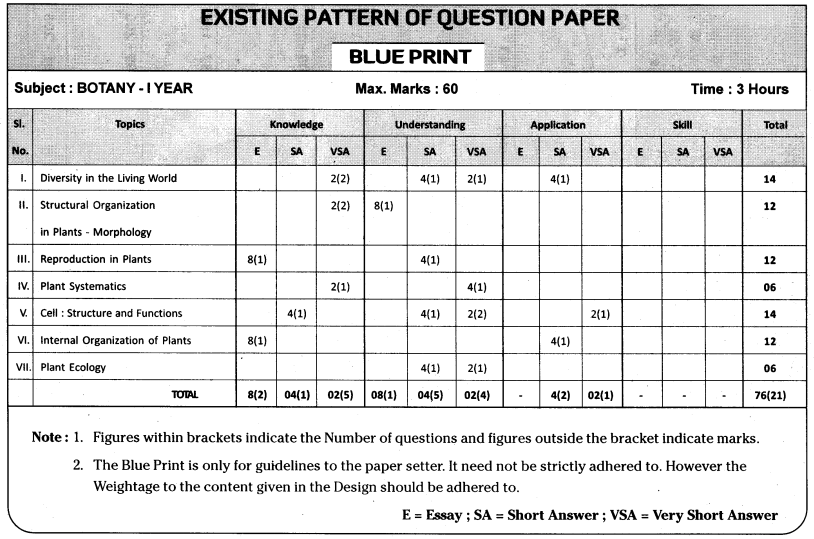
TS AP Inter 1st Year Botany Weightage Blue Print

We are providing well-organized Botany Important Questions Inter 1st Year that will help students in their exam preparation. These Botany Inter 1st Year Important Questions are designed by subject experts. So Students should utilise the Intermediate 1st Year Botany Important Questions with Answers 2022 to pass their board exams with flying colours.

The questions given in the Inter First Year Botany Important Questions are designed and laid out chronologically and as per the syllabus. Students can expect that these TS AP Intermediate Inter 1st Year Botany Important Questions Chapter Wise Pdf 2022-2023 might be covered in the final exam paper.

AP Inter 1st Year Zoology Study Material Pdf | Intermediate 1st Year Zoology Textbook Solutions

Telangana & Andhra Pradesh BIEAP TS AP Intermediate Inter 1st Year Zoology Study Material Textbook Solutions Guide PDF Free Download, TS AP Inter 1st Year Zoology Blue Print Weightage 2022-2023, Telugu Academy Intermediate 1st Year Zoology Textbook Pdf Download, Questions and Answers Solutions in English Medium and Telugu Medium are part of AP Inter 1st Year Study Material Pdf.

Students can also read AP Inter 1st Year Botany Syllabus & AP Inter 1st Year Zoology Important Questions for exam preparation. Students can also go through AP Inter 1st Year Zoology Notes to understand and remember the concepts easily.

AP Intermediate 1st Year Zoology Study Material Pdf Download | Jr Inter 1st Year Zoology Textbook Solutions

AP Inter 1st Year Zoology Study Material in English Medium

AP Inter 1st Year Zoology Study Material in Telugu Medium

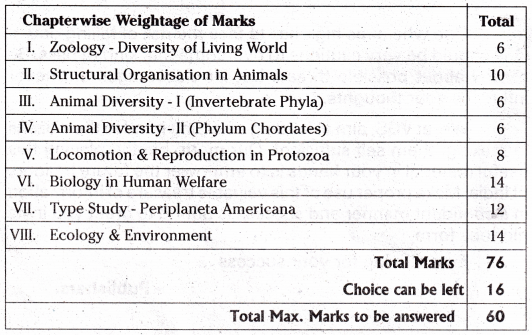
TS AP Inter 1st Year Zoology Weightage Blue Print 2022-2023

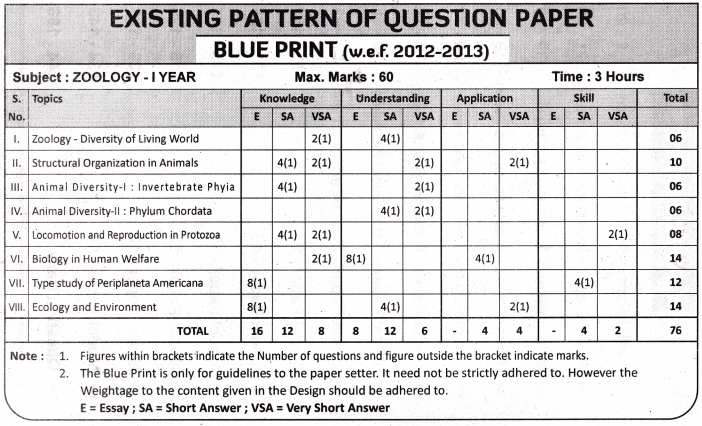
TS AP Inter 1st Year Zoology Weightage 2022-2023 | TS AP Inter 1st Year Zoology Blue Print 2022

TS AP Inter 1st Year Zoology Weightage Blue Print

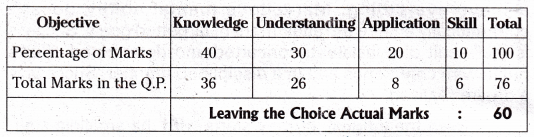
TS AP Inter 1st Year Zoology Weightage to Objectives

TS AP Inter 1st Year Zoology Weightage to Objectives

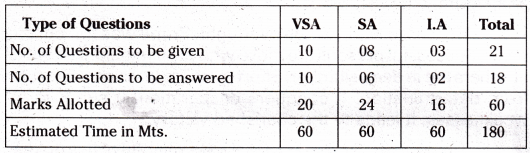
TS AP Inter 1st Year Zoology Weightage to Form of Questions

TS AP Inter 1st Year Zoology Weightage to Form of Questions

TS AP Inter 1st Year Zoology Weightage to Content: Units

TS AP Inter 1st Year Zoology Weightage to Content Units

Intermediate 1st Year Zoology Syllabus

TS AP Inter 1st Year Zoology Syllabus

Unit I Zoology – Diversity of Living World

  • 1.1 What is life?
  • 1.2 Nature, Scope & meaning of zoology
  • 1.3 Branches of Zoology
  • 1.4 Need for classification- Zoos as tools for the study of taxonomy
  • 1.5 Basic principles of Classification: Biological system of classification- (Phylogenetic classification only)
  • 1.6 Levels of Hierarchy of classification
  • 1.7 Nomenclature – Bi & Trinominal
  • 1.8 Species concept
  • 1.9 Kingdom Animalia
  • 1.10 Biodiversity – Meaning and distribution (Genetic diversity, Species diversity, Ecosystem diversity(alpha, beta, and gamma), other attributes of biodiversity, the role of biodiversity, threats to biodiversity, methods of conservation, IUCN Red data books, Conservation of wildlife in India – Legislation, Preservation, Organisations, Threatened species.

Unit II Structural Organization in Animals

  • 2.1 Levels of organization, Multicellularity: Diploblastic & Triploblastic conditions.
  • 2.2 Asymmetry, Symmetry: Radial symmetry, and Bilateral symmetry (Brief account giving one example for each type from the representative phyla)
  • 2.3 Acoelomates, Pseudocoelomates, and Eucoelomates: Schizo & Entero coelomates (Brief account of the formation of coelom)
  • 2.4 Tissues: Epithelial, Connective, Muscular, and Nervous tissues. (make it a little more elaborative)

Unit III Animal Diversity – I: Invertebrate Phyla
General Characters – Strictly restrict to 8 salient features only
Classification up to Classes with two or three examples – Brief account only

  • 3.1 Porifera
  • 3.2 Cnidaria
  • 3.3 Ctenophora
  • 3.4 Platyhelminthes
  • 3.5 Nematoda
  • 3.6 Annelida (Include Earthworm as a type study strictly adhering to NCERT textbook)
  • 3.7 Arthropoda
  • 3.8 Mollusca
  • 3.9 Echinodermata
  • 3.10 Hemichordata

Unit IV Animal Diversity – II: Phylum: Chordata
General Characters – Strictly restrict to 8 points only Classification up to Classes – Brief account only with two or three examples

  • 4.1 Sub phylum: Urochordata
  • 4.2 Sub phylum: Cephalochordata
  • 4.3 Sub phylum: Vertebrata
  • 4.4 Super Class: Agnatha
  • 4.4.1 Class Cyclostomata
  • 4.5 Super Class: Gnathostomata
  • 4.5.1 Super Class: Pisces
  • 4.5.2 Class: Chondrichthyes
  • 4.5.3 Class: Osteichthyes
  • 4.6 Tetrapoda
  • 4.6.1 Class: Amphibia (Include Frog as a type study strictly adhering to NCERT textbook)
  • 4.6.2 Class: Reptilia
  • 4.6.3 Class: Aves
  • 4.6.4 Class: Mammalia

Unit V Locomotion & Reproduction in Protozoa

  • 5.1 Locomotion: Definition, types of locomotor structures pseudopodia (basic idea of pseudopodia without going into different types), flagella & cilia (Brief account giving two examples each)
  • 5.2 Flagellar & Ciliary movement – Effective & Recovery strokes in Euglena, Synchronal & Metachronal movements in Paramecium
  • 5.3 Reproduction: Definition, types. Asexual Reproduction: Transverse binary fission in Paramecium & Longitudinal binary fission in Euglena. Multiple fission, Sexual Reproduction.

Unit VI Biology & Human Welfare

  • 6.1 Parasitism and parasitic adaptation
  • 6.2 Health and disease: introduction (follow NCERT) Life cycle, Pathogenicity, Treatment & Prevention (Brief account only)
    1. Entamoeba histolytica 2. Plasmodium vivax 3. Ascaris lumbricoides 4. Wuchereria bancrofti
  • 6.3 A brief account of pathogenicity, treatment & prevention of Typhoid, Pneumonia, Common cold, & Ringworm.
  • 6.4 Drugs and Alcohol abuse

Unit VII Type study of Periplaneta Americana

  • 7.1 Habitat and habits
  • 7.2 External features
  • 7.3 Locomotion
  • 7.4 Digestive system
  • 7.5 Respiratory system
  • 7.6 Circulatory system
  • 7.7 Excretory system
  • 7.8 Nervous system – sense organs, the structure of ommatidium.
  • 7.9 Reproductive system

Unit VIII Ecology & Environment

  • 8.1 Organisms and Environment: Ecology, population, communities, habitat, niche, biome, and ecosphere (definitions only)
  • 8.2 Ecosystem: Elementary aspects only Abiotic factors – Light, Temperature & Water (Biological effects only), Ecological adaptations
  • 8.3 Population interactions
  • 8.4 Ecosystems: Types, Components, Lake ecosystem
  • 8.5 Food chains, Food web, Productivity and Energy flow in Ecosystem, Ecological pyramids – Pyramids of numbers, biomass, and energy.
  • 8.6 Nutrition cycling – Carbon, Nitrogen, & Phosphorous cycles (Brief account)
  • 8.7 Population attributes Growth, Natality, and Mortality, Age distribution, and Population regulation.
  • 8.8 Environmental issues

We hope that this Telangana & Andhra Pradesh BIEAP TS AP Intermediate Inter 1st Year Zoology Study Material Textbook Solutions Guide PDF Free Download 2022-2023 in English Medium and Telugu Medium helps the student to come out successful with flying colors in this examination. This Jr Inter 1st Year Zoology Study Material will help students to gain the right knowledge to tackle any type of questions that can be asked during the exams.

AP Inter 1st Year Botany Study Material Pdf | Intermediate 1st Year Botany Textbook Solutions

Telangana & Andhra Pradesh BIEAP TS AP Intermediate Inter 1st Year Botany Study Material Textbook Solutions Guide PDF Free Download, TS AP Inter 1st Year Botany Blue Print Weightage 2022-2023, Telugu Academy Intermediate 1st Year Botany Textbook Pdf Download, Questions and Answers Solutions in English Medium and Telugu Medium are part of AP Inter 1st Year Study Material Pdf.

Students can also read AP Inter 1st Year Botany Syllabus & AP Inter 1st Year Botany Important Questions for exam preparation. Students can also go through AP Inter 1st Year Botany Notes to understand and remember the concepts easily.

AP Intermediate 1st Year Botany Study Material Pdf Download | Jr Inter 1st Year Botany Textbook Solutions

AP Inter 1st Year Botany Study Material in English Medium

Unit I Diversity in the Living World

Unit II Structural Organisation in Plants – Morphology

Unit III Reproduction in Plants

Unit IV Plant Systematics

Unit V Cell Structure and Function

Unit VI Internal Organisation of Plants

Unit VII Plant Ecology

AP Inter 1st Year Botany Study Material in Telugu Medium

TS AP Inter 1st Year Botany Weightage Blue Print 2022-2023

TS AP Inter 1st Year Botany Weightage 2022-2023 | TS AP Inter 1st Year Botany Blue Print 2022

TS AP Inter 1st Year Botany Weightage Blue Print

Intermediate 1st Year Botany Syllabus

TS AP Inter 1st Year Botany Syllabus

Unit I Diversity in the Living World (30 Periods)

Chapter 1 The Living World
What is living? Diversity in the living world; Taxonomic categories and taxonomical aids.

Chapter 2 Biological Classification
Five kingdom classifications – Monera, Protista, Fungi, Plantae and Animalia, Three domains of life (six kingdom classification), Viruses, Viroids, Prions & Lichens.

Chapter 3 Science of Plants – Botany
Origin, Development, Scope of Botany and Branches of Botany.

Chapter 4 Plant Kingdom
Sailent features, classification, and alternation of generations of the plants of the following groups – Algae, Bryophytes, Pteridophytes, Gymnosperms, and Angiosperms.

Unit II Structural Organisation in Plants – Morphology (20 Periods)

Chapter 5 Morphology of flowering plants
Vegetative: Parts of a typical Angiosperimic plant; Vegetative morphology and modifications – Root, stem, and leaf – types; venation, Phyllotaxy.
Reproductive: Inflorescence – Racemose, Cymose, and special types (in brief).
Flower: Parts of a flower and their detailed description; Aestivation, Placentation.
Fruits: Types – True, False, and parthenocarpic fruits.

Unit III Reproduction in Plants (25 Periods)

Chapter 6 Modes of Reproduction
Asexual reproduction, binary fission, sporulation, budding, fragmentation, vegetative propagation in plants, sexual reproduction, in brief, Overview of the angiosperm life cycle.

Chapter 7 Sexual Reproduction in Flowering Plants
Stamen, Microsporangium/pollen grain, Pistil, megasporangium (ovule) and embryo sac; development of male and female gametophytes. Pollination types, agents, outbreeding devices, and pollen- pistil interaction Double Fertilization; Post fertilization events; Development of endosperm and embryo; development of seed, the structure of Dicotyledonous and Monocotyledonous seeds, Significance of fruit and seed Special modes Apomixis, parthenocarpy, polyembryony.

Unit IV Plant Systematics (10 Periods)

Chapter 8 Taxonomy of Angiosperms
Introduction. Types of Systems of classification (In brief). Semitechnical description of a typical flowering plant description of families: Fabaceae, Solanaceae, and Liliaceae.

Unit V Cell Structure and Function (35 Periods)

Chapter 9 Cell – The Unit of Life
Cell-Cell theory and cell as the basic unit of life-overview of the cell. Prokaryotic cells, Ultra Structure of Plant cell (structure in detail and functions in brief). Cell membrane, Cell wall, Cell organelles; Endoplasmic reticulum, Mitochondria, Plastids, Ribosomes, Golgi bodies, Vacuoles, Lysosomes, Microbodies, Centrosome and centriole, Cilia, Flagella, Cytoskeleton, and Nucleus. Chromosomes: Number, structural organization; Nucleosome.

Chapter 10 Biomolecules
Structure and function of Proteins, Carbohydrates, Lipids, and Nucletic acids.

Chapter 11 Cell Cycle and Cell Division
Cell Cycle, Mitosis, Meiosis – significance.

Unit VI Internal Organisation of Plants (25 Periods)

Chapter 12 Histology and Anatomy of Flowering Plants
Tissues – types, structure, and functions: Meristematic; Permanent tissues- Simple and Complex tissues. Tissue systems – Types, structure, and function: Epidermal, Ground, and Vascular tissue systems. Anatomy of Dicotyledonous and Monocotyledonous plant-Root, stem, and leaf. Secondary growth in Dicot stem and Dicot root.

Unit VII Plant Ecology (12 Periods)

Chapter 13 Ecological Adaptations, Succession, and Ecological Services
Introduction, Plant communities and Ecological adaptations: Hydrophytes, Mesophytes, and Xerophytes. Plant succession. Ecological services – Carbon fixation, Oxygen release, and pollination (In brief).

We hope that this Telangana & Andhra Pradesh BIEAP TS AP Intermediate Inter 1st Year Botany Study Material Textbook Solutions Guide PDF Free Download 2022-2023 in English Medium and Telugu Medium helps the student to come out successful with flying colors in this examination. This Jr Inter 1st Year Botany Study Material will help students to gain the right knowledge to tackle any type of questions that can be asked during the exams.

AP Inter 1st Year Commerce Notes

Students can go through Telangana & Andhra Pradesh BIEAP TS AP Inter 1st Year Commerce Notes Pdf Download in English Medium and Telugu Medium to understand and remember the concepts easily. Besides, with our AP Sr Inter 1st Year Commerce Notes students can have a complete revision of the subject effectively while focusing on the important chapters and topics.

Students can also go through AP Inter 1st Year Commerce Study Material and AP Inter 1st Year Commerce Important Questions for exam preparation.

AP Intermediate 1st Year Commerce Notes

AP Inter 1st Year Commerce Notes in English Medium

AP Inter 1st Year Commerce Notes in Telugu Medium

  • Chapter 1 వ్యాపార భావన Notes
  • Chapter 2 వ్యాపార కార్యకలాపాలు Notes
  • Chapter 3 వ్యాపార వ్యవస్థ స్వరూపాలు Notes Notes
  • Chapter 4 ఉమ్మడి హిందూ కుటుంబ వ్యాపార వ్యవస్థ, సహకార సంఘం Notes
  • Chapter 5 భాగస్వామ్య వ్యాపార సంస్థ Notes
  • Chapter 6 జాయింట్ స్టాక్ కంపెనీ స్థాపన Notes
  • Chapter 7 కంపెనీ స్థాపన Notes
  • Chapter 8 వ్యాపార విత్తం – మూలాధారాలు – I Notes
  • Chapter 9. వ్యాపార విత్తం మూలాధారాలు – II Notes
  • Chapter 10 సూక్ష్మ, చిన్న, మధ్యతరహా సంస్థలు Notes
  • Chapter 11 బహుళ జాతి సంస్థలు Notes
  • Chapter 12 వ్యాపారంలో ప్రస్తుత ధోరణులు Notes

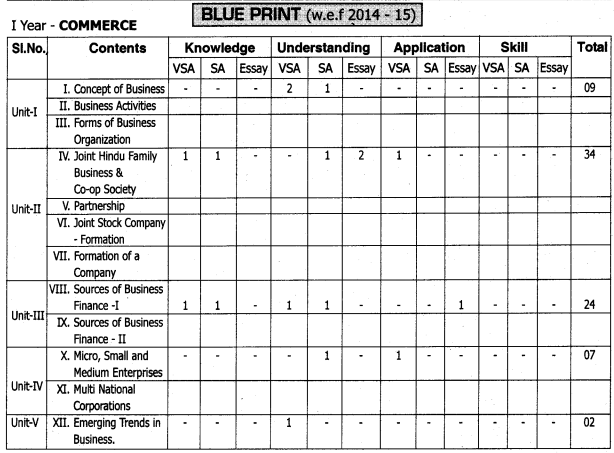
AP Inter 1st Year Commerce Weightage Blue Print

These TS AP Intermediate 1st Year Commerce Notes provide an extra edge and help students to boost their self-confidence before appearing for their final examinations. These Inter 1st Year Commerce Notes will enable students to study smartly and get a clear idea about each and every concept discussed in their syllabus.

AP Inter 1st Year Maths 1A Important Questions Chapter 4 సదిశల సంకలనం

Students get through AP Inter 1st Year Maths 1A Important Questions Chapter 4 సదిశల సంకలనం which are most likely to be asked in the exam.

AP Inter 1st Year Maths 1A Important Questions Chapter 4 సదిశల సంకలనం

సాధించిన సమస్యలు
(Solved Problems)

ప్రశ్న 1.
సదిశ a = 2i + 3j + k దిశలో యూనిట్ సదిశను కనుక్కోండి. [Mar. ’14]
సాధన:
సదిశ a దిశలో యూనిట్ సదిశను \(\hat{a}=\frac{1}{|a|}\) a గా తెలపగలం.
|a| = \(\sqrt{2^2+3^2+1^2}=\sqrt{14}\)
కాబట్టి \(\hat{a}=\frac{1}{\sqrt{14}}\) (2i + 3j + k)
= \(\frac{2}{\sqrt{14}}\)i + \(\frac{3}{\sqrt{14}}\)j + \(\frac{1}{\sqrt{14}}\)k

ప్రశ్న 2.
సదిశ a = j – 2j దిశలో 7 యూనిట్ల పరిమాణం గలిగిన ఒక సదిశను కనుక్కోండి.
సాధన:
సదిశ a దిశలో యూనిట్ సదిశ
â \(=\frac{1}{a}\)a = \(\frac{1}{\sqrt{5}}\)(i – 2j) = \(\frac{1}{\sqrt{5}}\)i – \(\frac{2}{\sqrt{5}}\)j
కాబట్టి a దిశలో 7కి సమానమయ్యే పరిమాణం గలిగిన సదిశ
7a = 7\(\left(\frac{1}{\sqrt{5}} i-\frac{2}{\sqrt{5}} j\right)\) = \(\frac{7}{\sqrt{5}} \mathrm{i}-\frac{14}{\sqrt{5}} \mathrm{j}\)

AP Inter 1st Year Maths 1A Important Questions Chapter 4 సదిశల సంకలనం

ప్రశ్న 3.
a = 2i + 2j – 5k, b = 2i + j + 3k సదిశల సంకలన దిశలోని యూనిట్ సదిశను కనుక్కోండి. [May ’13]
సాధన:
దత్త సదిశల మొత్తం a + b (= c అనుకొంటే).
= 4i + 3j – 2k.
|c| = \(\sqrt{4^2+3^2+(-2)^2}\)
= \(\sqrt{29}\)
∴ ĉ = \(\frac{\overline{4}+\overline{3 j}-2 \hat{k}}{\sqrt{29}}\)

ప్రశ్న 4.
సదిశ a = i + j – 2k యొక్క దిక్ నిష్పత్తులను రాసి, తద్వారా దిక్ కొసైన్లను గణన చేయండి.
సాధన:
సదిశ r = xi + yj + zk యొక్క దిక్ నిష్పత్తులు a, b, c వరసగా ఆసదిశ అంశలు X. y, Z లు అవుతాయని గమనించండి.
కాబట్టి, దత్త సదిశకి a = 1, b = 1, c = -2,
అంతేకాక దత్త సదిశకు l, m, n దిక్ కొసైన్లు అయితే,
|r| = \(\sqrt{6}\) అయితే l = \(\frac{a}{|r|}=\frac{1}{\sqrt{6}}\)
m = \(\frac{b}{|r|}=\frac{1}{\sqrt{6}}\)
n = \(\frac{c}{|r|}=\frac{1}{\sqrt{6}}\)
∴ a దిక్ కొసైన్లు \(\left(\frac{1}{\sqrt{6}}, \frac{1}{\sqrt{6}},-\frac{2}{\sqrt{6}}\right)\)

ప్రశ్న 5.
స్థాన సదిశలను OP = 3a – 2b, OQ = a + bగా గలిగిన రెండు బిందువులు P, Qలను తీసుకోండి. P, Q లను కలిపే సరళరేఖను 2:1 నిష్పత్తిలో (i) అంతరంగాను (ii) బాహ్యంగాను విభజించే బిందువు R స్థాన సదిశను కనుక్కోండి.
సాధన:
i) P, Q లను కలపే సరళరేఖను 2:1 నిష్పత్తిలో అంతరంగా విభజించే బిందువు R స్థాన సదిశ
OR = \(\frac{2(a+b)+(3 a-2 b)}{2+1}=\frac{5 a}{3}\)

ii) P, Q లను కలిపే సరళరేఖను 2 1 నిష్పత్తిలో బాహ్యంగా విభజించే బిందువు R స్థాన సదిశ
OR = \(\frac{2(a+b)-(3 a-2 b)}{2-1}\)
= 4b – a.

AP Inter 1st Year Maths 1A Important Questions Chapter 4 సదిశల సంకలనం

ప్రశ్న 6.
A(2i – j + k), B(i – 3j – 5k), C(3i – 4j – 4k) బిందువులు ఒక లంబకోణ త్రిభుజం శీర్షాలని చూపండి.
సాధన:
AB = (1 – 2)i + (−3 + 1)j + (-5-1)k
= -i – 2j – 6k.
BC = (3 – 1)i + (-4 + 3)j + (-4 + 5)k
= 2i – j + k
CA = (2 – 3)i + (-1 + 4)j + (1 + 4)k
= i + 3j + 5k.
దీనితో |AB|2 = BC|2 + |CA|2.

ప్రశ్న 7.
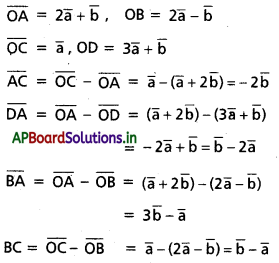
A, B, C, D బిందువుల స్థాన సదిశలు వరుసగా \(\overline{\mathrm{a}}+2 \overline{\mathrm{b}}, 2 \overline{\mathrm{a}}-\overline{\mathrm{b}}, \overline{\mathrm{a}}, 3 \overline{\mathrm{a}}+\overline{\mathrm{b}}\) అయితే \(\overline{\mathrm{A C}}, \overline{\mathrm{DA}}, \overline{\mathrm{BA}}, \overline{\mathrm{B C}}\) సదిశలను a, bలలో రాయండి.
సాధన:
A, B, C, D బిందువుల స్థాన సదిశలు దృష్ట్యా
AP Inter 1st Year Maths 1A Important Questions Chapter 4 సదిశల సంకలనం 1

ప్రశ్న 8.
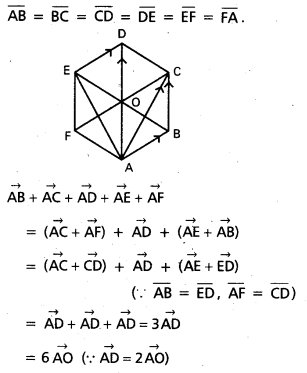
ABCDEF క్రమ షడ్భుజి కేంద్రం ‘0’ అయితే \(\overline{\mathrm{AB}}+\overline{\mathrm{AC}}+\overline{\mathrm{AD}}+\overline{\mathrm{AE}}+\overline{\mathrm{AF}}=3 \overline{\mathrm{AD}}=6 \overline{\mathrm{AO}}\) అని చూపండి. [(A.P) Mar. ’15]
సాధన:
ABCDEF క్రమషడ్భుజి, కేంద్రం ‘0’.
AP Inter 1st Year Maths 1A Important Questions Chapter 4 సదిశల సంకలనం 2

AP Inter 1st Year Maths 1A Important Questions Chapter 4 సదిశల సంకలనం

ప్రశ్న 9.
∆ABC త్రిభుజంలో A, B, C ల స్థాన సదిశలు వరుసగా \(\overline{\mathrm{a}}, \overline{\mathrm{b}}, \overline{\mathrm{c}}\) అయితే, దాని కేంద్రభాసం (centroid) స్థాన సదిశ \(\frac{1}{3}(\overline{\mathrm{a}}, \overline{\mathrm{b}}, \overline{\mathrm{c}})\) అని చూపండి.
సాధన:
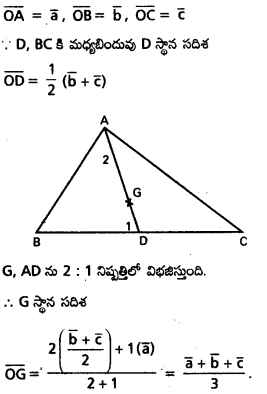
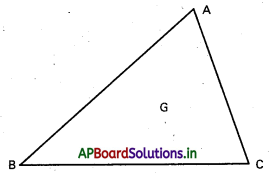
∆ABC లో G కేంద్రభాసం శీర్షం A గుండా గీచిన మధ్యగత
రేఖ AD. అప్పుడు
AG : GD ≠ 2 : 1. ‘O’ మూలబిందువు
AP Inter 1st Year Maths 1A Important Questions Chapter 4 సదిశల సంకలనం 3

AP Inter 1st Year Maths 1A Important Questions Chapter 4 సదిశల సంకలనం

ప్రశ్న 10.
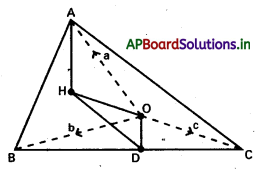
∆ABC లో ‘O’ పరివృత్త కేంద్రం, H లంబ కేంద్రం అయితే
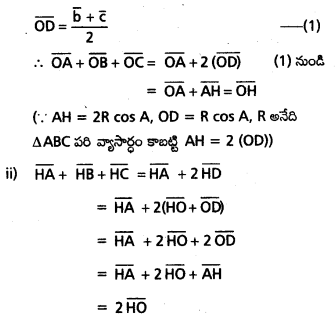
i) \(\overline{\mathrm{OA}}+\overline{\mathrm{OB}}+\overline{\mathrm{OC}}=\overline{\mathrm{OH}}\)
ii) \(\overline{\mathrm{HA}}+\overline{\mathrm{HB}}+\overline{\mathrm{HC}}=2 \overline{\mathrm{HO}}\) అని చూపండి.
సాధన:
BC మధ్యబిందువు D అనుకుందాం.
i) ‘O’ మూలబిందువు \(\overline{O A}=\overline{a}\), \(\overline{O B}=\overline{b}\), \(\overline{O C}=\overline{c}\) అనుకుందాం.
AP Inter 1st Year Maths 1A Important Questions Chapter 4 సదిశల సంకలనం 4
AP Inter 1st Year Maths 1A Important Questions Chapter 4 సదిశల సంకలనం 5

ప్రశ్న 11.
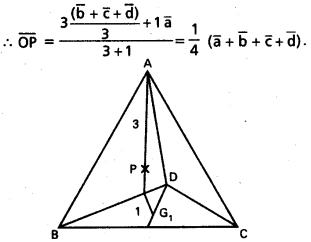
ఒక చతుర్ముఖి శీర్షాలు A, B, C, D. వీటి స్థాన సదిశలు క్రమంగా \(\overline{\mathrm{a}}, \overline{\mathrm{b}}, \overline{\mathrm{c}}, \overline{\mathrm{d}}\) అయితే, ఆ శీర్షాలను ఎదుటి ముఖాల కేంద్ర భాసాలకు కలిపే రేఖలు అనుషక్తాలవుతాయని చూపండి. (ఈ బిందువును చతుర్ముఖి కేంద్రభాసం లేదా కేంద్రం అంటారు). [(A.P)
సాధన:
‘O’ మూలబిందువు.
G1, G2, G3, G4 లు వరుసగా
∆BCD, ∆CAD, ∆ABD, ∆ABC ల కేంద్రభాసాలు
∴ OG1 = \(\frac{\overline{b}+\vec{c}+\overline{d}}{3}\)
AG1 ను 3: 1 నిష్పత్తిలో విభజించే బిందువు P అనుకొందాం.
AP Inter 1st Year Maths 1A Important Questions Chapter 4 సదిశల సంకలనం 6
ఇదే విధంగా BG2, CG3, DG4, 3 : 1 అను నిష్పత్తిలో విభజించే బిందువుల స్థాన సదిశలు \(\frac{1}{4}(\overline{a}+\overline{b}+\overline{c}+\overline{d})\). కాబట్టి P బిందువు AG1, BG2, CG3, DG4 లలో ప్రతి దానిపై ఉంటుంది.

AP Inter 1st Year Maths 1A Important Questions Chapter 4 సదిశల సంకలనం

ప్రశ్న 12.
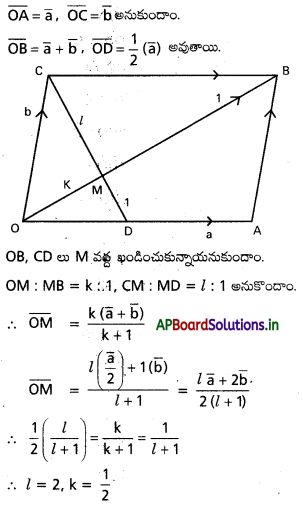
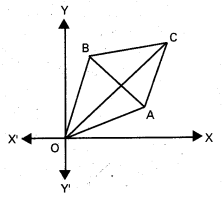
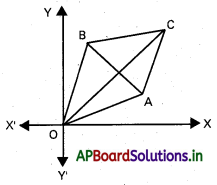
OABC సమాంతర చతుర్భుజంలో OA మధ్య బిందువు D అయితే, CD రేఖాఖండం కర్ణం OB పరస్పరం త్రిధాకరించుకొంటాయని చూపండి.
సాధన:
AP Inter 1st Year Maths 1A Important Questions Chapter 4 సదిశల సంకలనం 7
కాబట్టి CD, OB ని OB, CD ని త్రిధాకరించుకుంటాయి.

ప్రశ్న 13.
\(\overline{\mathrm{a}}, \overline{\mathrm{b}}\) లు సరేఖీయాలు కాని సదిశలు. \(\mathrm{3} \overline{\alpha}=\mathrm{2} \overline{\beta}\) అయ్యేటట్లు
\(\overline{\alpha}\) = (x + 4y) \(\overline{\mathrm{a}}\) + (2x + y + 1)\(\overline{\mathrm{b}}\),
\(\overline{\beta}\) = (y – 2x + 2) \(\overline{\mathrm{a}}\) + (2x – 3y – 1) \(\overline{\mathrm{a}}\), ఉంటే x, yలను కనుక్కోండి.
సాధన:
\(\mathrm{3} \overline{\alpha}=\mathrm{2} \overline{\beta}\)
⇒ 3(x + 4y) \(\overline{\mathrm{a}}\) + 3 (2x + y + 1)\(\overline{\mathrm{b}}\) = 2(y – 2x + 2)\(\overline{\mathrm{a}}\) (2x – 3y – 1)\(\overline{\mathrm{b}}\)
\(\overline{\mathrm{a}}, \overline{\mathrm{b}}\) గుణకాలను సమానం చేస్తే
3x + 12y = 2y – 4x + 4
⇒ 7x + 10y = 4 ………………… (1)
6x + 3y + 3 = 4x – 6y – 2
⇒ 2x + 9y = -5 ……………….. (2)
(1), (2) ల నుండి..
x = 2, y = -1

AP Inter 1st Year Maths 1A Important Questions Chapter 4 సదిశల సంకలనం

ప్రశ్న 14.
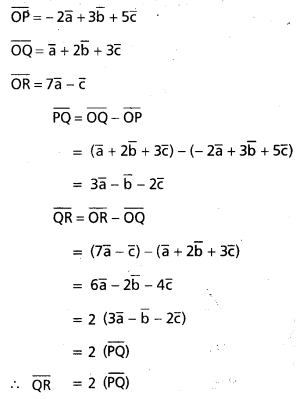
\(\overline{\mathrm{a}}, \overline{\mathrm{b}}, \overline{\mathrm{c}}\) లు అతలీయ సదిశలైతే \(-2 \overline{a}+3 \overline{\mathrm{b}}+5 \overline{c},\overline{\mathrm{a}}+\mathrm{2 \overline { b }}+3 \overline{\mathrm{c}}, 7 \overline{\mathrm{a}}-\overline{\mathrm{c}}\) బిందువులు సరేఖీయాలని చూపండి.
సాధన:
మూలబిందువు. P, Q. Rలు దత్త బిందువులు అనుకుందాం.
AP Inter 1st Year Maths 1A Important Questions Chapter 4 సదిశల సంకలనం 8
⇒ P, Q, R లు సరేఖీయాలు.

AP Inter 1st Year Maths 1A Important Questions Chapter 4 సదిశల సంకలనం

ప్రశ్న 15.
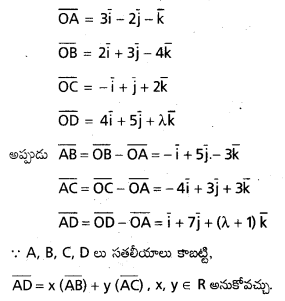
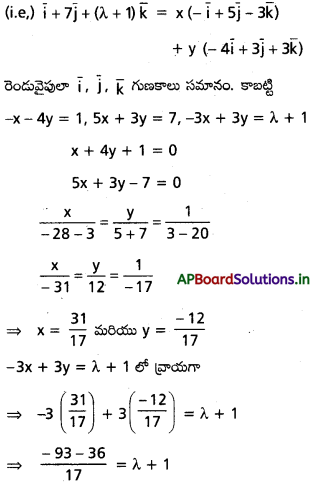
\(3 \overline{\mathrm{i}}-2 \overline{\mathrm{j}}-\overline{\mathrm{k}}, \mathrm{2} \overline{\mathrm{i}}+3 \overline{\mathrm{j}}-4 \overline{\mathrm{k}},-\overline{\mathrm{i}}+\overline{\mathrm{j}}+2 \overline{\mathrm{k}}\), \(\mathrm{4} \overline{\mathrm{i}}+\mathrm{5} \overline{\mathrm{j}}+\lambda \overline{\mathrm{k}}\) సదిశలను స్థాన సదిశలుగా గల బిందువులు సతలీయాలైతే λ విలువ \(\frac{-146}{7}\) అని చూపండి.
సాధన:
‘O’ మూలబిందువు, A, B, C, D లు దత్త బిందువులు.
AP Inter 1st Year Maths 1A Important Questions Chapter 4 సదిశల సంకలనం 9
AP Inter 1st Year Maths 1A Important Questions Chapter 4 సదిశల సంకలనం 10
∴ λ = -1 – \(\frac{129}{17}\)
⇒ λ = \(\frac{-17-129}{17}\) = \(\frac{-146}{17}\)

AP Inter 1st Year Maths 1A Important Questions Chapter 4 సదిశల సంకలనం

ప్రశ్న 16.
ద్విపరిమాణ నిరూపక తలంలో, సదిశా పద్ధతులనుప యోగించి, నిరూపకాక్షాల మీద ‘a’, ‘b’ అంతర ఖండాలు చేసే రేఖ సమీకరణం \(\frac{x}{a}+\frac{y}{b}\) = 1 అవుతుందని రుజువు చూపండి.
సాధన:
OXYZ ద్విపరిమాణ నిరూపక తలం.
\(\overline{\mathrm{i}}, \overline{\mathrm{j}}\) లు వరుసగా ధన x, y అక్షాల మీద యూనిట్ సదిశలు.
\(\overline{a}=a \overline{i}, \overline{b}=b \overline{j}\)
మూలబిందువు. \(\overline{\mathrm{OA}}={\mathrm{a}}, \overline{\mathrm{OB}}=\overline{\mathrm{b}}\) అయ్యేటట్లుగా
A, B లు తలం మీద రెండు బిందువులు,
\(\overline{\mathrm{AB}}\) రేఖా సదిశా సమీకరణం
\(\overline{r}=(1-t)^{a \overline{i}+t-b \overline{j}}\)
\(\overline{r}=x \overline{i}+y \overline{j}\) అయితే,
అపుడు x = (1 – t) a, y = t b
‘t’ ను తొలగింపని x = \(\left(1-\frac{y}{b}\right)\)a
⇒ \(\frac{x}{a}\) = 1 – \(\frac{y}{b}\)
⇒ \(\frac{x}{a}+\frac{y}{b}\) = 1

ప్రశ్న 17.
రెండు బిందువులగుండా పోయే సరళరేఖ సదిశా సమీకరణాన్ని ఉపయోగించి, \(\overline{\mathrm{a}}, \overline{\mathrm{b}},(3 \overline{\mathrm{a}}-\mathrm{2} \overline{\mathrm{b}})\) లను స్థాన సదిశలుగా గల బిందువులు సరేఖీయాలని రుజువు చేయండి.
సాధన:
\(\overline{a}, \overline{b}\) ల గుండా పోయే సరళరేఖా సదిశాసమీకరణం
\(\overline{r}=(1-t) \overline{a}+t \overline{b}\) ; t ∈ R
ఈ రేఖ గుండా బిందువు \(3 \overline{a}-2 \overline{b}\) పోతే
\(3 \overline{a}-2 \overline{b}=(1-t) \overline{a}+t \overline{b}\)
అనురూప గుణకాల సమానం చేయగా
1 – t = 3, t = -2
దత్త బిందువులు సరేఖీయాలు.

AP Inter 1st Year Maths 1A Important Questions Chapter 4 సదిశల సంకలనం

ప్రశ్న 18.
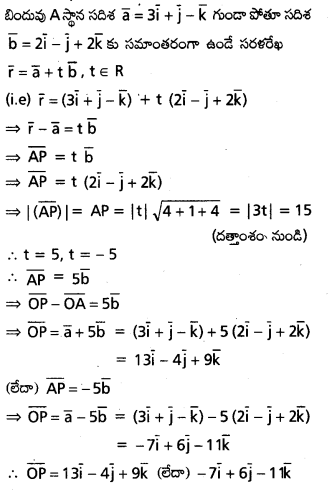
\(\mathrm{2} \overline{\mathrm{i}}-\overline{\mathrm{j}}+\mathrm{2} \overline{\mathrm{k}}\) సదిశకు సమాంతరంగా ఉంటూ, \(({3} \overline{\mathrm{i}}+\overline{\mathrm{j}}-\overline{\mathrm{k}})\) ని స్థాన సదిశగా గలిగిన బిందువు A గుండా పోయే రేఖ సదిశా సమీకరణాన్ని కనుక్కోండి. AP = 15 అయ్యేటట్లు ఈ రేఖమీద P అనే బిందువు ఉండే, P స్థాన సదిశ కనుక్కోండి.
సాధన:
AP Inter 1st Year Maths 1A Important Questions Chapter 4 సదిశల సంకలనం 11

AP Inter 1st Year Maths 1A Important Questions Chapter 4 సదిశల సంకలనం

ప్రశ్న 19.
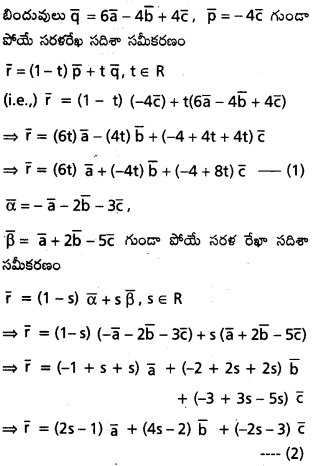
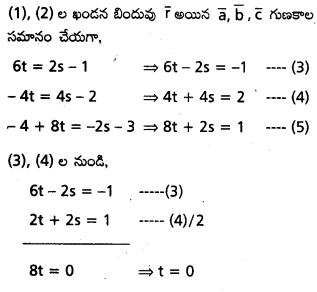
\(\overline{\mathrm{a}}, \overline{\mathrm{b}}, \overline{\mathrm{c}}\) లు అతలీయ సదిశలైతే, \(6 \bar{a}-4 \bar{b}+4 \bar{c},-4 \bar{c}\) బిందువులు కలిపే రేఖలు \(-\overline{\mathrm{a}}-2 \bar{b}-3 \bar{c}, \bar{a}+2 \bar{b}-5 \bar{c}\) బిందువులను కలిపే రేఖల ఖండన బిందువు \(-4 \bar{c}\) అని చూపండి.
సాధన:
AP Inter 1st Year Maths 1A Important Questions Chapter 4 సదిశల సంకలనం 12
AP Inter 1st Year Maths 1A Important Questions Chapter 4 సదిశల సంకలనం 13
(1) నుండి, S = \(\frac{1}{2}\)
t = 0, s = \(\frac{1}{2}\) లను (5)లో వ్రాస్తే,
8(0) + 2(\(\frac{1}{2}\)) =1 ⇒ 1 = 1
(1), (2) రేఖలు ఖండించుకొంటాయి.
ఖండన బిందువుల కొరకు t = 0 ను (1) లో వ్రాస్తే
\(\overline{\mathrm{r}}=-4 \overline{\mathrm{c}}\)
∴ రేఖల ఖండన బిందువు స్థాన సదిశ \(-4 \bar{c}\).

AP Inter 1st Year Maths 1A Important Questions Chapter 4 సదిశల సంకలనం

ప్రశ్న 20.
\(\overline{\mathrm{a}}, \overline{\mathrm{b}}, \overline{\mathrm{c}}\) లు అతలీయ సదిశలైతే, సరళరేఖ \(\overline{\mathrm{r}}=2 \overline{\mathrm{a}}+\overline{\mathrm{b}}+t(\overline{\mathrm{b}}-\overline{\mathrm{c}})\), తలం \(\overline{\mathrm{r}}=\overline{\mathrm{a}}+x(\bar{b}+\bar{c})+y(\bar{a}+2 \bar{b}-\bar{c})\)ని ఖండించే బిందువును కనుక్కోండి. [May ’13]
సాధన:
రేఖా తలంలో ఖండన బిందువు P, దాని స్థాన సదిశ \(\bar{r}\) అయిన
\(2 \bar{a}+\bar{b}+t(\bar{b}-\bar{c})=\bar{a}+x(\bar{b}+\bar{c})+y(\bar{a}+2 \bar{b}-\bar{c})\)
∴ \(\bar{a}, \bar{b}, \bar{c}\) కె.లు అతలీయ సదిశలు
కనుక \(\bar{a}, \bar{b}, \bar{c}\) గుణకాలను పోల్చగా,
2 = 1 + y ⇒ y = 1
1 + t = x + 2y
⇒ 1 + t = x + 2(1)
⇒ t – x = 1 ……………. (1)
-t = x – y
x + t = y
⇒ x + t = 1 ………….. (2)
(1), (2) ల నుండి, t = 1, x = 0, y = 1
∴ ఖండన బిందువు = \(\bar{r}=2 \bar{a}+\bar{b}+1(\bar{b}-\bar{c})\)
⇒ \(\overline{\mathrm{r}}=2 \overline{\mathrm{a}}+2 \overline{\mathrm{b}}-\overline{\mathrm{c}}\)
∴ ఖండన బిందువు స్థాన సదిశ\(2 \bar{a}+2 \bar{b}-\bar{c}\)

AP Inter 1st Year Maths 1B Important Questions Chapter 6 దిక్ కొసైన్లు, దిక్ సంఖ్యలు

Students get through AP Inter 1st Year Maths 1B Important Questions Chapter 6 దిక్ కొసైన్లు, దిక్ సంఖ్యలు which are most likely to be asked in the exam.

AP Inter 1st Year Maths 1B Important Questions Chapter 6 దిక్ కొసైన్లు, దిక్ సంఖ్యలు

సాధించిన సమస్యలు

ప్రశ్న 1.
P(2, 3, –6), Q( -4, 5) లు రెండు బిందువులు, O మూలబిందువైతే \(\overrightarrow{\mathrm{OP}}, \overrightarrow{\mathrm{QO}}, \overrightarrow{\mathrm{PQ}}\) ల దిక్ కొసైన్లు కనుక్కోండి.
సాధన:
OP = \(\sqrt{4+9+6}\) = 7, QO = \(\sqrt{9+16+25}\)
= 5\(\sqrt{2}\)
OP యొక్క దిక్ కున్లు \(\left(\frac{2}{7}, \frac{3}{7},-\frac{6}{7}\right)\)
PQ = \(\sqrt{\left(2-1)^2+(3+4)^2+(-6-5)^2\right.}\)
= \(\sqrt{1+4+121}\) = \(\sqrt{171}\)
QO యొక్క దికొ సైన్లు \(\left(\frac{0-3}{5 \sqrt{2}}, \frac{0+4}{5 \sqrt{2}}, \frac{0-5}{5 \sqrt{2}}\right)\)
= \(\left(\frac{-3}{5 \sqrt{2}}, \frac{4}{5 \sqrt{2}},-\frac{1}{\sqrt{2}}\right)\)
PQ యొక్క దిక్ కొసైన్లు \(\left(\frac{3-2}{\sqrt{171}}, \frac{-4-3}{\sqrt{171}}, \frac{5+6}{\sqrt{171}}\right)\)
= \(\left(\frac{1}{\sqrt{171}}, \frac{-7}{\sqrt{171}}, \frac{11}{\sqrt{171}}\right)\)

AP Inter 1st Year Maths 1B Important Questions Chapter 6 దిక్ కొసైన్లు, దిక్ సంఖ్యలు

ప్రశ్న 2.
నిరూపకాక్షాలతో సమాన కోణాలు చేసే సరళరేఖ దిక్ కొసైన్లు కనుకోండి.
సాధన:
దత్త రేఖ అక్షాలలో α కోణం చేయు రేఖ D.C లు
(cos α, cos α, cos α)
l2 + m2 + n2 = 1 కనుక
cos2 α + cos2 α + cos2 α = 1
3 cos2 α = 1 ⇒ cos2 α = \(\frac{1}{3}\)
cos α = ± \(\frac{1}{\sqrt{3}}\)
రేఖ దిక్ కొసైన్లు
\(\left(\pm \frac{1}{\sqrt{3}}, \pm \frac{1}{\sqrt{3}}, \pm \frac{1}{\sqrt{3}}\right)\)
ఇక్కడ 8 దిశలు 4 రేఖలతో సమానము.

ప్రశ్న 3.
ఒక సరళరేఖ దిక్ కొసైన్లు \(\left(\frac{1}{c}, \frac{1}{c}, \frac{1}{c}\right)\) అయితే c విలువ కనుక్కోండి.
సాధన:
l2 + m2 + n2 = 1 కనుక
\(\frac{1}{c^2}+\frac{1}{c^2}+\frac{1}{c^2}\) = 1
\(\frac{3}{c^2}\) = 1 ⇒ c2 = 3
c = ± \(\sqrt{3}\)

AP Inter 1st Year Maths 1B Important Questions Chapter 6 దిక్ కొసైన్లు, దిక్ సంఖ్యలు

ప్రశ్న 4.
రెండు సరళరేఖల దిక్ కొసైన్లు l + m + n = 0 mn – 2nl – 2lm = 0 సమీకరణాలను తృప్తిపరుస్తాయి. ఆ దిక్ కొసైన్లు ఏవి ? [Mar. ’11]
సాధన:
దత్తాంశం l + m + n = 0 ……………. (1)
mn – 2nl – 2lm = 0 …………….. (2)
(1) నుండి l = -(m + n)
(2) లో ప్రతిక్షేపిస్తే
mn ± 2n (m + n + 2m (m + n) = 0
mn + 2mn + 2n2 + 2m2 + 2mn = 0
2m2 + 5mn + 2n2 = 0
(2m + n) (m + 2n) = 0
2m = -n లేదా m = -2n
సందర్భం (i) : 2m1 = -n1
(1) నుండి l1 = -m1 – n1
= -m1 + 2m1 = m1
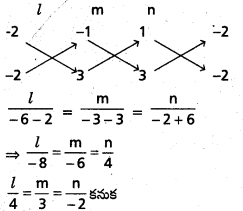
\(\frac{l_1}{1}=\frac{m_1}{1}=\frac{n_1}{-2}\)
మొదటి రేఖ దిక్ సంఖ్యలు 1, 1, -2
ఈ రేఖ దిక్ కొసైన్లు \(\frac{1}{\sqrt{6}}, \frac{1}{\sqrt{6}},-\frac{2}{\sqrt{6}}\)

సందర్భం (ii) : m2 = -2n2
(1) నుండి l2 = -m2 – n2 = +2n2 – n2 = n2
\(\frac{l_2}{1}=\frac{m_2}{-2}=\frac{n_2}{1}\)
రెండవ రేఖ దిక్ సంఖ్యలు 1, -2, 1
రెండవ రేఖ దిక్ కొసైన్లు \(\frac{1}{\sqrt{6}}, \frac{-2}{\sqrt{6}}, \frac{1}{\sqrt{6}}\)

AP Inter 1st Year Maths 1B Important Questions Chapter 6 దిక్ కొసైన్లు, దిక్ సంఖ్యలు

ప్రశ్న 5.
\(\overrightarrow{\mathrm{OX}}, \overrightarrow{\mathrm{OY}}\) లతో ఒక కిరణం \(\frac{\pi}{3}, \frac{\pi}{3}\) కోణాలు చేస్తుంది. అది \(\overrightarrow{\mathrm{O Z}}\) తో చేసే కోణాన్ని కనుక్కోండి.
సాధన:
l2 + m2 + n2 = 1 కనుక
cos2 α + cos2 β + cos2 γ = 1
cos2 \(\frac{\pi}{3}\) + cos2 \(\frac{\pi}{3}\) + cos2 γ = 1
\(\frac{1}{4}\) + \(\frac{1}{4}\) + cos2 γ = 1
cos2 γ = 1 – \(\frac{1}{2}\) = \(\frac{1}{2}\)
cos γ = ±\(\frac{1}{\sqrt{2}}\)
γ = cos-1 (±\(\frac{1}{\sqrt{2}}\))
= \(\frac{\pi}{4}\) లేదా \(\frac{3\pi}{4}\)

ప్రశ్న 6.
(4, -7, 3), (6, –5, 2) లను కలిపే రేఖ దిక్ సంఖ్యలు, దిక్ కొసైన్లు కనుక్కోండి.
సాధన:
రేఖ దిక్ సంఖ్యలు (6 – 4, -5 + 7, 2 – 3)
= (2, 2, -1)
\(\sqrt{4+4+1}\) = 3 తో భాగించగా
రేఖ దిక్ కొసైన్లు ±\(\left(\frac{2}{3}, \frac{2}{3},-\frac{1}{3}\right)\)

AP Inter 1st Year Maths 1B Important Questions Chapter 6 దిక్ కొసైన్లు, దిక్ సంఖ్యలు

ప్రశ్న 7.
ఒక సరళరేఖ దిక్ కొసైన్లు (1, -2, 1)కి అనుపాతంలో ఉంటే దాని, దిక్ కొసైన్లు కనుక్కోండి.
సాధన:
రేఖ దిక్ సంఖ్యలు (1, 2, 1)
\(\sqrt{6}\) తో భాగించగా
రేఖ దిక్ కొసైన్లు ± \(\left(\frac{1}{\sqrt{6}},-\frac{2}{\sqrt{6}}, \frac{1}{\sqrt{6}}\right)\)

ప్రశ్న 8.
P(0, 1, 2), Q (3, 4, 8) బిందువులను కలిపే రేఖ R (-2, \(\frac{3}{2}\) – 3 ), 52, 6, 6 బిందువులను రేఖకు సమాంతరంగా ఉంటుందని చూపండి.
సాధన:
PQ యొక్క దిక్ సంఖ్యలు (3 – 0, 4 – 1, 8 – 2)
= (3, 3, 6)
RS యొక్క దిక్ సంఖ్యలు(\(\frac{5}{2}\) + 2, 6 – \(\frac{3}{2}\), 6 + 3)
= (\(\frac{9}{2}\), \(\frac{9}{2}\), 9)
PQ, RS ల దిక్ సంఖ్యలు అనుపాతంలో ఉన్నాయి.
\(\frac{2}{3}\left(\frac{9}{2}, \frac{9}{2}, 9\right)\) = (3, 3, 6) కనుక
∴ PQ, RS లు సమాంతరము.

ప్రశ్న 9.
A (2, 3, -1), B(3, 5, -3) బిందువులను కలిపే సరళరేఖ C(1, 2, 3), D(3, 5, 7) బిందువులను కలిపే రేఖకు లంబంగా ఉంటుందని చూపండి.
సాధన:
AB యొక్క d.r లు (3 – 2, 5 – 3, -3 + 1)
= (1, 2, -2)
CB యొక్క d.r లు (3 – 1, 5-2, 7-3) = (2, 3, 4)
a1a2 + b1b2 + c1c2 = 1.2 + 2.3 – 2.4
= 2 + 6 – 8 = 0
∴ AB మరియు CD లు లంబంగా ఉన్నాయి.

AP Inter 1st Year Maths 1B Important Questions Chapter 6 దిక్ కొసైన్లు, దిక్ సంఖ్యలు

ప్రశ్న 10.
x ఏ విలువకు A(4,1, 2) B (5, x, 0) బిందువులను కలిపేరేఖకు C(1, 2, 3),D(3, 5, 7) లను కలిపే రేఖ లంబంగా ఉంటుంది ?
సాధన:
AB యొక్క d.r లు (1, x – 1, -2)
CD యొక్క d.r లు (2, 3, 4)
AB, CD లు లంబంగా ఉన్నాయి.
a1a2 + b1b2 + c1c2 = 0
1.2 + 3(x – 1) + 4 (2) = 0
2 + 3x – 3 – 8 = 0
3x = 9 ⇒ x = 3

ప్రశ్న 11.
A (1, 2, 3), B (4, 0, 4), C(−2, 4, 2) బిందువులు సరేఖీయాలని చూపండి.
సాధన:
\(\overline{\mathrm{AB}}\) యొక్క d.r లు 4 – 1, 0 – 2, 4 – 3
3, -2, 1
\(\overline{\mathrm{BC}}\) యొక్క d.r లు -2 – 4, 4 – 0, 2 – 4
i.e., -6, 4, -2
AB, BC లు d.r లు అనుపాతంలో ఉన్నాయి. మరియు B ఉమ్మడి బిందువు. A, B, C లు సరేఖీయాలు.

ప్రశ్న 12.
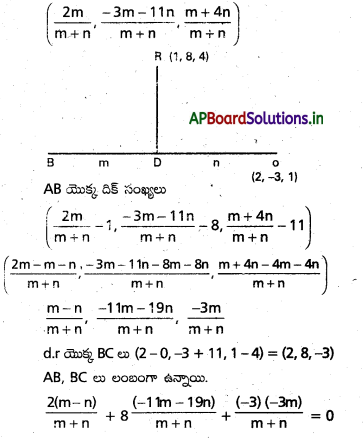
A(1, 8, 4), B(0, -11, 4), C(2, -3, 1) La బిందువులు. A నుండి BC కి గీసిన లంబపాదం D. D నిరూపకాలు కనుక్కోండి.
సాధన:
BC ని D బిందువు m : n నిష్పత్తిలో విభజిస్తుందనుకుందాం.
D నిరూపకాలు
AP Inter 1st Year Maths 1B Important Questions Chapter 6 దిక్ కొసైన్లు, దిక్ సంఖ్యలు 1
2m – 2n – 88m – 152n + 9m = 0
-77m – 154n = 0
77m = -154n
m = -2n
D నిరూపకాలు’
\(\left(\frac{-4 n}{-n}, \frac{6 n-11 n}{-n}, \frac{-2 n+4 n}{-n}\right)\)
= (4, 5, −2)

AP Inter 1st Year Maths 1B Important Questions Chapter 6 దిక్ కొసైన్లు, దిక్ సంఖ్యలు

ప్రశ్న 13.
O బిందువు నుంచి \(\overrightarrow{O A}, \overrightarrow{O B}\)రేఖలు వాటి దిక్ కొసైన్లు వరసగా(1, -2, -1); (3, -2, 3)లకు అనుపాతంలో ఉండేటట్లు గీయబడ్డాయి. \(\overleftrightarrow{A O B}\) తలం యొక్క అభిలంబరేఖకు దిక్ కొసైన్లు కనుక్కోండి.
సాధన:
l, m,n, d.c లు
అభిలంబ రేఖ దిక్ సంఖ్యలు AOB తలంలోని రేఖలన్నింటికి
లంబంగా l – 2m – n = 0
3l – 2m + 3n = 0
AP Inter 1st Year Maths 1B Important Questions Chapter 6 దిక్ కొసైన్లు, దిక్ సంఖ్యలు 2
అభిలంబ రేఖ దిక్ సంఖ్యలు 4, 3, -2
\(\sqrt{16+9+4}\) = \(\sqrt{29}\) తో భాగించగా
అభిలంబరేఖ దిక్ కొసైన్ \(\frac{4}{\sqrt{29}}, \frac{3}{\sqrt{29}}, \frac{-2}{\sqrt{29}}\)

AP Inter 1st Year Maths 1B Important Questions Chapter 6 దిక్ కొసైన్లు, దిక్ సంఖ్యలు

ప్రశ్న 14.
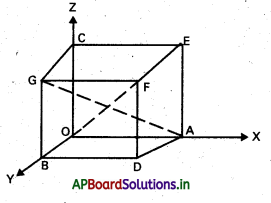
ఒక సమఘనం యొక్క రెండు కర్ణాల మధ్యకోణం కనుక్కోండి. [A.P Mar. ’15]
AP Inter 1st Year Maths 1B Important Questions Chapter 6 దిక్ కొసైన్లు, దిక్ సంఖ్యలు 3
సాధన:
సమఘనం ఒక శీర్షం ‘0’ గా తీసుకోవాలి.
OA, OB, OC లను నిరూపకాక్షాలుగా తీసుకుందాం.
OA = OB = OC = a అనుకుందాం
నాలుగు కర్ణాలు \(\overrightarrow{\mathrm{OF}}, \overrightarrow{\mathrm{AG}}, \overrightarrow{\mathrm{DE}}\) మరియు \(\overrightarrow{B C}\) సమఘనము శీర్షాల నిరూపకాలు
O(0, 0, 0), A(a, 0, 0), B(O, a, 0), C(0, 0, a) F(a, a,a), D(a, a, 0), E(a, 0, a),,G(0, a, a)
OF యొక్క దిక్ సంఖ్యలు (a – 0, a – 0, a – 0) = (a, a, a)
AG యొక్క దిక్ సంఖ్యలు (0 – a, a – 0, a – 0) = (-a, a, a)
OF AG ల మధ్య కోణం θ అనుకుంటే
cos θ = \(\frac{|a(-a)+a \cdot a+a . a|}{\sqrt{a^2+a^2+a^2} \sqrt{a^2+a^2+a^2}}\)
= \(\frac{a^2}{3 a^2}=\frac{1}{3}\) ⇒ θ = Cos-1 \(\left(\frac{1}{3}\right)\)
ఇదే విధంగా ఏ రెండు కర్ణాల మధ్య కోణాలు cos-1 \(\left(\frac{1}{3}\right)\) గా కనుక్కోగలము.

AP Inter 1st Year Maths 1B Important Questions Chapter 6 దిక్ కొసైన్లు, దిక్ సంఖ్యలు

ప్రశ్న 15.
దిక్ కొసైన్లు (2, 1, 1) (4, \(\sqrt{3}\) – 1, –\(\sqrt{3}\) – 1) కి అనుపాతంలో ఉండే రేఖలు ఒకదానితో ఒకటి – కోణం చేస్తాయని చూపండి.
సాధన:
దత్త రేఖలు దిక్ కొసైన్లు (2, 1, 1), (4, \(\sqrt{3}\) – 1, –\(\sqrt{3}\) -1)
42 + (\(\sqrt{3}\) – 1)2 + (-\(\sqrt{3}\) – 1)2
= 16 + 3 + 1 – 2 \(\sqrt{3}\) + 3 + 1 + 2\(\sqrt{3}\) = 24
cos θ = \(\frac{2.4+1(\sqrt{3}-1)+1(-\sqrt{3}-1)}{\sqrt{4+1+1} \sqrt{24}}\)
= \(\frac{8+\sqrt{3}-1-\sqrt{3}-1}{12}=\frac{6}{12}=\frac{1}{2}\) = cos 60°
⇒ θ = \(\frac{\pi}{3}\)

AP Inter 1st Year Maths 1B Important Questions Chapter 5 త్రిపరిమాణ నిరూపకాలు

Students get through AP Inter 1st Year Maths 1B Important Questions Chapter 5 త్రిపరిమాణ నిరూపకాలు which are most likely to be asked in the exam.

AP Inter 1st Year Maths 1B Important Questions Chapter 5 త్రిపరిమాణ నిరూపకాలు

సాధించిన సమస్యలు

ప్రశ్న 1.
A(-4, 9, 6), B(-1, 6, 6), C(0, 7, 10) బిందువులు ఒక లంబకోణ సమద్విబాహు త్రిభుజాన్ని ఏర్పరుస్తాయని చూపండి.
సాధన:
A(-4, 9, 6), B(-1, 6, 6), C(0, 7, 10) లు ABC త్రిభుజ శీర్షాలు
AB = \(\sqrt{(-4+1)^2+(9-6)^2+(6-6)^2}\)
= \(\sqrt{9+9}\)
= \(\sqrt{18}\)
BC = \(\sqrt{(-1-0)^2+(6-7)^2+(6-10)^2}\)
= \(\sqrt{1+1+16}\)
= \(\sqrt{18}\)
CA = \(\sqrt{(0+4)^2+(7-9)^2+(10-6)^2}\)
= \(\sqrt{16+4+16}\)
= \(\sqrt{36}\)
AB = BC మరియు AB2 + BC2 = CA2
ABC లంబకోణ సమద్విబాహు త్రిభుజం

ప్రశ్న 2.
Y – అక్షం నుంచి ఒక బిందువు దూరం, (1, 2, -1) నుంచి దాని దూరానికి మూడు రెట్లయితే ఆ బిందువు బిందుపధం 8x2 + 9y2 + 8z2 – 18x – 36y+ 18z + 54 = 0 అని చూపండి.
సాధన:
P (x, y, z) బిందుపధము మీది బిందువు
PM = Y – అక్షం నుండి దూరము = \(\sqrt{\mathrm{x}^2+\mathrm{z}^2}\)
A(1, 2, -1) దత్త బిందువు
దత్త నియమము PM = 3. PA
PM2 = 9PA2
x2 + z2 = 9[(x – 1)2 + (y – 2)2 + (z + 1)2]
= 9x2 – 18x + 9 + 9y2 – 36y + 36 + 9z2 + 18z + 9
P బిందువులు 8x2 + 9y2 + 8z2 – 18x – 36y +18z + 54 = 0
P తృప్తి పరిచే సమీకరణము
8x2 + 9y2 + 8z2 – 18x – 36y + 18z + 54 = 0

AP Inter 1st Year Maths 1B Important Questions Chapter 5 త్రిపరిమాణ నిరూపకాలు

ప్రశ్న 3.
\(\overrightarrow{\mathrm{ox}}, \overrightarrow{\mathrm{oy}}, \overrightarrow{\mathrm{oz}}\) లపై మూల బిందువు నుంచి a, b, c (a ≠ 0, b ≠ 0, c ≠ 0) వరుసగా A, B, C లు. O, A, B, C ల నుంచి సమాన దూరాలలో ఉండే బిందువు పథాన్ని కనుక్కోండి.
సాధన:
A బిందువు ox మీద ఉంది
A నిరూపకాలు (a, 0, 0)
ఇదే విధంగా B నిరూపకాలు (0, b, c), C నిరూపకాలు (0, 0, c)
P(x, y, z) కావలసిన బిందువులు
PO = PA = PB = PC
PO2 = PA2 = PB2 = PC2
PO2 = PA2
x2 + y2 + z2 = (x – a)2 + y2 + z2
x2 – x2 + a2 – 2ax = 0
2ax = a2 ⇒ a x = \(\frac{a^2}{2 a}=\frac{a}{2}\)
PO2 = PB2 ⇒ y = b/2
PO2 = PC2 ⇒ z = c/2
P నిరూపకాలు \(\left(\frac{a}{2}, \frac{b}{2}, \frac{c}{2}\right)\)

ప్రశ్న 4.
A (3,-2, 4), B(1, 1, 1), C(-1, 4, -2) బిందువులు సరేఖీయాలు అని చూపండి.
సాధన:
A (3, – 2, 4), B (1, 1, 1), C(-1, 4, -2) లు దత్త బిందువు
AB = \(\sqrt{(3-1)^2+(-2-1)^2+(4-1)^2}\)
= \(\sqrt{4+9+9}\)
= \(\sqrt{22}\)
BC = \(\sqrt{(1+1)^2+(1-4)^2+(1+2)^2}\)
= \(\sqrt{4+9+9}\)
= \(\sqrt{22}\)
AC = \(\sqrt{(3+1)^2+(-2-4)^2+(4+2)^2}\)
= \(\sqrt{16+36+36}\)
= \(\sqrt{88}\)
= 2\(\sqrt{22}\)
AB + BC = \(\sqrt{22}\) + \(\sqrt{22}\) = 2\(\sqrt{22}\) = AC
A, B, C లు సరేఖీయాలు

AP Inter 1st Year Maths 1B Important Questions Chapter 5 త్రిపరిమాణ నిరూపకాలు

ప్రశ్న 5.
A(2, 4, 5), B(3, 5, 4) లను కలిపే సరళరేఖా ఖండాన్ని YZ – తలం విభజించే నిష్పత్తిని మరియు ఖండన బిందువును కనుక్కోండి.
సాధన:
AB రేఖ YZ తలాన్ని P వద్ద ఖండిస్తుంది.
P బిందువు AB ని k : 1 నిష్పత్తిలో విభజిస్తుంది.
P నిరూపకాలు
\(\left(\frac{3 k+2}{k+1}, \frac{5 k+4}{k+1}, \frac{-4 k+5}{k+1}\right)\)
P బిందువు YZ తలంపై ఉంది
⇒ p యొక్క X నిరూపకాలు
\(\frac{3 k+2}{k+1}\) = 0 ⇒ 3k + 2 = 0
k = – \(\frac{2}{3}\)
YZ తలం AB ని -2 : 3 నిష్పత్తిలో విభజిస్తుంది.
k విలువ p నిరూపకాలతో ప్రతిక్షేపించగా
p నిరూపకాలు
\(\left[0, \frac{5\left(-\frac{2}{3}\right)+4}{-\frac{2}{3}+1}, \frac{(-4)\left(-\frac{2}{3}\right)+5}{-\frac{2}{3}+1}\right]\)
(0, 2, 23)

ప్రశ్న 6.
A(3, -2, 4), B(1, 1, 1), C (-1, 4, -2) బిందువులు సరేఖీయాలని చూపండి.
సాధన:
P బిందువు AD ని k : 1 నిష్పత్తిలో విభజిస్తుందనుకుందాం.
P నిరూపకాలు \(\left(\frac{k+3}{k+1}, \frac{k-2}{k+1}, \frac{k+4}{k+1}\right)\)
అయితే A, B, C లు సరేఖీయాలు ( బిందువు AB మీద ఉంది. k ఏదైని విలువకు P నిరూపకాలు C లో ఏకీభవించవలెను.
\(\frac{k+3}{k+1}\) = -1 ⇒ k + 3 = -k – 1
2h = 4 ⇒ k = -2
k = -2 ప్రతిక్షేపిస్తే P నిరూపకాలు
\(\left(\frac{-2+3}{-2+1}, \frac{-2-2}{-2+1}, \frac{-2+4}{-2+1}\right)\)
= (-1, 4, -2) = c

AP Inter 1st Year Maths 1B Important Questions Chapter 5 త్రిపరిమాణ నిరూపకాలు

ప్రశ్న 7.
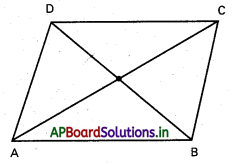
A, B, C లు సరేఖీయాలు (2, 4, -1), (3, 6, −1), (4, 5, 1) వరుస శీర్షాలుగా గల సమాంతర చతుర్భుజం యొక్క నాలుగో శీర్షాన్ని కనుక్కోండి. [Mar. ’11]
సాధన:
AP Inter 1st Year Maths 1B Important Questions Chapter 5 త్రిపరిమాణ నిరూపకాలు 1
ABCD సమాంతర చతుర్భుజం.
A = (2, 4, -1), B – (3, 6, −1).
C = (4, 5, 1)
D(x, y, z) నాల్గవ శీర్షం
A B C D సమాంతర చతుర్భుజం
AC మధ్య బిందువు = BD మధ్య బిందువు
\(\left(\frac{2+4}{2}, \frac{4+5}{7}, \frac{-1+1}{2}\right)\) = \(\left(\frac{3+x}{2}, \frac{6+y}{2}, \frac{-1+z}{2}\right)\)
\(\frac{3+x}{2}\) = \(\frac{6}{2}\)
3 + x = 6
x = 3

\(\frac{6+y}{2}\) = \(\frac{9}{2}\)
6 + y = 9
y = 3

\(\frac{0}{2}\) = \(\frac{z-1}{2}\)
z – 1 = 0
z = 1
∴ నాల్గవ శీర్షం నిరూకాలు = D (3, 3, 1)

ప్రశ్న 8.
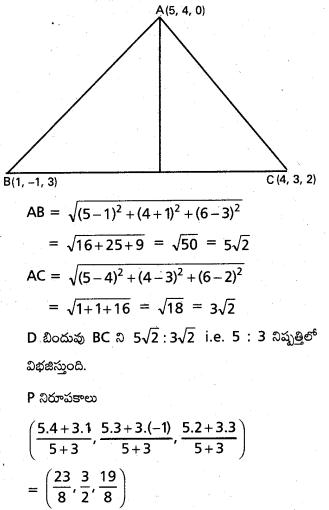
A(5,4, 6), B(1, -1, 3), C(4, 3, 2) అంతరాళంలో మూడు బిందువులు. ∠BAC యొక్క సమద్విఖండన రేఖ \(\overline{\mathrm{BC}}\) రేఖాఖండాన్ని ఖండించే బిందువు నిరూపకాలు కనుక్కోండి.
సాధన:
AB రేఖ ∠BAC కోణ సమద్విఖండనరేఖ అయితే D బిందువు BC ని AB : AC నిష్పత్తిలో విభజిస్తుంది.
AP Inter 1st Year Maths 1B Important Questions Chapter 5 త్రిపరిమాణ నిరూపకాలు 2

AP Inter 1st Year Maths 1B Important Questions Chapter 5 త్రిపరిమాణ నిరూపకాలు

ప్రశ్న 9.
ఒక త్రిభుజం రెండు శీర్షాలు (x1, y1, z1), (x2, y2, z2) లు మరియు కేంద్రభాసం (α, β, γ) అయితే త్రిభుజం మూడో శీర్షాన్ని కనుక్కోండి.
సాధన:
A = (x1, y1, z1), B = (x2, y2, z2) లు త్రిభుజం ABC రెండు శీర్షాలనుకొందాం.
AP Inter 1st Year Maths 1B Important Questions Chapter 5 త్రిపరిమాణ నిరూపకాలు 3
G = (α, β, γ) కేంద్రభాసం అనుకొందాం.
C = (x3, y3, z3) మూడో శీర్షమైతే,.
\(\left(\frac{x_1+x_2+x_3}{3}, \frac{y_1+y_2+y_3}{3}, \frac{z_1+z_2+z_3}{3}\right)\) = (α, β, γ)
⇒x1 + x2 + x3 = 3α; y1 + y2 + y3 = 3β; z1 + z3 + z3 = 3γ.
⇒ x3 = 3α – x1 – x2; y3 = 3β – y1 – y2; z3 = 3γ – z1 – z2
∴ మూడో శీర్షం
C = (3α – x1 – x2, 3β – y1 – y2, 3γ – z1 – z2).

ప్రశ్న 10.
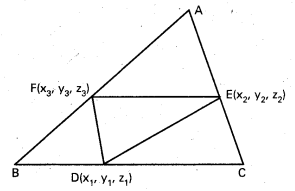
త్రిభుజం A, B, C భుజాలు BC, CA, AB ల మధ్య బిందువులు వరసగా D(x1, y1, z1), E(x2, y2, z2), F(x3, y3, z3) లు అయితే శీర్షాలు A, B, C లను కనుక్కోండి.
సాధన:
BC భుజం మధ్య బిందువు D, CA భుజం మధ్య బిందువు E, AB భుజం మధ్య బిందువు F అని దత్తాంశం.
AP Inter 1st Year Maths 1B Important Questions Chapter 5 త్రిపరిమాణ నిరూపకాలు 4
∴ DEF అనేది మధ్య బిందువులతో ఏర్పడిన త్రిభుజం.
AEDF సమాంతర చతుర్భుజాన్ని పరిగణిద్దాం.
A = (h, k, s) కనుక్కోవాల్సిన శీర్షం అనుకొందాం.
AD మధ్య బిందువు = EF మధ్యబిందువు
⇒ \(\left(\frac{h+x_1}{2}, \frac{k+y_1}{2}, \frac{s+z_1}{2}\right)\) = \(\left(\frac{x_2+x_3}{2}, \frac{y_2+y_3}{2}, \frac{z_2+z_3}{2}\right)\)
⇒ h = x2 + x3 – x1; k = y2 + y3 – y2; s = z2 + z3 – z1
∴ శీర్షం A = (x2 + x3 – x1, y2 + y3 – y1, z2 + z3 – z1).
ఈ విధంగానే
శీర్షం B = (x3 + x1 – x2, y3 + y1 – y2, z3 + z1 – z2)
శీర్షం C = (x1 + x2 − x3, y1 + y2 – y3, z1 + z2 – z3).
లను రాబట్టవచ్చు.

AP Inter 1st Year Maths 1B Important Questions Chapter 5 త్రిపరిమాణ నిరూపకాలు

ప్రశ్న 11.
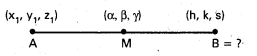
A(x1, y1, z1), B బిందువులను కలిపే రేఖాఖండం మధ్య బిందువు M(α, β, γ) అయితే B ని కనుక్కోండి.
సాధన:
AP Inter 1st Year Maths 1B Important Questions Chapter 5 త్రిపరిమాణ నిరూపకాలు 5
B(h, k, s) కనుక్కోవలసిన బిందువు అనుకొందాం.
AB మధ్య బిందువు M అనేది దత్తాంశం. కనుక
(α, β, γ) = \(\left(\frac{\mathrm{x}_1+\mathrm{h}}{2}, \frac{\mathrm{y}_1+\mathrm{k}}{2}, \frac{\mathrm{z}_1+\mathrm{s}}{2}\right)\)
⇒ 2α = x1 + h; 2β = y1 + k; 2γ = z1 + s
⇒ h = 2α – x1; k = 2β – y1; s = 2γ – z1
బిందువు B = (2α – x1, 2β – y1, 2γ – z1).

ప్రశ్న 12.
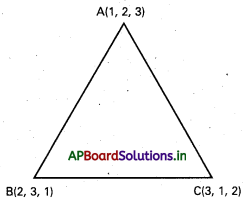
(1, 2, 3), (2, 3, 1), (3, 1, 2) బిందువులతో ఏర్పడిన త్రిభుజం లంబకేంద్రం, కేంద్రభాసం, పరికేంద్రం, అంతరకేంద్రాలు వరసగా H, G, S, I లు అయితే వాటి విలువలను కనుక్కోండి.
సాధన:
AB = \(\sqrt{(2-1)^2+(3-2)^2+(1-3)^2}\)
= \(\sqrt{1+1+4}\)
= \(\sqrt{6}\)
BC = \(\sqrt{(3-2)^2+(1-3)^2+(2-1)^2}\)
= \(\sqrt{1+4+1}\)
= \(\sqrt{6}\)
CA = \(\sqrt{(1-3)^2+(2-1)^2+(3-2)^2}\)
= \(\sqrt{4+1+1}\)
= \(\sqrt{6}\)
AP Inter 1st Year Maths 1B Important Questions Chapter 5 త్రిపరిమాణ నిరూపకాలు 6
AB = BC = CA కాబట్టి, ABC సమబాహు త్రిభుజం.
కేంద్రభాసం G = \(\left(\frac{1+2+3}{3}, \frac{2+3+1}{3}, \frac{3+1+2}{3}\right)\) = (2, 2, 2)
సమబాహు త్రిభుజంలో లంబకేంద్రం, కేంద్రభాసం, పరికేంద్రం, అంతరకేంద్రాలు సమానం (నాలుగు బిందువులు ఏకీభవిస్తాయి).
కాబట్టి H = ( 2, 2, 2), S = (2, 2, 2), I = (2, 2, 2)

AP Inter 1st Year Maths 1B Important Questions Chapter 5 త్రిపరిమాణ నిరూపకాలు

ప్రశ్న 13.
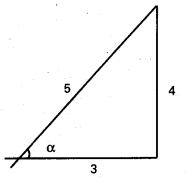
(0, 0, 0), (3, 0, 0), (0, 4, 0)లతో ఏర్పడిన త్రిభుజం అంతర కేంద్రం కనుక్కోండి.
సాధన:
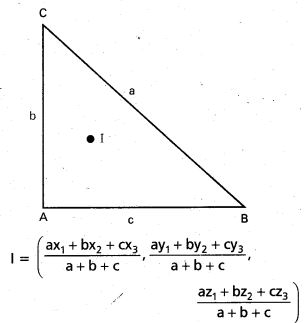
A = (x1, y1, z1), B = (x2, y2, z2), C = (x3, y3, z3) లు శీర్షాలుగా గల ABC త్రిభుజం భుజాలు a, b, c అయితే త్రిభుజం అంతరకేంద్రం
AP Inter 1st Year Maths 1B Important Questions Chapter 5 త్రిపరిమాణ నిరూపకాలు 7
A = (0, 0, 0), B = (3, 0, 0), C (0, 4, 0).
a = BC = \(\sqrt{9+16+0}\) = 5;
b = CA = \(\sqrt{0+16+0}\) = 4;
c = AB = \(\sqrt{9+0+0}\) = 3;
కాబట్టి I = \(\frac{5(0)+4(3)+3(0)}{5+4+3}, \frac{5(0)+4(0)+3(4)}{5+4+3}, \left.\frac{5(0)+4(0)+3(0)}{5+4+3}\right)\)
= (1, 1, 0)

AP Inter 1st Year Maths 1B Important Questions Chapter 5 త్రిపరిమాణ నిరూపకాలు

ప్రశ్న 14.
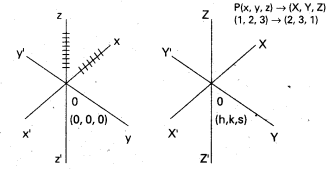
సమాంతర అక్షపరివర్తనం ద్వారా (1, 2, 3) బిందువును (2, 3, 1) బిందువు వద్దకు మారిస్తే, నూతన మూల బిందువును కనుక్కోండి.
సాధన:
Oxyz నిరూపక వ్యవస్థ దృష్ట్యా P బిందువు నిరూపకాలు (x, y, z) అనుకొందాం. O’XYZ నిరూపక వ్యవస్థ దృష్ట్యా P
బిందువు నిరూపకాలు (X,Y,Z) అనుకొందాం.
AP Inter 1st Year Maths 1B Important Questions Chapter 5 త్రిపరిమాణ నిరూపకాలు 8
O’ (h, k, s) నూతన మూలబిందువు అయితే
X = X + h‚ y = Y + k, z = Z + s అవుతాయి.
⇒ (h, k, s) (x – X, y – Y, z – Z)
⇒ (h, k, s) = (1 – 2, 2 – 3, 3 – 1)
= (-1, -1, 2).
∴ O’ = (-1, -1, 2) నూతన మూలబిందువు.

AP Inter 1st Year Maths 1B Important Questions Chapter 5 త్రిపరిమాణ నిరూపకాలు

ప్రశ్న 15.
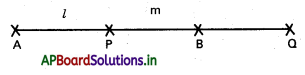
A(3, 2, -4), B(9, 8, -10) బిందువులను కలిపే రేఖాఖండాన్ని P(5, 4, -6) బిందువు విభజించే నిష్పత్తి కనుక్కోండి. ఇంకా P హరాత్మక సంయుగ్మ బిందువును కూడా’ కనుక్కోండి.
సాధన:
AP Inter 1st Year Maths 1B Important Questions Chapter 5 త్రిపరిమాణ నిరూపకాలు 9
AB రేఖా ఖండాన్ని P బిందువు విభజించే నిష్పత్తి l : m అనుకొందాం.
∴ (5, 4, -6)
= \(\left(\frac{9 l+3 \mathrm{~m}}{l+\mathrm{m}}, \frac{8 l+2 \mathrm{~m}}{l+\mathrm{m}}, \frac{-10 l-4 \mathrm{~m}}{l+\mathrm{m}}\right)\)
⇒ l : m = 1 : 2 లేదా 2l = m.
AB ని Q బిందువు l : – m నిష్పత్తిలో విభజిస్తుందనుకొందాం. అప్పుడు
Q = \(\left(\frac{9 l-3 \mathrm{~m}}{l-\mathrm{m}}, \frac{8 l-2 \mathrm{~m}}{l-\mathrm{m}}, \frac{-10 l+4 \mathrm{~m}}{l-\mathrm{m}}\right)\)
= \(\left(\frac{9 l-6 l}{l-2 l}, \frac{8 l-4 l}{l-2 l}, \frac{-10 l+8 l}{l-2 l}\right)\)
= (-3, -4, 2)
∴ P(5, 4, -6) హరాత్మక సంయుగ్మ బిందువు Q(-3, -4, 2).

AP Inter 1st Year Maths 1A Important Questions Chapter 1 ప్రమేయాలు

Students get through AP Inter 1st Year Maths 1A Important Questions Chapter 1 ప్రమేయాలు which are most likely to be asked in the exam.

AP Inter 1st Year Maths 1A Important Questions Chapter 1 ప్రమేయాలు

సాధించిన సమస్యలు

ప్రశ్న 1
f: R- {0} → R ను f(x) = x + \(\frac{1}{x}\) గా నిర్వచిస్తే (f(x))2 = f(x2) + f(1) అని చూపండి.
సాధన:
f : R – {0} → R,
f(x) = x + \(\frac{1}{x}\)
ఇప్పుడు f(x2) + f(1) = (x2 + \(\frac{1}{x^2}\)) + (1 + \(\frac{1}{1}\))
= x2 + 2 + \(\frac{1}{x^2}\)
= \(\left(x+\frac{1}{x}\right)^2\) = (f(x))2
∴(f(x))2 = f(x2) + f(1)

AP Inter 1st Year Maths 1A Important Questions Chapter 1 ప్రమేయాలు

ప్రశ్న 2.
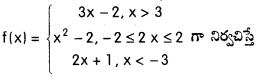
f ప్రమేయాన్ని [Mar. ’14]
AP Inter 1st Year Maths 1A Important Questions Chapter 1 ప్రమేయాలు 1
f(4), f(2.5), f(-2), f(-4), f(0), f(-7) కనుక్కోండి.
సాధన:
f ప్రదేశం (−∞, – 3) ∪ (-2, 2] ∪ (3, ∞)
i) f(x)=3x – 2, x > 3
f(4) = 3(4) – 2 = 10

ii) 2.5, f ప్రదేశంలో లేదు. కనుక f(2.5) నిర్వచితం కాదు.

iii) ∵ f(x) = x2 – 2, -2 ≤ x ≤ 2 కాబట్టి
f(-2) = (-2)2 – 2 = 4 – 2 = 2

iv) ∵ f(x) = 2x + 1, x < -3 కాబట్టి
f(-4) = 2(-4) + 1 – 8 + 1 = -7

v) ∵ f(x) = x2 – 2, -2 ≤ x ≤ 25
f(0) = (0)2 – 2 = 0 – 2 = -2

vi) ∵ f(x) = 2x + 1, x < -3 కాబట్టి
f(-7) = 2(-7) +1 = -14 + 1 = -13

ప్రశ్న 3.
A = {0, \(\frac{\pi}{6}\), \(\frac{\pi}{4}\), \(\frac{\pi}{3}\), \(\frac{\pi}{2}\)}, f : A → B సంగ్రస్తం అయి, f(x) = cos X గా నిర్వచిస్తే, B కనుక్కోండి. [May ’11; Mar. ’11]
సాధన:
f : A → B సంగ్రస్తం
f(x) = cos x
B = f వ్యాప్తి = f(A)
= \(\left\{f(0), f\left(\frac{\pi}{6}\right), f\left(\frac{\pi}{4}\right), f\left(\frac{\pi}{3}\right), f\left(\frac{\pi}{2}\right)\right\}\)
= \(\left\{1, \frac{\sqrt{3}}{2}, \frac{1}{\sqrt{2}}, \frac{1}{2}, 0\right\}\)
= \(\left\{-1, \frac{\sqrt{3}}{2}, \frac{1}{\sqrt{2}}, \frac{1}{2}, 0\right\}\)

AP Inter 1st Year Maths 1A Important Questions Chapter 1 ప్రమేయాలు

ప్రశ్న 4.
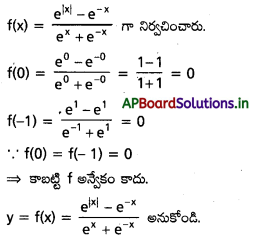
f : R → R ను f(x) = \(\frac{e^{|x|}-e^{-x}}{e^x+e^{-x}}\) గా నిర్వచిస్తే, f అన్వేకం, సంగ్రస్తం, ద్విగుణం అవుతాయేమో నిర్ణయించండి.
సాధన:
f : R→ R ను
AP Inter 1st Year Maths 1A Important Questions Chapter 1 ప్రమేయాలు 2
y = 1 కి f(x) = 1 అయ్యేటట్లు R లో x ఉండదు.
⇒ కాబట్టి f సంగ్రస్తం కాదు.
ఒకవేళ x ∈R కు f(x) = 1 అయితే
\(\frac{e^{|x|}-e^{-x}}{e^x+e^{-x}}\) = 1
⇒ e|x| – ex = ex + e-x, కాబట్టి x ≠ 0 స్పష్టం.
x > 0, అయితే
ex – e-x = ex + e-x ⇒ e-x = e-x అసాధ్యం.
x < 0, అయితే
e-x – e-x = ex + e-x
⇒ -e-x = ex అసాధ్యం.

ప్రశ్న 5.
f : R → R ను AP Inter 1st Year Maths 1A Important Questions Chapter 1 ప్రమేయాలు 3
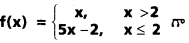
నిర్వచిస్తే, f అన్వేకం, సంగ్రస్తం, ద్విగుణం అవుతాయేమో పరిశీలించండి.
సాధన:
3 > 2 కాబట్టి f(3) = 3
1 < 2 కాబట్టి f(1) = 5(1) – 2 ∴ 1, 3 లకు ఒకే f- ప్రతిబింబం ఉంది. కాబట్టి f అన్వేకం కాదు. సహప్రదేశం లోని y కి, y > 2 లేదా y ≤ 2 కావాలి.
y > 2 అయితే x = y ∈ R, f(x) = x = y
y ≤ 2 అయితే x = \(\frac{y+2}{5}\)∈ R
x = \(\frac{y+2}{5}\) < 1
∴ f(x) = 5x – 2 = 5\(\left[\frac{y+2}{5}\right]\) – 2 = y
∴f ఎ. సంగ్రస్తం
f అన్వేకం కాదు కాబట్టి f ద్విగుణ ప్రమేయం కాదు.

AP Inter 1st Year Maths 1A Important Questions Chapter 1 ప్రమేయాలు

ప్రశ్న 6.
2x + 2y = 2 సమీకరణం ద్వారా నిర్వచింపబడ్డ ప్రమేయం y(x) ప్రదేశం కనుక్కోండి.
సాధన:
2x = 2 – 2y < 2 (∵ 2y > 0)
⇒ log22x < log22
⇒ x < 1
∴ ప్రదేశం = (-∞, 1).

ప్రశ్న 7.
f : R → R f (x + y) = f(x) + f(y) ∀ x, y ∈ R, f(1) = 7, గా నిర్వచిస్తే \(\sum_{r=1}^n f(r)\) కనుక్కోండి.
సాధన:
f(2) = f (1 + 1) = f (1) + f (1) = 2f (1).
f(3) = f(2+1) = f (2) + f (1) = 3f (1).
ఇలాగే f(r) = rf (1).
∴ \(\sum_{r=1}^n f(r)\) = f (1) + f(2) + ………. + f(n)
= f (1) + 2f (1) + …… +n f (1)
= f(1) (1 + 2+ …………….. +n)
= \(\frac{7 n(n+1)}{2}\)

AP Inter 1st Year Maths 1A Important Questions Chapter 1 ప్రమేయాలు

ప్రశ్న 8.
f(x) = \(\frac{\cos ^2 x+\sin ^4 x}{\sin ^2 x+\cos ^4 x}\) ∀ x ∈ R అయితే f (2012) = 1 అని చూపండి.
సాధన:
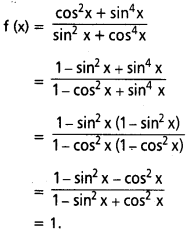
AP Inter 1st Year Maths 1A Important Questions Chapter 1 ప్రమేయాలు 4
∴ f (2012) = 1.

ప్రశ్న 9.
f : R → R, g : R → R f(x) = 4x – 1, g(x) = x2 + 2 గా నిర్వచిస్తే
i) (gof) (x)
ii) (gof) \(\left(\frac{a+1}{4}\right)\)
iii) (fof) (x)
iv) go(fof) (0) కనుక్కోండి. [Mar. ’05]
సాధన:
f : R → R, g : R → R
f(x) =4x – 1, g(x) = x2 + 2
i) (gof) (x) = g(f(x))
= g(4x – 1). ∵ f(x) = 4x – 1
= (4x – 1)2 + 2 ∵ g(x) = x2 + 2
= 16x2 – 8x + 1 + 2
= 16x2 – 8x + 3

ii) (gof) \(\left(\frac{a+1}{4}\right)\) = \(g\left(f\left(\frac{a+1}{4}\right)\right)\)
= \(g\left(4\left(\frac{a+1}{4}\right)-1\right)\)
= g(a)
= a2 + 2

iii) (fof) (x) = f(f(x))
= f(4x – 1) ∵ f(x) = 4x – 1
= 4(4x – 1) – 1
= 16x – 4 – 1
= 16x – 5

iv) (fof) (0) = f(f(0))
= f(4 × 0 – 1)
= f(-1)
= 4(-1) – 1 = -5
ఇప్పుడు (fof) (0) = g(-5) = (-5)2 + 2 = 27

AP Inter 1st Year Maths 1A Important Questions Chapter 1 ప్రమేయాలు

ప్రశ్న 10.
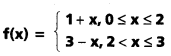
f : [0, 3] → [0,3],
AP Inter 1st Year Maths 1A Important Questions Chapter 1 ప్రమేయాలు 5గానిర్వచిస్తే
f[0, 3] ⊆ [0, 3] అని చూపి fof కనుక్కోండి.
సాధన:
0 ≤ x ≤ 2 ⇒ 1 ≤ 1 + x ≤ 3 …………….. (1)
2 < x <3 ⇒ -3 ≤ x ≤ -2
⇒ 3 – 3 ≤ 3 – x ≤ 3 – 2
⇒ 0 ≤ 3 – x < 1 ……………… (2)
(1), (2) ల నుండి
f[0, 3] ⊆ [0, 3]
0 ≤ x ≤ 1, అయితే
(fof) (x) = f(f(x))
f(1 + x)=1+ (1 + x) = 2 + x [∵ 1 ≤ 1 + x ≤ 2]
1 < x ≤ 2, అయితే
(fof) (x) = = f(f(x))
= f(1 + x)
= 3 – (1 + x)
= 2x, [∵ 2 < 1 + x ≤ 3]
2 < x ≤ 3, అయితే
(fof) (x) = f(f(x))
= f(3 – x)
= 1 + (3 – x)
= 4 – x, [∵ 0 ≤ 3 – x < 1]
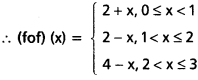
AP Inter 1st Year Maths 1A Important Questions Chapter 1 ప్రమేయాలు 6

ప్రశ్న 11.
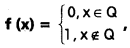
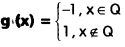
f, g : R→ R ప్రమేయాలను AP Inter 1st Year Maths 1A Important Questions Chapter 1 ప్రమేయాలు 7, AP Inter 1st Year Maths 1A Important Questions Chapter 1 ప్రమేయాలు 8 అని నిర్వచిస్తే
(fog) (π) + (gof) (e).
సాధన:
(fog) (π) = f (g (π)) = f (0) = 0
(gof) (e) = (f (e)) = g (1) = -1.
∴ (fog) (π) + (gof) (e) = -1.

AP Inter 1st Year Maths 1A Important Questions Chapter 1 ప్రమేయాలు

ప్రశ్న 12.
A = {1, 2, 3}, B = {a, b, c}, C = (p, q, r} అనుకొందాం f : A → B, g : B → C లను f = {(1, a), (2, c), (3, b)}, g = {(a, q), (b, r), (c, p)} π గా నిర్వచిస్తే f-1og-1= (g o f)-1 అని చూపండి.
సాధన:
f = {(1, a), (2, c), (3, b)}
g = {(a, q), (b, r), (c, p)}లు కనుక
అప్పుడు go f = {(1, q), (2, p), (3, r)}
⇒ (gof)-1 = {(q, 1), (p, 2), (r, 3)}
g-1 = {(q, a), (r, b), (p, c)},
f-1 = {(a, 1), (c, 2), (b, 3)} కనుక
f-1og-1 = {(q, 1), (r, 3), (p, 2)}
∴ (gof)-1 = f-1 o g-1

ప్రశ్న 13.
f : Q→ Q, f(x) = 5x + 4 m గా ప్రతీ x ∈ Q నిర్వచిస్తే, f ద్విగుణ ప్రమేయం అని చూపి కనుక్కోండి. [May ’05]
సాధన:
x1, x2, ∈ Q,
f(x1) = f(x2)
⇒ 5x1 + 4 = 5x2 + 4
⇒ 5x1 = 5x2
⇒ x1 = x2
∴ f అన్వేకం
y ∈ Q అయితే x = \(\frac{y-4}{5}\) ∈ Q వ్యవస్థితం
f(x) = \(f\left(\frac{y-4}{5}\right)=5\left(\frac{y-4}{5}\right)\) + 4 = y
∴ f సంగ్రస్తం
కనుక ద్విగుణ ప్రమేయం
∴ f-1 : Q → Q వ్యవస్థితం. కాని Q లో ప్రతీ x కు
(fof-1) (x) = I(x)
⇒ f(f-1(x)) = x, ‘.’ f(x) = 5x + 4
⇒ 5 f-1(x) + 4 = x
⇒ f-1(x) = \(\frac{x-4}{5}\) ∀ x ∈ Q

AP Inter 1st Year Maths 1A Important Questions Chapter 1 ప్రమేయాలు

ప్రశ్న 14.
ఈ కింది వాస్తవ మూల్య ప్రమేయాలకు ప్రదేశాలు తీసుకోండి.
i) f(x) = \(\frac{1}{6 x-x^2-5}\)
సాధన:
f(x) = \(\frac{1}{6 x-x^2-5}=\frac{1}{(x-1)(5-x)}\) ∈ R
⇔ (x – 1) (5 – x) ≠ 0
⇔ x ≠ 1, 5
∴f ప్రదేశం R – {1, 5}.

ii) f(x) = \(\frac{1}{\sqrt{x^2-a^2}}\) (a > 0) [(A.P) Mar ’15]
సాధన:
f(x) = \(\frac{1}{\sqrt{x^2-a^2}}\) ∈ R
⇔ x2 – a2 > 0·
⇔ (x + a) (x – a) > 0
⇔ x ∈ (-∞, -a) ∪ (a,∞)
∴f ప్రదేశం
(-∞, -a) ∪ (a, ∞) = R-[-a, a]

iii) f(x) = \(\sqrt{(x+2)(x-3)}\)
సాధన:
f(x) = \(\sqrt{(x+2)(x-3)}\) ∈ R
⇔ (x + 2) (x – 3) > 0
⇔ x ∈ (-∞, -2) ∪ [3, ∞)
∴f ప్రదేశం
(-∞, -2] ∪ [3, ∞) = R(-2, 3)

iv) f(x) = \(\sqrt{(x-\alpha)(\beta-x)}\) (0 < α < β) సాధన: f(x) = \(\sqrt{(x-\alpha)(\beta-x)}\) ∈ R ⇔ (x – α) (β – x) > 0
⇔ α ≤ x ≤ β; (α <β)
⇔x ∈ [α, β]
∴ f ప్రదేశం [α, β]

AP Inter 1st Year Maths 1A Important Questions Chapter 1 ప్రమేయాలు

v) f(x) = \(\sqrt{2-x}\) + \(\sqrt{1+x}\)
సాధన:
f(x) = \(\sqrt{2-x}\) + \(\sqrt{1+x}\) ∈ R
⇔ 2 – x ≥ 0, 1 + x ≥ 0
⇔ 2 ≥ x, x ≥ -1
⇔ -1 ≤ x ≤ 2
⇔ x ∈ [-1, ]
∴ f ప్రదేశం [-1, 2].

vi) f(x) = \(\sqrt{x^2-1}+\frac{1}{\sqrt{x^2-3 x+2}}\)
సాధన:
f(x) = \(\sqrt{x^2-1}+\frac{1}{\sqrt{x^2-3 x+2}}\) ∈ R
⇔ x2 – 1 ≥ 0, x2 – 3x + 2 > 0
⇔ (x + 1) (x = 1) ≥ 0, (x – 1) (x – 2) > 0
⇔ x ∈ (∞, -1] ∪ [1, ∞), x ∈ (-∞, 1) ∪(2, ∞)
⇔ x ∈ (R – (-1, 1)) ∩ (R-[1, 2])
⇔ x ∈ R – {(1, 1) ∪ [1, 2]}
⇔ x ∈ R – (-1, 2]
⇔ x ∈ (-∞, -1] ∪ (2, ∞)
∴ f ప్రదేశం
(-∞, -1] ∪(2, ∞) = R – (-1, 2]

vii) f(x) = \(\frac{1}{\sqrt{|x|-x}}\) ∈ R
సాధన:
f(x) = \(\frac{1}{\sqrt{|x|-x}}\) ∈ R
⇔ |x| – x > 0
⇔ |x| > x
⇔ x ∈ (-∞, 0)
∴ f ప్రదేశం (-∞, 0)

viii) f(x) = \(\sqrt{|\mathrm{x}|-\mathrm{x}}\)
సాధన:
f(x) = \(\sqrt{|\mathrm{x}|-\mathrm{x}}\) ∈ R
⇔ |x| – x ≥ 0
⇔ |x| ≥ x
⇔ x ∈ R
∴ f ప్రదేశం R.

AP Inter 1st Year Maths 1A Important Questions Chapter 1 ప్రమేయాలు

ప్రశ్న 15.
f = {(4, 5), (5, 6), (6, -4)}, g = {(4, 4), (6, 5), (8, 5)} అయితే
i) f + g
ii) f – g
iii) 2f + 4g
iv) f + 4
v) fg
vi) \(\frac{\mathrm{f}}{\mathrm{g}}\)
vii) |f|
viii) \(\sqrt{\mathrm{f}}\)
ix) f2
(x) f3 లు కనుక్కోండి.
సాధన:
f = {(4, 5), (5, 6), (6, -4)}
g= {(4, 4), (6, 5), (8, 5)}
f ప్రదేశం = {4, 5, 6} = A
g ప్రదేశం = {4, 6, 8) = B
f ± g ప్రదేశం = A ∩ B = {4, 6}
i) f + g = {4, 5 + (-4), (6, – 4 + 5)}
= {(4, 1), (6, 1)}

ii) f – g = {(4, 5 – (-4)), (6, -4, -5)}
= {(4, 9), (6, -9)}

iii) 2f ప్రదేశం = A = {4, 5, 6}
4g ప్రదేశం = B = {4, 6, 8}
2f + 4g ప్రదేశం = A ∩ B = (4, 6)
∴ 2f = {(4, 10), (5, 12), (6, -8)}
4g = {(4, -16), (6, 20), (8, 20)}
∴ 2f + 4g = {(4, 10 + (-16), 6, -8 + 20)}
= {(4, −6), (6, 12)}

iv) f + 4 ప్రదేశం = A = {4, 5, 6}
f + 4 = {4, 5 + 4), (5, 6 + 4), (6, – 4 + 4)}
= {(4, 9), (5, 10), (6, 0)}

v) fg ప్రదేశం = A ∩ B = {4, 6}
fg = {(4, (5) (-4), (6, (-4) (5))}
= {(4, -20), (6, – 20)}

vi) \(\frac{\mathrm{f}}{\mathrm{g}}\) ప్రదేశం = {4, 6}
∴\(\frac{f}{g}=\left\{\left(4, \frac{-5}{4}\right),\left(6, \frac{-4}{5}\right)\right\}\)

vii) |f| ప్రదేశం = {4, 5, 6}
∴ |f| = {(4, |5|), (5, |6|), (6, |-4|)}
= {(4, 5), (5, 6), (6, 4)}

AP Inter 1st Year Maths 1A Important Questions Chapter 1 ప్రమేయాలు

viii) \(\sqrt{\mathrm{f}}\) ప్రదేశం = {4, 5}
∴ \(\sqrt{\mathrm{f}}\) = {(4, \(\sqrt{5}\)), (5, \(\sqrt{6}\))}

ix) f2 ప్రదేశం = {4, 5, 6} = A
∴ f2 = {(4, (5)2), (5, (6)2, (6, (-4)2)}
f2 = {(4, 25), (5, 36), (6, 16)}

x) f3 ప్రదేశం = A = {4, 5, 6}
∴ f3 = {(4, (53), (5, 63), (6, (-4)3}
= {(4, 125), (5, 216), (6, -64)}

ప్రశ్న 16.
కింది వాస్తవ మూల్య ప్రమేయాల ప్రదేశాలు, వ్యాప్తులు కనుక్కోండి.
i) f(x) = \(\frac{2+x}{2-x}\)
ii) f(x) = \(\frac{x}{1+x^2}\)
iii) f(x) = \(\sqrt{9-x^2}\)
సాధన:
i) f(x) = \(\frac{2+x}{2-x}\) ∈ R
⇔ 2 – x ≠ 0 ⇔ x ≠ 2 ⇔ x ∈ R – {2}
∴ f ప్రదేశం R – {2}
f(x) = \(\frac{y}{1}=\frac{2+x}{2-x}\) అనుకోండి.
⇒ \(\frac{y+1}{y-1}=\frac{(2+x)+(2-x)}{(2+x)-(2-x)}\)
⇒ \(\frac{y+1}{y-1}=\frac{4}{2 x}\)
⇒ x = \(\frac{2(y-1)}{y+1}\)
y + 1 = 0
(i.e.,) y = -1 కి x నిర్వచితం కాదు
∴ f వ్యాప్తి = R – {1}.

AP Inter 1st Year Maths 1A Important Questions Chapter 1 ప్రమేయాలు

ii) f(x) = \(\frac{x}{1+x^2}\)
సాధన:
f(x) = \(\frac{x}{1+x^2}\) ∈ R
∴ ∀ x ∈ R, x2 + 1 ≠ 0
f ప్రదేశం R
f(x) = y = \(\frac{x}{1+x^2}\) అనుకుందాం.
⇒ x2y – x + y = 0
⇒ x = \(\frac{-(-1) \pm \sqrt{1-4 y^2}}{y}\), వాస్తవ సంఖ్య
⇔ 1 – 4y2 ≥ 0, y ≠ 0
⇔ (1 – 2y) (1 + 2y) ≥ 0, y ⇔ 0
⇔ y ∈ \(\left[-\frac{1}{2}, \frac{1}{2}\right]\) – {0}
కాని x = 0 ⇒ y = 0
∴ f వ్యాప్తి = \(\left[-\frac{1}{2}, \frac{1}{2}\right]\)

iii) f(x) = \(\sqrt{9-x^2}\) [(T.S) Mar ’15]
సాధన:
f(x) = \(\sqrt{9-x^2}\) ∈ R
⇔ 9 – x2 ≥ 0
⇔ (3 + x) (3 – x) ≥ 0
⇔ x ∈ [-3, 3]
∴ f ప్రదేశం [-3, 3]
f(x) = y = \(\sqrt{9-x^2}\) అనుకుందాం
⇒ x = \(\sqrt{9-y^2}\) ∈ R.
⇔ 9 – y2 ⇔ (3 + y) (3 – y) ≥ 0
∴ -3 ≤ y ≤ 3
కానీ f(x) రుణేతర వాస్తవ సంఖ్యలు మాత్రమే తీసుకుందాం.
∴ f వ్యాప్తి = [0, 3].

AP Inter 1st Year Maths 1A Important Questions Chapter 1 ప్రమేయాలు

ప్రశ్న 17.
f(x) = x2, g(x) = |x| గా నిర్వచిస్తే, క్రింది ప్రమేయాలను కనుక్కోండి.
i) f + g,
ii) f – g,
iii) fg,
iv) 2f,
v) f2,
vi) f + 3
సాధన:
f(x) = x2
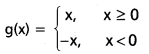
AP Inter 1st Year Maths 1A Important Questions Chapter 1 ప్రమేయాలు 9
f ప్రదేశం = g ప్రదేశం = R
కాబట్టి (i) నుంచి (vi) వరకు ప్రమేయాల ప్రదేశం R

i) (f + g) (x) = f(x) + g(x)
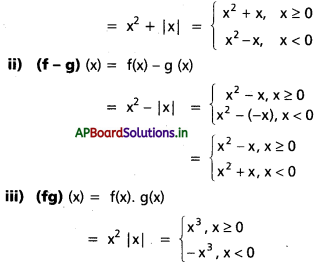
AP Inter 1st Year Maths 1A Important Questions Chapter 1 ప్రమేయాలు 10
iv) 2f (x) = 2 f(x) = 2x2
v) f(x) = (f(x))2 = (x2)2 = x4
vi) f + 3 (x) = f(x) + 3 = x2 + 3.

ప్రశ్న 18.
ఈ కింది ప్రమేయాలలో ఏవి సరి లేదా బేసి ప్రమేయాలో నిర్ధారించండి.
i) f(x) = ax – a-x + sin x
సాధన:
f(x) = ax – a-x + sin x
∴ f(x) = ax – a-x + sin (-x)
= a-x – ax – sin x
= – (ax – a-x + sin x) = – f(x)
∴ f(x) బేసి ప్రమేయం.

AP Inter 1st Year Maths 1A Important Questions Chapter 1 ప్రమేయాలు

ii) f(x) = x\(\left(\frac{e^x-1}{e^x+1}\right)\)
సాధన:
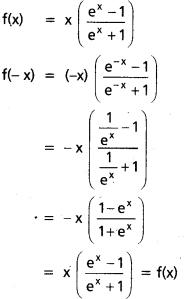
AP Inter 1st Year Maths 1A Important Questions Chapter 1 ప్రమేయాలు 11
∴ f సరి ప్రమేయం.

iii) f(x) = log(x + \(\sqrt{x^2+1}\))
సాధన:
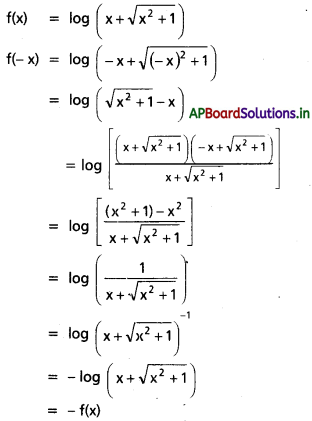
AP Inter 1st Year Maths 1A Important Questions Chapter 1 ప్రమేయాలు 12
∴ f బేసి ప్రమేయం.

ప్రశ్న 19.
కింది వాస్తవ మూల్య ప్రమేయాల ప్రదేశాలు కనుక్కోండి.
i) f(x) = \(\frac{1}{\sqrt{[x]^2-[x]-2}}\)
సాధన:
f(x) = \(\frac{1}{\sqrt{[x]^2-[x]-2}}\) ∈ R
⇔ [x]2 – [x] – 2 > 0
⇔ ([x] + 1) ([x] – 2] > 0
⇔ [x] < – 1, (or) [x] > 2
కాని [x] < -1 [x] ⇒ -2, -3, -4, ……….
⇒ x < -1 [x] > 2 ⇒ [x] = 3, 4, 5, …….. ⇒ x ≥ 3
∴ f ప్రదేశం = (-∞, -1) ∪ [3, ∞]
= R- [-1, 3)

AP Inter 1st Year Maths 1A Important Questions Chapter 1 ప్రమేయాలు

ii) f(x) = log (x – [x])
సాధన:
f(x) = log (x – [x]) ∈ R
⇔ x – [x] > 0
⇔ x > [x]
⇔ x పూర్ణ సంఖ్య కాదు.
∴ f ప్రదేశం R – Z

iii) f(x) = \(\sqrt{\log _{10}\left(\frac{3-x}{x}\right)}\)
సాధన:
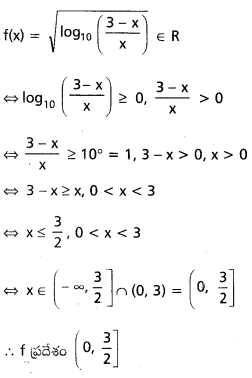
AP Inter 1st Year Maths 1A Important Questions Chapter 1 ప్రమేయాలు 13

iv) f(x) = \(\sqrt{x+2}+\frac{1}{\log _{10}(1-x)}\)
సాధన:
f(x) = \(\sqrt{x+2}+\frac{1}{\log _{10}(1-x)}\) R
⇔ x + 2 ≥ 0, 1 – x > 0, 1 – x ≠ 1
⇔x ≥ – 2, 1 > x, x ≠ 0
⇔ x ∈ [-2, ∞) ∩ (-∞, 1) – {0}
⇔x ∈ [-2, 1) – {0}
∴ f ప్రదేశం [- 2, 1) – {0}

AP Inter 1st Year Maths 1A Important Questions Chapter 1 ప్రమేయాలు

v) f(x) = \(\frac{\sqrt{3+x}+\sqrt{3-x}}{x}\)
సాధన:
f(x) = \(\frac{\sqrt{3+x}+\sqrt{3-x}}{x}\) ∈ R
⇔ 3 + x ≥ 0, 3 – x ≥ 0, x ≠ 0
⇔ x – 3, x ≤ 3, x ≠ 0
⇔ -3 ≤ x ≤ 3, x ≠ 0
⇔ x ∈ [- 3,3 ] x ≠ 0
⇔ x ∈ [- 3, 3] – {0}
∴ f ప్రదేశం [- 3, 3] – {0}

ప్రశ్న 20.
f : A → B, g : B → C లు అన్వేక ప్రమేయాలు అనుకుందాం. అప్పుడు gof : A → C కూడా అన్వేకం అవుతుంది అని నిరూపింపుము.
సాధన:
f : A → B, g : B → C లు అన్వేకాలు
∴ gof : A → C
gof అన్వేకం అని చూపటానికి
a1, a2 ∈A అనుకొనుము.
∴ f(a1), f(a2) ∈ B మరియు g (f(a1)),
g(f(a2)) ∈ C అనగా (gof) (a1), gof (a2) ∈ C
ఇప్పుడు (gof) (a1) = gof (a2).
⇒ g(f(a1)) = g(f(a2))
⇒ f(a1) = f(a2) (∵ g అన్వేకం)
⇒ a1 = a1 (∵ f అన్వేకము)
అందువలన gof : A → C అన్వేక ప్రమేయము. అయితే f : A → B, g : B → C మరియు gof అన్వేకము.
అప్పుడు f మరియు g అన్వేకము కావలసిన అవసరం లేదు.
A = {1, 2}, B = {p, q, r), C = {s, t} అనుకొనుము.
f = {(1, p), (2, q)} మరియు
g = {(p, s), (q, t), (r, t)}
ఇప్పుడు gof = {(1, s), (2, t)}
gof : A → C అన్వేకం
కాని g : B → C అన్వేకము కాదు.

AP Inter 1st Year Maths 1A Important Questions Chapter 1 ప్రమేయాలు

ప్రశ్న 21.
f : A → B, g : B → C లు సంగ్రస్త ప్రమేయాలు అనుకుందాం. అప్పుడు gof A → C సంగ్రస్త ప్రమేయం అగును అని నిరూపించుము. [May ’08]
సాధన:
c ∈ C అనుకుందాం. g : B → C సంగ్రస్త ప్రమేయం
కాబట్టి g(b) = c అయ్యేటట్లు b ∈ B వ్యవస్థితం.
f : A → B సంగ్రస్తం కనుక, f(a) = b అయ్యేటట్లు a ∈ A ఉంటుంది.
∴ c = g(b) = g(f(a)) = (gof) (a)
∴ C ∈ C = (gof) (a) (gof) (a) = c అయ్యేలా a ∈ A వ్యవస్థితం.
కనుక gof : A → C సంగ్రస్తం.

ప్రశ్న 22.
f : A → B, g: B → C, gof సంగ్రస్త అనుకుందాం. అప్పుడు g సంగ్రస్తం అగును అని నిరూపించుము.
సాధన:
c ∈ C అనుకుందాం. gof : A → C సంగ్రస్త ప్రమేయం కనుక (gof) (a) = C అయ్యేటట్లు a ∈ A ఉంటుంది..
అంటే g(f(a)) = c, b = c, b = f(a) అనుకుందాం.
అప్పుడు b ∈ B, g(b) = c
∴ g సంగ్రస్తం

ప్రశ్న 23.
f : A → B, g : B→ C, h : C → D అనుకుందాం. ho(gof) = (hog) అని నిరూపించుము.
సాధన:
f : A → B మరియు g : B → C ⇒ gof : A → C
ఇప్పుడు gof : A → C మరియు h : C → D
⇒ ho(gof) : A → D
అదే విధంగా (hog)of : A → D
అందువలన ho(gof) మరియు (hog) of ప్రమేయాలు ఒకే ప్రదేశాన్ని, ఒకే సహప్రదేశాన్ని కలిగి ఉన్నాయి.
a ∈ A. అనుకుందాం
[ho(gof)] (a) = h[(gof)(a)] = h[g(f(a))]
= (ho g) [f(a)] = [(hog)of] (a)
∴ ho(gof) = (hog)of.
సూచన : ప్రమేయాల సంయుక్తత సాహచర్య న్యాయాన్ని పాటిస్తుంది.

AP Inter 1st Year Maths 1A Important Questions Chapter 1 ప్రమేయాలు

ప్రశ్న 24.
f : A → B, IA, IB లు తత్సమ ప్రమేయాలు అయిన fo IA = f = IB అని చూపండి. [Mar. ’08]
సాధన:
f : A → B అనుకుందాం. IA, IB లు A, B లలో తత్సమ ప్రమేయాలైతే foIA = IBof = f
IA : A → A, f : A → B కనుక A నుంచి B కి foIA ప్రమేయం.
f : A → B, IB : B → B కనుక A నుంచి B కి IBof ప్రమేయం.
foIA, f, IBof ప్రమేయాలకు ప్రదేశం A
అప్పుడు (foIA) (a) = f (IA(a)) = f(a)[∵ IA(a) = a] ∀a ∈ A కి
∴ foIA = f …………….. (1)
(IBof) (a) = IB(f (a)) = f(a) ∀a ∈ A
∴ IBof = f ………….. (2)
(1), (2) లు నుంచి foIA = f = IBof

ప్రశ్న 25.
A, B లు శూన్యేతర సమితులు. f : A → B ద్విగుణమైతే, f-1 : B → A ద్విగుణం అని నిరూపించుము.
సాధన:
f : A → B అన్వేకం అనుశీరిందాం.
స్పష్టంగా f(A) నుంచి A కి f-1 ఒక సంబంధం.
b ∈ f(A) అనుశీరిందాం. f అన్వేకం కనుక f(a) = b అయ్యేటట్లు A లో ఒకే ఒక మూలకం a ఉంటుంది.
అందువల్ల ఇచ్చిన b ∈ f(A) కు (a, b) ∈ f అయ్యేటట్లు A లో ఒకే ఒక మూలకం a ఉంటుంది. అందువల్ల ఇచ్చిన b ∈ f(A) కు (b, a) ∈ f-1 అయ్యేటట్లు ఒకే ఒక a ∈ A ఉంటుంది. అందువల్ల f(A) నుంచి A కు f-1 ఒక ప్రమేయం. ఇంకా f-1(b) = a ⇒ f(a) = a ⇒ f(a) = b స్పష్టంగా f-1 సంగ్రస్త
ప్రమేయం.
b1, b2 ∈ f(A) అయి f-1(b1) = f-1(b2) = a
అనుకుందాం. అప్పుడు b1 = f(a) = b2
అందువల్ల f-1 అన్వేకం. అందువల్ల f-1 : B → A ద్విగుణం.

AP Inter 1st Year Maths 1A Important Questions Chapter 1 ప్రమేయాలు

ప్రశ్న 26.
f : A → B ద్విగుణ ప్రమేయం అనుకుందాం. అప్పుడు fof-1 = IB, f-1of = IA అని నిరూపించుము. [(A.P) Mar. ’15, ’07; May ’07, ’06]
సాధన :
A నుండి Bకి f ద్విగుణ ప్రమేయం కనుక B నుంచి A కి f-1 ద్విగుణ ప్రమేయం. అందువల్ల B నుంచి B కి fof-1 ద్విగుణం. ఇలాగే A నుంచి A కి f-1of ద్విగుణం. B నుంచి B కి IB ద్విగుణ ప్రమేయం. A నుంచి A కి IA ద్విగుణం అని తెలుసు. fof-1, IB ప్రమేయాల ప్రదేశం ఒక్కటే. అది B . b ∈ B అనుకుందాం. f-1(b) = a అనుకుందాం. అప్పుడు a ∈ A, f(a) = b.
ఇంకా (fof-1) (b) = f(f-1(b))
= f(a) = b = IB(b)
అంటే (fof-1) (b) = IB(b)
కనుక fof-1 = IB
f-1of, IA ప్రమేయాలకు ప్రదేశం A.
x ∈ A అనుకుందాం.
f(x) = y అనుకుందాం.
అప్పుడు ye B, f-1(y) = x
ఇంకా (f-1of) (x) = f-1(f(x))
= f-1(y) = x = IA(x)
అంటే (f-1of) (x) = IA(x)
అందువల్ల f-1of = IA.

AP Inter 1st Year Maths 1A Important Questions Chapter 1 ప్రమేయాలు

ప్రశ్న 27.
f : A → B, g : B → A, gof = IA, fog = IB అనుకుందాం. అప్పుడు f ద్విగుణ ప్రమేయం మరియు g = f-1 అని నిరూపించుము.
సాధన:
i) f అన్వేక ప్రమేయమని చూపిద్దాం.
a1, a2 ∈ A అనుకుందాం.
f(a1) = f(a2) ⇒ g[f(a1)] = g[f(a2)]
⇒ (gof) (a1) = (gof) (a2)
⇒ a1 = a2 [∵ gof అన్వేకం]
f అన్వేక ప్రమేయం.

ii) f సంగ్రస్త ప్రమేయమని చూపిద్దాం.
b ∈B అనుకొందాం..
∴ b = IB (b) = fog (b)
⇒ b = f{g(b)}} =→ f{g(b)} = b
f ప్రమేయం ద్వారా b కొరకు g(b) ∈ A అయ్యే విధంగా ఒక పూర్వ ప్రతిబింబము వ్యవస్థితము.
∴ f అన్వేకము మరియు సంగ్రస్తము
∴ f ద్విగుణ ప్రమేయం

iii) ఇప్పుడు g = f-1 అని చూపిద్దాం.
g, f-1 ప్రమేయాలు ఒకే ప్రదేశం B ని కలిసి ఉన్నాయి.
b ∈ B, g(b) = a అనుకుందాం. అప్పుడు a ∈ A,
f(a) = f(g(a)) = IB (b) = b కనుక f-1 (b) = a
ఇందువల్ల అన్నీ b ∈ B కు
g(b) = f-1(b) కాబట్టి g = f-1

AP Inter 1st Year Maths 1A Important Questions Chapter 1 ప్రమేయాలు

ప్రశ్న 28.
f : A → B, g : B → C లు ద్విగుణ ప్రమేయాలు అనుకుందాం. అప్పుడు (gof)-1 = f-1og-1 అని నిరూపించుము. [Mar. ’14, ’11; May ’11]
సాధన:
f : A → B, g : B → C’ లు ద్విగుణ ప్రమేయాలు. కనుక A నుంచి B కి gof ద్విగుణ ప్రమేయం. అందువల్ల (gof)-1, C నుంచి A కి ద్విగుణ ప్రమేయం, ఇంకా
f-1 : B → A, g-1 : C → B లు కూడా ద్విగుణ ప్రమేయాలు. అందువల్ల C నుంచి A కు f-1og-1 ద్విగుణ ప్రమేయం. (gof)-1, f-1og-1 ప్రమేయాల ప్రదేశం C అవుతుంది.
C ∈ C అనుకుందాం. g-1 (c) = b అనుకుందాం. అప్పుడు
b ∈ B, g(b) = c. f-1 (b) = a అనుకుందాం. అప్పుడు
a ∈ A, f(a) = b.
(f-1og-1) (c) = f-1(g-1(c)) = f-1(b) = a ………….. (1)
ఇంకా (gof) (a) = g(f(a)) = g(b) = c అందువల్ల
(gof)-1 (c) = a …………… (2)
(1), (2) ల నుండి
(gof)-1 (c) = (f-1og-1(c)
కనుక (gof)-1 = f-1og-1

AP Inter 1st Year Physics Study Material Chapter 1 భౌతిక ప్రపంచం

Andhra Pradesh BIEAP AP Inter 1st Year Physics Study Material 1st Lesson భౌతిక ప్రపంచం Textbook Questions and Answers.

AP Inter 1st Year Physics Study Material 1st Lesson భౌతిక ప్రపంచం

అతిస్వల్ప సమాధాన ప్రశ్నలు

ప్రశ్న 1.
భౌతికశాస్త్రం అంటే ఏమిటి?
జవాబు:
ప్రకృతి మూలనియమాలు, ప్రకృతి సహజమైన విభిన్న దృగ్విషయాల్లో వాటి స్వయం వ్యక్తీకరణ అధ్యయనమే భౌతికశాస్త్రం.

ప్రశ్న 2.
సి.వి. రామన్ ఆవిష్కరణ ఏమిటి? [Mar. ’14]
జవాబు:
అణువుల ద్వారా కాంతి యొక్క అస్థితిస్థాపక పరిక్షేపణను C.V. రామన్ కనుగొన్నాడు. దీనినే రామన్ ప్రభావం అంటారు.

ప్రశ్న 3.
ప్రకృతిలోని ప్రాథమిక బలాలు ఏవి?
జవాబు:

  1. గురుత్వాకర్షణ బలం
  2. విద్యుదయస్కాంత బలం
  3. బలమైన కేంద్రక బలాలు
  4. బలహీన కేంద్రక బలం.

ప్రశ్న 4.
కింది వాటిలో దేనికి సౌష్ఠవం ఉంటుంది?
a) గురుత్వ త్వరణం
b) గురుత్వాకర్షణ నియమం.
జవాబు:
గురుత్వాకర్షణ నియమం. ఉదాహరణకు చంద్రుడిపై గురుత్వ త్వరణం విలువ, భూమిపై విలువలో 6వ వంతు ఉంటుంది.

కాని గురుత్వాకర్షణ నియమం చంద్రుడిపై మరియు భూమిపై ఒకే విధంగా ఉంటుంది.

AP Inter 1st Year Physics Study Material Chapter 1 భౌతిక ప్రపంచం

ప్రశ్న 5.
భౌతికశాస్త్రానికి ఎస్. చంద్రశేఖర్ చేసిన అంశదానం (contribution) ఏమిటి? [May., Mar. ’13]
జవాబు:
నక్షత్రాల నిర్మాణమును అధ్యయనం చేసినపుడు, సూర్యుడి ద్రవ్యరాశికి 1.4 రెట్లు కన్నా ఎక్కువ ద్రవ్యరాశి గల తెల్లని మరగుజ్జు నక్షత్రాలను ఇతను నిరూపించాడు. ఈ ద్రవ్యరాశిని చంద్రశేఖర పరిమితి అంటారు. ఈ పరిమితిని దాటితే నక్షత్రం నాశనమైపోతుంది.

అదనపు అభ్యాసం

ప్రశ్న 1.
శాశ్వత కీర్తి గడించి సుప్రసిద్ధులైన శాస్త్రజ్ఞులలో ఒకడైన ఆల్బర్ ఐన్స్టీన్ విజ్ఞానశాస్త్ర స్వభావం గురించి అపారజ్ఞానయుతమైన కొన్ని వ్యాఖ్యలు (statements) చేశాడు. ‘ప్రపంచం అత్యంత నిగూఢత (The most incomprehensible thing about the world is that it is comprehensible) ఏమిటంటే – అది విస్తృతార్థ బోధకమైనట్టిది’ – ఐన్స్టీన్ ఈ విధంగా చెప్పడంలో ఆయన ఉద్దేశం ఏమై ఉంటుందని మీరు అనుకొంటున్నారు !
జవాబు:
లేమన్ దృష్టిలో భౌతిక ప్రపంచంలో ఉన్న వాటిని మనం అర్థం చేసుకోలేనివి చాలా ఉన్నాయి. వైజ్ఞానిక పురోగతిని బట్టి శాస్త్రజ్ఞుల పరిశోధనలు పరిమాణంలో పరమాణువుల కంటే చిన్నవైన కణాల నుంచి, అనంతదూరంలో ఉన్న నక్షత్రాల వరకు వ్యాప్తిని కలిగి ఉంటాయి. పరిశీలన, ప్రయోగాలు చేయడం ద్వారా సత్యాలను కనుక్కోవడమే గాక, ఈ సత్యాలను సారాంశీకరించే నియమాలను ఆవిష్కరించే ప్రయత్నం భౌతిక శాస్త్రజ్ఞులు చేస్తారు.

ప్రశ్న 2.
‘ప్రతి గొప్ప భౌతిక సిద్ధాంతం అంగీకృత అభిప్రాయానికి విరుద్ధవాదంగా మొదలై హేతుబద్ధంకాని అభిప్రాయంతో అంతమవుతుంది’. ఈ తీక్షణమైన వ్యాఖ్య చెల్లుబాటు అయ్యేలా కొన్ని ఉదాహరణలను విజ్ఞానశాస్త్ర చరిత్ర నుంచి పేర్కొనండి.
జవాబు:
పై నిర్వచనం సరియైనది. ఉదాహరణకు పూర్వకాలం టాలెమీ భావనల ప్రకారం సూర్యుడు, నక్షత్రాలు, గ్రహాల వంటివి భూమి చుట్టూ పరిభ్రమిస్తాయి. తర్వాత ఇటాలియన్ శాస్త్రజ్ఞుడు గెలీలియో భావనల ప్రకారం సూర్యుడు నిశ్చలంగా ఉండి, సూర్యుడి చుట్టూ భూమి, మిగిలిన గ్రహాలు తిరుగుతాయి. తప్పుడు భావనలు ప్రవేశపెట్టాడని గెలీలియోను పై అధికారులు శిక్షించారు. తర్వాత న్యూటన్ మరియు కెప్లర్ గెలీలియో సిద్ధాంతంను బలపరిచారు మరియు ఇది నిశ్చిత సిద్ధాంతము.

ప్రశ్న 3.
రాజకీయ శాస్త్రం (Politics)’ అనేది సాధ్యమయ్యే వాటికి చెందిన కళ’ అదే విధంగా ‘పరిష్కరించ గలిగే వాటికి చెందిన కళయే విజ్ఞానశాస్త్రం’. విజ్ఞానశాస్త్ర స్వభావం, అభ్యాసానికి చెందిన ఈ అందమైన, సూక్ష్మమైన సుభాషితాన్ని వివరించండి.
జవాబు:
రాజకీయ నాయకులు ఓట్లతో గెలిచి, ఏదైనా సాధించగలరు. అంటే రాజకీయ శాస్త్రం అనేది సాధ్యమయ్యే వాటికి చెందిన కళ. అలాగే సైన్స్ కూడా కొన్ని ప్రాథమిక నియమాలను అనుసరించి పరిష్కరించగలిగే వాటికి చెందిన కళయే విజ్ఞానశాస్త్రం.

AP Inter 1st Year Physics Study Material Chapter 1 భౌతిక ప్రపంచం

ప్రశ్న 4.
అత్యంత వేగంగా వ్యాపిస్తున్న విజ్ఞానశాస్త్ర, సాంకేతిక శాస్త్రాలకు భారతదేశం విస్తృతమైన ఆధారమూలంగా (large base) నెలకొన్నప్పటికీ, విజ్ఞానశాస్త్రంలో ప్రపంచానికే నాయకత్వం వహించగలిగే స్థాయికి చేరడానికి చాలా కాలం పడుతుందని అనిపిస్తోంది. మీ దృష్టిలో భారతదేశంలో విజ్ఞానశాస్త్రం ఉన్నతస్థితికి (advancement) చేరుకోకుండా ప్రతిబంధకాలవుతున్న కొన్ని ముఖ్య కారకాలను పేర్కొనండి.
జవాబు:
భారతదేశంలో సైన్స్ అభివృద్ధి చెందాలంటే నా దృష్టిలో కొన్ని ఆటంకాలు ఉన్నాయి.

  1. నిరక్షరాస్యత
  2. పేదరికం వల్ల వనరులు లేకపోవడం మరియు సరైన సౌకర్యాలు లేకపోవడం.
  3. జనాభా పెరుగుదల వల్ల
  4. సైన్స్పరంగా సరైన ప్రణాళిక లేకపోవడం
  5. స్వీయక్రమశిక్షణ మరియు పనిచేసే సంస్కృతి అభివృద్ధి చెందకపోవడం వల్ల.

ప్రశ్న 5.
ఏ భౌతికశాస్త్రజ్ఞుడూ ఇంత వరకు ఎలక్ట్రాను ‘చూడ’ లేదు. అయినప్పటికీ, భౌతిక శాస్త్రజ్ఞులందరూ కూడా ఎలక్ట్రాన్ ఉన్నదనే నమ్ముతారు. తెలివి ఉండీ, మూఢ విశ్వాసం ఉన్న ఒక మనిషి ‘భూతాల’ను ఎవ్వరూ ‘చూడకపోయినా’ అవి ఉన్నాయనే వాదనను ఈ సాదృశ్యం ద్వారా ముందుకు తెస్తాడు. ఈ వాదనను మీరు ఎలా ఖండిస్తారు?
జవాబు:
ఏ భౌతిక శాస్త్రజ్ఞుడు ఇంత వరకు ఎలక్ట్రాను చూడలేదు. కాని ఎలక్ట్రాన్ ఉనికిని తెలిపే అనేక సాక్ష్యాలు ఉన్నాయి. కాని భూతాలు ఉన్నట్లుగా ఎలాంటి సాక్ష్యాలు లభించవు.

ప్రశ్న 6.
జపాన్ లోని సముద్రతీరంలోని ఒక ప్రత్యేక ప్రదేశంలో కనిపించే పీతల గుల్లలు (కర్పరాలు) ఒక ‘సమురాయ్’ యొక్క చిరస్మరణీయమైన ముఖాన్ని దాదాపు పోలి ఉన్నట్లుగా అగుపిస్తాయి. అందరూ పరిశీలించగలిగే ఈ ‘సత్యాని’కి రెండు వివరణలను కింద ఇచ్చాం. ఈ రెండింటిలో ఏది వైజ్ఞానిక వివరణ అని’ మీ మనస్సుకు తట్టుతుంది?
(a) చాలా శతాబ్దాల క్రితం విషాదకరమైన ఒక సముద్ర ప్రమాదం యువ ‘సమురాయ్’ ను ముంచివేసింది. అతని సాహసానికి ప్రశంసా సూచకంగా ప్రకృతి తనకున్న అనేక అతి గూఢమైన మార్గాల ద్వారా అతని ముఖాన్ని ఆ ప్రదేశంలోని పీత గుల్లలపై ముద్రించి అతని ముఖానికి అమరత్వాన్ని ప్రసాదించింది.
(b) సముద్ర విషాద సంఘటన తరువాత, ఆ ప్రాంతంలోని జాలర్లు, మరణించిన తమ ప్రసిద్ధ యోధుడికి గౌరవ సూచకంగా, తాము పట్టుకున్న పీతగుల్లలపైన యాదృచ్ఛికంగా సమురాయ్ ముఖాన్ని పోలిన ఆకారాన్ని కలిగి ఉంటే వాటిని స్వేచ్ఛగా వదలి వేస్తారు. తత్ఫలితంగా, పీతగుల్లలకు ఉండే ఆ ప్రత్యేక ఆకారం ఎంతో కాలం నిలదొక్కుకోగలిగింది. కాలక్రమేణా జన్యురీత్యా ఆ ఆకారం ఆ జాతికి పరంపరగా సంక్రమిస్తూ ఉంది. కృత్రిమ వరణం (artificial selection) వల్ల కలిగే
పరిణామానికి ఇది ఒక ఉదాహరణ.
[సూచన : పైన చెప్పిన ఆసక్తిదాయకమైన సోదాహరణ కార్ల్సగన్ (Carl Sagan) యొక్క ‘ది కాస్మోస్’ (The Cosmos) నుంచి తీసుకోవడమైంది. ఇది ఒక సత్యాన్ని ప్రాధాన్యంలోకి తెస్తుంది. మనకు తరచుగా, కారణాలతో మనం వివరింపలేని, వింతైన సత్యాలు మొట్టమొదట దృష్టిలో పడగానే అవి ‘మానవాతీతమైనవి’ గా తోస్తాయి. కాని వాటికి సరళమైన శాస్త్రీయ వివరణ ఉందని తరువాత తెలియడమే ! ఈ రకమైన మరికొన్ని ఉదాహరణల కోసం ఆలోచన చేయండి !]
జవాబు:
b) వివరణ పరిశీలించిన వాస్తవంకు సైంటిఫిక్ వివరణ.

ప్రశ్న 7.
రెండు శతాబ్దాల కంటే పూర్వం ఇంగ్లాండు, పాశ్చాత్య యూరప్ లో ఏర్పడిన పారిశ్రామిక విప్లవం నిజానికి కొన్ని కీలకమైన వైజ్ఞానిక, సాంకేతికశాస్త్ర పురోగతుల వల్ల ప్రారంభమైందే ! ఈ పురోగతు
లేమిటి?
జవాబు:
1750 A.Dలో సైంటిఫిక్ మరియు టెక్నాలజీలలో వచ్చిన అభివృద్ధి మూలంగా ఇంగ్లాండ్ మరియు తూర్పు యూరోపియన్ దేశాలలో పారిశ్రామిక విప్లవం ప్రారంభమైనది. ఆవిరియంత్రము, నిప్పుల కొలిమి, పత్తి జిన్నింగ్ యంత్రం మరియు మరమగ్గాలు మొదలగునవి అభివృద్ధి చెందిన కొన్నింటికి ఉదాహరణలు.

ప్రశ్న 8.
ప్రపంచం ఈనాడు రెండో పారిశ్రామిక విప్లవానికి గురవుతోందని తరచుగా అంటున్నారు. ఈ రెండో విప్లవం, మొదటి దానివలె మానవ సమాజాన్ని ఆమూలాగ్రంగా మార్చగలిగేదే! ఈ విప్లవానికి కారణభూతాలైన కొన్ని కీలకమైన, సమకాలీన వైజ్ఞానికశాస్త్ర, సాంకేతికశాస్త్ర రంగాల జాబితా తయారుచేయండి !
జవాబు:
సైన్స్ మరియు టెక్నాలజీలలో సమకాలీన మార్పులను సమాజానికి వేగంగా అందించే కొన్ని ప్రాంతాలు.

  1. గది ఉష్ణోగ్రత వద్ద అతివాహక పదార్థాలను అభివృద్ధి చేయడం.
  2. సూపర్ ఫాస్ట్ కంప్యూటర్లను అభివృద్ధి చేయడం.
  3. సమాచార టెక్నాలజీలో విప్లవాత్మక మార్పులను తేవడం.
  4. బయోటెక్నాలజీని అభివృద్ధి చేయడం.
  5. రోబోట్లను అభివృద్ధి చేయడం.

ప్రశ్న 9.
ఇరవై రెండవ శతాబ్దంలోని విజ్ఞానశాస్త్ర, సాంకేతికశాస్త్రాలపై ఒక కల్పానాత్మక కథను (fiction piece) సుమారు 1000 పదాలలో రాయండి.
జవాబు:
ఒక అంతరిక్ష నౌక 100 కాంతి సంవత్సరాల దూరంలో ఉన్న ఒక నక్షత్రం వైపు ప్రయాణిస్తుందనుకొనుము. అది ముందుకు కదలడానికి అవసరమైన విద్యుత్, విద్యుదయస్కాంత ప్రేరణ ద్వారా జనిస్తుంది.

అంతరిక్ష నౌక అయస్కాంత క్షేత్రంను దాటునప్పుడు, అతివాహక తీగలతో చేసిన విద్యుత్ మోటార్కు విద్యుత్ను అందిస్తుంది. అంతరిక్ష నౌక మొత్తం ప్రయాణంలో ఎలాంటి శక్తిని అందించనవసరం లేదు.

అంతరిక్షంలో ఒకచోట, ఉష్ణోగ్రత అధికంగా ఉంటే, మోటారు తీగలలోని అతివాహక ధర్మం నాశనమవుతుంది. ఈ కారణంచేత అంతరిక్ష నౌకలో మోటారు ద్వారా విద్యుత్ జనించదు.

క్షణకాలంలో, మరొక అంతరిక్ష నౌక, మొదటి నౌకలో శక్తిని జనింపచేయడానికి ద్రవ్యం మరియు విరుద్ధ ద్రవ్యం గల వేరువేరు కంపార్ట్మెంట్లను నింపాలి. మొదటి అంతరిక్ష నౌక తన ప్రయాణాన్ని కొనసాగిస్తుంది.

ప్రశ్న 10.
వైజ్ఞానికశాస్త్ర ఆచరణ (practice) పై మీ ‘నైతిక’ దృక్పథాలను సూత్రీకరించడానికి ప్రయత్నించండి. మీకు అనుకోకుండా ఒకానొక ఆవిష్కరణ అకస్మాత్తుగా తారసపడిందని ఊహించండి; ఈ ఆవిష్కరణ కేవలం తాత్త్విక ఆసక్తిని కలిగించేంత గొప్పదేకాని, మానవ సమాజానికి నిశ్చయంగా అపాయాన్ని కలిగించే పర్యవసానాలకు మాత్రమే దారితీస్తుందని అనుకోండి. ఇలాంటి సందిగ్ధావస్థను మీరే గనుక ఎదుర్కొనేట్లయితే దాన్ని ఎలా పరిష్కరిస్తారు?
జవాబు:
సైన్స్ నిజాన్ని అన్వేషిస్తుంది. ఆవిష్కరణ అనేది ఒక మంచి అభిలాష, కాని కొన్నిసార్లు మానవ సమాజానికి దాని పర్యవసానాలు ప్రమాదభరితంగా మారతాయి. నిజాన్ని వెలికితీయడం, అది తప్పుదారి పట్టకుండా చూడటం సైంటిస్ట్ల బాధ్యత. ఉదాహరణకు కేంద్రక విచ్ఛిత్తి ద్వారా విద్యుత్ శక్తిని తయారుచేయవచ్చు మరియు అణుబాంబును కూడా అభివృద్ధి చేయవచ్చు. ఈ ఆయుధం మానవాళిని తుడిచిపెడుతుంది. అందువల్ల అణుశక్తిని శాంతి సామరస్యాలకు వినియోగించేలా ప్రజలను చైతన్యవంతులను చెయ్యాలి.

AP Inter 1st Year Physics Study Material Chapter 1 భౌతిక ప్రపంచం

ప్రశ్న 11.
తక్కిన ఇతర జ్ఞాన సంచయాల్లాగే (knowledge) విజ్ఞానశాస్త్రాన్ని కూడా మంచికీ, చెడుకీ వాడుకోవచ్చు. ఇది వాడుకొనే మనిషిపై ఆధారపడి ఉంటుంది. ఇక్కడ కొన్ని వైజ్ఞానికశాస్త్ర అనువర్తనాలను ఇచ్చాం. వీటిలో ఒక ప్రత్యేక అనువర్తనం మంచిదా, చెడుదా లేదా అట్లా స్పష్టంగా వర్గీకరించడానికి వీలులేనిదా అన్నదానిపై మీ దృక్పథాలను సూత్రీకరించండి.
a) మశూచికి వ్యతిరేకంగా దాన్ని అణచివేయడానికి గానీ లేదా ఆ వ్యాధిని అంతిమంగా జనాభా నుంచి సమూలంగా నిర్మూలించడానికి గానీ వాడే సామాన్య టీకా (Mass vaccination) (నిజానికి ఇప్పటికే భారతదేశంలో విజయవంతంగా పూర్తిచేయడం జరిగింది.)
b) నిరక్షరాస్యతను నిర్మూలించడానికీ, వార్తలనూ, సమాలోచనలనూ విస్తృతంగా ప్రచారం చేయడానికీ టెలివిజన్.
c) కాన్పుకు ముందే చేసే లింగ నిర్ధారణ.
d) పని దక్షత పెంచడానికి కంప్యూటర్లు.
e) భూమి చుట్టూ కక్ష్యల్లో కృత్రిమ ఉపగ్రహాలను ఉంచడం.
f) న్యూక్లియర్ మారణాయుధాలను సమకూర్చుకోవడం.
g) రసాయనిక, జీవశాస్త్ర యుద్ధతంత్రాలను ప్రయోగించడానికి సరికొత్త, సమర్ధవంతమైన సాంకేతిక నైపుణ్యాలను పెంపొందించుకోవడం.
h) తాగడానికి కావలసిన నీటి శుద్ధీకరణ.
i) ప్లాస్టిక్ సర్జరీ.
j) క్లోనింగ్ (జీవ ప్రతిరూపాలను కృత్రిమంగా సృష్టించడం)
జవాబు:
a) ఉమ్మడిగా టీకాలు వేయడం చాలా మంచిది.
b) నిరక్షరాస్యతను నిర్మూలించడానికి, ఉమ్మడి ఆలోచనలు, వార్తలు టెలివిజన్ ద్వారా తెలుసుకోవడం నిజంగా చాలా మంచిది.
c) కాన్పుకు ముందే లింగనిర్ధారణ తప్పు కాదు. కాని దానిని దుర్వినియోగం చేయరాదు. దానివలన ఆడ, మగ జనాభా నిష్పత్తిలో తేడా వస్తుందని ప్రజలకు తెలియజేయాలి.
d) పని దక్షతను పెంచడానికి కంప్యూటర్లు వాడటం మంచిది.
e) భూమి చుట్టూ తిరిగే ఉపగ్రహాలను ప్రవేశపెట్టడం మంచిది.
f) న్యూక్లియర్ మారణాయుధాలను అభివృద్ధి చేయడం మంచిది కాదు. అవి అందరినీ నాశనం చేస్తాయి.
g) రసాయనిక, జీవశాస్త్ర యుద్ధ తంత్రాలను ప్రయోగించడానికి, సరికొత్త సమర్థమైన సాంకేతిక నైపుణ్యాన్ని అభివృద్ధి చేయడం మంచిది కాదు. ఇవి మానవాళిని అంతం చేస్తాయి.
h) తాగడానికి కావలసిన నీటిని శుద్ధీకరణ చేయడం మంచిది.
i) ప్లాస్టిక్ సర్జరీ మంచిది.
j) క్లోనింగ్ కూడా మంచిది.

ప్రశ్న 12.
భారతదేశం గణిత, ఖగోళ, భాషా, తర్క, నీతిశాస్త్రాల్లో సుదీర్ఘమైన అవిచ్ఛిన్నమైన పాండిత్య సంప్రదాయాన్ని కలిగి ఉంది. అయినప్పటికీ, దీనికి సమాంతరంగా అనేక మూఢవిశ్వాసపూరిత, వికాస వ్యతిరేక ధోరణులూ, ఆచారాలూ మన సమాజంలో ఉండేవి. దురదృష్టవశాత్తూ, ఈనాటికీ విద్యావంతులైన అనేక ప్రజల్లోనూ ఇంకా కొనసాగుతున్నాయి. మీకు కలిగే వైజ్ఞానికశాస్త్ర జ్ఞాన సంచయంతో ఈ ధోరణులను ఎదుర్కోవడానికి, వ్యతిరేకించడానికి మీరు ఎలాంటి వ్యూహాలను అభివృద్ధి చెందించదలచుకున్నారు?
జవాబు:
సాధారణ మనిషిని విద్యావంతుడిని చేయడం ద్వారా మూఢనమ్మకాలను, వికాస వ్యతిరేక ధోరణులను పారద్రోలవచ్చు. పత్రికలు, మ్యాగజైన్లు, రేడియో మరియు T.V ల ద్వారా పాఠశాలలలోని విద్యార్థులకు తెలియజెప్పటం ద్వారా ఉపాధ్యాయులు సమాజంలోని మూఢనమ్మకాలను పారద్రోలవచ్చు.

ప్రశ్న 13.
భారతదేశంలో స్త్రీలకు చట్టం స్త్రీలకు సమానస్థాయిని కల్పిస్తున్నా, ఆమెకు ఉండే సహజ స్వభావం పట్ల అనేకమంది ఇతర అశాస్త్రీయమైన దృక్పథాలనే పట్టుకు వేలాడుతున్నారు. వారి సామర్థ్యాన్ని, బుద్ధి సూక్ష్మతనూ (intelligence) (వివేకాన్ని) గుర్తించకుండా జీవితంలో రెండో తరగతి హోదాను, అప్రధానమైన పాత్రను మాత్రమే స్త్రీలకు ఇస్తున్నారు. శాస్త్రీయమైన వాదనలతో, విజ్ఞానశాస్త్రం ఇతర రంగాల్లో రాణించిన గొప్ప మహిళల ఉదాహరణలను ఉటంకిస్తూ మీరు ఈ అభిప్రాయాలను కూల్చివేయండి (Demolish), వారి శక్తియుక్తుల పట్ల మీరు విశ్వాసాన్ని పెంపొందించుకొని సమానావకాశాలు కల్పిస్తే, స్త్రీలు పురుషులతో సమానంగా, సరితూగగలుగుతారని, మిమ్మల్ని మీరు స్వయంగానే గాక ఇతరులనూ ఒప్పించగలగే నేర్పును తెచ్చుకోండి.
జవాబు:
పురుషులకు మరియు స్త్రీలకు సమాన అవకాశాలను కల్పించాలి. మానవుని మెదడు మనం తీసుకునే న్యూట్రిషన్స్ మరియు పోషకాహారం వలన అభివృద్ధి చెందుతుంది. దీనిలో లింగ భేదానికి తావులేదు. పురుషుని మెదడు వలెనే స్త్రీల మెదడు కూడా సమానంగా అభివృద్ధి చెందింది. మేడమ్ క్యూరీ భౌతికశాస్త్రంలో నోబెల్ బహుమతిని పొందారు. మదర్ థెరిస్సా సెయింట్గా నిరూపించుకున్నారు. రాజకీయాలలో శ్రీమతి ఇందిరాగాంధీ, మార్గరెట్ థాచర్, శ్రీమతి బండారునాయికే మొదలగువారు రాణించారు.

ప్రశ్న 14.
‘భౌతికశాస్త్ర సమీకరణాల్లో సౌందర్యం ఉండటమనేది అవి ప్రయోగాలతో అంగీకారాన్ని కలిగి ఉండటం కంటే ఎక్కువ ప్రధానమైంది’ ఇది గొప్ప బ్రిటిష్ భౌతికశాస్త్రవేత్త పి.ఎ.ఎమ్.డిరాక్ (P.A.M. Dirac) కు ఉన్న అభిప్రాయం. ఈ కథనాన్ని మీరు విమర్శించండి. ఈ పుస్తకంలో సౌందర్యవంతమని (మిమ్మల్ని హత్తుకున్నట్లు) కనిపించే కొన్ని సమీకరణాలు, ఫలితాల కోసం వెతకండి.
జవాబు:
గొప్ప బ్రిటిష్ శాస్త్రవేత్త పి.ఎ.ఎమ్. డిరాక్కు ఉన్న అభిప్రాయం నిజం. ఉదాహరణకు F = ma; E = mc² సరళ మరియు సౌంధర్యవంతమైన భౌతిక సమీకరణాలు. వీటిని సార్వత్రికంగా అన్వర్తించవచ్చు.

కాని కొన్ని సందర్భాలలో సాపేక్ష సిద్ధాంతంలోని సమీకరణాలు కొన్ని సరళంగాను, ‘సౌందర్యవంతంగాను ఉండవు. వీటిని అర్థం చేసుకోవడం కష్టం.

ప్రశ్న 15.
పైన పేర్కొన్న విషయం వివాదాస్పదమైనదే కావచ్చు. కాని అత్యధిక సంఖ్యలో ఉండే భౌతికశాస్త్రజ్ఞులకు భౌతికశాస్త్ర ప్రసిద్ధ నియమాలు యదార్థంగానే సరళం, సౌందర్యపూరితమైనవనే ఒక అనుభూతి ఉంది. డిరాక్తోపాటు, ఈ విధంగా విస్పష్టంగా మాట్లాడిన మరికొందరు సుప్రసిద్ధ భౌతికశాస్త్రజ్ఞులు : ఐన్స్టీన్, బోర్, హైసన్బర్గ్, చంద్రశేఖర్, ఫైర్ మ్యాన్. భౌతికశాస్త్రంలో నిష్ణాతులైన వీరితోపాటు ఇతరులు రాసిన పుస్తకాలను, రచనలను సంపాదించడానికి లేదా చదవడానికి ప్రత్యేకయత్నాలు చేయవలసిందిగా మిమ్మల్ని కోరుతున్నాం. (ఈ పుస్తకం చివరలో గ్రంథసూచిని చూడండి). వారి రచనలు నిజంగానే మీలో స్ఫూర్తిని నింపడంతోపాటు, మీకు పునరుత్తేజాన్ని కలిగిస్తాయి !
జవాబు:
విద్యార్థులు మంచి గ్రంథాలయంకు వెళ్ళి భౌతికశాస్త్రంలో మంచి పుస్తకాలను చదవాలి. ఫైర్మన్ రచించిన పుస్తకాలు విద్యార్థులకు ఎంతగానో ఉపయోగపడతాయి. మరికొన్ని ఆసక్తికరమైన పుస్తకాలు రోగర్ E.M. రచనలు, G. గ్యామో రచనలు.

AP Inter 1st Year Physics Study Material Chapter 1 భౌతిక ప్రపంచం

ప్రశ్న 16.
‘విజ్ఞానశాస్త్ర అధ్యయనం చప్పగానూ, ఎప్పుడూ మరీ గంభీరమైనదిగానూ ఉండటమే గాక శాస్త్రవేత్తలంతా అదో లోకంలో లేదా అన్యమనస్కులూ, అంతర్ముఖులై ఉంటారు. అంతేకాదు, హాయిగానే కాదు వెర్రినవ్వు అయినా నవ్వని వాళ్ళై ఉంటారనే’ దురభిప్రాయాన్ని విజ్ఞానశాస్త్ర పాఠ్యపుస్తకాలు మీకు కలిగించవచ్చు. విజ్ఞానశాస్త్రంపైనా, శాస్త్రవేత్తలపైనా కలిగే ఈ అభిప్రాయం ఒక ‘బహిరంగ అసత్యం’. ఇతర వర్గాల్లోని మనుషుల్లాగే, శాస్త్రజ్ఞుల్లో కూడా హాస్యస్ఫోరకులూ, పరిహాసశీలురూ ఉన్నారు, వాళ్ళలో వినోదం, ఉల్లాసపూరితమైన సాహసకృత్యాలతో కూడిన భావాలతో జీవితం గడిపిన వారు ఉన్నారు. ఇలాంటి జీవితం గడుపుతూనే, వారు ఎంతో గంభీరంగా, వైజ్ఞానిక క్రియాన్వేషణలో మునిగి ఉండేవారు. ఈ రీతి జీవనశైలి గడిపిన సుప్రసిద్ధ భౌతికశాస్త్రవేత్తల్లో గ్యామో, ఫైర్మన్లను చెప్పుకోవచ్చు. గ్రంథ సూచి జాబితాలో ఇచ్చిన వారి గ్రంథాలను చదివితే మీరు ఎంతో ఉత్తేజానికి లోనవుతారు !
జవాబు:
నిజం. శాస్త్రవేత్తలు కూడా, ఇతర వర్గాల్లోని మనుషుల్లాగే హాస్యస్ఫోరకులు, పరిహాసశీలురూ ఉన్నారు. వాళ్లలో వినోదం, ఉల్లాసపూరితమైన సాహసకృత్యాలతో కూడిన భావాలతో జీవితం గడిపిన వారు ఉన్నారు. ఇలాంటి జీవితం గడుపుతూనే వారు ఎంతో గంభీరంగా, వైజ్ఞానిక క్రియాన్వేషణలో మునిగి ఉండేవారు. గ్యామో, ఫైర్మన్ రచనలు విద్యార్థులు చక్కగా చదువుకొని ఉత్తేజానికి లోనుకావచ్చు.

AP Inter 1st Year Maths 1B Important Questions Chapter 4 సరళరేఖాయుగ్మాలు

Students get through AP Inter 1st Year Maths 1B Important Questions Chapter 4 సరళరేఖాయుగ్మాలు which are most likely to be asked in the exam.

AP Inter 1st Year Maths 1B Important Questions Chapter 4 సరళరేఖాయుగ్మాలు

సాధించిన సమస్యలు

ప్రశ్న 1.
x2 + xy + y2 = 0 సమీకరణం రెండు సరళరేఖలను సూచిస్తుందా ?
సాధన:
a = 1, b = 1,
h = \(\frac{1}{2}\)
⇒ h2 = \(\frac{1}{4}\), ab = 1
h2 = ab < 0 i.e., h2 < ab.
∴ దత్త రేఖా సమీకరణము రేఖా యుగ్మాన్ని సూచించదు.

AP Inter 1st Year Maths 1B Important Questions Chapter 4 సరళరేఖాయుగ్మాలు

ప్రశ్న 2.
x2 – 3y2 = 0, x = 2 సరళరేఖలతో ఏర్పడే త్రిభుజం స్వభావాన్ని కనుక్కోండి.
సాధన:
OA, OB ల ఉమ్మడి సమీకరణము
x2 – 3y2 = 0
(x + \(\sqrt{3}\)y) (x – \(\sqrt{3}\)y) = 0
x + \(\sqrt{3}\)y = 0 మరియు x – \(\sqrt{3}\)y = 0
i.e., y = \(\frac{1}{\sqrt{3}}\) x, y = –\(\frac{1}{\sqrt{3}}\) x రేఖలు x – అక్షంతో 30° కోణం చేస్తే సమాన నిమ్నత కలిగి ఉన్నాయి.
∴ ∠OAB – ∠OBA = 60°
∴ ఈ త్రిభుజము సమబాహు త్రిభుజం.
AP Inter 1st Year Maths 1B Important Questions Chapter 4 సరళరేఖాయుగ్మాలు 1

ప్రశ్న 3.
12x2 – 20xy + 7y2 = 0, 2x – 3y + 4 = 0 సరళరేఖలతో ఏర్పడే త్రిభుజం కేంద్రభాసాన్ని కనుక్కోండి.
సాధన:
OA, OB ల ఉమ్మడి సమీకరణము
12x2 – 20xy + 7y2 = 0 ………………. (1)
AB సమీకరణము 2x + 3y + 4 = 0
2x = 3y – 4
(1) లో ప్రతిక్షేపిస్తే,
3(3y – 4)2 – 10y (3y – 4) + 7y2 = 0
3(9y2 + 16 − 24y) – 30y2 + 40y + 7y2 = 0
27y2 + 48 − 72y – 30y2 + 40y + 7y2 = 0
4y2 – 32y + 48 = 0
y2 – 8y +12 = 0
(y – 2) (y – 6) = 0 ⇒ y = 2 లేదా 6
x = \(\frac{3 y-4}{2}\)
y = 2 ⇒ x = \(\frac{6-4}{2}\) = 1
y = 6 ⇒ x = \(\frac{18-4}{2}\) = 7
∴ శీర్షాలు 0 (0, 0), A (1, 2), B( 7, 6)
OAB కేంద్రభాసము
\(\left(\frac{0+1+7}{3}, \frac{0+2+6}{3}\right)=\left(\frac{8}{3}, \frac{8}{3}\right)\)

AP Inter 1st Year Maths 1B Important Questions Chapter 4 సరళరేఖాయుగ్మాలు

ప్రశ్న 4.
x2 – 4xy + y2 = 0, x + y = 3 లతో సూచించబడే సరళరేఖలు ఒక సమబాహుత్రిభుజాన్ని ఏర్పరుస్తాయని చూపండి.
సాధన:
L = x + y – 3 = 0 సరళరేఖ వాలు -1. అందువల్ల ఈ సరళరేఖ X- అక్షం ఋణ దిశలో 45° కోణం చేస్తుంది. కనుక Lతో 60° కోణం చేసే సరళరేఖ కూడా ఊర్ధ్వ రేఖ కాదు.
AP Inter 1st Year Maths 1B Important Questions Chapter 4 సరళరేఖాయుగ్మాలు 2
\(\sqrt{3}\) = tan 60° = \(\left|\frac{m+1}{1-m}\right|\) m విలువ
(m + 1)2 = 3(m – 1) ను తృప్తిపరుస్తుంది. (లేదా)
m2 – 4m + 1 = 0 ……………… (1)
‘m’ వాలు కలిగి మూలబిందువు గుండా పోతూ రేఖా సమీకరణం
y = mx …………….. (2)
(1), (2) ల నుండి m ను తొలగించగా మూలబిందువు గుండాపోతూ Lతో 60° కోణం చేసే రేఖాయుగ్మం సమీకరణాన్ని సూచిస్తుంది.
ఈ రేఖా యుగ్మం ఉమ్మడి సమీకరణము
\(\left(\frac{y}{x}\right)^2-4\left(\frac{y}{x}\right)\) + 1 = 0 (i. e., ) x2 – 4xy + y2 = 0
ఇది దత్త రేఖాయుగ్మంతో సమానము.
దత్త రేఖాత్రయము సమబాహు త్రిభుజాన్ని ఏర్పరుస్తున్నాయి.

AP Inter 1st Year Maths 1B Important Questions Chapter 4 సరళరేఖాయుగ్మాలు

ప్రశ్న 5.
ax2 + 2hxy + by2 = 0 అనే రేఖాయుగ్మం నుంచి (α, β) అనే బిందువుకు లంబ దూరాల లబ్ధం \(\frac{\left|a \alpha^2+2 h \alpha \beta+b \beta^2\right|}{\sqrt{(a-b)^2+4 h^2}}\) అని నిరూపించండి. [May ’11, ’07; Mar. ’07, ’04]
సాధన:
ax2 + 2hxy + by2 = (l1x + m1y) (l2x + m2y)
అనుకొందాం.
సూచించే రేఖా విడి సమీకరణము
ax2 + 2hxy + by2 = 0
L1 : l1x + m1y = 0 మరియు L2 : l2x + m2y = 0
l1l2 = a; m1m2 = b మరియు
l1m2 + l2m1 = 2h
d1 = (α, β) నుండి L1 కు లంబదూరము
L1 = \(\frac{\left|l_1 \alpha+\mathrm{m}_1 \beta\right|}{\sqrt{l_1^2+\mathrm{m}_1^2}}\)
d2 = (α, β) నుండి L2 కు లంబదూరము
= \(\frac{\left|l_2 \alpha+\mathrm{m}_2 \beta\right|}{\sqrt{l_2^2+\mathrm{m}_2^2}}\)
లంబ దూరాల లబ్ధము
= \(\frac{\left|\left(l_1 \alpha+\mathrm{m}_1 \beta\right)\left(l_2 \alpha+\mathrm{m}_2 \beta\right)\right|}{\sqrt{\left(l_1^2+\mathrm{m}_1^2\right)\left(l_2^2+\mathrm{m}_2^2\right)}}\)
= \(\frac{\left|a \alpha^2+2 h \alpha \beta+b \beta^2\right|}{\sqrt{(a-b)^2+4 h^2}}\)

AP Inter 1st Year Maths 1B Important Questions Chapter 4 సరళరేఖాయుగ్మాలు

ప్రశ్న 6.
ax2 + 2hxy + by2 = 0 ఒక సరళరేఖాయుగ్మాన్ని సూచిస్తుందనుకోండి. అప్పుడు
i) (x0, y0) బిందువు గుండా పోతూ దత్త సరళరేఖలకు సమాంతరంగా ఉండే సరళరేఖల సమీకరణం
a(x – x0)2 + 2h(x – x0) (y – y0) + b(y – y0)2 = 0 అనీ,
ii) (x0, y0) బిందువు గుండా పోతూ దత్త సరళరేఖలకు లంబంగా ఉండే సరళరేఖల సమీకరణం
b(x − x0)2 – 2h(x – x0) (y – y0) + a(y – y0)2 = 0 అని నిరూపించండి.
సాధన:
ax2 + 2hxy + by2 = (l1x + m1y) (l2x + m2y). ఈ సమీకరణము సూచించే రేఖలు విడిగా L1, L2 అనుకోండి.
l1x + m1y = 0 మరియు l2x + m2y = 0
l1l2 = a, m1m2 = b మరియు
l1m2 + l2m1 = 2h

(i) (x0, y0) గుండా పోతూ L1, L2 రేఖలకు సమాంతరంగా
ఉండే రేఖలు వరుసగా
l1x + m1y = l1x0 + m1y0 (లేదా)
l1(x – x0) + m1(y – y0) = 0 మరియు
l2(x – x0) + m2(y – y0) = 0.
∴ఉమ్మడి సమీకరణము
[l1(x – x0) + m1(y – y1)] [l2(x – x0) + m2(y − y0)] = 0
(లేదా) a(x – x0)2 + 2h(x – x0) (y − y0) + b(y – y0)2 = 0

(ii) (x0, y0) గుండా పోతూ L1, L2 లకు లంబంగా ఉండే
రేఖా యుగ్మం
m1x – l1y = m1x0 – l1y0 (లేదా)
m1(x – x0) – l1(y – y0) = 0 మరియు
m2(x – x0) – l2(y – y0) = 0
ఉమ్మడి సమీకరణము
[m1(x – x0) – l1(y – y0)] [m2(x – x0) – l2(y – y0)] = 0
(i.e.,) b(x – x0)2 – 2h(x – x0) (y – y0) + a(y – y0)2 = 0
[గమనిక : మూలబిందువు గుండా పోతూ
ax2 + 2hxy + by2 = 0 కు లంబంగా ఉండే రేఖా యుగ్మం సమీకరణం bx2 – 2hxy + ay2 = 0],

AP Inter 1st Year Maths 1B Important Questions Chapter 4 సరళరేఖాయుగ్మాలు

ప్రశ్న 7.
ax2 + 2hxy + by2 = 0 అనే రేఖాయుగ్మంతోనూ, lx + my + n = 0 అనే సరళరేఖతోను, నిర్దిష్టమయ్యే త్రిభుజ వైశాల్యం \(\left|\frac{n^2 \sqrt{h^2-a b}}{a m^2-2 h l m+b l^2}\right|\) అని నిరూపించండి. [Mar. ’13]
సాధన:
\(\overleftrightarrow{\mathrm{OA}}, \overleftrightarrow{\mathrm{OB}}\) లు సూచించే రేఖాయుగ్మం సమీకరణం
ax2 + 2hxy + by2 = 0 (బొమ్మను చూడండి.) \(\overleftrightarrow{A B}\) రేఖ lx + my + n = 0 అనుకుందాం.
ax2 + 2hxy + by2 ≡ (l1x + m1y) (l2x + m2y) అనుకుందాం.
\(\overleftrightarrow{\mathrm{OA}}, \overleftrightarrow{\mathrm{OB}}\) ల సమీకరణాలు వరుసగా
l1x + m1y = 0 and l2x + m2y = 0 అనుకొందాం.
AP Inter 1st Year Maths 1B Important Questions Chapter 4 సరళరేఖాయుగ్మాలు 3
A = (x1, y1) మరియు B = (x2, y2)
∴ l1x1 + m1y1 = 0, lx1 + my1 + n = 0.
అడ్డ గుణకార సూత్రం ప్రకారం
AP Inter 1st Year Maths 1B Important Questions Chapter 4 సరళరేఖాయుగ్మాలు 4

ప్రశ్న 8.
7x – y + 3 = 0 మరియు x + y – 3 = 0 లు ఒక సమద్విబాహు త్రిభుజంలోని సమాన భుజాలను సూచిస్తాయి. ఆ త్రిభుజం యొక్క మూడవ భుజం (1, 0) గుండా పోతే, దాని సమీకరణాన్ని కనుక్కోండి.
సాధన:
7x – y + 3 = 0, x + y − 3 = 0 రేఖలు A అనే బిందువు వద్ద ఖండించుకొంటాయనుకొందాం. A వద్ద ఉన్న కోణాల యొక్క సమద్విఖండన రేఖలకు (A గుండా కాకుండా) లంబంగా గీసిన సరళరేఖలు, ఇచ్చిన సరళరేఖలతో సమద్విబాహు త్రిభుజాలను నిర్మిస్తాయి. (ఇచ్చిన సరళరేఖల మీద సమాన భుజాలుండే విధంగా)
(∆ABF ≅ ∆AFC, ∆ADG ≅ ∆AGE)
వీటిలో ఏ భుజాలు (1, 0) గుండా పోతాయో, అలాంటి మూడవ భుజాల సమీకరణాలను కనుక్కొంటాం.
7x – y + 3 = 0, x + y – 3 = 0 ల మధ్య ఉన్న
కోణాల సమద్విఖండన రేఖా సమీకరణాలు
AP Inter 1st Year Maths 1B Important Questions Chapter 4 సరళరేఖాయుగ్మాలు 5
అంటే 7x – y + 3 = ± 5(x + y – 3).
అంటే x – 3y + 9 = 0, 3x + y – 3 = 0.
ఈ సమద్విఖండన రేఖలకు లంబంగా ఉంటూ (1, 0) గుండా పోయే సరళరేఖలే కావలసిన మూడవ భుజాలు.
AP Inter 1st Year Maths 1B Important Questions Chapter 4 సరళరేఖాయుగ్మాలు 6
x – 3y + 9 = 0 లంబంగా ఉంటూ F(1, 0) గుండా పోయే భుజం 3x + y – 3 = 0. రెండవది (x – 1) – 3(y – 0) = 0 అంటే x – 3y – 1 = 0.
3x + y − 3 = 0, x – 3y – 1 = 0 లు కావలసిన సమీకరణాలు [పటంలో ∆ABC, ∆ADE లు సమద్విబాహు త్రిభుజాలు. వాటిలో \(\overline{\mathrm{BC}}\), \(\overline{\mathrm{DE}}\)లు మూడవ భుజాలు].

AP Inter 1st Year Maths 1B Important Questions Chapter 4 సరళరేఖాయుగ్మాలు

ప్రశ్న 9.
2x2 + 5xy + 2y2 – 5x – 7y + 3 = 0 3° సూచించే సరళరేఖల మధ్య లఘుకోణాన్ని కనుక్కోండి.
సాధన:
a = 2, b = 2, h = \(\frac{5}{2}\)
cos θ = \(\frac{|a+b|}{\sqrt{(a-b)^2+4 h^2}}=\frac{|2+2|}{\sqrt{(2-2)^2+4 \cdot \frac{25}{4}}}=\frac{4}{5}\)
θ = cos-1 \(\left(\frac{4}{5}\right)\)
ప్రశ్న 10.
మూలబిందువు గుండా పోతూ 2x2 + 3xy – 2y2 – 5x + 5y – 3 = 0 తో సూచించే సరళరేఖలకు సమాంతరంగా ఉండే సరళరేఖల సమీకరణం కనుక్కోండి.
సాధన:
దత్త రేఖల సమీకరణము
2x2 + 3xy – 2y2 – 5x + 5y – 3 = 0
మూలబిందువు గుండా పోతూ సమాంతర రేఖల సమీకరణము
ax2 + 2hxy + by2 = 0; 2x2 + 3xy – 2y2 = 0

ప్రశ్న 11.
మూలబిందువు గుండా పోతూ ax2 + 2hxy + by2 + 2gx + 2fy + c = 0 తో సూచించే సరళరేఖలకు లంబంగా ఉండే సరళరేఖల సమీకరణం కనుక్కోండి.
సాధన:
మూలబిందువు గుండా పోయే సమూహ రేఖల సమీకరణము
ax2 + 2hxy + by2 = 0
మూలబిందువు గుండా పోతూ లంబంగా ఉండే రేఖల
సమీకరణము
bx2 – 2hxy + ay2 = 0

AP Inter 1st Year Maths 1B Important Questions Chapter 4 సరళరేఖాయుగ్మాలు

ప్రశ్న 12.
x2 + xy – 2y2 + 4x – y + k = 0 రెండు సరళరేఖలను సూచిస్తే, k విలువ కనుక్కోండి.
సాధన:
a = 1, b = – 2, c = k; f = –\(\frac{1}{2}\), g = 2, h = \(\frac{1}{2}\)
నియమము abc + 2fgh – af2 – bg2 – ch2 = 0
2k + 2(-\(\frac{1}{2}\)) . 2 \(\frac{1}{2}\) – 1 . \(\frac{1}{4}\) + 2 . \(\frac{4}{a}\) – k \(\frac{1}{4}\) = 0
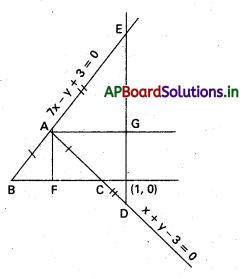
-8k – 4 – 1 + 8 – k = 0
9k = 27 ⇒ k = 3

ప్రశ్న 13.
2x2 + xy – 6y2 + 7y – 2 = 0 అనే సమీకరణం ఒక రేఖాయుగ్మాన్ని సూచిస్తుందని చూపండి.
సాధన:
a = 2 ; f = \(\frac{7}{2}\)
b = -6 ; g = 0
c = -2 ; h = \(\frac{1}{2}\)
abc + 2fgh – af2 – bg2 – ch2
= 2(-6) (-2) + 2. \(\frac{7}{2}\) 0 \(\frac{1}{2}\) – 2 \(\left(\frac{7}{2}\right)^2\) + 6 . 0 + 2 . \(\left(\frac{1}{2}\right)^2\)
= 24 – \(\frac{49}{2}\) + \(\frac{1}{2}\) = 0
h2 – ab = \(\frac{1}{4}\) + 12 > 0,
g2 – ac = 0 + 4 = 4 > 0
f2 – bc = \(\frac{49}{4}\) – 12 = \(\frac{1}{4}\) > 0
దత్త సమీకరణము రేఖా యుగ్మాన్ని సూచిస్తుంది.

AP Inter 1st Year Maths 1B Important Questions Chapter 4 సరళరేఖాయుగ్మాలు

ప్రశ్న 14.
2x2 + 3xy – 2y2 – x + 3y – 1 = 0 సమీకరణం రెండు లంబరేఖలను సూచిస్తుందని చూపండి.
సాధన:
a = 2 ; f = \(\frac{3}{2}\)
b = -2 ; g = –\(\frac{1}{2}\)
c = -1 ; h = \(\frac{3}{2}\)
abc + 2fgh – af2 – bg2 – ch2
= 2(-2) (-1) + 2 . \(\frac{3}{2}\) (-\(\frac{1}{2}\)) . \(\frac{3}{2}\) – 2 . \(\frac{9}{4}\) + 2 . \(\frac{1}{4}\) + \(\frac{1.9}{4}\)
= 4. – \(\frac{9}{4}\) – 2 . \(\frac{9}{4}\) + \(\frac{1}{2}\) + \(\frac{9}{4}\)
= \(\frac{9}{2}\) – \(\frac{9}{2}\) = 0
h2 – ab = \(\frac{9}{4}\) + 4 = \(\frac{25}{4}\) > 0
g2 – ac = \(\frac{1}{4}\) + 2 > 0
f2 – bc = \(\frac{9}{4}\) – 2 = \(\frac{1}{4}\) > 0
a + b = 2 – 2 = 0
దత్త సమీకరణము రేఖా యుగ్మాన్ని సూచిస్తుంది.

ప్రశ్న 15.
2x2 – 13xy – 7y2 + x + 23y – 6 = 0 సమీకరణం ఒక రేఖాయుగ్మాన్ని సూచిస్తుందని నిరూపించి వాటి మధ్యకోణాన్ని, వాటి ఖండన బిందువు నిరూపకాలను కనుక్కోండి.
సాధన:
ఇచ్చట a = 2 ; f = \(\frac{23}{2}\)
b = -7 ; g = \(\frac{1}{2}\)
c = – 6 ; h = –\(\frac{13}{2}\)
abc + 2fgh – af2 – bg2 – ch2
= 2(-7) (-6) + 2 . \(\frac{23}{2}\) . \(\frac{1}{2}\) (-\(\frac{13}{2}\)) – 2 \(\frac{529}{4}\) + 7 . \(\frac{1}{4}\) + 6 . \(\frac{169}{4}\)
= \(\frac{1}{4}\) (336 – 299 – 1058 + 7 + 1014)
= \(\frac{1}{4}\) (1357 – 1357) = 0
h2 – ab = \(\frac{169}{4}\) + 14 > 0,
g2 – ac = \(\frac{1}{4}\) + 12 > 0,
f2 – bc = \(\frac{529}{4}\) – 42 > 0
దత్త సమీకరణము రేఖా యుగ్మాన్ని సూచిస్తుంది.
AP Inter 1st Year Maths 1B Important Questions Chapter 4 సరళరేఖాయుగ్మాలు 7
AP Inter 1st Year Maths 1B Important Questions Chapter 4 సరళరేఖాయుగ్మాలు 8

ప్రశ్న 16.
λ యొక్క ఏ విలువకు λx2 – 10xy + 12y2 + 5x – 16y – 3 = 0 అనే సమీకరణం ఒక రేఖాయుగ్మాన్ని సూచిస్తుంది ?
సాధన:
ఇచ్చట a = λ ; f = -8
b = 12 ; g = \(\frac{5}{2}\)
c = -3 ; h = -5
దత్త సమీకరణము రేఖా యుగ్మాన్ని సూచిస్తుంది.
abc + 2fgh – af2 – bg2 – ch2 = 0
– 36λ + 2(-8) \(\frac{5}{2}\) (-5) -λ.64 – 12 . \(\frac{25}{4}\) + 3.25 = 0
-36λ + 200 – 64λ – 75 + 75 = 0
100λ = 200 ⇒ λ = 2 ⇒ a = 2
h2 – ab = 25 – 24 = 1 > 0
f2 – bc = 64 + 36 = 100 > 0
g2 – ac = \(\frac{25}{4}\) + 6 = \(\frac{49}{4}\) > 0
∴ λ = 2 విలువలకు దత్త సమీకరణము రేఖా యుగ్మాన్ని సూచిస్తుంది.

AP Inter 1st Year Maths 1B Important Questions Chapter 4 సరళరేఖాయుగ్మాలు

ప్రశ్న 17.
6x2 – 5xy – 6y2 = 0, 6x2 – 5xy – 6y2 + x + 5y – 1 = 0 అనే రేఖాయుగ్మాలతో ఒక చతురస్రం ఏర్పడుతుందని నిరూపించండి.
సాధన:
H ≡ 6x2 – 5xy – 6y2 = (3x + 2y) (2x – 3y)
మరియు S ≡ 6x2 – 5xy – 6y2 + x + 5y – 1.
=(3x + 2y – 1) (2x – 3y + 1)
అందువల్ల H = 0, S = 0 లు లంబ రేఖా యుగ్మాలను సూచిస్తాయి. ఇంకా H = 0 సూచించే రేఖలు = 0. సూచించే రేఖలకు సమాంతరం. అందువల్ల నాలుగు దత్త రేఖలతో దీర్ఘచతురస్రం ఏర్పడుతుంది.
ఎదుటి భుజాల మధ్య దూరము 3x + 2y = 0 మరియు 3x + 2y – 1 = 0 \(\left(=\frac{1}{\sqrt{13}}\right)\) ఇది రెండవ జత ఎదుటి 3x + 2y – 1 = 0 భుజము కూడ 2x – 3y = 0 మరియు 2x – 3y + 1 = 0 లకు సమానము. కనుక దీర్ఘచతురస్రము, చతురస్రము కూడా

ప్రశ్న 18.
8x2 – 24xy + 18y2 – 6x + y – 5 = 0 అనే సమీకరణం రెండు సమాంతర రేఖలను సూచిస్తుందని నిరూపించి వాటి మధ్య దూరాన్ని కనుక్కోండి.
సాధన:
S ≡ 8x2 – 24xy + 18y2 – 6x + 9y – 5
= 2(2x – 3y)2 – 3(2x – 3y) – 5
= [2(2x – 3y) – 5] [(2x – 3y) + 1]
= (4x – 6y – 5) (2x – 3y + 1) = 0
దత్త రేఖలు 4x – 6y – 5 = 0, 2x – 3y + 1 = 0
\(\frac{a_1}{a_2}=\frac{4}{2}, \frac{b_1}{b_2}=\frac{-6}{-3}\) = 2
\(\frac{a_1}{a_2}=\frac{b_1}{b_2}\)
∴ దత్త సమీకరణము సమాంతర రేఖలను సూచిస్తుంది.
సమాంతర రేఖల మధ్య దూరము
= \(2 \sqrt{\frac{g^2-a c}{a(a+b)}}\) = \(2 \sqrt{\frac{9+40}{8(8+18)}}\)
= \(\frac{2.7}{2 \sqrt{52}}=\frac{7}{\sqrt{52}}\)

AP Inter 1st Year Maths 1B Important Questions Chapter 4 సరళరేఖాయుగ్మాలు

ప్రశ్న 19.
ax2 + 2hxy + by2 = 0, ax2 + 2hxy + by2 + 2gx + 2fy + c = 0 అనే రేఖాయుగ్మాలతో ఒక సమచతుర్భుజం ఏర్పడితే (a – b) fg + h(f2 – g2) = 0 అని నిరూపించండి.
సాధన:
OA, OB ల ఉమ్మడి సమీకరణము
ax2 + 2hxy + by2 = 0
AC, BC ల ఉమ్మడి సమీకరణము
ax2 + 2hxy + by2 + 2gx + 2fy + c = 0
ఖండన బిందువు C = \(\left(\frac{h f-b g}{a b-h^2}, \frac{g h-a f}{a b-h^2}\right)\)
వికర్ణం సమీకరణము y = \(\frac{g h-a f}{h f-b g}\) . x
y(hf – bg) = x(gh – af)
(gh – af) x – (hf – bg) y = 0
AP Inter 1st Year Maths 1B Important Questions Chapter 4 సరళరేఖాయుగ్మాలు 9
A, B లు రెండు రేఖా యుగ్మాల మీది బిందువులు
AB ల ఉమ్మడి సమీకరణము
2gx + 2fy + c = 0
OACB సమచతుర్భుజం
OC, AB లు లంబంగా ఉన్నాయి.
2g(gh – af) – 2f(hf – bg) = 0
hg2 – afg – hf2 + bfg = 0
(a – b) fg + h(f2 – g2) = 0

AP Inter 1st Year Maths 1B Important Questions Chapter 4 సరళరేఖాయుగ్మాలు

ప్రశ్న 20.
ax2 + 2hxy + by2 = 0 తో సూచించే సరళరేఖలు ఒక సమాంతర చతుర్భుజ రెండు భుజాలు, ఆ సమాంతర చతుర్భుజం ఒక వికర్ణం సమీకరణం px + qy = 1 అయితే, రెండవ వికర్ణం సమీకరణం y(bp – hq) = x(aq – hp) అని నిరూపించండి.
సాధన:
OACB సమాంతర చతుర్భుజం \(\overleftrightarrow{\mathrm{OA}}, \overleftrightarrow{\mathrm{OB}}\) ల సమీకరణము
H ≡ ax2 + 2hxy + by2 = 0. మిగిలిన రెండు భుజాలు \(\overleftrightarrow{\mathrm{AC}}, \overleftrightarrow{\mathrm{BC}}\) లు వరుసగా \(\overleftrightarrow{\mathrm{OB}}, \overleftrightarrow{\mathrm{OA}}\) కి సమాంతరాలు కనుక
S ≡ ax2 + 2hxy + by2 + 2gx + 2fy + c = 0.
వికర్ణం \(\overleftrightarrow{A B}\) సమీకరణము.
(18 సమస్య నుండి) 2gx + 2fy + c = 0 దీని సమీకరణము
px + qy = 1 (లేదా) -pcx – qcy + c = 0
c ≠ 0
AP Inter 1st Year Maths 1B Important Questions Chapter 4 సరళరేఖాయుగ్మాలు 10
∴ 2g = – pc, 2f = – qc ………………. (1)
శీర్షం C నిరూపకాలు = \(\left(\frac{h f-b g}{a b-h^2}, \frac{g h-a f}{a b-h^2}\right)\)
∴ వికర్ణం \(\overleftrightarrow{O C}\) సమీకరణము
(gh – af) x = (hf – bg)y
i.e., c(-ph + aq) x = c(-hq + bp)y (1) వలన
(లేదా) (aq – hp) x = (bp – hq) y (కనుక c ≠ 0)

AP Inter 1st Year Maths 1B Important Questions Chapter 3 సరళరేఖ

Students get through AP Inter 1st Year Maths 1B Important Questions Chapter 3 సరళరేఖ which are most likely to be asked in the exam.

AP Inter 1st Year Maths 1B Important Questions Chapter 3 సరళరేఖ

సాధించిన సమస్యలు

ప్రశ్న 1.
బిందువు (2, 3) గుండా పోతూ నిరూపకాక్షాలతో చేసే శూన్యేతర అంతరఖండాల మొత్తము సున్న అయ్యే సరళరేఖ సమీకరణాన్ని కనుక్కోండి. [Mar. 12]
సాధన:
అంతరఖండ రూపంలో రేఖ సమీకరణము
\(\frac{x}{a}+\frac{y}{b}\) = 1
b = -a అని ఇవ్వబడింది.
రేఖ సమీకరణము
\(\frac{x}{a}-\frac{y}{b}\) = 1 ⇒ x – y = a
ఈ రేఖ (2, 3) గుండా పోతుంది.
2 -3 = a ⇒ a = -1
రేఖ సమీకరణము
x – y = – 1 లేదా x – y + 1 = 0

ప్రశ్న 2.
(at12, 2at1), (at22, 2at2) బిందువుల ద్వారా పోయే సరళరేఖ సమీకరణాన్ని కనుక్కోండి. [Mar. ’14]
సాధన:
దత్త బిందువుల గుండా పోయే రేఖ సమీకరణము
(x – x1) (y1 – y2) = (y – y1) (x1 – x2)
(x – at1) (2at1 – 2at2)
= (y – 2at1) (at12 – at22)
(x – at12) . 2a(t1 – t2) = (y – 2at1=) a. (t12 – t22)
2x -2at12 = y(t1 + t2) – 2at12 – 2at1t1
2x – (t1 + t2)y + 2at1t2 = 0

AP Inter 1st Year Maths 1B Important Questions Chapter 3 సరళరేఖ

ప్రశ్న 3.
A (- 1, 3) బిందువు గుండా పోతూ B(2, – 5), C(4, 6) బిందువులగుండా పోయే సరళరేఖకు i) సమాంతరంగా, ii) లంబంగా ఉండే సరళరేఖ సమీకరణం కనుక్కోండి. [May 11]
సాధన:
BC వాలు = \(\frac{-5-6}{2-4}=\frac{-11}{-2}=\frac{11}{2}\)

i) కావలసిన రేఖ BC కి సమాంతరము మరియు A(-1, 3)
గుండా పోతుంది.
సమాంతర రేఖ సమీకరణము
y – 3 = \(\frac{11}{2}\) (x + 1)
2y-6= = 11x + 11
11x – 2y + 17= 0

ii) దత్త రేఖ BC కి లంబంగా ఉంది.
ఈ రేఖ వాలు = – \(\frac{1}{m}\) = –\(\frac{2}{11}\)
ఈ రేఖ A (-1, 3) గుండా పోతుంది. కావలసిన రేఖ సమీకరణము
y – 3 = –\(\frac{2}{11}\) (x + 1)
11y – 33 = -2x – 2
2x + 11y – 31 = 0

ప్రశ్న 4.
(1, 11), (2, 15), (-3, -5) బిందువులు సరేఖీయాలని చూపండి. ఈ బిందువుల గుండా పోయే సరళరేఖ సమీకరణం కనుక్కోండి.
సాధన:
(1, 11), B(2, 15), C (-3, -5) లు దత్త బిందువులు.
AB సమీకరణము
(y – y1) (x1 – x2) = (x – x1) (y1 – y2)
(y – 11) (1 – 2) = (x – 1) (11 – 15)
– (y – 11) = – 4 (x – 1)
– y + 11 = – 4x + 4
4x – y + 7 = 0
C నిరూపకాలు (-3, -5)
4x – y + 7 = 4(−3) + 5 + 7
-12 + 12 = 0
C బిందువు AB మీద ఉంది.
A, B, C లు సరేఖీయాలు,
ఈ బిందువుల గుండా పోయే రేఖ సమీకరణము
4x – y + 7 = 0

AP Inter 1st Year Maths 1B Important Questions Chapter 3 సరళరేఖ

ప్రశ్న 5.
ఒక సరళరేఖ A(1, 2) గుండా పోతూ X- అక్షం ధన దిశతో అపసవ్య దిశలో tan-1\(\frac{4}{3}\) కోణం చేస్తుంది. ఆ సరళరేఖపై A నుంచి 5 యూనిట్ల దూరంలోగల బిందువులను కనుక్కోండి.
సాధన:
AP Inter 1st Year Maths 1B Important Questions Chapter 3 సరళరేఖ 1
దత్తాంశం α = tan-1\(\frac{4}{3}\) ⇒ tan α = \(\frac{4}{3}\)
AP Inter 1st Year Maths 1B Important Questions Chapter 3 సరళరేఖ 2
cos α = \(\frac{3}{5}\)
sin α = \(\frac{4}{5}\)
(x1, y1) = (1, -2) = x1 = 1, y1 = -2
సందర్భం : i) r = 5
x = x1 + r cos α = 1 – 5. \(\frac{3}{5}\) = 1 + 3 = 4
y = y1 + r sin α = – 2 + 5. \(\frac{4}{5}\) = -2 + 4 = 2
B నిరూపకాలు (4, 2)

సందర్భం : ii) r = -5
x = x1 + r cos α = 1 – 5. \(\frac{3}{5}\) = 1 – 3 = -2
y = y1 + r sin α = -2 – 5 . \(\frac{4}{5}\) = -2 – 4 = -6
C నిరూపకాలు (- 2, – 6)

AP Inter 1st Year Maths 1B Important Questions Chapter 3 సరళరేఖ

ప్రశ్న 6.
రేఖ y = \(\sqrt{3}\)x కు సమాంతరంగా ఉంటూ Q(2, 3) గుండా పోయే ఒక సరళరేఖ, 2x + 4y – 27 = 0 రేఖను P వద్ద ఖండిస్తుంది. PQ దూరాన్ని కనుక్కోండి.
సాధన:
PQ రేఖ y = \(\sqrt{3}\)xకు సమాంతరము.
tan α = \(\sqrt{3}\) = tan 60°
α = 60°
Q(2, 3) దత్త బిందువు.
AP Inter 1st Year Maths 1B Important Questions Chapter 3 సరళరేఖ 3
ఏదేని బిందువు P నిరూపకాలు
(x1 +r cos α, y1 + r sin α)
(2 + r cos 60°, 3 + r sin 60°)
P (2 + \(\frac{r}{2}\), 3 + \(\frac{\sqrt{3}}{2}\) r)
P బిందువు 2x + 4y – 27 = 0 రేఖ మీద ఉంది.
2 \(\left(2+\frac{r}{2}\right)\) + 4 \(\left(3+\frac{\sqrt{3}}{2} r\right)\) – 27 = 0
4 + r + 12 + 2\(\sqrt{3}\)r – 27 = 0
r(2\(\sqrt{3}\) + 1) = 27 – 6 = 11
r = \(\frac{11}{2 \sqrt{3}+1} \cdot \frac{2 \sqrt{3}-1}{2 \sqrt{3}-1}\)
= \(\frac{11(2 \sqrt{3}-1)}{11}\)
PQ = |r| = 2\(\sqrt{3}\) – 1

AP Inter 1st Year Maths 1B Important Questions Chapter 3 సరళరేఖ

ప్రశ్న 7.
3x + 4y + 12 = 0 సమీకరణాన్ని
i) వాలు – అంతరఖండ రూపం
ii) అంతరఖండ రూపం
iii) అభిలంబరూపంలోకి మార్చండి.
సాధన:
దత్త సమీకరణము 3x + 4y + 12 = 0
i) వాలు – అంతరఖండ రూపము :
4y = -3x – 12
y = \(\left(-\frac{3}{4}\right)\)x + (-3)
వాలు = –\(\frac{3}{4}\), y – అంతరఖండము = – 3.

ii) అంతరఖండ రూపము :
-3x – 4y = 12
–\(\frac{3 x}{12}-\frac{4 y}{12}\) = 1
\(\frac{x}{(-4)}+\frac{y}{(-3)}\) = 1
x – అంతరఖండము = – 4, y – అంతరఖండము = -3

iii) అభిలంబ రూపము :
-3x – 4y = 12
\(\sqrt{9+16}\) = 5 తో భాగించగా
\(\left(-\frac{3}{5}\right) x+\left(-\frac{4}{5}\right) y=\frac{12}{5}\)
cos α = \(\frac{-3}{5}\), sin α = – \(\frac{4}{5}\) అనుకుంటే
p = \(\frac{12}{5}\)
x cos α + y sin α = p
α మూడవ పాదంలో కోణం అనుకొంటే
α = л + tan-1 \(\left(\frac{4}{3}\right)\)

AP Inter 1st Year Maths 1B Important Questions Chapter 3 సరళరేఖ

ప్రశ్న 8.
x = 0, y = 0, 3x + 4y = a (a > 0) సరళరేఖలతో ఏర్పడే త్రిభుజవైశాల్యం 6 అయితే, a విలువ కనుక్కోండి. [May ’11]
సాధన:
రేఖ సమీకరణము 3x + 4y = a
\(\frac{3 x}{a}+\frac{4 y}{a}\) = 1
\(\frac{x}{\left(\frac{a}{3}\right)}+\frac{y}{\left(\frac{a}{4}\right)}\) = 1
OA = x – అంతరఖండము = \(\frac{a}{3}\),
OB = y – అంతరఖండము = \(\frac{a}{4}\)
∆ OAB = \(\frac{1}{2}\) |OA . OB|
= \(\frac{1}{2}\left|\frac{a}{3} \cdot \frac{a}{4}\right|=\frac{a^2}{24}\)
\(\frac{a^2}{2 a}\) = 6 ⇒ a2 = 144
a = ± 12
a > 0 కనుక
∴ a = 12

ప్రశ్న 9.
2x – 3y + k = 0, 3x – 4y – 13 = 0, 8x – 11y – 33 = 0 రేఖలు అనుషక్తాలయితే k విలువ కనుక్కోండి.
సాధన:
L1, L2, L3 లు దత్తరేఖల సమీకరణాలు
2x – 3y + k = 0 ……………….. (1)
3x – 4y – 13 = 0 ………………. (2)
8x – 11y – 33 = 0 ………………… (3)
(2), (3) లను సాధించగా
AP Inter 1st Year Maths 1B Important Questions Chapter 3 సరళరేఖ 4
x = 11, y = 5
(2), (3) ల ఖండన బిందువు (11, 5)
దత్త రేఖలు L., L2, L, అనుషక్తాలు.
∴ L1 చాపం (11, 5) బిందువు మీద ఉంది.
∴ 2(11) – 3(5) + k = 0
k = -7

AP Inter 1st Year Maths 1B Important Questions Chapter 3 సరళరేఖ

ప్రశ్న 10.
ax + by + c = 0, bx + cy + a = 0, cx + ay + b = 0 సరళరేఖలు అనుశక్తాలయితే a3 + b3 + c3 = 3abc అని చూపండి.
సాధన:
దత్త రేఖల సమీకరణాలు
ax + by + c = 0 …………….. (1)
bx + cy + a = 0 ……………. (2)
cx + ay + b = 0 …………… (3)
(1), (2) లను సాధించగా ఖండన బిందువు
AP Inter 1st Year Maths 1B Important Questions Chapter 3 సరళరేఖ 5
P బిందువు cx + y + b = 0 మీద ఉంది.
c\(\left(\frac{a b-c^2}{c a-b^2}\right)\) + a\(\left(\frac{b c-a^2}{c a-b^2}\right)\) + b = 0
c(ab – c2) + a (bc – a2) + b(ca – b2) = 0
abc – c3 + abc – a3 + abc – b3 = 0
∴ a3 + b3 + c3 = 3abc.

AP Inter 1st Year Maths 1B Important Questions Chapter 3 సరళరేఖ

ప్రశ్న 11.
\(\frac{x}{a}+\frac{y}{b}\) = 1, \(\frac{x}{b}+\frac{y}{a}\) = 1 సరళరేఖల ఖందన బిందువు గుండా పోయే ఒక చల సరళరేఖ నిరూపకాక్షాలను A, B లలో ఖండిస్తోంది. \(\overline{\mathrm{A B}}\) మధ్య బిందువు బిందుపథ సమీకరణం 2(a + b) xy = ab(x + y) అని చూపండి.
సాధన:
దత్తరేఖల సమీకరణాలు
\(\frac{x}{a}+\frac{y}{b}\) = 1
మరియు \(\frac{x}{b}+\frac{y}{a}\) = 1
సాధించగా ఖండన బిందువు
P నిరూపకాలు \(\left(\frac{a b}{a+b}, \frac{a b}{a+b}\right)\)
Q (xo, yo) బిందుపథం మీది ఏదేని బిందువు
⇔ x – అంతరఖండం 2xo, y – అంతరఖండం 2yo గల
⇔ P బిందువు \(\frac{x}{2 x_0}+\frac{y}{2 y_0}\) = 1 రేఖ మీద ఉంది.
.i.e., \(\frac{a b}{a+b}\left(\frac{1}{2 x_0}+\frac{1}{2 y_0}\right)\) = 1
⇒ \(\frac{a b}{a+b} \cdot \frac{x_0+y_0}{2 x_0 y_0}\) = 0
ab(xo + yo) = 2(a + b) xo yo
Q(xo, yo) బిందువు వక్రం మీద ఉంది.
2(a + b)xy = ab(x + y)
AB మధ్య బిందుపథము 2(a + b)xy = ab(x + y)

AP Inter 1st Year Maths 1B Important Questions Chapter 3 సరళరేఖ

ప్రశ్న 12.
a, b, c లు అంకశ్రేఢిలో ఉంటే ax + by + c = 0 సమీకరణం ఒక అనుషక్త రేఖల కుటుంబాన్ని సూచిస్తుందని చూపండి. అనుషక్త బిందువును కూడా కనుక్కోండి.
సాధన:
a, b, c లు AP. లో ఉన్నాయి.
2b = a + c
a – 2b + c = 0
a.1 + b(-2) + c = 0.
ax + by + c = 0 కి లంబరేఖలు (1, -2) స్థిర బిందువు గుండా పోతున్నాయి.
∴ a, b, c లు పరామితులైతే, ax + by + c = 0 సూచించే రేఖలు అనుషక్తాలు.
∴ అనుషక్త బిందువు (1, 2).

ప్రశ్న 13.
4x – y + 7 = 0, kx – 5y – 9 = 0 సరళరేఖల మధ్యకోణం 45° అయితే k విలువను కనుక్కోండి.
సాధన:
AP Inter 1st Year Maths 1B Important Questions Chapter 3 సరళరేఖ 6
వర్గీకరించి అడ్డగుణకారము చేయగా
2(4k + 5)2 = 17(k2 + 25)
2(16k2 + 40k + 25) = 17k2 + 425
32k2 + 80k + 50 = 17k2 + 425
15k2 + 80k – 375 = 0
3k2 + 16k – 75 = 0
(k – 3) (3k + 25) = 0
k = 3 లేదా -25/3

AP Inter 1st Year Maths 1B Important Questions Chapter 3 సరళరేఖ

ప్రశ్న 14.
(xo, yo) బిందువు గుండా పోతూ ax + by + c = 0 సరళరేఖకు (i) సమాంతరంగా ii) లంబంగా ఉండే సరళరేఖల సమీకరణాలు కనుక్కోండి.
సాధన:
దత్తరేఖ సమీకరణముax + by + c = 0
i) సమాంతర రేఖ సమీకరణము ax + by = k …………….. (1)
ఈ రేఖ P(xo, yo) గుండా పోతుంది.
axo + byo = k ……………… (2)
(1) నుండి (2) తీసివేయగా కావలసిన రేఖ సమీకరణము
a(x – xo) + b(y – yo) = 0

ii) లంబంగా ఉండే రేఖ సమీకరణము
bx – ay = k
ఈ రేఖ P(xo, yo) గుండా పోతుంది.
⇒ bxo – ayo = k
తీసివేయగా, కావలసిన రేఖ సమీకరణము
b(x – xo) – a(y – yo) = 0

ప్రశ్న 15.
5x – 2y = 7 రేఖకు లంబంగా ఉంటూ 2x + 3y = 1, 3x + 4y = 6 రేఖల ఖండన బిందువు గుండా పోయే సరళరేఖ సమీకరణం కనుక్కోండి.
సాధన:
దత్తరేఖలు L1 = 2x + 3y – 1 = 0
L2 = 3x + 4y – 6 = 0
L1 = 0, L2 = 0 ల ఖండన బిందువు గుండా పోయే రేఖ సమీకరణము
L1 + kL2
(2x + 3y – 1) + k(3x + 4y – 6) = 0
(2 + 3k)x + (3 + 4k)y – (1 + 6k) = 0 ……………… (1)
ఈ రేఖ 5x – 2y = 7 కు లంబము. ……………….. (2)
a1a2 + b1b2 = 0
5(2 + 3k) – 2(3 + 4k) = 0
10 + 15k – 6 – 8k = 0
7k = – 4 ⇒ k = – 4/7
(1) లో ప్రతిక్షేపిస్తే కావలసిన రేఖ సమీకరణము
(2 – \(\frac{12}{7}\))x + (3 – \(\frac{16}{7}\))x – (1 – \(\frac{24}{7}\)) = 0
\(\frac{2}{7}\)x + \(\frac{5}{7}\)y + \(\frac{17}{7}\) = 0
⇒ 2x + 5y + 17 = 0

AP Inter 1st Year Maths 1B Important Questions Chapter 3 సరళరేఖ

ప్రశ్న 16.
(3, – 4), (a, B) లను కలిపే రేఖాఖండాన్ని రేఖ 2x – 3y – 5 = 0 లంబ సమద్విఖండన చేస్తే α + β విలువ కనుక్కోండి.
సాధన:
(α, β) అనేది
2x – 3y – 5 = 0 రేఖ దృష్ట్యా (3, -4) ప్రతిబింబం (α, β).
\(\frac{\alpha-3}{2}=\frac{\beta+4}{-3}=\frac{-2(6+12-5)}{4+9}\) = -2
α – 3 = – 4 ⇒ a = -1
β + 4 = 6 ⇒ β = 2
α + β = 1 + 2 = 1

ప్రశ్న 17.
ax + by + p = 0, ax + by + q = 0, cx + dy + r = 0, cx + dy + s = 0 అనే నాలుగు సరళరేఖలు ఒక సమాంతర చతుర్భుజాన్ని ఏర్పరిస్తే ఆ విధంగా ఏర్పడే సమాంతర చతుర్భుజం వైశాల్యం \(\left|\frac{(p-q)(r-s)}{b c-a d}\right|\) అని చూపండి.
సాధన:
L1, L2, L3, L4 లు రేఖల సమీకరణాలు
L1 ≡ ax + by + p = 0;
L2 ≡ ax + by + q = 0
L3 ≡ cx + dy + r = 0.
L4 ≡ cx + dy + s = 0
L1, L2 లు సమాంతరాలు. L3, L4 లు సమాంతరాలు.
AP Inter 1st Year Maths 1B Important Questions Chapter 3 సరళరేఖ 7

ప్రశ్న 18.
ఒక లంబకోణ సమద్విబాహు త్రిభుజం యొక్క కర్ణం చివరి బిందువులు (1, 3), (−4, 1). ఆ త్రిభుజం యొక్క లంబ భుజాల సమీకరణాలను కనుక్కోండి.
సాధన:
A (1, 3), B = (-4, 1) అని \(\overline{A B}\) కర్ణంగా కలిగిన లంబకోణ సమద్విబాహు త్రిభుజాన్ని ABC అని అనుకుంటే,
\(\stackrel{\leftrightarrow}{A C}, \stackrel{\leftrightarrow}{B C}\) ల సమీకరణాలను కనుక్కోవాలి.
\(\overleftrightarrow{A B}\) యొక్క వాలు’ = \(\frac{1-3}{-4-1}=\frac{2}{5}\) కాబట్టి \(\overleftrightarrow{A C}, \stackrel{\leftrightarrow}{B C}\) లు ఊర్ద్వ రేఖలు కావు.
\(\overleftrightarrow{A C}\) యొక్క వాలును m అనుకొంటే,
AP Inter 1st Year Maths 1B Important Questions Chapter 3 సరళరేఖ 8
⇒ \(\frac{5 m-2}{5+2 m}\) ± 1
⇒ m = \(\frac{7}{3}\) లేదా \(\frac{-3}{7}\)
\(\overleftrightarrow{A C}\) వాలును \(\frac{7}{3}\) అనుకొంటే, \(\overleftrightarrow{B C}\) వాలు
\(\frac{-3}{7}\) అవుతుంది.
\(\overleftrightarrow{A C}\), \(\overleftrightarrow{B C}\) సమీకరణాలు వరసగా
y – 3 = \(\frac{7}{3}\) (x – 1), y – 1 = –\(\frac{3}{7}\) (x + 4).
ఇవి వరసగా 7x – 3y + 2 = 0, 3x + 7y + 5 = 0 అవుతాయి.
AB గుండా \(\overleftrightarrow{B C}\), \(\overleftrightarrow{A C}\) లకు సమాంతరంగా గీసిన సరళరేఖలు D వద్ద ఖండించుకొంటే, ∆ABD కూడా \(\overline{\mathrm{AB}}\) కర్ణంగా గల లంబకోణ సమద్విబాహు త్రిభుజం అవుతుంది.
\(\overleftrightarrow{A D}\), \(\overleftrightarrow{B D}\) ల సమీకరణాలు వరసగా
3(x – 1) + 7(y – 3) = 0, 7(x + 4) – 3(y – 1) = 0 లు
అంటే 3x + 7y − 24 = 0, 7x – 3y + 31 = 0.
∴ కావలసిన లంబభుజాల సమీకరణాలు
7x – 3y + 2 = 0, 3x + 7y + 5 = 0
లేదా 3x + 7y – 24 = 0, 7x – 3y + 31 = 0.
గమనిక : ADBC ఒక చతురస్రమవుతుంది.

AP Inter 1st Year Maths 1B Important Questions Chapter 3 సరళరేఖ

ప్రశ్న 19.
ఒక సరళరేఖ 5x + y + 4 = 0, 3x + 4y – 4 = 0 అనే సరళరేఖల మధ్య చేసే అంతర ఖండం యొక్క మధ్య బిందువు (1, 5) అయితే, ఆ సరళ రేఖా సమీకరణాన్ని కనుక్కోండి.
సాధన:
కావలసిన సరళరేఖ 3x + 4y – 4 = 0 ను A వద్ద 5x y + 4 = 0 ను B వద్ద ఖండిస్తుందనుకొందాం. అప్పుడు ఇచ్చిన
సరళరేఖల మధ్య ఉన్న అంతర ఖండం \(\overleftrightarrow{A B}\) అవుతుంది.
\(\overleftrightarrow{A B}\) మధ్య బిందువును C అనుకొంటే C = (1, 5) అవుతుంది.
5x – y + 4 = 0 ను y = 5x + 4 గా రాయవచ్చు. కాబట్టి \(\overleftrightarrow{B X}\) మీద ఏదైనా బిందువును (t, 5t + 4), (t వాస్తవ సంఖ్యగా) రాయవచ్చు.
కాబట్టి ఏదో ఒక t విలువకు B = (t, 5t + 4) అవుతుంది.
\(\overline{\mathrm{AB}}\) యొక్క మధ్య బిందువు (1, 5) కాబట్టి,
A = [2 – t, 10 – (5t + 4)]
= [2 -t, 6 – 5t] అవుతుంది.
A బిందువు 3x + 4y – 4 = 0 మీద ఉండటం వల్ల,
3(2 – t) + 4(6 – 5t) – 4 = 0 అవుతుంది.
⇒ -23t + 26
⇒ t = \(\frac{26}{23}\)
AP Inter 1st Year Maths 1B Important Questions Chapter 3 సరళరేఖ 9
\(\overleftrightarrow{A B}\) సమీకరణం y – 5 = latex]\frac{107}{3}[/latex] (x – 1).
⇒ 3y – 15 = 107x – 107
⇒ 107x – 3y – 92 = 0

ప్రశ్న 20.
ఒక సమబాహు త్రిభుజం యొక్క అంతర కేంద్రం మూల బిందువు వద్ద ఉంది. ఒక భుజం x + y – 2 = 0 మీద ఉంటే ఈ భుజానికెదురుగా నున్న శీర్షాన్ని కనుక్కోండి.
సాధన:
సమబాహు త్రిభుజాన్ని ABC అని, x + y + 2 = 0 మీద
\(\overline{\mathrm{BC}}\) భుజం ఉందనుకొందాం.
ABC త్రిభుజం యొక్క అంతర కేంద్రం మూల బిందువు O కాబట్టి, ∠BAC యొక్క సమద్విఖండన రేఖను \(\overleftrightarrow{A D}\) అనుకొంటే, \(\overleftrightarrow{A D}\) అనేది \(\overleftrightarrow{B C}\) యొక్క లంబ సమద్విఖండన రేఖ అవుతుంది. ∆ABC సమబాహు త్రిభుజం అవడం వల్ల O, కేంద్రభాసం కూడా అవుతుంది. కాబట్టి AO: OD = 2 : 1. కేంద్రభాసం, అంతర కేంద్రం, పరికేంద్రం, లంబకేంద్రాలు ఏకీభవిస్తాయి]
D = (h, k) అనుకొందాం. నుంచి \(\overleftrightarrow{B C}\) మీదకు గల లంబపాదం D, కాబట్టి
AP Inter 1st Year Maths 1B Important Questions Chapter 3 సరళరేఖ 10
\(\frac{h-0}{1}=\frac{k-0}{1}=\frac{-(-2)}{2}\) = 1
∴ h = 1, k = 1
D = (1, 1).
A = (x1, y1) అనుకొంటే, (0,0) = \(\left(\frac{2+x_1}{3}, \frac{2+y_1}{3}\right)\)
∴ x1 = -2, y1 = -2.
కావలసిన శీర్షం A = (-2, -2).

AP Inter 1st Year Maths 1B Important Questions Chapter 3 సరళరేఖ

ప్రశ్న 21.
(−5, -7), (13, 2), (−5, 6) శీర్షాలుగా గల త్రిభుజం లంబకేంద్రాన్ని కనుక్కోండి.
సాధన:
A(-5, -7), B(13,2), (5, 6) లు త్రిభుజ శీర్షాలు.
A నుండి BC కి లంబం AD
B నుండి AC కి లంబము BE.
AP Inter 1st Year Maths 1B Important Questions Chapter 3 సరళరేఖ 11
\(\overleftrightarrow{A D}\) సమీకరణము
9x – 2y = 45 + 14 = -31 ……………….. (1)
\(\overleftrightarrow{A C}\) సమీకరణము x = -5 ఇది ఊర్ధ్వరేఖ
\(\overleftrightarrow{B E}\) సమీకరణము y = 2. ……………….. (2)
(1), (2) ల ఖండన బిందువు (−3, 2).
ఇది ∆ ABC లంబకేంద్రము

AP Inter 1st Year Maths 1B Important Questions Chapter 3 సరళరేఖ

ప్రశ్న 22.
7x + y – 10 = 0, x – 2y + 5 = 0, x + y + 2 = 0 లు ఒక త్రిభుజం సమీకరణాలైతే త్రిభుజం లంబకేంద్రాన్ని కనుక్కోండి. [T.S Mar. ’15]
సాధన:
∆ ABC దత్త త్రిభుజము
x – 2y + 5 = 0 ……………. (1)
7x + y – 10 = 0 ………………. (2)
x + y + 2 = 0 ……………… (3)
AP Inter 1st Year Maths 1B Important Questions Chapter 3 సరళరేఖ 12
\(\overleftrightarrow{A B}\), \(\overleftrightarrow{B C}\), A, B ల నుండి భుజాల మీదకు గీయబడి ఉన్నాయి.
(1), (3) లను సాధిస్తే A నిరూపకాలు = (-3, 1).
\(\overleftrightarrow{A D}\) ⊥ \(\overleftrightarrow{B C}\) కనుక \(\overleftrightarrow{A D}\) సమీకరణము
x – 7y = -3 – 7 = -10 …………….. (4)
(1), (2) లను సాధించగా B నిరూపకాలు = (1, 3).
\(\overleftrightarrow{B E}\) ⊥ \(\overleftrightarrow{A C}\) కనుక \(\overleftrightarrow{B E}\) సమీకరణము
x – y = 1 – 3 = -2 ………………. (5)
(4), (5) ల ఖండన బిందువు \(\left(\frac{-2}{3}, \frac{4}{3}\right)\)
∆ ABC లంబకేంద్రం.

ప్రశ్న 23.
(1, 3), (–3, 5), (5, -1) లు శీర్షాలుగా గల త్రిభుజం పరికేంద్రం కనుక్కోండి.
సాధన:
త్రిభుజ శీర్షాలు
A(1, 3), B(-3, 5), (5, -1),
\(\overline{\mathrm{BC}}, \overline{\mathrm{CA}}\) ల మధ్య బిందువు D(1, 2), E(3, 1).
\(\overline{\mathrm{BC}}, \overline{\mathrm{CA}}\) ల లంబ సమద్విఖండన రేఖల ఖండన బిందువు S అనుకొనుము.
AP Inter 1st Year Maths 1B Important Questions Chapter 3 సరళరేఖ 13
(1), (2) లను సాధిస్తే 5 – (-8, -10) ∆ ABC యొక్క పరికేంద్రం.

AP Inter 1st Year Maths 1B Important Questions Chapter 3 సరళరేఖ

ప్రశ్న 24.
3x – y – 5 = 0, x + 2y – 4 = 0, 5x + 3y + 1 = 0 లు భుజాలుగా గల త్రిభుజం పరికేంద్రం కనుక్కోండి. [May ’11, ’05; Mar. ’06]
సాధన:
∆ ABC భుజాలు BC, CA, AD ల సమీకరణాలు వరుసగా
3x – y – 5 = 0, x + 2y – 4 = 0 మరియు 5x + 3y + 1 = 0
రెండేసి సమీకరణాలను తీసుకుని A(-2, 3), B(1, -2), C(2, 1).
\(\overline{\mathrm{BC}}, \overline{\mathrm{CA}}\) ల మధ్య బిందువుల నిరూపకాలు వరుసగా
D = \(\left(\frac{3}{2}, \frac{-1}{2}\right)\), E = (0, 2).
AP Inter 1st Year Maths 1B Important Questions Chapter 3 సరళరేఖ 14
\(\overline{\mathrm{BC}}\) లంబ సమద్విఖండన రేఖ \(\stackrel{\leftrightarrow}{S D}\) సమీకరణము x + 3y = 0, \(\overline{\mathrm{AC}}\) లంబ సమద్విఖండన రేఖ 2x + y + 2 = 0 రేఖ సమీకరణము.
ఈ రెండు సమీకరణాలను సాధిస్తే, S\(\left(\frac{-6}{7}, \frac{2}{7}\right)\)
ఇది ∆ ABC పరికేంద్రము

ప్రశ్న 25.
y = \(\sqrt{3}\)x, y = –\(\sqrt{3}\)x, y = 3 సరళరేఖలతో ఏర్పడే త్రిభుజం అంతర కేంద్రం కనుక్కోండి.
సాధన:
AP Inter 1st Year Maths 1B Important Questions Chapter 3 సరళరేఖ 15
y = \(\sqrt{3}\)x, y = –\(\sqrt{3}\)x రేఖలు X – అక్షంలో వరుసగా 60°, 120° కోణాలు చేస్తున్నాయి.
y = 3 క్షితిజ సమాంతర రేఖ.
ఈ రేఖలతో ఏర్పడే త్రిభుజం పరావలయం
O(0, 0), A(\(\sqrt{3}\), 3), D(-\(\sqrt{3}\), 3) లు సమబాహు త్రిభుజ శీర్షాలు.
∴ అంతర కేంద్రము \(\left(\frac{0+\sqrt{3}-\sqrt{3}}{3}, \frac{0+3+3}{3}\right)\)
= (0, 2).

AP Inter 1st Year Maths 1B Important Questions Chapter 3 సరళరేఖ

ప్రశ్న 26.
ఒక సరళరేఖ మూల బిందువు నుంచి 4 యూనిట్ల దూరంలో ఉండి, మూల బిందువు నుంచి ఆ రేఖకు గీసిన అభిలంబ కిరణం x- అక్షం ధన దిశతో 135° కోణం చేస్తే, అ సరళరేఖ సమీకరణం కనుక్కోండి.
సాధన:
దత్త సరళ రేఖ సమీకరణం x cos αx + y sin α = p
p = 4, α = 135°
అంటే \(x\left(\frac{-1}{\sqrt{2}}\right)+y\left(\frac{1}{\sqrt{2}}\right)\) = 4
లేదా x – y + 4\(\sqrt{2}\) = 0

ప్రశ్న 27.
x + y + 1 = 0 సమీకరణాన్ని అభిలంబ రూపంలోకి మార్చండి. సాధన. x + y + 1 = 0
సాధన:
x + y + 1 = 0
⇔ \(\left(\frac{-1}{\sqrt{2}}\right) x+\left(\frac{-1}{\sqrt{2}}\right) y=\frac{1}{\sqrt{2}}\)
⇔ x cos \(\frac{5 \pi}{4}\) + y sin \(\frac{5 \pi}{4}\) = \(\frac{1}{\sqrt{2}}\)
అందువల్ల దత్త సరళరేఖ సమీకరణానికి అభిలంబ రూపం
x cos \(\frac{5 \pi}{4}\) + y sin \(\frac{5 \pi}{4}\) = \(\frac{1}{\sqrt{2}}\) అని, మూలబిందువు నుంచి ఆ రేఖ దూరం \(\frac{1}{\sqrt{2}}\) అని స్పష్టం.

ప్రశ్న 28.
2x + y + 4 y – 3x = 7 రేఖల మధ్య కోణాన్ని కనుక్కోండి.
సాధన:
దత్తరేఖల మధ్యకోణం = cos-1 \(\frac{-6+1}{\sqrt{5 \times 10}}\)
= cos-1\(\left[\frac{5}{\sqrt{2}}\right]\)
= cos-1 \(\left[\frac{1}{\sqrt{2}}\right]=\frac{\pi}{4}\)

AP Inter 1st Year Maths 1B Important Questions Chapter 3 సరళరేఖ

ప్రశ్న 29.
(-1, 3) నుంచి 5x – y – 18 = 0 సరళరేఖ మీదికి లంబపాదం కనుక్కోండి.
సాధన:
(-1, 3) నుంచి 5x – y – 18 = 0 రేఖ మీదికి లంబపాదం (h, k)
⇒ \(\frac{h-(-1)}{5}=\frac{k-3}{-1}=-\frac{(-5-3-18)}{5^2+1^2}\) = 1
⇒ h + 1 = 5, k – 3 = -1
⇒ (h, k) = (4, 2)

ప్రశ్న 30.
3x + 4y – 3 = 0, 6x + 8y – 1 = 0 సమాంతర రేఖల మధ్యదూరం కనుక్కోండి.
సాధన:
దత్త సరళరేఖల సమీకరణాలను 6x + 8y – 6 = 0,
6x + 8y – 1 = 0
ఇప్పుడు \(\frac{\left|c_1-c_2\right|}{\sqrt{a^2+b^2}}\) నుంచి ఈ సమాంతర రేఖల
మధ్యదూరం = \(\frac{-6+1}{\sqrt{6^2+8^2}}=\frac{5}{10}=\frac{1}{2}\)

ప్రశ్న 31.
\(\sqrt{3}\)x + y + 1 = 0, x + 1 = 0 రేఖల మధ్యకోణం కనుక్కోండి.
సాధన:
\(\sqrt{3}\)x + y + 1 = 0 సరళరేఖవాలు – \(\sqrt{3}\) కావడంతో అది x-అక్షంతో 60° కోణం చేస్తుంది. అందువల్ల ఆరేఖ y-అక్షంతో 30° కోణం చేస్తుంది. కాని x + 1 = 0 సమీకరణం ఒక ఊర్ద్వ రేఖను సూచిస్తుంది. కాబట్టి దత్తరేఖల మధ్యకోణం = 30°.

AP Inter 1st Year Maths 1B Important Questions Chapter 3 సరళరేఖ

ప్రశ్న 32.
x + y + 1 = 0, 2x – y + 5 = 0 సరళరేఖల ఖండన బిందువు గుండాను (5, -2) బిందువు గుండాను. పోయే సరళరేఖ సమీకరణం కనుక్కోండి.
సాధన:
(5, -2) బిందువు 2x – y + 5 = 0 రేఖ మీద లేదు. కాబట్టి ఈ రేఖ నుంచి విభిన్నంగా ఉంటూ, దత్త రేఖల ఖండన బిందువు గుండాపోయే ఏదైనా రేఖ సమీకరణం
(x + y + 1) + λ (2x − y + 5) = 0 రూపంలో ఉంటుంది.
ఈ రేఖ (5, −2) బిందువు గుండా పోవాలంటే 4 + λ (17) = 0.
లేదా λ = – \(\frac{4}{17}\) కావాలి. అందువల్ల కావలసిన రేఖ సమీకరణం
17(x + y + 1) -4
(2x – y + 5) = 0
అంటే 9x + 21y – 3 = 0
లేదా 3x + 7y − 1 = 0

AP Inter 1st Year Maths 1A Important Questions Chapter 3 మాత్రికలు

Students get through AP Inter 1st Year Maths 1A Important Questions Chapter 3 మాత్రికలు which are most likely to be asked in the exam.

AP Inter 1st Year Maths 1A Important Questions Chapter 3 మాత్రికలు

సాధించిన సమస్యలు
(Solved Problems)

ప్రశ్న 1.
A = \(\left[\begin{array}{ccc}
2 & 3 & -1 \\
7 & 8 & 5
\end{array}\right]\), B = \(\left[\begin{array}{ccc}
1 & 0 & 1 \\
2 & -4 & -1
\end{array}\right]\) అయితే A + B కనుక్కోండి.
సాధన:
A + B = \(\left[\begin{array}{ccc}
2 & 3 & -1 \\
7 & 8 & 5
\end{array}\right]\) + \(\left[\begin{array}{ccc}
1 & 0 & 1 \\
2 & -4 & -1
\end{array}\right]\)
= \(\left[\begin{array}{lll}
3 & 3 & 0 \\
9 & 4 & 4
\end{array}\right]\)

AP Inter 1st Year Maths 1A Important Questions Chapter 3 మాత్రికలు

ప్రశ్న 2.
\(\left[\begin{array}{ccc}
x-1 & 2 & y-5 \\
2 & 0 & 2 \\
1 & -1 & 1+a
\end{array}\right]=\left[\begin{array}{ccc}
1-x & 2 & -y \\
2 & 0 & 2 \\
1 & -1 & 1
\end{array}\right]\)
అయితే x, y, z, a విలువలు కనుక్కోండి.
సాధన:
మాత్రికల సమానత్వం ప్రకారం
x – 1 = 1 – x ⇒ 2x = 2 ⇒ x = 1
y – 5 = -y ⇒ 2y = 5 ⇒ y = \(\frac{5}{2}\)
z = 2 ⇒ z = 2
1 + a = 1 ⇒ a = 1 – 1 ⇒ a = 0

ప్రశ్న 3.
A = \(\left[\begin{array}{ccc}
1 & 2 & -\frac{1}{2} \\
0 & -1 & 2 \\
-\frac{1}{2} & 2 & 1
\end{array}\right]\) అయితే మాత్రికA జాడ కనుక్కోండి. [Mar. ’04]
సాధన:
1, −1, 1 లు ప్రధాన వికర్ణ మూలకాలు.
జాడ (A) = 1 + (-1) + 1 = 1

AP Inter 1st Year Maths 1A Important Questions Chapter 3 మాత్రికలు

ప్రశ్న 4.
A = \(\left[\begin{array}{cc}
4 & -5 \\
-2 & 3
\end{array}\right]\) అయితే -5A కనుక్కోండి.
సాధన:
– 5A = -5\(\left[\begin{array}{cc}
4 & -5 \\
-2 & 3
\end{array}\right]\)
= \(\left[\begin{array}{cc}
-20 & 25 \\
10 & -15
\end{array}\right]\)

ప్రశ్న 5.
A = \(\left[\begin{array}{ccc}
\mathrm{i} & 0 & 1 \\
0 & -i & 2 \\
-1 & 1 & 5
\end{array}\right]\) అయితే Aకు సంకలన విలోమం కనుక్కోండి.
సాధన:
A కు సంకలన విలోమము -A = (-1)A
∴ A కు సంకలన విలోమము – (-1) \(\left[\begin{array}{ccc}
\mathrm{i} & 0 & 1 \\
0 & -\mathrm{i} & 2 \\
-1 & 1 & 5
\end{array}\right]\)
= \(\left[\begin{array}{ccc}
-\mathrm{i} & 0 & -1 \\
0 & \mathrm{i} & -2 \\
1 & -1 & -5
\end{array}\right]\)

AP Inter 1st Year Maths 1A Important Questions Chapter 3 మాత్రికలు

ప్రశ్న 6.
A = \(\left[\begin{array}{ccc}
2 & 3 & 1 \\
6 & -1 & 5
\end{array}\right]\), B = \(\left[\begin{array}{ccc}
1 & 2 & -1 \\
0 & -1 & 3
\end{array}\right]\) అయితే A + B – X = 0 అయ్యేటట్లుగా X మాత్రికను కనుక్కోండి. మాత్రిక X తరగతి ఎంత ?
సాధన:
A + B = X = 0
⇒ X = A + B
= \(\left[\begin{array}{ccc}
2 & 3 & 1 \\
6 & -1 & 5
\end{array}\right]\) + \(\left[\begin{array}{ccc}
1 & 2 & -1 \\
0 & -1 & 3
\end{array}\right]\)
∴ X = \(\left[\begin{array}{ccc}
3 & 5 & 0 \\
6 & -2 & 8
\end{array}\right]\)
∴ X మాత్రిక తరగతి 2 × 3.

ప్రశ్న 7.
A = \(\left[\begin{array}{lll}
0 & 1 & 2 \\
2 & 3 & 4 \\
4 & 5 & 6
\end{array}\right]\), B = \(\left[\begin{array}{ccc}
1 & -2 & 0 \\
0 & 1 & -1 \\
-1 & 0 & 3
\end{array}\right]\) అయితే A – 3, 4B – 3A లను కనుక్కోండి.
సాధన:
AP Inter 1st Year Maths 1A Important Questions Chapter 3 మాత్రికలు 1

ప్రశ్న 8.
A = \(\left[\begin{array}{ll}
1 & 2 \\
3 & 4
\end{array}\right]\), B = \(\left[\begin{array}{ll}
3 & 8 \\
7 & 2
\end{array}\right]\), 2X + A = B అయితే మాత్రిక ‘X’ ను కనుక్కోండి. [(A.P) Mar. ’15, ’13]
సాధన:
2X + A = B ⇒ 2X = B – A
= \(\left[\begin{array}{ll}
3 & 8 \\
7 & 2
\end{array}\right]\) – \(\left[\begin{array}{ll}
1 & 2 \\
3 & 4
\end{array}\right]\) = \(\left[\begin{array}{cc}
2 & 6 \\
4 & -2
\end{array}\right]\)
X = \(\frac{1}{2}\left[\begin{array}{cc}
2 & 6 \\
4 & -2
\end{array}\right]\)
∴ X = \(\left[\begin{array}{cc}
1 & 3 \\
2 & -1
\end{array}\right]\)

AP Inter 1st Year Maths 1A Important Questions Chapter 3 మాత్రికలు

ప్రశ్న 9.
I, II అనే రెండు కర్మాగారాలు, జెల్, బాల్, ఇంక్ అనే మూడు రకాల పెన్నులను తయారు చేస్తాయి. సెప్టెంబరు, అక్టోబరు నెలల్లో ఈ రెండు కర్మాగారాల అమ్మకాల విలువ కింది మాత్రికలలో ఇచ్చాం.
సెప్టెంబర్ నెల అమ్మకాలు (రూపాయలలో)
AP Inter 1st Year Maths 1A Important Questions Chapter 3 మాత్రికలు 2
i) రెండు కర్మాగారాలకు సెప్టెంబర్, అక్టోబర్ లో మూడు రకాల పెన్నుల అమ్మకాల విలువ విడి విడిగా కనుక్కోండి.
ii) అక్టోబర్ లో తగ్గిన అమ్మకాల విలువ కనుక్కోండి.
సాధన:
i) రెండు కర్మాగారాల సెప్టెంబర్, అక్టోబర్ నెలల అమ్మకాల మొత్తం విలువ
జెల్ బాల్ ఇంక్
AP Inter 1st Year Maths 1A Important Questions Chapter 3 మాత్రికలు 3

ii) అక్టోబర్ నెలలో తగ్గిన అమ్మకాలు
AP Inter 1st Year Maths 1A Important Questions Chapter 3 మాత్రికలు 4

ప్రశ్న 10.
ఒక 3 × 2 మాత్రిక మూలకాలు aij = \(\frac{1}{2}\) |i – 3j| గా నిర్వచిస్తే, ఆ మాత్రికను నిర్మించండి. [T.S. Mar. ’15]
సాధన:
సాధారణంగా 3 × 2 మాత్రికను
A = \(\left[\begin{array}{ll}
a_{11} & a_{12} \\
a_{21} & a_{22} \\
a_{31} & a_{32}
\end{array}\right]\) గా సూచిస్తాం.
ఇప్పుడు aij = \(\frac{1}{2}\) |i – 3j| i = 1, 2, 3 ; j = 1, 2
a11 = \(\frac{1}{2}\) |1 – (3 × 1)| = 1
a12 = \(\frac{1}{2}\) |1 – (3 × 2)| = \(\frac{5}{2}\)
a21 = \(\frac{1}{2}\) |2 – (3 × 1)| = \(\frac{1}{2}\)
a22 = \(\frac{1}{2}\) |2 – (3 × 2)| = 2
a31 = \(\frac{1}{2}\) |3 – (3 × 1)| = 0
a32 = \(\frac{1}{2}\) |3 – (3 × 2)| = \(\frac{3}{2}\)
∴ A = \(\left[\begin{array}{cc}
1 & \frac{5}{2} \\
\frac{1}{2} & 2 \\
0 & \frac{3}{2}
\end{array}\right]\)

AP Inter 1st Year Maths 1A Important Questions Chapter 3 మాత్రికలు

ప్రశ్న 11.
A = \(\left[\begin{array}{lll}
0 & 1 & 2 \\
1 & 2 & 3 \\
2 & 3 & 4
\end{array}\right]\), B = \(\left[\begin{array}{cc}
1 & -2 \\
-1 & 0 \\
2 & -1
\end{array}\right]\) అయితే AB, BA లను కనుక్కోండి.
సాధన:
మాత్రిక A లో నిలువు వరుసల సంఖ్య, మాత్రిక Bలో అడ్డు
వరుసల సంఖ్య = 3
కనుక AB నిర్వచితం
AB = \(\left[\begin{array}{lll}
0 & 1 & 2 \\
1 & 2 & 3 \\
2 & 3 & 4
\end{array}\right]\) \(\left[\begin{array}{cc}
1 & -2 \\
-1 & 0 \\
2 & -1
\end{array}\right]\)
= \(\left[\begin{array}{ll}
3 & -2 \\
5 & -5 \\
7 & -8
\end{array}\right]\)
B మాత్రికలో నిలువ వరుసల సంఖ్య ≠ A మాత్రికలోని అడ్డు వరుసల సంఖ్య
∴ BA నిర్వచితం కాదు.

ప్రశ్న 12.
A = \(\left[\begin{array}{ccc}
1 & -2 & 3 \\
2 & 3 & -1 \\
-3 & 1 & 2
\end{array}\right]\), B = \(\left[\begin{array}{lll}
1 & 0 & 2 \\
0 & 1 & 2 \\
1 & 2 & 0
\end{array}\right]\) లు వినిమయ న్యాయాన్ని పాటిస్తాయేమో పరిశీలించండి.
సాధన:
A, B లు రెండు 3వ తరగతి చతురస్ర మాత్రికలు.
కనుక AB, BA లు నిర్వచితం.
AP Inter 1st Year Maths 1A Important Questions Chapter 3 మాత్రికలు 5
కనుక మాత్రిక గుణకారం వినిమయ ధర్మాన్ని పాటించదు.

AP Inter 1st Year Maths 1A Important Questions Chapter 3 మాత్రికలు

ప్రశ్న 13.
A = \(\left[\begin{array}{cc}
\mathrm{i} & 0 \\
\mathrm{0} & -\mathrm{i}
\end{array}\right]\) అయితే A2 = −I, (i = – 1) అని చూపండి.
సాధన:
A2 = \(\left[\begin{array}{cc}
\mathrm{i} & 0 \\
\mathrm{0} & -\mathrm{i}
\end{array}\right]\) \(\left[\begin{array}{cc}
\mathrm{i} & 0 \\
\mathrm{0} & -\mathrm{i}
\end{array}\right]\)
= \(\left[\begin{array}{ll}
i^2 & 0 \\
0 & i^2
\end{array}\right]\)
= \(\left[\begin{array}{cc}
-1 & 0 \\
0 & -1
\end{array}\right]\)
= (-1) \(\left[\begin{array}{cc}
1 & 0 \\
0 & 1
\end{array}\right]\) = -I

ప్రశ్న 14.
A = \(\left[\begin{array}{cc}
\cos \theta & -\sin \theta \\
\sin \theta & \cos \theta
\end{array}\right]\) అయితే n యొక్క అన్ని ధనపూర్ణ విలువలకూ An = \(\left[\begin{array}{cc}
\cos n \theta & -\sin n \theta \\
\sin n \theta & \cos n \theta
\end{array}\right]\) అని చూపండి.
సాధన:
దత్త ప్రవచనాన్ని S(n) అనుకోండి.
AP Inter 1st Year Maths 1A Important Questions Chapter 3 మాత్రికలు 6
∴ S(k + 1) నిజం
గణితానుగమన నియమం ప్రకారం, n ∈ N కు S(n) నిజం.
∴ An = \(\left[\begin{array}{cc}
\cos n \theta & -\sin n \theta \\
\sin n \theta & \cos n \theta
\end{array}\right]\) ∀ n ∈ N

AP Inter 1st Year Maths 1A Important Questions Chapter 3 మాత్రికలు

ప్రశ్న 15.
A = \(\left[\begin{array}{lll}
1 & 2 & 2 \\
2 & 1 & 2 \\
2 & 2 & 1
\end{array}\right]\) అయితే A2 – 4A – 5I = 0 అని చూపండి.
సాధన:
AP Inter 1st Year Maths 1A Important Questions Chapter 3 మాత్రికలు 7
AP Inter 1st Year Maths 1A Important Questions Chapter 3 మాత్రికలు 8

ప్రశ్న 16.
A = \(\left[\begin{array}{ccc}
-2 & 1 & 0 \\
3 & 4 & -5
\end{array}\right]\), B = \(\left[\begin{array}{cc}
1 & 2 \\
4 & 3 \\
-1 & 5
\end{array}\right]\) అయితే A + B’ కనుక్కోండి.
3. A + B’
సాధన:
A + B’ = \(\left[\begin{array}{ccc}
-2 & 1 & 0 \\
3 & 4 & -5
\end{array}\right]\) + \(\left[\begin{array}{ccc}
1 & 4 & -1 \\
2 & 3 & 5
\end{array}\right]\)
= \(\left[\begin{array}{ccc}
-1 & 5 & -1 \\
5 & 7 & 0
\end{array}\right]\)

AP Inter 1st Year Maths 1A Important Questions Chapter 3 మాత్రికలు

ప్రశ్న 17.
A = \(\left[\begin{array}{cc}
-1 & 2 \\
0 & 1
\end{array}\right]\) అయితే AA’ కనుక్కోండి. మాత్రికల గుణకారం దృష్ట్యా A, A’ లు వినిమయ ధర్మాన్ని పాటిస్తాయా ?
సాధన:
AP Inter 1st Year Maths 1A Important Questions Chapter 3 మాత్రికలు 9
∵ AA’ ≠ A’A
A, A’ లు మాత్రికల గుణకారం దృష్ట్యా వినిమయ ధర్మాన్ని పాటించవు.

ప్రశ్న 18.
A = \(\left[\begin{array}{ccc}
0 & 4 & -2 \\
-4 & 0 & 8 \\
2 & -8 & x
\end{array}\right]\) ఒక వక్ర సౌష్ఠవ మాత్రిక అయితే ‘x’ విలువ ఎంత ?
సాధన:
A ఒక వక్ర సౌష్టవ మాత్రిక అయిన, దాని ప్రధాన వికర్ణ మూలకాలు అన్నీ సున్నాలే. కనుక x = 0.

AP Inter 1st Year Maths 1A Important Questions Chapter 3 మాత్రికలు

ప్రశ్న 19.
A ఒక n వ తరగతి చతురస్ర మాత్రిక అయితే Aను ఒక సౌష్ఠవ మాత్రిక, ఒక వక్ర సౌష్ఠవ మాత్రికల మొత్తంగా ఏకైకంగా రాయవచ్చని నిరూపించండి.
సాధన:
A + A’ ఒక సౌష్టవ మాత్రిక
A – A’ ఒక వక్ర సౌష్ఠవ మాత్రిక
∴ A = \(\frac{1}{2}\) (A + A) + \(\frac{1}{2}\) (A – A’)
B ఒక సౌష్ఠవ మాత్రిక, C ఒక వక్ర సౌష్ఠవ మాత్రిక అయితే,
ఏకైకత నిరూపించడం కోసం A = B + C అనుకుందాం
అపుడు A’ = (B + C)’ = B’ + C’
= B + (C) = B – C
కనుక B = \(\frac{1}{2}\)(A + A’)
C = \(\frac{1}{2}\) (A – A’) అవుతాయి.

ప్రశ్న 20.
\(\left|\begin{array}{ccc}
1 & a & a^2 \\
1 & b & b^2 \\
1 & c & c^2
\end{array}\right|\) = (a – b) (b – c) (c – a) అని చూపండి. [‘Mar, ’05]
సాధన:
AP Inter 1st Year Maths 1A Important Questions Chapter 3 మాత్రికలు 10

AP Inter 1st Year Maths 1A Important Questions Chapter 3 మాత్రికలు

ప్రశ్న 21.
నిర్ధారకాన్ని విస్తరించకుండా
\(\left|\begin{array}{lll}
\mathrm{b}+\mathrm{c} & \mathrm{c}+\mathrm{a} & \mathrm{a}+\mathrm{b} \\
\mathrm{c}+\mathrm{a} & \mathrm{a}+\mathrm{b} & \mathrm{b}+\mathrm{c} \\
\mathrm{a}+\mathrm{b} & \mathrm{b}+\mathrm{c} & \mathrm{c}+\mathrm{a}
\end{array}\right|\) = 2\(\left|\begin{array}{lll}
\mathrm{a} & \mathrm{b} & \mathrm{c} \\
\mathrm{b} & \mathrm{c} & \mathrm{a} \\
\mathrm{c} & \dot{\mathrm{a}} & \mathrm{b}
\end{array}\right|\)
అని చూపండి. [(A.P) Mar. ’15]
సాధన:
AP Inter 1st Year Maths 1A Important Questions Chapter 3 మాత్రికలు 11
2\(\left|\begin{array}{lll}
\mathrm{a} & \mathrm{b} & \mathrm{c} \\
\mathrm{b} & \mathrm{c} & \mathrm{a} \\
\mathrm{c} & \dot{\mathrm{a}} & \mathrm{b}
\end{array}\right|\) = R.H.S.

ప్రశ్న 22.
\(\left|\begin{array}{ccc}
1 & a^2 & a^3 \\
1 & b^2 & b^3 \\
1 & c^2 & c^3
\end{array}\right|\) = (a – b) (b – c) (c – a) (ab + bc + ca) అని చూపండి.
సాధన:
L.H.S. = \(\left|\begin{array}{ccc}
1 & a^2 & a^3 \\
1 & b^2 & b^3 \\
1 & c^2 & c^3
\end{array}\right|\)
R2 → R2 – R1, R3 → R3 – R1
= \(\left|\begin{array}{ccc}
1 & a^2 & a^3 \\
0 & b^2-a^2 & b^2-a^3 \\
0 & c^2-a^2 & c^3-a^3
\end{array}\right|\)
AP Inter 1st Year Maths 1A Important Questions Chapter 3 మాత్రికలు 12
= -(a – b)(b – c)(c – a) [(c2 + ca + a2) – (b + c + a) (c + a)]
= -(a – b)(b – c)(c – a) [c2 + ca + a2 – b(c + a) – (c + a)2]
= -(a – b) (b – c) (c – a) [c2 + ca + a2 – bc – ab – c2 – 2ca – a2]
= -(a – b)(b – c)(c – a)[-ab – bc – ca]
= (a – b) (b – c) (c – a) (ab + bc + ca)
∴ \(\left|\begin{array}{ccc}
1 & a^2 & a^3 \\
1 & b^2 & b^3 \\
1 & c^2 & c^3
\end{array}\right|\) = (a – b) (b – c) (c – a) (ab + bc + ca)

AP Inter 1st Year Maths 1A Important Questions Chapter 3 మాత్రికలు

ప్రశ్న 23.
ω అనేది 1 యొక్క సంకీర్ణ ఘన మూలం అయితే \(\left|\begin{array}{ccc}
1 & \omega & \omega^2 \\
\omega & \omega^2 & 1 \\
\omega^2 & 1 & \omega
\end{array}\right|\) = 0 అని చూపండి. [Mar. ’14, ’11]
సాధన:
AP Inter 1st Year Maths 1A Important Questions Chapter 3 మాత్రికలు 13

ప్రశ్న 24.
\(\left|\begin{array}{ccc}
a-b-c & 2 a & 2 a \\
2 b & b-c-a & 2 b \\
2 c & 2 c & c-a-b
\end{array}\right|\) = (a + b + c)3 అని చూపండి. [May ’11]
సాధన:
AP Inter 1st Year Maths 1A Important Questions Chapter 3 మాత్రికలు 14

AP Inter 1st Year Maths 1A Important Questions Chapter 3 మాత్రికలు

ప్రశ్న 25.
ఒక 3వ తరగతి వక్ర సౌష్ఠవ మాత్రిక నిర్ధారకం ఎప్పుడూ సున్నా అని చూపండి.
సాధన:
AP Inter 1st Year Maths 1A Important Questions Chapter 3 మాత్రికలు 15

ప్రశ్న 26.
\(\left|\begin{array}{ccc}
x-2 & 2 x-3 & 3 x-4 \\
x-4 & 2 x-9 & 3 x-16 \\
x-8 & 2 x-27 & 3 x-64
\end{array}\right|\) = 0 అయితే x విలువ కనుక్కోండి. [(T.S) Mar. 15, ’06]
సాధన:
AP Inter 1st Year Maths 1A Important Questions Chapter 3 మాత్రికలు 16
⇒ (x – 2) (30 – 24) – (2x – 3) (10 – 6) + (3x – 4) (4 – 3) = 0
⇒ 6x – 12 – 8x + 12 + 3x – 4 = 0
x – 4 = 0
∴ x = 4

AP Inter 1st Year Maths 1A Important Questions Chapter 3 మాత్రికలు

ప్రశ్న 27.
A = \(\left[\begin{array}{cc}
1 & 2 \\
3 & -5
\end{array}\right]\) అయితే అను A, విలోమ మాత్రికను కనుక్కోండి.
సాధన:
|A| = \(\left[\begin{array}{cc}
1 & 2 \\
3 & -5
\end{array}\right]\) = -5 – 6 = -11 ≠ 0 .
A విలోమనీయం.
AP Inter 1st Year Maths 1A Important Questions Chapter 3 మాత్రికలు 17

ప్రశ్న 28.
A = \(\left[\begin{array}{lll}
1 & 3 & 3 \\
1 & 4 & 3 \\
1 & 3 & 4
\end{array}\right]\) మాత్రికకు అనుబంధ మాత్రిక, విలోమ మాత్రికలను గణించండి.
సాధన:
AP Inter 1st Year Maths 1A Important Questions Chapter 3 మాత్రికలు 18

AP Inter 1st Year Maths 1A Important Questions Chapter 3 మాత్రికలు

ప్రశ్న 29.
A = \(\left[\begin{array}{lll}
1 & 2 & 1 \\
3 & 2 & 3 \\
1 & 1 & 2
\end{array}\right]\) కు విలోమ మాత్రికను కనుక్కోండి.
సాధన:
A = \(\left[\begin{array}{lll}
1 & 2 & 1 \\
3 & 2 & 3 \\
1 & 1 & 2
\end{array}\right]\)
det A = 1(4 – 3) – 2(6 – 3) + 1(3 – 2)
= 1 – 6 + 1 = -4
A లోని మూలకాల సహగుణావయాలు
A11 =+ (4 – 3) = 1, A12 = -(6 – 3) = -3,
A13 = +(3 – 2) = 1, A21 = -(4 – 1)= -3,
A22 = +(2 – 1) = 1, A23 = -(1 – 2) = 1,
A31 = +(6 – 2) = 4, A32 = -(3 – 3) = 0,
A33 = + (2 – 6) = -4
AP Inter 1st Year Maths 1A Important Questions Chapter 3 మాత్రికలు 19

ప్రశ్న 30.
A = \(\left[\begin{array}{lll}
0 & 1 & 2 \\
1 & 2 & 3 \\
3 & 2 & 1
\end{array}\right]\) అయితే కోటి Aను ప్రాథమిక పరిక్రి యలను ఉపయోగించి కనుక్కోండి.
సాధన:
AP Inter 1st Year Maths 1A Important Questions Chapter 3 మాత్రికలు 20
చివరి మాత్రిక అసాధారణం ; \(\left[\begin{array}{ll}
1 & 0 \\
0 & 1
\end{array}\right]\) అనే సాధారణ
ఉపమాత్రిక ఉంది.
కాబట్టి కోటి 2
∴ కోట (A) = 2.

AP Inter 1st Year Maths 1A Important Questions Chapter 3 మాత్రికలు

ప్రశ్న 31.
A = \(\left[\begin{array}{cccc}
1 & 2 & 0 & -1 \\
3 & 4 & 1 & 2 \\
-2 & 3 & 2 & 5
\end{array}\right]\) అయితే కోటిని ప్రాథమిక పరిక్రియలను ఉపయోగించి కనుక్కోండి.
సాధన:
AP Inter 1st Year Maths 1A Important Questions Chapter 3 మాత్రికలు 21

ప్రశ్న 32.
a) మాత్రిక కోటి ఉపయోగించి క్రింది సమీకరణాలు సంగతమేమో పరీక్షించండి.
2xy + 3z = 8,
-x + 2y + z = 4,
3x + y – 4z = 0 సంగతమైతే సాధన కనుక్కోండి.
సాధన:
సర్వ మాత్రిక
AP Inter 1st Year Maths 1A Important Questions Chapter 3 మాత్రికలు 22
కోటి (A) = కోటి [AD] = 3
∴ కనుక దత్త వ్యవస్థ సంగతం.
ఏకైక సాధన ఉంటుంది.
(F) నుంచి తుల్య సమీకరణ వ్యవస్థను వ్రాస్తే
-x + 2y + z = 4
3y + 5z = 16
-38z = -76
∴ z = 2, y = 2, x = 2.

AP Inter 1st Year Maths 1A Important Questions Chapter 3 మాత్రికలు

ప్రశ్న 33.
క్రింది సమీకరణ వ్యవస్థ సంగతమని చూపి, పూర్తిగా సాధించండి.
x + y + z = 3,
2x + 2y – z = 3,
x + y – z = 1.
సాధన:
A = \(\left[\begin{array}{ccc}
1 & 1 & 1 \\
2 & 2 & -1 \\
1 & 1 & -1
\end{array}\right]\), X = \(\left[\begin{array}{l}
x \\
y \\
z
\end{array}\right]\) మరియు D = \(\left[\begin{array}{l}
3 \\
3 \\
1
\end{array}\right]\)
దత్త సమీకరణ వ్యవస్థకు మాత్రికా సమీకరణం
AX = D
సర్వ మాత్రిక
AP Inter 1st Year Maths 1A Important Questions Chapter 3 మాత్రికలు 23
పై మాత్రికలో ప్రతి 3వ తరగతి చతురస్ర ఉపమాత్రికా అసాధారణం. కాబట్టి కోటి [A] ≠ 3, కోటి [AD] ≠ 3
\(\left[\begin{array}{cc}
1 & 1 \\
0 & -3
\end{array}\right]\) అనే సాధారణ మాత్రిక A కు, [AD] కు కూడా
ఉపమాత్రిక అవుతుంది.
కాబట్టి కోటి (A) = కోటి [AD] = 2
∴ దత్త సమీకరణ వ్యవస్థ సంగతం. అనంత సాధనాలు ఉంటాయి.
(F) నుంచి తుల్య సమీకరణ వ్యవస్థను వ్రాస్తే,
z + y + z = 3
-3z = -3 ⇒ z = 1
x + y = 2
∴ సాధన సమితి x = k, y = 2 – k, z = 1, k ∈ R.

AP Inter 1st Year Maths 1A Important Questions Chapter 3 మాత్రికలు

ప్రశ్న 34.
క్రింది సమకాలిక సమీకరణాలను క్రేమర్ నియమం ఉపయోగించి సాధించండి.
3x + 4y + 5z = 18,
2x – y + 8z = 13,
5x – 2y + 7z = 20
సాధన:
A = \(\left[\begin{array}{ccc}
3 & 4 & 5 \\
2 & -1 & 8 \\
5 & -2 & 7
\end{array}\right]\) ; X = \(\left[\begin{array}{l}
x \\
y \\
z
\end{array}\right]\), D = \(\left[\begin{array}{l}
18 \\
13 \\
20
\end{array}\right]\)
i.e., AX = D
AP Inter 1st Year Maths 1A Important Questions Chapter 3 మాత్రికలు 24
క్రేమర్ నియమం ఉపయోగించి
x = \(\frac{\Delta_1}{\Delta}=\frac{408}{136}\) = 3,
y = \(\frac{\Delta_2}{\Delta}=\frac{136}{136}\) = 1,
z = \(\frac{\Delta_3}{\Delta}=\frac{136}{136}\) = 1
∴ దత్త సమీకరణ సాధన x = 3, y = z = 1.

AP Inter 1st Year Maths 1A Important Questions Chapter 3 మాత్రికలు

ప్రశ్న 35.
3x + 4y + 5z = 18; 2x – y + 8z = 13x అయితే 5x − 2y + 7z = 20 లను మాత్రికా విలోమ పద్ధతిని సాధించండి. [(A.P) Mar. ’15, ’13, ’08]
సాధన:
A = \(\left[\begin{array}{ccc}
3 & 4 & 5 \\
2 & -1 & 8 \\
5 & -2 & 7
\end{array}\right]\), X = \(\left[\begin{array}{c}
x \\
y \\
z
\end{array}\right]\), B = \(\left[\begin{array}{l}
18 \\
13 \\
20
\end{array}\right]\)
దత్త సమీకరణాల మాత్రికా రూపం AX = B
మాత్రికా విలోమ పద్ధతిని సాధన X = A-1 B
det A = 3(-7 + 16) – 4(14 – 40) + 5(-4 + 5)
= 27 + 104 + 5
= 136
A లోని మూలకాల సహ గుణావయాలు
A11 = +(-7 + 16) = 9,
A12 = -(-14 – 40) = 26,
A13 = +(-4 + 5) = 1,
A21 = -(28 + 10) = -38,
A22 = +(21 – 25) = -4,
A23 = -(-6 – 20) = 26,
A31 = +(32 + 5) = 37,
A32 = -(24 – 10) = -14,
A33 = (-3 – 8) =-11.
AP Inter 1st Year Maths 1A Important Questions Chapter 3 మాత్రికలు 25
= \(\frac{1}{136}\left[\begin{array}{l}
408 \\
136 \\
136
\end{array}\right]=\left[\begin{array}{l}
3 \\
1 \\
1
\end{array}\right]\)
∴ సాధన x = 3, y = 1, z = 1.

AP Inter 1st Year Maths 1A Important Questions Chapter 3 మాత్రికలు

ప్రశ్న 36.
క్రింది సమీకరణాలను గౌస్ జోర్డాన్ పద్ధతిని సాధించండి.
3x + 4y + 5z = 18,
2xy + 8z = 13,
5x-2y + 7z = 20.
సాధన:
సర్వ మాత్రిక = \(\left[\begin{array}{cccc}
3 & 4 & 5 & 18 \\
2 & -1 & 8 & 13 \\
5 & -2 & 7 & 20
\end{array}\right]\)
R1 → R1 – R2 చేస్తే
AP Inter 1st Year Maths 1A Important Questions Chapter 3 మాత్రికలు 26
R3 → R3 + (-680) చేస్తే
~\(\left[\begin{array}{cccc}
1 & 0 & 127 & 130 \\
0 & 1 & -26 & -25 \\
0 & 0 & 1 . & 1
\end{array}\right]\)
R1 → R1 – 127R3, R2 → R2 + 26R3 చేస్తే
~\(\left[\begin{array}{llll}
1 & 0 & 0 & 3 \\
0 & 1 & 0 & 1 \\
0 & 0 & 1 & 1
\end{array}\right]\)
కాబట్టి సాధన 5x = 3, y = 1, z = 1.

AP Inter 1st Year Maths 1A Important Questions Chapter 3 మాత్రికలు

ప్రశ్న 37.
కింది సమీకరణ వ్యవస్థను గౌస్ జోర్డాన్ పద్ధతిని ఉపయోగించి సాధించండి.
x + y + z = 3,
2x + 2y – z = 3,
x + y – z = 1.
సాధన:
A = \(\left[\begin{array}{ccc}
1 & 1 & 1 \\
2 & 2 & -1 \\
1 & 1 & -1
\end{array}\right]\), X = \(\left[\begin{array}{l}
x \\
y \\
z
\end{array}\right]\), D = \(\left[\begin{array}{l}
3 \\
3 \\
1
\end{array}\right]\) అనుకోండి.
దత్త సమీకరణాల మాత్రికా సమీకరణం AX = D.
సర్వ మాత్రిక
AP Inter 1st Year Maths 1A Important Questions Chapter 3 మాత్రికలు 27
దత్త వ్యవస్థకు తుల్య వ్యవస్థ వ్రాస్తే
x + y + z = 3, -3z = -3
కాబట్ట z = 1, x + y = 2
∴ సాధన సమితి
x = k, y = 2 – k, z = 1, k ∈ R.

ప్రశ్న 38.
గౌస్ – జోర్డాన్ పద్ధతిని ఉపయోగించి కింది సమీకరణ వ్యవస్థకు సాధన లేదని చూపండి.
2x + 4y – z = 0,
x + 2y + 2z = 5,
3x + 6y – 7z = 2.
సాధన:
AP Inter 1st Year Maths 1A Important Questions Chapter 3 మాత్రికలు 28
AP Inter 1st Year Maths 1A Important Questions Chapter 3 మాత్రికలు 29
కాబట్టి దత్త సమీకరణ వ్యవస్థకు తుల్య వ్యవస్థను వ్రాస్తే
x + 2y + 2z = 5, z 5, z = 2
0(x) + 0(y) + 0(z) = −1
వీటిలో చివరి సమీకరణం x, y, Zఏ విలువలకూ ధ్రువపడదు. కాబట్టి దత్త సమీకరణ వ్యవస్థకు సాధన లేదు.

AP Inter 1st Year Maths 1A Important Questions Chapter 3 మాత్రికలు

ప్రశ్న 39.
కింది సమీకరణాలకు తృణప్రాయం కాని సాధనలుంటే కనుక్కోండి.
2x + 5y + 6z = 0, x – 3y – 8z = 0, 3x + y – 4z = 0
సాధన:
AP Inter 1st Year Maths 1A Important Questions Chapter 3 మాత్రికలు 30
det A = 0 ∵ R3 = R2
ఉపమాత్రిక \(\left[\begin{array}{cc}
1 & -3 \\
0 & 1
\end{array}\right]\) సాధారణం కనుక కోటి (A) = 2
దత్త వ్యవస్థకు తృణప్రాయం కాని సాధన ఉంటుంది.
దత్త వ్యవస్థ x – 3y – 8z = 0
y + 2z = 0 అవుతుంది.
z = k అనుకుంటే
⇒ x = 2k, y = -2k, z = k, k ∈ R, k ≠ 0
అయితే తృణప్రాయం కాని సాధనలు వస్తాయి.

ప్రశ్న 40.
క్రింది సమఘాత ఏకఘాత సమీకరణ వ్యవస్థకు తృణ ప్రాయం’ కాని సాధన ఉందేమో కనుక్కోండి.
x – y + z = 0,
x + 2y – z = 0,
2x + y + 3z = 0
సాధన:
గుణక మాత్రిక \(\left[\begin{array}{ccc}
1 & -1 & 1 \\
1 & 2 & -1 \\
2 & 1 & 3
\end{array}\right]\)
నిర్ధారకము 9 ≠ 0 కాబట్టి
దత్త వ్యవస్థకు x = y = z = 0 అనే తృణప్రాయ సాధన మాత్రమే ఉంటుంది.

AP Inter 1st Year Maths 1A Important Questions Chapter 3 మాత్రికలు

ప్రశ్న 41.
సిద్ధాంతము : మాత్రికా గుణకారం సాహచర్య న్యాయాన్ని పాటిస్తుంది. (i.e.,) A, B, C లు మూడు మాత్రికలయితే (AB)C = A(BC) అవుతుంది. [June 01: Instant 93; 0ct. 83]
సాధన:
ఉపపత్తి : A = = (aij)m×n
B = (bik)n×p
C = (ckl)p×q అనుకోండి.
AP Inter 1st Year Maths 1A Important Questions Chapter 3 మాత్రికలు 31
AP Inter 1st Year Maths 1A Important Questions Chapter 3 మాత్రికలు 32
(AB) C = A (BC)

ప్రశ్న 42.
సిద్ధాంతము : మాత్రికల గుణకారం విభాగ న్యాయాలను పాటిస్తుంది. (i.e.,) A, B, C లు మూడు మాత్రికలైతే
i) A(B+ C) = AB + AC, [Oct. ’99, Instant ’98]
ii) (B + C)A = BA + CA
సాధన:
AP Inter 1st Year Maths 1A Important Questions Chapter 3 మాత్రికలు 33
∴ A(B + C) = AB + AC
ఇదే విధంగా (B+ C)A = BA + CA.

AP Inter 1st Year Maths 1A Important Questions Chapter 3 మాత్రికలు

ప్రశ్న 43.
సిద్ధాంతం: A ఏదేని మాత్రిక అయితే (AT)T = A అని చూపండి. [Nov. ’80]
సాధన:
A = (aij)m×n అనుకోండి.
AT = (a’ji)n×m, ఇచ్చట a’ji = aij
(AT)T = (a”ji)m×n, ఇచ్చట a”ij = aji
a”ij = a’ji = aij
∴ (AT)T = A.

ప్రశ్న 44.
సిద్ధాంతము: A, B లు రెండూ ఒకే తరగతి మాత్రికలు అయితే (A + B)T = AT + BT. [July ’01]
సాధన:
ఉపపత్తి : A = (aij)m×n, B = (bij)m×n అనుకోండి.
A + B = (cij)m×n, ఇచ్చట cij = aij + bij
(A + B)T = (c’ji)n×m ఇచ్చట c’ji = cij
AT = (a’ji)n×m, ఇచ్చట a’ji = aij
BT = (b’ji)n×m, ఇచ్చట b’kj = bjk
AT + BT = (dji)n×m, ఇచ్చట dji = a’ji + b’ji
c’ji = cij = aij + bij = a’ji + b’ji = dji
∴ (A + B)T = AT + BT.

ప్రశ్న 45.
సిద్ధాంతము: (AB)T = BTAT. [July ’01; Mar. ’95, Nov. ’80]
సాధన:
ఉపపత్తి : A = (aij)m×n, B = (bjk)n×p
AB = (cik)m×p, ఇచ్చట cik = \(\sum_{j=1}^n a_{i j} b_{j k}\)
(AB)T = (c’ki)p×m, ఇచ్చట c’ki = cik
AT = (a’ji)m×n, ఇచ్చట a’ji = aij
BT = (b’kj)p×n, ఇచ్చట b’kj = bjk
BT. AT = (dki)p×m ఇచ్చట dki = \(\sum_{j=1}^n b_{k j}^{\prime} a_{j i}^{\prime}\)
c’ki = cik = \(\sum_{j=1}^n a_{i j} b_{j k}=\sum_{j=1}^n b_{k j}^{\prime} a_{j i}^{\prime} d_{k i}\)
∴ (AB)T = BTAT

AP Inter 1st Year Maths 1A Important Questions Chapter 3 మాత్రికలు

ప్రశ్న 46.
సిద్ధాంతము : A, B లు రెండూ విలోమనీయ మాత్రికలు అయితే (AB)-1 = B-1A-1 అనిచూపండి.
సాధన:
ఉపపత్తి : A విలోమనీయ మాత్రిక
⇒ A-1 వ్యవస్థితము AA-1 = A-1A = I
B విలోమనీయ మాత్రిక ⇒ B-1 వ్యవస్థితం
BB-1 = B-1B = I
ఇప్పుడు (AB) (B-1A-1) = A(BB-1) A-1
= AIA-1 = AA-1 = I
(B-1A-1) (AB) = B-1 (A-1A)B = B-1IB
= B-1B = I
∴ (AB) (B-1A-1) = (B-1A-1) (AB) = I
∴ AB విలోమనీయాం మరియు (AB)-1 = B-1A-1.

ప్రశ్న 47.
సిద్ధాంతము : A విలోమనీయ మాత్రిక అయిన AT కూడ విలోమనీయ మాత్రికలు అయిన (AT)-1 = (A -1)T. [Nov. ’98]
సాధన:
ఉపపత్తి : A విలోమనీయ మాత్రిక ⇒ A-1 వ్యవస్థితం మరియు
AA-1 = A-1A = I
(AA-1)T= (A-1A)T = IT
⇒ (A-1) AT = AT. (A-1)T = I
⇒ నిర్వచనం నుండి (AT)-1 = (A-1)T.

AP Inter 1st Year Maths 1A Important Questions Chapter 3 మాత్రికలు

ప్రశ్న 48.
సిద్ధాంతము : A సాధారణ మాత్రిక మరియు విలోమనీయం A1 = \(\frac{{Adj} \mathrm{A}}{{det} \mathrm{A}}\) అనిచూపండి.
[May ’13, ’07, ’06; Mar. ’07, ’02; Apr. ’99, ’94]
సాధన:
AP Inter 1st Year Maths 1A Important Questions Chapter 3 మాత్రికలు 34
AP Inter 1st Year Maths 1A Important Questions Chapter 3 మాత్రికలు 35

AP Inter 1st Year Maths 1A Important Questions Chapter 3 మాత్రికలు

ప్రశ్న 49.
ఒక పుస్తకాల షాపులో 10 డజన్ల రసాయనశాస్త్రం పుస్తకాలు, 8 డజన్ల భౌతికశాస్త్రం పుస్తకాలు, 10 డజన్ల అర్థశాస్త్రం పుస్తకాలు ఉన్నాయి. ప్రతి పుస్తకం అమ్మకపు ధర వరసగా రూ. 80, రూ.60, రూ. 40 అయితే మాత్రికల బీజగణితం ఉపయోగించి, పుస్తకాల షాపులోని పుస్తకాల మొత్తం విలువను కనుక్కోండి.
సాధన:
పుస్తకాల సంఖ్య
రసాయనశాస్త్రం భౌతికశాస్త్రం అర్థశాస్త్రం
A = \(\left[\begin{array}{ccc}
10 \times 12 & 8 \times 12 & 10 \times 12 \\
=120 & =96 & =120
\end{array}\right]\)
అమ్మకపు విలువ (రూపాయలలో)
AP Inter 1st Year Maths 1A Important Questions Chapter 3 మాత్రికలు 36
షాపులోని పుస్తకాల మొత్తం విలువ
AB = \(\left[\begin{array}{lcc}
120 & 96^* & 120
\end{array}\right]\left[\begin{array}{l}
80 \\
60 \\
40
\end{array}\right]\)
= [120 x 80 + 96 × 60 + 120 × 40]
= [9600 + 5760 + 4800]
= [20160] (రూపాయలలో).