AP Board 7th Class Social Studies Notes in Telugu & English Medium

AP State Syllabus 7th Class Social Studies Notes in Telugu & English Medium

AP 7th Class Social Notes in English Medium

7th Class Social Notes Sem 1

AP 7th Class Social Notes Sem 2

AP 7th Class Social Notes in Telugu Medium

7th Class Social Notes Sem 1

AP 7th Class Social Notes Sem 2

AP 7th Class Social Notes in English Medium (Old Syllabus)

AP State Board Notes

AP Board 8th Class Social Studies Notes in Telugu & English Medium

AP State Syllabus 8th Class Social Studies Notes in Telugu & English Medium

AP 8th Class Social Notes in English Medium

AP 8th Class Social Notes in Telugu Medium

AP State Board Notes

AP Board 8th Class Physical Science Notes in Telugu & English Medium

AP State Syllabus 8th Class Physical Science Notes in Telugu & English Medium

AP 8th Class Physical Science Notes in English Medium

AP 8th Class Physical Science Notes in Telugu Medium

AP State Board Notes

AP Board 8th Class Biology Notes in Telugu & English Medium

AP State Syllabus 8th Class Biology Notes in Telugu & English Medium

AP 8th Class Biology Notes in English Medium

AP 8th Class Biology Notes in Telugu Medium

AP State Board Notes

AP Inter 2nd Year History Notes

Students can go through Andhra Pradesh BIEAP AP Inter 2nd Year History Notes Pdf Download in English Medium and Telugu Medium to understand and remember the concepts easily. Besides, with our AP Sr Inter 2nd Year History Notes students can have a complete revision of the subject effectively while focusing on the important chapters and topics.

Students can also go through AP Inter 2nd Year History Study Material and AP Inter 2nd Year History Important Questions for exam preparation.

AP Intermediate 2nd Year History Notes

These AP Intermediate 2nd Year History Notes provide an extra edge and help students to boost their self-confidence before appearing for their final examinations. These Inter 2nd Year History Notes will enable students to study smartly and get a clear idea about each and every concept discussed in their syllabus.

AP Inter 2nd Year History Study Material Pdf | Intermediate 2nd Year History Textbook Solutions

Andhra Pradesh BIEAP AP Intermediate Inter 2nd Year History Study Material Textbook Solutions Guide PDF Free Download, TS AP Inter 2nd Year History Blue Print Weightage 2022-2023, Telugu Academy Intermediate 2nd Year History Textbook Pdf Download, Questions and Answers Solutions in English Medium and Telugu Medium are part of AP Inter 2nd Year Study Material Pdf.

Students can also read AP Inter 2nd Year History Syllabus & AP Inter 2nd Year History Important Questions for exam preparation. Students can also go through AP Inter 2nd Year History Notes to understand and remember the concepts easily.

AP Intermediate 2nd Year History Study Material Pdf Download | Jr Inter 2nd Year History Textbook Solutions

AP Inter 2nd Year History Syllabus

Chapter 1 తొలికాలపు మానవ చరిత్ర
ఉపోద్ఘాతం, మన పూర్వీకులు, హోమినాయిడ్స్, హోమోనిడ్స్, ఆస్ట్రలోపిథికస్, హోమో వర్గాలు – విస్తరణ, మానవ పరిణామం, హోమో మానవుడి లక్షణాలు, ప్రాచీన మానవులు – నివాసాలు, పనిముట్ల తయారీ, వేట – ఆహారసేకరణ సమాజాలు, ముగింపు

Chapter 2 ప్రపంచ ప్రాచీన నాగరికత – మెసపిటోమియా – వ్రాత విధానం – నగర జీవనం
నాగరికత, మెసపిటోమియా భౌగోళిక నామం, నాగరికత ప్రారంభకాలం, భౌగోళిక పరిస్థితులు, భాష – లిపి, రాజకీయ పరిస్థితులు, నగరాలు, బాబిలోనియా నగరం, ఆర్థిక జీవనం, నగర జీవనం, దేవాలయాలు – జిగూరత్లు, సాంస్కృతిక పరిస్థితులు, గణితశాస్త్ర పరిశోధనలు, కాల నిర్ణయ విధానం

Chapter 3 ఖండాతర ఖ్యాతినార్జించిన రోమను సామ్రాజ్యం
పరిచయం, భౌగోళిక హద్దులు, గణతంత్రం, జూలియస్ సీజర్, అగస్టస్, పాలనా విధానం, ఆర్థికాంశాలు, సాంఘిక పరిస్థితులు, శాంతియుత కాలం, మత పరిస్థితులు, తత్వ, సాహిత్య, శాస్త్రవిజ్ఞానాలు

Chapter 4 భూఖండ మధ్య ప్రాంత ఇస్లామ్ సామ్రాజ్యం
పరిచయం, ఇస్లామ్ మతస్థాపన, మహ్మద్ ప్రవక్త, ప్రవక్త బోధనలు, ఇస్లాం మత వ్యాప్తి, సున్నీ, షియా, క్రూసేడ్లు, క్రూసేడ్ ఫలితాలు, ఇస్లాం వారసత్వం

Chapter 5 సంచారజాతి సామ్రాజ్యాలు మంగోలులు, చంఘీస్ ఖాన్
సంచార జాతి సామ్రాజ్యాలు, ఆధారాలు, మంగోలుల రాజకీయ, సాంఘిక పరిస్థితులు, స్టెప్పీ సమాఖ్యలు, చైనా వాల్, చంఘీస్ ఖాన్, మంగోలుల విధ్వంసం, మంగోలు రాజవంశం, చంఘీస్ ఖాన్ తర్వాత మంగోలులు, రాజకీయ, సైనిక వ్యవస్థ, ఘజన్ ఖాన్ ఉపన్యాసం, యాసా, ముగింపు

Chapter 6 ఐరోపాలో భూస్వామ్య పద్ధతి
భూస్వామ్య వ్యవస్థ – అర్థ వివరణ, ఫ్రాన్స్, ఫ్రాన్స్లో భూస్వామ్య వ్యవస్థ – శ్రేణులు, ఒప్పంద వేడుక, నైట్స్, స్వేచ్ఛ కలిగిన రైతులు, సెర్చ్, ఇంగ్లండ్, నాలుగవ శ్రేణి ప్రజలు, చర్చి సంబంధ పట్టణాలు, 14వ శతాబ్దపు సంక్షోభం, సామాజిక అలజడి, రాజకీయ మార్పులు, ముగింపు

Chapter 7 అధునిక యుగారంభం
పరిచయం, మానవతావాదం, గ్రీకు సారస్వత అధ్యయనం, అచ్చు యంత్రం, సాహి, కళలు, చిత్రకళ, శిల్పకళ, వాస్తు నిర్మాణము, మహిళల స్థితి, విజ్ఞానశాస్త్రాభివృద్ధి, సాంస్కృతిక పునరుజ్జీవం, మత సంస్కరణోద్యమం, మార్టిన్ లూథర్, ముగింపు

Chapter 8 ఫ్రెంచి విప్లవం – 1789
బూర్టన్ రాజవంశం, 16వ లూయీ చక్రవర్తి, మేరీ అంతువానెత్, సమాజం, చర్చి, మూడవ వర్గం, సాహితీ వేత్తల ప్రభావం, ఆర్థిక పరిస్థితులు, 1789 ఎస్టేట్ జనరల్ సమావేశం. టెన్సిస్ కోర్ట్ శపథం, బాస్టిల్ కోట ముట్టడి, భూస్వామ్య వ్యవస్థ రద్దు, మొదటి రాజ్యాంగ రచన, మానవ హక్కుల ప్రకటన, పారిస్ మహిళల ఆకలి యాత్ర, భీతావాహ పాలన, నెపోలియన్, ఫ్రెంచి విప్లవ ఫలితాలు

Chapter 9 పారిశ్రామిక విప్లవం
పరిచయం, అర్థం – నిర్వచనం, పారిశ్రామిక విప్లవం – ఇంగ్లాండ్, ప్రత్తి వడుకుట మరియు నేతపని, బొగ్గు మరియు ఇనుము, రోడ్లు మరియు కాలువలు, ఆవిరి ఓడలు, వార్తా ప్రసారాలు, విద్యుచ్ఛక్తి, పారిశ్రామిక విప్లవ పరిణామాలు, సామ్రాజ్యవాదం, పారిశ్రామిక విప్లవం – పట్టణాలు, నిరసనోద్యమాలు, చట్టాలలో మార్పు, తత్త్వవేత్తల ప్రభావం, ముగింపు

Chapter 10 జర్మనీ, ఇటలీలలో విమోచన (ఏకీకరణ) ఉద్యమాలు మొదటి నెపోలియన్
పరిచయం, ఇటలీ ఏకీకరణ, భౌగోళిక వైవిధ్యం- అనైక్యత, జోసెఫ్ మాజిని, యంగ్ ఇటలీ, కౌంట్ కపూర్, క్రిమియా, ఫ్రాన్స్, ఆస్ట్రియాలతో యుద్ధం, గారిబాల్డి, రోమ్ ఆక్రమణ, జర్మనీ ఏకీకరణ, మొదటి నెపోలియన్, కార్ల్ బాడ్ ఆజ్ఞలు, జోల్వెరిన్ ఏర్పాటు, ఆటోవాన్ బిస్మార్క్, రక్తపాత విధానం, ప్రష్యా – ఆస్ట్రియా యుద్ధం, ఫ్రాంకో – ప్రష్యా యుద్ధం

Chapter 11 చెదిరిన స్థానిక ప్రజలు
పరిచయం, ఐరోపా సామ్రాజ్యవాదం, ఉత్తర అమెరికా, స్థానిక ప్రజలు, ఐరోపావాసులతో కలయిక, పరస్పర సహకారం, 17-19 శతాబ్దాలలో అమెరికాలో ఐరోపావారు, స్థానికతను కోల్పోయిన స్థానికులు, పారిశ్రామికాభివృద్ధి

Chapter 12 అధునికతకు మార్గాలు
పరిచయం, చైనా – రాజవంశాలు, దార్శనికుల యుగం, లౌత్స, కన్ఫూషియస్, చైనాలో జాతీయ భావం, నల్లమందు యుద్ధాలు, చైనాలో రిపబ్లిక్ స్థాపన, కొమిన్టాంగ్ పక్షము, చైనా కమ్యూనిస్ట్ పార్టీ ఆవిర్భావం, మావోసెటుంగ్, చైనాలో నూతన ప్రజాస్వామ్యం, జపాన్ దేశ ఆధునీకరణ, టోకుగవా షోగునెట్, మెయిజీ ప్రభుత్వం సంస్కరణలు, పాశ్చాత్యీకరణ – సంప్రదాయాలు, జపాన్ విజృంభణ

Chapter 13 సమాకాలీన ప్రపంచ చరిత్ర
పరిచయం, ఐ.రా.స. ఏర్పాటు, సమితి సభ్యత్వం, లక్ష్యాలు, ఐ.రా.స. అంగాలు, జనరల్ అసెంబ్లీ, భద్రతామండలి, ఆర్థిక సాంఘిక మండలి, ధర్మకర్తృత్వ మండలి, అంతర్జాతీయ న్యాయస్థానం, సచివాలయం, ఐ.రా.స. విజయాలు, ప్రచ్ఛన్న యుద్ధం, ట్రూమన్ సిద్ధాంతం, నాటో, వార్సా సంధి, అలీనోద్యమం, కామన్వెల్త్ దేశాలు, ఐరోపా ఆర్థిక సమాఖ్య, (OPEC) ఓపెక్, (SWAPO) స్వాపో, సార్క్

We hope that this Andhra Pradesh BIEAP AP Intermediate Inter 2nd Year History Study Material Textbook Solutions Guide PDF Free Download 2022-2023 in English Medium and Telugu Medium helps the student to come out successful with flying colors in this examination. This Jr Inter 2nd Year History Study Material will help students to gain the right knowledge to tackle any type of questions that can be asked during the exams.

AP Inter 1st Year History Notes

Students can go through Andhra Pradesh BIEAP AP Inter 1st Year History Notes Pdf Download in English Medium and Telugu Medium to understand and remember the concepts easily. Besides, with our AP Sr Inter 1st Year History Notes students can have a complete revision of the subject effectively while focusing on the important chapters and topics.

Students can also go through AP Inter 1st Year History Study Material and AP Inter 1st Year History Important Questions for exam preparation.

AP Intermediate 1st Year History Notes

These AP Intermediate 1st Year History Notes provide an extra edge and help students to boost their self-confidence before appearing for their final examinations. These Inter 1st Year History Notes will enable students to study smartly and get a clear idea about each and every concept discussed in their syllabus.

AP Inter 1st Year History Study Material Pdf | Intermediate 1st Year History Textbook Solutions

Andhra Pradesh BIEAP AP Intermediate Inter 1st Year History Study Material Textbook Solutions Guide PDF Free Download, TS AP Inter 1st Year History Blue Print Weightage 2022-2023, Telugu Academy Intermediate 1st Year History Textbook Pdf Download, Questions and Answers Solutions in English Medium and Telugu Medium are part of AP Inter 1st Year Study Material Pdf.

Students can also read AP Inter 1st Year History Syllabus & AP Inter 1st Year History Important Questions for exam preparation. Students can also go through AP Inter 1st Year History Notes to understand and remember the concepts easily.

AP Intermediate 1st Year History Study Material Pdf Download | Jr Inter 1st Year History Textbook Solutions

AP Inter 1st Year History Syllabus

Chapter 1 చరిత్ర అంటే ఏమిటి?
పరిచయం, చరిత్ర నిర్వచనం, చరిత్ర పరిధి, ఇతర శాస్త్రాలతో చరిత్రకు గల సంబంధం, చరిత్ర రచనా శాస్త్రం, చరిత్ర రచనలో నిష్పాక్షికత, చరిత్ర విజ్ఞాన శాస్త్రమా లేదా మానవ శాస్త్రమా?, భారతదేశ చరిత్రపై భౌగోళిక పరిస్థితుల ప్రభావం, చరిత్రకు ఆధారాలు

Chapter 2 ప్రాచీన నాగరికత – సంస్కృతులు
పరిచయం, హరప్పా – పూర్వ సంస్కృతులు, హరప్పా నాగరికత, హరప్పా లిపి, హరప్పా నగర నిర్మాణ పద్ధతి, సాంఘిక, ఆర్థిక వ్యవస్థలు, వైదిక యుగం-సాంఘిక, ఆర్థిక సాంస్కృతిక పరిస్థితులు, మలివేద కాలంనాటి నాగరికత

Chapter 3 తొలి రాజ్యాలు, సామ్రాజ్యాలు, ఆర్థిక పరిస్థితి
పరిచయం, తొలి రాజ్యాలు, పదహారు మహాజనపదాలు, మగధ రాజ్య విజృంభణ, ఆర్థిక పరిస్థితి, గ్రామీణ జీవితం, వ్యవసాయం, వ్యాపారం, నగరీకరణ, సారాంశం

Chapter 4 తొలి సమాజాలు, మతోద్యమాలు
పరిచయం, తొలి సమాజాలు, రక్త సంబంధం, వివాహాలు, సామాజిక విభేదాలు, వర్గ అంతరాలు, మతోద్యమాలు, అజవికులు, లోకాయుతులు, జైన మతం, బౌద్ధ మతం, సారాంశం

Chapter 5 క్రీ.శ. 3వ శతాబ్దం నుంచి క్రీ.శ. 7వ శతాబ్దం వరకు రాజకీయ, ఆర్థిక, సామాజిక పరిస్థితులు, సంస్కృతి
పరిచయం, ఆధారాలు, రాజకీయ పరిస్థితులు, పరిపాలన, ఆర్థిక వ్యవస్థ, సమాజం, సంస్కృతి, విజ్ఞాన శాస్త్రం, సారాంశం

Chapter 6 దక్కన్, దక్షిణ భారతదేశం, క్రీ.శ. 10వ శతాబ్దం వరకు
పరిచయం, ఆధారాలు, సంగం యుగం, దక్కన్, దక్షిణ భారతదేశ రాజకీయ చరిత్ర పరిశీలన, సమాజం, ఆర్థిక వ్యవస్థ, మతం కళ, శిల్పకళ, సారాంశం

Chapter 7 ఢిల్లీ సుల్తానుల యుగం ( క్రీ.శ. 1206 – 1526)
పరిచయం, ఆధారాలు, సింధ్ పై అరబ్ ల దండయాత్ర, తురుష్క దండయాత్ర, మహ్మద్ ఘజనీ, మహ్మద్ ఘోరీ, ఢిల్లీ సుల్తానులు – వివిధ వంశాల పరిపాలన, ప్రముఖ సుల్తానులు వారు సాధించిన విజయాలు, ఢిల్లీ సుల్తానేత్ కాలంనాటి రాజ్య వ్యవస్థ, సమాజం, ఆర్థిక పరిస్థితులు సంస్కృతి, సారాంశం

Chapter 8 మొగలుల యుగం
పరిచయం, ఆధారాలు, బాబర్ దండయాత్ర కాలంనాటి భారతదేశ పరిస్థితులు, ప్రఖ్యాతి చెందిన మొగలులు, షేర్షా, మొగల్ సామ్రాజ్య విచ్ఛిన్నం, మొగల్ పరిపాలన, అక్బర్ మత విధానం, మొగల్ కాలంలో కళా, సాంస్కృతిక వ్యవస్థ, మహారాష్ట్రుల విజృంభణ

Chapter 9 భక్తి, సూఫీ సంప్రదాయాలు (క్రీ.శ. 8 – 16 శతాబ్ధాలు)
పరిచయం, భక్తి అంటే అర్థం, భక్తి ఉద్యమకారులు – ప్రధాన లక్షణాలు, ప్రధాన భక్తి ఉద్యమకారులు – బోధనలు, మహారాష్ట్రలో భక్తి ఉద్యమం, సూఫీమతం – అర్థం, పుట్టుక ప్రధాన లక్షణాలు, ప్రధాన సూఫీ బోధనలు, సూఫీ ఉద్యమకారులు, సమాజంపై భక్తి, సూఫీ ఉద్యమాల ప్రభావం

Chapter 10 క్రీ.శ. 10వ శతాబ్దం నుంచి 19వ శతాబ్దం వరకు దక్కన్, దక్షిణ భారతదేశ చరిత్ర
పరిచయం, ఆధారాలు, కాకతీయులు, విజయనగర రాజుల యుగ విశేషాలు, బహమనీ సుల్తానుల యుగ విశేషాలు, గోల్కొండ కుతుబ్షాహీల యుగం, ఆసఫ్ జాహీ వంశపాలనా విశేషాలు

Chapter 11 వలస పాలనలో భారతదేశం
పరిచయం, భారతదేశంలో ఐరోపా కంపెనీల రాక, సంఘర్షణ, ఈస్ట్ ఇండియా కంపెనీ అధికార విస్తరణ, గవర్నర్ జనరల్ లు వారి విధానాలు, 1857 తిరుగుబాటు

Chapter 12 భారత జాతీయోద్యమం
పరిచయం, భారత జాతీయోద్యమ నేపథ్యం, భారత జాతీయ కాంగ్రెస్ స్థాపన, జాతీయోద్యమ దశలు, వందేమాతర ఉద్యమం, విప్లవోద్యమం – తొలిదశ, హోంరూల్ ఉద్యమం, గాంధీ-తొలి ఉద్యమాలు, సహాయ నిరాకరణోద్యమం, విప్లవోద్యమం- మలిదశ, శాసనోల్లంఘనోద్యమం, క్విట్ ఇండియా ఉద్యమం, రాజ్యాంగ సంస్కరణలు, జాతీయోద్యమంలో స్త్రీల పాత్ర, స్వాతంత్య్రం దిశగా, భారతదేశ రాజ్యాంగం

We hope that this Andhra Pradesh BIEAP AP Intermediate Inter 1st Year History Study Material Textbook Solutions Guide PDF Free Download 2022-2023 in English Medium and Telugu Medium helps the student to come out successful with flying colors in this examination. This Jr Inter 1st Year History Study Material will help students to gain the right knowledge to tackle any type of questions that can be asked during the exams.

AP Inter 1st Year Maths 1B Important Questions Chapter 1 బిందుపథం

Students get through AP Inter 1st Year Maths 1B Important Questions Chapter 1 బిందుపథం which are most likely to be asked in the exam.

AP Inter 1st Year Maths 1B Important Questions Chapter 1 బిందుపథం

సాధించిన సమస్యలు

ప్రశ్న 1.
XOY తలంలో బిందువు (-2, 3) నుంచి దూరం 5గా గల బిందువు పథ సమీకరణం కనుక్కోండి.
సాధన:
దత్త బిందువును A = (-2, 3) అని, బిందుపథం మీది బిందువును P(x, y) అని అనుకొందాం.
బిందువు P, బిందుపథం మీద ఉండటానికి తృప్తిపరచాల్సిన జ్యామితీయ నియమం
AP = 5 ………….. (1)
ఈ నియమాన్ని బీజీయంగా వ్యక్తీకరిస్తే
\(\sqrt{(x+2)^2+(y-3)^2}\) = 5
అంటే, x2 + 4x + 4 + y2 – 6y + 9 = 25
అంటే, x2 + y2 + 4x – 6y – 12 = 0 ……………….. (2)
సమీకరణం (2) ను Q(x1, y1) బిందువు తృప్తిపరుస్తుందను కొందాం.
అప్పుడు x12 + y12 + 4x1 – 6y1 – 12 = 0
ఇప్పుడు A, Qల మధ్యదూరం
AQ = \(\sqrt{\left(x_1+2\right)^2+\left(y_1-3\right)^2}\)
అందువల్ల AQ2 = x12 + 4x1 + 4 + y12 – 6y1 + 9
= (x12 + y12 + 4x1 + 6y1 – 12) + 25
= 25 ((3) ను ఉపయోగిస్తే)
కాబట్టి AQ = 5
అంటే బిందువు Q(x1, y1) జ్యామితీయ నియమం (1) ని తృప్తిపరుస్తుందని అర్థం.
అందువల్ల కావలసిన బిందుపథ సమీకరణం
x2 + y2 + 4x – 6y – 12 = 0.

AP Inter 1st Year Maths 1B Important Questions Chapter 1 బిందుపథం

ప్రశ్న 2.
బిందువు A(3, 0) నుంచి P బిందువు దూరం, B(-3, 0) బిందువు నుంచి P బిందువు దూరానికి రెట్టింపు అయితే P బిందుపథ సమీకరణాన్ని కనుక్కోండి.
సాధన:
బిందుపథం మీద P(x, y) ఒక బిందువనుకొందాం.
అప్పుడు P తృప్తిపరచే జ్యామితీయ నియమం.
PA = 2PB
అంటే PA2 = 4PB2
అంటే (x – 3)2 + y2 = 4[(x + 3)2 + y2]
అంటే x2 – 6x + 9 + y2 = 4[x2 + 6x + 9 + y2]
అంటే 3x2 + 3y2 + 30x + 27 = 0
అంటే x2 + y2 + 10x + 9 = 0 ………………. (2)
సమీకరణం (2) ను Q(x1, y1) బిందువు తృప్తిపరుస్తుందను
కొందాం.
అప్పుడు x12 + y12 + 10x1 + 9 = 0
ఇప్పుడు QA2 = (x1 – 3)2 + y12 + y12
= x12 – 6x1 + 9 + y12
= 4x12 + 24x1 + 36 + 4y12– 3x12 – 30x1 – 27 – 3y12
= 4(x12 + 6x1 + 9 + y12) – 3(x12 + 10x1 + 9 + y12)
= 4(x12 + 6x1 + 9 + y12) ((3)ను ఉపయోగిస్తే)
= 4[(x1 + 3)2 + y12]
= 4 QB2
అందువల్ల QA = 2QB. అంటే Q(x1, y1) బిందువు (1) ని తృప్తిపరుస్తుంది.
అందువల్ల కావలసిన బిందుపథ సమీకరణం
x2 + y2 + 10x + 9
= 0.

AP Inter 1st Year Maths 1B Important Questions Chapter 1 బిందుపథం

ప్రశ్న 3.
(4, 0), (0, 4) లు కర్ణాగ్రాలుగా గల లంబకోణ త్రిభుజం మూడో శీర్షం బిందుపథం కనుక్కోండి.
సాధన:
A = (4, 0), B = (0, 4) అనుకుందాం.
PA, PB లు లంబంగా ఉండేటట్లు P(x, y) ని తీసుకొందాం.
అప్పుడు PA2 + PB2 = AB2 …………… (1)
P, A, B లు సరేఖీయాలు కావు.
(x – 4)2 + y2 + x2 + (y – 4)2 = 16 + 16,
P ≠ A, P ≠ B
లేదా x2 + y2 – 4x – 4y = 0,
(x, y) ≠ (4, 0), (x, y) ≠ (0, 4) ……….. (2)
Q(x1, y1) బిందువు (2) ను తృప్తిపరుస్తుందని, Q బిందువు A, B లకు భిన్నమైందని అనుకొందాం.
అప్పుడు x12 + y12 – 4x1 – 4y1 = 0,
(x1, y1) ≠ (4, 0), (x1, y1) ≠ (0, 4) …………. (3)
ఇప్పుడు QA2 + QB2
= (x1 – 4)2 + y12 + x12 + (y1 – 4)2
= x12 – 8x1 + 16 + y12 + x12 + y12 – 8y1 + 16
= 2(x12 + y12 – 4x1 – 4y1) + 32
= 32 ((3)ను ఉపయోగిస్తే)
= AB2
అందువల్ల QA2 + QB2 = AB2, Q ≠ A, Q ≠ B.
అంటే Q(x1, y) బిందువు (1)ని తృప్తిపరుస్తుంది. అందువల్ల (2) కావలసిన బిందుపథ సమీకరణం. ఇది A, Bలు మినహా, \(\overline{\mathrm{AB}}\) ని వ్యాసంగా గల వృత్తాన్ని సూచిస్తుంది.

AP Inter 1st Year Maths 1B Important Questions Chapter 1 బిందుపథం

ప్రశ్న 4.
A(5, −4), B (7, 6) బిందువుల నుంచి P బిందువు దూరాల నిష్పత్తి 2 : 3 అయితే, P బిందుపథ సమీకరణాన్ని కనుక్కోండి. [Mar. ’14]
సాధన:
బిందుపథం మీది ఒక బిందువును P(x, y) అనుకొందాం.
P తృప్తిపరచే జ్యామితీయ నియమం \(\frac{\mathrm{AP}}{\mathrm{PB}}=\frac{2}{3}\)
అంటే 3AP = 2PB
అంటే AP2 = 4PB2
అంటే 9[(x – 5)2 + (y + 4)2] = 4[(x – 7)2 + (y – 6)2]
అంటే 9[x2 + 25 – 10x + y2 + 16 + 8y] = 4[x2 + 49 – 14x + y2 + 36 – 12y]
అంటే 5x2 + 5y2 – 34x + 120y + 29 = 0
Q(x1, y1) బిందువు (2) ను తృప్తిపరుస్తుందనుకొందాం.
అప్పుడు 51x + 5y1 – 34x1 + 120y1 + 29 = 0
ఇప్పుడు
9AQ2 = 9[x12 + 25 − 10x1 + y12 + 16 + 8y1]
= 5x12 + 5y12 − 34x1 + 120y1 + 29 + 4x12 + 4y12 – 56x1 – 48y1 + 340]
= 4[x12 + y12 – 14x1 – 12y1 +49 + 36] ((3)ను ఉపయోగిస్తే)
= 4[(x1 – 7)2 + (y1 – 6)2]
= 4QB2
అందువల్ల 3AQ = 2QB.
అంటే Q(x1, y1) బిందువు (1)ని తృప్తిపరుస్తుంది. అందువల్ల కావలసిన బిందుపథ సమీకరణము
5(x2 + y2) – 34x + 120y + 29 = 0.

AP Inter 1st Year Maths 1B Important Questions Chapter 1 బిందుపథం

ప్రశ్న 5.
A(2, 3), B(-3, 4) లు దత్త బిందువులు. త్రిభుజం PAB వైశాల్యం 8.5 ఉండేటట్లుగా P బిందుపథ సమీకరణం కనుక్కోండి. [Mar. ’11]
సాధన:
బిందుపథం మీది ఒక బిందువును P(x, y) అనుకుందాం.
Pని తృప్తిపరచే జ్యామితీయ నియమం
∆PAB వైశాల్యం = 8.5 ………………. (1)
అంటే
\(\frac{1}{2}\) |x(3 – 4) + 2(4 – y) – 3 (y – 3)| = 8.5
అంటే |-x + 8 – 2y – 3y + 9| = 17
అంటే |-x – 5y + 17| = 17
అంటే -x − 5y + 17 = 17 లేదా
-x – 5y + 17 = -17
అంటే x + 5y = 0 లేదా x + 5y = 34
అందువల్ల (x + 5y) (x + 5y – 34) = 0
అంటే x2 + 10xy + 25y2 – 34x – 170y = 0 …………. (2)
Q(x1, y1) బిందువు (2)ని తృప్తిపరుస్తుందనుకొందాం.
అప్పుడు x1 + 5y1 = 0 లేదా
x1 + 5y1 = 34 ……………. (3)
ఇప్పుడు ∆QAB వైశాల్యం
= \(\frac{1}{2}\)|(x1 (3 – 4) + 2(4 – y1) – 3(y1 – 3)|
= \(\frac{1}{2}\) |-x1 + 8 – 2y1 – 3y1 + 9|
= \(\frac{1}{2}\) |-x1 – 5y1 + 17|
= \(\frac{17}{2}\) = 8.5 ((3)ను ఉపయోగిస్తే)
అంటే Q(x1, y1) బిందువు (1)ని తృప్తిపరుస్తుంది.
అందువల్ల కావలసిన బిందుపథ సమీకరణం
(x + 5y) (x + 5y – 34) = 0
x2 + 10xy + 25y2 – 34x – 170y = 0

AP SSC 10th Class Chemistry Solutions Chapter 13 Principles of Metallurgy

AP State Board Syllabus AP SSC 10th Class Chemistry Solutions Chapter 13 Principles of Metallurgy Textbook Questions and Answers.

AP State Syllabus SSC 10th Class Chemistry Solutions 13th Lesson Principles of Metallurgy

10th Class Chemistry 13th Lesson Principles of Metallurgy Textbook Questions and Answers

Review of Your Previous Knowledge

Question 1.
Can you mention some articles that are made up of metals?
Answer:
Jewellery, conducting wires, utensils, etc.

Question 2.
Do metals exist in nature in the form same as that we use in our daily life?
Answer:
No, they exist as ores and minerals.

AP SSC 10th Class Chemistry Solutions Chapter 13 Principles of Metallurgy

Question 3.
Have you ever heard the words like ore, mineral and metallurgy?
Answer:
Yes, these words are related to extraction of metals.

Question 4.
Do you know how these metals are obtained?
Answer:
These metals are generally extracted from their ores.

Improve Your Learning

Question 1.
List three metals that are found in nature as oxide ores.
Answer:
The three metals that are found in nature as oxide ores are

  1. Bauxite (Al2O3 2H2O)
  2. Haematite (Fe2O3)
  3. Zincite (ZnO).

Question 2.
List three metals that are found in nature in uncombined form.
Answer:
The three metals that are found in nature in uncombined form are

  1. Gold
  2. Silver
  3. Platinum.

Question 3.
Write a note on dressing of ore in metallurgy.
(OR)
What is concentration of Ore? List various physical methods that are used to enrich the ore.
Answer:

  • Ores that are mined from the earth are usually contaminated with large amount of impurities such as soil and sand, etc.
  • Concentration or dressing means, simply getting rid of as much of the unwanted rocky material as possible from the ore. The impurities like sand and clay are called gangue.

The physical methods adopted in dressing of the ore or enriching the ore depends upon the difference between physical properties of ore and gangue.

Methods of dressing or concentration of the ore:
1. Hand picking :
If the ore particles and the impurities are different in one of the properties like colour, size, etc. using that property, the ore particles are handpicked separating them from other impurities.

2. Washing:

  • We use washing method with water to separate dust from rice, dal and vegetable fruits, etc.
  • Ore particles are crushed and kept on a slopy surface. They are washed with controlled flow of water. Less densive impurities are carried away by water flow, leaving the more densive ore particles behind.

3. Froth flotation:
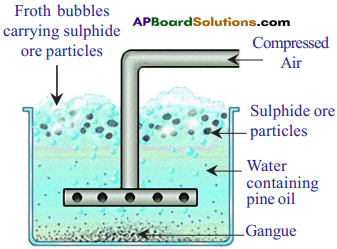
This method is mainly useful for sulphide ores. The ore with impurities is finely powdered and kept in water taken in a flotation cell. Air under pressure is blown to produce froth in water. Froth so produced, takes the ore particles to the surface whereas impurities settle at the bottom. Froth is separated and washed to get ore particles.

4. Magnetic separation:
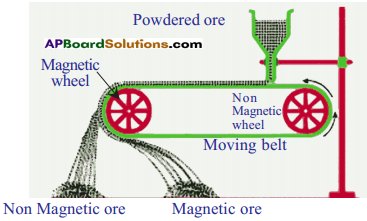
If the ore or impurity, one of them is magnetic substance and the other is non-magnetic substance, they are separated using electromagnets.

AP SSC 10th Class Chemistry Solutions Chapter 13 Principles of Metallurgy

Question 4.
What is an ore? On what basis a mineral is chosen as an ore?
Answer:
Ore :
A mineral from which a metal can be extracted economically and conveniently is called ore.
A mineral is chosen as an ore if the mineral is economical and profitable to extract.

Example:
Aluminium is the common metal in the Earth’s crust in all sorts of minerals. It is economically feasible and profitable to extract from bauxite which contains 50-70% of aluminium oxide.

Question 5.
Write the names of any two ores of iron.
Answer:
The names of two ores of iron :

  1. Haematite (Fe2O3)
  2. Magnetite (Fe3O4).

Question 6.
How do metals occur in nature ? Give examples to any two types of minerals.
Answer:

  • The earth’s crust is the major source of metals.
  • Sea water also contains some soluble salts such as sodium chloride and magnesium chloride etc.
  • Some metals like gold (Au), silver (Ag) and copper (Cu) are available in nature in free state as they are least reactive.
  • Other metals are found in nature in the combined form due to their more reactivity.
  • The elements or compounds of the metals which occur in nature in the earth’s crust are called minerals.

Examples :
Minerals in oxide form :
Bauxite, Zincite, Magnetite, etc.

Minerals in sulphide form :
Copper iron pyretes, Galena, etc.

AP SSC 10th Class Chemistry Solutions Chapter 13 Principles of Metallurgy

Question 7.
Write short notes on froth flotation process.
(OR)
Which method is useful for concentration of sulphide ore? Explain the method.
Answer:
Froth Floatation process :

  • This method is mainly useful for sulphide ores which have no wetting property whereas impurities get wetted.
  • The ore with impurities is finely powdered and kept in water taken in a floatation cell.

AP SSC 10th Class Chemistry Solutions Chapter 13 Principles of Metallurgy 1
Froth floatation process for the concentration of sulphide ores

  • Air under pressure is blown to produce froth in water.
  • Froth so produced takes the ore particles to the surface whereas impurities settle at the bottom.
  • Froth is separated and washed to get ore particles.

Question 8.
When do we use magnetic separation method for concentration of an ore? Explain with an example.
(OR)
Write the name of the method we use to separate the ore or impurity in which one of them is magnetic substance. Draw a neat diagram indicating the method.
Answer:
If the ore or impurity, one of them is magnetic substance and the other non-magnetic substance they are separated using electromagnets.
Ex :
Iron from iron ore (Fe3O4) is separated from its impurity by passing through a magnetic field. The field attracts magnetic ore (Iron) and repels the non-magnetic impurities.
AP SSC 10th Class Chemistry Solutions Chapter 13 Principles of Metallurgy 2

Question 9.
Write short notes on each of the following :
i) Roasting
ii) Calcination
iii) Smelting
Answer:
i) Roasting :
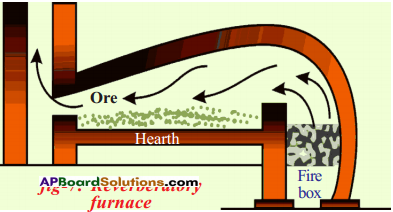
Roasting is a pyrochemical process in which the ore is heated in the presence of oxygen or air, below its melting point. Generally, reverberatory furnace is used for roasting.
Ex:
Zinc blende on heating with oxygen in reverberatory furnace forms zinc oxide as solid and liberating sulphur dioxide as gas.
2Zns(s) + 3O2(g) → 2ZnO(s) + 2SO2(g)

ii) Calcination :
Calcination is a pyrochemical process in which the ore is heated in the absence of air. The ore gets generally decomposed in this process.
Ex: MgCO3(s) → MgO(s) + CO2(g)

iii)Smelting:
Smelting is a pyrochemical process, in which the ore is mixed with flux and fuel, then is strongly heated.

AP SSC 10th Class Chemistry Solutions Chapter 13 Principles of Metallurgy

Question 10.
What Is the difference between roasting and calcination? Give one example for each.
(OR)
Roasting and Calcination are the methods to extract crude metals from ores. What is the difference between Roasting and Calcination?
Answer:

RoastingCalcination
1. Roasting is a pyrochemical process in which the ore is heated in the presence of air below its melting point.1. Calcination is a pyrochemical process in which the ore is heated in the absence of air.
2. It is an oxidation reaction.2. It is a decomposition reaction.
3. It requires oxygen.3. It doesn’t require oxygen.
4. It is suitable to sulphide ores.4. It is suitable to carbonate ores.
5. Ex : 2ZnS + 3O2 → 2ZnO + 2SO25. Ex : CaCO3 → CaO + CO2

Question 11.
Define the terms:
i) gangue
ii) slag.
Answer:
i) Gangue:
The impurity present in the ore is called gangue.
(or)
Unwanted impurity associated with ore.

ii) Slag:
The impurities found from molten metal during poling process of refining are called slag.

Question 12.
Magnesium is an active metal if it occurs as a chloride in nature, which method of reduction is suitable for its extraction?
Answer:

  • The method of reduction which is useful for chloride of magnesium which is active is electrolytic reduction.
  • Fused MgCl2 is electrolysed with steel cathode (-) and graphite anode (+). The metal (Mg) will be deposited at cathode and chlorine gas liberates at the anode.
    At cathode : Mg2+ + 2 e → Mg
    At anode : 2 Cl → Cl2 + 2e

AP SSC 10th Class Chemistry Solutions Chapter 13 Principles of Metallurgy

Question 13.
Mention two methods which produce very pure metals.
Answer:
Methods which produce very pure metals are :

  1. Electrolytic Reduction
  2. Smelting.

(OR)

  1. Distillation
  2. Poling.

Question 14.
Which method do you suggest for extraction of high reactivity metals? Why?
Answer:
1.The only method which is suitable for extraction of high reactivity metals is electrolysis of their fused compounds.

2. Other methods are not suitable due to following reasons :
a) Simple reduction methods like heating with C, CO, etc. to reduce the ores of these metals are not suitable because the temperature required for the reduction is too high and more expensive.

b) Electrolysis of their aqueous solutions are also not preferable because water in the solution would be discharged at the cathode in preference to the metal ions.

Question 15.
Suggest an experiment to prove that the presence of air and water is essential for corrosion. Explain the procedure.
(OR)
Write the experimental procedure to prove that water and air are essential for rusting of iron articles.
(OR)
How can you prove that the presence of air and humid are essential for corrosion?
(OR)
Explain in brief, an experiment to prove that the presence of air and water are essential for corrosion.
Write the precautions to be taken in the experiment to show air and water are essential for rusting iron articles and also write the experimental procedure.
Answer:
Aim :
To prove that the presence of air and water is essential for corrosion or for rusting of iron articles.

Apparatus :
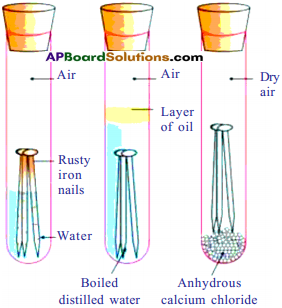
3 boiled test tubes, 3 corks, boiled distilled water, anhydrous calcium chloride, clean iron nails.

AP SSC 10th Class Chemistry Solutions Chapter 13 Principles of Metallurgy 3

Procedure :

  • Take three test tubes and place clean iron nails in each of them.
  • Label these test tubes A, B and C. Pour some water in test tube A and cork it.
  • Pour boiled distilled water in test tube B, add about 1 ml of oil and cork it. The oil will float on water and prevent the air from dissolving in the water.
  • Put some anhydrous calcium chloride in test tube C and cork it. Anhydrous calcium chloride will absorb the moisture.
  • Leave these test tubes for a few days and then observe.
  • We will observe that iron nails rust in test tube A, but they do not rust in test tubes B and C.

Observation :

  • In test tube A, the nails are exposed to air and water. Hence, the nails rusted.
  • In test tube B, the nails are exposed only to water, but not to air, because the oil float on water and prevent the air from dissolving in the water. Hence, the nails are not rusted.
  • In test tube C, the nails are exposed to dry air, because anhydrous calcium chloride will absorb the moisture, if any, from the air. Hence, the nails are not rusted.

Conclusion :
From the above experiment we can prove that air and water are essential for corrosion.

AP SSC 10th Class Chemistry Solutions Chapter 13 Principles of Metallurgy

Question 16.
Collect information about extraction of metals of low reactivity silver, platinum and gold and prepare a report.
(OR)
Prepare a report with the collected information about extraction of metals of low reactivity silver, platinum and gold.
Answer:
Extraction of Silver:

  1. Silver can be extracted from Ag2S by using displacement from aqueous solution.
  2. Ag2S is dissolved in KCN solution to get dicyanoargentate (I) ions.
  3. From these ions Ag is precipitated by treating with Zinc dust powder.
    Ag2S + 4 CN → 2 [Ag(CN)2] + S2-
    2[Ag(CN)2](aq) + Zn(s) → [Zn(CN)4]2-(aq) + 2Ag(s)

Extraction of Gold :

  1. Gold is extracted from gold ore like electrum. Impurities are separated from the gold by treating gold ore with a weak cyanide solution.
  2. Zinc is added and a chemical reaction takes place which separates the gold from ore.
  3. Pure gold is removed from the solution with a filter press.

Extraction of Platinum:

  1. The extraction of platinum from ore is a complex process and includes milling the ore, a froth flotation process, and smelting at high temperatures.
  2. This removes the base metals, notably iron and sulphur and concentrate platinum.

Question 17.
Draw the diagram showing
i) Froth flotation
ii) Magnetic separation.
(OR)
Draw a neat diagram and label the parts that shows froth floatation process for the concentration of sulphide ore.
Answer:
i)
AP SSC 10th Class Chemistry Solutions Chapter 13 Principles of Metallurgy 1
ii)
AP SSC 10th Class Chemistry Solutions Chapter 13 Principles of Metallurgy 2

Question 18.
Draw a neat diagram of reverberatory furnace and label it neatly.
(OR)
Draw a neat labelled diagram of a reverberatory furnace.
Answer:
AP SSC 10th Class Chemistry Solutions Chapter 13 Principles of Metallurgy 4

Question 19.
What is activity series? How does it help in extraction of metals?
Answer:
Activity Series :
We can arrange metals in descending order of their reactivity. This series of writing metals is called activity series.

Uses of activity series the extraction of metals :

  • Activity series is extremely useful in extraction of metals because we can judge the nature of metal and how it exists.
  • High reactive metals like K, Na, Ca, Mg and Al are so reactive that they are never found in nature in free state.
  • The moderate reactive metals like Zn, Fe, Pb, etc. are found in the earth’s crust mainly as oxides, sulphides and carbonates.
  • The least reactive metals like Au, Ag, Pt are found even in free state in nature.

Question 20.
What is thermite process? Mention its applications in daily life.
Answer:
Thermite Process :

  • Thermite process is the chemical reaction which takes place between metal oxides and aluminium.
  • When highly reactive metals such as sodium, calcium, aluminium, etc. are used as reducing agents, they displace metals of lower reactivity from the compound.
  • This reaction is highly exothermic. The amount of heat evolved is so high that the metals can he directly converted into molten state.

Applications in daily life :

  • The reaction if Iron (III) oxide (Fe203) with aluminium is used to join railing of railway tracks or cracked machine parts.
    2 Al + Fe2O3 → Al2O3 + 2 Fe + Heat.
  • And also used for joining of cracked metal utensils in the house.

AP SSC 10th Class Chemistry Solutions Chapter 13 Principles of Metallurgy

Question 21.
Where do we use hand picking and washing methods in our daily life ? Give examples.
How do you correlate these examples with enrichment of ore?
Answer:
Daily life examples for hand picking:

  • Separating mud particles from rice is an example for hand picking because the colour and size of these two are different.
  • Similarly, the ore particles and the impurities are different in one of the properties like colour, size, etc. are separated by hand picking.

Daily life examples for washing :

  • We can clean some vegetables like potatoes by controlled flow of water. Less densive impurities are carried away by the flow leaving the more densive potatoes.
  • Similarly, ores are washed with controlled flow of water. Less densive impurities i are carried away by water flow, leaving the more densive ore particles behind.

Fill In The Blanks

1. The method is suitable to enrich the sulphide ores.
2. Arranging metals in the decreasing order of their reactivity is called
3. The method suitable for purification of low boiling metals.
4. Corrosion of iron occurs in the presence of and
5. The chemical process in which the ore is heated in the absence of air is called
Answer:

  1. Froth flotation
  2. activity series
  3. distillation
  4. air, water
  5. calcination

Multiple Choice Questions

1. The impurity present in the ore is called ………………….
A) Gangue
B) Flux
C) Slag
D) Mineral
Answer:
A) Gangue

2. Which of the following is a carbonate ore?
A) Magnesite
B) Bauxite
C) Gypsum
D) Galena
Answer:
A) Magnesite

AP SSC 10th Class Chemistry Solutions Chapter 13 Principles of Metallurgy

3. Which of the following is the correct formula of Gypsum?
A) CuSO4 • 2 H2O
B) CaSO4 • ½ H2O
C) CuSO4 • 5 H2O
D) CaSO4 • 2 H2O
Answer:
D) CaSO4 • 2 H2O

4. The oil used in the froth flotation process is
A) kerosene oil
B) pine oil
C) coconut oil
D) olive oil
Answer:
B) pine oil

5. Froth flotation is method used for the purification of ………………. ore.
A) sulphide
B) oxide
C) carbonate
D) nitrate
Answer:
A) sulphide

6. Galena is an ore of ………………..
A) Zn
B) Pb
C) Hg
D) Al
Answer:
B) Pb

7. The metal that occurs in the native form is ………………
A) Pb
B) Au
C) Fe
D) Hg
Answer:
B) Au

AP SSC 10th Class Chemistry Solutions Chapter 13 Principles of Metallurgy

8. The most abundant metal in the earth’s crust is …………………
A) silver
B) aluminium
C) zinc
D) iron
Answer:
B) aluminium

9. The reducing agent in thermite process is ………………….
A) Al
B) Mg
C) Fe
D) Si
Answer:
A) Oxidise

10. The purpose of smelting an ore is to ……………….. it.
A) Oxidise
B) Reduce
C) Neutralise
D) None of these
Answer:
B) Reduce

10th Class Chemistry 13th Lesson Principles of Metallurgy InText Questions and Answers

10th Class Chemistry Textbook Page No. 238

Question 1.
How are the metals present in nature?
Answer:
Some metals like gold (Au), silver (Ag) and copper (Cu) are available in nature in free sjate. Other metals mostly are found in nature in the combined form.

10th Class Chemistry Textbook Page No. 240

Question 2.
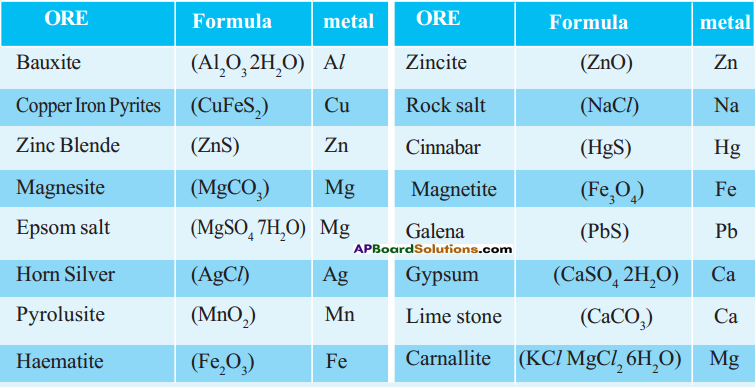
What metals can we get from the ores mentioned in the Table – 1?
Answer:
The metals are Aluminium (Al), Copper (Cu), Magnesium (Mg), Silver (Ag), Manganese (Mn), Iron (Fe), Zinc (Zn), Sodium (Na), Mercury (Hg), Lead (Pb), Calcium (Ca).

Question 3.
Can you arrange metals in the order of their reactivity?
Answer:
The order of reactivity is like this : Ag < Cu < Pb < Mn < Fe < Zn < Al < Mg < Ca < Na.

AP SSC 10th Class Chemistry Solutions Chapter 13 Principles of Metallurgy

Question 4.
What do you notice in Table – 2?
Answer:
We notice that ores of many metals are oxides and sulphides. ______

Question 5.
Can you think how we get these metals from their ores?
Answer:
We can get metals from their ores by using various extracting techniques.

Question 6.
Does the reactivity of a metal and form of its ore (oxides, sulphides, chlorides, carbonates, sulphates) has any relation with process of extraction?
Answer:
Yes, they have relation. Metals like K, Na, Ca, Mg and Al are so reactive. They exist in all forms whereas moderate reactive metals like Zn, Fe, Pb, etc. exist as oxides, sulphides and carbonates. The least reactive metals are found even in free state.

Question 7.
How are metals extracted from mineral ores?
Answer:
The extraction of a metal from its ores involves mainly in three states. They are :

  1. Concentration or Dressing
  2. Extraction of crude metal
  3. Refining or purification of the metal.

10th Class Chemistry Textbook Page No. 248

Question 8.
Do you know why corrosion occurs?
Answer:
Corrosion occurs due to reaction of metal with both air and water.

AP SSC 10th Class Chemistry Solutions Chapter 13 Principles of Metallurgy

Question 9.
What are the conditions under which iron articles rust?
Answer:
Iron articles get rust due to both air and water.

10th Class Chemistry Textbook Page No. 251

Question 10.
What is the role of furnace in metallurgy?
Answer:
Furnace is used to carry out pyrochemical process in metallurgy.

Question 11.
How do furnaces bear large amounts of heat?
Answer:
Furnaces have metallic lining. So they bear large heats.

AP SSC 10th Class Chemistry Solutions Chapter 10 Chemical Bonding

Question 12.
Do all furnaces have same structure?
Answer:
No, they have different structures.

10th Class Chemistry Textbook Page No. 239

Question 13.
Do you agree with the statement “All ores are minerals but all minerals need not be ores.? Why?
Answer:

  • Yes, I agree with the statement. The elements or compounds of the metals which occur in nature in the earth’s crust are called minerals whereas ore is a mineral from which the metal is profitably extracted.
  • For example, aluminium exists in two mineral forms that is clay and bauxite. But aluminium is mainly extracted from bauxite which contains 70% aluminium oxide.
  • So Bauxite is an ore of aluminium whereas clay is not ore.
  • So all ores are minerals but all minerals need not be ores.

10th Class Chemistry 10th Lesson Principles of Metallurgy Activities

Activity – 1
1. How do you classify ores based on their formula?
Answer:
1) Look at the following ores.
AP SSC 10th Class Chemistry Solutions Chapter 13 Principles of Metallurgy 5

2) Identify the metal present in each ore.
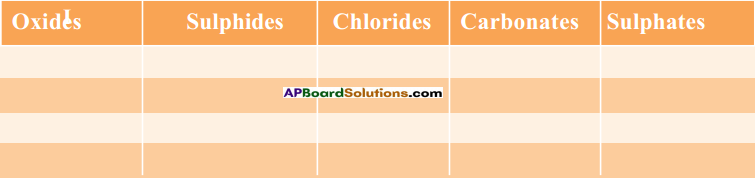
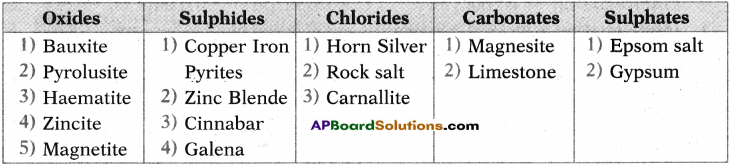
3) Classification of ores as oxides, sulphides, chlorides, carbonates, and sulphates as follows :
AP SSC 10th Class Chemistry Solutions Chapter 13 Principles of Metallurgy 6
AP SSC 10th Class Chemistry Solutions Chapter 13 Principles of Metallurgy 7

AP SSC 10th Class Hindi Solutions Chapter 3 हम भारतवासी

AP State Board Syllabus AP SSC 10th Class Hindi Textbook Solutions Chapter 3 हम भारतवासी Textbook Questions and Answers.

AP State Syllabus SSC 10th Class Hindi Solutions Chapter 3 हम भारतवासी

10th Class Hindi Chapter 3 हम भारतवासी Textbook Questions and Answers

InText Questions (Textbook Page No. 13)

प्रश्न 1.
नदियाँ किसमें विलीन होती हैं?
उत्तर:
नदियाँ समुद्र में विलीन होती हैं।

प्रश्न 2.
इसमें किस – किसको एक बताया गया है?
उत्तर:
इसमें मानव जाति, मानव धर्म तथा सारी दुनिया को एक बताया गया है।

AP SSC 10th Class Hindi Solutions Chapter 3 हम भारतवासी

प्रश्न 3.
‘मानव जाति एक है।’ इस पर अपने विचार बताइए।
उत्तर:
मानव जाति एक है। जिस प्रकार अनेक स्थानों से बहनेवाली नदियाँ अंत में समुद्र में मिलती हैं। उसी प्रकार अलग – अलग धर्म में जन्म लिये मनुष्य भी अंत में परमात्मा के पास पहुँचते हैं। इसलिए हम कह । सकते हैं कि मानव जाति एक है उददश्य छात्रों में कविता, गीत आदि की रचना शैली का विकास करना और उनमें देशभक्ति के साथ-साथ विश्वबंधुत्व, विश्वशांति, अहिंसा, त्याग, समर्पण आदि सद्गुणों का विकास करना तथा भारत को और भी सशक्त कर अंतर्राष्ट्रीय स्तर पर अग्रसर करने की प्रेरणा देना इस पाठ का मुख्य उद्देश्य है। विधा विशेष प्रस्तुत कविता देशभक्ति की भावना पर आधारित है। यह गेय कविता है। इसमें तुकांत शब्द प्रथम प्रेरणार्थक क्रिया व सामान्य भविष्य में हैं। यह कविता बच्चों में सत्य, अहिंसा, त्याग और | समर्पण की भावना जागृत कर, उन्हें विश्वबंधुत्व की ओर कदम बढ़ाने की प्रेरणा देती है।

InText Questions (Textbook Page No. 14)

प्रश्न 1.
ऊँच – नीच का भेद मिटाने के लिए हम क्या – क्या कर सकते हैं?
उत्तर:
ऊँच – नीच का भेद मिटाना हमारा प्रथम आशय व कर्तव्य है। इसके लिए अपनी ओर से हम भी कुछ कर सकते हैं।

  • सब लोगों से मिलजुलकर रहते एकता की भावना बढानी है।
  • सबसे प्रेमपूर्वक व्यवहार करते नफ़रत की भावना को छोड देना है।
  • समानता का बीज बोते लोगों के दिलों में विश्वास भरना है।
  • जाति, धर्म, भाषा, प्रांत, जैसे भेद भावों को छोडते लोगों की सहायता करनी है।
  • सबका आदर – सम्मान करना है।
  • सबकी उन्नति में समान अवसर देना है।

प्रश्न 2.
हमें अपने जीवन में कैसा पथ अपनाना चाहिए?
उत्तर:
हमें जीवन में सदा सत्य और न्यायमार्ग पर चलना है। श्रद्धा और प्रेम का उत्तम भाव दिल में रखकर दीन – दुखियों की सेवा करनी है। खुद खुश रहते सब को सुखी रखने का न्याय पथ हमें अपनाना चाहिए। अहिंसा और धर्ममार्ग को अपनाना चाहिए। त्याग भावना को अपनाना चाहिए।

AP SSC 10th Class Hindi Solutions Chapter 3 हम भारतवासी

प्रश्न 3.
हम भटकने वालों को राह कैसे दिखा सकते हैं?
(या)
बेराहों को राह कैसे दिखा सकते हैं?
उत्तर:
भटकने वाले लोगों को जीवन की वास्तविकता समझाने का प्रयत्न करना है। सही मार्गदर्शन करते उनको खुशियाँ पाने का ज्ञान अवगत कराना है। न्याय और सत्य मार्ग पर आगे बढने ज्ञानपूर्ण सलाह देते भटकनेवालों को राह दिखा सकते हैं।

प्रश्न 4.
सत्य, अहिंसा, त्याग और समर्पण की बगिया महकाने के लिए हम क्या – क्या कर सकते हैं?
(या)
हम खुशियों की बगिया कैसे महकायेंगे?
उत्तर:
मानव सामाजिक प्राणी है। हमारे मानव जीवन में सत्य, अहिंसा, त्याग, समर्पण, प्रेम आदि महान गुणों का विशेष महत्व है। ऐसे उत्तम गुणों की बगिया महकाने हम पहले दुनिया के सारे क्लेश मिटाने का प्रयत्न करेंगे। विश्व बंधुत्व का मूलमंत्र खुद अपनाते लोगों को श्रद्धा और प्रेम का अद्भुत दृश्य दिखायेंगे। इस तरह सत्य, अहिंसा, त्याग और समर्पण की बगिया महका सकते हैं। धरती को स्वर्ग बना सकते हैं।

अर्थग्राह्यता-प्रतिक्रिया

अ) प्रश्नों के उत्तर दीजिए।
प्रश्न 1.
यह गीत आपको कैसा लगा ? अपनी पसंद और नापसंद का कारण बताइए।
उत्तर:
“हम भारतवासी” गीत मुझे बहुत पसंद आया। यह गीत सरल, सुबोध और प्रभावशाली है। देशभक्ति भावना जगाकर, विश्वबंधुत्व की ओर हमें अग्रसर होने की प्रेरणा देनेवाला है। भारतवासियों के सत्य, अहिंसा, त्याग, समर्पण आदि गुणों का समर्थन करते हुए दुनिया को पावन धाम बनाने की महत्वाकांक्षा रखती है। सारे विश्व के लोगों के विविध क्लेशों को मिटाकर एक धर्म कुटुंब बनने की प्रेरणा देनेवाला है। भारतीय संस्कृति की गरिमा बढाने वाला है। खासकर भारतीयों के धर्म, जाति, संप्रदाय रूपी विषमताओं को भगाकर सब में अपनापन जगानेवाला है।

AP SSC 10th Class Hindi Solutions Chapter 3 हम भारतवासी

प्रश्न 2.
दुनिया को ‘पावन धाम’ बनाने के लिए हम क्या – क्या कर सकते हैं?
उत्तर:
दुनिया को पावन धाम बनाने के लिए

  • ऊँच – नीच का भेद मिटायेंगे।
  • निराशा की भावना भगाकर विश्वास जगायेंगे।
  • उलझे लोगों को वास्तविकता बतायेंगे। बेराहों को राह दिखायेंगे।
  • सत्य, अहिंसा, त्याग, समर्पण, विश्व बंधुत्व की भावना जगायेंगे।

आ) दिया गया पद्यांश पढ़िए और इसके मुख्य शब्द पहचान कर लिखिए।

मन में श्रद्धा और प्रेम का अद्भुत दृश्य दिखायेंगे।
सत्य, अहिंसा, त्याग, समर्पण की बगिया महकायेंगे।
जग के सारे क्लेश मिटाकर, धरती को स्वर्ग बनायेंगे।
विश्वबंधुत्व का मूल मंत्र हम, दुनिया में सरसायेंगे।

जैसे : श्रद्धा, …………………,
…………………………..,
…………………………..,
उत्तर:
प्रेम, सत्य, अहिंसा, त्याग, समर्पण, क्लेश, विश्वबंधुत्व के सहारे धरती को स्वर्ग बनाना।

इ) निम्नलिखित भाव से संबंधित कविता की पंक्तियाँ पहचानकर लिखिए।

प्रश्न 1.
संसार में व्याप्त सारे विवादों को मिटाकर, हम धरती को स्वर्ग बनायेंगे।
उत्तर:
जग के सारे क्लेश मिटाकर, धरती को स्वर्ग बनायेंगे।

AP SSC 10th Class Hindi Solutions Chapter 3 हम भारतवासी

प्रश्न 2.
जीवन पथ से भटके लोगों को रास्ता दिखाएँगे।
उत्तर:
भटक रहे जो जीवन पथ से, उनको राह दिखायेंगे।

प्रश्न 3.
हम भेदभाव दूर करेंगे। हम सब मिलजुलकर रहेंगे।
उत्तर:
ऊँच – नीच का भेद मिटाकर, दिल में प्यार बसायेंगे।

ई) नीचे दिया गया पद्यांश पढ़कर सही उत्तर पहचानिए।
आज़ादी अधिकार सभी का जहाँ बोलते सेनानी,
विश्व शांति के गीत सुनाती जहाँ चुनरिया ये धानी,
मेघ साँवले बरसाते हैं, जहाँ अहिंसा का पानी,
अपनी माँगें पोंछ डालती, हँसते – हँसते कल्याणी,
ऐसी भारत माँ के बेटे मान गँवाना क्या जाने,
मेरे देश के लाल हठीले शीश झुकाना क्या जानें।

1. धानी रंग की चुनरी कौन – सा गीत सुना रही है?
अ) अधिकार का
आ) आज़ादी का
इ) विश्वशांति का
ई) अहिंसा का
उत्तर:
इ) विश्वशांति का

2. भारत के लाल कैसे हैं?
अ) सजीले
आ) साँवले
इ) हठीले
ई) निराले
उत्तर:
इ) हठीले

AP SSC 10th Class Hindi Solutions Chapter 3 हम भारतवासी

3. सैनिक किसे सभी का अधिकार मानते हैं? ‘
अ) आज़ादी को
आ) शांति को
इ) अहिंसा को
ई) मान को
उत्तर:
अ) आज़ादी को

4. “मान” शब्द का विलोमार्थक है
अ) निरमान
आ) दुरमान
इ) अपमान
ई) स्वमान
उत्तर:
इ) अपमान

5. भारत माँ के बेटे क्या गाँवाना नहीं चाहते हैं?
अ) आज़ादी
आ) मान
इ) शीश
ई) अधिकार
उत्तर:
आ) मान

अभिव्यक्ति – सृजनात्मकता

अ) इन प्रश्नों के उत्तर तीन – चार पंक्तियों में लिखिए।

प्रश्न 1.
उलझनों से बचे रहने के लिए हमें कैसी सावधानियाँ लेनी चाहिए?
उत्तर:
उलझनों से बचे रहने के लिए

  • धार्मिक भेद – भाव न रखना चाहिए।
  • उत्तम मानवीय मूल्यों को बनाये रखना है।
  • पारस्परिक सहयोग की भावना होना है।
  • हमेशा सतर्क, जागरूक रहना है।
  • बौद्धिक विकास करना चाहिए।

प्रश्न 2.
निराशावादी और आशावादी के स्वभाव में क्या अंतर होता है?
उत्तर:
निराशावादी में निराशा की भावना होती है। वह निष्क्रिय होता है। जीवन दुखद होता है। उलझा रहता है। आशावादी में आशा की भावना होती है। वह सक्रिय होता है। जागरूक रहता है। सत्य, अहिंसा, त्याग समर्पण होती है।

AP SSC 10th Class Hindi Solutions Chapter 3 हम भारतवासी

आ) गीत में ‘धरती को स्वर्ग’ बनाने की बात कही गयी है। हम इसमें क्या सहयोग दे सकते हैं?
(या)
पूरे विश्व को स्वर्ग का धाम कैसे बना सकते हैं?
उत्तर:
कविता का नाम : हम भारतवासी
कवि का नाम : आर.पी.निशंक
हिंदी के विख्यात कवि हैं आर.पी. निशंक| इस कविता के ज़रिये कवि छात्रों में देश भक्ति, विश्वबंधुत्व, विश्वशांति, सत्य, अहिंसा, त्याग, समर्पण आदि महान सद्गुणों का विकास करना चाहते हैं।

“हम भारतवासी” कविता में धरती को स्वर्ग बनाने की बात पर प्रकाश डाला गया है। सच्चे भारतीय होने के कारण हम भी अपना पूरा सहयोग दे सकते हैं।

  • हम मानवों में भरे जाति – धर्म, वर्ग – वर्ण, ऊँच – नीच, अमीर – गरीब जैसे भेदभावों को दूर कर
  • सकते हैं। इससे एकता की भावना बढकर सब लोग प्रेम से रह सकते हैं।
  • सत्य, अहिंसा, सेवा, त्याग, प्रेम आदि का महत्व समझाकर विश्व बंधुत्व की भावना जगा सकते हैं।
  • स्वार्थ भाव से भरे लोगों को स्वार्थरहित, पक्षपात रहित और सहनशील बनाकर देश प्रेमी बना सकते हैं।
  • दुःख में धीरज धर लेने का आत्मविश्वास उनमें भरकर निराशावाद दूर भगाकर आशावादी बना सकते हैं।
  • जीवन पथ से भटके लोगों को मार्गदर्शन करके उन्हें सक्रिय मार्ग पर लगा सकते हैं।
  • हर्ष – विषाद आपस में बाँटकर अपनापन बढा सकते हैं। – एक दूसरे के प्रति आदर का भाव रखते, प्रेमालू बना सकते हैं।

एक बात में कहे तो वसुदैक कुटुंबकम बना सकते हैं। ऐसा करके हम भी धरती को स्वर्ग बनाने में अपना पूरा सहयोग दे सकते हैं।

विशेषता : इस कविता में देश भक्ति और नैतिक मूल्य बताये गये हैं।

AP SSC 10th Class Hindi Solutions Chapter 3 हम भारतवासी

इ) विश्वशांति की राह में समर्पित किस महान व्यक्ति का साक्षात्कार आप लेना चाहेंगे? साक्षात्कार में उनसे पूछे जाने वाले प्रश्नों की एक सूची तैयार कीजिए।
उत्तर:
विख्यात नेता से साक्षात्कार लेने के लिए मैं निम्न लिखित इस प्रश्नावली को तैयार करूँगा।
वे प्रश्न इस प्रकार हैं –

  • महोदय। विश्वशांति के लिए आप अविरल प्रयत्न कर रहे हैं। क्या आप यह बता सकते हैं कि विश्वशाँति माने क्या है? उसकी क्या आवश्यकता है?
  • आपको इस महत्वपूर्ण कार्य में पदार्पण करने का विचार क्यों और कैसे आया? इसके क्या कारण हो सकते हैं?
  • आपके इस पवित्र यज्ञ में किन-किन सज्जनों ने आपका सहयोग दिया ?
  • अपनी संकल्प सिद्धि के इस पावन काम में आपने कौनसे त्याग किये ? वे कहाँ तक फलदायी हुये हैं?
  • आपको इस काम में कहाँ तक सफलता मिली है?
  • आपके इस पुण्य कार्य में कौन-सी अडचनों का सामना करना पड़ा?
  • आगे आनेवाली पीढी को आपका संदेश क्या है?
  • सुना है कि इस विश्वशांति के पावन यज्ञ में सफल हुए व्यक्ति को नोबेल पुरस्कार से सम्मानित करते हैं। आपको यह पुरस्कार मिले तो आप कैसा अनुभव करते ?

ई) सत्य, अहिंसा, त्याग आदि भावनाओं का हमारे जीवन में क्या महत्व है?
उत्तर:
हमारे जीवन में सच्चाई से बढ़कर कोई तपस्या नहीं होती। सत्य से जीवन सुखद बनता है। इसके आचरण से सच्चरित्र और महान बनता है। समाज में वंदनीय और पूजनीय बनता है।

किसी को क्षमा करना और हर प्राणी पर दया करना मनुष्य का कर्तव्य होना चाहिए। अहिंसा से दया और भाईचारे का जन्म होता है।

त्याग भावना से प्रेम और भाईचारा भाव बढ़ता है। चारों ओर संतोष होता है। भोग से त्याग श्रेयस्कर होता है।

भाषा की बात

अ) कोष्ठक में दी गयी सूचना पढ़िए और उसके अनुसार कीजिए।

प्रश्न 1.
दुनिया, अमृत, पावन (वाक्य प्रयोग कीजिए। पर्याय शब्द लिखिए।)
(जैसे – यह दुनिया बड़ी निराली है। विश्व, जग, संसार)
उत्तर:
वाक्य प्रयोग
अमृत : देव जाति के लोगों ने अमृत का पान किया है।
पावन : बापूजी का यह पावन उदेदश्य आदर्शनीय है।

पर्याय शब्द
अमृत – सुधा, पीयूष
पावन – पवित्र, पुनीत

AP SSC 10th Class Hindi Solutions Chapter 3 हम भारतवासी

प्रश्न 2.
निराशा, त्याग, प्यार (विलोम शब्द लिखिए। उससे वाक्य प्रयोग कीजिए।)
(जैसे – निराशा × आशा, हमें जीवन में आशा बढानी चाहिए।)
उत्तर:
विलोम शब्द
त्याग × स्वार्थ
प्यार × घृणा

वाक्य प्रयोग
त्याग : त्याग भावना उत्तम है, स्वार्थ भावना अधम है।
प्यार : प्यार से रहना चाहिए। ईर्ष्या या घृणा पाप है।

प्रश्न 3.
खुशी, बगीचा, भावना (वचन बदलिए। वाक्य प्रयोग कीजिए।)
(जैसे – खुशी – खुशियाँ, बच्चों को खेलों से बहुत सारी खुशियाँ मिलती हैं।)
वचन वाक्य प्रयोग
उत्तर:
खुशी – खुशियाँ : वे सब मिलकर खुशियाँ मना रहे हैं।

बगीचा – बगीचे : बैगलूर में कई सुंदर बगीचे हैं।
भावना – भावनाएँ : हमें अपने दिलों में सदा अच्छी भावनाएँ रखनी हैं।

AP SSC 10th Class Hindi Solutions Chapter 3 हम भारतवासी

आ) सूचना पढ़िए और उसके अनुसार कीजिए।

प्रश्न 1.
पवन, पावन, निराशा (संधि विच्छेद कीजिए।)
उत्तर:
संधि विच्छेद
पवन = पो + अन
पावन = पौ + अन
निराशा = निः + आशा

प्रश्न 2.
भारतवासी, जीवनज्योत (समास पहचानिए।)
उत्तर:
भारतवासी : → तत्पुरुष समास (भारत के वासी)
जीवनज्योत → कर्मधारय समास(जीवन रूपी ज्योत)

इ) इन्हें समझिए और वाक्य प्रयोग कीजिए।
1. खुशी
2. खुशियाँ
3. खुशियों में
उत्तर:

  1. वह खुशी मनाती है। यह खुशी संज्ञा शब्द है।
  2. त्यौहार के दिन लोग खुशियाँ मनाते हैं। खुशी का बहुवचन खुशियाँ हैं।
  3. अच्छे लोग सदा खुशियों की दुनिया में रहते हैं। संबंध बोध कारक हैं।

AP SSC 10th Class Hindi Solutions Chapter 3 हम भारतवासी

ई)1. नीचे दिया गया उदाहरण समझिए। उसके अनुसार दिये गये वाक्य बदलिए।
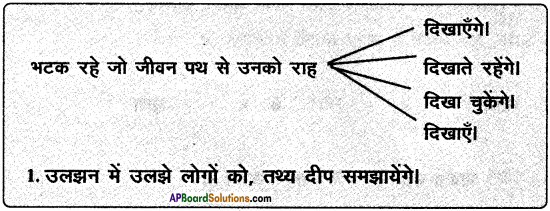
AP SSC 10th Class Hindi Solutions Chapter 3 हम भारतवासी 1
उत्तर:
AP SSC 10th Class Hindi Solutions Chapter 3 हम भारतवासी 2

2. कविता में आये मुहावरे पहचानिए और अर्थ लिखिकर वाक्य प्रयोग कीजिए।
उत्तर:
1. पावन धाम बनाना = पवित्र स्थल बनाना
हमें दुनिया को पावन धाम बनाना चाहिए।

2. अमृत रस सरसाना = प्रेम भावना जगाना
भारतवासी सभी लोगों के दिलों में अमृत रस सरसायेंगे।

3. विश्वास जगाना = यकीन दिलाना
निराशावादी लोगों में विश्वास जगाने की आवश्यकता है।

4. राह दिखाना = सही रास्ता दिखाना
अध्यापक छात्रों को राह दिखाते हैं।

5. दिल में प्यार बसाना = एकता बनाना
नेता लोगों के दिल में प्यार बसाते हैं।

6. तथ्य दीप समझाना = यथार्थ / वास्तव बताना
तथ्य दीप समझाने से अहित कार्य नहीं होते।

7. कुहासा तोडना = स्पष्ट करना
मन में व्याप्त कुहासा तोडने से सुखी रह सकते हैं ।

परियोजना कार्य

शांति के पथ पर समर्पित किसी महान व्यक्ति के बारे में जानकारी इकट्ठा कर कक्षा में प्रस्तुत कीजिए।
उत्तर:
जिम्मी कार्टर जिम्मी कार्टर का पूरा नाम जेम्स अर्ल कार्टर जूनियर है। (जन्म अक्तूबर 1, 1924) एक अमेरिकी राजनेता हैं जो 1976 से 1980 तक संयुक्त राज्य अमेरिका के 39 वें राष्ट्रपति रहे। राष्ट्रपति बनने से पहले वे संयुक्त राज्य अमेरिका की नौसेना में कार्यरत रहें, जॉर्जिया में सेनेटर रहे, और जॉर्जिया के गवर्नर भी रहे। राष्ट्रपति कार्यकाल के बाद वे मानव अधिकार संस्थाओं एवं परोपकारी संस्थाओं के साथ जुड़े रहे। उन्हें 2002 में नोबेल शान्ति पुरस्कार से सम्मानित किया गया।

प्रारंभिक जीवन :
जिम्मी कार्टर का जन्म जॉर्जिया के प्लेन्स नामक शहर में वाइस क्लीनिक अस्पताल में हुआ था जहाँ उनकी माँ लिलियन कार्टर नर्स थीं। उनके पिता अर्ल कार्टर का खेत था जिसमें वे कपास एवं मूंगफली उगाया करते थे। 1926 में जिम्मी की छोटी बहन ग्लोरिया, 1929 में रूथ, और 1937 में छोटे भाई बिली का जन्म हुआ। 1941 में जिम्मी ने प्लेन्स हाई स्कूल से दसवीं कक्षा पास की । 1941 में जिम्मी ने अमेरिकन्स शहर में स्थित जॉर्जिया साउथवेस्टर्न कॉलेज में पढ़ाई शुरू की। 1942 में उन्होंने यह कॉलेज छोड़ जॉर्जिया इंस्टिट्यूट ऑफ़ टॅकनॉलोजी में दाखिला लिया। 1943 में उन्हें एनापोलिस , मैरीलैंड स्थित यू. एस नेवल अकैडमी में दाखिला मिल गया और वे 1946 में वहाँ से उत्तीर्ण हुए। उत्तीर्ण होने के पश्चात वे संयुक्त राज्य अमेरिका की नौसेना की पहली परीक्षनात्मक पनडुब्बी में कार्यरत हुए।

जुलाई 7, 1947 को कार्टर ने बहन रूथ की सहेली एलानोर रोज़ालिन स्मिथ से विवाह कर लिया। 1947 में कार्टर के पुत्र जॉन विलियम का जन्म हुआ, 1950 में जेम्स अर्ल II का, 1952 में डॉनल जेफ़्फ़ी … का और 1967 में पुत्री एमी लिन का जन्म हुआ। 1953 में जिम्मी के पिता अर्ल की मृत्यु होने पर जिम्मी अपनी पत्नी के साथ जॉर्जिया वापिस लौट गए, पिता के खेती के कारोबार को संभालने के लिए।

कैरियर : 1962 में कार्टर को जॉर्जिया सेनेट में चुना गया। 1966 में उन्होंने जॉर्जिया को गवर्नर पद के लिए चुनाव लड़ा परन्तु जीत नहीं पाए। 1971 में वे फिर जार्जिया के गवर्नर पद के चुनाव में खड़े हुए और जीते। जिम्मी कार्टर, मेनाम बेगिन और अनवर अल-सदात 1978 में कैम्प डेविड में। 1977 में वे संयुक्त राज्य अमेरिका के 39 वे राष्ट्रपति बने। राष्ट्रपति के तौर पर इनके कार्यकाल में निम्न मुख्य घटनाएँ हुई।

1978 में कैम्प डेविड में कार्टर ने मिस्र के राष्ट्रपति अनवर अल – सदात और इजराइल के प्रधानमन्त्री मेनाखेम बेगिन के बीच समझौता करवाया जिसके नतीजे में 1979 में इज़राइल और मित्र के बीच में शान्ति कायम हुई।

1 जनवरी 1979 को संयुक्त राज्य अमेरिका ने चीनी जनवादी गणराज्य को राजनयिक मान्यता दी और दोनों के बीच में राजनयिक संबंध कायम हुए। इसी के साथ चीनी गणराज्य की राजनयिक मान्यता रद्द कर दी गयी और राजनयिक संबंध औपचारिक रूप से तोड़ दिए गए यद्यपि दोनों देशों ने अनौपचारिक रूप से राजनयिक संबंध जारी रखे।

1979 में हुई ईरान की इस्लामी क्रांति के दौरान नवंबर में तेहान में स्थित अमेरिकी दूतावास पर उग्रवादी छात्रों ने कब्जा कर लिया और 50 से अधिक अमेरिकी बंधी बना लिए गए। जब ईरान और संयुक्त राज्य अमेरिका कोई कूटनीतिक समाधान नहीं कर सके तो 1980 में सैन्य बल पर बंदियों को . छुड़ाने की नाकाम कोशिश की गई जिसमें अमेरिकी सैनिकों की जान गई। अंत में बंधी 1981 में 444 दिनों के पश्चात छोड़े गए।

सोवियत संघ के अफ़गानिस्तान पर हमला करने पर कार्टर ने आदेश दिया कि संयुक्त राज्य अमेरिका के खिलाड़ी मॉस्को में हो रहे 1980 ग्रीष्मकालीन ओलिम्पिक खेलों का बहिष्कार करेंगे। वे 1980 में राष्ट्रपति चुनाव में पुनः खड़े हुए परन्तु हार गए।

AP SSC 10th Class Hindi Solutions Chapter 3 हम भारतवासी

राष्ट्रपति कार्यकाल के पश्चात :
राष्ट्रपति कार्यकाल समाप्त होने के बाद कार्टर ने मानव अधिकार संबंधित अनेक संस्थाओं, एवं अनेक परोपकारी संस्थाओं के साथ काम किया है। 1982 में कार्टर ने अटलांटा, जॉर्जिया स्थित एमरी विश्वविद्यालय में कार्टर प्रेसिडेंशियल सेंटर की स्थापना की जो लोकतंत्र और मानव अधिकार संबंधित कार्य करता है।

कार्टर ने राष्ट्रपति कार्यकाल के पश्चात अनेक पुस्तकें भी लिखी हैं।
कार्टर को 2002 में नोबेल शान्ति पुरस्कार से सम्मानित किया गया।

हम भारतवासी Sunnary in English

We are Indians. We transform India into a holy heaven. We show the marvellous images of care and love in our hearts.

We fill our hearts with love discarding the feelings of high and low, rich and poor etc. We sprinkle the sap of ambrosia removing the mist patches like jealousy and hatred. We dispel the despair, fill hope and dispense confidence. We are Indians. We transform the world into a holy heaven.

We make the people who are extrapped in problems and difficulties realise the fact. We show the proper way to the people are led astray from the path of life. We enkindle the lights of life with the lamps of joy.

We are Indians. We transform India into a holy heaven.

We show the marvellous images of care and love in our hearts. We grow the groves of truth, non-violence, sacrifice, dedication and devotion. We remove all the adversities from the world and make it a heaven. We chant the spell of fraternity, universal rapport and make others chant.

We are Indians. We transform India into a holy heaven. We show the marvellous images of care and love in our hearts.

हम भारतवासी Summary in Telugu

మేము భారతీయులం. మేము ప్రపంచాన్ని పావనధామంగా తయారుచేస్తాం. మనస్సుల్లో శ్రద్ధ మరియు ప్రేమల అద్భుత దృశ్యాలను చూపుతాము.

ఉన్నవారు – లేనివారు (ఉన్నతమైన – నిమ్నమైన) అనే భేదభావాలు లేక హృదయాలలో ప్రేమను నింపుకుంటాము. ఈర్ష్యా – ద్వేషం అనే మంచు తెరలను తొలగించి అమృతరసాన్ని చిలికిస్తాం. నిరాశను దూరం చేసి ఆశను నింపి విశ్వాసాన్ని రేకెత్తిస్తాం, మేల్కొలుపుతాం. మేము భారతీయులం. ప్రపంచాన్ని పావనధామంగా తీర్చిదిద్దుతాం.

సమస్యలలో చిక్కుకుని ఊగిసలాడుతున్న ప్రజలకు యదార్థాన్ని తెలియజేస్తాం. జీవన పథం నుండి దారి మళ్ళి తిరుగుతున్నవారికి దారి చూపిస్తాం. సంతోష దీపాలతో జీవన జ్యోతులను వెలిగిస్తాం.

మేము భారతీయులం. ప్రపంచాన్ని పావనధామంగా తీర్చిదిద్దుతాం.

మనస్సుల్లో శ్రద్ధ, ప్రేమల అద్భుత దృశ్యాలను చూపుతాం. సత్యం, అహింస, త్యాగం, సమర్పణ మొదలైన తోటలను పెంచుతాం. ప్రపంచంలోని అన్ని కష్టాలను తొలగించి భూమిని స్వర్గంలా తీర్చిదిద్దుతాం. విశ్వబంధుత్వ మూలమంత్రాన్ని ప్రపంచంలో జపింపజేస్తాం, జపిస్తాం.

మేము భారతీయులం. ప్రపంచాన్ని పావనధామంగా తయారుచేస్తాం. మనస్సుల్లో శ్రద్ధ మరియు ప్రేమల అద్భుత దృశ్యాలను చూపుతాం.

अभिव्यक्ति-सृजनात्मकता

2 Marks Questions and Answers

निम्नलिखित प्रश्नों के उत्तर दो या तीन वाक्यों में लिखिए।

प्रश्न 1.
दुनिया को ‘पावन धाम’ बनाने के लिए हम क्या – क्या कर सकते हैं?
उत्तर:
मैं सच्चे भारतीय होने के कारण सारी दुनिया को पावन धाम बनाना चाहता हूँ। यह मेरा प्रमुख कर्तव्य है। इसके लिए मैं पहले अपने दिल में निर्मल और उत्तम भावनाएँ भर लूंगा। सबके दिलों में एकता और सौभ्रातृत्व भावना जगाने का प्रयत्न करूँगा। प्रेम भाव का महत्व समझाते लोगों को भेद – भावों से दूर रहने का आग्रह करूँगा। सारी मानव जाति एक है – यह नारा देते भक्ति और धर्मयुक्त जीवन बिताने बाध्य करूँगा। खुद सत्य, अहिंसा, त्याग, आत्म समर्पण जैसे उत्कृष्ट गुणों का प्रचार करते लोगों को रास्ता दिखाऊँगा।

प्रश्न 2.
आर.पी. निशंकजी के बारे में आप क्या जानते हैं? लिखिए।
उत्तर:

  • आर.पी.निशंक आधुनिक हिंदी साहित्यकारों में विशिष्ट स्थान रखते हैं।
  • इनकी रचनाओं का मुख्य प्रतिपाद्य देश भक्ति है। समर्पण, नंवकुर, मुझे विधाता बनना है, तुम भी मेरे साथ चलो, जीवन पथ में, कोई मुश्किल नहीं आदि उनकी चर्चित काव्य रचनाएँ हैं।

अभिव्यक्ति-सृजनात्मकता

4 Marks Questions and Answers

निम्नलिखित प्रश्नों के उत्तर छह पंक्तियों में लिखिए।

प्रश्न 1.
निराशा को दूर करने के क्या – क्या उपाय हैं?
उत्तर:
निराशा को दूर करने के लिए ये उपाय हैं –

  • मन में श्रद्धा और प्रेम का अद्भुत दृश्य दिखाने से निराशा दूर हो जाती है ।
  • दिल में प्यार बसाने से निराशा दूर कर सकेंगे |
  • हम दूसरों में विश्वास जगायें तो निराशा दूर हो जायेगा ।
  • ऊँच – नीच के भेद – भावों को मिटाने से भी निराशा दूर हो जायेगी।

AP SSC 10th Class Hindi Solutions Chapter 3 हम भारतवासी

प्रश्न 2.
विश्व बंधुत्व का अर्थ क्या है?
उत्तर:

  • एक ही परिवार के सभी लोग जिस प्रकार बंधुत्व भाव से रहते हैं, उसी प्रकार विश्व भर के लोगों से बंधु भावना से रहना ही विश्व बंधुत्व है । केवल भारतीयों और भारत देश में ही विश्व बंधुत्व की भावना प्राचीन काल से आज तक चल रही है।
  • हम हर हमेशा कहते भी हैं कि सर्वेजना सुखिनो भवंतु |
  • जिस प्रकार हम प्रांतीय एवं जातीय भावना से रहते हैं उसी प्रकार विश्व बंधुत्व की भावना से भी रहना है।
  • सारे विश्व की मंगल भावना ही विश्व बंधुत्व भावना है ।

प्रश्न 3.
ऊँच – नीच का भेद भाव मिटाने के लिए हमें क्या करना है?
उत्तर:

  • ऊँच – नीच का भेद मिटाने के लिए हमें सबके प्रति श्रद्धा और प्रेम को दिखाना है ।
  • सबके दिलों में प्यार बसाना है ।
  • नफ़रत के कुहासे को तोडना है ।
  • सामाजिक, आर्थिक , राजनीतिक एकता से हम ऊँच – नीच के भेद -भावों को मिटा सकते हैं ।
  • दूसरों के निराशा को दूर करने से भी कुछ हद तक भेद भाव मिटा सकेंगे।
  • हमारे पास जो कुछ आवश्यकता से अधिक है उसे ज़रूरतमंदों को दे देने से भी भेदभावों को हटा सकेंगे।

प्रश्न 4.
किसी काम को आत्मविश्वास के साथ क्यों करना है?
उत्तर:

  • हम जो भी करें आत्मविश्वास के साथ करें तो वह काम ज़रूर पूरा होगा | सफल होगा |
  • आत्मविश्वास में अद्भुत शक्ति निहित है ।
  • आत्मविश्वास से हम जितने भी कष्ट से कष्ट एवं मुश्किल काम को भी बहुत आसानी के साथ कर सकते हैं।
  • आत्मविश्वास हम में जीने की शक्ति को बढ़ाता है ।

प्रश्न 5.
जीवन पथ से भटकने वालों को हम कैसे राह दिखा सकते हैं?
उत्तर:

  • मन में श्रद्धा और प्रेम का अद्भुत दृश्य दिखाकर हम जीवन पथ में भटकने वालों को राह दिखा सकते हैं।
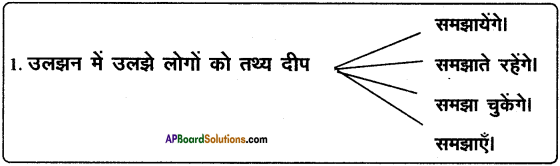
  • उलझन में उलझे लोगों को तथ्य दीप समझाकर राह दिखा सकेंगे |
  • हम खुशियों के दीप जलाकर जीवन ज्योत जलाकर जीवन पथ से भटकने वालों को राह दिखा सकते हैं।

प्रश्न 6.
विश्व शांति से आपका अभिप्राय क्या है?
उत्तर:

  • विश्व बंधुत्व भावना ही विश्वशांति है ।
  • सारी दुनिया भर में शांति स्थापना ही विश्व शांति है ।
  • देश भर के लोग मन में श्रद्धा तथा प्रेम के अद्भुत दृश्यों के साथ रहेंगे तो वही विश्व शांति है ।
  • सत्य, अहिंसा, त्याग, समर्पण आदि भावों से हम रहेंगे तो विश्वशांति अवश्य होगी।
  • युद्ध, दुख, लालच और सभी पीडाओं को मिटाने का एक मात्र साधन है – विश्वशांति ।
  • जहाँ शांति है वहाँ सुख है, जहाँ सुख है वही स्वर्ग है । यह सब विश्व शांति के द्वारा ही साध्य है।

अभिव्यक्ति-सृजनात्मकता

8 Marks Questions and Answers

निम्नलिखित प्रश्नों के उत्तर आठ या दस पंक्तियों में लिखिए।

प्रश्न 1.
भारत की संस्कृति सारे विश्व को लुभाती है। इस कथन पर व्याख्या कीजिए|
उत्तर:
शीर्षक का नाम : “हम भारतवासी” है।
कवि का नाम : “आर.पी.निशंक’ है।

  • भारतीय संस्कृति की मुख्य विशेषताएँ ये हैं कि
  • भारतीय संस्कृति में ऊँच – नीच का भेद मिटाकर दिल में प्यार बसाने की शक्ति है।
  • सत्य, अहिंसा, त्याग, समर्पण जैसे सद्गुणों का विकास करने की शक्ति है।
  • जग के सारे क्लेशों को मिटाकर धरती को स्वर्ग बनाने की शक्ति है।
  • विश्व के सारे लोगों में प्रेम और शांति की स्थापना कर सकती है।
  • विश्व बंधुत्व रूपी मूलमंत्र दुनिया में सरसाने की शक्ति इस संस्कृति में है।
  • इस प्रकार हम कह सकते हैं कि भारत की संस्कृति सारे विश्व को लुभाती है।

AP SSC 10th Class Hindi Solutions Chapter 3 हम भारतवासी

प्रश्न 2.
“भारतीय, विश्वशांति और विश्वबंधुत्व की पवित्र भावनाओं से दुनिया को पवित्र धाम बनायेंगे” हम भारतवासी कविता के आधार पर स्पष्ट कीजिए।
उत्तर:
शीर्षक का नाम : “हम भारतवासी” है।
कवि का नाम : “आर.पी.निशंक” है।

  • हम भारतवासी दुनिया को पावन धाम बनायेंगे। मन में श्रद्धा और प्रेम का अद्भुत दृश्य दिखायेंगे।
  • हम सब में ऊँच-नीच का भेद मिटाकर दिल में प्यार बसायेंगे।
  • हम नफ़रत को दूर कर अमृत बरसायेंगे।
  • हम सत्य, अहिंसा, त्याग और समर्पण की बगिया को महाकायेंगे।
  • जग के सारे क्लेशों को मिटाकर धरती को स्वर्ग बनायेंगे।
  • विश्व बंधुत्व रूपी मूल मंत्र हम दुनिया में सरसायेंगे।
  • इस प्रकार भारतीय विश्वशांति, विश्व बंधुत्व की भावनाओं से दुनिया को पवित्र धाम बनायेंगे।

प्रश्न 3.
विश्वशांति और विश्वबंधुत्व की भावना भारतवासी कैसे फैलायेंगे?
उत्तर:

  • हम भारतवासी कविता के कवि श्री आर.पी. निशंक है।
  • ये महान हिंदी साहित्यकार है, इनकी कविताओं का मुख्य विषय देश भक्ति है।
  • प्रस्तुत कविता ‘मातृभूमि के लिए ‘संग्रह’ से लिया गया है।
  • इस कविता में भारतीयों के लक्षणों के बारे में बताया गया है।
  • भारतवासी दुनिया को पावन धाम बनायेंगे।
  • श्रद्धा और प्रेम से दुनिया का मार्ग निर्देशन करेंगे।
  • ऊँच – नीच का भेद मिटायेंगे, सब से प्यार करेंगे।
  • नफ़रत मिटाकर अमृत रस सरसायेंगे, निराशा दूर भगाकर विश्वास जगायेंगे।
  • उलझन में फंसे लोगों को राह दिखायेंगे, जीवन पथ से भटके लोगों को राह दिखायेंगे।
  • सत्य, अहिंसा, त्याग, समर्पण आदि भावों से भरा समाज बनायेंगे।
  • इस तरह विश्वशांति और विश्वबंधुत्व की भावना फैलायेंगे।

प्रश्न 4.
हम भारतवासी कविता का सारांश अपने शब्दों में लिखिए।
आर.पी. निशंक कृत “हम भारतवासी” पाठ का सारांश अपने शब्दों में लिखिए।
उत्तर:
हम भारतवासी
कविता का नाम : हम भारतवासी
कवि का नाम : श्री आर. पी. निशंक
रचनाएँ : समर्पण, नवंकुर,जीवन पथ में, मुझे विधाता बनना हैं, तुम भी मेरे साथ चलो, कोई मुश्किल नहीं आदि।
पुरस्कार : पद्म श्री

सारांश :
आधुनिक हिंदी साहित्यकारों में आर.पी. निशंक जी विशिष्ट स्थान रखते हैं। अपनी इस कविता में आप छात्रों में देश भक्ति भावना के साथ विश्व बंधुत्व विश्वशांति, अहिंसा, त्याग, समर्पण आदि उत्तम गुणों का विकास करना चाहते हैं।

कवि कहते हैं कि हम भारतवासी दुनिया को पावन धाम बनायेंगे। हम अपने मन में श्रद्धा और प्रेम का अद्भुत दृश्य दिखायेंगे। सब में ऊँच – नीच का भेद मिटाकर दिल में प्यार बसायेंगे। नफ़रत को दूर भगाकर अमृत बरसायेंगे। निराशा को दूर करके लोगों में विश्वास जगायेंगे। उलझनों में उलझे लोगों को तथ्य दीप समझायेंगे।

जीवन पथ से भटकनेवालों को सच्चा राह दिखायेंगे। खुशियाँ रूपी दीप जलाकर जीवन ज्योत जलायेंगे। सत्य, अहिंसा, त्याग, और समर्पण की बगिया महकायेंगे।

जग के समस्त क्लेशों को मिटाकर शक्तिभर धरती को स्वर्ण बनायेंगे। वसुदैक कुटुबंम भावना हम दुनिया से सरसायेंगे।

ऐसे सच्चे आशय मन में रखकर हम दुनिया को पावन धाम बनाने में अपना पूरा जीवन लगा देंगे।

विशेषताएं:
1. इस कविता में देश भक्ति, विश्व बंधुत्व, विश्व शांति, अहिंसा, त्याग अदि भाव व्यक्त किये गये हैं।
2. यह प्रेरणादायक कविता है।

AP SSC 10th Class Hindi Solutions Chapter 3 हम भारतवासी

प्रश्न 5.
“हम भारतवासी” कविता विश्व – बंधुत्व की ओर कदम बढाने की प्रेरणा देती है। – समझाइए।
उत्तर:
कवि : रमेश पोखरियाल निशांक’
जन्म : 15 अगस्त 1958
रचनाएँ : समर्पण, नवंकुर, मुझे विधाता बनाना है, तुम भी मेरे साथ चलो, जीवन पथ में, कोई मुश्किल नहीं आदि।
रचना का मुख्य विषय : देशभक्ति

एक ही परिवार के सभी लोग जिस प्रकार बंधुत्व भाव से रहते हैं उसी प्रकार विश्वभर के लोगों से बंधु भावना से रहना ही विश्व बंधुत्व है। सारे विश्व की मंगल कामना भारतीयों में आदिकाल से ही निहित है। इसी भावना के अन्तर्गत भारतवासी कहते हैं कि –

  • हम भारतवासी दुनिया को पवित्र स्थल बनाएँगे।
  • श्रद्धा और प्रेम से दुनिया का मार्गदर्शन करेंगे।
  • लोगों में ऊँच – नीच भेद मिठाकर सब में प्यार भरेंगे।
  • लोगों के बीच में हुई नफरत का भाव मिटाकर अमृत रस सरसाएँगे। उनके निराशा को दूर भगाकर उनमें विश्वास जगाएँगे।
  • उलझन में फसे और जीवन पथ से भटके लोगों को सही राह दिखाएँगे।
  • समाज को सत्य, अहिंसा, त्याग, समर्पण आदि भावों से भरेंगे।

इन भावनाओं से हमें पता चलता हैं कि यह कविता विश्व बंधुत्व की ओर कदम बढाने की प्रेरणा जरूर देती है।

प्रश्न 6.
धरती को स्वर्ग कैसे बना सकते हैं?
(या)
भारतवासी किन पवित्र भावनाओं से धरती को स्वर्ग बनाना चाहते हैं? विवरण दीजिए ।
उत्तर:

  • विश्वशांति से धरती को स्वर्ग बना सकते हैं।
  • आपस में प्रेम, श्रद्धा और प्यार आदि भावों को जगाकर धरती को स्वर्ग बना सकते हैं ।
  • दिल में ऊँच – नीच के भेदभावों को दूर करके धरती को स्वर्ग बना सकेंगे।
  • वैर भाव, ईर्ष्या, द्वेष आदि के बिना आपस में सहयोग के साथ रहकर धरती को स्वर्ग बना सकेंगे।
  • विश्व बंधुत्व भावना से रहकर धरती को स्वर्ग बना सकेंगे।
  • सत्य, अहिंसा, त्याग, समर्पण आदि सर्वोन्मत अंशों को प्रधानता देकर धरती को स्वर्ग बना सकेंगे ।
  • मनुष्यों में निराशा को दूर भगाकर आशा दीप जलाकर धरती को स्वर्ग बना सकेंगे ।

प्रश्न 7.
निशंक जी किन भावनाओं से दुनिया को पावन धाम बनाना चाहते हैं?
उत्तर:
“हम भारतवासी” नामक कविता के कवि हैं श्री आर. पी. निशंक | “हम भारतवासी” नामक कविता में कवि देश भक्ति के साथ – साथ विश्वबंधुत्व, विश्वशांति, सत्य, अहिंसा, त्याग, समर्पण आदि सद्गुणों का विकास छात्रों में करते हैं।

कवि कहते हैं कि हम भारतवासी दुनिया को पावन धाम बनायेंगे | मन में श्रद्धा और प्रेम का अद्भुत दृश्य दिखायेंगे । हम सबमें ऊँच – नीच का भेद मिटाकर दिल में प्यार बसायेंगे | नफ़रत नामक कुहासे को तोड़कर हम अमृत सरसायेंगे | हम खुशी में निराशा को दूर भगाकर विश्वास जयायेंगे ।

कवि और कहते हैं कि उलझनों में उलझे लोगों को तथ्य दीप समझायेंगे | जीवन पथ से भटकते रहने वालों को राह दिखायेंगे | हम खुशियों के दीप जलाकर जीवन ज्योत जलायेंगे ।

कवि और कहते हैं हम सत्य, अहिंसा, त्याग और समर्पण की बगिये को महकायेंगे | जग के सारे क्लेशों को मिटाकर धरती को स्वर्ग बनायेंगे | विश्वबंधुत्व रूपी मूलमंत्र को हम दुनिया में सरसायेंगे |

AP SSC 10th Class Hindi Solutions Chapter 3 हम भारतवासी

प्रश्न 8.
‘वसुधैक कुटुंबम” की भावना को आर. पी. निशंक जी ने अपनी कविता में सुंदर ढंग से व्यक्त किया है – स्पष्ट कीजिए।
उत्तर:
“हम भारतवासी” नामक कविता के कवि हैं श्री आर. पी. निशंक | “हम भारतवासी” नामक कविता में कवि देश भक्ति के साथ – साथ विश्वबंधुत्व, विश्वशांति, सत्य, अहिंसा, त्याग, समर्पण आदि सद्गुणों का विकास छात्रों में करते हैं।

कवि कहते हैं कि हम भारतवासी दुनिया को पावन धाम बनायेंगे | मन में श्रद्धा और प्रेम का अद्भुत दृश्य दिखायेंगे | हम सबमें ऊँच – नीच का भेद मिटाकर दिल में प्यार बसायेंगे | नफ़रत नामक कुहासे को तोड़कर हम अमृत सरसायेंगे | हम खुशी में निराशा को दूर भगाकर विश्वास जयायेंगे ।

कवि और कहते हैं कि उलझनों में उलझे लोगों को तथ्य दीप समझायेंगे | जीवन पथ से भटकते रहने वालों को राह दिखायेंगे | हम खुशियों के दीप जलाकर जीवन ज्योत जलायेंगे ।

कवि और कहते हैं हम सत्य, अहिंसा, त्याग और समर्पण की बगिये को महकायेंगे । जग के सारे क्लेशों को मिटाकर धरती को स्वर्ग बनायेंगे । विश्वबंधुत्व रूपी मूलमंत्र को हम दुनिया में सरसायेंगे |

‘वसुधैक कुटुंबम’ का अर्थ है विश्व बंधुत्व की भावना । इस प्रकार आर. पी. निशंक अपनी कविता में “वसुधैक कुटुंबम’ की भावना को अपनी कविता “हम भारतवासी” में उभारा है |

AP Board 9th Class Social Studies Solutions Chapter 21 Human Rights and Fundamental Rights

SCERT AP Board 9th Class Social Solutions 21st Lesson Human Rights and Fundamental Rights Textbook Questions and Answers.

AP State Syllabus 9th Class Social Studies Solutions 21st Human Rights and Fundamental Rights

9th Class Social Studies 21st Lesson Human Rights and Fundamental Rights Textbook Questions and Answers

Improve Your Learning

Question 1.
Which of the following is not an instance of an exercise of a fundamental right
a) Workers from Bihar go to Punjab to work on the farms
b) Religious minority set up a chain of schools
c) Men and women government employees get the same salary
d) Parents’ property is inherited by their children
Answer:
d) Parents’ property is inherited by their children

AP Board Solutions

Question 2.
Which of the following freedoms is not available to an Indian citizen?
a) Freedom to criticise the government
b) Freedom to participate in armed revolution
c) Freedom to start a movement to change the government
d) Freedom to oppose the central values of the Constitution
Answer:
b) Freedom to participate in armed revolution

Question 3.
Which of these statements about the relationship between democracy and rights is more valid? Give reasons for your preference.
a) Every country that is a democracy gives rights to its citizens.
b) Every country that gives rights to its citizens is a democracy.
c) Giving rights is good, but it is not necessary for a democracy.
Answer:
I prefer the first sentence. The reasons are –
a)

  1. All democratic countries ensure certain rights to its citizens.
  2. Rights are reasonable claims of the people.
  3. Democratic governments strive to preserve equal ground for all.

b)

  1. During the early days of modern history, all despotic governments granted certain rights to the people. That was done under great pressure.
  2. Therefore every country that gives rights to its citizens is not a democratic.

c) The rights are so important that they are also expressed by many democratic countries and codified by the UNO and find first place in the universal declaration of human rights. Hence it is necessary for democracy to give rights.

Question 4.
Are these restrictions on the right to freedom justified? Give reasons for your answer.
a) Indian citizens need permission to visit some border areas of the country for reasons of security.
b) Outsiders are not allowed to buy property in some areas to protect the interest of the local population.
c) The government bans the publication of a book that can go against the ruling party in the next elections.
Answer:
a)

  1. Yes, it is justifiable.
  2. It is the responsibility of the government to protect the life of the people.
  3. Border areas are high risk areas and tension always persists there.
  4. Hence permission is necessary.

b)

  1. No, not justifiable.
  2. People in democracy have freedom to reside in any part of India.
  3. Hence, this statement is against the fundamental rules.
  4. But, there is one clause in our Constitution itself, that we cannot buy property in the state of Jammu and Kashmir.
  5. So Jammu and Kashmir is an exemption to the fundamental rule.

c)

  1. No, not justifiable.
  2. Democracies grant civil liberties to its citizens.
  3. Under civil liberties, we can express our ideas through media or books.
  4. But generally, government bans certain books in order to avoid internal tensions.

Question 5.
Look through this chapter and the previous one and make a list of the six Fundamental Rights in the Constitution.
(OR)
What are fundamental rights? How are these helping us to live better?
(R)
Write any four fundamental rights enjoyed by the citizens of India.
Answer:
There are six fundamental rights. They are :

  1. Right to equality
  2. Right to freedom
  3. Right to religious freedom
  4. Right against exploitation
  5. Right to education and culture
  6. Right to constitutional remedies.

Fundamental rights protect the liberties and freedom of the citizens against any invasion by the state, prevent the establishment of the authoritarian and dictatorial rule in the country. They are very essential for the all-round development of the individuals and the country.

AP Board Solutions

Question 6.
Are the Fundamental Rights being violated in each of the following cases? If so, which Fundamental Right or Rights? Discuss with your classmates.
a) Suppose a person is kept in a police station for 4 days without being told the reasons, which law was broken?
b) Suppose your neighbor tries to claim some of your land as her own.
c) Suppose your parents do not allow you to go to school. They make you take up a job in a match factory instead because they cannot afford to feed you properly.
d) Suppose your brother refuses to give you the land that you have inherited from your father.
Answer:
a)

  1. In the first case, arresting a person without proper reason and keeping in a police station for 4 days is against the fundamental rights.
  2. “Rights to life” and personal liberty ensures that “no one can be arrested without being told the grounds for his arrest.
  3. “Hebeaus Corpus” writ protects the individuals from the arrest.

b)

  1. Occupation of one’s land by another is not a violation of fundamental rights.
  2. Right to property is a legal right.

c)

  1. Not allowing a child to go to school is definitely violation of fundamental right.
  2. “Right to education” is a part of “right to life”.
  3. Government is responsible for providing free and compulsory education to all the children up to the age of 6 to 14 years.

d)

  1. Refusal on part of your brother to give you land that you inherited is not violation of fundamental rights.
  2. Right to property is a legal right and civil courts will solve the problem.

Question 7.
Suppose you are an advocate. How would you argue the case for a group of people who come to you with the following request:
“The river in our area is getting very polluted by the factories upstream. We get our drinking water from the river. People in our villages keep falling ill because of the polluted water. We have complained to the government but there has been no action from their side. This is surely a violation of our Fundamental Rights.” ;
Answer:

  • Being an advocate I would like to file a writ in the court for the interests of the public.
  • This is surely a violation of our fundamental rights.
  • Hence I argue the case in such a way that immediately stay order would be issued to close down the factory.
  • When the government did not respond to our complaints, courts would definitely safeguard our interests.

AP Board Solutions

Question 8.
Read the paragraph under the heading ‘Abolition of Title’ and answer the following question:
Abolition of Title:
In another move to remove arbitrary and unequal classification of the aristocratic class and the bourgeoise, the Constitution prohibits the State from conferring any titles. The British government had created an aristocratic class known as Rao Bahadurs and Khan Bahadurs in India -these titles were also abolished. Citizens of India cannot accept titles from a foreign State. However, military and academic distinctions can be conferred on the citizens of India. The awards like the Bharat Ratna, the Paramveer Chakra, and the Padma Vibhushan cannot be used by the recipient as a title and do not, accordingly, come within the constitutional prohibition.
The awards can’t be used by the recipient as a title. Why?
Answer:

  • In order to remove arbitrary and unequal classification of the aristocracy and middle class, the constitution prohibits the state from conferring any titles.
  • Hence the awards like the Bharat Ratna, the Padma Vibhushan cannot be used by the recipients as a title.

Question 9.
Analyse an incident you know about where the Fundamental Rights are violated.
Answer:

  • The 1984 Anti-Sikh Riots was a four-day period during which sikhs were massacred by members of the secular-centrist Congress party of India, some estimates that more than 2000 were killed. (Religious violation)
  • Dalits and indigeneous peoples continue to face discrimination, exclusion and acts of communal violence.
  • Narco analysis test (against to the Indian constitution), “nobody may be made a witness against himself, etc.

Question 10.
Invite a senior advocate into your classroom and collect the following information by conducting an interview.
– violation of fundamental rights and its consequences
– violation of children rights
– ways of struggle for rights in democracy
– any other related
Answer:
Students : Good morning sir.
Advocate : Good morning children.
Students : Sir, today we are going to known about the fundamental rights and importance of other rights from you sir.
Advocate : Yes, children, I will explain. What do you know about.
Students : Sir what will happen, if we violate fundamental rights.
Advocate : Courts will punish us.
Students : Sir please explain one example?
Advocate : If any person is created a nusence in the public places, he created inconvience to the freedom of other people. Then the police arrested that person and kept in the prision.
Students : What will happen when violate the children’s rights?
Advocate : Children are the tomorrow’s citizens generally 6-14 years age is considred as children. So that age children should be in school. But if they did not go to school and work in any where the owner will punish by government / court. Parents should provide education to their children. That is their fundamental right.
Students : Sir what are the ways to struggle for rights in democracy?
Advocate : Students in a democracy always we are fighting for our rights. We will achieve our rights in a peaceful manner. So movements will be in a democratic manner not in a violent manner. These are in through petitions, strikes etc.
Students : Sir please explain any other related issues.
Advocate : Children fundamental rights are provided by our constitution. We will enjoy that not violate and not create any inconvienient to others it will we create any we will punish by government and lost our valuable future also.
Students : Thank you sir.
Advocate : Ok children. Bye.

9th Class Social Studies 21st Lesson Human Rights and Fundamental Rights InText Questions and Answers

Question 1.
Write a few important features of Preamble you studied last year. (Text Book Page No. 256)
Answer:
The Preamble is the heart and soul of our constitution. The important features are –

  1. The Preamble starts with the words “We the people of India”. This ensures that sovereignty vests with the people.
  2. It also confirms or ensures justice, equality, liberty, and fraternity to all its citizens.
  3. It declares our country as sovereign, socialistic, secular, democratic, republic. Each of the words have different meaning.

Question 2.
What kinds of rights to equality does the Constitution ensure? Give examples. (Text Book Page No. 259)
Answer:
The Constitution ensures the following rights to equality to its citizens.

  1. Equal protection of law * The laws apply to all in the same manner, regardless of a person’s income, status, background, etc.
  2. Social Equality – The state condemns any sort of discriminations of human beings.
  3. Equality of opportunity – The constitution guarantees equality of opportunity for all citizens regarding education or employment.
  4. Abolition of untouchability.
  5. Abolition of titles – In order to remove inequalities “Titles” of any sort are abolished.

Question 3.
What would happen if the Fundamental Right to Equality was not in the Constitution? Discuss. (Text Book Page No. 259)
Answer:

  1. Democratic systems preserve equal grounds for all.
  2. Democracies work on the principle of equality which is also known as “rule of law”.
  3. If the fundamental “Right to equality” was not in the Constitution, the very essence of democracy would be lost.

Question 4.
What associations are there in your area? (Text Book Page No. 261)
Answer:
There are so many associations in my area. Some of them are –

  1. Teachers Associations
  2. Workers Association
  3. Foremen’s Association
  4. Students’ Associations
  5. Auto – Rickshaw Association
  6. Trade Union Associations
  7. Rice Millers’ Associations
  8. Fishermen’s Associations, etc.

AP Board Solutions

Question 5.
Why are workers’ unions formed? What problems do they face? (Text Book Page No. 261)
Answer:
Workers unions are formed to protect the rights of workers and to solve their problems. These unions hold meetings to discuss their problems and take their demands to the officers of the factory. The following are their problems.
a) Their working conditions will not be healthy.
b) Salaries, dearness allowances, pensions, etc., will not be paid to them in time.
c) Sometimes their services will not be regularised.
d) They will not provide any educational facilities to their children of the factory workers.
e) Medical reimbursement, generally, not given to them.

Question 6.
Why do people want to move and settle in various parts of the country? (Text Book Page No. 261)
Answer:
In search of job opportunities people move and settle in various parts of the country.

Question 7.
What do you remember about the difference between the role of the police and that of the court? (Text Book Page No. 262)
Answer:

  • Police generally file a case on any person who had committed a crime.
  • He has to submit the accused in the case before the court.
  • The court decides whether a person is guilty or not. And finally gives judgement.

Question 8.
What are the different types of schools you see in your area? Why do you think are there such different types of schools? (Text Book Page No. 262)
Answer:
There are the following types of schools
Basing on the management –

  1. Zilla Parishad School
  2. Mandal Parishad Schools
  3. Government Schools
  4. Social Welfare Schools
  5. Tribal Welfare Schools
  6. Government aided schools
  7. Private Schools

Basing on the classes –

  1. Primary Schools (I class to 5th class)
  2. Upper Primary Schools (1st class to 7th class)
  3. High Schools (6th class to 10th class)

The children, whose parents are rich and can afford private school, go to private schools. And rest of the children generally go to government schools.

AP Board Solutions

Question 9.
Can anyone not follow any religion if he/she wishes? (Text Book Page No. 263)
Answer:
No, everyone can follow whatever religion they want. “Right to religious freedom” is our fundamental right.

Question 10.
State some instances of violations of Human Rights. (Text Book Page No. 266)
Answer:

  1. Arbitrary arrests
  2. Denial of right to information and corruption
  3. Sexual cruelty
  4. Rape of women
  5. Delay in investigation of crimes
  6. Female infanticide
  7. Kidnapping for ransom
  8. Deplorable conditions of women, children and downtrodden people
  9. Discrimination against women in the family
  10. Cruelty to domestic servants

The above are some instances of the violations of human rights. These violations continue unchecked because people are not aware of their human rights.

Question 11.
Read the passage and answer the following questions. (Text Book Page No. 262)
The Constitution states, “no child below the age of 14 shall be employed to work in any factory or mines or engaged in any other hazardous employment.” Accordingly, laws have been made that prohibit children from making matches, crackers, beedis, and carpets, or doing printing and dyeing, etc.
Do you think this right has been made available to children in the villages and cities in your area?
Answer:
There are number of children who are still working in small scale industries like dyeing, printing, beedi making etc.

AP Board Solutions

Question 12.
Discuss whether you think each of the following is a violation of the Fundamental Right to Equality, Also discuss whether you think it is constitutionally right or wrong to do such things. (Text Book Page No. 259)

  • While filling water from a public source, some people object if the vessel of another person touches their pots.
  • Some communities are never provided a place to live within the village but always outside.
  • In some schools, certain children are not allowed to serve water because they belong to a particular caste.
  • Members of some communities do not go to many places of worship because they fear that they will be ill treated or beaten up.

Answer:

  • The above examples are the clear evidences of practice of untouchability.
  • The practice of untouchability is a crime.
  • Anyone doing so is punishable under law.

AP Board Solutions

Question 13.
With the help ofthe teacher find out the minimum wages in your state. (Text Book Page No. 262)
Answer:
Minimum wages were received by the people in different sector in our state.
Male – Rs. 200 (per day) – Female – Rs. 150 (per day)
Teacher – Rs. 300 to 2000 (per day).

Agriculture labour
Male – Rs. 180 (per day)
Female – Rs. 120 (per day)

Mason
Male – Rs. 300 (per day)
Female – Rs. 180 (per day)

Question 14.
How does the practice of “Sati” violate fundamental rights? (Text Book Page No. 263)
Answer:

  • No citizen can be denied his life and liberty except by law.
  • “The right to life” does not include “the right to die”, and hence suicide, forced death or sati, etc. are offences.
  • “Sati”, hence, is violation of fundamental right of “the right to live”.

Question 15.
What is the responsibility of the government towards workers who are able to find some work, in the city but don’t have a proper place to live? (Text Book Page No. 261)
Answer:

  • Our Government has introduced subsidised housing schemes to the people of below poverty line.
  • Under urban basic schemes, Indira Aavas Yojana, Rajiv Gruha Yojana, etc., so many people acquired houses.
  • They are constructed in the prime localities of the cities.
  • Most of the slums in the cities were removed.
  • Development is still going on in this regard.

AP Board Solutions

Question 16.
Write a petition to the NHRC if you know any instances of human rights violation in your area. (Text Book Page No. 266)
Answer:
AP Board 9th Class Social Studies Solutions Chapter 21 Human Rights and Fundamental Rights 1

Question 17.
Is there a State Human Rights Commission in our state? Find out about its activities. (Text Book Page No. 266)
Answer:
Yes, there is a State Human Rights Commission in our state.
A Human Rights Commission, also known as a Human Relations Commission is a body set up to investigate, promote or protect human rights.

Its activities are

  1. Inquire into any violation of human rights.
  2. Look into negligence in the prevention of human rights violation by a public servant.
  3. They can take cognizance either sumotu or on a petition presented to it or on an order of a court.
  4. They intervene in any proceeding involving allegation of violation of human rights pending before a court etc.